Home Posts tagged recycling
Opinion

Opinion

By Sean Hogan

In the fast paced world of IT, cybersecurity often brings to mind firewalls, encryption, and phishing scams. But one of the biggest threats to your data security could be sitting in plain sight, stacked in a dusty corner of your office.

Whenever we onboard a new client at Hogan Technology, we find it almost every time: a room or closet overflowing with obsolete equipment. It becomes a tech graveyard filled with old desktops, servers, printers, copiers, battery backups, fax machines, label makers, access points, and firewalls.

Technology changes fast. A typical desktop or file server lasts about six years, but best practices call for a refresh every five years to maintain performance and security. Many manufacturers limit warranties on equipment older than that, which leaves you exposed when hardware fails.

We churn through a lot of gear in this industry, and it is not just computers. Printers, access points, and other peripherals pile up as businesses upgrade. That mound might look harmless, just junk taking up space, but it poses a serious physical cybersecurity risk.

Cyberthreats are not limited to software. Physical access to hardware can be just as damaging, especially when devices contain stored data. Nearly every piece of equipment in that forgotten pile has local storage of some sort, whether a hard drive, SSD, or embedded memory. Obsolete tech poses risks in numerous ways:

• Data remains long after use. Old devices retain confidential information ranging from employee records and finances to emails and proprietary files. If these devices are not handled correctly, that data can be recovered and exploited.

• Dumpster diving and theft. Discarded or unsecured tech can be scavenged. Cybercriminals know that unscrubbed drives hold valuable data. One overlooked hard drive can expose your network.

• Supply chain weakness. Even when not in use, equipment stored on site creates opportunities for insider threats or break-ins. Outdated hardware may also have unpatched vulnerabilities if someone reconnects it by mistake.

That pile is not just clutter. It is a potential entry point for data loss. Ignoring it is like leaving your front door unlocked.

We take a holistic approach to cybersecurity that includes the physical side of protection. Our recycling program manages your end-of-life equipment with strict security and environmental responsibility.

Specifically, we inventory obsolete devices during onboarding or routine audits. Our team collects everything securely with minimal disruption. After data scrubbing, drives and storage media are physically shredded by certified partners. Scrub plus shred removes any chance of data recovery.

Remaining components are recycled through certified e-waste programs that reclaim valuable materials and keep harmful substances out of landfills. The client then receive certificates of destruction and recycling reports to support compliance requirements and audit needs.

By recycling in this way, you clear space, strengthen your security posture, and support a cleaner environment.

With data breaches in the news daily, ignoring the physical side of cybersecurity is a risk you cannot afford. That forgotten pile of equipment could be the weak point that leads to expensive consequences.


Sean Hogan is president of Hogan Technology Inc.

Cover Story

Shifting into a Different Gear

CEO Brian Bachand

CEO Brian Bachand


As he walked with BusinessWest in the large lot behind Westover Auto Salvage in Belchertown, CEO Brian Bachand was quick to explain that he doesn’t care for the word ‘junkyard.’

That’s because handling these vehicles — and there may be between 1,500 and 2,000 here at any given time — involves layers of purposeful processing to extract — and, hopefully, sell — as many useful parts as possible before they’re crushed or otherwise disposed of, and doing it in an environmentally sound manner.

“We pride ourselves in selling used parts, but we’re actually selling relationships and experience, going the extra mile to take care of the customers,” he explained. “We try to do everything in a clean, eco-friendly way. Everything you see back here, there’s an outlet and opportunity for it. All the fluids that we drain from the vehicles are reused or repurposed. We filter the gasoline to use in our delivery trucks, and we use the oil to heat our buildings. It’s about sustainability and promoting the circular economy model.”

That’s especially true with Westover’s recent adoption of the SHiFT Vehicle Retirement Initiative, a global enterprise that helping consumers and companies recycle end-of-life vehicles with environmentally responsible protocols.

SHiFT was founded to address the environmental concerns associated with end-of-life vehicles and their impact on greenhouse gas emissions. The program partners with automotive recycling facilities across the U.S. to process and dismantle vehicles in accordance with strict environmental safeguards while also ensuring reusable components are made available for sale to consumers — all while ensuring these cars don’t end up back on the roads or shipped to landfills in third-world countries.

“The ShiFT initiative is an eco-friendly alternative to just recycling or junking your car, so to speak,” Bachand said, explaining that participants in the program must be certified by the national Automotive Recyclers Assoc.

“It was really intriguing to me to figure out what we do with vehicles when they’re truly at the end of life and how we turn that into environmental value and not just treating them like refuse.”

“It’s a rigorous program, and you have to be vetted. A third party comes in and audits our whole operation to make sure we’re following best management practices — what our layout looks like, stormwater permitting, where all our fluids are going, how our processes are vetted out back,” he explained.

“We’re one of only four certified auto recyclers in the state of Massachusetts, but one of only two high-voltage certified recyclers in the state. That was, again, done by a third-party auditor that made sure we have the proper tools, proper training, and only trained techs are allowed to touch high-voltage vehicles.”

Chapin Griffith, who heads up SHiFT, was formerly Amazon’s senior product manager of delivery fleet remarketing, developing its nationwide vehicle retirement service and end-of-life-cycle strategies and helping scale that practice area into a $100 million business, enabling the retirement of more than 20,000 end-of-life vehicles annually.

“The SHiFT program was actually in its infantile stages before I joined,” Griffith told BusinessWest. “It was really intriguing to me to figure out what we do with vehicles when they’re truly at the end of life and how we turn that into environmental value and not just treating them like refuse.

An end-of-life vehicle is prepped for recycling under the SHiFT Vehicle Retirement Initiative.

An end-of-life vehicle is prepped for recycling under the SHiFT Vehicle Retirement Initiative.

“If end-of-life vehicles are not tracked, they can end up in a landfill or in a yard — like in someone’s backyard or side yard — and kind of just rot. And the fluids and leakage and battery can have negative impacts from just sitting and leaching into groundwater,” he explained. “And then, it’s estimated that up to 30% of vehicles are exported to other countries when they reach end of life in the U.S.”

Griffith’s vision for SHiFT is to reduce the export and outflow of vehicles and engines that end up outside the control of U.S. emissions policy.

“SHIFT is unique in that it’s the only program in the U.S. that guarantees the engine will be fully retired,” he added. “So you can count on that carbon reduction, that carbon negation, because that engine will stop producing whatever its carbon output is at that point.”


A Greener Solution

In partnership with the Automotive Recyclers’ Assoc., SHiFT connects a network of more than 1,000 recyclers across the country that are committed to recycling SHiFT vehicles in a way that achieves the best environmental outcome. To date, almost 36,000 cars have been retired, resulting in more than 477,000 tons of carbon reduced, the program claims.

To participate in SHiFT, recyclers — who receive these cars at a lower cost than they typically would — sign affidavits and agree to retire and recycle the carbon-emitting internal combustion engines. This means the engine cannot be sold whole to be put into another car, but recyclers can still profit off of the recycled engine components.

Chapin Griffith

Chapin Griffith

“It was really intriguing to me to figure out what we do with vehicles when they’re truly at the end of life and how we turn that into environmental value and not just treating them like refuse.”

Participating SHiFT partners pick up the vehicle, manage the hazardous material, harvest and recondition recyclable parts, and prepare the vehicle hulk for further recycling. The engine, though retired as a whole unit, can be disassembled for parts harvesting in order to get the most use out of already manufactured products.

Both Griffith and Bachand emphasized that the program is totally voluntary and doesn’t involve a mandated destruction timeframe like the 2009 government program called the Car Allowance Rebate System. Cash for Clunkers, as it was known colloquially, was controversial for several reasons, including doubts about environmental benefit in that many of the cars weren’t at end of life, and were immediately replaced with new purchases, which also spiked used car prices.

“The government’s not involved, we are not mandated to crush the car within 60 days like Cash for Clunkers, and we’re not destroying any of the parts,” Bachand said. “We cannot sell the motor out of the vehicle because the whole point of the program is reducing carbon footprint and lowering emissions.

“By taking these vehicles in, we’re still promoting the circular economy because, even though it’s a SHiFT car and I can’t sell that motor as a running, driving motor, I can still sell parts of that vehicle, so I can still keep people up and running. There’s still other drive train elements that I can sell off — whereas, with Cash for Clunkers, you were mandated to crush it. They destroyed the motors before we even got them, and that really crippled the auto recycling industry; there were fewer parts available.”

Griffith noted that vehicles can be 90% recyclable when recycled properly. Meanwhile, hybrids in particular are full of rare earth materials, which is a booming industry right now. But in the end, the most significant benefit of SHiFT is its environmental impact.

“We can count the carbon negation from those engines coming off the road. One of the value propositions that we have for fleets is that we can help them meet their internal or sanctioned carbon-counting goals by committing these engines to be retired and doing that accounting for them.”

Recycling businesses benefit as well. “We can increase their increase their net volume just by capturing more vehicles, especially the ones that would be leaving the country and going overseas anyhow,” Griffith added. “The auto recyclers get competitive pricing on these scrap vehicles and can make a fair margin for themselves. But then two good environmental things happen: the vehicle is recycled to a very high degree of sustainability, and the engine is retired.”


Living the Dream

Bachand said his father, Paul, grew up wanting to own a salvage yard, so Westover Auto Salvage, which he opened in Belchertown in 1994, was the culmination of a dream. And even though he earned an accounting degree at Western New England University, joining — and eventually leading — the company has been Brian’s dream as well, if only in that he gets to work every day with his father.

“This was just an open field with 50 cars,” he told BusinessWest as he pointed out the large lot where many of hundreds of cars now sit, at various stages of recycling and parts resale. “We take between six to nine months to see what the car has yielded in terms of profit. If it’s worth saving because of the type of vehicle or the parts still left on it, maybe it’ll sit longer on the lot.

“Once it comes to the end-of-life stage, we pull it out of storage from out back and put it in our holding lot for crushed cars, and that’s when we do the penny pinching,” he went on. “Every piece of wire comes out of it, and we separate those metals accordingly; copper goes in one bin, aluminum in the other, whatever we can sell. We pull the dash out to just try to get that last bit of money off of the car.”

Brian Bachand with his father, Paul Bachand

Brian Bachand with his father, Paul Bachand, who started the business 31 years ago.

The market for reselling parts ranges from people repairing fender benders to young people buying their first used car and wanting to save a buck, as well as repair shops, the collision industry, and even yard-to-yard sales. “There’s other recyclers like us that do the same thing. So if they don’t have a part, they’ll buy it from us. And we do the same thing to connect our customers with the proper part.”

Both Bachand and his father serve on the board of directors of Automotive Recyclers of Massachusetts, which advocates for a more sustainable, eco-friendly industry. And the business stays connected to the local community in different ways; for instance, it will host a training exercise for local firefighters this fall by lighting an electric vehicle on fire.

Meanwhile, Westover’s sustainability efforts extend to a planned solar canopy that will one day cover the vast parking area, generating power for a low-income housing project in the planning stages in town.

Westover employs around 25 people, Bachand said, and perhaps his son will one day be among them. “He’s here in the summer. He’s 10 years old, but he wants to pull cars apart, so I’m taking time to train him.

“We’re a small, family-owned business, and that’s what we remind ourselves,” he added. “As big as we want to grow, we still want to take care of each individual person. You’re buying into our experience. We’re here to take care of you.”

Architecture Environment and Engineering Special Coverage

What Goes Around…


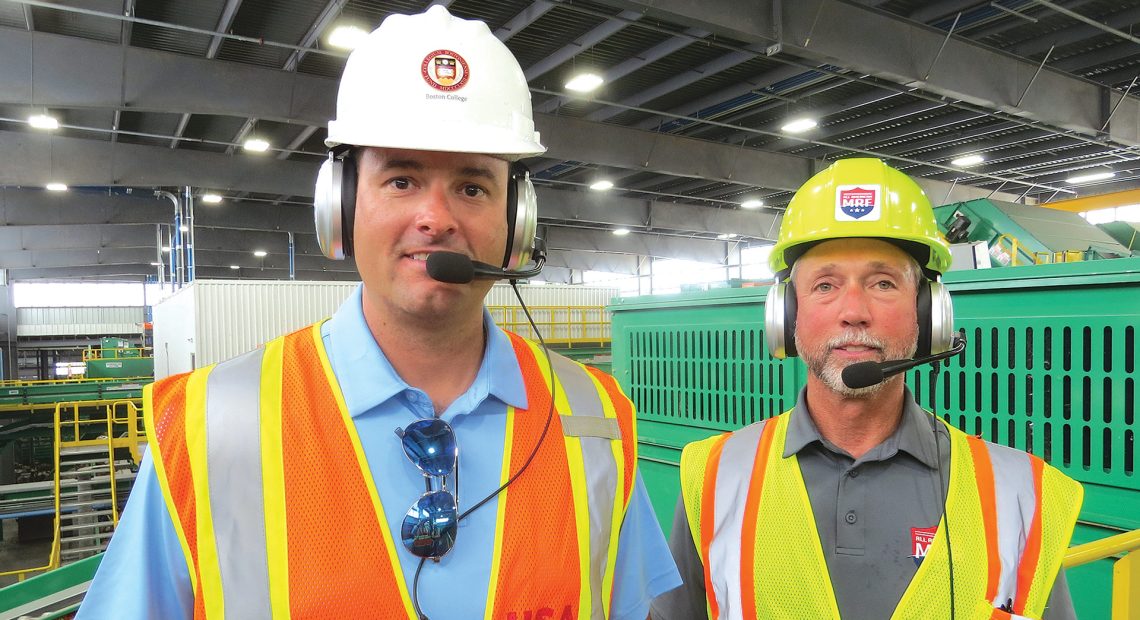
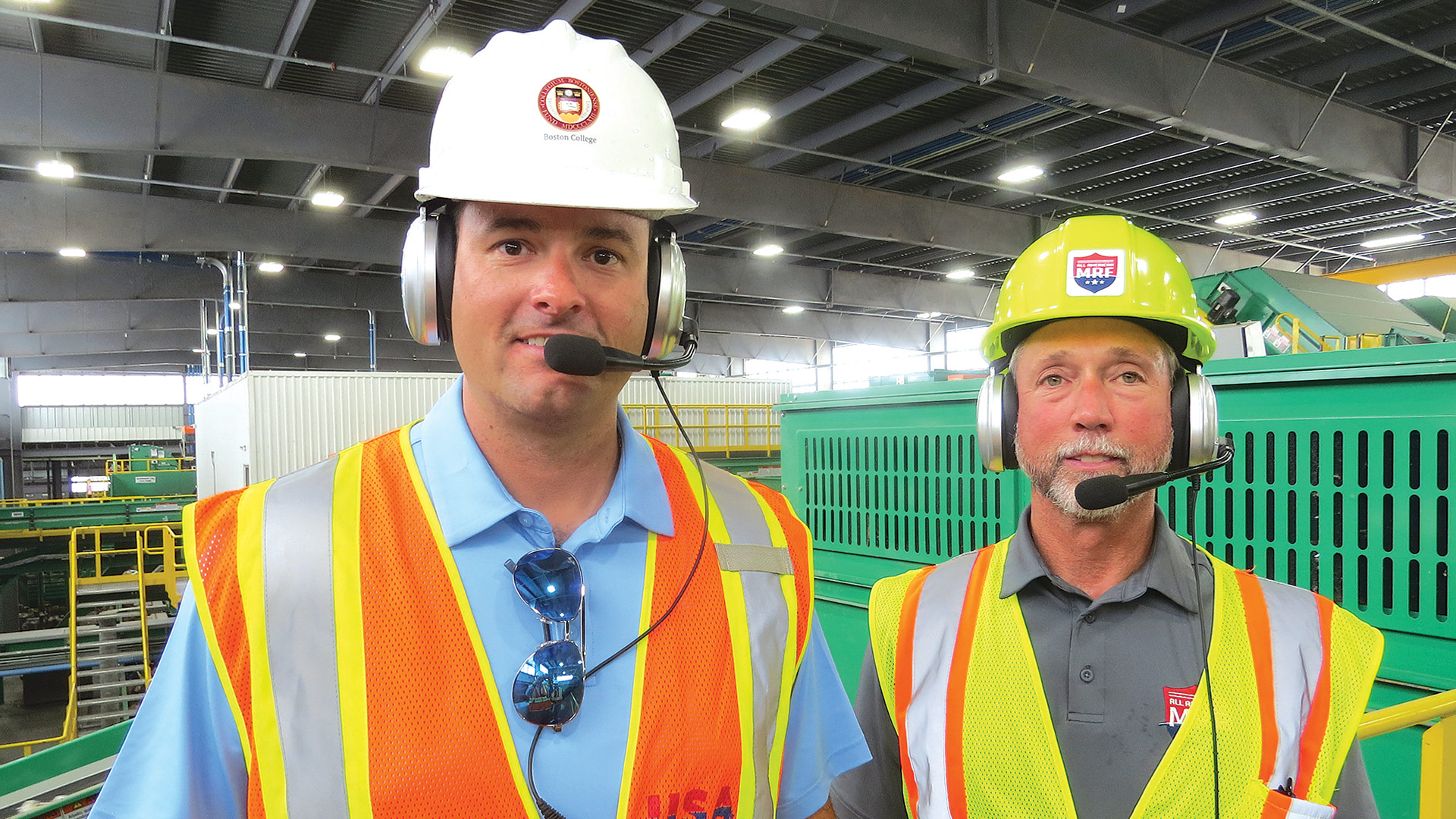
Frank Antonacci, left, and Jonathan Murray

Frank Antonacci, left, and Jonathan Murray have been leading many different constituencies on tours of the MRF in Berlin, Conn.

Frank Antonacci says he’s lost track of how many tours he’s led of the All American Material Recovery Facility (MRF) in Berlin, Conn., which handles material from across the Nutmeg State and Western Mass.

“Suffice it to say, it’s a big number,” said Antonacci, a principal with Murphy Road Recycling, an operator of several recycling facilities, which, in partnership with Van Dyk Recycling Solutions, suppliers of the system’s equipment, opened the state-of-the-art facility in early 2022.

Since then, in addition to overseeing this intriguing operation, which processes more than 50 tons of recyclable material an hour, Antonacci and Jonathan Murray, director of Operations for Murphy Road Recycling, have been leading individuals and groups through the massive facility to show them what goes on there and why this operation is among the most advanced of its kind in the country — and the world, for that matter.

And there have been many different constituencies donning the bright orange vests, hardhats, and audio systems needed to hear and be heard over the din of countless conveyer belts and sorting machinery. These include elected officials, business leaders, public-works crews, press members (including BusinessWest), and, perhaps most importantly, representatives of the companies that buy the recyclables — and many of them have made the trip to Berlin.

What they take in is a facility that was built with three primary goals in mind: to increase the quantity, quality, and purity of recyclables; to provide an innovative and safe working environment; and to have the flexibility to adapt to ever-evolving consumer habits (more on that later) and recycling market conditions.

And more than a year after it opened to considerable fanfare, this MRF is accomplishing all three, especially with regard to the purity of recyclables, said both Antonacci and Murray, noting that this is something that communities, states, and those buying the recovered products are demanding.

“Today’s curbside material isn’t what it was 10 or 15 years ago. Then, it was heavy on newspaper and relatively clean. Today, everyone reads news online and orders everything from the internet. Today’s stream is full of small cardboard boxes and shipping envelopes and requires that we, as recyclers, innovate and change our thinking around the sorting of recyclables.”

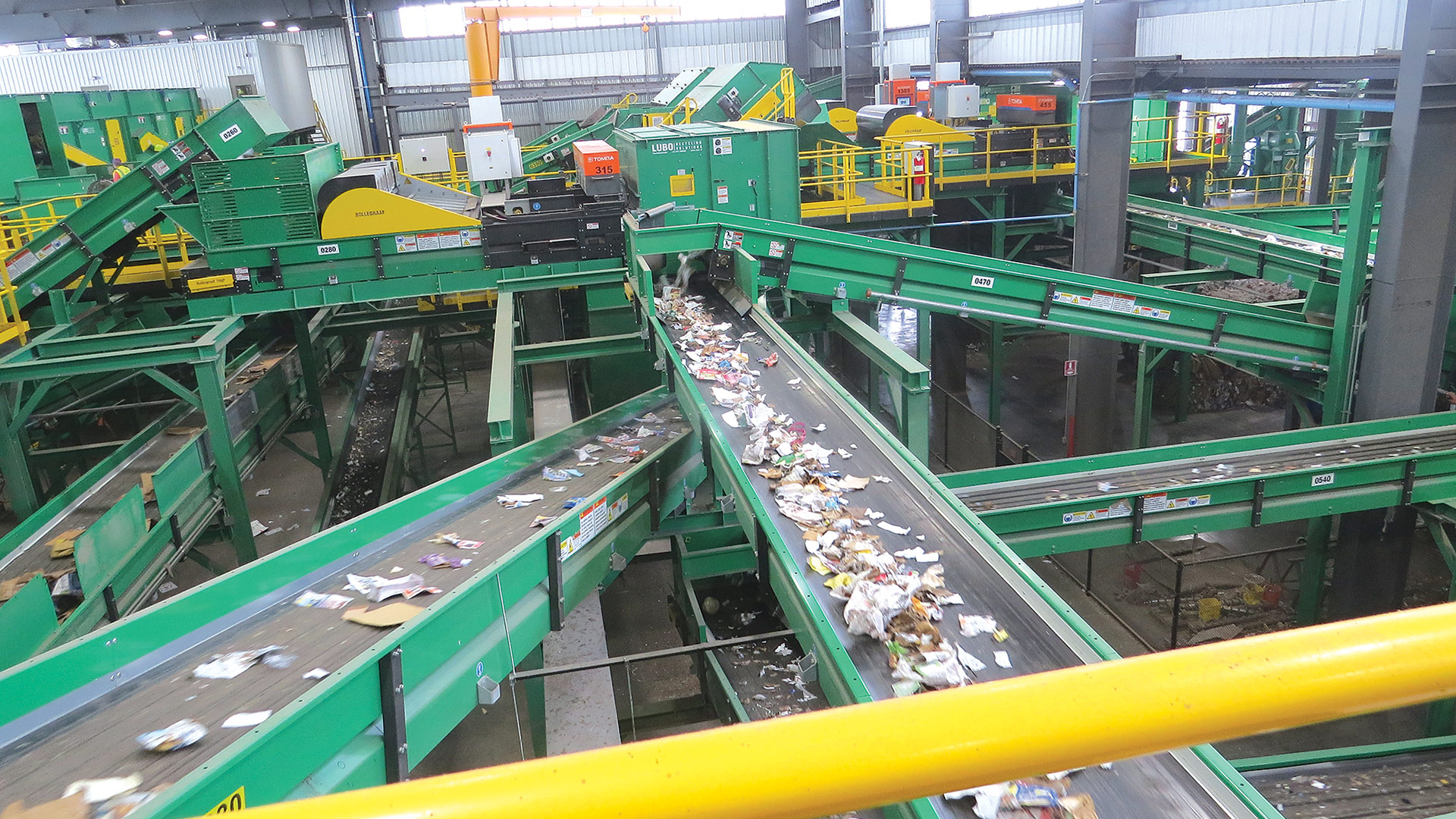
The fully integrated system, replete with artificial intelligence and high-tech scanners, is dedicated to the maximum recovery of all recyclable material, with several second-chance mechanisms in place to make sure valuable material doesn’t slip through the cracks, said Murray, adding that the design includes state-of-the-art equipment to target paper, cardboard, boxboard, glass, and five types of plastic.

Elaborating, he said the system first separates paper from aluminum and other metals and plastic and then digs deeper to identify and sort different types of plastic, such as the PET (polyethylene terephthalate) used to make water and soda bottles, and HDPE (high-density polyethylene) used to make food and beverage containers, shampoo bottles, cleaning-product bottles, and similar products.

“The optical scanners are trained; they’re learning all the time to know what the makeup of a PET bottle is,” Murray explained. “If a scanner’s job is to pick PET bottles, it knows it by reading the makeup of the bottle. Everything else travels on to the next optical scanner, which may be looking for HDPE or milk jugs or laundry detergent bottles; it scans for those and shoots those out.
Murray Road Recycling’s MRF

Frank Antonacci says Murray Road Recycling’s MRF has “moved the industry forward a generation” with its design.
Staff Photo

“The scanners are actually looking for the makeup of what’s in that material,” he went on. “It shoots a blast of air to kick it out or leave it in, and they’re trained at the factory and adjusted, so if we’re seeing a higher level of PET in the mix than HDPE, we can make adjustments so it will recognize that quicker and make sure we’re getting it all out.”

For this issue, BusinessWest toured the massive facility in Berlin and talked with Antonacci and Murphy about this operation, the evolving recycling market, and how the Berlin MRF redefines what would be considered state-of-the-art in this industry.


Leaving Little to Waste

Murray calls it the “Amazon effect.”

That’s a term he and others in this industry use to describe the influence of that giant corporation on life in general — and especially the world, and business, of recycling.

“Today’s curbside material isn’t what it was 10 or 15 years ago,” he noted. “Then, it was heavy on newspaper and relatively clean. Today, everyone reads news online and orders everything from the internet. Today’s stream is full of small cardboard boxes and shipping envelopes and requires that we, as recyclers, innovate and change our thinking around the sorting of recyclables.”

And these sentiments effectively and concisely explain what the All American Material Recovery Facility is all about — innovation and changing how people think about recycling and waste-disposal diversion.

“We took a significant amount of risk and leveraged our expertise, as well as a very strong team, to develop what we have here.”

The facility, and the roughly $40 million invested in it, represent another entrepreneurial venture, and gambit, undertaken by the Antonacci family, which was recognized by BusinessWest as its Top Entrepreneurs in 2018 for their creation of an eclectic and highly successful stable of businesses, with ‘stable’ being one of the operative words.

Indeed, this large and impressive portfolio includes a horse farm, Lindy Farm in Somers, which has bred and trained a string of champion trotters; Sonny’s Place in Somers (named after the patriarch of the family, Frank’s grandfather, Guy ‘Sonny’ Antonacci), a huge and continually growing family-entertainment venue; GreatHorse, the high-end, horseracing-themed private golf club created on the site of the former Hampden Country Club; and Murphy Road Recycling.

All of these ventures represented considerable investments and risks, Antonacci said, adding that the MRF in Berlin is no different.

“You’ll see many of the same themes throughout this facility as you would at our other operations,” he explained. “We took a significant amount of risk and leveraged our expertise, as well as a very strong team, to develop what we have here.”

The company looked at a number of recycling facilities starting in 2018 and made the decision to buy the Berlin facility in 2020, at the height of COVID.

“It was a considerable risk and investment at that point,” he went on. “But we knew that there would be life after COVID, and we believed that the region really needed a reliable, scalable solution to handling the growing amount of single-stream material.”
the primary goals for the new MRF

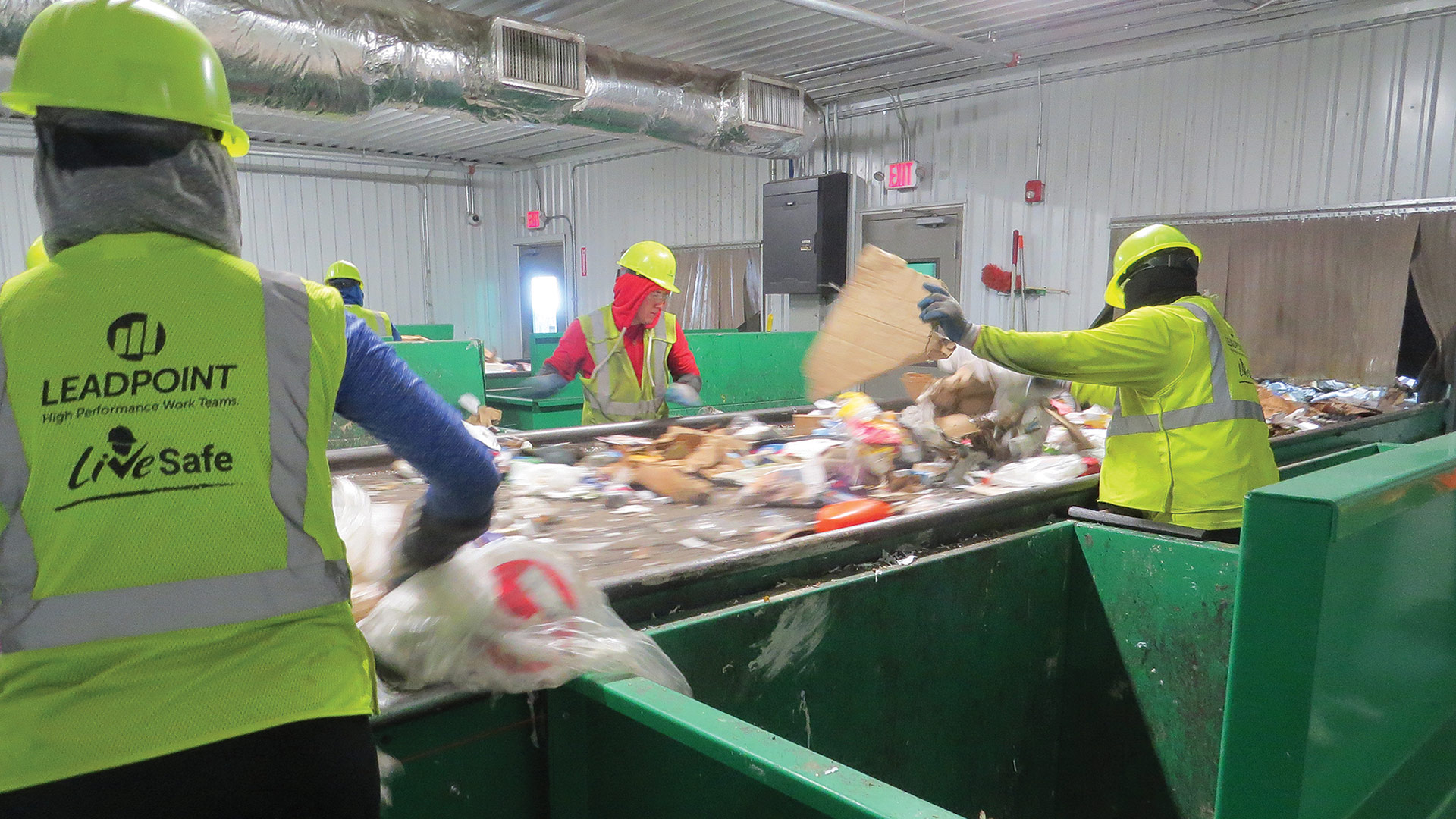
One of the primary goals for the new MRF is to increase the quantity, quality, and purity of recyclables for sale to companies that will use them to make new products.

By single-stream, he noted that recyclables from businesses and consumers come with various materials mixed together, often with materials that shouldn’t be placed in recycling bins but are anyway — from batteries to electronic devices.

This venture represents the expansion and modernization of an existing recycling facility, Antonacci said, adding that everything about the facility is state-of-the-art, a phrase he used early and often in this conversation, because it’s certainly warranted.

“We integrated tried-and-true mechanical separation though screens with optical technology,” he noted as he talked about what is really the heart of this operation. “We have machines that are optically looking at the material to polish any contamination or any mixture of different grades of recycling, and that’s done through highly advanced camera systems with artificial intelligence.”


Reading Material

The facility handles recyclables from roughly 100 communities in Connecticut and Western Mass., Antonacci explained, noting that materials from many communities in the 413 are aggregated and then brought to Berlin for processing. Overall, it handles upwards of 1,000 tons of material per day, a huge jump from the 350 tons a day handled by the largest facilities in the area prior to the opening of the MRF in Berlin.

Beyond size and scope, this facility stands out for many other reasons.

Indeed, the operation employs a dozen optical scanners that can identify and separate materials based on their chemical composition, and utilizes robotics and AI to perform additional quality control.

“The quality of the material that we’re able to glean from the blue-bin mix is really remarkable,” Antonacci said. “Leveraging our expertise and that of Van Dyk Recycling Solutions, we’ve moved the industry forward a generation with the design of this plant, based not only on the scale, but on the quality of the materials coming out of here.”

As they were developing the Berlin facility, those at Murphy Road toured a number of recycling operations in this region and other parts of the country, Murray said, with an eye toward adopting best practices and technologies. But there are some things being done here that would be considered unique and groundbreaking, he went on.

This includes a dual-feed system set in parallel lines, Antonacci said, adding that this is a different approach to preparing materials for final processing. Other innovations include the picking stations, where employees handle quality control, which are enclosed in dust-controlled, climate-controlled boxes which place a premium on worker comfort and safety.

“We went through a painstaking effort of keeping people away from places that could harm them,” he told BusinessWest. “We invested heavily in automation to further increase the safety and productivity of the facility.”

Beyond these safety features, the facility was designed to effectively handle ongoing evolution in consumer habits and thus the recycling stream. As he talked about this and pointed to the streams of paper moving along conveyer belts, Murray noted that, despite declines in readership, a large amount of newsprint still winds up in recycling bins.

“We took a significant amount of risk and leveraged our expertise, as well as a very strong team, to develop what we have here.”

But these same bins are being increasingly dominated by both cardboard packaging — that aforementioned ‘Amazon effect’ — as well as myriad kinds of plastic, aluminum, and tin cans.

Overall, the bins are cleaner than they were years ago, he went on, adding that the overall quality of the end product — what is ultimately sold to companies to make new products — is a function of how effectively the different materials, especially the many types of plastics, are separated.

And this is where the All American MRF stands out from other facilities.

Elaborating, Antonacci said this facility’s sorting capabilities extend to polypropylene, used to make everything from yogurt containers to margarine tubs; from Dunkin’ Donuts coffee cups to the packaging for to-go food products.

“This is something that has historically been hard to separate,” he explained. “But we have both the optical technology to look for polypropylene number 5, which those containers are made out of, and there’s also a laser on our optical machine that enables us to see those black plastics — the to-go containers — which most facilities can’t.”


Bottom Line

There are ever-larger amounts of polypropylene #5 winding up recycling bins, and the ability to separate it from everything else is becoming increasingly important, said Antonacci, adding that this is just one of the reasons why he and Murray are giving so many tours these days.

People want to see what separates this facility from most others — with the emphasis on separates. It not only represents state-of-the-art in this industry, it defines it.