



Home Posts tagged Technology (Page 37)
Sections Supplements
Camera Manufacturers Say It’s Time to Throw the Kodachrome Away

Charles De Luca

Charles De Luca, product manager for Nikon USA, demonstrates the ‘Face Focus’ feature on a new digital model

When Paul Simon immortalized Kodak’s Kodachrome slide film in his 1973 hit of the same name, it’s unlikely that he realized the tune would eventually serve as a swan song for an entire medium.

Indeed, the days of film photography are nearly over, and Paul Simon fans of tomorrow will soon be Googling ‘Kodachrome’ to find out what the heck that song is about.

Like all personal electronics, new camera offerings for 2006 are trending toward smaller, sleeker styles with more capability and finer picture quality, at increasingly affordable prices, but film doesn’t even enter the picture, as this review of new camera techology reveals.

Compact, or point-and-shoot, digital cameras have eclipsed film camera sales, and sales of digital single lens reflex (SLR) cameras, those with interchangeable lenses, are expected to reach their highest rates yet this year.

Kodak itself might serve as the best illustration of the shift. Once synonymous with film, the company’s future was grim, until it caught the digital wave and secured the top sales spot in the U.S. earlier this year, topping 2004 numbers by 41%. Other companies, including digital giants like Sony and photographic staples such as Canon, Fuji, and Nikon are seeing similar success.

That’s because in terms of both cost and ease of use, digital cameras have reached the point at which they’re accessible to just about everyone. Unlike the first few digital cameras to hit the market more than a decade ago, they’re simple to operate and designed to take a beating. They come equipped with autoflash, autofocus, and red-eye reduction, use memory cards that include up to 1 GB of storage space, and nearly all include both optical and digital zoom.

They also start as low as $99, rising in price depending largely on zoom capability and the number of effective megapixels – most newly released digital cameras are capable of shooting at 5.0 megapixels or more.

Extra features also play a role in price, although many are becoming the norm as photo technology progresses. Many new digital cameras, for instance, come equipped with more than a dozen different shooting modes (portrait, landscape, and close-up or macro modes are some of the more recognizable settings; newer offerings include backlighting, panoramic assist, and dawn/dusk modes).

‘Capture modes’ are also advancing – in addition to simply snapping one photo at a time, most new digital cameras include options such as multi-shot – taking several photos with one press of a button – movie modes, which allow for digital video, and color options, which allow the photographer to take a picture in full-color, black and white, or even with sepia tones.

And photo-editing options are being seen more frequently on new camera models, and allowing for immediate red-eye correction, cropping, image sharpening, or voice memos, among other tools, before a photo is downloaded to a computer or printer. “Give Us Those Nice, Bright Colors”

A Glossary of Digital Terminology

Combined Zoom
Refers to the total zoom capability of a camera, when the optical and digital zoom are combined. Optical zoom means that mechanisms within the camera are actually moving to zoom in on the subject; digital zoom is a digital enhancement of the optical zoom.

LCD
Liquid crystal display; refers to the screen on the back of most digital cameras. The larger the screen, the easier it is to see the image and navigate through menu options.

Matrix Metering
The camera measures optimum exposure automatically, by comparing 256 areas of the frame.

Megapixel
One megapixel equals one million pixels, the tiny dots that create a digital photo. The more megapixels a camera is capable of using to shoot and save a photo, the better an image’s quality will be when printed, and the larger a print can be made. On a camera or in its literature, megapixels are typically denoted in numerical form, such as ‘3.1’ or ‘5.0.’ A camera with 4.0 megapixels will yield prints up to about 8×10. Most new cameras on the market have at least 5.0 megapixels.

MB/GB
Megabytes and Gigabytes – refer to the amount of memory available on a digital camera’s internal memory or on a memory card. A memory card with 1GB of storage space will hold hundreds of photos at a time.

Noise-reduction Mode
Reduces the ‘busy factor’ in photos taken with a long exposure – makes for a clearer photo, especially at night.

Panorama Assist
Allows you to take several side-by-side photos, then combine them later using photo editing software.

Nikon, for example, recently unveiled five new models in its Coolpix collection that offer many of the new features that are quickly becoming standard among digital cameras.

One feature common to all five models is Face Priority AF, which automatically focuses on a subject’s face to ensure clear, crisp portraits.

But the new models also add to three different series of cameras – the ‘L’, ‘S,’ and ‘P’ series, which are geared toward different types of photographers and tailor new features toward those audiences.

The P series appeals to consumers looking for the latest in advanced technology, and as such, includes one of the newest offerings among digital cameras – Wi-Fi, which allows for the wireless transfer of photos and digital video from the camera to a nearby computer or printer, and is available on the new P1 and P2 models ($549 and $399*).

“These are the first cameras to offer wireless technology,” said Charles De Luca, product manager for Nikon. “It’s a great feature if you’re, say, shooting photos at a party – the photos can be printed and ready for you without ever having to leave the fun.”

The technology also allows for the creation of slide shows, complete with music, and wireless printing with the use of the PD –10 wireless printer adapter (which De Luca said is about the size of a lemon), and a printer enabled with PictBridge, the industry standard for printing photos without the use of a computer.

Several camera, camcorder, printer, and mobile phone manufacturers are now creating PictBridge-compatible products, including Nikon, Canon, Pentax, Fuji, Kodak, Olympus, Hewlett-Packard, Panasonic, and Sony.

“The wireless capabilities open up a whole new set of options for people,” De Luca said. “With the ability to automatically create a live slide show or transfer photos to the computer, people can get their prints faster as well as send them right away to others – imagine getting a slide show of an event you can’t attend, while the event is still going on.”

Increasingly, digital cameras are being tailored to enhance those moments when they are most commonly used – during family functions, vacations, and at special events in general, and that includes the incorporation of new technology such as wireless transfer, digital video, and other features. But manufacturers have not lost sight of the style factor – many shoppers rate the look of a piece of equipment right up there with capability and durability.

Nikon’s Coolpix L series, for example, caters to the novice photographer, and the new L1, ($329) with 6.2 megapixels, features a large, 2.5-inch LCD screen set in a small, pocket-sized body.

The S series tends to appeal specifically to those in the market for stylish, designoriented electronics, and the new S3 ($379), dubbed ‘beautiful in black’ by Nikon, adds to that line, previously made up of only silver cameras.

New cameras in the Canon Digital Elph series, one of the most well-known product lines among all digital cameras, also lean heavily on design as a major selling-point.

All of the Elph models in the PowerShot line measure just a few inches, are slim in width, and come in a variety of finishes. The new PowerShot SD30 ($399) includes 5.0 megapixels and a 10x zoom, but also comes in four different colors with names like ‘Rockstar Red,’ ‘Tuxedo Black,’ and ‘Glamour Gold.’

Similarly, Fuji’s new additions to its digital line include the FinePix Z1, a product designed specifically with aesthetics in mind. Retailing for about $400, the Z1 includes a U-shaped cover that conforms to a palm, a sliding body that protects the camera’s lens while enhancing its look, and comes in both silver and black.

It also measures about 3.5 inches x 2.2 inches, following the trend toward smaller, more lightweight design that all digital camera companies are following.

Camera Ready?

B.J. Adams, a product and market analyst for Pentax, explained that it’s not typically the technical explanations of digital cameras that most shoppers find attractive, but rather the features that augment those capabilities, including compact, easy-to-use design.

That has been one goal for Pentax’s Optio line, which includes a number of cameras designed to appeal to various lifestyles. Most new digital cameras only weigh between five and seven ounces – the Optio WPi ($349) weighs in at only 4.2 ounces, and that has become one of the camera’s main selling points.

“It’s all about taking a lot and putting it in a very small package,” Adams said, noting however that while bells and whistles and snazzy design are important to many consumers at the point of sale, most will come to appreciate the capability a camera has that allow them to simply take better photos, and more of them.

The WPi is waterproof – able to take photos in five feet of water for up to 30 minutes. Perhaps more important, though, is the 6.0 megapixel camera’s versatility in many situations – during a romp with a slobbery dog, a child’s bathtime, or hike through misty mountains.

Adams dubbed it “life-proof.” “It tracks people very well,” he said, noting that not only is the camera durable, but it can also take a clear action photo and a well-framed portrait shot using a nine-point autofocus system that includes ‘sport’ and ‘pet’ modes.

The WPi was also designed to include an optical and digital zoom, like most digital cameras, but with a unique twist – while most optical zooms require a lens that extends from the camera body and can pose an added risk for damage if given a good whack, the optical zoom on the Optio WPi is actually encased within the camera. “All of the optics are inside the camera,” Adams explained, “and actually turn a corner within the camera in order to allow that design.”

Pentax is also currently featuring two other cameras as part of an overall marketing push for their ‘lifestyle’ cameras – the Optio S60, an inexpensive beginner’s model, and the istDL, a digital SLR.

“The S60 retails for $199, and is a great starter camera for anyone who is not familiar with digital photography or even with photography in general,” Adams said. “It has a help-mode incorporated into the camera that gives step-by-step directions, and the menu has a zoom, which is especially helpful for people with poor eyesight.

“There’s also room to grow and learn with this camera,” he continued. “As people learn, they can try new things, and included software allows them to share their photos online with friends and family.”

Additionally, the istDL ($799, which includes a standard lens) is marketed toward more sophisticated photographers, but includes some of the same features that many consumers are looking for – lightweight design, diverse capabilities, and durable manufacturing.

“The istDL is a great traveler’s companion,” Adams said. “It takes great photos and is compatible with a whole pool of Pentax lenses, so photographers can get creative. But it’s also one of the smallest, most lightweight SLRs out there, and that’s what people are looking for.”

…Forget About Rewind

And for those people still frightened by the prospect of a camera that doesn’t require loading those small, cylindrical canisters into the back, Adams said today’s camera manufacturers are more sensitive than some might expect.

“This is our business,” he said. “We understand completely how many changes have occurred in the photography arena, and our products are very consumer-centric. There is a bridge from film to digital, and all are welcome to cross.”

* – Manufacturer’s suggested retail price. Jaclyn Stevenson can be reached at[email protected]
Sections Supplements
All land is not created equal. And yet, people are quick to talk about price per acre or price per square foot of land as if direct comparison is valid. To be sure, identical Peter Wood calls it the “end of the pent-up demand.”

That’s how he described a series of building projects that made 2005 a record year for South Hadley-based Associated Builders, which he serves as director of marketing.

As Wood explained to BusinessWest, following 9/11 there was a prolonged period of indecision for many business owners.

Uncertain about which direction the economy would take, these individuals back-burnered many new-building and expansion projects. When the economic picture came more clearly into focus, many of those ventures started to move forward, he continued, adding that it took some time to get through the pile.

He figures that point came sometime late this year.

And with that pent-up demand gone, there are some questions about what lies ahead for the construction sector, which is traditionally a good barometer of the overall economy.

Wood told BusinessWest that Associated has several projects currently in progress and more on the docket for the start of the spring building season – but most are smaller in size and scale than some of the company’s recent assignments. There is enough volume, however, for him to project that ’06 might eventually wind up as good as this year.

“For many years, I was cautiously optimistic about the prospects for this sector,” he said. “I haven’t had to use the word cautious lately, and don’t think I need it now.”

Still, there are question marks. Tom Zabel, who recently acquired The O’Leary Company in Southampton, which specializes in fabricated metal buildings, said there are several factors that could impact the construction sector in the year ahead, starting with interest rates.

They continue to rise, he explained, which could prompt some business owners to think twice about building or expanding – or … the trend might prompt some to strike now, before the rates go much higher.

“The bottom line is that money is still relatively cheap,” he said, noting that while rates are rising they are still near record lows. “I think you’ll see some move now out of concern that rates will only go higher down the road.”

Joe Marois, president of Chicopeebased Marois Construction agreed, but said interest rates could be one of many factors to sow uncertainty among business owners, which often translates into delaying new-building, expansion, or renovation projects.

“Most of the things we’re doing now are deferred maintenance projects and other things that need to be done,” he explained. “I don’t see as many people looking at new building; if they don’t have to spend the money right now, they’re waiting to see what happens with the economy.

“I suppose that’s what people do every year,” he continued, “But it just seems that people are being more cautious right now.” Beyond this heightened level of caution, there are other immediate challenges for builders – specifically emerging supply problems involving buildable land and qualified construction workers.

Indeed, both Wood and Marois said that over the past few years, and especially over the past several months, it has become increasingly difficult to find good help at nearly all levels – from laborers to tradesman such as carpenters and drywallers.

Wood said he doesn’t have a firm grip on the reasons for the shortage, although he suspects that many individuals who might have sought out construction work in the past are now looking elsewhere, even though the field provides ample opportunities with decent wages.

“I’m not really sure why it’s happening, I just know it is, and it’s happening across the industry,” he told BusinessWest. “It’s puzzling in a way, because there are good jobs out there and fewer people to take them.”

Marois speculated that many of the summer workers that area contractors have relied on – college students on break – are now finding summer jobs in other fields, including technology and health care.

“This is something everyone is dealing with,” he said. “There are simply fewer good people out there.”

As for the land supply, Wood said several of the area’s municipal and private industrial parks are at or near capacity, and there have been few additions to the inventory.

“Land is becoming an issue,” he said, adding that the dwindling supply is one reason why. Associated is working on smaller projects this year. “Business owners like to have options, and they don’t have as many now as they once did.”

Opinion
On Beacon Hill, legislators are debating ways to increase the number of people with health insurance coverage. The outcome of that debate will reshape the health insurance landscape, protect the health of more of your friends and neighbors, and affect your medical costs.

Change is coming, and it is needed. Though they differ on specifics, the governor, the Senate president and the speaker of the House all agree on that point. For the wellbeing of hundreds of thousands of Massachusetts residents, we must seize this once-in-a-generation moment.

Health insurance enables patients to access the preventative care that saves lives, so it is time to set ourselves on a path to affordable, meaningful coverage for everyone. It is at the heart of what hospitals stand for in this debate.

Coverage should take the form of expanded Medicaid for the needy and new, more affordable private health insurance.These options should truly meet peoples’ medical needs. Reform that offers benefits that are low and co-pays and deductibles that are high will not work.

There must also be a recognition that no matter how generous the benefits, no matter how broad the coverage, there will still be those who will fall between the cracks.There must be a safety net for them and for those who provide their care. The form of such a safety net can be debated, but there should be no disagreement about its necessity.It’s not realistic to assume that we won’t need a safety net once health reform becomes law. That will put vulnerable people in harm’s way.

As lawmakers focus on reform, one of the great challenges confronting them is affordability to consumers, businesses and taxpayers. As you might expect, in the current system, all sides try to reduce costs.But if a business chooses to cut expenses by dropping coverage for employees, we all end up paying for that choice as those employees become state-subsidized ‘free care’ patients. At the vast majority of good businesses that offer health benefits, some employees who are financially capable of enrolling sometimes gamble by opting out. And these aren’t the only “free riders.” The state has a track record of consuming services through Medicaid and paying for far less than the cost of those services.

That is why coverage for all requires ‘shared responsibility’ by all. Without it, the cost of caring for the uninsured will still be unfairly carried, in the form of higher premiums, by responsible citizens and companies. For state government, shared responsibility means stepping up with fair Medicaid payments.

For individuals, it means living up to the personal responsibility to purchase insurance.Reform can help make insurance more affordable, and it is fair to offer public subsidies to help those who find that insurance is just beyond their financial grasp.

Employers – including hospitals – that provide coverage to their workers should not have to bear the cost for those who do not. Businesses that are struggling to offer health benefits should not be put at a competitive disadvantage against those that are not making the same effort. It may also require assistance to small businesses that want to step up and do the right thing on health benefits.

Hospitals have a critical role to play in the affordability challenge. We support efforts to reduce administrative costs, to manage costs more effectively, and to be publicly accountable for the care we provide.Better information technology is a key component. We also know that, depending on the needs of a patient, care should be delivered in lower cost settings. All patients deserve the right care, at the right place, at the right time.

These lofty goals can be realized. But, it will take more revenue, whether it comes from tobacco money, gaming revenue, assessments on employers who do not provide coverage, or increased Medicaid reimbursements.

This is Massachusetts and this is the moment. With commitment, collaboration and, most importantly, leadership, we can make coverage for all a reality. Let’s do it.

Ronald M. Hollander is President and CEO of the Massachusetts Hospital Association. (781) 272-8000.

Opinion
Proposition 2 1/2 was passed by voters on Nov. 4, 1980. It was a revolution, a passionate and controversial ballot campaign; now, 25 years later, it is an institution. Yes, once upon a time the property tax burden was the second-highest in the nation, which called us Taxachusetts.

Over the decades, taxpayers had been promised lower property taxes in return for other revenue sources. So by 1980 we had a high income tax, a sales tax, a lottery, and high property taxes. Further, we were one of the few states with an automobile excise and something called school committee fiscal autonomy, which gave local schools any amount of money they requested regardless of the wishes of city councils or town meetings.

On top of this, instead of getting a fair share of state tax revenues in local aid, the cities and towns had to fund any new bright idea that came down from Beacon Hill. And on top of that, the courts had just ordered all communities to comply with the state Constitution and assess all property at its full and fair market value. Many homes were assessed much lower; people imagined the community’s existing tax rate being applied to their home’s true value.

Between outrage at broken tax-relief promises and panic about the coming revaluation, Proposition 2 1/2 was born. Citizens for Limited Taxation (CLT) collected signatures on an initiative petition that limited property taxes to 2.5% of a community’s value, cut the auto excise from $66 per $1,000 to $25 per $1,000, gave renters an income tax deduction, repealed school committee fiscal autonomy, and forbade new unfunded state mandates on cities and towns.

Battle lines were drawn: CLT, the Mass. High Technology Council, the Mass. Auto Dealers Assoc., and the National Federation of Independent Business against almost everyone else. Leading opponents were the Legislature, the Mass.

Municipal Assoc., the Mass. Taxpayers Foundation, the Mass. Teachers Assoc. and other public employee unions, various human service organizations, the Mass. Council of Churches, the Catholic Church, and, incredibly, the Mass. Assoc. of Older Americans.

Union fliers featured either a picture of a gun shooting backward, titled “How Prop 2 1./2 Works,” or the heading “Cutting Taxes? Or Cutting Our Throats? Human service fliers featured a senior with a walker, a young man in a wheelchair, and a couple of minority kids looking terrified. There were debates galore, hours of talk radio devoted to the issue, yard signs, and bumper stickers.

The League of Women Voters held onesided forums that presented only its point of view: Prop 2 1/2 will cause drastic cutbacks to basic public services.

Nevertheless, the people passed Prop 2 1/2, 59%-41%.

Then the battle really began: public employee marches, demands for repeal. But the Leguslature, getting the message, decided to work with the people’s law. CLT teamed up with the MMA, legislative Republicans, and conservative Democrats to get more local aid. With Gov. Ed King promising a veto of any changes that would damage Prop 2 1/2, a sensible provision for new growth was added, and the two-thirds vote for an override became a majority vote for various kinds of overrides, intended for bonded projects or emergencies.

Local officials were more respectful of taxpayers whose support might be needed to pass them. Local aid increased almost every year. Opponents who prophesied the end of the world looked silly.

Back then, of course, it was impossible to imagine voters raising their own taxes for operating expenses and teacher pay raises.

Twenty-five years later, the property tax burden is still too high, at eighth in the nation.

The long-term goal, to get education spending off the property tax, has yet to be realized, But individual taxpayers have saved a bundle on both the property tax limit, the rental deduction, and the auto excise cut. Twenty-five years later, Proposition 2 1/2 is still cause for celebration.

Barbara Anderson is executive director of Citizens for Limited Taxation, which created Proposition 2 1/2.

Departments

Springfield Museums Receive Support for ‘Learning Together’

SPRINGFIELD — The Springfield Museums has received a grant for the second year in a row for $95,000 from the MassMutual Financial Group for Learning Together,” a series of educational programs for Springfield Public School students. “Learning Together” addresses the goals of Step Up Springfield, the citywide initiative that challenges the entire community to work together to promote academic proficiency and character development among Springfield’s youth. The grant will support fee waivers for students to participate in educational school group programs at the museums and bus transportation for all fifth-grade students in the city to visit the museums for grade-specific science and social studies programs that target the M a s s a c h u s e t t s Curriculum Frameworks and MCA’s testing. Also, funding will be used toward coupons for a free adult admission to encourage students to visit the museums with their families, and afterschool outreach programs at the North End Youth Center, South End Community Center and Springfield Day Nursery. “Learning Together” activities will take place during the 2005/2006 school year. Throughout the year, museum staff, in consultation with Springfield Public School and MassMutual officials, will evaluate the progress of the project and discuss ways to expand and refine the program in succeeding years.

.Bright Nights Adds ‘Jurassic World’

SPRINGFIELD — The Spirit of Springfield recently announced a major addition to its popular “Bright Nights at Forest Park” for this holiday season – Jurassic World. The 12-piece display is being presented by the MassMutual Financial Group. The new light display features an array of dinosaurs, trees, and an erupting volcano. Jurassic World will be located in the park’s Memorial Grove. Jurassic World is the first major addition to “Bright Nights” since 2002, according to Judith A. Matt, President, Spirit of Springfield. The 11th season of Bright Nights opens Nov. 23 and operates Wednesday through Sunday until Dec. 11. Beginning Dec. 14, the holiday lighting display operates nightly through Jan. 1. Nightly, buses with reservations, are welcome from 5 to 6 p.m. For personal vehicles, Bright Nights is open Monday through Thursday from 6 to 9 p.m. for $12 per vehicle, and 6 to 11 p.m. on Fridays, Saturdays and holidays at $15 per vehicle.

For more information, call (413) 733-3800 or visit www.brightnights.org.

MHA: Nursing Vacancies Down Slightly

BURLINGTON, Mass. — The vacancy rate for registered nurse positions in Massachusetts hospitals dropped only slightly in 2005, as hospitals continue to battle against the current and looming larger national nursing shortage, according to a new study by the Massachusetts Hospital Association and the Massachusetts Organization of Nurse Executives. According to the survey of hospitals, the RN vacancy rate as of January 2005 was 6.4%, down from 6.8% in 2004 and 8.5% in 2003. The report noted that while vacancy rates have declined for the third consecutive year, they still stand at a high level relative to rates over the 18 years of data collection. National studies suggest that the slight dip in vacancy rates is caused by the reentry to the workforce of older, married nurses responding to increasing RN wages and the toll of relatively high unemployment rates on their families, and more recently, widespread private sector initiatives aimed at increasing the number of people who become nurses. However, these studies say the forecast of a long-term, structural shortage is unchanged. The acute care hospital respondents represented 91% of the state’s 66 acute care hospitals and 94% of the state’s acute care hospital beds.

UMass Computer Models Sharpen Securities Fraud Detection

AMHERST — The world’s largest private- sector securities regulator, the National Assoc. of Securities Dealers (NASD), has teamed up with UMass Amherst researchers to bring cutting-edge computer science to the world of securities fraud. By developing statistical models that assess data that most models can’t manage, the scientists aim to help the NASD discover misconduct among brokers and concentrate regulatory attention on those who are most likely to misbehave. Because broker malfeasance is often encouraged by the presence of those conspiring to commit fraud themselves, the researchers were given the task of developing statistical models that made use of this social aspect of rule-breaking. Such “relational” data is difficult for many models, which often assume independence among records. The work is part of an ongoing, joint project exploring fraud detection by UMass Amherst researchers and the NASD, and it was presented recently by doctoral student Jennifer Neville at the 11th ACM SIGKDD International Conference on Knowledge Discovery and Data Mining.

30-Year Mortgage Rates Climb Past 6%

NEW YORK — As realtors note a drop in the housing market frenzy of late, mortgage rates have climbed above 6% — the secondhighest level of the year. According to Freddie Mac, the nation’s housing agency that sells guarantees for home loans, this recent surge can have a psychological effect on persons considering purchasing a home or refinancing a home loan. A chief economist with Freddie Mac speculates that mortgage rates will gradually rise over time but that the 6% rate will hover for awhile before it rises again.

Small Businesses To Benefit From Grants

SPRINGFIELD — Small businesses in the North and South Ends and in Old Hill and Six Corners will benefit from an $80,000 grant administered by the Affiliated Greater Springfield Chambers of Commerce Inc. Several vacant storefronts in each neighborhood will be spruced up and occupied in the hopes it will turn the neighborhood around. Grant money will not be given to the business owners directly, but can be used for architectural costs, marketing, advertising, legal and accounting fees. Bills for the services will be processed through the office of Chamber President Russell F. Denver, who will use the grant money to pay them. Grant money can be used for a new business moving into a storefront or an existing business that wants to expand into an adjacent storefront. The state Division of Employment and Training provided the grant. For more information, contact Denver at (413) 787- 1555.

Two Supermarkets Planned for Sixteen Acres

SPRINGFIELD — Stop & Shop and Big Y Foods announced plans in October forsupermarkets in the city’s Sixteen Acres neighborhood. Big Y plans to reopen a store that was closed two years ago on Wilbraham Road – with a new twist – a smaller, specialty- food theme called Fresh Acres Market. Features of the market would include an area for a farmers market, floral and produce sections, food take-out, a deli and bakery. In addition, the market would feature a gourmet section and conventional store. Stop & Shop has proposed converting 415 Cooley St. into a Super Stop & Shop of 60,000-square-feet, along with 10,000 square feet for other retail space. Stop & Shop has purchased and plans to demolish four homes on Allen Street to accommodate its site needs, however, it still needs zone changes from the Springfield City Council in order to move ahead with its plans.

Food Bank Breaks Ground for Addition

HATFIELD — Western Mass. has a hunger problem, according to Robert Moorehouse, executive director, Food Bank of Western Massachusetts. In an effort to address the rising needs of those facing hunger throughout the region, the Food Bank recently broke ground on a 16,000- square-foot addition that will double the size of its facility. Currently, the Food Bank distributes perishable food to more than 400 shelters, pantries and social service agencies throughout Western Mass. With the new industrial coolers and freezers, the capacity for more perishable food, fruits and vegetables will help provide a healthier diet for the hungry. The Food Bank launched a Room to Grow Campaign last year which has raised $3.6 million toward the new $3.9 million addition. In addition, the Kresge Foundation has offered a $150,000 challenge grant to implement green technology in the new facility.

U.S. Colleges Still Costly

uring the annual survey recently released by the College Board, college cost increases slowed in 2005, the lowest rate since 2001. For students attending a public four-year university, a 7.1% increase is still well above the inflation rate and translates into an average of $5,491 for tuition and fees for one year. Students at two-year public colleges rose by 5.4% to $2,191. At private fouryear, nonprofit colleges, costs increased by 5.9% to $21,235. Most students do not have to pay the full price because of loans and grants, as well as tax breaks. The College Board noted that while total financial aid is increasing, loans accounted for more of the growth than grants for the third consecutive year. Students have to pay back loans, but not grants. Undergraduate borrowers are seeing an average debt of $15,500 – an amount that most experts feel is manageable for students. The College Board also criticized the proliferation of popular state programs that award college grants based on merit and not need.

Cover Story
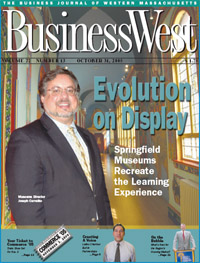
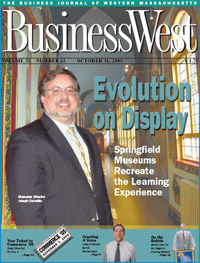
Springfield Museums display determination
Cover 10/31/05

Cover 10/31/05

Museums everywhere are struggling to reinvent themselves and appeal to wider audience, while simultaneously coping with tight budgets and overtaxed staff. The Springfield Museums are not immune to those challenges, and face them everyday. But museums director Joe Carvalho is optimistic that the institutions have what it takes to not only survive, but thrive in the national marketplace.

“Have you ever seen a Samurai sword?” That was the question Joe Carvalho, director of the Springfield Museums, posed to a family he ran into recently while rushing off to a meeting on the museum grounds. The family had come to the museums specifically to tour an exhibit on black soldiers who fought in the Civil War, and, having completed their visit (or so they thought), were about to leave.

But Carvalho had other plans for the family, which included two young children whose eyes widened at the prospect of checking out a massive Japanese sword, like the ones they’d seen in movies and video games. Having successfully steered them away from the parking lot and toward the Asian art exhibit, Carvalho headed off to his meeting.

An hour later, he passed the same family, now with handmade Asian kites in their hands that they’d created at the nearby Art Discovery Center, and with plans to visit the science museum before leaving. “Now that,” Carvalho said, with a slap to his knee that was both emphatic and triumphant, “That’s great. That’s what it’s all about.” It was just a snapshot, he said, of the model the Springfield Museums have been cultivating over the past several years.

“Museums used to be purely visual,” he said. “You came to simply see. But we can’t be that anymore … you have to be able to see, do, touch, interact, learn, and have fun. More and more museums are realizing that’s what you have to do to survive, but I think we’re ahead of the curve. I think that’s our magic.” And one statistic would suggest that Carvalho’s optimism is warranted: Springfield Museums have logged record attendance levels over the past three years, bringing in the highest number of visitors in the facilitie’s history.

That’s in the face of financial challenges and staffing cutbacks, among other concerns, not to mention the museums’ central location in the heart of a struggling city. As part of its focus on the region’s travel and tourism sector, BusinessWest looks this issue at some of the initiatives that are working for the museums, and some of the new frontiers Carvalho and his staff hope to cross in the future, as they work to bring an historic quartet of buildings into the 21st century.

Curating the Ills Carvalho said the Springfield Museums aren’t unique when it comes to many of those ongoing concerns he mentioned. Museums nationwide face a common set of challenges, and it’s how those problems are tackled that determines the ultimate level of success. Museums are charged to continuously shake off the dust, sometimes literally, he said, within their halls and to not only change with the times but also translate those changes to the general public. They must update their collections, while maintaining existing ones.

They must appeal to general audiences, while still upholding high academic standards in the areas of archiving and historical or cultural relevance. They must perpetually seek out new funding sources in the form of grants or corporate support in order to maintain services, and must also make do with sparse staff and resources in the face of budget constraints.

“Keeping good people is an issue that all museums deal with,” Carvalho explained. “There is a major misconception that people who work in museums sit on their hands all day, when in fact, we have a team of professionals here that are increasingly called upon to broaden their skill base. “Staffs are getting smaller all the time in all museums,” he continued, noting that when money is tight, staff cutbacks are common.

But as the demands for new types of technology-based, multi-media exhibits and offerings increase, existing employees are often called upon to add a new line to their list of responsibilities. “The technological and cultural literacy required to work in this environment is staggering, and we’re lucky here to have people who have taken that component of ongoing education very seriously. In some cases, their creativity has translated into innovative, cost-saving ideas for us, and they’re constantly stretching their resources. I couldn’t ask them to do more … although I probably will.”

It’s not just creativity in the exhibit halls that leads to greater foot traffic, however. Increasingly, museums must compete with television, radio, and the Internet when recruiting new audiences, and constantly sell themselves to the public in an effort to explain why it’s better to visit a museum to see a given work of art, scientific marvel, or historical relic, instead of Googling the item from a home office desk. “In 1896, when the museum first opened, they didn’t have to worry about the Internet, the TV, and video games,” Carvalho said.

“Now we’re literally competing for people’s time.” He added that those museums that are not recognizing the need to reinvent themselves are those that are struggling the most. “Museums have to build toward the future as much as they have to preserve the past,” he stressed. “Some haven’t, and they blame their downturns on the attitudes of the public, not on their own internal issues. Museums need to recognize that we have to appeal to everyone, not just people with PhDs, to survive.

We have to be different, we have to be engaging, and we have to show people the value of seeing the actual object. That’s our purpose, and we have to do it well.” But that’s admittedly a tall order, said Carvalho, and one that is complicated by the need to woo local visitors to the museums as much as national visitors. He added that “convincing the community to come back” has been at the top of the Springfield Museums’ to-do list over the past decade, and, gradually, they are returning. A Seuss Boost Undoubtedly, one addition to the museums that gave the organization a needed boost was that of the Dr. Seuss National Memorial Sculpture Garden in 2002.

Now the crown jewel of Springfield’s Quadrangle, the bronze statues depicting various characters created by Springfield native Theodore Geisel have brought some national attention to the city, as well as the museums’ four buildings and their collections:

• The George Walter Vincent Smith Museum, which houses the collection of its Victorian namesake, including several pieces of Japanese and Chinese decorative arts;

• The Springfield Science Museum with its African Hall, the Seymour Planetarium, an aquarium and live animal center, and Gee Bee airplane;

• The Connecticut Valley Historical Museum, which exhibits present decorative objects and domestic artifacts highlighting the history of the Connecticut River Valley, and

• The Museum of Fine Arts, featuring 14 galleries of important American and European oil paintings, as well as fine watercolors and other works on paper, sculpture, furniture, and decorative arts.

Carvalho said the sculpture garden has definitely captured the public’s attention, and drew in a new legion of visitors to all of the museums. But he was also quick to note that the museums will not be leaning too heavily on the memorial in the future. It gave the museums a much-needed shot in the arm, he said, but Horton and his friends can’t do it alone.

“It’s a gem,” Carvalho said. “It gave us the national brand we needed and some new recognition as a destination. But what the memorial also gave us was a way to reintroduce the other national collections we have here, something simple to open that door. Now that the momentum has started, we are going to continue to build on it by constantly rethinking how to draw people in.”

That could mean working with area schools to create programs for students, or capitalizing on the new branding of the Pioneer Valley, jump-started by the Greater Springfield Convention and Visitors Bureau, in order to attract more regional visitors to the museums for one and twoday trips. It could also mean revamping existing collections as well as procuring and promoting new galleries and exhibits, as Heather Haskell, director of Art Museums, explained. She said a number of unique art exhibits will be shown throughout the year, ranging from photography to colonial crafts to the realistic, often life-sized sculptures of world-renowned soft sculpture artist Lisa Lichtenfels.

A massive reinstallation of 10 permanent galleries is also currently underway at the museums, which will require months of painstaking work by museum staff. “We’re putting new or different objects in view, and highlighting some recent gifts to the museums,” said Haskell. “The objective is to make the entire museum more accessible to 21st century visitors.” The museums’ next national marketing push will be to promote its expansive collection of Currier & Ives prints, many of which will be unveiled on Nov. 18 in the Museum of Fine Arts.

The exhibit will include 175 of the museum’s 790 hand-colored, original lithographs, which represents the third largest collection in the country next to the Library of Congress and the New York City Museum, and the only permanent museum gallery in the world. What’s more, museum staff has taken to referring to exhibits like the Currier and Ives collection as ‘brands,’ underscoring the economic impact the art collections have on the business climate of the museums as well as the city.

“It’s possible that 10 years from now, we could have the largest exhibit of Currier & Ives prints in the entire world,” said Haskell. “The magnitude of this collection already elevates us to a new level as a museum.” Carvalho added that it will be a goal to continually grow the collection, in hopes of taking advantage of the notoriety, much like the museums did following the dedication of the sculpture garden in 2002. “It benefits everyone,” he said.

“The national attention will draw in more visitors who will stay longer, will raise awareness of the area and allow for increased cross-promotion here and across the valley and into Connecticut. And it’s all in keeping with the spirit of moving forward.” And with such a diverse set of collections on the premises, the Springfield Museums do indeed have the resources to cater to a wide spectrum of visitors, including several niche populations.

That diversity also makes for a complex marketing model, said Carvalho, explaining that the museums must strike a balance between their individual identities and their strength as a whole. “The question is, ‘Do we try to show the public that there’s something for everyone, and market all of the museums together,” he said, “Or do we try to target those audiences who are likely to visit specific exhibits?’ “The answer is yes,” he offered.

“There’s no one right way to get the sense across of what we have to offer. So, we do it all. We develop marketing for the masses and we target niche markets as well. Our strength is, regardless of how we got them here, that we do our best to show them once they are here how much we have. “The bottom line is we are not yesterday’s museum,” he continued. “There are three groups we are very serious about here: contemporary audiences, future audiences, and past audiences. We have a responsibility to all of them.”

Asian Wisdom He hopes that, in many cases, visitors to the museums will represent all three in the years to come. That’s why he and his staff are hard at work planning the next round of exhibits, researching grants and corporate sponsorship opportunities, and occasionally stopping a visitor in his tracks to ask ‘Hey … have you ever seen a Samurai sword?’ ?

Jaclyn Stevenson can be reached at[email protected]
Opinion
Gov. Mitt Romney’s proposal to equip all secondary school students in Massachusetts public schools with laptop computers is a necessary first step toward providing a 21st century education to all our young people. Such an initiative, properly implemented, can help raise student aspirations and assist them in developing the skills they will need to succeed in school and in life.

The 2004 report of the Special Commission on Educational Technology, made up of educators, business leaders, legislators, and representatives of the administration, supported a one-to-one, student-to-computer ratio as a means to achieve equity and improved learning, to involve and communicate with parents, and to interest students in the science, technology, engineering, and mathematics skills valued in our economy. This report, and the dozens of statewide and district laptop initiatives that have been implemented over the past five years, point to some important lessons about how to proceed and what to expect.

One lesson is the necessity of professional development for teachers. Laptops can catalize positive changes in teaching and learning only if teachers take the lead through effective use of the technology to transform classroom instruction, and if teachers and principals learn to use technology to help them make sound instructional decisions based on achievement data. This will require training and support.

Another lesson is to plan well for robust networking and to budget for the total cost of ownership of the hardware, including maintenance, repairs, upgrades, and technical support. We must make certain from the start that the choice of hardware and software supports the many dozens of applications that have proven effective. The governor’s plan to make replacement laptops a yearly part of the budget in schools makes sense.

A final important lesson is that we will see “soft” results before test scores show any change — improved attendance, decreased discipline problems, and increased student engagement in learning. Evaluations thus need to focus on students’ attitudes and what teachers find successful, not just on test scores. This is an investment in our future workforce and the payback will take time.

The controversy about the governor’s plan to use low-cost laptops — being developed at MIT for schools in developing countries — has diverted attention from a key point: Whatever hardware we choose, Massachusetts must act now, or our students will soon be losing ground in the race for 21st century skills to millions more potential competitors around the world.

Students will recognize this initiative as a vote of confidence. They see that the world is changing rapidly and that to compete they must master the computer and the Internet with newfound information-age skills. If we challenge them to excel at writing, presentation, collaboration, analysis, and logical thinking — and give them the tools to meet those challenges — they will create a prosperous future for themselves and the Commonwealth.

Andre Meyer is senior vice president for Communications and Research at Associated Industries of Massachusetts. Isa Kaftal Zimmerman is chairman of the Educational Technology Advisory Council and director of Professional Education at Lesley University.

Sections Supplements
Medical Practice Expands its Horizons
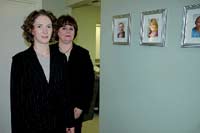
Jackie Bouchard (left) and Virginia Vogt Pisano

Jackie Bouchard (left) and Virginia Vogt Pisano of Baystate Ob/Gyn

For months, Virginia Vogt Pisano, practice administrator for Baystate Ob/Gyn Group Inc., and assistant administrator Jackie Bouchard, have been inundated by new terminology, technology, and their share of headaches as they work to unroll a new electronic medical records (EMR) system at the practice.
It’s just one cog in the works that make Baystate Ob/Gyn a successful business as well as medical practice in Western Mass., but it serves as an excellent example of how those two sides of the company must work together at all times in order move forward as a thriving, progressive, and, above all, safe health care business serving women of all ages across the region. Baystate Ob/Gyn has been recognized and lauded for that growth by the Affiliated Chambers of Commerce Super 60 program, which put the practice among the top 10 – number nine – for revenue growth.

“As we expand,” explained Vogt Pisano, “new technology – and the issues implementing that new technology can present – is just one thing that drives us to continue to focus on providing quality care to our patients. It forces us to figure out the best way to implement new procedures, to learn everything we can about them and to value the input of everyone here, and it is one reason why we are providing great care, growing as a business, and can also be recognized for that growth by something like the Super 60.”

Indeed, several changes have been in the works in addition to the introduction of the EMR system at Baystate Ob/Gyn, which will create a paperless office and represents the first step in regional, clinical integration, according to Vogt Pisano, which will likely be ongoing in Western Mass. for the next 10 to 15 years.

Fast Facts :

Company:Baystate Ob/Gyn
Address:Administrative offices; 246 Park Street, Suite 202, West Springfield, MA 01089
Phone:(413) 794-4744; Fax: (413) 787-5277
Web site:www.bogg.com
Products/services:obstetric and gynecological practice service women in Western Mass

New health care providers have also joined the company in order to focus on the specific needs of women at different stages of life, such as the teenage years, childbearing age, and the golden years. The practice’s suite of outpatient and minimally invasive surgeries has broadened to offer more comprehensive and convenient care to its patients, including a progressive sterilization procedure called Essure, only available locally through Baystate Ob/Gyn. Bouchard noted that the practice has also begun to focus more on alternative health options for women, in order to provide not only more convenient and comprehensive care, but more holistic care as well.

“For us, better care equals better business, and vice versa,” said Bouchard.

And she and Vogt Pisano agreed that Baystate Ob/Gyn has seen definite signs of that business improvement over the past two years.

“We have no complaints,” Vogt Pisano said. “We increased our business size in 2003, and our provider base increased. What I’ve seen since then is the same high level of care for our patients and the same high level of organization within the business, but on a larger scale.”

Examining Culture

That expansion in 2003 included a new location, creating a five-office network in Springfield, West Springfield, South Hadley, and East Longmeadow, and necessitating, Vogt Pisano said, a “very intentional culture change” within the business, which now employs about 75 people.

“It has been challenging but enjoyable putting this group together,” she said. “We worked hard to create that new culture because of the specific goals we wanted to achieve; many practices, as they get larger, tend to centralize, but our growth has been very different. Because women’s health is so community-based, we have expanded across the region, and yet still understand that it is of the utmost importance to maintain community involvement and a small-practice feel in order to be successful.”

Part of creating a new corporate culture that would preserve the practice’s accessibility for all types of patients and also grow and change within the increasingly technology-based industry of health care, Vogt Pisano explained, is to recruit physicians, midwives, and other health care providers specializing in a variety of areas within obstetrics and gynecology. That allows the practice to appeal to many age groups – teens, the elderly, and women of child-bearing age, for instance – and allows each physician to concentrate on his or her own specialties, thus improving the quality of care their patients will ultimately receive as they progress in their own careers and professional interests.

“It’s also a real draw for physicians that they will be able to focus on their specialties, rather than stretch themselves across a wide gamut of services,” she added, noting that anything that attracts new providers to Massachusetts is a boon for both the economy and the quality of care available in the Commonwealth.

“It’s hard to recruit physicians to Massachusetts, particularly in ob/gyn, she said. “We can’t ignore the issues surrounding malpractice liability; it’s a huge issue that will continue to be a challenge. I do believe, however, that the collaborative model we have developed here is helping us to attract the best providers as well as helping us achieve the needed balance between clinical and business issues.”

Model Employees

That model also takes into account several other issues surrounding ob/gyn, including the need for female providers and employees, who relate well to patients, and further diversify the profession, and the inclusion of all employees at all levels within the organization when formulating plans for the future or when problem solving.
Bouchard said she views the businesses’ model for staff involvement one if its keys for success.

“Everyone has a piece of the pie,” she said. “We’re firm believers in understanding first how people do what they do, then asking for their input on issues that they are involved with every day.

“You have to listen to people and appreciate their insights and ideas,” she continued. “That is one way that we balance the clinical and business sides of things, and keep the entire practice in balance.”

And Bouchard added that no other area is affected more by the crossover between clinical and business concerns that technology upgrades at Baystate Ob/Gyn. The practice’s EMR system, for instance, will be rolled out in stages and is expected to be fully operational and in use by the practices’ clinical professionals by January. The system will have a notable effect on the streamlining and accessibility of patient information, not to mention the fulfillment of HIPAA privacy and security requirements. But implementing the system has been no easy feat, requiring not only the introduction of a system foreign to all of Baystate Ob/Gyn’s employees, but also a new, broader way of doing things on an every day basis that employees will have to adjust to.

It’s attention to the smaller things that many administrators would otherwise not think of when implementing the system that Vogt Pisano thinks will ultimately make the change a successful one.

Nurses, for instance, were able to collaborate with others to voice their concerns and to rectify them. They told Vogt Pisano they didn’t want a system that required a lot of navigation just to get to one portion of a patient’s record, because that would affect the quality of patient care. They were also concerned about the overall size of the electronic equipment they would be using; both of those concerns, and others, were taken into account when choosing a system and a method of introducing the new procedures.

Technically Speaking

“I think we’ve done a good job of it,” Vogt Pisano said. “Everyone has had training. This has been a lot of work, but EMR has become a huge part of our practice, and will be part of our ultimate success. But people are reinventing the wheel constantly when it comes to health care technology, and I think our model is one that will allow us to embrace those new challenges and move forward with positive growth and excellent care.

“I’m excited about continuing to offer excellent care to our patients during challenging times.”

Jaclyn Stevenson can be reached at[email protected]
Sections Supplements
Cape Wind Could Provide Momentum for Clean Energy Source
There is as much wind power potential (900,000 megawatts) off our coasts as the current capacity of all power plants in the United States combined, according to a new report entitled, “A Framework for Offshore Wind Energy Development in the United States” (Framework), sponsored by the U.S. Department of Energy, Massachusetts Technology Collaborative, and General Electric.

The Framework finds the greatest wind power potential offshore the highly-populated urban coastal areas of the northeast and it recognizes the roles of Cape Wind and the Long Island offshore wind project in creating the momentum to develop offshore wind power in the United States.

Some points from the report:

• “…the United States is getting started with two serious project proposals located off the coasts of Massachusetts and New York. Sustaining and building on this momentum will require leadership and the collective action of all interested parties…”
• “Most of the total potential offshore wind resources exist relatively close to major urban load centers, where high energy costs prevail and where opportunities for wind development on land are limited. This is especially true in the densely populated Northeast, where nearly one-fifth of that national populations lives on less than 2% of the total land area…”
• “Offshore wind energy is also an attractive option for the Northeast because slightly more than half the country’s offshore wind potential is located off the New England and Mid-Atlantic coasts, where water depths generally deepen gradually with distance from shore. This attribute allows for the initial development of offshore wind in relatively shallow waters followed by a transition to deeper waters further for shore as the technology is advanced.”

Jim Gordon, the President of Cape Wind, was pleased to see the Framework’s recognition of the role that offshore wind can play in addressing key national priorities, “The Framework recognizes that offshore wind can meet a significant share of the energy requirements of the Northeast while helping to diversify our energy sources, protect public health and the environment, create jobs, help stabilize energy prices and make us more energy independent,” he said. “Cape Wind will help to catalyze America’s use of offshore wind to become a major supply of energy for the Northeast.”

The Framework study notes the beneficial role offshore wind can play in supplying needed electricity to New England:

“In January, 2004, New England came dangerously close to experiencing a blackout during a severe cold spell as a result of limited natural gas supplies being diverted away from electricity generating plants to meet demands for home heating. Those in charge of managing New England’s electric grid are uncertain how the region will continue to meet peak demand for electricity beyond the year 2006. Offshore wind is the Northeast’s only local renewable energy source with the potential to address the anticipated unmet demand.”

A prior Department of Energy White Paper titled, Natural Gas in the New England Region: Implications for Offshore Wind Generation and Fuel Diversity, noted that, “During the January 14-16, 2004 period of natural gas shortage, the Cape Wind project, if it had been fully constructed and was online, would have made a significant contribution to the power supply and reliability of the regional grid.”

The Framework study also cites the need for offshore wind in the Northeast for energy diversification and energy price stability:

“Conventional energy prices are expected to climb. Energy supply and price volatility are significant risks as well, if recent experience with oil, gas, and coal is any indication. The Northeast is particularly vulnerable because the region has virtually no indigenous supply of natural gas and oil, which are responsible for a large fraction of the region’s base electric load and the majority of its peaking capability. As the Northeast seeks indigenous alternatives to oil and natural gas, offshore wind is the most or a large fraction of the region’s base electric load and the majority of its peaking capability. As the Northeast seeks indigenous alternatives to oil and natural gas, offshore wind is the most promising option.

“Besides its demonstrated cost competitiveness on-shore, wind is an attractive energy option because it is a clean, indigenous, and non-depletable resource, with long-term environmental and public health benefits,” the report continues. “Once a wind plant is built, the cost of energy is known and not affected by fuel market price volatility. This, along with its economic benefits in terms of employment through manufacturing, construction and operational support, makes wind an attractive technology with which to diversify the nation’s power portfolio and help relieve the pressure on natural gas prices.”

What’s more, the Framework study highlights how offshore wind energy development can improve ocean health:

“Earth’s oceans and atmosphere are both in peril. As recent studies document, our oceans face a greater array of problems than ever before in history. In particular, unprecedented concentrations of carbon dioxide, nitrogen oxide, and other emissions resulting from the combustion of fossil fuels threaten to alter the composition of the atmosphere and undermine the integrity of both aquatic and terrestrial ecosystems. An aggressive push for renewable energy production will start us down a path to reducing these environmental and public health threats.”

The Framework study comes on the heels of the passage of the Energy Bill that has important impacts on the development of offshore wind in the United States. In passing the Energy Bill, the Congress and the President conferred to the Minerals Management Service of the Department of Interior the authority to lease submerged federal lands for commercial offshore wind development. The Congress and the President also included in the Energy Bill a policy objective for the Department of the Interior to approve 10,000 megawatts of renewable energy projects on public lands over the next ten years.

“A Framework for Offshore Wind Energy Development in the United States” is available on the Internet at:http://www.mtpc.org/renewableenergy/press/pr_9_30_05_wind.htm

Cape Wind’s proposal to build America’s first offshore wind farm on Horseshoe Shoal would provide three-quarters of the electricity used on Cape Cod and the Islands from clean, renewable energy – reducing this region’s need to import oil, coal and gas. Cape Wind will create new jobs, lower electric costs, contribute to a healthier environment, increase energy independence and establish Massachusetts as a leader in offshore wind power.

Mark Rodgers is the Communications Director for the Cape Wind Project, the first offshore wind park to be built in the United States. It will be built on Horseshoe Shoal, five miles off the Cape Cod shore in Massachusetts. Cape Wind has offices in Yarmouthport and Boston.

Departments

The Springfield-based accounting firm Downey, Sweeney, Fitzgerald & Co., P.C., announced that Janelle A. Davenport has joined the firm as a Staff Accountant.

•••••

Nicholas DeCristofaro has been named the Director of Commercial Ventures and Intellectual Property at UMass Amherst. He has served in a variety of research, technology and business leadership roles throughout his industrial career, with a primary focus on new-product development.

•••••

Bay Path College in Longmeadow announced the following:
• Sheila J. Foley has joined the full-time faculty as Assistant Professor of Criminal Justice. An adjunct professor at Bay Path for three years, she earned B.S. and M.S. degrees in criminal justice from Westfield State College and has more than 20 years experience in the field.
• June Sullivan has joined the faculty as Professor of Law and Chair of Bay Path’s Legal Studies Program.

•••••

Gene Talsky has been named Director, Small Business Development, for the Valley Community Development Corp. in Northampton. He will help low-and moderate- income and minority entrepreneurs launch their own businesses. He will also work with existing small business owners, helping them to grow their ventures. Services are available to those who live or work in Northampton or Easthampton.

•••••

The Springfield Museums announced the following:
• Michael F. Golden, President and Chief Executive Officer of Smith & Wesson Holding Corp., has been named a Corporator;
• Michael Matty, Executive Vice President and Chief Investment Officer at St. Germain Investment Management, has been named a Corporator, and
• Peter A. Picknelly, President of Peter Pan Bus Lines Inc., has been named a Corporator.
Golden, Matty and Picknelly will serve three-year terms.
• Re-elected to the Springfield Museums’ Board for three-year terms were Richard B. Collins, David W. Glidden, Noel R. Leary, Elsie Smith, and J. Michael Wallace, Esq.
• The annual corporators meeting was followed by the organizational meeting of the Board of Trustees at which the following officers were elected for one-year terms: J. Michael Wallace, Esq., Chairman; John M. O’Brien, III, CPA, Treasurer; Richard B. Collins, Assistant Treasurer; Frances M. Gagnon, Clerk, and David Starr, Assistant Clerk.

•••••

Francis X. McCarthy has been named to the Springfield financial services practice of Guardian Life Insurance Co. of America.

• Frank Bullard has joined the Wilbraham office, and
• Robert W. Schwaber has joined the Westfield office.

Sarah Jewell has been named General Manager of the new Homewood Suites by Hilton in Holyoke. The 114-room hotel, owned by Buffalo Lodging Associates, is scheduled to open in early 2006.

•••••

Attorney Caroline E. Nicolai of Nicolai Law Group in Springfield, recently published an article in the Syracuse Journal of International Law and Commerce on the treatment of women under Islamic law. She is a 2004 graduate of the Syracuse University School of Law.

•••••

Michael Behaylo has joined Coldwell Banker Residential Brokerage of New England as a Sales Associate in the Longmeadow office.

•••••

Kurt MacDonald has been named National Sales Manager of Janlynn Corp. in Chicopee.

•••••

American International College in Springfield announced the following:
• Judith Syner, Registrar, has been named Executive Director of Student Financial Services;
• Pauline Mortenson has been named Director of Transfer and International Admissions, and
• Denise Carmody has been named Budget Director and will continue to serve as Assistant Comptroller.

•••••

Sanjay Kumar, M.D., joined the staff of Johnson Memorial Hospital and is in practice with Enfield Orthopedics of Enfield.

•••••

Banana Publishing Inc. publisher of the Border Busters Yellow Pages community directory, announced the following:
• Christine Cox has joined the staff as Art Director;
• Bruce Beard was recently named Sales Manager;
• Samuel O’Connor, Ronny Sinn, Mark Villano, Michael Burnham, and Lindsey Palumb have joined the sales staff.

•••••

Berkshire Bank announced the following:
• Shelley K. Guyette has been named Assistant Vice President for Human Resources, and
• Ronald H. Spring has been named Assistant Vice President for Facilities and Purchasing.

Opinion
At the Region’s Colleges
The headband read ‘president.’
That was the only clue most people had that the man helping students unload refrigerators and stereo systems on moving-in day at American International College a few weeks ago was none other than the institution’s recently named chief executive — Vincent Maniaci.

He told the local press that his box-lifting escapades were his way of telling students and their parents that the school was going to be there for them. We can see even more symbolism in his desire to break a sweat and get his hands dirty.

Indeed, we count Maniaci among a host of new or relatively new college presidents that are bringing a sense of energy to their schools, and thus to the larger economic development engine that is the region’s higher education system.

The Valley’s seats of higher learning have always been an important cog in the development of the region’s workforce. But an injection of new blood at several area institutions fosters hopes for continued growth of these schools and more and greater relationship-building with the business community that will benefit the entire region.

In other words, we should look forward to more of the imagination and inspiration we have seen at Bay Path College, which has flourished under the leadership of President Carol Leary. The institution has added several degree programs, introduced a women’s leadership conference, and injected a broad focus on innovation and entrepreneurship, among other initiatives.

And we should also see more of the leadership and creative risk-taking that we have witnessed at Springfield Technical Community College, which, under the leadership of former President Andrew Scibelli, created a technology park and enterprise center that are currently home to dozens of businesses employing nearly 1,000 people.
A quick look around the region reveals some of the reasons for the optimism:

  • At STCC, there are new examples of innovation and community involvement, including the recent relocation of the municipal police academy to the historic campus, as well as talks about creation of a high school, geared specifically toward students interested in math and science, at the campus;
  • At Elms College, another new president with a strong track record for community involvement and raising a school’s profile, is at the helm. Jim Mullen comes to the Chicopee institution from the University of North Carolina at Ashville, where he succeeded in both boosting enrollment and involving students and faculty in the community. He has already pledged to do the same at The Elms.
  • At Holyoke Community College, work is nearing completion on the Kittredge Business Center, a facility that will add a new and intriguing layer to the work currently being done at STCC, Bay Path, UMass, and other schools to foster entrepreneurship and help business owners clear the many hurdles they face.

There are other signs of progress; Springfield College has launched an ambitious, $40 million building program, and Westfield State College, with its new athletic and convocation center, is looking to forge new partnerships with the residents and businesses of that city. Meanwhile, Western New England College, which has also expanded its campus, recently opened a facility called the Law and Business Center for Advancing Entrepreneurship. It will utilize the talents of law and business students, and their faculty, to help fledgling entrepreneurs with matters ranging from trademarks to business plans.

At UMass, perhaps the biggest economic engine in the Pioneer Valley, president Jack Wilson and Chancellor David Lombardi are aggressively forwarding plans to double the amount of research grants awarded the university. And with those research dollars comes the promise of new businesses — and jobs.

Maniaci may have the sternest challenge — and greatest opportunity — of all the area’s college presidents. His school, directed by Harry Courniotes for nearly four decades, finds itself in need of a spark and in search of niche it can exploit. Meanwhile, it has to overcome a budget deficit.

Its new president brings energy — and a strong back — to his assignment, and we’re confident that AIC, with help from area graduates and business leaders, can return to prominence.

Sections Supplements
Holyoke Community College Gets Down to Business with New Facility
Community college is a two-word phrase. Geoff Little doesn’t want to forget that.
“We’re a community college, which says we have expectations and responsibilities beyond the campus walls to support growth and quality of life in the communities around us,” said Little, acting vice president for business and community affairs at Holyoke Community College.

Little will apply that philosophy as executive director of the college’s $18 million, five-story Kittredge Business Center, set to open to students and area companies in January.

“The intent was not to create a building that’s isolated from the campus,” Little said. “This building and its resources are intended to be accessible to both students on campus and the business community in general. So it serves a number of purposes.”

Indeed, HCC’s vision has been to create a one-stop business center that regional employers could use for workforce development and training, conferences, internships, and support for domestic and international trade – a vital resource, in other words, for current businesses and new ventures alike.

The center’s namesake, Michael Kittredge, who launched the project with a $1 million donation, knows a few things about business ventures. Over a few decades, the HCC alum turned a homemade candle enterprise into Yankee Candle, one of the Pioneer Valley’s most celebrated entrepreneurial success stories.

Little wants to see other stories like that emerge at this new facility near the intersection of Routes 90 and 91 – and at the crossroads of academia and business.

Science and Aesthetics

That physical location, near the juncture of two major highways, is a crucial part of marketing the Kittredge Business Center, said Michael Giampietro, HCC’s vice president for administration and finance. Like Little, he recognizes that the college plays a role in the economic vitality of the entire Knowledge Corridor region, from Hampshire County to Hartford.

“Part of the college’s mission, in addition to educating the region’s youth and people who want to come back for additional degrees, is to educate the incumbent workforce and to provide retraining opportunities for people who are changing careers or simply want to upgrade their skills,” Giampietro said. “The college has been short on space to provide that kind of training, and there is certainly a need for it.”

The Kittredge Business Center answers that space need, providing 55,000 square feet of academic and business resources, including 4,000 square feet of conference and meeting spaces for use by area businesses, all equipped with high-speed Internet connections, videoconferencing, and cutting-edge light and projection.

The building will also house the college’s Center for Business and Professional Development, dedicated to workforce training, as well as a career center that will provide a central location for employers to find interns and recruit new employees.
Two organizations dedicated to helping companies develop wider client bases will also make the business center their home: the World Institute for Strategic Economic Research (WISER), home to the nation’s leading online database for international trade statistics; and the Western Mass. office of the Mass. Export Center, which offers market research, export training, and international business development services.

Resources such as these will benefit not only area companies, Little said, but the school’s business students, who will attend many of their classes in the new facility. Non-business students will still find themselves in the building from time to time, as it was designed with the flow and connectivity of the entire physical campus in mind.

“It’s integrated into the campus nicely,” Little said. “It will draw people through the building who might not otherwise have a reason to be there. So we want this to be a resource for the business community, but also accessible for students.”
Giampietro said two main goals of the project have been to incorporate computer and wireless technology into every facet of the building, and to provide study and meeting areas for students.

“Over the years, as the college has grown, we’ve really consumed much of the informal gathering space for study and social gatherings,” he said. “One goal of this building is to bring that back.”

Another student-oriented feature is the building’s third-floor “green roof,” a 2,500-square-foot space that will be populated with native ground cover, grasses, and plants – a modern design concept that students in the environmental science program may incorporate into their program of study.

Giampietro added that the roof should attract some of the birds and insects native to the area, as well as reducing water runoff from the building and lessening the environmental impact on a neighboring brook.

“We wanted to introduce as many environmentally friendly components to the building as we could, and this is obviously one of them,” he said. “Our campus is very rural and surrounded by woodlands, so the green roof helps to preserve some of that.”

Investing in the Future

At its heart, however, the Kittredge Business Center is meant to grow area businesses and be a bridge between students and those companies.

That’s a relevant goal, considering that more than 80% of HCC’s students stay in Massachusetts after they graduate, and 65% stay within the Pioneer Valley region, said Erica Broman, vice president for institutional development. And those statistics help explain community support for the college; a $4 million capital campaign ($3 million of which is earmarked for the business center) has raised more than $3.6 million to date, including more than $500,000 from alumni.

“When businesses give a gift to a community college, they see a return on it. It’s not like they’re giving a gift to a larger, private institution where graduates might go off to all regions of the country,” Broman said. “Our alumni, by and large, stay nearby and become employees and customers of these corporations. That’s the strategy we’ve used when approaching businesses, and they’ve responded to it.”

Even though the center’s opening is a few months away, Little and other administrators are moving forward with efforts to market its services to area businesses.

“We’re shaping the message and information now, and we’ll be holding some focus groups to start drawing some feedback from the community,” he said. “Out of that, we’ll deliver the message in a way that will best explain to people the reason for the center and the resources within it.”

The goal of making area businesses stronger and more competitive, while giving HCC’s own students an edge as they enter the work world, is a message that resonates, Little said.

“There will be many opportunities for internships and co-ops, and that experiential learning is critical for students,” he explained. “But it can be just as beneficial to businesses. We’re interested in outcomes.”

Bringing together faculty, students, and business people under one roof – and supplying them with state-of-the-art resources – is the first step to bringing about those positive outcomes, he added.

“There’s no definitive map to this – we’re developing it as we go – but we are centering on the idea of collaboration and cooperation. We are looking to be the resource for area businesses that want to expand their customer base.”

That would mean a brighter future for companies throughout the Pioneer Valley. And if the Kittredge name is known for anything, it’s making the world a little brighter.

Sections Supplements
Tortus Technologies Helps the Engines of Business Run Smoothly
The Right Mechanic

The Right Mechanic

A sharp-looking Web site won’t generate much business if a company’s message is muddled and it doesn’t generate Internet traffic. As e-commerce continues to grow, West Springfield-based Tortus Technologies is helping businesses navigate such whitewater and increase their revenues.

Harry Moore has a simple question for computer users: when you’re looking for information on a business, do you still open the yellow pages? Or is it more natural to search on Google?

“People don’t use the phone book anymore; if it’s not on the Web, it’s not worth looking up,” said Moore, president of Tortus Technologies in West Springfield. “That trend has hit critical mass with all generations and all groups. The question, then, is how to take this technology and make it work for businesses. That’s what we do.”

Since launching as a Web-development house with three employees in 1996, Tortus has grown exponentially as a technology and business planning resource for companies of all sizes, with 18 employees serving more than 350 current clients. Further growth is expected, Moore said, because of what makes Tortus unique in the Web services field – its business acumen.

“Our clients have a significant advantage with us because of what we can do for them outside of Web site development,” he said. “We’re business people, as well as big users of technology. Most people in this field are simply technologists trying to work with businesses.”

Art and Science

That dual focus has spawned some success stories as eye-catching as the two-headed tortoise that graces the company’s logo. The name Tortus means “twisted” in what Moore calls “bad Latin,” but the meaning behind the logo is a bit clearer.

“The heads are art and science, and you have to blend both to make it work,” Moore said, referring to the Internet. “That starts with a company’s Web site.

“The Internet isn’t just a business tool; it’s the primary business tool, and people are beginning to understand that,” said Larri Cochran, Tortus’s director of Business Development. “It’s not just about a big Web site that looks pretty. You also have to be found on the search engines. You have to draw traffic to your site.”

To that end, Tortus not only designs, programs and hosts Web sites for companies, it optimizes them to register highly on search engines. Tortus also offers a content-management system that allows clients to update their own sites with an easy-to-use toolbar, without having to learn technical code.

“It allows clients to keep their sites timely, and it keeps costs down,” Cochran said. “Sometimes the information just can’t wait.”

Gerard Gualberto, Tortus’ lead programmer, said some customers are surprised at how easy the system is to use. “They say, ‘you mean I can change my Web site at 2 in the morning?’ Well, yeah, you can.”

Putting such tools in the hands of business people who don’t consider themselves tech-savvy is crucial, Cochran said, because Web sites, with their round-the-clock exposure (unlike TV or radio ads), are becoming the foundation of business marketing. “It’s an education for some companies,” she said. “They think they need a Web master to manage their sites, but they don’t.”

That’s not the only education Tortus offers to its clients, however, Moore said. Bi-weekly seminars help customers learn to use the tools Tortus provides. “We train people in what we do,” he said.

That guidance goes beyond simple Web skills. Tortus also helps companies develop complete business plans that will help them grow at the pace that their finances, human resources and technology level will allow.

“The Internet isn’t just a business tool; it’s the primary business tool, and people are beginning to understand that.”

Rent.com is a good example. When Tortus began working with the online real estate company in 2001, it had no workable model. “We refocused them and turned them around,” Moore said. Recently, eBay, the leading Internet auction site, bought rent.com for $415 million. “That’s a big deal,” he said.

There are plenty of local success stories as well. When Flag Fables, a Springfield company, first partnered with Tortus, it was considering expansion of its its physical retail space. Instead, it bolstered its Internet presence, and now the majority of its sales are conducted online.

“They knew nothing about the Internet, and now they’re managing their own Web site and catalog online,” said Cochran. “Our people understand business; we really work as a team – no one person has all the answers. And our clients like that we really focus on education as part of our relationships.”

Moore said 80% of Tortus’s business lies in fixing other people’s problems. “We feel like a car repair place sometimes. People come in with baggage from bad experiences. But they learn that you can’t just throw a Web site up and see what happens. You need a business model.

“And when your car is serviced right,” he added, “it’s because your mechanic just gets what’s wrong.”

A Faulty Instrument

Say you attend a symphony concert, Moore said, and the third violin sounds noticeably squeaky. Attendees are likely to say that the concert was terrible – even though the problem lay in only one instrument.

That poorly tuned instrument can be anything when it comes to Web marketing, but as often as not, the problem lies in exposure. The most well-designed site on the Web won’t help a business grow if no one looks at it. That’s why Tortus helps clients optimize their sites to show up prominently on search engines such as Yahoo! and Google.

“People who are serious about the Web come to us,” Moore said. “If you really want to be a player, we can get you up and running, get you the look and feel you want, and generate traffic.”

“You can’t build a Web site and not have it found on the search engines,” Cochran stressed. And that will be even more crucial as the Web becomes a more commerce-friendly place and Internet users become more sophisticated, she added.
“It seems to be happening all at once, but people are actively looking to the Web for business solutions,” Moore said. “It’s becoming much more intuitive and easy to use.”

Other economic trends support the growth of Internet commerce. Dana Soucier, Tortus’s director of operations, suggested that soaring gas prices are likely to turn even more people away from traditional retail outlets like malls, and toward Web shopping.

“A Web site doesn’t replace a traditional business model; it’s an enhancement that allows them to operate faster and better,” Cochran said. “Companies want to make it easy to do business with their clients, just as we’re making it easy for them to business with us.”

That claim is reflected in the growth of Tortus’s client list, which is dominated by long-term customers, and in the company’s aggressive growth goals for the coming year – which include adding seven more employees and doubling sales. “Our goal is to increase our revenue while providing great services to our clients,” Moore said. “We don’t just build web sites; we build businesses, and that’s our uniqueness.”
“If a client is successful,” Cochran said, “we’re successful.”

Plugged In

Gualberto said there isn’t time for Tortus to rest on its laurels, not when the ways information is exchanged constantly change.

“Our goal is to be good not just for this area, but when compared with companies nationally and internationally,” he said. “But it’s like being a physician – you have to keep constantly re-educating yourself. If you lay off it for six months, it shows.”
And despite the shifting technology and the growing sophistication of Web design and e-commerce, it still comes down to how businesses connect with their customers, Moore said. After all, a great Web site design won’t obscure a poorly delivered pitch.

“There are two doors you have to open,” he said. “One is to get on the first page of
Google search results. Then, what’s your message?” It had better be solid, Moore explained, because the average computer user searching for a product or service will look at a site for four seconds, on average, before deciding whether to keep reading or head back to Google.

“If you’re on that first page, great, but what are you going to tell people?” he asked.
Once the message is clear, Tortus Technologies can help find the audience
– and that’s a marketing concept that has never changed with the times.

Sections Supplements
WSC Shapes Plans for a Westfield River Environmental Center
It’s called the Hemlock Wooley Adelgid.
That’s the name of a small, non-native species of insect that is currently attacking hemlock forests in the Northeast. It apparently arrived in this country via some wood delivered to New Jersey from China two decades ago, and has been slowly making its way north.

Tim Parshall, a professor of Biology at Westfield State College, isn’t sure if the intruder can survive in the climate and elevation of the Westfield River Watershed — and thus pose a threat to the old growth Hemlock forests there — but he wants to find out.

And his efforts to determine the extent of the insect’s presence in the watershed, and the prospects for the future, will be one of the first initiatives launched by a new venture taking shape at the college called the Westfield River Environmental Center.
Blueprinted by Environmental Science, Biology, Physical Science, and Regional Planning professors at the college, the center, in its first phase, would bring together existing faculty and programmatic strengths on the campus to create an integrated, field-based science and education program focused within the Watershed.

“The school is in a very unique setting, at the foot of several mountains and near the Westfield River,” said Michael Vorwerk, an Environmental Science professor at WSC. “It provides us with some very unique opportunities.”

To take advantage of them, the group applied for — and received — funds from a new program at the college created by President Vicky Carwein called I3: That’s short for Initiate, Innovate, and Inspire, a $200,000 fund designed specifically for programs that will enhance community involvement and raise the college’s profile in the region — while also involving students at all levels in real-world issues and concerns.

Like the Hemlock Wooley Adelgid.
“That’s just one example of how we want to involve our students, our faculty, and the community in maintaining the health and beauty of the watershed,” said Vorwerk, who told BusinessWest that the initiative includes a number of educational components involving college and K-12 students.

Down to a Science

Parshall told BusinessWest that, in the world of academia, the word center often connotes not a building or a wing, but a coordinated research effort.

Such is the case with the Westfield River Environmental Center, which may someday have a mailing address, but for now is a collection of initiatives focused on the area in and around the watershed, a largely undeveloped ecosystem whose namesake river is nationally designated as “Wild and Scenic.”

WSC’s location only a few hundred yards from the river (the school actually owns land on the river’s bank) and across the street from Stanley Park puts it in a unique position to promote research on the watershed and inspire (that’s one of those I’s) advancements in the teaching — and learning — of science.

This was the thesis of the grant proposal written by a group of science and regional planning professors, whose proposal won the respect of a review committee — and a $50,000 grant from the I3 program.

“The project will both create and fill a niche that other Massachusetts college cannot offer: the opportunity for hands-on learning in a unique natural setting,” the group wrote in its application. “The program would provide a learning laboratory for students studying in all areas of science, extending to K-12 programs in the region.

urthermore, WSC’s location at the juncture of urban and rural communities provides a unique opportunity for the college to serve as a forum for dialogue among the watershed’s diverse stakeholders.”

In the project’s second phase, said Vorwerk, organizers would move forward with development of a permanent environmental center at the college that would include many other academic disciplines such as History, English, Economics, and Communications.

For now, the center is focused on a series of broad initiatives that fall under the categories of science, education, and outreach. These include strengthening the current science curriculum at WSC by encouraging both field and laboratory environmental studies; facilitating collaboration on region-wide environmental studies; and offering opportunities for K-12 teachers, students, and the community.

Specific goals include:

  • Developing goals for student and faculty research in the watershed;
  • Developing and encouraging the use of field locations for education and research, beginning with WSC holdings and Stanley Park;
  • Strengthening existing courses in Geographic Information Systems (GIS) and developing new courses with specific environmental science applications;
  • Coordinating a community working group, comprised of faculty, students, and members of non-profit, governmental, and community organizations;
  • Initiating and strengthening ties with community partners to develop collaborative regional ecosystem studies, focusing initially on the Westfield River Watershed;
  • Coordinating an education working group, comprised of faculty, students, K-12 teachers and administrators;
  • Developing internship and other learning opportunities for WSC education students to work with regional community and governmental organizations.

Meanwhile, there are a few research projects planned or already underway. One involves the Hemlock Wooley Adelgid, said Parshall, noting that an Environmental Science student at the college has expressed interest in researching the insect’s penetration into the watershed.

“It’s just starting to get a foothold there,” he said. “We think the watershed, which reaches into the Berkshires, represents the edge of insect’s ability to live and survive through the winter; we have a student interested in identifying where the adelgid lives, how common it is, and how fast it’s spreading.”

That project will be funded through the grant received from the I3 program, said Parshall, as will several other initiatives now in the planning stages. These include research on a another invasive species, something called Canary Reed Grass, which has gotten a foothold in marshy, wet areas within the watershed, including Stanley Park, and changing the habitats there. It is a real threat, for example, to Cat Tails. A professor at the college has already received a grant to study the intruder, and is currently enlisting student support for that work.

Another project due to be undertaken soon is a trail-mapping initiative, said Vorwerk, who told BusinessWest that this venture, as well as those involving the reed grass and the adelgid, researchers will be encouraged to employ GIS, which can be used to map trails or the territorial expansion of insects.

“This is a technology that’s important to understand, especially if you’re interested in environmental science, but in many other disciplines as well.”

Progress — Naturally

Developing new and effective uses of GIS is one of many goals of the emerging environmental center, said Vorwerk, noting that he and others involved with the venture expect it to evolve continually to meet the changing needs of students, educators, and area non-profit groups that are invested in the watershed.

And it will adjust as new issues — and new invasive species — arise in the ecosystem. That setting provides myriad opportunities for those who wish to study science and preserve the fragile environment, and the center will help the college — and the community — maximize those opportunities.

Departments

St. Germain Opens Hartford Office

HARTFORD — St. Germain Investment Management, with offices in Springfield at 1500 Main St., has opened a new office in downtown Hartford. Company president, Paul Valickus, CFA, said a steady increase from Connecticut investors requesting more of St. Germain’s financial management services has prompted the firm to open the new facility at 100 Pearl St. in Hartford.

MicroTest Laboratories To Expand

AGAWAM — MassDevelopment recently announced an $800,000 Emerging Technology Fund loan and a $370,000 mortgage insurance guaranty to MicroTest Laboratories Inc. and MicroTest Properties, LLC for expansion plans. The company, which provides laboratory and environmental testing services to the medical device, pharmaceutical, and biotechnology industries, will use the funds to expand its manufacturing and new virology laboratory facility, upgrade utilities, and purchase equipment to accommodate its growth into the biopharmaceutical product testing and manufacturing business. MicroTest employs 89 and expects to create an additional 49 jobs when the expansion efforts are completed. Administered by MassDevelopment, the state’s $25 million Emerging Technology Fund provides loans and guarantees for facilities and specialized equipment for technology-based companies.

Rocky’s Ace Expands to Norwood

SPRINGFIELD — A new Rocky’s Ace Hardware Store will open in Norwood in November. The new store is part of Rocky’s Ace Hardware’s and Ace Hardware Corp.’s progressive strategy to spark growth and expand customer service by opening additional stores in New England. Since 1999, Rocky’s Ace has grown from eight stores in Western Massachusetts, to 26 stores across New England.

VPT Consulting Opens Springfield Office

SOUTH DEERFIELD — Vincent P. Traina Jr., founder and principal of VPT Consulting, has announced the company’s expansion with new offices at 1441 Main St., TD/Banknorth Center, in downtown Springfield. VPT Consulting offers a full range of marketing, advertising and business development services.

PIP Printing Receives Industry Awards

SOUTH HADLEY — PIP Printing and Document Services recently received a “Top 25” award for sales performance during the PIP Annual Convention in Tampa, Fla. This is the fifth time that owners Dorene and Wendell Pennell and John Bledsoe have received the annual award. Also, PIP Printing has received a “Franchise of the Year” Award by the International Franchise Association. The annual award is given as a symbol of recognition for the brightest and best leaders in franchising.

Berkshire Bank Opens N.Y. Branch

PITTSFIELD — Berkshire Hills Bancorp Inc., the holding company for Berkshire Bank, recently announced the opening of a full-service branch in Shoppers World Plaza in Clifton Park, N.Y. This is the bank’s second branch opened this year in the Albany region and its third in New York.

UMass Amherst Construction Projects Exceed $40M

AMHERST — As students returned to UMass Amherst this month, the campus is sporting some $40 million in new construction projects and improvements. Ongoing projects include the deck replacement at the DuBois Library, which began last year. The $6.35 million state-funded effort involves the installation of a new, waterproof membrane and concrete deck over an underground section of the library. Also taking shape is a $3.1 million athletic track facility, located near the softball and soccer fields at the north end of Stadium Drive. The new Llewellyn Derby Track, which is expected to be ready by the end of September, replaces an outmoded facility on the site of a planned central heating plant for the campus. Several health and safety projects were also completed or are continuing. These include new fire alarm systems in Goessmann Laboratory, Morrill Science Center, Fernald Hall and Goodell at a cost of approximately $3 million. Construction efforts also include security cameras, health and fire safety-related projects, roof replacements and work in residence halls.

Monson Savings Bank Opts For New Structure

MONSON — Monson Savings Bank is in the process of converting to a two-tiered mutual holding company structure that will create Monson Financial Services Mutual Holding Co. and Monson Financial Services Corp. The Monson Financial Services Corp. would be a stock bank owning Monson Savings Bank. The bank has three branches in Hampden, Monson and Wilbraham, with total assets of $177 million.

Sections Supplements
New Regulations Will Change How many companies Do business.
Whether you export circuit boards or cranberries, your exports are under the uspices of U.S. export control laws. These regulations known as the Export Administration Regulations (EAR) or the International Traffic in Arms Regulations (ITAR) affect every product in every company in every industry.

Later this year, the new regulations will be effective. The Bureau of Census will issue new regulations (ETA Oct. 1) which will hold exporters, forwarders and carriers more accountable for complying with the export laws. According to Paul Devecchio, Devecchio & Associates, “significant changes to the regulations will impact companies currently doing business in China and will tighten controls and enhance enforcement of technology transfers to foreign nationals.

The Mass. Export Center, part of the Massachusetts Small Business Development Center Network, serves as the state’s one stop resource for export assistance. Part of that assistance is educating companies across the Commonwealth on a variety of issues including compliance and regulatory policies. The center’s Partners for Trade publication is forwarded to more than 13,000 individuals semi-annually and in 2004 the Center held over 30 training sessions. Many of those seminars involve logistics and compliance.

Export controls help protect our country and it is the obligation of every company and individual involved in international trade to adhere to them. The changes that have already been made and those that are forthcoming affect all exporters, freight forwarders and other parties involved in the process. Finally, when the new regulations become final later this year all exports will have to be filed automatically through the Automated Export System (AES). This change makes it a lot easier for U.S. Customs, the Bureau of Industry and Security (BIS), formerly the Bureau of Export Administration (BXA), and other federal agencies to track exports.

The Shipper’s Export Declaration (SED), as we know it, will cease to exist. Instead, the exporter will either submit directly to census through AES or ensure that comprehensive and accurate information is submitted to the freight forwarder by a Shipper’s Letter of Instruction for AES entry. For those products found on either the Commerce Control List (CCL), or the U.S. Munitions List, or for shipments of rough diamonds, companies are already obligated to file through AES. The CCL is controlled by the U.S. Department of Commerce and the Munitions List through the U.S. State Department.

Other changes in the regulations include much higher penalties for individuals or companies found in violation of the regulations. If your fine would have been $10,000 under the old regulations, it will be $100,000 with the new. According to Paula Murphy, director of the Center in Boston, “violations may include failure to file, filing late, and errors in AES entries.” The regulations also provide for greaterscrutiny of transactions and broadening of enforcement authority through BIS and the Department of Homeland Security. Prior to new regulations, things were done by hand, but now with the touch of a button any one of several agencies can check on your exports. AES gives the agencies a much greater chance of identifying violations. The agencies will be working more closely toensure that detections are dealt with swiftly and that agencies such as the Office of Export Enforcement will be able to penalize companies for a variety of violations including those dealing with AES. Certain areas of AES are going to be much easier to track, so exporters should be more careful when importing data that it is correct. Some areas include:

Classification

If the product is a controlled product, make sure it has the correct Export Commodity Control Number (ECCN) and Schedule B number. Whatever you do, do not allow the freight forwarder to decide what these should be. Do the research necessary and make the decision in-house. If you are having trouble determining this information, assistance is available through a variety of sources.

In one instance, a routed freight forwarder was using the wrong Schedule B using the wrong Schedule B number for a product and after he was provided with the correct one, he did not want to correct the previous documents for fear it would send out an error message and his company might receive a violation. In order for the exporter of the product to protect themselves, it was suggested that they write the forwarder a letter requesting the change. If something does happen they have done due diligence on their end.

Valuation

Overseas custom officials have always kept a close eye on the valuation of imports, but with everyone now reporting through AES, U.S. Customs will also be able to better track the data. Companies have always been advised that if this request to undervalue merchandise being shipped is received that the exporter should explain to their customer that U.S. laws forbid them to undervalue a shipment.

License Information

Authorities will be looking for inconsistencies in licensing for products. Make sure if your product is controlled either by ECCN or ITAR that the information is listed correctly.

U.S. Principal Party of Interest (USPPI)

The USPPI shall be reported as the address or street location (no post office box number) from which the goods actually begin the journey to the port of export.

For shipments with multiple origins, report the address from which the commodity with the greatest value begins its export journey.

Ultimate Consignee Information

The ultimate consignee is the party that the exporter knows to be the end user. This is an area that is going to received greater attention in the future. If you know the name of the end user, even if it is being shipped from a subsidiary or distributor, make sure you indicate it on your AES entry Also, make sure that you put the Destination Control Statement on all your commercial invoices. The statement reads as follows: e.g,

These commodities, technology, or software were exported from the United State in accordance with the Export Administration Regulations. Diversion contrary to U.S. law is prohibited.h

Record keeping Requirements

Current regulations indicate that the exporter needs to maintain copies of their SED, airway bill, or bill of lading, purchase order, commercial invoice, and any related licensing information for a period of five years. The new regulations, while doing away with the SED, now requires you to keep the ITN number for that same period of time. advised keeping everything as it relates to a particular shipment. If you gave the forwarder a Shipperfs Letter of Instruction, I would keep it to show anyone questioning an AES entry what was the actual information that was given.

While not required, it is recommended that companies develop an Export Management System (EMS). This process will assist companies in making sure that their exports and export decisions are consistent with the EAR. The more a company exports, the greater the need for the system. If a company has more than one division, it is highly recommended in order to make sure that everyone understands the importance of the regulations and that various departments are consistent in record-keeping and documentation.

Again, this fall the Mass. Export Center will be holding a variety of seminar related to compliance, regulations and AES. For information on upcoming Partner for Trade seminar, go to ww.mass.gov/exports/pft.htm.

P. Ann Pieroway is program director of the Western Mass.
Massachusetts Export Center;(413) 552-2316;[email protected]

Sections Supplements
Rick Black Sets an Aggressive Course for TD Banknorth Insurance
As Rick Black commenced a job search last spring, near the end of his 17-year stint with Marsh Inc., the insurance brokerage unit of financial services giant Marsh & McLennan Cos., TD Banknorth Insurance wasn’t on his radar screen — not even a blip.

“I asked a friend in the business what he would do if he was going to start all over again but stay in insurance,” Black recalled for BusinessWest. “He said, ‘you’re going to laugh harder than you’ve laughed before … but I’d take a long, hard look at Banknorth.’

“He was right — I laughed,” Black continued, noting quickly that while he hadn’tconsidered TD Banknorth Insurance Group, the 44th largest insurance broker in the country — with $55 million in annual revenue, compared to Marsh’s $6 billion — he did eventually take a look, and really liked what he saw.

“This was a company clearly moving in the right direction,” said Black, who became president of anknorth’s Massachusetts Region, headquartered in Springfield, in late May. In that capacity, he will direct a multifaceted effort to grow the division and gain market share in a business that is seeing profound change.

His general strategy is to help expand TD Banknorth’s footprint across Massachusetts — and the Northeast — and to grow each aspect of his division — personal lines, small commercial, and the mid-market segment. He will do so through implementation of a shift in business philosophy — from being an insurance agent to acting, as he put it, as a business consultant.’

“By doing so, we can forge much better relationships with our clients,” he said. “This is a somewhat different approach that will help us create more value for our many types of customers.”

BusinessWest looks this issue at the course Black is setting for Banknorth’s Massachusetts division, and how he hopes to take full advantage of the parent company’s aggressive, entrepreneurial way of doing business.

Background Check

When Black was working as second vice president of The Travelers in the mid ’80s, he served as part of something called the Business Diversification Group. This was a team that developed a diversified offering of insurance and banking products that were to be bundled and distributed through the company’s large-employer market.

“It was a little ahead of its time,” he told BusinessWest, adding that it would be several years before this type of product would be commonplace within the financial services industry. Today, he explained, diversification and specialization are the watchwords in an industry where companies can really no longer be all things to all people.

Black has observed a great deal of change in his 30-year career in insurance and financial services, including the demise of Travelers and many other former stalwarts of the industry.

He comes to TD Banknorth from his post as product and development leader for Marsh & McLennan’s Hartford office. He took that position in 2004, just as an investigation of the company by New York Attorney General Eliot Spitzer was unfolding. Spitzer was probing allegations that Marsh brokers were rigging a supposedly unbiased bidding process in favor of insurers that provided the firm with what are known as ‘contingent commissions,’ or what the attorney general considered kickbacks.

Spitzer eventually filed suit against Marsh & McLennan, a development that sent its stock plummeting and eventually led to a $750 million fourth-quarter loss for the company and dramatic changes and cutbacks across the board.

“I knew it was time to move on,” said Black, who, like many Marsh executives, left to seek higher ground.

He found it within the TD Banknorth Insurance Group, the Portland, Me.-based insurance arm of Toronto-based TD Banknorth. As director of the Massachusetts division, he succeeds Joseph Fico, who became CEO of the insurance group earlier this year.

Black said that, upon heeding his friend’s advice to look into the company, he learned that, while Banknorth is small by Marsh’s standards, it has strong growth potential.

“It has a breadth and a depth that would rival some of the giants in this industry,” he explained. “This is the 44th-largest insurance agency in the country, and yet its capabilities would rival some of those in the top 5.”

Black said there are many things about the company that attracted him, including conditions that would enable him to “make a difference,” as he put it. And then, there’s the matter of the company’s entrepreneurial nature.

“It’s about as entrepreneurial as you can get with an entity that is part of a larger corporate organization,” he explained. “We’re in the infancy stages of building a culture, building a value proposition, and building a capability that will truly bring value to a customer beyond what they can garner from a local agent.”

When asked to elaborate on the company’s entrepreneurial nature, Black said this trait applies to everything from acquisition of other agencies to new-product development, to cultivation of the ‘business consultant’ mindset that he described. And, moving forward, he intends to move aggressively in all three areas.

Indeed, as the Banknorth Insurance Group works toward maintaining and improving its 12% growth rate from last year and expanding its territorial footprint — the New York/New Jersey area is the latest target in a move that coincides with TD Banknorth’s acquisition of Hudson United Bank — Black will focus specifically on growing market share in the Bay State.

The Massachusetts division has several offices, said Black, listing facilities in Springfield (the former Palmer Goodell agency), Methuen, Topsfield, a small office in Boston, and three locations on Cape Cod, a main office in Orleans and two satellites in Brewster and Dennis. Throughout that network, which he intends to expand through organic growth and acquisition, Black wants to leverage the many competitive advantages afforded by being part of the Banknorth group.

As one example, he mentioned a broad paradigm shift with regard to how the company approaches business.

“To go after individual clients on a policyby- policy basis may not necessarily be the best way for us to proceed,” he explained.

“If we can aggregate groups, whether they’re employer groups, such as a case where we can sell personal lines to a large-employer group, we can drive a better deal. “If we can aggregate small commercial businesses into groups, such as a self-insurance group, we can create better value for those customers,” he continued. “That will be a clear focus of ours as we move forward; we want to look at alternative ways to solve problems for businesses by aggregating.”

As it looks to grow market share in Massachusetts, Banknorth will make acquisition a key part of that strategy, said Black, adding that as the company adds agencies, it will also bring to bear a different model, a different support mechanism, and new technology needed to achieve established goals.

As an example, he pointed to the Cape,where Banknorth acquired an agency with a long history in the community. In addition to changing the name — a move that drew some criticism in a tradition-laden area, the company also changed the approach to doing business.

“To be successful, we knew we were going to have to do things differently,” he said, eferring to a strategy to aggregate the small businesses that dominate the Cape economy. We became an old-time agency doing business in a very different way.¡± In a broad sense, this is what Banknor this doing across the state and the Northeast, he said, adding that agencies cannot survive if they try to do business as usual.

The Bottom Line

In general, Banknorth wants to continually reshape its focus ¡ª and its business strategy ¡ª to one that is more concerned with solving problems than selling insurance and other products.

This is the way the financial services industry is evolving, said Black, and it is a pattern that will continue in the years to come, as individual companies and industry groups look for value and, as he mentioned, a business consultant.

In this environment, companies that can blend deep resources with an innovative, entrepreneurial mindset have a clear advantage over competitors, especially the smaller agencies that are disappearing from the landscape, said Black.

" We can do many things that those smaller agencies can he explained. Wehave the resources and the imagination to bring real value to our customers and be a leader in this industry.

This is what Black saw in the Banknorth Insurance Group when the company did eventually work its way onto his radar screen.

George OBrien can be reached at[email protected]

Features
It’s called the Regional Entrepreneurship Index.

That’s the name given to a relatively new measure, for lack of a better word, of entrepreneurial activity in a community. The index was created by the U.S. Small Business Administration’s Office of Advocacy and the Edward Lowe Foundation, and it takes into account several different statistics with regard to business creation and subsequent growth.

The recently conducted study using the index involved 394 communities, and Springfield was one of them. The City of Homes placed 76th overall, just ahead of Providence, R.I., and behind a diverse group of cities and towns ranging from Las Vegas (2nd overall) and Boston (29th) to Bend, Ore. (7th), and top-finisher, Glenwood Springs, Colo. Springfield even finished first in one category — something called "average annual change in new-firm births," at 11.73% between 1990 and 2001.

That’s what we know. What we don’t know is what all this means. As one analyst said — and we agree with him — being highly ranked in this study cannot be a bad thing. But just how good a thing is it, and what does it say — and mean — for Springfield?

Indeed, while the study has good intentions, its results are certainly open to interpretation. For example, it does not differentiate between a new business with one employee and one with 100 or 1000, and Springfield obviously has far more of the former than the latter.

Through the efforts of several area agencies, including the Springfield Chamber of Commerce and it’s TAP (Technical Assistance Program), Springfield Technical Community College and its small business incubators, the Mass. Small Business Development Center (SBDC), and the Western Mass. Enterprise Fund (WMEF), many small businesses have been created and nurtured. But the vast majority of these ventures are very small, with 10 employees or fewer.

Contrast this with Las Vegas, where a new business might be a billion-dollar hotel and casino, or Boston, where the venture might be a pharmaceutical company. What’s more, Springfield finished 317th in terms of the percentage of firms growing "rapidly." Considering these factors, it’s easy to see why the value of the Regional Entrepreneurial Index, and a ranking of 76th, could be called into question.

But while there are some problems with this new measure and its findings are certainly subjective, if one looks past the numbers there are some positive qualitative indications that can be seen.

First and foremost, we believe, Springfield’s fairly strong ranking shows that there is a solid infrastructure in place to support startups and existing small businesses and help them survive the rugged first few years of existence.

The TAP, for example, offers technical assistance to existing small businesses, specifically minority-owned ventures, as well grants of up to $2,500, to be used for everything from equipment to marketing. The Andrew M. Scibelli Enterprise Center at the Technology Park at STCC houses two incubators, one for students and the other for more-established ventures. The former currently boasts fledging businesses in everything from energy bars to designer umbrellas, while the latter hosts several successful businesses, from Banana Publishing, which puts out a cross-border phone book, to a local franchise for ValPak.

The WMEF, meanwhile, has provided loans to businesses that don’t qualify, for one reason or another, for traditional bank financing, and the MSBDC offers a host of services to start-ups and existing businesses, from help with a business plan to assistance with adjusting to changes in the marketplace.

Most of the businesses helped along by these agencies and others in the Valley are quite small — a good number are sole proprietorships — and many will remain small. But all have the potential to someday become major employers. And in the meantime, each small business puts more Valley residents to work and contributes, in many ways, to the overall health of the region’s economy.

While the full meaning of the Regional Entrepreneurship Index is a subject for debate, this area’s commitment to promoting new-business development is not. The infrastructure now in place should continue to swell the ranks of new ventures in Springfield and the surrounding region, and this certainly bodes well for the future.

Sections Supplements
Bay Path’s New MBA to Introduce ’Entrevation’ To the Business Community
Bay Path College has been gradually adding entrepreneurial programming with the goals of broadening both the educational experience of its students and the school’s reach within the region’s business community for several years. Now with a new MBA serving as the crown jewel of those initiatives, the college is no longer building momentum, but capitalizing on the unique niche it has already developed.

Bay Path College began its Innovative Thinking and Entrepreneurship Lecture Series three years ago, calling further attention to the school’s burgeoning entrepreneurial focus within its undergraduate business program.

The college also created an Innovators’ Roundtable, consisting of area business leaders from Western Mass. and Connecticut, to serve as both advisors and mentors to business students. And somewhere in between entering students into the regional business concept program (and seeing those students take top honors) and coining a new term to describe a core class within the business program ‚ entrevation ‚ a light bulb went on collectively above the heads of Bay Path administrators and professors. Soon, plans went into motion to create a new master’s degree program in business administration that would build on the college’s existing entrepreneurial momentum.

That light bulb is now part of all informational materials regarding the college’s newest graduate degree program, an MBA in Entrepreneurial Thinking and Innovative Practices. It is often accompanied by the story of Thomas Edison, who didn’t actually invent the light bulb ‚ British inventor Warren De la Rue did ‚ but instead took an existing product, improved it, and effectively marketed it.

Classes within the new master’s program, the college’s fourth, will begin in October. And just as it stems from a greater push for entrepreneurial programming campus-wide, Janette Ruder, director of the program, expects that its addition to the college’s academic repertoire will also enhance existing programs as well as the overall economic health of the region, as it prepares students for business ownership, career advances, and to make a greater impact within their chosen industries.

"There has really been a campus-wide effort to strengthen our entrepreneurial programming and make it a more distinctive part of the education we offer," said Ruder. "Over the past three years we have added courses and secured a grant from the Coleman Foundation to begin the lecture series and other programs. There has been an overall focus on the development of cooperative education, and it’s within that context that we created the MBA."

Brenda Wishart, director of the undergraduate entrepreneurial program and the creator and professor of the entrevation course, agreed with Ruder that the MBA represents the latest step in a wider effort to bring a new way of thinking to today’s business students, and added that it is expected to bring greater notoriety to existing programs and events at Bay Path.

"We are definitely building on existing things," she said, "and there are also programs that are still developing. Everything that is happening or being planned will include a lot of theory, but will also include the application of skills in real-world environments, and to see how positive and effective that synergy is can be exciting."

The Business of Books and Brainstorming

Wishart said students the new graduate are expected to bring a new layer of experience and insight to the entrepreneurial programming, noting that existing programs at Bay Path will be a large part of the MBA coursework, including the annual lecture series, which last year featured Bob Kraft, owner of the New England Patriots, and this year will welcome Craig Rydin, president and CEO of Yankee Candle. The students will also interact closely with the Innovators’ Roundtable and participate in entrepreneurship challenges.

The new program is tailored toward working professionals, however. It can be completed in a year or spaced out over two years, and includes components, Ruder explained, that were designed to preserve the traditional core elements associated with an MBA, and also incorporate coursework geared toward teaching more fluid skills. These include developing and executing new ideas, services, and products in the workplace, and strengthening and enhancing creative thinking and problem-solving skills.

Those skill sets, Ruder said, are of increasing importance in today’s workplace, be it a large corporation or a small business venture, due to changing consumer preferences and technology, an expanding global marketplace, and unique financial pressures that require forward-thinking interventions.

"We completed a year of market research before presenting the idea for this specific MBA program," she said. "To offer a degree that would address specific challenges, we knew it had to be one that was both innovative and traditional ‚ a traditional MBA, but with an emphasis on a new way of thinking."

Most MBA programs, Ruder explained, are similar in their coursework and structure, and have been for some time. That’s because the traditional MBA model follows a specific pattern of theory, application of skills, and study of several areas of business including management, finance, and marketing, which has proven to be largely beneficial for students.

For that reason, Ruder said the MBA in Entrepreneurial Thinking and Innovative Practices will not surrender those more traditional components in favor of more modern, or ’cutting-edge’ teaching methods. Instead, it will incorporate new components and teaching practices into that model in order to introduce the ideas of growth and creation in today’s business climate.

"It’s a balancing act," she said. "An effective MBA program should be knowledge-based, and we cannot drift too far into the creativity side of things and risk losing the necessary meat and potatoes that students need. There will be a constant back-and-forth in this program, to ensure that students are getting a rich educational experience."

To that end, the structure of the program has been tailored to include three specific layers of business lessons ‚ both practical and theory-based in nature.

"There will be courses in those core skills ‚ finance, management, and qualitative decision-making, for instance," said Ruder. "There will also be business courses that introduce the ideas surrounding growth strategies and entrepreneurial management ‚ essentially, looking at the ’big plan.’

And finally, courses will be incorporated that address the overall awareness of the environment in which we operate," she continued. "These will examine ethics and legal issues, for instance, and will all be pulled together will constant application, discussion, workshops, and the incorporation of current themes in business and across the nation."

William Sipple, provost and vice president for Academic Affairs at Bay Path, said several local business leaders and entrepreneurs contributed to the development of the degree program, in part through the Innovators’ Roundtable.

"What we found was an increasing need for people in business to be able to think in creative ways," he said, "and also that there was room for a niche such as this in the region. Just as those leaders have assisted us in developing the program, we think this MBA is going to be good for the overall development of the region. This area fosters a lot of new or reinvented businesses, and we are trying, with this degree, to offer core business skills that are extremely relevant to local business as a whole."

That relevance to the business world is a key factor that is emphasized often by the program’s directors and faculty, and in the program’s literature, in part to better explain the very nature of the program. Sipple said one danger related to the title of ’entrepreneurial thinking’ is that often, people associate it with opening a new business, and fail to see the program’s relevance to other career paths.

"We hope to teach courses geared toward a new way of thinking," he said, "but this is not necessarily a degree just for people who want to start their own business. It’s an MBA program very much rooted in core disciplines, with the flavor of being able to think beyond the norm, see new uses for existing skills, or react to issues to best address the needs of a given organization. We believe that, following our research of several industries, that this is the edge that people need to manage their companies and themselves."

Lighting the Way

The added thrust of innovation within Bay Path’s new MBA program has made organizing the program and translating its unique aspects to prospective students a challenge. But Ruder said the college has relied heavily on its existing infrastructure within the entrepreneurial arts to best explain the strengths of the new program.

"I’ve never seen such synergy between the development of a new program and the existing rhythm of a college," she said, repeating a word that Wishart had already used to describe Bay Path’s entrepreneurial efforts. "I think the whole environment here is entrepreneurial, and as we meet with prospective students, we are explaining to them that they will embody one of the region’s most recent answers to the needs of the business community ‚ college prepared professionals with a solid core of business experience and knowledge, with the added ability to think differently, and more effectively."

In short, Ruder hopes the college’s first class of MBA students will leave Bay Path prepared to create a more innovative business world and a thriving local economy; or even invent ‚ and market ‚ a better light bulb.

Jaclyn Stevenson can be reached at[email protected]

Uncategorized

The MassMutual Center is nearing the end of a prolonged construction period and preparing to open its doors for business. The next five years will be focused on polishing and cultivating the center’s business model, and only time will tell how successful Springfield’s newest – and largest – attraction will be.

Jim Rooney, executive director of the Mass. Convention Center Authority (MCCA), says that convention centers are much like restaurants ‚ people often let someone else try out the menu first, and wait to hear the review.

"Does that mean disaster could occur? Yes," he confirmed. "It happens. Just like in a restaurant, one bad review could spread like wildfire."

So as the MassMutual Center readies to begin its first year in business, the MCCA, which oversees its operations, the city of Springfield, and other local entities are focused on doing everything possible to make sure the center’s opening is a raging success.

Sept. 30 will mark the official end of the center’s construction phase, as the faÁade of the Springfield Civic Center gradually gives way to a brand-new, expanded convention center. The changes have created a buzz in the city, anticipation has only grown, and hopes that the building will lead Springfield into a period of growth and prosperity have been firmly pinned on its new white walls.

However, the convention center’s long-term contributions to Springfield remain a matter of speculation. As Rooney’s restaurant comparison suggests, the end of construction merely ushers in the start of another set of important building years, during which the overall health of the region will be as important as the level of traffic flowing in and out of the center’s spacious new entryway.

Rooney said it will be at least five years before the center reaches a level of stability necessary to accurately gauge its success.

"First and foremost, we need to create a balance of strong bookings, strong management, and great publicity. If we don’t start in balance, we won’t finish in balance," he said. "So the next five years are our growth years, focused on letting people know we’re on the map."

That process, Rooney explained, will include creating a buzz about the center both regionally and nationally, achieving an exemplary level of quality service, and ensuring that the performance of the center’s management team and staff remains nationally competitive.

"That’s the first year," he said, noting that several firms have bid for the right to manage operations at the center, and one should be chosen by August. After that work is done, the center will move into an aggressive market-penetration phase with a specific business goal in mind: booking events for 65% of the year: 237 out of 365 days.

Bookings have been brisk for the center, which features several meeting and function rooms, banquet halls, a 40,000-square- foot exhibition hall, and the civic center’s original arena, refurbished with new seats, concession stands, and other amenities. The early reservations suggest that the convention center is indeed moving in a positive direction.

But Rooney cautioned against placing too much emphasis on the center’s ability to kick-start a turn-around in Springfield. He said that, for a city in a fiscal crisis, especially one steeped in controversy and with issues ranging from public corruption to the safety of its streets, there is no silver bullet.

"In and of itself, this convention center is not an economic revitalization plan," he said. "It’s a major contribution, no doubt about it, but there are other things involved in terms of righting this ship. The destination is sold as much as the building is sold."

And there are other concerns, among them the state of the convention industry itself (a recent report indicates that the sector is declining) and the impact of escalating competition from facilities in other area cities, including Hartford’s new Connecticut Convention Center.

There are also questions about the MassMutual Center’s impact on existing banquet and meeting facilities in the area, and whether the center will bring new business to the region or merely take a large share of the existing market.

But Rooney and others closely involved with the project are optimistic that the new convention center will be able to compete on a national level and bring new convention dollars to the area. They’ve taken the risks and the realities into account, and the MCCA, along with the Greater Springfield Convention and Visitors Bureau (GSCVB) and other local organizations have developed a plan that starts with promoting the region and new center as a package, and capitalizes on the building’s size, design, location, accessibility, and the innate desire of many to see the facility ‚ and the city ‚ succeed.

"It takes a lot more than one building to bring a city back to life," Rooney said. "It takes a strong cooperative, strategic effort, and that’s what we have in mind here."

Making Concessions

The MassMutual center project was spawned, like many other projects across the country, by the boom enjoyed by the convention industry in the late ’90s. The health of the industry nationwide initially spurred Massachusetts and other states to evaluate their current convention facilities and make financial commitments for improvement.

Rooney said those commitments represent an economic strategy to cultivate convention business in the state, treating it as a primary economic driver.

"All over the country, people were trying to get into this game and get a piece of the pie," he said. "That included deciding what should happen in Boston, Worcester, and Springfield. Funding was made available in all three cases, and a substantial statewide strategic commitment was made to the convention industry."

But Springfield’s convention center project represents more than merely one part of the Commonwealth’s convention industry initiative; the city’s civic center, built in the early ’70s, was in dire need of a facelift even before the state took control of it. Rooney explained that at the same time state leaders made the decision to build new convention facilities, the Springfield Civic Center was falling on its hardest times.

"The civic center was in a serious state of disrepair," he said. "It was controlled by the city at that time, and the city was unable to keep up with what needed to be done."

So, in what Rooney termed a "friendly transaction," management of the property was transferred to the state.

He explained that $52 million was originally earmarked for the Springfield leg of the statewide convention facilities project, but that initially, the MCCA had envisioned a building that required about $80 to $90 million. The Legislature did appropriate more money, bringing the amount up to $66 million, but the convention center still needed to be re-evaluated to fit the budget.

"We set about managing our appetite for improvements and making some engineering tradeoffs ‚ essentially, we down-sized," said Rooney, adding that soon after those adjustments were made, a partnership was formed with MassMutual, which bought the naming rights for the center for $5 million.

"Ultimately, everything came together in 2002," he said. "MassMutual’s purchase of the naming rights brought the project’s budget up to $71 million, and we could work within that number, so the program was in balance."

He added that the downsizing of the MCCA’s initial plans for the center actually helped to underscore how its size could be an asset.

"Architecturally and functionally we are at the right scale for this marketplace," said Rooney. "For the kinds of regional and local events we should be competing for, it’s the right size ‚ we have the advantage of 40,000 square feet of exhibit space without the disadvantage buildings sometimes have when they’re too big. People know what size facility they want when they’re booking events, and they know what types of events fit well."

Meeting Expectations

Mary Kay Wydra, president of the GSCVB, which is working under the auspices of the MCCA to market and sell the convention center, agreed that capitalizing on the center’s existing strengths is a key component of its business plan. But perhaps more important is promoting the entire region as a destination, not merely the location of a brand-new convention center.

"Different groups look for different types of locations," she said. "We’re perfect for a lot of different organizations, and we market directly to them. We’ve bumped up against Hartford a couple of times, but in general they’re looking for larger groups."

She added that an ideal booking is one that necessitates what she called "city-wides" ‚ the need for 500 to 800 hotel rooms or more per night, which requires that multiple hotels are involved and means in theory that a greater impact on area restaurants, stores, and attractions, would be created.

About a dozen events, including five of those citywides, have been booked for the center to date, beginning shortly after opening day, in November, and extending into 2008. These early bookings will account for 23,050 anticipated attendees, 14,000 new overnight hotel stays, and a projected direct spending impact of $3.8 million over the next three years. Wydra said several other bookings are currently pending, adding that the she’s confident the early interest is indicative of the level of success the building will have in years to come.

But that confidence hasn’t negated the need for creative marketing and promotion of the center in the increasingly competitive convention industry. Half of the events currently booked, for instance, were the result of a burgeoning program within the GSCVB called Pioneer Valley Pride, which asks local residents, businesses, and organizations to use their connections with regional and national groups to draw business to the MassMutual Center ‚ essentially, bringing new business home.

"As members of regional or national organizations, local residents can have a positive impact on the economic well-being of the region," said Wydra, adding that Pioneer Valley Pride is just one way that the GSCVB is working to promote the region and its new facility as a package. "A lot of bureaus have similar programs, and they are a great asset if you can make it happen. Since people have been watching this building as it goes up downtown, it’s definitely in the forefront of their minds. I think that’s going to help our program succeed."

Wydra agreed with Rooney that packaging the building along with the region is essential to the process of marketing and selling both, noting that the GSCVB sales staff members actually focus more on the region than the convention center itself when soliciting new convention business. A new logo and marketing plan have recently been put in place for the Pioneer Valley, for instance, and have become some of the primary selling tools for the convention center.

"The pitch is 80% the region and 20% the building at this point," she said. "We highlight easy access to the building, but also other attractions, first class accommodations, and plenty to do."

Russell Denver, president of the Affiliated Chambers of Commerce of Greater Springfield, said the chamber is also working to increase the visibility of the convention center by collaborating with other area chambers to get the word out and to create a cohesive ring of support around the center.

"We’ve coordinated with other chambers to make sure the building and the events within are well publicized," said Denver, adding that, in addition to the chambers’ involvement, every mayor in Hampden, Hampshire, and Franklin counties recently signed a letter promising cooperation and collaboration with the convention center, the MCCA, and the GSCVB. He said the action calls attention to the importance of the facility to the Western Mass. community.

"The impact of the building during construction is something that a lot of people overlook," he said. "It has been very positive ‚ a lot of people have been employed by this project, and the local confidence is already there.

"What the long-term impact will be, time will tell," he continued. "But there is a definite spin-off phenomenon expected. What it comes down to is that $71 million has been pumped into Springfield, and that’s outstanding."

Still, Denver, like Rooney, tempered his positive outlook with the knowledge that only after several years will the region know whether the convention center has become a player in the industry, and a boon for Western Mass.

"I have no lofty expectations," he said. "If you create goals and they’re not met, expectations get dampened pretty quickly. The center is just one more tool in the tool box for us."

A Study in Black and White

Rooney said the propensity toward guarded optimism is actually an appropriate response to the approaching start of the MassMutual Center era.

While he and others are hopeful that the center will bring much-needed dollars into Springfield and surrounding communities, the worst-case scenario has been considered: that tough competition will prove to be too high a hurdle, and the center will languish in a tepid sea of bookings, fighting for business not with other convention centers in the country, but instead with other local venues.

"This industry is very competitive," he said. "Any business we get will come at the expense of somebody else, somewhere."

But Rooney was quick to note that stiff competition, though real, is no reason to bow out of the game entirely. He acknowledged that the convention industry of the ’90s, which remained a strong growth sector well into 1999, has slowed in recent years. But he explained the change as proof of an industry that is maturing, not declining.

"Conventions were driven largely by the technology industry," he said. "It has slowed recently, and I’ll admit that demand leveled off. But that’s just American Economics 101; industries mature. This is an $80 billion industry ‚ a big industry. A lot of money is still being spent."

Rooney’s characterization of the convention industry came in response to a controversial study released in January by the Brookings Institution, a research and analysis organization in Washington, D.C. that focuses on economics and metropolitan policy, which questioned the validity of convention centers as economic drivers.

The report, Space Available: The Realities of Convention Centers as Economic Development Strategy, authored by Heywood Sanders, proposed that while convention business has long been an attractive option for struggling cities hoping to rejuvenate their streets with a steady stream of visitors spending money in hotels, restaurants, and stores, some trends in the industry suggest that the strategy is one that could backfire.

"The overall marketplace is declining in a manner that suggests that a recovery or turnaround is unlikely to yield much increased business for any given community, contrary to repeated ind
stry projections," Sanders wrote, citing advances in communications technology as one reason for decline. "Nonetheless, localities, sometimes with state assistance, have continued a type of arms race with competing cities to host these events, investing massive amounts of capital in new convention center construction and expansion of existing facilities."

Indeed, the MassMutual Center project fits such a description; it is one of 44 new or expanded convention centers currently in construction across the country. Meanwhile, it functions under the direction of the state, and will open for business shortly after nearby Hartford opens the doors of its new convention center, which dwarfs Springfield’s facility.

But Rooney was skeptical of some of the study’s findings.

"Sanders has taken some statistics and tried to create an impression of an industry that is dying," he said. "But there is one way to measure his success as devil’s advocate: there isn’t one convention center in America he’s been able to close yet.

"It’s foolish to suggest that because competition is fierce that we all take our bat and ball and go home," he continued. "Springfield can compete as much as anyone. It will be the execution of well-laid plans that will create new demand."

But in an increasingly competitive field, how real is the potential for in-fighting among the convention center and existing facilities in the area?

It’s a very real fear, said Rooney, and one that has been addressed.

"Our desire is for Greater Springfield to compete and to compete aggressively," Rooney explained. "Jockeying for position locally is a real possibility, but the convention center can’t do that and be competitive ‚ none of the venues in the area can, and it’s not our objective. What we do want is to add value to the region, and in five years, watch all of our boats rise. It comes back to managing Springfield as a destination ‚ it’s going to take a great deal of cooperative effort."

He added that as various meeting facilities compete for business, they also continuously hone their strengths and focus on the niches they best cater to, and that should stave off any major struggles for clients between the center and surrounding facilities such as the Basketball Hall of Fame, Eastern States Exposition Grounds, the Mullins Center in Amherst, and banquet facilities such as the Log Cabin in Holyoke.

Wayne McGarry, president of the Eastern States Exposition, shared Rooney’s positive outlook.

"We lost the Affiliated Chamber’s Market Show to the convention center already, but I certainly understand why," he said, citing the Chamber’s support of Springfield’s newest venture. "The long-term impact of the center remains to be seen, but as far as we are concerned, I’m sure we’ll remain competitive."

McGarry added that overall competition may be minimal because the two venues have different roles and serve different audiences.

"Their focus is conventions, ours is really trade shows because we have wide-open spaces and staging areas," he said. "That’s not to say that there may not be an event some day that we both want. But overall I don’t see us being too competitive with each other. One would have to be optimistic that the new facility will spark interest in the region overall ‚ anything that proves to be good for the overall economy is good for everybody."

And while no specific partnerships have been formalized between the convention center and other facilities in the area, McGarry didn’t rule that out.

"Who’s to say that at some point there might not be an opportunity we could enter into jointly?" he mused. "It’s not out of the realm of possibility."

Wydra agreed that partnerships are an area that could be examined in the future.

"A lot of people like to have their conventions and meetings all in the same place, but hold a dinner or a cocktail party off-site," she said. "Already, the Hall of Fame is generating a lot of interest for things like that. Dual interest is another way that promoting the entire region to add to the strength of the convention center comes into play."

Fear vs. Fortune

Wydra concluded that the GSCVB, MCCA, and others will continue to address and often allay others’ fears regarding the center’s future role in the region. But she said they don’t toss that sentiment around in their own circles.

"Fear doesn’t enter our vocabulary," she said. "Excitement does. This is a first-class property that we have to offer here."

One that they hope will receive a five-star review very soon.

Jaclyn Stevenson can be reached at[email protected]

Opinion
It has been said that the world comes to Massachusetts to be educated. The problem is, when they’re done with their educational experience, most of the ’world’ goes home.

Indeed, many of the best and the brightest graduates of the dozens of private colleges in Massachusetts take their collected knowledge and apply it elsewhere.

Many of those who stay and live here were born and raised here, and they are far more likely to be graduates of UMass, Westfield State College, and Springfield Technical Community College than they are Smith, Mount Holyoke, Amherst, or Harvard. And this phenomenon is one of many reasons why state legislators should heed the warnings contained in a recently released report on the state’s higher education system.

That report, compiled by the Senate Task Force on Higher Education, says that a dramatic infusion of state money is needed to stop a slide in quality and make education more affordable at public colleges in the Commonwealth. The report’s authors, including Stanley Rosenberg (D-Amherst), propose that the state increase spending on public higher education by one-third, or as much as $300 million, in the next five to seven years.

"The public higher education system has been treated like a poor stepchild at a time when families are using it more and the state economy is going to rely on it more," said Sen. Steven Panagiotakis, a Lowell Democrat and task force leader as he capsulized the report’s findings. "We will live and die economically with the kids who come out of public higher education, and if the system’s not quality, we won’t be where we need to be."

Leaders of taxpayer groups say the report has merit, but they don’t know how the state can find a way to fund the plan, not when state revenues are likely to increase by only about 5% annually in the next few years and there are many spending priorities, including health care, pensions, and school building repairs.

We believe that the Legislature has to find some way to fund the bill’s

provisions or, at the very least, swing the pendulum back in other direction

— toward more appropriate funding of state colleges and universities.

Why? Because other states are realizing the importance of public education, and their commitments have resulted in the creation of jobs and centers of new technology. We’ve seen this in North Carolina, Texas,

California, and elsewhere. Massachusetts, meanwhile, has been going in the other direction, and the numbers tell the story:

– The state now ranks 49th in the nation in spending on higher education per $1,000 of state income;

– It ranks 47th in the nation in state spending on public higher education per capita;

– It has seen the largest decrease in state funding for public higher education: a 32.6% reduction, adjusted for inflation, between 2001 and 2004, out of the 50 states;

– It is the only state in the nation that is spending less on public higher education than it was 10 years ago; and

– Student charges have consistently been above the national average, and are among the highest in the country because of insufficient funding.

What does all this mean? Here things get subjective, rather than objective, but what it means is that fewer people are receiving a college education in the state because they can no longer afford it. And it also means that the quality of the educational experience is declining — and will continue to decline unless the trend is reversed — because individual schools have fewer resources and have to rely more on adjunct teachers rather than full-time faculty members.

What’s more, it means that the state university’s goal of becoming a world-class research institution will be that much harder to reach.

And what does that mean? That the state will continue to lose its competitive edge to other states and other countries. Locally, it will mean that many initiatives of the Plan to Progress — including those to create a workforce capable of working in emerging technologies, and to diversify the region’s economy in these sciences — will be more difficult to achieve.

It will be difficult for legislators to find the money to fund the budget increases outlined in the task force’s report. The only logical alternatives are tax hikes, which no one has an appetite for, or shifting some budget priorities.

We hope that some solution can be found however, because, as the evidence shows, the public colleges train the Commonwealth’s workforce — and that workforce represents our future.

Departments

The following Business Certificates and Trade Names were issued or renewed during the month of February 2005.

AGAWAM

Almerchants Jewelry
3248 Springfield St.
Arthur Lisee

Citizens Investment Services
1282 Springfield St.
CCO Investment Services Corp.

Dave’s Soda and Pet City Inc.
11 Ramah Circle
David Ratner

Gingras Plumbing & Heating Inc.
51 Liquori Dr.
Chad Gingras

I Candi Promotions
170 Mallard Circle
Melissa Marola

Mitem Corporation
335 Walnut St. Ext. #205
Larry White

Nova Care Rehabilitation
60 North Westfield St.
Start Inc.

Quality Transcript Services
215 Valley Brook Road
Gayle Lombardini

Western New England Hardscapes
471 Southwick St.
Derek Lajeunesse

AMHERST

Anzovin Studio Inc.
534 Main St.
Steve Anzovia

Celling Knowledge
15 McClellan St.
Michael Wand

El Sal Latino
221 Pondview Dr.
Manuel Ramos

Protonix
433 West St.
Trent Poole

Technical Design Services
59 Country Corners Road
Trent Poole

CHICOPEE

Clean Care Services
269 Hampden St.
Gilberto Deassis

Done Right Home Improvements
527 Broadway St.
Frank Cinino

Khadzhybey Construction
75 West St.
Sergey Shovgan

EAST LONGMEADOW

Always Perfect Flooring
94 Colony Dr.
Steven Silansky

East Longmeadow Realty LLC
63 Lenox Circle
William Gilligan

4 Ever Travel
371 Pease Road
Marlene Fransciosa

HOLYOKE

B & T Printing Co.
74 Lawler St.
Cherie Hager

It’s All Good
422 High St.
Mark LaRose

Leveille Studio of Fine Art
10 Open Square Way
Paul Leveille

LONGMEADOW

Today’s Window
478 Frank Smith Road
Edward Comini

ARLI
621 Maple Road
Vadim Romanov

NORTHAMPTON

Citizens Investment Services
228 King St.
CCO Investment Services Corp.

Northampton Auto Detailing
105 Damon Road
Kevin Ovitt

Remillard Sedan Service
160 Grove St.
Francis Remillard

SOUTH HADLEY

Mannaz
25 River Road
Janet Boland

Swift River Outfitters
175 Pine Grove Dr.
Scott Beaudoin

SPRINGFIELD

Alley Package Store
390 Allen St.
Richard Moriarty

B.R.D.J.
56 Marshall St.
Marion Weston

Bernai Properties
32 Belmont Ave.
Adalberto Bernai

Boston Road Bar & Grill
339 Boston Road
The Country Inn Inc.

Colan Chiropractic
1745 Main St.
Migiel Colan

Devine Design by Michelle & Co.
60 Boston Road
Michelle Martin

Idle Venture Services
340 Cooley St.
Ida Kelly

JST Automotive Center
1103-1107 State St.
Raj Singh, Maria Singh

Marek Dybacki Electrician
60 Marmon St.
Marek Dybacki

Neighborhood Foods
1500 Main St.
Peter & Young Chai

Ortiz Cleaning Service
70 Harrison Ave.
Michael Ortiz

Perez Auto Repair
161 Magazine St.
Luis Perez

Quick Pic Convenience
1343 Carew St.
Paul McCabe

Rehab Professionals
83B Mills Pond
Daniel Soto

Roots Vibration Production
57 Oakwood Ave.
Anthony Champbell

St. James Variety
328 St. James Ave.
Parra Afaela

Sapphire Construction & Remodeling
770 Carew St.
Candido Osorio

State Line Snacks
54 Hampden St.
Thomas Fortier

T & G Trucking
35 Upland St.
Gary Lindsay

This-n-That
20 Rupert St.
Clyde McMellen

WEST SPRINGFIELD

A-1 Superior Homes
70 Hill St.
Alexander Dzhuga

Alterations Unlimited West
197 Union St.
Trindade Agostinho

Bella Napoli
185 Elm Ave.
GCG Corporation

Cinema Pizza
46 Morgan Road
Business & Chemical LLC

Crown Furniture
1651 Riverdale St.
Donald Pottern

Dennis J Powers, Atty. at Law
56 Verdugo St.
Dennis Powers

Donovan Car Care Center
1702 Memorial Ave.
Joseph Spano

Fagunoles Cleaning Services
117 Ashley Ave.
Ludimiria Reyes

Frederick F. Bodzioch Jr.
30 Robinson Road
Frederick Bodzioch

Gilbert’s Handyman Service
65 Paulson Dr.
Norman Gilbert

The Heart to Heart Healing Connection
283 Elm St.
Michelle McCarthy

Love My Jojos-1
179 Daggett Dr.
Joanne Contrino Guilbault

LJ Macken Electronics
356 Memorial Ave.
Luke Macken

Lyon Consignment Furniture Inc.
1771 Riverdale St.
Mark Lyon

McGurn’s Concrete Inc.
248 Elm St.
Mark McGurn

The Neat Freaks Cleaning Service
91 Oakland St.
Marie Parrelli

New England Retina Consultants
171 Interstate Dr.
Bradley Foster

Ranji Signs Inc.
1313 Riverdale St.
Ranji Cheema

REM Landscaping
191 Miami St.
Robert Mattson Jr.

Rossen & Sons
37 Squassick Road
Ronald Rossen

Three Central St. LLC
3 Central St.
Carl Welker

The Wealth Technology Group
201 Park Ave.
Gary Thomas

WESTFIELD

Children’s Learning World
1029 North Road
Cheryl Thivierge

Get A Grip
125 Union St.
Anthony Paroline

Rick’s Appliances
264 Elm St.
Richard O’Brien Jr.

TLC Flooring Services
90 Franklin St.
Brian Hoskin

Xpress Pizza
236 Elm St.
Syed Arhar, Muhammad Afzal

Uncategorized

‘Rodney Powell, the recently appointed president and COO of Western Mass. Electric Co., believes in tackling problems head-on. Two primary challenges for the utility are stimulating economic development in the region and helping existing businesses operate more efficiently — strategies that will enable the company to achieve desired growth.

Rodney Powell will long remember the day he was introduced as the new general manager of the Simsbury-area district of Connecticut Light & Power Company (CL&P).

"I think I was the only one stupid enough to take that job," he joked, recalling that at the time (early 1996), the Simsbury area was in the throes of a brutal winter that caused regular and seemingly endless power outages — and thus a public relations nightmare for the local utility and its administrators.

Powell told BusinessWest that the end of his first day on the job featured a public meeting in the Simsbury High School auditorium attended by large numbers of dissatisfied customers seeking answers about their problems with getting reliable electrical service. "I would call it a mob," Powell recalled. "I was introduced as the new general manager, and people started saying, ’you ’re the one that ’s going to fix our system, ’ and ’you ’re the one that ’s going to get things right around here.

"It was a real trial by fire, but also a great learning experience," he continued, noting that he spent the next two years working on the problem, which resulted from both inefficient infrastructure and ineffective systems for communicating with customers. "I learned a lot about the importance of tackling a problem head-on."

Powell plans to take what he learned in Simsbury — and at other stops during a 25-year career with Northeast Utilities, parent company to CL&P — to his new assignment as president and COO of Western Mass. Electric Co. (WMECO), another NU subsidiary. There, he faces a different kind of challenge.

"There ’s nothing broken here," he told BusinessWest, speaking broadly about WMECO ’s staff, systems, and operations. "We just want to get even better, or real good, at what we do, and sometimes doing that is more challenging than fixing something that ’s not working right."

To address that challenge, Powell, the subject of this month ’s CEO Profile, will start by first gaining a thorough understanding of WMECO ’s operations, the local market, and the Western Mass. business community. With that knowledge he hopes to improve customer service, provide more value to those clients, and help WMECO operate as a more efficient business.

And he stressed that a utility is, indeed, a business in every sense of that word.

"Most people don ’t think of us a business, but we are," he said. "The public thinks that whenever we run out of money we ask for a rate increase — it ’s not like that; we have budgets, we have goals, and, like many businesses, we have slim margins that we have to live with."

Like his predecessor, Kerry Kuhlman, who has been promoted to director of NU ’s newly established Corporate Shared Services Group, Powell said repeatedly that in its post-utility-industry-restructuring role as strictly an energy distributor, WMECO can achieve growth only if the region it serves remains vibrant and achieves residential and commercial growth itself.

Thus, the utility is — and will remain — actively involved in economic development initiatives and programs aimed at helping local businesses, especially manufacturers, become more competitive in an increasingly global economy.

This includes an active role in the Hartford-Springfield Economic Partnership, or the Knowledge Corridor, as it ’s called. Powell said the border-erasing initiative is a pivotal development strategy for both states.

"Massachusetts is no different than Connecticut — both states face the same challenges and want the same things," he said. "We ’ll see a number of advantages from them working together, collaboratively, on cross-border initiatives."

He said that economic development is a multi-faceted process, however, and that perhaps the biggest factor in achieving progress in Springfield, or any other community, is quality public education.

Transforming a Business

Recalling the situation he encountered in Simsbury, Powell said the problems there involved both technology — the system had two circuits that overlapped, so when one went down both did — and communications between the utility and the community it served. Or, in this case, a lack thereof.

"I remember writing a lot of letters to customers at that time," he explained. "I would end each one by saying that a representative of CL&P would be in touch with them. Someone at the company told me that I shouldn ’t be doing that — it was something we couldn ’t commit to — and I said, ’that ’s part of the problem here. ’"

Improving communication with customers has been one of Powell ’s many areas of focus within the NU system. He told BusinessWest that in his most recent position, that of vice president of Customer Relations at CL&P, he handled just about everything that wasn ’t on a pole or wire.

Specifically, he was responsible for the interface between CL&P ’s distribution organization, customer support functions, and the 1.1 million retail electric customers of the 149 cities and towns in Connecticut. He also managed CL&P ’s community relations, conservation and load management, customer services, and economic and business development fuctions.

Prior to joining NU in 1978, Powell, a native of Norfolk, Va. worked for Arthur Anderson and Company as a senior staff auditor and as an associate director of a federally funded community health program with the University of Connecticut medical School. With that background, Powell told BusinessWest that he has been more involved with numbers all of kinds than with technology.

Before becoming general manager of the Simsbury district, for example, he served NU as a consultant in marketing services and an area called "customer engineering." Powell explained that this involved oversight of an NU process called Customer Engineering and Management Services, which brought personnel — including service technicians, conservation ‚ and load managers, and others together in teams to address specific customer needs. The process was especially helpful during the higher-load-growth era of the late ’80s and early ’90s before conservation initiatives were well understood and utilized by commercial and industrial customers.

Most customers are now quite familiar with those conservation programs, he continued, but the team approach to problem-solving and customer service remains a vital component of NU ’s overall operating philosophy.

At WMECO, Powell said his preliminary challenges are to determine what drives customers and identify areas where the utility can help enhance economic development efforts and assist individual businesses in their efforts to become more competitive.

Discussing the specific hurdles facing manufacturers, he said that cost pressures impact businesses not only in Western Mass. but across the country, and many of these forces are beyond anyone ’s control.

"I don ’t spend one nano-second thinking that I can solve those problems, because I can ’t," he said, adding quickly that he expends considerable time and energy on those matters a local utility can do something about.

This includes the broad area of conservation, which, while it sounds like it is devoted purely to reducing consumption of energy, is also a broad method for making companies more efficient and more competitive — and to allow the utility to eventually sell more electricity.

"It sounds counterproductive in a way," said Powell, referring to programs like PRIME, in which WMECO provides financial and technical support for companies to utilize the Kaizen method for implementing process improvement, reducing cycle times, and, in the process, use less electricity.

"But by helping these companies become more efficient, we can also help them become more competitive," he explained. "As they do so, they will hopefully develop new products, expand their operations, and thus become bigger electric customers."

Powell said he has some general discussions with area business and economic development leaders, but wants to schedule some one-on-one sessions with business owners and managers to gain additional insight.

"I want to better understand not so much their business challenges, such as taxes and health care costs — I think there is a lot of commonality there," he said. "What I want to know is how, in spite of all those challenges, companies are able to stay here and be successful. I want to know what it is that drives people to stay here.

"I believe that if I can better understand that, I can articulate it to other customers and maybe help them find a way to succeed here as well."

Powell theorizes that most successful companies, specifically manufacturers, have been able to develop niches and superior products that customers are willing to spend more for. If that ’s the case, then these businesses can become models for companies already in this region and those potentially interested in relocating here.

What WMECO wants to do is become a partner with area businesses to help them clear the many hurdles in front of them, said Powell, noting that this is a somewhat new but very important role for all electricity providers in the age of restructuring.

Watt ’s Ahead

While striving to understand WMECO ’s customer base and its specific needs and challenges, Powell said another immediate priority is familiarizing himself with the individuals and operations of the Springfield-based utility.

As he said, nothing is really broken at WMECO and thus in need of fixing. "Here in Western Mass., we have a very reliable system that was well-engineered," he explained. "At WMECO, we have dedicated people — from the people in their field and on the poles to those in the office — who are committed to the customer. My goal is to build on the foundation, identify opportunities, and develop best practices."

There will be challenges with that assignment, specifically narrow margins and the ongoing need to widen the customer base in a region that has seen little overall growth for the past several years.

"The margins today are much smaller than there were when we generated electricity and also distributed it," he explained. "For that reason, we have to manage our costs better."

Powell said a recent agreement forged between WMECO and Mass. Attorney General Thomas Riley will give the utility some rates it can certainly live with, but that will also require some pencil-sharpening.

Powell, who has done a significant amount of home-restoration work, draws similarities between those exercises and taking a business and making it operate more efficiently.

Referring to home renovations, he said one never knows the full extent of the work involved until the work is started and the depth of the challenge is revealed. The same is true with managing a company.

And as WMECO partners with area organizations such the Springfield Area Council for Excellence (SPACE) to become more efficient and thus lower the cost of operating, the same process is ongoing within the utility itself, he said.

"That ’s our goal as well — to become increasingly efficient in how we do things," he explained, adding, again, that it is often more challenging to make a good operation better than to undertake a turnaround project.

As he has at other stops in his NU career, Powell will stress the importance of communication at WMECO. This includes everything from providing information on power outages — how they occurred, and when they will end — to continuing a dialogue with the business community about conservation and becoming more competitive.

Powell said that he and others in the utility will be visible in the community, playing a role in some of the obvious workforce- and economic development initiatives, and some that are perhaps less obvious.

As an example, he cited an ongoing initiative with the Springfield Urban League on a training program that would enable unemployed or underemployed individuals to gain the skills necessary to work at WMECO ’s call center in its new headquarters in the Technology Park at STCC.

"This is something I ’m excited about," he said, noting that NU will soon be consolidating call centers in Northern Connecticut, and skilled individuals will be needed for that facility. "Through this 12- to 14-week training program, we ’ll be creating some job opportunities for people in Springfield."

On the broader subject of economic development, Powell said the Knowledge Corridor initiative represents a real opportunity for the region. Like others involved in economic development, he said that both Springfield and Hartford have amenities and selling points. Combining the communities into one larger economic development region makes both areas more saleable.

Meanwhile, the collective minds on both sides of the border can collaborate to work on problems that impact economic development in all communities — poverty, crime, housing, and especially public education.

"I staunchly support public education, that ’s where it begins and ends," he said. "If Rome is burning, I ’m still focused on education — that ’s the key to a healthy community."

Power Surge

Powell, who has followed in Kuhlman ’s footsteps in his last two NU assignments, expects to follow her as well into an active role within the Pioneer Valley ’s business and cultural communities. While with CL&P, for example, he was involved with groups as diverse as the Capital Workforce Partners and the Hartt School of Music.

But he plans to ask those who might solicit his time and energy to give him perhaps a year to first tackle the learning curve ahead of him — getting to know the region, its business community, and the utility itself, and understanding the immediate needs and priorities for each.

By doing so, he feels he can better serve those various constituencies, and more effectively tackle issues head-on.

George O ’Brien can be reached at[email protected]

Uncategorized

‘Craig Melin, who orchestrated a stunning turnaround at Cooley Dickinson Hospital more than a decade ago, and is currently leading the facility through a period of expansion and innovation, has been chosen as BusinessWest’s ‘Top Entrepreneur for 2004.’

Craig Melin says that if a hospital does what’s right, and not necessarily what’s expected, it can often get better outcomes — meaning both a healthier community and a healthier bottom line.

Take bill collection, for example.

The aggressive policies of some hospitals have become fodder for the network news magazine shows, and the exposure has created a public relations problem for some institutions, said Melin, president and CEO of Cooley Dickinson Hospital (CDH) in Northampton. But beyond the bad press, the stern tactics don’t often yield the best results.

"We do not put liens on people’s houses and we do not charge interest — with some of the work-out plans people get into with other hospitals, the interest on how much they owe is higher than the monthly payment they’re making," he told BusinessWest. "We work out plans with people based on what they can afford, and, interestingly, our collection rates are much better than anyone else’s.

"I think that comes from relating to all our of our community as patients, or people in need who wish to be taken care of; they go out of their way to work with us because we’re going out of our way to work with them," he continued. "Did we know it would be this way when we started? No, but we knew that supporting access for people regardless of their ability to pay was the right value for us."

There are many other examples of how doing what’s right has worked out for CDH and the community it serves, said Melin, who was chosen BusinessWest’s ’Top Entrepreneur for 2004’ by the magazine’s editorial board. It’s an honor that Melin understands — sort of — but one that he accepts grudgingly.

"It’s not one person," he said at least 10 times, referring to an entrepreneurial mind-set that pervades the hospital. "Here, ideas come from everywhere."

Perhaps, but Melin has created an environment in which ideas are allowed to flourish, said BusinessWest Publisher John Gormally, who noted that while a hospital administrator may seem an unusual pick for ’top entrepreneur,’ it is certainly warranted in this case.

"He has led the hospital back to sound fiscal health at a very difficult time for all health care providers," said Gormally, referring to CDH’s stunning turnaround — from a facility on the brink of fiscal collapse in the early ’90s to one of the few hospitals in the Commonwealth to record surpluses the past several years. "And while what he’s done is important, it’s how he’s done it that is most impressive; he has people thinking outside the box, and in the process, Cooley Dickinson is creating models for hospitals across the country."

Indeed, a few days after Tom Brokaw, in one of his final broadcasts, presented a piece on aggressive bill-collecting policies, CDH conducted a conference call, including more than 100 hospitals nationwide, to present details on its less-forceful, more successful tactics.

"When the American Hospital Assoc. saw that there were lawsuits across the nation stemming from these aggressive tactics, it wanted to help hospitals figure out what to do in response," said Melin. "It identified seven places, including Cooley Dickinson, as examples of how to do things differently — and effectively."

CDH is doing many things differently these days, in areas from nurse recruitment to food services; its bloodmobile to a unique program designed to keep people with congestive heart problems out of the hospital. The ideas have, indeed, come from everywhere, but Melin has set a distinctive entrepreneurial tone.

BusinessWest looks this month at how and why that philosophy has flourished, and what it means for the hospital and the community it serves.

Healthy Outlook

When BusinessWest initiated its ’Top Entrepreneur’ award in 1996, it did so to recognize individuals who embody the many aspects of that term. Entrepreneurs are generally defined as risk-takers, and the picture that most often comes to mind is that of someone who takes an idea or a new product and creates from it a thriving enterprise.

But BusinessWest believes entrepreneurs come in many forms. In 1999, for example, the magazine gave its award to now former Springfield Technical Community College President Andrew Scibelli for his leadership in the creation of the school’s technology park and enterprise center — and also for his ability to inspire an entrepreneurial spirit that enabled STCC to gain regional and national acclaim for its work in education in economic development.

This year’s pick is in a similar vein.

During his 16-year tenure at the hospital, Melin has displayed leadership that has helped guide CDH through turbulent financial waters and put it in the national spotlight. CDH had six years of increasing losses before and just after Melin arrived — $1.4 million in 1988 and $1 million in just the first quarter of 1989 — before he structured a turnaround plan that included wage and salary freezes, a hiring freeze, construction freeze, and reduction in staff and other measures.

Melin also orchestrated an affiliation with Dartmouth Hitchcock Medical Center in 1993, a move that eventually led to formation of a multiple-hospital system known as the Dartmouth Hitchcock Alliance, an affiliation that has brought a number of benefits to the hospital.

In 1995, CDH was selected as a national Comeback Hospital of the Year by the American Hospital Association and Coopers & Lybrand, and in 2000, the facility was named one of the top 100 regional hospitals in the nation. And at a time when more than half of the state’s hospitals are recording annual operating losses, CDH has recorded surpluses during each of the past eight years.

Last summer, the hospital announced a $45 million expansion plan that will include new operating rooms, a new central sterile laboratory, more private patient rooms, and a parking garage.

Behind these accomplishments is a culture of innovation, said Melin, who told BusinessWest that departments, individual employees, and those handling the hospital’s marketing are encouraged to seek new, often non-traditional ways to achieve desired results and a healthier community.

There are many examples, including:

• An imaginative campaign to recruit new nurses and other health care professionals. The campaign goes well beyond traditional help-wanted ads, and invites prospective candidates to have dinner with hospital adminsitrators at a Northampton restaurant and talk about opportunities. ’We Need Med Surg Nurses — Let’s Talk about it Over Dinner,’ is the headline over one of the many print ads being used. The program also makes use of television to recruit nurses, partly in recognition of the fact that many nurses lead busy lives and don’t have time to ready the daily paper;

• Way Cooley Coffee. This is an ambitious program, in which CDH has teamed with Orange-based fair trade coffee roaster Deans Beans to create its own blend of coffee, which is served in patient rooms and in the coffee shop. Proceeds from the sale are used to support Hampshire Health Connect (HHC), a CDH-sponsored program that connects uninsured people in the community with health care and coverage. Through HHC, the hospital has seen a decrease in the amount of free care it administers, at a time when most facilities are experiencing increases.

• A Wood Chip Plant. CDH uses a wood-chip burning plant to heat and cool and its facilities. The plant not only saves the hospital about $1,000 a day (the difference between burning wood chips rather than oil or gas), it also helps the environment and enables the hospital to better connect with a more environmentally conscious region.

Care Package

In some way, each of the entrepreneurial ventures relates to a hospital-wide effort to move from what Melin calls "good care to really great care," and they often involve looking beyond what might be accepted, or expected, in the health care community — and they involve a measure of calculated risk.

As one example, Melin pointed to a program launched in 2002 that concerns individuals with congestive heart problems. In essence, the hospital is "spending money to lose money," as Melin put it.

A community case manager hired by the hospital at a cost of $100,000 follows up on patients that fit certain clinical criteria upon discharge from the hospital, he said. This group includes those with congestive heart failure, who require steady monitoring of their weight and other factors if they are to stay out of the hospital, its emergency room, or a nursing home.

"As we looked it, the program reduces the cost to Medicare by about $150,000 to $200,000 a year; we’re saving the system money by keeping people healthier," Melin said. "But it costs us money to do that.

"There are no economic incentives in this at all for us — we’re keeping people out of our own hospital," he continued. "We do it to provide better care for people; our view is that this is the right thing to do and that it will eventually pay back for us. It’s by a doing a series of things like this that we’re making Northampton a healthier community and that will benefit us in the long run."

Another somewhat non-traditional approach is the hospital’s ongoing efforts to "staff up," as Melin calls it, while most hospitals are doing the opposite due to growing budget pressures.

In both the nursing and nursing-support areas, CDH has invested several million dollars in new hiring that has yielded benefits such as improved overall care, improved morale, and sharp reductions in the use of expensive temporary, or agency personnel.

"Some of the best things we did was add tray-passers and transporters, so that our nurses could be nurses," he explained, adding that by adding more permanent staff, the hospital has eliminated most of its $1.5 million annual bill for temporary help, while gaining happier employees and thus facilitating recruitment efforts in the process. "While there was a risk to putting the money upfront, it was a risk well worth taking."

Still another example of entrepreneurial thinking is the hospital’s bloodmobile, which was put on the road last year. The investment was made in the wake of the ever-increasing price of blood and difficulties maintaining adequate supplies year-round, said Melin, noting that facility has addressed both concerns. And projections show that the vehicle will be paid for in less than a year.

The bloodmobile project was conceived by the staff at the hospital’s blood bank, said Melin, noting that this just one example of how the hospital gives departments and individuals the incentive and support to run with new ideas.

"We’ve definitely been giving people room to test ideas and initiate them," he explained. "A lot of times, the tendency is try to design something absolutely perfectly — and it takes a lot of do that. Instead, we want to test things out in increments, and if you get some good early returns you can keep improving and get to the best place faster that way.

"As long as we’re not putting anyone at risk, we’re finding it easier to test things early on and get them going, rather than leaving things in study for too long," he continued. "It’s much better to identify key components, understand what you’re going to measure, move ahead with it, and see what differences you’re making rather than to study something to death."

And by moving forward with many of its initiatives, CDH is increasingly becoming a model for other hospitals. The facility’s bill-collection policies are one example of this phenomenon, said Melin, who added that the bloodmobile initiative has drawn some inquiries, as has another program designed to ease a patient’s transition from the hospital to a nursing home.

In Good Condition

When asked how CDH has managed to record surpluses at a time when many hospitals are losing money, Melin says it comes down to a simple philosophy about patients and how to care for them.

"Central to the concept is the belief that patients in our community are patients of Cooley Dickinson Hospital and our medical staff, and not patients of the managed care companies," he explained, adding that rates paid by insurers to CDH are slightly higher than the cost of the care provided — an unusual situation in today’s health care environment — and that the payers can afford such a scenario because of the work the hospital does to keep people healthy, and, ironically, out of the hospital.

This broad approach to health care has won Cooley Dickinson some time in the national spotlight, and its president some praise and a few unique awards — including designation as a Top Entrepreneur.

George O’Brien can be reached at [email protected]

Features
Chicopee Savings Bank celebrated its 150th birthday this year. While much has changed since the first transaction was completed in the original office — the homestead of its first president, Jerome Wells — the bank’s basic business strategy hasn’t.

Chicopee Savings Bank turned 150 this year. Exactly when, President William Wagner isn’t sure.

"There were no big celebrations," said Wagner, who summoned the bank’s annual report and its section on the institution’s history to pinpoint the exact date it opened (March 6). "Some banks make a big deal out of things like that. We don’t; it’s not our style.

"People know we’ve been around a long time," he continued. "We have other things to celebrate around here — for us, it’s been business as usual."

That means life as a small ($350 million in assets) community bank, slugging it out in a city and a region where there has never been any shortage of competition and it appears there is more of it every day.

Take credit unions, for example.

Chicopee is a credit union-rich community, said Wagner, noting that there are perhaps $700 million in assets in credit unions in the city, as opposed to maybe $15 million in Westfield. "And those credit unions aren’t paying any taxes," said Wagner, noting a special exemption that he and other banking officers have long opposed. "They should be, but they aren’t."

The list of competitors also includes a number of other community banks, mortgage companies, predatory lending businesses, and regional powers such as Fleet/Bank of America. Chicopee Savings has thrived despite all that competition because it hasn’t deviated from its basic mission or style of doing business, said Wagner.

This sentiment is reflected in the fact that while many area community banks (Westfield, Peoples, and Hampden, among them), have dropped the word ’savings’ from their title. Chicopee hasn’t, and won’t any time soon.

"We’re going to keep our name the way it is — we like what that word ’savings’ means to our customers," said Wagner. "We believe that it doesn’t just connote savings accounts, but also the fact that they can save money by doing business with us.

"I like the word savings," he continued. "Especially since we might soon be the only bank around that uses it."

To grow, CSB has been focused on providing its core services to a wider customer base. The institution has gradually expanded its scope beyond Chicopee, and now does roughly one-third of its business with residents and businesses on the west side of the Connecticut River.

To better serve those customers — and attract more of them — the bank will open its sixth branch on Morgan Road in West Springfield. A grand opening is slated for February, said Wagner, who told BusinessWest that additional sites are being scouted and that more territorial expansion is likely in the next few years.

He noted, as other area bank presidents have, that many Pioneer Valley communities, including East Longmeadow, Ludlow, Amherst, and, yes, West Springfield, have become heavily populated with competing branches. He is focused not on the quantity of banks, however, but the quality of locations.

CSB has recorded steady, if unspectacular growth the past several years — net income actually fell from $2.4 million in 2002 to $1.5 million in 2003 — but some of this has been by design, said Wagner.

"We could have grown the bank quicker, but instead we took some steps to ensure continued growth down the road," Wagner said. "Our philosophy is not to grow for the sake of growth, but to manage growth so that we properly serve our customers."

He told BusinessWest that CSB has made a number of investments in personnel and support systems as part of an infrastructure-building process to better serve customers. With that infrastructure, which includes the new West Springfield branch, in place, the bank is well-positioned for the future.

Safe Bets

As he talked with BusinessWest, Wagner noted a newspaper article and accompanying photograph concerning the new, spacious Boston Road headquarters of First Pioneer Credit Union, formerly the Monsanto Credit Union (one of many in or near Chicopee), and its new branch within the Wal-Mart that recently opened on Memorial Drive.

"They look like a bank to me," he said. "And if it looks like a duck and quacks like a duck, then it’s a duck — or, in this case, a bank."

It’s easy to get Wagner started on the subject of credit unions, their affinity for Chicopee and surrounding communities, and what he considers a unlevel playing field when it comes to providing financial services. "I don’t blame the credit unions; I blame the elected officials who allow them to have an unfair advantage."

But he also believes the proliferation of those institutions has in some ways helped CSB.

"I think they’ve made us a better bank," he explained. "They’ve prompted us to focus on customer service, and to move into some areas sooner than other banks have."

At the top of this list is commercial lending, said Wagner, who has a background in that realm and made it one of his priorities when he came to CSB in 1984. When he arrived, less than 5% of the bank’s lending activity was on the commercial side of the ledger; now, it’s more than half the total volume.

Getting to this point has been a combination of personnel — both from a quality and quantity standpoint — and also calculated risk-taking and seizing upon opportunities that have come about through ongoing mergers and acquisitions.

Russell Omer, CSB’s senior vice president and senior lender, told BusinessWest that in the seven years he has been at the bank, the commercial lending staff has grown from one lender to five. And during that period, volume has increased at a steady 8% to 10% per year.

Omer described the past three years as one of transition for the commercial lending department, or "infrastructure-building" as he called it. This process includes the hiring of new lenders, but also the development of back-room operations that support the lenders and their clients.

With that infrastructure in place, the bank is positioned to achieve even better numbers in the years ahead, said Omer, who is projecting 15% growth for ’05, based in part on an improving economy, but also the bank’s strong focus on that area.

Omer said that Chicopee Savings, like all community banks in the region, has seen its commercial lending portfolio helped by the recent spate of mergers and acquisitions. The unsettledness in the market has prompted many small business owners — and their lawyers and CPAs — to pursue relationships, rather than banks.

"Most of the larger institutions take a cookie-cutter approach to commercial lending … if you don’t fit the mold, they don’t want or don’t need your business," he said. "With community banks, especially this one, it’s different.

"Here, you don’t need five meetings to discuss what you want to do with a new piece of equipment," he continued. "We can probably do it in one."

A strong focus on relationships has enabled the bank to record steady growth in other areas, including residential lending, said Wagner. Putting aside the drop in net earnings in 2003 — which Wagner attributed to investments in new facilities, personnel, and technology, as well as a decision to sell, rather than inventory, $50 million in residential loans — the bank achieved most of its other goals.

Assets grew by $24.3 million, or 7.5%, he said, while deposits grew by 6%, and total loans grew by 6%.

To continue and enhance this pace of growth, the bank has moved beyond its Chicopee roots. In 2002, it opened a branch on Center Street in Ludlow, joining a number of banks establishing a physical presence in that community.

The next step will be the West Springfield branch, which Wagner believes will help CSB add to the $125 million in loan volume it has on the west side of the Connecticut River. West Springfield already hosts a number of competitors — Westbank and United Bank are headquartered there and most area institutions have branches in the community — but Wagner, as usual, isn’t concerned about the volume of competition.

"If you made judgments based on whether you thought a community was over-banked or not, you’d never open another branch," he explained. "Instead, I look at locations; if I can get a good spot, I’ll go there — I don’t care how many other banks are there.

"Every town you look at — Longmea-dow, East Longmeadow, Ludlow … they all have a lot of branches," he continued. "You can’t go in with the attitude there are too many. If you did, you couldn’t expand. Instead, you have to find the right location and then make the most of it."

As for future expansion, Wagner couldn’t say where it will take place — or even on what side of the river — but only that it will.

"We have at least one more expansion in mind that’s probably three years down the road," he said. "Where will that be? We’re still working on it."

The Bottom Line

When asked to pinpoint the reasons for his bank’s success, Wagner said much of it has to do with the relationship between the institution and the people it serves — especially those in Chicopee.

"When people come here, they act like they own the place," he explained. "That’s good, because people aren’t going to leave a bank they own."

That special relationship is one of the things the bank will celebrate; even as it makes little note of its 150th birthday.

George O’Brien can be reached at[email protected]

Uncategorized
It is said that a two-term president becomes a lame duck the moment the votes are counted in his second election.

Indeed, second terms are often trying times, when a president is working to shape his legacy, or place in history, and when members of both parties almost immediately turn their attention to who the next president will be.

Second terms are often survival tests, when administrations, challenged by inevitable changes in the Cabinet, are often concerned more with making sure nothing goes wrong than with trying to do something right.

But President Bush has been given a unique opportunity as he prepares for his second term; Republicans control not only the White House, but the Senate, where they will enjoy a 53-to-44 edge; the House, where they will have 230 members and the Democrats 200; and in governors’ offices, where they hold 28 seats and the Democrats 21.

This statistical advantage puts the party in a position to affect real, positive change, and there is work to be done in many areas, especially after an election during which the critical issues were put aside in favor of dialogue on swift boats and Air National Guard service; missing munitions and a left-leaning press.

Let’s start with the economy and, specifically, jobs.

During the campaign, John Kerry made much of the fact that hundreds of thousands of jobs have been lost over the past several years. Bush’s defenders countered that a president — any president — has little control over the nation’s overall employment health. Both sides have valid points.

Yes, there are many things that are simply outside the control of a sitting president, such as innovations in the workplace that increase productivity but, in the process, may also eliminate jobs. There are also global factors, such as the fiscal health of individual nations, and even natural disasters that can affect a region’s vitality.

But the numbers of lost jobs are staggering, and it is time for the president, his administration, Congress, and the nation’s governors to find ways to gain more control over these statistics.

Many of the lost jobs in this country have gone overseas, especially to China, India, and Mexico, where the cost of labor is but a fraction of what it is here. Here in Western Mass., manufacturers of all sizes have seen contracts they’ve had for years lost to outfits in China that can make a part and ship it for the same amount that companies here spend on raw materials.

Meanwhile, tens of thousands of service-sector jobs have been lost to India and other countries because technology enables people thousands of miles away to handle requests for technical assistance or take an order for a credit card.

Basic economics is one of the factors involved in this phenomenon, but it is also becoming increasingly apparent that the United States is losing the edge it has held historically in the broad realms of innovation and quality. The rest of the world has caught up in some areas, and it’s getting much closer in many others.

To get the edge back, elected leaders must put the focus squarely on education, at both the primary and secondary levels, to ensure that this country has a population of educated, entrepreneurial individuals who can function in an increasingly challenging workplace.

Another priority is the nation’s urban centers, like Springfield. These once-proud cities continue to struggle as people and jobs move into suburban areas. Springfield’s current fiscal problems represent an extreme, but virtually all cities are struggling to regain vibrancy.

This is not a problem for individual states or even Bill Cosby, but for the nation as a whole, and what is needed are far-reaching programs that create opportunities for individuals that can break the cycle of poverty.

There are other priorities — health care, the war on terror, and finding a workable solution to the situation in Iraq. These problems can only be attacked through a unified effort involving those on both side of the aisle, one that can narrow the ever greater divide between red states and blue states. And the time to start is now.

Looking at the balance of power in American government, it is clear that the Republicans are in control. It is our hope that President Bush can do something with this statistical advantage and take steps that will make the nation stronger economically and more competitive globally.

That would be quite a legacy.

Sections Supplements
Pioneer Valley Planning Commission Executive Director Tim Brennan says the overhauled Plan for Progress is an important step forward for the economic vitality of the region.

And he’s right.

Why? Because the Pioneer Valley, unlike other areas of the state, has penned a detailed road map to achieve economic growth and prosperity. While other regions of the Commonwealth may have similar goals and ambitions — for job creation, infrastructure improvement, workforce training, leveraging higher education assets, and creating vital industry clusters, few have mapped out a plan for getting it done.

The Pioneer Valley has, and late last month, amid much fanfare and on the 10th anniversary of the creation of the original plan, the new document was unveiled. Its highlights include:

ï An emphasis on nurturing small businesses and creating more of them;

ï Ensuring an adequate workforce for the future;

ï Elevating the status of UMass to that of a world-class research university and taking better advantage of the 14 colleges in the Valley;

ï Improving and enriching pre-K‚12 education;

ï Enhancing both conventional and high-tech (broadband) infrastructure; and

ï Championing statewide fiscal equity.

The plan was introduced at the Basketball Hall of Fame, and there was a decidedly sports-oriented theme to the festivities. Lead speakers (including plan creators, Springfield Mayor Charles Ryan, and Ranch Kimball, secretary of the state Executive Office of Economic Develop-ment) were introduced as a starting lineup, and all of these players invoked sports phrases and metaphors.

Ryan, reiterating his belief that the city is not getting its fair share of state aid, said the playing field on which the state’s 351 cities and towns compete is not level. Meanwhile, Paul Tangredi, director of business development for Western Mass. Electric Company and one of the plan’s architects, borrowed a quote from the late Herb Brooks, coach of the 1980 U.S. Olympic hockey team, when he said that athletes should play for the name on the front of their jerseys, not the back.

This was another reference to the need for area players (meaning individual communities) to play as a team, and this theme was at the heart of the original Plan for Progress. That document was crafted at a time when the region was struggling. Companies and jobs were leaving the area, and in their zeal to lure new jobs, cities and towns competed aggressively against one another, often to the detriment of the region as a whole.

The original Plan for Progress laid the groundwork for formation of the Economic Development Council of Western Mass., which has succeeded in creating a regional focus, not regional rhetoric. The plan has also played a part in formation of the Hartford-Springfield Economic Partner-ship, and in the formation of the Regional Technology Alliance (now the Regional Technology Corporation), which is spearheading efforts to bring more technology jobs to the Valley.

The re-tooled Plan for Progress has identified some new priorities, and we hope the plan’s implementers, as Brennan calls them, can achieve some measurable success with each one.

The first is the nurturing of small businesses. We’ve said on many occasions that this area is not going to grow by luring 1,000-employee companies to Western Mass. That might happen in Spartanburg, S.C., but not here. Instead, the Valley should be focused on growing by taking small businesses, nurturing them, and helping a few of them become 1,000-employee companies.

Meanwhile, the region must focus on making sure those businesses it nurtures have the quantity and quality of workers they will need years down the road. All area business owners remember the worker shortage of 1999-2001. Companies seizing on a white-hot economy were desperate for good help and fighting one another for what talent was available.

Things will be much worse in a decade or so when the Baby Boom generation reaches retirement age — unless plan implementers can find ways to keep those Boomers in the workforce longer, and also develop more and better strategies for keeping college graduates in Western Mass.

Another priority is what is being called non-conventional infrastructure, meaning broadband. The Berkshire Connect project brought reliable, high-speed broadband to an area desperate for it. The challenge now is to build on that model and make sure all areas of the Valley are properly wired for growth.

The roadmap for future prosperity in the Valley has been created. Now, it’s up to area leaders to follow that map and execute the game plan.

Uncategorized
Over the past 20 years, Westfield has transformed itself from a once-thriving manufacturing mecca into a distribution hub. Several national retailers and wholesalers have facilities in the city, and now, Minneapolis-based Target Corp. has come forward with a plan to build a 1.6 million-square-foot distribution center in the city’s north side. As the proposal moves forward, there are questions to be answered, specifically: does the city need more trucks — or distribution jobs?The numbers are staggering.The distribution center proposed by the Minneapolis-based retailer Target Corp. would cover 1.6 million square feet. That’s about the size of the Holyoke Mall, which is built over multiple floors. The ’L’-shaped, single-story distribution center would cover 38 acres (or the equivalent of perhaps 80 standard home building lots), while the accompanying parking lot would cover another 83 acres.The facilities would cost $52 million to build, and would generate about $1 million in annual property taxes. The one-time building fees alone would be $600,000, according to current estimates. That’s more than was generated in the city — which has seen a surge in both residential and commercial development — over the past two years combined!The number Westfield officials are most intrigued by, however, is 800. That’s the current estimate on the number of jobs the distribution center would bring to the area, making it the city’s largest non-municipal employer and one of the top 20 in the region. And the jobs come with decent wages and benefits, said Westfield Community Development Director James Boardman, citing a projected range of $15-to-$18 per hour."These are good jobs at good wages," said Boardman, noting that while technically they are not manufacturing jobs, they come close to matching positions in that sector for overall compensation.In just about any other area community, the proposed Target facility would be a virtual slam dunk, a welcome infusion of jobs and tax dollars. But no other area municipality has the available land for such a structure, nor the highway access, and the one that does already has a handful of large distribution centers and more on the way. Which means that in Westfield, there are questions about whether the city wants or needs Target’s massive project.Specifically, some question whether the city should commit such a large tract of land to a facility that will generate distribution jobs, which are generally on a lower wage scale than manufacturing positions. Meanwhile, others wonder whether the city can handle more trucks on its roads.To the first question, Boardman says its been nearly a decade since Digital Equipment Corp. left the city, and more than 20 years since the company hit its high-water mark in the community, when it employed more than 2,000 people in mostly white-collar jobs. In the interim, the city has not seen anyone come to the table with jobs of that quantity or quality — and he doesn’t think it’s fruitful to wait and hope that someone will."You can’t make the possible the enemy of the perfect," Boardman explained. "That school of thought says to hold, hold, hold, and wait for the next DEC to come along. As I look out on the national economy, I don’t see another DEC."As for the trucks, Boardman and Westfield Mayor Richard Sullivan believe the city can handle more — if some steps are taken to minimize their impact. Such steps include set truck routes that take vehicles off residential roads; some infrastructure improvements, especially at the turnpike exit; and possibly creation of a truck park, a facility that would take trucks off city streets and into a designated area.Such a facility would be equipped with devices that would enable drivers to heat and cool their cabs, and also operate a computer or watch a small television set without having to keep the truck idling.Sullivan says the Target proposal faces a long, hard road. It must clear environmental hurdles — part of the parcel lies within an aquifer recharge area — and also strong opposition from neighbors and what will likely be a very close zoning vote in the City Council. But he believes the city would be negligent if it did not give the plan a hard look."Target would become one of our largest employers and the largest taxpayer in the city overnight," said the mayor. "That will take some pressure off our budget and help balance all the residential growth we’ve had and the added municipal expenses that go with it. There are simply too many benefits for us to let this go without giving it our best shot."What’s in Store?Target’s proposed distribution center underscores Westfield’s transformation from a manufacturing town to a distribution hub. The city was once the home to dozens of buggy whip manufacturing companies, and after the invention of the automobile decimated that industry, it hosted bicycle maker Columbia, as well as a host of paper and textile manufacturers and machine shops.Some of that manufacturing base remains — Columbia still exists, although it now focuses on school furniture and employs a fraction of the workforce it did in its heyday, and several machine shops are still operating. But over the past 10-15 years, the city has put its inventory of developable land and its easy access to the Turnpike and I-91 to good use as a home to a number of distribution facilities, with more on the way.In the mid-’90s, C&S Wholesale Grocers built a 500,000-square-foot frozen foods distribution center on a 100-acre parcel that formed roughly half of the Summit Lock Industrial Park. After Digital left the city, a series of national retailers have used the retrofitted former DEC plant for distribution. First, it was Caldor, then Ames. Home Depot began leasing roughly two-thirds of the building’s 600,000 square feet earlier this year, and Yankee Candle is also using a portion of the property. Meanwhile, Lowe’s is poised to break ground on a new distribution facility in the city’s north side. In all, there are currently more than 1,300 distribution-sector jobs in Westfield.With this backdrop, the Target proposal is being viewed as the next major distribution facility in Westfield, and the last, said Boardman, noting that there will be no large, contiguous pieces of land left after this one absorbed, and the city will probably reach its saturation point with trucks if Target goes forward."This would be the last one," he said. "We’ll be getting out of the distribution center business after Target’s project."Target officials were not available for comment on their plans, but Allan Blair, president of the Economic Development Council (EDC) of Western Mass., told BusinessWest that the company, eager to expand in the Northeast, has been looking for a site for a New England-region distribution center for some time, and has been considering options in Western Mass. for more than two years.In keeping with its regional approach to economic development, the EDC considered Target’s plans from a Valley-wide perspective, and worked to find a site that would make the most sense for the company and the region. It didn’t take long to identify Westfield as the only area community that could realistically handle the assignment, said Blair, adding that, eventually, focus turned to an assembled parcel near DEC and Barnes Municipal Airport that is owned by the airport and Equity Industrial Properties.The proposed facility would be similar in size, scope, and design to a Target distribution center in Wilton N.Y., said Boardman, noting that the model in question offers numbers — in terms of jobs, wages, trucks, and square footage — that are in attractive proportions.Elaborating, he said the city has dismissed other distribution center proposals that called for fewer jobs, less-attractive wages, more trucks, or any combination of the above."Target’s proposal has the package we’re looking for," he explained. "This plan calls for more jobs than trucks, while some people were offering more trucks than jobs. It will enable us to have our cake and eat it, too."The more we find out about the Target plan," he continued, "the more we like it."Thinking Outside the Box?When asked whether paving nearly 130 acres of Westfield’s north side was a sound economic development strategy, Blair and Boardman uttered the exact same words; "We need those jobs."Elaborating, both officials said Westfield, and the Valley as a whole, has lost a number of minimum-skilled and semi-skilled jobs in recent years as manufacturers have left the area. Westfield’s recent influx of distribution jobs has helped fill that void, but more jobs in that category are needed, said Blair."This is a good use of that property … maybe not the best use, but certainly a good one," he told BusinessWest. "If this was a highly automated plant of that same size but with few jobs, we wouldn’t be saying that."Boardman acknowledged that some believe the parcel in question should be saved for better-paying, technology oriented jobs. He countered by saying that the city hasn’t received any proposals for such operations in recent years. And if it does, there are many smaller parcels available for such use, including the nearby 120-acre industrial park being developed by Braintree, Mass.-based Campanelli Companies."Looking down the road, I don’t see growth in manufacturing — the trend is clearly toward outsourcing," he said. "Things are not going to be made in this country; that’s not where we’re going with our national economy, and if we think we’re an island and somehow different, I think we’re delusional."Echoing Westfield’s mayor, Blair said that when the benefits from the Target proposal and put in one column, and the drawbacks in another, the first list will be much longer than the second."Think about the spin-offs from this," said Blair, adding that in addition to jobs and tax dollars, the Target facility and its 800 employees will certainly help area businesses and perhaps spur creation of new service companies. "I think this will provide a huge boost for businesses in that area, and become a real asset for Westfield."Road GameSome city residents would probably use other, less-positive words to describe the proposal and its impact. "Now, where I see trees, I’m going to see a monstrosity," said one resident at a recent preliminary hearing on Target’s proposal. "[The city] should have said ’no’ to this a long time ago."The city didn’t say ’no,’ said Sullivan, because there are simply too many benefits — from tax dollars to jobs to all those building fees — to dismiss the proposal without looking at it from all sides."Target would give 700 to 800 people a chance to earn a decent living," he said. "We have an obligation to look closely at this and make a decision that is in the best interests of the largest number of people."Jaclyn Stevenson can be reached at [email protected]
Uncategorized
Trade Show Organizers Add New Dimensions to EventThe 14th edition of the annual Commerce trade show, staged by the Chicopee and Holyoke chambers, is set for Oct. 28 at the Big E. Organizers, who are expecting record turnout of both exhibitors and visitors, have added some new features designed to bring additional value to both of those constituencies.

After last year’s Commerce trade show, organizers of the popular event enlisted the help of a focus group to ensure that, as the show moves forward, it continues to bring value to exhibitors and attendees.

Participants in that focus group said that, in addition to gaining leads on new business and renewing acquaintances with existing customers, they wanted something more — something they could take back to the office with them the day after the show.

In a word, they wanted more information, said Doris Ransford, long-time president of the Greater Holyoke Chamber of Commerce. And this year’s event, the 14th Commerce show, is designed to provide more of it, with ’how-to’ attractions.

Slated for Oct. 28 at the Young Building at the Eastern States Exposition, the Commerce show will include two additional features designed to help businesses of all sizes. The first will be a day-long program devoted to helping individuals understand today’s rapidly advancing technology; and to make more and better use of it.

Called Techno-Rama, the new addition will be a business technical center, as Ransford called it, and it will include displays of some of the latest technology — computers, hand-held devices, cell phones, and more — and have IT experts on hand to answer questions and help people make full use of it.

The second new feature is a panel discussion, called Meet the Business Press. As the name suggests, it is intended to be an informative session featuring area business writers, including BusinessWest editor George O’Brien, who will provide insight into how businesses can establish and maintain solid working relationships with the business press.

"Everyone wants press," said Chicopee Chamber President Gail Sherman. "But there’s more to it than that. Companies need to know how to establish a real relationship with the press. We want to help them do that."

People Power

When asked what makes a trade show successful, Sherman uttered one word: ’people.’

By that, she was referring to both the exhibitors behind the booths, and the visitors — business owners, purchasing managers, job seekers, and random opportunists — who walk the aisles and hopefully stop at a few attractions.

The mission for any trade show organizer is to provide both quantity and quality of exhibitors and visitors, said Sherman, adding that without such a critical mass, a show won’t be successful, especially at a time when there are many marketing alternatives and business owners are becoming increasingly savvy about promotional spending.

Trade show attendance is down nationwide, said Ransford, and one prevailing theory as to why surrounds organizers’ ability to keep a show fresh and effective — or, in many cases, a lack thereof. It was this need to keep the show from becoming stale and ineffectual that led to the focus groups conducted earlier this year. And it was the desire to achieve record turnout that led to this year’s theme, a call to action, if you will: "Be the Difference. Be There."

Jim Fiola, president of Chicopee-based Westwood Advertising, which was hired to promote the Commerce show, told BusinessWest that while there were different opinions expressed by focus group participants about what they liked and didn’t like about the event (especially the 2003 edition), there was consensus on one point. "People wanted more information," he said. "They wanted something of value to take back to the office with them."

This was the inspiration behind Techno-Rama, said Fiola, who told BusinessWest that some business owners and managers are intimidated by technology, and many of them fail to take full advantage of what the latest equipment has to offer.

Dean Leclerc, director of emerging technologies for Whalley Computer Associates, and one of those organizing Techno-Rama, concurred. He said the program is designed to take some of the mystery out of technology, and also give business owners and managers a sense of how technology can help them do whatever it is that they do better.

"We want people to look upon technology as an investment," said Leclerc, "and not something you just spend money on."

Leclerc said the day-long exhibit will likely feature short presentations on the latest in information technology, as well as meet-and-greets with manufacturers’ representatives. He said a number of companies have expressed interest in attending, including Apple, Cisco, EMC, and Polycom. Products on display should run the gamut, from the latest phones to videoconferencing equipment.

He said the exhibit is geared toward IT directors, but even moreso toward the owners of small-to medium-sized businesses who would like to learn how effective use of technology can benefit their operations.

Those same individuals can benefit from the Meet the Business Press program, said Fiola, noting that many small business owners are too wrapped up in the day-to-day operations of their ventures to know or practice the ins and outs of media relations.

The press seminar, which will feature several members of the print and electronic media, is designed to be informative and educational, he said, but business owners and managers can also make some introductions.

"Some business owners think that all you have to do is put a press release in the mail or the fax machine," said Fiola. "In reality, there’s much more to it."

Stock and Trade

Ransford told BusinessWest that, nationwide, trade shows have tried a number of things to provide that critical mass of people that makes an event successful. Some have tried food to lure visitors, while others have turned to special events or high-profile breakfast speakers.

There is no magic bullet, she said, noting that event organizers must continually try to anticipate the needs of business owners and then try to address them. It is ongoing process, she noted, one that Commerce show officials face on an annual basis as they try to keep their show fresh and relevant.

"Times change, and shows like this one have to keep pace," she explained. "If you don’t keep up, you’ll be left behind."

For more information on the show, or to reserve booth space, call the Greater Holyoke Chamber at (413) 534-3376, or the Chicopee Chamber of Commerce, (413) 594-2101

Features
Jack Wilson has some ambitious goals for the five-school University of Massachusetts system he now leads. He wants UMass to be more visible and much more of a force in economic development initiatives across the state. In a word, he wants the school to be indispensable to the Commonwealth.

Since being named president of UMass this past spring, Jack Wilson has been busy, as he put it, "telling our story.î

He has spoken to business and civic groups from one end to the state to the other. He’s penned op-ed pieces for publications ranging from The Republican to Mass High Tech magazine. And he’s appeared before editorial boards at most of the state’s major publications.

The blitz has a purpose, Wilson told BusinessWest: making a distinct connection between the five-campus university and economic development efforts in the Commonwealth. The connection has always been there, he said — thousands of jobs have come out of research at the university and thousands more have been retained through various workforce initiatives — but more people need to understand it and take part in it.

"The path to economic and social development in the state goes through UMass,î he explained, using phrases he would repeat often. "We see the university as an indispensable partner in economic development of the Commonwealth.

"When you look at economic development across the United States, you quickly discover that it goes best in an area around outstanding university research universities,î he continued, citing Research Triangle Park in North Carolina and Silicon Valley as just two examples. "The same holds true in Massachusetts; if you took UMass out of the picture, 90% of the research that took place outside of Route 128 would disappear.î

As he pushes his message, Wilson is also taking steps to see that the rhetoric becomes reality. To make UMass the economic development engine he envisions, it must have more and better partnerships — with business, government, non-profits, other colleges and universities, and its own alumni.

Such partnerships have led to success stories involving all five campuses, he said, citing the collaboration between UMass-Amherst and Baystate Health System in the creation of a biosciences research center as just one example.

"We want to partner will all sorts of community groups,î he said. "This could be industry giants like Raytheon, or it could be entities like the Boston public schools, which we’re joining in a math/science partnership that’s part of a $12 million externally funded program high-quality match and science opportunities,î he said. "We have another one called the Urban Scholars Program, in which we’re partnered with community groups focused on minority groups and providing them with educational opportunities.î

While the partners and the specific missions vary, the common denominator is economic development, said Wilson, noting that efforts in this realm include everything from new job creation to making sure the state’s workforce can take on the jobs of today — and tomorrow.

Wilson said he has a number of specific and general goals for the university. For starters, he wants to double the amount of public and private research grants received by the university — from the current $300 million to $600 million, perhaps within five years. He also wants to take the school’s endowment, currently at $170 million, to new heights.

Meanwhile, he wants to create what he called a "unified brandî for the university. By this, he meant that current students and faculty members, as well as alumni of the five schools in the UMass system will think of themselves as part of a larger entity, rather than graduates of a specific school.

With new strategic alliances, and an increasingly entrepreneurial approach within the university itself, UMass can emerge as one of the nation’s premier public university systems, said Wilson, adding that he is committed to making this happen.

"We want to be a willing partner in social and economic development most broadly construed,î he said, "not narrowly construed.î

Degrees of Progress

After he was named interim president of UMass following the resignation of William Bulger in September 2003, Wilson said he had to think long and hard about whether he wanted to pursue the job on a permanent basis.

"To be honest, if they had offered me a permanent position at that time, I would have declined, because it wasn’t clear to me that we had the support it would take to be successful,î he said, referring to both public and private constituencies. "It wasn’t until I worked three and four months and I felt that the situation was coming together nicely and that we were going to have the support from the business community and we were going to have the support from the governor’s office, the Legislature, and the alumni, that I decided to become a candidate.î

That support came in a number of forms, he explained, noting the Legislature made a strong commitment in the budget, especially with an appropriation for long-unfunded contractual raises for faculty and staff, and the governor included a number of capital projects. Meanwhile, Wilson noted a strong measure of support from members of the business community, many of whom he worked with during creation of report titled Choosing to Lead: The Race for National R&D Leadership and New Economy Jobs.

Touted as the Massachusetts Technology Road Map, the report was organized by Mass Insight Corp., a Boston-based public policy firm, and Batelle, an Ohio-based economic development consulting firm. It concluded that UMass is one of the state’s key economic drivers, a resource that should be exploited for new business development and job creation.

"I sat down with many different constituencies, and had some rather frank discussions about where they want this university to be, and how it fits in with development strategies in the Commonwealth,î Wilson said. "I was very pleasantly surprised to find that there was a great deal of bi-partisan support for a strong state university.

"These things are like a snowball,î he went on. "It starts small and it keeps getting bigger and bigger, and at some point you say, ëthis is going in the right direction, let’s keep it going.’î

With such commitments, Wilson said the university can proceed with confidence in its efforts to take a larger role in economic development efforts across the Commonwealth. And as he moves ahead with his plans, Wilson can call on many of his own experiences for inspiration.

Indeed, Wilson knows what it takes to bring a concept through the university research stage, the venture-capital-raising stage, into development, and then through the process of going public. He did just that at Rensselaer Polytechnic Institute. While working there as the J. Erik Johnson ’22 Distinguished Professor of Physics, Engineering Science, Information Technology, and Management, he spun off a software development company called ILINC.

The company was built through three rounds of venture capital from Exponential Investors, Intel Corporation, the New York State Science and Technology Foundation, and GeoCapital Investors. The venture, known later as LearnLinc, eventually merged with Allan Communications and Gilat Communications to form the publicly traded Mentergy Corporation.

That business venture came as Wilson was filling his resume with achievements in academia, in both the classroom and administration.

Wilson earned a degree in Physics from Thiel College in Greenville, Pa., and his Ph.D. from Kent State University. He taught physics at Sam Houston State University, and eventually served as chairman of the Physics Department and director of the Division of Chemistry, Physics, and Physical Sciences.

He then moved to the University of Maryland, where he taught physics and science, and later to Rensselaer, where he served in a variety of positions. These included acting provost, acting dean of Faculty, dean of Undergraduate and Continuing Education, director of the Lois J. and Harlan E. Anderson Center for Innovation in Undergraduate Education, and co-director of the Severino Center for Technological Entrepreneurship.

He exited LearnLinc in 2000, at the height of the tech market and just before the sector turned south. He pocketed more than enough to retire, but wasn’t ready to do so. Instead, he went looking for a new challenge, and found one when he came to UMass to bolster its fledgling online education initiative.

He took a program with only a handful of courses and students and guided it to exponential growth. When he become interim president, the online program served nearly 15,000 students and involved 40 different degree and certificate programs.

It was this diverse background, including many levels of work in academia and business over a 35-year career, that made Wilson a logical choice for interim and then permanent president at the university. And it is this mix that he believes will help in the process of creating the strategic alliances he says are crucial to the school’s continued growth and development.

Stern Test

There are five schools in the UMass system — Amherst, Boston, Dartmouth, Lowell, and Worcester (UMass Medical) — and Wilson says each one has made significant contributions to their respective regions — and the state as a whole — and will look to increase its involvement in the years to come.

The day he spoke with BusinessWest, Wilson also addressed business groups in the New Bedford-Fall River region of the state, now known collectively as the South Coast. The message delivered there was similar to the one being sent across the state.

"I told them that we’re here to do our part; we’re willing to be your partner,î he said, adding that this same message is being across the state.

When asked how partnerships come together, Wilson cited the case of a $40 million research center created out of work at the Amherst campus. This was an initiative where all the pieces to the puzzle — university research and both public and private participation — fell into place.

Known as CASA, the Engineering Research Center for Collaborative Adaptive Sensing of the Atmosphere, was inspired by the work of UMass-Amherst professor David McLaughlin, who devised of method of using low-level radar to radically improve weather-forecasting capabilities and also provide new tools for monitoring airborne toxins generated by pollution or terrorism.

The initiative was moved forward thanks to a $1 million gift from Amherst philanthropists John and Elizabeth Armstrong, which helped trigger $5 million in seed money from the Commonwealth and support from Massachusetts businesses. This multi-faceted support eventually led to a $17 million engineering research center grant from the National Science Foundation.

"That’s an example of what can happen when the necessary components come together,î Wilson said. "CASA shows how effective partnerships can make things happen.î

With $320 million in public and privately funded research and development, UMass ranks third in that category in Massachusetts (behind Harvard and MIT) and fourth in New England (behind Yale). It also has a faster R&D growth rate than the national average. But Wilson believes it can be doing much better, and the Mass. Insight/Battelle report echoes that sentiment.

"We want to double our research — the questions are: how fast can we get that done and do we need to do to get it done?î he said, adding that while there is no how-to manual on such initiatives, the university will start by focusing on what Wilson called its "core businesses,î while developing new ones.

"There are a number of factors involved — we want to focus on the areas where we have expertise, but also on what the specific community needs are,î he said. "We know the biomedical business is going to be very big, so we have to figure out how we’re going to play in that. We know that the marine sciences and ocean engineering are also going to be big, and we know that information technology and telecommunications will continue to be a strength. We have to gauge all our opportunities and make the most of each one.î

Wilson said there has been a gradual shift in the research arena from private schools to public schools and especially what he called the "super publics.î This has coincided with huge growth in the scale of research and, recently, a loss of market share in the Bay State.

To get those research dollars back, and to fully capitalize on the shift from private to public schools, he said, UMass must focus on strategic alliances such as the one with Baystate involving bioscience.

While endeavoring to boost research, Wilson also wants to grow the school’s endowment. He said UMass has been lagging behind other state universities in this arena, and he and UMass/Amherst Chancellor John Lombardi are forwarding plans to help the school catch up.

"Other institutions, like Michigan and Penn State have been after this a lot longer than we have,î he explained. "In fact, it’s only been in the last five years that there’s been any focus on this at all. So we have a long way to go.î

Meanwhile, he wants to strengthen the UMass ëbrand.’ He said each of the five schools has, and must maintain, its own identity, but they must work together to promote the larger entity.

Wilson drew parallels to a family.

"Siblings compete with one another,î he explained. " But they also work together for the benefit of the family, and that’s what we have here, a family.î

Overall, Wilson wants the university to become more entrepreneurial in its approach to all its ventures, and to set the bar higher in pursuit of its goals.

"We don’t want to set our sights on being average,î he said. "We want to set our sights on being one of the world’s great public universities. That means we shouldn’t be striving for national averages in anything we do. Instead, we should be comparing ourselves to the top schools and then competing with them — and we have a ways to go to get there.î

Class Act

When asked to describe his role as president of the UMass system, Wilson said it’s his job to set an overall direction for the system and provide it with the resources it needs. To do this effectively, he must keep the school in the public eye or, as he put it, continually tell its story.

This explains why Wilson has used the airwaves and publications’ op-ed pages with such frequency in recent months.

"If we don’t step up and tell our story, it’s our fault,î he said, adding that with strong visibility the school can position itself for continued support.

"It’s all about partnerships,î he stressed repeatedly. "We want people to know that we’re here and ready to work with them. That how we can reach our goals — and that’s how we can become indispensable.î

George O’Brien can be reached at[email protected]

Uncategorized
Twenty years.

In the long course of human history, that’s not much time at all — not even the blink of an eye.

But when one looks at the advances in technology and medicine that have taken place in that time, it seems like an eternity.

Twenty years ago, hardly anyone had a cell phone, and if they did, it was the size and weight of a brick. Now, we simply can’t imagine getting through a day or even a round of golf without one. Two decades ago, the fax machine was revolutionizing the way people communicated in the workplace. Now, while not obsolete, it is considered slow and somewhat backward.

E-mail is the way to send and receive information now. At times, we wonder how in the world we ever conducted business without it. Then again, when we stare at several dozen pieces of spam each morning, we think that maybe we’d like to try.

Yes, some things have certainly changed in the past 20 years. BusinessWest, which made its debut in the spring of 1984, is devoting this issue to looking back at what has transpired — or not transpired — over that time. This issue is packed with stories (some of them reprinted from years ago) and photographs that tell a story of change, progress, and perseverance. We hope you like this retrospective, and offer this quick synopsis of the publication’s lifetime.

BusinessWest got its start in 1984, a year that is also the title of a book. George Orwell’s classic warned of the dangers of totalitarianism and institutions like the Thought Police and ëBig Brother.’ And while the world Orwell portrayed doesn’t exist even 20 years after the fact, we are, by some estimates, photographed a dozen times a day as we go to work, the bank, and the Turnpike toll booth.

Technology has been the biggest story of the past 20 years. It has changed how we work and how we live. It has given rise to new industry groups and hundreds of new businesses in the region. It has also played a large role in the fortunes of the economy.

Another sector that has seen significant change is health care. Advances in technology, procedures, and pharmaceuticals have made things that seemed impossible a generation ago very possible. However, other forces, especially managed care, falling state and federal reimbursements, and non-physician-friendly trends such as soaring malpractice insurance rates have made it difficult for hospitals and doctors to stay in business.

Looking at the region’s economy as a whole, we can say that, in many ways, the Valley is certainly better off than it was 20 years ago. While it’s true that the area has lost a number of large employers and its manufacturing base is much smaller, its economy is more diversified, and thus more resilient. Tourism is now a driving force in the economy, health care remains strong despite the many challenges facing the industry, and the technology sector is gaining a small foothold, especially in Hampshire County.

Some communities have flourished over the past 20 years. Northampton has experienced a true renaissance and has become a nationally recognized center for arts. Meanwhile, Easthampton, once a thriving mill town, has been reborn into a vibrant, eclectic community now home to a wide range of artists.

Some suburban areas have witnessed explosive residential growth, These include South Hadley, Westfield, East Longmeadow, Belchertown, and others. And in many of those communities, there has been a corresponding business boom.

But while surrounding areas have seen significant progress over the past two decades, Springfield, the largest city in the region and the seat of Western Mass., has not.

Indeed, with the notable exceptions of Monarch Place and the new Basketball Hall of Fame, the Springfield skyline looks much as it did in 1984, while in the 20 years prior to that, the city took on a completely new appearance with several new office towers, the building of I-91, and other developments.

Like other New England urban centers, Springfield has been largely stagnant in recent years, waiting for that proverbial ënext big thing,’ while trying to lure jobs. Twenty years ago, people were talking about Springfield’s vast potential and how it was an attractive, more affordable option to Boston. Today, they’re still talking about it.

There are some projects in various stages of development in greater Springfield — Union Station, a new federal courthouse, and the new convention center, already under construction. But these are mostly publicly funded initiatives, and Springfield desperately needs some private investment.

Maybe by the time BusinessWest celebrates its 25th, there will be some to write about.

Sections Supplements
Like the company he leads, Tom Dennis is successful, but decidedly low-key. His engineering firm, The Dennis Group, offers planning, architectural, process engineering, and construction management services to the food and beverage industries, and is among the world’s leaders in that highly competitive field. Meanwhile, Dennis and a partner have become successful players in the Springfield real estate market, having purchased and renovated several landmark office buildings. Getting him to talk about these successful ventures is difficult, however — he’d rather spend his time tending to his often-demanding clients.

It’s a script right out of central casting — a storyline that must have been written by the regional economic development commission. Tom Dennis is a local guy — he’s from Feeding Hills. After graduating from college with a degree in Engineering, he went to work in Boston. When he grew frustrated with the path his employer was on and made the decision to start his own venture, he came ëhome’ to do it, because he liked the area, and the cost of doing business was much cheaper than it was inside Route 128. And he really liked the airport that was only a few miles down the road in Windsor Locks, one that you could get in and out of without losing half a day.

He started in the attic of his home on Fairfield Street in Springfield, and eventually bought a struggling downtown landmark, Harrison Place, renovated it, and put his offices there. His company, The Dennis Group, which designs food-processing facilities and counts a number of Fortune 500 companies on its client list, doesn’t do much business locally and could be located anywhere. But Dennis — and those who have helped him build this venture — want it here.

He even lives in Springfield.

Yes, it’s a story that Allan Blair and other leaders at the EDC could turn into a promotional piece as they try to market the Pioneer Valley and the Knowledge Corridor. But it’s a story you almost have to pry out of Dennis.

Like the company itself, he is very low-key. His venture now employs more than 100 people, 70 in Springfield, and has four offices scattered across the country. But because of the unique nature of its work and the quiet nature of its leader, it flies under the radar screen. Also low-key are his real estate ventures. Dennis and a partner, William Stotler, have bought and renovated a number of Springfield office buildings, including Harrison Place (later sold to the Picknelly family) and the former Wesson Hospital. Dennis is quite active in his real estate pursuits and takes great pride in those ventures — there’s a framed picture of Harrison Place on his credenza — but he says he directs most of his energy to The Dennis Group and its continued growth.

"This business is my first priority," he said. "There are a lot of hardworking, performance-oriented people who deserve nothing less than that from me."

Dennis will give you that same answer when you ask about community involvement and participation with area non-profits and various development groups. He’d love to — but at the moment, and for the foreseeable future, he’s focusing on his clients and how to provide them quality service and, most importantly, value.

Indeed, as he talked with BusinessWest, Dennis, the subject of this month’s CEO Profile, was interrupted several times by calls from customers and potential customers. "It’s the nature of the business," he said at one juncture. "I’m here for my customers."

In a wide-ranging but fast-moving interview, Dennis talked about how he has blueprinted success for his company — although he rarely uses the word ëI.’ He credits a group of young, entrepreneurial-minded engineers — many of whom are now partners in this venture — with the firm’s steady growth over the years.

"Our guideline here has been to hire anyone who will make this a better company," he explained. "We know that if we have the right talent within our organization and create an environment that lets individuals apply their craft, then work will come our way, and it has."

Progress, by Design

Dennis, 48, told BusinessWest that he had no intention of putting his name on the company that he started in the fall of 1987. Several possibilities — most of which he can’t remember — didn’t pass muster with the state Secretary of State’s office (they were too close to existing business names), so he eventually settled on The Dennis Group — only it wasn’t really a group, just Dennis and some engineers he subcontracted work to.

He knew there would be a group, though, and that quiet confidence is part of his business philosophy and management style.

As a youth, Dennis was drawn to mathematics and science, and at Rutgers University, he earned degrees in Chemical Engineering and Biology. The biotechnology field was still in its developmental stages at that time, he said, so he focused his attention on project engineering. He eventually took a job with a Boston-area construction management company called Carlson Associates, and worked on a number of projects in this country and overseas, many in the food-processing industry.

"I was really attracted to project management work — taking an assignment from start to finish," he said. "As project manager, you get your arms around a whole project and understand it from the inside out, which to me was fulfilling and appealing."

He enjoyed the work and living in Boston, but when Carlson was bought by a French conglomerate, he would soon decide to make the shift from employee to entrepreneur, although he is still not really comfortable with the latter term.

"The French company sent a bunch of accountants over to run a design and construction-services business," he explained. "Very early on, I decided that this wasn’t compatible with my philosophy, so I decided to leave."

His decision to come back to Springfield was grounded in familiarity and, to a large extent, economics.

"My wife was pregnant at the time, and I knew that the cost of living was much less out here," he said. "Also, there was a major airport nearby, which was a necessity, and I thought that I might be more readily able to attract people as a startup company if I was here, as opposed to Boston, which was much more expensive."

He set up shop in his attic — "it was an old Victorian, and the attic was huge; it’s better than it sounds" — and got started only a few weeks before the stock market collapse in October of 1987. That event served to slow the start for The Dennis Group, but not for long.

Through contacts he had made earlier his career, Dennis was able to win a number of domestic projects, and he used that work to develop a reputation in the multi-billion-dollar food-processing industry and build a portfolio.

Food for Thought

Then, as now, the company had no salespeople and did comparitively little marketing, he explained, adding that its reputation for quality work and relationship-oriented approach to doing business have been its best selling tools.

"There are no salespeople Ö we rely on doing good work and having it lead to more work," he explained. "If we’re not developing relationships, we’re out of business. And if people don’t like what we’ve done, then we’re out of business as well."

Over the years, the company has undertaken more than 2,000 projects and enjoyed what Dennis calls controlled, or smart, growth, taking a conservative approach to business. Its main strength has been its diversity, he explained, noting that the firm can handle $5,000 consulting projects and also oversee $100 million new-plant-construction ventures.

The company has managed projects for some of the most recognizable names in the food industry, including Kraft, Smuckers, Dreyers, Lender’s, Dole, Sara Lee, Poland Spring, Campbell’s, and others, and some that are less well-known, such as the Haverhill, Mass.-based company Hans Kissle, a pioneer in the development of pre-packaged salads, desserts, and other deli items.

Recent projects include three plants, all more than 200,000 square feet, that the company built for Dole in Soledad, Calif., Springfield, Ohio, and Yuma, Ariz. to produce packaged salads; an 86,000-square-foot plant built for Heinz, Ireland in Dundalk, Ireland to produce frozen-ready meals; a 50,000-square-foot plant built for Stockpot Soup in Woodinville, Wash.; and another plant for Dole in Hulsingborg, Sweden.

"We’re efficient and very flexible, so we can handle all-sized projects," he said, noting that the firm will design and build 1 million square feet of production and warehouse facilities a year. "That diversity is very helpful to us."

This is a highly competitive industry, said Dennis, adding that competition comes from firms as large as Bechtel and as small as a two- or three-person local construction company.

Over the years, the size and scope of projects has varied, from plant design to creation of new packaging processes, said Dennis, noting that the wide geographic range of the firm has necessitated creation of another large office in Salt Lake City and smaller facilities in Toronto and San Diego.

The headquarters will remain in Springfield, however, he said, because the Pioneer Valley, with its many amenities, is a large asset for the company. "There’s a quality of life here that I enjoy and everyone here enjoys."

Dennis returned repeatedly to the subject of Bradley Airport, and said that for a business owner who spends as much time in the air as he does — 50 trips a year by his count — it is an invaluable resource.

"Logan is better now than it used to be, but it’s still hard to fly in and out of," he explained. "Some people may not realize it, but Bradley is a great asset for companies in this region."

As he talked about the firm and its consistent growth, Dennis focused consistently on the word Group in the company’s name. "There are a lot of people who are responsible for the success of this company Ö I didn’t do this myself."

Dennis told BusinessWest that, while he was sole owner at one time, he has made long-term associates partners, in a structure similar to that used by most law firms.

"There’s not a lot of vertical growth in this company," he explained. "So where people grow is in responsibility, the opportunity to become a partner and have some ownership in the firm."

Governance is shared, he said, adding that there is little of what he would call ëmanagement’ in his day-to-day activities.

"Maybe what makes us work is that we don’t have any management," he said. "What we do have is a lot of talented people. We have an administrative group, and we’re very structured in our projects, but we have none of the traditional management layers."

When asked for his own job description, Dennis said he still leads a number of projects himself, and will continue to do so.

"Last year, for example, I ran three projects, and I use that format to train people, improve our systems, develop relationships with our clients, and help grow the talent here," he said. "I could never be a full-time administrator; first of all, I don’t think I’d be very good at it, and second, I get a lot of fulfillment out of what we do."

Dennis’s approach to business — a blend of passion and conservatism — is mirrored by his philosophy with regard to commercial real estate.

He told BusinessWest that he has a fondness for old buildings, and has collaborated with Stolter to purchase several of them in downtown Springfield, including the Stearns Building, the former W.F. Young building on Lyman Street, and the old Wesson Hospital, which the partners are converting into a center for technology-based ventures.

His favorite project, however, was Harrison Place, the 10-story downtown office tower that was half-vacant and in very poor condition when the partners bought it in 1995. The two made a major investment in the property, and Dennis took the first two floors and the basement for his engineering firm.

"I really like this building, and we really enjoy being here," he said, noting that he had to be talked into selling the property, now named the Bank of Western Mass. Building, to the Picknelly group in 1999. "There’s some history here."

Producing Results

Thinking back to those early days in his attic on Fairfield Street, Dennis said he couldn’t have predicted then that his company would grow to its current size and stature.

But he knew he had the necessary ingredients for a successful venture. Listing them again, he mentioned people, location, diversity, and a firm focus on quality and price — "those are the keys to any business."

Putting that package together has provided Dennis with a career that’s been rewarding on a number of levels. And it’s given the Pioneer Valley’s economic development leaders a script they would like others to follow — a true blueprint for success.

George O’Brien can be reached at [email protected]

Features
Since he arrived at Baystate Medical Center 12 years ago and assumed the title of president, Mark Tolosky has made it a habit to attend the facility’s twice-monthly new-employee-orientation sessions. He says he does so to "put a face" on the massive health care system, and share with the newcomers his thoughts on the values and goals he considers most important. It’s part of a personal approach to management that Tolosky, now CEO of Baystate Health System and the subject of this month’s CEO Profile, owes to a childhood spent in a tiny mining town in upstate New York, and the lessons he learned from the people who carved out a life there.

Baystate Medical Center is the second-largest health care facility in the state. More than 5,000 people work there, and 1,000 physicians administer care to the thousands of people who visit the complex every day.

This is a city unto itself, one that is a world — make that several worlds — away from the place where Mark Tolosky, CEO of the Baystate system, grew up and eventually developed a special interest in health care.

That place is Lyon Mountain, N.Y., an iron-ore-mining town in the Adirondacks near the Canadian border. Its claim to fame is that the cables in the Golden Gate Bridge were made with ore from the Republic Steel mine that gave the community its identity. When Tolosky grew up here in the ’50s, the town’s population was 900, and dominated by Poles, Lithuanians, and other Eastern Europeans who worked hard to support their families.

"Everybody knew everybody, and life was really simple," said Tolosky, who would become an Eagle Scout and an athletic star at the town’s tiny high school. "It was very close-knit, and everyone looked out for each other. I could walk down the street and tell you who lived in every house."

Tolosky, the subject of this month’s CEO Profile, takes the same approach to his responsibilities within the Baystate system, where he succeeded longtime CEO Mike Daly in January. He practices what he calls a very personal style of management, despite the size of the facility and the scope of his responsibilities.

For example, Tolosky often hand-delivers complimentary letters he receives about employees from patients and reads them to the individual in front of his or her co-workers. Meanwhile, he still attends many of the company’s bi-weekly new-employee- orientation meetings.

"I like to meet and greet the new employees and talk about values … I want to put a face on the organization," he said, noting that he started attending the sessions soon after he arrived at Baystate in 1992. "I also want to let them know that the leaders that are making decisions about this organization live and work in the community, and you can see them, touch them, and converse with them."

Tolosky assumes the helm of the Baystate system at a very challenging time for this industry. He told BusinessWest that providers are being stretched to the very limits of their capabilities and imaginations, and he doesn’t believe the health care system can maintain itself much longer without meaningful reform.

"I know people have been saying that for the past several years, but it’s clear to me that we can’t keep going in this direction," he said. "There is a fundamental belief among people who know this business well that the course we’re on is not sustainable.

"There are 600,000 uninsured people in this state now — that’s equivalent to the population of the city of Boston," he continued. "The data is looking continually troublesome, and when you factor in the aging population, the Baby Boomers who are reaching retirement age, and the unbelievable advances coming in technology and interventions in pharamaceuticals, and there’s a mismatch between what our capabilities are going to be and what society may want to commit to."

The problems facing health care are so acute and so numerous that, when asked what he would do if he had a proverbial magic wand, Tolosky said leaders in this industry have pondered that very question, and have come to the conclusion that there are no easy answers or quick fixes.

He said that, if possible, the process would begin with a national dialogue about what people expect from the nation’s health care system, and whether they’re willing to pay for that care.

"In the absence of the war on terror, health care will be, over the next five to seven years, the single biggest state and national political issue," he said, adding that while the presidential candidates have been relatively quiet on the subject to date, that will soon change. "I’m very frustrated with some elected officials who have a very short-term view and are simply not dealing with the very predictable long-term consequences of the track that we’re on."

In a wide-ranging interview, Tolosky talked about the challenges facing the health care sector, his short- and long-term goals for Baystate, and how his upbringing shaped his leadership style.

Lessons in Caring

Tolosky told BusinessWest that he was first drawn into health care, and first considered it as a profession, after listening to the stories told by a longtime friend of his father who managed a small hospital in Southern New York.

"Our families would see each other in the summertime … I would listen to him talk about health care and became intrigued," he said. "When I finally went to visit his hospital, I was absolutely fascinated by what was behind the walls.

"Until that time, when I thought of hospitals, I thought of doctors and nurses," he continued, "but this visit really opened my eyes; I was fascinated by all the different types of people, the different disciplines, how complex the processes were, and the overall business aspect of a hospital. It caught my attention."

Tolosky attended schools in Lyon Mountain (there was one building for all 12 grades) before his father was transferred to another community in New York after the mine closed in the late ’60s in the face of heavy foreign competition. He later went on to attend State University of New York in Binghampton, and then Xavier College in Cincinnati, where he earned a master’s degree in Hospital and Health Care Administration.

After serving as an administrative resident at Ingalls Memorial Hospital in Chicago, Tolosky took his first job at Franklin Square Hospital in Baltimore. He started as assistant director, moved up to associate director, and later to senior vice president.

During his stint at Franklin Square, Tolosky devoted three summers and countless nights to pursuit of a law degree at the University of Maryland School of Law, and at one time had a small private practice.

"I always enjoyed law, and I think it really helped me develop my analytical skills and my writing and speaking," he said, adding that while he considered joining a large law firm and specializing in health care, he ultimately decided that he would stay in hospital administration. "I enjoyed management, and I enjoyed being part of an organization and leading it, and in 1980 I made a very deliberate decision to stay the course."

From Franklin Square, Tolosky moved on to Faulkner Hospital in Boston, which he served first as chief operating officer and later as president and CEO. In 1987, he took a job as executive vice president of Mount Auburn Hospital in Cambridge.

Tolosky told BusinessWest that he greatly enjoyed his work at Mount Auburn, and had no intentions of leaving there. But Daly and others actively recruited him for the position of CEO of Baystate Medical Center and senior vice president of the Baystate system.

In the end, it was an opportunity to work at a bigger system and a chance to stay close to his family in New York, and thus it was an offer he didn’t want to refuse.

"I wasn’t going to go to Texas or Florida or California," he said. "My whole family is from Albany north, and my wife’s family is also in New York, and our families are very important to us."

And while Tolosky was soon on a track to succeed Daly, he wasn’t thinking that far ahead when he made the decision to come to Springfield. "You never go somewhere for the next job, because something can, and often does, go wrong," he said. "I came here for the job I was hired for."

Getting Personal

That job evolved considerably over the years, he said, noting that, while he was charged with administering Baystate Medical Center, he also had a system role. He was involved, for example, in the broad care delivery system that includes Franklin Medical Center, Mary Lane Hospital, and the Visiting Nurse Association. He was later assigned academic affairs, research, and information technology.

"The scope of my role kept getting more pervasive — bigger, broader, deeper — and that happened over a period of many years," he said, adding that the depth of his responsibilities left him well-positioned when, about three years ago, Daly initiated the process of selecting a successor.

That search process morphed into what became a lengthy transition period that Tolosky described as "remarkably smooth," in part because of the careful planning that went into it, but also because the two leaders share many of the same visions and management philosophies.

When asked for a job description for the CEO of a system of Baystate’s size, Tolosky said that individual obviously helps to shape a vision for the institution and is intricately involved with putting together the business plans for meeting goals and objectives. But the bigger assignment, perhaps, is setting a tone for how work will be carried out and how care will be delivered.

"I think that’s an important role — determining what this leadership team stands for, and what kind of organization we’re going to be," he said. "Are you going to be driven purely by the numbers, or are you going to be a compassionate organization?

"The CEO puts the stamp on the values of the organization and answers the question: what do you stand for?" he continued. "And how do you, as a CEO, project that in real life, on an hourly basis, in how you conduct your work?"

Tolosky answered his own question by saying that he takes a decidedly personal approach to what he does. Attending new-employee-orientation meetings is part of the equation, but the work continues after the individual is hired.

"I make a deliberate, concentrated effort, which I thoroughly enjoy, of making phone calls to thank people for things," he said. "I send notes, and I hand-deliver complimentary letters to staff members. Those are just some of the ways that I like to personalize my work and not be remote; I think it’s very important to be visible."

As for Baystate’s short- and long-term future, Tolosky said he will work in conjunction with the system’s board and other members of the management team to shape a strategic plan. Long-term planning is more difficult than ever given the current climate in health care, he said, but health care systems can project a few years out and plan accordingly.

"You can’t stop thinking mid- to long-term, but you can wait on your specific commitments as long as you can to make sure you have the best sense of the environment," he explained. "We’re always thinking out and looking at demographic trends; we have a five- to seven- to 10-year look, and we keep translating that back into three-year goals and then one-year objectives. We have a multi-layering of how we look at the world.

"Overall, we need to evolve," he continued. "That’s because there’s a natural migration of procedures and technology to community hospitals and physicians’ offices. We need to keep climbing up the sophistication scale, so that we’re differentiated. If we just sat back and we didn’t change over the next eight to 10 years, a lot of our business would go right out the front door."

Critical Condition

As he talked about the situation facing health care providers today, Tolosky spoke as both the CEO of Baystate and the immediate past president of the Mass. Hospital Assoc. In that role, he pressed the case for all the hospitals in the Commonwealth, and became keenly aware of the political, economic, and logistical challenges facing those now seeking reform of the current system.

"The bigger view of the industry is very troubling," he said, "and it doesn’t appear that the political ambition to take this on is there — at either the state or federal level. We learned with the Clinton administration that a wholesale change in the health care system is not something that is embraced by most Americans."

Summarizing the problem facing the health care industry today, Tolosky said medicine is advancing at a phenomenal pace. New technology and new pharmaceuticals are improving the quality of care that can be provided and, in most cases, the quality of life of individuals receiving that care.

The big problem, of course, is how to pay for it all. Americans want and expect the best, but they are also reluctant or, in many cases, unable to pay for it, said Tolosky, and neither the government nor private insurance companies are moving to pick up that cost.

Reimbursements from public and private payers continue to fall, said Tolosky, while, in the case of insurance companies, double-digit increases in premiums have been placed on individuals and businesses.

There are other problems, as well, starting with shortages of many health care professionals, especially nurses, and lack of any real solution to the problem. In fact, in many areas, including Western Mass., there are more people trying to get into nursing programs than there are seats in the classrooms.

Meanwhile, the environment for physicians has become increasingly uninviting, especially in Massachusetts, said Tolosky. They face reimbursement problems of their own, coupled with skyrocketing malpractice rates that are driving them out of the state or into retirement.

And for facilities like Baystate, there is another issue to contend with — capital, or lack thereof. "When we look at some of the great things that are coming to the marketplace, as well as our need to rebuild some of our facilities, our tremendous need for information technology, and capital equipment to take care of patients, it’s going to be a real challenge to afford all that — and we’re one of the three strongest organizations in the state," he said. "Some smaller institutions just have no access to capital."

Add it all up, and it’s not a pretty picture, he said, adding that many in the industry have trouble even deciding where and how to begin fixing the system.

"When you talk about waving a magic wand, or asking people what they would do to solve the problem, that’s the question that causes the best and the brightest people to glaze over," he said. "What should we do? That question is so big, so interdependent, so complex, no one can take three minutes and say, ’this will fix our health system.’"

Tolosky told BusinessWest that, while waiting for that larger solution, elected leaders should refrain from quick fixes, which is how he categorized the national drug legislation that was recently passed.

"I think there’s going to be a revolt in this country by seniors when they figure out what this national pharmacy benefit is and what it isn’t," he said. "The average American thinks it’s first dollar, every dollar that’s covered by this proposal, and that’s not what it is — that’s nowhere near what it is, and that’s why I think that issue will get revisited, and soon."

Healthy Approach

Tolosky admitted that he certainly doesn’t know everyone at the Baystate Medical Center, let alone the rest of the system, on a first-
ame basis. But he knows many of them, and can usually recognize people by face and the department they work in.

He’s delivered letters from patients to some of these employees, and he’s met hundreds of others at new-employee-orientation sessions. When asked how and why he takes such a personal approach, Tolosky replies simply, ’that’s me … that’s how I was brought up."

It’s a style of management that has put Tolosky at the helm of the largest Massachusetts health care facility west of Boston, and one of the Top 100 hospitals in the country. It’s also made him Lyon Mountain’s other claim to fame, besides the cables in the Golden Gate Bridge.

George O’Brien can be reached at [email protected]

Departments

AGAWAM

Athena’s By Ali
65 South Alhambra Circle
Allison Nitch

Bear Realty
491B Springfield St.
John Kudlic

Dr. Andrew E. Boraski
334 Walnut St. Ext.
Dr. Andrew E. Boraski

Dragon Conditioning
75 Christopher Lane
Phil McGeoghan

The Handy Helpers
887 Shoemaker Lane
Edward McCabe Jr.

Just Deserts
77 Parkview Dr.
Sandra Gingras

Motor City Car Co.
91 Ramah Circle
Richard Conlon

Prestige Carpentry & Remodeling
161 Adams St.
Dave Maciver, Joseph Bucalo

Robbie’s Only The Best Inc.
1226B Springfield St.
Roberta DeMarco

T.J. Vending Corp.
33 Norman Terrace, #116
Thomas Paglia

Xtreme Paintball
1775 Main St.
Krzysztof Matusik

AMHERST

The Holistic School
893 West St.
Johnathon Litant, Lionel
Claris, Len Peters

Justice for Woody
P.O. Box 802
Mary Rives, Keith Carlson

Karen’s Kitchen
460 West St.
Karen Weber

The Toy Box
201 North Pleasant St.
Elizabeth Rosenburg

Utopia Arts
54 Larkspur Dr.
Daniel Thibedeau

Utopia Technology Consulting
54 Larkspur Dr.
Daniel Thibedeau

CHICOPEE

Access-Ability
200 Lambert Terrace
Jennifer Fimbel

Bob’s Renovation Service
159 Casey Dr.
Robert Zygarowski

Chester Sierzutowski, Electrician
50 Chartier St.
Chester Sierzutowski

Classic Nail
212 Exchange St.
Tina Nguyen

Genesis Enterprises
583 LaFleur Dr.
Phelemon and Patricia Dansereau

Great Crowns
109 Church St.
Walter Gazda Jr.

John’s Asphalt Paving
900 Chicopee St.
John Kezer

Lemelin Electrical and Petroleum Services
26 Paderewski Ave.
Daniel Lemelin

MJ Nails
1893 Memorial Dr.
Trang Nguyen

New England Home
Improvement
32 Prospect St.
David Guidenko

RD Design Group
58 Columba St.
Kossivi Djagli

Rodriguez Party Planner
922 Chicopee St.
Ludia Rodriguez

Royal Real Estate Service
342 Britton St.
Gerald Roy

Stafford Courier Service
127 Austin St.
John Stafford

’Treasures-n-Pleasures’
477 Chicopee St.
Lisa Lemelin

Video Ambiance
649 Prospect St.
Uche Ogwudu

EAST LONGMEADOW

Classic Tile
22 Day Ave.
Nicholas Gamache

EFS Insurance Agency LLC
180 Denslow Road
John Ernst

Idia African Accents
355 Kibbe Road
Adeleke and Ehimwema Thomas

Mark Oil Inc.
135 Denslow Road
Chester and Mark Czupryna

Mark Service Center
135 Denslow Road
Mark Czupryna

The Meadows Insurance Agency
200 North Main St.
Jeffrey Smith

Spa Europa
60 Shaker Road
Kelly Laviolette

The Toy Box
135 Denslow Road
Mark and Lorraine Czupryna

Westwand Enterprises
145 Hamden Road
Wesley Turner

HADLEY

Leon’s Auto Sales
65 East St.
Leon Szymborn

T.R.B. Glass
36 Lawrence Plain Road
Timothy Landers

HOLYOKE

Arron Sturgeon Fine Arts
195 Mountain View Dr.
Arron Sturgeon

Cache Inc.
50 Holyoke St.
Thomas Reinckens

Easy Spirit
50 Holyoke St.
Joseph Donnalley

Paramount Pizza
2287 Northampton St.
Avdin Oflu

Street Dreams/Greek Spot
a/k/a The Spot
338 Main St.
James Mickens

NORTHAMPTON

Audiometric
404 Chesterfield Road
Steven Retchin

Bonnie G. Co.
111 Franklin St.
Bonnie Gintzler

Joan Bergas Computer Consultant
39 Ridgewood Terrace
Joan Bergas

Lhasa Cafe
159 Main St.
Thondnup and Dolma Tsering

Paradise Taxi
142 North Maple St.
John Benoit

Pioneer Vending
243 State St.
Catherine Rittenoure

Precision Audio/Wayside Auto Body
367 Easthampton Road
Jose Fernandez, Efrain Diaz

RSVP Designs
85 Market St.
Maegan Moynahan

SPRINGFIELD

All Radiator Sales
111 Farnham Ave.
Ann Orlando

Artistic Interior Paint Co.
3 Bonnyview St.
Alvin Page Jr.

Banknorth Insurance Agency
2077 Roosevelt Ave.
Banknorth Insurance Agency Inc.

Better Care Cleaning
178 Albemarle St.
Willie Jones Jr.

C & T Fashions
2 Orange St.
Timothy Knighton

Chestnut Park Dairy
135 Dwight St.
Mohammed Awan

CommuniCare Services Inc.
41 Florence St.
Steven Williams

Company Clean
26 Benton St.
Walter Cheeks

Computer Troubleshooters DP
35 Gresham St.
David Pickrell

DJ’s Carpet & Upholstery Cleaning
& Snow Removal
88 Fort Pleasant Ave.
DeJoun Johnson

Florence
48 Chase Ave.
Yefim Kachka

Gifts From the Heart
414 Boston Road
Susan Lecuyer

Gordon Contracting
55 Harkness Ave.
Inna Gordon

The House of Cakes
107 Northampton Ave.
Irma Zayas

Imanta #2 Hair Salon
2662 Main St.
Judith Cruzado, Shora Ziacarias

Imperial Real Estate Services
116 Berkshire St.
Oleg Abramchuk

John Gelanis Home
Improvement
115 Edgemere Road
John Gelanis

KJ Cleaning Service
96 Kensington Ave.
Kevin James

Karen Wathne
15 Bryant St.
Karen Wathne

New England Novelties
172 Main St.
Wilfredo Oyolo

P.M. Variety
62 Stebbins St.
Peter Mason

Red Flamingo Roti Shop
231 Hancock St.
Diane and Andre Botas

Romille Inc.
344 Allen St.
Daphne Ottani, Rosemary Romito

S.B.D. Enterprises
47 Appleton St.
Stuart Davis

Satisfaction Auto Detailing
160 Magazine St.
Garfield Weston, Evelyn Roman

Seven Tees Construction & Office Management Services
45E Alvord St.
Buliah Thomas

Solutions in Wood
34 Front St.
Donald Haynes

Street Corner Sips, Snax & Stuff
1655 Boston Road
Frank Falco

Sweet Grace Inc.
458 Bridge St.
Bernice Foster

Talk of the Town Restaurant
320 Wilbraham Road
Cornela Forbes

Taylor St. Auto Services
469 Taylor St.
Yefim Gurevich

www.wholesaledaily.com
15 Clayton St.
Antonio Acenedo

V.D.V. Repair Shop
1292 Dwight St.
Vitaliy and Vladimir Kostenko,
Dmitriy Salagornik

WEST SPRINGFIELD

A C Motor Express LLC
339C Bliss St.
John Nekitopoulos

Baskets By Ginette
90 Pine St.
Ginette LeClerc

Century Auto Service
1615 Riverdale St.
Peter Platanitis Jr.

Century Auto Wholesalers
1615 Riverdale St.
Peter Platanitis

Columbia National
11 Central St.
American Home Mortgage Corp.

The Crop Shop
338B Westfield St.
Nancy Jamrog

Denis Godbout Drywall
177 West Autumn Road
Denis Godbout

Eric Goodkowsky P.I.
51 Park Ave.
Eric Goodkowsky

Felix Contracting
61 Pheasants Crossing
Andrew Felix

Home Rites
2001 Riverdale St.
George Changalhara, Reenu George

In-N-Out Auto Rental and Leasing
1718 Memorial Ave.
Mark Walker

J & A Snowplowing
59 Kelso Ave.
James Kearing

Janet Ahearn
448 Elm St.
Janet Ahearn

John R. Sweeney Insurance Agency
56 Union St.
John Sweeney

Long Horn Steakhouse
1105 Riverdale St.
Rare Hospitality International Inc.

Molly’s Catering
174 Brush Hill Ave.
Brian Letendre

My Dad’s Landscape
201 Great Plains Road
John Suckau

Oishi Sushi (Japanese Restaurant)
1455 Riverdale St.
Yong Woo Lee

Phil’s Plowing and Transportation
121 Westwood Dr.
Philip Guazzaloca

WESTFIELD

The Bachaan Co.
34 Bayberry Lane
Michael Glenzel

Competitive Door
33 Noble St.
Shawn Kana

Computer Connections Solutions
98 Sargeant Tom Dion Way
Louis Dupuis

Connoisseur Conference & Lecture Services
79 Elm St.
Donald Normann, Daniel
Farrell

First U.S. Dollar
249 East Main St.
Malham Hamami

Gift Baskets Galore
79 Main St.
Jerelyn and Stephen Jaikissoon

The Health Well Services
118 Hampden St.
Joyce Waters

Little Black Dog Gallery
16 Union Ave.
Jackie Koller

M.D. Nadeau Insurance Co.
80 Susan Dr.
Mike Nadeau

Peppermill Catering
420 Union St.
Catherine Gendreau

Robert Burch Illusion
26 School St.
Robert Burch

Sammy’s Pizza
868 Southampton Road
Robert Lacus

Town Marketing
11 Shadow Lane
Adam Federer

Wild Angel Designs
50 Franklin St.
Ann Rex

Departments

AMHERST

Chabad Lubavitch of Northampton Inc., 30 North Hadley Road, Amherst 01002. Yosef Moya, 9 Dart St., New London, CT 06360. Chaim Adelman, 105 Rockhill Road, Hadley 01035, clerk. (Nonprofit) To operate religious institutions promoting Jewish religious doctrine and observance.

New Wave Surgical Corp., 571 Main St., Amherst 01002. Alexander Gomez-Castro, same. To manufacture, distribute, and sell disposable surgical supplies.

Proteus Action League, 264 North Pleasant St., Amherst 01002. Donna Edwards, 8004 Glenlake, Fort Washington, MD 20744. Margaret Gage, 208 Montague Road, Amherst 01002, secretary. (Foreign corp; DC) Promoting public policies that strengthen democracy, environmental protection, and human rights primarily through grantmaking.

S & H Hoop Inc., 27 Summerfield Road, Amherst 01002. Stephan T. Lappas, same. (Foreign corp; PA) Basketball instructional camp.

BELCHERTOWN

Belchertown-Granby Eagles Youth Football Organization Inc., 86 Shaw St., Belchertown 01007. Thomas E. Brown III, same. (Nonprofit) To promote the training and equipping of young people for football and football games in Belchertown and Granby, etc.

CHICOPEE

Interstate Custom Kitchen & Bath Inc., 558 Chicopee St., Chicopee 01013. James A. Yiznitsky, 18 Crow Hill Road, Monson 01057. To deal in kitchen and bath interiors, etc.

Jordyn Management Inc., 1981 Memorial Dr., Suite 213, Chicopee 01020. William J. Jolivet Jr., 37 Gamache Dr., Ludlow 01056. To deal in real estate.

Sunco Trading Corp., 149 Plainfield St., Chicopee 01013. Pauline Po Lin Chung, 95 Nutmeg Lane, #208, East Hartford, CT 06118. Pauline Po Lin, 149 Plainfield St., Chicopee 01013, resident agent. Wholesale frozen seafood.

EAST LONGMEADOW

P & H Properties Inc., 61 Baymor Dr., East Longmeadow 01028. Charles D. Parsons, same. Real estate investment and property management.

Paula’s Realty Inc., 40 Linden Ave., East Longmeadow 01028. Richard C. Hanks, same. To purchase buildings for rehab, resale, or as rental property.

FLORENCE

Campus Greens Inc., 320 Riverside Dr., Florence 01062. Kirsten Powers, D141 Brackenbridge, 303 East 21st St., Austin, TX 78705. Brian Sandberg, 73 Old South St., Apt. D, Northampton 01060, resident agent. (Nonprofit) To promote social welfare by engaging college students in civic participation, public forums, etc.

GRANBY

BWP Electric Inc., 127 Morgan St., Granby 01033. Bruce W. Pelletier, same. Electricians, electrical contractors, etc.

HADLEY

Hyun Jin Enterprise Corp., 115 Russell St., Hadley 01035. Jin Bae Hong, 50 Meadow St., Amherst 01002. To provide singing practice and lessons, focused on personal service and entertainment.

HATFIELD

Holy Smokes Ltd., 9 Church Ave., Hatfield 01038. Seth Crawford, 44 Center St., Montague 01351. To own and operate food-service and beverage- dispensing establishments including restaurants, bars, and package stores.

LONGMEADOW

Aseltine & Associates Inc., 1001 Williams St., Longmeadow 01106. Robert H. Aseltine Jr., same. To render statistical consulting and health-related studies.

Caren & Co. Inc., 682 Bliss Road, Longmeadow 01106. Caren DeMarche, 46 Mohawk Dr., Longmeadow 01106. Retail sale of women’s apparel and accessories.

National Pacesetters Inc., 10 Bliss Road, Longmeadow 01106. John R. Rothweiler, same. (Foreign corp; DE) To organize dance competitions and related activities.

SMJ Roofing Company Inc., 61 Prynne Ridge Road, Long-meadow 01106. Arthur Grodd, same. Commercial and residential roofing products, services, etc.

Healthstar Pharmacy Inc., 194 Colony Road, Longmeadow 01106. Larry W. Browne, same. To operate a pharmacy.

LUDLOW

Andrew P. Alves Scholarship Fund Inc., 33 Haswell Circle, Ludlow 01056. Izilda Alves, same. (Nonprofit) To set up a scholarship fund in memory of their son Andrew to benefit Ludlow High School.

MONSON

Confraternity United Hands Center Inc., 24 Waid Road, Monson 01057. Elda Martinez, same. (Nonprofit) To help the underserved population gain access to health and self-sufficiency services, etc.

NORTHAMPTON

Aastha Inc., 103 Dunphy Dr., Northampton 01060. Chandresh Patel, same. To conduct a convenience store/package store business.

SOUTH HADLEY

AAJ Inc., 30 Bridge St., South Hadley 01075. Diane Fusco, 120 Firglade Ave., Springfield 01108. To own and operate one or more taverns, restaurants, cafes, etc.

SOUTHWICK

Woodland Elementary School PTO Inc., 80 Powdermill Road, Southwick 01077. Daniela Labodycz, 21 Pine Knoll, Southwick 01077. (Nonprofit) To promote student welfare and strengthen the bond between home, school, and community.

SPRINGFIELD

Belmont Avenue Realty Corp., 355 Belmont Ave., Springfield 01108. Nick Vrettos, same. To deal in real estate.

HeleSant Inc., 87 Taylor St., Springfield 01103. Helen Santaniello, 582 Pinewood Dr., Longmeadow 01106. To own and operate one or more bars, taverns, restaurants, etc.

NanoTechnologies — America Inc., 125 Paridon St., Suite 103, Springfield 01118. Kenneth M. Piel, 53 Eton St., Springfield 01118. To market and sell microscope and related accessories.

Northstar Recycling Group Inc., 89 Guion St., Springfield 01104. Seth Goodman, 47 Academy Dr., Longmeadow 01106. To own and operate all forms of materials and brokerage business, etc.

Recovery Zone Inc., 235 Mill St., Springfield 01108. Keith G. Burger, 1449 John Fitch Blvd., South Windsor, CT 06074. Keith Burger, 235 Mill St., Springfield 01008, resident agent. Auto repossession and auto lock repairs.

Stephen Allen Jewelers Inc., 1360 Allen St., Springfield 01118. Stephen Lewis, 8 Isabelle Dr., Somers, CT 06071. Daniel J. O’Connell, 1500 Main St., Suite 2308, Springfield 01115, resident agent. To sell and service jewelry products and accessories.

VG & PM Inc., 690 Main St., Springfield 01103. Peter Matos, 20 Wyndwood Road, Farming-ton, CT 06032. Virginia Golemba, 76 Cooley Dr., Longmeadow 01106, treasurer. Full restaurant and banquet hall services, etc.

WEST SPRINGFIELD

Advanced New England Finish Corp., 35 Ohio Ave., West Springfield 01089. Wade Baker, 1B Laurel Park, Northampton 01060. Residential, industrial, commercial coatings, finishes, etc.

Arnold’s Auto Body Service Inc., 400 Main St., West Springfield 01089. William A. Bushey, 184 Millbrook Dr., East Longmeadow 01028. To service and repair automobiles.

Education, Chess and Community Inc., 478 Rogers Ave., West Springfield 01089. Steven Confrancesco, same. (Nonprofit) To facilitate the development of education, chess, and cultural exchange, etc.

R. J. Wise Inc., 1362 Westfield St., West Springfield 01089. John Wise, 21 Barney St., Agawam 01001. Retail sales.

Robbie’s Only the Best Inc., 84 Worthy Ave., West Springfield 01089. Roberta M. DeMarco, same. To deal in gift baskets for holidays, etc.

Two Sons Inc., 1634 Memorial Ave., West Springfield 01089. Thomas J. Mathes, 161 Silver Lake Dr., Agawam 01001. Motor vehicle washing, maintenance, and cleaning.

WESTFIELD

JET SAC Inc., 65 Western Ave., Westfield 01085. Howard J. Eberwein Jr., same. To train individuals working with disabled children, adolescents, and adults.

WILBRAHAM

Technology Integration Services Group Inc., 10 Springfield St., Wilbraham 01095. Patrick D. Burke Jr., 35 Brookside Dr., Wilbraham 01095. To provide goods and services related to the integration of technology systems, etc.

Features

As the calendar prepares to turn to 2004, economic analysts project that the regional recovery that has been predicted for the past 18 to 24 months will finally materialize. Those business owners looking for a return to the halcyon days of 1999 and 2000 are due for a disappointment, however; this recovery will be far less pronounced.
’It’s six months out.’

Area business owners have been hearing that now for at least two years. They have it heard so often, many are becoming more than a little skeptical.

It, of course, is the recovery from the recession-turned-economic-downturn that started, by most accounts, in early 2001. This prolonged period of sluggishness will come to an end early next year — if it hasn’t officially ended already, say economic analysts who tell BusinessWest there is plenty of evidence to suggest that things have started to turn around and that it is time to believe the ’six months out’ talk.

Indeed, the technology sector that has been mired in a slump since the end of the Y2K craze is finally showing signs of life. Meanwhile, manufacturers that have been stymied by a persistent lack of confidence among business owners say orders are starting to come in again (see related story, page 19). And the tourism industry, which is becoming one of the pillars of the region’s economy, has outperformed the rest of the state again in 2003 and is looking toward a stout 2004, buoyed by the Women’s U.S. Open to be played next June in South Hadley (see related story, page 9).

Overall, analysts say, the question isn’t whether there will be a rebound, but what kind of upturn it will be.

In short, no one is using the word ’robust to describe the year ahead, and experts say those pining for a return to the glory days of 1999 and 2000 should adjust their thinking.

The phrase being bandied about is "jobless recovery," and analysts insist it is not an oxymoron. Ever-improving technology and enhanced productivity that allows companies to do more with fewer people mean that the economy may well rebound, but without significant new employment.

However, many we spoke with said the recovery won’t be entirely jobless. Manufacturers are expected to do some hiring, and the tourism and service sectors should also add jobs, although they will not be high-wage positions (see related story, page 22). Meanwhile, some are predicting that the availability of land in Western Mass., a statewide commitment to developing a biotech sector, and the sky-high price of housing in the Boston area may finally prompt some companies to take a hard look at the Pioneer Valley as a place to locate.

In general, analysts are predicting a decent bounce for the state’s economy in the year ahead — especially if the current surge in technology spending continues. The Pioneer Valley, which didn’t have so far to fall during the downturn because of the diversity of its economy and less dependence on technology-related businesses, won’t see as significant an upturn.

"Though current conditions are bad and consumer and business expectations are weak, the excesses of the technology bubble may be nearly wrung out of the economy," Alan Clayton Matthews, an assistant professor and the director of quantitative methods in the Public Policy Program at UMass Boston, wrote in the latest issue of Massachusetts Benchmarks, a quarterly report of the state’s economy. "Technology spending appears to be headed back into growth after crashing in 2001 and remaining stagnant through 2002. The Massachusetts economy should begin to turn around accordingly.

"The state is in the process of recovery," he told BusinessWest. "But it won’t feel like it until we see some jobs."

Spending Time

Many of the analysts who spoke with BusinessWest said the recession, or economic downturn, that has visited the region — and the rest of the country to one degree or another — has been unique in many ways, especially with regard to consumer spending and housing prices.

In short, consumers never really stopped spending, and housing prices never declined, said Matthews, who termed this an "investment recession." Indeed, auto sales have been steady — helped along by special financing packages spawned by 9/11 and continued through 2003 — while sales of most other goods, boosted by numerous tax cuts and checks to families from the federal government, have remained strong. The problem has been business spending, said Andre Mayer, senior vice president for Research at the Associated Industries of Mass. (AIM). He told BusinessWest that many employers simply haven’t had the confidence (or the need, in many cases) to move forward with hiring, expansions, new equipment purchases, or investments in technology. If most business owners can become true believers in the economic recovery, then it may become a self-fulfilling prophecy.

"The slow pace of progress in this state has many business owners reluctant to get on the bandwagon," he said. "They want more evidence that things are turning around."

What has really hurt Massachusetts in this recession and kept it from recovering as quickly and profoundly as the rest of the country, said Mayer, has been the concentration of technology-related businesses here. Boston has been especially hard hit, but every region, including the Pioneer Valley, which is far less dependent on that sector, has felt an impact.

But recent statistics show technology spending is on the rise nationally, said Matthews, and that bodes well for the Bay State’s economy.

"U.S. investment spending for information and processing equipment was up 15.4% in the third quarter this year, and it was up 15.5% in the second quarter," he said. "That’s two quarters in a row of very strong growth in investment spending, and all indications show that this will continue."

Another healthy indicator is the Federal Reserve Board’s Index of Industrial Production, said Matthews. That barometer has an ’information and processing business equipment’ component, and that number has been growing since the beginning of the year at a rate of 9.5%. Meanwhile, shipments recorded nationally by the Computers and Electronics Industrial Sector — the largest manufacturing group in the Commonwealth — were up 16.2% for the first eight months of the year.

"New orders are up, and unfilled orders are also up," he said, adding that inventories are very low across the technology sector. "That means that these new orders will have to come out of production."

What all this means for the Western Mass. economy remains to be seen, said Matthews, but generally, what’s good for one part of the state is good for the whole state.

Charting Progress

There are other positive signs of turnaround beyond the technology sector, said Mayer, pointing to improvement in many foreign economies, especially Japan’s.

"It’s been a problem for all of us that Japan has been in a recession for 10 years," he said, noting that exports statewide improved markedly in the first three quarters of 2003. "It looks like the world’s economy is climbing its way back to growth without one big engine to pull it; instead, it’s a lot of little engines pulling together, and I think the Western Mass. economy is well-positioned to take advantage of all this."

As for the outlook on jobs, most analysts say there will be some growth locally, if only because companies that are already stretched thin will not be able to handle a larger volume of orders without adding personnel.

"Companies are pressing people very hard already," said Mayer. "The notion that there won’t be any job growth because improved productivity can make up the difference when orders come in is simply not true."

Allan Blair, director of the Economic Development Council of Western Mass. (EDC), concurred, but told BusinessWest that if there is to be any significant job growth, it must come from new businesses coming into the area. And he and others say conditions are ripe for cultivating new jobs.

For starters, the state is making a real commitment to growing its biotech industry, and the recently passed economic stimulus package contains many incentives for entrepreneurs in that sector. The Pioneer Valley has a suitable infrastructure for that industry to develop, said Blair, noting the research facilities created by Baystate Health System and UMass.

Another factor working in the region’s favor is the still-escalating price of residential real estate in the Boston area, which is making it difficult for some companies to locate there.

"There is a phrase people are using these days — ’drive till you qualify,’" said John Mullin, director of the Center for Economic Development at UMass, referring to the fact that people who can’t afford homes in Boston are lengthening their commute to communities where prices are lower. That same phenomenon should help attract companies to Western Mass.

"I’ve heard more anecdotally than ever before about businesses looking at the western part of the state," he said. "And the prices in Boston are part of the reason why."

Blair said the continued marketing of the Hartford-Springfield Economic Partnership — the Knowledge Corridor — will also pay dividends in the near future. He said site selectors are becoming increasingly aware of the region, and the statistics concerning it, including everything from the number of college students to the price of doing business, are starting to turn heads.

The Bottom Line

While analysts were adding the necessary caveats about any projections for 2004 — and predicating their expectations on no further terrorist attacks or escalating global conflicts — they were generally in agreement that things would improve in 2004.

The question is: how much will they improve?

Few are expecting anything spectacular, but they spoke for area business owners when they said that any upward movement would be appreciated.

And this time, people can believe it when they hear the phrase, ’it’s six months out.’ That’s because, in many respects, it’s already here.

Features

Bob Penicka, the new president and COO of Top-Flite Golf Company, has a difficult assignment: reversing the company’s fortunes at a time when golf equipment sales are declining and industry analysts don’t know when they’ll bounce back. He believes that by refocusing some marketing efforts and tweaking already-efficient manufacturing processes, the company can drive higher sales — and profits.

Bob Penicka says the building blocks are in place for a turnaround at the Top-Flite Golf Company.

They have been for some time, said Penicka, 41, who was introduced last month as the new president and COO of the Chicopee-based institution. But some of these blocks — including winning brand names, state-of-the-art technology, and a versatile workforce — haven’t always been structured properly or utilized to their full potential, he told BusinessWest, adding that it will be his job to reverse that trend.

This won’t be an easy assignment, given the ongoing sluggishness in the golf industry and forecasts for more of the same, as well as growing competition across all lines of equipment — balls, putters, irons, and woods.

However, Penicka, who has spent the past several years working his way up the ladder at Top-Flite’s new parent company, Carlsbad, Calif.-based Callaway Golf, firmly believes that, with better utilization of the company’s assets, a return to profitability is possible — and sooner than many people think is possible.

He says that a combination of solid products and efficient manufacturing processes (foundations that have been in place), coupled with a debt-free existence as well as the pressures and incentives that come with being a publicly held company, should be a winning formula for Top-Flite.

"We’re a large enough wholly owned subsidiary to have our own P & L posted separately every quarter," he said. "You will find that having that public scorecard coming out every 90 days is a huge motivator to run your business effectively."

Saddled with heavy debt in recent years, Top-Flite, formerly Spalding, was placed under a great deal of pressure when it introduced new products and brands, said Penicka, adding that the company was forced, in effect, to try and hit home runs. Under the umbrella of Callaway, now the largest golf equipment company in the world, Top-Flite can score with doubles and even singles.

"Without the huge debt load that we’ve had for the past several years, this company doesn’t have to worry about hitting a grand slam every time it steps up and does something," he said. "Our goal is to build on a number of smaller successes, and not try to hit the jackpot with one franchise-winning or franchise-establishing product.

"Callaway Golf is in this for the long term," he continued. "We don’t have to return to profitability in one year to make this a go. That’s a goal of mine — I would like to achieve a profit next year — but we have a longer-term vision."

In a wide-ranging interview, Penicka talked with BusinessWest about Top-Flite, the golf market and its future, and his challenging assignment — to reverse the fortunes of a company that has been underachieving for several years.

Course of Action

Penicka says the Top-Flite name remains one of the most respected in the golf industry — especially within the golf-ball market — and he told BusinessWest that it’s his mission to use that name to drive profits, not merely sales.

To achieve that end, he’s putting together a multi-pronged strategy that will involve everything from revamped marketing to new product development to changes on the factory floor.

He’ll also make full use of a varied business background, one that is grounded in science, not sports, and manufacturing processes, not sales and marketing.

Indeed, upon graduating from Ohio State University in 1984 with a degree in chemical engineering, Penicka went to work for General Electric and its lighting division, where he held a number of engineering and management positions. From there, he went to Harman International Industries in Indianapolis, a maker of branded audiophile equipment, where he served as vice president of Manufacturing for the Automotive OEM Division.

He then joined Chicago-based putter maker Odyssey Golf in 1996, and was serving that company as vice president of Manufacturing when it was acquired by Callaway in 1997. He was subsequently promoted within Callaway to vice president of Manufacturing Technology, senior vice president of Golf Club Manufacturing, and, in 2001, executive vice president of Manufacturing in the golf club and golf ball operations.

He was serving in that capacity when Callaway began its pursuit of Top-Flite this past summer. Penicka told BusinessWest that he understood early on that if Callaway survived the bidding war for Top-Flite, he would be packing his bags for Chicopee.

And as the bidding process for the company continued, Penicka started to scrutinize the company he had watched from 3,000 miles away. While he was not able to talk directly with employees and managers at Top-Flite until the deal actually closed on Sept. 15, he was able to make observations and begin the process of plotting a new course of action.

One thing he and others at Callaway noted was that Top-Flite needed to refocus some marketing dollars. In recent years, Penicka explained, the company invested heavily in marketing its Strata lines of golf balls and its Ben Hogan lines of irons, at the expense of what has historically been the company’s bread and butter — the value-priced Top-Flite golf ball models.

"The Strata and Ben Hogan brands are important to this company, but so is Top-Flite, and it has been getting the short end of the stick recently," he said. "I believe that if we spend some money on that brand, we’ll see an impressive return on that investment."

By focusing more marketing dollars on Top-Flite products, the company will likely regain some of the market share in the value-priced segment of the market that has been lost to a host of new competitors, including Nike, Titleist, Maxfli, and Callaway itself.

Top-Flite once owned about a quarter of the value-priced ball market, and has seen that share erode to about 15%, said Penicka, adding that the company can regain some of what it lost by pushing the brands that put it on the map.

Aggressive marketing will be necessary, he said, because the golf market is not growing at present — Callaway and other companies have created programs in an effort to involve more people in the sport for the long term — and that means equipment makers will have to take a bigger piece of the existing pie if they want to grow.

"I think stagnant would be a generous term to describe what’s been happening in the golf market," he said, adding that sales have been declining for several years for a number of reasons, including everything from the prolonged economic slump to the fact that many young people simply don’t have the time for a game that takes five or six hours to play.

While re-directing some marketing dollars, Penicka will also look to streamline some of the production processes, with the goal of making the company more flexible overall. He described the Chicopee plant as efficient and certainly current with new technology, but he believes there is capacity that is not being utilized.

"Top-Flite is the low-cost producer in the United States, and I think it can compete with some of the golf ball manufacturers in Asia that have very low labor costs," he said. "But there are some opportunities we can take advantage of."

Specifically, he believes the company needs to become more responsive and reduce its lead times.

"We’ve got a large, high-volume factory that is set up to run in big batches; the factory evolved over the years and wasn’t laid out with a lot of flexibility in mind," he explained. "Our product mix has become more complex, and our customer base has become more complex — and demanding. I think there’s some opportunity to go to smaller, batch-type production to where we can be much more responsive to our customers than I think we have been in the past."

Top-Flite has placed a great deal of emphasis in recent years on the quantity of golf balls it produces at its plants in Chicopee and Gloversville, N.Y. — about 1 million a day, according to recent counts — but in the future, more focus will be put on profitability, not sheer volume.

"That will be our priority," he said. "We’ll be happy if, in some categories, we have to sell less product, but can spend less against it and make it more profitable than it’s been. We need to stress profits, not sales."

Looking for a Bounce

Penicka joked to BusinessWest that there are some things about California he won’t miss — including the insanity of the gubernatorial recall vote. "I’m coming to a state where people don’t have to face the prospect of seeing an actor on the ballot," he said.

In making that move, however, he’s taking on a huge challenge, one he believes the entire company is up for.

"I see building blocks here that we can use as the foundation to return to profitability," he said. "There is a great workforce of knowledgeable, motivated people who are hungry right now.

"They want to build on their success and restore the image of the Top-Flite company to what it once was," he continued. "I don’t think it will take us too long to do that."

Sections Supplements

C2C Systems, a Reading, England-based company with an American subsidiary based in Springfield, recently added NASA to its client list. The space administration was looking for help trying to track a flow of E-mails among engineers in the days before and after the Columbia disaster. C2C is making a name for itself in this emerging technology field, and that reputation is leading to dramatic growth.

Jon Brown follows the scandals closely.

Enron. Tyco. ImClone and Martha Stewart. Worldcom. Even the demise of the Space Shuttle Columbia. As those stories broke, he waited for his phone to ring. Usually, it did, because where there’s scandal, there’s usually a paper trail or, in this day and age, an electronic trail. And Brown’s company, C2C Systems, can help a client uncover that trail or, if the customer so chooses, make it disappear.

C2C Systems Inc., the American subsidiary of Reading, England-based C2C Systems, Ltd., is headquartered in the Springfield Enterprise Center (SEC) in the STCC Technology Park. The local company sells and services software programs that help companies, government agencies, and other entities manage their E-mail. And that word manage can take on a number of definitions, said Brown, director of the Springfield operation. Sometimes it means capacity management or archiving. It can also mean controlling E-mail, everything from identifying and eradicating inappropriate or unauthorized E-mailing to tracking down specific correspondences.

And it can also mean deleting E-mail — and when Brown says delete, he means DELETE.

"We provide people with the tools to discover the mail and, when appropriate, to destroy it," he told BusinessWest. "People want us to help them find mail and in some cases delete it. And when they say delete, they don’t mean mark it for deletion; they mean ’make it go away.’

"We make some proprietary technology that goes deep into the bowels of an exchange to get rid of the mail," he said, opting not to be more specific about exactly how the software works. "We can make it so it’s nearly impossible to find."

NASA called on C2C not long after the Columbia disaster because it wanted to track some of the E-mail correspondences between engineers after the shuttle went down, said Brown, adding only that the agency apparently found what it was looking for.

The space administration contract wasn’t large — maybe $10,000 — but having NASA as a client brings benefits beyond the check, said Brown, who told BusinessWest that there have been some discussions with the agency about using it in some promotional material.

If those endorsements do come to fruition, they will likely help the company as it enters what Brown believes will be a strong growth phase. C2C will soon expand within the SEC, effectively doubling its space and adding several new employees as it does so. And Brown believes the venture can move from its current $2 million in sales to $10 million and beyond with more aggressive sales and marketing and new product development.

Indeed, he said work with companies with scandal problems constitutes a very small percentage of sales. Real growth is expected to come in the wake of new regulations regarding when entities must keep and destroy documents, as well as a new global focus on IT security.

Meanwhile, virtually every company and government agency is struggling to keep its E-mail under control, said C2C President David Hunt.

"Capacity has become a huge issue … companies are struggling to find ways to reduce their volume of E-mail," he told BusinessWest from the company’s headquarters in England. "But E-mail is becoming the center of the knowledge flow, or information flow, of a company, so people can’t really be expected to reduce the amount of E-mail; what they have to do is develop a better form of management of it, and that’s where we come in."

Virtual Reality

Brown refers to this niche as the developing specialty of "E-mail life-cycle management." In short, the company helps clients keep their E-mail legal and affordable through a variety of tools and consulting help to implement those tools.

Its products fall into two main categories, said Brown: compliance and discovery — specifically, compliance with laws and corporate policies regarding retention and other issues, and discovery of items that are lost or deleted — and mailbox-size management. This latter series of products helps mid- and large-sized companies deal with the volume of E-mail.

Specific products include, on the capacity side of the ledger, Archive One Capacity, an E-mail archiving and capacity-management solution for Microsoft Exchange; and MaX Compression Enterprise, a family of products that transparently zips and unzips attachments sent and received with Microsoft Outlook, thus saving bandwidth and storage space.

On the E-mail risk-control side of the operation, the company’s main products include Active Folders Content Manager, which controls content and protects an organization from legal liability; and Exchange Security Risk Auditor, a tool that keeps unauthorized individuals from reading one’s E-mails.

The company has provided software to some 3 million users at more than 3,000 organizations worldwide, including national and multi-national corporations and government offices, and believes it is only scratching the surface of the industry’s vast potential.

"I think we’ve carved out a good niche for ourselves in the marketplace," said Brown. "Our goal is to expand that niche and grow the company."

How Brown came to run C2C’s American operation is an intriguing story. A biology and Spanish major at Amherst College, he joked that it wasn’t those courses of study that prepared him for a career in telecommunications. "Instead of a car, my parents bought me an IBM PC, and I locked myself in my room for a month trying to learn how to do something with it," he explained.

He was tending bar at an Amherst alumni party and wound up pouring scotch for an executive with a top-10 software company called Pansophic. "He offered me a job, and I went off to Chicago, without knowing anything about the company or what I was going to do with it."

Brown wound up becoming a product manager for the firm, but was squeezed out after the company was bought by Computer Associates. He then went into sales for System Software Associates (SSA) in Chicago, but left at 25 to pursue an MBA at UMass.

His first stop after earning his degree was a New Hampshire start-up called Tally Systems, where he was a "product manager with no products." But he helped develop one after witnessing a shouting fit by the company’s controller.

"She was screaming about the E-mail bill because, at that time, you had to pay 10 cents a message for MCI to deliver your E-mail over the Internet," he said. "And our E-mail had gone from $300 a month to $1,000 a month in no time.

"I sat outside her office and thought, ’if we’re this little 40- to 50-person company and we’re having this problem, then big companies must be having a huge problem with this,’" he continued. "I went out and talked to about 100 companies, big ones and small ones, and came up with some specs for a product that would help them manage their growing E-mail volume."

Brown put together a company, which became a subsidiary of Tally, and raised $3 million in venture capital to start an operation that essentially allowed companies to put in place an E-mail charge-back and reporting process, similar to what is done with long-distance phone calls.

The company did well, but it was never a core function for Tally, which saw its fortunes plummet when the Y2K craze ended, and eventually gave Brown’s company the axe in a cost-cutting move in early 2000.

That’s when Brown approached C2C, a maker of similar E-mail management software products that was then his largest distributor in Europe, and asked if that growing company would like to fund his venture. Instead, C2C asked Brown to direct its American subsidiary and become a partner in the parent company. "They said, ’you bring us to America.’"

Net Results

For the past three years, Brown has been doing just that.

He ran C2C Inc. out of his home for a while before being introduced in late 2000 to the Springfield Enterprise Center, the recently opened small-business incubator that was housing a number of startup ventures.

"It was a really nice fit for us," he said. "We were looking for a place in which to get settled and commence the growth process, and that’s just what we’ve done."

Brown said his obvious mission is to grow sales of C2C products in North and South America, and to do that he must raise awareness of E-mail capacity and risk issues, and then sell businesses and government agencies on the company’s various solutions to those problems.

And while the scandals that have dominated the business pages in recent years have led to some high-profile clients, Brown and Hunt both stressed that everyday capacity and security issues will drive most of the growth for the company.

When he first opened C2C’s American subsidiary, Brown identified 22,000 potential target customers, which he described as businesses or agencies that use Microsoft Exchange, have 500 or more employees, and have three or more locations.

That number probably hasn’t changed much in the past three years, he said, but there are now certainly more reasons why those potential customers should be interested in C2C products — starting with capacity.

"That’s becoming an issue for everyone," said Brown. "The volume keeps growing every month as more and more people make E-mail their preferred method of communicating information. Companies are going to need ways to keep that volume under control."

Meanwhile, on the risk-control side of the equation, there are a number of new laws regulating the dissemination, safe storage, and ultimate destruction of information, said Hunt. He cited HIPAA (the Health Insurance Portability and Accountability Act), which regulates information about patients and ensures that such data remains private, as one example of greater regulatory control of information — including E-mails. Similar measures are, or soon will be, in place for the financial services industry and other business groups.

"There are new laws requiring entities to retain E-mails for a certain period of time," he said. "This could be two years or seven years after an employee leaves, for example. And there are also more regulations about what is to be kept — or not kept, as the case may be — and companies are going to have to deal with them."

All this will add up to new opportunities for C2C Inc., which Brown believes can double or triple in size in each of the next several years. And in anticipation of a bulked-up sales and marketing initiative, the company will double its space in the SEC and remain there as a tenant for the foreseeable future.

Meanwhile, Hunt anticipates expanding C2C’s American operation and adding more offices over the next few years. The headquarters will remain in Springfield, however.

Tracking Growth

Brown told BusinessWest he was somewhat surprised C2C didn’t get a call when the ImClone scandal broke last year. "That’s one we missed," he said.

There haven’t been many such incidents in that category, thanks to a growing reputation for helping companies and agencies find what they are looking for.

What C2C is looking for is additional growth — on both sides of the Atlantic — and it would certainly seem to be on the right track — literally and figuratively.

Features
An economic impact report on the Technology Park at Springfield Technical Community College reveals that the facility has generated more than 2,000 jobs, directly and indirectly. The report’s author says, however, that the real return on the significant investments made in the park will come perhaps 10 or 20 years from now, when its various job-creation initiatives bear fruit across the Valley.

John Mullin calls it the "Silicon Valley effect."

That’s a term that some of those studying the nation’s technology sector use to describe the free exchange of ideas, or "cross-pollination," as Mullin described it, that goes on when technology professionals work in the same office complex or even the same community. That exchange helps generate new breakthroughs and, therefore, growth within that technology cluster — or so the theory goes, he explained.

This phenomenon, as hard to quantify as it might be, is just one of the tangible and intangible economic benefits that have resulted from the creation of the Technology Park at Springfield Technical Community College, said Mullin, director of the Center for Economic Development at UMass and one of the authors of a new report on the park’s economic impact on the region.

While the Silicon Valley effect may be hard to measure, most other benefits from the creation of the park are not, he said, noting that the facility has created 860 jobs in direct employment (a number that was higher when the tech sector was healthier) and another 1,223 jobs generated indirectly. Meanwhile, the 18 companies in the park have a total payroll of $22.5 million and annual purchases of $17 million.

The economic impact study was commissioned by Appleton Corp., the company that manages the park, to gauge the contributions the facility has made to the local economy, said Mullin. When put on the drawing board, the park was envisioned as an economic engine that would put valuable industrial real estate back on the tax rolls and facilitate growth of the technology sector. The report has concluded that those goals have been met or exceeded.

"I think that this is a great success story, not because the college quickly filled the park or because they immediately had a return on investment," he explained, "but because they put a major industrial/office facility to a highly imaginative and productive use, and made the thing work.

"The real return on this is not today or in five years; it’s going to be in 10 years or 20," he continued, referring to the park’s many programs aimed at job creation, including the Springfield Enterprise Center.

STCC President Andrew Scibelli agreed, but he said there may be more good news coming out of the park in the next few months. There is one vacant building remaining in the complex, and it may soon become the focus of efforts to grow the biomanufacturing sector in this region.

He said that intiative, still in its formative stage, would, like other components of the tech park, create synergies with programs at the college. Such relationships are perhaps the most important aspect of the facility, he said.

"We didn’t want to be just a landlord," Scibelli said at a press conference to announce the report’s findings. "We’ve had hundreds of students who have affiliated with companies across the street."

BusinessWest looks this month at the grades the tech park earned on its first report card, and what might happen next at the award-winning facility.

Crunching the Numbers

Mullin said that maybe the best thing about the attractive statistics compiled on the tech park (see box, below) is that they were tallied during what he called the "rock bottom" of the current economic slowdown.

Indeed, the direct employment figure of 860 is well below the high-water mark at the tech park of more than 1,000 jobs, recorded when the tech sector was much healthier, he said. Meanwhile, the number of indirect jobs created by the park — a figure derived using a standard multiplier that assumes that each job in the park creates an additional 1.4 jobs in the community — has also been higher.

Mullin, who has studied a number of old mill complexes in the Northeast that have been converted into tech centers, said most companies in that sector have seen employment dip 20% to 25% over the past few years, a number that is consistent with what he found at the STCC facility. Many of those companies are now poised to grow.

Thus, the already impressive numbers could look better in the years ahead, he said, adding that, while the quantity of jobs is an important statistic, the quality is also of note.

He said it is likely that the Digital complex, which had been largely vacant since the company moved out in June 1993, would have been converted to warehouse use if the technology park had not been created with the help of state and federal funding. And warehouse positions would pay considerably less than the manufacturing and management jobs that currently exist in the facility, he noted.

While the technology park has not replaced all the jobs that existed in that location when Digital was at its height, Mullin explained, the more reasonable yardstick when gauging economic impact is what the next probable use of the complex would have been. In that respect, the tech park has become an asset for that area of Springfield and the region as a whole.

Its benefits take a number of forms, said Mullin, adding that while it is reasonable to assume that some of the tenants in the park would have located in other office buildings and manufacturing complexes around the region if the facility had not been created, the combination of attractive lease rates (well below area Class A rates), the resources of the college across the street, and synergies created by having tech companies clustered together made Springfield more attractive to some companies.

"I don’t think there’s any doubt that the technology park made the Springfield market more attractive to some people," he said. "I think this project definitely helped to grow the tech cluster in this area."

Down to a Science

Looking to the future, the college is now training its sights on another emerging sector of the economy — biotechnology and, more specifically, what is now known as biomanufacturing.

As Scibelli explained, companies that are creating new pharmaceuticals and medical devices need trained employees to produce those products. The remaining undeveloped building in the tech park, known as 103B, could be targeted for existing and startup biotechnology companies that would benefit from the college’s associate’s degree program in biotechnology and the students that graduate from it.

Such a program, Scibelli said, would complement the Baystate Medical Center-University of Massachusetts-Amherst Biomedical Research Institute by providing both the physical space and the workforce needed for companies that will be spun off by that initiative.

Meanwhile, another component of the tech park, the Springfield Enterprise Center (SEC), is creating new jobs by fostering entrepreneurship. The center includes a small business incubator, which has already graduated several tenants that have relocated to other sites in the Valley. It also has a student incubator and houses the college’s Entrepreneurial Institute, which includes programs for area elementary and secondary school students, as well as a college degree program.

The SEC model has become so successful that the college is now attempting to sell it — in both a figurative and literal sense — to community colleges across the country.

To that end, the school has formed the National Assoc. for Community College Entrepreneurship (NACCE) and has scheduled a conference for this October to introduce other colleges to the STCC model and educate them on how to emulate it, said Scibelli.

The various educational and job-creation programs at the tech park have earned it several honors. These include the U.S. Department of Commerce’s 2001 Excellence in Urban or Suburban Economic Development Award, as well as the International Economic Development Council’s 2002 Excellence in Economic Development Award.

More important than the awards, said Scibelli, are the jobs the park has created and the promise of more employment opportunities down the road. "When we first conceived the Technology Park, we did so with the firm belief that it would become a source of jobs and act as fuel for the region’s economic engine," Scibelli said. "The economic impact report quantifies what we already knew — that this tech park has become one of the cornerstones of regional economic development."

Technically Speaking

Mullin told BusinessWest that he was not immediately sold on the concept of the Silicon Valley effect. "Let’s just say I needed some convincing," he said, adding that he got it when he listened to a report on how the phenomenon has impacted the growth of the Route 128 corridor in the eastern part of state.

He didn’t need any convincing on the impact of the tech park, however. He said the numbers — and the programs behind those statistics — speak for themselves.

And the best news is that they will only get better.