Daily News

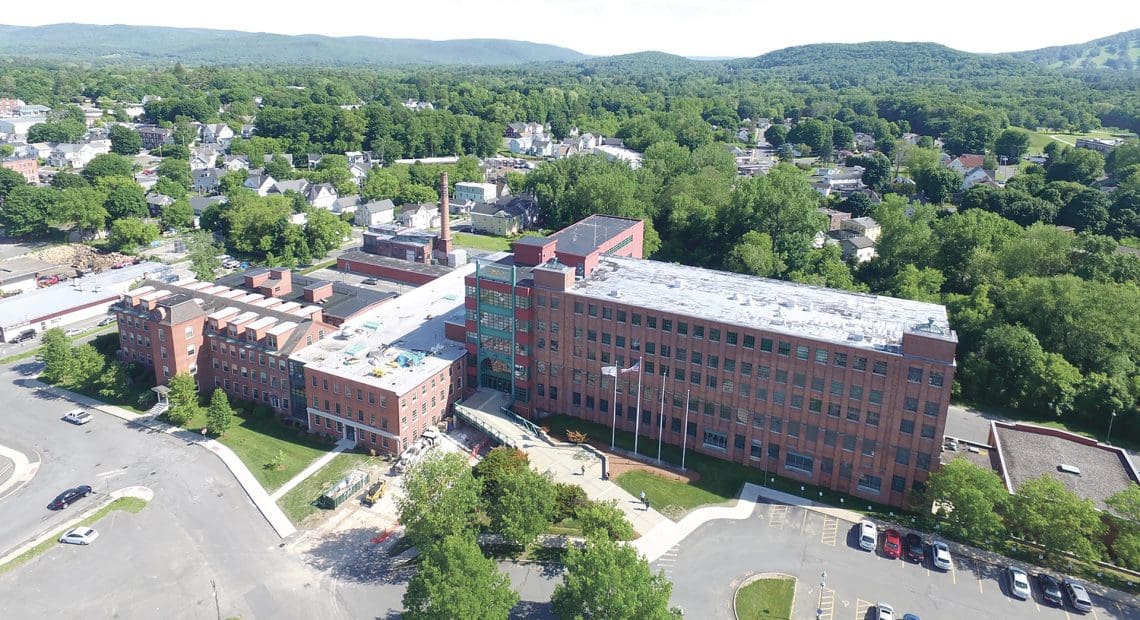
LONGMEADOW — Willie Ross School for the Deaf (WRSD) and Bay Path University held a joint ribbon cutting on Dec. 17 for newly developed early-education classroom space being created for Willie Ross on the Bay Path campus.

The event celebrated the collaboration between the university and WRSD as it addresses the need for more early-education space. The space is located on the first floor of Theinert Hall, a multi-use residence hall on campus.

Bay Path University President Sandra Doran; WRSD President and CEO Bert Carter; Ruth Lahti, dean of School of Education, Psychology and Humanities at Bay Path; Erika Kaftan, WRSD Education director; George Balsley II, chair of WRSD’s board of trustees; and Wayne Webster, vice chair of the Bay Path board offered remarks during the ribbon-cutting event. Bay Path University and WRSD faculty, staff, and board members were also in attendance, along with families served by WRSD.

The space developed in Bay Path’s Theinert Hall features approximately 7,500 square feet with four classrooms and several support rooms for students and staff. The process of transforming the space involved the demolition of first-floor dormitory rooms and bathrooms and the reconstruction of bathrooms and classrooms, along with the installation of required HVAC equipment, ceiling and lighting fixtures, and safety systems to meet current code requirements.

The new space on the Bay Path campus will enable Willie Ross to serve an additional 20 students as the school has experienced a growing Early Childhood program. The classrooms will also provide opportunities for hands-on experience for Bay Path University students.

“Our school is thrilled to join in this collaboration with Bay Path University,” Carter said. “As our early-education services have grown, and with our Longmeadow campus at maximum capacity for early-education classrooms, we looked for additional off-campus space to serve our students. Bay Path’s location near our own campus and willingness to envision how our program could serve their students creates a great marriage that will serve both of our institutions and our students.”

Added Doran, “at Bay Path, partnerships like this one are at the heart of who we are and what we do. We are proud to offer our resources and expertise to support the vital early-education work of Willie Ross School for the Deaf. Collaborations like these not only benefit our students by providing hands-on learning opportunities, but also strengthen our community. From early education to corporate and nonprofit lifelong learning, Bay Path has so much to offer, and we are always delighted to work with organizations that share our mission of empowering learners at every stage of life.”

Immediately after the ribbon-cutting event, Bay Path University held its annual holiday party for employees, featuring a long-standing tradition of presenting a local nonprofit organization with contributions from the university community. This year, in celebration of its new partnership, Bay Path selected Willie Ross School for the Deaf.

Daily News

Kelly Martins

EASTHAMPTON — bankESB recently hired Kelly Martins (Partridge) as social-media manager, based at its 36 Main St., Easthampton office.

Martins earned a master’s degree in nonprofit management and philanthropy with a focus on strategic planning and implementation from Bay Path University. She joins the bank from GRATI Consulting, where she was the director of Marketing & Business Development.

Daily News

SPRINGFIELD — The Zoo in Forest Park will host a winter version of its popular Zoo Camp on December 23, 24, 26, 27, 30, and 31 from 9 a.m. to 4 p.m.

Zoo Camp is for children ages six to 13 and gives kids the opportunity to assist with the daily animal care of a handful of animals. In addition, camp activities may include creating enrichment items for animals, participating in STEAM activities, hiking Forest Park, creating art, and playing games. Campers can either attend the full six days or choose to attend only the first four days of camp.

Registration is available at www.forestparkzoo.org/zoo-camp. The deadline to register is Friday, Dec. 20 at noon. The zoo also runs a Vacation Zoo Camp in February (Feb. 17-21) and April (April 18, 21-25) and nine weeks of Zoo Camp in the summer. Registration for Vacation Zoo Camp opens on Jan. 1, and summer Zoo Camp registration opens on March 3.

Daily News

CHICOPEE — Beauty Batlles Lounge will host its “Sponsor a Teen for the Holidays” event on Saturday, Dec. 21 at 2 p.m. at the spa, located at 46 Cabot St., Chicopee. This initiative aims to bring holiday joy to teens in the foster-care system by providing them with personalized gifts from their Christmas wish lists to open on Christmas morning.

Representatives from the Department of Children and Families (DCF) will attend the event to receive the gifts on behalf of the teens and ensure the presents are delivered to the teens on Christmas morning.

“We still have some teens available to sponsor,” said Ashley Batlle, owner of Beauty Batlles Lounge. “This is a wonderful opportunity to give back during the holidays and make a lasting impact on a young person’s life. There’s a special, personal joy in doing something thoughtful for someone you may never meet. It’s a reminder of the power of giving and the importance of showing love and care to those who need it most.”

Community members are encouraged to participate by sponsoring a teen, selecting items from their holiday wish lists, or donating to the cause. Every contribution helps ensure these teens wake up to a magical Christmas morning filled with love and joy.

For more information or to sponsor one of the remaining teens, contact Batlle at (413) 331-2737 or [email protected].

Cover Story

Driving Force

Alex Balise, left, and Jeb Balise with Dawn DiStefano, president and CEO of Square One

Alex Balise, left, and Jeb Balise with Dawn DiStefano, president and CEO of Square One, at the site of the agency’s new home.


Jeb Balise says he’s always called Springfield’s South End home.

He never lived in the neighborhood that straddles the Connecticut River and bumps up against the central business district, but, in many respects, he grew up there.

Indeed, that’s where his father and grandfather operated a Chevy dealership, and where he spent countless hours, starting in the early ’60s, when he was just in grade school, learning every aspect of the car business while also getting to know that neighborhood and the people championing it.

People like Leo Florian, president of the South End Citizens Council, and before him, and then alongside him, his aunt and mother.

“From my earliest days, I learned from them the importance of the South End and the community,” he recalled. “They were always supportive … they didn’t always agree or approve or endorse what we wanted to do, but they worked with me to find solutions.”

Today, Balise Motor Sales has dealerships across Western Mass., and also the Cape and Rhode Island. But in most all respects, the South End is still home. It’s there where the Balise company has made huge investments and built a campus that includes Hyundai and Mazda dealerships, a used-car store, a collision center, a car wash … and a laundromat. And there’s more to come, with the demolition of the Enterprise car-rental building and development of that site.

“From my earliest days, I learned from them the importance of the South End and the community.”

As for the laundromat, which we’ll get back to later, it was prompted largely by Florian, said Balise, who reminded him that, in addition to creating businesses and large parking lots, the Balise company needed to do something for the people of the South End.

Not that he really needed any reminding; Jeb Balise and the Balise company have long sought to step up and be counted in the South End, which explains that campus and that laundromat, and also why the South End Citizens Council currently resides in the former Baer Auto facility on Main Street (acquired by the Balise company) for monthly rent that doesn’t cover the electric bill, let alone the taxes paid on the property.

And it explains two recent decisions that will not only support childcare and family-services provider Square One, but also the South End neighborhood.

The first was a $1 million donation to the capital campaign to build Square One’s new facility near the site of its old home, damaged by the 2011 tornado and eventually razed. The second was the purchase of the property at 935 Main St., in front of the building now under construction, for $2 million, and the gifting of it to Square One, an acquisition that provides much-needed room for Square One while also solving what was becoming a problem.

“It was remarkable; this was a life-altering decision. I don’t think this would have happened, I believe, without that swift, remarkable gift, that gave everyone the feeling, ‘now we’re going to cross the finish line with this,’” Dawn DiStefano, president and CEO of Square One said of the $1 million gift, adding that the acquisition of 935 Main St. is equally life-altering, and, together, the gifts represent big steps forward for the agency, but also the South End community.

Balise agreed. “We decided that this would be good for the South End, tremendous for Square One, and good for South End citizens. We thought, ‘if we’re ever going to do something that’s a positive legacy and would make a difference, this was it.’”

From left, Jeb Balise, Alex Balise, Kris Allard, Dawn DiStefano, Leo Florian, and Police Commissioner Lawrence Akers.

From left, Jeb Balise, Alex Balise, Kris Allard, Dawn DiStefano, Leo Florian, and Police Commissioner Lawrence Akers.

This is an inspiring story with many themes, but mostly, it’s about a company, a nonprofit, and people like Florian, all with very deep roots in the South End (Square One has been there since 1883), who came together to make something groundbreaking happen, while also creating more momentum in an area, referred to by many as the gateway to the city, that has seen more than $1 billion in investments since the tornado tore through it, and is making tremendous strides.


Answering the Calls

DiStefano was on vacation when she got the phone call from Alex Balise almost a year ago — or what those at Square One generally refer to as the first phone call.

Balise, director of Marketing for the Balise Auto Group, and a Square One board member, wanted to know if DiStefano and Kris Allard, vice president of Development and Communication at Square One, could meet, and she suggested the following day.

Allard was also out of town, but she and DiStefano started thinking seriously about getting flights back into Springfield because there was some urgency attached to this meeting.

Indeed, while Square One was working to secure financing from PeoplesBank to construct its new home in the South End, a consultant working for the agency strongly suggested an additional $1 million in pledges to a capital campaign for the project would add strength to the loan application, as well as an application for New Markets Tax Credits.

The meeting with Alex Balise and her father, Jeb, eventually scheduled for a few days later, would be to discuss what the company might be able to donate toward that figure.

This aerial photo shows the extent of the Balise campus in Springfield’s South End.

This aerial photo shows the extent of the Balise campus in Springfield’s South End.

As they walked the five blocks to Jeb Balise’s office at 1441 Main St., Allard and DiStefano discussed what might be an appropriate ask. They thought about $100,000 — or perhaps $200,000.

Maybe a day later, Allard got another phone call from Alex detailing a commitment for $1 million.

“Kris made her repeat it because she didn’t believe what she was hearing,” DiStefano said. “And then we both couldn’t speak because we were crying so hard.”

Alex called the gift a “needed boost” to give Square One some important breathing room.

“I thought this was important and that we needed to step up,” she said, adding that this was an easy sell to her father and a gift designed to inspire other groups and individuals to step up as well.

And with that gift, DiStefano said, important pieces to a project, then a dozen years in the making, quickly fell into place.

“This was one of those turning points for the project,” she said. “PeoplesBank quickly signed a $6 million construction loan with a bond from MassDevelopment; by July, we signed all the closing documents for $15.5 million.”

But, as was noted earlier, there was to be still another unforgettable phone call from Alex Balise.

This map shows the location of Square One’s current home and its new home, now under construction.
Google Maps

This one, which came several weeks ago, involved the property adjacent to Square One’s old home, directly in front of where the new one is being built. Square One had been trying to buy it for years, but the price tag was prohibitive.

Vacant since the tornado and approaching eyesore status, if not already there, the property, known to those at Square One simply as the ‘brick building,’ was becoming a problem for those at Square One. Its owners were proposing a mixed-use plan for the future, one involving retail of some kind on the first floor and apartments on the second floor.

Florian, also a member of Springfield’s Planning Board, said the plans presented to that body by the building’s owner were permitted by the zoning of that area, and thus, the board would have a difficult time rejecting them. Still, he and many others were uneasy about this planned mix of retail and residential just a few hundred feet from a childcare facility.

And Florian communicated those concerns to, among others, Jeb Balise, who soon became committed to doing something about this situation.

Fast-forward to that second phone call. Alex and Jeb wanted another meeting with DiStefano and Allard. And as the two again walked together down Main Street, they speculated as to what this was about.

A few hours later, they had a commitment from Balise to buy the brick building for $2 million and gift it to Square One on the condition that they share it with the South End Citizens Council (the Baer Auto site is in poor condition and will soon have to come down). Jeb calls it a win-win-win — for Square One, the council, and the South End.


Coming Clean

As he talked about the Balise company’s commitment to the South End, as well as his unique relationship — and friendship — with Jeb Balise, Florian started by telling the story of how the South End Citizens Council secured its current home in the former Baer Auto facility, a large, glass-fronted building on Main Street.

The agency was headquartered in a tiny office across the street from the Baer facility, but it was essentially being evicted to make way for a thrift store, and Florian started poking around for new space.

Jeb showed him space in what was known as the Saw Center, a building eventually torn down to make room for the laundromat, and Florian was intrigued.

“But then he made the mistake of bringing me into Baer Auto — he said, ‘we just bought this,’” Florian noted. “We’re walking through, and I said, ‘now this is nice — with all these windows, you can see everything.’

“So he said, ‘what are you thinking — do you want me to break this up, and you can take a piece?’” Florian went on. “And I said, ‘no, actually, I think we need it all.’ He goes, ‘are you serious? I didn’t know neighborhood councils had that kind of money,’ because he had already offered it to people who wanted to rent it at crazy rent.’

“So Jeb said, ‘what are you thinking?’” he recalled. “I said, ‘I’ll tell you what … across the street, we pay $500 a month, and at the end of the year, we always run out of money and have a fundraiser — so I can comfortably offer you $400 a month, and we’ll take it off your hands.’ He first said, ‘are you crazy?’ and then said he wanted to think about it for a while. I think it was the next day, he was driving down my street; he rolled down his window and said, ‘let’s do the deal.’”

Before doing that, Balise talked at length at how Florian, and his mother and aunt before him, had always fought for the South End and never stopped looking for ways to improve that small, mostly low-income, but very proud neighborhood.

“I said, ‘I’ll tell you what … across the street, we pay $500 a month, and at the end of the year, we always run out of money and have a fundraiser — so I can comfortably offer you $400 a month, and we’ll take it off your hands.’”

And also about how he wanted to recognize those efforts by giving back himself, and as a company. “Leo has been a steadfast champion of the South End,” Balise said. “And if he’s Batman, I’m Robin.”

As things turned out, the laundromat — much-needed in this neighborhood where there is still comparatively little home ownership — and the sentiment that led to it became a motivating force.

“As you get older, you become more focused on the things that really matter,” Balise said. “And I would say that Leo inspired me a little bit to look at things and how we can focus on making them better.”

As it turned out, that deal for space for the South End Citizens Council was a precursor to something certain to be far more impactful.

Indeed, as he talked about what the new Square One, and especially the renovations to the brick building, might mean for the South End, Springfield Police Commissioner Lawrence Akers referred to what is generally known as the ‘broken windows’ theory.

“It goes back to the ’80s and ’90s, when people would look at property like that brick building; they would see it sitting there over a period of time, and they would look to see what would happen because it appeared unkept, so they would break one window,” he said, adding that this one broken window would lead to more “because no one really cared.”

The purchase of the property and the plans to renovate it show that someone cares, Akers said, noting that this is just the latest of many signs of progress in that neighborhood.

“The South End is a pretty good place to live now,” he added, noting that there is a trickle-down effect going on that has changed the look and feel of that area, and recent investments, including those at Square One, and the stability they bring to that part of the neighborhood will likely inspire more.


A Neighborhood on the Rise

There has already been a great deal of momentum seen in the South End over the past decade or so, said Springfield Mayor Domenic Sarno, noting that the linchpin, obviously, has been the $950 million MGM complex, which has made the South End a destination for many.

But there has been much more, he said, listing everything from the new condos on the site of the former Gemini plant, bringing more homeownership and all that comes with it to the area, to a renovated and re-energized Basketball Hall of Fame; from the arrival of national and regional chains like CVS, Wahlburgers, and Panera Bread to a host of small, local businesses.

And there is more on the way, including the much-anticipated reimagining of the Clocktower Building and nearby Colonial Block into mixed-used projects and the redevelopment of property at the corner of State and Main streets once occupied by MGM.

“There’s a lot of good things going on there, from new housing and new businesses to the expansion of existing businesses,” the mayor said. “That’s the entryway to the city, and there are many positive things happening, including what’s happening at Square One.”

Jeb Balise agreed.

“The South End has been on the rise — we’ve been part of a renaissance,” he said. “Getting Panera Bread, the expansion of AC Produce … there have been a lot of good cleanups that have made the South End more attractive and given it a much better feel. I feel like the South End is really on the upswing.”

DiStefano also agreed, noting that the new Square One building and renovation of the brick building will continue and perhaps accelerate this forward progress.

“At every step in this process, everyone has met this project with excitement, because who isn’t excited about a new building?” she asked rhetorically. “But there’s a level of rippling positivity — the noise of children re-entering that space is infectious. And from a public-safety perspective, activity is always better; there’s nothing but negativity when you have an open lot like that.”

Added Florio, “the tornado was the turning point for the South End. A lot of businesses thought that was it for the neighborhood, and some residents were looking to move out. But I met with the mayor, and he said to me, ‘we’re not giving up on the neighborhood; we’ll work together, and we’ll take care of this.

“We actually moved a couple of projects forward just to show people we weren’t going anywhere,” he went on, adding that MGM and several other projects have breathed new life into that historic area. “We’ve had millions of dollars invested in this small neighborhood over the past 10 years … and now we have developers that are listening to us and saying, ‘I’d like this whole block here — let’s tear down and rebuild.’”

Indeed, in the neighborhood Jeb Balise and Square One have always called home, more businesses and residents are now saying the same thing.


A New Chapter in the Square One Story

Balise Motor Sales’ purchase of the property in front of Square One’s new home, now under construction, presents both a huge opportunity and stern challenge for the agency.

The opportunity comes in the form of much-needed space; indeed, demand for Square One’s family-support services has grown to the point where the agency will have outgrown its new, 26,000-square-foot home before opening its doors.

The challenge comes with the significant buildout needed to accommodate both Square One’s wraparound services and the South End Citizens Council, which will also be housed in the 23,000-square-foot building at 935 Main St., and the price tag attached to it — roughly $4.7 million.

Kris Allard, vice president of Development and Communication at Square One, said the project has been jumpstarted by a $100,000 pledge from the property’s now-previous owner, Zee Raiz, as well as a $700,000 commitment from the city.

Additional donations are being sought toward the project, she said, noting that this initiative is essentially being rolled into a broader capital campaign for the new Square One, which has succeeded in raising $13 million to date.

The project to build out 935 State St. will come in phases, said Allard, noting that phase 1 will involve the first floor, which will house some Square One facilities, as well as the South End Citizens Council. Phases 2 and 3 will involve the second and third floors, respectively.

Alex Balise, director of Marketing for the Balise Auto Group, said the company’s decision to purchase the property at 935 State St., as well as commit an additional $1 million to the new Square One, were made in part to help inspire other donations to an initiative she believes will benefit not only Square One, but the South End neighborhood as well.

“This is an investment in the South End community, one we believe is a difference maker,” she said. “And we hope that it inspires others to support Square One and the South End.”

For more information on the project and the “Back to Square One” campaign, visit startsatsquareone.org or email Allard at [email protected].

Education Special Coverage

It Starts with a Plan

AIC interim President Nicolle Cestero

AIC interim President Nicolle Cestero

Amid a shifting landscape for higher education, Nicolle Cestero says, colleges that are unwilling to change will be left behind.

That’s the idea behind a new, expansive organizational business plan at American International College, announced last month, that will guide the college over the next several years, said Cestero, AIC’s interim president.

Dubbed Pathway to Progress, the document presents an array of changes to AIC’s operational model, including revising the academic portfolio, expanding degree options, launching new enrollment strategies, and streamlining athletic programming, including cutting programs and moving the men’s hockey team from Division I to Division II in the NCAA.

“There have been many changes in higher education over the course of the past 20 years, and even over the course of the past three to five years. And if institutions aren’t changing and being nimble, then they are finding themselves merging or closing,” Cestero told BusinessWest in a wide-ranging interview regarding the plan.

“This institution, in the opinion of myself and others — senior management, faculty, staff, board of trustees — believe that we are really important to the students that we serve and to this community, and we want to make sure that AIC is here for the long term,” she added. “So we had to look at ourselves and say, ‘what we’re doing right now isn’t sustainable. So what do we need to do in order to make sure that AIC is here three, five, 10 years from now?’ That’s where Pathway to Progress comes in.”

“There have been many changes in higher education over the course of the past 20 years, and even over the course of the past three to five years. And if institutions aren’t changing and being nimble, then they are finding themselves merging or closing.”

Among the shifts in the higher-education landscape, according to the plan’s designers, are disruptions caused by the launch of a new federal financial-aid model, changes in demographics across the Northeast, and the nationwide conversation around the value of a college degree.

“We can’t continue to do the same things that we’ve always done and expect the same results,” Cestero added. “So we needed to say, ‘what are we good at? What’s making us money? What’s not?’ — and then make the tough decisions to say, ‘we’re going to cut here, and we’re going to grow here in order to maintain the institution.’”

To get to those decisions, AIC contracted with a consulting company for a market analysis, financial analysis, and program analysis for athletics and academics. Then Cestero and Michael Dodge, executive vice president for Academic Affairs, put together a steering committee, including representatives from various constituencies.

After months of work, “it got to the point where it was pretty clear the direction the institution should go, and then Michael and I made those final decisions, obviously with the support of the board of trustees — and the board had responsibility for making a few of those decisions, too,” she added. “Then we rolled it out.”

Michael Dodge

Michael Dodge says AIC leadership engaged with faculty in determining where to build on areas of strength.

For this issue’s focus on education, we break down the three main pillars of AIC’s new organizational plan and how its leaders feel the college will benefit from each.


Academic Changes

First of all, AIC, is changing its degree offerings, embarking on a multi-year plan to launch new programs based on industry demand and market research, while discontinuing some undergraduate and graduate programs as well. Faculty positions will not be affected.

Following the previously announced launch of seven new online degree completion programs, the college plans to expand the number of program offerings beginning in the fall of 2025.

“I think, being a small institution, we can maybe run faster than some bigger schools or state institutions might be able to.”

“We looked at what makes sense for us to expand on, as opposed to just adding a program. What are we good at?” Cestero said. “But at the same time, we’re sunsetting programs. We’re saying, ‘OK, if we’re going to do all of this, we don’t have the resources to do all of this as well. So, unfortunately, this is going to have to go away. Those are hard decisions to make … but you have to recognize that those things need to happen in order for these other things to grow.”

For students who wish to earn an undergraduate degree more quickly, AIC will also begin offering three-year, 120-credit options for a variety of undergraduate programs, which make use of less expensive summer sessions, to provide time and financial savings to students (see related story on page 29). It will also launch a comprehensive re-enrollment campaign to engage and recruit former students to return to AIC and complete their degrees.

Thinking about how to refocus the academic program didn’t start only with Pathway to Progress, Dodge told BusinessWest.

“We’ve spent the last three years figuring out where are those areas where we can be really good, where we have some skills,” he said. “In the last couple of years, we’ve built a fully online master’s in criminal justice program. We’re getting into the degree-completion space, where students who’ve earned an associate degree at one of the amazing community colleges in the Commonwealth can come to AIC and have a seamless transition and convert that right over into their bachelor’s degree.

“We’ve also really tried to engage the faculty and build in the things that they are good at and that we can lean into,” Dodge added, as well as spaces AIC had not previously competed in, like computer science and data analytics, where market demand for talent is high — while also continuing to strengthen core areas where the college already excels.

Pathway to Progress includes launching a re-enrollment campaign to engage and recruit former students to return to AIC and complete their degrees.

Pathway to Progress includes launching a re-enrollment campaign to engage and recruit former students to return to AIC and complete their degrees.

“We’re really good at the health sciences, education, criminal justice. We have a number of our students in our business programs, so we always want to continue to improve those. But then, we also want to think about what else is out there, what’s the next thing. And I think, being a small institution, we can maybe run faster than some bigger schools or state institutions might be able to.”

Cestero said everyone impacted by decisions on academic programs was informed personally before the plan was announced, and then a town-hall event was held on campus for all parties — students, faculty, employees, vendors, and partners — to discuss them further.

“Any student that is in an academic program that is going away, we are teaching out those programs,” she explained. “All we’re doing is not bringing new students in, and they will have the same faculty. The faculty aren’t going away, either.”


Impacts on Athletics and Faculty

The big news in AIC athletics is the return of men’s ice hockey to Division II after the 2024-25 season, following 27 years in Division I. In recent years, the team has recorded significant success, earning national rankings from 2018 to 2021 and winning the Atlantic Hockey America conference regular-season title in 2019.

According to a press release on the Plan for Progress, the decision was made to position the program alongside the majority of AIC’s varsity programs in Division II, and that “this transition will provide a more equitable distribution of resources among all athletic programs and will allow ice hockey’s legacy to continue within the AIC Athletics portfolio.” All scholarships for affected athletes will be honored.

“When put it in the perspective of ‘what does this institution need to do to stabilize itself?’ I think it becomes a simpler decision,” Cestero said. “If this is siphoning off money that is leading to the institution not being stable financially and you want the institution here, it makes the decision easier than just ‘should we take it from DI to DII?’ I think the harder part is that the students have found a place here, and they are happy here, and knowing that you’re disrupting it, that’s the really hard part.”

“Because there were so many changes coming forward, we felt as though, if we aren’t clear about what the whole plan is up front all at once, then you’ve got a culture of fear, and that’s not good for anybody.”

It’s also tough for athletes in AIC’s women’s tennis and wrestling programs, which are being ended “to better meet industry demand and provide additional resources to other varsity sports,” the release notes. Again, all scholarships for affected athletes will be honored, though some may choose to use their remaining eligibility elsewhere.

“A freshman wrestler may want to go somewhere else because they have so much eligibility left, whereas a junior tennis player, if they were to transfer, they could lose out on transfer credits and things of that nature,” Cestero said. “Plus, you have your home here, right? You’ve got your circle of friends, you’ve got your major, you’ve got your faculty, your mentors, etc.”

Meanwhile, the Plan for Progress impacts faculty as well. To support the ongoing growth of AIC’s academic portfolio, the college will expand faculty options by introducing multi-year contracts, including a new ‘professor of practice’ role alongside the existing tenure-track pathway and adjunct/part-time faculty roles.

A professor of practice is a faculty member who typically has a non-academic background, but is successful and knowledgeable in their field, enabling them to improve students’ knowledge by providing a practical perspective, along with the theoretical perspective provided by an academic professor.

“We’re bringing these real-world experiences into the classroom, but these individuals that are going to become these teachers don’t necessarily have a doctorate, nor do they necessarily want one,” Cestero said. “But we’re allowing them a pathway to be a professor in higher education without needing to have that terminal degree. And it benefits the students at the end of the day.”

In addition, most full-time faculty will shift to a 5/5 teaching load, meaning five courses per semester instead of four, to better meet academic demands. In return, some tasks will move to staff advisors.

“We still have work to do. I mean, this is only a piece of what we need to do from a long-term perspective, but these are the things that we need to do now in order to become stable and then be able to grow.”

“Right now they teach 4/4, but then they have these other responsibilities for scholarship and community service and registering students for classes and things of that nature,” she explained. “And we said, ‘OK, they’re spread in many different ways. What if we were to take this responsibility and shift it over here? That would give them more time to focus on the actual teaching.’”


A Transparent Process

AIC has been out front with its plan, publicly detailing its various elements, including in this article. Cestero said there are three reasons for that.

“The first is, I’ve heard for years and years that people in leadership aren’t transparent, and specifically at AIC, that’s been said a lot. Secondly, you have to get everybody on board when you’re trying to do something this major, and if you’re not very open and direct and clear about what that is, then you’re not going to be able to get everybody on board.

“Three, when you’re not transparent, you create a culture of fear. Because there were so many changes coming forward, we felt as though, if we aren’t clear about what the whole plan is up front all at once, then you’ve got a culture of fear, and that’s not good for anybody.”

As a small, private college, AIC has challenges that differ from public universities and private colleges with much larger endowments. Cestero noted. But in the current climate, all institutions likely need to be strategizing about how to adapt.

“We still have work to do. I mean, this is only a piece of what we need to do from a long-term perspective, but these are the things that we need to do now in order to become stable and then be able to grow.”

That said, “I think that AIC is a really special place, and I want us to be able to continue to serve these students,” she said. “I think the students that we have are so amazing, and that’s why it’s important that we’re doing all of this.”

Special Coverage Wealth Management

Too Good to Be True

By Carlo Centeno

Some of the largest financial fraud schemes have taken place within the last 100 years. The truism “if it’s too good to be true, then it probably isn’t” has been pushed aside by those convinced that if they hesitate, they lose the opportunity.

Pride has a way of pushing a desire or perceived benefit into acceptance. The short version of that notion is commonly known as FOMO [fear of missing out]. White-collar criminals understand that, as investment tactics, strategies, and offerings become more complex, the easier it is to pull the wool over some eyes. For the unfortunate victims, the fear of missing out is all too real, but a greater fear comes to bear regarding their sense of self: in not wanting to appear naïve or uninformed, the ego takes over.

In the mid-1980s, Warren Buffet noted in a letter to Berkshire Hathaway shareholders about “two super-contagious diseases,” namely fear and greed. His analogy to disease — more specifically epidemics — made clear that uncertainty, time of discovery, duration, strength, along with other possible factors could compromise global economies and markets. Ultimately, this led to his aphorism, “we should be more fearful when others are greedy, and to be greedy when others are more fearful.”

According to psychologists, humans are motivated more to avoid pain than to seek pleasure. Put another way, studies have shown that, when it comes to fraud, fear is a stronger motivator than greed.

“According to psychologists, humans are motivated more to avoid pain than to seek pleasure. Put another way, studies have shown that, when it comes to fraud, fear is a stronger motivator than greed.”

Corporations and their minions take advantage of investors’ interests by feeding ‘data points,’ the kind of information most would like to hear. In a marketing sense, the perception is the reality; it’s not what investors are hearing, but what they believe they’re getting.


Investment Fraud

Investment reasoning is contrarian for most of us. We think that, when some assets are experiencing losses, we need to sell to reduce such losses, and then, when the market goes up, we should buy more of said assets. It’s been long documented that making investment decisions guided by emotions does not fare well. However well-intentioned the feeling might be, it’s usually not good in the long run.

Jim Ratley, president and CEO of the Assoc. of Certified Fraud Examiners (ACFE), notes that “there’s no such thing as small fraud, but fraud that has yet to reach their full potential.” The ACFE has reported that approximately 87% of first-time offenders have never been charged or convicted. In such cases, the idea of getting caught is real, but a sense of invincibility reinforces continuation of the tactics that keep money in the wrong hands.

Carlo Centeno

Carlo Centeno

“Investment reasoning is contrarian for most of us. We think that, when some assets are experiencing losses, we need to sell to reduce such losses, and then, when the market goes up, we should buy more of said assets. It’s been long documented that making investment decisions guided by emotions does not fare well.”

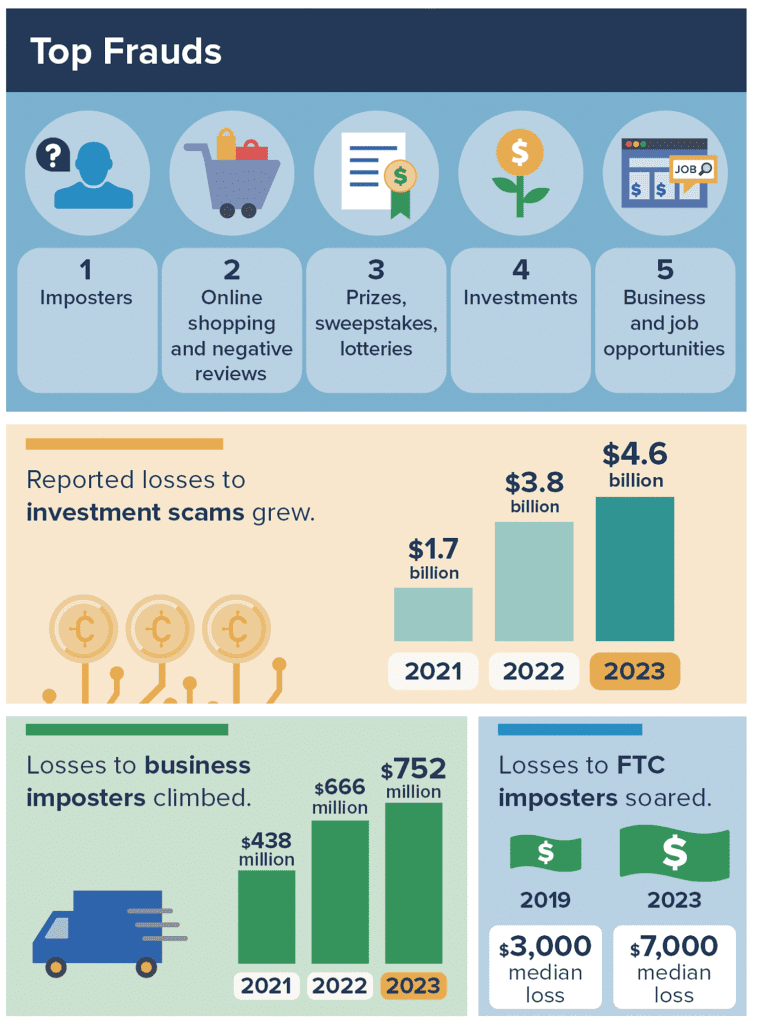
According to the Federal Trade Commission (FTC), consumers reported a record $10 billion in fraud losses in 2023. The amount represents an increase of 14% over losses in 2022. The top category: investment scams. The most used method of acquiring fraudulent cash was through bank transfers.

To be clear, this writer is not aware of any cohort consumer behavioral research which quantitatively ascertains why the losses are so high, though, based on the FTC findings, the means in acquiring fraud dollars can be attributed to a combination of factors: the increased use of online selling and buying, the growing sophistication of iterative websites that mimic actual sites, proficiency in acquiring personal information, in particular from social media, and trends in lifestyle resources appearing on tablet and mobile devices, in particular with health-related products and services, dating services, and financial management.

And the losses continue to grow. Here are some fraud examples that took place not that long ago.

• Lehman Brothers: When you hide $50 billion in loans and reassign them as assets, that’s bound to backfire. It did. The bank’s internal department discovered $3 billion in losses to investors; that money was bought by Cayman Island banks to be purchased later by Lehman Brothers. The majority of the first-timers involved with the scam had no prior criminal record. Due to lack of evidence, the SEC did not prosecute.

Enron: The Houston-based energy commodities corporation kept enormous amount of debt off the balance sheet. Clients and employees of the firm lost their retirement accounts, and shareholders lost a staggering $74 billion. Auditing firm Arthur Anderson was involved, CEO Jeff Skilling was sentenced to 24 years in jail, and CFO Andrew Fastow pleaded guilty and served jail time. Fastow forfeited $24 million and pleaded guilty to two counts of conspiracy. In a news interview, he said, “there are people who look at the rules and find ways to structure around them. The more complex the rules, the more opportunity. The question I should have asked is not what is the rule, but what the principle is.”

• Bernie Madoff: Running the largest Ponzi scheme ever, Madoff’s investment firm took $64.8 billion from investors. Any “returns” paid out came from money from other investors or even their own money. After he confessed to his sons about his fraud, the sons reported him to the SEC the following day. For all the technology available to the investment industry, the fraudulent information was stored in a 1980s-era IBM AS/400 server.

• Sam Bankman-Fried’s FTX Scam: One of the more recent scams involved cryptocurrency. The investment scam was Sam Bankman-Fried, with friends being his associates. Cryptocurrency, to this day, still poses a high level of risk (see related story on page XX). The securities platform called FTX was claimed to deliver higher rates of return in 2019. By 2022, it all came undone. Bankman-Fried was sentenced to 25 years in federal prison for the FTX fraud. At its zenith, FTX valuation reached $32 billion.


Bottom Line

Financial fraud is wrought with complexities in large part because of the size and scale of investments offered today. Adding to this depth and volume, the ongoing evolution of computers, satellite communications, storage, encryption, and verification (just to name a few factors) continues to develop ways to not only identify bad actors, but the means to identify transactions and activities that point to potential financial crimes.


Carlo Centeno is vice president and Marketing director at St. Germain Investment Management. Much of his career has been in corporate communications, primarily on the agency side, where he worked on a variety of projects with national clients. He has received both a Clio Award and a Golden Pyramid Award for strategic business-to-business communication programs. He received his bachelor’s degree in English literature from Boston University and an MBA from the Isenberg School of Management at UMass Amherst.

Commercial Real Estate Special Coverage

Hour Town

The Clock Tower complex in Pittsfield

The Clock Tower complex in Pittsfield

Sally Tiska Rice says she grew up in Pittsfield. As a child, and up through her high-school years until the plant started slowing down, she recalls going with her mother to visit aunts and other relatives working at the Sheaffer-Eaton paper mill in town. Later, as she entered the world of work herself, she became a hand-boarding artist working at Crane & Co. in Dalton (noted for making currency), painting stationery.

These chapters in her life help explain why she feels right at home as she continues writing the current chapter, as one of the so-called Clock Tower Artists, a diverse group of artists now renting lofts in part of the Sheafer-Eaton complex, renamed the Clock Tower Business Center because clocks were once made on that site.

“Immediately when I walked into the building, it reminded me of the place I worked at for my career,” said Tiska Rice, who specializes in portraits of homes, people, and pets. “The buildings were very similar — the big windows; the historic, brick New England mill … the whole structure just brought back a lot of memories.”

Beyond the memories, it offered her a north-facing window, what’s known as ‘north light’ — that’s important for artists because they don’t have to cope with the effects of the sun moving through the studio at different angles during the day — and the ability to be part of a community of artists.

“Immediately when I walked into the building, it reminded me of the place I worked at for my career.”

These artists, roughly 20 of them, are just some of the many tenants, large and small — including the Berkshire Eagle, which once owned the whole complex — that now have a South Church Street mailing address. Together, they help make the transformation of the Shaffer-Eaton complex a unique success story, one authored by North Adams-based Scarafoni Associates/CT Management Group, which acquired part of the complex in 2006 and the remainder in 2016. It has reshaped the property into a thriving mixed-use facility featuring residential units, a wide range of commercial tenants, those aforementioned artists, the Eagle and its massive printing presses, and more.

Dave Carver, a principal with CT Management Group/Scarafoni Associates

Dave Carver, a principal with CT Management Group/Scarafoni Associates

This is a story of imagination and especially perseverance, said Dave Carver, a partner with Scarafoni Associates/CT Management Group. He noted that the group has had to overcome the departure of major tenant Wayfair (much more on that later), the loss of Berkshire Medical Center offices, and the downsizing of the Eagle, while also enduring the pandemic and its impact on the office market and other stern challenges to lease out almost all the space in the complex.

“We got creative, we worked hard, we knocked on a lot of doors,” said Carver as he talked to BusinessWest in one of the conference rooms once used by Wayfair, now shared by several smaller tenants on one floor in a modified co-work arrangement that is just one of the successful components of this endeavor.

For this issue and its focus on commercial real estate, BusinessWest talked at length with Carver, Tiska Rice, and others about the transformation of the former Sheaffer-Eaton property into one of the more successful mill-conversion undertakings in this region, and how the evolution of this historic complex continues.


Success Stories

Tracing the history of the property, Carver said it dates back to the 1880s, when the Connecticut-based Terry Clock Co. was purchased by a group of investors from Pittsfield who brought the operation to that city and built a three-story building on Church Street.

Sally Tiska Rice, one of the Clock Tower Artists.

Sally Tiska Rice, one of the Clock Tower Artists.

The company’s tenure there was short-lived — it failed in the early 1890s — and the property was eventually sold to Arthur Eaton, who moved a paper mill there, later to be known as the Sheaffer-Eaton mill after a merger with Sheaffer Pen. In the late 1980s, the property was sold to the owners of the Berkshire Eagle, which were looking for a new home for the then-thriving daily paper.

The Eagle’s owners undertook a massive renovation of the main building on the property and leased out large sections of it, said Carver, noting that the recession of the mid-’90s hit the Eagle hard, and its operation, and the mill complex it called home, were sold to Media News Group, which eventually put portions of the property on the market.

“Because they had been struggling for so long, there was a lot to do. And we still have a lot to do; it never ends.”

This included roughly 100,000 square feet in some of the smaller buildings, including the original Terry Clock building, which were acquired by Scarafoni Associates/CT Management Group in 2006, and soon transformed into Clock Tower Condominiums.

In 2016, as Media News Group’s struggles escalated and it looked to jettison the remaining 200,000 square feet in the complex, Scarafoni/CT Management stepped in and acquired it, commencing a comprehensive initiative to modernize, retenant, and reimagine the property, which was maybe 50% occupied at the time, said Carver, adding that, over the past eight years, the property has certainly evolved and developed a unique look and feel.

The Clock Tower complex, where clocks and then paper were made, brings the past, present, and future together in an historic setting.

The Clock Tower complex, where clocks and then paper were made, brings the past, present, and future together in an historic setting.

“Because they had been struggling for so long, there was a lot to do,” he told BusinessWest. “And we still have a lot to do; it never ends.”

By that, he meant both upkeep buildings more than a century old, but also the many challenges confronting all those owning, managing, and leasing out office space today.

As an example of all of the above, he referenced what could be called the ‘Wayfair chapter’ of this story.

It started when the owners of the Boston-based home-furnishings company, who are from Pittsfield, commenced a search in 2019 for space in which to create a call center in the western part of the state.

That search focused on Pittsfield, said Carver, noting that several sites were considered before the company eventually zeroed in on the South Church Street property and 35,000 square feet in one of the buildings in the complex.

“We rolled up our sleeves and went to work — we immediately started knocking on doors and networking.”

Negotiations continued for roughly a year, he noted, adding that the company eventually came to terms that included a five-year lease, shorter than is common is such deals, but a needed concession given the size of the company’s investment and “City Hall encouraging us to make the deal.” A rapid buildout followed, the company started moving in that October, and it was ramping up to 200 jobs when the pandemic hit.

“And then, everything shut down, and that was for at least a year, and it could have been two,” Carver said, adding that, when the company finally decided to start bringing employees back, it struggled mightily to do so.

“A lot of employees had drifted away to other jobs, they were experimenting with a work-at-home model, and ultimately that went out, so they decided to close the facility,” he explained, adding that Wayfair opted out of its lease roughly a year ago, leaving a 35,000-square-foot hole at a challenging time for all commercial-property owners.


Art of the Deal

What happened next, Carter said, was that “we rolled up our sleeves and went to work — we immediately started knocking on doors and networking.”

And this hard work has paid off. Elder Services of Berkshire County, marking its 50th anniversary, moved into 19,000 square feet over the first two floors of the building previously occupied by Wayfair, while the third floor, with roughly 15,000 square feet, features smaller tenants with a shared common area; only a few spaces remain to be leased.

Wayfair’s departure has been one of the many challenges overcome by the Clock Tower complex’s owners and managers.

Wayfair’s departure has been one of the many challenges overcome by the Clock Tower complex’s owners and managers.

Tenants include Janney Montgomery Scott, a regional financial-services firm that desired a presence in Western Mass.; Teton Management, a real-estate management company; Keiter Builders, a general contractor based in Northampton that also sought a Berkshires location; Insights in Automation; Annie Schwartz Nutrition; and MassHire Berkshire Workforce. Together, they share what amounts to co-working space.

“We decided to leave the kitchen area Wayfair created and the open area,” Carver said. “So even though everyone has their own, independent space, it’s a modified co-working area.”

Its creation is one of the success stories at this historic property. The Clock Tower Artists, located on the third floor of the business center, comprise another.

The collective, or community, now includes more than 20 artists that work in various disciplines and often participate in open-studio events and community arts initiatives.

Tenants include Shanny Porras, a visual sound artist who translates music into abstract paintings; Caroline Kennedy, an abstract artist; Deborah Carter, a multi-media artist who creates upcycled, wearable art; Stefanie Webber, an action-based artist who specializes in dance, movement, and performance; Bruce Laird, a contemporary artist who creates pieces using acrylic, mixed media, and collage; and Linda Petrocine, who specializes in the ancient art of painting using hot wax on wooden panels.

Collectively, these artists bring vibrancy, energy, and people to the Clock Tower complex, said Carver, adding that there is room for more, and he expects the group to grow in the years to come.

Tiska Rice said she was among the first artists to visit and then sign on at the mill. She and others were impressed with everything from the parking to the open common area on the artists’ floor, which doubles as an art gallery; from the large windows, views, and north light to the elevator (Tiska Rice is disabled).

Tiska Rice was also impressed with what Carver and his team were doing with the mill, blending history with imaginative ideas, such as the artists’ floor. And she’s equally impressed with the community of artists that has emerged.

“It’s great to be with all these talented artists — it’s very encouraging,” she told BusinessWest. “Some people will refer to having the notorious artist’s block where you’ve finished your last project and you don’t know where to go from there. There’s so much encouragement here; everyone works with their own style, but it seems like everyone has a way to complement each other and bring out the best in each other.

“An artist’s world has also been described as a very lonely place,” she went on. “We’re a whole group of individuals that come together as a community.”

This community of artists is just one of many reasons why the Clock Tower complex has become a timeless mixed-use masterpiece, one that brings the past, present, and even the future together in stunning fashion.

Features Special Coverage

Reflecting on the Year That Was


George Timmons

George Timmons calls education “the great equalizer,” and MassEducate a very effective way to achieve that.

In many ways, 2024 didn’t provide much clarity regarding economic questions we posed a year ago in our annual year in review. Inflation and interest rates remain high (if not historically so), while remote work, a housing shortage, and some sector-specific challenges continue to make the news.

But there was some good news, too, and some encouraging progress on fronts ranging from rail development to educational access to some intriguing high-tech developments. As 2025 dawns, BusinessWest presents its year in review, noting some of the stories and issues that shaped our lives, and will, in many cases, continue to do so.


The High Cost of Everything…

The Federal Reserve has been on a mission over the past two years — to tame inflation without putting the country into recession. By and large, the latter part has been accomplished, but inflation remains a thorny challenge.

Consumer prices were up 2.7% for the 12 months that ended in November, but stubborn inflation in housing (up 0.3% for the month in November) and food (up 0.4%) continue to hit people where they notice it most, while the price of cars and energy also rose in November. Economists are also unsure how President-elect Trump’s promised tariffs will impact inflation.

Meanwhile, some economists expect some relief in interest rates, and a chance that the Fed may go as low as 4% in 2025.

Still, Bob Nakosteen, semi-retired professor of Economics at the Isenberg School of Management at UMass Amherst, recently told BusinessWest that “the economic numbers don’t look bad at all. The labor market has weakened a little bit, but it’s not weak; it’s just not as strong as it had been. And most of the other indicators are strong, including GNP. It’s about where it had been, and in some ways, it’s above trendline.

“This is not breaking news,” he added, “but the economy has held up really well in spite of a lot of pressure, especially from a rapidly rising interest-rate environment. The consumer has really rolled with the punches.”


…Except Community College

MassReconnect, a program the state launched in 2023 to fully fund tuition, books, and supplies at community colleges for students over age 25, has, to hear college presidents tell it, been a game changer, significantly boosting enrollment and getting more students into a pipeline that will hopefully bring more new blood to the region’s workforce.

“The economic numbers don’t look bad at all. The labor market has weakened a little bit, but it’s not weak; it’s just not as strong as it had been. And most of the other indicators are strong, including GNP.”

This past summer, state lawmakers went further by implementing MassEducate, a $117.5 million annual investment that covers tuition and fees for all students, plus books and supplies for some. The program aims to support both economic opportunity for students and workforce development across a Massachusetts economy that has struggled, sector by sector, to recruit and retain talent in recent years.

Importantly, the program is a ‘last dollar’ investment, meaning students will still access federal funds, like Pell Grants, as well as state aid and scholarships, and MassEducate will pay the costs that remain, so it’s not funding anywhere near the full cost of a student’s education.

“I’m so passionate about this work of education,” Holyoke Community College President George Timmons said. “It is the great equalizer. Once you have an education and all the rights and privileges of that degree, you can earn a livable, sustainable wage, you can take care of yourself and your family, and you can literally change the trajectory of a family.”


Productivity in Pajamas?

A report last year by McKinsey Global Institute suggested that remote work risks wiping $800 billion from the value of office buildings in major cities worldwide by 2030 as the post-pandemic trend pushes up office vacancy rates and drives down rents.

Large employers are fighting back. In September, Amazon President and CEO Andy Jassy informed tens of thousands of workers that they will be back in the office five days a week come January. That was good news for commercial real-estate owners and developers, who hope other employers follow suit.

But while remote-work critics claim improved collaboration and communication, as well as the learning opportunities that come when everyone is together, outweigh any benefits that might come from remote work and hybrid schedules, the fact is that the hybrid movement, at least, seems entrenched for now — and also puts employers who nix all remote work at a competitive disadvantage when recruiting in an already-tough talent market.

But Evan Plotkin, president of Springfield-based NAI Plotkin, told BusinessWest that he sees a partially offsetting force in east-west rail, which has the potential to drive development in areas near the rail stops, and even prompt some businesses to realize they don’t have to be in Boston anymore. “It could be transformative; in Springfield, for example, it could drive development in the Union Station area and make that area much more attractive.”


Working on the Railroad

So, is east-west rail finally becoming a reality, connecting Springfield and Boston? Well, the money being put behind what’s known as the Compass Rail project is certainly real.

At the end of October, U.S. Rep. Richard Neal announced the latest $36.8 Consolidated Rail Infrastructure and Safety Improvements (CRISI) grant by the Federal Railroad Administration, following a $108 million CRISI grant — the third-largest in the nation — late last year. Since Union Station reopened in 2017, more than $200 million has been allocated toward east-west rail, both from federal grants and MassDOT funding.

The latest funding will support the Springfield track-reconfiguration project, which is designed to increase capacity to accommodate both freight and increased passenger rail service. The project will include building new crossovers and layover tracks, upgrading platforms around Springfield Union Station, and modernizing track and signal systems.

“With the substantial progress that has been made with west-east rail, the Commonwealth is well-positioned to pursue additional funding for years to come.”

Since the station’s reopening, Neal said, “the investments that have been made in passenger rail have been extraordinary,” adding that, “with the substantial progress that has been made with west-east rail, the Commonwealth is well-positioned to pursue additional funding for years to come.”

Meanwhile, MassDOT is conducting a study focused on the restart of passenger rail along the Route 2 corridor, a project whose public advocates include dozens of municipalities, regional planning agencies, and state legislators.


SOC It to Springfield

Speaking of Union Station, in September, it officially became home to the Richard E. Neal Cybersecurity Center of Excellence, one component of a multi-million-dollar series of investments, announced in 2022, to bolster cybersecurity resilience — and the related workforce — across the state.

These awards included a $1,086,476 grant to support the launch of CyberTrust Massachusetts, a nonprofit that works with business and academia statewide to grow the cybersecurity talent pipeline while promoting local security operations.

U.S. Rep. Richard Neal joins a host of local dignitaries

U.S. Rep. Richard Neal joins a host of local dignitaries in September to cut the ribbon on his namesake cybersecurity center.

The state also awarded $1,462,995 award to Springfield Technical Community College (STCC) and $1,200,000 to Bridgewater State University to establish a security operations center (SOC) and cyber range in each city. The Neal Center at Union Station, managed by STCC, also benefited from $500,000 in ARPA funding from the city of Springfield.

Springfield’s 6,000-square-foot center — a collaboration between STCC, the Springfield Redevelopment Authority, and CyberTrust Massachusetts — aims to be a hub for advancing cybersecurity awareness, education, and innovation while battling global security threats. Its cyber range is a simulated, hands-on training environment, and its SOC is envisioned as a support service for Massachusetts municipalities, as well as regional businesses, to detect cybersecurity events in real time and respond quickly.


Tackling the Housing Crisis

One of the dominant stories of 2024 was a continuing housing shortage that touches virtually every community.

With that in mind, over the summer, Gov. Maura Healey signed into law the Affordable Homes Act, which aims to support the production, preservation, and rehabilitation of more than 65,000 homes statewide over the next five years. It is the largest housing bond bill ever filed in Massachusetts, at more than triple the spending authorizations of the last housing bill passed in 2018.

The legislation authorizes $5.16 billion in spending over the next five years along with 49 policy initiatives to counter rising housing costs caused by high demand and limited supply. Key spending authorizations and policy changes include allowing accessory dwelling units, an unprecedented investment in modernizing the state’s public housing system, boosts to programs that support first-time homebuyers and homeownership, incentives to build more housing for low- to moderate-income residents, support for the conversion of vacant commercial space to housing, and support for sustainable and green housing initiatives.

“The Affordable Homes Act creates homes for every kind of household, at every stage of life, and unlocks the potential in our neighborhoods,” Healey said. “We are taking an unprecedented step forward in building a stronger Massachusetts where everyone can afford to live.”


High Risks for Cannabis Operators

According to a new report in the Boston Business Journal, cannabis businesses are surrendering licenses at an alarming rate in Massachusetts. Since September 2023, four retail licenses have been either surrendered, not renewed, or revoked, and so have 26 non-retail licenses, which include growers and manufacturers. In the five years before that, just five retail and 11 non-retail licenses were surrendered.

The green rush is clearly over; more than 700 cannabis businesses have opened or received licensing approval, and prices have fallen sharply amid stiffer competition — which makes running a business much more challenging.

Springfield Mayor Sarno recently cut the ribbon opening EMBR Springfield, a cannabis dispensary at 461 Boston Road.

Springfield Mayor Sarno recently cut the ribbon opening EMBR Springfield, a cannabis dispensary at 461 Boston Road.

So does a still-unresolved disconnect between state and federal law that has thrown a number of wrenches into cannabis businesses, which, among other hurdles, grapple with an onerous tax burden since they can’t write off many of the costs other businesses can. Federal laws also impact elements from transportation to banking. And while federal rescheduling of cannabis has bipartisan appeal, it’s uncertain whether the next Congress will have the appetite for it.

There may be some potential good news for dispensary owners: a newly established regulatory framework for operating ‘social consumption sites’ in Massachusetts, potentially allowing public use of the drug. The Cannabis Control Commission is currently receiving public comment on the draft and will take the issue up in the new year.


Data Center Clears Tax Hurdle

Two years ago, Westmass Area Development Corp. helped Servistar Realties secure approval from the Westfield Planning Board, as well as a major tax break from the City Council, for a large, high-tech data center near Westfield-Barnes Regional Airport that could attract some of the largest tech companies in the world. Servistar even negotiated a power-purchase agreement with Westfield Gas & Electric allowing it to access below-market electric rates.

“The challenges in healthcare over the past five years have shifted, but they have not let up. And they ultimately result in financial challenges that are stressing the ways in which we collectively provide access to care in our communities.”

One hurdle remained to move the $3 billion project — which will feature 10 buildings going up over two decades — off the ground, and that was a state sales-tax exemption commonly offered to data centers in other states. Last month, that exemption became a reality as part of a larger economic-development bill on Beacon Hill, and because of it, the Westfield project could start progressing soon.

Analysis from McKinsey & Co. shows demand for data-center capacity in the U.S. more than tripling by 2030, according to the Boston Globe. Meanwhile, the sales-tax exemption could save the future Westfield park owners up to $30 million per year. Construction could start early in 2026, with the first building completed 18 months later.


Diagnosing the Problem

In a recent interview with BusinessWest, Mercy Medical Center president Dr. Robert Roose used the word ‘relentless’ to describe the current headwinds in medicine, which include everything from spiraling costs and inflation to persistently inadequate reimbursements from payers; from continuing workforce challenges to access and capacity issues — not to mention the overriding issue of caring for a population that is older and sicker than what has been seen historically.

“The challenges in healthcare over the past five years have shifted, but they have not let up,” Roose said. “And they ultimately result in financial challenges that are stressing the ways in which we collectively provide access to care in our communities.”

Baystate Health, in a remarkable show of transparency, recently went public to detail its struggles — including $300 million in operating losses over the past few years — and its response, which includes the sale of its lab, the pending sale of Health New England, and, most recently, the elimination of 130 administrative positions.

Those steps are part of what Baystate’s new president and CEO, Peter Banko, called a “transformation plan, one that calls for making hard decisions, relieving cost pressures, some cuts, but also investments in the years to come and greater financial stability.”

Expect more hard decisions across the healthcare spectrum in the year to come.


Music Lives Again at the Iron Horse

Finally, a positive note — many notes, in fact.

When music venues began to reopen in the wake of the pandemic, the Iron Horse Music Hall in Northampton was not among them, and owner Eric Suher didn’t have immediate plans to unshutter the venerable Center Street storefront.

Chris Freeman says he wanted to “bring back the glory days” of the Iron Horse.

Chris Freeman says he wanted to “bring back the glory days” of the Iron Horse.

In stepped the Parlor Room Collective, a nonprofit that operates the nearby Parlor Room music space, which purchased the Iron Horse and set about raising $750,000 to renovate it, maintaining its intimate feel but improving facets like its famously inadequate green room and restrooms, while expanding into adjoining space for a dedicated bar and community events. The venue reopened on May 15 and has hosted a robust lineup of concerts ever since.

“We have witnessed the magic of our local music scene and its ability to fuel the engine of our economy, enhance the overall well-being of our community, and contribute to our cultural vitality,” said Chris Freeman, executive director of the Parlor Room Collective.

“I live here, and part of the reason Northampton has become a great food scene and a great downtown culture is the arts,” he also told BusinessWest. “I’ve made it my life’s mission to make sure that never goes away, and we can bring back the glory days of such a legendary venue.”