Daily News

SPRINGFIELD — Egan, Flanagan & Cohen (EFC), a century-old law firm in Springfield, will expand in 2026 with the acquisition of two local law firms — Goldsmith, Katz and Argenio, P.C., effective Jan. 1, and the law practice of Henry Cropsey, effective Feb. 15. Through these acquisitions, three new attorneys will join the EFC team.

With the Jan. 1 acquisition of Goldsmith, Katz and Argenio, P.C., Jonathan Goldsmith and Thomas Argenio will join EFC in the roles of counsel. Both attorneys have deep roots in Greater Springfield, with Goldsmith a past chair of the Bankruptcy Section of the Hampden County Bar Assoc., and Argenio a former adjunct professor at Elms College, where he taught criminal law.

Goldsmith has been practicing law for 39 years and specializes in bankruptcy, corporate, and real estate law. For the past 20 years, Goldsmith has also served as a Chapter 7 panel bankruptcy trustee for the Office of the United States Trustee. He has the highest rating (AV) from Martindale Hubbell for ethical standards and legal ability and has been designated as a Super Lawyer and on the list of the Top 100 Attorneys in Massachusetts by Boston magazine. Goldsmith was also the first recipient of the U.S. Bankruptcy Court’s District of Massachusetts Pro Bono Award in 2013. He completed his undergraduate studies at Boston College and earned juris doctorate from Western New England University School of Law.

Argenio has been practicing law for 42 years and currently specializes in real estate and domestic relations. He graduated from St. Michael’s College in Vermont and earned his juris doctorate from Western New England University School of Law. Prior to his time at Goldsmith, Katz and Argenio, P.C., Argenio served as city prosecutor for the city of Chicopee from 1988 to 1992 and was an assistant city solicitor in Chicopee for many years, handling civil matters for the city.

Effective Feb. 15, solo practitioner Henry Cropsey will close his solo law practice and join EFC in an of counsel role. Cropsey has been in practice for 39 years and specializes in the areas of estate planning, corporate law, and commercial real estate.

According to Michael McDonough, managing partner at EFC, “all three of the attorneys joining EFC enjoy pristine reputations and competence, ethics, and people skills. They will be excellent fits to our office, not just in bringing clients and business, but also in mentorship and adding to our culture and depth of knowledge. Jon Goldsmith, Tom Argenio, and Henry Cropsey will make us stronger and better suited to meet our clients’ needs in the new year and beyond.

“The additions of Goldsmith, Argenio, and Cropsey will pair well with the firm’s steady addition of newer but impactful associate attorneys in each of the past four years,” McDonough added. “Goldsmith, Argenio, and Cropsey have all maintained prominent careers in their respective areas of the law, and arming each with EFC’s team of associate attorneys will expand their capability for the benefit of clients. In return, those same associates will gain three new mentors in the building for their own professional growth.”

Daily News

SPRINGFIELD — The Springfield Regional Chamber will shine a light on several arts, culture, and recreation nonprofits at its January Rise & Shine Business Breakfast on Friday, Jan. 9 from 7:30 to 9:30 a.m. in the Blake Student Commons at Bay Path University.

Non-profits are an industry, too, though often unrecognized for their strenuous and tireless efforts. Breakfast attendees will hear firsthand from leaders of local organizations as they share information about their important work enriching community life and supporting economic growth in the region.

The cost is $40 for Springfield Regional Chamber members and $50 for non-members. Click here to register.

Daily News

BOSTON — Brick Marketing announced its Massachusetts Chamber of Commerce Discount Program, an initiative that makes senior level digital marketing easier to access for organizations across the Commonwealth. Effective immediately, any current member of any chamber of commerce located in Massachusetts will receive a 20% discount on all Brick Marketing digital marketing and AI marketing services.

The program reflects Brick Marketing’s belief that strong local partnerships create stronger results. The agency serves clients nationwide while investing deeply in Massachusetts through mentoring, community support, and active participation in leading business associations. Local teams benefit from faster collaboration, on-site strategy sessions, and market specific insight that reflects the realities of doing business in the Commonwealth. For Massachusetts companies, the advantage is proximity and responsiveness, and for national brands, it is a seasoned team with the reach to scale.

“Massachusetts is our home, and our clients are our neighbors,” said Nick Stamoulis, president of Brick Marketing. “We support many local chamber of commerce organizations and believe that doing business locally builds trusted partnerships. As AI marketing and SEO for AI, also known as generative engine optimization, become vital channels to drive visitors, leads, and sales, local companies deserve hands-on guidance that understands the Massachusetts market. Our mission is to help as many local organizations as possible navigate this new era, and this discount is our way to open the door and get them started with confidence.”

Eligibility is simple. Any current member of any chamber of commerce in Massachusetts qualifies for the 20% savings. Businesses can confirm eligibility by mentioning their chamber affiliation when contacting Brick Marketing so the discount can be applied to a proposal. If a company is not yet a member, it can join a local chamber to support the community and unlock the 20% savings on all digital marketing services with Brick Marketing.

The Massachusetts Chamber of Commerce Discount Program builds on more than two decades of client service. Over the past 20 years, Brick Marketing has supported hundreds of companies with measurable outcomes and practical digital marketing strategies. The senior team collaborates closely with owners and marketing leaders, aligning near-term actions with long-term goals and setting clear performance metrics. New clients can begin with a brief discovery conversation to confirm priorities and identify the right mix of services.

For more information, visit www.brickmarketing.com/chamber-discount-program.

Daily News

BRAINTREE — During 2025, more Massachusetts road users than ever are likely to use their seatbelts to ensure safe travels. A new study found that seatbelt use in Massachusetts has increased for the third year in a row, marking the state’s highest seatbelt usage rate on record. The Healey-Driscoll administration commended the collaborative efforts led by state and local agencies to achieve this result.

The 2025 Massachusetts Safety Belt Observational Study, which is conducted annually, reported a seatbelt usage rate of 85.53%, an increase over the state’s 2024 usage rate of 84.36%. Specifically, the report found that the state successfully increased seatbelt use among demographics that have historically had lower usage rates. This marks the third year in a row that Massachusetts has achieved an overall increase in seatbelt use.

In addition, Massachusetts experienced fewer fatal crashes in 2025 than in the previous year. MassDOT has recorded 342 fatal motor vehicle crashes in 2025, compared to 364 in 2024.

“We know that seatbelts save lives, and it’s so important that seatbelt usage continues to increase every year in Massachusetts,” Gov. Maura Healey said. “We’re grateful for the hard work of our partners in transportation, public safety, and local governments to enhance safety on the roads for us all.”

The annual study is mandated by the National Highway Traffic Safety Administration. The study has been conducted every year in Massachusetts except 2020, amid the COVID-19 pandemic. Usage rates dipped in 2021 and 2022 before returning to their upward trend. Since 2015, seatbelt use in Massachusetts has increased by more than 10%.

“Everyone has a role to play in keeping our roads safe, and wearing a seatbelt is one of the simplest steps we can take to protect ourselves and the people we care about,” Public Safety and Security Secretary Gina Kwon said. “When drivers and passengers buckle up every time, they help prevent serious injuries and make travel safer for families and communities across the Commonwealth.”

Massachusetts law states that a driver stopped by police may receive a citation if not wearing a seatbelt or for any passenger who is unrestrained or not in a proper child safety seat (for children age 8 or younger who are under 57 inches tall). Any passenger age 16 or older found not wearing a seatbelt can also receive a citation.

Daily News

Nina Antonetti

SPRINGFIELD — The Springfield Museums announced the appointment of Nina Antonetti as vice president of Advancement, effective Jan. 2. In this leadership role, reporting directly to President and CEO Kay Simpson, Antonetti will be responsible for strategic development, design, and direction for all philanthropic initiatives and programs in support of the museums. In addition, she will oversee the marketing and communications team, as well as special events and membership activities.

Antonetti brings more than 20 years of senior leadership experience in fundraising across museums, cultural institutions, higher education, and international consulting. She has a distinguished record of advancing mission-driven organizations through strategic collaboration with boards and development teams to achieve philanthropic goals.

Most recently, Antonetti served as chief Advancement officer at the Mount, Edith Wharton’s Home in Lenox, where she inaugurated the role and held a central leadership position on multiple strategic planning and campaign task forces.

Previously, she was managing director at Carter Global, where she provided governance, strategic, and fundraising counsel to major nonprofit organizations in the U.S. and Canada, including museums, cultural centers, disability services organizations, and international humanitarian institutions. Earlier leadership roles include chief Development officer at the Museum of Fine Arts in St. Petersburg, Fla., and associate vice president for Corporate and Foundation Relations at the Chicago Botanic Garden.

Her career also includes senior advancement and donor relations roles at Williams College Museum of Art and the Conway School of Sustainable Landscape Planning and Design, alongside a distinguished academic career at Smith College, where she founded the nation’s first Landscape Studies program and served on the faculty for 15 years.

In addition to her professional work, Antonetti has extensive governance experience. She currently serves on the boards of Berkshire Country Day School and the Emily Dickinson Museum, with prior board service spanning museums, libraries, and educational institutions. She holds a PhD in art history from the University of London, with a concentration in architectural and landscape history, and has an extensive record of scholarly publications, exhibitions, and public engagement projects.

“We are delighted to welcome Nina Antonetti,” Simpson said. “Her deep experience in fundraising, governance, and strategic messaging will be instrumental in advancing our mission.”

Daily News

WORCESTER — Paragus IT, a strategic IT services firm for small to medium-sized businesses, recently welcomed Robyn Garcia as vice president of Security and Compliance, further strengthening the company’s leadership team as it continues its rapid growth.

Garcia brings more than 20 years of experience across IT operations, cybersecurity, compliance, and infrastructure leadership in both public and private sector environments. In her new role, she will oversee Paragus’s security and compliance strategy, helping clients navigate increasingly complex regulatory, risk, and governance requirements — including frameworks such as CMMC and HIPAA — while advancing the company’s own internal security posture.

As one of her first initiatives, Garcia will lead Paragus through its CMMC Level 2 certification, reinforcing the company’s commitment to meeting the highest standards for security and compliance in support of government contractors and regulated organizations.

Most recently, she served as director of Operations at ArcLight IT, where she led company-wide operations, strategic planning, and process improvements to drive efficiency and scale. She previously held senior IT and cybersecurity leadership roles at Revolution Space, Howard Energy Partners, and Weaver Technologies. She began her career as an information systems technician in the U.S. Navy, where she worked within highly regulated and security-critical environments.

“I’m excited to join Paragus at such a pivotal moment,” Garcia said. “Paragus is a dynamic, fast-growing, and forward-thinking organization, and the fact that it’s employee-owned makes the culture even more special. This role is an incredible opportunity to help organizations fuel growth while taking a practical, business-aligned approach to security and compliance.”

Delcie Bean, founder and CEO of Paragus IT, said Garcia’s experience and leadership style make her a strong addition to the team.

“Robyn brings a rare combination of deep technical expertise, strategic vision, and real-world leadership experience,” Bean said. “We’re thrilled to welcome her to Paragus and confident she’ll play a key role in shaping the future of our security and compliance practice.”

With Garcia’s addition, Paragus’s service leadership team is now 100% women, and the company’s senior leadership team is now 70% women, reflecting Paragus’s ongoing commitment to inclusive leadership and diverse perspectives.

Garcia holds an MBA and a bachelor’s degree in management information systems, along with industry-recognized certifications, including CISSP and CompTIA Security+. She is currently completing a master of liberal arts degree in cybersecurity at Harvard University.

Daily News

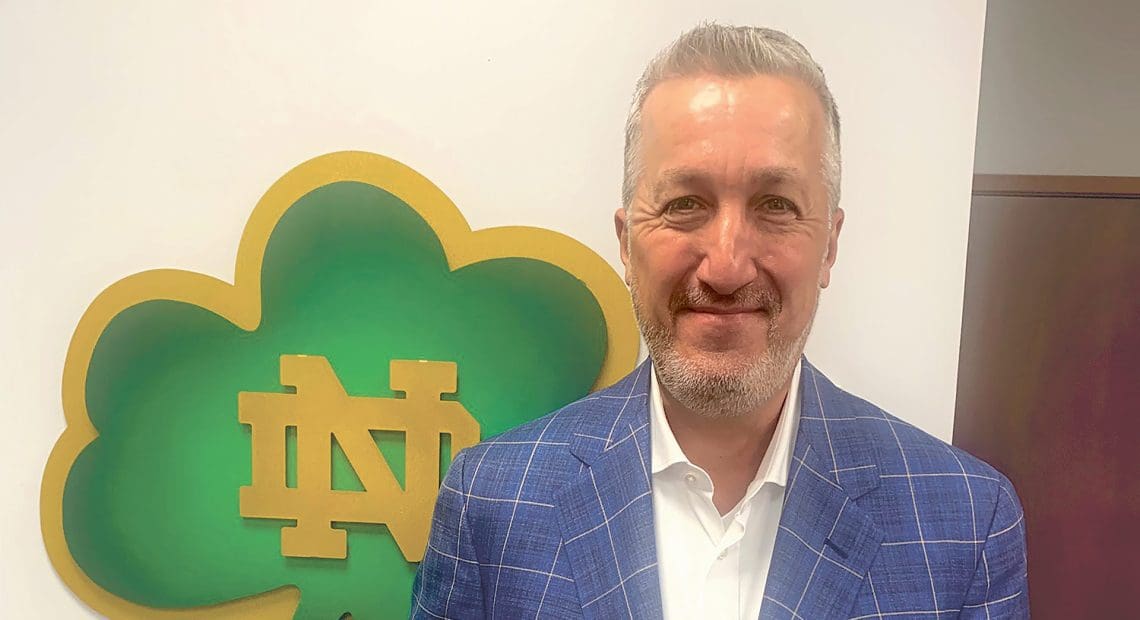
H. Scott Sanborn

EASTHAMPTON — Hometown Financial Group, the multi-bank holding company for bankESB, bankHometown, and North Shore Bank, and its Abington Bank and Colonial Federal Savings Bank divisions, announced the appointment of H. Scott Sanborn as its new executive vice president, chief commercial banking officer. He brings 36 years of banking experience to the role, along with a strong record of leadership, community involvement, and commercial banking expertise.

In his new role, Sanborn will oversee all aspects of commercial banking across Hometown Financial Group’s family of banks, including commercial lending, relationship development, and strategic growth.

Sanborn, a respected local leader on the South Shore and Metro South, will be based in Abington Bank’s Holbrook location. His long-standing involvement in the community and deep understanding of the local market will enhance the bank’s presence and further strengthen its commitment to serving customers. He brings deep knowledge of the region’s communities, businesses, and local priorities, and his strong local relationships and commitment to supporting the needs of residents and businesses will help advance the bank’s strategic growth across the region.

Sanborn, most recently with HarborOne Bank, served as executive vice president, chief lending officer. His distinguished career also includes senior leadership roles at TD Bank, Sovereign Bank, and Fleet Bank, where he helped guide business banking teams, commercial lending strategies, and regional growth initiatives.

“We are thrilled to welcome Scott to the Hometown Financial leadership team,” said Matthew Sosik, chairman and CEO of Hometown Financial Group. “His extensive background in commercial banking, combined with his passion for developing strong customer relationships, aligns perfectly with our mission and values. We look forward to the impact he will make across our banks and for the businesses we serve.”

Sanborn holds a bachelor’s degree in international politics from Wesleyan University and a master’s degree in entrepreneurship and finance from Babson College. Throughout his career, he has demonstrated a deep commitment to the community, serving on numerous boards and committees, including the Spirit of Adventure Council – Scouting America, New England Certified, the Metro South Chamber of Commerce, and the United Way leadership campaign and fundraising committee. He has also contributed his leadership to the Greater Boston Chamber of Commerce and the Emerging Leaders Program at the University of Massachusetts.

Cover Story Economic Outlook

Watch to see more from Brian Canina:

Clouding the Issue

The Forecast Calls for … More Uncertainty

It’s called the ‘quits rate.’

As that name suggests, it represents the number of employees who voluntarily quit their jobs as a percentage of total employment.

When times are good for workers, the quits rate is understandably higher. When times are not so good, or when there are high levels of anxiety and uncertainty about the economy and the jobs market — and that would describe the current climate — the rate starts to come down.

“Over the past few months, quits have dropped precipitously,” said Bob Nakosteen, a semi-retired Economics professor at UMass Amherst’s Isenberg School of Management, reflecting on a jobs market increasingly described with the words ‘stuck’ and ‘stagnant.’ “People are hanging onto their jobs for dear life, which tells me that they’re not getting offers to entice them to quit, and they don’t feel that they can take the risk to leave their job and look for another one, because they’re just not out there.”

This sentiment is reflected in the latest jobs report: the Bureau of Labor Statistics reported a few weeks back that the U.S. economy lost 105,000 jobs in October and added 64,000 jobs in November, with the unemployment rate rising to a four-year high of 4.6% that month.

The falling quits rate and the jobless numbers are just two of the many ways economists and business leaders are trying to quantify and qualify the current economic scene, often described as ‘confusing,’ although quantifying is more difficult with fewer hard numbers to work with — in general, and even more so because of the recent government shutdown.

Another measure is the Associated Industries of Massachusetts’ (AIM) Business Confidence Index, or BCI. Scored on a 100-point scale, with 50 indicating neutrality, the monthly BCI soared to 57.7 when President Trump was elected in November 2024, but quickly fell to 41.5 (a COVID-like level) in April when Trump’s tariff plan was announced, and has continued to hover below 50 since, AIM President Brooke Thomson said.

She told BusinessWest that, overall, the business community doesn’t like uncertainty, and the prospect for more in 2026, reflected in the BCI numbers, poses questions about what kind of year it will be.

Between the quits rate, the BCI, and other measures, the emerging picture is one of continued uncertainty, even about the near term, let alone several quarters out, given ambiguity about matters from tariffs, interest rates, the jobs market, and the AI investment boom (and whether that bubble is about to burst) to inflation and affordability crunch.

There is some optimism following the most recent quarter-point interest rate drop early last month, but there will need to be more of those, and likely more substantial cuts, in the year ahead for a deep impact to result, said those we spoke with.

Bob Nakosteen

Bob Nakosteen


“People are hanging onto their jobs for dear life, which tells me that they’re not getting offers to entice them to quit, and they don’t feel that they can take the risk to leave their job and look for another one, because they’re just not out there.”

“With the recent Fed rate cuts, we’re expecting things to probably pick up, modestly, because there is still some potential uncertainty, economically,” said Brian Canina, president and chief operating officer of Holyoke-based PeoplesBank. “If the Fed continues to lower rates, and the lowering of the rates on the short end of the interest rate curve impacts the long-term interest rate, and those come down, we may see some increased lending and some potential refinancing.”

Overall, said Nakosteen, there is a mixed economic picture for 2026, with expectations for slower growth and perhaps — that’s perhaps — a mild, short recession.

But it’s very difficult to project without hard data, with so much uncertainty clouding whatever picture the data presents, and amid a variety of mixed signals, such as GDP rising a robust 4.3% in the third quarter at the same time as bourbon maker Jim Beam announced it would be shuttering one of its distilleries in Kentucky, in part due to tariffs and slumping demand.“

The data are not painting a clear picture at all. Unemployment is going up — kind of gently, but it’s going up. Inflation is rising — kind of gently, but it’s still rising,” he said, adding that the country may be heading for what economists call ‘stagflation,’ a somewhat rare economic condition characterized by high inflation, stagnant economic growth, and high unemployment occurring simultaneously.


Ups and Downs

As he talked about 2025 and what kind of year it was for the region, Aaron Vega spoke from two different, but in many ways similar, perspectives — first as outgoing director of Planning & Economic Development in Holyoke and the incoming president and CEO of the Western Massachusetts Economic Development Council.

Brian Canina

Brian Canina


“With the recent Fed rate cuts, we’re expecting things to probably pick up, modestly, because there is still some potential uncertainty, economically.”

“It’s like two steps forward, two steps back, one step to the side,” he said, noting that this was true in Holyoke, but also the region. While new businesses were added, including Pickleball Kingdom at the Holyoke Mall, and new initiatives launched, there were setbacks, such as recent layoffs at Yankee Candle and Sublime System’s decision to pause its project to build a plant in Holyoke following the loss of a U.S. Department of Energy grant.

Elaborating, Vega said the region’s economy was buffeted by some strong headwinds, most of which were beyond its control. These included tariffs, policy changes, inflation, ongoing changes in the retail realm, and even the price of energy.

“We all know that Massachusetts is a bit of an expensive state in which to do business. So how do we entice businesses to come to Massachusetts, and then, how do we get them to come to Western Massachusetts when we’re still developing our hubs and developing our initiatives?” he asked, adding that these same headwinds will prevail in 2026.

This up-and-down nature of the economy was reflected in the BCI numbers for 2025, said Thomson, noting that the index would rise a few points one month, drop a point or two, then rise again, and then fall again; it was up two points to 48.5 in November, for example. This wavering is a symptom of uncertainty and policies that foster it, she said, adding that the sluggish performance in 2025 — some economists say the country is teetering on recession if not officially in it — was different from such cycles in the past.

“Most recessions, or downturns, occurred because of some sort of situation in the financial markets, some sort of causation that deeply hit our financial markets,” she explained. “This was different; it’s almost self-inflicted through policy. There’s nothing inherently wrong in the financial sector.

Aaron Vega

Aaron Vega


“It’s like two steps forward, two steps back, one step to the side.”

“There’s still money out there to lend to businesses, there’s opportunities for businesses, but there is feeling on behalf of business leaders that they don’t know what to expect … ‘I don’t know what my bottom line is going to be, I don’t know what my costs are going to be, so I’m not going to take out that loan, I’m not going to do that expansion project, I’m not going to give out big bonuses or hire more people because I don’t know what’s around the corner.’”

This was the picture throughout 2025, and this sentiment is expected to continue into at least early 2026, Thomson said, adding, again, that business owners like consistently and reliability, and these are two commodities missing at the federal policy level, and there has been a resulting trickle-down to states, with some, like Massachusetts, getting hit harder than others.

Indeed, several sectors in the Bay State were deeply impacted by federal policy changes, including healthcare (see related story on page 25), education, and especially manufacturing, due to tariff policies, she noted.

“I’ve been throughout the state this year visiting manufacturers, and even the ones that are managing to do all right are doing it because they’re being really, really creative, despite this,” she added. “And they would never say they’re thriving; they’re saying, ‘we’re being creative, and we’re managing it.’ But I have more stories with people saying, ‘this is killing me — I’m barely making it,’ and there have been two or three small business that have actually closed their doors.”


Fear of the Unknown

Carol Campbell, president of Chicopee Industrial Contractors (CIC), spoke for many business owners when she said 2025 was “an interesting year,” marked by those headwinds Vega mentioned, and especially tariffs.

CIC works with manufacturers, handling rigging, machinery moving, machine installation, and other services, and many of those machines are made overseas, said Campbell, adding that the tariffs placed on them — or the threat of tariffs, as well as general uncertainty about what might come next — prompted some hesitation and project delays.

Brooke Thomson

Brooke Thomson


“Most recessions, or downturns, occurred because of some sort of situation in the financial markets, some sort of causation that deeply hit our financial markets. This was different; it’s almost self-inflicted through policy. There’s nothing inherently wrong in the financial sector.”

“What we found was just a fear of the unknown,” she explained, adding that, by March, even Fortune 500 companies were hitting pause on some projects.

Things improved as the year went on, and, overall, 2025 was a solid year, she said, adding quickly that there is optimism about 2026, but also some lingering fear of the unknown.

As they look ahead, those we spoke with said several factors will determine the trajectory of the economy, especially the AI investment boom and whether that bubble will burst, inflation, consumer spending, business confidence (especially when it comes to hiring), and, of course, interest rates.

“A lot of it will hinge on what happens with interest rates,” said Canina, adding that the size and frequency of cuts will ultimately determine the impact on the economy.

“A 25-basis-point change is not necessarily going to have a significant impact,” he explained. “But when you see the Fed make consecutive rate cuts, and if they were to drop a full percentage point in a six- to 12-month period of time, I think by the 12-month point you’ll start to see some pickup, and then, it will continue to grow from there.”

Elaborating, he said many businesses remained on the sidelines in 2025 when it came to large investments and expansion initiatives, due mostly to uncertainty about the economy and where things were headed, and partly to interest rates still well above those enjoyed just a few years ago, post-COVID. He’s optimistic that some will get back in the game in the months to come.

Jeff Sullivan, president and CEO of Springfield-based New Valley Bank, agreed.

“The mortgage rates and the longer-term rates, we don’t see them coming down quite as much,” he said. “It’s nothing that’s going to change consumer behavior — we don’t see a refinance boom.

Carol Campbell

Carol Campbell


“What we found was just a fear of the unknown.”

“Meanwhile, the idea of borrowing money at 6% or 6.5% doesn’t seem to be unpalatable,” he added, opining that current rates are not stifling activity. “It’s not stopping deals from happening. Would they rather borrow at 5%? Absolutely they would, but where we are now is tolerable. When the rates peaked nine or 10 months ago and it was hard to get under 7%, that was starting to chill the market, but now we’re back down to 6% or 6.5%, and that’s not stopping anyone.”

Overall, Sullivan is more upbeat about 2026 than some others we spoke with. He said 2025 was a solid year for the bank, in deposit growth and otherwise, while he also noted cautious optimism among many commercial customers.

“The overall mood is generally positive,” he said. “The people who are more nervous are the people who do business with the general public, especially with the middle-class, working-class general public. The firms that are business-to-business sales … I think the optimism is there. The firms that are dependent upon lower- and middle-income consumers being their customers … I’m more worried.

“It’s the K-shaped recovery,” he went on. “The rich get richer, and the poor get poorer; we definitely see that sentiment among our customer base.”

Meanwhile, he expects the recent wave of mergers and acquisitions to continue, as businesses search for all-important scale and private equity firms continue their hunt for opportunities across seemingly all sectors of the economy.

“These private equity companies have a belief that they’re going to be so successful, they’re paying top dollar to acquire local companies and roll them up into a much larger platform,” he said, adding that the trend extends across the board, even to HVAC contractors, alarm companies, and sprinkler companies. “We hear from customers every quarter that are taking buyout offers; they’re saying, ‘I can’t say no to this. It’s so much money; it’s more than I thought I’d ever get. I wasn’t ready to sell, but I can’t say no.’”


Economic Outlook Special Coverage

Surveying the Landscape

Beyond the big-picture context provided by regional business leaders in the lead story on page 4, how do individual business and nonprofit leaders in Western Mass. see their own enterprises faring in 2026? On the following pages, 17 of them share their answers to that question — and what they see as the key trends, challenges, and opportunities arising in the coming year.


Ray Berry, Owner, White Lion Brewing
Ray BerryAs a brewery, we operate at the intersection of hospitality and manufacturing. According to our national trade association, the craft beer industry is expected to experience its third consecutive year of volume decline, and the second year in which brewery closures outpace new openings.

Despite these industry headwinds, White Lion remains optimistic. While overall production is sideways, we are seeing meaningful growth and expanded opportunity across other areas of our operation.

Strategic changes implemented in 2025 are positioning the business for greater strength in 2026. These include our transition to an all-alcohol bar, which increased foot traffic; a renewed focus on community engagement that drove a significant rise in on-site events; activation of underutilized space within Tower Square to reach new audiences; continued growth in outdoor programming to strengthen partnerships; and, looking ahead to 2026, a planned enhancement of our food menu to better reflect and complement the diverse experiences we offer.


Megan Burke, President and CEO, Community Foundation of Western Massachusetts

Megan BurkeWhile rising prices, increased demand for services, and reductions in federal resources strained the Western Mass. nonprofit community in 2025, our nonprofit partners demonstrated resilience. More than 50% of the nonprofits serving our community reported funding losses, forcing them to do more with less.

Yet, this year revealed the strength of our communities. We saw our neighbors step up with incredible generosity of both time and money, deepening their commitment and finding creative ways to respond.

As the Community Foundation plans for the year ahead, our 35th year of impact, we are listening to residents as we hone our vision to advance equity and opportunity for all. We feel honored by the call to serve as a connector, supporting those who seek to give and the community helpers who are best placed to respond to changing needs. While we anticipate many new challenges in 2026, we are committed to standing with our communities, responding with urgency and trust, and meeting this moment together.


Sandra Doran, President, Bay Path University

Sandra Doran

The defining challenges in higher education today are affordability, access, and relevance. At Bay Path University, we are steadfast in delivering an affordable, high-quality education that leads to a career.

For more than 125 years, Bay Path has prepared learners for careers. We meet regularly with employers and business leaders because understanding workforce needs matters. Today, one message is clear: graduates must be AI literate.

That is why we are thoughtfully investing in augmented artificial intelligence as both a teaching tool and an educational resource — making learners career-ready while also improving efficiency and controlling costs. This approach delivers what students and employers expect in an education that must be affordable, relevant, and aligned with opportunity.


Thomas Dowling, CPA, Partner-in-Charge, Whittlesey

Thomas Dowling

Looking ahead, I predict that talent shortages will continue to be a challenge for many industries. As a result, organizations will reconsider their approach to attracting, developing, and retaining their people. Rather than sticking to traditional hiring models, I anticipate that we’ll see an increased focus on investing in existing teams, whether that involves upskilling or adopting a more deliberate, longer-term approach to workforce planning.

Artificial intelligence will continue to become part of everyday operations, enabling businesses to work more efficiently and make better-informed decisions. With broader adoption comes increased responsibility, particularly in terms of governance, ethical use, and cybersecurity.

The organizations that find the right balance between new technology and human judgment will be better-positioned to strengthen their teams, adapt to change, and remain resilient.


Curtis Edgin, President, Caolo & Bieniek Architects

Curtis EdginAs Caolo & Bieniek looks forward to 2026 and beyond, the only thing we know for certain is there will continue to be change in the architecture and construction industry.

As codes and standards continue to evolve and material technologies improve, we’ve learned that these changes help us raise the bar in the environments we create for our clients and the communities we’re part of.

Meeting client needs, from enhanced building performance to concerns of increasing construction costs, requires us to be educated in the possibilities and apply that knowledge in how we serve our clients’ best interests.

Improved delivery technology provides our team with opportunities, but is only part of the answer. There still needs to be an experienced understanding of how buildings go together, as well as an awareness of conditions those in the field encounter.

We’re optimistic we will meet the challenges, as we have done for more than 60 years.


Jeffrey Fialky, Managing Shareholder, Bacon Wilson, P.C.

Jeffrey FialkyOverall, 2025 was a great year for business from our vantage point. We witnessed quite a bit of business succession as well as real estate activity, particularly in the commercial space. Favorable downward movement in interest rates was certainly a contributing factor, a catalytic trend that will inevitably continue into 2026 with at least one more interest rate cut in the forecast.

The likely theme this year, and for years to follow, is artificial intelligence. I read a recent article that stated that AI can currently replace 11% of the workforce. With a technological leap that outpaces the Industrial Revolution and internet boom by exponential proportions, the business community will continue to have to stay nimble as the future unfolds.

I do believe, however, that in the Pioneer Valley, while by no means immune or insulated from the impact of evolving technology, is nonetheless very well-positioned. Unlike communities in other parts of the state or country that have employment tied closely to the technology sectors, the Western Mass. economy is, to a large extent, based upon healthcare, manufacturing, and trades, industries that will still require the human touch.

I recently called a doctor’s office to schedule an appointment, and the appointment was scheduled by an AI assistant; I was surprised by the efficiency. So while you can see that certain jobs may be adversely affected by AI, potential realized savings in that regard opens up the opportunity for small businesses to continue to invest in growth of their core operations, which in turn will lead to expansion and hiring.


John Gannon, Partner, Skoler, Abbott & Presser, P.C.

John GannonThe labor and employment law landscape for businesses is evolving in 2026. This year, employers will be navigating Massachusetts’ new pay transparency requirements while dealing with growing oversight of AI tools in hiring and workplace practices.

Massachusetts’ new pay transparency law requires many employers to post salary ranges in all job postings. This includes “any advertisement or job posting intended to recruit job applicants for a particular and specific employment position,” regardless of whether the employer recruits directly or utilizes a third party for such purposes.

Federally, employers are looking at potential new regulatory guidance on the use of AI-driven hiring tools, such as the No Robot Bosses Act, which is designed to establish safeguards against employment discrimination that may arise from AI algorithms. The legislation is also meant to ensure that human judgment remains a critical component in employment decisions.

These changes present new, unique compliance challenges for employers.


Lynn Gray-Yucka, General Manager, Holyoke Mall

Lynn Gray-YuckaHolyoke Mall’s strength lies in creatively curating the right tenant mix to drive revenue, enhance customer experience, strengthen market relevance, and enhance the overall asset value. We are optimized for sustained financial growth well into the future as we embark upon a substantial reinvestment into the infrastructure. This three-phase, multi-year enhancement project includes new paving, curbing, and landscaping; fresh paint on the exterior building, new signage packages, and interior upgrades that have already started and continue into 2026.

As the shopping center industry continues to be ever-changing, Holyoke Mall is a shining example as the only high-performing, super-regional property within our trade area. Twenty years ago, our center had a tenant mix that included 90% to 95% traditional retail. Today, that number is closer to 70% to 75%.

As business continues to evolve, Holyoke Mall will be ready for what comes next as the dominant shopping center in Western Mass., offering more than just traditional retail, but also best-in-class dining and entertainment concepts.


Roseann Martoccia, Executive Director, Access Care Partners

Roseann MartocciaAt Access Care Partners, we serve older adults and people with disabilities of any age, as well as providing support to families and caregivers. As we look at 2026, we know Massachusetts has a rapidly growing aging demographic; already, 27% of the Commonwealth’s current population are age 60 or older. This trend will continue for the next 10 to 15 years and bring with it increasing care needs, including dementia, chronic medical conditions, and behavioral health issues.

To meet these needs, funding for home and community-based services is more critical than ever. Supporting people in their homes is not only a cost-effective option; it also enables caregivers to remain in the workforce and provide economically for their families while contributing to the overall stability of the workforce in Massachusetts.

Our industry experienced 2025 as a year of uncertainty and funding challenges due to changes at the federal level. The impact on Massachusetts, our healthcare system, and care at home will continue in 2026 and beyond. We will approach the year with continued commitment to serving our communities’ needs by meeting these challenges and strengthening our advocacy.


Amy McMahan, Founder, Mesa Verde and NOM Meals

Amy McMahanI think Western Mass. restaurants are going to continue to experience a thinning of the herd due to a shrinking skilled laborforce, rising food costs, and decreased consumer spending. But necessity is the mother of innovation, and these restaurants are modeling winning strategies:

• Equity as a business strategy: By paying a universal $25 per hour wage, Dreamhouse in Turners Falls has eliminated the front/back of the house pay differential, enabling higher wages in the kitchen. This translates into consistently high food quality and dining experience.

• Win-Win alternate revenue streams: Hillside Pizza in South Deerfield and Bernardston has long partnered with local nonprofits, providing fundraising mechanisms that benefit the community and provide a steady, separate income stream for their restaurants.

• Partnership and pop-ups: Ginger Love Café, a popular food truck, takes over Jake’s Northampton, a beloved breakfast spot, in the evening. Reduced rent and start-up costs mean a higher chance of survival for both parties.

• Workforce retention as a separator: The expansion of Northampton’s La Veracruzana into Amherst proves the endurance of legacy restaurants that have tenured, nimble, and skilled staff who execute affordable, high-quality food.


Megan Moynihan, CEO, United Way of Pioneer Valley

Megan MoynihanFor more than 100 years, United Way of Pioneer Valley has stood alongside our neighbors in Hampden County, Granby, and South Hadley. Today, that commitment matters more than ever. We face challenges that demand collaboration, local knowledge, and unwavering dedication.

The need is real. In 2025, food insecurity surged by 447%, affecting 49,000 residents. Call2Talk answered more than 2,000 crisis calls, while Thrive guided 700 individuals toward financial stability. Yet, amid these challenges, hope shines through. Youth Leaders in Action is shaping tomorrow’s community builders. VolunteerConnect links thousands of volunteers with more than 100 organizations. And Stuff the Bus ensures students start school ready to learn.

We’re also investing in the nonprofit sector itself — because strong organizations create strong communities. Through programs like Community Leadership Connect, OnBoard, and Leaders Lounge, we equip local leaders to navigate unprecedented pressures.

Together, we’re building the next century of impact for the Pioneer Valley. Join us in making a difference.


Evan Plotkin, President, NAI Plotkin

Evan PlotkinSpringfield’s commercial real estate market stands at an inflection point. As interest rates ease, capital is slowly returning to secondary markets that offer value investors can no longer find in gateway cities.

Downtown Springfield tells a compelling story. The more than $10 million dollar transformation of the former CityStage theater into the Hope Theater is creating a state-of-the-art cultural attraction and educational center. At 1350 Main St., the top two floors now house a cutting-edge STEM high school focused on science, engineering, technology, and mathematics, a model that points toward the future of office space. Perhaps more institutions of higher learning will follow this lead, repurposing traditional office buildings as we’ve done at One Financial Plaza.

The anticipated commuter rail connection to Boston could prove transformative, spurring development around the station neighborhood well before trains begin running. Decisions about the future courthouse location will significantly shape downtown’s trajectory. Across from MGM, residential and curated retail development is already underway — early stages of what promises to activate that critical corridor.

The trend toward downtown residential conversion is creating new vitality. More housing means more foot traffic, more retail demand, and a more vibrant urban core.

For patient investors, Springfield offers something increasingly rare — genuine upside in a market others have overlooked.


Nicole Polite, CEO, the MH Group

In 2026, healthcare staffing will continue to remain in high demand due to an aging population, increasing medical and behavioral health needs, high turnover and burnout, and ongoing labor shortages across the field. Hospitals, long-term care facilities, behavioral health programs, home care agencies, and recovery centers will continue to rely on staffing agencies to fill gaps caused by retirements, burnout, and turnover.

Staffing models such as per diem, contract, and travel will remain in high demand, placing greater emphasis on cost control and schedule optimization. Demand will remain strongest for registered nurses, licensed practical nurses, behavioral health clinicians, direct care workers, and home health aides.

There will be a stronger focus on regulatory and compliance requirements, particularly credential verification, background checks, worker classification, and pay transparency — along with faster onboarding while maintaining compliance.

Technology will assist in supporting compliance; however, healthcare is a highly regulated, human-centered industry. Patient care requires licensed professionals, supervision, ethical decision making, and relationship-based trust — areas where AI cannot operate independently.


Hannah Rechtschaffen, Director, Greenfield Business Assoc.

Hannah RechtschaffenIn 2026, business hits the intersection of high-tech efficiency and deeply human experience. AI is taking hold in the local marketplace, helping rural businesses punch above their weight. And it’s our job to help them compete. Online shopping isn’t slowing down, either; convenience is here to stay.

The twist: people are also showing up. Travel to the region is increasing, and there’s a quiet cultural reset. Less drinking, less doomscrolling, and more intentional socializing have led to growing demand for late-night spaces centered on connection: games, music, conversation, and creative gatherings.

For communities like Greenfield, this duality is not a contradiction — it’s an opportunity. The future of regional business is not digital or physical, but a thoughtful, well-supported blend of both: technology supporting human-centered experiences rather than replacing them.

None of this is happening without pressure or constraint. What’s encouraging is how places like Franklin County respond: pulling together regional and state leaders to advocate for policy changes that make progress possible, while staying relentlessly focused on the daily work — connecting businesses to opportunity, to one another, and to the resources they need to be hopeful about the future. That is where momentum turns into resilience.

Yes, there are tectonic shifts happening in how we do business, and there is a call back to the analog not as nostalgia, but as relief. 2026 will be a big year because we invested in places, people, and experiences that make this region worth showing up for.


Meg Sanders, CEO, Canna Provisions

Meg SandersIf there is one thing we can count on in 2026, it’s that nobody in the cannabis industry truly knows what’s coming. The news about the Trump administration rescheduling cannabis to Schedule III have created the illusion of clarity, but let’s be honest. This is not the first time a White House has said, ‘hurry up and look at this issue.’ An executive order to study something is not the same as meaningful reform, and history has taught this industry not to confuse motion with progress.

At the same time, the Commonwealth is staring down a 2026 ballot initiative that could roll back adult-use sales entirely. If that happens, the results won’t be theoretical. The black market will surge overnight. Tens of thousands of jobs will vanish. Hundreds of millions in tax revenue will evaporate. And communities that embraced legal cannabis will be left to absorb the fallout. So when people confidently predict what 2026 will bring, I smile and take it with a grain of New Year’s salt.

The only certainty in cannabis right now is uncertainty, and savvy operators aren’t betting on promises or panic. Instead, they’re preparing for a year where adaptability, resilience, and clear-eyed realism will matter more than ever in Western Mass.


Timothy Suffish, CFA, Senior Vice President, Head of Equities, St. Germain Investments

Timothy SuffishEntering 2026, investors continue to expect more from their wealth management relationship. Simply managing their investments is not enough. They want a dedicated team of professionals to handle all of their finances. Whether it be their financial advisor walking them through their retirement plan options or a portfolio manager articulating market dynamics, clients expect a holistic approach that is professional and consistent with their expectations.

Wealth management continues steering more toward teams, as the work necessary to provide the maximum value to clients is simply too complex to take on for one person. A team comprised of advisors fluent in tax planning, estate planning, asset management, and financial planning is what’s expected to hit personal and professional financial goals.

Ultimately, trust is the foundation of a wealth management relationship. Having a trusted partner who is experienced and dependable is critical to accomplishing your financial goals.


George Timmons, President, Holyoke Community College
George TimmonsFor community colleges, 2026 will be defined by one word: integration.

At HCC, we’ve spent six months in deep conversation — with faculty and staff, students, and nearly 100 regional business and nonprofit leaders — about the future we want to build together. Those conversations have positioned us to tackle the most pressing challenges in Western Mass. head-on.

HCC is uniquely positioned as the convener that brings diverse voices to the table. We sit at the intersection of education and workforce development, of student aspiration and employer need.

Free community college in Massachusetts has brought unprecedented enrollment growth and diversity to our campus. Our response isn’t to work harder in isolation — it’s to work smarter in partnership.

In 2026, we’ll leverage that convening power to build solutions: employer-driven programs that launch quickly, transportation coordination that gets students to class reliably, and wraparound supports addressing basic needs holistically. We’re partnering with regional employers to anticipate workforce gaps and prepare students for living-wage careers.

Community colleges belong to their communities. HCC will prove we’re the catalyst amplifying what’s great about Western Mass. while addressing our toughest challenges — together.

Features Special Coverage

Wired for Success

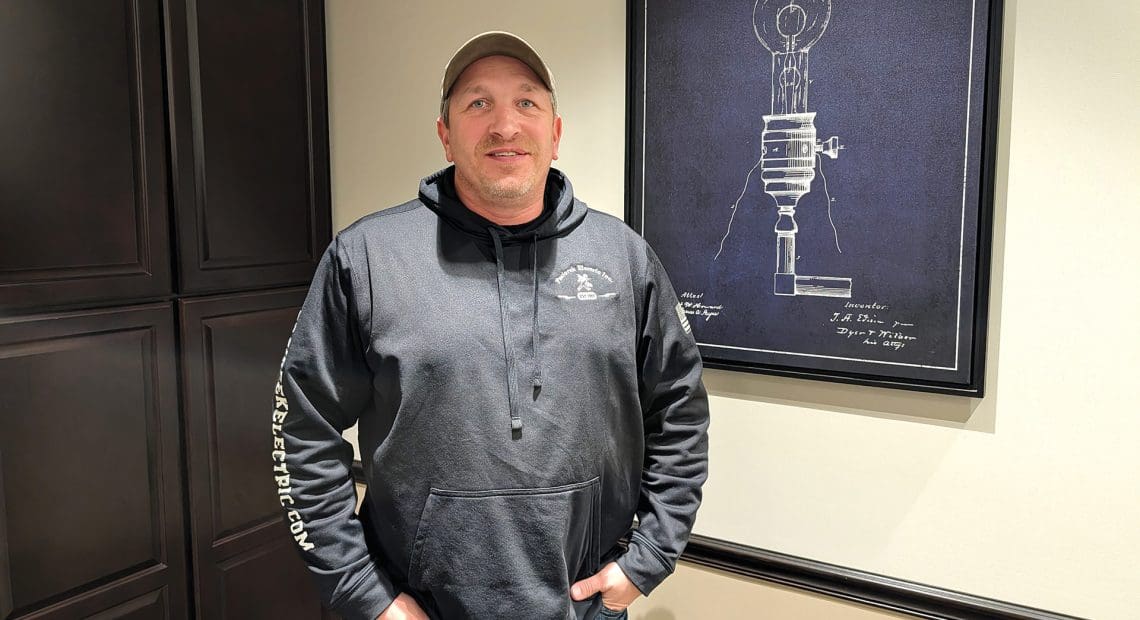
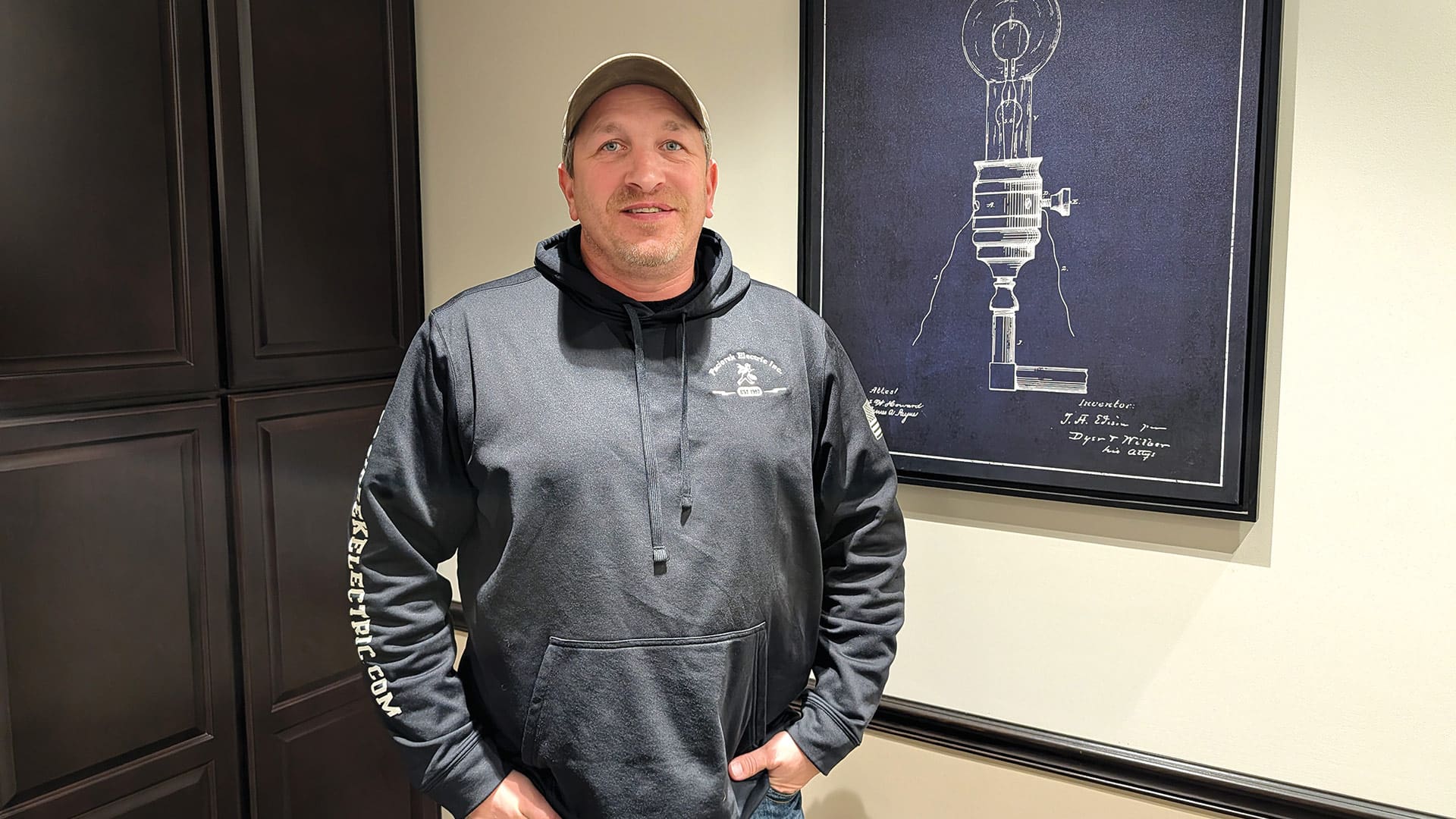
President Tim Paciorek

President Tim Paciorek

Tim Paciorek always knew he wanted to own a business one day. In fact, he can trace that itch for entrepreneurship back to when he was 8 years old and wanted a four-wheeler that cost $700.

“My father said, ‘if you want something like that, you’re going to have to pay for it yourself. But what I’ll do is match whatever you make. So you’ve got to go find a job. You’ve got to do something.’”

His first job was a paper route, which taught him about dealing with customers and collecting money — a job he soon supplemented with work on a local farm.

“When I saved $350, he put up the other $350, and I got my four-wheeler. That was, in a sense, teaching me delayed gratification and also having goals and dreams. That’s how it all started,” said Paciorek, who continued to do both jobs for several years and never stopped working throughout his teen years, from starting a car reconditioning enterprise when he was 12 to making Christmas ornaments at a woodcrafting shop, to raking leaves and mowing lawns.

“All of that was building up to owning a business,” he said. “I wanted to be successful, and I didn’t want to work for somebody for the rest of my life. Even at 8 years old, I wanted it. I knew I was going to have my own business one day.”

To do that, Paciorek decided to attend Smith Vocational and Agricultural High School in Northampton and learn a trade. He was interested in electrical, plumbing, carpentry, and automotive, especially the first two, but he chose electrical because his uncle, John Paciorek, had an electrical business in South Deerfield, and by his junior year, he was working there part-time as a co-op, and moved to full-time after graduation.

“I wanted to be successful, and I didn’t want to work for somebody for the rest of my life. Even at 8 years old, I wanted it. I knew I was going to have my own business one day.”

“He did a really good mix of work — residential and a lot of commercial, but also industrial. We worked at a couple of plastic factories, working on machine wiring, and we also did a lot of work at Mount Snow; we would go there from August to December and would work there six days a week, 10-hour days, rewiring the lodges and lifts and the condos and all kinds of stuff.

“Even though I was working for someone, I was learning a lot of things about the business, and watching a lot,” he added, “and I knew that I was going to own an electrical business one day.”

In 1997, the year he earned his electrical license at age 21, Paciorek started transitioning toward that goal by dedicating his days to his uncle’s business, but doing a lot of side work on nights and weekends — until July 4, 1998, which he calls “my personal Independence Day,” when he hung his own shingle, full-time.

“The rest is history,” he told BusinessWest — a history marked by strong business growth, an active commitment to cultivating the next generation of young electricians, and an intriguing real estate project in Hatfield that has become home not only to Paciorek Electric, but a host of small businesses.

“Now I’ve got my own son, Rocky, working for me — that was really a great moment for me when he decided to join the electrical field. He went to Smith Voke just like I did, learned the trade, and came to work for us; he’s also licensed,” Paciorek said. “And my brother, Tony, is also working for me. It’s really cool to have two family members working in the in the business.”


From the Ground Up

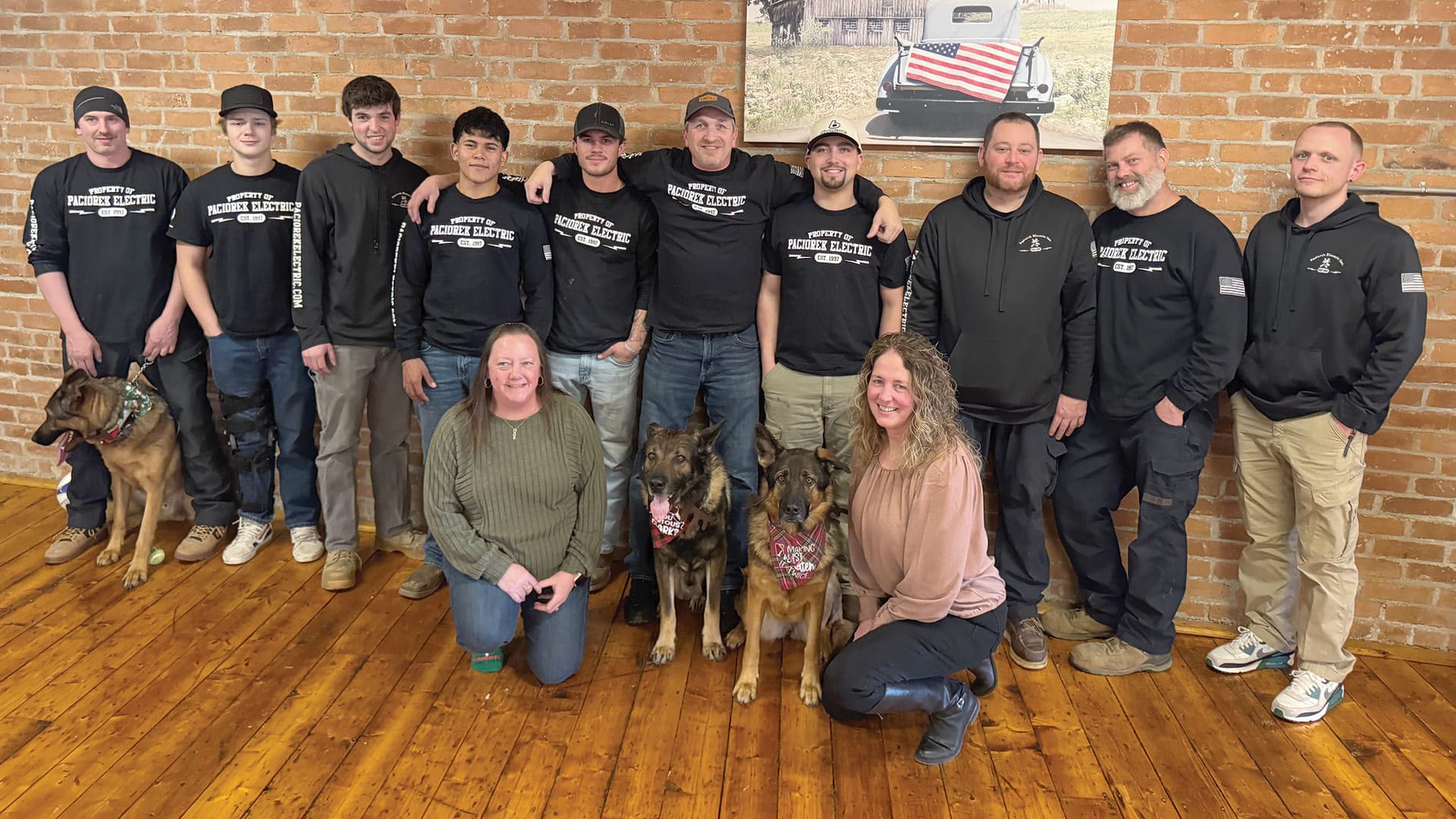
In fact, Paciorek now has 11 employees in all, and a fleet of 10 service vans, but it was a long road getting to this point.

“The first five years, I worked basically on my own. If I had a bigger job, if I needed extra hands to pull wire or whatever, I would call up some friends and have them come help me. But mostly it was just me for five years, doing everything myself.

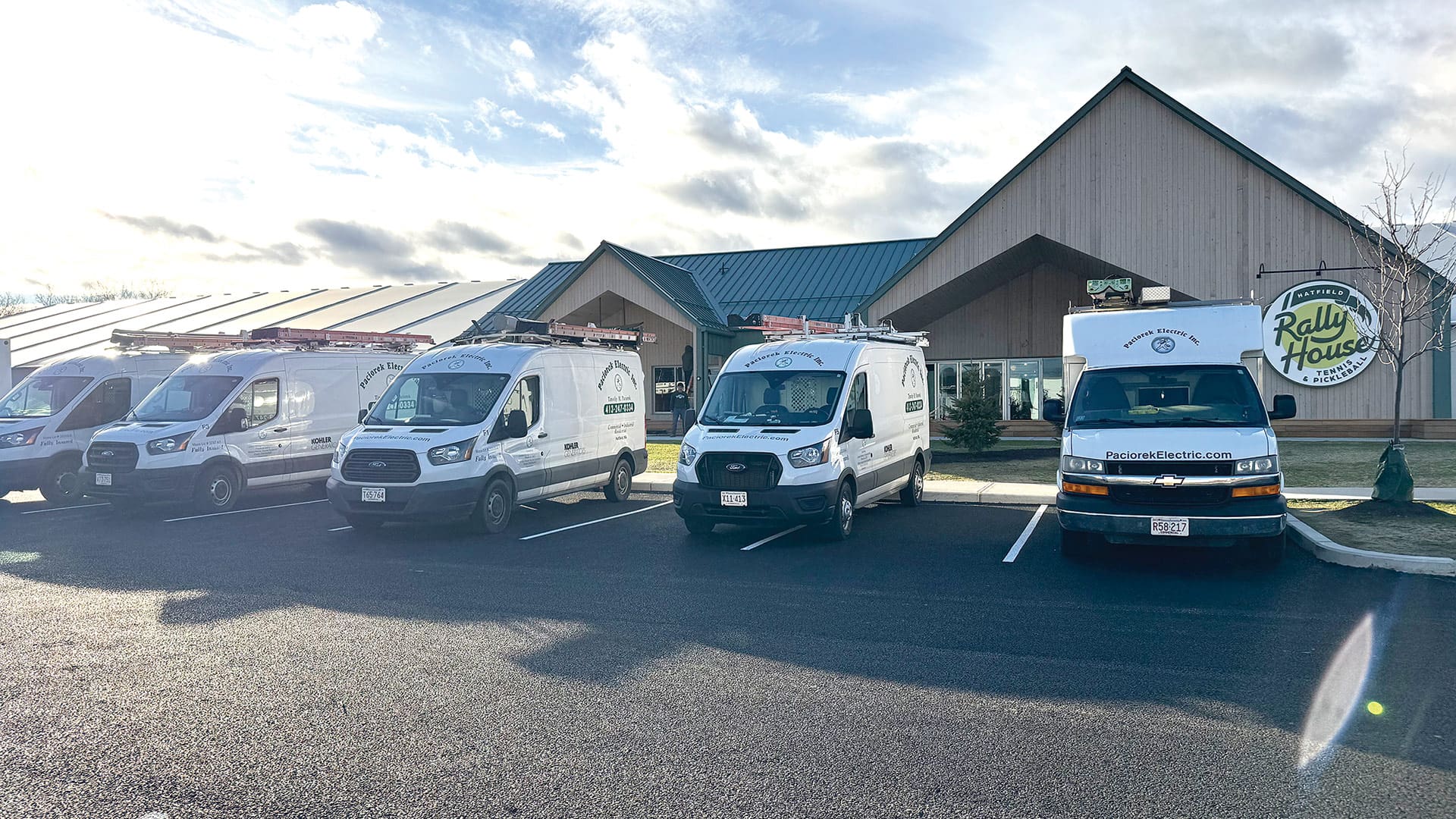
Rally House, a tennis and pickleball facility in Hatfield, is among the projects Paciorek Electric has worked on.

Rally House, a tennis and pickleball facility in Hatfield, is among the projects Paciorek Electric has worked on.

“Many times, I look back and wonder how I did it,” he added. “I would work all during the day, and then at night I’d be in the office, sometimes until midnight, doing billing or work quotes, that type of thing.”

But he gradually got the help he needed, hiring his first apprentice — his brother — about five years in, and hiring an office manager five years after that. Growth has been steady ever since; these days, almost half the work is residential, and the rest commercial and industrial, the latter including work for such notable names as Deerfield Plastics, Pliant Corp., and high-tech, secure companies such as Telaxis and Millitech. In all of it, he relies on reputation.

“I always talk to my guys about customer service, about giving the customer what they want — as long as it’s legal, of course. Customers ask all the time, ‘do you have to do that?’ And we say, ‘yeah, we have to; it’s code.’ But we’ve had customers that wanted their light fixture moved five times. And we’ve done it. The customer’s always right as long as they’re paying for it.

“I always wanted to be in business, and even starting at 13 and 14 years old, I would go to different seminars about business, and I started learning about real estate, finding out that a lot of wealthy people held a lot of their investments in real estate.”

“That’s what we live by — to keep customer satisfaction up. My guys are great. We have a very strict code of ethics where we talk about customer service, keeping the place clean, using booties if the weather’s bad or they’ve got nice floors. And we keep good communication so the customer knows what’s happening — because sometimes you run into obstacles when you’re running wires. We try to keep the communication up so customers know where we’re at.”

Speaking of where the company is at — literally — Paciorek bought his current headquarters, the former home of General Cigar Co., in 2015. It wasn’t his first experience there, as it was on his paper route a couple decades earlier. The complex — with multiple buildings and vehicle bays — was more space than the electrical company needed, but he was thinking bigger than that.

“I always wanted to be in business, and even starting at 13 and 14 years old, I would go to different seminars about business, and I started learning about real estate, finding out that a lot of wealthy people held a lot of their investments in real estate. So I started taking real estate courses not to be a Realtor, but to be an investor or a developer. And I started learning about apartment buildings and commercial properties.”

Buying the 65 Elm St. complex — the third-largest building in Hatfield, with more than 83,000 square feet, plus a front house, two barns, and a five-car garage — not only meant consolidating what had become four different locations for his operation, but also having room to lease space to what are now about 20 small businesses, from financial services firms to wellness and behavioral health practices to other construction trades. In the winter, the building’s basement becomes a car storage business, where about 60 clients keep their vehicles, many of them classic show cars, out of the cold weather.

He credits Greenfield Savings Bank for taking a chance on the real estate project, which involved a complete gut job and renovation.

Tim Paciorek (center) has grown his team to 11 employees.

Tim Paciorek (center) has grown his team to 11 employees.

“They’ve been really great as far as helping me and seeing the vision that I had. Any time you invest in anybody, you’re taking a chance, and you hope that it goes right. And I think they saw the vision I had in this building. I give credit to all the different people that helped me get here through the years, from bankers to my accountants and attorneys. There’s a whole team of people that you need to do a project like this, or to be in business at all.”


Making Connections

All these perspectives — about entrepreneurship, the trades, and what it takes to succeed — are lessons Paciorek imparts to young people considering career options. And he has supported a number of apprentices starting out in the field; some have become full-time employees.

“The trades are definitely in need of more workers, people that will put their tools on and actually get out there and work,” he told BusinessWest. “The Baby Boomers are retiring, and they’ve been retiring for the last 10 years. So that is causing a huge shortage in electricians and plumbers and carpenters — all the trades. And it’s really hard to find new help, so you have to keep the young people coming in.”

One problem is that many vocational programs aren’t able to take as many students as they’d like due to a shortage of teachers, but Paciorek also sees a lack of motivation in many young people to do the hard work necessary to move ahead.

“The vast majority of this generation doesn’t have the skills or, unfortunately, the drive that a lot of us employers are looking for. And there are a lot of things that we’ve got to try to teach them, but some things can’t be taught,” he explained. “Things like a good handshake and eye contact, that stuff can be taught. But the drive is really hard.”

“Whenever I have kids in front of me, I tell them, ‘whatever you want to do, whether it be an electrician, a doctor, a lawyer, a plumber, a writer — whatever you want to do in life, you need to start learning about it.’”

For instance, he added, “that cell phone is dangerous. I tell all the guys, ‘you’ve got to stay off your cell phone. A customer doesn’t want to pay for you to be on your cell.’ And I’ve had to fire a couple of people in the past because of that. It’s a different generation — when I grew up, we didn’t have cell phones, so we just worked. Nowadays, it’s become a habit for a lot of this generation to be on their phone all the time. So that’s one of the things I say when I talk at the different schools.”

One major problem, he added, is the lack of job opportunities for young people compared to when he was growing up in the 1980s — which means fewer opportunities to develop the work ethic he learned early on. Jobs for teenagers are still around, he added, and motivated young people will find them, but they’re not as obvious.

“I talk to kids all the time, and they say, ‘well, I’m not old enough. I have to be a certain age.’ I say, ‘OK, then do what I did; go do your own business — wash somebody’s car, go rake leaves, find something else to do.’”

Certainly, not everyone grows up with the same drive as Paciorek, whose serial entrepreneurship over the years has also included almost two decades as a DJ, working about 40 weddings a year, and ownership of a Hatfield restaurant, Grill ’N Chill, now known as Posada’s Cantina, which he ran with his brother for eight years.

“Whenever I have kids in front of me, I tell them, ‘whatever you want to do, whether it be an electrician, a doctor, a lawyer, a plumber, a writer — whatever you want to do in life, you need to start learning about it.’ When I was young, I remember my dad telling me, ‘if you want to succeed, don’t go talk to a broke person; you talk to someone who’s successful. If you want to be a doctor, go talk to a doctor. If you want to be an electrician, go talk to an electrician.”

So he continues to talk to them, and encourage them to start training in a trade.

In his own work, Paciorek has carved out an impressive body of work, and took numerous opportunities during his talk with BusinessWest to credit everyone who has supported his journey, from his financial advisors to his parents, who instilled his early values, to Rocky and his fiancee — not to mention the customers who have trusted in Paciorek Electric and his real estate company, DiamondBack Properties, over the years.

And the business is still evolving, with one example being a robust business in generators, installing about 50 and servicing about 500 each year. “It started off as just a little side thing, a generator here, a generator there, but now it’s pretty big,” he said.

The same can be said of a 28-year-old electrical company and its visionary leader, who worked hard to earn a four-wheeler at 8 years old, and has worked hard to achieve a whole lot more ever since.

Healthcare News Special Coverage

Turning the Battleship

Peter Banko says that, despite a mountain of challenges, the Baystate Health system has achieved needed momentum.

Peter Banko says that, despite a mountain of challenges, the Baystate Health system has achieved needed momentum.

Peter Banko was asked if he was frustrated.

He would certainly have good reason to be.

After all, Banko, president and CEO of Baystate Health, had spent the past 17 months or so trying to right the ship at the system — “turning around a battleship in a bathtub,” as he would later tell the audience at a forum on the state of the healthcare sector in the region — and had made a good amount of progress through difficult and unpopular decisions that included layoffs, cutbacks in many departments, and, most recently, buyouts for many employees, resulting in a profitable fiscal 2025.

But by his estimation, provisions within the One Big Beautiful Bill Act (or OB3, as he calls it), signed into law last July, will cost Baystate Health $146 million a year through its specific provisions and their aftereffects, and essentially wipe out all that’s been accomplished and bring the system back to where he started in terms of the size of the hole to dig out of.

“Those reductions wipe out our positive cash flow in one fell swoop,” said Banko, noting that the system exceeded budget expectations for fiscal 2025 and recorded a 3.6% EBIDA (earnings before interest, depreciation, and amortization). “We exceeded our budget expectations by about $50 million; it was the first time we exceeded our budget in six years. But whatever progress we made this year gets eliminated by the One Big Beautiful Bill; we’re down to zero again, and we start from scratch.”

“We’ve got a lot of great work going on behind the scenes that isn’t glamorous and won’t make headlines, but it’s the right work. I feel more optimistic than I’ve felt in a long time.”

So … while frustration would certainly be understandable, and the picture for 2026 is bleak by most accounts (more on that later), he prefers to be upbeat — to a degree.

“That’s because I believe we’ve created some momentum,” he said. “I’m happy with the momentum we’ve created. We’ve got a lot of great work going on behind the scenes that isn’t glamorous and won’t make headlines, but it’s the right work. I feel more optimistic than I’ve felt in a long time.

“I feel like we have the team and the committed board and committed team members that are willing to do the tough work and make the difficult decisions for it to be successful,” he went on, adding that there are certainly more difficult decisions to be made, and more consolidation likely in the healthcare industry — and 2026 is shaping up to be an ultra-challenging transition year for hospitals.

But, overall, he believes the ship has been turned and is positioned to navigate the turbulent seas that are forecasted.

For this issue and its focus on healthcare, we talked at length with Banko about the progress that’s been made, how much of that progress stands to be undone by the OB3, and what happens next as he continues the turn-around assignment he assumed in the fall of 2024.


Time of Transition

Banko said the One Big Beautiful Bill Act will result in $1 trillion in cuts nationally and represents “the largest rollback to federal support for healthcare in our lifetimes.”

Most of the impact to the Baystate system will not kick in until October, a month before the midterm elections, he went on, adding that online estimators project that the overall impact to Baystate will be more than $140 million. Broken down, these cuts involve everything from sharp increases to the number of uninsured individuals from Medicaid and the Affordable Care Act to a decrease in funding from Medicaid (MassHealth), to a loss of funds from the 340B Drug Pricing Program.

The impact to the system — and all providers — will be profound, he said.

Valley Springs Behavioral Health Hospital, one of Baystate Health’s most significant recent projects, opened in Holyoke in 2023.

Valley Springs Behavioral Health Hospital, one of Baystate Health’s most significant recent projects, opened in Holyoke in 2023.

“A lot of people won’t have insurance, so they won’t have access to coverage or financing,” he explained. “They’re going to delay care, and they’re increasingly have to use the ED when things are really serious, so we’re going to have more overcrowding. It would be shortsighted to say that this will most significantly impact the poor and vulnerable in our community; if you have commercial insurance, you can expect double-digit increases in your premiums the next five years because commercial insurance makes up the difference for Medicare and Medicaid.

“If you’re an employer in this state or anywhere in the United States, you’re going to be paying more for your insurance to cover the gaps here,” he went on, adding that, for systems like Baystate, the impact will be felt in the ER, certainly, but in other realms as well.

When asked to make projections on what will happen across the system and its four hospitals — Baystate Medical Center, Baystate Noble Hospital, Baystate Wing Hospital, and Baystate Franklin Medical Center — Banko said it’s too early to do so, with the specific impacts not likely to be known until the provisions of the bill take effect.

And that won’t be until almost a year from now, he went on, adding that, in most respects, 2026 will be what he called a “transition year.”

“It will be like preparing for a snowstorm,” he told BusinessWest before extending the metaphor further. “Everyone is going to be buying milk and bread and snow shovels; there’s going to be a lot of preparation and action in anticipation of next year.”

When asked how a system prepares for the storm that’s coming, he said the system will continue to make additions and adjustments in the ER in anticipation of more people using that front door instead of primary care.

“We’re aggressively recruiting nurses and physicians for the ER, and we’re working on improving our throughput in the hospital, which impacts the ER,” he explained. “We’re working on improving access and throughput, which will help.”

Overall, he said the system itself will manage, but he’s concerned about the human toll for the cutbacks and their impact on the overall health of the community.

“It will be like preparing for a snowstorm. Everyone is going to be buying milk and bread and snow shovels; there’s going to be a lot of preparation and action in anticipation of next year.”

“Let’s consider this from the humanistic end — someone who had coverage now doesn’t,” he said. “They may be in the middle of cancer treatment; they may be in the middle of a pregnancy. A few months from now, they get diagnosed with a condition, and they delay care, or they’re feeling symptoms, and they know they can’t afford care. From a community standpoint, we’re worried about the impact to the most vulnerable people in our community.

“How do we look our community in the face and say, ‘15% to 25% of you no longer have coverage,’” he went on. “This state has worked so hard, going back to Governor [Mitt] Romney, to provide care for as many people as possible — it’s hard to say all because some people fall through the cracks — and now, it’s all being dismantled.”


Bottom Line

And it’s unlikely there will be much, if any, help coming from Washington, Banko opined, noting that, for now, both sides consider what’s happening to be a “political win,” which makes action before the midterms unlikely in his view.

“Behind the scenes, I think everyone knows what the right things to do are,” he went on. “But OB3 has become a political football, so the folks left holding the bag are our governor and our Legislature — they’re going to have to fill a huge budget gap, $4 billion to $5 billion, and I don’t envy them having to try to figure that out. And our healthcare systems are left holding the bag because it impacts us most severely. Who gets lost in this are the people losing coverage — I’m not sure they have a voice at the moment.”

As for the Baystate system itself, Banko said that, when it comes to the progress made in 2025, budget-wise, roughly half is attributable to cost cutting, with the other half coming from revenue growth.

“We saw decent growth in our business last year, above what our expectations were,” he noted, adding that this growth came in ER volume, surgical volume, inpatient volume, and other realms. “More than half our financial improvement was solid revenue growth.”

Looking ahead to 2026, he’s projecting revenue growth of 2% to 3%, with expenses growing 6%.

“And in any business, that’s not a recipe for success,” he went on, adding that the system has identified core growth areas, including overall access to care.

“We lose a lot of our patients to Boston because they can’t get in here. So if we can grow revenue by 6% to 8% and trim some of our costs, that will allow us to stay in the game,” he explained, adding that there will be more cost cutting in the year ahead — at Baystate and most other providers.

There will also be some less profitable services cut back or eliminated by many providers, he said, as well as continued consolidation within the industry as systems look for all-important scale in the wake of the rising costs of doing business.

“We’re talking to a lot of organizations, and with each one, I have a confidentiality agreement that I can’t violate,” he said, withholding comment on rumored talks between Baystate and Mercy Medical Center. “So, I would just say this … everyone is talking to everyone right now. There isn’t a week that goes by that I’m not having a discussion with a competitor, someone in an adjacent market, someone in a non-adjacent market.

“Everyone is viewing the changes from OB3 as transformational, so everyone is trying to figure out the same thing,” he went on. “We’re all talking to one another about, ‘hey, how do we manage this?’ Or ‘can we manage this better together?’”

There is some evidence that scale has not worked out in healthcare, at least as much as it has in other industries, he continued, adding quickly that he believes scale does bring advantages; systems just need to seize those advantages.

“Our overhead costs are about 12.9%,” Banko explained. “Without more scale, we can bring that down to 10%, but best-practice health systems are below 8%, and there’s no way we can get below 8% without more scale.”

In the meantime, and as he mentioned earlier, he senses real momentum across the system, progress in many ways overshadowed by large headlines about layoffs and buyout programs.

“What gets published in the media is just the financial stuff,” he told BusinessWest. “So when we do a layoff or cut costs somewhere, that gets all the media attention, and it gets all the attention inside the organization. But I would say that 80% of the work is non-financial, and we’re making real progress.”

Accounting and Tax Planning Special Coverage

A Time and Place for Everything

By Mary C. Walsh

As the tax filing season looms, employers must ensure compliance with federal information reporting requirements, including payroll and payment reporting to the government, employees, and other income recipients. Most of forms are required to be electronically filed. In 2026, there are new requirements for reporting employee tips and overtime. This article provides details regarding these reporting obligations.


General Federal Year-end Information Return Filing Requirements for Forms W-2, W-3, and 1099 (INT, NEC, and MISC)

• Electronic filing is required if at least 10 of the following forms, combined, are required to be filed: W-2, 1094, 1095-B, 1095-C, 1097-BTC, 1098, 1098-C, 1098-E, 1098-Q, 1098T, 1099, 3921, 3922, 5498, 9027, W02G, and 499R-2/W-2PR. In some cases, electronic filing is given more time to file with the IRS than paper filing.

• Filing and due date information is set forth in IRS Publication 509, Tax Calendars for use in 2026 (www.irs.gov/pub/irs-pdf/p509.pdf). See also IRS Publication 1220, Specifications for Electronic Filing of Forms 1097, 1098, 1099, 3921, 3922, 5498, and W-2G, which sets forth electronic filing format specifications.

• Typically, due dates fall at the end of a month. However, if a due date is a weekend day or holiday, the next business day becomes the due date. Also, Congress or the president may specify a different due date, e.g., if there is an emergency. In 2026, Jan. 31 is a Saturday, making Feb. 2 the next business day, and Feb. 28 is a Saturday, making March 2 the next business day.


“For 2025, the IRS encourages employers to provide some accounting so employees can claim the deduction on their federal tax returns. The IRS has stated that employers may report the amounts of qualified tips and overtime to employees through secure methods, including an online portal or additional written statements provided to employees.”

Information Reporting Due Dates for 2026

• W-2, Wage and Tax Statement: File with Social Security Administration (SSA), electronic and paper, by Feb. 2. Provide to employees by Feb. 2.

• W-3, Transmittal of Wage and Tax Statements: File with SSA, electronic and paper, by Feb. 2.

• 1099-INT, Interest Income and 1099-DIV, Dividend Income: File with IRS, electronic, by March 31. File with IRS, paper (must be accompanied with IRS Form 1096, Annual Summary and Transmittal of U.S. Information Returns) by March 2. Provide to recipients by Feb. 2.

• 1099-NEC, Non-employee Compensation: File with IRS, electronic and paper, by Feb. 2. Provide to recipients by Feb. 2.

• 1099-MISC, Miscellaneous Income: Nothing reported in box 8 (substitute payments in lieu of dividends or interest) or box 9 (crop insurance proceeds): File with IRS, electronic, by March 31. File with IRS, paper (must be accompanied with IRS Form 1096, Annual Summary and Transmittal of U.S. Information Returns) by March 2. Provide to recipients by Feb. 2.

• 1099-MISC, Miscellaneous Income: Amount reported in box 8 (substitute payments in lieu of dividends or interest) or box 9 (crop insurance proceeds): File with IRS, electronic, by March 31. File with IRS, paper (must be accompanied with IRS Form 1096, Annual Summary and Transmittal of U.S. Information Returns), by March 2. Provide to recipients by Feb. 2.


Special Issue: Tips and Overtime

The One Big Beautiful Bill Act (OBBBA), enacted this past July, allows certain employees to deduct tips and overtime compensation. One area of uncertainty, affecting both employers and employees, regards 2025 payroll reporting for tips and overtime.

Under the OBBBA, from 2025 to 2028, certain employees who receive qualified tips may deduct up to $25,000 of those tips, and those who receive overtime pay may deduct up to $12,500 of qualified overtime compensation ($25,000 for joint filers).

To enable employees to report their deduction, the OBBBA requires employers to provide separate accounting of the total amount of cash tips and overtime. Employers failing to comply with these reporting requirements may be subject to penalties.

Although the IRS has released a draft version of Form W-2 for 2026 reflecting OBBBA changes, the 2025 version of the form will not be updated, creating a challenge for employer reporting compliance. As a result, for tax year 2025, the IRS announced that employers will not face penalties for failing to provide required tip and overtime accounting to employees (Notice 2025-62). This relief only applies to tax year 2025 because the IRS recognizes that employers might not have the information required to be reported.

For 2025, the IRS encourages employers to provide some accounting so employees can claim the deduction on their federal tax returns. The IRS has stated that employers may report the amounts of qualified tips and overtime to employees through secure methods, including an online portal or additional written statements provided to employees.

When reporting these amounts, employers should not stop at the maximum of $25,000 (tips) or $12,500 (overtime). The full amounts of qualified tips and overtime should be reported. It is up to employees to determine the maximum deductible amount when preparing their federal income tax returns.

With little authoritative guidance and difficulty getting full information from existing systems and payroll providers, employers must do their best in providing employees with this information. Employers could, for example, provide the information by separate letter or use W-2 Box 14 (Other). For the most current guidance (updated as issued), visit www.irs.gov/newsroom/one-big-beautiful-bill-provisions and click on “No tax on tips (Section 70201)” and “No tax on overtime (Section 70202).”

Massachusetts, Connecticut, Maine, Rhode Island, Vermont, and New Hampshire do not allow employees to deduct tips or overtime; thus, this reporting issue largely does not impact New England and New York payroll reporting.

Finally, remember that this article is intended to serve only as a general guideline. Your personal circumstances will likely require careful examination. You should schedule a meeting with your adviser to assist with all your tax planning needs.


Mary C. Walsh is a senior manager at Meyers Brothers Kalicka, P.C. She holds an MS accounting and an MBA from Northeastern University, an LLM in taxation from Boston University School of Law, a JD from the University of Connecticut School of Law, and a BA from UMass Amherst. She is a CPA licensed in Florida and an attorney licensed in Massachusetts. She is a member of CPAmerica and the American Institute of Certified Public Accountants.