Daily News

BOSTON — Brick Marketing, a Boston-based digital marketing agency, announced it will lead two expert-level Mastermind Session roundtables at the upcoming SMX Advanced Conference in Boston. The event is widely recognized as one of the most respected gatherings for experienced search marketers, bringing together senior-level professionals focused on advanced SEO, paid search, and emerging digital strategies.

Founded in 2005, Brick Marketing has built a strong reputation for delivering integrated digital marketing strategies that connect SEO, AI search, content marketing, and performance-driven execution. The agency specializes in helping organizations improve search visibility, strengthen brand authority, and generate qualified leads through a combination of technical expertise, strategic content development, and consistent market positioning.

As AI continues to reshape how people discover and evaluate businesses online, Brick Marketing’s participation at SMX Advanced will focus on translating AI search visibility into measurable business outcomes. The sessions will be led by Nick Stamoulis, president of Brick Marketing, and Katherine Tsoukalas, both of whom work directly with clients on SEO, AI SEO, and content marketing strategy and implementation.

Stamoulis will lead a Mastermind Session Roundtable titled “Turning AI Search Visibility into Qualified B2B Pipeline.” This session will focus on how organizations can move beyond simply appearing in AI-generated answers and instead build a structured approach that drives qualified pipeline growth. Key discussion points will include how AI platforms evaluate authority and relevance, how consistent brand positioning across digital channels impacts visibility, and how to align SEO and AI search strategies with lead generation objectives.

“AI and AI Search are changing how visibility translates into opportunity,” he said. “At Brick Marketing, we focus on helping clients connect their SEO, content marketing, and AI search presence directly to pipeline and revenue. It’s not enough to show up. You need to show up in the right way, with the right messaging, and with a structure that supports decision making. That is where the real value is created.”

Tsoukalas will lead a second Mastermind Session Roundtable titled “Content Marketing for AI Search Presence and Growth.” Her session will focus on the role of content marketing in supporting both traditional SEO performance and AI-driven discovery. Topics will include building authoritative content frameworks, aligning messaging across platforms, and creating content that can be consistently interpreted and referenced by AI systems.

“Content marketing is the backbone of both SEO and AI search,” she said. “The brands that perform well are the ones that clearly communicate who they are, what they do, and who they serve across their website and the broader web. At Brick Marketing, we emphasize structure, clarity, and consistency so that both search engines and AI platforms can confidently surface our clients’ content.”

The SMX Advanced Conference, organized by Search Engine Land, is known for its advanced-level programming and highly engaged audience. The Mastermind Sessions are designed to foster interactive discussion, allowing attendees to collaborate with industry experts and peers on real-world challenges related to SEO, AI search, and digital marketing strategy.

Brick Marketing’s participation highlights its leadership in the evolving space of AI SEO, also known as generative engine optimization (GEO). The agency’s approach focuses on building a strong foundation of technical SEO, structured website architecture, and authoritative content that supports both search engine rankings and AI-driven visibility. By integrating these elements, Brick Marketing helps organizations improve how their brand is interpreted, referenced, and surfaced across platforms such as ChatGPT, Google Gemini, Claude, CoPilot, Perplexity, and other AI platforms.

Beyond client services, Brick Marketing continues to invest in education and thought leadership as a core part of its mission. The agency regularly publishes industry insights, hosts webinars, and leads training sessions designed to help businesses better understand and implement modern digital marketing strategies. This commitment to education reinforces its position as a trusted resource for organizations looking to navigate the complexities of SEO and AI search.

As the digital marketing landscape evolves, traditional metrics such as traffic are being complemented by new indicators of success, including visibility in AI-generated answers, consistency of brand presence across the web, and the ability to influence decision making earlier in the research process. Brick Marketing’s methodology is designed to address these shifts by focusing on both visibility and outcomes.

“SEO and AI search are not separate strategies; they are deeply connected,” Stamoulis said. “A strong SEO foundation supports AI visibility, and a clear AI search strategy reinforces your overall digital presence. At Brick Marketing, we bring those elements together in a way that drives real business results.”

By participating in 2026 Boston SMX Advanced industry conference, Brick Marketing continues to demonstrate its commitment to helping organizations stay ahead of industry changes while maintaining a focus on practical, results-driven execution. The Mastermind Sessions led by Stamoulis and Tsoukalas will provide attendees with actionable insights, strategic clarity, and a deeper understanding of how to align SEO, content marketing, and AI search for measurable growth.

Daily News

SPRINGFIELD — The Applied Mortgage Team of HMA Mortgage announced that Lindsay Barron LaBonte, branch manager and senior loan officer of the Applied Mortgage team, was honored recently with two awards. She was recognized as one of the Loan Officers of the Year by the Massachusetts Mortgage Bankers Assoc. and Best of the Valley’s Best of 2026 Podcaster. These honors recognize LaBonte’s achievements in the mortgage industry as well as her community impact, highlighting her professionalism and strong work ethic.

The Loan Officer of the Year awards recognize outstanding loan officers in the mortgage industry who exemplify excellence in production, professionalism, and partnership. Nominees were evaluated based on their performance in today’s purchase-driven market, year-over-year growth, and a range of key performance criteria.

LaBonte’s “Real People, Real Estate” podcast delves into the genuine, real-world experiences of buying, selling, and navigating the real estate journey. She shares authentic stories, expert insights, and creates a welcoming space for listeners to feel supported and understood. The podcast is produced in partnership with Easthampton Media.

“I’m honored to be recognized as a Loan Officer of the Year by the Massachusetts Mortgage Bankers Association and Best of the Valley’s Podcaster/Podcast finalist. Truly, the recognition belongs to my team,” LaBonte said. “The Applied Mortgage Team shows up every single day with unmatched dedication, heart, and a commitment to helping our clients and each other succeed, and I’m proud to be in the trenches alongside them. I’m incredibly grateful to lead such a driven, supportive group that proves success is built through collaboration.”

Daily News

BOSTON — The Healey-Driscoll administration announced the second round of grants under the Department of Energy Resources’ Low-Income Services Solar Program (LISSP). Grants totaling $394,643 will help two nonprofit organizations — Springfield Partners for Community Action and Cape Cod-based Cape Abilities — install rooftop solar systems that will reduce each organization’s electricity costs by 70% to 100%, resulting in more resources for the nonprofits’ critical work.

LISSP helps nonprofit organizations reduce operating costs and strengthen community resilience by providing funding for solar and energy storage systems. Grants are available to nonprofit organizations that provide critical community services and support environmental justice (EJ) communities across Massachusetts.

“Cape Abilities and Springfield Partners provide much-needed services in their communities, and we’re thrilled to help them add solar to their rooftops, which will cut their energy costs and ensure our most vulnerable residents can access the benefits of clean energy,” Energy Resources Commissioner Elizabeth Mahony said. “These solar systems will allow more of the organizations’ precious financial resources to serve those in need, and they will benefit the broader communities with cleaner, healthier air.”

Springfield Partners for Community Action’s mission is to utilize and provide resources that assist people in need to obtain economic stability, ultimately creating a better way of life. It is awarded a grant for $293,633 to install a 100 kW AC rooftop solar system at its main building in Springfield. The system will save Springfield Partners an estimated $9,700 each year in energy costs.

“As the leading weatherization program in Hampden County, Springfield Partners is committed to improving the energy efficiency of our clients’ homes and advancing long-term sustainability in our community. With the support of the Department of Energy Resources, we are excited to now have the opportunity to lead these efforts through the installation of our own solar panel array,” said JC Schnabl, deputy director of Springfield Partners for Community Action. “This installation will enable us to reduce our electricity costs, strengthen our operational capacity, and pass those savings directly on to our clients through expanded and enhanced services.”

This is the second round of grants awarded under LISSP. In January, grants were awarded to Newton Food Pantry, Grow Associates in Randolph, and High Point Treatment Center of Southeastern Mass.

Applications for LISSP are accepted quarterly. The application period for the next round of funding opens on May 12. Nonprofits interested in applying, including nonprofits in municipal light plant territories, can visit www.cetonline.org/programs/low-income-services-solar-program.

Daily News

WESTFIELD — Westfield State University joined educators, students, and advocates at the Massachusetts State House to mark a historic milestone in inclusive higher education: the Commonwealth’s first official proclamation designating May 1 as Inclusive Postsecondary Education (IPSE) Day.

The proclamation formally recognizes the importance of expanding access to higher education opportunities for students with intellectual and developmental disabilities across Massachusetts. Westfield State’s Inclusive Postsecondary Education (WIPSE) program played a leading role in initiating and advancing the request for the proclamation, helping secure the first formal statewide recognition of IPSE in Massachusetts history.

WIPSE Program Director Lyndsey Nunes said the designation reflects both progress and continued momentum.

“This proclamation marks an important step forward in expanding inclusive higher education across the Commonwealth,” she noted. “We are grateful to [Gov.] Maura Healey for recognizing Inclusive Postsecondary Education Day and reaffirming Massachusetts’ commitment to students with intellectual and developmental disabilities.

“This recognition reflects more than 15 years of progress, strengthened by the 2022 Creating Higher Education Opportunities law,” Nunes continued. “Inclusive higher education benefits not only students, but also campuses, communities, and the workforce. I am especially grateful to have served as program director at Westfield State University for the past 13 years, where sustained institutional support has helped WIPSE students thrive alongside their peers.”

Students from Westfield State’s WIPSE program participated in the State House event, touring the historic building, gathering on the grand staircase for photos with the proclamation, and celebrating alongside representatives from peer institutions across the state.

The event highlighted strong collaboration across Massachusetts’ IPSE community, with institutions coming together to commemorate the designation and reaffirm a shared commitment to expanding inclusive higher education opportunities.

Representatives from Bunker Hill Community College, Middlesex Community College, and UMass Lowell joined the celebration. Mary Price, state director for the Massachusetts Inclusive Concurrent Enrollment Initiative at the Massachusetts Department of Higher Education, and state Rep. Sean Garballey also met with students and provided a tour of the State House.

Westfield State University’s leadership in inclusive postsecondary education reflects its broader institutional mission to create accessible, supportive, and transformative learning opportunities for all students.

Daily News

HOLYOKE — Bacon Wilson, P.C. announced the collaboration and integration of Resnic, Beauregard, Waite and Driscoll, Attorneys at Law, into the firm.

For nearly a century, Resnic, Beauregard, Waite and Driscoll has been recognized throughout Western Mass. for civil litigation, estates and probate, real estate, and municipal law. Established in 1929, the firm built a distinguished reputation not only for its legal expertise, but also for its deep commitment to the communities it served.

The firm’s legacy includes notable legal and civic leadership. George Beauregard joined Samuel Resnic following his service in World War II and later became a senior partner of the firm. In 1958, he was appointed special justice of the Holyoke District Court, becoming the youngest judge in Massachusetts at just 33 years old.

In addition to their professional accomplishments, the attorneys of Resnic, Beauregard, Waite and Driscoll have long been admired for their philanthropic and civic involvement. The firm maintained a strong presence within the community, with its partners serving in numerous leadership and volunteer roles, including with the local Boys and Girls Club and the Hampden County and Hampshire County bar associations.

“We are truly honored to continue the legacy of such a respected and historic law firm,” Bacon Wilson Managing Shareholder Jeffrey Fialky said. “The attorneys at Resnic, Beauregard, Waite and Driscoll have spent generations setting the standard for legal excellence and building trusted relationships throughout the region, and we are thrilled to welcome their clients to Bacon Wilson and to continue the enduring tradition of exceptional legal services.”

The firm currently includes four attorneys: Barry Waite, Mark Beauregard, John Driscoll, and Tom Griffin.

“We are very excited to enter into this new relationship with Bacon Wilson,” Waite said. “It is important that our clients are provided with the continuity and continued professional representation that this collaboration will provide. The attorneys and staff of Bacon Wilson have the expertise, skill, and professionalism required to carry on Resnic, Beauregard, Waite and Driscoll’s nearly 100-year tradition of service to our clients and community.”

Through this integration, Bacon Wilson looks forward to providing continued trusted counsel and expanded resources to the clients and communities long served by Resnic, Beauregard, Waite and Driscoll.

Bacon Wilson, P.C. provides comprehensive legal services to individuals, families, businesses, and municipalities throughout the region. With roots dating back more than 130 years, the firm remains committed to delivering exceptional legal counsel and community-focused service across the Pioneer Valley.

Daily News

Lauren Tabin

EASTHAMPTON — bankESB announced the promotion of Lauren Tabin to vice president, branch officer, at its 297 King St., Northampton office.

In her expanded role, Tabin will continue to lead branch operations while playing a key role in advancing retail strategy, supporting team development, and enhancing the customer experience. She will contribute to driving consistent performance and strengthening the bank’s presence within the communities it serves.

Tabin joined bankESB in 2024 as assistant vice president, branch officer, bringing nearly 30 years of retail banking experience. Prior to joining the bank, she served as assistant vice president, Consumer and Business Banking manager at PeoplesBank. During her tenure at bankESB, she has successfully managed both the 170 Sargeant St., Holyoke office and the King Street, Northampton office, fostering strong teams and delivering high-quality service.

Highly engaged in the community, Tabin serves on the board of directors for the Northampton Rotary Club and Realistic Lemonade Inc. She is treasurer of Trees of Love, Friends of Cooley Dickinson Hospital, and an active volunteer with Big Brothers Big Sisters of Hampshire County, Junior Achievement of Western Massachusetts, the Sphere Northampton, and the Golf FORE Health Tournament. She is also a BusinessWest 40 Under Forty honoree (class of 2011).

Daily News

SPRINGFIELD — Brothers Big Sisters of Western Massachusetts (BBBSWM) has been recognized as a Big Brothers Big Sisters of America (BBBSA) Platinum Award Winner for program excellence in 2025. Every year, the BBBSA Nationwide Leadership Council, made up of local agency leaders and board members, selects agencies for excellence in the organization’s signature one-to-one youth mentoring program. Out of more than 230 agencies across the country, BBBSWM is one of 13 organizations to receive this top honor.

This award recognizes the top agencies that meet requirements for both the Growth and Impact awards — meaning they have shown remarkable achievements in retaining the number of mentors (‘bigs’) and youth (‘littles’) matched through the program consistently from year to year and have exhibited exceptional growth in their local programs. In the past year, BBBSWM has served over 150 new youth and started several new programs in schools in Berkshire, Franklin, and Hampden counties.

“This recognition reflects the dedication of our team to both deepening our impact and expanding mentorship opportunities for more young people,” said David Beturne, CEO of BBBSWM. “Achieving excellence in both growth and impact requires the hard work of our staff, board, and volunteers, all united in the mission to provide life-changing mentorship. We are proud of the progress we’ve made and remain committed to creating even more opportunities for youth in our community.”

For over 100 years, BBBSA has been dedicated to advancing equity, impact, and growth across the organization, making a lasting impact on the lives of young people. Today, the organization creates and supports one-to-one mentoring relationships, helping build self-confidence and emotional well-being and empowering young people on a path to graduate with a plan for their futures and a mentor whose impact can last a lifetime.

“BBBSWM has shown outstanding leadership by strengthening the impact of mentorship while also reaching more young people who need it most,” said Artis Stevens, president and CEO of BBBSA. “Their focus on building meaningful connections and sustaining long-term mentorship relationships is opening doors to life-changing opportunities for youth in their communities. We are proud to recognize their dedication, innovation, and steadfast belief in the power of mentorship to transform lives.”

Cover Story Special Coverage

Creating Community

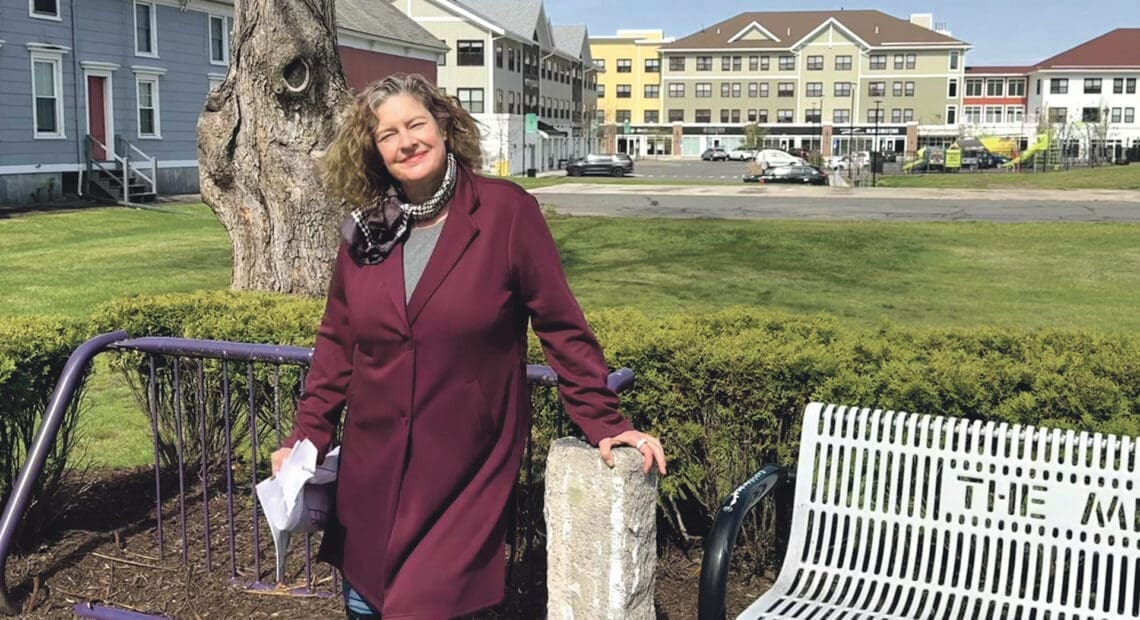
Cinda Jones, architect of the Mill District

Amy McDonough was working in the renewable energy business when, in her words, she “picked up pinball again” after putting it down following graduate school at the University of Vermont.

“I couldn’t get pinball off my brain, and I started picking up pinball machines here and there,” she told BusinessWest, adding that she would eventually amass a collection of nearly 70 machines. “And then, I was thinking about pinball much more than I was renewable energy.”

This thinking soon became serious in nature, and it led to an entrepreneurial venture called the Tilted Orbit Arcade, with that name borrowing two terms from the pinball world — orbit, which refers to the path for the ball along the outer rim of the game, and tilt, of course is when the machine is tilted or shaken beyond an acceptable level and the game ends.
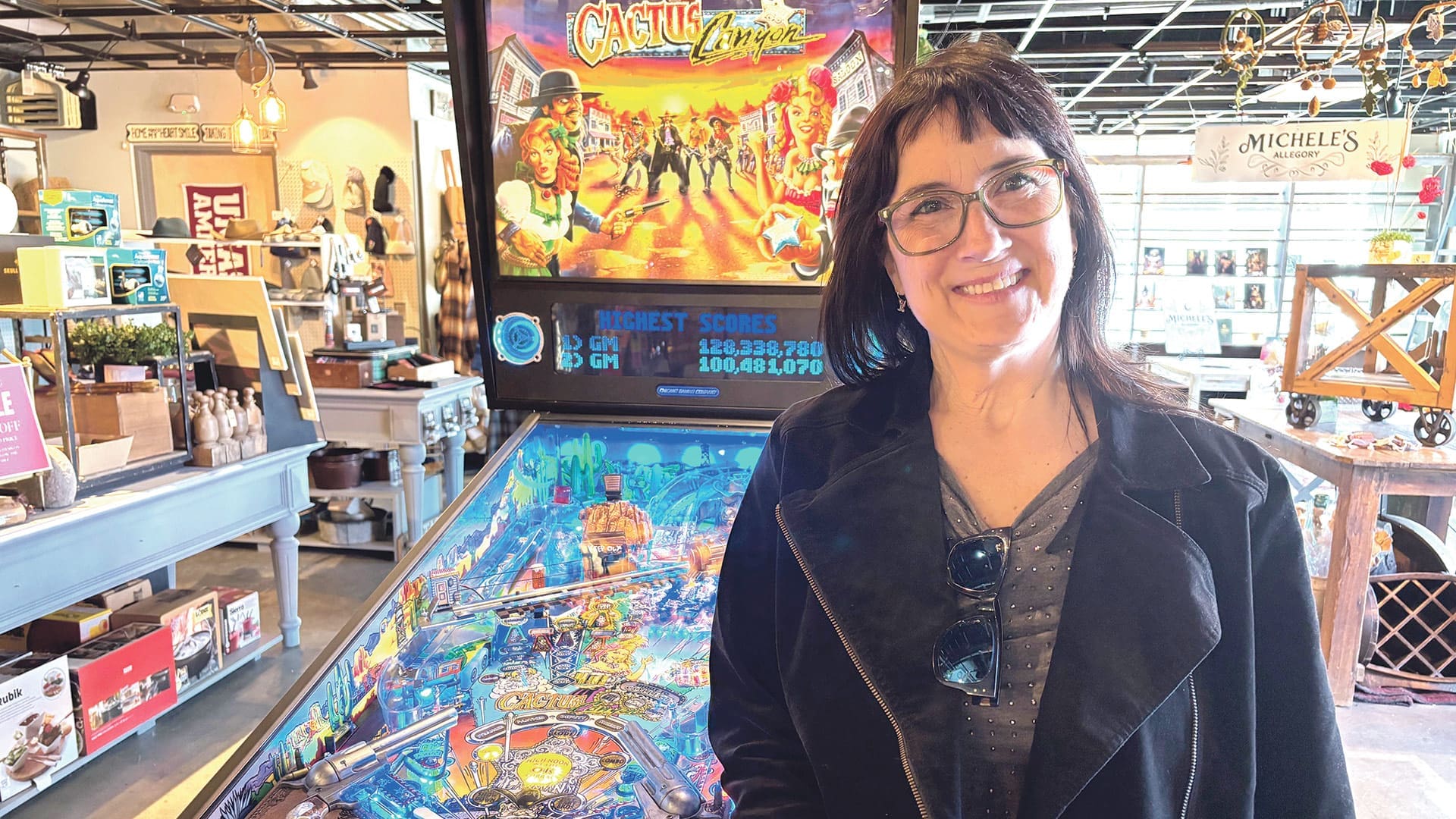
Amy McDonough with one of the more than 70 pinball machines she’s collected.

Due to open in the fall, the arcade will feature many machines from McDonough’s collection, as well as a golf simulator, a few vintage ’80s video games, a kitchen, and bar. It is being designed to attract many different constituencies, including families, area college students, teens, and the Boomers who discovered pinball in the ’60s and ‘70s, and then put it down.

And it is part of the ongoing evolution of the Mill District in North Amherst, a mixed-use facility that features housing, retail, art, and hospitality — a canvas that Cinda Jones, its architect owner, has been filling in over the past 15 years or so.

“We’ll still occasionally hear that people don’t know that the Mill District is here and how shocked they are when they find it.”

Indeed, Tilted Orbit will occupy what’s known as the Cow Barn, which was once home to Provisions, the wine and cheese emporium, which was moved to another building on the property (more on that later), and before that, Atkins, said Jones, adding that other additions and improvements include everything from a new pavilion taking shape on the site of another former barn, a new Herrell’s ice cream parlor (the company has been operating a small, pop-up facility the past few years); from recent additions such as Three Amigos, a restaurant that fuses the flavors of Chile, Mexico, and Puerto Rico and Carefree Cakery, and even some demolition  — of another former barn and a seven-car garage — that will improve visibility and allow travelers on Route 63 to see all that the site has to offer.

“We’ll still occasionally hear that people don’t know that the Mill District is here and how shocked they are when they find it,” said Jones, adding that the broad goal, as it has been from the beginning, has been to create what she called a ‘downtown’ in North Amherst, a mix of shops and amenities that deliver food, fashion, and fun — a true destination, attracting people from across Amherst and nearby Franklin County, but also a much wider circle.

Elaborating, she said current work involves creation of public open space, a ‘town common,’ leading from the highway to the shops. It will include the pavilion, which doesn’t have a formal name yet, although Jones calls it the ‘Manta Ray,’ because the architect has given it something approximating that shape.

It will include a catering kitchen and host a wide array of events, she said, adding that a tent has been erected on the site to hold gatherings such as a recent wine tasting staged by Provisions, with construction of the pavilion set to begin this spring, and due to be completed in time to host events this fall.
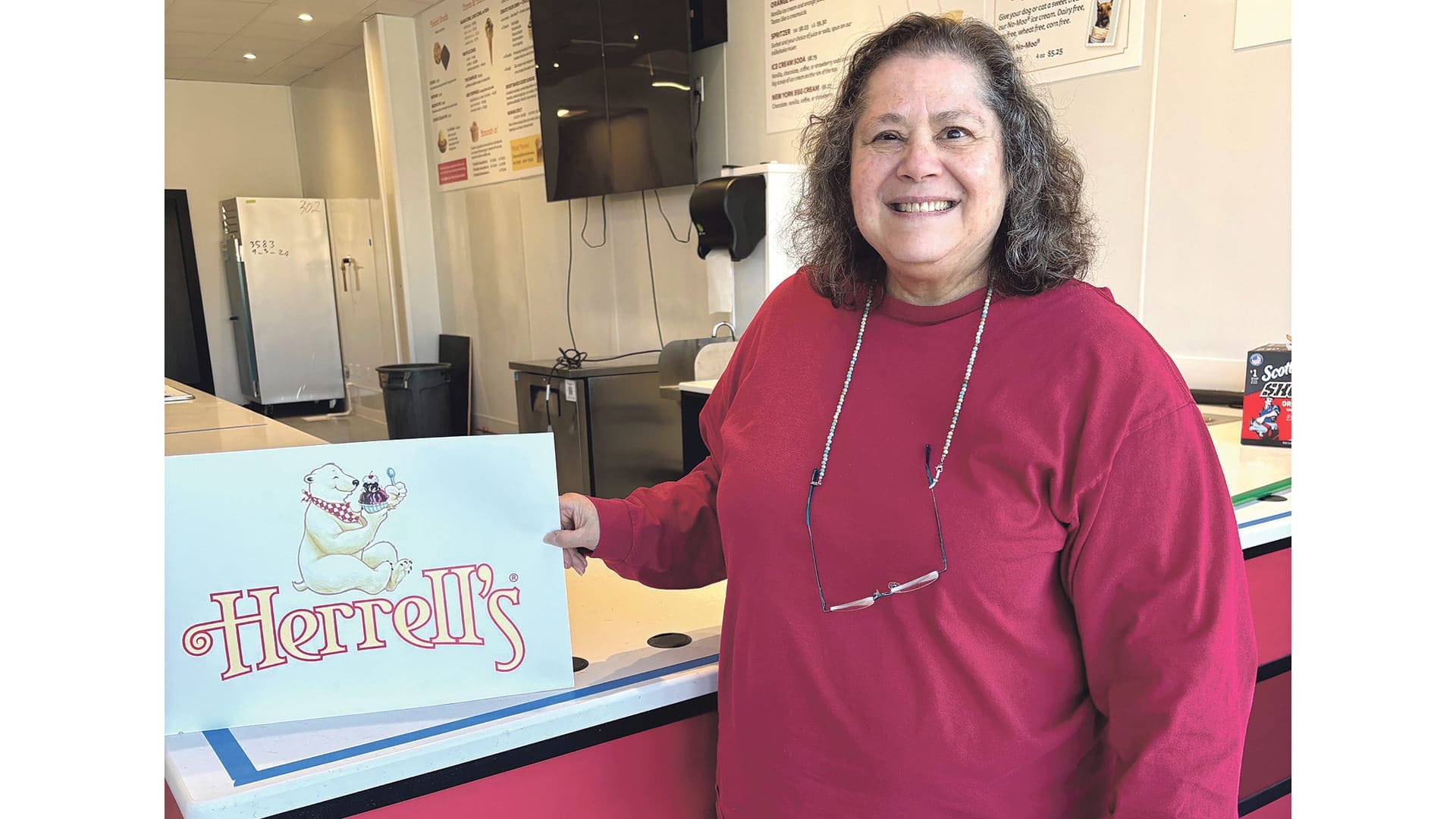
Judy Herrell stands in the almost-finished new location for Herrell’s in the Mill District.

The Tilted Orbit Arcade is one of many new developments at the Mill District, which has been in a seemingly constant state of change since it opened, and

Meanwhile, the location of the Mill District, and the diverse mix of tenants, eventually drew the attention of Judy Herrell, president of Herrell’s, who said the iconic, Northampton-based brand has been searching for a site for a second location, and zeroed in on North Amherst village.

“What we found out is that people didn’t want to venture over the bridge,” she said, referring to the Calvin Coolidge Bridge, which many in the Amherst/Hadley area simply don’t want to cross, even after significant infrastructure changes made it easier to do so. The new location, due to open in several weeks, will make Herrell’s more accessible, she said.

For this issue, BusinessWest talked with Jones and many doing business in the Mill District, or soon to do so, about this evolving concept and the diverse mix of ventures that are drawing visitors from across town and well beyond.


Flipping the Script

McDonough joked that her affection for pinball, developed while she was working toward her master’s degree at the UVM, probably put off her thesis by a year.

“I did a lot of procrastinating playing pinball,” she said, noting that one game in particular, The Addams Family, became especially addictive.

Just some of the local art to be found at the General Store.

It was among the first machines she acquired when she started building her collection, and it will be one of those on the floor at Tilted Orbit Arcade when it opens its doors, she said, adding that, before settling on the Mill District as home for her venture, she considered several other sites, including the Canal Lanes bowling alley in Southampton when it briefly came on the market.

The Mill District site offers what she was looking for, she said, meaning visibility and an opportunity to attract a diverse customer base, and also take advantage of a resurgence for pinball.

“It’s making a comeback; it started during COVID,” she noted. “Right now, pinball is serving mostly the male population, ages 40 to 65, but women are up and coming, and there’s a whole tournament world out there as well as leagues.”

McDonough said she’s looking to attract a wide audience that crosses all age groups, “families, seniors, teen-agers, college students, and adults.” And not just for pinball, but also the golf simulator, some arcade games, and other attractions she will offer, although the overriding goal is to inspire all those groups is to get them introduced to pinball and make them regulars.

“You can’t count on the weather in New England, and this will make it much easier to plan things.”

The Tilted Orbit Arcade is one of many new developments at the Mill District, which has been in a seemingly constant state of change since it opened, and the Cow Barn is where Jones began a detailed tour of the property.

Other stops included the town common area and spot for the new pavilion, which will provide larger, better space for the many types of events held there, and, especially, a roof, which will cut down on the rainouts and other weather problems that occurred with frequency last year or moving events to cramped indoor quarters.

“You can’t count on the weather in New England, and this will make it much easier to plan things,” said Jones, noting that the facility is being designed and built by Hardwick Post and Beam, and she is excited by the possibilities it presents.

“It will be a wonderful place where high school groups could perform, or you could have birthday parties,” she said, adding that performances could include seating in the pavilion and the lawn space outside, much like Tanglewood in Lenox.

And the pavilion is one of many steps being taken to attract more visitors and make the Mill District more of a destination.

“There are roughly 25,000 vehicle trips a day, including buses, that go within a block of the Mill District.”

Jones described the location as the ‘gateway to Franklin County,’ and on the route that many employees and students take to get from homes in communities like Greenfield, Montague, Conway, and Sunderland to jobs at UMass Amherst, nearby Northampton or points to the south. From the beginning, the goal has been to create a community, a village where people can shop, eat, see and buy art, and take in the many cultural events staged by tenants.

“There are roughly 25,000 vehicle trips a day, including buses, that go within a block of the Mill District,” she noted, adding that the goal is provide reasons to pull over and explore, while also creating a tenant mix and calendar of events that would prompt planned visits from across the region.

“My goal is to make this a place where community members, full-time, long-term community members, enjoy connecting with friends and enjoy the spaces and shops we’ve brought together,” she said.

The mix of tenants has changed over the years, said Jones, adding that she has always been looking to improve that mix and provide more to see and do. Most of the space is occupied, or soon to be occupied, she noted, adding that there is roughly 4,500 square feet — with high ceilings — available in the building currently home to Provisions.

“We’re listening to people, hearing what they like, and responding to what they’re saying,” she said, adding that this strategy applies to tenants and visitors alike.

Meanwhile, there are concerted efforts to make the Mill District more visible, literally and figuratively, said Jones, adding these include the creation of the common that will improve sight lines to the shops as well as new signage currently winding its way through the permitting process. 


Food for Thought

As they talked with BusinessWest, Jose Diaz and Matias Martinez, owners of Three Amigos, the next stop on the tour, were gearing up for Cinco de Mayo.

They were putting together a special menu for the occasion and were expecting a strong turnout for what has become a day of celebration for many in the region.

But most days have produced good crowds at this unique eatery, which, as noted earlier, blends dishes from Puerto Rico, Chile, and Mexico, with many offerings inspired by meals prepared by the owners’ mothers.
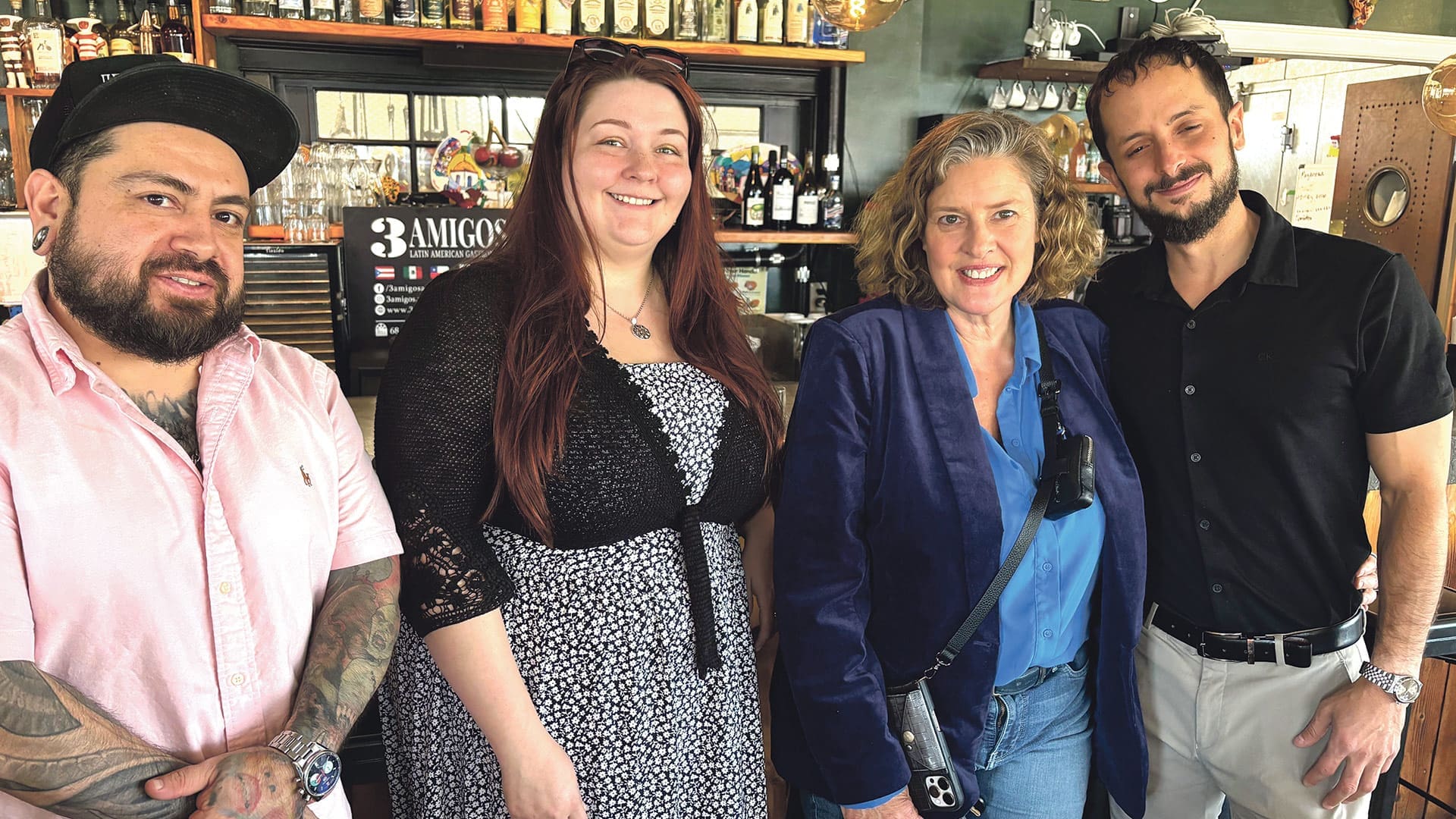
Matias Martinez, left, and Jose Diaz, co-owners of Three Amigos, share a moment with Cinda Jones and Shauna Wallace, project manager of Mill District General Store and Local Art Gallery.

“My mom has some really good recipes, and Jose’s mom has really good recipes from Puerto Rico; we take both and we put together a good menu,” said Martinez, a native of Chile, adding that Diaz also brings knowledge of Mexican cuisine to the table — literally and figuratively.

This knowledge and deep menus will have even more local flavor, said Diaz, adding that the partners are now committed to buying more locally produced vegetables, meats, eggs and more, and are further committed to bringing different kinds of experiences to the venue, such as karaoke nights.

“My mom has some really good recipes, and Jose’s mom has really good recipes from Puerto Rico; we take both and we put together a good menu.”

And, like other business owners in the Mill District, the two partners (there was a third, hence the name, but he is no longer involved) said the location brings a diverse mix of patrons across all age groups.

As Jones’ tour of the Mill District left Three Amigos, it made a quick stop in the vacant space adjacent to Provisions and below housing units. As noted earlier, it has high ceilings and what she considers enormous potential as home to a small grocery store, an indoor play space for kids, or similar that will be compatible with and complementary to everything else that exists on the property.

From there, the tour would continue to several existing and emerging businesses, such as Provisions, Futura Coffee Roasters, Carefree Cakery, Everbloom Salon, the Balanced Birch Studio, the Mill District General Store and the art gallery inside its walls, and the Herrell’s now taking shape.

Not on the tour, but technically part of the Mill District are businesses in a mall on Route 63, including Amherst House of Pizza, Big Guys Liquors, Mindy’s Barber Shop, and the Harp Irish Pub.

Collectively, these businesses provide ample reasons to get off the highway, whether one is heading home from work or planning a day trip, said Jones, adding that the Mill District comes as advertised, with that mix of food, fashion, and fun, including several play areas for children and families.

Herrell’s will make an intriguing addition to the mix, she said, adding that the pop-up facility has attracted solid numbers of visitors, and the larger, permanent space is expected to bring more.

Herrell told BusinessWest that the new location needs to be open by summer, for obvious reasons, and it is on track to do so.

She said the location in the Mill District brings the brand closer to other markets, such as Franklin County, and also closer to UMass Amherst, where she teaches a course — a lab on how to make ice cream “from a chemistry point of view” — and partners with the university on an ice cream competition, which is the final exam, if you will, for the that class, with Herrell’s featuring the winner’s flavors in its stores.

“We try to make all of them if we can, but we definitely make the four top finishers,” she said. “We’ve had some incredibly great, creative ideas from that group, and their lab is one mile from here.”

Beyond that partnership, Herrell’s is looking to tap into a broad base of loyal customers that know the Northampton store and now have something that for many will be more convenient.

And then, there’s the Tilted Orbit Arcade, which will present a novel new use for the Cow Barn, and an interesting addition to the mix.

For McDonough, it’s her first real entrepreneurial venture, which means there’s a mix of excitement and trepidation.

Overall, she’s optimistic that she can make something a little different work out in a big way. And in many respects, that’s been the goal at the Mill District from the very beginning. 

Education Special Coverage

Keeping School in Session

When Michael Dodge, provost at American International College (AIC), surveys a higher-education landscape that has seen two Massachusetts institutions, Hampshire College and Anna Maria College, announce their imminent closures in the coming weeks and months, he hears warning bells — and a call to action.

“We are seeing more disruption in the market, including institutional closures, which create both uncertainty for students and instability in regional enrollment patterns,” Dodge said. “When a college closes, it is not just about numbers. It is about students needing continuity, clarity, and trust in where they land next. Institutions that cannot respond quickly and transparently in those moments will struggle.”

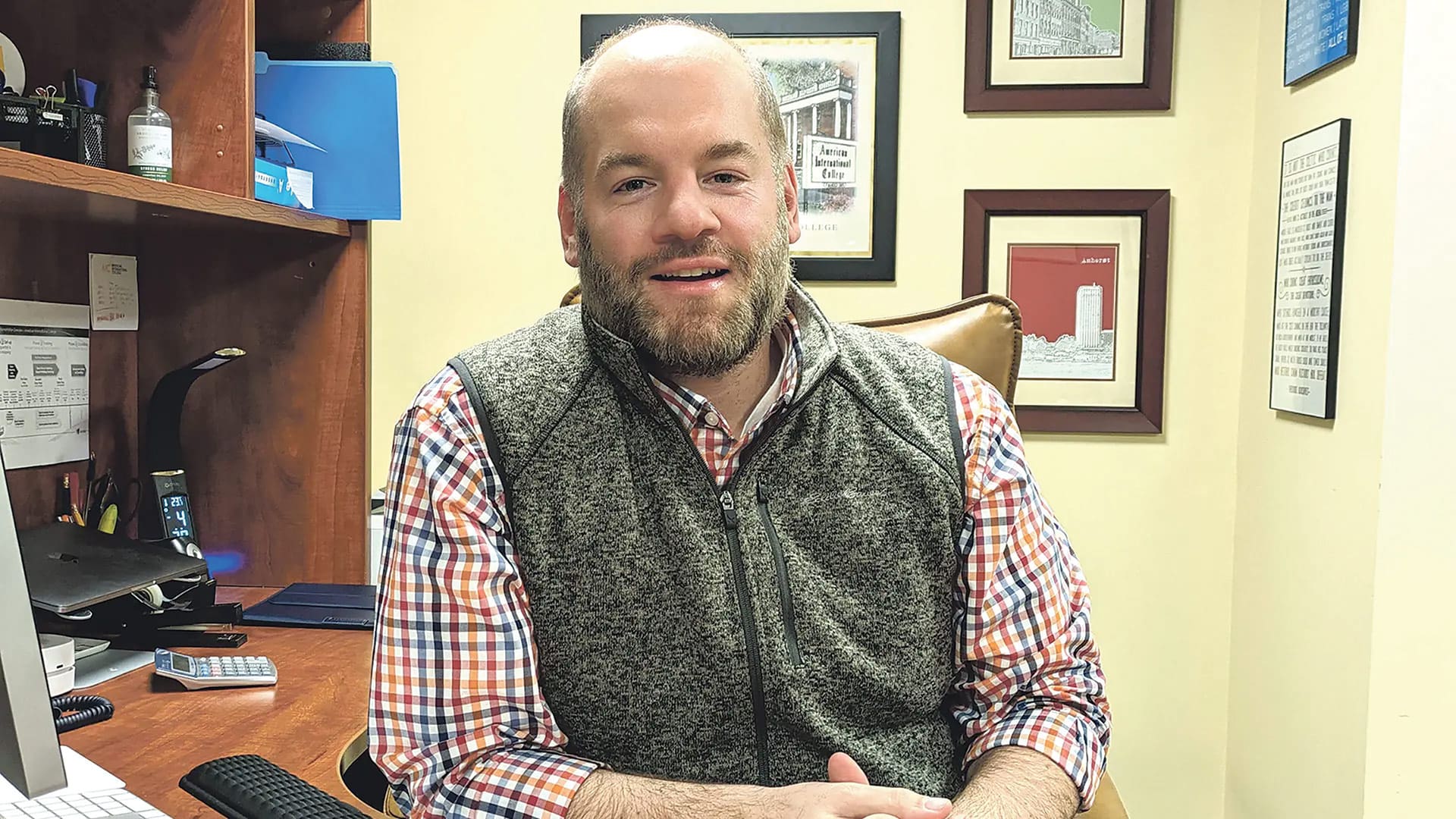
American International College Provost Michael Dodge

Michael Dodge says colleges that want to survive and thrive must focus on matching their offerings to workforce needs.

When Hampshire College announced it will shut its doors at the end of 2026, it wasn’t the biggest surprise; the unconventional Amherst institution had been struggling with low enrollment and other challenges for some time.

“We worked aggressively to increase enrollment, refinance existing debt, and realize new revenue via the sale of a portion of our land. We have long known that addressing these issues is essential to establishing a stable financial foundation, supporting long-term operations, and meeting regulatory requirements,” President Jennifer Chrisler and the board of trustees noted in a letter to the Hampshire community. “We are faced with the clear, heartbreaking reality that progress on each of these three key factors has fallen far short of what we had hoped.”

Still, it was a jolt to a college community that has long prided itself as a successful model of an alternative, largely self-guided education that has produced numerous high-profile graduates over the decades, from Ken Burns to Liev Schreiber to Elliott Smith.

“Higher education is entering a period where demographic pressures are real, but they are only part of the story. The more immediate challenge is a shift in how students and families evaluate value. Cost sensitivity, clarity of outcomes, and speed to degree are all under greater scrutiny than they were even a few years ago.”

The Anna Maria announcement may have been more of a jolt, as it is shutting down the Paxton campus this month, following the end of the spring semester, rather than at the end of the year.

“For months, the board of trustees, our leadership team, and the Sisters of Saint Anne walked a distressing road together, examining every option and hoping at each turn that something might change,” President Sean Ryan and the board of trustees wrote, also in a community letter. “The decision reflects years of financial pressure that we were ultimately unable to overcome, and the honest recognition that continuing would not be responsible to the students, faculty, and staff who depend on us. We tried to find a way. We are grateful to everyone who tried alongside us. And we are deeply, genuinely sorry we found no viable path forward.”

The closures are sounding alarm bells because a looming ‘demographic cliff’ already has colleges and universities nationwide concerned. According to a recent study from the Federal Reserve Bank of Philadelphia, about 60 of the nation’s roughly 4,000 colleges are closing, on average, each year — a number that could double in any given year if the bottom falls out of enrollment, according to a recent analysis in the Atlantic by Jeffrey Selingo.

“If the harm were only to the institutions forced to close because they’re running out of customers, that would be unfortunate, but not tragic. But the causality runs in the other direction too, as students who otherwise would have gone to college find themselves with no viable option in the place where they live,” Selingo wrote.

He explained that American higher education has long consisted of two markets: one where high-achieving, typically affluent students compete for seats at national universities, and one where mostly middle- and lower-income students study closer to home. “Members of the first group will be fine even as college closures accelerate. The second group will suffer. After many decades of democratization, higher education could once again become a luxury good.”

However, Dodge noted that the demographic trends are just one element among numerous looming issues for colleges.

“Higher education is entering a period where demographic pressures are real, but they are only part of the story. The more immediate challenge is a shift in how students and families evaluate value. Cost sensitivity, clarity of outcomes, and speed to degree are all under greater scrutiny than they were even a few years ago,” he explained.

“At the same time, traditional pipelines are evolving. High school populations are changing, adult learners are expecting more flexibility, and employers are placing greater emphasis on skills and credentials that align directly with workforce needs,” he went on. “Institutions that remain overly dependent on a single student population or a static program portfolio will face increasing pressure.”

Return on Investment

Molly Miner, vice president of Enrollment Management and Marketing at Elms College, told BusinessWest that most private colleges, especially in New England, have experienced enrollment challenges, as the demographic cliff has already created increased competition among the shrinking pool of traditional first-time students. Meanwhile, the majority of Elms students come from the New England region, which is among the hardest-hit regions due to these shifting demographics, and its leaders have adjusted their recruitment strategy to broaden our applicant pool.

“The declining international student enrollment at schools nationwide, coupled with the changing domestic demographics, has created challenges for all colleges, particularly small colleges,” Miner noted. “There is a trickle-down effect when the most selective institutions, which have traditionally had large international enrollment, shift their strategy and expand their reach more broadly into the domestic pool, increasing competition for other institutions.

“Another challenge is the broader national conversation around the cost of higher education and student loan debt, which influences how students and their families think about college,” she added. “More than 30% of high school graduates do not enroll in college immediately after graduation, which further compounds the enrollment challenges.”

The cost factor should actually benefit community colleges, especially in Massachusetts, where residents can attend for free, thanks to a two-year-old program called MassEducate, which has resulted in enrollment increases at those institutions across the state.

“We have strong partnerships with employers, both nationally and regionally, to ensure their current and future employees have the education and training needed to succeed in a rapidly changing professional landscape, while also informing program development.”

But four-year, private colleges have to attract a shrinking pool of potential enrollees in different ways. James Birge, who is retiring as president of Massachusetts College of Liberal Arts in North Adams, acknowledged the current pressures, but is optimistic.

“The demographic enrollment cliff is here. It’s already hitting small, private colleges hard. Sadly, more will close in the next five years as the recruiting market contracts and institutions struggle to attract students,” he told BusinessWest.

“But public institutions like MCLA are in a genuinely strong spot. We’re affordable. And we’ve spent the last few years making deliberate moves to become a college of choice,” he went on, noting, as examples, that MCLA has added nursing, radiologic technology, and music industry and production because that’s what students are looking for, as well as adding athletic programs in lacrosse and ice hockey.

“We’ve built up endowed scholarship funding so more students can afford to come here,” Birge went on. “We’ve strengthened academic and personal support so students don’t just enroll — they stay and finish. We’ve put smarter investment strategies in place to keep operations funded. And we’ve maintained our accreditation, meeting every standard, including the financial ones.”

Miner points to Elms Promise, an initiative at the Chicopee college that aims to reduce cost as a barrier for students who demonstrate strong academic performance and financial need. She also points to the institution’s strong relationships with community colleges in Massachusetts and beyond, enrolling their graduates into its undergraduate programs through transfer and continuing education pathways.

“At Elms, we are able to leverage our small size to remain nimble and responsive in the face of these challenges,” she said, noting that its undergraduate curriculum combines a strong liberal arts foundation with real-world learning opportunities.

“Experiential learning is a core component of the student experience. Nearly 100% of Elms undergraduate students participate in experiential learning, including internships, clinical placements, research, service learning, and creative scholarship. Students engage in real-world learning from day one,” she added, noting that these efforts begin in the first semester with something called the Innovation Challenge, which encourages students to work together to find solutions to real-world problems.

“These initiatives lead to strong outcomes,” Miner said. “Ninety-seven percent of students who completed our most recent graduation survey reported that they are employed or enrolled in a graduate program after leaving Elms.”

Even at the graduate and continuing education levels, she noted, academic programs are tailored to meet the needs of the evolving workforce.

“We have strong partnerships with employers, both nationally and regionally, to ensure their current and future employees have the education and training needed to succeed in a rapidly changing professional landscape, while also informing program development,” Miner said, citing as examples recently added programs like graduate degrees in social work and applied behavior analysis, as well as an online bachelor of social work degree. “These programs are intentionally designed to align with workforce demand and address critical shortages of care providers throughout Massachusetts and New England.”

At Springfield-based AIC, Dodge agreed that colleges that want to survive and thrive must focus on matching their offerings to workforce needs.

“Maintaining an edge comes down to alignment. We are continuing to align our academic programs with workforce demand, particularly in high-need areas such as health sciences, public service, and emerging fields like data analytics. We are also expanding flexible delivery models, including online and accelerated formats, to meet students where they are.

“Equally important is strengthening our pipeline,” he added. “Partnerships with schools, transfer pathways, and employer-aligned programs are helping us reach students earlier and support them more effectively throughout their journey. Finally, we are focused on clarity. Students want to understand where a program leads and how quickly they can get there.”

Focus on the Future

Both the Hampshire College and Anna Maria College announcement letters noted that, for students unable to complete their degrees, transfer agreements with partner institutions are being created; indeed, AIC, Elms, and MCLA all announced such partnerships and outlined ways to smoothly transfer displaced students to their own communities.

“We planned and prepared for this by adding programs students want and employers need, building endowed scholarship funding, strengthening support, and making smart financial moves to keep us on solid ground.”

“At AIC, the focus is on being both responsive and intentional,” Dodge said. “In the immediate term, that has meant acting quickly to support students … by creating clear, student-centered pathways that allow them to continue their education with minimal disruption. The priority has been reducing uncertainty and providing stability during a challenging moment.”

Added Miner, “at Elms College, we have the resources and support systems in place to provide a seamless transition so students can stay focused on achieving their academic and professional goals within a caring and supportive environment.”

In the meantime, Birge said MCLA will take the appropriate lessons from the closings and continue to focus on ways to move forward as the demographic landscape continues to evolve.

“We planned and prepared for this by adding programs students want and employers need, building endowed scholarship funding, strengthening support, and making smart financial moves to keep us on solid ground,” he added. “Challenges ahead? Of course. But I like where we stand.” 

Healthcare News Special Coverage

This Career Brings Plenty of Challenges, but Also Rewards

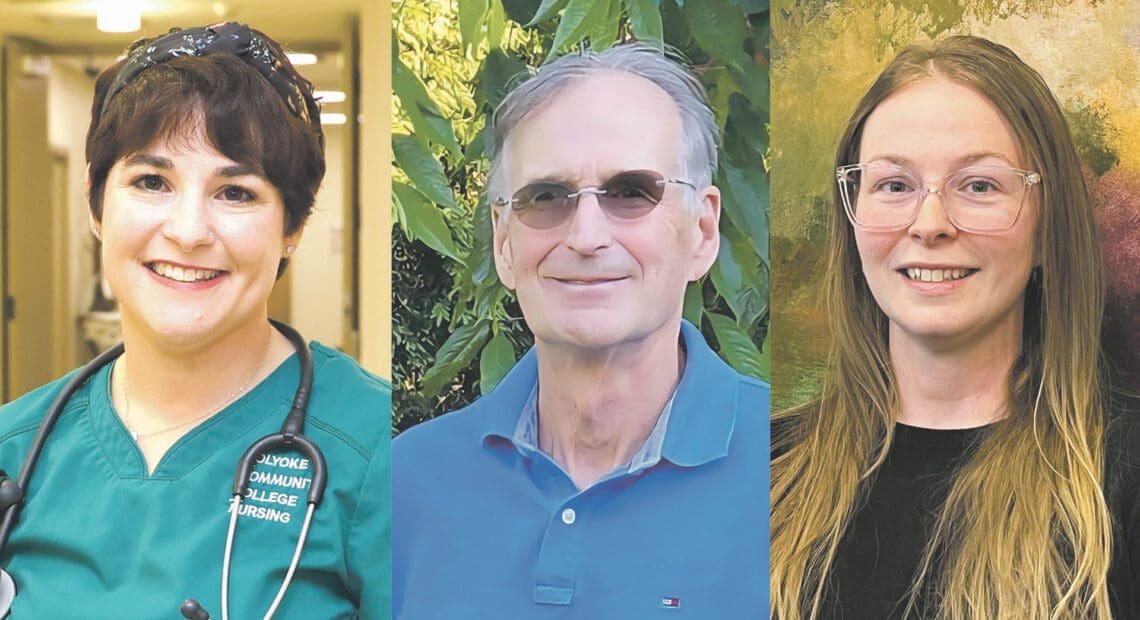
Left to right: Maddy Gray, Dick Easton, and Jolene Alexander.

Left to right: Maddy Gray, Dick Easton, and Jolene Alexander.

Behind every nurse, there’s a story — in many cases, several stories. They involve why the individual in question chose to get into this profession, how their work inspires others, and, very often, how they overcame different kinds of adversity to get where they are. For its annual salute to nurses, BusinessWest tells three such stories. They typify the resilience and passion of all those who choose this profession and are as compelling as they are inspirational.

Click on each name to read their story:

Maddy Gray

Despite a Cancer Diagnosis, She Refused to Let the Dream Die

Dick Easton

This Nurse Proves That Age Really Is Just a Number

Jolene Alexander

‘Earn-and-Learn’ Initiative Has Helped Her Realize Her Dream

Community Spotlight Features Special Coverage

They called it the Woods O’Cross.

That’s the name that was affixed to a recent event at Motocross 338 in Southwick, a.k.a. ‘the Wick.’ And as that name suggests, it’s a race that takes participants onto the vaunted track behind American Legion Post 338 on Powdermill Road, and also into the woods nearby.

“It was really well received; we were amazed at how many people came out for it; the feedback was phenomenal, so we’re going to another one this month and another at the end of the year,” said Rick Johnson, who, with his son, Keith, is now coordinating events at the Wick, which has, for most of the past 50 years, been a destination as well as a driving force, literally and figuratively, in the local economy.

The Ranch Golf Club has become a draw for players across the state and beyond.

The venue now hosts more than 40 events each year, capped by the Nationals, the three-day event that has become a tradition in Southwick, with dates that are circled by many business owners in town because the population of people in town swells from roughly 9,000 people to more than 30,000.

The nationals will be in July this year, said Johnson adding that, because Southwick doesn’t have any hotels, attendees must stay in surrounding communities. But many other types of businesses in town see and feel the surge, he said.

“You need to have a passion for it. If you handle it properly, you’ll pay the bills and make a few bucks. But you’re never going to retire in the Bahamas and drive a Lamborghini.”

The Wick is one of many recreation and hospitality-related businesses that give Southwick its unique flavor. People come here to eat — there are many restaurants and institutions such as Mrs. Murphy’s Donuts in town — and to play.

They do so at the Congamond Lakes (North, Middle, and South) which offer boating, fishing, swimming, and lakeside dining, and also at several parks, the Wick, and two golf courses (there used to be three), including The Ranch Golf Club.

Now celebrating its 25th year, the Ranch, on Sunnyside Road, is a higher-end course that was designed to be a destination layout that would draw players from across the state and beyond, and a sought-after venue for weddings and other events.

And it has become just that, said Nick Tamburini, the Ranch’s general manager and former golf professional. He told BusinessWest that the club has enjoyed a solid run on both sides of the ledger, with golf continuing to ride a COVID-induced wave of new interest and renewed interest, and events bouncing back from the turmoil prompted by COVID.

On the golf side, the course, among the best and most challenging in this part of New England, continues to draw players from well beyond Western Mass., while maintaining a steady local membership.

“We have a ton of non-local play,” said Tamburini. “Every Friday, Saturday, and Sunday, we’ll get players who say, ‘I drove an hour and a half,’ or ‘I drove two hours;’ ‘I’m coming from the Cape,’ ‘I’m coming from New London.’ Obviously, we get a lot of play from Hartford and from Worcester. Once the member play ends, there’s not a lot of play on Friday, Saturday, and Sunday from people in Southwick or Westfield; it’s people coming from all over.”

“You have to try things like this; you have to freshen things up and give people new things to do.”

Some of these players will make the Ranch part of a Western Mass. golf trip, with Crumpin Fox in Bernardson and Taconic in Williamstown among the other stops, he went on. But many are coming just to play the Ranch, which has received good reviews over the years, and continues to draw both first timers to the venue and repeat customers.

On the events side, the venue continues to draw a solid mix of gatherings, and its barn has become increasingly popular with couples planning weddings, as we’ll see.

For this, the latest installment of its Community Spotlight series, we take an in-depth look at Southwick and the some of the institutions that help create its recreational quality.


On the Right Track

When asked about the business of motocross, Johnson paused for a minute, searching for the right words.
“I’ve been in business all my life — I’ve been in the footwear business and was president of New Balance for Kids,” he explained as he set the tone. “Motocross is not kind of business that you get into thinking it’s going to lucrative to the point where you’re dancing naked in the streets.

“You need to have a passion for it,” he went on. “If you handle it properly, you’ll pay the bills and make a few bucks. But you’re never going to retire in the Bahamas and drive a Lamborghini.” 

Passion is something the Johnsons brought with them as they helped resurrect motocross in Southwick after a few years of decline more than a decade ago.

But they brought some other traits as well, including imagination and a willingness to try new things to keep the product fresh and bring more people to the track — meaning competitors and spectators alike.

Which brings us back to the Woods O’Cross.

“It brings in not just the motocrosser, but the trail rider as well — you get a good mix of people, and they had a great time,” Johnson explained, adding that this was the first new event that organizers have run, and it drew close to 600 participants. And it was followed up a few weeks later by another new offering — a Massachusetts state championship.

“We’ve been racing since the ’70s, and we never realized that Massachusetts never had a motocross state champion,” he said, adding that the Wick rectified this with an event that drew good crowds and hundreds of competitors to the track.

“You have to try things like this; you have to freshen things up and give people new things to do,” he explained, adding that the Wick has a full slate of events on tap for the year.

The Johnsons brought another trait to this venture — a willingness to re-invest in the facilities and continually upgrade the facility, known hills and overall stern challenge.

Indeed, over the years, they’re added a new scoring tower, a new starting line, new irrigation lines to water the track and make it safer for riders, and more.

“We’re the only national track in the Northeast, and we have a reputation, and we have a commitment to maintain the highest level that we can,” he explained. “When you are national caliber and you’re on NBC television (for the nationals), you can’t slack off, you have to make sure you do it the best you can.”


Round Numbers

“Barns are in … people want old, rustic, charm.”

With that, Tamburini started to explain why the Ranch has been doing well on the events side of the operation’s ledger, specifically weddings.

Indeed, couples are looking for different kinds of venues these days, and barns have become a popular choice. The Ranch has two of them — extensively renovated — that date back to the late 1800s; one houses the pro shop and restaurant/pub, and the other is used for functions.

“We’ve had the same number of rounds every year since COVID, which is good. COVID created a boom, and we were worried that we couldn’t maintain those numbers, but we have; it’s been really good.”

This trend, coupled with a resurgence in gatherings following COVID has helped the Ranch put more events on the calendar, he noted.

“We’re not the busiest venue in Western Mass., but we do between 40 and 50 weddings a year, on average, and probably the same number of other events, like retirement parties, baby showers, and bridal showers.” 

Tamburini said the Ranch benefits from strong, hands-on ownership — Pete and Korby Clark and a partner living in the Boston area — and a team that has remained intact for the past several years, a rarity in this business.

“We’ve had the same superintendent, the same event coordinator, the same front-of-house manager, the same chef,” he said, adding that this continuity helps the operation provide consistent, high-quality services, from the course to the event facilities. “At a golf course, that’s extremely rare; I’ve been around a little bit, and I know that’s hard to keep the same people for an extended period of time in our industry.”

As for the course itself, while it’s pricey — $125 for 18 holes and a cart, peak season, among the highest fares in this part of the state — it continues to be a strong draw, and because it’s semi-private (although Tamburini doesn’t like that phrase) it’s more playable that private venues such as GreatHorse and Longmeadow.

“We’re a public golf course,” he said, adding that players can book tee times all seven days of the week, although there are often tournaments on Mondays and early Saturday morning is reserved for members.

Overall, golf enjoyed a surge from COVID because so many other activities were put on ice, and the Ranch, like many venues, has been able to maintain the momentum generated by that unique moment in time.

“We’ve had the same number of rounds every year since COVID, which is good,” he noted. “COVID created a boom, and we were worried that we couldn’t maintain those numbers, but we have; it’s been really good.”

And many businesses in this recreational community can say the same thing. 

Healthcare News

Despite a Cancer Diagnosis, She Refused to Let the Dream Die

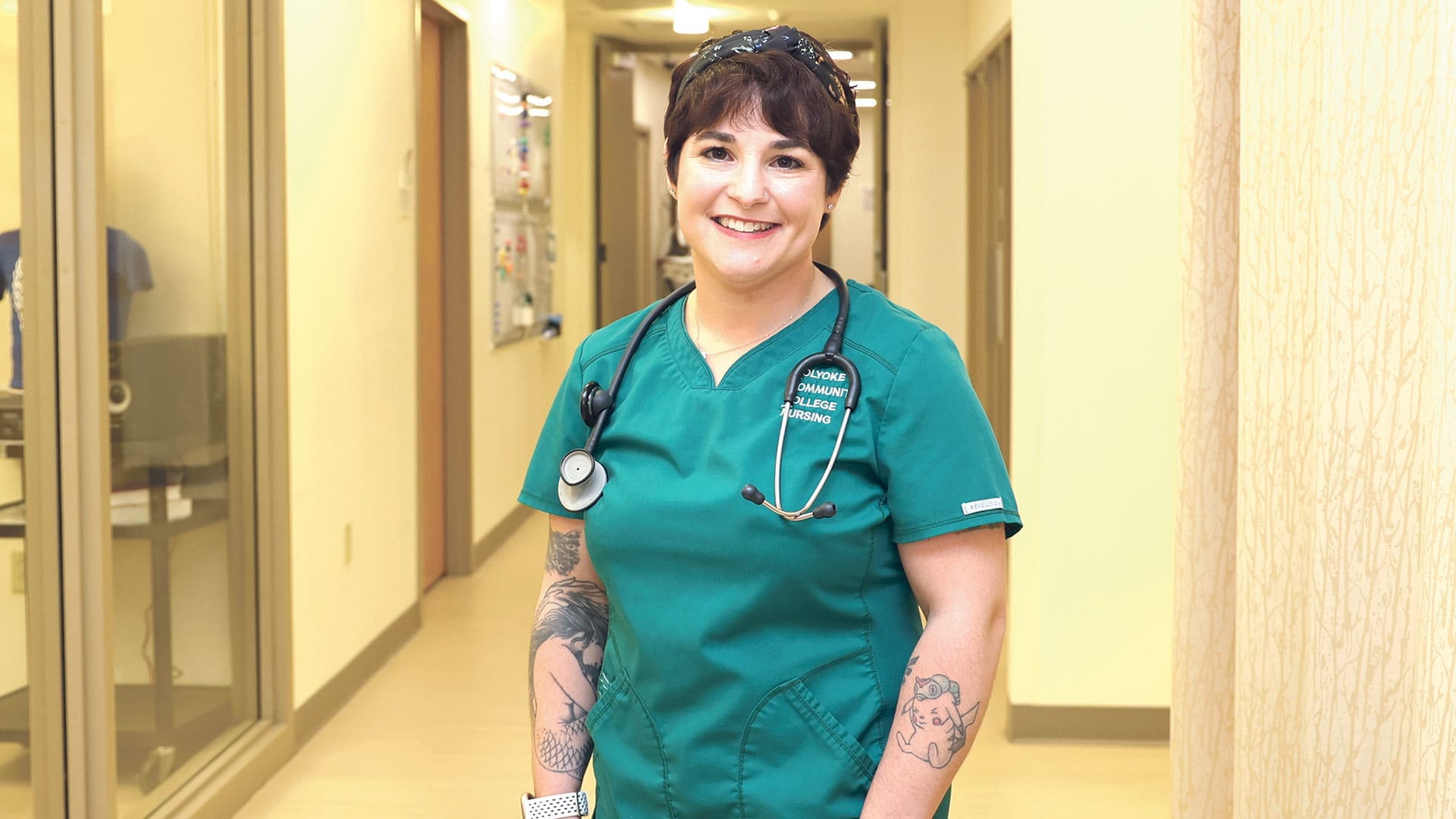
Maddy Gray

Maddy Gray

Maddy Gray decided to attend the nurse-pinning ceremony at Holyoke Community College a year ago. She described it as an attempt at finding some type of closure.

She should have been up on the stage getting her pin, but instead, she was in the audience looking up at her classmates and coping with a sea of emotions resulting from a cancer diagnosis and ongoing treatment that left her firm of the opinion that her decade-long dream of becoming a nurse had come to a bitter end one semester short of the finish line.

“At that point, I was so sure, so positive that this job wasn’t for me anymore,” said Gray, who told BusinessWest that it was a big hug from Johanna Kassidi, one of her professors, that night and her simple comment, ‘I hope that you’re coming back in the spring — we need more nurses like you in this field,’ that made her think that maybe, just maybe, the dream wasn’t dead after all.

Fast-forwarding through six months of chemotherapy, an eventual diagnosis that she was in remission, and that last semester at school, Gray will be back for another nurse-pinning ceremony in a few weeks, and this time she will be on stage, dealing with a completely different set of emotions that could not have been imagined a year ago.

When her name is called, it will mark the climactic end to a truly remarkable story of perseverance that began almost a decade before it was confirmed that she had cancer and, actually, long before that, when this foster child who was abandoned by her mother while her father was serving a life’s sentence, fought an ongoing battle with thoughts that she couldn’t achieve the goals that most others take for granted.

Gray spent many years not really knowing what to do with her life. Fighting through the stigma of foster childhood, she obtained her GED and began her college journey in 2012, not really knowing which direction it would take. She thought about early childhood education and other realms where she could work with children. But things changed when a friend talked enthusiastically about her nursing degree and the work she would be doing.

So, she decided to pursue a Nursing degree herself. But there would be life challenges to confront, including young children and the availability of childcare, forcing her to attend at night, a course or two at a time.

She was making her way toward her degree, when she was confronted with a challenge that was formidable as it was unforeseen.

Indeed, Gray told BusinessWest that she was driving to class when she felt a strange lump on her neck. It would take months before it was officially determined that she had a large mass in the center of her chest and it was cancer, specifically Hodgkins Lymphoma. She remembers telling a close friend that she would have to drop out of nursing school to battle the disease.

And it was early in the treatment stage that she ventured to the nurse-pinning ceremony, a time when she was not at all sure she would survive the cancer, let alone return to school and complete her degree program.

“I was so close … I was one semester away from graduating, I was crossing that finish line,” she recalled. “And I got hit with that. I was pretty depressed for a long time, and I was convinced that I was never going to be a nurse; I had worked toward something since 2016 that was my dream, and now it was ripped out of my hands and gone forever.”

Until it wasn’t, thanks to those words of encouragement from Kassidi and Gray’s own determination to move forward with her last semester of work, even as she was still waiting to find out conclusively if she was in remission.

As the 2026 nurse-pinning ceremony approaches, Gray has been doing some reflecting, while also getting on with the next stages of her journey.

Indeed, as she braces for the National Council Licensure Exam (NCLEX), she has been offered a job on the mental health unit at Baystate Franklin Hospital in Greenfield and is expected to start in August, if not sooner.

As for that pinning ceremony itself, she knows it will be an emotional time, one a world apart from what she was experiencing a year ago.

“I’ll be standing in the front getting pinned, looking out toward where was I was standing a year ago, feeling hopeless, that my dreams were unfairly ripped away from me,” she said. “This year, I’m going to be standing there, thinking about all the things I’ve endured in my life. Being able to get back up and do it … I’m grateful for that, so it will be a very emotional moment.”

Putting her long journey into perspective, she said there are lessons for others — about not giving up and not letting go of dreams, even when the obstacles seem insurmountable, but also about listening to those who provide encouragement and taking full advantage of the many resources available to those who want to pursue their own goals.

Her message to all is summed up in a scholarship essay she wrote and read at a ceremony for scholarship recipients in 2024, well before her cancer diagnosis. Here’s a passage:

“Thinking back to all I’ve survived, the common denominator is clear, it’s resilience. Life has thrown many curveballs my way and I’ve had to fight like hell to get back up each time. Some hit way harder than others, which made getting back up increasingly more difficult, but the alternative seemed worse. Staying down meant giving up on myself, and for a time, I did give up. … Thankfully, I woke up and decided that enough was enough. I had finally come to the realization that the only thing holding me back was myself.”

She stopped holding herself back long ago, and in the years to come she determined that nothing else would her hold her back. Not even cancer.

Healthcare News

This Nurse Proves That Age Really Is Just a Number

Dick Easton

Dick Easton

Dick Easton attended nursing school at UMass Amherst with students roughly one-third his age.

He started work as a nurse at Cooley Dickinson Hospital in Northampton when he was 62, the age when many in this profession are retired or thinking seriously about it. He was nearly 70 when COVID hit, and while that ultra-challenging time prompted many in the field to head for the exits, it only deepened his passion for this second career.

“It brought even more meaning to my life — it just motivated me to stay at it,” he told BusinessWest. “It was a very trying time, but when you met the challenges, it was incredibly satisfying. There was a lot of heartache because of deaths in the hospital, but it had incredible meaning to me every single day, and never once did I say ‘God, I can’t take it, I’m going to quit.’”

Easton’s story is certainly an inspiring one, a saga that drives home the point that age really is just a number, and not a limitation or a boundary to anything that one might want to do.

It’s a story — well, this chapter, at least — that begins in late 1997, when Easton’s older son was severely injured in a skiing accident. It turns out that this would be the first of three incidents — Dick’s own heart attack a few months later and his younger son’s back injury while at work a few months after that being the other two — that enabled him to see all that nurses and other healthcare professionals did for patients and family members. And it compelled him to start thinking seriously about a later-in-life career change.

“I credit the nurses that took care of myself and my family with instilling in me the desire to help people through health crises; I started thinking, and I started assessing where I was in my life,” said Easton, who was in his late 40s when these health incidents changed the trajectory of his career and his life. “It made me realize that nurses did much more than take care of patients; they were also taking care of the surrounding family.”

So, Easton, a small-business owner — one of his ventures shipped shoring timbers to Boston for the Big Dig — started shadowing nurses in many different settings and departments, from private physicians’ offices to the ER, and after nearly two years of … let’s call it research, came away determined to join the profession. That’s what he told his wife in a far-reaching conversation that would prepare the ground for what was to come.

“I told her I wanted to become a registered nurse and explained to her why, and she said, ‘I think that would be great,’” he recalled. “But we had obligations to both our children, and we said we would see them through their college and graduate school if they so desired, and we had a mortgage on our house; we agreed that I could pursue a nursing career once we had paid off all our debt.

“And so, for the next nine years, we did nothing but pay down debt,” he went on, adding that when they reached the end of that road, he enrolled in what’s known as the Second Bachelor’s program at UMass Amherst, a nursing program for individuals who already have a four-year degree, in 2010. He was 60, and some of the students around him were still in their early 20s. But they made him fit right in.

“It was unbelievably satisfying,” he said of going back to the classroom and entering a taxing program at that age. “Was it challenging going back to school? Yes, but it was incredibly fun; I had a great group of students I was with, and they treated me as if I was their age — it was amazing, and I made really strong connections with people in that class.”

He started working the night shift at CDH on the med-surg unit in 2012 and took a job on the cardiac-telemetry unit three months later.

COVID arrived in late 2019 and certainly changed the landscape, he said, noting that days were challenging and very stressful.

“But I never came home from work any day I worked saying ‘that was a horrific day,’” he noted. “I would come home and say, ‘today was a real challenge, but it was a very good day.”

Now 76, Easton is semi-retired, working per-diem maybe eight days a month (he was full time until just a few months ago), and handling some nursing education “whenever they have a need.” He told BusinessWest he would still be at it full time if not for a compromised immune system that limits his time in the hospital.

Putting things in perspective, he said that his career change is about much more than someone merely joining the nursing profession around the same time as he starts qualifying for most senior discounts. It’s about getting a first-hand look at all that healthcare professionals do and the many rewards they receive and deciding to be a part of all that.

And it’s also about growing as a person and continuously learning.

“When I was younger, I was fairly intolerant, I would say,” he told BusinessWest. “If someone was a smoker and they got lung cancer, I would say, ‘they brought it on themselves, what can I do?’ That all changed when my kids and I became patients with serious injuries; the nurses supported you no matter what.

“That made a deep impression on me and completely changed my intolerance to total tolerance,” he went on. “I treated a lot of patients in the hospital who were there because of lifestyle choices they made, but that doesn’t mean they don’t need help. They need support, they need assistance to get back to the best possible outcome that be achieved. That’s what nursing is all about.

Whether you start your first shift at age 22 or 62.

Healthcare News

‘Earn-and-Learn’ Initiative Has Helped Her Realize Her Dream

Jolene Alexander

Jolene Alexander

Jolene Alexander says her father suffered his first heart attack when she was 10 years old. He had another one a year later.

It was a scary time in many ways, she recalled, adding that it was made easier — for her father and the rest of her family — by the care and compassion provided by the team at Baystate Medical Center’s cardiac intensive care unit.

“I just remember how pleasant those nurses were to my family; they were very empathetic toward the situation, and they were very thorough, and he ended up pulling through, even though they weren’t sure what the outcome would be,” said Alexander, adding that the experience helped instill a desire to join the healthcare profession and serve in that environment.

And she did, eventually serving as a certified nursing assistant (CNA), and more recently as a cardiac monitor tech.

The dream, though, was to become a nurse — a dream that was put on hold for the better part of two decades by that thing we call life.

“I’ve always wanted to be a nurse — I did all the pre-requisites, but life just kept getting in the way,” said Alexander. “I left it at the pre-reqs, and I didn’t continue; I decided to just move forward with life as a mom.”

Things were further complicated by ongoing heart issues for her father, including several incidents in 2022, that compelled her to cut back on her hours and focus on family, including care for her father.

But the dream was resurrected — and put on a path to fruition by the Workforce Planning & Development team at Baystate Health and an ‘earn-and-learn’ initiative that blends education, hands-on experience, and paid employment, enabling individuals to enter and advance within healthcare careers without the traditional financial barriers.

In Alexander’s case, she was paid her salary as a cardiac monitor tech while attending the LPN program at Holyoke Community, from which she will graduate this June and then begin the next chapter in her career.

As she tells the story, when she was ready to come back to work full time in 2023, her unit supervisor encouraged her to attend a networking event off campus with someone involved with workforce development at Baystate.

I blindly went into it not knowing what it was all about,” she recalled. “Eventually, I learned it was about a grant they were trying to receive to help some employees get through LPN training.

“That was perfect for me, and it was perfect timing,” she went on, adding that the grant was secured, and she soon started in the LPN certificate program at HCC, thus becoming part of larger initiatives at Baystate and elsewhere to put more nurses in the pipeline at a time when many are retiring from the profession.

She noted that LPNs (licensed practical nurses) do not earn as much as registered nurses (RNs), who must complete a two- or four-year degree program to receive that designation, but the salary represents a significant step up from her present work. Meanwhile, LPNs handle most, but not all, of the same duties as RNs, she noted, adding that this change represents a significant step forward for her.

And she’ll take that step in a familiar setting, her current cardiac unit. There was an opening there, she applied for it, and was hired, she said, adding that she expects to start in mid-August.

“It’s exciting, but at the same time, I’m a little nervous about it, just knowing that now, I’m the one who’s going to have to make those critical decisions,” she said of her next challenge. “It’s more exciting than anything, but also a little intimidating.”

And while this has been a rewarding experience on many levels, it is certainly not without its challenges, said Alexander, adding that balancing life and school is difficult, and she could not have taken this step forward career-wise if Baystate didn’t pay her to learn.

“Every day I got up I said, “I’m not going today, I’m not going through this, it’s too stressful,’” she recalled, adding that she was balancing her classes with parenting responsibilities and helping to manage her father’s care. “It’s a lot, but it’s more manageable not having to work full time; that’s the biggest helpful piece in this program.”

While looking ahead, Alexander also did some looking back, noting that she got her start at Baystate nearly 20 years ago through something called the Baystate Springfield Educational Partnership, or BSEP, as it’s called. This is a health school career pathway program for high school students in Springfield. It includes exploration of health careers, a teen mini-medical school, and summer work employment opportunities to give students interested in healthcare careers direct access to people currently employed in the field and health careers training, which often leads to internships and employment.

That was the case with Alexander, who participated in the program as a springboard to her work as a CNA, and now, two decades later, her daughter is participating in the BSEP program.

“She had an introduction to many units within the hospital to see if she had interest in those,” Alexander explained, adding that she will be involved again next year as a senior, with the goal of landing an internship.

And then possibly taking one of many pathways into a career in healthcare, as her mother did.

This latest pathway has enabled her to take a dream that was delayed and turn it into a dream realized.