Home Posts tagged architecture (Page 6)
Sections Supplements
Firms Look at Office Design with New Eyes to Reduce Stress, Increase Efficiency

Earthy colors, a selection of fine teas, water sculptures bubbling quietly in a corner, and whimsical images of butterflies hidden in various nooks and crannies.

A description of the newest trendy café in Northampton? Not quite.

This is the scene upon walking into Dr. Sue Keller’s dental office, Strong and Healthy Smiles, in Florence. Keller moved into her new offices in April of last year, leasing space in the former Florence Sewing Machine building.

Before she opened her doors to patients, however, she hired an architect to help her maximize the space’s historical strengths. She also hired a color consultant, a feng shui expert, a marketing and branding firm, and a ‘design and ergonomics specialist’ with experience in the dental industry.

The result is anything but clinical. Subdued shades of peach and amber adorn the walls, with a little magenta here and there to add some personality. The reception area isn’t furnished with straight-back chairs, but rather with full recliners, and the hallway to treatment rooms is lined with seashell-inspired sconces emitting diffused light.

Keller said it has long been her goal to create such an environment — one that alleviates stress for patients who otherwise would often want to be anywhere but at the dentist.

“I had a feeling for what I wanted: something soft and gentle with no hard edges, inspired by nature,” she said. “The result is something that doesn’t look like a medical office at all.”

Amy Jamrog, a financial planner with the Jamrog Group, part of the Northwestern Mutual Financial Network, also does business out of an historical space — the former National Felt Building in Northampton. And she, too, has transformed her offices into a modern mecca of peace and tranquility, for reasons that are similar to Keller’s.

“Having a financial conversation is already uncomfortable,” said Jamrog. “The last thing people need is to walk into a stuffy atmosphere.”

That said, visitors to her offices will notice a blend of lime green, blue, and turquoise as they enter the Jamrog Group. In the lobby, magazines that all-too-often announce the bad news of the month have been replaced with inspirational books and other light reading.

In Jamrog’s own office, the absence of a traditional desk is notable, and across the hall in the conference room, a bright red, the color of prosperity, has been used in the décor, including two paintings of cranes (they also signify good fortune).

“Everything was by design, to make this as friendly and welcoming a space as possible,” Jamrog said of her office’s unique color schemes and layout. “I know it will be a great appointment when a client walks in for the first time and says, ‘this is not what I expected.’”

Taking the Leap

Keller and Jamrog are two business owners who’ve created new office environments using the various, diverse tenets of a trend that’s gathering steam across the country.

The notion of modern office design to create various outcomes — greater productivity and reduced stress among them — is one being seen across many different industries in both urban and more rural areas, and, in many cases, can lead to major cultural shifts within companies of all sizes.

It draws from various disciplines, including architecture, organizational development, and interior design, and is being used to affect more than just an office’s look and appeal. Rather, modern office design practices are also being utilized to improve the bottom line.

Alonzo Canada, directing associate at Jump Associates — a unique firm with a national reach that creates growth strategies for clients, including through office design — has seen the effects of this trend first-hand. Headquartered in San Mateo, Calif., with additional offices in New York City, Canada said Jump works with companies of various sizes in a wide range of industries across the country, from financial giants to retail outfits, and increasingly, a wide range of businesses are looking for ways they can foster change within their four walls.

“Typically, companies approach us when they’re ready to enter new markets or explore new offerings — and usually, they’ve tried a couple of things already that didn’t produce the results they wanted,” said Canada. “Ultimately, we help them achieve their objectives through equal parts social research — who they are, who their clients are, and what both need — as well as engineering and design, and business planning. We help companies become more innovative, and to define what types of culture are needed to build broadly within specific business units.

“That’s where the space design component comes in most often, because that’s where we affect culture and behavior.”

In the past, Jump has designed office, product, and strategy overhauls as part of broader efforts to affect future growth and a company’s overall identity. Clients include Nike, Target, Procter & Gamble, and Hewlett Packard (HP), among many others. Perhaps the best example of design as a way to affect culture, however, can be seen in Jump’s own offices, dubbed JumpSpace.

The property is made up not of departments, for instance, but ‘neighborhoods,’ which allow staff within various disciplines to work together. The company also has an extensive library, ‘front porches’ where teams can post ideas and images relevant to specific projects (thus prompting feedback from passersby), and zen rooms, where employees can work alone quietly or even relax with a cup of tea or a quick siesta.

The building didn’t feature a staircase before Jump Associates moved in, but Canada said stairs and escalators have been proven to have such a profound effect on idea generation that a set of stairs, painted bright orange, was quickly installed.

There are other aspects of JumpSpace that serve as a showcase of ideas for other firms to consider, said Canada, listing glass partitions in project rooms to allow natural light to filter in, ‘enclaves’ for impromptu meetings or group work, and two outdoor patios.

One of Canada’s favorite features at JumpSpace is the Traincar Café, a space modeled after the dining cars on locomotives that doesn’t offer food, but instead an intimate space in which to work, hold informal meetings, and generate new ideas — which are scrawled on the provided napkins at each table.

“I’m proud of the Traincar Café,” he said. “It’s modeled after the typical art-deco diner tables and booths of the 1950s, although the furniture is contemporary. It’s familiar and cozy, and oddly enough, it’s one of the most-used spaces at Jump. People naturally gravitate there, and start working there.”

Canada added that these types of environments are a prime example of how design can be used to reach goals and benchmarks.

“Ultimately, they help a company to achieve a strategic objective,” he said. “Often in today’s modern workplace, facilities managers think about space with the wrong frame of mind, pitting economical, efficient use of space against productivity, and those two get in the way of each other. Progressive companies see that it’s OK to take a hit in areas such as adding square footage or amenities, because they know they will make that loss up in the work produced by happy, healthy employees.”

All Projects Great and Small

The changes need not always be major undertakings — Jamrog has injected a bit of fun into her office environment by allowing each staff member to add their own playlists to a community iPod that plays throughout the day.

“No Muzak here,” she said. “It’s all funky, fun, and light.”

Adding to that injection of fun in the workplace are brimming bowls of chocolate candies and a gong near the conference room, which new clients are encouraged to ring when they sign on, and staff are likely to tap when certain successes have been achieved.

“It might take some clients aback at first, but it’s just one way that we’ve made celebration a normal part of the workplace,” Jamrog said.

For Keller, who had comfort in the front of her mind when planning her dental office, the intrigue of a gong is replaced with home- or hotel-grade sinks for patients and staff — striking glass bowls with elegant gold fixtures and the same nature theme that permeates the space — accompanied by neat pyramids of rolled hand towels.

Instead of candy jars, Keller fills the office with fresh flowers, and urges patients to pick a bloom to take home at the end of their appointment.

And less noticeable but no less important, she said, are the ‘pocket doors’ built into work areas, which slide closed, creating a sort of false wall and sound barrier when a staff member is using various pieces of equipment.

“Good design doesn’t always equal high cost,” she said, noting that while she did make some considerable investments in the space early on, including ‘floating ceilings’ in treatment rooms to create a more sterile environment without altering the mill building’s historic charm, and a floor plan that incorporates natural lines and curves at every turn, she has some further ideas for small changes with the patient in mind.

“We’re sensitive to where people’s gaze falls in a medical office such as this,” she said. “Color and rounded shapes are important to us; we use color-corrected lightbulbs to soften glare, and the treatment rooms are designed to keep all equipment behind the patient.”

Her next move won’t be so involved, but nonetheless she still smiles when she thinks about it.

“I want to have an artist come in and paint a long branch that people can follow with their eyes,” she said. “It will be small and subtle, with a caterpillar crawling across.

“And at the end of the branch,” she concluded, “the caterpillar will turn into an awesome butterfly.”
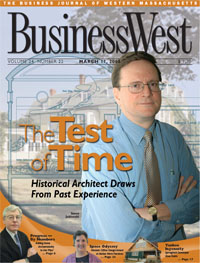
Cover Story
Historical architect draws from past experience
March 17, 2008 Cover

March 17, 2008 Cover

The act of giving old buildings new life is a discipline that requires endless study and research, but also creative thinking for architects who’ve chosen to focus on this aspect of their field. Stephen Jablonski is one such professional, whose work can be seen across the Pioneer Valley and beyond. He says many think his line of work is staid and stuffy, but his portfolio of projects in Western Mass. shows that it is anything but.

Architect Stephen Jablonski works out of one of the oldest homes in Springfield, the Alexander House, built in 1811.

It was recently moved to accommodate the new federal courthouse on State Street, and some feared that the building wouldn’t make it to its destination. But with nary a crack in sight, it stands — original columns, windows, and elliptical, cantilevered staircase intact.

“This building is in line with the work that I do,” said Jablonski, who has focused on a specialty known as historical architecture, a specific niche within the industry, for the majority of his career. “A lot of architects want to knock things down to show what they can really do, but I slow down and explain what a building like this is made of, and why it’s important.”

The Alexander House’s spiral staircase, for instance, is unique because it uses no supports — the design alone makes it sturdy — and because it’s the only known elliptical, cantilevered staircase in the city.

It’s also just one of many examples of intriguing design that Jablonski can offer when discussing historical architecture. His is a discipline that draws from countless architectural styles and implements an equally large number of methods, but still, Jablonski said his field is one that has taken some hard knocks.

“The perception is that historical architects are not cutting-edge,” he said, “or that we’re frumpy and boring and wear bow ties. While I do have a large collection of bow ties, the perception is not accurate. There is an innate creativity associated with historical work, and there are plenty of craftsmen to recreate historical structures.”

And while historical architecture is often seen as a specialty that recreates the past but shies away from devising anything new, Jablonski said this, too, is a fallacy. The field is broad, including historical restoration and renovation, but also the design of, additions to, and replacements of buildings. It’s never the same, he said, and every job is a new challenge that opens up a world of possibilities.

“When creating something new, most of society tends to go in a banal direction,” he said. “It may be new, but often, new buildings are designed to look more like everything else, not less.”

What’s more, Jablonski’s specialty sometimes makes him an anomaly within his own profession.

“As an architect, everything you do is focused on change, but how things change is really the essence of historical architecture,” he said. “Building standards vary from property to property; some are broad-brushed, and some are very strict. The guidelines are necessary, especially because historical renovation or replication can be very expensive. That’s where the real creativity comes in.”

The Nuts and Bolts

As an historical architect, Jablonski has a set of specific concerns that he must consider with every project. There’s considerable research to do before even setting pencil to plans, for instance, and it’s aimed at developing a keen understanding of how a building was constructed, what it’s been used for in the past, and how many changes have taken place within its walls since they were erected.

“You have to appreciate what a building was designed for,” he said, “and look for any changes in use. You also need to make a good record of what’s there; often, existing drawings are incomplete, and in any case, you don’t want to confuse the map for the territory.”

Further, properties that have been placed on the National Register of Historic Places offer their own design challenges, including standards set forth by the Secretary of the Interior. These center on preserving the historical integrity of a building by requiring the use of ‘in-kind’ materials, for example (a copper roof can only be patched with copper; finding the right storm window can take months).

Jablonski attended the School of Architecture at Syracuse University and said that, even as a student, he had to forge his own path to study historical buildings and their design.

“Syracuse has a very modern program, so I more or less had to train myself,” he said. “We were discouraged, for instance, from using color when drafting plans, whereas I always wanted to use color in my designs. I never wanted to wrap a building in steel or something to make a statement. To me, there’s something about a patina of age that adds character that is real.”

His passion for history remained strong through college, and Jablonski began his career in Boston in the early 1980s, later relocating to Northampton in 1987 and practicing there until 1994, when he relocated again to Springfield. Today, Jablonski’s firm includes three employees, and works frequently with other architects, drafters, and craftsmen in the area. Their renovations and restorations can be seen across Western Mass., and the company is beginning to expand its reach toward the eastern part of the state and into Connecticut.

Jablonski’s first historical project in the area was at Holyoke’s Wistariahurst Museum, a National Historic Register property. The work began with restoration of the Bell Skinner bedroom, but over the past decade, his firm has completed interior and exterior restoration to the museum’s siding, paint schemes, roofs, and conservatory.

The Skinner bedroom renovation was followed by an interior renovation project at the Sacred Heart Church in Springfield, restoring floor patterns and long-faded color schemes. That led to a particular professional focus on places of worship for the firm.

“I’d never worked on a big church before, but I liked the approach,” he said. “The parish didn’t want to change their church, but rather embellish what it already had, and maintain its character.”

His work at Sacred Heart led to similar projects across the region, including the Holy Spirit Chapel at St. Michael’s Cathedral in Springfield, the Old First Church in Holyoke, First Congregational Church of South Hadley, and Worcester’s Hadwen Park Congregational Church.

Jablonski’s calling card can be found in many other locales, too. His portfolio includes the Latino Professional Building in Holyoke, the Barney Carriage House at Forest Park, the Brennan and Admissions buildings at Springfield College, and the Museum of Fine Arts at the Springfield Museums.

In all of these projects, said Jablonski, close attention was paid to the use of lasting and traditional materials, natural light, custom woodwork, well-thought-out circulation, and blending old with new. Energy efficiency, affordability, and the ability to stand up to wear and tear are also important considerations, as in any architectural endeavor, which brings Jablonski to another defense of his trade: the intrinsic green qualities of historical construction.

“The big thing now in the building industry is going green, and in my mind there’s nothing greener than preserving what you already have,” he said.

A City of Stories

Others are beginning to understand this, and while the surge in interest regarding historical architecture of late is helping to expand Jablonski’s radius of influence, he said Springfield provides plenty of work.

“There aren’t too many cities like Springfield, of this size with world-class buildings,” he said. “It looks the way it does because of the people who came here, often to manufacture things. There is no predominant architectural style because of the multitude of periods of growth — we see Greek revival, neoclassic, arts and crafts … my job includes not just architecture, but making sure people understand the region’s resources, especially when they’re feeling down on their luck.”

Jablonski said that in Springfield, as in many urban centers attempting to spur a rebirth, the first instinct of many is to raze older buildings that are long past their heydays.

“People don’t see these properties with the eyes that I see with,” he said. “Does Springfield have some dust on it? Yes, but I urge people to understand that once a building is gone, it’s next to impossible to recreate what we once had.

“There’s a lot of talk about this city as a glass that’s either half-full or half-empty,” he continued. “I see many of the same problems other people cite, but from my point of view, the glass is more than half-full, and it’s a beautiful glass.”

Currently, he’s in the middle of a project that speaks to that belief, designing what will be the newest addition to the Springfield Quadrangle — the Museum of Springfield History. Slated to open in 2009, the facility will be located in the former telephone operating building on the corner of Edwards and Chestnut streets, and will house such firsts for the city as the GeeBee plane, a Silver Shadow Rolls Royce, and an original Indian motocycle.

“This project is the type of work I love to do,” said Jablonski. “But it’s also the first time that the museums have expanded outside of the perimeter of the Quad, and the first new museum to be constructed since the Depression.”

He added that the project includes both renovation aspects and new construction.

“We’re finalizing drawings for an addition now, and renovation to the existing building is about 50% completed,” he said. “We’re adding a lot of vertical space and not a lot of square footage, but this will still be the largest exhibit space at the Quad.”

He noted that the Museum of Springfield History will also offer a new type of museum experience to the city, its residents, and, most importantly, visitors to the region.

“This is going to be totally different, because it will attract the male population,” Jablonski explained. “The museums do an excellent job catering to many different groups, but they’re pretty much maxed out on women and kids. With the cars, airplanes, and guns that are part of Springfield’s history on display, the missing population can be drawn in, as we showcase what has also been a missing part of Springfield’s story.”

A New Way of Seeing Things

For Jablonski, the project couples an important mission with a rewarding architectural challenge, creating the perfect kind of historical project.

“It’s a combination of the architecture I love and the opportunity to do something important in the city where I make my home,” he said.

He can see the project from his second-floor window at the Alexander House as well, in addition to a handful of others he’s completed, and a few at which he’d like to try his hand.

“I think I have a quality product in historical renovation,” he said, “and I have a constantly broadening scope. One thing I don’t want to ever become is isolated, working on plans in the proverbial ivory tower of a locked-up office. Inspiration is critical.”

To that end, Jablonski can sometimes be seen strolling the streets of Springfield, pausing at a building and perhaps asking passersby, “what do you see?”

Jaclyn Stevenson can be reached at

[email protected]

Sections Supplements
‘Historic Hotels’ Status Offers Marketing Oomph to its Western Mass. Landmarks
Norma Probst

Norma Probst, director of sales and marketing at Cranwell Resort, Spa and Golf Club, said HHA helps brand historic hotels as a group.

From vintage furnishings to modern-day amenities, the region’s historic hotels have much to offer travelers from around the world. However, one thing that’s long been lacking for these mostly privately-owned, single-location establishments has been the marketing machines that power the Hiltons, Westins, and Marriotts of the nation — and by telling their members’ stories, Historic Hotels of America is looking to change that.

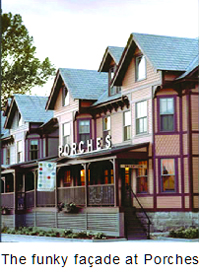
The Porches Inn at MassMoCA in North Adams was recently named one of the world’s “coolest hotels” by Condé Nast Traveller, among other honors. It earned the distinction for its wide range of amenities and whimsical style, which includes complimentary breakfast delivered in a vintage lunch pail.
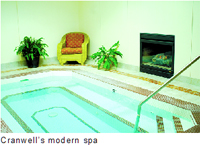
Down the road in Lenox, the Cranwell Resort, Spa and Golf Club recently garnered AAA’s Four Diamond rating for the sixth consecutive year and continues to hone its reputation as one of the best golf resorts in the country.

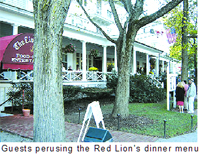
The Red Lion Inn in Stockbridge has welcomed travelers for more than two centuries, and is now making a new name for itself as a champion of sustainable agriculture in the Berkshires.

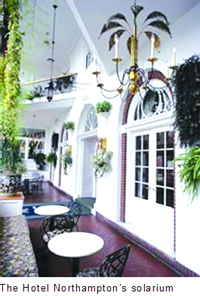
And Hotel Northampton in Hampshire County, with its newly renovated rooms and grand ballroom, is positioning itself as the area’s premier spot for luxury accommodations.

Each establishment has its own claims to fame that make it a unique destination in Western Mass. At first glance, the hotels have little in common. But they share one common theme: all are members of the Historic Hotels of America, a national organization that serves historic hotels and the travelers who love them, and, as such, affords a unique set of benefits that calls attention to the properties’ individuality, while at the same time binding them together as part of a whole.

Mary Billingsley, director of public relations for Historic Hotels of America, or HHA, explained that the group is a program of the National Trust of Historic Hotels for Preservation, which was formed in 1989 as a means of reaching out to the traveling public.

“We had certain people in mind,” she said. “Those who may not consider themselves preservationists, but appreciate history, and the experience of staying in a hotel that has a past, a tradition, and a sense of place in its community.”
The organization started with 32 charter members, and today, that number has risen to 213, spread across the contiguous United States, Puerto Rico, and the U.S. Virgin Islands. Porches, the Red Lion, Hotel Northampton, and Cranwell are the region’s only HHA hotels, and four of 15 in the Commonwealth. Others include the Boston Park Plaza and Towers, Chatham Bars Inn on Cape Cod, and the Hawthorne Hotel in Salem.

Billingsley said that to be considered for inclusion, a hotel must be included on the National Register of Historic Places and housed in a building that is at least 50 years old, though many establishments in the network are new uses of older properties, including former apartment buildings, mills, and private homes.

“There is a wide range of properties that have been converted into hotels, from cotton warehouses to bottling plants,” she said, adding that HHA is not a luxury organization; while each property has its own unique draws, HHA hotels fall within a number of price points and welcome all types of travelers. “We’re defined by history, and that’s something we let consumers know,” she said.
The Best of the West

Billingsley noted that the four hotels within Western Mass. are a good representation of HHA’s overall mission and identity as a travel organization.

“Western Mass. as a destination is so desirable,” she said, “and these four hotels showcase the diversity of our group. The Red Lion Inn is so picturesque; Cranwell is an internationally-known resort; Porches is an adapted-use of a property dating back to the 1890s; and Hotel Northampton has a more modern flair.”

Still, Billingsley explained that while the strengths HHA hotels possess — a strong sense of history, a rich collection of stories, and often a unique set of amenities that blend the intrigue of the past with the creature comforts of today — can also be a weakness for such destinations. While these features set them apart from modern-day hotels, she said, they can also isolate them. Most historic hotels are privately owned, and as such don’t have the same marketing strength as larger, corporate-owned outfits.

Addressing this has become the primary goal of HHA; it’s a member-driven marketing association, collecting dues from participating hotels and, in turn, promoting them as part of a group with increasing prestige.

The representatives from the HHA hotels of Western Mass. who spoke with BusinessWest returned frequently to the topic of branding, and how HHA has provided a much-needed shot in the arm in terms of creating a collective identity for a varied set of properties.

Michael Kolesar, director of sales and marketing for Hotel Northampton, took his post at the local landmark just this year, after a long career working within corporate-owned hotels. He said HHA does the work that smaller outfits often cannot, forging an identity for privately owned destinations.

“It’s a wonderful marketing tool, utilizing history, that markets individual properties through a lot of great programs that create brand association,” he said. “They allow us to work with what we have at our own pace, and we gain exposure outside of the local market — something that, as a privately owned establishment, is not easy for us to do.”

Carol Bosco Baumann, director of Communications and Marketing for the Red Lion Inn and the Porches Inn, said the Red Lion, first opened in 1773 to serve as a stagecoach stop, is one of HHA’s charter members, and Porches is still viewed as a relatively new member, having joined in the past decade. From both points of view, Baumann said she’s seen firsthand the growth within the organization.

“The HHA helps establish us as a brand by allowing us to be a part of an umbrella organization,” she said. “It’s an interesting position to be in, having two properties that scream individuality be part of the same brand.

“But it’s all about preservation and historic standards that alone are a benefit,” Baumann continued, “and the HHA publicity efforts only help us more. People understand that when they plan a trip to an HHA hotel, they’re going to feel a genuine sense of place. More than anything else, history provides that.”

Norma Probst, director of Sales and Marketing for the Cranwell Resort and a member of HHA’s national sales committee, said that she anticipates that the organization will only continue to flourish, aiding its member properties all the more.

“Cultural travel is one of the largest-growing segments of the industry,” she said, “and the HHA is doing very well as an organization because of the efforts it has undertaken with regard to public relations. Those have fostered a very willing, active membership base that understands the importance of promoting HHA as well as themselves; I see it becoming more well-known as a group in the future.”

At Any Rate

The various programs sponsored by HHA are developed to be pliable, so member hotels can develop promotions that make sense for them, while at the same time taking advantage of HHA’s international publicity. Members can choose whether or not to participate in a given program, and if they choose to sign on, can do so at virtually any level.

Currently, for instance, the Western Mass. HHA properties are gearing up for the ‘Fall Back in Time’ program, which will offer special rates and packages coinciding with the new, later time change on Nov. 4 (clocks are turned back one hour a week later this year, due to the federal Energy Policy Act of 2005). Sponsored by American Express, the program offers an extra draw for AmEx users, awarding a complimentary one-year membership to the National Trust for Historic Preservation when a trip is booked.

More than 75 packages have been developed by participating hotels across the country, ranging from special rates that reflect the year an establishment was built, to more elaborate promotions.

Kolesar said he’s currently developing a program for Hotel Northampton that will likely include a discounted rate or added-value component, and Cranwell is offering a second-night rate of $18.94 when one night is booked, celebrating the year the Sloane family, the resort’s second owners, built the Gilded-Age Wyndhurst Mansion on the property. Probst said quite a few rooms have already been reserved through that promotion.

Similarly, Baumann has developed ‘Fall Back’ promotions for both the Red Lion and Porches; the former will offer an overnight package including a country breakfast in bed and a commemorative gift for $177.30, while the latter will afford guests with a one-night stay with breakfast for two and a $20 gift certificate to the inn’s eclectic gift shop, all for $189, signifying the 1890s, when the Porches property was first built. Baumann said she tries to participate in HHA programs whenever possible, as they help to boost occupancy during slower times.

“The perception is that the Berkshires are a place for summer travel,” she said, “when in fact there is beauty and things to do year-round.”

Essentially, the affiliation with HHA, and its regularly released press materials and seasonal promotions, allows inns like the Red Lion and Porches to tout their amenities and special events continuously, and Baumann said this also helps translate the reality that not all historic hotels are Spartan in their accommodations. Rather, many have a large cadre of modern draws that, without regular, brisk marketing, can fall under the radar.

In addition to its lunch-pail breakfast service and claw-foot tubs, Porches, for instance, offers an outdoor heated pool, a hot tub, a bonfire pit surrounded by 10,000 different varieties of native plants, rain water shower heads, and outdoor adventure packages such as geocaching trips.

Probst said the HHA’s marketing assistance has been particularly beneficial in promoting the Cranwell’s 35,000-square-foot, $7.5 million spa, which blends well with its historic mansions.

“Promoting the spa through packages allows us to maintain an identity,” she said, “while still translating that we have the modern amenities travelers today are seeking.

“There are a lot of economies of scale one doesn’t have when connected to a large hotel,” she added, “but we’ve been marketing our spa packages rigorously through HHA, and since we began, we have yet to drop below 50% occupancy in the winter.”

Tell Me a Tale

Other benefits of HHA include reservation services, which allow both individuals and groups to book stays though the organization and its Web site, and a comprehensive, annually updated directory. All of the HHA hotels are also listed on the group’s Web site, historichotels.org, which is geared toward consumers with pages detailing various types of trips, from golf outings to spa retreats to business meetings.

The backbone of nearly all of HHA’s marketing programs, however, is story-telling, as it speaks to the personality that distinguishes historic hotels from their modern-day counterparts.

These can be small anecdotes regarding a visit from a celebrity, or a recipe that originated in an establishment’s kitchen, and also grand yarns, detailing how one guest house weathered prohibition, or how another played a part during WWII. The Hotel del Coronado in Coronado, Calif., another HHA member, often touts its distinction as the backdrop for the Marilyn Monroe film Some Like It Hot.

“We try to think about different topics in different areas and have our hotels share their stories,” said Billingsley. “We’ll cover everything from presidents’ visits to ghost stories to recipes and housekeeping tips. We’ve found looking to the past has been very helpful.”

Of all topics, ghost stories tend to draw particular interest. “We promote those on a yearly basis, and we’re on our 14th year,” said Billingsley. “People really like them, and hotels definitely have stories to tell.”

Kolesar noted that, while Hotel Northampton has yet to identify any spectral visitors, it benefits by promoting the stories of Wiggins Tavern, built in 1796 in New Hampshire and moved to the hotel in 1936 as part of a surge in Colonial-revival architecture and design, and by touting its long list of celebrity guests, from Eleanor Roosevelt to Hillary Clinton.

“A lot of people have skeletons in the closet, so to speak, but we really don’t,” he said, looking momentarily crestfallen. “That’s just one example of promoting history on a lighter note, though. We cater more to ‘star-gazers’ who care about who’s been here among the living.”

Travel tips have been another big win for HHA. Periodically, the organization will zero in on a particular topic — how to travel healthier, for instance, or a selection of team-building exercises for corporate travelers — and ask member hotels to contribute an idea.

“There’s great interest, and it allows us to put together fresh stories more frequently,” said Billingsley, adding that the topic doesn’t have to be complicated to generate interest. “Our housekeeping tips release was successful because I think people know how hard housekeepers work, and that the tips they’d have to offer would be real — things people could do themselves that weren’t difficult challenges. One woman, we heard, hung our press release up in her broom closet.”

Check Us Out

It’s a comprehensive marketing model that continues to gain momentum, assisting the historic hotels of the country as they, in turn, bolster the organization.

As for those establishments in the region taking their historical significance to a new level, Probst, standing halfway between Cranwell’s opulent mansion-cum-lobby and its contemporary spa and fitness center, perhaps said it best.

“We’re fortunate to be in Western Mass.,” she said. “It’s a fantastic destination that many people love. But to be placed on a national stage makes a world of difference.”

Jaclyn Stevenson can be reached at[email protected]

Sections Supplements
Universal Mind Makes Inc. Magazine’s 500 Fastest Growing List
Todd Cieplinski

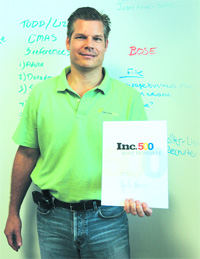
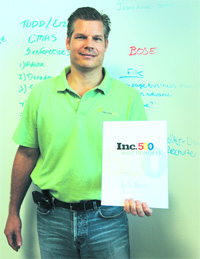
Todd Cieplinski, CEO of Universal Mind, a software consultancy firm based in Westfield, holds his award from Inc. magazine, which named his company one of the 500 fastest growing in the U.S.

Just five years in existence, the software company Universal Mind, based in Westfield, has recorded a staggering 871% growth rate over the past three years and expects to quadruple its staff by the close of 2008. The company is a testament to the versatility afforded by the Internet — while CEO Todd Cieplinski manages the firm from Western Mass., his employees are spread around the world — but it also proves that, at least in the case of the World Wide Web, change is good. Especially for UM.

“I was doing time in the universal mind, I was feeling fine. I was turning keys, I was setting people free — I was doing all right.”

The lyrics of The Doors’ tune Universal Mind may have meant one thing to Jim Morrison when he wrote them, but they’ve come to mean something very different for Todd Cieplinski, who borrowed the title of the song for his Web-based application design and consultancy firm.

He and his business partners are indeed feeling fine; they’ve just seen their five-year-old company named to Inc. magazine’s list of the 500 Fastest Growing Private Companies in America, coming in at 290 (and number 31 among ‘IT Service’ companies) with $3.5 million in revenue for 2006 — up from about $362,000 in 2003.

They’ve done so by turning keys — unlocking the potential of existing applications in a vastly improving virtual landscape.

The firm is also an example of the changing face of business as it relates to the World Wide Web. With communication virtually instantaneous regardless of where an employee’s desk is located, Universal Mind (UM) isn’t located in a high-rise in a primary market. Instead, it employs software technology experts from around the world, using downtown Westfield as its central location while UM’s president, Brett Cortese, and Tom Link, chief technology officer, work from their home base of Golden, Colo.

Cieplinski made the move to Westfield’s Westwood office building this year, in order to return to his roots — he’s a Springfield native, and said he came back for the quality of life and to raise his children “as he had been raised.”

Subsequently, the overhead’s low, but the productivity is high: in March 2007, Universal Mind had four employees; the ranks have since grown to 12 to keep up with demand, and by the end of the year, Cieplinski expects that number to double, and to double again by the end of 2008.

This Internet Fad

Cieplinski said the company originated from a passion for technology, and has been bolstered by a number of trends in the marketplace — among them, a saturation of Web-based technologies within large companies’ sales, marketing, and overall business plans, in both internal and customer-oriented systems.

He said his career path thus far has been guided by such changes in technology; steered by educators toward engineering at an early age after showing promise in related fields, Cieplinski attended Rensselaer Polytechnic Institute in Troy, N.Y., and identified a niche for himself in the college’s business program, which is coupled with RPI’s strong technology curriculum.

That led Cieplinski to enter the sales field after college, first in the veterinary supply industry in Maryland, and later for a database information outfit in Connecticut. By the mid-’90s, Cieplinski, like many others, had begun to realize that the Internet was evolving at break-neck speed, and identified it as a potential next step in his career.

“My boss at the time didn’t see it that way,” he said. “He was a bit of an old hat, and thought the Internet was a fad.”

Ignoring the caution, Cieplinski moved to Boston, joking that if he wanted to work in financial services, which he didn’t, or software, which he did, that was the place to be.

He eventually entered into a consultancy project with software company Allair in Cambridge, where he met Link and Cortese. Allair was bought out by Macromedia (it’s now owned by Adobe), but not before the dot-com bust of the late 1990s and early 2000s.

The trio found themselves looking for work with résumés that detailed skills still seen as niche today, and were, as Cieplinski puts it, “niches within niches within niches” at the time.

Still, their core knowledge of Macromedia programs, one of the largest Internet-based companies in the world, created an opportunity.

In 2002, a year that Cieplinski admits was not the best to launch a professional consultancy firm, Universal Mind was born, borrowing its name from a song penned in 1970.

Because of the strong relationships Cieplinski, Link, and Cortese had forged with Macromedia, work was relatively steady, but began to blossom especially in 2005, following Adobe’s acquisition of Macromedia in a stock swap valued at $3.4 billion.

Flash Forward

Now serving as an ‘Adobe Solution Partner,’ UM continues to work with a very specific suite of technologies to assist clients in creating, managing, updating, and troubleshooting a wide variety of Adobe/Macromedia Web applications. While there are other Adobe partner companies across the country, few specialize in the same type of work.

The most recognizable of these applications, perhaps, is Adobe Flash, which is used to create visual content for Web sites, games and movies, and content for mobile phones and other devices. Others include Flex, Acrobat Connect, ColdFusion, and JRun.

Typically, said Cieplinski, these are tools that the average Internet-user doesn’t see work, but uses frequently. A good example is a product order form; new applications are making the process of entering personal information and purchase specifications quicker and easier, doing more on the back end, and requiring fewer jumps through hoops for the consumer.

“We help large corporations with pre-existing applications, to help them manage them more efficiently,” he said. “Adobe produces these products, and we customize the software and tailor it to fit customer’s needs.”

It’s an important and ongoing task, especially in the current climate on the Internet, which is characterized by strong winds of change.

“Contrary to what some might think, the Internet is not mature,” said Cieplinski. “Instead, it’s in the midst of a rapid growth pattern. Most Web sites today will only be good as is for one or two years. Three, you’re really pushing it.”

The changing face of the virtual world is referred to in the industry as ‘Web 2.0,’ meaning the next generation of the phenomenon, in which applications increasingly behave more intuitively, and produce returns more quickly.

That, in turn, means there’s likely to be no shortage of work for the also rapidly expanding team at UM.

“The only limitation now is peoples’ imaginations,” said Cieplinski. “We are differentiating, enhancing, and streamlining both front- and back-end applications.”

Caps and Cops

To do so, Cieplinski explained, UM employs a staggering amount of diverse services, which are forever changing as well, and divided into five core competencies.

These are code/architecture review, an examination of an application’s design and implementation in regard to its intended purpose, and used for applications still in development; troubleshooting for applications currently in use; mentoring, which combines hands-on training, formal classroom teaching, and informal interaction with UM consultants; development, or design and coding of an application to meet a business objective, and performance review, a series of stress-testing applications to judge performance under real-world conditions.

In these capacities, UM has worked with such clients as AOL/Time Warner, Mapquest, Pfizer, eDiets.com, Brigham and Women’s Hospital, and Ben and Jerry’s, and the case studies are intriguing.

One client, New Era Cap, the largest sports-licensed headwear company in the world, needed a better way to conduct employee reviews. Its employee base, like UM’s, is widely dispersed, and collecting and analyzing data was both inefficient and time-consuming.

UM assisted New Era in the development of an ‘Employee Scorecard,’ which, by using Flex and ColdFusion technologies, reduced the employee-review process from hours to minutes.

Additionally, the firm’s work with the San Francisco Police Department was noted as part of its inclusion on Inc.’s 500 list. This is an ongoing project, Cieplinski explained. He and his team are creating an interface for squad cars that facilitates quicker decisions, by allowing dispatchers to identify not only the squad car nearest a crime scene, but also the car with the best -trained and equipped officers.

The Time to Hesitate is Through

He said it’s an exciting time to be doing what he does, especially given the fact that some of the applications the company is now working to enhance have yet to be used by the general public.

“Some of what we’re working on is coming, but most people haven’t thought about it yet,” he said, adding that this brisk pace is also boding well for further expansion plans at Universal Mind.

At this rate, Cieplinski said he expects to be mentioned as an ‘Inc. 500 Alumni’ as part of next year’s list, which also tracks past winners and their performance.

“We’re very excited about the growth opportunities in front of us,” he said. “We’re exploring opening new offices in the U.S. and in Europe and Asia, and we’re of course adding new employees. Since we work largely in a virtual workplace, there’s no limitation to our growth.”

Indeed, they’re doing all right.

Jaclyn Stevenson can be reached at[email protected]

Departments

Seven Proposals Received for Union Station

SPRINGFIELD — The Pioneer Valley Transit Authority (PVTA) has received seven proposals for transportation and redevelopment planning for Union Station, according to Mary MacInnes, PVTA administrator. MacInnes said the proposals show that the Union Station project “is back on track.” The next step in the process is a due diligence review by the Selection Committee to ensure submitted responses contain the information required from the request for qualifications (RFQ). The committee will review the proposals, rank them, and select at least three finalists who then may be interviewed, according to MacInnes. The finalists will be ranked in order of qualification, and the committee will present the ranking to MacInnes. Members of the selection committee include industry and business professionals from Amtrak, Greyhound, the New England Black Chamber of Commerce, the Springfield Redevelopment Authority, the Pioneer Valley Planning Commission, and the PVTA. MacInnes expects the award to be made by the end of September. Firms submitting proposals were Lozano, Baskins & Associates, Watertown; HDR Architecture Inc., Boston; Finegold Alexander, Boston; SEA Consultants Inc., Cambridge; STV Inc., Boston; Nelson/ Nygard Consulting Associates, San Francisco, Calif.; and HR&A Advisors Inc., New York.

Near-term Home Sales Hold in Modest Range

WASHINGTON — The housing market will probably hold close to present levels in the months ahead, according to the latest forecast by the National Assoc. of Realtors. Existing-home sales are forecast at 6.04 million in 2007 and 6.38 million next year, below the 6.48 million recorded in 2006. New-home sales are expected to total 852,000 this year and 848,000 in 2008, down from 1.05 million in 2006. Housing starts, including multi-family units, are likely to total 1.43 million in 2007 and 1.40 million next year, below the 1.8 million units started in 2006. The 30-year fixed-rate mortgage is forecast to average 6.7% in the fourth quarter and then ease to the 6.5% range next year. The National Assoc. of Realtors represents more than 1.3 million members involved in all aspects of the residential and commercial real estate industries.

AIM’s Confidence Index Back Up in July

BOSTON — The Associated Industries of Massachusetts (AIM) Business Confidence Index rose 3.4 points in July to 57.6, more than recouping June’s decline, according to Raymond G. Torto, co-chair of AIM’s Board of Economic Advisors, and principal CBRE Torto Wheaton. Since April, the Index has followed an up-down-up pattern, with June’s loss virtually cancelling out May’s gain, and July’s rise returning to the higher level — above a year before (55.4), and close to the reading of July 2005 (57.8). However, the July survey was conducted before the new wave of uncertainties, particularly around the mortgage situation, that produced sharp drops in the equity markets, added Torto. Confidence levels were virtually identical in July among manufacturers (57.5, up 3.3) and non-manufacturers (57.8, up 3.6), with manufacturers more positive than others about conditions for their own firms and sales trends, but less so about recent hiring. A strong gain in confidence outside Greater Boston (+5.2) and a lesser rise within the metro area (+1.9) similarly left that split close to even (57.4-57.7). Larger firms were more optimistic than small and medium-sized employers.

Nominations Sought for ‘Super 60’

SPRINGFIELD — The Affiliated Chambers of Commerce of Greater Springfield Inc. is seeking nominations for its annual Super 60 awards program. The aim of the program is to celebrate the success of the fastest-growing privately owned businesses in the region which continue to make significant contributions to the strength of the regional economy. Nomination forms are available at the Chamber offices, 1441 Main St., Suite 136. Completed nomination forms must be received at the Chamber offices by Aug. 31. The Super 60 awards will be presented at the annual luncheon and recognition program on Oct. 26 at Chez Josef in Agawam. For more information on the nomination process, call the chamber at (413) 787-1555.

Eatery Closes Downtown Location

SPRINGFIELD — Gus & Paul’s restaurant recently closed its doors after 10 years at Tower Square, while the original Gus & Paul’s Delicatessen and Bakery on Sumner Avenue remains open. Lee L. Weissman, a co-owner of the downtown eatery, expressed his regret in having to close the restaurant in a letter to the city, and noted he hoped to sell the business. Weissman added he has begun a new career as a professional fundraiser and found it difficult to also oversee the restaurant operations. More than 20 employees lost their jobs in the closing; however, Weissman said with his family’s connections in the restaurant business, he is anticipating helping most or all of them find new jobs. Fred G. Christensen, senior property manager of Tower Square for CB Richard Ellis, said he is optimistic a new tenant can be found in the near future to take over the Gus & Paul’s site.

Study: More Employees Working Remotely Today Than Five Years Ago

MENLO PARK, Calif. — The proliferation of wireless technologies and feature-rich Internet applications is making it easier for information technology (IT) professionals to work outside of the office. A new study by Robert Half Technology shows that telecommuting is becoming more commonplace among IT professionals. Nearly half (44%) of chief information officers (CIOs) surveyed said their companies’ IT workforce is telecommuting at a rate that is the same or higher than five years ago; only 3% said IT staff work remotely less frequently today than five years ago. Improved retention and morale and increased productivity were cited as the greatest benefits among firms that allow telecommuting. While telecommuting can benefit employers and employees alike, it’s important that companies have the appropriate infrastructure in place to facilitate staff working remotely. For example, nearly a third of CIO’s (31%) surveyed felt that telecommuting employees generate too many security risks because they need to access elements such as corporate networks, systems, and intellectual property off-site. The national poll includes responses from more than 1,400 CIOs from a stratified random sample of U.S. companies with 100 or more employees.

Ivanhoe Restaurant Closes

WEST SPRINGFIELD — Steve and Ron Abdow, owners of the Ivanhoe, recently announced the closing of the landmark restaurant on Riverdale Street. According to the Abdows, a recent decision by their abutter to no longer lease parking spaces to the Ivanhoe was the catalyst in the decision to close. Since its inception, the Ivanhoe had 113 parking spaces at its disposal; however, 62 spaces would soon no longer be available as the abutter plans for future development of its site. The Ivanhoe was opened in 1967, and the theme was based on the time of Sir Ivanhoe and the Knights of the Round Table, with gothic arches and features reflective of that period.

Small Business Applications Sought for Law and Business Clinic

SPRINGFIELD — The Western New England College Law and Business Center for Advancing Entrepreneurship is now accepting applications from entrepreneurs seeking law or graduate business students to serve as consultants for their business during the fall semester. The opportunity for this free service is limited to those businesses that need consultation regarding a discrete topic. This service does not include litigation needs. For more information, contact Aimee Munnings at the Law and Business Center for Advancing Entrepreneurship at (413) 736-8462, or E-mail [email protected]

Survey: Companies Ineffective at Rewarding Good Performance

MENLO PARK, Calif. — Workers who feel their good work often goes unnoticed may have a case. More than one-third (35%) of professionals polled recently said businesses are ineffective at rewarding their employees’ strong performance. Meanwhile, 30% of managers surveyed agreed. Businesses need to make retention an ongoing priority, according to Diane Domeyer, executive director of Office Team. Rewarding employees for their accomplishments enhances productivity, reinforces positive behavior, and builds staff morale and loyalty, she added. Domeyer noted that firms that fail to reward great work risk losing employees to businesses that do invest in recognition programs. The surveys were developed by Office Team and reflect responses from 150 senior executives at the nation’s 1,000 largest companies, and 534 full- or part-time workers 18 years of age or older and employed in office environments.

Features
Springfield Chamber Leader Promotes Action, Not Talk
Victor Woolridge

Victor Woolridge has seen some inspiring turn-around stories in his travels, and he believes Springfield can be added to that list.

Victor Woolridge was busy gathering up the material he wanted to read on his flight to Buffalo, which was scheduled to leave in a few hours.

“I’ve had a lot of practice at this,” he told BusinessWest, noting that his job as managing director of the Real Estate Finance Group at Babson Capital Management LLC forces him to travel frequently. Name a city and he’s probably been there — often.

And in the course of all that travel, amassed through 27 years of work with MassMutual and its subsidiary, Babson, Woolridge has seen some inspiring turn-around stories.

“I’ve been to a lot of places that people had pretty much given up on,” said the Springfield native, listing sections of New York, Chicago, Baltimore, Washington, D.C., and other, smaller cities. “Years ago, people had nothing good to say or think about Harlem, but now it is the place to be. It’s the same with the inner harbor in Baltimore and on 13th and 14th streets in Washington. Not long ago, you wouldn’t walk down those streets; now, there’s a real renaissance going on there.”

Exposure to such success stories is one of the reasons why Woolridge, the recently elected chairman of the Springfield Chamber of Commerce, is optimistic about the prospect of adding the City of Homes to that list he offered. But he admits that there is much work to be done in a community that is recovering from near-bankruptcy, political scandal, and lots of bad press, and is just starting to see some momentum.

And as he assesses the challenges ahead for Springfield, Woolridge started by telling BusinessWest that he can see some direct parallels between what he does for a living — assessing high-yield investment opportunities for Babson — and his work with the Chamber and other groups trying to achieve progress in Springfield.

“In both cases, it’s about moving the ball forward,” he said, adding that, roughly translated, this means moving beyond the talk and actually getting things done.

“There is such a thing as analysis paralysis,” he said, referring to both the investment opportunities he and other members of the Real Estate Finance Group must weigh — and the many recommended plans of action for Springfield. “If you sit there and analyze all day long, you’re never going to get the deal. You have to get in there and put something on the table and advance the ball.”

And Woolridge says he’s seeing signs of that happening in Springfield.

Indeed, he told BusinessWest that, in recent months, he’s observed a change within both the Chamber and City Hall — a movement from talk to action that he intends to continue and accelerate.

Woolridge referred often to the recently completed Urban Land Institute (ULI) study of the City of Homes. The report lists a number of priorities, including downtown and the Court Square area, the South End neighborhood of the city, and the soon-to-be-vacant federal building on Main Street. As he begins his two-year stint as chairman of the Springfield chamber, Woolridge said one of his priorities is to help ensure that the ULI report becomes much more than good reading.

“Oftentimes, these reports sit on a shelf and gather dust,” he said. “We can’t let that happen in this case; there’s too much at stake for Springfield.”

In a wide-ranging interview, Woolridge talked about the Chamber, Springfield, some of those turn-around stories he’s witnessed, and what it will take to write one in his hometown.

Progress Report

Woolridge recalled one of his first meetings as an officer with the Springfield Chamber, and some comments he made then.

“I said, ‘everyone has obvious sympathy for the leper, but no one is willing to touch him,’” he remembers. “But every physician knows that for the sick patient to get better, someone has to touch him.”

Springfield was in many ways a sick patient at that time, he continued, noting that there was perhaps too much watching on the part of the Chamber and other groups in the city in the past, and not enough direct involvement, or touching. But this is a pattern he’s seen change.

“I’ve seen much more energy when it comes to the matters facing the city — not just talking about it, but strategizing, and saying ‘what do we do about it?’ and becoming a more active force in seeing these things happen,” he said. “On top of that, we’ve been discussing — we’re not there yet — how we can be better stewards or watchdogs over not just implementation of these things, but standards for how things get done so we don’t slide back into the kinds of problems we’re experienced over the past several years.”

Woolridge told BusinessWest that this greater willingness to touch the patient in recent years, an attitudinal change encouraged by his immediate predecessors on the Chamber, Mary Ellen Scott and Carol Baribeau; Mayor Charles Ryan; Economic Development Director David Panagore; and others, bodes well for the city.

That’s because direct action, not talk, is the only way to achieve progress with the many issues facing Springfield, including poverty, homelessness, public safety, economic development, workforce development, zoning, and creating a more business-friendly City Hall.

“We decided it was important to take a look at our zoning and procedures to make sure that they were competitive, streamlined, and that people understood them,” he said, adding that he helped initiate discussions with developers who compared and contrasted Springfield’s model with others to create a qualitative database for action. “Hopefully, at the end of the day, we’ll have a comprehensive set of zoning procedures so that people can track from A to Z how to get a transaction done in the city of Springfield.

“Our process was deemed to be not as friendly as other neighboring communities as well as other cities,” he continued, adding that he and others visited other cities to see how they handled things. “It just makes sense to try to fix the system, because if you save people time and money and make it a pleasant experience, then that gives you an opportunity for more business.”

Streamlining zoning codes and the overall development process is just one example of how city and civic leaders are progressing from talking about the patient to touching him, said Woolridge, adding that the ULI is certainly another.

The process of preparing the report gave people an opportunity to listen, exchange ideas, and, in many cases, vent, he said, adding that with the report in hand, the city and its leaders must do something with it, or else risk losing some of the momentum that’s been achieved.

“Some of the recommendations in that report need to be pursued,” he said, returning to his warnings on overanalysis that can stifle action. “This is an outline, a framework, that provides a direction; the best way to move is to take a step forward, do something, and do your analysis on the way to building a new city.

“You can’t analyze ad nauseum,” he continued. “You have to work the problem and figure it out along the way.”

Agenda Items

Woolridge told BusinessWest that he’s thankful for having two years as chairman at the Chamber; one is simply not enough time to finish some of the work started by others, let alone start and advance new initiatives.

Assessing priorities for the city and the Chamber, he said there are specific and general goals for both. With the Chamber, he wants to increase membership, improve visibility, and make the organization more directly involved with key issues. Also, he wants to continue working with the state Legislature on business-related measures, and with the Finance Control Board on its ongoing efforts to bring fiscal stability to the community.

As for the city, priorities include everything from poverty and homelessness to devising ways to make the community’s great ethnic diversity more of a cultural and economic asset.

“That diversity should be fully embraced and seen as a clear positive for the city,” he said. “Right now, it isn’t.”

Another issue to be addressed, he said, is the preponderance of affordable and subsidized housing in the city, at the expense of market-rate units that could attract more professionals to many neighborhoods and breathe life into the city’s downtown. There has been some quality single-family home construction in outlying areas of the city, he noted, adding that the next step is to continue this trend into the core of the community.

“We have to stabilize our economy by bringing in higher-quality real estate that attracts higher-income people to help lift the entire economic boat of the city,” he said. “If you continue to build poor-quality housing, then ultimately you end up with a city that’s full of poor-quality housing. And how then do you attract people of better means, if you will, into a community like that?

“It’s a domino effect,” he continued. “The tax base gets impaired because you don’t have a good balance between affordable and market rate, and when the tax base gets impaired the infrastructure is impaired, and your school buildings and other municipal facilities can’t get repaired; it’s a spiral downhill because you can’t generate enough tax base.”

Achieving a balance between affordable and market-rate housing is easier said than done, he acknowledged, adding quickly that he’s seen it done — in cities like Boston, New York, Chicago, and also smaller communities like Greenville, S.C. In those cities, developers have created 80/20 mixes that attract professionals (the market-rate component is the ‘80’) but without, in his words, “casting aside” lower-income constituencies.

Housing is one of those areas where there has been mostly talk in Springfield, said Woolridge, adding this isn’t getting the job done.

As with other issues, the city needs to move on the housing dilemma or, as he said many times, move the ball forward.

“We’re never going to know all the answers, and no matter how hard you search, the target keeps moving,” he said. “You have to move with it, and you have to get things done; you learn along the way, you make mistakes along the way, but that’s all part of the process.”

Plane Speaking

As he prepared to shuffle off to Buffalo, Woolridge took a minute to show BusinessWest one of his group’s latest investment gambits — a high-rise office tower in what might be his favorite destination: Chicago.

“It’s a wonderful city, and it’s transformed itself into a European-style city,” he said, adding that by this he meant an attractive mix of arts, green space, and architecture. “What I like most about Chicago is that there’s an overall vision for the city and its neighborhoods.”

And by advancing the ball, that city is turning vision into reality, he said, adding that the same can happen in Springfield if talk can be turned into action.

“There are some who maybe have given up on Springfield,” he continued. “But you never know … this could someday be the place people want to be.”

George O’Brien can be reached at[email protected]

Sections Supplements
Easthampton’s Arts Revolution Continues at the Old Town Hall

A new arts initiative is taking shape in downtown Easthampton, in the old Town Hall building. The venture is creating a new hub for activity and commerce, while also generating a renewed sense of community.

From police to pop culture, and from planning to post-modern art.

Essentially, that’s the path Easthampton’s former Town Hall is taking, as the municipal offices are slowly converted into a new space for art and performance-based businesses and groups.

The old Town Hall, which was vacated by the city’s municipal departments in 2003 when they were relocated to more modern trappings on Payson Avenue, is in the midst of a rebirth spurred largely by the wishes of the city’s residents.

Following the formation of a Future Use Committee to determine a new purpose for the building, a survey was disseminated to residents soliciting suggestions. Nearly 3,000 responses were received, and the overwhelming majority called for an arts, performance, or culture venue.

The city issued a request for proposals for development or use of the space, and accepted the proposal submitted by one of Easthampton’s more visible developers — William Bundy, one of the creators of Eastworks, a collective of small businesses, eateries, and artists’ studios located at the former Stanley Home Products plant on Pleasant Street.

“The old Town Hall had been vacant for a few years, and the city was looking to defray the costs of upkeep and use,” said Bundy. “I thought it would be a shame not to get involved.”

Bundy dubbed the project CitySpace, and created a non-profit organization with the same name to effectively partner with the city and serve as an umbrella for future activity at the site.

He said his primary goal is to create a vibrant center for arts and culture in Easthampton, while at the same time reducing the burden of maintaining the building for the city’s taxpayers. Now, at the close of its first year in existence, CitySpace is poised to grow further, and to add to the increasingly robust arts scene in this Hampshire County community.

Canvassing the Area

Bundy noted that the building, erected in 1868, lends itself to artistic and performance endeavors.

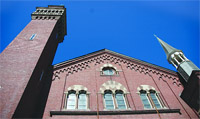
For one, its Italian-inspired architecture differs from most of the buildings in Easthampton’s central area, which typically reflect the industrial look of the city’s early manufacturing years. That alone makes the hall, which is listed on the National Register of Historic Places, stand out.

It’s also located in the middle of the city’s downtown, not far from its two arts-driven mill buildings, One Cottage Street and Eastworks, and adjacent to a number of businesses, including Big E’s grocery.

But beyond aesthetics and location, Bundy said CitySpace also has some of the key elements inside that arts and performance venues typically seek.

“The building has a large meeting space that can be used for performances,” he said, “and that can help define the building as an arts center.”

The former Town Hall was built with large town meetings in mind; that was the primary mode of governance in Easthampton before it became a city in the mid-’90s. Subsequently, the second floor encompasses 4,500 square feet, which is almost entirely open, usable space, and includes a stage. Bundy said he’s currently working with Clark and Green Architecture of Great Barrington to redesign the performance area, as well as other areas within the building.

Windows of Opportunity

Easthampton’s mayor, Michael Tautznik, said the city must also address safety issues, such as the installation of an up-to-code sprinkler system, before the second floor can be utilized, but agreed with Bundy that the area could prove to be a primary driver for CitySpace.

“The effort is early and young,” he said, “but it seems as though the use of the upper Town Hall is going to be integral to the future of the project.”

Tautznik explained that the city will maintain ownership of the building, and expects to continue to foot its operating costs for three years, while CitySpace hones its business model and works to attract new tenants. Businesses will pay $10 per square foot for space on the first floor of the building, with 30% of that going to the city and the rest to the non-profit group.

“We’ve provided a window of time to give the organization an opportunity to establish itself and clearly define its mission,” said Tautznik, “and after that point we expect it to take over the operating costs of the building.”

The mayor said the cost to the city for heating, electricity, and other general maintenance will total about $30,000 to $35,000 for those three years.

Other steps are being taken to further defray costs, such as an agreement with T-Mobile to install a hidden cellular antenna in one of the building’s existing towers. In addition, the city is now seeking grant funding to install an elevator to gain access to the second floor as well as the Town Hall’s basement, where city records are still stored.

Tautznik said the city’s efforts are aimed at a collaborative reuse of the building, which will in turn benefit the city economically.

“We didn’t want to sell the building, and had been looking for an adaptive use that would benefit the community,” he said. “By capitalizing on the already-vibrant arts scene in town, I think we can achieve that, and the city fully intends to make the building more accessible.”

Suitable for Framing

While much of that work is still in its early stages, the 3,600-square-foot first floor is already occupied, and a handful of future tenants are expected to move their operations to CitySpace this year.

Among those is the Flywheel Arts Collective, a non-profit arts and performance group that advocates for, and provides opportunities to, local musicians, poets, visual artists, and others.

“They’ve existed for about eight years, and just lost their space,” said Bundy, who expects the group to take up residence in the back portion of the first floor by this summer. That section of the building once housed the planning offices and, for a time, the Police Department.

“We felt good about them because they’re a membership organization that allows opportunities for professional advancement — things like apprenticeships.”

Flywheel and other groups — the Easthampton Cultural Council has expressed some interest — will join the building’s first tenant, Jean-Pierre Pasche, who owns Eastmont Custom Framing and the Elusie Gallery, and set up shop in the old Town Hall last October.

“Business has been very good,” said Pasche. “This is definitely a location in which I’d like to stay. It’s active, central, and the place looks great.

“I also think we serve our customers better,” he added. “The space fits my type of business, and people can see us work.”

Pasche said that as new organizations and businesses move in, the arts will remain a strong focus, and each tenant will complement one another.

“The arts sector really ties everything together,” he said. “We can have for-profit and non-profit businesses, and display or gallery space, which not only attracts new visitors, but serves the community, too.”

Strengthening those ties to the community has been one of Bundy’s primary goals for CitySpace, and as the project evolves, he said he too is seeing signs that the model, now closing in on its first year in existence, is beginning to work.

“We want the building to be defined as one that is used for the arts,” he said. “The time the city has given us is helping as we formulate and re-examine a thoughtful plan for the future, and that, in turn, will help us succeed.”

Work of Arts

The days of raucous town meetings are over in Easthampton, but the place where democracy played itself out has a new life as a home for artists who are simply making different forms of expression.

After years of searching for a viable re-use of Town Hall, Easthampton’s leaders have apparently found one in CitySpace, said Bundy, noting that the first year in operation has provided large doses of optimism for the future.

And there are many people willing to second that motion.

Jaclyn Stevenson can be reached at[email protected]

Sections Supplements
Chris Willenborg

Chris Willenborg, administrator for Barnes Municipal Airport, said all of the developments at the airfield are aimed at long-term growth.

Barnes Municipal Airport Sees Blue Skies Ahead

There are a number of improvement projects on deck at Barnes Municipal Airport, ranging from building renovations and replacements to ongoing plans for increased traffic. The goal is to create a bustling aviation and business center in Westfield, and, as the airport’s administrator points out, activity is already more brisk than many people realize.

Chris Willenborg has to remember a lot of names and numbers as part of his job as airport administrator at Barnes Municipal Airport in Westfield.
There are aircraft models to memorize and wind gusts to track, dollar figures to record as part of ongoing capital improvement campaigns, and runway lengths and taxiway widths to remember when planning renovations.

Willenborg also has to recall, in the middle of budget planning, marketing initiatives, and infrastructure development, that there are two endangered species populating the airport — the vesper sparrow and the upland sandpiper.

“They like the sandy terrain that surrounds us,” he said, as two of the Air National Guard’s A-10 Thunderbolts prepared for landing on Runway 15-33, the shorter of the airport’s two at 5,000 feet.

While the vesper sparrow and the upland sandpiper are two lesser-known inhabitants of Barnes, the A-10 Warthogs are certainly recognizable in Westfield’s skies — they’ve been part of the landscape at the airport for nearly 30 years. However, Willenborg said that between wildlife and military jets lies a much bigger pocket of activity than most realize, and it’s in this area that he hopes to see the greatest improvement in both services and perception in the coming years.

“People often associate the airport with its military presence, but in actuality Barnes is home to about 700 employees,” he said, adding that the airport is a center for economic development in the purest sense of the word.

Air Apparent

Those employees work within a number of privately-owned businesses, both aviation-related and otherwise.

Four aircraft maintenance companies do business at Barnes: AirFlyte, General Dynamics Aviation Services, Aero Design, and Five Star Jet Center, which also offers charter flights, as do Air Fleet Management, the Aviation Management Group, and Charis Air.

Charis and the Five Star Flight Academy offer both flight instruction and programs directed by Holyoke Community College, Westfield State College, and J.P. Adams, a private firm that also provides aerial photography. In addition, the two tenants, along with ADUP, also offer aircraft for rent. Meanwhile, aerial advertising (banners) is offered by ADUP and Airborne Ads, Midwest ATC provides air traffic control services, and various hangar operators provide aircraft storage.

In terms of non-aviation businesses, limousine and taxi services are based on the Barnes property, and the Whip City Race Track is located on its grounds, as is the Pioneer Valley Military and Transportation Museum.

Barnes Airport itself employs eight people, six of whom are full time. It’s a lean operation, said Willenborg, especially in a workplace that encompasses 1,200 acres of land and can accommodate planes as large as a C-5 military craft or a commercial Boeing 47.

But the airport is currently seeing some activity aimed at growth, Willenborg explained, which is breathing new life into its facilities.

A new administration building is being constructed to replace an outdated facility, built in 1939. Willenborg said talk of replacing the building began more than 30 years ago, but when the project finally began to take shape in 2002, the process was kicked into high gear.

“We’re looking forward to being in the new building by May 1,” he said, noting that the $6.3 million project was financed largely by a state grant from the Mass. Aeronautics Commission, secured in 2005 with the help of state Sen. Michael Knapik.

Beyond replacing a building that has “outlived its useful life,” as Willenborg put it, the new administration building, along with other improvements, will help Barnes handle an increasing number of operations on the field — in layman’s terms, the number of takeoffs and landings at the airport.

“We see about 65,000 to 70,000 operations a year,” he said, “both military and civilian — but 86% are civilian. We had a 12% increase in traffic from 2005 to 2006, and we’re also seeing an increase in corporate traffic, which is industry-wide.”

However, when those planes land, Willenborg said their first view is currentlyof the old, worn-out administration building, which he feels affects overall confidence in the airport.

“When a corporate plane lands and its management steps off, we don’t want the first thing they see to be this ugly little building,” he said.

But soon, the view will improve. The new administration building, nearing completion, features glass and brick architecture similar to many newer buildings in Westfield, and is also double the size of the former offices, at 17,000 square feet.

The building will house airport management and a number of private businesses that will lease space, as well as lounge space and new showers and locker rooms for pilots. A new restaurant, to be announced, will also be added to replace the existing Flight Deck, which will be closed by its owners.

Development is also taking place in other areas of the airport, including a 20,000-square-foot hangar expansion taken on by AirFlyte, along with the construction of a new fueling station.

And on the military side of things, the two units housed at Barnes — the Air Guard’s 104th Tactical Fighter Group, and the MA Army National Guard Aviation Support Facility #2, a fleet of helicopters – will be undergoing some changes as part of the recent base realignment and closure initiative spearheaded by the U.S. government.

“There’s an aircraft transition going on — the 104th’s A-10s will be replaced by F-15s, and their missions are changing,” said Willenborg.

On the Fly

Even with these expansions now underway, however, Willenborg added that there is plenty of room for continued growth at Barnes. There are several developable lots on its acreage, and the airport also has an extensive master plan in place, which is guiding it through a long series of improvements and additions.

“It’s a pretty aggressive capital improvement plan,” he said, noting that improvements are separated into three categories: short-term, mid-term, and long-term, and represent a 20-year bracket of time, from 2002, when improvements began, to 2022, when the last projects are slated for completion.

The estimated cost for all of the projects, which range from security and safety measures to new hangar construction, environmental safeguarding, and general maintenance, is about $59 million, with 90% of that figure is expected to be covered by federal assistance, and the remainder through state (about $10 million) and local funding (about $2 million).

“A big part of that will be runway construction,” said Willenborg.

According to the master plan’s list of capital improvements, the airport’s two runways — 15-33 and 2-20, 5,000 and 9,000 feet in length, respectively — will be rehabbed, including a $34,000 re-marking project to begin soon. New taxiways will be constructed to augment the current taxiways — which just underwent a $4 million renovation — and aprons reconstructed. Hazard beacons will be replaced, new T-hangars constructed (the most common type of storage space for aircraft with wingspan up to about 40 feet), and fuel storage expanded, among other projects.

All of the initiatives are geared toward one goal, said Willenborg: to make Barnes as self-sufficient as possible. Currently, the city of Westfield contributes between $60,000 and $70,000 a year to the airport’s operation, down from $120,000 when he took his post in 1999.

“We’re chipping away at it,” Willenborg said of the cost to the city, adding that through capital improvements, new development, and some existing initiatives in place to generate revenue, he hopes to whittle that number down to zero within the next three to five years.

Revenue-producing ventures already in place at Barnes include a stretch of self-storage units for rent on the property, and billboards that stand on the outskirts of the field. Those billboards are owned by Barnes Airport and leased regularly to the tune of about $32,000 a year.

Willenborg said that, in the coming years, he’d like to see a few specific types of businesses recruited to Barnes, such as a firm specializing in avionics (aviation electronics). He said he’d also like to see a greater number of corporate jets housed on-site; costs at Barnes are less than at similar airports in New York, New Jersey, or Connecticut, for example, but the distance to major destinations is still minimal.

Willenborg is also focusing attention on the tourism market, promoting the airport as a hub adjacent to a number of destinations, including the Berkshires, Northampton, and the Basketball Hall of Fame, and as a stopping-point on the way to other popular tourist spots, such as Cape Cod and the Islands.

“People don’t realize the level of air activity that exists,” said Willenborg. “There are a lot of people flying, for business, tourism, or recreation, and we want to show that this airport is an excellent stop for them, whether they’re visiting Western Mass. or passing through.”

Touching Down

But even with those matters weighing heavily on his mind, Willenborg said environmental issues are still a concern. About $900,000 is allotted for environmental filings and compliance processes in the Barnes master plan, which take into account the safety of the wetlands on which the airport sits.

The filings were also necessary due in part to some of the planned construction, such as a safety area around runway 15-33.

“We’re looking to grow revenue, but also to remain environmentally conscious,” he said. “We are located on top of the aquafer, and we have endangered species living here in addition to the wetlands.”

Indeed, the key to survival and success at the airport, he said, is keeping all of the birds in the air — large and small.

Jaclyn Stevenson can be reached at[email protected]

Sections Supplements
Unique Niches Have Helped Dietz & Co. Draft a Blueprint for Success
Kerry Dietz, Lynne Wallace, Marc Sternick

Kerry Dietz, flanked by Lynne Wallace, vice president of operations, and Marc Sternick, vice president and senior project architect.

Kerry Dietz likes to refer to her team of architects and support staff as “interpreters.” They listen to what clients tell them, she says, and translate their wants and needs into facilities that carefully blend form with function. These talents have enabled the Springfield-based company to enjoy steady growth through its 21 years of business, and flexibility that provides layers of protection against economic downturns.

Kerry Dietz remembers the days, weeks, and months after 9/11.

It was a difficult time for all business owners, but it was particularly hard for those in construction-related ventures, such as the architecture firm, Dietz & Co., she started in 1985.

“It was like watching dominoes fall,” she recalled, referring to construction projects that were on the drawing board or in the planning stages before Sept. 11, and that went on the back burner, if not onto the scrap heap, soon after it. “September was bad, but October was worse; everything that was in the works simply dried up.”

Coping with what became a traumatic, roughly year-long decline that led to everything from layoffs to salary cuts was one of many things Dietz has encountered in business that they didn’t teach her about in school. “They taught us architecture,” she said. “They didn’t teach us how to do the books, market ourselves, or predict when the economy was going to tank.”

She’s learned most of those things by doing — and doing them well, or at least well enough to survive several economic cycles, the vagaries of state and federal spending, and the totally unpredictable turmoil that resulted from 9/11. Many ingredients have gone into that success formula, but diversity, finding unique niches, and assembling a talented team — the ‘& Co.’ part of the Springfield-based firm’s name — have played big roles.

Indeed, while looking over the company’s portfolio, Dietz referenced public housing projects, the first phase of the battered women’s shelter the firm designed for the YWCA, and a homeless shelter it is currently blueprinting for the city of Springfield, as examples of work that would definitely fall outside the realm of typical.

The full range of work includes components of the Churchill Park affordable housing project in Holyoke, renovations to buildings at Smith College in Northampton, the battered women’s shelter, renovations to Springfield’s Sumner Avenue School, some of the housing components of the massive re-use initiative at the Northampton State Hospital complex, and interior design work at the Banknorth Center.

This mix of public and private work certainly doesn’t make the company recession-proof, said Dietz, adding quickly that no construction-related business can ever truly be that. But the flexibility does help smooth out some of the bumps in the economy.

And it has enabled Dietz to become one of the largest architecture firms in the region, now with 19 employees and seven licensed architects.

This team is now using some of the latest software on the market to turn client wants and needs into reality. The technology, coupled with more aggressive marketing efforts, and several highly visible projects, should position the company for continued growth.

This issue, BusinessWest looks at how this regional success story was drafted, and how many new developments are taking shape at the firm.

Space Exploration

As she talked about the battered women’s shelter, or the YWCA Campus of Hope, as it’s called, Dietz, who has been involved with the project for nearly a decade, said it is a facility that is “hard to build fiscally and physically.”

By that, she meant that raising funds for its various phases has certainly been challenging, because it’s not a cause that easily captures the attention of individuals or corporations, despite obvious need, and designing one is difficult because it is a structure that very few architects and builders have in their portfolios.

“Everyone’s done a bank, and everyone’s done an office building, but not everyone’s done one of these,” she said, referring to the campus’s first phase, a $5.9 million, 60,000-square-foot building that houses administrative offices, meeting rooms, 12 rooms of on-site shelter, and two classrooms for women and their children who are fleeing domestic abuse.

Elaborating to the extent that she could, Dietz said the shelter’s first phase involves many layers of security, and design features that have materialized only through a deep understanding of the individuals who will use the shelter — and the issues and emotions they will face.

“For one thing, they need a lot of room to put things,” Dietz explained, “because in most cases they grabbed whatever they could and ran out the door.”

There are also such matters as dignity and privacy, she said, but also providing staff members with the ability to keep a close eye on the women and their children.

“You want it to be comfortable and cozy,” Dietz continued, referring to the overall feel of the facility, “but not too much, because they’re not going to be there forever; this is not their home.”

Putting these various components together is a good example of how Dietz & Co. has thrived by successfully gauging client needs, and then delivering a product that meets or exceeds them.

“We are interpreters … we take a client’s ideas about a particular space, apply our craft, and make something livable, usable, and memorable,” said Dietz, adding that, while some firms have what she called a ‘signature look,’ hers does not. “We work to create a unique design solution for each client. We view ourselves as conduits of the design process.”

Dietz and her steadily growing staff have been sharpening their interpreting skills for more than 20 years now. It was in 1985 — a good time for the economy and the construction industry — when she decided to go into business for herself.

She made that leap after eight years of work with Architects Inc. in Northampton, the firm she joined after earning a degree in a subject she warmed to while taking in her parents’ work to build a new home while she was growing up in Ohio.

“I liked biology and German in high school; it’s a stretch to get to architecture from there,” she said. “It’s hard to get career counseling in this field … people don’t know how to talk to you.”

Over the years, Dietz said she has managed to learn things about business she wasn’t taught in college and, by assembling a talented team and achieving a high degree of diversity, she has managed to survive several downturns in the economy, including that prolonged recession of the early ’90s that claimed many architecture firms.

While the company has always handled work across several sectors of the economy, including education, health care, retail, and government offices, the development of specialty niches has been a key to its success.

One such niche is public housing, especially affordable housing projects. The company has handled several in Western Mass., and was recently awarded a contract for an ambitious initiative in the Charter Oak section of Hartford.

Affordable housing work is fairly steady, said Dietz, and there is little competition for it among local firms, although some companies from Boston bid on projects in this area. But there are some challenges, including the often-lengthy period between when a venture is conceptualized and when it’s actually funded.

The company has recently expanded its reach in the public housing realm, adding market-rate projects to the mix. It may sound like a minor difference, but the latter is actually a separate specialty, with its own host of competitors, she said.

The Shape of Things to Come

Dietz can’t accurately predict when the market will soften, as much as she’d like to, but she does watch the building sector closely for signs — good or bad.
When she noticed that a large number of area general contractors, including some large players, bid for a work on a bank branch, a relatively small project, she interpreted it as signal that some of those firms are struggling to find work. And that’s usually a precursor to challenging times for her profession.

“The market will slow down,” she said, adding quickly that, for now, her firm is busy. Make that “astonishingly busy.”

“In my business, when you have a backlog of six months, that’s great,” she explained. “We have about a year’s worth.”

Projects in various stages of completion include the homeless shelter, to be built on Worthington Street; the home-ownership phase of the Hartford housing project known as Dutch Point; phase II of the Campus of Hope, which involves construction of transitional housing for women and children coming out of the shelter facility (ground is due to be broken later this year); design of townhouses for phase II of the Northampton State Hospital project, known as the Village at Hospital Hill, among others.

To stay busy, the company is making many different kinds of investments. For example, it has hired its first marketing director, Debbie Whitney, who will be charged with building visibility for the firm through a variety of initiatives, and closely scanning the market looking for opportunities.

This is one of many duties that Dietz has performed over the years, and still handles to some extent. But in recent years she has effectively delegated, handing most office functions to Lynne Wallace, vice president of Operations, and many design responsibilities to Marc Sternick, vice president and senior project architect. Doing so enables her to focus on short- and long-term strategic planning for the company, and providing staff members with the tools, meaning training and resources, to carry out the objectives of those plans.

“We function as a team,” said Dietz, “and the reason we function effectively is that everyone on the team is focused on the same thing — creating value for the client.”

Providing that value was the primary motivation for a major investment in new technology, specifically new software known as Archicad 3D, which takes design work to a different dimension — literally, and new hardware needed to drive it.

Asked to describe it, Dietz struggled a little because she, like everyone else at the firm, is still learning it. In a nutshell, she said it is a cutting-edge product that effectively simulates the way a real building is constructed.

“It enables you to build the building as you’re drawing it,” she explained. “It’s a new way of doing things; before you would draw something and then figure out how to it later. Now, you’re building as your drawing.

“It allows us to understand what we’re doing a lot faster, and understand where we might have problems, with a roof, for example,” she continued, using the battered women’s shelter to illustrate her point. “The roof there was a very complex system to figure out, and it took building a physical model to figure out what was happening. If we had done it on Archicad, we would have figured it out much faster.”

There are many benefits for the client, as well, she said, noting that with the new software, the company can let a client see, experience, and refine their building during the design stage.

The new homeless shelter has presented opportunities to show what the product can do.

“This is a very difficult building to explain to people,” she said. “Using the 3-D software, we’ve been able to sit people down and walk them through the building; we can say, ‘here you are at the reception desk,’ ‘here you are in the day room,’ ‘here you are in the shelter itself,’ ‘this is what you’ll see when you walk in the front door.’ Before, you would have to use hand sketches — lots of them, and they don’t really tell the story.”

Window of Opportunity

When asked if her company’s work on the homeless shelter might lead to another specialty niche, Dietz spoke as a concerned citizen, not as a business owner.
“I really hope not,” she told BusinessWest. “We don’t want to be building more homeless shelters.”

But there should be plenty of other kinds of work for this company that has its stamp, if not its name, on many of the region’s landmarks and public housing facilities.

The depth and diversity of its portfolio have seen it through all kinds of business challenges — even those dark days after 9/11.

George O’Brien can be reached at[email protected]

Opinion
A Model for Tackling the Energy Challenge

On July 20, 1969, the United States reached the moon, beating the decade’s-end goal set by President John F. Kennedy. Many saw the original timetable as too ambitious. Yet with the country committed to the mission, and with the mission accelerated by federal policies promoting the necessary technological advances, the U.S. flag was planted in lunar soil sooner than even many optimists expected.

Winning the race to the moon was a technological triumph, to be sure, but its benefits reached deep into the nation’s psyche, inspiring a generation of children to believe that they could play a role in the nation’s most exciting ambition and providing fuel for the nation’s innovation economy.

Project Apollo surfaces repeatedly as a model for tackling the energy challenge. Given the urgency of the situation, achieving a secure energy future will, indeed, call for a similar commitment in funding, policies, and passion. The execution, though, will have to be different. More than a discrete undertaking with a single goal, the energy project will have to deliver a broad portfolio of solutions, playing out on timetables measured over a few years to several decades.

No single technology can meet current or projected energy demands. Humankind uses energy at the rate of 14 trillion watts. Supporting that much primary energy use would require about 10,000 large coal plants, at 500 megawatts of electricity each. To generate an equivalent amount of electricity with solar power, today’s deployment would need to be increased several thousand-fold.

Adding to the pressure for multiple approaches to this vast challenge, the time for initiating meaningful steps to curb climate-threatening carbon dioxide emissions is short. It will take a long time to change the energy mix appreciably. Yet we are probably only decades away, at best, from the point of no return on greenhouse gas concentrations.

The university research community has embraced these challenges, with many faculty and students invested in finding energy solutions. Superb work underway on many campuses today, from Berkeley and Stanford to MIT, from the University of Michigan to the University of Texas to Georgia Tech, encompasses an impressive range of new and evolving technologies.

The tireless enthusiasm of students is one reason universities have the potential to play key roles in energy innovation. In addition, while integrating new technologies on a broad scale into an immense and mature sector of the economy will pose complex challenges, universities have expertise to share not only in technical fields, but also in economics, planning, architecture, political science, and management, among others.

Federal energy research funding that is sporadic, at best, is one reason university research has not realized the promise of the post-1970s energy crisis. Happily, this situation is changing. The Department of Energy has increasingly emphasized basic energy research in a range of areas — a welcome recognition that we have much yet to learn on the way to truly game-changing energy technologies.

To fully realize its potential, though, the university community must lower some internal barriers. The standard academic research model of a single investigator, or a small group of people, working on narrowly defined problems is important but, frankly, not sufficient in an energy context. We must develop organizational structures and incentives that encourage large multidisciplinary teams and, where relevant, permit true working partnerships with industry and government groups.

Project Apollo’s inspiration ultimately produced the scientists, engineers, entrepreneurs, and policy makers who have fueled this country’s innovation economy. Today, our nation hungers for a similar inspiration, one that will refocus the attention of our schoolchildren toward science, mathematics, and technology. In fact, our future economic success could depend on it.

Susan Hockfield is president of MIT.

Sections Supplements
Private Garden Provides an Oasis for a Unique Set of Clients

As Hurricane Rita ripped its way through the Texas-Louisiana coast in September, 2005, home and business owners braced for the worst.

The owners of the Timberline Nursery in Hillister, Texas as well as the greenhouse’s designer — Private Garden of Hampden — were among the worried. Indeed, the 650,000-square-foot glass structure was among the largest and most vulnerable buildings in the storm’s path.

But when the skies cleared, the nursery still stood — with minimal damage, and far better off than many surrounding buildings.

And 2,000 miles away in Western Mass., the Hickson family breathed a sigh of relief, knowing their client’s business was safe, and that their product had just weathered the ultimate test.

Joe and Kathy Hickson, who started Private Garden in 1984, have created a name for themselves in the home and garden industry, as one of just a handful of companies that offer high-end glass enclosures for commercial and residential use.

Locally, they are also an example of a thriving family business, one that began with a $200 loan more than two decades ago and now employs not only the Hicksons, but also two of their children, Joe Hickson III and Jennifer Sackrider, who spoke with BusinessWest about the business, its history, and its future.

“We’ve worked in almost every state,” said Sackrider, noting that the wide reach of the company requires plenty of international and domestic travel for its principles; in fact, her parents were on location at press time in Hillister, meeting with the Timberline Nursery owners to finish a final round of repairs. “It’s our job to bring the customers in, and also to design and build the structure they need. We’re involved from start to finish.”

Pane and Simple

Private Garden specializes in the design, sale, and installation of both residential and commercial greenhouses. That includes glasshouses, heated conservatories, and pool enclosures for residential clients, and growing ranges, garden centers, and boutique greenhouses on the commercial end.

Joe and Kathy Hickson first entered the business while living in Virginia and while Joe was working with a local park and recreation department. He hired a glasshouse company for a project, according to Sackrider, and later decided to enter the industry himself.

He has a master’s degree in education and Kathy a degree in occupational therapy, but still, the business that draws from specialties such as architecture, engineering, construction, and horticulture has proven to be a good fit for the Hicksons. The company is at the close of a strong year, and saw one of its best years ever in 2005. Private Garden is also one of just five such companies nationwide that provide these high-end types of glass structures, and even within such a small pool of competitors, the company has carved its own niche to stand out.

The first strength is seen in the customization of orders. Every order is different, especially in the residential sector, and while Sackrider said about 80% of Private Garden’s clients are commercial, many of the more customized aspects of the smaller, residential enclosures are now being seen among corporate clients such as garden centers.

Garden centers are getting creative, she said, to survive in a landscape dominated by big box stores offering similar products at lower prices.

“The big boxes are knocking out the little guys,” said Sackrider. “And if they don’t have something that’s appealing and makes them stand out, those smaller centers are not going to last.”

Climate Control

Those ‘little guys’ include destination garden centers — larger businesses that attract customers from a wide radius; regional garden centers, and boutique garden centers, the smallest of the three and those most threatened by the big box trend.

To better compete, all types of garden centers are adding an array of bells and whistles to increase productivity, such as irrigation and environmental control systems, or adding a little flair to an existing business by constructing a greenhouse that includes cupolas, lanterns, or covered walkways, and in some cases, even added event space, restaurants, or coffee bars.

To offer that customization that is increasingly in demand, Private Garden works closely with a number of European fabricators that specialize in different types of greenhouses, such as Lloyd Hamilton of Belgium, which manufactures wood conservatories and orangeries, and Hartley Botanic of England, which has earned an endorsement from Royal Botanic Gardens Kew for its Victorian glasshouses.

“There are so many different products to choose from that there are limitless things we can do,” said Sackrider.

The structures start at about $23,000, but after pouring a foundation and completing the necessary masonry on their own, Sackrider said most people are committed to upwards of $50,000 to install a residential greenhouse, and much more than that for a commercial model.

“We’re the Rolls Royce of the industry,” she said, adding that the lofty distinction also adds some interesting wrinkles to an already very specialized business.

All Private Garden structures, commercial as well as residential, are custom- designed and built, using a team of architects, designers, craftsmen, and engineers culled from both the Private Garden staff and those of the European partnering companies. They’re also constructed onsite across North America, as local as a few feet down the street from the company’s headquarters at Hampden Nurseries, and as far away as Washington, California, Bermuda, and Hawaii.

But the high-end nature of the product, particularly in the residential market, also creates some intriguing concerns for the company.

The firm has a number of wealthy and, in some cases, well-known clients, so Sackrider explained that staff members, numbering about 20, are trained to value the privacy of their customers as much as quality of craftsmanship.

Beyond that, many affluent areas, Beverly Hills, for instance, have ordinances in place to maintain quality of life for its residents, such as construction bans after certain times of the day and noise restrictions on weekends.

Private Garden also has a strong following in New York City, as the only greenhouse purveyor in the Northeast that uses aluminum frames as well as wood; building codes in major cities often prevent the use of anything other than aluminum when building additions of any kind, said Sackrider, let alone one as unique and fragile as a glass conservatory.

That has created a cadre of clients who have ordered custom conservatories in the logistical nightmare that is Manhattan because, well, they can — one client even had one installed in his 16th floor, penthouse apartment — and making no easy feat out of completing an already complicated job.

Inch by Inch

That’s a trend, Sackrider added, that illustrates the nature of Private Garden’s business. On one hand, it caters to a wealthy set, and on the other, to garden centers that instead of dying in the shadow of big box competitors, are making major investments in their craft.

“In our industry, we see firsthand on the residential side that regardless of the economy, the rich keep spending,” she said. “And commercially, people are either getting out or stepping up.”

The Timberline Nursery in Hillister, however, is simply doing what its customized greenhouse allows them to — standing tall, while the winds of change blow around its reinforced glass and aluminum walls.

Jaclyn Stevenson can be reached at[email protected]

Sections Supplements
New Owners at Hampden Country Club are Putting a Hidden Gem in the Public Eye
Bill Tragakis, left, and Nick Cardinale.

Bill Tragakis, left, and Nick Cardinale, owners of Hampden Country Club, have plenty of plans teed up for 2007.

Bill Tragakis, co-owner of the Hampden Country Club, calls the last year of his life a Cinderella story.

True, there are no pumpkin coaches or glass slippers — those have been replaced with golf carts and spikes. But Tragakis, who purchased the golf course and club along with Nick Cardinale and Michelle Siniscalchi (as Hampden Realty Partners LLC) just under a year ago, said there are some similarities between the classic tale and his own; he worked for several years behind the scenes before achieving a life-long dream, and now he too has his own ballroom.

Metaphors aside, though, the Hampden Country Club is indeed experiencing a rebirth of late, with its trio of new owners at the helm. Tragakis, who worked with its previous owner, Friel Golf Management, for 20 years (five of those at Hampden) joined forces with Cardinale, a club member with a background in environmental consultancy, and Siniscalchi, a neighbor with an interest in the property, after Friel management announced it was ready to sell.

In January of this year, that sale was finalized at $3.4 million, marking the start of a new venture for its current owners, all three locally based. And for Tragakis, the club’s former head golf pro, it offered a chance to live what he says is every golf pro’s dream — to own and operate a course of his own.

Now approaching the close of its first year in business under new ownership and management, the club that opened in 1973 as a 9-hole course is entering 2007 on terra firma, said Tragakis. He credits a solid first year — one that saw membership numbers more than double and an overall increase in revenue from 2005 — with the public taking notice of varied improvement projects that are ongoing inside and out.

“I think people have seen us putting a lot of money and time into the operation,” he said. “They’ve seen us bring it to a new level, and from there we can continue to grow and reach out to new members and the public.”

Going for the Green

All of those renovations and improvements to the semi-private club and its 295 acres of land are geared, he noted, toward steadily increasing membership, translating the club’s amenities to the public, and creating a competitive golf course in two senses of the word — one that challenges golfers and also attracts new faces to its grounds, on a local, regional, and even national scale.

And in some cases, that meant facing some challenges head on almost immediately after closing the deal, including the club’s reputation as a ‘hidden gem.’

“A lot of people still think we’re a private club and I don’t know why that is. Maybe it’s the long, winding entrance, or maybe it’s because a long time ago, the club was private,” said Tragakis, tracing the history of the club, which opened 18-holes to members two years after opening, and was owned locally until Friel Management took over. “We may be private again, but we want the public to know that we’re here, and right now we’re very much open to them.”

There were other challenges too, such as a championship course that was in need of some repair and a clubhouse with a somewhat dated look. There was also the diverse business model of a country club to take into account — in addition to improving and managing a 150-acre course and its ancillary dining and retail operations, the partners were also charged with maintaining and promoting the club’s 300-person capacity banquet facility.

But Tragakis added that no time has been lost in addressing those hurdles, and moreover capitalizing on the club’s existing strengths, which include an enviable view of the Pioneer Valley, striking architecture, and a challenging course that attracts golfers at all levels.

“We’re suited for both large and small outings and also for large and small events inside the facility,” he said, noting that to increase both types of business, he and his fellow owners have been marketing the club as a premier location for business meetings of all sizes. “We’re perfect for that two-hour meeting, be it a breakfast meeting or a dinner, and a business meeting that breaks in the middle for nine holes of golf is an even better sell. We’re very interested in capitalizing on that.”

In addition, the partners are working to raise the profile of food operations at the club overall, making plans to hold fine wine dinners, themed events, and offer live entertainment in the pub area, as well as expand the dining area to the outside patio during the spring, summer, and fall months. And one of the first changes the new owners made was upstairs in the banquet area, where catering services have been outsourced to Hampden House Banquet catering.

“We’re not experts in the food and beverage business,” said Tragakis, “And we felt it was the better choice to work with people who were. The Hampden House also has a strong reputation in this area.”

But perhaps more visible than those changes to regular operations have been the physical improvements in the club and on its course. To date, the ground floor, which includes the 19th Hole bar and casual dining area, locker rooms, and the pro shop, has been redesigned, and upstairs, the banquet facility has also seen some improvements, including the addition of a bridal suite.

Outside on the 18-hole golf course, maintenance has been stepped up to include more labor and better equipment, as well as more aesthetic landscaping features such as a rose garden with a small terrace that Cardinale is designing himself.

Plans are also being mulled for an upgrade to the course’s irrigation system, creation of an outdoor seating area and outdoor event space, and improvements to the driving range and tee boxes. All of the plans will make for a better course and a better value, said Cardinale, for members who can golf at Hampden for $39 on weekdays and $50 on weekends.

“We have multiple things going on at the same time, and many developments planned for the coming year,” said Cardinale. “The property had been neglected somewhat, and it definitely needs some work. We want to look at all of those things that need improvement and set goals to enhance and upgrade the quality of the entire course, and we also want to add the bells and whistles that a top-notch course requires.”

In terms of long-range plans, some possible developments to the untouched land that surrounds the course are also being discussed, he added.

“There’s a lot of land that, down the road, has great potential for development. We’re taking it one year at a time, though, and focusing on the overall beautification of the course,” Cardinale said. “We’re hoping that people will see us continuously putting a lot of time and work into this property.”

The bottom line, Tragakis added, is to retain those who are currently frequent visitors to the club and to recruit new members, as well as members of the business community.

“It’s a fine balance,” he explained. “We don’t want to book too many outings, or tournaments, because if we’re too full, our members can’t play. We’d like to have enough that we know we have a steady stream lined up, but that our members won’t notice.”

Even with that close attention to balance though, already those outings have quadrupled at the club, with about 70% of them large events.

“We haven’t lost a group,” said Tragakis, “and if we can pick up three or four more each year, that’s great. That’s the steady growth we want.”

Fair Way to Assess Progress

And while he likens the strong showing the club has demonstrated in its first year to a fairy tale, Tragakis said the work toward improvement and the reasons why are very much rooted in reality.

“There’s a lot of competition out there,” he said in summary. “We have to make sure we hit the mark, and that we hit it on our first try.”

Jaclyn Stevenson can be reached at[email protected]

Sections Supplements
New Leadership Charts a Course for Estate Settlement Solutions Company
From left, Greg Caldicott, Tom Murphy, and Bill Zierolf, the new leadership team at EstateWorks.

From left, Greg Caldicott, Tom Murphy, and Bill Zierolf, the new leadership team at EstateWorks.

Greg Caldicott has developed a strong track record for taking emerging products, introducing them to the marketplace, and building strong sales organizations around them.

He did it at Wellesley-based XFormx, a Web conferencing and collaboration company, where he led the launch of an entry-level product built on an innovative, low-cost ‘desktop-to-browser’ architecture; it was eventually named PC Magazine’s best new product of 2004.

He handled a similar assignment at Boston-based Radio Active Media Partners (now Next Radio Solutions), where he was recruited by the chief executive officer to lead the growth of the company, considered a pioneer in Internet radio services, to portal partners like Bellsouth and Barnes & Noble. He quickly increased the number of monthly listener hours from 150,000 to 1 million by signing new affiliate partners and improving the quality of service.

It was numbers like these that prompted local attorney Tom Murphy to tab Caldicott for the assignment that will form the next line on his resume — taking the company Murphy started, EstateWorks Inc., developer of a Web-based on-demand estate settlement and planning product, to the proverbial next level in terms of sales and market expansion.

Actually, Caldicott represents one half of a new leadership team assembled for EstateWorks, a Maynard-based company backed with investments from several Western Mass. business leaders. The other half is Bill Zierolf, who brings with him to the job of ‘executive chairman’ more than 25 years of experience with information services, software, and Internet companies.

His most recent stop, for example, was at Southboro, Mass.-based True Advantage, a maker of on-demand lead-generation software. There, he directed a successful turnaround, during which he led the roll-out of new software and database products, restructured the organization, hired a new management team, improved renewals from 20% to 70%, and closed deals with several new customers, including IBM, Yahoo, and Herman Miller.

Together, Caldicott and Zierolf are tasked with taking a venture that has always looked good on paper — its products streamline and simplify the often-complex estate settlement and estate planning processes, issues that touch millions of individuals and the professionals handling their affairs — but has thus far not seen the results expected from Murphy and its primary investors.

“I think we’re just barely scratching the surface in terms of this market,” said Caldicott. “We have some great, very prestigious customers, we just need more of them; we’re at the point now where the product is developed and it’s time to gear up sales and marketing, and we have pretty high expectations for growth.”

Zierolf agreed, and said those expectations are based on the size and potential of the market, as well as some quick and effective steps planned to address several matters, including focused marketing and efforts to raise the value proposition for a product that is already in demand.

“This product has a very focused market; we’re in a defined space, and we know exactly who we’re selling to — estate and settlement attorneys and banks,” he said. “One problem some companies have is that they build a mousetrap and then they search for a market. It’s hard to create a market, and we didn’t have to; it’s there.”

Taxing Situation

As he talked about the challenge ahead for himself and Zierolf, Caldicott found himself referencing a recent Monday Night Football game — the one during which the Arizona Cardinals blew a huge third-quarter lead through a series of blunders and wound up losing to the Chicago Bears.

That staggering collapse is not in any way comparable to what has happened at EstateWorks, he said, but it does hit upon one of the clear parallels between sport and business.

“More than 80% of games are won on execution, not the game plan,” he explained, noting that the Cardinals obviously had a good game plan, as evidenced by the large, early lead, but didn’t execute well, or did but not for the entire game. “Usually, it’s not how you draw it up, but how you execute.”

EstateWorks has been drawn up very well, he continued, adding that better execution is at the heart of Murphy’s efforts to assemble a new leadership team and undertake what would be a third round of financing. Both were designed to provide the resources needed to take the company and its product to its next projected phase of significant market explansion.

EstateWorks has already established itself as a leader in Web-based estate-settlement matters for law firms and financial services companies, said Murphy, and it has amassed a star-studded client list that includes Bank of America, Merrill Lynch, Branch Banking & Trust Co., Ropes & Gray, and the law firm Choate, Hall & Stewart. The next step is to become a major force in the trusts and estates market, thus moving the venture from startup to growth company.

Caldicott was hired this summer in a consulting capacity to help shape the strategy for meeting that goal, and saw enough potential in the product and its future to become a candidate when Murphy launched an intense, five-month-long search for a new CEO last spring. Zierolf also became a candidate, and Murphy was impressed enough to add the new position of executive chairman and make him part of the team.

What Caldicott saw was a product already in demand, but one to be much more so as the Baby Boom generation, which has created and inherited great amounts of wealth, moves to retirement and beyond.

“We’re talking about a product that focuses on death and taxes, two of the constants in life,” he said. “They aren’t going anywhere; the market for this is huge, and it will only grow as the Baby Boomers age.”

It was this potentially vast market that Murphy, a partner with the Springfield-based law firm Murphy, McCoubrey & Auth LLP, envisioned when, in 2001, he laid the groundwork for the venture that would eventually become EstateWorks.

He was actually inspired in some ways when he encountered the complexities and frustrations of estate settlement after the death of his father. After discovering that many important documents were missing and difficult to assemble, he started thinking about a system that streamlined the process and put the important information and documents where people could get their hands on them. The resulting product was something called FamilyFiles

The initial target audience was individuals, said Murphy, adding that he and his investment partners soon switched their focus to the accounting firms, banks, law firms, and other institutions that handle estate planning and estate settlement.

Web of Intrigue

After years of R&D, the company created a Web-based product grounded in risk-reduction and greater efficiency. Among other things, it can:

  • Store client data, including contracts, documents, and assets;
  • Automate routine, manual data processes;
  • Provide detailed checklists, customized to a particular bank, law firm, or accounting firm;
  • Track due dates to ensure timely completion of tasks; and
  • Facilitate data sharing in documents, forms, and external systems.

The product was introduced at a convention of estate-planning and settlement professionals in late 2002, and soon thereafter, the company got a call from Goldman-Sachs and its New York office, which validated the EstateWorks solution and value proposition after a Web demonstration conducted from Maynard. The client list soon included several smaller law firms, but also national and international financial services giants such as Bank of America and Merrill Lynch.

The mission for Caldicott and Zierolf, which they’ve decided to accept, is to take the apparently strong demand for the EstateWorks product, as well as its solid foundation of clients, and build on them. In other words, they want to match the current quality of customers with far greater quantity.

Which brings Caldicott back to that word execution.

He considers it one of the many legs to the table supporting such a business venture, with others including a quality product, strong value proposition, capital, market (demand), and leadership. “We have all the pieces in place,” he said. “Now we have to go execute; and that’s why we’re really excited about this company and where we can take it.”

Specific tasks for the months ahead include bulking up and energizing the sales staff, creating stronger market-wide awareness of the product and its many benefits, and enhancing that product to create more value for customers, said Zierolf, who has experience with many of these assignments in his various turn-around projects.

“We want to enhance the product with more features and functions, and adding more professional services to our offering,” he said. “By doing so, we’re not just selling software, we’re selling a solution that can be implemented and add value right away.

“One of the worst things about the software industry 10 or 20 years ago is that people would just sell software; they’d sell a CD, and the client would have to install it,” he continued. “On-demand software is a service, it’s a completely different model; we help them get trained on the software and get it loaded. The key is that we’re not selling software licenses; we’re selling solutions.

Caldicott told BusinessWest that he, Zierolf, and other members of the leadership team are preparing a strategic plan and identifying financial goals. Specific revenue numbers were not revealed, but the leadership team does anticipate that 30% to 40% annual growth is certainly achievable.

The reason? The amount of the market that remains untapped.

“We have about 50 customers,” he explained. “There are 8,000 banks in the U.S. and several thousand law firms out there. That’s why we think we’re barely touching the surface.”

Going on Offense

Caldicott was wary about drawing too many parallels between business and sports — and specifically that bizarre MNF tilt.

But there are some similarities, he continued, including teamwork, leadership, having the right game plan, and, of course, execution.

That’s what he wants to help bring to this company that would appear to have all the other ingredients in place to go where Murphy wants it to go.

In short, he has no intention of losing this third-quarter lead.

George O’Brien can be reached at[email protected]

Sections Supplements
Historic Office Facility in Belchertown is Attracting New Ventures
Joan Stoia, Shahrzad Moshiri, and Deborah Robes

Joan Stoia, Shahrzad Moshiri, and Deborah Robes stand in the foyer of the Carriage Towne Commons, where their offices are located.

There was a small celebration taking place on Main Street Belchertown early this month, as tenants of the Carriage Towne Commons professional offices gathered to watch the building’s new sign being erected. It was proof that the building and the businesses inside had arrived, and, moreover, that they planned to stay.

The Carriage Towne Commons is the brainchild of Steve and Joan Stoia, who purchased the historic Jonathan Grout House on Belchertown’s town common nine years ago to open a bed and breakfast that was open for seven years. The Stoias later bought a larger B&B in Northfield, the Centennial House, which they still operate. They held on to the Main Street property, though, in part due to its distinct colonial-era architecture and proximity to Belchertown’s increasingly busy town center.

“The town is coming to life, and at the same time, new life is happening here too,” said Joan Stoia. “We feel this town is on the rise. Belchertown is one of the only towns in Western Mass. that has seen an increase in both population and annual income, and we’re also seeing growth in high-end homes. All of the indicators are good.”

In addition to residential growth, Belchertown will also welcome a new district courthouse, slated for completion in April 2007, and plans are being blueprinted to convert the former Belchertown State School complex into a health- and fitness-focused resort complex. Stoia said she and her husband wanted to capitalize on that growth while at the same time moving away from the hospitality sector at the Carriage Towne property.

Designs on Women

With those goals in mind, the couple moved forward with plans to convert the building into office space and to recruit a diverse set of tenants, particularly in the legal and health and wellness fields. The result is a unique setting for business – an historic, home-like environment in a prime location, one that sees roughly 13,000 cars pass by each day, according to a recent traffic study.

“It’s already zoned for commercial use, so why not take advantage of that?” Stoia said. “The legal and health care communities will likely be rising with the construction of the courthouse and the resort spa, so we felt those were the people we should reach out to first.”

But the Stoias also wanted to create a space that would be ideal for newer, smaller businesses, including sole proprietorships.

“People who have an affinity and a respect for this house as soon as they walk in are the perfect candidates,” Stoia said, noting that they began “vigorously marketing” the property in 2005, and secured their first tenant, Shahrzad Moshiri, CPA, owner of SJM Accounting and Financial Services in December of that year.

“This property is unique,” said Moshiri of her decision to relocate. “You see the seasons change from your windows, you work in comfortable light … the house provides an excellent environment in which to work, and that has definitely grown on me.”

Soon after Moshiri set up shop in the Carriage Towne building, a trend began to emerge – the majority of interested tenants not only owned and operated unique, niche businesses, but were also almost entirely women.

Today, all of the property’s professional tenants are women, representing a wide range of fields. Moshiri runs her business from a second-floor office that once served as a bedroom suite, and downstairs, she’s been joined by Caro Lambert, a speech and language therapist, and Debbie Robes, an attorney who specializes in estate planning, real estate, and special education advocacy.

“I’ll be right next to the courthouse, which is great,” said Robes, “but the primary reason I came to look at the property was because I love old houses. The idea grabbed me, and the space sold me.”

Stoia, who also operates a career development practice, Cold Spring Career Associates, at the location, said Robes’ reasons for coming to Carriage Towne Commons have been voiced several times by interested business owners.

“Initially, we had a suspicion that women were going to be more attracted to this space than men,” Stoia explained. “It’s more home-like and artistic, and we offer amenities that women appreciate. Men tend to look for the high-tech bells and whistles.”

While high-speed DSL is among the amenities Carriage Towne offers, the house also provides for a shared reception area and a community meeting space for the tenants’ clients, cleaning services, and soon, a shared kitchen space as well.

A Living Legacy

But the property also has a history that makes it an appropriate incubator for women-owned businesses. Stoia explained that it has been owned and, in many cases, occupied by women since 1770, including during the Civil War, and has also long supported a variety of businesses, among them a doctor’s practice, an antique shop, a boarding house, and a carriage manufacturer.

“I still get goosebumps when I think about all the serendipity that surrounds this house,” she said. “It has always housed women, and has also frequently housed small businesses. I think now it’s moving forward into a new era with its own inertia.”

When the property is fully leased – there’s one suite still vacant – Stoia said she hopes to further enhance those in-house services, and perhaps involve the tenants in cooperative marketing strategies.

“Once everyone is in and settled, we want to offer as many in-house services as we can provide,” she said, noting that she and Steve have been careful to select tenants who complement one another’s businesses, and have also involved existing tenants in choosing the final company to join the Carriage Towne group.

We’re waiting to hear that ‘click;’ that moment when the final tenant moves in, and everything falls into place.”

Sign of the Times

For now, hearing the sound of a fully-occupied professional suite hitting its stride is dependent on filling that final, blank space on the Carriage Towne Commons’ signage. Stoia said men aren’t barred from applying, by any means, but small, entrepreneurial businesses will continue to receive preference, as well as those that could thrive within the Commons’ historic, colonial-inspired offices.

And Stoia looks forward to the day when she and that business owner quietly stand on Main Street … watching those new signs of life.

Jaclyn Stevenson can be reached at[email protected]

Departments

The following business incorporations were recorded in Hampden and Hampshire counties and are the latest available. They are listed by community.

AGAWAM

308 Suffield Street Inc., 308
Suffield St., Agawam 01001.
Amandeep Singh, 35
Fletcher Circle, Chicopee
01013. A convenience store
and gas station.

CHICOPEE

International Automobiles
Inc., 341 Chicopee St.,
Chicopee 01013. Antonio M.
Fonseca, 203 Hampden St.,
Chicopee 01013. Purchase
and sale of used automobiles.

Omega Manhood Uplift
Foundation Inc., 49
Stephens St., Chicopee
01022. Carlton Pickron, 18
Greenwich Road, Amherst
01002. (Nonprofit)
Charitable funding to help
focus on organized
community based activities.

Pine Ridge Development
Inc., 209 Prospect St.,
Chicopee 01013. Gregory J.
Gilligan, 101 Osborne Ter.,
Springfield 01104.
Construction service.

EASTHAMPTON

Eagle Vision Vehicles Inc.,
37 Carillon Circle,
Easthampton 01027. Thomas
Parsons, same. Sales and
marketing.

EAST LONGMEADOW

Sports Bar Marketing
Exchange Inc., 31 Schuyler
Dr., East Longmeadow
01028. Andrew Jaffee, same.
Marketing and promotion
support sports bar
operations.

FEEDING HILLS

Joel Page Landscaping Inc.,
123 Line St., Feeding Hills
01040. Joel Page, same.
Landscaping.

FLORENCE

Fields Graphic Design Inc.,
92 1/2 Maple St., Florence
01062. Nancy E. Fields, 410-
B Kennedy Road, Leeds
01053. Graphic design.

HOLYOKE

Bonds of Vision Inc., 5
Yoerg Circle, Holyoke 01040.
Jose A. Hernandez same.
(Nonprofit) A ministry to
help people in need, feed the
hungry, supply a home to
those needing one, etc.

Duckcharm Holdings Inc.,
350 Southampton Road,
Holyoke 01040. Ruth H.
Pinon, same. Real estate.

LUDLOW

DDP Pizza Inc., 31
Chadbourne Circle, Ludlow
01056. Douglas M. Delisle,
26 Chadbourne Circle,
Ludlow 01056. Pizza shop.

Engineering & Land
Solutions Inc., 165 Dowd
Ct., Ludlow 01056. Christina
Pietras, same. Civil, architectural,
environmental engineering.

MONSON

Quality Tool Company Inc.,
113 Bethany Road, Monson
01057. Paula M. Wehr, 234
Bumstead Road, Monson
01057. Manufacturing of
machine parts.

MONTGOMERY

Steve Brzoska & Sons
Plumbing and Heating Inc.,
71 Pitcher St., Montgomery
01085. Steven Brzoska, same.
Plumbing and heating service.

NORTHAMPTON

K.D. Industries Inc., 326
Glendale Road, Northampton
01060. Denise M. Shea, same.
General driving of trucks for
transporting, towing, etc.

SOUTH HADLEY

ELB Design Inc., 13 Pheasant
Run, South Hadley 01075.
Edmond L. Brousseau, same.
Architecture, construction
management and construction
planning.


SOUTHWICK

New Origins Inc., 13
Industrial Road, Southwick
01077. Jerome Malcovsky Sr.,
109 Sacket Road, Westfield
01085. Automobile service and
repair.

SOUTHAMPTON

Aquarius Realty Inc., 14
David St., Southampton
01073. Beverly Bishop, 18
Hathaway Road, Westhampton
01027. Real estate purchase,
sales, rentals, etc.

SPRINGFIELD

Compliance and Benefit
Administrators Inc., 123
Interstate Dr., West Springfield
01089. Lisa Robin Crouser,
1000 Tinhkam Road,
Wilbraham 01095. Compliance
and benefit administration.

Crivelli Family Chiropractic
Inc., 1506 Allen St., Suite B,
Springfield 01118. Francesco
N. Crivelli, D.C., 895 South
Branch Pkwy., Springfield
01118. Health and wellness
education and chiropractic
care.

Gerardo Express Inc., 626
Carew St., Springfield 01104.
Milagros Rodriguez, 47
Parkside St., Springfield 01104.
Interstate transportation.

Gulmohur 546 Sumner
Corp., 135 State St.,
Springfield 01103. Charanjit
Singh, 6 Woodstock Ct.,
Oyster Bay, NY 11771.
Timothy J. Howes, 135 State
St., Springfield 01103,
registered agent. To own and
manage real estate.

Humanitarian Charity to
Haitians H.C.H. Corp., 235
Eastern Ave., Springfield
01109. Frants-Ed. Laporte, 26
Edgemont St., Springfield
01109, (Nonprofit) To help
poor people to ameliorate their
life here in the US and in
Haiti, etc.

Springfield Fancy Nail Corp.,
1835 Wilbraham Road,
Springfield 01128. Hoseon S.
Kye, same. Nail salon.

Sullivan Factory Outlet Inc.,
180 Avocado St., Springfield
01104. Richard Spafford, 48
Holy Family Road, Apt. 417
West Holyoke 01040. Retail
and wholesale paper, gifts, etc.,
at outlets and on the internet.

Victory Transportation Inc.,
62 Clarendon St., Springfield
01109. Nancy Cortes, same.
Transportation.

Vital (Vision Intervention
Technology Academics and
Learning) Center Inc., 44
Prospect St., Springfield 01107.
Dr. Leonard Naylor, same.
(Nonprofit) To provide a safe
and educationally constructive
environment to low-income
families and youth at risk in
the Springfield area, etc.

WESTFIELD

Cooper Excavating and
Trucking Inc., 4 Woodland
Ave., Westfield 01085. Bruce
Cooper, II, same. General
excavating and trucking
services.

WEST HATFIELD

Paciorek Electric Inc., 45
Linseed Road, West Hatfield
01088. Timothy M. Paciorek,
same. Electrical contracting.

WILBRAHAM

QA Medical Inc., 2823 Boston
Road, Wilbraham 01095.
James D. Driscoll, 53 Ridge
Road, East Longmeadow
01028. Medical instruments,
devices, and products.

WEST SPRINGFIELD

Chris’s Tree Service and
Landscaping Inc., 67 Oakland
St., West Springfield 01089.
Michael Christodlous, same.
Landscaping and tree
maintenance and removal
services, etc.

O’Donnell Paving &
Landscaping Inc., 1612
Riverdale St., West Springfield
01089. John T. O’Donnell,
same. Paving and landscaping.

Features
Museums 10 picked a unique subject for its first endeavor as a formal organization – Dutch culture. More notable than the topic from which the museums and several other groups and businesses will derive inspiration, however, is the increasingly expansive nature of the Go Dutch! program, which is spanning the region and attempting to break down invisible barriers between the counties of the Pioneer Valley.

Unpack your tulip vase and dust off your wooden shoes … it’s time to Go Dutch.

In less than a month, a multi-organization, cultural exhibit will kick off in the Pioneer Valley, offering art, music, literature, floral, and other programs to the public, all centered on the theme of Dutch culture and both the modern life and historical relevance of The Netherlands.

What makes this project different from other cultural exhibits, however, is that it involves several non-profit organizations and for-profit businesses, serves as the first major program spearheaded by a new partnership between 10 Hampshire and Franklin county museums, and will run for several months, drawing in visitors from both the local area and surrounding cities and states.

And it is expected to break through the ‘Tofu Curtain.’

That’s what some people call the invisible line that separates Hampden from Hampshire and Franklin counties, and often stalls cultural partnerships between them. A joke referring to Hampshire and Franklin counties’ reputation as the more liberal and artsy portion of the Pioneer Valley, and to Hampden County’s more industrial identity, the Tofu Curtain gives some levity to a very real issue in the Pioneer Valley — the disconnect between many cities and towns in terms of the cultural tourism initiatives of the region.

Nora Maroulis, director of Development and Marketing for the Eric Carle Museum of Picture Book Art and a member of the marketing team of Museums 10, a cultural partnership launched last year, said the primary goal of the organization’s first major project, Go Dutch!, will be to promote the cultural gems of the Pioneer Valley as a whole, not separated by town lines.

“This project is completely unprecedented,” she said. “Chambers of commerce in Franklin, Hampshire, and Hampden counties are all sitting at the same table, along with the GSCVB (Greater Springfield Convention and Visitors Bureau), several organizations, and businesses across the region. And we’re all talking about one thing: tourism.”

The Power of 10

Museums 10 was officially launched last year, following many years of successful partnerships on a less formal level among the museums’ directors.

The organization now consists of seven college museums, all located on the ‘Five College’ campuses in Amherst, Northampton, and South Hadley: The University Gallery at UMass, Amherst; the Mead Art Museum, Emily Dickinson Museum and Homestead, and Museum of Natural History at Amherst College; the Hampshire College Art Gallery; the Smith College Museum of Art, and the Mount Holyoke College Art Museum.

Two independent Amherst museums – the Eric Carle Museum of Picture Book Art and the National Yiddish Book Center – and Historic Deerfield complete the group, and a suite of materials promoting the museums as one set of attractions was also created last year.

Maroulis explained that the marketing professionals of each museum were asked by the museums’ directors to begin meeting on a regular basis, as the directors had with some success.

“You put a group of marketing directors in the same room, and it’s inevitable that some major brainstorming is going to happen,” she said.

The first byproduct of such brainstorming is Go Dutch!, a region-wide exhibition of Dutch art and culture that will be anchored by a traveling art exhibit slated to appear at the Eric Carle Museum from March through July, titled Dutch Treats: Contemporary Illustration from the Netherlands. The other museums in the organization will also hold exhibits, performances, and other events in keeping with the same Dutch theme.

However, as Maroulis was quick to note, not only Museums 10 galleries will be participating in Go Dutch! – museums, businesses, and other venues across the Pioneer Valley have pledged their support and participation, creating a partnership that is a first in the area.

In addition to Museums 10, more than 25 businesses and organizations across the valley are slated to offer some type of exhibit or event in keeping with the Go Dutch! theme, including the Springfield Museums, Chandler’s Tavern and Yankee Candle in South Deerfield, the Springfield Armory, the Springfield Symphony Orchestra, the UMass School of Architecture and Regional Planning, the Log Cabin, the Paradise City Arts Festival, and several others.

Rediscover the Spring and Summer

Maroulis said the number of participants continues to grow as the start date for Go Dutch! nears, and added that in addition to the growing numbers of participants across the valley, other aspects of the project are expected to factor into its overall success, including the ever-important issue of economics.

“We didn’t want the museums to create new programs for Go Dutch!, because creating programs costs money,” she explained. “Instead, we asked them to look inward at their existing collections for art work or potential performances and events that would fit the theme of Dutch culture or the Netherlands.”

To that end, several museums, including the Mead Art Museum and the Springfield Museums, will showcase paintings or sculpture by some of the Dutch masters, including Rembrandt and Vermeer, and the botanical gardens of Smith and Mount Holyoke Colleges, for example, will use their existing stores to create Dutch-inspired flower and plant shows. But all of the planned programs are unique in their subject matter, and include a wide-range of topics, for instance:

  • From March to May, the Emily Dickinson Museum will allow visitors to explore unexpected connections between the Dickinsons and cultural influences of the Low Countries, and throughout the spring, the museum grounds will be peppered with tulips and other bulb-grown flowers;

  • Showcasing tulips and other spring flowers on a grander scale will be the Mount Holyoke College Botanic Garden Spring Flower Show, dubbed On the Dutch Waterways, from March 4 to 19;
  • The Smith College bulb show, also opening March 4;
  • The Arcadia Players, a baroque ensemble based in Northampton, will perform a Dutch Baroque organ music program at First Church in Amherst on March 4;
  • From March to June, the Smith College Museum of Art will exhibit Dutch prints and drawings from its collection. The selected prints represent the art of 17th century Holland, often called the Golden Age of Dutch art;
  • Similarly, the Springfield Museums at the Quadrangle will also exhibit prints and drawings from the Golden Age during the same time;
  • A Family Day is planned for March 11, offering a preview of Go Dutch! From 11 a.m. to 2 p.m., at no cost, on the Mount Holyoke College campus. Families are invited to enjoy a variety of activities, including a scavenger hunt focusing on the museum’s collection of Dutch art;
  • From March 31 to May 19, the University Gallery of UMass Amherst will exhibit of works by contemporary Dutch artist Avery Preesman, whose abstract paintings and wall reliefs are gaining notoriety;
  • Beginning April 1 and running until late December, Historic Deerfield will offer At Home in Holland: Dutch Decorative arts from the Historic Deerfield collection to all visitors. Colonial-era objects created in or inspired by Holland will be on display at the Flynt Center of Early New England Life;
  • The Yiddish Book Center, which already stages several programs a year to promote Yiddish culture and literature, has scheduled 10 individual programs throughout the spring and summer as well as two art exhibitions as part of Go Dutch!, which will include a concert titled Music from the Time of Anne Frank on April 23, and on view in the Gerson Gallery, a series of etchings created by illustrator Joseph Goldyne, depicting scenes inspired by the diary of Anne Frank; and
  • From May 5 to 7, the Mass. International Festival of the Arts (MIFA) will stage a theater production of Van Gogh’s Ear, a new musical theater work based on the painter’s letters, at the Rooke Theater, Mount Holyoke College.

A Blooming Economy?

Some funding for the various programs as well as advertising for the Go Dutch! project was made possible by a matching grant from the Mass. Cultural Council (MCC), which provided $50,000 to Museums 10 that the organization must match with cash or in-kind contributions.

As the program continues to grow across the region, said Maroulis, Museums 10 is focused on recruiting more for-profit businesses to serve as partners or sponsors with the museums and other cultural outfits comprised in Go Dutch!, in order to ensure those matching grant funds are secured and also to underscore the importance of cultural tourism to the Pioneer Valley’s overall economic health.

“We’ve already seen programs like this succeed in other areas,” she said, noting as an example a recent county-wide endeavor in the Berkshires, titled the Vienna Project. “In that case, businesses and restaurants were very involved, and we want to mirror that involvement here.”

Christine Noh, marketing manager for the Eric Carle Museum, added that not only would the involvement of more for-profit businesses benefit Go Dutch!, but the program can also provide some unique marketing opportunities for those businesses.
“This is a groundbreaking project, and some savvy business owners, particularly in the small business sector, have been quick to jump on board,” she said. “Go Dutch! is going to get a lot of play up and down the I-91 corridor, but also outside the area in key markets like Boston and New York.”

Noh explained that, in addition, a lengthy booklet is being published by Museums 10 that features all partnering organizations and businesses, as well as a ‘passport’ program that allows visitors to Go Dutch! exhibits to receive stamps that make them eligible for an all-expense paid trip to the Netherlands. There are advertising opportunities within the booklet, which will be distributed throughout the Pioneer Valley and outside of the area as a visitor’s guide.

“We’re trying to remind people that live here of what is so great about the valley, and of everything we have to offer culturally,” said Noh, “but we’re also working to bring new tourism in. Several small business owners have been very responsive to that goal, and the hotels are joining us quickly, too. We have a core group of people who understand the value of cultural tourism that is very strong.”

Still, Noh and Maroulis agreed that to give Go Dutch! that final push, greater involvement from some of the area’s larger companies is necessary.

“Businesses need to understand that the cultural and academic organizations of the area bring in more than 500,000 visitors to the area a year,” said Noh. “That’s a lot of people who will come back, or better yet, stay, if they like what they see.”

Maroulis added that Museums 10 is sensitive to the financial obligations of for-profit organizations, but added that in terms of Go Dutch!, the positive marketing opportunities could outweigh economic factors and also give many businesses a boost.

Home Improvements

“We would like very much to see some of the larger employers in the area become corporate sponsors,” she said. “With the support we’ve received from the GSCVB and from the MCC, we have been able to be very successful very quickly with branding ourselves as a permanent fixture in the area, and Go Dutch! is sort of the big event that is heralding the arrival of Museums 10.

“We’re not going anywhere … and we want to work with major businesses to increase the visitorship to their stores or increase awareness of their services, as much as we want to promote ourselves,” she continued. “It all helps us work toward the same goal – benefiting and promoting the place we call home.”

A home she hopes will soon include more open doors and windows of opportunity, unfettered by curtains of any kind.

Jaclyn Stevenson can be reached at[email protected]

Features
The Construction Institute at the University of Hartford is technically a networking group for those in the building trades — and also businesses with facilities management issues and concerns. But its directors say its mission goes well beyond the pressing of flesh and, as the name suggests, focuses on education.

Bob Gonyeau draws a clear distinction between education and intelligence.
“Education is learning how to do something,” he told BusinessWest. “Intelligence is learning about things that you need to know about, getting the information you need to do your business better.”

Both processes are at the heart of the mission of the 31-year-old Construction Institute, which Gonyeau serves as assistant executive director. Based at the University of Hartford, but now serving a membership base that stretches from New York City to Boston, the institute was created to serve businesses in what is known as the ‘built environment.’

This means general contractors, architects, and engineering firms, obviously, said Gonyeau, but it also includes companies — like MassMutual, Baystate Health, area colleges, and other businesses — that have vast operational facilities and need to know how to manage them efficiently and cost-effectively.

And, in a broad sense, it includes virtually any business that will be impacted by skyrocketing energy prices this winter and wants to develop strategies to minimize those costs.

“It appears that these higher energy costs will be here for a while — they’re becoming a fact of life,” he said. “In that environment, it just makes sense to build smart and find ways to conserve energy and control your costs; we want to help people understand how to do that.”

This is what Gonyeau means by intelligence, and he says the institute provides it through a number of formal and informal gatherings — meetings of the minds, as he called them, involving people from across the broad spectrum of the built environment.

Such programs include the ‘North-Central Conn. & Western Mass. Construction Forecast,’ set for Jan. 26 at the Basketball Hall of Fame. Titled Bridging the Borders … There’s Work for Everyone!, the program will explore the challenges and opportunities for design and construction in North Central Connecticut and Western Mass., or the I-91 corridor, as it’s called, said Gonyeau, noting that it is one of many regional forecasts staged by the institute to inform members and potential members of opportunities within both the public and private sectors and to provide a sense of what the future holds for the construction sector.

The forecasts are just some of the institute’s many attempts at outreach, said Gonyeau, noting that the most significant of such efforts is the upcoming, two-day ConstruCT 2006, the 9th Annual New England Construction & Facilities Management Conference & Exhibition. Set for March 21st and 22nd at the recently opened Connecticut Convention Center, the event will feature a number of educational sessions to, as organizers put it, “improve the process of construction.”

Such process-improvement efforts are at the very heart of the institute’s mission, said Gonyeau, adding that beyond its basic goal of bringing a diverse set of professionals together to discuss common issues and concerns, the institute wants to help enable those in this sector to do what they do better.

“When that happens, everyone benefits,” he said, noting that ConstruCT 2006 and the annual construction forecasts represent just some of the many ways the Construction Institute moves beyond the realm of the traditional networking group.

Another example is its extensive educational component, which includes continuing education programs in the form of half-day workshops offered by the University of Hartford. Workshops are conducted on a wide range of subjects, from construction management to building codes and regulations.

Designed to fill educational gaps within the industry, the workshops help individuals earn certificates and advance within the industry. It’s all part of the institute’s global efforts to inform, enlighten, and develop business leaders.

In two words, Gonyeau told BusinessWest, the institute is all about building relationships.

Solid Foundation

A look at the agenda for ConstruCT 2006 reveals both some of the issues facing the ‘built community’ and the overall mission of the institute.
Individual educational sessions are slated in such topics as:

  • Energy management, conservation, and sustainable design;
  • Emergency preparedness, safety, and critical response;
  • Design and construction issues in higher education, municipalities, and public schools;
  • Marketing, business development, and customer satisfaction;
  • Successful negotiations, construction claims, and dispute resolution; and
  • “How to Succeed in the Connecticut DPW Design and Construction Process.”

The last of those items is a nod to one of the institute’s original charges said Gonyeau — helping firms across the construction sector understand the rules of the road in the Nutmeg State and successfully attain business there. The others? Well, they speak to the seemingly constant change that defines the built environment, and how the institute has continuously evolved in response.

“The industry is constantly changing, and we want to help people keep pace,” he explained. “You can’t be stagnant in this business — if you do, you’ll be left behind.”

The institute was created in the mid-’70s, said Gonyeau, in response to an emerging need for a forum, in which people in businesses across the construction industry could share experiences and knowledge, stimulate growth within the industry, and, in many ways, create opportunities through relationship-building.

This is the essence of any networking group, he said, adding that the mission has grown and evolved over the years, and the institute, while still Connecticut-based and, in many ways, Connecticut-focused, has broadened its geographical reach.

The institute was created at a time of turmoil and challenge for the Connecticut construction community, said Gonyeau, noting that in the mid-’70s, the industry was fragmented and many projects became bogged down by logistical problems and tangled lines of communication. The institute, a non-profit, non-partisan professional organization and one of the few organizations of its kind in the country, was seen as a mechanism for streamlining and strengthening what was then an industry in disarray.

Within a few years of the institute’s creation, there was a deadly collapse of a section of highway bridge in Southern Connecticut and the nearly tragic collapse of the Hartford Civic Center’s roof, said Gonyeau, noting that these events and others helped inspire the many educational components of the institute.

“Those events helped give the institute a sense of purpose — and some credibility,” he explained. “They provided a sense of urgency within the industry to focus attention on issues and improving communication.”

In other words, the institute helped create a dialogue among professionals within the construction community that simply didn’t exist before. Today, that dialogue continues, shaped by emerging trends, economic conditions, and factors that impact builders and end-users alike.

Things like energy costs.

“They touch everyone who owns a building or is thinking about building one,” said Gonyeau, noting that the institute recently staged a seminar, in conjunction with Northeast Utilities, on soaring energy costs and what can be done about them.

“We addressed it from a design standpoint, a construction standpoint, and an operational standpoint,” he explained, “and discussed what people can do, from materials for building, sensible design, and sustainable building.

“When you make a capital investment in a property you intend on keeping, the life-cycle costing is very important,” he continued. “You need to address matters such as where your windows face, how well the building is insulated, how your connections are made in the construction process so you don’t have a lot of air loss; these are all issues to be considered.”

Shedding light on such issues is part of the institute’s broad efforts to educate and disseminate information, said Gonyeau, noting that the educational component continues to grow. Indeed, several hundred students enroll each year in the workshops, administered by the University of Hartford’s Office of Continuing & Professional Education.

Workshop subjects are designed to address specific industry needs, he explained, and involve a hands-on, learn-by-doing style of training. The list of offerings includes subjects that are broad — “Environmental Health and Safety for Facility Managers” is one example — and also quite specific — “Construction on Contaminated Land: How to Prepare and How to Respond.”

Concrete Examples

And while the institute strives to widen the scope of its educational and informational initiatives, it is also working to broaden its audience.

The institute now boasts roughly 375 members, which represent every facet of the built environment. More than two-thirds of those members are from Connecticut, said Gonyeau, but the number of those from out-of-state has grown steadily in recent years.

A number of firms based in Western Mass. or with regional offices there have joined, including Holyoke-based Daniel O’Connell’s Sons Inc., the Mount Vernon Group, a Chicopee-based architectural firm, Tighe & Bond, an environmental engineering firm with headquarters in Westfield, and B-G Mechanical Contractors, also in Chicopee.

Efforts to recruit more companies in this region continue on both a formal and informal basis, said Gonyeau, noting that the institute stages a number of programs over the course of the year during which attendees can learn about the many benefits it offers.

New members have been recruited from New York and Rhode Island, he said, but the natural direction for expansion is north, to the Pioneer Valley. This initiative parallels other efforts, such as the creation of the Hartford-Springfield Economic Partner-ship, to bridge the border between the states — or effectively erase it.

The economic partnership is a now five-year-old effort designed to market the region from Amherst to Storrs, Conn. as one economic region. By combining the demographics of the two major cities and the region between them, organizers believe they can create more economic development opportunities for businesses and residents in both states.

Gonyeau added that the institute takes has adopted a similar philosophy, noting that development in Connecticut could yield opportunities for construction-related businesses in Massachusetts, and vice versa.

“There will always be some measure of territoriality,” he explained, noting that construction and architecture firms in some cities and regions aren’t enamored with the thought of companies from other area codes taking work that could go to them. “But, as the name of our forecast suggests, we really believe there is enough work for everyone.”

Attendees at the Jan. 26 North-Central Conn. & Western Mass. Construction Forecast can find out about some of that work, said Gonyeau, adding that they will hear about opportunities on both sides of the border.

Indeed, among the speakers will be Oz Griebel, president & CEO of the MetroHartford Alliance, and Sandra Johnson, vice president of Business Development for the alliance. They will address current revitalization efforts in Hartford, including the broad Andrien’s Landing initiative on the riverfront.

Meanwhile, Peter Pappas, an East Longmeadow-based real estate developer, one of two partners who have forwarded a $9 million proposal to renovate and expand the old Basketball of Fame Hall building into an integrated sports, fitness, and entertainment complex, is scheduled to talk about that specific project and also the broad subject of riverfront development in Springfield.

Also on the agenda is Westfield Community Development Director James Boardman, who will detail a series of public (a new bridge over the Westfield River, for example) and private construction projects slated in that community.

The institute stages a number of regional forecasts each year, said Gonyeau, all designed to keep members and potential members informed about what’s happening, and also foster the relationship-building efforts that make the group successful.

Hard Hat Area

As he talked about the construction sector, Gonyeau said that large projects, and even smaller initiatives, are marvels of coordination and communication.

Fast Facts

Agency:The Construction Institute

Address:University of Hartford, 312 Bloomfield Ave., West Hartford, Conn. 06117

Phone:(860) 768-4459

Web Site:www.construction.org

Bringing a project to successful completion requires organization and a step-by-step approach to getting the job done, he explained. “It can be very complex … one hand has to know what the other is doing.”

Bringing together elements of the built environment can be equally complicated, he continued, but such efforts are vital to moving that sector forward and creating opportunities for companies and individuals.

The Construction Institute is succeeding in that mission because it has created a solid foundation and continues to build on it.

George O’Brien can be reached at[email protected]

Sections Supplements
Curt Edgin gestured toward a photo of the old chapel at UMass-Amherst.
It’s one of many framed pictures that cover nearly every inch of wall space at the offices of Caolo & Bieniek and effectively tell of the story of this half-century-old architecture firm.

Indeed, the photos display the full range of the company’s work — from design of modern classroom buildings at Springfield Technical Community College, to libraries both new and renovated; from a large number of police, fire, and public safety complexes designed for communities across New England, to the old chapel, which illustrates some of the more unique work this firm does — duties that might seem to fall outside the realm of what some might expect from an architecture firm.

The oldest building on the UMass campus and perhaps the university’s most recognizable landmark, the stone chapel was earmarked in the mid-’90s for what university administrators thought would be minor repairs, what amounted to caulking work. Caolo & Bieniek, which was commissioned to assess the structure and design restoration efforts, quickly determined that the chapel was in far worse condition than previously believed.

“Essentially, the building was being held up by the forces of gravity,” Edgin, the company’s president, explained. “The lime mortar was gone — it was essentially sand between the stones. Any good tremor would have brought that building down.

“It ended up that the building was taken down to its base and reconstructed,” he continued, adding that individual stones had to carefully removed and numbered in order to reconstruct the building as it was originally built.

The old chapel work, which earned the firm accolades from the Mass. Historical Commission, is an example of how Caolo & Bieniek works imaginatively to meet client needs and address concerns — blending form and function, to borrow terms from the industry.

Such customer-focused efforts have enabled the company to survive the economic ups and downs that have a dramatic and often immediate impact on construction-related businesses — and provide a deep sense of optimism for the next 50 years in business.

BusinessWest looks this issue at Caolo & Bieniek’s rich history, the solid reputation it has built, and its prospects for the future.

Step by Step

As they talked with BusinessWest about their company and its recent milestone anniversry, Edgin and fellow principals Ken Jodrie and James Hannifan would use the photos on the walls to punctuate their remarks.

When talking about the public sector and the importance of cost-effective, low-maintenance building materials and design, Jodrie pointed to a sequence of shots of three classroom buildings built at STCC during the 1980s.

“These are durable materials, designed to last,” he explained, referring to the brick structures designed to blend in with the historical Springfield Armory complex that surrounds them. “That’s what the owner wants, something that can be easily maintained. That’s why they typically use masonry in buildings like this — because masonry is a product that once it’s installed the owner can ignore it for a long period of time; he won’t have to do anything to it for 50 years.”

Meanwhile, as they talked about diversity and specialties the company has developed over the years, the three pointed to public safety facilities built locally (Chicopee and Easthampton are just a few) and well beyond the 413 area code — Ashburnham, Mass., for example.

“Public safety is one of the areas we’ve moved into and developed quite a reputation for quality,” said Edgin, pointing to photos of complexes designed for Northampton, Lowell, and other cities and towns. “This is a highly specialized field, one where we’re achieved a good deal of success.”

As the walls attest, the company’s portfolio is extensive, and the process of building it began in 1955, when Vito Caolo (now deceased) and Victor Bieniek (retired since 2001) set up shop in a small office on Pearl Street in Springfield. As the company grew, it moved first to bigger quarters in the old Gilbarco complex in West Springfield and, later, to still-larger space on Cottage Street in Springfield.

Eventually, after the addition of several employees and the emergence of the next generation of ownership, the company moved once again, this time into the former Falls Provision market on East Street in Chicopee, which was renovated into a suite of offices.

As Bieniek was nearing retirement, he took steps to expand the staff and put succession plans in place, said Edgin, adding that he joined the firm in 1987 after working for architecture firms locally, and also in New Jersey and Kentucky. Meanwhile, Hannifan became part of the new leadership team in 1993, and Jodrie joined in 1995.

Over the years, the company has built its reputation largely in the public sector, with dozens of schools, libraries (including the new facility in Chicopee), police and fire stations, the Holyoke Soldiers Home, and even a parking garage or two in the portfolio — and on the walls. In addition to the buildings at STCC, for example, Caolo & Bieniek has designed new buildings and renovations at Westfield State College, Holyoke Community College, UMass, and a host of other schools.

But the public sector is easily impacted by swings in the economy and the flow of tax revenue to Boston and Washington, said Hannifan, citing, for example, the current stagnation (and growing backlog) of public school building projects — work is expected to start flowing again in 2007. This phenomenon necessitates diversity, he told BusinessWest, adding that the firm has handled work across a number of business sectors — from retail (including preliminary designs for a new Starbucks on East Columbus Avenue in Springfield) to physician offices.

And while new building projects comprise a good amount of the firm’s workload, renovations, restorations, and modernizations — at sites ranging from the old chapel at UMass to the central library in Springfield — have kept the company (and area frame shops) busy.

Edgin noted that schools built a century ago, or even 30 years ago — were not designed to accommodate today’s communications technology.

“Quite often the infrastructure and the electrical capacity isn’t there,” he explained. “As recent as the ’60s, there was one plug in the front of the classroom, for the overhead projector, and one in the back; now you need electrical supply everywhere, because everyone has a laptop.”

The qualities that have enabled Caolo & Bieniek to survive a half-century in the often-turbulent construction field, are the same ones that will propel it forward, said Edgin. Elaborating, he listed diversity as an obvious factor, but also, and perhaps more importantly, the firm’s ability to generate repeat business from satisfied customers.

Quality of work has much to do with this, but there is also the “comfort level,” as he described it, that the firm works to create.

“At many of the larger firms in Boston, New York, and elsewhere, you have people whose job it is to sell — and that’s what they do, sell,” he explained. “And after they’re done selling, those people probably won’t be involved with the project again.

“Here, it’s different,” he continued. “The three principals are involved in every project … we’re accessible, and we’re involved every step of the way. That’s the way we do things, and it has helped us generate a good deal of repeat business.”

Room to Grow

If a picture is really worth 1,000 words, then visitors to the offices of Caolo & Bieniek should allocate considerable time for ‘reading.’

The photos relate a 50-year success story, one with many chapters still to be written. The company that takes a highly personalized approach to doing business has no plans to deviate from that pattern.

If there’s an immediate challenge, it might be the need for more wall space.

George O’Brien can be reached at[email protected]

Sections Supplements
Barrington Stage Co. Takes a Lead Role in Pittsfield’s Emerging Arts Scene
Julianne Boyd, artistic director

Julianne Boyd, artistic director for the Barrington Stage Co., said the

Posted around the interior of the Berkshire Music Hall are dozens of 8 x 10, pale blue ‘watch for’ signs.

Watch for……a new box office! Reads one in the lobby. Watch for …… a new lighting and sound system! Reads another in the balcony.

The hall, nestled on a side street in the center of Pittsfield, is currently undergoing renovations and is, for now, easy to miss. A simple blue and pink placard belies the size and scope of the theater inside, which houses an historic vaudeville stage, 11 rows of orchestra seating and seven in the balcony, formal dressing and green rooms in the basement, and loads of New England charm.

But it’s neither the unique architecture nor the building’s history that many in Berkshire County are keeping an eye on these days; it’s the hall’s new owner, the Barrington Stage Company (BSC), and the commitment the group has made to breathing new life into an old music hall, the craft of theater itself, and the City of Pittsfield as a whole.

BSC, a non-profit, up-and-coming theater group, may have yet to carve a niche in the Berkshires as deep as some other regional theater staples, like Shakespeare and Co. or the Berkshire Theatre Festival.

But the company has already burst out of the Berkshire seams by garnering national acclaim for locally staged productions as well as world premieres of shows such as The 25th Annual Putnam County Spelling Bee, now playing on Broadway and the winner of two Tony Awards.

Until this year, BSC grew incrementally over the past decade from its headquarters in Sheffield, an arts and culture-rich section in the Berkshire’s South County.

Although the company was established in that area, BSC’s artistic director, Julianne Boyd, felt it was time to break new ground, both literally and figuratively. So BSC purchased the hall and an adjacent structure known as the Octagon House for $785,000 in July, marking the procurement of the company’s first-ever permanent home. It was also a significant move away from the familiar and toward the unknown, where instead of capitalizing on an already strong arts and theater climate, BSC will be a front-runner in creating such a culture in Pittsfield.

Setting the Stage

The purchase and subsequent renovawww.tion of the Berkshire Music Hall, which began in November and has closed the facility to the public until a projected completion date of June 1, 2006, is one of several initiatives currently underway in Pittsfield as part of the Downtown Arts District project, established to help bring the city’s cultural assets to the forefront of its economic picture.

Not all of the reasons Boyd first considered the Berkshire Music Hall as a potential new home for BSC were as lofty as jump-starting an entire community’s cultural vibe, though. She said one major deciding factor was the surprising intimacy she felt within the expansive building.

“The actors don’t have to yell their lines,” she said, recalling the acoustics Barrington Stage players enjoyed during their first production – Hair – at the Berkshire Music Hall last summer. That intimacy, coupled with the space the building offers for preparation, rehearsals, management of the company, fundraising, and other satellite events associated with the group, is what sealed the deal for Boyd.

She said it offered a physical space in which to house the work that is central to BSC’s mission: producing quality, compelling work, developing new plays and musicals, and finding fresh, new ways to introduce theater to new audiences.

“When I founded Barrington Stage Theater,” Boyd explained, noting she began with a partner but has since struck out on her own, “I had been with the Berkshire Theatre Festival for two years, and had some great experiences. But I wanted to create a company that would produce topnotch work, and also include a strong educational arm.”

That educational aspect has become one of Barrington Stage’s strongest features. It works with drama students of all ages and levels, including youths in the area through programs such as KidsAct!, a year-round dramatic training program, Youth Theatre, a musical theater performance opportunity, and through youth-at-risk initiatives such as the Playwright Mentoring Project, designed to provide positive interventions for children and teenagers, steeped in the theater experience.

“The youth-at-risk program has taken place around Berkshire County, in Pittsfield, Lee, and Sheffield,” Boyd said. “It’s a project that allows the kids to work with playwrights and essentially tell their stories, after first creating a safe and secure environment.”

Boyd said the students create a play based on their lives, and Barrington Stage Co. will travel to schools, community groups, and social service organizations to perform the piece for audiences.

But the youth-at-risk program, though both effective and groundbreaking, is just one piece of the broad organizational plan the Barrington Stage Co. employs on a year-round basis.

In addition to producing its own, original plays, the company also stages traveling shows and more-well-known productions, like last summer’s Hair that inaugurated the BSC’s new home.

And now, with the hall’s renovation underway, Barrington Stage has its sights set on introducing its unique mix of educational activities and performing arts to a larger audience. It will also rent the space to other performing arts groups, in order to contribute to what amounts to a cultural renaissance in Pittsfield.

“We wanted to try to stay in area, and for a long time we could not find the theater that we wanted,” Boyd said of the move from Sheffield to Pittsfield. “We didn’t want to build from the ground up, because that would have to become the focus for years. Then, we found this great space, and the community of Pittsfield has been totally supportive from the beginning. We really feel like we’re going to be at the forefront of this community as it moves toward greater cultural significance.”

Culture Shift

Indeed, Pittsfield is in the building years of an arts and entertainment movement. Existing attractions, such as the Berkshire Museum and Berkshire Opera House, are benefiting from a county-wide push to attract younger visitors as well as families to the region (see story, page 41). And new additions like the Barrington Stage Co. are receiving special attention from legislators and residents alike as one of the more visible examples of a cultural shift in the city.

“We are moving into what has been long considered a blue collar town, and the community is totally embracing us,” Boyd said, returning to her original mission of opening a theater that would reach diverse audiences and benefit a wide range of people in the community, year-round. “I wanted to found my own theater and do year-round theater in the Berkshires, not just during those busy summer months. In Pittsfield, we are going to be more able to capitalize on a more year-round community, and we can affect the lives of the people that live here year-round as well as the tourists.”

Boyd added that the greater accessibility to other locales from Pittsfield, including Springfield, Albany, and the major hubs of Boston and New York City, are an added plus associated with the move.

“I think that positioning ourselves here will prove better because it is more accessible than South County was for us,” she said.

“We love Sheffield, and we’ll still serve South County through traveling shows and other programs, but we had to change our hub, and in the process, we’re hoping that Pittsfield becomes a destination as well.”

Renovations at the Berkshire Music Hall, which will surrender its name to make way for a new, as-of-yet unannounced moniker upon completion (slated for Summer 2006, when BSC also plans to open its 12th season), are expansive and being made possible by a capital campaign already supported by several Berkshire County businesses and grant funding.

According to facilities manager Jeff Gardner, the Octagon House (named for its unique shape) will house the administrative offices now located in rented space in Sheffield, and he and Boyd hope to have them ready for occupancy as early as March.

The theater itself requires more involved attention, however, and work will continue into the summer months. A new HVAC system must be installed, in addition to a new ceiling, new seats, sound and lighting and sprinkler systems, and an enlarged, fully accessible lobby and box office.

Gardner, a Pittsfield native, said he has a greater understanding of the impact the project will have, beyond BSC’s growth. He added that for Pittsfield, the scope of the project is not only heralding a new shift in the city, but serving as a snapshot of the overall needs of the community.

“Pittsfield is a story in and of itself,” he said. “It’s a city that has experienced both greatness and struggle, and now this cultural shift we’re seeing is a real opportunity for the community to redefine itself.”

Curtain Call

He added that the support given the theater project from within the city will also determine its level of success.

“Operating a theater isn’t always a winning proposition,” said Gardner. “Now, we’re riding a wave, but it’s very possible that in the future we’ll have some flat years. It makes all the difference knowing that the support of the community is there for us.”

And while the marquee currently reads ‘closed for renovations,’ passersby can be seen glancing up at the building, waiting – and watching – for a change. The next act should be an exciting one.

Jaclyn Stevenson can be reached at[email protected]

Sections Supplements
Web Site Offers a New Alternative for Intrepid Travelers
GoNomad.com

GoNomad.com

On Sugarloaf Street in South Deerfield, there is a small, red-shingled building, in keeping with the area’s quaint, New England architecture.

Inside, though, is a gateway to the rest of the world.

The building is the new home of GoNomad.com, an online travel resource for ëalternative travelers’ — those in search of a thrill, an education, or a one-of-a-kind experience while traveling.

GoNomad.com’s owner, Max Hartshorne, calls the site "a comprehensive resource center," designed to provide alternative travelers with both inspiration and information to plan virtually any trip.

The most prevalent aspect of the site is its editorial content — essentially a Web-based magazine, GoNomad features hundreds of articles describing unique trips that stray from the more common Disneyland, Vegas, or cruise ship vacations.

"Our readers don’t want to read about lounging on the beach," he said. "They want to learn how to hand roll couscous in Morocco. They want to take a cooking class in Croatia, or go on an archeological dig in Jordan. It’s a very interesting niche of people."

And it was a niche that Hartshorne wanted very much to call attention to. He bought GoNomad.com from its founder, Lauryn Axelrod of Vermont, a travel writer and documentary filmmaker, in February, 2002. He already had some editorial and travel industry experience, having served as managing editor for Transitions Abroad Magazine, based in Amherst, for some time, but wanted to take the idea of alternative travel to a new level.

He also wanted to capitalize on the Internet market, and provide an extensive travel ëWeb-zine’ that would do more than just entertain readers.

"Working in the editorial world is my real love," said Hartshorne, who has also worked in sales for Bolduc’s Clothing in Agawam, among other ventures. "I love working with writers and photographers and I’m also an extensive traveler. I knew I wanted to continue the work I had been doing at Transitions Abroad, but I knew utilizing the Internet was the way to go.

"If you look at all media as a triangle, at the end of the day the Internet is at the top," he said, creating a point with his hands and extending his forefinger for emphasis. "I think the best way to create a travel resource like this is to do it on the Web. Everything is right there — the inspiration and also all the links you need to plan a trip from start to finish."

Charting a Course

But early 2002 was a risky time to take over an Internet-based business that centered on alternative travel.

Less than five months after the terrorist attacks of 9/11, travel and tourism was at an all-time low, and niche markets like ecotourism, work and study abroad programs, and cultural immersion tours — all examples of alternative travel — were suffering even more so.

"It was a big risk," Hartshorne said. "But the site was already up and running, and had a following. I decided it was a risk I wanted to take."

The venture has paid off for Hartshorne; since assuming control of the site, he has added several features meant to increase both traffic to the site and the convenience with which visitors can plan their own adventures.

GoNomad includes travel guides, links to travel-based companies such as travel agents, airlines, tour companies, and volunteer organizations, and key information for alternative travelers, ranging from unique places to stay to the latest recommended immunizations, and how to find a bathroom — quick — in any country.

Hartshorne said the travel stories are meant to serve as both motivation and guidance for would-be travelers, and the added links are the tools GoNomad visitors can use to plan any trip they can envision — be it a weekend jaunt to Brooklyn, or a trek through Iran, taking daily meals with — what else? — nomads.

He updates the site regularly to reflect the most often viewed articles and resources, and said those updates are proof of the diversity of the site as well as of its core users. Alternative travelers don’t always equal ëextreme travelers,’ he noted, but the common thread that links GoNomad’s typical visitor is they travel to enrich their lives, rather than take a break from it.

On any given day, GoNomad could feature a motorcycle tour of Bulgaria or the top 10 ëbare beaches’ worldwide. It could also extol the benefits of teaching English in Paris, Tokyo, Spain, or Ghana, or of volunteering in the Himalayas.

But the site also offers details on an historical weekend in Richmond, Va., and of an English garden tour.

"All of the articles and resources aren’t meant to be about one person’s trip," Hartshorne explained. "They are meant to be about the reader’s potential trip. It should give people an idea of where to visit, where to stay, or where to eat, and also provide a general feel of the flavor of a place."

Hartshorne has also developed partnerships with a number of businesses, online and otherwise, to augment the services GoNomad offers and to capitalize on the ever-changing virtual marketplace. For one, Hartshorne has joined forces with airportparkingreservations.com, based in Suffield, Conn., allowing GoNomad visitors to secure a parking spot at one of several airports globally at a fixed rate.

"We are getting thousands of inquiries on that," he said. "In urban areas, it’s not easy to find a parking spot. Travelers are really latching on to this and taking advantage of great deals."

Hartshorne also offers free listings for hotels, bed and breakfasts, travel agents, work/study programs, and other businesses, as well as ëpremium’ listings for a fee, and, like thousands of other content-heavy websites, has joined Google’s Ad Sense program, which places contextually relevant ads next to the stories on the Web site.

"This provides a pay-per-click revenue stream," Hartshorne explained. "The ads are extremely targeted, so a feature story on say, Brazil, will have ads for Rio hotels, airfare to Brazil and tours in the Amazon."

Hartshorne also benefits from the sale of travel insurance and travel books and other items in the ëGoNomad Marketplace,’ and this year, he will continue to add to the site, delving into the business of selling airline tickets — his own private-label line of low priced European and Asian flights — in addition to the railpasses, vacations, cruises, domestic and international ticket and hotel sales already offered.

To further increase revenues while remaining true to GoNomad’s original flavor, Hartshorne is creating a ëpod cast’ service — audio versions of travel articles in MP3 format, which visitors can download and listen to in their homes or, he hopes, on the airplane that will deliver them to their chosen destination.

"Our revenue stream is varied," he said of the many business ventures in the works. "But we don’t stray from our mission. We’re not about cruise ships, we’re not about Vegas, and we’re not New York, Paris, and London. We’re about participatory, learning travel. We will continue to grow and offer different services in order to keep that aspect of the site strong."

Plane Speaking

And as the business grows, so does its notoriety. GoNomad has been featured in a number of publications, including the Wall Street Journal and the New York Times, and Hartshorne has served as a guest expert on travel and the state of the tourism industry for several media outlets including CNN, on which he appeared twice recently in the wake of the Asian tsunami that hit Indonesia, Malaysia, Sri Lanka, India, and the once-booming vacation spot of Phu Ket, Thailand.

Having kick-started his business after the tourism industry, and in many ways the U.S. as a whole, suffered its most devastating blow in September, 2001, Hartshorne is indeed an expert on the fragility of the travel and tourism industry.

"The most important thing people needed to know after 9/11 was that America was still open for business," he said. "The same holds true for South Asia following the tsunami. People are donating millions of dollars to relief efforts, and I gladly donated as well. But the best way we, as Americans, as travelers, can help the countries that were hit by the tsunami is to go there.

"Many people equate those entire countries with the damage caused by the tsunami, but that’s not accurate," he continued. "There are some great, inland areas that are just fine, and accepting tourists. Spending our dollars there will help the entire economy."

He added that GoNomad travelers are the ideal group to lead the way.

"These people want to see the whole world, not select parts," he said. "They want to go to South Asia, or to the Middle East. They want to learn about new cultures. That act of people connecting with people is what is needed most."

Hartshorne is hard at work monitoring those connections from his South Deerfield office each day… constantly welcoming new visitors to the rest of the world.

Fast Facts
Company: GoNomad.com
Address: 14A Sugarloaf St.,
South Deerfield, MA 01373
Phone: (413) 665-5005
Web site:www.GoNomad.com
E-mail:[email protected]

Uncategorized

A modern, environmentally friendly architectural trend is shaping the construction of new buildings across the region. These ’green buildings’ offer a contrast to the conservative, classic designs that dominate Western Mass. — and they provide comfortable work environments, as well.

It’s called green architecture: the practice of using energy conservation as the cornerstone of a building’s design.

It’s a concept that has been around for years, and for a while in the 1980s enjoyed some popularity nationwide more for its aesthetic appeal than its eco-friendly roots.

But now, some area architects are seeing a resurgence in awareness and interest in the green architecture school of thought, and, one building at a time, it is slowly changing the man-made landscape of Western Mass.

Designing a ’green’ building necessitates a limited use of plastics and other non-biodegradable materials, and also maximizes the use of building materials containing at least 50% recycled materials, while minimizing the creation of construction waste. Green buildings also often use copious windows for natural light, frequently employ alternative power sources such as solar panels and heat pumps, and utilize lighting and heating control systems that conserve energy.

Because of the materials and planning used, called sustainable design, buildings blueprinted with green architecture in mind typically take on a specific, modern appearance. They can be more angular, with sharper lines and wide-open interiors.

David Owen, a project manager with Mount Vernon Group Architects’ Chicopee office, said, it is still possible to maintain traditional design while at the same time being sensitive to environmental requirements. But most green buildings are still very different from the classic New England architecture commonly found in Western Mass.

"And because of the ecological benefits, many companies, municipalities, institutions and other organizations are considering green architecture for their next project," said Owen.

"This region has a tendency to be architecturally conservative," added Earl Pope, a partner with Juster Pope Frazier Architecture in Shelburne Falls. "But people are now considering more sophisticated designs, in addition to a renewed interest in green architecture. For a while it was popular because of how it looked, and it is important to enjoy the space you’re in. But people are just now realizing that we need to do this to address ongoing ecological problems."

Taking the LEED

Pope said his firm has applied green architecture concepts to many of its recent projects, including the recently constructed Eric Carle Museum of Picture Book Art and the Springfield Visitors Center in downtown Springfield.

The museum, located in Amherst, was completed in 2002 with the cooperation of Eric Carle, the children’s illustrator and author. Pope explained that the museum was designed to fit well into the Western Mass. landscape, even modeling a portion of its silhouette after the Holyoke Mountain Range, which serves as the building’s backdrop.

The 43,000-square-foot museum also incorporates several sustainable design features, such as wide-open gallery spaces and natural light, accessed through large panel windows and skylights that augment the artwork inside.

Similarly, the Springfield Visitors Center was designed specifically to appeal to passersby on I-91 and to showcase local historical artifacts, such as a GeeBee plane, Cat in the Hat memorabilia, and Indian motocycles, but the design also incorporates the spcious interiors and recycled materials that are a hallmark of green design.

Several renovations and additions at area colleges have also been completed recently, Pope said, incorporating more modern buildings into a campus of older, more classic designs — and employing tenets of green architecture in the process.

Higher education institutions, as well as public and private schools, have been at the forefront of green architecture’s development, due in part to readiness to incorporate LEED — Leadership in Energy and Environmental Design ‚ standards into new projects.

Owen explained that LEED is a voluntary, consensus-based national standard for developing high-performance, sustainable buildings that has been used in local project designs including Chicopee High School, which was recently completed, and Chicopee Comprehensive High School, which is on the drawing board.

"The concepts behind green architecture are growing in popularity because of programs like LEED," he said, "that raise awareness of what green architecture is and the role it can play in education."

According to the U.S. Green Building Council, LEED standards were created to better define ’green building’ in relation to all projects, educational or otherwise, by establishing a common standard of measurement; promote integrated, whole-building design practices; recognize environmental leadership in the building industry; stimulate ’green competition’ among designers and contractors; raise consumer awareness of green building benefits, and to transform the overall building market in the United States.

Owen noted that the concepts demonstrated in LEED and green-building projects are being utilized in a significant portion of the architectural projects in Western Mass. as well as across the country, despite the fact that green building is generally more costly than other more conventional methods because of the use of specific materials and energy conserving operating systems such as heating, cooling, and water systems.

He added that the rise in green building is also occurring despite a slowdown in architectural projects in the region in 2004.

The lag in design projects has resulted from a number of factors, including general sluggishness in the regional and national economy, as well as the natural ebb and flow of building trends in the area. Institutions such as colleges and universities and health care facilities, for instance, tend to plan renovation and addition projects about every decade, according to Pope.

"We’re coming to the end of the latest building cycle," he said. "But business will probably pick up; I expect us to be reasonably busy in the coming year."

Owen echoed Pope’s sentiments on the health of the architecture industry, noting that cycles in architecture affect all aspects of construction. And, like others in the business, he expects slow, steady improvement as confidence in the economy builds and the state’s fiscal health improves, paving the way for more new schools and other public projects..

And with that rise in business, they said, will come a greater number of green building and LEED projects.

"LEED projects are, by necessity, the place to be for clients and architects today," said Owen, referring to the heightened attention that various organizations, and those that fund new building projects, are paying to ecological responsibility.

Trending Up

In addition, local architects must stay on top of new trends in design and building practices such as green architecture in part to compete with a wide array of competitors, and that variable is keeping green architecture very visible in Western Mass.

When the market is slow, for instance, firms of varying sizes, including several that migrate from the Boston area, compete against each other for a limited number of projects. Pope said when the market is brisk, competition statewide may lessen, but when the Boston firms pull back, regional architects are left to sell clients on their skills without falling into too specific niches and running the risk of losing jobs to a more diversified company.

Owen said green architecture factors specifically into the local architecture scene in that it crosses over a number of architectural specialties, including residential, institutional, commercial, and industrial design, and heralds a move toward refurbishing and revitalizing the area with state-of-the-art schools, businesses, housing, and other facilities.

And, it will also offer another attractive building and design option to potential developers as they assess the pros and cons of relocating to Western Mass.

"The Pioneer Valley is home to many amazing buildings being under utilized," Owen said, referring to a number of structures, including former manufacturing plants, schools, and churches, in Holyoke, Springfield, and other communities. "What is needed is someone to invest in the existing building infrastructure long-term in order to bring them up to their full potential," he said.

"New construction is one way to make an area attractive," he continued, " but by making full and best use of existing properties, the area will be more attractive in the long run, and it is the long run we must pay attention to."

Jaclyn Stevenson can be reached at[email protected]