
Home Posts tagged Employment (Page 31)
Sections Supplements
Recent Discrimination Developments in Employment Law Provide Poignant Lessons

Over the past year, there have been several decisions in Massachusetts employment law that may have an impact on how business owners and managers hire, terminate, or address an accommodation. And they offer some practical, and important, lessons.

It is important to note that, while the facts outlined below may be very similar to circumstances regarding your employees, every employment-based decision is unique and must be reviewed on a case-by-case basis.

The following two cases were decided by the Massachusetts Supreme Judicial Court (SJC), the highest court in the Commonwealth of Massachusetts. They deal directly with issues of accommodation and religious discrimination.

In Massachusetts Bay Trans. Auth. v. Massachusetts Commission against Discrimination, the court addressed the issue of whether an employee must engage in an interactive process with a prospective employee to determine a reasonable accommodation for religious beliefs. In this case, the complainant applied for work as a part-time bus driver with the Massachusetts Bay Transportation Authority (MBTA). Despite being qualified in all other aspects of the job, the MBTA refused to hire the complainant because he could not accept shifts that interfered with his religious observation of the Sabbath.

When the MBTA refused to hire the employee, he filed a complaint with the Mass. Commission Against Discrimination (MCAD) alleging discrimination based on religion. The employee demonstrated that he had a religious belief and that he was a piquant in his church. The MCAD found in favor of the employee because the MBTA failed to introduce any evidence it engaged in any effort to accommodate the employee, and that the MBTA was required, without exception, to engage in an interactive process with the employee.

The MCAD’s ruling in favor of the employee was ultimately upheld by the SJC. However, the SJC stated that “there is no obligation to undertake an interactive process if an employer can conclusively demonstrate that all conceivable accommodations would impose an undue hardship on the course of its business.” The SJC stated that such a demonstration would be extremely difficult without interacting with the employee.

The SJC also addressed the issue of undue hardship in accommodating a religious belief. In Brown v. F.L. Roberts, an employee worked for an oil/lube service/car-repair center. He was a devoted Rastafarian, and as part of his religious practice, he neither shaved nor cut his hair. His employer was aware of his religious beliefs. The employee’s job responsibilities included working in the bay under the car as well as in the facility greeting customers and performing various sales duties.

Several years after the employee started working at the location, a new vice president of operations implemented a personal-appearance policy requiring that all employees remain clean-shaven with their hair trimmed. The employee informed the manager that he was unable to comply with the personal-appearance policy. In response, the manager told the employee that he would not be permitted to have any contact with customers and would work solely in the lower bays, away from the customers. The conditions in the lower bays were significantly worse than anywhere else.

Based on these facts, the lawsuit began in the MCAD and the Equal Employment Opportunity Commission, and then ultimately found its way to the SJC. The SJC was asked to address whether an employer can claim an undue-hardship defense when it is not engaged in an interactive process with the employee and whether granting an exception to a grooming policy would pose an undue hardship on the business. The SJC held that an employee’s initial request for an exemption to the grooming policy did not relieve the employer of its obligation to attempt to provide the employee a reasonable accommodation. The SJC also held that an exemption from the employer’s grooming policy could not constitute an undue hardship as a matter of law.

The second-highest court in Massachusetts addressed an issue relating to race-based discrimination.

In Thomas O’Connor Construction Inc. v. MCAD, the complainant was an employee of a subcontractor. The complainant filed a charge with the MCAD alleging that the job superintendent of the general contractor had discriminated against him and a coworker by using offensive and explicitly racist comments and epithets when referring to them.

After the hearing, the MCAD found in favor of the complainant and ordered that the general contractor pay $50,000 in emotional distress damages and a civil penalty in the amount of $10,000, and was required to conduct annual training sessions for five years regarding race-based discrimination.

The general contractor appealed on the premise that it was not liable to the complainant because the complainant was an employee of the subcontractor. The Court of Appeals held that the general contractor could be liable under Massachusetts law for the hostile work environment created by its job superintendent where it had notice of the allegations, corroborated some of the allegations, and failed to take corrective action.

Employers should take caution because this case demonstrates that, when an employer is aware of a possible hostile work environment, it should take steps to investigate and otherwise remedy the situation.

There were also cases in the Massachusetts Superior Court where the court addressed various issues relating to employment law including age and handicap discrimination.

In Woldemariam v. Pilgrim Parking, the complainant was an assistant manager of a parking company. During the course of his employment he sustained a work-related injury and was subsequently laid off. The complainant alleged that when the employer terminated him after he sustained the work-related injury, he was discriminated against based on a handicap.

Ultimately, the case found its way to the Massachusetts Superior Court. The court found in favor of the employer because the employee was unable to demonstrate that the suspected reasons for his layoff were in fact the cause. The employer had alleged that the employee was a poor worker and that his termination was an economic necessity. While the complainant was able to demonstrate a solid case for discrimination, the employer was able to demonstrate that there was a work-related reason for termination outside of the complainant’s injury.

In Somers v. Converged Access Inc., the complainant alleged that he had been discriminated against based on age. The employee had been asked to be considered for two open positions within the company. When the employer filled the positions with other individuals, the complainant believed he had been passed over by the employer because of his age.

The Superior Court ruled in favor of the employer because it maintained that it had selected other individuals based upon qualification and experience, and also because the complainant was unable to demonstrate that either hiring decision was the result of discrimination, and had failed to demonstrate he possessed the skills for the position.

In Fischer v. Pres. & Fellows of Harvard College, the complainant alleged that she had been discriminated against based on age because she was terminated and replaced with a younger employee. The Superior Court was not persuaded by the plaintiff offering statistics that older employees were not hired as often as younger employees.

In addition, the court was not persuaded by a few stray remarks regarding the complainant’s age, because those remarks did not create a sufficient basis for a discrimination claim. However, the court denied the employer’s motion to dismiss because it found that her successor had been given a higher rate of pay despite having less experience, and the number of complaints made by the plaintiff against her supervisor were potentially indicative of a vendetta.

These cases clearly demonstrate that every employment decision made by an employer must be reviewed carefully. The facts and circumstances surrounding a hiring or firing must be made for reasons related to the business.

Kevin V. Maltby, an associate with Bacon Wilson, P.C., is a former prosecutor for the Northwestern District Attorney’s Office with extensive jury trial and courtroom experience; (413) 781-0560; linkedin.com/in/kevinmaltby;

baconwilson.com.

Departments

Attorney Franklin L. Baxley has joined the Springfield law firm Robinson Donovan, P.C. Baxley specializes in employment-law counseling and litigation.

•••••

The Forest Landowners Assoc. has announced the appointment of Cinda Jones as the new Massachusetts State Coordinator. As President of W. D. Cowls Inc., Jones oversees the timberland management, lumber manufacturing, and real-estate divisions of her family’s ninth-generation business in Amherst. State coordinators work with other volunteer leaders from their region to oversee membership and outreach efforts.

•••••

Big Brothers Big Sisters of Hampden County has appointed Joel Morse to its newly created position of Director of Partnership Development. In his role, Morse will be responsible for driving strategic growth through cultivation, recruitment, stewardship, and support of corporations, colleges, and other organizations that can provide sustained volunteer resources.

•••••

The public accounting firm of Gomes, Dacruz & Tracy, P.C. of Ludlow has named Mark A. Germain, CPA as Manager.

•••••

Vanessa Van Stee, M.D., has joined Fred Mudawwar, M.D., and Jonathan Bayuk, M.D., of Hampden County Physician Associates, LLC, Westfield, in the practice of allergy and immunology. Van Stee specializes in the treatment of allergic diseases, asthma, and other diseases of the immune system.

•••••

Avon Products Inc. recently recognized Linda Shea for being a top Avon Leadership/Sales Representative during the President’s Recognition Program Celebration on Paradise Island in the Bahamas. The annual event brings together the nation’s top-achieving Avon representatives who have distinguished themselves as top performers in sales or leadership.

•••••

Samuel J. Nutter has been named New England Business Development Director of the Conservation Services Group in Westborough. He is a native of Longmeadow. He will represent the company’s interests at regulatory proceedings, advisory council meetings, and other industry forums in the region. Nutter will also be responsible for monitoring state energy legislation.

•••••

Ashley L. Mickiewicz, a Project Manager at O’Reilly, Talbot and Okun Associates in Springfield, has become a licensed professional Engineer. She specializes in providing geotechnical services including the design of foundation systems, temporary earth-support systems, basements, retaining walls, pavements, vapor-intrusion-mitigation systems, and general earth work. Mickiewicz is also involved in the evaluation of seismic considerations on construction projects.

•••••

Juliet Locke of Vanasse Hangen Brustlin recently earned her professional Traffic Operations Engineer certification. She is a Transportation Engineer in the firm’s Springfield office. To earn the designation, engineers must demonstrate knowledge, skill, and ability in the specialized application of traffic operations engineering.

•••••

Quality Printing Company Inc. of Pittsfield announced the following winners in its 2010 “A Closer Look at the Berkshires” Photography and Art Contest:
• Daniel Morgan was awarded the top prize for his image of the Hoosac Tunnel in Florida. Morgan also won the third prize for his image of Outlook Summit in Florida.
• Ruth Pierce won second prize for her image of a Cheshire lake.
• Runner-up winners included Anne Kotowicz, Nancy Choquette, Mick Garrold, David Stein, Jane McWhorter, Debbie Storie, and Jerry Christopher.

•••••

The Pioneer Valley Chapter of the American Red Cross announced the following:
• Brenda Brouillette has been promoted to Deputy Director of Chapter Services.
• Mary Nathan has been named Director of Disaster.

•••••

Lisa K. Baltronis has been appointed a Mortgage Consultant at PeoplesBank.

•••••

Wing Memorial Hospital in Palmer announced the following:
• Dr. Philip Cohen, a board-certified surgeon, now performs general, bariatric and minimally invasive surgeries using the laparoscopic technique.
• Dr. A. Daniyal Siddiqui now provides oncology and hematology services to cancer patients.
• Dr. Vijay Kasturi now performs oncology and hematology services to cancer patients.

Features
The Town’s Torrid Residential Expansion Slows, Providing Time to Think and Plan
G Brougham and D Albertson

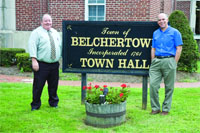
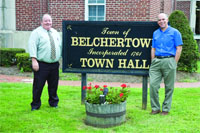
G Brougham and D Albertson say that, with the slowdown in Belchertown residential development, attention can focus again on their towns next steps.

Doug Albertson says he can finally take a breath.

After close to two decades of rapid residential growth in Belchertown, the nation’s sagging economy slowed the pace of further expansion for one of the fastest-growing municipalities in the Commonwealth. And a break, while it brings hardship to several sectors — from homebuilders to home sellers — was probably needed.

“I think that the building lull has given us a chance to catch up and regroup a little bit,” said Albertson, the town’s chief planner. “It’s always good to have a rest, especially after being frantically hurried over the last decade. It’s given us a chance to do some real planning.”

A town with a rich history, Belchertown was first settled in 1731, and retains much the same boundaries where Jonathan Belcher first took deed in the early part of that century. The October town fair is one of the oldest of its kind continuously operated in the nation, and the creation of the Quabbin Reservoir, mostly within those borders, is one of the Bay State’s most documented municipal projects of the 20th century.

These days, Belchertown is most noted for that once-enviable pace of robust residential development, what Town Administrator Gary Brougham calls the town’s “single largest industry.” But the community has been in the headlines for the past few years over the fate of the former Belchertown State School.

While the town has been active in seeking ideas for the property, there have been some setbacks. It has contended with both a developer whose ideas were bigger than his checkbook, and a site with millions of dollars in overdue cleanup costs presenting more than a minor challenge for any potential development.

But town leaders remain confident. The Belchertown Economic Development & Industrial Corp. is managing oversight of the state school property, and it is getting ready to propose some new findings to the Board of Selectmen this month. “That’s when the rubber really hits the road, ” said EDIC chair Bill Terry.

In the latest in its ongoing series of community profiles, BusinessWest takes an indepth look at Belchertown — past, present, and (potential) future.

Leaps and Bounds

According to town records, Belchertown’s population grew, on average, 2% annually for its first 200 years. In 1970, the population was just under 6,000, and by 2000, there were close to 13,000 people in town. The U.S. Census estimates Belchertown’s population to be close to 16,000 people now, and projections range to 25,000 in the next 20 years. Between 1990 and 2000, the rate of growth was 22%, more than four times the regional average of 5%.

Despite such an influx of new residents, Albertson said that what the community lacks is density.

“We are 50 square miles — that’s one of the largest geographical towns in the state,” he said. “If you look at the core of the town, out of the town’s 15,000 people, Belchertown’s center has maybe half that. Everybody else is closer to Amherst, Ware, Palmer, and Ludlow.”

What that translates to is a bit of a challenge for a homegrown business district. Belchertown’s center is an historic village green, but it lacks the presence of a commercial destination. Instead, business districts are pocketed in areas on Routes 9 and 202.

“In terms of new growth, we’re always trying to attract new business,” said Albertson. “But one of the challenges we have here is zoning. We don’t have a lot of land that is zoned for business, and changing that can be difficult. Once a residential neighborhood is established, people don’t like the idea that business can show up in their neighborhood. Everybody wants new business in town, but they want it ‘over there.’ And there really isn’t any ‘there’ here.”

Jim Phaneuf agrees. He’s the owner of Bell & Hudson Insurance, a business that can trace its roots back to the Civil War. For 23 years he has been located close to the downtown area, but doesn’t find the widely spread population to be a drawback.

“It’s a rural economy, sure,” he said. “For the people who live here, though, my sense is that people want to do their business locally. They tend to make a strong effort.

“One reason I think is that the business community does a great job of supporting local causes,” he continued. “If you look in our weekly paper, you see thank-you notes to the local businesses for supporting things at the high school, or local fund drives to donate money to cancer research. I don’t think that a week goes by where you don’t see a letter of some kind like that.”

Brougham said the town’s business population might not be highly visible for the outside visitor, but it is there, and strong.

“There’s a pretty equal mix of small mom-and-pop shops and larger businesses,” he said. “Two lumber companies, Northeast Treaters and Universal Forest Products, are both significant employers in town, and the construction sector, the way it is, hit them hard. But they are still in good shape.” Another manufacturer of construction materials, National Fiber, is also holding its ground.

With the residential boom in Belchertown, that construction sector has been an important facet to the town’s economy. And when turmoil hit Wall Street, it also hit Belchertown’s Main Street.

“The builders, tradesmen, landscapers, Realtors, bankers, lawyers, everyone has a stake in construction here,” said Brougham. But that pace has slowed significantly.

“From more than 100 or more housing starts per year we were down to 13 last year and 12 as of Aug. 1 this year,” he said, adding that, with such a slowdown in activity, the time is perfect for people wanting to make a move.

“There is still activity out there,” he said. “A new subdivision was recently approved, and there’s a multiple-year backlog of available property. Lots that had been selling for $160,000 could be had for much less today.”

For Albertson, the focus on town development in the residential market isn’t a drawback at all. “We’ve been growing at a manageable pace, really, and financially we’re sound. That might be one of the advantages of having a primarily residential tax base. People complain about it all the time, but when businesses suffer, we aren’t stuck with a lot of empty properties.”

Back to School

The 70-plus acres of the former Belchertown State School have been a concern since Beacon Hill decommissioned the facility in 1992.

Currently zoned for light industrial use, the property had a brief flicker of hope when a developer sought to bring a large-scale resort spa and wellness-related businesses to the site. The concept, though supported in principle, never got off the ground. Albertson credits the EDIC with solid vision, and said it has been great at “focusing on what can be done there.”

“We got a grant under Mass State Law 43D,” he continued, “which states that a town can designate an area a priority development, and we received $100,000. Looking at the site, we’ve hired the engineering firm Fuss & O’Neill to do site and conceptual planning. There’s been a marketing firm, RKG Associates, to do a feasibility analysis to find out where the market is, and to get a realistic and sober view of what we have there.

“So, instead of casting a line out and seeing where it blows,” he continued, “it’s a much better way of looking at our site objectively, and looking at what our assets and disadvantages are.”

Cleanup at the site has proven to be a big, lingering disadvantage. Old buildings (some in terminal deterioration), asbestos, and old steam tunnels all have conspired to keep most developers at bay. While the town has succeeded in gaining approval for a $10 million bond specifically to address those conditions, the bond market hasn’t hasn’t been very inviting of late, and cleanup continues to wait. “But the law is there,” Albertson said, “so once the money has been raised we should get up to that amount.”

Terry is one of those people who remains confident that, when it comes to effective reuse of the site, it’s a matter of when, not if, it will happen. Since 2000 he has been actively seeking answers for the property. While there is the main campus of just over 70 acres, other neighboring school parcels have been successfully developed. The new Hampshire County Courthouse and Sheriff’s Office, Easthampton Savings Bank, and TSC Tractor Supply Warehouse, all at the intersection of Routes 202 and 21, sit on one of those parcels.

“Sure, we’ve only delivered some $78,000 dollars to the town in taxes, and we’ve only developed slightly under $20 million in private investment,” he said. “And we’ve only delivered around 150 full-time jobs. This doesn’t sound like much, but when you consider that there was nothing … it’s not too bad.”

At the selectmen’s meeting scheduled in September, Terry said that there are two feasibility plans that will presented. While nothing could be made official at press time, he did say that “they are two solid approaches.”

“One of them is, as we have done since 2002, one property at a time,” he explained. “The second concept that I know is to consider a mixed-use type of development. However, that would require some retail/commercial-type space, and you would have to identify who would take advantage of that. Where are those customers going to come from?”

Terry has some thoughts for what he believes would be successful at the property. “We’ve been dancing around a bit with an assisted-living developer,” he said. “A project with 90 units … I absolutely believe that would be a slam dunk, because all those younger people moving into town have mom and dad to think of in the near future. Sooner or later, they’ll need assisted-living types of housing. There’s no reason, in my opinion, why that couldn’t be successful.”

Albertson also looks ahead, rather than dwelling on the past pitfalls. “I think there’s a lot of potential, but I think it has to be done in a way that will grow with the community. Rather than something imposed on the town, something that just shows up and buries us … do it in a way that improves the community and adds to our employment base. I think it can be done right. It’s not going to happen in a year, but it’s already been 15, so we do want to do this right.

“The New England Small Farm Institute is on the other side of the property,” he continued, “and we keep thinking about UMass, because an institutional connection seems to me like a perfect thing. We’ve got the UMass farms and orchards already in town, and it would not be much of a stretch at all if the university had a further presence here. It’s all about using the site, providing employment and activity in town without adding a lot of extra traffic.”

Speaking personally, Phaneuf said that he’d just like to see more jobs created in the town. “We employ 14 people here (at Town Hall), and while that’s small, that’s a similar size for many businesses in town.

“What I would like to see is a place to create jobs within the community so that people wouldn’t have to leave,” he continued, noting that 75% of the population currently travels out of town for work.

Plan Be

Devising ways to lower that number appreciably is just one of the things that town officials can do with that breathing room that comes with the lull in residential expansion.

That lull won’t last forever, or even another year or two, as the economy begins to improve and developers again eye ways to develop more of this community’s wide, open spaces. Challenges like the fate of the Belchertown State School property remain, but, overall, the forecast remains bright for a community with the room — and the imagination — to keep on growing.

Departments

The following is a compilation of recent lawsuits involving area businesses and organizations. These are strictly allegations that have yet to be proven in a court of law. Readers are advised to contact the parties listed, or the court, for more information concerning the individual claims.

FRANKLIN SUPERIOR COURT

Edward, Mary and Christopher Muenkel v. Greenwood Technologies, LLC
Allegation: Malfunction of wood-burning furnace causing property damage and personal injury: $83,000
Filed: 7/7/09

Theresa Rice v. Deerfield Academy
Allegation: Negligent property maintenance causing injury: $67,500
Filed: 7/10/09

HAMPDEN SUPERIOR COURT

Hallinan Capital Corporation v. Mountain Road Estates and John Hansen
Allegation: Breach of promissory notes: $884,870.63
Filed: 7/13/09

Naismith Memorial Basketball Hall of Fame v. Wazoo Sports Inc.
Allegation: Default of broadcasting rights agreement: $54,500
Filed: 7/9/09

Republic Ironworks Inc. v. Barr Inc. and Travelers Casualty & Surety Co. of America
Allegation: Breach of contract and non-payment of labor, equipment, and materials provided: $42,426.00
Filed: 7/9/09

HAMPSHIRE SUPERIOR COURT

Frank C. Corriveau v. Gentiva Health Services
Allegation: Employment discrimination: $850,883
Filed: 7/15/09

Town of Hatfield v. Mount Vernon Group Inc., Moriece & Gary Inc., and Aquadro & Cerruti Inc.
Allegation: Breach of construction contract for the Dorothy M. Breor Elementary School: $100,000
Filed: 7/15/09

Tyron A. Patruno v. Town of Hadley
Allegation: Breach of employment settlement agreement: $50,000
Filed: 7/15/09

HOLYOKE DISTRICT COURT

Leader Home Center Inc. v. A.R. Green & Son Inc. & Our Lady of the Blessed Sacrament
Allegation: Non-payment of goods sold and delivered: $45,266.17
Filed: 7/3/09

Cook Builders Supply Co. v. Berry Construction
Allegation: Non-payment of goods sold and delivered: $3,305.13
Filed: 7/16/09

NORTHAMPTON DISTRICT COURT

SWB Properties, LLC v. Equity Builders Realty, LLC
Allegation: Breach of purchase-and-sale agreement: $8,750
Filed: 7/13/09

The Darcy Co. v. Northampton Rehabilitation and Nursing Center
Allegation: Non-payment of goods sold and delivered: $4,844.87
Filed: 7/27/09

PALMER DISTRICT COURT

IGM International Granite & Marble Corp. v. Blarney Stone
Allegation: Non-payment of goods sold and delivered: $3,644.33
Filed: 6/25/09

SPRINGFIELD DISTRICT COURT

Comcast Spotlight Inc. v. BMS Paper
Allegation: Non-payment of advertising services provided: $9,896.73
Filed: 7/1/09

Liberty Mutual Insurance Co. v. Rebello Construction Inc.
Allegation: Non-payment of workers’ compensation insurance: $7,307.43
Filed: 7/8/09

WESTFIELD DISTRICT COURT

Berkshire Bank v. Your Cleaning Services and Alena V. Mozolevskaya
Allegation: Non-payment of balance due under credit agreement: $24,940.57
Filed: 6/19/09

Departments

Transforming Young Minds

The Electrical/Robotics Technology Department at Springfield Technical Community recently staged its annual summer robotics camp. Eleven middle-school students from Springfield took part in the two-week camp, which gave them an opportunity to learn about the field and build their own robot. At left, Kamari Long displays his robot, while below, Aailyah Gordon (left) and Daryen Ramsey-Thomas show what their creation can do. Sponsors for the camp again this year included the Hampden County Regional Employment Board and the Black Men of Greater Springfield.


A Cut Above

Paul DiGrigoli, owner of DiGrigoli’s Salons, put his talents on display at a recent trade show of the Affiliated Chambers of Commerce of Greater Springfield, providing free haircuts to attendees. Here, he chats with BusinessWest Sales and Marketing Coordinator Melissa Hallock.

Opinion
Casino Jobs Aren’t Enough

Last year, House opposition stopped Gov. Patrick’s proposal to build three resort casinos in Massachusetts. With a worsening fiscal crisis and Speaker Robert DeLeo taking a more casino-friendly stance than his predecessor, the issue is sure to reemerge this fall.

Proponents argue that casinos will add new tax revenue and much-needed jobs — a Greater Boston Chamber of Commerce study estimates that three resort casinos would add between 10,000 and 11,500 temporary construction jobs and 17,000 to 21,000 permanent jobs. Opponents cite the societal costs associated with gambling.

Our organizations haven’t taken a position on casinos. But we believe the much bigger issue is that, while the country added about 25 million jobs over the last two decades, the number of jobs in Massachusetts stayed the same.

Flat job growth is not a strategy for long-term success. Skilled workers have made Massachusetts a leading destination for high-paying jobs. But focusing only on high-end employment is a recipe for disaster, creating a society of haves and have-nots. Broader job growth creates social mobility, encourages affordability, and enhances the region’s ability to attract the best talent.

Creating a level playing field should be the foundation of an overall vision for long-term job growth. It begins with streamlining the process for starting a business. Massachusetts must be a destination that holds opportunity for new immigrants and other start-up entrepreneurs, not just the established and affluent. And while Massachusetts will never be inexpensive, costs matter, and there is much that can be done to reduce them.

A 2006 study prepared by Global Insight for Pioneer Institute found that the cost of land was the source of the state’s high residential and commercial rents, wages, and overall cost of living. The problem often stems from rigid local zoning ordinances that discourage development. In the midst of a deep recession, it’s easy to lose sight of problems such as the supply of affordable commercial space not keeping up with demand. But over time, this has been a main driver of rising costs, making each new job more expensive to create.

The cost of employer-provided health insurance continues to rise much faster than inflation. The Commonwealth’s 2006 health care reform law was a first step toward addressing the problem. It has successfully expanded access to health insurance, but a laser-like focus on cost containment will be necessary if it is ultimately to succeed.

Massachusetts’ cost of electricity, one of the highest in the nation, is also hindering economic growth. With the state’s reliance on expensive fuels to generate power, escalating costs to replace an aging infrastructure, and the willingness to constantly add surcharges to customer bills to fund unproven renewable technologies and other costly experimental programs, further double-digit rate increases are certain.

Massachusetts employers also pay more than $1.5 billion annually in unemployment insurance taxes — double the national average on a per-employee basis. The taxes support a system that offers the richest benefits in the country, and one in which it’s easier to qualify for benefits and recipients can collect for longer than in other states.

With people hurting across the state, this isn’t the time to cut unemployment benefits. But a set of reforms proposed last year by Associated Industries of Massachusetts would have saved $366 million without slashing benefits.

Today, businesses in seasonal industries like construction and tourism routinely lay off the same employees every year, using unemployment benefits as kind of a payroll subsidy. Some small-business owners take advantage of this loophole by laying themselves off and collecting for part of each year. Charging those companies much higher unemployment insurance tax rates would provide a disincentive for bad behavior and lighten the load for companies that aren’t abusing the system.

Whether to build casinos in Massachusetts is an issue that merits spirited debate. But casinos alone aren’t nearly enough to make up for the Commonwealth’s failure to grow jobs. Regardless of how the casino debate turns out, state policymakers should spend far more time and effort on reforms that will spur substantial long-term job growth.

Rick Lord is president and CEO of Associated Industries of Massachusetts. Jim Stergios is executive director of Pioneer Institute.

Sections Supplements
The Employment Picture Is Improving, but It Remains Fuzzy
Mary Ellen Scott, left, and Christine Phillips

Mary Ellen Scott, left, and Christine Phillips say business is picking up.

The July unemployment numbers released by the U.S. Department of Labor were lower than expected. That’s the good news.

However, the difference between the projected figure and the 9.4% unemployment statistic for that month was a tenth of a percent. That’s … not too bad for news these days.

Across the nation in July, employers trimmed 247,000 jobs, in contrast to the staggering January losses of 741,000. On the day the unemployment numbers were released, President Obama said that “the worst may be behind us,” and that “we are pointed in the right direction.”

The Bay State posted a seasonally adjusted 8.6% unemployment rate for the month of June, and while there were other Mass. communities that spiked into double digits, Hampden County edged below, at 9.8%.

That’s still a large number, and it’s reflected in what Rexene Picard, executive director of FutureWorks in Springfield, one of 37 statewide career centers, observes every day. “The big thing that we’re seeing is increased traffic for job seekers. There’s a line out the door when we open. At the same time, we are seeing fewer job opportunities. Our job postings have gone down from this time last year about 38%. That’s a significant drop.”

At United Personnel in Springfield, owner Mary Ellen Scott and Executive Vice President Christine Phillips took a positive look at the local job market. Talking about the manufacturing sector, historically one of the backbones of the local economy, Scott said that “our business has definitely been picking up over the last few months.”

Joe Ascioti, owner of Reliable Temps Inc. in Agawam, feels less buoyant about the government’s predictions. While the latest statistics are better than feared, he said, “let’s face it, we aren’t creating a lot of new jobs yet. There’s still too much uncertainty out there right now.”

In these days of economic turmoil, a reduction in bad news is good news, most would agree. Massachusetts has consistently been at the lower end of the nation’s unemployment rates, but in talking with area employment professionals, the big question is, when does the good news get good?

Local Looks

While the number of job-seekers and the dearth of jobs Picard sees everyday are both somewhat historic, she is confident in programs that are available for area workers.

“Western Mass. is better in some ways than the Boston area because we don’t see the highs nor the lows that they do,” she said.

Some new growth in the job market comes from familiar sources, she continued. “Health care is, and continues to be, the leading source of employment for this area and the state.

“Our largest employer in the area is Baystate Medical Center,” she continued. “They are reaching out to us now, because we know that there is going to be a need to hire around 1,000 people a year for the next several years. Anybody that’s thinking about a new career, or switching gears, I encourage them to look at that field.”

In the manufacturing and construction sectors, new claims for unemployment in Hampden County totaled more than 3,000, and Picard agreed that the bulk of her June numbers comprised those industries. But with funds from the American Recovery and Reinvestment Act, one of the largest stimulus packages in history, funds have come through the pipeline to address those losses. Picard said she’s pleased to see substantial money going into both new training and retraining for the manufacturing base of the area.

“But it’s difficult,” she continued, “because this money essentially is going to replacement jobs. Not a lot of new companies are moving to the area.”

Manufacturing continues to be an important facet to the regional workforce, despite decades of offshore attrition. Picard said that the Regional Employment Board of Hampden County is involved with numerous initiatives to keep people in those positions.

“The manufacturing industry constitutes 17% of the area workforce, and those generally are jobs that are well-paying positions,” she said. “The REB is doing a lot of work in the area with manufacturers, asking where the need is for new employees and what they can do to successfully build pipelines into those industries. It’s an aging workforce in many cases.”

Phillips and Scott say there are signs of some light at the end of the tunnel for the manufacturing sector, and they’re seeing it in the growing number of positions they’re being hired to help fill.

“I don’t think we were expecting manufacturing to be doing as well as we have seen already this year,” said Scott. Phillips agreed. “It has picked up, and it is definitely where we have seen the biggest trend change. We were not anticipating certain clients to have needs this year; our analysis was that we weren’t planning on having any orders.”

The improving picture can be attributed in part to what appears to be greater consumer confidence, as reflected in some of the numbers being posted by retailers, said Phillips.

“I think that if you look at certain other sectors, let’s say retail, their numbers began the year pretty low,” she said. “What they predicted for this quarter has been completely surpassed. There was a real concern about what kind of money would be spent. What retailers are seeing is that people are still spending. Thus, analysts look from this time last year to now, and their orders are far greater than they had anticipated.”

Phillips and Scott agreed that the numbers these days are not as good as they would like them to be. While some clients are hiring more than they anticipated, many employers are, by and large, holding out for more assurance that the economy will strengthen.

“Frankly,” said Phillips, “I’d be more nervous if we were making giant leaps in gains in the economy. It is more-steady gains that build people’s confidence. If it goes up in a sharp increase, people think that it could similarly go down in a sharp decline.”

Ascioti told BusinessWest that he sees government forces sometimes playing a contradictory role with regard to the employment picture. Unemployment taxes can be punishing to small business, and that size employer is one that needs to be given more consideration, he maintained.

“What I’m worried about right now,” he said, “is where are we going with all this? As the saying goes, Wall Street doesn’t like uncertainty; well, neither does small business. Unemployment costs for many businesses are going to go up 30%. For politicians in Boston to think that they can just raise the sales tax, raise the meals tax, raise this, mandate that, and that businesses are just going to sit there and say, ‘oh yeah, no problem. We’ll just raise our prices’ — well, it’s not an elastic environment. You can’t just do that.”

In this area, he said, a lot of what he hears is that business is still off 25% to 30%. “We have a couple of clients that are doing better than normal,” he said. “Are they where they were a year and a half ago? No. Are they better than 80% of what their competition is doing? Yes. But can I pick one specific industry? Unfortunately, no.”

Looking at the larger forces of federal and state regulation, Ascioti said, “what we need to do right now is bring our costs in line. I wish the government would understand that it’s small business that creates the jobs in America. If the climate isn’t positive for them, it’s going to be impossible to hire people.”

Hire Ground

The day after the newest unemployment figures were released, the New York Times reported that “employers are no longer in a panic, and the pressure they felt to get rid of workers in a hurry is diminishing.” That seems to be the sentiment in the Pioneer Valley, but the overall employment picture remains fuzzy because there are too many variables to make a clear assessment.

One thing is fairly certain, however: until the economy gains both momentum and sustained stability enough for employers to take on more workers, the only real good news is that the bad news is getting better.

Departments

Ten Points about :forming a new business

By SEAN WANDREI, CPA

1. What type of owners will there be? A sole proprietor has one owner (an individual), a partnership/limited liability company (P/LLC) has at least two owners, C-corporations have no restrictions, and S-corps a maximum of 100 owners.

2. Choice of tax year? A C-corp can have any year-end. A sole proprietor has the individual owner’s calendar year-end. Generally, a P/LLC must have the same year-end as the majority owner, and S-corps must have a calendar year-end.
3. Who pays the taxes? A C-corp pays the taxes on its own tax return. Sole proprietor, P/LLC, and S-corp income flows through to the owner, and taxes are paid on the owner’s return.
4. Is there liability protection? Sole proprietors and partnerships have no liability protection, while C-corps, S-corps, and LLCs have certain liability protection.

5. Availability of fringe benefits to owners? Fringe-benefits exemptions from tax are not available to a sole proprietor or P/LLC owner. Fringe-benefit exemptions are available to owners of C-corps and fewer than 2% owners of S-corps.

6. Is the contribution of property to the entity by an owner taxable? An owner can contribute property to a SP and P/LLC tax-free, while contribution of property to a C-corp or S-corp by the owner could be a taxable event.
7. Taxation on the sale of an ownership interest? Disposition of C-corps and S-corps are treated as a sale of stock, while the sale of a SP is treated as a sale of assets. The sale of P/LLC ownership interest is generally treated as a sale of a capital asset.
8. Can the entity pay its owner wages? A sole proprietor and P/LLC cannot pay its owner’s wages, while a C-corp and S-corp can pay wages to its owners.
9. Are earnings of the entity subject to self-employment tax on the owner return? Earnings from a trade or business of an SP or P/LLC are subject to self-employment tax. Earnings of an S-corp are not subject to self-employment tax.

10. What else should be considered? C-corps and S-corps are subject to tax on their inventory and manufacturing equipment at a rate of $2.56 per $1,000 of value on their Mass. Corporate Income Tax Return.

Sean Wandrei is a tax manager with Meyers Brothers Kalicka, P.C.. His technical concentrations are in multi-state taxation as well as real estate entities; (413) 536-8510.



Departments

Hampden Bancorp Declares Cash Dividend

SPRINGFIELD — Hampden Bancorp Inc., the holding company for Hampden Bank, recently reported that total assets increased 4.4%, from $543.8 million on June 30, 2008 to $567.7 million on June 30, 2009. Net loans, including loans held for sale, increased $26.8 million, or 7.4%, to $387.6 million at June 30, 2009, and securities decreased 6.3%, or $7.8 million, from $123.9 million to $116.1 million as of June 30, 2009. Deposits increased $50 million, or 15.1%, to $381.5 million at June 30, 2009 from $331.4 million at June 30, 2008. In other news, the company repurchased 397,493 shares of company stock, at an average price of $10.03 per share, in the first and second quarters of fiscal 2009 pursuant to, and in completion of, the stock repurchase program that was announced in May 2008.

Easthampton Savings Notes Steady Growth

EASTHAMPTON — Easthampton Savings Bank continues to experience “steady growth,” according to William Hogan Jr., president and CEO. The bank’s total assets increased $22 million from a year ago, an increase of $6 million over the last quarter. Total assets now stand at more than $802 million. Hogan noted that the capital-to-asset ratio ended the second quarter at 12%. Also, the bank’s loan portfolio totaled more than $588 million at the end of June. In other news, Banker & Tradesman recently announced the top three lenders in Hampshire County, and Easthampton Savings was first in mortgage market share, according to Hogan.

Behavioral Health Network Awarded Contracts

SPRINGFIELD — Behavioral Health Network (BHN) has been awarded two state contracts to provide a range of comprehensive services to Medicaid-eligible children with serious emotional disturbances. This service, which focuses on intensive care coordination and family support and training, comes under the new responsibilities of a lead community service agency, specific to geographical areas of the state. The Mass. Behavioral Health Partnership awarded both the Springfield and Robert Van Wart geographic service areas to BHN. Areas to be served by the contracts include Springfield, Chicopee, East Longmeadow, Longmeadow, South Hadley, Granby, Ludlow, Wilbraham, Hampden, Monson, Palmer, Belchertown, and Ware. Jennifer Moore, BHN’s senior program manager, projects that, once the program for the two service areas is fully operational, more than 1,100 children and their families will be served, and more than 100 new staff will be hired. Moore added that the contract awards will result in between $9 and $12 million in new services for the Greater Springfield area.

Law Firm Adopts New Name

NORTHAMPTON — Royal & Munnings, LLC has changed its name to Royal & Klimczuk, LLC with the recent addition of new partner Kimberly Klimczuk. Royal & Klimczuk, a state certified, women-owned business enterprise, will continue to focus its practice in management-side labor and employment law, business litigation, and corporate and nonprofit law. The firm has launched a new Web site, www.rkesq.com.

WNEC Participates in Yellow Ribbon Program

SPRINGFIELD — Western New England College (WNEC) has committed to providing thousands of dollars in financial aid to veterans under the federal government’s new Yellow Ribbon GI Education Enhancement Program. The program allows qualifying veterans to attend WNEC and the WNEC School of Law tuition-free. The Post-9/11 GI Bill pays qualifying veterans a benefit up to the highest public in-state undergraduate tuition. Institutions voluntarily participating in the Yellow Ribbon Program commit to providing additional assistance, which is matched dollar-for-dollar by the government. Veterans who served at least 90 days on active duty after Sept. 10, 2001 are entitled to the new benefits, with those who served at least 36 months on active duty eligible for the maximum benefit. WNEC will waive application fees for program participants. For more information, call Admissions at (413) 782-1321, or E-mail [email protected].

Kuhn Riddle Earns Honor

AMHERST — Kuhn Riddle Architects (KRA) has received an Honor Award from the Boston Society of Architects and the Mass. Architectural Access Board for a recently completed project at the Massachusetts College of Liberal Arts (MCLA) in North Adams. The award recognizes design excellence in a building with a special approach to access for people with disabilities. The MCLA Berkshire Towers project involved renovations and additions to a high-rise dormitory, built in 1973. Chris Riddle, KRA principal, noted that the firm was committed to make the new common spaces in the residential complex “easy and fun for everyone, disabled or able-bodied.”

Couple Sought for Wedding On Ice Event

SPRINGFIELD — The Springfield Falcons are searching for a couple who would like to get married on the ice before the Falcons home game on Nov. 28. The ‘wedding on ice,’ presented by Hannoush Jewelers, includes the ceremony on the ice performed by Justice of the Peace Ruth Farnsworth, and a wedding reception in the Executive Perch overlooking the ice for 50 people, with tickets to the game and food included. In addition, Hannoush Jewelers will donate his-and-her wedding bands, and Deluxe Limousine will bring the couple to center ice for their first dance during the first intermission. Also, Formal Affair will provide tuxedoes, while Pearl Bridal Boutique will provide the bridal dress. Susan Weislo Photography will provide photography, including a proof book, and McClelland’s Florist will provide the bride’s bouquet and the on-ice arrangements. Individuals interested in winning this all-expenses-paid wedding can E-mail Bill Bullock at the Falcons office at [email protected] by Sept. 15. Couples can also register to win by visiting Formal Affair, 581 Westfield St., West Springfield; Pearl Bridal Boutique, One Open Square Way, Holyoke; or any Hannoush location.

Departments

The following is a compilation of recent lawsuits involving area businesses and organizations. These are strictly allegations that have yet to be proven in a court of law. Readers are advised to contact the parties listed, or the court, for more information concerning the individual claims.

CHICOPEE DISTRICT COURT

Tamara Gordievsky v. Spring Valley Mart
Allegation: Negligence in property maintenance, causing injury: $2,557.03
Filed: 7/14/09

FRANKLIN SUPERIOR COURT

Cindy Foster, Executor of the Estate of Karen Marquis v. Uma Raghunathan, M.D.
Allegation: Defendant’s failure to properly treat Marquis’ medical condition led to her death: $25,000
Filed: 6/30/09

Mary English and Margaret Perri v. Lifetyme Exteriors, LLC
Allegation: Breach of home repairs and painting contract: $37,946.15
Filed: 7/10/09

Sally Orluk and Walter Jarvi v. Richard & Paula Sheridan and Orange Oil Company Inc.
Allegation: Improperly installed heating unit, causing property damage and personal injury: $546,192.15
Filed: 7/23/09

GREENFIELD DISTRICT COURT

Crystal L. DeMaria v. Green River Honda
Allegation: Negligent failure to repair motorcycle, causing accident and personal injury: $3,262.05
Filed: 6/18/09

Leader Home Center Inc. v. W. Kulig Inc.
Allegation: Non-payment of goods sold and delivered: $14,073.85
Filed: 6/11/09

Oldcastle Precast Inc. v. Blue Waters Marine Aggregates, LLC
Allegation: Defendant’s agent, while driving a tractor, negligently damaged the trailer in an accident: $12,000
Filed: 6/10/09

HAMPDEN SUPERIOR COURT

Alan E. Pranka v. Harman Stove Co., et al
Allegation: Product liability: $209,070.65
Filed: 6/22/09

JoAnne Grybosh v. Hartley Brother Landscaping Inc.
Allegation: Breach of contract: $118,000
Filed: 7/2/09

Mark P. Soticheck v. CRS Environmental, LLC
Allegation: Breach of employment contract: $53,500
Filed: 6/30/09

Marlin Controls Inc. v. Lapinsky Electric Inc.
Allegation: Non-payment of goods sold and delivered: $35,584.32
Filed: 7/2/09

Michael A. Lind and Lisa A. Bishop, Jointly as Administrators of the Estate of Corey M. Lind v. Domino’s Pizza Inc. and Alex A. Morales
Allegation: Compensatory and punitive damages resulting from negligent supervision and wrongful death: $15 million
Filed: 6/16/09

OFC Capital Corporation v. Berkshire-Westwood Graphics Group Inc.
Allegation: Non-payment of promissory notes: $417,149.06
Filed: 7/14/09

Ryder Transportation Services v. Berkshire-Westwood Graphics Group
Allegation: Non-payment of truck lease and service agreement: $36,289.64
Filed: 6/08/09

Susan Mani v. United Bank and Doherty, Wallace, Pillsbury, and Murphy, P.C.
Allegation: Breach of contract, fraud, unjust enrichment, and conversion: $13,441,340
Filed: 6/25/09

United Cooperative Bank v. Washington Mutual Bank
Allegation: Breach of warranty; defendant cashed forged instrument and then presented to United Bank for payment: $38,066.89
Filed: 6/15/09

HAMPSHIRE SUPERIOR COURT

Christopher G. and Sarah D. Pelkey v. Veterans of Foreign Wars No. 8006
Allegation: Dram shop liability: $111,731.49
Filed: 7/06/09

Don Lia, et al v. Environmental Compliance Services Inc.
Allegation: Damages resulting from breach of contract for environmental consulting services: $20 million
Filed: 7/21/09
Green & Sons Inc. v. Protestant Episcopal Church
Allegation: Non-payment of construction goods and services: $576,953.20
Filed: 7/20/09

Universal Forest Products Eastern Division Inc. v. Trak Petroleum, LLC and Patrick Tannous
Allegation: Non-payment of goods sold and delivered: $15,184.45
Filed: 7/30/09

HOLYOKE DISTRICT COURT

Cook Builders Supply Company Inc. v. Ryan Landscaping
Allegation: Non-payment of goods sold and delivered: $6,412.41
Filed: 7/16/09

Lora Barrett v. B.F. Donuts Inc. d/b/a Dunkin Donuts
Allegation: Failure to maintain entryway, causing injuries: $17,690
Filed: 6/08/09

NORTHAMPTON DISTRICT COURT

Designcrete of America, LLC v. Stone Soup Concrete, LLC d/b/a Kustom Decokrete
Allegation: Non-payment of goods sold and delivered: $2,693.02
Filed: 7/8/09

L. Francis Dionne v. Northampton Ford Inc.
Allegation: Failure to deliver purchased vehicle and failure to return purchase price upon written demand: $12,221
Filed: 6/26/09

Premier Supply Group Inc. v. Al’s Heating & Cooling Inc.
Allegation: Non-payment of goods sold and delivered: $4,886.24
Filed: 6/30/09

Premier Supply Group Inc. v. Advanced Mechanical Services, LLC
Allegation: Non-payment of goods sold and delivered: $24,179.57
Filed: 6/30/09

TBF Financial, LLC v. Somatic Systems Institute Inc.
Allegation: Plaintiff seeks to recover damages for breach of a business lease: $8,149.47
Filed: 7/22/09

PALMER DISTRICT COURT

Alexander and Karen Averette v. Good Deal Auto
Allegation: Breach of contract for purchase of motor vehicle: $10,000
Filed: 6/16/09

BRT Extrusions Inc. v. Ledlight Illuminated Signs, LLC
Allegation: Non-payment of goods sold and delivered: $4,168.17
Filed: 6/15/09

Capital One Bank, N.A. v. Carter McLeod Realty Company, LLC
Allegation: Monies owed for credit advanced: $4,279.37
Filed: 6/05/09

SPRINGFIELD DISTRICT COURT

Liberty Mutual Insurance Co. v. F.W. Dwyer Co., LLC
Allegation: Non-payment of workers’ compensation insurance: $19,480.66
Filed: 7/8/09

Michael R. Tryon v. Home Depot USA
Allegation: Defendant sold and installed a defective door causing damage to plaintiff’s home: $8,417.42
Filed: 6/25/09

New England Industrial Uniform Rental Services v. Herb Holden Trucking
Allegation: Breach of uniform rental agreement: $15,739.72
Filed: 6/30/09

Poultry Products Inc. v. Li’s Brothers
Allegation: Non-payment of goods sold and delivered: $4,662.03
Filed: 6/22/09

Robin Belgrade v. Six Flags Inc.
Allegation: Defect in pavement, causing injury: $25,000
Filed: 7/13/09

Zulma Sinisterra v. Giggle Gardens Child Center
Allegation: Negligence in property maintenance, causing slip and fall: $6,382
Filed: 6/19/09

WESTFIELD DISTRICT COURT

Amerifirst Home Improvement Finance Co. v. Custom Craft Industries
Allegation: Breach of contract: $10,228.37
Filed: 7/3/09

BKM Total Office v. Floors Above and Brian Glynn
Allegation: Defective installation of flooring at Barnes Aerospace: $19,878.88
Filed: 6/16/09

Departments

An Exciting Chapter

As part of a program called “Putting the Accent on Literacy, One Book at a Time,” BusinessWest and its Difference Makers Class of 2009 coordinated a book drive in conjunction with the Hasbro Summer Learning Initiative, which links young people with books during the summer months when they are away from school. On Aug. 5, program participants gathered for a reception and book reading at the Dunbar Community Center in Springfield. At right, Maura Geary, project coordinator for the Regional Employment Board of Hampden County, reads Mia Hamm’s “Winners Never Quit” with Tea Webster; below, right, Trevis Wray, representing the Young Professionals Society of Greater Springfield, reads “Where the Wild Things Are” with Chris Benoite; below, BusinessWest Associate Publisher Kate Campiti reads “A Chair for My Mother” with Tahjai Lewis.

Sections Supplements
Athletic Training Profession Grows in Popularity — and Responsibilities
Susan Guyer, left, and Tracey Dexter Matthews

Susan Guyer, left, and Tracey Dexter Matthews have seen interest in their profession steadily increase.

Susan Guyer says that many of those who enroll in Springfield College’s four-year Athletic Training program do so with visions of working for the Boston Red Sox some day.

That’s why she gives her students — and those thinking about becoming her students — what she calls a reality check. It comes in the form of hard statistics, and specifically the one about how fewer than 1% of the athletic trainers currently employed across the country are on the payrolls of top-level professional sports teams.

This doesn’t seem to faze many of these individuals, nor should it, said Guyer, assistant professor of Athletic Training at SC. For starters, some of those who enroll in this program may very well become part of that small percentage; several of its graduates are now with major league teams, including Jim Rowe, head trainer with the Red Sox, and Barry Weinberg, head athletic trainer with the St. Louis Cardinals, among others. But more to the point, those who choose this program are drawn by an intriguing mix of medicine and sports, she explained, and most of them of them would be content no matter where they landed.

And there are many possible destinations, from those aforementioned pro sports teams to colleges and high schools; from clinical settings such as physical therapy centers to military units. There are now more than 32,000 people making a living as athletic trainers, and that number grows every year, said Tracey Dexter Matthews, associate professor of Research & Statis-tics at SC.

That’s because the need is escalating, she said, continuing a pattern that started more than 50 years ago. Indeed, there were only a few hundred athletic trainers in the late ’50s, and just a few thousand when Springfield College created its program — one of the first in the country and still one of the largest — in 1975.

The profession, and programs to train those who want to enter it, have come a long way over the past 34 years, said Guyer, but progress has been slow to come in some areas, starting with the matter of identity.

“Sometimes our name doesn’t clearly depict what we do; I was on a plane the other day, and when I told the person sitting next me I was an athletic trainer, she said, ‘can you help me get fit?’” said Guyer, citing the confusion between this profession and that of fitness, or personal, trainer. “It’s been a problem for a long time, but whenever we discuss a possible new name, no one can come up with one that works.”

Meanwhile, salaries remain at levels below what those inside and outside the profession think they are or should be, although some improvement has been recorded. Those working at high schools usually earn in the mid-40s, said Dexter Matthews, while those with small, private colleges actually make considerably less, and the average salary for those working in professional baseball (all levels included) is still in the low 30s.

At the top rung, however, the salary, benefits, perks, and other rewards can be substantial, Guyer continued, noting that trainers can earn bonuses, royalties, and even World Series and league championship shares and rings, as Rowe and Weinberg have.

“Salary has been a battle — they’re not where we want them yet,” said Guyer. “But the numbers are improving; every time I look at the statistics, I get a little more encouraged.”

And there remain some glass ceilings, Guyer continued, noting that there are hardly any women working at the top rung of professional sports — the NFL boasts one female assistant athletic trainer, with the Pittsburgh Steelers, for example — although she believes there will be a breakthrough, and soon.

“Someone’s going to bust through the barrier; things are improving on many different levels,” she said, adding that interest in the program and the profession has remained steady and strong over the years. As for the salaries … “it’s not about money for these individuals; it’s a passion for being involved with athletes.”

Field of Dreams

When asked if there was a standard profile for students who enroll in SC’s program, Guyer said there’s nothing, really, beyond that aforementioned attraction to both sports and medicine, although the number of women getting involved is climbing. Indeed, for the first time last year, more than half of those enrolled in programs nationwide — 51%, to be specific — were women.

But there are some personality traits shared by most students, she added quickly, noting that anyone who doesn’t like the sight of blood should look in another direction, career-wise. And, overall, a strong stomach is a prerequisite.

“These are people who will look at the YouTube video of [former Washington Redskins quarterback] Joe Theismann getting his leg broken [the gruesome injury suffered in a 1985 game against the New York Giants] and watch it over and over and over again,” she said. “They’ll look at the tape, watch and learn, and say, ‘that’s a good knee injury,’ if you should be calling it that.”

Dissecting such video is a small part of the process of learning the athletic trainer’s main duties — to “treat, rehabilitate, and diagnose injuries and illnesses,” Guyer continued, adding that, while the place of employment may vary from a local high school to a pro hockey team, the basic job description is essentially the same.

But it’s a role that has evolved over the years, she said, adding that new responsibilities have been added as medicine, society, and attitudes about fitness and exercise have changed.

To help explain it, Guyer used her own work as a trainer for SC’s women’s basketball team, and a season in that life, as an example. She said her work starts long before the first jump ball of the season, with thorough evaluations of each player.

“I will check each one of them in a preventative strategy before the season starts, so we play a huge role in prevention,” she told BusinessWest. “We do height, weight, blood pressure, pulse; we do orthopedic screening, and we do overhead-squat screenings to see if they have any weaknesses or any limitations in motion. We do a full health history screeing and go through it to see if there are any red flags — do they have a history of concussion? do they have diabetes? Are they an individual that’s asthmatic? What medications are they on?

“So we know a lot about this individual before they even step onto the court,” she continued, adding that, once the practice or a game begins, she’s also the first one on the scene if there’s an injury, such as a sprained ankle.

In such a scenario, the athletic trainer will check out said ankle, diagnose the problem, treat it, and monitor the situation. “I’m going to choose whatever modality I want,” she explained, “whether it’s ice and ultrasound progressing to heat and laser-light therapy. I’m going to be doing all the rehabilitation, so I’m going to get the range of motion back, and the strength back, and the balance back.”

And he or she also makes the decision about if and when the player is ready to return to the court (except in matters involving head injuries).

“It’s the trainer’s decision,” she said, noting quickly that this responsibility will sometimes, and perhaps often, lead to disagreements with coaches and the injured players in question. This explains another of the skill sets expected, if not required, of graduates — the ability to effectively communicate with a host of constituencies, even the parents of players.

And there’s more, Guyer continued, noting what she called a “psychosocial” element of the equation. Indeed, the athletic trainer is expected to help individuals cope with personal problems, common colds, and even eating disorders.

The breadth and depth of the job description can be gathered from the list of foundational and professional courses students must take over their four years. The subject matter includes human anatomy, kinesiology and biomechanics, nutrition, ‘acute care of injury and illness,’ ‘risk management and injury/illness prevention,’ health care administration, therapeutic modalities, and ‘psychosocial intervention and referral.’

In addition to work in the classroom, students must also complete field work TO gain hands-on experience. These are undertaken at area high schools, including Central in Springfield, Agawam, South-wick, and many others, and several colleges, including SC and UMass Amherst.

This combination of classroom and field work has the graduate ready for many of the possible destinations for athletic trainers, said Dexter Matthews, noting that most all seniors who want to enter the field have jobs long before commencement, but many choose to go on to master’s degrees that could open more doors.

That’s a Wrap

Summing up the realm of the athletic trainer and its popularity, Guyer said simply, “we deal with healthy people who have had an injury.”

This helps explain why this profession is more popular than some in the broad spectrum of health care, and why there has been a steady stream of interest in programs like that at Springfield College, even though the odds are very long that graduates will ever trot of the Red Sox dugout to check on Jacoby Ellsbury’s status after he’s had an encounter with the center-field wall.

“If you have a student who’s looking at a college, and they like sport, and they like medicine, this is a perfect combination,” she explained. “If you go into another profession, you’re not guaranteed to work with a physically active population that has few, if any, outside problems, like stroke.”

In other words, it’s enjoyable, rewarding work, even if you never get to take home a World Series ring.

George O’Brien can be reached at

[email protected]

Uncategorized

Some Sound Advice on How to Protect Your Business from Libel Suits

“Truth is generally the best vindication against slander.”

— Abraham Lincoln

“Truth is rarely pure and never simple.”

— Oscar Wilde

It is usually assumed by both non-lawyers and lawyers alike that truth is an absolute defense to a defamation claim. But it now appears that Honest Abe had it wrong — at least according to a recent opinion from the U.S. Court of Appeals for the First Circuit in Boston.

In the case of Noonan v. Staples, the Circuit Court permitted a former Staples employee, Alan Noonan, to pursue a libel claim against Staples based on statements made about him in a companywide E-mail even though they were true.

It has been traditionally understood that under Massachusetts law, a plaintiff alleging libel (defamation based on a writing) must prove five elements in order to succeed on his or her claim, namely: (1) that the defendant published a written statement (2) of and concerning the plaintiff that was both (3) defamatory (harmed the plaintiff’s reputation) and (4) false, and (5) caused economic loss or other demonstrable injury.

The Noonan case stemmed from a mass E-mail (or broadcast E-mail) sent by a Staples executive to the company’s 1,500 North American employees. In the E-mail, the executive noted that Alan Noonan, a Staples sales director, had been terminated for falsifying expense reports. Noonan had, in fact, been recently terminated for cause after an internal investigation uncovered his wrongdoing. The E-mail stated:

“It is with sincere regret that I must inform you of the termination of Alan Noonan’s employment with Staples. A thorough investigation determined that Alan was not in compliance with our travel and expense policies. As always, our policies are consistently applied to everyone and compliance is mandatory on everyone’s part.”

Although the Circuit Court acknowledged that the statements in the E-mail were indeed true, it ruled that Noonan could nevertheless pursue his libel claim against Staples. In allowing the case to proceed to a jury trial, the Circuit Court applied an often-overlooked Massachusetts statute, G.L. c. 231, Section 92, which states that truth is a justification for libel unless “actual malice is proved.” The Circuit Court found that there was sufficient evidence for Noonan to be able to prove to a jury that the truthful statements in the E-mail were made with “actual malice.”

The court found two critical pieces of evidence to be significant. First, in similar E-mails, the Staples executive had never before mentioned a terminated employee by name. Second, the E-mail was addressed to hundreds of employees who were not even subject to Staples’ travel policies. If, based on this evidence, Mr. Noonan is able to convince a jury at trial that Staples sent the E-mail with “dislike, hatred, or ill will,” he could ultimately prevail on his libel claim if he can also prove that his reputation was damaged as a result.

The statute cited by the Circuit Court was thought to have been overturned by Massachusetts’ Supreme Judicial Court in Shaari v. Harvard Student Agencies Inc. In that case, the court applied the U.S. Supreme Court’s ruling in New York Times v. Sullivan, which dealt with the libel claims of an Alabama sheriff, to the Massachusetts statute. However, the Circuit Court in the Noonan case held that the Supreme Judicial Court overturned the statute only as to claims brought by so-called ‘public figures,’ like the sheriff, as opposed to private parties, such as Noonan.

The Noonan case is an important one for employers throughout the Commonwealth because it establishes that even a truthful statement can be the subject of a libel claim if it concerns a private person and is made with actual malice. In this new paradigm of Massachusetts libel law, how can employers protect themselves from libel suits? Here are a few simple rules:

1. Make sure that your company has a consistently applied, written policy governing the content of all internal communications. As a general rule, your policy should clearly prohibit including the name of an employee in any E-mails involving disciplinary or private matters if those E-mails are addressed to persons other than the employee involved or other select company personnel with a need to know — for example, the employee’s supervisor or the human resources manager. It is unnecessary to broadcast the actions of an individual in one department to the entire company. If the E-mail is sent only to those parties who are truly involved, it will be more difficult for the plaintiff to argue that the sender of the E-mail was acting with a hidden agenda.

2. If you feel that you must communicate the departure of an employee to the entire company, have an impartial party draft the message. Even if you have a well-established policy in place, if a direct supervisor harbors negative feelings toward the employee, those feelings may inadvertently find expression in a broadcast E-mail. An impartial person, such as an HR officer who was not directly involved in the employee’s termination, is generally better able to communicate objectively.

3. Any information involving an employee’s private life should be excluded. In Noonan v. Staples, it was the executive’s inconsistent application of his own personal policy of not including the names and personal information of employees in broadcast E-mails that got the company in trouble. At a minimum, such inconsistency may suggest an ulterior motive.

4. If you cannot verify a fact about someone, don’t include it in any internal communication. Even if you don’t believe a fact to be defamatory, a false statement made about an individual and published to a third party can lead to a libel suit.

5. Use common sense. It may sound silly, but before sending out that broadcast E-mail, even if its contents are entirely true, ask yourself a simple question: if that E-mail was about you, would you mind if your mother read it on the front page of the New York Times? If there is even a sliver of doubt in your mind, don’t send the E-mail. It is important to remember that any E-mail can always be retrieved, even if it is “deleted,” and may someday be offered as evidence in a court of law. n

Keith Minoff is an attorney with the Springfield-based law firm Robinson Donovan, P.C., specializing in business litigation and employment law; (413) 732-2301.

Departments

Survey: Limited Job Market Expected in Area

SPRINGFIELD — Springfield area employers expect to hire at a cautious pace during the third quarter of 2009, according to the recent Manpower Employment Outlook Survey. From July to September, 14% of the companies interviewed plan to hire more employees, while 22% expect to reduce their payrolls. Additionally, 60% expect to maintain their current staff levels, and 4% are not certain of their hiring plans. For the coming quarter, job prospects appear best in professional and business services and leisure/hospitality services. Employers in durable-goods manufacturing, non-durable-goods manufacturing, transportation and utilities, information, financial activities, education and health services, and government plan to reduce staffing levels, while hiring in construction and wholesale and retail trade is expected to remain unchanged. Of the more than 28,000 employers surveyed in the U.S., 15% expect to increase their staff levels during the July-to-September period, while 13% expect to reduce their payrolls, resulting in a net employment outlook of 2%. Also, 67% of employers expect no change in hiring, and 5% are undecided about third-quarter 2009 hiring plans. The next Manpower Employment Outlook Survey will be released Sept. 8 to report hiring expectations for the fourth quarter of 2009. The complete survey results can be found at www.us.manpower/com/meos.

Year-over-year Delinquency Rate Climbs

NEW YORK — Average bank-card borrower debt inched upward nationally by 0.8% to $5,776 from the previous quarter’s $5,729, and by 4.1% compared to the first quarter of 2008 ($5,548), according to a new report by TransUnion. The highest state-average bank-card debt remains in Alaska at $7,476, followed by Tennessee at $6,869 and Nevada at $6,677. The lowest average bank-card debt was found in Iowa ($4,300), followed by North Dakota ($4,414) and West Virginia ($4,640). Nationally, the bank card delinquency rate increased to 1.32% in the first quarter of 2009, up 9.1% over the previous quarter. Year-over-year, bank-card delinquencies increased 11% to 1.3%. Incidence of bank card delinquency was highest in Nevada (2.4%), followed by Florida (1.9%) and Arizona (1.7%). Information for the analysis is culled quarterly from approximately 27 million anonymous, individual credit files, providing a real-life perspective on how U.S. consumers are managing their credit health.

Study: Education Reform Has Had Limited Success

BOSTON — Bold new steps are needed for the state to meet one of the primary goals of education reform, according to a new report recently released by MassINC. Incomplete Grade: Massachusetts Education Reform at 15 assesses the impact of the Massachusetts Education Reform Act of 1993 (MERA) and compares the relative performance of low-spending school districts with those of high-spending school districts. The study found that, despite producing gains in overall student achievement since its passage, the legislation has not closed the achievement gap that remains between high- and low-spending districts. The report also found that shifting demographics in Massachusetts have increased the percentages of low-income students in the lowest-spending districts, raising questions about the effect of concentrated poverty on student performance. The report’s findings show that the funding levels of low-spending districts have been raised to meet statewide averages, largely through a doubling of state aid to those districts. In terms of overall student performance, it appears the architects of MERA have much to celebrate. At the time of education reform, the proficiency levels of state students were above the national average. But the gains in the performance of Massachusetts students as education reform has been implemented have outpaced those of their national and international peers, as evidenced by leading scores in NAEP and the international TIMSS. Statewide SAT and MCAS scores have consistently improved as well. The report concludes that, despite the gains made, more of the same will not close the achievement gap and that precedent-setting initiatives, particularly those that are focused on cultivating high-performing, low-spending schools, are needed. The report includes recommendations such as placing the most effective teachers in high-poverty schools, rewarding teachers who are effective in raising student achievement, and raising the cap on charter schools and allowing effective charter schools to operate additional schools. The full report is available online at www.massinc.org.

Departments

MassMutual Honored with Green Enterprise IT Award

SPRINGFIELD — The MassMutual Financial Group was recently recognized as a 2009 Green Enterprise IT Award winner by the Uptime Institute. MassMutual won in the category of ‘Data Center Energy Efficiency Improvement: Joint IT and Facilities.’ The award notes MassMutual’s work in creating a green, energy-efficient, and cutting-edge data center through collaboration between the company’s IT and Facilities departments. Through the project, MassMutual has realized a savings of more than $3.1 million and roughly 8.1 million kilowatt hours of energy. The Uptime Institute’s Symposium 2009 drew applicants from more than 40 companies in 10 industrial categories to present their innovations in lean, clean, and green enterprise computing. For more information on all of the winners, visit www.uptimeinstitute.org.

Easthampton Savings Supports Library

EASTHAMPTON — Easthampton Savings Bank has made its first donation of $8,000 to Friends of the Westhampton Memorial Library. Friends of the Westhampton Memorial Library has raised sufficient funding to begin the Town Center Project, which will convert the Parsonage, a historic building in the center of Westhampton, into a library. The project is expected to be completed next year. The bank has pledged to donate a total of $25,000 to the Westhampton Town Center Library Project over three years.

Quality Printing Receives Award

PITTSFIELD — Quality Printing Co. Inc. has won a Silver Award in the 2009 National Calendar Awards for its 2009 A Closer Look at the Berkshires calendar, printed on a Komori six-color press. The award was given in the wall-calendar promotional division, with judging centered on the quality of artwork, photography, and graphics. The calendar is a 25th-anniversary edition and features a four-color process with silver metallic ink and an overall satin coat. Full-color images depicted for each month are from the company’s annual photography and art contest. The Calendar Marketing Assoc. of Wheaton, Ill., sponsors the awards contest each year.

Goodwill Moving to Page Boulevard

SPRINGFIELD — The Goodwill Industries facility on Dorset Street will soon become the future site of the Martin Luther King Charter School of Excellence as Goodwill moves its operations to 1125 Page Boulevard. For more than 40 years, Goodwill has used the Dorset Street site as a training and employment center for the disabled and disadvantaged and as a donation collection site.

Chamber of Commerce Fills Backpacks

SOUTH HADLEY and GRANBY — The Helping Hand Committee of the South Hadley & Granby Chamber of Commerce concluded its Spring Fill a Backpack Drive by recently delivering 20 cartons of school supplies to the Plains School in South Hadley and the West Street School in Granby. In the fall, youngsters will hopefully have enough school supplies so that teachers and parents should not have to be asked to provide them out of pocket, according to Mary Sudyka, chair of the Helping Hand Committee. The success of the drive was made possible by donors including Chicopee Savings Bank, Easthampton Savings Bank, Florence Savings Bank, Paul Boudreau, Gary Smith, Ira Brezinsky, The Egg & I, Bruce Pratt, Avery Dennison, Family Cuts, and Old Towne Garage. The South Hadley School administration staff, and Michael Quesnel and Debbie Buckley of the Granby School Committee also made donations to the cause.

SPHS Launches MercyPlus.Com

SPRINGFIELD — The Internet has become an important tool for consumers in recent years, as they research products and price before making a purchase. This new way of shopping, called ‘E-commerce,’ has experienced rapid growth in all sectors of the retail industry, including the purchase of health care-related items. To best position for this trend, the Sisters of Providence Health System (SPHS) has launched MercyPlus, a new online store that offers a wide range of health care and wellness products including specialized medical equipment and supplies, nutrition supplements, health-related books and videos, and fitness training devices. “When consumers shop for health care-related items, they want high-quality products from a trusted source,” said Mark Fulco, senior vice president of Strategy and Marketing for SPHS. “The products available through MercyPlus meet those needs, with the added benefit of shopping in the comfort and convenience of their own home. As an online hospital store, MercyPlus extends the SPHS continuum of care while furthering our ongoing relationships with patients and the community at large.” Visitors to the mercyplus.com Web site are able to browse through categories to find available products. These categories include ‘Aids for Daily Living,’ ‘Heart Health,’ ‘Mom and Baby,’ ‘Cancer Care,’ ‘Orthopedics and Therapy,’ and ‘Wellness.’ Visitors are also able to ‘Shop by Condition’ for books that provide information and products to ease the symptoms of specific medical conditions like allergies, diabetes, and sleep disorders. The Web store features special sections with products for employees, such as uniform scrubs, lab coats, protective eyewear, caps, and masks. MercyPlus shoppers may also take advantage of a loyalty program, with ‘reward’ points based on the individual’s retail purchases. These points accrue with each purchase and can be redeemed for merchandise discounts and special offers. SPHS employees are also encouraged to use their flexible spending accounts when shopping on the MercyPlus Web site.

Features
Stimulus Money Gives a Real Boost to Summer Jobs Programs

Michael Chechette and Kathryn Kirby

Michael Chechette and Kathryn Kirby say federal stimulus money will greatly increase the number of area young people able to secure summer jobs.v

Unemployment levels may still be at the highest levels in decades here in the Bay State, but this summer presents a golden employment opportunity for area youth.

Two programs, both getting a huge boost from federal stimulus money, are targeting lower-income and at-risk youths from Hampden County. The days of summer days leaning on a broom, however, are gone. With an infusion of federal funds, Hampden County youths have additional opportunities to find jobs that aren’t just roles for a warm body. Rather, there is an additional focus on education, social programs, and the possibility that the summer job might turn into a career.

And while the two programs have big aspirations this summer, their foundations go back as far as a decade. The Workforce Investment Act of 1998 was a broad-based employment initiative with assistance on many levels. Within that bill has always been a component focused on summer jobs for youths. In Hampden County, those finding employment through that program have numbered around 200 annually.

WIA is a high-support, high-intensity program. Youths that qualify for it have tremendous mechanisms in place to support them, whether it’s training to assist them in getting their GED or staying in school to help through the MCAS tests.

This year, big stimulus money jump-starts the WIA Summer Jobs Program by adding an additional $1.4 million to an annual budget for a summer program that hovered around $200,000, said Michael Chechette, manager of Youth Programs for the REB. He pointed proudly to what difference the stimulus money has made.

“Because of the president’s summer jobs initiative in the stimulus, we here in Hampden County have come into a substantial dollar amount. With our WIA year-round program and our stimulus jobs program, we are in a position right now to place around 1,100 kids in both programs.”

But it doesn’t stop there.

Kathryn Kirby, youth-employment coordinator for the REB and one of the managers of another state funded program, called the YouthWorks Summer Jobs Program, said the YSJP initiative plans to place 472 youths in meaningful jobs for the next three months.

Unlike the WIA program, which is open to youths from across Hampden County, the YSJP specifically targets the cities of Springfield, Chicopee, and Holyoke, she said.

In this issue, BusinessWest looks at the bright prospects for youths and summer jobs, and what the programs mean for the bigger picture of economic development in the region.

Work in Progress

From Palmer all the way west to Blandford, the WIA summer jobs program begins on July 6. The needs-based aspect of this initiative requires that applicants be at 70% of the poverty level. The ages range from 14 to 21 for the regular WIA SJP, while the federal-stimulus side of the WIA SJP stretches that up to age 24, also placing a prioritized requirement to hire veterans and children in foster care.

In Hampden County, the REB was chosen as the existing structure utilized to streamline the pipeline of stimulus funds. “The REB literally approves every work site,” said Chechette. “We are the fiscal and administrative entity above all else. The WIA stimulus is massive. It’s just a great volume of people. In order to place 1,600 kids in the WIA SJP, we will probably put out 4,000 applications, and we will interview about 2,200 youth.

“On the stimulus side of the SJP,” he added, “we have to have hundreds and hundreds of work sites, meaningful work sites. There has to be due diligence; we have to make sure that child labor laws are addressed … there are just a lot of details in this.”

From the REB, the next link in the chain is a series of what are referred to as ‘vendors,’ in this case the entities to get youths into the jobs. For the WIA SJP, the vendors are the Holyoke Public School Department, the Mass. Career Development Institute, New England Farm Workers’ Council, New North Citizens Council, Pathfinder Vocational High School, and the YWCA of Western Mass. YouthWorks’ vendors are the MCDI for Springfield, the Valley Opportunity Council in Chicopee, and the city of Holyoke, which will handle all employment there.

“All roads start here and end here,” Chechette explained, “and we’re the ones that make sure all the i’s are dotted and t’s are crossed.” He explained what is keeping everyone in the REB offices busy these days.

“The way it works is that the kids go in for an academic piece in the morning, maybe for an hour or two, and then they would transition for a few hours into the field on the job. The total funding going to those contractors is $1.4 million; that’s on the stimulus side. We have an additional $200,000 roughly going to what we call support services. To help with transportation, we will pay for van transport, and for the very first time, bus passes through PVTA are going to be supplied.

“Transportation is a big issue,” he continued. “The bus pass costs $45 a month, and with the president’s initiative, they want us to be very aggressive getting the money into the kids’ hands. We will be giving a bus pass to every one of them coming through our program. We want to get that money that they will be earning out into the markets, to give them the means to disseminate that back into the economy … for shopping, for their parents, but we want them to be able to travel and get out there, too.”

Kirby was quick to address that these jobs have substance, and are ideally going to address longer-term impact for the youths.

“This year under the YouthWorks program, there are a few priorities that the vendors are looking at and focusing on,” she said. “A lot of the employers will be working with the Massachusetts Work-Based Learning Plan, which is an excellent evaluation tool. After two weeks into the job, the youth is evaluated. At the end of the job, they are evaluated again on all their skill sets.”

The program will involve dozens of area companies, from larger employers such as Big Y Foods, MassMutual, and Baystate Medical Center down to small businesses with fewer than 10 employees. The common denominator is providing young people with not just a paycheck, but real learning experiences, exposure to the world of work, and, in some cases, a good start down a career path.

To illustrate such tangibles and intangibles, Kirby pointed to the efforts of one employer and long-time participant in summer-jobs initiatives.

“A nice example of substantial jobs is the contribution I’m working on with George Gomez,” she explained. “He is the president and owner of nine McDonald’s in Massachusetts and Connecticut, and he is going to hire 20 youths through the YSJP. Then, at the end of the program, he will hire on the youths during the school year.”

Chechette was quick to point out that these are not just run-of-the-mill employment opportunities. “Just to clarify, these are for management positions; this is not bringing kids in to work the counter. He wants to cultivate the youth at a higher level, that maybe they can look at this as a career path.

“This is kind of new for us, that we are also very aggressively pursuing the private sector,” he continued. “Historically, because we are federally funded, we would stay away from the for-profit entities. This year, we will pay for the youth to work in the for-profit companies, but they will provide the kids with the supervision, obviously. However, what we are looking for come September is that, because we extended that courtesy of providing them with the paid-for employment, they might look to hire those kids for after-school employment, or they might offer older youths the opportunity to work with them in a full-time job.”

Kirby added, “in addition to the private sector, we have a number of community-based organizations that have opened their doors, particularly this summer with the stimulus money. It’s a win-win situation for the youth, the employers, and the community.”

For the 472 youths that are guaranteed placements through the YouthWorks program, she said, “we’re confident that we can not only meet that goal, but surpass it. Many of the vendors are very creative with their dollars. For instance, they’ll say to an employer, ‘if we give you two youths, can you hire an additional one or two?’ In that way, we can get more bang for our buck. All the vendors are on board with that kind of creative leadership, trying to expand the opportunity.”

The Job at Hand

Late last month, Gov. Patrick announced further spending to secure youth-based summer job programs. In a press release from Beacon Hill, he said he plans to commit more than $30 million over the next two years to create more than 10,000 jobs across the state.

“Summer jobs keep young people engaged in something constructive and safe,” said Patrick. “Thanks to this innovative combination of state and federal recovery funds, we can give more kids than ever a chance to work, earn, and learn this summer.”

Congressman John Olver expressed similar sentiments. “Providing our young people with the opportunity to earn money while gaining work experience, skills-oriented training, and career exposure is a smart investment,” he said. “In this struggling economy, jobs are hard to come by for everyone, including young adults. We cannot afford to have an entire generation missing out on the many lessons learned from a summer job. Our economy’s health in the future depends on investing in programs like this today.”

In Springfield, Chechette and Kirby are glad to see the usual high-minded talk from elected officials become reality.

“I’m really happy that Hampden County got this extra money,” Kirby said. “The two programs complement each other very well, in taking care of all the kids that have this need. If one isn’t a fit for them, the other is another great opportunity to get them a good summer job with some real opportunities for the future.”

Chechette agreed. “I’m excited about this, and I think the dividends are going to be huge. The kids will have good structured time, and ultimately, they will have a place to go. I’ve been doing this for a long time now, and this is a good chance for them to move forward.”

Features
Some Statistics Show Renewed Confidence, but Economists Urge Caution
Bob Nakosteen

Bob Nakosteen says he and others will know the economy is improving when employment figures start to climb.

This past month, the Consumer Confidence Index reached a new high since the recession began. Some see this as a clear sign that the nation, and perhaps the region, have hit bottom with regard to the economy and that the recovery has begun. Area economists note the positive indicators, but say it may be too early to do any celebrating.

According to reports from the Conference Board, its Consumer Confidence Index shows that in the month of May people were feeling better about the economy, with confidence reaching its highest levels since last September.

In a public statement, Lynn Franco, director of the Conference Board Consumer Research Center, said that “consumers are considerably less pessimistic than they were earlier this year, and expectations are that business conditions, the labor market, and incomes will improve in the coming months.

“While confidence is still weak by historic standards,” she continued, “as far as consumers are concerned, the worst is now behind us.”

But is the worst recession in decades now a subject confined to the past tense? Hardly, say two area economists, who say there is danger in putting too much emphasis on one statistic, especially one like consumer confidence, and predict that there are many difficult days still ahead.

“I am unclear why consumer confidence has had such a large increase,” said Anita Dancs, a professor of Economics at Western New England College. “It doesn’t quite match what is actually going on with the economy.”

Robert Nakosteen, professor of Economics at UMass Amherst, agreed. The Confidence Index numbers need to be taken in context, he told BusinessWest. “That figure was not a new high in any record sense. It’s the highest it’s been in over a year, but it rose to a very historically low level. So consumer confidence is important in that it’s not falling any more, but it’s not what I would call high.”

Six months into the second calendar year of the recession and 100 days into President Obama’s stimulus, there are certainly some positive signs regarding the economy, but these positives must be juxtaposed against doldrums in house prices, the GDP, and other hard numbers. In this issue, BusinessWest takes a mid-year look at the state of affairs with the economy, and what experts project for the months to come.

Jumping the Gun?

Getting a read on what’s happening in the economy these days can feel more like trying to read tea leaves. The same week that the Conference Board published its Consumer Confidence Index, reports on the nation’s GDP showed a 5.7% decline in the first quarter of 2009, hot on the heels of a 6.3% decline at the end of last year. You could say that we are on a statistical seesaw.

“I guess I would caution against getting too optimistic with a statistic like consumer confidence,” said Dancs, “just like I would point to the release recently from the Commerce Department, where the order for durable goods is up; it’s difficult to get overly optimistic, or, for that matter, pessimistic, over one particular piece of data.”

However, one can’t completely disregard the psychology or emotions of the nation at large in such times.

“Obviously, if consumer confidence is up,” she continued, “that’s incredibly important. If people feel good, and they feel that their own economic future looks positive, they’re going to spend more money.”

But is this a situation of the bad just being not as bad?

“What’s happened now is that the rate of descent has diminished to where we may not be descending much more at all, and we’re getting some of these confidence indicators,” said Nakosteen. “The stability that we’re beginning to feel is making people feel more comfortable about the future.

“One of the interesting aspects of the Consumer Confidence Index,” he continued, “is that consumers feel negative about what is happening at the moment, but they feel good about the intermediate-term future. Any turnaround is going to wait, and true stability … well, it’s hard to see where the growth is going to come from.”

So, is it too soon to take the champagne out of the fridge? While increased consumer confidence can translate into increased spending, thereby starting the ripple effect necessary to jump-start other sectors of the economy, is it realistic to think that perception can, in fact, become reality?

“The stock market has rebounded,” said Nakosteen. “Maybe that’s why people are feeling good. But that could be a bear-market rally, and could turn around. There’s nothing really fundamental in the economy that’s going to lead to a quick turnaround.

“The banks are still unhealthy,” he continued, “foreclosures are still increasing, and now they are creeping over to the prime borrowers, not just the subprime borrowers. The only sector of the economy that’s being active is the federal government, with its stimulus package. Even the state and local governments are being very deflationary in their behavior, because they have no money to spend.”

Dancs agreed, and wondered out loud about what rising confidence will translate into with regard to a recovery. “Wages and salaries have been stagnating for a number of years now. And consumer debt has been increasing. People at the beginning of the 21st century felt wealthy because of the housing bubble, but there’s been a trillion dollars of wealth wiped away because of that bubble, and what we’re seeing when looking at housing prices is about $400 billion a month being further wiped out.

“So at the same time that we look at consumer confidence,” she continued, “we say ‘people are feeling good, they’re going to spend money, and that’s going to create a demand for more goods and services, and stimulate the economy.’ But at the same time, people’s income and wealth situations don’t seem to underpin a whole lot of spending.”

History Lesson

Past economic downturns can give one a metric by which to measure current situations. Both economists agreed that there are many systems in place today to avoid any calamities that might have been alluded to by the doomsday soothsayers of the nightly news.

“One of the problems in economics is that true understanding of what is happening right now doesn’t take place until a few months after right now, when we get firm data,” said Nakosteen. “We won’t know when we’ve reached the bottom until we are starting to ascend out of the trough.”

However, he did say that there is a sign that the rate of descent is decelerating, and there are a lot of people who expect employment numbers to start improving. “Not necessarily that jobs will increase, but that layoffs will start to diminish,” he said. “We haven’t seen that yet, but this is what people anticipate.”

Dancs mentioned the role of automatic stabilizers, systems such as unemployment insurance and FDIC security, as stopgap measures to prevent any precipitous skids. “That will always mitigate a recession,” she said.

But this time around, the stakes are a bit different. The forces that sent the nation, and eventually the globe, into such a downward spiral make this a different playing field altogether.

Dancs mentioned the tribulations of the American auto industry having a significant role in this recession. “I think that economists have tied one in 10 jobs in the economy to the auto industry, indirectly and directly,” she said.

“I would say that a lot of what happens to Chrysler and General Motors … well, that’s going to mean a lot more people are going to get laid off,” she explained. “There were no auto layoffs in April, but the overall cumulative effect could have a major impact for the future.”

Nakosteen pointed to the end of the housing bubble. “Consumers aren’t in a position to help bring this economy out of a recession. The recession of the early 1990s was a bit of a delayed reaction to the savings-and-loan debacle. The amount of debt in household balance sheets is so much more than it was 15 years ago, in the late ’80s, early ’90s, when households were saving something in the neighborhood of 10% of their gross incomes. That number over the course of time into the current decade went close to zero and in some cases into negative territory for awhile.

“People aren’t saving anymore,” he continued, “and they are carrying a lot of debt. Credit cards, mortgages that in some cases which exceed the value of their homes … they just aren’t in a position financially or emotionally to bring their wallets out and start spending.”

Ultimately, the early 1990s didn’t see a robust climb out of the recession, said Nakosteen. “That was a pretty anemic turnaround, just like this one is probably going to be. There was a rise in consumer spending that was then maintained throughout the ’90s. We may never really go back to the spending patterns of the ’90s or the first part of this decade. We may be, in a sense, in a long-term lower-consumption society.”

When asked what signs will lead him to feel that the worst is indeed over, Nakosteen pointed to employment numbers. “The economy was going down long before the employment numbers started to deteriorate,” he explained. “The economy is going to start up before the employment rates will be getting better. So when layoffs come to a halt, and maybe we start to see some modest increases in employment, that’s going to be a very good sign.”

Dancs hopes Americans use this time to begin questioning their own consumer confidence, as well as their spending and saving habits.

“One question I have is, how much consumer debt are people willing to continue carrying?” she said. “What happened over the past few decades is that people started to carry a significant amount more debt. Another aspect of today, it will depend on people being willing to continue carrying high levels of consumer debt.

“Consumption makes up 70% of the GDP,” she went on, “so when people feel good, they spend money.”

Shifting focus, she asked, “is our economy moving in such a way that our country will have industries that are competitive in this century? Will we be able to keep up with other countries that are, to some extent, further along to developing the key industries of the century?”

Elaborating, she said, “the recovery of 2001 potentially tells us something about the economy. While the recession ended in November and growth resumed, job losses continued well into the recovery, and it took until February 2005 to reach the employment levels prior to the recession. At the same time, there was little new non-residential investment in equipment and buildings, and consumer debt rose. It is really strange for consumer debt to rise during a recovery. People felt wealthy — in economics, we call this the ‘wealth effect’ — but that wealth was because of inflated housing prices, and has been subsequently erased.”

Riding the Cycle

Nakosteen made an emphatic point that, while he can’t say the worst is over, he does sense that real recovery may soon begin in earnest.

“I should emphasize that this economy is inherently strong,” he said. “There are things that are going to turn the economy around, and the stimulus money is going to really start kicking in next year. Inventories in business have been cut down so low that, even to sustain that low-level business that we have now, they’re going to have to increase purchases. We have an inherently vibrant economy that’s going to eventually dig itself out of this situation.

“There is an emotional business cycle just as clearly as there is an economic one,” he continued. “And it has very tangible effects. Much of the breathtaking and precipitous decline of the end of past year had to do with people’s emotions. Their emotions translated into spending patterns. I get so angry at the nightly news — I mean, I view what is happening out there with my own perspective, and then the nightly news comes on, and they make it seem like the end of the world. It just isn’t.”

Of course, it’s not possible to think a single statistic might be the silver bullet necessary to bolster the economy on its own, but the message is there: people aren’t as afraid anymore. The waters are still uncharted, and anyone’s guess about the economy is just that — a guess.

While the ascent might not be robust, let’s face it — these days, no bad news is good news.

Sections Supplements
State Program Will Plant the Seeds for Green Energy Jobs — and Careers
Larry Martin

Larry Martin says the Gateway project is expected to lead to careers, not simply jobs.

It’s called the Springfield-Holyoke ‘Gateway to Green Jobs’ initiative, a state-financed project that has a number of goals — from job creation to helping make the Commonwealth’s homes and business more energy-efficient. The program will fund training that will enable individuals to enter a number of relatively new occupations, from ‘energy auditor’ to ‘solar hot water heating system installer.’ But ultimately, the Gateway initiative wants to place people into careers, not merely jobs.

Bill Ward calls it “low-hanging fruit.”

That was his way of describing a Bay State initiative, funded by the Department of Energy and Environmental Affairs, that covers considerable ground in the areas of clean energy and workforce development, and holds great promise for creating some needed momentum in both realms.

It’s called ‘Springfield-Holyoke Gateway to Green Jobs,” a name that doesn’t say it all, but comes very close, said Ward, executive director of the Regional Employment Board of Hampden County. ‘Gateway,’ in this case, has multiple connotations — it refers to the term ‘gateway cities,’ now being used by several state agencies to refer to older manufacturing centers in the Commonwealth that are struggling to find new economic identities; there are 11 of them, including Springfield and Holyoke. Meanwhile, the program provides an entry, or gateway, to employment for unemployed or underemployed individuals.

And ‘green jobs,’ in this case, refers to a growing list of occupations that have arisen out of regional, national, and even international efforts to make homes and commercial buildings more energy-efficient, thus reducing society’s overall carbon footprint. These include ‘weatherization technician,’ ‘energy auditor,’ ‘window insulation customer service/sales representative,’ and even ‘solar hot water heating system installer.’ These would be considered mostly entry-level positions with fairly modest salaries, but they could lead to work higher up the ladder, said Ward.

The Springfield-Holyoke endeavor is part of a $1 million statewide initiative that encompasses five separate projects, all involving Gateway cities. The local piece is the only one that involves a regional employment board, said Ward, and it will create 51 jobs in those areas described earlier, positions that area companies attempting to capitalize on the clean-energy movement report difficulty in filling.

But there are possibly more and greater opportunities for the long term, said Ward, noting that the program may help spark interest in this emerging sector, one that would appear to have strong growth potential. In the meantime, Springfield Technical Community College is bidding to become a regional center for programs to train individuals to enter clean-energy occupations, a distinction that would provide more opportunities for the region.

“There is a lot of talk about whether green energy is going to be an economic driver in this region,” said Ward. “There are a number of factors that will go into determining whether it will, especially the level of private investment in new products and technology. But government investment will also be critical. The potential is definitely there for this to be an important part of the local economy.”

The term ‘low-hanging fruit’ refers to the relatively simple way in which this program will go about addressing need for qualified workers, said Ward, and also help in the broad efforts to make buildings more energy-efficient in the state’s older urban centers, where the need for such work is great. But the components of the project have the potential to bear more fruit down the road.

In this issue, BusinessWest looks at the Gateway to Green Jobs program and how it addresses two of the state’s primary economic-development issues at the same time.

Windows of Opportunity

Larry Martin, Planning and Employer Services manager for the REB, said the training to be spawned by the Gateway program is employer-driven, and the need is apparently acute.

This was revealed at a recent focus group, or roundtable discussion, staged in Hatfield that involved 20 area businesses already in or looking to break into the emerging clean-energy sector. The session, similar to others conducted for other industry groups, including health care and precision manufacturing, was designed to gain a consensus on workforce needs and how to address them, he told BusinessWest.

“That consensus is that there is definitely going to be a need to expand the workforce in this clean-energy field for 2009, 2010, and moving forward from there,” said Martin. “Areas identified included weatherization, insulation, energy auditing, customer sales and service of products, some manufacturing — generally across the board.”

The Gateway program emerged in part to meet the need for skilled workers, said Ward, and in some respects the Bay State is taking the lead in such endeavors. Other cities or regions have programs — Chicago, New York, and some areas of Texas have launched initiatives, for example — but the Springfield-Holyoke project has the potential to become an effective model.

“This was a policy decision made by Gov. Patrick, and it arose out of the need to begin to address green-energy initiatives,” said Ward. “It was determined that one of the easiest, low-hanging-fruit ways of getting out of the blocks was to create jobs in the urban areas for low-income people to do entry-level jobs with some level of training.”

Such jobs would involve work with energy audits, conducted to identify ways to become more energy-efficient, he continued, but also in the manufacturing and installation of new products and technologies.

“So many of the older houses and apartments, as well as the Section 8 [subsidized] housing buildings, are not up to maximum efficiency by any stretch,” said Ward. “These are properties that can, and should, be modernized and upgraded.”

And there would be significant return on investment from such initiatives, he continued, noting lower energy bills for individuals and businesses, and, overall, less reliance on fossil fuels.

Elected officials have recognized the importance of such efforts, said Ward, and stimulus money should put more work in the pipeline. The challenge at hand is creation of a workforce that can handle such projects, and the Gateway initiative, described as a pilot program, addresses that concern, while also creating new career opportunities for several challenged constituencies.

Powerful Arguments

Indeed, Martin said the program will provide a pathway out of poverty for many individuals, and will do so by providing high-quality training in the occupations of solar-boiler installation, energy auditing, manufacturing of a new proprietary window-sealing product, and weatherization technician.

This will be accomplished by creating career ladders and so-called “lattice-training structures,” said Martin, adding that the ultimate goal is to elevate the work of the occupation from a simple job to a career, one with multiple points of entry and that holds opportunities for several constituencies, including women, youths, minorities, non-English-speaking individuals, and economically disadvantaged candidates.

Both Springfield and Holyoke have large populations of such individuals, said Ward, and the REB put both cities together its response to the state’s request for proposals regarding the grant money, a bid that was ultimately chosen.

As with most REB initiatives, there were will be a number of players, or partners, in this initiative, said Martin.

They include Holyoke Community College, which will handle project coordination; other educational institutions and training providers, in this case, HolyokeWorks, Springfield Technical Community College, and the Mass. Career Development Institute; Career Point and FutureWorks, the region’s two one-stop career centers, which will recruit potential candidates for the training; Nuestras Raices, a Holyoke-based community organization that will work to recruit young people for the youth component of the project, solar hot-water heating systems; and other groups such as as the Springfield and Holyoke housing authorities and YouthBuild programs in those two cities.

Another set of partners will be the employers that will hire the individuals to be trained. These include the Alliance to Develop Power, Alteris Renewables, the Center for Ecological Technology, Co-op Power, Greendustry Park (a green-business incubator), Environmental Compliance Services Inc., and others.

The Gateway project is expected to create more than 50 jobs over the next 16 months, including 12 weatherization technicians, 16 solar-boiler installers, eight window-treatment installers, five window-treatment assemblers, and one machinist. These positions will carry salaries averaging $12 or $13 per hour to start, but there will be opportunities to move up the ladder to better-paying jobs, such as energy auditor.

“People can establish their own businesses or become engineers, for example,” said Martin. “There are places to go within this industry.”

Clean Starts

Summing up the Gateway program, Ward described it as a common-sense initiative that could address several important needs simultaneously — especially the desire to make the state more energy-efficient and creation of a workforce that can handle that assignment.

If all goes as planned, the individuals who will eventually take part won’t have jobs, they’ll have careers, he told BusinessWest, meaning that this ambitious project will truly provide windows of opportunity — on a number of levels.

George O’Brien can be reached at

[email protected]

Departments

Springfield Names Development Chief

SPRINGFIELD — John Judge, a real-estate developer in Boston, has been named the city’s new chief development officer. He will succeed David Panagore, who left last fall to take a similar position in Hartford. Judge, 42, who was introduced by Mayor Domenic Sarno at a City Hall press conference, brings a varied résumé to his position. He’s president of Judge Co., a real estate development firm based in Boston, and previously served as director of Habitat for Humanity of Greater Boston. As he was introduced, Judge told the local press that “the challenges that Springfield is encountering right now are the challenges that America is encountering. Springfield can certainly be an incubator for innovation and ideas, an incubator in the lead, top of mind, if you will, for New England.”

Poll: Local Firms Optimistic About Economic Recovery

SPRINGFIELD — The recession has taken a toll on businesses across the country, and Hartford-Springfield firms are no exception: 83% report that the recession has had a direct negative effect on their business. To remain competitive, many businesses in the interstate region have postponed capital spending (48%), cut their workforce (45%), or initiated hiring or pay freezes (39%). Only a handful (9%) have raised prices. In fact, more businesses have lowered prices to boost demand, and almost half (49%) have increased marketing efforts to prepare for recovery when the economy bounces back. Those are some of the key findings in the 2009 Hartford-Springfield Regional Business Survey, released recently. Commissioned by the Hartford-Springfield Economic Partnership (HSEP), the survey was conducted by the Connecticut Business & Industry Assoc. (CBIA) and sponsored by Comcast Business Class and Kostin, Ruffkess & Co. It is a follow-up to the first survey in 2007. The survey finds that economic competitiveness, taxes, regulatory burdens, and the cost of doing business are high on Hartford-Springfield businesses’ list of concerns, while the region’s quality of life, educational institutions, and proximity to key markets rank high on the list of benefits. The majority (61%) of business leaders cited the cost of doing business as the single greatest barrier to their continued success in the Hartford-Springfield region. The sluggish economic climate overall ranked a distant second (18%), followed by the region’s demographics and skilled workforce shortage (14%). Somewhat encouraging is the fact that the proportion of businesses expecting to record a loss in 2007 and in 2009 has remained the same (23%); however, the share of businesses expecting to record a profit dropped precipitously from 71% in 2007 to a projected 41% in 2009. Perhaps the brightest news is that almost none of the businesses surveyed plan to shut down (2%). While 9% plan to sell their companies within the next five years, the vast majority (85%) expect to stay in business — and to stay in the Hartford-Springfield region. “Concerns expressed about the high costs of doing business are timely as state governments struggle with decreased revenue and flirt with increasing costs to compensate,” said Allan Blair, president and CEO of the Economic Development Council of Western Mass. “For our companies to grow when the economy improves, their costs must remain competitive. Fortunately, most businesses surveyed expect to successfully navigate these difficult times.”

Pay Gap Between Public, Private Sectors Reaches New High

WASHINGTON — The compensation gap between public- and private-sector employees continues to grow, according to recently released data from the federal Bureau of Labor Statistics. Overall total compensation for state and local workers in December 2008 was $39.25 per hour — $11.90, or 44%, more than in private business. A year earlier, the gap was $11.31. Public-employee benefits were 68% higher than private-sector workers — $13.38 an hour compared to $7.98. Annualized, that equates to $27,830 for the average government worker and $16,598 for the average employee in the private sector. Last year, the cost of public-sector benefits rose three times more than those in the private sector — up 69 cents for government workers and 23 cents for private-sector employees, according to the new report. The public-private wage gap has remained about the same since 2002, the report states, but for every $1-per-hour pay increase, public employees have received $1.17 in new benefits compared to 58 cents for private workers.

Consumer Confidence Climbs in May

SPRINGFIELD — The Conference Board’s Consumer Confidence Index climbed 14.1 points in May, a much-larger jump than most analysts were expecting, bringing the confidence level to its highest mark — 54.9 — since last September (61.4). The gain was at least 10 points higher than economists were predicting, fueling speculation that the worst of the recession may indeed be over. Much of the improvement came from the expectations index, which measures shoppers’ outlook over the next six months. That barometer climbed to 72.3 from 51.0 in April. Consumers’ assessment of the present situation, however, was still weak, rising from 25.5 in April to 28.9 in May.

Springfield’s Jobless Rate Falls

SPRINGFIELD — A rise in seasonal hiring brought Springfield’s employment rate down from 8.7% in March to 8.2% in April, according to recently released statistics from the state Executive Office of Labor and Workforce Development. The decline mirrored a 0.4% decrease reported statewide (from 8.2% to 7.8%); however, the numbers are not quite double what they were a year ago (4.3% for the state and 4.7% for Springfield).

Manpower Indentifies ‘Hardest-fill’ Positions

MILWAUKEE — Engineers, nurses, and skilled/manual trades are among the nation’s most challenging positions to fill, according to survey findings released by Manpower Inc. “In the four years we have performed this research, the same positions appear on the list again and again,” said Jonas Prising, president of the Americas. “Despite the current economic instability and high unemployment, there are still skills that the U.S. workforce seems to lack.” The 10 hardest jobs to fill, as reported by U.S. employers for 2009, are engineers, nurses, skilled/manual trades, teachers, sales representatives, technicians, drivers, IT staff, laborers, and machinists/machine operators. Each of the 10 job categories on the 2009 list has appeared on the Hardest Jobs to Fill list in the past. Technicians, machinists/machine operators and sales representatives have been present all four years. Engineers, drivers, and laborers have appeared three out of four years, while nurses, teachers, skilled/manual trades, and IT staff have been present in two of the four years Manpower has performed the survey. Even with unemployment at or near record levels in many communities, Manpower’s research highlights the problem many employers are having finding individuals with the right combination of job-specific skills, experience, training, and soft skills. “It is becoming more clear that there is a talent disconnect,” said Melanie Holmes, vice president, World of Work Solutions for Manpower North America.

Home Sales Increase in Springfield

SPRINGFIELD — Home sales in Springfield surged in April compared to a year ago, bucking a statewide trend. A total of 90 homes were sold in Springfield in April, up 30.43% from the 69 sold in April 2008, according to figures released by the Warren Group. Year-to-date through April, there were 274 homes sold in Springfield, up 13.22% from the 242 sold in the first four months of 2008.

Opinion
Why Manufacturing Still Matters

On May 13, ‘Manufacturing Day in Holyoke,’ the Greater Holyoke Chamber of Commerce, the mayor’s Industrial Advisory Committee, and Associated Industries of Massachusetts recognized nine local manufacturers, each more than 100 years old. This celebration is a reminder that manufacturing remains a pillar of our economy and a vital step on the ladder of social mobility.

Manufacturing does matter — for Holyoke, for Massachusetts, and for the nation. Manufacturing is evolving, and despite fierce competition both domestically and abroad (and often a lack of appreciation by government at all levels), the state’s manufacturing sector is competitive, and in some sectors growing.

The Mass. Manufacturing Extension Partnership (MassMEP) notes that Census Bureau figures reveal a startling change: for the first time in the state’s history, small manufacturing enterprises (SMEs) are employing more people than the larger firms of more than 500 employees. In 2002, manufacturing establishments operated by companies employing 500 or more had 167,433 employees in Massachusetts, while SMEs employed 162,917; by 2006, employment by larger manufacturers declined 24% to 127,364, while employment by SMEs declined by less than 10% to 147,816.

The numbers of establishments tell the same story: large employers declined from 738 in 2002 to 624 in 2006, but SMEs remained steady at just under 7,000. As a recent report from Northeastern University, Staying Power: The Future of Manufacturing in Massachusetts, notes, “it is remarkable, given the situation facing manufacturing across the U.S., that Massachusetts still sustains a manufacturing base that employs nearly 300,000 people.”

So much has public opinion lost sight of the contributions made by manufacturers, however, that few in government, education, or the population at large are aware that the manufacturing sector is the largest contributor to the Massachusetts Gross State Product (GSP). As the financial-services bubble deflates, we should understand that making products produces real wealth, and recognize that we still manufacture many things in the Bay State.

In 2007, the manufacturing sector in Massachusetts contributed $42 billion to the GSP (13.7%), as compared to real estate, rental, leasing ($40 billion), professional and technical services ($35 billion), finance and insurance ($34 billion), and health care and services ($25 billion).

Manufacturing, moreover, has a large multiplier effect, creating economic activity and jobs in other segments of the economy. Without manufacturing, the Massachusetts economy would be about 40% smaller, we would all be poorer, and many of us would be out of jobs — or out of the state.

We all know about the problems of the automobile industry, and the current economic downturn has hit most industries hard, but some manufacturing sectors are actually growing in Massachusetts, including pharmaceuticals with 2008 gross sales of $5.9 billion, navigation measuring and control instruments at $8.8 billion, and medical equipment and supplies at $3.6 billion. And since 2001, there has been growth in several other sectors, including food manufacturing, beverages, plastics, and machinery.

Massachusetts SMEs have remained vibrant and competitive although our state ranks in the bottom 10 in perceived economic climate, according to the Gallup Poll, and fourth-worst in cost of doing business, in the Milken Institute’s index.

Some of our economic disadvantages are natural; many are self-imposed. To put Massachusetts in a position to generate new jobs when the current recession abates, lawmakers should review every single Massachusetts-only cost of doing business, law, or regulation. They should focus on advancing not only new industries and emerging technologies, but established ones as well. And they should shape policy to encourage graduation from research and development to full-scale manufacturing here in our state. Such an agenda will help ensure the Commonwealth’s economic future for all of our residents.

Meanwhile, let’s tip our hats and congratulate the nine Holyoke manufacturers who have made it in Massachusetts for more than 100 years! v

John Regan is executive vice president of government affairs at Associated Industries of Massachusetts, an employer association of 6,500 Bay State employers. Doris Ransford is president of the Greater Holyoke Chamber of Commerce.

Opinion

If you look carefully, you’ll notice that some things are different in this issue of BusinessWest. There is a subtle new look that we believe is a little cleaner, more modern, and easier to read.

These minor changes come as BusinessWest marks 25 years of serving the business community in Western Mass., and represent about the only thing we’re doing to mark the occasion, other than to restate our mission and stress our commitment to honoring it.

This publication was started as the Western Mass. Business Journal, and first arrived at area businesses in May 1984, when the world — and the Pioneer Valley — were much different places. Now, as then, the magazine’s purpose is to hold up a mirror to the region and especially the business community, write about the reflection in that mirror, and comment on what it all means.

It’s been a challenging, yet enjoyable and rewarding assignment, one that has changed in some respects, but is still very much a constant.

First, let’s look at what hasn’t changed. For more than 300 years now, and especially the past quarter-century, the region’s business community has been a force in constant motion. People, names, products, technology, issues, needs, and desires are always changing and seemingly moving. It has always been our mission to capture this motion, describe it in great detail, and examine its significance. And we think we’ve done that pretty well.

Since this motion is constant, as we said, that aspect of our mission won’t change. But what has changed, and what will continue to evolve, is BusinessWest’s role in how this movement takes place. Where once we were content to merely observe and report, the magazine has become increasingly involved in shaping response to change and the issues of the day.

How? By becoming more involved with groups such as area chambers of commerce, the Young Professionals Society of Greater Springfield, area colleges and universities, and agencies like the Regional Employment Board and the Tourism and Convention Bureau to inform, educate, and perhaps inspire progress.

The word you’re hearing more often with regard to BusinessWest is ‘partner,’ and you’ll be hearing it much more in the months and years to come.

We want to partner with those aforementioned groups and many others to make this region’s business community stronger, more diverse, and, ultimately, more competitive. We don’t want to sit and hope that the region and its capital, Springfield, become more vibrant; we want to help make that happen.

We won’t do this only by reporting the good news, but also by partnering in efforts to promote the region, its businesses, and the people who make those businesses run. If we’re successful, then perhaps there will be more good news to report.

As BusinessWest turns 25, those of us who bring it to you every two weeks want to say thank you for supporting our efforts, but more importantly, we want to thank you for inspiring us to reach higher, do what we do better, and create more of those partnerships mentioned earlier.

Such collaborative efforts are necessary; these are exceedingly challenging times, and our region is facing a number of hurdles to achieving desired progress — from closing the skills gap in employment to keeping talented, young individuals from leaving this market; from reducing poverty in many area cities to identifying new sources of jobs for future generations of area generations — and no one group or individual can tackle them alone..

The magazine you’re reading now doesn’t look anything like the one that first debuted in 1984. We’ve come a long way in 25 years, but there’s still a lot of work to do. We’ll hold the celebration and get right to it.

—Kate Campiti, Associate Publisher and Advertising Director

Sections Supplements
A list of all Market Show exhibitors

AffiliaTED CHAMBERS OF COMMERCE OF GREATER SPRINGFIELD INC.

(413) 787-1555

1441 Main St.

Springfield, MA 01103

www.myonlinechamber.com

Booth: 94

An African American Point of View

(413) 796-1500

688 Boston Road, Suite B

Springfield, MA 01119

www.afampointofview.com

Booth: 84

Am B Care Ambulance Service

(877) 624-4199

100 Verge St.

Springfield, MA 01129

www.ambcare.com

Booths: 115-117

American Convention Services

(413) 739-6811

50 Turnbull St.

Springfield, MA 01104

Booth: 5

AmericanInternational College

(800) 242-3142

1000 State St.

Springfield, MA 01109

www.aic.edu

Booth: 182

American Laser Centers

(800) 242-3142

1111 Elm St.

West Springfield, MA 01089

www.americanlaser.com

Booth: 4

Answer is Fitness

(413) 782-7587

1739 Allen St.

Springfield, MA 01118

www.answerisfitness.com

Booths: 88 & 89

Associated Builders Inc.

(413) 536-0021

4 Industrial Dr.

South Hadley, MA 01075

www.abuilders.com

Booth: 185

Azon Liquors

(413) 786-0015

384 Walnut St. Ext.

Agawam, MA 01001

www.azonservices.com

Booths: 127 & 128

Bert Hill Moving and Storage

(413) 485-0050

978 Southampton Road

Westfield, MA 01085

www.berthill.com

Booth: 114

BFP Associates

(413) 739-2352

1233 Westfield St., Suite One

West Springfield, MA 01089

www.bfpassociates.com

Booth: 134

Branford Hall Career Institute

Healthcare Education Center

112 Industry Ave.

Springfield, MA 01104

(413) 781-2276

www.branfordhall.edu

Booths: 165 & 166

Branford Hall Career Institute

TechnicalTraining Center

189 Brookdale Dr.

Springfield, MA 01104

(413) 732-0546

www.branfordhall.edu

Booths: 165 &166

BusinessWest & The Healthcare News

(413) 781-8600

1441 Main St.

Springfield, MA 01103

www.businesswest.com

Booth: 25

CambridgeCollege

570 Cottage St.

Springfield, MA 01104

(413) 747-0204

www.cambridgecollege.edu/springfield

Booth: 82

Casual Elegance Inc.

(413) 596-2334

P.O. Box 9

Wilbraham, MA 01095

Booths: 51-53

Chamber Insurance Program/Connecticare

(800) 953-4467

P.O. Box 581

Orange, CT 06477-0581

www.citrust.com

Booth: 192

Charter Business

1-888-GET-CHARTER

355 Front St.

Chicopee, MA 01013

www.charter-business.com

Booth: 105

Chicopee Savings Bank

(800) 662-0974

70 Center St.

Chicopee, MA 01014

www.chicopeesavings.com

Booth: 99

Citizens Bank

(413) 589- 0111

33 Center St.

Ludlow, MA 01056-2788

www.citizensbank.com

Booth: 186

Clarion Hotel and Conference Center

(800) 870-0486

1080 Riverdale St.

West Springfield, MA 01089

www.wsclarionhotel.com

Booth: 74

Clear Channel

(413) 781-1011

1331 Main St., Suite 400

Springfield, MA 01103-1621

www.clearchannel.com

Booth: 56

Collegeof our Ladyof the Elms

(413) 594-2761

291 Springfield St.

Chicopee, MA 01013-2839

www.elms.edu

Booth: 22

Comcast Business Services

(413) 730-4540

3303 Main St.

Springfield, MA 01107-1111

www.comcast.com/business

Booth: 50

Command Security Corporation

(413) 746-2349

601-1605 Main St.

Springfield, MA 01103

Booth: 72

Concero Networks

(413) 525-4900

P.O. Box 772

East Longmeadow, MA 01028

www.conceronetworks.com

Booth: 106

Cooperative Systems

(860) 523-1000

282 Murphy Road

Hartford, Connecticut 06114

www.coopsys.com

Booth: 54

Country Bank

(413) 967-6221

75 Main St.

Ware, MA 01082

www.countrybank.com

Booth: 190

Crestview Country Club

(413) 786-2593

Shoemaker Lane

Agawam, MA 01001

www.crestviewcc.org

Booth: 42

Curry Printing

(413) 785-1363

191 Elm St.

West Springfield, MA 01089-2726

www.curry-printing.com

Booth: 93

n Cyalume Technologies Inc.

(888) 858-7881

96 Windsor St.

West Springfield, MA 01089

www.cyalume.com

Booth: 73

Development Associates

(413) 789-3720

630 Silver St.

Agawam, MA 01001

www.devassociates.com

Booth: 2

DiGrigoli Salons

(413) 827-8888

1578 Riverdale St.

West Springfield, MA 01089

www.digrigoli.com

Booths: 195 & 196

Disability Management Services Inc.

(413) 747-0990

1350 Main St.

Springfield, MA 01103-1641

www.disabilitymanagementservices.com

Booth: 110

Eastfield Mall

(413) 543-8000

1655 Boston Road, Unit A11

Springfield, MA 01129-1130

www.eastfieldmall.com

Booth: 101

EDC of Western MAss

(413) 593-6421

1441 Main St.

Springfield, MA 01103-1449

www.westernmassedc.com

Booth: 126

Ener-G-save, a program sponsored by Harold Grinspoon Charitable Foundation

(866) 634-3021

380 Union St.

West Springfield, MA 01089

www.ener-G-save.org

Booth:112

East of the River 5 Town Chamber of Commerce

(413) 755-1309

1441 Main St.

Springfield, MA 01103-1449

www.myonlinechamber.com

Booth: 157

Fallon Community Health Plan

(508) 368-9395

One Chestnut Place

Worcester, MA 01608

www.fchp.org

Booth: 60

FastSigns

(413) 732-9900

1102 Riverdale St.

West Springfield, MA 01089

www.fastsigns.com

Booth: 11

FasttrackAirportParking

(800) 590-6789

24 Ella Grasso Turnpike

Windsor Locks, CT 06096

www.avistarparking.com/fasttrack

Booth: 3

First National Merchant Solutions

(860) 584-9294

87 Atkins Ave.

Bristol, CT 06010

www.firstnationalmerchants.com

Booth: 103

Freedom Credit Union

(413) 739-6961

P.O. Box 3009

Springfield, MA 01101-3009

www.freedomcoop.com

Booth: 199

Get Set Marketing, LLC

(413) 781-7800

125 Main St.

Springfield, MA 01105

www.getsetmarketing.com

Booth: 10

The Graduate School at Bay Path College

(413) 565-1000

588 Longmeadow St.

Longmeadow, MA 01106-2292

www.baypath.edu

Booth: 189

Health New England

(413) 233-3178

One Monarch Place, Suite 1500

Springfield, MA 01144-1500

www.healthnewengland.com

Booths: 90 & 100


H.L. Dempsey Company

(413) 736-8742

103 Baldwin St.

West Springfield, MA 01089

www.hldempsey.com

Booths: 35 & 45

HolyokeCommunity College

(413) 538-7000

303 Homestead Ave.

Holyoke, MA 01040-1099

www.hcc.edu

Booth: 144

Holyoke Gas & Electric Department

(413) 536-9463

One Canal St.

Holyoke, MA 01040

www.hged.com

Booths: 197 & 198

Holyoke, Chicopee, Springfield Head Start Inc.

(413) 788-6522

30 Madison Ave.

Springfield, MA 01105

www.hcsheadstart.org

Booth: 68

JMP Environmental consulting

(413) 967-5601

439 Belchertown Road

Ware, MA 01082

www.jmpec.net

Booth: 36

Johnson & Hill Staffing Services Inc.

(413) 746-3535

95 State St., Suite 501

Springfield, MA 01103

www.jhstaffing.com

Booth: 120

King Ward Coach Lines

(413) 539-5858

70 Justin Dr.

Chicopee, MA 01022

www.kingward.com

Booths: 175-179

Law Office of Kimberly L. Stevens

(413) 306-6030

82 Main St., Suite 4

West Springfield, MA 01089

stevenslawma.com

Booth: 191

LibertyMutual

(413) 567-2000

175 Dwight Road

Longmeadow, MA 01106

www.libertymutual.com

Booth: 98

Lil’ Dogs

(413) 583-3435

393 East St.

Ludlow, MA 01056

www.lildogs.com

Booth: 65

Marcus Printing Company Inc.

(413) 534-3303

750 Main St.

Holyoke, MA 01040

www.marcusprinting.com

Booth: 66

MassLive, LLC

(413) 733-2000

32 Hampden St., 4th Floor

Springfield, MA 01103

www.masslive.com

Booths: 70 & 80

MassMutualCenter

(413) 787-6610

1277 Main St.

Springfield, MA 01103

www.massmutualcenter.com

Booth: 92

Mercy Medical (Bloodmobile)

(413) 748-9000

271 Carew St.

Springfield, MA 01104

www.mercycares.com

Booths: 146-149

McNamara Waste Services, LLC

(413) 566-8300

P.O. Box 327

East Longmeadow, MA 01028

www.mcwaste.com

Booths: 6-9

Meyers Brothers Kalicka, P.C.

(413) 536-8510

330 Whitney Ave., Suite 800

Holyoke, MA 01040

www.meyerskalicka.com

Booth: 63

Moriarty & Primack, P.C.

(413) 739-1800

1414 Main St., Suite 1300

Springfield, MA 01144

www.mass-cpa.com

Booth: 95

Northeast Security Solutions Inc.

(413) 733-7306

33 Sylvan St.

West Springfield, MA 01089-3441

www.northeastsecuritysolutions.com

Booth:113

Patriot Energy Group

(413) 732-0272

201 Westfield St., 2nd Floor

West Springfield, MA 01089

www.pariotenergygroup.com

Booth:113

Peter Pan Bus Lines

(413) 781-2900

P.O. Box 1776

Springfield, MA 01102-1776

www.peterpanbus.com

Booths: 75-79

PioneerValleyPlanning Commission

(413) 781-6045

26 Central St., Suite 34

West Springfield, MA 01089-2742

www.pvpc.org

Booth: 47

Porter & Chester Institute

(413) 593-3339

134 D
long Circle

Chicopee, MA 01022

www.porterchester.com

Booth: 13

ProShred Security

(413) 596-5479

75 Post Office Park

Wilbraham, MA 01095

www.proshred.com

Booth:140

Protective Security Services

(413) 569-1335

630 Silver St., Suite 9C

Agawam, MA 01001

www.myprotectivesecurity.com

Booth: 86

Reeds Landing Retirement Community

(413) 782-1800

807 Wilbraham Road

Springfield, MA 01109

www.reedslanding.com

Booths: 15 & 16

Regional Employment Board of Hampden County Inc.

(413) 755-1357

1441 Main St.

Springfield, MA 01103-1449

www.rebhc.org

Booth: 168

Reminder Publications

(413) 525-3247

280 North Main St., Suite 1

East Longmeadow, MA 01028

www.thereminder.com

Booth: 207

The Republican

(413) 788-1000

1860 Main St.

Springfield, MA 01103

www.masslive.com

Booth: 81

Resavue Exhibits

(860) 627-6399

10 Stran Road

Milford, CT 06460

www.resavue.com

Booth: 20

Robert Charles Photography

(413) 525-4263

33 Prospect St.

East Longmeadow, MA 01028

www.robertcharlesphoto.com

Booth: 155

Roger Sitterly & Son Inc.

(413) 737-2641

P.O. Box 2530

Springfield, MA 01101

www.sitterlymovers.com

Booth: 91

Ron Alberti’s After Hours DJ

(413) 562-2632

1310 Russell Road

Westfield, MA 01085

www.afterhoursdj.net

Booths: 43-44

Rosa’s Candies Inc.

(413) 736-4591

54 Robbins Road

Springfield, MA 01104

www.rosasfudge.com

Booth: 181

Select Comfort

(413) 552-3690

50 Holyoke St.

Holyoke, MA 01040

www.selectcomfort.com

Booth: 150

Sage Engineering, LLC

(413) 562-4884

199 Servistar Industrial Way, Suite 2

Westfield, MA 01085

www.sage-llc.com

Booth: 85

Sheraton Hotel/Columbus Hotels

(413) 781-1010

One Monarch Place

Springfield, MA 01144

www.sheraton.com/springfieldma

Booth: 160

Springfield Business Improvement District

(413) 781-1591

1441 Main St., 1st Floor

Springfield, MA 01103

www.springfielddowntown.com

Booth: 193

SpringfieldCollege

(413) 748-3000

263 Alden St.

Springfield, MA 01109-3797

www.springfieldcollege.edu

Booth: 96

SpringfieldFalcons Hockey Club

(413) 739-3344

45 Falcons Way

Springfield, MA 01103

www.falconsahl.com

Booth: 55

STCU Credit Union

(413) 732-9812

145 Industry Ave.

Springfield, MA 01104

www.stcu.com

Booth: 67

Steve Lewis Subaru

(413) 584-3292

48 Damon Road

Northampton, MA 01060

www.stevelewis.subarudealer.com

Booths: 38 & 39, 48 & 49

T-Mobile, USA

(617) 630-3101

60 Wells Ave.

Newton, MA 02459

www.t-mobile.com

Booth: 200

Turley Publications Inc.

(413) 283-8393

24 Water St.

Palmer, MA 01069

www.turley.com

Booths: 153 & 154

United Personnel

(413) 736-0800

1331 Main St., Suite 100

Springfield, MA 01103-1669

www.unitedpersonnel.com

Booth: 180

United StatesPostal Service

Phone:(413) 731-0502

1883 Main St.

Springfield, MA 01101-9998

www.usps.com

Booth: 119

Valley Communications Systems Inc.

(413) 592-4136

20 First Ave.

Chicopee, MA 01020-4619

www.valleycommunications.com

Booths: 187 & 188

Verizon

(413) 731-8606

365 State St.

Springfield, MA 01105

www.verizon.com

Booth: 62

WesternNew England College

(413) 782-3111

1215 Wilbraham Road

Springfield, MA 01119-2693

www.wnec.edu

Booth: 71

Westover Job Corps

(413) 593-5731

103 Johnson Road

Chicopee, MA 01022

www.westoverjobcorps.com

Booth: 169

WFCR 88.5 FM/WNNZ 640 AM PUBLIC RADIO

(413) 577-0779

Hampshire House, UMass

131 County Circle

Amherst, MA 01003-9257

www.wfcr.org

Booth: 87

WGBY

(413) 781-2801

44 Hampden St.

Springfield, MA 01103-1286

www.wgby.org

Booth:111

Whalley Computer Associates

(413) 569-4200

One Whalley Way

Southwick, MA 01077

www.wca.com

Booth:130

Whalley Technology Corridor

Communications Solutions Partners

Booth: 131

n Blue Moon Industries

www.bluemoonind.com

Booth: 121


cisco

www.cisco.com

Booth: 132

Direct Color Systems

www.directcolorsystems.com

Booth: 134

Epson America

www.epson.com

Booth: 123

Meru Wireless Networks

www.merunetworks.com

Booth: 133

Okidata

www.okidata.com

Booth: 124

Zix Corporation

www.zixcorp.com

Booth: 122

Wilbraham & MonsonAcademy

(413) 596-6811

423 Main St.

Wilbraham, MA 01095

www.wmacademy.org

Booths: 151 & 152

WMAS Citadel Broadcasting Corporation

(413) 737-1414

1000 West Columbus Ave.

Springfield, MA 01105

www.947wmas.com

Booth: 12

Women’s Partnership

(413) 739-2731

c/o Hatheway Homes & Properties

West Springfield, MA 01090

www.myonlinechamber.com

Booth: 102

Zasco Productions, LLC

(800) 827-6616

340 McKinstry Ave., Suite 400

Chicopee, MA 01013

www.zascoproductions.com

Booths: 202 & 203

Zip N Sort Mail Services

(413) 443-9071

20 Taconic Park Dr.

Pittsfield, MA 01201

http://www.zipnsort.com

Booth: 129

The Zoo in Forest Park

(413) 733-2251

P.O. Box 80295

Springfield, MA 01138

www.forestparkzoo.com

Booth: 64

Sections Supplements

Jobless Benefits Are Keeping Many Laid-off Workers on the Sidelines

Allison Ebner says high-level candidates are tough to find, even when hiring is slow.

Allison Ebner says high-level candidates are tough to find, even when hiring is slow.

With layoffs in Massachusetts soaring to levels not seen in almost 20 years, one might expect employment agencies to see a huge influx of job seekers for the limited number of openings that are available. But that has not been the case across the Pioneer Valley. Sure, the available talent pool is larger than before, but not significantly so, as many laid-off individuals are apparently taking advantage of government-extended unemployment benefits and waiting out the storm.

In a time of economic freefall, it seems people appreciate a good safety net.

As the job market has soured nationally, Massachusetts has seen its unemployment rate soar from 4.3% in April 2008 — and just 5.4% as recently as October — to 8.2% this past March. Typically, a trend like that translates to a rush of new applications at employment agencies, as the ranks of the newly laid-off scramble for available work opportunities. But in that regard, this recession has been somewhat different than others.

“We’ve seen recruiting become easier for sure,” said Andrea Hill-Cataldo, president of Johnson & Hill Staffing Services in Springfield — but only to a point. “It’s definitely easier to find skilled people, but typically in a recession like this we would be inundated with people. We’d be so busy, we’d have to turn people away.”

Simply put, the current recession isn’t bringing that huge influx typical of past downturns Hill-Cataldo has witnessed. Part of that, she told BusinessWest, might be the larger safety net being set out for jobless Americans.

“I’m thinking that part of it is that unemployment benefits have been extended so much, and the government is backing COBRA,” she said, referring to the program that allows people to hang onto their health insurance after leaving a job. “Meanwhile, people are hearing so much bad news that they’re kind of opting out of searches for awhile. They’re just not looking.”

Most of those hunkering down seem to be individuals who have worked and advanced steadily in their careers for some time and have a reasonably strong skill set — exactly the sort of applicant an agency wants to see in its talent pool.

“It’s a really interesting market,” said Allison Ebner, executive vice president of United Personnel in Springfield. “We have not seen a huge influx of high-level candidates or really solid workers who are looking to make a change because of layoffs. Those people seem to be staying at home.”

The story changes for lower-paying positions requiring more basic skills, she noted. “We’re able to find those folks out there.”

The extended benefits won’t last forever, of course, and no one knows how the behavior of job seekers will change as the recession drags on. But for now, the number of Western Mass. residents taking a deliberate break from punching the time clock is on the rise.

Helping Hand

One of the ongoing economic stories in Western Mass. is that of a persistent gap between the skill level of job seekers and the demands of potential employers. And by most accounts, it hasn’t narrowed appreciatively for area agencies.

“Certainly there’s still a recruiting challenge, and there still is a skills gap,” said Hill-Cataldo, particularly in typically hard-to-fill areas such as legal and administrative. That challenge isn’t helped when promising individuals stop looking for work, instead filing for unemployment pay.

Indeed, the federal government has actively intervened in extending unemployment benefits across the nation. In two separate extensions, one last July and another in November, Massachusetts has seen the benefit ceiling raised from 26 weeks to 46. (Typically the state limit is 30 weeks, but that base period drops to 26 weeks when federal extensions come into play.)

However, the incentive to stop looking for work can vary with one’s previous income level. That’s because, while unemployment pay in Massachusetts covers around 50% of someone’s previous salary, it maxes out at $628 per week.

So, while someone in a lower pay bracket might see their income halved if they don’t find new work, an individual who brought in, say, $1,200 a week before being laid off might be reluctant to take a lower-paying job when they could collect almost as much by staying at home.

At the same time, however, someone laid off from an especially high-paying position isn’t likely to find much relief in even the full unemployment benefit. These factors, and how they affect each family differently, has made it tough for employment agencies to predict when, and in what fields, they’ll see an influx of new job seekers.

In addition, as Hill-Cataldo noted, the federal stimulus package passed by Congress in February includes a subsidy that covers 65% of the COBRA premium, for up to nine months, for laid-off workers who use the program to maintain their group health insurance.

COBRA is a lifeline for millions of Americans, particularly at a time of soaring job losses, but it’s also expensive; typically, workers must pay the entire premium, plus a 2% administrative fee, when before their employer picked up most of the tab. The average family’s cost of COBRA coverage is around $1,100 per month, which is being reduced to less than $400 with the 65% benefit — further persuading many individuals to ride out the economic storm using unemployment benefits, rather than looking for a new job.

With people able, in many cases, to pocket from the government a sizable portion of their paycheck while retaining health coverage, said Ebner, many are choosing to do so — in some cases taking advantage of worker-training resources or going back to school, but in others simply taking an extended vacation from working. The benefits, in other words, provide a much more emphatic reason than usual to pass up jobs at lesser pay rates than they’re used to.

“A common assumption is that folks out there are willing to take less money for more work, but we have not seen that to be true,” said Ebner. “People who made $20 an hour and are now willing to work for $14 — those people are not there.

“It’s a case where unemployment benefits have been extended, and Washington is giving people longer to collect,” she continued. “Right now, the career centers are flooded with people filing for unemployment; they’re swamped. But the employment agencies, the temporary help services, they’re not seeing an influx of highly qualified people.”

Indeed, the area’s one-stop career centers, FutureWorks in Springfield and Career Point in Holyoke, have not only reported a massive surge in new filings, but their leaders have lamented being forced to pull limited resources away from their key missions, such as job training, to meet the need.

Geography plays some role, too, in how aggressively people pursue new jobs, Ebner explained. “There are positions in Monson and Palmer at an entry-level rate, but folks in Springfield who are unemployed are not willing to go out there,” she said. “Most people are not willing to make that drive.”

Glass Half-full

Despite those factors, Joseph Ascioti, president of Reliable Temps in Agawam, still senses a desire for work out there.

“There are more candidates. When we do off-site job fairs, we’re getting double the amount of people we did in the past,” he said — and that, in his agency’s case, has eased the skills gap somewhat.

“For instance, with some of the machine-shop positions, a year or two ago we couldn’t find anybody. But now, at least some people are responding with the skill level the company is looking for. That’s interesting. But we still have jobs, some of the higher-skilled positions, that go wanting because we can’t find the right skill set.”

At the same time, he told BusinessWest, many applicants don’t fully recognize how much an employers’ market this is, and come in with higher expectations than they should about pay and benefits.

“We’re definitely seeing more people come in,” said Ascioti, particularly on the low end of the pay scale. “But we’re also seeing some people who don’t yet understand what the reality is. Maybe they’re more willing to work a job they don’t like once they understand what’s out there.”

The fact remains, of course, that harsh realism could turn into desperation for many out-of-work individuals if the frozen job market outlasts government assistance.

“A lot of our clients are in hiring freezes right now,” said Ascioti, “and it doesn’t matter how many people we have coming in the door if we don’t have any work for them. Companies are being very cautious right now, and it’s a little worrisome. But I’m cautiously optimistic that we’ll see some light at the end of the tunnel.”

Joseph Bednar can be reached at

[email protected]

Departments

Workplace Preparedness in the Face of a Pandemic

 By AMY ROYAL

1. Begin by planning a course of action designed to minimize disruption to your operations; however, be sure to prepare and plan to operate with a reduced workforce.

2. Determine your emergency coverage needs. Identify key positions within your company, such as employees who maintain business-necessary functions. Ask yourself: when these key employees or managers are out, how will that impact your operations? Is there someone else who can step in for them? Are your managers and employees cross-trained?
3. Consider different scenarios. Varying scenarios may call for different measures of preparedness and action. For instance, your business might devise one course of action if several employees are sick and another if an entire department or the whole company is sick.
4. Establish clear guidelines for your business regarding whether or not employees who are sick or exhibiting symptoms should report to work. Review your existing sick-leave policies for consistency.

5. Classify employees’ risks to occupational exposure. For instance, employees working within the health care field have a much greater on-the-job exposure than employees who have minimal occupational contact with the general public.

6. Identify a point person. Select an individual in management to be designated as the pandemic coordinator. This individual should be responsible for implementing the company’s response plan and fielding employee questions or concerns.
7. Create and distribute an emergency communication plan to all employees. Include name and contact information for the pandemic coordinator and any other relevant information, such as a Web site or phone number for employees to utilize for the latest information.
8. Make a list of customers, vendors, suppliers, or clients who may need to be contacted in the event that your business must close or modify its operations due to the outbreak of illness within your business or community.
9. Review all of the above on an annual basis and revise as needed.

10. Contact your attorney before implementing any plan to ensure its compliance with applicable laws.

Amy B. Royal, Esq. is a partner in the law firm Royal & Munnings, LLC. She focuses her practice in management-side labor and employment law; (413) 586-2288; [email protected].

Departments

The following is a compilation of recent lawsuits involving area businesses and organizations. These are strictly allegations that have yet to be proven in a court of law. Readers are advised to contact the parties listed, or the court, for more information concerning the individual claims.

CHICOPEE DISTRICT COURT

Bank of America v. Westover Greenhouses Inc.
Allegation: Non-payment of money loaned: $24,382.03
Filed: 3/16/09

GREENFIELD DISTRICT COURT

Five Point Farm v. Cape Cod Stove Co.
Allegation: Non-payment of 24 tons of corn purchased and delivered: $5,846
Filed: 3/18/09

HAMPDEN SUPERIOR COURT

Berkshire-Westwood Graphics Group Inc. v. Lavigne Inc.
Allegation: Non-payment of goods sold and delivered: $142,729.88
Filed: 3/26/09

City of Springfield v. Comcast Cable Communications Inc. et al
Allegation: Breach of contract and implied covenant of good faith and fair dealing, fraud, and breach of warranty: $12.9 million

Michelle Sherman v. The Salty Dog Saloon Inc.
Allegation: Negligent maintenance of property causing injury: $37,497.10
Filed: 3/27/09

Valley Management Inc. v. Boston Road Mobile Home Park Tenants Assoc.
Allegation: Employment discrimination and termination based on race: $100,000+
Filed: 3/23/09

HAMPSHIRE SUPERIOR COURT

Andre Mercier v. Morse Manufacturing Inc.
Allegation: Breach of warranty, negligence, and product liability causing injury: $650,000
Filed: 3/23/09

NORTHAMPTON DISTRICT COURT

Dax Transportation Inc. v. PrideK Inc.
Allegation: Plaintiff purchased diesel gas but was given regular gas, causing damage to vehicle’s fuel pump and injectors: $3,843.99
Filed: 4/02/09

Ralph’s Blacksmith Shop v. Monaco Restorations Inc.
Allegation: Non-payment of monies owed: $24,517.50
Filed: 3/24/09

SPRINGFIELD DISTRICT COURT

Bank of America v. Computer Ambulance and Michael Smith
Allegation: Non-payment of money loaned: $12,063.47
Filed: 3/10/09
Carolina Eastern-Vail Inc. v. G. K. Mood & Co.
Allegation: Non-payment of promissory note: $15,370.11
Filed: 3/18/09

Comcast Spotlight Inc. v. Unique Expressions by Gallagher’s Inc.
Allegation: Non-payment of advertising services rendered: $4,390.78
Filed: 3/27/09

Thomas D. Lesperance v. Leonard E. Belcher Inc.
Allegation: Breach of contract and unfair and deceptive practices: $20,000
Filed: 3/18/09

David Clark, D.C. v. Clark Family Chiropractic, P.C.
Allegation: Non-payment of promissory note: $18,948.50
Filed: 3/18/09

WESTFIELD DISTRICT COURT

David C. Brooks v. MJDB Construction Services, LLC
Allegation: Non-payment of monies loaned: $200,000
Filed: 3/18/09

Lashco Tree Service, LLC v. Carr Landscaping, LLC
Allegation: Non-payment for tree removal services rendered: $2,800
Filed: 4/03/09

Sections Supplements
What You Need to Know to Profit in the Current Real-estate Market

As commercial vacancy rates continue to increase and property values decrease, the region is faced with more commercial real estate on the market. These properties may become distressed if property owners don’t address the hard realities of their real-estate holdings and enter into sometimes difficult discussions with their lenders and/or sources of capital.

Nationally and in our region, certain industries are being hit harder than others. Three that come to mind are hospitality, retail, and financial services. Here are some of the reasons why.

Companies are controlling costs by decreasing travel budgets, while individuals are reducing leisure travel to save money. Both of these situations translate into reduced occupancy rates at hotels.

Certain retailers are focusing on top-producing locations and closing locations that don’t contribute enough to the bottom line. Other retailers have already disappeared from the landscape and are unlikely to return.

Financial-services companies are trimming human resources and searching to reduce operating costs. Do they still need the same amount of office space?

Overall, most businesses are looking for ways to reduce operating expenses. To do so, many are renegotiating rental rates.

As a whole, the hospitality, retail, and financial-services sectors are substantial users of real estate. When they contract space to maintain their operations, the market can be left with a variety of empty buildings. On the other hand, property owners of certain types of real estate may be more immune to some of the downward drafts caused by the regions’ economy. But they still need to keep a watchful eye.

The contractions in today’s market are stressing the real-estate industry in the form of lower rental revenues and property values. Complicating the matter is the difficulty some property owners and developers have accessing cash and credit.

Property owners who borrowed money for a project based upon a specific value of the property at that time and who have an interest in selling the property or restructuring the debt may be ‘upside-down.’ In other words, they may owe far more on their mortgage than the property is worth today.

The Cap-rate Factor

Many of the financial problems inherent in our economy, such as reduced consumer confidence and spending as well as reductions in employment, contribute greatly to contractions in rental income and net operating income (NOI) for income-producing real estate. However, another factor that has significantly affected the fair market value of these properties is the increase in capitalization or ‘cap’ rates.

A cap rate is based on the rate of return that an acquirer of a property is looking to earn (assuming no debt on the property). The most common way that income-producing properties are valued (and therefore sold or purchased) is by applying the cap rate to a property’s net operating income. Changes in cap rates are based on market factors and can have significant impact on the ultimate value of a property.

For example, if a property generates $800,000 in annual net operating income and the market cap rate for this property is 8%, then the value of the property would be equal to $10 million ($800,000/8%). However, if cap rates increase (which they have) and the new cap rate is 10%, this property would now be worth $8 million. Additionally, if the NOI decreases by 20% to $640,000, the value of this property now becomes $6.4 million.

As illustrated by this example, what we see today are rising cap rates and decreasing income from properties, which fuels declining property values. This combination creates challenges for property owners with loans to repay and lenders with decreasing values of loan portfolios. In short, property owners may be left holding undervalued real estate when compared to the original purchase price and the outstanding debt on the property.

Some lenders are looking to divest themselves of non-performing, undervalued notes discounting them by as much as 60% in some parts of the country. However, even at deeply discounted rates, some properties may not be a good value. For instance, if a lender applies a 25% discount to a $4 million note written in 2002 and the current value (because of credit issues with tenants, contraction of net operating income, and increased cap rates) of the property collateralizing it is less than $3 million, this may not be such a great deal.

The decreasing value of property is one of the characteristics leading to the credit crunch. Even though local and regional lenders are writing commercial real-estate loans to creditworthy clients, national lenders are most often looking to establish and strengthen relationships with the most-experienced and financially sound real-estate companies. Many investors still need access to capital to restructure debt and finance new projects.

Profiting with Distressed Properties

For clients with cash and access to credit, there are opportunities to pursue in the region. However, it must be ‘patient money.’ If you’re acquiring a distressed property with pre-existing tenants, do your research. When evaluating a potential acquisition, the final decision is as much a marketing decision as a financial one. Here are some questions to consider:

  • What is the credit-worthiness of the tenants?
  • What are the lease rates and lengths?
  • What is the realistic rate at which you think current tenants will renew their leases?
  • What is the realistic marketability of the project given its location and the activity in the market?
  • Will you need financing for the project? Where will you get it?
  • Which lenders in the market are active?
  • How long can you support the property if it generates a negative cash flow?
  • What are the tax consequences of the deal?
  • This whole scenario, unless intelligently discussed, can be fraught with confusion, frustration, dead ends, and unique circumstances.

    If property owners and managers can look forward and realistically project their ability to retain their tenants, attract new tenants, negotiate their operating costs, and maintain a flow of capital, they will be better able to weather the storm and build a solid foundation for the future.

    When charting a course through today’s economic obstacles, a seasoned real-estate accountant is invaluable. Such an individual can anticipate challenges before they arise and revise business and financial models to position the organization for success. For instance, if a client is going through debt restructuring, it’s important that their accountant communicate with lenders to evaluate acquisitions and divestitures and help them minimize tax consequences.

    As real-estate companies and lending institutions throughout the region find themselves adjusting to the distressed commercial real-estate market, we advise working together in a spirited effort. By doing so, we will position our region for economic growth and prosperity.v

    Ed Kindelan is Real Estate Services Group leader at Kostin, Ruffkess & Co., LLC, a certified-public-accounting and business-advisory firm. Beyond traditional accounting, auditing, and tax consulting, the firm also specializes in employee benefit plan audits, litigation support, business valuation, succession-planning business consulting, forensic accounting, wealth management, estate planning, fraud prevention, and information-technology assurance. The company has offices in Springfield, as well as Farmington and New London, Conn.; (860) 678-6000;www.kostin.com

    Features
    Just Where Is All That Money Going?
    Tim Brennan

    Tim Brennan says the primary motivation for stimulus spending is job creation, but there could be some other benefits for the region, including improved rail service.

    It’s been a couple months in the making, but the federal stimulus program is starting to come to fruition. You’ve already seen the benefits on your tax return, but as the spring construction season commences, people on the front lines of stimulus funding have high hopes for 2009. While there are different subjects on which to focus — from infrastructure to rail lines; from schools to ‘green’ initiatives — the primary concern is job creation.

    Historic times call for historic measures.

    By all accounts, the current state of the world’s economy has precipitated the largest financial rescue effort in history. Prior to President Obama’s federal stimulus program, 2008 saw Washington doling out $700 billion to failing banks, more than $500 billion to collapsing money-market managers, $150 billion to insurance giant AIG, and the list goes on. It has led one economist to wonder if we are using greenbacks or Monopoly money.

    The hue and cry across the nation at the use of taxpayer dollars to bail out the villains of the financial collapse is apparently yesterday’s news. Looking into 2009, the real story is not a whodunit, but rather, who is going to get it? — as in stimulus money. And the good news is that the answer to that question is communities across the nation, via the Obama administration’s stimulus package.

    Stimulus: by now the term has become woven into the national lexicon, and in 2009 it will continue to be the watchword. The first waves of the $789 billion federal stimulus package have been rolling out since Obama’s inauguration, and almost immediately Gov. Deval Patrick and a host of local officials began working hard win slices of that enormous pie.

    In addition to money for long-overdue projects in public education, workforce development, and social services, at the beginning of the year, cities and towns across Massachusetts pulled together their shovel-ready infrastructure projects for the first wave of stimulus funds.

    Chicopee Mayor Mike Bissonnette filed nearly $200 million in requests, with school renovation, senior centers, and industrial redevelopment the top priorities. Springfield sent off $1 billion dollars in proposals, nearly half of that targeted to the city’s schools. With such an invoice to the stimulus pool of funds, Mayor Domenic Sarno told the press in January that “we threw everything against the wall to see what sticks.”

    Almost every community in the Commonwealth has done essentially the same thing.

    Massachusetts expects to receive close to $600 million in the first round of funds, for projects that need to be started within 120 days of the January passing of the stimulus plan. And, as might be expected, the administrative facet to the federal stimulus program is enormous. To streamline the process by which funds are disbursed, the state has gone with existing systems: regional planning boards to be the umbrella organizations to serve the towns under their jurisdiction.

    In this region, the Pioneer Valley Planning Commission is the designated body to oversee stimulus funds, and PVPC Executive Director Tim Brennan called the project “enormous.”

    But with so much funding for so many different programs, be they focused on energy, transportation, education, or tax relief, the prevailing mindset is that with such an unprecedented need also comes an unprecedented opportunity, and the obligation to take full advantage of that opportunity.

    “There’s two ways to think about the solutions,” said Robert Pollin, a professor of Economics at UMass Amherst who is a more-than-interested observer when it comes to the stimulus process. “One is in terms of the short run. If the economy is in a ditch, like we are now, what is the best way to get out of the ditch? And the longer-run question is, if we’re going to be spending huge amounts of money to help us get out of the ditch, maybe it should also help ward off future ditches.”

    For this issue, BusinessWest takes an indepth look at all things stimulus, and what the sum of the various parts means for this region.

    Local Dirt

    Looking at the anticipated breakdown of stimulus money for Massachusetts, the total amount in the first round of funds adds up to about $600 million, with the lion’s share projected for the Boston area’s Metropolitan Area Planning Council, with projects totaling $309 million.

    However, among the state’s 12 other regional planning boards, the PVPC is estimated to garner the third-largest appropriation, about 6% of the total, amounting to $35.4 million.

    According to the PVPC’s status reports, the majority of presently green-lighted projects are roadwork, with Route 9 from Belchertown to Ware designated for $6 million; another $4.5 million for Routes 5 and 10 in the communities of Easthampton, Northampton, Southampton, and West-field; and just over $4.5 million to connect two rail-trail bicycle and pedestrian byways in Northampton and Easthampton.

    As the planning body for Hampden and Hampshire counties, the PVPC is not a federal or state organization, but, in its words, “a consortium of local governments that have banded together under the provisions of state law to address problems and opportunities that are regional in scope.”

    Brennan was instrumental in the early days of both Patrick’s and Lt. Gov. Murray’s task forces to speed aid to Mass. communities. He described that process as “unprecedented in scope.”

    Commenting on the first round of submissions from the communities across the state, he said, “One thing that I think that has to be underscored here, is that the shovel ready-ness of a project is a much more daunting situation than people might understand.”

    Elaborating, Brennan said that, given the nature of the bill, to stimulate employment, “in order for a stimulus to have an effect it has to come out quickly. The bottom line is that it’s a jobs bill. So, many projects came in, but realistically speaking were not shovel-ready.”

    An unprecedented aspect to the 120-day expedited timeline, he mentioned, was the speed from proposal to plan. “As the bids are open, contractors are asked to sign the contract for the winning bid on the spot. That’s unheard of, but that gives you an impression of the speed that things are envisioned. No state, including ours, wants to leave any funds on the table. If you don’t spend the dollars within the timeline, it goes back into the pool and gets redistributed to other states.”

    But Brennan’s job isn’t just about getting the checks out on time.

    Key areas of interest for the PVPC in 2009 include, among other things, climate change, energy, economic development, infrastructure investment, and transportation. As executive director, Brennan sees these as points of focus when looking at the stimulus funding.

    He said that building the area’s infrastructure is an excellent opportunity for the overall stimulus plan, both in this first round, with its focus on highway and road work, and in the planning stages for the second round of funds.

    Commenting on the big news of the day, that many construction bids were coming in well under estimate, he said, “that’s because the cost of materials has dropped dramatically. Asphalt is way down from a year ago, and petroleum has come down too, but also contractors are hungry. Overall, this is good. We can get more projects out there. There is a backlog of projects, also, so that if any one falters, there could easily be another to move in its place so that no Commonwealth dollars are left behind.”

    But for Brennan, the big story isn’t what’s in the news … yet.

    On the Right Track

    Indeed, commenting on a recent groundbreaking in Greenfield for a multi-modal transportation center, he mentioned that the city had provisioned for that building’s inclusion in a potential rail connection from Springfield due north to Vermont, the Connecticut River Line.

    Currently, Amtrak passenger rail enters Springfield, then takes a circuitous route out to Palmer before eventually linking to the Green Mountain State. The existing north-south rail lines are so outdated that only freight trains traveling at a very low speed can use them.

    A big hope for stimulus money in the subsequent round of funding is to completely repair the track along the population centers of the Connecticut River Valley, bringing commuter possibilities, expanded tourism options, and ultimately big opportunities for some communities that could use the support. Mayor Mike Sullivan has spoken in the past of his hopes for a rail stop in Holyoke, and Brennan noted that Chicopee, Northampton, Greenfield, and other cities and towns could easily envision themselves as within commuting distance for all points along the rail, even as far south as New York.

    “This as an excellent example of how you can make a stimulus investment,” said Brennan, “and get large amounts of economic activity spinning off because of it.”

    Ultimately, the goal for further stimulus money is to have a brick-and-mortar application, rather than as tax credits, said Brennan. “Out of the $789 billion stimulus bill, almost half of it went to tax relief, $800 for a family and $400 for an individual,” Brennan said. “That’s nice, but that doesn’t go far in the way of creating new jobs.

    “You get more jobs out of infrastructure creation than you do out of tax relief — they’ve put actual concrete numbers to this,” he continued, citing the work of the Political Economy Research Institute (PERI) at UMass Amherst (which Pollin co-directs) as having identified distinct benefits to spending over tax breaks.

    A Green Recovery

    Some of these benefits are spelled out in Green Recovery: A Program to Create Good Jobs & Start Building a Low-Carbon Economy, a report that Pollin co-authored and released last fall.

    “As the nation debates its energy future, this report shows that the U.S. can create 2 million jobs by investing in a rapid, green economic-recovery program,” states the study’s abstract, “which will strengthen the economy, increase energy independence, and fight global warming.”

    Pollin modestly states that he had little to do with the creation and design of the Obama administration’s stimulus plan. He does admit, however, “I’ve heard that Green Recovery was heavily used, and in the final measure which passed, the green component to it, pretty closely reflects what we published.”

    Talking to BusinessWest recently, Pollin set out the importance of his study’s focus, and its application to the stimulus plan. From his perspective, a focus on a green application to any stimulus planning is the right thing to do for the environment, but also for the employment rate.

    “I think it’s fair to say that the green-investment agenda, as well as the broadening infrastructure, will be effective on both counts, on the short term and the long term,” he said. “Here’s the reason for it. Over the short term, spending on the green agenda, or public infrastructure, has a bigger short-term positive job impact.

    “It is about 25% to 30% bigger,” he continued. “So, if you spend $1 million on a green agenda, or an infrastructure agenda, you’re going to get about 17 jobs created. If you do the same thing for tax cuts, at maximum you’re going to get about 14 jobs. And I do stress the maximum. You’re probably going to get less, and the reason is, many of us are in bad shape financially.

    “When we get our stimulus checks, it’s not necessarily that we’re going to go out and spend it. Some of us may, but some of us are going to save, or pay off debts. On the other hand, when the government says, ‘we’re going to start retrofitting a building,’ or ‘we’re going to start constructing a bridge,’ you know the money is going to get spent for that, because that’s what the money is meant to do.”

    Continuing with his thoughts on how the stimulus funding should proceed, Pollin said that over the long term, we need to make this transition to a clean-energy economy — even former President Bush paid lip service to that toward the end. We’ve got to start, and it’s got to be some time. If we’re going to spend $1 trillion in the next couple of years, why not invest in things that are going to help us over the long term?”

    As to how Western Mass. could benefit from such a program, Pollin merely shrugged and said, “most of the job creation from the green agenda comes through construction projects and retrofits. Every community has buildings that could be retrofitted, and we also certainly need to improve our infrastructure grid.”

    In citing the study’s numbers, Pollin mentioned six areas that could both have that green agenda, and also create a maximum of employment. They included the building retrofitting and rail and mass transit, but also work on ‘smart grid’ technology systems, wind power, solar power, and advanced biofuels.

    Within all of these sectors, according to the report, “the vast majority of jobs are in the same areas of employment that people already work in today, in every region and state of the country.”

    On-the-money Analysis

    Ultimately, time will tell what the stimulus will indeed stimulate, be it tax dollars returning to people’s wallets on up to larger social systems. The ideas are big, but even those framing the complexities are hammering down the edges. Pollin himself is working with the Department of Energy on its own funding programs.

    “There are the really big issues,” he said expansively, but then, there are the regularly big issues, like making what has been funded work properly.

    “So how do we get the money out the right way, and how would we need to make mid-term corrections if there are things that aren’t going right with job creation?” he asked. “Because, above all else, it’s important to create jobs.”

    40 Under 40 Class of 2009

    Amy Royal

    Age 33: Attorney; Partner and Co-founder of Royal & Munnings, LLC

    Amy Royal says it has long been her dream to start her own law firm — not a practice, but an actual firm with several lawyers.

    When she finally took that bold step last fall with friend and now-partner Amy Griffin Munnings, she did so with nearly equal doses of confidence and trepidation.



    “I had a good, secure job,” she said, referring to her work as an associate for the Springfield-based firm Skoler Abbott & Presser. “I was a wife and mother with two young children; I was afraid, especially given the state of the economy.”

    Six months into her new venture, which now boasts five lawyers, Royal’s fears have generally subsided. The economy is still quite shaky, but she has a solid client base, capped by East Longmeadow-based Lenox, and a steady flow of work in her specialty — employment-law work on behalf of corporate clients — due in large part to the economic downturn.

    “My only regret is that I didn’t do this sooner,” she told BusinessWest in reference to her entrepreneurial gambit, noting that she and Griffin-Munnings are making great strides in the creation of what she considers a rather unique niche in business law — specializing in assistance to women- and minority-owned businesses.

    In fact, the partners recently won a contract with the city of Springfield to provide certain services to minority- and women-owned ventures, including legal assistance with obtaining state and federal certification.

    A product of what she called girls’ and women’s education — she graduated from Springfield’s MacDuffie School and Smith College in Northampton — Royal said that background has helped her in many ways, and also made her more sensitive to the needs of women in both society and business.

    Active in the community, Royal is a trustee of the MacDuffie School, a board member with the Center for Human Development, and former board member of Child & Family Service of Pioneer Valley.

    —George O’Brien


    Features
    How to Turn Such Individuals into Positive Performers

    These days, we often hear stories of toxic assets, toxic waste dumps, and toxic shock syndrome. But increasingly the adjective ‘toxic’ is being used to describe a deplorable employee.

    We have all likely dealt with a toxic employee or colleague at some point in our working life. We can easily identify the toxic employees as the few individuals who may constitute less than 1% of the workforce, but are responsible for over 90% of all the personnel issues in the workplace. They are frustrating, annoying to deal with, and a morale buster — rarely friendly, often bitter, and occasionally downright offensive. At first glance, the quick and easy reaction to having a toxic employee is to fire the individual. However, from a management perspective, approaching and handling a toxic employee is not always as easy as it may seem.

    Although the toxic employee may have a detestable attitude, the individual may be exceptionally talented, very hard-working, and incredibly valuable to the company, making it difficult if not impossible to terminate the individual. The toxic employee may also have significant ties or seniority with the company, making termination highly emotional and politically sensitive, and thus an undesirable option. In addition, terminating the employee may result in litigation, which can be costly and emotionally draining to the employer even when it prevails.

    This article will identify possible reasons why a seemingly excellent hire turns out to be toxic, or why a long-standing employee has deteriorated into a hostile individual. In addition, we will focus on the proper approach employers should take toward transforming a toxic employee into a positive performer.

    Identifying the Problem

    What is a ‘toxic’ employee? Simply, it’s an employee who regularly causes problems with or between co-workers, managers, customers, and clients. Symptoms of a toxic employee include:

    • A decrease in or poor morale;
    • A decrease in or lack of productivity;
    • An increased frequency in arguments between the employee and others;
    • A sense that the employee is increasingly frustrated because ‘things just aren’t going right’;
    • A negative, antagonistic attitude;
    • An increase in negative comments and personal attacks;
    • An increase in hateful, harmful, or nasty gossip and rumors;
    • An unwillingness to work overtime or stay late without reason;
    • An unwillingness to go the extra mile while encouraging others to refuse as well;
    • An unwillingness to help out others; and
    • Bullying other employees.
    • Within the broad category of toxic employees, we can also make specific diagnoses. First, the most potentially poisonous employee is the passive-aggressive individual, who is the master of manipulation. They may be passive and friendly to your face, but engage in aggressive and hostile acts behind your back. A passive-aggressive employee may engage in subtly subversive tactics such as gossip, sarcasm, or cheap shots, or far more devious and destructive conduct such as constantly breaking the chain of command, sabotage, or retaliation.

      Another common toxic employee is the ‘whiner’ who constantly complains and avoids resolving issues. Because the whiner lacks self-confidence, he or she feels powerless to do anything to resolve or eliminate an unpleasant or difficult situation, so instead they complain about it.

      In addition, ‘arguers’ frequently turn into toxic employees. The arguer is typified by someone who constantly challenges supervision and is determined to change another’s point of view and usually will not let up until they do.

      Many other types of employees may also be classified as toxic if their behavior has a distressing impact on morale or performance. They have names, or designations, including ‘space cadets,’ ‘power grabbers,’ ‘drama kings and queens,’ ‘clingers,’ the ‘entitled’ (employees who believe they deserve a raise or promotion even thought they have not done anything to deserve it), and the ‘incompletes’ (employees who never complete a project and always believe their partially completed work is good enough).

      The Creation of a Toxic Employee

      While some people may be naturally or intrinsically hostile or offensive, oftentimes employees turn toxic due to poor management. In addition, placing sole responsibility with the employee when a toxic situation arises is inconsistent with the essential management credo: ‘give credit when things go well; take responsibility when things go wrong.’ Thus, it is incumbent for management to take a good look in the mirror when a toxic employee starts impacting the work environment. Specifically, supervisors and managers should engage in some introspection and ask themselves the following questions when an employee becomes toxic:

      • Did we strive to meet the wants and needs of the employee? Studies have shown that employees most desire: (1) full appreciation for a job well-done; (2) interesting work; and (3) a say in things. In fact, these intangible, respect-oriented needs often surpass an employee’s desire for better wages, benefits, or promotional opportunities. Obviously, a work environment mired in a lack of communication, disrespect, harassment, and boring work will manifest itself with poor production, less efficiency, poor morale, absenteeism, tardiness, disciplinary action, and other ‘toxic’ problems.
      • Was the employee the best-qualified candidate for the job? Oftentimes, a person becomes toxic simply because they were not fit or qualified for the job. An inability to perform or complete tasks in a satisfactory manner can easily turn an otherwise pleasant individual into a difficult employee.
      • Did the employee have a good understanding of the expectations of the job? On some occasions, the employee was hired expecting to perform certain duties but quickly ended up doing something completely different. Employees can easily become frustrated, angry, or hostile if they are forced to do tasks contrary to their expectations. In addition, it is essential that management inform potential and new employees, during both the interview and at the time of hire, (1) the specific day-to-day job duties and responsibilities so no ambiguities exist regarding the expectations of the job; (2) that it is an essential function of the job to work with other employees as a team; and; (3) that all policies and rules relating to harassment and treating others with respect are strictly enforced.

      • Did the employee receive adequate training? An employee forced to complete projects or work without proper training is analogous to a surgeon being expected to conduct an operation without a scalpel, anesthesia, or X-rays. Obviously, the surgeon is going to quickly become very frustrated and angry — and guess how the patient feels! Employees likewise asked to perform a job without the necessary tools or training can quickly turn hostile, especially if they are criticized for poor performance.
      • Did the employee receive adequate and consistent evaluations? Constant feedback and communication are essential to effective performance management. Employees should be aware of any ongoing issues and given the opportunity to correct or improve their performance. In addition, an evaluation that merely glosses over performance issues will undoubtedly come back to haunt the employer when those performance problems become far more severe and pervasive.
      • Turning the Toxic Employee into a Positive Producer

        When a toxic employee is in your midst, do not lose hope. With some effort on the part of management and the employee, the situation can be reversed or, at a minimum, reach a level where the employee no longer becomes a drain on the employer.

        When a toxic employee rears his or her hostile head, employers should adhere to the following five-step protocol, which will help management and the employee stay focused on resolving the particular situation.

        Step 1:Identify the Problem. In other words, what is the employee not doing that he or she should be doing? Without getting a handle on the specific issue at hand, it will be difficult for management to set an appropriate course of action. Refer to policies, job descriptions, evaluations, written instructions, prior corrective action, and other performance documentation.

        Step 2:Engage in an Interactive Dialogue with the Employee. Effective communication is essential! When a toxic situation arises, management must deal with the employee head on. Ignoring the issue or hoping the problem will go away on its own will likely result in the situation getting worse. In particular, the employee must be informed that his or her behavior is causing a problem. For example, if the employee is creating a toxic work environment by not working with or assisting other employees, the employee should be told directly, “it is a requirement of your job to assist your co-workers and work as a team. And you are not assisting your coworkers or being a good team player.” Be sure to provide particular setails.

        Step 3:Listen attentively to the employee’s reasons for his or her toxic behavior. You must give employee the opportunity to tell his or her side of the story. In particular, the employee may have a serious underlying problem, such as a health or personal issue, that is responsible for the toxic behavior. When speaking to the employee, listen carefully, take good notes, and remain calm. Very importantly, recognize any potential legally protected rights (i.e., disability, medical, or Family Medical Leave Act (FMLA) issue) that may obligate the employer to provide a possible accommodation or leave of absence.

        Step 4:Identify your responsibilities as a manager for addressing the performance problem. If the employee raises a potential legally protected right (disability, medical, or FMLA issue), refer the person to human resources or the appropriate person. However, if the employee does not raise any legally protected rights or if the employee cannot substantiate any disability, medical, or FMLA excuse for the poor performance, then engage in effective performance management. This may include any combination of the following: coaching, referral to the employee-assistance program (EAP), training, mentoring, corrective action (e.g., warning, suspension), or performance improvement plan.

        Step 5:Collect and Prepare the 3 D’s (Data, Details, and Documents). Any time you are engaging in effective performance management, you must have the data to support your conclusion that the employee is engaging in toxic behavior. Data would include any and all examples of offensive conduct or poor work performance, including offensive E-mails, written statements from coworkers or others, documents with mistakes, time cards, etc. You must also have the specific details. General and vague references, such as referring to the employee as being “frequently late,” a “poor performer,” or a “poor team player,” are inadequate. Obtain specific dates, times, quotes, and names of witnesses. The details should also include all policies being violated and job requirements not being adequately performed.

        Additionally, the details should include the employee’s excuses or reasons for the toxic conduct. Lastly, document carefully. Performance documentation (e.g., evaluations, performance plans, and corrective action) should identify the factual details of the specific problems at issue but should not state any reason or excuse related to a disability, medical condition, or right protected under the FMLA.

        Engage in Verbal Coaching for Optimal Employee Performance

        Verbal coaching is the most-recognized and cost-efficient tool for improving employee performance. In order to transform a toxic employee into a positive perform, you must build an effective work relationship and motivate the employee to change his behavior and improve his performance. Coaching is the easiest and most effective means of accomplishing those goals. But to be effective, coaching should be direct and timely and provide accurate, constructive feedback about the employee’s problematic conduct.

        There are generally two types of verbal-coaching strategies: ‘on-the-spot coaching’ to recognize and compliment good work; and ‘one-on-one coaching’ to improve and/or correct employee performance. On-the-spot coaching should be used by a manager on a daily basis to recognize the employee for his or her efforts and good work, and to help the employee gain greater competence and confidence in the job. Stated somewhat differently, managers should continually praise an employee for a job well done and going the extra mile.

        One-on-one coaching, however, requires planning to be effective. Because one-on-one coaching will undoubtedly be used to address the toxic problems, you will definitely need your 3 Ds (data, details, and documents) as well as a prepared plan of action. When meeting with the employee, first, remain calm and friendly, but make sure the employee knows exactly why the coaching is necessary. Second, get an agreement with the employee that the exhibited poor behavior is not acceptable. This is not always easy, particularly when an employee is adamant that he or she has done nothing wrong or blames others. However, at a minimum, get the employee to both acknowledge the expectations of the job and accept that any violations of policies will not be tolerated.

        Third, explore alternatives. Make suggestions to the employee on how he or she can become a positive performer. Also, ask for and acknowledge the employee’s own possible solutions to deal with the problem, and then discuss the benefits and drawbacks of all suggestions.

        Fourth, get a commitment to act. Although the employee may be in a state of denial regarding his or her toxic behavior, employees may still be willing to commit to a course of action to improve performance in order to avoid further disciplinary action.

        Fifth, follow up. Obviously, it is not enough that the employee states that he or she will improve his or her performance. Schedule future one-on-one meetings on a weekly or biweekly basis to check in with the employee on his or her efforts to comply with the agreed-upon performance improvement plan. As stated above, it you establish an effective work relationship with the person and keep the lines of communication open and ongoing, you are in a much better position to help transform the individual into a positive employee.

        Conclusion

        Employers need not become exasperated when an employee becomes toxic. Of course, in severe situations, termination may be the only viable option. However, in many instances an antidote may prove successful — namely, effective performance management. By addressing the specific performance problems directly, establishing open lines of communication, and engaging in effective one-on-one coaching, problematic employees can become or return to being positive performers.

        Clearly, a proactive management approach to dealing with toxic employees, while not always easy, is a far more prudent and efficient investment than either allowing the problem to fester or summarily terminating someone who may otherwise be a valuable employee.

        Edward R. Mitnick is an experienced employment and labor attorney specializing in employment litigation, labor relations, legal training, investigations, and alternative dispute resolutions. He owns a consulting firm, Just Training Solutions, LLC, based in Springfield, which provides effective employment training, consulting, and investigative services to employers throughout the U.S.; (413) 735-1773;[email protected]

        Features
        Photos from the Difference Makers’ big night out

        A crowd of close to 400 people turned out at the Log Cabin Banquet & Meeting House on March 26 as BusinessWest staged its inaugural Difference Makers gala. The event honored the first class of Difference Makers, as selected by the magazine, for the contributions to the community and work to make the region a better place in which to live, work, and play. Those gathered saluted Doug Bowen, president of PeoplesBank; Kate Kane, director of the Springfield office of the Northwestern Mutual Financial Network; Susan Jaye-Kaplan, founder of GoFIT and co-founder of Linked to Libraries; Bill Ward, executive director of the Regional Employment Board of Hampden County; and the Young Professionals Society of Greater Springfield.

        Difference Maker Bill Ward, second from right, is seen with, from left, Sally Fuller, Cherish Every Child project director for the Irene E. & George A. Davis Foundation; Wanda Flores, administrative assistant at Springfield Technical Community College; Jorge Costellano, administrator for the Workforce Development Department at Springfield Public Schools; and Mary Walachy, executive director of the Irene E. & George A. Davis Foundation.


        BusinessWest advertising account executive Michael Hurczyn, far left, with those representing event sponsor Sarat Ford Lincoln Mercury and other guests; from left, John DeLecchi, business development manager at Sarat; Jack Sarat, dealer and principal; Ron Dowling; Mark Bartos, account executive at ABC40 and FOX6; Jeff Sarat, general manager; Rick Daigneault, commercial truck sales manager; and Nancy Nielson.


        Members of the Community Music School of Springfield’s String City entertain attendees at the gala.


        Difference Maker Doug Bowen, president of PeoplesBank, with his wife, Anna.


        Difference Maker Kate Kane, right, with Anne Paradis, CEO of event sponsor MicroTek.


        BusinessWest advertising account executive Dianne Baribeault, with Michael White, left, director of operations and marketing for event sponsor PAZZO restaurant; and Richard DeBonis, senior vice president of Marketing for Hampden Bank.


        BusinessWest Editor George O’Brien, Difference Maker Kate Kane (center), and BusinessWest Associate Publisher and Advertising Manager Kate Campiti pose with Kane’s ceremonial plaque.


        BusinessWest advertising account executive Tina Kuselias, with Rich Webber, left, owner and treasurer of event sponsor Webber & Grinnell Insurance; and Bill Grinnell, owner and president of the firm.


        Difference Maker Susan Jaye-Kaplan, left, with Janet Crimmins, her partner in a venture called Linked to Libraries, and Tim Crimmins, Janet’s husband and president of the Bank of Western Massachusetts.


        Networking prior to the formal ceremonies are, from left, Rich Webber, owner and treasurer of event sponsor Webber & Grinnell; Christy Hedgpeth, former Spalding executive and one of BusinessWest’s 40 Under Forty, class of 2007; Peter DeMallie, president and CEO of Design Professionals Inc.; Bill Grinnell, owner and president of Webber & Grinnell Insurance; John Prenosil, principal of JMP Environmental Consulting Inc.; Ned Lutz, commercial lines account executive with Webber & Grinnell; and John Bidwell, president of Bidwell ID.


        The unofficial theme for the night was the Butterfly Effect — the concept that small events can have large, widespread consequences — which sums up the importance of the Difference Makers and their contributions.


        Kate Campiti welcomes attendees to the gala.


        George O’Brien and Kate Campiti present Susan Jaye-Kaplan with her plaque.


        Event sponsor Sarat Ford Lincoln Mercury had a number of the car-makers current models on display in front of the Log Cabin.


        David White, owner of event sponsor Exclusive Car Service, which delivered many of the Difference Makers to the event in limousines, addresses the audience.


        Alyssa Carvalho, current president of the Young Professionals Society of Greater Springfield shares the stage with the group’s board members as she accepts the Difference Makers plaque from George O’Brien.

        Departments

        Debt Doesn’t Slow Hoop Hall Plans

        SPRINGFIELD — As area residents start to make their summer travel plans, officials at the Naismith Memorial Basketball Hall of Fame hope that a visit to the hoop hall is among their stops. Hoop hall officials note that attendance is up 12% from last year and is expected to increase when NBA star Michael Jordan is enshrined in September. In recent weeks, trustees have noted a need to restructure the hall’s debt and bring in more revenue to address a seven-year, $3.5 million loan from PeoplesBank. The organization has to pay $500,000 in principal and $300,000 in interest on that loan every year. The debt was incurred when the hall moved into its current building in 2002. Trustees had planned to pay the debt with revenue it would have received from loaning items from its collection to the Sports Museum of America in New York City; however, the museum never materialized. Trustees stress that there is enough cash on hand to operate the hoop hall throughout the year. John L. Doleva, Hall of Fame president and CEO, has recently visited interested parties in California, Arizona and Nevada who may be willing to take artifacts and memorabilia from the hall on the road to raise funds.

        NBA Development League Team Comes to Springfield

        SPRINGFIELD — NBA Development League President Dan Reed recently announced that the city has been awarded a team to begin play in the 2009-10 season. Joining Maine as the league’s first two teams in New England, Springfield will play its home games at the MassMutual Center. The franchise’s ownership group is led by Mike Savit, who is the managing general partner of the HWS Group. Springfield’s roster will begin taking shape with the NBA D-League draft, which typically is conducted in early November. Founded in 2001, the NBA Development League is the NBA’s official minor league. For more information about season tickets, call (413) 746-3263.

        Northwest Suspends Amsterdam Service; Runway Reconstruction Underway

        WINDSOR LOCKS, Conn. — Connecticut Department of Transportation and Bradley International Airport (BDL) officials recently announced that the flight by Northwest Airlines to Amsterdam, set to resume June 3, has been suspended. Given the challenging economic climate and poor advance reservations, airline officials from Delta Airlines decided that the flight is not financially viable at this time, but will be reconsidered as economic conditions improve. A reduction in the flight schedule from daily to four times a week, and lower fuel costs, still couldn’t offset a drop in demand, according to airline officials. According to the Air Transport Association, Delta Airlines, parent of Northwest, cut transatlantic capacity by 11% to 13% this winter and plans to cut another 10% starting in September. Revenue for U.S. airlines fell 19% in February 2009 compared to February 2008 — the fourth consecutive month of decline. Worldwide, the International Air Transport Association estimates global loss for 2009 will be $4.7 billion. Meanwhile, passenger travel worldwide was down 10.1% year over year. In other news, a major project to reconstruct the main runway at Bradley is underway. The project, which the Federal Aviation Administration (FAA) recommends that airports perform every 20 years, was last done in 1989. The reconstruction will involve the milling, resurfacing, grooving, and painting of the 9,500-foot Runway 6/24, which serves as the primary arrival and departure runway at Bradley. Additional components of the $16 million federally and state-funded project include the upgrade of a major water main crossing and the installation of new electrical ductbanks and lighting cable. The Department of Transportation has coordinated closely with the airlines so there will be minimal disruption to flight schedules. The project will be funded through an FAA Airport Improvement Program grant and BDL Improvement Program and Passenger Facility Charge funds.

        Redevelopment Plan Set for Chapman Site

        SPRINGFIELD — The City Council recently approved the establishment of the Indian Orchard Business Park Urban Renewal Plan, a step toward redeveloping 54 acres in Indian Orchard that has been vacant for decades. City officials hope one day to create office space for businesses, as well as light industry, on the site that once housed Chapman Valve. Before the property can be developed, however, city officials must negotiate with the owners of the six parcels and complete testing of the soil for potential contamination. The city currently owns two adjoining parcels to the site. City officials also note that a series of underground tunnels and pits found on the site may compromise the strength of the foundation. Brian M. Connors, acting city chief development officer, added that the urban-renewal designation must be approved by the state Department of Housing and Community Development.

        State Foreclosure Deeds Dip 4%

        BOSTON — Fewer state properties were foreclosed on in February compared to the prior month and a year earlier, according to a new report from the Warren Group, publisher of Banker & Tradesman. The number of foreclosures initiated by lenders has climbed, however, for four consecutive months. There were 823 foreclosure deeds recorded in February, a 4.3% decline from 860 foreclosure deeds in February 2008. February foreclosure deeds were also 16% lower than January when there were 980 deeds recorded. Still, foreclosure deeds jumped 8.6% during the first two months of 2009 to 1,803 from 1,660 a year earlier. Lenders filed 2,295 petitions to foreclose in February, a 17% jump from 1,960 petitions in January; however, foreclosure petitions fell 19.1% from the same month in 2008, when 2,838 petitions were filed. Foreclosure petitions are the first step in the foreclosure process. So far this year, 4,255 foreclosure petitions have been filed, a 29.7% decline from 6,050 foreclosure petitions during the same months in 2008. The Warren Group tracked 917 auction announcements in February, down 27% from 1,256 in February 2008 and down 30.2% from 1,313 in January.

        Consumer Confidence Relatively Unchanged in March

        NEW YORK — The Conference Board Consumer Confidence Index, which had declined sharply in February, was flat in March. The Index now stands at 26.0 (1985=100), up from 25.3 in February. The Present Situation Index declined to 21.5 from 22.3 in February. The Expectations Index increased to 28.9 from 27.3 in February. The Consumer Confidence Survey is based on a representative sample of 5,000 U.S. households. The monthly survey is conducted for The Conference Board by TNS, a custom research company. The cutoff date for March’s preliminary results was March 24. Consumers’ assessment of overall present-day conditions remains unfavorable. Those claiming business conditions are “bad” rose to 51.1% from 50.5%, while those claiming business conditions are “good” edged down to 6.8% from 7.0% in February. Consumers’ appraisal of the labor market was somewhat more pessimistic in March. Consumers’ short-term outlook was moderately less negative in March. The percentage of consumers saying jobs are “hard to get” increased to 48.7% from 46.9% in February, while those claiming jobs are “plentiful” was unchanged at 4.6%.

        Lenox Touts Benefits of WorkSharing

        EAST LONGMEADOW — In an effort to avoid more layoffs, officials at Lenox Industrial Products & Services has put most of its production workers at the Lenox American Saw factory on a four-day work week. Workers will receive four days of pay and one-fifth of what their unemployment benefit would have been had they been laid off, according to Daniel P. McDonough, vice president of personnel at Lenox. In addition, workers receive a percentage of the $25-per-child dependency allowance under certain conditions, as well as keep their company benefits. The arrangement is coordinated through the state’s WorkSharing program. Company officials note that if the WorkSharing program was not available, they would have had to lay off 60 to 70 workers. Currently, the factory employs 600 employees, including 220 production workers. The WorkSharing program was established in the 1980s and has seen an increase in usage since the recession. As of mid-March, 252 companies and 3,873 workers were participating in the WorkSharing program, compared to 372 employees in the program a year ago. The government allows for the program, but not every state has one.

        Tekoa Country Club Sold

        WESTFIELD — An East Longmead-ow-based real estate developer has acquired Tekoa Club for $1.3 million. Dan Burack bought the 114-acre, 18-hole golf course and its buildings and property at an auction staged April 6. He also bid $100,000 for the club’s liquor license. The club was purchased several years ago by the Remillard family, which made significant investments to upgrade the course and its facilities. However, the family was unable to achieve projected revenues and recently fell behind in tax and utility payments, prompting the auction of the 110-year-old club. In remarks to the local media, Burack said, “I’m going to finish what the Remillards started. I think it will be a premier course.”

        CEOs See Declining Economy

        NEW YORK, N.Y. — The nation’s CEOs see their company’s sales, spending, and employment falling over the next six months, and project an overall decline for the economy this year, according to a survey released recently. The Business Roundtable, an association of CEOs, said 67% of its members expect sales to decline, 66% project a drop in capital spending, and 71% foresee a decrease in employment over the next half-year. Overall, the group said CEOs expect a 1.9% decline in 2009 gross domestic product (GDP), compared with a projection of no change in GDP three months earlier. The government said last month that GDP declined at a 6.3% annual rate in the fourth quarter of 2008. The Business Roundtable’s CEO Economic Outlook Index fell to negative 5 from a positive reading of 16 in the previous quarter. The index ranges from 150 to negative 50, with a reading below positive 50 signaling economic contraction. The group said the index’s decline was less dramatic than the plunge from 78 in the third quarter of last year. Business Roundtable chairman Harold McGraw III, the head of publisher McGraw-Hill Cos., saw some signs of promise in the stimulus being made by the U.S. and other governments. “Improving consumer confidence and demand, both in the United States and abroad, is the key to jump-starting the economy,” said McGraw. While “recently implemented administration policies will take time to have an impact, they already have begun to restore confidence in our markets.” The Business Roundtable consists of executives whose companies represent 10 million workers and more than $5 trillion in yearly revenue.

        Sections Supplements
        Biannual Law Seminar Renamed to Honor Late Attorney John Sikorski
        John Sikorski

        The late John Sikorski is being honored in a way that reflects his love of learning and his dual skills in employment and trial law, colleagues say.

        Before John Sikorski died last year, at the much-too-young age of 55, he built a reputation in the legal world not just as a skilled lawyer, but someone who never felt he was skilled enough to stop learning.

        “John was a voracious legal reader. He’d drive back and forth to Boston listening to legal tapes,” said Jeff McCormick, managing partner of Robinson Donovan, P.C., the Springfield-based law firm where Sikorski had worked for 18 years in employment law.

        “And he was an idea man,” McCormick continued. “All the time, I’d come into the office in the morning, and on my desk would be a three-page memo with an idea John had about how we could improve one of the areas of practice in the office, or how we could help somebody become better at their job.

        “He was one of those guys who — I wouldn’t say he goaded you — but he’d challenge you all the time to become better. He was always helping us improve. He was a real champion of our office.”

        The question, then, for McCormick and his colleagues became, how best to honor Sikorski and keep his memory alive in an appropriate way?

        “Every one of us, to a person, said that we have to do something that honors him by continuing the thing that were important to him,” he said. “He was a real champion of continuing legal education, so someone decided to contact MCLE.”

        That’s Boston-based Mass. Continuing Legal Education Inc., which presents skills and education programs year-round. “We started talking to them about whether there might be some way we could endow one of their educational programs,” McCormick said, “to fund a program to help pay for people who want to go to an employment law-related seminar but couldn’t pay for it.”

        In the end, the firm decided to endow what will now be called ‘Employment Law Trial Skills: The John C. Sikorski MasterClass,’ a workshop held every two years that provides Massachusetts lawyers with advanced education in trying employment cases.

        The program will include lectures by experienced trial lawyers, guided discussions, participatory exercises, and advice from judicial panels. Participants will acquire advanced skills for shaping trials, making effective opening statements and closing arguments, conducting direct and cross examination of human-resources professionals, and establishing damages. They will also learn techniques to help them become more effective at assessing both evidence and expert witnesses.

        Sikorski would have appreciated being involved in any program that helped employment lawyers bolster their courtroom skills, McCormick said. “John was a really good trial lawyer,” he noted. “There are a lot of employment lawyers who aren’t great trial lawyers, but he had that mix.”

        Employment Law Trial Skills takes place every other year at MCLE headquarters in Boston; this year is an off-year, so Sikorski’s name will grace the program starting in March 2010, and then biannually thereafter.

        “Because it’s held only every other year, it’s one that historically has been very well-attended,” McCormick said, “so we felt, what could be more fitting than to name it after John? So Robinson Donovan, as a firm, has endowed that program at MCLE in perpetuity.”

        McCormick, who served as president of the Mass. Bar Assoc. from 1998 to 2000, recalled that Sikorski had been chair of the MBA Labor and Employment Section, a much-sought-after post in which Sikorski excelled. One reason might have been his constant desire to learn more and pass on what he learned.

        “John was a great partner,” he said. “He became known not only in the area but also statewide as someone in the employment-law field who was committed to excellence and always striving to be a better lawyer.”

        He was also a multi-faceted individual, McCormick said, noting as one example Sikorski’s passion for flowers and the impressive garden he and his wife built in their backyard. Hopefully, the seminar now offered in his name will have an impact that proves to be just as perennial.

        “If you went to his funeral, you would not have imagined that so many people knew John,” McCormick said. “People came from Boston, and a custodian in our building was there, too. John touched so many people’s lives, professionally and personally. He was a great friend, and it was a true loss.”

        Joseph Bednar can be reached at

        [email protected]

        Sections Supplements
        The Space Is Ready for a Biotech Facility, but the Funding Is in Limbo
        Dr. Paul Friedmann

        Dr. Paul Friedmann says Mass Life Sciences is dealing with several projects across the state with less money on hand than it had expected.

        Except for some HVAC ducting and a few pieces of stranded equipment on carts, Dr. Paul Friedmann is standing in a big, empty space on the top floor of the Pioneer Valley Life Sciences Institute building in Springfield.

        ‘Empty’ is the key word here.

        The 12,500 square-foot area is the much-anticipated home of the region’s first biotech incubator, which has the potential of luring entrepreneurs and the seeds of new business to the area.

        The plans are laid. The space has been chosen. Everything is ready to go, but until the Mass Life Sciences Center frees up the $5.5 million in funds, which the state earmarked for the build-out of the incubator, that space remains empty. It was hoped that the money would come through last year, but so far it has not.

        Mass Life Sciences Center is the entity in charge of distributing the $1 billion in funds generated when Gov. Patrick signed the Life Sciences Bill in June 2008. The bill is part of a 10-year strategy to lure more life-sciences business into the state. A $5.5 million chunk of it was to go toward creating an incubator in the Pioneer Valley.

        “We’re working with Mass Life Sciences right now,” said Friedmann, who is the executive director of the Pioneer Valley Life Sciences Institute. “It’s an ongoing process. They are trying to support us, but they didn’t get all the funds they asked for, and they have other projects in the state they are trying to help.”

        Early-stage companies often don’t have the means to commit to a long-term commercial office lease. They need a place to survive until they can garner enough interest to attract another level of venture funding. If the life-sciences industry is to bring the next wave of economic growth to the state, an incubator could play a vital role in helping new companies get a foothold in the region.

        “The state has supported the concept of life sciences as one of its major goals with the idea that it’s going to be a major source of activity and job creation in the state,” said Friedmann. “If we want to do that, we have to have an incubator, because young companies are not going to come here if there is no place to go. And to attract an established company here is very hard to do.”

        With a biotech incubator, the real benefit is lab space, Friedmann said. “Businesses have been known to start in garages, but it’s much harder to start a laboratory. You just can’t do it in any place except an incubator.”

        The incubator space at Pioneer Valley Life Sciences Institute has room for about a dozen wet labs, so called because water and specialized utilities are piped in for use in biological and chemical experiments. According to Friedmann, ideally, entrepreneurs will rent a space for three to five years until they reach a point where they are ready to implant somewhere else, which is why there’s also talk of building a biotech park in the area.

        “If a young company is successful, the idea is they will leave the incubator, and because of the infrastructure and support systems they have been built, they will be more than likely to stay in the area,” explained Friedmann. “And if they stay in the area, they need a place to go.”

        The end result of all this is more jobs. According to the National Business Incubation Assoc. Web site, in 2006, incubators in North America assisted more than 27,000 start-up companies that provided full-time employment for more than 100,000 workers and generated annual revenue of more than $17 billion.

        Western Mass. has a history of entrepreneurial activity in some sectors, but not biotechnology. It’s away from Boston and major sources of venture funding, but if the region is to attract young biotech ventures at all, it needs a place for them to start.

        Hopefully, that place is coming soon.

        “We should get at least some of the money this year,” Friedmann said. “We’ve had some discussions with a couple of potential tenants. But until we build it out, nobody is gong to make a commitment to go into the space. We’re still waiting.”

        Departments

        The following is a compilation of recent lawsuits involving area businesses and organizations. These are strictly allegations that have yet to be proven in a court of law. Readers are advised to contact the parties listed, or the court, for more information concerning the individual claims.

        CHICOPEE DISTRICT COURT

        Arnold’s Meats v. The Amherst Chicago Pizzaria
        Allegation: Non-payment of goods sold and delivered: $5,951.57
        Filed: 2/27/09

        FRANKLIN SUPERIOR COURT

        Jaroslav & Patricia Roth v. Machinery Solutions, Inc. et al
        Allegation: Breach of warranty and product liability causing serious injury and blindness: $2,263,000.00
        Filed: 3/5/09

        Walter S. Pratt & Sons Inc. v. Pioneer Drilling
        Allegation: Non-payment of goods sold and delivered: $182,189.03
        Filed: 3/12/09

        GREENFIELD DISTRICT COURT

        Country Oil Inc. v. H-Copy Hallowell’s Printing Inc.
        Allegation: Non-payment of heating oil services and furnace repair: $4,097.37
        Filed: 2/19/09

        Emotion Kayak Inc. v. Trails
        Allegation: Non-payment of goods sold and delivered: $4,600.29
        Filed: 2/17/09

        Hazel Fuller v. MHC Inc.
        Allegation: Negligent maintenance of property, causing trip and fall: $18,378.19
        Filed: 3/3/09

        Hudson Valley Paper Company v. H-Copy and Hallowell’s Printing Inc.
        Allegation: Non-payment of goods sold and delivered: $4,708.41
        Filed: 2/17/09

        WT Land, LLC v. Pioneer Supply Corp.
        Allegation: Non-payment of rent: $15,222.50
        Filed: 2/26/09

        HAMPDEN SUPERIOR COURT

        Champagne Drywall Inc. v. GFI Longbrook, LLC
        Allegation: Non-payment for services rendered and breach of contract: $49,000
        Filed: 2/27/09

        Dawn Cardinal, admin. for the estate of Daniel Cardinal v. Lorenver Po, M.D. Holyoke Associates in Internal Medicine Inc.
        Allegation: Wrongful death from overdose of pain medication: $4,000,000
        Filed: 2/27/09

        Francis & Lorraine Sabourin v. Alfred Hutt, M.D.
        Allegation: Medical malpractice: $175,000.00
        Filed: 3/16/09

        Hendel & Collins, P.C. v. Veritech Corporation and Patient EDU, LLC
        Allegation: Non-payment of legal services rendered: $36,498.87
        Filed: 3/2/09

        Melissa Young v. The Home Depot Inc.
        Allegation: Employment discrimination and wrongful termination: $30,000
        Filed: 2/27/09

        HAMPSHIRE SUPERIOR COURT

        April-Lynn Forest v. Village Park Apartments
        Allegation: Employment discrimination and retaliation causing termination: $56,000
        Filed: 2/26/09

        Elliott Co. v. Cooley Dickinson Hospital
        Allegation: Breach of contract for the purchase of special-order equipment: $173,151
        Filed: 2/26/09

        HOLYOKE DISTRICT COURT

        Mark P. Cutting v. RCR Enterprises Inc.
        Allegation: Breach of contract in a car sale and title forgery: $5,000
        Filed: 12/2/09

        NORTHAMPTON DISTRICT COURT

        Falcetti & Clark Electrical Supply Inc. v. Rosazza Electrical Contractors
        Allegation: Non-payment of electrical supplies: $14,427.16
        Filed: 2/23/09

        PALMER DISTRICT COURT

        American Buildings & Contractors Supply Company Inc. v. Baxter Property Management
        Allegation: Non-payment of goods sold and delivered: $2,705.40
        Filed: 2/19/09

        A & W Freight Brokers of Maine v. Quaboag Transfer Inc. & United Bank
        Allegation: Breach of contract by failure to perform duties stated: $24,150
        Filed: 2/19/09

        Shaws Industries Inc. v. Superior Floor Covering
        Allegation: Non-payment of goods sold and delivered: $6,445.58
        Filed: 2/23/09

        SPRINGFIELD DISTRICT COURT

        All Metals Industries Inc. v. HoodTech Inc. and Paul Saletnik
        Allegation: Non-payment of goods sold and delivered: $3,280
        Filed: 3/13/09

        Bradco Supply Corporation v. CRK Contracting and TD Banknorth
        Allegation: Non-payment of goods sold and delivered: $5,859.39
        Filed: 3/4/09

        WEZE & WROL v. El Shaddai Dental Associates, P.C.
        Allegation: Non-payment of promissory note: $16,296.84
        Filed: 3/4/09

        WESTFIELD DISTRICT COURT

        Capital One Bank, N.A. v. Signature Resumes
        Allegation: Non-payment of goods sold and delivered and charged on a Capital One credit card: $17,066
        Filed: 2/23/09

        Jelly Belly’s Pools & Spas Inc. v. Peabody Properties Inc.
        Allegation: Non-payment for services rendered: $9,244.01
        Filed: 3/9/09

        Stephen Burrell & Sophia Zanzarella v. Windy Hills Stables Inc. and Jennifer Garulenski
        Allegation: Breach of contract, fraud, deceit, and negligent misrepresentation in sale of horse: $9,000
        Filed: 3/6/09

        Sections Supplements
        Grant Program Helps Entry-level Workers Transition into Patient Care
        Sylkia Paine

        Sylkia Paine, now a former unit secretary at Mercy Medical Center and seen here in the SIMS Medical Center, has taken the first big step toward becoming a nurse.

        Dan Boze was already quite familiar with the orthopedic unit on the sixth floor at Baystate Medical Center when he started his first overnight shift there as a patient-care technician, or PCT, as they’re called, on March 14.

        That’s because he used to push a broom down its hallways.

        Indeed, only a few months ago, Boze was working as a custodian at Baystate, a job he says he took to get his foot in the door and maybe someday make a career shift into patient care. His work in custodial services covered three floors in the Daly Building, 4-6, and when he graduated a few weeks ago from a program designed to put more patient-care workers in the pipeline, Boze had the opportunity to choose either the orthopedics unit or the pediatrics wing on Daly 4, another place where he used to clean restrooms.

        Making the transition from janitor to a PCT, where he is checking patients’ vitals, inserting catheters, checking blood sugar, and assisting nurses in myriad other ways, and on floors he used to clean, has been “a little weird,” said Boze. He noted quickly, however, that such feelings have been supplanted by thoughts about how his familiarity with those units is to his advantage, and also focus on the mental and physical challenges of transitioning from the day shift and five eight-hour days to the night shift and three 12-hour days.

        These days, Boze is more than a proud PCT with thoughts already turning to the next stage of his career in health care — probably as a nurse or surgical technician; he’s also the perfect spokesperson for the workforce-development program, which is designed to help entry-level workers get the training they need to transition into patient care.

        “This is a like a dream come true,” he told BusinessWest. “I always wanted to work with people, and this program gave me the push I needed to pursue my goals and my dreams.”

        There are nine other individuals, all saying the same kinds of things, if perhaps not as eloquently, now working as PCTs, or certified nursing assistants, as they’re also called. These 10 — seven from Baystate and three from Mercy Medical Center — are the first to ‘graduate’ from the program, which is funded by the Workforce Competitiveness Trust Fund. The next stage in this initiative is to take 45 external candidates — those who are unemployed or underemployed — and enroll them in the same training regimen, said Dan Bates, a human-resources generalist at Mercy and one of those administering the grant.

        Training these external candidates to be PCTs is step one, said Bates, adding that the ultimate goal is for these workers to make their way up the career ladder to positions ranging from registered nurse to physical therapist to laboratory technician. In so doing, they will help alleviate projected shortages that will stem from increased demand for health care services due to an aging population and the retirement of the Baby Boomers now dominating the workforce.

        Climbing more rungs will take education and perseverance, he continued, adding that the program is designed to build confidence and show individuals that they have what it takes to advance their careers.

        “This is just the starting point,” he said, noting that participants from Mercy are already thinking about the next steps.

        Sylkia Paine is one of them. A now-former secretary in the Med-Surg unit at Mercy, she, too started work as a PCT in mid-March, and is already eyeing enrollment in Elms College’s Nursing program in the fall of 2010.

        “This program is going to make it easier for me to get accepted,” said Paine, who spoke to BusinessWest while wrapping up her PCT training with work on simulators at the SIMS Medical Center at Springfield Technical Community College. “I’m now getting hands-on work with patients that is invaluable.”

        Registering Results

        Ashley Lapointe has a story similar, in many ways, to Boze’s.

        Only a few months ago, she was toiling in the gift shop at Baystate Medical Center. It wasn’t bad work, especially given the economic conditions, whereby any job is a good job, but it certainly was not what Lapointe wanted to be doing for a living.

        Instead, she preferred to be on or much nearer to the front lines in patient care. But she lacked most all of the requisite experience when she applied for such jobs several months ago (one college course in Phlebotomy to that point) so when Baystate offered her a job behind the counter at the gift shop, she took it.

        But last Sunday, she probably walked past that facility on the way to her new job as a PCT on the Neurology Unit on what’s known as Wesson 4.

        There were many similar scenarios being played out over the third weekend in March, as the chosen 10 moved on and up to new positions in health care. Their former assignments varied — from dietary aide to grill cook; from secretary to patient registration representative; from counter person at Friendly’s to orderly. The common denominators, from a career perspective, were a desire to be working with patients, challenges from everyday life with regard to finding the time and resources to get the training required for such a career leap, and the need for a push, as Boze described.

        Employees at Baystate and Mercy had to apply for the right to be chosen to take part in the first stage of the program, and as part of that process, they had to write a quick essay explaining their desires and motivations.

        Amy Rist, project coordinator at Baystate and one of those administering the grant program, provided BusinessWest with some of those essays, while keeping the writers’ names confidential. They speak directly to what the ambitious program is all about.

        “I feel that this is an important opportunity to gain a higher level of a health care experience,” wrote one of those eventually chosen, “and a chance for better income. Becoming a patient-care technician plants me firmly on the path to my career goals and provides an excellent opportunity to help those in need.”

        Wrote another of the chosen seven: “I would like to participate in this program because it would give me the satisfaction of being able to change the quality of life of different people. I know this is a great opportunity for me to better myself as a person and be able to render my services to those people less fortunate. I have always been a people person, and this would allow me to continue helping and making people’s lives better.”

        And there was this from a third chosen to participate: “I would like to participate in this program because I’m a married, separated mom with two older children. I was interested in getting into the medical field when I was younger, but I had my children and had to attend to them, so my thoughts were put on hold. Now, my children are older … and this program came along, and I figured it was an opportunity to do something I was interested in doing.”

        Rist said these offerings and others like them explain why the grant was sought and what it will do.

        “It’s often difficult for entry-level workers to get the training they need because of family responsibilities or working a second job,” she explained. “Overcoming this barrier is one of the goals of the program — to make training easily accessible.”

        Bates agreed. He said many of those chosen for the program have thought about making the transition to patient care but have not been able to until now because of life constraints and challenges.

        The program enables participants to effectively take leaves from their jobs, with their employers continuing to pay them their salaries, and the grant paying for their tuition and other expenses such as day care. Those chosen attended classes for 10 weeks at either Holyoke Community College or the Mass. Career Development Institute, with acute-care training at the SIMS Medical Center capping the experience.

        Employment as PCTs gives program participants a significant increase in wages (10% to 20% by most estimates), but also, and perhaps more importantly, a real boost in confidence, said Rist, adding that it will also provide exposure to patient-care work and the kind of hands-on experience that can propel people into other careers in health care.

        Paine, now working the second shift in Mercy’s so-called Ortho-Neural unit, agreed.

        “I had made up my mind to be a nurse long before this opportunity came about,” she explained, adding that the workforce program should accelerate the process of reaching that goal. “But this program will definitely help by giving me hands-on experience and the ability to interact with patients. I’ll be able to experience direct patient-care work, rather than being in the back seat like I was, just looking around and not having anything to do with care delivery.”

        Lapointe also has ambitions to become a nurse, and told BusinessWest that work as a PCT will help her determine if this is really what she wants to do — while also bettering her chances to win a seat in a Nursing program, if that’s the route she opts to take.

        And she probably wouldn’t have been able to take the first step in the process without some help.

        “I could have done this on my own, if I had wanted to pay for it, but it would have been more difficult,” she said, “because I would have had to work and go to school at the same time. This program made it a lot easier — it was a great opportunity for me to get ahead.”

        Mop-up Work

        As he talked with BusinessWest, Boze had just wrapped up his first three-day workweek as a PCT. He was tired, but didn’t have to go back to work on Daly 6 for three days, so he had some time to talk.

        He said the leap from custodian to patient-care provider is one he probably wouldn’t have made without a push, and he’s happy to have been provided with one. And, as program administrators would hope, he’s already thinking about that next rung.

        “From here, I’d like to get into nursing or maybe work as a surg tech,” he explained. “I know I want to work with people and in patient care; I just need to decide which way I want to go.”

        He’s already made one big decision, and it’s led to some sweeping changes in his life — literally and figuratively — with more apparently to come.

        George O’Brien can be reached at[email protected]

        Departments

        Getting Down to Business

        Springfield Mayor Domenic Sarno recently announced that Royal & Munnings, LLC is the recipient of a city of Springfield contract providing certain services to minority- and women-owned businesses. The services to businesses under the contract includes technical and legal assistance in obtaining state and federal certification as a minority- or woman-owned business, in responding to procurement opportunities and in obtaining financing and bonding to support these businesses in their participation in construction and supply projects. From left: Maria Lopez-Santiago, chief procurement officer for the city of Springfield; Aimee Griffin Munnings, partner with the law firm of Royal & Munnings, LLC; Sarno; and Amy B. Royal, Partner with Royal & Munnings, LLC.


        Parting Thoughts

        Paul Digrigoli, founder and president of Digrigoli Salons, was the keynote speaker at the recent national conference for NACCE (the National Association for Community College Entrepreneurship) in Anaheim, Calif. Here, he makes his point to an audience of educators looking to develop or enhance programs for teaching entrepreneurship.


        Model Operation

        Balise Lexus recently hosted a launch reception to introduce the all-new 2010 RX at its dealership on Riverdale Street. The all-new RX is touted as the “reinvention of the vehicle that invented it all,” according to Mike Balise, left, vice president of Balise Motor Sales, seen here with Brant Baird, district sales manager for Lexus. The event drew several hundred visitiors, and was highlighted by an auction of the first few RXs delivered to the West Springfield showroom.


        Forging Partnerships

        Fagor-Automation Corp. in Chicago recently donated the installation of its new Innova 40i ‘True Vision’ digital readout system in the Machine Tool Technology Program at Roger L. Putnam Vocational Technical High School in Springfield. The new computer controls will assist Putnam students to blend their pre-existing Windows computer skills with most of the manual metal-working machines at the school. In preparation for a hands-on open house at Putnam this spring, precision-machining companies that are interested in viewing this new equipment, which will be debuted at EASTEC 2009 on May 19-21, should contact Fred Carrier at Putnam ([email protected]). Coordination of these donated services to Putnam was lead by Buck Upson, president of Pioneer Tool Supply Co. Inc. of West Springfield, the Putnam Program Advisory Board, and the Regional Employment Board of Hampden County. Installation of the controls was provided by Danny Steidi and Joel Kasnick from Fagor-Automation Corp.


        Hometown Heroes

        The American Red Cross Pioneer Valley Chapter recently honored several Western Mass. residents at its annual ‘Hometown Heroes’ breakfast. Above, Tony Filipe (left), president of the Home Builders Assoc. of Western Mass., with honoree Joseph Lesniak of Indian Orchard. At right, Sheila Doiron (left), director of Communications and Community Relations for Bay State Gas, with honoree Bobi Steingart of Longmeadow.

        Departments

        State Unemployment Rate Rises to 7.4%

        BOSTON — The state unemployment rate increased from 6.4% in December 2008 to 7.4% in January 2009, according to the latest data from the Executive Office of Labor and Workforce Development. The December unemployment rate, originally reported at 6.9%, was revised downward by 0.5 percentage point. In addition, job losses for the month of January totaled 4,900 as the national recession continues to negatively impact the Massachusetts economy. The national unemployment rate increased from 7.6% in January to 8.2% in February. One year ago in January, Massachusetts recorded a 4.6% rate while the U.S. rate stood at 4.9%. The state’s final annual average unemployment rate for 2008 was 5.3%, up from the 4.5% rate for 2007. The U.S. annual average rose from 4.6% in 2007 to 5.8% in 2008. Four sectors added jobs, with leisure and hospitality showing the largest increase. Professional, scientific, and business services recorded the largest over-the-month decline. A revision to the preliminary December 2008 jobs estimate resulted in a December job loss of 26,100 compared to the preliminary reported job loss of 16,800. At 3,225,300, jobs are down 72,600 or 2.2% from one year ago, with 61,300 losses since last September. Education and health services, Massachusetts’ largest sector, added 1,600 jobs in January. With job losses mounting across the industry spectrum, education and health services still managed to trend upward during the last half of 2008. In January, 3,174,100 state residents were employed, 38,800 fewer than in December, and 252,400 residents were unemployed, 32,700 more than the previous month, which resulted in a labor force of 3,426,500. The labor force is up 9,600 from January 2008, as 86,700 fewer residents were employed and 96,300 more were unemployed. Detailed labor market information is available at www.mass.gov/lmi

        Supply Rates for Business Customers Decrease

        SPRINGFIELD — Western Mass. Electric Co.’s (WMECO) medium and large commercial and industrial (C&I) customers who choose ‘basic service’ will see lower electric-supply rates beginning in April as a result of the latest round of competitive bidding. Medium and large C&I customers will see a fixed rate of 7.679 cents per kilowatt hour from April 1 through June 30, a decrease of nearly 25% over the current fixed rate of 10.205 cents. Peter Clarke, WMECO’s president and COO, noted that businesses can also learn how to maximize the efficiency of their energy use through WMECO’s energy-efficiency programs. For more information about energy-saving measures and programs, visit www.wmeco.com. WMECO, part of the Northeast Utilities System, serves approximately 200,000 customers in 59 communities throughout Western Mass.

        Business Award Nominations Sought

        SPRINGFIELD — The Affiliated Chambers of Commerce of Greater Springfield is seeking nominations for its 2009 Business Awards. Categories include: Small Business of the Year, Emerging Business of the Year, Small Nonprofit Organization of the Year, and Large Nonprofit Organization of the Year. The award recipients will be recognized at the chamber’s annual meeting on June 11. The nomination deadline is April 10. For more information and nomination forms, visit www.myonlinechamber.com

        Consumer Confidence Nosedives in State

        BOSTON — The Massachusetts Consumer Confidence Index has plummeted 20 points since October, the largest one-quarter drop in seven years, according to the Mass Insight Corp. As a result, consumer confidence is at its lowest point since October 1992. Many national and regional economists believe that the U.S. economy is in recession, due largely to the credit crisis and sagging home values. Additional polling data by Mass Insight shows significant public support for policies that would promote cost stability and economic competitiveness for Massachusetts employers. Specifically, the survey found that 88% of residents believed that controlling business costs was “very important” (66%) or “somewhat important” (22%), outpacing public support for reducing personal income taxes. The drop in consumer confidence is mostly a result of increased negative evaluations of current economic conditions, which fell 27 points, but the Future Expectations Index is also down 15 points. The poll showed significant support for controlling employer costs, including corporate taxes and unemployment insurance costs. Massachusetts still has the highest unemployment insurance costs in the nation, according to Mass Insight. The Massachusetts Consumer Confidence Index is published quarterly by Mass Insight, a Boston-based firm that organizes public-private initiatives on competitive issues. The index is modeled on the national Conference Board Index.

        AIM’s Index Falls Further in February

        BOSTON — The Associated Industries of Massachusetts Business Confidence Index fell to a new historic low in February, shedding 3.4 points to 33.3 — three points below December’s previous record. For the first time in its almost 18 years, the overall index and its sub-indices are all below 40, according to Raymond G. Torto, global chief economist at CB Richard Ellis Group Inc. and chair of AIM’s Board of Economic Advisors. Torto notes there is a faint indication that the economic decline will bottom out within six months, which may draw further strength from the enactment of the federal stimulus act and other interventions. The Index, based on a 100-point scale on which 50 is neutral, was down 16.9 points from February 2008, and about 25 points from two, three, and four years before. The past three months have produced the three worst readings since the Index was initiated in July 1991. February confidence levels were somewhat higher in Greater Boston (34.6) than elsewhere in the state (31.6), and lower for manufacturers (31.7) than for other employers (35.7). The monthly index is based on a survey of AIM member-companies across Massachusetts, asking questions about current and prospective business conditions in the state and nation, as well as about respondents’ own operations.

        Berkshire Leadership Program Seeks Applications

        PITTSFIELD — Applications are now being accepted for the 2009 Berkshire Leadership Program (BLP). Now in its 12th year, the BLP seeks, prepares, involves, and sustains leaders from diverse backgrounds who are committed and competent to address community challenges and improve the quality of life in the Berkshires. The BLP kicks off with a two-day retreat which includes training in all aspects of leadership, problem-solving techniques, and networking. The retreat is followed by nine weekly, four-hour evening sessions on specific topics including government, energy, economic development, tourism and the creative economy, education, health care, and leadership. Each year up to 30 candidates are selected to participate in the program. Selection is based on a written application and written references. The cost to participate is $595 and includes all meals and overnight accommodations at Jiminy Peak during the retreat. Limited financial assistance is available. Applications are available at www.berkshirechamber.com and must be received by June 1, 2009. For more information, contact Christina Barrett, program coordinator, at (413) 499-4000, ext. 15. More than 300 individuals have graduated from the program since its inception in 1997.

        Employer Outreach Breakfast Planned

        SPRINGFIELD — The Regional Employment Board (REB) of Hampden County will host its second annual employer outreach breakfast on March 27 from 7:30 to 9 a.m. at Big Y Foods, Inc., 2145 Roosevelt Ave. REB representatives will detail how employers can help young people find summer jobs in the coming months. For more information and to register for the breakfast, contact Kathryn Kirby at [email protected] or call (413) 755-1359.

        Federal Reserve Predicts More Recession

        WASHINGTON — From factories to high-tech firms across the country, business owners are pessimistic about economic conditions in the coming months. Their pessimism was evident in the Federal Reserve’s current business activity report recently released. The Fed notes sharp cutbacks in both blue-collar jobs and those for white-collar professionals. Business people rated the prospects for near-term improvement in economic conditions as poor, with a significant pickup not expected before late 2009 or early 2010, according to the Fed.

        Opinion

        A recent study conducted by the Center for Labor Studies at Northeastern made official what most experts have suspected for some time — that more people are working past what would traditionally be considered retirement age.

        The study revealed that, since 2000, the employment rate nationally among those ages 55 to 64 has increased 4.4%, and, for those over 65, it has increased 3.6%. Conversely, though, for those ages 20-24, the rate is down 5.5%, and for those ages 16-19, the drop is a whopping 12.6%. The numbers are very similar for the Bay State.

        Quick translation — there are far fewer jobs for young people these days, and it appears that things are going to get worse, maybe much worse, in this regard before they get any better. Indeed, with the country in the midst of perhaps the worst recession in 70 years, there are simply fewer jobs to be had. And with people living longer and needing to work longer — with retirement accounts getting hammered and traditional pensions a thing of the past — there is now more competition for what jobs there are.

        And one can’t blame people in their late 60s, 70s, and even early 80s for being part of that competition. Many want to work to feel vibrant and stay active and sharp, and, as we just mentioned, many need to work just to make ends meet. But if this trend continues and accelerates, which it probably will, young people are going to find it ever more difficult to find gainful employment.

        Which is quite problematic for regions like the Pioneer Valley, because first, second, and third jobs are important — for a number of reasons. First, from a practical standpoint, jobs provide young people with the resources to help pay for college and, in many cases, just to support themselves. Also, they provide key lessons in how the world of work operates, thus better preparing them for that proverbial first ‘real’ job. And, in both urban and suburban areas, jobs help keep young people from getting bored and getting into trouble.

        And so, while the nation and this region grapple with the immediate and considerable challenge of creating and retaining jobs for people of all ages, there is apparent need to pay special attention to somehow sparking more openings for young people.

        We say ‘somehow,’ because at a time when most companies are struggling to stay afloat, avoid layoffs, or minimize reductions in workforce, creating jobs for teens and college students would fall into the realm of the extraordinary. Meanwhile, when employers face the choice of hiring someone in high school, who doesn’t have much work experience, or someone in their 60s, who has plenty of experience and (probably) better work habits, they will usually choose the latter.

        On top of all this, technology has made it possible for business owners across many sectors to simply make do with fewer people. Add all this up, and it doesn’t bode well for young adults trying to join the workforce.

        What may be needed are special incentives, probably in the form of tax credits, awarded to employers who can imaginatively add new jobs and award them to young people — as opposed to simply choosing teens over 70-year-olds who either want or need to work.

        Generations of area residents remember first or second jobs stocking shelves at Rocky’s, making Fribbles at Friendly’s, taking tickets at Showcase Cinemas, or operating rides at Riverside Park (now Six Flags). Today, jobs such as these are fewer in number, and more of them are going to people who probably had such a job 35 or 40 years ago.

        There are consequences to such a trend — ranging from a few more people not having the resources to attend college to many more people not gaining the valuable experience, confidence, and knowledge of work that comes with a job.

        Area economic-development leaders and employers need to collaborate to find ways to get more young people into the workforce.-

        Departments

        Breakfast Club

        March 4: The Springfield Marriott at Two Boland Way will be the setting for the Breakfast Club meeting of the Affiliated Chambers of Commerce of Greater Springfield (ACCGS), starting at 7:15 a.m. The breakfast will salute Convergent Solutions Inc. for winning BusinessWest’s Top Entrepreneurs award for 2008, and Roberts & Sons Printing Inc. for a new generation of ownership. The March of Dimes is the nonprofit salute for the month. William F. Dowling, Esq., president and managing partner of the New Britain Rock Cats Baseball Club, will speak on “From the Paper City to the Hardware City: A Baseball Odyssey.” Reservations must be made in writing and in advance. Tickets are $20 for ACCGS members and $25 for non-members. Reservations may be made through Diane Swanson, events manager, ACCGS, 1441 Main St., Suite 136, Springfield, MA 01103-1449, by fax to (413) 755-1322, or via E-mail to [email protected] or by visiting www.myonlinechamber.com.

        Brown Bag Luncheon

        March 4: Nate Winstanley of Winstanley Associates will present “Branding Your Business: Be Brave or Be Gone” from noon to 1 p.m. as part of the Berkshire Chamber of Commerce’s Brown Bag Series. The lunchtime workshop is designed to help area business owners and managers with marketing strategies during tough economic times. The workshop is free to all Berkshire chamber members, and attendees are invited to bring a brown-bag lunch. The chamber office is located at 75 North St., Suite 360, in Pittsfield. To register, visit www.berkshirechamber.com, or call (413) 499-4000, ext. 26.

        Ann Hood Lecture

        March 5: Bestselling, New England-based author Ann Hood will present a free lecture at 7 p.m. in Empsall Hall at Bay Path College in Longmeadow as part of its Kaleidoscope series. Winner of the Best American Spiritual Writing Award, her last two novels (Comfort and The Knitting Circle) have received wide acclaim. For more information, call (413) 565-1066 or visit www.baypath.edu.

        Innovative Voices Conference

        March 10: The MassMutual Center in downtown Springfield will be the setting for a capacity-building conference, co-presented by the Women’s Fund of Western Mass. and Bay Path College. Titled “Innovative Voices: Crafting a New Agenda for Leadership,” the daylong conference will feature guest speakers Sara Laschever and comedienne René Hicks. Workshop topics offered throughout the day will include: “New Faces in Leadership I: Generations & Cultures,” “New Faces in Leadership II: Strategies for Change,” “Wikis, Twitter, and Blogs – Oh My!” “Learning to Ask: Negotiation Basics,” “The Art of Politics: Navigating the Political Waters,” and “Making Yourself Memorable: Personal Branding from the First Handshake.” Workshops will also include “Expanding our Capacity: Energizing Our Spirit,” “Balancing Mission and Money: How Nonprofits Can Do Both,” and “Finding Your Voice and Changing the World: Passion, Emotion, and Leadership.” Registration is $70 for the first organizational attendee and $60 for each additional organizational attendee. The deadline to register is March 2. For more information, visit www.womensfund.net.

        Brown Bag Luncheon

        March 11: “Recession-proof Stress Management” will be presented by Richard Fabozzi of Richard Fabozzi Presents from noon to 1 p.m. as part of the Berkshire Chamber of Commerce’s Brown Bag Series. The lunchtime workshop is designed to help area business owners and managers with stress-management strategies during tough economic times. The workshop is free to all Berkshire chamber members, and attendees are invited to bring a brown-bag lunch. The chamber office is located at 75 North St., Suite 360, in Pittsfield. To register for the workshop, visit www.berkshirechamber.com, or call (413) 499-4000, ext. 26.

        Casino Royale Fundraiser

        March 14: Anyone who enjoys gambling for a great cause is invited to check out Casino Royale, CityStage’s annual fund-raiser, at the Sheraton Hotel in Springfield. Highlights of the affair include hors d’oeuvres, a cash bar, live entertainment, prizes, a live auction, a 50/50 raffle, and a mystery raffle. Single tickets are $100, which includes $400 in gaming money. There are also special groups of 10 rates available, as well as VIP tickets for $150 each. Casino Royale begins at 7:30 p.m. For more information, call (413) 788-7646. Pit Boss sponsors are Berkshire Bank, Hampden Bank, MassMutual Financial Group, Mercy Medical Center, and United Bank.

        Get Beyond ‘Hello’

        March 18: Steven Valenti of Steven Valenti Clothing for Men will present “Get Beyond ‘Hello’ — Delivering Exceptional Customer Service” from noon to 1 p.m. as part of the Berkshire Chamber of Commerce’s Brown Bag Series. The lunchtime workshop is designed to help area business owners and managers with customer-service strategies during tough economic times. The workshop is free to all Berkshire chamber members, and attendees are invited to bring a brown-bag lunch. The chamber office is located at 75 North St., Suite 360, in Pittsfield. To register for the workshop, visit www.berkshirechamber.com, or call (413) 499-4000, ext. 26.

        Employer Outreach Breakfast

        March 27: The Regional Employment Board of Hampden County Inc. (REB) is gearing up to place young people in summer jobs, and encourages businesses to attend an employer-outreach breakfast to learn more about the program. The breakfast is planned from 7:30 to 9 a.m. at Big Y Foods Inc.’s corporate headquarters at 2145 Roosevelt Ave., Springfield. There are three ways that businesses can help the REB: hire a youth, donate money, or become a worksite. All aspects of the program will be reviewed by REB representatives. Anyone planning on attending the event should RSVP to Kathryn Kirby at [email protected] or call (413) 755-1359.

        Rock ‘n’ Roll & Management Styles

        April 15: “Everything I Learned About Management, I Learned From Rock ‘n’ Roll” will be presented by James M. Wilson III, Ph.D., assistant professor of Business at Bay Path College; and Gregory Jones, director of Cannes Associates Production Management. Wilson and Jones have been conducting research for three years on the production of live concerts featuring Metallica, Green Day, Red Hot Chili Peppers, Bob Dylan, and Willie Nelson, among others, with a focus on how event management contributes to organizational theory. The free lecture at 7 p.m. will take place in Breck Suite in Wright Hall at Bay Path College in Longmeadow. The event is part of the Kaleidoscope lecture series. For more information, call (413) 565-1066 or visit www.baypath.edu.

        Women’s Professional Development Conference

        April 30: Bay Path College in Longmeadow will host the 14th annual Women’s Professional Development Conference from 7:30 a.m. to 4:30 p.m. at the MassMutual Center in downtown Springfield. For more information, call (413) 565-1293 or visit www.baypath.edu.

        Departments

        Tighe & Bond Wins Engineering Award

        WESTFIELD — The American Council of Engineering Companies of Connecticut recently presented Tighe & Bond and the Aquarion Water Co. of Connecticut with an Engineering Excellence Grand Award for the Palmer Dam rehabilitation/Dean’s Mill Water Treatment Plant improvements project. Tighe & Bond provided engineering and construction-phase services for the $18.5 million project, which was constructed by Daniel O’Connell’s Sons of Holyoke. When Aquarion Water Co. acquired its Mystic System in 2002, the firm inherited a state Department of Environmental Protection consent order requiring repair of the Palmer Dam. Corrective measures were mandated because the dam’s spillway could not safely pass the volume of water projected in the event of flood conditions. Aquarion retained Tighe & Bond to engineer the Palmer Dam repairs because they proposed a cost-effective and innovative approach to solving the problem. The Palmer Dam impounds 88 million gallons of water in a reservoir which serves as one of two supply sources for a population of more than 10,000. The most significant result of completing the rehabilitation of the Palmer Dam last May is enhanced public safety, according to Tighe & Bond officials. They noted that the integrity of the dam is no longer in question.

        Staffing Firm Opens at Northgate

        SPRINGFIELD — Monroe Staffing Services, a Connecticut-based employment agency, will open its first Massachusetts office at Northgate Professional Center, 1985 Main St., by March 1, according to Northgate owner Andrew M. Cohen. He noted that Monroe Staffing will occupy a 1,400-square-foot suite, comprising the one remaining vacancy in the three-story office building. Monroe, a 40-year-old firm with nine Connecticut locations, provides staffing services in the areas of finance and accounting, information technology, clerical and office, light industry, and environmental work.

        Pocket Wireless Opens in Springfield

        SPRINGFIELD — Pocket Wireless recently celebrated its grand opening at 599 Page Blvd. Local dignitaries including Springfield Mayor Domenic J. Sarno and business representatives were on hand for the festivities, which included a ribbon-cutting ceremony. Pocket Wireless offers a flat monthly rate for its unlimited wireless service, according to company officials. Pocket Wireless officials note that an estimated 200 retail locations are expected to open by the end of the first quarter of 2009. The company’s regional headquarters is located in Bloomfield, Conn.

        Security Provider Receives Top 125 Award

        PARSIPPANY, N.J. — Securitas Security Services USA Inc. has been recognized for its outstanding training and development solutions and received the coveted “Top 125” Award from Training magazine. Judging is based on several criteria, including corporate universities, evaluation procedures, and internal best practices. The company provides specialized industry training, flash-based E-learning courses, scholarship programs, tuition reimbursement, recognition programs, and courses available through the Securitas Online Academy. For more information, visit www.securitasinc.com.

        Hampden Bank Opens Branch

        LONGMEADOW — Hampden Bank opened its latest branch at 916 Shaker Road on Feb. 17. The festivities included a ribbon-cutting ceremony with bank officials and local dignitaries. Thomas R. Burton, president and chief executive officer, noted in remarks that the bank opened the Shaker Road office to serve the existing customers and new customers in Longmeadow and Connecticut. For more information on the bank’s services, visit www.hampdenbank.com.

        Company Raises $3,000 for United Way

        WEST HATFIELD — Danco Modern/Danish Inspirations raised more than $3,000 during its Give Local promotion during the holiday season to benefit the United Way of Hampshire County. The retailer’s customers received extra savings on furniture purchases when they made a donation to the United Way, according to Peter Knapp, owner. Knapp noted that many of the customers participating in the fund-raiser were first-time donors, and Florence Savings Bank matched those contributions as part of a community effort to help the United Way.

        Chicopee Savings Opens Ware Branch

        WARE — William J. Wagner, president and CEO of Chicopee Savings Bank, announced the opening of the bank’s seventh branch at Gibbs Crossing, 350 Palmer Road, on Feb. 17. A host of bank representatives as well as town officials attended the event. Chicopee Savings also has locations in Chicopee, South Hadley, Ludlow, and West Springfield.

        Dress Barn Assists Dress for Success Program

        WESTFIELD — During mid-February, Dress Barn stores across the country sponsored a Dress for Success S.O.S. — Send One Suit — promotion to collect clothing from customers and donate them to underprivileged women in the local community. All donated suits were given to women seeking career development support. During the past seven years, more than 200,000 suits and separates have been donated by consumers to Dress Barn stores, which in turn have supported 60 Dress for Success affiliates throughout the United States. For more information on the Dress for Success program, visit www.dressforsuccess.org.