Home Posts tagged Events (Page 42)
Sections Supplements
Understanding Liability Issues Is a Must to Avoid Costly Mistakes

With the economy entrenched in a deep global recession, people across the economic spectrum are looking for ways to minimize expenses. Because the housing market was particularly hard-hit, there appears to be an unprecedented number of new landlords joining the ranks of seasoned investment-property owners renting to tenants.

Many of these new landlords are unable to either pay the mortgage or sell their property and are, therefore, forced to rent the property to raise some much-needed capital. For existing residential landlords, decreasing rents or income may be affecting the bottom line on the investment. Both groups, however, may be looking for ways to shave costs and raise or increase the income from properties and, in doing so, choosing to ignore some basic upkeep to their properties. This decision may prove more costly, however, in increased insurance premiums, more expensive renovations caused by delayed upkeep, and liability for injuries to people on the property.

From a liability standpoint, a recent decision by the Massachusetts Supreme Judicial Court (SJC) may give property owners pause, as the court extended another claim for liability to non-tenants. In the case of Scott v. Garfield, the SJC recognized that a claim for breach of the implied warranty of habitability could be brought not only by persons leasing and living on the property, but by lawful visitors who suffer personal injuries caused by such a breach.

As the court explained, the “implied warranty of habitability … is a multifaceted legal concept that encompasses contract and tort principals, as well as the State Building and Sanitary Codes. Although the warranty itself arises from the residential leasing contract between landlord and tenant, [the Court] has imposed a legal duty on the landlord, in the form of an implied agreement, to ensure that the dwelling complies with the State Building and Sanitary Codes throughout the term of the lease.”

Traditionally, this implied warranty was based in part on the contract between the landlord and tenant and in part on the recognition that a tenant may recover tort damages for personal injuries caused by a breach of this implied warranty. The SJC decided to extend a claim for breach of the implied warranty of habitability to lawful visitors because of “the expectation that a tenant might invite a guest into his home, and the concomitant expectation that the tenant’s home must be safe for a guest to visit — which together go to the very heart of the landlord’s contractual obligation to deliver and maintain habitable premises that comply with the Building and Sanitary Codes.”

Indeed, the SJC cited the State Sanitary Code as a document whose purpose is to provide minimum standards of fitness for human habitation to “protect the health, safety, and well-being of the occupants of the housing and of the general public.” This implied warranty would also extend to any area of the rented unit that must comply with the minimum standards prescribed by Building and Sanitary Codes. In Scott v. Garfield, the landlord could be liable to a lawful visitor who was injured by a defective porch railing.

Snow Fall

This decision comes in advance of another potential decision of importance from the SJC in the case of Papadopoulos v. Target Corp., a case that addresses a property owner’s liability due to a slip and fall on snow or ice. The key issue in that case is whether to maintain the distinction between natural and unnatural accumulations of snow and ice when determining the liability of a property owner. While the duty owed by a property owner to someone lawfully on the premises is one of reasonable care in the circumstances, currently the law provides that “this duty is not violated by a failure to remove a natural accumulation of snow or ice.”

While seemingly a clear-cut rule, courts have developed several nuances when defining the distinction between a natural and unnatural accumulation of snow or ice. Therefore, there are scores of cases discussing tire marks and ruts, trampled snow, a property owner’s efforts to clear snow or ice, and what activity could morph a natural accumulation into an unnatural accumulation of snow or ice. For example, where snow or ice is cleared into a pile that subsequently melts on to a sidewalk and refreezes, that refrozen surface is considered a natural accumulation. It is also unclear from the law as to what is considered clearing property and what falls short.

Indeed, in the lower court’s decision of Papadopoulos’ case, the court engaged in this strange analysis and found that, “whether the piece of ice fell from the snow pile on the median strip or melted and refroze, it constituted a natural accumulation of ice. The presence of dirt on the ice does not alter our analysis.”

Evidence had shown that the parking lot where the injury occurred had been plowed, and “to the left of the plaintiff’s car was a raised median strip with snow piled on it.” The piece of ice “had either fallen off the snow pile or was created by runoff from the pile.” The court, in coming to its decision, noted that “the presence of dirt, without more, is of slight, if any, prohibitive value in determining how long ice, water, or other substance has been in a particular spot.” This sort of language shows the remarkable intricacies that exist in examining liability in a snow-and-ice claim.

The Connecticut standard for such cases is less complicated and has been adopted by several neighboring New England states. The Connecticut rule provides that a property owner has a duty to exercise reasonable diligence in removing dangerous accumulations of snow and ice, thereby removing the distinction between unnatural and natural accumulations.

That said, the courts applying this rule have instructed that property owners can wait until the end of the storm and a reasonable time thereafter before removing ice and snow from outside walks and steps, explaining that “to require a landlord or other inviter to keep walks and steps clear of dangerous accumulations of ice, sleet, or snow or to spread sand or ashes while a storm continues is inexpedient and impractical.”

The effect of any change in this case law could require plaintiffs or landlords and other property owners to be more diligent about snow and take measures to ensure that all accumulations are addressed following any storm; that may include inspecting the property even after the snow or ice is initially removed. This could also include addressing the freezing, thawing, and refreezing process that naturally occurs throughout the winter.

Safety First

From a practical viewpoint, landlords should institute some very basic safeguards. First, conduct inspections of the property on a regular basis. While using a trained professional is favored, the context of this article is the global recession. As such, property owners should use their common sense: walk or inspect the property, and give it a good eye and shake test. If something is missing, moves, or presents a danger, remedy it by fixing it or hiring someone to fix it. Also, be sure to document these inspections. With the proliferation of computers, all landlords should have access to software that allows for word processing (for creating formal letters) and spreadsheets (for creating records of events).

Second, provide tenants with a mechanism for reporting problems, and, where possible, build in redundancies (such as providing phone numbers and e-mail addresses). Liability often rests on notice; therefore, the first defense to a claim is that the property owner did not have knowledge of the defect. Also, once the tenant has communicated a concern, be sure to acknowledge it and take action on that concern.

Providing open communication lines and keeping these records will also be important if the owner must evict the tenant. Under Massachusetts law, a tenant being evicted through the judicial process has the ability to counterclaim against the landlord. These counterclaims can include allegations that the property’s condition breached the implied warranty of habitability or that the property owner’s conduct is actionable. In these cases, the property owner’s ability to evict the tenant may be barred, and he can even be forced to pay the tenant. By taking the actions outlined in this article, some of these potential counterclaims can be avoided by diligence and documentation.

Finally, plan ahead, and be sure to set aside some funds for emergency purposes. Issues will inevitably occur with any property; therefore, property owners should have access to funds to at least remediate the issue.

While these changes to the law, notwithstanding the area of landlord-tenant law in general, may chill one’s desire to be a landlord, the upside can be extremely positive with some diligence and common sense.

Jeff Trapani is an associate at Robinson Donovan, P.C. where he litigates a wide variety of civil cases;[email protected]

Departments

Ten Points About : Expansion of family and Medical Leave Act Coverage

By AMY B. ROYAL, Esq.

1. On Oct. 28, President Obama signed the National Defense Authorization Act which included provisions that further expanded the Family and Medical Leave Act (FMLA) for military families.

2. FMLA leave to military families was first extended in January 2008 in another defense authorization bill that President Bush signed into law.
3. That law amended the FMLA by creating two entirely new categories of FMLA leave specifically for military families.
4. The first category of military family leave created by the January 2008 amendment allowed employees to take up to 12 weeks of FMLA leave in a 12-month period if they experienced a ‘qualifying exigency’ when their covered family member was on, or called up to, active duty in the Reserves or National Guard.

5. With the recent expansion, employees who have a covered family member on active duty in the armed forces are now entitled to up to 12 weeks of leave for a qualifying exigency.

6. Qualifying exigencies are defined in the regulations issued by the Department of Labor earlier this year as follows: short-notice deployment, military events and related activities, child care and school activities, financial and legal arrangements, counseling sessions, rest and recuperation, and post-deployment activities.
7. The second category of military family leave created by the January 2008 amendment allowed employees to take up to 26 weeks of FMLA leave to care for a service member who has a serious illness or injury incurred in the line of duty for which the service member is undergoing medical treatment, recuperation, or therapy.
8. With the recent expansion, employees are now entitled to take 26 weeks of FMLA leave to care for a veteran of the armed forces, including the National Guard or Reserves, who is undergoing medical treatment or therapy for or recuperating from a serious injury or illness at any time during the five-year period preceding the date of treatment, therapy, or recuperation. Previously, this type of leave did not allow family members to care for a service member whose injury or illness manifested itself sometime after the service member became a veteran.
9. The FMLA expansions are effective immediately.

10 Employers should amend their FMLA policies to reflect these expansions.

Amy B. Royal, Esq. is a partner in the law firm of Royal & Klimczuk, LLC. She specializes in management-side labor and employment law;

(413) 586-2288; [email protected]

Departments

Affiliated Chambers of Commerce of Greater Springfield
(413) 787-1555
www.myonlinechamber.com

Dec. 2: ACCGS Breakfast, 7:15 to 9 a.m., hosted by Sheraton Springfield. Speaker panel: James Morton, YMCA of Greater Springfield; Dora Robinson, United Way of Pioneer Valley; Garrett McCarthy, Springfield Boys & Girls Club; and Mary Reardon Johnson, YWCA of Western Mass. Tickets: $30 general admission, $20 members.

Dec. 9: ACCGS After 5/WRC, 5 to 7 p.m., hosted by the Lexington Group, 380 Union St., West Springfield. Tickets: $20 general admission, $10 members.
Dec. 11: East of the River 5 Town Chamber Holiday Breakfast, 7 to 9 a.m., hosted by  Elmcrest Country Club, East Longmeadow. Speaker: Dr. John Glick, the Humor Doctor. Tickets: $25 general admission, $20 members.

Amherst Area Chamber of Commerce
www.amherstarea.com

Dec. 2: Breakfast, 7:15 to 9 a.m., location TBA, sponsored by Stavros. Program: Hot Holiday Trends. 

Dec. 4: Merry Maple Celebration of Lights,  4:15 to 6:30 p.m.,  Amherst Town Hall and Amherst Town Common. 

Dec. 16: After 5/Holiday Party, 5 to 7 p.m., hosted and sponsored by PeoplesBank, Amherst.

Chicopee Chamber of Commerce
(413) 594-2101
www.chicopeechamber.org

Please see Web site for upcoming events.

Franklin County Chamber of Commerce
(413) 773-5463
www.franklincc.org

Dec. 22: Holiday Breakfast, 7:30 to 9 a.m., Recorder Citizen of the Year Award, Deerfield Academy. Music, gifts, and great food. Tickets: members $23, non-members $25.

Greater Easthampton Chamber of Commerce
(413) 527-9414
www.easthamptonchamber.org

Dec. 4: Holiday Stroll and Visit from Santa, 7 p.m., Maple Street School. Stroll and carol through downtown Easthamp-ton to Pulaski Park and help Santa light the green with thousands of twinkling lights. Visit with Santa in the gazebo. Cocoa and cookies for the kids. No cost.

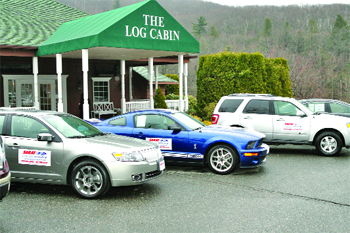
Dec. 17: Holiday Dinner Dance, 6 to 11 p.m., hosted by Log Cabin Banquet & Meeting House, Holyoke. An evening of friends and holiday spirit, including the chamber’s annual awards. Big raffle with $5,000 drawing, butlered hors d’oeuvres, multi-station entrees, Viennese dessert table, cash martini and full-service bar, music provided by Michael J Productions. Public invited. Excellent business party opportunity. Group reservations available. Tickets: $45 inclusive.

Greater Holyoke Chamber of Commerce
(413) 534-3376
www.holycham.com

Dec. 9: Holiday Salute Breakfast, doors open at 7:30 a.m., hosted by the Delaney House, Holyoke. Tickets: $20.

Dec. 16: Chamber Holiday After Hours, 5 to 7 p.m., hosted by the Delaney House, Holyoke. Tickets: $5 members, $10 cash non-members.

Greater Northampton Chamber of Commerce
(413) 584-1900
www.explorenorthampton.com

Dec. 1: Mass Privacy Law Seminar, 8 to 9:30 a.m., Clarion Hotel & Conference Center. Tickets: $15 for members. RSVP at [email protected].

Dec. 2: Arrive@5, 5 to 7 p.m., hosted by Spare Time Family Fun Center. Tickets: $10 members, $15 guests.

Dec. 9: Northampton Area Young Professionals Party with a Purpose, 5 to 8 p.m., hosted by Silverscape Designs. Free for members, $5 for guests.

Dec. 11: New Member Breakfast, 8 to 9:30 a.m., hosted by the chamber. Free for members.

Dec. 15: Meet & Eat, 7:30 to 9 a.m., hosted by the Delaney House, Holyoke. Sponsored by Easthampton Savings Bank. Tickets: $15 members, $20 guests.

Quaboag Hills Chamber of Commerce
(413) 283-2418
www.qvcc.biz

Please see Web site for upcoming events.

South Hadley/Granby Chamber of Commerce
(413) 532-6451
www.shchamber.com

Please see Web site for upcoming events.

Three Rivers Chamber of Commerce
(413) 283-6425
www.threeriverschamber.org

Please see Web site for upcoming events.

Greater Westfield Chamber of Commerce
(413) 568-1618
www.westfieldbiz.org

Dec. 11: Annual Holiday Breakfast, 7:15 to 9 a.m., hosted by Shaker Farms Country Club, Westfield. Santa will appear, and the Westfield High School Concert Chorale, under the direction of Kory Bruno, will provide musical entertainment. Premier members: Westfield Gas and Electric, Westfield Bank, and Easthampton Savings Bank. Tickets: $20 members, $25 non-members. Deadline for Reservations is December 8. All reservations after this date will be billed at $25 per person. To register, call Marcia at (413) 568-1618, e-mail [email protected] , or log onto www.westfieldbiz.org . Please bring an unwrapped toy for the Salvation Army, and also bring a door prize to highlight your business.

Young Professional Society of Greater Springfield
www.springfieldyps.com

Dec. 9: For December, we will not hold a Third Thursday, but instead will join the ACCGS After 5 on Dec. 9 from 5 to 7 p.m. at the Lexington Group, 380 Union St., West Springfield. In the spirit of the holiday season, we encourage everyone to bring a new, unwrapped toy to be donated to the children of the Children’s Study Home. For non-members, a toy will be accepted in lieu of the $5 entrance fee.

Dec. 19: Ring the Red Kettles, 10 a.m. to 6 p.m., in front of Macy’s inside the Eastfield Mall. We ask that you donate two hours of your time for this worthy cause. If interested, e-mail Maureen Pick-nally at [email protected] .

Departments

United Personnel employee Jim Kervick was awarded the Massachusetts Staffing Assoc. Employee of the Year Award for 2009 at the MSA’s annual awards dinner at the Harvard Club in Boston. The prestigious honor, awarded to one staffing employee in Massachusetts, is given to an employee who exemplifies the five main reasons to consider temporary staffing as an employment option — jobs, flexibility, bridge, choice, and training. In his role as an On-Site Manager at two of United’s larger-volume clients, Kervick is responsible for the day-to-day communication with the on-site temporary staff and for assuring that performance standards, policies, and procedures are met. United Personnel is headquartered in Springfield, with a satellite office in Easthampton.
•••••

James M. Buker has joined the Insurance Center of New England as a Senior Account Executive in the Group Employee Benefits Department.

•••••

Springfield resident David Ewen recently released his third edition of Let’s Make It Simple, which simplifies the complexities of book publishing and marketing into easily understood steps for new and experienced authors. Ewen is an author, speaker, and college instructor. The book is available at amazon.com.

•••••

Attorneys Ann I. Weber and Michele J. Feinstein, Shareholders of Shatz, Schwartz and Fentin, P.C., recently spoke on “Planning for Long-Term Care: New Laws and Regulations” at the Visiting Nurse Assoc. The intensive workshop focused on a multitude of issues individuals face when planning for long-term care. Their law firm has offices in Springfield, Northampton, and Albany, N.Y.

•••••

Liz Washer has joined UMass Amherst as Director of External Relations, College of Humanities and Fine Arts. In this role, Washer will provide leadership for promoting the college’s ideas, events, and initiatives to advance its strategic goals, and will support and coordinate similar efforts within the academic departments and programs that report to the Dean.

•••••

Rob Scoble has been named the top Operational Officer for Hyde Tools Inc. of Southbridge. As Executive Vice President and Chief Operating Officer, he will oversee Hyde’s professional products and industrial blade divisions.

•••••

Brittney Kelleher has been promoted to Commercial Loan Officer at Westfield Bank.

•••••

Samuel A. Smith has joined TD Bank as Manager of its location at 178 Main St., Sturbridge. He is responsible for managing day-to-day operations at the branch, and developing and overseeing small business loans, deposit accounts, consumer lending, investments, and insurance services.

•••••

Bacon Wilson, P.C. of Springfield has announced that Partner Hyman G. Darling has been selected to serve as a volunteer member of the American Cancer Society’s new Nationwide Gift Planning Advisory Council. The council will be an active source of expert planned-giving and estate-planning consultation, will assist in the development of promotional strategies, and will serve as a resource for the society’s marketplace introduction to potential donors. Darling will serve a two-year advisory council term, providing guidance in estate planning law, tax, investment and wealth management, real estate, insurance, personal financial planning, and marketing. Darling is Chairman of the Estate Planning and Elder Law departments at Bacon Wilson, P.C.

•••••

Michael J. Schrader has joined the engineering firm of Hoyle, Tanner & Associates of Manchester, N.H. Schrader’s expertise in wastewater, water, stormwater and site-civil projects will play a key role in expanding the firm’s presence in southern New England.

•••••

The Mass. Society for Medical Research has recognized the following individuals for their contributions to biomedical research and education in the state and region. They are:
• State Sen. Stephen J. Buoniconti, D-West Springfield;
• Angela Avery, recently retired Superintendent-Director of the Norfolk County Agricultural High School;
• Terry McGuire, Co-Founder and General Partner of Polaris Ventures; and
• Robert Langer of the Massachusetts Institute of Technology.
The society is a nonprofit educational and research support organization whose members are biotechnology firms, colleges and universities, hospitals and institutes, pharmaceutical companies, and others that support research.

•••••

Jeffrey Folkins has been promoted to Vice President of Sales at Classic Coil Co. in Bristol, Conn. He was previously the national sales manager.

•••••

Jill Senecal was recently named Graduate Admissions Counselor for the Office of Graduate Admissions at American International College in Springfield. Senecal will be responsible in helping the office recruit prospective students and increase enrollment.

•••••

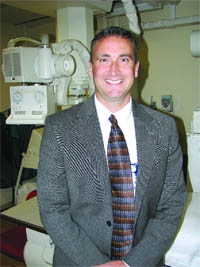
Daniel J. Barrieau, Director of Respiratory Care at Cooley Dickinson Hospital in Northampton, was among 45 health care professionals from across Massachusetts who recently received the Rx for Excellence Award in a Boston ceremony.

•••••

Qteros announced the following:
• Kevin F. McLaughlin has been named to the Leadership Team. McLaughlin brings 30 years of financial and operating management experience from the high-tech, biotech, and education industries; and
• Ralph M. Lerner has been named to the Leadership Team. Lerner has industry experience in general management, business development, and strategy development and implementation in the global petrochemical and energy industry, with companies including Amoco and BP.

•••••

Diane France of the Karen King Group at RE/MAX Prestige in Wilbraham has earned the Certified Distressed Property Expert designation, having completed training in foreclosure avoidance and short sales.

Departments

Giving Back

The Boston Business Journal recently named PeoplesBank a top charitable contributor and number 2 in the category of ‘Companies with the Highest Volunteer Hours.’ The bank has contributed approximately $700,000 to charitable and civic causes and employees donated 6,700 volunteer hours over the past year. Here, James Morton, left, president and CEO of the YMCA of Greater Springfield, and Douglas Bowen, president and CEO of PeoplesBank, discuss the bank’s recent support of Camp Weber and Camp Fun City.


Victory Celebration

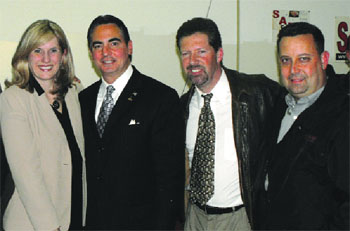
Springfield Mayor Domenic Sarno (second from left) was re-elected to a second term on Nov. 3. Seen with him on election night is the marketing team that coordinated his campaign: from left, Janet Casey, president of West Springfield-based Marketing Doctor; David Horgan, president of Horgan Associates; and Ed Brown, a videographer with New York Sound and Motion.


Human Center

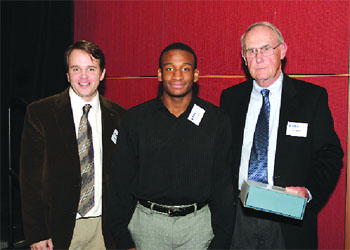
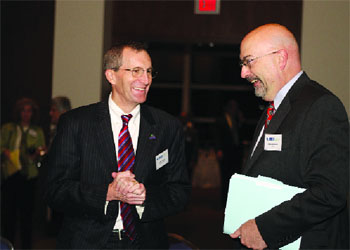
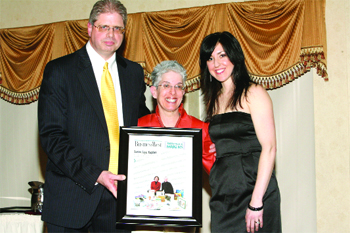
The Center for Human Development staged its annual meeting on Nov. 10 at the MassMutual Center. Attendees heard updates on CHD programs, watched the presentation of several awards, and heard addresses from Health New England CEO Peter Straley and Republican gubernatorial candidate Charles Baker, former CEO of Harvard Pilgrim Health Care, on the subject of national health care reform. At left, Straley (left) chats with Hank Drapalski, CHD’s vice president of Development. Above, the Rick Moriarty Volunteer of the Year Award is presented to Gene Sullivan, right, a CASA (Court Appointed Special Advocates) volunteer. With him is Keith Hedlund (left), director of the CASA program, and Alex Medina, Sullivan’s CASA child.


Having a Ball

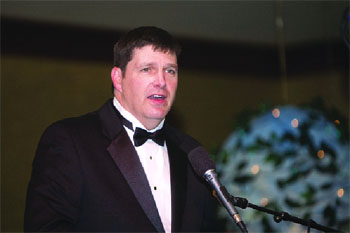
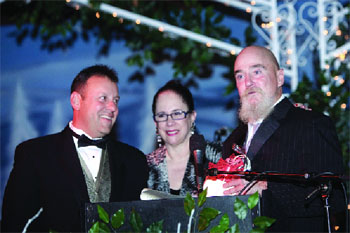
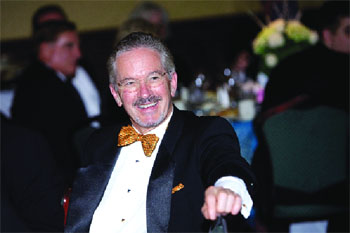
More than 400 people gathered at the Sheraton in downtown Springfield on Nov. 14 for the annual Brights Night Ball, staged to support the Bright Nights holiday lighting display in Forest Park and other events staged by the Spirit of Springfield. The ball featured a social hour, several speeches by area elected officials, dinner, dancing, and an auction with prizes ranging from commercial time on local TV stations to a guitar signed by Bruce Springsteen and members of the E Street Band. Clockwise from left, Judy Matt, president of the Spirit of Springfield, with David Cuoco, left, and Joseph Tobin, longtime Springfield Parks Department employees who have led work to install the Bright Nights displays for 15 years; Roger Crandall, COO of MassMutual and chairman of the Bright Nights Ball, addresses the crowd; from the PeoplesBank table are, from left, President Doug Bowen, his wife, Anna, Susan Wilson, vice president of Marketing and Communications for the bank, and her husband, Craig; Health New England President Peter Straley with his wife, Donna Ross, an executive with Baystate Health; and Mark Tolosky, president and CEO of Baystate Health.

Sections Supplements
Some Gift Offerings Are Sure to Please Your Favorite Bibliophile

Books make wonderful holiday gifts. The right tome will not only hold your interest and keep you turning its pages long after it’s time to go to bed, it can offer insight into the past and future, as well as invaluable knowledge about yourself, the business world, and the motivations, struggles, and strategies adopted over the course of history by individuals and companies that led to their success or downfall.

For its Holiday Gift Guide, BusinessWest takes a look at 10 popular bestsellers culled from Amazon.com, the New York Times bestseller list and Business Week book reviews that contain wisdom, pertinent history, and advice about the business and finance world.

• Too Big to Fail: The Inside Story of How Wall Street and Washington Fought to Save the Financial System — and Themselves, by Andrew Ross Sorkin. Although many books deal with how the financial meltdown came to pass or how certain companies sank or were saved, Sorkin’s book is different. In its 600 pages, the New York Times columnist gives readers a comprehensive look at everything that occurred, along with a plethora of details, as he chronicles the interplay between Wall Street and Washington in the eight months that brought the financial system to the brink of collapse. Before writing his book, Sorkin interviewed hundreds of people and spent more than 500 hours with top government officials. As a result, readers will feel as if they are in the rooms where significant conversations took place. The book’s only downfall may be that the events are so recent that there’s no new news to read in its pages. (Viking, $32.95)

• This Time Is Different: Eight Centuries of Financial Folly, by Carmen M. Reinhart and Kenneth Rogoff. This book, written by two economists, begins by defining exactly what constitutes a financial crisis, and how each crisis is dated from beginning to end. The award-winning tome offers a compelling, enjoyable look into modern business practices, including management, finance, and economics, as well as an 800-year history, loads of empirical data, and a comprehensive review of global financial crises. It is filled with facts about debt crises, bank runs, currency collapses, episodes of financial contagion, and much more. A great read for anyone who enjoys an academic look at history. (Princeton University Press, $35)

• Getting Back to Even — Your Personal Economic Recovery Plan, by James J. Cramer with Cliff Mason. In this new bestseller, the host of CNBC’s Mad Money offers advice for investing in a changed market. It’s the first book in which Cramer recommends specific stocks — an even dozen — which he says are poised to profit from the economy. The book includes 25 rules to follow in the post-crash market and is sure to encourage and inspire people still reeling from the economic downfall. The dominant sentiment in this work is that if readers do their homework, they will not just survive, they can thrive. (Simon & Schuster, $26)

• Crush It — Why Now Is the Time to Cash In on Your Own Passion, by Gary Vaynerchuk. This book is short, but its 140 pages contain a motivational message that tells readers it is never too late to discover their passion and turn it into cash. Vaynerchuk says that can be done by communicating one’s passion through a wide variety of media outlets. His book offers more in the way of inspiration than instruction on how to succeed, but is filled with real-world insights from a man who built a business using social channels. However, readers will find concrete advice on how to create content, how to choose the right platform, and how to find people on the social Web in tune with your products or services. (HarperStudio/HarperCollins, $19.99)

• How Remarkable Women Lead: A Breakthrough Model for Work and Life, By Joanna Barsh and Susie Cranston. This book is filled with inspiring stories about women who hold powerful positions. The authors spent five years researching 100 women before sitting down to write, and the result is a book that borders on the self-help category. The authors have created a system they call “Centered Leadership,” based on five shared traits they claim to have discovered during their interviews, which are that female leaders possess good energy management skills, believe their work is meaningful, have superior problem-solving skills, interact with numerous colleagues or mentors, and are deeply committed to their jobs. Overall, this book rates as a good read for females aspiring to be leaders in their industries or companies. (Crown Business, $27.50)

• A Colossal Failure of Common Sense: The Inside Story of the Collapse of Lehman Brothers, by Lawrence G. McDonald and Patrick Robinson. This book provides especially insightful reading, as it as was written by a former Lehman Brothers insider. It offers a compelling account of failure and the dysfunction that triggered our current financial crisis. The heart of the book details McDonald’s own career and takes the reader from his days as a pork-chop salesman to a man who rang doorbells to drum up brokerage clients for Merrill Lynch to making $5 million in one day. His personal history gives readers a look at life inside Lehman as well as a description of the financial products, regulatory changes, and economic environment that spawned an atmosphere rife with blunders. (Crown, $27)

• How The Mighty Fall … and Why Some Companies Never Give In, by Jim Collins. This book provides questions and answers as to why seemingly solvent businesses fail, explaining that not only does it happen in stages, but declines can be reversed. Collins examines 11 companies and outlines behaviors and strategies that led them to doom. They include denial of risk and failure, an undisciplined pursuit to gain more of the market, grasping for salvation, and more, as he details just how these things occurred. The author’s newest volume offers advice that could help leaders make a difference, and although it’s not always easy to see how Collins came to his findings, the book offers plenty of sage advice. (Jim Collins/Harper–Collins, $23.99)

• Lords of Finance: The Bankers Who Broke The World, by Liaquat Ahamed. This book is a cautionary tale for our times, and offers an intimate and unforgettable portrait of four men at the head of central banks who made a series of decisions that resulted in the economic collapse of the 1920s, which set the stage for World War II and created a disastrous ripple affect that lasted for decades. Filled with drama, the story analzyes the actions of Montagu Norman of the Bank of England, Amile Moreau of the Banque de France, Hjalmar Schacht of the Reichsbank, and Benjamin Strong of the Federal Reserve Bank of New York, who attempted to reconstruct the world of international finance after World War I. (Penguin Press, $32.95)

• Last Man Standing: The Ascent of Jamie Dimon and JPMorgan Chase, by Duff McDonald. This book lets readers in on how one JPMorgan/Chase executive withstood the current financial hurricane and survived almost unscathed as it spins a colorful tale of the life of this 53-year-old banker who rose to the top and whose ambition was evident even at a young age. Dimon’s story is told in chronological order, which means readers will have to be patient before they get to the fascinating drama that took place during the last 18 months. The story shows, rather than tells, readers about Dimon’s scrupulous attention to detail along with his enormous ego. McDonald also shows that, although Dimon fared better than his rivals, he was inaccurate about the scope and severity of the crisis in its early days. A good read about a man whose rise and fall on Wall Street has kept him in the news. (Simon & Schuster, $28)

• Behind the Cloud: The Untold Story of How Salesforce.com Went from Idea to Billion-Dollar Company — and Revolutionized an Industry, by Marc Benioff and Carlye Adler. This brand-new book chronicles the story of how an idea — delivering business applications as a service over the Internet — was turned into a billion-dollar business, and takes readers from Benioff’s beginnings as a small start-up through his unconventional strategies, struggles (especially when the company came close to bankruptcy), and the tactics that led to its survival and success. Benioff has structured the book into a series of more than 100 ‘plays’ that showcase how the company stayed on the cutting edge, outwitted its competitors, and built a business with an inspiring philosophy. An easy read with lots of concrete ideas for start-up businesses. (Wiley, John & Sons, Inc. $27.95)

Departments

Affiliated Chambers of Commerce of Greater Springfield
(413) 787-1555
www.myonlinechamber.com

Nov. 19: ACCGS Government Reception, 5 to 7 p.m., hosted by the Carriage House at Storrowton Tavern, West Springfield. Tickets: $55, general admission; $45 for members.

Young Professional Society of Greater Springfield
www.springfieldyps.com

Nov. 19: YPS Third Thursday, 5 to 8 p.m., hosted by the Museum of Springfield History, 21 Edwards St., Springfield. View museum exhibits that describe Springfield’s development as a manufacturing center, the city’s role in transportation history, the many inventions and firsts that were generated here, the growth of downtown as the region’s commercial center, the effects of urbanization and suburbanization, and the stories of Springfield’s diverse populations. Corporate sponsor: Baystate Medical Practices, part of Baystate Health. Sound and entertainment provided by Jx2 Productions.

Amherst Area Chamber of Commerce
www.amherstarea.com

Visit the chamber online to learn more about upcoming events.

Chicopee Chamber of Commerce
(413) 594-2101
www.chicopeechamber.org

Nov. 18: Salute Breakfast, 7:15 to 9 a.m., hosted by MassMutual Learning & Conference Center, 350 Memorial Dr., Chicopee. Tickets: $18 for members; $25 for non-members. Register online at www.chicopeechamber.org .

Franklin County Chamber of Commerce
(413) 773-5463; www.franklincc.org

Nov. 20: FCCC Breakfast Series, 7:30 to 9 a.m., hosted by Bella Notte, Huckle Hill Road, Bernardston. Program: Engaging an Audience and the Community in New Media. Guest speaker: Jon Abbott, president and CED of WGBH in Boston, a broadcaster with multiple TV and radio services, known for its iconic programming (Nova, Masterpiece, Frontline, Antiques Roadshow, Curious George, The World, etc.). Sponsored by Greenfield Cooperative Bank. Tickets: $12 for members; $14 for non-members. For reservations, call (413) 773-5463 or e-mail
[email protected]  by Nov. 13.

Greater Easthampton Chamber of Commerce
(413) 527-9414
www.easthamptonchamber.org

Nov. 12: Networking by Night Business Card Exchange, 5 to 7 p.m., hosted by Northeast Center for Youth & Families, 203 East St., Easthampton. Door prizes, hors d’oeuvres, cash bar. Tickets: $5 for members; $15 for non-members.

Greater Holyoke Chamber of Commerce
(413) 534-3376;
www.holycham.com

Nov. 18: Chamber After Hours, 5 to 7 p.m., hosted by Eighty Jarvis Restaurant, 80 Jarvis Ave., Holyoke. Tickets: $5 for members; $10 cash for non-members.

Greater Northampton Chamber of Commerce
(413) 584-1900
www.explorenorthampton.com

Nov. 12: Northampton Area Young Professionals Party with a Purpose, 5 to 8 p.m., hosted by Mama Iguana’s. Free for members; $5 for guests.
Nov. 13: Northampton Chamber Information Session, 8 to 9:30 a.m., 99 Pleasant St., Northampton. Free for those considering membership in the chamber.

Quaboag Hills Chamber of Commerce
(413) 283-2418;
www.qvcc.biz

Visit the chamber online to learn more about upcoming events.

South Hadley/Granby Chamber of Commerce
(413) 532-6451; www.shchamber.com

Visit the chamber online to learn more about upcoming events.

Three Rivers Chamber of Commerce
413-283-6425
www.threeriverschamber.org

Visit the chamber online to learn more about upcoming events.

Greater Westfield Chamber of Commerce
(413) 568-1618; www.westfieldbiz.org

Nov. 12: 2009 Annual Meeting and Awards, 6 to 9 p.m., location and cost TBA. For more details, call (413) 568-1618 or e-mail [email protected] .

Sections Supplements
Wire and Harness Maker MicroTek Has Found a Niche in the Nonprofit Industry

MicroTek’s innovative employment model came first, its product second.

MicroTek’s innovative employment model came first, its product second.

MicroTek CEO Anne Paradis is holding up a plywood board. It’s got markings on it every few inches and simple diagrams that show one where to tie and cut wires and add connectors. The straightforward visual system makes it easy for almost anyone to assemble a wire harness — even someone who is learning-disabled.

Fifteen of MicroTek’s 110 employees have disabilities, and the board is one of the many techniques the company uses to train and integrate those employees into its work environment.

Based in Chicopee, MicroTek, which makes custom cable and harnesses, is part of the changing manufacturing sector in the Pioneer Valley. The company was founded 26 years ago with the sole purpose of providing a meaningful workplace for people with disabilities.

“I wish I could tell you it was a story about market research, but it wasn’t,” said Paradis about how the company got its start in the cable business.

Indeed, it was really by chance that MicroTek ended up making wires instead of, say, protein bars or women’s clothing.

It all started in 1983 when about a dozen human services advocates got together. They were working in conjunction with the University of Oregon, which was researching models for employing people who were difficult to employ.

One model was to start a company where one controls the environment, provides the training, and brings in the work. It seemed like a good idea. The group just needed something to produce.

“Someone at the University of Oregon happened to have a connection to Hewlett-Packard,” said Paradis. “That person approached the company and said, ‘we want to start up this company. Can you help us?’”

Hewlett-Packard agreed and, to get things rolling, gave the young company its first commercial contracts for wire harnesses. With the business elements in place, the founders went to the Department of Developmental Services to secure additional funding.

Once out of the gates, MicroTek ran into rough seas. While the company originally hoped to hire more disabled people, it quickly realized that if it wanted commercial success, it needed a broader skill set — people who could solder, read blueprints, and so on — and additional customers.

For this issue, BusinessWest looks at how it all came together.

Current Events

‘Make this company viable.’

That was the assignment given to Paradis when she was first brought on board in 1987.

She started off working for MicroTek as a marketing consultant for a year, but when it was discovered that the company’s problems were worse than anybody realized, the board of directors took her on as general manager.

“I had a background in human services and a master’s in business administration,” Paradis explained. “I didn’t know anything about cabling.”

She was about to learn.

“When you are the general manager of a small business, you are doing everything,” she said. “I was doing the sales, the quoting. I was covering for other managers when they weren’t there. I worked long hours.”

Getting new business wasn’t easy. Paradis had to prove to potential customers that MicroTek wasn’t simply a sheltered workshop and that it was capable of producing advanced assemblies to a consistent level of quality. A helping hand came again from its number-one customer.

“Hewlett-Packard lent out engineering support to get us to the next level,” Paradis said. “Literally, engineers would come and spend the day with us troubleshooting problems, or we would go to their facility, and they would provide training. It was a real investment in our success.”

In the 22 years that Paradis has been with MicroTek, she has helped grow the company from 30 to 110 employees and from $1 million in sales to $6 million. In 2001, after outgrowing the space it occupied in an old mill building in Chicopee Falls, MicroTek moved to its current location: a $1 million, 22,000-square-foot factory at 36 Justin Dr. in Chicopee.

MicroTek makes wire harnessing, cables, and, more recently, control panels for mainly security and medical companies. It’s sweet spot is low- to medium-volume assemblies, meaning anywhere from five to 25,000 of a particular item.

“Our costs are competitive,” said Paradis. “Some people would say our nonprofit status gives us an edge, but we actually have to work harder to stay competitive, because a learning-disabled person is only 40% to 60% as productive as someone who is not.”

Working with people with disabilities has additional challenges as well, such as training. One has to be able to teach skills that a disabled person can generalize over a broad range of products.

“It’s easy to teach someone a specific job they can do over and over again, but it’s harder to teach them how to use one termination machine and then do that same operation on different types of terminals,” said Paradis, referring to the machines that add connectors to the end of the wires once they’ve been clipped. “Another terminal might look or even feel different.”

The other challenge is integrating disabled people with the rest of a company. Managers want them to work as productive members of teams and remove the stigma of being disabled, explained Paradis.

That’s where the layout boards come in. A disabled worker can lay the cables out on the board and follow visual cues to know where to cut without having to continually pull out a ruler to take measurements.

“We made the layout boards for people with disabilities, but then started using them for everyone,” said Paradis. “Because whether you have a disability or not, the board lets you work with greater efficiency and fewer errors.”

Slump and Rebound

Earlier this year, MicroTek began to feel the effects of the sluggish economy, albeit a little later than most manufacturers. It cut capacity and saw sales fall by 20%, and took a temporary workforce reduction in which staff was cut back to four days a week for two months and collected unemployment for the fifth day. Ten workers also volunteered to be laid off.

But all that has changed, with the company rebounding “like gangbusters,” Paradis said.

“We experienced a sharp decline in spring, but sales picked right back up in July and August, and we rolled back all of the cost reductions,” she noted. “Now we’re ahead of budget projections for this year” — a turnaround that has her feeling more confident about the health of manufacturing in general.

Meanwhile, Paradis has taken on a new mission. “Our focus has shifted outward,” she said. Last year, the company launched an employment-demonstration project. It’s now working with several local companies to help them train people with disabilities in-house using all-natural supports.

Paradis believes that bringing in outside trainers sets up artificial barriers between the disabled person and other people in the company, which keep them from forming relationships and integrating successfully.

If there is one lesson that MicroTek has to teach, it’s that diversity in the workforce is what makes companies stronger.

Departments

Affiliated Chambers of Commerce of Greater Springfield
(413) 787-1555
www.myonlinechamber.com

Nov. 4: ACCGS Breakfast, 7:15 to 9 a.m., hosted by the Cedars, Island Pond Road, Springfield. Tickets: $30, general admission; $20 for members.
Nov. 4: ACCGS After 5, 5 to 7 p.m., hosted by Hilton Garden Inn, Springfield. Tickets: $20, general admission; $10 for members.
Nov. 5: WRC 3rd Annual Food Fest West, 5 to 7:30 p.m., hosted by the Clarion Hotel, West Springfield. Tickets: $25, general admission; $20 for members.
Nov. 19: ACCGS Government Reception, 5 to 7 p.m., hosted by the Carriage House at Storrowton Tavern, West Springfield. Tickets: $55, general admission; $45 for members.

Young Professional Society of Greater Springfield
www.springfieldyps.com

Nov. 6: November’s installment of the CEO Luncheon Series, hosted by Health New England. Guest speaker: Peter Straley, president and CEO of Health New England.
Nov. 19: YPS Third Thursday, 5 to 8 p.m., hosted by the Museum of Springfield History, 21 Edwards St., Springfield. View museum exhibits that describe Springfield’s development as a manufacturing center, the city’s role in transportation history, the many inventions and firsts that were generated here, the growth of downtown as the region’s commercial center, the effects of urbanization and suburbanization, and the stories of Springfield’s diverse populations. Corporate sponsor: Baystate Medical Practices, part of Baystate Health. Sound and entertainment provided by Jx2 Productions.

Amherst Area Chamber of Commerce
www.amherstarea.com

Visit the chamber online to learn more about upcoming events.

Chicopee Chamber of Commerce
(413) 594-2101
www.chicopeechamber.org

Nov. 18: Salute Breakfast, 7:15 to 9 a.m., hosted by MassMutual Learning & Conference Center, 350 Memorial Dr., Chicopee. Tickets: $18 for members; $25 for non-members. Register online at www.chicopeechamber.org.

Franklin County Chamber of Commerce
(413) 773-5463; www.franklincc.org

Nov. 7-8: Cider Days. Marketplace and workshops in Shelburne Falls and specific locations on Saturday; Cider salon and harvest dinner in Old Deerfield on Saturday; tasting and pairings at Deerfield Inn on Sunday; orchard tours in Deerfield, Colrain, and New Salem both days. Some activities require tickets. Information and tickets available at www.ciderdays.com .
Nov. 20: FCCC Breakfast Series, 7:30 to 9 a.m., hosted by Bella Notte, Huckle Hill Road, Bernardston. Program: Engaging an Audience and the Community in New Media. Guest speaker: Jon Abbott, president and CED of WGBH in Boston, a broadcaster with multiple TV and radio services, known for its iconic programming (Nova, Masterpiece, Frontline, Antiques Roadshow, Curious George, The World, etc.). Sponsored by Greenfield Cooperative Bank. Tickets: $12 for members; $14 for non-members. For reservations, call (413) 773-5463 or e-mail
[email protected]  by Nov. 13.

Greater Easthampton Chamber of Commerce
(413) 527-9414
www.easthamptonchamber.org

Nov. 7: Holiday Lights Bowl-a-thon, 3 p.m. and 6:30 p.m., hosted by Canal Bowling Lanes, 74 College Highway, Route 10, Southampton. Two sessions of candlepin bowling to raise funds for the chamber’s downtown holiday lighting program. Sponsored by Greater Easthampton Chamber holiday spirit committee. Entry fee: $100 per five-member team. Prizes, raffles, free pizza for bowlers. For more information or to enter, call (413) 527-9414.
Nov. 12: Networking by Night Business Card Exchange, 5 to 7 p.m., hosted and sponsored by Northeast Center for Youth & Families, 203 East St., Easthampton. Door prizes, hors d’oeuvres, cash bar. Tickets: $5 for members; $15 for non-members.

Greater Holyoke Chamber of Commerce
(413) 534-3376; www.holycham.com

Nov. 18: Chamber After Hours, 5 to 7 p.m., hosted by Eighty Jarvis Restaurant, 80 Jarvis Ave., Holyoke. Tickets: $5 for members; $10 cash for non-members.

Greater Northampton Chamber of Commerce
(413) 584-1900
www.explorenorthampton.com
Nov. 4: Arrive@5, 5 to 7 p.m., the United Way of Hampshire County, hosted by Danish Inspirations, sponsored by Dietz & Company Architects Inc. and Applied Mortgage Services Corp. Tickets: $10 for members; $15 for guests.
Nov. 12: Northampton Area Young Professionals Party with a Purpose, 5 to 8 p.m., hosted by Mama Iguana’s. Free for members; $5 for guests.
Nov. 13: Northampton Chamber Information Session, 8 to 9:30 a.m., hosted by the Chamber of Commerce, 99 Pleasant St., Northampton. Free for those considering membership in the chamber.

Quaboag Hills Chamber of Commerce
(413) 283-2418; www.qvcc.biz

Visit the chamber online to learn more about upcoming events.

South Hadley/Granby Chamber of Commerce
(413) 532-6451; www.shchamber.com

Visit the chamber online to learn more about upcoming events.

Three Rivers Chamber of Commerce
413-283-6425
www.threeriverschamber.org

Visit the chamber online to learn more about upcoming events.

Greater Westfield Chamber of Commerce
(413) 568-1618; www.westfieldbiz.org

Nov. 12: 2009 Annual Meeting and Awards, 6 to 9 p.m., location and cost TBA. For more details, call (413) 568-1618 or e-mail [email protected] .

Sections Supplements
These Five Steps Will Have Recruiters Thinking Like Salespeople

A great recruiter should have the same skill sets and qualifications of a great salesperson. All of the great sales visionaries, including Zig Ziglar and Tom Hopkins, have taught these steps to sales professionals around the world, yet few recruiters today understand or use any of these available resources.

So much emphasis has been placed on prospecting or sourcing potential candidates that recruiters are not taught the basics of the sales process that follows the sourcing function. Having listened to thousands of third-party and corporate recruiters over the past 15 years, my sense is that fewer than 10% of recruiters understand basic sales principles.

Although the terminology may differ, the following are the critical steps to every successful sales professional or recruiting professional.

1. Developing the Relationship

This is the time that the warming-up events occur, before the serious selling begins. This includes how you introduce yourself and how you begin the conversation. Candidates have stated that it’s during the first two minutes of the call that they form crucial initial impressions that influence the rest of the recruiting process.

2. Creating/Identifying the Need

Every sale involves asking questions to identify a need of which the candidate is often unaware. This is much more than a simple collection of data. Identifying or creating the need is the most important of all selling and recruiting skills. Recruiters who are the most effective during this investigative stage are most likely to be the highest performers. Recruiters with poor investigative skills generally create candidates who ultimately do not accept the position once it’s offered.

3. Preventing/Overcoming Objections

Although objections are inevitable in any sales process, the key for successful sales professionals and recruiters is actually preventing objections. By asking the right types of questions in step 2, many objections that would have arisen in the process are addressed before the candidate has an opportunity to bring them forth. Keep in mind that some objections are inevitable, that they are often training responses, and that most are emotional and not practical.

4. Filling the Need/Providing Benefits

Identifying the need is considered the most crucial skill in sales or recruiting; filling the need is the second-most critical step to ensuring success. Often recruiters and sales professionals alike pay little attention to step 2 and focus solely on step 4.

Like many sales professionals, recruiters often focus on what is commonly known in sales language as their ‘product knowledge.’ They have an in-depth understanding of the organization they are recruiting for, they understand every detail of the position and its function, and they completely understand the requirements of the role. Armed with all of this product knowledge, these untrained recruiters contact potential candidates and attempt to tell them about every benefit of the position and company they represent, never addressing the real needs of the candidate. This is a common mistake made by most sales professionals.

5. Advance/Close the Sale

In recruiting and sales, advancing the sale is the final objective throughout every step of the process. By filling the need in Step 4, you are in a position to advance the sale to the next step. In recruiting, closing is most commonly compared to presenting the offer and gaining acceptance from the candidate. At this stage recruiters often focus on the practical aspects of the offer being made: compensation, benefits, perks, etc. Effective recruiters and sales professionals alike understand the importance of re-emphasizing the emotional drivers identified in Step 2 of the sales process prior to presenting the practical aspects of the solution.

Bottom Line

Although these five steps are critical to the success of every recruiter, most focus and are trained only on steps 1, 4, and 5, skipping the most important step: identifying the need. Recruiters like to tell about the great position, company, and opportunity that they currently have without having asked any questions to identify the needs of the potential candidate. This ‘telling, not selling’ approach continues to be prevalent among the majority of recruiting organizations, minimizing the benefits of sourcing tools, branding, and recruiting technology available today.

The profile of today’s recruiter must also change. An effective recruiter should be seen as a sales professional who exemplifies the ability to develop candidate relationships, identify candidate needs, overcome or prevent objections, fill the candidate’s needs, and advance the sales process. Recruiters need to be given the appropriate training to move from telling about their opportunity to actively selling it. n

Stephen A. Lowisz is president and CEO of Qualigence, the recruitment research firm he founded in 1999. His career encompasses the recruiting industry, specifically passive candidates. An industry expert, he is a highly-rated speaker for leading HR industry events and conferences, an educator/trainer of the Answer Passive Candidate Recruitment Training, and a speaker/consultant for several Fortune 500 organizations each year;www.qualigence.com

Sections Supplements
The Return of the Holiday Get-together
Peter Rosskothen

Peter Rosskothen says the key to a good party is to add something unique, a personal touch.

With economic stability slowly returning to the marketplace, an excellent way for businesses to express that optimism lies in staging an annual holiday party. Banquet facility owners report that, after a down year in 2008, many companies are ready to party again — but while still keeping a keen eye on the bottom line.

Peter Rosskothen said that he’s a “bit of a radical” when it comes to making a good party.

Co-owner of the Log Cabin and Delaney House in Holyoke, Rosskothen said that “a good party is one that adds a personal touch to it, something unique. Just saying, ‘I’m going to serve you dinner, bring in a DJ,’ that makes it a nice party, but I don’t think it makes it a special party. Something a little more is required.”

This season, a little more might have to be budgeted for a little less. Like most businesses, Rosskothen said that the special-event industry took a hit last season, adding that “most people in the industry will tell you that they were very scared last September.”

The lights dimmed across the nation on the party season last year. Forbes reported that the number of businesses holding holiday parties dropped to a 20-year low last winter, with only 81% of the nation’s businesses partying on. When the economy went into a skid — some saw it as a free fall — the idea of wining and dining employees in the wake of massive layoffs just didn’t feel right.

The story is different this year. Signs of an economic recovery are tentative, and analysts are presently predicting flat holiday sales, but area event professionals are reporting that confidence is returning to their holiday schedules. And that in itself is cause for some celebration.

Companies want to thank their employees after a tough year in business, but there is still an eye to that celebration’s spread sheet. “We’re seeing a lot of our repeat customers now asking to do a little less,” said Ralph Santaniello, owner of the Federal in Agawam. “People still want to do something fun and keep it festive,” he added, “but they’re obviously trying to keep the budget low. The trend thus is a bit more for the cocktail parties, hors d’oeuvres, and less for sit-down-type dinners with lots of food and multiple courses.”

With tight times still a reality, most event professionals said they have been devising creative ways over the past year to keep enthusiasm high. In Springfield, Pazzo head chef Byron White said his goal has been to provide good value for his clientele, but not at the cost of a memorable occasion. “Keep them satiated, keep them happy,” he said, “because we want them to take that experience to heart so that they want to keep coming back.”

’Tis the season for holiday parties. In this issue of BusinessWest, we take our annual look at the holiday event market, what venues are doing to keep the party rolling, and how the season’s tidings can spread beyond one night to remember.

Make It Special, Make It Different

When it comes to talking about all things party-related, Rosskothen is the perfect man for the job.

On a tour of the picture-perfect Log Cabin property, he brimmed with ideas as he walked from room to room. “What makes a party unique?” he asked, before answering his own question. “Something personal about your co-workers, or your employees. Something personal about the business, or about your results from the past year. Something that will become memorable. Something where the client says, ‘wow, we want to come back here next year.’ Those are the touches that make a party great.”

He pointed to a brochure advertising a promotion which joins his two properties with an off-site catering wing called Log Rolling. Rosskothen has organized a variety of holiday event options designed to appeal to a wide array of tastes. From formal dinners at the historic Delaney House to holiday-themed events with kids, to meals at one’s own location, the idea was to create packaged possibilities which he calls “products,” all with attractive price points.

“We try to come up with things that are unique and yet still come under budget for our clients,” he explained. “Come to comedy night, for instance. It’s not something that you normally would think of for holiday parties, but you don’t always have to go dancing or do elaborate sit-down dinners. This is bringing in differing ingredients, as it were, coming up with creative solutions for people to stretch their dollars and make it something different.

“Over the last two years, we have broken out of the element of just offering the basics,” he continued. “We want to be known as a group that can do those basics, but we want to offer you a bit more. Games, dancing, trivia, we have products for that. We’re giving you the idea, then you, the customer, can say that this fits me by the nature of this product, and it fits me by price, also.”

The competition for holiday events is keen, and while most people agree that the market has not reached saturation point yet, everyone strives to offer that “bit more.”

“What we do at the Federal is to cater to each individual customer’s tastes and budget, because the perfect party is different for everyone,” said Santaniello. Meeting with the client and finding what ideas they might have are the launching pad for his team to create the perfect event. Last year a customer wanted to do something with an Italian theme, and the Federal created a Tuscan Christmas party.

While people are ready to celebrate, expectations are kept in check with an eye toward a tough year, he said, and that means fewer tabled affairs on tap. But that suits him fine. “One of our signatures is passed hors d’oeuvres,” he said, giving high praise to his partner and chef, Michael Presnal, for his vision and creativity.

“He’ll do things you might not expect, or present them in ways you might not normally see them,” he explained. “We’re known for passing hors d’oeuvres on spoons, with different flavors and textures. Grilled, breaded shrimp with a gazpacho shooter, served in a shot glass. It’s a different take on the traditional shrimp cocktail.”

Even in a tough year, Chez Josef in Agawam offers flexibility for companies of all sizes that want to have parties. As in past years, groups of eight or more are welcome to participate in the facility’s group company holiday parties, which allow multiple organizations to celebrate with music and dancing, circulating hors d’oeuvres, and a multi-course dinner — to enjoy the trappings of a big event, in other words, while cutting down on planning time.

“Groups of 10 to 20 can enjoy a big party atmosphere, where it would be unaffordable for them to do that on their own. Those remain very popular and are a great value for the guests,” said Linda Skole, president of Chez Josef. She noted that sit-down dinners remain the most popular style of company party at her facility, and businesses are not cutting back on frills — but the bookings this year are smaller than in the past.

“Groups are still having holiday parties, and they’re not scaling back, but the counts may be a little bit lower due to economic conditions,” she told BusinessWest, adding that parties remain an important way for companies to motivate and reward employees. “Things are a little soft as everyone’s feeling the pinch, but we’re looking forward to a stronger next year.”

Coming Back for More

Growing up in a family of 12, Byron White knows a thing or two about hosting large groups of people.

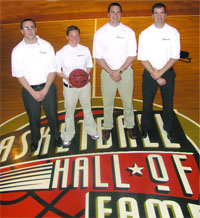
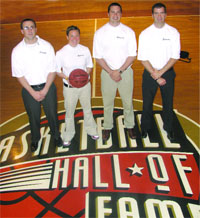
In the fourth year of holiday events at Pazzo, his popular restaurant connected to the Basketball Hall of Fame, he said that this year, prices and value play an important role in creating some of the finest Italian food in the region. Winner of numerous accolades for his culinary skills, including a prestigious nomination from the James Beard Foundation for Outstanding Chef of the Year, White said he strives to make a holiday event that will remind people that good food at good prices is available to them all year long.

“When we book our holiday functions, whether it be for Halloween, Thanksgiving, Christmas, or beyond,” he said, “we are always looking to have ways to attract them not only for those events, but for all the other times of the year beyond that. Something where people will say, ‘I want to eat here again, I want to bring my family,’ whether it be for another event or simply lunch.”

So far, those holiday bookings are coming in fast. Like Rosskothen and Santaniello, White noted that, despite the downturn, dates are filling up, and business projections are good for the holidays.

White says his goal for the season, what he calls “synergy” — that which makes an event truly special — is a relationship with his clientele. From his open kitchen, he likes to see first-hand the role his food plays for what he calls his “extended family.”

“This open kitchen is not just so that people can see what we’re doing,” he said. “It’s also that we can see out there, and get that instant gratification of seeing people enjoying what we’ve made.

“Pazzo is the place where they can have a relationship with the owner, with the chef, the staff,” he continued. “To be a successful place, it’s got to have good ambience, good energy, a soul that will make you feel like this is above and beyond as an experience. The holidays are a good time of year for people to be reminded of the larger community they’re in, but we want to remind them of those other times of the year when that doesn’t change for us.”

White said that every night of the week, the restaurant offers some form of promotion, from half-priced appetizers on up to half-priced entrées. He’s heard that people want value for the holiday season and beyond, and he wants to show how much he wants the restaurant to be an intrinsic part of the community.

The Show Must Go On

The holidays are a time for people to join in celebration, and this year the reasons for holding a party might be more important than ever. In Rosskothen’s opinion, a company celebration transcends mere food and drink. “I think it’s a great way to motivate the people who work with you, especially during tough times,” he said, echoing Skole’s similar notion.

“Throwing a party during the holiday is as important as advertising in this economy,” he continued. “Morale is something that cannot be played with. Holiday parties are a great way to say, ‘we’re here, we made it, and we did it because we have a great team.’”

This year, the life of the party is the very company that made it through the recession intact. And that’s certainly something to celebrate.

Departments

Affiliated Chambers of Commerce of Greater Springfield
(413) 787-1555
www.myonlinechamber.com

Oct. 14: ACCGS After 5 Table Top Exhibit, hosted by the MassMutual Center in Springfield, 5 to 7 p.m. Tickets: $125 for members, $175 for non-members.

Oct. 15: West of the River Legislative Breakfast, hosted by Chez Josef in Agawam, 7:15 to 9 a.m. Guest speaker is Dolores Mitchell, executive director of the Group Insurance Commission. Tickets: $20 for members, $30 for non-members.

Oct. 23: Super 60, hosted by Chez Josef in Agawam, 11:30 a.m. to 1:30 p.m. Tickets: $45 for members, $65 for non-members.

Oct. 27: West of the River Chamber of Commerce Board Meeting, hosted by Captain Charles Leonard House, 7:30 to 9 a.m.

Oct. 28:  Executive Power Networking, hosted by TD Banknorth Conference Center,7:30 to 9 a.m. Tickets: $20 for members, $30 for non-members.

Young Professional Society of Greater Springfield
www.springfieldyps.com  

Oct. 15: Third Thursday, hosted by Hofbrauhaus restaurant in West Springfield.

Amherst Area Chamber of Commerce
www.amherstarea.com

Visit the chamber online to learn more about upcoming events.

Chicopee Chamber of Commerce
(413) 594-2101
www.chicopeechamber.org

Oct. 27: 12th Annual Table Top Meeting, hosted by Castle of Knights, 1599 Memorial Dr., Chicopee, 4:30 to 7 p.m. Presented by South Hadley/Granby, Chicopee, Greater Holyoke, and Greater Westfield chambers of commerce. Exhibitor tables cost $90; reserve online at www.chicopeechamber.org or call (413) 594-2101. Admission; $5 for members, $10 non-members

Franklin County Chamber of Commerce
(413) 773-5463
www.franklincc.org

Visit the chamber online to learn more about upcoming events.

Greater Easthampton Chamber Of Commerce
(413) 527-9414
www.easthamptonchamber.org

Oct. 14: Networking by Night Business Card Exchange , hosted by Nini’s Ristorante, 124 Cottage St., Easthampton, 5 to 7 p.m. Sponsored by Greater Easthampton Jr. Miss Program. Event will include door prizes, hors d’ouevres, and a cash bar. Tickets: $5 for members, $15 for non-members.

Greater Holyoke Chamber of Commerce
(413) 534-3376
www.holycham.com

Oct. 14: Fall Salute Breakfast, hosted by the Delaney House, Country Club Road, Holyoke, 7:45 a.m. Sponsored by Holyoke Medical Center. Tickets are $18. Tables reserved for parties of eight.

Oct. 21: Chamber After Hours, hosted by Holiday Inn, 245 Whiting Farms Road, Holyoke, 5 to 7 p.m. Sponsored by Yellowbook. Admission: $5 for members, $10 for non-members. 

Greater Northampton Chamber of Commerce
(413) 584-1900
www.explorenorthampton.com  

Oct. 16: Chamber Information Session, Greater Northampton Chamber of Commerce, 12 noon to 1 p.m. Considering membership? Come to an information session.

Northampton Area Young Professionals
www.thenayp.com

Oct. 8: October’s Party with a Purpose, hosted by dani. fine photography in the Eastworks building in Easthampton.
Quaboag Hills Chamber of Commerce
(413) 283-2418
www.qvcc.biz

Visit the chamber online to learn more about upcoming events.

South Hadley/Granby Chamber of Commerce
(413) 532-6451
www.shchamber.com

Oct. 20: Beyond Business, hosted and sponsored by Olde Hadleigh House & Patio, 5 to 7 p.m. No guest speaker. Cost: $5 members, $10 for general public, who are welcome. RSVP at (413) 532 6451 by Oct. 16.

Oct. 27: 12th Annual Table Top Meeting, hosted by Castle of Knights, 1599 Memorial Dr., Chicopee, 4:30 to 7 p.m. Presented by South Hadley/Granby, Chicopee, Greater Holyoke, and Greater Westfield chambers of commerce. Cost: $5. To reserve a table, call (413) 532-6451.

Three Rivers Chamber of Commerce
(413) 283-6425
www.threeriverschamber.org

Visit the chamber online to learn more about upcoming events.

Greater Westfield Chamber of Commerce
(413) 568-1618
www.westfieldbiz.org

Oct. 21: Greater Westfield Chamber of Commerce WestNet After Hours Networking, hosted by East Mountain Country Club, 1458 East Mountain Road, Westfield, sponsored by Sovereign Bank. Cost: $10 for members, $15 for non-members. For reservations, call (413) 568-1618, e-mail [email protected], or register at www.westfieldbiz.org.

Oct. 27: 12th Annual Table Top Meeting, hosted by Castle of Knights, 1599 Memorial Dr., Chicopee, 4:30 to 7 p.m. Presented by South Hadley/Granby, Chicopee, Greater Holyoke, and Greater Westfield chambers of commerce. Display tables cost $90 for members. For reservations, call (413) 568-1618, e-mail [email protected] , or register at www.westfieldbiz.org.

Departments

Health Insurers Expect to Raise Rates by 10%

WASHINGTON, D.C. — Premiums for employer-sponsored health insurance rose to $13,375 annually for family coverage this year — with employees on average paying $3,515 and employers paying $9,860, according to the benchmark 2009 Employer Health Benefits Survey recently released by the Kaiser Family Foundation and the Health Research & Educational Trust (HRET). Family premiums rose about 5% this year, which is much more than general inflation (which fell 0.7% during the same period, mostly due to falling energy prices). Workers’ wages went up 3.1% during the same period.  Since 1999, premiums have gone up a total of 131%, far more rapidly than workers’ wages (up 38% since 1999) or inflation (up 28% since 1999). For the past few years, the annual rise in premiums has been more moderate than the double-digit growth experienced earlier this decade. As Congress considers health reforms building on the existing employment-based system, the annual Kaiser/HRET survey provides a detailed picture of private health insurance coverage and costs. The survey found that 60% of firms offer health benefits to any of their workers this year. As in the past, the smaller the firm, the less likely it is to offer health benefits — with fewer than half (46%) of the smallest employers (three to nine workers) offering health benefits. Among those firms offering benefits, 21% report they reduced the scope of health benefits or increased cost sharing due to the economic downturn, and 15% report they increased the worker share of the premium. The survey also reveals that a growing number of workers who are covered by their employer are facing high deductibles in their plans in addition to contributing to the premiums for their coverage. In 2009, 22% of covered workers must pay at least $1,000 out of pocket annually for single coverage before their plan generally will start to pay a share of their health care bills, up from 18% last year and 10% in 2006.

Retail Sales Top Expectations

WASHINGTON — The Commerce Department’s U.S. Census Bureau recently reported that retail sales rose 2.7% in August, well above the increase of 2.0% private analysts had expected. Motor vehicle sales jumped 10.6%, while sales excluding motor vehicles increased 1.1%, and sales excluding motor vehicles and gasoline rose 0.6%. Also, the Census Bureau announced that advance estimates of U.S. retail and food services sales for August, adjusted for seasonal variation and holiday and trading-day differences, but not for price changes, were $351.4 billion, an increase of 2.7% from the previous month, but 5.3% below August 2008. Total sales for the June-through-August 2009 period were down 7.6% from the same period a year ago.

Initial Unemployment Claims Decrease

NEW YORK — In the week ending Sept. 12, the advance figure for seasonally adjusted initial unemployment claims was 545,000, a decrease of 12,000 from the previous week’s revised figure of 557,000. The four-week moving average was 563,000, a decrease of 8,750 from the previous week’s revised average of 571,750. The advance seasonally adjusted insured unemployment rate was 4.7% for the week ending Sept. 5, an increase of 0.1 percentage point from the prior week’s unrevised rate of 4.6%. The advance number for seasonally adjusted insured unemployment during the week ending Sept. 5 was 6,230,000, an increase of 129,000 from the preceding week’s revised level of 6,101,000. The four-week moving average was 6,180,250, a decrease of 5,500 from the preceding week’s revised average of 6,185,750. The fiscal year-to-date average for seasonally adjusted insured unemployment for all programs is 5.636 million. Extended benefits were available in several states, including Massachusetts. The highest insured unemployment rates in the week ending Aug. 29 were in Puerto Rico (6.8%), Oregon (5.7%), Pennsylvania (5.7%), Nevada (5.5%), Michigan (5.2%), Connecticut (5.1%), New Jersey (5.1%), California (5.0%), Wisconsin (5.0%), North Carolina (4.8%), and Rhode Island (4.8%). The largest increases in initial claims for the week ending Sept. 5 were in Washington (+2,620), Pennsylvania (+2,573), Massachusetts (+1,565), North Carolina (+1,332), and Illinois (+1,218), while the largest decreases were in California (-2,751), New York (-2,479), Wisconsin (-1,149), Texas (-809), and New Jersey (-700).

Holyoke Establishes Energy Committee

HOLYOKE — As the city pursues its goal of reduced reliance on fossil fuels, a new Holyoke Energy Committee will work together with Mayor Michael J. Sullivan to further the efforts being done to capitalize on Holyoke’s green assets. A primary goal will be to reduce the energy consumption of the municipality as well as improve the overall level of sustainability of Holyoke through programs to encourage residents and businesses to be more green on a day-to-day basis. Committee members serving on the new board are William Fuqua, superintendent of public works; James Lavelle, director, Holyoke Gas & Electric; Kathleen Anderson, Office of Planning & Development; Fire Chief David Lafond; Melinda Lane, Police Department; and Whitney Anderson, maintenance administrator, Holyoke School Department. The first task of the committee will be to satisfy the requirements of the state’s Green Communities Act to be considered a Green Community. The city was recently awarded a Green Communities Technical Assistance Grant from the Mass. Department of Energy Resources, Green Communities Division, to assist in the completion of these requirements. Once considered a Green Community, Holyoke will qualify for portions of a $10 million grant and have higher priority in some grant rounds in the state.

Output Figures Give Economists Bright Outlook

WASHINGTON — Industrial output rose 0.8% in August, following an upwardly revised increase of 1.0% in July. Production in manufacturing expanded 0.6% in August, and the index excluding motor vehicles and parts increased 0.4%. The gain in July for manufacturing was revised up 0.4 percentage point, to 1.4%; in addition, factory output for April through June is now somewhat less weak than reported previously. Production at mines moved up 0.5% in August. The output of utilities gained 1.9%, as temperatures swung from an unseasonably mild July to a slightly warmer-than-usual August. At 97.4% of its 2002 average, total industrial production was 10.7% below its level of a year earlier. In August, the capacity utilization rate for total industry advanced to 69.6%, a level 11.3 percentage points below its average for the period 1972 through 2008.

Bernanke Sees Difficult Challenges Ahead

WASHINGTON — A year ago, the expression “systemic risk” became the new clarion call for policy-makers and regulators as they took unprecedented steps to avoid a collapse of the global financial system. On Sept. 15, one year after the Lehman Brothers collapse, the Brookings Institution hosted a forum to explore the tumultuous events of last September, where financial markets stand today and the status of regulatory reforms to prevent the next financial crisis. Federal Reserve Chairman Ben Bernanke gave the keynote address, noting that during the past year the world has “been through the most severe financial crisis since the Great Depression.” Bernanke added that the crisis in turn sparked a deep global recession from which we are now only beginning to emerge. He noted that although the country has avoided the worst, “difficult challenges” still lie ahead. Bernanke said we must work together to build on the gains already made to secure a sustained economic recovery, as well as to build a new financial regulatory framework that will reflect the lessons of the crisis and prevent an occurrence of the events in the past two years. He concluded that he “hopes and expects” after reviewing developments a year from now, the country will be able to claim substantial progress toward both objectives.

Departments

Affiliated Chambers of Commerce of Greater Springfield
(413) 787-1555 www.myonlinechamber.com

Oct. 2: Hampden/Wilbraham Golf Classic, hosted by the Country Club of Wilbraham. Registration at 10 a.m., lunch at 11 a.m., shotgun start at 12:00 noon. Tickets: $110 for golf entry, $440 for a golf foursome. Sponsorships available.

Oct. 7:  ACCGS Breakfast, hosted by the Springfield Marriott, 7:15 to 9 a.m. Tickets: $20 for members, $30 for non-members.

Oct. 14: ACCGS After 5 Table Top Exhibit, hosted by the MassMutual Center in Springfield, 5 to 7 p.m. Tickets: $125 for members, $175 for non-members.

Oct. 15: West of the River Legislative Breakfast, hosted by Chez Josef in Agawam, 7:15 to 9 a.m. Guest speaker is Dolores Mitchell, executive director of the Group Insurance Commission. Tickets: $20 for members, $30 for non-members.

Oct. 23: Super 60, hosted by Chez Josef in Agawam, 11:30 a.m. to 1:30 p.m. Tickets: $45 for members, $65 for non-members.

Oct. 27: West of the River Chamber of Commerce Board Meeting, hosted by Captain Charles Leonard House, 7:30 to 9 a.m.

Oct. 28:  Executive Power Networking, hosted by TD Banknorth Conference Center,7:30 to 9 a.m. Tickets: $20 for members, $30 for non-members.

Young Professional Society of Greater Springfield
www.springfieldyps.com   

Oct. 4: Hike for Habitat, Mt. Tom, Holyoke, 10 a.m. Join the YPS team for the annual Hike for Habitat to benefit Greater Springfield Habitat for Humanity. The hike features two courses: a leisurely, 90-minute hike, or a more difficult, three-hour route to the summit. To register, hikers must raise a minimum of $25 per person, due on the day of the hike. To join the YPS team, contact Maureen Picknally at [email protected]  or Nicole Williamson at (413) 739-5503 or [email protected].

Oct. 15: Third Thursday, hosted by Hofbrauhaus restaurant in West Springfield.

Amherst Area Chamber of Commerce
www.amherstarea.com

Visit the chamber online to learn more about upcoming events.

Chicopee Chamber of Commerce
(413) 594-2101 www.chicopeechamber.org

Oct. 1: BusinessWest Speed Sales, hosted by the Bartley Center at Holyoke Community College, 4:30 to 7 p.m. Program Sponsors include the Log Cabin Banquet & Meeting House, Meyers Brothers Kalicka, P.C., Kittredge Center, HCC, Marcotte Ford, and First American Insurance Agency Inc. Cost: $350 for members, $450 for non-members.

Oct. 7: CheckPoint ’09, hosted by Castle of Knights, 1599 Memorial Dr., Chicopee, 12 noon to 2 p.m. Keynote speaker is  Robert A. DeLeo, speaker of the state House of Representatives. Sponsors include Our Dentist, Future Works, Westmass Area Development Corp., and Health New England. Tickets: $30 for members, $35 for non-members; tables of 8: $200 for members, $240 for non-members.

Oct. 27: 12th Annual Table Top Meeting, hosted by Castle of Knights, 1599 Memorial Dr., Chicopee, 4:30 to 7 p.m. Presented by South Hadley/Granby, Chicopee, Greater Holyoke, and Greater Westfield chambers of commerce. Exhibitor tables cost $90; reserve online at www.chicopeechamber.org or call (413) 594-2101. Admission; $5 for members, $10 non-members

Franklin County Chamber of Commerce (413) 773-5463
www.franklincc.org

Visit the chamber online to learn more about upcoming events.

Greater Easthampton Chamber Of Commerce (413) 527-9414
www.easthamptonchamber.org

Oct. 14: Networking by Night Business Card Exchange , hosted by Nini’s Ristorante, 124 Cottage St., Easthampton, 5 to 7 p.m. Sponsored by Greater Easthampton Jr. Miss Program. Event will include door prizes, hors d’ouevres, and a cash bar. Tickets: $5 for members, $15 for non-members.

Greater Holyoke Chamber of Commerce  (413) 534-3376
www.holycham.com

Oct. 1: BusinessWest Speed Sales Business Event, hosted by the Bartley Center at Holyoke Community College, 4:30 to 7 p.m. Sponsored by BusinessWest, First American Insurance Agency Inc., Holyoke Community College, Meyers Brothers Kalicka, P.C., Log Cabin and Delaney House, and Marcotte Ford.

Oct. 14: Fall Salute Breakfast, hosted by the Delaney House, Country Club Road, Holyoke, 7:45 a.m. Sponsored by Holyoke Medical Center. Tickets are $18. Tables reserved for parties of eight.

Oct. 21: Chamber After Hours, hosted by Holiday Inn, 245 Whiting Farms Road, Holyoke, 5 to 7 p.m. Sponsored by Yellowbook. Admission: $5 for members, $10 for non-members. 

Greater Northampton Chamber of Commerce (413) 584-1900
www.explorenorthampton.com  

Oct. 7: Arrive@5 Open House at the Chamber, 5 to 7 p.m. Sponsored by Crocker Communications Inc., Innovative Business Systems Inc., and Pioneer Training. Cost: $10 for members, $15 for guests.

Oct. 8: Northampton Area Young Professionals Party with a Purpose, hosted by dani. fine photography in the Eastworks building in Easthampton, 5 to 8 p.m. Cost: free for members, $5 for guests.

Oct. 16: Chamber Information Session, Greater Northampton Chamber of Commerce, 12 noon to 1 p.m. Considering membership? Come to an information session.

Northampton Area Young Professionals
www.thenayp.com

Oct. 8: October’s Party with a Purpose, hosted by dani. fine photography in the Eastworks building in Easthampton.
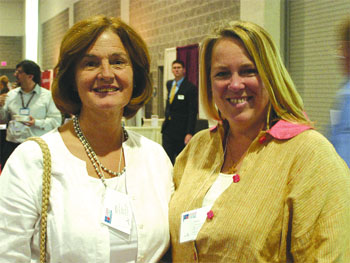
Quaboag Hills Chamber of Commerce (413) 283-2418
www.qvcc.biz

Visit the chamber online to learn more about upcoming events.

South Hadley/Granby Chamber of Commerce (413) 532-6451
www.shchamber.com

Oct. 20: Beyond Business, hosted and sponsored by Olde Hadleigh House & Patio, 5 to 7 p.m. No guest speaker. Cost: $5 members, $10 for general public, who are welcome. RSVP at (413) 532 6451 by Oct. 16.

Oct. 27: 12th Annual Table Top Meeting, hosted by Castle of Knights, 1599 Memorial Dr., Chicopee, 4:30 to 7 p.m. Presented by South Hadley/Granby, Chicopee, Greater Holyoke, and Greater Westfield chambers of commerce. Cost: $5. To reserve a table, call (413) 532-6451. 

Three Rivers Chamber of Commerce  (413) 283-6425
www.threeriverschamber.org

Visit the chamber online to learn more about upcoming events.

Greater Westfield Chamber of Commerce (413) 568-1618
www.westfieldbiz.org

Oct. 9: Greater Westfield Chamber of Commerce Annual Fall Breakfast, hosted by the 104th Fighter Wing, Dining Hall, 175 Falcon Dr., Westfield. Guest speaker will be  Rick Forgay, president of the Rich Forgay Leadership Institute. Sponsors include Noble Health Systems, Westfield Gas & Electric, NewAlliance Bank, FieldEddy Insurance, and the Carson Center for Human Services Inc. Cost:  $20 for members, $25 for non-members. For reservations, call (413) 568-1618, e-mail [email protected] , or register at www.westfieldbiz.org . The deadline for reservations is Oct. 5.

Oct. 21: Greater Westfield Chamber of Commerce WestNet After Hours Networking, hosted by East Mountain Country Club, 1458 East Mountain Road, Westfield, sponsored by Sovereign Bank. Cost: $10 for members, $15 for non-members. For reservations, call (413) 568-1618, e-mail [email protected] , or register at www.westfieldbiz.org .

Oct. 27: 12th Annual Table Top Meeting, hosted by Castle of Knights, 1599 Memorial Dr., Chicopee, 4:30 to 7 p.m. Presented by South Hadley/Granby, Chicopee, Greater Holyoke, and Greater Westfield chambers of commerce. Display tables cost $90 for members. For reservations, call (413) 568-1618, e-mail [email protected] , or register at www.westfieldbiz.org.

Sections Supplements
How They Can Impact Gift- and Estate-tax Planning Strategies

The Applicable Federal Rates (AFR) established by the Internal Revenue Service have a substantial impact on various gift- and estate-planning strategies. Each month the IRS determines the interest rate that must be used to measure the present value of annuities, income interests, and remainder interests for gift-tax purposes. This is known as the ‘Section 7520 rate.’

Low AFR rates are particularly beneficial to certain gift- and estate-tax planning strategies, and thus create opportunities for transferring assets to the next generation without, or with fewer, gift- and estate-tax consequences. This article discusses strategies for realizing these benefits.

Intra-family Loans

An example of an intra-family loan is when a parent loans money to a child and the child issues the parent a promissory note evidencing the loan. The then-applicable AFR rate is the minimum interest rate the parent must charge on such a loan to avoid potential gift-tax problems. Another example is a similarly structured loan from a grandparent to a grandchild. However, with respect to the intra-family loans, it is important that the payments required under the note actually be paid to the lender. Moreover, any forgiveness of debt by the lender will constitute a gift to the borrower, which could lead to gift- or income-tax consequences.

Generally, the loan proceeds are invested by the borrower with the expectation that the return on those invested assets will be greater than the interest rate on the promissory note. Thus, the net effect of such a loan should be that the future appreciation of the invested assets in excess of the interest rate on the promissory note will go to the borrower as a tax-free gift.

Loan to Grantor Trust

A loan by a parent, for example, to an irrevocable trust that the parent established is also very effective. However, such a trust should have some other assets to repay the loan that is made to the trust. Otherwise, the IRS might contend that the lender retained an interest in the trust for estate-tax purposes.

If it is a ‘grantor trust,’ it will provide even greater benefits. If the trust is properly drafted and administered, the trust assets will not be subject to estate taxes upon the death of the grantor. Additionally, because of grantor trust status, all the net taxable income of the trust is reported by the grantor on his or her own personal income tax return. This results in the trust being able to grow faster since the income taxes attributable to the trust’s taxable income are paid by the grantor and not by the trust.

From an income tax point of view, it’s as if the grantor had made the loan to himself. The intra-family loan to the grantor trust should have no income-tax consequences since the interest is not taxable to the grantor. The tax laws do not treat the income-tax payment made by the grantor as an indirect gift to the trust. The promissory note from the trustee of the trust should use the minimum AFR rate.

Sale to Grantor Trust

Another type of intra-family loan involves the sale of appreciated assets to a grantor trust in exchange for a promissory note from the trustee of the trust using the minimum AFR rate (unless the lender wants a higher rate). Because of the grantor trust status, there is no income tax on the difference between the value of the asset sold to the trust and its cost basis.

The payment of interest by the trust to the grantor has no income-tax consequences. It is neither deductible by the trust nor treated as interest income by the grantor. With respect to this type of sale, it is very important, however, that the promissory note be paid in full to the grantor before his or her death. Otherwise, the non-recognized gain at the time of the original sale to the trust might be recognized in the event that the trust still has a debt to the grantor at the time of his or her death.

This type of sale can be leveraged if the sale involves a fractional interest in an asset rather than the entire asset. The value of a fractional interest in an asset should be less than its percentage value of the entire asset because a bona fide purchaser would insist on a discount for purchasing a fractional interest.

Grantor Retained Annuity Trust

A Grantor Retained Annuity Trust (GRAT) provides an excellent opportunity for someone who wants to pass wealth to his or her next generation and minimize transfer taxes (e.g., gift or estate taxes). The GRAT is an irrevocable trust for a term of years to which the grantor makes a one-time transfer of property. The grantor retains the right to receive a fixed payment at least annually from the GRAT for the specified term of years.

At the time of the transfer, the grantor makes a gift calculated on the present value of the remainder interest. At the end of the term of years, the trust property is distributed to or held for the benefit of the remainder persons named in the trust.

The grantor-beneficiary of the trust must outlive the term of years in order for the GRAT to remove the trust assets from the grantor’s estate. As with many of the techniques, the successful use of a GRAT calls for a balance of factors. The longer the term and the larger the annual payment, the lesser the amount of the gift that reverts to the next generation. On the other hand, the longer the term, the greater the risk that the grantor-beneficiary of the trust will predecease that term, in which case the then-value of the GRAT is includable in the deceased grantor’s estate. However, if the grantor dies during the term of the GRAT, the estate of the deceased grantor is no worse off than if that grantor had never used the GRAT (except for the cost of having set up the GRAT).

Private Annuity

Private annuities provide various tax advantages. In a typical transaction, a parent transfers property to his or her child, and the child gives an unsecured promise to pay the parent a fixed amount of periodic income for life. To avoid a gift, it is important to structure the private annuity so that the value of the assets transferred to the child equals the present value of the annuity to be paid. With a lower AFR rate, the amount the child has to pay as an annuity to his or her parent is less.

The private annuity is a good strategy when the parent has a short life expectancy. This is due to the fact that the private annuity automatically terminates upon the annuitant’s death. If the parent is deemed to be terminally ill, then the mortality component of the IRS valuation tables cannot be used to determine the present value of the annuity. A person is deemed to be terminally ill if there is at least a 50% probability that he or she will die within one year.

However, a private annuity certainly becomes disadvantageous if the annuitant lives beyond his or her life expectancy since the payments must be made for the annuitant’s lifetime. Moreover, it is important to note that the payer of the private annuity does not get a tax deduction for any of the payments made, which would be the case if the transaction had instead involved a loan by the parent.

Charitable Gift Annuities

An increasingly popular method of benefiting a charity, but with the donor receiving regular payments from the charity, is through a charitable gift annuity. Many charities offer these annuity opportunities. With a low AFR rate, the potential income-tax charitable deduction for the gift annuity will be less, but a lower AFR rate permits a higher portion of the annuity payments to be received income tax-free. This would be particularly valuable to an individual who does not itemize his or her deductions.

Charitable Lead Trust (CLT)

A charitable lead trust (CLT) is a trust that pays income to a charity for a period of years, after which the trust assets revert back to the grantor. If the CLT is established upon the grantor’s death, then the reversion would be to the individuals and/or trust designated to receive the trust assets upon the expiration of the time period. If the CLT is set up as a grantor trust, the grantor will be taxed on the trust income each year but will receive, in the first year that the trust is funded, a charitable deduction for the present value of the charity’s interest over the specified period of years. A low AFR rate results in a lower present value of the reversionary interest to the grantor or other beneficiaries, and thus increases the grantor’s charitable deduction.

Using a non-grantor CLT, there is no initial charitable deduction, but the grantor is not taxed on the CLT income each year. Instead of the trust assets at the end of the term reverting to the grantor, the assets are distributed to named family members, other third persons, or trusts. The low AFR rate increases the present value of the charitable interest and thus reduces the value of the remainder interest for determining whether there is a gift subject to a gift tax (if the CLT was funded during the grantor’s lifetime), or whether the value of the remainder interest is subject to an estate tax (if the CLT was funded upon the grantor’s death).

Charitable Remainder Interest in Personal Residence

An individual can make an outright gift of his personal residence to charity but retain a life estate to continue to use and occupy the personal residence during his or her lifetime. The residence may be the primary or secondary residence. When a low AFR rate is applied, the present value of the charity’s remainder interest is higher, and thus the donor receives a larger income-tax charitable deduction.

When a Low AFR is Detrimental

A low AFR rate makes it more difficult to properly structure a charitable remainder trust (CRT). The typical CRT is funded by the grantor and provides for a fixed percentage payment each year to the grantor during the grantor’s lifetime or for a specific term of years. On the grantor’s death or the expiration of the term of years, the CRT’s assets are distributed to charity. The grantor should get a partial income-tax charitable deduction when he or she funds the CRT. Additionally, appreciated assets can be used to fund a CRT, and the trust in turn can then sell the assets without any tax on the gain. If the payout rate to the beneficiary is greater than the income of the CRT, however, then some of that non-taxed gain will be considered distributed to the beneficiary for that year and thus taxable to the recipient as a capital gain.

A low AFR rate complicates the use of a CRT because it is more difficult to satisfy two of the code requirements for the CRT to be qualified. One requires that the remainder interest to the charity cannot be less than 10% of the initial value of the assets transferred to the trust. Second, the possibility for exhausting the CRT assets before the end of the CRT cannot be more than a 5% probability at the time the trust is funded. Despite these difficulties, there are certain ways to design a CRT to be able to satisfy these percentage requirements even when a low AFR rate is applied.

Qualified Personal Residence Trust

A qualified personal residence trust (QPRT) generally involves an individual transferring his or her personal residence (either a primary or secondary residence) to a trust for a fixed term of years. The consequences are similar to that of the GRAT discussed above. If the grantor survives the term of years, then the residence in the QPRT is transferred to the designated beneficiaries. If the grantor does not survive the term of years, then the value of the residence is includable in his or her estate for estate-tax purposes.

When the QPRT receives the residential property, a gift to the remainder beneficiary is deemed to have occurred. The value of that gift is based on the value of the retained right to occupy the residence by the grantor during the term of years, the applicable AFR rate, and also the age of the grantor. With a low AFR rate, the value of the retained right to occupy is lower, thus increasing the present value of the gifted remainder interest for gift-tax purposes. Nevertheless, the use of a QPRT can be an effective way to transfer a residence with a lower gift value then an outright gift of the property to that remainder beneficiary. This can be especially effective if the gift involves a fractional interest in the residential property.

Conclusion

With interest rates still low, there are substantial wealth-transfer opportunities available for parents, grandparents, and others who wish to transfer assets to the next generation or beyond and, in the process, minimize or eliminate transfer taxes, whether they be gift or estate taxes. Current economic conditions have resulted in depressed asset values, but when combined with the attractive growth-shielding tools discussed in this article, now is the time to be calling your estate-planning attorney.

As Steven Leimberg, a nationally recognized estate planner, wrote in his April 2009 newsletter, estate planners are witnessing a “rare convergence” of events favorable to their clients. These events include depressed value of assets, low AFR rates, and significant valuation discount techniques. As with many issues surrounding tax-centered estate planning, however, these factors are vulnerable to economic and legislative change. It is therefore important to take advantage of these opportunities while they are available.

Richard M. Gaberman, Esq. is of counsel to the Springfield law firm Robinson Donovan, P.C. He specializes in estate and trusts, tax and estate planning, corporate and business transactions, and commercial real estate; (413) 732-2301.

Departments

Affiliated Chambers of Commerce of Greater Springfield
www.myonlinechamber.com

 Sept. 14: Ludlow Golf for Kids, hosted by Ludlow Country Club. Registration and lunch from noon to 1 p.m.; shotgun/four-person scramble at 1 p.m. The cost is $110 per person or $400 for a foursome. Sponsorships are available.

Sept. 22: West of the River Chamber of Commerce Board Meeting, 7:30 to 9 a.m., hosted by Captain Charles Leonard House in Agawam.

Amherst Area Chamber of Commerce
www.amherstarea.com

Sept. 23: Chamber After Five, 5 to 7 p.m., hosted by the Emily Dickinson Museum, sponsored by Amherst Insurance Agency/The Nathan Agencies. The cost is $5 for members and $10 for guests.

Chicopee Chamber of Commerce
www.chicopeechamber.org

Sept. 16: Salute Breakfast, 7:15 to 9 a.m., hosted by the Log Cabin Banquet & Meeting House. The cost is $18 for members and $25 for non-members. Register online at www.chicopeechamber.org

Franklin County Chamber of Commerce
www.franklincc.org

Visit the chamber online to learn more about upcoming events.

Greater Easthampton Chamber of Commerce
www.easthamptonchamber.org

Sept. 18 and 19: Electronic Recycling Collection, hosted by Red Rock Shops, College Highway, Rte. 10, Southampton. Sponsored by Duseau Trucking LLC, Autumn Properties, and Greater Easthampton Chamber. Event allows people to responsibly dispose of their old computers, monitors, TVs, stereos, and small home and office appliances.

Greater Holyoke Chamber of Commerce
www.holycham.com

Sept. 16: Greater Holyoke Chamber of Commerce Annual Outing, 5 to 7:30 p.m., hosted by Holyoke Country Club, Country Club Road, Holyoke. Featuring a chance to win $1,000. Tickets cost $25. Call the chamber at (413) 534-3376 for tickets or to become a sponsor, or visit www.holycham.com for more information.

Greater Northampton Chamber of Commerce
www.explorenorthampton.com

Visit the chamber online to learn more about upcoming events.

Quaboag Hills Chamber of Commerce
www.qvcc.biz

Visit the chamber online to learn more about upcoming events.

South Hadley/Granby Chamber Of Commerce
www.shchamber.com

Sept. 22: Premier Beyond Business, 5 to 7 p.m., hosted by the Sycamores. The guest speaker will be Ken Williamson of the South Hadley Historical Society, who will speak on the Sycamores’ history and renovations. Sponsored by Premier members Berkshire Bank, Chicopee Savings Bank, Easthampton Savings Bank, Florence Savings Bank, Jubinville Insurance Group, PeoplesBank, and Private Financial Design. The cost is $10 at the door for chamber members. Reservations are necessary; RSVP at (413) 532-2480 by Sept. 18.

Three Rivers Chamber of Commerce
www.threeriverschamber.org

Visit the chamber online to learn more about upcoming events.

Greater Westfield Chamber of Commerce
www.westfieldbiz.org

Sept. 19: 50th Anniversary Celebration of the Greater Westfield Chamber of Commerce, 5 p.m. to midnight, hosted by Tekoa Country Club, Route 20, 459 Russell Road, Westfield. Sponsored by Berkshire Bank. The theme for the evening is ’50s Diner. A Cruise Night will be set up in the parking lot. Bands include the Drifters and Corey and the Knightsmen. Tickets cost $35 through September 13, and $45 thereafter. For reservations, call (413) 568-1618, E-mail [email protected],  or sign up at www.westfieldbiz.org.

Sept. 23: Mini Trade Show, 10:30 a.m. to 3 p.m., hosted by Westfield State College, Ely Campus Center, Main Lounge Area, 577 Western Ave., Westfield. The event aims to acquaint the college community, faculty, and students with local businesses and their goods. Call (413) 568-1618 with any questions, or E-mail [email protected].

Young Professional Society of Greater Springfield
www.springfieldyps.com   

Sept. 17: Third Thursday, 5 to 7 p.m., hosted by Café Lebanon in Springfield. Relax after work and socialize with other area young professionals.

Departments

Affiliated Chambers of Commerce of Greater Springfield
www.myonlinechamber.com

Sept. 2: ACCGS Breakfast, 7:15 to 9 a.m., hosted by the Log Cabin Banquet and Meeting House in Holyoke. The speaker will be Kevin Rhodes, conductor of the Springfield Symphony. The cost is $20 for members, $30 for non-members.

Sept. 7: ACCGS After 5, 5 to 7 p.m., hosted by Café Lebanon in Springfield. The cost is $10 for members, $20 for non-members.

Sept. 14: Ludlow Golf for Kids, hosted by Ludlow Country Club. Registration and lunch from noon to 1 p.m.; shotgun/four-person scramble at 1 p.m. The cost is $110 per person or $400 for a foursome. Sponsorships are available.

Sept. 22: West of the River Chamber of Commerce Board Meeting, 7:30 to 9 a.m., hosted by Captain Charles Leonard House in Agawam.

Amherst Area Chamber of Commerce
www.amherstarea.com

Sept. 3: UMass/Chamber Community Breakfast, 7:30 to 9 a.m., hosted by the UMass Student Union Ballroom. The cost is $8 for members.

Sept. 9: Chamber Breakfast, 7:30 to 9 a.m., hosted by Courtyard by Marriott, sponsored by Back In Motion, Auto Express, and Summerline Floors. The guest speaker will be Tony Marx. The cost is $12 members and $15 for guests.

Sept. 23: Chamber After Five, 5 to 7 p.m., hosted by the Emily Dickinson Museum, sponsored by Amherst Insurance Agency/The Nathan Agencies. The cost is $5 for members and $10 for guests.

Chicopee Chamber of Commerce
www.chicopeechamber.org

Sept. 16: Salute Breakfast, 7:15 to 9 a.m., hosted by the Log Cabin Banquet & Meeting House. The cost is $18 for members and $25 for non-members. Register online at www.chicopeechamber.org

Franklin County Chamber of Commerce
www.franklincc.org

Visit the chamber online to learn more about upcoming events.

Greater Easthampton Chamber of Commerce
www.easthamptonchamber.org

Sept. 9: Networking by Night Business Card Exchange, 5 to 7 p.m., hosted by Apollo Grill, 116 Pleasant St., Eastworks, Easthampton. Sponsored by Clarke school for the Deaf. Event features door prizes, hors d’ouevres, and a cash bar. Tickets cost $5 for members and $15 for non-members.
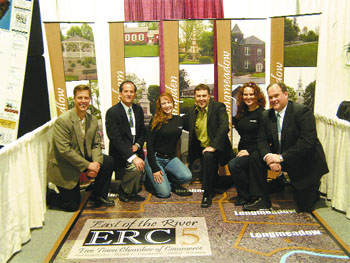
Sept. 18 and 19: Electronic Recycling Collection, hosted by Red Rock Shops, College Highway, Rte. 10, Southampton. Sponsored by Duseau Trucking LLC, Autumn Properties, and Greater Easthampton Chamber. Event allows people to responsibly dispose of their old computers, monitors, TVs, stereos, and small home and office appliances.

Greater Holyoke Chamber of Commerce
www.holycham.com

Sept. 16: Greater Holyoke Chamber of Commerce Annual Outing, 5 to 7:30 p.m., hosted by Holyoke Country Club, Country Club Road, Holyoke. Featuring a chance to win $1,000. Tickets cost $25. Call the chamber at (413) 534-3376 for tickets or to become a sponsor, or visit www.holycham.com for more information.

Greater Northampton Chamber of Commerce
www.explorenorthampton.com

Visit the chamber online to learn more about upcoming events.

Quaboag Hills Chamber of Commerce
www.qvcc.biz

Visit the chamber online to learn more about upcoming events.

South Hadley/Granby Chamber Of Commerce
www.shchamber.com

Sept. 22: Premier Beyond Business, 5 to 7 p.m., hosted by the Sycamores. The guest speaker will be Ken Williamson of the South Hadley Historical Society, who will speak on the Sycamores’ history and renovations. Sponsored by Premier members Berkshire Bank, Chicopee Savings Bank, Easthampton Savings Bank, Florence Savings Bank, Jubinville Insurance Group, PeoplesBank, and Private Financial Design. The cost is $10 at the door for chamber members. Reservations are necessary; RSVP at (413) 532-2480 by Sept. 18.

Three Rivers Chamber of Commerce
www.threeriverschamber.org

Visit the chamber online to learn more about upcoming events.

Greater Westfield Chamber of Commerce
www.westfieldbiz.org

Sept. 9: WestNet Opening Networking Evening, 5 to 7 p.m., hosted and sponsored by Nora’s Restaurant, 106 Point Grove Road, Southwick (across from Louie B’s), celebrating its grand opening under new ownership. Attendees are encouraged to bring business cards. Tickets cost $10 for members and $15 for non-members. For reservations, call (413) 568-1618, E-mail marcia@westfieldbiz. org, or sign up at www.westfieldbiz.org.

Sept. 19: 50th Anniversary Celebration of the Greater Westfield Chamber of Commerce, 5 p.m. to midnight, hosted by Tekoa Country Club, Route 20, 459 Russell Road, Westfield. Sponsored by Berkshire Bank. The theme for the evening is ’50s Diner. A Cruise Night will be set up in the parking lot. Bands include the Drifters and Corey and the Knightsmen. Tickets cost $35 through September 13, and $45 thereafter. For reservations, call (413) 568-1618, E-mail [email protected], or sign up at www.westfieldbiz.org.

Sept. 23: Mini Trade Show, 10:30 a.m. to 3 p.m., hosted by Westfield State College, Ely Campus Center, Main Lounge Area, 577 Western Ave., Westfield. The event aims to acquaint the college community, faculty, and students with local businesses and their goods. Call (413) 568-1618 with any questions, or E-mail [email protected].

Young Professional Society of Greater Springfield
www.springfieldyps.com

Sept. 11: United Way’s 16th annual Day of Caring. Each year, more than 1,400 volunteers from 45 companies participate in the Day of Caring, which pairs volunteers with agency service providers to accomplish a variety of projects.YPS will be paired up with Greater Springfield Habitat for Humanity and will be working on one of the homes currently under construction in Springfield.

Sept. 17: Third Thursday, 5 to 7 p.m., hosted by Café Lebanon in Springfield. Relax after work and socialize with other area young professionals.

Departments

Affiliated Chambers of Commerce of Greater Springfield
www.myonlinechamber.com

Sept. 2: ACCGS Breakfast, 7:15 to 9 a.m., hosted by the Log Cabin Banquet and Meeting House in Holyoke. The speaker will be Kevin Rhodes, conductor of the Springfield Symphony. The cost is $20 for members, $30 for non-members.

Sept. 7: ACCGS After 5, 5 to 7 p.m., hosted by Café Lebanon in Springfield. The cost is $10 for members, $20 for non-members.

Sept. 14: Ludlow Golf for Kids, hosted by Ludlow Country Club. Registration and lunch from noon to 1 p.m.; shotgun/four-person scramble at 1 p.m. The cost is $110 per person or $400 for a foursome. Sponsorships are available.

Sept. 22: West of the River Chamber of Commerce Board Meeting, 7:30 to 9 a.m., hosted by Captain Charles Leonard House in Agawam.

Young Professional Society of Greater Springfield
www.springfieldyps.com

Sept. 11: United Way’s 16th annual Day of Caring. Each year, more than 1,400 volunteers from 45 companies participate in the Day of Caring, which pairs volunteers with agency service providers to accomplish a variety of projects.YPS will be paired up with Greater Springfield Habitat for Humanity and will be working on one of the homes currently under construction in Springfield. 

Sept. 17: Third Thursday, 5 to 7 p.m., hosted by Café Lebanon in Springfield. Relax after work and socialize with other area young professionals. 

Amherst Area Chamber of Commerce
www.amherstarea.com

Sept. 3: UMass/Chamber Community Breakfast, 7:30 to 9 a.m., hosted by the UMass Student Union Ballroom. The cost is $8 for members.

Sept. 9: Chamber Breakfast, 7:30 to 9 a.m., hosted by Courtyard by Marriott, sponsored by Back In Motion, Auto Express, and Summerline Floors. The guest speaker will be Tony Marx. The cost is $12 members and $15 for guests.

Sept. 23: Chamber After Five, 5 to 7 p.m., hosted by the Emily Dickinson Museum, sponsored by Amherst Insurance Agency/The Nathan Agencies. The cost is $5 for members and $10 for guests.

Chicopee Chamber of Commerce
www.chicopeechamber.org

Sept. 16: Salute Breakfast, 7:15 to 9 a.m., hosted by the Log Cabin Banquet & Meeting House. The cost is $18 for members and $25 for non-members. Register online at www.chicopeechamber.org

Franklin County Chamber of Commerce
www.franklincc.org

Visit the chamber online to learn more about upcoming events.

Greater Easthampton Chamber of Commerce
www.easthamptonchamber.org

Sept. 9: Networking by Night Business Card Exchange, 5 to 7 p.m., hosted by Apollo Grill, 116 Pleasant St., Eastworks, Easthampton. Sponsored by Clarke school for the Deaf. Event features door prizes, hors d’ouevres, and a cash bar. Tickets cost $5 for members and $15 for non-members.
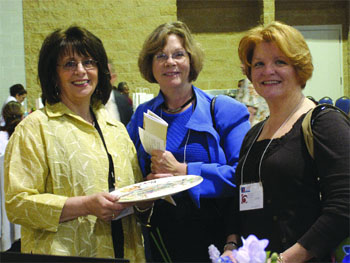
Sept. 18 and 19: Electronic Recycling Collection, hosted by Red Rock Shops, College Highway, Rte. 10, Southampton. Sponsored by Duseau Trucking LLC, Autumn Properties, and Greater Easthampton Chamber. Event allows people to responsibly dispose of their old computers, monitors, TVs, stereos, and small home and office appliances.

Greater Holyoke Chamber of Commerce
www.holycham.com

Aug. 26: Chamber Salute Breakfast, 7:30 to 9 a.m., hosted by Yankee Pedlar, 1866 Northampton St., Holyoke. Sponsored by Lyon & Fitzpatrick, LLP. Tickets cost $18. Call the chamber at (413) 534-3376 to sign up, or visit www.holycham.com for more information.

Sept. 16: Greater Holyoke Chamber of Commerce Annual Outing, 5 to 7:30 p.m., hosted by Holyoke Country Club, Country Club Road, Holyoke. Featuring a chance to win $1,000. Tickets cost $25. Call the chamber at (413) 534-3376 for tickets or to become a sponsor, or visit www.holycham.com  for more information.

Greater Northampton Chamber of Commerce
www.explorenorthampton.com

Visit the chamber online to learn more about upcoming events.

Quaboag Hills Chamber of Commerce
www.qvcc.biz

Visit the chamber online to learn more about upcoming events.

South Hadley/Granby Chamber Of Commerce
www.shchamber.com

Sept. 22: Premier Beyond Business, 5 to 7 p.m., hosted by the Sycamores. The guest speaker will be Ken Williamson of the South Hadley Historical Society, who will speak on the Sycamores’ history and renovations. Sponsored by Premier members Berkshire Bank, Chicopee Savings Bank, Easthampton Savings Bank, Florence Savings Bank, Jubinville Insurance Group, PeoplesBank, and Private Financial Design. The cost is $10 at the door for chamber members. Reservations are necessary; RSVP at (413) 532-2480 by Sept. 18.

Three Rivers Chamber of Commerce
www.threeriverschamber.org

Visit the chamber online to learn more about upcoming events.

Greater Westfield Chamber of Commerce
www.westfieldbiz.org

Sept. 9: WestNet Opening Networking Evening, 5 to 7 p.m., hosted and sponsored by Nora’s Restaurant, 106 Point Grove Road, Southwick (across from Louie B’s), celebrating its grand opening under new ownership. Attendees are encouraged to bring business cards. Tickets cost $10 for members and $15 for non-members. For reservations, call (413) 568-1618, E-mail marcia@westfieldbiz. org, or sign up at www.westfieldbiz.org.

Sept. 19: 50th Anniversary Celebration of the Greater Westfield Chamber of Commerce, 5 p.m. to midnight, hosted by Tekoa Country Club, Route 20, 459 Russell Road, Westfield. Sponsored by Berkshire Bank. The theme for the evening is ’50s Diner. A Cruise Night will be set up in the parking lot. Bands include the Drifters and Corey and the Knightsmen. Tickets cost $35 through September 13, and $45 thereafter. For reservations, call (413) 568-1618, E-mail [email protected], or sign up at www.westfieldbiz.org.

Sept. 23: Mini Trade Show, 10:30 a.m. to 3 p.m., hosted by Westfield State College, Ely Campus Center, Main Lounge Area, 577 Western Ave., Westfield. The event aims to acquaint the college community, faculty, and students with local businesses and their goods. Call (413) 568-1618 with any questions, or E-mail [email protected].

Sections Supplements
Some Recent Developments in the Law Bear Watching

Congress continues to pass a variety of new laws, many of which have significant implications for individuals and businesses. What follows is a summary of some key developments enacted during the second quarter of 2009.

Guidance on the Limited Subsidy for COBRA

The American Recovery and Reinvestment Act of 2009 provides a 65% subsidy for COBRA continuation premiums for up to nine months for workers who have been involuntarily terminated, and for their families. This subsidy also applies to health care continuation coverage for small employers if required by states (including Massachusetts, other than employers with fewer than 11 employees).

In most instances, the federal subsidy works as follows: the employer advances the 65% subsidy to the health plan and is reimbursed through a payroll tax credit. To qualify for premium assistance, a worker must be involuntarily terminated between Sept. 1, 2008 and Dec. 31, 2009. The subsidy is not taxable when received, but higher-income recipients — those with modified adjusted gross income above $125,000 ($250,000 for joint filers) — will have to pay back part or all of it at tax return time. This subsidy has been the subject of much guidance from the IRS, posted at www.irs.gov. This guidance includes the following posts:

  • In early May, the IRS posted Q & As on its Web site providing additional guidance on recovery of the COBRA premium subsidy by way of a payroll credit claimed on Form 941, and clarifying when the subsidy begins and ends.

  • In late May, the Department of Labor released a form that terminated workers (or their qualifying family members) can use to request expedited review of their being denied the COBRA premium subsidy.
  • In early June, the IRS added 19 new Q & As confirming that the premium subsidy will not be reported to the IRS or the recipients on either Form W-2 or Form 1099. The IRS also clarified a number of other topics, including events that will be treated as involuntary termination for COBRA subsidy purposes, determination of who is entitled to claim the payroll tax credit for the premium subsidy, and certain record-keeping requirements.
  • Business Cell-phone Substantiation Requirements

    An employee may exclude from gross income the business use of an employer-provided cell phone as a working-condition fringe benefit. However, because cell phones are so-called listed property, strict substantiation requirements must be satisfied for business cell-phone usage to qualify for the exclusion. Additionally, any personal usage of an employer-provided cell phone is a taxable fringe benefit. Thus, the current rules require documentation of the business and personal use of the cell phone. The IRS is currently considering three alternative methods to simplify the substantiation requirements applicable to employee usage of employer-provided cell phones: a minimal personal-use method, a safe-harbor substantiation method, and a statistical sampling method (or some combination of the three).

    Cash for Clunkers Law

    President Obama recently signed legislation into law that gives a cash incentive for individuals and businesses to trade in older gas-guzzling vehicles for new and more fuel-efficient ones. The incentive takes the form of a voucher of $3,500 or $4,500 depending on the type of vehicle traded in and the fuel efficiency of the vehicle purchased. The new vehicle must be purchased between July 1 and Nov. 1, 2009. The vouchers are not treated as gross income for purposes of the Internal Revenue Code (or for federal or state assistance programs).

    IRA Rollover Pitfall to Avoid

    Subject to certain limited exceptions, withdrawing funds from an IRA before reaching age 59 1/2 triggers a 10% penalty. One way to avoid the penalty is to take a series of substantially equal periodic payments (SOSE or SOSEPP), not less frequently than annually, for the life (or life expectancy) of the IRA owner or the joint lives (or joint life expectancies) of the IRA owner and his designated beneficiary.

    The IRS has been fairly unforgiving on inadvertent, good-faith errors with respect to SOSEPPS. In one case, an owner took advantage of this exception, but later moved her IRA funds out of equities and into safer certificates of deposit at another institution after the market soured. In a private ruling, the IRS said that this move triggered the 10% penalty for all years going back to when she started taking the periodic payments. The IRS said that the rollover of the IRA to the new institution was a modification of the periodic payments that triggered imposition of the back penalties under a so-called recapture rule. It was irrelevant that the move was inspired by safety concerns, and that the individual was willing to take the payments out of the new IRA.

    The IRS also refused to allow her to correct the situation by placing the funds back into the original IRA. Note, however, that a new private ruling issued on July 17 indirectly calls that conclusion into question. The ruling provides relief where an amount was erroneously rolled over into the IRA from which periodic payments were being taken following a rollover from the original IRA from which the payments commenced. The ruling did not affirmatively address whether the original rollover constituted a modification, but assumed that it did not.

    Note also an education exception to this somewhat harsh rule. Another litigated matter involved a taxpayer who took advantage of the SOSEPP exception. She subsequently varied the amount to access additional funds for her son’s education. The IRS maintained that this was a modification, triggering the penalty. However, the Tax Court overruled the IRS, holding that there is no penalty because of the exception for IRA funds withdrawn before age 59 1/2 for education, and that the rules allow an individual to qualify for more than one exception at the same time.

    Claiming Motor-vehicle Sale-tax Deduction

    For 2009, there is a new deduction for state and local sales and excise taxes paid on the purchase of new cars, light trucks, motor homes, and motorcycles after Feb. 16, 2009 and before Jan. 1, 2010. The deduction generally is available regardless of whether you itemize deductions on Schedule A or claim the standard deduction. The deduction is limited to the tax on up to $49,500 of the purchase price of an eligible motor vehicle.

    This dollar limitation is imposed on a per-vehicle basis, so taxpayers can deduct taxes on one or more purchases of qualifying motor vehicles, up to the limit on each one.

    New Guidance on Life Settlements

    The IRS recently lifted some of the uncertainty surrounding life settlements by explaining their tax consequences. Until recently, individuals who no longer needed a life-insurance policy had few options: they could surrender the policy to the issuing insurance company for its cash-surrender value, or they could stop paying the premiums and let the policy lapse. For a term insurance or other policy without cash-surrender value, the only choice was to let the policy lapse.

    Now, for some individuals, there is a secondary insurance market in which they may be able to sell a policy for more than its cash-surrender value or even sell a policy without cash-surrender value, such as a term policy. These transactions are called life settlements.

    This is an important development for anyone contemplating a life settlement because they will now be in a position to gauge how much they will be left with after tax once they reach an agreement on the settlement amount and fees.

    Brenda Doherty is a partner with the Springfield-based firm Doherty, Wallace, Pillsbury, & Murphy P.C. She practices in the areas of corporate law, estate planning, and taxation; (413) 733-3111.

    Sections Supplements
    How Mary Lane’s Chad Mullin Went from Spinning News to Making It
    Chad Mullin

    Chad Mullin says he long desired his current job, and prepared for the day when he would compete for it.

    When Charles (Chad) Mullin was manager of public relations and marketing for Baystate Mary Lane Hospital in Ware, he would often “hang out” (his words) in departments such as radiology, cardiology, the lab, the sleep program, and others.

    “I was the ‘PR guy who just wouldn’t leave them alone,’” said Mullin, adding that he was fascinated with the new technologies and procedures put to use in those departments.

    Outwardly, he was looking for story angles for the internal publications for which he would write and edit, and also for ways to generate external press for the small, 31-bed hospital he joined in 1997.

    But there was much more going on.

    He was watching, learning, and appreciating the work being done, while also setting an ambitious career goal — to one day be the one leading those departments in the position known as director of Diagnostic Services.

    The position was occupied when he set that goal, of course, but he knew that someday it would be available. And he went about making himself job-ready — by taking the knowledge he had amassed and coupling it with an MBA he earned from the Isenberg School of Management at UMass Amherst in the spring of 2008.

    The day before commencement, his father passed away unexpectedly.

    “I still walked down the aisle to get my diploma,” said Mullin, adding that he did so more out of respect for his father than anything else. And a few months later, when the director of Diagnostic Services position did in fact come open, he showed that respect again.

    “My father was always saying that, if you want something in life, just do it,” said Mullin. “When I went back to school, I just wanted to get my education and to get this job.”

    And roughly a year ago, he was given the title he long coveted. The work, as he expected, is challenging and rewarding, and he enjoys just about everything about it.

    In this issue, BusinessWest looks at how Mullen made the unusual leap from PR to hospital administration, and how he’s settled into this important role.

    Hot Off the Press

    Not long after he arrived at Baystate Mary Lane, Mullin concluded that, despite its small size, this was a hospital he wanted to stay with — although not necessarily in that position.

    “For me, it’s the people, and the fact that you’re involved in a lot of decision-making,” said Mullin, adding that, soon after arriving, he got a real feel for the sense of what he called “family” that exists at the hospital. “Patients know employees, mothers bring their daughters, and eventually those daughters bring their daughters; there’s a real community connection here.”

    Mullin got to know every corner, every aspect of the hospital in his role as manager of public relations and marketing, a job he ascended to after serving for two years as a public-relations assistant at Baystate Medical Center. He actually started as an intern at Baystate, worked briefly in public relations for the Big E, and then returned to the medical center.

    At Mary Lane, Mullin was responsible for public-relations functions; internal employee, management, and medical staff communication; and marketing activities. He also coordinated special events. In the course of doing all that, he developed a keen understanding of how the hospital and its various departments, especially the diagnostic areas, worked — and how they could work more efficiently.

    All this contributed to Mullin’s goal of someday leading the diagnostics department, a progression he admitted was somewhat unusual, and perhaps only doable at a smaller hospital like Mary Lane.

    When now-former Diagnostics Director Bill Patten announced his plans to leave for another opportunity in the summer of ’08, Mullin had a lengthy talk with Mary Lane President and CEO Christine Shirtcliff about the position and his desire to hold it. Actually, he said he had spoken to her often about his desire to be in hospital administration at some point.

    What he told her — and BusinessWest — is that, while he lacked direct experience in administration, he had a thorough understanding of the hospital, its component parts, and how to remain competitive in the local health care market.

    “I think the 12 years of working here prior to seeking this role helped prepare me for it,” he explained, “because when you work in a small community hospital, you have exposure to a lot of clinical and non-clinical work. I had a good understanding of the operations arena.”

    This level of understanding was obviously communicated to those interviewing candidates, and the message resonated with them.

    As director of Diagnostic Services, Mullin supervises roughly 65 employees working in several different departments. They include Diagnostic Radiology, Mammography, Nuclear Medicine, Ultrasound, CT, Cardiology, Laboratory, the Sleep Program, Respiratory, and Outpatient Specialty Services.

    He knows all the numbers — 29,000 radiology exams a year, 165,000 lab tests, and 280 sleep studies — but, more importantly, he knows the people behind the numbers

    There was still a learning curve for Mullin, but he said he had — and still has — a good support network to help him in what is still a career in transition.

    “I knew going into the position that I wasn’t going to be out there on an island,” he explained. “That’s because Mary Lane is so integrated with Baystate Health that I knew I had people in Springfield — in radiology, in laboratory, and in the sleep program — that I could call at a moment’s notice to help me through any challenges that came up.”

    He describes his work as purely administrative, with the clinical link being the supervisors, or the “wheels on the ground,” as he called them, running each specific department. “They’re the ones managing most of the day-to-day clinical issues.”

    When asked about what a day in his new life is like, Mullin said this is much more of a 24/7 position than his previous work; now, as then, he carries a beeper. There are more meetings, obviously, both within the Mary Lane operation, and the Baystate system. Mullin appreciates the latter, because there is a sharing of ideas that can benefit his facility and all others under the Baystate umbrella.

    “You can share information about what works at your place, and they share information about what works at theirs,” he explained. “We’re always refining the way we deliver services here at Mary Lane.”

    And Mullin says the learning process never ends.

    “I’m still learning every day,” he said. “There are many facets to this position, and there is a lot involved with each of those patient-care areas. You’ll learn different ways of doing your job and how you can help your techs do their job every day.”

    The Bottom Line

    When asked if he had to write the press release for his own promotion a year ago, Mullin laughed and said that responsibility fell elsewhere.

    Clearly, he already had new responsibilities and a new job to learn and do.

    His father had told him that, if he wanted something in life, then he should just do it. This was something he wanted, and he did it.

    George O’Brien can be reached at[email protected]

    Sections Supplements
    Passive Activity Rules Bring Benefits of Real-estate Investment into Question

    During this economic downturn, we have seen housing prices and mortgage interest rates fall. The stock market keeps falling and setting new lows. The combination of these events may have people looking to get into the real-estate market for investment purposes.

    While there are many things to consider when making such an investment, the possible tax benefits should be at the end of the list. Generally, rental real estate generates a tax loss that may or may not be deducted on the individual tax return. There are rules that may disallow or limit the losses from rental activities and limit the tax benefits of such investments.

    Passive Activity Rules

    The biggest hurdle in deducting rental losses is the passive activity rules. While real estate might be our current focus, it’s important for us to have an overall understanding of these rules and how they are intended to work. The passive activity rules were set up by Congress in 1986 to curb the abuses of tax shelters aimed at individuals. The Internal Revenue Code generally does not allow the taxpayer to deduct a loss or credit from a passive activity.

    If there is passive income during the year, it is allowed to be offset against the passive losses for the year. Any excess passive losses that were not offset by passive income are carried over to the following year. If the passive activity is fully disposed of in a taxable transaction, the passive losses that were carried over are allowed to be deducted in the year of disposition.

    Rental activities by their nature are passive activities. Any rental activity, generally, is considered a passive activity. There are six exceptions to this rule:

    1. The average period of customer use for such property is seven days or less, as with a rental-car company.

    2. The average period of customer use for such property is 30 days or less, and significant personal services are provided by or on behalf of the owner of the property in connection with making the property available for use by customers (e.g. hotels).

    3. Extraordinary personal services are provided by or on behalf of the owner of the property in connection with making such property available for use by customers (without regard to the average period of customer use). An example of this exemption might be the rental of crutches from an orthopedic physician practice.

    4. The rental of such property is treated as incidental to a non-rental activity of the taxpayer. This includes property held for investment, and the gross rent received is less than 2% of the lesser of the unadjusted basis or the fair market value in the building (rental of land to a logger, for instance).

    5. The taxpayer customarily makes the property available during defined business hours for nonexclusive use by various customers, such as with a parking garage.

    6. The provision of the property for use in an activity conducted by a partnership, S corporation, or joint venture in which the taxpayer owns an interest is not a rental activity. For example, a lawyer renting an office building to his or her own practice would fall within this exception.

    If the taxpayer is involved in any of the activities noted above, the loss from the activities would not be considered passive. Rather, the losses would be deducted and would not have to meet the passive-activity loss limitations.

    The IRS provides an exemption for middle-class taxpayers that allows a $25,000 deduction on certain residential rental activities. The taxpayer must actively participate in the rental activity during the tax year. In other words, the taxpayer must make management decisions, such as approving tenants and arranging for repairs, in a bona fide sense. This exemption is reduced by 50% of the amount of adjusted gross income (AGI) over $100,000 and is fully phased out once AGI reaches $150,000.

    There are also special rules for taxpayers in the real property business or real-estate professionals. A taxpayer that is determined to be in the real property business may elect to not be subject to the passive activity rules. A taxpayer must materially participate in the rental activity to be in the real property business. For a taxpayer to materially participate in the real property trade or business, he or she must spend more than one-half of his or her time and more than 750 hours of service during the year in the real-estate business. To be considered a real-estate professional, the taxpayer must ‘materially participate’ (see below) in the real estate activity and not just merely ‘actively participate’ in it. Real property trade or business is any real property development, redevelopment, construction, reconstruction, acquisition, conversion, rental, operation, management, leasing, or brokerage trade or business.

    A passive activity can also be any activity that is a trade or business that the taxpayer does not materially participate in. Material participation occurs when the taxpayer is involved in the operations of the activity on a basis that is regular, continuous, and substantial. Any work that an owner performs for his or her business is generally considered participation. Material participation is determined on a yearly basis.

    Once a taxpayer is considered to materially participate in an activity, it does not mean that he or she will continually be considered to materially participate the next year. If the taxpayer materially participates, the loss generated by these activities would not be considered passive, and the taxpayer would be able to deduct the losses without having the passive-loss rules come into play.

    Keeping the above in mind, make your real-estate investment decisions based upon the economics of the investment without considering the possible tax benefits. Under the passive-loss rules, those benefits could be a long time in the making.

    Sean Wandrei is a tax manager with Meyers Brothers Kalicka, P.C. His technical concentrations are in multi-state taxation as well as real-estate entities; (413) 536-8510.

    Uncategorized

    There has been a lot of discussion recently about new federal privacy laws and how businesses must make sure their customer data is secure. It may not be something you often think about, but it is very easy for that data to be compromised.

    Here are some common occurrences:

    • A person is robbed in a parking garage and loses his laptop computer;

    • Hackers unleash a virus that infiltrates the computer network of a large retail store chain. The virus compromises a customer database;
    • An unhappy employee takes customer records home with him and begins applying for credit under customers’ names.
    • These things can and do happen. They are a technological and public-relations nightmare for the businesses involved. They will also likely turn into lawsuits against the firms for mishandling customer information. Without financial protection against these types of events, a business could go bankrupt. These situations raise insurance concerns that were virtually unheard of 10 years ago.

      How can you be protected?

      The use of sophisticated computer networks for storing data has caused the insurance industry to develop products to cover businesses against liability for lost customer information. One product is the electronic data liability policy. Its purpose is to pay for a firm’s defense when customers sue for allegedly failing to safeguard their information, and to pay any resulting settlements or judgments against the firm.

      The policy covers the firm’s liability for “loss of electronic data” caused by an “electronic data incident.” That could be an accident, a negligent act, error or omission, or a series of these. Some examples of the types of incidents this policy might cover are:

      • A virus that enables hackers to access the customer database;

      • During a power blackout, looters break into an office and take employees’ computers;
      • An employee leaves customer files in the open on her desk at night, allowing cleaning staff to obtain bank-account information and Social Security numbers.
      • What Is Covered?

        Coverage applies on a ‘claims made’ basis. This means the policy will cover incidents that occurred on or after a specific date stated in the policy and reported to the insurance company during the policy period. For example, assume that a policy has a term of Jan. 1, 2008 to Jan. 1, 2009, and it lists Jan. 1, 2005 as its retroactive date. On Sept. 30, 2008, the firm finds out that hackers broke into its systems in the summer of 2006. It reports the incident to the insurance company that day. The policy would cover this claim because it occurred after the retroactive date. This would not be true if the break-in happened in 2004, before the retroactive date.

        To keep the policy’s cost down, it does not cover several types of losses. For example, it doesn’t cover losses caused by theft or unauthorized use of electronic data by past or present employees, temporary workers, or volunteers. The policy will not provide coverage for the acts of the previously mentioned disgruntled employee. It also does not cover losses arising out of a firm’s providing ‘computer products or services.’ These include, among other things, installing or repairing computer equipment and software, storing data for others, providing Internet services, and providing communications services to others. It also does not cover acts such as alleged copyright or trademark infringements.

        While the policy covers claims reported during the policy period, it has a special provision to give additional time for reporting. The insurance company will treat claims reported within 30 days after the policy expires as if the policyholder reported them while the policy was in force. For an additional premium, the company may extend the reporting deadline to three years after the policy expires. However, this additional premium can be up to 100% of the original premium.

        High-speed computer networks have given today’s business owners opportunities they have never had before. However, these opportunities have come at the cost of higher risks with potentially large consequences. Any firm doing business over the Internet or private networks should discuss electronic data liability coverage with an insurance agent. n

        John E. Dowd Jr. is a fourth-generation principal of the Dowd Agencies, a full-service agency, with four offices in Western Mass., providing commercial, personal, and employee benefits; (413) 538-7444

        Sections Supplements
        Tournament Organizer BasketBull is Generating Net Results
        The team at BasketBull: from left, Patrick Fisher, Molly Dullea, Colin Tabb, and Chris Sparks.

        The team at BasketBull: from left, Patrick Fisher, Molly Dullea, Colin Tabb, and Chris Sparks.

        Using the Naismith Memorial Basketball Hall of Fame as a drawing card, a still-developing business venture called BasketBull is bringing thousands of young players to Springfield and other area communities for tournaments, thus filling hundreds of hotel rooms and providing business for other hospitality-related businesses, including the Hall, in the process. There are ambitious growth plans on the table, according to general manager Colin Tabb, who believes his company has a winning formula.

        Colin Tabb says there are two rather unofficial “missions” for the company called BasketBull, LLC — named in part for his grandfather (more on that later) — which he serves as general manager.

        The first, as it states on the back of Tabb’s business card, is to “organize competitive AAU tournaments, thus providing players of all ages and ability the chance to learn and compete at the highest level and develop to their fullest potential.”

        The second mission — equally important, but in a much different way — is to help “make Springfield ‘Basketball City,’” said Tabb, a former college shooting guard who played professionally overseas for several seasons before shifting gears career-wise. He believes this fledgling company is well on its way to accomplishing that lofty goal, through a partnership with the sport’s Hall of Fame and an ambitious business plan that outlines net results on several levels.

        Started as a part-time venture for Tabb and the principals who created it — his uncles, Mike and Bob Martin — BasketBull, now occupying space on the 15th floor of One Financial Plaza, arranges Amateur Athletic Union tournaments at various sites across Western Mass. and elsewhere, with the championship games often played on Center Court at the Naismith Memorial Basketball Hall of Fame.

        These tournaments have names like ‘HoopHall Invitational,’ ‘New England Elite Showcase,’ ‘End of Summer Blowout,’ ‘New England Best of the Best,’ and ‘Columbus Day Challenge.’ They have brought, or will bring, between 60 and 1,800 players to the host city (usually Springfield, but others have been played in locales ranging from Amherst to Chicago), with that number usually somewhere in the middle of those extremes.

        And by doing so, these events have helped bring thousands of additional visitors to the Hall of Fame, while also filling hotel rooms, seats in restaurants, and rides at Six Flags, thus making BasketBull, the official organization for all basketball-related events associated with the Hall, an economic driver as much as it is an organizer of hoop tournaments.

        From a business perspective, says Tabb, a political science major still learning many of the ins and outs of running a company, BasketBull is hitting or exceeding the numbers laid out in a business plan that has seen several revisions in only a few years.

        The business model is fairly simple: teams are charged entrance fees (averaging $400 or so) to participate in the various tournaments, revenues that currently exceed expenses that range from rental fees paid to area colleges and high schools to use their gyms to hiring game officials to insurance. The immediate goals are to increase the number of events — there appears to be strong growth potential with girls’ tournaments, for example — and maximize revenues from each one, said Tabb, who told BusinessWest that he and his staff members are aggressively exploring expansion strategies, including plans to become more national in scope.

        There are several competitors in what would be considered a relatively new business sector, said Tabb, but none that can really offer what BasketBull can — a chance to play a game on a court where players can look up and see the plaques of Hall of Fame inductees.

        “It’s really a unique opportunity to play at the Hall of Fame,” he said. “It’s something players and coaches will remember long after the games are over.”

        In this issue, BusinessWest looks at how this intriguing company intends to capitalize on this home-court advantage, and thus create new opportunities — for BasketBull, Springfield, the Hall of Fame, and other hospitality-related businesses.

        Court of Opinion

        Tabb said the inspiration for BasketBull came in large part from a venture often referred to as the Field of Dreams — Cooperstown Dreams Park is the actual name of the facility — which stages baseball tournaments at a large complex of diamonds near, but not part of, the Baseball Hall of Fame in that New York hamlet.

        “Our model is very similar to that in the sense that we want to use the Hall of Fame as a drawing card,” Tabb explained, “and try to make Springfield more of a basketball town, a basketball city in America.”

        The success of the Cooperstown initiative prompted Basketball Hall of Fame officials to approach Mike and Bob Martin — the former the athletic director for Springfield schools and the latter a long-time basketball referee and supervisor of officials — in 2004 to see if there was any interest in putting on events that would, among other things, create more foot traffic for the Hall.

        There was.

        What emerged was a small start-up that would take the name BasketBull, LLC, a tribute of sorts to Tabb’s grandfather, William Martin, a former basketball star at Providence College and long-time Springfield police chief, who was nicknamed ‘Bull.’

        “It seemed like a good fit, and it makes a lot more sense when we explain it,” joked Tabb, who joined the company with the assignment of taking it to the next level. He brings to that task a varied background, including knowledge of the local sports market — be was raised in Springfield — and a passion for the game. After playing college ball at Trinity in Hartford, where he earned Division III first-team All American honors, he played professionally in Germany and Ireland before eventually taking a job as assistant coach at Brandeis University in Wellesley. He was in that post when he got the call from his uncles to join them in their entrepreneurial venture.

        As he explained the basic business model behind BasketBull, Tabb said there are thousands of AAU teams, or clubs, around the country comprised of boys and girls of all ages. Locally, there are clubs affiliated with the Dunbar Community Center and South End Community Center, for example, he said.

        These clubs practice during the week and, if they are so inclined, play in tournaments on the weekend, Tabb continued, adding that many are willing to travel (within driving distances, usually, but some will actually get on planes) to compete in events; for the Hall of Fame Junior Nationals (June 26-28 in Springfield), teams from North Carolina and Texas have signed on.

        Event organizers do well when they have some kind of hook, he explained, adding that, for BasketBull, it is the sport’s shrine, which can comfortably sit 150 to 200 people for a title game on its not-quite-regulation-size court.

        “It’s a great draw,” said Tabb, who noted that BasketBull uses E-mail blasts, phone calls to AAU coaches, and other vehicles to bring attention to its events — and people to Springfield.

        Points of Interest

        While BasketBull is still clearly in its developmental stage, it is already compiling some fairly impressive statistics.

        For example, an event staged in Springfield in mid-May called the Spring Classic brought 170 teams (137 of them from outside the state) and 2,136 competitors to the City of Homes, said Patrick Fisher, marketing director for the company, who keeps spreadsheets detailing the company’s impact on the region. Total visitors numbered nearly 5,000, he continued, and nearly 200 admission tickets were purchased for the Hall of Fame.

        Patrick has grand totals projected for the 2009 season, which will include 22 events, 14 of them in Springfield. Together, they will involve 860 teams (218 from Massachusetts and 632 from out of state) and 11,485 participants. The games will bring a projected 16,144 spectators and 30,689 total visitors to the area. They will purchase 1,070 room nights and nearly 2,000 tickets to the Hall of Fame.

        “Sometimes, it’s the players and a coach coming in a van,” said Tabb, noting that teams usually put several players in a hotel room. “But many times, mom, dad, and the grandparents will come to the tournament as well; it varies from team to team. We’re impacting a number of area businesses, and we expect those numbers to continue increasing in the years to come.”

        The impact on restaurants and other tourist attractions is somewhat difficult to quantify, Tabb continued, but there is no doubt that the tournaments are helping a number of chain family eateries as well as attractions like Six Flags.

        Looking down the road, Tabb said the obvious goals are to broaden the schedule and expand geographically, thus building the BasketBull brand and providing long-term viability. “There’s only so much you can do in this region, the New England area,” he explained. “There’s only so many times teams are going to come to Springfield to play in a tournament and visit the Basketball Hall of Fame.”

        The plan is to establish regional sites across the country, he continued, and have, in many instances, the regional winners and runners up come to Springfield and play in what would be called a national final.

        There are currently 14 events on BasketBull’s local slate for 2009 — 10 for boys and four for girls — and the goal is to have 30 to 35 on the schedule within five years, said Tabb, adding that there will be a heightened focus on the girls’ side of the ledger, which has strong growth potential.

        To reach it, the company has brought on Molly Dullea, who takes the title ‘girls director,’ and is focusing specifically on adding events to the calendar. Her counterpart on the boys side, Chris Sparks, has a similar assignment.

        There will be some logistical challenges to accomplishing all this, said Tabb, noting that the company currently uses a number of venues, including AIC, Springfield College, Holyoke Community College, and several high schools, but could use more.

        One potential re-use of the former York Street Jail site is as a home for events such as those staged by BasketBull — an option mentioned often by city economic-development officials. Tabb said such a venue would solve many of his problems, but BasketBull would not be the entity to build such a complex.

        In the meantime, the company’s staff is splitting its attention and energies between work to ensure that this year’s scheduled events go off as well as possible and efforts to expand the slate for 2010.

        “We’ve got one eye on this year’s tournaments and the other on 2010 and beyond,” he said. “Next year is going to be pivotal for us in terms of building our brand.”

        At the Buzzer

        As he took a few shots while taking part in a photo shoot at the Hall of Fame, Tabb swept his arms across Center Court and said, “what a great venue for a championship game.”

        Indeed, the Hall is proving to be the drawing card that those at BasketBull and the shrine thought it would be.

        There is considerable growth potential for this venture, said Tabb, but still considerable work to be done before Springfield can truly be called ‘Basketball City.’ However, he thinks his team is up for the challenge, and can grab the bull by the horns. n

        George O’Brien can be reached at[email protected]

        Sections Supplements
        Dowd Agency Builds on a 110-year Legacy of Relationship Building
        The principals at the Dowd Group, from left, Bob Gilbert, John Dowd, and David Griffin.

        The principals at the Dowd Group, from left, Bob Gilbert, John Dowd, and David Griffin.

        In the front lobby of the offices of the Dowd Group in Holyoke hangs a framed copy of the citizenship papers of the company’s founder, James J. Dowd, circa 1871.

        There’s a portrait of Dowd on another wall, as well as some pictures of his descendents, subsequent presidents of the firm he started in 1898. In the conference room, there’s another portrait of Dowd, a few pictures depicting early 20th-century Holyoke (this company’s only corporate home), and a painting depicting the coastline of Ireland, from which the patriarch emigrated with the rest of his family in 1865.

        The walls are so decorated to convey history and continuity, two things those with the Dowd Group are quite proud of, said John E. Dowd, fourth-generation principal, specifically executive vice president, of the James J. Dowd & Sons Insurance Agency. But while the company likes to talk about its past, it’s certainly not living in it, he told BusinessWest.

        Indeed, the landscape in insurance has changed almost as dramatically as the scene in downtown Holyoke over the past century and a half, he explained, and the company has responded accordingly. It has expanded well beyond its Holyoke roots, with offices in Southampton and Amherst and clients across the Northeast and beyond, and it has diversified, with products now ranging from insurance to financial service to employee benefits. And it continues to be both innovative and entrepreneurial.

        The latest example is a venture called WestMass Professional Insurance LLC, a recently created company led internally by Dowd principal David Griffin that is, in effect, an insurance wholesaler specializing in helping smaller agencies bring more options to customers and thus remain viable in a highly competitive market.

        “We see this as a great opportunity for us to generate new business,” said Griffin, noting that WestMass was born as a way to co-broker the products sold by provider Promutual. But there are myriad opportunities for an agency like Dowd to serve smaller players in the market — with everything from insurance and financial services products to IT support — and the firm intends to take full advantage of them.

        Innovation coupled with strong customer service and solid relationship-building efforts have been the keys to Dowd’s growth over the years, said Bob Gilbert, president and treasurer, who came to the company in 1975 and has seen it grow from just over $1 million in sales then to more than $40 million now.

        “When asked how the company has achieved such growth, Gilbert, who joined it as a principal in 1975, said the formula is fairly straightforward, and the key is execution.

        “You hire good people, you train them well, and you know your product better than the competition,” he explained. “It’s comes down to knowing your business, paying attention to customers’ needs, and learning how to listen.”

        With his background in commercial sales, Gilbert has guided the company to what he called a 180-degree transformation, from an agency specializing in personal-lines products a quarter-century ago to one that now has 85% of its portfolio in the broad category of commercial work.

        Moving forward, he wants to build on the company’s legacy of relationship-building, and take that ability in new directions, thus spawning new and different opportunities.

        In this issue, BusinessWest looks at a company that is rich in history, and eager to write some new chapters to the story.

        Irish Eyes

        John Dowd says he enjoys talking about the company’s history, which is good, because there’s plenty of it, passed down by subsequent generations of the family. There are many singular events and circumstances, he told BusinessWest, which combined to give this agency its start — and to remain in business for more than a century.

        It all starts with Dowd’s great-great-grandfather, also named James Dowd, who, when hard times hit County Kerry Ireland in 1865, came to America with his wife and 14 children. It was one of those children, James, who would eventually create the firm, although insurance wasn’t his original career pursuit or passion.

        Instead, he started in retail (he bought the small grocery store he worked at) before becoming an assessor in Holyoke — the start of work in public service that included several terms in the state Legislature — and eventually board chairman. That was a post he lost when he and a colleague and eventual business partner, Jeremiah Keane, refused to bow to pressure from the mayor of the city and assign a modest assessment to the property of one of the mayor’s friends. In September 1898, they started Keane and Dowd, an insurance and real estate business, in Room 32 of the Ball Building, later known as the Holyoke National Bank Building.

        James Dowd’s son, James J. Dowd II, attended Holy Cross College, as many members of this family have over the past century or so, and played baseball there. A pitcher, he was good enough to earn a contract from the Cincinnati Reds for the then-lucrative amount of $2,200 a year.

        But a year later, in 1916, he gave up a promising career in baseball to take over the family business, then named James J. Dowd & Son after Keane left the firm to return to the assessor’s office following his father’s unexpected death.

        “My great-grandmother called him and told him he had a choice to make,” Dowd told BusinessWest. “She said, ‘you’ve got the agency your father started and worked hard to build or your professional career — what’s it going to be?’ Obviously, he chose to quit baseball.”

        Fast-forwarding through the company’s history somewhat, John Dowd said the company grew and prospered through the 20th century, moving several times (always staying in downtown Holyoke, though) to accommodate this growth, while successive generations of the family, as well as industry veterans such as Gilbert (in 1975) and Griffin (1998), have assumed leadership roles.

        In 1947, the third generation of the Dowd family, James Jr. (John’s uncle), joined the agency, followed by his brother, John (John’s father), a few years later. They took the helm in 1960 when James J. Dowd II passed away. In 1974, John’s father passed away unexpectedly, leaving the company in the hands of his uncle; his cousin, James Dowd III, who joined the agency that year; and, a few months later, Gilbert.

        By All Accounts

        He had been working for Aetna, essentially teaching independent agents (including those at Dowd) how to sell commercial products — workers comp, liability, property insurance, bonds, and more — when he was approached by James Dowd Jr. about joining the agency in a leadership role.

        “He offered me an opportunity I just couldn’t pass up,” he said, adding that, with his background in commercial products, the firm soon started gravitating in that direction.

        It has been an effective growth formula. “The opportunities to grow a business are there in commercial, because you can write a couple of commercial accounts, while it may take you 40 personal-lines accounts to reach the same number. And it takes a lot of time to gain 40 new accounts.”

        In the ’80s, the Dowd agency expanded geographically, first into Southampton with a venture now called the Dumont-Dowd Insurance Agency, and then into Amherst with the Cray-Down Insurance Agency. These ventures, along with the original Dowd agency and Dowd Financial Services, comprise the Dowd Group.

        Through its existence, the company has always thrived through its success in relationship-building, said Gilbert, noting that early relationships were mostly with families and businesses in Holyoke, and that, in latter years, they were defined by a much-wider geographic area and a much-broader range of businesses.

        It was relationships — those John Dowd forged when he was in college (St. Michael’s in Vermont, not Holy Cross) and later in Boston that helped the Dowd agency earn the business of Suffolk Downs in the ’80s and ’90s. Dowd remembers going to the track on many occasions. “I’d bring friends, we’d sit in the owner’s box and act like big wigs, while placing our $2 bets.”

        And it was similar relationships, as well as some effective bidding, that helped the agency gain a lucrative contract with the University of Mass-achusetts, one it kept for 15 years, to insure buildings at its then-three campuses.

        “We eventually lost that contract to politics,” said Gilbert, adding quickly that the company’s portfolio remains large and diverse, with clients ranging from the Eastern States Exposition to Sullivan Trucking to dozens of general contractors.

        The challenge at hand is to continually expand that portfolio.

        And as he talked about how to go about doing that, Gilbert returned to the matter of relationships, noting that the ability to maintain them and forge new ones is critical to continued growth in a region typically defined as a low-growth area, meaning one with little if any residential and commercial growth.

        Gaining larger market share in the insurance realm, as in banking, to a large degree, comes through customer service, finding ways to distinguish oneself, even when many of the products and services being offered are similar in nature, and finding new avenues for growth and revenue, he continued.

        Agents of Change

        One such avenue is WestMass Professional, a venture that grew out of the necessity for Promutual, a writer of medical and professional liability coverage, to secure what’s known as a co-broker to work with smaller agencies to renew existing policies and write new ones.

        That co-broker became WestMass Professional after roughly a year’s talks, said Griffin, adding that the new venture could lead to new and similar opportunities for co-brokering products, especially with changes in the automotive market from managed competition to open competition, in which consumers can effectively shop for lower rates.

        “In Massachusetts, 85% of the personal-lines business was being written by independent agents, but because we were in a non-competitive state, there wasn’t a lot of product you could sell, per se; all you were really selling was your services,” he explained. “We recognized very early on that there would be a lot of smaller agents that would be limited in their competitive ability because they represented only one or a few carriers, and there might be an opportunity to wholesale to some smaller agencies so they could expand the portfolio of carriers they could represent.

        “We broached this idea with our carriers first, to get their blessing,” he continued, adding that most of them gave it. And from there, the discussion of wholesaling certain products was expanded from personal lines to commercial products as well.

        Eventually, three ‘portals of opportunity,’ as Griffin called them, emerged from this wholesaling concept: medical and professional, personal lines, and commercial.

        Soon, other potential portals came into focus as those at Dowd anticipated other needs among smaller agencies. One such need is the ability to sell financial-services products — Dowd has a separate division that could make such products available — while another is for assistance with what Griffin called agency-management services, meaning everything from accounting to IT support — and Dowd has its own IT-support department.

        And there are more opportunities on the horizon, he continued, listing everything from help with succession planning, or selling or agency, to help understanding and then coping with new privacy-of-information laws that were originally slated to take effect May 1, have been pushed back, but will soon become reality.

        “These will impact an insurance operation in many ways,” said Griffin. “Our IT person is fully conversant on the law and how to come into compliance, and he’s knowledgeable on all aspects of the measure.”

        The sum of these portals is a large opportunity to create a large and reliable stream of new revenue, said Gilbert, adding that the business plan for these ventures is still in progress. Several agencies have been approached concerning these services, and at least five have signed on, with the potential for many more over the coming months. There is already limited competition in the wholesaling realm, and the possibility of much more, but those at Dowd believe they have an attractive model, one that leaves participating agencies with desired levels of flexibility and control.

        “With some models, you’re selling yourself to the devil, lock, stock, and barrel,” he explained. “Our approach is a little more hands-off, where you can use us in any of those disciplines that you want, but it isn’t a requirement that you use us for all of them.”

        Dowd agreed. “The agencies get to maintain their identity, or their sovereignty, if you will,” he said, adding that the arrangement entered is a true partnership, or relationship — there’s that word again — that benefits both parties.

        Overall, Gilbert said Dowd will continue to be imaginative and entrepreneurial in their approach to finding new business opportunities, personality traits that will be needed in a new era for the insurance industry, one defined by opportunities, but also heightened competition.

        Traditions — at a Premium

        When the Dowd agency turned 100 in 1998, the company marked the occasion in a number of ways. It printed a commemorative booklet telling the history, for example, and several members of the Dowd family paid homage to the founder at the Holyoke St. Patrick’s Day parade that year.

        “Several of us dressed up as Irish immigrants,” John Dowd recalled, adding that the plan was to get a horse and Irish trotting buggy and ride it down the parade route.

        But things didn’t go according to plan.

        It snowed heavily the night before the parade, and the owner of the horse to be rented for the day decided it was too dangerous to send the animal out on the slippery streets. So members of the Dowd family walked.

        “My three-year-old daughter cried for most of the three miles,” said Dowd, adding quickly that the march has become a small part of family lore.

        There is a great deal of history at Dowd — on the walls, in the family scrapbooks, and in decades worth of Holy Cross yearbooks. But while there is immense interest and pride in the past, this is an organization firmly focused on the present and the future.

        And on making some more history.

        George O’Brien can be reached at[email protected]

        Sections Supplements
        Concussions and Other Brain Traumas Can Pose Serious Risks to Athletes
        Dr. Ellen Deibert, center, pictured with two staffers of Berkshire Medical Center’s Comprehensive Brain Injury Program

        Dr. Ellen Deibert, center, pictured with two staffers of Berkshire Medical Center’s Comprehensive Brain Injury Program

        For many parents, says Dr. Ellen Deibert, youth sports can be a headache.

        “We deal with a lot of kids out there who are active in sports. A lot of them play soccer year-round. I feel bad for their parents,” she said with a wry smile.

        As a neurologist who runs the Comprehensive Brain Injury Program at Berkshire Medical Center, however, Deibert knows that the real headaches occur on the field, when players’ heads collide with the ground, equipment, or other players.

        “Right now we’re taking care of a soccer kid with a fractured temple bone. You can get seriously hurt out there,” she said.

        According to the Journal of Sports Medicine, the medical community generally places the total number of sports-related traumatic brain injuries at about 300,000 per year nationally. However, the Centers for Disease Control and Prevention (CDC) estimated this year that the actual number is likely between 1.6 million and 3.6 million, and most of these injuries are concussions.

        That speaks to the difficulty in diagnosing concussions, said Deibert; in fact, even if an athlete is taken to the hospital, there’s no way to scan for a concussion with any consistency.

        “With concussions, the scans are always normal, but the kids are not normal,” she explained. “We do know that in youth sports, recovery takes longer than in college or professional sports. Why, we don’t understand yet, but the data looks pretty solid, and from my experience, that seems to be true.

        “I have a snowboarder who got hurt early in 2008 who’s still coming around from a concussion,” she added. “Sometimes, you can get somebody with a concussion better in seven days, and someone else takes months recovering. It really depends on the situation — the forces applied to the brain, and what the kid’s history is.”

        Fortunately, “neurosurgeons as a group have really taken this seriously, both on the research side and the public-health side, in terms of campaigns to include helmets and head protection during athletic events,” said Dr. Kamal Kalia, a neurosurgeon with New England Neurosurgical Associates. “There are a lot of good papers out there regarding head injuries and athletes.”

        Specifically, he referred to the work of Drs. Julian Bailes and Robert Cantu, who released a landmark study on the topic in 2001, determining that about 9% of all injuries related to sports and recreational activities are head injuries. Actually, Kalia explained, the preferred term in neurosurgical circles these days is MBTI, or mild traumatic brain injury, which spells out with more clarity what a concussion actually does.

        A concussion, Kalia explained, is an immediate and temporary impairment in neural function, affecting vision, equilibrium, and other responses. But not every concussion is equal, and doctors grade them on a three-part scale.

        Grade 1 concussions, the mildest type, involve no loss of consciousness, but some confusion or alteration in mental status that clears within 15 minutes, with no long-term effects. Typically, an athlete may safely return to play during the same event. Grade 2 also features no loss of consciousness, but the effects last longer, and the athlete should be pulled out for at least that day. Grade 3 involves loss of consciousness, and these athletes should be transported for further evaluation, Kalia said.

        “These injuries can occur in football, soccer, skiing, equestrian sports, skateboarding, all sports,” Kalia said — and participants in many such activities don’t wear helmets. “Internationally, there are about 200 million soccer players. There is great risk for concussion related to that event.”

        The challenge is teaching coaches to recognize when it’s time to sit an athlete, and Kalia says most seem to take that evaluation seriously. “I think there has been a big effort to make sure they are aware.”

        Deep Impact

        Some efforts specifically target coach and trainer education around head trauma, such as the ImPACT program that Deibert oversees in the Berkshires.

        That acronym stands for Immediate Post-concussion Assessment and Cognitive Training, and it’s a tool to help coaches and trainers recognize when a player might have a brain injury, even when the outward signs aren’t obvious, and determine whether or not he or she may safely return to play.

        The key is the establishment, before the sports season even begins, of a baseline cognitive level for each player. Athletes are tested in short-term memory, attention span, reaction time, and other tasks to demonstrate what cognitive abilities they have off the field. Deibert has brought ImPACT into area schools at the start of each season, administering the baseline test to athletes and training coaches in recognizing when to sit a player or seek further medical attention.

        “One of the biggest concerns in coaching is being able to diagnose a concussion,” Deibert said, particularly in fast-moving, high-impact sports like football or ice hockey where violent collisions aren’t out of the ordinary.

        “I get very worried about ice hockey; I know those kids are getting hit, but we didn’t see a lot of ice-hockey players in the clinic this year,” she told The Healthcare News. “Some kids have said the coach held up three fingers, and they went back out on the ice. But a repeat concussion during the symptomatic period can be very dangerous.”

        Deibert is sympathetic to the challenges faced by coaches, who, after all, are not medical professionals. “Coaches have a lot to do; I get that,” she said. “They’re watching not just one kid, but a number of kids. But they need to take the time to evaluate kids. It’s not their job to diagnose how sick someone is, but whether they’re sick enough to be pulled out and seen by a professional. That way, the coach can’t get blamed for further injury.”

        Referring to the baseline results from ImPACT testing is important, she said, because many young athletes seem to ‘shake off’ symptoms easily — or simply desperately want to get back to the action — when a closer comparison with the baseline behaviors would belie that enthusiasm. “We know some kids can take a bad hit and clear, but in many cases, they shouldn’t be put back in until they’re seen by a professional.”

        Kalia cited the long-term damage incurred by many athletes who sustain repeated concussions. One condition common to boxers, characterized by Parkinson’s-like symptoms, even has an appropriate name: dementia pugilista.

        Other athletes have also served as living — and sometimes not — warnings to others. Andre Waters, a former defensive back with the Philadelphia Eagles, took his own life at age 44 a few years ago; doctors attributed his depression to head trauma that caused his brain to resemble that of an 85-year-old man.

        Former Patriots defensive lineman Ted Washington, whose brain shows dementia-like symptoms, has accused the team of having him run full-contact drills while in a concussed state. And many former football players, from quarterback Steve Young to running back Merril Hoge, have decided to leave the sport early after repeated concussions rather than risk further damage.

        Deibert ticked off a wide range of sports and recreational activities that could be considered high-risk for head injuries, from obvious choices like football and hockey to lacrosse, skiing and snowboarding, motocross, snowmobiling, even cheerleading.

        “Common sense says that any high-speed sport where kids are at risk of hitting another kid — or a pole, or the ski slope — that would be considered high risk for head trauma,” she explained.

        Although not every risky activity merits a helmet — some might imagine the gear out of place on cheerleaders, for example — Deibert leans toward extra caution in most cases, supporting helmets in sports such as soccer and lacrosse.

        “The thing about lacrosse is, girls do not wear helmets, and boys do,” she noted. “They tell me it has to do with the rules — girls are not supposed to carry their sticks as high — but that depends on how well-coached the team is and how well-refereed the game is. We get some serious lacrosse injuries in the clinic, as well as soccer.”

        Soccer brings a wide range of injury possibilities, she said, with the head prone to collide with the goalpost, another player’s head, or the ground. “When the ground is frozen, even natural grass can turn into hard turf when the cold weather arrives,” she said. “Soccer has developed headbands that some kids are wearing, but they haven’t been mandated by the U.S. Soccer Federation yet. I do think these kids need good training, good coaching, and good refereeing.”

        And that goes back the baseline tests and why they are so important, Deibert explained. “A lot of people think that, because their scans are OK, they’re OK,” she said. “We do scans not to look for concussions, but for things like fractures. Kids who have delayed functional outcomes, memory problems, things like that are picked up with ImPACT and other neuropsychological tests. That’s how you find out how sick a kid really is. People need to understand that they shouldn’t ignore their symptoms, but seek help.”

        Sudden Death

        In terms of sheer numbers of concussions, Kalia said, football leads the way among all sports, and the average number of deaths in the sport related to head injuries — roughly four per year — hasn’t changed in three decades. The danger used to be worse; not only has helmet design improved over the years, but starting in the 1970s, the NFL and NCAA instituted rules penalizing the use of the helmet in tackling, which has doubtless prevented many serious head and spinal injuries.

        Sometimes, the story is not one of long-term, sustained damage, but of a life snuffed out instantly, as in the case of actress Natasha Richardson, who recently suffered a head injury and died while skiing — without a helmet. But Kalia was quick to note that just wearing any helmet isn’t enough.

        “You have to choose the right helmet and make sure it fits properly,” Kalia said. “If you’re out on the slopes and 80% of your forehead is exposed, with your helmet resting like a beanie on your head, that’s not a properly fitting helmet.”

        Kalia recalled when he was a child, and kids rode bicycles helmet-free and wriggled freely across the back seat of the family automobile without a carseat — and that was considered normal. He prefers the caution of today’s world.

        “Maybe there’s some loss of freedom with all these things,” he said, “but then you see how devastating these injuries can be.”

        After all, freedom means little when you’re battling a severe head injury — or when you’re no longer alive to fight it.

        Joseph Bednar can be reached at

        [email protected]

        Departments

        Estate Planning Workshops for Parents

        May 27, June 3: Attorney David K. Webber of Shatz, Schwartz and Fentin, P.C., with offices in Springfield and Northampton, will present two free workshops titled “Estate Planning Workshops for Parents of Young Children” at the Sunderland Library Community Room, 20 School St. Workshops are planned from 5:30 to 7:30 p.m., and are open to the public. Pre-registered participants will be offered the opportunity to complete a will, health care proxy, and durable power of attorney at a reduced rate. For more information and to register, call (413) 737-1131.

        Economic Illusions Lecture

        May 28: Edward Guay, principal of Wintonbury Risk Management in Bloomfield, Conn., will present a lecture titled “Recovering from Economic Illusions and Global Credit Shocks” at noon at One Financial Plaza, Community Room, third floor, 1350 Main St., Springfield. The lecture, part of the Instant Issues Brown Bag Lunch Series, is sponsored by the World Affairs Council of Western Mass. Guay is a global macro strategist. He has a long history of accurately predicting major shifts in business, financial, and political conditions. Guay specializes in the identification of those forces for change that will shape future events, either gradually or in climactic fashion, causing consensus business, investment, political, or geopolitical strategies to go awry. The cost of the lecture is $8 (bring a lunch) or $15 (tuna, turkey, or vegetarian sandwich). Reservations must be made by calling (413) 733-0110.

        Extreme Business Makeover

        June 5: The Western New England College Law and Business Center for Advancing Entrepreneurship will host an “Extreme Business Makeover” from noon to 1:30 p.m. in the TD Banknorth conference center at 1441 Main St., Springfield. The event features experts in the fields of law, accounting, marketing, and finance, offering advice on a range of issues to a pre-selected business or nonprofit group. This year’s makeover recipient is JELUPA Productions Inc. The event is free and open to the public and will be of particular interest to entrepreneurs, small-business advisors, and anyone interested in nonprofit management.

        New Energy Landscape Seminar

        June 9: The Pioneer Valley Planning Commission and Western Mass. Electric will sponsor a seminar titled “The New Energy Landscape: An Overview for Economic Development Professionals” from 8 a.m. to noon at the Kittredge Center at Holyoke Community College. The seminar is free; however, registration is required by June 1. For more information, contact Lori Tanner at (413) 781-6045 or visit www.pvpc.org.

        Wine & Microbrew Tasting

        June 12: Members of the Greater Easthampton Chamber of Commerce will host a Wine & Microbrew Tasting from 6 to 8 p.m. at One Cottage St., Easthampton. Proceeds raised from the event will benefit the chamber’s community programs. Organizers expect more than 50 wines and microbrews to be available for tasting, as well as fine food and a raffle. Tickets are $25 per person or $30 at the door. To purchase tickets, call the chamber office at (413) 527-9414 or visit www.easthamptonchamber.org.

        Leadership Development & Teambuilding

        June 15: SkillPath Seminars will present a daylong conference titled “Leadership Development & Teambuilding” at the Holiday Inn, 711 Dwight St., Springfield. Workshops include: “Developing the Leader within You,” “30 Tips for Becoming an Inspired Leader,” “It All Starts with You … Discover Your Team Player Style,” and “Building a Team That’s a Reflection of You.” Also, “Leadership Mistakes You Don’t Have to Make,” “Light the Fire of Excellence in Your Team,” “Speak So Others Know How to Follow,” “Positive Feedback … the Fuel of High Performance,” “A Team Approach to Dealing with Unacceptable Behavior,” and “What Teams Really Need from Their Leaders.’ The conference is targeted for managers, supervisors, team leaders, and team members who would like to learn skills to motivate, inspire, lead, and succeed. Enrollment fee is $199 per person. or $189 each with four or more. For more information, call (800) 873-7545 or visit www.skillpath.com.

        Departments

        Credit Union Opens in Southampton

        SOUTHAMPTON — A grand opening and ribbon-cutting ceremony for the Polish National Credit Union’s newest branch location was conducted April 30 at the Southampton Branch, 32 College Highway. Other locations include the main office at 46 Main St., Chicopee, as well as the Chicopee Center Branch, 244 Exchange St.; Granby Branch, 34 West State St.; Westfield River Branch, 1 Parkside Ave., Westfield; and the Mortgage Center, 43 Main St., Chicopee.

        Springfield College Plans New Center

        SPRINGFIELD — Springfield College (SC) will open a Center for Wellness Education and Research on Sept. 1 to conduct groundbreaking research, be a national source of the latest wellness information, and design and present public-wellness-education programs. Jean A. Wyld, vice president for academic affairs, noted that SC’s intention is to be a “premier national resource on wellness across the lifespan.” Housed in the School of Health, Physical Education & Recreation, the new center will focus on research in exercise, nutrition, health, wellness and physical activity. Also participating in the interdisciplinary research and programs will be the faculty and students of the college’s schools of Social Work, Health Sciences and Rehabilitation Studies, Human Services, and Arts and Sciences. Research will include studies funded both by governmental and private grants and by the college. In addition, the center will expand educational activities at the college, particularly in its undergraduate and graduate programs in Exercise Physiology, Athletic Training, Health Education, and Physical Education.

        Hampden Bank Farmer’s Market Returns; $10,000 Grant Awarded

        SPRINGFIELD — For the second year, Hampden Bank and the Pioneer Valley Growers Coop are sponsoring a local farmer’s market at the bank’s Wilbraham branch office at 2005 Boston Road. The market runs every Wednesday, rain or shine, from 11 a.m. to 4 p.m. now through mid-October, with new produce, fruits, and vegetables being added as the growing season progresses. In addition, a host of locally grown flowers and plants will be available, as well as baked goods and handmade items. Hampden Bank has also opened a farmer’s market on Fridays from 11 a.m. to 4 p.m. at its Indian Orchard office at 187 Main St. Local farmers, growers, or merchants who would like to learn more about participating can call (413) 586-6947 or (413) 452-5125 for more information. In other news, the Hampden Bank Charitable Foundation recently donated $10,000 to the Make-A-Wish Foundation of Massachusetts. The Make-A-Wish Foundation grants wishes for children between the ages of 2 1/2 and 18 with life-threatening medical conditions.

        Agency Launches Unique Fundraising Campaign

        HOLYOKE — Charter Oak Insurance and Financial Services Co. has launched the Charter Oak Truck — a 1948 Chevy pickup to be used for appearances at charitable walks and races throughout Massachusetts and Connecticut. Charter Oak will dispense from the truck’s bed donated refreshments to walkers, runners, and other fund-raiser participants. Companies who donate their goods will be recognized on truck signage as well as in any public relations issued by Charter Oak. The agency hopes to team up with local food and beverage companies in this effort. Companies or walk coordinators interested in using the Charter Oak Truck should contact Cami Foley at (413) 539-2000.

        Ad Club Takes First Place in National Competition

        SPRINGFIELD — The Advertising Club of Western Mass. recently took first place in the Program category of the American Advertising Federation’s (AAF) Club Achievement Competition. The achievement awards are presented annually to AAF-member organizations that display exceptional accomplishments in club operations. Sixty advertising clubs entered the national competition, and 297 entries were received. The entries were judged by association professionals outside the AAF. There are five divisions of competition and clubs compete based on size. The Ad Club of Western Mass. received first-place honors for the quality of its programs in Division III, clubs with 100-249 members. All winners will be honored at the Salute to Achievers Luncheon at the June AAF national conference in Washington, D.C.

        Brattleboro Retreat Wins Award

        BRATTLEBORO, VT — The Brattleboro Retreat was recently honored with the ‘Best in New England’ Lamplighter Award at the spring conference of the New England Society for Healthcare Communications (NESHCO) in Providence, R.I. The Lamplighter Award represents the top honor among Gold Award winners in more than 50 categories. The award went to the retreat for its six-minute DVD titled “Helping People Find the Strength.” The DVD, which also won gold in the category for audio/visual presentations, was produced by Sunnyside Films. The organization also received NESHCO awards for the following marketing and communications pieces: Gold Award: Design/Printed Pieces (2009 wall calendar), Gold Award: Special Events Communications (Fundraising Event featuring the Moscow Ballet), Silver Award: Design/Logo (new clock tower logo), Silver Award: Publications/Annual Report (2007 Annual Report to Stakeholders and Friends), and an Award of Excellence: Overall Marketing Campaign (2008 overall marketing campaign). The Brattleboro Retreat credits its marketing and communications success to the Communicators Group Inc. of Keene, N.H., which was hired in early 2008 to help the hospital with a major rebranding effort.

        Big Y Foods Offers Advice to Novice Cooks

        SPRINGFIELD — Tough economic times have renewed an interest in home-cooked meals, according to officials at Big Y Foods, Inc. As more novice cooks seek advice, Big Y Foods and Fruits & Veggies – More Matters want to help. Home cooks will find easy-to-understand, healthy recipes that are quick and easy to prepare at www.fruitsandveggiesmorematters.org, which can be accessed from Big Y’s Web site, www.bigy.com, in the Living Well Eating Smart section.

        Departments

        Groundbreaking Event

        City leaders joined AIC students, administrators, and trustees for the official groundbreaking for new athletic facilities on May 6. John T. Short, vice president for institutional advancement, said the new facilities will accommodate the needs of AIC’s intercollegiate teams, as well as enable the expansion of intramural programs, and allow for greater student and community usage of facilities. The new construction, to total $4.3 million, will include taking out grass and installing artificial turf, lights, new grandstands, and a new press box. The project, financed by Westfield Bank, will be constructed by Mountain View Landscapes and Lawncare Inc., of Chicopee. A large portion of the funding for the project is coming from the AIC students. Darren James, president of the AIC Student Government, said students have pledged $50,000 for the new facility. “The money we donate to the capital campaign will help to facilitate the realization of our long-awaited athletic turf field and track,” he said. Pictured, from left, are Lauren Silva and Darren James, AIC students; Vince Maniaci, AIC President; and Frank Colaccino, chairman of the AIC board of trustees.


        Lamplighter Award

        The Brattleboro Retreat was honored with the “Best in New England” Lamplighter Award at the spring conference of the New England Society for Healthcare Communications (NESHCO) held May 4-6 in Providence, R.I. The Lamplighter Award represents the top honor among Gold Award winners in more than 50 categories. It went to the Retreat for the organization’s six-minute DVD titled “Helping People Find the Strength.” The DVD, which also won gold in the category for audio/visual presentations, was produced by Sunnyside Films. It was filmed on the Brattleboro Retreat campus and features interviews with many Retreat staff. The Retreat also received NESHCO awards for the following marketing and communications pieces: Gold Award: Design/Printed Pieces (for the 2009 wall calendar); Gold Award: Special Events Communications (for communications pieces in support of the December 2008 fund-raising event featuring the Moscow Ballet performance of the Great Russian Nutcracker in Springfield); Silver Award: Design/Logo (for the institution’s new clock tower logo); Silver Award: Publications/Annual Report (for the “2007 Annual Report to Stakeholders and Friends”); and Award of Excellence: Overall Marketing Campaign (for the Retreat’s 2008 overall marketing campaign). From left, Jeff Whitcomb, president of Communicators Group Inc.; Dr. Robert E. Simpson, president and CEO of the Brattleboro Retreat; and Julia Sorensen, director of Marketing and Communications at the Brattleboro Retreat.


        SBA Award

        Florence Savings Bank President John Heaps addresses a large audience gathered at a recent press conference at Northampton’s Thorne’s Market, where the bank announced its receipt of a special achievement award from the Small Business Administration for having the highest percentage of SBA loans to women-owned businesses by banks statewide. “Women-owned businesses play a major role in the local economy, and we’re committed to helping them, as well as all local businesses, get the financial resources they need,” said Heaps. The press conference was staged in front of the clothing store Jackson & Connor, one of the women-owned businesses to which the bank has given financing.


        Market Business Show

        The Affiliated Chambers of Commerce of Greater Springfield staged its annual Market Business Show on May 13 at the MassMutual Center. Thousands of visitors took in more than 150 exhibits featuring companies and institutions across Western Mass. and across every business sector. Here, Ginny Knapp, left, president, and Teresa Utt, sales representative, with Andrew Associates in Enfield, mix and mingle at the event.

        John Prenosil, left, principal with Springfield-based JMP Environmental Consulting, and Peter DeMallie, president and CEO of South Windsor, Conn.-based Design Professionals Inc., shared a booth and a conversation at the show.

        Unveiling the new look of ERC5 — East of the River Chamber (Hampden, Wilbraham, Ludlow, East Longmeadow, and Longmeadow), are, from left: Jim White of GoGraphix and Whitestone Marketing, creator of the new graphics, branding, and booth design for ERC5; Bill Russo-Appel, director of Marketing and Public Relations at Wing Memorial Hospital and Medical Centers; Beth Pecia, with the Town Planner; Edward Zemba, principal with Robert Charles Photography in East Longmeadow; Amy Scott of the Town Planner; and Charlie Christiansen of East Longmeadow-based Peritus Security Partners.

        Helene Curto, left, owner of Wilbraham-based Distinctive Tables, draws in attendees Janet Egelhofer and Maria Burke, both with the Springfield Symphony Orchestra, with one of her unique collections.

        Scott Bottino, manufacturer’s representative (second from right), stands with team members representing West Springfield-based Northeast Security Solutions; from left, Joe Jarman, sales representative; George Condon Sr., chief operating officer; and David Condon, account representative.

        From left, Edward Zemba, co-owner, and Susanna Zemba, customer relations manager, of Robert Charles Photography in East Longmeadow talk with Melissa Meites and Coty Boyer, both employees of DiGrigoli Salons in West Springfield.

        Barry Sanborn, general manager of Proshred Security in Wilbraham, staffs the company’s booth.

        Departments

        Business Market Show

        May 13: The Affiliated Chambers of Commerce of Greater Springfield Inc. will showcase the products and services of some 200 regional businesses at the 2009 Business Market Show Conference and Exhibition at the MassMutual Center in Springfield. The seventh annual Taste the Market will also be conducted during the show, featuring food prepared by restaurants and caterers chosen and sponsored by participating exhibitors. The day begins at 7:15 a.m. with the May Breakfast Club, featuring speaker Gov. Deval Patrick, who will share his insights on the state’s upcoming fiscal year as well as some of the current initiatives of his administration. Doors to the show will open following the breakfast at 9 a.m. In addition, there will be a host of free business seminars offered throughout the day. A complete schedule of seminars and exhibitors can be found at www.businessmarketshow.com. A microbrew tasting given by Azon Liquors is planned from noon to 2 p.m., and the Taste the Market will be conducted from 3 to 5 p.m. The conference and exhibition ends at 5 p.m.

        World’s Largest Pancake Breakfast

        May 16: Springfield’s annual breakfast of hot, hearty pancakes will be served by hundreds of volunteers from 8 to 11 a.m. on Main Street to celebrate the city’s 373rd birthday. The family-friendly event includes breakfast, entertainment and interactive activities. Tickets cost $1 for children, $3 for adults, and are free to area students with a complimentary ticket distributed through area school systems. For more information, visit www.spiritofspringfield.org.

        Brown Bag Lunch Series

        May 21: Amherst-based Marigold Fund founder Gary Moorehead will present a lecture titled “Afghanistan Lives and Labor” at noon at One Financial Plaza Community Room, third floor, 1350 Main St., Springfield. The lecture, part of the Instant Issues Brown Bag Lunch Series, is sponsored by the World Affairs Council of Western Mass. Moorehead has lived in Afghanistan since 2003, founding Marigold Fund in 2004. Until 2008, he worked as a program manager on projects funded by the U.S. State Department and others, building schools and homes for returning refugees. The cost of the lecture is $8 (bring a lunch) or $15 (tuna, turkey, or vegetarian sandwich). Reservations must be made by calling (413) 733-0110.

        Estate Planning Workshops for Parents

        May 27, June 3: Attorney David K. Webber of Shatz, Schwartz and Fentin, P.C., with offices in Springfield and Northampton, will present two free workshops titled “Estate Planning Workshops for Parents of Young Children” at the Sunderland Library Community Room, 20 School St. Workshops are planned from 5:30 to 7:30 p.m., and are open to the public. Pre-registered participants will be offered the opportunity to complete a will, health care proxy, and durable power of attorney at a reduced rate. For more information and to register, call (413) 737-1131.

        Economic Illusions Lecture

        May 28: Edward Guay, principal of Wintonbury Risk Management in Bloomfield, Conn., will present a lecture titled “Recovering from Economic Illusions and Global Credit Shocks” at noon at One Financial Plaza Community Room, third floor, 1350 Main St., Springfield. The lecture, part of the Instant Issues Brown Bag Lunch Series, is sponsored by the World Affairs Council of Western Mass. Guay is a global macro strategist. He has a long history of accurately predicting major shifts in business, financial, and political conditions. Guay specializes in the identification of those forces for change that will shape future events, either gradually or in climactic fashion, causing consensus business, investment, political, or geopolitical strategies to go awry. The cost of the lecture is $8 (bring a lunch) or $15 (tuna, turkey, or vegetarian sandwich). Reservations must be made by calling (413) 733-0110.

        Leadership Development & Teambuilding

        June 15: SkillPath Seminars will present a daylong conference titled “Leadership Development & Teambuilding” at the Holiday Inn, 711 Dwight St., Springfield. Workshops include: “Developing the Leader within You,” “30 Tips for Becoming an Inspired Leader,” “It All Starts with You … Discover Your Team Player Style,” and “Building a Team That’s a Reflection of You.” Also, “Leadership Mistakes You Don’t Have to Make,” “Light the Fire of Excellence in Your Team,” “Speak So Others Know How to Follow,” “Positive Feedback … the Fuel of High Performance,” “A Team Approach to Dealing with Unacceptable Behavior,” and “What Teams Really Need from Their Leaders.” The conference is targeted for managers, supervisors, team leaders, and team members who would like to learn skills to motivate, inspire, lead, and succeed. The enrollment fee is $199 per person, or $189 each with four or more. For more information, call (800) 873-7545 or visit www.skillpath.com.

        Departments

        C. Gene Kirby has been named President of NewAlliance Bank, based in New Haven, Conn. In his new position, Kirby will oversee each of NewAlliance Bank’s primary lines of business — retail banking, business banking, trust services, and investments.

        •••••

        Attorney Carol Cioe Klyman of Shatz, Schwartz and Fentin, P.C. recently presented a training session titled “Drafting Effective Durable Powers of Attorney and Health Care Proxies” for the Mass. Bar Assoc. In her presentation, Klyman covered the practical intricacies of health care proxies and durable powers of attorney, such as choosing the right person to serve, tailoring documents that work and meet a client’s needs, and avoidance of common pitfalls. The event was part of the six critical-skills sessions, “Expanding Your Practice in a Shrinking Economy — Is It Time to Rethink Your Practice,” sponsored by the Mass. Bar Assoc.

        •••••

        Douglas A. Price has been hired by the Boston general office of New York Life Insurance Co. as an agent. Price has been in the financial-services business for more than 25 years.

        •••••

        Peter P. Fenton has joined Royal & Munnings to practice in the area of labor relations. He brings more than 26 years of experience in management-side labor relations to the firm.

        •••••

        The Board of Trustees of Springfield Technical Community College announced the following elected officers for April 2009 through March 2010:
        • Ronald A. Copes, retired Vice President for Community Relations at MassMutual, was re-elected Chairman;
        • Hector F. Toledo, Vice President and Director of Retail Sales at Hampden Bank, was elected Vice Chair; and
        • David P. Fontaine, President of Fontaine Brothers Inc., was re-elected Secretary.

        •••••

        Communication Solutions Partners announced the following:
        • Mike Lata has been name to the Account Executive Team; and
        • Melissa Derouin has been promoted to manage the back-office operations.

        •••••

        Dr. Ian L. Goldsmith has joined Baystate Neurology at Baystate Medical Center’s outpatient care facility in Springfield. Goldsmith specializes in the treatment of epilepsy and other neurological disorders.

        •••••

        The Baystate Health Foundation in Springfield announced the following:
        • David J. Obedzinski has been appointed Director of Major Gifts and Planned Giving. He has worked in fund-raising for over 23 years, was previously chief development officer and executive director of Institutional Advancement for the Hospital of Central Connecticut. He successfully directed two capital campaigns for the hospital and supervised mergers of operations. He has also served as director of Development and director of Alumni Affairs at Southern Connecticut State University in New Haven, Conn.; and
        • Carol L. Baribeau has been appointed Director of Annual Fundraising and Events. Baribeau, who began working with New England Telephone and Telegraph while in high school, most recently was regional director of public affairs for Verizon’s Western and Central Mass. districts before retiring after 38 years with the company. Since leaving Verizon, Baribeau started her own consulting business, which specializes in business management and marketing and public-relations strategies.

        •••••

        Sandra J. Marsian has been promoted to Vice President of Membership, Marketing, and Public Relations for AAA Pioneer Valley.

        •••••

        Ken K. Toong, Executive Director of Dining and Retail Services at UMass Amherst, has been named Food Service Director magazine’s Food Service Director of the Year for 2008.

        •••••

        Denise M. Dowd has been named Program Director of the Eastern Connecticut Health Network Center for Wound Healing at Manchester Memorial Hospital. The center is slated to open this month in Manchester, Conn.

        •••••

        The Spirit of Springfield announced two new officers elected for two-year terms:
        • Dan Walsh, Vice President for Columbus Hotels, was voted to serve as Vice Chair; and
        • John Hesslein, Station Manager of CBS3-Springfield, was elected Treasurer.

        •••••

        Judy Rickson of Shannon Donohue Real Estate in Palmer has completed the loss-mitigation certification course of the Massachusetts Assoc. of Realtors. The course covered foreclosures, properties at auction, short sales, and properties owned by banks.

        •••••

        Jeffrey E. Pilgrim, Associate Director of Admissions at Williston Northampton School in Easthampton, has been appointed Director of Admissions at Emma Willard School in Troy, N.Y.

        •••••

        Samuel E. Johnston II has joined Environmental Compliance Services in Agawam as an Energy Services Program Manager.

        •••••

        Zack Colson has joined the Feeding Hills office of Park Square Realty in Westfield as a Sales Associate. Colson specializes in residential listings and sales.

        •••••

        Michael Petro has been named Director of Business Development at Erland Construction., working in the company’s East Windsor, Conn. office.

        Departments

        Women’s Professional Development Conference

        April 30: Bay Path College in Longmeadow will host the 14th annual Women’s Professional Development Conference from 7:30 a.m. to 4:30 p.m. at the MassMutual Center in downtown Springfield. For more information, call (413) 565-1293 or visit www.baypath.edu.

        Auction and Wine/Beer Tasting

        May 1: The Chicopee Chamber of Commerce will sponsor its popular Auction and Beer/Wine Tasting at the Castle of Knights on Memorial Drive in Chicopee. Funds raised from the event will benefit local businesses and nonprofit organizations throughout the area. A new feature of the fund-raiser includes a professional appraisal of one antique item from Kimball’s Auction & Estate Services and Hollister Jewelry and Coins. The appraisal is free with the price of admission. Tickets are $20 per person. To reserve tickets, call the chamber office at (413) 594-2101, or visit www.chicopeechamber.org. The general public is invited to attend.

        ‘Tourism Trends’ Seminar

        May 6: The Greater Springfield Convention and Visitors Bureau (GSCVB) and the Greater Hartford Convention & Visitors Bureau (GHCVB) will co-present “Tourism Trends,” a seminar that will examine the future of tourism as well as provide an update in hospitality and travel trends, at noon at the New England Air Museum in Windsor Locks, Conn. Featured speakers will include Maureen O’Hanlon, a senior partner of the Prism Partnership, and Kiran Jain, director of marketing and development at Bradley International Airport. The seminar will begin with a lunch at noon, followed by the presentations. A tour of the New England Air Museum is available following the program. The cost to attend is $12 for GSCVB or GHCVB members, and $20 for non-members. The deadline to register is May 1. For more information, call Alyssa Carvalho, GSCVB membership manager, at (413) 755-1347.

        Business Market Show

        May 13: The Affiliated Chambers of Commerce of Greater Springfield Inc. will showcase the products and services of some 200 regional businesses at the 2009 Business Market Show Conference and Exhibition at the MassMutual Center in Springfield. The seventh annual Taste the Market will also be conducted during the show, featuring food prepared by restaurants and caterers chosen and sponsored by participating exhibitors. The day begins at 7:15 a.m. with the May Breakfast Club, featuring speaker Gov. Deval Patrick, who will share his insights on the state’s upcoming fiscal year as well as some of the current initiatives of his administration. Doors to the show will open following the breakfast at 9 a.m. In addition, a host of free business seminars will be offered throughout the day. A complete schedule of seminars and exhibitors can be found at www.businessmarketshow.com. A microbrew tasting given by Azon Liquors is planned from noon to 2 p.m., and the Taste the Market will be conducted from 3 to 5 p.m. The conference and exhibition ends at 5 p.m. For more information, call (413) 787-1555.

        Brown Bag Lunch Series

        May 21: Amherst-based Marigold Fund founder Gary Moorehead will present a lecture titled “Afghanistan Lives and Labor” at noon at One Financial Plaza Community Room, third floor, 1350 Main St., Springfield. The lecture, part of the Instant Issues Brown Bag Lunch Series, is sponsored by the World Affairs Council of Western Mass. Moorehead has lived in Afghanistan since 2003, founding Marigold Fund in 2004. Until 2008, he worked as a program manager on projects funded by the U.S. State Department and others, building schools and homes for returning refugees. The cost of the lecture is $8 (bring a lunch) or $15 (tuna, turkey, or vegetarian sandwich). Reservations must be made by calling (413) 733-0110.

        Economic Illusions Lecture

        May 28: Edward Guay, principal of Wintonbury Risk Management in Bloomfield, Conn., will present a lecture titled “Recovering from Economic Illusions and Global Credit Shocks” at noon at One Financial Plaza Community Room, third floor, 1350 Main St., Springfield. The lecture, part of the Instant Issues Brown Bag Lunch Series, is sponsored by the World Affairs Council of Western Mass. Guay is a global macro strategist. He has a long history of accurately predicting major shifts in business, financial, and political conditions. Guay specializes in the identification of those forces for change that will shape future events, either gradually or in climactic fashion, causing consensus business, investment, political, or geopolitical strategies to go awry. The cost of the lecture is $8 (bring a lunch) or $15 (tuna, turkey, or vegetarian sandwich). Reservations must be made by calling (413) 733-0110.

        ‘Leadership Development & Teambuilding’

        June 15: SkillPath Seminars will present a daylong conference titled “Leadership Development & Teambuilding” at the Holiday Inn, 711 Dwight St., Springfield. Workshops include: “Developing the Leader within You,” “30 Tips for Becoming an Inspired Leader,” “It All Starts with You … Discover Your Team Player Style,” and “Building a Team That’s a Reflection of You.” Also, “Leadership Mistakes You Don’t Have to Make,” “Light the Fire of Excellence in Your Team,” “Speak So Others Know How to Follow,” “Positive Feedback … the Fuel of High Performance,” “A Team Approach to Dealing with Unacceptable Behavior,” and “What Teams Really Need from Their Leaders.” The conference is targeted for managers, supervisors, team leaders, and team members who would like to learn skills to motivate, inspire, lead and succeed. Enrollment fee is $199 per person or $189 each with four or more. For more information, call (800) 873-7545 or visit www.skillpath.com.

        Bonfire ’09

        May 21: A large, roaring bonfire and top-rated live music will provide a great early-summer evening out for area students and families just before the Memorial Day weekend, and all the fun will be for a great cause. A new, nonprofit organization based in Belchertown, Future Leadership: Journey 2009, is going to make raising funds for educational travel a cool evening for kids and adults in the area with this first-annual event. A huge bonfire and DoOkiE, a Green Day tribute band that plays all over the nation, will take over the Chestnut Hill athletic fields from 7 to 10 p.m. The Bonfire ’09 event is open to all friends, family, and residents of the area, and will have plenty of police and fire protection. “Andy the Armadillo” of the Springfield restaurant Texas Roadhouse will be on site, as well as other forms of entertainment. The new organization is in the process of applying for a state nonprofit certificate and will assist six Belchertown High School students in raising funds for educational travel to Europe and Africa this summer. The two travel destinations are with two different programs: Future Leaders of Ghana (FLoGhana) and People to People (P2P). FLoGhana became a 501(c)3 in 2007 by Andrea Boyko of Belchertown and is a nonprofit organization dedicated to paving the way for positive change in Ghana’s education system and increasing awareness of Ghana in the U.S. through volunteer action. The volunteer program sends qualified teachers and student/adult volunteers to help improve the rural schools of Ghana. Volunteers also bring with them much-needed school supplies from the U.S. so the Ghanan teachers can continue to provide high-quality education long after the volunteers leave. Volunteers experience an adventure of their own while continuing the mission of FLoGhana. For more information, call (413) 323-6064 or (413) 687-3144.

        Sections Supplements
        Westfield Bank Keeps Its Eye on the Ball
        The executive team at Westfield Bank: from left, Leo Sagan, CFO; James Hagan, president and CEO; Allen Miles, executive vice president; and Gerald Ciejka, legal counsel.

        The executive team at Westfield Bank: from left, Leo Sagan, CFO; James Hagan, president and CEO; Allen Miles, executive vice president; and Gerald Ciejka, legal counsel.

        It’s a story increasingly — and enthusiastically — being told by community banks in the Pioneer Valley. Simply put, while many large, national institutions have become trapped in a credit crisis partly of their own making, Western Mass. banks are well-capitalized and ready to do business. Westfield Bank is no exception, finding new avenues for growth by staying true to its core goals — among them steady and strategic expansion, a continued focus on commercial lending, and service that, as President James Hagan says, takes the bank to the customers.

        Westfield Bank, with 11 branches and a steady growth pattern over the past few years, has consistently been one of the region’s positive financial stories — but the opening of a new location is still reason to celebrate.

        Especially, bank President James Hagan said, when that new branch is a reflection of the institution’s success in a specific market.

        That market is Agawam, where Westfield Bank has seen a swell of retail and commercial business in recent years, which is why a branch will open on Route 57 in Feeding Hills in June.

        “Our Agawam branch is at full capacity, and we want to maintain and improve our service in that market,” said Hagan. “We own this land — we bought it decades ago — and we felt this was the right opportunity. It’s a high-visibility area, and we’ll run it similar to the Main Street branch, which is our second-busiest office.”

        Alice Babcock, vice president and director of community banking, said the current Agawam branch is one of the company’s oldest, and has long had strong market share. “But the changes in the community have been such that the branch is bursting at the seams. And we’ve found that 30% of those who use the Main Street branch have Feeding Hills zip codes.”

        In addition, the bank has several business customers in the Agawam Industrial Park, and the Feeding Hills branch will provide a more convenient site for them as well, she said.

        Making business easier for commercial clients, in fact, is a long-time priority for the bank, as evidenced by the rollout of its remote data capture service a few years ago.

        Westfield was the first community bank in the region to introduce the technology, which is essentially a device that scans checks at a customer’s place of business and allows him to make deposits remotely, even hours after most branches close. Babcock said the service has been a hit with customers, particularly those in towns without a branch nearby — especially critical when making inroads into Connecticut — and has been a selling point when attracting new commercial business.

        That’s important for a bank that has not branched out as quickly or aggressively over the past decade as other regional institutions, instead opting for gradual, deliberate growth in its footprint, and always with a strategy.

        Three years ago, that meant moving its downtown Springfield office to Tower Square to increase foot traffic, as well as opening a branch on East Main Street in Westfield with more space and visibility than its longtime Elm Street headquarters. That branch also boasts Sunday hours for customers too busy during the week to do their banking in person. And Saturdays and Sundays, it turns out, are that site’s busiest days.

        These advances — strategic new branches, weekend hours, new technology to make business easier — all fit a pattern, said Hagan, of bringing the bank to the customer. And in these trying times for financial institutions, that sort of strategy is more important than ever.

        Growth Pattern

        Westfield Bank has undeniably been in a growth mode. From its launch more than 150 years ago through the mid-1970s, its assets had grown to about $100 million, but three decades of rapid expansion have brought that total to $1.1 billion.

        In fact, total assets increased by $70.5 million last year alone, and net loans jumped by $59.1 million to $414.9 between the start of 2008 and the beginning of 2009 — primarily due to an expansion in commercial, industrial, and commercial real-estate loans, offsetting a slight decrease in residential mortgages.

        “We’ve had great success growing our commercial and industrial loans,” which now total $245 million, Hagen said. More important, business in that sector is up 17% over last year, and up 24% in commercial real-estate loans.

        At the height of this growth, Westfield Bank has also seen a shift in its administrative structure, with Don Williams, who handed the president’s reins to Hagan four years ago, recently stepping down as CEO, giving Hagan that role as well.

        “It gives me a more global perspective,” Hagan said. “Before, it was more day-to-day, new product development, new sales development. Now it’s general management of the bank, how we utilize capital. And we have an awful lot of capital right now. In fact, we’re the third-most well-capitalized bank based in Massachusetts, with about $300 million.”

        The Feeding Hills branch is one way that money is being put to use, but so is growth in the bank’s commercial-loan portfolio, which — rather than being hurt by the recent troubles of lending institutions nationwide — has been able to benefit from the crisis in at least one way, Babcock said.

        “While the national banks are tending to hold back on new lending commitments to companies, Westfield Bank is still willing to entertain lending requests, and putting new business on the books,” she noted.

        “Primarily,” Hagan added, “we’re picking up loans that are now in turmoil at larger national and super-national institutions, those that have had difficulty in either extending credit or adding to their current debt load. But these are well-known, Western Mass.-based companies, and they’re having a positive effect on our balance sheet.

        “This didn’t just happen over the past year. It’s been a consistent marketing effort,” he added, noting that the bank has been in contact with some of these companies for a long time. “With some of the bigger accounts $5 million and up, it could take four to five years of consistent calling to finally get the account moved to your institution.”

        And the marketing message goes well beyond financial numbers, he added.

        “It’s a relationship. People want to know who you are and what your bank is about,” Hagan said. “They want stability, with a large capital base, a strong credit staff, and an excellent branch network. And we’ve been able to position ourselves as that bank and take advantage of other institutions’ problems.”

        It’s not just loans; Westfield Bank has seen commercial checking accounts grow by 10% over last year, in addition to 8% growth in retail checking and 35% in consumer savings accounts.

        “We haven’t had to put the brakes on at all,” Hagan said. “Lending is healthy, delinquency is low, and we’ve been able to position ourselves as an alternative to the national and regional banks.”

        Community Minded

        This success speaks, at least in part, to the bank’s growing reputation as a community-minded institution, said Babcock. “What we’re seeing on the consumer and business sides,” she noted, “is that customers are looking for a banker they know and can contact easily if they’re having questions.”

        In addition, Hagan said, Westfield Bank continues to take pride in its Future Fund, a vehicle through which it has given about $1 million over the past three years to various charities and nonprofits, particularly those that focus on children and education — hence the word ‘future.’ A Web site has been set up not only to track where the money goes, but also publicize events that benefit those organizations, and hopefully spur more community giving.

        The bank is on track to add another $350,000 in donations in 2009, he said, putting it right on track with the past few years. “This is a challenging time for nonprofits,” Babcock said, “and to keep the same level of commitment, we feel good about that.”

        Even in the midst of a full-blown national financial crisis, it seems, there’s still good news coming out of Westfield.

        “We don’t get the big highs and lows in this region, and our portfolio reflects that,” Hagan said. “Some sectors have dropped, like manufacturing, but other areas are looking pretty good.

        “The economy isn’t robust,” he admitted, “but we’ve seen positive signs.”

        Joseph Bednar can be reached at

        [email protected]

        40 Under 40 Class of 2009

        Gregory Schmidt

        Age 29: Associate Attorney, Doherty, Wallace, Pillsbury & Murphy, P.C.

        Gregory Schmidt loves Western Mass.

        “I came back here after college because of the quality of life. Eveything is fantastic about this region, and I want to see it thrive and be the best place it can be,” he said.

        That’s why the member of the Young Professionals Society of Greater Springfield is intensely devoted to volunteer work and his job as an attorney specializing in commercial financing, secured transactions, and real-estate law.

        “Small businesses are the lifeblood of the community. I chose my field so I would be able to help others accomplish their goals and dreams,” said Schmidt, adding that he works with banks to help facilitate the establishment and growth of businesses.

        The father of 11-week-old William is a member of Springfield Technical Community College’s Scibelli Enterprise Center Advisory Board and works with clients in the Springfield Business Incubator.

        “I feel I’m in a unique position to offer advice and services to small businesses. The center is a fantastic venture, and I am proud to be part of it. It helps the whole Western Mass. economy,” he said, adding that growing businesses provide jobs for local people.

        Helping is high on Schmidt’s list, especially when it comes to cancer research and programs. His wife had Hodgkin’s disease when she was in high school, and his grandfather and a college friend survived it. “Any dollar raised to combat this is a worthwhile venture,” he said.

        Schmidt has been involved with the Jimmy Fund since his college years in Boston. “I did anything I could to help them make their events a success,” he said.

        He’s also on the planning committee for the American Cancer Society’s 2009 Evening of Hope Gala, an event he called “a very worthwhile venture.”

        It’s the way he feels about everything he does to make the Pioneer Valley the best it can be.

        —Kathy Mitchell


        40 Under 40 Class of 2009

        Todd Demers

        Age 35: Owner, Family Wireless

        Todd Demers figures he’s been working for himself since he was about 12.

        Actually, his working life started even earlier, when he was essentially digging ditches for the church he belonged to and making about $1 an hour.

        “I decided this was nuts,” said Demers, who proceeded to start what amounted to his own landscaping business. Later, after getting a job as a DJ at 13 years old, he took some seed money from his father and started another business spinning records, and did that for a dozen years before a series of events put him at the helm of a mobile-phone franchise that he has since expanded into the 11-store chain known as Family Wireless.

        “I was bitten by the entrepreneurial bug early,” said Demers, noting that he segued into the wireless-communication business as an employee, but simply wasn’t comfortable, or happy, in that role. “I’ve always liked working for myself.”

        While growing Family Wireless into a regional chain, with locations in Agawam, Amherst, Chicopee, East Longmeadow, Longmeadow, Lee, Northampton, South Hadley, Southwick, Westfield, and Wilbraham, Demers has also become an entrepreneurial role model of sorts as he sets a tone for his employees.

        “As CEO, I don’t really have a job description,” he told BusinessWest. “I do whatever has to be done, from painting walls to cleaning toilets to answering the phones — which I do from 9 to 10 a.m. every day. I like to stay involved in all aspects of the business; that’s how I stay grounded.”

        As the name on the business venture might suggest, family plays a big part in Demers’ life. Much of his non-working time is devoted to his wife, Tessa, and his two children, Tanner, 9, and Sydney, 7. He doesn’t miss any of the kids’ sporting events — and there are many — and since he’s bought them both guitars, they spend ample time jamming together.

        You might say he’s tuned in — and in about every way possible.

        —George O’Brien

        40 Under 40 Class of 2009

        Andrew Jensen

        Age 22: Owner, Jx2 Productions, LLC

        Andrew Jensen says he can’t remember the last time he had a weekend off.

        He’s exaggerating of course, but not to any great degree. “Just when you think you have a Saturday night off, something comes up — something always comes up,” he told BusinessWest.

        And Jensen wouldn’t have it any other way. A full schedule and no weekend time off equates to continued growth and success for Jx2 Productions, LLC, the company he started with his brother, Erik, eight years ago, when he was still in high school. Erik still works for the company, but Andrew, just 22, runs the show, literally and figuratively.

        Indeed, the venture now handles lighting, sound, video, event-planning work, and more, for both individuals and, increasingly, companies of all sizes. Jx2 has handled everything from weddings to corporate annual meetings; from backyard parties to employee-recognition events, and the list continues to grow.

        It all started with Jensen’s parents’ 25th wedding anniversary. He and Erik took it upon themselves to provide some background music for that event, and their behind-the-scenes work was noticed, and appreciated, by a few guests who asked them to handle similar events for them.

        “And it’s just grown from there,” said Jensen, a Springfield Technical Community College graduate, as he fast-forwarded through eight years of entrepreneurial exploits that have earned him considerable press — and some awards. They include a Small Business Administration Young Entrepreneur of the Year Award in 2006, and, also that year, a Top 25 Inner City Business of USA award, this one in the so-called “Growing Up CEO” category.

        In his spare time, what little there is, Jensen is involved with the Young Professionals Society of Greater Springfield. He donates time and pro-bono work to that organization, as well as to the Boy Scouts of America and other groups.

        The schedule doesn’t have any weekends off any time soon, which is really music to Jensen’s ears.

        —George O’Brien

        40 Under 40 Class of 2009

        Seth Mias

        Age 27: Owner and Executive Chef, Seth Mias Catering

        While studying restaurant management at UMass Amherst, Seth Mias never figured he’d one day own a successful, fast-growing catering operation. He assumed he’d gradually forge a solid career in the management side of food service — which he did at first, managing the Northampton Elks Club in Florence about seven years ago.

        What happened next was sort of a happy accident in moonlighting.
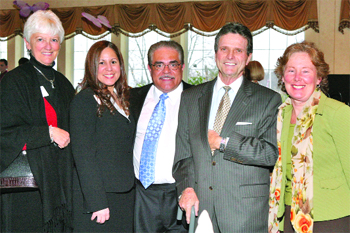
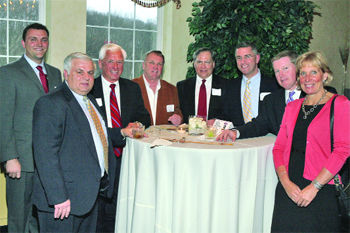
        “They allowed me to do my own catering as well,” said Mias. “I started doing 75 to 100 parties a year — more a side job than anything else. But it took on a life of its own and grew to the point where I stopped managing the Elks and ended up doing catering full-time.”

        Nowadays, Leeds-based Seth Mias Catering books about 400 parties a year — weddings, retirement parties, class reunions, corporate events, you name it. Largely by word of mouth, Mias has developed a reputation that placed him second in last year’s Best in the Valley poll in the Valley Advocate.

        “It’s been a cool experience,” he said. “I’m able to meet a lot of people, network, and get involved in the community” — efforts that include donating goods and services to many community organizations.

        Describing himself as a “hands-on type of guy,” Mias is involved with all facets of catering, from cooking to scheduling to meeting customers. Although he’s not trained as a chef, he’s a constant learner, picking up skills with each new challenge — like the clients who wanted a traditional Chinese buffet for their bar mitzvah.

        “I enjoy the cooking most,” he said. “You’re able to learn something every day. But a close second would be meeting the clients and spending time with people. That’s the kind of person I am.”

        Mias expects the business to continue growing, and why not? “It kind of started as a hobby, and it turned into a career that I didn’t expect.”

        —Joseph Bednar

        Features
        Photos from the Difference Makers’ big night out

        A crowd of close to 400 people turned out at the Log Cabin Banquet & Meeting House on March 26 as BusinessWest staged its inaugural Difference Makers gala. The event honored the first class of Difference Makers, as selected by the magazine, for the contributions to the community and work to make the region a better place in which to live, work, and play. Those gathered saluted Doug Bowen, president of PeoplesBank; Kate Kane, director of the Springfield office of the Northwestern Mutual Financial Network; Susan Jaye-Kaplan, founder of GoFIT and co-founder of Linked to Libraries; Bill Ward, executive director of the Regional Employment Board of Hampden County; and the Young Professionals Society of Greater Springfield.

        Difference Maker Bill Ward, second from right, is seen with, from left, Sally Fuller, Cherish Every Child project director for the Irene E. & George A. Davis Foundation; Wanda Flores, administrative assistant at Springfield Technical Community College; Jorge Costellano, administrator for the Workforce Development Department at Springfield Public Schools; and Mary Walachy, executive director of the Irene E. & George A. Davis Foundation.


        BusinessWest advertising account executive Michael Hurczyn, far left, with those representing event sponsor Sarat Ford Lincoln Mercury and other guests; from left, John DeLecchi, business development manager at Sarat; Jack Sarat, dealer and principal; Ron Dowling; Mark Bartos, account executive at ABC40 and FOX6; Jeff Sarat, general manager; Rick Daigneault, commercial truck sales manager; and Nancy Nielson.


        Members of the Community Music School of Springfield’s String City entertain attendees at the gala.


        Difference Maker Doug Bowen, president of PeoplesBank, with his wife, Anna.


        Difference Maker Kate Kane, right, with Anne Paradis, CEO of event sponsor MicroTek.


        BusinessWest advertising account executive Dianne Baribeault, with Michael White, left, director of operations and marketing for event sponsor PAZZO restaurant; and Richard DeBonis, senior vice president of Marketing for Hampden Bank.


        BusinessWest Editor George O’Brien, Difference Maker Kate Kane (center), and BusinessWest Associate Publisher and Advertising Manager Kate Campiti pose with Kane’s ceremonial plaque.


        BusinessWest advertising account executive Tina Kuselias, with Rich Webber, left, owner and treasurer of event sponsor Webber & Grinnell Insurance; and Bill Grinnell, owner and president of the firm.


        Difference Maker Susan Jaye-Kaplan, left, with Janet Crimmins, her partner in a venture called Linked to Libraries, and Tim Crimmins, Janet’s husband and president of the Bank of Western Massachusetts.


        Networking prior to the formal ceremonies are, from left, Rich Webber, owner and treasurer of event sponsor Webber & Grinnell; Christy Hedgpeth, former Spalding executive and one of BusinessWest’s 40 Under Forty, class of 2007; Peter DeMallie, president and CEO of Design Professionals Inc.; Bill Grinnell, owner and president of Webber & Grinnell Insurance; John Prenosil, principal of JMP Environmental Consulting Inc.; Ned Lutz, commercial lines account executive with Webber & Grinnell; and John Bidwell, president of Bidwell ID.


        The unofficial theme for the night was the Butterfly Effect — the concept that small events can have large, widespread consequences — which sums up the importance of the Difference Makers and their contributions.


        Kate Campiti welcomes attendees to the gala.


        George O’Brien and Kate Campiti present Susan Jaye-Kaplan with her plaque.


        Event sponsor Sarat Ford Lincoln Mercury had a number of the car-makers current models on display in front of the Log Cabin.


        David White, owner of event sponsor Exclusive Car Service, which delivered many of the Difference Makers to the event in limousines, addresses the audience.


        Alyssa Carvalho, current president of the Young Professionals Society of Greater Springfield shares the stage with the group’s board members as she accepts the Difference Makers plaque from George O’Brien.

        Departments

        Brown Bag Lunch Series

        April 15: Dr. Linda K. Fuller, Senior Fellow, Northeastern University, will present a lecture titled “Communication is Key to AIDS in Africa” at noon at One Financial Plaza Community Room, third floor, 1350 Main St., Springfield. The lecture, part of the Instant Issues Brown Bag Lunch Series, is sponsored by the World Affairs Council of Western Mass. Fuller, who has lived and worked in Africa, has determined that communication holds the key to our understanding of and dealing with AIDS in Africa and beyond. The cost of the lecture is $8 (bring a lunch) or $15 (tuna, turkey or vegetarian sandwich included). Reservations must be made by April 13 to (413) 733-0110.

        Home Builders Course

        April 15: The Home Builders Assoc. of Western Mass. will sponsor a six-session course beginning April 15 to help individuals prepare for the Massachusetts Construction Supervisor’s Licensing Exam. Sessions will be conducted at the Home Builders Assoc. headquarters, 240 Cadwell Dr., Springfield, for six Wednesdays from 6 to 8:30 p.m. The license exam is authorized by the State Board of Building Regulations and Standards and administered by Thomson Prometric. Registration forms to enroll for the state exam will be distributed at the first session of the program. The course fee is $250 for a member of the Home Builders Association of Western Mass. and $350 for nonmembers. Participants must bring the 7th Edition One & Two Family Dwelling Building Code book and the 7th Edition Basic Building Code book to each class and to the open-book examination. There is an additional charge to order the code books through the Home Builders Assoc. For more information or to register, contact Sandra Doucette at (413) 733-3126. Enrollment is limited.

        Rock ‘n’ Roll & Management Styles

        April 15: “Everything I Learned About Management, I Learned From Rock ‘n’ Roll” will be presented by James M. Wilson III, Ph.D., assistant professor of Business at Bay Path College, and Gregory Jones, director of Cannes Associates Production Management. Wilson and Jones have been conducting research for three years on the production of live rock ‘n’ roll concerts featuring Metallica, Green Day, Red Hot Chili Peppers, Bob Dylan, and Willie Nelson, among others, with a focus on how event management contributes to organizational theory. The free lecture at 7 p.m. will take place in Breck Suite in Wright Hall at Bay Path College in Longmeadow. The event is part of the Kaleidoscope lecture series. For more information, call (413) 565-1066 or visit www.baypath.edu.

        Health Care Reform Law Discussion

        April 16: Sandra Reynolds of Associated Industries of Mass. will lead an interactive discussion on the Massachusetts Health Care Reform Law from 9 to 11 a.m. at the Scibelli Enterprise Center, 1 Federal St., Springfield. Discussion will focus on the individual mandate — what it means, how it works, and the impact on employers of every size. The workshop is sponsored by the Massachusetts Small Business Development Center Network. The cost is $40. For more information, call (413) 737-6712.

        Events for Kids

        April 17, 21-24: What’s Cooking, Kids? will host several events throughout April for children, ranging from candy-making sessions and Easter-egg decorating to a Food Network Camp and an American Idol for Kids evening. For complete details on all events, call (413) 224-1208 or log on to www.whatscookingkids.com. What’s Cooking, Kids? is located at 41 Maple St., East Longmeadow.

        Cryotherapy Lecture

        April 22: Dr. Mohammad Mostafavi of the Urology Group of Western New England, P.C. will lead a lecture on the latest treatment options for prostate and kidney cancer using cryotherapy at 6 p.m. at 3640 Main St., Suite 103, Springfield. Cryotherapy provides a minimally invasive method of destroying cancer. While the lecture is free and open to the public, seating is limited. To pre-register, call (413) 748-9749. For more information on the Urology Group of Western New England, visit www.ugwne.com.

        ‘Your First Business Plan’

        April 23: The Mass. Small Business Development Center Network, in conjunction with the Franklin County Chamber of Commerce, will offer a workshop titled “Your First Business Plan” from 9 to 11 a.m. at the chamber office, 395 Main St., Greenfield. The workshop will focus on management fundamentals from start-up considerations through business-plan development. Topics will include financing, marketing and business planning. The cost is $40. For more information, call (413) 737-6712.

        World Affairs Council

        April 27: Marco Werman, senior producer and anchor of The World, a daily news radio program produced by the BBC, Public Radio International and WGBH/Boston, will discuss “Tintin and Movietone Made Me Do It” as part of a World Affairs Council of Western Mass. gathering at Western New England College. Werman’s talk is planned at 7 p.m. in Sleith Hall, 1215 Wilbraham Road, Springfield. The event is free and open to the public. Springfield public high-school teams who participated in the council’s fourth annual Academic WorldQuest competition in January will also be recognized at the event. For more information, call the World Affairs Council office at (413) 733-0110.

        Women’s Professional Development Conference

        April 30: Bay Path College in Longmeadow will stage the 14th annual Women’s Professional Development Conference from 7:30 a.m. to 4:30 p.m. at the MassMutual Center in downtown Springfield. For more information, call (413) 565-1293 or visit www.baypath.edu.

        Fourth Annual Walk of Champions

        May 3: Baystate Mary Lane Hospital will host its fourth annual Walk of Champions at Quabbin Reservoir to benefit its Baystate Regional Cancer Program. Registration starts at 8:30 a.m., and the program opens at 9:30 a.m.. Walkers will step off at 10 a.m. from the Quabbin Reservoir tower parking area and will proceed along the Windsor Dam. Both two-mile and five-mile routes will be available. Refreshments will be provided along the routes, and the event will conclude with more food and entertainment at the Quabbin Reservoir tower. For more information, call Deb Gagnon at (413) 967-2458.

        Leadership Development & Teambuilding

        June 15: SkillPath Seminars will present a conference titled “Leadership Development & Teambuilding” at the Holiday Inn, 711 Dwight St., Springfield. Workshops include: “Developing the Leader Within You,” “30 Tips for Becoming an Inspired Leader,” “It All Starts with You … Discover Your Team Player Style,” and “Building a Team That’s a Reflection of You.” Other workshops in the daylong event include “Leadership Mistakes You Don’t Have To Make,” “Light the Fire of Excellence in Your Team,” “Speak So Others Know How to Follow,” “Positive Feedback … the Fuel of High Performance,” “A Team Approach to Dealing with Unacceptable Behavior,” and “What Teams Really Need from Their Leaders.” The conference is targeted to managers, supervisors, team leaders, and team members who would like to learn skills to motivate, inspire, lead, and succeed. Enrollment fee is $199 per person or $189 each with four or more. For more information, call (800) 873-7545 or visit www.skillpath.com.

        Departments

        Insurance Industry Symposium

        March 31: A panel of financial experts will examine how the economic crisis is affecting the insurance industry during a symposium at the University of Hartford, beginning at 1:30 p.m. in Wilde Auditorium, Harry Jack Gray Center, 200 Bloomfield Ave., West Hartford, Conn. The symposium, titled “Financial Turmoil — Impact on the Insurance Industry,” will explore how the financial crisis is impacting the insurance industry’s investments, capital adequacy, and risk appetite. The registration fee is $40. For more information about the event, contact Ann Costello, director of the R.C. Knox Center for Insurance and Risk Management Studies, at [email protected].

        ‘Marketing Basics’

        April 1: The Massachusetts Small Business Development Center Network will sponsor a workshop from 3 to 5 p.m. at the Greater Northampton Chamber of Commerce, 99 Pleasant St., on the basic disciplines of marketing, beginning with research — secondary, primary, qualitative, and quantitative. The core focus will be on developing and keeping a customer. Topics will include public relations, advertising, understanding marketing, and developing a marketing plan. The cost is $40. For more information, call (413) 737-6712.

        Flights of Fantasy Concert

        April 4: Star Trek’s Mr. Sulu, George Takei, will narrate a portion of the 8 p.m. Springfield Symphony Pops program titled “Flights of Fantasy” in Symphony Hall. The concert features the music of one of the most famous Hollywood composers, Academy Award winner John Williams, who wrote the Star Wars and Harry Potter themes. Concertgoers will also be treated to the Star Trek television show theme and two compositions from the Star Trek movies. The audience is invited to meet Takei and the musicians in the Mahogany Room for a reception and autograph session following the concert. For tickets and more informationabout the event, call (413) 733-2291 or visit www.springfieldsymphony.org.

        Events for Kids

        April 6-10, 11, 17, 21-24: What’s Cooking, Kids? will host several events throughout April for children, ranging from candy-making sessions and Easter egg decorating to a Food Network Camp and an American Idol for Kids evening. For complete details on all events, call (413) 224-1208 or visit www.whatscookingkids.com. What’s Cooking, Kids? is located at 41 Maple St., East Longmeadow.

        Small-business Workshop

        April 7: The Western New England College Law and Business Center for Advancing Entrepreneurship will offer a workshop titled “Understanding and Evaluating the Risks and the Liabilities of a Consulting Practice” from 12 to 1:30 p.m. at the Scibelli Enterprise Center, 1 Federal St., Springfield. Laurie Breitner, principal with Breitner & Associates, will present the free workshop, which is open to the public. Seating is limited. For more information, call (413) 796-2030 or visit www.law.wnec.edu/lawandbusiness.

        YMCA Breakfast

        April 8: Tim Wakefield, righthanded knuckleball pitcher for the Boston Red Sox, will be the keynote speaker for the 4th annual YMCA of Greater Springfield Campaign Breakfast at the Healthful Living Center at Western New England College in Springfield. Doors open at 7:30 a.m., and the program begins at 8. A minimum donation of $150 is requested. For more information about the program, contact Andrea M. Luppi, director of Development, YMCA of Greater Springfield, at (413) 739-6951.

        Home Builders Course

        April 15: The Home Builders Assoc. of Western Mass. will sponsor a six-session course beginning on April 15 to help individuals prepare for the Massachusetts Construction Supervisor’s Licensing Exam. Sessions will be conducted at the Home Builders Assoc. headquarters, 240 Cadwell Dr., Springfield, for six Wednesdays from 6 to 8:30 p.m. The license exam is authorized by the State Board of Building Regulations and Standards and administered by Thomson Prometric. Registration forms to enroll for the state exam will be distributed at the first session of the program. The course fee is $250 for a member of the Home Builders Assoc. of Western Mass. and $350 for non-members. Participants must bring the 7th Edition One & Two Family Dwelling Building Code book and the 7th Edition Basic Building Code book to each class and to the open-book examination. There is an additional charge to order the code books through the Home Builders Assoc. For more information or to register, contact Sandra Doucette at (413) 733-3126. Enrollment is limited.

        Rock ‘n’ Roll and Management Styles

        April 15: “Everything I Learned About Management, I Learned From Rock ‘n’ Roll” will be presented by James M. Wilson III, Ph.D., assistant professor of Business at Bay Path College, and Gregory Jones, director of Cannes Associates Production Management. Wilson and Jones have been conducting research for three years on the production of live concerts featuring Metallica, Green Day, Red Hot Chili Peppers, Bob Dylan, and Willie Nelson, among others, with a focus on how event management contributes to organizational theory. The free lecture at 7 p.m. will take place in Breck Suite in Wright Hall at Bay Path College in Longmeadow. The event is part of the Kaleidoscope lecture series. For more information, call (413) 565-1066 or visit www.baypath.edu.

        Health Care Reform Law Discussion

        April 16: Sandra Reynolds of Associated Industries of Mass. will lead an interactive discussion on the Massachusetts Health Care Reform Law from 9 to 11 a.m. at the Scibelli Enterprise Center, 1 Federal St., Springfield. Discussion will focus on the individual mandate — what it means and how it works, and the impact on employers of every size. The workshop is sponsored by the Mass. Small Business Development Center Network. The cost is $40. For more information, call (413) 737-6712.

        Cryotherapy Lecture

        April 22: Dr. Mohammad Mostafavi of the Urology Group of Western New England, P.C. will lead a lecture on the latest treatment options for prostate and kidney cancer using cryotherapy at 6 p.m. at 3640 Main St., Suite 103, Springfield. Cryotherapy provides a minimally invasive method of destroying cancer. While the lecture is free and open to the public, seating is limited. To pre-register, call (413) 748-9749. For more information on the Urology Group of Western New England, visit www.ugwne.com.

        ‘Your First Business Plan’

        April 23: The Massachusetts Small Business Development Center Network, in conjunction with the Franklin County Chamber of Commerce, will offer a workshop titled “Your First Business Plan” from 9 to 11 a.m. at the chamber office, 395 Main St., Greenfield. The workshop will focus on management fundamentals from start-up considerations through business plan development. Topics will include financing, marketing, and business planning. The cost is $40. For more information, call (413) 737-6712.

        World Affairs Council

        April 27: Marco Werman, senior producer and anchor of The World, a daily news radio program produced by the BBC, Public Radio International, and WGBH-Boston, will discuss “Tintin and Movietone Made Me Do It” as part of a World Affairs Council of Western Mass. gathering at Western New England College. Werman’s talk is planned at 7 p.m. in Sleith Hall, 1215 Wilbraham Road, Springfield. The event is free and open to the public. Springfield public high-school teams who participated in the council’s fourth annual Academic WorldQuest competition in January will also be recognized at the event. For more information, call the World Affairs Council office at (413) 733-0110.

        Iron Chef Competition

        April 27: What’s Cooking, Kids? in East Longmeadow will host its first Iron Chef Competition from 7 to 10 p.m. featuring chefs Jonathan Reeser from The Federal and Byron White from PAZZO Ristorante. Each chef will present three courses using ‘secret’ ingredients, and guests will vote on the six courses, rating taste, presentation, and creativity. Several seating options are available. Tickets range from $50-$75. For more information, call (413) 224-1208 or visit www.whatscookingkids.com.

        Women’s Professional Development Conference

        April 30: Bay Path College in Longmeadow will host the 14th annual Women’s Professional Development Conference from 7:30 a.m. to 4:30 p.m. at the MassMutual Center in downtown Springfield. For more information, call (413) 565-1293 or visit www.baypath.edu.

        Walk of Champions

        May 3: Baystate Mary Lane Hospital will host its fourth annual Walk of Champions at Quabbin Reservoir to benefit its Baystate Regional Cancer Program. Registration starts at 8:30 a.m., and the program opens at 9:30. Walkers will step off at 10 from the Quabbin Reservoir tower parking area and will proceed along the Windsor Dam. Both two-mile and five-mile routes will be available. Refreshments will be provided along the routes, and the event will conclude with more food and entertainment at the Quabbin Reservoir tower. For more information, call Deb Gagnon at (413) 967-2458.

        Features
        Two Members of the Class of ’07 Have a Pressing Engagement
        Cathy West and Bob Lowry

        Cathy West and Bob Lowry, members of the Class of 2007, have scheduled their wedding for this October.

        Catherine West remembers having “only about a five-second conversation” with Bob Lowry that night at the Log Cabin almost two years ago when BusinessWest honored those two and 38 other members of the first 40 Under Forty class.

        “It was just too crowded … we barely said hello to each other,” West recalled as she recounted the sequence of events that led to Lowry asking for her hand in marriage last Christmas. (She said ‘yes.’)

        Actually, the story began roughly a year earlier, when Lowry, a restaurateur and serial entrepreneur (he has several Mexican eateries), gave a quick talk to the 500 or so students taking West’s ‘Introduction to Accounting’ class at UMass Amherst as part of a program to promote entrepreneurship. That was also a very quick encounter, an introduction, really, with Lowry’s only real recollection being the thought that West, also a part-time tax manager with Meyers Brothers Kalicka, was “young, about my age, and cute … but probably married.”

        In truth, West was thinking pretty much the same things about him, she later confided. “He handed out burrito coupons … he seemed like a really cool guy.” She noted, however, that neither had an opportunity — not that they were really trying — to find out anything more that evening at the Log Cabin.

        But while that event didn’t exactly trigger this ‘small-world’ romance, the 40 Under Forty program nonetheless played a key role in sparking the union scheduled for this Oct. 11.

        It seems that Lowry was scheduled to speak to another of West’s classes a few months after the gala. He told BusinessWest that he called her to discuss the matter, and, sensing what he interpreted as “over-friendliness and a desire to talk to me some more” on her part (something West quickly denied; “that was all in his head”), he searched for a way to keep her on the phone.

        He found one in West’s 40 Under Forty profile story, parts of which — specifically her many travels to the African nation of Ghana — he managed to retain. “I cooked up some kind of question from her profile,” he said. “Then we started E-mailing each other.”

        Then, Lowry managed to enlist her help to solve some accounting problems for one of his entrepreneurial charges — an encounter that clearly had several motivations.

        “And we’ve been pretty much inseparable since then,” said West, fast-forwarding things significantly, but slowing down enough to say that the two first got together on Nov. 1, 2007 at the Esselon Café in Hadley — and hit it off. Obviously.

        Actually, those 40 Under Forty profiles did more than provide Lowry with some talking points during that phone call, the two told BusinessWest. They helped pique interest in one another and create some shared ground.

        “She had done some fascinating things,” said Lowry, referring to, among other things, West’s participation in efforts to build a business and learning center in the Ghanian city of Secondi. Meanwhile, West, who said she glanced at most of the 39 other profiles, was intrigued by Lowry’s — “his kind of stuck out” — and especially mention of his work in the community, which includes donations of time and energy to Big Brothers Big Sisters, Hampshire Health Connect, and other groups.

        “When you read those 40 Under Forty profiles, you think about what the people do and how similar they are to you,” she explained. “And they can appreciate the same things that you do.

        “One of the things I admire about Bob is that he really loves to help people,” she continued. “That’s how I feel, too, and it’s really nice not to have to explain yourself to someone — they just understand.”

        As for the Christmas Day proposal, West said that, while the two had talked about the subject, she was nonetheless surprised he popped the question at that time. “I wasn’t really expecting it, but it was a wonderful surprise.”

        — George O’Brien