Home Posts tagged improvement
Construction Cover Story

Home Team

Owners Ellen and Jim Boyle

Owners Ellen and Jim Boyle


Any customer who hires Kitchen Concepts for a home-improvement job is asked to sign a piece of paper. On it is a promise they won’t yell at the contractors.

“Because someone did that one day, and I had had enough,” said Ellen Boyle, who co-owns the business with her husband, Jim Boyle. “I told Jim, ‘we’re making some changes.’ It’s just a simple piece of paper with a general explanation that they have to sign, and it’s made such a huge difference in our work because nobody deserves to be talked to like that, and I don’t want to ever speak to somebody like that. But it also creates this kind of camaraderie.”

It’s also part of a general focus on strong communication, she told BusinessWest.

“If someone decides to move ahead with us, we detail their payment schedule, so there’s never an uncomfortable moment of saying, ‘by the way, I need a check today.’ It’s set up from the beginning. Before we even get started, we explain what their schedule is going to look like, so there’s no question of when we’re starting and what our anticipated finish is going to be.”

And then, of course, there’s that expectation of mutual respect, right up front.

“As we’re walking into someone’s home, everybody that works for us is respectful, but we expect the same thing in return,” Ellen said. “We don’t have anybody above us, so if someone has an issue, we’re the ones that take care of it, but it has to be on a very mature and adult level.”

Jim said clients chuckle a little bit about signing the paper, but they also understand it — and it makes a difference.

“I think sometimes people have this expectation of contractors being gruff and rough and disappointing in nature. But we have done an incredible job over the years without having that kind of demeanor.”

“It just ruins the relationship if people yell at somebody over a knob or coming at 8 o’clock instead of quarter of 8,” he noted. “So we have a conversation for five minutes about all the little things that can happen when you’re in the house. And now, when something happens, this is what we get: ‘Ellen, I know I promised not to yell, but I’m a little upset.’ And they tell you the thing, but they preface it with that, and they don’t yell. And we easily handle whatever problem has come up and kind of move on.”

The consistent growth of Kitchen Concepts over the past quarter-century, much of it driven by word of mouth and customer loyalty, has validated that unusual ‘contract,’ if one could call it that. It’s also an effective icebreaker, Ellen said.

“I think sometimes people have this expectation of contractors being gruff and rough and disappointing in nature. But we have done an incredible job over the years without having that kind of demeanor. It’s not necessary, you know?”


From Painting to Kitchens … and More

Before meeting Ellen, Jim started a business called ASAP Painting — by accident, sort of — in 1998.

“I had started kind of cutting grass and doing some other stuff. I left an ad for painting in the paper by mistake, and somebody called me on it. So I painted an exterior house with a buddy of mine. We bought a couple brushes and paint, and that’s how that was born.”

Ellen was an executive secretary at Holyoke Community College when they met, and she eventually began helping with Jim’s business in an administrative role, handling scheduling, estimates, and the like.

“It grew right away,” he said. “It kind of organized us, and it made me able to concentrate on the work itself. And we grew incredibly fast.”

Kitchen Concepts grew out of Jim Boyle learning cabinet installation, and has grown from there.

Kitchen Concepts grew out of Jim Boyle learning cabinet installation, and has grown from there.

They moved to an office in Hadley in 2001. “It was a dilapidated building that we renovated, and we were able to buy work vehicles and improve our equipment and bring on guys; I think we had at least four full painting crews,” Ellen said.

In addition to those interior and exterior paint jobs, they also built about 20 houses during that decade, drawing on Jim’s background in construction; his father was a developer. And they quickly outgrew their space and moved, in 2011, to their current, larger space on Russell Street, which used to house the Hadley Post Office and, later, an insurance company.

But the Great Recession had begun to take a bite out of the home-construction business, so they pivoted to selling cabinets and countertops, and eventually to full kitchen and bath renovations.

“We went out and did some training on how to design,” Ellen said. “And we had to renovate this entire building. We’ve made a lot of changes over the years, and we renovated this whole space to make it the showroom that it is. And maybe seven or eight years ago, we decided to solely concentrate on kitchen and bath remodeling.”

More specifically, they ditched whole-home construction; ASAP Painting is still going strong, as is a third business, called Premier Self Storage, which currently has a facility open in Greenfield and one under development in Southwick.

Their business partnership works for multiple reasons, Jim said. One is that they get along well as co-workers; not every couple does. The other is that they excel at different things. Jim realized early on he was much better at managing work crews and projects in the field, while Ellen, besides her organizational and administrative prowess, was much more at ease talking at length to customers about what they were looking for in a renovation.

“We’ve made a lot of changes over the years, and we renovated this whole space to make it the showroom that it is. And maybe seven or eight years ago, we decided to solely concentrate on kitchen and bath remodeling.”

Jim tells the story of spending two hours with a client early in the kitchen business and becoming frustrated.

“I’m a contractor-type person, so I care about being on budget, making sure the tiles and materials are there, making sure the guys are doing everything like they’re supposed to. I don’t necessarily care about colors and shades and things like that. When I buy cabinets, it takes me five minutes: ‘what are my colors? What’s my shape? OK, that’ll be good. Can you send me the price?’ And I’m done. And I thought that’s what everybody did.

“What we found was that she cares about all that stuff. So now, I have very little to do with scheduling or meeting with the customers. From that day, she started dealing with the clients, and I would get tied up with the guys, making sure they’re on budget, that they’re there on time. And she actually built the company to kind of a powerhouse, where we’re doing 15 to 25 kitchens a year, and maybe 25 to 30 bathrooms a year. It works really well.”


Time Management

The Boyles’ operation employs between nine and 15 employees, depending on the season, while the subcontractors that do plumbing, electrical work, and cabinet installation tend to be the same from project to project.

“Many of our people have been with us for a long time,” Jim said. “I have one guy that started with me since day one. Our assistant’s been with us 12 years. Two other guys have been here 17, 18 years. Everybody’s been around for a long time.”

Speaking of a long time, most remodels are completed in three weeks, though some larger, more complex jobs may go four or five. The three-week goal is out of respect for customers, he noted.

“If I build a garage for you at your house, if I take too much time, you could care less. I’m outside every day, and you might come say ‘hi’ to me when you leave for work and when you get back. But if I’m in your kitchen, when you get into a third week and everything’s still going on, it can be difficult for your wife or your partner, and if you get into a fourth week, they don’t want you there anymore; they need their stuff back.”

That consideration was even more acute during the pandemic — a time when home-improvement businesses everywhere reported soaring demand as people stayed home, stopped investing in vacations, and ramped up household projects.

“We were working at least 50, 60 hours a week. There was zero downtime,” Ellen said. “I had my two best years for kitchen consultancy. But yes, there was definitely a learning curve with how to interact with homeowners.

The bathroom and kitchen renovation business surged during the pandemic and has stayed relatively robust.

The bathroom and kitchen renovation business surged during the pandemic and has stayed relatively robust.

“Social distancing was new to everybody. But, again, we had honest conversations with homeowners, like, ‘this is how we will come into your house, this is how we will meet to do an estimate and a design, and this is how we will work to get the job done.’ And things took a little bit longer because we couldn’t really pile a lot of people into someone’s home, but the customers would just come in later in the day after we took off.”

Whatever the circumstance, Ellen said most clients have specific ideas in mind when they enlist Kitchen Concepts for a project.

“There’s a lot of information out there, and what makes us unique is having the construction background — so there’s what you see in a magazine or online, or what you’ve seen on TV, and then there’s the reality of what can be done,” she explained. “If someone has a certain dollar amount that they can spend, that definitely directs us where we need to go to. I never want to show somebody something that is three times the amount of money they’d actually be able to spend. So we do have discussions on what their total budget is going to get them and what we can do.”

How a customer intends to use the property makes a difference as well, she added. “Is someone renovating to sell their house? Are they renovating, but they’re only going to be there for five years? Or are they renovating because this is it — this is where they’re going to be for the rest of their lives?

“There are people who walk in and say, ‘I need a new kitchen, and I have no idea what’s out there.’ But I always encourage people to do all of the hard stuff first,” she went on. “I never want someone to come in here and feel like they have to pick their cabinets and pick their countertops. The hard stuff is understanding what design change would make it more efficient for you, and especially working in someone’s budget.”

Premier Self Storage, including this facility in Greenfield, is a successful side business for the Boyles.

Premier Self Storage, including this facility in Greenfield, is a successful side business for the Boyles.

Because budget is key, Ellen said, no matter the customer.

“One of our countertop companies, Cambria, has beautiful quartz countertops. But a lot of their designs are geared more toward, say, Boston-area homeowners, where it’s a very different demographic, a very different type of budget. Here in the college towns, some of the more expensive materials don’t fit into what their budget is going to be. So we have that conversation very openly with our Cambria reps, that we love these contemporary materials that they offer, and they’re big sellers in one area, but we say, ‘that’s never going to sell here.’

“But those products are out there, and you never know what someone will walk in and say they want,” she added. “Our cabinets are well-priced cabinets, so we have everything from standard SKU models up to full custom cabinetry.”


Another New Day

Jim called his partnership with Ellen — in life and in business — a good one, saying his day begins with a morning goodbye kiss, but they often see each other soon after — unless he’s on a job site.

“We’ve been working together since the beginning,” Ellen added. “We take separate cars to and from work, which gives us flexibility if he’s out on the road and I’m here, or vice versa. It’s good. It works.”
Home Improvement Special Coverage

Upscale but Simple

While interior-design trends in homes can be slow to change — and, in many ways, have been, as evidenced by the white and grey colors that still dominate — the way people are using their homes did change somewhat over the past year. That, and a growing desire among older homeowners to age in place, has influenced what people are looking for in kitchens and bathrooms — and they have no shortage of options to achieve their vision.

By Mark Morris


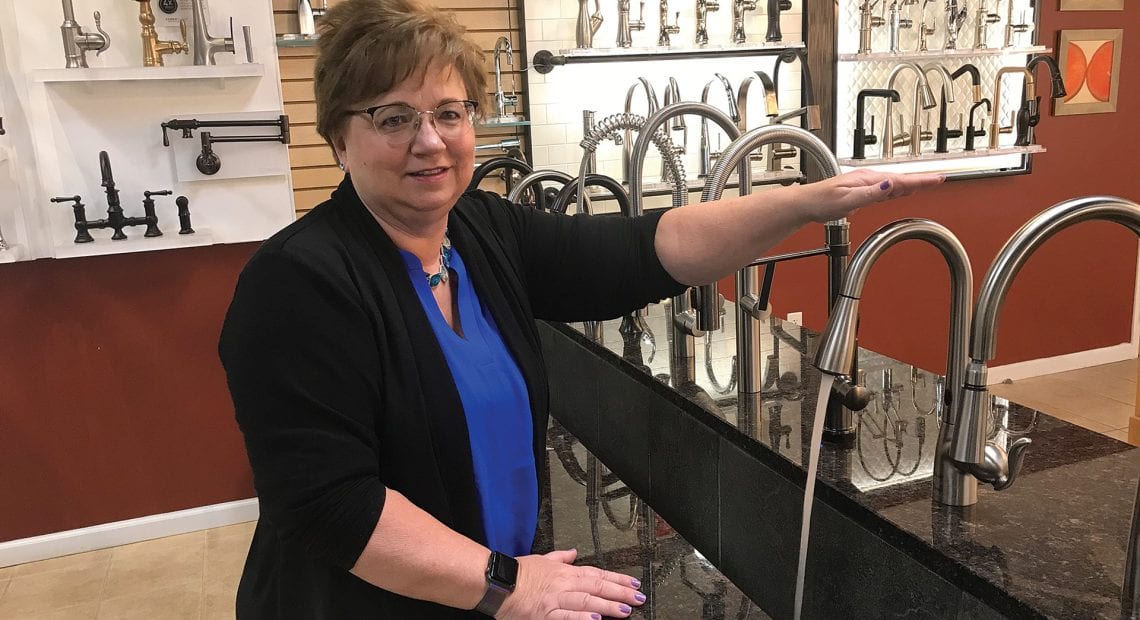
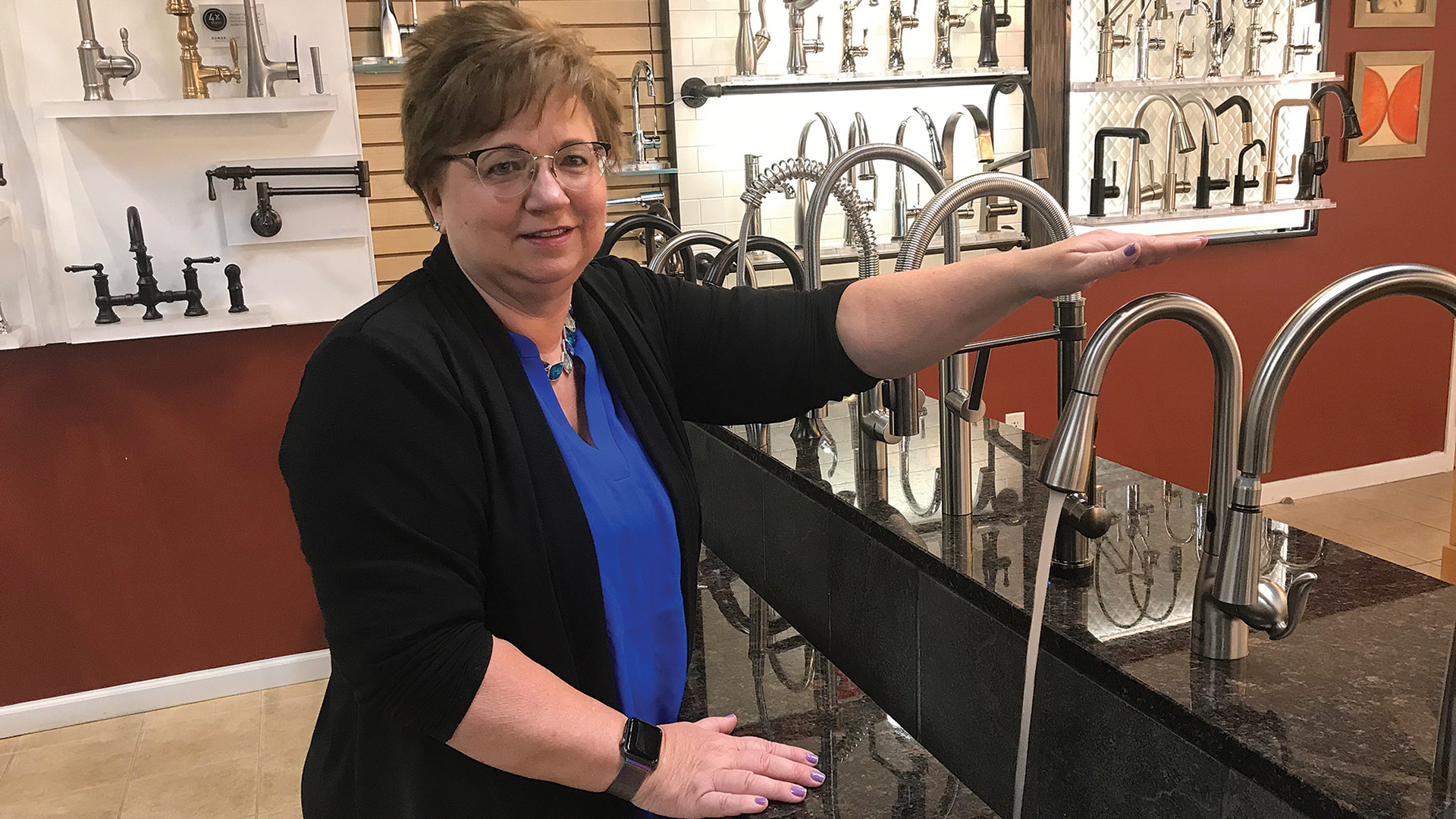
With a wave of her hand, Lori Loughlin makes the water flow from a touchless kitchen faucet.

With a wave of her hand, Lori Loughlin makes the water flow from a touchless kitchen faucet.


While homebuyers want to put their own stamp on a new house, Scott Keiter said, when it comes to kitchens, they tend to think alike.

In fact, the owner of Keiter Builders currently has six new homes under construction, and for every one, the owners want kitchens that provide plenty of light, an airy feeling, and enough room for people to gather.

“We’re seeing less of a distinction between the kitchen and living area and more of a merger as the two morph into one space,” he said.

In many cases, the anchor to this space is the kitchen island. While islands have been popular for years as a way to provide more counter and cabinet space, during the pandemic, they saw increased use for food preparation as people ate more meals at home. The island also served as a desk for many who suddenly found themselves working from home. As a result, Keiter said, islands have become more multi-purpose, and the kitchen is now seen as a multi-use space.

“On top of the normal cooking and food prep, we’re seeing a movement to make the kitchen a more communal room. It’s becoming a place to work from home, as well as a place for guests and friends to congregate.”

While the kitchen is becoming more of a gathering place and its form and function are changing, Dave Lloyd, manager of Budget Cabinet, said every customer looking to remodel that space shares one objective: convenience.

“While new houses allow for bigger islands, we do a lot of remodeling projects where people are limited by the footprint of their house,” he said.

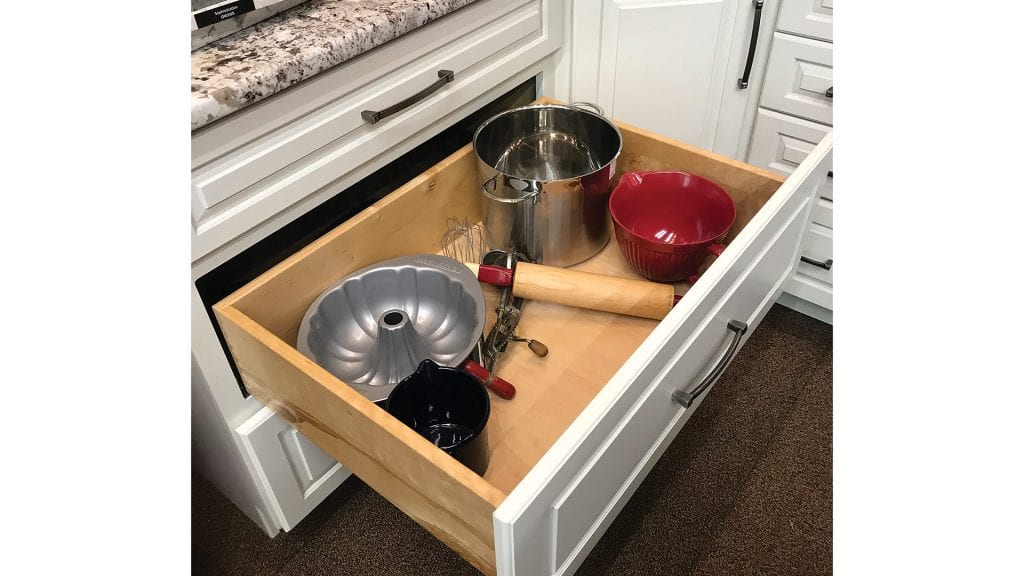
Whether incorporating an island or not, one trend that addresses convenience and improved function is what Lloyd called “drawers over doors.” Many cabinet designs offer wide and deep drawers to store bulky or heavy items. That way, instead of making someone reach overhead for heavy dishes in a cabinet, a waist-high drawer allows for easier access — which becomes more important as people age.

“We’re seeing less of a distinction between the kitchen and living area and more of a merger as the two morph into one space.”

Aging in place also comes into play in bathroom design, said Lori Loughlin, manager at Frank Webb Home. These days, she noted, handheld shower heads are the choice of nearly every bathroom renovation. Also popular are shower fixtures that combine a handheld with a rainfall feature.

“We work with many people who want to age in place, so we stress that a handheld shower is more convenient to use and clean the shower stall,” she explained.

Converting old bathrooms to accommodate a lower-threshold shower for the aging or physically challenged isn’t new, she added, but the styles are changing. “There are things we can do to make a shower safe and functional without it looking institutional. For example, there will be a seat and grab bars, but they are done with more style, so the result looks more like a spa.”

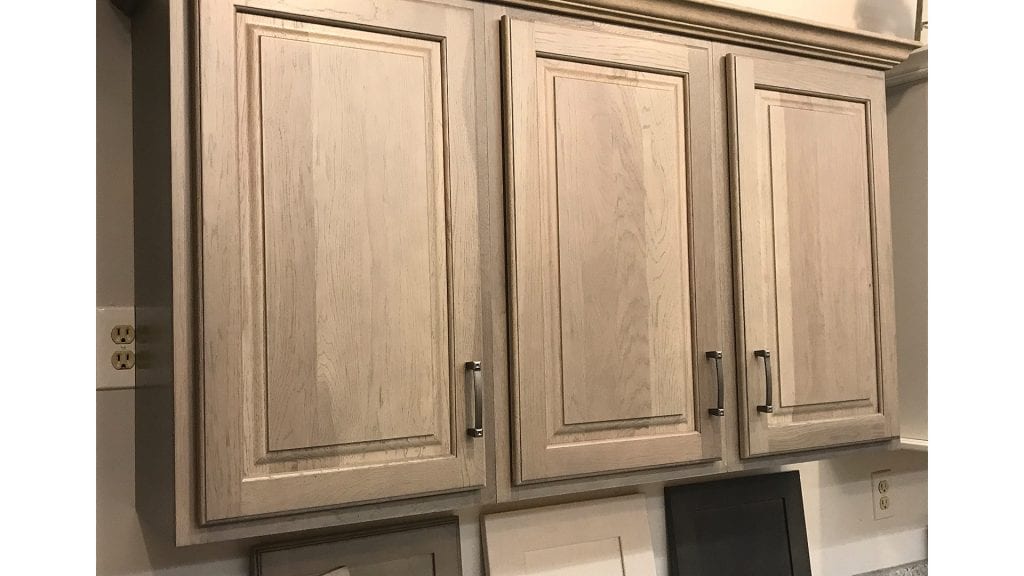
Colors such as gray translucent stain are appearing in more kitchens.

Colors such as gray translucent stain are appearing in more kitchens.

Aging in place also affects kitchen design, where islands are available in multiple levels, with a lower level constructed to accommodate seniors or people in a wheelchair.

Because everyone is more aware of touching surfaces, touchless bathroom faucets and a toilet that flushes by waving one’s hand over a sensor are available as well. While once considered gimmicky, sophisticated toilet seats that have a warmer built in, along with a bidet, are growing in interest. Loughlin noted that these more premium seats also contribute to aging-in-place considerations by allowing people who might otherwise need assistance to take care of themselves.

Such bathroom renovations might seem like an indulgence, Lloyd said, but the result is a space that provides easier access and convenience, again, allowing people to live in their homes longer.

During this boom time in home building and renovations, BusinessWest caught up with several professionals who shared what their customers are looking for in their kitchens and bathrooms — for both their present and future needs.


Form and Function

Lloyd noted that today’s kitchens emphasize designs that are high-functioning and less ornate, and tastes are trending toward cabinet designs with clean lines such as the Shaker look, as well as simpler cabinet hardware.

While the overall trends haven’t changed much over the years, he added, colors have seen some changes. “Translucent cabinet stains are becoming popular because it gives you some color, but you can still see the grain of the wood. Whites and grays — both light and dark — are still very popular color choices.”

Lloyd said his customers want interesting but not ornate designs in kitchen backsplashes, while upscale appliances remain very popular in kitchen remodels, with stainless steel a popular option and black stainless on the rise as a trend.

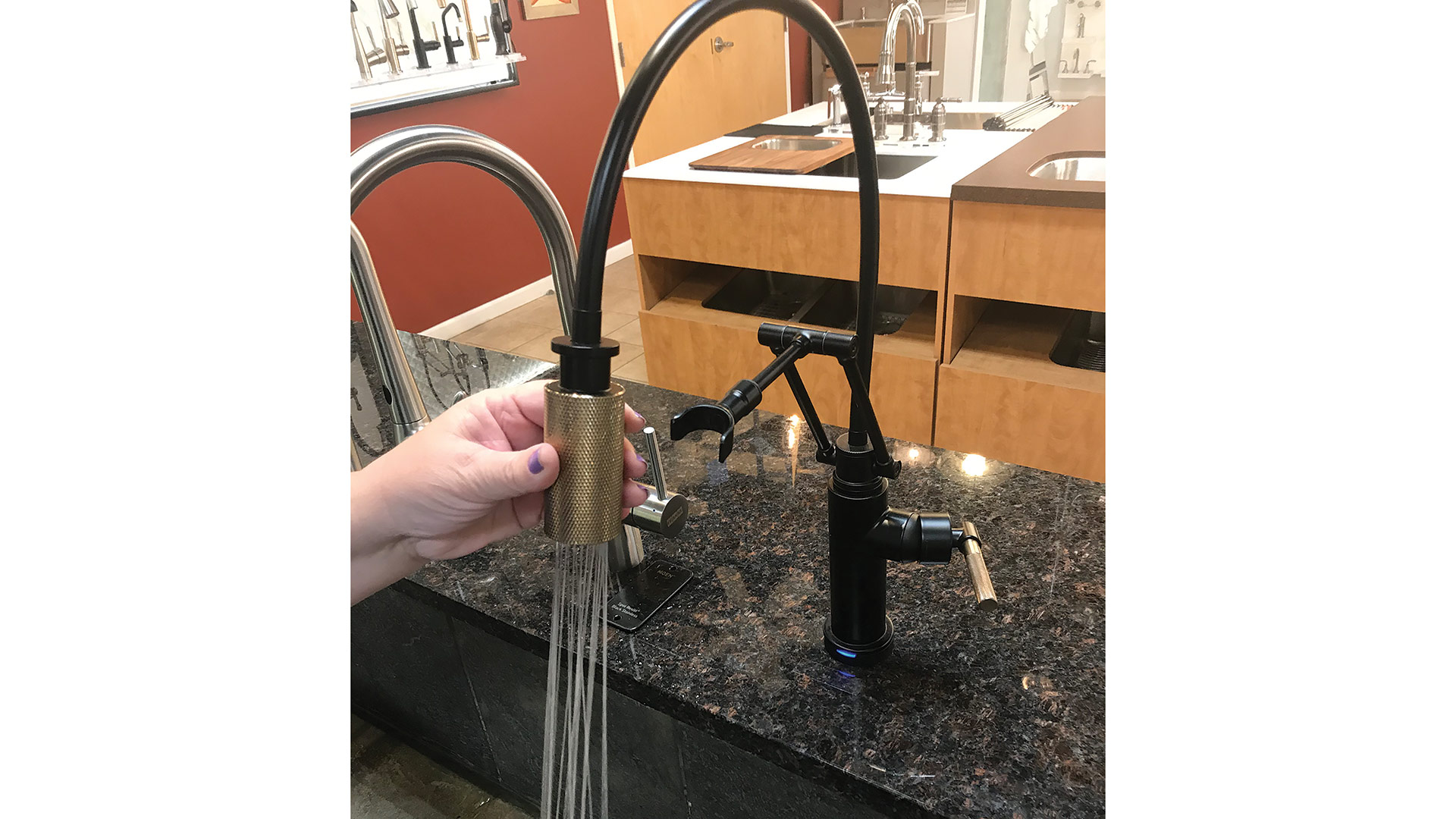
Black may become the new neutral, Loughlin said, noting that touchless and black faucets are currently big sellers in kitchens. “For the next couple of years, I think we will be seeing a trend of faucets with mixed metals, such as black and gold,” she noted, while faucets with a black finish are trending in the bathroom as well.

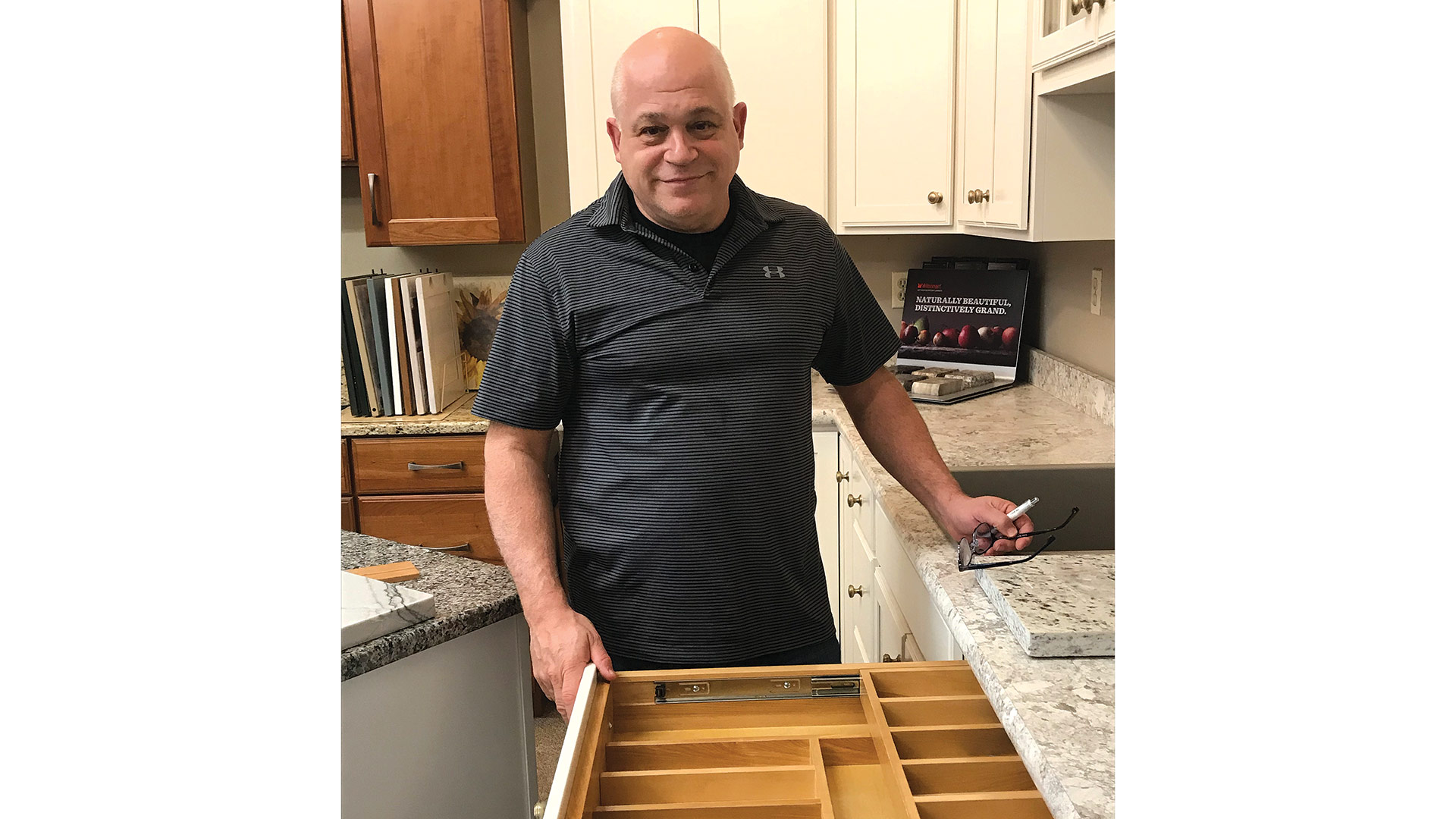
Dave Lloyd demonstrates a two-level silverware drawer.

Dave Lloyd demonstrates a two-level silverware drawer.

Deep drawers provide easier access for larger items.

Deep drawers provide easier access for larger items.

While white farmhouse sinks remain popular, she said they are now available in black and other colors to better match darker shades of quartz and granite countertops. Speaking of which, quartz has passed granite as the most popular stone countertop material.

“People are spending more time in their kitchens, so they are getting what they want,” she explained. The styles that resonate most with her customers include the contemporary farmhouse look and industrial chic, where faucets and lighting have a stylish but industrial look to them.

Lighting also reflects black and gold color schemes, with open fixtures creating an airy look. Pendant lighting, which once featured small pendants suspended from the ceiling, have grown into larger pendants that fill more space and provide more light.

Kitchen floor upgrades were once limited to hardwoods or tile floors made of ceramic or porcelain. Eclipsing both of those choices, the current most popular trend in flooring is LVT, or luxury vinyl tile. Resembling wood planks, LVT floors click into place and are known in the industry as ‘floating’ floors, so named because they are not glued down. Jake Levine, manager of Advanced Rug and Flooring Center, said the waterproof properties of LVT make it a best seller in his store.

“Because LVT handles water so well, it is replacing other more expensive alternatives,” he said. “LVT is also 40% warmer to the touch than a tile floor, and it’s not prone to chipping, also an issue with tile floors.”

Installing a hardwood or tile floor takes real expertise, Levine explained, noting that LVT floors can be a do-it-yourself project because they allow more room for error.

“If you don’t like the direction of the planks, you can unclick them and reinstall,” he said. “I’m not saying everyone will get the same results as a professional, but a capable DIY-er can do it.”

For customers who prefer a tile look, LVT is available in 24-by-12-inch pieces featuring stone patterns that click in place similar to the planks. This style and its waterproof properties make it a good choice for a bathroom, but Levine said most people still prefer porcelain or ceramic tile.

“For many people, the word ‘vinyl’ suffers from an old stigma of linoleum floors that discolored and peeled,” he said. “The click floors are very good for bathrooms because they are designed for areas that get water.”

As Western Mass. is known for its many older homes, a bathroom renovation can often involve converting a spare bedroom into a larger, more modern bathroom, usually adjacent to the master bedroom. Lloyd said this is a popular renovation among empty-nest couples.

Mixed metals are an increasingly popular option for kitchen faucets.

Mixed metals are an increasingly popular option for kitchen faucets.

“People who want to stay in their home are figuring out how to use the same square footage, but improve it,” he explained. “The idea of living space is changing, where people will give up a bedroom for a luxury bathroom with better lighting, better shower, and more storage in the cabinetry.”

While many bathroom renovations replace the tub with a more upscale shower, Loughlin said that decision is usually driven by personal preference.

“There are bath people, and there are shower people,” she noted. “People who like to take baths will spend whatever they want for a bathtub, while those who only want a shower won’t even install a bathtub in their master bathroom.”


As Seen on TV

For those considering upgrading a kitchen or bathroom, popular media such as the HGTV cable network and social-media sites Pintrest, Instagram, and others offer endless examples of what’s new in design and accessories.

“Every customer who comes in has at least one Pinterest photo on their phone, or they reference something they saw on HGTV,” Lloyd said, adding that houzz.com is another influencer.

Meanwhile, Levine credits HGTV shows with increasing the awareness of LVT flooring. “The vinyl plank is now common knowledge thanks to them.”

Loughlin said the Frank Webb showroom carries several kitchen sink styles that appear on HGTV because customers often have a vision that is influenced by the network. While helpful most of the time, however, these shows can also contribute to outlandish and unrealistic expectations.

“Some people think they can redo their house in 30 minutes; it just doesn’t work that way,” she said. “It’s not unusual for the timeframe to surprise people, especially now, when hiring a contractors is more difficult because they are all so busy.”

While new trends emerge in kitchens and bathrooms, older ones are meeting their demise. In new homes, Keiter noted, people still want bathrooms that are upscale and functional, but use less space.

“Real estate is so expensive now, some people are reassessing where they want to spend their money,” he said. “Instead of a 250 square-foot bathroom with a whirlpool tub, they are opting to lose the whirlpool and reduce the overall size of the bathroom.”

Instead, he said, customers are spending their money in the kitchen or a sunroom, where they spend far more of their time.

In the spirit of simplicity and a clean look, Lloyd said the recent trend of glass cabinet doors is on its way out because “people like to put things away and not have to keep looking at them.”

He also noted that counter space for wine bars is starting to give way to dedicated cabinetry to house an emerging trend: coffee bars. “Wine was big for a while, but coffee has become bigger of late.”

Though tastes may differ, kitchen and bath professionals all agree that customers these days have plenty of options.

“Manufacturers are expanding their product lines to accommodate many different tastes and needs,” said Loughlin, giving people the opportunity to follow their vision or create their own style.

Insurance Special Coverage

Are You Covered?

By Mark Morris

Christine Fleury

Christine Fleury says making alterations to the home — a common sight during the pandemic — could change insurance needs.

Call it the great migration indoors.

When the pandemic first hit, many people were forced to quickly convert their homes into offices, schools, and entertainment centers. Some in the insurance industry predicted this might lead to more homeowners insurance claims. In reality, it didn’t.

Similarly, as people spend more time in their homes, they also depend more on their water, electrical, and heating systems to work. While some insurance claims have been filed due to these systems failing after increased use, the increase has not been notable.

In fact, Christine Fleury, Personal Lines manager at Encharter Insurance in Amherst, said companies have actually seen a decrease in severe claims from homeowners. “As people spend more time at home, they are catching that large loss before it happens.”

Corey Murphy agreed, noting that, because people are home, they are noticing and taking care of seemingly minor problems like leaky gutters.

“As people spend more time at home, they are catching that large loss before it happens.”

“As people pay more attention to fixing the small issues, they prevent the larger problems from ever happening. A little preventive maintenance goes a long way,” the president of First American Insurance Agency in Chicopee noted.

Most homeowners insurance claims are the result of severe weather incidents. When COVID-19 first hit, winter was ending, and warm weather soon followed. Bill Trudeau, executive vice president and partner at HUB International New England in Agawam, said the mild winter this year has helped keep claims down.

“Other than a couple isolated wind events, the weather has behaved itself, and that means claims have tended to be in line with company projections.”

The pandemic has thrown a few wrinkles into the home-insurance picture this year, however.

For instance, many homeowners were motivated to invest in substantial improvements to their homes. Home construction and improvement contractors point directly to being cooped up in the house as the main motivator for people choosing to make improvements to their property.

What impact does all this renovation work have on the homeowners insurance carried on the house? The answer depends on what improvements are made and what kind of coverage is already in place.

Everyone BusinessWest spoke with agreed that, for small or cosmetic improvements, there is no need to contact an insurance agent. Some larger projects, however, may require altering or increasing a home’s coverage.

“Adding square footage to your home, doing a full remodel, or building a garage would all be reasons to consult your agent to make sure you have enough coverage,” Fleury said.

Even if they are not taking on home improvement projects, Trudeau advises people to call their insurance agent at least every couple of years so they understand the coverage that’s in place and whether they may need additional coverage.

“You can work with your agent to run a cost estimator,” Trudeau said. “It’s a software tool that takes the data from your home, including any upgrades, then shows you the current replacement cost if it was all suddenly gone.”

With the lifestyle changes wrought by the pandemic, it’s more important than ever to make sure the home — and everyone in it — are protected. Here are some key factors to consider.


Home Work

While they may not have set foot in the office in months, people who work from home are still protected from on-the-job injuries by workers’ compensation coverage. Office workers tend not to get injured on the job, but the coverage is in place if there is an incident.

“There has never been a distinction between whether employee actions emanate from an office at the company or from an office at the person’s home,” Trudeau said. “Because this coverage is broader in scope, COVID did not force us to make changes to workers’ comp plans.”

Bill Trudeau

Bill Trudeau says claims have been kept in check recently by a mild winter.

It’s not unusual for people working from home to have a computer, monitor, and even a printer that belongs to their employer. Murphy said some jobs may require employees to have additional business assets in the home, so it might be wise to make sure everything is covered. “Most policies will pay a little toward assets being home, but it’s usually a minimal amount.”

With homes serving as business offices and classrooms, more people — and their pets — are home at the same time. According to Trudeau, homeowners’ insurance policies consider any issues with an animal as a “strict liability event,” meaning there is no way to defend the action.

“If someone knocks on your door and your dog bites them, it generally means the insurance company pays the claim,” he explained, adding that, as people acquire more pets, the likelihood of claims increases. Most insurance companies keep a list of dog breeds they will not cover because those breeds have higher incident rates.

“You can work with your agent to run a cost estimator. It’s a software tool that takes the data from your home, including any upgrades, then shows you the current replacement cost if it was all suddenly gone.”

Murphy encourages pet owners to speak with their agent because these restrictions can vary widely among insurers. “Just because one company doesn’t want to cover your breed of dog, check with another company; it’s not a universal list.”

Whether they have pets or not, Fleury advises her clients to carry personal liability coverage, commonly known as an umbrella policy, that supplements both homeowners and auto coverage.

“When we write home and auto policies for a customer, we always recommend buying personal liability coverage as well because it gives you that additional safety net,” she said. A typical umbrella policy costs less than $200 but can provide up to $1 million in additional liability coverage when the limits of homeowners or auto coverage are exceeded.

While dog bites and leaking water pipes are obvious reasons to carry homeowners insurance, it can be much harder to detect a leak when personal data is compromised. A significant increase in identity theft has motivated insurance companies to begin offering identity-theft protection as part of their homeowners policies.

“With everyone at home and increased online activity, it’s more important than ever to safeguard your privacy from someone getting into your system and doing real damage,” Trudeau said.

Apart from identity-theft insurance, he advises everyone to follow best practices such as using multi-factor authentication. For example, when working on an important account online, a code is sent to the user’s personal phone that must be entered to gain access.

Corey Murphy

As people pay attention to small issues in the home, Corey Murphy says, they can prevent larger issues from ever arising.

When fraudsters accesses online bank accounts, they often add a payee into the account. Trudeau advises customers to check with their bank to make sure it uses multi-factor authentication to prevent an outsider from accessing their accounts and to make sure it’s turned on at home.

“If someone has logged into your computer and they don’t have your phone, they can’t get that code,” he said.

Fleury said her agency includes identity-theft coverage in all its homeowners policies. “We feel it is important insurance and recommend at least $5,000 worth of coverage for identity theft.”


From a Distance

The pandemic has changed the insurance business in other ways. Typically, when a homeowner files an insurance claim, an adjuster will visit the home and walk through to personally inspect the damage. With COVID-19 concerns, that’s happening much less often.

“In some ways, COVID is moving insurance companies along the digital side of things,” Murphy said. “They are allowing homeowners with a claim to submit photos and even have video calls if the insurer is set up for it.”

The trend toward relying on consumer photos rather than a visit by an adjuster follows what’s been happening on the auto-insurance side for some time.

“If someone knocks on your door and your dog bites them, it generally means the insurance company pays the claim.”

“Many auto insurers have created apps where the person making the claim takes a photo of the damage, uploads it for an adjuster to review, and then the payment is processed,” Fleury said.

The move toward more digital interaction is no surprise to Trudeau.

“Long before COVID, people e-mailed pictures and documents to us,” he said. “Companies have simply accelerated the move to modernization by using many tools they already had.”

Murphy likes to remind customers that every insurance company offers something a little different that their competitors. That’s why it’s important to put some thought into selecting a homeowners insurance policy.

“People need to assess what they have, in terms of their house and what’s in it, and then speak with an agent about what needs to be covered,” he said, adding that it’s about matching a person’s situation with the company that can best provide coverage for their needs — especially at a time when those needs, and demands on the home, are still in flux.