Home Posts tagged Law (Page 41)
Departments

Baystate Construction Project Moves Forward

SPRINGFIELD — Baystate Medical Center’s Hospital of the Future recently passed a major milestone with its successful foray into the municipal bond market, according to Mark R. Tolosky, president and CEO of Baystate Health. Tolosky noted that investors acquired $135 million of Baystate Medical Center bonds in a matter of hours as demand for the financing instruments far exceeded supply. Tolosky added that this major piece of funding helps the project remain on schedule for an expected completion in 2012. Site preparation for the new facility commenced last summer, and now foundation work is underway. The nearly 600,000-square-foot building will include a dedicated, state-of-the-art Heart and Vascular Center, single-bed patient rooms, the latest standards for environmentally responsible building, including recycled materials and a rooftop green space, and $9.6 million in new community benefit initiatives for Springfield related to the project. Tolosky noted that since Baystate Health is a not-for-profit health system, the municipal bonds are in essence approval for a $135 million “mortgage” for the new construction and the largest funding source for the $246 million project. The project is also benefiting from $70 million in new market tax credits, which support construction projects in low-income neighborhoods. Tolosky said Baystate’s building project will stimulate the local economy and bring job opportunities, including 300-plus jobs to area trade workers during construction, and 550 permanent clinical and physician positions when completed. Tolosky said that $40 million in capital funds is still needed for this project, and is expected to come from government sources, philanthropic giving, and Baystate Health capital funds. Additionally, Baystate officials are working with Gov. Deval Patrick’s office and local legislators to identify economic development funds that could also be used for the shovel ready construction project.

STCC Teams Up With AIM To Offer Seminars

SPRINGFIELD — Associated Industries of Massachusetts (AIM) and five state community colleges, including Springfield Technical Community College (STCC), will soon begin offering supervisory, human resource and customer service courses at community colleges throughout the commonwealth. The collaboration brings together public and private entities that will provide valuable training in convenient settings for citizens whose skills and productivity will be a key factor in forging economic recovery in the state, according to Bill Hart, deputy director of the Massachusetts Community Colleges Executive Office. AIM will offer 135 courses during the fall semester at STCC, Quinsigamond Community College, Bristol Community College, Massasoit Community College, and Bunker Hill Community College. The courses will be non-credit seminars offered through each college’s business education center. AIM is calling the initiative the AIM Community College Connection, or AIMc3. AIM will offer courses ranging from The Supervisor and the Law to HR for the Non-HR Manager to Communicating to Make the Sale.

State Business Confidence Off in June

BOSTON — The Associated Industries of Massachusetts (AIM) Business Confidence Index edged off eight-tenths of a point in June to 38.2, ending a run of three consecutive monthly gains from its all-time low of 33.3 in February. The average reading for the second quarter of 2009 was 37.5, up from 34.5 in the first quarter, despite June’s decline, according to Raymond G. Torto, global chief economist at CB Richard Ellis Group, Inc., and chair of AIM’s Board of Economic Advisors. Torto noted that the overall trend is positive, but not strong, and confidence remains low since this was the second lowest quarterly average in the history of the Index, which has now completed 18 years. The AIM Index, based on a 100-point scale with 50 as neutral, was down 10.7 points from June 2008, and 15.9 over two years. The average reading for the second quarter of 2008, when the state’s economy was slipping into recession, was 49.5. June confidence levels were similar in Greater Boston (37.7) and elsewhere in the state (39.0), and did not vary systematically by company size. Manufacturing employers gained confidence for a fourth consecutive month, moving ahead of other employers in June (40.2 – 36.2). The monthly Business Confidence Index is based on a survey of AIM member-companies across the state, asking questions about current and prospective business conditions in the state and nation, as well as for respondents’ own operations.

Consumer Delinquencies Rise Again

WASHINGTON — A record wave of job losses is being cited as a major factor in a record rate of consumer delinquencies in the first quarter of 2009, according to the American Bankers Association (ABA). More than 2 million Americans lost their jobs in the first three months of the year with more than 6 million jobs lost since the recession began, according to James Chessen, ABA’s chief economist. The composite ratio, which tracks delinquencies in eight closed-end installment loan categories, rose to 3.23% of all accounts (seasonally adjusted) compared to 3.22% of all accounts in the previous quarter. The delinquent balances on those accounts also rose from 3.16% to 3.35% of total balances due (not seasonally adjusted). The ABA report defines a delinquency as a late payment that is 30 days or more overdue. Chessen notes the figures are a natural consequence of mounting job losses in a weakening economy. Chessen added the unemployed may be using bank cards to bridge a temporary income gap, especially with less home equity to fall back on as housing prices continue to fall. Reflecting continued weakness in the housing sector, delinquencies for the home equity category also hit record highs – home equity loan delinquencies rose 49 basis points to 3.52% of accounts, and home equity lines of credit delinquencies rose 43 basis points to 1.89% of accounts. For homeowners having trouble paying their mortgage, ABA recommends they consult with www.hopenow.com or call 1-888-995-HOPE. HOPE NOW is a cooperative effort between counselors, investors, and lenders to help homeowners in distress.

Shriners Hospital To Remain Open In City

SPRINGFIELD — All 22 of the Shriners Hospitals for Children will remain open, including Shriners on Carew Street in Springfield, thanks to strong community support and the commitment of the board of trustees of the organization. The future of some of the struggling hospitals, including in Springfield, had been in doubt as officials conducted their annual meeting recently in San Antonio, Texas. Trustees voted to accept insurance reimbursements and possibly sell or lease some excess hospital space in order to keep open all 22 hospitals. Shriners Hospitals for Children provides pediatric specialty care services at no charge. Shriners had considered closing hospitals in this city, as well as in Greenville, S.C.; Spokane, Wash., Shreveport, La., and Erie, Pa. Shriners’ endowment fund, which has seen a decline from $8 billion in 2008 to less than $5 billion today, has saved the hospitals in the past from charging families and insurance companies for care.

Women’s Fund Increases Giving

EASTHAMPTON — The Women’s Fund of Western Mass. increased its giving by 160% this year when it recently distributed $260,000 in “social change” grants to 23 area organizations. Board members of the Fund, which provides support to organizations in the four counties of Western Massachusetts, understood the importance of increasing its charitable giving during a difficult economic time for nonprofits, according to Carla Oleska, executive director of the Fund. Oleska noted that board members had received $1.3 million in requests, and responded by making this large increase to help as many organizations working with women and girls as possible. Many of the beneficiaries received multi-year grants and general operating support. In addition to grant funding, the Women’s Fund teaches the nonprofits how to measure how they are making an impact on deeper social change, not just their day-to-day social services. Now in its 12th year, the Women’s Fund of Western Mass. has given more than $1.3 million in grants that have helped improve the lives of more than 20,000 women and girls. The 2009 grantees fall under the fund’s three focus areas of ‘educational access and success,’ ‘economic justice,’ and ‘safety and freedom from violence.’
Departments

The following is a compilation of recent lawsuits involving area businesses and organizations. These are strictly allegations that have yet to be proven in a court of law. Readers are advised to contact the parties listed, or the court, for more information concerning the individual claims.

FRANKLIN SUPERIOR COURT

B & H Foto & Electronics Inc. v. Hallmark Institute of Photography Inc.
Allegation: Non-payment of goods and equipment sold and delivered: $150,866.10
Filed: 6/10/09

GREENFIELD DISTRICT COURT

Leader Home Center Inc. v. Charbonneau & Associates
Allegation: Non-payment of goods sold and delivered: $8,218.01
Filed: 6/12/09

Lexjet Corporation v. Hallmark Institute of Photography Inc.
Allegation: Monies due on suit for judgment: $67,129.26
Filed: 6/29/09

HAMPDEN SUPERIOR COURT

Bartholomew Company v. Hilltop Construction Inc.
Allegation: Non-payment of judgment: $65,028.44
Filed: 6/12/09

David Matlasz v. Stanley Swierewski, III, M.D.
Allegation: Permanent bladder damage from negligent ureteral burns: $1,172,201.40
Filed: 6/11/09

Francis R. & Marguerite Miles v. The Log Cabin Banquet & Meeting House Inc.
Allegation: Personal injury slip and fall: $39,000
Filed: 6/17/09

Hitachi Capital America Corporation v. G.W. Transport Inc.
Allegation: Non-payment of commercial financing agreement: $57,300.78
Filed: 6/08/09

Max P. Marek, Executor of the estate of Julie Marek v. Louis Durkin, M.D. & Holyoke Medical Center Emcare Inc.
Allegation: Wrongful death following improper diagnosis and treatment for pulmonary embolis: $2,036,000
Filed: 6/11/09

Northcan Investments Inc. v. AAH Corporation and Humberto M. Ventura
Allegation: Breach of commercial lease: $200,000+
Filed: 6/12/09

T.D. Bank, N.A. v. Hawk Liquors & Spirits Inc. and J.E.V.A. Inc.
Allegation: Monies owed on two unpaid and defaulted notes: $149,487.24
Filed: 6/12/09

HAMPSHIRE SUPERIOR COURT

Marois Construction Company Inc. v. Frank Pendergast Inc. et al
Allegation: Fraud and breach of contract concerning agreement to provide labor and materials: $140,000
Filed: 7/02/09

Peter Shea v. Tarnow Nursery Inc.
Allegation: Defendant provided defective mulch causing damage to home: $30,000+
Filed: 6/29/09

HOLYOKE DISTRICT COURT

Marcotte Ford Sales Inc. v. M.D. Autos B.V. a/k/a Inter Leasure Management
Allegation: Vehicle storage claim: $8,950
Filed: 6/12/09

NORTHAMPTON DISTRICT COURT

Premier Supply Group, Inc. v. Kahlenbeck Plumbing & Heating
Allegation: Non-payment of goods sold and delivered: $5,503.31
Filed: 6/30/09

Premier Supply Group Inc. v. Raulston Plumbing & Heating
Allegation: Non-payment of goods sold and delivered: $5,455.87
Filed: 6/30/09

Premier Supply Group Inc. v. Shed Plumbing & Heating Corporation
Allegation: Non-payment of goods sold and delivered: $15,358.57
Filed: 6/30/09

PALMER DISTRICT COURT

Dorothy Davis v. Wales Lounge
Allegation: Unsecured sign fell on patron’s head causing injury: $7,056.67
Filed: 6/03/09

NE Waste Inc. v. MJR & Sons Inc.
Allegation: Non-payment of services rendered: $4,269.20
Filed: 6/17/09

Siok and Son Excavation v. WAL Development, LLC
Allegation: Non-payment of services rendered: $18,956
Filed: 5/19/09

Smurfit-Stone Container Enterprises Inc. v. Huntington Products
Allegation: Non-payment of goods sold and delivered: $3,945.26
Filed: 5/22/09

SPRINGFIELD DISTRICT COURT

Bradco Supply Company v. Elad General Contractors Inc.
Allegation: Non-payment of goods sold and delivered: $6,278.91
Filed: 6/26/09

Comcast Spotlight Inc. v. Templeton Auto Parts
Allegation: Non-payment of advertising services: $8,336.47
Filed: 6/29/09

Liberty Mutual Insurance Company v. Cerqueira Construction Company, LLC
Allegation: Non-payment of a workers compensation policy: $9,627.68
Filed: 6/29/09

WESTFIELD DISTRICT COURT

Poggi Transport v. W & I Construction
Allegation: Non-payment of transportation services: $4,031.44
Filed: 6/09/09

Opinion
Transportation Reform in Place, but Not Over

When Gov. Patrick recently signed the transportation bill into law, it marked a major step forward in a long and arduous process the Senate began last November. At that time, we wrote about the need for reform before revenue in transportation.

We outlined a series of changes we felt were badly needed, and we are proud that the final legislation we enacted specifically addresses those changes. Rather than simply talking about reform while waiting for others to act, the Senate worked swiftly, diligently, and collaboratively to arrive at this moment.

The new law stands as an example of what can be done when we put individual differences aside and work together to create real and lasting change.

In November, we discussed the need to consolidate the various transportation agencies into a new, unified surface-transportation agency to eliminate waste and duplication.

The new law accomplishes that by establishing the Mass. Department of Transportation. We urged the swift dismantling of the Mass. Turnpike Authority, another goal achieved.

MassDOT will operate on the same accounting systems and fiscal year as the state to create a level of consistency and transparency that was missing under the Turnpike Authority. It will also assume all remaining debt from the Big Dig and be able to engage in public-private partnerships to help fund investments in our transportation systems.

This transportation overhaul was not easy, and required a great deal of diligence and effort. Every decision required our full attention. There were legal and constitutional considerations along the way. And we made it our priority to seek input from stakeholders in our transportation system — from the Legislature and administration to our transportation agencies. We also listened to the Transportation Finance Commission’s recommendations and, most importantly, to the needs and concerns of our constituents across the state.

Shortly after announcing our priorities in November for a cost-efficient, restructured transportation system, the Joint Committee on Transportation held a series of public hearings around the Commonwealth to discuss and study transportation reform and the financing of transportation services. We created a blog to gather input from citizens on transportation issues.

All the information we collected was critical to producing our final plan for a unified, surface transportation authority and taking that first major leap to reforming the delivery of transportation services in the Commonwealth.

Throughout the process, we held steadfast to our insistence on reform before revenue. We strongly opposed a proposal for a significant increase in the state’s gas tax of 19 cents per gallon that did not include any discussion about reform or consolidation. Rather than continuing to throw money into a broken system, we felt, as we do today, that a fundamental overhaul of our transportation services was the better approach.

Now, as we celebrate the passage of transportation reform, we also recognize there is more work to do. Texting while driving remains on the table, as does the issue of impaired driving at any age, both of which the Joint Committee on Transportation took up in recent hearings. We must continue to implement the lessons learned from the Big Dig, and ensure that we do not slide further and further into debt.

The Joint Committee on Transportation intends to hold oversight hearings to monitor the progress of the reforms as they are implemented. We began with the strong conviction of reform before revenue, and we have delivered. Now, we cannot allow our efforts to go to waste. v

Sen. Therese Murray is president of the Massachusetts Senate. Sen. Steven Baddour is chairman of the Joint Committee on Transportation.

Uncategorized

The concept of the angel investor group is taking hold across the country, with maybe 200 of these organizations now in existence. It’s still a fairly recent phenomenon in Western Mass., but a group called River Valley Investors (RVI) is rapidly making the term part of the local lexicon. Like other angel groups, RVI works to put entrepreneurs with ideas and early-stage companies in front of investors looking to put capital to work. By doing so, the group is contributing to economic-development efforts in the 413 area code.

“Boring, but profitable.”

That’s the phrase Paul Silva used on several occasions to describe the kinds of business ventures preferred by River Valley Investors, an angel investing group — this region’s first and now one of a few hundred across the country — that is somewhat quietly making a positive impact on this area and its economic-development activities.

“That’s a vastly overlooked sector,” joked Silva as he explained what ‘boring but profitable’ is, or, to be more precise, what it isn’t. Generally speaking, it’s not high-tech, or what he called “software and silicon,” a realm once preferred by many angel groups and venture capitalists.

Instead, it’s more-conservative types of businesses, ones that are usually mature, or at least “early stage,” said Silva, manager of RVI, a serial entrepreneur in his own right, and self-described “conductor of the orchestra” that now includes three dozen investors. The common denominator is generally lower risk, he continued. “We’re more Yankee than Bostonians.”

The terminology certainly applies to a venture called Pet Angel World Services, or PAWS, a company that provides veterinarians and clients with a complete range of pet death-care services that became part of the RVI portfolio earlier this year, said Silva, and also to Oxford Performance Materials, which provides everything from polymers for long-term human medical implant devices to critical components for the semiconductor manufacturing process to fuel cell components for the space shuttle. And it would apply to iiProperty, which provides Web-based real-estate property-management software for small and medium-sized landlords.

But it definitely wouldn’t capture the essence of dexrex, an Amherst-based startup venture that provides data-management services for instant messaging and mobile text-messaging services, said Silva, who, in explaining this addition to the portfolio, said simply, “there are exceptions to the rule.”

The financing provided to dexrex is an example of how RVI, founded in 2003, is contributing to economic-development efforts in the region, said Silva, noting that it is unlikely that the unique company, formed by partners and UMass graduates Derrick Lyman and Richard Tortora, would have come as far, and as quickly, as it has without the group’s support. And while there is a good chance the company may soon leave this market for Cambridge, RVI has played a lead role in keeping it in this area code — and creating several jobs in the process — for the past two years.

Overall, RVI, which makes investments averaging $250,000 to $500,000, but has made deals for more than $1 million, is closing what Silva and others have called a ‘capital gap’ in the region, and it has done so by providing economies of scale when it comes to linking entrepreneurs with badly needed funding. Through regular monthly meetings staged at the PeoplesBank Building in Holyoke, the group is exposing its members to a number of potential investment opportunities — most in that ‘boring, but profitable’ category. Meanwhile, it is also giving entrepreneurs a chance to tell their stories in an effective way and in a target-rich environment.

Thus far, the track record is solid, with two ventures recently selling and providing returns of 30% and 24%, respectively. That batting average won’t hold up, said Silva, noting that, traditionally, more angel investments lose money than make money, but the group envisions a winning record through sound, well-researched, and well-thought-out decisions.

Looking forward, Silva said RVI is looking to become more of a force in this region as it adds both investors and companies’ logos to the portfolio.

In this issue, BusinessWest takes an indepth look at the concept of the investor group, and how this one in particular is contributing to progress in the Pioneer Valley and well beyond.

Winging It

As he talked about RVI and its investors, Silva used the collective ‘we’ early and often.

When talking about the preponderance of advanced manufacturing companies in the portfolio, he said, “we like things.” Referring to one such company, Optical Alchemy, which creates high-performance, lightweight sensors for the unmanned aerial vehicle market and was added to the portfolio in 2005, he said, “we like widgets.” And when discussing iiProperty, added in 2007, he opined, “we like it because we understand the pain of real estate.”

But in reality, decisions are not really made as a group, but rather by individual investors within it, who are presented with opportunities at those regular monthly meetings and then decide themselves whether a venture is worthy of their time and capital.

RVI is essentially bringing a higher level of organization to the business of angel investing, said Silva, adding that its existence represents a nationwide trend toward the angel group model.

RVI’s nucleus is a core group of initial members, including business leaders such as John Davis, Bill Lyons, Glenn Hanson, Joe Cambi, Joseph Steig, Paul Gelinas, and others, who had been and still are involved in various aspects of economic development in the region, Silva said. “They’re entrepreneurs and successful businessmen and women themselves, and they know what it’s like to build things.

“They said, ‘we’ve been hearing about this angel-group thing,’ and wondered if they should try it in Springfield,” he continued. “At that time, there was just a smattering of angel groups in the country, maybe a few dozen, but they were growing in popularity because there was a clear need and the concept made a good deal of sense.”

This need had arisen from a change in focus among most venture-capital groups, Silva explained, noting that VCs that had traditionally funded early-stage companies have essentially moved on, or “upstream” to larger ventures, leaving that capital gap he mentioned.

“Young companies were dying on the vine,” he said, “and so professional angel groups were able to step into the breach. When the founders saw all the success that groups had in other parts of the country, they said, ‘why not Springfield?’”

There are now seven angel groups operating inside Route 128, another in Worcester, and the one in Springfield, said Silva, who came onboard in 2004 and brings a diverse background to his current role.

An entrepreneur, he’s started a number of ventures, including a company called All In Play, which produces video games for the blind. He’s also become a student of the angel-group movement, and an astute evaluator of the qualities necessary to qualify an entrepreneur for some of RVI’s precious time.

Explaining how the process works, Silva said a large part of his job description involves helping to find deals and screening candidates. There are hundreds of opportunities that come before him, and he chooses only a handful for each monthly meeting.

Entrepreneurs make a 10-minute presentation on their business, and they are then grilled by the angels. “We ask the hard questions,” said Silva, again using the first-person plural. From there, individual investors will decide amongst themselves whether an opportunity is worthy of some extensive due diligence, he continued, and if that research identifies what would be deemed a solid investment, angels are invited to take part.

The group, and the process it follows, is yielding dividends for the individual entrepreneurs and the region as a whole, said Paul Doherty, another of the founding angel investors and a principal with the Springfield-based law firm Doherty Wallace Pillsbury & Murphy. He told BusinessWest that 15 years ago, when he was chair of the board of the Springfield Chamber of Commerce, he recognized, as others did, there was indeed a ‘capital gap’ in the region, and he helped formulate ways to address it.

One was the creation of MassVentures, a venture-capital group headed by Tripp Peake that succeeded in helping to close that gap. “But venture capital groups are traditionally very conservative,” said Doherty, “and they don’t do many too deals.”

So attention was then focused on the local angel community, which, until the formation of RVI, was mostly individuals, almost all of them entrepreneurs themselves, who would find and act upon deals themselves. What RVI has done is to add a large, much-needed layer of organization and efficiency to the process, said Doherty, who has taken part in several of the deals that have expanded the group’s portfolio.

“It’s terrific for the entrepreneurs and for the angel investors themselves,” he said. “People can pick and choose which deals to take part in, and business owners get some valuable experience in presenting their case and making a pitch for capital.”

Getting Down to Business

As he talked about the portfolio and how companies get added to it, Silva said it features diversity, some local companies (he’d like there to be more), and is dominated by that ‘boring, but profitable’ quality, with only about 20% of the companies in the broad tech sector, a statistic that reflects the region.

“An angel group tends to reflect the industries of the region the group of angels comes from, because you invest in what you know,” he said, adding that most all of RVI’s members have a deep commitment to Western Mass. and want to help entrepreneurs here, even if it sometimes means settling for a lower return on their investment.

Selecting a few companies in the portfolio as representative of what the group and individual investors are looking for, he mentioned PAWS, now based in Wilbraham. This is a venture that has consolidated several pet death-care service providers, and it really caught the attention of group member Glenn Hanson, who now serves as CEO.

“It’s a solid company meeting a real need,” Silva explained. “There is great growth potential there.”

Optical Alchemy is another good example of a solid, relatively low-risk investment opportunity that appealed to many members and represents RVI’s “sweet spot,” he said.

“They make housings for very fancy cameras that go on unmanned aircraft like predator drones,” he explained. “They started this five years ago when this industry was just starting to gain some momentum, but they said, ‘this unmanned aerial thing is really going to take off.’ They developed products that are one-10th the weight and one-fifth the cost of what was on the market; it’s so dramatically cheaper and lighter that you can make a class of vehicles that you couldn’t before.”

Oxford Performance Materials, a company that was recently sold, yielding a 24% internal rate of return, is still another example of a low-risk venture. “It’s an advanced materials company — that’s not exactly ‘boring but profitable,’ but it’s more boring than many angel groups will look at.

“They basically found a fancy plastic that Dupont had no use for; they got the rights to it, and then they started making all these great applications for it,” said Silva. “That 24% return was a little less than we were looking for, but it was a lot better than what the stock market was doing at the time we sold it [last fall]; September changed our perspective on a lot of things.”

He told BusinessWest that dexrex is that exception to the rule, adding that it was essentially a startup that falls into the broad category of technology. It was started by Lyman and Tortola in 2005 while they were still students at UMass, and was created to meet what was then an unmet need — to help people (and eventually businesses) save and manage their IM and text messages.

The raw startup didn’t fit the general RVI description, but it did catch the attention of many investors.

Lyman told BusinessWest there was a good deal of serendipity involved with his company eventually becoming a key addition to RVI’s portfolio.

Indeed, he and Tortora were late getting their entry in for an executive-summary competition staged as part of the Entrepreneurship Initiative at UMass, and disqualified. But they showed up anyway, and made an impromptu pitch to Hanson, who happened to be one of the judges for the event. He was impressed enough to help get the partners on the schedule for one of the monthly meetings, and, to put it mildly, they made the most of that opportunity.

The company was first given some seed-stage money by Hanson and others to advance their concept, and it was later awarded some early-stage funding to take the business to the proverbial next level. Both infusions were in the form of equity funding, as nearly all RVI’s investments are, and they represent a sizeable stake in the company, maybe 30%, said Lyman, but the assistance has been invaluable in taking the company to where it is today.

As for the future, dexrex may be relocating to Cambridge, where it now has a second office, said Lyman, but it might stay in the Valley if the opportunity presents itself.

“We’re looking hard at Cambridge, primarily because of the proximity of financial firms and technology firms that we do business with, and also because of the proximity to a number of colleges that we could recruit from,” Lyman explained. “But nothing is set in stone; most of us really do like Western Mass. It’s a good working environment, and it has the five-minute commute instead of the two-hour commute. There are many advantages to doing business from here.”

While losing dexrex to Eastern Mass. would be a loss for the region, the bigger story is that RVI helped get the company off the ground, and it helped bring several jobs to the region, said Silva, adding that he hopes, and expects, that this script will be followed with many more companies in the future.

On-the-money Analysis

Summing up his involvement with RVI and his outlook on the need to infuse capital into the region’s business community, Doherty said, “my heart goes out to entrepreneurs; they make it work, but it’s definitely not easy.”

The region’s first angel-investing group is making it somewhat easier, he continued, by closing the capital gap and enabling business owners to state their cases in front of several potential investors at the same time.

Time will tell just how big a force the group can become when it comes to creating and retaining jobs, but its impact is already being felt, and in a number of ways.

Essentially, it is connecting entrepreneurs with angel investors, and the results have been heavenly, thanks in large part to that focus on ‘boring, but profitable.’

George O’Brien can be reached at[email protected]

For more information on Rivervalley investors:www.rivervalleyinvestors.comAngel Catalyst:www.angelcatalyst.com

Departments

The following is a compilation of recent lawsuits involving area businesses and organizations. These are strictly allegations that have yet to be proven in a court of law. Readers are advised to contact the parties listed, or the court, for more information concerning the individual claims.

CHICOPEE DISTRICT COURT

Capital One Bank, N.A. v. Genesys Comp Tech and Steven M. Jimmo
Allegation: Balance owed on credit agreement: $17,858.14
Filed: 5/15/09

Steven McNamara v. King Ward Trailways
Allegation: Operator negligence causing passenger injury: $3,500
Filed: 5/26/09

FRANKLIN SUPERIOR COURT

Laura L. Dziuban and Heath M. Rawling v. Christie L. Miller, M.D., Armando E. Lopez, M.D., and Baystate Franklin Medical Center
Allegation: Defendant negligently performed a laparoscopic tubal ligation: $1,080,000
Filed: 6/09/09

HAMPDEN SUPERIOR COURT

Mark Amoroso v. Techni-Products Inc.
Allegation: Monies owed on a commission contract: $64,000
Filed: 4/16/09

Titan Roofing Inc. v. Struever Brothers Eccles & Rouse Inc.
Allegation: Non-payment of roofing work completed: $137,255.06
Filed: 4/14/09

HAMPSHIRE SUPERIOR COURT

Massachusetts Property Insurance Co. v. Wagner Spray Tech Corp.
Allegation: Product liability in defective drill battery charger, causing extensive property damage: $394,635.59
Filed: 4/02/09

HOLYOKE DISTRICT COURT

Hampden Papers Inc. v. Central Transport International Inc.
Allegation: Breach of contract and negligence: $11,229.92
Filed: 6/01/09

NORTHAMPTON DISTRICT COURT

Ed Harrington Inc. v. Murphy Building Inc.
Allegation: Non-payment of goods and services rendered and breach of contract: $10,884.99
Filed: 5/19/09

LHR Inc. v. Michelson Equipment Inc.
Allegation: Non-payment of goods and services rendered: $3,482.44
Filed: 5/11/09

SPRINGFIELD DISTRICT COURT

George Langlitz III v. Advanced Contracting Enterprises Inc. and Brian Walker
Allegation: Breach of contract and negligence in roofing contract: $22,384.55
Filed: 4/28/09

PDQ Billing Services v. Springfield Optometric Assoc.
Allegation: Non-payment of medical billing services: $10,194.77
Filed: 5/04/09

Sysco Food Services of CT, LLC v. J&L Subway Inc. and Jeffrey Beaulieu
Allegation: Non-payment of goods sold and delivered: $11,936.88
Filed: 4/10/09

Uncategorized

For decades, Massachusetts was the only state in the U.S. that set automobile-insurance rates for all drivers, barring carriers from competing based on price. That changed last spring with the institution of managed competition, which allows carriers to provide options to motorists, within limits. That has created more work for insurance agencies, but it has been a benefit to drivers, especially those with clean records.

How someone feels about the recent changes in Massachusetts’ auto-insurance rules might depend on where in the state they live.

“It’s good for the consumers, especially the consumers in Western Mass.,” said Dean Florian, president of the Insurance Center of New England in West Springfield.

He noted that, in most states, drivers who live in urban areas pay higher rates than those in less-populated communities, but until recently, the Pioneer Valley and the Berkshires didn’t enjoy a similar advantage over the metro Boston area because of a state law that strictly regulated automobile-insurance rates for all drivers.

“For many years, the rates were artificially high in Western Mass. to subsidize Eastern Mass. drivers,” Florian said. “We were paying their freight for the last 30 years. But that’s being eroded considerably.”

Indeed, for much of the past century, auto-insurance rates in Massachusetts have been set by the state Division of Insurance — until last spring, the only such regulated system among the 50 states. Anyone who requested a premium quote for a certain level of coverage would receive the same price from any number of companies, unless they were eligible for a group discount.

Managed competition, which began about 15 months ago, allows insurance companies to offer their own rates. Although these rates may vary, they must still be approved by the Division of Insurance — hence the term ‘managed.’ But now, for the first time since an ill-fated attempt at changing the system 30 years ago, Massachusetts drivers are able to compare the different rates, benefits, and services offered by the 20 insurance companies competing for their business.

“I think it has been a big winner for the consumer,” said William Grinnell, president of Webber and Grinnell Insurance in Northampton. “It has really accomplished what the insurance commissioner set out to do, which was to create a more competitive environment. More companies have entered the state, and rates have been pushed down; every company essentially dropped their rates from where they were two years ago, so that’s been great for the consumer.”

Initially, said Grinnell, the change spurred a rush of customers calling about how to reduce the rates they were currently paying, but those calls have died down to some degree. “But as policies renew, there is still a heightened interest from clients wanting to know what’s out there, what their various options are.”

In this issue of BusinessWest, we talk to the leaders of area insurance agencies to learn how the change to managed competition benefits consumers, and how it has added a layer of challenge to agents’ jobs.

Accelerating the Workload

“There’s been a little more work, no doubt about it,” said Jules Gaudreau, president of the Gaudreau Group in Wilbraham.

He was referring to the fact that helping customers find the right carrier — for both cost and benefits — has become more time-intensive in the current environment.

“From an agent’s perspective, it’s a more difficult environment from which to operate,” Grinnell agreed. “We’re all paid on commission, so as rates drop, our revenues drop. At the same time, our staff people are working a lot harder. Obviously, people are calling looking for the best deal they can get, and it takes a lot of time to shop among all the carriers we represent.

“Sometimes the auto is tied into the homeowners insurance, and there are additional credits available,” he added. “You’ve got to make sure they meet the guidelines to get an accurate quote. It takes time and a lot of explaining. It’s more work, but it isn’t necessarily generating more dollars.”

Gaudreau, however, goes further, questioning how beneficial, in the long run, managed competition will be for consumers.

“When one considers the auto-insurance market, if we had maintained the status quo, rates would have gone down 9% or 10% in 2008, and then would have done the same thing a year later,” he explained.

“So you have to ask the question: how has the reform market performed compared to what would have happened anyway? And the fact is, it has underperformed,” he said. “The voluntary rates went down about 10% in 2008 when carriers could compete, but we did not see the same thing in 2009. Meanwhile, from 2007 to 2009, the status quo would have resulted in a 20% rate decrease.”

Still, he conceded that motorists seem to appreciate having options based on their lifestyles and economic priorities.

“There has been more innovation in the marketplace as a result of competition — not so much competition, actually, but allowing carriers to do the things they feel are important to their customers,” Gaudreau said.

Such actions might include discounts for students away from home that make it easier for their parents to carry them on their policies year-round, coverage of pets that are injured in car accidents, and significant discounts on auto and home insurance if both policies are bought from the same carrier.

“There are a variety of ways in which that innovation has led to a better market for consumers,” he said. “Certainly better drivers in Massachusetts will do much better over the next five to 10 years than under the old system, but the jury’s still out on how much money others will save.”

Driving Change

Under the prior, regulated system, insurance providers were required to apply specific surcharges for certain accidents and traffic violations, a program known as the Safe Driver Insurance Plan (SDIP). Now, insurance companies are permitted to develop their own rules, subject to state approval, for imposing surcharges for at-fault accidents and traffic violations. They may also use the state-established SDIP in setting their rates.

The last time Massachusetts waded into managed competition was three decades ago, and premiums shot up more than 25% for some motorists. Lawmakers quickly passed a law capping increases at 25% over 1976 levels, and in 1978, amid widespread discontent, Massachusetts reverted to a fully regulated system yet again.

To avoid the rate-spike problems of 1977, when managed competition began last year, Insurance Commissioner Nonnie Burnes capped any increase at 10% for the worst drivers.

But Florian predicts that could change, and although rates have fallen across the board, he said, they could eventually drop even lower for good drivers, while motorists with spottier records could find it more difficult to keep costs down.

“There is still a ceiling on how much companies can charge, and until that ceiling goes away, rates won’t go as low as they could,” he explained. “There’s only so much they can charge an inner-city driver in Boston, and that’s holding the rates high in more suburban areas.

“In Connecticut, you can charge anything you want for a 22-year-old, crazy driver,” he continued, and better drivers pay less because they’re not subsidizing that risk. “I think that will happen in the next year or two here. The commissioner just didn’t want to implement all the changes at once.”

“For drivers with good records, those rates have come down more substantially than for drivers with poorer records,” Grinnell said. “They’re down across the board, but they’re especially aggressive for the good driver.”

That hearkens back to Florian’s point about companies being limited in how high they can set rates. Because carriers operating in Massachusetts are restricted in how much they can charge motorists who have poor records, live in cities, or demonstrate other factors, they’re taking on greater financial risk with those shakier drivers — making competition for customers with clean records even more fierce.

Roadmap for Savings

Independent agencies are learning something about competition, too, from the likes of so-called ‘direct writers’ like Progressive and, soon to enter the market, Geico — businesses that operate largely off Web sites and focus their marketing on price. Gaudreau, a longtime proponent of the independent insurance agent, is confident that most Bay Staters will continue to demand more.

“People are used to talking to a licensed professional and want to continue to enjoy that kind of service,” he said, adding that getting in touch with a local agent is just as easy as accessing the Internet, and that agent will have a better idea of what questions to ask in tailoring the right policy.

“Why take the risk of not being properly covered when you can just fax a copy of your insurance to a local agent in your own community who’s dedicated to taking care of you and your family?” he asked. “You’re not talking to someone in a call center in India or Texas, but someone right here, available to help you.”

“The direct writers have certainly had an impact,” Grinnell said. But they’ve also brought some controversy, he added, such as Progressive’s recent fining by the state for allegedly deceptive rate-quoting policies that made six-month terms seem like annual rates.

When quoting comparison rates on the Web, “their default choices are often bare-bones coverage with higher deductibles,” Grinnell said. “We were losing a fair amount of business to them until they were forced to straighten their Web site out. Hopefully, more-informed customers will call you so you can have an opportunity to explain the differences.”

And because of the state’s landmark law change last year, there are plenty of differences to explain.

“It certainly is more work,” Florian said. “Our customer-service representatives have to know more, but it’s making everyone a better salesperson.

“All I used to hear was, ‘Massachusetts auto is Massachusetts auto.’ But that’s not true anymore. It’s a brave new world.”

Joseph Bednar can be reached at[email protected]

Uncategorized

Some Sound Advice on How to Protect Your Business from Libel Suits

“Truth is generally the best vindication against slander.”

— Abraham Lincoln

“Truth is rarely pure and never simple.”

— Oscar Wilde

It is usually assumed by both non-lawyers and lawyers alike that truth is an absolute defense to a defamation claim. But it now appears that Honest Abe had it wrong — at least according to a recent opinion from the U.S. Court of Appeals for the First Circuit in Boston.

In the case of Noonan v. Staples, the Circuit Court permitted a former Staples employee, Alan Noonan, to pursue a libel claim against Staples based on statements made about him in a companywide E-mail even though they were true.

It has been traditionally understood that under Massachusetts law, a plaintiff alleging libel (defamation based on a writing) must prove five elements in order to succeed on his or her claim, namely: (1) that the defendant published a written statement (2) of and concerning the plaintiff that was both (3) defamatory (harmed the plaintiff’s reputation) and (4) false, and (5) caused economic loss or other demonstrable injury.

The Noonan case stemmed from a mass E-mail (or broadcast E-mail) sent by a Staples executive to the company’s 1,500 North American employees. In the E-mail, the executive noted that Alan Noonan, a Staples sales director, had been terminated for falsifying expense reports. Noonan had, in fact, been recently terminated for cause after an internal investigation uncovered his wrongdoing. The E-mail stated:

“It is with sincere regret that I must inform you of the termination of Alan Noonan’s employment with Staples. A thorough investigation determined that Alan was not in compliance with our travel and expense policies. As always, our policies are consistently applied to everyone and compliance is mandatory on everyone’s part.”

Although the Circuit Court acknowledged that the statements in the E-mail were indeed true, it ruled that Noonan could nevertheless pursue his libel claim against Staples. In allowing the case to proceed to a jury trial, the Circuit Court applied an often-overlooked Massachusetts statute, G.L. c. 231, Section 92, which states that truth is a justification for libel unless “actual malice is proved.” The Circuit Court found that there was sufficient evidence for Noonan to be able to prove to a jury that the truthful statements in the E-mail were made with “actual malice.”

The court found two critical pieces of evidence to be significant. First, in similar E-mails, the Staples executive had never before mentioned a terminated employee by name. Second, the E-mail was addressed to hundreds of employees who were not even subject to Staples’ travel policies. If, based on this evidence, Mr. Noonan is able to convince a jury at trial that Staples sent the E-mail with “dislike, hatred, or ill will,” he could ultimately prevail on his libel claim if he can also prove that his reputation was damaged as a result.

The statute cited by the Circuit Court was thought to have been overturned by Massachusetts’ Supreme Judicial Court in Shaari v. Harvard Student Agencies Inc. In that case, the court applied the U.S. Supreme Court’s ruling in New York Times v. Sullivan, which dealt with the libel claims of an Alabama sheriff, to the Massachusetts statute. However, the Circuit Court in the Noonan case held that the Supreme Judicial Court overturned the statute only as to claims brought by so-called ‘public figures,’ like the sheriff, as opposed to private parties, such as Noonan.

The Noonan case is an important one for employers throughout the Commonwealth because it establishes that even a truthful statement can be the subject of a libel claim if it concerns a private person and is made with actual malice. In this new paradigm of Massachusetts libel law, how can employers protect themselves from libel suits? Here are a few simple rules:

1. Make sure that your company has a consistently applied, written policy governing the content of all internal communications. As a general rule, your policy should clearly prohibit including the name of an employee in any E-mails involving disciplinary or private matters if those E-mails are addressed to persons other than the employee involved or other select company personnel with a need to know — for example, the employee’s supervisor or the human resources manager. It is unnecessary to broadcast the actions of an individual in one department to the entire company. If the E-mail is sent only to those parties who are truly involved, it will be more difficult for the plaintiff to argue that the sender of the E-mail was acting with a hidden agenda.

2. If you feel that you must communicate the departure of an employee to the entire company, have an impartial party draft the message. Even if you have a well-established policy in place, if a direct supervisor harbors negative feelings toward the employee, those feelings may inadvertently find expression in a broadcast E-mail. An impartial person, such as an HR officer who was not directly involved in the employee’s termination, is generally better able to communicate objectively.

3. Any information involving an employee’s private life should be excluded. In Noonan v. Staples, it was the executive’s inconsistent application of his own personal policy of not including the names and personal information of employees in broadcast E-mails that got the company in trouble. At a minimum, such inconsistency may suggest an ulterior motive.

4. If you cannot verify a fact about someone, don’t include it in any internal communication. Even if you don’t believe a fact to be defamatory, a false statement made about an individual and published to a third party can lead to a libel suit.

5. Use common sense. It may sound silly, but before sending out that broadcast E-mail, even if its contents are entirely true, ask yourself a simple question: if that E-mail was about you, would you mind if your mother read it on the front page of the New York Times? If there is even a sliver of doubt in your mind, don’t send the E-mail. It is important to remember that any E-mail can always be retrieved, even if it is “deleted,” and may someday be offered as evidence in a court of law. n

Keith Minoff is an attorney with the Springfield-based law firm Robinson Donovan, P.C., specializing in business litigation and employment law; (413) 732-2301.

Departments

The following is a compilation of recent lawsuits involving area businesses and organizations. These are strictly allegations that have yet to be proven in a court of law. Readers are advised to contact the parties listed, or the court, for more information concerning the individual claims.

CHICOPEE DISTRICT COURT

Total Air Supply Inc. v. Statewide Mechanical Contracting Inc.
Allegation: Non-payment of goods sold and delivered: $21,105.24
Filed: 5/28/09

FRANKLIN SUPERIOR COURT

Jeremiah Racine, executor of the estate of Gertrude Racine v. Adam Blacksin, M.D. and the Stop & Shop Supermarket Co., LLC
Allegation: Wrongful death: $8,000
Filed: 5/18/09

HAMPDEN SUPERIOR COURT

Ronald Germaine v. J&G Foods Inc.
Allegation: Plaintiff sustained injuries when struck on the head by a defective door: $60,000
Filed: 4/15/09

HAMPSHIRE SUPERIOR COURT

Colvest/Belchertown, LLC v. Rehabilitation Institute of Western MA Inc.
Allegation: Breach of contract by failing to make payments under a written agreement: $47,522.93
Filed: 6/01/09

James Corey v. Sturdy Home Improvement Inc.
Allegation: Breach of contract for home improvement and unfair and deceptive practices: $87,180
Filed: 5/18/09

HOLYOKE DISTRICT COURT

Berkshire Westwood Graphics Group Inc. v. Newprint Offset Inc.
Allegation: Non-payment of goods sold and delivered: $18,558.13
Filed: 5/12/09

NORTHAMPTON DISTRICT COURT

J&E Precision Tool Inc. v. YRC Inc.
Allegation: Breach of contract and breach of duty of good faith and fair dealing: $25,000
Filed: 5/26/09

Weslee Sicard v. Staples Inc.
Allegation: Emotional distress: $5,000
Filed: 5/19/09

SPRINGFIELD DISTRICT COURT

Bradco Supply Corp. v. TNT General Contracting
Allegation: Non-payment of goods sold and delivered: $4,998.45
Filed: 5/06/09

Comcast Spotlight Inc. v. Planet Granite Inc.
Allegation: Non-payment of advertising services rendered: $3,488.28
Filed: 5/06/09

Opinion
Addressing the Crisis in Math and Science

The U.S. owes a great debt to the makers of Sputnik 1. The Soviet Union’s 1957 launch of the world’s first earth-orbiting man-made satellite challenged our national self-image of leadership in mathematics and science. Within a year, Congress passed the National Defense Education Act, and by the time Apollo 11 landed the first humans on the moon in July 1969, American mathematics, science, and technology were the envy of the world.

Our nation’s leadership in mathematics and science is once again at risk, and a new congressional act of similar scope is needed. According to the recent National Mathematics Advisory Panel report, “American students have not been succeeding in the mathematical part of their education at anything like a level expected of an international leader.”

Changing this will take teachers with a dedication to math and science — and the knowledge to match. But the data suggest that we are in a feedback loop, with today’s ill-prepared students becoming tomorrow’s teachers. This week’s announcement that nearly three-quarters of aspiring elementary school teachers failed the math section of the state’s licensing exam is the latest example.

Last June, the National Council of Teacher Quality, a nonpartisan research and advocacy group, reported that the average 2007 mathematics SAT score of high-school seniors planning to major in education in college was 32 points below the national average for all college-bound students. And colleges themselves are too often not helping. The council surveyed 77 education schools, and it rated 37 of them as “fail on all measures” in preparing elementary teachers to teach math. The situation in science is no better — a 2007 report of the National Academies described the scientific knowledge of K-8 teachers as “limited” and “often quite thin.” Since teacher knowledge significantly affects student learning, this should give us pause.

The nation is not producing enough well-qualified teachers of math and science. And too many of the ones it does produce are leaving the classroom after a few years. We cannot continue to lead in math and science without substantial and immediate changes nationwide.

To break the feedback loop, we need a new Mathematics and Science Education Act. Its principle points should include:

  • Financial incentives to attract mathematically and scientifically able students to become teachers. It should provide low-interest college loans for top math and science students who want to become teachers, with debt forgiveness for those who remain teachers for a certain period of time.
  • A focus at colleges and universities on developing math and science content knowledge along with teaching skills. We must ensure that new teachers know these subjects thoroughly — the why, not just the what. This will require new classes, taught by mathematicians and scientists, who must take greater responsibility for preparing the next generation of teachers.
  • Professional expectations and opportunities for teachers. We need to re-envision teaching as a profession with a ladder of steps, progressing from novice to expert. Teachers should be subject to rigorous licensing requirements and periodic recertification. They should also be offered opportunities for substantial professional development leading to additional intellectual engagement with their subject areas. In particular, teachers in mathematics and science must be offered a regular sabbatical so that they can stay up to date and add to their knowledge with college or graduate-level disciplinary courses. And we must pay for those courses.
  • Increased salaries for mathematics and science teachers. The law of supply and demand cannot be avoided. We need this expertise, and we should be willing to pay for it.
  • The implementation of such an act will require a good deal of effort and is likely to trigger some controversy. But its long-term impact and benefits would far outweigh any growing pains.

    Sputnik included a radio beacon audible every 96 minutes. It became a clarion call to change. If only we could hear it now.

    Solomon Friedberg is a professor and chairman of the Mathematics Department at Boston College. He is a member of the Mass. Board of Education’s Math-Science Advisory Council and an editor of the book series Issues in Mathematics Education.

    Sections Supplements
    Dowd Agency Builds on a 110-year Legacy of Relationship Building
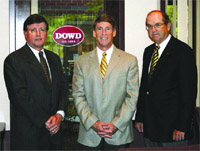
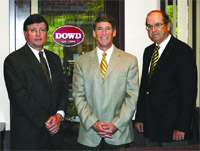
    The principals at the Dowd Group, from left, Bob Gilbert, John Dowd, and David Griffin.

    The principals at the Dowd Group, from left, Bob Gilbert, John Dowd, and David Griffin.

    In the front lobby of the offices of the Dowd Group in Holyoke hangs a framed copy of the citizenship papers of the company’s founder, James J. Dowd, circa 1871.

    There’s a portrait of Dowd on another wall, as well as some pictures of his descendents, subsequent presidents of the firm he started in 1898. In the conference room, there’s another portrait of Dowd, a few pictures depicting early 20th-century Holyoke (this company’s only corporate home), and a painting depicting the coastline of Ireland, from which the patriarch emigrated with the rest of his family in 1865.

    The walls are so decorated to convey history and continuity, two things those with the Dowd Group are quite proud of, said John E. Dowd, fourth-generation principal, specifically executive vice president, of the James J. Dowd & Sons Insurance Agency. But while the company likes to talk about its past, it’s certainly not living in it, he told BusinessWest.

    Indeed, the landscape in insurance has changed almost as dramatically as the scene in downtown Holyoke over the past century and a half, he explained, and the company has responded accordingly. It has expanded well beyond its Holyoke roots, with offices in Southampton and Amherst and clients across the Northeast and beyond, and it has diversified, with products now ranging from insurance to financial service to employee benefits. And it continues to be both innovative and entrepreneurial.

    The latest example is a venture called WestMass Professional Insurance LLC, a recently created company led internally by Dowd principal David Griffin that is, in effect, an insurance wholesaler specializing in helping smaller agencies bring more options to customers and thus remain viable in a highly competitive market.

    “We see this as a great opportunity for us to generate new business,” said Griffin, noting that WestMass was born as a way to co-broker the products sold by provider Promutual. But there are myriad opportunities for an agency like Dowd to serve smaller players in the market — with everything from insurance and financial services products to IT support — and the firm intends to take full advantage of them.

    Innovation coupled with strong customer service and solid relationship-building efforts have been the keys to Dowd’s growth over the years, said Bob Gilbert, president and treasurer, who came to the company in 1975 and has seen it grow from just over $1 million in sales then to more than $40 million now.

    “When asked how the company has achieved such growth, Gilbert, who joined it as a principal in 1975, said the formula is fairly straightforward, and the key is execution.

    “You hire good people, you train them well, and you know your product better than the competition,” he explained. “It’s comes down to knowing your business, paying attention to customers’ needs, and learning how to listen.”

    With his background in commercial sales, Gilbert has guided the company to what he called a 180-degree transformation, from an agency specializing in personal-lines products a quarter-century ago to one that now has 85% of its portfolio in the broad category of commercial work.

    Moving forward, he wants to build on the company’s legacy of relationship-building, and take that ability in new directions, thus spawning new and different opportunities.

    In this issue, BusinessWest looks at a company that is rich in history, and eager to write some new chapters to the story.

    Irish Eyes

    John Dowd says he enjoys talking about the company’s history, which is good, because there’s plenty of it, passed down by subsequent generations of the family. There are many singular events and circumstances, he told BusinessWest, which combined to give this agency its start — and to remain in business for more than a century.

    It all starts with Dowd’s great-great-grandfather, also named James Dowd, who, when hard times hit County Kerry Ireland in 1865, came to America with his wife and 14 children. It was one of those children, James, who would eventually create the firm, although insurance wasn’t his original career pursuit or passion.

    Instead, he started in retail (he bought the small grocery store he worked at) before becoming an assessor in Holyoke — the start of work in public service that included several terms in the state Legislature — and eventually board chairman. That was a post he lost when he and a colleague and eventual business partner, Jeremiah Keane, refused to bow to pressure from the mayor of the city and assign a modest assessment to the property of one of the mayor’s friends. In September 1898, they started Keane and Dowd, an insurance and real estate business, in Room 32 of the Ball Building, later known as the Holyoke National Bank Building.

    James Dowd’s son, James J. Dowd II, attended Holy Cross College, as many members of this family have over the past century or so, and played baseball there. A pitcher, he was good enough to earn a contract from the Cincinnati Reds for the then-lucrative amount of $2,200 a year.

    But a year later, in 1916, he gave up a promising career in baseball to take over the family business, then named James J. Dowd & Son after Keane left the firm to return to the assessor’s office following his father’s unexpected death.

    “My great-grandmother called him and told him he had a choice to make,” Dowd told BusinessWest. “She said, ‘you’ve got the agency your father started and worked hard to build or your professional career — what’s it going to be?’ Obviously, he chose to quit baseball.”

    Fast-forwarding through the company’s history somewhat, John Dowd said the company grew and prospered through the 20th century, moving several times (always staying in downtown Holyoke, though) to accommodate this growth, while successive generations of the family, as well as industry veterans such as Gilbert (in 1975) and Griffin (1998), have assumed leadership roles.

    In 1947, the third generation of the Dowd family, James Jr. (John’s uncle), joined the agency, followed by his brother, John (John’s father), a few years later. They took the helm in 1960 when James J. Dowd II passed away. In 1974, John’s father passed away unexpectedly, leaving the company in the hands of his uncle; his cousin, James Dowd III, who joined the agency that year; and, a few months later, Gilbert.

    By All Accounts

    He had been working for Aetna, essentially teaching independent agents (including those at Dowd) how to sell commercial products — workers comp, liability, property insurance, bonds, and more — when he was approached by James Dowd Jr. about joining the agency in a leadership role.

    “He offered me an opportunity I just couldn’t pass up,” he said, adding that, with his background in commercial products, the firm soon started gravitating in that direction.

    It has been an effective growth formula. “The opportunities to grow a business are there in commercial, because you can write a couple of commercial accounts, while it may take you 40 personal-lines accounts to reach the same number. And it takes a lot of time to gain 40 new accounts.”

    In the ’80s, the Dowd agency expanded geographically, first into Southampton with a venture now called the Dumont-Dowd Insurance Agency, and then into Amherst with the Cray-Down Insurance Agency. These ventures, along with the original Dowd agency and Dowd Financial Services, comprise the Dowd Group.

    Through its existence, the company has always thrived through its success in relationship-building, said Gilbert, noting that early relationships were mostly with families and businesses in Holyoke, and that, in latter years, they were defined by a much-wider geographic area and a much-broader range of businesses.

    It was relationships — those John Dowd forged when he was in college (St. Michael’s in Vermont, not Holy Cross) and later in Boston that helped the Dowd agency earn the business of Suffolk Downs in the ’80s and ’90s. Dowd remembers going to the track on many occasions. “I’d bring friends, we’d sit in the owner’s box and act like big wigs, while placing our $2 bets.”

    And it was similar relationships, as well as some effective bidding, that helped the agency gain a lucrative contract with the University of Mass-achusetts, one it kept for 15 years, to insure buildings at its then-three campuses.

    “We eventually lost that contract to politics,” said Gilbert, adding quickly that the company’s portfolio remains large and diverse, with clients ranging from the Eastern States Exposition to Sullivan Trucking to dozens of general contractors.

    The challenge at hand is to continually expand that portfolio.

    And as he talked about how to go about doing that, Gilbert returned to the matter of relationships, noting that the ability to maintain them and forge new ones is critical to continued growth in a region typically defined as a low-growth area, meaning one with little if any residential and commercial growth.

    Gaining larger market share in the insurance realm, as in banking, to a large degree, comes through customer service, finding ways to distinguish oneself, even when many of the products and services being offered are similar in nature, and finding new avenues for growth and revenue, he continued.

    Agents of Change

    One such avenue is WestMass Professional, a venture that grew out of the necessity for Promutual, a writer of medical and professional liability coverage, to secure what’s known as a co-broker to work with smaller agencies to renew existing policies and write new ones.

    That co-broker became WestMass Professional after roughly a year’s talks, said Griffin, adding that the new venture could lead to new and similar opportunities for co-brokering products, especially with changes in the automotive market from managed competition to open competition, in which consumers can effectively shop for lower rates.

    “In Massachusetts, 85% of the personal-lines business was being written by independent agents, but because we were in a non-competitive state, there wasn’t a lot of product you could sell, per se; all you were really selling was your services,” he explained. “We recognized very early on that there would be a lot of smaller agents that would be limited in their competitive ability because they represented only one or a few carriers, and there might be an opportunity to wholesale to some smaller agencies so they could expand the portfolio of carriers they could represent.

    “We broached this idea with our carriers first, to get their blessing,” he continued, adding that most of them gave it. And from there, the discussion of wholesaling certain products was expanded from personal lines to commercial products as well.

    Eventually, three ‘portals of opportunity,’ as Griffin called them, emerged from this wholesaling concept: medical and professional, personal lines, and commercial.

    Soon, other potential portals came into focus as those at Dowd anticipated other needs among smaller agencies. One such need is the ability to sell financial-services products — Dowd has a separate division that could make such products available — while another is for assistance with what Griffin called agency-management services, meaning everything from accounting to IT support — and Dowd has its own IT-support department.

    And there are more opportunities on the horizon, he continued, listing everything from help with succession planning, or selling or agency, to help understanding and then coping with new privacy-of-information laws that were originally slated to take effect May 1, have been pushed back, but will soon become reality.

    “These will impact an insurance operation in many ways,” said Griffin. “Our IT person is fully conversant on the law and how to come into compliance, and he’s knowledgeable on all aspects of the measure.”

    The sum of these portals is a large opportunity to create a large and reliable stream of new revenue, said Gilbert, adding that the business plan for these ventures is still in progress. Several agencies have been approached concerning these services, and at least five have signed on, with the potential for many more over the coming months. There is already limited competition in the wholesaling realm, and the possibility of much more, but those at Dowd believe they have an attractive model, one that leaves participating agencies with desired levels of flexibility and control.

    “With some models, you’re selling yourself to the devil, lock, stock, and barrel,” he explained. “Our approach is a little more hands-off, where you can use us in any of those disciplines that you want, but it isn’t a requirement that you use us for all of them.”

    Dowd agreed. “The agencies get to maintain their identity, or their sovereignty, if you will,” he said, adding that the arrangement entered is a true partnership, or relationship — there’s that word again — that benefits both parties.

    Overall, Gilbert said Dowd will continue to be imaginative and entrepreneurial in their approach to finding new business opportunities, personality traits that will be needed in a new era for the insurance industry, one defined by opportunities, but also heightened competition.

    Traditions — at a Premium

    When the Dowd agency turned 100 in 1998, the company marked the occasion in a number of ways. It printed a commemorative booklet telling the history, for example, and several members of the Dowd family paid homage to the founder at the Holyoke St. Patrick’s Day parade that year.

    “Several of us dressed up as Irish immigrants,” John Dowd recalled, adding that the plan was to get a horse and Irish trotting buggy and ride it down the parade route.

    But things didn’t go according to plan.

    It snowed heavily the night before the parade, and the owner of the horse to be rented for the day decided it was too dangerous to send the animal out on the slippery streets. So members of the Dowd family walked.

    “My three-year-old daughter cried for most of the three miles,” said Dowd, adding quickly that the march has become a small part of family lore.

    There is a great deal of history at Dowd — on the walls, in the family scrapbooks, and in decades worth of Holy Cross yearbooks. But while there is immense interest and pride in the past, this is an organization firmly focused on the present and the future.

    And on making some more history.

    George O’Brien can be reached at[email protected]

    Departments

    The following is a compilation of recent lawsuits involving area businesses and organizations. These are strictly allegations that have yet to be proven in a court of law. Readers are advised to contact the parties listed, or the court, for more information concerning the individual claims.

    CHICOPEE DISTRICT COURT

    Gilbert & Sons Insulation Inc. v. O’Bear Construction Company Inc.
    Allegation: Non-payment of goods and services rendered: $2,763.18
    Filed: 4/06/09

    FRANKLIN SUPERIOR COURT

    James Starbuck v. Goly’s Garage Inc.
    Allegation: Negligent maintenance, inspection, and service of vehicle causing injuries: $50,000+
    Filed: 5/12/09

    Joanne E. Lobik v. The Inn at Centerville Corners
    Allegation: Negligence in property maintenance causing fall: $25,000+
    Filed: 5/12/09

    Wayne Saven & Lisa G. Elliot v. Rice Oil Company Inc. and Timothy S. Rice
    Allegation: Employer failed to pay plaintiffs all wages owed: $101,631.86
    Filed: 4/24/09

    GREENFIELD DISTRICT COURT

    Country Oil v. Douglas Trucking
    Allegation: Balance due on diesel-fuel deliveries: $5,985.60
    Filed: 4/08/09

    Country Oil v. Red Rose Motel
    Allegation: Balance due on diesel-fuel deliveries: $6,110.47
    Filed: 4/08/09

    HAMPDEN SUPERIOR COURT

    Bernadine Smith v. American International College and Kimberly A. Hudson
    Allegation: Breach of contract, false documents, and creation of a hostile learning environment: $3,075,000
    Filed: 3/31/09

    Jessica Beaudoin v. Six Flags New England Inc.
    Allegation: Assault occurring in Six Flags parking lot: $21,585.89
    Filed: 4/27/09

    New England Drywall Installers v. Mountain Road Estates, LLC and David Berry
    Allegation: Non-payment of labor, materials, services, and equipment: $9,600
    Filed: 4/06/09

    The Travelers Indemnity Co. as Subrogee of Richard’s Deli Restaurant Inc. v. Spartan Brake & Muffler
    Allegation: Negligence causing fire and water damage to restaurant: $535,619
    Filed: 4/09/09

    HAMPSHIRE SUPERIOR COURT

    Florence Savings Bank v. JKZ, Inc. d/b/a The Kitchen Table and John D. Zantouliadis
    Allegation: Non-payment and breach of loan agreement: $46,667.67
    Filed: 5/11/09

    John Menard v. Genie Industries Inc. and United Rentals Inc.
    Allegation: Product liability causing injuries: $100,000+
    Filed: 5/05/09

    HOLYOKE DISTRICT COURT

    Hadley Printing Company Inc. v. Sunshine Art Studio Inc.
    Allegation: Non-payment of printing services rendered: $4,929.75
    Filed: 3/30/09

    NORTHAMPTON DISTRICT COURT

    Heritage Surveys Inc. v. W. Kulig Inc.
    Allegation: Non-payment of surveying work performed: $5,260.67
    Filed: 4/13/09

    Kayon Corp. v. Country Comfort
    Allegation: Non-payment of goods sold and delivered: $6,124.30
    Filed: 4/13/09

    PALMER DISTRICT COURT

    Capital One Bank, N.A. v. Four Seasons Cleaning Services
    Allegation: Non-payment of goods sold and delivered and charged on a credit account: $7,854.71
    Filed: 5/07/09

    SPRINGFIELD DISTRICT COURT

    Cameron Painting Inc. v. Optimum Building & Inspection Corp.
    Allegation: Non-payment of materials and services rendered: $18,290
    Filed: 4/17/09

    Dedicated Distribution Inc. v. Medical Specialties Group, LLC
    Allegation: Non-payment of goods sold and delivered: $22,693.73
    Filed: 4/22/09

    GMAC v. Atwater Studios Inc.
    Allegation: Default on retail installment sales contract: $4,965.41
    Filed: 4/21/09

    Molta Florist Supply Inc. v. Carley’s Florist
    Allegation: Non-payment of goods sold and delivered: $11,785.52
    Filed: 4/17/09

    One Communications Corp. v. Chuck’s Sign Co.
    Allegation: Balance due for services rendered: $4,256.20
    Filed: 4/09/09

    United Rentals Inc. v. JW Masonry Inc.
    Allegation: Non-payment of materials, equipment, and services on a construction project: $24,968.88
    Filed: 4/14/09

    Worldwide Express v. Merchamp U.S.A. Inc.
    Allegation: Non-payment of shipping services: $3,459.82
    Filed: 4/16/09

    WESTFIELD DISTRICT COURT

    Lashco Tree Service, LLC v. Carr Landscaping, LLC
    Allegation: Non-payment of tree-removal services: $2,800
    Filed: 4/03/09

    Sections Supplements
    How to Save Your Nest Egg From Nursing-home Costs

    You have spent the majority of your life working and building your nest egg so that your retirement will be well-funded. Unfortunately, retirement comes at a time when the possibility of catastrophic illness is more likely.

    Of all Americans age 65 or older, approximately 43% will enter a nursing home during their lifetime. Given that the average yearly cost of nursing home care is $90,000, and that the average stay will last two and a half years, planning for long-term-care costs is crucial, as these costs will deplete your nest egg at an alarming rate. Planning ahead, which is planning several years prior to nursing-home admission, will mean the difference between spending your nest egg to finance your care and preserving your nest egg for your family.

    Long-term nursing-home care is not paid for by Medicare or Medicare supplemental insurance. While Medicare may provide benefits for a short time period, once Medicare benefits end, the nursing-home resident must find another source of payment. Medicaid benefits are available to help pay for nursing-home care, but they are available only after eligibility requirements, which include strict asset limits, have been met.

    Recent changes in Medicaid law have significantly reduced last-minute asset-protection opportunities. While there are still a few beneficial options available if you fail to plan ahead, they apply only in very specific situations and are much less fruitful than plans completed several years in advance. The only surefire way to maximize the assets protected for your family is to begin planning at least five years prior to a nursing-home admission.

    Obtaining long-term-care insurance can alleviate the draining of assets and provide increased financial stability. Most long-term-care insurance policies will pay for long-term nursing-home care, although some pay benefits only for home care. Benefits are paid according to what is specified in the contract purchased.

    A wide range of policies is available, including unique combinations of benefits and pricing structures. For example, some policies will pay for nursing-home, assisted-living, or home-health-care expenses, thus increasing one’s long-term care options.

    Some policies provide that, if long-term care benefits are not used, the premium may be refunded as a death benefit. In order to purchase long-term-care insurance, you must be insurable, which means that you must not have a health condition that would prevent the insurance company from providing you with insurance.

    Assuming you do not purchase long-term-care insurance or that you are already uninsurable, you should consider purchasing assets that will not count toward the asset limit for Medicaid benefits. Non-countable assets presently include an irrevocably prepaid funeral, a burial account of no more than $1,500, a minimal amount of life insurance, a car, and, in some cases, a home. The payment of outstanding debts, such as a mortgage or credit-card balances, can also be beneficial in some cases.

    Assuming that five years will pass before your admission to a nursing home, a gifting plan may be considered. When applying for Medicaid benefits, the Division of Medical Assistance will look at the five-year period immediately preceding the application to determine if you made any gifts. If gifts are found within this time period, a penalty period will be assessed, during which time the division will not pay any Medicaid benefits on your behalf. If at least five years and one day have passed since the date of the gift, under the current rules, the gift will not need to be reported when applying for benefits. Hence, no penalty period will be assessed.

    A gifting plan may consist of outright gifting to your beneficiaries, usually your children, or to an irrevocable trust that can continue to provide you with income until you pass away. There is danger involved in gifting, as you may be admitted to the nursing home prior to the expiration of the five-year-and-one-day period. You must plan for this possibility before beginning any gifting.

    As opposed to a gifting plan, if you are presently being cared for by one of your children, you might consider establishing a paid-care agreement with your child. Rather than gifting assets, you pay your child for the care provided to you according to the terms of the agreement. As you pay for care, you are spending down your assets to purchase the services, as opposed to gifting the assets, and you are also benefiting your child by providing him or her with additional income. These agreements must be reasonable and fair to you and your caregiving child.

    The planning strategies mentioned in this article are extremely complex and contain various benefits and detriments. Should you wish to determine which strategy, if any, is best for your situation, it is highly recommended that you seek the advice of your elder-law attorney before you take any further steps. Do so now to avoid paying later. n

    Gina M. Barry is a partner with the law firm of Bacon Wilson, P.C. She is a member of the National Assoc. of Elder Law Attorneys, the Estate Planning Council, and the Western Mass. Elder Care Professionals Assoc. She concentrates her practice in the areas of estate and asset-protection planning, probate administration and litigation, guardianships, conservatorships, and residential real estate; (413) 781-0560;[email protected].

    Departments

    The following is a compilation of recent lawsuits involving area businesses and organizations. These are strictly allegations that have yet to be proven in a court of law. Readers are advised to contact the parties listed, or the court, for more information concerning the individual claims.

    CHICOPEE DISTRICT COURT

    Gilbert & Sons Insulation Inc. v. Dupuis Construction
    Allegation: Non-payment of goods and services rendered: $4,413.80
    Filed: 4/13/09

    FRANKLIN SUPERIOR COURT

    American International Recovery (Subrogee) and Kent Hicks Construction Co. v. Ragan Builders and Joseph Ragan
    Allegation: Defendants failed to carry worker’s comprehensive insurance: $206,876.37
    Filed: 4/17/09

    Barbara Martineau (Executrix) v. Joshua Garriga, M.D. and Connecticut River Internists, LLP
    Allegation: Delay in diagnosis and treatment of colon cancer, resulting in the death of a 61-year-old man: $25,000
    Filed: 4/08/09

    Lynne Gosselin v. Baystate Visiting Nurses & Hospice Inc. and Baystate Health Inc.
    Allegation: Failure to properly monitor and care for patient, causing hospitalizaton for 7.5 months: $1,379,000
    Filed: 4/15/09

    GREENFIELD DISTRICT COURT

    Capital One Bank, N.A. v. Brennan Builders
    Allegation: Non-payment of goods sold and delivered on credit: $6,271.78
    Filed: 5/07/09

    Dodson Associates, LTD and Turowski Architecture Inc. v. Avotu Inc. and Gorodetsky Engineering, LLC et al
    Allegation: Breach of contract for site design and construction and architectural design services rendered: $21,705.75
    Filed: 5/04/09

    HAMPDEN SUPERIOR COURT

    Bradco Supply Corporation v. REI Roofing
    Allegation: Non-payment of goods sold and delivered: $47,147.01
    Filed: 4/10/09

    Marion Rice v. Big Y Foods Inc.
    Allegation: After eating a deli sandwich from Big Y, the plaintiff suffered salmonella infection, resulting in three weeks of hospitalization: $17,524.52
    Filed: 4/06/09

    Meaghan O’Connell v. 80 Worthington Street, LLC
    Allegation: Negligence by employees of plaintiff, causing personal injury and hospitalization: $250,000
    Filed: 4/08/09

    Nancy Labrie v. John M. Zeroogian, M.D.
    Allegation: Medical malpractice: $1,108,000+
    Filed: 4/28/09

    HAMPSHIRE SUPERIOR COURT

    Montgomery Company Inc. v. Gould’s Florist Inc. and John Robert Ramsey
    Allegation: Non-payment of goods sold and delivered: $47,101.08
    Filed: 4/14/09

    Pamela A. Brown v. Service Link Inc.
    Allegation: Negligence and unfair and deceptive trade practices in home-sale transaction: $110,000
    Filed: 4/05/09

    Sandino McDonough-Sieben v. One Pearl Street Inc.
    Allegation: Assault in licensed premises, resulting in injuries: $30,000+
    Filed: 4/08/09

    HOLYOKE DISTRICT COURT

    Hadley Printing Co. v. Hallmark Institute of Photography Inc.
    Allegation: Breach of contract and non-payment of printing services rendered: $3,207
    Filed: 4/29/09

    NORTHAMPTON DISTRICT COURT

    Charlene Mitchell Lyman v. Master Mark Plastics Inc.
    Allegation: Negligence and breach of warranty requiring plaintiff to replace defective deck material manufactured and distributed by defendant: $23,384.55
    Filed: 5/11/09

    Janet M. Kopacz v. Mass. Energy Savers Corp. and Christian P. Poirier
    Allegation: Breach of home-improvement contract and fraud: $10,133
    Filed: 4/21/09

    PALMER DISTRICT COURT

    Irving Forest Products Inc. v. Northeast Wholesale Lumber Inc.
    Allegation: Breach of contract and failure to pay for merchandise received: $24,874.96
    Filed: 4/03/09

    Rockville Roofing Inc. v. Monaco Restorations Inc.
    Allegation: Non-payment of material and labor on several projects: $9,315.83
    Filed: 3/31/09

    SPRINGFIELD DISTRICT COURT

    Capital One Bank, N.A. v. Excalibur Services
    Allegation: Monies owed for credit advanced: $7,377.79
    Filed: 4/09/09

    Louis Michaelson & Son Co. v. Blue Sky Diner Restaurant
    Allegation: Non-payment of goods sold and delivered: $4,208.10
    Filed: 3/25/09

    Louis Michaelson & Son Co. v. O’Driscoll’s Irish Pub
    Allegation: Non-payment of goods sold and delivered: $6,820.55
    Filed: 3/25/09

    Sherwin Williams Cos. v. William Painting & Wallpapering
    Allegation: Non-payment of goods sold and delivered: $6,690.22
    Filed: 4/09/09

    Tangerine’s Kitchen & Bath Inc. v. New Future Development Corp.
    Allegation: Non-payment of goods sold and delivered: $4,207.71
    Filed: 4/09/09

    T.D. Banknorth, N.A. v. T.S. Mann Lumber Co. Inc.
    Allegation: Unpaid and defaulted promissory note: $19,910.90
    Filed: 4/09/09

    WESTFIELD DISTRICT COURT

    Capital One Bank, N.A. v. Creative One Services
    Allegation: Monies owed for credit advanced: $5,568.04
    Filed: 5/07/09

    City of Westfield v. R.G. Carr Civil Contracting, LLC
    Allegation: Failure to pay for off-duty police detail: $3,246.38
    Filed: 5/07/09

    Departments

    Dawn Creighton has been named Regional Director of Member Relations for Western Mass. by Associated Industries of Mass. (AIM), based in Boston. In her new position, Creighton will work with AIM-member firms and organizations to ensure they are fully aware of the range of resources and services that are available to them, and to serve as a liaison with a number of civic and business groups operating throughout the Pioneer Valley that are concerned about the state’s economic prospects for the future.

    •••••

    Dr. Jeanne S. Steffes has been named Vice President for Student Affairs and Dean of Students at Western New England College in Springfield.

    •••••

    Tighe & Bond in Westfield announced the following:
    • Paul Fiejdasz, P.E., LEED AP, CEM has joined the company as a Mechanical Engineer. He adds 15 years of experience in all aspects of mechanical building systems including HVAC, plumbing, and fire protection; and
    • Amy Lane, P.E., was the winner of the Young Professionals Fresh Ideas Contest for the best presentation given by a young professional at New England Water Works Association’s 2009 Spring Regional Conference and Exhibition in Worcester. Her presentation, titled “Water System Improvements in the Town of Amherst,” discussed the challenges coordinating upgrades to one of the town’s wells and its surface-water-treatment plant with the unique seasonal demand patterns of a college town.

    •••••

    Greenfield Co-operative Bank announced the following:
    • William F. Ahlemeyer has been promoted to Senior Vice President-Commercial Lending;
    • Christine M. Eugin has been promoted to Senior Vice President-Residential Lending;
    • Deborah J. Falcon has been promoted to Senior Vice President-Retail Banking;
    • Eric A. Marsh has been promoted to Senior Vice President, Treasurer, and CFO; and
    • Mary J. Rawls has been promoted to Compliance Officer.

    •••••

    Bulkley, Richardson and Gelinas, LLP has elected William E. Hart as Partner. Hart has been counsel to the firm during 2007 and 2008. He practices in the areas of estate planning and probate, taxation, real estate, and business matters, and has been named co-chairman of the firm’s Estate Planning and Administration Department. Hart practices from the firm’s offices in Amherst at 21A Pray St. and in Springfield at 1500 Main St.

    •••••

    The Women’s Partnership, a division of the Affiliated Chambers of Commerce of Greater Springfield, has named Nancy Mirkin of Hampden Bank as its 2009 Woman of the Year recipient. Mirkin is Vice President in the Business Banking Division at Hampden Bank, where she has worked for 13 years. Mirkin has also been involved with several organizations over the years, and currently volunteers with the Credit for Life-Financial Literacy Program and Habitat for Humanity Women Build II. The annual Woman of the Year Banquet is planned for June 23 at the Log Cabin in Holyoke.

    •••••

    Shatz, Schwartz and Fentin, P.C., TD Banknorth, and Moriarty & Primack, P.C., recently co-sponsored a seminar titled “Fraud Prevention” at the Springfield office of TD Banknorth. Speakers included Michael O’Reilly, special agent, Federal Bureau of Investigation; Gene Griffin, postal inspector, U.S. Postal Inspection Service, and Susan Chamberlain, director of Cash Management of TD Banknorth, who shared the sophistication of fraudulent activities of current times and the proactive solutions to protecting personal data.

    •••••

    The American Council on Education (ACE) Board of Directors has named Evan S. Dobelle, president of Westfield State College, to serve on the council’s Commission on Effective Leadership. The national commission advises ACE and also guides the ongoing development of Center for Effective Leadership programs and directs new initiatives. It serves as a forum for member presidents to explore issues related to leadership and institutional development in higher education.

    •••••

    John R. Cristoforo has joined the Insurance Center of New England in West Springfield as an Account Executive in the personal lines division.

    •••••

    Kathleen P. Mullin has been appointed Vice President and Credit Risk Manager at PeoplesBank.

    •••••

    Lori A. Siedlarczyk-Nadeau has joined TD Insurance in West Springfield as a Sales Executive in the small-business division. She consults on employee benefit plans to small businesses.

    •••••

    Martin Kane recently completed 80 hours of training as an Auctioneer at the International Auction School in South Deerfield. He is now a licensed auctioneer in Massachusetts. Kane is also a commercial real estate broker with King & Newton, LLC Commercial Real Estate in Springfield. In addition, he is a board member of the new Realtors Commercial Alliance, and president of Sanford Management Services Inc.

    •••••

    Dr. Catherine Spath, a board-certified Orthopedic Surgeon, has joined the Cooley Dickinson Hospital medical staff in Northampton.

    •••••

    David J. Martel, a Partner in the law firm of Doherty, Wallace, Pillsbury & Murphy, has been honored with the Leadership Institute’s Community Service Award for exceptional commitment to the Greater Springfield community.

    •••••

    Adrienne M. Connolly, co-owner of Stinky Cakes in Springfield, has been recognized as one of the top 200 mom-owned businesses in StartupNation’s 2009 Leading Moms in Business Competition. VerticalResponse sponsored the competition, which recognizes the achievements of mothers across the country who run outstanding businesses.

    •••••

    Gail Young, Breakfast Hostess at the Hampton Inn Hadley-Amherst, was recently honored by Hampton Hotels with the Spirit of Hampton Award, signifying Young as a top performer within Hampton Hotels.

    Departments

    The following is a compilation of recent lawsuits involving area businesses and organizations. These are strictly allegations that have yet to be proven in a court of law. Readers are advised to contact the parties listed, or the court, for more information concerning the individual claims.

    CHICOPEE DISTRICT COURT

    Bank of America v. Westover Greenhouses Inc.
    Allegation: Non-payment of money loaned: $24,382.03
    Filed: 3/16/09

    GREENFIELD DISTRICT COURT

    Five Point Farm v. Cape Cod Stove Co.
    Allegation: Non-payment of 24 tons of corn purchased and delivered: $5,846
    Filed: 3/18/09

    HAMPDEN SUPERIOR COURT

    Berkshire-Westwood Graphics Group Inc. v. Lavigne Inc.
    Allegation: Non-payment of goods sold and delivered: $142,729.88
    Filed: 3/26/09

    City of Springfield v. Comcast Cable Communications Inc. et al
    Allegation: Breach of contract and implied covenant of good faith and fair dealing, fraud, and breach of warranty: $12.9 million

    Michelle Sherman v. The Salty Dog Saloon Inc.
    Allegation: Negligent maintenance of property causing injury: $37,497.10
    Filed: 3/27/09

    Valley Management Inc. v. Boston Road Mobile Home Park Tenants Assoc.
    Allegation: Employment discrimination and termination based on race: $100,000+
    Filed: 3/23/09

    HAMPSHIRE SUPERIOR COURT

    Andre Mercier v. Morse Manufacturing Inc.
    Allegation: Breach of warranty, negligence, and product liability causing injury: $650,000
    Filed: 3/23/09

    NORTHAMPTON DISTRICT COURT

    Dax Transportation Inc. v. PrideK Inc.
    Allegation: Plaintiff purchased diesel gas but was given regular gas, causing damage to vehicle’s fuel pump and injectors: $3,843.99
    Filed: 4/02/09

    Ralph’s Blacksmith Shop v. Monaco Restorations Inc.
    Allegation: Non-payment of monies owed: $24,517.50
    Filed: 3/24/09

    SPRINGFIELD DISTRICT COURT

    Bank of America v. Computer Ambulance and Michael Smith
    Allegation: Non-payment of money loaned: $12,063.47
    Filed: 3/10/09
    Carolina Eastern-Vail Inc. v. G. K. Mood & Co.
    Allegation: Non-payment of promissory note: $15,370.11
    Filed: 3/18/09

    Comcast Spotlight Inc. v. Unique Expressions by Gallagher’s Inc.
    Allegation: Non-payment of advertising services rendered: $4,390.78
    Filed: 3/27/09

    Thomas D. Lesperance v. Leonard E. Belcher Inc.
    Allegation: Breach of contract and unfair and deceptive practices: $20,000
    Filed: 3/18/09

    David Clark, D.C. v. Clark Family Chiropractic, P.C.
    Allegation: Non-payment of promissory note: $18,948.50
    Filed: 3/18/09

    WESTFIELD DISTRICT COURT

    David C. Brooks v. MJDB Construction Services, LLC
    Allegation: Non-payment of monies loaned: $200,000
    Filed: 3/18/09

    Lashco Tree Service, LLC v. Carr Landscaping, LLC
    Allegation: Non-payment for tree removal services rendered: $2,800
    Filed: 4/03/09

    Departments

    Workplace Preparedness in the Face of a Pandemic

     By AMY ROYAL

    1. Begin by planning a course of action designed to minimize disruption to your operations; however, be sure to prepare and plan to operate with a reduced workforce.

    2. Determine your emergency coverage needs. Identify key positions within your company, such as employees who maintain business-necessary functions. Ask yourself: when these key employees or managers are out, how will that impact your operations? Is there someone else who can step in for them? Are your managers and employees cross-trained?
    3. Consider different scenarios. Varying scenarios may call for different measures of preparedness and action. For instance, your business might devise one course of action if several employees are sick and another if an entire department or the whole company is sick.
    4. Establish clear guidelines for your business regarding whether or not employees who are sick or exhibiting symptoms should report to work. Review your existing sick-leave policies for consistency.

    5. Classify employees’ risks to occupational exposure. For instance, employees working within the health care field have a much greater on-the-job exposure than employees who have minimal occupational contact with the general public.

    6. Identify a point person. Select an individual in management to be designated as the pandemic coordinator. This individual should be responsible for implementing the company’s response plan and fielding employee questions or concerns.
    7. Create and distribute an emergency communication plan to all employees. Include name and contact information for the pandemic coordinator and any other relevant information, such as a Web site or phone number for employees to utilize for the latest information.
    8. Make a list of customers, vendors, suppliers, or clients who may need to be contacted in the event that your business must close or modify its operations due to the outbreak of illness within your business or community.
    9. Review all of the above on an annual basis and revise as needed.

    10. Contact your attorney before implementing any plan to ensure its compliance with applicable laws.

    Amy B. Royal, Esq. is a partner in the law firm Royal & Munnings, LLC. She focuses her practice in management-side labor and employment law; (413) 586-2288; [email protected].

    Departments

    Ten reasons to : Hire a lawyer for domestic- relations proceedings

    1. You don’t know the law. Pro-se litigants frequently encounter roadblocks that can cost not only time and money, but missed deadlines and case dismissals.

    2. Limited assistance representation. The court has instituted a cost-effective program whereby a lawyer can represent a party in just one aspect of their case such as a court hearing or preparing a memorandum.
    3. Child support guidelines. The way child support is calculated in Massachusetts has changed dramatically. Calculations are highly complex, and there are now many built-in deviation arguments.
    4. Dealing with other attorneys can be difficult. Pro-se litigants are at a severe disadvantage. A lawyer has the knowledge and experience to manipulate facts and law to their client’s benefit.

    5. Knowing the judge. Lawyers are familiar with how judges think and are likely to rule on a particular issue, thereby enabling them to prepare accordingly.

    6. Public speaking. Courtrooms are typically open forums. Lawyers are accustomed to speaking in venues with many people present.
    7. Thinking on your feet. Presenting your case in court requires articulate on-the-spot arguments that are compliant with court rules and laws.
    8. Knowing procedural rules. Lawyers know how to serve the other party, when to bring motions, how to dismiss a case or request a continuance, and how to conduct discovery.
    9. Trying cases. It takes a highly skilled lawyer to effectively make opening and closing statements, enter evidence, elicit testimony, and propose judicial findings.

    10. ‘He who represents himself has a fool for a client.’ With the Family Court home to such emotionally charged issues, lawyers are able to think objectively.

    Melissa R. Gillis, Esq. is an associate with Bacon Wilson, P.C. She is a member of the Family Law and Real Estate departments; (413) 781-0560; [email protected]; bwlaw.blogs.com/familylawbits

    Departments

    MassMutual Lays Off 65

    SPRINGFIELD — Despite solid revenues and progress on its overall business strategy reported in early March, MassMutual Financial Group recently laid off 65 workers from its offices on State Street and in Enfield, Conn. Company officials noted that the layoffs were across the board, including finance, sales, and marketing. As of Dec. 31, 2008, MassMutual had reported a surplus of $8.5 billion, a 6% increase from $8 billion as of Dec. 31, 2007. MassMutual also posted record whole life insurance sales, significant increases in disability income and long-term care insurance sales, and solid growth in its sales force. As the impact from the deteriorating markets continue into 2009, MassMutual officials note they still expect to reduce staffing levels during the year, either by not filling open positions or by layoffs. MassMutual officials would not comment on how many additional positions may be eliminated in the coming months. A company spokesperson noted that the recent actions were taken to ensure the company has the “right people in the right positions.”

    Bradley Expands Self-Select Lanes

    WINDSOR LOCKS, Conn. — The Transportation Security Administration (TSA) has expanded its popular Self-Select Lanes program to Bradley International Airport. To date, Bradley is the 51st airport in the country to launch the innovative program that expedites the screening process for air travelers. The Self-Select Lanes are comprised of three lanes designated by signage that directs passengers to the lane that best suits their travel needs and knowledge of security requirements — ‘expert,’ for the business traveler who flies regularly; ‘casual,’ for travelers who are somewhat familiar with the procedures; and ‘family/special assistance,’ which is already in place at Bradley, for passengers traveling with children, elderly passengers, and passengers carrying medically necessary liquids, aerosols, and gels in excess of three ounces. To watch a video of the lanes in action, visit www.tsa.gov.

    Jobless Claims Plunge in Early April

    NEW YORK — In the week ending April 11, the advance figure for seasonally adjusted initial claims was 610,000, a decrease of 53,000 from the previous week’s revised figure of 663,000, according to the U.S. Department of Labor. The four-week moving average was 651,000, a decrease of 8,500 from the previous week’s revised average of 659,500. The advance seasonally adjusted insured unemployment rate was 4.5% for the week ending April 4, an increase of 0.1% from the prior week’s unrevised rate of 4.4%. The fiscal year-to-date average for seasonally adjusted insured unemployment for all programs is 4.781 million. Extended benefits were available in Massachusetts, Alaska, California, Connecticut, Idaho, Indiana, Michigan, Montana, Nevada, New Jersey, North Carolina, Oregon, Pennsylvania, Puerto Rico, Rhode Island, South Carolina, Vermont, Washington, and Wisconsin during the week ending March 28.

    State Bankruptcy Filings Climb in First Quarter

    BOSTON — Chapter 7 bankruptcy filings in Massachusetts jumped 16% in the first quarter compared to the same period last year, according to the Warren Group, publisher of Banker & Tradesman. There were 3,285 filings under Chapter 7 of the U.S. bankruptcy code in the first three months of 2009, up from 2,833 during the first quarter of 2008. The filings were also 7% higher than the fourth quarter of 2008, when 3,072 filers sought Chapter 7 protection. Chapter 7 filings fell dramatically in 2006 after a federal law went into effect that tightened the requirements for filing for Chapter 7 bankruptcy protection. But filings have started to escalate again, steadily increasing for the past three quarters, according to the Warren Group. Chapter 7 bankruptcy, the most common option for individuals who want relief from their debts, accounted for 82% of bankruptcy filings in Massachusetts in the first quarter. People filing under Chapter 7 bankruptcy can eliminate most debt after non-exempt assets are used to pay off creditors.

    Home Sales Fall During First Quarter

    BOSTON — Across the country, pending home sales have edged up, hinting at a possible pickup of sales activity in the coming months, according to the National Association of Realtors. In Western Mass., realtors note that the price and volume of single-family homes fell during the first quarter, however, the number of homes sold increased in March. During the first quarter of 2009, 635 homes were sold in Hampden, Hampshire, and Franklin counties, according to the Realtor Assoc. of Pioneer Valley. During the same period in 2008, 722 homes were sold in the three counties. The median price during the first quarter of 2009 was $169,500, compared to $195,000 during the same period a year ago — a 13.1% decline. In Hampden County, 463 homes were sold, while in Hampshire County, 116 homes were sold, and in Franklin County, 56 homes were sold.

    Pioneer Valley Pet Pantry Launches Canned Food Drive

    The Pioneer Valley Pet Pantry kicked off its food drive on April 1, with a goal to raise 4,000 pounds of canned dog and cat food by May 13, 2009. The food will be donated to local animal shelters, including the Thomas J. O’Connor Adoption Center in Springfield, the Dakin Pioneer Valley Humane Society in Leverett, and the Homeless Cat Project in Westfield. Mary Wilczynski, who founded the Pet Pantry with a group of community volunteers, said that, “amid the closing of the MSPCA and the start of kitten season, many of our local shelters are under a great deal of pressure to accommodate the needs of pets waiting to be adopted. There is a tremendous amount of support and compassion from pet lovers to step up and help our shelters in need.” Volunteers from the Pet Pantry are helping to organize canned-food drives in the community and solicit monetary donations to purchase food. Easthampton Savings Bank has partnered with the Pet Pantry and will accept monetary and food donations at all of its branch banks. A.W. Brown in East Longmeadow will also accept food donations. On April 23, Pet Pantry volunteers met at Dave’s Soda and Pet Food City in Agawam to purchase and then deliver 2,000 pounds of much-needed canned dog and cat food to the three local shelters. To make a donation using a personal PayPal account or to learn more about the Pioneer Valley Pet Pantry, visit sites.google.com/site/pvpetpantry

    Departments

    The following is a compilation of recent lawsuits involving area businesses and organizations. These are strictly allegations that have yet to be proven in a court of law. Readers are advised to contact the parties listed, or the court, for more information concerning the individual claims.

    CHICOPEE DISTRICT COURT

    All-Temp Controls v. Accurate Mechanical Corp.
    Allegation: Breach of contract and non-payment for services rendered: $33,624
    Filed: 4/01/09

    HAMPDEN SUPERIOR COURT

    Diversified Technical Products v. Plasticorp Inc.
    Allegation: Non-payment of services rendered: $25,000
    Filed: 3/19/09

    Financial Counselors, LLC v. Keniston & Co.
    Allegation: Conversion and unjust enrichment: $268,000
    Filed: 3/23/09

    Greater Media Inc. v. The Countertop Shoppe
    Allegation: Non-payment of goods sold and delivered: $33,100
    Filed: 3/19/09

    Utica Mutual Insurance Group, as subrogee of Detector Technology Inc. v. DMT USA Inc. & SG Water USA Inc.
    Allegation: Distribution, sale, and installation of defective adaptor fitting, causing damage to property: $44,384.39
    Filed: 3/25/09

    HAMPSHIRE SUPERIOR COURT

    Green Street Café v. Smith College
    Allegation: Breach of covenant of quiet enjoyment and contract in a commercial lease: $25,000
    Filed: 3/25/09

    NORTHAMPTON DISTRICT COURT

    Capital One Bank N.A. v. Box of Golf Inc.
    Allegation: Non-payment of monies owed: $10,737.36
    Filed: 3/31/09

    Myer’s Catering v. Hallmark Institute of Photography
    Allegation: Non-payment of catering goods and services rendered: $27,275.25
    Filed: 4/01/09

    PALMER DISTRICT COURT

    Laurie McCarthy v. R.A. Manley & Sons
    Allegation: Unfair and deceptive practices causing home-repair damages: $17,216
    Filed: 3/16/09

    SPRINGFIELD DISTRICT COURT

    Louis Michaelson & Sons Co. Inc. v. Blue Sky Diner Restaurant Inc.
    Allegation: Non-payment of goods sold and delivered: $4,208.10
    Filed: 3/25/09

    Louis Michaelson & Sons Co. Inc. v. O’Driscoll’s Irish Pub
    Allegation: Non-payment of goods sold and delivered: $6,820.55
    Filed: 3/25/09

    Springfield Florists Supply Inc. v. Gift Baskets by Carmela
    Allegation: Non-payment of merchandise: $5,440.50
    Filed: 3/27/09

    United Rentals v. Encompass Construction and Management Inc.
    Allegation: Non-payment for services, materials, and equipment: $4,689.31
    Filed: 3/27/09

    Vladimir M. Zamotayev v. Max S. Construction, LLC
    Allegation: Breach of sales contract and non-payment of balance owed: $17,924.77
    Filed: 3/26/09

    WESTFIELD DISTRICT COURT

    One Communications Corp. v. Kellie’s Candies Nut Free Confections Inc.
    Allegation: Failure to pay for services rendered: $4,175.58
    Filed: 3/11/09

    Sections Supplements
    Restaurant Venture Will Light Up a Dark Spot in Tower Square
    John DeVoie

    John DeVoie, seen standing in the future home of the second Hot Table location, believes Tower Square is ideal for his venture.

    John DeVoie knows the recent history of the restaurant site in the southeast corner of Tower Square — it’s been vacant for nearly a year and has seen several establishments come and go over the past decade — and he’s not fazed by it one bit.

    That’s because he believes the failures, if some could even be called that, were due to circumstances or factors that had nothing to do with location. And, more to the point, he’s quite confident that he has a product, or model, that will succeed in that highly visible spot.

    It’s called Hot Table, a name derived from a form of fast, casual dining DeVoie experienced in Italy (more on that later), and placed over an eatery that he and his brother, Chis, opened in the 16 Acres section of Springfield roughly two years ago. The establishment features signature panini sandwiches — from ‘three cheese chicken’ to ‘steak horseradish’ — and has successfully drawn business from nearby MassMutual, Western New England College and other schools in the area, and the surrounding residential community.

    And when the brothers DeVoie, natives of Springfield, opened the doors to the eatery, they did so with the understanding that they were starting a business, not a single sandwich and coffee shop.

    “The initial plans called for opening a second location within 18 to 24 months, and we’re right at two years, so we’re on schedule,” he said, adding quickly that they would likely have moved sooner, but last fall was not the time to be seeking capital to open a restaurant.

    But long before last autumn, the location of that second restaurant started to come into focus. Officials with Tower Square and the DeVoie brothers started talking roughly a year ago, said John, noting that both had some clear objectives. The property’s owners wanted a stable tenant that could draw visitors to the corner of Main Street and Boland Way, said DeVoie, adding that he and his brother wanted a site with both vast potential and great visibility with which to expand and brand Hot Table.

    It took some time to get the deal done, but now that work has commenced at the site, there is optimism that the new restaurant will breathe some life into the still-struggling retail component within Tower Square, and provide more momentum for the DeVoies’ business venture.

    “The corner spot at Tower Square is the most visible location in downtown, and the importance of having a vibrant business at that location is imeasurable,” said Russell Denver, president of the Affiliated Chambers of Commerce of Greater Springfield. “Hot Table has proven at its Breckwood Boulevard site that it knows what it takes to attract professionals and students alike to their business to be profitable.”

    Said DeVoie, “we’re happy to be lighting up that corner. This location is going to help us brand Hot Table. Everyone goes to Main and Bolland eventually, and when they do, they’re going to see our name, and so when we go to Westfield or West Springfield, or another community in the region, people will know us.”

    As he talked about the factors that led to the recent press event announcing Hot Table’s pending arrival downtown, DeVoie flashed back to a visit to the 16 Acres restaurant last year by Fred Christensen, Tower Square’s senior property manager.

    “He came to see the operation, and when he arrived, there was a long line of people going almost out the door,” DeVoie recalled. “He saw all the people with MassMutual badges and noted that they not only drove a mile to get there, but probably had to walk a mile first to get to their cars in the parking lot. That was enough for him.”

    As for DeVoie and the Tower Square space, he was pretty much already sold, although there was considerable negotiating still to do. And the ensuing deal appears to give both parties what they want and need: for Tower Square, a drawing-card tenant that fills a highly visible void; and for Hot Table, an affordable location at one of the region’s busiest intersections.

    That figures nicely into the growth plans for the business, which DeVoie conceptualized after spending 18 years in corporate sales for Alcoa and realizing that it was time for something else. “I was 40, and I knew that, in sales, they generally try to put you out to pasture when you’re 50,” he explained. “I had some time to go, but that 10 years comes up fast.”

    DeVoie said he has long wanted to launch his own business, and when he started seriously considering options, he focused on one apparently common in Italy. There, small shops called Tavola Caldas serve hot, fresh food and desserts quickly to their patrons. The literal English translation of that phrase is ‘hot table,’ the name trademarked and then given to the venture by the DeVoies and their brother-in-law, Don Watroba, also a co-founder.

    The three chose a somewhat tired strip mall across Wilbraham Road from Western New England College to start their venture, citing its proximity to MassMutual and several schools, and also what they considered an “underserved” area.

    And they used that same word to describe downtown Springfield. Indeed, while there are several restaurants downtown, DeVoie said there isn’t anything quite like what Hot Table has to offer — a mix of gourmet coffee, unique panini sandwiches, and affordable prices.

    “Our intent was to start our company in Springfield, grow our name regionally, and then see where that takes us,” he said, referring to the initial five-year plan and speculation about what might follow.

    “We wanted the second store to be close to the first one, and we looked at the demographics of what we do, specializing in breakfast and lunch, and said, ‘OK, where’s the highest concentration of people working in one spot in Western Mass? It’s not Longmeadow, it’s not Northampton, it’s not Holyoke — it’s downtown Springfield, and that’s where we want to be.

    “And in our efforts to build a regional brand, what better place to drop a store than right in the heart of the biggest city in Western Mass. and in the best piece of real estate in the city?” he asked as he continued. “That was evidenced by our press conference; we didn’t have a press conference when we opened in 16 Acres, and we wouldn’t have had one if we were opening in West Springfield.”

    That press conference was attended by a number of civic and business leaders who expressed the hope that Hot Table would create a spark in the downtown and eventually help light up much more than one currently dark space.

    And DeVoie believes his venture can provide one.

    “Knowing the history of that site, I’d say there is an element of risk involved with it,” said DeVoie. “But we’re very confident in the product we sell and the service we provide — and we’re also confident in Springfield and in Tower Square.”

    —George O’Brien

    40 Under 40 Class of 2009

    Marco Alvan

    Age 36: Owner and Coach, Team Link Brazilian Jiu Jitsu

    Marco Alvan was introduced to martial arts when he took up judo at age 7. But at age 15, he made a switch that changed his life.

    That was when he learned Brazilian Jiu Jitsu under the tutelage of the Gracie family, whose forerunners founded the discipline about 80 years ago. He proceeded to earn a black belt and win national tournaments in his native Brazil.

    But he had other goals in mind, and in 2001 he came to the U.S. and settled in Ludlow, where he has family, to open a school.

    “After so many years of fighting Brazilian Jiu Jitsu, I realized I could help fans learn what I had learned,” he said. “The sport was growing, but there wasn’t anyone teaching it around here.”

    He launched Marco Alvan Jiu Jitsu in the basement of a friend’s house, and now boasts several locations in Massachusetts and Connecticut. In 2007, a good friend from Brazil, Gabriel Gonzaga — a heavyweight title contender in the Ultimate Fighting Championship — joined him at the school, which underwent a name change to Team Link Brazilian Jiu Jitsu.

    “It’s a fantastic martial art,” Alvan said, noting its emphasis on grappling and the use of leverage and proper technique to overcome size differences between competitors. “The Gracie family showed that smaller guys could defeat bigger guys using Brazilian Jiu Jitsu. After that, a lot of people started to practice it.”

    Team Link was New England champion three years running, and has boasted several fighters ranked in the top 10 worldwide, competing regularly against top international fighters. Alvan also conducts workshops for law-enforcement officials on the effective defensive tools inherent to Brazilian Jiu Jitsu — and he’s introduced his kids to the sport, too.

    “Ludlow used to be known as a soccer town,” he said. “Now it’s recognized for mixed martial arts. I’m happy to take this reputation to Ludlow. The town helped me a lot and supported my school. I’m very happy here.”

    —Joseph Bednar

    40 Under 40 Class of 2009

    Gina Barry

    Age 36: Shareholder Attorney, Bacon Wilson, P.C.

    Gina Barry wasn’t one of those kids who always knew she’d be a lawyer. In fact, she was more interested in marine biology or horse training — until a guidance counselor saw some legal aptitude in her and coaxed her into law.

    It took her awhile, but she eventually found a niche she loved.

    “In law school, I started to gear myself toward elder law and estate planning because I’ve always been someone who wants to champion the underdog, and protect individuals who often — not always, but often — need a strong advocate on their side,” she said.

    “I see people in the middle of great family turmoil,” Barry added, noting common challenges like paying for nursing-home care. “We can devise a plan so that they see the light at the end of the tunnel. I like being able to resolve those issues so the family remains intact.”

    And not just people. Her love for animals has led Barry to cultivate an aspect of her practice that handles estate planning for pets. Because Massachusetts law does not allow money to be bequeathed to an animal for its future care, she creates monetary trusts that benefit a specific caregiver with instructions to care for the pet — whether a dog, a cat, a horse, even (in at least one case) a llama.

    But Barry doesn’t stop there. She recently launched a nonprofit called The Joy of Jasper that rescues at-risk horses and provides care for them for the remainder of their lives, and also involves at-risk youth in that care.

    “When I was a girl, I had a horse named Jasper who was literally my best friend and helped me through a lot of teenage issues, including self-esteem and even discipline issues,” said Barry. “I wanted to bring horses back into my life in such a way that I could share that experience with other teenage girls.”

    Sounds like they need a strong advocate on their side.

    —Joseph Bednar

    40 Under 40 Class of 2009

    Karen Chadwell

    Age 37: Associate Attorney, Doherty, Wallace, Pillsbury & Murphy, P.C.

    Karen Chadwell knows a lot about dreams — both those with happy endings and those that never come to fruition.

    As a patent attorney, Chadwell works with and for people who come to her with vague ideas, sophisticated plans, and everything in between.

    As a member of the Longmeadow Conservation Committee, Chadwell sees people whose dreams of putting an addition on their home or adding a swimming pool can be realized, as well as those whose proposals would adversely affect the environment and wetlands.

    The mother of 3-year-old Jimmy and 2-year-old Catherine finds her work and civic involvement fascinating, satisfying, and worthwhile.

    Chadwick spends a lot of time educating prospective clients, without charge, about what is involved in taking an invention from idea to market and making it profitable. Her desire to help has spurred pro bono work, including help finding manufacturers or marketing firms for clients.

    “I’m a conduit for people to manifest ideas into something that will have worth and value,” she said, adding that many people have no idea just how lengthy and complex the process of bringing an idea to the marketplace can be. “These people are supporting families, and it’s an expensive process with no guaranteed results. I don’t want them to be shocked and disappointed if things don’t go quickly or work out.”

    Chadwell’s original life goal was pharmaceutical research, but after earning her bachelor’s degree from Loyola University, a stint in the lab changed her mind, and she returned to Loyola’s law school.

    “Helping people is very important to me,” she said, adding that she describes herself as “very analytical” but also someone who does a great deal of hand-holding.

    Her work on the Conservation Committee also involves education. “It’s important for people to know how everyday activities impact the environment and have long-term effects,” she explained. “I spend a lot of time trying to ground people.”

    And also, helping them fly off the ground with ideas that work.

    —Kathy Mitchell

    40 Under 40 Class of 2009

    Amy Royal

    Age 33: Attorney; Partner and Co-founder of Royal & Munnings, LLC

    Amy Royal says it has long been her dream to start her own law firm — not a practice, but an actual firm with several lawyers.

    When she finally took that bold step last fall with friend and now-partner Amy Griffin Munnings, she did so with nearly equal doses of confidence and trepidation.

    “I had a good, secure job,” she said, referring to her work as an associate for the Springfield-based firm Skoler Abbott & Presser. “I was a wife and mother with two young children; I was afraid, especially given the state of the economy.”

    Six months into her new venture, which now boasts five lawyers, Royal’s fears have generally subsided. The economy is still quite shaky, but she has a solid client base, capped by East Longmeadow-based Lenox, and a steady flow of work in her specialty — employment-law work on behalf of corporate clients — due in large part to the economic downturn.

    “My only regret is that I didn’t do this sooner,” she told BusinessWest in reference to her entrepreneurial gambit, noting that she and Griffin-Munnings are making great strides in the creation of what she considers a rather unique niche in business law — specializing in assistance to women- and minority-owned businesses.

    In fact, the partners recently won a contract with the city of Springfield to provide certain services to minority- and women-owned ventures, including legal assistance with obtaining state and federal certification.

    A product of what she called girls’ and women’s education — she graduated from Springfield’s MacDuffie School and Smith College in Northampton — Royal said that background has helped her in many ways, and also made her more sensitive to the needs of women in both society and business.

    Active in the community, Royal is a trustee of the MacDuffie School, a board member with the Center for Human Development, and former board member of Child & Family Service of Pioneer Valley.

    —George O’Brien


    40 Under 40 Class of 2009

    Gregory Schmidt

    Age 29: Associate Attorney, Doherty, Wallace, Pillsbury & Murphy, P.C.

    Gregory Schmidt loves Western Mass.

    “I came back here after college because of the quality of life. Eveything is fantastic about this region, and I want to see it thrive and be the best place it can be,” he said.



    That’s why the member of the Young Professionals Society of Greater Springfield is intensely devoted to volunteer work and his job as an attorney specializing in commercial financing, secured transactions, and real-estate law.

    “Small businesses are the lifeblood of the community. I chose my field so I would be able to help others accomplish their goals and dreams,” said Schmidt, adding that he works with banks to help facilitate the establishment and growth of businesses.

    The father of 11-week-old William is a member of Springfield Technical Community College’s Scibelli Enterprise Center Advisory Board and works with clients in the Springfield Business Incubator.

    “I feel I’m in a unique position to offer advice and services to small businesses. The center is a fantastic venture, and I am proud to be part of it. It helps the whole Western Mass. economy,” he said, adding that growing businesses provide jobs for local people.

    Helping is high on Schmidt’s list, especially when it comes to cancer research and programs. His wife had Hodgkin’s disease when she was in high school, and his grandfather and a college friend survived it. “Any dollar raised to combat this is a worthwhile venture,” he said.

    Schmidt has been involved with the Jimmy Fund since his college years in Boston. “I did anything I could to help them make their events a success,” he said.

    He’s also on the planning committee for the American Cancer Society’s 2009 Evening of Hope Gala, an event he called “a very worthwhile venture.”

    It’s the way he feels about everything he does to make the Pioneer Valley the best it can be.

    —Kathy Mitchell


    Features
    Springfield’s Hoop Hall Will Host BusinessWest’s 40 Under Forty Gala
    The Basketball Hall of Fame will be the site of this year’s 40 Under Forty gala.

    The Basketball Hall of Fame will be the site of this year’s 40 Under Forty gala.

    Mark the date: June 18.

    That’s when BusinessWest will celebrate its third class of 40 Under Forty winners at a gala to be staged at the Basketball Hall of Fame on Springfield’s revitalized riverfront.

    Kate Campiti, associate publisher and advertising director for BusinessWest, said the magazine wanted to bring the event to the Hall of Fame in 2009 to showcase some of the exciting developments there and be a part of that revitalization process.

    “We’re spotlighting some of the bright, young talent in this region at our festive celebration, which has become a not-to-be-missed event,” she explained. “But we also wanted to turn the spotlight on Springfield, its riverfront, and the Hall of Fame complex. We’re excited to be bringing our event to this great venue.”

    The Hall’s Center Court will be the site for the gala, which will honor a diverse class of under-40 leaders, as chosen by a panel of five judges. The scores were tabulated early in March, and the winners were notified a few weeks ago. They will be presented to BusinessWest’s readers in the magazine’s April 27 issue.

    To maintain a level of suspense, we’ll reveal only that this group of winners represents sectors ranging from manufacturing to technology; from law to financial services; from retail to construction. Overall, it is a very entrepreneurial group, with many business owners, as well as others who bring a spirit of entrepreneurship to their company or nonprofit agency.

    While not all the details of the June 18 event have been hammered out, many things are known, starting with corporate sponsorship of the event. Several companies have agreed to take a lead role in presenting the gala, including Bay Path College, Comcast, Fathers & Sons, Hampden Bank, and Moriarty & Primack.

    Tickets to the event, which will feature butlered hors d’oeuvres, lavish food stations, and entertainment, will be $50 each and may be obtained by calling (413) 781-8600, ext. 10, or via E-mail at[email protected].

    Sections Supplements
    Enhanced Protection Available for Those Needing Guardianship

    A new law will take effect in Massachusetts on July 1 relative to guardianships. This issue has been debated and discussed for more than 20 years, and this law is intended to create uniformity among all states across the country; 13 states enacted the law in 2008.

    Until now, in Massachusetts, most issues regarding the administration and legal requirements of guardianships were decided on a case-by-case basis. The new law is more than 100 pages long, and one article applies primarily to the protection of disabled people and their property.

    Most provisions of the Uniform Probate Code relating to the settlement of deceased people’s estates do not become effective until July 1, 2011. In Massachusetts, however, over the past year, changes have been made to both the ‘petition for guardianship of a person’ and the medical certificate required to be filed with the court for a finding of incapacitation. These forms were implemented in order to reflect society’s changing view of incapacitated individuals and preserve those people’s rights.

    The court has redefined the requirements to determine that a person is incapacitated when they are unable to attend to their own affairs and are in need of a guardian. In addition, some of the terminology that was utilized for many years is now going to be changed. As an example, in the past, a person who was determined by the court to be incapacitated was referred to as a ‘ward.’ This term is now reserved solely for the guardianship of a minor. Any other person who needs a guardian is determined as an ‘incapacitated person,’ a ‘person in need of services,’ or a ‘protective person.’ Court personnel, attorneys, and the public will have to learn the new terminology as well as, potentially, new forms, procedures, and standards.

    Here are some of the highlights of the measure:

    • Any petition over a protective person must be served on that person, and that individual has a right to appear at a hearing. In addition, if that person so requests, they may, but do not have to be given, a right to a closed hearing. It is uncertain how this will be conducted, but presumably, the courtroom will be closed to all parties not having an interest in that particular proceeding.
    • A person has a right to counsel. This was not always the rule in the courts regarding a civil proceeding. This right to counsel has been expanded to apply to the person in need of protection. In addition, the statute also provides that consideration should be given to that person if he or she is 14 or more years of age as to the selection of a guardian.
    • To the extent that the person has assets, then their counsel should be compensated from those until the court determines otherwise. If the person to be protected is indigent, then their counsel may be paid by the Commonwealth, but it is uncertain as to where that money will come from and at what rate or by what standard their counsel should be compensated.
    • At the current time, a person may always select their counsel, but in some cases, a person who is not competent, but thought they were, may or may not have the right to select counsel of their own choosing. As a further safeguard for the person, in the event that the court finds it necessary or beneficial, the court may appoint a guardian ad-litem who may be a lawyer, public social worker, or charitable agency to investigate the condition of the person, their affairs, living arrangements, etc., and report to the court to allow the court to make a better decision. Note that a guardian ad-litem does not advocate for the incapacitated person, but reports to the court as the ‘eyes and ears’ of an independent investigator that provides additional information.
    • A new provision provides that there is a prohibition against a person being appointed as a guardian when that person is being investigated or has charges pending for committing an assault and battery that resulted in a serious bodily injury to a minor or incapacitated person. There will presumably be a CORI investigation done to determine each petitioner’s status and ensure that they are not a prohibited party.
    • The terminology of ‘guardians’ and ‘conservators’ has been relatively interchanged for years in the probate courts. Under the new law, a guardian is charged with making decisions regarding the incapacitated person’s support, care, education, health, and welfare. A person’s financial matters are to be managed by a person who is now going to be called a conservator. Therefore, if a person is seeking to be designated as responsible for a protected person’s personal care and financial matters, this person will have to request that the court appoint them as both a guardian and conservator. Of course, these matters may be consolidated into one, but separate documentation may be required by the court.
    • While each competent person has always been encouraged to establish a health care proxy and durable power of attorney during their lifetime, it is increasingly more important to do so. The health care proxy will attend to one’s medical decisions in the event of incapacitation, while the durable power of attorney will attend to financial decisions, and thus allow either the same or different people to make decisions relative to the principal’s affairs.
    • With proper execution while competent, these two very important documents allow a person to make decisions for himself or herself and avoid the need for guardianship. Naturally, if there is disagreement within the family over decisions made by the agent under the health proxy or power of attorney, the family would be able to bring a petition with the probate court and seek to either have the agent removed or have a guardian or conservator appointed.

      However, information in prior documents must be disclosed on the petition for guardianship filed with the court so the judge will have information as to whom the protected person nominated while he was still competent.

      Under the new act, the guardian may have to request specific authority to have a protected person institutionalized in a long-term care facility. Hopefully, this special request can be made within the original petition for guardianship. If not, then after a guardianship is allowed, the guardian may need to file a separate or supplemental petition for additional authority to require the permanent institutionalization of the protected person. Naturally, this will cause additional emotion, time, publicity, and cost.

      Within the framework of the new law, there is additional language that encourages the courts to review guardianships and possibly allow one on a limited basis, rather than making a full determination that the person is incapacitated and has no rights to make any decisions regarding his or her own care and finances.

      In the past, it was the duty of a guardian to file an account with the probate court. As a condition of their bond, the new law mandates that the guardian/conservator report all assets that may be coming under their control within 60 days following their appointment and file an account on an annual basis. With the advent of new, sophisticated software, it is likely that the court will be proactive in requiring fiduciaries to file accounts.

      In the event that the guardian/conservator does not provide an account in a timely fashion, or in the event that the judge is not satisfied with the decisions that the guardian/conservator is making, then the fiduciary could be removed and a successor fiduciary be appointed by the court.

      All in all, these changes are intended to further protect the rights of anyone needing guardianship. Hopefully, the provisions of the new law will be carried out as intended and enacted.

      Attorney Hyman G. Darling is chairman of Bacon Wilson, P.C.’s Estate Planning and Elder Law departments. His areas of expertise include all areas of estate-planning, probate, and elder law. Darling hosts an estate-planning blog atbwlaw.blogs.com/estate_planning_bits; (413) 781-0560;[email protected]

      Departments

      The following is a compilation of recent lawsuits involving area businesses and organizations. These are strictly allegations that have yet to be proven in a court of law. Readers are advised to contact the parties listed, or the court, for more information concerning the individual claims.

      CHICOPEE DISTRICT COURT

      Arnold’s Meats v. The Amherst Chicago Pizzaria
      Allegation: Non-payment of goods sold and delivered: $5,951.57
      Filed: 2/27/09

      FRANKLIN SUPERIOR COURT

      Jaroslav & Patricia Roth v. Machinery Solutions, Inc. et al
      Allegation: Breach of warranty and product liability causing serious injury and blindness: $2,263,000.00
      Filed: 3/5/09

      Walter S. Pratt & Sons Inc. v. Pioneer Drilling
      Allegation: Non-payment of goods sold and delivered: $182,189.03
      Filed: 3/12/09

      GREENFIELD DISTRICT COURT

      Country Oil Inc. v. H-Copy Hallowell’s Printing Inc.
      Allegation: Non-payment of heating oil services and furnace repair: $4,097.37
      Filed: 2/19/09

      Emotion Kayak Inc. v. Trails
      Allegation: Non-payment of goods sold and delivered: $4,600.29
      Filed: 2/17/09

      Hazel Fuller v. MHC Inc.
      Allegation: Negligent maintenance of property, causing trip and fall: $18,378.19
      Filed: 3/3/09

      Hudson Valley Paper Company v. H-Copy and Hallowell’s Printing Inc.
      Allegation: Non-payment of goods sold and delivered: $4,708.41
      Filed: 2/17/09

      WT Land, LLC v. Pioneer Supply Corp.
      Allegation: Non-payment of rent: $15,222.50
      Filed: 2/26/09

      HAMPDEN SUPERIOR COURT

      Champagne Drywall Inc. v. GFI Longbrook, LLC
      Allegation: Non-payment for services rendered and breach of contract: $49,000
      Filed: 2/27/09

      Dawn Cardinal, admin. for the estate of Daniel Cardinal v. Lorenver Po, M.D. Holyoke Associates in Internal Medicine Inc.
      Allegation: Wrongful death from overdose of pain medication: $4,000,000
      Filed: 2/27/09

      Francis & Lorraine Sabourin v. Alfred Hutt, M.D.
      Allegation: Medical malpractice: $175,000.00
      Filed: 3/16/09

      Hendel & Collins, P.C. v. Veritech Corporation and Patient EDU, LLC
      Allegation: Non-payment of legal services rendered: $36,498.87
      Filed: 3/2/09

      Melissa Young v. The Home Depot Inc.
      Allegation: Employment discrimination and wrongful termination: $30,000
      Filed: 2/27/09

      HAMPSHIRE SUPERIOR COURT

      April-Lynn Forest v. Village Park Apartments
      Allegation: Employment discrimination and retaliation causing termination: $56,000
      Filed: 2/26/09

      Elliott Co. v. Cooley Dickinson Hospital
      Allegation: Breach of contract for the purchase of special-order equipment: $173,151
      Filed: 2/26/09

      HOLYOKE DISTRICT COURT

      Mark P. Cutting v. RCR Enterprises Inc.
      Allegation: Breach of contract in a car sale and title forgery: $5,000
      Filed: 12/2/09

      NORTHAMPTON DISTRICT COURT

      Falcetti & Clark Electrical Supply Inc. v. Rosazza Electrical Contractors
      Allegation: Non-payment of electrical supplies: $14,427.16
      Filed: 2/23/09

      PALMER DISTRICT COURT

      American Buildings & Contractors Supply Company Inc. v. Baxter Property Management
      Allegation: Non-payment of goods sold and delivered: $2,705.40
      Filed: 2/19/09

      A & W Freight Brokers of Maine v. Quaboag Transfer Inc. & United Bank
      Allegation: Breach of contract by failure to perform duties stated: $24,150
      Filed: 2/19/09

      Shaws Industries Inc. v. Superior Floor Covering
      Allegation: Non-payment of goods sold and delivered: $6,445.58
      Filed: 2/23/09

      SPRINGFIELD DISTRICT COURT

      All Metals Industries Inc. v. HoodTech Inc. and Paul Saletnik
      Allegation: Non-payment of goods sold and delivered: $3,280
      Filed: 3/13/09

      Bradco Supply Corporation v. CRK Contracting and TD Banknorth
      Allegation: Non-payment of goods sold and delivered: $5,859.39
      Filed: 3/4/09

      WEZE & WROL v. El Shaddai Dental Associates, P.C.
      Allegation: Non-payment of promissory note: $16,296.84
      Filed: 3/4/09

      WESTFIELD DISTRICT COURT

      Capital One Bank, N.A. v. Signature Resumes
      Allegation: Non-payment of goods sold and delivered and charged on a Capital One credit card: $17,066
      Filed: 2/23/09

      Jelly Belly’s Pools & Spas Inc. v. Peabody Properties Inc.
      Allegation: Non-payment for services rendered: $9,244.01
      Filed: 3/9/09

      Stephen Burrell & Sophia Zanzarella v. Windy Hills Stables Inc. and Jennifer Garulenski
      Allegation: Breach of contract, fraud, deceit, and negligent misrepresentation in sale of horse: $9,000
      Filed: 3/6/09

      Sections Supplements
      Biannual Law Seminar Renamed to Honor Late Attorney John Sikorski
      John Sikorski

      The late John Sikorski is being honored in a way that reflects his love of learning and his dual skills in employment and trial law, colleagues say.

      Before John Sikorski died last year, at the much-too-young age of 55, he built a reputation in the legal world not just as a skilled lawyer, but someone who never felt he was skilled enough to stop learning.

      “John was a voracious legal reader. He’d drive back and forth to Boston listening to legal tapes,” said Jeff McCormick, managing partner of Robinson Donovan, P.C., the Springfield-based law firm where Sikorski had worked for 18 years in employment law.

      “And he was an idea man,” McCormick continued. “All the time, I’d come into the office in the morning, and on my desk would be a three-page memo with an idea John had about how we could improve one of the areas of practice in the office, or how we could help somebody become better at their job.

      “He was one of those guys who — I wouldn’t say he goaded you — but he’d challenge you all the time to become better. He was always helping us improve. He was a real champion of our office.”

      The question, then, for McCormick and his colleagues became, how best to honor Sikorski and keep his memory alive in an appropriate way?

      “Every one of us, to a person, said that we have to do something that honors him by continuing the thing that were important to him,” he said. “He was a real champion of continuing legal education, so someone decided to contact MCLE.”

      That’s Boston-based Mass. Continuing Legal Education Inc., which presents skills and education programs year-round. “We started talking to them about whether there might be some way we could endow one of their educational programs,” McCormick said, “to fund a program to help pay for people who want to go to an employment law-related seminar but couldn’t pay for it.”

      In the end, the firm decided to endow what will now be called ‘Employment Law Trial Skills: The John C. Sikorski MasterClass,’ a workshop held every two years that provides Massachusetts lawyers with advanced education in trying employment cases.

      The program will include lectures by experienced trial lawyers, guided discussions, participatory exercises, and advice from judicial panels. Participants will acquire advanced skills for shaping trials, making effective opening statements and closing arguments, conducting direct and cross examination of human-resources professionals, and establishing damages. They will also learn techniques to help them become more effective at assessing both evidence and expert witnesses.

      Sikorski would have appreciated being involved in any program that helped employment lawyers bolster their courtroom skills, McCormick said. “John was a really good trial lawyer,” he noted. “There are a lot of employment lawyers who aren’t great trial lawyers, but he had that mix.”

      Employment Law Trial Skills takes place every other year at MCLE headquarters in Boston; this year is an off-year, so Sikorski’s name will grace the program starting in March 2010, and then biannually thereafter.

      “Because it’s held only every other year, it’s one that historically has been very well-attended,” McCormick said, “so we felt, what could be more fitting than to name it after John? So Robinson Donovan, as a firm, has endowed that program at MCLE in perpetuity.”

      McCormick, who served as president of the Mass. Bar Assoc. from 1998 to 2000, recalled that Sikorski had been chair of the MBA Labor and Employment Section, a much-sought-after post in which Sikorski excelled. One reason might have been his constant desire to learn more and pass on what he learned.

      “John was a great partner,” he said. “He became known not only in the area but also statewide as someone in the employment-law field who was committed to excellence and always striving to be a better lawyer.”

      He was also a multi-faceted individual, McCormick said, noting as one example Sikorski’s passion for flowers and the impressive garden he and his wife built in their backyard. Hopefully, the seminar now offered in his name will have an impact that proves to be just as perennial.

      “If you went to his funeral, you would not have imagined that so many people knew John,” McCormick said. “People came from Boston, and a custodian in our building was there, too. John touched so many people’s lives, professionally and personally. He was a great friend, and it was a true loss.”

      Joseph Bednar can be reached at

      [email protected]

      Departments

      Anthony P. Simone has been named AVP-Wealth Management Advisor at The Bank of Western Massachusetts in Springfield.

      •••••

      Charter Oak Insurance and Financial Services Co. in Holyoke reported that Stewart Creelman, a Certified Financial Planner, recently marked his 50th anniversary with Massachusetts Mutual Life Insurance Company (MassMutual). Charter Oak is one of the largest MassMutual agencies in the country.

      •••••

      The Board of Directors of Berkshire Life Insurance Company of America, based in Pittsfield, announced the following:
      • Brian J. Cunningham has been elected Director, Claims. In his new role, he oversees the company’s delivery of high-quality claims services to its policyholders. He also lends claims risk-management perspective to Berkshire Life’s product-development efforts and contributes to ongoing agent/broker and client-education efforts.
      • Donna N. Lagarce has been elected FLMI, Director, Project-management Office. Lagarce is charged with building out enterprise-wide project-management methodologies, reporting tools, and policies.
      • Tara M. Tereso has been elected Director, Marketing Services. Tereso’s principal responsibilities are to collaborate with business area clients to create strategic marketing campaigns in support of the company’s business plan.

      •••••

      The Polish National Credit Union in Southampton announced the following:
      • Carol A. Desrosiers has been named Branch Manager;
      • Heather Huot has been named Assistant Manager; and
      • Sarah Harrington has been named Head Teller.

      •••••

      PeoplesBank announced the following:
      • Karen J. Buell has been promoted to Internet Branch Officer.
      • Xiaolei Hua has been promoted to Project Management Officer.

      •••••

      Bacon Wilson P.C. in Springfield has announced that Partner Michael Katz has received the prestigious Sadowsky Visionary Award from the Jimmy Fund. The award is given to “someone who demonstrates extraordinary commitment to the Jimmy Fund and the mission of the Dana Farber Cancer Institute by conceiving, leading, or dedicating themselves to an event or activity that delivers annual financial support and/or long-term volunteer commitment.” Katz is co-chairman of the firm’s Bankruptcy Department. He is also a past president and current member of the board of directors of the Jimmy Fund Council of Western Mass., and serves on the Jimmy Fund Advisory Committee for the Dana Farber Cancer Institute.

      •••••

      Tastefully Simple announced the following:
      • Carleen Mullin has received the Top Sales Achiever in Location Award.
      • Katrina Deragon has received the Top Team Sales in Region Award.
      • Marva Walting has received the Top Team Sales in Location Award.
      All awards were presented during Tastefully Simple’s On Tour event in Boston, which unveiled the company’s spring-summer product line.

      •••••

      Morrison Mahoney LLP has appointed Attorney Jennifer A. Hylemon as a Partner of the firm and a member of the Medical Professional Practice Group in Springfield. Hylemon’s practice is concentrated in the areas of medical malpractice, professional liability, general liability, and workers’ compensation litigation.

      •••••

      Joanne St-Germain was among the top Avon representatives who recently attended a weekend at the Beverly Hilton Hotel in Hollywood, Calif., for division and district managers. Representatives were chosen based on their fourth-quarter sales performance compared to the prior year.

      •••••
      Joanne Lusignan, with Home & Garden Party, recently attended the company’s leadership convention in Cincinnati, Ohio, that featured guest speakers and training workshops from Feb. 26-28. Home & Garden Party announced the acquisition of Home Interiors during the convention, as well as its new name, Celebrating Home.

      •••••

      Adrian L. Rawn has joined TD Banknorth as a Business Banking Officer in Springfield. He provides a range of services, including loans, deposits, commercial real-estate financing, and lines of credit, to businesses throughout Hampden and Hampshire counties.

      •••••

      Comcast has promoted Andy McCarthy to Vice President of Engineering and Technical Operations for western New England. McCarthy will oversee the engineering planning, development, and deployment of new products throughout the region while also working to ensure the reliability and resiliency of Comcast’s converged fiber-optic network.

      •••••

      Jewish Geriatric Services announced the following:
      • Danielle M. Withroder has been named Development Coordinator;
      • Celina Conway has joined the Ruth’s House staff as Director of Community Relations;
      • Christine M. Cronin has been named Wellness Nurse at Ruth’s House; and
      • Jennifer A. Haber has accepted a Social Worker position at the Julian J. Leavitt Family Jewish Nursing Home.

      •••••

      Dr. Michael Caban has joined the orthodontic practice of Dr. Robert Leff.

      •••••

      Chicopee Savings Bank announced the following:
      • Russell J. Omer has been promoted to Executive Vice President;
      • Wayne L. Webster has joined the bank as Vice President of Commercial Lending;
      • Elizabeth A. Wilk has been promoted to Vice President;
      • Elizabeth M. Maroney has been promoted to Assistant Vice President;
      • Guida R. Sajdak has been promoted to Senior Vice President of Commercial Lending;
      • Luke D. Kettles has been promoted to Senior Vice President of Commercial Lending;
      • Kathi L. Donahue has been promoted to Senior Vice President of Commercial Lending, and
      • Darlene M. Libiszewski has been promoted to Senior Vice President of Information Technology.

      •••••

      Anthony F. Roda has joined TD Banknorth as the Store Manager at 243 Triangle St., Amherst. He is responsible for managing day-to-day operations at the location and developing and overseeing small business loans, deposit accounts, consumer lending, and investment and insurance services.

      •••••

      Attorney Carol Cioe Klyman, a Shareholder of Shatz, Schwartz and Fentin, P.C., of Springfield, recently participated in the panel discussion “Practicing Outside the Box: Atypical Practice Areas for Attorneys of Color,” at the annual regional convention of the National Black Law Students Assoc. at the Springfield Marriott. Klyman discussed the rewards of assisting elders, disabled individuals, and their families in special needs, long-term care, and estate planning, and acting as advocates for these clients in areas such as consumer protection claims and trust and estate litigation.

      •••••

      Attorney L. Alex Hogan, with Shatz, Schwartz and Fentin, P.C. in Springfield, recently spoke to a group of South Hadley High School students on personal finance as part of the M. Ellen Carpenter Financial Literacy Program offered at the school. Hogan practices in the areas of business law, business litigation, and bankruptcy.

      •••••

      Laurie Long has been promoted to Senior Vice President of Operations at D.J. St. Germain Investment Management Co. As a certified Microsoft professional, Long provides expertise in the areas of programming, user training, software applications, and systems analysis.

      Departments

      Getting Down to Business

      Springfield Mayor Domenic Sarno recently announced that Royal & Munnings, LLC is the recipient of a city of Springfield contract providing certain services to minority- and women-owned businesses. The services to businesses under the contract includes technical and legal assistance in obtaining state and federal certification as a minority- or woman-owned business, in responding to procurement opportunities and in obtaining financing and bonding to support these businesses in their participation in construction and supply projects. From left: Maria Lopez-Santiago, chief procurement officer for the city of Springfield; Aimee Griffin Munnings, partner with the law firm of Royal & Munnings, LLC; Sarno; and Amy B. Royal, Partner with Royal & Munnings, LLC.


      Parting Thoughts

      Paul Digrigoli, founder and president of Digrigoli Salons, was the keynote speaker at the recent national conference for NACCE (the National Association for Community College Entrepreneurship) in Anaheim, Calif. Here, he makes his point to an audience of educators looking to develop or enhance programs for teaching entrepreneurship.


      Model Operation

      Balise Lexus recently hosted a launch reception to introduce the all-new 2010 RX at its dealership on Riverdale Street. The all-new RX is touted as the “reinvention of the vehicle that invented it all,” according to Mike Balise, left, vice president of Balise Motor Sales, seen here with Brant Baird, district sales manager for Lexus. The event drew several hundred visitiors, and was highlighted by an auction of the first few RXs delivered to the West Springfield showroom.


      Forging Partnerships

      Fagor-Automation Corp. in Chicago recently donated the installation of its new Innova 40i ‘True Vision’ digital readout system in the Machine Tool Technology Program at Roger L. Putnam Vocational Technical High School in Springfield. The new computer controls will assist Putnam students to blend their pre-existing Windows computer skills with most of the manual metal-working machines at the school. In preparation for a hands-on open house at Putnam this spring, precision-machining companies that are interested in viewing this new equipment, which will be debuted at EASTEC 2009 on May 19-21, should contact Fred Carrier at Putnam ([email protected]). Coordination of these donated services to Putnam was lead by Buck Upson, president of Pioneer Tool Supply Co. Inc. of West Springfield, the Putnam Program Advisory Board, and the Regional Employment Board of Hampden County. Installation of the controls was provided by Danny Steidi and Joel Kasnick from Fagor-Automation Corp.


      Hometown Heroes

      The American Red Cross Pioneer Valley Chapter recently honored several Western Mass. residents at its annual ‘Hometown Heroes’ breakfast. Above, Tony Filipe (left), president of the Home Builders Assoc. of Western Mass., with honoree Joseph Lesniak of Indian Orchard. At right, Sheila Doiron (left), director of Communications and Community Relations for Bay State Gas, with honoree Bobi Steingart of Longmeadow.

      Opinion
      2009 Agenda Links Economic Stimulus and Health Care Reform

      With the nation and the world watching, President Barack Obama and the 111th Congress have an incredible opportunity, and a formidable challenge: to enact comprehensive health care reform. While the economy will unquestionably dominate the early days of the 111th Congress, a compelling case is being made that health care is a key economic issue.

      Late in 2008, the presidential transition team worked to craft an economic stimulus package. Last month, Congress passed — and Obama signed into law — the $787 billion bill, which dedicates some money to help states with growing and underfunded Medicaid programs, and also funds to help physicians purchase health information technology.

      In late December, the Congressional Budget Office (CBO) released a cost-benefit analysis of 15 health care reform options. While the general finding was that most of the options would place significant cost burdens on the government, the CBO predicted that fostering the use of health information technology (including electronic medical records) would save the federal government $7 billion over the first 5 years and nearly $35 billion over 10 years, primarily through reductions in medical errors, lower health insurance premiums, and avoiding unnecessary tests and procedures.

      Another health-reform option predicted to positively impact the budget if enacted is a requirement (similar to that in the Massachusetts Health Reform Law) that all but the smallest employers who fail to provide health insurance to their employees pay a fee. The CBO estimates that this would result in $47 billion in new revenues.

      The Massachusetts law continues to serve as a possible framework for national health care reform.

      Both the Senate Finance Committee’s proposal and President Obama’s stated health care positions support an ‘incremental universalism’ approach that includes Massachusetts-style elements such as ‘play or pay’ provisions for employers, expansions of Medicaid eligibility and other public programs, and some form of ‘connector’ to help people purchase more affordable health insurance.

      U.S. Sen. Edward Kennedy continues to lead efforts in the Senate to develop a comprehensive proposal that would work at the national level. Kennedy recognizes that, while the principles of the Massachusetts plan are applicable nationally, there are significant differences between the state and national markets.

      This year considerable attention will also focus on efforts to change the Medicare physician payment formula. While a solution is far from clear, there is no question that Congress wants to move away from using volume as a basis for physician payment and toward a still-undefined measurement of value and cost- effectiveness. The Mass. Medical Society continues to work with the Massachusetts congressional delegation and the American Medical Society to forge meaningful national health care reform.-

      Alex. Calcagno is director of Federal Relations for the Mass. Medical Society. She is responsible for advocating the MMS positions before the Massachusetts congressional delegation, federal agencies, and the executive office. Calcagno has over 20 years experience lobbying in Washington, D.C. Before coming to Massachusetts she was assistant director of the Washington office for a national medical association and worked on Capitol Hill for a member of Congress.

      Departments

      ‘Riding Out the Perfect Storm’

      March 19: A panel of experts from various business segments will share their ideas and expertise on how to cope in a challenging business environment from 9 to 11 a.m. at the Scibelli Enterprise Center, 1 Federal St. in Springfield. The workshop is sponsored by the Mass. Small Business Development Center Network and the Regional Technology Corp. The cost is $40. For more information, call (413) 737-6712.

      Rock ‘n’ Roll and Management Styles

      April 15: “Everything I Learned About Management, I Learned From Rock ‘n’ Roll” will be presented by James M. Wilson, III, Ph.D., assistant professor of Business at Bay Path College; and Gregory Jones, director of Cannes Associates Production Management. Wilson and Jones have been conducting research for three years on the production of live concerts featuring Metallica, Green Day, Red Hot Chili Peppers, Bob Dylan, and Willie Nelson, among others, with a focus on how event management contributes to organizational theory. The free lecture at 7 p.m. will take place in Breck Suite in Wright Hall at Bay Path College in Longmeadow. The event is part of the Kaleidoscope lecture series. For more information, call (413) 565-1066 or visit www.baypath.edu.

      Marketing Basics

      April 1: The Mass. Small Business Development Center Network will sponsor a workshop from 3 to 5 p.m. at the Greater Northampton Chamber of Commerce, 99 Pleasant St., on the basic disciplines of marketing, beginning with research — secondary, primary, qualitative, and quantitative. The core focus will be on developing and keeping a customer. Topics will include public relations, advertising, understanding concepts in marketing, and developing a marketing plan. The cost is $40. For more information, call (413) 737-6712.

      Health Care Reform Law Discussion

      April 16: Sandra Reynolds of Associated Industries of Mass. will lead an interactive discussion on the Massachusetts Health Care Reform Law from 9 to 11 a.m. at the Scibelli Enterprise Center, 1 Federal St., Springfield. Discussion will focus on the individual mandate — what it means, how it works, and the impact on employers of every size. The workshop is sponsored by the Massachusetts Small Business Development Center Network. The cost is $40. For more information, call (413) 737-6712.

      ‘Your First Business Plan’

      April 23: The Massachusetts Small Business Development Center Network, in conjunction with the Franklin County Chamber of Commerce, will offer a workshop titled ‘Your First Business Plan’ from 9 to 11 a.m. at the chamber office, 395 Main St., Greenfield. The workshop will focus on management fundamentals from start-up considerations through business-plan development. Topics will include financing, marketing, and business planning. The cost is $40. For more information, call (413) 737-6712.

      World Affairs Council

      April 27: Marco Werman, senior producer and anchor of The World, a daily news radio program produced by the BBC, Public Radio International, and WGBH/Boston, will discuss “Tintin and Movietone Made Me Do It” as part of a World Affairs Council of Western Massachusetts gathering at Western New England College. Werman’s talk is planned at 7 p.m. in Sleith Hall, 1215 Wilbraham Road, Springfield. The event is free and open to the public. Springfield public high-school teams who participated in the council’s fourth annual Academic WorldQuest competition in January will also be recognized at the event. For more information, call the World Affairs Council office at (413) 733-0110.

      Women’s Professional Development Conference

      April 30: Bay Path College in Longmeadow will host the 14th annual Women’s Professional Development Conference from 7:30 a.m. to 4:30 p.m. at the MassMutual Center in downtown Springfield. For more information, call (413) 565-1293 or visit www.baypath.edu.

      Departments

      The following is a compilation of recent lawsuits involving area businesses and organizations. These are strictly allegations that have yet to be proven in a court of law. Readers are advised to contact the parties listed, or the court, for more information concerning the individual claims.

      CHICOPEE DISTRICT COURT

      Richard J. Harvey v. Windsor Court
      Allegation: Negligence in failure to maintain premises, causing injury: $4,388.10
      Filed: 1/29/09

      FRANKLIN SUPERIOR COURT

      Dawn E. Bruno v. Austin Trucking Co. and Lawrence R. Bassett
      Allegation: Motor-vehicle negligence causing personal injury: $18,258.21
      Filed: 2/12/09

      HAMPDEN SUPERIOR COURT

      Alton E. Gleason Company Inc. v. Crestview Construction & Trucking Inc. & HDC Four, LLC
      Allegation: Non-payment of services and materials provided: $59,269.86
      Filed: 2/11/09

      Shawn P. Coakley v. Town of West Springfield and West Springfield Public Schools
      Allegation: Employee discrimination based on disability: $50,000+
      Filed: 2/13/09

      Thomas F. Fortier v. Alcobaca Inc. d/b/a The Meadows
      Allegation: Failure to keep premises safe, allowing for plaintiff to be assaulted by another patron while on premises: $65,057.26
      Filed: 2/10/09

      HAMPSHIRE SUPERIOR COURT

      Kathleen Treska v. Big E’s Foodland Inc.
      Allegation: Plaintiff struck by object that was knocked off a shelf by an employee: $121,560
      Filed: 2/10/09

      Nail Communications Inc. v. Berkshire Blanket Inc.
      Allegation: Breach of marketing contract and non-payment of services rendered: $28,000
      Filed: 2/12/09

      NORTHAMPTON DISTRICT COURT

      Farm Family Insurance Co. v. Bioshelters Inc.
      Allegation: Non-payment on insurance policies: $6,784.61
      Filed: 1/15/09

      First Equity Card Corp. v. The Pirate’s Den Restaurant
      Allegation: Monies owed for credit advanced: $11,277.61
      Filed: 1/26/09

      SPRINGFIELD DISTRICT COURT

      Gekay Sales & Service Co. Inc. v. Queen City Equipment Inc.
      Allegation: Failure to pay court-ordered judgment: $6,000.73
      Filed: 1/20/09

      Ormsby Insurance Co. Inc. v. Canta Napoli Pizzeria and Restaurant Inc.
      Allegation: Breach of contract and failure to pay monies owed: $16,554.57
      Filed: 1/20/09

      York Modern Corp. v. Dalton Tractor & Equipment Co. and TD Banknorth, N.A.
      Allegation: Non-payment of goods sold and delivered: $5,019.13
      Filed: 2/11/09

      WESTFIELD DISTRICT COURT

      F.W. Webb Co. v. Bushee Enterprises, LLC
      Allegation: Non-payment of goods sold and delivered: $6,171.74
      Filed: 1/12/09

      Russell P. Jones v. EDS Development
      Allegation: Unpaid balance on promissory note: $46,300
      Filed: 1/30/09

      Departments

      Nell Elizabeth (Beth) Lorenz, President and Treasurer of Lorenz Honda in Greenfield, was recently honored for her nomination for the 2009 Time magazine Dealer of the Year Award. Lorenz was one of a select group of dealers from across the country recently feted at the 92nd annual National Automobile Dealers Assoc. Convention & Exposition in New Orleans. The Time magazine Dealer of the Year Award is one of the automobile industry’s most prestigious and highly coveted awards for new car dealers. Recipients are among the nation’s most successful auto dealers, but they must also demonstrate a long-standing commitment to effective community service. Lorenz was chosen to represent the Massachusetts State Automobile Dealers Assoc. in the national competition — one of only 49 dealers to share such an honor from more than 19,500 nationwide.

      •••••

      James E. Majka, CRPC, has joined Bancnorth Investment Group Inc. as a Financial Advisor based in the TD Banknorth branch in Westfield. Majka provides individualized retirement and financial planning, including individual retirement accounts, investment and managed-money programs, portfolio review, annuities, mutual funds, life insurance, long-term care insurance, wealth accumulation, and retirement plans for individuals, families, and small businesses.

      •••••

      Douglas E. Fish has been promoted to Associate Vice President for Financial Services at American International College in Springfield. Both the Financial Aid Office and the Office of Student Accounts report to Fish.

      •••••

      Shatz, Schwartz and Fentin, P.C., with offices in Springfield and Northampton, announced the following:

      • Attorney Lina Alexandra Hogan has joined the firm as an Associate. Hogan concentrates her practice in the areas of business law, business litigation, and bankruptcy law.
      • Attorney David K. Webber has joined the firm as an Associate. Webber practices in the areas of business transactions, estate and succession planning, taxation, and nonprofits.

      •••••

      Kara Arsenault has been promoted from Advisor to Unit Manager for lia sophia, a fashion jewelry company. Arsenault, based in Wilbraham, has met or exceeded her personal sales and recruiting goals to achieve this level of leadership.

      •••••

      Avada Hearing Care Centers announced the following:
      • Carla Bartolucci, representing Avada of Chicopee, Avada of East Longmeadow, Avada of Easthampton, Avada of West Springfield, Avada of Westfield, and Avada of Wilbraham, recently completed a two-day, advanced-business-level workshop for key managers in Louisville, Ky. Managers participated in a forum where they exchanged ideas on management techniques in their respective regions. The exchange allowed managers to discuss their successes and challenges, and how to use those experiences to continuously improve attention to detail and the experiences of their patients.

      •••••

      Top Avon representatives including Linda Kershaw of Granby recently joined the A-list in Hollywood to celebrate their success. Division and district managers, along with top-performing representatives, enjoyed a weekend at the Beverly Hilton Hotel. Highlighting the weekend was a gala dinner with actor Patrick Dempsey, known as Dr. Derek Shepherd on the ABC drama Grey’s Anatomy. Dempsey spent time with the Avon achievers, posed for photos, and thanked them for contributing to the successful launch of Unscripted, his signature scent with the company. Since it launched last November, Unscripted has become one of Avon’s top-selling men’s fragrances. Winners were chosen based on their fourth-quarter sales performance compared to the prior year. In addition, leadership representatives who helped recruits advance during that period were also selected for the honor.

      •••••

      David Stanley Anton recently achieved membership in the prestigious Million Dollar Round Table (MDRT), the premier association of financial professionals. Anton is a one-year MDRT member. Attaining membership requires professionals to adhere to a strict code of ethics, focusing on providing top-notch client service, and continuing to grow professionally through involvement in at least one other industry association. Attaining membership in MDRT is a career milestone achieved by fewer than 1% of the world’s life insurance and financial services professionals.

      •••••

      Innovative Business Systems Inc. announced the following:
      • Mike Ross, Technician, has earned the Microsoft Certified Systems Engineer (MCSE) designation, a multi-exam process that tests the candidates’ ability to design and implement an infrastructure solution that is based on Microsoft Windows Server software.
      • Jeremy Redmond, Network Engineer, has earned the Citrix Certified Administrator (CCA) designation on XenServer 5.0. The CCA certification validates the skills necessary to implement a specific Citrix product.

      •••••

      Environmental Compliance Services announced the following:
      • Alexandra Riddle has passed the state-licensed site professional exam. Riddle is a Principal and Senior Project Manager who has been with the firm since 1989.
      • John Niedzielski has passed the state-licensed site professional exam. Niedzielski, also a Principal, is the Agawam branch manager. He joined the firm in 1998.

      •••••

      Cyndi Driscoll Downs has joined the East Longmeadow office of Landmark Realtors as a Real Estate Agent.

      •••••

      Crocker Communications announced the following:
      • Carole Sweet has joined the firm as a Client Support Manager. She will oversee client support operations in Springfield and Greenfield.
      • Jack Cominoli has been named Infrastructure Operations Director. He is in charge of inventory, purchasing, facilities, and Crocker Networking Systems.

      •••••

      The Pioneer Valley USO announced the following:
      • David Jubinville, Co-owner of the Jubinville Insurance Agency in South Hadley, has been named President of the Board of Directors.
      • Richard Lavallee, Director of Building Operations for Appleton Corp. of Holyoke, has been named First Vice President of the Board of Directors.
      • Bruce Marshall, Co-owner of WARE Radio in Palmer, has been named Second Vice President of the Board of Directors.
      • Martha Mangini, Administrative Assistant at the Hampden County Sheriff’s Department in Ludlow, has been named Secretary of the Board of Directors.
      • Rene Faivre, Specialty Production Manager of Loose Leaf Inc. in Holyoke, has been named Treasurer of the Board of Directors.
      • Alan Tracy, Owner of Tracy Brothers, a roofing company in South Hadley, has been named Executive Director.

      •••••

      Debra Call has been promoted to the new position of Clinical Director at the Children’s Study Home. She directs community-based therapeutic services through a new partnership with the Community Services Institute of Springfield. Call has worked with the Children’s Study Home for 10 years, most recently as Program Manager in family services.

      •••••

      Brenda Flower has joined Coldwell Banker Residential Brokerage in New England as a Sales Associate. She will provide residential real-estate services in Longmeadow.

      •••••

      The Food Bank of Western Massachusetts announced the following Board of Directors members:
      • Attorney Susan. G. Fentin has been named President.
      • Kelly DeRose has been named Vice President.
      • Nancy Sherman has been named Vice President.
      • Richard Burkhart has been named Treasurer.
      • Jeffrey Ciuffreda has been named Clerk.

      •••••

      Stacey M. Earnest has been named Director of Sales and Marketing of the Mystic Marriott Hotel & Spa in Groton, Conn.

      •••••

      United Bank, based in West Springfield, announced the following:
      • Anthony R. Franco has joined the bank as Assistant Vice President of Commercial Banking.
      • Donna M. Easton-Vicalvi has joined the bank as Assistant Vice President of Government Banking.

      •••••

      The Lower Pioneer Valley Regional Educational Collaborative in West Springfield announced the following:
      • Anna Bishop, Finance Director, has been recognized by the Govcrnment Finance Officers Assoc. with the Distinguished Budget Presentation Award and certificate of recognition for budget presentation.
      • Anne McKenzie, Executive Director, has been recognized by the Government Finance Officers Assoc. with the Distinguished Budget Presentation Award and certificate of recognition for budget presentation.

      Departments

      Bright Nights Launches 15th Season

      SPRINGFIELD — The recent launch of the 15th season of Bright Nights at Forest Park included details of a new display, “Winter Garden,” a new logo, and a master plan to provide maintenance and improvements to the park. Wanting to make a major impact on the 2009 season, the “Winter Garden” display will extend the holiday lighting experience by a quarter-mile. The icy blue and white lights will transport visitors to a garden with frost-covered urns, snowflake towers, a fountain, deer, snowflakes, and a carousel. While many pieces are new, some were donated by Tower Square. To ensure the longevity of Bright Nights at Forest Park, the Spirit of Springfield and the Springfield Department of Parks, Buildings & Recreation Management have prepared a comprehensive document, inventorying all 390 display pieces and planning for the constant renewal of the displays and the park. The five-year plan, 2009-2013, is expected to exceed $3 million, with support from the private and public sectors. Looking back at 2008, Bright Nights at Forest Park officials said the holiday season was a success. Vehicular traffic, both cars and buses, increased; there were 1,081 more cars than in 2007 and 19 more buses. Survey results show that, while in the area, visitors also frequented the Holyoke Mall at Ingleside, Yankee Candle, Friendly’s, Pizzeria Uno, and the Springfield Museums. The impact statement also takes into consideration the $283,000 paid to the City of Springfield (police, fire, and public works) for the season. For more information on Bright Nights at Forest Park, visit www.brightnights.org.

      MassMutual Settles Battle With Ousted CEO

      SPRINGFIELD — The legal battle between the MassMutual Financial Group and its former chief executive officer, Robert J. O’Connell, has ended, with both parties keeping specifics of the settlement under wraps. O’Connell had been fired by MassMutual’s board of directors in June 2005 for reasons including improperly flying on company aircraft, misusing trading accounts, interfering in the discipline of his son and son-in-law, both of who were employees of the company, as well as other infractions. Since the firing occurred, an arbitration panel ruled in favor of O’Connell in the fall of 2006, and in January 2007, Suffolk Superior Court Judge Allan van Gestel found no evidence of any problems with the arbitration panel’s hearings. In addition, the state Appeals Court dismissed MassMutual’s appeal of van Gestel’s ruling in favor of O’Connell. Last November, both MassMutual and O’Connell agreed to voluntarily dismiss the case, and the Appeals Court accepted that decision.

      Survey: Economic Confidence Drops in Bay State

      SPRINGFIELD — More than one-third of state residents believe the national economy will get worse over the next 12 months, and one-fifth believe their own financial situation also will worsen, according to the latest survey from the Western New England College Polling Institute. The telephone poll of 569 adults, conducted Feb. 2-11, also found that eight in 10 were very or somewhat confident that President Obama will make the right decisions about the economy. Nearly 70% approved of the job that Obama is doing as president, while only 11% disapproved, and 21% said they did not know or did not offer an opinion. The poll, which has a margin of sampling error of plus or minus 4%, found that 39% of residents believe the national economy will get worse over the next 12 months. That’s a 13-point increase since November, the last time the Polling Institute asked the question in a statewide survey. Nearly one-third (32%) said they expect the economy to get better, down seven points from November. Pessimism was highest among those ages 50 to 64, with 47% predicting the economy will deteriorate further. Young adults ages 18 to 29 were the most optimistic, with 50% saying they expect the economy to get better in the next 12 months. Complete results of the poll are available at www.wnec.edu/news.

      Federal Reserve Predicts Economy to Shrink

      WASHINGTON — The Federal Reserve has revisited its earlier predictions and now projects that the economy will shrink and unemployment will continue to rise in 2009. Under the new projections, the Fed expects the unemployment rate to rise to between 8.5% and 8.8% this year. The old forecasts, issued last November, predicted the jobless rate would rise to between 7.1% and 7.6%. Fed officials also predict the economy will contract in 2009 between 0.5% and 1.3%. The November forecast said the economy could shrink by 0.2%.

      Departments

      The following is a compilation of recent lawsuits involving area businesses and organizations. These are strictly allegations that have yet to be proven in a court of law. Readers are advised to contact the parties listed, or the court, for more information concerning the individual claims.

      CHICOPEE DISTRICT COURT

      Dennis Wilson v. C&S Wholesale Grocers Inc.
      Allegation: Employee negligence causing injury: $6,821.15
      Filed: 12/19/08

      Pignatare & Sagan LLC v. Cardinal Complete Door Distributor, LLC
      Allegation: Breach of contract and unpaid balance due: $4,305
      Filed: 1/28/09

      GREENFIELD DISTRICT COURT

      Marker, LTD v. Trails Inc.
      Allegation: Non-payment of goods sold and delivered: $8,784.65
      Filed: 2/05/09

      HAMPDEN SUPERIOR COURT

      Louise Lucky v. New England Door Closure and TD Banknorth, N.A.
      Allegation: Products liability and negligence causing personal injury: $19,797.31
      Filed: 2/06/09

      Martin Morales v. General Films Inc. and American Conveyor Corp.
      Allegation: Products liability and negligence causing personal injury: $164,566.29+
      Filed: 1/29/09

      Town Fair Tire Centers Inc. v. Brake King Automotive Inc.
      Allegation: Non-payment of goods sold and delivered: $40,251.36
      Filed: 2/05/09

      HAMPSHIRE SUPERIOR COURT

      Diversified Financial Services v. Berkshire Blacktop
      Allegation: Breach of contract and non-payment of promissory note: $25,824.48
      Filed: 1/22/09

      R & R Window Contractors Inc. v. Bacon Construction Company and Continental Casualty Co.
      Allegation: Non-payment of labor and materials for aluminum window work on Bridgewater Raynham Regional High School: $173,419.61
      Filed: 1/15/09

      NORTHAMPTON DISTRICT COURT

      Janet & Richard Phaneuf v. Greg Toczko, Designer
      Allegation: Breach of contract and negligence in home repairs: $34,000
      Filed: 1/23/09

      PALMER DISTRICT COURT

      Capital One Bank v. Infostructure Inc.
      Allegation: Non-payment of credit card account: $7,346.04
      Filed: 1/15/09

      SPRINGFIELD DISTRICT COURT

      masslive.com v. Money-Wise Solutions, LLC
      Allegation: Non-payment of balance for services rendered: $5,750
      Filed: 1/09/09

      Stroheim & Romann Inc. v. Mary Donnellan Strout Interiors Inc.
      Allegation: Non-payment of goods sold and delivered: $2,404.28
      Filed: 1/06/09

      United Rentals Inc. v. Total Pro Boston Inc. and Dana McIntyre
      Allegation: Non-payment of materials, equipment, and services on a construction project: $41,841.42
      Filed: 1/08/09

      WESTFIELD DISTRICT COURT

      B & M Electric v. Angy’s Food Products Inc.
      Allegation: Non-payment of labor and materials: $7,457.00
      Filed: 1/30/09

      Departments

      Car Sales Tumble in January

      NEW YORK — Rental car companies pulling back on purchases was the latest problem plaguing the auto industry in January, with sales plunging 38%. The auto-sales drop last month was the worst since 1982. Auto executives attribute the decline in fleet sales to a decline in demand for travel and rental cars. Ford inventories were 420,000 vehicles at the end of January, which is 156,000 vehicles lower than a year ago.  During the past 12 months, Ford’s inventories were reduced by 27% — consistent with the company’s sales decline (22%) during this same period. Ford, Lincoln, and Mercury sales totaled 90,596 in January, down 39% versus a year ago. Retail sales to individual customers were down 27%. Fleet sales were down 65% including a 90% decline in sales to daily rental customers. Ford and industry sales in January were consistent with Ford planning assumptions. Ford expects new, recent, and future fiscal and monetary actions to help improve conditions in the second half of the year. Driven by an 80% reduction in fleet sales, General Motors dealers in the U.S. delivered 129,227 vehicles in January, down 49% compared with a year ago. Retail sales were off 38%, but retail market share held steady compared with December. GM’s retail share performance was assisted by reduced-rate APR financing capacity through GMAC and a GM loyalty cash offer. GM January total car sales of 43,943 were off 58%, and total truck sales of 85,284 were down 42% compared with a year ago. GM has announced reductions in first quarter production to adjust inventories for marketplace demand. For Toyota, January sales of 117,287 vehicles represented a decrease of 34.4% from last January, on a daily-selling-rate basis. The Toyota Division posted January sales of 102,565 units, a decrease of 34.9% from last January. The Lexus Division reported January sales of 14,722 units, a decrease of 30.3% from a year ago. The sales results were all worse than Edmunds.com, a sales tracker, had predicted. For the year, Edmunds.com expects a 30% decline in year-over-year sales for the auto industry.

      Easthampton Plant Sheds Jobs

      EASTHAMPTON — Berry Plastics officials have been mum about the exact number of workers it recently laid off, but estimates range from 100 to 150, according to Thomas W. Brown, chairman of the city’s Economic Development Commis-sion. Berry Plastics is the largest employer in the city, and Brown estimates the layoff represented nearly 30% of its workforce. The factory on O’Neil Street makes tubes for the cosmetic and food industries. Current production figures were unavailable at press time. Brown noted that the company had been shedding jobs for years, both as Berry Plastics and under previous owners. Berry Plastics is owned by an investment firm based in New York City, and has announced an $80 million expansion plan for its Evansville, Ill., plant that could translate into 150 new jobs. The expansion project will allow the company to make plastic cups and similar products. On a related note, since Berry officials did not lay off more than 33% of its active work force, they were not required to give 60 days notice to employees and to local, state, and federal governments under the Worker Readjustment and Training Act. U.S. Sen. John F. Kerry, D-Mass., is among the federal lawmakers who are working to change the law which would call for 90 days notice and require notification for any layoff of more than 100 and any layoff of 50 to 99 if it equals a third of the work force. Town officials and regional business leaders are currently working together in the hopes of securing a tax-incentive program or workforce-training grant that will assist Berry in keeping the remainder of the jobs in Easthampton.

      Friendly Axes 13

      WILBRAHAM — Thirteen office workers from Friendly Ice Cream Corp. headquarters were recently laid off. Company officials noted that field staff and restaurant workers were not affected by the layoffs. Since 1935, when the first Friendly’s Ice Cream shop in Springfield was opened, the company has grown to 505 corporate owned and franchised restaurants.

      UMass Forms Task Force on Reorganization

      AMHERST — A task force of department chairs and faculty has been formed by UMass Chancellor Robert C. Holub to advise the administration on a proposed academic reorganization that calls for eliminating four colleges and creating two new ones. In an all-campus E-mail sent Feb. 3, Holub said the Task Force on Reorganization (TFR) will include representatives from the colleges of Humanities and Fine Arts, Natural Resources and the Environment, Natural Sciences and Mathematics, and Social and Behavioral Sciences. The panel is being led by Jane Fountain, professor of Political Science and Public Policy. Holub is asking the task force to examine the idea of creating a new College of Arts and Sciences, a model that was suggested at the general faculty meeting on Jan. 29. The panel will deliberate on the proposed actions and respond to the chancellor by March 6. Under the chancellor’s proposal, the colleges of Humanities and Fine Arts, Natural Resources and the Environment, Natural Sciences and Mathematics, and Social and Behavioral Sciences would be reconstituted into two new units, which Holub is referring to as the College of Humanities, Arts, and Social Sciences and the College of Natural Sciences. Holub is also proposing that Resource Economics shift to the Isenberg School of Management and that the School of Nursing retain its autonomy and have an associate dean or an executive director from among its current faculty, but that it be administered through a renamed College of Public Health and Health Sciences. On the financial side, Holub said various models project potential savings of $1.3 million to $1.5 million per year. The chancellor added he does not want to cause undue panic among individuals working in the current colleges about their jobs. “As you may know, I have promised the unions on campus that I will not announce any layoffs until the campus has more information on fees and federal money, both of which will be essential in determining how we move forward this year and next year,” he said.

      January Job Losses Worst in 34 Years

      NEW YORK — Both the number of unemployed people (11.6 million) and the unemployment rate (7.6%) rose in January, according to the Bureau of Labor Statistics of the U.S. Department of Labor. Over the past 12 months, the number of unemployed people has increased by 4.1 million, and the unemployment rate has risen by 2.7 percentage points. The unemployment rate continued to trend upward in January for adult men (7.6%), adult women (6.2%), whites (6.9%), blacks (12.6%), and Hispanics (9.7%). The jobless rate for teenagers was unchanged at 20.8%. The unemployment rate for Asians was 6.2% in January, not seasonally adjusted. Among the unemployed, the number of job losers and people who completed temporary jobs increased to 7 million in January. This measure has grown by 3.2 million during the last 12 months. The number of long-term unemployed (those jobless for 27 weeks or more) was little-changed at 2.6 million in January. Over the past 12 months, the number of long-term unemployed was up by 1.3 million. The number of people unemployed less than five weeks rose to 3.7 million in January. The number of people who worked part-time for economic reasons was essentially unchanged in January at 7.8 million; however, this measure was up by 3.1 million over the past 12 months.

      Judd Wire Cuts Staff

      MONTAGUE — Less than a year after its celebration of 20- and 55-year anniversaries with employees, Judd Wire Inc. laid off 15 of its 275 workers in early February. In a company statement, Judd Wire noted that the layoffs were due to declining demand for cars and trucks. The company manufactures wire for Ford F-150 trucks, Hondas, Hyundais, and products including iPods. In addition, Judd Wire makes wire for B-2 bombers and other aircraft. In 2008, Judd Wire celebrated its 55th anniversary of Thomas Judd founding the firm in Turners Falls, as well as the 20th anniversary of Judd becoming a member of its parent company, Sumitomo Electric Industries. In addition to the 15 workers, Judd Wire had previously terminated its temporary employees.

      Opinion
      Go Green, but Be Smart About It

      Economists say we are facing a long recession. The Patrick administration offers a response: investing in the ‘Green Economy’ — primarily energy efficiency, renewable energy, and grants to encourage green companies to grow here — as good for the environment and the economy. And they’re right — if we do it correctly. However, in our exuberance to do the right thing, there is the potential to spend money needlessly, and residents may not get all the benefits they should expect.

      Let’s start with the basics. The proposed investments are not funded by taxes but rather through surcharges and tariffs collected on customers of utilities — totaling about $175 million in 2009. This money supports utility-operated energy-efficiency programs and grant programs at quasi-government organizations such as the Mass. Technology Collaborative to build renewable power installations and provide seed money to green industries.

      In addition, the Green Communities Act would allow utilities to invest ratepayer money to subsidize more renewable-power projects, with the financial risk and higher costs borne entirely by the ratepayer. This is all on top of an existing law that subsidizes renewable power to the tune of $125 million per year, and the approximately $75 million allocated to energy efficiency from recent auctions of carbon allowances as part of the Regional Greenhouse Gas Initiative.

      All this adds up to billions of dollars over the next few years alone, a huge wealth transfer from electricity users (many of whom are struggling in the economic downturn) to favored industries and programs. As a result, the administration and the Legislature have a heightened obligation to make sure the programs are cost-effective, transparent, and coordinated, and to monitor the overall program costs.

      At present, that is not the case. Since responsibility for these programs spans different agencies and arises from separate legislation, regulation, and administrative actions, it is not clear that anyone except perhaps the attorney general, as ratepayer advocate, is adding up the combined impact of all these programs on ratepayers’ bills or gauging the economic impact of raising electricity rates on one sector of the economy to give incentives to other sectors. While some of the charges that fund these programs are separately identified on ratepayers’ bills, others are not, making them invisible to consumers.

      That is not only unfair, but unwise. Without more coordination and cost control, and a hard look at their cost-benefit, these investments will be a patchwork of government and non-government programs operating in their own silos, resulting in redundancy and wasted money.

      The fact that something raises costs or does not have an immediate payback, of course, does not mean we shouldn’t do it. Manageable higher prices today are an appropriate trade-off to free ourselves of fossil fuels, for environmental, social, and security reasons, as well as for the potential economic boost of more jobs.

      But we must be smart. An economic crisis like this should open the door to innovative thinking and bold actions. The desire for expediency should not absolve the administration from spending the money efficiently and providing information in a transparent and accessible way. At a minimum, this means all the programs should be separately itemized on ratepayers’ bills. Also, the Legislature should maintain vigilant oversight of these programs.

      Massachusetts can be the leader it wants to be and turn economic anxiety into economic advantage by committing to build or upgrade our ‘green infrastructure.’ Energy efficiency, distributed generation, wind farms, solar installations, new natural-gas-fired power plants, mass-transit projects, ‘smart’ electric meters, and plug-in stations for electric cars should all be in the mix.

      But let’s do something that works, not something that just sounds good. The current crisis will be the catalyst for positive environmental and economic changes only if we resist the urge to spend unwisely.-

      Robert Rio is senior vice president of Government Affairs at Associated Industries of Mass. Roger Borghesani is chairman of the Energy Consortium.

      Sections Supplements
      When Should You Begin Receiving Social Security Benefits?

      More than 91% of current retirees receive monthly benefits from the government program known as Social Security. The program is very important to seniors, as nearly three out of five retirees receive at least half of their income from Social Security.

      Furthermore, pensions and other related safety nets that were once commonplace have and continue to disappear from the workplace. As such, it is imperative that individuals understand their options as to when they should commence receiving Social Security retirement benefits.

      Individuals must wait until their full retirement age in order to draw non-reduced Social Security benefits. For Baby Boomers (defined as those born between 1943 and 1954), full retirement age is at age 66. The threshold is increasing gradually until it hits 67 for workers born in or after 1960. However, an individual may elect to receive Social Security retirement benefits at age 62, which is what approximately one-half of workers do elect. But if an individual elects to receive benefits at age 62, there will be a permanent reduction in the amount of monthly benefits the individual can receive.

      For example, if your full retirement age is 66, and if you file for benefits at 62, your monthly check will be reduced about 25% from your full benefit; file at 63, the reduction is about 20%; file at 64, the reduction is about 13.3%; file at 65, and the reduction is about 6.7%. But in the event that a person delays receiving Social Security benefits until after full retirement age, the retiree gets a bonus in the form of delayed retirement credits. These annual increases apply for each year that a retiree delays retirement, up until the age of 70 years old.

      Pros and Cons

      There are several factors that an individual should weigh prior to deciding the proper age to receive Social Security benefits.

      One such factor is whether or not they have other sources of income. If an individual has sufficient income, then it may be wise to defer the benefits until full retirement age or later. Even if an individual must retire at age 62, it might be a good idea to delay receiving benefits if he or she has other savings and investments to cover living costs.

      In the event that an individual elects to receive early benefits at 75% of the full benefit, to come out ahead, the four-year investment return on those benefits would have to be about 8% a year. Therefore, Social Security is providing a guaranteed 8% return for waiting. If possible, it may be more beneficial to delay receiving benefits and use other investments for that four-year period.

      Another factor is whether or not a person wishes to continue working. An individual is not required to stop working to receive benefits. However, if a person elects to continue working and to receive benefits before full retirement age, then that individual faces a potential reduction in benefits.

      Specifically, for every two dollars a person earns over $14,160 annually in 2009, there is a $1 reduction in the Social Security benefit. Many people would prefer to continue working as long as possible. However, for those who continue to work, this may make taking benefits early an unwise decision. For individuals not working, the reduction may not apply.

      As the U.S. employment market turns toward service jobs and away from labor-intensive jobs, that preference might become easier to meet. A laborer who has a physically demanding job may not have the luxury of working beyond age 62 because he or she is not physically able to do so, while an individual in an office or other non-labor-intensive job may not face the same physical impediment to continue working.

      Still another factor is an individual’s health. If an individual is in poor health, which may reduce their life expectancy, then electing an early benefit may be a wise decision.

      For example, someone in poor health at age 62 may not live to be age 77, the statistical break-even point. Due to poor health, this individual may no longer be able to work and would need Social Security payments at age 62 to survive financially.

      Yet another factor is an individual’s marital and family status. A spouse can receive the greater of his or her own benefit or one-half of the spouse’s benefit. Individuals can receive a spouse’s benefit only when their husband or wife has also begun collecting benefits. Your children may also be eligible for a benefit on your work record if they are under age 18 or if they have a disability that began before age 22. For them to receive benefits, you must be getting benefits too.

      The Medicare Factor

      Another important and often overlooked concern is the payment of Medicare premiums. Currently, individuals become eligible for Medicare benefits at age 65, regardless of when they elect to receive Social Security benefits.

      Typically, Medicare Part B premiums are automatically deducted from an individual’s monthly Social Security benefit. For those who elect to receive their benefits later than age 65, they must pay their premiums by other means until they begin drawing Social Security.

      Unfortunately, some individuals forget to pay these premiums, and their Medicare benefits lapse. They may re-enroll, but they are penalized and have to pay a higher premium.

      In sum, determining the best age to receive Social Security benefits is a complicated endeavor. It is best to recognize that the decision about when to commence receiving Social Security benefits is highly personal and depends upon individual circumstances. An estate-planning attorney and other financial professionals can assist you in navigating this process.v

      Todd C. Ratner is an estate-planning, business, and real-estate attorney with the Springfield-based law firm of Bacon Wilson, P.C. He is a member of the National Academy of Elder Law Attorneys and recipient of Boston magazine’s 2007 and 2008 Massachusetts Super Lawyers Rising Stars award; (413) 781-0560;[email protected];bwlaw.blogs.com/estate_planning_bits