Home Posts tagged Opinion (Page 8)
Environment and Engineering Sections
With the I-91 Viaduct, Future Prospects Are Up in the Air

91ViaductDPartNick Fyntrilakis, vice president of Community Responsibility for MassMutual and frequent spokesperson for the financial-services giant, urged the state to hit the ‘pause’ button when it comes to a planned $260 million project to replace the stretch of Interstate 91 that runs through the center of Springfield and is known as the ‘viaduct.’

He used that term at a well-attended public hearing on the massive public-works project late last month, and in reference to another, much broader possible plan for the stretch of I-91 that slices through the very heart of the city’s central business district — taking it down to street level or perhaps even below street level, thus facilitating the process of reconnecting the city with the Connecticut River for the first time since construction of the highway began a half-century ago.

“We see this as a possible game changer, a once-in-a-lifetime opportunity to fix a 60-year-old problem in the city of Springfield — being disconnected from the riverfront and the access to economic-development opportunities that exist there,” he told those assembled, and especially Michael O’Dowd, project manager for the Mass. Department of Transportation (DOT). “If this [repair] project proceeds as proposed, it’s going to be very difficult to see $260 million of work just go away based on another design that comes up through the planning effort.

“If we go down this road,” he went on, again referring to the repair project, “we’re going to miss an opportunity, and we’re going to have this viaduct for the next 40 or 50 years, which I don’t think the majority of the community is looking for.”

And therein lies the problem, or controversy, arising at a time when most would expect public officials and business leaders to be thrilled, or at least happy, with the prospect of the federal and state governments spending a quarter of a billion dollars to fix a very tired stretch of road.

repairs of the viaduct section of I-91 cannot wait

Officials with MassDOT say the proposed repairs of the viaduct section of I-91 cannot wait due to the deteriorating condition of the roadway and cost of continually patching it.

But there are other concerns as well. They include logistics — the proposed repair project, even on a planned accelerated construction schedule, would take probably three years to complete, and prolonged closings of several off-ramps and partial closures of the parking garages under the highway would be unavoidable — as well as timing. Indeed, the project could coincide with the now-likely construction of an $800 million casino between State and Union streets, just a block or so from one of those aforementioned off-ramps.

But the pause that Fyntrilakis and others are seeking — to study a potentially bolder endeavor involving the viaduct — is not likely, or even advisable, said O’Dowd.

That’s because this section of I-91 is deteriorating rapidly, and the state is spending about $2 million a year annually on what amount to patch jobs that do little but buy the city some time. And, in his opinion, it can’t buy any more.

“This is something that needs to be done now,” he said at the public hearing, putting the accent on that last word as he talked about the financial and safety considerations that he believes should deter any delays in getting started.

But beyond those aspects of hitting ‘pause’ on the viaduct work, there are also economic-development concerns, said Jeffrey Ciuffreda, president of the Affiliated Chambers of Commerce of Greater Springfield.

He told BusinessWest that discussions about an extensive ‘repair-in-place’ project involving the viaduct have been ongoing for some time. But they took a far more serious tone — and the initiative moved into a faster lane, if you will — after the second level of the I-91 South parking garage had to be closed for an extended period due to falling concrete from the deck above.

“That convinced people that this was serious — it really showed the economic impact upon Springfield,” he said, adding that there are several buildings downtown that don’t have attached parking and rely on the I-91 lots. “When they closed that floor of the parking garage and told everyone to park in I-91 North, that overloaded that system, and we started realizing how dependent downtown Springfield is on two or three parking facilities.”

Frank DePaola

Frank DePaola says accelerated bridge construction, or ABC, should allow crews to complete the repairs of the viaduct section of I-91 in three construction seasons.

So it appears that the repair project will proceed as planned, with a contract slated to be awarded later this year and work to commence possibly next spring. This will be a long and likely painful period for those who live, work, and do business in the downtown area, said Ciuffreda, adding that it will be his agency’s goal to help minimize the disruptions through planning and communication.

For this issue and its focus on environment and engineering, BusinessWest focuses on those steps and many other aspects of what is turning into a controversial project long before any work actually begins.

Concrete Examples

It’s called ‘accelerated bridge construction,’ another term simplified to the acronym ABC.

And, as the name implies, it involves processes and materials — such as pre-fabricated sections of highway decking — that enables projects such as the proposed I-91 initiative to be completed in less time than under more traditional methods, said Frank DePaola, MassDOT highway administrator.

Before elaborating on just what’s involved, he told BusinessWest that the state has already had some experience with ABC, and it’s due to get quite a bit more in the years to come, because there are many elevated sections of highway like Springfield’s I-91 viaduct, most of which were built about the same time — the mid- to late ’60s, as the Interstate Highway Project was reaching its zenith — and they’re in generally the same condition: poor.

A partial list would include the I-90 (Mass. Turnpike) viaduct in Boston, the Route 79 viaduct in Fall River, the McCarthy Overpass in Sommerville, and a section of I-93 North that also passes through Sommerville, he said, adding that some have been repaired and others are awaiting work.

Reiterating O’Dowd’s comments, he said the work in Springfield cannot, and should not, be put off much longer.

“Over the years, the water, the salt, and just the weather elements have weathered the deck, so that without predictability, sections of the deck fall out, and we have to go out there and patch holes in the deck,” he explained. “We’ve spent, on average, $2 million a year patching the holes in the deck.”

Beyond this cost, and the safety element driven home by the closing of the upper level of the parking garage, there is a “nuisance factor” as well, he said, noting these patch jobs he described entail shutting down lanes of the highway for sometimes long stretches at a time.

Rather than continue with this frustrating, Sisyphean approach, the state has proposed an ambitious, and expensive, plan to replace the decking on the 67 spans of northbound highway within the viaduct and the 62 spans on the southbound section.

If all goes as planned, the contract for the repair project will be awarded later this year, and work is expected to commence late this fall. The plan is to keep two of the three lanes in both the north- and southbound sections open at all times, said DePaola, noting that, while 14 sections of I-93 were replaced in 10 weeks by shutting that section of the highway down completely, a similar strategy is neither necessary nor recommended for Springfield’s viaduct.

Keeping two lanes of traffic open on both the north- and southbound sections of the highway will reduce the overall inconvenience from the project, but there will undoubtedly be an impact on commuters as off-ramps are closed and traffic is detoured onto East Columbus and West Columbus avenues and other arteries, said O’Dowd at the public hearing.

Exits 6 and 7 on I-91 South will be closed, and traffic detoured to a temporary ramp to be constructed north of exit 8 to provide access to downtown Springfield via West and East Columbus avenues. The on-ramps to I-91 North from both State and Union streets will also have to be closed, he went on. I-91 northbound access will be provided via East Columbus Avenue, with I-291 access provided via a detour off East Columbus Avenue to Liberty and Dwight streets.

Ramping Up

Ciuffreda, who has many not-so-fond recollections of the I-91 ramp-reversal project that accompanied the opening of the new Basketball Hall of Fame, said residents, business owners, and those who work downtown couldn’t be blamed for being skeptical about vows to minimize the disruption from the planned I-91 project.

Indeed, the ramp project took far longer than originally estimated, and the impact was considerable. And those same things can be said about the Memorial Bridge reconstruction that took place 20 years ago, and the more recent repairs to the South End Bridge.

But Ciuffreda believes there is also room for optimism with regard to the I-91 initiative.

“The state has come a long way with how they go about construction projects like this one,” he said, citing the I-93 repairs as one example. “It’s going to be a major, major construction project, but they feel pretty comfortable — and I feel pretty comfortable — that they can minimize the downside of it.

“Clearly there will be disruptions — you can’t do a major construction project without them — but I think they’ve learned enough to expedite it and to minimize the adverse effects.”

But the 17-day run of the Big E each fall will severely test the patience, and the abilities, of those trying to keep the traffic flowing, he added quickly, noting that construction might have to be shut down during the fair’s run, and other steps, such as shuttling visitors from remote locations, might have to be undertaken.

And if a license is granted for MGM’s proposed South End resort casino, as expected, and construction begins later this year — that’s the current timetable — two of the biggest construction projects in the region’s history would be going on at the same time, and within a few hundred feet of each other.

Overall, effective communication with the public about the project, specific phases, lane and off-ramp closings, and other considerations are vital to efforts to minimize disruptions and the impact on commerce, said Kevin Kennedy, Springfield’s chief development officer.

“My issue is to make sure there’s enough communication so that we know where they’re working so we can tell people who work and come to downtown Springfield and use our parking facilities what’s going on and what the best route to get here is going to be,” he said. “It’s going to uncomfortable for a while, and no one likes that, but the idea that we can get a good fix, rather than a patch job, is good for Springfield in the long run.”

As for that broader vision for the viaduct and improved access to the river that Fyntrilakis mentioned, there is a study, being conducted independent of the repair project, that is exploring options.

Springfield Mayor Domenic Sarno has repeatedly called for something “bold and visionary” in his public comments on the matter, and State Transportation Secretary Richard Davey said it might be possible to take some sections of the elevated highway down to grade level or just below.

But there are myriad questions that will be need to be answered, about everything from what the soils can handle to how other barriers to the riverfront, such as East and West Columbus avenues  and the rail line just east of the river would be negotiated; from how such a project would be funded to whether the state and federal governments would invest heavily again in a road they just paid $260 million to fix.

“Once the repair project starts, it will take some of the options off the table for getting to the riverfront, but I’m not sure it takes all of them off the table,” said Ciuffreda. “We may have to settle for a lesser connection than we ideally would like. That’s just the hand we’ve been dealt. It’s a crumbling road, and if it ever went down to one lane, that would just cripple the economy.”

Bottom Line

How that hand will be played remains to be seen, but it appears that the pause sought by Fyntrilakis and others is not in the cards.

And for that reason, projecting down the road, for the short and long term, will be difficult. That’s why, when it comes to Springfield and its controversial, half-century-old viaduct, so many things are still up in the air.

George O’Brien can be reached at [email protected]

Education Sections
A Dynamic Principal Has Given New Meaning to the Phrase ‘Putnam Pride’

Gilbert Traverso

Gilbert Traverso, principal of Roger L. Putnam Vocational Technical Academy

There’s an axiom printed in bold black marker, and in capital letters, on a whiteboard in the principal’s office of the new Roger L. Putnam Vocational Technical Academy. It reads, “DO NOT ACCEPT, NOR BE PART OF, INSTITUTIONAL MEDIOCRITY.”

That last phrase is among many, most all of them with negative connotations, that have been summoned over the past decade or so in reference to the State Street institution. But those words and others like them are now used almost exclusively in the past tense.

Ray Lapite helped explained why. A Putnam Collision Department repair technician for 12 years, he points to Gilbert Traverso, principal at the school since July 2010, as the impetus behind a foundation-shaking and unwavering plan to trigger a positive cultural shift that has given new meaning to the phrase ‘Putnam Pride,’ a chant that is quoted often in the halls and on the playing fields.

The change in attitude is so profound that it actually dwarfs, in scope, the transition from the old Putnam high school to the sparkling, $114 million facility that opened its doors in the fall of 2012.

“Chaos reigned; it was a free-for-all, and the morale was so bad, there just wasn’t any at all,” said Lapite as he reflected, somewhat regrettably, on conditions before Traverso arrived. “But Gil came in, and he held us all accountable, because we’re here to do a job, and some people were acting back then like it was their retirement.”

The story of Putnam’s radical and swift turnaround has very little to do with the new school, said Lapite and others we spoke with. Its construction simply served as a rapidly looming deadline for Traverso in his new role making sweeping changes in every facet of a school that had low morale, low student scores, and little attention paid to the few policies and procedures that were in place.

“The majority of the change had to take place in the old school, because I didn’t want to bring old or negative habits into a new setting,” Traverso explained. “I don’t care what the façade is; it’s what the internal mechanisms are, and they have to be sound and effective.”

When Traverso arrived just before the 2010-11 school year was to begin, he was told that employees at neighboring MassMutual across the street were used to the regular sounds of sirens arriving at Putnam due to fights in the hallways and the 52 false fire-alarm calls in the previous year alone.

“I was not really welcomed by too many people when I came on board, and I had no connections here,” Traverso said, recalling that first school year. “I uncovered some issues, and then I was the bad guy.”

The issues that Traverso unearthed went far beyond weekly police calls. Indeed, he’d inherited a school with an internal systemic breakdown that prompted him — with seven unions to deal with — to restructure the grading policy and daily class schedules, and request an audit of his school’s books and procedures, which led to numerous lawsuits and hearings. He fully expected, and indeed received, tremendous pressure from administrators, teachers, parents, and students to essentially back off.

But he never did.

Peter Salerno

Peter Salerno supported Gil Traverso’s aggressive plan for Putnam’s culture change, with investment in students, not the new building, as the number-one goal.

What became an emotionally draining two-year reconstruction process required unwavering encouragement outside his supportive family, which he found with Superintendent Daniel Warwick and his office, and Peter Salerno, executive director of the Roger L. Putnam Technical Fund Inc.

“I told him that, five to seven years from now, nobody’s going to be talking about the new building; that’s not the story,” said Salerno. “The story is you and the kids, and the children are going to be new each and every year; we’ve got to reinvest in ourselves in making it work for them.”

For this issue and its focus on education, BusinessWest takes an in-depth look at what Traverso has accomplished and, more importantly, how. In doing so, we’ll shed light on how the phrase ‘new Putnam’ isn’t used exclusively in reference to the building.

Culture Clash

Traverso, an Hispanic, said he “came out of the ‘hood’” and had to work hard for everything he earned, a reality that has shaped his career, management style, and outlook on education.

Echoing Salerno, he said his mission is to provide a safe, fair, and equitable vocational and educational experience for those who are the intended beneficiaries — the students.

A former assistant principal of the Connecticut Department of Education’s Technical High School system, he was appointed to the Putnam position just two years before the opening of the new school. A visit early in the hiring process prompted some trepidation; he saw kids “hanging around,” and found little evidence to support the fact that there was a dress code in place.

The façade of the original Roger L. Putnam Vocational Technical Academy

The façade of the original Roger L. Putnam Vocational Technical Academy now serves as a grand entrance to the new, $114 million school.

“All I saw was that these urban kids weren’t being treated in an equitable manner, and I’m all about equality,” Traverso said as he pointed to a poster in his office printed with the Golden Rule. “I teach diversity training throughout Connecticut for the Anti-Defamation League, and if I want to live by that premise, why would I turn my back on an opportunity to address a situation that needed to be addressed?”

Elaborating, Traverso explained that many who are teaching these urban youths don’t live among them. “So there’s that misperception that maybe those kids can’t do it. But it’s not about lowering standards; it’s about providing multiple opportunities.”

It all starts with a belief gap, he went on, adding that there is a widely held belief that the students who don’t want to learn academically should be put in a vocational setting. “That doesn’t work,” Traverso stated.  “What that ultimately does is ruin their self-esteem.”

And it’s untrue to begin with, he said, because Putnam has 90 days of trade education and 90 days of academic classes, but with the latter, students have to cover the same amount of required content that other comprehensive high schools stretch over 180 days.

That initial visit just before he was hired convinced Traverso that very few within the school walls seemed to recognize the value in a quality vocational-educational setting; a balance between academics and trades had to be found.

But creating this balance, and inspiring change, would prove to be a challenging assignment, he said, adding that, from the start, there was animosity stemming from the perception that he was “the new guy that was coming in to fix us,” with the ‘us’ referring to both students and faculty alike.

In that environment, he decided there was no way he was going to get up, assembly-style, in front of 400 or more students at a time, as well as their equally skeptical teachers.

His method to change the perception of him was to “divide and conquer.” His class-by-class conversations and gatherings in very small groups of students, he can jokingly say now, had less chance of turning into a “synergistic meltdown.”

In his first year, Traverso found that several students had earned enough academic credits to qualify as 10th graders, but were recorded as seniors, or were making the grade in their academics but not in their vocational classes, and were still being passed upward. Making more friends by the day, Traverso and the teachers met with 60 quite upset parents, one on one, and explained that the credits would have to be made up, with the help of the school, or the student in question would have to transfer. But the recommendation was to stay at Putnam, and most students did.

With students randomly hanging out in the hallways, Traverso also had to make sure all could be easily accounted for at any given time of day. Two significant scheduling changes he made were to divide the lunch times by grade level, due to the many fights, and to split grade levels for academic and vocational classes. Previously, half the school’s students across all four grades (9-12) were in academic classes one week, known as A Week, while the other half was in vocations during B Week, a system that made it difficult to track where students were at any given time.  Traverso split the schedule to have ninth- and 11th-grade students traveling together to academics and 10th- and 12th-graders traveling together to their trades for the full five days of A Week, with both groups switching the next week.

Traverso and his team also created competencies for each grade level in each vocation, which provided more structure for the instructors and more accountability for the students, he said. During that analysis, he uncovered another alarming issue: each of Putnam’s 18 vocational programs, funded through Chapter 74 (Massachusetts Vocational Technical Education Regulations), are required to have advisory committees of two to 12 industry leaders from across the region. But most programs had no committee or, at best, one that was barely functioning.

The goal of each trade-advisory committee should be to identify new trends, skills, and technology required by the industry, and for those advisors to work with faculty and administrators to ensure that graduates are positioned for success in the workplace. When Traverso requested a meeting of all the advisory committees and vocational chairs, hardly anybody showed up to the first meeting.

“And I said, ‘that will not happen again,’” he told BusinessWest, adding that funding would stop for any trade without a fully functioning advisory committee. “From that day forward, we’ve had nothing but perfect attendance with active advisory committees.”

Looking back at the changes, Salerno added, “there’s a trait in Gil — he faces the brutal facts. Even if it’s a bad thing, you’ve got to face it courageously. You may not be applauded for every win, but you’ll know that you’ve won.”

Accountability Measures

But winning meant everyone had to feel that win.

Traverso recalled a teacher with many years of experience at Putnam who came to him at the beginning of this past school year, beaming and saying, “these kids are the best kids that I’ve ever taught,” an opinion he found intriguing.

“They’re the same kids — the same kids they’ve always been,” Traverso said with a laugh, adding that this episode is just one example of how much the attitudes, from the top down, have positively affected the feeling of being at Putnam, enabling people to say ‘Putnam Pride’ with conviction.

Four years ago, the pride was dead, Traverso explained, and “integrity-filled” instructors were in the shadows, lost in the shuffle during the audit phase. But as the smoke cleared, he created what became known as the Instructional Leadership Team for the purpose of giving more volume to those quiet voices throughout the old building to talk about the positive reality of Putnam’s transformation, as well as to learn what colleagues were doing in their core areas. Instructional rounds were formed, and teachers now run them every five weeks to observe, present feedback, and improve learning in the classroom.

Traverso also created an internal program called Implementation of Sustainable Change. It’s a simplistic flowchart of growth, showing where the school as a whole was in 2010, where it is at present, and where it is going as a team. His office whiteboard shows a graph in different-colored markers that breaks down the change process into four phases, all with traits that administrators, including Traverso, had to cultivate.

The phases include inception, incubation, inclusiveness, and interdependence.  Each phase closely follows each of the past four years of Traverso’s demanding schedule to right the sinking ship, including the few months of running room he needed that first fall. He told BusinessWest that Putnam is about 25% through the final phase, which is the chapter that speaks most to cohesive and consistent accountability, vision, and trust.

As they went through the phases, staff members were making data-driven decisions and analyzing, as a team, what was working, what was not, and how to make it all crystalize. By the inclusiveness phase around the start of 2013, the teachers were largely on board; there was far less pushback and far more teamwork, Traverso said.

“But it wasn’t me expanding; it was more people coming on board, and they were seeing change and facilitating these conversations themselves,” he recalled.

Turning his sights to Massachusetts Comprehensive Assessment System (MCAS) scores, Traverso launched an internal assessment to find out what areas the students were struggling with, which in turn would help teachers across the board in their teaching process. The assessment is done four times a year and has been a “game changer,” he said.

“It’s provided a professional recognition to the teachers about their input for the students and the assessment of their abilities in their own teaching method.”

Other grade-level exercises included tracking disciplinary data by teacher, attendance of students as well as teachers, out-of-school suspensions, and a tougher Dropout Early Warning System (DEWS) program, which is comprised of grade-level teams, allowing teachers to benchmark students through all four grades and intercept at the first signs of dropout behavior.

When all was said and done, in just over a two-year period of time, Traverso and the re-energized teachers at Putnam instituted more than 80 different policies and procedures.

Shared Victory

After the audit, a few “troublesome” teachers were either fired or left of their own accord, but those remaining, and any new instructors, have a found a place that they truly enjoy coming to each day.

A 22-year veteran at Putnam, John Kennedy, Collision Department head, saw the cultural change happen before his eyes, and both he and Lapite are still shocked at how fast the transformation happened.

“It’s a whole new atmosphere now, and the kids absolutely love the new building,” Kennedy said.  “The culture here now … it’s a new vibe.”

Feeling that new vibe, Traverso recently spoke to 10 new students accepted from a waiting list of 1,000, to tell them that Putnam is very structured; there are expectations, there’s no drama, and nobody bends the rules. “There was a big sigh, and some of the kids even clapped,” he recalled.

Salerno looks back at the disturbing number of false alarms that were pulled before Traverso’s leadership; now there are none, not because the halls are policed, but because the students don’t want to do it anymore.

“The peer-to-peer relationship is a major, positive change under Gil Traverso and all the team,” Salerno said, adding that “victory has many fathers; failure has none. Gil has created the architecture of a successful organization and created a systemic change — it’s not just dependent on Gil — that will be in place for many years.”

Elizabeth Taras can be reached at [email protected]

Opinion
Cost Report Creates False Impressions

By LYNN NICHOLAS

The state’s Health Policy Commission (HPC) just released its latest Cost Trends Report, in which it claims Massachusetts healthcare providers — primarily hospitals — waste somewhere on the order of $14.7 billion to $26.9 billion by providing ‘unnecessary’ medical care.

Some of the report’s concerns regarding unnecessary medical care are valid, but the report glosses over some of the non-hospital systemic problems that help drive unnecessary care, and many of the very real improvements that hospitals in Massachusetts have already achieved. Some of the report’s claims also foster misunderstanding about cost variations among different kinds of hospitals, which makes for provocative sound bites but ultimately fails to highlight the real issues.

Despite critics’ claims to the contrary, there are some valid and necessary reasons for higher costs at academic medical centers, though it’s also true that some of the cost disparities warrant much closer scrutiny and should require justification if they are to continue. That is all part of the reform that is underway in Massachusetts. Ultimately, what should guide the decision-making process is a commitment that each patient should receive the right care in the right setting.

It’s hard to keep a scorecard on the progress of healthcare reform in Massachusetts. This is partly because there is so much happening and because a lot of it is not yet visible to the public. Meanwhile, current data to measure progress is not available. Data from 2009, extensively relied upon in the HPC report, doesn’t fully reveal the hard work being done to improve the way care is delivered and paid for.

Most important is that, even as we at the Mass. Hospital Assoc. (MHA) study the report, hospitals are working collaboratively with each other, non-hospital providers, government, and other stakeholders to improve care while becoming even more cost-efficient, including in the areas identified in the HPC report as examples of wasteful spending.

For example, 10 Massachusetts hospitals have hosted an MHA educational program on ‘lean’ continuous-improvement techniques since 2010. As a result, more than 240 healthcare leaders have joined other lean experts in deploying these techniques in hospitals.

The Massachusetts hospital community has also been making quality and patient safety improvements on many fronts. The MHA’s board of trustees and all our member hospitals’ boards unanimously endorsed an association-wide initiative to make measurable, concrete improvements in hospitals’ performance, focusing on reducing readmissions and hospital-acquired infections. In addition, most Massachusetts hospitals are enrolled in a national quality-improvement collaborative aimed at improvements in 10 patient-safety areas. And the 29 Massachusetts hospitals that are enrolled in the MHA-coordinated Hospital Engagement Network have collectively experienced a 30% reduction in five adverse healthcare events: catheter-associated urinary-tract infections, central-line-associated bloodstream infections, pressure ulcers, ventilator-associated events, and early elective deliveries.

It is true that hospitals can become more efficient and improve the delivery of care — but that’s only one piece of the overall healthcare costs scenario, as hospitals comprise less than 40% of overall healthcare expenditures. There is ample evidence that underinvestment in behavioral-health issues adds to the cost of the overall healthcare system, with preventable readmissions being just one example.

The HPC report is correct in its conclusion that prime areas of opportunity for improvement moving forward include fostering a value-based market; promoting an efficient, high-quality healthcare delivery system; advancing alternative payment methods; and enhancing transparency and data availability.

But there are market practices that impede progress, like the broken behavioral-health system that takes such a toll on our families and communities. Its impact on cost can be seen in the number of patients readmitted to hospitals with behavioral-health diagnoses.

It’s important to realize that hospitals are already pursuing many of the strategies cited in the HPC report as opportunities to reduce costs and improve efficiency, although more certainly can and will be done. But cost isn’t solely a problem of providers, and not all cost differences among providers are wasteful.

Lynn Nicholas is president and CEO of the Mass. Hospital Assoc. This article first appeared on the MHA blog.

Community Profile Features
Greenfield’s Location, Technology Aid Reinvention

Bob Pyers

Bob Pyers says developments ranging from expanded Amtrak service to new broadband infrastructure will help Greenfield grow and prosper.

As a former economic-development director for 13 years with the Economic Development Council (EDC) of Western Mass., Robert Pyers was consulted several times by various Greenfield municipal employees about growing the town at the intersection of Interstate 91 and Route 2. The answer was always the same.
“We told them you’re not going to get any traction on anything until you change your system of government,” said Pyers, now Greenfield’s economic development director, a position he’s held since Mayor William Martin unseated Greenfield’s first mayor, Christine Forgey, in a write-in campaign in 2009.
Forgey served two terms after the town applied for, and was granted, a city form of government in 2003; under her leadership and, now, with four full years under Martin’s guidance, the city’s unemployment rate has fallen from 8.3% to 6.7% — lower than both the Commonwealth and the nation, Pyers said.
“We’ve been very successful since converting from the selectman style of government to mayoral; it changed things because you have greater impact in terms of designing your business plan,” he said, noting that a mayor’s decision comes much faster than the colliding opinions of select board members and their executive council. “In the old system, it was very difficult for decisions to be made because there was always a naysayer.”
The critics are far fewer these days, Pyers continued, because the city is seeing traction in many areas, like a visible solar farm on a capped landfill and the invisible addition of underground broadband for high-speed Internet, VoIP, (voice over Internet protocol, which facilitates multi-media sessions over online networks), and future wireless Internet for businesses and residences.
“Reinventing itself” is how Martin characterizes Greenfield’s current efforts to become self-sustaining, just as it used to be just after the Civil War through its own gas and electric companies, which were sold to larger corporations in the 1930s. The mission is to now return to that efficient and environmentally sound existence.
Mayor William Martin

Mayor William Martin says Greenfield’s efforts to become more self-sustaining are nothing short of a reinvention.

“We’ve always had this opportunity, surrounded by rivers, roads, and land,” he said, “and we’ve got quite a population that is interested in sustainability and active in cooperatives — in fact, we’re the city with the most number of cooperatives in Massachusetts — so everyone contributes to the economy, the culture, and the governance. It’s wide-open; every opinion is valued.”
The reinvention of Greenfield, which is central to almost a half-million residents within a 25-mile radius, is possible, both told BusinessWest, because of the city’s best natural attribute: its location.
Greenfield has historically prospered in its Upper Pioneer Valley setting as a nexus for walking the famous Mohawk Trail — which became the well-traveled Route 2 that crosses over I-91 — and connecting with roads that lead to Boston, Springfield, Albany, and even Montreal, Martin said.
Revitalized Amtrak passenger service coming online along the Connecticut River in the next year, Pyers added, will help the city — the administrative center of Franklin County — continue to act as a net importer of diverse forms of labor, including manufacturing, retail, tourism, and public-services jobs.
“In the old-fashioned sense, Greenfield is the county seat,” Pyers explained. “We’re the center of the population and the center of all public services, as well as employment.”
For this issue’s Community Spotlight, Martin and Pyers explained how those in Greenfield are using this central location, and the transportation and new technology it supports, to spur future growth in a number of different ways.

Investing in the Future

Of Greenfield’s 9,500-strong workforce, 8,500 of those live in town, Pyers said. But a couple of years ago, the town lost a growing IT firm called HitPoint that moved to Amherst because the infrastructure it needed just wasn’t available in Greenfield. Once in Amherst, HitPoint grew from 10 employees to 35. Pyers said that isn’t going to happen in Greenfield again.
To that end, Greenfield, in partnership with the Department of Public Utilities, is in the last stages of approval to create what’s called a Municipal Aggregate Plan, providing the town with affordable high-speed Internet, broadband, and VoIP, preparing a level, high-tech playing field on which new and existing businesses can grow.
The project is being tackled in conjunction with the Massachusetts Broadband Institute (MBI), a division of the Massachusetts Technology Collaborative. Martin said the MBI has the authority to invest up to $40 million in state capital funding for broadband-related infrastructure and improvement projects. The MBI works closely with municipalities like Greenfield, broadband service providers, and other key stakeholders to create new, statewide digital opportunities. To that end, the MBI has ‘ringed’ Greenfield with seven miles of broadband, with access to about 25 large buildings, said Martin.
The three-phase effort will begin with updating the town’s current IT infrastructure; phase two will expand that hard-wired infrastructure to 25 more major businesses, and the third will benefit the public in the form of free wi-fi — downtown first, and then further outside the town center. Part of that effort involves a promising study by the Franklin County Council of Governments regarding the feasibility of a proposed Internet interconnect facility for a city-owned, 100-acre brownfield-turned-industrial park abutting I-91 — essentially a server farm and switching station for other providers.
As the city solicits private developers, Pyers said, there are two benefits: spinoff businesses that need to be located near high-speed connectivity, and the fact that the extremely expensive mechanics on the property would be privately owned — and the largest taxpayer in Greenfield.
Additionally, when Martin was elected in 2009, he immediately took advantage of the Green Communities Act of 2008, legislation that encourages investment in renewable energy. During the recession, Greenfield was able to build a revenue-generating, 17-acre solar farm on a capped landfill, and is instituting new energy upgrades for residential properties through a Community Development Block Grant (CDBG) program by working with the Department of Energy Resources. By mid-spring, the plan will allow Greenfield to purchase all the electricity for the town’s businesses and residences.
“It won’t cost the town anything, just our investment in looking for the best deal, which should be lower than any other entity, and our distributor, Western Massachusetts Electric Co., will handle house calls and billing,” Martin explained.
While a small community like Greenfield can’t influence the economy, it can prepare its infrastructure and sustainability efforts for when the national and state forecast picks up, said Pyers. “So we’re concentrating on making our investments in things that will make the cost of production in Greenfield, and for service industries, much more competitive.”

Smart Crossroads

Regardless of the industry, businesses take seriously both cost of production and availability of high-tech services, and both Martin and Pyers said several Greenfield firms will immediately benefit from the city’s investments.
They include New England Natural Bakers, producer of granola and tofu; Real Pickles, producer of naturally fermented pickles; PV2, an installer of solar farms and solar applications for business and residential use; Argotec, producer of plastic film for other manufacturers’ applications; Bete Fog Nozzle Inc., a high-precision maker of spray guns and devices used in industrial applications; and the Sandri Company, which provides a diverse combination of energy products (its leader, Tim Van Epps, was named BusinessWest’s Top Entrepreneur for 2013).
While Country Hyundai recently moved to brand-new headquarters in Northampton (see story on page 31), Dillon Chevrolet and Toyota of Greenfield have recently expanded in the west end of the city. More retail business development includes more than 200,000 square feet on the Mohawk Trail; a possible 100-acre parcel on French King Highway, targeted for manufacturing in the power-services industry; and a 40,000-square-foot expansion of an existing food-service business in town.
The renovation and expansion of the Franklin County Courthouse from 60,000 to 96,000 square feet is another bright spot, but one challenge will be to fill the 48,000-square-foot vacancy on Main Street left by the Juvenile Court when it moves to the larger courthouse, Martin added.
Wilson’s

A new hotel above Wilson’s is an example of how Greenfield is growing in myriad ways.

But it’s the renovation of a still-to-be-named, 52-unit boutique hotel on the upper floors of the former Greenfield Hotel, above Wilson’s department store on Main Street — one of the last remaining privately owned general-merchandise department stores — that has many excited about more rooms for business travelers and tourists, and the smart reuse of 30,000 previously empty square feet.
Scheduled to open within the next two years, the hotel will help support a new cultural-district initiative centered around the stately, but vacant, First National Bank building right off the Town Common, and the many events that the Greenfield Business Assoc., a division of the Franklin County Chamber of Commerce, produces each year, including the three-decade-old Green River Festival on the grounds of Greenfield Community College, which attracts thousands each July.
Residents take much pride in Greenfield Community College, Martin noted, adding that, while the city is surrounded by public and private schools, the newest addition to that list is the Massachusetts Virtual Academy, or ‘MAVA @ Greenfield,’ the first of only two distance-learning schools of its kind in the state.
As part of the Commonwealth of Massachusetts Virtual School, the MAVA is a K-12 public school, similar to a charter-school model, that operates independently under a board of trustees. Its 28 certified teachers primarily teach from a remote location using the Internet, Martin explained. Now serving 500 students, MAVA has the ability to serve up to 2,500. The state has indicated that there are approximately 19,000 resident students that would want to participate who are international musicians or athletes, have health issues, or are home-schooled students requiring hybrid classes.
Meanwhile, the MAVA is joined by the new $66 million (80% reimbursed by the state) Greenfield High School, which replaces the original 1950s structure. Classrooms will open this September to 500 students, allowing for growth up to 685, he explained. The entire new school will be fully complete by September 2015, and the original structure demolished.
“We’ll now have a combination of a 1,000-seat auditorium in our new high school and a Cultural Arts District in the downtown,” Martin added. “It’s going to be another catalyst for creating and maintaining momentum in Greenfield.”

Spreading the Word

After the high-school completion, a possible consolidation of public-safety departments, the need for a new senior center, and refurbishment of other 75- to 110-year-old structures are all up for discussion. As those plans develop, the return of improved Amtrak passenger service — for trains topping 75 mph, running between New York’s Grand Central Station and Montreal — will allow more people to discover a reinvented Greenfield.
“When people come into Greenfield, they have that ‘wow, this is quite an interesting place’ type of response,” said Martin. “We’re hearing that more and more, and that spreads the word.”
While the physical changes in Greenfield include new building facades on Main Street that replaced older ones, the city’s biggest changes in the works can’t be seen because they’re either underground, in the form of broadband, or soon to be in the air, as wireless Internet.
“There’s a new vitality, and we’re moving at a different speed now,” Martin said. But while he’s always striving to create a more efficient city, Greenfield — true to its heritage as a county seat — also continues to benefit in every way from its advantageous natural setting.
“Obviously, the Mohawks, the Iroquois, the settlers, and the colonists all noticed the location,” the mayor said. “It’s location, location, location — so let’s use it.”

Greenfield at a Glance

Year Incorporated: 1753
Population: 17,456 (2010); 18,168 (2000)
Area: 21.9 square miles
County: Franklin
Residential Tax Rate: 20.72
Commercial Tax Rate: 20.72
Median Household Income: $38,219
Family Household Income: $46,412
Type of government: Mayor, City Council
Largest employers: Baystate Franklin Medical Center, Greenfield Community College, Argotec, Bete Fog Nozzle Inc.
* Latest information available

Elizabeth Taras can be reached at [email protected]

Opinion
Electricity Grid and Markets Need Fixing

By MARC BROWN

This has been a cold winter, and rate payers shouldn’t expect their electricity costs to thaw anytime soon. Wholesale electricity prices have exploded as frigid temperatures have driven up demand for natural gas for home heating purposes. This results in most natural-gas generators paying a premium for what little gas remains in the pipe. This in turn has led to an increase in expensive oil-fired generation just to keep the lights on.
How high have prices climbed? How about nearly 10 times last year’s average wholesale price for hours at a time — and weekly averages at three times the price over the last two months.  Incredibly, for the week of Jan. 20-26, the average wholesale price of electricity was $0.26 per kilowatt hour — seven times the average wholesale cost in 2012.
Unfortunately, the bad news is only going to get worse. Brayton Point, a generating plant with 1500 MW of capacity, has announced that it will close its doors in 2017 despite a determination by the New England Independent System Operator (ISO-NE) that the plant is needed to meet future electricity demand and ensure grid reliability. Brayton’s closing leaves New England’s generating capacity tenuous (at best) for the next forward-capacity auction (FCA).
One of the inherent flaws in the structure of New England’s electricity markets is that it encourages price volatility over stability — which in turn reduces incentives for new investment in base load power sources that our region desperately needs. In addition to market structure flaws, regional regulatory policies enacted by our legislatures have contributed to the shortsightedness of our grid. Renewable portfolio standards (RPS) force electric utility and competitive electricity suppliers to purchase a percentage of their electricity from politically preferred classes of renewables, creating markets for renewable-energy generators that wouldn’t exist if not for the grace of government.
Don’t be fooled when renewable advocates tout ‘zero fuel costs’ and ‘energy security’ when proclaiming that wind, solar, and other renewable resources are cost-effective. If they were cost-effective, they wouldn’t need an artificial market created by politicians to ensure their survival. Electricity suppliers don’t care from which resource they buy their power — they just want cheap, reliable power for their customers. If not for government requirements, they certainly wouldn’t be buying wind, solar, or biomass.
Recently, New England governors announced a plan to socialize the expansion of natural-gas pipelines into the region to take advantage of ‘cheap’ (be careful; the price has doubled since 2012) natural gas. Pipeline expansion is a worthy endeavor — one that should be undertaken by the private investment of pipeline companies based on capacity commitments from natural-gas generators and local distribution companies. What happens if we build the pipeline and the price of natural gas climbs to levels we saw as recently as 10 years ago? Then rate payers will get hit twice — once for the pipeline and again for the expensive electricity. If we have learned anything over the past decade, it is that government doesn’t make very good decisions when it comes to energy policy.
A better solution for our electricity problem would be for our leaders to create an environment that incentivizes private investment that would result in lower costs to consumers and an efficient, reliable grid. One idea would be for ISO to expand the FCA beyond three years. This would provide stability to existing generators so they would make long-term investments in both infrastructure and jobs, but wouldn’t block new, efficient, cost-effective resources from entering the market. If a plant isn’t receiving energy payments because it isn’t ‘in merit,’ and becomes uneconomical, the plant could sell its capacity payments at a discount to more efficient resources and retire.
An important question for elected officials and rate payers to consider (especially commercial and industrial customers) is, what kind of market structure would you prefer?  The current market — which provides lower prices in the short term, but high volatility that sends mixed signals to investors — or a more stable market, that keeps prices steady and, in the long run, may ultimately lower prices by spurring investment in new resources?

Marc Brown is executive director of the New England Ratepayers Assoc., a nonprofit dedicated to protecting rate payers in New England.

Cover Story
Amherst’s ‘Biddy’ Martin Puts the Focus on Inclusion

COVERart0114bIt’s called the ‘Committee of Six.’
That’s the name attached to an elected — and quite powerful — group of professors at Amherst College, who continue a tradition that is said to be as old (193 years) as the institution itself.
Tasked primarily with making recommendations on tenure and promotions, this group, an executive committee of the faculty whose influence is said to extend to all manner of administrative matters, meets with the president of the college and other administrators every Monday morning, often for three hours or more.
For Carolyn “Biddy” Martin, who took the helm at Amherst in late 2011, these sessions, which take place at a round table in the front of her spacious office in Converse Memorial Library, have constituted a learning experience on a number of levels, and comprise just one of many reasons why she summoned the word intense to describe both the college and the task of leading it.
“Those meetings are always interesting,” she said, noting that, while this panel is not entirely unique, it is unusual. “There are other places where there are tenure and promotion committees, but I don’t know of another place that has a committee of this sort that meets as regularly and at such length with the president, the provost, and the dean of the faculty of the institution. It was a godsend when I first came, because the extent of the contact, and the intensity of it, allows a new administrator to learn a lot about the college in a very short period of time.”
When asked what she’s learned, Martin — who came to Amherst after stints as provost at Cornell and then chancellor at the University of Wisconsin at Madison — paused for a moment as if to indicate this would be a lengthy answer. And it was, one that focused primarily on the faculty and its commitment to teaching, research, service to the community, and, in general, meeting or exceeding very high standards.
“The students are extraordinary, and the faculty is stronger than I could have even imagined it to be,” she told BusinessWest, “because of the way they combine high expectations for research with the incredible amount of intellectual capital they invest in teaching.
“And after working at research universities for most of my career, that investment in the art of teaching is a boon,” she went on. “I love seeing it, I love supporting it; I believe it’s essential.”
Among her many current initiatives, Martin told BusinessWest, is the drafting of a new strategic plan for the institution. While she generally used broad terms to discuss what will likely go in that plan, she said the school will continue to accelerate current work to create greater diversity on campus by aggressively recruiting and then supporting lower-income individuals and those with what would be considered non-traditional backgrounds.
This strategic initiative, launched more than 15 years ago, saw Amherst become the first college in the nation to eliminate loans for low-income students and one of the first to replace all loans with scholarships in financial-aid packages and extend need-blind admission to international students.
“This is a place that has put its money where its values are,” said Martin, adding quickly that the next challenge, and it’s a sizable one, is achieving progress in what she called “the really hard work, and maybe the hardest work.”
By this, she meant efforts to not merely bring such individuals onto the campus, but create cultural changes to ensure what Martin called “genuine inclusion.”
“We want an environment where no students feel as though they’ve been added on to a culture that has its core, its center, somewhere else,” she explained. “I can’t think of a more worthy project, but it’s not an easy project to change culture. But I love doing it.
“I admired what was accomplished here, and wanted to work at a place where, on a daily basis, or even an hourly basis, it’s possible to see the enlivening difference it makes to have people from so many different backgrounds learning together,” she continued. “I thought it would be an extraordinary challenge to see how that can be made into the educational advantage that it ought to be.”
For this issue and its focus on education, BusinessWest talked with Martin, the school’s first woman president and first openly gay president, about everything from these efforts to promote inclusion to the sometimes-difficult career transition from teaching to administration, and the different kinds of rewards in each realm.

Teaching Moments
Among the many items occupying space in a large bookshelf in one corner of Martin’s office is a white football helmet with a large red ‘W’ that instantly identifies it as being from the University of Wisconsin.
It was a gift from colleagues at the school where she served as chancellor for three years and became well-known for, among other things, her support of the sports teams (a pattern that has continued at Amherst) and her controversial and ultimately unsuccessful efforts to essentially separate the Madison campus from the rest of the University of Wisconsin system (more on that later).
It was in Madison where she earned a Ph.D. in German literature, with a dissertation titled The Death of God, the Crisis of Liberal Man, and the Meanings of Woman: A Study of the Works of Lou Andreas-Salome, and then an embark on a career that would take her from teaching into administration.
This was a path that would have seemed highly unlikely a decade earlier.
Indeed, Martin, who grew up in Northern Virginia, told BusinessWest that she can easily relate to many of those students at Amherst who fall into that non-traditional category, or who didn’t expect to ever be part of that school’s culture.
“My parents didn’t believe that girls should — or needed to — attend college,” she explained, adding that it was only because of the intervention of some teachers and advisors that she wound up attending the public school William & Mary in the early ’70s.
There, she earned a degree in English Literature and, during her junior year, studied abroad at Exeter University in England, where she met a number of German students and became fascinated by the divide between East and West Germany and how it had affected literature and culture.
When she returned to William & Mary for her senior year, she studied German extensively, and went to Germany to earn her master’s degree. One intriguing career stop while there came at a nursing home, where she served as a nurse’s aide.
“It was one of the most interesting — and hardest — jobs I ever had,” she explained, adding that she needed the work to support her studies, but also desired to learn German from people who were not academics. “It was a fascinating experience. This was a nursing home for women; most of them were in their 80s and 90s, so they had lived through both world wars. I learned a lot.”
Fast-forwarding a little, Martin said she began a career in teaching (both German and Women’s Studies) at Cornell, and eventually shifted into administration, a path she says she probably couldn’t have imagined even a few years earlier.
“But I’ve enjoyed it, and I find it conceptually and intellectually challenging,” she said, adding that she finds administration as rewarding as teaching, but obviously in different ways. “There’s almost nothing as rewarding as teaching, but administration also involves teaching — it’s just of a different sort and with different people. I think the biggest reward, obviously, comes from facilitating the success of students and faculty.”
At Madison, that process became more difficult due to budget cutbacks that forced reductions in faculty that brought about larger class sizes and other consequences, she told BusinessWest, adding that, eventually, she led an effort, which came to be known as the New Badger Partnership, to put in place a new business model for the school. Specifically, the plan would gain for the university status as a public authority reporting to its own board of trustees, a distinction already held by the University of Wisconsin Hospital and Clinics.
Martin eventually struck a deal with Gov. Scott Walker to separate UW-Madison from the rest of the system in this fashion, but the proposal met with staunch opposition from the University of Wisconsin regents and, later, from state legislators, many of whom feared the measure was the next step in making the school private. The Legislature would later pass a series of administrative and fiscal reforms that would apply to the entire system.

Course of Action
Choosing her words carefully, Martin said she didn’t necessarily feel compelled to leave the Madison campus, but understood it would be rather difficult to be impactful in that environment.
“I was worried, given the controversy about the initiative we’d tried, that I might be not be able to push as hard at Wisconsin as I needed,” she explained. “And I feel the reward from these jobs comes when you feel you can make a difference. And while I feel I made a difference while I was there, there would have been a limit to how much more I could have done, given the boldness of our initiative.”
She said she wasn’t necessarily looking for a job when she was approached about succeeding Anthony Marx as president of Amherst, but soon became intrigued by the prospect of leading one of the nation’s premier private schools — and again being in a position to make a difference.
In essence, she traded the financial woes and political turmoil at Madison for the scrutiny, internal politics, and, yes, the Committee of Six at Amherst. And she’s found it to be a good swap.
In a February 2012 piece about her transition to Amherst that appeared in the Chronicle of Higher Education, Martin referenced an unnamed former president of Dartmouth who had some thoughts on her new post. “Being president of Williams is fun,” he’s alleged to have said. “Being president of Dartmouth is a hard job. Being president of Amherst is an impossible job.”
Martin said it’s far from impossible, but it is challenging and — here’s that word again — intense.
And with that, she returned to her discussion about the faculty, and those high standards she mentioned.
“In ordered to get tenured here, you have to be doing cutting-edge work in your field, and you have to have been productive at the level of publication,” she explained. “But if your teaching isn’t also outstanding, it’s highly unlikely that you’ll get tenure.
“Unfortunately, that’s not true at all research universities, where research has priority,” she went on, adding that she and others consider Amherst a ‘research college,’ a phrase that the faculty, and students, have readily adopted. “And this signals that the expectations for scholarship and scientific research at Amherst exceed those you might expect at a liberal-arts college both in terms of productivity and the visibility and impact of the work.
“It’s an intense place,” she continued. “It’s intellectually very intense, because people don’t let themselves off the hook in teaching or in their participation in the governance of place just because they’re expected to do research.”
And while Amherst is, indeed, intense, the word that is being used increasingly to define it is diverse, a development that brings, as Martin said, both great promise and extreme challenge as she endeavors to build on the progress achieved by her predecessors and others at the school.
“The past few presidents and the faculty have done an incredible job of assembling a very diverse student body,” she told BusinessWest. “Given my own background, the fact that Amherst has done what it’s done to attract low-income students and support them is remarkable and quite inspiring.
“Tony Marx made it his highest priority that Amherst was aggressively recruiting and supporting low-income students and students from what would be considered non-traditional backgrounds,” she went on, adding that initiatives have included everything from community-college transfers to the recruitment of students from high schools. “And while the amount of financial aid is a key, so too are the very innovative and aggressive strategies that our admissions office has used to attract students who might otherwise think that Amherst is unaffordable, inaccessible, or not a place where they could succeed.”
At a recent White House summit devoted to improving access and success for low-income students nationally, Martin today announced four new initiatives aimed at providing low-income students access to college and fostering their success in higher education at Amherst and beyond. She said they will:
• Boost the number of Native Americans who go to college;
• Help low-income and disadvantaged students in Western Mass. get into college;
• Increase the proportion of low-income Amherst students who major in science and math fields; and
•  Close the college experience gap between low-income students and the student body as a whole.
The retention and graduation rates for low-income students are as high as they are for students overall, she continued, adding that the challenge moving forward is to be even more aggressive with this tack and, as she said, to move boldly on the bigger challenge — true inclusion.
“We have created a critical mass of diversity,” she went on. “But we have a lot of work to do before we get to a place where every student on this campus would say, ‘I feel as much at the center of the culture of the place as anyone else.’ We’re not there yet, at least in my opinion, but we’re going to work hard to get there.”

George O’Brien can be reached at [email protected]

Opinion
Tackling the Innovation Deficit

By L. RAFAEL REIF
The long-term future of congressional support for research and development is being shaped right now, and the stakes are high. Those of us who see firsthand the power of scientific research can offer a simple message for U.S. policy makers: to help close the budget deficit, close the innovation deficit.
Last month, Congress passed a budget deal that eases some of the automatic spending cuts known as sequestration. For the next two years, discretionary spending will be cut less severely and indiscriminately than it has been since last March, when sequestration began.
This is good news for our nation’s research and development, since sequestration imposes cuts on all of the federal agencies that fund scientific research. The cuts set in March ranged from 5.1% to 7.3% and were scheduled to continue through 2021. Next month, it should become clearer what the gentler reductions under the new budget deal will be. Still, absent further legislation, in two years we’ll go back to the original sequestration plan.
That would be a mistake that would only compound a problem we already have: decades of declining investment in innovation. Federal R&D as a percentage of GDP — essentially, our societal commitment to research — has fallen from 1.3% in 1978 to 0.8% in 2013. Our competitors are going in the other direction.
Sequestration has hit Boston-area universities and hospitals hard: Massachusetts received $125 million less in federal funding for medical research in 2013 than it otherwise would have. Such cuts translate into lost jobs today and slow the process of innovation that produces future jobs.
Innovation is fueled by a long-time partnership between the federal government and the nation’s scientists and engineers. Since World War II, federal funding for science has led to important technological breakthroughs and contributed mightily to our national defense. Over the long term, as much as three-quarters of economic growth may be attributable to innovation and technological change.
This effect has shaped Greater Boston, particularly in recent years. For decades, this region has had great colleges, universities, and hospitals. But with today’s innovation economy, a place long admired for its educational excellence has branched out in exciting ways.
To see how federally funded research influences the future, consider three areas of innovation that now benefit greatly from sources other than the federal government, but were the downstream products of earlier federal funding of science and technology.
The first is online learning. A year and a half ago, MIT and Harvard launched edX, which offers online university courses to the world. This new platform for global learning is built on advances in computing that trace their roots to Defense Department research from the 1960s and 1970s that led to the Internet.
A second example comes from healthcare. One of the most important trends of our lifetime is the convergence of the life sciences with the engineering and physical sciences. It’s at the heart of the Ragon Institute, a collaboration of MIT, Harvard, and Massachusetts General Hospital. Engineers, mathematicians, and scientists are working with doctors to find a vaccine for the AIDS virus. The vaccines currently being developed would not be possible without long-time investment in research by the National Institutes of Health.
A third illustration is 3-D printing, a concept pioneered by MIT faculty members. The field developed rapidly from its beginnings in the 1980s and has changed the way big companies develop products. These technologies are now in the hands of home users and professionals alike. Researchers are even experimenting with ‘printing’ replacement human organs. How did it all begin? With funding from the National Science Foundation.
Greater Boston can be proud to serve as a model for the innovation economy — and as a reminder of what we could lose if we do not protect the public-private partnership that has made U.S. research the envy of the world.

L. Rafael Reif is president of the Massachusetts Institute of Technology and an electrical engineer.

Opinion
Assessing the View From Downriver

By DAVID B. PANAGORE
When I relocated, personally and professionally, to Connecticut, I did so with some questions — would I be expected to like the Yankees, and would I now have to think like a New Yorker, not a Bostonian? — and some assumptions.
Indeed, my childhood produced a quiet Connecticut jealousy, notions that those who govern there are one step ahead of us, better dressed, and probably better by a little in a lot of things. Since stepping over the state border four years ago, however, I have learned how false that notion is.
My time has mostly been spent in the Interstate 91 to 95 corridor, working for Hartford and now New Haven. Overall, living is easier in spite of the government, and work is harder because of the government. What have I learned? That I long for the efficiency and effectiveness of Massachusetts state government.
While that may sound like sarcasm, it’s not. It’s the truth.
If you’re a person who wants or needs to get some work or business done in the Nutmeg State, let me say first that it takes time — more time than in Massachusetts, and perhaps double the time. In order to do business in Connecticut, in order to work with any city or town, you have to realize that the process-driven nature of the town meeting still permeates the mentality and decision-making process of the state, at each level of government.
Connecticut has 169 towns, and the overarching system and legislative mentality are built around the towns, not the cities. Massachusetts empowered its cities, creating uniform building codes, universal health and pension systems, uniform codes of ethics, and consistent procurement practices, and very often recognizing the operational differences between cities and towns.
Meanwhile, Connecticut has steadfastly kept to itself, allowing 169 different systems in so many areas of operation. In Hartford, for example, the city must track more than 150 separate retirement groups; you can count Springfield’s on one hand. The same goes for pensions and building codes.
Comparing the two state governments, keep in mind that while Connecticut’s is far more accessible, the Bay State’s is frankly more efficient, more modern, and has nothing as yet to fear from its southern neighbor. For example, it regularly takes the Connecticut Department of Transportation up to two years to review roadway-design documents; that’s twice as long as I recall it taking in Massachusetts. The current governor, Dannel Malloy, is trying to move the ball forward, but structurally he does not have the horses.
In the aftermath of the Great Recession, Massachusetts does lead the pack in New England for job growth, while Connecticut remains relatively stagnant. Among the many reasons why, I believe, is the lack of a mature bureaucratic infrastructure, including, for example, the lack of agencies and systems like the MEPA process, the Mass. Office of Business Development, and MassDevelopment, each of which has, in its own way, made a telling difference in support of development.
In Connecticut, the governor has spearheaded a ‘First Five’ program of financial support in return for job creation. However, each deal has to be managed at the highest levels in order to occur. There is no real deep bench of staff and structure across the state.
Jackson Labs, a great coup for Connecticut, was a deal, again, negotiated and handled by the top-ranked state officials. This means that, when doing business, you go right to the corner offices, and although the number of helping hands is limited and the money more flexible with fewer restrictions, it is important to remember that, in Connecticut, there is no ban against a direct infusion of capital on public investment in private enterprise.
Simply put, working in and with the public sector in Connecticut is far more challenging than in Massachusetts — yet another way the quality of life in the Pioneer Valley benefits residents and businesses alike.

David B. Panagore is acting executive director of the New Haven Parking Authority and former chief development officer in Springfield.

Features
WNEU Polling Institute Is Making a Name for Itself

Tim Vercellotti

Tim Vercellotti says the Scott Brown-Elizabeth Warren Senate race in 2012 gave the polling institute some national exposure that helped put it on the map.

The high-profile 2012 U.S. Senate race between incumbent Scott Brown and challenger Elizabeth Warren was memorable for a number of reasons.
Start with the amount of money spent — $68 million, making it one of the most expensive Senate contests of all time. There was also the heated rhetoric, epic debates, and, perhaps most importantly, the stakes — most analysts said this race was about nothing less than control of the Senate.
But Tim Vercellotti will also remember it for something else.
He considers that race the moment when the Western New England University Polling Institute, which he has directed since 2008, came into the national spotlight — and essentially came of age.
Launched in 2005, the institute included questions concerning that Senate contest in more than a half-dozen polls between the spring of 2011 and the days just before the election in November 2012. The headlines on the press releases announcing the polls’ results essentially mirrored what was happening in that pitched battle, as Warren, well behind when the contest began, gathered steam and, with the support of those also backing President Barack Obama, triumphed on election day:
• “Brown Holds 8-point Lead in Massachusetts Senate Race” (March 4, 2012);
• “Senate Race a Toss-up as Warren Closes Gap on Brown” (June 2);
• “New Poll Shows Warren Leading Brown in Senate Race” (Sept. 16);
• “Warren Leads Brown by Five Points in Latest Senate Survey” (Oct.7);
• “Poll: Warren Maintains Four-point Lead in Senate Race” (Nov. 4)
She would eventually win by eight points, said Vercellotti, noting that 4% of those polled near the end were still undecided, and the poll had a margin of sampling error of plus or minus four percentage points.
“So we were right there; our polls were correctly indicating what was happening,” said Vercellotti, noting that, beyond the level of accuracy and its impact on overall credibility, the institute’s work during the closely watched race gained considerable national exposure, with mentions in the New York Times, the Wall Street Journal, the Washington Post, MSNBC, CNN, and other news outlets. “That was our high-water mark … I’m not sure when that kind of clash of the titans will happen again.”
In the meantime, the institute has been garnering public opinion on everything from economic confidence and expectations for holiday shopping (two subjects in the most recent poll, undertaken in early November); from casino gambling to the recent government shutdown and which party was more responsible for it; from the ‘death with dignity’ poll question on last year’s ballot to healthcare reform.
And, while doing so, it is making strides in the all-important work to establish a reputation for accuracy and transparency, a process that can take years and perhaps decades, he said, but one in which he believes the WNEU facility is making solid progress.
“The longer you’re in the field and the more successful you are at building a record of accuracy, the better off you are,” he said, adding that the Brown-Warren race certainly enhanced the institute’s scorecard. “But it only takes a couple of bad polls to undo all of that, and that’s why I take this very seriously and think long and hard about the surveys and how they’re written.
“One of the challenges is that, in politics today, people want answers, they want absolutes, and surveys are merely exercises in probability — that’s why there’s a margin of error,” he went on. “What you’re saying is that, ‘19 times out of 20, we think the answer in the population is within this margin of error. But one time out of 20, it’s not, and that’s life; that’s just how it works.’ But if that one time in 20 is your final pre-election poll in a major, high-profile race, you can talk about probability all you want, but the audience can be very unforgiving.”
For this issue, BusinessWest takes an in-depth look at the work being conducted at the institute and the intricacies involved with the often-misunderstood world of polling.

Questions and Answers
While effective polling is both an art and a science, Vercellotti told BusinessWest, it is mostly the latter.
Elaborating, he said that strict attention must be paid to everything from how the questions are phrased to the order in which they are asked; from how political candidates are identified to how their names are pronounced, in order to ensure that the results are reliable and accurately reflect the thoughts of those being asked the questions.
As one example, he pointed to the most recent statewide survey, which polled respondents on the economy, holiday spending, casino gambling, medical marijuana, and other topics.
There were several questions about the health of the national economy, respondents’ personal financial position, and when and if improvement was forthcoming, he said, adding that he was careful to ask them after the queries on holiday shopping so as not to influence replies to that specific line of questioning.
“There was concern that if the shopping question came after the questions about the economy and people were gloomy about the economy, that would shape how they would answer those holiday questions,” he explained, adding that such nuances are shaped by experience and large amounts of pre-testing with surveys.
As another example, he cited polls on specific political races. Those asking the questions don’t have to go in alphabetical order with the candidates, said Vercellotti, but they should change the order of the names on a systematic basis, because a percentage of respondents to such queries will simply favor the first name they hear. Likewise, party affiliation must be mentioned with each candidate (when applicable) because some respondents are inclined to favor candidates by party affiliation.
“You have to rotate the order of those names so that each name appears first half the time,” he explained. “And it’s important to put party label with the name, because we know from political-science research that the less-engaged voters will often default to that label; they won’t know much about the candidates, so they’re just going to go with the party.”
These are just some of the things Vercellotti has learned during a career that has blended graduate-school training in survey research and questionnaire design, work at another college-affiliated polling institute (this one at Elon University in North Carolina), teaching, and his current post. He came to WNEU in the 1990s and became director of the institute in 2008.
He said there was a lot of learning while doing at Elon, and the education process essentially continues with each polling assignment.
“Survey researchers write some clunkers of questions,” he noted. “And with almost every survey, I get to the end and say, ‘I should have asked this.’ You file that away and try to do that the next time.”
Tracing the history of the WNEU program, polling institutes at colleges and universities, and polling in general, Vercellotti said the practice of gauging public opinion dates back to the 1930s, when firms such as the one started by George Gallup would go door to door seeking answers to specific questions.
The telephone became the preferred polling method in the ’60s — when the percentage of households with one reached a critical level —  and it remains the best option today, he went on, although Internet polling, considered less reliable by many, is gaining some traction.
In recent decades, several colleges and universities have created polling institutes, he told BusinessWest, with the twin goals of raising the profile of the institution and generating data for a society that has developed an appetite for ever-increasing amounts of it.
The Eagleton Center for Public Interest Polling at Rutgers is one of the best-known of these facilities, but there are many others, including some in the Bay State at Suffolk University, UMass Lowell, and UMass Boston, said Vercelloti, adding that the WNEU model is based loosely on programs at other, smaller colleges, and especially Quinnipiac in New Haven, Conn.
WNEU started small, with 12 calling stations in a computer lab in the College of Business, said Vercellotti, adding that it has since grown to 23 stations, all staffed by thoroughly coached students.
Over the past several years, the institute has conducted two or three polls each semester funded by the university itself, he went on, adding that there have also been several projects — including many of those aforementioned Warren-Brown polls — undertaken in conjunction with the Republican and masslive.com.
There have also been a few contract assignments, including one commissioned by the West of the River Chamber of Commerce, which aimed to gauge the thoughts of Agawam residents on potential development of a large parcel on Tennis Road.
There is the potential for more of that kind of work, he explained, but the price tag — roughly $10,000 for an eight-minute, 24-question survey with 500 respondents — is higher than most inquirers expect and often beyond their means.

Numbers Game
As he talked about the polling institute and its work, Vercellotti made early and frequent use of the word transparency.
Such a facility simply must have it in order for the results it generates and then publicizes to have credibility, he said, adding that objectivity is another trait that a successful polling institute must possess, and this explains why he’s turned down a number of potential contract assignments.
“We have been approached for contract work on the casino issue, and from people on both sides — opponents of gaming and advocates for casinos — and I’ve turned down the work,” he explained. “It’s critical that we’re objective; we’re not going to take sides with an election issue. Candidates will sometimes approach us, including some who are alumni of this university, and I make the same point: we’re not here to be engaged in partisan politics or take one side of an issue.
“We’re extremely transparent about who hires us and the methodology we use,” he went on, adding that he’s a member of AAPOR (the American Assoc. for Public Opinion Research), has signed its code of ethics, and is part of an endeavor known as the Transparency Initiative. “The only way the audience can make an informed judgment about the credibility of polling material is to know how it was gathered.”
Overall, the process of reputation building, which affects both credibility and accuracy, takes years and is certainly ongoing, he said, adding that it takes multiple election cycles to establish that a program is reliable.
To date, the institute has amassed a fairly solid track record, or scorecard, said Vercellotti, adding that he does maintain a record of how well the surveys project what is to come. It has not projected the wrong winner in any political race or referendum question, at least when one takes into account the margin for error that accompanies each polling assignment.
That caveat is necessary with the ‘death with dignity’ question on the 2012 state ballot, he explained, relating the story of how public opinion on that measure changed dramatically between the institute’s first polling exercise on the subject and the last one just before the election.
“When we polled on it in the spring of 2012, it was way ahead, a slam dunk,” he recalled. “But I think that, in some ways, opinion on that question was very wide, but not very deep. And by the fall, opponents of that proposal had gotten organized, they started running some advertising, the Kennedys came out against it, the Catholic bishops came out against it.
“Our final pre-election poll, just five days before the election, had it passing by a two-point margin,” he recalled. “Therefore, I said it was too close to call, and it failed by two percentage points, but that’s within the margin of error.”
While the institute is still in its relative youth at only eight years old, it is, Vercellotti believes, gaining the respect from the many constituencies that are seeing and judging its work — from the general public to the press; from campaign operatives to special-interest groups, such as those on both sides of the casino issue.
And then, there are the growing numbers of bloggers, he said, who take polling data and analyze it — and usually aren’t shy about voicing opinions on the sources of that data.
“They’re the toughest audience of all, because they’ll take the time and go through the methodology and raise questions,” he said, adding that the emergence of this audience is a relatively recent phenomenon. “When I got into the business in 2001, there wasn’t that kind of audience, but now there is, and they’ve developed a level of expertise.”
Therefore, he pays attention to what the bloggers are writing. Summing up the reviews to date, he noted that many are positive, but some are what he called “dismissive,” a tone he attributes to the small size of the school and the youthfulness of the polling program.
Looking ahead, Vercelotti said that 2014 could be an intriguing and busy year for the institute. Indeed, the Deval Patrick era is ending — WNEU’s facility conducted its first poll on the coming contest earlier in the fall, headlining the release “Democrats Out in Front Early in Governor’s Race” — and there will be a race for the Senate seat captured in a special election earlier this year by Ed Markey after John Kerry became secretary of State. Meanwhile, there may also be some interesting ballot questions, including the possibility of another referendum on casino gambling.
But after that, things will likely get quieter, he said, noting that, while there is a presidential race in 2016, there won’t be another governor’s race or Senate race (unless someone else leaves office before their term expires) until 2018.
There may be some local, state, or regional issues to fill the void, he went on, adding quickly that, in an age when the public’s thirst for information only grows, there is unlikely to be a shortage of issues on which to conduct polls.

Making the Call
Referring back to all the science involved in polling, Vercellotti said it extends even to what time individuals are called — or should be.
He said the recent World Series, won by the Red Sox, posed some challenges; many were not happy about their viewing being interrupted by a pollster. Likewise, Patriots games add a layer of intrigue to Sunday afternoons, one of the times when those staffing the phones at the institute are most busy.
“I try to make the most of halftime — I make sure the callers are active then,” said Vercellotti, adding that mastering such nuances is all part of the process of making the institute successful — and respected.
Nearly nine years after it started soliciting opinions, this facility is well on its way to achieving those goals.

George O’Brien can be reached at [email protected]

Opinion
Deliberation Needed on Minimum Wage

In 2006, the state Legislature enacted a two-step increase in the minimum wage, raising it to $8 per hour by January 2008. At the time, that rate was the second-highest in the country, behind Washington state and tied with California. Just about each year since then, the issue of increasing the minimum wage comes up for debate on Beacon Hill, and this year was no different.
On the second-to-last day of the 2013 legislative session, the Senate passed a bill increasing the rate in three steps to $11 per hour while tying additional increases to inflation. The Affiliated Chambers of Commerce of Greater Springfield (ACCGS) advocated that the Senate move its vote until the new year for several reasons, not the least of which was the timing of the vote so late in the session, giving amendments to the bill very little attention and time for debate, and the House virtually no chance to debate either the bill or its amendments until the new year.
The ACCGS expects the issue to come to a head early in the coming year. We suspect the rate will be increased, as the debate seems more focused on what the rate will be rather than if the rate will be higher and whether or not it will be tied to an inflation-linked index, and how this acknowledged increase in the cost of doing business will be offset by decreases in other business costs.
Even the term ‘minimum wage’ is being debated. There are some in the Legislature who would prefer the rate be increased even higher than the Senate’s suggested $11 per hour, noting that it would be a ‘living wage,’ and there are those who would like to see a more moderate and reasoned approach for a ‘starting wage.’
Whatever the term, a wage is a wage, and wages constitute one of a company’s largest operating costs. As such, the ACCGS believes more debate and deliberation is needed on this issue, and is calling for a very careful and detailed look at any request for an increase.
A recent survey of chamber members showed that more than 80% of the respondents already pay above the state and federal minimum wage, with more than half paying an hourly rate of $10 or more. More than 80% said an increase in the minimum wage was somewhat or very important to them, noting their very real concern that a large increase would cause upward pressure on all wages. Many of the businesses went so far as to acknowledge that other steps would need to be taken in their individual businesses to offset that pressure.
The ACCGS recognizes that more than 10 other states have increased their minimum wage rate this year, but believes that none have taken it to the levels the Massachusetts Senate did. We know there are studies as to the pros and cons of an increase and the impact it has on the economy and on jobs, and our own survey results show there will be an impact. With an unemployment rate in our region that is almost 50% higher than the state in general, actions that could inhibit job creation must be scrutinized.
As the House moves its debate forward, the chamber will advocate with representatives for moderation in any increase in the minimum wage, recognizing what negative impacts could occur, while at the same time, the chamber will call for a linked action to reductions in other costs of doing business, such as the unemployment-insurance tax. Like the minimum wage, where this state ranks among the highest in the U.S., the same holds true for the cost of unemployment insurance. The chamber firmly believes we should all work collectively and collaboratively at reducing the costs of owning and operating a business in the Commonwealth to enable job creation, reduce unemployment, and improve the overall economy of the region.

Jeffrey S. Ciuffreda is president of the Affiliated Chambers of Commerce of Greater Springfield.

Insurance Sections
Severe Storms Are Creating a Trickle-down Effect on Policy Holders

Jim Phaneuf

With past and future storm damage in mind, Jim Phaneuf says, the state attorney general and insurance commissioner are making sure that carrier premiums and rate increases are justified.

When Jim Phaneuf references the weather, he’s certainly not making small talk.
Rather, he’s discussing big business — the insurance business, which he’s been in for more than 36 years, enough time to see everything, or just about everything, in this industry.
Indeed, over the past several years — and one year in particular, 2011 — Phaneuf, president of Bell & Hudson Insurance Agency in Belchertown, and others in this sector have seen things they’ve never seen before in terms of weather calamities and the resulting impact on the companies that write the policies and the consumers who purchase them.
‘Historic’ is the word he and others have used to describe it all — meaning everything from 2011’s ice dams, tornadoes, hurricane, and freak October snowstorm to subsequent weather events such as Superstorm Sandy in the fall of 2012, and the general consensus that this part of the country will see more of the same in the years to come.
But instead of words, Phaneuf and others like to use numbers to get their points across.
“Between 1980 and 2012, there were 123 U.S. weather-related events that resulted in claims of over $1 billion,” he told BusinessWest. “In 2011 alone, there were 12 U.S. weather-related disasters with over $1 billion in claims, and that caused insurance companies to raise rates to attempt to recover their losses. Our experience has been that most home-insurance customers have experienced rate increases in the past two years, largely as a result of the storms of 2011 and 2012.”
Corey Murphy, president of First American Insurance Agency in Chicopee, agreed, noting that 2011 was a banner year for weather-related claims in this region and others, and the impact from those losses will be felt for some time.
“I knew the insurance companies were going to have to respond — it was a catastrophic year; we had pretty much every natural disaster you could have,” he said, noting that rates have escalated for business and residential policy holders alike, between 3% and 6% on average.
The numbers vary, he said, because in many instances, an agency can sometimes shop for and get a better price, even at a time when many carriers are still struggling to recover losses. Meanwhile, agents can work with clients to lower their insurance bills by making sure they’re buying only what they need, passing on what they don’t need, and employing strategies such as bundling policies, taking higher deductibles, and avoiding marginal claims that will nonetheless trigger premium hikes.
Corey Murphy

Corey Murphy and his staff have kept their commercial and residential rate increases from storm damage as low as possible by shopping their policy needs with a variety of carriers.

Overall, he said, this is a time for consumers to renew — and tighten — their relationship with their insurance agency, because if predicting the weather is difficult, if not impossible, so too is gauging and minimizing the impact of all that weather on one’s insurance bills.
For this issue and its focus on insurance, BusinessWest takes an in-depth look at what has become a perfect storm — in every aspect of that phrase — for insurance carriers, and a time of challenge for those looking to protect their assets and manage the cost of doing so.

Climate Change
Recapping recent events, meaning those of the past few decades and especially the past few years, those we spoke with said things have become more unsettled.
They used that word to refer to both the weather — which, in the opinion of many, is being increasingly impacted by global warming — and the fiscal health and well-being of insurance carriers.
Indeed, due to the recent spate of weather calamities, most insurance companies will not write polices for hurricane-prone coastal properties in the Carolinas, Georgia, Florida, and Texas, said Bill Grinnell, president of Webber & Grinnell Insurance Agency in Northampton. So the states have created their own insurance mechanisms and set up rules, collecting premiums from property owners and assessing surcharges to those insurance companies that do business in other regions of those states.
“There is a wide belief that these storms are caused by global warming, which makes the weather less predictable and insurance outcomes less predictable,” Grinnell explained. “As a result, more revenues are needed to create reserves to cover the potential for more disasters, so there’s definitely been an uptick in the cost of insurance.”
According to a 2013 report, “Inaction on Climate Change: the Cost to Taxpayers,” by Ceres, a nonprofit organization advocating for sustainability leadership, the total loss exposure of these state-run insurance plans in the past 20 years has risen by 1,550%, from about $40 billion in 1990 to more than $600 billion in 2010.  Additionally, the report says only 50% of the damages in the U.S. caused by extreme weather events are privately insured, which leaves the federal and state governments (the taxpayers) to pick up the remaining tab.
Insurance companies, said Grinnell, earn revenue in two ways: premiums, of course, and conservative, low-risk investments, primarily in the bond markets.
With the historically low rates of return on bonds, insurance companies are not earning as much as they have in the past, and at the same time, they’re seeing higher bills from their reinsurance companies after paying out billions for just the past two years’ worth of catastrophic storms.
“So the reinsurance companies that provide the insurance for your insurance carrier for big disasters have increased their rates to the carriers, and those rates have been passed right down to the policyholders,” Grinnell explained, adding that the regional carriers in New England that do business in Massachusetts weren’t directly affected by Hurricane Katrina or, to a great degree, Superstorm Sandy. “So the majority of the storm-related increases are due to more localized events.”
Locally, Phaneuf added, state Attorney General Martha Coakley and Commissioner of Insurance Joseph Murphy are making sure carrier premiums and rates are justified.
“The attorney general seems to have served as a watchdog with the insurance issue,” he said, “to keep insurance companies’ rising rates in check.”

Policy Statement

Bill Grinnell

Bill Grinnell says insurance carriers are getting hit with higher rates from their reinsurance companies and passing these increases down to policyholders.

In this changing climate — for both weather and insurance to cover the damage it causes — Grinnell said agencies need to work even more closely with clients to reduce the impact on premiums while making sure customers’ bases are covered, literally and figuratively.
For instance, when his staff sees a client’s premiums spike significantly, they will attempt to shop that business around to get similar coverage, but at a better rate.
“We try to find a better home for their insurance if we’re able to, which we can some of the time, but not all of the time,” he said. “It’s definitely worth the effort if the insurance is going up more than 7% or 8%.”
Murphy agreed, but noted that there is seemingly less room for negotiating between agency and carrier in this environment, adding that this is another sign of the times and a product of the more adverse conditions within the industry, even though the weather has been much calmer this year.
“There’s a lot less back-and-forth over the last year or two. Now, there’s a lot less room; they’re pretty firm on what their prices are,” he said. “This year, it was a pretty mild year, but there were predictions that storms would increase, so there were a lot of adjustments by carriers based upon that.”
Those adjustments, Murphy went on, have appeared as higher premiums and a much harder look at what policies companies will underwrite. He called it “getting tighter.”
When Murphy and his agents present a potential policyholder to an underwriter — the person at the carrier who will decide how much to charge on the commercial lines, or even if they’ll write it or not — they want a much clearer picture of what they are writing.
“So, as an agent, we’re trying to present the best possible picture of that potential client,” he added. “The more you can make an underwriter feel comfortable about what they are writing, the better they feel about doing it.”
Meanwhile, agents can work with clients in a number of ways to help control their insurance bills without reducing coverage, said Phaneuf, listing several possible ones, including a willingness to accept a higher deductible.
“They generally mean lower annual premiums, but more out of your pocket when you have a loss,” he explained. “Your agent will also make you aware that you can control premiums by bundling discounts for your home and auto and installation of alarm systems, renewing your policies with the same insurer, and maintaining a loss-free status.”
Elaborating, he said that going years without filing a claim can lead to attractive discounts, savings that could more than offset the long-term costs from filing a claim in an instance where the damage only marginally exceeds the deductible.
In addition, Murphy told BusinessWest, he and his agents make sure their business clients are updating their product inventory and specific elements that they need for doing business.
“Business owners have to understand what their business is rated on,” he noted, adding that some standard ratings are based on square footage, which doesn’t change unless there is an expansion or a move, but other things do change, like real-estate values, replacement costs, inventory levels (up or down), or an increase in sales, all of which accurately reflect the business’s exposure.
The First American staff helps educate their commercial clients about keeping up with the current state of their property and business.
“If you don’t respond to your carrier with any updates, then they assume that all remains the same, and you could be paying more when you shouldn’t have to,” said Murphy. “But you don’t want them to be caught underinsured.”

Batten Down the Hatches
Grinnell and others we spoke with said their background is in business and insurance, not climatology or meteorology.
Predicting the weather is more difficult than ever, he noted, adding that even those with degrees in those subjects can’t say what will happen next year or over the next decade. The best thing to do is be prepared as much as possible, and that philosophy extends to the realm of insurance.
Phaneuf agreed, adding that, when it comes to weather patterns that are predicted to cause havoc in the future, protection of one’s home or business is, now more than ever, a complex business transaction.
“It cannot be effectively and appropriately done in 15 minutes,” he said. “In spite of what some national insurance carriers would like to have you believe, it is not a simple transaction like buying laundry detergent or breakfast cereal. If you treat it too lightly, you may not have the protection that you need when you need it … at a time of great loss.”

Elizabeth Taras can be reached at [email protected]

Sections The Business of Aging
Businesses Eye Potential in a Growing Over-65 Population

Don Anderson

Don Anderson says older people enjoy cruises, but not necessarily the same ones younger travelers do.

More than a half-century later, the Baby Boom has become the retirement boom — and the numbers are striking.
At the turn of the century, just over a decade ago, the U.S. was home to 35 million people age 65 or older. Since then, the number has risen to almost 42 million — a nearly 20% increase — and the 65+ crowd in America is expected to soar to 79.7 million by 2040, according to the U.S. Census Bureau.
“All our health and science advances mean people are living longer,” Jason Harris said. “Many are healthy and don’t foresee any kind of health traumas, or maybe they’ve already had that hip-replacement surgery, and they look at that as a wake-up call — ‘we’re getting there, but we’re healthy … what if we live another 15 or 20 years? What will our quality of life be?’”
As founder and lead carpenter at Baystate Accessibility Remodelers, Harris takes that question seriously. His firm specializes in creating safe and accessible residential spaces for seniors and people recovering form injury or living with a disability.
The modifications run the gamut from bathroom fixes such as grab bars, modified toilet heights, and walk-in showers to widening doorways and building ramps and chair lifts for people using wheelchairs, all the way up to completely remodeling kitchens for wheelchair accessibility or building additions for in-law apartments so an older person can move back in with their children.
“Our job really runs the gamut from minor modifications to full-blown remodeling,” Harris said. “The Baby Boomer generation is a working generation, and a lot of them have assets, and a lot of them have over time invested in retirement and other things, including their homes. When they start getting into that age category, people might consider aging in place, rather than moving into institutional care. They own their home, and they want to put one more investment into their home and stay there because all the things important to them are around them.”
Harris’ company is just one example of a business that stands to benefit from the rapidly aging population. According to the monthly marketing report Selling to Seniors, people 50 and over control 77% of all financial assets in the U.S., own almost 50% of all credit cards, and account for more than 50% of discretionary spending power.
With that in mind, here are just a few of the kinds of businesses that stand to benefit from the proliferation of America’s golden-age population.

Living Well
Harris and his wife, Cindy (Baystate’s president), don’t cater only to the elderly with their home modifications; many times, their services help patients readjust to home life after an injury or disability.
“Many times we’re following the path of the occupational therapist or physical therapist who comes into the home when someone’s been in a rehab situation. They check the person’s medical history and come up with a roadmap and say, ‘these are the things they need,’ and when we get in there and do the home evaluation, we can talk to them and make sure we get the medical side of it, make sure we understand their issues,” Harris said.
But in many cases, customers are relatively healthy, yet recognize a coming need to upgrade their home to keep them safe living in it.
“They’re really looking at the value of what they could potentially invest into their home,” he told BusinessWest. “They’ve already made a commitment, and now they’re just saying, ‘this is just the next level of investing in the house.’”
Millions of seniors and their families struggle with the decision of whether to stay in their home or move to a residential-care setting, he noted.
“There’s a lot of expense that goes into moving into any kind of institution — whether they like that environment or not, there’s a lot of costs,” Harris said. “They need to decide whether the financial investment is something that’s possible, and also, do they want to move away from everything they’re comfortable with, or make some modification to their home? That’s what we have to consider to when we talk to potential clients; we understand that a lot of emotion goes into making that decision to stay home or move into an institution.”
For seniors who are healthy and ambulatory, the Boomers are known as a generation that wants to remain active, and they’re increasingly seeking out fitness and wellness options to help them stay in shape.
Take yoga, for instance. Karoun Charkoudian opened a yoga studio in Springfield in 2009 and will soon celebrate the one-year anniversary of her business, Karoun Yoga, in its new West Springfield location. From day one, she said, seniors have made up a solid percentage of her business.
“We’ve had a lot of retired folks in here, and definitely more and more seniors, especially for our gentle classes,” she told BusinessWest. “That’s definitely been the case.”
She said older people tend to enjoy yoga because it brings fitness benefits without a high impact on their joints. “It really helps alleviate a lot of arthritic pain and joint pain, that kind of thing. In my opinion, it’s a safer way to get stronger — and they definitely get stronger, and they work on their balance. It’s a better way for the senior population to do that.”
As general awareness of yoga continues to increase, Charkoudian said, studios like hers will continue to benefit from a growing older population.
“With our beginner class or gentler class, at that level it absolutely works,” she added. “It’s effective for all the benefits they’re looking for.”

All Aboard

The retirement years are often synonymous with travel, and today’s seniors have some specific ideas of where they want to visit. To hear Don Anderson, owner of the Cruise Store in East Longmeadow, tell it, they’re not flocking to Caribbean beaches.
“Certain types of trips lend themselves more to seniors,” he said. “For instance, on Alaskan cruises, typically much of the clientele — but certainly not all — are seniors. There’s more awareness of Alaska; it’s on people’s lists — ‘one day I want to see the glaciers, see Alaska, travel inland.’”
Another hot choice among senior clients are river cruises. “Older people don’t necessarily want the flashy, 2,000-ton cruise ships, but maybe something that handles 100 or 200 people, tops. They might want to spend overnights visiting the beaches of Normandy, overnights in Paris, Budapest, Prague,” Anderson said.
“Other big items on the bucket lists are national parks — and we were impacted by the government shutdown,” he continued. “Older people also want to travel overseas to Europe or Ireland, but don’t want to drive on the opposite side of the road and contend with that sort of stuff, so they like escorted trips.”
When seniors travel, they often do so alone or in pairs, but a growing trend involves larger groups and cross-generational travel — where older customers arrange to cruise with their children and, sometimes, their grandkids.
“They have disposable income, but their kids go where the jobs are, so the kids live in different parts of the country. So, as a coming-home type of event, they pick a cruise ship, which caters to different generations. They can spend quality time with their kids and kids’ spouses or significant others, and the ships have kids’ programs. Some seniors with disposable income put their money toward getting everyone together on board, doing things together, eating as a family together. We’re seeing an increase in that, with multi-generational trips initiated by the parent or grandparent.”
In any case, with family or not, “seniors are saying, ‘now is our time; now is the time to do it,’ and they like the idea of a company like ours, where we set it up but don’t charge service fees; they love that.”
But, like other types of businesses that cater to different generations, Anderson said, “you can’t sell the wrong product to the wrong people; certain trips lend themselves to certain clientele.”
As tens of millions of Baby Boomers sail into retirement, that bit of wisdom will continue to ring true.

Joseph Bednar can be reached at [email protected]

Opinion
Can Springfield Learn from Cleveland?

By NANCY URBCHAT

Four years ago, I attended my first Initiative for a Competitive Inner City (ICIC) Conference in Washington, D.C. It was thrilling to spend two days in the company of some very smart people who have dedicated their professional lives to reinvigorating cities. I came away so moved and armed with verifiable facts that I felt compelled to advocate for a more vibrant small-business environment in my own city — Springfield.
This year’s conference, held in Cleveland, Ohio, held a special attraction for me. Having grown up in Northeastern Ohio, I was particularly interested in reconnecting with a city that had, by most accounts, befallen a fate typical of Rust Belt cities. I knew I had to make the investment and attend.
I was not disappointed. Day one featured panelists from Cleveland. One discussion focused around the integral role the Cleveland Foundation has played in Cleveland’s recovery. The foundation’s top priority is strengthening the urban core, and, to that end, it has made economic-development grants totaling $85 million since 2006.
The Cleveland Foundation is also a power broker, bringing Case Western Reserve and competitors University Hospital and the Cleveland Clinic to the table. Today, these powerhouse players are transforming public transportation, the economic vibrancy of the region’s small businesses, and the health and well-being of several distressed neighborhoods.
Collectively, they have made significant investment in the city’s rapid transit, known as the HealthLine. Its tagline, “It’s not a bus. It’s not a train. It’s the future” provides a sense of the project’s magnitude. Travel down Euclid Avenue — a once-distressed, 9.8-mile thoroughfare — and see urban transformation at its best. Billions of dollars in economic investment have happened thanks to the combined efforts of this public/private partnership, a visionary transit authority, a willing city government, and federal and state public transportation dollars.
Another topic was the importance of buying local and developing a standard definition of exactly what that means. Consider University Hospital. The organization has completely redefined and restructured its purchasing policies. Any project with a value of $20,000 or more must include bids from local companies. Many of the revised policies now make it feasible for small businesses to successfully compete on, and win, business.
Cleveland Clinic has launched ‘Meet the Neighbor’ events in some of the most distressed adjacent neighborhoods. A homeowner is recruited who serves as host for a neighborhood gathering. The clinic provides refreshments and a facilitator. Neighbors are often meeting one another for the first time. The facilitator engages neighbors in an exploration of neighborhood problems.
Together, they identify a pressing problem and roll up their sleeves to solve it. Sometimes it takes more than sweat to solve urban problems. Cleveland Clinic provides grants of up to $5,000 to assist these local problem solvers.
Upon my return to the City of Homes, I asked myself, “why not in Springfield?” My opinion is that economic-development initiatives have largely taken a back seat to the casino proposal. Certainly, an $800 million project is sure to get people’s attention, but my guess is the casino was never intended as a panacea and the be-all, end-all of economic development. Yet, that is what it appears to have become. For the record, Cleveland’s new casino was never mentioned once during the conference.
Vision and leadership were also in evidence in Cleveland. Mayor Frank Jackson and members of his economic-development team also appeared on the conference roster. Smart, capable, and committed people are working in concert with the partners I listed earlier. People working in silos don’t transform cities.
Finally, there’s an intangible at work. Let’s call it the love factor. People who participate in the ICIC love cities. In particular, they have a passion for their work and the well-being of their respective cities. They also happen to have positions of power and authority. Somehow they have come to the realization that transforming cities requires one’s self-interest to take a back seat to the greater good.
That may sound a bit ‘pie in the sky,’ but that seems to be what’s at work in Cleveland and Detroit. And I, for one, would love to see that happen in Springfield.

Nancy Urbchat is a principal with Springfield-based TSM Design.

Opinion
Some Lessons from Worcester

By PAUL McMORROW
Worcester’s downtown withered when city officials staked the neighborhood’s future on a silver-bullet development that missed its mark badly. Now the city is redeveloping downtown, albeit at a pace that seems impossibly slow.
But impatience misses two key points. The massive effort is advancing, even in the face of a weak real-estate market, and it’s advancing in the right direction. Worcester, once bedeviled by gimmicky real-estate developments, is sticking to its plan and refusing to take shortcuts. Given the downtown neighborhood’s history, that’s the most important development of all.
When developers broke ground on Worcester’s CitySquare project three years ago, the development was the largest post-urban-renewal downtown redevelopment effort in Massachusetts history. The 20-acre, $565 million project involves demolishing a massive failed downtown mall, laying out a new street network, and constructing millions of square feet of offices, retail storefronts, and residential space. Worcester is trying to move beyond its failed downtown mall by creating something that is, in both physical form and philosophy, the antithesis of an urban shopping mall.
Scores of American cities suffered from disinvestment and population loss in the 1960s and 1970s. Worcester wasn’t alone in throwing an expensive mega-project at its case of urban rot. But its results were especially disastrous. The city saw scores of shoppers abandoning downtown storefronts for suburban shopping malls, so it decided to drop a shopping mall in the middle of its downtown, sandwiched between City Hall and the train station.
The mall was an unmitigated disaster. It failed twice. Those failures became magnified because Worcester had bulldozed a huge swath of its downtown and erased key roads to accommodate the mall. The city had cut its downtown in two for a gimmick that didn’t even work.
The city is currently working on rebuilding a downtown that looks and functions like one. It’s a turnaround plan that celebrates the downtown, instead of suburbanizing it. It recognizes that good downtowns start with people, and once downtowns fill with people, business happens organically.
CitySquare began with addition by subtraction. Construction crews demolished the old mall and much of the garage parking connected to it. They leveled 80,000 tons of concrete and rebuilt the street grid the mall had erased. The project developer, Leggat McCall Properties, built and opened a pair of commercial buildings, including a new headquarters for the insurance company Unum, in the midst of a poor development market.
Plenty of work remains. More than 1.5 million square feet of buildings remain on the drawing boards. The city needs every one of them to create a downtown that hums with life. Worcester’s failed mall showed that cities can’t wish vibrant downtowns into existence. People need real reasons for coming, and staying, downtown. That’s why the residential component of Worcester’s CitySquare plan looms large — it shows the city understands the importance of incremental change.
CitySquare needs around-the-clock residents to anchor Worcester’s new downtown, not just office workers who punch the clock before driving home. It needs a critical mass of bodies who are vested in the neighborhood and who will attract the restaurants and coffee shops that will draw new visitors to the area, which will, in turn, allow the entire district to succeed. This critical mass needs to be large.
The city needs sizeable apartment and condominium complexes to deliver the number of bodies that will anchor the rest of the neighborhood. Large residential buildings are also very difficult to build in Worcester because they cost more to build than they’d generate in rent. Cheaper wood-frame apartments could have gone up a year or two ago, but these low-slung buildings wouldn’t generate anywhere close to the kind of residential density the CitySquare vision hinges on. It’s a sign that the city gets it, that it’s avoiding shortcuts and holding out for the kind of density it needs to create a downtown that isn’t just full of buildings, but actually feels alive.

Paul McMorrow is an associate editor at Commonwealth Magazine.

Health Care Sections
Surging Need Prompts Expansion of Sr. Caritas Cancer Center

This planned 20,000-square-foot expansion to the Sr. Caritas Cancer Center

This planned 20,000-square-foot expansion to the Sr. Caritas Cancer Center will allow Mercy Medical Center to offer more comprehensive cancer treatment.

When the Sr. Caritas Cancer Center opened its doors in 2003, the 16,000-square-foot facility effectively doubled the cancer-treatment capacity of Mercy Medical Center, the heart of the Sisters of Providence Health System (SPHS), and specialized in the growing field of radiation oncology.
There was probably little thought then that a major expansion, one that would more than double the current footprint, would be needed less than a decade later. But in the ever-changing realm of cancer treatment, much can happen in just a few years.
In this case, advancements in the field of medical onology have precipitated an explosion in need for those type of services. At the same time, Mercy has joined forces with medical oncologist Dr. Philip Glynn, in a venture that has brought both great opportunity and a stern challenge: a pressing need for more space.
The latter is being addressed with a $15 million, 20,000-square-foot expansion that will increase the number of chemotherapy treatment bays from the current 10 to 32, while also providing the room, and flexibility, to handle projected needs for years to come, said Dr. Scott Wolf, who serves as Mercy Medical Center’s senior vice president of Medical Affairs, chief medical officer, and chief operating officer.
As for the former, Wolf said Glynn’s decision to merge his growing practice with Mercy Medical Center’s medical oncology services provides the institution with an opportunity to achieve much greater balance in its efforts to provide the two major cancer-treatment modalities — radiation oncology and chemotherapy — and also take cancer-treatment services to a much higher level.
“Our goal is to establish ourselves as a center of excellence in comprehensive oncology care,” Wolf told BusinessWest. “Building on the already-existing expertise in our radiation oncology, and then adding modalities and surgical oncology and subspecialty medical oncology, we will elevate ourselves as a center of excellence.
Dr. Philip Glynn

Dr. Philip Glynn serves as the cancer center’s new director of Medical Oncology, and has helped expand Mercy’s chemotherapy services.

“This has been Dr. Glynn’s vision, beyond just his practice, for several years,” Wolf continued.  “He first came to me about two years ago about creating a foundation of a more comprehensive oncology service line.”
Soon after that conversation, Glynn merged his private practice, Murray Glynn P.C., with Mercy Medical Center in June 2012.
“Our group of medical oncologists came together because we felt that collectively we could provide a more effective service to our patients and to this community,” said Glynn, who is now the director of Medical Oncology through Mercy Oncology Services.
This development created an immediate need for more facilities at Mercy, which was met by establishing 10 temporary infusion bays at the nearby Weldon Center for Rehabilitation.
While this was taking place, MorrisSwitzer – Environments for Health, a Boston-based architecture firm that focuses exclusively on the healthcare sector, began designing an expansion of the Caritas Center.
Groundbreaking is slated for next spring, and the facility is expected to open in late 2015, said Wolf. Funding for the expansion will be derived through a variety of means, including a working capital loan from Trinity Health (the second-largest Catholic health system in the country), a forthcoming capital campaign, and future operating revenue from the new center.
While the architectural plans and the new expansion layout are complete, the bid requests for construction management will go out soon.
For this issue, BusinessWest takes an in-depth look at the plans to expand the Sr. Caritas Center, and also at what this development means for Mercy and SPHS as the system works to expand its presence in cancer treatment.

Supply and Demand
As he talked about the changes and developments that put the Caritas Center expansion plans on the drawing board, Mark Fulco, senior vice president of Strategy and Marketing for SPHS, started with some rather sobering statistics regarding cancer in this country.
He said that analysis of data provided by the state Department of Health, national statistics, and interviews with consumers and community leaders reveals that the demand for medical oncology services is expected to increase by 11% over the next 10 years.
The aging of the nation’s population is a big factor in these estimates, but there are other factors that point to heightened demand both nationally and especially in this region, he went on, citing a smoking rate of 23.8% in Greater Springfield, nearly double the national average of 14.7%.
While these numbers indicate that Mercy was likely to eventually need more space and facilities at the Caritas Center, the recent merger with Glynn’s practice certainly accelerated that process, Fulco noted.
Wolf concurred, noting that this consolidation more than doubled the number of medical oncology treatments at Mercy, from roughly 3,000 per year to more than 7,000. And the expansion is designed to accommodate 30,000 annually.
“Phil is an incredibly gifted physician, and due to his presence in this community, he has an extremely loyal following,” said Wolf. “Oncologists as a whole are a special group of physicians, just because of the nature of their business, but Phil takes it to another level.”
The planed expansion will feature two floors of medical oncology services adjacent to the current single-story facility on the eastern side of the Mercy Medical Center campus that houses radiation oncology.
But there is much more to the expansion than additional square footage and infusion bays, said Fulco.
“What we’re putting together to meet greater demand for services is a truly comprehensive cancer center with cancer diagnosis, treatment, and other modalities, like support and our spiritual-care team, all in one place,” said Fulco. “The physicians will be in close proximity to each other so that it will further enhance collaboration efforts, with cancer being treated through a team approach.”
Elaborating, he said the new, enlarged Caritas Center will bring together what he called a talented team of clinicians.
Glynn is now responsible for all aspects of the medical oncology program and its activities, such as cancer prevention, screening, diagnosis, state-of-the-art treatment, counseling, and rehabilitation.
Glynn and his seven-member oncology team will be joined by Dr. Neal Chuang, the new chief of thoracic surgery, who is trained on the da Vinci S Surgical System, the latest in minimally invasive robotic-assisted surgery; Dr. Mark Sherman, also a thoracic surgeon and a new surgical oncologist; and Dr. Julia Donovan, a specialist in female reproductive cancers. Within the existing radiation department are Dr. Catherine Carton, the full-time director of radiation oncology; and radiation oncologist Dr. Mary Ann Lowen.
“Dr. Glynn has a very clear and progressive vision for where cancer care and interventions are going,” said Fulco, adding that Glynn’s keen interest in pursuing new interventions that aren’t currently available at Mercy, or anywhere else, for that matter, will see those new modalities being developed and eventually in use at the center.
For example, 10 years ago, when the current center opened, two linear accelerators (used for external beam radiation treatments) and intensity-modulated radiation therapy (IMRT) were hyped in the press as advanced technology; today, the team is proud of the two Elekta Infinity intensity-guided radiation-therapy machines, which are advanced linear accelerators (see sidebar, page 17), and are the only two of their kind in Western Mass.
Casting the net even wider, the business plan written 18 months ago by Daniel Moen, president and CEO of SPHS, with Wolf, Glynn and others, demands that the team be consistently aggressive in seeking new technology, new treatment modalities, and new relationships.
To that end, Wolf said the team is in the early stages of identifying a tertiary partner, one that would offer access to clinical trials, second-opinion expertise, genetic profiling, and many other services that will be demanded of a truly comprehensive cancer-care facility.
Fulco said this represents the type of forward thinking that is a very important motivation for Glynn, who also assists with the development and implementation of new program initiatives, such as cancer survivorship, navigation, community outreach, and clinical research/clinical trial participation.

Progressive Vision
Fulco told BusinessWest that, when plans were first put on the drawing board for what would become the Sr. Caritas Cancer Center, the overarching philosophy was to create a facility that would drive home the point that area residents did not have to drive to Hartford, Boston, New York, or anywhere else to receive quality cancer treatment.
Over the past decade, the facility has gone a long way toward proving that point, and the planned expansion of the center will only make it easier to make that argument.
“Except for the esoteric type of cancer that requires specialists who are just as rare and requires experimental therapies, the modalities that we have available to treat patients here are equivalent to the very best in the world,” said Fulco. “You don’t need to go to Boston or New York to get a leading-edge treatment.”

Elizabeth Taras can be reached at [email protected]

Opinion
The Mandate for Medical Marijuana

One year ago, the Mass. Medical Society (MMS) was busy lobbying against a ballot question that proposed to legalize marijuana in the Commonwealth for medicinal purposes.
Its leaders argued that marijuana has never been subjected to clinical trials like every other prescription. That its benefits are unproven on a large scale. That doctors are concerned about violating federal law.
All valid arguments. But after voters overwhelmingly approved medical marijuana at the polls, the MMS didn’t just rehash the same complaints. Rather, over the next several months, doctors found a seat at the table with the state Department of Public Health (DPH), contributing to the regulations being hammered out.
For example, when the state laid out certain conditions for which marijuana would be an acceptable treatment, the society argued for language that the condition must be ‘debilitating.’ And it insisted that physicians certifying patients for the drug must have a real, established relationship with those individuals.
In short, despite its concerns — and the MMS remains vocal about the lack of clinical trials — it recognized that, like in 19 other states and the District of Columbia, the ship of public opinion had sailed. Marijuana was now legal for medicinal purposes. At that point, the goal was simply to craft as solid a set of rules as possible to govern its use.
It’s an example worth noting by the many Commonwealth residents and municipal officials who retain serious qualms about introducing pot into their neighborhoods. But arguing against medical marijuana now is as ineffectual as arguing against casinos. They’re both definitely coming to this area.
That said, communities like Springfield and dozens of others in Western Mass. are right to establish temporary moratoriums on any economic activity related to marijuana. Why? Because the DPH’s guidelines — it will award up to 35 licenses across the state to sell the drug — don’t address every issue that cities and towns might have.
Questions abound. Are there public-safety concerns arising from new drug use in neighborhoods, even if it’s legally prescribed? What if a patient certified by a doctor to use marijuana lives in federally subsidized housing? Will marijuana be sold, as Springfield’s top health official posed, near unlicensed day-care centers? How will marijuana dispensaries be regulated on the local level? What privacy and security issues might arise?
But anyone who thinks medical marijuana is still a question of if, not when, might as well get elected to Congress and try to repeal Obamacare, to name another controversial piece of legislation that’s not going anywhere. The states that have legalized the drug for medicinal purposes have not imploded in a hazy stupor, and polls show that most people feel the benefits far outweigh the drawbacks.
Those drawbacks should be considered, though, and cities have the right to do so. But at the end of the day, like casinos, this is one bet the state — and a majority of its voters — are willing to make, and that mandate should be respected.

Opinion
A Good First Step at Westfield State

The Westfield State University board of trustees voted to place embattled President Evan Dobelle on paid administrative leave last week, a decisive move that we hope will be the first step in ending a tenure that has become a serious distraction for the college and, more importantly, a burden for the state’s public higher-education system at a time when it doesn’t need one.
Recapping the recent events in what has been an ongoing saga, the board’s action came several hours after the faculty and librarians (at least those who participated) voted by a wide margin to issue a vote of no confidence in Dobelle, who has come under unrelenting fire from the media and Board of Higher Education Commissioner Richard Freeland for his lavish spending and misuse of university credit cards.
The board, which has also come under fire from Freeland for a lack of leadership on this matter and essentially doing too little far too late, put Dobelle on ice until at least late November, when the law firm it hired to investigate Dobelle’s spending habits is expected to issue its findings.
In doing so, the board essentially disregarded repeated threats from Dobelle’s lawyer and hired public-relations specialist that disciplining the school’s president would result in a federal lawsuit claiming, among other things, that Dobelle’s constitutional rights were violated because an investigation launched into his spending earlier this year was done illegally.
While we understand why Dobelle’s team would focus on the procedural aspects of that investigation — there are questions about whether rules, such as open-meeting law provisions, were violated — we prefer to side with Freeland and his ongoing contention that it is what’s in the report that is at the heart of this controversy.
Slicing through it all, the accounting firm that conducted the inquiry found that there were violations regarding school policies involving use of credit cards, but also, in the interpretation of Freeland and others who have seen the results, blatant irresponsibility when it comes to spending taxpayer and Westfield State Foundation funds.
The headlines and the controversy that has ensued — including allegations from Dobelle that there is essentially a statewide conspiracy against him and that Freeland is out for his job — prompted the commissioner to write the trustees recently and say “it seems to me highly questionable whether President Dobelle can or should continue to provide leadership to Westfield State University.”
We concur, but must note that Freeland has much more on his mind than the Westfield campus when he makes such statements. Indeed, Freeland is quite concerned about the impact of the Dobelle controversy on perception of the state’s public higher-education system and possible future funding. And he should be concerned.
As we’ve said many times over the years, this is a state that has historically underfunded public higher ed, consistently ranking well below the national average in this category. There are several possible reasons for this, including the widely held theory that, historically, the Legislature hasn’t made public higher education a priority in a state rich with esteemed private institutions.
Whatever the reason or reasons for this poor track record, the last thing this state needs is another one. That’s because now, perhaps more than ever, the Commonwealth’s public colleges and universities are critically important to the task of making this state competitive in the high-stakes contest for what is now arguably the world’s most precious commodity: jobs.
Dobelle’s recklessness with other people’s money — not to mention his absurd allegations against anyone who questions him — present a serious threat to the public higher-education system.
And that’s why the university board’s vote last week must be just the first step in the process of ridding the state of what has become an annoying problem.

Opinion
Physician Labor Markets Remain Tight

By LEIF BRIERLEY
The Mass. Medical Society’s 12th annual Physician Workforce Study found that physician labor markets continued to be tight, with four physician specialties — family medicine, internal medicine, gastroenterology, and neurology — experiencing significant shortages.
The study, released last month, showed, as in previous years, that physician shortages continue to influence labor-market conditions statewide. Several regions of the state, including the Springfield and Pittsfield areas, had a majority of respondents reporting inadequate pools of physicians were available to fill needed positions.
The percent of physicians reporting that “the current pool of applicants is inadequate” and the percent of respondents “having difficulty filling vacancies” both increased several percentage points from 2012 to 2013. While the adequacy of the physician labor pool and the ease of physician recruitment have shown a dramatic improvement over the past five years, this year’s data broke from the previous five-year trend of improving conditions in terms of filling vacancies and adequacy of the applicant pool.
Other findings indicate some dissatisfaction with physician practice issues, but also indicate familiarity with several key healthcare reform initiatives.
Among practicing physicians, dissatisfaction with the time spent on administrative tasks versus time spent on patient care increased, with more than half of physicians in 2013 either “very dissatisfied” or “dissatisfied” with the tradeoff between patient-care hours versus administrative tasks.
Massachusetts physicians also remained concerned about professional liability and liability costs, which continue to cause physicians to alter or limit the scope of their practice, impacting patient access to care.
However, physicians are becoming more familiar with the healthcare reform initiatives occurring both nationwide and locally. Overall, almost half of respondents were familiar with Chapter 224, the state’s cost-containment law passed in August 2012.
More physicians indicated in 2013 that they would be likely to participate in a voluntary global payment system than did in 2012, and 32.4% of physicians indicated that their medical practice is currently reimbursed through global payments.
Finally, nearly three-quarters of physicians were “very familiar” or “somewhat familiar” with accountable-care organizations, with 42% of respondents indicating their practice participated in this type of care-delivery model.
The Mass. Medical Society (MMS), with the assistance of prominent labor economists, completed this year’s study, which builds upon the results of the previous 11 years of physician-workforce studies. The most recent survey was mailed to 7,212 practicing Massachusetts physicians in January 2013. The recipients included both MMS members and non-members who were randomly selected from 18 specialties. A total of 748 physicians responded to the survey. The full report can be downloaded at Physician Labor Markets Remain Tight.

Leif Brierley is a health-policy analyst for the Mass. Medical Society.

Education Sections
Diocese of Springfield Wins Cathedral High School Insurance Fight

Ann Southworth (right, with Mark Dupont)

Ann Southworth (right, with Mark Dupont) says the “thousand details” of tornado recovery interrupted her broad vision for Cathedral, but her strategy is back on track.

When Ann Southworth became president of Cathedral High School, she was excited to implement a new plan to invigorate the school and increase enrollment.
A longtime educator and assistant superintendent in Springfield Public Schools, she was also a member of Cathedral’s board, and had helped shape some new ideas for the school.
But that was in May 2011, one month before devastating tornadoes tore a 39-mile path of destruction through Western Mass., and the 52-year-old Cathedral High School, which had also housed middle-school students since a 2009 merger with St. Michael’s Academy, was directly hit.
Southworth’s excitement over her new professional endeavor was quickly overshadowed by multiple challenges, starting with finding a temporary home for Cathedral’s grade 6-12 population — in less than two months.
“My first thought was, ‘we’ll overcome this; we’re going to keep going,’” she recalled, “and I found the principal, picked him up in the parking lot of Holy Cross, and we starting planning that next day.”
That summer, “a thousand details” had to be addressed, Southworth said, and administrators put on new hats — as realtors, searching for temporary quarters; as facilities managers, to move all offices to various buildings in and around Springfield; and as transportation coordinators, for getting students to wherever the new temporary home, or homes, would be.
Other church properties, including the St. Michael’s Priests Residence building and Our Lady of Mt. Carmel, were damaged as well, while the St. Jude Mission property in Springfield was hit hard by a microburst a month and a half later, and remains closed.
To diocesan leaders, pictures of Cathedral’s splintered roof and shattered windows spelled out an obvious need for major repairs, if not complete reconstruction. So, like many other commercial and residential property owners in the twister’s path, the diocese filed insurance claims in the millions for all four properties. Language in the policy with Catholic Mutual, the insurance company of which the Diocese of Springfield is a member, guided the determination of what the school believed to be ‘replacement value,’ Southworth said.
But that summer of a thousand details turned into a two-year difference of opinion between the insurance company and the property owner, because the initial settlement offer was unexpectedly — and jarringly — low.
“You try to work things out internally, especially when you have close relationships, but with our cost estimates as high as $70 million, for the worst-case scenario, and their $13 million response, it was just too great a gap to make up,” said Mark Dupont, director of public affairs and co-secretary for communications for the Diocese of Springfield, detailing how, when it came to questioning literally every element of the claim, Catholic Mutual didn’t give up.
But neither did the diocese.
The long journey to work through a process called a ‘reference procedure’ (more on this later) finally culminated this past Sept. 10, when the Diocese of Springfield and Catholic Mutual announced an amicable resolution of all claims, totaling $60 million for tornado damage to all four properties. A final step with the Federal Emergency Management Agency (FEMA) still looms for potentially more storm-related compensation, but the major battle is now over.
“When you’re facing challenges and hardships, you rise to the occasion,” Southworth said. “You come out of it better … and we did.”
For this issue’s focus on education, BusinessWest met with members of the Diocese of Springfield to learn more about their two-year insurance battle to secure what they felt Cathedral was entitled to, proving that patience is only one of their virtues.

Survival Mode
Bishop Timothy McDonnell explained to BusinessWest that the tornado that destroyed Cathedral High School and the other properties caused him many a sleepless night.
“But I couldn’t forget the words I had so often quoted to others, Mother Teresa’s words: ‘there’s nothing so bad that God can’t bring a greater good out of it — if we let him,’” he recalled.
Looking over the past two years, McDonnell said Mother Teresa’s words have been prophetic in the case of Cathedral, but the situation has been trying nonetheless for students, teachers, and parents. School choice and charter schools have affected the academic marketplace across the country, and specifically enrollment at Cathedral, which now stands at 236, said Dupont. The current goals are 300 high-schoolers and 200 in the middle school, but those figures could change as the school’s final footprint emerges.
“The school is struggling,” he said. “It’s fine to have a life raft, but you don’t want to live in the life raft.
“The tornado would have been devastating anyway,” Dupont went on, “but it came at such a pivotal point when we were ready to take that next step with Ann. And next thing you know, it was ‘where are they going to have classes in September? Where are we going to put the students we have?’”
Many of the options the diocese investigated involved undeveloped vacant space or non-academic space. Creative solutions were pitched by the city of Springfield, commercial realtors, and Springfield Technical Community College, but state regulations for using the college space would take far too long into the year to wait.
They received a call from the superintendent of schools in Wilbraham, a Cathedral alum, who suggested the diocese look at Memorial Elementary School. While it made a difficult situation even more trying for students and their parents, due to school busing, after-school programs, and other issues, said Dupont, the diocese still had to spend $750,000 to upgrade the school. With little time to widen the search, Memorial became the life raft for Cathedral, while the middle-school students went to the diocese-owned Holy Cross campus on Eddywood Street in Springfield. Dupont said the location has worked, and the lease in Wilbraham will be extended for as long as necessary.
But ‘as long as necessary’ is difficult for parents to hear when they want answers as to why the diocese can’t make a decision on whether to repair or rebuild. Yet, until engineers are allowed to venture into the damaged building, the extent of the damage is unknown.
“When you’re engaged in negotiations with an insurance company, you have to be prudent in how you proceed,” Dupont explained. “Because we were holding them [Catholic Mutual] to the full commitment of the policy, we weren’t going to give them any sort of ‘out’ to get around it — replacement cost is replacement cost.”
A total of $20 million was initially advanced to the diocese for preliminary cleanup and other expenses that were incurred, considering the magnitude of destruction, Dupont explained. But the initial low-settlement response persuaded the diocese to utilize the aforementioned ‘reference procedure,’ a Massachusetts law afforded in settlement claims, allowing both parties to appoint representatives for each side and a mutually agreed upon ‘referee.’
“That referee listened to months and months of testimony and reviewed data to determine what the real damage was that they could see,” said Dupont, likening the parading of engineers on both sides to a “battle of the experts.”
Due to the claims being challenged on almost every point, the process dragged for months, but the decision upholding $60 million worth of claims was finalized in September, with no more debate.

Cathedral justified far more

Diocesan officials knew the damage to Cathedral justified far more than the $13 million initially offered by its insurance company.

The settlement, Dupont said, brings all disputes with Catholic Mutual to an ultimate conclusion, without the possibility of further legal challenges, and allows the diocese to build whatever is in the best interest of all to update a 1950s school to the standards of the 21st century.
However, the next hurdle involves FEMA, which coordinates the federal government’s role in preparing for and responding to all domestic disasters, natural or man-made. The diocese is hoping to recoup some of its tornado-related costs, but that remains to be seen, said Dupont.
“Their regulations are daunting and very strict, and rightfully so, but we couldn’t go to FEMA until the claim was resolved,” he explained. “And any potential outcome is predicated on whether you’ve aggressively pursued your claim with your insurance carrier first.”

Valuable Assets
During the insurance battle, work on the new strategic plan never slowed, said Southworth.
The plan calls for more of a day-school curriculum and an extended day, where students stay from 8 a.m. to 5 p.m., with regular academic classes followed by experiential learning such as fine and performing arts, community service, internships, and sports.
A focal point in the school’s strategic plan will be the International Baccalaureate Diploma Program, which will set Cathedral apart from other schools, she said. Even as a pilot program, 71% of seniors and 61% of juniors are enrolled in one or more classes.
Tuition for Cathedral is now $9,300, but McDonnell has charged the administration to find ways to make Cathedral more affordable for lower-income families. Currently 57% of students receive some form of tuition assistance through the diocese, alumni, and donors, but to grow the school’s population, something more is needed. Another part of the plan, the Cathedral Tuition Foundation, as it is called, will answer that important issue.
“Since the tornado, the alumni have rallied in support of Cathedral, and it’s leading to a campaign to endow tuition funding so that future generations of Panthers may benefit from the same first-class education that has always been Cathedral’s hallmark,” said McDonnell. Simultaneously, St. Michael’s Academy has been able to undertake its own plan to ensure its growth and stability.
“The connections that Cathedral has are really powerful,” Southworth added, mentioning just a few of the noteworthy alums, including Michael Ashe (’57), the current Hampden County sheriff; Richard Monaghan (’66), research biologist with the patent for the first cholesterol-reducing drug; and Derek Kellogg (’91), head basketball coach for UMass.
The word is out regarding the foundation, but Dupont likened it to a chicken-and-egg scenario, since donors don’t currently know what Cathedral High School is going to look like. But that isn’t deterring the diocese from testing the waters.
“We’re a people of faith,” he said, “and this is going to require people digging into their reserves of faith and saying, ‘I’m going to make this commitment, even though I’m not sure how the site is going to play out.’”

Challenge Accepted
To this day, books and other educational materials remain in the damaged Surry Road school that teachers have not been able to retrieve, Southworth said. But not one lesson has been missed, even from the first day of classes in September 2011.
She said she’s committed to continuing that ‘show must go on’ mentality, adding that, as the FEMA process unfolds, she will continue implementing the invigorating plan that was her mission before disaster struck from the sky.
All agree that, whether the school is rebuilt or repaired, this new plan and new energy will help create a bright future for even more students of Cathedral High School — who are, after all, among the most valuable of the diocese’s assets.

Elizabeth Taras can be reached at [email protected]
Features
The Armor Are Winning in the Ways That Matter Most

Alex Schwerin

Alex Schwerin says the Armor have made incremental progress in virtually every business aspect of the operation since the team started play in 2009.

Alex Schwerin says there a number of ways to measure the success of a minor-league sports franchise like the Springfield Armor, which he serves as president.
And the won-loss record, while certainly one of them, wouldn’t be near the top of his list.
“The record on the court goes up and down, but that’s the nature of minor-league sports,” he explained. “Some years you’re good; some years you’re bad. In our league [the NBA’s Developmental League, or D League], the rosters turn over every year. Some years, you’re going to have good players; some years, you’re going to have bad players. One year, you make the playoffs; the next year, you’re not as good.”
He said the more effective barometers are found off the court, in overall ticket sales, sponsorships, merchandise sales, and the broad category of community involvement. And with these metrics and others, the Armor’s team — meaning those in the franchise’s office in Monarch Place — have been able to consistently move the needle in the desired direction.
“Every year has been a little better than the year before, and in pretty much all aspects of the business,” said Schwerin as he talked with BusinessWest a few months before the start of the Armor’s fifth season. “We’re gaining ground — not by leaps and bounds; it’s not like we’re selling out every game now — but each year has been a little better.”
And while it doesn’t say as much on his job description, continuing this pattern is essentially Schwerin’s primary assignment as president. And he believes he and the rest of the staff are in a good position to do just that.
One big reason why is the nature of the club’s affiliation with the NBA’s Brooklyn Nets, the parent club. Since the start of the 2011-12 season, the Armor have been in what’s known as a ‘hybrid’ affiliation, he noted, adding that this is the D League’s version of the relationships that exist between major-league baseball teams and their minor-league clubs.
The team is still privately owned, he explained, but it is affiliated with the Nets, who essentially handle all aspects of the basketball operation, from setting the roster to hiring the team’s new coach — Doug Overton, who was an assistant in Brooklyn for many years — to establishing a system of play.
“The Nets basically oversee the basketball side of the organization for us, and this leaves us to do the things we do best — ticket sales, entertainment, community involvement, sponsorship sales, and marketing the team,” he went on, adding that, prior to the establishment of the hybrid arrangement, management was involved in drafting players and hiring a coaching staff.
With those responsibilities now being handled by the brass in Brooklyn, Schwerin and his staff of 10 can focus on those off-the-court metrics he mentioned earlier, including something called the Read to Achieve Program, which may be the most intriguing measure of the team’s place in the region.
Launched in 2011, this initiative invites area elementary schools to essentially partner with the club to provide incentives for students to read, he said. When specific goals set by a participating school are met, students can win prizes provided by the team through sponsors. The big prize, earned when goals are hit for all four weeks of the program, are tickets to an Armor game.
Last year, 15,000 students enrolled in 45 schools across 12 communities took part, said Schwerin, and very early into the signup phase for the upcoming season, 14,000 students in 38 schools across 16 communities are set to participate.
“This program works on so many levels,” he said. “It’s a good community initiative — it promotes reading, and it’s helping schools incentivise kids to do what they should be doing. But it also drives additional attendance to the game and helps us introduce the Armor to more families.”
For this issue, BusinessWest talked at length with Schwerin about the Armor, the progress the team has made in its first four seasons in Springfield, and how the pieces are in place for continuing and hopefully accelerating the pace of progress the franchise has enjoyed.

Court of Opinion
As he talked about his club, Schwerin also made a number of references to the parent team in Brooklyn, which is generating a good deal of talk in the NBA, and for a number of reasons.
These range from the club’s move last year from New Jersey to the now-thriving borough of New York, to the blockbuster trade made with the Boston Celtics earlier this summer. That deal sent a number of draft picks and a few players (including one who spent most of last year with the Armor) to the Celtics, in exchange for three players, including future hall of famers Paul Pierce and Kevin Garnett.
The deal is expected to help the Nets become contenders and perhaps push league champion Miami as it goes for a three-peat in 2013-14, but it is not expected to do much in terms of the Armor’s fortunes, said Schwerin, who noted that one scenario could change that equation dramatically.
Indeed, the current NBA collective bargaining agreement stipulates that, if veteran NBA players recovering from injury agree to do so, they can be assigned to the team’s D-League affiliate for a rehab stint. When asked about the prospect of having Pierce or Garnett (both of them older players who have been nagged by injuries in recent years) in Springfield for a game or two, Schwerin smiled broadly but quickly acknowledged that such a development is unlikely.
What is likely, though, is a continuation of the club’s pattern of continuous improvement in most matters off the court, said Schwerin, adding, again, that the club’s place in the standings is something mostly beyond the Springfield-based management’s control.
What that staff can do, thanks to the hybrid affiliation agreement, is focus all its energies on things it can control — and its basic overall mission, said Schwerin, which is not necessarily to win basketball games, but instead to provide “affordable family entertainment.”
This has been Schwerin’s assignment since he became the Armor’s first employee in the summer of 2009, after he left a job with the Modesto Nuts, the single-A affiliate of Major League Baseball’s Colorado Rockies, to be closer to his then-girlfriend (now wife), whom he met while they were both attending UMass Amherst; he was in the school’s Sports Management program.
He told BusinessWest that, while he certainly knows basketball, he’s more than willing to hand over all personnel and other game-related matters to the Nets, an operational development that brings a number of benefits for the organization, and is certainly a stronger affiliation than when the team had ties to three teams — the Nets, New York Knicks, and Philadelphia 76ers — for its first two seasons.
“The Nets, because they’re hiring the coaches and hiring the athletic trainer, will have a much higher comfort level with sending their players down on assignment to Springfield during the season,” he said. “Also, the players who are playing in Springfield are playing in their [the Nets’] system, with the same terminology on the court, the plays, and defensive schemes.
“So if they do call a player up,” he continued, “the learning curve is much shorter in terms of getting them in the flow; the player already knows what it’s like to play in the Nets’ system.”
But the biggest benefit is that the Armor’s Springfield-based staff can devote its energies to the business side of the ledger, meaning everything from booking flights and hotels for the team’s many road trips, to making the very most of the team’s 24 home dates, especially those that fall on weekends.

Favorable Bounces
There are 16 tilts in that category, including some Sunday contests, said Schwerin, adding that, while his staff doesn’t ignore those contests that fall on the other days of the week, there is simply little that can be done to make those games lucrative.
“We’d love to have 24 Friday and Saturday nights because those nights are clearly better from a business perspective, and it’s much easier for fans to attend, but the reality is that there are only so many Fridays and Saturdays to go around in the wintertime,” he said, adding that the MassMutual Center’s primary tenant, the Springfield Falcons, also covets those evenings. “Our philosophy is basically to focus on the big nights, focus all our resources on those, and make our big nights bigger.
“We have 24 home games, and the approach we take is that we have 24 opportunities to entertain the fans and hopefully make sure they have a good time,” he continued. “If we’re successful, they’ll want to come back and see more games, and they’ll also tell their friends.”
Overall, attendance has been rising steadily, if not dramatically, since the first tipoff in the late fall of 2009, and is now averaging roughly 2,700 per game, he said, adding that, with the Armor (and the D-League in general), attendance isn’t determined by the roster, its record, or a given night’s opposition. Instead, it’s driven by just how well the organization delivers that aforementioned product — affordable family entertainment.
“Most of the people who are coming to our games are not necessarily coming because the team wins or loses or because they like the point guard,” he explained. “They’re coming because their daughter is in a dance studio that’s performing at halftime, or their son is on a youth basketball team that’s going to get to high-five the players before the game on the court.
“It’s the experiences that we’re providing that drive attendance,” he went on. “So we have to make the product appeal to more than just basketball fans — it has to appeal to families.”
There are a number of specific initiatives geared toward making the team and its games family-friendly, he said, citing appearances by the team mascot at events across the region and throughout the year; entertainment before games, at halftime, and during timeouts; and T-shirt giveaways during contests.
All of this and more is designed to bring people to the MassMutual Center, and then, hopefully, back again.
One key to making the Armor a known commodity and an attraction is community involvement, said Schwerin, adding that it has come in many forms since the team debuted — from tornado-relief efforts two years ago to recognition efforts for fallen police officers; from toy drives during the holidays to promotions designed to support the fight against breast cancer.
The team has been recognized by the league for making more than 100 community appearances in each of the past two years, he went on, adding that the mascot and/or players have appeared at some event — from fall festivals to the July 4th parade in East Longmeadow — almost every weekend.
But the most visible, and effective, initiative within the community is Read to Achieve, he went on, adding that the cause is an important one, and the team’s efforts in this regard build visibility and credibility with its most important constituency — families.
“When the kids come, we parade them around the court and recognize them,” said Schwerin, noting that the winners from a specific school all come on the same night, and their parents and friends can purchase discounted tickets for the same contest. “This recognition increases the interest level of the kids and prompts them to use their free ticket — they want to get recognized — and it also increases the involvement from parents, family, and friends, who want to see their son, brother, niece, or nephew honored on the court.
“This program ties in very well with our grassroots marketing efforts,” he went on. “We don’t have a lot of resources to buy a bunch of TV advertising, billboards, and print ads to help become ingrained in the community and have everyone know what we’re doing. Read to Achieve allows us to get in front of all these kids and, in turn, their parents. We get more exposure from this program than from anything else we do.”
Based on the strong interest expressed to date, Schwerin expects that the team will likely sign up at least 70 schools for the next year of the program, and in communities stretching from Hartford (the team draws well from Northern Connecticut) to the Berkshires.

Winning Formula
While he likes to think about the possibility, Schwerin acknowledged that it is highly unlikely that Kevin Garnett or Paul Pierce will be coming through the door at the MassMutual Center this winter.
But there will certainly be many less-sensational ways for this now-established franchise to continue moving the needle in the right direction when it comes to attendance, sponsorship, and awareness within the community.
Success on the court is important to any basketball team, but for this operation, there are, as Schwerin noted, many other, more effective ways to measure success in this league.
And by most accounts, the Armor are winning in the ways that matter most.

George O’Brien can be reached at [email protected]
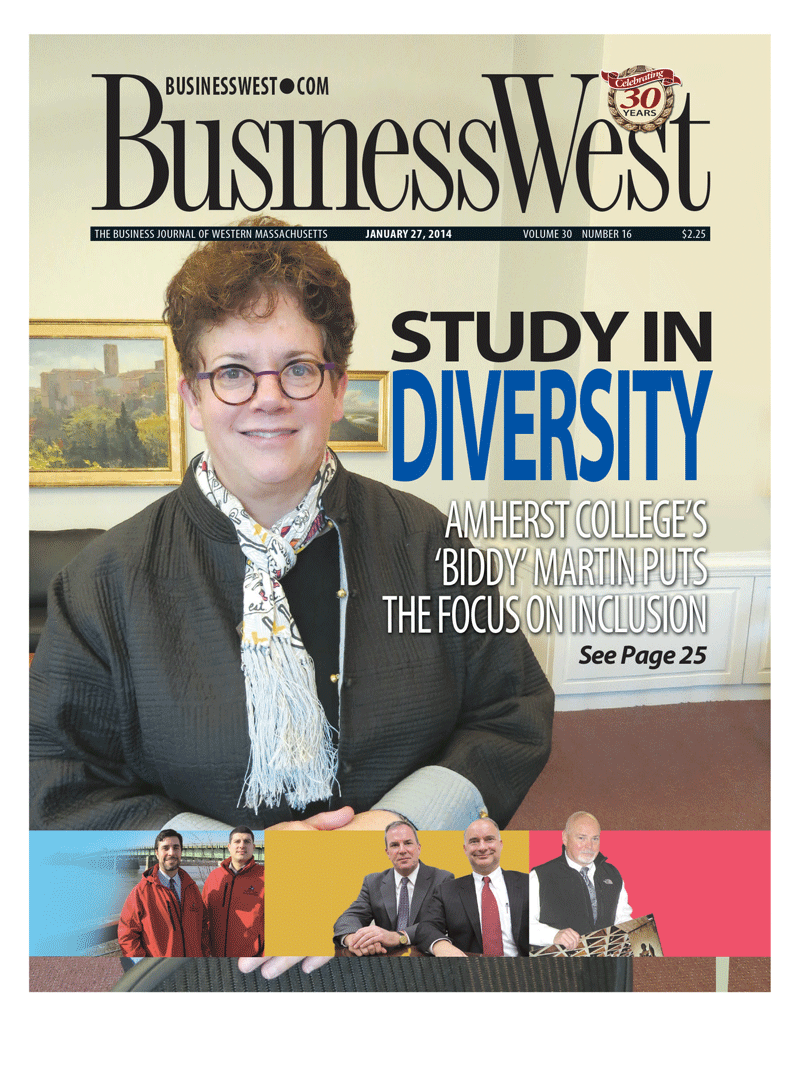
Opinion
The Tech Tax, from a Tech Firm’s Angle

By DELCIE BEAN

In July, Massachusetts imposed a 6.25% sales tax on ‘computer system design services,’ which means this state now has the highest tax on computer and software services in the country.
Large and small tech firms across the state are dismayed at the new tax’s potential effect on our businesses. We are confused by the vagueness of the tax — it’s unclear in many cases what services are to be taxed and what aren’t. The state Department of Revenue originally promised a clearer definition of what was and wasn’t taxable by October; however, it now appears to be backing off even that date.
Meanwhile, the tax still must be collected, all the way back to July 31, one day after the DOR first offered a definition of the tax. We feel ambushed by the 11th-hour manner in which it was pushed through, just before legislators’ summer break, with no allowance for consumer or business input.
One of the particular challenges of this law is that the staff of my company, Paragus Strategic IT, collectively records approximately 500 unique billable events each day and would therefore need to train its entire staff on how to make very complex assessments of whether each of the individual tasks they performed was taxable or not — using a definition so complex that the state can’t even define it.
Couple this with the fact that Paragus, like most IT companies, uses a ticketing system to keep track of the billable work it does for its clients, and that these systems were not designed to allow technicians to mark work as taxable or non-taxable. In order to properly manage these changes without compromising profitability and efficiency, six to 12 months would have been required. Instead, Paragus is faced with having an administrator spend 20 to 30 hours a month going through the billable work of all technical employees and identifying which work is taxable or not.
We are not alone. As reported in the Boston Globe, Springfield attorney Scott Foster, a partner with the law firm Bulkley, Richardson and Gelinas, LLP, has announced plans to challenge the tax in court, declaring it unconstitutional. This announcement resulted in Gov. Deval Patrick officially going on the record as saying he was concerned about the impact on the state’s efforts to expand its technology industry.
I started the company that became Paragus Strategic IT when I was 13 years old. What was once a one-man operation has turned into a company with 31 full-time employees and clients all over New England. For the past two years, we were named in the top third of Inc. magazine’s annual ranking of the 5,000 fastest-growing businesses. In 2012 we were named the second-fastest-growing outsourced IT firm in all of New England. Our growth has allowed us to add a staff member approximately every six weeks.
Like other local tech companies, we are doing what we can to bring jobs and economic vitality to the Pioneer Valley. This new tax isn’t making our job any easier.
In the near term, I am worried about how our clients will react to the new charges and how we will possibly become compliant in the very short period of time allotted. In the long term, I am concerned about the tax’s effect on one of the state’s major growth industries. This new tax is one more sign that Massachusetts might not truly be vested in the long-term best interests of the technology sector, making it harder to attract the biggest employers.
A 2014 ballot initiative is being filed to repeal the tax. Until then, we are doing what we can to operate under this new tax, to the best of our understanding, with as minimal impact to our clients as possible. We do encourage people to take a look at the tax and to think about the role of the tech industry in the Pioneer Valley, both now and in the years to come — and to think about whether there might be a smarter way to raise the extra revenue.

Delcie Bean is founder and president of Paragus Strategic IT.

Law Sections
Rulings Blur the Lines on Associational Disability Discrimination

SUSAN G. FENTIN

SUSAN G. FENTIN

Two recent rulings by Massachusetts appellate courts have both confused and clarified the state’s anti-discrimination statute, Mass. Gen. L. Ch. 151B, which bars employers from discriminating against employees based on their handicap/disability.
In July, the Massachusetts Supreme Judicial Court (SJC) ruled, in Flagg v. AliMed, that Ch. 151B can, under certain circumstances, protect an employee when the employee himself is not actually disabled but instead is associated with a disabled individual. Then, in August, the Massachusetts Appeals Court dismissed a similar lawsuit brought by an employee who claimed that he was terminated because of his association with his autistic son.
In Flagg, the employee had worked for AliMed for 18 years with good performance appraisals. Flagg was a salaried employee entitled to benefits under AliMed’s health-insurance plan. Unfortunately, his wife had to have surgery to remove a brain tumor, and Flagg then became responsible for caring for the couple’s children. Flagg asked for permission to occasionally be briefly absent from work to pick up his daughter from school, and his manager told him to do whatever he needed to do to take care of his family.
AliMed later terminated Flagg, however, allegedly because he had failed to punch out and had, therefore, been paid for hours he had not actually worked. Apparently, the real reason for the decision to terminate Flagg was that his wife had again been hospitalized, and AliMed did not want to be financially responsible for the enormous medical bills. Flagg sued, but the trial court dismissed his suit on the grounds that the plain language of the statute protects only a handicapped employee, not an employee who is associated with a handicapped person.
Flagg appealed, and the SJC overturned the trial court’s decision. The SJC concluded that, when an employer takes action against an otherwise satisfactory employee because of his spouse’s impairment, it is targeting the employee as the direct victim of its discriminatory attitude, punishing the employee as if he were the handicapped individual himself. Accordingly, the SJC ruled that Ch. 151B could be read to incorporate the concept of handicap discrimination based on association.
The Massachusetts Appeals Court’s decision in Lashgari v. ZOLL Medical followed the SJC’s decision in Flagg, but reached the opposite result. In Lashgari, the employee claimed that he was forced to resign because of mistreatment by the employer. The employee alleged that he told his supervisor in February 2010 that he could not work overtime because his autistic son required constant care. He was subsequently demoted by a different member of management and placed on a performance-improvement plan.
This demotion apparently led to severe emotional distress, and ultimately, the employee felt he had no choice but to resign. In its decision, the Appeals Court affirmed the trial court’s decision dismissing the case. Citing Flagg, the court ruled that Lashgari’s complaint did not allege any facts that would show that he was fired because of his association with his handicapped son. The court found no connection between Lashgari’s conversation about his son’s autism and the subsequent adverse employment actions imposed by another supervisor, and the timing of the demotion, by itself, was not enough to support a claim of associational disability discrimination under Ch. 151B.
Significantly, in a concurring opinion to Flagg, two justices raised their concern that the decision might be interpreted more broadly than the SJC had perhaps intended. Although the Flagg decision, in a footnote, states that it is not intended to address reasonable accommodations for employees who are associated with disabled individuals, the concurring opinion cautioned that this ruling should be strictly limited to cases where a spouse’s disability could, for example, increase the employer’s health-insurance expenses or where the employer might fear that an employee could contract a disabling or contagious disease through his association with a disabled person.

Bottom Line
The SJC’s decision in Flagg makes it clear that an employer may not terminate an employee because of fears that its health-insurance premiums will go up, even if those expenses will not increase because of an employee’s own disability but instead because of a disabled individual associated with the employee. It is unresolved at this point whether the SJC’s Flagg decision will impact the ability of an employee to claim he is entitled to a reasonable accommodation for the disability of someone with whom he is associated.
Following the SJC’s decision, this case was returned to the Superior Court for trial, and we can imagine that the damages here will be hefty if the jury finds for Flagg.

Susan G. Fentin is a partner at the firm Skoler, Abbott & Presser, P.C., and editor of the Massachusetts Employment Law Letter; (413) 737-4753; [email protected]

Opinion
‘Tech Tax’ Imperils State’s Growth

The prevailing opinion is that Florida Gov. Rick Scott didn’t do Massachusetts any favors recently when he sent out letters to 100 Bay State companies essentially inviting them to explore the Sunshine State and discover why it makes sense to move operations there.

Actually, however, he did the state a huge favor.

He reminded everyone on Beacon Hill of something they probably knew — although they don’t act like it: that business owners have options when it comes to choosing where to locate or launch, and Massachusetts is increasingly looking like a less-attractive option.

The timing of Scott’s letter coincides with implementation of the Bay State’s so-called ‘tech tax,’ or software tax, a levy on ‘computer software design services,’ a controversial measure that is being fought by business owners, economic-development groups, legislators, and other constituencies that understand that it is arbitrary, confusing, and threatens to stifle one of the strongest pillars of the state economy.

But the tech tax is just part of the story. The larger piece is that this state continues to believe that it can tax and spend without consequence. The truth is that it can’t, and Rick Scott’s aggressive actions simply provide more proof of that.

But let’s back up a minute.

Massachusetts is still an attractive state in which to live, work, and do business. There is an enviable quality of life here, dozens of fine colleges and universities, a host of cities and towns that could — and often do — make those ‘best places to live’ lists, and a strong, educated workforce.

Maintaining all this takes resources, and for the past several decades, elected officials have essentially said that the only way they want to amass these resources is through new and different ways to tax individuals and businesses.

Indeed, in addition to the tech tax, the state recently implemented higher levies on cigarettes and gasoline. You can go to those wells only so often (although, in this state, we do so frequently), so to fund needed infrastructure and transportation programs, the state looked in a different direction — its burgeoning tech sector and the services it provides.

This new levy might truly be a lucrative source of tax revenue (that’s might; no one really seems to know how much it will generate), but its implementation shows — again — that legislative leaders are shortsighted and unable to grasp the big picture.

Forty-six states don’t have tech taxes, and for one big reason: they’re trying to grow that sector, which is one of a few with vast potential for creating new jobs in the years and decades to come. Massachusetts leaders know this well — they’ve seen it first-hand — but they’re acting as if they’re taking this sector for granted and that they don’t take people like Rick Scott seriously.

They should.

And they can show that they mean business — in both a literal and figurative sense — by taking steps to indicate that they know and care about the fact that business owners really do have options. The place to start is with a move to repeal the tech tax, which threatens everything from the growth of existing companies to the prospects for new tech startups.

And from there, the legislature can take additional steps to counter what is perhaps the strongest line in Scott’s letter: “it’s bound to get worse in Massachusetts.”

Like we said, Scott did the state a favor. Let’s see if Massachusetts is smart enough to take advantage of that.

Health Care Sections
Spiros Hatiras Set to Take the Reins at Holyoke Medical Center

Spiros Hatiras

Spiros Hatiras is slated to take the helm at Holyoke Medical Center in September, succeeding long-time president and CEO Hank Porten.

Spiros Hatiras likened it to being homesick.

That’s how he chose to describe his mindset during what would become the latter stages of his tenure as chief executive officer of NIT Health in New York, a health-informatics company that specializes in the implementation of electronic medical records for hospitals and healthcare systems.

He enjoyed the work and found it rewarding in some respects, but the more he was in that position, the more he realized just how much he missed what he would later describe as his passion — leading a small community hospital.

“I really missed hospital administration,” said Hatiras, who joined NIT after a two-year stint as president and CEO of Hoboken University Medical Center (HUMC), where he also served as chief operating officer, vice president of Administration, and many other positions during a 19-year tenure. “I missed that sense of community, that relationship building that goes on when you’re part of a team.”

So Hatiras eventually put the word out to executive search firms that he would be interested in returning to that realm. But there were some caveats, or conditions under which he would like to do so, he told BusinessWest, adding that he set out what he called a “profile.”

The institution in question had to be in a good location, preferably the Northeast, he explained, adding that he preferred a community hospital with 200 to 300 beds in a small to mid-sized community (the situation at HUMC), and one with a good staff and a reputation for quality. The facility also had to be in “good shape,” which in this case meant the soundness of both the physical plant and the fiscal bottom line.

“I didn’t want to walk into a dire situation — I’ve been involved in those, and while it’s rewarding when you can pull out of one, I didn’t want to get back in a situation where, from day one, you’re struggling to keep your head above water,” he said, adding that one institution he was asked to consider could check all those boxes and thus fit that profile — Holyoke Medical Center, which was seeking a successor to Hank Porten, who announced he was stepping down after nearly 30 years at the helm of that facility.

Fast-forwarding a little, Hatiras eventually prevailed in a nationwide search for HMC’s new director; he is slated to start in early September. He spoke with BusinessWest late last month about why he chose to accept this challenge at this stage of his career, while also touching on the challenges moving forward — for all community hospitals, and especially HMC.

At the top of that list is fiscal stability, he said, noting that ‘survival’ is too strong a word for a facility that is in decent condition financially, but still must fight for every dollar in reimbursements from payers and aid from the Commonwealth.

“This is simply a hospital that needs to keep its eye on the ball,” said Hatiras, noting that HMC is what’s called a “safety-net hospital” in Massachusetts, one that receives a combination of state and federal assistance to offset the large amount of free care that such facilities provide; Mercy Medical Center is also one. “We need to make sure we don’t miss an opportunity when it comes to grant money and other programs.”

There are other matters to contend with, such as updating a long-term strategic plan for the facility, and also improving visibility and awareness of a medical center that has a solid reputation and many quality programs, but remains too much of an unknown quantity in this region.

“What I’ve heard loud and clear from everybody is that we do a lot of great things here — we’re the number-one stroke center in the state of Massachusetts for performance, and we have a lot of other great programs — but folks here think we don’t put it out to the community enough, and people don’t know about them,” he explained. “We need to figure out a way to get the message out, because if you do wonderful things and no one knows about them, you can’t get the recognition and the patients you need.”


Background — Check

Hatiras told BusinessWest that, unlike many hospital administrators today, he started out in direct patient care, as a physical therapist.

“I remember my first day on the job at St. Mary, which is what the hospital was called before it became University of Hoboken Medical School,” he said. “I got yelled at by the head nurse because, after I was finished with a patient, I left the bed rail down, and she was concerned about the patient falling out of bed.

“This gives me a good perspective; I’ve treated patients, I know what pain is like, especially in physical therapy, and know from a staff’s perspective what it takes every day to take care of patients,” he continued, referring to the many career stops he’s made and titles he’s held, ranging from corporate director of Rehabilitative Services to vice president of Post-Acute, Ancillary, and Support Services. “I started with patient care at the bedside, I’ve done home care, I’ve done nursing care and rehab — and my management style reflects all this. I’m easygoing, I can establish a rapport with patients and staff easily, and I’m personable. I like to walk around and talk to people, eat in the cafeteria, and chat with people; my door is always open.”

And at HMC, that door will be in the hospital, he went on, noting that Porten moved to what was supposed to be a temporary office in another building on the medical center’s campus during an extensive renovation and expansion project undertaken in the late ’90s, but that move turned out to be permanent.

“I’ll find space — I don’t care if it’s in a closet,” he explained. “For me, it’s very important for physicians, employees, and managers to easily access me, and for me to be close to patient-care areas.”

This is how it was at HUMC, which Hatiras led through a situation that could only be described as dire. Indeed, during his tenure, and while transitioning the hospital from municipal to private ownership, he implemented fiscal controls that resulted in a 50% reduction in operating losses, from a $22 million loss in FY 2008 to $11 million in FY 2009. He also achieved a balanced budget the next year, without a reduction in force, by negotiating concessions with employees, physicians, and vendors, which resulted in savings of more than $15 million for two years.

Other accomplishments at HUMC include implementation of an electronic-medical-records system, creation of a hospitalist program, and the securing of a number of grants for operational and infrastructure improvements.

The challenges at HMC will be different, as most all of the above, including financial stability, has been achieved. Looking ahead, he said, beyond finding space for his office, the immediate priorities are to meet with a host of constituencies — physicians, employees, the board of directors, business leaders, and Holyoke city officials — to get a better feel for how well the facility is serving the community, and where change and improvement is needed.

Hatiras said he’s already met with a number of employees and physicians during a few visits to the medical center for interviews, and a few others after he was hired. He came away impressed with the long tenures of many of those he met, but also somewhat intimidated by the notion that many will be retiring within the next decade or two.

“The longevity here is amazing,” he noted. “It seemed like everyone I met said they’d been here 30 years or more. That’s fantastic, but it’s also a challenge; we have to make sure we have good people to follow. That’s something we have to plan for.”


Let’s Get Fiscal

While he won’t have to contend with mass retirements any time soon, there are some matters that will need more immediate attention.

At or near the top of that list is being ready as a community hospital for what is still in many respects an uncertain future in the healthcare industry.

“This is a big unknown — I think healthcare reform is not done with us yet, not by a longshot,” he said, referring to payment reform — specifically, paying providers to keep people healthy, not just for treating them when they’re sick — and other issues. “Is there a formula under which community hospitals can survive? I think there is. I’m not of the opinion that you have to merge with someone or be affiliated with someone to survive, but it’s not an easy road, either.

“If you work with your community, if you work with your physicians, and if we’re heading in the direction of payment reform and population health, then I believe community hospitals have a better chance of leveling the playing field,” he continued. “If it continues to be simply a volume game in the future and a rates game, then that’s a harder game to win; the bigger hospitals get the bigger volumes, and they get the higher rates from private payers.”

Another issue moving forward is raising HMC’s profile in the region, he said, adding that this is a big part of the challenge of changing the perceptions, and habits, of people who believe they can get better care in Springfield, Hartford, or Boston than they can in Holyoke.

It’s a situation Hatiras said he faced in New Jersey, when he assumed management of the rehabilitation hospital within St. Francis Hospital (part of the Franciscan Health System of New Jersey), which operated in the shadow, figuratively and almost literally, of the Kessler Institute for Rehabilitation, known for treating Christopher Reeve, among countless others.

“When they needed rehab, people automatically assumed that the best place to go, and the only place to go, was Kessler,” he said. “Here we were, the new kid on the block trying to attract those patients, and they would literally travel from our community 15 or 20 miles to the Kessler facility.

“Changing people’s perceptions is a lot of hard work,” he continued. “It’s relationship building, word-of-mouth referrals, and you have to make sure that people have a good experience and people feel good enough about it to tell others.”

At St. Francis, administration and staff did a lot of what Hatiras called “legwork,” which included everything from providing high-quality care to making sure that physicians in that area were aware of the outcomes, and that they were comparable, or better, than Kessler’s.

“That’s really the only way you can do it,” he went on. “Yes, you can put up a billboard, and you can put an ad in the paper — and those are necessary too — but the best advertisement, and the best marketing, is when people say, ‘I had a great outcome, the people were nice, I was in and out, I had a great experience.’”

Moving forward, HMC will try to use similar legwork, and perhaps some of those advertising vehicles, to make it known that it has a lot going for it, said Hatiras, from a location right off I-91 to a strong track record with regard to outcomes.

“We want to be the place for the immediate community, the neighborhoods right around the hospital,” he said, “but we also want to be the place for the people who choose to come here, because they’ve seen something good about it or heard something good about it, not just because they live next door. There is a lot to build on here.”


At Home with the Idea

In a month or so, Hatiras will no longer be homesick.

Instead, he’ll be home, in hospital administration, and presumably in an office in the main building at HMC not carved out of a closet.

As he talked with BusinessWest about the type of scenario he desired as he returned to hospital management, he said he didn’t want a dire situation, but certainly did covet a challenge.

“I get easily bored with routine,” he said with a laugh. “I need spice in my life. Healthcare in general provides enough of that, but if you’re in a small place that needs to fight for every dollar, that usually provides a little more spice.”

And that’s one more reason why HMC fit his ‘profile,’ and is now the next line on his résumé.


George O’Brien can be reached at [email protected]

Community Profile Features
Business, Family Roots Run Deep in South Hadley

CommunityProfilesMAPSoHadleyWhen asked for his thoughts on the fire that recently gutted the Dockside restaurant at Brunelle’s Marina, Michael Sullivan paused for a moment to collect his thoughts.

“The Brunelle family has been a cornerstone of the South Hadley business community for a long time,” the town’s administrator said. “It’s important to the community; people come to South Hadley to cruise on the Lady Bea or access the Connecticut River, and the Brunelles have built quite a reputation — and quite a business — there.”

It was a fitting thought, as several of those words — business, community, reputation, long time — were summoned again and again in discussing the economic character of South Hadley, a town where small, multi-generational family companies dominate a commercial sector that’s relatively tiny compared to neighboring communities like Chicopee, Amherst, and Hadley.

And it’s that deep-seated community identity that has the Brunelles firing up lunch and dinner under an outdoor pavilion while their eatery overlooking the marina is rebuilt.

“They’re resilient,” Sullivan said. “They’ve got all their permits reprinted up, everything is in place, and they’re looking to get back at it in quite an aggressive fashion — and we’re looking to do everything we can to support them.”

Dr. Steven Markow, owner of Village Eye Care and president of the South Hadley & Granby Chamber of Commerce, also expressed sympathy after the fire, noting that the Brunelles have been part of South Hadley’s business picture for a long time, but they’re far from alone.

“Carey’s Flowers has been around here for decades. All Star Dairy is a long-time, long-standing family business. There’s Chapdelaine’s Furniture, Jubinville Insurance, Ryder Funeral Home, and many others … there has been a lot of stability in that way. It’s a generational town in a sense, and the same is true of many businesses.”

That stability extends to residential life in what Markow calls a bedroom community. He said he recently consulted a world atlas from 1960 that listed South Hadley’s population at around 15,000; today, it’s just over 17,500.

Dr. Steven Markow

Dr. Steven Markow says South Hadley is a generational town in many ways, for both families and businesses.

“I’ve been here for 17 years, and I’m just starting my 13th year in business — so, by South Hadley standards, I would be considered a newbie,” he said. “But as president of the chamber, I’d say we have a very diverse membership, and it’s that diversity that helps keep the economy somewhat stable and strong here. Of course, that’s true of the whole region. I think, relative to how things are in other parts of the country, we’re doing fairly well here, although we could do a lot better.”


Reversing the Fall

With a thriving town center driven by the bustling Village Commons — with its 100% occupancy rate and mix of retail, restaurant, service, and office tenants — and the more than 2,300 students at Mount Holyoke College, the challenge for South Hadley is to focus on more-challenged areas of town, such as the Falls, just across the Connecticut River from downtown Holyoke.

“We’re moving on with some new tools we think will be advantages for economic development,” Sullivan said, noting that the town recently invited John Fitzgerald, urban development coordinator from the state Department of Housing and Community Development, to talk about the usefulness of a redevelopment authority, which would have the power of eminent domain to seize private property. “We think, particularly in an older community, you need to amalgamate properties to make it viable or attractive to developers to come in and make investments. The redevelopment authority can be a wonderful tool.”

Sullivan said such a move is long overdue. “The Falls is an area that has been unintentionally neglected for a long period of time, and we need to be a little more dutiful and pay attention to it.”

the fire-gutted Dockside

The Brunelle family has kept food service going under an outdoor pavilion while they make plans to rebuild the fire-gutted Dockside.

The Falls will benefit next year from a new, $10 million public library overlooking the Holyoke Dam, and the neighborhood also received a profile boost this summer with the first Falls Fest, a free, all-day music event at the Beachgrounds, the recently renovated park beside the river.

“We got the buzz out, and everyone who was there had a great time,” said Markow, adding that the neighborhood has the potential for more such events. “The idea was, what can be done to revitalize the economy of the Falls? This was a wonderful step in the right direction. The bands who performed there thought it was the best place they had ever performed, because it provided everything one would need for a venue — food vendors, craft vendors, shade for a summer day, kids got to play in the splash park … it’s a great place to come listen to music.”

Sullivan also welcomes a multi-faceted approach to boosting the Falls. “That’s really our focus; we’re trying to revitalize and find adaptive reuses for the area, and we’re looking at having more events there. Some people say that the way cities get rediscovered is through those types of events. People come in and say, ‘wow, I never knew this was here; I want to invest.’”


Success Stories

Decades of investment are clearly visible at the Village Commons, across Route 116 from the college, home to six restaurants, Tower Theater, and a host of retail shops and other businesses.

“When I moved here 17 years ago, there were more retail shops in the Village Commons, but retail has gone through some tough times,” said Markow, whose eye-care practice neighbors the complex. “What’s evolved is more food and service, which probably is a microcosm of the whole economy in general. It’s the center of town, and it’s thriving; they’re doing very well there, and a couple of new food places went in recently. People like coming there; it’s a good, central location.”

Mount Holyoke itself provides much of the energy in that neighborhood, he added. “In my opinion, South Hadley is extremely lucky to have Mount Holyoke College in its midst because it’s a world-class higher-education institution, the first all-women college in the country that’s still in operation. It has a world-class art museum, outstanding faculty, and a first-class equestrian center that brings equestrian shows here and helps the economy. The college just brings the town to a higher level.”

Although South Hadley receives just 8% of its tax revenues from businesses, Sullivan noted, “what’s not listed in that statistic is Mount Holyoke College, a nonprofit business. If you put that into the valuation formula, as an economic-development engine, that is quite significant — the jobs it creates, the investments made by the college.”

A prestigious college is just one piece of the community’s education strengths, Markow added, which includes the new public library and plans for a new Plains Elementary School. “It’s this kind of development which helps to attract families to the community. When they see investment in the school system, that’s very important to new families coming into town.

“I try to work with the schools because I think having a high-quality school system is part of the formula that makes a community strong and stable,” he continued. “The new superintendent of schools here, Dr. Nick Young, has been a very willing partner. He wants to cultivate a mutually beneficial relationship with the business community, and he’s really reached out to us.”

Despite the town’s strong points, however, commercial vacancies remain, Markow told BusinessWest, and there’s plenty of room for improvement in the town’s overall economic outlook.

“I don’t know what the answer is. How do you bring in new business when everyone is still holding back?” he pondered. “From the chamber’s perspective, we’re limited by our resources, and we could do more with more resources. My pitch is trying to get more businesses on the chamber; a large group has more clout than a small group. That’s one of our missions, to increase membership, increase resources, and be more effective in improving the quality of life in town and supporting the business environment.

“Personally,” he went on, “my mission as president is to see what we can do to improve quality of life in town because that’s going to attract new people to come live here, help stabilize the property values, and just make it a nicer place to live. What can we do to make it a nicer place to live? That, in turn, will trickle down and make the economy better.”


Coming Back

Markow noted that the town’s economic strengths are tempered by losses like the Big Y on Newton Street, which the property owner has no plans to retenant in the near future.

“That was a very disappointing occurrence because it had been a grocery store for quite a long time, and as New Englanders, we’re used to not changing. But what’s really disappointing is keeping the place vacant for a number of years, which I find unhelpful to the economic health of the town.”

On the other hand, Sullivan noted, “Village Commons is in discussion about expansion of their retail and mixed-use development. That’s exciting. So there are a lot of good things happening in a lot of different ways from an economic-development standpoint, but we still have a long ways to go.”

As for the Dockside, he applauds the Brunelles’ efforts to bring the restaurant back to life.

“That’s one of the places people go to recreate and spend money,” he said, including the Ledges and Orchards golf courses, McCray’s Farm, and the college area in that category. “It’s all about destinations in the community.” n


Joseph Bednar can be reached at [email protected]

Opinion
Building a Diverse Nursing Workforce

By CHERYL A. SHEILS

 
Healthcare reform presents new challenges and opportunities for the nursing profession, in both academic and practice settings. The Institute of Medicine (IOM) recently released its report, “The Future of Nursing: Leading Change, Advancing Health,” which included among its recommendations raising the education level of the nursing workforce.

The IOM recommends doubling the number of nurses with doctorates, and increasing the baccalaureate-prepared RN population to 80% from its present level of 50% by 2020.

The mandate for healthcare reform comes at a time of shifting population demographics.  According to the U.S. Census Bureau, Latinos now account for nearly 10% of the Massachusetts population.  Furthermore, the increase in the Latino population alone accounted for more than 60% of the state’s total growth between 2000 and 2009. Currently, nearly 21% of Hampden County is Latino.

Nursing’s leaders recognize a strong connection between a culturally diverse nursing workforce and the ability to provide quality, culturally competent healthcare to an increasingly diverse population. Unfortunately, national enrollment in baccalaureate nursing-education programs is not keeping up with the changes in population demographics. The American Assoc. of Colleges of Nursing’s 2011 annual report notes that Latinos account for just 6.8% of total baccalaureate enrollments. While these numbers reflect improvement over previous years, diversity of the RN workforce remains far less than that of the general U.S. population, and Latino RNs remain the most underrepresented minority group.

A main route to upward mobility and equality of opportunity for minorities in the healthcare industry is equity of access and success in achieving the baccalaureate nursing degree. A number of studies have shown that inadequate academic preparation and financial barriers are significant for Latino nursing students.

Here, taken from the higher-education literature as well as interviews with Latina nursing students, are recommendations for practitioners working in the field of higher education and, in particular, baccalaureate nursing-education programs.

• Establish seminars conducted by college financial-aid officers for low-income Latino families and students to provide them with information on how to finance a college education, including eligibility for Pell grants and assistance with the grant application process;

• Provide specific information to first-generation Latino students in secondary-education settings about how to set realistic goals for college, including what colleges and what careers to consider;

• Develop outreach programs with high schools in which student-affairs officers and college-student ambassadors help familiarize Latino high-school students and families with the various aspects of the college experience, with the added benefit of creating linkages between high-school and college students;

• Create credit-bearing college-transition programs that could be offered in 12th grade or during the summer before college to get Latino students ready for college-level work;

• Establish core groups of student advocates whose purpose it is to reach out to Latino students and help them connect with available resources on campus;

• Adopt proactive academic-advising systems that reach out to Latino students rather than waiting for a student to ask for help, and have bilingual staff available in academic-advising and resource centers;

• Establish connections with Latino nurses in the practice environment and with the local chapter of the National Assoc. of Hispanic Nurses for the purpose of developing a cadre of career mentors and professional role models;

• Create programs in which nursing graduate students advise and mentor undergraduate Latino students on earning credit toward their graduate degree;

• Provide professional-development programs that help nursing faculty examine their own attitudes regarding teaching diverse students and assist them in creating relevant cultural-competence curricula; and

• Place students in cohorts that follow the same course and clinical schedules throughout the nursing curriculum to facilitate the establishment of strong Latino nursing-student peer and study groups.


Cheryl A. Sheils, is a registered nurse and associate professor of Nursing at Elms College; [email protected]


Opinion
Gateway Cities Don’t Need Silver Bullet

By ALAN MALLACH and LAVEA BRACHMAN


They have been called shrinking cities and gateway cities. But by any label — our preferred term is ‘legacy cities’ — medium-sized metropolitan areas struggling with manufacturing decline and population loss are a never-ending project in many parts of the country, including Massachusetts.

Almost every year, some silver bullet — a sports arena, a casino, a conference center — promises salvation and rebirth for Brockton, Lawrence, New Bedford, Springfield, or Pittsfield. Avoiding the fate of Detroit, which just filed for bankruptcy, only adds to the pressure for a big solution.

The truth is, the silver-bullet syndrome can inhibit revitalization. A megaproject can become an important asset, but it is not a strategy for change in itself, unless it is integrated into larger schemes to make a meaningful contribution to the city’s future. A more incremental approach built on collaboration and partnerships holds more promise for rebuilding.

The way forward may look more like silver buckshot — with a focus on these key areas:

• Have faith in downtowns. The physical fabric of the central core, with density, a walkable urban texture, and proximity to major institutions and employers, is a powerful attraction for young single people and couples, and a strong basis for residential redevelopment. Set a friendly regulatory environment for infill redevelopment, reinvent public spaces, and encourage private market reuse of older buildings.

• Sustain viable neighborhoods. In these targeted areas, build partnerships with neighborhood associations and community-development corporations to implement multifaceted neighborhood strategies that draw demand, rebuild housing markets, and address destabilizing elements such as crime, foreclosure, and property abandonment.

• Don’t be afraid to demolish. Repurposing large inventories of vacant land strategically is a major springboard for change in heavily disinvested areas. Cities should explore large-scale reconfiguration of land uses, including the use of vacant land properties for public open space, urban agriculture, or stormwater management.

• Reinvent the economic base. Not every city can become the next biotech capital. But an honest assessment of local assets and regional competitive advantages can help build new export-oriented economies. Partner with local educational institutions and major employers to build an educational and workforce-development plan and a competitive regional labor market.

• Build new partnerships. In almost every city, universities and medical centers — ‘eds and meds’ — are bedrock institutions, part of a foundational network of public, nonprofit, and private collaboration. Similarly, state and federal governments must rethink their roles, becoming more nimble, more effective, and less biased toward suburban areas.

• Make sure all city residents benefit from change. Many cities are fractured, with large and growing economic and racial disparities. Engaging residents, and providing the educational and workforce-development systems they need to become competitive, can build a stronger city for everyone.

While legacy cities and their regions are already inextricably linked by social and economic realities, far more must be done to make these connections positive forces for regenerating both the city and the rest of the region. Public-policy changes at both state and national levels should be pursued to foster greater regional integration. Regionalized infrastructure, particularly transit, sewer, and water systems, should be encouraged to strengthen city and regional ties that foster economic growth.

All this may sound as if so many pieces need to fall in place. They do. Yet, an approach we call ‘strategic incrementalism’ can help keep the momentum going. Rather than devote significant time and resources to large-scale, comprehensive planning, legacy cities should focus on building partnerships, supporting multiple initiatives, and more organically internalizing a shared vision for the future.

America’s legacy cities were once the great economic engines of this country. The right mixture of new forms and directions, fueled by their powerful assets and historic can-do culture of achievement, can provide the springboard for a new era of prosperity.


Alan Mallach is a senior fellow at the Center for Community Progress. Lavea Brachman is executive director of the Greater Ohio Policy Center.

Opinion
A Critical Vote for Springfield

Almost one year ago, the Springfield Chamber of Commerce began discussing what impact an $800 million gaming resort would have on the city of Springfield and its residents, workforce, and business community. We engaged all the developers, consulted with chambers of commerce throughout the U.S. that had casinos in their cities, and completed extensive analyses.
We wanted to be sure we thoroughly understood the issues and also understood how to capitalize on the positive impact an $800 million investment would have on the city and the region, and minimize any potential drawbacks. In the end, we determined that the benefits presented by this opportunity far outweighed any reservations, and the chamber membership endorsed a Springfield-based casino.
The city of Springfield has now chosen MGM as its preferred applicant for the sole Western Mass. license. The Springfield Chamber stands firmly with the city on its decision and supports a ‘yes’ vote on July 16.
So, why does the Springfield Chamber of Commerce take this stand? There are many reasons, including:
• Jobs. According to the analysis, 2,000 construction jobs will be followed by 3,000 permanent jobs covering a broad spectrum of career and occupational opportunities, from the service sector to manufacturing to professional services. These 3,000 jobs are new jobs for Springfield and the region. With jobs come opportunities — for educational and professional advancement, financial stability and financial independence, home ownership … the list goes on. With those jobs comes increased disposable income. And the business community reaps a benefit as well: dollars will be spent locally with existing businesses, expanding businesses, and fueling our future entrepreneurial opportunities.
• Tax revenues. Significant amounts of tax revenues, including property taxes, meals taxes, and hotel-room taxes, along with several other dedicated funds to be paid by MGM as committed to in the host-community agreement, will flow to the city.  These added revenues will aid Springfield in enhancing public safety, supporting our school system, maintaining roads and parks, and much more.
• Business development. The chamber strongly believes that there are many opportunities for existing businesses to become vendors of goods and services to the resort. Written into the signed agreement between the city and MGM is a commitment to provide $50 million per year of procurement opportunities for locally provided goods and services to meet MGM’s needs. As part of the chamber’s due diligence, it solicited feedback from other business organizations where MGM has a gaming facility and found that MGM has been true to its word.
The chamber also wanted to be sure that local businesses, especially those that have been the lifeblood of the city for many years, were not disadvantaged by the resort. Again, MGM’s commitment in the host-community agreement reaffirmed its support for our business community, and the chamber is now very involved in reaching out to its members to determine what the supply of these goods and services is in our area and to assist any and all businesses in qualifying as vendors and increasing their production capacity if need be.
• Community support. MGM has also committed itself to the city and its people. Its commitments in the host-community agreement include numerous recreational amenities, such as an ice-skating rink, a vibrant riverfront, and an enhanced public golf course. Our world-class existing facilities, including the MassMutual Center, Symphony Hall, and CityStage, are all incorporated into the plans, and the commitments will help solidify the future of these great venues.
So, why does the Springfield Chamber of Commerce support a ‘yes’ vote? Jobs, income for individuals and families, property upgrades, discretionary spending kept within the community, enrichment to our existing cultural and recreational treasures, financial assistance to Springfield, and economic opportunities for all. These are the reasons  why the Springfield Chamber urges its members and the citizens of Springfield to embrace MGM and vote ‘yes’ for the city’s future on July 16.

Jeffrey Ciuffreda is executive director of the Springfield Chamber of Commerce.

Opinion
Education Reform at 20; There’s Work to Do

By Tom Birmingham
If you had told me on that hot day in Malden 20 years ago when Gov. Bill Weld signed the Education Reform Act that over 90% of Massachusetts students would pass MCAS, or that the Commonwealth’s SAT scores would rise for 13 consecutive years, or that our students would become the first in every category in every grade on national testing known as “the Nation’s Report Card,” or that Massachusetts would rank at or near the top in international science tests, I would have thought you wildly optimistic.
Massachusetts public schools have achieved all these results and more since 1993, but there is still more to do. I am troubled, for instance, by race- and class-based achievement gaps. Nonetheless, two decades after the passage of education reform, we have much to celebrate.
Hardworking students and committed teachers deserve the lion’s share of credit for our success, but policy makers established a structure that enabled educational progress. The Education Reform Act is a complicated piece of legislation containing many innovative initiatives, including the creation of charter schools.
But for all its complexity, the Education Reform Act can be reduced, in essence, to two propositions: We will make a massive infusion of progressively distributed dollars into our public schools, and in return, we demand high standards and accountability from all education stakeholders. This grand bargain is the cornerstone of education reform.
Our fidelity to these two core principles helps explain our extraordinary achievements. Throughout the 1990s and in the first years of this century, support for public education was the top priority of state government, and our budgets reflected this. From 1993 to 2002, state spending on public schools increased 8% per year, for a total of more than $2 billion. Our success correlated with the adoption and application of the criterion-based MCAS testing, with state leaders (notably including Paul Cellucci) united in support despite repeated requests to retreat.
Today, I fear we may be veering away from the act’s two core values — adequate funding and rigorous standards. If we abandon the bedrock principles that have proven to be historically successful, we imperil the progress we have made. In the last decade, support for public schools lost its primacy on Beacon Hill and state budgets reflect that. Today our inflation-adjusted education appropriation is the same as it was in 2002.
In contrast to the generous expansion of the 1990s, education funding for the last decade has remained flat. As a result, according to the Massachusetts Budget and Policy Center, many (mostly low-income) school districts simply do not have the resources needed to provide the caliber of education envisioned in the reform act’s foundation budget.
I also fear that universal high standards and objective assessments are being jettisoned in favor of a return to vague expectations and fuzzy standards. The Patrick administration’s embrace of so-called “21st-century skills” elevates concepts like “global awareness” and “systems thinking” to new prominence in the public-school curriculum. I’m all for higher-order thinking, but students must accumulate the background knowledge that gives them something to think about.
As education theorist E.D. Hirsch Jr. has demonstrated, achievement gaps are really knowledge gaps. Poor kids tend to have access to less background knowledge outside school than privileged kids. Unless poor kids are exposed to the same academically rich content in school that more affluent kids can get at home, we consign these students to second-class citizenship.
I’m also troubled by the Commonwealth’s willingness to replace our tried-and-true standards and MCAS with totally unproven national standards and testing. This conversion will come at an estimated cost of $360 million for new textbooks, professional development, and technology, according to the Pioneer Institute.
I am not suggesting that we adorn our public schools with “Mission Accomplished” banners. Indeed, we must always strive to improve K-12 public education. But education reform has worked far better than we could have reasonably hoped. Given our incontrovertible educational successes, those seeking changes should bear in mind the admonition of the Hippocratic oath: “First, do no harm.”

Tom Birmingham, former president of the Massachusetts Senate, is senior counsel at Edwards Wildman Palmer LLP. He coauthored the Massachusetts Education Reform Act of 1993.

Opinion
UMass Needs More Public Dollars

In the coming days, the Massachusetts Legislature will make an important decision about funding for the University of Massachusetts and, in so doing, will play a significant role in determining what kind of university UMass will be as it enters the next phase in its history.
On a literal level, the Legislature will decide whether UMass will receive the $479 million in funding for the upcoming fiscal year proposed by Gov. Patrick and approved by the House or the $455 million advanced by the Senate. The higher level of funding is important because it would arrest a long-term budget slide, make the state-student funding split more equitable, and provide students with an overdue tuition and fee freeze.
But the commitment we are asking the state to make is actually part of a much larger effort we are shaping to dramatically strengthen UMass and make sure it always will be the kind of public university that Massachusetts, with its innovation and intellectual horsepower, needs.
As we ask the Commonwealth to do more, UMass is also gearing up to do significantly more to provide the financial foundation a university needs to be great. And while it isn’t just about the money, dollars matter when it comes to attracting and retaining top professors, providing aid for students who need and deserve it, and ensuring that our facilities match up with our academic and research ambitions.
With that in mind, UMass this fall will launch its first system-wide capital campaign with the goal of dramatically increasing the private funds flowing into the university. These dollars will sustain a community of excellence — a reinforcing circle of top students, professors, and facilities.
Taken in tandem, a major infusion of public and private funds will give UMass the financial muscle it needs as it completes its first 150 years of service and prepares to make an even more profound contribution to the people of the Commonwealth.
UMass is the third university I have had the honor to lead. As I complete my second year as president, I am struck by one thing above all else — how much our five campuses have done with such limited resources.
Over the past 15 years, while state funding has remained flat, UMass has added 13,000 students (most of whom come from and will remain in Massachusetts), has seen student achievement rise to the point where its flagship campus in Amherst is now a top producer of Fulbright scholars, has won a Nobel Prize, has seen research expenditures reach $600 million a year, has become a national leader in income derived from faculty inventions, and consistently places in the upper reaches of the World University Rankings.
All of which prompts two questions: Shouldn’t we protect the great asset we have developed? And how much more could we do with a little more public and a lot more private support?
While we seek to gather the resources we need to make this a truly transformational moment, I realize that we need to keep front and center a value that is so much a part of our New England heritage — and that is frugality. Respect for a dollar is something I learned growing up in a Maine town where people eked out a living in mills and on fishing boats, and where scrimping and saving was an essential way of life.
Over the past five years, UMass has saved $68 million through efficiency steps, including consolidating administrative functions previously performed on each of the campuses. We expect to save another $123 million over the next five years by reducing energy expenditures, improving our purchasing practices, and streamlining information-technology operations.
Our commitment to transparency mirrors our commitment to efficiency, and, to make it easier to gauge our performance in key areas, we will release an annual performance report giving donors, public officials, and the public at large a better sense of how we are doing and what their dollars are helping to build.
UMass marks its 150th anniversary this year, so it’s a time to celebrate the past — and to build for a brighter and loftier future. With that future in mind, we are asking the state to join with us to create a truly historic moment. We have a chance to place UMass on a course that will allow it to soar — and this is an opportunity we have to seize.

Robert L. Caret is the president of the University of Massachusetts.

Opinion
Drivers Should Pay for the Roads They Use

Gov. Patrick is displeased with our legislators. Instead of his 10-year, $13 billion transportation plan, supported by an increase in income tax, the Legislature has put forward a more modest approach, making fewer promises for big projects and asking travelers to pay more of the costs of their transportation. However disappointing to Patrick, this more limited approach comes closer to how we ought to be raising money for transportation.
Legislators are dead right to expect commuters — not general taxpayers, who would pay the income tax hike Patrick proposed — to cover the costs of transportation infrastructure.
A key feature of the Legislature’s plan is a modest hike in the state gasoline tax. This approach, Patrick maintains, “taxes the middle class every time they pump a gallon of gas.” But drivers should pay for the cost of their roads. Taxpayers who rarely drive shouldn’t have to subsidize sprawl and long commutes. People will drive too much if they don’t pay for the social costs of driving, including the congestion, pollution, and highway deterioration.
Instead, American taxpayers have long subsidized the automobile. Gas taxes were supposed to fill a federal trust fund used for highway construction. When gas-tax collections fell short, President Obama signed a measure that added more than $16.6 billion in other revenue to the fund. Yet, the effect of building more highways isn’t to reduce congestion, but to encourage more driving. The only way we can make our roads less congested is to charge people to drive, ideally with electronic tolls, but also with gas taxes.
The House proposal to bring tolls back to the westernmost part of the Massachusetts Turnpike is a step forward, not backward. These roads may not be crowded, but they cost money to maintain. My rough estimate, based on state data, suggests that $1.50 per trip is needed to cover those expenses.
For years, transportation planners have taken a rise in the number of long-range commuters as an inevitable fact of life. Indeed, a 2009 study used such an anticipated increase as an argument for the long-proposed South Coast commuter rail line to Fall River and New Bedford. Yet, that assumption need not be true. Most people would live close to work if they paid the full costs of driving — especially if some far-sighted Legislature also limited the local regulations that make it hard to build nearer to Boston.
There are two obvious exceptions to the idea of making transportation users, rather than general taxpayers, pay for infrastructure. One is when a system has large fixed costs of construction and low costs of usage. The other is when a system serves a particularly disadvantaged population, such as the disabled, whom we want to make more mobile. The MBTA’s paratransit program exemplifies this second case for subsidy; the Legislature should ease the MBTA’s budget woes by separately funding that program. The MBTA as a whole meets both criteria for subsidy; it serves the poor and carless, and it has high fixed costs — which helps explain why only 32% of the MBTA’s budget comes from its users.
But the non-Bostonians who complain that outsiders pay too much of the system’s costs also have a point. The fairest way to embrace the ‘user-pay’ principle, while keeping fares low enough to reduce traffic, is to increase the portion of the MBTA’s budget that comes from local property assessments — and reduce the share that comes from statewide sales taxes. To the extent that statewide taxes are involved, they should be targeted toward the costs of poorer passengers, both in Boston and elsewhere. Addressing non-Bostonians’ concerns about subsidizing a system they don’t use will help get a fair transportation bill passed.
More local funding of the MBTA would also move us to a better dialogue about further rail extensions. If New Bedford and Fall River had to pay the full $1.8 billion cost of the proposed South Coast line, they would be far less enthusiastic about it.
In any case, the Legislature is right to reject a vast transportation program funded by income taxes. Patrick proposed a significant gas-tax hike in the past. And if the governor wants to spend billions on transportation infrastructure now, he should once again be open to a plan where drivers pay for the roads they use.

Edward L. Glaeser, a Harvard economist, is director of the Rappaport Institute for Greater Boston.

Sections Technology
Holyoke Medical Center Innovates with Shared Patient Information

Carl Cameron

Carl Cameron says the future of healthcare IT is the instant sharing of information among different providers, and HMC is busy developing that connectivity.

It’s an increasingly connected world out there, Carl Cameron says, and healthcare providers can no longer deny it.
As director of Information Technology at Holyoke Medical Center, he understands better than most the trends and government mandates that have begun to collide like tectonic plates in his industry — forever altering the medical landscape.
Fortunately, he said, HMC has been well ahead of the game.
Take, for example, the Healthcare Information and Management Systems Society (HIMSS) and its data-analysis arm, HIMSS Analytics, which tracks the progress of healthcare organizations toward meeting federal mandates for electronic health records (EMR).
“They are the organizational IT group for healthcare,” Cameron explained, “and six or seven years ago, they determined how hospitals are rated with implementation of EMR and how that ties into patient safety and improved outcomes. They start with stage 0 — basically very little automation at all — and go up to stage 7, a complete electronic record throughout the hospital.
“We were recently validated as a stage-6 hospital,” he continued, adding that there are only 15 such institutions in Massachusetts, and only 11% of all U.S. hospitals rate at stage 6 or higher, “so just being in that category kind of puts us ahead of where most hospital systems are.”
That effort has encompassed several fronts, from HMC’s adoption of computerized physician order entry in 2009 — three years before the state required it — to a switch from paper chart entry to doctors using computer tablets when interacting with patients.
Perhaps most ambitious, though, has been the hospital’s partnership with EMR vendor eClinicalWorks and its progress in connecting patient records with community physicians outside the hospital.
“One of the projects that we’re in the process of implementing — one that puts us a little bit ahead of others — is our health-information exchange,” Cameron said, explaining that 40 community doctors were initially recruited into the system.
“We’re also working with Holyoke Health Center [HHC] to bring an additional 30 providers on board connecting to the health-information exchange,” he added, noting that additional plans are in the works to connect 30 providers from River Valley Counseling, where behavioral-health patients are referred from HHC.
“This kind of closes the gap in terms of episodic care,” Cameron said, noting that, traditionally, “if a patient visits a physician or the ED, they document it, and the information stops there; it’s not shared across the continuum to other caregivers involved in that patient’s care.”
By creating a health-information exchange, he explained, the hospital reduces the chance of diagnosis or treatment error by making information about a patient’s last primary-care visit, current medications, recent procedures and test results, and the like immediately available to whomever happens to be treating them.
“So, if I walk into the emergency room today and I was at my primary-care office three weeks ago,” he said, “the ED physicians can see what I was there for, what medications my primary-care doctor prescribed, any new medications, if I have any allergies, those types of things.”

Drawing Interest
Cameron was quick to note that patients are not required to participate in the exchange, but the vast majority do. “We have a whole patient-consent process where patients must opt in, but the opt-in rate is around 93%.”
And the exchange could grow to include more than just written records, he added.
“One thing that’s going to set us apart over the next six to 12 months is the ability to add imaging results through the exchange — not just being able to see the patient information, but diagnostic images that have been taken.”
The exchange will also eventually help the hospital with public-health tracking and reporting, Cameron said. “Because the health exchange is going to become the repository of information, it will enable us to do population health reporting. For example, how many diabetics are there in the community, and are they following up with their patient care? It really allows us to manage chronic diseases better.”
A robust health-information exchange makes sense especially against the backdrop of the nascent accountable-care model of healthcare delivery, by which several providers in the community take joint responsibility for a patient’s long-term care.
“We see the health exchange as a foundation — that’s what we’re doing, setting the foundation for these other initiatives,” he told BusinessWest. “Very quickly we anticipate being up over 100 physicians in the health exchange, and we only went up with this in November, so we’ve made some good traction.”
The end goal, Cameron said, is to share information among various healthcare institutions. “I see that happening in multiple ways. I see us forming partnerships with other hospitals to create connectivity or expand the highway, so to speak, and I see the state as an important partner as well, to create that connectivity beyond the local borders in Western Mass.,” he explained, citing the example of a patient in Springfield with a cancer diagnosis who seeks a second opinion or specialized treatment in Boston.
“I think we’re a ways off from that, but we’ve taken the first steps with the state,” he said, noting that he is also working with a colleague in Illinois on testing the functionality of health-information exchanges across state lines, and researching how state and federal laws would govern such an effort.

Easy Access

Patients will soon benefit from EMR in other ways, too. For example, Holyoke Medical Center will roll out its ‘patient portal’ by the end of August, allowing patients to access their hospital records online.
“That’s new, and that’s coming,” Cameron said. “We’ve actually rolled that out internally to employees as a way to get feedback. We’re helping our vendor to develop it and make changes to the product.”
He recognizes that this brave new world of shared and accessible information is a shock to the system for many — not just patients, but providers, too.
“Physicians are all overwhelmed with this push to electronic health records, so we’re working very hard to create partnerships with physicians, to create ease of use and efficiency. We’re trying to help them transition from the old way of practicing to what the new way is going to be.”
He conceded that many physicians are anxious and feel like EMR is being forced on them. “But it is going to help improve healthcare. It is going to make the system more efficient — but it’s going to take some time.
“The way I try to articulate it is, banking and manufacturing have all had IT systems for 30, 40 years,” Cameron told BusinessWest. “On the clinical side, we’re in healthcare IT 1.0. We’re very early in the process. There are going to be bumps in the road, but we have to work together to fix them as we move forward.”
At the end of the day, he said, “I don’t lose sight of the fact that, yes, we’re doing a lot with technology, but it’s all about patient care, patient safety, and improving outcomes.”

Joseph Bednar can be reached at [email protected]

Opinion
It’s Time to Raise the Mayor’s Salary

The Springfield Chamber of Commerce is advocating for an increase in the salary for the position of mayor of Springfield from $95,000 — the level it has been since 1997 — to one that better reflects the importance of the position today, $135,000.
While proposals such as this often become politically charged, an informed debate on its merits is long overdue. The chamber is hopeful that, after this debate, our elected officials will support our proposal.
An increase in the mayor’s salary has been proposed at various points over the past 16 years. Most recently, in 2009, as the Financial Control Board was being phased out from managing Springfield, a task force of the chamber met to examine several governance issues within the city, to ensure that the city would never again be forced into having a control board manage its affairs. At that time, the chamber put forth three objectives it felt were integral to proper management of the city. They were:
• Establishment of a chief administrative and financial officer (CAFO), whose contract would not be concurrent with the mayor in order to establish some autonomy, and who would report not only to the mayor but also to the full City Council;
• Moving from a two-year term for the mayor to a four-year term to allow for better long-term planning and afford a mayor time to make difficult decisions without the immediate threat of a political opponent; and
• Establishing a fair salary level for the mayor that would better reflect the duties and responsibilities of the mayor of the third-largest city in Massachusetts and to help attract candidates with the skills to oversee administration of the community.
The first two goals have been accomplished. Before the Finance Control Board departed, the position of CAFO was established, and from all accounts has been performing extremely well since then. Lengthening the term of the mayor of Springfield to four years was put on the citywide ballot in 2009, and voters adopted this change, with 69% voting in favor. Now the third goal remains.
In 2011, a task force was set up by the City Council to look into increasing the mayor’s salary. The chamber had a member serve on that panel, and while the recommendation came out to increase the salary to a figure of around $110,000 and then index it to inflation, the recommendation never made it to the council for a full vote.
The chamber has compiled a great deal of data. Several cities in our area with populations and budgets around one-fifth of those of Springfield have mayoral salaries of only $10,000 less than Springfield’s. One city, Westfield, recently acknowledged the requirements of the job and increased the salary for that city’s mayor to a level above Springfield’s.
When looking at similar-sized cities, here are the results:

• Springfield: $95,000
• Hartford, Conn.: $146,779
• Providence, R.I.: $131,000
• New Haven, Conn.: $127,070
• Stamford, Conn.: $150,000

There will be those who will look at a salary figure and equate it to a particular mayor, past or present, and judge this proposal upon whether he or she was or is worth the figure. That not only misses the point, but is also shortsighted in determining what is best for this city moving forward. The salary is a reflection of the job. The mayor oversees a city with 6,000 employees and a budget in excess of $550 million.
At present, 113 city employees earn more than the mayor, who is on duty 24 hours a day, seven days a week to not only plan and oversee operations, but to be able to react to all that can and does go wrong in major urban areas. The mayor makes countless decisions, oftentimes difficult and unpopular. A mayor is also in the best position to develop a strategic vision for our city and lead the effort to fulfill that vision.
Let’s try to put politics aside for this vote and set the salary for the position of mayor of Springfield at a level that reflects the duties of the job and encourages those with the skills necessary to run for the position.

Jeffrey Ciuffreda is executive director of the Affiliated Chambers of Commerce of Greater Springfield.

Opinion
Public Debt and Economic Growth

By Robert Reich

In the election of 1952, my father voted for Dwight Eisenhower. When I asked him why, he explained that ‘FDR’s debt’ was still burdening the economy — and that I and my children and my grandchildren would be paying it down for as long as we lived.
I was only 6 years old and had no idea what a ‘debt’ was, let alone FDR’s. But I had nightmares about it for weeks.
Yet, as the years went by my father stopped talking about FDR’s debt, and since I was old enough to know something about economics, I never worried about it. My children have never once mentioned FDR’s debt. My 4-year-old grandchild hasn’t uttered a single word about it.
By the end of World War II, the national debt was 120% of the entire economy. But by the mid-1950s, it was half that.
Why did it shrink? Not because the nation stopped spending. We had a Korean War, a Cold War, we rebuilt Germany and Japan, sent our GI’s to college and helped them buy homes, expanded education at all levels, and began constructing the largest public-works program in the nation’s history — the interstate highway system.
FDR’s debt shrank in proportion to the national economy because the national economy grew so fast.
I was reminded of this by the recent commotion over an error in a research paper by Carmen Reinhart and Kenneth Rogoff.
The two Harvard economists had analyzed a huge amount of data from the U.S. and other advanced economies linking levels of public debt to economic growth. They concluded that growth turns negative (that is, economies tend to collapse into recession) when public debt rises above 90% of GDP.
That finding, in turn, fueled austerics, who insisted that the budget deficit (and debt) had to be cut in order to revive economic growth.
But Reinhart and Rogoff’s computations were wrong, and average GDP growth in very high-debt nations is around 2.2% rather than a negative 0.1%.
Recently, the two offered a defense in an op-ed in the New York Times, asserting “very small actual differences” between their critics’ results and their own.
Regardless, Reinhart and Rogoff seem to be correct in one basic respect: economic growth does seem to be lower in very high-debt countries. But the entire debate over their paper’s flaws begs the central question of cause and effect.
Is growth lower because of the high debt? That would still make the austerics’ case, even without the magic 90% tipping point. Or does cause and effect work the other way around? Maybe slow growth makes debt burdens larger. There’s evidence to suggest this is the case.
If so, government should be fueling growth through, say, spending more — at least in the short run. As we should have learned from what happened to ‘FDR’s debt,’ growth is the key.

Robert Reich is co-founder of the American Prospect.

Education Sections
College Admissions Officials Face Host of New Challenges

Kevin Kelly

Kevin Kelly says a student’s grades and the difficulty of his or her high-school courses are the best predictors of college success.

Despite popular opinion that one exists, there is simply no magic formula for colleges and universities to use when deciding which candidates to admit, decline, or put on a waiting list.
Instead, there is a mix of quantitative and qualitative analysis, say those who work in the field known as enrollment management, and, in the end, a search for the right fit, however it is defined.
“It takes a combination of good grades and good courses, and the best predictor of future success is the degree of success students have had in high school,” said Kevin Kelly, director of undergraduate admissions at UMass Amherst. “We are looking for students who have taken the most challenging curriculum they can find and done well with it.”
And though this usually grueling process has always been like this, some changes in the procedures, coupled with a rise in student and parental expectations, have transformed the climate and created an atmosphere that is challenging for everyone involved.
Teens in high school are exploring options as early as their freshman year because taking the right courses can result in acceptance at a number of quality institutions.
“We’re seeing more and more families who start the process earlier,” said Charles Pollack, vice president for enrollment management at Western New England University. “We’re giving tours to high-school freshmen and holding open houses for juniors.”
Mary DeAngelo, director of enrollment at Springfield College, concurs. She said the school recently held seven programs for juniors in three weeks. “The whole process is accelerated as students narrow down the schools they’re interested in,” she noted.
However, even when students who have been accepted attend open houses, they are asking questions about job opportunities, internships, and experiential learning that will lead to employment at the end of their college career. “Families are much more proactive in seeking out information,” she went on.
During a recent event at Springfield College, a panel of graduates addressed potential freshmen and spoke about what the school had done to help them transition into careers. “Believe me, people were paying attention,” DeAngelo told BusinessWest. “In the past, students weren’t worried about the end of the experience, but now they are definitely thinking about it before they even start.”
Julie Richardson, dean of admissions and financial aid at Hampshire College, has been in the field for more than 20 years and agrees there has been a climate change. “I love helping students figure out how to get into the right college and pay for it. But students are applying to more colleges than ever before,” she said, adding that many have submitted applications to 10 or more colleges. As a result, students with good grades are often accepted at a number of institutions, which can make it confusing and difficult to decide where they really want to go.
Kelly said UMass Amherst set a new record with almost 36,500 applicants this year, and the numbers have been rising since 2006. As a result, the review process has become a double-edged sword, as admission officials cull through a growing tide of applications, then find themselves having to compete for candidates from the 98% of 18.6 million high-school graduates who have applied or will be applying to institutions of higher learning next fall. And until a student actually begins classes, nothing can be taken for granted.
“Some students go to an orientation during the summer, then change their mind about the college they have chosen,” Pollack said, adding that WNEU receives late applications as a result and admits students at the last minute whenever possible.
DeAngelo said that’s why it’s important for high-school students and their families to visit schools and talk to people on campus in advance to determine the best fit from an academic, co-curricular, and financial standpoint.

Numbers Game

Charles Pollack

Charles Pollack says he’s seeing families start the college-application process earlier than ever before.

The Common Application for Undergraduate College Admission, first established in 1975, provides a standardized form for students, and is used today by close to 500 colleges across the country as well as two international institutions. And, thanks to the Internet, it has become easier than ever for students to apply to a multitude of schools using this format.
Last year almost 2.5 million applications were submitted online, and many colleges depend exclusively on the Common Application.
But it creates an overwhelming amount of work, because students’ credentials must be examined on an individual basis. “The Common Application makes it so easy for students to apply that it can be difficult to tell who has the most interest in your college,” said DeAngelo, adding that Springfield College does not use the format.
Last year, WNEU had 6,400 applicants and admitted 906 students. Pollack said the institution’s name change — from college to university — yielded an increase in applicants from across the country as well as overseas. “At one time, our students were predominantly from the Northeast. But now they are from states ranging from Florida to Hawaii.”
In 2005, UMass Amherst admitted 80% of applicants, while last year the number shrunk to 63%. “We are being more selective,” Kelly said. “But we did admit 1,500 more students for the fall of 2013 than last year.”
When asked how the school goes about deciding which students to admit, Kelly said the process is both an art and a science, with some math thrown in as well.
Indeed, many schools recalculate a student’s grade point average and use only college-preparatory courses to determine that number, although honors and advanced-placement courses are given extra weight.
“We’re looking for trends such as whether the student started out well, then tapered off in their senior year,” Kelly said.
It’s also critical for students to have taken the necessary prerequisites for their majors. “But there is no rating system; we judge each student on their own merits, although there are differences in high schools,” he explained, adding that, even though he and other officials look at extracurricular activities, academic qualifications are far more important than anything done outside of the classroom.
SAT and ACT scores are also considered, but many schools don’t pay attention to the written portion of the exam because it is subjective and doesn’t have a direct correlation to college writing assignments.
DeAngelo said Springfield College considers how much students know about their school, but their personal statement and whether they have demonstrated leadership in high school can be a deciding factor. “Many of our applicants have a pretty strong record of community service, which is important to us because we have a lot of opportunities for students to continue that work. Our small community makes it easy for students to get involved in clubs and organizations, and we have several hundred who are volunteering in the community.”
Personal recommendations also play heavily into the equation at Springfield College, especially in physical therapy, occupational therapy, and physican assistant programs, where spots are very limited. “We have a lot of students who are very strong academically, so we need other factors to look at,” DeAngelo said, noting that interest continues to grow in all health-related professions due to the future job outlook.
But, in the end, it all boils down to grades.
“Participation in clubs, sports, and co-curricular activities makes a student well-rounded, and we like to see it, but it is secondary to their academic record. We analyze every transcript, but only look at college-preparatory classes,” Pollack said. “Many students don’t understand what our coursework will involve, and attending college is first and foremost an academic pursuit, although our students are also exposed to leadership skills to prepare them for graduate school or the world of work.”

Stiff Competition
Hampshire College is one of the many schools using the Common Application. “It makes it so much easier for students. The college search process is fraught with enough tough decisions and stress,” Richardson said. However, Hampshire asks students to submit an additional page that contains information about recent books they have read, other campuses they have visited, and why they believe Hampshire is a good fit for them.
This is critical since the school doesn’t have grades or majors, but encourages interdisciplinary work. “We want to make sure they know about our model and have taken steps to research us. We’re looking for students who are inquisitive and articulate, and we want to know what they are interested in,” she said. “A lot of students we admit are interested in sustainability or want to make the world a better place.”
Although Hampshire admits two out of every three applicants, last year it set a record with a 20% increase in applications, which has continued this year.
And despite the fact that the Common Application contributes to the growing tide of applicants, local admission officials are quick to cite the merits of their schools as a contributing factor.
Pollack said the number of students WNEU admits is carefully calculated due to space restrictions, because it doesn’t want more than two students in a dorm room, and most live on campus.
“But we also pride ourselves on personal attention and don’t have any teaching assistants, even in our labs. It is not our intention to ever become a large institution,” he told BusinessWest. However, he points with pride to the school’s new professional degree programs in pharmacy and civil engineering, which account for the largest recent growth areas.
“And there is more and more recognition of the depth and breadth of our programs, which are attracting students from overseas,” he continued, adding that there is strong interest in the business program, which has attained accreditation from the Association to Advance Collegiate Schools of Business, granted to fewer than 5% of business programs.
In some schools, such as UMass Amherst, students may not be admitted to their first program choice, especially in the fields of management, nursing, or engineering. But many are offered another track, even though they may not be able to switch to their desired major within a given time period.
Still, Kelly said every application is carefully reviewed, and every candidate has to submit at least one letter of recommendation and an essay. “There is no pre-screening done by the computer. We read them all,” he said, adding that the University subscribes to what many schools call a ‘holistic’ review process.
State colleges and universities can cost less than private institutions, but Kelly said it’s not the only reason students want to enter UMass. “It’s our academic reputation, the quality of our majors, and the overall value we offer.”
But any student’s decision about which school to attend can be tenuous. “In the end, it becomes like the tiger chasing its tail, because the more students a school tries to bring in, the more students they have with the possibility to go elsewhere,” Richardson said.

Future Outlook
The competition to attract high-quality students has intensified in recent years, and the Internet will continue to allow families to research institutions and their requirements more carefully than they ever did in the past.
“Students are trying to get a leg up on what they need to do to become competitive, and they want to make certain that they are making solid choices,” DeAngelo said.
In the end, however, it’s all about the right fit.
“The most important thing families can do is to be really judicious about the schools their children apply to,” Richardson said. “They should stretch their dreams and apply to the schools that really meet their needs.”

Opinion
Career Readiness Critical for Young People

School to Career Connecting Activities, a collaborative effort between public and private partnerships, is led by 16 local workforce-investment boards in Massachusetts, including the Regional Employment Board of Hampden County (REB).  The initiative provides high-school students with paid internship opportunities in a wide array of occupations and industries, from which students gain exposure to real-world work opportunities and learn professionalism, responsibility, and job-readiness skills that help them become attached to the workforce in the future.

Recent national surveys of employers and human-resource managers have found increasing concerns with the employability and skill deficiencies of young workers.

In 2007, connecting activities leveraged more than $45 million in employer wages, putting more than 17,500 students in internships at 6,500 employer sites. In 2012 alone, with funding at only $2.75 million, more than 9,800 students were placed in internships at 3,500 employer sites. With funding in the state budget for fiscal year 2013 at only $750,000, the program is facing extreme challenges.

In Hampden County, we were able to put 658 students into internships with 258 area employers in various industries, including WGBY, Big Y, Baystate Medical Center, Mercy Medical Center, Giggle Gardens, Holyoke Health Center, Polish National Credit Union, and many more.

The need for increased employment for the state’s teens is greater than in many years. According to a recent study by Northeastern University’s Center for Labor Market Studies, “in 2012, only 26% of the state’s teens found themselves able to obtain employment during an average month.” This was the lowest state teen-employment rate recorded over the past 50 years for which such data exists.  Fewer than one of seven low-income teens in high school in 2011 worked in Massachusetts.

The Center for Labor Market Studies has documented that those students who work during their senior year or in multiple summer jobs over their high-school years are more likely to transition into college or the labor market after graduation. The habits learned in the workplace, such as productivity, teamwork, collaboration, problem solving, management, and initiative, are paramount for the Commonwealth’s youth.

In Hampden County, the REB is working with 18 different schools through four lead school-to-career connecting-activities coordinators, who assist students and the school’s career facilitators to secure employment and optimize learning through internship opportunities. With the decreases in funding since 2007, we unfortunately cannot serve all the students who could benefit from an internship.

Student experiences speak for themselves. At Minnechaug Regional High School in Wilbraham, two youths who participated in the School to Career Connecting Activities Program had plenty to say about their experiences.

A senior named Hannah, who placed at the town’s Engineering Department, said, “I loved my experience. It was a great way to learn about your intended college major [Civil Engineering]. I learned what was like to work in an office and how to use office equipment. I gained a lot of skills working on the computers with different programs. I learned how to interact with customers and employees. I learned how to be more observant and make certain connections. I learned that it is OK to take risks and be wrong and how to voice my opinion and not hide my ideas.

Meanwhile, a senior named Matthew, who placed at FloDesign, an innovative business incubator that specializes in contract engineering and technology commercialization, noted that “my goal of learning about the field and solidifying my decision on becoming an engineer has been met. By working on various projects and doing things actual engineers do, I have learned more than enough to be sure that this is the type of career I am looking for. ”

School to Career Connecting Activities staff are dedicated to providing opportunities for youth to develop their career skills while in school. The investment by the state Legislature in expanding these career-building tools and experience for its youth will help strengthen future employment opportunities for the young people of Massachusetts. This is not only an investment in the students themselves, but also in the Commonwealth’s future workforce and its economic growth potential.

For more information, contact Bill Ward, REB president and CEO, at (413) 787-1547.


Joseph Peters is chair of the Regional Employment Board of Hampden County. Andrew Sum is director of the Center for Labor Market Studies at Northeastern University.

Features
Mohegan Sun Believes It’s Still Holding a Winning Hand

An architect’s rendering of Mohegan Sun Massachusetts.

An architect’s rendering of Mohegan Sun Massachusetts.

Mitchell Etess says that, even when its plan for a casino in Palmer was essentially the only one on the table, Mohegan Sun knew there would be competition for a license in this part of the state, and probably lots of it.

But now that this competition has materialized — three other proposals: two for downtown Springfield and the other at the Big E in West Springfield — the company is approaching its work in much the same way that it did in 2009, 2010, and 2011, when it had the only colorful architects’ renderings in the local newspapers, and the subjects of conversation were if and when casino legislation would ever be passed.

That approach is to focus primarily on the one word — or three words, depending on how one looks at it — that shape most discussions involving commercial real estate: location, location, location.


“We’ve been in this marketplace [New England] for some time, and we looked all over the Western Mass. region — we always wanted to be in the west,” said Etess, CEO of the Mohegan Tribal Gaming Authority, referring to the company’s prolonged search for a casino location. “We looked at every single site, including some in Springfield. But we ultimately chose our site because it is, without question, the best location in the west, in our opinion.”

Elaborating, he said the parcel directly off exit 8 of the Turnpike represents a true, and desirable, destination, something he believes cannot be said for the other Western Mass. proposals, and especially those in Springfield.

Mitchell Etess

Mitchell Etess says the Palmer location brings a number of benefits for the Commonwealth as a true destination.

“Our location is someplace where people would want to go spend a few days,” he said. “I don’t say that to disparage Springfield, but the fact is, this is what people think about when they consider getting away for a few days — a place on a mountain, in the country — and not in the middle of a city.”

Meanwhile, this particular location may well have a huge advantage over the other three with regard to an emerging issue in this contest — the looming overhaul of an elevated section of I-91 that runs through downtown Springfield. If and when it happens, that project, estimated to cost $300 million to $400 million, would likely impact access to all three rival casino sites, said Etess.

“There’s a tremendous amount of congestion involved with an urban casino,” he said, “and we just don’t have that; we have people getting right off the turnpike and right onto our property.”

But while he did discuss the plight of his competitors to some degree, Etess chose to focus mostly on Mohegan’s project — now known as Mohegan Sun Massachusetts (more on that later) — and its strategic plan moving forward.

In essence, he said, this comes down to getting across the company’s main message: that a true destination resort casino is what the public wants, it’s what will best serve the state in terms of revenue, and it’s what Mohegan does.

“The reason there’s going to be gaming in Massachusetts is because of the success of Mohegan Sun and Foxwoods,” he explained. “What people in New England are used to is this rural gaming experience; we don’t believe people want to go downtown to go to the casino in New England, and we think people are very comfortable with what is known and successful.

“And, quite frankly, we know how to it,” he continued. “At the end of the day, we have the model that people are used to, we have the rural setting, we have access off the Turnpike, and we have 152 acres — we’re not pigeonholed into a few city blocks.”

For this issue, BusinessWest continues its series of stories on the players in the ongoing casino competition with another look at the Palmer project, which is now part of a crowded field, but a venture that those at Mohegan believe still stands alone.


Placing Its Chips

Much has happened since BusinessWest last talked at length with Etess and others involved with the Palmer casino proposal in the fall of 2011, just after gaming legislation was passed by the Legislature.

In short, Western Mass., and especially Springfield, became by far the most intense casino battleground in the Commonwealth. Over the span of a few months in the second half of 2012, three proposals were announced for Springfield, with one — Ameristar’s plan for a parcel off Route 291 — eventually shelved. In December, plans were announced for a project that would be built in a corner of the sprawling Big E complex on Memorial Drive in West Springfield. And in Holyoke, Mayor Alex Morse first announced he would consider a casino proposal for his community (after he campaigned against the concept when seeking the office in 2011), and then reversed course again and said such a facility wasn’t the answer for his city.

Through all that, the Palmer casino plan lost large amounts of attention in the press it once dominated, and, in the minds of some, lost some momentum as well.

But Etess doesn’t see it that way.

He acknowledged that his plan did lose some visibility as the press trained its cameras and microphones on the CEOs of rival casino developers as they stood in front of elaborate visual displays of their concepts. However, he said the Mohegan Sun plan never lost what he believes it has always had — a few important legs up on the competition, even before it materialized.

And this brings him back to that notion of location, but also Mohegan’s longstanding presence in the New England market, its track record with the resort-destination model, and the database of area customers it has at its disposal.

“If you ask people in this business to identify the biggest asset a casino has today, and they say anything other than their database, then they’re not being completely honest,” he explained. “Our casino will begin with a database of customers, and the ability to market directly to customers who are familiar with our brand, and that we know everything about, is something that no other competitor in the west can offer, and that’s a huge advantage.”

While watching MGM, Penn National, and Hard Rock International roll out their plans in 2012, Mohegan Sun officials were tweaking and, in their opinion, improving their proposal and making it more battle-ready.

New renderings of the project, including those on pages 6, 8, and 9, were released, and the name change — from Mohegan Sun Palmer to Mohegan Sun Massachusetts — was made official.

Mitchell Etess says the Palmer site offers many advantages

Mitchell Etess says the Palmer site offers many advantages, starting with its location off Turnpike exit 8.

Meanwhile, the company struck a partnership with the New York investment group Brigade Capital Management to bankroll the development, an accord that Etess believes will give the project another edge.

“We believe our project is on the soundest financial platform of anyone in the west,” he said, adding that this footing, coupled with a solid brand that is well-known in the region and the Palmer location, puts the project in a position to effectively compete for the license.

Overall, the Mohegan proposal is currently projected to cost $735 million and include a casino, hotel, and retail, said Etess, adding that the company is looking for a third-party developer to create other amenities to ensure the property has what he called “complete synergy.”

“We’re very comfortable that our casino and the additional third-party retail development is a very sound business model,” he continued, adding that be believes the proposal is right-sized for this location and that the market it is intended to serve is certainly strong enough to support it.

Groups supporting the casino, especially Citizens for Jobs & Growth in Palmer, have been anxious for details on the project and its latest developments, said Jennifer Baruffaldi, spokesperson for the organization, noting that a referendum on the plan could come as early as June, but is more likely to happen in September.

Etess said the existence of competition will impact the amount and nature of the information released on the project, but specifics will certainly be known before the referendum vote.


Odds Are

Etess told BusinessWest that he takes comfort in the fact that the competition that will unfold over the next 10 to 12 months and end with the Gaming Commission’s decisions on which operators will be awarded licenses for the three regions will not be a popularity contest decided by the public or the press.

It will come down to a simple, mostly objective contest to see which party can best convince the Gaming Commission that its project is the best bet for the Commonwealth, he said, adding that there are obviously many factors that will go into that decision beyond the urban-versus-rural casino debate — although that will be part of the discussion.

“This is about five people deciding what they believe is best for the state,” he explained, adding that he has been through similar competitions in other states and understands their vagaries and complexities. “They have to decide what will provide the most revenue for the Commonwealth and what brings the most to the table for the Commonwealth, because that’s what this is.

“It’s jobs, it’s community, it’s revenues you can drive, it’s creating out-of-state revenue … and we have a compelling case,” he went on, adding that it is summed up in the new name and logo for the Palmer project.

Etess told BusinessWest that the name was chosen carefully, to convey that this is a project that will have benefits for the entire state, not a city, such as Springfield, or the area surrounding it.

“This project benefits the Commonwealth,” he said. “This isn’t something that’s just going to benefit an urban area in downtown Springfield; it will bring jobs to Springfield, it will bring jobs to Worcester, it will bring jobs to the four-county area, and we believe that makes for a compelling case.

“Our goals and those of the [casino players] in Springfield are very different,” he went on. “They’re going to beat themselves up trying to argue what’s best for Springfield; our goal now is only to make a case about what’s best for the Commonwealth.”

Etess brushed aside comments from some observers of the casino contest that Mohegan Sun chose Palmer, and not a location further west, to minimize the impact on its operation in Connecticut. That theory holds that residents of some regions of Connecticut would be more likely to drive to Mohegan’s operation in that state (or to Springfield) than to Palmer.

Etess said that any operation in Western Mass. would draw patrons away from the Connecticut casinos, including one in Palmer, but the more relevant point is that a Palmer casino would more easily draw residents from across the Bay State and also Vermont, New Hampshire, and beyond than an operation in Springfield would.

“We don’t believe that people in New York, Vermont, or Albany who think about a vacation that includes gaming would go to downtown Springfield for that vacation,” he explained. “We believe that our location is much more realistic for that kind of vacation and presents a much bigger opportunity to benefit the Commonwealth.”

When asked about the company’s plans moving forward into the next stage of the competition, Etess said Mohegan will be doing mostly what it’s been doing since it set up a storefront on Main Street in Palmer in 2009.

“We’ve been planning, we’ve been part of the community, and we’ve continued to build relationships and have conversations within the community while watching the landscape unfold in front of us as we anticipated it would,” he said. “And we’re going to continue doing those things.”


Bottom Line

Etess told BusinessWest that he’s not sure if the Palmer proposal will benefit in any way from being the first proposal introduced to the Western Mass. region. And he acknowledges that many believe there are no advantages from such standing.

Such talk is mostly irrelevant now, he said, because the goal never really was to be the first one in, but to be the last project standing when it comes to the Western Mass. region.

He believes Mohegan Sun Massachusetts has some trump cards at its disposal — from location to brand to experience serving this region — that can enable it to win the jackpot.


George O’Brien can be reached at [email protected]

Opinion
Another Tax Hike Is the Wrong Course

T here they go again, the hordes of tax-hike advocates, spreading out across the Commonwealth to urge support for Gov. Deval Patrick’s $1.9 billion tax package.

I’ve met these kinds of advocates on the tax trail before, beginning in 1980 with their opposition to property tax limits in Proposition 2½. Now, though, I offer institutional memory on just the income tax.

In 1989, Gov. Michael Dukakis returned from the presidential campaign trail and demanded tax hikes to fund a billion-dollar budget increase; supporters rallied at the State House, some of them dressed as giant crayons, to protest potential cuts to the arts. The legislative leadership was able to get the votes for the tax package only after promising that the new income tax rate, increased from 5% to 5.75%, would be temporary. The Legislature raised the rate again the next year, ‘temporarily,’ to 6.25%.

In 1990, a coalition calling itself the Tax Equity Alliance for Massachusetts defeated a ballot question to repeal the Dukakis tax hikes. However, Bill Weld, who supported it, was elected governor and oversaw a reduction in the rate to 5.95% in 1992.

In 1998, despite opposition from a group now called the Campaign for Massachusetts’ Future, voters approved a reduction of the investment-income rate to the same rate as wage income, and in 2000 they approved a rollback of the income tax rate to 5% over three years. Two years later, the Legislature ‘temporarily’ froze rollback and investment rates at 5.3% after heavy lobbying by pro-tax groups. Then the Campaign for Our Communities was formed, calling for a return to the 5.95% income-tax rate.

Instead, in 2011 a formula created in 2002 dropped the rate to 5.25%, where it remains — 24 years after the first ‘temporary’ increase, and 12 years after the voters demanded a rollback to 5%.

Now Gov. Patrick is proposing to increase the income tax rate to 6.25% again, as part of a $1.9 billion tax package. The Campaign for Our Communities has been fanning out across the state in support, and held a huge rally this week at the State House.

Who are these teams and campaigns for equity, our future, and communities? The list is long, made up of the many public-employee unions, both national and statewide with their local affiliates; various human service providers; individual Democratic town committees; and city councils. For them, it seems, taxes will never be high enough.

Patrick’s offset offer of a reduction in the sales-tax rate is hard to credit from the governor who raised that rate from 5% to 6.25% just two years ago. Come the next fiscal crisis, the sales tax will likely be hiked again.

Personal exemptions have been increased in the past to sell a rate increase, only to disappear at the next fiscal crisis. Deductions come and go, depending on what special-interest lobbyists are doing on Beacon Hill.

The Massachusetts tax burden is the fourth-highest in the nation per capita, and the eighth-highest relative to personal income. The state is not suffering from a lack of taxes; it is suffering from a lack of accountability for the taxes already paid. The ongoing scandal over electronic-benefits cards is a maddening example of this.

With cuts coming from our dysfunctional federal government, there will be many pleas for revenue increases to address not only transportation but the operating budget and local aid. Eventually the easy ‘new revenue solution’ will be exhausted, and a better-managed state will be essential. Why not do the better management now?

Tax advocates carry signs saying ‘invest’ to hearings on new taxes. First we need to invest in respect for voters and taxpayers, who have been awaiting the return of the 5% income tax rate they were promised in 1989 and voted for in 2000. If they ever find reason to respect their government again, we as a Commonwealth will benefit.


Barbara Anderson is executive director of Citizens for Limited Taxation.

Opinion
The Case Against Required Paid Sick Leave

For several years, the idea of mandating every business to offer paid sick leave to their employees has been debated in the Statehouse. The Affiliated Chambers of Commerce of Greater Springfield (ACCGS) has opposed the resulting legislation.

Does opposition to mandated-leave legislation make the ACCGS and its members mean people? Quite the opposite. We simply believe that mandated paid sick leave is an intrusion by government into the relationship employers have with their employees. We believe it is not only wrong but could be counterproductive.

The ACCGS represents roughly 800 businesses, and the vast majority of those businesses offer paid sick leave as part of their overall benefits package. Every member of the ACCGS realizes that their employees are their most vital assets. Whether on the front line of service or in the back rooms for support, the employees of our members are valued by their employers. As such, benefit packages are always under review, either because of employee requests for certain benefits, or because of the escalating costs associated with some benefits. There is a delicate balance for employers when developing benefits packages, but this balance should be settled between employees and employers, not the government.

How does government know the bottom line of a business? How does government know what gives one business in our area a competitive advantage over another business perhaps in a neighboring state? Government-mandated paid sick leave would take the flexibility out of the design of benefit packages intended to suit the distinct needs of a business and its employees. Many companies have best practices that allow their employees leave when ill with no adverse consequences, while providing that business with the flexibility it needs to continue to successfully operate, seen especially in the service sector when maintaining a full staff is crucial.

Many businesses in our region, and around the country, are finding creative ways of providing all types of days off: vacation, sick, personal, or ‘paid time off’ which can be used as best fits the employee’s situation. A state-mandated effort to disrupt those types of agreements would be a move in the wrong direction.

Legislated paid sick leave has once again surfaced, and the ACCGS will once again oppose this effort. While we continue to believe that government intrusion into this issue is simply wrong, we contend that it could also impact continued economic recovery. Our region’s economy is recovering, but our members still express uncertainty over the future as they watch the activities in Washington. State-mandated paid sick leave adds to this uncertainty. It causes businesses to hesitate on increased hiring and to spend more of their focus on developing plans to survive these mandates rather than on working to thrive in this economy. Our legislators have enacted some successful legislation to assist our economic recovery, including the passage of the jobs bill last year and changes to small-business regulations; however, this specific piece of legislation could counteract much of those efforts.

With the strong relationships our members have with their employees, the ACCGS believes the dialogue over paid sick leave should be left to the employer and employee so as to ensure flexibility and promote activity and creativity when developing benefits packages. Let these parties determine what the right benefits are for their individual business models and the specific needs of their employee population rather than through legislation written with no real understanding of the existing relationships between employee and employer.


Jeffrey S. Ciuffreda is president of the Affiliated Chambers of Commerce of Greater Springfield.

Employment Sections
Online Education Programs Are Undergoing Rapid Change

Debbie Bellucci

Debbie Bellucci says that 12% of the credits sold at STCC are of the online variety.

John Wells teaches a course in Information Technology Strategy at the Isenberg School of Management at UMass Amherst. But his students don’t spend their time listening to lectures. Instead, they access that information online and use classroom sessions to discuss complex projects or cases, he said.

The associate dean for professional programs is just one of many college and university professors taking advantage of technological advances in what has become known as the ‘flipped classroom’ — a form of blended learning that encompasses technology to leverage learning, so a teacher can spend more time interacting with students.

“There’s been a huge movement of change over the past five years, and the way people deliver content has improved dramatically as instructors and students get more comfortable online,” Wells said.

An example of advancing technology is a pilot program at Isenberg for students taking online courses. They are participating in live lectures and interacting with students in traditional day classes via the computer, and if they aren’t available when the class meets, they can watch the captured portion later. “We’re seeing a constant melding of online and offline courses, and we plan to expand the pilot program in the fall,” Wells told BusinessWest.

Integration exists in many degree programs, and at Springfield College, students in the Physical Therapy program take online courses while they are engaged in off-campus clinical fieldwork. “It allows them to discuss their clinical experiences, receive mentoring and enjoy a much richer environment than was possible in the past,” said Jean Wyld, vice president for Academic Affairs. “Discussions can include students from across the country, and everyone joins in the discussion forum.”

She added that it’s a virtual version of everyone getting together at the end of the workday to talk about what happened. “It’s a great addition to our program.”

So, although the two entities — online classes and on-site classes — still exist, the boundaries are beginning to blur, while the benefits and disadvantages of distance learning are becoming clearer as the number of online course offerings expand.

“Online education is a great idea, but traditional education is faced with the dilemma of having to meld the two types of learning. And schools like ours are offering more online courses because the market wants it,” said Christopher Hakala, professor of psychology and director of the Center for Teaching and Learning at Western New England University.

That market includes a diverse group of students, and some are definitely more suited to distance learning than others. But for all students, accessing educational information via the Internet is a valuable tool.

“In the future, online learning at work will play a major role for our graduates, so we want them to learn how to do it well,” said Wyld, adding that the typical 2013 faculty member is using electronic resources to support their teaching. And since many students are mixing online and traditional classes, their skills are growing, along with a set of best practices for online learning being developed at institutions of higher learning.

But it doesn’t take advanced skills to begin, and even those who are almost computer illiterate can participate.

“If you can write an e-mail and attach a word document to it, you can take a distance course,” said Debbie Bellucci, dean of the School of Continuing Education and Online Learning at Springfield Technical Community College. “People think of them as technical, but they aren’t. You don’t need to be a computer programmer or a techie. And they are very popular — 12% of all of the credits we sell are distance credits. Students are taking some courses online and some on-site. They are not buttonholed into one method, and it affords another option for people to complete a degree.”

For this issue and its focus on education, BusinessWest takes an in-depth look at the world of online classes and what students need to know about this type of learning.


Bevy of Benefits

Christopher Hakala

Christopher Hakala says one of the biggest challenges facing educators today is successfully melding traditional and online methods of learning.

Wells said many UMass students take online classes in the summer to accelerate matriculation. “They can take a lighter load during the semester and fill in the gap over the summer, which many students feel comfortable doing, especially if they are working part-time. In fact, it can be a huge advantage for people who are putting themselves through school by working.”

Another benefit is that the courses allow every student to voice their opinion via discussion boards. “In a regular classroom, everyone may have their hands up, but then you run out of time, so they can’t contribute their thoughts,” Wells said, noting that both instructors and students tout the forums as an online advantage.

Bellucci agrees, and says it can be a real bonus for shy students due to the sense of anonymity. “No one is staring at you, so people feel safer. And for those who are not good at responding on the fly, it gives them time to think about their answers.”

Flexibility is another advantage, especially for those who commute. “Students can take regular classes on Tuesdays and Thursdays; work Mondays, Wednesdays, and Fridays; and do the rest online,” Wells said.

Hakala concurs. “Convenience is a factor, and students can access material when they need to. Plus, online courses allow us to reach people who might not otherwise be able to take classes,” he said.

In addition, learning on one’s own timetable can allow a student to do an internship and still graduate on time, which can prove beneficial to their future career.

Vana Nespor, dean of Online and Adult Studies at Bay Path College in Longmeadow, said the school has a Saturday degree program that many women take advantage of, especially since a blended course format is available. “Some say their employers have told them their job will be in jeopardy if they don’t get a degree, while others want to move up the career ladder,” she explained. “And although many love face-to-face classes, we are seeing more and more students who like the convenience of taking courses from home.”

She added that Bay Path has received grants that allow it to incorporate advanced technology in all of its classes, including occasional live video chats with instructors.

“The new wave of online courses is exciting and very interactive and gives students the opportunity to build community through Facebook, YouTube, and social media,” she continued. And since online classes include students from around the world, “it opens discussion to a much broader society than if the majority of people in the class came from Western Mass.”

It also allows students to finish degrees who can no longer attend classes on campus. Nespor said Bay Path had a traditional student two courses shy of graduation who needed to return to Africa and was able to complete her degree due to online offerings.

However, Belluci said online courses are not open-ended, and students do face constant deadlines. But they still have a certain amount of freedom. “Some people will work for six hours at one sitting, while others like to do it in smaller pieces. It’s all related to their learning style.”

Plus, there is no lack of social interaction. “We hear that many online students get to know each other better than they would in a classroom because there are no time barriers,” said Belluci. “When you are in a three-hour class, there isn’t time to really talk to anyone. But in most online classes, the first assignment is to introduce yourself, which is not done in a regular classroom.

“A student might spend a whole semester not knowing who the person sitting next to them is or what they do,” she went on. “But online, people form great bonds because they have each other’s e-mails. And faculty members tell us they know more about their online students than the students in their classrooms.”


Drawbacks Exist

Although benefits abound, there are disadvantages, and cost can factor into this because some institutions charge more for online courses, and others don’t include them in the price of full-time tuition.

But perhaps the most critical issue is whether the student is suited to this type of learning. “Older students who are returning to school tend to be better at online learning because they are usually more self-disciplined. It’s a matter of being able to manage your time efficiently,” Hakala said.

Wyld agrees, citing a study of 40,000 students released last month showing that students who are academically unprepared for college may not only fail to benefit from online classes, they may actually be hurt by digital instruction.

“Students need to have strong study skills and a solid high-school foundation to complete college-level online courses. It’s not a great fit for all students for a host of different reasons,” she explained. “Some do much better with face-to-face interactions in regular classes.”

Wyld said the ideal candidate is “a very focused, self-disciplined person who has very good time-management skills. Flexibility is the hallmark of online learning, but students still need to meet the same outcome, and an online learner must go to class.”

Wells advises people to choose their online courses carefully. “If a class is very experiential, don’t take it online,” he said. “Putting concepts into practice is more conducive to face-to-face learning.”

In addition, not all professors are adept at using technology to teach. “Some are very good at it and can turn readings, discussions, and PowerPoint presentations into a good learning experience, while others simply give students assignments and don’t provide them with structure,” Hakala said. “Professors have a long history of in-class experience to draw upon, but sometimes fail to anticipate issues that happen online.

“In a classroom, you can respond rapidly to feedback, but online it’s staggered,” he continued. “And many professors who have been in the classroom for 20 or 30 years have never taken an online course, so they don’t see it from both sides. However, we are getting better at it and moving towards standardization as we develop best practices.”

Wyld concurs. A recent study at Springfield College showed that its typical online student is a woman in her 30s taking classes to advance her career. “Many of them have a job and a family. And the success people have really depends on the quality of the experience. It has to be very interactive to be successful, which depends on the professor and the course design,” she said, adding there is a clear distinction between online courses at non-accredited institutions and those that are accredited.


Final Grade

Although the options to earn a degree are expanding thanks to online options, “there are deadlines, and the assignments are not open-ended, so students who engage in distance learning have to be very self-motivated,” Bellucci reiterated.

But the horizon has few limits. “The world of online education was clumsy when it started. But it has become highly interactive and very engaging, and instead of feeling isolated, students are building a community online and helping each other,” Nespor told BusinessWest.

“This is a going to be a great decade because technology is becoming so sophisticated and we can do things we couldn’t do before,” he went on. “It just gets better and better every day.”