Home Posts tagged Security (Page 12)
Features
Some Statistics Show Renewed Confidence, but Economists Urge Caution

Bob Nakosteen

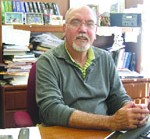
Bob Nakosteen says he and others will know the economy is improving when employment figures start to climb.

This past month, the Consumer Confidence Index reached a new high since the recession began. Some see this as a clear sign that the nation, and perhaps the region, have hit bottom with regard to the economy and that the recovery has begun. Area economists note the positive indicators, but say it may be too early to do any celebrating.

According to reports from the Conference Board, its Consumer Confidence Index shows that in the month of May people were feeling better about the economy, with confidence reaching its highest levels since last September.

In a public statement, Lynn Franco, director of the Conference Board Consumer Research Center, said that “consumers are considerably less pessimistic than they were earlier this year, and expectations are that business conditions, the labor market, and incomes will improve in the coming months.

“While confidence is still weak by historic standards,” she continued, “as far as consumers are concerned, the worst is now behind us.”

But is the worst recession in decades now a subject confined to the past tense? Hardly, say two area economists, who say there is danger in putting too much emphasis on one statistic, especially one like consumer confidence, and predict that there are many difficult days still ahead.

“I am unclear why consumer confidence has had such a large increase,” said Anita Dancs, a professor of Economics at Western New England College. “It doesn’t quite match what is actually going on with the economy.”

Robert Nakosteen, professor of Economics at UMass Amherst, agreed. The Confidence Index numbers need to be taken in context, he told BusinessWest. “That figure was not a new high in any record sense. It’s the highest it’s been in over a year, but it rose to a very historically low level. So consumer confidence is important in that it’s not falling any more, but it’s not what I would call high.”

Six months into the second calendar year of the recession and 100 days into President Obama’s stimulus, there are certainly some positive signs regarding the economy, but these positives must be juxtaposed against doldrums in house prices, the GDP, and other hard numbers. In this issue, BusinessWest takes a mid-year look at the state of affairs with the economy, and what experts project for the months to come.

Jumping the Gun?

Getting a read on what’s happening in the economy these days can feel more like trying to read tea leaves. The same week that the Conference Board published its Consumer Confidence Index, reports on the nation’s GDP showed a 5.7% decline in the first quarter of 2009, hot on the heels of a 6.3% decline at the end of last year. You could say that we are on a statistical seesaw.

“I guess I would caution against getting too optimistic with a statistic like consumer confidence,” said Dancs, “just like I would point to the release recently from the Commerce Department, where the order for durable goods is up; it’s difficult to get overly optimistic, or, for that matter, pessimistic, over one particular piece of data.”

However, one can’t completely disregard the psychology or emotions of the nation at large in such times.

“Obviously, if consumer confidence is up,” she continued, “that’s incredibly important. If people feel good, and they feel that their own economic future looks positive, they’re going to spend more money.”

But is this a situation of the bad just being not as bad?

“What’s happened now is that the rate of descent has diminished to where we may not be descending much more at all, and we’re getting some of these confidence indicators,” said Nakosteen. “The stability that we’re beginning to feel is making people feel more comfortable about the future.

“One of the interesting aspects of the Consumer Confidence Index,” he continued, “is that consumers feel negative about what is happening at the moment, but they feel good about the intermediate-term future. Any turnaround is going to wait, and true stability … well, it’s hard to see where the growth is going to come from.”

So, is it too soon to take the champagne out of the fridge? While increased consumer confidence can translate into increased spending, thereby starting the ripple effect necessary to jump-start other sectors of the economy, is it realistic to think that perception can, in fact, become reality?

“The stock market has rebounded,” said Nakosteen. “Maybe that’s why people are feeling good. But that could be a bear-market rally, and could turn around. There’s nothing really fundamental in the economy that’s going to lead to a quick turnaround.

“The banks are still unhealthy,” he continued, “foreclosures are still increasing, and now they are creeping over to the prime borrowers, not just the subprime borrowers. The only sector of the economy that’s being active is the federal government, with its stimulus package. Even the state and local governments are being very deflationary in their behavior, because they have no money to spend.”

Dancs agreed, and wondered out loud about what rising confidence will translate into with regard to a recovery. “Wages and salaries have been stagnating for a number of years now. And consumer debt has been increasing. People at the beginning of the 21st century felt wealthy because of the housing bubble, but there’s been a trillion dollars of wealth wiped away because of that bubble, and what we’re seeing when looking at housing prices is about $400 billion a month being further wiped out.

“So at the same time that we look at consumer confidence,” she continued, “we say ‘people are feeling good, they’re going to spend money, and that’s going to create a demand for more goods and services, and stimulate the economy.’ But at the same time, people’s income and wealth situations don’t seem to underpin a whole lot of spending.”

History Lesson

Past economic downturns can give one a metric by which to measure current situations. Both economists agreed that there are many systems in place today to avoid any calamities that might have been alluded to by the doomsday soothsayers of the nightly news.

“One of the problems in economics is that true understanding of what is happening right now doesn’t take place until a few months after right now, when we get firm data,” said Nakosteen. “We won’t know when we’ve reached the bottom until we are starting to ascend out of the trough.”

However, he did say that there is a sign that the rate of descent is decelerating, and there are a lot of people who expect employment numbers to start improving. “Not necessarily that jobs will increase, but that layoffs will start to diminish,” he said. “We haven’t seen that yet, but this is what people anticipate.”

Dancs mentioned the role of automatic stabilizers, systems such as unemployment insurance and FDIC security, as stopgap measures to prevent any precipitous skids. “That will always mitigate a recession,” she said.

But this time around, the stakes are a bit different. The forces that sent the nation, and eventually the globe, into such a downward spiral make this a different playing field altogether.

Dancs mentioned the tribulations of the American auto industry having a significant role in this recession. “I think that economists have tied one in 10 jobs in the economy to the auto industry, indirectly and directly,” she said.

“I would say that a lot of what happens to Chrysler and General Motors … well, that’s going to mean a lot more people are going to get laid off,” she explained. “There were no auto layoffs in April, but the overall cumulative effect could have a major impact for the future.”

Nakosteen pointed to the end of the housing bubble. “Consumers aren’t in a position to help bring this economy out of a recession. The recession of the early 1990s was a bit of a delayed reaction to the savings-and-loan debacle. The amount of debt in household balance sheets is so much more than it was 15 years ago, in the late ’80s, early ’90s, when households were saving something in the neighborhood of 10% of their gross incomes. That number over the course of time into the current decade went close to zero and in some cases into negative territory for awhile.

“People aren’t saving anymore,” he continued, “and they are carrying a lot of debt. Credit cards, mortgages that in some cases which exceed the value of their homes … they just aren’t in a position financially or emotionally to bring their wallets out and start spending.”

Ultimately, the early 1990s didn’t see a robust climb out of the recession, said Nakosteen. “That was a pretty anemic turnaround, just like this one is probably going to be. There was a rise in consumer spending that was then maintained throughout the ’90s. We may never really go back to the spending patterns of the ’90s or the first part of this decade. We may be, in a sense, in a long-term lower-consumption society.”

When asked what signs will lead him to feel that the worst is indeed over, Nakosteen pointed to employment numbers. “The economy was going down long before the employment numbers started to deteriorate,” he explained. “The economy is going to start up before the employment rates will be getting better. So when layoffs come to a halt, and maybe we start to see some modest increases in employment, that’s going to be a very good sign.”

Dancs hopes Americans use this time to begin questioning their own consumer confidence, as well as their spending and saving habits.

“One question I have is, how much consumer debt are people willing to continue carrying?” she said. “What happened over the past few decades is that people started to carry a significant amount more debt. Another aspect of today, it will depend on people being willing to continue carrying high levels of consumer debt.

“Consumption makes up 70% of the GDP,” she went on, “so when people feel good, they spend money.”

Shifting focus, she asked, “is our economy moving in such a way that our country will have industries that are competitive in this century? Will we be able to keep up with other countries that are, to some extent, further along to developing the key industries of the century?”

Elaborating, she said, “the recovery of 2001 potentially tells us something about the economy. While the recession ended in November and growth resumed, job losses continued well into the recovery, and it took until February 2005 to reach the employment levels prior to the recession. At the same time, there was little new non-residential investment in equipment and buildings, and consumer debt rose. It is really strange for consumer debt to rise during a recovery. People felt wealthy — in economics, we call this the ‘wealth effect’ — but that wealth was because of inflated housing prices, and has been subsequently erased.”

Riding the Cycle

Nakosteen made an emphatic point that, while he can’t say the worst is over, he does sense that real recovery may soon begin in earnest.

“I should emphasize that this economy is inherently strong,” he said. “There are things that are going to turn the economy around, and the stimulus money is going to really start kicking in next year. Inventories in business have been cut down so low that, even to sustain that low-level business that we have now, they’re going to have to increase purchases. We have an inherently vibrant economy that’s going to eventually dig itself out of this situation.

“There is an emotional business cycle just as clearly as there is an economic one,” he continued. “And it has very tangible effects. Much of the breathtaking and precipitous decline of the end of past year had to do with people’s emotions. Their emotions translated into spending patterns. I get so angry at the nightly news — I mean, I view what is happening out there with my own perspective, and then the nightly news comes on, and they make it seem like the end of the world. It just isn’t.”

Of course, it’s not possible to think a single statistic might be the silver bullet necessary to bolster the economy on its own, but the message is there: people aren’t as afraid anymore. The waters are still uncharted, and anyone’s guess about the economy is just that — a guess.

While the ascent might not be robust, let’s face it — these days, no bad news is good news.

Departments

Ten Points About:

Obtaining Business Credit

By GARY G. BRETON

1. Create a ‘snapshot’ of your company at a specific point in time. This can usually be derived from your company’s most recent financial statements, which provide a lender with a detailed and comprehensive picture of your company’s current business operations and profitability.

2. Have a well-defined business plan. This demonstrates that you have already wisely considered your company’s strategic growth and related financial projections.
3. Remember that you are asking a prospective lender to effectively become a partner with your company. Having the foresight to undertake sound financial and business practices is essential to obtaining necessary credit and entering such a partnership.
4. Consider self-promotion. Clearly demonstrating that your company has established a proven track record in a particular industry can provide immediate credibility.

5. Consider what collateral security your company has to offer. Offering your prospective lender strong, easily valued, and easily accessible collateral is critical.

6.Provide a solid and inclusive financing application package. Doing so can assure a fair and timely review of your request for financing.
7. Shop around. Despite the current economic environment, lenders in the Northeast generally remain well-capitalized and are looking to extend credit to solid companies. Despite their more-critical and comprehensive view, the essential building blocks to obtain requested credit remain the same.
8. Negotiate. Although there has been a tightening of credit availability nationwide, the interest rates currently being offered are generally quite favorable.
9. Be reasonable. Be realistic as to both your company’s real financing needs and the terms of the credit facilities based on the current lending and market conditions.

10. Ask for it! Many times business owners are reluctant to initiate a request for credit based on what they perceive are insurmountable obstacles, when in fact many obstacles may be satisfactorily addressed and overcome by working with a lender who can bring both creative and fiscally responsible alternatives to the table.

Gary G. Breton, Esq. is a partner with Bacon Wilson, P.C., and a member of its Banking and Finance Department; (413) 781-0560;

[email protected].

Departments

Ten POints About: Facebook Privacy

By CHRISTINE PILCH

1. Restrict profile access only to friends. The default is everyone, so your Facebook profile is an open book until you restrict access.

2. Use groups. Set up groups for different sets of friends. This allows you to control specific data access by group rather than on an individual level.
3. Carefully consider who you want to post to your wall and view posts by others. If you have a combination of personal and professional connections, you might not want everyone to see what others write.
4. Protect your photos and videos. Avoid embarrassing photo and video flubs by restricting certain individuals and groups from seeing those you post and that others tag with your name, and remember to set album security levels too.

5. Disable news stories about posting on friends’ walls. Nobody needs to know that you’ve written on a friend’s wall.

6. Don’t post your relationship status or allow news feeds when your relationship status changes. If you’re happily married, that’s one thing, but if your relationship status is subject to change, you don’t need to broadcast it, thereby causing potential embarrassment.
7. Restrict search results information. It’s great to be able to be found by everyone, but strangers don’t need to see your friends and pages you’re a fan of.
8. Delete your public search listing. You don’t need to have the personal information in your profile accessed by search engines.
9. Check and see how individual friends see your profile. Look at your profile with a critical eye. You will likely find that there are certain aspects of your personal life that you don’t want some friends to see.

10. Safeguard your personal contact information. Think about who you want to have access to your address and phone numbers.

Christine Pilch is a partner with Grow My Company and a social-media marketing strategist. She trains clients to utilize LinkedIn, Twitter, Facebook, and other social-media tools to grow their businesses, and she collaborates with professional service firms to get results through innovative positioning strategies; (413) 537-2474; linkedin.com/in/christinepilch; twitter.com/christinepilch; growmyco.com; “Miracle Growth for Your Company.”



Departments

Groundbreaking Event

City leaders joined AIC students, administrators, and trustees for the official groundbreaking for new athletic facilities on May 6. John T. Short, vice president for institutional advancement, said the new facilities will accommodate the needs of AIC’s intercollegiate teams, as well as enable the expansion of intramural programs, and allow for greater student and community usage of facilities. The new construction, to total $4.3 million, will include taking out grass and installing artificial turf, lights, new grandstands, and a new press box. The project, financed by Westfield Bank, will be constructed by Mountain View Landscapes and Lawncare Inc., of Chicopee. A large portion of the funding for the project is coming from the AIC students. Darren James, president of the AIC Student Government, said students have pledged $50,000 for the new facility. “The money we donate to the capital campaign will help to facilitate the realization of our long-awaited athletic turf field and track,” he said. Pictured, from left, are Lauren Silva and Darren James, AIC students; Vince Maniaci, AIC President; and Frank Colaccino, chairman of the AIC board of trustees.


Lamplighter Award

The Brattleboro Retreat was honored with the “Best in New England” Lamplighter Award at the spring conference of the New England Society for Healthcare Communications (NESHCO) held May 4-6 in Providence, R.I. The Lamplighter Award represents the top honor among Gold Award winners in more than 50 categories. It went to the Retreat for the organization’s six-minute DVD titled “Helping People Find the Strength.” The DVD, which also won gold in the category for audio/visual presentations, was produced by Sunnyside Films. It was filmed on the Brattleboro Retreat campus and features interviews with many Retreat staff. The Retreat also received NESHCO awards for the following marketing and communications pieces: Gold Award: Design/Printed Pieces (for the 2009 wall calendar); Gold Award: Special Events Communications (for communications pieces in support of the December 2008 fund-raising event featuring the Moscow Ballet performance of the Great Russian Nutcracker in Springfield); Silver Award: Design/Logo (for the institution’s new clock tower logo); Silver Award: Publications/Annual Report (for the “2007 Annual Report to Stakeholders and Friends”); and Award of Excellence: Overall Marketing Campaign (for the Retreat’s 2008 overall marketing campaign). From left, Jeff Whitcomb, president of Communicators Group Inc.; Dr. Robert E. Simpson, president and CEO of the Brattleboro Retreat; and Julia Sorensen, director of Marketing and Communications at the Brattleboro Retreat.


SBA Award

Florence Savings Bank President John Heaps addresses a large audience gathered at a recent press conference at Northampton’s Thorne’s Market, where the bank announced its receipt of a special achievement award from the Small Business Administration for having the highest percentage of SBA loans to women-owned businesses by banks statewide. “Women-owned businesses play a major role in the local economy, and we’re committed to helping them, as well as all local businesses, get the financial resources they need,” said Heaps. The press conference was staged in front of the clothing store Jackson & Connor, one of the women-owned businesses to which the bank has given financing.


Market Business Show

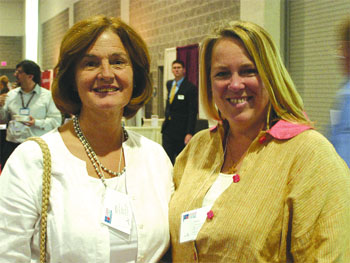
The Affiliated Chambers of Commerce of Greater Springfield staged its annual Market Business Show on May 13 at the MassMutual Center. Thousands of visitors took in more than 150 exhibits featuring companies and institutions across Western Mass. and across every business sector. Here, Ginny Knapp, left, president, and Teresa Utt, sales representative, with Andrew Associates in Enfield, mix and mingle at the event.

John Prenosil, left, principal with Springfield-based JMP Environmental Consulting, and Peter DeMallie, president and CEO of South Windsor, Conn.-based Design Professionals Inc., shared a booth and a conversation at the show.

Unveiling the new look of ERC5 — East of the River Chamber (Hampden, Wilbraham, Ludlow, East Longmeadow, and Longmeadow), are, from left: Jim White of GoGraphix and Whitestone Marketing, creator of the new graphics, branding, and booth design for ERC5; Bill Russo-Appel, director of Marketing and Public Relations at Wing Memorial Hospital and Medical Centers; Beth Pecia, with the Town Planner; Edward Zemba, principal with Robert Charles Photography in East Longmeadow; Amy Scott of the Town Planner; and Charlie Christiansen of East Longmeadow-based Peritus Security Partners.

Helene Curto, left, owner of Wilbraham-based Distinctive Tables, draws in attendees Janet Egelhofer and Maria Burke, both with the Springfield Symphony Orchestra, with one of her unique collections.

Scott Bottino, manufacturer’s representative (second from right), stands with team members representing West Springfield-based Northeast Security Solutions; from left, Joe Jarman, sales representative; George Condon Sr., chief operating officer; and David Condon, account representative.

From left, Edward Zemba, co-owner, and Susanna Zemba, customer relations manager, of Robert Charles Photography in East Longmeadow talk with Melissa Meites and Coty Boyer, both employees of DiGrigoli Salons in West Springfield.

Barry Sanborn, general manager of Proshred Security in Wilbraham, staffs the company’s booth.

Sections Supplements
Gov. Patrick’s Keynote Address Will Focus on the State’s Budget Challenges
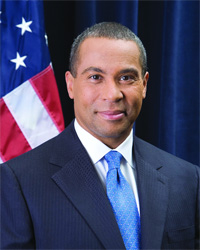
Gov. Deval Patrick

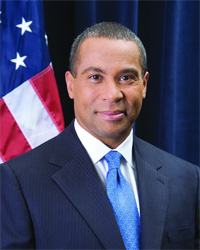
Gov. Deval Patrick

Organizers of the annual Market Trade Show are always looking for a special drawing card to bring attention — and crowds — to the spring event. This year, they’ve found an ace in the presence of Gov. Deval Patrick.

He is scheduled to be the keynote speaker for the breakfast portion of the May 13 show, and expected to touch on most matters involving the budget — from possible tax increases, including a controversial sales-tax hike recently approved by the House, to where cuts may come as the Commonwealth attempts to close a $400 million budget gap.

He won’t have time to respond to questions, but if all goes according to plan, Patrick be walking the show floor when it opens at 9 a.m.

Show organizers anticipate the governor to draw a significant crowd and give the show some momentum. “We think the governor will create quiet a buzz and get people to arrive early,” said Russell Denver, president of the Affiliated Chambers of Commerce of Greater Springfield, which sponsors the annual trade show.

Denver is optimistic that year’s Market Show, which is open to the public with the price of admission being a business card, will draw between 3,000 to 4,000 attendees throughout the day. It’s worth noting however, that the keynote breakfast is $20, limited to 600 people, and requires advanced registration.

Visitors of the show can look forward to a full day of networking, free seminars, food, and possibly even a haircut.

Show Time

“More than last year” was Denver’s enthusiastic response when asked how many booths will be at trade show this year. While the show featured 155 companies in 2008, this year, he expects 165 companies and 190 booths.

With booth spaces going for between $600 and $950, the event remains “a low-cost way for companies to get the word out,” said Denver, and a time (a severe economic downturn) when businesses should be looking for ways to gain exposure.

“We’re awfully close to being sold out,” Denver said. “We might have seven or eight booths left, but that’s it, really.”

Every year the show turns over about a third of the booths, so while visitors can expect many of the same businesses as last year, there will be plenty of new ones, too, he explained. The types of business run the gamut. “You name it, we have it,” he said. “We have printers, hotels, security-alarm companies, an ambulance company, financial companies, colleges, environmental companies, and over-55 living facilities, and the list goes on.”

Now in its 21st year, the show seems to have settled on a venue that works, with few changes from last year. Yet even with a similar format, it’s never the same show twice, said Denver.

“It’s never stale … every year the exhibitors compete to be more creative than the last,” he said, citing, as one example, the staffing company United Personnel, which over the years has featured a surfing theme, a ’50s look and feel, and even karaoke.

This year Whalley Computer Associates is expanding the tech footprint of the event with a ‘technology corridor’ featuring several vendors, including Cisco Systems, Zix Networks, and Epson America, to present a comprehensive array of solutions.

Networking opportunities abound, said Denver. “Where else can you find 165 different businesses all in one place?”

Plenty to Learn

Throughout the day, the show will feature nine business seminars presented in the MassMutual meeting rooms. Attendees do not need a separate pass to attend the seminars, but since each room holds only 50 people, arriving early guarantees a spot. The schedule, which is still unfolding, looks like this:

Sections Supplements
A list of all Market Show exhibitors

AffiliaTED CHAMBERS OF COMMERCE OF GREATER SPRINGFIELD INC.

(413) 787-1555

1441 Main St.

Springfield, MA 01103

www.myonlinechamber.com

Booth: 94

An African American Point of View

(413) 796-1500

688 Boston Road, Suite B

Springfield, MA 01119

www.afampointofview.com

Booth: 84

Am B Care Ambulance Service

(877) 624-4199

100 Verge St.

Springfield, MA 01129

www.ambcare.com

Booths: 115-117

American Convention Services

(413) 739-6811

50 Turnbull St.

Springfield, MA 01104

Booth: 5

AmericanInternational College

(800) 242-3142

1000 State St.

Springfield, MA 01109

www.aic.edu

Booth: 182

American Laser Centers

(800) 242-3142

1111 Elm St.

West Springfield, MA 01089

www.americanlaser.com

Booth: 4

Answer is Fitness

(413) 782-7587

1739 Allen St.

Springfield, MA 01118

www.answerisfitness.com

Booths: 88 & 89

Associated Builders Inc.

(413) 536-0021

4 Industrial Dr.

South Hadley, MA 01075

www.abuilders.com

Booth: 185

Azon Liquors

(413) 786-0015

384 Walnut St. Ext.

Agawam, MA 01001

www.azonservices.com

Booths: 127 & 128

Bert Hill Moving and Storage

(413) 485-0050

978 Southampton Road

Westfield, MA 01085

www.berthill.com

Booth: 114

BFP Associates

(413) 739-2352

1233 Westfield St., Suite One

West Springfield, MA 01089

www.bfpassociates.com

Booth: 134

Branford Hall Career Institute

Healthcare Education Center

112 Industry Ave.

Springfield, MA 01104

(413) 781-2276

www.branfordhall.edu

Booths: 165 & 166

Branford Hall Career Institute

TechnicalTraining Center

189 Brookdale Dr.

Springfield, MA 01104

(413) 732-0546

www.branfordhall.edu

Booths: 165 &166

BusinessWest & The Healthcare News

(413) 781-8600

1441 Main St.

Springfield, MA 01103

www.businesswest.com

Booth: 25

CambridgeCollege

570 Cottage St.

Springfield, MA 01104

(413) 747-0204

www.cambridgecollege.edu/springfield

Booth: 82

Casual Elegance Inc.

(413) 596-2334

P.O. Box 9

Wilbraham, MA 01095

Booths: 51-53

Chamber Insurance Program/Connecticare

(800) 953-4467

P.O. Box 581

Orange, CT 06477-0581

www.citrust.com

Booth: 192

Charter Business

1-888-GET-CHARTER

355 Front St.

Chicopee, MA 01013

www.charter-business.com

Booth: 105

Chicopee Savings Bank

(800) 662-0974

70 Center St.

Chicopee, MA 01014

www.chicopeesavings.com

Booth: 99

Citizens Bank

(413) 589- 0111

33 Center St.

Ludlow, MA 01056-2788

www.citizensbank.com

Booth: 186

Clarion Hotel and Conference Center

(800) 870-0486

1080 Riverdale St.

West Springfield, MA 01089

www.wsclarionhotel.com

Booth: 74

Clear Channel

(413) 781-1011

1331 Main St., Suite 400

Springfield, MA 01103-1621

www.clearchannel.com

Booth: 56

Collegeof our Ladyof the Elms

(413) 594-2761

291 Springfield St.

Chicopee, MA 01013-2839

www.elms.edu

Booth: 22

Comcast Business Services

(413) 730-4540

3303 Main St.

Springfield, MA 01107-1111

www.comcast.com/business

Booth: 50

Command Security Corporation

(413) 746-2349

601-1605 Main St.

Springfield, MA 01103

Booth: 72

Concero Networks

(413) 525-4900

P.O. Box 772

East Longmeadow, MA 01028

www.conceronetworks.com

Booth: 106

Cooperative Systems

(860) 523-1000

282 Murphy Road

Hartford, Connecticut 06114

www.coopsys.com

Booth: 54

Country Bank

(413) 967-6221

75 Main St.

Ware, MA 01082

www.countrybank.com

Booth: 190

Crestview Country Club

(413) 786-2593

Shoemaker Lane

Agawam, MA 01001

www.crestviewcc.org

Booth: 42

Curry Printing

(413) 785-1363

191 Elm St.

West Springfield, MA 01089-2726

www.curry-printing.com

Booth: 93

n Cyalume Technologies Inc.

(888) 858-7881

96 Windsor St.

West Springfield, MA 01089

www.cyalume.com

Booth: 73

Development Associates

(413) 789-3720

630 Silver St.

Agawam, MA 01001

www.devassociates.com

Booth: 2

DiGrigoli Salons

(413) 827-8888

1578 Riverdale St.

West Springfield, MA 01089

www.digrigoli.com

Booths: 195 & 196

Disability Management Services Inc.

(413) 747-0990

1350 Main St.

Springfield, MA 01103-1641

www.disabilitymanagementservices.com

Booth: 110

Eastfield Mall

(413) 543-8000

1655 Boston Road, Unit A11

Springfield, MA 01129-1130

www.eastfieldmall.com

Booth: 101

EDC of Western MAss

(413) 593-6421

1441 Main St.

Springfield, MA 01103-1449

www.westernmassedc.com

Booth: 126

Ener-G-save, a program sponsored by Harold Grinspoon Charitable Foundation

(866) 634-3021

380 Union St.

West Springfield, MA 01089

www.ener-G-save.org

Booth:112

East of the River 5 Town Chamber of Commerce

(413) 755-1309

1441 Main St.

Springfield, MA 01103-1449

www.myonlinechamber.com

Booth: 157

Fallon Community Health Plan

(508) 368-9395

One Chestnut Place

Worcester, MA 01608

www.fchp.org

Booth: 60

FastSigns

(413) 732-9900

1102 Riverdale St.

West Springfield, MA 01089

www.fastsigns.com

Booth: 11

FasttrackAirportParking

(800) 590-6789

24 Ella Grasso Turnpike

Windsor Locks, CT 06096

www.avistarparking.com/fasttrack

Booth: 3

First National Merchant Solutions

(860) 584-9294

87 Atkins Ave.

Bristol, CT 06010

www.firstnationalmerchants.com

Booth: 103

Freedom Credit Union

(413) 739-6961

P.O. Box 3009

Springfield, MA 01101-3009

www.freedomcoop.com

Booth: 199

Get Set Marketing, LLC

(413) 781-7800

125 Main St.

Springfield, MA 01105

www.getsetmarketing.com

Booth: 10

The Graduate School at Bay Path College

(413) 565-1000

588 Longmeadow St.

Longmeadow, MA 01106-2292

www.baypath.edu

Booth: 189

Health New England

(413) 233-3178

One Monarch Place, Suite 1500

Springfield, MA 01144-1500

www.healthnewengland.com

Booths: 90 & 100


H.L. Dempsey Company

(413) 736-8742

103 Baldwin St.

West Springfield, MA 01089

www.hldempsey.com

Booths: 35 & 45

HolyokeCommunity College

(413) 538-7000

303 Homestead Ave.

Holyoke, MA 01040-1099

www.hcc.edu

Booth: 144

Holyoke Gas & Electric Department

(413) 536-9463

One Canal St.

Holyoke, MA 01040

www.hged.com

Booths: 197 & 198

Holyoke, Chicopee, Springfield Head Start Inc.

(413) 788-6522

30 Madison Ave.

Springfield, MA 01105

www.hcsheadstart.org

Booth: 68

JMP Environmental consulting

(413) 967-5601

439 Belchertown Road

Ware, MA 01082

www.jmpec.net

Booth: 36

Johnson & Hill Staffing Services Inc.

(413) 746-3535

95 State St., Suite 501

Springfield, MA 01103

www.jhstaffing.com

Booth: 120

King Ward Coach Lines

(413) 539-5858

70 Justin Dr.

Chicopee, MA 01022

www.kingward.com

Booths: 175-179

Law Office of Kimberly L. Stevens

(413) 306-6030

82 Main St., Suite 4

West Springfield, MA 01089

stevenslawma.com

Booth: 191

LibertyMutual

(413) 567-2000

175 Dwight Road

Longmeadow, MA 01106

www.libertymutual.com

Booth: 98

Lil’ Dogs

(413) 583-3435

393 East St.

Ludlow, MA 01056

www.lildogs.com

Booth: 65

Marcus Printing Company Inc.

(413) 534-3303

750 Main St.

Holyoke, MA 01040

www.marcusprinting.com

Booth: 66

MassLive, LLC

(413) 733-2000

32 Hampden St., 4th Floor

Springfield, MA 01103

www.masslive.com

Booths: 70 & 80

MassMutualCenter

(413) 787-6610

1277 Main St.

Springfield, MA 01103

www.massmutualcenter.com

Booth: 92

Mercy Medical (Bloodmobile)

(413) 748-9000

271 Carew St.

Springfield, MA 01104

www.mercycares.com

Booths: 146-149

McNamara Waste Services, LLC

(413) 566-8300

P.O. Box 327

East Longmeadow, MA 01028

www.mcwaste.com

Booths: 6-9

Meyers Brothers Kalicka, P.C.

(413) 536-8510

330 Whitney Ave., Suite 800

Holyoke, MA 01040

www.meyerskalicka.com

Booth: 63

Moriarty & Primack, P.C.

(413) 739-1800

1414 Main St., Suite 1300

Springfield, MA 01144

www.mass-cpa.com

Booth: 95

Northeast Security Solutions Inc.

(413) 733-7306

33 Sylvan St.

West Springfield, MA 01089-3441

www.northeastsecuritysolutions.com

Booth:113

Patriot Energy Group

(413) 732-0272

201 Westfield St., 2nd Floor

West Springfield, MA 01089

www.pariotenergygroup.com

Booth:113

Peter Pan Bus Lines

(413) 781-2900

P.O. Box 1776

Springfield, MA 01102-1776

www.peterpanbus.com

Booths: 75-79

PioneerValleyPlanning Commission

(413) 781-6045

26 Central St., Suite 34

West Springfield, MA 01089-2742

www.pvpc.org

Booth: 47

Porter & Chester Institute

(413) 593-3339

134 D
long Circle

Chicopee, MA 01022

www.porterchester.com

Booth: 13

ProShred Security

(413) 596-5479

75 Post Office Park

Wilbraham, MA 01095

www.proshred.com

Booth:140

Protective Security Services

(413) 569-1335

630 Silver St., Suite 9C

Agawam, MA 01001

www.myprotectivesecurity.com

Booth: 86

Reeds Landing Retirement Community

(413) 782-1800

807 Wilbraham Road

Springfield, MA 01109

www.reedslanding.com

Booths: 15 & 16

Regional Employment Board of Hampden County Inc.

(413) 755-1357

1441 Main St.

Springfield, MA 01103-1449

www.rebhc.org

Booth: 168

Reminder Publications

(413) 525-3247

280 North Main St., Suite 1

East Longmeadow, MA 01028

www.thereminder.com

Booth: 207

The Republican

(413) 788-1000

1860 Main St.

Springfield, MA 01103

www.masslive.com

Booth: 81

Resavue Exhibits

(860) 627-6399

10 Stran Road

Milford, CT 06460

www.resavue.com

Booth: 20

Robert Charles Photography

(413) 525-4263

33 Prospect St.

East Longmeadow, MA 01028

www.robertcharlesphoto.com

Booth: 155

Roger Sitterly & Son Inc.

(413) 737-2641

P.O. Box 2530

Springfield, MA 01101

www.sitterlymovers.com

Booth: 91

Ron Alberti’s After Hours DJ

(413) 562-2632

1310 Russell Road

Westfield, MA 01085

www.afterhoursdj.net

Booths: 43-44

Rosa’s Candies Inc.

(413) 736-4591

54 Robbins Road

Springfield, MA 01104

www.rosasfudge.com

Booth: 181

Select Comfort

(413) 552-3690

50 Holyoke St.

Holyoke, MA 01040

www.selectcomfort.com

Booth: 150

Sage Engineering, LLC

(413) 562-4884

199 Servistar Industrial Way, Suite 2

Westfield, MA 01085

www.sage-llc.com

Booth: 85

Sheraton Hotel/Columbus Hotels

(413) 781-1010

One Monarch Place

Springfield, MA 01144

www.sheraton.com/springfieldma

Booth: 160

Springfield Business Improvement District

(413) 781-1591

1441 Main St., 1st Floor

Springfield, MA 01103

www.springfielddowntown.com

Booth: 193

SpringfieldCollege

(413) 748-3000

263 Alden St.

Springfield, MA 01109-3797

www.springfieldcollege.edu

Booth: 96

SpringfieldFalcons Hockey Club

(413) 739-3344

45 Falcons Way

Springfield, MA 01103

www.falconsahl.com

Booth: 55

STCU Credit Union

(413) 732-9812

145 Industry Ave.

Springfield, MA 01104

www.stcu.com

Booth: 67

Steve Lewis Subaru

(413) 584-3292

48 Damon Road

Northampton, MA 01060

www.stevelewis.subarudealer.com

Booths: 38 & 39, 48 & 49

T-Mobile, USA

(617) 630-3101

60 Wells Ave.

Newton, MA 02459

www.t-mobile.com

Booth: 200

Turley Publications Inc.

(413) 283-8393

24 Water St.

Palmer, MA 01069

www.turley.com

Booths: 153 & 154

United Personnel

(413) 736-0800

1331 Main St., Suite 100

Springfield, MA 01103-1669

www.unitedpersonnel.com

Booth: 180

United StatesPostal Service

Phone:(413) 731-0502

1883 Main St.

Springfield, MA 01101-9998

www.usps.com

Booth: 119

Valley Communications Systems Inc.

(413) 592-4136

20 First Ave.

Chicopee, MA 01020-4619

www.valleycommunications.com

Booths: 187 & 188

Verizon

(413) 731-8606

365 State St.

Springfield, MA 01105

www.verizon.com

Booth: 62

WesternNew England College

(413) 782-3111

1215 Wilbraham Road

Springfield, MA 01119-2693

www.wnec.edu

Booth: 71

Westover Job Corps

(413) 593-5731

103 Johnson Road

Chicopee, MA 01022

www.westoverjobcorps.com

Booth: 169

WFCR 88.5 FM/WNNZ 640 AM PUBLIC RADIO

(413) 577-0779

Hampshire House, UMass

131 County Circle

Amherst, MA 01003-9257

www.wfcr.org

Booth: 87

WGBY

(413) 781-2801

44 Hampden St.

Springfield, MA 01103-1286

www.wgby.org

Booth:111

Whalley Computer Associates

(413) 569-4200

One Whalley Way

Southwick, MA 01077

www.wca.com

Booth:130

Whalley Technology Corridor

Communications Solutions Partners

Booth: 131

n Blue Moon Industries

www.bluemoonind.com

Booth: 121


cisco

www.cisco.com

Booth: 132

Direct Color Systems

www.directcolorsystems.com

Booth: 134

Epson America

www.epson.com

Booth: 123

Meru Wireless Networks

www.merunetworks.com

Booth: 133

Okidata

www.okidata.com

Booth: 124

Zix Corporation

www.zixcorp.com

Booth: 122

Wilbraham & MonsonAcademy

(413) 596-6811

423 Main St.

Wilbraham, MA 01095

www.wmacademy.org

Booths: 151 & 152

WMAS Citadel Broadcasting Corporation

(413) 737-1414

1000 West Columbus Ave.

Springfield, MA 01105

www.947wmas.com

Booth: 12

Women’s Partnership

(413) 739-2731

c/o Hatheway Homes & Properties

West Springfield, MA 01090

www.myonlinechamber.com

Booth: 102

Zasco Productions, LLC

(800) 827-6616

340 McKinstry Ave., Suite 400

Chicopee, MA 01013

www.zascoproductions.com

Booths: 202 & 203

Zip N Sort Mail Services

(413) 443-9071

20 Taconic Park Dr.

Pittsfield, MA 01201

http://www.zipnsort.com

Booth: 129

The Zoo in Forest Park

(413) 733-2251

P.O. Box 80295

Springfield, MA 01138

www.forestparkzoo.com

Booth: 64

Uncategorized

From a sheer numbers perspective, the work of Springfield’s Finance Control Board — which winds down its work this month — has been impressive, guiding the city from a $41 million deficit several years ago to $50 million in reserve today. But Springfield still faces a daunting list of challenges, from poverty and neglected neighborhoods to high dropout rates and image problems centered on public safety. Overall, there is confidence that the city is on the rebound.

It’s a day that many people have looked forward to for some time. It’s also a day that some have quietly, or not so quietly, dreaded.

At the end of this month, the Finance Control Board — put in place roughly five years ago to guide Springfield out of an economic quagmire — will end its tour of duty, with all those involved with it believing that the primary mission has indeed been accomplished: maneuvering the city onto sound financial footing while also putting in place new systems that should prevent it falling into disarray again.

“I believe the Control Board has been successful in the major task that it had before it, to create a system to better manage our financial resources,” said Mayor Domenic Sarno. “We’ve been able to make personnel changes and to put systems in place. We have been able to reaffirm that key people were in place who were the best people to be in those positions. We’ve brought in some people who have been able to enhance our abilities to do that work well.

“All in all,” he continued, “the bottom line to all of these different strategies is that we’ve gone from a deficit of $41 million before the control board got here, and from a situation where we hadn’t set aside money in reserves from 1987 to 2004, to a situation where we have more than $50 million in reserve today.”

Despite this more-stable financial picture, Springfield still faces a laundry list of challenges, from image issues and a perception that the streets still are not safe to persistent poverty and alarmingly high dropout rates. Meanwhile, the city’s central business district remains in need of a spark, and many neighborhoods, especially the South End, face a long road back to prosperity.

All these issues and challenges are reflected in the comments made by civic and business leaders when they were asked about where they believe Springfield is in the process of revitalization and what remains to be done. Those asked to comment expressed general confidence and optimism, but also the feeling that, while the control board is leaving, much work remains.

“We are the model city at this moment,” said Nancy Urbschat, a principal with TSM Design, located in the city’s downtown. “What the control board has been able to do, in conjunction with city government, is to turn an inefficient, broken system into … well, we have spare cash, we have systems in place, systems are automated now … apparently we’re a bit of a poster child for successful cities in the Commonwealth.

“We have an opportunity now to prove we can do this without a benign dictator,” she continued. “There are some glimmers — there are young people moving to the city because it’s affordable, they are bringing fresh ideas and enthusiasm, and there are some new community initiatives springing up.”

Jack Dill, president and CEO of Colebrook Reality Services, agreed, while acknowledging that the city still has work to do to convince people that its problems are mostly behind it.

“There are some real challenges here, and I think the solutions are simple, but not easy,” he said. “In a broad sense, I think our issues are public safety and education.

“As far as downtown is concerned, security, cleanliness, and parking are the issues. But I think those things are manageable, and to a great extent are being managed. The building owners downtown spend a lot of time on those issues. However, if there’s a perception that there’s a problem, then that itself becomes a problem. Safety is a threshold, and there’s no level of rent concession or parking rates that offset security concerns. But, again, if people look carefully at the situation, or they talk to people who are here every day, they see that it’s really not an issue.”

In this issue, BusinessWest gathers a number of perspectives on Springfield, what’s been accomplished over the past several years, and what still must be done to bring the City of Homes all the way back.

First Things First

As he talked with BusinessWest, Sarno recounted a trip he and his financial team took to Wall Street recently. The issue was the city’s bond rating and whether it was worthy of being upgraded.

“Springfield was in a junk-bond status just a few years ago,” he said. “We went to Standard & Poor’s and Moody’s just a week ago, and took three hours of grilling. When you’re before these financial individuals on Wall Street, sound bites don’t cut it. You have to be on your game. I was very proud of my financial team. In this unheard-of challenging economic environment, we received a full upgrade, moving up to triple B grade plus.”

This development is one of many that would seem to confirm that the control board has succeeded in putting the city on a course to better fiscal health — not good, necessarily, but better.

“The future will be the gauge by which our work will be most appropriately viewed,” said Stephen Lisauskas, executive director of the control board. “One of the board’s goals was stabilizing the city’s finances. Even at that point in time, the goal wasn’t stemming the bleeding and then leaving, but rather working with the city to develop the tools, systems, processes, and structures which can succeed into the future.”

Sarno told BusinessWest that, in addition to those systems and processes, the city also has officials in place — specifically Police Commissioner William Fitchet and School Superintendent Alan Ingram — to address current problems and perception issues and generate more momentum for Springfield.

“When we hired both of these fine gentlemen,” he said, “and I do believe they are the absolute best people possible for their jobs, we’ve created a process, so we can now trust the process to be successful in the future. That same process will be used to hire a chief administrative officer for the city, to assist the municipal government, to ensure that we will use the practices and policies that we put into place in the control board.”

Sarno said both Fitchet and Ingram understand the importance of their work to not only improving the city’s image, but also generating economic development. As one example, he cited the city’s new Flex Squad, created with the broad goal of addressing quality-of-life issues before they become problems.

“That’s unheard of,” the mayor told BusinessWest. “Something like this has never been done before in the city’s history. What we’re doing here is dealing with nuisance issues before they become larger problems.”

Fiscal Fitness

James Morton echoed the mayor’s sentiments on how the city’s critical issues, especially public safety, education, and economic development, are all interconnected. He’s seen this phenomenon at the various stops in his career — as a lawyer, schoolteacher, director of the Mass. Career Development Institute, and in his current roles as director of the Greater Springfield YMCA and control board member.

He told BusinessWest that, moving forward, what the city needs most are a clear vision of what it wants for the future and the leadership it will take to make this vision become reality,

“Where are we going? What do we want our city to become? What kind of city do we want to be? What is going to be the economy that we want to foster? We lack that vision right now,” he said.

“We have an abundance of individuals in our city who want to be involved in the renaissance of the city of Springfield; they want to help,” he continued. “But without a vision, we don’t have a way to plug them in to the strategy for the renaissance. So the greatest challenge that I believe will confront city government, and Mayor Sarno, will be the creation of that vision. His job, his major job moving forward, is to be a visionary, and to provide our city with a road map and a strategy for its future. That is both an enormous responsibility and an enormous opportunity.”

Summing up his thoughts as a man who has been both at the control board desk as well as in the trenches with the city’s population, Morton said, “we want that strategy to be an inclusive process where everyone can feel a part of it. If we are ever going to be successful as a city, there has to be city-wide ownership of that process. There are a lot of talented people who want to participate in that renewal.”

Russell Denver, president of the Affiliated Chambers of Commerce of Greater Springfield, agreed. Springfield has come a long way over the past five years, in terms of everything from financial stability to small-business development, he said, adding that one area it must focus on moving forward is to make Springfield more competitive in what has become a more-global economy.

“The one thing that people need to know now more than ever is that Springfield is affected by global change,” he explained. “One needs to look only at the number of manufacturing companies that have left to realize the global impact on the city. Another thing that people should realize is that we are a community of small businesses, with about 80% of our companies having fewer than 20 employees. There has been a great deal of small-business creation in the city recently.”

To generate more growth, and jobs, the city must make itself more attractive to both those already doing business here and those looking for a place to start, he continued, and this will be one of the objectives of a two-phase initiative called Springfield 20/30, which involves the chamber and MassInc, and will develop an economic vision for the city for the next 20 years.

“Phase two will take where we currently stand and compare us with other communities that were in similar situations and then worked their way out of those situations,” said Denver. “Specifically, I think the city needs to be more business-friendly; the zoning code needs to be revised, and we need to reduce the commercial real-estate tax rate in Springfield because, unfortunately, it is the highest one in the state. When developers look around, and they can choose many different places all over Massachusetts, and they see Springfield as having the highest rate … well, it’s not desirable.”

The Long View

From what she sees outside her window on Bridge Street, Urbschat believes Springfield has become more desirable, in some ways, and that the city and its leaders must seize the moment and capitalize on the momentum she believes has been created.

“It feels like this is the time, and I’ve been waiting a long time; for the past 14 years I’ve waited for this to happen. I thought there would be a trail of businesses following us downtown, but they never materialized,” she said of her company’s move from East Longmeadow to Springfield.

“We have this incredible history in Springfield, and for most of that time, this was a successful city,” she continued. “It has only been since the 1960s, when the city didn’t respond well, like all industrial cities, that we didn’t get around to redefining the city.

“It feels like this is the moment when that could happen.”

Joe Frigo, owner of Frigo’s Gourmet Foods, located in the South End, believes the city hit bottom some time ago and has begun moving its way back up — slowly, but surely.

“There’s a lot of stuff on the drawing board that’s supposed to come about here in the South End; we’re seeing Columbus Avenue come alive with construction, new offices … a few buildings have been cleaned up or renovated. That’s a key artery into the South End. There are a lot of us that run specialty markets that still exist. It still seems to be a draw,” he said.

“We draw people from all different communities, whether it’s the Berkshires, the Northampton area, Connecticut. Some of us are still hanging in there — myself, Milano’s Fine Foods on Main Street, Mercolino’s Bakery, all the beautiful pastry shops. That’s a draw, that ethnic feeling that made this area vibrant at one time. People are still coming here for that. That’s a good aura that presides over us all, and I think we need to expand upon that.”

Overall, he said, Main Street needs some additional drawing cards, or anchor stores that will bring more people in to downtown Springfield and perhaps more retailers as well. “Main Street definitely needs better economic development as far as the city helping us come forward enforcing better signage, better store frontage, putting the proper businesses where they belong.”

Thomas Walsh, communications director for Sarno and a lifelong resident of Springfield, said the city has to take better advantage of its location and amenities.

“I see Springfield as a great city with a lot more potential for a lot better things, even though there are already great things now,” he said. “We’re located at the crossroads of New England, which makes easy access to New York, Boston, Hartford, the major cities of the Northeast, New Hampshire, Vermont … it makes us a hub, really, and a vital place for business investment because of that — all that would make the city more marketable and a more lucrative business climate.

“I think that one of the major challenges facing us right now is the perception of the city,” he continued. “I know some of the surrounding communities look at us as not necessarily being a safe place. I feel very safe here, very comfortable here, regardless of what time of day or night. The local media sensationalizes what crime that does take place here. When the headlines say that there was a shooting or some other crime like that … when you actually read past the headlines, it doesn’t report the time of day that it transpired. Crime like that happens at 4 in the morning, not at 9 or 10 o’clock on a Friday or Saturday during the dinner and theater hours. It’s at times when most people are home sleeping.”

Angela Oyola, a victim witness advocate with the Hampden County District Attorney’s Office, agreed. “I think that what deters most people from wanting to settle here is what they see on the news. People who are familiar with the city understand that this isn’t necessarily the reality of day-to-day life,” she said.

“Whether it be crime or financial instability … unless you live here, you wouldn’t know the quality of people that actually do live here. Those people don’t always make it onto the news — the schoolteachers, the people who add to the community. For the news, unfortunately, they aren’t as exciting as a shooting. The 5 o’clock news is not the best perspective on what the city has to offer.”

Under Control

There are no celebrations planned for the day the control board packs up and departs Springfield. There will be some deep breaths, though, and maybe some sighs of relief.

What Mayor Sarno would like to see is acknowledgement that progress has been achieved, but that the end of the control board’s work is not the end of the story when it comes to the work necessary to bring Springfield back to prosperity.

And also some acknowledgement that, as Urbschat said, now is certainly the time.

Departments

MassMutual Lays Off 65

SPRINGFIELD — Despite solid revenues and progress on its overall business strategy reported in early March, MassMutual Financial Group recently laid off 65 workers from its offices on State Street and in Enfield, Conn. Company officials noted that the layoffs were across the board, including finance, sales, and marketing. As of Dec. 31, 2008, MassMutual had reported a surplus of $8.5 billion, a 6% increase from $8 billion as of Dec. 31, 2007. MassMutual also posted record whole life insurance sales, significant increases in disability income and long-term care insurance sales, and solid growth in its sales force. As the impact from the deteriorating markets continue into 2009, MassMutual officials note they still expect to reduce staffing levels during the year, either by not filling open positions or by layoffs. MassMutual officials would not comment on how many additional positions may be eliminated in the coming months. A company spokesperson noted that the recent actions were taken to ensure the company has the “right people in the right positions.”

Bradley Expands Self-Select Lanes

WINDSOR LOCKS, Conn. — The Transportation Security Administration (TSA) has expanded its popular Self-Select Lanes program to Bradley International Airport. To date, Bradley is the 51st airport in the country to launch the innovative program that expedites the screening process for air travelers. The Self-Select Lanes are comprised of three lanes designated by signage that directs passengers to the lane that best suits their travel needs and knowledge of security requirements — ‘expert,’ for the business traveler who flies regularly; ‘casual,’ for travelers who are somewhat familiar with the procedures; and ‘family/special assistance,’ which is already in place at Bradley, for passengers traveling with children, elderly passengers, and passengers carrying medically necessary liquids, aerosols, and gels in excess of three ounces. To watch a video of the lanes in action, visit www.tsa.gov.

Jobless Claims Plunge in Early April

NEW YORK — In the week ending April 11, the advance figure for seasonally adjusted initial claims was 610,000, a decrease of 53,000 from the previous week’s revised figure of 663,000, according to the U.S. Department of Labor. The four-week moving average was 651,000, a decrease of 8,500 from the previous week’s revised average of 659,500. The advance seasonally adjusted insured unemployment rate was 4.5% for the week ending April 4, an increase of 0.1% from the prior week’s unrevised rate of 4.4%. The fiscal year-to-date average for seasonally adjusted insured unemployment for all programs is 4.781 million. Extended benefits were available in Massachusetts, Alaska, California, Connecticut, Idaho, Indiana, Michigan, Montana, Nevada, New Jersey, North Carolina, Oregon, Pennsylvania, Puerto Rico, Rhode Island, South Carolina, Vermont, Washington, and Wisconsin during the week ending March 28.

State Bankruptcy Filings Climb in First Quarter

BOSTON — Chapter 7 bankruptcy filings in Massachusetts jumped 16% in the first quarter compared to the same period last year, according to the Warren Group, publisher of Banker & Tradesman. There were 3,285 filings under Chapter 7 of the U.S. bankruptcy code in the first three months of 2009, up from 2,833 during the first quarter of 2008. The filings were also 7% higher than the fourth quarter of 2008, when 3,072 filers sought Chapter 7 protection. Chapter 7 filings fell dramatically in 2006 after a federal law went into effect that tightened the requirements for filing for Chapter 7 bankruptcy protection. But filings have started to escalate again, steadily increasing for the past three quarters, according to the Warren Group. Chapter 7 bankruptcy, the most common option for individuals who want relief from their debts, accounted for 82% of bankruptcy filings in Massachusetts in the first quarter. People filing under Chapter 7 bankruptcy can eliminate most debt after non-exempt assets are used to pay off creditors.

Home Sales Fall During First Quarter

BOSTON — Across the country, pending home sales have edged up, hinting at a possible pickup of sales activity in the coming months, according to the National Association of Realtors. In Western Mass., realtors note that the price and volume of single-family homes fell during the first quarter, however, the number of homes sold increased in March. During the first quarter of 2009, 635 homes were sold in Hampden, Hampshire, and Franklin counties, according to the Realtor Assoc. of Pioneer Valley. During the same period in 2008, 722 homes were sold in the three counties. The median price during the first quarter of 2009 was $169,500, compared to $195,000 during the same period a year ago — a 13.1% decline. In Hampden County, 463 homes were sold, while in Hampshire County, 116 homes were sold, and in Franklin County, 56 homes were sold.

Pioneer Valley Pet Pantry Launches Canned Food Drive

The Pioneer Valley Pet Pantry kicked off its food drive on April 1, with a goal to raise 4,000 pounds of canned dog and cat food by May 13, 2009. The food will be donated to local animal shelters, including the Thomas J. O’Connor Adoption Center in Springfield, the Dakin Pioneer Valley Humane Society in Leverett, and the Homeless Cat Project in Westfield. Mary Wilczynski, who founded the Pet Pantry with a group of community volunteers, said that, “amid the closing of the MSPCA and the start of kitten season, many of our local shelters are under a great deal of pressure to accommodate the needs of pets waiting to be adopted. There is a tremendous amount of support and compassion from pet lovers to step up and help our shelters in need.” Volunteers from the Pet Pantry are helping to organize canned-food drives in the community and solicit monetary donations to purchase food. Easthampton Savings Bank has partnered with the Pet Pantry and will accept monetary and food donations at all of its branch banks. A.W. Brown in East Longmeadow will also accept food donations. On April 23, Pet Pantry volunteers met at Dave’s Soda and Pet Food City in Agawam to purchase and then deliver 2,000 pounds of much-needed canned dog and cat food to the three local shelters. To make a donation using a personal PayPal account or to learn more about the Pioneer Valley Pet Pantry, visit sites.google.com/site/pvpetpantry

40 Under 40 Class of 2009

Tony Maroulis

Age 36: Executive Director, Amherst Area Chamber of Commerce

Tony Maroulis likes to tell a story — a long one.

Early in his career, this former New Jersey boy wanted to be a novelist, so he moved to New York City and began work on a science-fiction piece that went on, and on, and on. “It was experimental fiction,” he confessed. “I was obsessed with it.”

To support his literary efforts, Maroulis took a job at the Metropolitan Museum of Art. “I started off as a security guard and wound up working in the Operations department as an exhibitions assistant,” he said. The job fueled a passion for art and introduced him to the woman he would later marry. The couple settled down in Pelham, where Maroulis continued to work on his novel while staying home to raise their first child (they now have two).



By the time the baby was walking, Maroulis found a new outlet for his passion: local arts and culture. In 2004, he held a marketing role at the Emily Dickinson Museum. Later he served as project coordinator of Museums10, a consortium of museums associated with the Five Colleges. And last year, Maroulis took over as executive director of the 600-member Amherst Area Chamber of Commerce, introducing successful new programs like the ‘brown bag’ series.

“We invite members to present on topics on their expertise without doing it in any hard-sell way,” he said.

In 2007, Maroulis and his wife co-founded Wünderarts gallery in Amherst. He also serves on several boards, including the Amherst Walk Committee, Art Show Amherst, and the Amherst Club, to name just a few.

These days Maroulis writes to promote the local economy. As for his original piece of fiction, it was published somewhere, “but it’s impossible to find,” he said. “It’s not that bad — the main problem is it’s dense.”

—Amy Castor

Departments

The following Business Certificates and Trade Names were issued or renewed during the month of March 2009.

AGAWAM

A Bounce House Express
77 Cecile St.
Brian Regnier

Chris Hamel Productions
70 Federal Ave.
Christopher Hamel

Corner Deli and Variety
644 Main St.
John Kilpatrick

Development Associates
630 Silver St.
Kenneth Vincunas

Horniak Photography
55 Alhambra Circle
Nick Horniak

M and M’s Restaurant
1409 Suffield St.
Mary Donhue

Mahoney Property Services Inc.
13 Kathy Terr.
Paul Mahoney

Mark’s Delivery Service
9 Alfred Circle
Mark Kuralt

Personal Computer Solutions
64 Memory Lane
Kenneth Athas

Salon Tres Chic & Day Spa LLC
339 Walnut St.
Mary A. Zicolella

Sun Valley Fire Equipment
700 Springfield St.
William Kusher

AMHERST

Delightful Events
30 Overlook Dr.
Melanie Turner

Hawkins Home Improvement
165 Summer St.
Jonathan Hawkins

Otolo
6 University Dr.
Red Plum Technology LLC

CHICOPEE

07th Web Design
283D Fuller Road
Kevin C. Pirnie

Andy Remodeling
200 Lambert Ter.
Andrzey Organ

Christopher Chouinard Electrical
1 Springfield St.
Christopher Chouinard

Pioneer Fence Co.
705 Britton St.
Jeremy Lempke

Unbound Uplink
24 Hummingbird Dr.
Christopher Patten

EASTHAMPTON

Dead White Guy Productions
16 Ballard St.
Devon Hicks

Hanke Digital
1 Hunter Lane
Robert V. Hanke

Mockingbird Farm
15 Torrey St.
Peter Solio

Wing Travel Bureau
28-30 Northampton St.
Mai Stoddard

Yourway Gourmet
116 Pleasant St.
James A. Sands

GREENFIELD

J.A.Z.Z.
42 Pickett Lane
Adam N. Zaykoski

The Red Door
4 Ames St.
Stephen W. Oates

Sales Solutions Inc.
195 Chapman St.
Richard Clark

Your Mother’s Oven
38 Bank Road
Shelly Phillips

HADLEY

Hadley Getty
13 Russell St.
Ashish Desai

Language Learning Innovations
2 Oloha Dr.
J. Scott Payne

HOLYOKE

Manny’s Auto Sales
740 High St.
Justiliano Cuevas

Max Orient
50 Holyoke St.
Harry C. Chen

Phantom Security Service
15 Main St.
Samuel R. Lafleche

Shirin Jewelers
50 Holyoke St.
Yousef Al-Ryati

Quiltworks
37 Clark St.
Martha J. May

LONGMEADOW

Longmeadow Security Group
128 Hazardville Road
Richard Marchese

Malmsey’s Mysticals
359 Converse St.
Elizabeth J. Herbert

MassTree
785 Williams St.
Jonathan David

NORTHAMPTON

Anderson Hardwood Floors
477 Burts Pit Road
David. R. Anderson

Campus Home Exchange
226 Crescent St.
Janet Bennett

Credit Market Intelligence
109 High St.
Sunergix, Inc.

Mother Herb Draper Service
14 Northern Ave.
Angela Gregory

Northampton Transmission
245 N. King St.
John Hunter

Onyxx Design
73 Barrett St.
Jesse Wood

Pioneer Valley Imports
221 Pine St.
Erich Husemoller

Precision Industries Inc.
45 Industrial Dr.
Christopher Circo

PALMER

Al Jr.’s Cycle Shop
3008 Center St.
Albert H. Laviolette Jr.


RS Landscaping
1034 School St.
Robert Smigiel

SOUTH HADLEY

Compassionate Pet Services
12 Canal St.
Danielle Robertson

Haydocy’s Service
72 Lamb St.
Karl J. Haydocy

Pioneer Valley Roofing Associates LLC
29 Wood Ave.
Edward Pietrzykowski

Liberty Transportations
103 Main St.
Saven Ward

Universal Trucking Service
315 Hadley St.
Waldemar Binczyk

White Wing Service
568 Newton St.
Frank J. Strzempko

SOUTHWICK

Fork Media
12 Feeding Hills Road
Ryan Macrae

SPRINGFIELD

3 NG Bakery
37 Howard St.
Jacob Abbas Saleh

Advantage Restaurant & Deli
2895 Main St.
Yoselin A. Almonte

Allen House of Magic
224 Talmadge Dr.
Angel M Mojica

Awesome Cleaning & Janitor
6 Alsace St.
Augustine Osahon

Byron Keenan Funeral Home
1858 Allen St.
Foratiere Family

Café Du Jour
1365 Main St.
Ziad Debian

Cama Staffing
394 Page Blvd.
Sothy Si Son

Cardoso Remodeling Service
33 Parkwood St.
Luis Felipe Cardoso

Chinese Qi Gong Tui Na
1655 Boston Road
Shao Hao Chen

Choice Merchant Solutions
1655 Main St.
Hai Xavier Nguyen

D Kiwi Boutique
195A Worthington St.
Feidel Bautista

Dads Variety Store
1081 State St.
Earl Watson

Desmond Landscape
15 Cloran St.
Desmond White

East Coast Overhead Garage
4 Ivan St.
John T. Nadeau

Frontier Restoration
77 Ontario St.
Daniel Vincent

Golden Hawk of MA, LLC
809 Boston Road
Golden Hawk of MA

Haraka Transportation
95 Sumner Ave.
Emma Kasilo

Hometown Landscaping
53 Abbott St.
Michael R. Solin

Hong Tinh Duong Martial Arts
663 Dikcinson Ave.
Hieu Nguyen

Imperio Musical
2460 Main St.
Jose Miguel Rijo

James Woodcrafts
86 Breckwood Blvd.
James Edward Ezell

WESTFIELD

Baron’s Mall
23 Tannery Road
Ronald J. Baron

Children Learning World
228 Old County Road
Cheryl Thivierge

Coating Services
5 1/2 Bush Street
John McMordie

Dion Tree and Landscaping
6 King Ave
David M. Dion

Michael’s Towing Inc.
14 Clifton St.
Michael’s Towing Inc.

Polish Deli
15 Straitfield Ave.
Malgorzata Gawron

RKG Engineering
85 Hillcrest Circle
Richard K. Gendreau

Thrifty Car Sales
90 Southwood Dr.
David Dicienzo

WEST SPRINGFIELD

Bertera Subaru Inc.
499 Riverdale St.
Aldo M. Bertera

Bill Stachowicz Electric
163 Queen Ave.
William Stachowicz

M & H Automotive Inc.
697 Union St.
Antoine Y. Matta

Men’s Wearhouse & Tux
1321 Riverdale St.
Claudia Puritt

Red Carpet Inn
560 Riverdale St.
Nealkamth Inc.

Shattered Apparel
400 Rogers Ave.
Santolo Odierna

Silver K Studios
2003 Riverdale St.
Samuel E. Hayes

Super Petro Inc.
230 Day St.
David J. Vickers Jr.

Tip Top Nails
239 Memorial Ave.
Hoa Chi Thach

Western Mass Welding
190 Day St.
Michael A. Bourbeau

Westfield Bank
206 Park St.
Gerald P. Ciejka

Departments

Tighe & Bond Wins Engineering Award

WESTFIELD — The American Council of Engineering Companies of Connecticut recently presented Tighe & Bond and the Aquarion Water Co. of Connecticut with an Engineering Excellence Grand Award for the Palmer Dam rehabilitation/Dean’s Mill Water Treatment Plant improvements project. Tighe & Bond provided engineering and construction-phase services for the $18.5 million project, which was constructed by Daniel O’Connell’s Sons of Holyoke. When Aquarion Water Co. acquired its Mystic System in 2002, the firm inherited a state Department of Environmental Protection consent order requiring repair of the Palmer Dam. Corrective measures were mandated because the dam’s spillway could not safely pass the volume of water projected in the event of flood conditions. Aquarion retained Tighe & Bond to engineer the Palmer Dam repairs because they proposed a cost-effective and innovative approach to solving the problem. The Palmer Dam impounds 88 million gallons of water in a reservoir which serves as one of two supply sources for a population of more than 10,000. The most significant result of completing the rehabilitation of the Palmer Dam last May is enhanced public safety, according to Tighe & Bond officials. They noted that the integrity of the dam is no longer in question.

Staffing Firm Opens at Northgate

SPRINGFIELD — Monroe Staffing Services, a Connecticut-based employment agency, will open its first Massachusetts office at Northgate Professional Center, 1985 Main St., by March 1, according to Northgate owner Andrew M. Cohen. He noted that Monroe Staffing will occupy a 1,400-square-foot suite, comprising the one remaining vacancy in the three-story office building. Monroe, a 40-year-old firm with nine Connecticut locations, provides staffing services in the areas of finance and accounting, information technology, clerical and office, light industry, and environmental work.

Pocket Wireless Opens in Springfield

SPRINGFIELD — Pocket Wireless recently celebrated its grand opening at 599 Page Blvd. Local dignitaries including Springfield Mayor Domenic J. Sarno and business representatives were on hand for the festivities, which included a ribbon-cutting ceremony. Pocket Wireless offers a flat monthly rate for its unlimited wireless service, according to company officials. Pocket Wireless officials note that an estimated 200 retail locations are expected to open by the end of the first quarter of 2009. The company’s regional headquarters is located in Bloomfield, Conn.

Security Provider Receives Top 125 Award

PARSIPPANY, N.J. — Securitas Security Services USA Inc. has been recognized for its outstanding training and development solutions and received the coveted “Top 125” Award from Training magazine. Judging is based on several criteria, including corporate universities, evaluation procedures, and internal best practices. The company provides specialized industry training, flash-based E-learning courses, scholarship programs, tuition reimbursement, recognition programs, and courses available through the Securitas Online Academy. For more information, visit www.securitasinc.com.

Hampden Bank Opens Branch

LONGMEADOW — Hampden Bank opened its latest branch at 916 Shaker Road on Feb. 17. The festivities included a ribbon-cutting ceremony with bank officials and local dignitaries. Thomas R. Burton, president and chief executive officer, noted in remarks that the bank opened the Shaker Road office to serve the existing customers and new customers in Longmeadow and Connecticut. For more information on the bank’s services, visit www.hampdenbank.com.

Company Raises $3,000 for United Way

WEST HATFIELD — Danco Modern/Danish Inspirations raised more than $3,000 during its Give Local promotion during the holiday season to benefit the United Way of Hampshire County. The retailer’s customers received extra savings on furniture purchases when they made a donation to the United Way, according to Peter Knapp, owner. Knapp noted that many of the customers participating in the fund-raiser were first-time donors, and Florence Savings Bank matched those contributions as part of a community effort to help the United Way.

Chicopee Savings Opens Ware Branch

WARE — William J. Wagner, president and CEO of Chicopee Savings Bank, announced the opening of the bank’s seventh branch at Gibbs Crossing, 350 Palmer Road, on Feb. 17. A host of bank representatives as well as town officials attended the event. Chicopee Savings also has locations in Chicopee, South Hadley, Ludlow, and West Springfield.

Dress Barn Assists Dress for Success Program

WESTFIELD — During mid-February, Dress Barn stores across the country sponsored a Dress for Success S.O.S. — Send One Suit — promotion to collect clothing from customers and donate them to underprivileged women in the local community. All donated suits were given to women seeking career development support. During the past seven years, more than 200,000 suits and separates have been donated by consumers to Dress Barn stores, which in turn have supported 60 Dress for Success affiliates throughout the United States. For more information on the Dress for Success program, visit www.dressforsuccess.org.

Departments

Cutting the Ribbon

Chicopee Savings Bank recently cut the ribbon on its newest branch, in Ware. Handling the honors are, from left, Russell Omer, the bank’s executive vice president; Alzira Costa, senior vice president of Operations and Security; Susan Barbiasz, assistant branch manager; Cathy Cascio, member of the Ware Board of Selectmen; Clare Ladue, branch officer; William Wagner, president and CEO; and W. Guy Ormsby, executive vice president, CFO, and treasurer.


‘Green’ Lessons

Seventh-grade students at Clarke School for the Deaf read “Being Green and Smart” in the Feb. 2 edition of BusinessWest during a visit to the school by area professionals. Clarke students recently completed a six-week winter unit on environmental awareness and ways to ‘go green.’


Heart to Heart

Rick’s Place, a not-for-profit organization providing support to grieving children and their families, stage its first annual fund-raiser recently. The Heart to Heart event, held at the Kids Village in Wilbraham’s Post Office Park, drew more than 70 people and raised $15,000 for the agency. Seen here are, from left, Richard Hill, board secretary; Carole Mangels, program coordinator; Shelly Bathe Lenn, executive director; and William Scatolini, board president.


Branching Out — Again

Hampden Bank recently celebrated the opening of its ninth office, located on Shaker Road in Longmeadow. Doing the honors are, from left, Amy Scribner, senior marketing administrator; Don Dupre, Hampden Bank board member; Paul Santaniello, chair of the town’s Board of Selectmen; Thomas Burton, president and CEO of Hampden Bank; Deb Geisler, manager of the Shaker Road Office; Stuart Young Jr., chairman of the board; Carolyn Ware, manager of the Allen Street office; and Glenn Welch, executive vice president of Hampden Bank.

Sections Supplements
Seizure-sensing Dog Makes Nighttime a Safe Time for Chicopee Boy
Adam Byczko has a best friend in Kita the German shepherd

Adam Byczko has a best friend in Kita the German shepherd — one who not only is a faithful companion, but also protects him when he is most vulnerable, during the onset of an epileptic seizure.

Susan Byczko was tired.

“I was up every hour worrying, constantly in fear,” she said. “And Adam was afraid to go to bed at night because he might wake up in the emergency room, not understanding what’s going on.”

That’s life for a single mom of a boy with epilepsy brought on by a chromosomal disorder — epilepsy so severe, in fact, that an episode not caught in time could kill him. She had video monitors installed in her bedroom, but seizures aren’t always loud or obvious on a screen, and there was no way she could be on the alert for Adam’s safety 24 hours a day. No person could do that.

But a dog can.

Specifically, a 2-year-old German shepherd named Kita, who joined the Byczko family last year after intensive training for one task: to sense an oncoming seizure and alert Susan to administer medication early, when the event is more easily controlled.

When a seizure begins, she said, “Kita gets extremely upset. Her mouth actually quivers, and she intently paws at me.”

But the dog has become much more than an early-alert warning; she’s also a best friend to a boy whose disorder — fragile X syndrome — and its attendant developmental delays have made it difficult to establish normal friendships.

“He’s a little boy who can’t talk and can’t relate to other children. He doesn’t understand the social rules of life,” Byczko said, noting that Adam might hit or slap when something bothers him, which doesn’t exactly go over well on the playground.

“So Kita’s like a best friend to him,” she continued. “Sometimes she irritates him, but she’s always there. She sleeps with him, and she keeps an eye on him no matter where they go.”

Possibly a life-saving eye.

Genetic Surprise

Adam Byczko was born in January 2001, and 13 months later was diagnosed with fragile X syndrome. It’s caused by a defective gene that can be carried in families for generations without manifesting any symptoms. His mother later found that she, her mother, and her brother, as well as his children, are all carriers. “You don’t know you’re carrying a bad gene until it pops like this,” she said.

In Adam’s case, the mutation meant developmental delays in motor skills, mobility and balance issues, autistic tendencies, and mild retardation.

“The doctors thought he would be profoundly mentally retarded when they gave the diagnosis, but it’s nowhere near that,” said Byczko. “He gets on the computer, he plays video games … he’s a bright little boy.”

But over the next few years, she learned of a frightening side of fragile X, which is the epilepsy that strikes about 30% of children with the disorder. Adam had one seizure early in life, but then nothing for years — until he was about 5 years old, when they began in earnest, up to three times a week, some lasting up to 45 minutes, and many landing the boy in the emergency room. “They don’t stop unless they’re caught immediately,” said Byczko.

Various medications over time have made a big difference in reducing the frequency and severity of the seizures, but they didn’t solve the dangerous matter of nighttime seizures, when she wasn’t awake to administer treatment right away.

She looked into bed monitors, but none she read about was approved for use in the U.S. On the Epilepsy Foundation Web site, she learned about seizure alert dogs, but found that publicly funded programs had a three- to five-year wait. But then, she came across the organization that changed Adam’s life: 4 Paws for Ability, based in Xenia, Ohio.

“I contacted them and told them about Adam, and the first thing they said was, ‘yes, we’ve worked with children with fragile X before.’ She knew what it was, which surprised me. Most people have never heard of it.”

Soon after, the organization approved her application, Adam’s neurologist signed off on the idea, and the adoption process was under way.

The Byczkos waited six months for Kita — whose father was a champion show dog in Canada — to finish training. They also had to raise $9,800 for the cost of training and raising Kita from birth; with generous community support, Byczko raised more than $12,000.

“That six months was a long wait,” she said. “This miracle worker was coming, but she wasn’t quite here yet.” Last May, the wait was over. The family stayed in Ohio for two weeks undergoing training with Kita as a group before finally taking her home to Chicopee.

In the months leading up to the adoption, every time Adam had a seizure, Susan would double-bag his shirt and send it to Ohio so Kita could grow accustomed to the scent; during an episode, enzymes with a very specific odor are released, and Kita learned to recognize that scent, the same way canine companions of diabetics learn to recognize a dangerous blood-sugar imbalance.

“It’s amazing; you never think about what a dog can do,” Byczko said, adding that Kita also apparently recognizes irregularities in Adam’s medicine dosage.

“Twice he has had spikes in the level of toxicity, and both times she was very nervous and kept notifying me. It seems the more and more they bond, the more things we’re finding she can do.”

Gradual Friendship

Adam and Kita weren’t instant buddies, said Byczko.

“It took awhile for them to bond,” she recalled — about three months, which is still faster than many companion dogs bond with autistic children. “I’d say she bonded to Adam before he bonded to her. She is wonderfully tolerant with him; he slaps her, hits her, pulls on her, and a lot of times she’s in his face when he just doesn’t want her there.

“But they’re fun together,” she continued. “She gets rambunctious and runs around the house, and he stands there with the giggles and belly laughs. Or he throws balls for her outside; he loves balls, and she does too. I think the personalities of the two of them match up. They both love to have fun, but they’re also kind of mellow.”

Kita is also teaching Adam independence. His condition has posed some balance issues, but by holding onto the dog’s leash, he can maneuver onto curbs, up and down stairs, and other routine steps without his mom’s assistance. On at least one occasion, Kita deftly stepped in front of Adam to brace him when he tripped over a curb.

“You know, he’s never going to know who the presidents are. He’s never going to learn algebra,” Byczko said. “But what he will learn, hopefully, is life skills. He’ll learn that he doesn’t have to hold somebody’s hand to walk up stairs. And isn’t that what we all want for our children, for them to grow up and be independent?”

She is disappointed that Adam’s school doesn’t allow the dog on the premises, instead opting for a nurse on hand at all times to keep an eye on him. But otherwise, she’s enjoying the sense of relief and security that a loving dog has brought to their home after too many months of worry and sleeplessness.

“Adam is better about going to bed,” she said, “and I know he’s safe, and that’s priceless. He’s been a great addition to our family.”

Which, in some ways, is surprising to Byczko. “I had never wanted a dog,” she said. “I didn’t want poop in the yard, I didn’t like being licked, the whole thing. I had always had cats.”

“But she’s very sweet and gentle with him, even when he’s not that way with her,” she added. “She definitely loves him unconditionally, no matter what.”

In other words, she mothers him — and lets his mother get some much-needed sleep.

Joseph Bednar can be reached at

[email protected]

Departments

PeoplesBank in Holyoke announced the following:


• Lynne A. Gino has been promoted to Vice President, Compliance and Security. Gino previously served as Assistant Vice President, Compliance and Security for PeoplesBank, and has more than 29 years of banking experience;
• Nadine M. Maggi has been promoted to Assistant Vice President, Consumer Lending. Maggi currently serves as a Loan Service Manager for PeoplesBank and has more than 15 years of banking experience;
• Brian J. Smith has been promoted to Vice President, Loan Review. Smith previously served as the Assistant Vice President, Loan Review for PeoplesBank, and has more than 30 years of banking experience, and
• Lauren E. Tabin has been promoted to Assistant Vice President. Tabin currently serves as Branch Officer of the Elmwood office in Holyoke, and has more than 10 years of banking experience.

•••••

Michael Paysnick has been named Executive Director at the Springfield Jewish Community Center. Before his appointment, Paysnick served as Assistant Executive Director for 20 years at the center.

•••••

Ronald I. Gross, MD, FACS, has joined the Department of Surgery at Baystate Medical Center in Springfield. He will serve as Chief of the newly formed Division of Trauma and Emergency Surgery. He will also see patients who are candidates for surgery as a member of Baystate Surgical Associates. Gross earned his medical degree at New York University School of Medicine and completed his general surgical residency and cardiovascular research fellowship at New York University/Bellevue Medical Center, where he also served as chief resident.

•••••

Cinda Jones has been named 2009 President of the Massachusetts Forest Landowners Assoc. based in Leverett. Jones is President of the ninth-generation, North Amherst-based Cowls Land and Lumber Co.

•••••

William Raveis Real Estate, Mortgage & Insurance, LLC in Longmeadow announced the following individuals have joined the agency as Realtors and will work out of the sales office at the Shops at 36 Center Square, East Longmeadow: Roberta Orenstein, Linda Fiore, Bill Fiore, Marthe Beauchamp, Moira Murphy, Anita Taylor, Christine Swanson, Tim Tufts, and Ken Corbett.

•••••

MassMutual’s Retirement Services Division in Springfield has appointed Tom Cremona to Vice President of Client Relationship Management.

•••••

Olivia S. Moson has been promoted to Contact Center Supervisor in the Direct Banking Department at TD Banknorth in Springfield. She is responsible for providing quality feedback to team agents concerning aspects of their overall work performance, and coaching, inspiring and motivating individuals to deliver a positive banking experience to telephone banking customers.

•••••

Gary Miville, branch manager of the Springfield office of Securitas Security Services, USA Inc., has been named Assistant Regional Vice President of ASIS International, the largest organization for security professionals, with more than 36,000 members worldwide. Miville, who served as chair of the Western Mass. ASIS chapter for two years, will now cover that chapter as well as the one in Connecticut.

•••••

The Polish National Credit Union announced the following:
• Carol A. Desrosiers has been named Branch Manager of the new full-service branch on College Highway in Southampton;
• Heather Huot has been named Assistant Manager of the Southampton branch, and
• Sarah Harrington has been named Head Teller at the Southampton branch.

•••••

Shatz, Schwartz and Fentin, P.C. of Springfield and Northampton announced the following lawyers have been selected for inclusion to the New England and Massachusetts Super Lawyers for 2008: Stephen A. Shatz, Steven J. Schwartz, Gary S. Fentin, Timothy P. Mulhern, Ann I. Weber, Steven Weiss, and Carol Cioe Klyman. Weber has also been recognized by Boston magazine as one of the top 50 women lawyers in Massachusetts.

•••••

Karen C. King of the Karen King Group in Wilbraham recently represented the United States in Toronto at a Remax Real Estate conference on the state of the global real-estate market. King spoke to 3,000 agents regarding the U.S. market over the past two years. King is the top Remax agent in the Pioneer Valley and among the top 5% nationwide.

Sections Supplements
Holyoke Gas & Electric Expands Its Fiber-optic Internet Service Once Again
Calvin Ellis, left, and Tim Haas say business customers appreciate the high Internet speed and network security of fiber-optic technology.

Calvin Ellis, left, and Tim Haas say business customers appreciate the high Internet speed and network security of fiber-optic technology.

Richard Carnall sees a bright future in fiber optics — and a municipal utility ahead of its time.

Specifically, he sees the fiber-optic Internet network built and maintained by Holyoke Gas & Electric as the model of the future — even though it was first installed in 1997, when the Web was still in its relative infancy.

“All communications will eventually be fiber optics,” said Carnall, a sales rep for HG&E.

“We just happened to be here a little earlier,” added Tim Haas, the utility’s senior telecommunications engineer.

Over the past 12 years, HG&E has expanded its fiber-optic Internet and business-networking service to schools, municipal offices, and companies throughout Holyoke, as well as expanding into Chicopee and downtown Springfield, including its latest site, at 1441 Main Street, also known as the TD Banknorth building.

Calvin Ellis, marketing coordinator at Holyoke Gas & Electric, noted that many municipal utility companies across the country have gradually gotten into the Internet business, but in 1997, such cities could be counted on one hand.

“This was before everyone realized they needed the Internet to do business and to connect multiple sites together,” he continued, noting that industries from banking to health care make this a matter of routine today — and need to do it securely, and at high speeds.

“Over time, customers began asking about it,” he said. “And as the Internet has become an important part of business, you’ll find multiple utilities around the country also getting into this business.”

Full Speed Ahead

Fiber-optic Internet, Ellis explained, utilizes thin strands of glass over which lasers are flashed at high speeds. Such an infrastructure, as opposed to one run over phone or cable lines, allows limitless bandwidth with no disturbances due to moisture or electrical interference, as well as easy scalability. “The customer calls us with his needs, and we can change his line in as little as 48 hours.”

“That’s not something you can do in a traditional telecommunications environment,” Carnall added.

A fiber-optic connection, the utility asserts, is the best form of Internet service available, in that it is more secure than a cable-modem connection, more reliable than DSL, and less expensive than a T1 line. Even its lowest-priced fiber-optic service, it claims, boasts upload speeds that are over 10 times faster than a cable modem.

If, as Carnall predicted, fiber-optic becomes the dominant Web medium of the future, Holyoke Gas & Electric can take some pride in its foresight more than a decade ago.

“That was the infancy of the Internet,” Ellis said. “Originally, we provided services to the city and schools, and then it grew to include businesses on the path.”

In the years that followed, the utility expanded the fiber-optic service to tenants in two high-rises — Tower Square and Monarch Place — in downtown Springfield, and two years ago it struck a deal with Chicopee Electric Light to run fiber-optic service in that neighboring city as well. Late last year, the Springfield service area expanded to include tenants in the TD Banknorth building.

Yet, Ellis said there are no plans in the works to expand HG&E’s Internet offerings to residences.

“It’s something we have looked at and continue to do so, but expanding the business model makes sense now,” Ellis said.

“We’re focused on the footprint we have at the moment, and within that, we’ve greatly expanded our equipment and capacity,” he added, noting that the company offers speeds up to 1 gigabyte per second.

“We can connect multiple business sites together at faster speeds. We have the technology to allow them to speak faster to each other.”

That’s important, Carnall said, because of the way businesses are increasingly connected digitally these days. “The Internet links organizations together,” he said. “A hospital will have separate medical centers, and a bank has multiple branches, of course.”

“There’s nothing else at this speed to connect those sites. We connect at ethernet speeds,” Ellis said, referencing the term for a computer network that connects workstations within a single physical site. “We can get these buildings to communicate like they’re one complex; there’s really no one else that can do this.”

The security of the network is also crucial, Haas noted, referencing the sensitive financial information that bank branches share, as well as medical information that is now governed by strict federal privacy laws. “These compliance issues are a major factor these days.”

Indeed, the network has a redundant design which guards against interruptions, and it has also passed several quality and confidentiality audits, meeting or exceeding the privacy standards set forth by the Federal Deposit Insurance Corp. and the Health Insurance Portability and Accountability Act.

Close to Home

But while Holyoke Gas & Electric touts the speed and security of its expanding fiber-optic service, Ellis said, just as important to customers is the location of its headquarters.

“Being locally owned is a plus,” he said. “Our customers know that, if there’s an issue, they can knock on our door, and the problem will be addressed. With a lot of cable and telephone companies, those calls often go overseas. That isn’t the way it’s supposed to be, but it’s true.”

“One thing that sets us apart is how we service and support it,” Haas said. “It has a community identity.”

Joseph Bednar can be reached at[email protected]

Departments

The following Business Certificates and Trade Names were issued or renewed during the month of January 2009.

AGAWAM

Azon Cigars Inc.
378 Walnut St.
Michael Beaudry

JFBH Holding Company
54 Colonial Ave.
James Hansmann

Paris Nails
336 North Westfield St.
Tuget Thi Vo

V & R Photography Designs
55 Rosie Lane
Vanessa Rossini

AMHERST

Moriarty Woodworking
145 Glendale Road
Mark Moriarty

Oak Pond Associates
15 Lady Slipper Circle
Toivo Tammerk

Sankofa Home for Children
121 Pondview Dr.
Fanny B. Efua-Dontoh

CHICOPEE

Design & Machine Services
31 Broad St.
Craig A. Goebel

Genoa Pizzeria
159 Grove St.
Daejoon Cho

EASTHAMPTON

Sharon Kimble Realty
8 Button Road
Sharon Kimble

Tiznit Valley Cab
5 Arlington St.
Mohamed Keffas

EAST LONGMEADOW

Body Works Unlimited Inc.
347 Elm St.
Antonio J. Bordoni

DLT Educational Consulting
65 Westernview Circle
Whitney Hebert

GREENFIELD

Affordable Cleaning
12 Vernon St.
Lisa Ann Vega

China Gourmet
78 Mohawk Trail
Hsien F. Chang

Chong’s Alterations & Tailoring
10 Federal St.
Chang Yu

HOLYOKE

Beauty Supply & Variety
362 High St.
Justina Torres

Desert Moon
50 Holyoke St.
Koang Yam

Hernandez Furniture
433 High St.
Miguel Hernandez

Holyoke Sporting Goods
1584 Dwight St.
Elizabeth A. Frey

Messier Funeral Home
1944 Northampton St.
Frank Forastiere

Tony’s Auto Sales
800 High St.
Anthony Trabal

NORTHAMPTON

Napa Auto Parts
348 King St.
Adam Tebaldi

New Light Solutions
104 Main St.
Reed Schimmelfing

Pioneer Valley Nutritional Therapy
94 King St.
Craig Fear

The Valley Bowl
51 Olive St.
Adam Corriveau

PALMER

Dave’s Auto & General Repair
346 Wilbraham Road
David J. Karpinski

Diamond Junction Bowling Lanes Inc.
1446 Main St.
Charles Hood III

DPN Investigative Background & Security Services
2023 East St.
Daniel P. Narreau

SOUTH HADLEY

Advanced Global Realty
498 Hadley St.
Edward Alford

Hampshire Food & Beverage, LLC
322 Newton St.
Nicholas Yee

Jen’s Haircare
491 Granby Road
Jennifer Moser


White Wing Service
568 Newton St.
Frank J. Strzempko

SOUTHWICK

Hairworks Salon
320 College Highway
Chantal Nadeau

SPRINGFIELD

Aqui Me Quedo Restaurant
13-15 Locust St.
Santo M. Diaz

C & M Cleaning
340 Cooley St.
Charade Cardova

Denmor Security LLC
1 Monarch Place
Martha L. Mahoney

Field Engineering Service
1260 Bay St.
Garry Roy Dumas

Fresh Cutz Barber Shop
494 Central St.
Ricardo Diaz

Gifts From Prison
181 Hampshire St.
Jo-Ann Theresa Miller

Gould’s Building and Remodeling
235 Birchland Ave.
Mark S. Gould

Harry Vanwart Painting
160 Cambria St.
Harry M. Van Wart

Ho Mei Chinese Restaurant
852 Main St.
Ya Rong Zheng

Infinite Interpretations
17 N. Chatman St.
Melanie Jana Daly

J & J Home Improvement
338 Oak St.
Juan A. Burgos

Junk Stop
402 King St.
Leslye Marshall

KMJ Transportation
101 Mulberry St.
Kayshawn T. Jacobs

Long Construction
18 Baywood St.
Joe C. Long Sr.

WESTFIELD

Affordable Technologies
24 Green Pine Lane
Sharon Menard

Angela’s Aesthetics
41 Court St.
Angela Centracchio

Belco Construction Co. Inc
385 Southampton Road
Jeanne Marie Dr.

Billy C’s Jerky, LLC
236 Elm St.
William Chaoush

Franklin Auto Body
11 Dwight St
Paul Mancino

Hedges Electrical Services
216 Notre Dame St.
Chad Hedges

Lombardi Associates
63 Kittredge Dr.
Kenneth P. Lombardi Sr.

MC Snow Plowing
542 West Road
Michael Gogol

Second Company
92 Little River Road
Patricia A. Castro

WEST SPRINGFIELD

Advantage Staffing Associates Inc.
131 Elm St.
Patricia A. Connors

Professional Acoustics
2119 Riverdale St.
Professional Drywall Corporation

Rental Remarketing Inc.
74 Baldwin St.
Michael M. Gentile

Sonny’s Convenience
2260 Westfield St.
Sunil R. Patel

Sorcinelli Real Estate
29 Sikes Ave.
Antonio Sorcinelli

Technical Tool Supply
5 Barnard St.
Pioneer Supply Co. Inc.

The Kid’s Place, Inc.
915 Memorial Ave.
Scott L. Petersen

Thrifty Car Rental
74 Baldwin St.
Michael Gentile

Westside Auto Sales
194 Baldwin St.
Anthony Lafromboise

Opinion
Go Green, but Be Smart About It

Economists say we are facing a long recession. The Patrick administration offers a response: investing in the ‘Green Economy’ — primarily energy efficiency, renewable energy, and grants to encourage green companies to grow here — as good for the environment and the economy. And they’re right — if we do it correctly. However, in our exuberance to do the right thing, there is the potential to spend money needlessly, and residents may not get all the benefits they should expect.

Let’s start with the basics. The proposed investments are not funded by taxes but rather through surcharges and tariffs collected on customers of utilities — totaling about $175 million in 2009. This money supports utility-operated energy-efficiency programs and grant programs at quasi-government organizations such as the Mass. Technology Collaborative to build renewable power installations and provide seed money to green industries.

In addition, the Green Communities Act would allow utilities to invest ratepayer money to subsidize more renewable-power projects, with the financial risk and higher costs borne entirely by the ratepayer. This is all on top of an existing law that subsidizes renewable power to the tune of $125 million per year, and the approximately $75 million allocated to energy efficiency from recent auctions of carbon allowances as part of the Regional Greenhouse Gas Initiative.

All this adds up to billions of dollars over the next few years alone, a huge wealth transfer from electricity users (many of whom are struggling in the economic downturn) to favored industries and programs. As a result, the administration and the Legislature have a heightened obligation to make sure the programs are cost-effective, transparent, and coordinated, and to monitor the overall program costs.

At present, that is not the case. Since responsibility for these programs spans different agencies and arises from separate legislation, regulation, and administrative actions, it is not clear that anyone except perhaps the attorney general, as ratepayer advocate, is adding up the combined impact of all these programs on ratepayers’ bills or gauging the economic impact of raising electricity rates on one sector of the economy to give incentives to other sectors. While some of the charges that fund these programs are separately identified on ratepayers’ bills, others are not, making them invisible to consumers.

That is not only unfair, but unwise. Without more coordination and cost control, and a hard look at their cost-benefit, these investments will be a patchwork of government and non-government programs operating in their own silos, resulting in redundancy and wasted money.

The fact that something raises costs or does not have an immediate payback, of course, does not mean we shouldn’t do it. Manageable higher prices today are an appropriate trade-off to free ourselves of fossil fuels, for environmental, social, and security reasons, as well as for the potential economic boost of more jobs.

But we must be smart. An economic crisis like this should open the door to innovative thinking and bold actions. The desire for expediency should not absolve the administration from spending the money efficiently and providing information in a transparent and accessible way. At a minimum, this means all the programs should be separately itemized on ratepayers’ bills. Also, the Legislature should maintain vigilant oversight of these programs.

Massachusetts can be the leader it wants to be and turn economic anxiety into economic advantage by committing to build or upgrade our ‘green infrastructure.’ Energy efficiency, distributed generation, wind farms, solar installations, new natural-gas-fired power plants, mass-transit projects, ‘smart’ electric meters, and plug-in stations for electric cars should all be in the mix.

But let’s do something that works, not something that just sounds good. The current crisis will be the catalyst for positive environmental and economic changes only if we resist the urge to spend unwisely.-

Robert Rio is senior vice president of Government Affairs at Associated Industries of Mass. Roger Borghesani is chairman of the Energy Consortium.

Sections Supplements
When Should You Begin Receiving Social Security Benefits?

More than 91% of current retirees receive monthly benefits from the government program known as Social Security. The program is very important to seniors, as nearly three out of five retirees receive at least half of their income from Social Security.

Furthermore, pensions and other related safety nets that were once commonplace have and continue to disappear from the workplace. As such, it is imperative that individuals understand their options as to when they should commence receiving Social Security retirement benefits.

Individuals must wait until their full retirement age in order to draw non-reduced Social Security benefits. For Baby Boomers (defined as those born between 1943 and 1954), full retirement age is at age 66. The threshold is increasing gradually until it hits 67 for workers born in or after 1960. However, an individual may elect to receive Social Security retirement benefits at age 62, which is what approximately one-half of workers do elect. But if an individual elects to receive benefits at age 62, there will be a permanent reduction in the amount of monthly benefits the individual can receive.

For example, if your full retirement age is 66, and if you file for benefits at 62, your monthly check will be reduced about 25% from your full benefit; file at 63, the reduction is about 20%; file at 64, the reduction is about 13.3%; file at 65, and the reduction is about 6.7%. But in the event that a person delays receiving Social Security benefits until after full retirement age, the retiree gets a bonus in the form of delayed retirement credits. These annual increases apply for each year that a retiree delays retirement, up until the age of 70 years old.

Pros and Cons

There are several factors that an individual should weigh prior to deciding the proper age to receive Social Security benefits.

One such factor is whether or not they have other sources of income. If an individual has sufficient income, then it may be wise to defer the benefits until full retirement age or later. Even if an individual must retire at age 62, it might be a good idea to delay receiving benefits if he or she has other savings and investments to cover living costs.

In the event that an individual elects to receive early benefits at 75% of the full benefit, to come out ahead, the four-year investment return on those benefits would have to be about 8% a year. Therefore, Social Security is providing a guaranteed 8% return for waiting. If possible, it may be more beneficial to delay receiving benefits and use other investments for that four-year period.

Another factor is whether or not a person wishes to continue working. An individual is not required to stop working to receive benefits. However, if a person elects to continue working and to receive benefits before full retirement age, then that individual faces a potential reduction in benefits.

Specifically, for every two dollars a person earns over $14,160 annually in 2009, there is a $1 reduction in the Social Security benefit. Many people would prefer to continue working as long as possible. However, for those who continue to work, this may make taking benefits early an unwise decision. For individuals not working, the reduction may not apply.

As the U.S. employment market turns toward service jobs and away from labor-intensive jobs, that preference might become easier to meet. A laborer who has a physically demanding job may not have the luxury of working beyond age 62 because he or she is not physically able to do so, while an individual in an office or other non-labor-intensive job may not face the same physical impediment to continue working.

Still another factor is an individual’s health. If an individual is in poor health, which may reduce their life expectancy, then electing an early benefit may be a wise decision.

For example, someone in poor health at age 62 may not live to be age 77, the statistical break-even point. Due to poor health, this individual may no longer be able to work and would need Social Security payments at age 62 to survive financially.

Yet another factor is an individual’s marital and family status. A spouse can receive the greater of his or her own benefit or one-half of the spouse’s benefit. Individuals can receive a spouse’s benefit only when their husband or wife has also begun collecting benefits. Your children may also be eligible for a benefit on your work record if they are under age 18 or if they have a disability that began before age 22. For them to receive benefits, you must be getting benefits too.

The Medicare Factor

Another important and often overlooked concern is the payment of Medicare premiums. Currently, individuals become eligible for Medicare benefits at age 65, regardless of when they elect to receive Social Security benefits.

Typically, Medicare Part B premiums are automatically deducted from an individual’s monthly Social Security benefit. For those who elect to receive their benefits later than age 65, they must pay their premiums by other means until they begin drawing Social Security.

Unfortunately, some individuals forget to pay these premiums, and their Medicare benefits lapse. They may re-enroll, but they are penalized and have to pay a higher premium.

In sum, determining the best age to receive Social Security benefits is a complicated endeavor. It is best to recognize that the decision about when to commence receiving Social Security benefits is highly personal and depends upon individual circumstances. An estate-planning attorney and other financial professionals can assist you in navigating this process.v

Todd C. Ratner is an estate-planning, business, and real-estate attorney with the Springfield-based law firm of Bacon Wilson, P.C. He is a member of the National Academy of Elder Law Attorneys and recipient of Boston magazine’s 2007 and 2008 Massachusetts Super Lawyers Rising Stars award; (413) 781-0560;[email protected];bwlaw.blogs.com/estate_planning_bits

Departments

The following Business Certificates and Trade Names were issued or renewed during the month of January 2009.

AGAWAM

Charter’s General Carpentry
305 Springfield St.
Donald Chartier

Crystal Ice & Fuel
343 Main St.
Michael Grimaldi

S & S Plumbing & Heating
764 North West St.
Steven B. Lopes Jr.

AMHERST

Amherst Market Inc.
259 Triangle St.
Naresh Patel

College Pizza
150 Fearing St.
Hasan Cakmak

CHICOPEE

Around The Clock Repair
1057 Montgomery St.
Lynn A. Fontaine

DG Heating & Cooling
230 Clarendon Ave.
Daniel J. Gregory

L & C Advertising
63 Main St.
Lori A. Jerusik

Olde Time Service
2041 Memorial Dr.
Brian Kennedy

TruGreen / Chem Lawn
2160 Westover Road
TruGreen Limited Partnership

X Posse Productions
35 Bell St.
Eugene & Danielle McGahee

EAST LONGMEADOW

Child Empowerment Educational Consulting
17 Rural Lane
Gloria Sue Wald

College Tuition Landscaping
15 Anthony Dr.
Michael & Jennifer Morrisino

Elmcrest Country Club — 19th Hole Lounge
105 Somersville Road
John E. Haberern

Family Bike Inc.
217 L Shaker Road
Raymond Plouffe

Island Tanning — Century Fitness Inc.
491 North Main St.
Todd Witwer

Plouffe Realty Inc.
217 L Shaker Road
Raymond Plouffe

GREENFIELD

Kesco Services
62 Federal St.
Charles E. Kestyn

HADLEY

Center For Holistic Health
8 River Dr.
Richard Martin

HOLYOKE

AAP Alcon Auto Parts
775 High St.
Carlos A. Martinez

Aroma Therapy
50 Holyoke St.
Adam Vang

Butterfly Express
50 Holyoke St.
Richard Lau

King Mart
494 Westfield Road
Swadia & Patel LLC

Luna Bella Home Décor
50 Holyoke St.
Mary Welch

LONGMEADOW

Image Style Consultants
70 Green Willow Dr.
Hilary Suher

Northend Medical Associates, LLC
84 Lawrence Dr.
Florence Odutola

TDC Consulting
80 Longview Dr.
John Patrick Connolly

Western Massachusetts Learning Centers
281 Deepwoods Dr.
Robert Clarke

LUDLOW

Ludlow Massage Center
326 West Ave.
Debra Lewenzuk

NORTHAMPTON

AutoPart International Inc.
137 King St.
Brian Vautrin

Curran & Berger
74 Masonic St.
Joseph P. Curran

Logic Trail
448 Bridge Road
Alexander Simon

Sohofile
575 Bridge Road
Steve Duncan


PALMER

P & H Heating
177 Emery St.
Michael R. Hermanson

Vinny’s Firehouse Pizza
1112 Park St.
Vincenzo Manzi

SOUTH HADLEY

Child Adventures
93 Pine Grove Dr.
Geraldine Moriarti

Creating Comfort Outlet
2086 Memorial Dr.
Joshua Barina

Mychildren Mybride
20 Lamb St.
Leah Urbano

Pellerin Construction
84 Hadley St.
James Pellerin

Home Facelifters
244 Brainerd St.
Philip E. Stefanelli

SOUTHWICK

Qualifying Times Ministry
Linda Hawley
7 Sterrett Dr.

SPRINGFIELD

Aranea Pest Management
11 Watling Road
John Daniel Roncalli

Big Shots
126 Merida St.
Nathan Eugene

Bully U Entertainment
20 Ogden St.
John Nichels

Cali Nail Care
2460 Main St.
Kelly Huang

Compliance Security Co.
35 Windemere St.
Calvin V. Branch

Creative Theater Concepts
1700 Main St.
Steven Stein

Curl Up & Dye Hair Salon
439D Main St.
Jadwiga Moskal

D & A Constable Service
1396 Parker St.
Kelly Ann Doyle

DCP Judgment Recovery Service
77 Clifton Ave.
Diane Lowe

Evelyn’s Learning Center
23 Hamburg St.
Evelyn J. Bermudez

Fresh Kids
1291 Boston Road
Kerri Lyn Cofer

Good News Photography
5 Garvey Dr.
Harold P. Dixson

Huntington Learning Center
352 Cooley St.
Deborah Y. Alli

J & B Woodcrafters
15 West Laramee Green
James E. Brown

J.A. Trucking
164 Sherman St.
Felix Alberto Arias

WESTFIELD

Angela’s Aesthetics
41 Court St.
Angela Centracchio

Belco Construction Co. Inc.
385 Southampton Road
John J. Beltrandi

Hedges Electrical Services
216 Notre Dame St.
Chad Hedges

MG Snow Plowing
542 West Road
Michael Gogol

WEST SPRINGFIELD

K and M Auto Sales
697 Union St.
Kyle Paul Shoemaker

Mario Couture
1410 Morgan Road
Mario B. Couture

Preferred Painting
218 Union St.
Anthony M. Alfano

Sanditz Travel
1053 Riverdale St.
Henry Richard Wrotniak

Spherion Staffing
68 Westfield St.
Stix Inc. Corp.

Todd M. Banaitis Electric
46 Lotus Ave.
Todd M. Banaitis

Opinion
A Head-on Approach to Green-based Prosperity

As our nation struggles with the global economic crisis, President-elect Obama and Congress must find the right measures to stimulate the economy today and invest wisely to create sustained prosperity. Obama recognizes an extraordinary opportunity exists to restart the economy and combat the threat of global warming by launching a green New Deal, but our long-term success greatly depends on educating skilled workers for new technical fields.

Obama has outlined an immediate plan to create 2.5 million jobs through green-based initiatives, such as building wind farms and solar panels. This first step must be complemented with a long-term strategy that improves the environmental and economic sustainability of our nation.

Through a national green initiative, centered at our public research universities, we can meet this challenge and emerge with a more sustainable environment and economy in the short and longer term.

This national green initiative, which would be launched in coordination with the flagship research universities across the country, would have three parts but one simple goal — building the human and capital infrastructure necessary to compete in the decades ahead, while simultaneously infusing millions of dollars into the private sector right away in building the facilities needed to create tomorrow’s green technology breakthroughs.

The federal government would create a loan-forgiveness program that would allow students in science, technology, engineering, and math to have their student loans partially or completely forgiven in return for a multi-year commitment to teaching in these fields in K-12 schools. Every state is facing shortages in qualified teachers, and at a time when the job market is increasingly difficult, there’s never been a better time to encourage bright, young people to become teachers.

To educate these students, each state’s public research university would develop a proposal to build or renovate the laboratories and classrooms necessary to train both workers and educators in math and sciences as well as environmental sciences and related fields. These facilities would drive innovation and research breakthroughs as well as provide valuable learning space. To support this, the federal government would establish a $50 billion fund for such construction across the nation, and encourage universities to match these federal funds with state and private support. At the same time, the universities would be required to plan to work with the educational systems in their state to increase the numbers of students in these fields, and to offer current teachers access to these facilities for improved training.

For this plan to work, these efforts must be aimed at improving the learning environment across the state, and our public research universities are uniquely positioned to drive this effort.

Each of these construction projects must meet the latest green-building standards, and the bid process should require that local workers in each of the states be employed on these projects — thereby training a whole new cadre of workers in the latest sustainable technologies. In addition, faculty at these universities should be directly involved in the project development to ensure that not only are these facilities as green as possible, but that they meet the teaching and research needs of our next generation of students and teachers, as well as for training our workforce of the future.

While this idea is, in many ways, very simple, it will require our government and universities to work closely together, to eliminate unnecessary bureaucracy and to move right away on these projects. It will also require our universities to fully engage the community colleges and other higher-educational institutions in a partnership.

We must, as a nation, address head-on the issue of energy self-sufficiency while combating global climate change. We must create jobs and financial security now, even as we attempt to prepare for an uncertain future.-

Robert C. Holub is chancellor of UMass Amherst.

Sections Supplements
Steps Taken Now Can Lighten Your Tax Burden Later

While year-end tax planning is always and in all ways important, it is especially crucial in 2008. The time is now to apply new tax rules to secure your best tax advantages for this year and beyond.

This is a very challenging time for individuals and businesses, a climate that demands that each of us takes a look at year-end tax planning, regardless of the level of our income, with an eye toward reducing our tax burden down the road. One or more of the following unprecedented events likely had an impact on you during 2008 and potentially for a number of years going forward: the stock-market collapse, the credit crisis, the recession, the bursting of the real-estate bubble, and/or the rise and fall of energy prices.

What follows is a primer that will identify some of the ways in which you can take the lemons that may have been hurled at you and turn as many of them as possible into lemonade.

Income and Deductions Shifting

Usually the most efficient planning opportunities will grow out of the time-tested strategy of maneuvering your income and/or expenses between tax years. The two primary benefits that grow out of the opportunities for doing this are the ability to control the tax rate at which you will be assessed and the ability to control when those taxes will be paid.

If you are in a position to control the timing and flow of income into your possession, it presents an opportunity for you to contemplate whether you are going to be in a higher marginal income tax bracket in the current tax year or the one to come. When you compare these tax brackets, you will then have the opportunity to determine in which year that income might generate the lower tax.

The corollary to the moving of income is the timing of the payment of your deductible expenses. Combining the two presents an opportunity to generate a larger tax benefit by making those swings of taxable dollars more substantial. For example, if you are able to put off $10,000 of income into the next tax year and can accelerate $5,000 of deductible expenses into the current tax year, you will effect a $15,000 swing in your reportable income, impacting your applicable tax bracket and potentially postponing the due date for those taxes by up to 15 months.

This particular strategy can be even more valuable in light of changes in the tax laws that have been made and those that experts anticipate coming down the pike. The importance of contemplating this strategy is significant for the tax years 2008 through 2010, inclusive, when you consider that those taxpayers who are in — or can put themselves in — the 10% or 15% tax brackets will potentially be able to take advantage of the 0% tax rate currently applicable to qualified dividend income and/or capital gains during those years.

A more challenging situation presents itself to those whose income is above the $200,000 to $250,000 threshold identified by President-elect Obama. Although it remains unclear when the tax increase on those taxpayers will actually go into effect, the question here, for those who can anticipate remaining at those income levels during the next few years, is whether to accelerate income into 2008 in order to potentially have it taxed at the lower brackets. This same group of taxpayers should also contemplate this issue while bearing in mind the president-elect’s proposal to restore the limitations on the amount that can be claimed for either personal exemptions and/or itemized deductions.

Bunching Deductions

The next concept impacted by the timing of payments is for those that qualify as itemized deductions, and is generally referred to as ‘bunching.’ The strategy of bunching deductions involves consideration of the timing of your various expenditures and/or deductions, including real-estate and excise taxes, state income taxes, charitable contributions, certain interest payments, medical expenses, and the like. The underlying concept of this strategy is that your itemized deductions are typically compared against a standard deduction that varies depending on your marital status and your age.

In some instances your itemized deductions may only be exceeding the otherwise available standard deduction by a small amount. In this case, a beneficial strategy might be to postpone some of those deductions until the next tax year and accelerate similar expenses from the following year. This will bunch all of your deductions into the middle of three years and create an amount that will substantially exceed the otherwise available standard deduction, potentially giving you better tax results over all three years.

This calculation needs to be considered in the context of the new tax provision enacted as part of the Housing Assistance Tax Act of 2008, which allows homeowners to claim an additional standard deduction for real property tax if the taxpayer does not itemize. The additional amount is limited to $500, or $1,000 for joint filers.

This bunching strategy also has applications in the context of higher earners who will have a reduction in their otherwise-available itemized deductions simply by virtue of their income level. Specific examples of this application include the fact that medical expenses are deductible only to the extent that they exceed 7.5% of one’s adjusted gross income; and miscellaneous itemized deductions, including the fee that you pay to your tax professional, employee business expenses, and the like, are subject to a 2% threshold.

It is possible that some taxpayers will find that they are able to benefit from higher amounts of itemized deductions by applying this strategy of bunching.

Loss Harvesting

Historically, the end of the year has been the time to take a look at your investments and see where you stand relative to capital gains realized during the course of the year. It was always prudent to look at your portfolio to determine which positions you held that might generate a loss, so that you could either match your gains to your losses and/or exceed your gains by an amount of up to $3,000. That is the amount that would be available as a deduction on your income-tax return to offset other ordinary income.

While there are sound tax reasons for considering this strategy, it is also important to remember that you need to consider the underlying investment wisdom and considerations associated with your having purchased the investment in the first place.

However, beyond that historical strategy, there is a very important planning opportunity that this year’s stock-market collapse has presented relative to what is known as ‘loss harvesting.’ The application of the loss-harvesting concept this year extends more to the concept of stockpiling losses to be used in subsequent years, for several reasons, including the possibility of more short-term transactions or the prospect for capital-gains tax rates being increased.

The application of this strategy would be to sell those mutual funds, stocks, and/or bonds that are now in loss situations in order to realize the capital losses.

Assuming further that you do not wish to be out of the market altogether and would prefer not to be out of the market for any period of time during which a rebound might occur, the critical component of this strategy is to move the proceeds into comparable funds or investments in a way that will avoid the application of the ‘wash sale rule.’ Here, the IRS does not allow you to sell a stock or investment simply to generate a tax loss. For that reason you are not allowed to take a tax loss on an investment if you sell and repurchase the same within 30 days, before or after the sale.

If this strategy is being implemented with mutual funds, you could find a comparable fund within the same mutual-fund family — and thereby avoid sales charges. For example, if you had invested in the Vanguard fund based on the S&P 500 and you sold it and moved the proceeds into the Fidelity S&P 500 fund, the underlying investments would be substantially identical, and the wash sale rule would apply. But if you are able to select mutual funds that are comparable but not substantially identical, then you should be able to recognize the capital losses.

If the underlying investments are stocks or bonds, you must bear the wash sale rule in mind and avoid its application by not investing in ‘substantially identical’ securities. There are, however, strategies beyond the scope of this article that are available to allow you to get back into the identical security without being adversely affected by the rule. Another important component of this loss-harvesting strategy is the fact that the capital losses may be carried forward indefinitely.

The concepts and theories set forth here represent only a few of the tax-planning opportunities that are available. It is imperative for you to remember that, in all but a very few instances, those opportunities for the calendar year 2008 will expire at the stroke of midnight, New Year’s Eve. It is important that you contact your tax professional in order to see which of these and the others might be applicable to helping you be the most efficient taxpayer you can be.v

Bruce M. Fogel is a partner with Bacon Wilson, P.C. / Morse & Sacks in Northampton. He is a member of the firm’s estate-planning, elder, real estate, and business departments. He has extensive experience in matters relating to income, gift, and estate taxes, and he focuses on the tax implications of all legal transactions. He can also be heard on the radio show,“Taxes and Assets,” which he co-hosts Saturday mornings at 8:30 a.m. on WHMP; (413) 584-1287;[email protected];bwlaw.blogs.com/estate_planning_bits

Sections Supplements
Pension and Benefits Associates Helps Employers Navigate Challenges
Bruce MacDonald (left) and Mark Shea

Bruce MacDonald (left) and Mark Shea say the world of health insurance and employee retirement plans is much more complex than it was a decade ago.

Mark Shea says he has always strived to provide two things to clients: knowledge and responsiveness. At a time he refers to as an “unprecedented awakening of America,” both services are more needed than ever.

As owner of Pension and Benefits Associates Inc. in Springfield, Shea works with area employers to craft benefit programs, including retirement plans. And these days, the picture on the street isn’t pretty. Retirement accounts lost some $2 trillion in value between the summer of 2007 and October 2008, which has not only hampered families’ abilities to make major purchases, but in many cases is making delayed retirement a real possibility for some.

The awakening Shea refers to is the fact that most American workers are realizing for the first time the full implications of the 401(k) age — specifically, the fact that they shoulder all the risk in their retirement accounts, a situation that most workers of 20 years ago would have found strange, to say the least. And that risk has hit home in a major way.

“Twenty years ago, the way pension plans worked was, you worked 30 years, then got a check in your mailbox,” Shea said. “But the promise of working 30 years for a company and getting a guaranteed retirement check … it’s gone.”

“In the past, a company would provide a pension benefit of X dollars per month,” he continued. “The new paradigm is, ‘we’ll sponsor a 401(k) plan. We may have a match, we may have a company deposit, but we’re not making any promises.’”

In other words, there’s no safety net, at least in the short run, for workers who have seen, say, a 401(k) account worth $150,000 fall into the high five figures within a year’s time.

“In the old days, a company took care of everything: your health plan, your disability plan. They weren’t asking people to pay more for this, more for that,” Shea said. “Now, people are saying, ‘I want to stop the pain; put me in a money-market account.’ The volatility is gut-wrenching.”

Evolving Story

The old pension system, Shea told BusinessWest, is simply not cost-effective for today’s employers in the vast majority of cases, partly due to gradual changes in the tax code for businesses. The dominance of 401(k) plans, which began in the 1980s, has injected an element of uncertainty into retirement plans that didn’t exist for most retirees of past generations. “It’s not some employer plot,” he said. “It’s an evolution.”

It’s also quite a change from what the experience of Shea’s own parents, both of whom, after retirement, started receiving a set amount of money each month that never varied; they could plan for their needs because they knew how much money would be available at any given time.

“Under the old pension plans, the employer absorbs the market risk,” he said. “It could be good for them, and it could be bad. But in a 401(k) account, you put X amount of money in the cookie jar, and it goes up and down based on what the market is doing.

“Back then, if there was underfunding, the company would have to put more dollars in,” he continued. “Today, people are at or near retirement, and they may have 30% less in their retirement account, and they’re sick over it.”

Shea understands the long-term picture better than most, as the third owner, since 1998, of a business that began 63 years ago.

Today, three separate entities operate under the Pension and Benefits Associates umbrella. Shea handles employee benefits, including group life insurance, medical disability, retirement, and executive compensation. Bruce MacDonald is president of Dependable Benefits Management, which focuses on medical, dental, group life, and disability coverage, among other services, while Gregory Sheehan heads Sheehan Financial, offering wealth-management services to individuals.

All have seen dramatic shifts in their respective fields. For example, MacDonald noted how ‘cafeteria plans’ have allowed companies to offer benefits to workers who would not have received them in the past.

“They may also have a very transient workforce, a very large part-time workforce,” he said. “Benefits are typically provided to people who work full-time — more than 30 hours a week, or in some cases 20. But a lot of firms have people who work steadily but at fewer hours than that. Voluntary plans provide the ability to obtain benefits in a cost-effective manner, because it’s billed on a group basis.”

Employers also offer post-retirement health benefits far less often than they used to, Shea noted.

“People in their 60s can’t retire because they need health insurance,” he said, adding that those fortunate enough to retire from companies that provide such continued coverage benefit in more ways than one. He cited one of his own employees around that age who was already covered by his former employer when he sought a job working for Shea.

“That person has more employability than if you’re looking at a candidate who’s 61 years old, and to whom you have to provide health insurance,” he said. “That age demographic is going to kill me.”

Instant Access

But the biggest change, obviously, has been the dramatic devaluation of retirement accounts. Financial crises always seem to bring out political teeth-gnashing, and there’s certainly plenty of that going on these days.

“Unlike Wall Street executives, America’s families don’t have a golden parachute to fall back on,” U.S. Rep. George Miller, D-Calif., said recently, as quoted by the Associated Press. “It’s clear that their retirement security may be one of the greatest casualties of this financial crisis.”

Of course, all this is happening during an age of instant online information, which poses its own challenges.

“We have 24/7 access,” Shea said. “You can go on the Internet, you can pull up a graph, you can look at it daily … basically, you can drive yourself crazy. Fifteen, 20 years ago, before everyone had a PC on their desktop, before we all had the Internet, employees would get a retirement statement maybe once a year and say, ‘oh, that’s nice.’ There was no instantaneous information. Today, we’re bombarding people with connectivity, and that’s both good and bad.”

One negative is the immediate urge to get out of the market, said MacDonald, but that would be the wrong strategy, especially for those who won’t retire for some time, or who don’t need all their invested money right away.

“You’re putting a lot of personal money into these programs, but I think it’s safe over the long term,” he said. “Historically, we’ve had ups and downs. This year was historic, and there’s a tendency to pull back. But this is not the time to stop. This is the time to double up. Everything is on sale now. It’s almost like saying, ‘I want to wait until we’re paying full price again for me to get back in.’”

“My outlook?” Shea said. “Things go down, but I think things will come back up. I have a positive outlook over the long run.”

Joseph Bednar can be reached at[email protected]

Sections Supplements
Navigating the World of Personal Guarantees

Due to the difficult financial situation of many companies and their customers, depending upon which side of the issue you are on, it is more important than ever to attempt to minimize or maximize the amount of corporate debt that is personally guaranteed when obtaining credit. Should a company dissolve or become defunct, a creditor’s only recourse may be via a personal guarantee.

A personal guarantee is a promise by a person (guarantor), usually a shareholder, to become personally liable for the debt of a corporation. If the corporation cannot pay its debts, and its assets are not worth enough to cover the debt, the guarantor risks his personal assets being attached and seized by the creditor of the corporation. This exposure can also occur when a company refuses to pay its debt. Once the corporation defaults on its obligation to a creditor, the creditor may choose to enforce the guarantee, rather than filing a lawsuit for payment.

Although shareholders are the owners of the corporation, the corporation itself is recognized as an independent entity under most laws. As such, although a person may be a majority shareholder or a sole shareholder, the corporate structure does provide a level of liability protection. Typically, the corporation enters into all legally binding contracts and agreements, whether it is for purchasing goods and services or financing arrangements. In the event that one of these contracts should be breached, the liability belongs to the corporation. However, if the shareholder executes a personal guarantee, he will be jointly and severally liable for the corporation’s obligation.

As a general rule, creditors cannot seize a shareholder’s personal assets to pay business debts unless that shareholder specifically gives up his protection. Unfortunately, most small-business owners are forced to give up their right to limit their personal liability when entering into credit facilities. Many creditors require personal guarantees from the shareholders of a corporation before they will loan money or extend credit to the corporation. In addition, it is becoming more commonplace for landlords to require a personal guarantee before they lease commercial property to a corporation.

It wasn’t too long ago that the corporate form was reserved for the General Electrics and Ford Motor Companies of the world. Today, however, businesses that were formerly run as sole proprietorships are taking advantage of corporate-entity advantages. The majority of the readers of this article are either the owners of closely held corporations themselves, or deal with closely held corporations every day. As such, if you have not had to navigate the world of personal guarantees, it is likely, well, guaranteed that you will in the future.

The shareholders of most corporations are required to execute personal guarantees when they seek to obtain financing from a lending institution. From the perspective of the borrower, while it is always best to attempt to negotiate the credit facility without executing a personal guarantee, this is usually a required condition in order to obtain financing.

However, each shareholder may still be able to limit their liability via a limited personal guarantee. For example, if a corporation has three shareholders, and they all sign personal guarantees, they are each liable for the whole debt. Some lending institutions will allow shareholders to execute limited personal guarantees, which only require each shareholder to be liable for their respective interest in the corporation. In the preceding example, each shareholder would be responsible for only one-third of the debt.

Most borrowers determine which bank they borrow from based almost exclusively upon the lowest interest rate. If a bank will extend credit without the execution of a personal guarantee, this may be a circumstance in which it is worth paying a higher interest rate. This decision, however, must be made on a case-by-case basis.

In addition to personal guarantees becoming commonplace in the banking industry, there has been an emergence of personal guarantees in business-to-business relationships as well. Most businesses purchase goods, supplies, and/or materials via credit facilities with other businesses. As a general rule of thumb, if you allow another entity to gain possession of your goods on credit, it is fiscally prudent to always obtain the security of a personal guarantee.

While it is impossible to run a business without taking some risks, you must always consider the possibility that this debt will go unpaid and you will have to seek legal recourse. With the modern trend of under-funded corporations and the vast majority of a corporation’s income being held personally by the corporation’s principals, if you need to sue and are successful, your judgment may go unsatisfied. Something to keep in the back of your mind is that a favorable legal judgment is merely a piece of paper. What is important is to be able to collect on that judgment.

Hopefully, the economic situation will improve, and the need to resort to personal guaranties will decrease. However, in the near future, you can almost guarantee the need to obtain and agree to provide personal guarantees for your business.v

Adam J. Basch, Esq. is an associate with Bacon Wilson, P.C. He is a member of the litigation department with expertise in the areas of construction litigation, personal injury, general litigation, and creditor representation; (413) 781-0560;basch@ baconwilson.com

Departments

Health New England Recognized for Outstanding Customer Service

SPRINGFIELD — According to a report released by the National Committee for Quality Assurance (NCQA), Health New England (HNE) achieved the highest rating in customer service among 160 commercial HMO/POS health plans surveyed in the U.S. In the Quality Compass 2008 report, HNE achieved the highest ratings in the country in the ‘Customer Service’ composite measure. HNE scored 93.46, which means 93.46% of the respondents answered ‘Always’ or ‘Usually’ to questions such as: “in the past 12 months, how often did your health plan’s customer service give you the information or help you needed?” and “in the past 12 months, how often did your health plan’s customer-service staff treat you with courtesy and respect?” The NCQA publicly reports comparative results of health plans regionally and nationally in its annual Quality Compass report. NCQA is a private, non-profit organization dedicated to improving health care quality. It accredits and certifies a wide range of health care organizations and recognizes physicians in key clinical areas.

Berkshire Hills Completes Stock Offering

PITTSFIELD — Berkshire Hills Bancorp Inc. has raised $36 million through its public stock offering and has issued 1.5 million shares of common stock. The company expects to record net proceeds from the offering of approximately $33.5 million. Additionally, the underwriters have an unexercised 30-day over-allotment option to purchase an additional 225,000 shares. Sandler O’Neill + Partners, L.P. acted as lead book-running manager, and Keefe, Bruyette & Woods Inc. was a co-manager for the offering. Due to strong investor demand, the company increased the amount of the offering by 20%, according to Michael P. Daly, president and CEO.

Three Local Companies Win Impact Awards

WELLESLEY — Three Springfield companies were among a host of businesses across the state recently recognized by the Mass. Alliance for Economic Development for their “outstanding contributions” to the state economy. The state organization recently announced the winners in preparation for its Nov. 25 awards luncheon at the Renaissance Boston Waterfront Hotel. Solutia received a Gold Impact Award, while Liberty Mutual received a Silver Impact Award, and the Court Square Group received a Bronze Impact Award. The winning companies were selected after a reception with their competitors and judges at an event at the University of Massachusetts Club, hosted by UMass President Jack Wilson. The reception enabled representatives from the companies to present their attributes in the categories of job growth, facility expansion, investment, and community involvement since Jan. 1, 2007. For more information on the Nov. 25 luncheon, visit www.massecon.com.

Eastfield Mall Adds Electric Security Vehicle

SPRINGFIELD — Eastfield Mall recently purchased a three-wheeled electric vehicle, the T-3, which assists security officers patrolling the mall’s parking lots. On days with appropriate weather, the T-3 will replace one of the two trucks that would normally patrol the lots, according to Arlene Putnam, general manager of Eastfield Mall. The T-3 can go up to 20 mph and has a nine-inch platform to give the officer enhanced visibility over parked cars and crowds. The vehicle is also equipped with a horn, siren, headlights, and emergency lights. The T-3 uses rechargeable batteries, and the cost of running it is under 10 cents per day, added Putnam. Made by T-3 Motion, the environmentally friendly vehicle is a zero-emissions vehicle and gets the equivalent of more than 500 miles per gallon. Putnam noted that the T-3 purchase is the largest investment that mall management has made in taking steps to lessen the impact of the mall on the environment.

Stevens Design Studio Changes Name

WESTFIELD — Owner Tina Stevens recently announced that Stevens Design Studio at 470 Southampton Road has changed its name to Stevens 470 to better represent its current business model for delivering marketing expertise and creative solutions. Stevens 470 references its studio location and serves as an invitation to visit and exchange information and ideas on marketing, design, and technology. Stevens added that her team of marketing strategists, designers, and Web developers provide comprehensive programs for marketing products and services.

Banco Santander To Acquire Sovereign Bancorp

NEW YORK — Banco Santander, S.A. and Sovereign Bancorp Inc., the parent company of Sovereign Bank, recently announced that Banco Santander will acquire Sovereign in a stock-for-stock transaction. Under the terms of the agreement, Sovereign shareholders will receive 0.2924 Banco Santander American Depository Shares for every one share of Sovereign common stock they own. The transaction is subject to customary closing conditions, including bank regulatory approvals in the U.S. and Spain and approval by both companies’ shareholders. Sovereign Bancorp is a financial institution with principal markets in the Northeastern U.S. Banco Santander, S.A., the largest financial group in Spain and Latin America, is the largest bank in the euro zone by market capitalization and was fifth in the world by profit in 2007. For more information, visit www.santander.com.

United Financial Posts Strong Third-quarter Numbers

WEST SPRINGFIELD — United Financial Bancorp, the holding company for United Bank, reported net income of $2.4 million, or $0.15 per diluted share, for the third quarter of 2008 compared to net income of $1.3 million, or $0.08 per diluted share, for the corresponding period in 2007. The company’s improved results were due largely to a significant increase in net interest income, driven by net interest margin expansion and growth in average earning assets, and, to a lesser extent, growth in non-interest income. The company also announced a quarterly cash dividend of 7 cents per share, payable on Dec. 1, 2008 to shareholders of record as of Nov. 6, 2008. As for other third-quarter results: total assets increased $155.8 million, or 14.4%, to $1.2 billion at Sept. 30, 2008, from $1.1 billion at year-end 2007, reflecting growth of $111.2 million, or 55.2%, in securities for sale and $38.5 million, or 4.7%, in total loans, Balance sheet expansion was funded by increases of $42.2 million, or 5.9%, in total deposits and $118 million, or 109.4%, in Federal Home Loan Bank advances.

Sections Supplements
Flexible Arrangements Are Gaining Attention, Acceptance
Bill Ferris

Bill Ferris says there is mounting evidence that flexible work schedules lead to greater productivity from those happy to be in such situations.

Paraphrasing Mark Twain, most business owners and managers today would say that the death of the traditional five-day workweek has been greatly exaggerated. That being said, the so-called flexible work arrangement, of FWA, seems to gaining more acceptance as it garners headlines and attention from the academic community. Some of that study is inconclusive, but much of it suggests that such flexibility yields happier, more productive employees, while helping companies attract and retain top talent.

Bill Ferris says the acronym FWA hasn’t yet worked its way into the mainstream at most companies or business-related organizations, but it’s probably only a matter of time before it does.

It stands for ‘flexible work arrangement,’ said Ferris, a professor of Management at Western New England College who has studied the subject extensively, and as that name suggests, it connotes work schedules or conditions that are, well, flexible, as opposed to inflexible, which is the word that ruled in corporate America for decades. It’s a term that now covers everything from telecommuting to variable scheduling to compressed workweeks, he explained, and although it is hardly a recent phenomenon — progressive companies have been employing the concept, if not exactly the acronym, for many years now — it is gaining more attention, and more headlines.

The state of Utah recently went to a four-day workweek, for example, while France abruptly and unceremoniously abandoned its experiment with that concept and went back to the five-day variety. Meanwhile, as gas prices soared above the $4 barrier there was much talk, and some action, among employers about compressing the workweek, offering more telecommuting opportunities, or both to help their workers save at the pump. And the airline JetBlue has been drawing considerable attention from the press, academia, and the business community for deploying an army of stay-at-home moms to handle its ticket-reservation work, and with apparent success.

“They just log in and log out according to specific hours, and all seems to work … JetBlue apparently has a much more responsive network than many its competitors,” said Alan Robinson, a professor of Management at UMass Amherst. He noted that the company’s workforce is also more diverse than many others, because it can hire women with young children, and the airline, like other companies, can free up — or not lease — tens of thousands, if not hundreds of thousands, of square feet of prime commercial real estate by having people work at home.

But in the end, flexible work arrangements shouldn’t be about, or all about, gas prices or real-estate costs, said Debra Palermino, vice president of Corporate Human Resources at MassMutual. Instead, flexibility with schedules is more about productivity, recruitment, and retention, she explained.

“These are the things that are driving what we do here,” she said, noting the financial services giant has been utilizing flexible work arrangements, if not exactly calling them that, for many years now in several different departments. “This is a matter of work design for us; it’s not a commuter-cost issue here. It concerns how we can do our work in the most efficient way and in the way that is most attractive to the kinds of employees we’re going to need to do that kind of work.

“We ultimately have a vision to have as much flexibility as the company can afford and can manage,” she continued, adding that this phenomenon includes arranging for a valued employee to stay with the company after relocating to Florida.

“He had been here many years, was a top performer and an excellent employee, and we just didn’t want to lose him,” Palermino explained. “We worked out an arrangement whereby he could continue to work for us in Florida, and it it’s been quite successful.”

There are some issues and shortcomings to address when it comes to FWAs — not everyone can work at home, most companies need to staff the office and the phones five days a week, not four, and the FedEx bills can get excessive with many employees working remotely. Meanwhile, for those who can and do work at home, for example, there are matters of isolation and socialization (or lack thereof) to contend with. And there is always the matter of productivity to measure and re-measure, as well as lingering skepticism among many employers.

Meredith Wise, executive director of the Employers Association of the NorthEast, told BusinessWest that soaring gas prices — which have been retreating but always threaten to skyrocket again — have prompted some of her agency’s members to visit or revisit the subject of flexible work arrangements, and especially the four-day workweek.

Some are hesitant, she explained, because of studies and anecdotal evidence indicating that productivity declines when people work four 10-hour days instead of five eight-hour days, and additional concern about rising health care claims from such arrangements as minds and bodies tire with a longer day.

“For many businesses, there are too many challenges to overcome and too many questions with regard to a four-day or four-and-a-half-day workweek,” she explained, noting that this sentiment seems to apply to other types of flexibility with regard to work, especially among smaller companies.

But Ferris says there is gathering evidence that with such flexibility comes generally happier employers and improved productivity. So much evidence, in fact, that he believes the traditional five-day workweek is, or will soon be, obsolete.

“It’s dead … it’s gone,” he said, noting, for starters, that people in many professions work, or are on call, literally or figuratively, almost 24/7. Meanwhile, technology enables people to work when and often where they want, and progressive companies must recognize and take full advantage of this phenomenon is they want to compete.

In this issue, BusinessWest looks at the concept of work, the increasing prevalence of FWAs, and what it all means for companies and their employees.

Hour Town

Ferris told BusinessWest that the concept of the flexible work arrangement, like distance learning and its potential and limitations, has become the subject of considerable study, debate, and conjecture within academia — and Corporate America, as well — and he’s one of those involved in such activity … sort of.

Some of his current students are involved in such study, he said, noting that one, a graduate student, is conducting what’s known as evidence-based management research to test her hypothesis that telecommuting workers who want to telecommute (that’s an important distinction) are more productive than workers who toil in the corporate office.

“She believes that’s what she’ll find, and there’s reason for her to think she’s right,” said Ferris, who told BusinessWest that many of his current and former students, ages 21 to 30 or so, are working increasingly in flexible work arrangements, giving him a test group, if you will, to monitor and measure.

“They’re in all kinds of different businesses,” he said of his charges. “They’re working at home, and their companies are looking for ways to have more of their people working at home.”

Study results, not to mention anecdotal evidence, are varied, said Ferris, but some trends are emerging, with many of them pointing toward FLAs being beneficial to companies and employees alike.

“What has been discovered, by and large, is that people who want to be on flexible work arrangements are happy about it, and typically produce better or as well as people who are not,” he said. “People even report that they’re sick less and call in sick less, because they’re already home doing their work. They put in more hours per week, typically, than people who go to work.

“They’re healthier, they work more, and they bill more hours,” he continued, noting that that this healthier state results from not being around sick people at work. And they’re more productive, he conjectured, because they’re not interrupted or sitting in meetings all day that accomplish little if anything.

Robinson told BusinessWest that, from his view, most of the studies on this matter are in progress, and that he relies mostly on anecdotal evidence — or his own experiences — when weighing the matter of flexible work arrangements.

“I’m much more productive at home, and part of the reason for that is that you can’t hang a do-not-disturb sign on your office door for three hours,” he said. “There are studies that show that every time you’re distracted, it takes you 15 minutes to get back to you where you were.”

For these reasons and others, he said, it makes sense for companies to permit telecommuting when and if the technology and the circumstances permit.

But while the academic community continues to study the various aspects of the flexible arrangements, work — as it is now defined or carried out — goes on in the real laboratory, the workplace.

Remote Possibilities

This includes corporations like Mass-Mutual, where flexibility has been part of the equation for many years now, said Angela Derouin, a human resources business partner at the company. She noted that, while some departments can’t really offer such arrangements — security and call-center operations, for example — most can and do, with the extent of the programs typically determined by the manager in question.

Derouin estimated that roughly 400 of the company’s 5,000-odd employees have some form of flexible work arrangement (matching industry averages), and the number is rising, due to both the popularity of such programs and the company’s degree of satisfaction with what it has seen and heard.

“We hope that in certain areas where we know the work can be done at home and we can accelerate the technology support it, we can put more people to work in their home,” she said, referring to just one piece of the efforts with regard to FWAs.

Indeed, flexibility includes telecommuting locally; working in Florida, as that one producer does, or other states; compressed schedules; and flexible schedules — people coming in later and leaving later, for example. “I come in really early, but the person next to me arrives at 9,” she explained.

Generally, said Derouin, people working in such arrangements are as productive or more productive than they might be in a traditional work arrangement. Why? Because they’re happy to have that flexibility and want to keep it.

“We find that when people are successful while working at home and want that arrangement to continue because they like it and it benefits them in many ways, they’re wiling to work hard and make sure they’re available on the phone or via E-mail. They work very hard to make the arrangement successful so they can keep it.

“We want everyone to be productive, whether they’re working here or working remotely,” she continued. “But we see those in flexible arrangements doing whatever they can to make it work, because their ability to work in that way is dependent on business needs, and it’s at the discretion of the company.”

Ferris said this trend is prevalent elsewhere; those granted flexible work arrangements view them as a priviledge, not a right or something they can take for granted. “So they put in the effort to maintain that privilege.”

Beyond productivity and morale issues, however, another benefit to FWAs is the ability to recruit and retain employees — most of whom work in and around Springfield, but some others don’t.

“We have employees spread out across the country, and it has worked out very well,” said Palermino, adding that this ability to have people work in Florida, California, and even overseas will prove valuable as companies across all sectors face the challenge of finding enough qualified workers in the years and decades ahead.

But as FWAs become more popular, there are issues and challenges that companies must contend with, said said Derouin, who cited isolation as one possible problem. She said the term gaining acceptance in corporate America is ‘social distancing.’

“Those companies that have done it in a big way are dealing with this now,” she explained. “They’re asking themselves, ‘how do you maintain espirit de corps?’ and ‘how do you maintain your sense of an entity if you’re so isolated?’ Companies are responding by forming agreements where there are certain times in a week or month when people have to come in.”

Overall, experts say that an array of potential problems and issues — from isolation to distractions from young children — can be overcome (see related story, page 28).

As for skeptical managers, Palermino acknowledged that there are some gray areas when it comes to productivity within some departments — meaning that it’s not all numbers on a balance sheet — which makes it challenging to gauge whether people are more or less successful in a flexible work arrangement. But in most cases, performance is outcome-based, giving most managers a fairly clearly read on whether something is working or not.

Meanwhile, not everyone desires flexible work arrangements, said Ferris, noting that many individuals want and need interaction with others in the workplace.

That’s why the traditional five-day workweek won’t disappear from the landscape any time soon, he noted, adding, however, that flexible work models are becoming more prevalent — where and when they are applicable.

Time Passages

Ferris told BusinessWest that, in time, and probably not much of it, the term ‘telecommuting’ will eventually fade from the business lexicon, as will ‘flex time’ and other phrases that seem destined to replaced by FWA or something like it.

“That’s because ‘flexible work arrangement’ typically means you spend some time in the office and some time out of the office doing office work, so it covers all those terms,” he explained, adding quickly that the issue for business owners and managers certainly isn’t terminology.

Instead, it’s recognizing that, in many respects and in a great many professions, work is changing, and the old rules — which add up to inflexibility — no longer apply.

George O’Brien can be reached at[email protected]

Cover Story
Young Professionals and the Future of Massachusetts

Greg Torres, president of MassINC, said that, when it comes to the latest study completed by the nonprofit research entity he leads, the proof is in the statistics, and the devil is in the details.

“We make it a practice to look at specific demographic groups and their attitudes, and in turn to look at how the economics of the state stack up, given those attitudes,” he said. “But we don’t make any specific recommendations. We frame the problem and get the research out.”

The latest group studied by MassINC is one that has not been examined closely in the past — young adults in the Commonwealth, ages 25 to 39. The study, titled Great Expectations: A Survey of Young Adults in Massachusetts, delves into this demographic’s views and priorities, with the goal of evaluating what impact these perceptions have on the Massa-chusetts economy.

“There is plenty of research on Boomers, but very little looking at young adults,” said Torres, adding that what the study found was in parts surprising — including a high level of positive thinking regarding the state and its future — and intriguing, such as the discovery of an equally high level of cynicism when it comes to state and federal government.

It also touched upon a disparity in opinions and concerns between different types of residents — those who moved here versus those who were born and raised in the Bay State, for instance, or those living in Greater Boston versus those in southeastern, central, and western communities.

In this issue, BusinessWest takes a closer look at Great Expectations, as well as how it relates — and does not relate — to the pressing issues of Western Mass.

A Case for Education

Torres noted that studies like Great Expectations are research-heavy and light on specific recommendations. However, the statistics presented become important tools for regional employment boards and other economic-development entities across the state as they implement new programs to better the Commonwealth’s economic outlook and retain its young population.

The need to get a finger on the pulse of this age group has become doubly important, Torres added, due to the growing emphasis on the Commonwealth’s knowledge-based economy. It’s a big piece of discussions surrounding the potential for Massachusetts to lead the country in areas such as life sciences and biotechnology, but on a broader scale, education has a marked impact on economic stability, and today’s young-adult population is a more educated group on the whole than the any other, both regionally and nationally. According to Great Expectations, about 46% of this group has earned a college degree or higher, 49% earn $50,000 or more annually, and 54% own a home.

“When you look at education levels and the extent to which young people are doing well economically, there’s a direct tie-in,” said Torres. “A high-school diploma used to be the standard, but all of our research suggests that a college degree is now the key.”

There are other trends, Torres continued, that are perhaps more intangible than the education piece, but no less intriguing. The largest common denominator among the young adult set, he said, was an undercurrent of optimism regarding the future.

“We were struck by that,” Torres said. “The optimism that was reflected regarding their economic standing and that of their children surprised us a little bit, especially with the economic storm clouds on the horizon and no real wage growth over the last decade.

“It struck us that, as a group, young adults are pretty confident that they’ll be able to do better moving forward,” Torres continued. “They believe they’ll be able to increase their economic standing.”

The Cynical Side of the Street

There is a downside to this optimism, however — not only are young adults upwardly mobile, they’re not averse to taking their talents elsewhere if they feel they’re not reaching the heights they’re capable of in the Bay State, an already historically expensive place to live.

“Twenty percent are saying if they can’t get a handle on costs in Massachusetts, they would consider leaving in the next five years,” said Torres. “We’re a high-cost state, and there’s no getting around that. It’s not going to change in any immediate sense.”

Even more specifically, Torres said, Great Expectations reveals that this demographic has a greater respect for and confidence in the private sector, and a lack of confidence in public sector.

“This offers us some interesting insight that we intend to focus on,” he said. “What this means is that the majority of young adults in Massachusetts believe that solutions to problems like environmental issues are going to be driven by creative work in the private sector, and further, that confidence is low in public sectors.”

He said that while some political candidates, including Gov. Deval Patrick and presidential candidate Barack Obama, have successfully tapped into the overriding optimism of young adults on the campaign trail, MassINC’s research offers an opportunity to delve further into the potential pitfalls of low confidence in state and federal government.

“The less confident the population, the higher the rates of non-participation,” he said. “People who don’t believe the public sector can do what needs to be done are less likely to vote, and support for taxes goes down. We hope to explore politics more so candidates can reflect on it — and, in general terms, we need more of a balance between public and private sectors.”

Curb Your Enthusiasm

Anita Dancs, an economics professor at Western New England College, agreed that the attitudes of this demographic have an impact on the state’s economic outlook, as well as some of its existing realities, including in the political arena.

“It caught my attention that this group is so cynical about government; I wonder what future impact that could have,” she said. “They’ve heard all through their lives that government fails, but I do find that a concern, because there is a role for government to play, especially in terms of the race with the rest of the world.”

However, Dancs added that she takes certain aspects of the MassINC report with a grain of salt, particularly when applied to Western Mass., which is working to clear its own hurdles that differ from those in other parts of the state.

For one, she said, the high percentage of optimism could be colored by certain variables.

“I think the first thing we need to realize is that this is an age group that is in the prime of their lives,” she said. “Buying a home, starting a family, advancing in a career … these are all things that are happening to these people because of their life stage, and they’re hopeful.”

More specifically, the optimism reflected in the report is driven in part by people who have moved to Massachusetts because of the better, knowledge-driven jobs in Greater Boston,” Dancs said, referencing one of three groups, ‘the Imports,’ into which the surveyed demographic is broken in Great Expectations.

According to the report, 37% of the 25-to-39 demographic represent this sub-group — those who grew up outside of Massachusetts and relocated. The remainder consists of ‘the Boomerangs,’ 23% of the total, who grew up in Massachusetts but have lived outside of the state for a year or more before returning, and ‘the Homegrowns,’ the largest percentage of young adults at 40%, who have not lived outside of the Commonwealth for a significant period of time.

“If you take apart the report a little more and look at the homegrowns, this is the group that is more representative of Western Mass.,” said Dancs. “There’s more concern over finances in this group and more concern over availability of jobs. In Western Mass., wages tend to be lower, and we have fewer high-paying technical jobs.”

Indeed, the MassINC study states that “imports are the most satisfied with the way things are going for them.” The majority are college graduates (60%), while only 32% of Homegrowns have an advanced degree. Further, three-quarters of Imports work in professional or managerial jobs, compared to 41% of Homegrowns. Finally, 71% of the Imports live in Greater Boston.

Dancs went on to note that some pervasive economic issues also run contrary to the positive view many young adults have of their own futures and that of the state; it just may take longer for these effects to be felt within the surveyed population.

“It’s likely that a recession will be coming on, and economic indicators aren’t looking very promising,” she said. “There are also a few general, national trends that Massachusetts follows that need to be taken into account; optimism may exist, but income inequality is also growing tremendously. Massachusetts had the third-largest income-inequality growth in nation in last two decades.

“There’s also income instability,” Dancs continued. “People’s wages go up and down more than those of their grandparents or parents, and we also know that weekly earnings are lower than in the 1970s in real terms. There’s something about this report that flies in the face of economic reality.”

Great Expectations does state that outside of Greater Boston, the survey population focuses on a different set of concerns than their Hub-based counterparts. For one, those in the Boston area cite high costs of living as a primary worry, while others — particularly Homegrowns — speak to the need for job creation.

Offering this research to be applied to new or existing programs to augment the Commonwealth’s young workforce is one of MassINC’s primary goals, according to Torres; however, in areas where problems such as high unemployment and high-school dropout rates already exist, including in many locales of Western Mass., the approach employment organizations and departments must take is not so straight-forward as reading the statistics and trying to reflect them.

Rather, in many ways, these findings represent an ideal that may exist within much of the 25- to 39-year-old age group now, but could easily wane if the economy continues its downward trend, or if younger populations are not educated on their options and offered opportunities by assistance agencies, schools, and employers alike.

Tomorrow’s Adults,

Today’s Concern

Melissa Scibelli, manager of Youth Projects with the Hampden County Regional Employment Board (REB), said she works primarily with youths ages 13 to 21 to provide educational, career-ladder, and work-training opportunities. She agreed with Torres that education and career experience are intertwined and proven to have a marked effect on employment rates.

However, in Hampden County, the road to that ‘new standard’ of a bachelor’s degree to prepare for career stability and advancement is a long one.

“Education and work experience are aligned,” she said, “and with a 50% non-graduation rate over four years in this area, many of today’s students need support that previous generations did not. We have to start early to educate students on their options and cultivate their goals.”

This is an objective that doesn’t start and stop in high school, either. Scibelli said her department’s work begins with children as early as pre-kindergarten, and carries on to young-adult populations.

“This is how we are preparing the next generation — by finding every way possible to get kids connected and contributing to the community.”

Further, this work cannot include only young, developing populations. Instead, Scibelli explained that the latest push in youth development and career training in Hampden County is engaging businesses in the process of developing tomorrow’s workforce.

“Many businesses are stepping up to the plate,” she said, citing MassMutual, Big Y, Baystate Health, and Western Mass. Electric Co. among the REB’s largest partners. “They’re providing career-ladder training, internships, and educational opportunities that help students develop 21st-century skills. But more importantly, these businesses are signaling to the students what positions exist for them following education and training. This, ultimately, is what’s going to keep those young people in the area.”

As more area businesses sign on to work more proactively with young populations, Scibelli noted that new opportunities are surfacing, which could lead to further development of the connection between education and economic security cited in Great Expectations among the 25-to-39-year-old set.

“More partners are realizing they need to be a bigger part of the picture,” she said, “and they’re starting to introduce programs that link to internships and scholarships at the higher-education level. They’re essentially building a new infrastructure that’s aimed at knowledge transfer, and helping younger people to do better overall.”

Common Ground

In its closing assessment, Great Expectations reports that, overall, “there is a lot of goodwill toward the state, which leaders can build upon as they try to attract and retain young adults.”

In response, Dancs said this is the greatest strength of the study and its findings.

“There are a lot of questions that come up when we read this; it will also be interesting to see five years from now if that level of optimism still exists,” she said. “But in the end, any optimism is going to have a positive effect on the economic outlook.”

For now, the economic outlook is hazy. But the belief that things will get better, and that the young workforce of Massachusetts will be a driving force thereof, is a documented fact.

Sections Supplements
The Pros and Cons of Identity Scoring and Credit Monitoring

The Identity Theft Resource Center, a non-profit organization dedicated exclusively to the understanding and prevention of identity theft, defines it as “a crime in which an impostor obtains key pieces of personal identifying information, such as Social Security numbers and driver’s license numbers, and uses them for their own personal gain.

“It can start with a lost or stolen wallet, pilfered mail, a data breach, a computer virus, phishing, a scam, or paper documents thrown out by you or a business that result in ‘dumpster diving.’ The crime varies widely and can include check fraud, credit-card fraud, financial identity theft, criminal identity theft, governmental identity theft, and identity fraud.”

According to Javelin Strategy and Research, a firm dedicated to researching financial-service areas, nearly 8.4 million people were victims of identity theft in 2007, totaling $49.3 billion in fraudulent charges, with the average victim spending at least 25 hours trying to resolve the issue. Identity theft is one of the fastest-growing crimes in the nation — accounting for as much as 25% of all credit-card fraud loss each year. Though victims may not be liable for charges made on fraudulent accounts, it can be extraordinarily difficult to improve credit reports. The theft of your identity can leave you with a poor credit rating and a ruined reputation, which may take months or even years to correct.

To make the situation worse, thieves want more than just your money.

In 2007, the Federal Trade Commission reported that credit-card fraud accounted for 23% of the reported identity-theft cases. However, the non-financial types of fraud, including employment fraud, accounted for 14%, and government documents/benefits fraud accounted for 11%. Non-financial types of identity theft include utilities and phone fraud; medical, criminal, employment, and government benefits fraud; and synthetic identity theft, where the identity is fictional rather than stolen.

Criminals can readily obtain our personal data without having to break into our homes. The U.S. Department of Justice reports that, “in public places, for example, criminals may engage in ‘shoulder surfing’ — watching you from a nearby location as you punch in your telephone calling-card number or credit-card number — or listen in on your conversation if you give your credit-card number over the telephone to a hotel or rental-car company.” Applications for pre-approved credit cards in the mail, which are often discarded without shredding the enclosed materials, roll out the welcome mat to predators who may retrieve them and activate the cards for their use without your knowledge. The Internet has opened up a global village for criminals seeking to obtain identifying data, such as passwords or banking information, because many people respond to unsolicited, official-looking spam.

Once the predator has enough identifying information, they can take over that person’s identity by falsely completing applications for loans and credit cards, making bank-account withdrawals using the victim’s information, and engaging in other unscrupulous activities, inflicting substantial damage on the victim’s assets, credit, and reputation.

Is Free Credit-card Monitoring the Answer?

People are bombarded by offers of free credit-card monitoring that will reduce identity theft. Enterprises that are compromised by data break-ins generally offer free credit-report monitoring to potential victims. Are there limitations to the protection you receive from these free offers? Unfortunately, there truly is no ‘free lunch.’

A study conducted by Gartner, the world’s leading research company, revealed that “identity scoring and monitoring is more effective than credit-report monitoring to watch for potentially fraudulent activity.” According to the U.S. PIRG, the federation of state public-interest research groups, 79% of credit reports contain some type of error. With so many errors, credit monitoring is not a reliable solution for identity-theft prevention.

Notebook computers filled with confidential employee information are stolen on a daily basis, and data breaches and criminal access also occur at retailers, payment processors, and other types of companies all the time. Following a compromise, affected enterprises generally offer potential victims free credit-report monitoring from one of three major credit bureaus: Experian, Equifax, or TransUnion, This implies that credit-report monitoring will protect customers from criminal use of their identity records for subsequent crimes.

However, there are major deficiencies in relying on credit-card monitoring for battling identity theft. If you are an ID theft victim with a stolen Social Security number that was used in concert with other data that does not belong to you, such as a different address or date of birth, you will not be alerted. Potential victims are contacted only if their exact identity, including full name, date of birth, etc., was used to apply for a new mortgage, credit, or other loan.

Most important, any credit-monitoring report will arrive days after the criminal activity has transpired. One has to hope that the criminal hasn’t done too much damage in those few days. Credit-card monitoring also does not catch the non-financial use of your stolen identity, and can, in fact, damage your credit rating even further.

Identity Scoring Makes a Hit

If you are given one tiny piece of a giant puzzle, your odds of being able to determine the whole picture are slim. With identity scoring, however, you get an accurate and comprehensive picture of the person’s credit-related activity. Identity-score systems tap into a broad set of consumer data that judge a person’s authenticity. Identity-score components used by identity-scoring companies include government and public records, corporate data, credit records, and predicted behavior patterns based on empirical data.

Gartner Research defines identity scoring as “scoring the behavior of an identity’s or a criminal ring’s activities over time and across enterprises. Suspect patterns of behavior that show up across different organizations would not necessarily appear if the activity within only one organization was being monitored.”

Credit-report monitoring is not able to identify criminal activity or individual records linked by stolen data. Identity scoring takes into affect far more attributes that clearly define the individual and their behavior over a significant period of time.

The basic identity-score components a company uses in its ID scoring include name and address components; Internet monitoring of personal information found online on Web sites, newsgroups, and blogs; fraud information such as that found with stolen credit cards; behavioral-pattern analysis; synthetic-identity information, which is the information used to create a fake identity; and predictive analytics, which weighs behavioral data against earlier set patterns of behavior.

Gartner Research’s July 2006 report titled “Limit ID Fraud: Use Identity Scoring, Not Credit Monitoring” indicates that “identity scoring and monitoring was explicitly designed to look for identity-theft-related fraud.

Credit scores were designed to help lenders make good credit decisions. Direct-to-consumer credit reports and monitoring evolved several years ago when consumers wanted to know the content of their credit score. Consumer credit-report monitoring further developed as a way for consumers to directly monitor inquiries about their credit reports to determine if such inquiries were made for either legitimate or potentially criminal purposes.”

Recovery after an identity is stolen is very important and very complex. There are many calls to make and steps to take, and, unfortunately for the victims, identity theft is often much simpler, and quicker, than the recovery.

Low-cost Employee Benefit

In our recessionary times and with medical insurance being very expensive, not every business can afford to offer health care and disability insurance to their employees. More and more businesses are looking for lower-cost, yet high-value employee benefits that will give their workforce peace of mind. Identity protection is a value-added benefit that companies are offering to their employees as a low-cost addition to their benefit package.

If your company does not offer an identity-scoring and monitoring service for employees, daily vigilance is vital. If you are denied credit for no valid reason or receive new credit cards in the mail that you did not request, you may be an identity-theft victim. Call each of the credit-card-reporting agencies and have them place a fraud alert on your file. Call to dispute each fraudulent charge. The Federal Trade Commission offers an ID Theft Affidavit that should be filled out if companies don’t have their own dispute forms.

It is important to treat one’s financial and personal information with care and discretion and to be vigilant about checking statements and accounts. When you are proactive about protecting yourself, your chances of being the next identity-theft victim are reduced dramatically.

Jim Collins is president of HR Plus, a provider of background screening and pre-employment services, www.hrplus.com; and a division of Allied Barton Security Services, a provider of highly trained security personnel.

Sections Supplements
Studio One Inc. Puts Architecture to Work for Springfield
Studio One Inc. President Greg Zorzi (left) and Vice President Dan Zorzi.

Studio One Inc. President Greg Zorzi (left) and Vice President Dan Zorzi.

When Greg and Dean Zorzi were teenagers, their father, Peter Zorzi, founder of Studio One Architects and Planners in Springfield, brought them to see an historical home he’d just purchased to renovate.

He explained the importance of the building, its interesting features, and what it would take to make it livable again. Then, he handed his sons sledgehammers and told them to get to work.

Greg Zorzi said this was his and his brother’s informal indoctrination into the field of architecture, and similar scenes played out repeatedly as they matured along with their father’s business.

“The process went on for quite a while,” he said, exchanging a hearty laugh with his brother. “If he was going to work on a project, then we were going to work on it, too.”

Today, that trend of sharing the load continues for the Zorzi brothers, though with different trappings. The siblings serve as president and vice president, respectively, of Studio One Inc., the company their parents started in 1974 and for which their father still works on a part-time basis. It’s a unique situation, because architecture firms aren’t known typically for being family businesses. But its principals, who assumed their new positions two years ago as part of a succession plan that passed the management of the business from one generation to the next, say this has become a core tenet of their “culture” — a word they return to often.

“As kids, we would listen to our father talk about the business at the dinner table every night,” said Greg. “I think it’s those times that made us realize how much of daily life depended on this business, and we never lost that.”

Coming Home

Dean Zorzi joined the firm officially in 1987, and today oversees the creation of construction drawings that are presented for bid and to contractors; he’s also a constant presence at job sites across the region.

Greg joined the firm in 1994 after studying at the Boston Architectural Center (BAC) and interning with one of the city’s largest firms.

“It was interesting to see and experience the culture of other companies,” he said, “but as enamored as I was with the work, the experience also taught me that I didn’t want to run a big office. I’m so glad I had that realization, because it contributed a lot to how our company has evolved.”

Tucked into an historical brick building on Main Street in Springfield’s South End, Studio One has a number of other family-owned businesses as neighbors — Mom and Rico’s, La Fiorentina pastry shop, and the Red Rose Pizzeria, to name a few.

“We’re definitely in keeping with the neighborhood,” said Greg, adding that, like many of those other mom-and-pop shops, Studio One has been a fixture in the South End for several years, taking up residence in the early 1980s when Peter Zorzi purchased and redeveloped several blocks.

From these offices, Studio One has developed a diverse portfolio of work, including historical design and preservation projects and work for municipalities, educational institutions, churches, residential complexes, and senior-living centers, among others. The firm’s work can be seen across Western Mass. as well as in eastern parts of the Commonwealth, including the Cape and Islands, and in Connecticut.

Many projects are recognizable landmarks; Studio One spearheaded renovation efforts at the Austin Dickinson homestead in Amherst, for instance, and the Wilbraham Meetinghouse.

On the more-modern side of things, Studio One has also helped erect some “landmarks in training,” as the brothers call them, such as the Scantic Valley YMCA in Wilbraham, the Sullivan Public Safety Complex on Carew Street in Springfield, and the Edgewood Gardens suite-style dorms at American Inter-national College, also in Springfield.

In addition, Studio One has a particular niche in senior housing; the firm recently designed the conversion of the former Mont Marie convent in Holyoke into a 60,000-square-foot, 50-unit senior-housing complex that is slated to open in the fall, for instance, and a second new development on the campus is also being devised, with Studio One at the helm.

“The style is reflective of the original convent, so it’s a nice mix of three kinds of work we like to do — historical, senior housing, and religious buildings,” said Greg, adding that the project has led to new work in New Britain, Conn., where the Daughters of Mary are planning a similar addition. “It’s interesting how work evolves. Who would think working with the nuns would lead to a new business niche?”

Dean Zorzi added that it’s not merely the interesting sectors Studio One works within that he enjoys, but the fact that its services have become so wide-reaching.

“One thing I really like about what we do is the diversity of the practice,” he said. “We have nicely distributed levels of expertise in different things, and we’ve realized that we can do that without being the biggest firm and going after every job.”

Moving forward, Dean added that Studio One is focused on securing new projects in similar sectors, but also on continued work as ambassadors of the South End, of Springfield in general, and of the profession of architecture.

“We’ve been able to secure a number of smaller jobs in the South End that we feel are really important,” he said, “and that we might not be able to work on if our business model was different.”

Going South

Such local projects are ones that Peter Zorzi will often take on, because they fit his interests in historical preservation and community development. A recent example of this work is the centennial renovation of the Mount Carmel Society building.

“This was something he took on as his project, and the firm was very supportive of it,” said Dean. “It was one more tie-in with the South End for us, and led to other things.”

Indeed, the brothers followed suit in contributing to the health of the South End shortly after the Mount Carmel project, drafting their own master plan for the area.

“No one asked us to do it; we just did it, and now people are referring to it as ‘the Zorzi Plan,’” said Greg, noting that the document discusses several opportunities within the South End for redevelopment. “We’re studying various cross streets and intersections, as well as the Emerson Wright Park and what we can do to make that a more central, usable location.”

The park, the Zorzis explained, is secluded, and therefore poses certain security issues that detract residents from using it. Now working with the Springfield Planning and Economic Development department to draft proposals for the parcel of land, Studio One is finalizing plans to reconfigure the area and make it more visible. “The idea is to get more eyes on the park,” said Greg.

But the firm is also working to get more eyes on the city, as well as its rising workforce. A graduate of Springfield Technical Community College and its associate’s degree program in Architecture, Greg hopes to help create a pipeline from high school to higher education in the field.

“Our profession is still one that requires a lot of training and practice — a lot of hands-on work,” he said. “We talk about the pluses of our work all the time, but we also want to walk the talk and help introduce more young people to the job.”

While the Zorzi brothers may not have plans to hand sledgehammers to their interns any time soon, their interest in exposing a greater number of students to architecture as a profession is a trait they say they both inherited from their parents when the family business was in its early years.

“We’re very fortunate to have the work that we have,” said Greg. “We enjoy it, we appreciate it, and we work to hold onto it.”

The same goes, he said, for their neighborhood and their city.

Jaclyn Stevenson can be reached at[email protected]

Sections Supplements
Employers Must Understand and Respond to Workforce Issues

Quickly rising and about to strike, the tidal wave of demographic pressure in the U.S. is a formidable threat to the health of American business. Employers are already passing up opportunities to expand their businesses because they do not have and cannot find workers who can handle what is required.

The challenges are well-documented, but remain daunting:

  • In the U.S., someone turns 60 every 10 seconds. Yet, few have sufficient savings for retirement, and many must stay in the workforce longer, although they may have difficulty keeping pace with the job demands.
  • Up to 75% of those 18 to 24 years old are not eligible for the military due to obesity, illiteracy, or substance abuse. Yet, jobs that once were available to workers with limited skills now require competency in reading, math, communication, and the use of computers.
  • Trends show that this is the first generation to be less healthy than their parents, with epidemic incidents of obesity and rising rates of adult-onset diabetes in children. Yet, employers are hard-pressed to meet today’s costs of health insurance, and, while wellness programs are as accepted as mom and apple pie, employers continually struggle with incentivizing participation.
  • Although this demographic tidal wave has been stirring for some time, few employers have strategies to deal with it. That’s not surprising, when Peter Cappelli, Wharton’s director of Human Resources, points out that about two-thirds of companies do no planning for workforce issues at all.

    The confluence of these challenges means there is a decreasing number of available fit, educated, trained employees with a strong work ethic. While knowing how best to attract, manage, and retain employees has always been a key component of sustaining growth and high productivity, this is the only way to grow profitably in times of scarcity.

    A good example is automobile technicians, jobs that will never be outsourced. The rapidly changing nature of the job, coupled with the need for highly technical skills and a negative stigma associated with this career choice, have resulted in a shortage of 35,000 to 60,000 technicians per year, according to Richard White, senior vice president of marketing and member relations for the Automotive Aftermarket Industry Association (AAIA). The situation will only be exacerbated in the next decade when Boomer-generation technicians enter retirement, with more than one-half of the top technicians expected to retire in the next 10 years.

    White strongly believes the solution is local and not national, according to “The Growing Scarcity of Qualified Auto Technicians” on search-autoparts.com. “The quality repair shops are involved with schools in their community and are willing to mentor young people,” he notes. “They pay their employees fairly and run a clean, professional business. They treat their employees with respect, and in turn, their employees have a positive self-image that is portrayed to colleagues and customers.”

    Employers need to ask some serious questions: Are they the employer of choice in their area — the one that everyone wants to work for? Do their top employees regularly refer qualified candidates for hire? With rigorous hiring standards and high performance expectations, can they select and retain the best employees for the job? Which employees do they want to attract and retain, and how are they going to develop them?

    While the parameters defining ‘employer of choice’ will vary by industry and location, there are commonalities. Clearly, attractive salaries and wages, job security, advancement opportunities, rich benefits, flexibility, desirable perks, managers who treat their employees well, and ethical practices are all on the list.

    Each year, Fortune partners with the Great Place to Work Institute to pick the ‘100 Best Large Companies to Work for in America,’ and with the Society for Human Resource Management to pick the ‘50 Best Small and Medium Companies.’ Selections are made based on management’s credibility, job satisfaction, respect, fairness, and camaraderie — and, to a lesser degree, demographic makeup, pay and benefit programs, the company’s management philosophy, methods of internal communications, opportunities, compensation practices, and diversity efforts.

    Taking steps — such as employee surveys, retention, and exit interviews — to understand what motivates and drives employees and potential employees is key to becoming an employer of choice. For two consecutive years, Google has topped the list of large employers, and while financial security and flexibility are key attractions, the ‘opportunity to get things done’ is at the top of the list as well.

    Many companies might claim that they cannot afford to be among this group, but, in truth, they need to recognize that they must structure their budgets, priorities, and cultures so that they become an employer of choice. They cannot afford the alternative; only those employers that can be very selective and attract, retain, and motivate the best employees will grow profitably.

    An engaged employee has a vested interest in an employer’s success, and creating career paths is often identified as a way to keep people interested in their jobs. While younger employees with high potential are the focus of career-development opportunities, extending and redefining career paths to all employees enhances retention strategies and strengthens productivity. For example, the older automobile technician may move on to service writing or be paired with new employees as a mentor.

    Creating an environment people want to be a part of motivates employees and drives performance. The dramatic turnaround of the Boston Celtics from the worst team in 2007 to NBA champions a year later offers a valuable lesson. Three of the league’s top players (Paul Pierce, Kevin Garnett, and Ray Allen) sacrificed their personal glory and focused on a singular goal — winning the NBA championship — and did everything they could to speed up the team’s learning curve and solidify chemistry.

    Complementing this was the addition of savvy veterans who not only contributed meaningful minutes but also mentored young players to help them maximize their capabilities. The leadership of the Celtics was agile, attracting the talent they needed, fostering chemistry among young and veteran players, and focusing on a common goal.

    Stay in the Game

    Employers also need to be agile and responsive as they face the challenge of maintaining a healthy, trained, productive workforce. As workers’ comp professionals, we often see workers’ compensation used as an exit strategy. Pushing their physical capabilities, some older workers are injured, take longer to recover, and in many cases never return to the workforce. Not only does this drive up an employer’s workers’-compensation costs, but it also leads to a loss of capable employees with critical legacy knowledge.

    Constantly threatened with a double-edged sword — younger employees entering the workforce are less healthy than previous generations, and older employees are often working beyond their physical abilities to perform their jobs — employers need a strategy. While EAP and wellness programs are valuable and necessary tools, the best solution is to be the employer of choice. With ample job applicants and rigorous hiring practices, employers can hire the best and secure a lasting competitive advantage.v

    Frank Pennachio, CWCA is co-founder and director of learning at the Institute of WorkComp Professionals, Asheville, N.C., the largest network of workers’ compensation professionals in the nation. He is also president of a workers’ compensation insurance agency, and a licensee and trainer for Injury Management Partners;[email protected]

    Sections Supplements
    Why Your Customers Will Never Be the Same

    ‘Let’s put it all behind us.’ These few words capture Americans’ unquenchable optimism. If there’s a roadblock, we go around it, and no hurdle is ever too high. Nothing stops us. We regroup and move on. Besides, tomorrow will be a better day.

    Without such a heritage, we would be a far lesser nation.

    Yet, there is nothing less than a sea change taking place. We have been forced to turn to Middle Eastern and Asian countries to save us from financial disaster, the same ones that have long been siphoning off millions of U.S. jobs.

    If all this isn’t enough, we are rendered impotent to do anything about rising energy costs and falling home prices. The situation is so serious that hundreds of thousands of consumers have abandoned their homes before foreclosure. On top of all that, we’ve parked our pickups and abandoned buying SUVs.

    At the supermarket, Spam sales have shot up for the first time in 40 years, while canned beans and macaroni and cheese fly off the shelves. Half the current crop of college graduates is boomeranging back home, and families are missing from family restaurants.

    Unquestionably, our country and the economy are in the midst of what may be an unprecedented upheaval that no one can escape. Incredibly, however, many in sales and marketing seem to ignore the unpleasant realities, even pretending the harsh realities don’t exist.

    But in the words of Warren Buffett, “the party’s over.”

    Rather than burying our heads in the sand, a much more productive approach is to discover the marketing and sales messages that make sense to customers in a clearly painful economic situation. Here are five essential marketing and sales themes:

    1. It’s time to stop pretending nothing has changed. It took a decade for General Motors and Ford Motor Company to finally confess that the auto-buying public wants small, fuel-efficient vehicles. They are on life support today because they couldn’t resist blaming their problems on just about everything else as they failed to see that they were the ones on the wrong road.

    There’s a huge lesson in all this. It’s not just that buying behavior has changed. There’s far more to it: those in marketing and sales often persist in the belief that it’s someone else’s customers whose buying behavior has changed. They want to believe that their customers are different.

    We want to believe that we will get over this and every other hurdle and all will once again be well. When the term ‘downsizing’ was first heard nearly 20 years ago, we said it was a temporary situation, even though there were indications that it was a permanent part of the corporate landscape.

    The point: basing marketing and sales on what we want to believe rather than reality can and will hurt us.

    2. Recognize that caution prevails. Let’s face it — there’s a serious problem when the auto repo trucks roam the nation’s suburban neighborhoods day and night, while a Mortgage Bankers Assoc. report indicates that nearly 1 in 10 American homeowners with a mortgage faced foreclosure or fell behind in their payments in the first quarter of 2008.

    Then, pile on the dramatic downsizing of the nation’s airlines, add widespread job insecurity and the fact that companies are warning employees to be alert to gas tank thefts, and there’s a flood of uncertainty and fear. To ignore this situation is a strategic mistake.

    A more beneficial approach is to create marketing strategies and sales messages that acknowledge the uncertainty and demonstrate how buying your products or using your services minimizes risk and creates greater security.

    The point: no one wants to get in too deep into anything. Offering assurance that customers will avoid getting in trouble is an appealing message.

    3. The desire to do something is strong. Whether the current ‘green revolution’ is real or a fad is irrelevant. There may be some of both. The cynics are always quick to point out that such activities as annual ‘clean up the town’ days or ‘save the something or other’ are more PR than practical. Even so, in times of crisis, people want to feel that they are doing something to help. They remember these experiences for years to come.

    It’s difficult to get our arms around global warming, and we’re impotent when it comes to doing anything about the price of oil. Yet, we want to feel that we’re helping, and the current green movement is a way to take a stand.

    During World War II, millions of Americans planted ‘Victory Gardens’ and collected scrap rubber (including millions of elastics), cans of fat, and tons of metal. All this may have helped the war effort, but it also gave Americans the opportunity to be involved.

    The point: finding ways to support and align ourselves with the ‘green revolution’ or similar movements allows consumers and companies to feel they are making a difference and that we are all in this together.

    4. Life is filled with disappointment. No matter how you look at it, Americans are being bombarded with disappointment: pensions are disappearing, and cost-of-living increases and the day one can retire are fading. Even the horizons of those largely unaffected by such experiences are changing.

    As Sandra Block of USA Today writes, “Patty Stewart of Redlands, Calif., is beginning to think she won’t be able to retire at 65. Or 67. Or possibly ever.” With the drop in her 401(k) and the equity in her home sinking fast, retirement may be an illusion.

    Since the 1950s, we have been able to gratify more desires than any people on earth, culminating in the bizarre belief that $50,000 or $60,000 annual incomes could support $400,000 and $600,000 mortgages.

    Now, disappointment prevails. Even Boomers are moving back in with their parents, and their kids are joining two generations under the same roof.

    To some extent, gratification is not just being delayed; it is disappearing.

    The point: the genius of Starbucks is immediate, low-cost gratification. It took the founder to see that the company had strayed from this path. The product is affordable, immediate gratification, a powerful message in all marketing and sales today.

    5. Get off the slam-dunk sales mentality. Selling is a tough job, but had it not been for a population that could afford the plethora of products and services produced by U.S. corporations, it would have been a thousand times more difficult.

    Companies have been able to raise quotas, cut commissions, minimize territories, and give little support to their salespeople and get away with it, primarily because most of the fruit was waiting to fall to the ground.

    That party is over, too, leaving companies unhappy with their salespeople and salespeople making excuses without really knowing what’s wrong.

    The problem was expressed by an insurance agency president when he said, “what we need is more sales,” as if there is some magical way to turn doubting, worried, cautious, reluctant customers into instant buyers. He is not alone with his ‘slam-dunk’ sales mentality.

    The point: the marketing-sales challenge today is one of identifying and cultivating specific customers with messages that speak to their perceptions and understanding of where they are in life. That takes time, time, and more time. We have left ‘getting the sale’ behind, and now we are in a period where ‘deserving the sale’ prevails.

    The only real marketing and sales challenge today is having the strength and will to take our marketing and sales direction from our customers instead of from our companies.

    Sections Supplements
    A Long-term View Can Help Investors Secure Their Future

    A slowing economy impacts people’s daily lives in many ways, but for those with money tied up in stocks or other investment vehicles, market turmoil can seem like a threat to their future, too. But most analysts say that keeping one’s eye on long-term investment goals is key to riding out what one local expert called the “noise” of short-term fluctuations.

    Paul Valickus recalled a pool employees used to conduct at St. Germain Investment Management.

    “Everyone would throw in a quarter in the morning, and to win you had to get within 10 or 15 points of the Dow at the end of the day,” said Valickus, president of the Springfield-based investment firm. “Do you think the experts won that pool? No, the receptionist won it the most. There’s no sense to it.”
    The lesson from that game is that investment markets are uncertain and highly volatile beasts in the short term — but that those who make smart decisions over time will be rewarded.

    “My crystal ball is very blurry over the next six months, but that’s when people want to know what’s going to happen,” Valickus said. “Over the next six months, I don’t have a clue. But I do know that, over the next five to 10 years, you’ll be happy you got into the stock market today. What happens in the short term is all noise.”

    Nonetheless, that noise worries investors, many of whom are counting on the financial decisions they make today carrying them through a comfortable retirement. Financial analysts who spoke with BusinessWest called that an understandable anxiety, but warned that it can be dangerous to bail on the market or make wholesale portfolio changes in response to a rocky economy.

    In other words, to borrow an oft-used metaphor from sports, investing for the future is a marathon, not a sprint. And there’s no reason to quit the race, experts say, just because the current stretch is cratered with potholes.

    “In uncertain times, we try to reaffirm with customers that the strategies we put in place to begin with are still relevant,” said Chris McCarthy, director of national sales for TD Banknorth Wealth Management Group, the investment arm of the financial-services institution.

    “When the market is fluctuating, that tends to generate dialogues with clients,” he continued. “We’re always looking to see how we can make tactical changes in clients’ portfolios, but generally speaking, we don’t see that long-term plans change.”

    Typically, McCarthy explained, that long-term strategy looks ahead five, 10, or more years, and historically, the market is virtually assured of gaining ground over any such stretch.

    “We want to help clients establish what their strategies are to achieve those long-term goals,” he said. “In the short-term management of the portfolio, we’ll always be adjusting to what the market is doing, but even when it’s more volatile than normal, you have to go back to the basics and focus on your long-term goals and building a diversified portfolio.”

    In this issue, BusinessWest examines the difference between short-term and long-term outlooks in the world of investments — and why there are plenty of opportunities to make up ground in that race toward financial security.

    Staying the Course

    Although the long-term health of the stock market is a good bet, Valickus said, many people let current conditions rattle them.

    “We, as Americans, look at Warren Buffett as the god of investing and believe his philosophy of buying something cheap and selling when it gets expensive,” he said. “The problem with most people is, even though that works, they don’t follow it.

    “In other words,” he continued, “right now, with everything going wrong, with oil prices going up, inflation rearing its ugly head, and the economy slowing, everyone is getting nervous with the markets down big over the past 12 months. But this is a time when we at St. Germain are actually looking to buy stocks on sale.”

    Valickus explained that it makes sense to take advantage of the two great emotions that come into play in the stock market: greed and fear. “What we want to do is buy stocks when everyone has the greatest fear, and we want to sell stocks when everyone is greedy and saying, ‘oh, did you see the stock market?’

    “We do very well in questionable markets; people can trust us to be conservative and cautious,” he added. “Where we do poorly is when the market goes crazy, and people don’t want to think about three to five years out, but about what’s going to happen over the next two months and how they can make a killing quickly.”

    People who are serious about a long-term growth strategy must understand that they will endure some fluctuation in value, noted Richard Duncan, president of Richard G. Duncan Financial Services in Longmeadow. The difference between making and losing money long-term, he suggested, is knowing how to spot a trend amid those daily fluctuations — or, in most cases, hiring someone adept at spotting them — and be able to objectively change course when those fluctuations harden into negative trends.

    “You and your adviser could end up being the last people to climb aboard the train before it goes bad, and if that happens, how much money are you willing to risk?” he asked.

    “You can’t get emotional; you have to make the decision based on the trends. It’s like going home and seeing a for-sale sign in front of every house on the street except the one that belongs to you and your wife. Unless you’re going to ignore those signs, you have to make some decisions — and the sensible decision would be to turn around and get a for-sale sign for the front of your house until you figure out what’s causing all this.”

    Duncan noted that there are a number of blue-chip companies that were once considered safe havens, but times have changed. “General Electric, for example, was the quintessential example of a blue-chip stock. It was trading at $56 in 2000, and it’s in the mid-$30s now.”

    That’s why he suggests working with a broker with experience in successfully analyzing the small movements that become trends, because there are fewer ‘sure things’ out there. People with a limited amount to invest, he said, need to set a loss threshold at which point they will stop the bleeding and sell.

    “If you want to buy a share in Apple, you need to tell me why you’re considering investing money in this company, and there is really only one answer: you’re expecting it to grow in value at an attractive rate of speed,” he said. But if the trends turn and cross that loss threshold, an investor must be willing to cut the stock loose, no matter how much they admire a company.

    Diversification of investments is important, but it’s a more effective buffer when the overall market is healthy, Duncan noted. “When fear and panic set in, every boat in the harbor sinks.”

    Next Big Thing

    That panic can manifest itself in different ways, Valickus noted.

    “Habits change tremendously based on what’s going on in the markets,” he said. “Two or three years ago, a lot of our clients were leaving because real estate was the place to be. Right now, it’s commodities. Ten to 15 years ago, people wondered whether the steel industry in the U.S. would survive. Now, it’s the hot place to be.

    “People want to jump on the latest trends; it’s human nature,” he continued. “When everyone wants to be in real estate, maybe it’s time to get out. When everyone wants to be in oil and commodities, you have to step back and say, ‘maybe we have a bubble here.’”

    McCarthy said asset allocation is key for any long-term investor, with a mixture of stocks, bonds, and other products spreading out the risk. But equally important is setting aside emergency savings as a buffer against everyday economic challenges, such as energy and food prices that are taking large chunks out of Americans’ discretionary spending.

    “Clearly you want to keep your cash position,” he said. “A general rule is to keep three to six months [of salary] to weather the storm. That storm could be things costing more, or it could be losing your job. When people do that, it keeps them from dipping into their longer-term savings and investments. You want to let those ride and not put yourself into a position where you’re taking money out.”

    One good thing about market uncertainty, said Valickus, is that sometimes expected bad news doesn’t pan out. “Everyone’s offering their own guess on where gasoline’s going, saying we’ll have $5 gas by the end of the summer,” he said. “But if everyone thinks gas is going to be $5 soon, it probably won’t be. The consensus may be right, but very often at the extremes, it’s wrong.”

    But he’s not betting a quarter on it. After all, nobody has a crystal ball.

    Sections Supplements
    David Garvey

    David Garvey, left, says club members enjoy the individual attention they can receive at Snap Fitness.

    Not everyone works a 9-to-5 work schedule, David Garvey said. So why should everyone have the same scheduling options when choosing a gym?

    That’s the philosophy behind Snap Fitness 24-7, a national chain of workout centers that stay open all the time, catering to fitness enthusiasts morning, afternoon, and well into the night.

    In fact, said Garvey, who opened the Snap franchise in Holyoke six months ago, there are plenty of third-shift workers — policemen and restaurant employees, to name a few — for whom working out at 2 or 3 in the morning is nothing unusual. And while some women might be hesitant to go to a fitness club in the wee hours, he said members can wear a necklace with a device that connects with Snap’s security system and can summon police or fire responders.

    “It’s a high-profile section of Holyoke and a very safe neighborhood,” he said of the gym’s location in a small shopping plaza on Westfield Road, not far from the Holyoke Mall. “Initially, some people worry about security, but once they check us out, they tend to feel comfortable in this environment. I’ve left at 9:30 at night, and a few women are there working out, and they’re not bothered by it. Actually, it’s like their own private club.”

    Garvey said he made it a priority to choose a well-trafficked neighborhood, “rather than putting one in the middle of nowhere,” because of those security concerns. “We’ve really caught on with people in this section of Holyoke, and we continue to grow.”

    In this issue, BusinessWest examines why, in this age of massive workout centers, the benefits of a smaller, more personalized gym experience has Garvey excited — and has his members showing up at all hours.

    Perfect Fit

    Garvey, who grew up in Easthampton, has always been interested in fitness, but it took him more than a decade to turn an inspiration into a working business.

    “I’ve always been — well, I don’t want to say a gym rat, but exercise has always been an important part of my life,” he said. “I played a number of sports in high school and college, and I still play hockey, and I cycle. This was always a passion I had.”

    When his brother, who owns a couple of gyms in California, became ill in 1995, Garvey went to the West Coast for awhile to help run his facilities, and decided that was the sort of business he’d like to eventually pursue.

    Garvey’s original goal was to open a big-box fitness center in the Eastworks complex in Easthampton, but after 18 months of planning, that idea was scuttled over parking and other issues. He still wanted to be in the fitness business, but as he regrouped, he noticed a trend.

    “All of a sudden, the industry shifted, where you saw these smaller types of facilities start to get popular, and the ones with the 24/7, convenience factor,” he said. Two chains dominate the always-open market: Anytime Fitness and Snap Fitness, and Garvey decided Snap was more in line with what he was looking for, particularly the policy of no contracts to financially commit club members long-term.

    “A contract is a turnoff. I’m selling a service here,” he said. “This model doesn’t lock me in so that I say, ‘this member’s here for two years, and isn’t going anywhere’ — so I go out of my way to keep my members happy. They laugh because I’m always cleaning, but they appreciate that. They know that, after someone takes a shower, I go clean the shower. You don’t find that in many facilities.”

    As for the location, “I did my due diligence,” Garvey said. “I have a background as a commercial appraiser, and as I searched for a property, I wanted something in a mixed-use, light-retail area, not a major mall, something that would draw people from a one- to three-mile radius, who could drive, walk, or ride a bike. This is a neighborhood gym, and our membership is an indication of that, although we’re also drawing from Southampton and Easthampton.”

    Snap Fitness sees a mix of demographics, Garvey said, with a customer base that includes some high-school and college students but skews more toward professional people.

    “I have two clients, who are 76 and 78 years old,” said Mark West, the gym’s personal trainer. “Then we have college-age people and everyone in between. Generally, the we get someone for whom Curves is no longer an entry point; they’re looking for the next level, but they’re still looking for a cleaner, smaller, more personalized workout space. This is a highly personalized environment, and the place has a neighborhood feel to it.”

    West centers his workout philosophy around locating someone’s strength core and basing a program around that. He calls it ‘integrated strength training’ — looking at the body systemically and training it as an integrated system.

    “It’s an approach that’s very different from what people might be accustomed to,” he explained. “It’s not about sending someone to a machine and counting reps. A trainer has to be more focused and make diagnostic assessments. There’s a learning curve, and the exercises get steeper; it’s not something you’ll master in three sessions. It’s about working smarter, not harder, and once people figure out how to work out according to their body’s abilities, they realize their workout can be more productive.”

    Get Moving

    Snap boasts a range of weight-training and cardiovascular equipment, and all new members get an exhaustive consultation to determine what sort of fitness program would suit them best. There are no large exercise classes, but West facilitates small-group and individualized training sessions for those who want them — and like the membership itself, it’s pay as you go.

    “David understands that personal training should be the focal point of a gym,” West said. “It’s not about selling smoothies and handing out towels; it’s about caring for your membership. He sees this as an integral part of the business.”

    Garvey would like to expand to other franchise locations, but for now he’s growing steadily in Holyoke — the gym is up to 340 members now — without the constant pressure to add membership that, he said, tends to afflict larger workout chains.

    “We’re not driven by numbers, like some of the big boxes are,” he stressed. “We’re more service-oriented, and the model sells itself; my best advertising is word of mouth. It’s not for everyone, but some people are looking for something different — they want to spend an hour, do their cardio work and stretching, get in and get out without waiting in lines. They love the convenience factor, and there’s no heavy sales pitch.

    “I’m not trying to knock on the big clubs,” he insisted. “But we’re offering an alternative for people. It’s a newer model, and it’s taken some time, but it’s starting to catch on.”

    Joseph Bednar can be reached at[email protected]

    Opinion
    Averting an Energy Crisis

    Gas prices are skyrocketing; the average price of a gallon of regular hit $4 last week. Venezuela has threatened to cut off oil exports to the United States. The dollar has fallen by 30% against the euro over the past two years. Could things possibly get worse?

    Yes. Real-world events underscore our nation’s acute energy-security vulnerabilities. Over the past year, oil prices have surged in a short period of time without any single precipitating event. The effects are stark. Every $10 increase in the annual price of a barrel of oil costs the economy $75 billion.

    The average American household spends $5,750 a year on energy, up more than $2,000 from just four years ago. The increase in the cost of gasoline alone amounts to a more than $1,500 tax on the typical American family. Over much of the past decade, Americans have been able to compensate for rising energy costs by drawing on the also-rising equity of their homes. But that did not solve the problem; it camouflaged it. And now that the mortgage crisis and the resulting collapse in property values have taken that crutch away, Americans are more conscious of the impact of the rising cost of oil on their livelihoods.

    The United States consumes 25% of the world’s oil: 21 million barrels every single day. The transportation sector — not just cars, but the trucks and airplanes that are crucial to delivering goods and services — use petroleum products for 97% of its energy needs. And the picture is not getting any better: demand in the United States is expected to grow by 30% — to 27 million barrels per day by 2030.

    Add to this continued instability — and in some cases, hostility — in some of the world’s most prolific oil-producing nations, and the conclusion is clear: America’s dependence on oil, particularly oil from unstable and undemocratic parts of the world, threatens national security and economic stability.

    Recently, in the Forum of the Harvard Kennedy School, a group of former high-level government officials gathered to take part in Oil ShockWave, a high-tech, realistic simulation exercise based on an all-too-possible scenario: a series of geopolitical events leading to a sudden and sustained jump in the price of oil.

    The simulation illustrates how one small event in one corner of the world can cascade through the entire global supply system. Courses of action, at that point, would be limited. Would Americans accept an emergency restriction on driving, rationing, or forced carpools? Would we have to deplete our strategic stores, which are held in reserve largely for extreme contingencies, including military shortages? Would we be willing to send troops to secure oil facilities abroad? Would we have to bow to the demands of nations like Iran and Venezuela?

    This is not just the stuff of Tom Clancy; these are scenarios we may have to one day face if we continue down our current path. None of them is palatable, and none is even guaranteed to work. Once the crisis occurs, it is already too late.

    The objective is to keep the crisis from occurring. Since we cannot control the entire global oil market, we need to do the next best thing: reduce our dependence on oil and increase our resilience and capacity to cope with interruptions. There are meaningful steps we can take, from reducing demand through fuel economy and other standards to increasing the production and deployment of alternatives, to looking at other methods of powering our transportation sector (like electricity), to expanding domestic production of energy in an environmentally responsible way, to working in concert with other major consumers to increase strategic reserves.

    The alternative — waiting until the real crisis occurs — is unacceptable.-

    Graham Allison is director of the Belfer Center for Science and International Affairs at the Harvard Kennedy School. Robbie Diamond is founder and president of Securing America’s Future Energy.

    Sections Supplements
    A ‘Snapshot’ That’s in Focus and a Solid Business Plan Are Some of the Keys

    What, if anything, can a business owner do to position his or her company to obtain the credit availability that it needs to both operate and, in many instances, survive in today’s ever-changing and volatile economy?

    There are several critical factors that providers of business credit view as vital when considering a company’s request for credit, which may involve many different types of credit facilities, such as a working capital line of credit, a fixed asset/equipment non-revolving line of credit, a term loan, or a mortgage loan. Paying close attention to these factors can enhance and, in many cases, provide the key to your company’s obtaining the necessary credit availability that you are looking to gain.

    The first factor is what many lenders call the ‘snapshot’ of the company at a specific point in time. This is usually comprised of a company’s most recent financial statements and consist, at a minimum, of a balance sheet and a profit-and-loss statement. These financial reports provide a prospective lender with a detailed and comprehensive picture of your company’s current business operations and profitability, as well as a reasonable indicator of future growth. It is an effective tool in your company’s pursuit of credit. Depending on the lender, an in-depth interview may be conducted with the owner(s) or senior management to allow the lender to become more intimately familiar with both the company’s operations and its decision makers.

    Another factor to consider is a well-defined business plan. Having such a plan in place demonstrates that you have already wisely considered your company’s future strategic growth and related financial projections, which address both the anticipated income and financial needs of the company. Supplying a copy of this plan to your prospective lender will provide a solid indication to the lender that your company possesses smart management, which is generally given substantial weight in any credit decision. It is important to remember that you are asking a prospective lender to effectively become a partner with your company, and knowing that your company has had the foresight to require such a business plan will go a long way toward creating a level of comfort on the part of the lender.

    It is also important to consider self-promotion. Clearly demonstrating to a prospective credit provider that your company has established a proven track record is paramount, and providing a prospective lender with insight into what is transpiring in your particular industry can add credibility to your request for an extension of credit.

    Furthermore, something that is often times given a substantial amount of weight in the quest to obtain a favorable credit decision is collateral security. While no provider of credit will approve requested financing solely on the basis of the value of the underlying collateral to be pledged as security for an extension of credit, offering your prospective lender strong, easily valued, and easily accessed loan collateral is a critical component that cannot be overlooked. Such collateral security may consist of a grant of a security interest in ‘hard’ assets such as furniture, fixtures, equipment, and real estate; more ‘fluid’ assets such as inventory and accounts receivable; or truly ‘liquid’ collateral in the form of cash, certificates of deposit, or brokerage accounts. The actual value of, straightforward access to, and ease of liquidation, if required, are all considered in not only whether a particular request for credit will be approved, but also whether the terms of the credit facility are more or less favorable to your company.

    One final suggestion: ask for it. Many times business owners are reluctant to initiate a request for credit based on what they perceive are insurmountable obstacles to obtaining a favorable response, when in fact many such perceived obstacles may be able to be satisfactorily addressed and overcome by working in concert with a sophisticated lender who can bring both creative and fiscally responsible alternatives to the table.

    Consequently, when your company is seeking business credit, it only makes sense for you to review and consider your company’s strengths and weaknesses in the context of each of the foregoing areas. Doing so will provide your company with a solid basis for obtaining the necessary credit facilities you need to operate and grow your company.

    Gary G. Breton, Esq. is a partner with Bacon Wilson, P.C., and a member of its Banking and Finance Department. His major emphasis of practice includes representation of financial lending institutions, as well as both individual and business borrowers. He also represents numerous business clients in the startup, purchase, and sale of businesses; (413) 781-0560;[email protected]

    Sections Supplements
    New Ownership Is Gaining Tenants, and Momentum, at One Financial Plaza
    Keith Parent

    Keith Parent, on one of his balconies, with Springfield’s Court Square in the background.

    Several floors remain vacant, or ‘dark,’ as they say in this business, but there are more lights now on at One Financial Plaza than there have been in years. New ownership has made several improvements, steps that, when coupled with some aggressive marketing and high occupancy rates in other Class A towers in downtown Springfield, have yielded several new tenants.

    Keith Parent says he first looked at the space on the fifth floor of 1350 Main St. in 2001, or the last time his lease was due to expire and he knew he needed more square footage with which to grow his company.

    He liked the accommodations at what is now also known as One Financial Plaza and the Sovereign Bank Building, especially two balconies that came as part of the deal, and also liked the address — it meshed nicely with the name of his company (Court Square Group), which he started several years earlier in a small space above Frigo’s deli on Main Street, in the section of downtown called Court Square, and thus named it accordingly.

    But the asking price at the 17-story tower was a little steep, and besides, those managing what was then known as the SIS Center, now the TD Banknorth Center, put together a fairly attractive package, a deal he really couldn’t refuse. So he went there instead.

    Fast-forward roughly seven years, and Parent, who has aggressive plans to grow his information-technology-solutions company and didn’t think he could do that in the Banknorth Building, was again looking at area office buildings. And somewhat to his surprise, the space he looked at in 1350 Main St. all those years ago was still vacant and very much available.

    The fact that it was spoke volumes regarding the well-documented struggles that building has experienced in recent years, but Parent was focused on the future — of his company and also the building — and not the past. So he’s now the proud occupant of roughly 12,000 square feet, or most of that fifth floor.

    He has his balconies (actually, three of them), a Court Square presence (again), plenty of room to grow, and something else — some satisfaction that comes from not only staying in downtown Springfield, but also helping to breathe some life into a building nearly 50% vacant, or dark, as they say in this business, since a major tenant moved out several years ago.

    “I’m committed to Springfield — we started here, we like it here, and I think this is a city on the move,” said Parent, who told BusinessWest that he looked at options in area suburbs and also at other locations in Springfield — including space in the Technology Park at Springfield Technical Community College that eventually was taken by Liberty Mutual — but wanted to stay downtown. And Dan Eastman, an area contractor who recently acquired the bottom five floors, eventually gave him enough reasons to make that happen.

    Bill Low, co-owner of floors 6-17 at One Financial Plaza and vice president of Samuel D. Plotkin & Associates, which manages the building and handles leasing efforts, said Parent isn’t the only one discovering, or rediscovering, the property, as the case may be.

    In addition to the CSG signing, roughly 20,000 square feet has been leased out across floors 6-17 over roughly the past year, said Low, adding that this is just about what his ownership team set as a goal for that time frame. Other new tenants include Radiology & Imaging, which took 5,000 square feet on the 10th floor; the FDIC (Federal Deposit Insurance Corp.), which absorbed almost 6,000 square feet on the 11th floor; Moors & Cabot, an investment brokerage firm, which took 1,100 square feet on the 15th floor; and Entercom Communications Corp., which will locate a radio station in 3,310 square feet on the 12th floor.

    “We’re on target … things are going pretty much according to plan,” said Low, who was joined in the purchase of floors 6-17 by Evan Plotkin, president of Samuel D. Plotkin; Ronald Eckman, owner of several area businesses and real estate properties; Michael Vinick, who has partnered with Eckman on many of those ventures; and William Lyons, co-founder of Blackstone Medical Inc. “There’s still a lot of vacant space, maybe 130,000 square feet, but we’re chipping away at it.”

    The good news is that this constitutes perhaps 90% of the available Class A space available in downtown Springfield, he said, adding that the keys to filling this space include getting people to give it a look — new owners have made some significant improvements, said Low — and convincing would-be tenants that there isn’t really a problem with parking, just a perception of same.

    In this issue, BusinessWest looks at CSG’s move and other developments at 1350 Main St. that are creating a strong sense of momentum.

    Coming into View

    Parent has spent virtually all of his 13 years in business in downtown Springfield.

    After operating above Frigo’s for several years, he relocated to the fourth floor of Harrison Place and, more specifically, square footage once occupied by the former Third National Bank. This space included the bank’s conference room — and conference table, which was (and is) so large that the bank left it behind when it moved out, and Court Square Group did the same several years later.

    “It was too big to move,” said Parent. “The good thing about that table was that it was so big we could get everyone in the company, more than 20 people, around it for meetings.”

    Eventually, though, this was no longer the case, as CSG continued to grow and eventually commanded more space. This prompted Parent to look at several options and eventually choose the Banknorth space. Seven years later, it was, as Yogi Berra put it, déjà vu all over again. That’s because Parent was looking for room to grow, and he was back looking at space in 1350 Main Street once occupied years ago by BankBoston as one of his many options.

    “We want to make this a $100 million company in five years,” he explained.

    Those ambitious growth plans, coupled with aggressive efforts to turn the lights back on within those ‘dark’ floors at 1350 Main St., eventually brought Parent to that street address.

    “Dan Eastman said, in essence, ‘what do we have to do to get you in here?’” said Parent, adding that new ownership pushed whatever buttons it needed to in an effort to ink a deal.

    As he gave BusinessWest a quick tour of his new digs, which were still littered with moving boxes, Parent referenced some of the things that attracted him to it. The balconies were a factor, but also the many ‘corner offices’ that result from the building’s unique design and sharp angles. “There’s a lot of glass and a lot of light,” he said.

    But it was more than these amenities that ultimately shaped his decision.

    Indeed, there was a desire to back up his involvement with several area economic-development groups, especially the Regional Technology Corp., which he chairs, with deeds, and not just words about Springfield and the importance of its fiscal health to the rest of the region.

    “I’ve thought about other places,” he said, adding that he has considered moving his headquarters to Marlboro, where he has another office. “I live in Palmer, so for me, I could be anywhere between here and Boston, but I wanted to stay in downtown Springfield.”

    Dr. Laurie Gianturco, president of Radiology & Imaging, told BusinessWest that her venture had several requirements, or priorities, when a search was launched for larger quarters late last year. For starters, the company wanted enough space to bring 20 administrators who had been scattered in three locations together in one space — and accommodate expected future growth. It also desired a site convenient to those three locations — near Baystate Medical Center, Liberty Street in Springfield, and Elm Street in Enfield.

    “One Financial Plaza had the right geography, and the right price,” she said, adding that initial concerns about parking and security were ameliorated.

    It was a different, rather unusual set of requirements that brought the FDIC to 1350 Main St. Specifically, there was a seismic-compliancy issue that had to be met.

    Elaborating, but only slightly, KiJuan William-Dickerson, a spokesperson for the agency, said federal offices must now be located in buildings built to certain specifications regarding earthquakes and the ability to understand them. She couldn’t say exactly what the requirement was, but did know that the agency’s former local address, 489 Whitney Ave. in Holyoke, did not meet specifications (thus necessitating a move), and One Financial Plaza did.

    It is also within five miles of the Holyoke location (another federal requirement so that employees do not have to relocate to continue working for the agency), and it offered what William-Dickerson called “the most value” of any of the few sites that did meet the seismic requirement.

    Thus, the FDIC took 5,962 square feet, and moved 32 employees into downtown Springfield last December. Some of them have no doubt become regulars at Palacio (Italian for Palace), the coffee and sandwich shop that new ownership lured to 1350 Main St. last year. There have been several other additions and improvements, said Low, noting that the fountain facing Court Square has been restored, and there have been renovations to common areas, as well as other updating and cleaning.

    Moving forward, the leasing strategy will be to continue to fill vacancies on occupied floors and leave several of the vacant floors intact for possible full-floor or multiple-floor tenants, said Low, adding that if, over time, demand for larger spaces doesn’t materialize, then ownership will commit more of those floors to smaller tenants.

    “If a big tenant comes along, that’s fine,” he said, “but we want to lease about 20,000 square feet a year, and we’ll do it any way we have to.”

    Let There Be Lights

    Parent told BusinessWest that the name ‘Court Square’ would have stayed on his company no matter where he wound up in his latest move. “I would just have to do a lot more explaining,” he said, referring to what life would have been like had he moved to one of the suburbs, another section of Springfield, or Marlboro. “But now, this fits nicely.”

    It does, and his move to the fifth floor, ultimately delayed seven years, represents a positive step for CSG, One Financial Plaza, and downtown Springfield. All this will be celebrated out on those balconies, when Court Square Group stages an open house on June 4.

    It will be a moving story — in more ways than one.

    George O’Brien can be reached at[email protected]

    Cover Story
    Serial Entrepreneurs Look to Shape the Future of Health Care Operations

    Arlene Kelly wouldn’t say how big the check was — just that it was big enough to allow her and business partner Kim Sanborn to retire to the beach.

    And they thought about that scenario, but just for a proverbial minute or two.

    “I sometimes wonder why we didn’t just head to the beach,” joked Kelly in an apparent editorial comment with regard to what she and Sanborn have put themselves through over the past 18 months or so, before quickly answering the question she posed. “We didn’t because we said to ourselves, ‘we’re still young, and we’re not done … we’re not through yet.’”
    Not done with taking bold entrepreneurial risks — the two have helped launch several ventures — and certainly not done trying to change the face of health care administration and reducing the frustration and skyrocketing costs associated with it, she told BusinessWest.

    That’s what the two partners did with Healthcare Resources Solutions Inc. (HRSI), a company they started in 1996 with the intention of managing billing and other revenue-management processes for its clients.

    This venture, which eventually grew to 120 employees, more than 600 regional clients, and more than $250 million a year in total billing that it handled, eventually caught the eye of software maker IDX Systems Inc., which cut that large check not long before it was absorbed by massive GE Healthcare. Thus, that’s the name on the door of the space in Wilbraham’s Post Office Park into which Sanborn and Kelly moved HRSI amid a serious growth spurt three years ago.

    And now, the two partners are back in the space they started in over a decade ago, just a few hundred feet away in another office building within Post Office Park. The name on their mailbox is now Convergent Solutions Inc. (CSI), a company that Kelly and Sanborn expect will go much further in their efforts to make a serious dent in a statistic they quote often: that 35 cents of every dollar spent on health care goes to administrative processes.

    Summing up CSI, Kelly said it was created to help physician practices large and small (down to individual physicians) take “subjectivity” out of medical billing and other administrative processes through a suite of products under the brand name Visum (Latin for ‘understand’).

    Elaborating, Sanborn said this subjectivity (a word both partners would use often) occurs essentially whenever there is human involvement with information and the processing of it.

    “Any place there’s a manual process, any place you’re relying on people, there’s an opportunity for failure,” she explained. “There are landmines everywhere … a person could forget a critical step or take the wrong step.”

    To clear the minefield, Sanborn, Kelly, and fellow CSI partners Craig Coffey and Edward Authier have, after more than a year of extensive research and development, created a system that uses artificial intelligence and business process management (BPM) software (which is new to health care but has been used in other sectors for years) to remove large doses of that subjectivity, thus reducing errors, enhancing revenues, and ultimately allowing physicians to focus on health care, not revenues and billing.

    “The key word in the company’s name is ‘Convergent’ — this is the convergence of people, process, and technology,” Kelly explained, adding that the CSI product, or service, as they prefer to call it, begins with the physician’s office. And essentially, it takes the emerging technology known as electronic medical record, or EMR, and makes it less error-prone, more accessible, and more affordable.

    “We knew going out of the gate that we were not going to find a single, simple software solution,” she explained. “We knew we were going to have to bring technology together, bring people into it, because no matter how much technology you have, you still need people to run the technology, and then the process — understanding the business is critical.”

    CSI, which opened its doors in January with a series of BPM and EMR practice-management products, is ready to launch an ambitious new offering that essentially interprets physician dictation and advances the process straight to the billing of a claim, thus eliminating several steps involving that aforementioned subjectivity. The company is hiring a wide array of professionals, and could have a staff of 150 or more within a few years.

    In this issue, BusinessWest explains how a year not spent in the sun led to what many expect to be a key breakthough in the health care industry.

    Form and Function

    As she went about the elaborate process of explaining just what CSI is and how it will ultimately go about changing how business is done in health care, Kelly started by talking about HRSI — and tonsils.

    “There are probably 20 or more ways that a tonsil can be coded,” she explained, adding that this statistic contributes to broad problems with projecting revenues within physician practices and myriad other headaches. “And if small businesses, which is what physician practices are, can’t predict revenues, how can they determine what their expenses should be?”

    This is just one of many challenges facing physicians and physician groups in the information age, and to help such businesses overcome them, Kelly and Sanborn created HRSI, a company to which physician practices outsource medical billing and other revenue-related procedures, thus enabling them to ultimately reduce errors as well as what are known as AR (accounts receivable) days — the time between when a bill is submitted and when it is paid.

    In a nutshell, what HRSI did was make a sophisticated (and expensive) software program made by IDX available to smaller physician groups that otherwise couldn’t afford it.

    As IDX continued to lose clients and revenue to outsource companies like HRSI, it started looking into how these outfits operated — only, in the case of HRSI, it did much more than look.

    “They scheduled a meeting, listened to us for about a half-hour, and then said, ‘we’d just like to buy you,’” said Kelly. “They just threw an offer on the table … it was unbelievable.

    “We weren’t expecting this at all,” she continued, adding that what ensued was a six-month-long review period during which IDX examined HRSI’s operations to see if they were in compliance with the myriad regulations governing this industry, and if it was, indeed, a good fit.

    “They came away thoroughly impressed,” said Sanborn, adding that, as the negotiations continued, it was announced that IDX was being acquired by GE, which knew about the HRSI deal, gave its blessing to it, and completed its transaction of IDX two months later.

    For the next year, Sanborn and Kelly watched as their small company was assimilated into a huge corporation, and pondered their own future.

    The status quo — meaning work for GE Healthcare in a management role — and the beach were always options, but as they observed GE’s absorption of their company, the partners also observed many other things, and envisioned some different career alternatives.

    For starters, they recognized that the model they had created with HRSI didn’t work nearly as well in an environment where volume increased exponentially.

    Meanwhile, they also observed that, despite improvements born from new technology, there was still far too much subjectivity — meaning too many manual processes remaining — in the realm of health care billing, and that there were certainly some business opportunities available to those who could find some ways to reduce or eliminate it.

    Recognizing this, and the fact that the operating environment within GE Healthcare wasn’t for them, Kelly and Sanborn also understood that they weren’t ready for the beach, and also had too much to offer the health care industry to walk away from it.

    “GE was a great place to work — they paid us very well to stay on,” said Kelly. “But it just wasn’t what we wanted to do; it was very difficult for us to stay in that environment, running a business one way as we did for all those years and then have a major corporation come in and change the philosophy.

    “What that big check did was put us in the financial position to walk away from that structure,” she continued. “We knew we weren’t done, but we also knew that we had a huge amount of experience and knowledge in this industry, and there are simply not many people out there who understand the business the way we do. And you hate to waste all that.”

    For the next year or so (the length of their non-compete agreement with GE Healthcare), the four partners — Coffey and Authier had worked with Kelly and Sanborn for years — traveled across the country and, ultimately, over the Big Pond, to create what they fully expect will be the next big thing in the outsourcing of medical billing and other revenue-management processes.

    Word Has It

    As they embarked on their search for technology that would help them achieve their stated goals, Sanborn and Kelly were guided by one overriding question — ‘what can we do to improve the situation in health care?’ — and to answer it, they made broad use of what could be called the ‘perfect-world’ approach to research and development.

    “That’s what we kept saying to each other,” said Kelly, adding that the intellectual discussion starts with what happens just after a physician provides a clinical service, “because that’s where the problems start.

    “In a perfect world, the doctor would provide that service and then document it through EMR or some electronic form,” she continued. “We don’t want the doctor to think about billing … we want the byproduct of his documentation to become the billing service, and the codes and the charges we need to process.”

    Elaborating, she said, in the current, far-less-perfect world, most physicians document their clinical service, essentially detailing what they did for the patient in question. This information is then reviewed by someone else at the office to ensure that everything was crossed off correctly, and then goes to an internal coder, a person trained to do coding, then on to someone in data entry, and finally out the door to the insurance company in the form of a claim.

    In other words, there is far too much room for error in this scenario, said Sanborn, adding that CSI was created to take much of that room out of the picture.

    “So we said, ‘OK, how do we get from clinical documentation to the claim going out the door without any manual intervention,” said Sanborn, noting that the search for the answer would take them from Boston to Belgium, amid a host of other places, and heavily involve the technical expertise possessed by Authier, CSI’s chief technology officer, and Coffey, the company’s chief operating officer.

    Condensing the details of that search, Kelly and Sanborn said it boiled down to bringing together business-process-management software with technology that involves natural-language processing, or, in this case, taking physicians’ dictations and converting them into codes for billing purposes.

    BPM, used in many financial-services sectors, essentially creates rules that can’t be broken, said Sanborn, adding these rules essentially make a system “bulletproof,” thus preventing expensive errors. Insurance companies have had such software for years, she said, adding that CSI wanted to put it in the hands of those at the other end of claims — the physicians.

    Those at CSI worked to essentially plug BPM into EMR in an effort to cut down on errors involving both under- and overpayment of claims that result from simple human error.

    “The same coder could read a note and code it one way today, and read the same note and code it a different way tomorrow — and that’s scary,” said Sanborn, “because that can make a difference of a few hundred dollars or more in how something is paid.”

    The problem with taking such human subjectivity (there’s that word again) out of the equation — and it was a big problem — is that EMR involves mostly physicians’ dictation, or what is known as ‘unstructured text.’ For CSI to even approach its ‘perfect world’ scenario, it would need a technology that could read unstructured text, or free-text data, and thus extract the information from it and code it for billing purposes.

    And for this tall order, those at CSI turned to a Belgian-based company called Language and Computing Inc., which specializes in natural-language processing, or, as Kelly put it, “teaching a computer how to understand free-text data — read it and interpret it.”

    “It’s like teaching a person … we’re talking about artificial intelligence,” she continued, adding that, while this concept may be hard for many to grasp, it is the linchpin to accomplishing what CSI set out to do. “Coding is the No. 1 flaw in this entire process, and it’s a problem that has to be solved.”

    CSI is doing so with a product that Language and Computing originally designed for the homeland-security industry. In a nutshell, that program was created to hear and interpret words in many different languages. The partners at CSI saw the technology in use and thought it could also be used to understand physician dictation.

    “You have all these documents that are created from recorded conversations,” Kelly said of the product’s use for homeland security. “This software is essentially interpreting what people are saying — that’s what it does — and now this company is moving into health care, and we’re partnering strategically with them.”

    Kelly and Sanborn told BusinessWest that they have brought the pieces to the puzzle together, have test-driven it, and know it works.

    Now, the work shifts from R&D (although that will always be ongoing) to sales and operations. They expect to launch their natural-language-processing product by midsummer and, in the meantime, are putting their EMR and practice-management systems into the hands of many physicians and physician groups that don’t use it because they don’t think they can afford it.

    “Right now, probably 90% of the physicians in this country still work in a paper environment, and if you ever went into a doctor’s office and really looked at that process, you wouldn’t believe how scary it is,” said Kelly. “That’s because it’s so manual and there’s so much room for error; things are misfiled, you can’t find charts … it is just a mess.”

    Cleaning up the mess is what Kelly and Sanborn first set out to do 12 years ago with HRSI, and now they’re taking it to a higher — make that much higher — level.

    Their Day in the Sun

    All joking aside, Kelly said she and Sanborn never really considered the beach as their next stop after HRSI.

    As she said, they consider themselves too young for retirement, too entrepreneurial to be happy working for someone else, and far too invested in driving down the cost of health care to sit on the sidelines when the system is still considerably flawed.

    But most of all, they have the experience and the know-how, and, as Kelly said, that would be a terrible thing to waste.

    Cover Story
    Brimfield’s Antique Shows: A Regional Treasure

    Nearing its 50-year anniversary, the Brimfield Antique Shows are a tourism magnet for shoppers from around the globe. As the events continue to evolve, celebrity endorsements, technological advances, and increasing interest in the unique experience of hunting for treasures are creating a solid base for growth in this tiny New England town.

    It’s one of Martha Stewart’s favorite ‘good things.’
    It’s a constant haunt for staffers from Ralph Lauren, who come armed with cameras to snap photos of vintage fabrics that could inspire new clothing lines.

    And recently, Oprah Winfrey caught wind of the oldest outdoor antique show in the U.S. and its acres of one-of-a-kind items, featuring it in her magazine, O.

    Not a shabby following for a flea market that began back in 1959 with one man operating out of the tailgate of his pickup truck.
    What’s now known as the Brimfield Antique Shows started with a local auctioneer looking for a way to sell some of his goods without the use of a podium and gavel, who began holding informal sales on Saturday afternoons. Other entrepreneurs saw passersby stopping to have a peek, and gradually began setting up their own tables of wares, and from there, it mushroomed.

    Today, the shows, held three weeks out of the year in May, July, and September, are among the most widely recognized markets of their kind around the world, and are almost synonymous with the town of Brimfield’s name to many antique aficionados. The shows are sometimes still referred to as the flea markets or just ‘the fleas,’ but residents closely involved with the show, such as Bill Simonic, owner of the Yankee Cricket B&B and Web master for the privately maintained site Brimfield.com, say that’s become a bit of a misnomer.

    “People come for the antiques before anything else — that’s why they’re here,” he said. “Plenty of people have tried selling plenty of other things on the grounds, but there’s nothing like seeing and touching something that might not exist anywhere else. There’s nothing like the hunt.”

    The shows operate under an intriguing business model, too, with no one coordinator or managing body, but rather a number of property owners (also known as show promoters), local business owners, and dealers working in concert with the town and its government to make each week-long event a success.

    The Brimfield Show Promoters Assoc. (BSPA) is a major driving force, made up of promoters — primarily those who own the fields and buildings that accommodate dealers, and line Brimfield’s share of Route 20. The Quaboag Hills Chamber of Commerce works closely with promoters and the town to promote the shows, and professional associations such as the Heritage Corridor Bed & Breakfast Group, made up of B&B owners, keep tabs on this important source of bread and butter. All of these groups serve as watchdogs over publicity, show information, developing regulations on the legislative level, and even the weather.

    Each promoter advertises individually through the usual channels (newspapers, trade journals, radio, and some new forays into television), and sometimes, more frequently now than ever, as a group. There’s no official Web site for the shows, but many exist, including Brimfield.com, maintained by Simonic; BrimfieldExchange.com, maintained by Tim May, who also owns May’s Antique Market and the Brimfield Pocket Guide; and a site created by the Quaboag Hills Chamber of Commerce.

    All of the promoters’ fields that are flooded with dealers, buyers, and individual shoppers during the shows are individually owned plots of land — there are about 20 of them. In the off-months, these fields are downright desolate, but during show weeks, people line up on opening day like runners in the Boston marathon, maps in hand, ready to pick the tables over for the perfect find.

    And, as various show promoters have realized over the years, one of the secrets of the Brimfield Shows’ success is that the proverbial ‘perfect something’ is different for everyone. Sometimes, it’s a Japanese tourist staying at the Yankee Cricket, shrugging off jetlag to be the first to find some specific vintage books. Other times, it’s a wealthy socialite looking for new furnishings for her vacation home. And sometimes, it’s Martha Stewart, looking at shabby chic teapots and tableware, and taking careful notes.

    A New Day Dawning

    While shoppers strain at the gates before a show opens at daybreak (“that’s part of the draw,” said May), most are unaware that a complicated, if not choreographed, dance is happening on the other side of the entrance.

    May explained that the shows grew relatively unchecked until the late 1980s and early 1990s, when residents began realizing the lack of a pre-approved schedule for the shows, and the days dealers would begin arriving en masse were causing disruptions across town.

    “It wasn’t until then that the town instituted new regulations on the shows,” said May, “and the result is largely what you see today, which works pretty well for everyone.”

    The town government imposed limitations on the events — each of the three show weeks must now be identified more than a year in advance (they’re different every year, but begin on a Tuesday and extend until Sunday) — and approved by the Board of Selectmen. The 2008 show schedule kicks off on May 13.

    Show promoters also work in concert with the town to secure police and fire personnel to staff the events, and even to keep an eye on the weather. While once, field owners and dealers came to the shows equipped with hand-held radios to listen to forecasts, now the town’s Doppler radar system helps tremendously in watching for storms and ensuring that no major issues — hurricanes, microbursts, and the like — sneak up on the tents that cover a third of the show grounds during the markets.

    Don Moriarty, another show promoter who owns Heart-o-the-Mart, location self-explanatory, explained that dealers are assigned various opening times within that six-day period to lessen the stampede of new people into town all at once.

    “All of the dealers open at different times because of logistics,” he said, “and as a result I think opening works very well.”

    E-Brimfield

    Over the years, promoters have watched the shows grow, change, and evolve with the times. There was a period when some feared that online access to the same kinds of items found in Brimfield, however vast, could adversely affect the events. But as the Internet matures, the opposite is proving true.

    David Lamberto, owner of Hertan’s Antique Shows, said the tangible quality of the shows is likely one reason why.

    “The education, the interesting wares, the nostalgia … all of these are things that connect people in a world that can be very disconnected,” he said. “The shows are a destination for antiques, but also for face-to-face interaction and an opportunity to see, feel, and touch things.”

    Plus, said Lamberto, the sheer amount of items at the shows ensures that there’s something for everyone, and moreover that the events remain relevant in terms of design and decorating trends.

    “People follow what the trade journals and Martha Stewart promote,” he said, noting with a laugh that, a few years ago, it seemed like everyone was toting a metal sap bucket or two back to their cars. This year, he expects to see large metal stars in people’s hands, ready to be hung on the outside of a house.

    “Not only are we a source for these trends, we’re a source for ideas for designers, and we promote ourselves as that,” he said.

    May added that technology is augmenting the shows’ role in the design sector rather than lessening it.

    “It used to be that dealers had little black books and were constantly running back and forth from pay phones, with walkie-talkies in their hands trying to seal deals,” he said. “Now, technology is part of the evolution of the shows. Many dealers have Internet access. Buyers can take a photo of an item with their iPhone and send it to a colleague for an instant assessment. Instant gratification has become part of the game, and it’s not taking people away.”

    Moriarty said that, as technology continues to become a greater part of everyday life, he has nothing but optimism for its role in Brimfield. Even the online auction giant eBay has become a complement to the events, not a drain.

    “eBay and other online auctions are a big advantage for Brimfield, not a bane,” he said. “It has an impact on the volume of sales, and Brimfield isn’t always competing with online auctions. In fact, it’s an outstanding buying source.”

    The Economics of Antiquing

    There, Moriarty hits upon another hidden strength of the Brimfield Shows — the buyers. While many outsiders see the events as prime shopping time for homeowners and antique lovers, it’s also a hotbed for professionals such as antique dealers, shop owners, and online sellers, not to mention film and television crews that routinely visit Brimfield to find props and set design materials.

    Camera phones, for instance, are not to be taken lightly on the grounds; often, they’re in the hands of ‘runners,’ people sent to the shows by major corporations including restaurants, magazines, film studios, and interior-design outfits to capture the flavor of a show and make purchases based on what are seen as hot sells.

    “The 20 contiguous fields are a buyer’s mecca because of the social aspect and the opportunities to see people in the trade,” said Moriarty. “It’s almost like a convention.”

    And, similar to conventions, the Brimfield Shows’ economic impact on the region is diverse and far-reaching, including the sought-after extended hotel stays and increased restaurant business. It’s estimated that the shows bring in between $30 and $50 million a year in revenue, and not just to Brimfield. Adjacent Sturbridge is home to more than 40 restaurants that are often filled to capacity during show weeks, and bed-and-breakfasts in the Quaboag area begin booking reservations a year in advance, if not sooner.

    “The B&Bs and motels are filled in Brimfield, Sturbridge, and into South-bridge,” said Simonic, “and at this point, we usually start sending people toward Worcester and Springfield. Many hotels, even in those areas, have begun running special ‘Brimfield rates.’”

    Essentially, Simonic said, an entire city — albeit a tent city — springs up in Brimfield three times a year, and the return to the region and even the state through room taxes is unmistakable.

    “Brimfield has a population of 3,400,” he said, “but during the May show, which is typically the largest, there are a half-million people in attendance. There are between 3,000 and 5,000 dealers, 80% of whom are returning dealers who man the same booth at every show, and all of them need supplies — everything from gas to food to packing tape. The domino effect is very visible.”

    Even the town’s churches have a stake in the shows. Moriarty noted that about a third of the budgets of Brimfield’s churches, including the First Congregational Church on North Main Street, is derived from parking fees during the antique shows, and many residents have had similar success.

    “A lot of children from this town have gone to college thanks to parking cars,” he said.

    The softened economy in the U.S. this year has slowed room bookings somewhat, said Simonic, but he expects that the numbers will reach similar heights as previous years, with a greater number of last-minute bookings.

    “People are making their decisions in a shorter time period, so I think what we’re really losing is that long-term security we’ve had in the past,” he said, noting other trends, including solid interest in culture, history, and the antiques that are part of both among the European market.

    “The shows get a great deal of international travelers,” he said. “Antiques are a major attraction and a huge market.”

    The Future of the Fleas

    Moving forward, promoters are hoping to continue to streamline the show-planning and organizing process, with the town’s needs always in mind as well as those of its many visitors. Next year marks the 50th year of the Brimfield Antique Shows, and Simonic said he and several others are now in the midst of planning events they hope will span the entire year, not just its three flagship weeks.

    In addition, some of those varied groups working together in town are lobbying to extend public transportation from the Greater Springfield area to Brimfield to create a stronger connection between the westerly part of the region and the shows.

    “We’d like more attention from the Springfield area,” said Simonic. “The tourism profile in the Quaboag Hills is still in its infancy, but we’re making progress. Better lines of communication and transportation between Springfield and here would definitely help, though we understand that it will take a little time.”

    That sentiment is proof of an appreciation across Brimfield for things that take time to grow — sometimes, 50 years. It’s taken that long to build to a point where the atmosphere of the Brimfield Antique Shows is palpable in the air and sightings of Martha Stewart are commonplace.

    “We could fill an encyclopedia with stories,” said Simonic. “They’ve become part of the area, and they add to the excitement that keeps people coming back. You can’t put a price tag on that.”

    40 Under 40 Class of 2008
    Age 34: General Counsel/Chief Legal Officer, Hampden Bank and Hampden Bancorp Inc.

    Ask Craig Kaylor what teaching and being a lawyer have in common, and he’ll probably tell you, “a lot.” In fact, he might even say that he was destined to find ways to marry the two.

    Since the age of 10, Kaylor has dreamed of becoming a lawyer, but knew that he could be just as successful as a teacher since both of his parents were educators. “I always knew it was the law or teaching,” he told BusinessWest. In the end, the law won. “You can teach when you’re a lawyer, but it’s tough to practice law while you’re a teacher.”

    Kaylor has made a name for himself in the legal profession. At 32 he was named general counsel of Hampden Bank and parent company Hampden Bancorp. He helped take Hampden Bancorp public last year, and was instrumental in helping the company achieve an ‘outstanding’ rating for its Community Reinvestment Act Committee. As a member of the CRA, Kaylor helps determine which community loans, service, and volunteering efforts will take place. It’s a huge effort, he said, since the committee logs about 6,000 service hours among just 100 employees.

    But despite his success in the legal sector, Kaylor has never forgotten his second love, teaching. Not only does he spend a good amount of time educating his peers at Hampden Bank about the many aspects of legality, compliance, security, and risk management, he also teaches a payment systems class at Western New England College.

    With 10 students in his class, Kaylor says his first year in a true teaching gig is going very well. He said it feels good to be sharing his knowledge with the up-and-coming generations. “I’ve had great role models in my life who have gone out of their way to help me, so it’s important for me to give back,” he said.

    Giving back also includes coaching youth sports leagues in Longmeadow and Springfield for the past 17 years. In fact, this is the first year since 1990 that Kaylor is not coaching a team, but he has a good reason — becoming a father. His wife, Debra, recently delivered a son, James William.

    Could this be another lawyer/teacher to grace the world? We’ll have to wait and see.

    Laura DeMars

    Sections Supplements
    Grounded Mobile Training Center Needs to Get Back on the Road

    Western Mass. and the nation are now facing a critical shortage of skilled labor. Concerned groups include the Department of Defense, the Aerospace Industries Assoc., the National Defense Industrial Assoc., and the National Tooling and Machining Assoc., and they are treating this as one of the most critical threats to our national security, our economy, and our way of life.

    This problem covers the entire pipeline, from highly skilled machinists who can operate the high-tech equipment utilized in today’s manufacturing facilities, to degreed engineers. If we do not find and commit to a solution, we will no longer be able to compete on the world stage, both economically and militarily.

    According to a survey of local precision manufacturers conducted by the Western Mass. chapter of the National Tooling and Machining Association (WMNTMA), there are more than 400 openings in the 413 area code at the moment. An aging workforce will add 200 to 300 more per year, even if the economy is flat. Nationally, there are tens of thousands of high-paying jobs, and companies in Western Mass. are turning away work due to an inability to find qualified employees.

    There are a number of factors contributing to these sobering statistics, among them being the ongoing challenge of convincing young people and their parents that manufacturing, specifically precision manufacturing, is alive, well, and has a bright future. Another challenge is to simply inspire young people to want to join this sector, and this can best be done by showing and telling them what it’s all about.

    Unfortunately, one of the more effective vehicles — literally and figuratively — for handling these assignments, a mobile training unit operated by Mass. Manufacturing Extension Partnership (MassMEP), has been grounded due to funding cutbacks.

    This unit must be put back on the road, and recent experiences in Western Mass. involving this important teaching tool will explain why.

    A Front-row Seat

    When members of the WMNTMA visit middle schools and high schools, the comment heard all too often from the workers of the future is, “I thought manufacturing was dead.”

    If those in this industry do not change this perception, it will be.

    We continually hear about layoffs and shutdowns. This is the information on which today’s parents and children base their career decisions. The focus is on unemployment, not openings. According to reports issued by the Mass. Department of Labor, there was approximately one unfilled job for every two unemployed people in the state as of last December, and roughly 7% of the unfilled jobs were in manufacturing.

    Meanwhile, 100% of graduates from manufacturing technology programs at local vocational high schools have jobs, go into the military, or go to college upon graduation. Neither our elected officials nor our educators preach this message, and that’s why those in high-tech, precision manufacturing need to educate teachers, parents, and kids — to balance the message.

    Gov. Deval Patrick and top educators in Massachusetts have identified the need to improve interest and performance in grades K-12 relative to STEM (science, technology, engineering, and math) education. I personally sit on the NDIA’s STEM workforce committee, which is addressing the problem on a national level along with the AIA. Keeping in mind this broad-based focus and awareness, I asked my son, Ethan, a high school junior with an interest in engineering, whether his teachers were relating the STEM subjects to real-world applications and careers. Disappointingly, his answer was “no.”

    If we want students to be excited, to learn, and to retain, then we must relate the raw information covering formulas and technologies to exciting real-world applications. This in turn will provide a vision as to how education prepares them for careers and their future.

    Today’s high technology manufacturing world is the broadest, purest application of STEM. At my company, Westfield-based Peerless Precision Inc., we use metrology, physics, chemistry, computers, robotics, engineering, algebra, trigonometry, and geometry every day. The future of manufacturing is not about cheap labor. It is about using all of the STEM disciplines to improve productivity and develop new technologies. We need to include application into education.

    With all this in mind, I called Jack Healy, president of Worcester-based MassMEP roughly a year ago, and asked if the WMNTMA and the Regional Employment Board (REB) of Hampden County could borrow its Mobile Training Unit (MTU) in an effort to reach out to local middle-school students.

    This vehicle had — that’s past tense — 12 computers, a mini-mill, and a mini-lathe. It was in use by MassMEP to train unemployed people in the Northeast to be machine operators. Healy immediately agreed to let us use it for a two-week period, and even provided personnel to operate the vehicle and act as instructors. David Cruise, manager of Regional Networks (part of the REB), worked with middle-school counselors at four Springfield public schools and arranged for the MTU to visit each.

    The result was that 320 eighth-graders participated in 45-minute educational seminars, during which they learned how STEM is used in the real world. Cruise described the program as “an integrated STEM-related education activity that links mathematics and science with practical applications of CAD (computer-aided design) and observation of the operation of a mini-milling machine and a lathe. In addition, each student was presented with career information and informed of the educational requirements that are needed in today’s high-technology, precision-manufacturing environment. The program was presented in a highly interactive manner that gave students and accompanying faculty valuable information that exposed them to a myriad of career pathways.”

    This was followed by tours of EASTEC by 140 students from six middle schools with funding obtained from the Society of Manufacturing Engineers (SME). At EASTEC, the students had their first exposure to the full scope of today’s high-tech, precision-manufacturing equipment.

    This successful program was expanded in the fall of 2007, when the MTU toured 13 area middle schools. This time, almost 1,000 eighth-graders participated in this STEM career-awareness program, which was was followed by Middle School Precision Machining Career Awareness Day, which teamed each of the 13 schools with a local precision machine shop. Almost 200 students who had expressed interest in manufacturing after the seminars were given tours of local high-tech manufacturing facilities. They saw the clean, well-lit, technology-driven companies that are based in this area.

    And here are some of the comments from school personnel after tours of the mobile lab and local manufacturing facilities:

    • “The lab gave students a view of a concept that was totally alien to their world. Some students were very fascinated and truly interested in pursuing this venture”;
    • “I think it was helpful for them (the students) to see the inside of an actual workplace”;
    • “Each student came back with favorable comments”;
    • Faculty members have repeatedly said how important they think opportunities like this are for our students. I will be delighted to support future collaborative projects”; and
    • “We had a great day with the mobile lab. Students liked it, and teachers appreciated the opportunity. Matt [Healy] was great with the kids.”
    • Buck Upson, president of Pioneer Tool Supply Co. in West Springfield, observed one of the seminars at Van Sickle Middle School in Springfield, and came away impressed with what he saw.

      “I was standing in a position where I could observe two students. Two young boys, silent, with boredom and apathy painted across their faces, entered the bus and slouched down nonchalantly,” he recalled. “Within minutes they were sitting up straight and leaning forward to actively listen to the teacher. Very soon thereafter, they were asked to program a basic part on the computer workstation. Both of them finished the task before the teacher completed the step-by-step instructions. They had grasped the concept without aid. At the end of the session, they left the bus energized and openly enthusiastic, talking about what they had learned and wanting to learn more.”

      Meanwhile, Clem Fucci, chair of the Manufacturing Technology Department at Westfield Vocational Technical High School, had a similar reaction.

      “Several parents approached me to tell me that their sons or daughters had toured the bus,” he said. “I cannot stress enough what impact that bus has had with helping to recruit young people into pursuing a precision manufacturing and engineering career here in its first year. I hope the bus will have a long-term relationship with us to help fill the pipeline for precision machining and engineering.”

      Fueling the Imagination

      In the eyes of all of the business people and educators who were involved, this program has been the single most successful outreach program to middle-school students that they can remember. It motivated and excited students, faculty, and parents. It brought STEM to life. It showed that STEM education is relevant to their future.

      Unfortunately, MassMEP no longer has the Mobile Training Unit because it has lost state funding for its traditional program operations. However, based on the success of this outreach program, WMNTMA members are proposing a new, expanded vision and mission for the mobile training unit.

      They believe this program would be a perfect model for outreach to grades 6-8 throughout the state and throughout the school year. It would bring STEM alive by showing our young people how these skills are used every day in precision manufacturing. And to make things ‘real,’ demonstrations would be followed by tours of high-tech manufacturing facilities near the schools.

      Industry leaders know the program works based on the sample of 1,300 students who have participated thus far. We need to build on this successful, tested model. And we need to find funds, whether in the private or public sector, to make this happen.

      Every day we hear about failures in our education system. This program has been a success. And we need to find a way to resurrect and expand it.v

      Larry A. Maier is president of Peerless Precision Inc. in Westfield;[email protected]

      Sections Supplements
      Atlas TC Proves that Good Communication Equals Good Business
      Steve Bandarra and Patrick Correia

      Atlas TC co-owner Steve Bandarra (left) and staff member Patrick Correia say efficiency and communication are two tenets of their company.

      When Steve Bandarra and Nate DeLong decided to found Atlas TC, an IT consultancy firm based in Holyoke, they first pledged to do a few things differently than other, similar businesses they’d seen.

      There are little signs of that objective scattered throughout the Atlas TC offices; a row of bamboo chutes in their office’s foyer suggests a certain environmental consciousness, bright yellow paint on the walls speaks to the staff’s creativity, and the receptionist is a friendly black lab-boxer mix named Lucy.

      It’s a space that, deliberately, says ‘come in, we speak your language,’ and indeed, that’s a major aspect of the Atlas TC business model. Bandarra and DeLong call it “translation services,” noting that they specialize in changing ‘geek’ into English.

      Sometimes, translation refers to a specific task, literally breaking down complicated terms for a client into more easily digestible pieces. But in addition, translation is an overriding part of Atlas TC’s culture, which begins with staff members doing their best to talk to clients in a clear, concise way, and to bag the industry jargon that often creates a rift between techies and the rest of the world.

      “To a lot of people, the industry terms just sound like gibberish,” said Bandarra. “It’s up to us to help them understand. It’s not their job to make sense of the lingo — it’s ours.”

      Another tenet on which Atlas TC (short for Atlas Technology Consulting) has been built is ‘no technology for technology’s sake.’ While Bandarra is a self-confessed ‘techno-junkie’ and DeLong has a long technology background that includes military training, they both agree that not every bell and whistle is applicable to every situation.

      “We’ve seen people being sold way more than they needed,” said Bandarra. “It’s OK to be excited about technology; that’s why we do what we do. But that excitement needs to be tempered with an understanding of the specific needs a client has.”

      These two major prongs of the original business plan have created a successful spot within the area’s burgeoning IT sector for Bandarra, DeLong, and their staff, which is expected to grow by at least 50% this year. They’ve carved a niche for themselves serving a wide range of clients in various industries, many of which are mid-sized firms that have reached a turning point in terms of growth and, in turn, their technological needs.

      “Many of these are companies that have been around for a while, perhaps with a patched-together network that worked fine for a while,” Bandarra said. “They’ve reached a point where they’re ready for something that, essentially, works the way it’s supposed to. In other words, our clients did what they needed to do to get started, and now, they’re ready to grow up and, as the saying goes, ‘go to the next level.’”

      Bandarra said it’s exciting to work with businesses at this juncture in their legacies, not only because he sees the ways his team can play an integral role in a company’s growth, but also because in many ways, Atlas TC is at the same transitional spot as its clientele, doing well and ready to turn a corner to head for new avenues.

      Words Matter

      When he spoke with BusinessWest, Bandarra was joined by Patrick Correia, who has been with the company nearly two years (DeLong was recuperating from minor surgery).

      The firm and its staff work on two sides of the same IT coin — one half, led by Bandarra, focuses on business development, while the other, led by DeLong, puts most of its efforts into understanding and introducing new technologies. Correia, who works primarily in customer support on the so-called ‘techie side,’ said he was drawn to the company in large part due to the promises of communication and efficiency its founders made to themselves upon starting the company in 2004.

      “I think using buzzwords can be a way of excluding or even controlling people,” he said, “and it’s important to put things on a level that a particular person can understand. That level is different for every client, but it’s what every person needs and deserves.”

      Bandarra added that translating complicated and ever-changing technical terms for clients sounds like a small service at first, but it has become one of the bigger drivers for Atlas TC, particularly as it rolls out a host of new offerings this year.

      “It reminds our clients that they are in control of their businesses and their destinies — we’re just here to help them,” he said.

      Specifically, Atlas TC works with various companies to offer a menu of services that include ‘network therapy,’ designed to give slow computers a jump, and ‘hardware guide’ service, through which staff help clients choose the best systems for their business. The company also offers Web-development services, database creation and maintenance, security enhancements, and complete system builds. Two of its largest areas of concentration today are security and remote access, which often go hand-in-hand.

      “People are still realizing they can access files and networks from anywhere,” said Bandarra. “Our job is to bring a mix of access and security to them, and to educate our clients about the realities of the threats out there. No one should be terrified of viruses and hackers — security is a must for everyone, but it’s not that scary if you use best practices, and again, it’s our job to bring those to the table.”

      That philosophy also extends to another aspect of the IT consulting model. After Atlas TC staff have translated and educated, they’ll often draft an action plan for a client, which in turn sometimes helps a client secure work or products from other IT firms.

      “When a project gets bigger, we’ll sometimes shift to operate in a different capacity,” Bandarra explained, noting, however, that other times, it leads to a much deeper relationship with a company. “We have the ability to work with an IT department or as an IT department, preparing budgets and plans for the next year. Financially, it makes sense for the client because they’re not paying a full-time employee, and at the same time, each of us here has our own individual strength.”

      Host with the Most

      However, that’s not to say Atlas TC isn’t adding to its own repertoire as well. In 2007, the company began gearing up for a new virtual-hosting service that uses a more-efficient approach to providing and managing space within individual servers.

      “Most servers use a lot of power, but using virtual servers is a way to provide the same functionality while consuming less power, and lowering cooling costs,” said Bandarra.

      Plus, like Atlas’s computer new computer recycling program, which will reduce electronic waste by appropriately disposing of some units and donating others to area non-profits and educational bodies, Bandarra said a major driver behind adding virtualization to its list of services are the ‘green’ components it creates. “This allows us to be more eco-friendly as well as more customer friendly.”

      This technology also only recently became more accessible and affordable to small and medium-sized businesses, added Correia, making its introduction to Atlas TC’s client base that much more important.

      “That’s the beauty of being a smaller business,” he said. “We have the agility to stay on top of emerging technology, and to roll things out to our clients when the time is right.”

      That attention to timing refers back to Atlas TC’s golden rule of providing necessary technology that helps businesses run more smoothly.

      “We maintain the perspective needed to bridge business needs with new technology,” he said. “More than anyone else today, IT professionals like us are in a position to help businesses identify new opportunities.”

      I Won the Sandbox

      In addition, there’s no shortage of businesses to help, either. Bandarra said Atlas TC does very little formal advertising, relying on its Web site (which has two versions, on written in English and the other in the universal language of IT — ‘geek’) and word of mouth, which is keeping referrals brisk and workloads big.

      “So many people out there need our services,” he said. “There’s competition, but there are a lot of clients. The sandbox is huge, and it’s an exciting place to be.”

      While Bandarra said he, DeLong, and his staff are looking forward to long careers in that same sandbox, they’re also keeping an eye on new opportunities and developments that will help them, and their clients, open new doors.

      Their own front door, in the meantime, is under the watchful eye of a black dog in a bright yellow room.

      Jaclyn Stevenson can be reached at

      [email protected]