Home Posts tagged Technology (Page 29)
Features
PMRAP Builds a Bridge Between Research at UMass and Area Manufacturers
Innovative Force

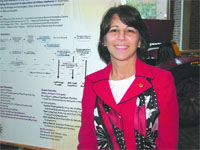
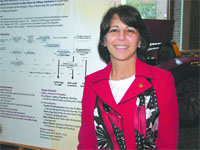
Marla Michel says the Precision Manu-facturing Regional Alliance Project has the potential to help existing companies grow market share and add jobs.

It’s called the Precision Manufacturing Regional Alliance Project, or PMRAP. That’s the long title of an initiative that one participant, a professor in UMass Amherst’s Machining and Industrial Engineering department, called a “two-way communication street” between the university and area manufacturers. That communication is expected to drive innovation that will eventually lead to growth in a vital sector of the economy — and job creation.

There were dozens of area dignitaries gathered at the new Museum of Springfield History for the Dec. 17 press conference to announce an initiative called the Precision Manufacturing Regional Alliance Project, or PMRAP for short.

Many of the speakers, from Springfield Mayor Domenic Sarno to Greg Bialecki, secretary of the state Executive Office of Housing and Economic Development, said the kinds of things one might expect as they discussed the project, funded by a $600,000 National Science Foundation grant.

They used words like ‘historic’ and ‘breakthrough’ and ‘potential’ as they discussed what amounts to a unique partnership between the region’s precision-manufacturing sector, departments at UMass Amherst, and other players, designed to foster innovation and create jobs.

But when the owners of these precision manufacturers and officials at UMass spoke, there was a different, very confident tone that wasn’t speculative in nature, noted Dave Cruise, project manager for the Regional Employment Board of Hampden County, who was one of those in attendance.

“And there was good reason for that,” said Cruise, one of the lead coordinators of the PMRAP project. “It’s because they know that this is not just talk. They can tell that it’s going to work. They’ve seen it.”

Indeed, while those representing the various parties involved in the project waited until the circumstances were right and all the major players could be assembled to stage the elaborate announcement ceremony and signing of a memorandum of agreement, the work toward forging partnerships was already well underway.

It started in late summer with the first of four so-called “technology-innovation forums,” said Cruise, referring to sessions at which area precision-manufacturing shop owners meet with faculty members at UMass to discuss ways in which they can help each other. These forums had titles ranging from ‘Non-metallic Metals — Machining and Processing Technologies’ to ‘Manufacturing Process Optimization’; from ‘Metals and Composite Interfaces’ to ‘Cryogenic Machining.’

The common denominator in each case, said Cruise, was open dialogue designed to develop ways in which research at UMass could help area manufacturers create new products; develop new, more efficient processes; or use lighter and stronger materials to better serve customers and drive innovation.

Marla Michel, director of Research Liaison & Development at UMass, put things another way. She said the innovation forums — and the PMRAP as a whole — were blueprinted to create what she called “an invisible new climate” in which technology can be transferred from the labs at the university to plants across the Valley.

Elaborating, she said that UMass faculty members and students are involved in many different types of research projects, and are conducting such work mostly unaware of how it might be applied by small and mid-sized precision manufacturers. Meanwhile, these same manufacturers are facing both challenges and opportunities with regard to existing markets and possible new ones, and without much of an understanding about how ongoing research at UMass might help them accomplish stated goals.

The PMRAP was conceived to essentially open up the lines of communication, keep them open, and build a bridge between a still-strong sector of the economy and one of the state’s leading research institutions, said Sundar Krishnamurty, a professor in the university’s Mechanical and Industrial Engineering (MIE) department, one of two that are closely involved with the project.

“I think this is a very unique opportunity for us to collaborate with small and medium-sized manufacturing facilities,” he said. “Our valley is known for its manufacturing expertise, but nevertheless, industry on the whole, and especially in Western Mass., is being challenged by increased competition globally, aging facilities and technologies, and insufficient labor.”

Krishnamurty said the PMRAP is unique in that it is focusing on smaller precision manufacturers, and also on innovation that will take place in a few years, not 10 or 20, as is the case with most such initiatives. Therefore, it has strong potential to become a model for other regions and universities, he said, noting that there are already some presentations being planned for a year from now, at which PMRAP participants will discuss how their work can be emulated.

More importantly, though, he said, the project could foster job growth, help area companies maintain market share, and increase market share.

Material Evidence

The essence of the PMRAP can be derived from language in the memorandum of agreement between the three major players — the Western Mass. Chapter of the National Tooling and Machining Assoc., UMass Amherst, and the REB — and specifically from some of the passages pertaining to what UMass effectively agrees to do:

  • Collaborate in the design and implementation of the Technology Innovation Forums that will result in identifying solution approaches to short- and long-term technology-development issues;

  • Facilitate and enable the piloting of a technology-transfer project that will demonstrate the feasibility of transferring research discovery or new-product invention from UMass to a small precision-manufacturing company;
  • Agree to support small precision-manufacturing companies in their applications for new funds to further the technology transfer between them and UMass; and

  • Liaison between the REB technology-innovation and applications engineer to ‘mine’ technologies and practices that can be shared with the precision-manufacturing companies to help the regional industry develop flexible, creative solutions, and to deliver new and better products and services in the present or new markets.
  • Breaking down these assignments and those given to the other parties involved, Cruise said it all comes back to one word: partnerships. And in that respect, the PMRAP is a perfect followup to other work being funded by a John Adams Innovation Institute Grant to make the region’s precision-manufacturing sector more visible, a better alternative for job seekers, and, ultimately, more competitive.

    Ed Leyden, president of Ben Franklin Design & Manufacturing in Agawam and current president of the Western Mass. Chapter of the National Tooling and Machining Assoc. (NTMA), said that one of the main goals of the Innovation Institute-funded initiative is to drive transfer of technology from UMass to area precision-manufacturing shops; the PMRAP will essentially piggyback that effort and ensure that such transfers take place.

    And by doing so, it will keep technology that has historically gone elsewhere inside the Commonwealth and, specifically, the 413 area code.

    “What excites me about this is that there’s so much money being spent on research and development in this state, including that $1 billion set aside for life sciences,” he said, “and my big question is, why aren’t we bringing those things to market, why aren’t we creating jobs in this state? We’re doing the research and development here, and then it’s leaving.

    “How difficult is it for us to get together,” he continued, “and keep it here, and create good quality jobs in the process?”

    The PMRAP project will help change that equation, said Cruise, adding that the initiative has a number of partners. In addition to the REB and UMass, the Economic Development Council of Western Mass., Springfield Technical Community College, Holyoke Community College, and six area vocational technical high schools are all involved.

    There are several goals and deliverables, he continued, including the far-reaching ambition of establishing something that would be called the Massachusetts Center for Advanced Precision Manufacturing Technology, which would take all of the PMRAP’s stated goals — and strategies for reaching them — to a higher plane.

    The initiative falls under the broad category of economic development, said Michel, and, more specifically, an emerging focus on the state level to help existing companies to not only stay in business but also identify ways to trigger growth and penetrate new markets.

    “In previous years, there’s been a lot of attention put on attracting new businesses here,” she explained. “But there’s been this revival, or ‘aha moment,’ that we have to make sure that the companies that are already here stay here, and grow. There’s actually been some data that shows that most of the business growth comes from companies that are already here anyway. So why not put some resources there?”

    If the project takes the course organizers believe it will, then there will be several winners emerging from the work done, Michel continued, noting that precision manufacturers win because they gain new business; researchers at UMass win because they get new and interesting problems to solve, “and that’s their lifeblood”; and the region wins because it gains jobs (in all likelihood), and an important sector becomes more vibrant.

    Parts of the Whole

    What the PMRAP does is allow small- to medium-sized manufacturers to step beyond the daily grind of survival and look at new-product discovery and development and new and better ways of doing things, Michel told BusinessWest.

    “What we know is that most of these businesses are looking day to day, how to meet the next order, how to find the next customer,” she explained, “and not necessarily looking at how to find the next process or how to find the next new material so we can find a different customer and grow our customer base.

    “That’s one of the really neat things that this project is doing,” she continued, using the present tense as she did so. “It’s allowing companies to learn about new technologies before they have customers with them, and so they can find customers with them. But it’s also allowing the faculty, the researchers, to see how the technology is used in an environment like this, as opposed to with a larger company or in a research environment.”

    Krishnamurty agreed, and said the main goal of the PMRAP is to create what he called a “two-way communications street” whereby those in the precision manufacturing industry and faculty and students at UMass can get together and discuss new and innovative ideas.

    “And not in a generic sense, but in targeted, tailored research projects,” he said, ones that will likely have an immediate impact. “A lot of the work that goes on at universities is futuristic — looking 10 or 20 years down the road and assessing how we can change things. But with this particular project, our focus is on more immediate transfer of applications.

    This, in essence, is what the technology-innovation forums are all about.

    Michel says she hasn’t been to any of the innovation forums, but she’s received enough feedback from those who have to gain a real sense of what’s happening at these events and why the exchanges bode well for the future.

    She described the sessions as “elaborate mating dances” of sorts, during which the two main parties (the MIE and Polymer Science Engineering departments at UMass and representatives of area precision manufacturers), as well as other partners, gauge compatibility and the ability to understand each other’s language. Most have gone well, but one that got off to a rather slow start showed — and perhaps better than the others — how these are going to work.

    “The fourth session [Cryogenic Machining, or the use of liquid nitrogen to cool tools] looked like it was going to be a total dud,” Michel explained. “People were getting ready to wrap up and say, ‘this is not working — we don’t have anything here,’ but then, someone said something, and things just started flowing.”

    Krishnamurty, who was one of several from the MEI Department in attendance for that session, said it was slow to yield some true results, but eventually, the give-and-take led to discussions that might eventually lead to process improvements that could improve efficiency for many area shops.

    “Cryogenic manufacturing eliminates the need for many other kinds of cooling processes, and reduces the general wear and tear on the tools,” he explained. “The challenge is how to bring the liquid nitrogen into the plant — in what shape and form does the process take, and how does it affect the machining operation?

    “Our hope and hypothesis is that it will lead to significant improvement in efficiency and cost-effectiveness for our partners,” he continued, adding that discussions on this subject will definitely continue.

    Similar developments should be expected from the other forums, both those already held and two additional ones slated for early this year, said Krishnamurty, noting that the sessions have yielded what he called “very good exchanges.”

    “These have been very conversational discussions on what our priorities should be moving forward,” he explained. “What projects are of interest to them, and what are the projects with which UMass can make the maximum contribution? We heard from the companies about their needs, and we heard from the faculty about their expertise.”

    In so doing, he concluded, the sessions helped break down what one area shop owner called a “wall” between the university and the manufacturing sector.

    Finished Product

    Several of those who spoke at the Dec. 17 press conference talked about how the history museum was the perfect setting to announce the PMRAP. Most all of the exhibits in the facility, which opened only a few months ago, are prime examples of how innovation changed everyday life — and fueled the region’s economy.

    Those in attendance were given a tour that included exhibits of Rolls Royces made in Springfield, Indian Motocycles that were invented in the City of Homes, Smith & Wesson guns, and some products made by current precision manufacturers spawned by what many consider the age of innovation in the the Pioneer Valley.

    No one can say with any degree of certainty when or if the PMRAP project will add to the exhibits in the museum. But what all those involved do know is that this initiative has enormous potential for making the precision-manufacturing sector more vibrant and a bigger force in economic development.

    They know, because they’ve already seen it.

    George O’Brien can be reached at[email protected]

    Uncategorized

    It’s an acronym not likely to become part of the local lexicon anytime soon, if ever, except maybe among some economic-development leaders and professors at UMass Amherst.

    But PMRAP — that’s the Precision Manufacturing Regional Alliance Project — is worthy of gaining a place in the region’s vocabulary, because it’s already a good story and has the potential to become a great one.

    Why? Because it embodies many positive elements identified as critical to making this region more vibrant and able to compete in an increasingly global marketplace. First, it involves partnerships between area economic-development agencies, businesses, and colleges. Second, it takes the involvement of the UMass Amherst campus to an increasingly higher plane in terms of economic vibrancy and long-term prosperity. And third, it involves the region’s manufacturing sector, and specifically the precision-machining industry, which has enjoyed a long history of innovation and can still play a key role in the Pioneer Valley economy going forward.

    PMRAP, as the full name suggests, is all about an alliance — between area precision-manufacturing operations; the university; other schools, including STCC, Holyoke Community College, and several vocational technical high schools; and organizations like the Economic Development Council of Western Mass. and the Regional Employment Board of Hampden County. All these players have a common goal: to help bring research at UMass to the boardrooms and shop floors of area manufacturers, with the goal of driving innovation and, in the process, creating jobs.

    There are many elements to this equation, with one of the keys being something called technology-innovation forums, which, in a nutshell, will open the lines of communication between researchers and shop owners, lines that have mostly been closed, and to the detriment of all the players involved.

    There have already been four of these forums, with more scheduled for the months to come. Thus far, those involved say they’re doing exactly what they were designed to do: stimulate a dialogue between two groups that can definitely help one another.

    Area shop owners can provide researchers with problems to solve — which is what researchers live for. Meanwhile, researchers can solve the problems and, in the process, give shop owners new and better processes, new materials, and new ways to approach business.

    And with all that, these manufacturers can retain market share, grow market share, tap into new markets, expand, and add new, well-paying jobs in a region that remains desperate for some.

    Meanwhile, there’s something else: A region that once made its reputation for generating innovative products and processes can turn back the clock in that regard.

    No one can say with any degree of certainty how many jobs the PMRAP may create or retain. It’s much too early in the process for that, and there are, by most all accounts, no models of this kind of alliance to study anywhere in the country.

    But what is known is that this program certainly looks good on paper. Actually, it looks good in conference rooms at the university and in some area precision-manufacturing facilities — places where these technology-innovation forums have been staged since last fall.

    In those three sessions, participants could see that PMRAP isn’t just words, and it isn’t just an acronym. It’s a blueprint for progress.

    Features
    This Entrepreneur Is Getting the Bugs Out
    Companies to Watch: Graduate Pest Solutions

    Glenn Olesuk says his degree in Entomology gives him a competitive edge — and it also gave his company a name.

    Glenn Olesuk says he won’t easily forget his first professional assignment.

    That was as the technical director for a local pest-control company in Chicago. There were many elements to that job description, but at the top of the list was battling something the locals and the press had dubbed the “super rat.” This was a pest said to have amassed a resistance to all or most of the rodenticides in use at that time (1979).

    “There was evidence that some resistance had been built up,” said Olesuk, now the owner and entomologist with his own company, Hampden-based Graduate Pest Solutions, adding quickly that the super rat was, in his opinion, more myth than reality.

    But he did see plenty of rats, and he has some vivid memories from those days in the Windy City, including one that he and his wife, Brenda, often retell. Glenn, it appears, wanted to show Brenda just what he did for a living, specifically his work at some of the finer hotels to keep rats out of the view of guests.

    “Every major city has layers — downtown Chicago had what’s known as Wabash Avenue, which is the layer below the main streets, where the service vehicles would come in,” he explained. “And that’s where the real battle with rats took place. We would trap and kills rats by the hundreds. One night I took my wife to show her what I do every day; I was driving with my lights off, and pulled into an alleyway behind one of the major hotels. When I turned the lights on, it was like a Hollywood movie — there was just a mass of dark gray that moved from the street and ran into these inconceivable little holes and openings in the alleyway.”

    These days, Olesuk is doing battle with far-less-exotically named pests at a venture he named Graduate to call attention to something he says differentiates him from most all competition. That would be his bachelor’s degree in Entomology, the study of insects, that he earned at Syracuse.

    “Sometimes I have to explain it,” he said of his company’s name and the motivation behind it. “But by the time I’m done explaining, they get it.”

    Most in this huge, highly competitive industry don’t have such qualifications, he explained, adding that, from his studies in college — not to mention his 30 years in the field (and in attics and back alleys) — he can effectively answer most all questions people have about pests in their home or business.

    And informed answers are what clients and potential clients want most, said Olesuk, adding that he’s been providing them since his career path took a turn at Syracuse. “I was going to get into forestry,” he explained, “But then one of my professors said, ‘take pest-control technology, and you’ll always be employed.’ He was right.”

    Tracing his history in the pest-control business, Olesuk said he worked for both local and regional firms until becoming part-owner of a venture in 1998. That business partnership eventually dissolved in early 2007, he continued, adding that he launched Graduate Pest Solutions shortly thereafter, and has been building a book of business steadily since then.

    Moving forward, Olesak, who has his two sons, Paul and Scott, working with him in part-time capacities, said his primary goal — and challenge — is to get his company’s name and his résumé in front of people. If he does so, he believes he can take market share from a host of local, regional, and national competitors.

    And once he gets a customer, Olesuk says he keeps it. “I’ve always had 100% retention,” he explained. “I’ve never lost a client to service.”

    Olesuk says the majority of his clients are commercial, and while he’s working to continually build that portfolio, he also wants to greatly increase his residential customer base as well.

    In both realms, the key is exposure, he said, adding that he’s employing a number of marketing vehicles — from some direct mail to his service truck, outfitted with a new logo — to introduce people and businesses to his venture.

    Olesuk hasn’t encountered any super rats in his current service territory (Hartford north through the Pioneer Valley), but he is being kept busy with Asian lady beetles, mice, spiders, ants, and bees, each with their own season, except spiders, which are generally a year-round concern.

    He can talk at length about any and all of them, because he has not only experience, but that diploma that gives him a degree of separation — both figuratively and literally.

    Uncategorized
    Nominations Sought for the Class of 2010

    After three successful years of its 40 Under Forty recognition program, one might think BusinessWest is running out of stories to tell of young professionals making a difference in the Pioneer Valley.

    But that would be wrong. And we’re asking you, the readers, to prove us correct by nominating a new batch of fresh faces for the class of 2010.

    Since 2007, BusinessWest’s 40 Under Forty has captured the attention and respect of the region’s business community, bringing into focus what most already know: that Western Mass. is home to a creative, motivated, and successful group of young business leaders, entrepreneurs, and innovators — people who, even in tough economic times, are redefining what it means to grow successful businesses and serve their communities with whatever spare time they have left over.

    Michelle Sade, operations manager for United Personnel in Springfield, said she was honored to be part of last year’s 40 Under Forty class. As a founding member of the Young Professional Society of Greater Springfield — which placed several of its members in the class of 2009 — she has expressed a passion for cultivating young talent in the region, and said BusinessWest’s annual program bolsters that effort.

    “It definitely highlights the amount of talent throughout the Pioneer Valley,” Sade said. “The Young Professional Society has worked to allow those talented young professionals to come together and network, and what BusinessWest has done is to put the spotlight on some of the rising stars of that group.”

    That sort of sentiment is gratifying to hear, said Kate Campiti, associate publisher of the magazine, noting that the program was created to draw attention to not only the depth of young talent in the region, but also its diversity, both demographically and in the types of work they do.

    “We’re telling the story of young people doing some incredible things,” said Campiti, “but we’re also telling the stories of the ventures they’ve started, the established companies they work for, and the nonprofits they lead. Add it all up, and it paints a bright picture of the region and its future.”

    The 120 previous honorees have emerged from law, education, retail, health care, social services, finance, and many other fields — some forging completely new paths in computer technology, renewable energy, and ‘green’ business. In all cases, they have been successful in business and active in civic volunteerism, the latter being a critical consideration when judging applicants.

    As in the past three installments of Forty Under 40, the winners will be profiled in an upcoming issue of BusinessWest — always a must-read issue — and toasted at a gala reception in the spring.

    Without fail, the 40 Under Forty honorees say they’re impressed with the quality of the people they meet at this event, and consider it a springboard for long-term networking.

    “It was wonderful, and the exposure to such quality people was amazing,” said Renee Stolar, president of J. Stolar Insurance Co. in Palmer, another member of the class of 2009. “I’ve been able to keep in touch with many of them, so this opened the door to a whole realm of people I probably never would have met otherwise. I was very happy with the whole experience.”

    The nomination form can be found on page 22 of this issue. It will be reprinted in upcoming issues as well, and may also be printed from businesswest.com. The deadline for entry is Feb. 19.

    After the deadline passes, the nominations will be scored by an independent group of judges comprised of area business leaders and previous 40 Under Forty honorees. They will be tasked with carefully weighing the achievements and community commitment of those who are nominated by their peers over the next two months.

    “I don’t know how you can choose when so many people are doing such good things, and have such talents and passions and things they feel are important to the revitalization of the area,” Sade said. “Everyone has a different idea what that means; if you look at the 40 Under Forty, every one of them is trying to make a positive impact on their business, their community, a nonprofit — and in some ways that are quite remarkable.”

    She cited the example of Kathy LeMay, who received the highest scores in last year’s judging. LeMay’s Florence-based company, Raising Change, cultivates connections between philanthropists and nonprofit agencies, and she’s made a difference to the tune of hundreds of millions of dollars raised.

    “She’s amazing,” Sade said. “These are people doing some amazing things.” She added that the 40 Under Forty annually makes an example of young people who are not leaving the Valley, but are trying to make it a better place to live and work. “They’re just inspiring.”

    If you’ve been similarly inspired by a young professional making that kind of difference, don’t hesitate to fill out a nomination form. – Joseph Bednar

    Class of 2007

    Sections Supplements
    It’s Good for Public Relations, Good for the Bottom Line

    Lock four business professionals in a room, and chances are you’ll get four different opinions about what ‘sustainability’ means. Some may see it as a way that corporations can help stop global warming. Another might say that global warming is a lie, and corporations are wasting their time spending money trying to save the environment. Still others may say sustainability is simply replacing Styrofoam cups with paper or coffee mugs that can be washed.

    The truth is that there really is no one definition of sustainability and all of the above answers have a kernel of truth. By adopting a sustainability plan, a company can take steps that may reduce their carbon footprint. Even if you don’t believe in global warming, your company may still see a financial benefit in switching from electrical heat to natural gas. But no matter how you slice it, sustainability is the new corporate buzzword, and, like it or not, the public is watching.

    Right now most American companies are about a decade behind European companies when it comes to understanding what sustainability is and how a company can use sustainability efforts to not only save money but position themselves ahead of their competition. Sustainability efforts are no longer just being undertaken by hemp clothing retailers in San Francisco. In July 2009, Wal-Mart announced a major restructuring of the way it handles packaging and vendors based on a new sustainability index. And we all know that once a company like Wal-Mart is on board, the business landscape changes.

    A modern sustainability program is based upon the idea of a triple bottom line, which refers to a company’s economic viability, its social responsibility, and environmental responsibility. Adopting a sustainability program doesn’t mean that your company has to generate all of its own power and convert its fleet to battery-operated cars. It simply means deciding what types of graduated steps you’d like to adopt to show social and environmental responsibility and then letting the world know what you’re doing through an annual Corporate Social Responsibility (CSR) Report.

    “CSR reports are just starting to catch on among American businesses. A good example is one that is on the Starbucks Web site,” explains Kretz. “If you look at the Starbucks report, you’ll see that the company outlines various initiatives that it is undertaking to minimize its environmental impact and give back to the communities that it serves. For example, they talk about their transition to only selling fair-trade coffee beans, powering their stores with renewable-energy sources and employee volunteer programs. When you read it, you begin to understand that Starbucks hasn’t undergone a drastic transition. Rather, they are implementing something gradual but purposeful — and looking good while doing it.”

    Winning the PR Battle

    One of the benefits of developing a sustainability strategy is the fact that it automatically opens your company up to positive public-relations opportunities. The number of consumers who value environmental and sustainability efforts is growing every day, and by communicating your actions to those who are interested, you are positioning your company to look more attractive versus a company that has no sustainability plan.

    “There are Web sites devoted to help interested people find information about what companies are doing with regard to sustainability,” says Kretz. “CSR reports are indexed and readily available online. And it’s important that they’re accessible because many consumers and business will refuse to patronize a business that isn’t implementing at least some type of sustainability initiative.”

    A perfect example of using sustainability practices for PR comes from Kostin’s homebuilding clients. Many are building higher-end homes in accordance with Leadership in Energy and Environmental Design (LEED) specs because, in a tough home market, a LEED rating can be the difference between a home selling or languishing on the market for months.

    A commitment to sustainability also helps with internal PR because studies have shown that employees — especially younger ones — look favorably upon such efforts. A CSR is an easy way to illustrate your company’s commitment to sustainability, which can also be of use when hiring.

    Going Green Means Saving Green

    Remember that a good sustainability program is supposed to contribute to a company’s triple bottom line. This means that a good sustainability campaign will also help save the company money.

    There are a number of ways that a company can help the environment and save money at the same time. The easiest way to do this is by taking advantage of the numerous tax credits and incentive programs for installing energy-saving equipment or replacing older equipment with newer, more efficient items. The recent stimulus packages included more than $61 billion in credits and grants for energy conservation.

    Some examples of the government credits available are for adding insulation to your home and purchasing hybrid vehicles. On the business side, there are grants available for solar panels and wind, power, tidal, and geothermal power. Of course, these programs start and end all the time, so speaking with your tax professional is a good start to find out what types of programs are currently available.

    Beyond tax credits and incentive programs, sustainability programs have other benefits that may be small but add up over time. For example, a company changing from disposable cups to having employees bring in washable mugs will not only reduce waste but will save the company the money they spent supplying the cups. Implementing a data-warehousing system can not only help a company reduce the need for printed, archival copies of files, but it will also reduce the square-foot cost for storage needs and usually results in quicker retrieval of data.

    There are experts who specialize in sustainability audits who can come into a company, see how it is currently operating and suggest small measures that can really add up. When the price of gas spiked above $4 a gallon, many companies started trying to figure out ways to reduce travel with videoconferencing or by stacking together trips so that multiple clients could be visited in one day. Even though gas is now below $3 a gallon, that strategy of reducing travel not only enhances a company’s sustainability efforts, it will mean less money burned down the tailpipe.

    The Wal-Mart example illustrates the ultimate bottom-line impact. Part of Wal-Mart’s plan is to measure the sustainability of every product it will sell. It is forecasting a day in the next couple of years when it will be able to label all of its products with a ‘sustainability index’ number. Those companies that aren’t currently working to minimize their packaging and quantify the environmental impact of their product and manufacturing processes will find that the large retailer will no longer sell their product. That’s where you can easily see that companies with no sustainability plan won’t be able to sustain their business model.

    What the Future Holds

    There’s no question that companies need to start working on assessing their sustainability efforts. The time is drawing nearer when it will be a necessity to have at least some type of report available that outlines what your company is doing with regard to minimizing its impact on the planet and maximizing its efforts to help members of your community.

    For example, the American Institute of CPAs has set up a task force to figure out best practices around sustainability initiatives. In fact, Prince Charles, a proponent of sustainable farming and other practices, spoke to the group’s annual conference this year to encourage further development of sustainability in the U.S.

    CSR accounting has only been around for a decade, and it’s still evolving. But companies that commit to measuring their sustainability can demonstrate their interest in the environment to their employees and communities, build trust and promote transparency, and show their commitment to their important stakeholders. CSRs are gaining momentum, and companies that aren’t taking action now risk finding themselves on the wrong end of business and consumer sentiment in a few years. n

    Richard Kretz is managing member and Brian Newman is member of the firm at Kostin, Ruffkess & Co., LLC, a certified public accounting and business-advisory firm with offices in Springfield as well as Farmington and New London, Conn. Beyond traditional accounting, auditing and tax consulting, the firm also specializes in employee benefit-plan audits, litigation support, business valuation, succession-planning business consulting, forensic accounting, wealth management, estate planning, fraud prevention, and information technology assurance;www.kostin.com.

    Sections Supplements
    Year-end Is a Time for Businesses to Focus on Planning, Improving

    Kevin Vann says that budgets are, by and large, discouraging, and they are especially so in times like these.

    “Sometimes you look at it, and you think, ‘my God, another year of thinking about just trying to break even,’ or you wonder, ‘am I going to have to trim payroll?’” he explained. “You can be discouraged with a budget, and from my experience, that’s why a lot of clients put them away or don’t follow them.”

    But putting together a solid budget is one of the key ingredients in successful business planning — short-term and long-term — and it’s one of the many management matters that business owners should be thinking about as they prepare to turn the calendar, said Vann, president of the Springfield-based Vann Group, a business-consulting firm.

    Actually, things like budgets, retirement plans, tax planning, insurance packages, benefits programs, employee handbooks, and many more are topics that business owners should be thinking about all the time, said Vann, who owns or co-owns a number of ventures and practices what he preaches. But because people are busy — and now seemingly busier than ever — often they don’t, and thus year-end, as hectic as it is, can be an effective time to take action on such issues.

    “People make resolutions every Jan. 1,” said Vann. “Well, businesses can and should do the same.”

    Joe Messer agreed. A certified public accountant with the Holyoke-based accounting firm Meyers Brothers Kalicka, he said year-end is obviously a time to be thinking about, and executing, effective tax planning. But it’s also a good time to make commitments to address everything from evaluating technology needs to preparing a succession plan — something far too many business owners put off until they have to, or until it’s too late.

    “A lot of business owners tend to think that they’re invincible and they’ll be around forever,” he said. “And that’s why they don’t think about succession, which puts them in a bad situation when the time comes and they have to confront it.”

    There are myriad other issues that should be confronted on a regular basis, and year-end is a practical time to visit or re-visit them, said Sean Wandrei, a tax manager at Meyers Brothers Kalicka who listed matters ranging from retirement plans to cash-flow issues; from bank finance issues, such as covenants, to tax matters including income deferral and accelerating deductions.

    In this, its final issue of 2009, BusinessWest takes a look at how business owners and managers can use the act of turning the calendar to help make their ventures run more efficiently and effectively plan for the long term.

    Date with Destiny

    Vann said that one of the things business owners and managers might want to do at year-end is look at their computer desktop.

    “I have about 35 icons on mine, and I’ll bet I’m using three or four of them, just those things required to do my job,” he said, adding that, as part of an exercise in technology planning, individuals may want to examine why all those icons are there. “All those other things … someone either taught it to me or installed it for me, and I’m not utilizing it properly.

    “Technology is a huge part of business management today,” he continued, “not just on the strategic side, but on the process side; we’re all waiting for that next wave of technology to drive our backroom processes and help us manage our time better.”

    What business owners can, and should, be thinking about this time of year is taking their desktop review exercise and doing roughly the same thing with every aspect of their organization, said Vann, who outlines several types of planning that managers should be doing in a related story on page 23. And they should do so with an eye toward making their operation run more smoothly, while also prepping it for long-term success.

    But they must do so with the understanding that effective planning, be it with technology, taxes, personnel, or succession, are truly year-round exercises.

    “These are things that people have to be thinking about at all time, not just year-end,” said Messer, adding quickly that the start of a new year can indeed be an effective time to make what may amount to resolutions. And one area he says should be at or near the top of the list is succession planning.

    “It’s one of the most important, but also one of the most overlooked, aspects of business,” he said. “Who are we going to transition the business to when we’re ready to retire and move on to sunnier days?”

    To answer that question, business owners and managers have to identify who that ‘next generation’ is going to be, he continued, and revisit the issue of succession on a regular basis to make sure the right party or parties have been identified and that the transition process stays on the right track.

    While succession planning is important, especially for those business owners who have preferred to put off the inevitable, there are other business-management and planning issues that should also be considered at year-end, said Messer, who listed everything from cash flow to disaster-recovery plans, or, to be more specific, the lack thereof.

    As for cash flow, accounts receivable is an issue impacting virtually every company in these trying economic times. Business managers should wait for year-end to put firm policies and procedures in place for collecting payments that are due, but if they don’t have them, now would be a good time to put them in place.

    “In these tough economic times, receivables tend to get dragged out on a longer period and can make it very difficult for businesses to keep a positive cash flow,” Messer explained. “So business owners need to be proactive and implement strict collection policies and processes to help the cash flow remain positive.”

    And a key element in such policies must be consistency, he continued, adding that the best approach for businesses is to be proactive, not passive, when it comes to collecting bills.

    Other matters to consider at year-end, said Messer, include health plan coverage and whether a better package is appropriate, the broad subject of inventory (how to reduce it and examination of why it’s not moving), and retirement plans — and perhaps the need to diversify offerings.

    “One size doesn’t fit all with respect to retirement benefits and retirement options you can offer to your employees,” he said. “Business owners and managers really need to look to identify the target group they’re trying to benefit. Do they want to benefit the business owner and a few key employees, or do they want to provide a benefit across the board to all employees?

    “Once you make those determinations and identify your key goals,” he continued, “then you can structure a plan and put it in place to meet those goals. There are so many variables out there.”

    Another important item for business owners to consider is insurance, said Wandrei, noting that year-end might be an appropriate time to think about possible courses of action when existing policies expire.

    John Dowd, fourth-generation principal, specifically executive vice president, of the James J. Dowd & Sons Insurance Agency, said there are a number of factors to consider when reviewing one’s insurance package and determining whether it is appropriate.

    Businesses change and expand from year to year, he explained, and insurance coverage must be adjusted to meet those changes, a point that is often lost on business owners trying to meet the day-to-day requirements of running their venture.

    “It happens all the time; people say, ‘we don’t need to meet and review things because nothing’s changed,’” he said. “But then you sit down and talk, and the business owner says, ‘yes, we sold that piece of equipment, and we bought that piece of equipment, and, by the way, we’re storing things in a different location.’ All those things are important because they impact the coverage you need.”

    Overall, Dowd said business owners must consider the worst-case scenario when it comes to calamity and possible loss, but, unfortunately, many do not, and they pay the consequences when the worst happens in a fire, flood, or other disaster.

    “I have to think of the worst-case scenario, because what if it happens?” said Dowd, speaking as a broker. “Granted, it’s not likely to happen, but if it does happen, you’ll be out of business if you’re not properly covered. Business owners have to think about what they’ll be faced with when they get that call in the middle of the night that their business has just burned down.”

    Another matter to consider at year-end is staffing, said Vann, noting that this issue has taken on a heightened sense of priority in this economic downturn. Indeed, many companies have downsized in recent months, and a good number have concluded that the smaller size is the right size. For others, more analysis is needed to answer that question.

    “A lot of people are looking at staffing right now and wondering if they can continue to make do without people who have been laid off,” he said. “It’s a critical issue right now, and a very big part of the budgeting process.”

    The Bottom Line

    That’s the often-discouraging budgeting process, as he described it, and one of those matters that business owners and managers let slide, for whatever reason.

    Putting together a solid, realistic budget — and then sticking to it — is just one of many commitments that people should make as they approach the new year, said Vann, stressing, again, that such matters deserve year-round attention.

    Let the resolution-making begin.

    George O’Brien can be reached at[email protected]

    Departments

    YPS New Year’s Eve Celebration

    Dec. 31: The Young Professional Society of Greater Springfield has once again chosen downtown Springfield for its New Year’s Eve celebration. Only 300 tickets will be available for the affair at the Marriott Hotel in Tower Square. Businesses and individuals interested in sponsorship of the event should visit www.springfieldyps.com for more details. For ticket information, call Jill Monson of YPS at (413) 219-9692.

    Hot Topics in Philanthropy Breakfast

    Jan. 8: “Communicating in a Digital Age” is the focus of the next Hot Topics in Philanthrophy Breakfast at Bay Path College in Longmeadow. Nonprofit professionals are invited to the free event; however, registration is required. Keynote speaker Brian Reich, author of Media Rules! Mastering Today’s Technology to Connect with and Keep Your Audience, will provide a framework for understanding our technology-driven environment and how best to harness the appropriate digital tools to communicate an organization’s mission, vision, and purpose. In addition, panelists Suzi Craig, director of marketing at Fathom, and Megan Pete, director of development of the Food Bank of Western Mass., will share their organizational challenges and successes related to this topic. The 7:30 to 10 a.m. event is planned in the Blake Student Commons. To register, visit www.baypath.edu or call (800) 782-7284, ext. 1056.

    Legislative and Economic Forum

    Jan. 8: The Greater Westfield Chamber of Commerce will present a Legislative and Economic Forum with AIM (Associated Industries of Massachusetts), from 9 to 11 a.m., at Mestek Inc., 260 North Elm St., Westfield. The guest speakers will be Rick Lord, president and CEO of AIM; and Brian Gilmore, AIM’s executive vice president for public affairs. This will be an informal briefing on several political and economic issues important to the Commonwealth’s employer community. AIM stands for an economic policy that balances key public investments with a competitive cost structure that keeps jobs in the Bay State. For reservations or more information, call Marcia Kielb at (413) 568-1618 or e-mail [email protected].

    Women’s Partnership Tabletop Business Expo

    Jan. 20: The Women’s Partnership will host its 12th annual Tabletop Business Expo from 11:30 a.m. to 1:30 p.m. at the Springfield Sheraton. Plans include interactive exhibits. Businesses interested in exhibiting should e-mail Mary Petrone at the Affiliated Chambers of Commerce of Greater Springfield Inc. at [email protected]. Booth reservations include one lunch ticket at $75; lunch and event tickets are $25. The Women’s Partnership provides career-oriented professionals with leadership and growth opportunities.

    Rick’s Place Benefit

    Feb. 6: Wilbraham Country Club will be the setting for the second annual Heart to Heart fundraiser to benefit Rick’s Place Inc. Established in memory of Rick Thorpe, who died in Tower Two of the World Trade Center on 9/11, Rick’s Place Inc. was created to provide a supportive, secure environment where families can remember their loved ones and avoid the sense of isolation that a loss can produce. Rick’s Place offers bi-weekly bereavement support for families with children ages five to 18 at no cost. Tickets for the 6 to 11 p.m. fundraiser are $50. A silent auction and raffle drawing are among the highlights of the evening. Underwriting and corporate sponsorship opportunities are also still available. For more information or to make a tax-deductible donation to Rick’s Place, call Shelly Bathe Lenn, executive director, at (413) 348-3120, or visit www.ricksplacema.org.

    Difference Makers Celebration

    March 25: BusinessWest magazine will stage its second-annual Difference Makers Gala at the Log Cabin Banquet and Meeting House, starting at 5 p.m. Difference Makers is a new program created to recognize individuals and groups that, through their efforts to give back the community, are making a difference in the Pioneer Valley. The first year of the program was a huge success, and organizers are expecting another sellout crowd to honor the Class of 2010. Additional details on the gala will be provided in upcoming editions of BusinessWest. For more information, call (413) 781-8600.

    Women’s Professional Development Conference

    April 30, 2010: Bay Path College will host its 15th annual Women’s Professional Development Conference at the MassMutual Center in downtown Springfield from 7:30 a.m. to 4:30 p.m. For more information, call (413) 565-1000 or visit www.baypath.edu.

    Sections Supplements
    Springfield’s ICT Center Forges Connections in a High-tech Global Marketplace
    Gordon Snyder

    Gordon Snyder says teaching the teachers is key to keeping young Americans competitive in the high-tech world.

    Gordon Snyder has done a lot of blogging about some fairly complex technologies, but nowadays, he likes to communicate through Twitter at least as much.

    “I find it’s much more effective if I have to condense something online to 140 characters or less,” he laughed.

    Whatever the vehicle, social media like Twitter are among the latest in a series of communications advances connecting people around the world like never before. And Snyder, executive director of the Information and Communications Technologies (ICT) Center in Springfield, is all about making connections.

    Specifically, the ICT Center — a division of Springfield Technical Community College located in the STCC technology park — forges partnerships with other schools, mainly community colleges, to encourage the teaching of the most up-to-date information in tech-related courses, in order to help maintain American competitiveness in the global marketplace.

    That is essentially what the center was created to do when it was launched in 1997, and the way communications, Internet use, and other technology has dramatically changed in the past 12 years in many ways reinforces the need for such a resource.

    After all, hardly anyone was blogging in the late 1990s, and tweeting was the domain of birds.

    Using far more than 140 characters, Snyder recently spoke with BusinessWest about how the ICT Center has succeeded in helping teachers, students, and others stay atop the fast-moving world of computer and communications technology.

    Foundation for Success

    At its core, ICT helps to develop programs and curriculum, Snyder said. “We do a lot of faculty training, a lot of work with new and emerging technology, we offer workshops and conferences, and we provide subject-matter expertise.”

    And in that latter regard, the center has certainly grown. In the early days, it was focused on three subjects: fiber optics, wireless communications, and networking. But today, ICT calls upon some 60 experts in a much broader range of subjects to speak at conferences and work with colleges and employers.

    “We have faculty doing presentations on their work, giving presentations on things that people can take back to their own classrooms,” he explained.

    The mission of the ICT Center is based on an assertion that the information and communications technology industry — driven by a demand for instantly accessible information — is profoundly changing the world, as partly evidenced by the modes of communications that have existed for only a short time.

    Preparing a workforce to compete in this global communications marketplace is today’s major challenge for the ICT industry, and with even more rapid breakthroughs anticipated, education is the key.

    In response to that rapidly growing need, STCC established the Northeast Center for Telecommunications Technologies in 1997. Aided by outside funding from the National Science Foundation and a number of businesses, the center was conceived as a resource for educators to help them stay abreast of the most current trends and technologies in their telecommunications programs, in turn preparing the experts of tomorrow.

    “We’re a division of the college. We’re making sure the programs are up to date,” Snyder said. “Another large part of our effort is recruiting and retaining underrepresented populations” into the ICT fields.

    To that end, the center works closely with organizations such as the Institute for Women in Technology and Trades (IWITT). “Their focus is to attract women into some of these underrepresented programs, like computer science programs,” he explained. “Very few women are graduating from these programs across the U.S., so how do we get women interested in these programs and then keep them from dropping out or changing their major?”

    It wasn’t too long before the NCTT got its first name change, however.

    “We wanted to expand our footprint beyond the Northeast,” Snyder said, “so we took the name of the National Center for Telecommunications Technologies.

    “The center was working with community colleges, and some four-year schools, in the Northeast,” he continued. In changing its name to announce a broader focus, “we began to reach out to the rest of the country, creating more partnerships and relationships with community colleges. It has been pretty successful.”

    So much, in fact, that two regional versions of the NCCT have been established in Fort Worth, Texas and San Francisco.

    The center underwent another transition in the early 2000s that led to another name change just last year.

    “Back then, the Internet bubble was bursting, and the infrastructure was in some ways built out in the U.S, as much as it would be for awhile. We started to see a change in industry needs, and we started to add IT stuff to our physical layer content,” Snyder said. “It was a natural migration over the years, so a year and a half ago, we became the Information and Communications Technologies Center, a better description of the work we’re doing here.”

    Connecting the Dots

    The ICT Center receives much less outside funding than it used to, but Snyder said it has developed a self-sustaining model that accomplishes a wider range of goals.

    “A lot of what we’re doing is making connections,” he said. “We were funded more in the beginning than we’re getting now, but I think we’re doing more now with a lot less money because we’re finding these people and making connections.”

    For instance, the center works on programs with the Economic Development Council of Western Mass. and the Regional Employment Board, hosting area business people at STCC for technology and communications conferences, which in turn raises the profile of the college.

    “That gives exposure to the campus, and it builds credibility for our students and our graduates,” Snyder said. “If they’re impressed with the place, they’re going to look more closely at our students when it comes time to hire somebody.”

    And community colleges, he said, are playing a key role in preparing students for high-tech careers, no matter what kind of credentials they have when they arrive.

    “You may not come in prepared; you might not come in at the right math level to take some of these courses,” he said. “If you took a good track that included math and science, you’ll place, and will be able to jump into the programs right away. Computer skills are important. But a lot of students have some catching up to do — but that’s one of the great things about community colleges.”

    Students who choose to study in the ICT fields might wind up working within that industry, but they can also apply those skills to an ever-widening number of other careers, said Nina Laurie, associate director of the ICT Center.

    “Technology is a big part of other disciplines, like finance and biotech,” she said. “So if someone wants to focus on one area and apply it to another area, that’s really great, too.”

    But it all starts with training the trainers, and the center continues to grow its offerings in order to keep educators up to date, whether or not they can attend educator conferences like one being held in San Francisco on Jan. 7 and 8.

    “Sometimes it’s hard to get people caught up,” Snyder said. “With the reduced funding, we’re looking at other ways to help people. We have a YouTube channel, and we’re looking at streaming some conferences for people who can’t attend them live. Budgets are tight right now, and we’re looking at other ways to disseminate the work we’re doing.”

    The ICT Center’s Online Impact conferences — which focus on social-media applications like Facebook, Twitter, and LinkedIn, are another good example of training people in the use of a business tool that didn’t exist a decade ago. The second annual Online Impact event is scheduled for Jan. 14 at STCC (see related story, page 13).

    Such conferences are just another way of making those connections Snyder talked about.

    “It’s not always the same people who participate, but there are always new people coming into the mix, and that always changes things,” he said.

    An important thought — and, at just under 140 characters, one he can instantly share with the world.

    Joseph Bednar can be reached at

    [email protected]

    Sections Supplements

    As the calendar turns to 2010, business owners and managers should be thinking about resolutions, especially those involving effective planning.

    Here are several types of planning that decision makers should consider critical for the year ahead.

    Strategic Planning: Take time to research how to go about doing strategic planning and with whom. Perhaps the company can do it on its own, or perhaps it should hire a facilitator. In any case, set aside one or two days for strategic planning. This is one of the most critical blueprints every business should have, and it should be done at least once a year. This process should include owners and key staff members and perhaps outside consultants and independent parties as well.

    Technology Planning: Each business should minimally have an internal staff member or an outsourced consultant to guide every company through the rigors of changing and updating technology. Time should be set aside for owners and key staff to be educated on a continuous basis. Technology will drive efficiencies, productivity, and revenue for most companies.

    Employee / Staff / HR Planning: Each business today minimally needs either a staff person or an outsourced consultant to keep them up-to-date with the constantly changing compliance issues involved with having employees. Additionally, this planning model should include internal company issues, benefit packages, recruiting, retaining, and staying competitive. Any company that has employees should have a handbook minimally. The handbook should be reviewed annually.

    Succession and Long-term Planning: Depending on the size of the company and the owner’s philosophy about life and business, succession and long-term planning for a company, the owners, and key staff should be a priority. If the owner of a company has done a good job addressing his or her own retirement and succession issues, then the company will continue to thrive. Fear of the unknown is the greatest fear, so the more effort the company puts into proper planning for the owners and key personnel, the better chance it has to continue. Even if an owner indicates an unwillingness to do succession planning, then certainly having a plan that indicates when and how to sell or liquidate the company is important.

    Tax Planning: This has been pretty much accepted as an annual task by most business owners and key personnel; however, it’s still surprising just how many businesses make decisions, take on risk, and do business without properly understanding the tax consequences of their decisions.

    Budgeting and Financial Planning: I just can’t imagine a business — or an individual, for that matter — not making budgeting and financial planning a priority on an annual basis. Unfortunately, many, many businesses fail to do annual budgeting and financial planning. The budgeting process should include solid projections relative to revenue, expense planning, and profit expectations. This planning should also include cash-flow projections that take into account what capital expenditures need to be made, how much debt will be paid down, or how much debt or equity will be required to run or capitalize the business. The budget or financial plan should include the company’s ‘wish list’ for the coming year, and typically that list includes the items or initiatives from the strategic plan and all of the other planning during the year. The budget should be the by-product of all of the annual planning that has been done.

    Kevin Vann is a principal with the Springfield-based Vann Group; (413) 543-2776.

    Features
    Today’s High-tech Gear Benefits a Generation on the Go

    Societal trends point to a generation of professionals who are increasingly doing business away from traditional offices, and the tools they use — not just for work, but leisure time, too — reflect the need to stay connected with colleagues, clients, and friends when on the road. From lightweight notebook computers to cameras that upload quickly to the Internet; from GPS navigators to smartphones and MP3 players, there’s something for everyone — and, in many cases, at more affordable prices than ever.

    Technology moves fast. Which is good, because today’s business professional is on the move, too.

    So it’s not surprising that a look at this year’s top-rated high-tech offerings is also a crash course in how to work — and play — while on the go. From laptop computers to GPS systems; flash drives to iPods and e-readers, Americans are increasingly bringing their work and leisure activities with them wherever they go — and those devices are constantly improving in terms of power, storage capabilities, and (importantly) price.

    Take, for example, the Toshiba Mini NB205, one of PC magazine’s most highly touted ‘netbook’ computers for 2009. At just $400, it weighs a little under three pounds — average by laptop standards, but still pretty lightweight — and boasts a roster of features including three USB ports, a webcam, fast 1.67GHz processor, 1GB of memory upgradable to 2GB, and battery life that ranks among the longest available.

    Yes, its 10-inch screen is smaller than the 12-inch screen of some pricier notebooks, but it compensates with a full-size keyboard, large mouse buttons, and spacious touchpad. The NB205 also meets established standards of energy conservation and recyclability, another plus in todaqy’s ‘green’ business world.

    For those with a slightly higher budget, but still in the affordable range, PC magazine gives high marks to the Acer Aspire 3935 ($900), which boasts a sleek, metallic cover, 1-inch-thick chassis, and 4.3-pound weight, all while supporting a 13.3-inch screen and good-sized, comfortable keyboard buttons. The system could be even thinner if not for one of its most desirable features, its built-in, dual-layer DVD burner. Its other features — the webcam, a 5-in-1 card reader, and a 250GB hard drive — are standard on ultraportables. With a 2GHz processor speed and decent batter life, the 3935 also meets standards of energy efficiency and recyclability.

    On the go means more than carrying around notebooks, however; it also means actually driving between destinations, and professionals are increasingly relying on global positioning systems (GPS) to get them where they want to go.

    According to cargpsreviews.net, the Garmin Nuvi 780 GPS navigator ($599) goes above and beyond what’s usually expected from a GPS, offering an easy-to-use interface, a Qwerty keyboard, and a wide array of features including spoken directions in real street names, integrated traffic receivers, an MP3 player and photo viewer, and an FM transmitter that will play voice prompts, MP3s, and audio books directly through the vehicle’s stereo system. In addition, its bright, 4.3-inch, widescreen display is readable even in harsh daylight from any angle, thanks to the integrated white backlight.

    For less money, PC World gives high marks to the TomTom XL 340 ($299), whose 4.3-inch screen is larger than that of its predecessor, the TomTom ONE 140, and also features the company’s new IQ Routes technology, which is based on real-life user data rather than the traditional maximum speed method. It considers all possible routes and then selects the one that takes the least time, with the technology often trying to avoid main roads. The unit also boasts advanced lane guidance, by which an icon in the corner of the map screen highlights which lane the vehicle should be in, depending on the destination.

    Point and Click

    What better device to take on any journey — business or pleasure — than a camera? Digital cameras are being used increasingly for both work and play, as the rise of blogging, social media, and other Internet 2.0 applications has individuals and businesses uploading images online like never before. Fortunately, the top-rated models for 2009 come in a variety of price points, with a wide range of features, making it easy to find a camera to match one’s photographic needs.

    PC World gives very high marks to the Nikon D3000 ($600), which is an evolution from its popular D40x, increasing its megapixel count from 6 to 10, and boasting a wider range of ISO settings, a larger LCD screen, an 11-point autofocus system, and a 3-frames-per-second burst mode. The redesigned menu makes it easy to maneuver through the menu options and to understand settings. The camera also features an array of scene modes and in-camera editing features, including scene recognition, Active D-Lighting, face detection, and a retouch menu.

    For those on a budget, PC World recommends the Canon PowerShot SX200 IS point-and-shoot camera ($350), with a 12X optical-zoom lens. The camera represents a growing trend among point-and-shoot digital cameras: high-zoom models that are just a bit bigger than typical compact cameras but still stowable in a bag, purse, or large pocket. The body is still big enough to accommodate a 3-inch LCD screen on the back, and the display is sufficiently bright for composing shots in sunlight.

    For many people, cameras are sheer leisure tools, and the same can be said for e-readers and MP3 players. In the former category, the Barnes & Noble Nook is making serious strides on the popular Amazon Kindle e-reader. The Nook ($259) competes with design and usability features such as e-book loaning, dual displays, and touchscreen navigation.

    According to SlashGear, while the Nook is comparable in size and display to the Kindle, it employs a 3.5-inch color-capacitive touchscreen instead of the Kindle’s Qwerty keyboard, allowing for faster navigation. The reading experience is similar to other e-readers on the market; text is crisp and sharp-edged, with two to three font styles and different sizes supported, and since there’s no backlighting it’s an easier read than attempting to do the same with an LCD screen.

    As far as MP3 players go, the iPod Touch, now on its third generation at 8GB ($199), 32GB ($299), or a whopping 64GB ($399), is still the product of choice, according to PC magazine. There’s no built-in video camera, as had been rumored, keeping the focus on music and portable gaming. With 480 x 320 resolution, the display is the best in the business, and Apple claims that the 32GB and 64GB versions are 50% faster than the previous generation.

    Also, the higher-capacity Touch models support games and apps with better graphics. The existing Genius feature in iTunes lets users develop a playlist around a single song and suggest music they might like based on what they already listen to. Genius can also create custom playlists and organize music into ‘mixes’ based on genre. Apple rates the battery life for the iPod Touch at 30 hours for audio playback and 6 hours for video.

    In Touch and Logged On

    For staying in touch with work, friends, and family, smartphones continue to impress, adding new features each year. The Apple iPhone 3GS ($299) improves upon the original third-generation model by adding common cell-phone features like multimedia messaging, video recording, and voice dialing, according to a review on cnet.com. It also runs faster, its promised battery life is longer, and the multimedia quality continues to shine, although call quality and signal reception remain uneven.

    Stuff magazine has some positive things to say about the BlackBerry Bold 9700 ($200), including praise for its compact design, user-friendly push E-mail service, tactile Qwerty keyboard, vivid display, and much-improved multimedia performance over previous models. The camera still has issues, the magazine notes — 3.2 megapixels is substandard by today’s smartphone standards — but it’s an improvement over the previous 2MP model and delivers average-quality photos for uploading to Facebook and Twitter directly from the camera interface.

    Speaking of staying in touch, internet access is crucial on the road, and the Verizon Wireless USB760 allows anyone to stay connected, whether on a weekend getaway or on a business trip. The device provides high-speed Internet access on a laptop computer; just plug in and get online. The modem ($99.99) comes with a built-in, high-performance internal antenna to ensure the ability to log on whenever and wherever needed.

    With business professionals zipping back and forth between homes, offices, and vehicles, flash drives have become an essential tool, carrying data and multi-media files in a small — sometimes very small — package. Take, for example, the Tuff-‘N’-Tiny family of portable USB drives ($30 to $40), toting 4GB or 8GB of data while measuring 1 inch long, a half-inch wide, and the thickness of a penny.

    Eventually, however, most people find themselves working at a desk in an actual office — and perhaps eating quickly while working. Are you one of countless people who have spilled coffee or soda on a computer keyboard, or been frustrated at the difficulty of cleaning food crumbs from the cracks? Check out the Unotron Washable Keyboard and Mouse ($45.99), which are completely submergible and washable, which not only allows users to eat and drink safely at their desks, but also contribute to a reduction in germs and bacteria, a real plus with flu still a threat in homes and offices. If a spill occurs — or the equipment just gets a little dirty — just run it under the faucet, and it’s clean without incurring any water damage.

    And considering how much time you’re spending there, get that car washed, too. You know how New England winters are.

    Joseph Bednar can be reached

    at[email protected]

    Departments

    Lexington Group Open House/After 5

    Dec. 9: Lexington Group Inc. will celebrate 20 years in business by hosting an After 5 event of the Affiliated Chambers of Commerce of Greater Springfield from 5 to 7 p.m. at Lexington Group, 380 Union St., West Springfield. All area business professionals are invited to attend. Partnering in the celebration are Table & Vine (beer and wine tasting), Lattitude Restaurant (catering), Eric Bascom Trio (music), the Springfield Armor, Tekoa Country Club, and the National MS Society. Attendees can network with fellow professionals while participating in events including a golf simulator, basketball shootout, chair hockey, games of chance, and raffles of thousands of dollars’ worth of new office furniture, including two Herman Miller Aeron chairs. Proceeds from the raffles will support the National MS Society. Register online at www.myonlinechamber.com,  or call Lexington Group at (413) 746-3064 with any questions.

    Winterfest

    Dec. 9: The Bay Path College Performing Arts Department will celebrate the themes of light, hope, goodwill, and peace for all people during its annual Winterfest program as part of the fall Kaleidoscope Series. The free event begins at 7:30 p.m. in Mills Theatre, Carr Hall, on the Bay Path campus, 588 Longmeadow St., Longmeadow. For more information, call (413) 565-1066 or visit www.baypath.edu.

    YPS New Year’s Celebration

    Dec. 31: The Young Professional Society of Greater Springfield has again chosen downtown Springfield for its New Year’s Eve celebration. Only 300 tickets will be available for the affair at the Marriott Hotel in Tower Square. Businesses and individuals interested in sponsorship of the event should visit www.springfieldyps.com  for more details. For ticket information, call Jill Monson of YPS at (413) 219-9692.

    Hot Topics in Philanthropy Breakfast

    Jan. 8: “Communicating in a Digital Age” is the focus of the next Hot Topics in Philanthrophy Breakfast at Bay Path College in Longmeadow. Nonprofit professionals are invited to the free event; however, registration is required. Keynote speaker Brian Reich, author of Media Rules! Mastering Today’s Technology to Connect with and Keep Your Audience, will provide a framework for understanding our technology-driven environment and how best to harness the appropriate digital tools to communicate an organization’s mission, vision, and purpose. In addition, panelists Suzi Craig, director of marketing at Fathom, and Megan Pete, director of development of the Food Bank of Western Mass., will share their organizational challenges and successes related to this topic. The event is scheduled for 7:30 to 10 a.m. in the Blake Student Commons. To register, visit www.baypath.edu  or call (800) 782-7284, ext. 1056.

    Rick’s Place Benefit

    Feb. 6: The Wilbraham Country Club will be the setting for the second annual Heart to Heart fundraiser to benefit Rick’s Place Inc. Established in memory of Rick Thorpe, who died in Tower 2 of the World Trade Center on 9/11, Rick’s Place was created to provide a supportive, secure environment where families can remember their loved ones and avoid the sense of isolation that a loss can produce. Rick’s Place offers biweekly bereavement support at no cost for families with children ages 5 to 18. The fund-raiser is scheduled for 6 to 11 p.m., and tickets cost $50. A silent auction and raffle drawing are among the highlights of the evening. Underwriting and corporate sponsorship opportunities are also still available. For more information or to make a tax-deductible donation to Rick’s Place, call Shelly Bathe Lenn, executive director, at (413) 348-3120, or visit www.ricksplacema.org.

    Women’s Professional Development Conference

    April 30, 2010: Bay Path College will host its 15th annual Women’s Professional Development Conference at the MassMutual Center in downtown Springfield from 7:30 a.m. to 4:30 p.m.  For more information, call (413) 565-1000 or visit www.baypath.edu.

    Westfield Chamber Holiday Breakfast

    Dec. 11: The Greater Westfield Chamber of Commerce will hold its annual Holiday Breakfast from 7:15 to 9 a.m. at Shaker Farms Country Club. Santa will appear, and the Westfield High School Concert Chorale will provide musical entertainment. Tickets cost $20 members, $25 for non-members. Deadline for reservations is Dec. 8; all reservations after this date will cost $25 per person. To register, call Marcia at (413) 568-1618, e-mail [email protected],  or log onto www.westfieldbiz.org. Please bring an unwrapped toy for the Salvation Army, and also bring a door prize to highlight your business.

    Uncategorized

    Organizers of the Clean Energy Connections Conference and Opportunity Fair staged the second edition of the still-fledgling event earlier this month. The conference provided job seekers with an opportunity to see what the field has to offer, and for business owners to recruit new talent. But for most attendees, the event offered a chance to see, hear, and experience the size and diversity of the region’s ‘green’ sector, and to ponder what the future might hold for this intriguing industry

    On a Tuesday earlier this month at the MassMutual Center, you could find everything from energy-saving window shades to solar power providers; from green energy consultants to pioneering biofuel technology.

    The Clean Energy Connections Conference and Opportunity Fair is in its second year. “Last year was a bit of an experiment, and folks didn’t know what to expect,” said Loren Walker, associate director of Research Liaison and Development at UMass Amherst. “This year it was affirmed that what we’ve organized is truly unique. It’s way more than a job fair. Many connections were made between businesses, between students and colleges, and between businesses and future employees.”

    Walker is the associate director in the Office of Research, and is one of the organizers of the event. This year, he said, the goals for the conference were to create those connections in the business and research communities to advance the ‘green,’ clean-energy technology sector in the region.

    The event was staged on a weekday this year in the hopes of increasing a corporate role at the convention, Walker said. “By keeping it inclusive, for educators, financiers, business leaders and owners, community leaders, and public agencies, we increase the chances that we’ll have an impact on developing the pipeline of trained workers, placing workers locally, and growing clean-energy-related businesses in the Commonwealth that will be socially responsible.”

    Walking through the exhibition hall, the broad scope of the conference was evident: schools, architectural firms, biofuel industries, banks, environmental entrepreneurs, and consulting firms, all representing a commitment to a solid green sector for this region, were in attendance.

    “The clean-energy sector is going to grow by these folks coming together,” Walker continued.  “The green economy touches so many issues — social justice, business development, technology, workforce development. It’s still so broad, but the communication needs to be there, or else we’ll end up with a fragmented economy.”

    BusinessWest talked with some of the event’s exhibitors, some familiar names and some not-so-familiar, to gain some perspective on just where the region’s green sector is, and where a diverse group of players think it can go.

    Onward and Upward

    When JMP Environmental Consulting opened a second office in Springfield, having originally operated in Ware, the move was a perfect example of the role Western Mass. plays for the green sector.

    Exhibiting at the conference for the first time, owner John Prenosil said that his hopes were to raise awareness for land-development issues. “Our goal is to educate and guide our clients interested in alternative energy sources as they relate to site selection,” he told BusinessWest.

    Springfield is important as the largest city in the region, and he said that his decision to locate another office here was based on a lack of others in his field.

    “In our experience, people seem to be more receptive to alternative energy sources and green alternatives,” he said. ”As a business, we strive to be as green as we can. We are involved with more residential and commercial projects that involve alternative energy and greener development techniques this year than in the past, and hope to see this trend continue and increase in the future.”

    Around the corner, Chris Kilfoyle welcomed people to the booth representing his company, Berkshire Photovoltaic Services. Admiring the crowds of students, fellow exhibitors, and interested visitors, he spoke highly of the gathered talent.

    “Number one, we want to make sure that companies who may have come to the conference looking at the region as a place to brand their manufacturing facility, or their service industry, can see that there’s an active educational component here as well as a network of professionals already in place,” he said. “The industry can grow here, and we all would love to be part of that growth.”

    Already a recognized leader in the region’s solar-energy field, Kilfoyle said he did get some good leads for new business at the conference, but the issues the gathering raised were of far greater significance.

    Kilfoyle had high marks for the organizers at UMass, citing them as leaders for the green sectors in the area. He was impressed by the students he’d encountered, whom he spoke of as giving renewed optimism for the future. While the conference gives business owners a chance to look at the region for its role in green initiatives, it can also give rise to enthusiasm for the succeeding generations destined for roles within that economy.

    “For many students,” he said, “we gave them a pep talk. They are asking about what courses of study should they be looking at, what is the job growth, what are the job prospects. We collected résumés from people who are unemployed but highly qualified in electronics and electricity, and in that regard, it’s even better for us than making contacts to sell systems. The main impetus of the conference is to show, ‘hey, there are companies out there that will be hiring, that are hiring, and this is the place to meet them.’”

    Map Quest

    John Laux is the president and CEO of Greendustry Park of Florence, and the creator of the Green Gateway Guides Map, an all-in-one look at the green industry for the four counties of Western Mass. While the Greendustry Park had been a contributor at the earlier convention, the map made its debut this year.

    The map represents a strategic step forward in identifying all things and organizations green, looking at agriculture, building trades, education, energy systems and services, environmental services, manufacturing, organized groups, retail, and support services. Laux said that there had been many other compendiums and guides out there, but usually there is a charge for inclusion in such information banks.

    “We found that there are many Web sites with a smattering of these different companies in the region,” he explained, “but there isn’t one clearinghouse of data, because everyone’s model is about how to make money off of selling positions and listings.

    “That wasn’t accessible to the public or anyone doing research in the region or outside of the region,” he continued. “So we decided that what we needed to do was to build a model that wasn’t money-centric, that was built on a framework of neutrality. We’re not looking for money, we’re looking to be able to put this information together for anyone who needs it.”

    According to Laux, an important aspect in creating the map is to raise awareness of what is green, and how that could be applied to one’s daily life. The map itemizes businesses and services that are green by their nature, offering environmentally minded products, or are green behind the scenes, with practices, systems, or policies that situate them as proponents of the green ethos.

    What Laux plans to do next is use the data compiled to create baseline metrics for the local green community. “What it does,” he explained, “is measure companies based on performance, so that people get rated, above and beyond standard business practices. What we are trying to do is to create a neutral metric, to encourage companies to strive for added status.”

    As one of those people showcasing the green industry from within, Laux said the conference this year highlighted the emergence of a consciousness for the sector outside the region. “Last year the conference was very centered on Western Mass. to show everything that was going on here. This year, the conference pulled in a lot of people from the east.”

    Most important, he said, is a growing recognition of the area for all that it offers. UMass has pioneering laboratories working on biofuels, as reported widely in the media, but also groundbreaking work on agriculture for that energy technology, as well as one of the more important wind-energy laboratories in the world. “It’s been there for 20-plus years. Their technology is being used throughout the world for wind technology, but who really knows that?” he asked.

    “I gave a presentation to the Pioneer Valley Planning Commission recently,” he continued. “I’m on the green strategy group there, and went over all the data that we had compiled for the map, and they were fascinated by it. Their response was, ‘we knew things were going on, but not at this level.’ It really gave them a sense; you could almost see them bubbling over with, ‘wow, this is really happening.’

    “In trying to figure out what ‘green’ is,” he concluded, “you need to stop and look at the data that we’ve compiled, and know that this region is way up there. It was an awakening for the PVPC, and that’s what this conference is about. We’re trying to get the word out that it is happening here, and we are players. And we want the rest of the state and beyond to know that.”

    Sections Supplements
    Monson Savings Bank Continues to Grow Market Share
    Monson Savings Bank President Roland Desrochers

    Monson Savings Bank President Roland Desrochers

    Monson Savings Bank is a true community bank, dedicated to growing market share in and around the towns where it has a presence, and staying active in community life. But it’s also committed to innovations in technology and service delivery, all aimed at making customers’ lives a little easier.

    The Monson Savings Bank boardroom now has a window — several large ones, actually — allowing people to look out on a downtown that has grown right alongside its namesake bank.

    And even if the only recent physical expansion at MSB is the move of some executive offices and meeting space across the street from the bank’s longtime Main Street headquarters, President Roland Desrochers still sees plenty of room for this almost 130-year-old institution to grow.

    “It made sense to utilize this space available in town, so close by,” Desrochers said of the move to free up square footgage in the main building. “Of course, it doesn’t have to be close by — communication isn’t a challenge these days, so to some degree, it doesn’t matter where we are. But we finally have a boardroom that’s not in the basement. I’m sure the board appreciates that.”

    Indeed, with bank operations and offices bursting the bank’s headquarters at the seams, the relocation of some offices across the street was a no-brainer. In addition, when the U.S. Postal Service moved into a new building behind that house, Monson Savings Bank took over the former post office building nearby, giving it three locations in close proximity — and some needed elbow room.

    Not that growth is a bad problem to have.

    “This year, we’ve experienced 5% to 6% growth in our asset base and deposits, and we have generated most of our growth in the retail arena through the initiation of new products,” Desrochers said, including First-Rate Checking, which is a high-rate savings product tied to a checking account, offering 2% interest. “In this environment, where we’re seeing money markets paying less than one-half percent, that’s a pretty good return.”

    Then there are Cash Back Checking, accounts that pay depositors back when they use their debit card; and NextGen banking, which targets specific age groups with different features, such as enhanced online and ATM access for college-age customers. “With each one of these products, we’re attracting a different client base,” Desrochers said.

    That’s important for a bank that has adopted a strategy of building market share with just three locations — Monson, Hampden, and Wilbraham — in a region peppered with banks that have built branches with startling speed over the past decade. While all three locations have succeeded and grown — including the newest branch in Wilbraham, which has the added challenge of doing business on the fiercely competitive Route 20 corridor — the bank’s internal research says all have room to expand market share further, as long as MSB is nimble and responsive to what customers want.

    Highs and Lows

    Commercial accounts have seen similar growth, again through products aimed at making customers’ lives and finances easier, such as a small-business checking account that allows depositors to write 500 checks and make 500 deposits per month for free.

    Then there’s the introduction last year of remote capture, a technology that allows business owners to make checking deposits without visiting the bank.

    “That has become very popular because they don’t have to worry about making deposits here; they can just scan checks in their offices. So we’re able to sell commercial checking accounts to customers who are not necessarily located right near one of our branches.”

    However, not all business is booming these days. The economy has taken its toll on commercial lending, which has been quieter than normal over the past year, Desrochers said.

    “We get most of our commercial-loan business through referrals from customers or maybe board members, people like that,” he noted. “It’s quiet now, but I think you’ll find most banks will say they’re quiet, too. I do wonder how some businesses, especially trades, are being impacted by the economy, how many people will have issues through the coming winter.”

    In addition, “delinquencies are up on the residential side, but it’s still much lower than the state average. People are definitely struggling to make payments, and a lot of people are waiting until the last day of the month, which is not something normal by any means. We’re hoping we can at least control the delinquencies and work with customers to whatever degree we can.” He noted that bank officials know that people are struggling, and the best way to handle problems paying bills is to keep the lines of communication open.

    “Burying your head in the sand is not the best way to deal with the problem,” he said. “Banks are willing to sit down and work with people, but they need to take it upon themselves to be proactive with their financial institution.

    “Banks don’t want to own real estate,” Desrochers continued. “Look what it costs to foreclose on real estate these days ‹ $5,000 to $7,000 for a single-family home. It doesn’t make a whole lot of sense to do that, so we obviously want to keep someone in their home.”

    Even so, Monson has seen its marketing strategies pay off on the residential loan ledger; this year, it ranks fifth in home mortgage originations in Hampden County, up from 17th just five years ago. Desrochers credits not only competitive rates for that performance, but faster turnaround times and technology like online mortgage applications — again, to make the lives of customers a little easier.

    BusinessWest asked whether Monson’s relatively small size compared to other regional banks allows it to be more nimble in introducing such services, but Desrochers said size is really no factor.

    “In order to introduce new technology, things like online mortgages and mobile banking, no matter how big or small you are, you have to the spend time and effort necessary to test and implement those products,” he said. “You have to make the investment.”

    He admitted, however, that it’s a challenge — but a rewarding one — to serve customers who are far savvier and more receptive to change than in the past.

    “They wonder how they did without these things,” he said with a smile. “The whole gamut — online bill pay, remote capture — once customers have them, they wonder how they did without them.”

    Meeting Needs

    Monson Savings Bank, like many community banks in the region, is well-capitalized and largely free of the bad loans that capsized the financial system last year. But the institution continues to take a cautious path, setting aside an additional $700,000 in reserve this year to cover any potential losses should the issues facing banks get worse.

    “Capital levels are strong right now, and the smart thing to do, seeing that, is to control growth,” Desrochers said. “Capital is so critical right now in this low-rate environment, and assuring a strong capital position is the most important issue until things turn around for the better.”

    He has never been a proponent of rapid branching out, and the current financial landscape only reinforces that notion. “Now is not the time to get carried away, in our estimation. Preserving capital is critical in this type of market.”

    Still, that caution doesn’t affect one of Monson’s key roles as a community bank — and that is supporting nonprofits that add to the quality of life in its communities.

    “Most not-for-profit organizations and schools in our market area are very pleased with how we contribute to them,” Desrochers said, ticking off other beneficiaries of the bank’s community support, from librariers and arts groups to youth sports teams and senior centers.

    “Those types of organizations have had cutbacks, and we try to help,” he said. “We try to contribute 10% of our bottom line back to the community, which for us runs in the area of $100,000 to $120,000 a year.”

    That aid benefits not only small, locally based groups, but larger entities, such as the United Way, Girl Scouts, and the Red Cross, that in turn serve surrounding communities in specific ways, he said. “We give back to those organizations that meet wider needs. We don’t want to lose sight of that.”

    It’s all about making a small difference in a community that can now be seen through the boardroom window.

    Joseph Bednar can be reached

    at[email protected]

    Departments

    FloDesign Wins Funding for Wind Turbine Development

    WILBRAHAM — The U.S. Department of Energy recently announced major funding for 37 ambitious research projects — including some that could allow intermittent energy sources like wind and solar to provide a steady flow of power, or use bacteria to produce automotive fuel from sunlight, water, and carbon dioxide. Among the firms nationwide to receive funding is FloDesign Wind Turbine Corp. of Wilbraham, developer of a compact wind turbine that resembles a jet engine. Flo design will receive $8 million. The funding is being awarded through the department’s recently formed Advanced Research Projects Agency-Energy (ARPA-E), which was originally established under the America Competes Act of 2007. In April of this year, President Obama announced $400 million in initial funding for ARPA-E through the American Recovery and Reinvestment Act. ARPA-E’s mission is to develop nimble, creative, and inventive approaches to transforming the global energy landscape while advancing America’s technology leadership. FloDesign will develop a new shrouded, axial-flow wind turbine known as the Mixer Ejector Wind Turbine, which is capable of delivering significantly more energy per unit-swept area with greatly reduced rotor loading, as compared to existing horizontal axis wind turbines. Prototypes will be built and tested, demonstrating the advantages of lightweight materials and a protective shroud that will reduce noise and safety concerns, and accelerate distributed wind applications. In announcing the selections, Energy Secretary Steven Chu noted that, after World War II, America was the “unrivaled leader in basic and applied sciences,” adding that this leadership led to enormous technological advances. Chu sees ARPA-E as a crucial part of the new effort by the U.S. to spur the next Industrial Revolution in clean energy technologies, creating thousands of new jobs and helping to cut carbon pollution. Chu added that grants will go to projects with lead researchers in 17 states. Of the lead recipients, including FloDesign, 43% are small businesses, 35% are educational institutions, and 19% are large corporations.

    UMass Design Center to Open in Springfield

    SPRINGFIELD — Mayor Domenic Sarno announced that UMass Chancellor Robert Holub has committed to establish an Urban Design Center at 3-7 Elm St. at Court Square. The new center will be open Feb. 1, 2010 and provide a variety of programs in architecture, landscape architecture, conservation, and regional planning. “We are thrilled with the UMass decision to move into downtown.The new Urban Design Center will provide a great resource to the City of Springfield and help us to continue to advance our economic development efforts,” Sarno said.“UMass has been working with the city of Springfield’s Development Services Division to establish this center to further assist in the economic revitalization of the city. This is the first step in a multi-pronged commitment by the university to partner with the city.” John Mullin, dean of the graduate schools at UMass, noted that “Chancellor Holub is extremely pleased to announce the opening of the Urban Design Center. This is one of our commitments to the city on economic development and will build a platform for an ongoing, expanded relationship with the city of Springfield.We are grateful to the mayor and his staff for their help. The Urban Design Center is part of our long-term relationship with the city.” Holub said his staff will continue to work with Springfield to ascertain next steps in a broader commitment that will include fostering UMass-related business spinoffs in Springfield, expanding the number of Springfield students attending UMass, and examining the placement of UMass back-off functions into a larger development next door at 31 Elm St.

    Confidence Index Declines in October

    NEW YORK — The Conference Board Consumer Confidence Index, which had declined in September, deteriorated further in October. The Index now stands at 47.7 (1985=100), down from 53.4 in September. The Present Situation Index decreased to 20.7 from 23.0 last month. The Expectations Index declined to 65.7 from 73.7 in September. The Consumer Confidence Survey is based on a representative sample of 5,000 U.S. households. The monthly survey is conducted for the Conference Board by TNS, a custom research company. The cutoff date for October’s preliminary results was Oct. 21. Consumers’ assessment of current conditions worsened in October. Those claiming business conditions are ‘bad’ increased to 47.1% from 46.3%, while those claiming conditions are ‘good’ decreased to 7.7% from 8.6%. Consumers’ appraisal of the labor market was also bleaker. Those claiming jobs are ‘hard to get’ increased to 49.6% from 47.0%, while those claiming jobs are ‘plentiful’ decreased to 3.4% from 3.6%.  Consumers’ short-term outlook grew more pessimistic in October. Those anticipating an improvement in business conditions over the next six months decreased to 20.8% from 21.3%, while those expecting conditions to worsen increased to 18.3% from 14.6%. The labor-market outlook was also more negative. The percentage of consumers expecting more jobs in the months ahead declined to 16.3% from 18.0%, while those expecting fewer jobs increased to 26.6% from 22.9%. The proportion of consumers expecting an increase in their incomes decreased to 10.3% from 11.2%.

    Gross Domestic Product Grows in Third Quarter

    NEW YORK — Real gross domestic product — the output of goods and services produced by labor and property in the U.S. — increased at an annual rate of 3.5% in the third quarter of 2009, according to the advance estimate released by the Bureau of Economic Analysis. In the second quarter, real GDP decreased 0.7%. The Bureau emphasized that the third-quarter advance estimate recently released is based on source data that is incomplete or subject to further revision by the source agency. The second estimate for the third quarter, based on more complete data, will be released on Nov. 24. The increase in real GDP in the third quarter primarily reflects positive contributions from personal consumption expenditures (PCE), exports, private inventory investment, federal government spending, and residential fixed investment. Imports, which are a subtraction in the calculation of GDP, increased. The upturn in real GDP in the third quarter primarily reflected upturns in PCE, private inventory investment, exports, residential fixed investment, and a smaller decrease in non-residential fixed investment, and were partly offset by an upturn in imports, a downturn in state and local government spending, and a deceleration in federal government spending. Motor-vehicle output added 1.66 percentage points to the third-quarter change in real GDP after adding 0.19 percentage point to the second-quarter change. Final sales of computers subtracted 0.11 percentage point from the third-quarter change in real GDP after subtracting 0.04 percentage point from the second-quarter change.

    Features
    Qteros, the ‘Microsoft of Energy,’ Lands in Chicopee
    Attendees at the groundbreaking ceremonies for Qteros’s plant in Chicopee hailed it as much more than a match of a tenant with available space.

    Attendees at the groundbreaking ceremonies for Qteros’s plant in Chicopee hailed it as much more than a match of a tenant with available space.

    Several months ago, amid reports that Qteros — a company working to use something called the ‘Q microbe’ to revolutionize ethanol production — would be leaving the Pioneer Valley to continue its progression in Worcester, its CEO, Bill Frey, announced a commitment to maintain a strong presence in the 413 area code.

    It has taken some time, and some maneuvering, but he’s now making good on that pledge.

    On Oct. 9, Frey and a host of other dignitaries officially broke ground, if you will, on a $3.2 million pilot plant that will be located in a 16,000-square-foot building off Padgett Road in Chicopee that was built on spec by Agawam-based Development Associates.

    Qteros, which Frey boldly describes as the “Microsoft of energy,” will soon commence work to ‘scale up’ its production of ethanol from common biomass, rather than corn. “We believe that this technology is transforming the way we produce fuel,” said Frey, “and the work we are doing at this pilot plant is a critical step in scaling up our process.”

    The location of the plant in Chicopee was hailed by attendees as not simply matching a company with available square footage, but as part of a commitment on the part of Qteros to have a presence in the region, and for Chicopee officials to continue to bring new jobs — and new technology — to their city.

    And for that, Mayor Michael Bissonnette praised all those on hand for the ceremony and, a few days later, someone who wasn’t — Robert Redford.

    The Natural

    Bissonnette told BusinessWest that, in 2007, he was one of 41 mayors from across the nation invited to the ‘Sundance Summit,’ an annual mayors’ gathering on climate protection, sponsored by Redford, the National Resources Defense Council, and the Clinton Foundation.

    While he is unsure of exactly why he was specifically chosen as one of the guests that year, Bissonnette speculates that his commitment to energy conservation within his city brought him to the attention of the actor who played the Sundance Kid.

    “We had done some piloting with energy efficiency in Chicopee,” he explained, “and within the school systems, we’ve saved $2 million in three years by going green. We’re saving $40,000 a year with efficient fixtures in municipal buildings.”

    At the summit, Bissonnette said, he learned a lot about alternative energy and technologies, and upon returning to the corner office, the wheels were set in motion for those ideas to come to his city, which he calls the ‘crossroads of New England.’

    “When I came back, my attention was drawn to an article in Boston magazine about what was then called Sun Ethanol and Dr. Susan Leschine’s work at UMass,” he said, referring to Qteros. “I was fascinated with the process, and I was very intrigued to read that they were looking to establish a pilot plant in Western Mass. So Chris Nolan, my chief of staff, made contact with them to let them know that Chicopee was very interested in this.”

    But the path from that article to the groundbreaking was circuitous. As reported in these pages earlier this year, Qteros had plans to lease space within the massive Solutia complex in Indian Orchard. Due to decisions in out-of-state corporate management for the latter company, the deal fell through. What was a loss for that site became good news for the courtiers in Chicopee.

    Bissonnette gives a great deal of credit to a development team in city hall for the permitting process for Qteros. From beginning to end, the permits were secured in two weeks. The team is comprised of department heads from infrastructure and zoning to Chicopee Electric Light and municipal utilities. The mayor expressed how committed the city is to fostering new business growth.

    “Say you came to me tomorrow,” Bissonnette said, “and told me, ‘mayor, I want to do this in your city.’ Well, it’s not just what I think. Our team knows all that needs to be done, to expedite the process. Let’s sit down, we’ll tell you what might need to be tweaked to make it fit, we’ll tell you what problems might be foreseen, and we’ll go ahead and get those permits to you.”

    What led to Qteros coming to Chicopee was a series of right moves, said the mayor. “Ken Vincunas, president of Development Associates, had incredible foresight to build at the location,” he explained, “so the structure was there. And the expedited permits allowed Qteros to secure Department of Energy grants for the project.

    “The most important factors,” he continued, “were that we were familiar with the scientific research, and we were prepared to move very quickly when we learned that they wanted to seek an alternative site from Solutia.”

    Open Arms

    Leschine’s research forms the backbone of Qteros. While the nuts and bolts of the business venture are handled by her associates and partners within the company, she said that driving to the Westover site for the first time, she realized what an ideal location had been found.

    Leschine gives credit to Frey, working with the other founders of the company, to achieve a continued presence in this area. She also has high praise for the two Congressmen for the area, calling Richard Neal and John Olver “diehard supporters.” Echoing her colleague’s praise for their host city, Leschine found Chicopee to be a happy end to the search process.

    “Chicopee is just such a great place for it,” she told BusinessWest. “It’s already zoned for commercial development, and it’s close to major highways; all the obvious things are there. Also, it was very encouraging to hear from the local people and officials in Chicopee — there was no hesitation, and we were welcomed. The more we go forward, it just becomes more and more clear that it’s the perfect location.”

    This pilot plant represents an important step for the company to move from the lab to the market, she said. When the pilot plant is completed in the next several months, the facility will be figuring out such complex functions as transport of the feedstock, the raw materials necessary for the process, to the plant.

    Qteros also recently announced a collaboration with Israel-based Applied Clean Tech to utilize its technology dealing with wastewater sludge as a feedstock for the Qteros process. In an interview with an ethanol trade journal, Frey said, “there was not a technology that anyone had available to actually convert that material into ethanol. What we’ve done is develop our process so that it can use this particular source of cellulosic material.”

    But while the breaking of ground (in a figurative sense) was considered significant for Qteros, it was also described as another big step forward for Chicopee, a former mill city trying to replace jobs lost decades ago, and, in some ways, reinvent itself.

    At the ceremonies, Robert Culver, president and CEO of MassDevelopment, talked about the historic importance of an emerging technology in the 21st century taking place in the city where another generation’s technology took hold. He should know; MassDevelopment signed an agreement earlier this year to manage demolition and development of the old Uniroyal complex off Grove Street, which has been an eyesore for decades.

    Bissonnette sees the Qteros pilot plant as a springboard with implications for both his city and beyond. Addressing the age-old topic of jobs and livelihoods for young people in Western Mass, he said, “in my city it used to be tire makers and textile workers that built families and futures along the banks of the Chicopee River. But it’s a new technology, and a new generation. It is absolutely imperative that we keep looking for these opportunities.”

    And he said more of them could come via the state university and the research being conducted in Amherst.

    “There’s a lot of talent at UMass,” he said. “People are doing a variety of things in the lab, and we’d love to partner with them in creating a campus, as it were, not unlike what Microsoft has done in Redmond, Wash.

    “Keeping it here in Western Mass is key,” he continued. “If this is going to continue to be the Knowledge Corridor, you can’t just have academics in an ivory vacuum. There’s got to be real-world meaning. And that’s what these spinoffs are beginning to accomplish, and we are beyond excited to be included.”

    Chicopee might well find itself on the cusp of a role in biofuels and the so-called innovation economy. Bissonnette said he’d like to see the future 115-acre Westover West business park turn into a green-technology center. He mentioned that he has been talking to the scientists at UMass behind ‘grassoline,’ another venture currently in the process of commercializing of an alternative fuel, and what he called a hydro plant scheduled to come online for the city in 2011. He said that his hopes are for the eventual larger Qteros plant to be located in his city as well, adding, “that’s when you’re going to see hundreds of jobs created.

    “Wind, solar, alternative fuel … we’re open to all the green technologies that are out there to succeed in the new economy,” he continued, noting that the city has seen progress across the board. “We’ve had $80 million in new business growth in the last two years in Chicopee, in probably the worst economy in my lifetime,” Bissonnette said. “And it’s because we know how to be business-friendly.”

    Departments

    Monson Savings Bank announced the following:
    • Michael Rouette has been promoted to Senior Vice President, Commercial Lending;
    • Nancy Dahlen has been promoted to Vice President, Residential & Consumer Lending;
    • Dan Moriarty has been promoted to Vice President, CFO; and
    • Terri Fox has been promoted to Senior Vice President, Retail Administration.

    •••••

    Springfield Armor has announced that:
    • Nicole Hoffman has been named Director of Marketing and Public Relations; and
    • Greg Noonan has been promoted to Account Executive.

    •••••

    Attorney Kristen L. Miller has joined Cooley, Shrair P.C. of Springfield as Associate Legal Counsel. Most recently, Miller served as Clerk in the United States Bankruptcy Court, District of Massachusetts, Western Division. Her practice areas include bankruptcy law and non-bankruptcy law.

    •••••

    Ronald Briggs, an experienced financial services expert, has opened the Horizon Investment Management Group in East Longmeadow. The firm provides a full line of financial services and products, personalized to fit the needs of individual investors, corporations, and institutions.

    •••••

    John Simeone has been promoted to Vice President of Technical Operations for the Western New England Region for Comcast. In his expanded role, Simeone will drive the continued adoption of the new tools, technologies, and practices that are powering Comcast’s proactive approach to customer service. He will oversee field operations for the region, including technical and workforce operations, as well as the company’s service centers. He will also focus on maintaining and developing a skilled, diverse, and motivated workforce.

    •••••

    Laurette Bishop has been promoted to Manager of the Springfield office of Kostin, Ruffkess & Company, LLC, based in Farmington, Conn.

    •••••

    Benjamin Fitts has been hired as a Web and Software Engineer at van Schouwen Associates in Longmeadow. He is responsible for developing and managing a range of Web site design projects, including e-commerce, interactive, and social-media applications for clients throughout the U.S.

    •••••

    Charles Urquhart has been named Associate Director for Museum Advancement at the Norman Rockwell Museum in Stockbridge.

    •••••

    Sharon Shumway, a Family Nurse Practitioner, has joined Dr. Mark Bigda and Leah Carrasquillo, also a Family Nurse Practitioner, at Nashawannuck Internal Medicine in Southampton.

    •••••

    Attorney Carol Cioe Klyman, Shareholder of Shatz, Schwartz and Fentin, P.C. of Springfield, has been named to the Editorial Board of the National Academy of Elder Law Attorneys Journal. The NAELA Journal is a peer-reviewed, scholarly publication of articles on elder- and special-needs-law topics, and is published twice a year. Klyman specializes in elder law, estate planning, guardianships, special-needs planning, and probate litigation.

    •••••

    Jeffrey Siegel has joined the United Wealth Management Group as Vice President of Estate Planning. It is part of United Bank, based in West Springfield.

    •••••

    The Realtor Assoc. of Pioneer Valley announced the following:
    • Robert Cohn, Broker-Owner of Cohn & Co. Real Estate Agency in Greenfield, received the 2009 Good Neighbor Award. Cohn was nominated for his commitment to Greenfield Community College as a member of the college’s campaign leadership team and an honorary member of the Greenfield Community College Foundation Board;
    • Lisa Kraus of Bank of America Home Loans in West Springfield, received the 2009 Good Neighbor Award. Kraus was recognized for the dedication she has shown in helping the Realtor association achieve its outreach goals in the region;
    • Ben Scranton has been named Executive Vice President of the association; and
    • Mary-Leah Assad has been named Communications Coordinator.

    •••••

    The Greater Westfield Chamber of Commerce will recognize the following area residents during its Nov. 12 Annual Meeting:
    • Michael Stolpinski of Westfield Electroplating Company will be named Businessman of the Year;
    • Dawn Carignan Thomas of Instrument Technology Inc. will be named Businesswoman of the Year; and
    • Barbara Braem will receive the Don Blair Community Service Award.


    Sections Supplements
    These Five Steps Will Have Recruiters Thinking Like Salespeople

    A great recruiter should have the same skill sets and qualifications of a great salesperson. All of the great sales visionaries, including Zig Ziglar and Tom Hopkins, have taught these steps to sales professionals around the world, yet few recruiters today understand or use any of these available resources.

    So much emphasis has been placed on prospecting or sourcing potential candidates that recruiters are not taught the basics of the sales process that follows the sourcing function. Having listened to thousands of third-party and corporate recruiters over the past 15 years, my sense is that fewer than 10% of recruiters understand basic sales principles.

    Although the terminology may differ, the following are the critical steps to every successful sales professional or recruiting professional.

    1. Developing the Relationship

    This is the time that the warming-up events occur, before the serious selling begins. This includes how you introduce yourself and how you begin the conversation. Candidates have stated that it’s during the first two minutes of the call that they form crucial initial impressions that influence the rest of the recruiting process.

    2. Creating/Identifying the Need

    Every sale involves asking questions to identify a need of which the candidate is often unaware. This is much more than a simple collection of data. Identifying or creating the need is the most important of all selling and recruiting skills. Recruiters who are the most effective during this investigative stage are most likely to be the highest performers. Recruiters with poor investigative skills generally create candidates who ultimately do not accept the position once it’s offered.

    3. Preventing/Overcoming Objections

    Although objections are inevitable in any sales process, the key for successful sales professionals and recruiters is actually preventing objections. By asking the right types of questions in step 2, many objections that would have arisen in the process are addressed before the candidate has an opportunity to bring them forth. Keep in mind that some objections are inevitable, that they are often training responses, and that most are emotional and not practical.

    4. Filling the Need/Providing Benefits

    Identifying the need is considered the most crucial skill in sales or recruiting; filling the need is the second-most critical step to ensuring success. Often recruiters and sales professionals alike pay little attention to step 2 and focus solely on step 4.

    Like many sales professionals, recruiters often focus on what is commonly known in sales language as their ‘product knowledge.’ They have an in-depth understanding of the organization they are recruiting for, they understand every detail of the position and its function, and they completely understand the requirements of the role. Armed with all of this product knowledge, these untrained recruiters contact potential candidates and attempt to tell them about every benefit of the position and company they represent, never addressing the real needs of the candidate. This is a common mistake made by most sales professionals.

    5. Advance/Close the Sale

    In recruiting and sales, advancing the sale is the final objective throughout every step of the process. By filling the need in Step 4, you are in a position to advance the sale to the next step. In recruiting, closing is most commonly compared to presenting the offer and gaining acceptance from the candidate. At this stage recruiters often focus on the practical aspects of the offer being made: compensation, benefits, perks, etc. Effective recruiters and sales professionals alike understand the importance of re-emphasizing the emotional drivers identified in Step 2 of the sales process prior to presenting the practical aspects of the solution.

    Bottom Line

    Although these five steps are critical to the success of every recruiter, most focus and are trained only on steps 1, 4, and 5, skipping the most important step: identifying the need. Recruiters like to tell about the great position, company, and opportunity that they currently have without having asked any questions to identify the needs of the potential candidate. This ‘telling, not selling’ approach continues to be prevalent among the majority of recruiting organizations, minimizing the benefits of sourcing tools, branding, and recruiting technology available today.

    The profile of today’s recruiter must also change. An effective recruiter should be seen as a sales professional who exemplifies the ability to develop candidate relationships, identify candidate needs, overcome or prevent objections, fill the candidate’s needs, and advance the sales process. Recruiters need to be given the appropriate training to move from telling about their opportunity to actively selling it. n

    Stephen A. Lowisz is president and CEO of Qualigence, the recruitment research firm he founded in 1999. His career encompasses the recruiting industry, specifically passive candidates. An industry expert, he is a highly-rated speaker for leading HR industry events and conferences, an educator/trainer of the Answer Passive Candidate Recruitment Training, and a speaker/consultant for several Fortune 500 organizations each year;www.qualigence.com

    Sections Supplements
    Pioneer Valley Christian School Provides a Unique Perspective
    Timothy Duff (left) and Gary Coombs

    Timothy Duff (left) and Gary Coombs say Pioneer Valley Christian School adopts a unique and effective philosophy on education.

    When Timothy Duff stands before his sociology class for the first time each year, he takes two sets of glasses out of his pocket, asking his students to think about how they view the world.

    “You can see it as a world created and controlled by God, using your Christian faith as the lens through which you view life,” he says, wearing one set of glasses.

    Then he switches to the second set, adding, “or, you can view it as a world of chance, devoid of any faith.”

    Duff is the headmaster at the Pioneer Valley Christian School on Plumtree Road in Springfield, a private educational institution with 265 students in preschool through grade 12.

    Housed in the former Ursuline Academy, PVCS is a partnership between families and staff members who want students exposed to a Christian worldview in a setting where faith trumps doubt in every arena of life.

    “Some people think a Christian school shortchanges students,” Duff said. “Our school does not. Students analyze all views, including evolution.”

    Parents make a strong commitment to the school, and many are graduates. They drive their children to PVCS from cities and towns that include Southwick, Granville, Westfield, Brimfield, Hadley, South Hadley, Enfield, and Somers, Conn. to follow in the footsteps of past generations.

    For this issue, BusinessWest takes a close-up view of the mission of PVCS and its ambitious plans for growth despite a turbulent economy.

    Setting a Course

    The school was conceived by a group of concerned parents at First Baptist Church in East Longmeadow in 1970, and opened its doors to 50 students in 1972 as the East Longmeadow Christian Day School.

    “These parents wanted an alternative where God could be at the foundation of learning, as they felt faith should be an integral part of the learning process,” said Duff.

    In its early years, the school was housed within the church. But in 1975, a new church was built, the old 1840s building was designated as a high school and renamed the Pioneer Valley Christian School, and younger students were moved to the new church building on Parker Street.

    By 1983, the population had outgrown the space, so for one year, kindergarten through grade 4 was taught in Church of the Nazarene on Wilbraham Road in Springfield, and grades 5 through 8 were housed in Bethesda Lutheran Church on Island Pond Road, a short distance away.

    Although it presented a challenge, administrators and parents remained committed to PVCS, and in the spring of 1984, negotiations began with the Ursuline Order of Nuns to purchase the well-kept Ursuline Academy, set on 25 acres at 965 Plumtree Road.

    At first, it appeared financially impossible, but parents pledged $300,000 annually over a three-year period, and in August 1985, PVCS made the $900,000 purchase.

    That year, enrollment increased from 135 to 225 students, and a preschool was added. The population continued to grow, and during the next three years the school received prestigious accreditations and added staff and administrative positions.

    During the ’90s, enrollment stabilized, fund-raising efforts continued, the second mortgage was paid off, and the first mortgage was reduced.

    In 1999, PVCS instituted a long-range, four-phase strategic plan for growth. The first phase, completed in 2003, was an elementary wing with six classrooms.

    Phase two kicked off late in 2007, and ground was broken in May 2008 for a 20,000-square-foot, $2.5 million, state-of-the-art Center for Science and the Arts, along with 12 new classrooms that include a chemistry and computer technology lab and visual arts space.

    The addition increased the size of the building by 50%, and volunteers pitched in to defray costs, saving the school about $250,000.

    Duff says donor generosity is a cornerstone of PVCS, and parents have built four tennis courts, the soccer and baseball fields, and repaved and enlarged the parking lot.

    School officials are excited about the addition, and Director of Development Gary Coombs says it will enhance the quality of the courses offered and allow for continued growth. With the added space, PVCS can accomodate 450 students. “We built it that way, as we expect to grow,” Coombs said.

    It will be at least three years before phase 3 is initiated. It calls for a $3 million new gymnasium with lockers, showers, a weight room, and additional classrooms. Down the road, phase 4 will expand the cafeteria, as the present ‘cafetorium’serves as both lunchroom and gymnasium.

    Study in Commitment

    PVCS suffered a drop in enrollment this fall, reducing the number of students from 315 to 265. It’s a loss of about $400,000 in tuition, but no reductions in staff were made, and the student-to-teacher ratio stands at 15-to-1 or lower.

    Tuition ranges from $4,000 for two half-days of preschool to $9,300 for high-school students, with optional programs available for students with cognitive and learning disabilites.

    Many students receive financial aid from a fund fed by donors. “Tuition reductions are based on financial need,” said Coombs. If families still can’t meet the cost, they can apply for scholarships.

    Five years ago, MassMutual included the school in its scholarship program, and 10 students were given full, four-year scholarships. That program has ended, but Duff and Coombs hope other companies will come forward to assist them.

    Although the drop in enrollment is a cause for concern, “we expect when the economy gets better, our enrollment will increase,” Coombs said.

    Principles of Christian faith are built upon in every class and incorporated into the curriculum. But Duff is quick to explain that students receive a quality, rounded education and are exposed to every side of the issues they study. Still, they are constantly reminded they have the choice of viewing things from a Christian tradition.

    That suits their parents. “Parents find harmony between what is taught at home, at school, and in their houses of worship,” Coombs said, referring to morals and the faith elements of Christianity.

    Every student takes a Bible class each year, and all subjects are viewed from both a secular and Christian perspective. “We teach both, but use the values and virtues taught in the Scriptures to analyze even subjects like literature,” Duff said. “The principles of the Bible serve as a backdrop to how we look at life.”

    Christian beliefs are put into action, and every high school student has to complete 20 hours of community-service work to graduate. Elementary students host clothing and food drives and collect soda-can tops for the Ronald McDonald House, as well as supporting children in third-world countries and needy area families. “It goes back to the biblical belief that we must love our neighbors as ourselves,” said Coombs.

    Academics are stressed, however, and high-school foreign-language offerings embrace French and Spanish, while advanced-placement courses include mathematics and sciences. English students enter a variety of competitions in science, art, music, spelling, mathematics, athletics, creative writing, and speech, bringing home awards.

    Last spring, every graduate went on to college, and the school’s graduates have attended a prestigious line of educational institutions, including the U.S. Naval Academy in Annapolis, Md.

    That generates pride, but the biggest graduation gift they receive is knowing they have a choice of viewing their lives, sorrows, and joys through a lens which shines with faith — or one which simply shows things as they are.

    Sections Supplements
    New Central Heating Plant at UMass Sets the Standard for Energy Efficiency
    John Mathews

    John Mathews shows off UMass Amherst’s new, $133 million central heating plant.

    The new, $133 million central heating plant, or CHP, at UMass Amherst has been drawing plenty of attention — and winning its share of accolades from the industry trade publications — since opening last year. The reasons are simple: the new standards it is setting for efficiency and low emission levels, and the manner in which it builds a bridge of sorts between older technologies and the future of renewable energy.

    John Mathews nearly wore out the phrase ‘state of the art’ as he talked about the new central heating plant (CHP) at UMass Amherst.

    He used it to describe nearly every facet of the gleaming, $133 million facility, the building of which has been Mathews’ primary focus for more than a decade now.

    Indeed, while standing on the roof of the glass and steel structure, Mathews pointed out the aesthetic refinements of the building, from smokestacks sheathed with a metal mesh scrim to south-facing high-tech windows, to that soaring roofline echoing the neighboring Mullins Center.

    Mathews, assistant director of the Facilities Planning Division at UMass Amherst, has been the project manager for the $133 million CHP, and after 12 years, he’s happy not only to see the project finally finished, but to have it recognized as a standard-bearing example of the future for district energy facilities.

    Dedicated this past April, the CHP is the latest example of UMass leading the way in providing responsible answers to the energy needs of the 21st century. The technology utilized throughout the facility, from mechanical to architectural, has helped contribute to a 30% reduction of the school’s carbon footprint. Overall, the CHP has reduced the greenhouse gas emissions at UMass by approximately 75%.

    Mathews gave BusinessWest a tour of the facility recently, and described the innovations that have made this power house the latest word in efficient energy production.

    Steam of Consciousness

    The CHP replaces a power plant that was completed in 1910. Mathews joked that the campus technology had been a contemporary of Teddy Roosevelt as he stormed Cuba during the Spanish American War. The university was then in its heyday as an agricultural college.

    “That technology had been added onto in the ’40s, ’50s, and ’60s,” he continued, “but you need the reliable and quality power today to function as a modern research facility, which in so many ways UMass has become.”

    Financed by the UMass Building Authority (UMBA), a separate state agency from the university, the facility was first blueprinted in the 1990s, when the school decided that the time had come to finally replace the old coal-fired power plant, which over time became close to the hub of the growing campus.

    The UMBA is responsible for all facets of university capital construction, from financing to design and construction. Upon completion, the buildings are then turned over to the campus physical plant operations. In the case of the CHP, the decision was made to use the same architectural firm, Cambridge Seven, that designed the Mullins Center.

    The 1,400-acre Amherst campus has more than 10 million square feet of space in more than 200 buildings. More than 25 miles of steam lines bring power to these buildings, and the CHP is at the core of it all.

    The primary energy needs for the university are steam and electricity. Steam is used throughout the year, for hot water, heating in the winter, but also used to run absorption chillers in warmer months. “As steam cools, it contracts by 1,000%,” Mathews explained. “That vacuum allows us to generate cold water that is then put into air conditioners.”

    The heart of the CHP is a 10 megawatt gas turbine powered by a jet engine. The process is called combined-cycle technology, and while the machinery looks high-tech, Mathews’ description makes it seem pretty simple.

    “We fire natural gas or oil into the jet engine, and that spins an electric turbine generator which makes electricity,” he said. “It has an air compressor, with rows of fan blades that compress the air to 450 pounds per square inch, where we inject gas into a combustion chamber. Gas expands as it combusts, and it spins the fan blades, spins the rotor, and makes electricity.

    “The heat from that process exhausts at 900 degrees Fahrenheit,” he continued, “and that exhausts into a heat recovery boiler. There’s an additional duct firing natural-gas burners like a backyard barbecue, but in an industrial size, 72 burners, and that fires the temperature in the boiler up to about 1,500 degrees Fahrenheit.”

    Thus, the two demands for the campus, electricity and steam, are met. According to the CHP’s specs, the gas turbine produces 10 million watts of electricity at 13.8 kilovolts. An additional 4.5-megawatt steam turbine generator adds to the electrical output.

    While most people would think that a state-of-the-art and efficient district energy facility would incorporate some form of renewable fuel source such as solar, geothermal, or wind, Mathews explained that for the requirements of this power plant, fossil-fuel consumption is still the best possible way to meet the energy needs of the university community.

    “The CHP is an important bridge between the older technologies and the future of renewable energy technologies,” he said. “Solar is still very expensive per kilowatt hour, and so are fuel cells, which are 10 times the cost of energy from fossil fuels. Nuclear power is hard to site. Renewable energies just need more time to develop. In the meantime, we have these technologies available to us that will have a significant contribution in reducing greenhouse gas emissions.”

    So what the CHP does do incredibly well is use existing methods of fuel consumption and make them more efficient than ever before. Traditionally, a power plant utilizing steam turbines for the production of electricity captured about 35% of the available energy in their fuel, wasting the other 65% into the atmosphere and the environment as ash. The CHP uses over 80% of the available energy in the fuel.

    “Almost close to optimum use per pound of fuel is captured here,” Mathews continued. “Per pound of fuel, we are generating twice as much electricity as a traditional power plant, plus half the greenhouse gas emissions of a power plant. This facility was responsible for significant reductions of greenhouse gas emissions for all state-owned facilities in the Commonwealth. This one facility. And there’s not a solar cell in the place.”

    He said that state agencies have wanted a power plant of this sort to be built for a long time. The Massachusetts DEPA, along with those of California and New York, has been pushing the industry to do better and be more efficient.

    “The permits they issued for this facility were stricter than those for the facility they did before ours,” Mathews said, “and the permits after this will be even stricter. They’re pushing the vendors to further develop their technology, to lower total emissions.

    “We are meeting the most stringent air-pollution-control standards in the country,” he continued. “There is no other facility of this kind, of this size, in the country that has such low emission limits as we have. So it has really challenged the manufacturers to meet those low limits. They are trying to use these technologies to make the higher limits around the country meet these limits.”

    But the emissions aren’t the only aspect of the CHP that make it a model for efficiency.

    Waste Not, Want Not

    In the past, steam traveling from the power plant to the campus was lost in the process, and not successfully recirculated back to the source. Mathews estimated that the older facility would get on average of 80% to 90% of the steam returned.

    To make up for that loss, additional water was pumped in from the Amherst town water supply. “We were using about 150,000 to 250,000 gallons per day of make-up water for steam,” he said.

    But in true fashion for a model of efficiency, the CHP uses so-called gray water, non-industrial wastewater, from the nearby Amherst town wastewater treatment plant. “We treat it through two different treatment processes, sterilizing it and also reducing the suspended materials and minerals,” he explained. “By doing so, we are diverting about 11% of its flow to the Connecticut River.

    “Recycling the water saves something in the neighborhood of 65 million gallons per year taken from the drinking water supply,” he continued.

    But it’s not just the state agencies that have recognized the CHP as a standard bearer for regional energy facilities.

    Combined Cycle Journal, the industry’s leading trade publication, gave the UMass facility one of its highest recognitions for 2008, the Pacesetter Plant Award. The International District Energy Assoc., a non-profit with goals of energy efficiency and environmental quality, gave UMass Amherst an award at the CHP’s opening for leading sustainable campus in America. Mathews said that he is currently seeking federal recognition, with an award from the U.S. Department of Environmental Protection for Combined Cycle Technology.

    But the CHP is just one example of the school taking the lead with regard to its own environmental impact.

    “As a campus, environmentally, we have just instituted about 40 energy-conservation measures,” said Mathews. “We replaced 12,000 light fixtures on campus, about 5,000 plumbing fixtures, modernized our chillers and air-conditioning equipment. We have effectively reduced our steam and electrical demand by over 20% during the design of this project” — such a reduction in demand, in fact, that the CHP was able to eliminate one of the large boilers from the facility’s array.

    The CHP may be the tip of the spear for central power plants, but for the school also. UMass will further its green commitment with two new buildings in the pipeline. As Mathews puts the finishing touches on this building, he mentioned a new police station just out to bid now which is designed to be a LEED gold structure, and a $144 million science building, with a LEED level to be determined.

    With the power plant designed to meet the school’s energy demands for the coming decades, Chancellor Robert Holub said, “this first-rate building advances UMass Amherst’s leadership in higher education with development of one of the nation’s most efficient and environmentally friendly energy facilities. It also will contribute significantly to meeting the governor’s goals for reducing the carbon footprint of state facilities.”

    Mathews said that he’s given tours of the CHP to organizations facing similar projects, and he’s happy to use the plant as a model of what could be. “This is a public facility, so we’re not here to make a profit,” he said. “But there are private-sector developers for district power plants throughout the world who are struggling to make this viable for them. Cities and towns and state agencies need to provide more incentive for the construction of these kinds of facilities.”

    While the university continues to be on the front line for alternative energy sources, its own needs are met for the coming decades by this example of efficient operation. UMass, in more ways than one, is proving again to be a powerhouse in efficient energy answers.

    Departments

    Ten Points About : The Newly Amended Identity Theft Regulations

    By AMY B. ROYAL, Esq.

    1. On August 17, the state Office of Consumer Affairs and Business Regulations announced a new round of revisions to the identity theft regulations that are intended to be less onerous on smaller businesses and more consistent with federal law.

    2. The regulation’s new effective date is March 1, 2010. This is the third time that these regulations have been extended.
    3. The most dramatic change to the newest proposed set of regulations is the adoption of a “risk-based” approach to information security.
    4. With the new risk-based approach, size matters. Under this new approach, businesses are permitted to take into account their particular size, scope, amount of resources, nature and quantity of data collected or stored and the need for security when creating and implementing their information-security program.

    5. The changes in the regulations are especially important to small businesses that do not handle and store large amounts of personal information.

    6. The regulations soften the requirements for businesses that only store personal employee information as opposed to those businesses that also store personal customer information.
    7. The regulations clarify that they apply to “those engaged in commerce,” meaning those who collect and retain personal information in connection with the provision of goods and services or for the purpose of employment.
    8. The computer security requirements of the new regulations apply to a business if they are technically feasible. This means that if there is a reasonable means through technology to accomplish the required result, then those reasonable means must be used.
    9. Whether your business is small or large, your information security program must be in writing.

    10. The regulations require encryption of portable devices where it is reasonable and technically feasible. The definition of encryption has been amended to make it technology neutral.

    Although the regulations have again been delayed, it is still important to begin planning for compliance now, especially since the information security program must be developed, written and implemented, which includes training employees in the program, by March 1, 2010.

    Amy B. Royal, Esq. is a partner in the law firm of Royal & Klimczuk, LLC. She specializes in management-side labor and employment law; (413) 586-2288 or [email protected].

    Sections Supplements
    That’s How to Get More of What You Want From Your Financial Institution

    In the movie Caddyshack, Ty Webb (played by Chevy Chase) offers a piece of sage advice to his caddy: “Danny, there’s a force in the universe that makes things happen. And all you have to do is get in touch with it, stop thinking, let things happen, and be the ball.” Ty then blindfolds himself, walks up to his ball, and sticks it stiff to the pin.

    In the spirit of that famous line, when you want to score a great deal and cultivate a longstanding business relationship with your banker, be the banker. Think like a banker. If you were the banker, what would make you sleep like a baby or give you nightmares?

    As a certified public accountant, I advise my clients that there are several important characteristics a banker evaluates before lending you money. These characteristics can be broken down into three categories: financial, management, and environmental.

    Financial characteristics include cash flow, collateral, and the availability of liquid assets to cover unanticipated losses. Management issues take into account the integrity, history, and reputation of the management team, as well as the ability to include additional guarantors on the note and the existence of a compelling strategic business plan. Environmental characteristics could include national and local economic conditions and legal and regulatory issues impacting the financial health of the business.

    Let’s start with financial characteristics, and your first opportunity to be the banker. What do cash flow, collateral, and the availability of liquid assets have in common? They determine a business’s ability to repay a loan. Now, can you really blame a banker for being concerned about your ability to repay a loan? Any viable business needs to ensure that their customers can pay their bills. Banks are the same way.

    In a perfect banking relationship, the banker lends money; the customer lives by the covenants of the loan and repays the loan. But sometimes the banking relationship becomes less than perfect, and the customer defaults on the loan. In the event of a default, the banker will want to sell the assets that were used to collateralize the loan.

    So put on your banking shoes and say to yourself, “I don’t really want to get stuck with a bunch of assets that are valued less than the loan … I don’t really want to get stuck with any assets at all. I just want my customer to repay their loan. On the other hand, I’d sleep better knowing that if my customer defaulted, I’d have some way to recover my losses and make my bank whole.” Valuable, saleable collateral and back-up sources of liquid assets make bankers happy.

    With a focus on management issues, be the banker again. As a banker, why would you be so interested in the integrity, experience, history, and reputation of the management team? The management team makes most all of the decisions impacting day-to-day and long-term operations. If the management team makes well-thought-out decisions, the business will probably be successful and have the ability to repay its debts. If the management team makes poor decisions, the business will suffer — it may fail — and be unable to repay its debts. If I’m the banker, I’d feel a lot better lending money to an experienced management team with a good track record.

    Moreover, the ability to add additional guarantors to the banking relationship helps your banker sleep at night. Additional guarantors provide another safety net for a banker. If you and your business are unable to meet the obligations of the loan, the bank would have another option to seek repayment. That being said, an individual would only agree to be a guarantor if they believed in you and your business. Guarantors are typically stockholders of the company or family members. Many times, you’ll need to present your strategic business plan to potential guarantors to persuade them to sign their name on the dotted line. This is yet another reason to write an intelligent strategic business plan.

    A good management team alone does not make for an attractive customer to a banker. It’s easier for a banker to lend money to a management team with a compelling strategic business plan than to lend money to a management team with scribbles written on Post-it Notes. A talented, experienced management team armed with a clear, compelling strategic plan is a winner in the eyes of most bankers.

    So how can you get more of what you want from your bank? As a business leader, think as a banker thinks and make decisions as a banker makes decisions.

    • Before initiating conversations with a banker, I advise my clients to take some of the following steps:

    • Strengthen your cash position. Start now, as this may take time;
    • Build a solid management team. Be prepared to talk about their track record;
    • Dust off and update your strategic business plan. Make sure it’s presentable;
    • Carefully examine your operating environment. Be ready to talk about strengths, weaknesses, opportunities, and threats;
    • Plan for the unknown. Aggressively project expenses and conservatively project revenues;
    • Conduct a valuation of your assets. You may have to hire a business-valuation professional;
    • Line up additional guarantors who believe in you and your business model; and
    • Retain earnings in the business or personally to protect the business in challenging times. It’s good business sense, and bankers really like seeing that cushion.
    • Want a great deal from your banker? Of course you do. A banker wants to reduce the risks associated with writing a deal. A banker wants you to repay your loan. A banker wants to protect himself if you default on the loan. If you think your business will need access to funds sometime in the future, start preparing it now. And think like a banker. n

      Umberto Santaniello is a member of the firm and the quality control group at Kostin, Ruffkess & Co., LLC, a certified public accounting and business advisory firm. Beyond traditional accounting, auditing, and tax consulting, the firm also specializes in employee benefit plan audits, litigation support, business valuation, succession planning, business consulting, forensic accounting, wealth management, estate planning, fraud prevention, and information technology assurance; (413) 233-2300;www.kostin.com

      Opinion

      It was Kermit the Frog who immortalized the words “it’s not easy bein’ green.”

      There are some entrepreneurs who can relate, and perhaps alter the lyrics slightly and offer that it’s not that easy being in the ‘green’ business world.

      There are opportunities in that sector, certainly, but, as the stories in this issue’s focus on green energy will attest, there are some serious challenges as well. Many are common to those in practically every business sector — such as the hurdles being faced by George Huber as he attempts to raise capital and complete the other steps necessary to take what looks like a dramatic breakthrough — a development some call ‘grassoline’ — from the laboratory to the marketplace (see story, page 21).

      But there are other challenges that would have to be considered unique, or at least unique to this sector. Specifically, there’s the inconsistent nature of this broad industry and the nagging reality that, while people often want to do the right thing when it comes to their carbon footprint, they often need to have some real incentive. For some businesses and instituitions, such as colleges and universities, public relations is enough of an incentive. But for most, it comes down to dollars and cents.

      Consider the case of Justin Carven, the young entrepreneur who has made the term Greasecar a household name — sort of. Actually, it’s a household name among those who read Car & Driver and the New York Times. These are just a few of the dozens of regional and national publications that have chronicled his success in developing technology that will enable diesel-powered vehicles to also operate on common kitchen grease — hence the name.

      The technology works extremely well, but that’s not the big concern anymore. At issue is the nerve-wracking manner in which consumers respond to the technology. In short, when diesel prices go through the roof, Carven can’t keep up with orders. When they fall or stabilize, he’s challenged to keep his people busy. Such fluctuations make it nearly impossible to plan long-term or even short-term and to even remotely gauge cash flow.

      This would be enough to drive any business owner crazy, and Carven is at that juncture.

      Consider also the plight of solar-array installers and others in this sector. Given all the attention solar is getting, the economic advantages, and the growing tendency to ‘go green,’ one could say that these business owners are in the right place at the right time.

      But for some, it’s taken many years to get to this point, because it’s taken awhile for many individuals and businesses to warm to the notion of solar power. And now that more of them have, the economy has softened to the point where interest is cooling off, making the ‘right time’ portion of this equation a moving target.

      But it appears that it will come, and perhaps quite soon. As for Carven, well, he recognizes that such wild swings on the ledger sheet can’t continue. The good months and years have been really good, but the inability to know if and when they will come again has prompted Carven to revisit his business plan with the goal of fine-tuning it to gain much-needed measures of consistency and control over his own destiny.

      In the end, there appear to be better days ahead for those in this sector, and some very good days for this region and the country if ‘grassoline’ and the so-called Q microbe, being developed by another area firm called Qteros, become reality.

      It may not be easy to thrive in the green sector, but we’re certainly happy that dozens of entrepreneurs are persevering. Their determination is not simply creating jobs and the potential for many more of them, but it is fueling the imagination of others — both literally and figuratively.

      Departments

      Transforming Young Minds

      The Electrical/Robotics Technology Department at Springfield Technical Community recently staged its annual summer robotics camp. Eleven middle-school students from Springfield took part in the two-week camp, which gave them an opportunity to learn about the field and build their own robot. At left, Kamari Long displays his robot, while below, Aailyah Gordon (left) and Daryen Ramsey-Thomas show what their creation can do. Sponsors for the camp again this year included the Hampden County Regional Employment Board and the Black Men of Greater Springfield.


      A Cut Above

      Paul DiGrigoli, owner of DiGrigoli’s Salons, put his talents on display at a recent trade show of the Affiliated Chambers of Commerce of Greater Springfield, providing free haircuts to attendees. Here, he chats with BusinessWest Sales and Marketing Coordinator Melissa Hallock.

      Sections Supplements
      Mercy’s New Intermediate Care Unit Sheds Some Light on the Subject

      To officials at Mercy Medical Center who recently cut the ribbon on the hospital’s new intermediate care unit, the space is an ideal blend of state-of-the-art technology and natural healing.

      The 22-bed IMCU features private rooms for each patient with direct access to large windows and plenty of natural light. Both, it turns out, are more than mere design choices.

      “On one hand, it’s a unit designed to respect a patient’s privacy, and to have a place for family and friends to visit,” said Vincent McCorkle, president and CEO of the Sisters of Providence Health System, which oversees the Springfield-based hospital.

      “But when it comes to privacy and things like the use of natural light,” he continued, “clinical studies have demonstrated that they help in the healing process and help patients do better. There’s less disorientation, and patients leave the hospital faster.”

      Of course, privacy has become a major concern for hospitals in the era of the Health Insurance Portability and Accountability Act (HIPAA). But Stan Rogalski, vice president of System Support Services, also cited a string of industry studies demonstrating that a patient’s hospital environment — elements like natural light, noise reduction, even the colors used in room décor — can have a measurable impact on healing time and the quality of that healing.

      Private rooms are a big part of that equation, and even insurance companies are coming around on the issue, he added, noting that payers that have historically been reluctant to cover private rooms now understand that, when patients recover faster, there are lower costs in the long run.

      That’s partly why McCorkle sees the new IMCU as an investment, in more ways than one.

      “We look at the demographics of our community and what the community can afford, and at the same time what the community needs in terms of exceptional health care,” he told BusinessWest. “This is part of a strategy to offer value — a combination of lower cost and excellent clinical quality — improving the overall experience of hospital care for the patient and the family when they come to the intermediate care unit.”

      Comforts of Home

      Family members and others who visit patients in the new unit will find more space inside patient rooms and in common areas than in the old IMCU. Additional amenities include flat-screen televisions and wi-fi service provided free of charge, as well as adjustable lighting, ceramic-tiled bathrooms, and glass-panel doors for noise reduction.

      Such elements, particularly those related to privacy and noise reduction, aren’t new concepts, but they are receiving more attention in hospital design as new data becomes available and is touted by organizations like the California-based Center for Health Design Research (CHDR).

      Take, for example, the benefits of private rooms in relation to noise levels. “Hospitals are extremely noisy, and noise levels in most hospitals far exceed recommended guidelines,” writes Dr. Anjali Joseph on the CHDR Web site. “The high ambient noise levels, as well as peak noise levels in hospitals, have serious impacts on patient and staff outcomes ranging from sleep loss and elevated blood pressure among patients to emotional exhaustion and burnout among staff.

      “Poorly designed acoustical environments can pose a serious threat to patient confidentiality if private conversations between patients and staff or between staff members can be overheard by unintended listeners,” he adds. “At the same time, a poor acoustical environment impedes effective communication between patients and staff and between staff members by rendering speech and auditory signals less intelligible or detectable.”

      Natural light has measurable benefits as well, Joseph notes. “Adequate and appropriate exposure to light is critical for health and well-being of patients as well as staff in health care settings. Natural light should be incorporated into lighting design in health care settings, not only because it is beneficial to patients and staff, but also because it is light delivered at no cost, and in a form that most people prefer.”

      The opening of Mercy’s new IMCU — one floor below the hospital’s modern intensive care unit, which opened in 2007 — marks the completion of the first phase of an initiative to create more private rooms and improve the patient experience.

      “These improvements are the direct result of input from our patients, many of whom have expressed a desire for more privacy as they recover from illness or injury,” McCorkle said, adding that, increasingly, hospitals need to consider both technological advances and structural design elements when trying to improve patient satisfaction and care.

      Phase two of the project will involve the conversion of double rooms to private rooms on other patient care floors at Mercy, significantly increasing the number of single or private rooms available for both medical and surgical patients. One of the areas to see this renovation will be the old intermediate care unit, he said.

      Elbow Room

      As for the new IMCU rooms, he said patients and their families will be pleased with the space. Even elements unrelated to square footage — like a bank of outlets to hook up monitoring equipment attached to the wall of each room — will save space and reduce chaos.

      “The rooms aren’t quite as large as in the ICU, where they have to be bringing in crash carts and teams of people,” McCorkle said. “But there are more rooms here than in the ICU, and they all have very spacious private bathrooms.”

      All of which, he said, speaks to an overall goal of patient satisfaction.

      “As we tell people these days, if you haven’t seen Mercy lately, you haven’t seen Mercy.”

      Joseph Bednar can be reached at

      [email protected]

      Sections Supplements
      AIC’s New Business Dean Wants to Make a World of Difference
      Lea Johnso

      Lea Johnson wants AIC business students to get an education with an international flavor.

      Lea Johnson says she won’t ever forget the impact a 2006 trip to Africa made on her views about conducting business in a global environment.

      At the time, she didn’t see much value in going on the excursion, which was a mandated part of her doctoral program. But a “flash point” of awakening occurred when a colleague remarked that it was sad so many children there didn’t have shoes.

      The African professor they were talking to reacted with anger, Johnson said, and explained that going barefoot in their country was not necessarily a sign of poverty.

      “If you could have seen the anger in her eyes. We sat in stunned silence,” she recalled. “We were administrators from all over the U.S., but we didn’t understand their culture or apartheid and the inequality that still exists until we were actually there.”

      The experience caused her to vow that, if she was ever in charge of an international business graduate program, she would make sure students understood the importance of culture and history.

      Johnson is in that position today as the newly ap-pointed dean of the School of Business Administration at American International College. In this issue, BusinessWest takes a close look at her vision for the future as she explains why teaching established business skills to students is no longer enough to guarantee success.

      Flying High with Ideas

      Johnson, who assumed her new role in early July, said one of her first priorities is to restructure the program. “We can no longer keep education in the silos,” she explained. “It was OK until about 15 years ago, but things have changed. We talk about a global economy, and we really have an obligation to make sure students understand cultures and economies outside our own. We need to become sensitive and know what is expected, what a country’s protocol is, and what is off-limits to discuss.”

      That means providing more students with an international experience, which is in line with AIC’s mission. The business school’s undergraduate and graduate programs are based in Springfield, but in the past two years satellite operations were established in Ireland, Italy, Bangkok, and London. Johnson said they hope to open another location in the UK in about a year.

      However, only a handful of students participate in the programs in Ireland and Italy. The Bangkok and London programs are more popular, and this fall, 50 MBA students will study at those remote sites, with 25 in Bangkok and 25 in London.

      Recently, John-son accepted 40 new students into the MBA program in Springfield, hailing from Russia, Africa, China, and India, as well as the U.S.

      “Think how rich it will make classroom discussions,” Johnson asked, adding that a foreign dentist and physician are part of the new Springfield student body. Still, she would like to see more U.S. students do a semester abroad and be matched with mentors in those countries.

      That experience should be valuable, and Johnson plans to consider moving the Bangkok and/or London programs to a different continent. The idea to move their location came to her during a 30-hour return flight from a recent graduation ceremony in Bangkok. The AIC students there presented an impressive array of completed projects. But she believes future graduates might benefit more from studying in countries with emerging economies.

      “I thought, ‘let’s rachet it up.’ There are different types of deans,” she said. “Some just keep the train running on time, and others try to take the organization to the next level. I’d like to think I am one of those deans.”

      To that end, she plans on putting a team together to explore where it would make the most sense to relocate the program.

      “The demand in education is for us to focus on the BRIC (Brazil, Russia, India, and China) economies, which are emerging,” she said. “Russia and Brazil are percolating on a back burner, and they are potential superpowers to watch,” Johnson said.

      She also plans to review the school’s undergraduate programs this fall and will explore the possibility of having students study how major businesses set themselves up in foreign countries. “It would be fun to study how they deal with cultural problems, language barriers, currency, and economic structures,” she said. “If we are training students to become managers and potential leaders, they need to be aware of global issues.”

      Johnson is not a new face at AIC. She was hired a year ago as associate dean of the School of Business. Her areas of expertise are integrated marketing communications, program development, and entrepreneurship. Her background includes positions with the federal government and stints as the director of advertising campaigns in the private sector.

      She founded a national trade magazine for the public relations profession, and has worked in administration at Suffolk University School of Management and the Massachusetts Institute of Technology. Still, Johnson was very surprised when she was asked to head up AIC’s School of Business, because she had not applied for the position. “I was very excited, honored, and thrilled,” she said. “It is a terrific opportunity.”

      AIC’s business school has added a new faculty member who will focus on green economics. The new position is only a beginning, however, as Johnson wants to market the college’s business programs around the globe.

      “I am hoping to double the faculty,” she said. “I want to introduce and expand the areas of economics we teach and also build new courses in international study.”

      Johnson has already added courses to the fall roster in nonprofit management, and says AIC’s new president, Vincent Maniaci, supports her ideas.

      Another goal is to forge new, local partnerships. “I plan to convene an industrial advisory council in the late fall with senior business leaders who can give us good advice as we conduct our curriculum reviews,” she said. “They will be able to tell us about emerging needs in their industry.”

      Making classes more accessible to working people, via blended programs which utilize online learning, is an idea Johnson hopes to bring to fruition. “We need to explore different models,” she said. “This is another area the Advisory Council could help us with, especially if their employees became students here. We need to look at what students really need along with what employers really want.”

      Two-week internships abroad for MBA and nonprofit students are also on the burner. Many students work full-time, but would be able to use their vacation to take advantage of this opportunity, said Johnson, noting that adding more courses to the college’s menu could complement those experiences. “I would like to add business courses that relate to culture and the economic state of different countries,” she said.

      In April, AIC’s business school was awarded a prestigious accreditation from the International Assembly for Collegiate Business Education. While all of the college’s programs are accredited through the New England Assoc. of Schools and Colleges, the new accreditation is specific to business education. Johnson said the process has taken years to complete and involved site visits, self-study, and follow-up reports.

      “It’s a new accreditation for schools with a focus on teaching and student learning outcomes,” she said. “There are 1,500 business schools in the U.S., and less than one-third of them have earned this.”

      Course of Action

      In order to maintain its standing, AIC will have to focus on practices that promote excellence in business education through a benchmarking process, which allows school administrators to assess whether their goals are being realized.

      Johnson said she’s excited about the challenge and enthusiastic about expanding the program so that graduates enter the market prepared to be successful anywhere in the world.

      That’s just part of what she considers a truly global focus on business, education, and life in general.

      Sections Supplements
      Some Words of Wisdom from a ‘Certified Ethical Hacker’

      Most companies recognize basic security as part of the cost of doing business. However, leaving your information systems exposed is a lot like leaving your front door unlocked 24/7.

      Even very small businesses can attract unwanted attention from those with the skills to infiltrate their information systems, including servers, applications, and operating systems. And chances are, if they’ve been there, you may not even know it without the help of a forensics expert.

      Because many organizations are unaware of the risk of computer attacks, technology security tends to be an afterthought in both small and large companies. Information technology (IT) professionals feel great pressure to maximize functionality and speed, and security controls are often credited with slowing the processes.

      However, when the proper security devices and procedures are built into IT systems on the front end, they can become seamless and efficient while also providing far greater protection from hackers and other security risks.

      As a certified ethical hacker and certified information systems auditor, I am trained to hack into my clients’ systems, just as an unauthorized hacker would. An ethical hacker is an individual who is employed with or by an organization and who can be trusted to undertake an attempt to break into networks and/or computer systems to discover and address vulnerabilities in corporate, governmental, and institutional information systems.

      Hacking is a felony in the U.S. and most other countries. But when it is done by request and under a contract between an ethical hacker and an organization, it is legal. Ethical hackers help municipalities and other government bodies, businesses, and nonprofit organizations to become more secure.

      Who’s a Hacker?

      Hackers come in many forms, and their intent to harm can vary as well. So-called ‘black-hat hackers’ break into Web-interface applications to gain access to servers to steal information or vandalize systems. But malicious behavior can also come from people you know by name — for instance, disgruntled employees. These individuals can cause public-relations problems, such as defacing your Web site or getting access to credit cards and Social Security numbers.

      Hackers target all types of organizations, including professional firms, private and public companies, government, and nonprofit institutions — so all need to take security precautions. The good news is that many of these precautions are neither difficult nor expensive to implement.

      Common Weaknesses

      Fortunately, some of the most common security weaknesses require little to no cost to address.

      Using proper password complexity to secure data is a perfect example. Lack of proper passwords or weak passwords are considered ‘low-hanging fruit’ among hackers. By trying a brute-force-automated attack software that attempts 150 passwords per second, a five-character password can be cracked in less than 24 hours. Default password settings in hardware can also represent an open window to hackers.

      Often, the passwords associated with the hardware aren’t changed after purchase, so the manufacturer’s default password is the only protection against intrusion. For example, if your firm installs a Cisco router and the password isn’t reset, a hacker can easily infiltrate your network because manufacturers’ default passwords are available to anyone on the Internet.

      Poor access controls are also a common weakness within computer networks. Creating policies and procedures to manage access to the network and specific applications is essential to network security. Many organizations fail to eliminate ‘phantom users,’ such as former employees, from their systems, leaving the door open to individuals who may wish to cause embarrassment or damage.

      We encourage clients to implement user ID auditing to ensure that the right people are on the system at any given time, with the right credentials and the appropriate security access.

      Trends in Hacking

      Another trend in hacking should be of particular concern to smaller businesses, municipalities, and educational institutions. Hackers who want to steal information or create damage at a high-visibility target, like a major corporation, need to do so under the cloak of anonymity to avoid being caught and prosecuted.

      To do that, they hack first into smaller, more vulnerable organizations and harvest that site’s credentials — IP numbers and other identifying information — and take on that identity when hacking the primary target. This represents a problem for the smaller organization because the larger company can argue that a lack of proper security allowed the fraud to be committed.

      Protecting Your Virtual Assets

      A vulnerability assessment is an effective way to protect your organization against hackers and malicious intruders. In a vulnerability assessment, a certified ethical hacker attempts to break into an organization’s systems and identify areas of weakness. This results in an analysis and specific recommendations for implementing security technologies, as well as policies and procedures to control and monitor access to the system.

      After six months, a followup benchmark analysis is conducted to ensure that all recommendations were implemented and are working properly. The service offers a high return on investment, not to mention peace of mind.

      Michelle D. Syc, MsAIT, CISA, CEH, a certified ethical hacker and certified information system auditor, heads the Informa-tion Technology (IT) Assurance Service Group at Kostin, Ruffkess & Co., LLC, with offices in Farmington and New London, Conn., as well as Springfield. She evaluates information systems to identify vulnerabilities and recommends solutions to mitigate security weaknesses; (860) 678-6000;[email protected]

      Sections Supplements
      Shriners Hospital Gets a New Lease on Life
      Mark Niederpruem

      Mark Niederpruem stands in front of a wall decked out with recent letters of support for Shriners Hospital.

      The staff and patients at Shriners Hospital for Children spent a few anxious months wondering whether the facility would survive a proposed closing. But those months were also filled with constant reminders, in the form of letters, petitions, and rallies — of the hospital’s importance to the community. Yes, Shriners is staying open, but financial challenges remain amid the undeniable good feelings.

      When word came down that Shriners Hospital for Children might close its doors in Springfield, what followed felt a little like a family reunion.

      “Former patients told us how much of a difference we’d made in their lives,” said Administrator Mark Niederpruem. “We had somebody about my age — I’m 53 — tell us how much we helped him more than 40 years ago with a brace for his foot.

      “He was only 10 years old then, but he recalled it like it was yesterday,” Niederpruem continued. “Not only was it a positive experience for him, but what they did for him here has improved his life today. That was really humbling and touching, and it shows the impact the hospital has had.”

      It wasn’t an isolated incident. In the weeks following an announcement by the national Shriners organization that it was considering closing six of its 22 children’s hospitals across the country — including the one on Carew Street — former patients, family members of patients past and present, and even community members with no personal connection to the Springfield facility unleashed a deluge of outrage and support.

      “The thing that surprised me most,” said Niederpruem, “was the sheer volume of letters, petitions, phone calls, and fund-raisers. ‘Overwhelming’ is a term that’s often overused, but it was amazing how people stepped up to the plate.”

      In the end, the Shriners board decided against closing any of its specialty children’s hospitals — the one in Springfield focuses on orthopedic care, while others center on spinal-cord injuries, burns, and other niches — even though the organization has struggled in recent years to provide its traditionally free care given rising costs and a shrinking endowment.

      That’s a victory for children like Jared, a local grade-schooler and Shriners patient whose entire class wrote letters asking the hospital not to close. Many such letters and petitions festoon the walls today, and reflect widespread gratitude that the facility will continue to meet critical needs in Western Mass. — and beyond — as it has for the past 84 years.

      This Year’s Model

      “I would rather see you charge my insurance and pay a co-pay than close the facility.”

      That quote, from Albany, N.Y. resident Laytoyia Hardie, is included in a brochure of support prepared recently by a local group called Friends of Shriners Hospital. It’s similar to many such sentiments that poured into Shriners nationally, and it may reflect the children’s hospitals’ best chance for survival.

      “While it brought to light the impact we’ve had on the community for 84 years, through the testimonials of patients, former patients, and families,” said Niederpruem, “this situation also brought into focus the financial challenges we face. The national board decided not to close any hospitals, but they will operate under a different business model so we can afford to do this work and be financially sound.”

      Specifically, in announcing that the six threatened facilities will remain open, the board conceded that the hospitals will have to start accepting third-party payments — from private insurance and government payers such as Medicaid — when possible, although free care will still be provided to all patients without the means to pay.

      “It’ll take some time to ramp up, but it should give some financial stability to the organization long-term,” he added. “We still have an endowment that provides for nice facilities and equipment, and we’re going to make sure patients’ families avoid any financial issues; we have a commitment to people who are uninsured or underinsured, including kids from foreign countries.”

      Specifically, while Shriners Hospital in Springfield treats some 1,000 inpatients annually and logs about 20,000 outpatient visits per year, only about half its young patients hail from Massa-chusetts; the rest are referred from surrounding states and abroad — 31 countries in all last year.

      “Our name has been out there a long time, and various relief organizations, or just well-intentioned individuals, will help a child get here and provide housing and so forth,” said Niederpruem.

      As an orthopedic specialty hospital, the Springfield facility focuses on conditions ranging from scoliosis, cerebral palsy, and spina bifida to club foot, chest-wall deformities, cleft lip and palate, and a host of other conditions afflicting the limbs, joints, bones, and extremities.

      The hospital is committed to using the most state-of-the-art equipment within its means. Take, for instance, a surgical treatment for cleft palate that employs computer-aided design (CAD) and computer-aided manufacturing (CAM) technology. It creates a 3D model of the palate to customize a series of devices that gradually reduce the size of the gap.

      Or consider the hospital’s motion-analysis laboratory, where an array of infrared cameras examine how a child walks and converts that data to a 3D model that gives doctors all they need to know about a child’s progress — cutting-edge technology that originated in the movie and video-game industries.

      “They’re doing pre- and post-operative measurements with it,” Niederpruem explained. “It’s an emerging technology. We’ve collected enough data that there’s very strong research potential here, too.”

      That reflects an ongoing commitment by the Shriners to research and education — in the past 20 years, more than 2,000 physicians have undertaken residency education or postgraduate fellowships at the children’s hospitals — but the organization balances the serious with a palpable sense of fun in the buildings themselves.

      “Being exclusively a children’s hospital allows us to create an environment and culture that caters to children,” Niederpruem said, referencing the playscapes and colorful, kid-oriented sculptures and artwork found within its walls. “It’s appreciated by the families that come here, and even other physicians tell us how much they love coming here. One doctor told me he’d like to do all his work here.”

      Red Ink

      Despite these positive testimonies, the hospital system has been fighting a discouraging financial tide.

      As the stock market tumbled last year, an $8.5 billion endowment fund lost more than $3 million in value. At the same time, the system’s 2009 budget of $859 million was far outpacing the fund’s interest and donations, which normally combine to cover operating costs, and that trend was siphoning $1 million per day from the fund.

      As a result, Shriners proposed closing six hospitals, with Springfield’s facility joined in limbo by those in Spokane, Wash.; Erie, Pa.; Greenville, S.C.; Shreveport, La.; and Galveston, Texas. In the end, the organization decided to become flexible with its business model rather than eliminate critical services from these regions.

      “Accepting money from insurers and finding other ways to cut costs will help Shriners retain their presence in all 22 locations,” Doug Maxwell, newly elected president and CEO of Shriners Hospitals, told CNN after the organization’s convention in San Antonio last month. “Our membership affirmed that, rather than closing any, we want to have that presence and take care of children in all those locations.”

      However, questions remain over whether some of the hospitals might become outpatient-only surgery facilities. Many Shriners hospitals have empty beds — including Springfield, in contrast to its extremely busy outpatient work — in part because they were built during a time when most surgery patients needed to stay overnight, unlike today, when advances in surgical techniques allow many more procedures to be done on a same-day basis.

      Regardless of what changes are in store, staff and patients of Springfield’s Shriners Hospital are gratified by the reprieve. Bernadette White, director of public relations, said the outpouring of community support was an emotional lifeline to the hospital’s employees, whose jobs — and roles within an institution they believe in — were up in the air for several months.

      “It had such a positive impact,” she said of the outcry. “It was a real morale booster for our staff during what has been a very challenging time.”

      Going further, Niederpruem said the crisis and the community’s response to it likely succeeded in bringing the institution a higher level of public awareness, which it will need; after all, Shriners hospitals still rely on donations to cover a large part of their costs.

      “It does give us a renewed commitment to what we do,” he said. “I think we’ve been a silent asset in the community for a number of years. This has brought us to people’s attention, and now we need to continue that awareness and keep it going. We’re still going to need donations. We’re never going to be a truly traditional hospital, and we still serve a great many underinsured kids.”

      White said some patients’ families have wondered why the hospital didn’t accept payments before. “They said, ‘if you have to make a choice, take my insurance. Just don’t close.’”

      Building a Future

      Not only is the hospital not closing, it continues to make improvements, including a renovation of all outpatient facilities and addition of more outpatient rooms — a $2 million renovation that was approved and begun before the recent financial turbulence.

      But outpatient surgery is a key element of the hospital’s work — about 700 surgical procedures were performed there last year — so the project is an important one, Niederpruem said. “We’re plugging along, and we want to be around a lot longer for the betterment of these kids.

      “I just want to thank the community and our elected officials for being so vocal,” he added. “No one had a negative comment about us over the past four months.”

      And now it’s time to get back to work, crafting more of those success stories that people will be talking about 40 years from now.

      Features
      More Than a College Town
      Town Manager Laurence Shaffer

      Town Manager Laurence Shaffer says Amherst has some insulation against the recession.

      Tourists, Retirees, Even Telecommuters Keep Businesses Hopping

      Laurence Shaffer says no community, like no company of business sector, is truly recession-proof.

      Every city and town is feeling the effects of the current downturn, said Amherst’s town manager, and his is certainly no exception. But this college town that has evolved into so much more over the past few decades has what Shaffer calls more “insulation” than most.

      It comes from the colleges, obviously, especially UMass Amherst with its more than 5,000 employees and 20,000 students, but also from Amherst College and Hampshire College. However, insulation also comes from the community’s status as a tourist destination, with year-round traffic visiting a host of museums, restaurants, and other attractions. And another buffer has emerged from Amherst’s growing reputation as a retirement destination.

      Indeed, publications such as U.S. News and World Report have listed the town as one of the proverbial ‘best places to retire to’ — a achievement that results from many of those aforementioned attributes.

      All this makes Amherst an attractive location for businesses across a number of sectors, said Shaffer, adding that, as the town celebrates its 250th anniversary, it is also celebrating the fact that it has become a local and regional economic engine, one that continues to add horsepower.

      “Many communities have to create excitement and buzz to get people there,” he said. “We already have it.”

      In this issue, BusinessWest examines the buzz that is Amherst, and how this community of 35,000 continues to build on those layers of insulation.

      A Class Act

      As they talked about Amherst and its many attributes, Shaffer and Tony Maroulis, director of the Amherst Area Chamber of Commerce, said they combine to make the town a true destination — for students, professionals, tourists, retirees, and even telecommuters. Indeed, it seems that Amherst has become home to many of those who can utilize technology to live wherever they want, but work for almost anyone, including themselves.

      And it’s the mix that makes the town so attractive, he continued, listing everything from its quintessential New England downtown to its stock of impressive homes to a number of cultural attractions, ranging from the Emily Dickinson Museum to the Jones Library on the campus of Amherst college, which boasts one of the largest collections in the state.

      “Some of the works there should be in the National Archives,” said Shaffer. “The library has the original poetry of Robert Frost and some from Emily Dickinson.”

      There are eight museums that call Amherst home, including the National Yiddish Book Center and the Eric Carle Museum of Picture Book Art, said Maroulis, noting that, collectively, they draw more than 100,000 people to the town, visitors who usually stay and spread the wealth among a number of restaurants and eclectic shops.

      “Amherst is very proud of its literary tradition. We are community poets and people who appreciate the grandeur of their artistry,” said Shaffer. “We have a lot of history here, and we enhance and embellish it.”

      History and the town’s intellectual culture, fueled by the colleges as well as its downtown and surrounding neighborhoods, laced with their own bevy of quaint shops, are responsible for the growing number of retirees choosing to call Amherst home.

      Although no empirical data has been kept on how many seniors have recently moved there, there are qualitative, and some quantitative, measures showing that Amherst has become a mecca for retirees.

      That reputation — and the growing number of older individuals who appreciate the fact that the neighborhood hubs are all accessible by public transportation, biking, or a brisk walk — have caused developers to look to Amherst as a viable place to build communities for people age 50 and older.

      Hampshire College has been working with Boston developers to develop an over-50 community, and 160 units are planned for Veridian Village, which will be linked with and located adjacent to the college. The developer has gone through the planning-board process, but the project is on hold due to the economy.

      Still, “it’s not off the table, and other planned communities are also under discussion,” said Maroulis. “There is continuing conversation with a number of developers about housing for seniors or families without children.”

      Shaffer said space that can be developed near the downtown area is available, and builders are talking about creating luxurious, upscale units with lots of glass, fireplaces, and specialized kitchens.

      “That way, people in fairly remarkable homes can move in and be comfortable,” Shaffer said, adding that Amherst neighborhoods are unique, beautiful, and provide a real sense of community to those who live there.

      “Retirees are increasingly looking to relocate to communities that provide a level of ambience and services that will enhance their lives,” he added. “And Amherst is a Currier and Ives community.”

      The history, intellectual stimulation, and atmosphere that draw retirees and tourists are key to the town’s branding and economic focus.

      “We want to be well-known for tourism and should be able to capitalize on it,” Maroulis said. “The chamber urges people to ‘come to Amherst where you can do a lot in a day.’”

      Prominent town museums are also doing their own marketing. They include the Amherst College Museum of Natural History, the Emily Dickinson Museum, and the National Yiddish Book Center, which have banded together with others in a collaborative effort to promote themselves as a local attraction under the banner of Museums10.

      Shaffer says Amherst provides a great environment for businesses such as restaurants, bakeries, retail shops, and bookstores, as the town already has an established clientele, composed of tens of thousands of students and people who work at the colleges, along with the infrastructure to support them.

      Something to Celebrate

      The sum of Amherst’s various parts makes it both a local and regional economic engine, said Shaffer, noting that, while there are many direct benefits to Amherst itself, the impact can be felt across Western Mass.

      “Amherst has been perceived as an insular community with an internal focus. People forget our regional importance,” he said, pointing to UMass Amherst, which is the second-largest employer in Western Mass. “UMass is an 800-pound gorilla and is a significant part of the community. We wouldn’t have a population of 36,000 without it.”

      The university pays the town $475,000 to operate its fire and ambulance services along with other payments in lieu of taxes. It’s also the summer home for Jehovah’s Witnesses. “They bring in tens of thousands of people for their sessions,” Shaffer said, adding that these visitors frequent the town’s business establishments.

      Amherst College plays a pivotal economic role and has a strategic partnership agreement with the town. “They have gifted us $250,000 over the last two years,” Shaffer said. “Our partnership with them is deep, strong, and positive.”

      Hampshire College is the third educational cornerstone, and one of the town’s primary goals is to maintain positive relationships with these schools, as they are inextricably linked to economic success.

      “What comes out of the college is the basis for our economic activity,” said Maroulis. “Studies that date back to 2006 show that nearly a billion dollars is generated across the region from them.”

      Since UMass is known as a leader in the field of polymers, engineering, and alternative energy, the town hopes to use that as leverage to attract new businesses to a 60-acre plot of land in North Amherst.

      The parcel is composed of farmland owned by the Patterson family, but Shaffer said the town is working to gain control of it and plans to market and develop the site to and for companies who could take advantage of UMass specialty graduates who want to remain in Amherst because of the lifestyle there.

      “This plot is one of our more significant sites. We have been working on it over the past year, and it is an important opportunity,” Shaffer said.

      School of Thought

      No town is recession-proof, but Maroulis and Shaffer say Amherst comes as close as it gets.

      “When the recession hit so deeply and quickly, the rest of the country was impacted very fast,” said Maroulis. “We had stability because classes at the colleges were already in place.”

      He predicts the town will see the effects of the downturn next year as college endowments are reduced and will see a later recovery as well. “We are following a different timeline,” he said.

      Shaffer agrees. “We are not immune to the economic downturn, but we are insulated because of the great stability of our academic institutions,” he said.

      Although the town has had to make cuts, its public school system has always been a draw, and “since we started from a program which was extremely rich, we are not going to cry about the budget,” he added.

      Amherst also benefits from businesses that spin off from the colleges. Many young students have become entrepreneurs, and Maroulis points to the success of Campuslife.com as an example.

      “It’s a growing business that serves over 60 colleges across the U.S. and Canada and was started here by students who didn’t finish college,” he said.

      UMass has been an incubator for other firms, such as Sun Ethanol, whose name was changed to Qteros. Although the firm, dedicated to producing low-carbon fuel energy from plant and tree waste, has moved from the town, “they set a good example of the type of business spawned here and left their mark,” said Maroulis. “We have seen growth in the university incubator and expect to see more in the future.”

      If life is a balancing act, Amherst officials see their town as a high-wire attraction. Zones of economic activity include the neighborhoods of Atkins Corner, North Amherst Center, and Cushman’s Center, where Cushman’s delicatessen serves up music and art as well as food.

      There are also businesses in East Amherst Center and open spots ready to be developed along University Drive. “All of them are easily accessible to the downtown hub,” Maroulis said.

      Many telecommuters have moved to Amherst, he added, noting that “the urban existence in a small town setting appeals to them.” They include Web developers, database developers, and graphic designers who bring their computers to downtown coffee shops and work there.

      Another bright spot is the Cinema Complex on the corner of Amity and South Pleasant streets. It’s a project that had been been talked about for years, beginning in the late ’90s, and was eventually downscaled.

      But the result is unique, and consists of a partnership between the nonprofit cinema, which shows foreign and Sundance Festival films, and the attached restaurant, art gallery, jewelry store, coffee shop, Chamber of Commerce office, and more. “You can’t talk about success without mentioning the importance of this project,” said Maroulis. “It has helped transform downtown.”

      The cinema attracts about 2,000 visitors a week who also frequent the shops and eateries. “Downtown was a lot different before this was built,” he said. “It helped set up an anchor and brought in a more-adult crowd.”

      He explained that, although students have always kept the town vibrant, the new complex is drawing business people and seniors. “The nonprofit and shops work in synergy,” he said.

      Maroulis relocated to Amherst from New York City with his wife and owns a business in town. “I like to say Northampton is Manhattan, and we are Brooklyn with a funky vibe. Amherst is a very livable place with a variety of great things to do and a lot of green space.”

      That’s the color of money, which Shaffer and Maroulis hope will continue to grow in this town with more than 600 businesses and a population rich with citizens of all ages.

      They include a year-round population of tourists who flock to the town to visit its eight historic musuems and countless art galleries, dine in its restaurants, and shop in eclectic storefronts. Tourists are also drawn to the classes, galleries, shows, and other offerings at UMass Amherst, Amherst College, and Hampshire College.

      Jones Library, which is second only to Boston Public Library in size in the state, is another tourist mainstay that beckons intellectuals who seek out its special collections.

      The Emily Dickinson homestead sits about 100 yards from Town Hall, and although it only allows six to eight people to tour it at a time, Tony Maroulis, executive director of the Amherst Area Chamber of Commerce, says it’s one of the town’s biggest draws. Add to that the National Yiddish Book Center and the Eric Carle Museum of Picture Book Art, which sit on land donated by Hampshire College. The two entertained a combined total of 60,000 visitors last year, and visitors to all the museums number more than 100,000 annually.

      And they’re only a small part of the picture in Amherst, a town that is quietly making an art form out of quality of life.

      Uncategorized

      Now more than ever, American businesses are trying to get the tools to make informed health care purchasing decisions in order to compete, both locally and globally.

      Recently, the Business Roundtable, an association of chief executives whose businesses provide health care for more than 35 million Americans, released its first annual Healthcare Value Comparability study, which shows that the performance of the American health care system has placed U.S. companies at a significant disadvantage compared to their global competitors.

      The report shows that American employers and workers receive 23% less health care value than that of the average of Japan, Canada, France, Britain, and Germany; and 46% less value than the average of emerging countries India, China, and Brazil. Verizon CEO Ivan Seidenberg concluded from the study that what is needed is to put consumers in control and use market forces to lower cost, improve quality, and expand access.

      Whether or not one is of the mind that market forces alone will bring about these changes, it is undeniable that, in order for consumers to have control, they need access to good health care information.

      Value, defined as quality divided by cost, is steadily gaining ground as a driver of health care purchasing decisions. But it is a bumpy road, and a long one at that. One of the biggest barriers to value-based purchasing is the problem of limited access to good information. This is changing in part thanks to a few notable, if imperfect, Web sites reporting cost and quality information.

      Let’s look at cost first. In 2008, health care spending accounted for 17% of the U.S. gross domestic product, compared to about 10% of the GDPs of Canada, France, Germany, and Switzerland. Hospital care, which accounts for roughly one-third of all health care costs, is a major consideration for anyone looking at overall cost, and is a main focus of currently available information. Because actual costs are nearly impossible for most hospitals to track, payments made by insurers are used as a surrogate for costs.

      On the federally sponsored Hospital Compare Web site (hospitalcompare.hhs.gov), average Medicare payments to hospitals for certain major conditions are reported. For example, one can find payments for heart failure, pneumonia, or heart attack on the site. Another site, mass.gov/myhealthcareoptions, rates Massachusetts’ hospitals on a cost scale using a one- to four-star rating. Both of these sites are designed for consumers, and, while both are somewhat clunky to use, they are improving.

      What about health care quality? Typically, quality means either how care is delivered (for example, was the right antibiotic given for a patient with pneumonia? Did a patient receive medications to prevent blood clots after surgery?) or the outcome of the care (for example, did the patient with pneumonia return to work within two weeks?). A separate but related issue is that of patient satisfaction (did doctors treat you with courtesy and respect? Was the room quiet at night?).

      Both sites provide information on quality of care, both the how and the what, including in-hospital mortality rates. Both sites also provide patient-satisfaction results. (The mass.gov site derives its information from Hospital Compare and a survey conducted by the Leapfrog Group, a coalition of major U.S. employers seeking better health care quality.)

      The sites are limited in that the information is one to two years old (necessary to the vetting process), and, while spanning several major conditions, less-common ones are omitted. A new Web site, the Commonwealth Fund’s whynotthebest.org, takes Hospital Compare data and presents it using some of the Web’s latest technology to make it more accessible, but otherwise provides nothing new.

      Are consumers — employers and patients — accessing these sites and making health care decisions based on them? Studies show that only a small number — well below 10% — use information from the Web to make health care decisions. Will this increase in time? Will the data they access improve over time? Yes and yes. But this will not happen overnight. Data must be scrutinized by those using them, just like car or appliance data are scrutinized by Consumer Reports.

      Looking ahead, how should employers position themselves in the search for the health care provider with the highest quality, best patient satisfaction, and lowest cost? First, they should be attuned to the information available, and insist that it be meaningful and rigorously derived (much health information on the Web is not).

      Second, they must have a seat at the policy-making table, so they can be engaged in how the information is generated and disseminated. Finally, employers should exercise their collective clout with health plans and providers to drive high-value health care for all. v

      Dr. Winthrop F. Whitcomb is vice president of Quality Improvement for the Sisters of Providence Health System, and assistant professor of Medicine at UMass Medical School.

      Uncategorized

      The Economic Development Council of Western Mass., working in conjunction with area young professionals’ societies and something called the Senior HR Roundtable, has developed a DVD called It’s Your Move to show young people with career options why they should make the Pioneer Valley one of those options. The DVD is part of a much broader focus on recruitment and retention designed to make the region more competitive now, and especially in the future, when competition for top talent will be only be heightened.

      Chris Fedina has made a career out of recruiting talent to the Pioneer Valley.

      He started with the local office of the executive search firm J. Morrissey & Co., before moving on to serve MassMutual as director of recruitment and staffing, a position he now holds with another of the region’s largest employers: Baystate Health. In that capacity, he’s responsible for essentially handling all recruiting other than that of physicians, and that means dozens of positions each month.

      Over the years, he’s talked almost endlessly about the virtues of Western Mass. — from its cultural and sporting attractions to its affordability to its easy commutes — and he’s been helped in those efforts in recent years by some visual effects via the Internet. But he’s always desired more vehicles for showing people the Valley and not merely telling them about it.

      And now, Fedina and those who have similar titles on their business cards and name badges have something with which to work.

      It’s a fast-paced, four-minute DVD called It’s Your Move, which was created this spring and is now available to area companies looking to show possible recruits all that the region has to offer. It came about through a partnership between the Economic Development Council of Western Mass., two area young professionals’ organizations, and the Senior Human Resources Roundtable, which Fedina currently serves as chair.

      “We’ve been talking for some time about the issue of young people, and how to attract and retain them,” said Fedina, who noted that members of his group, which includes HR professionals from many larger companies, including Big Y, Peter Pan, and area colleges, have expressed interest in a DVD or similar promotional vehicle for some time now.

      Their new product features comments from perhaps a dozen members of the Young Professionals Society of Greater Springfield and the Northampton Area Young Professionals (including several members of BusinessWest’s 40 Under Forty Class of 2009). There was no script, insisted Fedina and others involved with the project, but those seen on film hit on points that area recruiters have been making for years.

      Some of the lines to be heard include: “Your American dream is right here,” a reference to the region’s affordability; “I can be a big fish in a little pond”; “you can add more hours to the day,” a nod to the relatively easy commutes in this area; and “there’s a little bit of something for everybody.”

      The commentary is interspersed with footage of the region borrowed from a host of sources, from area TV stations to the Greater Springfield Convention & Visitors Bureau, and the DVD features music from the local rock band Gone by Daylight.

      It’s Your Move is part of a broader effort focused on work to attract, retain, and develop young talent, said Dan Prestegaard, chair of something called the Talent Development Subcommittee of the EDC, which he now chairs and that represents another component of that larger initiative.

      The panel was created to underscore the EDC’s commitment — or recommitment — to the tasks of attracting and retaining young professionals, and to keep attention focused on what has been identified as a key economic-development strategy.

      He believes much of the work will be focused on building awareness of the region and its amenities, and addressing some of the misperceptions concerning the Valley and the career opportunities it provides.

      “Not everyone realizes the opportunities that are here,” said Prestegaard, a principal with Agawam-based Financial Partners Inc., a technology provider in the farm-credit industry. “We have a good story to tell; we just want to develop some strategies to make sure more people know it.”

      In this issue, BusinessWest looks at how the EDC, in concert with such groups as the young professionals’ societies and the HR Rountable, are working to make the region more competitive now — and especially in that day, coming soon, when competition for top talent will escalate as companies scramble to replace retiring Baby Boomers and meet new, self-imposed standards for diversity.

      Lights, Camera, Action

      It’s Your Move, which was produced by two local companies, Horgan Associates and New York Sound and Motion Productions, made its debut several weeks ago at a well-attended event at the MassMutual Center. The DVD was played on a few big screens, and a host of officials, including EDC President Allan Blair, talked about how and why it was produced.

      Essentially, it was created to help sell the region, said Fedina, who has considerable experience with that assignment and has found that if you can show the region to potential recruits — or get them to come here — as opposed to just telling them about it on the phone, the sales job becomes that much easier.

      “People at many companies based here will say that, once you get people to make the trip here, they’ll typically fall in love with the area,” he explained. “We wanted something that would put our best foot forward: what are the benefits of coming here and staying here? And now, they can see and hear it — not from HR people, but from young people living and working here.

      “We really wanted to make sure people understand all that Springfield has to offer,” he continued, referring to several different constituencies, including young people who may intern in this area but attend colleges in other regions. “We’re now losing some of that talent; how do we convince them to stay here? We needed a way to show them all that we have.”

      A number of cities and regions, including Hartford, now have promotional DVDs, said Fedina, adding that they have become effective recruiting vehicles, especially when backed up with other initiatives, such as the HR Roundtable, which he described as a support network for HR professionals facing the increasingly challenging task of bringing talent to the region and keeping it here.

      “We talk about what’s happening in the Springfield area in terms of staffing and agenda items, and about how we can partner together,” he explained. “For example, we all are looking to attract people here, but what about trailing spouses and family members? We’ve established a network that will share résumés of anyone in those situations, and includes most of the larger employers in the region.

      “We do a lot of sharing of information and strategic initiatives on matters such as diversity,” he continued. “We talk about how we can support each other for the common good of Springfield; instead of being in competition with other for talent, which we all are, there’s the bigger picture of maintaining the vibrancy of this region.”

      So the DVD is just part of a renewed focus on recruitment and retention, said Ann Burke, vice president of the EDC, who told BusinessWest that the council is ramping up in this realm because recruitment professionals saw, and continue to see, a need, and informally asked the EDC to help meet it.

      “We saw that this was something we could do and should do,” she explained, adding that area companies have expressed a need for help and the EDC has long understood the importance of workforce development to the general health of the region.

      It responded by realigning some of its subcommittees and creating the talent-development panel, said Burke, adding that the group hasn’t met formally, but will do so soon and commence work across a broad canvas.

      A mission statement for the subcommittee is being developed, said Prestegaard, but its assignment will essentially break down into two main components: first, recruitment — devising strategies, like the DVD, to help attract young talent to the region — and retention, or shaping methods to will keep that talent in the 413 area code.

      The DVD will be a key part of the former, but it will only be one of the ways in which the region’s story will be spread, he said, noting that a video alone probably won’t be enough to sell someone on the area. But it can be a vehicle for introducing people to the region and whetting their appetites for more information and perhaps a visit.

      The video and its many selling points have to be backed up with other efforts that will prompt people to want to come here, and also make it easier to so, he continued, citing, as just one example, current work by the HR Roundtable and others to help find jobs for candidates’ spouses.

      As for retention, strategies for this part of the assignment will also be developed, he said, noting that networking and leadership-development efforts are part of this equation, as well as work to make young professionals aware of the opportunities they have to make a difference in this market, as opposed to a larger metropolitan area.

      Blair agreed.

      “We want to ramp up our leadership-development efforts and really get people engaged,” he explained. “When they’re engaged, they develop a sense of pride and ownership, and if we can get more people to take ownership stakes, that will help with retention.”

      All of these efforts will involve collaborations with the young professionals’ groups, the HR Roundtable, and other components of the EDC, Blair continued. “It’s going to take a team effort, but we’ve got a number of players who can contribute.”

      Rolling the Credits

      Summing up the importance of the DVD, Fedina put it this way: “as recruiters in this area, we speak the things that you can now see visually.

      “When I tell someone it’s a beautiful area and it’s close to the beaches and the mountains, and that it’s easy to commute here, the surrounding towns are wonderful, we’ve got sports downtown, and arts and theater, they say, ‘oh, OK, that’s nice,’” he continued. “Now, I can say, ‘take four and a half minutes and look at this video.’”

      That four-plus minutes could eventually lead to someone coming here and staying here for years, decades, or most of a lifetime, he continued, adding that the sum of the video and other component parts of this focus on recruitment and retention will bring many benefits to the region.

      It’s not just a talent search, he continued, but talent development — and a big part of economic development in the region.

      George O’Brien can be reached at[email protected]

      Opinion
      The Race for Clean-energy Innovation

      On a recent congressional delegation to Hong Kong, I toured a factory that is developing a thin solar cell that can be put on windows to generate electricity from the sun with zero carbon emissions. I thought of 1366 Technologies, a company in Lexington that is also racing to get advanced solar technologies to market.

      It may seem like your typical competition between two companies, but this race is about much more than the solar market. It is about the race for trillions of dollars in clean-energy investments. As President Obama says, “the nation that leads in 21st-century clean energy is the nation that will lead the 21st-century global economy.”

      And if we win the race, it could bring 150,000 new jobs and billions of dollars to Massachusetts.

      American companies would get an edge with passage of the Waxman-Markey bill, the most sweeping energy legislation Congress has considered in a generation. The plan would end America’s dangerous dependence on foreign oil; increase the amount of clean energy we produce; make our buildings, homes, cars, and trucks more efficient; and cut the harmful carbon pollution causing global warming.

      The bill requires that 20% of our electricity in 2020 come from clean-energy sources like solar or wind, or from energy efficiency. It establishes ‘clean-energy innovation hubs’ around the country to help researchers and inventors move their ideas from the lab to the market.

      It also aims to reduce carbon emissions from major U.S. sources 83% by 2050 compared with 2005 levels, and saves consumers money at the pump by investing $20 billion to retool America’s auto manufacturers to produce electric cars that don’t use any gasoline.

      The Waxman-Markey bill would invest more than $190 billion in clean-energy technologies that will go to the companies, research institutions, and entrepreneurs smart enough, agile enough, and innovative enough to devise the next great clean-energy technology.

      Many of these cutting-edge companies will be in Massachusetts.

      The state has always led the way in innovation, but, like the rest of America, our technological dominance is threatened. Germany has emerged as the global photovoltaic market, even though Massachusetts has 30% better solar resources. Korea and Japan are leapfrogging America in battery and electric-vehicle technology, even though we pioneered invention of these technologies.

      Today, only one-fourth of the world’s top renewable-energy companies are American-owned, because we have failed to put in place a set of policies to promote alternative energy sources. China is spending $12.6 million per hour on clean-energy development and is preparing to invest $440 billion to $660 billion this year in clean-energy development.

      As I traveled around China, I saw countless examples of how Chinese investments in clean energy are bearing fruit, from the solar company in Hong Kong to electric-car factories in Tianjin. And I came back thinking that these jobs belong in Massachusetts.

      There are signs of a clean-energy economic recovery sprouting over our region. There is American Superconductor in Devens, a company pioneering wind-turbine designs and working on new power-cable systems to connect sources of renewable energy to the rest of the country. Marlborough’s Evergreen Solar is on track to be manufacturing 160 megawatts of solar panels annually, and recently opened a larger factory. These are only two local examples of the next generation of American entrepreneurs who stand poised to capitalize on the clean-energy revolution.

      The American economy and the American dream have succeeded because we refuse to be shackled to old technologies and business as usual, but instead always look for the newest idea or opportunity.

      In Massachusetts, we have the brain power. We have the potential. What we need are the right policies to unleash this revolution. And with the Waxman-Markey bill, the next great revolution will come to New England, as we shape a new-energy destiny for the nation.

      U.S. Rep. Edward J. Markey (D-Malden) is chairman of twin climate and energy panels in the House.

      Opinion
      Addressing the Crisis in Math and Science

      The U.S. owes a great debt to the makers of Sputnik 1. The Soviet Union’s 1957 launch of the world’s first earth-orbiting man-made satellite challenged our national self-image of leadership in mathematics and science. Within a year, Congress passed the National Defense Education Act, and by the time Apollo 11 landed the first humans on the moon in July 1969, American mathematics, science, and technology were the envy of the world.

      Our nation’s leadership in mathematics and science is once again at risk, and a new congressional act of similar scope is needed. According to the recent National Mathematics Advisory Panel report, “American students have not been succeeding in the mathematical part of their education at anything like a level expected of an international leader.”

      Changing this will take teachers with a dedication to math and science — and the knowledge to match. But the data suggest that we are in a feedback loop, with today’s ill-prepared students becoming tomorrow’s teachers. This week’s announcement that nearly three-quarters of aspiring elementary school teachers failed the math section of the state’s licensing exam is the latest example.

      Last June, the National Council of Teacher Quality, a nonpartisan research and advocacy group, reported that the average 2007 mathematics SAT score of high-school seniors planning to major in education in college was 32 points below the national average for all college-bound students. And colleges themselves are too often not helping. The council surveyed 77 education schools, and it rated 37 of them as “fail on all measures” in preparing elementary teachers to teach math. The situation in science is no better — a 2007 report of the National Academies described the scientific knowledge of K-8 teachers as “limited” and “often quite thin.” Since teacher knowledge significantly affects student learning, this should give us pause.

      The nation is not producing enough well-qualified teachers of math and science. And too many of the ones it does produce are leaving the classroom after a few years. We cannot continue to lead in math and science without substantial and immediate changes nationwide.

      To break the feedback loop, we need a new Mathematics and Science Education Act. Its principle points should include:

      • Financial incentives to attract mathematically and scientifically able students to become teachers. It should provide low-interest college loans for top math and science students who want to become teachers, with debt forgiveness for those who remain teachers for a certain period of time.
      • A focus at colleges and universities on developing math and science content knowledge along with teaching skills. We must ensure that new teachers know these subjects thoroughly — the why, not just the what. This will require new classes, taught by mathematicians and scientists, who must take greater responsibility for preparing the next generation of teachers.
      • Professional expectations and opportunities for teachers. We need to re-envision teaching as a profession with a ladder of steps, progressing from novice to expert. Teachers should be subject to rigorous licensing requirements and periodic recertification. They should also be offered opportunities for substantial professional development leading to additional intellectual engagement with their subject areas. In particular, teachers in mathematics and science must be offered a regular sabbatical so that they can stay up to date and add to their knowledge with college or graduate-level disciplinary courses. And we must pay for those courses.
      • Increased salaries for mathematics and science teachers. The law of supply and demand cannot be avoided. We need this expertise, and we should be willing to pay for it.
      • The implementation of such an act will require a good deal of effort and is likely to trigger some controversy. But its long-term impact and benefits would far outweigh any growing pains.

        Sputnik included a radio beacon audible every 96 minutes. It became a clarion call to change. If only we could hear it now.

        Solomon Friedberg is a professor and chairman of the Mathematics Department at Boston College. He is a member of the Mass. Board of Education’s Math-Science Advisory Council and an editor of the book series Issues in Mathematics Education.

        Sections Supplements
        STCC Expands Its Solar-power Capacity with a Second Photovoltaic Installation
        STCC’s second photovoltaic installation will be one of the largest in the state.

        STCC’s second photovoltaic installation will be one of the largest in the state.

        Springfield Technical Community College’s Building 20 is one of the largest and busiest on campus. It houses 14 health programs that run day and night, as well as the bookstore. There is a steady stream of traffic in and out of the building, even in summer, but few of those visitors are seemingly aware of its latest claim to fame.

        That’s because it sits on the roof.

        Specifically, it’s a solar-power array, believed to be the largest in the region and one of the largest in the state, comprised of 272 photovoltaic panels that will soon be turning sunshine into electricity.

        At 82.9 kilowatts — 2.5 times larger in overall energy production than the first installation the school put in three years ago across the street in the Technology Park at STCC — the array will further reduce the school’s carbon footprint and continue a program of expansion into alternative energy sources at the school.

        Solar panels are not particularly economical to install, which is why the school funded the $663,000 project with a $407,000 grant from the Mass. Technology Collaborative and $256,000 worth of zero-interest clean renewable energy bonds (CREBs) from the IRS.

        The new installation will save the school an additional $19,000 a year. It’s only a nibble (about 1.7%) out of the school’s $1.1 million annual electricity bill, but STCC president Ira Rubenzahl calls the move toward renewable energy “socially responsible,” and one of many the college is undertaking.

        Quick Study

        The system will eventually pay for itself, although the school estimates it will take 18 years, maybe less if energy prices go through the roof (no pun intended). But according to Rubenzahl, in addition to reducing the school’s carbon footprint, the system offers other benefits.

        Namely, it adds value to the school’s academic program. The earlier installation on Building 101 in the Technology Park was not easily accessible to students. In contrast, the college designed the installation on Building 20 (also known as the health sciences building) as a demonstration project. Anyone can walk up to observe the system firsthand.

        What’s more, the Building 20 installation is hooked up to a Web-based data-acquisition system, which students can easily access to monitor the system and get readings on ambient temperature, power output, and accumulated energy. And because the system stores data for five years, students can compare output year over year.

        Rubenzahl said that, increasingly, individuals and institutions such as STCC that plan to go into building design and construction need to understand renewable energy systems.

        “We already have a program where we train technicians to install photovoltaic systems,” he said. “Now we’re looking at injecting components of this class into other programs in architecture and civil engineering.”

        Another benefit of the installation has to do with the local economy. Rubenzahl believes that green projects on campus increase the potential of renewable energy companies taking root in the region.

        “We think clean energy is a fertile area of economic development,” he said. “The more we do with it on campus, the more it helps us to build relationships and plant the seeds for new companies.”

        ‘Tinkertoy’ Installation

        Once STCC gathered approvals for its new photovoltaic installation, the rest was easy. Eric Ness, STCC’s vice president of campus facilities, called it a “Tinkertoy” installation.

        The 305-watt panels, made by SunPower Corp., arrived in boxes. Assembly essentially involved taking the panels out of the boxes and running the electrical cables.

        “We started setting up at the end of April, and I’ve never seen more than two to three workers on the roof at a time,” said Ness. “It was just a matter of bolting the things together and setting them out on the roof.”

        Silent and unobtrusive, solar panels produce clean energy. A panel contains an array of photovoltaic cells that use semiconductors to convert sunlight into direct current. The cells produce energy even on overcast days. An inverter, located in the basement of Building 20, converts direct current into alternating current to power lights, air conditioners, and other appliances.

        The STCC campus is an ideal place for photovoltaic installations, said Ness. Its natural elevation and tall buildings with flat roofs ensure the solar panels get plenty of sunlight.

        Meanwhile, the school picked Building 20 for its latest installation because the structure has a new roof. Solar panels have a 30-year lifespan, and users don’t want them going on an old roof that needs replacement in the near future.

        Compared to the previous Tech Park installation, which is fix-mounted to the roof with bolts, the newer installation on Building 20 simply sits on the roof without damaging the roof’s membrane. In fact, the school did not even need a building permit for the installation.

        More to Come

        With plenty of flat roofs on its campus, STCC has room for more photovoltaic installations down the road. At the same time, the school is tracking new developments in ground-powered arrays and arrays that concentrate sunlight with the use of parabolic mirrors.

        “A lot can be done in improving the efficiency of collecting light energy and transmitting it into electricity,” explained Ness.

        Until then, STCC is taking things one roof at a time.

        Sections Supplements
        What’s Your Function?
        Loren Isler-Wallander

        Loren Isler-Wallander uses an ultrasound device that employs heat to promote healing, one of the many modalities available to today’s physical therapists.

        Cathleen Bastible remembers the day several athletes from a local college wound up in Noble Hospital after practicing too long in the heat, and the day a local police academy made the same mistake. And, for that matter, the time she stood in the vault of a local bank, showing its employees how to properly carry heavy bags of coins.

        In her 14 years with Noble Hospital Sports and Rehabilitation Center, Bastible, the center’s executive director, has seen a wide range of injuries stemming not just from sports, but the hidden hazards of daily life — hidden, that is, until patients are made aware of their lifestyle mistakes.

        “We’ve seen an uptick in tendinitis due to the setup of people’s computer workstations, things like that,” she said. “We do a fair amount of education. Some people lift for a living, and we teach them about body mechanics. Or their chairs aren’t adjusted properly. There are so many daily tasks we’re doing wrong. And we’re passing it on to our kids — they’re using computers four times as much as we are. We could be raising a generation of people with wrist and arm problems, and I’m convinced we’ll all be deaf from wearing iPods.”

        The educational component is critical for everyone who comes through the door, said Bastible, whether it’s giving a pregnant woman exercises to help her manage back pain or showing athletes how to stay injury-free. It’s no coincidence that most sports-related visits occur early in the season, when players aren’t always properly conditioned. “We work with coaches on drills that help stave off problems.”

        “Neck and back injuries are the most common,” said Keith Riedy, one of Noble’s physical therapists, “but we also see a lot of joint replacements; knee, hip, and shoulder problems; tennis elbow; hand and wrist injuries; and we’re the only clinic in Westfield that has an occupational therapist.”

        True to its name, the center handles its share of sports injuries, including athletes from Westfield State College and the city’s public schools. But its services are far more extensive, encompassing gait deficits, or problems with walking, as well as balance issues, general weakness, recovery from strokes and amputations, Parkinson’s disease, and wheelchair evaluations, just to name a few.

        “Let’s say you hurt your back,” he said. “You’d have a comprehensive evaluation to determine whether you’d benefit from pain modalities, electrical stimulation, heat and ice, etc. The general focus is on flexibility, strength, and function, and our goal is to get you back to your previous level of function as soon as possible and resolve your pain. Typically, people are here 10 to 12 visits — two or three times a week, depending on the severity of the injury.”

        Riedy has been in the field 23 years and has seen technology advance, but he takes an old-fashioned approach when describing the core of physical therapy. “These are still the best tools,” he said, holding up both hands.

        For this issue, BusinessWest visits the rehabilitation center, located in downtown Westfield, for a look at how those hands — and generous doses of common sense — are helping patients reduce their pain and get back to daily life.

        Bringing It Home

        Loren Isler-Wallander, a physical therapist at the center, said the field has seen some dramatic changes over the years. “It was underutilized, and there was a time when maybe it was overutilized, but I think the relationship between physicians and physical therapists is growing, and they’re beginning to understand how they can work with us.”

        What that creates is a structured continuum of care between Noble Hospital, individual physicians, and outpatient rehab, he explained. And some of those patients are being referred with serious issues that have to be resolved faster than ever because insurers are paying for fewer sessions than in the past.

        That, again, is where the education component comes in; although a patient might go in for rehab twice a week, he’s given exercises and activities to incorporate throughout the week, and needs to be responsible for his own care, both during the rehab period and after.

        “It’s no longer a passive experience,” said Isler-Wallander. “It’s a much more collaborative partnership. I give people a lot of homework. If they’re here two days a week, those other five days they’re on their own, so they’d better be doing something.”

        That said, the staff at Noble Hospital Sports and Rehabilitation Center want patient visits to be as cheerful as possible, and the design of the center, open and well-lit, reflects the upbeat attitudes of the staff, said Riedy, most of whom have been with Noble for 15 years or more. “We try to keep it animated and light,” he told BusinessWest. “When people come in here, they’re in pain; we don’t treat just the pain, but the whole person. And laughter can be the best medicine.”

        Luis Amaral finds the environment infectious, too. In a practice boasting several veterans in the field with 20-plus years of experience, he’s is a relative newcomer, joining the center in 2002.

        “It’s been my experience with people I’ve worked with that most of us got into it because we had something wrong and had to go to physical therapy ourselves,” Amaral said. “With me, I happened to injure my knee.”

        After a few doctor visits had him in an immobilizing cast, he decided to give physical therapy a shot. “They gave me some exercises and some treatment, and within a few weeks, I felt much better. I thought, maybe there’s something to this stuff.”

        So much so that Amaral began looking at it as a career. He originally intended to be a physical therapist assistant, but went on to earn his master’s degree and become a full-fledged PT. Since then, physical therapists have required doctorate-level education; current PTs are grandfathered in, but Amaral went back to school to earn his doctorate anyway.

        “Basically, they’re trying to get you better faster,” he said of the additional education necessary today. “Over the past few years, the profession has become heavily into evidence-based practices, and a big part of that is being able to design and review research and studies and apply that to your practice.”

        Isler-Wallander agreed that rehabilitation has become a much more holistic practice as the profession has moved away from what he called a “seat-of-the-pants” approach and toward scientifically based treatments that consider the whole person.

        “Physical therapy has changed its focus from just going through exercises to focusing on people’s function and how they can get back to their daily lives,” he explained. “What’s important to them, and how can we get them back to that? It’s not just treating the wrist; can they pick up a coffee cup? It’s not just reducing pain in the knee; do they like to garden? Then let’s get them back to gardening. So not only is there a more scientific basis for what we do, but we work with referral doctors as a team to focus on these functional outcomes.”

        The reward, of course, comes when a patient has a breakthrough that leads to that restored function and quality of life.

        “I love seeing people get better,” said Riedy. “Not everyone gets better, of course, but if we treat 10 people and one or two get better, they make it all worthwhile. There are people who never thought they’d walk again, and they’re walking. With other people, we just want to make them more functional within their pain tolerance, and get them back doing some of the things they like, returning to work, sports, and leisure activities.”

        Even with the additional education necessary to enter the field these days, physical therapy and rehabilitation remains a hot career choice because the need is only expected to grow as Baby Boomers get older, Bastible said.

        “They’re expected to live longer and stay more active” than previous generations, she said. “They don’t want to slow down; they don’t see themselves that way.”

        And why should they, these therapists say, when so many tools — starting with those hands Riedy talked about — are available to them?

        “The best thing is when someone who hasn’t been able to get resolution somewhere else comes here, and you help them get better,” Amaral said. “This may sound selfish, but it makes you feel good to be able to do that, to hear someone say, ‘I don’t want to live like this,’ and then at least see them able to carry on with their lives. It’s a good feeling.”

        Joseph Bednar can be reached at

        [email protected]

        Sections Supplements
        State Program Will Plant the Seeds for Green Energy Jobs — and Careers
        Larry Martin

        Larry Martin says the Gateway project is expected to lead to careers, not simply jobs.

        It’s called the Springfield-Holyoke ‘Gateway to Green Jobs’ initiative, a state-financed project that has a number of goals — from job creation to helping make the Commonwealth’s homes and business more energy-efficient. The program will fund training that will enable individuals to enter a number of relatively new occupations, from ‘energy auditor’ to ‘solar hot water heating system installer.’ But ultimately, the Gateway initiative wants to place people into careers, not merely jobs.

        Bill Ward calls it “low-hanging fruit.”

        That was his way of describing a Bay State initiative, funded by the Department of Energy and Environmental Affairs, that covers considerable ground in the areas of clean energy and workforce development, and holds great promise for creating some needed momentum in both realms.

        It’s called ‘Springfield-Holyoke Gateway to Green Jobs,” a name that doesn’t say it all, but comes very close, said Ward, executive director of the Regional Employment Board of Hampden County. ‘Gateway,’ in this case, has multiple connotations — it refers to the term ‘gateway cities,’ now being used by several state agencies to refer to older manufacturing centers in the Commonwealth that are struggling to find new economic identities; there are 11 of them, including Springfield and Holyoke. Meanwhile, the program provides an entry, or gateway, to employment for unemployed or underemployed individuals.

        And ‘green jobs,’ in this case, refers to a growing list of occupations that have arisen out of regional, national, and even international efforts to make homes and commercial buildings more energy-efficient, thus reducing society’s overall carbon footprint. These include ‘weatherization technician,’ ‘energy auditor,’ ‘window insulation customer service/sales representative,’ and even ‘solar hot water heating system installer.’ These would be considered mostly entry-level positions with fairly modest salaries, but they could lead to work higher up the ladder, said Ward.

        The Springfield-Holyoke endeavor is part of a $1 million statewide initiative that encompasses five separate projects, all involving Gateway cities. The local piece is the only one that involves a regional employment board, said Ward, and it will create 51 jobs in those areas described earlier, positions that area companies attempting to capitalize on the clean-energy movement report difficulty in filling.

        But there are possibly more and greater opportunities for the long term, said Ward, noting that the program may help spark interest in this emerging sector, one that would appear to have strong growth potential. In the meantime, Springfield Technical Community College is bidding to become a regional center for programs to train individuals to enter clean-energy occupations, a distinction that would provide more opportunities for the region.

        “There is a lot of talk about whether green energy is going to be an economic driver in this region,” said Ward. “There are a number of factors that will go into determining whether it will, especially the level of private investment in new products and technology. But government investment will also be critical. The potential is definitely there for this to be an important part of the local economy.”

        The term ‘low-hanging fruit’ refers to the relatively simple way in which this program will go about addressing need for qualified workers, said Ward, and also help in the broad efforts to make buildings more energy-efficient in the state’s older urban centers, where the need for such work is great. But the components of the project have the potential to bear more fruit down the road.

        In this issue, BusinessWest looks at the Gateway to Green Jobs program and how it addresses two of the state’s primary economic-development issues at the same time.

        Windows of Opportunity

        Larry Martin, Planning and Employer Services manager for the REB, said the training to be spawned by the Gateway program is employer-driven, and the need is apparently acute.

        This was revealed at a recent focus group, or roundtable discussion, staged in Hatfield that involved 20 area businesses already in or looking to break into the emerging clean-energy sector. The session, similar to others conducted for other industry groups, including health care and precision manufacturing, was designed to gain a consensus on workforce needs and how to address them, he told BusinessWest.

        “That consensus is that there is definitely going to be a need to expand the workforce in this clean-energy field for 2009, 2010, and moving forward from there,” said Martin. “Areas identified included weatherization, insulation, energy auditing, customer sales and service of products, some manufacturing — generally across the board.”

        The Gateway program emerged in part to meet the need for skilled workers, said Ward, and in some respects the Bay State is taking the lead in such endeavors. Other cities or regions have programs — Chicago, New York, and some areas of Texas have launched initiatives, for example — but the Springfield-Holyoke project has the potential to become an effective model.

        “This was a policy decision made by Gov. Patrick, and it arose out of the need to begin to address green-energy initiatives,” said Ward. “It was determined that one of the easiest, low-hanging-fruit ways of getting out of the blocks was to create jobs in the urban areas for low-income people to do entry-level jobs with some level of training.”

        Such jobs would involve work with energy audits, conducted to identify ways to become more energy-efficient, he continued, but also in the manufacturing and installation of new products and technologies.

        “So many of the older houses and apartments, as well as the Section 8 [subsidized] housing buildings, are not up to maximum efficiency by any stretch,” said Ward. “These are properties that can, and should, be modernized and upgraded.”

        And there would be significant return on investment from such initiatives, he continued, noting lower energy bills for individuals and businesses, and, overall, less reliance on fossil fuels.

        Elected officials have recognized the importance of such efforts, said Ward, and stimulus money should put more work in the pipeline. The challenge at hand is creation of a workforce that can handle such projects, and the Gateway initiative, described as a pilot program, addresses that concern, while also creating new career opportunities for several challenged constituencies.

        Powerful Arguments

        Indeed, Martin said the program will provide a pathway out of poverty for many individuals, and will do so by providing high-quality training in the occupations of solar-boiler installation, energy auditing, manufacturing of a new proprietary window-sealing product, and weatherization technician.

        This will be accomplished by creating career ladders and so-called “lattice-training structures,” said Martin, adding that the ultimate goal is to elevate the work of the occupation from a simple job to a career, one with multiple points of entry and that holds opportunities for several constituencies, including women, youths, minorities, non-English-speaking individuals, and economically disadvantaged candidates.

        Both Springfield and Holyoke have large populations of such individuals, said Ward, and the REB put both cities together its response to the state’s request for proposals regarding the grant money, a bid that was ultimately chosen.

        As with most REB initiatives, there were will be a number of players, or partners, in this initiative, said Martin.

        They include Holyoke Community College, which will handle project coordination; other educational institutions and training providers, in this case, HolyokeWorks, Springfield Technical Community College, and the Mass. Career Development Institute; Career Point and FutureWorks, the region’s two one-stop career centers, which will recruit potential candidates for the training; Nuestras Raices, a Holyoke-based community organization that will work to recruit young people for the youth component of the project, solar hot-water heating systems; and other groups such as as the Springfield and Holyoke housing authorities and YouthBuild programs in those two cities.

        Another set of partners will be the employers that will hire the individuals to be trained. These include the Alliance to Develop Power, Alteris Renewables, the Center for Ecological Technology, Co-op Power, Greendustry Park (a green-business incubator), Environmental Compliance Services Inc., and others.

        The Gateway project is expected to create more than 50 jobs over the next 16 months, including 12 weatherization technicians, 16 solar-boiler installers, eight window-treatment installers, five window-treatment assemblers, and one machinist. These positions will carry salaries averaging $12 or $13 per hour to start, but there will be opportunities to move up the ladder to better-paying jobs, such as energy auditor.

        “People can establish their own businesses or become engineers, for example,” said Martin. “There are places to go within this industry.”

        Clean Starts

        Summing up the Gateway program, Ward described it as a common-sense initiative that could address several important needs simultaneously — especially the desire to make the state more energy-efficient and creation of a workforce that can handle that assignment.

        If all goes as planned, the individuals who will eventually take part won’t have jobs, they’ll have careers, he told BusinessWest, meaning that this ambitious project will truly provide windows of opportunity — on a number of levels.

        George O’Brien can be reached at

        [email protected]

        Departments

        200 for Tea

        On May 20, more than 200 women representing business, community, local government, health care, interfaith ministry, social welfare, and education gathered at the Colony Club in Springfield to sip fine teas in support of Square One and its early-education and intervention programming for children and families. This was the third year Square One has organized the event as a fund-raising effort to support the early education and care, parenting, school-age and family support services provided daily to 1,100 children and families throughout Hampden County. The event is critical to the organization’s ability to provide tuition assistance to families who are without the financial means to access early education and care for their children. Nearly 90% of Square One’s families, while employed, are earning just $15,000 a year or less. Clockwise, from above: from left, Carol Leary, president of Bay Path College, Judy Matt, director of the Spirit of Springfield, and Carla Sarno, first lady of Springfield; Kathy Cardinale, owner of Cardinale Design; some of the 200, most sporting festive hats, gather in the courtyard; from left, Kate Kane, managing director of Northwestern Mutual Financial Network’s Springfield office, Kim Lee, vice president of Advancement for Square One, and Donna Safford Fleury, with Vinson Associates.


        Learning Experience

        BusinessWest Editor George O’Brien goes over material with Melissa Ciolek, a 2009 graduate of Holyoke Catholic High School who recently ‘shadowed’ O’Brien and others at the magazine. Ciolek, who will be attending the University of Delaware this fall and has designs on a career in communications, spent several days with BusinessWest staff members, learning about everything from interviewing, writing, and editing to sales and marketing. She also spent several days shadowing managers and staff at ABC40.


        The Only Way to Travel

        Peter Pan Bus Lines is becoming one of the first inter-city bus lines to have wireless Internet available to passengers through the installation of WiFi technology on its fleet. The company is in the process of installing the WiFi technology on 150 buses in its motorcoach fleet at a cost of around $75,000, not including Peter Pan’s labor to install the technology. Seen here promoting the WiFi service is Bob Guistimbelli, Peter Pan’s most recent ‘3-million-mile, accident-free’ driver.


        Steps in the Right Direction

        Matt D’Amour of Big Y Foods cuts the ribbon at the start of the 2009 Pioneer Valley Start! Heart Walk. More than 700 walkers stepped up for the American Heart Assoc. by participating and raising more than $200,000 to fund research for heart disease and stroke. Pictured with D’Amour are members of the 2009 Executive Walk Committee: Evan Robinson, left, a stroke survivor and Dean of Pharmacy at Western New England College, and Carlos Martins, vice president of RiverBend Medical Group.

        Features
        Ethanol Pioneer Qteros Has Designs on a Strong Western Mass. Presence
        The Qteros management team, from left: Jon Gorham, Steve Rogers, Sarad Parekh, Bill Frey, Sarah Matthews, Jeff Housthor, and Jef Sharp.

        The Qteros management team, from left: Jon Gorham, Steve Rogers, Sarad Parekh, Bill Frey, Sarah Matthews, Jeff Housthor, and Jef Sharp.

        As area business writers and economic-development leaders were compiling their top stories of 2008 last December, one near the top of that list was the apparent loss of a green-energy venture called Qteros, which was working with something called the ‘Q microbe’ to revolutionize ethanol production, to the Worcester area. But while the company’s headquarters has in fact moved, Qteros still has plans for a big presence in Western Mass., with a pilot plant it wants to develop in Indian Orchard. The talk now is that Qteros isn’t a loss; instead, it’s a potential spark for clean-energy-sector growth.

        t was only a few months ago that Qteros, the company formerly known as Sun Ethanol, was also referred to as the ‘one that got away.’

        It earned that distinction after company leaders announced last December that the venture, created to take the so-called ‘Q microbe’ and use it to revolutionize production of ethanol, would be moving its headquarters from Hadley to the Worcester area. Many area economic-development leaders referred to that announcement as a sad day for the region.

        But now, Qteros isn’t simply the one that didn’t get away, it’s also the one that could produce a spark with regard to efforts to create ‘green,’ or clean-energy, jobs in the region.

        “We’re Western Mass. people,” Qteros co-founder Jef Sharp told BusinessWest recently. “The company was founded in Western Mass., the technology came from the Quabbin and UMass Amherst, and we still work closely with the university on sponsored research. We live in this area, and we want the pilot facility to be within driving distance to our Marlborough lab.”

        This sudden and dramatic change in fortunes and presence within the community came into focus last month, when the leadership team at Qteros announced their intentions to create a multi-million-dollar pilot facility in Indian Orchard at the sprawling Solutia complex. During and after that press event, attention shifted to the massive potential such a development would have in terms of giving the region some cache as it attempts to become a center for clean-energy jobs.

        Indeed, Qteros isn’t alone in looking to the Springfield area as a home base for pioneering technologies. Mayor Domenic Sarno has a commitment to his city becoming a hub for green industry, and with a multi-million-dollar investment by Qteros, the company sees this as a foundation which will be laid for others.

        Over the next several weeks, Qteros officials will be spending as much time in the nation’s capital as in the lab, with the goal of securing $18 million in Department of Energy grant money, all for advanced stages of development at that Indian Orchard pilot facility.

        Sharp said that the DOE has already been a partner of earlier Qteros projects, “and they’ve given us a couple of smaller Small Business Innovation Research grant awards. We’ve got a relationship with them that we hope will be fruitful as they review the grant applications.”

        In this issue, BusinessWest looks at how and why Qteros is, once again, a Western Mass. business story.

        In the Beginning

        Qteros’ history in the region goes way back before the company came into existence, and it all started with a walk in the woods.

        Dr. Susan Leschine, a microbiologist at UMass Amherst, was looking in the Quabbin Reservoir watershed for a microbe that would break down plant matter. However, what she and her research assistant found one day in 1996 was something of far greater importance.

        From a “spoonful of dirt,” they discovered what was later identified as an incredibly efficient microbial engine for breaking down cellulose, found in all plant and woody matter, into ethanol. The director of the National Renewable Energy Lab has termed this Q microbe (so named for its point of origin) a “holy grail” of cellulosic ethanol production.

        It would take 10 years from that day in 1996 for the company to finally launch into the big leagues of the biofuel industry. SunEthanol Inc. was the first company that Leschine and Sharp began, and before long the world took notice. By late 2008, the company had secured more than $25 million in private funding.

        Ethanol is considered to be one of the best potential replacements for gasoline, what is known as a biofuel, but the common concern heretofore has been the costly means of its production.

        Sharp explained the Q microbe’s process. “It basically consumes plant matter and spits out ethanol. We have so far scaled its productivity up 15-fold, and if we can scale that up another two-fold, there will be no question that it will be the most cost-effective solution for manufacturing ethanol.”

        “It wasn’t hard convincing the investors to invest,” Sharp told an ethanol industry journal recently. “They recognized that the industry has been searching for a microbe that could do this for some time.”

        But with that outside funding came outside influence, and by the end of that year, Qteros officials announced that they were leaving their Hadley offices and taking up residence in Marlborough, in the hot biotech corridor around Worcester.

        At the time, Leschine mentioned that the company’s needs had outstripped the resources in the Pioneer Valley, and that Worcester County had systems in place for their immediate vertical expansion. What had been a great year for Qteros was turning out to be bad news for the company’s Western Mass. roots. The migration meant a loss of both jobs and a benchmark biotech firm, not to mention the stinging blow of another homegrown industry moving east.

        But the big news this past month was that the Q is back.

        Plant Maintenance

        Actually, it never left, said Sharp, who spoke to BusinessWest from Washington D.C., where he and company CEO William Frey have been spending a lot of time recently. Qteros is in the midst of negotiations with the DOE to secure close to $20 million for the company’s expansion into Indian Orchard, at the old Fiberloid factory site on Worcester Street.

        In addition to that lump sum from the DOE, Sharp mentioned a goal for a $4.5 million matching fund requirement that Qteros hopes the Commonwealth will endorse. He said that, with such funding in place, the company can greenlight later phases of operations at the site, currently occupied only by Solutia.

        The company is the only tenant on the 250-acre site, which is the largest chemical manufacturing facility in New England, currently employing more than 700 people. Sharp thinks that the company will make a good neighbor.

        “We have a good relationship with the people at Solutia who have helped us right along,” he said, adding that “we are currently storing some feedstock for the process there.

        “We’ve had conversations with them about the different stages of the pilot programs, and they happen to have a very good location for it,” he continued. “Our engineers have looked at the site, it’s appropriate, we have permits in place there, there’s excess capacity, they have the ability to bring the biomass necessary for the Q microbe in via water and rail, and they have the ability to burn the residuals of the biomass at the power plant there.”

        However, he added, “It’s a relatively small power plant, so it’s not going to have a tremendous amount of emissions or anything like that. It’s very benign. Even if we were running one ton of material a day, which we won’t be right away, that’s like a pickup-truck load of grass. From an industrial scale, it’s a pretty small quantity, so it wouldn’t have any negative impact on the air quality or anything else.”

        There are three phases in the works for the Qteros pilot plant in Indian Orchard. The first is to put the Q microbe to work beginning later this year. Second and third phases will involve a larger, full-scale plant, depending on those all-important DOE grants. “The second phase is a one- to two-ton-per-day pilot plant that will demonstrate our technology in a much larger scale than we currently can at our labs in Marlborough,” said Sharp. He and his colleagues hope to know the future of the federal funding by the end of June.

        If all goes according to plan, the company will soon be a major employer — and perhaps serve as inspiration to other startups in the clean-energy and biotechnology realms.

        “The plant will bring at least several million dollars of a project into the city this year,” said Sharp, “and hopefully it will grow into a much larger pilot, and from there into a manufacturing facility, where instead of employing the tens of people that we do, we could employ 100-plus people. If we are successful beyond that, well, there could be the potential for a bio-ethanol facility which would be an ultimate goal for Qteros and the Commonwealth.”

        Sharp is quick to point out that the company is happy to be back in the area for a variety of reasons, not the least of which is to acknowledge the connection and contribution of its partner at UMass Amherst.

        “The university is a great partner to Qteros,” he said. “There’s work being done in a couple of labs there with the Q microbe, and we sponsor some of that research with contractual arrangements, but we also continue to be engaged with the school due to the fact that we’re their partners. We’ve licensed the technology from them, and they will benefit from a royalty stream once we start producing revenue with the product.

        “Obviously you can put a facility in Eastern Mass.,” he continued, “but the UMass campus is very strong, the talent there is impressive, and we want to be able to be closer to that talent.”

        Sarno told BusinessWest that he is thrilled to see this component to green technology coming to his city as part of his initiative to see Springfield become a hub for the green-technology industry. Mentioning the UMass Amherst/Qteros development in Indian Orchard, he said, “the idea is that UMass is really putting its footprint here. We already have great colleges in the city, and don’t want to step on their toes, but I see UMass as an economic engine on the R&D that these other colleges just can’t do.”

        U.S. Rep. Richard Neal has also been supportive of Qteros and its work in both Western and Central Mass. “Obviously I’m delighted that this is a homegrown technology, once again reminding all of us once again of just how important UMass is as a research institute,” he said. “I think that, based upon the visits I’ve had with Qteros, there’s promise here.”

        Neal said he has been active with Qteros both in Massachusetts and in Washington, and he’s confident that the company will spearhead a birth of similar ventures in the city. “I think that, for any start-up, they need a bit of a floor from which to build, and the federal government helped out here in the past and hopefully will continue to with the DOE grant.”

        Center of Energy

        Sharp sees Qteros, and Springfield, being at the beginning of something big. “We’re thinking that there’s potential for a tremendous impact for the city and the state, not to mention the entire country. We’re pretty convinced of the importance of this technology and the impact it could have.”

        He looked past the walls of his new pilot plant, though, saying, “Springfield has the potential to become a bioenergy center and a technology center. I think that Qteros siting the first pilot plant there will be the first phase of what could be a facility that could work with a lot of spin-off technologies from UMass. There are some great bioenergy technologies that are being developed in the labs there now. We’re hoping that this will encourage and accelerate those technologies.”

        Sharp said he sees no reason why Western Mass. can’t start to create the momentum needed to build upon one success and to have multiple companies, or an industry cluster. “When you have one company in a hot field, then you have more technologies coming out of the University that are in that hot area.

        “Before you know it,” he continued, “you’ve got companies that are supporting each other and having a cumulative effect of people wanting to live there, wanting to do business there.”

        The Indian Orchard plant is still a ways from becoming reality, but it already looks like a remarkable turnaround for the company known just a few months ago as the “one that got away.”

        Sections Supplements
        A Time of Challenge, Opportunity for STCC’s Technology Park
        Bob Greeley

        Bob Greeley says Building 104 at the Technology Park is unique space that should catch the attention of the market.

        After an unsuccessful bid to land the state’s backup data center and the departure of long-time tenant Springboard Technologies, managers of the Technology Park at Springfield Technical Community College have a 116,000-square-foot challenge on their hands. Re-tenanting the property known as Building 104 won’t happen quickly or easily given the current state of the economy, but those charged with that task see an opportunity to add new jobs and bring stronger fiscal health to the park for the long term.

        When the Assistance Corporation that administers the Technology Park at Springfield Technical Community College commissioned a feasibility study on what’s known as Building 104 last fall, there were several possible scenarios in play for the structure built at the start of World War II.

        Plan A, if it could be called that, would see the 116,000-square-foot facility become home to the state’s backup data center, an $80 million operation that would store and transfer information on everything from traffic tickets to tax collection and employ hundreds of people. But the tech park site was one of two being considered for the center, and the competition, the former Technical High School, or what’s left of it, on Elliott Street eventually got the nod from the state in January.

        Knowing this was a possible eventuality, the Springfield-based architectural firm Dietz & Co., which handled the feasibility study, considered other options, including a consolidation of Building 104’s long-time occupant, Springboard Technology, into a portion of that structure and subdividing what remained for new tenants.

        But when Springboard, which handled contract work maintaining and repairing computer components, and had been struggling for some time, eventually fell victim to the faltering economy earlier this year and informed the Assistance Corp. that it couldn’t remain in the park in any capacity, that essentially brought the board to Plan C. This amounts to starting with a clean slate in a building that comprises roughly one-third of the space in the ambitious, 13-year-old technology park created out of several manufacturing complexes in the old Springfield Armory.

        The timing could obviously be better for starting anew, said Bob Greeley, president of R.J. Greeley Co., which will be tasked with leasing out the space, noting that the economy has made many companies cautious about moving or expanding. But the space in Building 104 is unique, he said, in that it can handle heavy loads and features redundant power and heavy-fiber connectivity.

        This combination should make it attractive to data-center-like facilities and also some manufacturers, he said, noting that, while it may take some time to fill the space, the tech park may likely emerge fiscally stronger from Springboard’s departure. Indeed, while that company took one-third of the space in the park, it certainly wasn’t providing one-third of the revenue, said Greeley, adding that new tenants taking advantage of the building’s highest and best use — data storage and high-tech manufacturing — could yield substantially higher revenues for the long term.

        Paul Stelzer, president of Holyoke-based Appleton Corp., which manages the complex, agreed. He said that, while Springboard was a solid, long-time tenant, it was essentially underutilizing much of the space it occupied.

        “Looking forward, we see an opportunity for the technology park,” he said, adding quickly that seizing on that opportunity won’t be easy given the current economy.

        In this issue, BusinessWest looks at what will certainly be an intriguing next chapter for the tech park, which was created with the help of the state Legislature to house technology-related businesses and startups, and thus bring new jobs to the region.

        Park Place

        While giving BusinessWest a tour of Building 104, Greeley stopped at what was a $5 million clean room built by Digital Equipment Corp. (DEC) when it occupied most of what is now the technology park in the 1980s.

        The clean room, later converted for general assembly work by Springboard, is part of the facility’s long history, which dates back to the early ’40s, when the Springfield Armory used it for some manufacturing, but mostly warehousing operations. It has held that role for most of the past 70 or so years for the Armory, then Milton Bradley and General Electric, which both occupied the site for many years after the Armory closed in 1967, and later Digital, from which the Springboard operation was spawned.

        But it won’t be a warehouse in the future, said Greeley, noting that it has much more to offer than high ceilings and several loading docks. Indeed, the building’s redundant power and what’s called ‘heavy fiber’ will make it ideal for technology-related ventures, especially data storage.

        “There’s a lot of warehouse space on the market in this region,” said Greeley, “but there isn’t any other space like this.”

        And it this uniqueness that provides a measure of optimism for park administrators as they go about the task of trying to re-tenant Building 104 in the middle of the worst recession in decades.

        Tracing the history of Springboard and its influence on the evolution of the park, Greeley said the company, founded by long-time Digital plant manager Tony Dolphin, originally occupied much more space in the park, including part of what’s known as Building 111. In the late ’90s, park administrators consolidated Springboard’s operations into 104, thus opening up space to be used as a call center by RCN and, later, by current occupant Liberty Mutual, which arrived last summer.

        Springboard has struggled for the past several years, said Stelzer, but the Assistance Corp. and park managers remained committed to helping it remain viable — and in the park, albeit in much smaller space.

        Springboard’s difficulties and the increasingly pressing need to find a new, more-stable tenant for 104 prompted the Assistance Corp. to propose that space as a suitable home for the state’s data center, he continued. When that two-year-long battle was lost, and when Springboard made its departure official a few months ago, park administrators quickly launched an ambitious effort to market the space.

        Until a few weeks ago, however, they didn’t have much to show prospective tenants, said Greeley, noting that Springboard was still in the process of moving out. With that work now completed, he continued, “we can expose the space to the marketplace.”

        Getting more specific, he said the target audience will be operations that store, process, and transfer information. There are already a few smaller ventures of this ilk in the park, he said. As one example, he cited Crocker Communications, which occupies 5,000 square feet, in which it operates what would be considered a small co-location facility.

        Such operations run 24/7/365 and require high levels of redundancy that doesn’t exist in most facilities, especially in Western Mass., said Greeley, adding that he’s already had some informal inquiries about the site, despite limited marketing to date.

        Stelzer told BusinessWest that, while one large tenant is a possibility for the site, it is far more likely that the space will be subdivided into four and possibly more smaller spaces.

        “There just aren’t that many 100,000-square-foot tenants out there,” he said, adding that the feasibility study indicates that the property can, and probably should, be divided into spaces ranging from 10,000 to 40,000 square feet.

        There are some potential tenants currently doing business in the 413 area code, Stelzer continued, but the property will likely be filled with a mix of businesses from this area and other regions, meaning the potential for additional new jobs for the region.

        The wild card in the equation, of course, is the economy, which is currently defined by question marks, said Greeley. “People don’t know what things are going to look like in a few months, let alone a year,” he said. “This recession is not like other recessions I’ve seen; no one can say with any degree of certainty what’s going to happen, and this has left many businesses unsure of what to do.”

        New Lease on Life

        One thing is for certain: filling the space in Building 104 is critical to the long-term success of the technology park, say those charged with re-tenanting the property.

        Yet, the assignment isn’t simply to fill the space, but to find tenants that can make the most of its unique properties, and thus provide better, more-reliable revenue streams for the park.

        Time will tell how successful Greeley and others will be in completing their mission, but they’re cautiously optimistic that they can make the most of what they ultimately view as a stern challenge and a unique opportunity.

        George O’Brien can be reached at[email protected]

        Departments

        Liberty Mutual Receives Tax Incentive

        SPRINGFIELD — Liberty Mutual Insurance Co. and its new customer-service center have been approved for tax incentives by the state Economic Assistance Coordinating Council. The new center, located in the Springfield Technical Community College Technology Park on Federal Street, has 124 employees. To qualify for the tax incentives, it must hire an additional 164 workers. The tax savings for the first year in fiscal year 2010 is expected to be $50,000, based on a 50% exemption on the new growth in the property’s value. Under a five-year approved plan, the exemption will decline by 10% each year, from 50% in fiscal year 2010 to a final-year exemption of 10% in fiscal 2014. Liberty Mutual is expected to invest $6 million in the project.

        Pioneer Valley Tourism Guide Has New Format

        SPRINGFIELD — The Greater Springfield Convention and Visitors Bureau (GSCVB) has published the 2009-2010 Guide to Massachusetts’ Pioneer Valley, which is now available free to potential visitors to the region, as well as local residents. The guide has been restyled as a more-portable, 5-inch by 8-inch, 98-page, four-color, glossy magazine. Guide highlights include information on the region’s top attractions, accommodations, and restaurants, all of which are GSCVB members. The guide also features useful maps of the downtown areas of Springfield, Amherst, and Northampton, and was designed by Design & Advertising Associates of Springfield and printed by Dynagraph in Canton. For more information on the tourism guide, call (413) 755-1351 or (800) 723-1548, or log onto www.valleyvisitor.com.

        Business Confidence Rises Slightly in April

        BOSTON — The Associated Industries of Mass. (AIM) Business Confidence Index added 1.9 points to 35.4 in April, its second consecutive monthly rise following February’s historic low of 33.3. Though two small gains barely constitute a trend, AIM officials have been seeing signs in its survey since February that the economic decline — now the longest of the post-World War II era — could bottom out soon, according to Raymond G. Torto, global chief economist at CB Richard Ellis Group Inc. Torto also serves as chair of AIM’s board of economic advisors. The index, which is based on a 100-point scale on which 50 is neutral, was down 14.7 points from April 2008, when it recorded its last ‘positive’ reading (50.1). The past five months have produced the five worst readings since the index was initiated in July 1991.

        Foreclosures Remained at Record Levels in April

        NEW YORK — RealtyTrac, an online marketplace for foreclosure properties, recently released its April 2009 U.S. Foreclosure Market Report, which shows foreclosure filings — default notices, auction-sale notices, and bank repossessions — were reported on 342,038 U.S. properties during the month, an increase of less than 1% from the previous month and an increase of 32% from April 2008. The report also shows that one in every 374 U.S. housing units received a foreclosure filing in April, the highest monthly foreclosure rate ever posted since RealtyTrac began issuing its report in January 2005. Total foreclosure activity in April ended up slightly above the previous month, once again hitting a record-high level, according to James J. Saccacio, chief executive officer of RealtyTrac. Saccacio added that much of this activity is at the initial stages of foreclosure — the default and auction stages — while bank repossessions, or REOs, were down on a monthly and annual basis to their lowest level since March 2008. Saccacio noted that this trend suggests that many lenders and servicers are beginning foreclosure proceedings on delinquent loans that had been delayed by legislative and industry moratoria.

        Economy Stabilizing Despite Trade Deficit

        WASHINGTON — U.S. Commerce Secretary Gary Locke recently reported that U.S. exports decreased by 2.4% to $123.6 billion since February 2009. Imports decreased 1.0% to $151.2 billion. Overall, the trade deficit grew 5.5% during the same time period. Locke noted that the numbers are better than many economists had predicted, and it is worth noting that the trade deficit is half of what it was in the first quarter of 2008. Locke added that, while the country has begun to see a few “promising shoots of green,” there is still much work to be done.

        Unemployment Rises to 25-year High

        NEW YORK — In the week ending May 9, the advance figure for seasonally adjusted initial unemployment claims was 637,000, an increase of 32,000 from the previous week’s revised figure of 605,000. The four-week moving average was 630,500, an increase of 6,000 from the previous week’s revised average of 624,500. The advance seasonally adjusted insured unemployment rate was 4.9% for the week ending May 2, an increase of 0.1 percentage point from the prior week’s unrevised rate of 4.8%. The fiscal year-to-date average for seasonally adjusted insured unemployment for all programs is 5.01 million. The advance number of actual initial claims under state programs, unadjusted, totaled 565,395 in the week ending May 9, an increase of 27,856 from the previous week. There were 325,480 initial claims in the comparable week in 2008. The advance unadjusted insured unemployment rate was 4.6% during the week ending May 2, a decrease of 0.1 percentage point from the prior week. The advance unadjusted number for persons claiming UI benefits in state programs totaled 6,166,785, a decrease of 95,837 from the preceding week. A year earlier, the rate was 2.1%, and the volume was 2,845,952. Extended benefits were available in Alaska, Arizona, Arkansas, California, Connecticut, the District of Columbia, Idaho, Illinois, Indiana, Kentucky, Maine, Massachusetts, Michigan, Minnesota, Montana, Nevada, New Jersey, North Carolina, Ohio, Oregon, Pennsylvania, Puerto Rico, Rhode Island, South Carolina, Vermont, Washington, and Wisconsin during the week ending April 25. The highest insured unemployment rates in the week ending April 25 were in Michigan (7.8%), Oregon (7.5%), Pennsylvania (6.5%), Wisconsin (6.4%), Nevada (6.3%), Idaho (6.1%), Puerto Rico (5.9%), Vermont (5.8%), Alaska (5.7%), and Rhode Island (5.7%). The largest increases in initial claims for the week ending May 2 were in Illinois (2,052), Kansas (2,025), Puerto Rico (1,781), Indiana (1,051), and Ohio (1,013), with the largest decreases in New York (13,386), Michigan (10,952), North Carolina (8,988), Massachusetts (3,705), and Connecticut (2,802).

        Features
        Social Media Seminar Will Show How to Tap Online Tools

        Tom Lewis says that, while Facebook has definitely expanded beyond the college crowd that spawned it, far too many business owners still believe its usefulness — as well as its inherent value — is restricted to that narrow constituency.

        This is a mistake that could prove costly, said Lewis, president of Needlemine, a marketing consultancy specializing in search engine optimization of Web site content and cost-per-click/AdWords management strategy, and especially if one’s competition fully understands how beneficial and cost-effective the free-access social-networking Web site can be in getting a company’s message across.

        “How can any business owner say that he or she doesn’t need a place where about 200 million people are actively using it and could come across that business in some way?” he said. “Whether you’re a regional business or an online business, there’s a lot of value there; it provides a forum for you to interact with your customers, it offers a community space for your own employees to communicate with each other and your customers, and the fact that it’s free is what’s so fascinating about it.”

        This is a message that Lewis has spent considerable time before the microphone trying to spread, and he’ll be back at it June 5 as one of several experts who will be sharing their knowledge of social media and how those in business can use it at a program called “Online Impact: Tapping Twitter, Facebook & Other Online Tools to Grow Your Business.”

        Sponored by BusinessWest and host of other businesses and organizations, the how-to seminar will be staged at the Technology Park at Springfield Technical Community College (STCC) from 8 a.m. to noon.

        Those presenting the program are taking the view that, while most in the audience will walk in knowing something about the social-networking sites being discussed, they generally won’t know enough about how to fully tap their vast potential, explained Gordon Snyder, director of the National Center for Informational and Communications Technology at STCC, and another of the seminar’s presenters.

        By the time they leave, they’ll know much more, he told BusinessWest, and will hopefully be inspired to continue the learning process.

        Snyder said he can attest to the benefits of incorporating social-media tools into an organization’s pre-established advertising and marketing methods. He told BusinessWest that tools like Twitter have allowed him and his colleagues to inexpensively inform the public about what they’re doing on a real-time basis. The use of these sites has also allowed the center and STCC as a whole to build a strong online reputation, and has made retrieving information about the school a quick and easy task.

        “Twitter for Business” is the title of the breakout session Snyder will lead. It is one of many, and others include: “Leveraging LinkedIn for Business,” led by Ann Latham, president of Uncommon Clarity; “YouTube for Business,” led by Dave Sweeney of the Communications Department; “This Business Sucks! — Enhancing your Business Reputation Online,” led by John Garvey, president of Garvey Communications Associates; “Facebook for Business,” led by Lewis; and “Online Advertising for Local Businesses,” led by Mary Fallon of Garvey Communications.

        The seminar will begin with a panel discussion addressing the impact that social networking has had on the Internet. Contributing panelists will include Snyder, Veronica Cintron of WWLP 22 News, and Garvey.

        For the duration of the event there will be a help desk available to assist attendees in getting online during the breakout sessions, and PCs will also be available for attendees to do their own exploring.

        The reality that business owners have to face is that these sites are not going to simply disappear and melt into the technological woodwork, said Lewis. Advertising, marketing, and networking through these Web sites may very well be the future of business, and it’s important for business owners not to get left behind.

        It is Snyder’s hope that the seminar will aid attendees in learning about social-media tools and how to use them in a way that will be most beneficial to their business or organization. After all, technology is only going to continue to grow, and there’s no better time than now for businesses to gain their technological footing.

        The cost to attend the seminar is $45, with all proceeds going to the Regional Technology Corp. To register, contact Suzanne Parker at (413) 755-1301 or at[email protected].

        The seminar is being sponsored by BusinessWest, the Communications Department, Garvey Communications, STCC, NCICT, Needlemine, Uncommon Clarity, and WWLP 22 News.