An Industry Leader — Hands Down

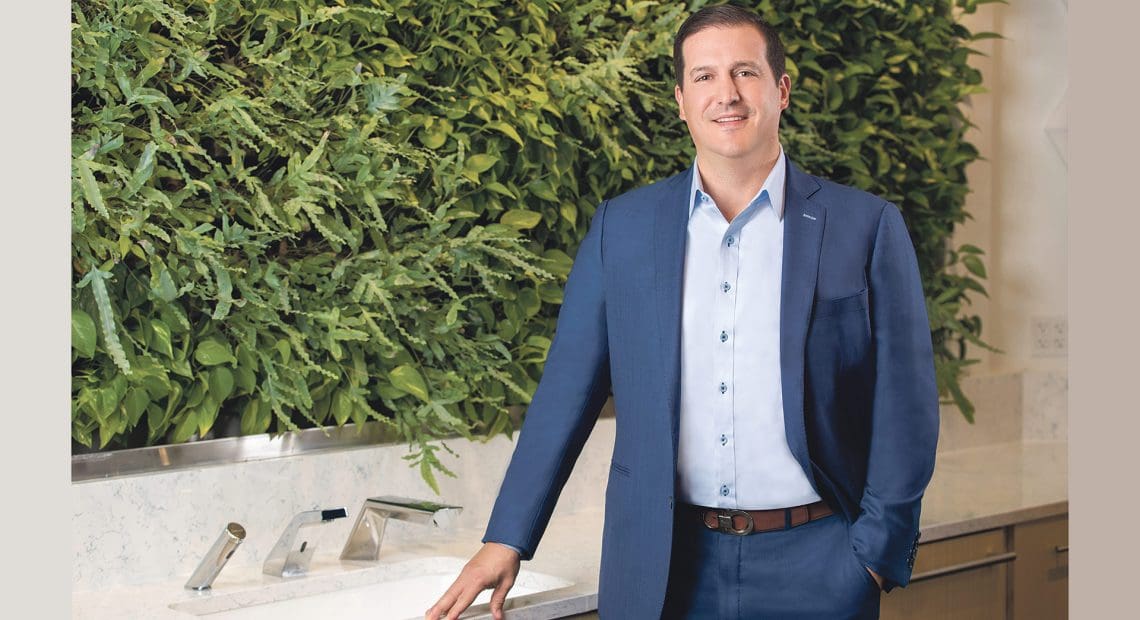
Bill Gagnon stands near one of the living walls in the environmentally friendly, and worker-friendly, addition to the company’s plant in East Longmeadow.
“David vs. Goliath.”
That was how Bill Gagnon chose to describe the ongoing fight between the still-emerging high-speed hand-dryer industry and the huge paper industry for the right to put their products in restrooms across the county and the around the globe.
It’s always been an uphill battle, said Gagnon, executive vice president and chief operating officer at East Longmeadow-based Excel Dryer, noting that the paper industry has spared no expense, and no energy, in its quest to portray hand dryers as unhygienic — essentially blowing germs around the bathroom and on one’s hands.
But through a series of commissioned studies and diligent work to educate consumers, the high-speed hand-dryer sector was making some real progress on the battlefront. That was, until … the pandemic.
Indeed, COVID hit many industries hard, and in different ways, from restaurants that saw business come to a virtual standstill to event venues that could no longer book gatherings. But COVID threw a huge wrench into the hand-dryer sector, Gagnon explained, resulting in several years of turmoil from which it is still emerging.
“I lost 10 years of my life those three years,” he said of the period from early 2020 to early 2023, when the dust started to settle somewhat.
And now, COVID may wind up being … not a blessing, but a benefit for this sector thanks to all the work done to promote the health of these products, to bring industry players together as they had never been before, and to weather a huge storm.
“We basically wanted to create a model for other people who are designing commercial spaces on how to achieve a sustainable and healthy workplace that could be both LEED- and WELL-certified.”
“I believe the pandemic, while it took the legs out from under us, will be a giant springboard for our entire industry globally and drive our success in the future,” he said, “because people realized there was so much conspiracy and snake oil and BS during the pandemic — knee-jerk reactions with nothing backed by science.”
Recovery from the havoc wreaked by COVID and its aftereffects — including the skyrocketing cost of new construction, which stalled or scrapped the building of many new facilities into which Excel products could be placed — is one of many storylines involving this company, which burst onto the scene nearly a quarter-century ago with the XLERATOR, a hand dryer that would do what its predecessors couldn’t: thoroughly dry one’s hands.
Others include everything from donating mobile hand dryers to relief sites in Turkey, where survivors are rebuilding from an earthquake 18 months ago, to an addition to the plant in East Longmeadow that is environmentally friendly and worker-friendly as well, featuring everything from ‘living walls’ to carpets made from used fishing nets to lights that follow the natural circadian rhythm of humans.

A mobile XLERATOR hand-dryer station in a Turkish container shelter community following the deadly earthquake in 2023.
Photo courtesy of Excel Dryer
“We basically wanted to create a model for other people who are designing commercial spaces on how to achieve a sustainable and healthy workplace that could be both LEED- and WELL-certified,” said Gagnon, referring to the Leadership in Energy and Environmental Design designation and a standard for delivering more thoughtful and intentional spaces that enhance human health and well-being, respectively.
“We’ve won a dozen awards on the design of this space in architecture magazines,” he went on, adding that more important than these accolades is the manner in which the space creates an attractive, healthy space in which to work.
Meanwhile, efforts to bring high-speed hand dryers into more restrooms continues, he said, adding that, in this country, hand dryers are included in only 10% to 15% of new construction. That’s an improvement over the 5% rate years ago, but there is still considerable room for improvement, which is another area of focus moving forward.
And one potential strong avenue for growth, said Gagnon, is hybrid systems make use of Excel’s sink systems — integrated products whereby users can wash their hands and dry them at the same sink — along with paper towels.
“That’s the best of both worlds; it doesn’t have to be one or the other — it can be both,” he told BusinessWest. “You put the dryer next to the faucet for hand drying, and if people need paper for anything else or just to dry their hands, it’s there.”
Such hybrid systems could be a viable alternative for the architects and business owners still favoring paper, he said, citing the case of the USDA headquarters in Washington, a 1 million-square-foot building where bathrooms with two sinks and two towel dispensers were switched to two sinks, one towel dispenser, and one high-speed hand dryer.
“Every single thing in this office I picked myself with the architect, and it has a story behind it. Whether it helps with health and wellness or it uses recycled materials, everything here helps in some way.”
“They ran the stats, and it led to one fewer full dumpster load of waste per week,” he noted. “That equated to a $30,000-a-year savings in waste alone, just from the dumpster fees, not even looking at the cost of buying, shipping, and installing paper towels, and this is something we’re educating architects on.”
For this issue and its focus on manufacturing and construction, we talked with Gagnon about the XLERATOR and its continued evolution, as well as the Excel company, how far it’s come over the past 25 years or so, and where the growth potential lies as David continues to battle Goliath.
Air Apparent
Turning block the clock to January 2020, Gagnon recalled watching the news on television, having his eyes diverted to a crawler at the bottom of the screen, and seeing some reference to a coronavirus in China.
He couldn’t have imagined what was to come, but he already knew that this was real trouble for his company and his sector.
And he was right.
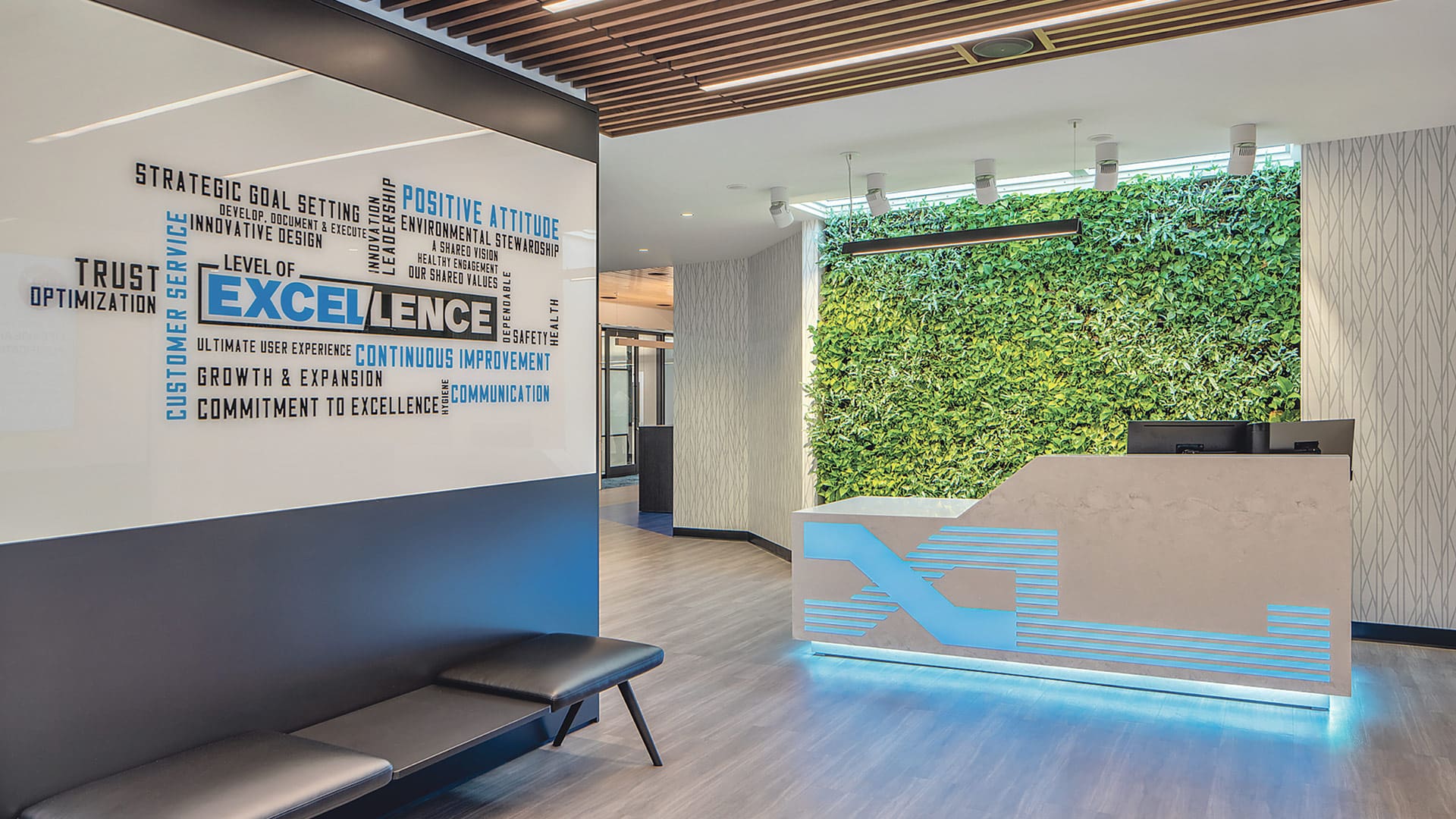
Excel Dryer’s leaders aimed to make the recent office renovation both energy-efficient and human-centric.
Photo courtesy of Excel Dryer
With the world soon laser-focused on controlling the spread of germs, the high-speed hand dryer was soon to come under more scrutiny than ever, with orders for the products slowing and long-time clients asking questions about just how safe they were to use.
“The pandemic was a gift that fell right into the paper industry’s lap,” Gagnon explained. “They’d been saying that hand dryers blow bacteria and germs all over the air, and here comes an airborne virus. There couldn’t be anything worse to happen to the high-speed hand-dryer industry; it bubbled that stuff back up, and we were in crisis mode during the pandemic.”
One low point, and there were many, came early on during the pandemic, when Denver International Airport, one of the largest and most modern in the country, placed stickers on its XLERATORs stating, “for your safety, these hand dryers have been turned off.”
“Think about all the traffic going in and seeing our product tied to coronavirus and that it wasn’t safe to use,” he said. “That was a killer.”
Meanwhile, the Centers for Disease Control, in its many messages urging people to wash their hands — and showing them how best to do so — featured paper towels as the drying method.
“Only in one place on one page did it say that you use either towels or a hand dryer — and I thought to myself, ‘we need to update this,’” said Gagnon, noting that he didn’t really know where to begin or whom to call to achieve change at Denver’s airport, the CDC’s public-service messages, and other fronts in this battle, but he went to work rallying the players in the industry and devising a strategy for digging out.
He commissioned a study on the company’s recently introduced HEPA filters and their ability to filter viruses — not knowing what the results would be. That study, which involved 3 million viruses going through the dryer to see what would come out the other end, revealed a striking 99.99% filtration of viruses.
“I said, ‘that’s great news — we have to market the heck out of this,’” he recalled. “That gave me something to work with, and I ended up reaching out to everyone that I knew in my network asking for help to get to the CDC and get this information to the right people.”
“Every single thing in this office I picked myself with the architect, and it has a story behind it. Whether it helps with health and wellness or it uses recycled materials, everything here helps in some way.”
In fact, he called this his new mission.
“I talked to a business coach of mine, and he connected me to someone who used to work for the government in the state of Massachusetts who knew a lobbyist who could help get you to D.C. and places — we had never used a lobbyist before,” he said. “And this is the short version of that story; I’m calling everybody and looking at everything to find some path. And I found a path.”
Indeed, eventually the stickers came off the dryers in Denver, he said, and, through the lobbyist, Gagnon was able connect with then-Vice President Mike Pence’s COVID team, which helped set up a call with the coronavirus team at the CDC it was working with.
“We found a way in, and by the end of the year, the CDC had updated all its hand-washing pages and its main images to show a paper towel and a hand dryer, and that was a huge win for us,” he said, adding that these developments helped save the business, although it was still a very challenging time.
“Every sale became harder, and every single person we talked to … we had to address the health issue,” he went on, adding that these ultra-trying times have ultimately helped put the product, and the company, in what could be called a better place — and give the hand-dryer industry a louder voice.
Net Results
While helping to create this better place and louder voice, the team at Excel has been making advances on other fronts as well, including the expansion of the plant on Chestnut Street in East Longmeadow.
This expansion became a labor of love for Gagnon, who, as noted earlier, wanted to create a model for other businesses to follow. And he spared little expense in doing so.
He said the various design elements were spurred by statistics showing that people spend 80% to 90% of their time indoors, putting an exclamation point on the need to improve what’s known as indoor environmental quality, or IEQ.
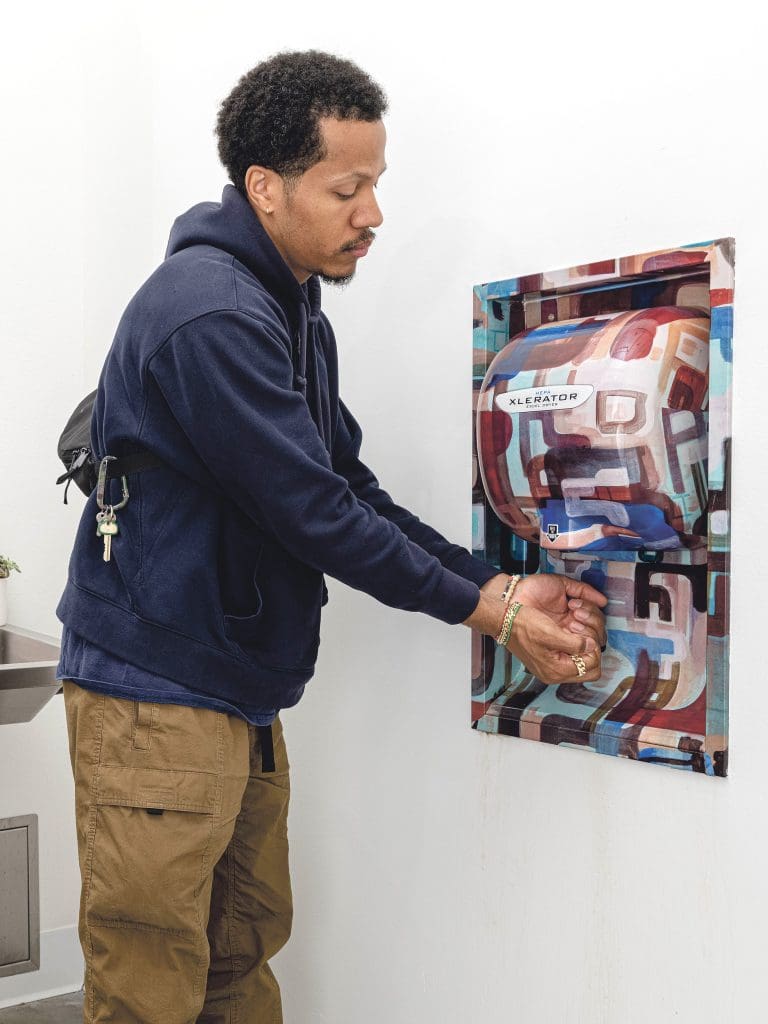
Excel produced custom XLERATOR hand dryers featuring designs by art students.
Photo courtesy of Excel Dryer
“Every single thing in this office I picked myself with the architect, and it has a story behind it. Whether it helps with health and wellness or it uses recycled materials, everything here helps in some way,” he said, pointing to the carpet in the conference room as just one example.
“It’s made, 100%, from used fishing nets in third-world countries,” he explained. “They would either get thrown away, or they would just leave them in the water, which is really bad for the ecosystem; it’s bad for those nets to stay in the water.”
The carpeting, walls, lights, windows, and more all contribute to improved IEQ and provide a space people want to work in, he added. “I tasked the interior designer … I said from the beginning, ‘we are going to tell a story with this space, and we’re going to show people how to create the most beautiful, sustainable, and healthiest office space possible.’”
The space, which is outfitted with Excel products, also serves as a marketing vehicle, he said, adding that this helped justify the price tag.
Asked to look ahead to 2025, Gagnon started by saying that 2024 was a somewhat slow year as large corporations and small businesses alike waited to see what would happen with interest rates, inflation, the overall economy, and the presidential election. But he is already seeing signs that 2025 will be a much better year.
“It’s going to bounce back, and it’s going to bounce back fast — we’re starting to see it already,” he said, noting that Walmart has committed $5.5 billion to upgrades in Mexico and $8 billion to upgrades in the U.S. and Canada, with bathrooms bring a primary focus. And he expects other chains to follow suit as construction costs stabilize and even come down slightly, a new administration takes over in Washington, and there is ever-more focus put on the cleanliness of facilities, and especially restrooms.
If this bounceback comes as he expects, that will be yet another positive development for a company that has consistently broken new ground in this emerging sector and emerged as one of its clear leaders — hands down.