Daily News

The Franklin County Chamber of Commerce board of directors has named Jessye Deane its next executive director. 

Deane, a lifelong Franklin County resident and Bernardston native, has served on the Franklin County Chamber board of directors since 2019. She will assume the role currently held by Diana Szynal, who plans to take over as president of the Springfield Regional Chamber in July. 

“The board is thrilled to have Jessye transition into this role at the chamber. Her ability to connect with the community and build business relationships is a tremendous asset for Franklin County and our membership,” said Shelby Snow Hasanbasic, chair of the chamber’s board of directors. “Jessye’s dynamic skillset will lead the Chamber into great success as we continue to adapt to deliver value to members in a changing economic landscape. Her vision for refining and building on the chamber’s role in Franklin County is exciting, and we believe her expertise in community collaboration will excel successful partnerships for the greater good of our members, our community, and our visitors.” 

As an entrepreneur with more than a decade of experience in volunteer, community, and nonprofit service, Deane has an accomplished background in business, marketing, and community building, which Hasanbasic says will serve her well in this position. 

Deane currently serves as the director of Communications & Development for the anti-poverty agency Community Action Pioneer Valley. During her 12 years at Community Action, the $36 million dollar non-profit has seen a 1,645.7% increase in private funding under her leadership. 

Simultaneously, she and her husband, Danny, also own and operate two award-winning fitness studios, F45 Training Hampshire Meadows in Hadley and F45 Training Riverdale in West Springfield, where Deane has spearheaded the businesses’ community impact program, benefitting more than 86 local nonprofits with nearly $100,000 in donations and in-kind services. 

“My passion has always been strengthening community through partnerships and creative collaboration, and I am incredibly grateful for the opportunity to continue that work and support business and tourism in the county I love,” said Deane. “I understand the economic challenges Franklin County faces, and I am looking forward to working with our legislators to advocate on behalf of all those who work, live, and vacation in Franklin County.” 

In 2019, Jessye was awarded the Chamber MVP Award for her work as an Amherst Area Chamber of Commerce Ambassador. The Franklin County Chamber of Commerce named Deane its first-ever Young Professional of the Year in 2020, and she was recognized as a member of BusinessWest’s 40 Under Forty 2021 class. 

“As someone who’s engaged with numerous Chambers up and down the valley as a business owner and as a nonprofit leader, I bring a widespread, community-minded perspective to this role,” said Deane, who presented the board of directors with a 14-page strategic planning proposal during the screening process. “I am excited to add to the already-impressive Franklin County Chamber team and its board of directors as we launch a strategic planning process to refine the Chamber’s priorities both as a business collective and as a Regional Tourism Council.”  

Daily News

FLORENCE — Florence Bank celebrated its 20th annual Customers’ Choice Community Grants Program gala last month, awarding $100,000 to 45 nonprofits across the valley. And at the close of the event, President and CEO Kevin Day drew cheers from the audience of nonprofit leaders, announcing that giving will increase to $125,000. 

“Some of you longtime recipients may recall when we began this great program back in 2002, we started by giving away $50,000,” Day said. “Years later we increased to $75,000 and then to $100,000. We’ve decided to increase the total grant amount again — to $125,000 — immediately, for grants to be awarded at next year’s gala. 

“My hope is that our customers continue to use this program to provide you with a vote of confidence, as well as some much-needed funding to help you continue your mission to serve the community,” he added. “All of us at Florence Bank truly appreciate everything you do to make our communities better places to live and work.” 

Day’s announcement was the second commemoration of the evening, the first coming as he called for bank and nonprofit staff and leaders to raise a glass to toast the event’s 20th year. “We can’t let that go without celebration,” he said.  

Florence Bank’s community grants program is an annual offering founded in 2002, and, through it, Florence Bank customers are invited to vote for their favorite local nonprofit in hopes it will receive a share of grant funding. 

Voting takes place all year long, online at www.florencebank.com/vote and in bank branches, and each customer has only one vote. To qualify for a community grant, organizations must receive at least 50 votes. In 2021, roughly 7,000 votes were cast, making 45 nonprofits eligible for a grant. 

Over the past 20 years, Florence Bank has tallied more than 141,000 customer votes and given grants to roughly 164 different organizations. 


At its 20th annual event, held May 19 at Frank Newhall Look Memorial Park, the bank offered awards to 45 nonprofits and celebrated a total of $1.4 million in community giving through this one channel. 

Six nonprofits received funding for the first time — some in Hampden County, where Florence Bank now has three branches and has established a presence as a good neighbor. Three recipients have accepted an award every year since the program launched.  

Four organizations received the maximum amount of $5,000 this year: Cancer Connection Inc., Dakin Humane Society, Food Bank of Western Mass., and Friends of Williamsburg Libraries. 

“The commitment of Florence Bank customers to all of you serving the needs within our community is awesome, and we couldn’t be prouder to be able to support the programs our customers believe in,” Day said.  

Organizations receiving awards range from police, fire, library, and school groups to nonprofits that provide food, shelter or support to people living with a serious illness or disability. 

In addition to the four top vote-getters, these other organizations received an award:  

Friends of Lilly Library, $4,097; Northampton Survival Center, $3,782; Amherst Survival Center, $3,588; Our Lady of the Hills Parish, $3,564; Friends of Forbes Library, $3,539; Goshen Firefighters Association, $3,370; Friends of Northampton Legion Baseball, $3,224; Easthampton Community Center, $2,909; It Takes a Village, $2,909; Williamsburg Firefighters Association, $2,642; Northampton Neighbors, $2,400; Pioneer Valley Chinese Immersion Charter School, $2,303; Belchertown Animal Relief Committee, Inc. (BARC), $2,230; Manna Community Kitchen, $2,109; Shriners Hospitals for Children, $1,988; and J.F.K. Middle School PTO. 

Also, $1,867; Kestrel Land Trust, $1,867; Northampton High School PTO, $1,794; Riverside Industries, Inc., $1,770; R.K. Finn Ryan Road School PTO, $1,648; Cooley Dickinson Hospital, $1,624; Safe Passage, $1,624; Northampton Community Music Center, $1,527; Therapeutic Equestrian Center, $1,527; Amherst Neighbors, $1,503; Friends of M.N. Spear Memorial Library, $1,455; Edward Hopkins Educational Foundation, $1,430; Grow Food Northampton, $1,430; Smith Vocational High School PTO, $1,333; Whole Children, $1,309; Easthampton Elementary Schools PTO, $1,164; Pioneer Valley Habitat for Humanity, $1,139; Hitchcock Center for the Environment, $1,115; Revitalize CDC, $1,091; The Parish Cupboard, $1,067; Belchertown Police K-9 Unit, $1,042; Cooley Dickinson Hospital VNA & Hospice, $1,042; Historic Northampton, $1,018; Granby Senior Center, $994; Leeds Elementary School PTO, $994; and Ludlow Boys & Girls Club, $970. 

Daily News

MONSON — In the spirit of its 150th Anniversary, Monson Savings Bank announced earlier this year that it will be launching its 150 Build-a-Bike campaign. The community bank has purchased more than $20,000 worth of bikes to donate to local children and they have partnered with various non-profits in the area to host Build-a-Bike events throughout the year. Most recently, Monson Savings delivered 10 bikes and 10 helmets to YWCA of Western Mass. 

Elizabeth Dineen, executive director of YWCA of Western Massachusetts Executive Director, and her team, welcomed Monson Savings Bank members to the YWCA campus. She expressed gratitude for the bank’s generosity and commented on the impact they are making in Western Massachusetts. 

“We are so happy Monson Savings Bank reached out to invite us to be a part of this wonderful campaign,” she said. “We are so thankful that Monson Savings is giving us bikes for our YWCA campus, allowing children using our services to enjoy some carefree time riding a bicycle. The continued support that the bank provides to Springfield and the surrounding communities is truly amazing.” 

Members of the Monson Savings team delivered the bikes that they helped to assemble with Ray Plouffe, owner of Family Bike Shop in East Longmeadow. Many members of the team expressed feelings of gratitude and a sense of fulfillment after building and delivering the bikes. 

“All of us were very excited to come together for the YWCA Build-a-Bike event. Our team had a great time getting to know the YWCA team and confirming our knowledge about all of the incredible ways they help those in need,” said Dan Moriarty, President and CEO of Monson Savings Bank. “Plus, it was wonderful to deliver the bikes and hear how the YWCA plans to make a safe, designated area for children to enjoy the bikes as they receive support from the organization.” 

Throughout the summer, Monson Savings Bank will also partner with I Found Light Against All Odds and the Springfield Housing Authority, South End Community Center, and Educare Springfield to host more 150 Build-a-Bike events, continuing to spread happiness to children and families throughout the area. 

To learn more about Monson Savings Bank’s 150th anniversary, the bank’s historical timeline, and to view a full schedule of events visit www.monsonsavings.bank/anniversary 

Daily News

WILBRAHAM — Katlyn Grasso, Founder and CEO of GenHERation®, a network where young women and companies connect, will be the 2022 Commencement speaker at Wilbraham & Monson Academy on Saturday on the WMA campus at 11 a.m. The 2022 graduating class at WMA consists of 99 graduates, all of whom will be attending college. 

In her role as CEO, Grasso has created GenHERation® Discovery Days, hosted the GenHERation® Summer Leadership Series, developed original GenHERation® webisodes, launched The GenHERation® Collection product line, and has grown the GenHERation® community to reach more than 500,000 young women. 

Grasso is a graduate of the Wharton School of the University of Pennsylvania where she received a B.S. in Economics with concentrations in finance and strategic globalization. She is one of the inaugural recipients of the Penn President’s Engagement Prize, which provides Penn students with $150,000 to develop ventures that have the potential to change the world. 

Grasso speaks internationally about entrepreneurship, technology, leadership and the advancement of women, and has been a featured speaker at more than 200 events. She is a frequent radio and television contributor and her work has been featured across national media outlets, including CNBC, NBC, Fast Company, Forbes, The Huffington Post, CBS, Yahoo! Finance, Seventeen Magazine and SiriusXM. 

Katlyn Grasso is such an enterprising young entrepreneur and supporter of young women in leadership, and we are proud to have her joining us for Commencement 2022,” said Head of School Brian P. Easler. “We were excited back in 2020, when Katlyn was originally scheduled to speak at commencement, so we were thrilled when she agreed to reschedule with us for this year. Katlyn has already been engaging with some of our students, and we look forward to her insights this Saturday. 

Grasso is a member of the Penn Fund Executive Board, the Penn Nursing Center for Global Women’s Health Advisory Board, the TCU Neeley Institute for Entrepreneurship and Innovation Board of Directors, and is the tri-chair of Momentum: The Power of Penn Women. She was named to the Forbes “30 Under 30” list in 2022 as one of the most influential leaders in education. 

Cover Story

Study in Determination
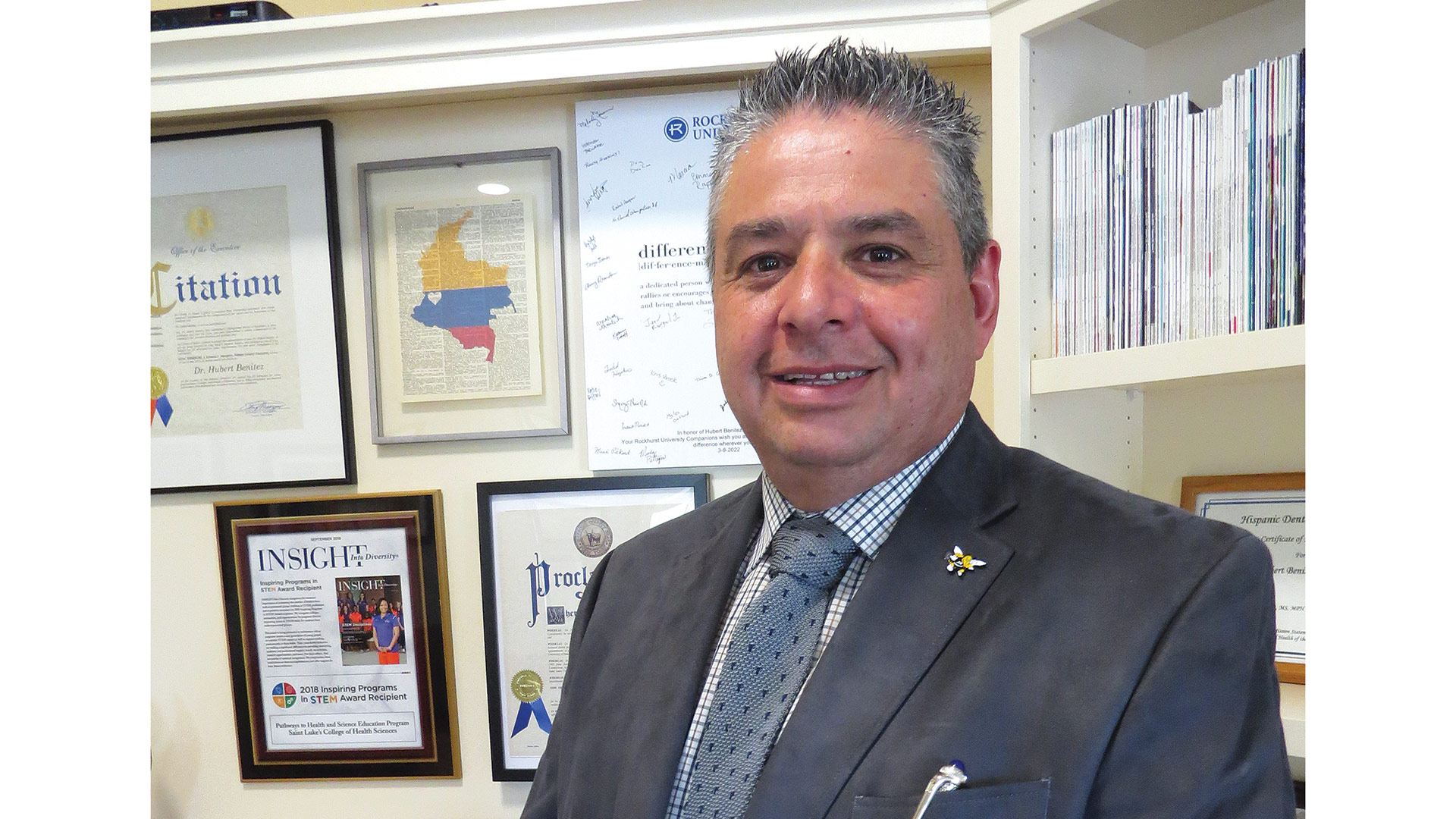
Hubert Benitez

Hubert Benitez

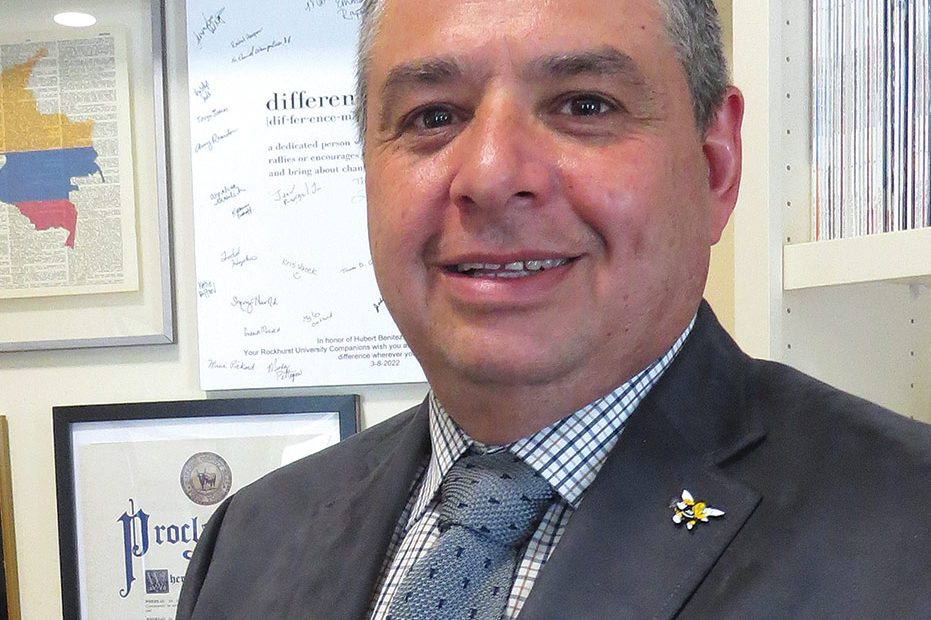
Hubert Benitez is a dentist by trade. He got into that field because he wanted to serve people — and because he wanted to make a difference. He eventually left dentistry for academia because … well, he still wanted to serve people and make a difference, but in an even more profound way, by creating pathways to higher education. This focus has become a passion, one that he brings to his new role as president of American International College.

At the recent commencement ceremonies for American International College, Hubert Benitez, DDS, the school’s president, was at the podium, handing out diplomas, and offering traditional greetings to the graduates — something along the lines of ‘congratulations, and good luck.’

And in what would have to be considered an unusual twist, many of them said the same thing back to him.

Indeed, Benitez had been on the job for only about a month before taking the stage at those ceremonies at the MassMutual Center — and delivering the commencement address while he was at it. Most all of the students accepting their diplomas knew that, and wanted to offer some words of encouragement.

“You don’t learn about an institution until you’ve talked to its people.”

Taking the helm just a few weeks before the end of a spring semester is highly unusual in higher education — most new presidents would prefer to start during the summer, when things are slower and they have time to ramp up, or at the start of a new school year. Benitez said he was given those options, but was also asked to consider starting in April by Board of Directors Chairman Frank Colaccino, a member of AIC’s Class of 1973 and member of the search committee that ultimately offered Benitez the job.

And he said he jumped at the opportunity, essentially because he couldn’t wait to get started with the next chapter in both his intriguing professional career — and in the history of the school, which first welcomed students in 1885.

“That is a non-traditional start date,” he acknowledged. “Because it’s a transitional phase — we’re closing, and also starting a new academic year. In retrospect, I think it’s been beneficial to start when I did, because I had the opportunity to work with my colleagues during a very stressful time — an academic year is ending, we’re close to commencement, we’re close to ending the fiscal year, and now we’re preparing the budget to present to the Board of Directors for approval.
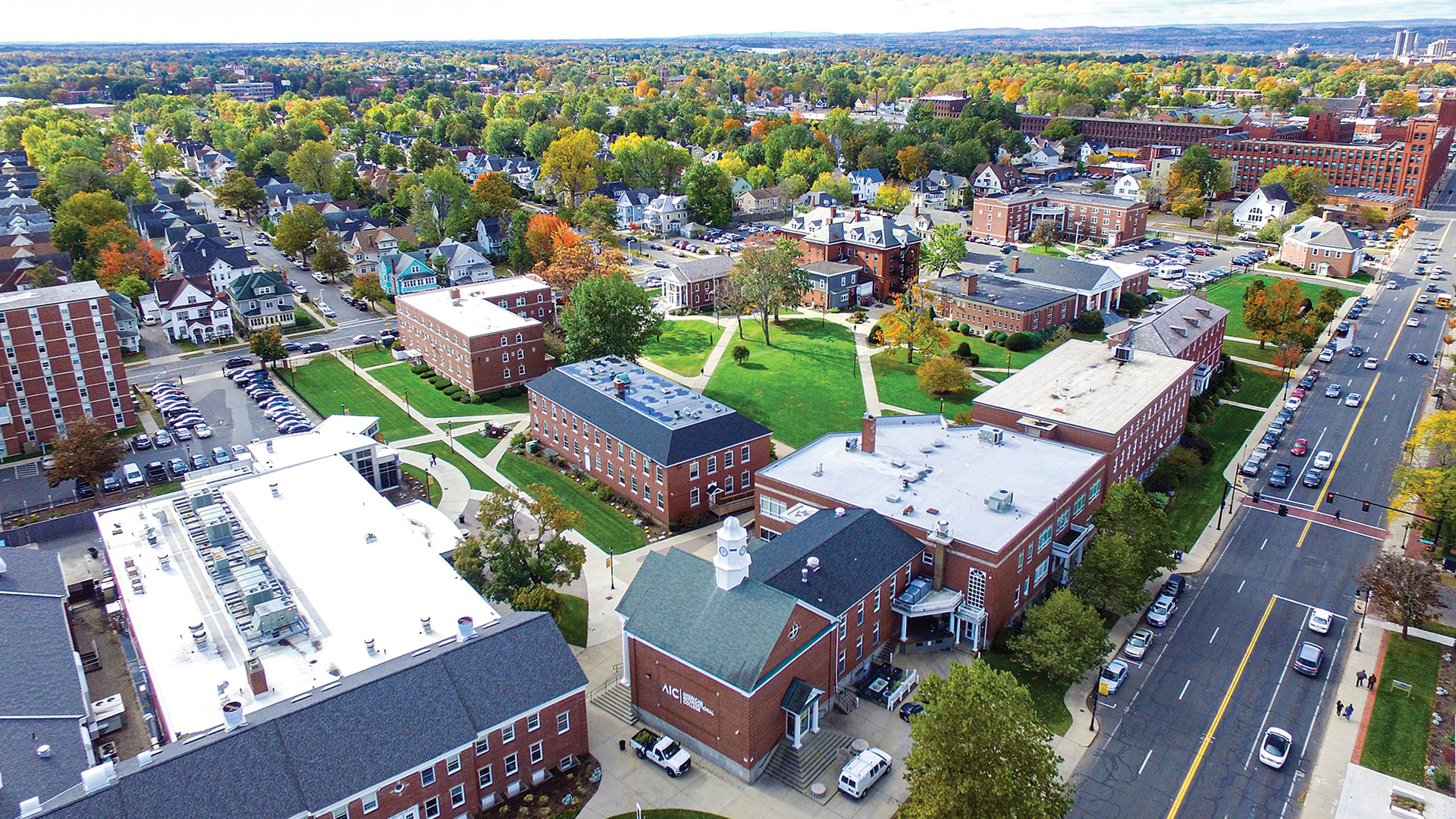
the AIC campus

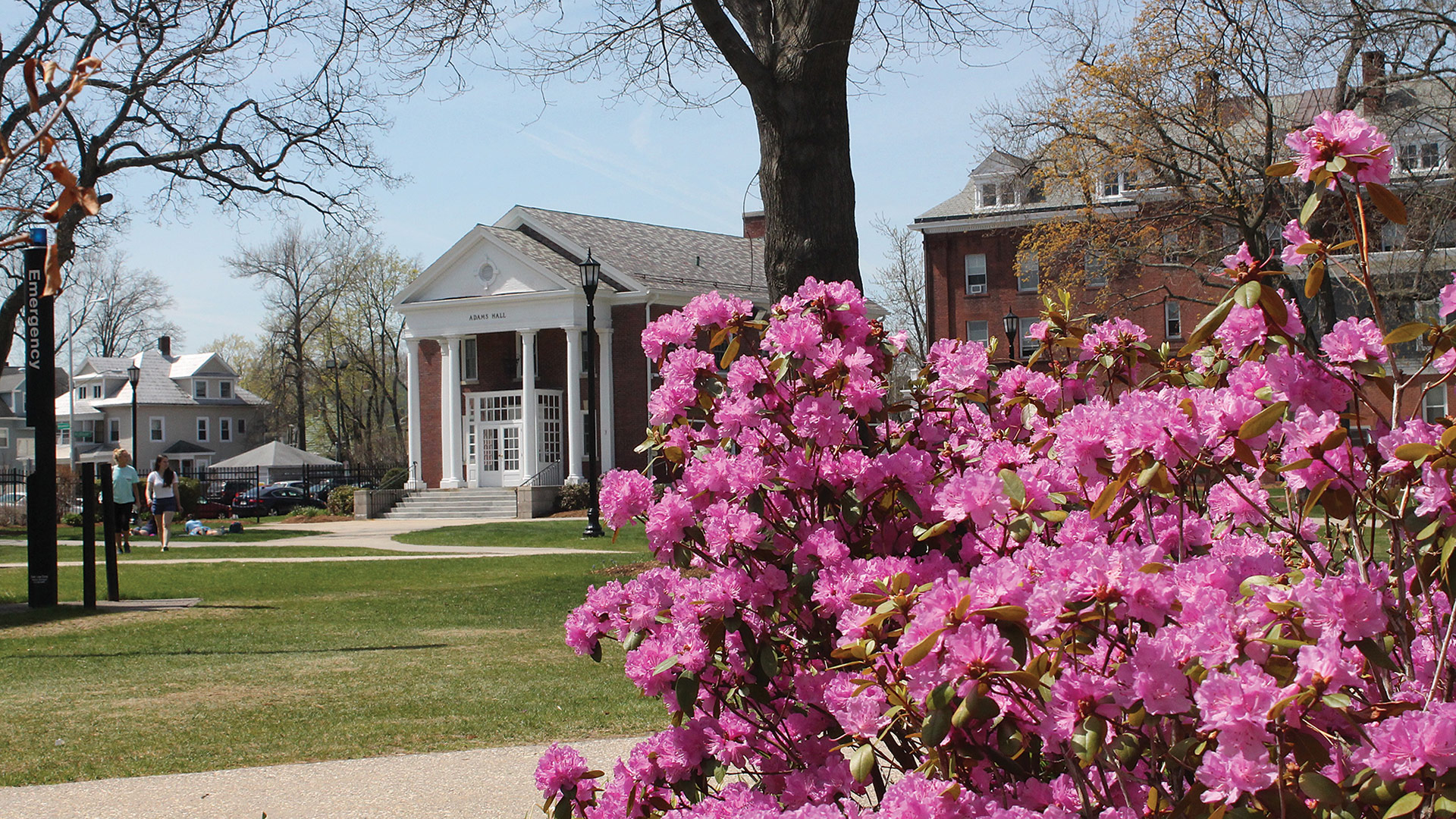
Hubert Benitez says his first visit to the AIC campus left him convinced that he wanted to be the school’s next president.

“It’s almost unheard of to start at that time, but I wanted to take up the challenge,” he went on. “And, more importantly, my colleagues were willing to welcome a new president in that time of flux.”

Benitez was anxious to start, and before that, he was anxious to apply, because in every way he can imagine, the school’s mission and its ongoing focus on first-generation students and those who may need a second chance to further their education reflects his own resume and his own focus within higher education.

He said that, throughout its history, AIC has created opportunities for many individuals and he wants to continue and build on this mission, making the school ever-more diverse and responsive to the challenges facing both traditional and non-traditional students.

He brings to that assignment an intriguing resume. Indeed, those letters after his name, DDS, indicate that he is a dentist by trade. He had a practice for more than 14 years, but eventually decided he couldn’t see himself “taking care of toothache for the rest of my life.”

Instead, he opted to change course and pursue a career in higher education, or “the academy,” as he called it, because it met a life-long desire to serve others while presenting many different opportunities to grow as an individual and lead others.

“I always saw my colleagues in higher education as individuals who were trying to find new directions, trying to research, trying to find new directions for healthcare for education … and that was something that was intriguing to me,” he said.

In his most recent position, Benitez served as vice president for Strategic Initiatives and Academic Innovation, and as acting chief inclusion officer at Rockhurst University (RU) in Kansas City, MO. Prior to Rockhurst, Benitez served as president and chief executive officer for Saint Luke’s College of Health Sciences for almost five years, where he provided visionary and strategic leadership that included merging the school in Rockhurst (more on that later).
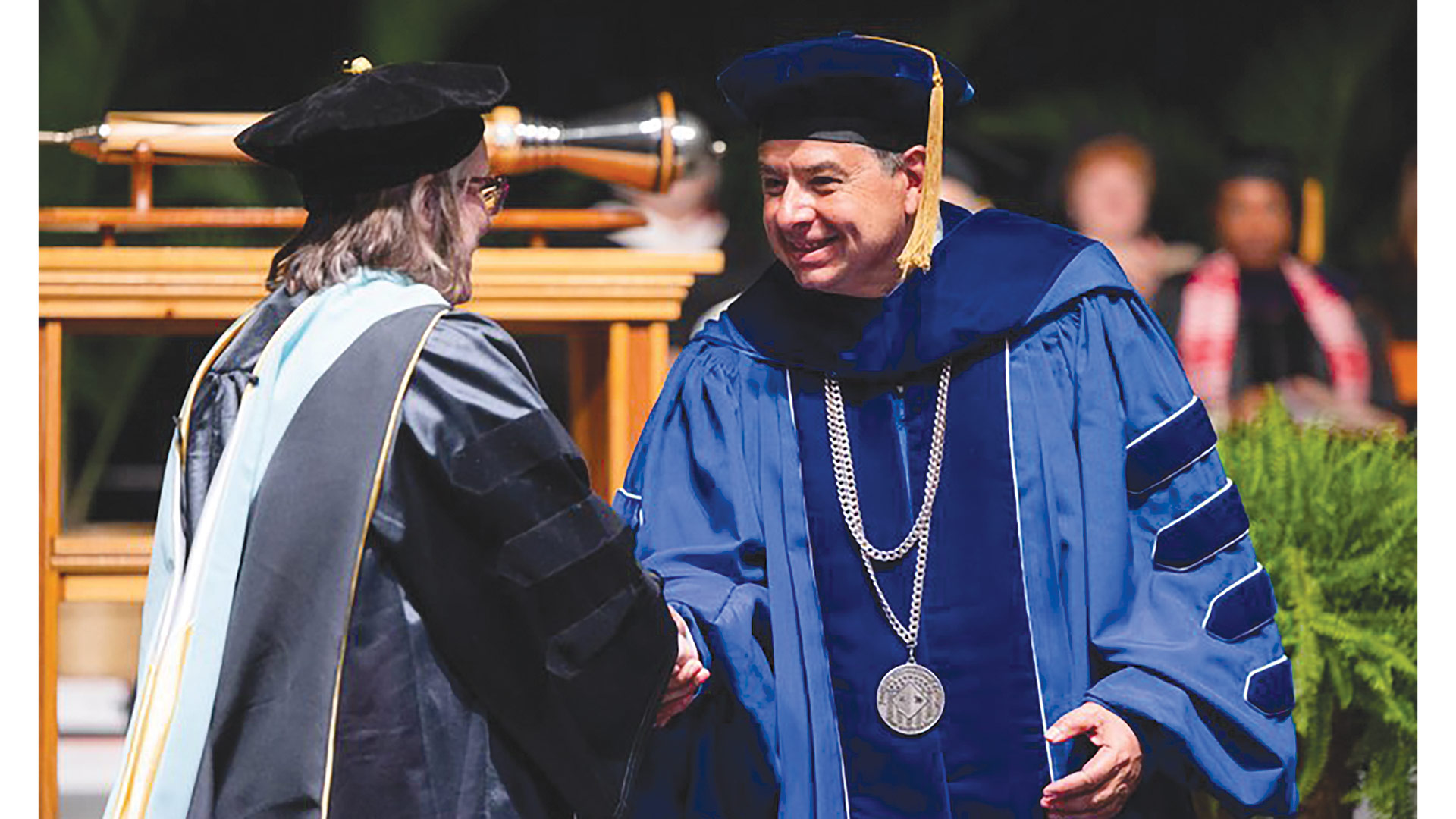
Hubert Benitez, right, was offering congratulations

While Hubert Benitez, right, was offering congratulations to students at commencement, they were offering it right back to him.

In his short but busy time at AIC, he has been “learning and doing,” as he put it and starting the hard work of creating an envisioning plan for the college, an effort involving many individuals and constituencies.

“Many people ask me, ‘what is your vision?’ he said. “I have a vision of what AIC will be, but the vision of AIC will be a shared vision, a vision created by faculty, staff, administrators, because I want to make sure everyone owns that vision.”


Something to Sink His Teeth Into

Benitez told BusinessWest that while he was at Rockhurst University, he was encouraged by recruiting firms to apply for various positions, most of them presidencies, across the broad spectrum of higher education. The presidency of AIC was not one of them.

“No one invited me to apply to AIC; I chose AIC, and I was hoping that AIC would choose me,” he said, adding that there were many things about the small, urban school that intrigued him, starting with the three words over the school’s banner: Access, Opportunity, and Diversity.

“When I see an institution that focuses on providing access to demographics of students, providing opportunities to students who haven’t been successful a first time, or a second time, and maybe this is their last opportunity, and when I see an institution that is working on maximizing the diversity of the future workforce … that is absolutely true to who I am, not only as a person, but as a professional.”

Elaborating, he said that the mission of AIC is true to his heart and a reflection of what he has devoted his career to in recent years. To understand those sentiments, we turn the clock back to his decision to transition from dentistry to higher education.

That transition occurred as he was pursuing a post-doctoral fellowship, when Benitez met a fellow DDS who became a mentor and eventually convinced him that his future shouldn’t be in dentistry.

“I believe in the value of mentorship, not only because it helps people move forward with their professional aspirations, but because mentors find in you what you may not have found in yourself,” he explained. “He saw in me a skill set, a desire for professional growth, a desire to work in higher education … he once told me ‘I don’t think you should stay in dental schools — I see you as a holistic administrator.”

This same mentor advised him that he would need a Ph.D., or another one, to be exact, this one in higher education administration, which he earned at Saint Louis University’s College of Education and Public Service.

He then “went through the academic ranks,” as he put in, serving in a number of capacities, including adjunct faculty, full-time faculty, program director, assistant dean, dean, provost, and chief academic officer, before becoming president and CEO of Saint Luke’s College of Health Sciences.
There, as noted earlier, he helped orchestrate a merger with Rockhurst, a union that was different from many of this type because Saint Luke’s was successful at the time, not struggling as many schools are when they look to merge with a larger institution.

“This was the case of two very strong academic institutions, financially healthy academic institutions, coming together with a common vision,” he explained. “Our merger became an example of how two strong institutions can come together, as opposed to traditional mergers, where one institution has troubles and the other one does not, and I was proud to be part of that process.”

As noted, he would go on to vice president for Strategic Initiatives and Academic Innovation, and as acting chief inclusion officer at Rockhurst.

He was in that role, when, without the encouragement of any recruiters, he applied for the position of president at AIC, earned the opportunity to interview for it, and eventually visited the campus in January. It made quite a first impression, as he recalled.

“Sometimes when you visit a campus, and I’ve had the privilege of visiting many, you get a feeling, or you get what I call a vibe when you visit an academic institution,” he said. “My wife and I left this college and we looked at each other, and we knew it felt right.”

During that visit, he said he met with a number of faculty, staff, and students, who collectively presented a picture of what they were looking for in the school’s next president.

“My focus has always been on creating opportunities for access, for diversity, for equity, for inclusion.”

He summed it all up this way: “They said they were looking for someone who could help them and help this institution become prominent in the community while continuing to serve that demographic of student, and continue to provide that access,” he recalled. “If you hear that, and I look back at my story, you can’t be more mission-aligned and vision-aligned; it’s an alignment of the mission to who I am.”


Course of Action

Getting back to his unusual start date, Benitez said it has been beneficial in a number of ways, especially in the manner in which it has enabled him to get a head start on his work, and do a lot of that ‘learning and doing’ he mentioned.

The ‘doing’ part concerns everything from commencement to putting the budget together for the new year, he said, adding that the ‘learning’ takes many forms and is ongoing.

For starters, it involves meeting with every employee on the payroll, he said, adding that this is what he did when he was president of Saint Luke’s College of Health Sciences, an exercise that became a tremendous learning experience.

“First and foremost, I need to know my colleagues’ aspirations — what are their needs?” he explained. “I always say that people come first, and if I can learn to understand each and every person’s personal and professional aspirations, I can serve them better. You don’t learn about an institution until you’ve talked to its people.”

Benitez said he’s already met with senior staff and many groups of employees, and has a schedule packed with one-on-one interviews for the next few months.

He’s also meeting with students, taking in events, meeting with the faculty senate and individual faculty members, all in an effort to learn more about the school, where its stakeholders want to take it, and how it will get there.

“But while learning, we’re also doing,” he said, adding that he and team members have been preparing for both the new school year and the first “envisioning exercise,” as he called it.

“We’re already gathering a group of faculty, staff, and administrators in a room and start to envision what the future of AIC is going to look like,” he said.

“There has to be ownership of the vision, “he went on. “It’s not ‘here’s the president’s vision and others will execute it’ — in my mind, that will never work; it will never have ownership. People need to feel that they belong and that they have a sense of ownership.”

As for his own vision for the school, Benitez said he wants an AIC that is heavily involved in the community and responsive to the constantly changing needs of its students, the community, and area businesses.

“It’s not ‘what can the community do for AIC?’ On the contrary; it’s ‘what can AIC do for the community?’” he explained. “I see an AIC that is vibrant, that creates an environment where, when I walk through the corridors of this institution, it feels like home for all. I should be able to walk the campus and say ‘do you feel at home here?’ If I hear everyone saying ‘yes,’ I think we’re doing our job.”

While working on the visioning process, and as part it, Benitez said he will continue and hopefully broaden AIC’s mission of providing access and opportunities, work that has become the focal point of his own career in higher education.

“My focus has always been on creating opportunities for access, for diversity, for equity, for inclusion,” he told BusinessWest. “It’s been on working with minority populations and creating pathways into higher education for demographics of students where higher education is not always seen as a viable option.

“Some of my colleagues will say ‘it makes sense to you — you come from a Latino background, a demographic group under-represented not only in the health professions but in education in general,’” he said. “And I say ‘yes, it does make sense to me, but it’s the right thing to do.’ And that’s why I’ve devoted the majority of my career to that work of creating transitions, pathways, and pipelines for students from under-represented backgrounds to arrive in higher education, earn a degree, and obtain a better way of living for themselves.”


Grade Expectations

Benitez said he shook more than 600 hands during those commencement exercises earlier this month, which he described as a humbling experience in many respects.

Most humbling were those wishes for good luck from the students, he said, adding that they certainly resonated with him.

He understands there are many challenges facing the school, from the uncertainties stemming from the pandemic, to ongoing enrollment issues stemming from smaller high school graduating classes and a host of other issues, to that ongoing task of creating more pathways to higher education.

He not only understands them, he embraces them and wants to tackle them head on. That’s why he took this job, and that’s why he took that early start. There’s plenty of work to do, and he wanted to get right to it.


George O’Brien can be reached at [email protected]

Law Special Coverage

Common Compensation Blunders

By John Gannon, Esq.

Wage-and hour-compliance is never easy for businesses, and a recent decision from the Massachusetts Supreme Judicial Court (SJC) just made things harder.

In ˆ, No. SJC-13121 (Mass. April 4, 2022), the Massachusetts Supreme Judicial Court (“SJC”) ruled that paying employees late is equivalent to not paying at all. This means employees are entitled to triple damages if they are not paid on time, because under the Massachusetts Wage Act, employers who fail to pay wages are liable for three times the unpaid wage amount (treble damages). With that case in mind, here are a few common compensation mistakes employers should avoid to ensure solid wage and hour compliance.

Failure to pay wages on time: The Massachusetts Wage Act requires employers to pay all wages, including any accrued, unused vacation time, to employees who are terminated on their last day of work. For employees who voluntarily resign, all wages are due on or before the next regularly scheduled pay date.

Too often, employers pay final wages a day or a week too late. This is especially common with unpaid commissions. The problem here is that under the Reuter v. City of Methuen case, those wages are not paid on time. Therefore, the employee is due triple damages under the Wage Act.

This is what happened to the City of Methuen; the city paid an employee her final paycheck of about $9,000 (including unused vacation time) about three weeks late. The court ruled that the employee was due almost $30,000 because the city paid the employee a few weeks late. Professional tip: Don’t make this same mistake. Make sure employees who are separated from work are paid all wages on their last day of work. If the final check is not ready the day you need to let someone go, have a process in place to suspend the employee while you work out cutting the final paycheck.

Misclassifying employees as independent contractors: It can be tempting to “contract” with an individual to provide services that are similar to what your employees do. This relationship has tax advantages, no need to worry about leave laws and other employment regulations, and a perceived sense of freedom to easily terminate the relationship if it does not work out.

“The Massachusetts Wage Act requires employers to pay all wages, including any accrued, unused vacation time, to employees who are terminated on their last day of work. For employees who voluntarily resign, all wages are due on or before the next regularly scheduled pay date.”

The problem is that classifying individuals as independent contractors (“I/C”) in this situation can be risky. This is because the I/C classification may violate the Massachusetts Independent Contractor statute, which requires workers to be classified as employees, not I/Cs, when the work being performed is similar to that of other employees.

The Massachusetts Independent Contractor statute also requires true contractors to: (1) be free from control and direction from the business (meaning, the contractors sets their own hours and performance standards); and (2) have their own independently established profession or business (meaning, the contractor has their own LLC, PC, or other established business entity). Even where an individual agrees to be classified as an independent contractor and paid via a1099, businesses run a risk of violating the Massachusetts Independent Contractor if all of the above-mentioned factors are not satisfied.

Travel time troubles: Both Massachusetts and federal law require employers to pay employees for non-commuting travel time during the day. This is commonly referred to as intraday travel. Here is the example provided by the federal Department of Labor: Barbara is a personal care aide providing assistance to Mr. Jones. Barbara drives him to the Post Office and grocery store during the workday. Barbara is working and the travel time must be paid.

What employers in Massachusetts might not know is that under state law you also have to reimburse Barbara for all “associated transportation expenses.” This means you need to pay her for costs like mileage, tolls, and parking (if applicable). It is unclear what employers have to pay for mileage, but the safe bet is paying in accordance with the IRS standard mileage rate, which is currently 58.5 cents per mile.

Meal break miscues: Massachusetts law requires employers to provide a 30-minute meal break to employees when they work more than six hours in a day. The break does not need to be paid; however, if an employee does any work during an unpaid break, the employee needs to be compensated for their time. This could be as little as answering a work-related phone call or making a few copies on the copy machine during a break.

Meal break time may be used by employees for activities other than eating, such as running an errand or taking a walk outside. The key here is that if the meal break is unpaid, workers must be allowed to use the time as they choose, including leaving the building/work premises.

Illegal deductions from pay: When it comes to paychecks, the general rule is that employers cannot make any deductions, with a few exceptions. Some deductions are federal or state mandated, such as any deductions for taxes or child support. Other deductions are consented to by employees, including money put toward insurance premiums and retirement benefits. Other than that, employers should not be deducting money from paychecks under almost any circumstances.

One common scenario where employers want to make a deduction is a situation involving a wage overpayment. In this case, a deduction might be ok if: (1) the employee agrees in writing to the overpayment and deduction; and (2) the deduction does not bring the employee’s earnings below minimum wage. Be sure to check in with employment counsel before making a deduction for an overpayment though, as it does have some potential risk. Also, be sure to never make deductions associated with damaging or failure to return company property (such as a cell phone or laptop). This is not allowed in any circumstances, and can lead to triple damages under the Massachusetts Wage Act.


John Gannon is a partner with the Springfield-based law firm of Skoler, Abbott & Presser, specializing in employment law and regularly counseling employers on compliance with state and federal laws, including the Americans with Disabilities Act, the Fair Labor Standards Act, and the Occupational Health and Safety Act; (413) 737-4753; [email protected].

Features Special Coverage

A Complicated Picture

John Regan says that, in many respects, it is difficult to reconcile the numbers from the latest Business Confidence Index (BCI) released by Associated Industries of Mass. (AIM) with recent headlines and the many strong headwinds facing business owners and managers today.

Indeed, the monthly confidence index continued an upward trend since the start of the year, rising to 58.1, a gain of 0.9 points, putting the index “comfortably within optimistic territory,” according to AIM, which Regan serves as president.

That optimism, though, comes as inflation remains at nearly historic levels, gas prices continue their upward climb, a stubborn workforce crisis continues, supply-chain issues persist, and the stock market is down double digits (almost 20%, in fact) from the start of the year. That’s why Regan acknowledges that the BCI’s trajectory seems illogical, if not contradictory to what’s happening.

“It’s hard to reconcile, but people feel confident,” he said. “And the Business Confidence Index is important because if you’re confident, you’re more willing to make investments in equipment, people, facilities, and new products.”

And a closer look at the landscape might reveal that there are, in fact, reasons for such optimism, he said, starting with a simple comparison to where things were two years ago — and even four months ago — with regard to the pandemic and its many side effects.

John Regan

John Regan

“Massachusetts is on track to end this fiscal year with more than $6 billion in the rainy day fund — it’s just incredible revenue performance.”

And then, there’s those soaring state revenues. The Department of Revenue took in more than $2 billion above what was expected in April, giving Gov. Charlie Baker cause to press his case for the Legislature to take up his proposals to provide roughly $700 million in tax relief to residents.

“Massachusetts is on track to end this fiscal year with more than $6 billion in the rainy day fund — it’s just incredible revenue performance,” he said. “If you match business confidence with the state’s own revenue performance, clearly positive things are happening.”

Overall, there are several factors, competing numbers, and varying opinions relative to just what is causing this record inflation that make it difficult to speculate about what will happen short- and long-term and whether the country is heading for a recession, as many are now projecting. GDP declined by 1.4% in the first quarter, and many economists are projecting that this trend will continue in Q2. And the matter is complicated further by the Fed’s ongoing efforts to slow the pace of inflation by raising interest rates — an aggressive strategy that is fueling speculation about a recession.

As Bob Nakosteen, a semi-retired professor of Economics at the Isenberg School of Management at UMass Amherst surveys the scene, he said it is largely without precedent, thus making analysis, let alone predictions, difficult.

“We live in complicated times,” he said, with a large dose of understatement in his voice. “It’s a complicated picture, more complicated than I’ve ever seen it.”

Brian Canina, executive vice president, CFO and treasurer at Holyoke-based PeoplesBank, agreed.

“This is a very unusual period of time,” he told BusinessWest. “Because there are so many different things going on, between supply chain issues driving costs up, the cost of gas being driven up by government regulation … it’s really hard to pinpoint whether it’s true economic growth that’s driving inflation or if it’s purely government-driven. So it’s hard to say exactly what’s going on.”

And even harder to project what will happen. Nakosteen does not anticipate continued decline in GDP for the second quarter, which, if it did happen, would be the technical definition of recession. But he’s not projecting strong growth, either.

Brian Canina

Brian Canina

“This is a very unusual period of time. Because there are so many different things going on, between supply chain issues driving costs up, the cost of gas being driven up by government regulation … it’s really hard to pinpoint whether it’s true economic growth that’s driving inflation or if it’s purely government-driven. So it’s hard to say exactly what’s going on.”

“My prediction is we’ll see growth in the second quarter,” he said. “Not robust growth, maybe 1% or 1.5%, but I don’t think you’ll see GDP decline again.”

Meanwhile, Regan said economists with AIM are projecting that recession is “more likely than not, but it won’t be a terribly long recession.”

For this issue, BusinessWest talked with these experts and asked them to slice through the complex confluence of issues and try to anticipate what will happen with the economy in the coming months and quarters.


On-the-money Analysis

It was the late U.S. Sen. John McCain who, in 2015, described Russia as “a gas station masquerading as a country.” Paying homage to that quote, Nakosteen, echoing others, said Russia is a “a gas station with an army.”

That classification, and the acknowledgment that Russia, and Ukraine, both export large amounts of wheat and fertilizer, speaks volumes about just one of the many forces — most of them unpredictable in nature — that are impacting the national and global economic scene. And they’re also making it difficult to determine what will happen in Q2, Q3, and well beyond, said Nakosteen, who, like Regan, said that despite those aforementioned headwinds, there are many positive signs when it comes to the economy.

Bob Nakosteen

“The job market is strong, retail sales are good … so the economy is actually pretty strong, and the Fed thinks it’s too strong.”

“The GDP decline in both the state and the nation was almost more a technical issue, because all the numbers that went into it, except those regarding inventory, were strong,” he explained. “The job market is strong, retail sales are good … so the economy is actually pretty strong, and the Fed thinks it’s too strong.”

Which prompted two interest-rate hikes this year, including a half-point increase late last month, designed to slow the economy. But with those rate hikes comes talk of inflation, said Nakosteen, adding that, historically, one has led to the other.

These factors add up to a lot of watching and analyzing for people like Canina, who said there is a lot to digest, including current loan activity, or the lack thereof, as well as inflation and the dreaded inverted yield curve — a successful predictor of many recent recessions — and the impact of rising interest rates on consumer spending as the cost of borrowing increases.

Starting with a look at loan activity, he said it has slowed markedly in recent months, with most all refinancing of home mortgages complete and commercial loans in the post-PPP era being relatively stagnant.

“For what should be a very robust economic environment, we’re not seeing the equivalent loan opportunities on either the commercial or residential side,” he said, adding that the rising interest rates, coupled with low inventory and soaring prices, are certainly impacting the latter. “We’re not seeing a lot of loan demand; we’re doing what we can to find it, but it’s challenging for us right now.”

And this lack of loan activity will certainly have an impact on interest paid on deposits, he said, noting that while one might assume that these rates will rise naturally as the Fed increases interest rates, they won’t if loan activity remains stagnant.

“We’re coming off a time when banks have a ton of cash because of all the government stimulus that’s been flooded into the market,” he explained. “So they have a ton of cash on their balance sheet and not a lot of loan demand, so it’s going to be very difficult for them to pay higher rates on deposits unless they can turn that cash into loans.”

And the loan market is just one of the many things to watch moving forward, he went on, adding that the sluggishness in that area is a symptom (one of many) that the inflation being witnessed is a product of government policy and other factors — supply chain issues, workforce shortages and resulting higher wages among them — rather than the economy being hot and in need of being cooled down.

“I don’t think gas prices or the cost of groceries are really being impacted by consumer spending,” he said. “I think those things have been impacted by government regulation, supply chain, and cost of wages — grocery stores paying $17 an hour for kids to bag groceries because they can’t hire people at lower wages because there’s no one to hire.”

“It’s all been reactionary to the pandemic — everything right now seems to be incredibly artificial,” he went on, adding that, for this reason, the Fed’s interest-rate hikes might provide a real, unfiltered look at what’s happening with the economy. “We have artificially driven rates on the short term, and the Fed also manipulating rates on the long end with their bond purchases. If they can start shrinking their balance sheet, and raising interest rates on the low end can normalize the yield curve, and then get out of the markets, then we can see what’s really going on.”

Still another thing to watch is how quickly and profoundly interest rates are increased, he said, adding that, in the past, when rates rise quickly and in large doses, the Fed has had to back off and reverse course in an effort to pick up a slowing economy.

Nakosteen agreed, and noted that there are many factors that go into inflation, some of which are likely to be impacted by rising interest rates — such as the spending spawned by government-awarded money in the wake of the pandemic — and some not.

“It’s a complicated picture,” he said. “And inflation is more complicated than I’ve ever seen it.”

Looking back to see if there was a time to compare all this to, Nakosteen said there were many similar attempts to slow the economy, but perhaps none at a time when there were so many issues clouding the picture.

“It’s a bizarre mixture of factors,” he said. “There’s COVID, the war in Ukraine, the aftermath of all the stimulus … it’s a strange mix.”

And despite this mix of factors, or headwinds, business owners are generally upbeat, as indicated in the upward movement of the BCI, which Regan explained this way:

“When things are going badly, the BCI usually predicts that. Despite all the negative stock market activity and the presence of significant inflation pressures, along with continuing supply chain issues and the challenge of securing a workforce, the index is in significantly positive territory.

“When you look at the BCI and some of the other things that are happening, it’s hard to reconcile, other than to say that the people who are responding to the survey feel very confident about how they are doing and how they perceive conditions for their own operation,” he went on, adding that the next reporting of the BCI will be watched with great interest.


The Bottom Line

Looking again at the complicated picture that is the national economy, Nakosteen said that, historically, efforts by the Fed to slow inflation by raising interest rates usually take six months or more to reveal their true efficacy.

But in this case, such initiatives have been designed to speed that process, he said, adding that he’s not at all sure whether they actually succeed in doing that — or whether they will succeed at all, given the many question marks concerning the nature of this historic inflation.

Overall, the always complicated task of projecting what will happen with the economy has become that much more difficult. In other words, stay tuned.


George O’Brien can be reached at [email protected]

Innovation and Startups Special Coverage

Celebrating Innovation

By Julie Rivers

The University of Massachusetts Donahue Institute (UMDI) turned 50 in 2021. It was a milestone, like many, that was marked in quiet fashion, and in this case, very quiet, because of the pandemic.

The actual celebration, in the form of an anniversary gala, came this year — May 3, to be precise. More than 150 people attended the event at the UMass Club in Boston, a gathering that offered UMDI and its supporters the long-awaited chance to reconnect, meet new people, and celebrate.

And there was, and is, much to celebrate.

Indeed, charged with social service, economic development, and community engagement, the Donahue Institute interfaces with many aspects of life in Massachusetts and beyond. In fact, UMDI has received global recognition for its economic research, program-evaluation capabilities, and workforce and educational initiatives.

Anticipating almost $25 million in revenues for fiscal year 2022, UMDI has about 175 employees with staff across the country, including all six New England states, Southern California, and Arizona. UMDI operates like a consulting firm, with 98% of its revenues being self-generated.

At the gala, recently appointed Executive Director Johan Uvin offered what amounted to a state-of-UMDI address, and in a Zoom call with BusinessWest that involved several leaders of the institute, he did the same, highlighting what’s changed over the years and, perhaps more importantly, what hasn’t for this vital resource.

“As someone coming in from the outside, this is a solid model — it’s not broken,” he said of the institute’s method of operation. “The Donahue Institute has the autonomy and intellectual freedom to pursue work that is meaningful to society but that also aligns with its mission and capabilities.”

Over the years, that work, has come in a variety of forms, including everything from housing to the national Census; economic data and ways to measure it, to office automation. And the institute’s work has often to led to changes in how things are done and how issues are addressed.

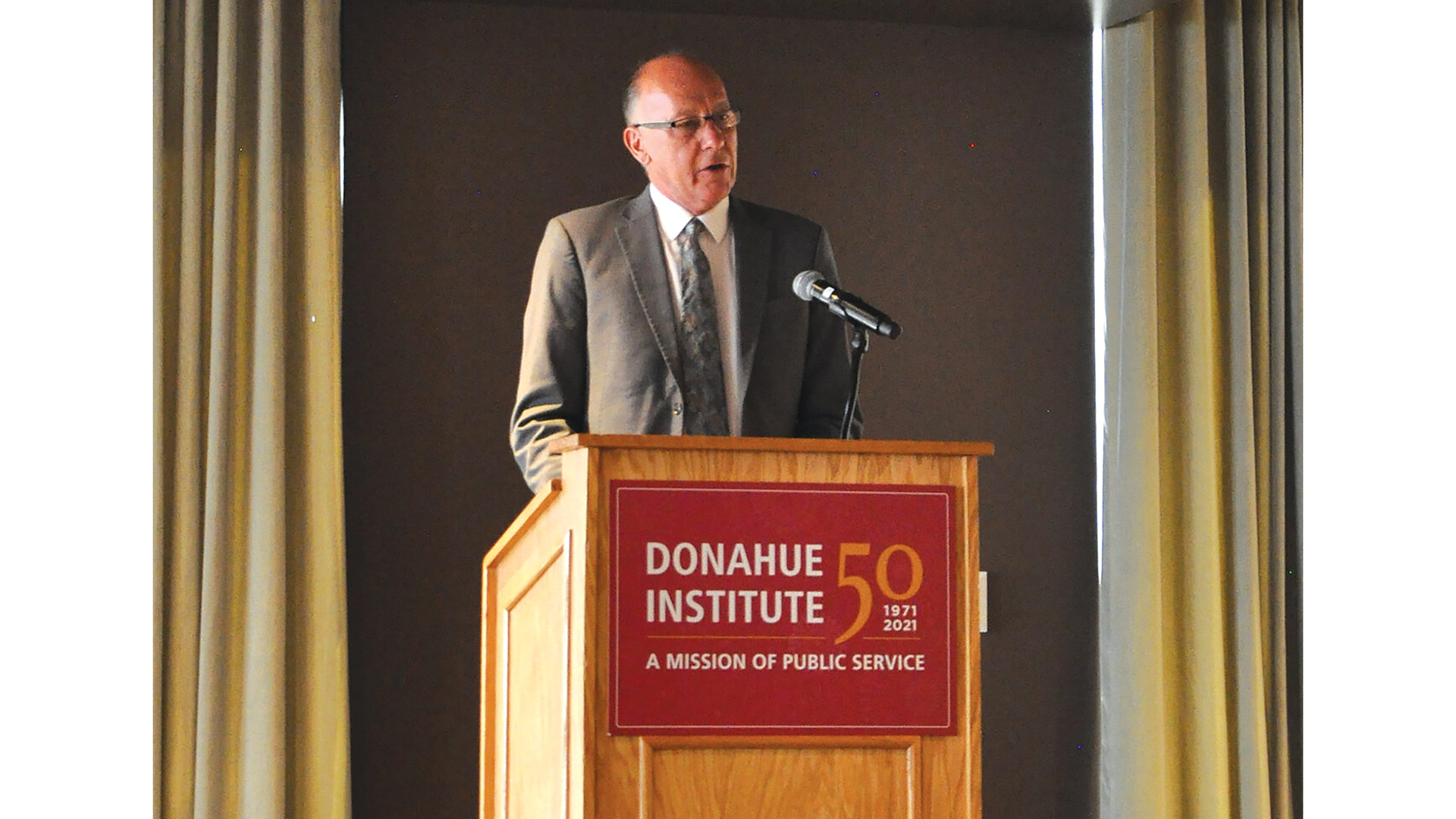
Johan Uvin addresses attendees

Johan Uvin addresses attendees at the recent gala marking the Donahue Institute’s 50th anniversary.

Slicing through it all, Mark Melnik, director of UMDI’s Economic and Public Policy Group, used terms not often applied to such an agency.

“We’re a dynamic organization, especially for a public-service institute,” he told BusinessWest. “While entrepreneurial mode can be exhausting, it allows us to push corners.”

This unique blend of public service and entrepreneurship provides the institute to recognize and seize what he called “opportunities that just make sense.”

For this issue and its focus on innovation, BusinessWest looks at these opportunities while reviewing the institute’s first 50 years of work and asking UMDI’s leaders what will likely come next.


History Lessons

In the beginning, the Donahue Institute focused on providing consulting services to state and local governments. Named for former president of the Massachusetts State Senate, the late Maurice A. Donahue, UMDI branched out in the mid-1980s by helping clients in the corporate and nonprofit sectors.

According to J. Lynn Griesemer, who served with UMDI for 31 years, including several as president, and still acts as a senior advisor, a breakthrough assignment in the early days of the institute was to assess how to most effectively introduce office automation into workplaces. While automation is incontrovertible today, back in the paper-laden manual task days of 1970s office life, the project was just one of many groundbreaking concepts the institute would help launch.

Another early assignment that would shape the future of the institute involved improving floor operations at the General Motors assembly plant in Framingham. However, while the project was underway, the plant began laying off shifts — but UMDI was already there as an implant that was well-positioned to lend a hand. Shifting focus, the institute helped the newly dislocated workers create resumes, get additional education, and ultimately find jobs or even start businesses of their own. Through this fortuitous timing, the institute quickly became the largest services provider to dislocated workers in the Commonwealth.

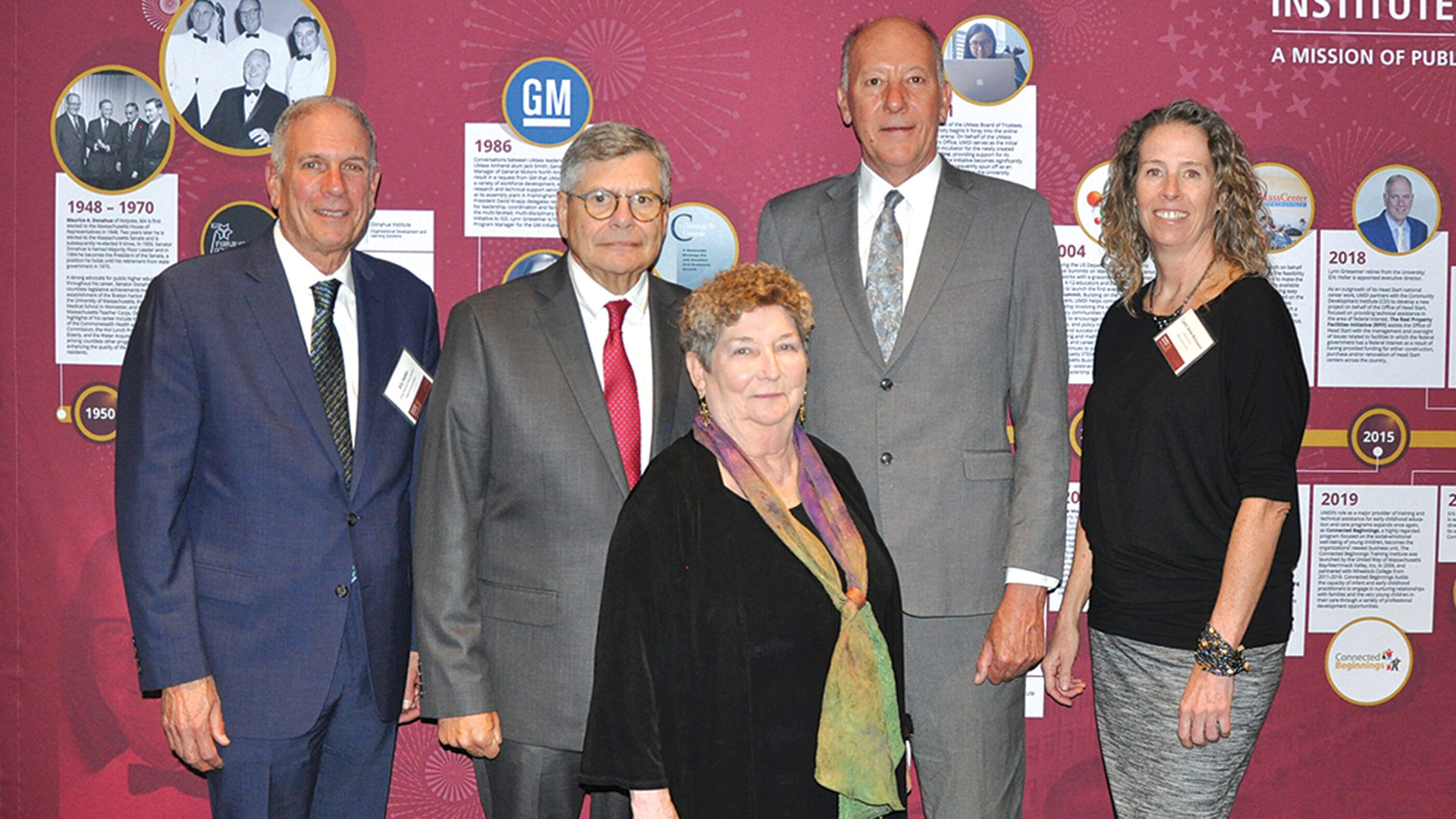
Donahue Institute

From left, former director of the Donahue Institute Eric Heller, former deputy director John Klenakis, former director Lynn Griesemer, Director Johan Uvin, and Associate Director Carol Anne McGowan

The federal government’s Department of Defense would then present the institute with an opportunity to help make systems uniform across military branches. This project allowed UMDI to develop the national credibility to successfully bid on the Head Start program, one of its core initiatives to this day.

From there, former Massachusetts Governor William Weld asked the UMass President’s Office to assist with an economic development initiative for the state. With the help of economic experts from across the UMass campus, UMDI worked with the Federal Reserve Bank of Boston to forge the MassBenchmarks project. To this day, MassBenchmarks assesses the Massachusetts economy through reports and analyses that it then produces and releases twice per year in journal form.  

These early projects laid the groundwork for UMDI to get approved as a vendor by the federal government’s General Services Administration (GSA). This designation allows the institute to bypass the lengthy bidding process usually required to win large federal contracts. 

Indeed, the institute’s keen eye for evaluating opportunities and strategically selecting those that will open doors has built the solid foundation it now stands on.

Today, the Donahue Institute is comprised of 10 business units. However, despite the ever-growing diversification of its core capabilities, a vibrant and robust research component remains at the backbone. This includes both UMDI’s Applied Research and Program Evaluation unit and its Economic and Public Policy Research group, led by Melnik.

This group operates as a project-oriented consulting firm, much like a think tank, bringing academic expertise and methods to real-world social problems. The group works with demographic, labor market, and economic data to help state and municipal governments, planning agencies, and nonprofits guide broad public policy discussions.

“Housing is the most central public policy question when we talk about Massachusetts.”

One current project examines how to leverage new apprenticeship models to minimize employee retention challenges. Another potentially groundbreaking study involves using data gathered for COVID-related purposes to develop new and more affordable ways of providing healthcare services to consumers instead of funneling people into highly complex systems that they have to navigate on their own.

A core assignment for Melnik’s group is its work with the Secretary of the Commonwealth preparing for census enumeration, which is the basis for federal funding allocation and congressional seats. With help from UMDI’s population- estimates program, the state’s census data is head of class in the nation. This is especially noteworthy since census data is relied upon heavily for resource allocations and predicting where jobs will be. It also informs decisions around population projections used by the MassDOT and Mass. School Building Authority for school district planning.

The group’s portfolio also includes a two-phase initiative with Way Finders that uses Greater Springfield as a case study on housing market affordability. With a focus on upward mobility and wealth creation, the study seeks to answer what it’s like for low- to moderate-income families to live in a high-cost state.

“Wages are so much lower in the Pioneer Valley that more than 54% of renters are housing cost-burdened,” Melnik says. Additionally, the majority of those burdened are people of color.

“Housing is the most central public policy question when we talk about Massachusetts,” he explains. This is because it tells the story needed to inform public policy, including the future of transportation.  

Another of the institute’s long-term projects is the Head Start program, which it has been involved with since 2003.

UMDI’s New England Head Start Training and Technical Assistance group is co-directed by Rosario Dominguez, M.P.A. Dominguez says that when people think of the Head Start program, early childhood education is often the only thing that comes to mind. However, that barely scratches the surface of what the program does, as it begins at pregnancy and continues to support families through college.

With this long-term intervention approach, the program addresses intergenerational poverty by using what goes on in the classroom as a lens for examining how families can reach their financial goals, ultimately strengthening entire communities. Through the partnerships it forms, the program has the reach to solve issues much larger in scale than early childhood development, including informing policies that move social equity and upward mobility forward by helping education and social service organizations improve their systems.  

Beyond its regional and national footprints, Ken LeBlond, Marketing Communications manager, said UMDI also handles international work. Funded by the United States Department of State, the institute has contributed to economic mobility at the global level since 2004.

This includes its exchange program in which groups of 20-30 people from about 60 countries, such as Argentina, Pakistan, and Eastern Europe, come to Western Massachusetts each summer. The groups travel the region engaging in active learning, helping at the Amherst food bank and senior center, and working on river cleanup projects.


A Look Ahead

In August 2021, the Donahue Institute welcomed Uvin as its executive director. Uvin had previously served as assistant secretary of Education under the Obama Administration. Working alongside Associate Director Carol Anne McGowan, Uvin holds the distinction of being the institute’s first executive director to be hired externally.

When asked what is ahead for UMDI, Uvin talked about alternative models for providing health care and exploring different educational models in challenged communities to lift entire neighborhoods through training and interventions.

Additionally, Uvin is interested in looking at both the supply and demand sides of regional economies to shape how employers and individuals work together to create wealth.

He explained that the engagement process might begin with going into neighborhoods and asking, ‘what are your aspirations?’ This is important because, according to Uvin, “we are moving headlong into a labor shortage with the babyboomers retiring,” making it critical to have intentional conversations around economic development across many different populations.

While this may be a current focus for UMDI, these issues are not new to the Pioneer Valley, where economists and policymakers have been wrestling with similar challenges for decades. Uvin says that while high-tech industry sectors have grown across the state, it has not been an equitable geographic or demographic spread, with Gateway cities such as Springfield and Holyoke — where nearly half of the region’s minority population lives — being left behind.

Part of Uvin’s vision for the future is to explore work in sectors such as life sciences, which play a key role in the success of Central Massachusetts’ biotech manufacturing and Greater Boston’s R&D and lab-based growth.

This, he says, would involve lifting up underserved communities, which is critical because, on the business side, there are simply not enough workers to grow unless we find ways to include all populations. Representation of people of color in the best-paying jobs of the higher-tech sectors lags severely. In terms of where UMDI is at this point in contributing to solving inequities that plague underserved populations, he says they are in the discovery phase, talking to others on the grassroots level.     

As for the future, the institute is positioned to make great strides. With an executive director from the outside, a new perspective brought on by the COVID pandemic, and an impressive 50 years of success to build from, the institute is at a nexus for bringing widespread change to the communities it serves.

“It’s an exciting time for reflection and renewal — to articulate what has happened, organically anyway, through the COVID crisis, which is the discourse around social equity and social mobility,” said Melnik. “This has been part of our work for a while now and has bubbled up even more.”

In reflecting upon how the institute has evolved over the past fifty years, Uvin and others said it is also important to highlight what hasn’t changed, especially the institute’s model and entrepreneurial approach to its work.

Dominguez adds that what was once called public service has evolved into economic mobility and social equity.

“Although we are further defining what we do, our core values will always be the same,” she said. “How can our work impact communities in need? That’s the core — and that won’t change.” 

Uvin concludes, “we’re not done evolving. COVID revealed what didn’t make sense, and business must respond.” Offering employee support, childcare, mental-health services, and other perks will be integral.

Perhaps what will carry the Donahue Institute forward another 50 years will be that which has stayed the same — a solid culture, a public service-focused mission, and the keen ability to find opportunities that align with core values while also having the potential to open doors.

Special Coverage Technology

Making IT Happen

By Mark Morris

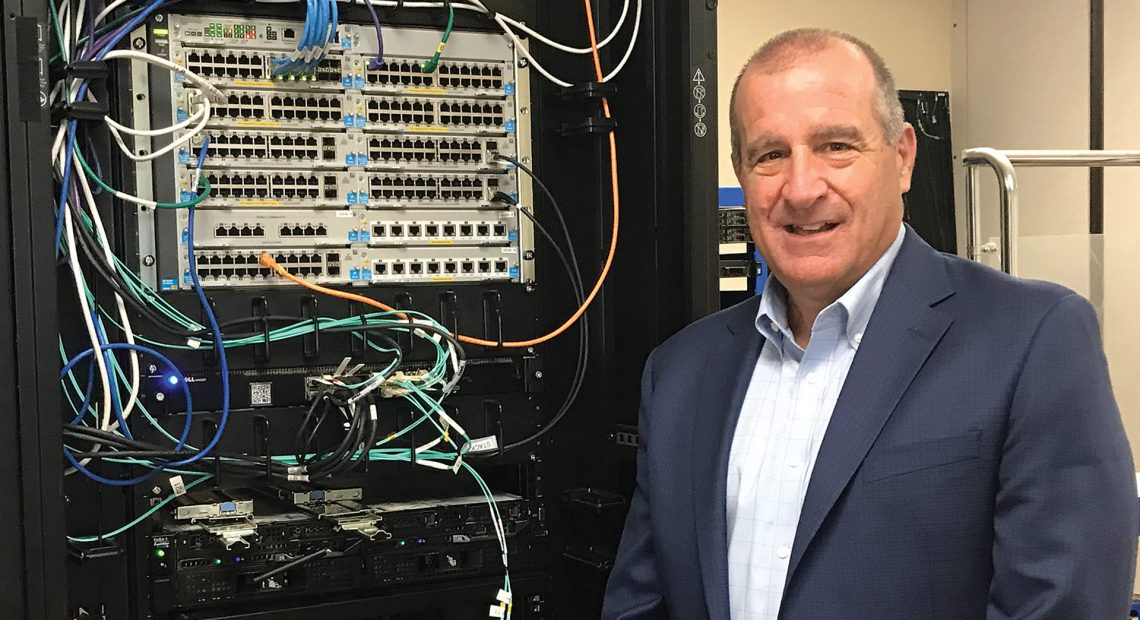
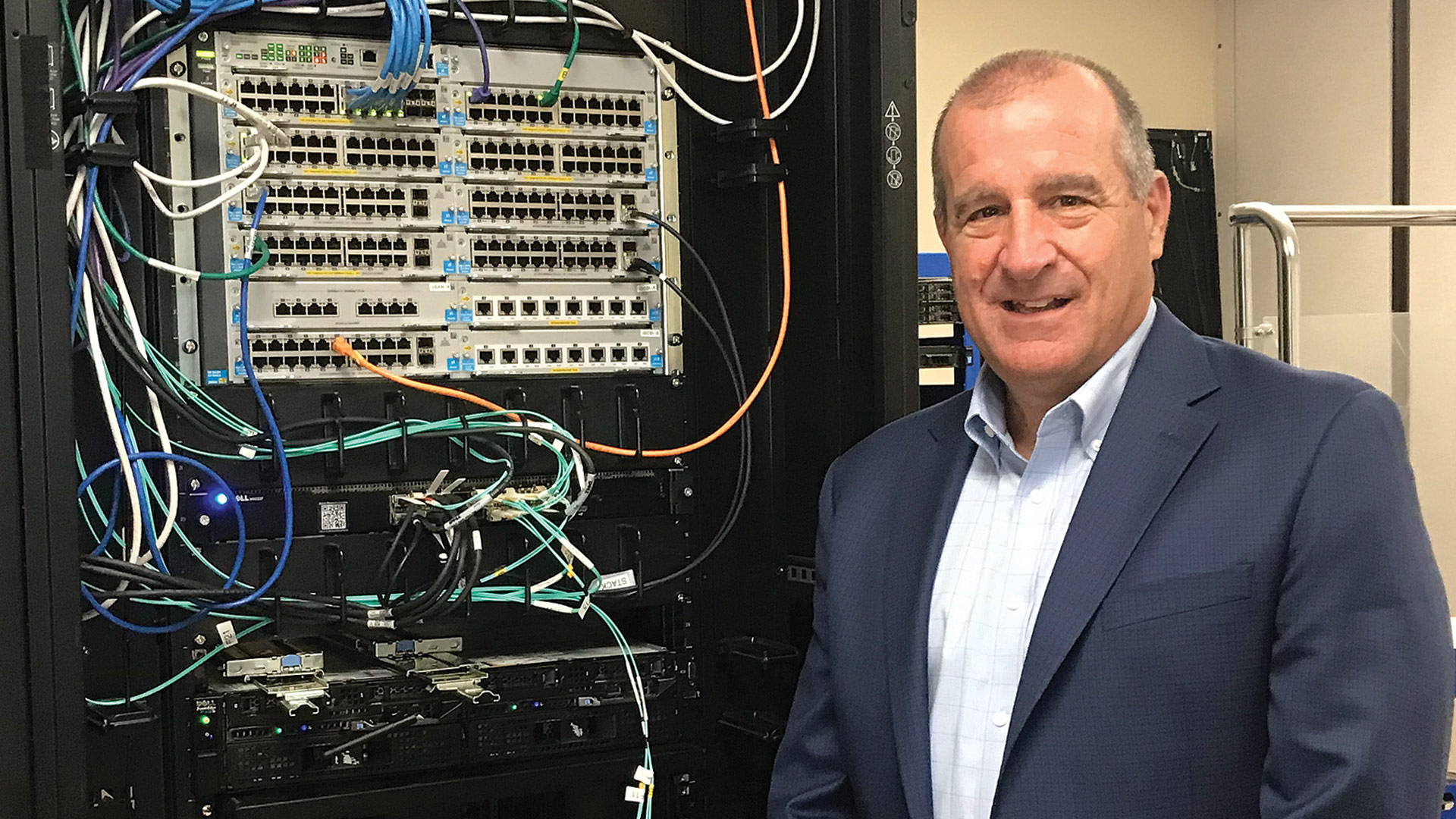
Mike Sheil

Mike Sheil, president, Whalley Computer Associates

Mike Sheil says he enjoys his work because his business — information technology — is always changing. And he acknowledges that this is an understatement, as recent events have shown.

Sheil, president of Whalley Computer Associates in Southwick, began his career with the computer reseller right after graduating from North Adams State College, now Massachusetts College of Liberal Arts. After four years, he left for a medical device company where he stayed for another four years. Sheil returned to Whalley 24 years ago and rose through the sales ranks until being named president in June 2020.

His relatively new position comes with a lengthy job description, but, overall, he is charged with authoring the next chapters in what has become a long-term success story — a company that has grown exponentially from its humble roots over the past 43 years because of its ability to adapt to that constant change he mentioned.

The past two years, dominated in every way imaginable by the COVID-19 pandemic, provide a dramatic example of the company’s ability to respond to change, and, in many respects, lead clients through it.

“Before COVID you would get a quote, get a PO, order the product, it comes within a week and we can install it the next week. If we can get back to that type of normal business environment, I believe our company will experience tremendous growth.”

Indeed, a banner hanging in the production area reminds employees that, when in doubt, they are to do what’s right for the customer, the company, and the individual. This clear guidance turned out to be valuable when COVID hit and flooded Whalley with sudden demands for products and assistance. With millions of employees suddenly leaving the office to work from home, Whalley clients needed the resources to make that happen.

“We helped companies with thousands of workers to get their folks set up at home,” Sheil recalled. “Some needed monitors and docking stations, while others sought upgrades to their data center because so many more people were tapping into their bandwidth.”

In one instance, a higher education client was looking for 400 laptops to outfit staff members who had been sent home to work.

“I received the request on a Saturday,” Sheil recalled. A colleague found the product, provided a quote for what it would cost, and sent it to the client. “For the first time in my career, I received a purchase order from a public university on a Sunday.” By Monday afternoon, 400 laptops were shipped to the university.

Whalley Computer Associates’ new building

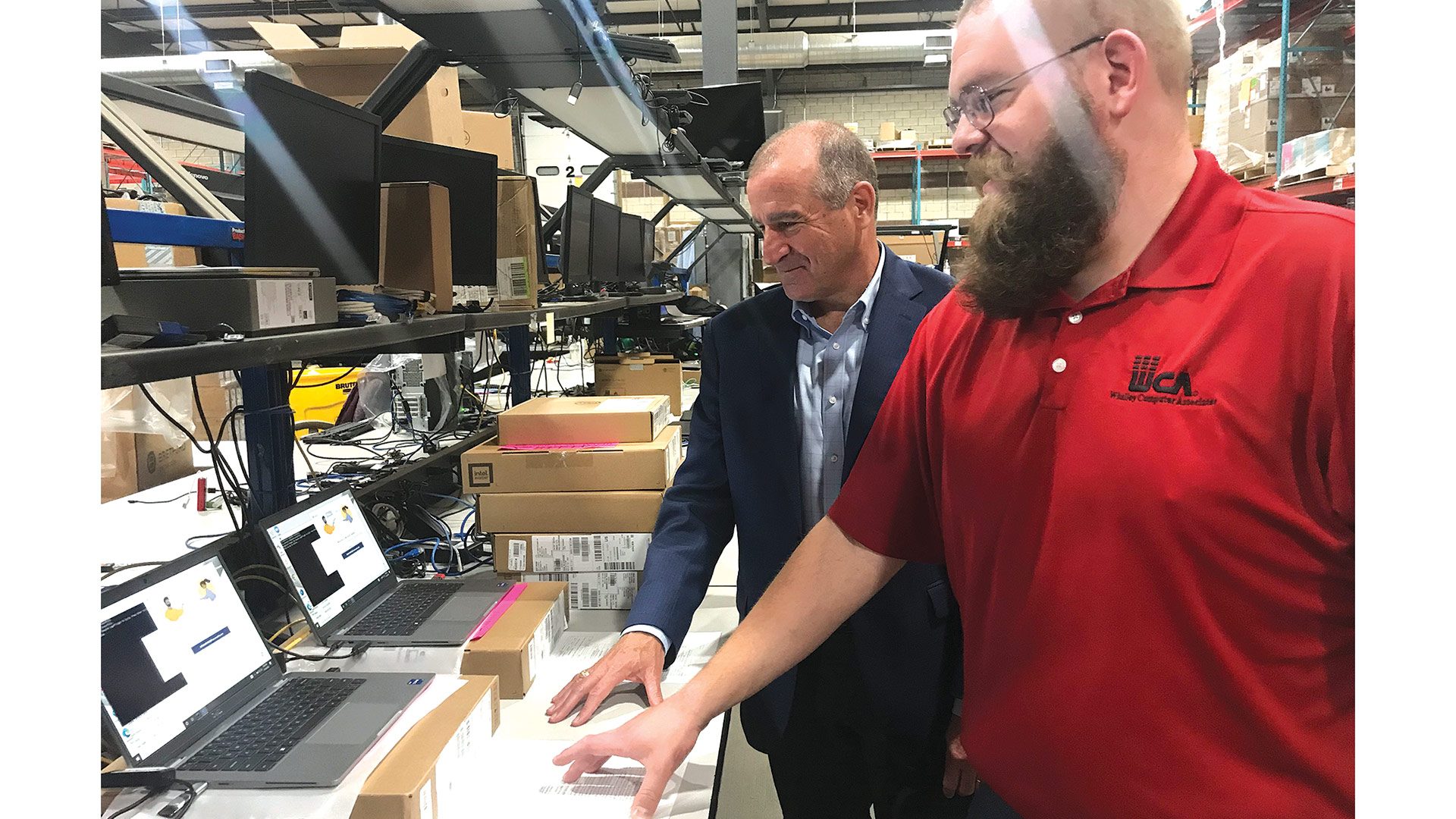
Mike Sheil, left, says Whalley Computer Associates’ new building will allow the company to better serve its clients.

Looking ahead, Sheil said Whalley will soon begin to grow its physical presence with a new 84,000-square-foot building next to its current headquarters in Southwick. Plans call for locating the OEM division in the new space as well as expanding warehouse storage and improving delivery options.

“The new building allows us to go to our clients and let them know we can do even more for them, so that’s exciting,” Sheil said. “This is an opportunity to grow our business in North America while showing our commitment to Southwick and Western Mass.”

For this issue and its focus on technology, BusinessWest takes an in-depth look at Whalley’s long and intriguing history, and at what’s next for a business that helps its clients get it — and IT.


Taking Big Bytes

Tracing that history, Sheil noted that, in the early 1970s, Agawam math teacher John Whalley purchased a small software consulting firm that had a few clients. Working out of his basement after school and during the summer months, Whalley began to add customers, and by 1979 established Whalley Computer Associates.

By 1984 he moved the business out of the basement and in 1985, left teaching to concentrate on growing his company. Whalley is now CEO of the company, which is located in a 62,500-square-foot state-of-the-art building where 200 employees provide products and services to more than 20,000 customers around the world.

Whalley customers range from small businesses to corporations, as well as educational institutions and healthcare organizations. Clients tell Whalley representatives what challenges they need to address in their computer systems. Whalley then orders the product, configures it to fit the client’s needs, then delivers and installs the product at the client’s site. There are other resellers who simply order the product and send it directly to the client, who usually don’t have the space to handle a computer system shipment. Sheil said Whalley is different because it takes a hands-on approach.

“Once we receive the product it’s completely handled by Whalley employees,” Sheil said. “From the engineers and technicians who configure the products, to the people who drive our trucks and install the systems, everyone has a vested interest in doing it right.”

And during the pandemic, the company’s resolve to do it right was certainly tested, a test Sheil said it has passed.

“COVID and supply chain issues have been challenging, yet we experienced growth during that period,” he told BusinessWest. “It’s all thanks to our people who were flexible and willing to respond to all these requests.”

The OEM division of Whalley provides custom design of technology systems for clients. When COVID hit and a major customer temporarily shut down, it affected several employees who worked directly with that customer. Instead of laying off those employees, they were sent home with a laptop and a project to work on to benefit the company.

Heather Kies was given the assignment to plan several events for the company. A project manager with OEM, Kies also had a marketing background and enjoyed getting back into this area. She handled the assignment so well, Sheil promoted Kies to Marketing Manager in January and asked her to run the company’s new marketing department, which previously existed only informally as part of business development.

Whalley Computer Associates has a long track record

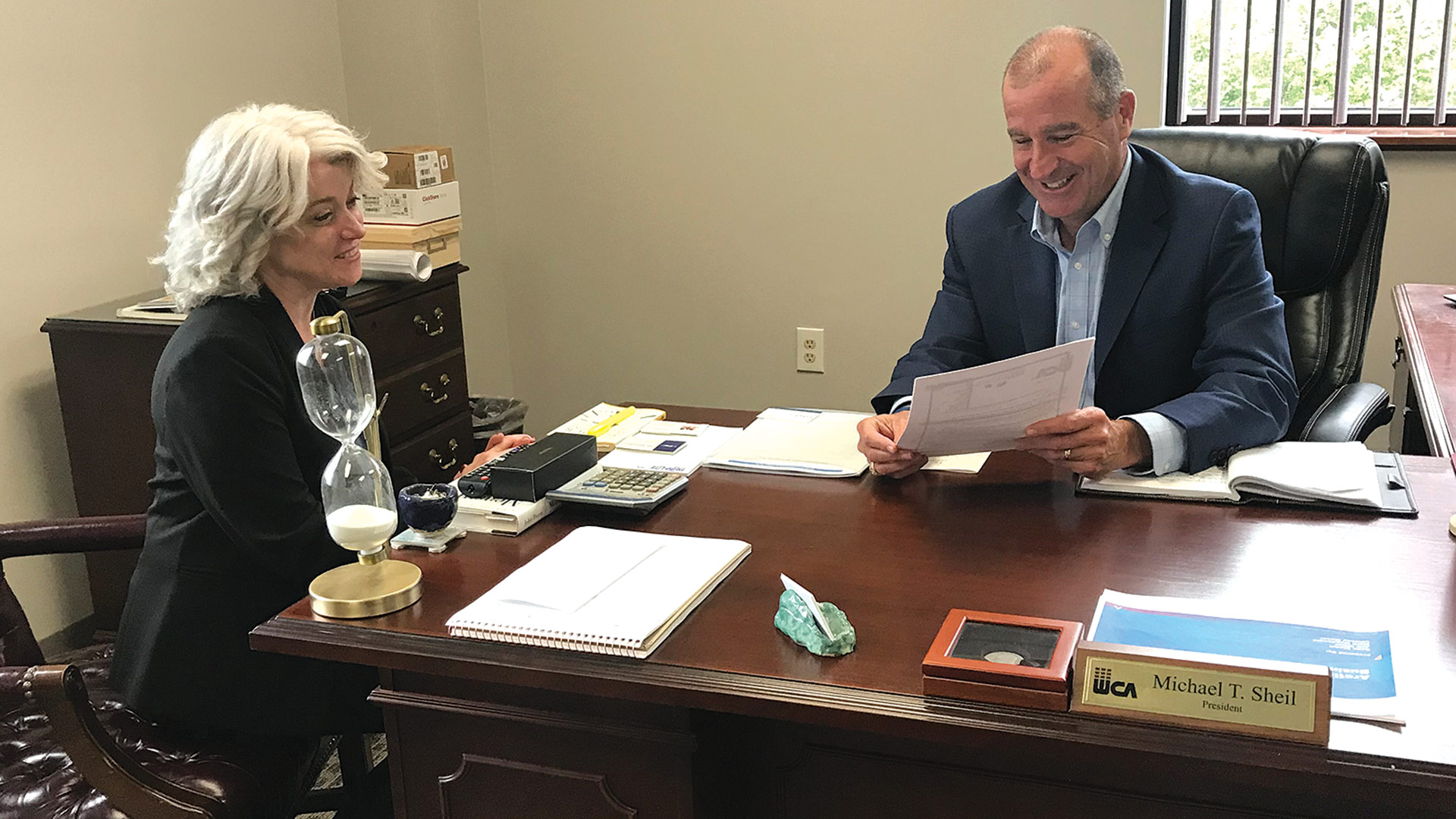
Mike Sheil says Whalley Computer Associates has a long track record of adapting to change and being nimble in its efforts to serve clients.

These days Kies is working on various company events, including preparations for a major tech conference that takes place in December.

“I’m also busy getting the word out on who we are so people understand all the services we can provide,” Kies said.

While the height of COVID brought unspeakable horrors, it also forced companies to think differently about how to stay in business and meet customer needs. Sheil is one of many who believes that making the pivot and finding new ways to get the job done is a silver lining to the dark cloud that has been with us for more than two years.

“When COVID hit we had to patch different products together because we couldn’t get the materials we wanted,” Sheil said. “As a result, our people figured out how to get clients what they need despite supply chain issues.”

One of the most profound changes since COVID is the growth in hiring people who work far away from the company’s headquarters.

“Since the pandemic, we’ve brought on new employees in Tennessee, Florida, and Texas,”
Sheil noted. “We can now hire folks out of the region to grow our reach.” Whalley won a recent contract in Pennsylvania and is seeking a salesperson for that area.

“This makes sense for us because these folks live there, they know the area and we can support them from here.”

Whalley offers clients different options to store data on the cloud. Sheil explained some clients want to store all their data remotely in the cloud, others choose to split between the cloud and on-premise servers, while other clients prefer to keep their on-premise storage. Having expertise in cloud storage has helped Whalley clients get around some supply chain issues.

“When clients order a storage device and then learn it will be up to six months before they see it, we can offer them cloud storage while they wait,” Sheil said. “When their device finally arrives, they can take it off the cloud. It gives them flexibility.”

In addition to shipping products out the door, Whalley has seen growth in its managed- services area, which Sheil explained as the first line of defense for the client.

“With remote workers logging in at all hours of the day, internal IT staffs are straight out keeping their systems going,” Sheil said. “From our data center, our managed services staff may see a problem developing before it actually becomes a problem.” Using the example of a defective hard drive, Sheil said his staff would notify the client’s IT director and immediately replace the device.

“In many cases, before the client is even aware of a potential issue, there’s an overnight envelope on its way with a new hard drive,” Sheil said. “In this way we can be an extra set of eyes for them.”

Security is an area that continues to grow and remains essential.

“We’ve seen tremendous growth in the products we sell for cyber security,” Sheil said. “We also provide knowledge to our clients so they can prevent ransomware attacks and other threats.”


Screen Test

When he looks to the future, Sheil admits that as a sales professional for 34 years, he always sees the glass as half full. After Whalley found success despite a pandemic and a supply chain crunch that continues, he believes the company is now poised for explosive growth.

“Before COVID you would get a quote, get a PO, order the product, it comes within a week and we can install it the next week,” Sheil said. “If we can get back to that type of normal business environment, I believe our company will experience tremendous growth.”

In seven years, the company will celebrate its 50th anniversary. Sheil said he’s excited about the upcoming anniversary while he reflected on how far Whalley has come.

“It’s good to know that we’re a company where you can stay more than 30 years and have a career,” he said. “We want to keep on growing our business while at the same time remain a great place to work in the future.” u