Daily News

HARTFORD, Conn. — Whittlesey, the largest Connecticut-based accounting firm, has been named a 2025 Regional Leader in New England and a Firm to Watch by Accounting Today. With $40.2 million in revenue, three offices, and a team of 175 professionals, Whittlesey continues to provide assurance, advisory, tax, and technology services to businesses and individuals across the region.

“Whittlesey’s commitment to innovation, strategic growth, and exceptional client service remains at the forefront of everything we do,” Managing Partner and CEO Drew Andrews said. “This recognition reflects our team’s dedication to delivering value-driven solutions and helping our clients succeed in an evolving business environment.”

Accounting Today’s annual rankings highlight firms demonstrating strong financial performance, industry leadership, and forward-thinking strategies. As the only Connecticut-based firm named to the Firms to Watch list, Whittlesey remains dedicated to helping businesses and individuals navigate complex financial challenges with expertise, innovation, and personalized service.

Daily News

HOLYOKE — The annual Holyoke Community College Jazz Festival returns for its 26th year on Friday, March 28, with pianist, composer, and educator Earl MacDonald joining the Amherst Jazz Orchestra and members of the HCC jazz faculty for a big-band concert.

The Friday show begins at 8 p.m. in HCC’s Leslie Phillips Theater in the Fine & Performing Arts building on the main HCC campus, 303 Homestead Ave.

MacDonald, the former musical director and pianist for trumpeter Maynard Ferguson, is director of Jazz Studies at the University of Connecticut and teaches annually at the Jazz in July program at UMass Amherst.

“I met Earl MacDonald at the Jazz in July program at UMass and worked with him there in the summertime,” said HCC Jazz Professor Bob Ferrier, the festival organizer. “He’s a great educator, great piano player, and, on top of it, a great guy.”

The concert is free for HCC students, faculty, and staff, and $10 for the general public. Led by trombonist David Sporny, the Amherst Jazz Orchestra has been a mainstay of the HCC Jazz Festival since the first in 1998.

On Saturday, March 29, starting at 10 a.m. in the Fine & Performing Arts Building, MacDonald and members of the HCC Jazz Festival faculty will lead improvisation clinics, demonstrations, and jam sessions for area high-school and college musicians. Saturday events are free and open to the public.

As a bandleader, MacDonald has released seven albums. His accolades include a 2022 Covenant Award from GMA Canada, the Connecticut Office of the Arts’ 2020 Artistic Excellence Award, the Sammy Nestico Award for big-band arranging, and two JUNO Award nominations for Jazz Album of the Year.

The Winnipeg, Canada native earned degrees from McGill University and Rutgers, where he apprenticed with jazz master Kenny Barron. MacDonald has been called “a magical, musical alchemist of hip hybrids” by the Hartford Courant and “a major force in the world of jazz composition” by Dan Bilawsky on allaboutjazz.com.

Daily News

SPRINGFIELD — During March, Freedom Credit Union is inviting the community to donate money at any of its branches throughout Western Mass. to Shriners Children’s New England in Springfield, which provides spinal-cord and orthopedic care, cleft-lip and palate repair, sports medicine, and urology care.

“Shriners performs miracles every day, treating children and their families with compassion as they experience unimaginable challenges,” Freedom Credit Union President Glenn Welch said. “We’re proud to support their transformative work.”

Shriners Children’s helps children overcome medical challenges and reach their full potential, regardless of their families’ ability to pay.

Every month, Freedom Credit Union collects donations for a different charity as part of its Month of Giving campaigns. Money collected through the end of March will support the Shriners Children’s mission to provide life-changing care for children and their families.

“We’re always grateful to have such a generous community,” Welch said. “Every contribution makes an impact.”

Daily News

SPRINGFIELD — The Springfield Thunderbirds, in conjunction with the Center for Human Development (CHD) and Springfield College’s Department of Occupational Therapy, will host their fifth annual sensory-friendly game on Sunday, March 16 at 3:05 p.m., when the Thunderbirds host the Providence Bruins.

Since 2020, the Thunderbirds and CHD have partnered to host an annual sensory-friendly game, designed to make the excitement of professional hockey accessible to fans who may be sensitive to loud noises, bright lights, and sudden changes in atmosphere. This initiative was born from a shared commitment to inclusivity, ensuring that individuals of all ages and abilities can experience the joy of live hockey in a comfortable, welcoming environment. By reducing sensory triggers, the aim is to create a gameday experience where everyone can feel safe, engaged, and part of the Thunderbirds community.

“We’re filled with gratitude to once again deliver a significant and inclusive experience to T-Birds hockey fans who may not have had this opportunity previously,” Thunderbirds President Nathan Costa said. “Our partners at CHD have long established themselves as exceptional community leaders, offering an abundance of resources for our region’s residents. Their unwavering support, coupled with Springfield College’s Occupational Therapy department, enriches our organization and the families who attend the sensory-friendly Sunday game each year. We are so pleased with the growth of this game every year, and we’re excited to unveil some exciting new features to make inclusivity possible at all T-Birds games in the future.”

The game presentation will feature decreased stimulation, including low goal horn and noise meters, decreased microphone and music volume, no strobing lights, consistent lighting throughout the game and pregame, two ‘cool down stations’  — quiet areas on the concourse and main entry level of the MassMutual Center, away from the seating bowl — and a ‘sensory story’ booklet and other supportive items for guests.

“Now, in our fifth year of partnering with the Thunderbirds and Springfield College in making the great game of hockey accessible to everyone, CHD is delighted to once again be a part of this special event,” said Ben Craft, vice president of Community Engagement for CHD. “Helping people of all abilities enjoy positive life experiences is a big part of fulfilling CHD’s mission. Efforts like these are what true inclusion is all about.”

Since 2016, the Springfield Thunderbirds and CHD have built a meaningful partnership centered on a shared commitment to uplifting the Western Mass. community. Each home game serves as an opportunity to honor Springfield-area residents making tangible impacts in the community through the Game Changer award. Students from Springfield College’s Occupational Therapy program get to be game changers on sensory-friendly Sunday, as they receive valuable hands-on experience working with patients who deal with sensitivity concerns.

“The Occupational Therapy program at Springfield College is once again thrilled to be part of this wonderful initiative with the Thunderbirds and CHD,” said Lori Vaughn, professor of Occupational Therapy. “The sensory-friendly game allows individuals with sensory sensitivities to be present and engaged in Thunderbirds hockey, which might otherwise not be possible. Along with the modifications the Thunderbirds have implemented, the Student Occupational Therapy Association Club at Springfield College will be volunteering in the cool-down stations with various sensory-friendly activities they have planned to support children and families.”

Fans with questions regarding the sensory-friendly game can call the Thunderbirds front office at (413) 739-4625 or visit www.springfieldthunderbirds.com.

Cover Story

Screen Time

Executive Director Yasmin Chin Eisenhauer

Executive Director
Yasmin Chin Eisenhauer

As Yasmin Chin Eisenhauer gave BusinessWest a tour of Amherst Cinema, some of the contrasts were striking.

Like the original, century-old exposed brickwork in the upper-level projection room juxtaposed with three high-tech projectors, upgraded just last year, and the brand-new screens in the theater rooms below.

“Once you have a projector that is so precise with color and picture, then suddenly your screens that are 20 years old start looking very dated,” said Eisenhauer, now in her fifth year as executive director of the downtown landmark.

And landmark is the right word; this is a building with plenty of history within its walls, and impact beyond them.

The original building dates back to 1879, when a livery was erected on the site of the former Amherst Academy. After a major downtown fire in 1926, the structure was sold, renovated, and operated as a single-screen cinema until 1999, when it closed after years of neglect and deterioration.

Soon after, a group of arts lovers decided to save the historic structure from the auction block, raising nearly $3 million to build the new, nonprofit Amherst Cinema, which reopened in 2006 as a state-of-the-art, three-screen cinema. In 2013, a fourth screen was opened at the intimate Studio Theater, located steps away from the main cinema building.

That’s a lot of evolution, but what hasn’t changed — especially over the past two decades — is Amherst Cinema’s impact on the arts and cultural landscape of this region.

“We’re a catalyst for community. We are a place that feels very reflective of the greater community of moviegoers,” Eisenhauer said as she settled down in one of the empty theaters for an in-depth talk about the facility’s history, offerings, and future.

“When you think about what the greater community needs at this time, it’s an opportunity to come in, share the film experience, clap and laugh and applaud and cry and process and grieve.”

“We have 5,500 members, and our members and supporters were essential in terms of getting us through the pandemic. If you look around, all of these seats in our theaters are named,” she continued, pointing out patrons’ names engraved on tiny plates on the front of each seat. “People in the community have very deep investments in this place that they see as a cinema, but really their cinema. And they want to see it survive and thrive.”

The program of offerings on any given day appeals to a wide demographic, she added, from kids to college students to older lovers of film history.

“We have our Exhibition on Screen, which is our art-history films. We also have National Theatre Live, which are filmed recordings of performances from London’s West End. But then we have The Rocky Horror Picture Show. We have many, many filmmakers who come on stage through our Bellwether: New Voices in Film Series, as well as first-run and specialty films.”

The renovated, three-screen Amherst Cinema was reopened in 2006

The renovated, three-screen Amherst Cinema was reopened in 2006.

Recently, as part of a James Earl Jones retrospective, Amherst Cinema began screening all three original Star Wars movies.

“When A New Hope was here, we had a sold-out house of Star Wars fans who had seen it originally, but also a new generation being able to watch that on a large screen for the first time; that was really, really fun,” she said.

“And when you think about what the greater community needs at this time, it’s an opportunity to come in, share the film experience, clap and laugh and applaud and cry and process and grieve. We do all of that across our screens. That’s why we’re a catalyst for community: we’re here for the community, serving up programs and experiences that are meaningful and memorable.”


From Darkness to Light

Eisenhauer’s first day on the job after accepting the executive director’s role at Amherst Cinema was Jan. 6, 2021 — a meaningful day in the U.S., for sure, but a very quiet one at the movies.

“Our screens were dark, closed to the public,” she said of those early days, almost 10 months after COVID shuttered public gatherings. “We were doing streaming films, but it was very, very clunky. We are not, nor do we aspire to be, a streamer, but it was a group of arthouse theaters who launched a venture to be able to showcase independent films. At the time, we were also doing private theater rentals, one group at a time. People were paying $300 for a theater experience.

“That’s where we were when I came in. Our front-of-house team had been furloughed. Our managers and board were totally burnt out because the pandemic really upended theaters and theatrical exhibitions,” she recalled.

“After a screening, we might have the filmmaker on stage, or a faculty member from one of our institutions who has a deep expertise on a certain subject or topic of the film, and the discussions that happen in this room are incredible.”

“So one of the first things that I did when I came on board was to try and experiment: let’s do away with private theater rentals because they’re really expensive. It’s a pandemic, when many people in our community are suffering in all kinds of ways. So let’s take the model, but we’ll rename it small-group screenings, and we’ll charge regular ticket prices and include our member discounts. It’s still no more than 10 at a time, but we got to open up all of our screens.”

Those shows sold out — fast. “Everybody started coming back. It was amazing. It reminded you of why these places were here. Everybody was confined to their home. Now they could come back, get up and close and personal with stories, and just be moved,” Eisenhauer said.

Participating in a Q&A after a screening of The Longest Goodbye

Participating in a Q&A after a screening of The Longest Goodbye are, from left, Amherst Cinema’s George Myers; Jamey Simpson and his mother, astronaut Cady Coleman; and director Ido Mizrahy with his son.
Photo courtesy of Amherst Cinema

“There was a woman who was undergoing chemotherapy, and her children said, ‘you may not leave the house.’ And she said, ‘I left it to come here to see a movie because I really, really needed to see a movie.’ And she was just moved to tears to be able to return and feel alive. We have a lot of very transformative moments like that, where people understand the value of the movies as an art, as essential.”

Since then, ticket sales have crept back up, but they’re still about 20% below pre-pandemic levels, and Eisenhauer said that’s a difficult gap to close because moviegoers’ habits have changed dramatically since the pandemic began. Specifically, there’s more content (including the small, independent firms Amherst Cinema is known for) at home.

“That gap that the streamers filled is a reality for theaters nationwide. Pre-pandemic, we had a steady supply of arthouse films. We had more films than screens, and it was vibrant in terms of the landscape and the film supply. Post-pandemic, we struggled with two things. One is that streamers had fundamentally changed moviegoing habits. Second is the film supply that was available to us. But in those four years, we’ve steadily recovered.

“The advantage of Amherst Cinema as a local nonprofit is the community of members and supporters,” she added. “We survived the pandemic. I mean, that is not a small feat. There are a lot of cinemas that didn’t survive.”

To continue the momentum, as noted earlier, the facility recently invested in its projector technology, sound, and screens, as well as replacing all its seats during the pandemic. “So when you’re here, you’ve got a really modern and fully immersive experience.”

But the top factor in bringing people in is simply curating movies that people want to see and can’t get elsewhere, whether it’s first-run independent and arthouse films (for example, several of this year’s Oscar nominees, including all the nominated documentary, animated, and live-action shorts), the $5 family film program (E.T., The Lion King, and a Mary Poppins sing-along are all on the docket this spring) or Friday-night cult favorites (the next few selections are Conan the Barbarian, Sleepaway Camp, and The Doom Generation).

“Then we curate all these retrospectives and repertory cinema, and we eventize them,” Eisenhauer explained. After a screening, we might have the filmmaker on stage, or a faculty member from one of our institutions who has a deep expertise on a certain subject or topic of the film, and the discussions that happen in this room are incredible.

“Janet Planet was a big one because that was a local filmmaker, Annie Baker, and what was really fun about that was seeing Western Massachusetts on the screen. People would sit through all the credits because so many of the folks who participated in the making of that are from the local community.”

Yasmin Chin Eisenhauer says Amherst Cinema is important to the town not only culturally and socially, but economically as well.

Yasmin Chin Eisenhauer says Amherst Cinema is important to the town not only culturally and socially, but economically as well.

Another program that pairs a movie with a discussion is called Science on Screen. Upcoming features include The Silence of the Lambs, which includes a lecture by Erik Charles, a UMass Amherst professor of Psychological and Brain Sciences; Don’t Look Up, with Ethan Zuckerman, a UMass Amherst professor of Public Policy, Information, and Communication; and The Pod Generation, with Carrie Baker, a Smith College professor of the Study of Women, Gender, and Sexuality.


Hearts, Minds, and Economics

While advocating for Amherst Cinema as an important cultural institution, Eisenhauer was quick to note its place as an economic multiplier in the community.

“We employ locally; it’s a small team, but they’re all from here. We also prioritize local vendors, from our IT providers to our printers to many products here. We look for hyper-local vendors — Dean’s Beans is our coffee supplier. We do as much as we can locally.”

When people come to the movies from out of town, she added, they often dine in Amherst and even stay in hotels, if the movie outing is part of a broader vacation. “So when the cinema is up and running, it drives a lot of traffic to the town and really amplifies businesses.”

The local element is a critical one to many such arthouses, she added. “We are not a corporate chain that is doing something from the middle of the country that gets spread all over. The labor is here, and that’s our priority.”

Thinking back to the early days of her leadership, with the pandemic in full swing, and how Amherst Cinema has recovered and continues to rebound, Eisenhauer noted her love of post-apocalyptic movies and books.

“Many of them are, of course, naturally very grim and frightening, but many of them are about discovering humanity — what remains when everything is lost? And one of the things that I’ve noticed in post-apocalyptic films is that, at the end, what survives is art and the arts,” she said.

“I’ve always loved movies. We’re fundamentally telling stories that are relevant and important to the human experience, particularly at a time when we feel like many things are being lost, including from the pandemic and being afraid to come out, or getting out of the habit of coming out,” she went on. “And then, when people return, they get this experience, and they’re moved. So when I think about why we’re here and what we do, it’s kind of changing hearts and minds, one film at a time.”

Special Coverage Women in Businesss

Beyond the Courtroom

Tanzi Cannon

Tanzi Cannon

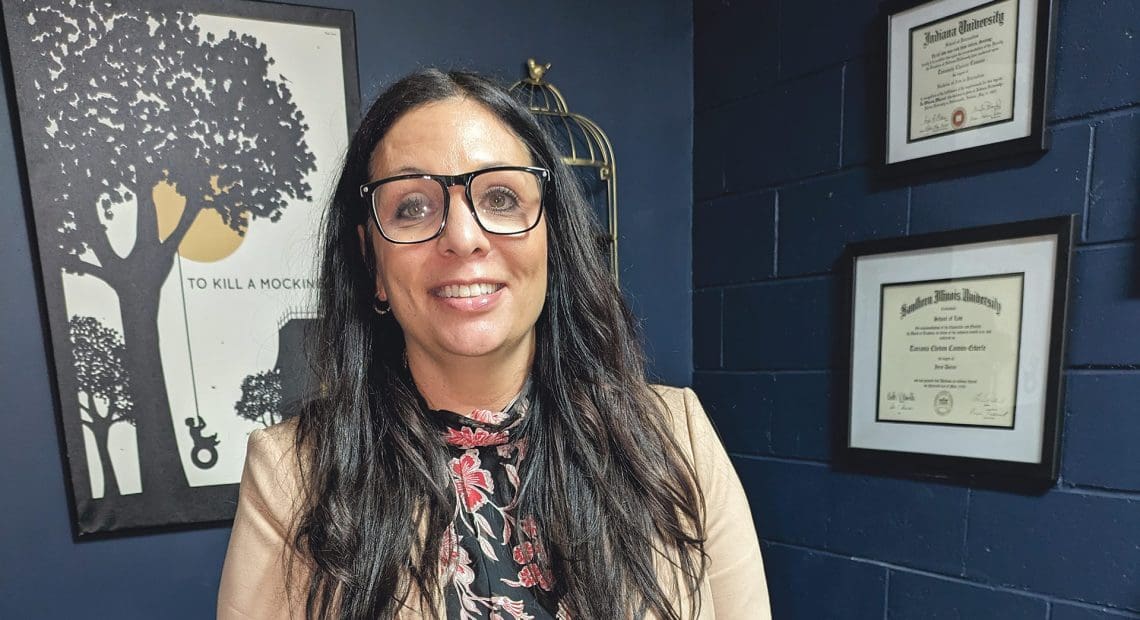
Tanzi Cannon knows litigation. And she enjoys litigation.

But there’s something she found she likes even more, which is why she built a law practice around it.

Backing up a bit, in her previous role, Cannon was the chief litigation officer at the Royal Law Firm. “We were obviously heavy on litigation, but we also did a lot of advice and counsel,” she recalled. “Litigation is strategic, and there’s competition, and every case is different, and I’m a certified investigator, so I got to use those investigation skills.

“But I found that the enjoyable part was actually when the litigation was over and I could go back to the business and say, OK, ‘here are the things that could have prevented litigation for you. Here are some things that we can do to improve this department.’ I’m a business person, so I also had some business advice,” she added.

Unfortunately, once litigation was over, clients were typically tired of talking about legal matters — and tired of spending money on them. “Consequently, those preventive conversations were the short conversations, and I really wanted those to be the long conversations.”

That’s why she decided to leave Royal and launch her own firm, General Counsel by Cannon, which specializes in business law for small businesses — focusing not on litigation, though she will handle that if need be, but on the nuts and bolts of helping businesses avoid the courtroom and create healthier, safer, more successful companies.

“ I found that the enjoyable part was actually when the litigation was over and I could go back to the business and say, OK, ‘here are the things that could have prevented litigation for you.’”

“When I left the firm, it was to start this model of business advice and counsel — that’s why it’s General Counsel by Cannon, a fractional general-counsel law firm,” Cannon told BusinessWest. “I felt like I wanted to not only do litigation, but to focus on prevention, and also be able to add some of that business advice in there as well.”

Many clients, she explained, have business contracts that need be renegotiated, reviewed, or drafted anew, or need assistance with human-resources law. She also assists with organizational development, succession planning, change management, and writing a company’s standard operating procedures.

“Having a fractional general counsel is kind of a one-stop shop for many legal issues that impact businesses,” she said. “I want to be the go-to person for my clients — if they even think they may have a concern, I want them to call me without having to watch the clock because they are concerned about the billables. I want to be the person they trust. I want to be a part of the team without adding a full-time employee.”

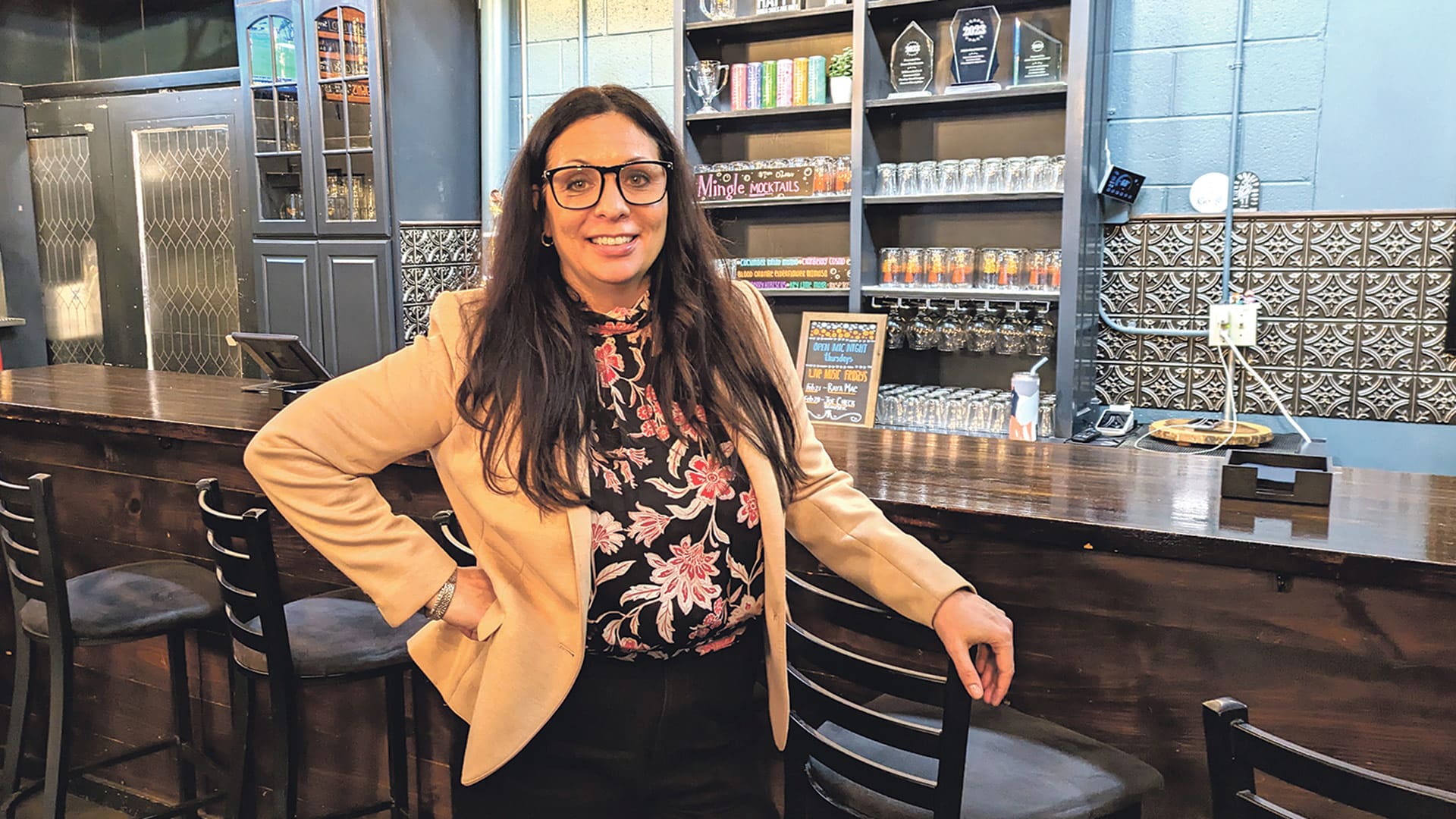
Tanzi Cannon stands in the brewery she co-owns with her husband, Joe Eckerle

Tanzi Cannon stands in the brewery she co-owns with her husband, Joe Eckerle, which shares a building with General Counsel by Cannon.

The reason they don’t have to worry about cost is the model Cannon has put in place, charging a monthly fee — there are different subscription levels — that clients pay for whatever services they might need, including advice and counsel, regulatory audits, training … essentially, whatever issues are within the scope of their service contract.

“Essentially, they have a general counsel on call without having to hire an attorney every time they need something, and it also costs less than hiring an attorney to be on staff,” she explained. “What I have found is that it allows me to better defend people when they do get audited or they get a case because I have become familiar with the business. Because they just pay that monthly fee, they’re not really worried about how often I call them.”

They’re also not concerned with how often she stops by and spends time with the staff, as it’s all in the service of preventing problems down the road.

“I help people grow and become better businesses and prevent a lot of litigation. One of my clients actually told me that, since I did training for them, their litigation has gone down by 90%.”.”

“I become a part of their team, kind of. They see me, and I know a lot about the business. So when I do have to defend them, I already know that stuff. I already know who the managers are, what they do, I’ve probably seen the complainant, and I can see red flags when not all the managers are seeing those red flags — and I can train to those red flags.”

In short, Cannon said she and her clients are both gratified by this work.

“The pivot was just natural. And it makes me happy. I help people grow and become better businesses and prevent a lot of litigation. One of my clients actually told me that, since I did training for them, their litigation has gone down by 90%.”


Brewing Up Solutions

Cannon noted that Western Mass. is home to many labor and employment law firms, but she aims to stand out from them through her focused service model.

“They’re really good, but it’s mostly litigation. Then, if they’ve got a long-standing client, they’re going to call and get some advice and counsel. I’m hoping to flip that model; I’ll do litigation if my clients want me to, but I really want them to call me before that happens.”

For example, she noted, “I have the ability to understand when someone might need an ADA accommodation. I can walk into a place and see a management practice or a business practice that might not be good, like inconsistent application of the rules or blatant safety concerns.

“If it’s a sales floor and there’s a chair that’s in the way of the fire extinguisher or if there’s a mat in front of the door that’s getting stuck and nobody knows anything about it, that tells me they probably need some OSHA training because those are safety issues, and they don’t know that it’s not OK for that to happen, or they don’t realize it’s their responsibility,” she elaborated. “Lots of managers don’t realize that they could be on the hook and be sued personally for the conduct of the people they’re supervising. And when I tell them that, their ears perk up.”

“Sometimes, when you have small businesses, especially in family businesses, it’s so close and they’re so friendly that it’s difficult to draw boundaries and set the expectations and hold people accountable. And that is a recipe for disaster.”

Relationships in the workplace can be another red flag, and sometimes those become evident when Cannon visits a site.

“Sometimes there’s a lot of resistance about what it’s OK to say, or there being too close of a relationship between an owner and a manager. Not that it’s a sexual relationship or any sort of love relationship, but I think sometimes, when you have small businesses, especially in family businesses, it’s so close and they’re so friendly that it’s difficult to draw boundaries and set the expectations and hold people accountable. And that is a recipe for disaster.”

Cannon’s knowhow in maintaining a healthy workplace comes not just from her law experience, but from working in a broad variety of jobs in her life. She’s waited tables, cleaned hotel rooms, flipped burgers, owned an apartment building, and owned a cleaning service, as well as working at a golf course, in event planning, at a marketing firm, at a financial brokerage firm, as an HR director, and as an internal investigator.

“I’ve done so many jobs, I know what it takes to start a business. I know what it takes to keep a business going,” she said, and all that certainly applies to her current side business, Brew Practitioners, a brewery she and her husband, Joe Eckerle, have owned for the past decade.

After he took up craft brewing, the couple embarked on an educational brewery tour in Germany, and Cannon took a course at the Siebel Institute of Technology in Chicago, which is a brewing school.

“By the time we got back here, I was like, ‘you know what? We have so much beer, and we’re just giving it away; we might as well start a business.’ So we did — we started it in Florence, and then moved here after COVID,” she said of the East Longmeadow property that houses both Brew Practitioners and General Counsel by Cannon, as well as a small library she uses as a meeting and community space.

“We have remained small. We’re self-funded,” she said. “We haven’t grown bigger, but we’ve maintained a profitable business for going on 10 years now. And we love it. It’s our happy space.”

Putting her law hat back on, she added, “because I’m an entrepreneur, I understand where the needs are, and I understand the pain points. Especially in the brewery industry, I understand that there’s the feds, there’s the state, there’s the local licensing, and I know how much time these things take. So I can walk the walk with my brewery clients. I know exactly what they’re going through. I know that, if I’ve dealt with something in my business, the rest of these breweries are dealing with this too; let me see if I can help them. And wineries and distilleries are similar.”


Constant Learning

Cannon emphasized more than once that, while litigation is exciting, challenging and all-consuming, so, too is being a fractional general counsel.

“I have a growth mindset,” she said. “I spend a good deal of time on continuing education and keeping apprised of new trends and issues in the corporate world. I have to be on top of all the legislation, all the regulations, all the cases that come out, in addition to new business endeavors and new trends.”

As one example, she is now taking a 12-week leadership class at Western New England University where she’s learning about AI and how businesses should strategically manage that trend. “My clients need that information; my knowledge is for their use.”

Because she represents only corporations and businesses, not individuals, Cannon sometimes refers business to colleagues at other firms. That narrower focus keeps her busy as a solo practitioner, though she’s looking to hire an attorney or two in the coming year.

One example of what keeps her on her toes is the changing regulatory environment brought on by a new federal administration — especially one so aggressive about changing workplace rules and guidance.

“Regulations, by definition, are supposed to be purposeful and narrowly tailored to meet that purpose. I will say over the years that ‘narrowly tailored to meet that purpose’ has been broadened, very much so. So, I agree with regulations if they are purposeful, and if that purpose is a sound purpose. That has gone to the wayside for years, and I think we’ve all just gotten used to it.

“Now, I do believe that there will be some narrowing. I think they’re doing it with a sledgehammer, and it shouldn’t be done that way, but I do think some of the fallout will lessen. And what remains will get built back up when it needs to be.”

That said, some of the regulations that could be loosened are safety regulations, which were put in place to create better workplaces.

“If you’re a good business and you have best practices, you’re not doing it just because the regulators tell you to,” Cannon noted. “You’re doing it because it’s a good way to do business. If some of these regulations go by the wayside, but it’s going to hurt your business, or it’s just not a good ethical way to do business, then I’m going to counsel you to continue on with this.”

One major discussion in HR and employment-law circles is the topic of civility in a fiercely divided political climate.

“I do train for that as well. How do we maintain our authentic selves but still be civil to other people, to someone who may not have your same belief set?” she said. “I tell people all the time, ‘I can’t control how you feel inside.’ However, when you walk into the workplace, I can set the expectation of what is appropriate conduct and what’s acceptable and what we expect here at our company and the vision and the mission that we have.

“You bring your true self to work. And we want you to bring your true self, your authentic self, to work. That’s why they hired you,” she went on. “But you need to be civil with everyone else’s true self, too.”


Playing the Long Game

Speaking of unpleasant interactions, Cannon also counsels employers on how to discipline and, if necessary, terminate difficult employees.

“Many employers are walking on eggshells around their employees; they are afraid to say or do anything to upset them out of fear that they will get sued, even if the employee is a toxic employee. But it doesn’t have to be that way,” she explained. “You can’t control who goes down to the courthouse to sue, but if you do it right, set the stage for a proper defense, you don’t have to tiptoe.

“When you’re managing employees, you must play the long game,” she added. “You must be consistent with the application of company rules and policies and provide continuous training, especially manager trainings. I can assist with that. I can team up with an employer to implement a strategy over the long haul that will benefit the company and keep their staff happy, too. That is what I do. It’s what I love to do.”

Special Coverage Wealth Management

The Big Box Barometer

By Jeff Liguori

Walmart and Costco might be two of the most important businesses in the U.S. today. Costco, the bulk retailer, sells nearly $255 billion worth of products annually, ranging from patio furniture to olive oil to diamond rings. It is arguably the most diverse outlet in terms of product mix and customer base. Walmart, the largest retail chain, holds about 20% share of the U.S. food and beverage market, serving 240 million customers weekly, with stores located within 10 miles of 90% of the U.S. population.

In a recent Trusted & Liked Companies Survey of 14,000 consumers by the Caliber Group, Costco ranked second in quality of reputation, slightly behind Amazon, on a list of the 30 most trusted retailers in the U.S., while Walmart ranked 10th.

During Costco’s last quarterly earnings conference call, CFO Gary Millerchap discussed the company’s plan to deal with tariffs and the potential effect on their customers. Predicting the impact is a challenge, he said, because of the “uncertainty around the timing and scope” of the tariffs. As part of its plan, Costco has been pulling inventory forward — in other words, adding excess inventory in anticipation of prices rising in the future.

The tariffs being levied on exporting countries by the Trump administration are a headwind for many businesses and routinely discussed by CEOs and CFOs of major companies. A tariff is a tax on a foreign country, a tactic to help generate greater tax revenue for the U.S. from countries where there is either a trade imbalance, an adversarial relationship, or — in the case of our neighboring states, Canada and Mexico — to curb illegal drug trafficking.

Most economists agree that tariffs will ultimately result in higher prices for the consumer. Walmart issued a cautious outlook on its last conference call. John Rainey, the CFO, told analysts there are too many uncertainties related to consumer behavior and global economic and geopolitical conditions to give clear guidance to analysts — a nice way of saying “we have no idea what the tariffs might mean for the global economy.” The stock price fell nearly 11% following the earnings report.

“When companies like Walmart and Costco import, the tariff gets passed on to them, which gets passed on to the consumer. The Trump strategy is tricky at a time when inflation remains stubborn.”

When companies like Walmart and Costco import, the tariff gets passed on to them, which gets passed on to the consumer. The Trump strategy is tricky at a time when inflation remains stubborn. At the last meeting of the Federal Reserve in January, the Federal Open Market Committee left interest rates unchanged, pausing the rate-cutting cycle that started last September because inflation remains elevated. Continuing to cut rates would put additional upward pressure on prices. Tariffs may exacerbate that dynamic further.

The Tax Policy Center, an independent think tank, estimates that tariffs would reduce imports by $9 trillion over 10 years. Currently, imports are at the highest level in history; the U.S. imported about $4.1 trillion in goods in 2024, up 20% from 2021, and have increased by 6% annually, on average. A decrease of $9 trillion, spread over a decade, would be about a 25% decrease in imports per year. Presumably, goods produced domestically would replace those that are imported, but such a transition doesn’t occur overnight.

So, what does this mean for the U.S. economy? Increasing inventories by retailers, as a measure to protect against higher prices related to tariffs, might be coming at the exact wrong time. From Costco’s conference call, the CFO noted that recent shopping habits have trended more toward lower-priced groceries, and the company saw a shift to more food eaten in the home. The CEO, Ron Vachris, suggested that customers have been making more pragmatic choices in recent months.

Jeff Liguori

Jeff Liguori

“Increasing inventories by retailers, as a measure to protect against higher prices related to tariffs, might be coming at the exact wrong time.”

Such behavior is consistent with recent consumer surveys, which illustrate more cautious spending by individuals and families. Higher inventories, or supply, and weaker demand will soften inflation without any help from the Fed’s monetary policy.

Prices matter. The most Googled economic term in 2024 was ‘inflation.’ Costco and Walmart have the wherewithal to manage through uncertainty, but we, as consumers, may not. What we spend accounts for 70% of GDP; what we import accounts for 14%. It is not difficult to see how the U.S. economy could tip into recession if those two categories contract.

At a recent meeting of the Economic Club of Chicago, Doug McMillon, the CEO of Walmart, told an audience he expects the situation to worsen with increased price pressure ahead amid shoppers already experiencing “frustration and pain.”

Time will tell if that pain will be worth it for the long-term financial well-being of our country.


Jeff Liguori is managing partner and chief investment officer of Napatree Capital, with offices in Longmeadow and Westerly, R.I.

Commercial Real Estate Special Coverage

Back to the Future

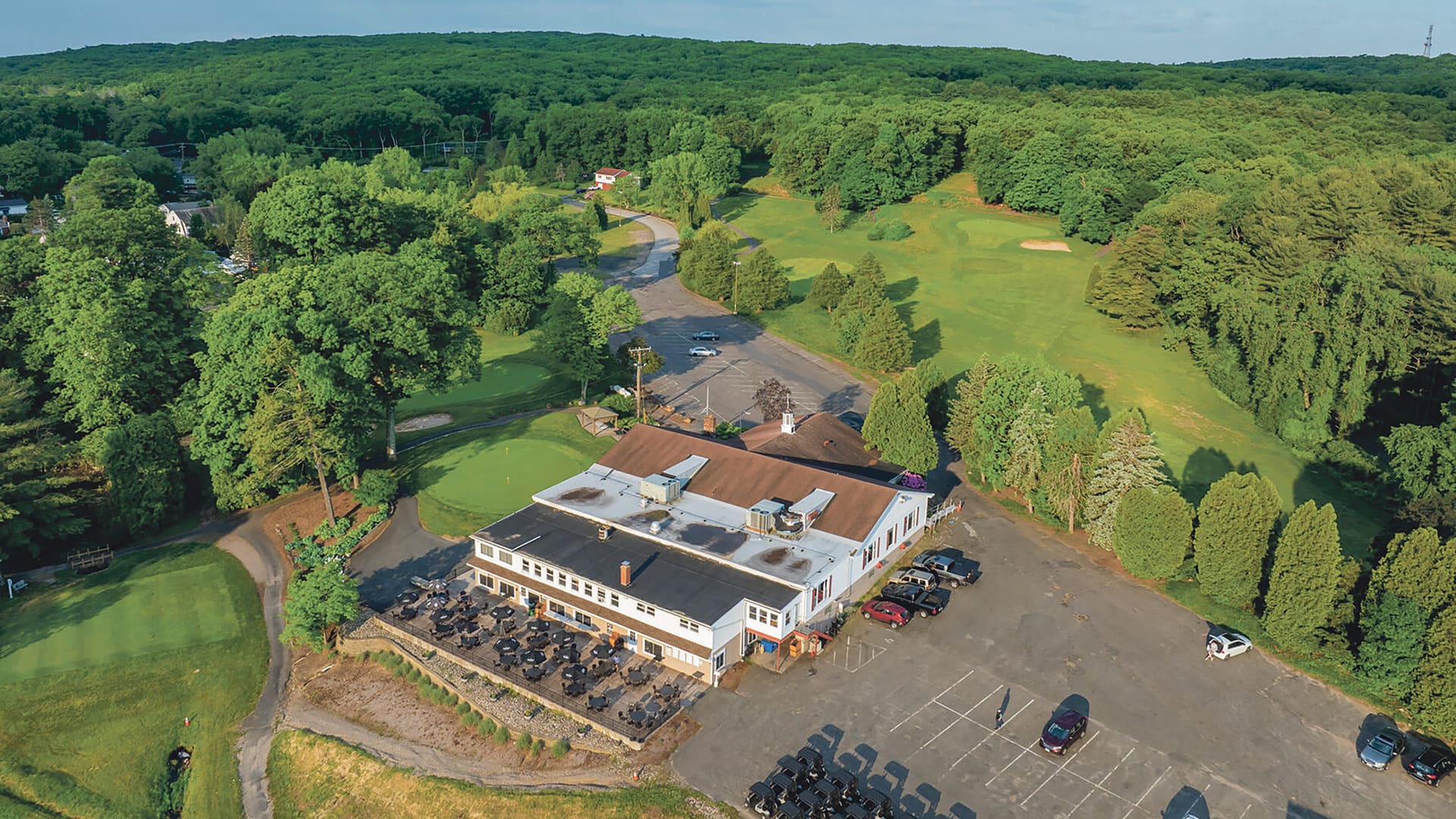
Cesar Ruiz bought Wyckoff with a sports complex in mind

Cesar Ruiz bought Wyckoff with a sports complex in mind, but his intention now is to keep it a country club and grow both membership and events.


Cesar Ruiz says it was only a few hours after he wrapped up a well-attended press conference in early February 2024, announcing his plans to bring a large sports complex to Holyoke, when his phone first pinged with someone offering some real estate for the initiative.

“He texted, ‘I’m a Holyoke boy. I’ve got five and half acres in downtown Holyoke. I’d like to do my part,’” Ruiz said. “So we followed that thread, but it was nothing we were interested in.”

The second time it pinged … well, that was a little different.

“It was a text sent to the mayor and forwarded to me, saying, ‘I have 100 acres in Holyoke, and you may be interested in looking at it,’” Ruiz recalled. “I was thinking to myself … ‘where is there 100 acres in Holyoke?’”

Some quick research revealed that the parcel in question was Wyckoff Country Club, and its beleaguered owners were looking to sell.

And Ruiz, anxious to gain some momentum for his project and unwilling to be “outflanked,” as he put it, by other potentially interested parties, was willing to not only listen, but enter into a purchase-and-sale agreement.

Fast-forwarding our story a little, the Wyckoff site, bordering a thickly settled residential neighborhood off already-busy Route 141, was essentially deemed impractical for Ruiz’s plans for a sports complex that might become the new home to the Volleyball Hall of Fame but also include fields and courts for several other sports.

“This change in management has generated interest and some real momentum, I believe.”

But Ruiz, who closed on the property late last month for $2.8 million, is now committed to a different future for Wyckoff — its past, specifically the more distant past.

Indeed, the Donald Ross-designed course and its clubhouse and other facilities have fallen on hard times recently, with Wyckoff not fully enjoying the post-COVID surge many clubs are experiencing.

“There’s been no real work done on this place in 50 years,” said Ruiz, referring to both the course and the facilities, adding that this has led to a decline in both play and events staged at the club.

Ruiz, a serial entrepreneur with experience in everything from formalwear to healthcare, has started making investments — everything from chemicals for the course (little, if any, fertilizer was applied last year) to new golf carts to needed renovations within the clubhouse — and plans to keep making them to facilitate a comeback for the club, now 92 years old.

Cesar Ruiz says the plan is to make the needed investments to return Wyckoff Country Club to prominence.

Cesar Ruiz says the plan is to make the needed investments to return Wyckoff Country Club to prominence.

“This change in management has generated interest and some real momentum, I believe,” he said, adding that he hopes to use his connections in the business world and the Latino community to bring more events — from weddings to wine tastings; from bingo to quinceañeras (sweet-15 birthday parties for Latinas) — to the property.

For this issue and its focus on commercial real estate, we talked with Ruiz at length about his acquisition of Wyckoff and his plans to return the facility to something approaching its former glory.


Course of Action

When asked if there would be a steep learning curve for him when it comes to running a golf club, Ruiz offered a light laugh and then a slight shrug.

Both gestures were might to acknowledge that, while he doesn’t have any experience running a club, he does have considerable experience — and quite a bit of success — in business.

And, as noted earlier, it has come in several different fields. These include men’s fashions — he was a franchisee of Gingiss Formal Wear, with a location in the Riverdale Shops, before opening his own store, Cesar’s Formal Wear, in Springfield’s X neighborhood — then financial services (specifically the mortgage business), and then healthcare, opening the hugely successful Golden Years, a home-care company that developed a staffing division as well, which he sold last fall.

Golf and events management are new and different businesses for him, Ruiz acknowledged, but the basics are … well, the basics.

And they include understanding the consumer and what they’re looking for; providing consistent, quality service; and making the necessary investments in people, technology, systems, and infrastructure.

Ruiz is focused on all three, especially, at this critical juncture, the needed investments. And there are many of them, starting with the property, where crews are working, or soon will be, on the roof, foyer, bathrooms, ballroom walls and ceiling (complete with new chandeliers), bar area (which will mirror the foyer), and more.

“We certainly have an opportunity to expand membership locally and perhaps beyond our borders to Worcester and Hartford, and we’re optimistic on that.”

The intent is to have this and other projects done for some upcoming events, including one on March 15, both to improve the experience for those gatherings and to showcase the improvements for potential future clients.

Meanwhile, on the course, Ruiz said he intends to make it green again — aerial photos from last year revealed too much brown from the lack of fertilizer — while also doing some work on the cart paths and other areas in need of work.

When asked about the planned initial investments, he said it’s a moving target — now about $300,000 and expected to move higher.

The initial investments, and talk of those to come, has generated interest and momentum, said Ruiz, adding that, since last April, with the announcement of the purchase-and-sale agreement, there was widespread speculation about the club’s future and whether it even had one.

The more recent announcement — that not only would it remain a golf course, but there would be significant reinvestment in the course and property — has spurred interest in membership and future events alike.

On the golf side, he intends to leverage his investments in the course and grounds; market aggressively to women, young people, Hispanics, and other constituencies; and try to take full advantage of the surge that many courses are still enjoying.

“They lost a lot of the women members, and we’d like to bring them back,” he said. “We’d like to bring youth back. We certainly have an opportunity to expand membership locally and perhaps beyond our borders to Worcester and Hartford, and we’re optimistic on that.”

Overall, Ruiz said he intends to rely on another of those business basics — creativity — when it comes to maximizing the potential of both the course and the facilities.

By that, he meant looking at other opportunities, from cross-country skiing and even snowmobiling to generate revenue during the winter months to staging different kinds of events, from an already-planned bridal showcase to quinceañeras and other types of events involving the Hispanic community.


Next Big Swing

While Ruiz will still be leading the efforts to bring a sports complex to Holyoke, his immediate focus is on those 100 acres first brought to his attention in that text just over a year ago.

In fact, his office has officially moved from the Golden Years complex to the back of the clubhouse at Wyckoff.

There, he’s planning the next stages in what he believes will be a true comeback story, one in which this Holyoke landmark strides confidently into the future by first turning back the clock.


Community Spotlight Special Coverage

Community Spotlight

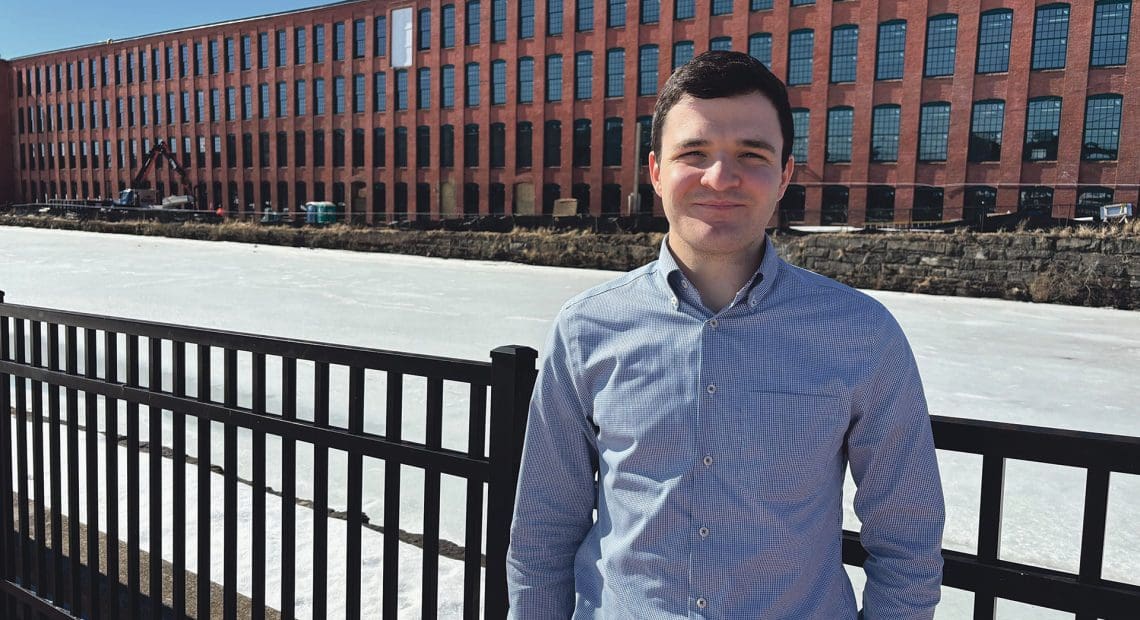
Hagop Toghramadjian stands outside phase one of the Residences on Appleton, which features 88 units of mixed-income housing.

Hagop Toghramadjian stands outside phase one of the Residences on Appleton, which features 88 units of mixed-income housing.

Aaron Vega calls them ‘meet and greets.’

And they are, well … just what that name suggests. They’re meetings between city officials and small-business owners, many of them representing ventures in the emerging ‘climate tech’ sector who have heard about Holyoke and the companies that now call it home, and want to hear more with an eye toward following them.

“They’re hearing about Clean Crop, they’re hearing about Sublime Systems, they’re hearing about Simple Pack, and they want to know what’s going on,” said Vega, director of the city’s Office of Planning and Economic Development, referring to three cutting-edge businesses we’ll get to back to later that are either already in Holyoke or advancing plans to locate there.

As city leaders listen to these business owners, a common thread — and a real challenge for the community — emerges.

“The biggest challenge for these companies that want to come to Holyoke as they move from their startup space is that there’s no built, ready space for them,” Vega noted. “There’s no white-box office space to move into. These guys don’t want to get involved in a rehab project; they want to be able to move in and get to work.”

“The biggest challenge for these companies that want to come to Holyoke as they move from their startup space is that there’s no built, ready space for them. There’s no white-box office space to move into. These guys don’t want to get involved in a rehab project; they want to be able to move in and get to work.”

Holyoke’s meet and greets and other aspects of its efforts to bring more small businesses to this former manufacturing hub — and early-stage efforts to create more spaces for them to move into — are just a few of the many converging storylines in Holyoke.

Others include:

• New housing projects, including a WinnDevelopment initiative at the former Farr Alpaca Co. complex — a $60 million endeavor that will create 88 units of mixed-income housing for adults 55 and over in phase 1 and another 70 in phase 2, while preserving a huge piece of the city’s past — and another project at Open Square that will create 80 units of market-rate housing;

• A cannabis cluster in flux: Holyoke welcomed the cannabis industry with open arms, and for a time, it looked like a large cluster of different businesses, from growers to dispensaries, would settle there. Some have, but as the sector faces growing pains and overall contraction, the city faces challenges, including businesses that are fighting to survive and one large grow facility, Trulieve, that has closed, with its huge plant sitting idle;

• New businesses and greater energy downtown. The city continues to ride a wave of entrepreneurship that has generated several new restaurants and storefronts in and around High Street, Vega said, adding that the new housing units coming online should generate more new-business activity;

• Those aforementioned companies in the green-energy and climate-tech sectors, headlined by Sublime Systems, which will manufacture environmentally friendly concrete at a plant on Water Street;

• A sports complex that is still in its early stages, with a site identified on Whiting Farms Road and other properties being assembled, as well as new ownership of Wyckoff Country Club (see related story on page 31).

• A reinvigorated Holyoke Community College, which has received a huge boost from MassEducate, the state’s free community-college program, and is making adjustments in the wake of a 24% rise in enrollment over the past two years;

• A new strategic plan for the city now being prepared, which is expected to help create a road map for continued progress in a city that has seen momentum on several fronts in recent years; and

• Existing businesses and traditions, especially the upcoming Holyoke St. Patrick’s Day Parade and Road Race.

Slicing through all that, Mayor Joshua Garcia, the Holyoke native now in his fourth year in the corner office, said the city is achieving progress with many goals and on several fronts, but there is still considerable work to do and projects to bring to the goal line.

These include everything from the sports complex to renovation of the historic Victory Theatre, a project now 40 years in the making. Those behind the effort are still struggling to close a significant gap between the funding that’s been raised and what will be needed to revitalize the landmark.
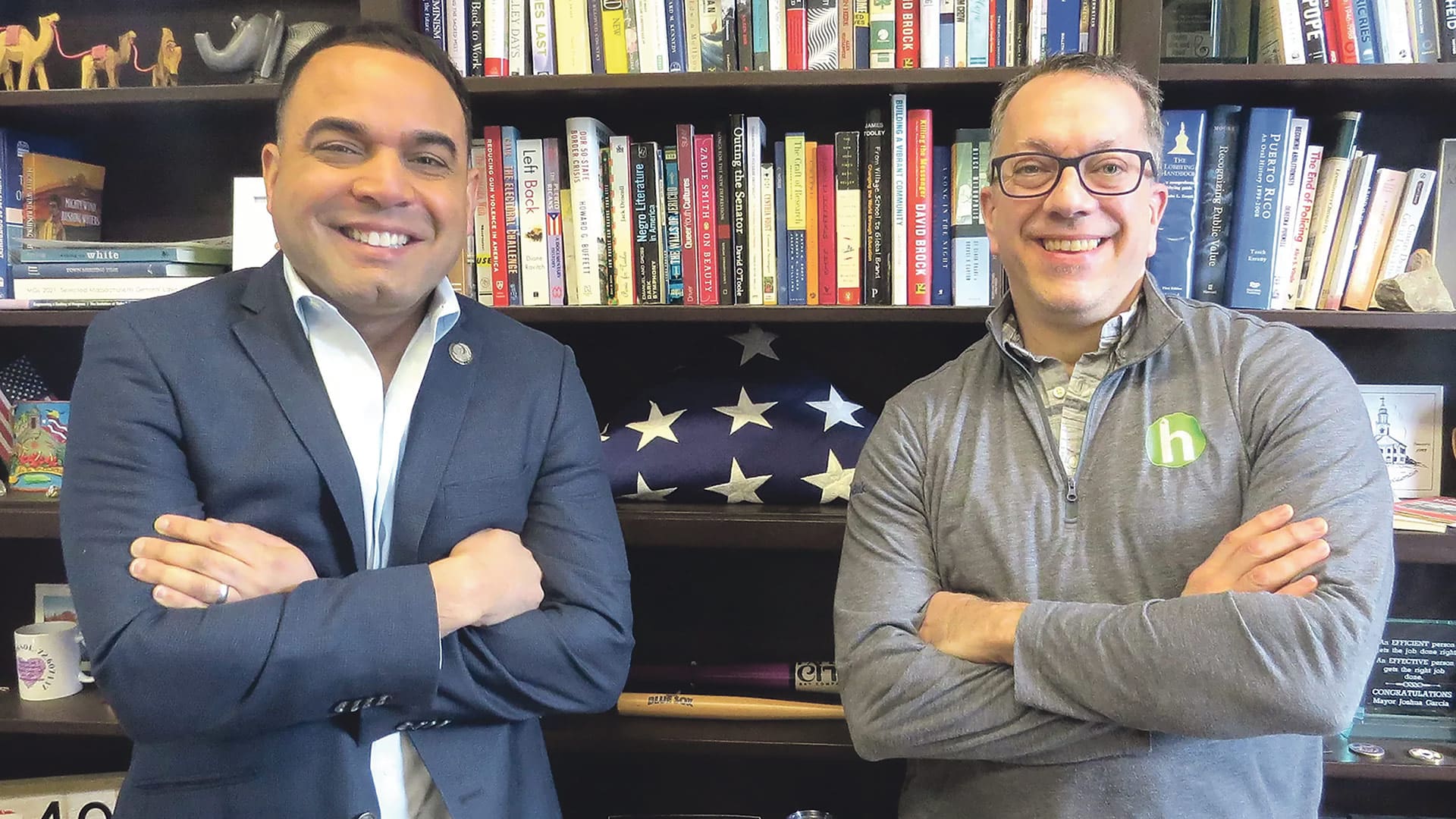
Mayor Joshua Garcia, left, and Aaron Vega

Mayor Joshua Garcia, left, and Aaron Vega say Holyoke continues to pursue — and add — new businesses in the broad realm of climate tech.

Garcia described economic development in the city as an ecosystem, one including manufacturing, small — and often very small — businesses, hospitality, the arts, food, and sports.

“The question is, how can we get all the boats to rise together so we’re establishing sustainability in our city?” he asked, adding that the answer to that question is the ongoing priority of his administration.


Not Your Run-of-the-mill Project

“Daunting.”

That’s the word Hagop Toghramadjian, a project director and development counsel with Boston-based WinnDevelopment, settled on as he was asked to describe the ongoing work at Appleton Street at the former Farr Alpaca complex.

Elaborating, he said he considers the project, called the Residences on Appleton, now far more than a decade in the making, to be the most challenging building-conversion initiative that WinnDevelopment has undertaken. And that’s saying something.

Indeed, the company has taken on many complex projects locally, including 31 Elm St. (Court Square) in Springfield and several buildings in the Ludlow Mills complex, and in numerous other communities as well.

But this conversion of the 125-year-old former mill complex into housing is on another level, said Toghramadjian as he talked with BusinessWest in the kitchen of one of the nearly finished units. He noted that there are several reasons why — from the extremely poor condition of the mill to the need to assemble property for parking and a three-story amenities building, to simply securing access to a building bordered on one side by a canal and the other by the Pioneer Valley Railroad.

As with all projects of this nature, there was also the challenge of pulling together the requisite pots of money, which, in this case, included everything from state and federal historic tax credits to state and federal low-income housing funds.

“We want to keep these small businesses local; we want to keep them here and give them an opportunity to grow their business.”

“Where we’re standing now … there was thin air, the floor had rotted through, the roof had rotted through — only the brick walls were still standing,” he said. “It was very dark, the air quality was bad … you would never dream that this could become comfortable, beautiful housing.”

But the various groups involved have persevered because this project is as important as it is difficult, he noted.

“Given its location and given how blighted it was, it cast a shadow on the whole downtown — it was a top priority for the city,” said Toghramadjian, noting that the site sits between Main and High streets, the city’s two main commercial districts, and directly across from Holyoke Heritage State Park and the Massachusetts Green High Performance Computing Center. “Because of that, they’ve been really good partners, and that’s why Winn came to Holyoke and made this investment here — it’s because the city knew what it took to make this kind of project happen.”
Jim Lavelle

Jim Lavelle

“We’ve been trying to promote not only the lower utility rates here, but the clean energy that customers can promote with their products and hopefully help with sales.”

As phase 1 continues, with leasing to commence and tenants due to start moving in this fall, Toghramadjian and others we talked with said that, while these 88 units will make a welcome addition to the landscape and help spur economic development in the area, they represent a drop in the bucket when it comes to the city’s overall housing needs.

Indeed, Garcia said a recent report put that need at roughly 1,600 units of new housing over the next 20 years across the broad spectrum of income levels, which is another key element in the equation because different types of housing, including market-rate and homeownership, enables residents to stay in the city as their financial situation improves.

“The Appleton Street project doesn’t address the magnitude of the problem, but we’re chipping away at it,” said the mayor, noting that there may be as many as 600 units already in the pipeline.

That includes phase 2 of the Appleton Street initiative, he said, noting that WinnDevelopment is currently assembling the required pots of money for that initiative, as well as the market-rate units planned for Open Square and other ongoing housing initiatives.

There are several smaller housing initiatives taking place, said Vega, including many involving the upper floors of properties along High Street, projects that provide a few or a few dozen units, all of which help meet growing need.

The problem, he went on, is the immense competition for limited state and federal support for such initiatives, with seemingly every community in the Commonwealth in need of housing.

“All the developers are going for the same pots of money, whether they’re in Holyoke, Springfield, Chicopee, or West Springfield,” he said, adding that, in this environment, having a solid mix of projects, large and small, in the pipeline is a must.


Current Events

As noted earlier, there are several projects in various stages of development in Hoyoke, and many converging storylines.

One of the most intriguing involves new-business development, especially in green energy and related sectors, where a cluster is emerging as companies eye Holyoke for location, available and relatively inexpensive real estate, and, especially, its lower-cost, clean electricity, said Jim Lavelle, general manager of Holyoke Gas & Electric (HG&E), which provides that energy.

“We’ve been trying to promote not only the lower utility rates here, but the clean energy that customers can promote with their products and hopefully help with sales,” said Lavelle, adding that Sublime Systems is just one of many businesses, large and small, that have chosen Holyoke for that reason, among others.

As an example, he cited Simple Pack, a company now located in Open Square that manufactures green food packaging to restaurants, schools, hospital cafeterias, and food distributors. Being able to say such products are produced with clean energy, in this case hydropower, is important to the company’s mission and a strong selling point with its clients, he said.

There are several similar examples, said Lavelle, who will gain a different title in a few days — grand marshal of Holyoke’s annual St. Patrick’s Day Parade.

While his father served in that role decades ago, Lavelle never expected to wear that hat himself because, while he’s long been somewhat involved in the parade, he has never served on its committee.

He considers the honor a nod to HG&E’s important role in the city, and is enthusiastic about fulfilling the many duties of grand marshal, including attendance at myriad events and, in accordance with tradition, responsibility for parade-day weather.

“I have a much greater appreciation for the effort that goes into all these different events that the parade committee puts on,” he said. “And I have a much greater appreciation for how strong a regional collaboration exists between the different communities’ parade committees and other civic organizations and the sponsors; they really work hand-in-hand on all these different events that happen across Western Mass.”

Putting his HG&E hat back on, figuratively if not literally, Lavelle said Sublime Systems, which he believes should be ready to starting building its facility later this year or early next, will soon become the utility’s largest customer, with 10 to 12 megawatts of demand. That’s a huge draw, but one it can easily absorb thanks to transmission-system upgrades, he went on, adding that the HG&E has the capacity to attract several more large users and dozens of smaller ones.

Attracting these businesses is one of many priorities for the city, said Vega, noting that there have been a steady volume of meet-and-greets in recent years, and more are on the schedule.

Many of these sessions involve early-stage companies, many of them in green-energy or green-manufacturing ventures, he said, adding that, in addition to city officials, the leaders of companies like Clean Crop, which uses electricity to revolutionize food safety, are often in the room to discuss Holyoke and its many selling points.

“If they’re a little further along and they have specific questions, we’ll bring in Holyoke Gas & Electric to talk about the energy portfolio they can provide,” the mayor went on. “We’re on people’s radar — we just need to put the package together to bring them in.”

Holyoke at a Glance

Year Incorporated: 1786
Population: 38,247
Area: 22.8 square miles
County: Hampden
Residential Tax Rate: $17.46
Commercial Tax Rate: $38.54
Median Household Income: $37,954
Median Family Income: $46,940
Type of Government: Mayor, City Council
Largest Employers: Holyoke Medical Center, Holyoke Community College, ISO New England Inc., PeoplesBank, Universal Plastics, Marox Corp.
* Latest information available

Which brings him back to that ongoing challenge of offering them spaces that are ready to move into. There aren’t many of them in the city, but he’s in discussions with some building owners about possibly partnering with the city to develop co-work, start-up, or innovation space.

“That’s a direction we want to go in,” he told BusinessWest. “We want to keep these small businesses local; we want to keep them here and give them an opportunity to grow their business.”


Bottom Line

As for businesses already growing in Holyoke, there are many in the cannabis sector, which, while it is experiencing strong growing pains, remains a force in Holyoke, Garcia said.

He noted that social consumption, or so-called cannabis cafés, constitutes the next frontier for this industry — the Cannabis Control Commission is taking up regulatory reforms on such facilities — and for some establishments in Holyoke, it could be a real lifeline in this time of growing challenge.

“In Holyoke, we want to be among the first communities to adapt and implement that opportunity for on-site consumption,” he said, likening these establishments to bars and restaurants in the sense of attracting people to the community. “If we can bring people into our city to spend money, that’s a plus.”

With cannabis, as with many of the other storylines unfolding in Holyoke, Garcia said he remains a “glass-full leader.”

That means he’s optimistic, but also realistic. It means he understands that, while much has been accomplished, there’s still much to do, and on many fronts.

It means he’s more bullish on his hometown than ever.