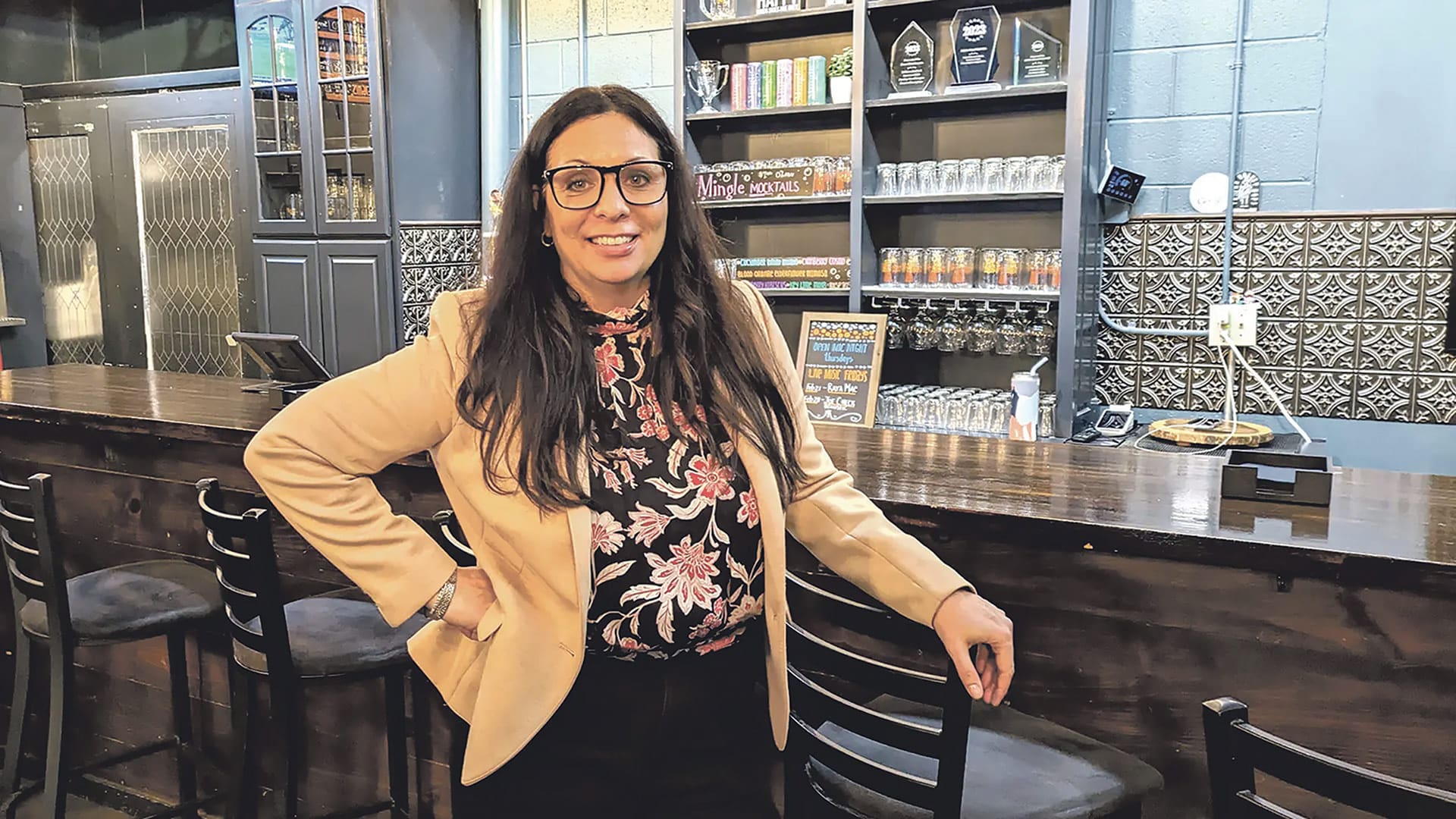
Community Spotlight

Eric Nakajima says he wants to take full advantage of Holyoke’s many assets, including mill space, a business-friendly government, and green energy.
Eric Nakajima recalls that, while earning his master’s degree in city planning from the University of California, Berkeley 25 years ago, one of first assignments in one class was to essentially explain why he was there.
“I said that I wanted to learn how to help communities like Holyoke,” he said, adding that he got to know the city soon after his family moved to Amherst from New Jersey when he was 7 and was later struck by how much the community was impacted by the loss of its manufacturing base. “I named Holyoke all the way out in California; I wanted to understand better how you work with the city, work with the community, work with the markets, work with the business environment you’re in to create jobs and good placemaking.”
And 25 years later, that’s essentially his job description as the new director of Holyoke’s Office of Planning & Economic Development, succeeding Aaron Vega, who is now serving as president and CEO of the Western Massachusetts Economic Development Council.
He arrives in City Hall with a diverse résumé, including roles with the Deval Patrick administration on Beacon Hill, and at an intriguing time for the community, one of progress on several fronts, including housing, downtown revitalization, entrepreneurship, and job creation, but also some setbacks, especially when it comes to what was shaping up to be one of the city’s better economic development stories. That would be Sublime Systems, which had plans to build a plant on Water Street and produce low-carbon cement — plans now on hold after the loss of a large federal grant.
“I named Holyoke all the way out in California; I wanted to understand better how you work with the city, work with the community, work with the markets, work with the business environment you’re in to create jobs and good placemaking.”
When asked about whether those plans might eventually materialize, Holyoke Mayor Joshua Garcia shook his head slowly for emphasis and said, “it certainly doesn’t look like this is going to happen.”
But while Sublime likely won’t be part of the picture in Holyoke, there are plenty of bright spots in the Paper City, including:
• New housing projects in various stages of development, from 700 recently completed units at the former Farr Alpaca mill (and more in phase 2 of that development) to 84 units planned for Open Square, to several smaller projects in and around the downtown area. Add them all up and they make a real dent in the city’s huge need for housing and bring promise to spur new businesses to support those residents;
• A chamber of commerce that is moving on from controversy involving its former president, Jordan Hart, who was terminated just over a year ago and is the subject of a criminal complaint alleging financial misappropriation. Interim Director Lisa Totz said the agency is adding members as well as events to the schedule and, in general, looking for new ways to bring value to its members;
• A utility, Holyoke Gas & Electric, that continues to be a force in economic development by offering clean, comparatively lower cost energy that is bringing attention to the city from different types of businesses, including data centers, which are looking at several possible sites, including the property on Water Street that was due to become Sublime’s new home (more on that later);
• A cannabis sector, spawned by that lower-cost energy and hundreds of thousands of square feet of vacant mill space, that is “holding its own,” said the mayor, despite turbulence in that sector;
• Plans to redo and simplify the city’s zoning and permitting processes to facilitate new business development;
• A massive retail center, the Holyoke Mall at Ingleside, that continues to adjust to changes in the marketplace with a mix of tenants that is shifting increasingly toward the entertainment side of the spectrum, with a massive pickleball facility being the latest addition and a huge Dick’s House of Sport, an immersive facility complete with batting cages, golf simulators, and rock climbing walls, set to open in the spring of 2028;
• A new initiative called Greater Ingleside 2050 that will bring together stakeholders in that area of the city and create a roadmap for what it could look like in the milestone year; and
• Long-term projects such as revitalization of the Victory Theater and a planned sports complex, which, if they become reality, could greatly contribute to the vitality and quality of life in this community of nearly 40,000.
For this latest installment of its Community Spotlight series, BusinessWest takes an in-depth look at the many converging storylines in Holyoke, starting with its new economic development director.
Background — Check
Nakajima said that, while he knew a lot about Holyoke before taking the economic development job, there has still been a learning curve, and on many levels.
“I’ve worked with a lot of city halls, but I’ve never worked in a city hall,” he told BusinessWest. “So understanding and navigating city hall has been a challenge itself. I haven’t found it hard, but if you haven’t done it before, there are a set of processes to learn; it’s similar, but distinct from what you have at the state level.”
As noted earlier, he has plenty of experience at the state level, especially during the tenure of former Gov. Deval Patrick.
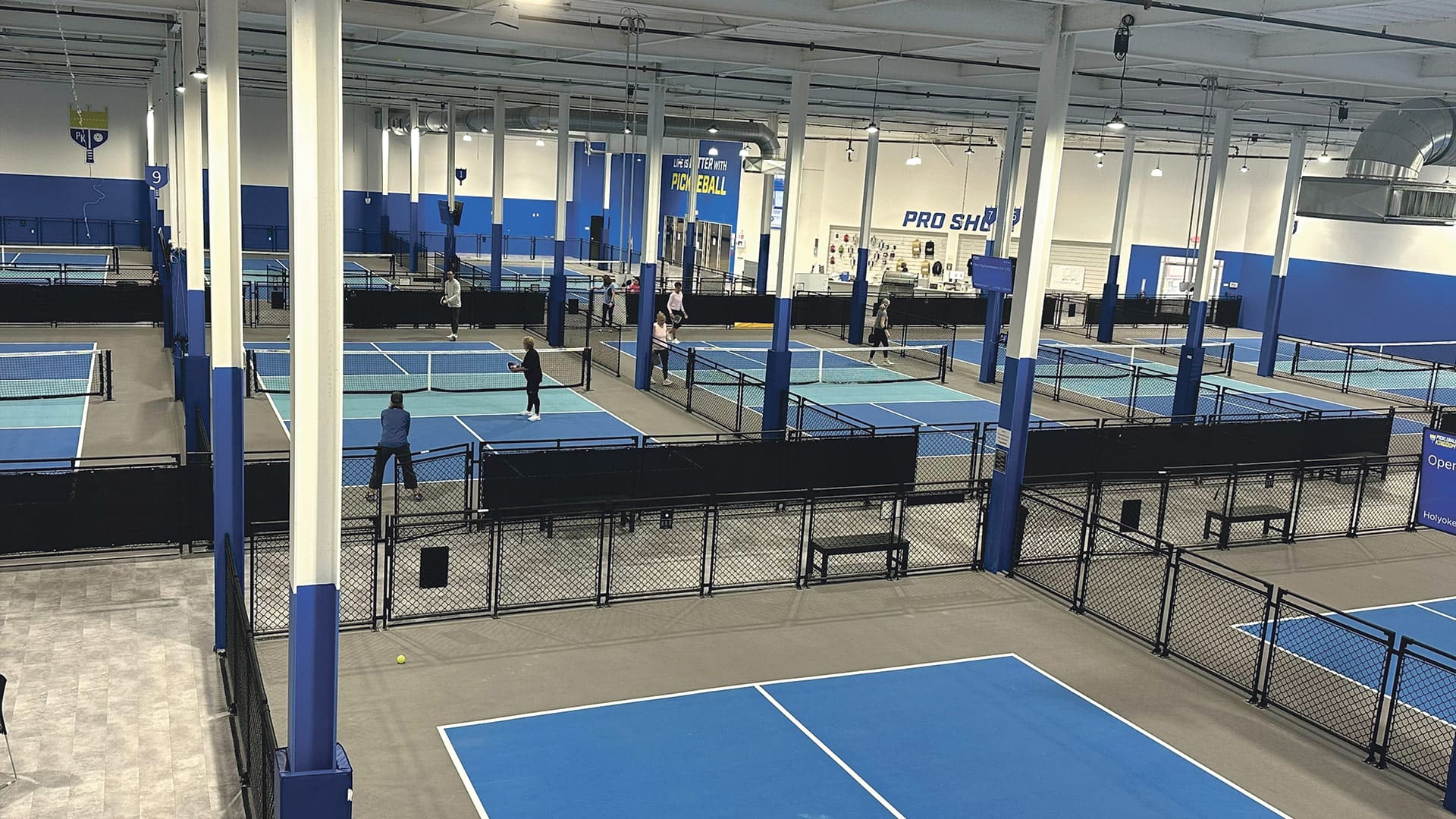
Pickleball Kingdom opened its doors and its courts just a few months ago at Holyoke Mall.
Indeed, he served the Patrick administration first as senior innovation advisor within the Executive Office of Housing and Economic Development, starting in 2010, and then as assistant secretary for Innovation Policy in that office from 2012 to 2015. During that time, he became involved in several initiatives involving Holyoke, including as project lead for all aspects of developing the Massachusetts Green High Performance Computing Center (MGHPCC).
Before and after his work in the State House, Nakajima has been involved with economic development, especially with Gateway cities, such as Holyoke, on many levels and with many different agencies.
His résumé includes a stint as senior research manager for the Economic Policy Research Unit at the UMass Donahue Institute; a short stint as director of the Massachusetts Broadband Institute, a division of the Massachusetts Technology Collaborative; work as a consultant in economic development policy and planning; and, most recently, as a director of Government Relations for the Massachusetts Teachers Assoc.
“My work with the city then, on behalf of the state, made me fall in love with Holyoke and really believe in the potential of this city.”
This body of work has made him more familiar with Holyoke and the challenges and opportunities it faces, he said, adding that, in addition to his work on the high-performance computing center, he’s been involved with several area Paper City initiatives, from the Lyman Terrace housing project to the introduction of rail service to the redevelopment of the Cubit Building, now home to several market-rate housing units as well as the HCC MGM Culinary Arts Institute.
He said he was drawn to the job in Holyoke’s Office of Planning & Economic Development for the same reasons he listed back at Berkeley, as well as his previous experiences with the city and a desire to build on the momentum that’s been created there in recent years.
“My work with the city then, on behalf of the state, made me fall in love with Holyoke and really believe in the potential of this city,” he said. “I really admire the people that I’ve worked with, many of whom are still around today. It’s what attracted me to come here.”
He said there are several priorities moving forward, including efforts to encourage more housing development, work to redevelop the many vacant or underutilized properties on and around High Street in the downtown area (housing is certainly one of the possible uses), and continued encouragement of entrepreneurship.
As for ongoing work to revamp and simplify zoning and special permit processes, Nakajima said this work isn’t sexy, but it can and will certainly help with economic development efforts.
“This is going to make City Hall easier to deal with, and it will advertise the fact that we are open for business in ways that we’ve always said we were, but now it’s going to feel like it when people come here and knock on the door and work through the process,” he said. “It’s a very big deal.”
As for housing, Garcia said the city will work to encourage not only more development, but housing across a broad spectrum, including market-rate units, such as those planned for Open Square, which could serve to keep people in Holyoke.
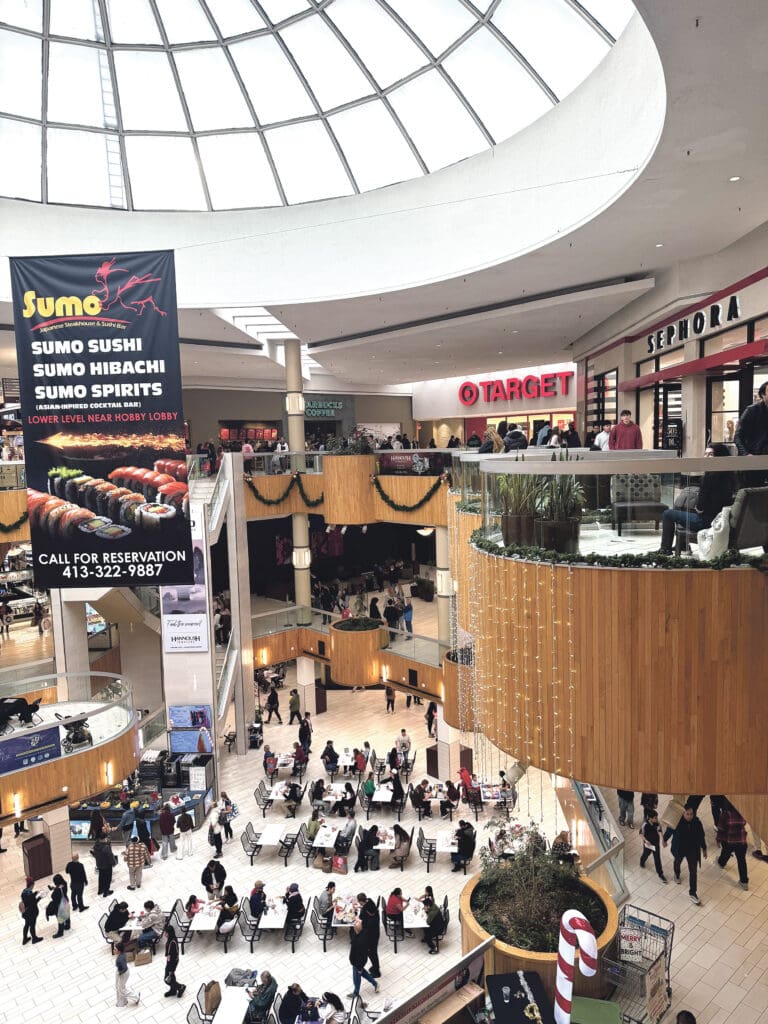
Holyoke Mall is evolving, with entertainment-related facilities now accounting for roughly 30% of its space, compared with 10% just a decade ago.
“Holyoke has traditionally done very well with making sure we looked out for our most vulnerable populations, but we never really thought about what happens when people’s circumstances improve,” he explained. “Currently, we have a system where you start here, you get on your feet, and once you do well, you leave. We’re still going to support affordable, workhouse housing, because that’s important, but we want to introduce market-rate housing much more aggressively into that portfolio.”
Getting Down to Business
Nakajima said he also plans to take full advantage of the city’s many assets moving forward. These include that aforementioned mill space, which can be converted for many different uses; a city government bent on being business-friendly; and green — and comparatively cheap — energy.
That last item on the list has certainly helped with economic development efforts, especially in recent years, as companies continue to seek green energy alternatives, said Jim Lavelle, general manager of HG&E, adding that this asset certainly caught the attention of cannabis growers.
And, more recently, it has drawn attention from developers looking to build data centers, he said, adding that the city has the land — including the site Sublime had targeted — and the capacity to attract such facilities.
Still, there is concern about the high energy and water usage of AI data centers and also about large amounts of real estate being absorbed for comparatively few jobs, said Lavelle, noting that a proposal was introduced recently to amend the city’s zoning ordinance to effectively ban data centers in the city.
The proposal was under discussion of the ordinance committee and continued until later this spring, he noted, adding that, while there are concerns about such facilities, privately operated data centers do bring some jobs and needed tax revenue.
“Some of the inquiries we’re fielding are for facilities in the 50- to 60-megawatt realm,” he said, adding that, for perspective, the MGHPCC is a 5-megawatt facility.
The HG&E could handle one or even a few of these larger facilities through expansion of its substations, said Lavelle, adding quickly that one 60-megawatt data center would nearly double its current peak summertime load of 75 megawatts.
Holyoke at a Glance
Year Incorporated: 1786
Population: 38,238
Area: 22.8 square miles
County: Hampden
Residential Tax Rate: $17.43
Commercial Tax Rate: $38.15
Median Household Income: $37,954
Median Family Income: $46,940
Type of Government: Mayor, City Council
Largest Employers: Holyoke Medical Center, Holyoke Community College, ISO New England Inc., PeoplesBank, Universal Plastics, Marox Corp.
* Latest information available
And while the city looks to build on its business base, its chamber of commerce continues work to rebuild its image and its core of services and move on from the recent controversy, while remaining in its long-time home on High Street.
“We’re being resilient and adaptive,” said Totz, a business consultant by trade who was working in the Holyoke chamber office providing support to small businesses and, because of her familiarity with the office and its members, stepped into the interim director role.
She used the massive conference room table that used to dominate the chamber’s offices — recently gifted to City Hall — as a symbolic example of all this.
“Now, I have eight tables that I can configure into a classroom, a giant table, a seminar space; I can tuck them away in the corner and actually have an open room … we can now do things that were impossible to do with that giant table in there.”
Resilient and adaptive will be the watchwords moving forward, Totz went on, as the chamber continues to rebuild, add members, and bring value to those members through traditional programming, such as its recent St. Patrick’s Day breakfast at the Log Cabin, and new initiatives, such as those now possible in its remodeled office.
“I want people to see that we’re forward-thinking, we’re supportive, we’re looking back at the history with respect and lessons learned, but we’re trying to bridge from where we’ve been to where we can be,” she told BusinessWest, adding that this work is ongoing.
What’s in Store?
When asked to speculate on the course of retail in the years to come, Lynn Gray, general manager of the Holyoke Mall, said she couldn’t project too far into the future, and for good reason. Indeed, the scene is changing rapidly — and constantly — as recent additions to the mix attest.
“I certainly didn’t have pickleball on my bingo card two years ago,” she said with a laugh, adding that Pickleball Kingdom, which opened its doors and its courts just a few months ago, now occupies roughly 50,000 square feet at the mall that was most recently home to Bob’s Discount Furniture and is already drawing members at a steady clip.
Its emergence is a sign of the times and the movement toward entertainment-related facilities — which now account for roughly 30% of the space in the mall, compared with 10% just a decade ago — as well as the pace of the change and difficulty with pinpointing just what will come next, said Gray, adding that the present tense is keeping her busy enough.
That includes buildout for the new Dick’s House of Sport, a facility that blends retail and entertainment, putting it in a category all its own, one Gray called “experiential retail.” This is a massive undertaking — as that two-and-a-half-year timeline indicates — that will include essentially lopping roughly 50,000 feet off the old Sears building at the mall to fit the retailer’s needs and creating an elaborate new entrance.
“We’re really excited about this development,” she said, adding that, when it opens its doors, the new Dick’s should become a huge draw, one that, like Pickleball Kingdom, will bring in people to help support retail businesses and a changing mix of restaurants, and attract more of both — especially the latter.
“We’re working with a few local and regional restaurateurs to bring their flavors to our shopping center, and with the news of Pickleball Kingdom being open and how it’s bringing in additional foot traffic, and with the news of Dick’s House of Sport, I believe we’ll be able to attract some new dining options for our shoppers,” Gray said.
Meanwhile, she is encouraged by statistics showing that the younger generations prefer in-store retail as opposed to online shopping, which bodes well for the retail side of the spectrum, which “remains our life’s blood,” she said.
While the mall continues to evolve, so does the larger Ingleside area, which extends in both directions from the mall, south to the West Springfield line and north along Whiting Farms Road. The area has seen change and new additions in recent years especially, and Greater Ingleside 2050 will focus on creating a long-term vision for the area and a blueprint for making that vision reality.
Garcia noted that, while the mall dominates the area, there are many smaller players that add to the overall vibrancy, and there is opportunity for additional, complementary development.
“We’ve been so focused on downtown, and for good reasons,” he added, “but we want to put our heads together and make sure we don’t neglect another important part of town that has had, and continues to have, potential for growth in the commercial, economic development space.”