Daily News

FRANKLIN COUNTY — A $10,000 investment from Gagne Wealth Management Group is expected to generate more than $20,000 in local spending as the firm and the Franklin County Chamber of Commerce prepare to launch the second annual ‘buy-$25-get-$50’ Gagne Wealth Gift Card on Wednesday, June 10.

Starting at 9 a.m., the Gagne Wealth Management Group will match every $25 Franklin County Gift Card purchase, giving customers $50 in local spending power and supporting Franklin County small businesses with every swipe. Every dollar generated through the promotion can be spent only at participating Franklin County businesses, creating a direct and measurable investment in the local economy.

“Our goal here is to make spending locally the easiest and most rewarding choice people can make,” Franklin County Chamber of Commerce Executive Director Jessye Deane said. “You don’t need a code or a coupon — you just buy a $25 Franklin County Gift Card on June 10, and it instantly becomes $50 you can gift or spend at dozens of participating businesses across the county.”

Gift cards can be purchased online through a dedicated Gagne Wealth Management Group checkout page on the chamber’s website, where a $25 bonus is automatically added to a single $25 e-gift card at checkout. Gift cards can also be purchased in person at the chamber office at 393 Main St., Greenfield, or by calling the chamber at (413) 773-5463. A limit of five gift cards per person applies while supplies last.

Last year’s promotion generated overwhelming excitement as all 400 available gift cards sold out in under three hours. Since then, the chamber has received regular inquiries from community members eager for the promotion’s return.

“We’re thrilled to bring this promotion back for a second year,” said Merrill Gagne, founder of Gagne Wealth Management Group. “The response from the community has been incredible, and the results demonstrated just how powerful local spending can be.”

In its first year, the Gagne Wealth gift card match injected more than $20,000 in Franklin County spending power guaranteed to benefit local businesses, 70% of which has already hit Franklin County cash registers. Deane noted that, because many recipients spend beyond the value of their gift cards, the program’s total economic impact is likely significantly higher.

Data from the program’s first year signals that cardholders typically visit businesses multiple times rather than spending the entire balance in a single purchase. Recipients use their cards for everyday purchases, explore multiple merchants, and return to spend remaining balances over time, creating repeated opportunities for local businesses to generate sales beyond the value of the gift card itself.

“While online shopping is often transactional, shopping local is experiential,” Deane said. “The Franklin County Gift Card encourages residents to step out their front door, explore their downtowns, try a new restaurant, browse a local shop, and discover businesses they may never have visited otherwise. In doing so, it helps create the kind of authentic community connections that can’t be shipped in a cardboard box.”

Unlike traditional gift cards tied to a single retailer, the Franklin County Gift Card can be redeemed at a diverse mix of restaurants, retailers, attractions, and service providers throughout the county. Because gift cards can be redeemed at dozens of participating businesses, they encourage recipients to discover new businesses, helping distribute economic impact across Franklin County rather than concentrating it in just a few locations. For a full list of participating businesses, visit franklincc.org.

Daily News

HOLYOKE — ArchitectureEL (AEL) announced its partnership with Valley Opportunity Council (VOC) on the adaptive reuse of a former neighborhood convenience store in Holyoke, transforming the long-vacant commercial space into a new residential apartment. The project represents another step forward in addressing housing needs while revitalizing underutilized properties throughout the city.

The redevelopment reflects a growing commitment by local organizations to create innovative housing solutions in Holyoke, where demand for quality, affordable housing continues to rise. By repurposing an existing space, the project preserves neighborhood character while creating a new home for a resident in the community.

Valley Opportunity Council, a long-standing community action agency dedicated to expanding opportunities and improving quality of life throughout Greater Hampden County, has a strong history of supporting housing initiatives and neighborhood investment. The organization’s mission includes helping individuals and families achieve greater stability and independence through housing and community development programs.

“This project demonstrates how creative thinking and strong community partnerships can turn underutilized properties into meaningful housing opportunities,” said Kevin Rothschild-Shea, principal architect for ArchitectureEL. “Every housing unit matters, and we are excited to help bring a vacant neighborhood property back to life in a way that benefits Holyoke residents.”

The project adds to ArchitectureEL’s growing portfolio of work throughout Holyoke. The firm has played a significant role in numerous public and community-focused projects across the city, including work for the city of Holyoke, the Holyoke Housing Authority, Holyoke Public Schools, and other local institutions. Recent projects have included historic renovations, building upgrades, roof replacements, HVAC improvements, and other investments that help preserve and strengthen the city’s built environment.

Adaptive reuse projects such as this one have become an increasingly important strategy for communities seeking to address housing shortages while breathing new life into older buildings. The conversion of the former convenience store demonstrates how small-scale redevelopment projects can have a meaningful impact on neighborhood revitalization and housing availability. Construction is expected to begin following final approvals.

Daily News

SPRINGFIELD — Springfield Museums invites families, friends, and community members to celebrate diversity, equality, and self-expression during Family Pride Day on Saturday, June 13 from 10 a.m. to 5 p.m. This annual celebration features a rainbow of activities for all ages and is free with museum admission. Visitors can also explore the Museums’ diverse slate of summer exhibitions, including the highly interactive Game On! exhibit in the Springfield Science Museum.

Family Pride Day encourages visitors to express themselves, connect with others, and contribute to collaborative art projects that celebrate community and inclusion. Activities from 11 a.m. to 3 p.m. include Face Painting with Professor Knows A. Lot; Statement Buttons, where visitors can create their own pin while learning how buttons and patches have been used to share messages and inspire change; Design Your Own Sunglasses, a colorful way for visitors to express their personal style; Community Loom, an annual Pride tradition at the Museums; Quilt Blocks, celebrating the tradition storytelling through quilts; and Rainbow Chain, where visitors can add a wish, hope, or message of encouragement to a growing community artwork.

In addition to Pride Day activities, visitors can explore Game On!, a new exhibition for children and families that brings the fun of gameplay to life in big, bold ways. Featuring hands-on experiences and presented in both English and Spanish, the exhibition offers all-ages fun while strengthening communication and creative thinking skills.

“We are looking forward to welcoming everyone to Family Pride Day,” Director of Education Larissa Murray said. “Through art, play, and collaborative activities, visitors can express themselves, learn from one another, and help create a welcoming community where everyone feels seen, valued, and included.”

Held throughout the campus, Family Pride Day is part of the Springfield Museums’ ongoing commitment to providing experiences that explore shared connections and unique perspectives to promote engagement, literacy, and learning.

Daily News

SPRINGFIELD — As more of life moves online, attorneys are seeing a growing number of families struggle to access loved ones’ digital accounts after a death or medical emergency. Research shows the average person now has dozens of online accounts, yet many people have no plan for how family members can access critical financial records, passwords, cloud storage, or digital assets when needed.

Estate planning attorneys at Shatz, Schwartz and Fentin P.C. are encouraging families to think beyond traditional assets and include digital accounts and online property as part of a comprehensive estate plan. Attorneys at the firm assist individuals, families, and business owners with strategies designed to protect both traditional and digital assets.

From online banking and cryptocurrency accounts to cloud photo storage, subscription services, and social media profiles, many people leave behind important digital assets with no instructions for how loved ones can access or manage them.

“People often focus on physical and financial assets while overlooking the fact that much of their personal and financial life now exists online,” said attorney Michael Deere, an associate at Shatz, Schwartz and Fentin. “Without proper planning, families may struggle to access important records, financial accounts, and even irreplaceable memories.”

Attorneys say the issue is becoming increasingly common as more financial, personal, and business activity moves to digital platforms. Even routine matters such as managing automatic payments or accessing insurance and utility accounts can become difficult without clear authorization.

Attorneys at the firm recommend individuals maintain an inventory of important digital accounts, securely document password access information, include digital financial assets in estate planning documents, grant legal authority for fiduciaries to manage digital property, and regularly update estate plans as accounts and technology change.

“Families are often unprepared for how complicated digital access can become after a loss,” Deere said. “Advance planning can help reduce confusion, delays, and unnecessary stress during an already difficult time.”

Daily News

GREENFIELD — Greenfield Cooperative Bank (GCB) will host “Something Has to Change: A Strategic Conversation,” the second in a small business strategic planning series, featuring Business Consultant Arian Roefs. The workshop will be held on Monday, June 22 at GCB’s Northampton Branch, located at 67 King St. The interactive conversation with Roefs will help local small business owners gain clarity around strategic planning and long-term growth.

Sometimes business owners reach a point where they know a change is needed but aren’t sure where to start. This session is designed for exactly that feeling. Roefs will guide owners through a series of honest, practical questions organized around several themes: recognizing the signals that something needs to shift, diagnosing the real issue, examining one’s direction and revenue, identifying what’s getting in the way, and committing to a concrete next step. For anyone feeling stuck or just ready for a change, this conversation is a good place to start.

“We’re thrilled to have Arian return for another business strategy workshop,” said Courtney Huxley, vice president, Business Development officer. “Her ability to see the bigger picture and ask the right questions makes her a great resource for any business owner.”

Roefs brings hands-on experience working with entrepreneurs and small business owners to build plans that support confident decision making and sustainable growth. Attendees will leave with a clearer understanding of why asking the right questions leads to making the right decisions.

The workshop is open to small business owners and entrepreneurs in the community. To learn more and register, visit greenfieldcoopbank.com.

Daily News

Rod Clark

WILBRAHAM — SCORE, the nation’s largest network of volunteer business mentors, has appointed Rod Clark district director for Massachusetts. In this volunteer leadership position, Clark will help support five Massachusetts chapters as they implement SCORE’s nationwide mission of fostering vibrant small business communities through mentoring, education, and strategic partnerships.

Clark brings decades of experience in sales and marketing from the medical device industry to this position. He has served in various SCORE chapter roles since 2017.

“I did a lot of mentoring and helped develop people when I was in the corporate world,” he said. “I’ve always been a team guy. I’m just all about being part of a tribe, so SCORE allows me to do that.”

His focus in this new role will remain on encouraging success for SCORE’s three key pillars: the small business community in each chapter, small business and entrepreneurial clients, and the volunteers who serve as mentors, subject matter experts, or in administrative roles. One of Clark’s most notable successes with SCORE was when his chapter, SCORE Southeastern Massachusetts, won the SCORE National Most Improved Chapter award in 2019.

“We ran [the chapter] like a business, and we put together plans and actions. We worked on keeping the right people in the right place, and of course, it’s the enthusiasm of our clients — the entrepreneurs and small business owners — that keeps you going when you see their enthusiasm.”

Since 1964, SCORE has helped more than 17 million entrepreneurs and small business owners. Each year, SCORE’s 10,000 volunteer mentors provide free, expert mentoring and resources to help them start, grow, and succeed across all 50 states and territories.

“The time, knowledge, and kindness that our volunteer mentors share to support business owners across Western Massachusetts makes an impact,” Western Massachusetts SCORE Chapter Chairman David Ewen said. “We hear that sentiment from our clients. I know Rod will continue to provide exceptional leadership and help guide chapters to perform at their very best for our small business and entrepreneurial clients.”

Daily News

SIOUX FALLS, S.D. — As chain stores, bypasses, and sprawling retail corridors continue to reshape America, many once-beloved downtowns have quietly faded into the background, even though locals still feel deeply attached to them.

Across the country, these historic Main Streets and old commercial districts often carry the bones of something special and increasingly hard to find: brick storefronts, railroad-era buildings, faded signs, old theaters, civic squares, waterfront blocks, and walkable character that newer developments struggle to recreate. Some have seen flashes of newfound investment, while others remain full of untapped potential, waiting for the right mix of restoration, small business energy, and local pride to bring them back to life.

To identify the historic Main Streets and downtown districts Massachusetts residents most want to see revived, MarketBeat, a financial media company, surveyed 3,012 respondents about the places they believe still deserve a comeback. The result is a ranking of corridors that continue to inspire nostalgia, civic pride, and hope for a more vibrant future. Bay Staters’ top 3 picks were:

1. Union Street, New Bedford. Historic stone buildings, maritime-era storefronts, and traces of old whaling wealth still give Union Street one of the most distinctive downtown atmospheres in coastal Massachusetts. New Bedford became one of the world’s leading whaling ports during the 19th century, helping shape much of the city’s commercial core. While massive new housing developments are finally filling long-vacant historic lots, the downtown still feels like a place with extraordinary history and character that many residents would love to see more fully energized again.

2. Main Street, North Adams. Set beneath the Berkshire hills, downtown North Adams still carries the atmosphere of an old manufacturing town shaped by railroads, mills, and tightly packed commercial blocks. The city grew around textile production and, later, electrical manufacturing during Massachusetts’ industrial expansion years. While the area retains a strong creative identity and major new roadway and overpass redesigns aim to reconnect the core, many locals still feel the broader downtown has room for a much larger comeback.

3. High Street, Holyoke. Towering brick buildings, old mill architecture, and broad downtown corridors still give Holyoke the feel of one of New England’s great industrial cities waiting for another chapter. The city became internationally known for paper manufacturing during the late 19th century because of its planned canal system along the Connecticut River. Even now, many residents feel High Street and the surrounding downtown deserve a fuller revival that matches the scale of their historic character.

Autos

Gearing Up

It’s called a ‘20 Group.’

It’s a collection of 20 non-competing auto dealers with similar business models who gather several times a year to exchange ideas and share best practices.

Carla Cozenzi, president of the Hadley-based TommyCar Auto Group, attended a session recently in Cedar Rapids, Idaho. And before that, she was at another conference, ASOTU CON (Automotive State of the Union) in Baltimore. There were packed agendas in both cases, she said, with discussions on everything from AI and how the industry is using it and can use it (see related story on page 15) to the somewhat sluggish start to the year for the auto industry — and the reasons behind it.

And those reasons are many, including everything from a brutal winter in many regions, including New England, to global tensions and economic uncertainty; from the high cost of new cars, trucks, and SUVs — the average sticker price is now close to $50,000 — to soaring gas prices.

Collectively, these factors contributed to a flat start, a few percentage points off last year’s pace and what was projected for this year, and some minor shifts within the market — from a slight uptick in car sales (although SUVs still reign supreme), in a nod to those soaring gas prices, to continued high demand for used cars, a response to those high prices for new models.

Carla Cosenzi says that, unlike the industry as a whole, TommyCar Auto Group is off to a solid start in 2026.

“Overall, automotive is down slightly from last year,” said Cosenzi, adding quickly that her group is bucking that trend, up a few points. “And there are many reasons why … the overall state of the economy, what’s happening in the world, all the talk on tariffs, the cost of vehicles, and the rising cost of living.”

As the calendar turns to June and the sales season heads into high gear, pun intended, dealers are optimistic that this year will get back on track, especially as manufacturers respond with attractive incentives designed to move hesitant consumers to action.

Ford is leading the way with the return of employee pricing for May and June, a strategy deployed by various manufacturers during other slow times. It’s an attractive incentive that is already moving the needle, said Mike Marcotte, president of Marcotte Ford in Holyoke.

“It’s a substantial saving for the customer,” he said, adding that the program covers almost the full lineup, including trucks and transits, and was designed as a way to mark the nation’s 250th birthday. “The message has been out there, and it’s created more online traffic and more traffic in the dealership, especially with the nicer weather.”

Meanwhile, other makers are introducing less splashy, but still effective incentives, including attractive lease deals and lower financing rates, designed to make monthly payments more palatable.

“Overall, automotive is down slightly from last year. And there are many reasons why … the overall state of the economy, what’s happening in the world, all the talk on tariffs, the cost of vehicles, and the rising cost of living.”

“Employee pricing is basically the best you can get,” said Alex Balise, director of Corporate Strategy for the Balise Auto Group, which includes a few Ford dealerships. “Most of the manufacturers, though, are taking a targeted approach, offering different incentives based on supply and demand. They’re not just tossing incentives out there … they’re being strategic and going model by model, which makes sense.

“Depending on the model, it might be a low APR or a special rebate,” she went on. “They’re doing what they can do address the needs of each model — which makes it a good time for customers.”

Overall, summer is generally a good time for the industry, between the better weather, longer sales days, people with time on their hands, and sometimes the need to ramp up and get into something new for the family road trip vacation. And with initiatives in place to drive sales and leases, those we spoke with are projecting that the industry’s overall performance should move into a higher gear over the coming months.

“We’re optimistic, based on the last few months, that things will stay steady through the summer,” said Balise, adding that, after a solid May, the company is on roughly the same pace it was last year.

Driving Forces

As he talked about the start to the year and the outlook for the second half of 2026, Marcotte said it seems that dealers are always

Mike Marcotte says Ford’s employee pricing offer during the months
of May and June has already had an impact on sales.

coping with different challenges, many of which are unforeseen.

In his case, it’s slightly lower inventories for the popular Ford F-150 pickup due to supply issues impacting manufacturing. But the dealership is plowing through, he said, moving that model at a faster pace than last year. Meanwhile, SUV sales have remained strong, despite the higher gas prices, and commercial sales have followed up a strong end to 2025 with continued solid performance.

Still, affordability is an issue with many consumers, he said, adding, as others did, that employee pricing and other incentives are designed to make the lift somewhat lighter for consumers.

And in the meantime, cost-conscious consumers are looking at more affordable options, including everything from longer financing terms — up to 84 months, in some cases, to keep the monthly payment affordable — to traditional cars, which have certainly taken a back seat in recent years to the SUV.

“They’re selling now because of the cost and gas prices,” Balise said. “There aren’t many [models] left, but the ones that are there are selling. If you’re looking for a lower price point for a new vehicle, that’s where to find them.”

This explains improved sales of Camrys and Corollas at the group’s Toyota stores, she said, adding that it’s the same with other makers still offering cars.

But SUV sales remain solid, especially those vehicles at the smaller end of the spectrum, those that get better gas mileage, those with hybrid options, and those that offer a lower price point, said Cosenzi, adding that, across the board, car makers are motivated to help consumers get into new vehicles.

“They’re not just tossing incentives out there … they’re being strategic and going model by model, which makes sense.”

“Manufacturers are stepping up in a really big way to make vehicles more affordable for customers again,” she told BusinessWest. “We’re seeing some of the most aggressive incentives and APR offers that we’ve seen in a very long time.

“That’s helped us bridge that gap,” she added, noting that the incentives have helped push consumers over the top when it comes to a decision on buying or leasing something new. “We’ve reached out to customers and put them in better positions and educated them on how we can help them.”

Elaborating, she said these incentives, many of which have been in place for months, have helped TommyCar move ahead of the sales pace set last year at most of its dealerships.

“Our Hyundai store is up more than 8%, our Nissan store is flat, Genesis is up 16%, and our Volkswagen store is up just slightly,” she noted. “So, overall, as a group, we’re up.”

She attributes this to several factors, but especially close customer connections — letting them know about new incentives, vehicles they might be interested in, programs to purchase their used vehicle, and more — that create opportunities.

And there remains strong interest in used cars, especially with the high prices of new vehicles, Cosenzi said, adding that dealerships are looking for cars in what would be called the ‘affordable’ category — quality used cars in the $25,000 to $30,000 range that provide an attractive option to new — and target people with them, to both secure more inventory in that column and put their previous owners into something new.

“That’s a customer life cycle that has made us so successful in the first half of 2026,” she said, adding that such strategies address consumers in both categories.

Fueling Speculation

Meanwhile, the higher gas prices are prompting some movement, or at least some looking, in directions other than the mid-size and large SUVs that have captured the attention of the buying public.

“Gas prices are impacting some of what people are looking for,” Balise said, adding that the surge at the pump has prompted immediate discussion about changes in buying habits, if not immediate action.

“It’s on their mind,” she went on. “People are thinking, ‘am I going to get a truck or an SUV? What’s the gas mileage on it? Is there a hybrid option?’”

Cosenzi agreed. “Our customers have become accustomed to and feel safe having an SUV,” she told BusinessWest. “However, as soon as we see that gas threshold increase to what we’re seeing now, we do see interest in EVs and compact and subcompact SUVs, and we see demand for those vehicles increase.”

Balise said there is a still a strong market for electric vehicles, despite an end to federal incentives, with manufacturers offering their own rebates to move inventory off the lots.

“The people who want EVs are still coming in for EVs,” she noted. “The people who were on the fence … with rebates not being as strong, they’re more likely to consider hybrids. People are still buying EVs, and it helps that the OEMs are offering their own rebates to offset the loss of federal incentives.”

Overall, inventories of vehicles in nearly every category are much improved over just a few years ago, although they’re still not back to pre-COVID levels in many cases, area dealers report.

“It’s a healthier supply-to-demand ratio,” Balise said, adding that, for the most part, there aren’t too many cars on the lot, just a good number that mostly eliminates the need for customers to wait for what they want or settle for less.

“There are multiple options available — it’s not getting on the list for the next one that comes in, necessarily,” she noted, adding that this is yet another reason why it’s a good time to be buying or leasing.

Looking ahead, those we spoke with said the second half of the year — and especially Q4 — is typically better than the first half, and they are expecting that trend to continue in 2026, as various driving forces collaborate to prompt consumers to act.

It should make for some interesting talking points at the next 20 Group meeting. 

Autos


Driving Change

As he talked about artificial intelligence (AI) and how it’s being used by the auto sales industry, Rob Pion chose to first discuss consumers — and the modern shopping
experience — in general.

“It’s a 24/7 world — we’re an immediate society; people don’t want to wait for the next business day for anything,” noted Pion, president of Bob Pion Buick GMC in Chicopee, the dealership started by his grandfather. “It’s 2 in the morning, you wake up and say, ‘shoot, I forgot to order ‘X,’ you jump on Amazon, order it, and it’s there before you wake up in the morning or the next day.

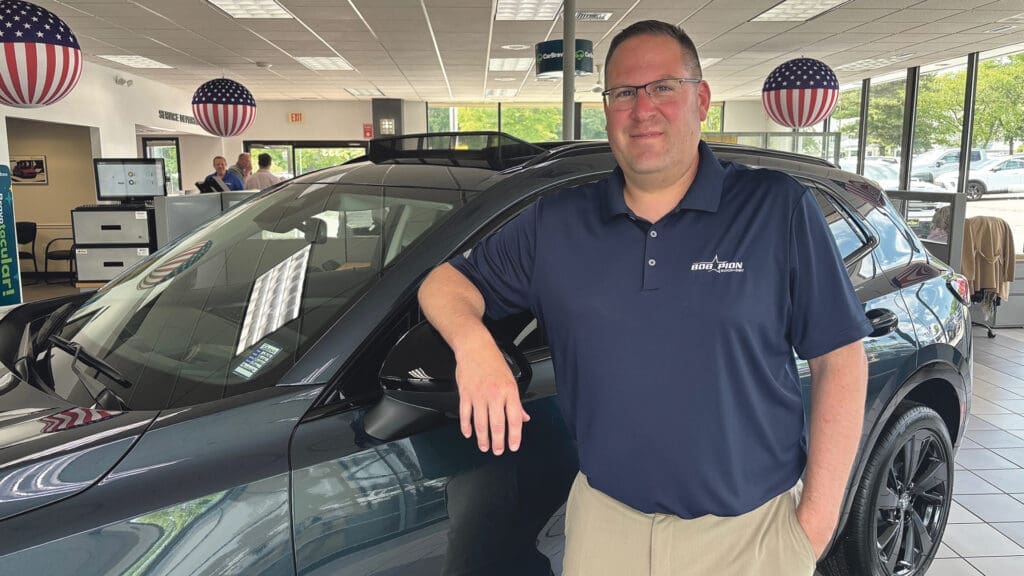
Rob Pion says AI has helped auto dealers better serve customers in a 24/7 world.

“People expect that out of everything,” he went on, adding that this includes cars, trucks, a part, or a service appointment. In short, customers are looking for information and insight — and in many, if not most, cases, they don’t want to wait until the next day for the answers.

And that’s one way dealers are using AI, Pion said — to chat with customers, answer questions, and collect some leads at all hours of the day.

“At least we have someone, or something, responding 24/7 to customer inquiries and concerns,” he explained, choosing those words carefully and then noting that AI is a way for dealers to meet consumers where they are, on their schedule.

But providing answers to questions on lease rates at midnight is just one of the ways auto dealers are putting AI technology to work. Others include everything from finding answers for technicians in the service bay to slicing through the remarks in customer reviews to find common threads, to finding holes in service schedules — and filling them.

“We always read through reviews, but you don’t always catch the themes as they come in,” said Alex Balise, director of Corporate Strategy for Balise Auto Group. “I’ve been using AI to read our reviews for the past three months and tell us key themes so we know what customers appreciate and where we can improve. A one-off review doesn’t necessarily tell you what the real experience is, but, looking at the themes, you can see that wait times have become an issue at this store or they really like the muffins at Balise Subaru in Hadley, so we should keep those. AI can tell us that.”

And it can do many other things, such as providing help with pricing to analyzing inventory to helping make sure the dealerships are carrying the right mixes of vehicles, said Carla Cosenzi, president of TommyCar Auto Group, noting, as others did, that the technology is certainly not intended to replace the human interaction that has marked this industry from the very beginning, or replace people.

“We want to use AI to make us a better resource for the customer and make sure we don’t lose that human interaction that we pride ourselves on here.”

“We use AI a lot,” she explained. “We’re a very customer-centric and community-focused dealer group, so we want to use AI to make us a better resource for the customer and make sure we don’t lose that human interaction that we pride ourselves on here.”

For this issue and its focus on auto sales, we look at the various ways AI is being used today, and how it might be used in the years to come.

Speed Thrills

Like most other industries, the auto sales and service business is really only beginning to tap into AI and its vast potential.

Indeed, those we spoke with said that, while many different uses have been found for the technology, there are many others still in the developmental stages, with testing ongoing. But already, individual dealers and larger groups have been successful in developing strategies for using AI in everything from sales to marketing to service and using the technology for what it was designed to do — creating efficiencies while allowing employees to do what they do better and make more efficient use of their time.

And in many cases, time is what is being saved — for those working at the dealership, and for customers as well.

“AI gives customers really quick, personalized, and smarter responses with transparent pricing, and it gives them a quicker transaction time,” said Cosenzi, citing the example of a customer looking for information online. 

“If a customer wanted a price on leasing a Nissan Rogue and sent in a quote to our internet department … before, our internet department would have to go to the sales managers and get information from them to properly quote the vehicle if they wanted a lease or different financing options,” she explained.

“But we have new software and AI that enable us to get right back to a customer in under five minutes and give them a completely transparent quote that gives them all the options they need, whether that’s purchasing, financing, options for different money down, for different financing institutions — all in less than five or 10 minutes. Before AI, it might have been 20 or 30 minutes.”

Balise agreed, and offered another example, this one in the service bay.

“A lot of the manufacturers have added AI support,” she explained. “So when a technician is working on something and has a question, their AI guide can help finish the repair sooner than if they had to call a support line and wait for an answer. That’s been a big help with making a repair time faster; AI can read their whole manual, which could be hundreds of pages, and spit back the specific instruction needed for that repair.”

Using AI to sift through customer reviews also saves time, Balise said, noting that employees would spend hours reading through the responses looking for common themes and issues to address. “AI can do it five minutes and give us action items that can make a real difference in the customer experience.”

Beyond saving time, AI is also helping dealerships be more efficient with everything from how they market their products and services to how they shape their inventories, Cosenzi noted, adding that new uses for the technology are continually being explored.

“It’s a 24/7 world — we’re an immediate society; people don’t want to wait for the next business day for anything.”

“We use it to match the right vehicle to the customer for their situation to help meet their goals and accomplish what they’re looking for, which saves them time,” she said. “We use it to price our vehicles in the market to make sure we’re the most aggressive and our customers are getting transparent, upfront, live-market pricing; we’re using it to help customers schedule appointments with us smarter and faster; and we use it to analyze our inventory so we’re carrying the right mix of what our customers are searching for.”

People Power

The overriding strategy is to put AI to work in ways that will enable employees to save time and put their energies in other directions, not put them out of work, said those we spoke with.

“We’re looking for where AI can make our teams more efficient so they can spend their time doing the human things we need them to do — connecting with customers,” Balise said. “AI should be an extra tool for our team. It’s not replacing people; it’s making them more effective in their jobs.”

Pion agreed. “We’re a ways from AI replacing people, especially in our business,” he said. “It’s a personal experience when you’re spending this kind of money, and people want to deal with people. I see AI as a way to communicate with people overnight, when I can’t expect someone to be doing that on my behalf. But there’s no replacing human interaction in a business such as ours.”

While AI is making its mark in the auto sales industry, those in the business say that, in many ways, dealers are only scratching the surface when it comes to this technology, what it can tell them, and how it can make their operations more efficient.

Right down to the muffins at the Subaru dealership. 

Building Trades


Outside the Classroom

What does a career in solar energy actually look like?

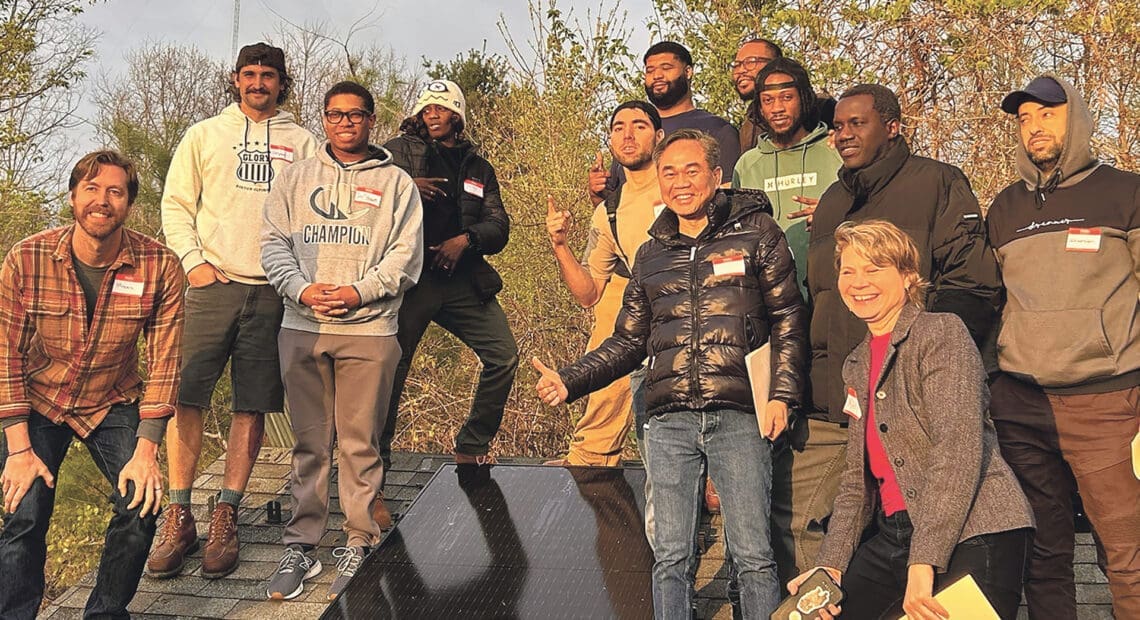
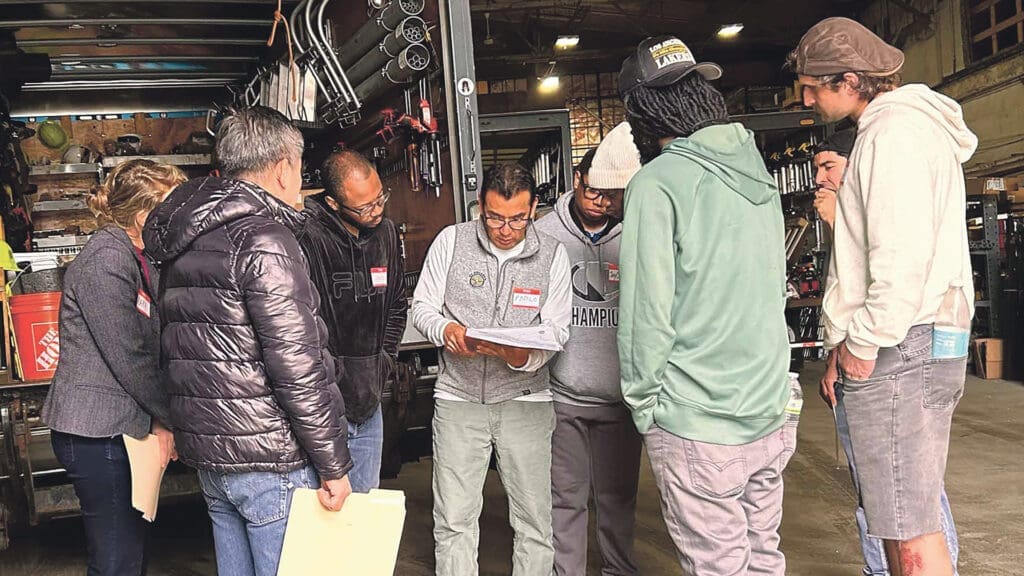
That question moved from abstract to tangible when a group of Holyoke Community College students in HCC’s clean energy training program visited PV Squared Solar’s headquarters and warehouse in Greenfield for an evening of hands-on learning and career exploration in the solar industry.

The visit was designed to give students a practical look at what working in solar actually entails, from installation work and electrical systems to team dynamics and long-term career pathways.

PV Squared offered HCC students exposure to the roof mock-ups used to simulate solar installations.

Students heard from PV Squared team members, including Pablo Revelo, master electrician; Alex Peterkin, president of the board of directors; and Kate Carter, team manager, who shared insights into the skills, training, and mindset needed to build a career in the trades.

“This kind of experience is where everything starts to click,” Carter said. “Students can see the tools, the systems, and the teamwork involved, and begin to picture themselves in those roles.”

The evening’s agenda included a walkthrough of the company’s warehouse and training areas, where students explored electrical training setups and system components, roof mock-ups used to simulate real installations, the tools and equipment used daily by solar crews, and the layout and function of installation trucks and warehouse operations. Demonstrations included safe ladder setup, equipment handling, and a look inside the box trucks that crews rely on in the field.

“This kind of experience is where everything starts to click. Students can see the tools, the systems, and the teamwork involved, and begin to picture themselves in those roles.”

Revelo, who works closely with installation teams, emphasized the importance of connecting technical training with real-world application.

“There’s a lot that goes into a solar installation that people don’t always see,” he said. “It’s physical work, it’s technical work, and it’s collaborative. But it’s also incredibly rewarding to build something that lasts and contributes to clean energy.”

For one evening, the students’ classroom extended into a working environment. Tools, trucks, electrical systems, and team dynamics all became part of the learning experience.

Programs like HCC’s clean energy training initiative are essential to building the future workforce, but classroom learning alone can only go so far, PV Squared’s leaders noted. This visit was designed to bridge that gap.

This visit is part of a growing relationship between PV Squared and Holyoke Community College, focused on creating clear, accessible pathways into the clean energy workforce. As demand for solar continues to grow across Western Mass., workforce development is becoming just as important as project development, Carter said.

“Workforce development doesn’t happen in a classroom alone. It happens when students can step into a real environment, ask questions, and see what the work actually looks like day to day. That’s how confidence is built, and how pathways into the trades become real.”

 “It’s physical work, it’s technical work, and it’s collaborative. But it’s also incredibly rewarding to build something that lasts and contributes to clean energy.”

During the visit, students also learned that careers in clean energy extend beyond installation alone. The solar industry includes a wide range of roles, including electrical and installation trades; system design and engineering; project management and operations; and sales, customer experience, and administrative support. This broader view helps students understand not just how to enter the field, but how to grow within it.

Students explored a wide range of hands-on activities, from equipment to how installation trucks are laid out.

During the visit, students also learned about what PV Squared looks for in employees, including curiosity, reliability, teamwork, and a willingness to learn, as well as the benefits of working within a 100% worker-owned cooperative.


For many students, this was also their first exposure to a structure where ownership is shared among employees, meaning the people designing, installing, and maintaining systems are also invested in the long-term success of the company.

“Worker-owned cooperatives are a powerful force for good in our communities,” Peterkin said. “They create meaningful jobs, build local accountability, and keep the benefits of clean energy rooted right here in the places we live. That’s exactly the kind of foundation we need for the green future we’re working toward.”

He added that, for students considering long-term careers, that structure offers appealing elements, including stability, shared responsibility, and a direct connection between work and impact.

“As the clean energy economy continues to expand, partnerships between educational institutions and local employers are playing an increasingly important role in building a skilled and resilient workforce across Western Massachusetts.”  

Insurance


Reinforcing the Safety Net

Beth Pearson understands insurance isn’t anyone’s favorite topic.

“Insurance is something people don’t love to talk about, but it’s so key,” she said — and she speaks not only as president of Pearson Wallace Insurance in Amherst and Pittsfield, but from personal experience.

“I was in a car accident — I was hit head on,” she said, but she was able to sleep at night knowing she had the protection she needed.

“Insurance is a financial tool, and sometimes people forget that,” Pearson noted, adding that policies are dense and complicated, and people don’t always want to read them or have tough conversations with their agents, or they just take out policies with direct writers online and don’t worry about it — until they have reason to worry, anyway.

Beth Pearson

“Everything has gotten incredibly expensive lately. And people think they can save on their insurance — but skimping on insurance, or having a strategy of bare minimum coverage, can really backfire when a loss occurs.”

For this issue’s focus on insurance, we spoke with four local insurance experts on the biggest mistakes people make when it comes to insurance coverage and claims. Most of what they had to say fell into one of six categories.

1. Not Covering Full Replacement Cost

Pearson has heard plenty of questions regarding why clients need so much coverage on their home, and in this economy, she gets it.

“Everything has gotten incredibly expensive lately. And people think they can save on their insurance — but skimping on insurance, or having a strategy of bare minimum coverage, can really backfire when a loss occurs,” she said. “Your biggest investment is your home. So you don’t want to compromise on the coverage.”

And that means insuring not for the assessed value of a home, but the potential cost of replacing it — and everything in it — in the event of a total loss, Pearson explained.

“Someone might say, ‘my house was only appraised at $550,000; why do I want insurance for a million dollars?’ Well, it’s because you want the full replacement cost. And the elements that make up the replacement cost valuation include the cost of construction, the cost to meet all the new green standards, the cost of materials, and the time it takes to rebuild,” she went on, noting that even a current circumstance like the Strait of Hormuz disruptions could cause supply delays.

Meanwhile, fire, smoke, and water damage can wipe out almost all one’s possessions — and items like furniture, clothing, and others are more expensive to replace these days, she added. “If you’re only getting the cash value instead of the replacement cost, you don’t have the ability to recreate your home as it was before the fire.”

Christine Bey, Personal Lines manager at Encharter Insurance in Amherst, agreed.

“Most companies like to insure a home to replacement cost value — not what you purchased it for, not what you think the value of it is, but what it would cost to rebuild that home from the ground up at today’s building costs,” she explained. But there are other costs to consider as well.

“We can add other bits and pieces to a policy, like loss of use. So if you can’t stay in your home because of a covered claim, they will pay for you to stay in another home or rent a hotel. Loss of use includes coverage for all of your belongings in your home, too. Then there’s liability on top of it. There’s so much that goes into the policy above just insuring to the value of the home.”

Christine Bey

“Most companies like to insure a home to replacement cost value — not what you purchased it for, not what you think the value of it is, but what it would cost to rebuild that home from the ground up at today’s building costs.”

2. Not Including Specific Coverages

“Do you have a dog? What kind of dog do you have?” asked Michael Long, CEO of the AXiA Group in West Springfield. Those are important questions, he added.

“Some insurance companies exclude certain types of dog, and some require you to tell them if you’ve got a dog — and if you don’t, they might not pay the claim. And the average dog bite claim is over $50,000.”

Or take e-bikes, which have become very popular, selling in the seven figures annually.

“Most insurance companies do not cover liability that’s created on an e-bike,” Long said. “So if you’re driving down the road and you take a right and cause a car to smash into another car and somebody’s injured, you have no coverage. If you’re on a bike path and you hit somebody and they fall down and bang their head, you have no coverage.

“That’s a big problem — and, unfortunately, it’s not talked about very often,” he continued. “Some insurance companies say they will cover it, but if I read their policy, it’s not clear. So you’ve got to get something from your agent in writing that they’re covering that. I don’t care about the $3,000 for the bike. I mean, that’s important. But the $100,000 lawsuit, the $1 million lawsuit, that’s more important.”

On the commercial insurance side, there are a host of considerations businesses might not consider, some of them involving leases, Long said.

For example, “we’ve seen cases where there’s damage to a strip mall. Our customer is on the end — no damage on his property. The city comes in and says, ‘building law says, since half of this building is destroyed, we have to tear it down.’ The guy on the end, whose building did not have any damage, goes to turn a claim in, and the insurance company says, ‘where’s your damage? The fire didn’t cause any damage to your place. No coverage.’”

Pearson brought up a few specific commercial insurance products worth having, including employment practices liability insurance, which protects against worker claims that their legal rights have been violated; hired and non-owned auto coverage, which applies when, for example, a manager runs to the store for supplies and gets into an accident; and business interruption and extra expense coverage, which kicks in if, say, a fire shuts down a restaurant for five months.

“The property coverage kicks in as you start to rebuild the exterior and the interior, but you still have bills, you still have key employees that you want to keep, you need to pay yourself, maybe you have credit card debt,” Pearson said. “With business interruption coverage, the carrier pays the costs to maintain the business while you’re rebuilding.”

And it should be adequate coverage, she added. “If you have $2 to $3 million in sales, but your business interruption coverage is $100,000 and you’re paying the rest out of the pocket, that can go very quickly.”

3. Underinsuring for Personal Liability

Speaking of adequate coverage limits, personal liability in an accident — whether at home, at work, or on the road — is an extremely critical component of insurance, Bey said.

“Choosing price over coverage is probably the biggest mistake we see. We like to tell people that price isn’t always as important as that coverage. For example, the state requires you to have $35,000 worth of property damage on an auto policy. In reality, increasing that coverage is minimal in pricing. We always tell people, ‘if you go up to that larger limit, that $250,000, you’re only going pay maybe $50 more a year.

“It’s the same with a homeowner’s insurance policy. Liability is really important,” Bey added. “I feel like, these days, everyone is a little sue happy. We see a lot more liability claims coming through — dog bites, people being injured on someone else’s property, things like that. So if you have $500,000 worth of coverage on your policy, to increase that to a million, it’s only about $30 more a year.”

Pearson agreed. “If you’re putting on minimum liability, it’s easily exhausted by a serious accident. If somebody’s injured on your property, or if you cause a major, multi-car accident, the medical bills and legal fees can skyrocket way past your limits.”

And that applies to circumstances people might not even think about, she added.

“If somebody’s overserved at a party and goes out and kills someone, you’re liable. If you have teenagers, you might say, ‘hey, they’re 18 years old; they’re very responsible,’ and go to Aruba for a week. And the teenager has a massive party, and someone dives into the pool and breaks their neck — you’re liable. I tell people, ‘these are not just fictional events — they can happen.’”

4. Not Taking Simple Risk Mitigation Steps

The policy and premium comprise just the start of a good insurance strategy, the experts we spoke with said. Equally important are the steps a customer can take to reduce the risk of an incident in the first place.

“Anytime we write a new policy or we go over a renewal with a customer, we want to talk about all the options that companies have out there when it comes to discounts — and a lot of those discounts are related to mitigation of losses,” Bey said.

For example, “companies are giving better pricing to people who have newer roofs, or who have water leak detection, or a burglar and central fire alarm. There are discounts for all of that — and some of those discounts are pretty substantial.”

Michael Long

“Some insurance companies exclude certain types of dog, and some require you to tell them if you’ve got a dog — and if you don’t, they might not pay the claim. And the average dog bite claim is over $50,000.”

Long also noted the importance of automatic water shutoffs.

“The average water damage claim is over $100,000. But there are water sensors, and some insurance companies offer a reasonable discount for water damage coverage if you have them,” he said. “And most fires are created by electrical problems — not by lightning, not by discarding smoking materials, but electrical. And there are companies right now that are offering discounts for systems that examine your wiring by plugging something in, testing the wiring throughout your house.”

Pearson said people sometimes neglect easy fixes — such as an automatic water shutoff valve or Wi-Fi leak sensors by the washing machine and water heater — because there’s a little cost and set-up time involved. “But the impact can be huge. If you’re catching a leak early, it transforms a major mold remediation nightmare into a simple plumbing fix.”

On the commercial side, “you really should have a lawyer look over your contracts, and you should have safety meetings with your employees. Those are really big, and are going to help everybody be on the same page,” said Linda Eichstaedt, Commercial Lines manager at Encharter. “And document everything — keeping really good records is so important.”

She told BusinessWest she just had a conversation with a client about cyber coverage for a business. “They were asking, ‘why would we really need cyber coverage?’ We have tons of educational material, and I sent them examples of things that can happen if you don’t have it.”

The general consensus in the industry these days is that it’s not only big companies that are targets of cybercrime; anyone can be.

“Phishing attacks are going out all the time to all kinds of people. They don’t really distinguish between what type of business you have,” Eichstaedt said, which is why businesses should not only have a cyber policy, but takes steps to train staff to avoid becoming the reason a hack gets through, from multi-factor authentication to training on phishing emails. “So many businesses are working online, and with so much online presence, they don’t always realize the risk.”

5. Filing Too Many Small Claims

And when it’s time to file a claim … well, it might make more financial sense not to.

“Another thing people do too much is filing small claims,” Bey said. “Especially on a home policy, when you have a claim on your file, your insurance premium is going to go through the roof.

Linda Eichstaedt

“Phishing attacks are going out all the time to all kinds of people. They don’t really distinguish between what type of business you have.” 

“So when insured calls us and asks, ‘do I have coverage for this tree that just fell?’ we’ll have the discussion that ‘yes, you do have the coverage, but you have this deductible on your policy. And then on top of that deductible, if you do file a claim, you’re going to see a surcharge on your insurance the next couple of years,” she explained.
“So sometimes, it’s just not worth it to file a claim that’s under, say, $5,000 because, in the long run, you’re going to end up paying more in your premium.”

The idea behind avoiding smaller claims, Bey added, is that insurance is mainly for large losses, when a policyholder really needs the payout.

“If somebody has two losses, chances are the insurance company is going to non-renew them. And if you’re non-renewed, chances are nobody’s going to take you in the standard market, and you can expect somewhere between a 50% and 100% increase for three years,” Long said, laying out the actual impact of too many small claims.

“So if you’re paying $1,500 for your insurance policy, which is probably a reasonable average, and you have a $3,000 loss that you put in, and then you have somebody steal something, so you put in another $2,000 claim in, you’re going to be canceled, and your premium will double for the next three years at least — so you’ve lost money. It’s going to penalize you in the end.”

So if a customer calls to report the theft of a couple bikes worth $1,500 and has a deductible of $500 or $1,000, Long said, “I’m going to say, ‘you’d be crazy to turn in a claim.’”

6. Not Adjusting Coverage as Circumstances Change

The local insurance experts we spoke with all emphasized the importance of the client-agent relationship, and one time when it comes in handy is when life circumstances change.

“If you improve the value of your house by 5% — you put a deck on, or you put a sunroom on — and you don’t notify your insurance company, you’ve actually voided some of your coverage,” Long said.

Other changes that warrant a talk with the agent, Bey said, are a teenager getting a driver’s license (they should be put on the parents’ policy); the purchase of jewelry, art, or other items of high value; or brining home a motorcycle or boat.

“Some people buy a new toy, and maybe it’s not super valuable, but at the same time, you want to make sure you’re carrying that liability coverage in case someone gets injured while you’re using it,” she explained. “You may not want the collision coverage for it, but you’re going to want the liability.”

At the end of the day, it’s about clear communication, Pearson said, not only on the personal lines side, but for business clients.

“I’m big on sitting down with a commercial client once a year, or more, to do a review. ‘What are your goals? What are you planning for next year? What were the challenges this year?’ Insurance is an important financial safety tool. It’s incredibly important to your success.

“A great insurance expert is not just someone who sells the policy and disappears, but who acts as a chief risk officer for you,” she added. “It’s not just a piece of paper; it’s a promise to help clients, to give our expertise, and to make sure you’re actually covered when the worst case scenario might happen.”


Health Care Healthcare News

Reasons for Hope

Compared to a decade ago, there are substantially more drugs (a 35% increase) being tested for Alzheimer’s disease in more clinical trials (a 40% increase), targeting a greater number of aspects of the disease, according to a new analysis of Alzheimer’s disease drug development as reflected in clinical trials registered on clinicaltrials.gov.

“The current drug development pipeline provides the basis for optimism regarding the emergence of new therapies for patients with Alzheimer’s. There are a robust number of trials, and agents in trials target a variety of disease processes,” said Dr. Jeffrey Cummings, Joy Chambers-Grundy professor of Brain Science in the Department of Brain Health at the University of Nevada, Las Vegas, and lead author of the paper. “This reflects our improved understanding of the biology of Alzheimer’s and the success of developing disease targeted therapies — starting with the anti-amyloid monoclonal antibodies.

“Alzheimer’s is no longer an untreatable disease. It is now a disease with treatments that successfully interfere in the disease process,” Cummings added. “Progress is also evident in clinical trial design, integration of biomarkers into trials, and emergence of promising candidate therapies. Biomarkers are increasingly used for trial eligibility as well as being integrated as trial outcomes.”

“Alzheimer’s Disease Drug Development Pipeline: 2026” was recently published by Alzheimer’s and Dementia: Translational Research & Clinical Interventions, a journal of the Alzheimer’s Assoc. Cummings and colleagues’ annual review of the Alzheimer’s drug development pipeline began in 2016.

Dr. Jeffrey Cummings

“Alzheimer’s is no longer an untreatable disease. It is now a disease with treatments that successfully interfere in the disease process.”

Looking at the most active areas of drug development revealed that the Alzheimer’s drug pipeline has become significantly more diverse. For example, over the last 10 years, the percentage of the pipeline devoted to:

• Inflammation/immune dysfunction has increased from 6% to approximately 20%.

• Tau targeted agents have increased from 6% to approximately 20%.

• Amyloid targeted agents have decreased from 33% to approximately 20%.

“It is clear that Alzheimer’s is a complex disease with many contributing elements,” Cummings said. “Inflammation is consistently present in the brain of Alzheimer’s patients, and reducing the inflammatory response promises to slow the disease process. Researchers are seeking ways to complement the anti-amyloid therapies, and there are proportionately fewer amyloid drugs in the pipeline.”

The researchers identified 192 clinical trials for Alzheimer’s, assessing 158 drugs. This included 54 trials assessing 36 drugs in phase 3, 89 trials assessing 84 drugs in phase 2, and 49 trials assessing 45 drugs in phase 1. The 192 clinical trials and 158 novel agents in 2026 expand on the 182 clinical trials assessing 138 drugs in the 2025 pipeline.

Disease-targeting therapies (DTTs) account for 73% of agents in trials. Cognition-enhancing symptom-targeted therapies contribute 18%, and drugs targeting neuropsychiatric symptoms comprise 10%.

Furthermore, 2026 may be an exciting and busy year for Alzheimer’s drug news as eight phase 3 trials will reach their
primary completion date, and 29 phase 2 clinical trials will be completed.

Not only are there more drugs and more trials, but a varied and comprehensive array of Alzheimer’s disease processes is being addressed by investigational drugs. The researchers identified 17 aspects of Alzheimer’s impact on the brain that are targeted by at least one drug in current clinical trials.

Repurposed agents approved for non-Alzheimer’s indications include 56 drugs and 73 currently active trials. Repurposing plays an important role in Alzheimer’s drug development, and repurposed agents comprise almost half of phase 2 drugs. The benefits of investigating drugs that are already approved for other indications include significantly reduced development time, lower development costs, higher probability of success, and a well-known safety profile.

Addressing an Unmet Need

“While the current FDA-approved treatments for early Alzheimer’s are a game-changing breakthrough, there is still a great, unmet need for drug development to address the needs of the growing population of individuals with Alzheimer’s in all communities and across all stages of the disease,” said Maria Carrillo, chief science officer and medical affairs lead for the Alzheimer’s Assoc.

For example, according to the Alzheimer’s & Dementia paper, there are no DTTs approved for pre-clinical Alzheimer’s disease or for moderate to severe Alzheimer’s dementia; no new classes of cognition-enhancing agents have been approved since 2004; and there are no approved treatments for symptoms such as Alzheimer’s-related psychosis, depression, or apathy.

Maria Carrillo

“Compounds for people who show early biological signs of Alzheimer’s but have no detectable clinical symptoms are now in clinical trials. If these studies are positive, that could quickly change how the disease is managed.”

The Alzheimer’s Assoc., through its Part the Cloud program, is advancing Alzheimer’s treatments by providing critical funding for early-phase clinical trials that bridge the gap between laboratory research and final-stage human trials. Part the Cloud has funded 83 research projects with more than $90 million to support diverse, high-risk, high-reward approaches aimed at stopping or slowing the disease.

Recently, Part the Cloud announced more than $11 million in new investments, focusing on tauopathy therapeutics, improving synaptic connectivity, and combination therapies. The association funds studies on neuroinflammation, metabolism, and immune response to target the disease from multiple angles.

Alzheimer’s Network for Treatment and Diagnostics (ALZ-NET) is a voluntary, nationwide network sponsored by the Alzheimer’s Assoc. that collects real-world clinical, safety, and imaging data from patients receiving new FDA-approved Alzheimer’s therapies. It aims to improve treatment, monitor long-term outcomes, and enhance care. ALZ-NET is enrolling clinical sites across the country.

Meanwhile, the Alzheimer’s Assoc. is leading a pivotal shift in early detection and treatment of Alzheimer’s disease, from responding to symptoms after they appear to identifying risk of cognitive decline, quick and accurate diagnosis, and much earlier intervention.

“Treatments that slow progression of early Alzheimer’s and offer meaningful benefits have been approved by the FDA and other agencies around the world,” Carrillo said. “At the same time, compounds for people who show early biological signs of Alzheimer’s but have no detectable clinical symptoms are now in clinical trials. If these studies are positive, that could quickly change how the disease is managed.

“Plus, we are at a turning point in what we know about brain health,” she added. “The results from the Alzheimer’s Association U.S. POINTER trial demonstrate with confidence that engaging in a structured, multi-component healthy lifestyle program can protect brain health and improve cognition for many people at risk for dementia in the U.S.”

Continued Investment

The growth of the Alzheimer’s drug development pipeline reflects the impact of sustained federal investment in Alzheimer’s and dementia research at the National Institutes of Health (NIH), which the Alzheimer’s Assoc. has championed alongside bipartisan leaders in Congress.

To continue the scientific momentum reflected in this year’s pipeline, the association is working to secure the NIH director’s professional judgment budget request of a $187.21 million increase for Alzheimer’s and dementia research at NIH in FY 2027.