Daily News

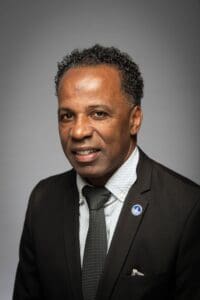
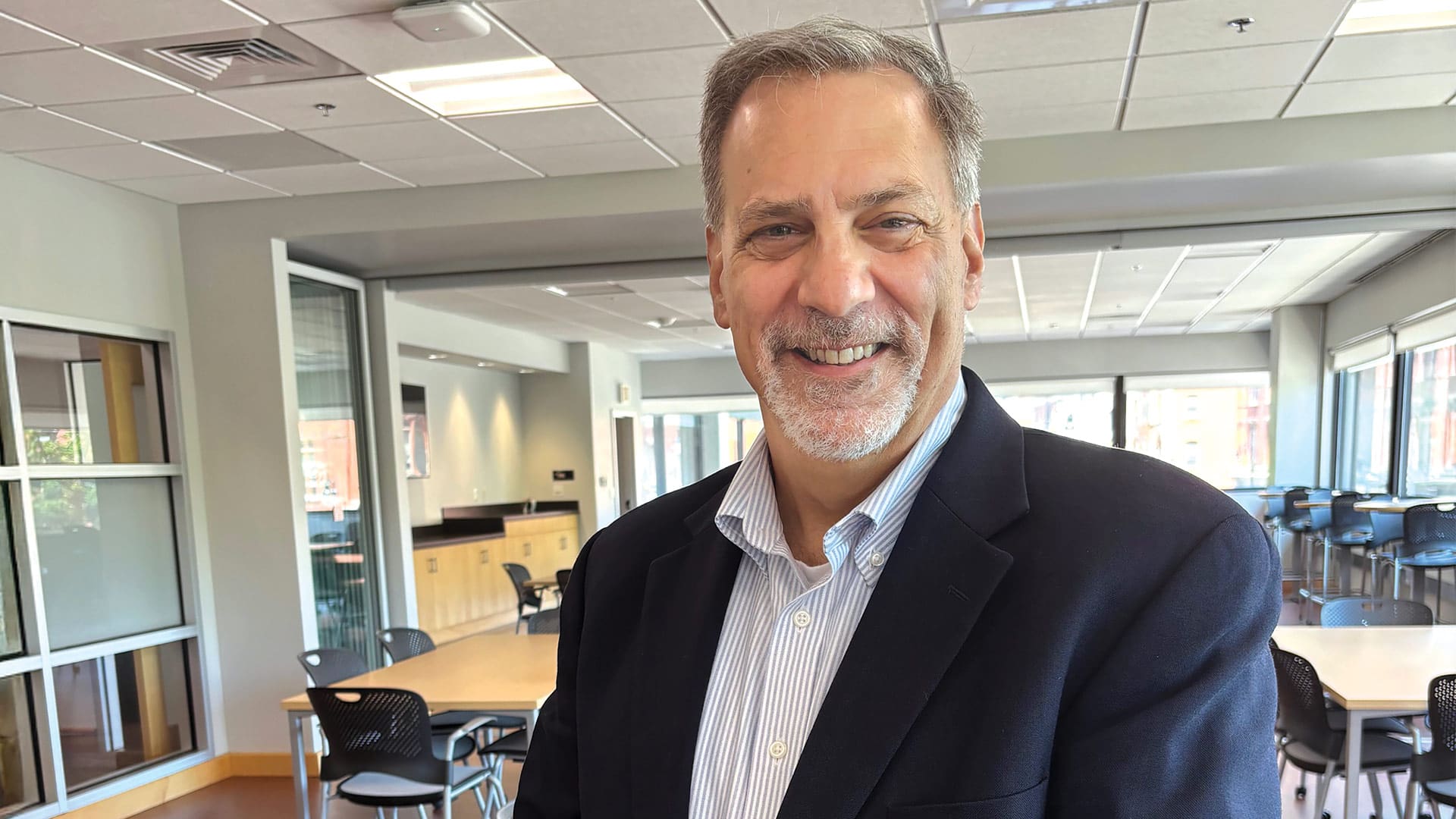
SPRINGFIELD — American International College (AIC) announced that Provost Michael Dodge received an inaugural Commonwealth Pride Award from the Massachusetts LGBTQ+ Legislative Caucus during a ceremony at the Massachusetts State House on June 17.

Dodge was nominated by state Rep. Patricia Duffy and recognized for his leadership in higher education, commitment to public service, and contributions to the Holyoke community. The Commonwealth Pride Awards were established to celebrate the accomplishments, leadership, and impact of LGBTQ+ individuals across Massachusetts.

“We are incredibly proud of Dr. Dodge for receiving this well-deserved honor,” AIC President Nicolle Cestero said. “His leadership reflects AIC’s mission of expanding educational opportunity, fostering student success, and creating a community where every individual feels valued and empowered to achieve their goals. This recognition celebrates not only his professional accomplishments, but also his longstanding commitment to serving others.”

At AIC, Dodge’s work centers on expanding access to higher education, strengthening student success, and helping students pursue their academic and career aspirations. As executive vice president for Academic Affairs and provost, he serves as the college’s chief academic officer, overseeing academic programs, faculty, and strategic academic initiatives.

Beyond the college, Dodge is a dedicated community volunteer. He serves on the Greater Commonwealth Virtual School Committee and has been a member of the Holyoke Conservation Commission for more than a decade. He also serves on the Holyoke Democratic Committee and has supported Homework House in its mission to provide academic assistance and encouragement to Holyoke students and families.

“I am deeply honored to receive this recognition,” Dodge said. “Higher education has the power to transform lives, and I have been fortunate to work alongside colleagues, students, and community partners who are committed to creating opportunities for others. I share this honor with all those who work every day to build welcoming, inclusive communities where everyone has the opportunity to succeed.”

The inaugural Commonwealth Pride Awards honored more than 110 individuals nominated by state legislators from across Massachusetts. Honorees represented a broad range of professions and backgrounds, including educators, healthcare professionals, public servants, advocates, entrepreneurs, artists, and community leaders, all recognized for their contributions to making the Commonwealth more inclusive and welcoming.

Daily News

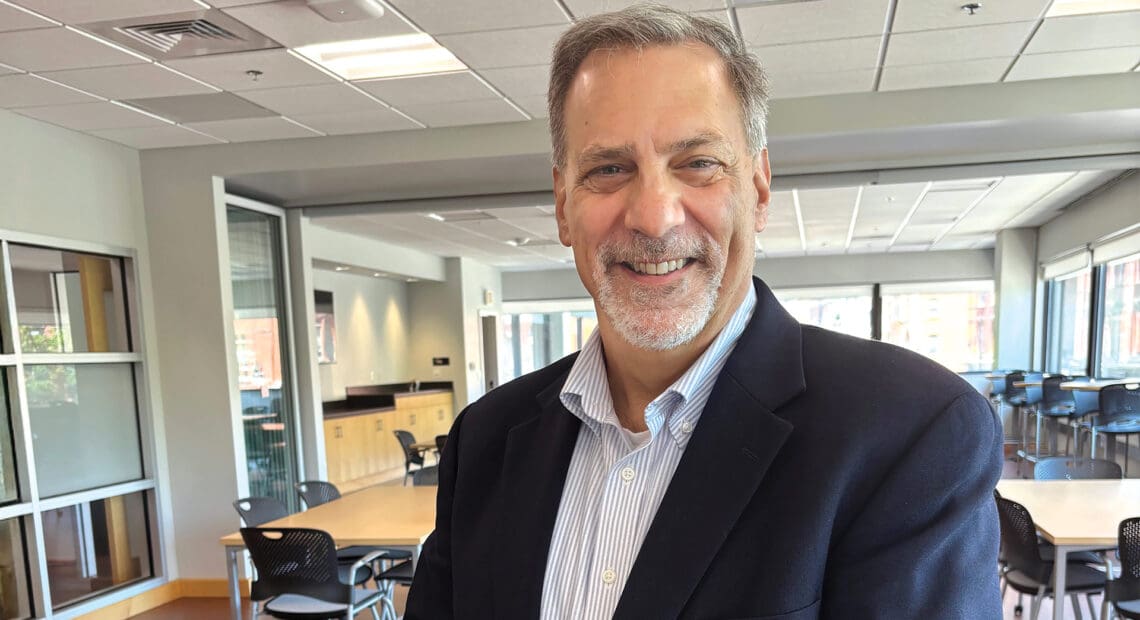
SOUTH HADLEY — The Loomis Communities announced three new members to its board of directors: Zachary Steigmeyer, assistant vice president, Commercial Lending at PeoplesBank; Kevin Whitney, president and chief operating officer of Cooley Dickinson Hospital; and Frances Bancroft, an Applewood in Amherst resident who is a retired learning products specialist.

The organization also announced Deborah Snow, former owner of Blue Heron Restaurant and Catering, as board chair, and Sanford (Sandy) Belden, Loomis Village resident and retired CEO of Community Bank System, as vice chair.

Steigmeyer has been with PeoplesBank for more than five years, now serving as assistant vice president, Commercial Lending in Holyoke. He graduated from UMass Amherst with a degree in economics, where he also played Division 1 men’s ice hockey and was a national champion in 2021. He belongs to both the American Bankers Assoc. and the Risk Management Assoc. Steigmeyer also serves as an assistant coach for women’s ice hockey at Amherst College and does volunteer work with the Special Olympics and local food pantries.

Before his role as president and COO of Cooley Dickinson Hospital, Whitney served as senior vice president of Patient Care Services and chief Nursing officer for Newton-Wellesley Hospital and as associate chief nurse for Surgical, Orthopedics, and Neurosciences at Massachusetts General Hospital. He also held the position of vice president of Community Operations for the Mass General Brigham (MGB) Community Division, and prior to joining MGB worked at Emerson Hospital, where he served in clinical and leadership roles. He earned his doctor of nursing practice degree from the MGH Institute of Health Professions, a master’s degree in health care administration from Framingham State University, a bachelor’s degree in nursing from UMass Lowell, and an associate degree in paramedic technology from Northeastern University. He is a member of the American Organization for Nursing Leadership and the American College of Healthcare Executives. In 2024, Whitney received the UMass Lowell Solomont School of Nursing Alumni Award.

Bancroft, who is an active resident of Applewood in Amherst, served as vice chair of the Applewood residents association executive committee, chair of the nominating committee, and coordinator for the community’s meditation group. A retired learning products specialist with experience in education, communications, and technology organizations, she worked at Philips, Agilent Technologies, and Hewlett-Packard, and also served as a communications consultant for Harvard University’s Arnold Arboretum. She holds a bachelor’s degree from McGill University. Bancroft has been active in a number of community and volunteer organizations, including co-chairing the Homeless Lunch Program, work on the nominating committee and volunteering for the Homeless Writers Program at All Saints Parish in Brookline, serving as a tax preparer for the AARP Tax Program in both Newton and Amherst, and chairing the lay-led worship committee at the Unitarian/Universalist Society of Newton.

Snow, who has served on the Loomis Communities board of directors since 2017, is the former owner of Blue Heron Restaurant and Catering and a teacher of culinary arts at the Windham Regional Career Center. She is a member of the Women’s Presidents Organization, serves on the Development Committee of the Food Bank of Western Massachusetts, and serves on the culinary program advisory boards for both Franklin County Technical School and Holyoke Community College. Snow has been featured in Bon Appetit magazine as one of the top 108 restaurants in the country and best dish ever tasted, and recognized as the best chef of Western Mass. by the Massachusetts Restaurant Assoc.

Belden, who joined the Loomis Communities board of directors in 2024, and his wife, Betsy, became residents of Loomis Village in South Hadley in 2018. Belden retired in 2006 as the CEO of Community Bank System, a large-scale regional financial institution headquartered in Syracuse, N.Y. He previously served as a senior executive in New York City at a large, international bank. He holds bachelor’s, master’s and PhD degrees from Purdue University in economics; held a faculty position at Cornell; and earned a mid-career certification from the Tuck School of Business at Dartmouth. Belden has also served on more than 30 governance boards for both for-profit and not-for-profit entities around the country, including the board of governors of the American Red Cross in Washington, D.C. Regionally, he has also served on the boards of the Springfield Symphony Orchestra, Smith College, Kestrel Land Trust, and Center for EcoTechnology, as well as the Community Foundation of Western Massachusetts, Cooley Dickinson Hospital, and Pioneer Valley Habitat for Humanity.

“We are so fortunate to be adding these three new members to our Board of Directors. Each is an outstanding member of the community at large and each will bring their experience, knowledge, and passion for the work we do in serving older adults in Western Massachusetts,” said Margaret Mantoni, president and CEO of the Loomis Communities. “These new members, along with our entire board and newly appointed chair and vice chair, are a reflection of the stability, and local control, that has been a hallmark of the Loomis Communities for as long as we have been in existence.”

Daily News

PITTSFIELD — Downtown Pittsfield Inc. is welcoming back Rhythmscape, a free outdoor summer dance series that transforms downtown Pittsfield into a vibrant gathering place where music, movement, and culture come together. The series will take place on Dunham Mall on select Sunday evenings from 6 to 8 p.m. throughout the summer. (For GPS directions, enter 100 North St.)

Each Rhythmscape event features a different dance style led by talented local instructors, inviting participants to experience traditions and rhythms from around the world while celebrating the rich cultural fabric of the Pittsfield community. From Latin and Brazilian rhythms to other global dance forms, every session offers an opportunity to learn, connect, and move together.

Open to all ages and experience levels, Rhythmscape encourages everyone, whether stepping onto the dance floor for the first time or returning as an experienced dancer, to join in the celebration. No partner or previous dance experience is required.

More than a dance class, Rhythmscape is an invitation to build community. By bringing people together in a welcoming public space, the series fosters connection across cultures, generations, and backgrounds while highlighting the diversity that makes Pittsfield a vibrant place to live.

Through the universal language of dance, Rhythmscape celebrates the many stories, traditions, and communities that shape the city, creating joyful shared experiences that strengthen belonging and bring new energy to downtown Pittsfield all summer long.

The schedule is as follows: July 26: Sandra Zarate teaches Zumba; Aug. 9: Soul Line Dancing with Berkshire Sole Society (founded by Erica Shrader and powered by Women of the Westside); Aug. 23: Luana Dias David teaches Salsa; Sept. 6: Brazilian day with the Quilombo Experience; and Sept. 20: to be determined.

This series is supported by Downtown Pittsfield Inc., Wandering Dance Festival, and Mill Town Foundation. Food vendors will be on site on select Sundays to be determined. For more information, visit downtownpittsfield.com or call Downtown Pittsfield Inc. at (413) 443-6501.

Daily News

NORTHAMPTON — Herrell’s Ice Cream has introduced a new flavor, Raspberry Rose Lemon. The ice cream was created by former Ice Cream Production Manager Gavin Houle and current Ice Cream Production Manager Rose Ritter.

“The flavor is multi-sensory. It contains something for every part of your tongue,” Herrell’s owner Judy Herrell said. “Your tongue can taste sweet, sour, salt, and bitter flavors, and this flavor has it all — plus it smells great too. It was a delicious surprise.”

Ritter found a started formulation made by Houle and had extra raspberry swirl that was looking for an ice cream home. After the two collaborated, they put the test flavor out for customers to try, and it was gone very quickly. “It was so much fun to make and is equally fun to eat,” Ritter said.

The flavor is available in both Herrell’s locations, Amherst Mill District and Thornes Marketplace in Northampton, until it sells out.

Daily News

Aaron Aska

WESTFIELD — Westfield State University has appointed Aaron Aska as vice president of Administration and Finance. He brings more than 25 years of executive leadership experience in higher education finance, operations, strategic planning, and institutional administration.

Aska joins Westfield State from St. Elizabeth University in Morristown, N.J., where he served as chief operating and fiscal officer. Prior to that, he spent nearly two decades at New Jersey City University, holding a series of senior leadership positions and helping guide major institutional initiatives.

“As Westfield State University continues to advance its strategic priorities, Dr. Aska’s extensive experience in financial leadership, operational excellence, and long-term planning will be instrumental in positioning the university for continued success,” President Linda Thompson said.

Throughout his career, Aska has demonstrated expertise in fiscal management, capital planning, strategic resource allocation, and organizational effectiveness. He has overseen complex financial operations, developed innovative public-private partnerships, secured multi-million-dollar grants, and led initiatives that strengthened institutional growth and long-term sustainability.

As vice president of Administration and Finance, Aska will oversee the Westfield State’s financial operations, budgeting, facilities, business services, and administrative functions, providing strategic leadership to support the institution’s mission and financial health.

He earned his doctor of education degree from the University of Pennsylvania. He is a certified public accountant and has devoted his career to advancing innovation, operational excellence, and student success through sound financial stewardship.

Business Talk Podcast Features

With new episodes airing every other Monday, BusinessTalk features in-depth interviews and discussions with local industry leaders who offer thoughtful perspectives on the Western Massachusetts economy and the many business ventures that keep it running. BusinessTalk is sponsored and presented by Greenfield Cooperative Bank.

Go HERE to view all episodes

Episode 261: July 20, 2026

George O’Brien talks with Ray Berry, Owner and General Manager, White Lion Brewing Co.

Ray Berry
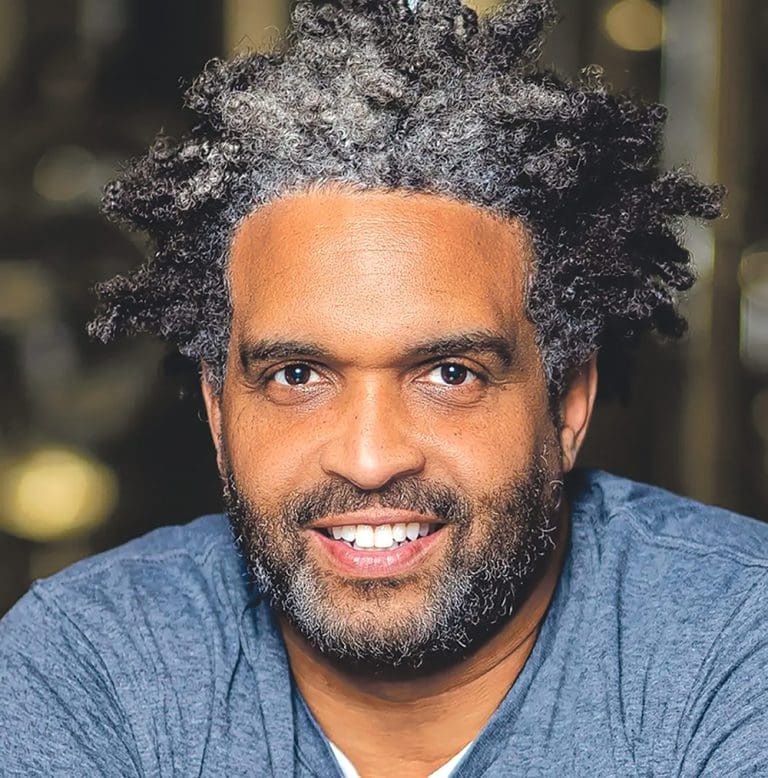
Ray Berry acknowledges these are challenging times for the craft beer industry. The founder, owner, and general manager of White Lion Brewing, he notes that the cost of everything, from hops to labor to food, is rising. Meanwhile, the Millennials who fueled the craft beer surge years ago are getting older and have other priorities. And they and everyone else also have more choices, including hard ciders and seltzers, ready-made cocktails, and cannabis. In this environment, to survive and thrive, brewers must get creative, he said, and offer much more than lagers and pale ales. On the next episode of BusinessTalk, Ray talks with BusinessWest contributing writer George O’Brien about all that goes into being creative, and how his efforts are also helping to breathe some life into downtown Springfield through live music, lobster rolls, and much more. It’s must listening, so tune into BusinessTalk, a podcast presented by BusinessWest over both audio and video platforms, and sponsored by Greenfield Cooperative Bank.

Sponsored by:

Also Available On

Daily News

Kim Zabek

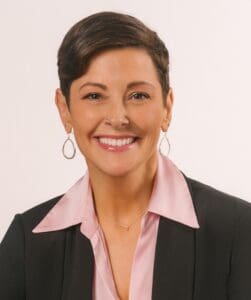
FLORENCE — Florence Bank announced it has hired Kim Zabek as assistant vice president and branch manager of the Florence branch office.

With more than 28 years of banking experience, Zabek has previously held the positions of branch manager officer, Call Center manager, and assistant branch manager. In addition to managing the bank’s Florence branch, she will oversee community outreach and engagement, growing customer relationships, and customer service.

“I’m excited to lead the Florence branch team,” Zabek said. “I look forward to building lasting relationships and helping individuals, families, and businesses achieve their financial goals.”

President and CEO Matt Garrity is pleased to welcome Zabek to the bank. “Kim comes to us with a wealth of experience in banking,” he said. “With her prior experience and incredible skillset, I am confident she will provide exceptional service to Florence Bank’s customers.”

Daily News

WARE — Country Bank announced it has been named a 2026 Top Workplaces Award winner for the second consecutive year, earning national recognition for the supportive workplace culture it continues to build across the local communities it serves.

Rooted in a long tradition of community banking, Country Bank credits this honor to its team members, whose dedication to one another helps shape a workplace centered on care, collaboration, and service.

Country Bank was also honored with Top Workplaces Culture Excellence Awards for employee well-being and work-life flexibility. These additional recognitions underscore the bank’s ongoing focus on supporting employees in meaningful ways.

For Country Bank, the recognition reflects more than an internal achievement; it highlights the connection between a strong workplace culture and the bank’s ability to serve families, businesses, and nonprofit organizations throughout the region. By investing in its employees and fostering a culture where people can thrive, the bank continues to strengthen the relationships that have long been at the heart of its mission.

“This recognition is especially meaningful because it reflects the voices of our team members and the culture we continue to build together,” said Mary McGovern, president and CEO of Country Bank. “At Country Bank, we believe that, when employees feel supported, valued, and connected to a shared purpose, they are better able to care for our customers and give back to the communities we are proud to serve.”

Top Workplaces awards celebrate organizations that have built people-first workplace cultures within their sector. These awards recognize employers of choice based on feedback from a research-backed employee engagement survey.

“Creating a workplace where employees feel heard, supported, and empowered is central to who we are,” said Miriam Siegel, chief Culture and Development officer at Country Bank. “These recognitions reflect the care our teams show for one another every day and our continued commitment to providing the flexibility, resources, and culture that help employees succeed, both at work and in their personal lives.”

Cover Story

Regional Director Rob DelMastro

From Idea to Reality

Rob DelMastro says he’ll always remember his first encounter with a consultant working for the Massachusetts Small Business Development Center (MSBDC), the state-funded agency tasked with fostering the start, growth, and sustainability of small businesses.

That’s because it wasn’t exactly a good experience.

“The message was, essentially, ‘go away, little boy, this is a stupid idea,’” said DelMastro, who came to the center when he was in his early 30s for help with launching a software business focused on the insurance industry.

He was quick to point all this out when he went back to the agency for guidance as he was blueprinting his next entrepreneurial gambit — a co-working venture back when that concept was still relatively new, he told BusinessWest. And far more important than the large bit of satisfaction he gained was a critical lesson he took from those experiences.

“When I took this job, I told myself I would never tell someone, ‘that’s a bad idea,’” said DelMastro, director of the MSBDC’s Western and Berkshire regions. “My job is to help someone realize it’s a bad idea.”

Or a good idea, he added, noting that this mindset has prevailed over his work with the agency, which he joined as a senior business advisor in its Central region in 2021 before taking the helm in the 413 last August. And he said the way to help someone determine whether an idea has merit is with numbers.

“I tell all my clients that business is all about math,” he said. “You’re in business to make money, and you need to make money to support your employees and support you and your family. And math often helps people understand why something is a bad idea.”

DelMastro and other consultants with the Western office are doing a lot of work with math these days as the region continues to see an abundance of entrepreneurial energy.

There’s always been a good amount of that commodity locally, but it picked up during the pandemic, he explained, when people had time and opportunity to reflect on their lives and careers, with many deciding they weren’t happy doing what they were doing.

And more recently, an increasingly challenging job market for older individuals has prompted more people to think about going into business for themselves.

“I know several friends, relatives, and clients who are in their mid- to late 50s and older, and they just can’t find a job,” he explained, adding that many need to keep working and are looking to work for themselves, often as a consultant, a path that might seem easy to those considering it, but comes with many different challenges.

As do most all entrepreneurial ventures, he said, adding that the MSBDC exists to help people of all ages, with all kinds of ambitions, at all the various stages of entrepreneurship, from conception of an idea to retirement.

“When I took this job, I told myself I would never tell someone, ‘that’s a bad idea.’ My job is to help someone realize it’s a bad idea.”

People like Amber-Lynn Watson, who created a wedding planning business called Small Town Moments LLC. She had worked as an insurance agent for more than seven years when she decided it was time for a meaningful change.

Amber-Lynn Watson operates Small Town Moments LLC with ongoing guidance from the Massachusetts Small Business Development Center.

“I didn’t feel like that was something I was meant to do; I was doing it to pay the bills, but I wanted something that was actually going to light me up and give me inspiration and help people enjoy their day to the fullest,” she said, adding that she’s found all this in a business designed to help couples with their pain points and essentially deliver as much help as they need — when they need it.

She took the concept to the MSBDC and was eventually assigned to DelMastro, who helped her get started, and has stayed with her, working on everything from forming an LLC to budgeting and cash flow, to understanding when she’s ready to take on her first employee.

“No one tells you how to start a business,” Watson told BusinessWest, adding that the MSBDC has been instrumental with the myriad aspects off getting a venture off the ground and then coping with the inevitable challenges and growing pains. 

For this issue, we take an in-depth look at the MSBDC and its regional office and how it remains an important component in the entrepreneurship ecosystem in Western Mass.

Married to the Idea

Watson told BusinessWest that she got a taste of event planning with her own wedding and Jack and Jill, as well a nonprofit event — a fundraiser for the American Heart Assoc. to benefit her cousin, who died from cardiomyopathy.

“It started with passion because I love all the little details that bring an event together,” she said, adding that she started thinking about turning that passion into a business. She did the requisite due diligence and determined that, while there were a few wedding planners and coordinators working in the 413, there was room for another one.


Especially one with her model, which she described as ‘a la carte planning support,’ which translates into essentially whatever the couple needs — full planning, partial planning, or month-of coordination. On the actual wedding day, she’s there for as many hours as the couple needs her.

“When I got married, I had a venue coordinator who takes care of the tables, the space, and the chairs, but I didn’t have someone in those weeks leading up to help build a timeline, confirm things with all those vendors, and make sure everyone’s on the same page,” she said, adding that this is the void she’s filling.

And she’s off to a good start, building a word-of-mouth referrals and filling in the schedule with work for the next year and beyond.

Watson is typical of the clients who come to the MSBDC for guidance at various stages of a venture, but increasingly, they’re seeking help at the earliest stages, said DelMastro, adding that he’s not exactly sure why this is, but he suspects it has something to do with more individuals — the older population, as mentioned earlier, but also younger people as well — looking to turn ideas into sustainable businesses.

The MSBDC provides these individuals with a wide array of services, including a two-hour, online “How to Start a Business” training series for those who have not officially launched or generated revenue prior to actual advising.

As for that advising, it covers considerable ground, including business plan development, financial plan development, marketing and sales strategies, cash flow analysis, organizational issues, and government procurement assistance.

There are three business advisors at the Western region, affiliated with the Isenberg School of Management at UMass Amherst, and now based in the university’s facilities in Tower Square, said DelMastro, who devotes part of his time to such work, adding that they’re working with roughly 20 clients each at any given time.

The advising work is rewarding on many levels, he said.

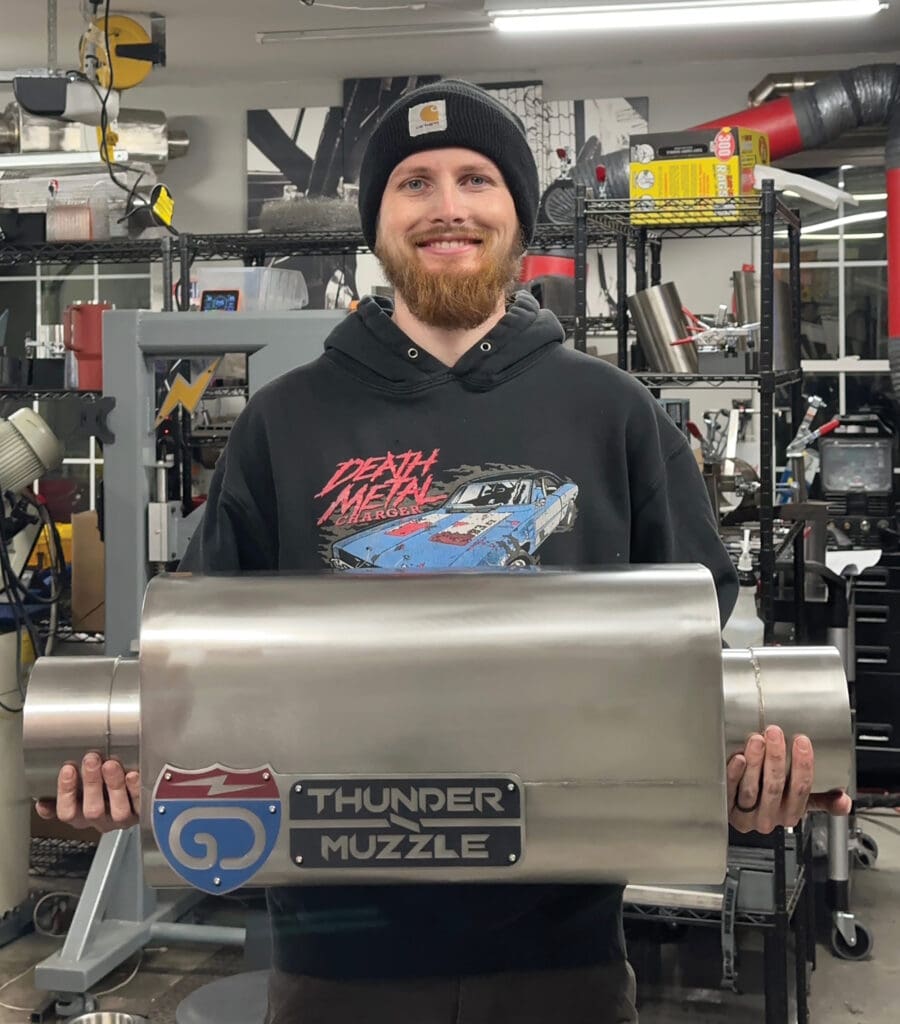
Lars Reinhard is making some news with his custom muffler business.

“The best part of the job is meeting new individuals with some great ideas, including some things that I never thought about or knew about — that’s exciting. Every new client I meet, I look forward to it, and it’s fun to listen to the enthusiasm — and the ideas.”

Such as the one Lars Reinhard came up with for a muffler whereby the driver can control the volume from inside the vehicle. It’s not an entirely new concept — the Corvette provides the driver with that option, Reinhard noted — but he found a way to mainstream the concept, patented the technology, risked all that he and his wife had saved, and created an LLC (Glory Days Speed Shop) with help from the MSBDC.

He recently passed a milestone, $1 million in annual sales, and now has six employees and has designs on continued growth. But nothing has been easy.

“It’s been the hardest thing I’ve ever done,” said Reinhard, who was teaching during the pandemic before deciding he wanted to go into business for himself. “It’s such a challenge, and most of it is mental, getting used to the stress, the roller coasters, the ridiculous hours, handling the mistakes … it’s hard to celebrate the wins.”

Adding It Up

DelMastro said one challenge for him comes when the idea in question doesn’t sound like a good one, adding, again, that he won’t actually tell someone that; he’ll help them make that determination.

And this brought him back to the subject of math, and how many aspiring entrepreneurs need to do more of it when considering a business proposition. He offered an actual case as an example.

“I had three women come to me right after the pandemic — they were among my first clients,” he recalled. “During the pandemic, they were making muffins for the neighborhood, and they were making 100 bucks a weekend doing it. So they came to me and said, ‘we’re going to start a muffin company.’

“I said, ‘great — what are your parameters?’” he went on, adding that the three said they would like to make $50,000 each annually from the venture. “I said, ‘that’s $150,000 profit you need to make; what are you going to sell your muffins at?’ And they said about $3. They also said they only wanted to work Monday, Tuesday, and Wednesday. We did the math, and it turned out they needed to sell 6,000 muffins a day.

“That’s a silly example, but a great example of how sitting down and doing the math helps you realize how silly your idea is,” he continued, adding that he’s conducted several such exercises over the years.

“The best part of the job is meeting new individuals with some great ideas, including some things that I never thought about or knew about — that’s exciting.”

But math is only one consideration for those looking to start a business, he said, adding that others include having reasonable expectations and understanding all the challenges and risks, as well as the opportunities.

“Everyone thinks they’re going to make a million dollars, and everyone thinks that when they open their doors, 200 people are going to stream through them,” he said. “So my job is to help them tamper down that enthusiasm and identify the least amount they can sell and break even, and I enjoy that — I’m a numbers guy, and it’s quite an education for most people.”

Reinhard learned about the MSBDC from his mother, who turned to the agency for help with a catering business, and he has been leaning on counselors (most recently DelMastro) for guidance at every step of the journey.

“We just check every month, and I tell him numbers and run things by him,” Reinhard said. “Like, ‘should I go with this marketing agency?’ or ‘who should I hire next, a cheap person or a high-level person?’ — big, strategic questions like that. It’s nice to bounce ideas off people like that.”

Watson agreed and said DelMastro helped her set realistic expectations and also create a roadmap for sustainability, working on issues such as cash flow, creation of a website, how to present at a recent bridal expo at Mohegan Sun, and planning for expansion and hiring an assistant.

And, like all entrepreneurs, Watson said there have been highs and lows, but mostly enthusiasm for doing something that, unlike selling insurance, she really enjoys.

“The most fun is doing something that I love to do; it warms my heart to see people enjoy their day because I was able to take the stress out,” she explained. “The hardest part is the ups and downs — not everything is going work out the way you want it to — but that’s life, and you just keep going every day and get up and keep moving. That’s all you can do.”

Helping businesses keep moving is probably the simplest way to describe the mission of the MSBDC, which offers training and advice of all kinds, but mostly deals in reality — and how to cope with it. 

Features Manufacturing

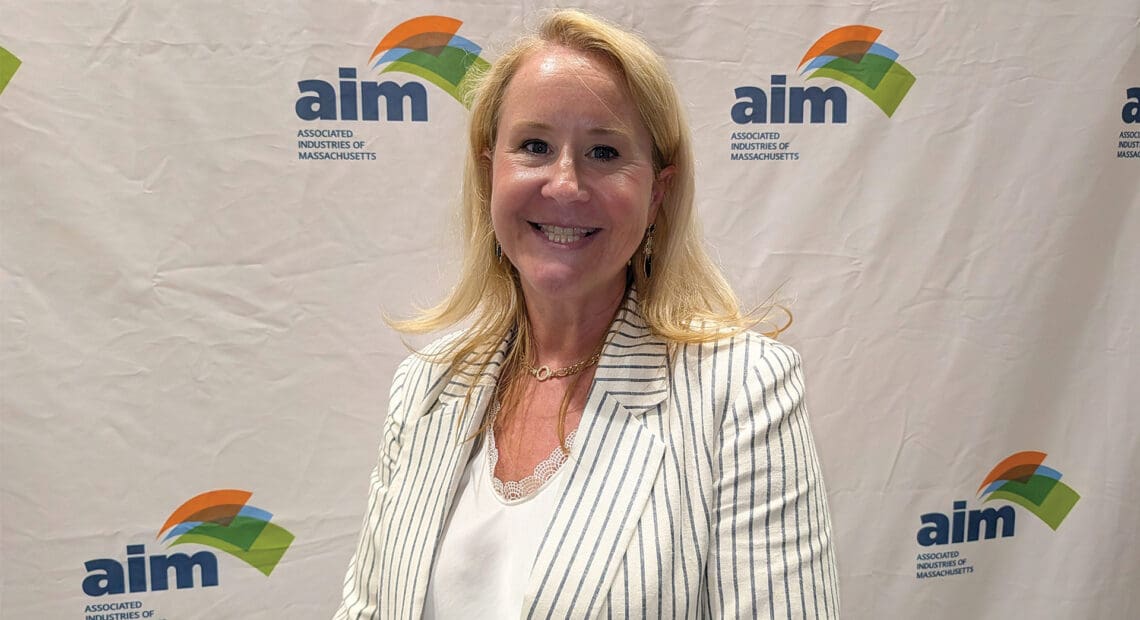
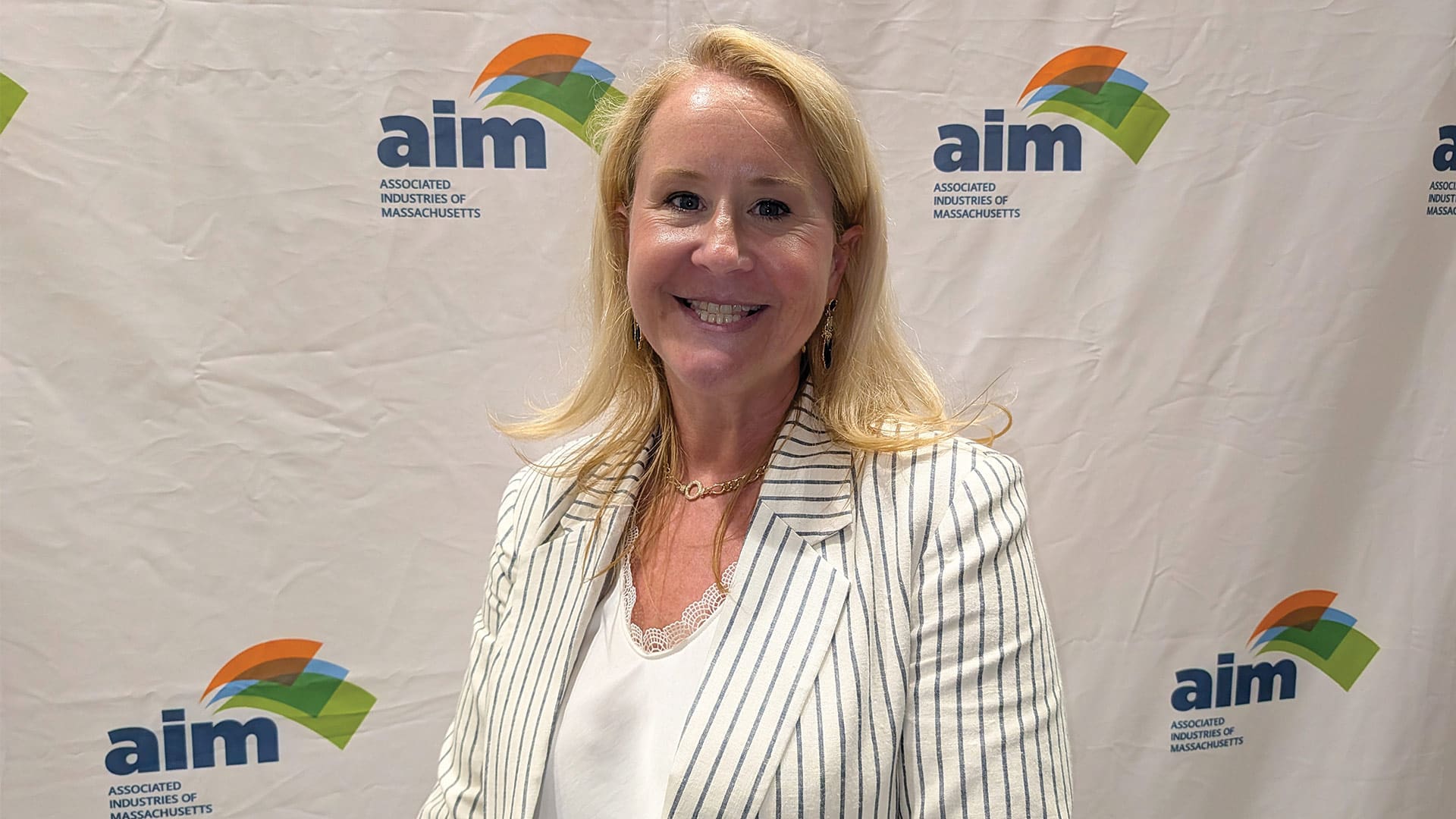
Associated Industries of Massachusetts President and CEO Brooke Thomson

Something to Build On

Brooke Thomson called it “a gathering at the intersection of commerce and public policy” — and a critical conversation to be having in Massachusetts right now.

“We know that, when people think about manufacturing, they picture factory floors and assembly lines, machines producing everything from automobiles to medical devices, but they don’t always think about the intersection with public policy,” said Thomson, president and CEO of Associated Industries of Massachusetts (AIM). “They don’t always picture all the lawmakers, regulations, and government programs that are behind the scenes supporting the industry.

“At first glance, that can seem like two separate worlds, but we know how interconnected we truly are,” she continued. “Every manufacturing decision — where to build a plant, what products to make, how to invest in new technology, and who to hire — is shaped by public policy. At the same time, we know the strength of the manufacturing sector influences our state’s economic growth, its job creation, its security, and its ability to compete in the global economy.”

“Manufacturing faces both exciting opportunities and complex challenges from workforce development, energy supply, supply chain resilience, and managing health insurance premiums.”

With that, Thomson kicked off AIM’s Manufacturing Day on July 8, which drew a large group of manufacturing executives to the State House in Boston to hear from legislators and discuss key issues relating to the state’s manufacturing economy — and what needs to be done to increase its competitiveness.

“Manufacturing faces both exciting opportunities and complex challenges from workforce development, energy supply, supply chain resilience, and managing health insurance premiums,” Thomson told the gathering. “It’s one of the reasons that AIM devotes much of its public policy efforts to supporting our manufacturers.”

Leslie Greis, AIM Manufacturing Community co-chair, noted that the economy has shifted in ways manufacturing could take advantage of, namely with the pace of acceleration in climate tech, defense needs, and AI.

“With a healthy manufacturing ecosystem, we can help achieve the state’s objectives” in these areas, she noted, citing a few ways to make that happen, including expanding access to the vocational school system, expanding funding for the Center for Advanced Manufacturing, encouraging conformity between state and federal tax codes, and expanding capital grants to make equipment more affordable for small manufacturers.

The first point, about vocational schools, was brought up repeatedly throughout the event.

“One of the things in Massachusetts that drives me crazy is, when a school has reached the end of its life cycle, and we say, ‘OK, the community needs to come together and support this regional vocational school,’ they build a brand new, state-of-the-art school, but don’t add any actual seats. That is a problem,” said state Sen. Paul Feeney, who co-chairs the Massachusetts Legislative Manufacturing Caucus with state Rep. Jeff Roy, who also addressed the gathering.

“We need to increase capacity,” Feeney added. “The vocational schools across Massachusetts have a waiting list a mile long right now. And the reason is because they do such a great job of preparing people to actually go out and make money as opposed to coming out with a lifetime of debt.

“Vocational education is not some sort of ‘other way’ to educate people,” he added. “Whatever you thought about vocational education growing up, vocational education in Massachusetts is excellence. It’s a pipeline to family-sustaining, career-sustaining jobs. It gives students the skills to be able to step in on day one into your organizations. We need to invest in it and double down on it.”

Thomson told BusinessWest that there might be ways to get the state’s community colleges — which are now free for Massachusetts residents — more involved in the vocational space to fill gaps that arise from a shortage of capacity or teachers.

“We’ve done a lot of work at AIM to try to connect the community colleges to the manufacturers, not just to get more teachers, but because we’ve got an aging workforce. High school kids can take classes in community college, right? There are opportunities where we can use some of these resources in a more productive way.”

Grit, Precision, and Passion

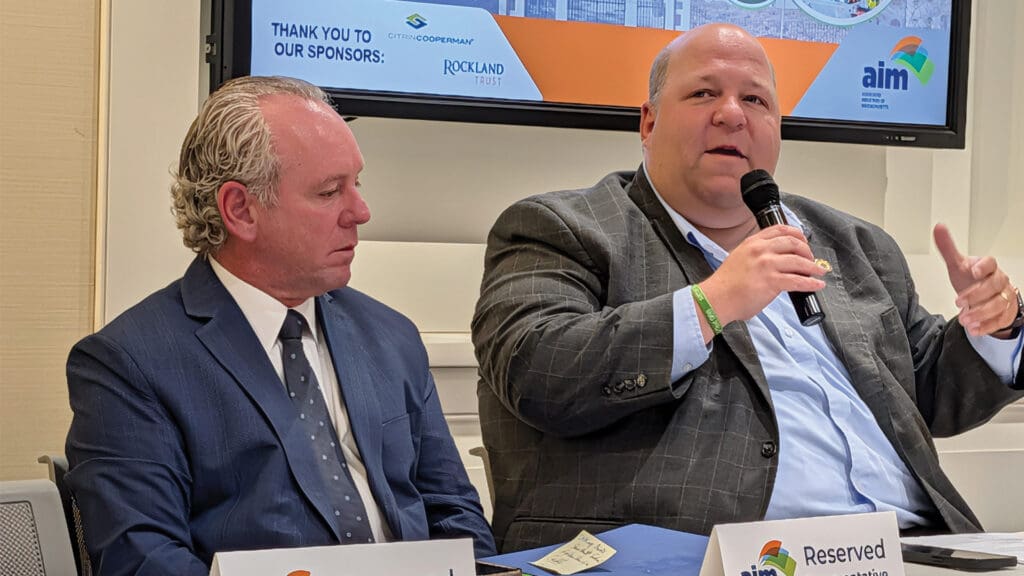
State Rep. Jeff Roy (left) and state Sen. Paul Feeney, who co-chair the Massachusetts Legislative Manufacturing Caucus, addressed a number of issues at the AIM gathering.

Roy began his introductory remarks with praise for the Commonwealth’s manufacturers.

“When people think of Massachusetts, they often think of our incredible universities, our historic cities, and our medical breakthroughs. But what makes those breakthroughs real, what scales them, and what brings them to the world is the grit, the precision, and the passion of Massachusetts manufacturing and their manufacturers,” he said. “We are not a state that just thinks — we are a state that makes.”

He cited some numbers to bolster that point: namely, 228,000 men and women in manufacturing jobs across the Commonwealth. “And their impact is immense. Manufacturing drives a massive 7.9% of the total Massachusetts GDP. And this isn’t just a legacy sector; it’s a vital, living engine of our modern economy.”

Added Feeney, “we have many, many success stories, yet you turn on the news, you read the paper, and all they want to talk about is our challenges. And we get it. We do have an issue where we need to focus on competitiveness.”

He noted efforts like Gov. Maura Healey’s Advisory Council on Competitiveness, which aims to stem outmigration and make Massachusetts a more attractive place to do business.

“But we also need to tell about our successes. We need to share our stories,” Feeney said. “Instead of talking about the ones that are leaving, let’s talk about the ones that are staying and what they’re doing right — the challenges that they’re facing, but also the opportunities that they’re creating. When we tell those stories, it’s compelling. It moves public policy.”

Some of the issues raised at the event are not new — or exclusive to manufacturing — and speak to affordability in Massachusetts in general, like housing and childcare costs that can be barriers to both living and working here. To the latter issue, Feeney brought up the Commonwealth Cares for Children grants that encourage childcare providers to keep more spaces open while keeping costs down.

“The vocational schools across Massachusetts have a waiting list a mile long right now. And the reason is because they do such a great job of preparing people to actually go out and make money as opposed to coming out with a lifetime of debt.”

But Michael Keneally, owner of Accutech Packaging in Mansfield and Foxborough, brought up another issue concerning to manufacturers — an anxious situation right now for immigrants and workers who are losing temporary protective status (TPS) due to a recent U.S. Supreme Court decision.

“We are offering so many programs to help these people,” Roy said. “I am a grandchild of immigrants who came to America and took advantage of the opportunities here to give opportunities to their children and grandchildren — and I think we need to preserve that because that’s what America is all about.”

Feeney agreed. “We get wrapped up in these abstract conversations about what’s right and wrong when it comes to immigration policy without actually understanding that it affects people deep down. It affects your companies,” he said. “So it’s important for us to make sure we are acting as a backstop to provide legal resources to folks … although it’s becoming more and more challenging to do so.”

Other speakers at the event included Greg Batsevitsky, senior vice president at Rockland Trust, who talked about manufacturing financing; and Laura Jenkins, tax partner at Citrin Cooperman, who discussed tax and incentive opportunities stemming from last year’s One Big Beautiful Bill Act.

Continuing the Conversation

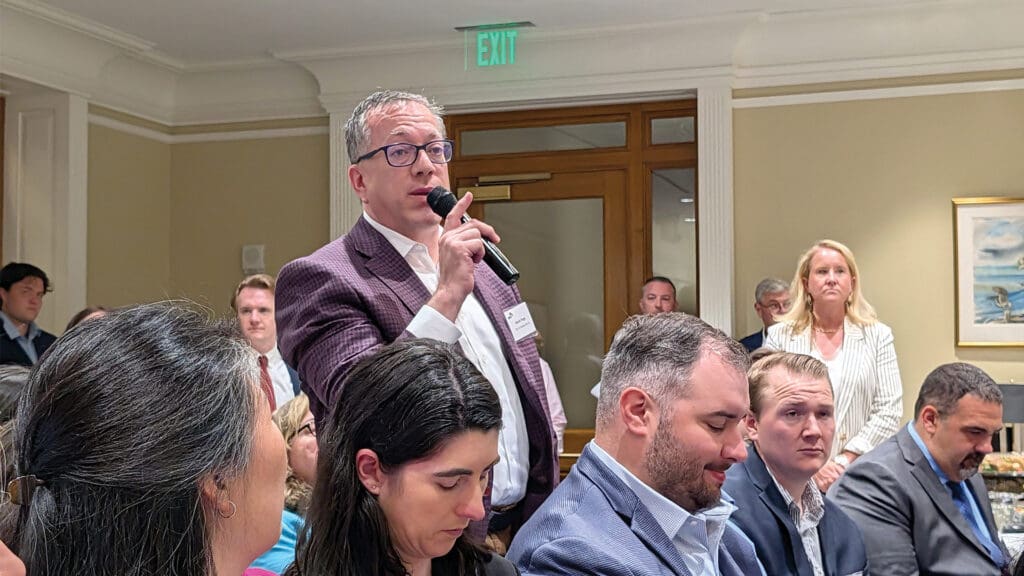
Aaron Vega makes a pitch for Western Mass. as fertile ground for manufacturing at the State House.

Aaron Vega, president and CEO of the Western Massachusetts Economic Development Council (EDC), was on hand as well, taking a moment to address AIM officials and lawmakers with a pitch for manufacturing in Western Mass., where costs can be similar to states where companies from the eastern part of the state have fled.

Afterward, Vega told BusinessWest that the concerns that came up during Manufacturing Day — expanding vocational education, making manufacturing more affordable, and helping potential talent access housing and childcare opportunities that will allow them to keep jobs — reflect what he’s heard from EDC members.

“Workforce is the number one issue — those senior, experienced people in the manufacturing companies retiring, and not being able to backfill those positions,” he noted. “I really think we have a lot of good training programs. It’s getting that marketing out to let people know that you didn’t have to be a mathematician in high school — that there are opportunities in manufacturing for you, opportunities for real careers.

“I think we’ve got a pretty good platform of vocational education in Western Mass., but again, it needs to be bolstered, and it’s that marketing piece again — we need to let people know these are not old-school manufacturing jobs,” Vega added. “I’ve been on today’s manufacturing floors, and they’re clean, and they’re making amazing things.”

After the event, Thomson told BusinessWest that, “since I’ve come into this position as CEO, I travel — I try to visit as many members every month as I can, and a lot of them are manufacturers. Everything that came up today is in line with what we’re doing. It’s workforce at the top of the list, but there are so many issues — housing, transportation, education.

“The exciting thing is, we have a lot of opportunity,” she added. “Manufacturing is alive and well in Massachusetts. There’s a lot of really great opportunity, and I can see that the Legislature is focused on helping support the industry. I think that’s great for the whole Commonwealth — not just Boston, which sometimes gets all the attention.” 

Cybersecurity Features

Getty Images

The Landscape Is Shifting

It’s become cliché — in industries of all kinds — to call some new development both a threat and an opportunity.

But in the case of artificial intelligence (AI) and its impact on cybersecurity, it’s true, in several distinct ways, said Delcie Bean, CEO of Paragus Strategic IT.

“It’s changed cybersecurity more than any single event I can think of, at least in recent history. Unfortunately, as is often the case in these situations, it tends to help the offense faster than the defense, and the defense has to play catch-up and respond. And right now, the offense seems to have the upper hand.

“The level of sophistication and frequency of attacks has increased substantially, and there’s no reason to think that will change soon,” Bean added. “It’s a very busy time for our cybersecurity division to make sure clients are safe and protected because things are changing so quickly and so often.”

This acceleration of AI threats comes at a time when data breaches are already a significant problem. According to a recent report by the Massachusetts Office of Consumer Affairs and Business Regulation (OCABR) and the MassCyberCenter, in 2024 alone, OCABR received 2,292 data breach submissions across a wide swath of industries.

“The level of sophistication and frequency of attacks has increased substantially, and there’s no reason to think that will change soon.”

Among the key findings of this study, most incidents involved malicious or criminal conduct, with system intrusion being the dominant method; financial services, healthcare, and banking represent the top industries affected; organizations struggle with preventing, attributing, and detecting breaches; and people, process, and technology contribute to data breaches through identified weaknesses such as insufficient multi-factor authentication and passwords.

“With cyber threats continuously evolving, there is a growing need for cybersecurity and information security professionals to protect computer networks and systems,” wrote Sean O’Brien, director of Cybersecurity & Computer Science at Bay Path University, in a recent article. “In fact, according to the U.S. Bureau of Labor Statistics, the demand for information security analysts is projected to grow 29% between 2024 and 2034, notably faster than the national average for all occupations.”

And this breach data, and projections about talent demand to fight threats, largely predate what technology experts are seeing now in the rise of AI. In short, it’s a quickly changing world.

On Guard

Delcie Bean

Delcie Bean says AI can cut through the noise and make threat detection more efficient.

Bean laid out a few ways in which AI is making life easier for hackers, one of which is the ability to identify many loopholes in an existing system much faster than a human could.

“Using these AI tools, you can uncover hundreds of vulnerabilities, if not thousands. And when those become exploited, there’s no easy answer,” he explained, noting that these can quickly turn into ‘zero day attacks,’ which are exploitations of a previously unknown security flaw before the developer is aware of it or has time to create a patch.

“A second issue is deepfakes and how much more broadly and more powerfully hackers are able to trick people, whether it’s amazing phishing emails looking exactly like normal emails, or more sophisticated attacks,” such as deepfaked video, Bean said.

He cited one example of a company’s employee finding himself on a Zoom call with what he thought was an FBI agent, and wound up exposing critical information to an individual who didn’t actually exist. “A video with that level of sophistication, being able to trick people into thinking it’s real — that’s really changing the game.”

Another threat is the ability, using AI, to autonomously attack companies, Bean said, which can make cyber threats both more numerous and more random. “We’re seeing powerful AI systems being set up to basically scan the internet for businesses and find a company to review for vulnerabilities and launch an attack completely autonomously.”

AI on AI

When asked how AI is changing cybersecurity,
here are the main points outlined in Google’s AI overview:
AI-powered Threats
• Sophisticated social engineering: Attackers use large
language models to generate highly personalized,
grammatically flawless phishing and spear-phishing emails at scale.
• Deepfakes and impersonation: AI-generated video and audio
clones are actively deployed to trick employees into authorizing
fraudulent transactions or divulging sensitive credentials.
• Machine-speed attacks: Threat actors utilize AI to scan massive
networks for vulnerabilities, rapidly test evasion techniques against
legacy defenses, and program malware that mutates to avoid detection.
• Adversarial machine learning: Hackers actively attempt to manipulate
or ‘poison’ the data pool used to train enterprise machine learning models,
leading to compromised security outputs.
Advanced Cyber Defenses
• Real-time threat detection: AI analyzes petabytes of data to establish
baseline ‘good behavior’ and immediately flag subtle, anomalous user or
network activities that indicate a breach.
• Endpoint detection and response: AI-powered endpoints act continuously
without relying on static file signatures, neutralizing unknown and zero-day
threats based on malicious actions.
• Automated incident response: AI tools can instantly isolate infected systems,
validate alerts, and disseminate threat intelligence, shrinking manual response
times from hours to minutes.
• Vulnerability management: AI models prioritize system patches by
analyzing internet accessibility, active exploits, and business criticality —
far beyond traditional scoring systems.

However, AI also offers opportunities to improve cyber defenses, again, in numerous ways — one of which is better honing those defenses.

“A lot of what we’ve done to combat cybersecurity is getting more tools and systems and technologies in place to keep businesses safe. The downside is it generates more and more noise — alerts, false positives, information that’s hard to understand; it takes a lot of additional work to sort through that, which can be overwhelming,” Bean explained.

“Where AI has been successful is helping cybersecurity companies analyze all this noise and determine whether it’s actually information that needs to be addressed, which cuts down on false positives.”

Then there’s the ability to analyze potential threats on a macro level, where suspicious activity on one computer might not immediately read as a threat, but similar activity across a network would — and AI is more adept at picking those patterns up.

Finally, “like AI setting up autonomous agents to attack, we’re also looking at setting up autonomous agents to defend,” Bean said. “Being able to keep track of more data and intelligence than humans are able to — especially in small businesses — means we can respond more effectively and efficiently, 24 hours a day.”

Sean Hogan, president of Hogan Technology Inc. (see related story on page 24), recently wrote about another under-discussed threat from AI. He cited a recent report that 86% of workers use AI at least weekly for work tasks, and 49% of workers admit using AI tools at work without employer approval.

“Whether workers are using these tools to conduct searches, create documents, or enter organization information, they are doing it in a risky manner because none of the tools are secure,” Hogan noted. “Most organizations have invested in cybersecurity. They have implemented firewalls, endpoint protection, multi-factor authentication, email security, backup systems, and network monitoring. However, most are now unknowingly bypassing all of those protections the moment workers begin interacting with an unsecured public AI tool.”

That’s why his company has begun helping clients establish guardrails around how AI is used, allowing workers to benefit from automation and intelligence while maintaining oversight, compliance, and human review.

“Companies want the productivity benefits of AI, but we step in and lock down these tools, so they are safe and secure.”

“Whether workers are using these tools to conduct searches, create documents, or enter organization information, they are doing it in a risky manner because none of the tools are secure.”

Future Shock

In Bean’s mind, the biggest question right now is what’s coming next on both the offensive and defensive sides.

“The thing we’re really afraid of is waking up someday, and there’s a new AI model out there, and you can point it at a company, and it bores its way in, no matter what, and finds an opening and takes that company down. We all believe AI is headed in that direction, and it’s becoming more a matter of when than if.”

However, he added, “the opportunity, in the interim, is to develop some other technology to help combat that, or at least minimize the damage of it. We haven’t seen this level of sophistication yet, but the industry thinks it’s coming. It’s just a matter of who’s going to get there first, offense or defense, and when it’s going to happen.”  

Accounting and Tax Planning Features

Timely Guidance for Individuals, Small Businesses

By Kristina Drzal Houghton, CPA

Mid-year is one of the best times to revisit your tax picture. By this point, you have real income and expense data for the year, but you still have time to adjust withholding, estimated payments, retirement savings, deductions, and business decisions before year-end. A thoughtful mid-year review can help reduce surprises, manage cash flow, and identify planning opportunities while they are still actionable.

This article highlights practical mid-year action steps for individuals and small business owners, with a focus on items that can still move the needle.

Many taxpayers wait until the fourth quarter to think about taxes. That can be too late for some of the best planning moves. Mid-year planning allows you to:

• Project this year’s tax liability while there is still time to respond;

• Adjust wage withholding or quarterly estimates before underpayment penalties build;

• Revisit retirement contribution strategy;

• Manage capital gains, losses, and charitable gifts more deliberately;

• Evaluate credits and deductions affected by adjusted gross income (AGI); and

• For business owners, align equipment purchases, accounting methods, and compensation decisions with tax and cash-flow goals.

Kristina Drzal Houghton

“Retirement planning is not just for December. Mid-year is an ideal time to verify whether contributions are on pace and whether more tax-efficient choices are available.”

For Individuals: Start with a Tax Projection

A mid-year tax projection should include more than wages. It should also capture:

• Bonuses, commissions, and self-employment income;

• Investment income, capital gains, and losses;

• Retirement distributions or Roth conversions;

• Itemized deductions or expected use of the standard deduction;

• Education and childcare expenses; and

• Any large one-time events such as a home sale, business sale, or major charitable gift.

This projection becomes the roadmap for deciding whether to increase withholding, make or reduce estimated payments, harvest losses, or accelerate deductions.

Estimated Taxes and Safe Harbors: Avoiding Penalties

Under the pay-as-you-go system, individuals generally must prepay enough tax during the year through withholding and/or estimated tax payments. The underpayment penalty rules are often manageable if you monitor them early enough.

In general, the estimated tax penalty can be avoided if your required annual payment equals the lesser of 90% of your current-year tax or 100% of your prior-year tax.

If your prior-year AGI exceeded $150,000 ($75,000 if married filing separately), the prior-year safe harbor generally increases to 110% of prior-year tax. There is also generally no penalty if the balance due after withholding is less than $1,000.

For many employees and retirees, the easiest mid-year fix is not an estimated payment — it is increasing withholding. Withheld tax is generally treated as paid ratably throughout the year, even if you increase it later in the year. That can make withholding a useful tool for catching up after underwithholding in the first half of the year.

A mid-year ‘paycheck checkup’ is often worthwhile after major life or income changes. Employees can use the IRS withholding estimator and submit a revised Form W-4 to adjust withholding.

Retirement Contributions: One of the Best Mid-year Levers

Retirement planning is not just for December. Mid-year is an ideal time to verify whether contributions are on pace and whether more tax-efficient choices are available.

Current-year limits: The elective deferral limit for 401(k), 403(b), and 457 plans is $24,500, while the limit for traditional and Roth IRAs is $7,500. Catch-up contributions may also apply for eligible older taxpayers.

For self-employed taxpayers, some retirement plans may still be adopted by the return due date, including extensions, depending on plan type and timing rules.

Capital Gains and Loss Harvesting: Don’t Wait Until December

Capital gain planning is not only a year-end exercise. Mid-year is a good time to review taxable brokerage accounts and identify unrealized gains and losses.

If you have realized gains already this year, harvesting losses can offset those gains. If losses exceed gains, up to $3,000 of net capital loss can generally offset ordinary income ($1,500 for married filing separately), with excess losses carried forward.

For higher-income individuals, loss harvesting may also reduce exposure to the 3.8% net investment income tax (NIIT).

A tax loss generally is not recognized if you sell securities and buy substantially identical securities within the 61-day wash sale window — 30 days before or 30 days after the sale.

“A thoughtful mid-year review can help reduce surprises, manage cash flow, and identify planning opportunities while they are still actionable.”

Charitable Giving: Timing and Asset Choice Matter

Charitable planning can often be improved significantly with better timing and better choice of property. Because many taxpayers claim the standard deduction, charitable contributions may produce more tax value if you bunch multiple years of giving into one year to exceed the standard deduction. Mid-year is a good time to decide whether the current year is an ‘itemize’ year or a ‘standard deduction’ year.

Donating long-term appreciated securities or other long-term capital gain property can be more tax-efficient than donating cash. In the right circumstances, the donor may receive a fair market value deduction and avoid tax on the built-in capital gain. This can be especially attractive for taxpayers sitting on large unrealized gains in investment accounts.

Cash gifts charged to a credit card are generally deductible in the year charged, even if the bill is paid later. Mid-year planning gives you time to decide whether to accelerate donations into the current year.

Taxpayers age 70½ or older may be able to make qualified charitable distributions directly from an IRA to eligible charities. For 2026, up to $111,000 per individual may qualify.

A QCD does not generate a charitable deduction, but it can still be highly tax-efficient because the distribution is excluded from income.

For tax years beginning after 2025, non-itemizers may be allowed a limited charitable deduction for cash gifts, while itemizers may face a new floor on charitable deductions.

For Small Businesses: Mid-year Planning Is About Cash Flow and Flexibility

For sole proprietors, partners, LLC owners, and S-corporation shareholders, mid-year planning is especially valuable because the business and personal tax picture are closely connected.

Quarterly Estimates and Annualization for Business Owners

Self-employed individuals and pass-through owners generally need to pay quarterly estimated taxes to cover income tax, self-employment tax, and, in some cases, NIIT or additional Medicare tax.

Equipment Purchases: Section 179 vs. Bonus Depreciation

If your business expects equipment or other fixed-asset purchases, mid-year is the right time to decide how those purchases should be structured under IRC §§179 and 168(k). Section 179 is often useful because it can be elected asset by asset, giving more flexibility than bonus depreciation. Bonus depreciation is generally applied by asset class rather than asset by asset. Under current law, 100% bonus depreciation is available for qualifying property.

Accounting Method Opportunities for Eligible Small Businesses

Eligible small businesses may have mid-year opportunities to simplify tax accounting and accelerate deductions. Businesses that meet the gross receipts test may be able to change from the accrual method to the cash method and also simplify inventory and UNICAP treatment. A mid-year review gives you time to determine eligibility, model the tax impact, and coordinate the accounting method change with return preparation and cash-flow planning.

Choosing the Right Retirement Plan for a Small Business

For business owners, the ‘best’ retirement plan depends on whether there are employees, how much the owner wants to contribute, how predictable profits are, and how much administrative complexity is acceptable.

A one-person 401(k) can be very attractive for an owner-only business or a business employing only the owner and spouse. It often allows larger contributions than a SEP or SIMPLE at comparable income levels and can offer annual flexibility.

A safe harbor 401(k) can help a small employer avoid annual non-discrimination testing, making it appealing where rank-and-file participation is unpredictable. However, safe harbor plans generally must be adopted before the start of the plan year, although certain mid-year changes are permitted.

SEP and SIMPLE arrangements remain useful for many small businesses because they are comparatively straightforward, though contribution limits and flexibility may be lower than with a one-person 401(k).

Owner Compensation and Benefits: Get the Structure Right

How an owner takes cash out of the business affects income tax, payroll tax, self-employment tax, QBI, and retirement-plan calculations.

S-corporations can reduce payroll tax exposure because distributions generally are not subject to self-employment tax. But shareholder-employees must still receive reasonable compensation. If wages are set too low, the IRS may recharacterize distributions as wages. This is not just a payroll tax issue. Reasonable compensation also affects the owner’s qualified business income analysis.

Unlike S-corporation distributions, sole proprietors and partners generally remain exposed to self-employment tax on business earnings. In partnerships, guaranteed payments also are generally not treated as qualified business income for §199A purposes.

The self-employed health insurance deduction remains an important planning item for sole proprietors, partners, and more than 2% S-corporation shareholders.

For more-than-2% S corporation shareholders, the policy must generally be paid by or reimbursed by the corporation; the premium must be included on Form W-2 as wages, though not subject to FICA for this purpose; and the shareholder’s deduction is limited by wages from that business.

For other self-employed individuals, the deduction is limited by earned income from the business that established the health plan.

Final Thought

Good tax planning is rarely about chasing one dramatic move in December. More often, it is about making a series of informed adjustments while the year is still in progress. Mid-year is the point when those adjustments are still available, the numbers are more reliable, and the choices can be made without rushing.

If your income, investments, family situation, or business results have changed since the start of the year, a mid-year review can help you turn that information into practical tax savings and fewer surprises at filing time.

Finally, remember that this article is intended to serve only as a general guideline. Your personal circumstances will likely require careful examination. You should schedule a meeting with your adviser to assist with all your tax planning needs.

Kristina Drzal Houghton, CPA is a partner with Meyers Brothers Kalicka, P.C.