
Three pages of photos from the exciting event
Features
Former Manufacturing Center Boasts Diversity
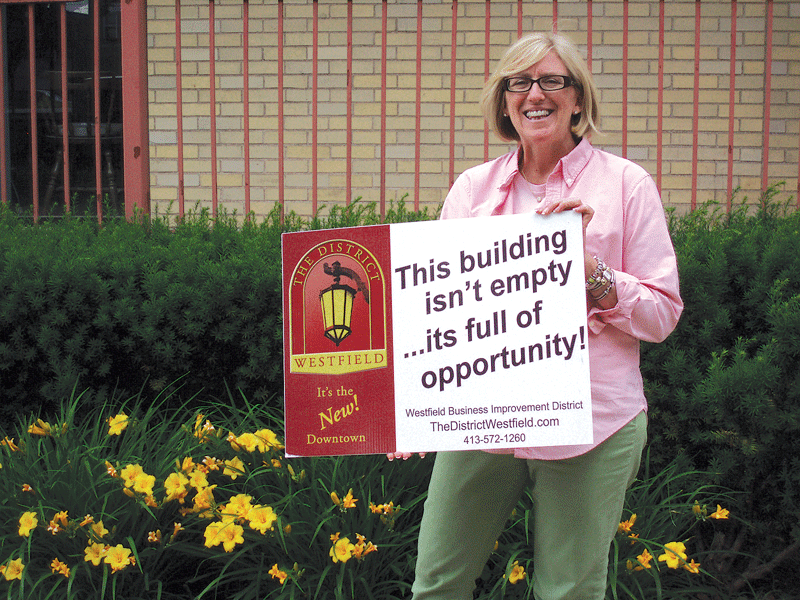
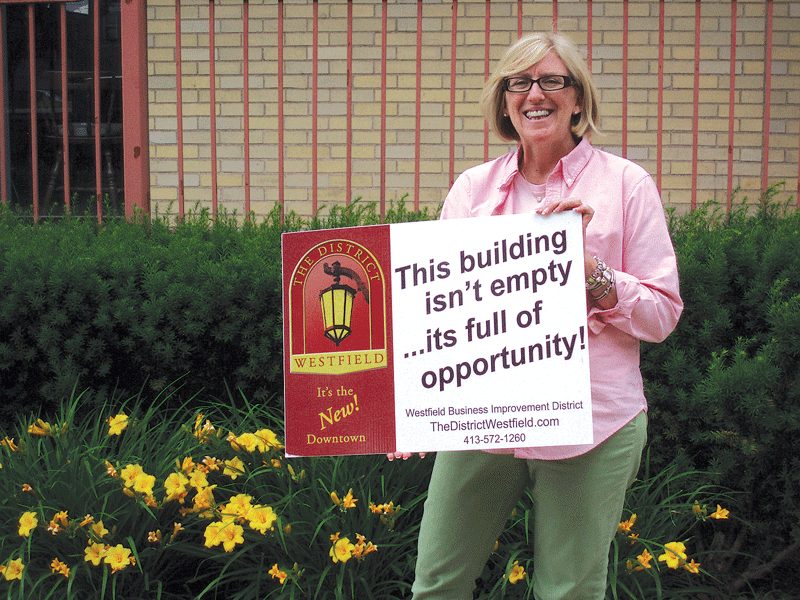
Lisa McMahon says the downtown area is experiencing unprecedented growth.
Lynn Boscher says anyone looking to establish or relocate a business should set their sights on Westfield.
“The city has it all,” said the director of the Greater Westfield Chamber of Commerce. “What makes it ideal is that is has easy access to the Mass Turnpike and Route 91, which draws traffic from the surrounding areas. We have our own short-line railroad and city-owned airport that can handle any type of plane, including 747s, and there is a wide range of commerical space available that ranges from downtown storefronts to land suited for industrial development.
“Westfield State College is here, and Holyoke Community College is just over the hill, so there is a good educational system,” he continued. “Plus, there is a good cross-section of housing in virtually all price ranges.”
The so-called Whip City — buggy whips were once manufactured there — boasts a streamlined permitting process, and in the past five years, the tax rate has become more competitive to attract businesses, Boscher said. “Plus, there are two hotels right off the turnpike. And Westfield is also becoming known for its restaurants, culture, entertainment, and shopping; there has been an influx of people due to the quality of life here.”
Frank Demarinis is president and project engineer for Sage Engineering and Contracting Inc. in Westfield. His recent projects include a building which houses Root’s Gymnastics (operated by his wife, Kari), along with All Star Dance Center, owned by Kim Starsiak, and Westfield Infant and Toddler Service. He has a day-care center next door to that building which is under construction and set to open in September.
Demarinis established his company in Westfield six years ago and was able to get a tax incentive from the state because the area is slated for economic development. He said other communities have a limited amount of land available for building compared to Westfield.
“Because of the amount of land here and the tax incentive, it’s an ideal location to start a business,” he said. “Plus, the town does its best to help and is very open to new industries that bring jobs to the community.”
Kari Demarinis opened her gymnastics business in March 2008 and has already expanded from 12,000 to 19,000 square feet. “Westfield has always been a big sports town, and we felt this was a great central location,” she said. “My husband and I looked at the map before I started my business here. Westfield has a small-community feel, and our kids go to school here through the School Choice program, although we live in Montgomery.
“The city is filled with hardworking people who support small businesses,” she added, noting that the Parks and Recreation Department conducts programs in her gym.
Lisa McMahon agrees. “The most wonderful thing about Westfield is its community spirit,” said the executive director of the Westfield Business Improvement District.
A plethora of events, ranging from concerts on the green to entaintainment offerings sponsored by BID and the nonprofit volunteer organization Westfield on Weekends, highlight businesses as well as the community. “Westfield is a big land mass, but it has such a small-town feel,” McMahon said. “People care about their neighbors here, and you can get an urban feel and suburbia all in the same town.”
Starsiak’s dance studio was in North Plaza for 13 years and doubled in size when she moved into Demarinis’ building. “I’ve lived here all my life, and this is a hometown community,” she said, talking about the blood drive her business is sponsoring. “Doing this goes hand-in-hand with the fact that Westfield is very family-oriented. Every month there are new housing developments going up, and since we are only one and a half miles from the turnpike, we draw business from Southampton, Northampton, Holyoke, and Easthampton. Westfield borders the hilltowns, so we also draw business from Westhampton and Montgomery.”
Starsiak has found city officials and other business owners do all they can to promote each other’s success. “We all have a vision to make it a very healthy and welcoming community,” she said. “One of the big attractions is that everyone wants to support each other. Westfield is a city where business owners are very united and our business is growing, which has a lot to do with businesses working together.”
Westfield’s Business Improvement District includes 190 downtown properties. Two years ago, the agency put signs in empty storefronts which read, “this building isn’t empty. It’s full of opportunity.”
The marketing ploy resulted in many calls, and a number of properties were rented as a result. But right now is even an better time for businesses to move downtown because of the changes occurring there over the next 18 months, McMahon said. “We are undergoing an incredible transformation and are poised for growth.”
Storefronts on Main and Elm streets are undergoing renovations and will soon be ready for rent. But perhaps the main reason to locate a business downtown is because hundreds of students from Westfield State College will soon move into apartments there.
Steady growth in enrollment at the college led to an increased demand for student housing that exceeded the school’s on-campus housing capacity, so the plan is to house students in leased apartment space downtown.
The first group is scheduled to move into a building on Thomas Street in the fall. “By September of 2011, the building will be full. The college is also looking at Washington Street and plans to renovate a building there which will house 90 students,” McMahon said. BID has been meeting with a group of students who say they would like to see retail clothing shops, bistros, and restaurants downtown.
In addition, the $60 million Great River Bridge project is almost finished. The old camel-back truss bridge, which provides a north-south crossing over the river, used to be a bottleneck for traffic. A new bridge was built that runs parallel to the old one, and both will be open soon, along with a small park on both sides and a new train bridge slightly higher up, as trucks used to get stuck under the old one.
“At the same time, private development is taking place on Main Street and at the corner of Broad and Court streets, which will add new downtown office space,” said McMahon. “Infrastructure has also begun on Main Street, and the downtown green is undergoing a makeover. Three historic buildings are also being renovated on Elm Street, which will have commercial space on the first floors and 19 affordable-housing units above that space.”
To add to downtown’s culture, the college opened an art gallery there, and an artists’ cooperative recently set up shop. “There is so much happening, and downtown is really poised to pop within the next 18 to 24 months. So it’s a great time to plan,” she said.
Frank Demarinis says the downtown revitalization will affect all of the businesses in Westifield. “It’s a really good idea,” he said, “a positive thing which will have a trickle-down effect.”
Holyoke, and His School, Are Hitting Their Stride
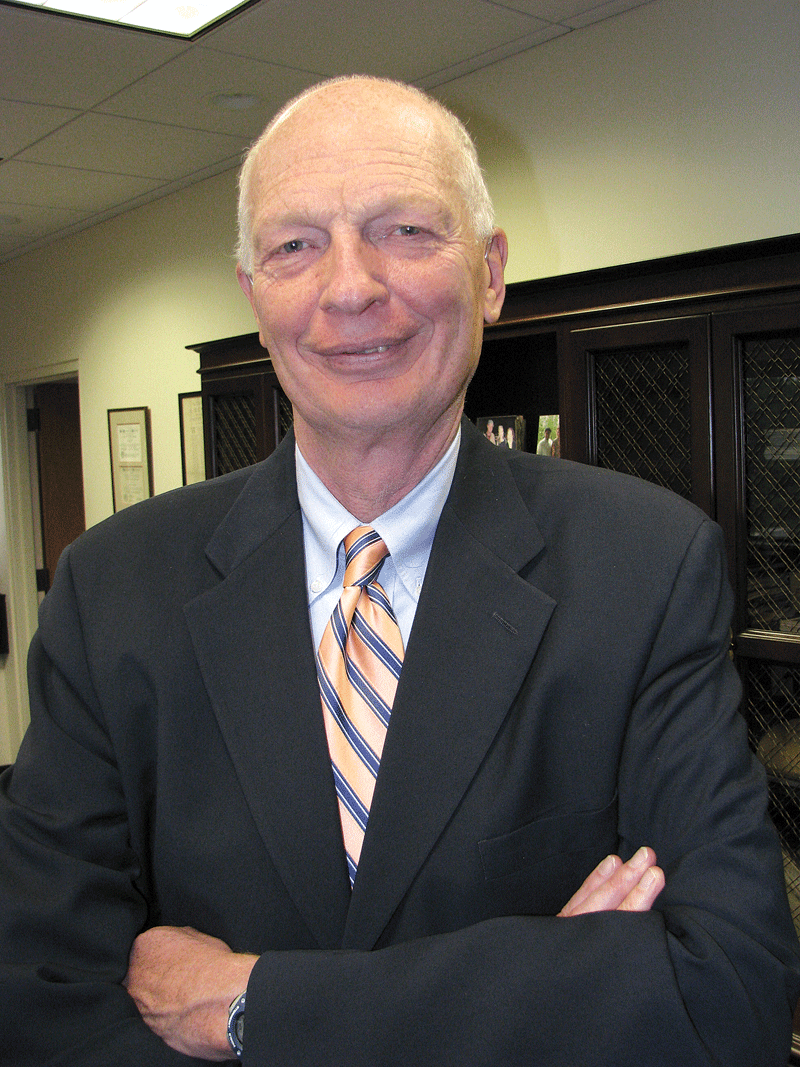
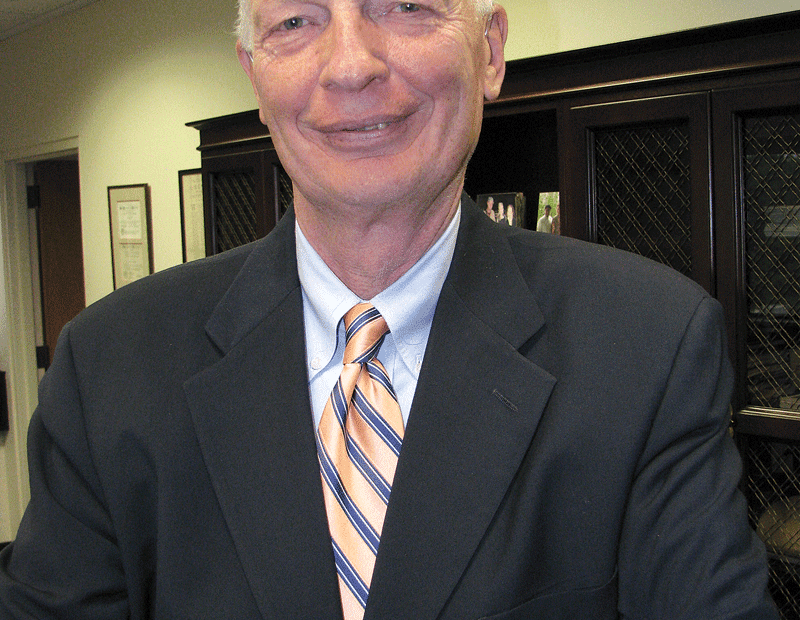
Bill Messner President, Holyoke Community College
In his, Bill Messner, who arrived in 2004 after the retirement of long-time corner-office-holder David Bartley, can be seen in his running clothes, high-stepping his way across campus, with students, faculty, and staff cheering him on. And it’s a fairly accurate portrayal of daily life for the rangy 65-year-old campus leader, who has competed in a number of marathons and half-marathons over the years in locales ranging from New York to Washington, D.C. to Cape Cod.
While at HCC, he runs on an almost-daily basis, sometimes with students and/or faculty and staff members joining him. “Although I seem to have run out of faculty and staff over the past year or so,” joked Messner, adding that, more often than not, he runs alone.
The routes and distances vary — “it all depends on what I have time for,” he said. Sometimes he’ll run on campus, while other times he’ll motor around the nearby McClean Reservoir or Mount Tom. He’ll do at least a few miles every time out, and sometimes logs six or more, as he did on the day he spoke with BusinessWest.
The runs are good stress-relievers, he said, and give him time to think and maybe solve some problems. And most often, he’s thinking about connections, and how the school, the oldest community college in the Commonwealth, can make more of them in the Greater Holyoke area.
Such connections include the school’s involvement in a learning center that will be a big part of a new intermodal transportation center to be created in an old fire station downtown, its participation in plans to create a high-performance computing center along the city’s famous canals, and work with Cisco on that company’s decision to choose Holyoke to host a pilot program called Smart + Connected Communities, which will experiment with ways to use data-networking technology to improve delivery of government services, health care, and education.
“You get some interesting thoughts out there around mile three or mile four,” he explained. “And usually, I’m thinking about where I want the college to go and what’s the next connection we can make.”
As president, Messner says it is his role to be the “door opener” for the institution, and by that he meant that he believes a big part of job description comes down to “creating pathways into and out of this place.” In other words, he and his team are working to make it easier to get to HCC, and then to take the big step from there to wherever the student wants to go, be it a four-year college or a job in the region.
Overall, Messner believes these are exciting, yet also challenging, times for both HCC and especially the city of Holyoke, which he sees emerging from a long period of dormancy as a reinvented manufacturing center on the cutting edge of technological advancements and economic-development policy.
“I recently gave a talk at the [Holyoke] chamber’s annual meeting, and I told the audience that they’re better off being in the city of Holyoke, given what I perceive to be its future, than any other community in the state,” he said. “Holyoke is the right size, it’s got the resources, it has the right people in place to make things happen. This is Holyoke’s time.”
For this, the latest installment of its Profiles in Business series, Messner talked about Holyoke, its community college, and his own career, all of which are stories with legs, in one way or another.
Jogging His Memory
From his office in Frost Hall, named after the school’s first president, George Frost, Messner has a panoramic view of the HCC campus, which was carved out of farmland off Homestead Avenue in the late 1960s. He referred to that view, in both a literal and figurative sense, a number of times as he discussed changes in higher education, technology, and society in general.
“If you were to look out that window once school begins in September, and look right down there, you’d see a dramatically different picture than what you would have seen 10 years ago — and 10 years from now, it’s going to be changed even more,” he said, that the numbers of Hispanic and African-American students, and even those with physical and mental disabilities, have risen dramatically, and will continue growing.
“We’ve been in business for more than 60 years, and we’ve got a really wonderful history of providing a solid general education and, for many of our students, transfer opportunities,” he continued. “Our challenge is to continue that tradition with a population that is dramatically changing.”
Messner has seen a good deal of change during a career in public higher education that spans more than 30 years. HCC is his third stop as a president, with his first coming at Orange County (N.Y.) Community College, where he served for 10 years, and his second at the University of Wisconsin Colleges, where he served as chancellor and was responsible for the management of a 13-campus institution that served as the transfer arm of the university system.
Desiring a return to a campus setting, as well as the Northeast, which both he and his wife, Eleanor, consider home, Messner accepted the challenge of succeeding a local institution in Bartley. And, while this might be his last career stop, Messner wouldn’t be at all surprised if it isn’t. “I have no notion of retiring any time soon,” he said.
He’s brought with him to Holyoke many lessons from his previous experiences — about everything from using technology to create learning opportunities to making connections within a community — as well as that passion for running, which he says started 30 years ago, when the activity was just coming into its own.
“I don’t go fast … I’m not a good runner, but I enjoy it,” he said while proudly displaying a picture of himself running in the Marine Corps Marathon in Washington 15 years ago. “I got started at Harvard, of all places. I went to a summer program there at the business school. In the afternoon, after classes, they ran a recreation program that had a lot of things they tried to introduce you to, and one of them was running.
“I started there and haven’t stopped,” he said, adding that, despite his height — he’s 6’ 7” — he has not had any knee problems or other physical ailments, and his running helps keep him healthy. “It keeps me away from lunches, for the most part, which is good, because they’re deadly for the waistline.”
Since arriving at HCC, Messner’s primary accomplishments include opening the Kittredge Business Center, a 55,000-square-foot facility that that houses workforce-development programs, several business-related agencies, and conference and meeting space; partnering with Peter Pan and the city of Holyoke on the learning center; and, in general, making more of those connections he spoke of.
He sees his primary role as that of facilitator.
“The president’s job, in some sense, is to make the contacts and rub shoulders with folks,” he explained, “and let people know we have programming and services available, and then to hand those folks off to the people who do the scut work of developing programs that meet needs. I’m the entry point for the institution.”
Running Theme
Returning to his thoughts on his role as door opener, Messner said he spends much of his time and energy creating and widening those pathways into and out of the HCC campus.
“In terms of getting into the place, we have a lot more students coming to us right out of high school — the student body gets younger all the time,” he said. “But beyond the traditional high-school student, we have students coming out of GED programs, home-schooled environments, jail, halfway houses … and we have international students coming to us from all sorts of backgrounds, as well as the whole array of adults returning after five, 10, 15, or 20 years.
“And they have such an array of backgrounds,” he continued. “We have an ESL (English as a Second Language) program here … you think you’re walking into the United Nations when you walk into a classroom.”
Easing the way into college for all these constituencies is one of the major challenges facing all community colleges and especially HCC, said Messner, adding that the learning center at the old downtown station, due to open late this summer, will play a key role in these efforts.
The center will have ESL programs, GED, and something called ‘transitions programming,’ which is designed to help prospective students who fall into that broad category of ‘non-traditional’ make the transition to college. “We’ll look at what kind of programming, support, and skills these people will need,” said Messner, adding that many are coming out of adult basic-education programs.
As for pathways out to four-year colleges, Messner said he and his team are working on those as well. Meetings have been staged between area community-college officials and administrators at UMass Amherst, for example, with the goal of developing strategies for making the transition from community college to the university easier, more comfortable, and more transparent for students.
“They’re considering an array of things to do at UMass,” he said, “some of it in the way of programming, some of it in support services, and some of it simply in the way of giving us better information about how our students fare.”
Meanwhile, HCC is working to strengthen already-solid transfer programs involving Mount Holyoke College and Smith College — several dozen women move on to those institutions annually — and an emerging initiative with Amherst College. “Transfer has always been our bread and butter,” he said, “and it will be going forward.”
As for Holyoke and its prospects, Messner believes the city is well on its way to reinventing itself, and he credits leadership in City Hall, from the City Council to the mayor’s office to Planning Director Kathy Anderson, for putting politics aside and pulling in the same direction on initiatives such as the computing center.
“I think the city’s been down for so long that its leaders learned that, if they’re going to get ahead, they’re going to have to work together,” he said. “And they are.”
The college has a stake, or role, in this reinvention process, he continued. When asked what it was, he said, “to simply do a good job living up to the mission of community colleges.”
By this, Messner meant providing needed programs and services to serve students, but also helping the business community by preparing a workforce that can thrive in the modern, technology-driven economy.
“Even though we’re a regional community college and only 15% of our students come from Holyoke, if we’re not doing our job in Holyoke in terms of meeting community needs, we’re not going to be doing it in Chicopee, West Springfield, Springfield, or anywhere else,” he said. “It starts right here, and we’ve made every effort to connect with the School Department, the city, the police, the Parks Department, and the nonprofit agencies in terms of collaborating and meeting needs.”
Miles to Go
When he isn’t working, Messner is often traveling with Eleanor. Destinations include places where their children now live — Washington D.C. and Wisconsin, for example — but also Europe and even China; they visited Beijing as it was ramping up for the 2008 Olympics.
Most of Messner’s traveling, however, is done on campus or along the reservoir, where he’s putting in a few miles and thinking — about all kinds of things.
But usually, it’s about connections, what the next one will be, and how it can move a college, a city, and a community forward.
George O’Brien can be reached at [email protected]
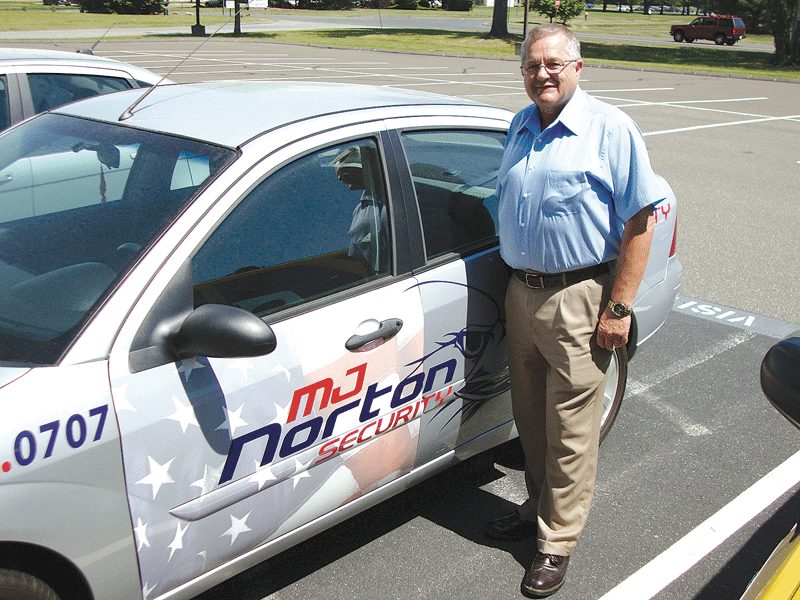
When Experience Counts, This Firm Is a Lock

Stanley Bierowka says that, despite the sluggish economic climate, there are still plenty of opportunities for a security company to grow.
“Even though we all draw from the same pool of security professionals,” said the co-owner and general manager of MJ Norton Security in Chicopee, “the main thing is how you manage them and how you manage your accounts.”
After a lifetime of working in the industry, Bierowka said that he’s seen some shops out there throw uniforms on their staff and send them out into the field. “That,” he said with a smile, “is not how it’s done.”
He said that MJ Norton “steps it up a notch,” and offers specialized training to ready the staffers who wear his company’s name. The company has only been in business since January, but between Bierowka and his partner, Rob Allen, they have a lifetime’s worth of experience. “I started out at the bottom,” Bierowka said, “and worked my way to the top, from guard to supervisor to director of operations.”
At his last post, he was forced to take time off for a life-redefining moment. Major surgery put him off the roster for four months, and in that time, he knew that some changes were in order. Little did he know that the sick leave would turn into a silver lining.
“Allen sold his share in that company a few months earlier,” Bierowka said, “and while I was out, he asked me if I’d ever think about going into business with him.
“So I thought about it,” he continued, “and, really, I wasn’t going to go back to the other company anyway after so much time away. I was going to be out of a job and have to look for something else, and at my age, that’s not so easy. But I’m not ready to retire just yet!”
With an enviable rolodex filled with people who had admired their work in the past, the two found that one of the biggest challenges was to decide what this enterprise would be called.
“You can’t believe what we had to go through for a name,” he explained. “We must have proposed about 10 different names to the state, but were turned down for a variety of reasons. Someone either had the name, or there were patents on names.”
‘M.J.’ is the initials of Allen’s mother, and the two added that to a secure-sounding surname. “We felt it was a powerful name,” he said.
With some 15 different area outfits offering similar services, Bierowka said that his business sets itself apart in more ways than one. In addition to offering its guards specific training for their posts, he said without hesitation that their superior management is what puts this outfit ahead of the rest.
“We’re very on top of that here,” he said unequivocally.
“It might not look good for the owner to be at the job site in uniform on the first day,” he added, “but I’m not the type to sit back at the desk all the time. Until our guards are set in their schedules and shifts, we have supervisors on site, and sometimes that will be me.
“I’m out there every night checking on my people,” he continued. “And if you want to be the best, that’s what you have to do.”
By paying a rate higher than the prevailing wage for security, Bierowka said that his business hopes to maintain strong retention, not an easy feat in this industry. “We’re sacrificing our profit to make sure that the level of security guards we have is the absolute best that’s out there,” he said.
His industry gets a “bad rap,” as he calls it, stemming from poor performance to bad hires, and his business sets out to right that misperception. Because of historic problems in contract security, Bierowka said that many larger companies have decided to “go internal.”
“Your larger concerns just don’t hire out as much,” he said. “In the end that costs them a lot more, but really, it hurts our industry big time.”
And when businesses look to the bottom line, security is often one of the first line items to get cut. “It’s not directly adding to their profits,” he explained. “It’s pretty scary, because the crime hasn’t stopped.”
With Bierowka and Allen’s combined reputations, the firm is secure in its present scope, and handles assignments in a wide range of business sectors, including health care, manufacturing, retail, residential — “all commercial property,” Bierowka said. But as the company looks to the second half of its first year, he said that it is still possible to grow in the present economic climate.
“Car dealerships, condo complexes, elderly housing,” he said, listing possible avenues of growth for his venture. “There seem to be increases in those areas, and of course hospitals and clinics will always be hiring.”
Word of mouth continues to be the company’s best asset, and he said that is what drives successful operations in his field. “You’re not selling a commodity,” he said. “The person that’s interviewing you for a job is interviewing you as a person. It’s a tough sell.”
But as Bierowka got ready to head out to a new job that night, it was clear that, after a lifetime in the industry, he had the situation locked down.
—Dan Chase
New Attractions, Pent-up Demand for Fun Fuel Optimism in the Tourism Sector
Mary Kay Wydra says deep budget cuts are forcing the Convention & Visitors Bureau to watch every dime when it comes to marketing.
By most indications, consumers are getting tired of having their vacations and day trips become victims of the recession. Many area attractions are reporting increases in visitorship as the large and important tourism sector heads into its busy season. This positive news is juxtaposed against severe budget cuts at the Greater Springfield Convention and Visitors Bureau, which means curtailed marketing at a time when the region could use all it can get. Overall, though, there is general optimism for the sector and the year ahead.
Mary Kay Wydra says that, for every $1 invested to promote tourism, there is a $40 return to the economy.
Thats why Wydra, president of the Greater Springfield Convention and Visitors Bureau (GSCVB), was stunned last year when was she learned the state was cutting the bureaus budget by 75%. There are 128,000 jobs in Massachusetts dependent on the tourism industry, she told BusinessWest. Tourism is about jobs that range from taxi-cab drivers to people at front desks. And jobs are part of the economic recovery.
The massive cut reduced the GSCVBs marketing budget from $468,000 to $132,000, which is the lowest number it has had to work with since 1992.
So the bureau has had to be creative and make every dollar count. And the stakes are high; the recession has taken its toll on many attractions, but there is a general feeling that conditions are improving and people are seemingly more willing to spend money on entertainment. Some early numbers from some of the larger tourist venues, such as Springfield Museums, Magic Wings Butterfly Conservatory, and Six Flags indicate that visitorship is rising over last years levels.
This would be a good year to have a substantial marketing budget, said Wydra, but that is not reality, so the bureau must spend what it does have in a scientific manner.
The GSCVB began its efforts by having marketing director Michele Goldberg conduct a survey of members, asking them to help prioritize their needs. Target markets have always included Southern Conn., Greater Boston, Hartford, and Upstate New York, so when members expressed a desire for more online marketing, Goldberg complied, although she cut out New York.
The bureau also created 25 partnerships with key players in the tourism industry, offering them the opportunity to be part of a cooperative funded largely by private dollars. It allows an area attraction to take the lead role on our Web site, which cross-promotes other attractions, Wydra explained. We have facilitated it and funded it to the extent that we can, and been able to seed the program.
This represents a very different tactic for the bureau, because, in the past, it leveraged state money to get private money. It also laid off employees and cut some forms of advertising entirely, such as purchasing a page in Yankee magazine.
Its other major marketing tool is the soon-to-be-released annual guidebook. In addition, the bureau is using Facebook, Twitter, and a blog that features prominently on their Web site.
We have definitely taken a more proactive approach to public relations, said Wydra. Measures include more press releases and talking to motorcoach opearators monthly, suggesting ideas such as a tour of the regions country stores.
Weve had to be creative in our marketing strategies, but we are fully optimistic we will see an uptick this summer in tourism, Wydra said. The concept of staying close to home and enjoying local attractions was at its height in 2008 when gas was over $4 a gallon. People cut back on hotel stays, and last year the trend continued.
But I think there is a pent-up demand for summer vacations, just because people have cut back for two years. Plus, national indicators show we are slowly growing out of the recession, she continued, noting that hotel occupancy has increased since October and Greater Springfield has outpaced the state as a whole.
Wydra said new is an important word in tourism, and the area offers that. The enshrinement at the Basketball Hall of Fame has moved to August with a full week of activities, Springfield Musueums has a new addition, and Barnes Municipal Airport will host an airshow this year.
Hands-on, experiential activities are another draw, and the region welcomed zip lines at Berkshire East and Zoar Outdoors last spring. Berkshire East has already expanded and surpassed its goal, Goldberg said.
Wydra said the bureau has done as much as possible to deal with the budget cuts. We have a strong marketing program, but if we had received more funding, we would have been able to do more, she explained. Being very creative and very collaborative have been our key watchwords.
View to the Future
While Wydra grapples with her budget challenges, those running area tourist attractions are being guardedly optimistic about 2010. Early numbers are positive, and if gas prices dont go much higher, they predict that trend will continue, due largely to a combination of new or improved attractions and that aforementioned pent-up demand for holidays.
Holly Smith-Bove, president of Springfield Musuems, says overall attendance has continued to rise throughout the recession. She attributes this in part to the new Museum of Springfield History, which opened in October 2009 and has attracted new audiences to the Quadrangle complex.
The project, which entailed a $10 million renovation of the former Verizon office building on 21 Edwards St., began before the recession and and continued during the downturn. The lower level contains the Springfield History Library and Archives, while upper levels are home to a Rolls-Royce collection and the collection from the former Indian Motocycle Museum.
There are many people who are followers of these brands, said Smith-Bove, adding that the museums demographics have changed since the new facility was built. Our adult audience is increasingly significant, she said.
The museums have also seen an increase in demand for group tours. Marketing efforts include a recent membership drive via mailings that went out to 30,000 households. We have backed that up with traditional advertising. We are also very involved with Twitter and Facebook, Smith-Bove said.
So far, their efforts have been met with success. We hope to continue the trajectory we are on. We have increased our attendance by 300% this year, Bove-Smith said. Its been wonderful.
Special summer attractions should draw crowds, she continued. We have a really amazing exhibit in the Fine Arts Museum by New York Lego artist Nathan Sawaya, titled The Art of the Brick. It will take up most of the second floor and has generated a lot of excitement in other venues.
Kathy Miller, general manager and special-events coordinator for Magic Wings Butterfly Conservatory in South Deerfield, is also optimistic about the busy months ahead, mostly because the first months of the year have been solid. Between 2008 and 2009, we were at an even pace and were able to stay consistent, she told BusinessWest. But in 2010, our numbers have been up, which is wonderful.
The conservatory has paid close attention to its marketing strategy, however. We thought a lot about it and have kept a very close eye on it, Miller said. What we found is that, even though the economy took a downturn, people still need to do things for themselves that are nurturing, relaxing, and that dont break the bank. And we fit that bill.
On Mothers Day, the facility reported a 60% increase in business over that same holiday last year. It held a special Mothers Day dinner promotion in the restaurant, and has done all it can to make it attractive and affordable.
It has a warm atmosphere. We offer home cooking with huge portions and reasonable prices, Miller said. It has only been open four years, and we have seen a steady increase in customers every year. We attribute it to word-of-mouth referrals, along with TV and newspaper ads.
This year marks Magic Wings 10th anniversary, and as public awareness grows that it is open throughout the entire year, many people have used the space for baby and bridal showers. Its one of the things that has helped us, in addition to our butterflies and animals, Miller said.
Magic Wings and Lupa Zoo in Ludlow recently partnered to create a traveling show, in hopes that it will bring attention to both attractions, and the butterfly conservatory is part of a two-year-old Deerfield Attractions initiative. Those efforts include advertising via the Web site deerfieldattractions.com. We want to let people know that were only a half-hour from Springfield and there is a lot to do here, Miller said.
Waxing Optimistic
Yankee Candle in Deerfield saw a slowdown in traffic after the recession hit. The end of 2008 was very tough, as was as the first half of 2009, said CEO Harlan Kent. But we were actually positive in the fourth quarter of last year for the first time in nine months. We felt good about that.
Traffic is up, he said. But people are being very thoughtful in terms of spending and are sticking to a budget, although we have been able to entice them a little bit.
Such enticements include new attractions in the flagship store. In addition to being the Disneyland for candle lovers, the company added a Pandora store, a Dylans candy store, and a Popcornopolis, Kent said.
We call it retail-tainment, and have stores within our store. We have new ones planned and are in the process of opening up something different every three months.
Other initiatives include hands-on activities, such as Wax Works, which opened a year ago and allows visitors to create candles and wax sculptures. We add a new activity every few months, Kent said. Since people are staying closer to home, we hope to attract them with these kinds of exciting attractions.
The company opened 39 new stores in 2009, keeping with its average during the past five years. We expect to see some moderate growth as the economy improves, and are continuously investing, Kent said.
On May 15, the company celebrated a complete makeover of its home store and continues to add activities, such as a three-day Longaberger Basket festival in June and a 5K run to benefit the American Heart Assoc. in August. There have also been adjustments to the menu at Chandlers restaurant, which Kent said fared pretty well in 2009. We are doing more advertising this year, getting back to more normal levels.
Larry Litton, president of Six Flags New England and a board member of the GSCVB, said the recession didnt significantly impact business at the park. Still, the management team took a very proactive approach.
We have done very well. We ran some tremendous promotions that were sensitive to the fact that money was tight, he said. In 2009, these promotions allowed adults to pay the same entry price as children. Those promotions are continuing this year, and the park is also offering its lowest season-ticket price since 2004.
Weather plays a significant role in its attendance, but in the end, Litton believes it boils down to the value offered. We are the largest theme park in New England and have the number-one steel roller coaster in the world, he said.
The facilitys water park boasts new attractions, including a Johnny Rockets restaurant, and management is bringing back popular events, such as the Glow in the Dark parade and a Starburst Concert Series, with acts that appeal to teens.
We have made a lot of changes over the last four or five years to broaden our appeal and added a lot of show products for younger children, Kent said. If anyone hasnt been here for four or five years, they would not believe the changes in the property. We started this year off very strongly and are expecting a huge year.
Still, marketing dollars spent by the Convention and Visitors Bureau help area attractions significantly, and Wydra, Kent, and other board members have gone to Boston to discuss the tourism budget in recent weeks. There is no better investment than tourism, Kent said, and we hope our message resonated with the Legislature.
Glenn Edwards Believes the Time Is Right for His Springfield Properties
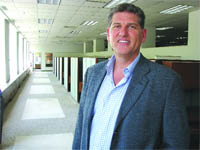
Glenn Edwards is taking a glass-full-half outlook on prospects for commercial real estate in downtown Springfield, and especially his block.
It took Glenn Edwards a few years to put the entire block of buildings on Main Street in Springfield between Harrison Place and Court Street into his portfolio. Hes enjoyed mixed results since then, with the recession leaving for lease signs in many windows along that stretch. And while the local market remains quite sluggish, he believes the time is right for him to fill some of those vacancies.
Glenn Edwards has his office in New York City, but he keeps close tabs on whats happening in Springfield and he should. After all, he owns all the buildings along the east side of Main Street between Harrison Avenue and Falcon Drive.
And for the most part, Edwards, who acquired those parcels between 2005 and 2007, likes what hes hearing and reading about the City of Homes and especially its central business district. Hes actually pleased that the nearly vacant federal building will soon be almost full with Springfield School Department offices and other tenants (some downtown property owners were miffed that their buildings were not even given an opportunity to vie for that business).
Meanwhile, hes encouraged by progress in Court Square, especially UMass Amhersts decision to take one of the buildings there for one of its programs. Hes buoyed by some anecdotal evidence that the worst appears to be over for both the economy in general and the real estate market in particular, and, while he wasnt thrilled to lose the Dennis Group as a major tenant in Harrison Place, hes even finding something positive about that companys relocation to the Fuller Block and the filling of that structure.
He believes all or most of the recent news bodes well for his efforts to lease up his properties, which include in addition to Harrison Place, which has three vacant floors whats known as the Johnsons Bookstore Building, Marketplace, the so-called Northwestern Mutual Building, and also 1341 and 1319-1331 Main St.
New life for the federal building and Fuller Block will add vitality to the downtown and leave two fewer options for companies that are looking to downsize, rightsize, find a better deal, or take an expansion plan off the back burner its been on since the recession hit high gear, said Edwards, noting that he believes there are many businesses in all these categories.
As the economy improves, we fully expect Springfield to be part of the renaissance, he told BusinessWest. We expect to ride the next wave of real-estate activity.
And within Edwards block of buildings, which together comprise around 45,000 square feet of available space in various shapes and sizes, there is something for just about everyone, said John Williamson, president of Williamson Commercial Properties, which is now handling leasing activities for the properties.
Weve have full floors in Harrison Place, including the first and second, which is some of the most visible space in downtown Springfield, he said. And we have a lot of other spaces with which we can be very creative.
For this issue, BusinessWest talks at length with Edwards and Williamson about why they think they have the right places at the right time.
New Lease on Life?
Williamson joked that his new assignment with Edwards, for whom he handled the Harrison Place transaction in 2007, is essentially to lease his way out of a job, meaning to fill the properties in question.
As he goes about that task, hell face a good number of challenges, especially competition for tenants. Indeed, while some properties, like the Fuller Block and the federal building, are now effectively off the market, there are countless others in or near downtown with for lease signs in their windows.
And, in many respects, this is still very much a tenants market, a phrase used repeatedly by brokers to imply that businesses that are ready and able to make moves can play those landlords with space to lease against one another and get some attractive deals.
But the biggest challenge may be that there are still not enough business owners and nonprofit managers ready to make those moves. In recent months, area brokers have used words like quiet, frozen, and dead to describe the state of the local commercial real-estate market, and some have said that conditions now are even worse than during the prolonged recession of 20 years ago, when brokers could at least stay busy working for banks trying to rid themselves of properties on their OREO (other real estate owned) files.
However, the usually optimistic Edwards is seeing the picture a different way with the glass half full, or at least approaching that level.
He said that activity has picked up in many of the markets in which he owns properties (that list includes municipalities ranging from Lynnbrook, N.Y. to Park City, Kan. to Clifton, Colo.), and that he fully expects that Springfield, home to perhaps the centerpiece of his portfolio, will eventually follow suit.
Its not going to be a tenants market forever, he said, noting that, as bad as this downturn has been, it will be followed, like others before it, by a period when the laws of supply of demand will eventually begin to work in favor of property owners.
And he believes his block is well-positioned for the day when the pendulum starts to swing.
Granted, he has only what would be considered Class B space, or perhaps B+ in the case of Harrison Place, available to lease, but he notes that most Class A space in both the suburbs and downtown Springfield is occupied, and what isnt the vast majority of it is in 1350 Main St. or One Financial Plaza is mostly being reserved for larger tenants.
So he believes this leaves opportunities for those properties across Main Street with the odd numbers, starting with Harrison Place.
Edwards acquired that landmark from the Picknelly family in late 2007, putting the entire block in his portfolio. The building was nearly full at that time, but the scene changed dramatically when Tom Dennis who acquired the property in the late 90s, built out the first two floors for his engineering firm, and later sold the property to the Picknellys desired to once again own his space.
He departed for the rehabbed Fuller block in the summer of 2009, leaving one of those aforementioned for lease signs in the front window at Harrison Place, through which countless pedestrians and motorists look every day.
That visibility, coupled with accessibility and pliable space, has attracted several tire-kickers, said Williamson, including a large law firm. He expects more tours in the weeks and months ahead as businesses look to take advantage of what is still, by and large, a tenants market.
The ultimate goal is to lease the first and second floors, both around 8,000 square feet, to one tenant. The best plan B is to find two full-floor tenants, he said, adding that there is flexibility for a number of other scenarios, but the preference is for larger tenants.
The same goes for the slightly smaller ninth floor, he said, adding that, overall, there is some 25,000 square feet, just over 33% of the total space, available in the building.
Moving south down what could now be called the Edwards Block, there are roughly 5,000 square feet available, or just under one-fifth of the total, in the Johnsons Bookstore building, where Edwards and Williamson want to find more retail and office tenants to join FedEx Kinkos, which moved in on the first floor last year.
There are nearly 6,000 square feet available (one-quarter of the inventory) at 1365 Main St., also called the Marketplace Building; all of the space, 5,298 square feet, in 1341 Main St., most recently occupied by Westfield Bank, which means its been vacant for some time; and just over 3,068 square feet in 1310-1331 Main, also known as the Peerless Building.
Overall, Williamson said his broad strategy for leasing up those buildings is innovative, and by that he means everything from imaginative lease deals that will serve both Edwards and his tenants to efforts to attract some of the many nonprofit groups operating in the Greater Springfield area, especially for the Westfield Bank building, which he believes is perfectly suited for one or, more likely, several such tenants.
That property lends itself well to that kind of use, he said, and there are literally hundreds of these 501 C3s operating in this area.
Space Exploration
When asked why hes so bullish on the prospects for Springfield when others seem far less ebullient, Edwards says his attitude stems from seeing clear progress in several of the other markets in which he owns real estate.
Weve signed a number of leases over the past few months theres a lot of activity taking place, he said. Were going to see that here, too. Tenants will be rightsizing and going from class C space to class B. Space will start to be absorbed again.
Time will tell if and when hes right about the Springfield market, but at the moment, Edwards likes what he sees. And he believes hes well-positioned for when the turnaround begins.
George OBrien can be reached at
Area Architects Have Designs on Business Improvement in 2010
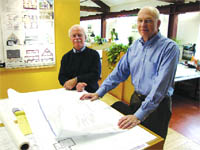
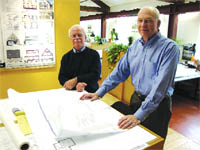
Christopher Riddle, left, and John Kuhn say the recession has altered the landscape for architects in a number of ways.
The economic downturn hit the construction sector across the board, from builders all the way back to the architects themselves. While the historic effects are reportedly on the wane for this industry, local architects draw up their own tales of the Great Recession, and offer some thoughts on how they will recognize the signs of recovery.
Growing numbers of competitors from outside of the region, private-sector financing not readily available for new construction, and cutbacks in staff numbers and workdays … wait, wasnt this just reported about the construction sector?
Recently BusinessWest spoke to the people holding the hammers about the nature of the building trades and how the economy was affecting them in unprecedented ways. While area tradesmen knew the news wasnt very good, most reported on how they are successfully navigating these turbulent times.
However, another key component of the construction sector, the architecture industry, has also been finding its business hit, and hit hard, by many of those same forces, and they too have undertaken measures for successfully riding out the economic downturn.
John MacMillan is president of Rheinhardt Associates in Agawam. Like construction workers out in the field, he said that competitors from outside the area have been bidding on design jobs in numbers hes never seen in his 25 years in the industry. Its very fierce, he told BusinessWest.
But while industry analysts foresee the potential for grim times ahead in the construction sector, architects and those who monitor the industry have designs on a much better 2010.
Kermit Baker is the chief economist for the American Institute of Architects, and in that organizations Billings Index, a monthly measurement of the number of projects on the boards for architectural firms, he reported that, while billings were at historically depressed levels in March, that months confidence index of 46.1 reflected an increase from Februarys 44.8.
This figure is the highest recorded since August 2008, and while an index rating over 50 is a mark of growth in the industry, Marchs numbers indicate a four-point increase over the previous two months.
We could be moving closer to a recovery phase, Baker reported, expressing that old faithful known as cautious optimism. But he added that firms are still reporting an unusual amount of variation in the level of demand for design services, from improving to poor to virtually nonexistent.
Its a familiar story for architects in Western Mass., who say their firms have faced challenges like nothing theyve seen before. For this issue, BusinessWest looks at the blueprints for the business of architecture, and what designs some area firms have for a hopeful 2010.
Big Fish in a Small Pond
Leon Pernice has been designing buildings from his home office in West Springfield for close to 50 years office buildings at the Mercy Medical Center in Springfield, several area churches, the municipal center of Brimfield, and numerous senior residential facilities.
Like everyone else, he said that competition has reached numbers that hes never seen.
For such competition, he added, the number of jobs that his firm usually bids has dropped in reverse proportion. Theres work out there, he said, but much less private work and more public. And when I say more public work, that doesnt mean theres a lot of it, though.
For smaller projects, he said, firms are coming from far afield, which was once only the case for the largest regional jobs.
While large, high-profile projects typically had drawn architectural firms from all over the nation, something that Pernice said was perfectly understandable, the top-tier projects are often financed by boards of directors or trustees who have different criteria for their selection process, he said diplomatically, adding that he is unsettled by the fact that the smallest jobs also now see bidders from outside the area.
When you have municipalities assigning their smallest work to architects out of the area I dont know how that works, he said while shaking his head.
MacMillan agreed, noting that his firm has faced competition from outfits that never went after this market, meaning mid-scale to larger scale projects such as the Berkshire Medical Center, Belchertown Fire Department, Agawam police station, and currently the Holyoke Multi-Modal facility, among others.
A lot of those offices are Boston-based or, in some cases, from New York. We never used to see them before, he said. Were getting firms that used to work at a different tier high-design firms from Boston or Cambridge, 100-plus offices with business-development staff and marketers.
For ourselves, having this competition, with the bigger guys bottom feeding, he continued, weve had to shift some focus onto projects that used to be too small for us. Thats where we are now.
Rheinhardt Associates has been designing for the public sector for more than 50 years, he said, and with stimulus projects and municipal upgrades that cant be put off, that sector is where design work is holding steady.
In order to compete for the larger projects that come to bid, MacMillan said that his firm has taken a cue from the competition to remain a key player.
Weve teamed with larger firms, he explained. We realize that is what we have to do, because the day is not here where we can land the largest projects on our own, especially not with the competition.
When the projects are local, he continued, that regional expertise is what we can bring to the table. Sure, its a smaller piece of the pie, but at the end of the day, we are supporting this firm competing against other large firms. This is unusual for us. In a better climate, the locals might carry the day entirely, but these are not the times for that.
Back to School
As the current principal of Juster Pope Frazier Architects in Northampton, Kevin Chrobak said that some words of wisdom from one of the founders sketches out a winning plan for his firm.
Jack Frazier used to have this saying, you have to learn to enjoy the slow times as well as the fast times, he said.
As a means to that end, Chrobak said that JPF has a policy of flex time for employees, one of its techniques for riding out the economy. Its a win-win situation here, he explained, which gives people the ability to deal with their own schedules as they see fit. People have used flex time to spend more time with their families without really impacting our ability to do projects. It also makes them a bit more appreciative of working here.
And during straightened times, he added, the firm doesnt sweat the bottom line on a 40-hour workweek.
But JPF is fortunate as a smaller firm, with only six employees, not to be facing tough decisions at their drafting tables or their accounting ledgers.
We have a strong portfolio of repeat clients, with decent projects, he said. But our size allows us to stay largely outside the harsh effects of the downturn. The bigger firms might feel the need to constantly bring in new projects, but we dont really feel that burden.
For a small office, Chrobaks firm is responsible for numerous big-ticket projects, such as the Eric Carle Museum in Amherst, the Longmeadow Fire Station, and the Springfield Visitor Information Center, to name just a few. He says that repeat clientele has been a major player in JPFs strength and vitality through the recession.
Having diverse clients and a diverse portfolio has helped us very well, he said. But while his office stays busy with numerous projects, Chrobak said that he is aware that the number of projects in the area is small. Theres just not a lot of new construction out there.
UMass Amherst is consistently a source for much of the areas vitality in design and construction, Chrobak said, adding that they are a real boon to our firm as a source of design work for us, and the construction industry in general. Theyre one of the few organizations that are doing any construction work on that scale. I dont think they get enough credit for that.
Christopher Riddle, a principal with Kuhn Riddle Architects in Amherst, made a wave-like motion with his hand to describe the variation he sees for this areas architectural business, specifically addressing the market for educational work that has neither real highs nor lows. UMass and the overall strength of higher education has been a great lifeline for the regions architects, he said.
They have fluctuations, to be sure, he said, but they dont go away altogether. They dont go up and down with a great amplitude, but stay fairly regular with a consistent volume. A lot of our business is either directly or indirectly associated with the health of the education industry in Western Mass.
Other sectors that are engaging projects are also known for their overall stability. Health care continues to draw new business, as does the transportation industry, which MacMillan said is responsible for a large part of his firms current planning.
In addition to the Maple Street project for the Holyoke transportation center, MacMillan said the PVTA is responsible for a good volume of work in rehabilitating many of its older structures. That repair and renovation market, he said, is a source of a lot of design work for many architects in the area.
Crediting UMass Amherst again, Chrobak applauded its House Doctor renovation program as a good source of work for many area firms, including his own for the past 20 years. Essentially it is a program whereby a small group of architects are hired on retainer to work on an equal number of projects for renovation.
A lot of local firms really rely on that, he said.
Sketching It Out
Riddles partner, John Kuhn, expects this recession to have a lasting impact on architecture.
There is a shift toward sustainability and green systems, he said. And I think the days of subdivisions with McMansions on cul-de-sacs with funny names is over. Thats a completely dead market.
In agreement, Riddle said that clients have had a renewed focus on buildings systems, with an eye towards energy efficiency and alternative means of making a building economically viable, not just at the ribbon cutting, but for a longer span of time.
Since the recession officially started in the fall of 2008, he said that KR has tackled four LEED-certified projects totaling $17 million. Its design for New England Environmental, an Amherst-based consulting firm, aims to be a LEED platinum structure, the highest level of certification.
Riddle said that energy systems are a particular interest of his, and he hopes this renewed enthusiasm drives more design projects in the future. We spend a lot of time trying to optimize new construction, he said, trying to keep the energy consumption of new buildings down. It doesnt matter how sophisticated new buildings are now. Thats easy. What you have to do is try to figure out how to deal with the enormous, vast numbers of existing buildings.
Opting to look at the current market in a positive light, Kuhn said that this recession brought a lot of creative change to the industry.
Its a very exciting time, in many ways, for architecture, he continued. The types of buildings that were working on, and the way we deliver projects, are all changing. The key is to stay nimble.
Architectural Rendering
Responding to the positive forecast from the AIA, Kuhn said that he reads the industry reports, but he doesnt take them too seriously.
I dont track the stock market, he explained, nor do I take to heart what I read on the front page of the paper. What I think of as indicators are the people you run into every day on a job site, what you hear from them at the coffee shops. What is the housepainter or carpenter or building owner seeing and saying?
Those field notes are one way to find hope for an industry-wide turnaround, he said, but when all is said and done, hell know that business is picking up when the phones start ringing again.
Drawing upon the experience of increased firms at public bids, Pernice said that, for him, recovery will be manifest in smaller numbers of those competitors from out of the area.
Ill know it when you go to an open review session for a project to find eight people there instead of 28, he said.
MacMillan said that his projections are for a flat quarter ahead, with his firm staying busy, but with smaller-scale and shorter-term projects than he is used to.
We usually carry a backlog thats anywhere from five to eight months, he said, and thats very healthy. Today, its down to two months, max. When I start seeing a bigger backlog, Ill feel comfortable.
But echoing the hopeful uncertainty from most in this industry, he said that all it takes is one significant project to turn the tide altogether.
That would be a huge bump for us, he said. So, it could be next week, or next month.
Hat Shop Owner Is Brimming with Confidence
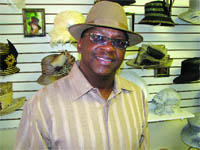
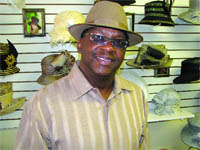
Richard Little wants to match people to hats from those who have never worn one before to absolute hatters who dont leave home without one.
Richard Littles original plan was to open a mens clothing store.
That was the thought process about seven years ago as he was pondering when and how to make the transition from corporate employee (he had worked for Verizon for many years) to small-business owner. But his research told him there was already enough, if not too many, of those establishments in the Greater Springfield area.
However, it also told him something else: that there was a real need for a hat shop to serve both men and women. There wasnt anything like this, he said, waving his arm toward the front of the Brim and Crown shop on White Street in Springfield.
This need was complemented by what Little could only describe as a passion for hats, which hes been wearing for as long as he can remember. I decided that, if I was going to do anything entrepreneurial, it should be something I love. And I really love hats.
Not only that, but he loves matching people, and their personalities, to hats, from individuals who have never worn one before (a large constituency) to those who wear one practically every day a group he calls absolute hatters.
Not everything has gone exactly according to script for Little, who opened the doors in 2005, but, by and large, hes doing as well as he thought he might when he put the Brim and Crown on the drawing board.
Hes been helped by a moderate surge in the popularity of hats, especially among younger professional men (more on that later), and also by the emergence of the Kentucky Derby party in recent years (hats are a mainstay for such events) as well as the race itself, and even some larger special functions like the recent fund-raising tea for Square One; many attendees bought hats from him for the occasion. Meanwhile, hes been hurt by the recession. Im in the want business, not the need business; people dont really need hats, he explained, adding that, in most respects, this is a luxury item.
But its one that has certainly turned into a sound business opportunity.
Like the optician who adorns his shop with photos of models wearing glasses, Little has his walls covered with pictures of people decked out in all types of hats. Many are actual customers, including some who needed items for the Square One tea and this years Kentucky Derby parties. There are also some models, and even a few actors: Frank Sinatra, Dean Martin, and Sammy Davis Jr., in one of the famous scenes from the original Oceans 11, and also Johnny Depp wearing a brown felt model.
Hes not a customer yet, Little said of Depp. But Im working on it.
The current client list includes mostly Springfield-area residents, but there are some from Northern Conn. and others from Boston and other points east. I get a lot of customers from the Boston area, he said. More than a few of them are salespeople out on the road. Theyve heard about me or found my Web site, and they stop by when theyre in the area.
And while clients mailing addresses vary, so too do their wants and, on some occasions, needs. Many women need what Little calls church hats, which are worn regularly on Sundays but also on other special occasions. Meanwhile, more men are deciding that a baseball cap is not the way they want to go, or at least not the only way.
A lot more men are wearing hats now, especially young professionals, said Little. I have a lot of doctors, lawyers, and business people as customers.
Hats will likely never again be as popular as they were decades ago, when men wouldnt leave the house without one, said Little, noting that, contrary to popular opinion, hats were on the way out long before President John F. Kennedy conducted business without one. But they are making something of a comeback.
And there are several reasons why, he said, listing everything from changing fashion trends to a run of gangster movies that bring hats back into focus. Even health issues come into play; indeed, as Baby Boomers age, many of them are hearing their doctors tell them to put something on their head if theyre going out in the sun, said Little.
All this adds up to more of that aforementioned matching of people to hats, he continued, adding that quite a bit goes into this process, from the clients build to the colors they prefer to wear, to the image theyre trying to project.
A hat has to fit someones personality because, while everyone can wear a hat, no one can really wear every hat, said Little, who uses the word hatitude to describe those who make a proper match.
Those visiting the Brim and Crown will find ample opportunities to create a match, with a wide variety of selections on both the mens and womens sides of the store, and a host of well-known brands to choose from, including Stetson, Biltmore, Dobbs, Bailey, and Makins for men, and Toucan, Betmar, Ellie, and Christine Moore for women.
With any luck, this selection coupled with all those trends, from Derby parties to men dressing up more will create more absolute hatters.
George OBrien
Two Venues, Great Diversity Have Global Spectrum Well-positioned
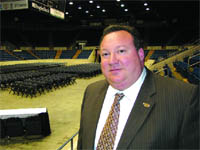
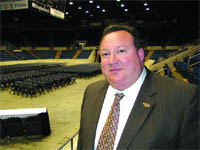
Matt Hollander says a variety of facilities enables the MassMutual Center to book events ranging from small meetings to college commencements to ice racing.
Its called X-treme International Ice Racing, or XiiR for short.
This is, as the name suggests, racing on ice or, to be more precise, indoor ice arenas. Motorcycles and four-wheeled vehicles, both equipped with tires boasting 2,000 metal studs, go from zero to 60 mph in under three seconds.
Theyre not going that fast for long, however, because turns come up quick on an ice rink 200 feet long and 98 feet wide.
Indeed, when asked if XiiR was like a NASCAR event on a tiny, quarter-mile track (like the one at the former Riverside Park), MassMutual Center General Manager Matt Hollander laughed and said, more like an eighth-of-a-mile track.
Hollander got to see for himself in February 2009 and again last Oct. 22, the start to the XiiR 2009-10 season. Subsequent stops were in Erie, Pa., Elmira, N.Y., Independence, Mo., and Dawson Creek, British Columbia.
It was a fun night the fans were really into it, and the action was fast and intense; the bikes have no brakes, Hollander said of last falls races, adding that XiiR is just one of several dozen unique, often once-a-year shows with which the staff at the MassMutual Center fills in dates on the calendar, often with two events a day.
A look at the list of gatherings booked for the period between July 1, 2009 and June 30, 2010 reveals just how diverse the facilitys growing client list is. Theres the Miss Bella Hispanic Beauty Pageant, the Mass. Bar Assoc. House of Delegates Meeting, and the Central Mass. Pop Warner Cheerleading Competition. Theres also the Big Y Annual Services Award Dinner, the St. Johns Congregational Church Seasoned Saints Ministry Holiday Luncheon, the Northeast Canvas Products Assoc. and Conference, and the Commerce High School prom. Still to come, with just a month or so left in the fiscal year, is a meeting of the North American Grappling Assoc., the Kids of Character Awards, and a McDonalds managers meeting.
All this comes on top of events most people already know about: Falcons and Armor games, the Affiliated Chambers annual trade show, the Bay Path College Womens Leadership Conference, and a host of college commencements.
Hollander, who took over as GM in 2006, attributes both the volume and diversity of events to a broad mix of facilities from small-meeting rooms to an arena that can seat more up to 8,000 people (6,700 for hockey); from a ballroom that can seat close to 1,000 to more than 40,000 square feet of exhibition space but also to an aggressive sales team, an area that boasts several attractions, and the ability to build niches, such as a growing number of cheerleading and dance competitions that fill the downtown Springfield streets with young girls in sequined uniforms.
These are events that people wouldnt know about unless they were downtown those days, but theyre huge, he said of the dance and cheerleading competitions, which draw hundreds of competitors, coaches, and family members to Springfield, usually for overnight stays. Theyre just one example of how we try to book events that will have a positive impact for us, but also for the community; a number of downtown businesses benefit when these events come to town.
The same pattern is being followed at the Mullins Center on the campus of UMass Amherst, said Troy Flynn, general manager of that facility since last fall. He told BusinessWest that he has blended a number of university-related events from sporting contests to the Taste of UMass with a number of outside bookings, including a months-long series of meetings of Jehovahs Witnesses and concerts like the one featuring Carrie Underwood in March.
The Jehovahs Witnesses move in in June, and they stay till August, he said, adding that the organization has weekly worship services that draw as many as 7,000 people and help area hotels. We have other religious events, such as Acquire the Fire (Christian rock worship) in October, that blend nicely with student activity-related events that keep us busy all year round.
The two venues give Global Spectrum, the Philadelphia-based public-assembly-facility management company a strong presence in the Western Mass. market and a unique opportunity to grow its book of business here. Rather than compete with one another, the facilities work in a complementary manner and combine to bring a wide array of groups to Western Mass. Some come for a few hours, and some for several days. Most importantly, however, most come back year after year.
For this issue, BusinessWest looks at Global Spectrums twin facilities in the Pioneer Valley, how they work to fill their calendars, and why their success creates opportunities for many area businesses.
Being Frank
Flynn says there was just one casualty.
By that, he meant only one competitor couldnt keep down his body of work in the hot-dog-eating contest staged this spring at the Mullins Center. Otherwise, the event was a quite a success, although a little hard to watch, by his own admission.
Theres also been a chicken-wing-eating contest; that Taste of UMass, which featured a giant, 40-foot sushi roll; athletic events, including those for both UMass teams and other constituencies; concerts; and more, said Flynn, noting that, in this business, facility managers have to focus first on quality of events, which then creates quantity.
This is a corporate-wide philosophy, said Flynn, who cut his teeth at Philadelphias Spectrum (soon to be razed), where his father worked security for years, and where Troy started as change-over supervisor transforming a basketball court into a hockey surface. Hes added lines to his résumé from work in locales ranging from Trenton, N.J. to Split, Croatia, where, while working for Global Spectrum Europe, he coordinated rounds of the world handball championships at the Spaladium Arena.
At UMass, hes working to continue and expand efforts to add booking dates for university-related groups and programs, other area communities (several high-school commencements are slotted for June), and regional and national acts such as Carrie Underwood, Cirque du Soleil Saltimbanco, and Daughtry in concert with Lifehouse and Cavo.
Hollander also brings a diverse CV to his position at the MassMutual Center. Prior to arriving there as assistant GM and eventually moving into the top spot, he was director of Operations for the Palm Beach County Convention Center in West Palm Beach, Fla.; executive director of the Valdosta-Lowndes County Conference Center and Tourism Authority in Valdosta, Ga.; and general manager of the University Center Auditorium at Florida Atlantic University, among other posts.
Through those experiences and his time in Springfield, he says hes learned that there are several keys to success in this business. The first is to cast a wide net and not overlook any opportunities to fill in lines on calendar dates. This means taking prestigious events like college commencements and national ice shows, but also the giant liquidation sales (often booked last minute) that fill the exhibit hall and certainly help on the bottom line.
But while garnering new business is always a prerequisite for success in this sector, gaining repeat business is also a must, and this means providing quality customer service that brings a group back. Also key is developing a reputation for successfully staging certain kinds of events, he said, which has led to the MassMutuals ability to book a number of dance and cheerleading competitions.
If people are well taken care of, theyre far more likely to come back, and also talk about their experience with others, he said. Thats why, when teams and groups are here, we make sure that they are taken care of, and that every need and concern is addressed.
This brings both Hollander and Flynn to the phrase How You Doin? which doubles as Global Spectrums marketing slogan (its printed on posters in several places within both facilities) and its customer-service philosophy.
That question is asked early and often doing the course of a groups event, said Flynn, adding that, by listening closely to the answers, the staffs at both venues can not only meet but exceed expectations, and thus drive repeat business.
Overall, the MassMutual Center has booked between 100 and 125 events in its arena in each of the past five years, which is a good number for this market and that size facility, he said, adding that he and his staff are helped by having two professional sports teams the American Hockey Leagues Falcons and the NBA Developmental Leagues Armor as well as several colleges and those aforementioned dance and cheerleader competitions.
Meanwhile, a similar number of events have been booked for the exhibition space, which can be subdivided in a number of ways, he explained, and thus can accommodate events of all sizes.
The goal with both the arena and the exhibition space is to take advantage of both the venues assets and the regions strengths to not only stimulate bookings, but create long-term customers.
The destination plays an important role with certain types of business, and the venue plays an important role with other kinds of business, he explained. With the cheer events, we find that the keys are accessibility were easy to drive to, and the hotel rates are reasonable and the services that we offer at the venue, as well as the fact that we have the exhibit hall to support the event in the case of the larger competitions.
Those elements combine to make this attractive for those kinds of groups, he continued. When we get into convention marketing and that type of thing, the specific needs of the organizations and what theyre looking to achieve all play a part in where they go. And once they establish a relationship with a venue thats been successful for them, they tend to be very loyal to the venue.
Therefore, creating the experiences that trigger such loyalty is the unofficial job description for facility managers, said Flynn, who noted that the Jehovahs Witnesses have been coming back for several weeks of conventions for many years now, and are booked through 2016.
Gaining Traction
X-treme International Ice Racing isnt the only motorsports event staged at the MassMutual Center. Indeed, the venue also plays host to an FMX, or freestyle motocross, competition, said Hollander, adding that the ice racing is the one that can get him and others to shake their heads.
Theres no word yet on whether the XiiR will be back for the next season, but the expectation is that it will. The races drew well, and, by most all accounts, the answers to the question how you doing? were generally positive.
The formula for success in this highly competitive business is much more complicated than that, said Hollander and Flynn, but, in many ways, thats what it boils down to.
George OBrien can be reached
Bing Restoration Project Takes a Major Step Forward
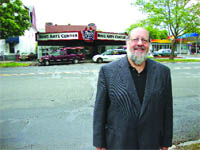
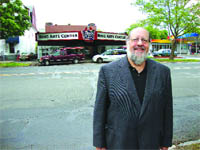
Brian Hale says great strides have been made to breathe new life into the old Bing Theater.
Brian Hale remembers a time when a rainy Saturday would have packed all 900 seats in the Bing Theater on Sumner Avenue, near the citys X.
My friend and I came to see Day of the Triffids and Fun in Acapulco, with Elvis, and it was so crowded we couldnt get seats even near each other, he said. It might not have been those two movies that led them back to the defunct theater years later, but both men are now board members of The X Main Street Corp. (XMSC), which owns the rechristened Bing Arts Center.
With the sounds of hammers and saws punctuating the conversation, Hale told the story of how the 1930s gas station known as Cossabooms Service Station on Sumner Avenue was transformed into Forest Parks portal to Tinseltown, and became the place to be for the postwar Baby Boomer generation. The future of the Bing Arts Center, he said, has just as an important a role for arts and culture in the city.
The big theater space out back is still far from a return to celluloid spectacles, but for now, the front section of the building is completely refurbished and has been slowly but steadily hosting arts-education classes, movie screenings, and, very soon, its inaugural arts show.
With a soft opening planned for June 5, Hale, board president of the XMSC, plans to introduce the community to what the XMSC calls a place which will enable our citizens of all ages, ethnic groups, genders, orientation, and economic status to gather, experience, and build the unifying bonds of civilization and community that active participation in the arts can and will provide.
I live a couple miles away from the Bing, and almost every time my wife and I drive to go to see a show somewhere, we drive right by the Bing, he added. We are not alone in thinking how important it is to have something to keep people here.
Hale took BusinessWest on a tour of the Bing and, with opening day just a short while away, projected his plans and hopes for the future of art and culture not only for Forest Park, but for Springfield and the surrounding area.
X Marks the Spot
In the freshly-painted room destined to be an arts classroom, Hale described the early history of the Bing. They turned the front of the building into two storefronts, built the theater on the back, and named it after Bing Crosby. It showed films from 1950 through 1999, opening with Samson and Delilah, and ending with the remake of Psycho. Hows that for a programming arc? he said with a smile.
After 50 years, the city took over the property for non-payment of taxes, and the neighborhood theaters house lights dimmed for the last time. Suffering from neglect and lax security, the building was fortunately spared the fate of many other defunct urban theaters.
Honestly, though, I think the city would have torn it down if it had the money, Hale said.
However, Springfield put forth an RFP for redevelopment of the site, and one interested party intended to transform the theater into an arts center, but the scope of the project was just too great.
In 2002, the XMSC took control of the project. A nonprofit entity that Hale described as one of many Main Street-type redevelopment organizations around the country, the group immediately saw the importance of the history, location, and potential of the Bing Theater.
The X used to be a fantastic urban retail district, native son Hale explained. More than 26,000 people live in Forest Park alone, with another 4,000 to 5,000 in East Forest Park. If you draw a five-mile radius around the Bing, I dont even know its probably 60,000 people. And completely diverse, too from Section 8 to millionaires, all ethnic groups.
We knew that, to have a true community arts center in Springfield, he continued, this is the place.
And so the XMSC sunk its teeth into the project, he said, and in true community fashion with help from residents of that neighborhood.
One of those people, who happened to be painting the interior that day with his crew, was Mark Checkwicz, owner of a high-end commercial painting and restoration company in the city. He is one of the many people generously donating his time, resources, and manpower to see the BAC open on time.
He lives just down the street, Hale said, and has been involved with the project from the beginning.
Which was a project of titanic proportions.
The first winter we took the building, Hale said, literally the lobby floor was covered in ice, and there was a frozen waterfall cascading from the ceiling, which encased the electric panel. In order to make handicapped-accessible bathrooms in the front, we had to jackhammer out the slab floor.
After installing entirely new HVAC and electrical systems, gut-framing and re-insulating the front section of the building, and assessing the non-structural damage to the large theater in back, Hale joked that his day job owning and operating Design Workshop in Indian Orchard might be supplanted by his role as de facto general contractor for the Bing.
Getting the front section of the BAC in shape is what he calls phase one, allowing for gallery space, art-education classrooms, and a modest performance space that will ultimately serve as the lobby for phase two, the larger theater.
The first exhibit, with work from three well-known area artists, is titled Upcycled: Transforming the Unused into the Inspirational. Featuring found-object sculptures, Hale said it is definitely fitting for the first show.
Some concerts have been staged in the lobby/entryway area, and that space is destined to be the ad hoc theater showing first-run arthouse films some time after the June opening.
Walking around the finished gallery and front section of the Bing, Hale said, Id say that the scope of the project has exceeded my expectations by a factor of three.
Previously, I had been thinking, maybe $100,000 could get the front open, he continued. But then again, we were going to try to reuse a lot of the systems the heating and such.
Then I had a conversation with Dave Panagore, he continued, referring to then-chief financial officer of the Springfield control board, and he said, youre just not going to get there if you dont do it right. People will recognize the difference.
Altogether, the BAC renovation has come to just under $300,000, and Hale said, I think weve done very well with that.
Go Ahead, Make My Day
Hale doesnt mince words when he assesses the importance of a cultural center for the neighborhood. Arts education really is pathetic right now, he said.
While the theater component to phase two is important, providing a venue for film and performance that will easily compete for first-rate offerings, Hale is most thrilled by the possibility for art and culture to come to the citys newest generations.
Weve started a collaborative partnership with the White Street School, two blocks down, which had no art programs for the kids, he explained. So we started two classes, a movie-production class, and an art-through-many-cultures program on Saturdays.
Some people go, well, until you get the theater open, who cares? he continued. Regularly, though, there will be art on the walls, there will be all-ages educational programming going on, performance programming, neighborhood groups can use the space for meetings. We want to support the neighborhood economically with this presence.
Citing an untapped cultural presence in the city, Hale said that theres no scene per se; theres no hub for people to make contacts. I know some amazing visual artists here in the city, some musicians also. But they are low-profile because they go to Boston, or New York.
The benefits from an arts center transcend the immediate function of movies and a gallery, he said.
Its the creative economy that is our best hope as a city, he explained, and it doesnt require a great deal of money to make it happen. Were not going to get big retail in this neighborhood; were not going to get large-scale manufacturing in the city.
Ive often referred to this as the cool neighborhood program, he continued. If you make this area culturally attractive, then youll get people who want to come here, spend money here, and live here.
The Show Must Go On
While phase one opens the doors this month, the theater out back will have to wait a bit.
People keep asking about the big room in the rear, Hale said, because everyone is just dying to know when well get that open.
Like a seasoned GC, Hale added, I tell people, its not when, its how much. Its all about the dollars. If we had the money, we could have it open in about a year, but were working on the actual plans, thanks to the pro bono work of a well-known local architect. Hopefully by summer we can have those finished so we can put a budget to it.
The XMSC hired a fund-development firm, the Hedgepeth Group, to assist with that capital campaign. Word will soon be out on the target figure for that project.
Hale estimates that the total bill will be anywhere from $3 million to $5 million, but that is a turnkey look at the theater, programming, and all expenses necessary to get the show back on the screen and on the stage.
For the more immediate future, the BAC is up and beginning to fill that expressed void as a catalyst for an increased art presence in the city.
Its a missing piece here in the city, Hale said proudly, but its finally falling into place.
Slice California Caf? Looks to Rock in a Resurgent Holyoke
Chuck Hebler believes in the revitalization of Holyoke, and hopes Slice can be a part of it.
Chuck Hebler toured with some of the biggest names in rock n roll. Today, he wants to be part of something big in Holyoke.
We were one of the first backstage caterers that toured with bands back in the 1980s. We would go from city to city with a band, said Hebler, who first prepared meals for musicians on the Rolling Stones Steel Wheels tour in 1989 and followed that with the U.S. tours of the Beastie Boys and Nirvana, among many others.
Hebler left the road in 1997 to settle down in his native Berkshires, opening the successful Napa restaurant in Lenox. But he was eventually drawn to downtown Holyoke specifically, the growing Open Square development in a row of former mill buildings where he opened Slice California Café last year, serving and delivering breakfast and lunch, with an eye to expanding to dinner service in the future.
The goal is to take this from an obscure café in an obscure area and develop it into a Napa, he said. I want people to appreciate what Im doing here and expand it as Holyoke expands.
I feel like Im in the right place at the right time, he added. Open Square will develop over the next 10 years, and were going to be part of that development.
As part of its annual Restaurant Guide, BusinessWest takes a look at Heblers former life on the road and his plans for the future in a city he believes in.
Thats Entertainment
Hebler grew up around show business; his family did prop and wardrobe trailer rentals for ABC Studios in Los Angeles, and he spent a lot of time on TV sets.
I saw the caterers on set, and I got interested in catering, the backstage side of it, he told BusinessWest. But after graduating from culinary school, he turned to a different side of entertainment, cultivating opportunities to tour with rock bands as their backstage caterer, beginning with the Stones.
He wasnt working directly for bands, but for production managers who represented a host of acts and once that relationship was established, the sky was the limit. Hebler collected plenty of memories during those years, and also an appreciation for the professionalism of the artists who sat at his table.
Mick Jagger liked steamed whitefish, steamed rice, steamed vegetables, he said. Red wine and white wine, but nothing in excess. He was super fit and had a personal trainer not surprising for someone who has since fronted a rock band well past middle age. Hebler also praised Jaggers bandmate Keith Richards as the nicest performer and most sincere person I worked with. He notices everyone, and hes one of the truly genuine people.
But he had similar words for a host of other artists Billy Joel, Elton John, Kurt Cobain, Jerry Garcia, David Bowie, and Carlos Santana among them and said most veteran stars are far more human, easygoing, and grateful than their public image might suggest. He recalled staying late after a Fleetwood Mac concert for an after-show dinner, and Christine McVie sent his staff a case of shirts and hats as thanks. Its 99% fun stories, he said.
Everyone in the industry realizes that, to keep your success and longevity, it humbles you. To hold on to what you have, I believe that humbles you. As soon as you start acting like, hey, Im a rock star, then youre fading, youre a one-hit wonder.
On the contrary, the artists he worked with tended to be down-to-earth, Hebler said, remembering how Neil Diamond sans toupee, cigar in hand, wearing a robe and Gucci slippers would come around and ask, Chuckie, what are we having for dinner tonight?
When he wasnt touring, he had plenty of opportunities to cater individual shows in the LA area, as well as for companies like Universal Studios and Western Digital.
But when Heblers daughter was ready to start kindergarten, he wanted to shift gears and settle down to a more consistent lifestyle. So in 1997 following a catering gig at the 30th-anniversary Woodstock festival in New York he bought a building in Lenox and turned it into Napa.
Taste of California
We wanted to have some stability, he said, and he found it along with success, in the form of steady business at Napa for 12 years (with $1 million annually in sales) and an A rating from Zagat.
Napa was a medium-priced restaurant, with entrees selling between $14 and $26, and characterized by the California cuisine he was taught on the left coast. Its things like fresh salsas, avocados, seafood items, Cal-Tex food which is Mexican-style food with a California twist and regional foods.
In fact, the emphasis on local foods that characterizes many restaurants in Western Mass. is a trend that began in California in the late 70s and early 80s, Hebler said, and its an ethos echoed in the Berkshires, as well as the Pioneer Valley.
This region is amazing for its resources for local meats and local produce, he said, adding that hes in the process of choosing a local family farm with which to partner on vegetables for Slice. When his venture expands to a dinner menu, he hopes to get as much pork, beef, and chicken locally as possible, too. I really want to be that kind of restaurant.
But he also wanted to be part of something bigger. And when John Aubin, owner of Open Square, pitched him an open space, he was intrigued by the possibilities.
He explained the area and whats going on down here, and it was exciting. It seemed like something that was really starting to take off, Hebler said, citing developments like the coming high-performance computing center and other ongoing efforts to breathe new life to the nations first planned industrial city.
John has a vision, and were part of that vision, Hebler said. Were trying to live the Open Square dream, so to speak.
And he believes that small steps can make a big difference in a city, citing the Colonial Theatre in Pittsfield, whose redevelopment was a catalyst to bring the whole downtown to life. He sees similar potential in the ongoing restoration of Holyokes Victory Theatre.
When that happens, he said, youll see a nice flow of customers from outside Holyoke, and I think thats going to be beneficial to this whole area, and more restaurants will start popping up maybe even restaurants that are tired of paying huge leases in Northampton, and want come be a part of whats emerging here.
He doesnt think Holyoke will ever replace what Northampton brings to the region culturally and culinarily, but he believes its story might mirror what happened in the Paradise City, which was lined with empty storefronts only a generation ago.
This would be such a complement to Northampton, he said, and everything in between is some of the best real estate in Massachusetts, and a great lifestyle.
And Hebler is feeding those taking part in that rebirth, offering soups, sandwiches, burgers, salads, quesadillas, and daily specials ranging from pot roast to baby-back ribs all marked by that emphasis on fresh ingredients he learned long ago in California.
Rocker at Heart
Hebler hasnt sworn off the rock n roll lifestyle forever. Since settling in Massachusetts, hes catered one-off shows for the likes of Tom Petty, Jackson Browne, and Bruce Springsteen not to mention the Pope during his visit to Giants Stadium and was offered a gig on the last Red Hot Chili Peppers tour.
He turned that down, choosing instead to continue focusing on cooking locally. But, having maintained connections with tour managers in New York and Boston, he doesnt rule out future possibilities.
You never know, he said. I could become a delinquent again. My midlife crisis.
For the time being, I want to develop this into something nice, he said of Slice. We have our great little breakfasts, lunches, and lattes, but thats just the beginning. We need to keep on our game.
Sales were adequate to sustain the endeavor over the first year, and as the customer base grows through word of mouth, Hebler is cautiously looking to the future not just of Slice, but of Open Square and the vitality it could lend to this city.
We have a seed in the ground, and were expecting it to grow, he said. No one knows what will happen next, but its been a pleasant surprise so far.
For those invested in Holyokes future both literally and figuratively thats a slice of good news indeed.
Joseph Bednar can be reached
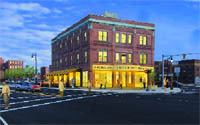
AIC Becomes Preferred Developer for Mason Square Revitalization Effort
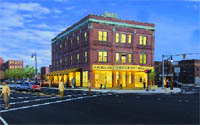
An architects rendering of the potential re-use of the Mason Square fire house.
Springfield Mayor Domenic Sarno calls the architects rendering of the proposed redevelopment of the Mason Square fire station and adjoining structures stunning.
And hes right.
Drafted by Centerbrook Architects in Centerbrook, Conn., the rendering depicts the fire station, vacant since the mid-80s, as a center of activity and commerce. It lights up the whole area, Sarno said of the facility in the image, which will feature a cyber café; the American International College radio station, WAIC; and other campus facilities. That fire station could become the iconic building that epitomizes continued redevelopment of the State Street corridor.
Sarno, like other elected officials, knows its not wise to get carried away with slick renderings of redevelopment projects that may never materialize, but in this case, hes apparently done exactly that. And he chalks it up to his excitement with what could happen in Mason Square now that AIC has been granted whats known as preferred-developer status for a complex that includes the fire station and the adjacent former Indian Motocycle building.
The college now has 135 days to do some additional due diligence on the parcels in question and decide whether and perhaps how to proceed, said John Short, AICs vice president for Institutional Advancement, who acknowledged that it may be a while before anything remotely resembling whats depicted in the rendering becomes reality. But he told BusinessWest that this scene could become reality if that assessment period ends with positive reports and the college is confident it can acquire the funding for the initiative.
Theres a lot that we have to look at, and it could all come together, he said. Were trying to continue what Congressman Neal has done [the federal courthouse project and extensive streetscape work along the corridor] and what the city has done in terms of revitalizing the area. I think this would be a huge step; this could be very exciting.
The properties in question are known as Indian Motocycle A, Indian Motocycle B, and the Mason Square Fire Station, as designated in the request for proposals (RFP) issued late last fall. AICs was the only proposal submitted.
It calls for development of all three properties, meaning the undertaking of needed improvements to parcel A and bringing more housing units onto the market in the occupied portion of the former manufacturing complex; finding new uses for parcel B, which has some environmental issues; and brining new life to the long-dormant fire station.
MassHousing owns parcel A, while the city of Springfield controls B and the former fire station, said John Judge, chief economic development director for the city, adding that the two entities partnered in the RFP to present a larger, more-attractive development opportunity.
For AIC, the project represents an opportunity to expand and enhance its facilities, while also taking a lead role in revitalization efforts in Mason Square and the broader State Street corridor, said Short. Meanwhile, for the city, the project represents a chance to find a remedy for property that has been a source of continual frustration for nearly 30 years.
And if AIC does proceed as planned, it will represent only the latest example of how area colleges have become engines of economic development, as Sarno called them, in neighborhoods across the Valley.
Were playing to our strength, our colleges and universities, said the mayor, noting that several schools, from UMass Amherst to Westfield State College to Springfield Technical Community College and others, have played pivotal roles in efforts to revitalize neighborhoods and create jobs.
Sarno said that, early in his first term (he was elected in 2007), he saw first-hand the impact Trinity College had on revitalization efforts in Hartford through public-private partnerships, and committed himself to duplicating such efforts in Springfield.
UMass Amhersts plans to locate one of its departments in Court Square is an example of such redevelopment, he said, while AICs RFP submission could change the face of another neighborhood. And the real hope, expressed by all those involved, is that, if AICs proposal becomes reality, it spurs additional activity along the State Street corridor.
Plans are still quite preliminary, said Short, adding that they are likely to become more firm over the next few months.
Key elements of the proposal involve continuing the current mix of housing in parcel A (involving area residents and some overflow student housing) and bringing more units onto the market, especially market-rate units. In B, several options will be considered, said Judge, including more housing and perhaps incubator space that may complement existing startup space at STCC.
As for the fire station, plans for the cyber café are preliminary, said Short, citing the apparent need for such a facility on the campus and in the community. The schools radio station and other Communications Department programs could go on the second floor, while a host of options will be considered for the third, which features some dramatic views of of downtown Springfield and Mason Square.
Like parcel B, the fire station has some environmental issues, said Short, adding that, by the end of the due-diligence period, the school should know if they can be overcome.
Preliminary price tags are only guesstimates, Short continued, adding that the fire-station portion of the project alone could reach $4 million to $5 million.
The school will obviously need to tap into a number of funding sources to meet that cost and others associated with the project said Short, and finding those sources is part of the due-diligence process.
What people have to remember is that were a college; were a nonprofit. We dont have a lot of money, and were not a private real-estate developer, he told BusinessWest. One of the issues with parcel A has been companies coming in, taking large fees out on the front side of the deal, getting tax credits over a period of time, and then they stop taking care of the building; thats happened several times over the past 25 years.
Were not in that position, he continued, so we have to do this in partnership with the city and with the state, and find sources of money that make it economically feasible for the college to do.
In other words, no one can say with any certainty whether the architects rendering that has so intrigued the mayor will become reality, but its clear that it represents by far the best hope for the Mason Square area in some time.
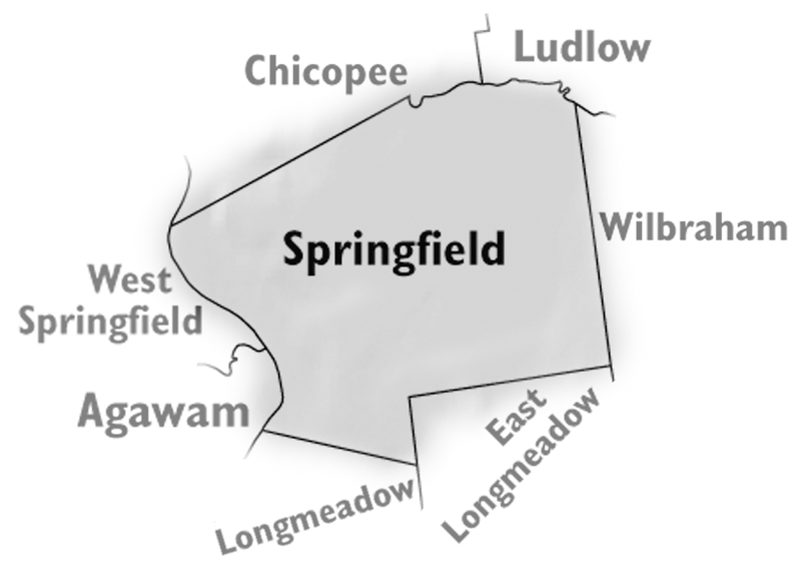
Officials Say City Is Positioned for a Comeback
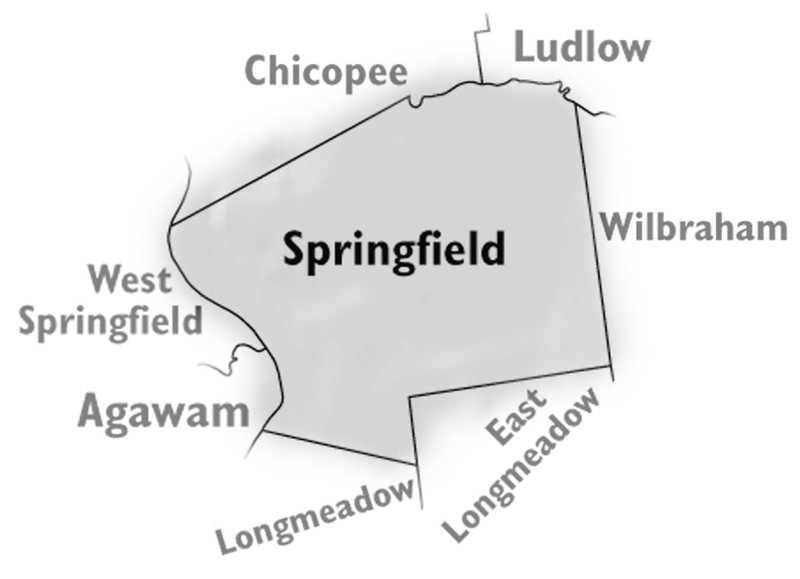
Springfield, Mass.
As president of the Affiliated Chambers of Commerce of Greater Springfield, Denver knows that a lot of work needs to happen in the city he’s called home for most of his life — and, for all but four years since 1980, where he’s worked as well. But some of the biggest points to address can’t be solved quickly by a shovel in the ground or a ribbon-cutting ceremony.
Like many others who talked with BusinessWest, he said that there’s a perception of Springfield’s safety and vitality that isn’t supported by hard evidence.
“Springfield is a big fish in a little pond,” he explained. “What happens is that the city gets magnified. For instance, do we have crime? Yes. But if those same statistics were reported in Boston, no one would even notice it.”
Addressing the empty storefronts downtown, he said, “I’m going to put a different spin on things. If you go around, you see a fair amount of vacant office and retail space. Well, that’s an opportunity, rather than a challenge. As things start to turn around, we’re going to have the locations ready so that people can move right in.”
Such glass-half-full enthusiasm is expressed by others as well.
Springfield’s chief development officer, John Judge, said that during the current down market, City Hall has been strategically addressing both strengths and weaknesses in order to make strides when the economy rebounds. He said that working toward a “21st-century downtown” is at the top of his priorities, and while the to-do list is not short for that goal, a few achievements have already been checked off as underway or complete.
In this, the latest installment of its Doing Business In series, BusinessWest takes an indepth look at the region’s unofficial capital. While there are problems shared by most every municipality across the nation after a couple of tough years, Springfield has had some of its own dark spots that are now relegated to the history books. The Finance Control Board left just under a year ago, turning the city’s red ledgers back on track, and in the recently-released budget for fiscal year 2011, Mayor Domenic Sarno unveiled plans for increased hiring in the public-safety departments and a priority for “strong and effective fiscal management,” according to the report written by Lee Erdmann, chief financial officer for the city.
Talking with various officials, a picture emerges of a city that has been maligned for what it both is and isn’t. And in the coming months, some of that will be changing, helping to drive home a important message, said Judge. “We’ve got to make sure that everything we do says that Springfield is open for business.”
The Center of It All
Denver identified one historic roadblock for business development in the city: a lack of developable real estate.
“But I think that a lot of people have done some great work, and now there is land for new construction,” he countered. “You have property at Smith & Wesson, Chicopee River Business Park, in Indian Orchard, for light industrial. So now, there’s plenty of land out there for new tenants, or for expansion and new buildings.”
Those commercial properties have been in good shape in the last year, and these pages have reported with due fanfare the addition of several big-ticket incoming businesses like Performance Food Group and the F.W. Webb Co., among others.
While those outlying properties are marketable and in the spotlight, downtown can also share some of that limelight. Denver called the four-acre York Street Jail site along the Connecticut River a “home run,” increasing developable land along what is rapidly becoming a true destination, featuring several popular restaurants bracketing the Basketball Hall of Fame.
He shifted his focus to the central business district, the area loosely defined by State Street and Court Square to the south up Main Street to the property north of the train station. “If there is only one thing that happens in 2010,” he said, “filling the vacant federal building is an absolute winner.”
Nick Fyntrilakis agrees. As the assistant vice president for Community Responsibility for MassMutual, he has been working closely on a variety of projects for the city, his hometown. He called the return of occupants to the federal building at 1550 Main Street “a key to revitalization for that section of the city.”
Plans are underway for the Springfield School Department and Baystate Health to become anchor tenants in the structure, turning the lights back on in the prominently located building that has been vacant for more than a year.
“One of the impacts from 9/11,” he explained, “is that the building was cordoned off from the street with Jersey barriers. Before that, the building was accessible via airwalks to Tower Square, it was accessible to the parking garage behind it, Uno’s was right next to CityStage, and it was a very active night spot. But all of a sudden, you lost those people that weren’t there having dinner, and the building became this real island, an air bubble of inactivity, really.
“Not only will the building in use again mean bodies downtown,” he continued, “but it flips the switch to make it another welcoming section of the city. I think the barriers and the access really had an impact on the psyche of that section of Main Street.”
Accentuate the Positive
Fyntrilakis said MassMutual is heavily invested in seven major revitalization initiatives in the city, four of which are moving “at various speeds and progressions.”
“The Corridor Storefront Improvement project is off the ground,” he continued. “Some grants were awarded last week, and you’re going to see more of that in the future. Basically any storefront along Main or State streets can receive up to $10,000 in grants, with a $2,500 match from the owners, to go toward improving their storefront — awnings, lighting, what have you. You’ll start to see pockets of those pop up.”
In addition, he mentioned projects at the former Indian Motocycle complex, market-rate housing at the building on State Street soon to be vacated by the School Department, infrastructure improvements along the State Street corridor, and the revitalization of Union Station for high-speed commuter rail.
While these are projects that will provide a much-needed boost in the right direction for retail and market-rate housing — two fundamental concepts for urban vitality — Fyntrilakis said that there are still specific, important building blocks that need to be addressed. In his opinion, the historic building at 31 Elm Street, directly across Court Square from City Hall, is a project whose importance can’t be understated.
“That property could potentially impact so much,” he said. “Moving north across Court Square, then to the MassMutual Center side, the lower part of State Street, and the beginning of the South End … getting that project online in some shape or form is absolutely critical.”
From a commercial real-estate perspective, William Low said that progress and revitalization at Elm Street “needs to happen.”
Low, senior vice president at NAI Plotkin on Taylor Street, said that, if that property is redeveloped, it will fundamentally change the landscape in downtown Springfield.
For reference, Low mentioned projects in Pittsfield that could very easily be duplicated for the vacant space, saying that, if it could happen there, Springfield can’t be far behind.
“Pittsfield has done a good job of revitalizing its downtown,” he began. “On the ground floor, you essentially just give away the real estate, just getting those spaces filled. Every time a third-tier city tries that, it works. Go to Pittsfield now and see how well it’s worked.
“Five or ten years ago,” he continued, “people in my business weren’t even considering that city. But now they are.”
Echoing just about everyone with an informed opinion, Low said that market-rate housing is of the utmost importance to foster a vibrant downtown economy. “And give them a reason to live there,” he said, counting off galleries, shops, and entertainment venues, “most of which are already here,” he added.
Citing the Quadrangle museums, Symphony Hall, Center Stage, and the MassMutual Center, he shrugged and said, “if housing has made a difference and has worked in other cities with so much less to offer, then it certainly could happen here.”
Denver said that, by realigning the income demographic for downtown with market-rate housing, the retail that consumers have long expected for the city might be a reality, but not until there are those numbers to support them.
“People complain sometimes about the type of retail that comes into downtown,” he said, “but look at the income demographics. No one should be expecting that Nordstroms will be coming to downtown — the market doesn’t support that. But should we be looking at the Gap or Old Navy types of stores, and start reaching for things like that? Absolutely.”
Eliminate the Negative
An important facet to reining in that desired demographic will be to change some perceptions concerning the downtown area. Low said that, when all one hears on the news are stories of violent crime in Springfield, the downtown becomes the symbolic hub for all of those ills.
“Sure, there’s crime in Springfield,” he said. “But it’s not in the central business district. The reality is that once you’re here, it’s nothing that you are even aware of.
“Having said that,” he added, “I would like to see more of a police presence. Every once in a while, you’ll hear talk about some kind of criminal activity, and for the next few days you’ll see police on the streets, walking around. I wish they would just stay there. That negative perception is a genuine challenge for the retail and restaurant sectors.”
From his desk at the chamber, Denver said that one of the biggest hurdles the city needs to address is the commercial real-estate tax rate, the highest in the state.
“We did a study that we handed to all city councilors last year showing that, consistently, for similarly sized properties in similarly-sized industries, you pay a higher per-foot real-estate tax than in any of the surrounding communities,” he said. “That needs to be addressed first and foremost.
He cited tax increment financing that was made available to a number of large commercial ventures in the city, among them Performance Foods, Titeflex, and Liberty Mutual. “My point to the city is that, if you can give those tax breaks — and I’m very happy you did — what about everyone else?” he asked.
Put into context, however, these hurdles don’t overshadow his feeling that the city is positioned for a comeback.
“I’m of the belief that there is a lot of good already going on downtown,” he said, “There have been nights this past winter where you had Symphony Hall sold out, CityStage sold out, and the Falcons with 5,000 people. Those people do go to restaurants, and there is the possibility that they could support strong retail.
“The product is there,” he added, “and it’s good. We need to make sure it continues to be good, and people will come.”

Transit Company Exec Is Driven to Succeed

Peter Picknelly, president, Peter Pan Bus Lines
Each week, it’s a different restaurant, all within roughly 45 minutes of their home in Springfield, and Peter’s in charge of picking the venue and, essentially, providing the surprises. They come in the form of usually smaller, lesser-known establishments that he finds via a combination of referrals and exhaustive research.
Through that mix, he has found such gems, as he calls them, as the Mill at 2T in Tariffville, Conn., the Trattoria Rustica in Pittsfield, and Cavey’s in Manchester, Conn., all of which have made his very-much-unofficial list of favorites. “We get a kick out of finding new ones, and try not to go to the same one twice in a year,” he said. “And we hardly ever miss a Friday — only if there’s kid issues.”
Picknelly, third-generation president of Peter Pan Bus Lines, the regional transit business started by his grandfather, Peter C. Picknelly, is quick to point out that, while he’s ventured far out of the Springfield area to find new places for date-night dinners, he’s still quite partial to established eateries in and around the City of Homes. “I’m at the Fort five days a week for lunch,” he said, acknowledging that he’s exaggerating slightly, but that on those days when he’s not at that downtown Springfield landmark, he’s at one of several other nearby restaurants.
And he’s almost always there with a manager from Peter Pan Bus Lines, either a direct report or one of another few dozen department administrators. These are working luncheons for the most part, and, for Picknelly, learning opportunities.
“I bring a list of things to discuss,” he told BusinessWest. “We talk about business and family. I never leave without some tidbit of information that helps me understand the business better.”
All this time in restaurants serves to help Picknelly better focus on the two most important aspects of his life — family and the family business (the community and service to it would place a close third) — and to do what he thinks he might do best: plan.
“I’m definitely a planner,” he said, adding that this goes for his family, Peter Pan, and a host of other business ventures with which he’s involved. “And with the family, it’s vacations that I love planning; I know where we’ll be vacationing a year from now.”
That would be Tuscany in Italy, the first European excursion for the family as a unit, meaning Peter, Melissa, and their four children — Lauren and Alyssa (13-year-old twins), Peter (that’s Peter D.), 10, and Olyvia, 7. Together, they’ve been to several spots on this side of the Atlantic, including the Bahamas, Mexico, and, most recently, Costa Rica.
‘Planning’ is a term that may also be applied to Picknelly’s affinity for high-end sports cars — very high-end. The burgundy Ferrari F4-30 (license plate: PETER) now in the Peter Pan parking lot will soon be replaced by the Italian automaker’s 2010 4-58 Italia model, this one blue, and, reportedly, the first one in New England.
Picknelly, who says he’ll get nearly what he paid for the F4-30 when he turns it in, has owned a variety of fast cars over the years, including a few Lotuses and Jaguars, choices far different from his father (the late Peter L. Picknelly), who was, as most in the region know, partial to Rolls-Royces.
“I can’t see me driving one of those,” said Picknelly, adding that he hasn’t emulated his father in several other ways — he believes he’s a much better delegater and family man, for example — but took a number of life and business lessons from him.
BusinessWest will elaborate on those and other points as it continues its Profiles in Business series with a look at someone who’s a driving force in local business and the community — literally and figuratively.
In the Clutch
As he talked about the many nuances of life in a family business, Picknelly noted that there are advantages and disadvantages, and they often go hand in hand.
He acknowledged that many people look at second-, third-, or fourth-generation managers of family businesses and conclude that things have been handed to them, and that they are perhaps not as worthy of praise for their exploits as someone who started from scratch and built his or her own company.
“And there’s something to that, certainly,” he noted. “I wouldn’t be where I am if it wasn’t for my father and grandfather; I know that I’ve been incredibly fortunate. If you were to go out right now and hire a president for Peter Pan, I’m not sure I’d make the cut.
“That said, I’m quite sure that you couldn’t find anyone who would work harder in this job than me,” he continued, adding that part of what drives him is that recognition of the fact that, to many, it’s simply his last name that is responsible for his title and success.
“It does push me a little harder,” he told BusinessWest. “It’s when people say I can’t do something that I try to prove them wrong.”
While Picknelly says he’s been helped by the Peter Picknellys who preceded him, he’s had to earn his stripes. And that meant starting at the bottom, which, in the bus business, means cleaning, or ‘dumping’ (that’s the technical term), the toilets in the back of the vehicles.
“Yeah, I did that — I’ve done just about every job in the company,” said Picknelly, noting that he started working in the garage on weekends and during the summer when he was just 13. He would later go on to take a number of different positions, from dispatcher to manager of the company’s then-much-smaller Boston operation when he was a student at Boston University. Years ago, he actually drove a bus on occasion when the company was short-handed and needed someone, but hasn’t done that for decades, and couldn’t now because his standard Class 2 license wouldn’t credential him to do so.
He kept moving up the ladder, and eventually assumed the title of president several years ago, when his father became chairman.
Over the past several years, he’s strived to continue growing Peter Pan, even in the face of mounting competition from new carriers, and even improved rail service to many cities the company serves.
“The business has changed considerably over the years … it is more competitive now than perhaps it ever was,” he said. “We just have to put ourselves in a position to succeed.”
As Picknelly mentioned, he took a number of life and business lessons from his father, and far more of the latter than the former. One of the keys from that realm was achieving diversity in one’s business portfolio, as a hedge against the vagaries of the economy and society in general, he said.
The younger Picknelly has accomplished this through both acquisition and new-business development. In the first category are purchases of companies including Camfour, a firearms distributor based in Westfield; Belt Technologies, an Agawam-based maker of metal belts and pulleys for several applications, including aerospace, medical equipment, and food processing; another firearms distributor in Austin, Texas; and a woodworking company based in Connecticut.
As for new business development, Picknelly, in conjunction with Greyhound, started a second transportation-based operation, called BoltBus. Designed as competition for so-called street-corner operators who offer low fares and few, if any, frills, BoltBus, which features more leg room and WiFi, among other amenities, has been an enormous success, said Picknelly. With runs to and from several large Northeast cities and New York, the carrier is boasting 80% capacity for all its runs, about one-third higher than the average for the industry.
Meanwhile, Picknelly has started a real-estate operation, called OPAL, an acronym that takes the first letters of his children’s names, in reverse order from when they were born.
Among other initiatives, OPAL is the main developer of the intermodal transportation facility taking shape in an old downtown fire station in Holyoke. It will feature a bus terminal, a two-story learning center to be operated in conjunction with Holyoke Community College, and a Head Start facility.
The value of such diversity was clearly on display during the recent economic downturn, said Picknelly. “Belt Technologies has been a victim of the economy,” he said, “but Camfour had its best year ever. Now, Belt is starting to pick up a little, and Camfour is slowing somewhat. My father always used to stress the importance of diversity, and I’ve learned that lesson well.”
But while Picknelly has emulated his father in many regards, from most business philosophies to work within the community, he’s written a much different script in what he considers the most important realm — family life.
“My father always used to say that if he had to do it all over again, he would have spent more time with his children,” said Picknelly, adding that his early years did not include trips to the Bahamas, and probably because of that, he devotes what he considers excessive amounts of time and energy to family.
“It’s very important to me; I love being a dad,” he said, adding that, unlike his father, he doesn’t micromanage every aspect of his businesses, and that leaves him time for other, more important things.
In High Gear
A quick look around Picknelly’s office and adjoining conference room provides ample evidence of the forces that shape his life.
There are photos of the generations that preceded him, models and pictures of buses from several different decades, a globe (presumably to help with planning the next family vacation), and several drawings crafted by his youngest child, Olyvia.
Together, they explain what drives him, professionally and personally, to succeed at whatever he’s doing.
Even picking the restaurant for date night.
George O’Brien can be reached at [email protected]
As Key Votes Loom, Palmer Casino Backers Put Their Chips on the Table
Paul Brody says the state needs a casino outpost in Western Mass.
For years now, casino backers, including those pushing for a resort operation in Palmer, have said its a question of when, not if, such gaming operations are approved. Theyre saying it again this year, and with a House vote to support casinos already secured, and confidence that the Senate will follow suit, attention is now focused more than ever on where casinos will be located. Mohegan Sun, which would develop the $1 billion Palmer facility, believes it has a winning hand, because it maintains that the state needs what it calls a Western Mass. outpost.
The storefront has been open for just over a year now. In fact, an open house was recently staged to mark the anniversary.
Its right in the middle of Main Street in Palmer, clearly visible to those approaching downtown from Route 32. The Mohegan Sun sign is large and prominent in the window.
Visitors to the former retail space now decorated in the motif of the casino in Uncasville, Conn. operated by the Mohegan Tribal Gaming Authority, complete with a few seats from the arena where the WNBAs Connecticut Sun play have a few primary objectives, said Paul Brody, vice president of development for that organization.
Some want to pose questions about the potential impact on their homes or businesses from a proposed $1 billion casino complex on land just off the exit 8 interchange of the Turnpike. They want to know about traffic and how that will be and how it will be mitigated, he said. But most are inquiring about jobs and, more specifically, what kinds of opportunities will be created. Mohegan Sun isnt taking job applications, but it is signing people up, with the intent of calling them back if the complex becomes reality.
And some others they just want to know whats going on with this thing, said Brody, one of four Mohegan employees who staff the storefront. They want to know if this is going to happen, and when whether it will be one year, two years, or more.
And Brody says he tells them basically what he also told BusinessWest when it stopped by the office: that these are certainly critical times for those who support and oppose organized gaming in Massachusetts, and especially for those who have invested considerable time (several years), energy, and emotion in Mohegan Suns proposed complex, which would be built on a hill high above the pike and Route 32 and include a 164,000-square-foot casino, a 600-room hotel, 12 restaurants, and 100,000 square feet of retail space.
The state House of Representatives has passed a bill calling for two casinos and several slot operations at racetracks (called racinos by some), and the Senate is due to vote on its own version later this month. There is strong sentiment that the Senate will also vote to support some kind of gaming package, but the devil is in the details, and Brody acknowledged that, while he is not conceding anything regarding the broad vote to green-light casinos, he said the conversation is, in many ways, shifting to where theyll be located, not if.
And thus, Brody also tells visitors, as he told BusinessWest, that, in response to a request for data that might help legislators determine where, Mohegan Sun commissioned a study that shows that a casino in Palmer, or Greater Palmer, as she called it, would benefit the state more than one built in another proposed location (Milford), assuming that the second casino is built at the Wonderland complex in Boston.
The study, conducted by Morowicz Gaming Advisors, LLC, concludes that a casino in Palmer, instead of Milford in Central Mass., would result in $43.8 million in additional gaming revenue annually to the state, and nearly $100 million more in out-of-state dollars coming to the Commonwealth, primarily because it would lure more New York State residents than one farther east.
The study which, to no ones surprise, is being questioned by the backers of a Milford casino, who have a different take is one of many ways backers of the Palmer resort are trying to build momentum at a time that many consider critical to the towns future.
Theyre presenting the proposal as more than a casino, but also as a way for an economically beleaguered community to replace manufacturing jobs that have left over the past two decades and provide long-term stability, while also bringing other types of development to nearby vacant or underutilized real estate. Meanwhile, theyre presenting it as the states best bet for a secondary resort outside Boston.
This is not just a singular project on the hill, but potentially other kinds of development that will blend with the flow of traffic, said Leon Dragone, president of the Northeast Resort Group, which owns the proposed casino property and leases it to Mohegan Sun, and now also occupies the space two doors down from Mohegan on Main Street. There are several other properties were looking at.
The Hand Thats Been Dealt Them
Theres a cluster of signs greeting motorists getting off the exit 8 interchange, most of them directing them to businesses and attractions in Palmer, to the right down Route 32, or in Ware, a few miles to the left.
But there are three relatively new additions that, along with a smattering of lawn signs along Route 32 supporting the casino effort, tell of the sense of urgency in Palmer these days and the importance of the casino to the towns fortunes.
Theres the Mohegan Sun A World at Play sign in bright yellow, flanked by two signs of support, one for each of two recently formed groups: Palmer Businesses for a Palmer Casino and Citizens for Jobs & Growth in Palmer.
Robert Young is a member of both groups. He owns a landscaping company and has lived in Palmer most of his life, or at least long enough to see most manufacturing jobs leave and nothing of any substance to fill the employment void. Indeed, as he listed the manufacturers that have departed, including Tambrands, Zero Corp., Pearson Industries, and others, he said efforts to attract different kinds of employers, including those in high tech and the biosciences, have not met with success.
He acknowledged that the former Tambrands complex, seeking new tenants for more than a decade now, has attracted some new businesses, but few if any that are large employers.
Palmer is a town thats dying, and its been dying for a long time, he said, noting that the ease with which Mohegan Sun and Northeast found vacant storefronts in the middle of downtown says something about the deterioration of the central business district. Weve lost tons of manufacturing jobs and support jobs, and nothing has materialized to replace them.
We have no more jobs for a lifetime, he continued, noting that, in his view and in the opinion of those who undertook a study on the subject at UMass, casino jobs are the new factory jobs that can support families for decades.
But jobs are not the only component of the argument being proferred by the support groups and other Palmer-site backers, who say a casino could lead to other kinds of economic development in the community and, in the process, fill a number of vacant parcels in and around Palmer with everything from additional hotels and restaurants to golf courses.
There are a number of sites that could potentially be developed, said Dragone, citing a 30-acre parcel once proposed for a Lowes and a 95-acre parcel in Ware as just two examples.
He said a North Carolina-based firm is being considered to create a master plan for nearby undeveloped parcels. Speaking broadly, he said a casino in Palmer could do for the town and surrounding region what the resort in Uncasville has done for Mystic, Conn., about a half-hour down the road, known for attractions such as its aquarium and Mystic Seaport.
Its quite legendary whats occurred there, which has been a direct result of the blossoming of the gaming industry in the southeastern part of Connecticut, he said. Its become much more of a year-round tourist attraction, where before, it was mostly seasonal.
Doubling Down
While the Palmer casino support groups present their arguments about the benefits of resort casinos in general and a Palmer facility in particular, Mohegan Sun is devoting most of its efforts now toward pressing the case for a Western Mass. casino, said Brody, who is now splitting his time between Palmer and Boston, where he and lobbyists hired by the firm are trying to gain the ear of lawmakers.
The Morowicz Gaming Advisors numbers already have the attention of many legislators. They show that if there was one casino in Boston and a second in Palmer, the total gross slot and table revenues for the state in 2014 would be $1.168 billion, as opposed to $1.124 million for a Boston/Milford mix. Meanwhile, total out-of-state money coming into the Commonwealth would be $216.4 million with a Boston/Palmer scenario, compared to $119.1 million with a Boston/Milford combination.
The former numbers result from a Central Mass. facility essentially cannibalizing (the reports authors word) the Eastern Mass. casino and racinos, while the latter is due largely to Palmers proximity to New York, resulting in reduced drive time for New York residents traveling to Palmer, as opposed to Central Mass.
Those in the industry say individuals will generally drive no more than two hours to frequent a casino, said Brody, which puts a Palmer resort in reach for people in Albany, Schenectedy, and Troy, and a Milford facility less so.
While Milford-resort backers have questioned the studys results, Brody said that, objectively speaking, they are hard to argue with.
Theres no outpost in the western portion of the state to attract the gaming revenue from this area and the New York, Vermont, and New Hampshire area, he explained, adding that, in addition to that geographical logic, its clear, to him at least, that a Central Mass. casino would be far more vulnerable to cannibalism from existing facilities and ones that could come on the drawing board.
What happens if New Hampshire launches gaming in the next few years at Rockingham and Seabrook? he asked rhetorically. That will have a profound impact on that whole Central Mass./ Eastern Mass. area. Theres a huge concentration of either existing or proposed facilities, all in or near Eastern Mass., and thats why the math from this study is so compelling.
Time will tell if the numbers and words coming out of the Mohegan camp will sway the decision makers in Boston, but Brody remains cautiously confident, and conveys this to visitors to the companys storefront.
He said the volume of traffic increases when something happens like the House vote or when a key player endorses casinos. And that means the facility is quite busy these days.
People sense that this is closer to reality than ever before, he said. We see it in the community, and we see it right here. There is still a ways to go, but people are excited; they sense that this is real.
Roll of the Dice
Brody told BusinessWest that Mohegan Sun opened its storefront on Main Street to provide a resource for those with questions, opinions, and desires to land one of the projected 3,000 jobs to be created at the proposed resort. Meanwhile, the company wanted to provide a highly visible way of showing that, in some ways, it was already part of the Palmer community.
Whether Mohegan eventually assumes an exponentially greater presence and occupies a hilltop rather than a 1,000-square-foot storefront remains to be seen. The Legislature still has to decide if it will give the go-ahead for casinos, and then, if it does take that step, where to put them.
The Palmer sites backers think they have a good hand, but theyre working hard to improve their odds in any way they can.
And in only a few weeks, they should find out if that hand is a winner.
George OBrien can be reached at[email protected]
Link to Libraries is Filling Shelves ? and Engaging Young Minds
Susan Jaye-Kaplan, left, and Janet Crimmins.
What began as an intriguing effort to help the beleagured, understocked library at the White Street School in Springfield has blossomed into a success story on a number of levels. Its called Link to Libraries, the brainchild of co-founder Susan Jaye-Kaplan and Janet Crimmins, which is devoted to not simply stocking library shelves in schools and nonprofits, but also promoting a love for books and a desire to learn.
Janet Crimmins says that new books touch nearly all the senses, especially for young people.
Sight is the most obvious, she noted, referring to both the cover and, of course, the words inside. But theres also hearing, at least when a book is read aloud; touch young people like to hold new books, she explained and even, or especially, smell.
New books have a wonderful smell to them, and we hear that over and over kids love that smell, said Crimmins, one of the founders of a nonprofit group whose official mission it is to put new or gently used books in the hands of young people across Western Mass. The unofficial mission would be to stimulate all of those senses.
It accomplishes the latter by fulfilling the former.
And if theres a problem, it might be that this organization is doing that job almost too well. Indeed, a waiting list of groups seeking donations of books is so long 80 or so at last count that Crimmins and co-founder Susan Jaye-Kaplan both used the word daunting to describe it.
But that waiting list aside and all agree that it is a good problem to have Link to Libraries has become an inspiring success story for the region, one that prompted a number of area businesses to step forward and assist a cause of significant importance to the region and its fortunes moving forward.
Indeed, at a time when many municipalities and nonprofit groups are struggling with their budgets, libraries are often victims of circumstance, said Kaplan, noting that many facilities have dramatically cut back on new book purchases, or cut them out altogether.
Link to Libraries was created essentially to help fill this huge void, she said, but it is not just the fact that the organization is stacking shelves that makes this story so compelling. Rather, its how, and with what.
We want to give books that take a child to a place he or she has never been before or give them an experience they never had before, said Crimmins, a licensed speech and language therapist who provides communication intervention to young children. So one book may be about going to the moon, and another may be about the Great Wall of China. We also want books that deal with childrens emotions, like self-esteem or bullying, and the books may present a different way of dealing with that emotion, one the child had never thought of.
Said Kaplan, this is certainly not the only organization out there that is donating books, but there are some things that set us apart. The main difference is that we focus on giving very specific kinds of books, and we focus very differently than other organizations on whom we donate to.
As for that how, the organization, working with all-volunteer help, is getting area businesses and people working for them actively involved in the process, through book drives, read-aloud participation, donations of warehouse space (Rediker Software in Wilbraham), and more.
Were completely volunteer-driven, which is one of the best things about Link to Libraries, because more than 82 cents of every dollar donated is used to puchase new books, said Kaplan, noting that volunteers, ages 12 to adult, handle everything from packing books to developing and updating the Web site, located at www.linktolibraries.org.
For this issue, BusinessWest looks at the stated mission of Linked to Libraries to collect and distribute new and gently used books to elementary schools and nonprofit organizations throughout Western Mass. and Northern Conn. and to enhance language and literacy skills of children of all cultural backgrounds to enable them to learn about their world through reading and how, by carrying it out, the organization is writing the book on changing young lives.
The Plot Thickens
A quick look at the list of facilities and nonprofits that have received books from Link to Libraries over just the past 16 months reveals the extensive reach of this organization.
There are dozens of schools, of course, in several area communities, including Springfield, Holyoke, Chicopee, Ludlow, Westfield, Easthampton, West Springfield, Pittsfield, and Greenfield. But theres also the Helen Berube Teen Parenting Center in Pittsfield, Square One centers in Holyoke and Springfield, the Haitian Relief Program, several area YMCAs, and the Hampden County Womens Correctional Facility, in conjunction with Square One (all chosen sites are in underserved locations where more than 85% of the children receiving books are on free or reduced lunch).
In all, more than 10,000 books (175 per site), with a value of more than $100,000, have been distributed, said Kaplan, noting that it all started with a donation of 65 books to the White Street Elementary School in Springfield. Actually, it started with Kaplans response to a story in the local newspaper about the school and how it was in dire need of books.
She sent out an e-mail to all the members of a group she had formed called the Good Reads Book Club asking for donations of specific books, those recommended by Crimmins. She had 51 books soon after, and also had a sense that this initiative could easily be expanded well beyond her book club and equally far beyond the White Street School.
She was right.
Working with Crimmins, a host of other volunteers, and area businesses that have become essentially partners-in-books, Kaplan, also founder of GoFIT, has matched her passion for physical fitness with a zeal to promote reading, learning, and love of books.
And those three elements explain why the organization is committed to doing much more than delivering boxes of books to libraries. As both co-founders emphasized, part of their mission is taking great care about whats in those boxes.
The underlying philosophies can be seen in the some of the titles that are distributed regularly, from President Obama; A Day in the Life of Americas Leader (put out by Time magazine) to Freedom Ship, a story (based on a true incident) about a boy and his family, all born slaves, working on a Confederate steamship during the Civil War; from We All Went on Safari; A Counting Journey Through Tanzania to Anne Franks Diary of a Young Girl.
The books were looking for are those will be suitable for a long-term shelf life in a school library or a nonprofit organization that serves kids, said Crimmins. We want to give books that are all curriculum-based, and we cover all genres, including biographies, poetry, multi-cultural books, and more.
Some of the books we like most are fiction based on non-fiction, she explained. So the kids can read books that are fictitious about a 9-year-old who was a slave in south and made it out of slavery with his family. We want books that children can read, relate to, and make text-to-life connections.
Some recent initiatives undertaken by Link to Libraries and its volunteers help further explain how organizations mission is being carried out.
One is the Link to Libraries read-aloud for public elementary schools. Initiated last year, it is intended to incorporate newly acquired vocabulary into students lexicon, while also involving the readers in the community, specifically the education system of a specific community.
Elaborating, Crimmins said that, based upon the grade level of the class, a theme book of fewer than 36 pages is chosen from the Link to Libraries stock, or inventory. The language-based book is chosen targeting at least six different vocabulary words students may not be familiar with.
There is considerable stimulation of the senses in these exercises, she explained, noting that students must look at the pictures as well as the reader, listen, and take part in an interactive discussion that follows the reading. And as part of the read-aloud experience, each child is given a book to take home, thus encouraging them to begin their own at-home libraries. Earlier this year, the read-aloud program was extended to toddler day care programs in both Western Mass. and Northern Conn.
Meanwhile, over the past several weeks, Link to Libraries volunteers have become involved in the actual development of a school library, at the New Leadership Charter School in Springfield, which never had one before. It opened on May 5 to considerable fanfare.
Its been quite a three weeks its been hectic, but a lot of fun, said Kaplan, referring to the days just before the opening. She noted that the endeavor, like all things involving Link to Libraries, has been undertaken with the help of dozens of volunteers and the contributions (which come in many forms) of area businesses, which, in this case, include MassMutual, Peter Pan, Northwestern Mutual, Bay Path College, Rediker, and others.
The Next Chapters
Looking far down the road how far theyre not sure Kaplan and Crimmins said there may be a day when libraries wont have books; everything will be online or on tape.
For now, though, the need still exists, and its probably greater than ever before, as evidenced by that waiting list of schools and nonprofits seeking donations. So Link to Libraries will go on soliciting book drives and other types of support, filling the warehouse, and then stacking library shelves.
Or, to put it another way, it will go on stimulating the senses, especially through that smell that the kids all love and hopefully wont ever forget.
George OBrien can be reached at[email protected]
This Local Banker Makes Several Points of Interest
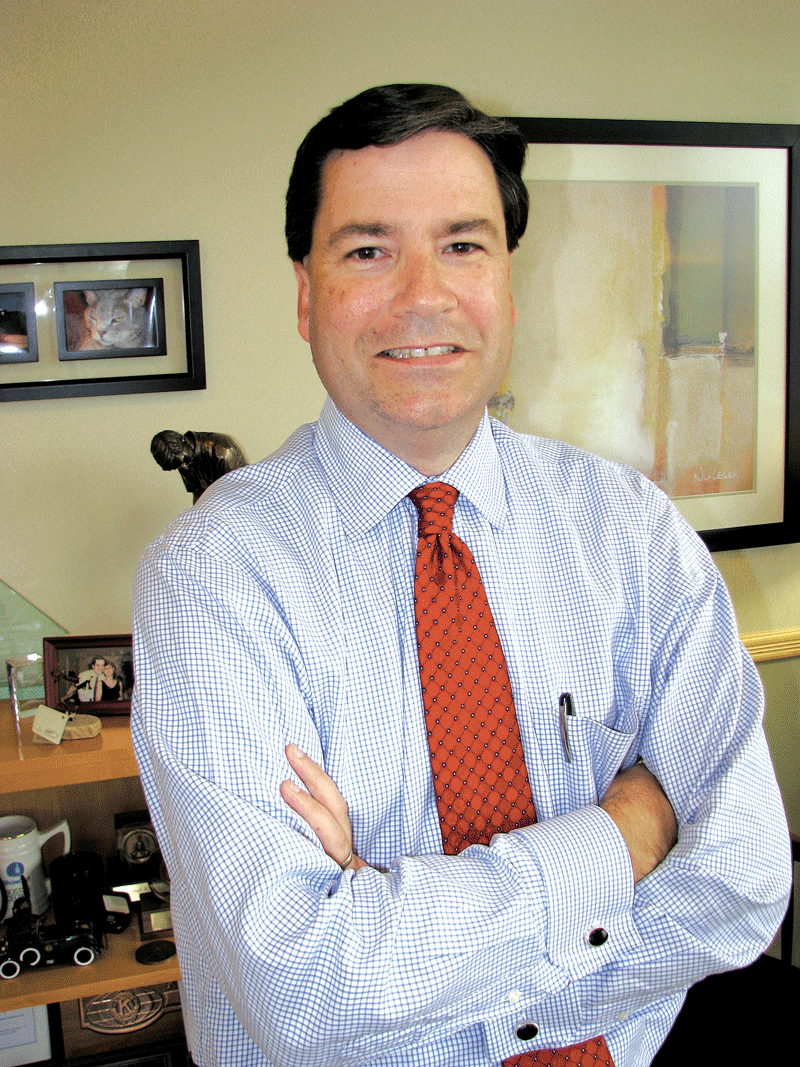
Tom Creed, senior vice president and commercial regional executive, Berkshire Bank
Tom Creed recalls having a number of intriguing summer jobs while growing up in Longmeadow.
He caddied and worked in the bag room for several years at Longmeadow Country Club I think I probably learned as much about business from being a caddy as I did from being in business and spent a few memorable summers at what was then Riverside Park, now Six Flags, as an operator of the iconic wooden roller coaster called the Thunderbolt. Maybe his lasting memory was from one night when the ride was shut down for repairs.
We were thinking that maybe we would get to go home early, said Creed, senior vice president and commercial regional executive for Berkshire Bank. But it was Saturday, and the park was pretty crowded. Our supervisor came over to me and said, I need you to go out the parking lot and drive one of our double-decker buses for the rest of the night.
I told him Id never driven a double-decker bus before and that I didnt even know how to drive a standard transmission but if he wanted me to give it a shot, Id give a shot, he continued. I pull the bus out of its parking spot, and in the process, I take out about six feet of fence with the mirror. I thought for sure the guy was going to throw me out, but instead he looks at me and says, thats better than the last guy keep going.
But it was one of Creeds later employment opportunities, or what he called his first real summer job, that would ultimately shape his career path sort of. It was as a teller at the Forest Park branch of Springfield Institution for Savings (SIS), now TD Bank. He said it taught him a little about banking, but much more about customer service, especially on what he called Social Security day, when the place was packed.
I say this to people all the time: that teller job is still the hardest job in banking, he told BusinessWest. You have no idea what youre going to be presented with; you have no idea what customer is going to come to you, when theyre going to come to you, or what theyre going to ask of you. And whatever it is, theyre going to want it right then, and theyre going to want it perfectly. Thats the pressure a teller is under; its a tough job.
The worst part of the day was the end of the day when you had to balance your drawer, he continued, and you had to hit that enter button and hope that the number that came up was the one that was supposed to come up.
Creed has gone on to have to have a number of jobs in banking, as well as a six-year stint away from the industry working for a local manufacturer (more on that later), during which he said he learned more about the financial-services sector than he did in the previous 15 years when he was in it.
He said it took him a long time to figure out what he wanted to do with his professional life, but he eventually came to the conclusion that it is banking, or at least that aspect of it that enables him to work with people to help them achieve goals and solve problems, that he enjoys most.
I missed the client relationships thats why I wanted to get back into banking, he said. I like being in the position where youre always exposed to different people and different businesses. I enjoy being able to spend part of my day on a real-estate transaction and another part helping a manufacturer with a working-capital challenge. Its the fun part of banking.
For this, the latest installment of its Profiles in Business series, BusinessWest talks at length with Creed about banking, the recession, those business relationships he mentioned, and the fact that hes quite sure its a question of when, not if, he and his wife, Nancy, will retire to Key West.
Points of Interest
And as far as shes concerned, the sooner the better, he said, adding that both of them love the laid-back lifestyle in the place where they now spend just one week a year. Ive spent a lot of money on suits in my life; Im looking forward to the day when I dont have to spend on one again.
That day is still a ways off, though, and Creed must still pull a suit from the closet each morning and also contend with a recession that may be officially over, according to some economists, but is still having quite an impact on Western Mass. and its business community.
The challenge were still going to have is that there are a lot of people who have just been hanging on, he explained. Even the little bits of improvement were seeing in the economy are not enough to get them through 2010. This is still going to be a tough year for a lot of people, not to mention the 15% unemployment that continues to exist in Springfield.
But there are signs of improvement, he continued. I have one customer in HVAC; he tells of how, in 2008, he installed 70 furnaces, and in 2009, he installed seven. But in 2010, his phone is starting to ring again, and not just because someones furnace is busted.
Creed speaks from experience when it comes to banking and economic downturns. Hes been through several in a career that started with Shawmut in Springfield soon after graduating from the University of Vermont in 1985. The economy was quite sound then, Creed recalled, and jobs were plentiful, even for a political science major whose grades were pretty average.
Still not at all sure what he wanted to do when he grew up, he sought out bank training programs, thinking one would give him exposure to many different industry groups and help him choose a career path. I suppose you can say I still havent figured it out, because 25 years later, Im still in banking.
Creed eventually chose Shawmuts training program, and began as a commercial credit analyst. He later ascended to vice president and team leader, with other stops as commercial loan officer, assistant vice president, and vice president.
During that 10-year tenure, Creed saw the financial-services sector get turned upside down as the recession of the early 90s and real-estate collapse forced some to banks to close, others to fight for survival, and all of them to call in loans, pare staff, and change how they did business.
It was pretty awful back then, he recalled. It was tense; you spent most of your day nervous because even the best of customers were having trouble paying their bills, not unlike the environment were going through today. Especially as a younger lender, you take a lot of that personally because you think youve done something wrong when loans start going sideways, and it makes you nervous. The better lenders are the ones who are more nervous, because they take their job seriously.
That was a dreadful time, and at the peak of that recession, I could never imagine us ever seeing it happen again, he continued. But I remember a colleague of mine, whos still lending today he and I were working together at Shawmut and standing on the platform on State Street, and he said, Thomas, trust me, there will come a time when everyone forgets all this and well go through it all over again. And sure enough, he was right.
Indeed, while times are not as bad as they were 20 years ago, especially in this market where banks did not participate in subprime lending, many institutions are forced to again look at how they do business, and make changes. These days, said Creed, banks of all shapes and sizes are simply being more careful when it comes to lending. When asked what that meant, he said banks are always careful, but in this climate, theyre paying even more attention to the fundamentals.
You assume nothing, you check, you double-check, and you triple-check, he explained. Youd like to think that you do that all the time, but youre reminded to do it more in these times than you would in others.
After a 10-year stint at Shawmut, Creed moved on to First National Bank in Springfield and then to Citizens Bank in Boston, where he served as vice president. He was there only a year, because quality-of-life issues were pulling him and Nancy back to the Pioneer Valley, and a job offer from West Springfield-based Omniglow sealed the deal.
I had a good job at Citizens and was working with good people, but its expensive to live out there, he recalled. When we started to think about how we wanted to live and how far outside Boston we were going to live to afford it, we were already halfway home.
So they came all the way back, to work, but also to become quite involved in the community.
At Omniglow, Creed was vice president of corporate development, a job that took him to China for a few weeks every quarter, and also gave him invaluable insight into the banking industry from the other side of the table, as he put it.
Within the community, Creed is currently president of the board of directors for the Springfield Symphony Orchestra, and has been a supporter of the SSO for many years. Hes also on the board of the YMCA of Greater Springfield, set to become vice chair in May. Hes also been involved with the Affiliated Chambers of Commerce of Greater Springfield for some time (he was chairman of its legislative steering committee for five years), and is active with the Regional Employment Board of Hampden County and the Holyoke Redevelopment Authority.
The Bottom Line
Creed says he has a number of attractive options for the time when hes not working on the job or in the community. They include the SSO (and classical music in general), the Red Sox, Jimmy Buffett concerts, golf (although he says hes not very good), and more.
And then, there are vacations, and especially that week at the timeshare in Key West. Ultimately, hes longing for the day when, as he says Nancy puts it, thats the first of 52 weeks and when he can thankfully stop spending money on suits.
Stretching Is a Key Component of an Exercise Regimen
Dr. Michael Craig says the injuries attributable to inadequate stretching before exercise are common to all ages, but older people often encounter a longer recovery time.
Despite all the talk of an obesity epidemic and kids who spend too much time indoors, Americans are generally well-aware of the benefits of exercise, said Dr. Michael Craig.
The good news is that people of all ages are exercising and working out, said Craig, an orthopedic surgeon at Mercy Medical Center. He added, however, that stretching the manner in which someone warms up before physical activity and cools down afterward can have an impact not only on the effectiveness of the workout, but on risk of injury.
The importance of stretching really exists for every age group, he explained. In the young, growing athlete, its important to stretch to maintain the flexibility of the joint so they dont get injured. A young person can have tight hamstrings and a tight heel cord, so its good to be mobilized before they go out and compete.
Fortunately, he said, young people tend to be the best-educated age group when it comes to stretching because youth sports coaches are so well-versed in its importance.
They make sure young athletes stretch, Craig said. Some early teens may feel its not cool to stretch, but when the coach insists, it happens. All it takes it one pulled muscle or a pulled ligament or tendon to keep them off the field for a few months.
For middle-aged athletes, the issue isnt whats cool, but whats fast. And seeing stretching as an unnecessary demand on ones time can lead to trouble, Craig said.
People have demands jobs, families and sometimes when they get to the gym to work out, they dont feel stretching is an important part of their workout. They have limited time, so they dont want to go to the mat and stretch; they want to get on the machine or start lifting weights.
The problem, he said, is that many people, outside of their set exercise routines, work sitting down or otherwise have sedentary lifestyles. Theyre not moving around very much, and as people get older, they lose muscle mass. Not stretching before exercise is a good way to pull a muscle.
People approaching the retirement years are at even greater risk of injury, he said. But although exercise-related injuries related to tight muscles arent necessarily more severe in old people, the recovery time is often much longer than it is for a teenager.
Athletes dont heal as well at 40 than they do at 12. It takes longer to get it back, Craig explained. The natural aging process means we lose muscle mass as the years go by, and if an injury sidelines you, it can be tougher to get back to your pre-injury status than when you were 12 or 14.
Getting Warmer
The American Academy of Orthopedic Surgeons touts stretching as not just an activity performed before and after a workout, but an essential part of that workout.
An effective fitness program is more than aerobic training and strength building, the AAOS asserts. To really reap the benefits of exercise, you need to add flexibility training to the mix.
Simply put, the academy notes, the more flexible someone is, the less likely they are to be injured during exercise. A good warmup prepares the body for more intense activity, gets the blood flowing, raises muscle temperature, and increases breathing rate all of which gives the body time to adjust to the demands of exercise and even improves performance.
Just as a warmup prepares the body for exercise, an effective cooldown period gives the body time to recover, the academy notes. A cooldown begins by gradually decreasing the intensity level at the end of an exercise session.
For example, the AAOS suggests, if you have been walking at a quick pace, begin cooling down by slowing your steps and taking your arms out of the movement. Walk at a comfortable pace until your breathing and heart rate have returned to normal. Once you are breathing easily, stretch while your muscles are still warm.
Specific types of stretches applicable to various situations may be found on the academys Web site, www.aaos.org. In addition, the Mayo Clinic offers the following advice to achieve proper stretching.
Target major muscle groups. When stretching, focus on the calves, thighs, hips, lower back, neck, and shoulders. Also stretch muscles and joints routinely used at work or play.
Outside the Box
Some exercise trends promote stretching as an intrinsic part of the workout, Craig said, noting the rising popularity of yoga and even a high-impact variation known as extreme yoga.
Yoga has become extremely popular and has been very helpful for older or middle-aged athletes, he said. Its basically a form of exercise, but its also maintaining and stretching the joints and muscles. And thats a good thing.
After all, why shouldnt the definition of exercise be flexible, too?
Joseph Bednar can be reached at
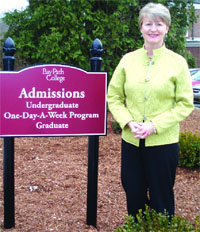
Extreme Makeover Inspires Leadership Conference Focused on Community
Caron Hobin said this years conference will promote the power of community.
Caron Hobin says Bay Path Colleges experiences with last summers Extreme Makeover: Home Edition project in Suffield provided some unforgettable moments and poignant life lessons.
Chief among them, she continued, was a realization of the power of community, an eye-opening experience that ultimately created the theme Community Matters for Bay Paths 15th Annual Womens Leadership Conference, to be staged April 30 at the MassMutual Center in Springfield.
It was a great experience, and after it was finished, we wanted to keep the momentum going, said Hobin, vice president of planning and student development at Bay Path, who noted that the college hosted a pre-build rally for volunteers and builders last June, and its students joined thousands of others who helped build a four-bedroom home for a family of 13.
To build on those experiences, Hobin, who has coordinated the leadership conference since its inception, carefully chose speakers who could convey the importance of community and the many forms that word can take. And she asked those chosen to delve deeply into meaningful and relevant topics that concern women in todays workplace and world.
Community Matters will not only deal with geographic and workplace issues, but how we function in them, said Hobin. The conference is jam-packed with content. There will be skill-building sessions with information people can use right away in their jobs. There will also be amazing, inspirational stories about women who have persevered or who are great examples of overcoming adversity. They will talk about their career paths and will approach topics from a variety of perspectives, ranging from illness to family responsibilities to work and incorporating education into a busy schedule.
I am hoping people will come away asking themselves questions about how they interact with others, she continued, how it makes a difference in not only who their community is, but what their responsibility is to it.
The conference will be staged from 7:30 a.m. to 4:30 p.m. Tickets are $250, or $225 for Bay Path alumni, before April 10. After that date, all seats are $300. For tickets, reservations, or more information, visitwww.baypath.eduor call (413) 565-1066 begin_of_the_skype_highlighting (413) 565-1066 end_of_the_skype_highlighting or (800) 782-7284, ext. 1066.
Diverse Speakers
Keynote speaker Soledad OBrien is an anchor and special correspondent for CNN: Special Investigations Unit. Her work, which has included documentaries and in-depth series on ongoing and breaking news stories, has earned OBrien numerous awards. They include the Soledad OBrien Freedoms Voice Award, created in her honor by Community Voices at the Morehouse School of Medicine, which she will receive this month for her accomplishments, commitment to cover challenging stories, and willingness to be a voice for people unable to speak for themselves.
OBrien will discuss the conflict between paying attention to her own career and meeting her mothers expectations, which all revolved around family. She will discuss the pressure to be everything to everyone, Hobin said. It will be nice for women to know they can hold up a mirror and say, her story is a reflection of my life.
Lunchtime speakers will be Leigh Anne Tuohy and her daughter, Collins Tuohy, who will share their inspiring story about adoption, made famous by the book and movie The Blind Side.
The story chronicles their meeting and eventual adoption of Michael Oher, a homeless and traumatized boy who became an All-American football player and first-round NFL draft pick. Hobin said the Tuohys will share their experience and discuss how their personal definition of community has changed since the adoption.
Afternoon keynote speakers will be Nicholas Kristof, a two-time Pulitzer Prize-winning columnist for the New York Times, and Somaly Mam, a Cambodian human-rights activist and founder of the Somaly Mam Foundation. They will discuss their work in the global community and provide concrete ways for women to make a difference.
Mam, who has won many awards and was touted by Time magazine as one of the 100 most influential women in the world in 2009, has written a book titled The Road of Lost Innocence.
Hobin calls her story unbelievable.
She was sold to a brothel when she was a young teen by a man who posed as her grandfather, she said. Her story is so similar to that of other young girls, especially those in Southeast Asia.
Kristof has also won many awards, including his first Pulitzer for coverage of Chinas Tiananmen Square democracy movement and his second for a series of columns which focused on genocide in Darfur.
Breaking Out
The day will include morning and afternoon breakout sessions focused on skill- building. Syndicated national columnist and best selling author Alexandra Levit will lead a program called They Dont Teach Corporate in College/Millennial Tweet.
Levit will discuss what women need to know about transitioning within the corporate culture. She will address pitfalls that can cause young people to fail, which range from dress to protocol to hiereracy, Hobin said.
Visael (Bobby) Rodriguez, chief diversity officer for Baystate Health, will speak on Creating an Inclusive Work Community. His seminar will address assumptions people make about diversity and how to be more sensitive when communicating with others.
Diane Holman, vice president and chief learning officer for Raytheon Leadership and Innovative Learning, will focus on Political Savvy at Work: How to Get Noticed by Executives Looking to Identify Rising Talent.
Hobin said this talk will be meaningful to any woman who has reached a plateau in her career or is frustrated at work. The presentation will lead women to self-examination and behaviors that may have stalled their own advancement within the workplace. Diane will take things to the next level and talk about how women can institute changes in their behavior.
There will also be a panel discussion on Work, Education, and Family Life.
Hobin said the days theme was inspired by lessons learned during Bay Paths involvement with the ABC television show Extreme Makeover: Home Edition, which uses volunteers and donated materials to do complete makeovers or rebuilds of homes for selected, deserving families across the nation.
Following that model, she explained, the conference will allow women to become involved without making a major time commitment so they can make a difference in a meaningful way that realistically fits into their busy lives.
How the Business Community Has Made the Zoo in Forest Park a Pet Project
 The Zoo in Forest Park has long been part of the fabric of Western Mass. But only a few years ago the facility was on the ropes and in danger of closing its doors. Members of the business community volunteered their time, energy, and imagination, and saw the zoo through that crisis. But their work to keep the institution thriving is ongoing.
Zooey was sucking greedily from a baby bottle as John Lewis cradled the tiny, 9-day-old female spider monkey on his lap and gently stroked her head.
Lewis is the director of the Zoo in Forest Park, and has essentially taken over for the babys mother, who didnt show much interest in her after she was born.
He feeds Zooey every two hours, around the clock, and carries her with him in a satchel around his neck, as her arms and legs stay tightly wrapped around a stuffed animal.
The devotion Lewis shows to the newest of the 165 species represented at the zoo is mirrored by members of the facilitys board of directors, who are dedicated to keeping the nonprofit attraction alive, and also raising awareness of what they see as a polished but still-little-known gem in the heart of Greater Springfield.
The story of how the board, and the business community in general, have helped make the Zooey saga and many others like it reality is an intriguing one packed with drama, many lead characters, and one pivotal chapter. That would be the winter of 2003-04, when a confluence of factors almost forced the zoo to close its doors.
But the board and individual members saw the landmark attraction through that rough patch, and the zoo has not only survived, it is now a self-sustaining oasis tended by board members and staff passionate to show off the new facility, which they have transformed into a wondrous escape for families.
The zoo is like a diamond in the setting of Forest Park, said board President Scott Foster, an attorney with Bulkley, Richardson and Gelinas, LLP. We want to get people here and see what we have to offer. We are still fighting the old monkey-house perception, with metal bars and the smell of a place that wasnt clean or somewhere you wouldnt want to go.
When you mention the old zoo to many adults, they get a look on their face and scrunch up their nose, he continued. We have to overcome that, and its simply a matter of getting people here. When people visit who havent been here for 20 years, they tell us they had no idea this existed. They also say they are coming back and bringing their families. Its a clean, well managed, enjoyable place.
For this issue, BusinessWest talked with Foster and other members of the board about their passion for the zoo and why the institution is important to the fabric of the region.
Animal Instincts
Tracing the history of the zoo, Lewis said the facility opened in the early 1900s. At that time, the entire park was part of the zoo. It started out with swans in the aquatic gardens and expanded from there. The zoo was originally owned and operated by the city of Springfield, which ran it until the 60s.
In 1963 a zoological society was formed to support the attraction, and took over operations in 1968. The city didnt want to run it anymore, Foster explained. They found homes for most of the animals and just kept the Kiddieland plot of one and a half acres.
As the transition from a city-operated venture to one run by a nonprofit evolved, the society also took over the concession stand, which stood outside the gates to Kiddieland. In the early 70s, the city also constructed a building that had a kitchen, medical room, and office with funds raised through a Step Out for People walk.
In the early 80s, the society began talks with the city that led to an agreement that allowed the organization to lease about five acres of land for $1 so it could expand the facility. The Kiddieland Zoo was excavated in the mid-80s, and the remaining animals were moved to the new zoo.
The city hadnt done much maintenance over the years, and the societys goal was simply to keep the zoo open. For several years, the city provided three full-time employees to help with the work.
But that ended during the winter of 2003. At that time, the zoo had an annual operating budget of $900,000. There was a full-time executive director, a full-time marketing person, an office manager, and an assistant manager.
Things were set in a sudden downward spiral when the executive director resigned, the state cut all funding, and the city, which had downsized its help to one employee, told the zoo it had to pay the $40,000 cost of that person.
The zoo needed a lot of repairs, and the financial picture was so bleak, Foster said the society thought it would have to shut down the operation.
It was a perfect storm of events. It almost toppled us, he said. I became chairman of the board that winter, and to get through the season, the board members loaned the zoo more than $60,000. Those loans, which have been forgiven, were supplemented by $15,000 from the Community Foundation of Western Mass.
Volunteering Information
Lewis has been with the zoo since he was a young child. I grew up with the lions, donkeys, and monkeys, he said. My parents managed the zoo from the late 60s until the early 80s, and I was a little volunteer zookeeper when I was 6 years old. As I grew up, I was there after school and on weekends.
When Foster was a child, his father worked for the National Park Service, and he lived inside the parks. The first-hand knowledge of operations allowed him to see that the Zoo in Forest Park needed to be operated as a small park. I told the board that we needed a working director, Foster said.
Lewis who had advanced over time to become senior zookeeper and, later, director of operations was already doing that, so the board appointed him executive director. (His son, John Lewis II, is now the senior zookeeper.)
The snack bar was given back to the city, the office and public-relations positions were eliminated, and those jobs were taken over by board members. The chairmans job was that of a volunteer executive, who did everything from grant applications to dealing with personnel issues, Foster said. The role evolved far beyond the normal duties of a nonprofit. And to this day, everyone on the board takes part in volunteer activities, from marketing to finance to work on a facilities committee.
Fortunately, most board members had extensive business experience.
Not only did they lend their expertise, along with tools and materials, they set the tone and policy for the lowest-level volunteers, providing service that in some cases included physical labor, Foster said. That winter in 2003 to 2004, we realized we would have to work together differently. If we had an idea, we had to implement it ourselves. It was a learning process, and we only hired staff when it was critical to our mission.
The strategy worked, he continued, because the board members became so actively involved, and were so passionate about making sure the zoo survived, that it bred its own commitment. The board took over ownership of the place.
Actions taken after that by 18-year board member Evan Plotkin exemplify the spirit that was adopted. One day, when the 2004 season was over, he was sitting in Outback Steakhouse in West Springfield. As he looked at its sign, the idea to expand and open an Outback exhibit at the zoo was born.
We had all these great animals that were indigenous to Australia emus, kangaroos, and ostriches, he said. It made sense to create a new exhibit for them.
Plotkin took immediate action and approached the manager, asking if the Outback would sponsor a new exhibit.
He was referred to the central office in Florida, and months later, after repeated calls and conversations, the company agreed.
The timing was serendiptious, Foster said, because Outback was opening a new restaurant in Enfield and wanted the positive publicity. They were trying to create awareness of who they were, and what better way to do that than to sponsor a new exhibit, Plotkin said. It was a co-promotion that led to a great marriage.
The board had agreed to the idea, and in the fall of 2005 it made the decision to reshape 15% of zoos footprint. It was entirely due to Evan, Foster said, adding that his efforts showcase the work ethic the board had adopted. We realized we couldnt rely on others for money or to get things done, he said.
Plotkin, second-generation president of NAI Samuel D. Plotkin and Associates Inc., a Springfield-based commercial real-estate company, said he contacted business people he had relationships with and asked them to help build the new exhibit. They were all so generous, he said. It would have cost five times as much to build without the donations and in-kind services we received.
Today, a plaque stands in the Outback, recognizing the many businesses that made contributions. Bill Guzzie Landscaping did a lot of work, and so did many others, Plotkin said, adding that interns from the Homebuilders Assoc. of Western Mass. and the carpentry program at Putnam Vocational High School built the sheds.
Plotkin said that, during the time the Outback was built, he practically spent more time there than he did working at his own business. I remember going to one important meeting where there was an awful smell. I was wearing a suit, and I looked down at my shoes and realized I had emu dung on them, he said.
But the end result was worth it. The zoo transcends time, Plotkin said, adding that he first fell in love with it during visits with his grandmother when he was a small boy. It doesnt go out of style, and is a wonderful place where families can interact with nature and bond together.
He believes the zoo is an important cultural and entertainment attraction that helps attract residents to the area, who ultimately become part of the local workforce. The zoo is one of the top five tourist attractions in the Western Mass. region, Plotkin said. Between 60,000 and 100,000 people visit it each year.
Deer Friends
The zoos growth and survival has been dependent not only on board members, but on partnerships with the business community. The Irene E. & George A. Davis Foundation has been a big supporter, donating the Discovery Center, while the display cages inside came from a grant from MassMutual.
Last October, the zoo and Big Y kicked off a pilot program at one of the chains stores, by which the zoo gets all of the produce that doesnt sell.
But funds are hard to come by for the seasonal attraction, whose annual operating budget has been pared down to more than $600,000. The zoo takes in about $400,000 from gate fees and its many educational programs, which include birthday parties, but recently suffered a loss of funding from the state. It was promised $50,000 in fiscal year 2009, which Gov. Deval Patrick reduced to $25,000. And in FY 2010, we got nothing, Foster said. Its a hard sell to the state to support this and other small zoos.
But since that rugged winter of 2004-05, the zoos fund-raising has taken a new direction. It eliminated the annual golf tournament and now focuses entirely on events that would bring people to the zoo.
The Outback Steakhouse paid for all of the food and beverages for two years at an annual gala it expanded after the new exhibit opened. They brought in glassware, flatware, everything, Foster said. It was enough to set us on a new path, and we are eternally grateful because it was the boost we needed. We have had more than 300 people attend every year, and it continues to grow. Its called A Party with the Animals Night and for the past few years, BSharas has provided catering for us at a reduced fee and made generous donations to our live auction.
The success of that party led board members to think about other events that could be held at the zoo. They turned to local organizations, offering them a tent inside the zoo.
Chamber After 5 events have been held here. The Latino Chamber has used it, and so has the Young Professional Society of Greater Springfield. Last year, the Homebuilders Association had their appreciation day picnic here, Foster said. These events help raise funds, but, more importantly, get people here to see what we have to offer. At any given event, you will find at least one person who has never been here and didnt know we existed.
Businesses are helping to advance that cause, and last year, UBS sponsored a free day at the zoo.
But for board members, the commitment continues, and some have made it almost a full-time job.
Im pleased with the way things are going, Plotkin said. Ive given my heart and soul to this place. We dont have a big pot of money to pull from when times are rough. But people who come here have an amazing experience. Its an attraction that is fun, entertaining, and educational, and it promotes environmental issues and concerns about wildlife. When I see babies in carriages here, they are laughing.
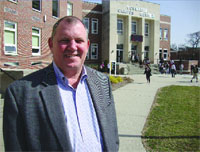
Area Colleges Are Applying Imagination to Enrollment- building Efforts
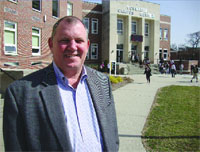
AICs Peter Miller says that colleges need to be more sophisticated than ever to reach enrollment targets.
American International College is targeting young people in China, as well as individuals who simply cant find a seat at a four-year school in California. Meanwhile, UMass Amherst is putting added focus on out-of-state students. These are just some of the strategies being applied as area colleges seek to bolster their enrollment numbers, which have been steadily rising over the past several years.
This is the season that high-school seniors have been waiting for all year. Upcoming graduation? Guess again.
By May 1, all students expecting to go on to college this fall will need to make their decisions regarding where they will go. Its called Candidates Reply Date, and for the admissions departments at area four-year colleges, this time of year is critical.
The word from local colleges is that application numbers are strong for the incoming freshman class of 2010, mirroring a trend in place for the last several years.
It has been widely reported that, during the first months of the recession, students were returning to school in record numbers. But that trend toward higher application numbers, and resulting higher enrollment sizes, are the only constants in the admissions process. In Western Mass., colleges saw their class sizes swell, but in many cases the competition for those students has led to substantive changes in the admissions process.
At American International College, Vice President for Admission Services Peter Miller said that the school is far more sophisticated than ever before in how it does its job. From national and international outreach all the way to use of social media, the role of admissions is more important than ever to secure those target numbers. Some schools go to great lengths in their use of contemporary technology, but Miller only half-jokingly said, if I ever text-message for a prospective student, Ive told my colleagues to shoot me!
The numbers game for student population has changed the admissions techniques, but it also has led some schools to focus on their brand image the goods and services that can be sold to high-school prospects.
In these highly competitive times, improved campus amenities make a big difference, said Mary DeAngelo, interim director of Enrollment Management at Springfield College. We have recently opened two new facilities that help in making the college appealing to prospective students. We have a brand-new campus union that just opened in January. Students are thrilled with it. Last fall, 2008, we opened a new recreation and wellness facility, which is second to none.
UMass Amherst Chancellor Robert Holub has publicly stated his goals for gradual growth of the student body to better represent the schools status as a state flagship university. His goal has a focus on attracting out-of-state students, whose tuition money stays on campus, rather than state students payments, which are filtered into the state revenue stream.
There has been wide support of his initiative, but voices on campus have publicly criticized the cost of attracting such a population, and the means to make it happen. The numbers game of student enrollment has reached a critical stage for colleges attempting to keep up with years of record student populations, but some ask, when is not enough too much?
Digital Readout
DeAngelo said that the school year beginning in fall 2009 has been very interesting.
I think youll hear that from just about any private school, she continued. And it was because of the economy. We were very uncertain how enrollment would turn out, even though application numbers were good, and interest was high. But families were really anxious. When they are sitting at the kitchen table on April 27, they had to ask themselves, can we afford a private college?
Others echoed that sentiment. While the recession caused many families to take a sober look at their expenses for higher education, 2009 was a great year for the states flagship Amherst campus. We set a record last year, and the year before, said Ed Blaguszewski, director of the schools News and Information Office.
We have been at over 30,000 applications for the last three years for incoming freshman, he continued, and we believe that continues to indicate a very strong interest in the value of a UMass education, at an affordable price.
Kathleen Wrobleski, director of Communications and Marketing at Bay Path College, called the economic downturn a double-edged sword. While students and families grapple with the cost of a college education, when times are tough, people historically head back to school.
With finances as a potential pitfall to prospective students, she said that is one area where Bay Path stands out. We recognized early on that people shouldnt have finances as a barrier to going to college. Weve made institutional changes to make that happen. For the undergraduate program, and the Saturday program, there are more scholarships. We have a very aggressive program.
She said that Bay Paths method of admissions is different than most, with undergraduate, one-day, and graduate programs accepted on a rolling basis throughout the year. Every October, however, a snapshot of all three populations is offered for statistical analysis. From that perspective, Wrobleski said that Bay Paths enrollment was at 2,000, the highest in the colleges history.
Tools of the Trade
By the time President Obama made a pledge last year that the U.S. will have the highest proportion of college graduates in the world, the numbers across the nation were already steadily edging toward that goal.
Statistics from the U.S. Department of Education show that, over the past 10 years, the percentage of students who go on to college within 12 months of high-school graduation has increased significantly. In 2007, that number was at 67% of the nations youth. Competition for those best and brightest is at an all-time peak as well, college officials say.
According to Wrobleski, Bay Path has something unique to offer as a means of driving students to their campus. We develop programs that are very career-focused, and very responsive to the job market.
Elaborating, she said, in its graduate program, Bay Path has an MBA in entrepreneurial thinking and innovative practices, the only one of its kind in the area. And then we have an MS in nonprofit management. These are closely linked to many of the job opportunities in this region.
DeAngelo said that her job is essentially the top of a pyramid that extends over the campus, with recruiting new students seen as everyones job.
And that comes from the top down, she continued, which it needs to, in order to be successful. Dr. Richard Flynn has been president for 11 years, and from his first day on this campus, every time he has a chance to speak to all members of the college community at one location, he says that recruiting students is everyones job. What that means is we enjoy great support from the faculty, other administrators, coaches who are a great recruiting force for us from students, and phenomenal support from our alumni base.
At AIC, Miller agreed that recruitment is a campus-wide endeavor. He, too, credits the schools current administration as influential. As our first new president in many, many years, Vincent Maniaci came in with a lot of enthusiasm and vision, and he wanted to move AIC forward.
What that has translated into is expansion of several programs and departments at the school, both locally and far afield. New departments and majors have been coupled with an increase in athletics, and the coaching staff has been given full-time status in order to take more than one for the team.
If we want to get to the number that we want to each year, Miller explained, we know that we need to rely on the football coach to recruit 75 students. We set goals for each coach, but weve added new teams. Theres been enormous success with a new track and field team in attracting students.
As full-time faculty, the coaching staff operates on several levels. In addition to their ability to recruit, they are also often closely linked to the students performance at school. Miller said that this is an enormous aid in student retention from year to year.
Those numbers, from freshman year on through graduation, have been improved, he said, by about 7% between the last years, and by 5% between the years prior.
Go East, Young Man
Miller had just returned from a recruiting trip to China, which he said was the colleges newest focus for out-of-state students.
Parallel to the colleges accreditation process a few years back, something revisited every 10 years, was a period of self-study for the vision of AIC.
We decided that we wanted to be more global in what we were doing, he said. Weve created some pretty significant goals in internationalizing the campus, both for our current students and integrating into the classroom what international students can bring to the campus. China is a country that weve targeted, one obvious reason being the millions upon millions there. We wanted to be a player in that, so we set up a recruiting center there.
And prior to setting their sights overseas, AIC had established a presence in the beleaguered California state college system.
While the Commonwealth has had its share of budget woes in the last couple of years, the California Department of Education has been faced with nothing short of a crisis: too many students, not enough vacancies, and, most importantly, not enough money. At the end of February, Jack Scott, chancellor of that states community colleges, said 200,000 students would be unable to return to campus this fall because there simply isnt any space for them.
Miller said that, because access to a four-year degree for those community-college students has been made so difficult, he and Maniaci spent a week building a beachhead for students to come to AIC.
How are we going to make ourselves attractive? he asked. Well, initially, we decided that we were going to offer a $10,000 scholarship to those students, anyone graduating from a community college in California. As a marketing tool, that really grabs you.
But, he continued, we cant just drop in once a year and expect that were going to win people over. We need an ongoing presence on those campuses. We heard that from all the schools. So weve hired a transfer counselor to eventually be full-time out there.
State of Affairs
The Bay States budget woes are nothing to sniff at, either.
Between 2008 and 2010, Beacon Hill slashed 37% in state support for higher education, the largest percentage reduction in the country. As one means to address that, Blaguszewski said, the state legislature has provided us an incentive over the last five or more years to work effectively in recruiting out-of-state students.
We want to maintain access for students in Massachusetts, he continued, and were not diminishing that. But the extra spaces were creating are targeted at out-of-state students. Not only will that add to the dynamic aspect on campus, but it will be a revenue generator. We get to keep out-of-state tuition on this campus, whereas state tuition goes back to the state coffers.
In a recent essay printed in the New York Times, Professor Nancy Folbre of UMass Amhersts Economics Department likened the measure to students as the new cash cows.
She said the intensified marketing campaign aimed at out-of-state students is a well-meaning strategy that could backfire for several reasons.
Administrators can feel pressure to invest in new facilities that look good on the glossy brochures rather than improving student advising or course availability, she wrote, and if more students are added without increasing the number of faculty and staff, students get less individual attention and cant get into the courses they need to graduate.
The percentage of students taught by full-time, tenure-track faculty members per student at state universities has steadily declined in recent years, she added.
A new plan to increase out-of-state expansion involves rewarding individual departments more adept at recruiting outside the state line, she noted. Given Massachusetts striking distance to the Empire State, Folbre humorously noted that a colleague has offered to publicly renounce the Red Sox in favor of the Yankees.
At AIC, Miller said that, in his 35 years in college admissions, the industry might have evolved, but some things will always stay the same. What will never change, as long as Im in this role, is the notion of relationship marketing.
Technology, technique, and sometimes tactics might all be keeping pace with competition, but, he added, theres a fine balance in implementing all the things necessary for moving a student a certain way without losing sight of that student as a person.
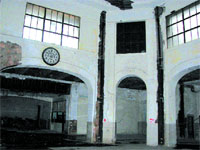
Is the Time Finally Right for Springfield?s Union Station?
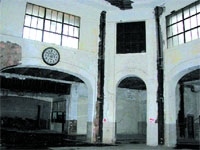
John Judge says that, given the priority status attached to commuter rail regionally and nationally, Union Station may be able to turn back the clock and thrive.
The hands on the large clock in the main lobby of Springfields Union Station havent moved in nearly 40 years. For this landmark built in 1926 by the Boston and Albany Railroad, time has stood still literally. But time hasnt run out, insist those now working to advance yet another redevelopment plan for the station, one they say is unlike previous concepts, because it is grounded in market realities.
John Judge understands that, when he says hes hopeful and optimistic about the prospects for Union Station, hes echoing the comments of myriad Springfield officials, Pioneer Valley Transit Authority administrators, and area economic-development leaders, some of whom have watched the landmark sit idle and deteriorate for almost 40 years.
When he says he believes the timing is right for the station to soon end its long hibernation, he knows that others have been saying words to that effect since Ronald Reagan was in the White House.
Judge has been Springfields chief development officer for only 11 months now, but he knows all about Union Stations long and recently quite sad history. So he understands why so many are skeptical about something positive ever happening there.
I cant blame them. They have every right to be skeptical; one thing after another has created roadblocks for this property, and the years have turned into decades, said Judge, who was enthusiastic but also quite realistic as he talked about the latest in a series of plans some formal, some just idle talk for reuse of the station on Frank B Murray Street. This one is far more grounded than the ones that have come before it, said Judge, noting that previous incarnations have included everything from a hotel to an IMAX theater that have never come close to seeing the light of day.
This version, called Union Station II by some and Option One by the consulting firm that drafted the plan, is based mostly on transportation-related components, including a 23-bay bus terminal, and comes at a time when the nation and the region are making commuter rail a priority matter, said Judge. He expressed the hope, but also the expectation, that Springfield could become a hub of commuter-rail service running from Southern Vermont to New Haven, Conn. and, ultimately, New York.
The plan has other components, including plans for a day-care center, what is called transit-related retail (kiosks, newsstands, coffee shops, and fast-food operations), and what the consultants call opportunity space for other retail.
Its a nice picture, and variations of it have been painted before, many times, which explains why so much skepticism remains about Union Station. And those doubts are just one hurdle to be overcome. The economy is another, as is a sluggish commercial real-estate market that has property owners of all kinds, from private developers to Springfield Community College and its assistance corporation, vying for the same small pool of office tenants.
And then, theres Worcesters Union Station, which was renovated a decade ago and has sat mostly empty since then, becoming a poster child for historic train-station redevelopment gone awry or gone nowhere thus casting further doubt on Springfields efforts.
Judge is optimistic that 2010 will yield the first real, visible signs of progress at Union Station in many years, which he says could start to erase some doubts. He expects there might be movement to solidify some of the transportation components, especially the PVTAs eventual move from its headquarters on Main Street to the train station, and also some of the other pieces to this puzzle, such as a day-care center, a senior center, and that transportation-related retail. And he anticipates that work to begin razing the so-called baggage building adjacent to the station could begin late this year or early next, providing some tangible evidence that redevelopment is happening.
The economy is still quite soft now, which is actually good, from a timing perspective, for this project, in that those working to redevelop Union Station can position it for the day not far off when times are better and the appetite for commuter rail will be much greater.
Were in a unique time in history in that we have an administration thats committed to high-speed commuter rail, and we also have a society thats embracing the idea of regionalism and how important that is, he explained. If gas goes to $4 a gallon again, people are going to have few if any options in terms of commuting. What we want to do is reposition Union Station as not simply an intermodal facility for Springfield, but as a hub for the Pioneer Valley.
For this issue, BusinessWest takes a look at the latest plans for Union Station and their prospects for becoming reality.
On the Right Track
Judge calls it the Union Station task force.
Thats the name hes given to a small working group that now gathers around the conference table in his office on Tapley Street every Tuesday morning starting at 8:30. The group began meeting a few months ago, he told BusinessWest, and he intends to stay with the weekly schedule for the foreseeable future to keep this latest Union Station project on the front burner, where he says it belongs.
We want this to be a priority, he said, and when you meet every month or every other month, its not a priority.
Recent meetings have had a number of agenda items, but especially the steps legal, financial, and technical needed to make the Springfield Redevelopment Authority the lead agency on this project (a memorandum of understanding between the SRA and PVTA was signed last summer making them partners in this initiative) and the entity that would be the direct designee for the close to $60 million in state and federal funds that have been awarded for Union Station redevelopment.
The money is in place, technically speaking, and has been for many years, said Judge, adding that the individual earmarks must be re-energized.
In general, discussion among task force members, who include Judge, Kevin Kennedy, senior aide to U.S. Rep. Richard Neal, a strong advocate for re-development of the station; Maureen Hayes, president of Hayes Development and a consultant to the city on this project; and others, centers around a redevelopment plan crafted in late 2008 by the Nebraska-based consulting firm HDR.
As they talked about the plan, Judge and Kennedy echoed what HDR said in its executive summary of the latest redevelopment initiative:
Past efforts to redevelop this facility were not successful due to a variety of reasons, but the common denominator was that the plans were not based on market realty, said the reports authors in reference to such concepts as the hotel, IMAX theater, upscale restaurants, and other components of previous plans. This redevelopment plan takes a grounded approach based on well-defined objectives, available funding, economic viability, and the realities of the real-estate market.
At the heart of HDRs redevelopment plan is something the consultants call simply Option One, or the best of several scenarios for revitalization of the Union Station complex.
Option One has several components, including:
Funding is essentially in place for these various components, say the reports authors, adding that $4 million would still be needed to complete the build-out of the opportunity space, which could be financed by a loan or obtained through some other funding source.
The HDR report also lays out budgetary projections:
A fully occupied Option One is expected to generate an annual revenue of budget of approximately $1.9 million, of which $1.5 million is associated with the transit-related operations and $400,000 from the opportunity space. The total annual operating cost is estimated at approximately $1.5 million. A net balance of about $400,000 would generate enough cash flow to cover the debt service of the financing needed to build out opportunity space.
Getting Everyone On Board
All this looks good on paper, but there are many questions involving whether the plan can become reality. They concern everything from whether Peter Pan Bus Lines will be a player in this new plan (and if the project can go ahead if its not) to whether there will be any interest in that aforementioned opportunity space.
Judge and Kennedy said those questions will be answered over time, but both expressed optimism that the plan can come together as HDR has outlined it.
With a lot of projects of this magnitude, it comes down to timing and circumstance, said Kennedy, who has a long history with Union Station he was an aide to then-Mayor Neal when the city took possession of the landmark. Looking to the future and what will be a greater emphasis on rail, I think Springfield is positioned to be a hub of a commuter rail line and also positioned for an economic-development project in the north of its downtown blocks.
To do nothing with Union Station would be a bad idea, he continued, and I think we have a much better chance for success now, because this plan is based on market realities.
As for specific components for a revitalized Union Station, Judge said some discussions have taken place with administrators at Square One, the Springfield-based day-care provider, and there is some interest in possibly creating a new facility in the station, which would be a natural location if it were to become an intermodal transit center. And such an operation would help create additional vibrancy in the station, something that would be needed to attract other forms of retail.
A senior center would provide similar benefits, said Judge, adding that he can visualize a facility that seniors could reach via mass transit and stay at during the day.
We have to look at what we can do to make this a vibrant, 24/7-like spot for the city, he explained, and not a situation where a train pulls in, people walk through, and youre missing that added vibrancy.
Having Square One there would be critical, he continued, and another thing Id like to have, and I think it would be innovative, would be a senior center. There would be some inter-generational opportunities, and a place where seniors can go to do a power walk, grab a bite to eat, use wifi, and maybe volunteer some time with the kids.
Another possibility, he said, is creation of facilities, such as conference rooms and other amenities, that could be used by businesses and individuals with virtual offices. The region doesnt have anything like that, and it needs one.
But to achieve real success with this project, Springfield, and Union Station, would need to become the hub of much more extensive commuter-rail service, said Judge, who firmly believes that day is coming.
The scenario works out this way you live in Sixteen Acres, take a PVTA bus to Union Station, walk through the station, get your coffee and your bagel and your ticket, and then get on a train to New Haven, and from there you can go to New York, he said, adding that many business executives currently drive to New Haven and take a train to Gotham.
This scene that Judge lays out is similar to the way things were decades ago, before air travel and the interstate highway system crippled the railroads and dozens of once-proud facilities like Union Station. A return to those days, and a commuter-rail system approaching what is seen in most European countries, could enable Springfields landmark to come full-circle.
Last Stop
As he talked about moving plans for Union Station off the drawing board and to reality, Judge said he has an excellent team in place for that assignment (his task force), that the timing is right, with the state and region due to emerge from the recession at about the same time the project heats up, and that the latest plan is realistic and doable.
As he spoke those words, he realized that many before him, in various governmental capacities, have said essentially the same things.
Time will tell if things go differently with this plan for the landmark that time forgot, meaning that things will go right. But Judge firmly believes that soon a relative term if ever there was one people will talk about Union Station using something other than the past tense.
George OBrien can be reached at[email protected]
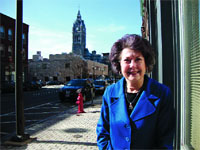
All Eyes Are Focused Again on the Paper City
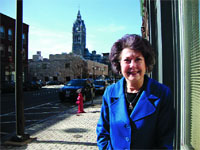
Doris Ransford says shes excited that private investment is driving Holyokes renaissance.
Doris Ransford calls Holyoke a city of contrasts.
As president of the Greater Holyoke Chamber of Commerce, she said the stark realities of poverty, unemployment, and urban blight should not be the focus at this point in the citys history, a time when most would agree that the potential exists for progress on an historic level.
For years now, she told BusinessWest, people have had good ideas, and its not that those ideas werent good, its just that the time wasnt right, the situation wasnt right.
But all that is changing.
Groundbreaking for a high-performance computing center (HPCC), scheduled for this fall, is arguably one of the most exciting current developments in any depressed urban location in the state, if not the entire nation. But Mayor Elaine Pluta emphasized that, while this investment will have a profound impact on the city, there are many other elements that are coming together to give Holyoke a foothold on 21st-century reinvention.
She listed projects that, taken singularly, would be a boon for any city: the new multi-modal transportation center on Maple Street, the renovation of the Victory Theatre, commuter-rail expansion linking Holyoke to interstate transit, and the Canal Walk revitalization project.
The challenges are to try to get something jump-started, to bring people down here, she explained, pointing out the window to the city center. People are the economic engine of what needs to get things going for economic development. You need people walking around, shopping, living thats our hope for the downtown.
Open Square is John Aubins answer to that hope. For decades, it had been a mill property owned by his family, but in 1999 he returned to the area from New York and decided that the time had come for something more at the sprawling site.
We have developed the space for people to live and work in, as part of the growth of small urban areas, he said. And its going quite well. Weve brought 50 businesses into the center of Holyoke without subsidy from government. Weve done it based on the market demand for it.
Like most people in town, Aubin agreed that it is private investment that can act as the primary catalyst for significant revitalization in Holyoke, and that too is another unfolding chapter in the historic city. While the public and private entities universities, Beacon Hill, and international computer firms are all looking to invest the Paper City, it does seem that the city will continue to be one of contrasts, but also long-overdue good fortune.
Put Your Money Where Your Mouth Is
What is most exciting now, said Ransford, is that private investment is going to drive the fortunes of the city. The HPCC isnt a government handout; its not you poor city, lets help you, its about the resources and the opportunities. The city has proven to be worthy of smart investors.
We can no longer depend on huge influxes of public money, she continued. Its not going to happen for a long time.
Agreeing with that sentiment, Pluta said the city is working actively to ensure that the public projects and the HPCC are united in their approach to solidifying the citys unfolding Innovation District. City Hall has formed an Innovation Task Force, which has met several times since the announcement of the HPCC. We have to be prepared for the spinoff businesses, she said.
The mayor acknowledged that many questions are yet unanswered about specific details on the HPCC, and those will be addressed in the coming weeks.
Until then, Ransford said, patience is key. Everyone wants instant gratification nowadays. We know that development doesnt happen that way. But there will be a shovel in the ground this fall for the HPCC. People are just grasping for information because they just want this to happen so badly.
As someone who has been involved in the citys role for the HPCC from the earliest days, Brendan Ciecko knows firsthand the importance of the coming year. Speaking to BusinessWest from Poland, where some business has taken him temporarily away from the Paper City, Ciecko said that, in order to continue to attract those important resources from the private sector, Holyoke and the Commonwealth need to be as cooperative and aggressive as possible.
After the HPCC is up and running, if the city and its economic-development partners play their cards right, they should be able find success in promoting the city to the international market as a cost-effective location for intensive computing and green and clean tech, he said. Lets think and dream as big as possible. Some cities only have one opportunity to reinvent themselves, and this is currently that time.
All signs augur an auspicious future for Holyoke, but Ciecko is not one to lock into a waiting game for what will be. He cited Donald Saunders of the Mass. International Festival of the Arts, and that groups success in securing financing for the Victory Theatre, along with Open Squares Aubin, as two perfect examples of what is being done right now to bolster the strength of Holyokes downtown.
They both have a clear and well-thought-out vision of what downtown can and should be, he said, but on top of that, they have the courage and perseverance to put time, money, and resources where their mouths are. Courageous fellows like them are worth listening to.
The Revolution Will Not Be Televised
While Ciecko modestly excluded himself from that company, the reality is that he runs a parallel course toward a high-tech renaissance just up the road from those big names linked to the HPCC.
At the corner of High and Suffolk streets, in a nondescript building formerly housing an accounting firm, is an incubator of sorts for young, tech-savvy entrepreneurs. There, Ciecko owns and offers space alongside his own successful operation, Ten Minute Media.
Among the tenants there are the Dunn brothers, Sam and Zach, from Wilbraham. Zach mentioned that it was strangely fortuitous how their business, One Mighty Roar, came to be located in Holyoke.
He and his brother learned of Ten Minute Media, during a class in high school. We both greatly admired what he was doing, and knew that he, just a few years older than us, was doing exactly what we wanted to do. Randomly one day, I reached out to him through social media. I think I added him as a friend on Facebook.
Less than a year later, the company is designing Web sites and mobile applications, and maintaining a highly influential industry-related blog. It has grown to over a half-million views per month, said Sam. Its used, as weve come to find out, at a number of schools of higher education throughout the world. Weve been published in several foreign magazines.
We reach more than 200 countries per month, he continued, with Zach interjecting, provinces, too! There are only 195 countries.
Having such an influential presence in their industry is proving to be an enormous success for the brothers, who have yet to finish their studies at the University of Hartford. Dollars aside, Zach said, at this current pace of business, were all but certain that well be able to work full-time by graduation. Its sustainable and growing fast, which is an exciting combination to have.
As with Cieckos company across the hall, the Dunns can operate their business anywhere, as long as theres an Internet connection. Echoing Ransfords thoughts on the city, Zach said that, with all of the new media that they are helping to shape, theres a stark contrast between what is happening in that address and the rest of the city so far.
Sam agreed. Holyoke is a place for us that we want to see live up to its potential, in culture, in driving new business to us, he said. But right now, we are in a bubble. Whats happening with the computing center, that will open up possibilities.
And big business thinks so, too.
Everything Old Is New Again
One of the names attached to the HPCC, Cisco, announced this past February its plans to transform Holyoke into a Smart+Connected Community between the next six to 12 months. Holyoke is the first existing city that Cisco has undertaken. Previous attempts have focused on developing urban centers in the Middle East and Asia.
The implications are enormous. Cisco plans to build in a strong technology infrastructure, wireless and high-speed, but also to integrate software and hardware packages to make the city a paragon of efficiency. Aubin put the process into lay terms.
The simplest way to look at it, he explained, is, if you put in a digital thermostat at your home, you typically save 20% right off the bat. Think of a city doing that by putting in smart meters for electricity, for water and sewer. Think of the savings on that kind of a scale. Then think of the peripherals, like communications for emergency services. This is an enormous market for these companies. Cisco has identified it as a $30 billion market, and Holyoke is its test pilot for working with existing American cities.
Just up the road in their offices, the Dunn brothers agreed that the city is at an exciting time in its history. We are at the point now, here, where we can shape what it is that we are doing, and what we can do, Sam said.
With so much coming into Holyoke, the possibilities for the city are impressive. But the men from One Mighty Roar, part of that foundation of new technology and private investment, keep their focus grounded on new clients, bigger clients and graduation from college.
Still, they have no immediate plans to leave town. Our money means a lot more here than it would in Brooklyn or Boston, Zach said. And that is great for start-ups.
As he looked across his desk at his brother, the two nodded in agreement. As for a place to do business, Sam said, I think it will be brilliant.
Springfield College Makes Its Entry into the Competitive MBA Market
Kathryn Carlson Heler says the timing is right for Springfield College to roll out its MBA program, and especially the concentration in nonprofit management.
As she talked about Springfield Colleges new MBA (masters in business administration) program to be launched in a few months, Kathryn Carlson Heler said that, in many ways, the school is going back to its roots.
By that, she meant a return to what was a strong focus on management of organizations such as YMCAs and other nonprofits with curriculum grounded in business that would match a concentration on athletics that would give the college its national and international reputation.
When the college was founded 125 years ago, it was created to educate the YMCA secretary, who today we would call the executive director, said Heler, professor of Business Administration at the college and director of the MBA program. And when you look at the curriculum that these secretaries followed, it was business, and there were courses in bookkeeping, management, and reaching out to the community that you were to attract, or what we would call marketing.
And of course, there was the athletic side, she continued, and the secretary could decide if he wanted to take the management track or the athletic track. But somewhere down the road, the management track fell away, and Springfield College became known for the athletic side. So were going to back to where we began.
It is doing so with an MBA offering that comes with two concentrations, one in management and the other in nonprofit management, and the timing for bringing such products to the market couldnt be better, Heler told BusinessWest.
Indeed, now more than ever before, nonprofit agencies must be run like businesses, and their managers must have the skill sets of a successful business owner, she said, adding that, in the business world, an MBA is becoming more of a necessity for managers looking to climb the ladder.
The definition of a nonprofit today is that of a mission-based business, and those two words sum it up, she explained. They have to run like a business, they have to show a profit, and they are under many of the same rules and regulations that any small business is.
Most nonprofits are selling a product, she continued, and theyre marketing a product. And for social entrepreneurs, theyre looking for new ways to raise money beyond the annual campaign.
Meanwhile, with the economic picture still muddled, and many college graduates facing an uncertain job market, some individuals are choosing to stay in school and get a graduate degree rather than fight for jobs that are few and far between.
This is a good time to be doing this, said Heler. Right now, there are roughly nine people for every job that comes available. People are being turned off by that, and theyre deciding to stay in school.
Considering these and other factors, Heler, who came to SC from Indiana to get the new initiative off the ground, is generally optimistic about the prospects for the latest addition to the regions roster of MBA programs. She told BusinessWest that there has been strong interest in the offering from both those aforementioned college students looking to stay in school and those already working at area nonprofits and businesses who want to take their knowledge and skill sets to a higher level.
The nonprofit management concentration is fairly unique, said Heler, adding that the new, 30-credit program features an optional one-year track that will appeal to many, but also a two-year track that includes a corporate residency. Meanwhile, all courses are taught by full-time faculty members, rather than adjuncts, unlike many competing programs.
For this issue, BusinessWest looks at Springfield Colleges entry into the MBA market, and why it does so with a large degree of confidence.
Course of Action
When asked about the factors that prompted SC administrators to become a player in the MBA realm and create a program specifically for nonprofit managers, Heler had some numbers ready to help make her case.
The first one was 5,200. Thats the latest unofficial count on the number of nonprofits in the Springfield-Hartford area that SC is marketing to. The next was 35,000 the number of people who work in the nonprofit arena followed by 19%, or the share of the local economy that is comprised of nonprofits. And according to a nationwide study completed in 2006, there will be a need over the next decade for 600,000 new senior managers in the nonprofit realm as a result of new organizations coming online and the retirement of many current managers.
So the market is there for such a program, said Heler, adding quickly that, in addition to the quantity of nonprofit managers as a major consideration, the issue of quality is a matter as well.
In other words, the boards running nonprofit agencies want real business leaders at the helm of their organizations.
In the past, educating nonprofit managers has been done through conferences and workshops, she explained. These managers have come up through the field. Now, theres a real call for these people to be professionals. Nonprofit education now means making sure managers, supervisors, and executive directors have business knowledge, skills, and tools.
All these factors indicated a strong need, and a niche that Springfield College, which has a proud reputation of training nonprofit leaders, could capitalize on.
It is meeting that need with those two MBA offerings, or concentrations. Both feature seven core courses, including Economics of the Firm in Contemporary Society, Research Methods and Statistics for Business and Nonprofits, and Corporate Social Responsibility and Ethics, but feature different concentration courses.
The Management option includes Managerial Accounting, Project and Information Systems Management, and Organizational Behavior and Leadership, while the Nonprofit Management model features Leadership and Governance for Nonprofits, Accounting for Nonprofits, and Fund Development and Philanthropy.
Both packages are drawing some attention, said Heler, adding that she expects 15-20 students for the first classes, to begin this summer. These will be diverse classes, she continued, noting that shes signed up some currently with area businesses and nonprofits, some current undergraduates (including a few from SC) who want to pursue an MBA now instead of slugging it out in a tough market, and a even a few individuals who joined the Peace Corps, have returned from various assignments, are experiencing difficulty finding the right job, and have chosen instead to seek a graduate degree.
Were going to have people ages 22 to 50, she explained. Thats going to be a fascinating mix that will make learning a great experience.
Erin Vermette will be one of those students on the younger end. The Belchertown resident, who is currently wrapping up a bachelors degree in Marketing online from the University of Phoenix, decided to pursue an MBA now instead of entering the job market or trying to gain entry.
The way the economy is right now, Im not saying I couldnt get a job, but it would certainly be more difficult, she said. I think it makes more sense to get the MBA now, and have an edge when I do compete for jobs. An MBA is becoming more of a prerequisite for many positions today.
Vermette said she did some comparing and contrasting of area programs, and decided that SCs provided the needed flexibility she currently works in day care and wants to continue doing that while pursuing her degree and an attractive course mix.
Ive been talking courses online for 2 1/2 years, and decided I wanted to go back to the campus, she explained, adding that her ultimate goal is to work in the fine arts, perhaps in marketing for a gallery.
School of Thought
Heler told BusinessWest that it will take perhaps five years for a program like SCs new MBA to become established and reach stated goals for enrollment.
She believes that the offering has the right mix of qualities from course selection to scheduling flexibility to that specific concentration in nonprofit management to meet or exceed that timetable.
If shes right, then the new program will represent a degree of progress literally and figuratively for the college, the students, and area nonprofit agencies.
George OBrien can be reached at
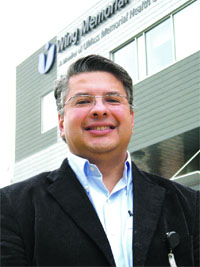
Wing’s Center for Geriatric Psychiatry Fills a Critical Role
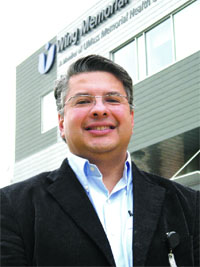
Dr. Ricardo Mujica said Wings geriatric psychiatry unit has the advantage of being on a hospital campus, with the full resources of the institution available to meet whatever medical needs might arise.
Its retirement time for the Baby Boomers.
Specifically, by 2030, more than 75 million Boomers will be age 65 or older, and the population considered elderly in the U.S. will be double what it is today partly because this demographic is healthier and more active than past generations of senior citizens, and cutting-edge medical breakthroughs are helping them to live longer.
But as that population increases, so do the specific needs of the elderly, including behavioral-health services targeted for that age group.
Thats where Wing Memorial Hospital saw an opportunity. The Palmer-based hospital opened its Center for Geriatric Psychiatry (CGP) last September, offering 15 beds to care for older people with behavioral-health needs too acute to be managed in an outpatient setting.
We take a comprehensive approach that includes a medical evaluation to determine whether a medical problem may be causing the psychological symptoms, said Dr. Ricardo Mujica, a geriatric psychiatrist and director of the center. The idea is to stabilize the acute problem and send them back to their previous environment.
The center is designed to treat people age 55 and older, but the typical patient is at least 75, Mujica said, and most are female, since women tend to live longer. Their conditions range from mood disturbances and anxiety disorders to cognitive impairment and dementia, and theyre generally referred by long-term care facilities, primary-care physicians, family members, even the emergency room at Wing or another hospital.
The reason we wanted a unit that focuses on the elderly population is that the demand for this treatment is growing, and as the Baby Boomer population gets older, we expect that to continue to be the case.
Safe and Sound
To operate the center, Wing has partnered with New England Geriatrics, a Massachusetts-based organization specializing in mental-health services to residents and their families in long-term care facilities.
With its 15 beds, the center increases the number of acute-care beds at Wing from 59 to 74, an increase of 25%. To create space for the unit, Wing moved its medical/surgical unit into the hospitals new Country Bank Pavilion in 2008.
That move was followed by eight months of work to renovate the vacated space. The $1.5 million, 11,000-square-foot project includes 11 private rooms, two semi-private rooms, an activity room, a dining room, and various other areas designed for treatment and rehabilitation purposes.
On a tour of the facility, Mujica showed off a series of security features designed to keep patients safe. For example, each entrance to the CGP is electronically monitored and access-controlled. All patients wear wrist bracelets that ensure they remain within the safety of the unit and alert staff of any patients attempts to wander. In addition, the center is equipped with 10 security cameras monitored by staff, who conduct safety rounds every 15 minutes.
In patient rooms, Wing also follows the safety standards set by the Mass. Departments of Public Health and Mental Health. These include secure ceiling tiles, drawerless shelving for clothes, tamper-resistant bathroom fixtures, electrical cords run with as little slack as possible, and blinds embedded between the windows all measures to prevent patients from hurting themselves.
The medical team in the Center for Geriatric Psychiatry includes nurses, social workers who specialize in procuring follow-up care, therapists, a psychiatrist board-certified in geriatric psychiatry, and physicians who specialize in the geriatric population. But the center also has the advantage of being located within a full-service, acute-care hospital in case a patients medical needs change.
The unit is one of only two geri-psych programs in Western Mass. (the other is at Providence Behavioral Hospital in Holyoke), and is the only one to have on-site access to acute hospital-level medical treatment, Mujica said.
We have our own medical team working on the floor, but all of the hospital is a medical backup, Mujica said. If theres an acute problem, if we need to increase the level of medical care, we can provide other services.
Mujica touted the units dual emphasis on physical and psychological care as critical to its success in transitioning patients safely back into the community.
Many people assume that people with mental illness dont have other medical issues, but if you dont look for medical reasons in mental illness, you can do a lot of harm to that individual, he said.
The CGP also provides psychological education to family members and caregivers regarding each patients illness, including medication management.
Even though, with certain conditions, we dont have a cure lets say for dementia medication can still improve the quality of a patients life and reduce the stress that is secondary to assorted psychiatric symptoms, he said.
Mujica told BusinessWest that its difficult to express why he chose the niche of geriatric psychiatry when he selected a career path, but it was likely a variety of reasons.
I have a good deal of respect for the elderly, and the challenges of treating frail individuals with multiple medical problems is interesting to me, he said. Its also gratifying to give back to this greatest generation that served this country and all of us.
Still, he worries about the ability of the health care system in general to provide this type of care at a time when the need is growing, especially considering the current atmosphere of uncertainty surrounding Medicare and health reform in general. I hope the elderly dont get left out as they shift their focus to something else.
Picking Up the Pieces
That concern applies to all mental-health services, said Maria Russo-Appel, Wings chief of Behavioral Health Services, who called the need for such resources enormous.
Wings program includes inpatient services through its 13-bed Parker North unit and outpatient mental-health and substance-abuse services through the Griswold Behavioral Health Center. Both are being strained right now, she said.
There were two significant layoffs by the Department of Mental Health last year, and that left many patients stranded without an advocate, she said. The role of the DMH worker is to coordinate care for people who are disenfranchised.
At the same time, she said, many group homes and other behavioral-health programs have been closing or changing hands (as in the case of Baystate Healths substance-abuse programs being taken over by Behavioral Health Network). The reduction in program capacity statewide, and a general sense of uncertainty over the status of services, has programs like those at Wing feeling the pinch.
We receive, at the Griswold Center, up to 75 calls a day for services. That far outstrips our resources, Russo-Appel said. Were doing everything we can to meet the needs of the community.
And those needs tend to grow when the economy sours, she added.
Were seeing more situational depression, situational anxiety syndromes, more addictions, including gambling, she said. Meanwhile, more people are being hospitalized with behavioral-health issues, including many who cant access outpatient services and are relying on emergency-room care instead. The emergency rooms have become deluged with mental-health patients who cant find resources.
To meet these growing needs, Wing is adding two or three more psychiatrists within the next few months and is looking at programmatic changes, like new support groups targeted to specific disorders, but before it can make more wholesale changes to grow the behavioral-health program, it needs to make sure the programs it does offer are stabilized, she explained.
Thats partly why the Geriatric Psychiatry Center is so important, Mujica said. It takes pressure off the entire system and helps allows patients to access a continuum of care in the Wing system.
The challenge with mental-health patients is that different facilities maintain their own histories, and patients tend to have a very fragmented history, Russo-Appel said. The advantage of Wing is that were able to maintain a continuity of behavioral-health care that many hospitals cannot.
No matter how old a patient might be.
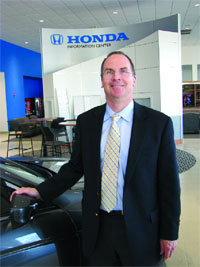
More Groundbreaking Events for the Balise Family of Dealerships
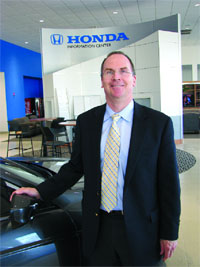
Jeb Balise says the massive new Honda dealership borrows heavily from the new Toyota dealership a few miles down Riverdale Street.
There was still some work to be done at the new Honda dealership on Riverdale Street in West Springfield some landscaping, outfitting the sales offices, and other last-minute details but Jeb Balise was already talking about the next phase of his companys long and ongoing project.
That would be the demolition of what is now the old Honda dealership a few miles down the street. Once that structure is razed, Balise Motor Sales can get started on the construction of a new Lexus dealership on that footprint. And when thats done, the company can take down the old Lexus facility and create a boulevard between the new Lexus store and the massive new Toyota dealership the company opened in late 2007.
And then Jeb Balise might actually get a break from talking about construction work.
Maybe, but by then well probably be starting on work at some of our dealerships in Rhode Island, he said with a laugh.
So there is no clear end in sight for one massive project comprised of many smaller initiatives to expand and upgrade the Balise companys dealerships to meet the demands of various carmakers and, more to the point, serve customers better.
This project, as Balise calls it, has involved several different facilities, and it has changed the landscape on Riverdale Street and both East and West Columbus Avenue in Springfield, often in dramatic fashion. No more so than with the new, 39,000-square-foot Honda facility, built on the site of the former Yale Genton clothing store, but not before a number of additional parcels were acquired to turn what had been a 2.5-acre footprint for Yale Genton into a 9-acre facility.
The dealership is more than twice of the size of the old Honda facility, and it has 33 service bays, compared to 14 at the store it replaced.
With that capacity, the dealership can take care of more service customers in a more-timely fashion and, bottom line, sell more cars, said Balise, adding that this has been the goal and the result with each of the projects it has undertaken to date.
When the [old] Honda comes down and we build Lexus, well have absolute world-class customer conveniences in all three dealerships, he said, in every way, shape, and form.
Model of Excellence
Now that the old Honda facility is officially closed and already half-demolished, Balise felt he could talk about that facility candidly.
Getting in and out of that [old] Honda store was like going to a demolition derby you just hoped to survive finding a place to park, he said, noting that the dealership, built in 1985, had become inadequate years ago. We were so successful in sales that we just outgrew that store; we couldnt give customers the kind of service they deserved.
Balise says he cant see 25 years down the road, and doesnt know what the auto-sales business will look like then. But he cant imagine that the new Honda dealership will ever become as inadequate as the old one was in its final years. We overbuilt in a lot of ways, he said, and we overdid the parking. We have more than enough spaces now.
Building first-class facilities that will easily last 30 years has been the goal with each individual piece of Balises project to modernize and expand its facilities. Recalling the various components and their dates of completion (at least to the best of his memory), Balise said the pieces started falling in place in 2006, with the completion of the new, state-of-art Toyota dealership on Riverdale Street.
Soon thereafter, renovations were completed at Balise Chevrolet on West Columbus Avenue in Springfield. A new Buick/GMC dealership was constructed on that same street in 2008, the same year that a new Balise Hyundai dealership was built on the site of the former Houser Buick on East Columbus.
Most of these projects, as well as the Honda and Lexus initiatives, were put on the drawing board in 2004 and 2005, said Balise, noting that, for the most part, things have gone according to the original schedule.
There have been a few complications, though, including the securing of a proper site for the new Honda store. Balise said the goal was always to remain on Riverdale Street site of nearly a dozen dealerships, and a place where many car shoppers begin and end their searches but assembling a site big enough was a stern challenge.
We didnt have enough land to keep Honda on the site, so we were struggling with what to do, he explained. We kept playing with a number of alternatives, but we were afraid that, with our growth, wed end up two years later in the same boat that we were in without adequate space. So we waited, and and when the Yale Genton site became available, everything just fell into place.
When building the new Honda facility, Balise borrowed heavily from what has been a very successful new Toyota dealership. The looks are very similar, from the showroom space to the service waiting area to the backroom facilities.
None of thats by accident, said Balise. That model has been working very well for us, so it just made sense to do the same things here.
And, as with the Toyota dealership, the larger Honda facility will add up to more jobs 25% more, by Balises estimate. Well be adding people across the board technicians, advisors, salespeople, and managers.
And while the Honda dealership did very well given the limitations of a 25-year-old facility and demolition-derby-like conditions, the expectations are even higher now that the company has what would certainly be considered room to grow.
Drive Time
As he led a quick tour of the new Honda facility, Balise conveyed considerable pride that the dealership had kept the dealership on Riverdale Street, replicated the amenities in the Toyota store, and completed construction in only six months.
But one could sense that he already had one eye, and much of his attention, on the next project and the one after that.
With each piece that falls into place, hes a little closer to being done with the project, but there is still much ground to be broken and many ribbons still to be cut.
George OBrien can be reached at
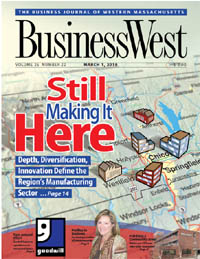
Depth, Diversification, Innovation Define the Region?s Manufacturing Sector
 The regions proud manufacturing sector has lost some of its major players, as well as some of its broad influence on the regions economy, in recent decades. But this sector remains a force, with many intriguing stories about companies undertaking exciting, often groundbreaking initiatives that are adding jobs and keeping a regional tradition alive. For this issue, BusinessWest tells three of those stories.
| • Meredith-Springfield: Breaking the Mold |
| • Marox Corp.: Instruments of Progress |
| • University Products: Preserving Its Reputation |
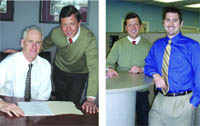
Webber & Grinnell Agency Makes a Policy Statement
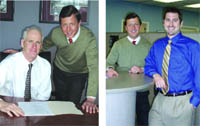
At left: Rich Webber (left) and Bill Grinnell examine a policy in their newly designed conference room. At right: Bill Grinnell (left) trains salesman Matthew Geffin to cull policies for details that could present future problems.
Bill Grinnell calls it copy, quote, and pray. That a phrase hes contrived to describe how many insurance agencies conduct business. He says things are different at the agency he owns with partner Rich Webber. There, the focus is on being an effective and trusted advisor and on making sure clients understand the details often buried in an 80-page business policy.
Bill Grinnell was sitting at his desk and reading the motivational quote from the most recent edition of a national newsletter called the Business Digest, news and notes from which he shares with his clients. If youre not sure where you are going, it reads, its possible youre on the right road.
Grinnell is a marathon runner and president of Northampton-based Webber & Grinnell Insurance. His partner, treasurer Rich Webber, is also a marathon runner and ironman triathlete. And although they are experts in the insurance field, they have chosen to take an uncharted road to success and to ensure that both they and their clients end up as winners.
Their expertise lies in uncovering potential roadblocks in the technical and detailed aspects of insurance policies. But since their lifestyles are focused on fitness, they also take the business health of their clients seriously. To that end, they offer a plethora of seminars, informational programs, and other non-typical services, such as the faxed copy of Business Digest (sent, as part of the companys subscription, to major clients), as well as hotlines established to circumvent problems and help clients move toward excellence in their fields of endeavor.
Its not just about taking someones policy, photocopying it, and offering a quote that is less than what they were paying, Grinnell said. We want to become a trusted advisor to our clients and have relationships at deeper levels. We want to touch them in a valuable way and do more than just deliver a bill. Its what I enjoy most about this job and what makes it fun.
But although thats important, Grinnell, the unofficial spokesperson for the partnership, said its the inner workings of what this firm does that sets it apart from the pack. We really consider ourselves students of the insurance business, he told Business West. We really understand and have a solid grasp of 80-page business policies. When the time comes for a claim, you need to be able to understand the fine print and pitfalls within the language. Most of our success is a result of examining the clients current program and finding issues in their policies. Theres a lot that gets missed by agencies that are not as architecturally savvy as we are. The devil is in the details.
Inside View
The partners skills at wading through the fine print were derived from their early training.
After graduating from college in 1984 with a business degree, Grinnell landed a job with United States Fidelity and Guarantee Insurance in Boston. He received in-depth training there, which provided him with advanced knowledge of how policies are constructed.
Rich had a similar training experience at Aetna as an underwriter, he said. So we understand the other side of the fence, and that experience is invaluable. It really strengthens our negotiating position, as, having sat in that chair, we know how it works.
In fact, Grinnell attributes most of the companys success to an ability to carefully examine policies. Although they expect clients to read their policies, we dont expect the average person to understand them, he said.
Grinnell took over his fathers agency in 1997, purchasing what was then known as Woodward and Grinnell. He teamed up with Webber, and they began taking steps to transform the way business was done. Ive always been in sales, and Rich is the inside guy who takes care of the office adminstration, technology, and relationships with our larger carriers, Grinnell said.
They take a different approach to what Grinnell sees his competitors doing, which he refers to as copy, quote, and pray. They copy a policy, give a quote, and pray they get the business, he said. We really examine the fine line of the details coverage and look for gaps and errors. We are very technical, and 65% of the time we find significant mistakes.
One of their areas of expertise is workers compensation. We find gaps in coverage that we are able to negotiate very effectively with companies, Grinnell said. Workmans comp is one of the largest expenses a company faces, and many policies are fraught with mistakes and errors in classification or experience modification calculations.
Over the past two years, the partners have built a suite of additional services to help better serve clients. We contracted with people to have an OSHA hotline and a human-resources hotline, Grinnell said, adding that companies may need advice on matters such as how to handle the dismissal of an employee. They also introduced a workers compensation hotline manned by an attorney in that field, so people can understand the often-contentious process of a claim or how to handle a situation where a worker is seeking additional damages or fraud is suspected, Grinnell said. Other agents we know dont offer these services. But we are trying to reach above and beyond what is traditional, and we are having some great success.
Seminars are also on the companys menu of services, ranging from the fundamentals of selling to a human-resource workshop on hiring rights. We have held business-builder seminars and have a leadership seminar coming up, for owners or key management people, that will focus on the emotional intelligence of the leadership team, Grinnell said.
Faxing daily copies of Business Digest to clients is something Grinnell enjoys. People love it. If we miss a day, we get phone calls about it, he said. Some of our clients read the motivational quote in it to their employees each day.
His firm also uses it as a marketing tool. We send it out to prospective clients to try to get them hooked, he said. In this day and age, you definitely need to differentiate yourself, and we feel that what we are doing is a cut above our competitors. Plus, its fun to see people get fired up at seminars.
Inner Sanctum
Employee attitude and appearance are important to Grinnell and Webber. The partners recently made improvements to their King Street office, which include paving the parking lot, new landscaping, new signage, and a newly designed conference room, where a timeline of photographs showcase their agencys history from its beginnings in 1849.
Continuing education for their employees is also a priority. Its something we have really focused on in the last 10 years, Grinnell said. They need to be efficient as they do the behind-the-scenes work. We have raised the bar many times over in what they are capable of doing and the type of questions they can answer.
Their commercial-line department meets weekly, and there is often an instructional component to those gatherings. Everyone has to set educational goals, and we have a review process that everyone undergoes, Grinnell said.
The partners hired a consultant a few years ago who measured aspects of their business, and when a problem with communication was uncovered between Grinnell, Webber, and their employees, they initiated quarterly meetings with them.
Rich and I share financial information with our staff about where we are growing and shrinking and what is going on, said Grinnell. We talk about changes in staffing so they dont open up a newspaper and see an ad for a job here in the paper. We dont want people working in an environment where they dont know what is going on.
Their beliefs in keeping healthy and informed also extend to the community, and they have sponsored golf tournaments, a room at Cooley Dickinson Hospital, and Northamptons Hot Chocolate Run, which benefits Safe Passage, a shelter for battered women, in addition to involvement with the Employers Assoc. of the NorthEast.
Its just one more step on their road to success and what Grinnell describes as a sense of real satisfaction.
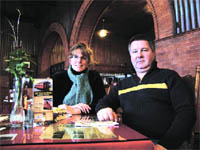
The Town of Seven Railways Rekindles the Past
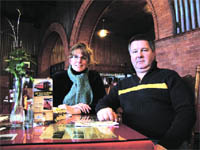
Robin and Blake Lamothe, who own several businesses in Palmer, say the town has definite potential to thrive.
Railways in Palmer are almost as old as the town itself. So ingrained is the towns identity as the historic town of seven railways that manhole covers along Main Street are cast with the relief of a locomotive.
These days, Palmer appears in the news primarily as the hotly contested possible site for an outpost of the Mohegan Sun casino empire. But people in town are quick to say that, while its important to be prepared for such a development should casino gambling be legalized in the Commonwealth, until then the plans are just pie in the sky.
Theres a lot of talk about whether a casino would be positive or negative, said Matt Streeter, town manager. We need to have growth; thats the bottom line. Its an old mill town, and like many others theres a depressed feel that has lingered.
The Quabog Chamber of Commerce represents Palmer and 14 other towns from Belchertown to East Brookfield. Chamber President Lenny Weake agreed that, like many other towns with a former manufacturing base, Palmer has seen that base erode considerably. But he is optimistic that the tide has been stemmed.
Among many success stories, he referenced the former Tambrands factory in the Three Rivers section of town, what is now known as the Palmer Technology Center, as a good use of a defunct mill. And due to the towns location at a Mass Pike exit, a high volume of traffic rolls through.
We have all the major intersections for this section of the Commonwealth, he said. The state highways, the pike the access to get in and out of the area is phenomenal. That turnpike exit is very well-traveled. In July, I believe the number of transactions there was 275,000. Thats a tremendous amount of people. The key is to get those people to stop here.
Adding to the downtowns Depot Village, named for the train station that supplied the town moniker, are a handful of new businesses within the last few months, Weake said. People in Palmer, he continued, are very community-minded, and proudly support local business. Along with the usual blend of mom-and-pop establishments and outposts of nationwide chains, there are businesses in town that are unique destinations.
Nancy Bryants gallery right along Main Street is like something out of a big city, he said. She has chosen Palmer as her home base, while she could be anywhere, really.
Photo Finish
Bryants Giclée of New England Gallery, Studio and Frame Shop sits squarely at the enviable intersection of Main and Thorndike Streets in the heart of downtown.
This location is perfect, she said, because my customers come from all over to get here. If you tell someone to get off the highway and then drive another 30 minutes, well as a business owner, its a lot easier to say, turn right off the pike and drive straight for three minutes.
Her gallery showcases the work of regional artists, and her giclée printing process, essentially a fine-art, high-resolution means of printing digital or digitalized images, has won her a wide fan base. I work personally with the artists, they become part of the process, and thats what makes us unique, she said.
At her location since 2003, Bryant has seen the town slowly but steadily gaining a foothold in rebuilding its economy. Like many in town, her thoughts are that Palmer can and should take advantage of its inherent strengths. The whole atmosphere is bristling right now, she said. We can either go forward, or we can fall back. Palmer has been a depressed area for a long time.
One of those strengths lies in the steel tracks that put the city on the map in the 19th century. Although Streeter remains impartial on the conversation about casino possibilities as a boost for the town coffers, he expressed confidence in rails potential for his town.
Rail service is something more tangible, he explained. There are rails here already, the trains make stops here. There is a station that could easily be retrofitted to make it passenger-ready. Unfortunately, some prevailing plans dont seem to include Palmer.
He refers to the proposal by the Pioneer Valley Planning Commission supporting the Vermonter rail service running north-south, currently stopping in Palmer to switch tracks, to be rerouted through Holyoke and Northampton, creating rail service along the Knowledge Corridor. While the multi-million-dollar plans are still just that plans the future looks good for passenger rail in those two cities, and not so good for Palmer.
Its part of the towns identity, said Streeter. Id say it was a slap in the face when they stopped passenger service, back in 1971 or 72.
But there is hope for the legions that see Palmer as a natural for passenger railway inclusion. The Patrick administration has publicly supported Bostons extensive commuter-rail network to extend past the current terminus in Worcester to head into Springfield. A stop in the town of seven railways is not out of the question.
Having a stop here would benefit us, but also all the surrounding communities that might not find it as easy to get to Springfield, Streeter said.
All Aboard
While many in town ardently support the return of passenger rail service to Palmer, there are few more knowledgeable about that reality in Depot Village than the couple who own the depot itself.
Since 1987, Robin and Blake Lamothe have owned the historic train station in town. After completely renovating the ghostly shell of a structure, a jewel designed by H.H. Richardson sited amidst landscaping by Frederick Law Olmsted, the beautifully restored building became home to their popular Steaming Tender Restaurant.
In addition to the restaurant, the couple owns several businesses throughout Palmer, including active storefronts right along Main Street. The station is the couples first building, bought back when they were in their early 20s, but since then they have been active members of the towns business community.
We believe in Palmer, Robin said. The potential is there.
As testament to that belief, among the many hats that Blake wears in Palmer co-owner with Robin of several stores and host of a radio show, among others he is chair of the towns Redevelopment Authority. His knowledge of the history of trains in his town is matched by his thoughts on what he sees as opportunity for that past to become the future.
At one time, there wasnt a railroad in the United States that didnt want a presence here, he said, counting off the names of a bygone era.
These days, however, the reality is that Palmer faces stiff competition from the Vermont state lobby in its bid to reroute the Vermonter. What Blake has called the Population Corridor, referring not only to the bedroom communities near him but also to the vast student body in Amherst, has lost traction against the Knowledge Corridor.
But thats not the end of an era, Lamothe said. Hes been in talks with several other rail lines, with a variety of other options on how Palmer could be incorporated into their routes. Commuter rail from Boston is one option, as is New England Centrals line to connect Amherst and Southern Conn. to subsequent points beyond, and the Lake Shore Limited, an Amtrak route spanning Boston to Chicago. The rail lines exist, and outside of the Beacon Hill commuter extension, the trains already pass through town.
The waiting game for passenger rail doesnt slow down the Lamothes plans for other businesses in town, though. We have purchased many vacant buildings and have tried to put some form of business in there, Robin said. Were putting in a bed and breakfast at the top of the road, the Trainmasters Inn. There are a lot of people that come through, not just for the Brimfield Fair, but rail enthusiasts. A lot of them. And currently theres inadequate accommodations in town.
Blake added that, ultimately, their goal is to restore Depot Village to what it once was a thriving hub for the railway, but also for the surrounding community. We have a great opportunity. The more businesses that we have, like antique stores and such, the more people we will have floating through, he said.
Currently the couple is in the beginning stages of restoring Olmsted Park in front of the train station. People come to Palmer to see the trains, Robin said. For railroad buffs, this location is a big deal.
I want to see things move forward, Blake said, and by the looks of his and Robins business portfolio in Palmer, they are doing just that. Much like the trains that once brought wealth into town, the couples business endeavors are becoming another engine for towns economy.

Taking Entrepreneurship to Another Dimension

Ed Wood says 3D scanning has caught on in Europe, but it is very much an unknown commodity in this country.
Ed Wood has an advantage that most entrepreneurs can only dream about. When he says he has no competition, he means it. There is none. Zero.
At least on the East Coast, anyway, he explained. To the best of my knowledge, theres no one else doing this.
But he has quite a disadvantage as well. Indeed, very few people know what this is and how they might be able to take advantage of it.
The product is three-dimensional scanning technology. Its been prevalent in Europe for many years now, but in this country it is a giant unknown, what Wood, a serial entrepreneur of sorts, calls a solution looking for a problem or, in this case, problems.
He says 3D scanning can be used for everything from helping candidates for plastic surgery find the right look be it a new nose, chin, or their previous look following a mastectomy to creating likenesses of a newborns face, or his or her entire body.
And hes confident enough that the general population will eventually grasp the concept that hes made a substantial investment in new equipment and opened Accu-Vista 3D Scanning in a fourth-floor suite in the so-called Maplegate Building in downtown Springfield. Few customers have made it to that address thus far, but Wood is optimistic that his current awareness-building activities will eventually pay off.
I think theres a great deal of potential in this technology, he said. People just have to understand all that it can do.
Wood brings a very diverse background to his current venture. He started out teaching art to high-school students in Wisconsin, and later coordinated all continuing education activities for a large medical center in that state. He later relocated to Beverly, Mass., and became a game designer for Parker Brothers (which was eventually acquired by Hasbro, requiring a move to Western Mass.), and led the group that successfully licensed the characters from the three most recent Star Wars movies.
Unfortunately, they werent as popular as the ones from the other three movies, said Wood, noting that, when East Longmeadow-based Hasbro decided to transfer many designers to the Beverly facility, he opted not to go, and instead start his own company.
He and two partners developed several concepts for game makers like Mattel and Hasbro, including the Yomega Yo Yo. This company eventually did work for Disney, and developed something called the Pal Mickey, an interactive plush toy that, through communication with hundreds of infrared transmitters in the Disney parks, could tell guests where they were and what they were going to experience next.
The partners in that venture eventually went in different directions, and Wood found himself looking for a new challenge. He eventually found one in 3D scanning, a technology and potential business opportunity that he researched for nearly two years before deciding it had enough potential to warrant his investment.
Explaining how the technology works, Wood took a picture of himself (his head, to be more specific) as he sat in a specially designed chair roughly three feet away from the scanning equipment.
A projector essentially projects black-and-white lines, hundreds of thousands of them, that capture the contours of ones face and comprise whats known as a point cloud. The image is much like a plaster cast, he explained, adding that it sometimes intimidates people because it captures every wrinkle and flaw.
The technology has myriad uses, said Wood, most all of them still well outside anything that would be considered mainstream. The clothing industry, for example, has explored the use of 3D scanning to obtain images that could be used to create perfect-fitting items that account for every curve and bulge. And he expects this use to someday overcome current logistical challenges and become reality.
As for his own business, Wood says a scan can be used to create jewelry featuring three-dimensional images of a newborns face. Using high-tech printers, such images can be placed on metal, plastic, and porcelain-like materials. Scans can also be used to make complete dolls that look like a newborn, a product called reborn baby. Explaining the concept, Wood said his scans of an infant would be sent to a so-called newborn artist their work is considered a budding cottage industry who would create a life-like doll.
Some people think this is a little creepy, said Wood, but others are giving it great reviews. I guess its up to the individual.
But the more lucrative uses for 3D scanning invariably lie in health care, said Wood, noting that he is hoping to work with plastic surgeons to better serve clients. He noted that the scanning technology can, for example, help those individuals considering rhinoplasty to find a new shape that appeals to them. A scan can be altered with a few mouse clicks, he explained, giving clients a chance to see a potential new nose, chin, or pair of breasts from every angle.
For those facing a mastectomy, a pre-scan can help recreate a womans shape, he continued.
Many women facing a double mastectomy want to look as much like they did before as possible, because theyve found that the psychological healing is as important as the physical healing, he explained. What I can do is scan them and even have a physical model printed for them, and it will be right there for the plastic surgeon to see.
Other uses include scans of burn victims to help create well-fitting protective masks that must be worn while new skin grows, said Wood, adding that those in high-risk professions, such as firefighters, police officers, and soliders, should be pre-scanned in case they are badly injured and require reconstructive surgery.
For now, Wood spends most of his time talking about the potential of the technology that he has chosen for his next entrepreneurial venture. He ultimately believes that this potential will be realized, but he is realistic and knows that awareness and acceptance wont happen overnight.
When it does happen, hell be fully ready to capitalize on his huge competitive advantage. – George OBrien
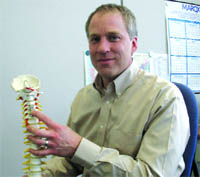
Marox Corp. Brings Surgical Precision to Medical Manufacturing
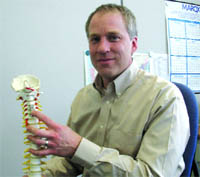
Brad Rosenkranz says innovation in spinal surgical components has increased at a rapid pace as has competition among designers and manufacturers.
Brad Rosenkranz keeps a model of the human spine in a corner of his office at Marox Corp. in Holyoke. If nothing else, it’s the best way to demonstrate exactly what the manufacturer’s products do.
At one point, he held a cervical plate, formed from titanium, to the front of the spine, showing how it provides stability in the neck area when it’s used by surgeons in the treatment of traumas or degenerative spine conditions.
He also produced a few titanium pedicle screws, which hold in place the rods used to repair and connect the vertebrae; and talked about an organic polymer thermoplastic called PEEK, a lightweight, biocompatible substance used as a spacer between vertebrae. It’s radiolucent, meaning X-rays can pass through it, which is a benefit to doctors.
“Surgeons like it because they can see,” said Rosenkranz, Marox’s vice president of sales and marketing. “There are usually three titanium markers we assemble into PEEK, and on an X-ray they show up as three dots, showing surgeons how the implant is positioned.”
Other Marox products include spinal hooks, components for the hip and knee joints, and even some dental products and small parts for endoscopes, all of which contribute to the 59-year-old company’s reputation among the region’s leading manufacturers of medical implants.
Marox’s customers are OEMs, or original equipment manufacturers, which supply medical practitioners with surgical and other types of devices. “We work with large OEMs, medium-size OEMs, we even work with startups — the whole spectrum,” said Rosenkranz.
“With spines, the industry has come out with more and more products that are vastly improved,” he noted. “The spine was a grossly underserved market, but now a lot of companies are entering the field, trying to take on the big spine companies, and now I think the industry has become saturated with OEMs.”
Meanwhile, he said, the U.S. Food and Drug Administration has become more stringent about approving new medical devices, particularly for technology that is similar to anything already on the market. “It’s difficult,” he said of the increased competition to design products. “But it’s pretty good for patients now.”
Testing Their Metal
When Manfred Rosenkranz and his three sons acquired Marox in 1988, it manufactured a variety of items, ranging from small-arms components for Colt and Smith & Wesson to commercial hardware products.
Soon thereafter, Marox started becoming heavily involved in the aerospace industry. Meanwhile, its production of an angioplasty product became its entry into medical manufacturing. One of those niches would not survive.
“After years of seeing volatility taking place in aerospace,” Brad Rosenkranz said, “and having more and more opportunities presented with medical implants, we realized that, in order to capitalize on the opportunities in medical, we had to phase out all other industries, including aerospace. And the growth in the spinal-implant market worked out very well for us; we rode that wave.”
He stressed that Marox isn’t a design firm, but does contribute in some ways to the design process — specifically, taking the design a customer has developed and providing input on manufacturability.
“We might say, ‘if you change this component here, it will make it a lot easier to produce.’ They’ll say, ‘yes, we can make that change,’ or ‘no, we can’t; that’s a critical dimension.’ Ultimately, with our feedback and theirs, we agree on a design that works for them, that meets their needs and also meets our production needs.”
Rosenkranz explained that the medical-machining industry is in many ways beholden to regulatory decisions. For example, a technology known as motion preservation, which allows joints to fully articulate instead of being fused together, wasn’t being covered by public payers, and the momentum of development in that area slowed down as a result. It’s now being overtaken by something known as dynamic stabilization.
“It looks like the industry is moving more toward dynamic stabilization,” he said, explaining that the technique connects two sections of the spine and reduces the prevalence of adjacent level disease, which is a pathology that develops in a vertebra adjacent to a fused bone.
“Dynamic stabilization allows some movement — not a lot, but a little bit,” he explained. “Kind of like a shock absorber, it allows the rod to bend and move, and allows adjacent bones a little movement. It’s better for bones to have that flexibility and movement because, if you don’t have that, you tend to have some negative effects. This dynamic stabilization creates the movement the bone needs and helps a lot with adjacent level disease.”
Rosenkranz said it’s tough to predict where the next breakthroughs will come, a forecast partly clouded by uncertainty surrounding health care reform and how any change in the health care system will impact peripheral industries, like medical manufacturing.
“Nobody really knows, with the current administration, where this is all going to end up,” he said, adding that he expects innovation to continue whatever the structure of health care. “This is a very progressive industry, and they’ve come a long way in terms of technology.”
However, while components and tools for spinal surgery have consistently become more sophisticated over the years, he added, some products have stayed relatively unchanged over the past decade — notably certain components for major joint replacements — simply because they do their job so effectively.
“The designs on hips and knees haven’t changed too much over the years,” he noted. “They work really well, so it’s the ‘if it ain’t broke, don’t fix it’ type of thing.”
Room to Grow
Marox — with its emphasis on lean, efficient manufacturing and its pristine facility — is, like many modern plants, a far cry from the old stereotype of the dirty, chaotic factory floor.
But not everyone knows that, Rosenkranz said, and it’s a challenge to make sure people understand what today’s manufacturing floor is like, and to raise the prestige of what are often very high-tech jobs — which is why he conducts tours of the facility for trade-school students.
“We want to show kids that, hey, there is something to manufacturing,” he said. “I think it may have gotten a bad rap, that it’s not glamorous, and people have jumped to computers, software, and IT because they’re the glamour jobs, and manufacturing got left in the dust.
“But we’re showing kids that this is high-tech, precision work, making really sophisticated components — and, on top of that, for a good cause,” he continued. “Some people hear ‘manufacturing’ and think of a dirty foundry, a dark, gloomy, grungy place. But it is very clean and high-tech. We’ve been told our facility is reminiscent of a European facility, with lab coats, where everything is clean and neat.”
Rosenkranz is excited not only about the work that Marox performs, but for the whole umbrella of burgeoning bioscience applications, from synthetic bones and stem-cell products to bone-growth stimulators and other technologies that fall outside Marox’s metal-machining specialty.
Economic-development experts have long pegged Massachusetts as a hotbed for such cutting-edge industries, and Rosenkranz doesn’t doubt that this region could be a growth sector, at least for high-tech precision machining.
“I think there’s good talent here in Western Mass.,” he said. “Finding skilled workers is a problem that everyone faces nationally, but here in Western Mass., I think we’re just as well-off if not better-off than anyone else in terms of a skilled workforce. Around here we have a lot of manufacturing, and a lot of colleges having more awareness in terms of what’s available in manufacturing.
“We’ve seen a lot of growth over the past several years,” he added, “and it looks to be so in the future as well. It’s a great industry to be in.”
For anyone, that is, with the spine to take on some high-tech challenges.
Joseph Bednar can be reached at[email protected]
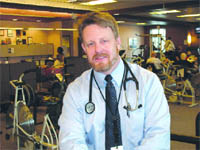
Inside Baystate?s Cardiovascular Rehab & Wellness Program
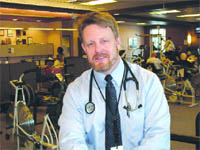
Robert Berry says some people continue to use the exercise room as their health club even long after being hospitalized for heart problems.
Robert Berry says the name of Baystate Healths Cardiovascular Rehab & Wellness Program is important.
Sure, the rehabilitation aspect gets people who have suffered a heart attack or other cardiac event back on their feet, but the wellness side is equally crucial teaching them how to maintain good habits so their acute cardiac issues dont return.
If you come into the hospital with a heart attack, or if youve had bypass surgery, valve surgery, a heart transplant, things like that, well help you prevent complications like pneumonia, said Berry, program manager. Well also talk to you about what the risk factors are for heart disease and how you can prevent something like this from happening again.
Berry calls the program, located in a sprawling facility on Main Street in Springfield, ridiculously underutilized, with about one out of five patients who qualify actually using it.
He said most people are also unaware that they can make Baystate their health club, with all the exercise equipment and guidance they need, but with trained medical professionals always on hand if something goes wrong.
People think if theyre moving, theyre exercising, when theyre just waving their arms around like Robbie the Robot from Lost in Space, Berry said. Seeking guidance from the Cardiac Rehab & Wellness Program, he argued, is a far better option for not only staying in shape, but staying out of the hospital. Were positively affecting peoples lives.
Something for Everyone
Berry and his staff are making that impact in three distinct phases, each with its own goals. Phase 1 is for inpatients who are recovering from a heart attack or surgery and involves imparting that crucial information Berry mentioned about lowering risk factors and stabilizing ones heart health.
The second phase like the first, typically covered by insurance lasts for between six and 12 weeks and is designed to help people recovering from a heart attack or heart disease to learn how to return to their former activity level, or close to it, and craft a plan to do so.
Education is important, Berry said. Where we differ from traditional rehabilitative services is, the physical therapist doesnt spend a lot of time telling you how not to tear your rotator cuff again. We say, your cholesterol is 232; thats way too high. What can we do to bring it down? These are your goals.
We also do some work with depression because a lot of people are understandably depressed right after a cardiac event, and depression is huge risk factor for another cardiac event, he continued. We screen everyone for depression when they come in, and if we find anybody whos scoring too high and not being treated, we ask them if they want to see a psychologist, and we give their primary care physician a heads-up.
Patients obtaining phase 2 services include those recovering from angioplasty, stenting, bypass surgery, heart-valve surgery, and heart transplants, as well as heart attacks.
The goal is to get people to understand how their behaviors are interfering with their health exercise habits, dietary habits, how they deal with anger and stress, all those things impact your health. We help people understand all those things, so when they leave here, they know the basics of a good diet, how much exercise they should be doing, and what changes they should make in their routine. With that information, they might either go to Planet Fitness or the YMCA or stay here.
Berry was referring to phase 3, the maintenance phase of cardiac rehab, which is paid for out of pocket. Many people use the program in place of a gym or health-club membership because they feel more comfortable in that environment. For one thing, the entire staff is certified in advanced cardiac life support, and know how to use the crash cart, with its array of emergency equipment, in the corner of the room. Meanwhile, Baystate cardiologists have offices across the hall.
If something goes wrong, were equipped to handle it, Berry said. Its like the military: you plan for something, and hope you never have to use it. People here like having that safety net.
We have a 96-year-old who comes here and exercises, he continued. Phase 3 is a commercial gym in a hospital environment. We have 4,000 square feet of space out there. Its huge.
Parental Advice
Our focus on education is what really sets us apart from commercial gyms, Berry said. Were not trying to compete with commercial gyms; were not after the same people.
That said, he argued that Baystates program is better-equipped to help people, even those not recovering from a heart attack or surgery, understand the relationship between health and habits.
You have to be careful because certain medical conditions affect your response to exercise, he said. All Planet Fitness can really do when something happens is call 911. Were trained for more than that.
Throughout the process of recovering and maintaining good health, Berry says the goal is to instill lifelong habits.
Implicit in lifestyle change is the idea that these have to be changes you can live with, he told BusinessWest. If you just do it for three months or six months, then go back to your old habits, your old medical conditions are going to come back.
The key, Berry said, is balance and setting firm but realistic goals.
I dont want you walking out of here thinking you have to eat celery stalks and tofu for the rest of your life, but I also dont want you to eat every meal at McDonalds, he said. The same goes for exercise, which some experts recommend 60 to 90 minutes, five days a week. I believe in this, and I dont have time to do that, he added.
I tell you the same things your parents would tell you; I just have to find new, interesting ways to say it. The basic message is to eat less and move more. We have to find ways to motivate people to incorporate that into their lifestyle.
Other aspects of the Cardiac Rehab & Wellness Program include heart-healthy cooking, smoking cessation, and stress reduction, all areas that can impact heart health. In all cases, Berry wants to ease people into what he hopes will become lifelong habits.
I have a strong preference for starting people off pretty easy, where they are, and for some that might be a treadmill at 1 mph with no elevation for three minutes, and then sit down for two minutes, then get back on for three more minutes, Berry said. The reason for doing that is, I want people to have a good experience when they come in here. I cant do more with them if they dont come back.
He encourages the same small steps getting readjusted to the outside world. If someone is able to work up to walking around Stop & Shop, grocery shopping at his own pace, without getting tired, thats a goal to be commended.
The idea is to gradually get people to a place where theyre comfortable with maintaining a certain diet and exercise regimen even if they stop coming to the Baystate program not that anyone has to stop coming. Just ask the 96-year-old.
Joseph Bednar can be reached at[email protected]
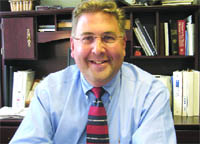
SPHS Looks to Restructure Programs in Wake of Brightside Closing
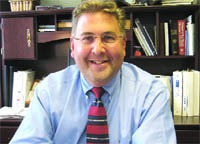
Mark Fulco says the Sisters of Providence Health System is working hard to find new homes for Brightsides residents and new jobs for its employees.
Over the course of 130 years, any community health program will shift its focus multiple times to meet changing needs. Brightside for Families and Children is no different, says Mark Fulco.
Specifically, Brightside the West Springield-based arm of the Sisters of Providence Health System (SPHS) that provides behavioral health and education services for young people will cease operations in its residential and school programs by April 2. The decision is due largely to what Fulco, senior vice president of Strategy and Marketing for SPHS, calls a paradigm shift in the way child-welfare programs are structured and delivered these days.
There has been a precipitous drop statewide in referrals to longer-term, residential facilities like Brightside, he told BusinessWest. In 2005, we had more than 1,200 placements, but that dropped to 700 in 2008. And its not just Massachusetts; weve seen this in other states as well.
These latest placement numbers, he explained, represent a fraction of Brightsides capacity. And despite extensive efforts to increase referrals to Brightside, SPHS does not expect the a reversal of that trend.
Over the past two years, the Brightside management team has worked tirelessly to reduce overhead and operating costs, and find new sources of program funding and referrals to maintain the census level and viability of those services, Fulco explained. But it appears that the census levels can never improve to viable levels, and the funding sources just are not there to place children in residential programs and school programs like those operated by Brightside. Thats the harsh reality.
Times Change
Brightside was born in 1881 as an orphanage, and has grown over the years to become a prominent provider of residential and outpatient services for children with behavioral or family issues. But in recent years, Fulco explained, 75% of all children requiring such services from the state have been placed into foster care or treated in their own homes, and reliance on residential-care services such as Brightsides has been on the decline.
Even our long-term residential program has always operated with the goal of assimilating children back into the regular school system and back into their homes. Thats always been the goal, Fulco said. What the child-welfare system has changed is that long-term residential care is no longer seen as a principal modality. What they prefer to do is utilize community-based placement for children, whether thats back into the home or foster care. The child stays in the public-school system, and services are wrapped around that community setting.
So weve seen a preference for keeping children based in the community, utilizing foster care and other placements, he said. But weve also seen a growing need for community services like our Family Stabilization Team.
The FST is what Fulco called the third leg of Brightside services, and the only one that will remain intact after the closing of the residential and school programs. The FST provides outpatient services in conjunction with the inpatient Child and Adolescent (CHAD) and Acute Residential Treatment (ART) programs at Providence Behavioral Health Hospital, another Sisters of Providence facility.
Rather than long-term residential care, there still is a need for short-term, or acute, residential treatment for children being released from a psychiatric facility or at risk of being admitted to a psychiatric facility, Fulco said. We operate, through Providence, the states only inpatient psychiatric facility for children west of Boston, and well continue to provide that service. Well continue to provide the third leg of Brightsides programs, community-based programs, through the Family Stabilization Team.
Transition Game
The decision to shutter the residential and school programs, which Fulco called difficult but necessary, most immediately affects two groups of people current residents and employees and SPHS is taking steps to ease the impact on both.
The transfer of all of Brightsides residents and students to alternate settings will be completed by the beginning of April, he explained, adding that the best interests of the children continues to be the top priority, and transitioning them to a safe environment will be accomplished in a minimally disruptive manner.
Our primary concern at this point is for the safety and well-being of the children currently at Brightside, Fulco said. Were working with the applicable state agencies to care for the children and ensure quality education for the children currently in our care and ensure that the transition to an appropriate setting for each child is as seamless and well-coordinated as possible.
The matter of 133 Brightside employees losing their jobs is another challenge the health system is taking seriously, he added. In addition to making sure the needs of the kids are met, were very involved in providing assistance to our employees. Theyve been invited to apply for other positions within SPHS, and were also helping them identify new opportunities outside SPHS with significant outplacement services.
Once these two challenges have been addressed, Fulco said, the health system will set about examining how to restructure the child and adolescent services that remain.
The Family Stabilization Team, the third leg, will continue to provide existing services, he said. Providence includes an acute residential treatment program, and that must be integrated into the Family Stabilization Team and the remaining Brightside operations. It needs to be a very logical integration of programs that allows us to continue to provide mental-health and family-support services.
That can wait, of course, until the current residents find new homes.
Our primary focus is transitioning the children and providing assistance to our employees. Then we can really shift attention on restructuring Brightside services in conjunction with Providence and the ART, he said.
Weve done some planning for how to restructure our services, and SPHS remains committed to providing care for children afflicted with psychiatric, behavioral difficulties. The structure is going to change a little bit, but the safety, health, and well-being of the kids is our primary concern.
Continuing Mission
Fulco asserted that the work of the Family Stabilization team will remain relevant because demand for that type of outreach has grown alongside the drop in demand for residential services.
Brightside has repeatedly evolved to meet the changing needs of children in the community, he told BusinessWest. Today, the realities of how those programs are delivered and how those services are funded requires a significant shift in Brightsides organizational function, and a dramatic change in our approach.
Brightsides commitment to caring for children afflicted with psychiatric, emotional, and behavioral difficulties will continue, he added, by responding to the current demand for short-term acute services and those designed to avoid longer-term residential stays.
The Brightside story, in other words, is still being written.
Joseph Bednar can be reached at[email protected]
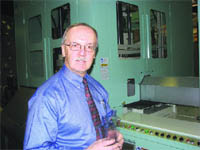
How a Success Story Took Shape at Meredith-Springfield
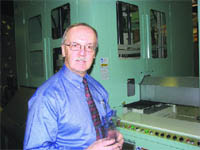
Mel OLeary says Meredith-Springfield has earned a reputation as a go-to company for difficult projects using the blow-molding process.
Mel O’Leary called it “the turning point.”
He was referring to work with Reebok in the early ’90s to develop something called the “dynamic mid-sole crossover,” or DMX cushion for short. This was the athletic shoe maker’s answer to Nike’s famous ‘pump,’ and for Ludlow-based Meredith-Springfield, it was much more than a $1 million, 18-month development project.
“It was the first time we really did something that wasn’t a plastic bottle that would hold shampoo or cleaner, but was blow-molded, which is our technology,” said O’Leary, the company’s founder, president, and CEO, referring to the plastic-converting process that will be explained in more detail later. “But it was more than that for us. That was when we started to develop our niche, when we became the go-to guys for non-bottle items like that, projects with a high degree of difficulty.”
The Reebok project was in the early to mid-’90s, said O’Leary, founder of the business, but Meredith-Springfield has not only maintained that reputation for problem-solving, but enhanced it, with products ranging from the casing for a container in which bone marrow cells can be grown outside the body to fight cancer, to globes for a huge chandelier built for a casino in Macau, China.
“The company intended to do it with glass globes, but that became cost-prohibitive, and the weight became prohibitive,” O’Leary said of the casino builders, adding that much-lighter-weight, fire-retardant plastic that looks like glass became the solution, and Meredith-Springfield the solution provider.
“People come to us with ideas that are almost whimsical,” O’Leary continued. “And we figure out how to do them. That’s one of our main strengths, being a small, nimble company under entrepreneurial control; we’ll take a few risks and move fast to try and take care of a customer.”
This track record for handling tough assignments, coupled with great diversity in terms of the industries served by the company — everything from the household industrial chemical (HIC) market to the medical industry; from landscaping (vinyl fencing) to the personal-care realm — has enabled Meredith-Springfield to thrive even in the worst recession in 80 years.
“We’ve been busy, at full capacity, growing, and hiring through the downurn,” said O’Leary. “There’s no recession here.”
And it has enabled the company to make huge investments in new technology that will allow it to comply with clients’ demands for ‘greener,’ more environmentally safe plastic products.
The company recently added a $1 million machine (and another is on order) that will enable it to manufacture products with polyethelene terephthalate (PET), an improved barrier-technology, or non-leaching, thermoplastic polymer resin now demanded by clients such as B & G Foods in Parsippany, N.J., for which Meredith-Springfield has been making containers for Vermont Maid Maple Syrup and other products for years now.
O’Leary’s venture is also expanding physically. It recently acquired the property at 321 Moody St. (it had been leasing roughly 40,000 square feet of space there) and will eventually absorb the 50,000 square feet once leased by Bassett Boat for warehousing.
“It’s an exciting time for us,” said O’Leary. “We’ve planned well … we’ve positioned ourselves properly, and we’ve built a great reputation in the industry. We’re in a growth mode.”
For this special section highlighting the diversity of the region’s manufacturing sector, BusinessWest takes an indepth look at Meredith-Springfield, a company that is breaking the mold in more ways than one.
A Business Takes Shape
As he talked about the bone-marrow-container project, O’Leary listed a number of elements that made this product quite complicated to manufacture.
Michigan-based Aastrom Biosciences was (and is) the client, he said, and it wanted a container made out of special plastic that is very difficult to mold into a container of the desired size. “Gooey” was the word O’Leary used to describe this material, which represented just one of the challenging aspects to this project.
“We needed to do two secondary operations, a routering operation and a drilling operation,” he continued, “and it also requires special packaging because it’s radiated for sterilization. And it’s a close-tolerance part.”
Aastrom eventually sent a request for qualifications to the 30 top blow-molding companies in the country, said O’Leary. “Eight of them responded with ‘no quote,’ and the other 22 recommended Meredith-Springfield.”
How this low-profile company achieved such problem-solver status is an intriguing story, and one that O’Leary admits he hasn’t had too much practice telling. This will change now that the company looking to raise that profile.
O’Leary has spent much more time and energy explaining the company’s name — which is where the story begins, sort of.
It turns out that O’Leary and a partner in a medical-equipment-leasing business they started in 1979 as a side venture were looking for a name for their business. They chose their hometowns; O’Leary was from Springfield, and his partner, with apparently enough oomph to put his town first, was from Meredith, N.H.
This business, a franchise, was eventually sold, with the partners going their separate ways. O’Leary would hold onto the corporate name Meredith-Springfield, thinking that someday he would again do something entrepreneurial. He did, when his career with Aim Packaging, a plastics company that operated out of the former Gilbarco complex in West Springfield, ended a few years later.
O’Leary worked his way up the ranks at AIM, eventually becoming plant manager and, along the way, starting two new operations in other cities. But a trend toward self-manufacturing in many industries served by plastics companies eventually prompted serious consolidation at AIM, and O’Leary was fired in late 1982.
With obvious hindsight, he calls this the best thing that ever happened to him. That’s because he took his background and started a plastics-consulting business, for lack of a better term.
“As soon as our client base found I was no longer working there, they started calling me at home and asking if I could help with their in-house operations,” he explained. “I didn’t really know how to spell ‘consultant,’ and the next day I was one.”
Elaborating, O’Leary said he, and eventually some other partners he brought in, also from AIM, provided support for the technical aspects of plastic-packaging development.
Much of the early work was with the so-called ‘soapers,’ which made everything from cleaning products to shampoo to mouthwash. And when the economics of self-manufacturing changed and companies started outsourcing that work, it helped Meredith-Springfield make a successful conversion from a venture that started as a development company and did a little manufacturing to a manufacturing company that still does some development.
Technically, the company is a plastic extrusion blow molder. This means that it uses blow molding, a process by which tiny plastic pellets are converted into a hot plastic hose, said O’Leary, adding that a two-part mold is closed around the hose, and air is blown in to create everything from bottles (to hold everything from soda to motor oil) to the freezer packs used in lunch boxes to the so-called vapor-recovery boot (part of a car’s gas-tank assembly).
The company has moved from O’Leary’s home to a plant on Cottage Street in Springfield to the present facilities in Ludlow, growing steadily over the years to where it now boasts 50 employees.
PET Project
The turning point, as O’Leary said, was the Reebok project.
Until that time, Meredith-Springfield was enjoying ample success as a blow-molding manufacturing and engineering company, making products for Johnson & Johnson, Kraft, PepsiCo, and other clients, most all of them bottles — eventually to contain everything from witch hazel to maple syrup to toilet-bowl cleaner.
Reebok was looking for a molder to develop and manufacture the DMX. Meredith-Springfield handled the former, and, because it couldn’t find a molder to take on the assignment on a production basis, it assumed that role as well until one could be found (overseas) to handle the volume.
There have been other success stories along the way, ranging from the plastic fencing that has become a big part of the business (yet also the only one to see declining sales due to the collapse of the housing market) to the curved neck on toilet-bowl-cleaner bottles, for which Meredith-Springfield attained several patents.
“Part of the art and science of our work is marrying up the right plastic with the right application,” O’Leary said, adding that the biggest development for the company has been its hard-earned reputation as a problem-solver, won through work on the casino chandelier, the bone-marrow container, and even large, plastic advertising tools called factices, developed for Elizabeth Arden to showcase a new product.
“The company wanted one source that could figure out how to manufacture a giant tube-like-looking article that could be silver hot-stamped (decorated), gray silk-screened, and a have a metalized aluminum cap,” O’Leary explained, referring to the items eventually placed at thousands of cosmetics counters around the world. “Plus, they also wanted them in special packaging and shipped to 20,000 locations. That was a tall order, and one that was simply too complex for a large company to get its arms around.”
Recently, Meredith-Springfield has had to solve a problem of its own, if it can be called that, in the recent shift toward use of PET in the production of many items used for the food industry.
B&G Foods is one of the clients pushing for the change, said O’Leary, noting that the plastic long used in the making of bottles for products like Vermont Maid has fallen out of favor with large chains like Wal-Mart and Kmart. The new, preferred product is something called stretch-blow PET, or simply soda-bottle resin, as it’s known in the industry.
Making the transition needed to keep B&G’s business has required a massive investment — again, in the middle of a recession, said O’Leary, adding quickly that the company is looking at this development more as an opportunity than a challenge, an investment more than an expense.
Indeed, machines that had been devoted to Vermont Maid and similar products can now be put toward different business requiring extrusion methods — and there is plenty of it, O’Leary added — while the company has set out to be a leader in stretch-blow PET.
“Because we’ve had a very healthy company and maintained excellent quality and service and on-time deliveries, we’ve actually been getting more business,” he explained. “That’s because many peer companies have been cutting back to the point where they can no longer react quickly, so they’re losing business to us.”
Time in a Bottle
When asked if his primary competitors were domestic or foreign, O’Leary paused for a minute to measure and prepare his response.
“This is a rather bold statement,” he said, “but we don’t have very many direct competitors. There are very few companies that will take on the projects that we do.”
This reputation for being able to think outside the box, to take the whimsical — like the glass-like globes for the chandelier in China — and make it reality, has enabled Meredith-Springfield to not only make the mold, but break the mold and move well beyond the plastic bottle.
George O’Brien can be reached at[email protected]
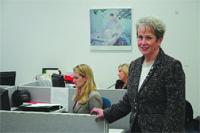
At 25, United Personnel Focuses on Its Next Milestones
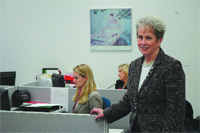
Mary Ellen Scott says the employment-services field is relatively easy to get into, but hard to master.
Necessity is the mother of invention.
Thats how Mary Ellen Scott described her beginnings in the temporary-employment industry. Its been the story of my life, really, she told BusinessWest before explaining at length just what that means.
Scott is the owner of United Personnel in Springfield, which is celebrating 25 years in business. With the industry changing dramatically in that quarter-century, that adage has been in use for much of the time, seeing Scott and company becoming one of the areas leading placement firms. Looking back on her time in business, she explained how it has come together over the years.
When Scott and her family moved to Springfield in the early 1980s, a chance encounter with a friend of her then-husband, John Canavan Jr., led to a new career.
It was a clothing manufacturer, the old William Carter Co., she said, and it was the only unionized plant in the William Carter conglomerate. They wanted to get rid of it, so they sold it to a man who went to prep school with my husband. That was Joel Gordon, who bought the factory and renamed it the Gemini Corp., and who contacted Scott at home one day.
Here I was unpacking boxes, she said, and this man called me up and said, do you want a job? Well, I had been a stay-at-home mom for 10 years, so I said, doing what? and he said well, what can you do?
Despite her modest assessment of that interaction, Scott became the human resources director for the plant of 400 employees. But the two-income household was soon to be cut back to one. In 1984, her husband lost his job. He was 51 years old, she said. That was and is definitely an issue in the job-hunting market.
After looking for work for more than eight months, Gordon suggested to him to strike out on his own. With a brother in the temporary-help business in Boston, Canavan decided to give that field a shot. Scott explained why.
From an entrepreneurs perspective, in concept, its not a very complicated business to get into, she said. Smiling, she added, but it is hard to do it well. In the grand scheme, though, you dont need to know how to operate a lot of machines, and it doesnt take a great deal of capital up front.
Starting the company in Hartford, Canavan drew upon the vast needs of that citys many insurance firms to specialize in clerical temps. Scott laughed when she remembered her husbands attempts for her to work with him.
It was critical to hire the right person for him to work with, she said, but would anyone be willing to jump at a job at a start-up operation, getting paid very little money, when they would have to work very hard, and quit a job that they enjoyed? Thats the question I was asking myself.
For two months, Canavan sought someone to oversee front-of-the-house operations interviews, hiring, placements while he handled marketing, sales, and the administrative details. As before, fate intervened in Scotts decisions.
My job at this time was changing, she explained. Our friend had brought in this new manager, a graduate of MIT and West Point. He had a very different idea about how to treat people than I had.
One particularly bad Friday afternoon, she continued, I had to be in on a session with him and one of the employees, and I came home and I said to my husband, I think God is trying to tell me something. If were going to do this staffing business, were going to do it together.
After three months of commuting in separate cars to Hartford in case one of us needed to go back to the kids, Scott said the first order came in. But it didnt take long for the pair to hit their stride, and within two years, they opened a branch office in Springfield, at the location still in use today, 1331 Main St.
Along the way, the business shifted gears from a focus on clerical temps to a division that served the light-industrial sector. That was a fortuitous decision, Scott said. The economy was changing at the end of the 80s into the early 90s. Insurance companies in Hartford were struggling with their real-estate deals gone bad. And the first thing a company does when times are hard is to cut back on new temps. So our business in Hartford went downhill.
But the Springfield office prospered, becoming one of Inc. magazines top 500 fastest-growing companies in 1993 and 1995. The diverse client list we had here really pulled us through, Scott said. Not only did they handle clerical and industrial clients, but MassMutual and BayBank were early customers as well. When Canavan passed away in 1999, Scott became the sole owner of the business.
Does Not Compute
During the early years, Scott said, we had no computers at all. We had two electric typewriters, and everything was done on paper.
Personal computers, however, changed that and changed the nature of her business. Companies changed how many secretaries they used, she said, and some people dont use secretaries at all anymore.
The clerical sector, which at one point was 100% of our business, became a much lower percentage, she continued. These days, we are primarily a light-industrial staffing company, about 70% in manufacturing.
Pointing to a stack of boxes waiting to be moved out of the offices hallways, Scott said that the old-fashioned pen to paper is still necessary for many forms I9s and W4s, and applications still filled out by hand but digital communication has become the new tool of choice for United and nearly every other business in this sector. While e-mailing certainly makes us more available for our clients, she said, adding that someone in her office is on call around the clock every day, she motioned with a smile at that pile of boxes and said, I dont think computers have made less paperwork.
Still, Scott said her job is still done, in many ways, just like in the first days of the business. Describing the challenges of staffing in different sectors, she said that clerical candidates still need to be interviewed; Its a little more of a conversation to get those jobs filled.
Manufacturing often involves her clients requesting multiple orders. We get calls for upwards of 40 orders, she said of the number of employee needs. It can be challenging to find that many people right for the job.
While pundits search for hope in the murky economic forecast, Scott said that business at United, and the sector as a whole, is definitely picking up, which is a good sign.
When the economy is on the way down, were the first to know it, and on the way back up were the first to know it also, she explained.
Manufacturing clients are getting orders, and they need workers, she continued. We have all different kinds of businesses, and they all seem to be picking up, calling for temps.
Hiring Line
Looking at the next milestone of her successful career, Scott said that the she is thinking about branching out into health-care staffing, acknowledging that it is one of the regions growth industries.
Personally, she laughed, I dont know anything about the licensing and laws involved in that sector. So I will have to hire some expertise in that field.
In other words, shell take the approach she has from the beginning: that necessity may be the mother of invention, but hard work and imagination are the secrets to success.
And neither Scott nor her company have ever been lacking in those qualities.
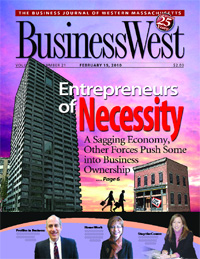
A Sagging Economy, Other Forces Push Some into Business Ownership
 Making the transition from employee to business owner is usually a scary proposition. Whats prompting more people to take such a plunge is the realization that the corporate world is no less scary and, in many ways, even less secure. But whether one chooses this route by choice or out of necessity, a challenging roller-coaster ride almost always awaits.
Trisha Thompson called it working for the Mouse, as opposed to the man.
Thats a phrase used by many of those who find themselves in the employ of the massive Disney Corp., which Thompson was, as executive editor of a Northampton-based monthly publication for parents called Wondertime.
Thats was.
Indeed, the corporation abruptly shut down the magazine roughly a year ago, despite what most all involved considered solid early success. We made all our numbers, said Thompson, referring to the start-ups performance over its first several years. We received some awards, we were on track with our circulation we were a good magazine. We went from an original staff of seven to 32, but they decided to just shut it down.
Fast-forwarding things a little, Thompson said this sudden, completely unexpected turn of events provided the rather violent push she and her husband, Fred Levine, then a freelance writer and editor, needed to start their own business venture, called Small Batch Books. Operated out of their home in Amherst, this vanity-press operation specializes in personal memoirs, family histories, and commemorative books.
It was launched last summer after some extensive job hunting and soul searching led the two to determine that this was the best, most practical route for them to take given their ages (Trisha was 49, Fred 52), their career aspirations, and the decidedly unsteady state of the print publishing industry.
It doesnt feel safe anywhere anymore theres no place to go thats really all that secure, said Thompson as she explained why she turned down a few other opportunities in publishing, including one in Iowa, and then stopped looking, even if that meant entering the often-scary world of entrepreneurship. I thought to myself, Im going to uproot my family to go to Des Moines, and then in a year theyre going to shut that down? No, thank you.
And because no place is safe in most all sectors of the economy, many, like Thomson and Levine, have become what Dianne Fuller Doherty calls entrepreneurs of necessity.
Elaborating, Doherty, director of the Mass. Small Business Development Center Networks western regional office, said that most who go into business for themselves do so out of choice or opportunity. But all economic downturns, and especially the so-called Great Recession, have seemingly removed choice from the equation for some who have found themselves downsized and with few, if any, attractive job opportunities.
Were seeing many people who are choosing this path out of necessity, she said, which isnt always a good thing. Some people are cut out for this, and some people arent.
Sometimes, such entrepreneurial leaps are brought on by other factors, such as a companys relocation, discontinuation of programs, changes in administration at a company or institution, or others. For Dan Touhey, the push, as those who have made this transition call it, came when his long-time employer, Spalding, which he most recently served as vice president of marketing, announced it would be moving out of Springfield.
The first announced destination was Atlanta, home to Russell Athletic, which bought Spalding several years ago, Touhey explained. But then, when Fruit of the Loom bought Russell, employees were told that if they wanted to stay in the organization they would have to relocate to Bowling Green, Ky.
And Touhey never gave that mailing address any serious consideration.
So after sifting through some offers from recruiters and rejecting them none looked solid enough in these days of unrest and consolidation in corporate America he decided to go out on his own last spring with DPT Consulting.
There are two aspects to this business. The first, concerning his primary client, the Berkshire Opportunity Fund, involves channeling small businesses looking for funding to that venture-capital outfit. The second is centered on offering Touheys vast experience in business and marketing to small businesses that can use it. These include a cycling-apparel company in Northampton and a start-up that manufactures a product called the bunt-down bat.
As in all cases when individuals mull the shift from being an employee to being self-employed, those who take this step out of necessity must still perform the needed due diligence, said Lyne Kendell, senior business advisor for the MSBDC, who has counseled many people weighing such a decision.
In short, such individuals must have a solid business concept and a plan of attack, she explained, but also the needed skill sets to be an entrepreneur (not everyone has them), and a passion for what they want to do.
It cant be something they just feel like they want to do or should do, she explained. And it shouldnt be just a way to make money. It has to be something theyre passionate about. Without that, it wont succeed.
By the Book
This requisite passion was apparently missing the first time Thomson and Levine met with Kendell.
That was seven years ago, when they were pondering a different kind of venture, one involving custom publishing in the corporate realm, or what Thompson described as extended advertorials for products and services.
Within about 10 minutes, she was giving us this weird eye, the stink-eye kind of thing, Thompson recalled. We were looking over our shoulders saying, whos she making this face at? It was us. She said, do you really want to do this? Im getting the feeling you dont, but feel you could or should.
We said, well, of course we do, Thompson continued. But shortly thereafter, we found out she was right, but by then, we had already rented office space and spent money unnecessarily.
Things were different when Levine and Thompson were again sitting across the MSBDC conference table from Kendell, this time explaining Small Batch Books. The two told Kendell (and BusinessWest) that they believed they had a somewhat unique concept a soup-to-nuts vanity publishing operation and something that they truly believed in.
This time around, the body language conveyed the necessary confidence and passion, said Kendell, who said she gave Levine and Thompson a homework assignment of sorts, one they ultimately scored well on.
I gave them some tasks to do and things to think about, on both the personal side and the business side, and a few weeks later, they came back with those tasks completed and with the confidence that they could take the plunge, she said. On the personal side, they have to do what I call a personal retreat do they have the personal wherewithal to do this? If theyre going to work together, what would the guidelines be for the home life and business life? On the business side, its more looking at skills, contacts, potential revenue streams, whether you really know the market, and whether you could, if necessary, live on a part-time job or savings for 12 to 18 months.
Kendell has been assigning lots of homework these days, as she and others at the MSBDC handle a larger portfolio of cases than would be considered normal, mostly due to the recession.
Many of these cases involve businesses that are hurting, said Allen Kronick, senior business advisor for the MSBDC, noting that some wait too long to seek help. For these businesses he sometimes uses the term dead on arrival to describe their condition, meaning that there is nothing he or anyone else can do for them. Many others can be helped, he said, adding that his own portfolio has many cases involving companies trying to find ways to hang on until the economy improves and succeeding.
Meanwhile, many other cases involve startups, with a good percentage of them blueprinted by individuals who have been downsized and cant find another job, or at least one to their liking, or who could perhaps find a job similar to what they had before, but are tired of what Kendell called the rat race.
Looking over his portfolio, Kronick said he has several clients that fit this description. They include everything from a former MSPCA employee laid off when that agency shut down its Springfield facility who is now making and selling cat scratch posts, to a laser engineer who knew his days were numbered with his now-former employer and started his own venture, to some other former executives at Spalding trying to figure what to do next.
Tuoheys situation involves both the recession and general uncertainty about corporate America. He told BusinessWest that, in this economy, even though things have improved somewhat since last spring, opportunities in marketing, and especially senior marketing positions, are few and far between. But recruiters did call, he continued, and upon listening to what they were saying, he became increasingly convinced that there were few, if any, situations that provided the real security and peace of mind he was seeking.
When I did find situations, they were less than ideal, he explained. They were too similar to what I had just left, and I knew how quickly things could change. I looked at a couple of situations, gave them serious consideration, and decided to decline.
Eventually, he said he simply grew tired of waiting for the ideal situation to come about and for the economy to rebound, and started his own venture. The work with the Berkshire Opportunity Fund has been steady and has given him a solid foundation, he explained, adding that hes slowly but surely building a portfolio of clients in sports-related businesses that can tap into his marketing and brand-building expertise.
VOmax, a Northampton-based cycling-apparel maker, is one such client. Tuohey said he recently helped the company secure licenses with the National Basketball Assoc., National Hockey League, and Major League Baseball, to make clothes with team logos and colors. Meanwhile, with the Bunt Down Bat venture, he is helping the owner build brand recognition and take manufacturing operations to a higher level.
Gifted and Talented
For Marge Slinski, the push into entrepreneurship didnt come from the recession. Instead, it came first from a change of direction regarding the UMass program she had been involved with one concerning youths at risk and an informal policy at the school that acted as a career barrier.
Elaborating, Slinski said she had a position of authority with a national program, one that won several million dollars in grants to create and replicate initiatives involving youths at risk. She eventually lost that position when the school opted for a different course, and found out rather quickly that, to attain a position with similar responsibilities, challenges, and opportunities to grow, she would need a doctoral degree, which she didnt have and didnt want to put her life on hold to earn.
Instead, she went to the Smith College Career Center (shes an alum) to get some counseling on what to do next. I was essentially a person who lost a great job and had no way to replace it, she explained, adding that those at Smith told her that she could take some of her strengths, specifically those in the arts, and what she called collaboration building and perhaps use them to start a business.
She took that advice and started Choices, LLC, a venture run out of her home that is focused on helping companies find appropriate gifts for their corporate clients.
Through collaborations with American artists such as Stephen Schlanser, Jennifer McCurdy, Geoffrey Smith, and others, shes commissioned suitable, meaningful gifts for clients ranging from Fortune 100 companies to locally based banks. The recipients vary, from Mideast oil sheiks to Chinese businessmen to retiring employees, and the occasions vary as well, from celebrations of $1 billion sales (for those Fortune 100 companies, obviously) to employees 25th anniversaries.
I had a new mission, said Slinski. Instead of youth at risk, Im getting corporations to value American arts and crafts as key corporate gifts for their VIPs.
Starting with a few leads given to her by her husband, whos in business, Slinski has managed to steadily grow the company over the past few years, and is now looking to take on a partner and take it to the next level.
Meanwhile, Levine and Thompson, who worked in Western Mass. several years ago, then relocated for other job opportunities before returning nearly a decade ago, told BusinessWest that theyve pretty much understood for some time that they would likely have to go into business for themselves, given the rocky state of the publishing industry in recent years.
We knew when we moved back here that staying in publishing is not the best place to be, and that wed probably have to come up with something on our own at some point, said Levine. We were lucky along the way in that we did find some staff jobs and we were able to cobble things together with freelance work. But after this last round, with Trisha getting let go, and with the economy taking a huge, huge bite out of print publishing in general, we knew wed have to do something on our own that would be more stable.
Over the past several months, theyve been able to approach stability through several projects involving personal or family histories or other legacy initiatives, most all of them for customers outside the 413 area code; one current work in progress is for a client in Australia.
There are many who wont have fortunes to leave behind, but will have thoughts and memories and words, said Thompson, noting, as one example, the remaining World War II veterans and Holocaust survivors, many of whom, as they approach or reach their 90s, are thinking about putting their stories into something that can be preserved for future generations.
They have a legacy to leave behind, she said, adding that this phenomenon certainly provides some growth potential for their fledgling business.
Free Spirits
When asked about making the transition from employee to employer, or sole proprietor, those we spoke with said there is a definite learning curve that is part and parcel to such a career shift.
There are things to absorb, especially on the financial side of things, and there are some trade-offs. There is no steady paycheck anymore, said Thompson, stressing, as she did repeatedly, that there are no sure things in the corporate world either in this day and age. But there is freedom, more responsibility, and, in general, a pride in ownership that doesnt come with working for someone.
Its very freeing, buts also a little scary when youre not working for the mouse, said Thompson, who noted that, without the strong push that came with the closing of Wondertime, she and Levine may have not made the leap. Its freeing because you have as much autonomy and decision-making power as you do responsibility, and thats unusual. Theres no one else to blame if something doesnt go right.
Said Levine, on the days when it gets dicey for us and we start to get a little scared, we take a step back and look at the people we know from the long careers weve had who have stayed with a large publishing company and lost their jobs because the magazine got sold to some other huge conglomerate. It isnt always better on the other side.
But maybe the biggest difference for me is realizing how much energy you spent in a
taff job just dealing with personalities and the whole political machinery of it, he continued. Now, you can take all that energy and put it into building your business, and also on the creative side as well. Just think about all the time you lose sitting in meetings.
Roughly a year after he made the transition, Tuohey has no regrets and isnt looking back, only ahead. He, too, likes the freedom and greater sense of satisfaction that comes with business ownership.
You definitely make your own breaks, he said. The thing about what Im doing thats so fulfilling for me is that Ive earned every penny that Ive made doing this, and Ive become much more well-rounded of a professional. I think Im more determined, and more confident in my abilities.
Those are the absolute positives, he continued, plus I dont have to jump on a plane every week and fly off and not see my kids.
Slinski said her background has been in program development, not business management, so she has had to learn many of the basics, from balance sheets, which shes still mastering, to pricing.
The hardest thing to learn was to ask for the money I deserved; I would tend to underprice, but Im getting better at it, she said. Overall, I was never a business person; I was great at creating things and developing things systematically, but the business side was all new to me, and I had to learn.
All those who make the transition to business owner, whether by choice or out of necessity, should be prepared for what Tuohey called a roller-coaster ride.
There are a lot of ups and downs and emotional swings, he explained. Most of all, people have to be prepared to work hard and have some determination and some perseverance; its not an easy ride by any means.
The Bottom Line
Touhey says he still hears from recruiters.
I get calls once in a while, he said. I tell them that Ive stopped looking for a job, but if they want to talk to me, and theres an ideal situation, Ill certainly listen.
But Im going to be the one dictating the terms; Im not just going to jump back in, he continued. Ive found something I think I can grow, and in the meantime, Ive proven to myself and my family that Im capable of providing for us with this, and theres a certain amount of accomplishment in that.
In other words, a former entrepreneur of necessity is now one by choice and hes not alone.
George OBrien can be reached at[email protected]
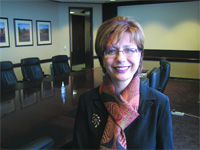
Why Flexible Hours and Telecommuting Are on the Rise
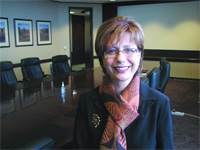
Brenda Olesuk says the accounting industry has been smart about using flex time and telecommuting as a retention tool.
In 2003, about 4.4 million Americans were telecommuting, to some extent, instead of showing up at the office. In 2010, that number is expected to surpass 100 million. At the same time, the trend toward allowing employees to work flexible or non-traditional hours has also risen sharply in recent years. Why the surges? As it turns out, even during a recession, companies still value their best talent and are increasingly willing to let them craft a workday around their personal and professional needs. Employers say they benefit because happy workers are productive workers.
Its no wonder accounting is such an attractive field for women, considering what a leader the industry has been in providing work-life benefits like flexible schedules and telecommuting.
Its a retention tool, said Brenda Olesuk, director of marketing for Meyers Brothers Kalicka, P.C. in Holyoke. In fact, accounting firms, as a rule, have employed flex time, technology, and telecommuting as a both a recruiting tool and as a retention tool.
Part of the shift has to do with the rise of women in the accounting field; they make up more than 60% of all accountants nationwide.
That has changed the complexion of the industry over the past couple of decades, Olesuk noted. Women, of course, have families and often want to have the flexibility of being able to have a family and a career. These are highly educated, accomplished people, and the industry has been very smart about using technology and flex time to attract and retain talent, especially women.
But its not just accounting, and not only women who are reaping these benefits. Across the board, aided by advancements in communications technology, workers are increasingly being given the option of working at home, or coming into the office for only part of their workweek, otherwise staying connected by phone, e-mail, and Internet.
The upward trend has been pronounced. In 2003, according to a report from the American Interactive Research Group, about 4.4 million Americans telecommuted from home. A year later, that number had almost doubled, and in 2010, its expected to surpass 100 million almost a third of the countrys entire population, working or not.
Thats a startling increase, but it doesnt surprise Lorie Valle-Yanez, vice president and chief diversity officer at MassMutual. Thats because the Springfield-based financial-services firm has long been recognized as a leader in providing work-life benefits to its employees, even being named to Working Mother magazines 100-best-companies list 10 times.
I like to think we have a culture of flexibility here. If you walked through the halls and talked to people, youd see its less of a formal program and more a part of the DNA of the company, she explained. We have a long history of supporting the work-life balance of employees, helping employees meet their obligations inside and outside of work.
Its a trend that should continue as a perfect storm brews, with employers increasingly recognizing the benefits of keeping their top talent happy, and a generation of 20-somethings entering the work world expecting such treatment to a degree not seen before.
But working from home and setting ones own hours isnt a right, say those who spoke with BusinessWest; its a privilege earned by the most valuable, productive workers. And used correctly, such flexibility is proving to be a classic win-win for companies and their employees.
Doing Their Homework
Employee retention is no small matter; depending on the industry and the position, the replacement cost of an entry-level staff position including money spent on recruitment, hiring, training, and orienting a new employee can top $10,000, and often much more. And that doesnt include the lost time and energy that management must expend on such efforts.
Thats why keeping top talent happy is critical, even during a recession.
Absolutely, its attractive for people who want to come work here, Valle-Yanez said. One of the selling points when you come to this company is its flexibility. It certainly demonstrates that this company cares about employees well-being, and it shows in increased productivity, improved morale, improved engagement, and improved loyalty across the board. People know they can come into this organization and be able to manage their work-life challenges.
Smaller companies are also starting to recognize the benefits of giving employees an alternative to the 9-to-5 cubicle shift.
Offering flex time and mixed telecommuting arrangements is something weve done for a number of years, said Michelle van Schouwen, president of van Schouwen Associates, a Longmeadow-based advertising and marketing firm.
Back when we started, it was born of various necessities so a valued employee moving to a different state could still do most of their work, or for a parent whose child care ended before our office hours did, van Schouwen explained. As we began to work with it, we realized it was a good fit with the type of staffing we had.
Specifically, she said, her firm typically hires people who have an independent streak and know how to manage themselves, rather than needing lots of hand-holding. They tend to be the kind of people who would stay late and do the job at the office, people who know what theyre responsible for and want to get it done. They have that internal sense of professionalism that means theyre going to get their work done.
Thats an important factor, Valle-Yanez said, because not everyone has the discipline to stay focused on work when no one is looking.
I believe flexibility is not an entitlement; its an earned privilege, she told BusinessWest. Its not one size fits all. Not everyone is able to work from home. If somebody is not performing, its probably less likely theyll have the same flexibility as someone who performs very well.
The type of job someone has obviously makes a difference, too, she said, noting that a call-center representative would need to work largely on site during regular business hours. But those whose jobs allow them to work from home, on their own schedule, are likely to appreciate the privilege and thats good for productivity.
People who are good performers have earned the right and earned that flexibility. They value that flexibility a lot, and theyre very productive employees, Valle-Yanez said. If you think about it as an earned privilege, you dont want that privilege to be taken away. So employees who have that privilege tend to be highly motivated.
Small World
Olesuk noted that home offices and corporate offices are more connected by technology than ever before, and many tasks can be performed at night or on weekends, allowing employees who have children or other responsibilities to set their own schedule.
In our firm, we have all sorts of people, men and women alike, who are able to work from home or from their office equally well, she said. Technology is an enormous component allowing us to do our job from any location, and the flexibility of being able to manage our hours, whether its full-time or part-time, and still serve the client and meet the firms needs, is a very significant tool. If we were to go back to everyone doing 8 to 5 from this office, wed have real retention issues.
Being an accounting and business-consulting firm, Meyers Brothers Kalicka (MBK) is able to observe this move toward flexibility outside its own walls, too.
For example, James Calnan, partner and director of the firms Health Services Division, sees a definite increase in telecommuting in the medical field, especially for key staff hired for their specific skill set and judgment.
One of his clients employs a director of finance whos scheduled to work from home two days per week, with the company supplying the computer, cell phone, and other technology. Another client has field reps in multiple states, and staff meetings are conducted through a dial-in format. While its usually key personnel who have more ability to telecommute, Calnan said, most levels of administrative staff are utilizing flex scheduling again, perhaps spurred by more women in the workforce having to juggle work and home responsibilities.
Donna Roundy, MBKs senior audit manager for its Not-for-Profit Division, says nonprofit organizations are increasingly allowing telecommunicating as a way to attract and retain skilled individuals in key roles. Outside of these key positions, she said, most clients typically want their staff on premises.
Meanwhile, Kris Houghton, a partner and Director of the firms Tax Division, says the service sector most successfully utilizes technology for recruitment and retention, with fields such as accounting, law, engineering, medicine, human resources, and computers services best equipped to operate in that virtual-office environment.
Sales forces also benefit from technology and ability to telecommute, she added. While support-level staff may not always have telecommuting opportunities, Houghton said, there has definitely been an increase in flexible hours across the board.
Telecommuting can also serve specific budgetary purposes, Houghton explained. For instance, instead of bringing a medical coder on board full-time, which a practice may not need, it can hire a coder part-time who does the practices work from home at night a more efficient use of resources.
Homeward Bound
At MassMutual, Valle-Yanez said, while scheduling and workplace flexibility is built into the philosophy and culture, each decision on where and when someone works is typically made between that employee and his or her manager, taking into account both outside circumstances and the employees work habits and productivity. When the arrangement works, everyone is happy.
Its a nice option, she said. You dont have to face a snowstorm. You can do your work at home. In some cases, people are more productive at home; there are often less day-to-day interruptions, and theyre surprised how much they get done from their home office.
In terms of productivity and retention, van Schouwen had similar thoughts.
Its all positive again, when using the right people, she said. For example, among our employees, we have parents of younger children who likely stay with the job in part because it allows them a work-life balance. In addition, weve been able to keep people who have moved away with a spouse or made other life changes that would have made an ordinary commute inconvenient.
For a small company, she concluded, its a benefit thats both affordable and valued, and thats a precious thing.
Joseph Bednar can be reached
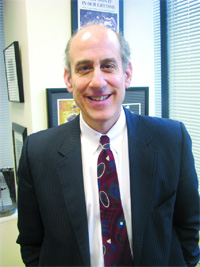
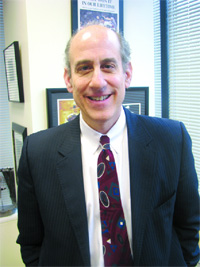
Charles Epstein, president, Epstein Financial Services
Charlie Epstein clearly remembers his first on-stage performance.
Glenbrook Middle School in Longmeadow, he said. I did a Bill Cosby routine, the Noah skit, at the annual talent show. I had yellow bellbottoms; thats what I remember most.
Epstein, or Charles Burtaine (thats the name on his actors union card; he took his mothers maiden name) has gone on to deliver many different kinds of performances since that spring night in 1969. In his freshman year at Longmeadow High, he played Gangster #1, as it said in the playbill, for the spring production of Kiss Me Kate, produced by his brother, Paul. Hes done Shakespeare hes quite proud of his portrayal of Richard III and had the lead in a production of Crossing Delancy. Hes been in several television commercials, had a tiny part in an episode of the soap opera The Guiding Light, and in 1991, he did stand-up comedy in New York with Jon Stewart, among other people.
His tour de force, as he called it, was a one-man show called Solitary Confinement at what was then known as StageWest (now CityStage) in Springfield, in which he played seven different characters.
That was my ode to Mrs. Doubtfire, he joked. I did 64 performances, eight shows a week for eight weeks; I never worked so hard in my life.
But Epstein hasnt been on stage in nearly a decade. He quit a Broadway show on the morning of 9/11 after deciding it wasnt worth his time and energy, and hasnt been seriously tempted to do any acting since. Hes confident hell return to performing someday, but for now, hes content to spend the time hes not working with his family, and especially his two adopted children, Hannah, 14, and Noah, 8.
And Epstein spends considerable time not working, maybe the equivalent of three to five months each year, by his estimate. Thats a pattern hes continued from his acting days, when he would often spend four days of each week during the summer performing. He says he can do that and others can as well by focusing on making the very most of each hour in the day.
People waste a lot of time in business, he explained, adding quickly that he doesnt. When you only work nine months out of the year, you get really, really clear on whats important and whats not, what to put your attention toward, and what to delegate, which is what most people in my industry cant do; most people do what they think is important they need to do just whats essential.
By practicing what he preaches, Epstein has been able to steadily grow and diversify the company, Epstein Financial Services, which he started in 1983. The Holyoke-based venture now has many moving parts, or components, including the Benefits Consulting Group, a partnership with Meyers Brothers Kalicka, as well as a division called 401(k) Coach, which, as the name suggests, provides coaching to individuals on the minutae of the 401(k) and how to sell that product.
Summing it all up neatly and succinctly, Epstein said his job, which takes him from his office in Holyoke to speaking engagements across the country, boils down to convincing people to save for retirement.
I help individuals create successful retirement outcomes, or paychecks for life, he said, adding that this phrase has become the title of a book hes working on, with the first draft completed.
As for his own story, when asked about the combination of forces that have shaped his life, Epstein started by pointing to a picture of his mother, Margaret, on the credenza in his office. A budding opera talent, her career was sidetracked, and eventually scuttled, when she married Robert Epstein, a prominent accountant who later went on start a womens clothing store, Debs, in downtown Springfield. Eventually, he would join two brothers in another retail venture called Casual Corner and take it national.
Thats where I get my dual personality from, Epstein explained. My mother was an artist, and my father was a smart businessman.
Even with that background, though, it didnt appear that Epstein was ticketed for great things in either realm. He recalls struggling to get even minor roles early in his acting career, and believes he recorded the lowest score (2) ever posted on an aptitude test in the 150-year history of MassMutual, which he took while working in insurance soon after graduating from Colgate University with a degree in Economics.
Its designed to tell if youll make it in the insurance business, he explained. I was right out of college, single, no family; who the heck is going to listen to me talk about life insurance?
But I was fortunate; I had a mentor in the industry who took me under his wing, he continued. That year, I was the number-one new agent at MassMutual and made the $1 million round table.
He wasnt doing as well with his acting, though.
I knew I wanted to go back to acting, said Epstein, who noted that he lived in the theater at Colgate. In 1987, I went to Boston for an open call for all the summer stocks in New England. I was so bad, I couldnt even pay anybody to be an intern. Now, thats bad. As an intern, you pay them to set up sets.
Eventually, though, Epsteins stock rose in both business and the arts. In 1988, he went back to Boston and actually got a paid internship ($50 a week) at a Shakespeare theater in Maine. He put up sets, got a few small acting parts, and learned a lot about the business.
By years end, he learned something else that he made $50,000 more that year, working just nine months, than he did working 12 the year before. I thought, thats really interesting.
Such performance, he concluded, stemmed from that aforementioned focus on whats essential, which basically comes from necessity.
If I were to tell anyone that I was going to take three months of work from them that theyd have to get a years worth of work done in nine months they would become so focused, and so effective, and so much more turned on, he said.
Epstein has become so proficient in time management over the years, that hes not only managed to get all his work done in nine months, but hes been able to donate time and energy to nonprofits, such as Square One, and also start ventures such as the UMass Amherst Family Business Center, which is now entering its 18th year. When he and his second wife, Lorie married last year, instead of accepting presents, they asked guests to donate to charities they chose. Epstein chose Square One, and Lorie chose the Susan G. Komen Foundation which raises money to fight breast cancer.
Meanwhile, he spends considerable amounts of time on the road, speaking before a wide range of audiences. His message?
Americans need to save, otherwise were going to have a huge financial crisis, he said, putting heavy emphasis on that word huge. Im a huge proselytizer of our retirement system. We have the best system in the world; all people have to do is save its really not that complicated and take half as much risk as they do now.
When asked about whether hell return to the stage, Epstein its more a matter of when, not if, hell entertain again, and he speculates that the day will likely come when Noah is 18. But he has plenty to keep him busy until them, from watching Hannahs lacrosse games to vacationing in Europe with Lorie and his children.
And in the meantime, hell keep the spotlight on retirement and the need for everyone to simply save.
George OBrien
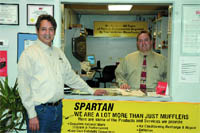
How George Katsoulis and His Family Business Overcame a Nearly Fatal Blaze
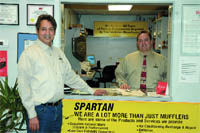
George Katsoulis (left, with brother Nick) says both he and the Spartan business have rebounded from the fire.
George Katsoulis remembers things happening almost in slow motion.
The best way I can describe it, he told BusinessWest, was that it was like watching something happen in a movie or TV show. You know its reality, but its just so hard to believe that you cant process it. I felt like I was an actor playing a role.
He was talking about the fire on March 27 that nearly took his life, closed several business ventures in a crowded block of Memorial Avenue in West Springfield, and forever changed the family business George ran along with his brother, Nick. The blaze left him with third-degree burns over more than three-quarters of his body and doctors thinking that he probably wouldnt survive.
He did, and so did the venture, now called Spartan Auto Care Center, that was started by his father, Markos, more than a half-century earlier. And in both cases, the stories involve determination, or sheer will, not to let the fire win the battle.
They also involve family, friends, and Spartans customers, who supplied more than enough support for George, who spent several months in a coma, and the business itself to find that will to carry on.
You go through your daily life, and you dont think about the impact that you make, said Nick, but seeing the number of cards, the support, you see that George really made an impact on people. It was an overwhelming outpouring. Seeing that kind of response that was a factor in our wanting to get back in business as well.
The business was back up and running less than a year after the blaze. For George, the climb back has taken much longer, and it is still ongoing. He works a few hours a week, and is optimistic that this year he will be more active with a company that continues to evolve.
In this issue, BusinessWest looks back on the events of that fateful March day, but also at the comeback efforts for both the business owner and the business. And they are truly inspirational.
Igniting a Comeback
Three seconds.
Thats how long George Katsoulis says it took for a ribbon of fire to reach him and one of his employees as they carried a gas tank to the back of the shop as the afternoon wore on that day that no one will forget.
Nick was in our other store at 631 State St. in Springfield, and I was managing the shop, George began as he recalled the events that led to the calamity that happened with almost no warning. It was business as usual; nothing particularly stood out about that day.
A typical repair we do is to a damaged fuel pump, most commonly located inside gas tanks these days, he continued. The job that day I remember being in my office on the phone, watching through the window as one of my mechanics took the gas tank out of a car. It was sitting under the vehicle. What you want to do is bring that tank away from the bays, into the shop just behind the bays. I could see the mechanic looking around for another body to help him carry the tank. You hate to see someone idle, so I got off the phone and went to help him move it.
Thats when an otherwise typical day became anything but.
We proceeded to move the tank from the front of the shop to the back, George said. When we got in the back room, well, it had been sitting around, so gas fumes had gotten into the air. I cant say that I saw the fire begin, but the fire came through the doorway we just entered.
Nick explained that a mechanic in a bay adjacent to the fuel-pump job was cutting a muffler off, and he speculated that this ignited the fumes that had collected in the ceiling. The fire then set off to find the source the tank in the two mens hands.
It was a pretty full tank, George said, and we spilled a fair amount of the gas on our journey to the back room. It was like a fuse. We were holding the tank, and we watched the flames come to us it probably took about three seconds to find us.
I remember being arms length away from a fire extinguisher, but I couldnt reach it, because between me and that extinguisher were all the flames. Arms length, and I just couldnt reach it.
Over in Springfield, Nick recalled, he received a couple of phone calls from friend who worked in Tower Square. They said, I think you better go check out whats going on over at your place; it looks like theres a fire over near there.
Also within the Spartan building at that time were the Cigar Room, the Kung Fu Academy, New England Granite, and Richards Giant Grinders. Nick said he called Spartan numerous times, and then each of the tenants. No one was answering.
I walked outside the shop in Springfield and could see the smoke. It was very unsettling. To then come down here and see what was going on he paused I was in a state of shock.
Nick said that the building, made of cinder blocks with a steel deck roof, was badly damaged on the inside, but the water and smoke damage hit the tenants hard. Remarkably, for a fire that would eventually draw every truck in the city, as well as engines from Agawam, Springfield, and Holyoke, the front of Spartan was largely undamaged. There were cars out in front of the building that were undamaged, and George laughed when he said, our computers were on the next day.
The other mechanic holding the gas tank suffered third-degree burns on his leg. But it was George who suffered the worst of it that day.
Third-degree burns on 86% of my body, he said. Pretty much everything but my head.
Nick added, almost immediately he was sent to Mass General in Boston. He was intubated for quite some time. They did skin grafts, and at one point, last rites were administered. We were told to say goodbye. Essentially, he was in a coma for four months.
Three, George corrected him, smiling, and one more awake in the hospital.
The doctors and nurses all said to me that it was nothing short of a miracle that I was alive, he added. So many people were saying prayers for me; I attribute my survival to that.
Both men said that the most important thing for them to take away from this tragedy was the importance of their customers, friends, and families. While every one of the heartfelt offerings of support touched the Katsoulis families, Nick said that one in particular stood out.
Its a story that still touches me to this day, he said. If you drive out on the Mass Pike heading to Boston, in Brimfield theres a small niche with a statue of the Virgin Mary on the side of the highway. Thats the family farm for one of our customers, and she said she prayed for George. Every time I drive by that, I will think of her.
The staff at Mass General was also touched by the support George received while at the hospital. They couldnt believe the number of cards and letters he received, Nick said. I want to say that it was more than 1,000.
Back in Business
From the first moment after the fire, all business at the West Springfield shop was shifted to the Spartan location across the river. But there was never a question in Nicks mind that the shop would reopen. His dedication to the employees and other businesses left him with no other option.
After six months of going through official channels to secure building permits, reconstruction at 865 Memorial Ave. started in earnest. The shop reopened on Dec. 12 of that year. Richards Grinders is really another part of this story, Nick added. They were shut down at no fault of their own, but were happy theyre back. The deli reopened in March 2009.
Looking back at a year since Spartan reopened, Nick said, were incredibly thankful that our customers have come back to us, and it was a strong year. In so many ways, we do feel fortunate. Thats why George and I are always here, to make sure that things go the way our customers want them to go.
George said that his goal for the coming year is simply to get back in the shop.
It took about a year after the accident for me to be able to walk again, he said, but then added with a smile, if my customers and employees are waiting for me, then this is the year I will be back to work.

The Irene E. and George A. Davis Foundation
Mary Walachy called it “extemporaneous philanthropy.”
That was the phrase she chose to describe Irene E. Davis’s approach to giving back to the community — at the least the model she used for most of her life.
An orphan for much of her childhood, Irene — who married George A. Davis, first a salesman for American Saw & Mfg. and then owner of that company — was, later in her life, very generous when it came to donating money to groups that would help those less-fortunate, especially children, said Walachy, executive director of the foundation that bears the Davis name. However, there was little, if any, structure or organization to her giving, she continued, noting that donations were often in cash and given at the spur of the moment.
To illustrate the way in which Irene was “personally philanthropic,” Walachy relayed a story from around 1970 that she’d heard many times, knew she couldn’t retell as well as Davis family members, but tried anyway.
It seems that Irene Davis had become impressed with the work of Downey Side (the adoption agency that was started in Springfield and now has offices across the country), and stopped by the offices of its founder, Father Paul Engel, to find out more. After listening to him for some time, she got out her checkbook and wrote him a check — for $30,000.
“But he didn’t even look at it to see how much it was for,” Walachy explained, noting that Engel was being polite, but also didn’t know Davis and wasn’t at all sure of who was dealing with. “He just put in his desk drawer. When he took it out later, he was shocked; he thought, ‘this is a crazy lady,’ or ‘she doesn’t know what she’s doing … this is going to bounce.’ He didn’t even take it to the bank.
“The next morning, she calls him, and he thinks, ‘here it comes,’” Walachy continued. “She said, ‘this is Irene Davis. I gave you a check yesterday — how much was it for?’ When he told her the amount was $30,000, she said, ‘I’m sorry, I meant to make it $50,000; I’ll be down later with the other 20.’ He said he never had a day like that in his career and that this was such a poignant moment in his life.”
It wasn’t long after this episode, according to family lore, that Irene Davis’s son, Jim, recommended that she form a foundation to bring some order to her philanthropy, to keep records of which groups were sent money and to perhaps monitor whether money was spent in the manner intended, said Walachy. At first, she refused, thinking such a step was mostly about taxes and gaining deductions, which she wasn’t interested in. But when Jim told her it was a way for her to keep on giving to the community long after she passed on, she eventually agreed.
And so the Irene E. and George A. Davis Foundation was born, with an initial $350, and for 40 years, its giving has been anything but extemporaneous — although it can act swiftly and with great flexibility, said Walachy, adding, quickly and repeatedly, that this institution exists to do much more than simply award grants, or give.
Instead, she told BusinessWest, the foundation also initiates, convenes, unifies, collaborates, finds facts, analyzes, tests, evaluates, advocates, and more. And what it’s really doing through the sum of all this is “causing change,” she continued, especially in the broad realm of early-childhood education and development.
“The majority of our time and attention is absolutely local,” she explained, “and with a significant lens in education and particularly the passion around ensuring that children, especially those in the urban core who are disadvantaged, reach their full academic potential in order to be successful in both school and in life.
This focus on education, young people, and causing change, as she put it, is part of what Walachy called a “maturation” of the Davis Foundation — something that has dominated her time with the organization, which started in 1996, and which is still very much ongoing. And it’s part of her efforts to adopt best practices involving many of the leading foundations in the country, and also be far more proactive than reactive when it comes to philanthropy.
“As we’ve grown and matured over the years, we have realized that, in order to be impactful, we need to be somewhat more strategic,” she continued, noting efforts such as the foundation’s Cherish Every Child program and its Reading Successfully by the Fourth Grade program. “And that strategy is largely in the broad rubric on education and investments in young children, because we firmly believe that investing early is where we get the greatest return.”
However, the foundation understands that resources are limited in Western Mass., and that there are simply not as many charitable foundations here as there are in Boston, she went on, adding that funds are also awarded to groups that assist the elderly, the mentally challenged, and many other constituencies.
When asked to list just some of the groups to which the foundation has awarded grants over the years, Walachy thought for a minute, shook her head, and then said, “just about every nonprofit group in this area.”
But, again, she said that giving money is only a part of the equation. In recent years, a perhaps-bigger part is that ability to convene, which is part of the maturation process, and something made possible because the Davis Foundation supports so many nonprofit groups.
“In order for us to advance and move some of the social-change issues that we care about, we need to lend our name, we need to lend our voice, we need to use our convening power, and we have to use our credibility,” she told BusinessWest. “That is more powerful, in my estimation, and we’ve come to see that come true as we’ve stepped out in a leadership role around change issues.”
Walachy noted that, while one can see the Davis name on a few plaques or walls across the region — the Neonatal Intensive Care Unit at Baystate Children’s Hospital is one example — this family isn’t big on having things named after it.
“People will say, ‘if you give us $1 million, we’ll put your name on the building,’” she said. “That’s not an incentive for us.”
Rather, the real incentive comes in getting a chance to be impactful, to cause change, which is how it chooses to serve the region and carry on the work of Irene and George Davis.
The family’s methods of philanthropy have changed considerably since Irene’s cash gifts and random check-writing. But the impact is still the same. The foundation is still making for the best days in many nonprofit administrators’ careers, and creating innumerable poignant moments in their lives. —George O’Brien