Home Posts tagged Construction (Page 46)
Sections Supplements
From Dining Hall to Dorm, WSC’s Evan Dobelle Leads by Immersion
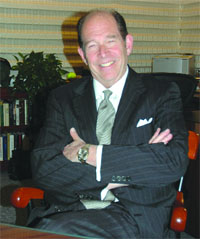
Evan Dobelle

Evan Dobelle

Evan Dobelle has worked in some intriguing places, from Hawaii to the White House. It may seem unlikely, then, that the latest president of Westfield State College has found himself bunking down with the students in the residence halls at WSC. But he says it’s the best way to understand the college’s culture, and to set a course for the future.

Evan Dobelle, president of Westfield State College, calls his current living situation the “ultimate management by living.”

He took up residence in one of the college’s dorms when he assumed his post at WSC in January, so his neighbors are the students, and his trappings are much the same as theirs.

“As the largest residential state college in Massachusetts, this is essentially an ‘academic hotel,’” said Dobelle, using one of many descriptive turns of a phrase that characterize his speech and how he talks about the institution he leads. “I have to see how the hotel operates, and living here allows me to observe everything from the food service to the transportation to the general attitude and culture.

“I don’t interfere, and I don’t intrude,” he added. “But I do get to see things that can be fixed or underlined, and, most importantly, I get to be part of this campus life.”

Dobelle, a Pittsfield native, has served as a college president in various locations across the country, including Trinity College in Hartford, City College of San Francisco, and the University of Hawaii. But he’s no stranger to community planning and political leadership, either. He was elected to two terms as Pittsfield’s mayor in the early 1970s, and served as the U.S. chief of Protocol for the White House during the Carter administration, among other posts.

Most recently, he served as president of the New England Board of Higher Education, a sort of “chamber of commerce,” as he described it, for more than 200 institutions in six states. During that time, he championed the ‘college-ready’ model for high school students, investments in creative economies, and public-private partnership between various institutions.

When asked why he chose to accept the president’s position (he’s the college’s 19th following the departure of Vicky Carwein), his answer was quick and succinct.

“This is home,” he said. “In a profession like mine, you tend to have to leave home to assume more responsibilities. I have worked in several different places, and I can only say being offered the opportunity to work in Western Mass. is just one of those serendipitous things that happens.”

Class Notes

As for his primary goals moving forward, Dobelle said he’s focused on honing and elevating the WSC brand.

“We have a high admissions ceiling, and historically, we’ve been relatively passive in our admissions practices,” he said. “But we still need to diversify and promote the college — particularly our graduate programs. We’re a teacher’s college, but many people don’t realize what strong professional programs we have.”

He added that some of the existing strengths of the college — an accessible campus and strong academic record among them — are helping to advance certain initiatives that fall under that branding umbrella.

“There’s already an idyllic feel on the campus,” he said. “It’s a friendly college with have high retention rates and a committed faculty. The downside is that resources can be complicated to manage.”

Dobelle explained that a lofty admissions cap coupled with solid retention rates are good problems to have, especially in a national academic climate that is nearing some lean years in terms of new recruits. However, they also call attention to a need for more residential housing and academic buildings to accommodate students, and Dobelle said improvements to the physical plant are part of the overall attention to WSC’s identity.

“We have 400 people on the waiting list for the dorms,” he offered as an example. “And while there’s been a drop-off in applicants nationwide, Westfield State is still the college of choice for many students in Massachusetts, particularly from the southeast part of the state. Our strategy has become identifying exactly who these kids are, and actively recruiting them.

“To do that,” he continued, “We must celebrate our unsung programs.”

Dobelle said there are plenty examples of strong programs on the WSC campus from which to draw. He cited Criminal Justice, Psychology, Music, and History among them, and added that, just this year, the college was honored on the athletic side with the Smith Cup, presented by the Mass. State College Athletic Conference to the college that amasses the most wins in all sports, through both men’s and women’s teams.

He added that WSC’s current mission is not to reinvent itself, but to build on existing strengths such as these, and that includes work on the administrative end.

“I wasn’t brought here to change the college. I was brought here to bring it to the next level,” he said, noting that he’ll present his management plan to the college’s board of directors in June. “I’d say we’re working to create administrative efficiency, not a blanket restructuring. I’m looking for the right structure first and then the right people, but I’m certainly not looking to grow the bureaucracy.”

Destination College Town

Another initiative he’s pursuing is further ingratiating the college into Westfield’s downtown, a move he said could benefit both the city and the institution.

“Anything that helps Westfield helps me,” he said of the endeavor. “This is a solid city at the entrance to the Berkshires, and as such with access to one of the most successful creative economies in the country. I’m looking to locate a new performing-arts venue in the center of town, that could include up to 800 seats and be used by the college and the community.”

There is a potential site for the venue already: the former home of the college, a 30,000-square-foot brick building that could be refurbished and expanded to up to 130,000 square feet.

“It could be paid for through revenue generated at the site once it’s completed, and not through taxes,” Dobelle explained, “and it would also allow us to locate some faculty downtown and perhaps facilitate the construction of new dorm rooms for upperclassmen. The overall idea is that, in revitalizing urban areas, creating a ‘destination college town’ and access to different activities is very effective.”

When asked about the timeline for the project, Dobelle said plans are being mulled now with hopes of securing a revenue bond by 2010 and completing the performance venue by fall 2012.

“It’s an exciting option to consider, but I don’t want to consider it for long,” he said of the aggressive proposed schedule. “I’m not a ‘2020’ guy. I’m a Tuesday guy. I say if it’s a good idea, let’s not talk about it. Let’s get it done.”

Small-town Charm

All of the plans being set in motion now are geared toward augmenting the entire collegiate experience at WSC, and Dobelle said that underscoring the campus’s manageable size is part of this. With the Commonwealth’s most popular public institution just a few towns over in Amherst, he noted that competing with the sprawling, city-like size of UMass isn’t feasible, nor is it desirable.

“We’d like to increase faculty to create smaller class sizes and maintain that iconic, traditional collegiate feel we already possess,” he said. “By doing that, I think we’re giving people a fabulous option. Some students want to go to a big school, and some want to go to a small school. Before they make the decision, though, we want them to visit and see what we have to offer. It may be that Westfield feels more like home than UMass Amherst for some.”

As a graduate of UMass himself and a current resident at WSC, Dobelle couldn’t be more well-suited to make that claim. He’s quick to note that, when he says he’s living in the dorms, it’s not in a bunk bed with three roommates; his job title earned him a private, apartment-style room that he and his wife, Kit, have dubbed their ‘pied-a-terre.’

But he’s still very much ingrained in the college life at WSC. Like the students, he’s learned that nearby Stanley Park is called ‘Stanley Beach’ on a warm, sunny day, and that there’s a dance hall in addition to a basketball court at the athletic center. He has, however, left the late nights studying (or not) to his charges.

“The students and I operate on different cycles,” he said. “When I go to bed, they’re just going out. When I get up, they’re still snoozing. Right now, it’s a perfect situation.”

And right now, it’s home.

Jaclyn Stevenson can be reached at[email protected]
Departments

Comfort Inn Opens in Hadley

HADLEY — The Comfort Inn at 237 Russell St., franchised by Choice Hotels International Inc., is now open. Formerly a Quality Inn, the hotel underwent renovations to convert to a Comfort Inn hotel, including updating bed linens, a deluxe continental breakfast, and the lobby area. Owned and operated by Parmar & Sons of Hadley, the Comfort Inn features 86 guest rooms and one meeting room that can accommodate up to 40 people. The hotel also offers free high-speed Internet access, free in-room Comfort Sunshine Roast coffee, complimentary USA Today, and an indoor heated pool.

Yiddish Book Center Caps $32M Campaign with Groundbreaking

AMHERST — The National Yiddish Book Center has completed a six-year fund-raising campaign that brought in $32 million, and, to mark the occasion, conducted a groundbreaking ceremony on May 4 on a $7 million construction and renovation project that will double the size of its facility. The campaign has allowed the center to eliminate organizational debt, increase its endowment from $600,000 to $5.8 million, proceed with expansion plans, and significantly strengthen its donor base. Funds raised will also benefit educational and public programs. Built in 1997, the center’s current, architecturally distinctive headquarters offers exhibitions, galleries, open stacks of Yiddish books, a reading library, a bookstore, and public gardens. With the 21,000-square-foot expansion, the structure will include a state-of-the-art book repository for 500,000 of the center’s most important Yiddish volumes; a Yiddish Education Center with classrooms, a distance-learning center, and a student center; a 4,000-square-foot multipurpose space with a stage, professional lighting and projection equipment, and flexible seating for 275; a large kosher kitchen for conferences and other events; expansive galleries for traveling exhibitions and permanent installations; and offices for faculty and program staff. For more information about the center, visit www.yiddishbookcenter.org.

J. Polep Acquires Lesco Distributors

CHICOPEE — J. Polep Distribution Services recently announced the acquisition of Lesco Distributors in Mattapoisette. The sale adds $40 to $50 million to J. Polep’s annual sales, according to Jeff Polep, president and treasurer. Polep noted he will be employing 10 of Lesco’s sales representatives. J. Polep is a wholesale candy, tobacco, cigarette, grocery, and food-service distributor.

AIC Formalizes International Student Agreement

SPRINGFIELD — American International College (AIC) took a step toward becoming an international college recently by formalizing an agreement to bring undergraduate and graduate international students to campus. The college entered a partnership with Global Systems Management of Australia that could result in up to 100 new undergraduate students and even more graduate students. Global Campus Management Pty Ltd., headquartered in Australia, develops programs for students who may or may not speak English as their first language and who desire to study in the United States, United Kingdom, Australia, Canada, or New Zealand. As part of the agreement, Global Campus Management will recruit, process admission files, and manage student services for international students. AIC is the only college partner on the East Coast working with Global Campus Management. AIC President Vince Maniaci noted that the new agreement is an “excellent opportunity” for AIC to exercise its historic sensibilities. Maniaci said AIC was founded as a school for immigrants in the 1800s, and this is one way to get back to its roots.

MassMutual Participates in Pro-bono Housing Court Project

SPRINGFIELD — MassMutual Financial Group recently announced its participation in a local pro bono program in which attorneys in its Law Division offer free legal services to income-eligible tenants and landlords in Hampden County Housing Court. The program was founded by local members of the Mass. Women’s Bar Foundation, which provides free legal services for litigants who are facing either eviction or loss of their home and who do not have the financial means to retain the services of an attorney. In addition to this project, MassMutual attorneys are also doing pro-bono work for the Volunteer Income Tax Assistance Program in the Springfield area, which offers free tax-preparation help to low- and moderate-income individuals. If area attorneys are interested in participating in the Housing Court program, contact Suzanne Garrow at (413) 739-7094.

NewAlliance Sees 18.3% Increase In Earnings

NEW HAVEN, Conn. — NewAlliance Bancshares Inc., the holding company for NewAlliance Bank, recently announced net income of $12.9 million for the first quarter of 2008, compared to $10.9 million for the fourth quarter of 2007 and $9.3 million for the first quarter of 2007. The company also voted to increase the quarterly dividend to $.07 per share from $0.65 per share, payable on May 16 to shareholders of record on May 6. The dividend is up 8% from the prior quarter. First-quarter highlights included average loan balances increasing by $376.5 million, or 8.6%, and the net interest margin increasing six basis points to 2.56%, compared to 2.50% for the first quarter of 2007. On March 31, NewAlliance Bancshares had $8.18 billion in assets with 89 banking offices in Connecticut and Massachusetts.

Chicopee Bancorp Reports Income Drop

CHICOPEE — Chicopee Bancorp Inc., the holding company for Chicopee Savings Bank, recently announced net income for the three months ended Dec. 31, 2007 was $107,000 compared to $369,000 for the same period in 2006. The decrease in net income for the quarter is primarily due to an increase in salaries and employee benefits expense relating to expenses associated with the 2007 Equity Incentive Plan, according to bank officials. The company’s assets increased by $13.4 million or 3.0%, from $450.0 million at Dec. 31, 2006 to $463.4 million at Dec. 31, 2007, primarily as a result of an increase in loans of $10.9 million, short-term investments of $8.1 million, as well as federal funds sold of $7.5 million. The loan growth was offset by maturities of securities held-to-maturity of $10.1 million. In other news, the company reported a net income for the first three months of 2008 of $188,000, compared with $555,000 in income for the first quarter of 2007.

Big Y Plans Mother’s Day Promotion

SPRINGFIELD — Big Y Foods Inc. is donating 5 cents for every package of Big Y-branded products purchased during the Mother’s Day week sale through May 14 to the fight against breast cancer. Funds raised will benefit the Massachusetts and Connecticut affiliates of Susan G. Komen for the Cure.

O & P Labs Acquired

SPRINGFIELD — James Haas, CO, and Blaine Drysdale, CP, recently purchased Orthotics & Prosthetics Laboratories Inc., with offices in Springfield, Northampton, and Pittsfield. Haas, of Easthampton, is a certified orthotist at the facility with more than 16 years of experience, and Drysdale, of Northampton, is a below-knee amputee who has been a certified prosthetist at the company for more than seven years. Drysdale is also a licensed physical therapist specializing in amputee gait analysis. Both Haas and Drysdale look forward to a continued relationship with Salvatore LaBella, who founded the O & P Labs in 1984.

Whalley Computer Adds Course for Teachers

SOUTHWICK — Whalley Computer Associates recently announced “Integrating Technology in the Classroom” courseware to its eLearning Training Program for Educators. The program focuses on using the knowledge gained from learning computer programs such as Microsoft Office and incorporating it into daily lessons to enhance the students’ learning environment. The courseware consists of more than 28 chapters and will earn the educator 24 Professional Development Points. For more details, visit www.wca.com.

Easthampton Savings Sees Assets Rise

EASTHAMPTON — Easthampton Savings Bank President William S. Hogan Jr. recently announced that bank assets were more than $764 million at the end of the first quarter. The bank’s total assets were up $48 million from a year ago, an increase of 7%. In other news, the loan department reported loans now at more than $575 million, with a total loan portfolio that has increased by more than $39 million, and the bank’s deposit growth was $47 million, or up 9% from this time last year. Total deposits now exceed $544 million. During its annual meeting, the following elections took place: Richard A. Perras, clerk of the corporation, for one year; Thomas W. Brown, corporator, re-elected for a 10-year term; David K. Bridgman, William S. Hogan Jr., and Carol A. Perman, trustees, re-elected for three-year terms; and Thomas V. Giles, Carol A. Perman, and Stanley Paulauskas, elected to the Audit Committee for one-year terms.

River Valley Market Opens

NORTHAMPTON — The 15,000-square-foot River Valley Market recently opened its doors featuring large fresh produce, meat, and seafood sections; a deli seating area; beer and wine, bulk foods; cheese; dairy; grocery; and more. The community food store — specializing in fresh, organic, and locally grown foods — is unique in its concept as a member-owner investment. Membership at $150 is still available, and the co-op currently consists of more than 2,500 founding member-owners. Benefits to membership include savings on hundreds of specials and discounts on case purchases, and rebates on purchases when the co-op becomes profitable.

pton Inn Voted No. 1

HADLEY — The Hampton Inn Hadley-Amherst was recently named the number one Hampton Inn among the more than 1,400 Hampton Inn and Hampton Inn Suites hotels in the United States, Canada and Latin America for the first quarter of 2008. The Hampton Inn Hadley-Amherst was recognized for quality, guest satisfaction and business performance.

Goff Media Receives Addy Award

NORTHAMPTON — Goff Media recently received a Gold Addy Award for its ad campaign for Providence Auto Body to distinguish themselves from insurance affiliated auto body shops. The campaign features an insurance executive whom undergoes a lie detector test for installing cheap and inexpensive repair items in a vehicle in an effort to save money. Goff Media entered the 60-second radio ad, titled “Lie Detector,” in the radio category for the 2008 Addy Awards. Gold is the highest achievement in the regional competition, and the entry will now move onto the finals. The Addy Awards are the advertising industries version of the Grammies. For more information, visit www.goffmedia.com.

Chicopee Bancorp Reports Income Drop

CHICOPEE — Chicopee Bancorp Inc., the holding company for Chicopee Savings Bank, recently announced net income for the three months ended Dec. 31, 2007 was $107,000 compared to $369,000 for the same period in 2006. The decrease in net income for the quarter is primarily due to an increase in salaries and employee benefits expense relating to expenses associated with the 2007 Equity Incentive Plan, according to bank officials. The company’s assets increased by $13.4 million or 3.0%, from $450.0 million at Dec. 31, 2006 to $463.4 million at Dec. 31, 2007, primarily as a result of an increase in loans of $10.9 million, short-term investments of $8.1 million, as well as federal funds sold of $7.5 million. The loan growth was offset by maturities of securities held-to-maturity of $10.1 million. In other news, the company reported a net income for the first three months of 2008 of $188,000, compared with $555,000 in income for the first quarter of 2007.

MassMutual Graduates Special Care Planners

SPRINGFIELD — MassMutual recently graduated more than 110 Special Care Planners, strengthening the company’s ability to provide help to families with special needs. The agents received advanced training in estate and tax-planning concepts, special-needs trusts, government programs, and the emotional dynamics of working with people with disabilities and other special needs and their families, among other topics. The Special Care Planner certificate program is offered by the American College in Bryn Mawr, Pa., exclusively for MassMutual financial professionals. All agents also take an Emotional Intelligence Assessment to help them determine if they have the kind of emotional resiliency and personality that make them well-suited for this type of work. For more information, visit www.massmutual.com/specialcare.

Noble Hospital Earns High Grades for Patient Care

The Centers for Medicare & Medicaid Services (CMS), part of the U.S. Department of Health and Human Services, recently posted new survey information at the Hospital Compare consumer web site offering consumers more insight about the hospitals in their communities. In addition to adding the new information about Medicare patients about their hospital stays, CMS has added information about the number of certain elective hospital procedures provided to those patients and what Medicare pays for those services. For the first time, consumers have the three critical elements – quality information, patient satisfaction survey information and pricing information for specific procedures – they need to make effective decisions about the quality and value of the health care available to them through local hospitals. The updated information is part of the public health effort to strengthen consumer choice and create incentives to motivate providers to provide better care for all Americans. Five hospitals across Western Massachusetts were among the more than 2,500 hospitals in the country that participated in the patient satisfaction survey from October 2006 through June 2007. Local hospitals participating in the survey which was optional were Noble Hospital, Mercy Medical Center, Holyoke Medical Center, Cooley Dickinson Hospital, and Wing Memorial Hospital and Medical Centers. Noble Hospital in Westfield ranked tops among the regional hospitals in nine of the 10 categories in the patient satisfaction survey. Patient survey questions ranged from “nurses communicated well,” “doctors communicated well,” “received help as soon as wanted,” and “pain was well controlled,” to “staff explained medicines before giving,” “room and bathroom clean,” “room was quite at night,” “received home recovery information,” “hospital ranks 9 or 10 on scale from 0 to 10,” and “definitely recommend the hospital.” For more information, visit www.hospitalcompare.hhs.gov.

Departments

The following is a compilation of recent lawsuits involving area businesses and organizations. These are strictly allegations that have yet to be proven in a court of law. Readers are advised to contact the parties listed, or the court, for more information concerning the individual claims.

CHICOPEE DISTRICT COURT

Capital One Bank v. Past Perfect Antiques
Allegation: Default on contract: $7,111.98
Filed: 3/17/08

FRANKLIN SUPERIOR COURT

Ronnie & Robin Chamberlain v. Nova Star Mortgage Inc. & Saxon Mortgage Services Inc.
Allegation: Wrongful foreclosure of property: $25,000
Filed: 3/25/08

GREENFIELD DISTRICT COURT

Fleetpride Inc. v. Eastern Weatherization Inc.
Allegation: Non-payment of goods sold and delivered: $3,886.50
Filed: 4/8/08

HAMPDEN SUPERIOR COURT

Deaton Industries Inc. v. Trident Alloys Inc. and Galaska Partners, LLP
Allegation: Non-payment of services, labor, and materials: $31,376
Filed: 2/7/08

Innovative Roofing v. Northeast Interiors Inc.
Allegation: Non-payment of services rendered: $119,626.93
Filed: 3/18/08

John C. Otto Company Inc. v. Hartford Stamp & Office Works
Allegation: Non-payment of goods sold and delivered: $100,000
Filed: 3/3/08

Joseph and Rita Selah v. Dixon Inc. and Northeast Stucco Inc.
Allegation: Breach of contract and negligence and personal injury: $1,011,289
Filed: 3/17/08

HAMPSHIRE SUPERIOR COURT

Wendy Dixon v. 1st Advantage Dental
Allegation: Breach of contract for dental services and non-payment of wages: $75,000
Filed: 4/3/08

NORTHAMPTON DISTRICT COURT

E. O. Ross Electric Contractors Inc. v. Southern New England Spice Company
Allegation: Non-payment of goods sold and delivered: $5,241.09
Filed: 4/7/08

PALMER DISTRICT COURT

Debbie’s Cookin’-Caterin’ v. TDWF Inc.
Allegation: Breach of agreement to reimburse for restaurant kitchen hood and fire suppression system: $8,826.34
Filed: 3/27/08

SPRINGFIELD DISTRICT COURT

A. Boilard & Sons v. BSF Construction Inc.
Allegation: Non-payment of goods sold and delivered: $39,845.17
Filed: 1/29/08

Complete Disposal Company Inc. v. Al Leger Home Improvement
Allegation: Non-payment of trash removal and disposal services: $19,439.70
Filed: 2/25/08

Czar Distributing Inc. v. Regal Homes & Development Corporation
Allegation: Non-payment of goods sold and delivered: $9,619.62
Filed: 1/18/08

WESTFIELD DISTRICT COURT

Wells Fargo Bank v. The Dragon Lair
Allegation: Non-payment on a business line of credit: $22,462.06
Filed: 3/7/08

Departments

The following business incorporations were recorded in Hampden, Hampshire, and Franklin counties and are the latest available. They are listed by community.

AGAWAM

Majestic Tile & Grout Restoration Inc., 59 Sunnyslope Ave., Agawam 01001. Darren A. Jacobs, 62 Home St., Springfield 01104. Tile & grout restoration.

AMHERST

Community Funding Partners Inc., 6 University Dr., Suite 206-239, Amherst 01002. Irvin Rhodes, same. (Foreign corp; DE) Marketing and sales.

MW Photonics Inc., 433 West St., Amherst 01002. Jeannie E. Williams, 152 Boston Road, Groton 01450. Scientific research in optical technologies.

BELCHERTOWN

Bruce Goodrich Cancer Survivor’s Fund Inc., 450 North Washington St., Belchertown 01007. Ken Goodrich, same. (Nonprofit) To promote awareness and raise money to help cancer victims, etc.

BERNARDSTON

Z-M Performance Systems Inc., 203 South St., Bernardston 01337. Allan P. Zitta, same. To develop, own, license and otherwise exploit intellectual properties of all kinds.

CHICOPEE

Mass Terror Inc., 57 Davenport St., Chicopee 01013. Shaun Foley, same. Retail and wholesale merchandising including manufacturing.

Westfield Ready Mix Inc., 652 Prospect St., Chicopee 01020. Leo Ouellette, Jr., 15 Easton St., Granby 01033. Sale and processing of concrete, sand, gravel.

EASTHAMPTON

Creative Autism Services Inc., 53 Holyoke St., #1, Easthampton 01927. Rebecca C. Belopsky, same. Relationship-based consulting.

Suzi’s Way Inc., 300 Reservation Road, Easthampton 01027. Suzi Buzzee, 22 Reservation Road, Easthampton 01027. Real estate sales and purchases.

EAST LONGMEADOW

Western Massachusetts Institute For Social Research Inc., 4 Oakwood Circle, East Longmeadow 01028. Raymond J. Zucco, same. (Nonprofit) To promote the advancement of social research, help raise public awareness of the contributions and use of sociology to society, etc.

FEEDING HILLS

Alycat Inc., 63 Poplar St., Feeding Hills 01030. Robert F. Johnson, III, same. To operate a restaurant.

D.J. Concessions Inc., 15 Belmont Ave., Feeding Hills 1030. David Jalbert, same. Retail sales.

FLORENCE

Freedom Post 28 Inc., 63 Riverside Dr., Florence 01062. Thomas P. Ouimet, same. (Nonprofit) A veterans organization for social and recreational activities.

HOLYOKE

Danny’s Electric Inc., 11 Hendel Dr., Holyoke 01040. Luis D. Arroyo, same. Any and all electrical work.

LONGMEADOW

V & S Management Co. Inc., 66 Dwight Road, Suite #1, Longmeadow 02206. Raymond G. Stevens, 36 Elm St., East Longmeadow 01028. Real estate development and related activities.


LUDLOW

Berkshire Wind Power Cooperative Corp., Moddy St., Ludlow 01056. H. Bradford White, 289 Spring St., Shrewsbury 01545. To acquire property for wind turbines, etc., to produce wind energy in Hancock and known as the “Berkshire Wind Facilities”, etc.

NEW SALEM

Stages of Life Inc., 283 Wendell Road, New Salem 01355. Dylan W. Flye, same. (Nonprofit) A performing arts after school and summer program to offer disadvantaged and at risk youth, etc.

NORTHAMPTON

Evolve-IBB Inc., 167 South St., #2, Northampton 01060. Elena Tunitsky-Bitton, same. Marketing, sales and business development, advertising.

SHELBURNE FALLS

Shelburne Falls Area Women’s Club Inc., 75 Bridge St., Shelburne Falls 01370. Meta Nisbet, 146 Smead Hill Road, Colrain 01340. (Nonprofit) To increase the beauty of the Village of Shelburne Falls, award college scholarships to local area youth, etc.

SPRINGFIELD

Alian Consultants Inc., 57 Florence St., Springfield 01105. Darnel Ali, same. (Nonprofit) New business consultation and development.

Billups World Entertainment Inc., 113 Lyman St., Springfield 01103. Stefan Billups, 3 Silver St., Springfield 01107. Multimedia and print production and distribution.

Bridgers Property Inc., 73 Cambridge St., Springfield 011089. Cynthia A. Bridgers, same. Real estate ownership.

Concilio Pentecostes Ya Es Tiempo De Que Te Levantes Talita Cumi Inc., 246 Walnut St., Springfield 01105. Felix Torres, 56 Montrose St., Springfield 01109. (Nonprofit) To perform Christian services and food services to the needs of our community.

Denise’s Designs Inc., 132 Fort Pleasant Ave., Springfield 01108. Asiala Dickson, same. (Nonprofit) Promote awareness in art and design in fashion ware and culture.

DJAV Corp., 105 Woodlawn St., Springfield 01108. David J. Virella, Jr., same. Carpentry and construction.

Elite Consulting Services Inc., 293 Bridge St., Ste. 328, Springfield 01103. Eliezer Serrano, 20 Windermere Dr., Feeding Hills 01030. Consulting services.

Nuvo Bank & Trust Co., 1500 Main St., Springfield 01115. Jeffrey Sattler, 21 Magnolia Terr., South Hadley 01075. Transacting the business of a trust company.

Podjockey Inc., 650 Belmont Ave., Springfield 01108. Michael Harrison, 212 Deepwoods Dr., Longmeadow 01106. Media production and delivery services.

Springfield City Youth Organization Inc., 1350 Main St., 10th Fl., c/o Hare, Stamm & Harris, Springfield 01103. Richard F. Williams, 43 Pearson Dr., Springfield 01119. (Nonprofit) To provide a non-profit community-based athletic program for youth in the City of Springfield.

VK Transport Inc., 534 Union St., Springfield 01089. Vadim V. Kot, same. Trucking company.

WESTFIELD

Pioneer Valley Propane Inc., 389 Southampton Road, Westfield 01085. Jeffrey S. Hunter, 16 Kylene Cirle, Southampton 01073. Distribution and sale of propane fuel and related products.

Departments

The following Business Certificates and Trade Names were issued or renewed during the months of March and April 2008.

AGAWAM

All Seasons Vending
52 Hamilton Circle
Edward A. White

Q.P.C. Cleaning Company
498 Franklin St. Ext.
Jon Lund

AMHERST

Blair, Cutting & Smith Insurance
25 University Dr.
Encharter Insurance LLC

CHICOPEE

Alarmworks
66 Main St.
Joseph Cebula

Bell’s Contractors LLC
24 Casino Dr.
Gabriel Valerim

J.G. Woodcrafters
40 Newbury St.
James R. Grooms

RPS Designs
196 Fletcher Circle
Robert F. Perry

Rye Landscaping
104 Johnson Road
Kyle Methot

Twins Variety
112 Ducharme Ave.
Rita K. Desai

EASTHAMPTON

Angel Trucking
11 Lux Ave.
Donald Pomakis

Massage for Better Health
413 Liberty St.
Elizabeth Molitoris

The Real Estate Connection
247 Northampton St.
Nancy Nickerson

Wolf Investigations
7 Mt. Tom Ave.
Raymond Redfern

EAST LONGMEADOW

MiMi’s Consignment
32 Shaker Road
Brad Sulewski

Studio Nails
30 Shaker Road
Jennifer Nguyen

Worthington Rare Coins
174 North Main St.
Bruce James Miller

HOLYOKE

Goodwill Industries
254 Maple St.
Steven Mundahl

Hot Topic Inc.
50 Holyoke St.
Jim McGinty

Purnima S. Adlakma M.D.
1221 Main St.
Purnima S. Adlakma

Rainbow Flowers & Gifts
878 High St.
Isis Feliciano

Ronald E. Gillis Insurance Agency
290 High St.
James R. Gillis

Walgreen’s
1588 Northampton St.
Gary M. Martin

Whitley’s Fitness Center
384 High St.
Dwayne Whitley

LONGMEADOW

Caren & Company
682 Bliss Road
Caren Demarche

FH Consumer Sales
785 Williams St.
Fred Halbstein

LUDLOW

Karen Weber LMT
360 Sewall St.
Karen Weber

Smith’s Cuttery
48 Hubbard St.
William Smith

NORTHAMPTON

Amazing.Net
135 King St.
JoAnne McGrath

Cordelia’s Dad
76 King St.
Peter Irvine

Harlow Luggage
196 Main St.
Robert Burdick, Jr.

Irohadis.Com
11 Fruit St.
Angela Diala Iroh

On Call Urgent Care Centers
51 Locust St.
Jill A. Griffin M.D.

Tea Culture
241 Main St.
Joseph P. Augustino

Unique Auto of Northampton Inc.
310 Damon Road
Richard P. Kida, Jr.

Wild Flora
61 North Main St.
Wendy K. Stamm

PALMER

Gliptone
1235 Park St.
Thomas Lyons


Grandmother Two Feathers
1343 Main St.
Jean Matus

Library Media Solutions
2029 Quaboag St.
April Jean Graziano

SOUTH HADLEY

Ashman Apparel
9 West Cornell Road
Phillip S. Sanford

Angelslayerink Tattoo
103 Main St.
Roland Abair

Ladies Landscaping
16 Upper River Road
Candice Demers

SOUTHWICK

AFAB
20 Meadow Lane
Paul Drake, Jr.

DW Berry Construction LLC
73 Will Palmer Road
David Berry, Jr.

Southwick Seamless Gutters
37 George Loomis Road
Michael J. Lyons

Quality Interiors
6 Second St.
Kim Andrea Jenks

SPRINGFIELD

Mill Park Realty Trust
77-111 Mill St.
Barbara Hill

Ms. Rhonda’s & Company
141 Boston Road
Rhonda Yvette

Multi-Sport Screen Printing
15 Park St.
Robert Riopel

Party Pagoda
91 Pinevale St.
Omniglow Inc.

Quick Sign Service
199 Acorn St.
Blas Rosa

Rose Nails
752 Sumner Ave.
Kristen Nguyen

Silver Tree Moon Designs
15 Mountainview St.
Meryl Lefkovich

Stellar Styles
One Federal St.
Stella M. Lyons

Still Champion the Undefeated
896 Main St.
Hector Javier

Top Rankin Hair Designs
864 State St.
Leon O’Neil Marsh

Twisted Tentacles Tattoo
298 Belmont Ave.
Enrique Guerra

William’s Fashions
280 Oakland St.
Glenny Gonzalez

Zara Child & Family Consulting
17 Lancaster St.
Dr. Rosa Ihedigbo

WESTFIELD

A.J. Precision Inc.
66B Mainline Dr.
Wade P. Austin

Fortini Construction & Plowing
511 West Road
Matthew Fortini

Fruit Palace
5 White St.
Orhan Dogan

Great Home Improvement
69 Franklin St.
Jason Padilla

J&E Towing
22 Cherry St.
Ernesto Sanchez

Walk on Docks LLC
337 City View Blvd.
Steven A. Booher

WEST SPRINGFIELD

AAA Recycling
1080 Riverdale St.
Patriot Recycling Inc.

Future Comp
123 Interstate Dr.
TD Banknorth Inc.

Royal Home Construction
758 Union St.
Vladimir Kozlov

Signature Designs
946 Elm St.
21 School Street Corporation

Susan Taylor’s Photography
30 Bobskill Dr.
Susan T. Taylor

The Angus Agency
767 Main St.
Angus Rushlow

Western Mass Hypnosis Center
201 Westfield St.
Thaddeus J. Muszynski

West Springfield Residence Inn
64 Border Way
Carson Russell

Whip It Solutions
152 Hillcrest Ave.
Dennis Tremblay

Departments

The following business incorporations were recorded in Hampden, Hampshire, and Franklin counties, and are the latest available. They are listed by community.


Marks Meadow Parent Guardian Group Inc., 813 North Pleasant St., Amherst 01002. Deborah Timberlake, 180 Summer St., Amherst 01002. (Nonprofit) To support the Marks Meadow Elementary School by providing support for educational and recreational needs, and community building.

BELCHERTOWN

Minuteman Drywall Builders Inc., 107 South Washington St., Belchertown 01007. Michael Allen, same. Drywalling.

Morgan Kimball Contracting Services Inc., 89 Howard St., Belchertown 01007. Morgan Kimball, same. Contracting and construction services.

EAST LONGMEADOW

Family Bike Inc., 217 L Shaker Road, East Longmeadow 01028. Raymond D. Plouffe, 36 Lovers Lane, Somers, CT 06071. Raymond D. Ploutfe, 217 L Shaker Road, East Longmeadow 01028, registered agent. Bicycle and other sporting equipment sales/repair.

GRANVILLE

Metal Dreams Inc., 1467 Main Road, Granville 01034. Len Elie, same. Fabrication and installation of heating & cooling products, etc.

HAYDENVILLE

Northampton Soap Box Derby Inc., 4 North Farms Road, Haydenville 01039. Timothy McQueston, same. (Nonprofit) To aid the development of youth in Western Massachusetts through the aspects of soap box derby racing, etc.

HOLYOKE

US 1 Construction Inc., 56 Jackson St., Holyoke 01040. Joseph J. Miller, same. (Foreign corp; CT) Construction management service.

LUDLOW

Affordable Bathroom Solutions Inc., 541 Center St., Ludlow 01056. Diane Robbins, same. To deal in the installation of wall systems for bathrooms in the home.

MONSON

Island Design Build Inc., 109 Lakeshore Dr., Monson 01057. Joseph Viens, same. Residential and commercial design and construction.

NORTHAMPTON

Parenting Resource Directory Corp., 241 Jackson St., 6D, Northampton 01060. Lori Bess Schmidt, same. (Nonprofit) To provide to the public a free printed version of parenting resource directory, a corresponding Web site, etc.

SOUTH HADLEY

Cal-A-Hearty Corp., 18 Mulligan Dr., South Hadley 01075. Pasquale J. Calabrese, 4 Cherry Lane, Granby 01033. Golf course food and beverage facility.

Progressive Windows Inc., 160 Old Lyman Road, South Hadley 01075. James Stanley Shields, Jr., 192 Berkshire Ave., Southwick 01077. To operate as a home improvement contractor to residential housing, commercial structures, etc., principally windows.

SOUTHAMPTON

Neh Inc., 15D College Highway, Southampton 01073. Ethan A. Holmes, 62 Line St., Southampton 01073. Retail — gardening supplies.


Southampton Stone Company Inc., 7 Center St., Southampton 01073. Michael W. Broda, same. Stone work and stone sales.

SPRINGFIELD

Boricua Construction Inc., 634 Plainfield St., Springfield 01107. Oswaldo Ramos, same. Construction and management of real and personal property.

Dream Decor Inc., 756 State St., Springfield 01109. Abdul Sattar, 14 Chestnut Hill Road, South Hadley 01075. Sale of variety merchandise.

Good Food and Exercise Healthy Life Education Inc., 70 Chestnut St., #209, Springfield 01103. Michael A. Bruce, Sr., same. (Nonprofit) To educate people about the importance of eating good food, especially organic food, getting good exercise, etc.

Interproduce Inc., 679 White St., Springfield 01108. Ali Bulut, 17 Pioneer Circle, Springfield 01119. To sell fruits and vegetables.

JC Logistcs Inc., 25 Paige Hill Road, Springfield 01010. Suzanne Ferris, same. To operate a freight brokerage company, etc.

Lessard Home Solutions Inc., 12 Arcadia Blvd., Springfield 01118. Timothy P. Lessard, same. Residential plumbing and heating.

Premier Education Group Foundation Inc., 189 Brookdale Dr., Springfield 01104. David Stanford, 120 Ridgecrest Dr., Westfield 01085. (Nonprofit) (No specific purpose stated.)

SUNDERLAND

New England Hockey Factory Inc., 54 North Plain Road, Sunderland 01375. Leonard B. Quesnelle, same. (Foreign corp; DE) Hockey training camp.

WESTFIELD

Level Best Builders Inc., 106 Ely St., Westfield 01085. Stephen G. Herbert, same. Construction — remodel residential properties.

Meyers Enterprises Inc., 65 Franklin St., Westfield 01085. Eric Meyers, 33 Hawk Circle, Westfield 01085. Laundry service.

Sullivan Siding & Windows Inc., 83 Pinehurst St., Westfield 01085. Kevin Sullivan, same. A siding and windows business including installation.

WEST SPRINGFIELD

Alli Enterprises Inc., 292 Belmont Ave., West Springfield 01089. Deborah Y. Alli, same. Management and consulting company.

Diamond Cabinet & Vanity Inc., 184 Wayside Ave., West Springfield 01089. Kimberly M. O’Connor, same. Home remodeling.

Encore Realty Inc., 117 Park Ave., Suite. 201, West Springfield 01089. Erik Szyluk, 7 Park Ave., Ste. 201, West Springfield 01089. To own and operate a real estate brokerage and ancillary services business.

Inspirations Food Designs Inc., 1338 Memorial Ave., West Springfield 01089. Jeffrey Daigneau, 26 North Alhambra Circle, Agawam 01001. Restaurant, lounge and food catering.

Opinion
Investing in the Nation’s Future

In Mumbai last November, I addressed a conference of India’s leading CEOs. Their interests had a single focus: what makes the American system of higher education such a powerful force for U.S. prosperity?

It was not an idle question, as India builds economic momentum. From 12,000 miles away, they understood something easy to lose sight of here at home — that this country’s distinctively open, varied, and competitive system of higher education has served both as an escalator of individual social mobility and as an engine of our country’s economic growth. Can we afford not to continue to invest in the future of our people and our nation?

Since the GI Bill dramatically expanded America’s middle class by educating half of all returning World War II veterans, the personal value of higher education has been broadly accepted. It opens your mind, and it also expands your prospects. According to the U.S. Census, over the past 20 years, households with an increase in real income were overwhelmingly headed by someone with at least a college degree.

Perhaps less obvious but equally important is the vital role of higher education in our economy as a source of both innovators and innovations. Indeed, MIT economist and Nobel Laureate Robert Solow estimates that more than half of America’s economic growth since World War II can be traced to technological innovation — much of it spawned through government-funded, university-based research.

Backed by extensive federal investment, America’s research universities have invented many of the disciplines and technologies that define modern life, from computer science to biological engineering, from the laser to the foundations of the Internet. If you doubt the value of federal research funding, consider this: over the past 30 years, NIH investments of $4 per American per year in cardiovascular research have led to a 63% decrease in mortality from heart disease. Yet, the Administration’s proposed NIH budget for FY 2009 represents a drop of 13% from 2003 in actual, inflation-adjusted health-science spending.

Our local economy benefits profoundly from the dense concentration of colleges and universities. The region’s eight research universities employ nearly 50,000 people and provide a total regional economic impact, including everything from payroll and construction costs to student spending, of more than $7 billion. What’s more, when research universities attract federal research dollars, those funds not only support individual labs, but buoy the state’s economy as well.

Our system of higher education has, indeed, earned the envy of the world, as I heard in India. According to a Shanghai Jiao Tung University survey, the U.S. still boasts 17 of the world’s top 20 research universities. Not surprisingly, other countries are actively copying our success. China is making dramatic investments in its universities, with the aim of vaulting five of them into the top-20 ranking by 2020.

In this global context, it is particularly important to understand America’s higher-education system as a strength to be nurtured. We must continue to improve the quality of higher education and to increase accessibility. America needs a highly educated workforce. The nation also needs the fruits of university innovation. At this moment of exceptional promise in fields from energy technology to cancer research, the federal commitment to basic research is faltering. Funding for research in the physical sciences has been flat for decades. Overall federal research investment has fallen from 2% of GDP in the mid-1960s to eight-tenths of 1% today.

The result of such shortsighted research investment policies can be measured in opportunities lost: opportunities to attract the best young researchers, to accelerate the clock of discovery, and to conquer humanity’s most urgent challenges. It is time to ask just how much it would it be worth investing, as a nation, to invent our way to a better, cleaner, healthier future.-

Susan Hockfield is president of the Massachusetts Institute of Technology. This article first appeared in the Boston Globe.

Sections Supplements
Green Environmental Consulting Works with Business Owners to Clear the Air
Adam Lesko

Adam Lesko, owner of Green Environmental Consulting, says indoor air quality is one of the most pressing issues associated with ‘green building.’

In the biz, it’s called IAQ — indoor air quality, an often-misunderstood aspect of environmental health and compliance.

According to Adam Lesko, owner of Green Environmental Consulting (GEC) in Florence, there are a number of things that can negatively impact the air we breathe, ranging from mold to asbestos to poorly functioning ventilators.

Sometimes, these issues lead to less-than-healthy working conditions or so-called ‘sick buildings,’ and Lesko has made it his life’s work to serve as the doctor on call.

“We specialize in indoor air quality,” he said, noting that the specialty includes remediation techniques, but also the creation of management systems for buildings, their environmental systems, and record-keeping mechanisms. “All of this relates back to the company name. It’s ‘green’ for a reason — air quality is one of the biggest concerns when it comes to environmental compliance.”

But environmental services like those offered by GEC haven’t always been in high demand.

“In the past, people have not looked at air quality as a place where long-term, positive changes could be made,” said Lesko. “Instead, most people have seen the regulations they must adhere to and the standards they’ve had to meet, and not been able to see past the upfront costs.”

Air Apparent

Today, though, environmental-compliance assistance is in increasing demand. This is due in part to a greater awareness and response to IAQ and other health- and environment-related concerns on both state and federal levels; the EPA, for example, has launched a comprehensive Indoor Environments Program, which includes guidelines for schools and school districts, homes, offices, and institutional buildings.

Trends in the marketplace, including a greater focus on ‘green building’ and LEED-certified construction, are also helping to put IAQ in the spotlight. This, in turn, is making air quality more relevant to a number of other industries, including commercial real-estate markets, construction, health care, and even education.

More than ever, said Lesko, property managers and owners are realizing a need to test for poor air quality and other environmental hazards, and to remediate any issues and avoid complaints from tenants, clients, or employees. Failure to do so can result in costly renovations and cleanup efforts, low productivity, and, in many cases, some bad publicity that can hurt a building’s reputation.

“Anyone who operates any kind of large facility has to think about this,” he said, “and we have plenty of residential work, too. The trends really follow the media — if 20/20 runs a piece on the dangers of mold, we get a lot of calls from homeowners. If there’s a news story about the mountain of paperwork facilities are required to keep, and how it keeps growing, then we hear from colleges, hospitals, schools … you name it.”

Breathing Life into the Industry

In essence, GEC provides options to clients designed to create healthier indoor working conditions. Lesko said most often, this translates into remediating issues with asbestos and mold (“mold is big this time of year,” he said, “and asbestos is always big”), upgrading air-quality infrastructure and plans (including ventilation and filtration systems), and monitoring and testing areas in which employees work to ensure they meet health and safety compliance standards.

“We do a lot of work with industrial hygiene and database solutions to manage environmental information,” he explained, noting that, until very recently, facilities charged with maintaining environmental information often did so with a pad and pencil, storing records in a conventional file cabinet.

“New technology eliminates the need for a physical paper trail and data entry, and increases access to information, thus limiting the potential for a hazardous situation,” he continued. “The most commonly cited issue associated with environmental regulations is the need for thorough, accessible records.”

Lesko had worked in this field for several years, the bulk of those with a national firm specializing in the field of environmental consulting, before striking out on his own in 2006.

“I saw an opportunity to produce a quality product, and I liked the idea of owning a local company,” he said. “I felt I could do a better job — when people work with us, they’re going to be working with a senior-level employee every time.”

His timing was good, too. Now working with a diverse set of clients in the midst of the biggest environmental boom in American history, Lesko leads a team of four, assessing needs, providing solutions, and usually offering some educational components, too.

“There have been a number of studies, for instance, looking at how air quality affects employee productivity,” he said. “In turn, there’s a lot of research on how we can improve efficiency by improving the indoor environment. Healthy employees are happy employees, and we’re definitely seeing more people take that idea seriously.”

Building Excitement

As green trends continue to explode, he said opportunities for GEC are multiplying as well. Lesko has already carved a niche for himself working with a wide range of clients, addressing their clean-air needs. He’s worked with a number of educational institutions across Western Mass. and Northern Conn., including Tantasqua regional schools, Granby public schools, Belchertown public schools, and Smith College. He also works with a number of real-estate brokers and developers offering assessment services on various properties in preparation for a sale, as well as general contractors, offering compliance assurance and monitoring programs.

“Developers are often surprised by the amount of remediation they’re required to perform on a property, and too often, that surprise comes after a property has been purchased,” said Lesko. “Our stance is that pre-investigation, so to speak, is a really smart way to do business because it offers more information on a property that can be used when negotiating prices or taking out a loan.

“There is a real and true cost associated with environmental compliance that too few people acknowledge,” he added.

There’s a residential arm of GEC too, through which Lesko and his team provide testing and inspection services to identify issues caused by lead paint, mold, asbestos, and other hazards.

But in addition, Lesko said he’s gradually moving GEC further into the green-building sector — an area in which environmental compliance is becoming more intrinsic than ever.

“We’re doing more already on the green-building side of things,” he said, “especially in the field of testing. I definitely hope this in an area in which we can grow, because there are opportunities to work with all types of buildings — both old and new.”

GEC is working toward attaining its own LEED certification to better serve the building sector. Lesko said part of the decision to move in this direction was, as in the past, driven by media attention to green-construction practices, but it’s a trend he says will likely forge significant positive changes in the industry.

“This is a good industry to join,” he explained. “Some might say that there’s been almost too much marketing of green building and green products, but a lot of good has already come out of that aggressive stance, and it’s always healthy for us to think about these things.”

Lesko says that this trendy thought process notwithstanding, green building, with environmental compliance as one of its key tenets, is leading to the design of more efficient buildings.

“It’s great because it’s driving people to think more proactively, to think about things more intelligently, and to design tighter buildings.”

The going-green phenomenon is shedding some light on Lesko’s work, which revolves around finding invisible foes and bringing others out of the shadows. “Now, more people are seeing that changes to air quality can create benefits,” he said.

And for him and his clients, that is indeed a breath of fresh air.

Jaclyn Stevenson can be reached at[email protected]
Sections Supplements
A. Crane Construction Will Build Just About Anything
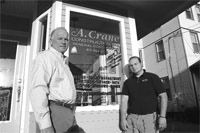
Andrew (left) and A.J. Crane

Andrew (left) and A.J. Crane say cultivating relationships, not aggressive bidding or advertising, has fueled the success of their family business.

Andrew Crane says a “goofy motto” has long been at the heart of what A. Crane Construction is all about.

“Picnic tables or bridges,” he said, “it doesn’t matter.”

Not that he’d plaster the slogan on a sign or anything. The storefront in the Aldenville section of Chicopee that serves as headquarters of this 20-year-old construction business is modest, even unobtrusive, yet is still a step up in noticeability from the first 17-plus years when the company eschewed advertising and even a number in the phone book.

Yet, Crane said, he has developed a loyal clientele based on the values of quality work, attentive service, and a willingness to do any type, and any size, of commercial or residential job.

“I’ve always been in the construction business,” said Crane. “My grandfather was in it, and I liked it as a kid. My first real job was working for Daniel O’Connell for a couple of years, and from there I went on to homebuilding for a company that built post-and-beam homes.” After that, he spent eight years in the family business before striking out on his own in 1988.

For the better part of two decades, A. Crane Construction conducted business out of a house in Chicopee, doing jobs only for people Crane knew personally. A couple of years ago, he moved to Grattan Street and published a phone number — but his philosophy of attracting work remains unchanged.

“About 95% of our clients are people we know. It has always been that way,” he told BusinessWest. “We’ve built big stores, and we’ve hung mirrors. My first job was Chapdelaine’s Furniture in South Hadley, and then that summer I built a million-dollar house. But if someone calls me up for a storm door, I’ll do that, too.”

At a time when larger builders are being hard-hit by dramatic economic shifts, it’s a philosophy that has kept his team working and profits coming in.

Hammering Home a Point

After starting out alone, Crane gradually hired a team; he employs 10 people today, and the same people-we-know philosophy has taken root there, as well. “The first guy I ever hired is still here,” he said. “The second guy, too.”

Intentionally staying small, Crane has resisted the temptation to expand too quickly, which he claims would compromise quality. That has proven to be a solid business strategy at a time when increased competition in the building industry (see related story, page 29) has pushed bids downward and made it difficult for conventional firms to make a profit. Crane says he has avoided the low-bid trap by cultivating a reputation for personal service and quality control — and a stable of loyal clients — allowing him to earn more realistic profits without cutting corners.

“People who go for the lowest price these days can’t be interested in doing it for a long time,” he said. “For one thing, they can’t do it for that price if they’re properly insured; that costs a certain amount of money.

“I’d say the biggest single challenge in construction is to keep yourself legitimate,” he continued, arguing that the reputation of all builders is compromised by small, renegade contractors who act unscrupulously, whether by using shoddy materials or failing to have adequate insurance. “Anyone can put up a storm door, but I’ll bet you could go out and find six or seven out of 10 doing this business who are not properly insured. That hurts the general public, because if someone ever gets hurt or damage occurs, they won’t be able to recoup it. If everyone competing at some level works to get people a better product at less risk, they’ll be doing a good thing for the industry.”

Crane is especially proud of his term as president of the Home Builders Assoc. of Mass. (HBAM), which ended last June. He had served the organization at the local and state levels before that time, all the while learning about issues that affect his industry. The role saw him warning lawmakers of the influence that homebuilding wields over the economy locally and nationally; “nobody believed it, but now the bubble has burst, and the economy is suffering as a result,” he said. And it also led him to push for a law requiring anyone with a construction supervisor’s license to complete continuing education courses on a regular basis; after stalling last year, that bill has made progress on Beacon Hill.

“They need continuing education to learn safety rules, how to write contracts, all the things that protect the consumer. We almost got it done last year and had to wait for another session, but I’m glad it’s happening,” he said, noting that his time with the HBAM has given him an appreciation for aspects of the business that affect customers.

“I encourage every business to belong to a trade association, whether it’s for teachers, doctors, dentists, whatever,” Crane told BusinessWest. “It kind of validates your existence in business, I think, and keeps you current on all the legislative issues. It really does set you apart from the average, everyday guy.”

Steady On

Among his customers over the years, Crane has built stores and revamped displays for Manny’s TV and Appliance, as well as building facilities for Jerry’s Music Shop in South Hadley, Ondrick Natural Earth in Chicopee, Class Grass Garden Center in Granby, a 60,000-square-foot commercial complex on Cape Cod, and the Home Builders Assoc. itself. Through the years, he has seen a roughly 50-50 split between homebuilding and commercial work.

“Every year, there’s a decent-sized commercial job and a bunch of home remodeling. I have 10 remodeling jobs now, and another appliance store to build,” he said. “I like the challenge of doing both; it helps to manage the cash flow. And, again, it’s mainly people we know, not Joe Shmoe calling me to build a tire shop. And our customers keep coming back.”

“We seldom competitively bid,” said Crane’s son, A.J., who joined the company four years ago. “Plans are sent to the office all the time, but we’re often too busy.”

A.J. Crane was intrigued enough by his family’s business to earn a Civil Engineering degree to teach him everything from reading blueprints to managing large-scale construction projects. “I like working in an industry where there’s something to show at the end of the day. I’m lucky in that I have a lot of say in the day-to-day operations. My dad wishes he was in the field more,” he said, as his father nodded and smiled.

“We’ve got the second generation coming in,” Andrew Crane said, “but I’ve always operated this place like a family business. The guys who work here have become close. They’re not just employees; we care about their welfare, and we want them to work safe and happy.”

With that in mind, Crane likes the pace of growth so far, keeping the company small enough so that it doesn’t get stretched too thin. That reflects that oft-mentioned focus on individual attention, and the way it breeds loyalty. “We want to make decisions for customers like it’s our own stuff,” he said.

Besides, Crane still wants enough time in the day to shepherd schoolchildren through a crosswalk outside his office. “The cars fly by here,” he said. “When the kids get out of school, if I see them, we run out and cross them. I don’t mind. It’s a good thing.”

And just a few more people he’s getting to know.

Joseph Bednar can be reached at[email protected]

Sections Supplements
Springfield’s Newest Destination Boosts City’s Curb Appeal
Peter Pappas

Peter Pappas stands in front of the nearly completed River’s Landing, as landscaping and exterior lighting are completed.

For years, what is now known as the old Basketball Hall of Fame stood vacant, and early in 2006, people were only cautiously optimistic about a big change to the property proposed by two developers who trace their roots back to Springfield. Two years later, the landscaping is being finished and the signage is going up at River’s Landing, and gradually, the city’s riverfront is becoming the place to be, both night and day

In the main kitchen at Onyx Fusion Bar and Restaurant, executive chef Isaac Bancaco is devising a number of dishes that pair international flavors with the traditional ingredients of New England fare.

“It’s tradition with a twist,” said the Hawaiian, recruited by Onyx to bring his unique flair to Western Mass. “Contemporary cuisine using local ingredients is going to be one of our trademarks. It celebrates what’s already here, and brings something new to the table, too.”

This is an apt description of the ‘east-meets-west’ menu at Onyx; fusion, after all, is the calling card of the restaurant. But it’s also an effective metaphor to describe what’s happening at the larger complex in which it operates: River’s Landing, the reincarnation of the former Naismith Basketball Hall of Fame, and Springfield’s newest destination.

Located adjacent to the new Hall of Fame, next to the Connecticut River, and flanked by I-91, River’s Landing is the brainchild of Peter Pappas and Michael Spagnoli. The two Springfield natives submitted their proposal for a day-into-night entertainment venue centered on health, fitness, and upscale dining to the Springfield Riverfront Development Corp. (SRDC), the private real-estate entity that owns the land, in late 2005.

The partners are dually located on the East and West coasts; Pappas is an East Longmeadow-based real estate developer and importer/exporter, and Spagnoli, a chiropractor, owns a number of medical offices scattered across the country, including several in California, where he now resides.

At the time of the request for proposals, Pappas and Spagnoli, doing business as River’s Landing LLC, were competing against a wide range of proposals for the ‘old hall,’ including a hotel and a public market. But at the end of the day, the duo’s vision won the bid based in part on the upscale yet cohesive feel it aimed to create on the still-expanding stretch of the riverfront that includes not just the Hall of Fame, but also a Hilton Garden Inn and four popular eateries — Max’s Tavern, Coldstone Creamery, Pazzo, and Pizzeria Uno (a fifth, Sam’s Sports Bar, will open in the Hall later this spring).

“It’s a perfect fit with the Hall of Fame and the restaurants that are already doing well here,” said Pappas. “There’s a theme developing that we’re really excited about.”

David Panagore, chief development officer for the city, agreed. He said the look and feel of the riverfront is one that is evolving with the Hall of Fame at its center, augmented by other sports- and fitness-related activities and a good measure of dining and hospitality options.

“There’s a theme here of physical activity that means there’s much more to do along this stretch that eat,” he said, noting that, as development talks continue, the city will be looking to broaden this theme. “We’re looking closely at ‘event commercial’ opportunities that are semi-public, if not public. Five single-family homes, for instance, aren’t even in the realm of possibility. We need something to drive visitors.”

He said the consistency of the River’s Landing project — few major changes have been made to the original proposal — is also an important aspect, because it has helped maintain faith in the riverfront’s future, and has also helped to create a strong base from which to spur further growth.

“It’s about follow-through and keeping promises,” he said of the undertaking by Pappas and Spagnoli. “That’s what’s happened here.”

Going with the Flow

Pappas said he hopes River’s Landing will serve as a model for future projects, adding that, indeed, most of the original plans have stayed intact throughout the planning and construction process, now nearing completion.

L.A. Fitness, a national health club chain, expressed interest in the property early on, and is now putting the finishing touches on a three-story facility that will be the company’s second-largest location in the country, encompassing 60,000 of the 75,000 available square feet on the property. It’s expected to open for business on May 1.

Onyx, also three stories tall, covers 12,000 square feet, and opened for dinner and cocktails last month, the same week the city hosted the Division II college basketball tournament. Development of the remaining 3,000 square feet of the building’s footprint is being completed now, in order to house a Boston-based physical-therapy and sports-medicine outfit.

At the project’s start, Pappas and Spagnoli pledged $9 million in private funds to the endeavor. In 2006, when the partners first spoke with BusinessWest, they noted that this figure could rise to $13 million.

To date, Pappas said they have actually invested $14 million into the project, but lean more heavily on the fact that, as River’s Landing enters its first month as a fully functioning entity, the property is completely occupied, and improvements such as landscaping and exterior lighting, all geared toward making the building attractive and visible from the highway, are moving toward their completion on schedule.

“Action breeds action,” he said. “When people see what’s going on here, they’ll feel more comfortable with coming to the riverfront to use it. I can’t wait to see people walking along the river again.”

Walking through the building, Pappas, who’s added ‘restaurateur’ to his list of titles, said attention has been paid to spurring that action inside and outside of its walls, as well as to the city’s legacy, especially as the birthplace of basketball.

This attention can be seen in its design and in the roster of firms involved with the project; several are local businesses, while some were pulled from other regions to add a metropolitan flavor to River’s Landing.

“The basic structure of the building is the same,” said Pappas, noting, however, that it has received a considerable facelift. “The windows have been replaced, but they still offer views of the river, the Hall of Fame, the highway, and downtown, on different sides. Not only can people inside see out, but others can see in and take note that there’s a new level of activity here, and feel safer because there are eyes on them.”

Current Events

A bright gold now adorns much of the exterior, and the familiar row of multiple, vertical signs that stretch across the side of the building facing the highway, once carrying illustrations of famous Hall of Fame inductees, remains, but is now being redesigned to match the new décor.

Onyx, owned and operated by Pappas and Spagnoli, has essentially become the facility’s showpiece. The Amherst-based architectural firm Kuhn Riddle handled much of the design, while California-based interior designer Julia Wong, whose work recently appeared on E! Entertainment Television, was brought in to create a cohesive visual flow throughout the 300-seat establishment.

“We’ve incorporated the ideas of imagination, elegance, and a journey,” said Pappas, weaving from the lobby, which features a glass ‘water wall,’ into the bar and lounge area, with its multi-screen video wall and amber onyx bar.

“The design is also ‘green,’ including low-flow water systems in the bathrooms and bamboo flooring,” he noted, adding that Onyx also offers free wireless access for patrons and will soon add an outdoor patio dining area.

Onyx opened for lunch recently, and the final addition to its repertoire, a coffee and smoothie bar during morning hours, will commence in conjunction with the grand opening of L.A. Fitness, in order to better integrate the two businesses.

The club includes an Olympic-sized pool, a full basketball court on the second floor overlooking the Hall of Fame, and multiple exercise, weight, and cardio rooms. Pappas said the club’s management has been pre-selling memberships for three months, and expects to welcome thousands of members.

All of this activity is a positive sign for Springfield, said Panagore, adding, however, that there’s still a long road ahead with regard to riverfront development.

“The project is going well, and with the hotel on one end and River’s Landing on the other, this is becoming a destination site in Springfield,” he said. “In terms of moving forward, we continue to have discussions about alternative uses for the visitors center — the original study talked about co-locating it within the Hall of Fame. We’re investigating how to better position that resource, so we can drive more visitors there.”

With the York Street Jail now razed, there is another major development opportunity on the riverfront that Panagore said the city is monitoring closely.

“We’re focusing on ensuring that anything happening at the site proceeds properly. We don’t want to be getting ourselves in a snarl, or tripping over ourselves,” he said. “ We’ll clear the site and start looking for development opportunities that complement those that are already down there.”

Panagore added that the riverfront offers what he calls “curb appeal” as seen from I-91, and to be truly successful, the area must not only attract new traffic but send that traffic farther down the road.

“The riverfront projects are initially important,” said Panagore, emphasizing the word ‘initially,’ “because they help bring people to Springfield and turn around the image of the city. People who would not otherwise come to Springfield now have a reason. But we really need to move some of that energy into the downtown, so our focus is on the entire core of the city.”

There are some challenges, however, in the move to better connect the riverfront to downtown, said Panagore. While he said the city is in the middle of “ongoing discussions” regarding the maintenance and renovation of the riverside walkway that runs parallel to the Connecticut River and extends from River’s Landing to the Memorial Bridge, there are some physical impediments.

“The state has a little less than $1 million earmarked to spruce up the walkway,” he said, “But Route 91 is always going to be a constriction. The underpasses between the riverfront and the downtown are also an issue, as is the railroad. Physical barriers naturally deter visitors from taking that route; we will try to put as good a face on it as possible.”

Still, many of these conversations relate to what Panagore said is over the next hill for Springfield, while other hurdles, the largest of which is the ‘old hall’ and what to do with it, have been cleared.

“Right now, we’re working on current successes,” he said. “There are always larger conversations about Springfield’s vision, but the work is well underway, and we’re getting up on our feet.”

Going Swimmingly

A diverse mix of activity on the waterfront, long a distant hope, is now becoming a reality for the City of Homes, and it has also provided a new venue for cuisine like Bancaco’s, which draws from his own traditions and is colored by those he’s learning more about in New England.

One of his favorites is the hazelnut mahi-mahi with Maine lobster hash, and he said he’s hoping to introduce even more of these ‘east-meets-west’-inspired creations to diners at the newly opened eatery.

“Pairing traditional ingredients and techniques with those that are modern is the best definition of the word ‘fusion,’” he said.

Watching servers and prep cooks bustle in a kitchen located where he once came to learn more about some of basketball’s greats, Pappas nodded in agreement.

Jaclyn Stevenson can be reached at[email protected]
Sections Supplements
Builders Extend Their Reach to Keep Their Crews Working
David Fontaine

David Fontaine says that his company, like most in the region, has had to travel farther to find work.

Over the past few years, commercial builders in the Pioneer Valley have lamented an influx of competition from contractors outside Western Mass. With opportunities sluggish and margins tight, many Springfield-area builders are returning the favor, seeking work — and often finding it — in Eastern Mass. and Connecticut. That geographic flexibility is critical, some say, at a time when a slowing economy and soaring costs for fuel, materials, and insurance have made it much more difficult to stay profitable.

Go east.

That seems to be the mantra for commercial builders based in Western Mass., many of whom say the Valley isn’t as fertile with projects as it was a few years ago.

“We do about 75% of our work outside the Springfield-area market,” said David Fontaine, president of Fontaine Brothers in Springfield. “The Western Mass. marketplace has really been struggling over the last few years, and we’re far healthier in Eastern Mass. I really don’t know why; it’s not for lack of trying, but rather a lack of opportunity. Most of our employees travel at least 50 to 75 miles a day each way, which is a far cry from where we were six or eight years ago.”

Dennis Fitzpatrick, president of Daniel O’Connell Sons in Holyoke, which is heavily involved in both commercial construction and civil projects, agreed. “Local projects have become a smaller and smaller piece of our business,” he said. “The private, commercial side is at a standstill here. We do a lot of work for colleges and universities, and that segment of the market — well, I wouldn’t say it’s robust, but it continues to expand in Western Mass., and that’s good for us.

“It certainly helps when the economy slows down to have diverse geographic coverage and to have a diversity of project types as well,” Fitzpatrick added. “It gives us some stability and more places to find work. This used to be a very local business, but it’s not anymore.”

Surveying the Landscape

Private-sector spending on construction suffers during economic downturns as well, but for different reasons than those that afflict the public purse.

“In the private real-estate market,” Fitzpatrick said, “companies aren’t going to make an investment when they don’t have faith in the future of the economy, and there’s not as much confidence as there was two years ago. On the civil side, things like wastewater treatment, business is slow as well, as the state and municipal governments are struggling with tax revenues.”

While public-work opportunities “muddle along,” said Fitzpatrick, Gov. Deval Patrick’s administration has given contractors some hope by proposing more funds for projects aimed at boosting that part of the economy, but construction companies are taking a wait-and-see approach to those prospects.

“The public sector is very quiet and has been for more than two years,” Fontaine noted. “In terms of general construction, the public-school market is basically nonexistent. Some public-safety facilities and libraries come around, but they’re very few and far between, especially in this general geographic area.”

Fontaine would like to express more optimism in the public sector, but said waiting can be frustrating. “I’ve read about a lot of studies, but I don’t know of many municipalities around here that are able to turn a study into a project,” he said.

As a result, his company is busy tackling fire stations in Eastern Mass., a bus-storage facility in Gardner, school projects in Waltham and Lawrence, and work for the Worcester Housing Authority. Yes, he’s also picked up jobs at Berkshire School in Sheffield, Western New England College in Springfield, and Williston Northampton School, but far more often, he’s sending crews east of the Valley.

O’Connell is also tackling some major work in Western Mass. — in addition to the new federal courthouse in downtown Springfield, the company has taken on multiple projects at Northfield Mount Hermon School and UMass and performed civil work for the Springfield Water and Sewer Authority, just to name a few recent jobs — but it has also followed leads to the east as well as south to New Haven.

Tim Pelletier, president of Raymond R. Houle Construction in Ludlow, reported “a fair amount of activity” heading into the spring. “We haven’t felt any shock waves yet.”

Elaborating, he said Houle is coming off a good 2007, and the outlook seems bright, especially given the general economic uncertainty in the air. “I can’t say we have work banked up until the end of the year, but it’s enough to keep us busy for awhile.”

Fueling Costs

But even for builders with plenty on their plates, other factors are putting on the squeeze — none more so than the cost of fuel, which has risen to rarely seen levels over the past month.

“The economy as a whole is a real problem for contracting, and fuel is the biggest one,” said Joseph Gallo, president of Bruschi Bros. in Ludlow. “What happens is, you bid for a job that might last two or three years. You can try to anticipate how costs like fuel and insurance could go up, but beyond that, there’s no way of getting reimbursed.

“It’s difficult to compensate for the way fuel has gone up and eaten into profits — if I make a profit,” he added. “If I bid too high in anticipation of those costs, I won’t get the job. So these economic factors are really creating havoc, especially in Western Mass.”

Andrew Crane, president of A. Crane Construction in Chicopee, said his company’s five trucks use $300 in gasoline per day, and he is taking pains to coordinate trips, something he never had to worry about before. “It really eats into the bottom line,” he said. “I can’t give my guys anything extra, which they probably deserve, because of costs that continue to go up, most of them related to petroleum.”

Those rising costs pose a harsh irony for builders who have found increasing opportunities outside the Valley. But flexibility, they insist, is a must in this business.

“The last two years have been difficult for us,” Fontaine said. “We’ve diversified with smaller-volume projects, smaller jobs, and just decided to travel.

“The private-sector market, metal buildings, small shopping centers, have been busy, but I don’t even see as much of that going up right now,” he continued. “In the surrounding 30 or 40 communities within 60 miles of here, it doesn’t seem like anyone is doing much of anything.

However, he added, “there are still a few very large projects out there. Smith College has some good-sized things going on.” In fact, the higher-education construction niche continues to flourish, with major projects underway or recently completed at several area institutions. Fontaine said private colleges in particular don’t follow general economic trends when deciding to expand.

“On the contrary, I think the private sector waits and tries to capitalize on a down economy, to get more bang for their buck,” he explained. “The money is there; they just pick and choose when they’ll spend it.”

The state of the residential-building market, which has been hit by a slowdown nationally, generally doesn’t directly affect commercial construction, but there are some crossover concerns. Take Bruschi Bros., a general contractor that specializes in site work, utilities, and road work, particularly in subdivisions.

“The way the economy is going, it could be a tough year,” said Gallo. “They plan these subdivisions years ahead of time; they want to plan ahead and get architects and funding in place. But if they can’t sell the homes, that cuts into their equity and cash flow,” meaning a possible slowdown in new projects to bid on.

Bottom-line Concerns

As Western Mass. has become a more competitive region for construction, one marked by slimmer profit margins, Crane said his company has been able to weather some of the difficulty by cultivating repeat business (see story, page 33). Other successful builders say the same.

“A lot of it depends on whether you have a customer base or you’re just scanning the Dodge report for work,” said Pelletier. “Fortunately, we have that customer base.”

It seems that, particularly on the cusp of a recession, the most important thing for a contractor to build might be relationships — both within the Pioneer Valley and, increasingly, many miles away from it.

Joseph Bednar can be reached at[email protected]

Departments

State Adds 2,900 New Jobs in March

BOSTON — The Executive Office of Labor and Workforce Development recently reported that monthly survey estimates show that 2,900 new jobs were added in Massachusetts in March, its largest monthly increase since November of last year and the sixth consecutive monthly increase in jobs. The state unemployment rate also held steady at 4.4%. Revisions to the February rate, published last month on a preliminary basis at 4.5%, show the rate edging down to 4.4% and an increase of 700 jobs instead of the loss of 700 as originally estimated. The Massachusetts rate continues to outperform the national rate, which increased from 4.8% in February to 5.1% in March. The state rate has been below the U.S. rate since June 2007. Over the year, the Bay State’s unemployment rate dropped two-tenths of a percentage point from 4.6%. The largest job gains in March were recorded in professional, scientific, and business services, as well as leisure and hospitality. New jobs were also added in the trade, transportation and utilities, information, construction, and manufacturing supersectors. Also, education and health-services employment, at 632,600, was off 400 in March. Over the year, this supersector continues to show the strongest job gains at 14,900 and, along with the information supersector, posted the highest annual rate of job increase at 2.4%. Professional, scientific, and business services added 1,000 jobs in March, following a gain of 3,100 the previous month. Most of the 9,700 jobs added over the past year were in professional, scientific, and technical services industries such as computer systems design and scientific research and development. At 488,300, overall employment is up 2.0% from one year ago.

Financial activities employment was off 200 over the month due to declines in the real-estate and rental and leasing component. At 224,100, financial-activities employment is down 1,600 from one year ago, with real estate and leasing contributing to much of the loss. Trade, transportation, and utilities employment increased by 500 in March, largely due to retail trade posting its first job gain since last November. At 569,100, employment in this supersector is off 1,200 from one year ago. Retail trade lost 2,900 jobs over the year, while wholesale trade and transportation, warehousing, and utilities added 1,400 and 300 jobs, respectively. The leisure and hospitality supersector added 1,200 new jobs, the most jobs added among supersectors in March. At 305,200, jobs in leisure and hospitality have increased by 2,600 over the year. With monthly gains in each of the most recent five-month periods, jobs are up by 4,200 since October 2007. Information employment increased by 200 in March to 89,900. This supersector has added 2,100 jobs over the year and, along with educational and health services, posted the strongest annual growth rate at 2.4%. Manufacturing recorded a 200-job gain in March, its second consecutive monthly increase. At 292,900, employment is still down 4,000 or 1.3% from one year ago. Construction gained 600 jobs in March after having lost jobs over each of the four previous months. At 135,400, employment is off 2,000 or 1.5% from one year ago. The job numbers are the result of a monthly survey that uses U.S. Department of Labor Bureau of Labor Statistics methodology. More than 9,000 Massachusetts employers are surveyed to determine the number of jobs by industry. These estimates are the economic indicator used to gauge employment-growth patterns across the Bay State. The Commonwealth’s labor force increased by 2,300 over the month, as 3,700 more Massachusetts residents were employed and 1,500 less were unemployed. At 3,411,200, the labor force is slightly higher than at this time last year, as 7,500 more residents were employed and 7,000 fewer unemployed. Labor force estimates for Massachusetts, developed using the U.S. Department of Labor Bureau of Labor Statistics model, are based on information on Massachusetts residents’ employment and unemployment status, collected through a small, monthly sample survey of households.

Easthampton Awards Valley CDC Grant

EASTHAMPTON — Valley Community Development Corp. (Valley CDC) recently announced it has been awarded a $140,000 grant from the City of Easthampton for the provision of comprehensive business-development technical assistance (TA) to income-qualified Easthampton residents and businesses. Valley CDC is providing TA for a 15-month period that began April 1. The TA services that Valley CDC will provide include one-on-one counseling; business development, marketing, and technical computer workshops and seminars; credit counseling; referral to financial institutions; assistance with applications for financing; referral to professional and other resources for support and services not provided by Valley CDC; and continued outreach to artists and to former mills on Pleasant Street and Cottage Street. The grant also enables Valley CDC to retain its offices in the Eastworks building on Pleasant Street. 

Departments

The following building permits were issued during the month of March and April 2008.

AGAWAM

Six Flags New England
1623 Main St.
$8,200,000 — Construction of building including indoor “Dark Night Coaster”

CHICOPEE

Chicopee Marketplace
601D Memorial Dr.
$5,600 — Repair storefront facade at Radio Shack

Randolph Products
33 Haynes Circle
$42,000 — New roof

EASTHAMPTON

Bradley Robbins
1 Adams St.
$4,000 — Alterations

Mitchell Realty Trust
45-47 Union St.
$21,000 — New roof

Richard A. Boulanger
85-87 Union St.
$11,000 — New roof

Williston Northampton School
20 Greenwood Ct.
$20,000 — Construct bleachers

GREENFIELD

Elks BPOE of Greenfield
3 Church St.
$42,000 — Installation of fire sprinkler system

Greenfield Housing Authority
1 Elm St.
35,000 — Fire damage repairs

MacNicol, Tombs, & Brown, LLP
393 Main St.
$3,400 — Interior installation of door & glass panel to separate existing space

Middle Franklin Development Group, LLC
329 Conway St.
$51,000 — Interior alterations

HOLYOKE

City of Holyoke Water Department
West Cherry St.
$46,000 — Construct shelter and concrete pad for communications tower

Holyoke Mall Company, L.P.
50 Holyoke St.
$40,000 — Remodel existing store — “Icing”

Holyoke Mall Company, L.P.
50 Holyoke St.
$1,565,000 — Remodel existing store — “Pottery Barn”

LONGMEADOW

Clouthier’s Inc.
724 Bliss Road
$100,000 — Interior renovations

GPT-Longmeadow LLC
704 Bliss Road
$40,000 — Exterior alterations


LUDLOW

Barry Linton
409 West St.
$35,000 — New commercial construction

Barry Linton
407 West St.
$18,000 — Roofing and siding

Ludlow Housing Authority
87 State St.
$32,700 — Alterations

NORTHAMPTON

Big Y Foods
142 North King St.
$15,000 — Renovate former “Newstand”

First Congregational Church
129 Main St.
$409,000 — Replace plaster ceiling

First Congregational Church
129 Main St.
$832,000 — Replace slate roof

First Congregational Church
129 Main St.
$15,000 — Repair basement floor system

New England Telephone
61 Masonic St.
$81,500 — Replace AC system and minor electrical

The Coca-Cola Company
45 Industrial Dr.
$80,000 — Install footing and structural steel for mechanical unit

SPRINGFIELD

Baystate Medical Center
759 Chestnut St.
$50,000 — Renovate two existing offices

Roger Zepke
154-156 Main St.
$26,000 — Interior remodel

Steve & Mike Ferraro
1680 Wilbraham Road
$20,000 — Interior renovations

WEST SPRINGFIELD

Fred Aaron
1680 Riverdale Road
$5,000 — Interior renovations to first floor retail space

Robin C. Taylor
255 Interstate Dr.
$72,000 — Renovate 3,070 square feet of office space

Departments

Big Y Named Outstanding Recycler of the Year

SPRINGFIELD — The Springfield Materials Recycling Facility (SMRF) Advisory Board has named Big Y Foods Inc. “Outstanding Recycler of the Year.” The award was created to recognize individuals and organizations that have made contributions toward increasing recycling within their community or region. Big Y was nominated for the award by the Center for Ecological Technology (CET), a local nonprofit organization that helped Big Y increase its recycling efforts. Big Y has been composting food waste at several locations and recycling cardboard at all locations for many years. In 2007, Big Y worked with CET to expand composting and recycling efforts. Seven additional locations started diverting food waste, wood, wax cardboard, and floral waste for composting. In the spring and summer of last year, Big Y started collecting film plastics for recycling at all locations. Shrink wrap from pallet loads and case plastics are collected in the back of the store, and consumer bags are collected in the front. All film plastics are baled and marketed to Trex for use in plastic lumber manufacturing. Big Y’s expanded composting program, new film plastics recycling, and cardboard recycling efforts account for more than 13,750 tons of material diverted from landfills last year. Big Y is also a member of the Mass. Department of Environmental Protection Supermarket Certification Program. In addition, Big Y has been promoting canvas shopping bags which are becoming more popular with shoppers. The SMRF accepts and processes residential recyclables from 78 communities in the four western counties of the state. The SMRF Advisory Board recognizes outstanding individuals, departments, and organizations for their efforts to increase and promote recycling in the region through the Recycler of the Year Awards.

Russell Biomass Receives Final Environmental Certification

RUSSELL — The 50-megawatt Russell Biomass project recently received a certificate approving the Final Environmental Impact Report (FEIR) by Ian Bowles, state Secretary of the Executive Office of Energy and Environmental Affairs. Bowles issued a statement that Russell Biomass has adequately and properly complied with the Mass. Environmental Policy Act and with its implementing regulations. Russell Biomass expects its wood-fueled power plant will provide Western Mass. with electricity equivalent to an oil-fired plant that burns 480,000 barrels of oil per year. Russell Biomass notes on its Web site that it expects to generate its power by burning wood chips, a byproduct of the forest-management and wood-product industries. With Bowles’ approval, Russell Biomass can now complete the process of having its 20 permit applications reviewed by state agencies. Russell Biomass anticipates a construction start date of this fall if all applications are approved. The facility will be built on the site of the Westfield River Paper Co. that has been closed since 1994.

Food Bank Goes Green

HATFIELD — April’s celebration of Earth Day was especially meaningful for the Food Bank of Western Mass. The Food Bank received its certification from the U.S. Green Building Council through the LEED (Leadership for Energy and Environmental Design) rating system earlier this year. LEED is the internationally recognized standard for environmentally sustainable, or ‘green,’ building. With a Gold rating — the second-highest level possible — the Food Bank’s Hatfield facility becomes one of a growing number of businesses and organizations around the world that are doing their part to minimize the environmental impact of their operations. When the Food Bank began planning the renovation of its warehouse and office space a few years ago, making the building green took high priority, not only to help the environment, but also because there is a cost savings associated with energy efficient design. With lead grants from the Kresge Foundation and the Mass. Technology Collaborative, as well as generous community support, the Food Bank completed the construction of its new building in 2006 and began the process of applying for LEED certification. Dozens of green features made the building eligible for LEED, such as water and energy efficiency, sustainable materials, green cleaning and maintenance products, and recycling. The Gold-level certification that the Food Bank received in 2008 represents above-average compliance and innovation in these areas. Some highlights of the Food Bank’s environmentally designed facility include a 30-kilowatt photovoltaic solar panel system on the roof of the building that supplies about 10-12% of the organization’s electricity; energy-efficient lighting, heating/cooling, and refrigeration systems that have reduced energy use by 35% per square foot despite a building that is twice its previous size; green cleaning products, recycled paper products, and low-toxicity paints and sealants; an employee carpooling program that saves at least 10,000 commuter miles each year; outdoor landscaping that emphasizes native plants and minimizes runoff and erosion; and the 60-acre Food Bank Farm in Hadley that preserves natural riverside habitat and produces dozens of crops each year without pesticides, chemical fertilizers, or herbicides.

NewAlliance Increases Dividend

NEW HAVEN, Conn. — NewAlliance Bancshares Inc. recently staged its fourth annual meeting of shareholders, and voting results supported management’s recommendations on all items. Four members of the board of directors were voted in for three-year terms: Douglas K. Anderson, former president and COO, Savings Bank of Manchester; Roxanne J. Coady, founder, president, and CEO of R.J. Julia Booksellers, Ltd.; John F. Croweak, former chairman and CEO of Anthem Blue Cross and Blue Shield of Connecticut; and Sheila B. Flanagan, executive director of SBM Charitable Foundation Inc. Each was elected to a term expiring at the annual meeting of shareholders in 2011. Shareholders also voted to approve the NewAlliance Bank Executive Incentive Plan. The plan is a carryover from one that was in place before the bank’s conversion. However, to allow payments under the plan to be eligible for tax deductibility, shareholder approval of the plan is required periodically. In addition, shareholders voted to ratify PricewaterhouseCoopers, LLP as the independent auditor for 2008. In a separate meeting prior to the annual shareholders’ meeting, the board of directors voted to increase the company’s quarterly dividend from 6.5 cents to 7.0 cents per share, a 7.7% increase. The dividend will be paid on May 16 to shareholders of record on May 6. NewAlliance Bancshares is the parent company of NewAlliance Bank, headquartered in New Haven, with $8.2 billion in assets and a network of 89 branches in Connecticut and Western Mass.

STCC Receives $150,000 Grant for Photovoltaic Practitioner Training Program

SPRINGFIELD — Taking another step in a statewide push to promote growth in sustainable energy, or the ‘green’-technology sector, the Mass. Technology Collaborative (MTC) has awarded a $150,000 grant to Springfield Technical Community College (STCC) for development of a photovoltaic (PV) practitioner training program in Western Mass. Photovoltaic, or solar-panel, installations are becoming an increasingly popular strategic initiative for businesses and institutions looking to control and reduce energy costs, according to Thomas Goodrow, vice president for Economic and Business Development at STCC, and the grant will advance efforts to foster job growth and economic-development opportunities in this sector. Elaborating, Goodrow said the focus of the two-year grant is to provide training and practical experience in PV design and installation for licensed electricians, individuals involved in a journeyman electrician-training program, architects, engineers, and general contractors. The project plan includes developing coursework in PV design and system installation, and seeking ISPQ (Institute for Sustainable Power Quality) accreditation for training and continuing education. The program is slated to begin this fall, with a 3- to 4-month certificate course of study that will provide students with hands-on experience in a field that is expected to offer significant growth opportunities. Individuals completing the program will be prepared to sit for the industry certification exam. The PV Practitioner Training program will be conducted by STCC’s Center for Business and Technology (CBT), in partnership with the George W. Gould Construction Institute; the Solar Energy Business Association of New England, a business association of solar-energy companies based or doing business in New England; the STCC Assistance Corporation; and renewable energy companies in Massachusetts, Connecticut, and Vermont. Grant funds will be used, said Goodrow, to support curriculum development efforts that are already underway, to purchase equipment and materials that will allow students opportunities for hands-on experience, to gain national accreditation for the program, and to establish internship opportunities for students at solar-energy companies based in New England. The project team consists of STCC Assistant Vice President Mary Breeding, who directs CBT; Peter Vangel, professor and co-chair of the Laser Electro-Optics Department at STCC, who will serve as curriculum developer; Michael Kocsmiersky, vice president for Research and Development at Solar-Wrights Inc.; and Bill Stillinger, general manager of Pioneer Valley Photovoltaics Cooperative (PV Squared), a PV practitioner with many years of teaching, training, and installation experience in the field. Individuals who are interested in applying for the program should contact CBT at (413) 755-4502 or (413) 755-4225.

Bradley and Delta Celebrate Cancun Service

Windsor Locks, Conn. — Bradley International Airport (BDL) and Delta Airlines recently announced the launch of the airport’s first-ever nonstop scheduled service to Cancun, Mexico. The seasonal service to Cancun, which started April 12, operates on Saturdays between BDL and Cancun International Airport (CUN). Delta Air Lines Flight DL497 will depart Bradley at 10:40 a.m. and arrive in Cancun at 1:47 p.m. Delta Air Lines Flight DL498 will depart Cancun at 2:40 p.m. and arrive at Bradley at 7:33 p.m. Delta will operate this service using a Boeing 737-800 aircraft configured with 16 business-class seats and 144 seats in coach class. Customers should visit Delta’s Web site, delta.com, or call Delta Reservations at (800) 221-1212 for the latest flights.

Departments

The following is a compilation of recent lawsuits involving area businesses and organizations. These are strictly allegations that have yet to be proven in a court of law. Readers are advised to contact the parties listed, or the court, for more information concerning the individual claims.

CHICOPEE DISTRICT COURT

Gerald E. Guiel v. M.J. Nails
Allegation: Pedicure performed negligently resulting in injury: $15,000
Filed: 3/31/08

FRANKLIN SUPERIOR COURT

Homesavers Council of Greenfield Gardens Inc. v. Shaw Industries Inc. and Continental Flooring Co.
Allegation: Breach of construction contract: $330,000
Filed: 4/8/08

GREENFIELD DISTRICT COURT

Standard Funding Corp. v. Anthony’s Residential Contracting
Allegation: Breach of finance agreement: $3,426.36
Filed: 3/21/08

HAMPDEN SUPERIOR COURT

Dale Auto Body Inc. v. Western Mass. Electric Company
Allegation: Breach of contract to provide services: $29,775
Filed: 2/25/08

Denise Melanson v. Video Communications Inc.
Allegation: Employment discrimination: $25,000+
Filed: 2/19/08

Fred Quagliaroli v. The Mardi Gras
Allegation: Negligence and personal injury suffered by plaintiff when pushed by Mardi Gras employee: $300,000
Filed: 4/11/08

Witalisz & Associates Inc. v. Whispering Pines at Root Road, LLC
Allegation: Breach of contract: $777,979.62
Filed: 1/30/08

HAMPSHIRE SUPERIOR COURT

John C. Urschel v. Bioshelters Inc.
Allegation: Non-payment of promissory note and unfair and deceptive trade practices: $50,000
Filed: 3/27/08

NORTHAMPTON DISTRICT COURT

Francis Baldwin III v. The Premier Insurance Company
Allegation: Failure to pay personal injury protection benefit: $7,721.02
Filed: 3/31/08

Victory Steel Products v. Quabbin Well Drilling Inc.
Allegation: Non-payment of goods sold and delivered: $13,640.14
Filed: 4/2/08

SPRINGFIELD DISTRICT COURT

City Line Distributors Inc. v. Robe Inc. and Mark E. Robitaille
Allegation: Non-payment of produce delivered: $6,671.62
Filed: 1/29/08

Roy’s General Contracting Inc. v. MLS and IZS Enterprises
Allegation: Non-payment of general-contracting services: $2,697.00
Filed: 3/13/08

Tri-County Contractors Supply Inc. v. Total Renovations & Construction, LLC
Allegation: Non-payment of goods sold and delivered: $8,489.29
Filed: 1/22/08

WESTFIELD DISTRICT COURT

International Bar-Tech Solutions Inc. v. Southwick Electric Company Inc.
Allegation: Breach of contract for goods and services: $11,288.19
Filed: 3/12/08

Departments

The following is a compilation of recent lawsuits involving area businesses and organizations. These are strictly allegations that have yet to be proven in a court of law. Readers are advised to contact the parties listed, or the court, for more information concerning the individual claims.

CHICOPEE DISTRICT COURT

Arnold’s Meats v. Iron Door Tavern
Allegation: Non-payment of meat and food products received: $3,871.54
Filed: 2-21-08

Griffin Greenhouse Supplies Inc. v. Westover Greenhouse Inc.
Allegation: Non-payment of goods received: $3,785.72
Filed: 2-28-08

Griffin Greenhouse Supplies Inc. v. Grandview Farms Inc.
Allegation: Non-payment of goods received: $6,925.69
Filed: 2-28-08

State Lottery Commission v. Lacroix’s Market
Allegation: Non-payment of services rendered: $21,377.96
Filed: 2-28-08

HAMPDEN SUPERIOR COURT

Maria Silva v. Bertera Chrysler Jeep Inc.
Allegation: Breach of contract: $20,000
Filed: 2-15-08

Richard Stanton v. Lauries Glass LTD
Allegation: Negligence and breach of implied warranties causing injury: $13,365.75
Filed: 1-22-08

Superior Auto Transport, LLC v. Phil’s Auto Express
Allegation: Breach of sales contract: $234,520
Filed: 2-19-08

The Sherwin Williams Company v. Engineered Floors Inc.
Allegation: Non-payment of goods sold and delivered: $29,461.48
Filed: 1-04-08

HAMPSHIRE SUPERIOR COURT

Karen Riley v. Magnat Rolls Inc.
Allegation: Employment discrimination based on age and disability: $82,878
Filed: 3-05-08

Paul & Anne McGrath v. David Campbell Builders
Allegation: Breach of construction contract and negligence causing fire: $138,281.14
Filed: 2-29-08

Scott & Lyndia Brough v. Zerteck Inc., d/b/a Boat-N-Ry Warehouse and Forest River Inc.
Allegation: Breach of contract and fraud and deceit in sale of motor home: $165,000+
Filed: 2-26-08

Whiteway Construction Corporation v. Town of Tewksbury
Allegation: Breach of contract for construction of Tewksbury Senior Center: $500,000+
Filed: 2-28-08

HOLYOKE DISTRICT COURT

Minerva Lopez v. Holyoke Medical Center
Allegation: Negligence in property maintenance causing personal injury: $24,476.75
Filed: 3-07-08

NORTHAMPTON DISTRICT COURT

Diane Blahusch v. Remax Teamwork Realty
Allegation: Breach of purchase and sale contract and professional negligence: $24,000.00
Filed: 3-05-08

New Penn Motor Express Inc. v. Johnson Metal Products Inc.
Allegation: Non-payment of goods sold and delivered: $9,162.53
Filed: 2-28-08

Sherwood Lumber Company v. Eastern Lumber & Millwork Inc.
Allegation: Non-payment of goods sold and delivered: $16,621.49
Filed: 2-19-08

Vaughn Munson v. Hotel Northampton
Allegation: Breach of contract for snow removal: $3,800
Filed: 2-26-08

PALMER DISTRICT COURT

Jeanne Rose v. Lowe’s Inc.
Allegation: Negligence in property maintenance causing injury: $3,463.00
Filed: 2-27-08

Leonard’s of Connecticut Inc. v. The Livery
Allegation: Non-payment of goods sold and delivered: $12,414.67
Filed: 2-28-08

SPRINGFIELD DISTRICT COURT

Bradco Supply Corporation v. Mello’s Home Improvement
Allegation: Non-payment of goods sold and delivered: $5,241.48
Filed: 1-09-08

PFG Springfield Corporation v. Brennan’s Inn
Allegation: Non-payment of goods sold and delivered: $42,515.78
Filed: 3-04-08

Sunshine Village Inc. v. Superior Mechanical Contractors Inc.
Allegation: Breach of contract for services: $20,000
Filed: 2-14-08

Departments

The following Business Certificates and Trade Names were issued or renewed during the months of March and April 2008.

AGAWAM

Alena M. Martin’s Transcription Service
55 Norris St.
Alena M. Martin

All-Event Tent Rental
88 Butternut Dr.
Sean Walsh

Connecticut Pie Inc.
120 Bowles Road
Patrick Macari

The Salon
5 South End Circle
Kirsten Hughes

Northeast Infrared Tech
73 North Westfield St.
Brendon Pohner

On Time Auto Service Inc.
14 Sherwood St.
Bryan Perry

The Pink Elephant
1090 River Road
Debrah Tlaszcz

AMHERST

Affordable Housing Perspectives
37 S. Prospect St.
Joseph P. Heneful

HouseHealing.com
21 Hadlock St.
David Farkas

Latinos
460 West St.
Norma Lopez Streciwilk

Lukengu Painting
730 West St.
Lukengu Tsimpanga

CHICOPEE

Artworks
185 Chicopee St.
Kimberly L Haight

Cote Construction Co.
65 Langevin St.
John G. Cote

Lasting Impressions
705 Britton St.
Jeremy A. Lempke

Mass Energy Savers Corp.
267 Chicopee St.
Christian B. Poirier

EAST LONGMEADOW

Wheeler & Son
132 Allen St.
Jack Lawrence Wheeler

White Dog Services
191 Maple St.
Robert Nowak

GREENFIELD

Aerus Electrolux
34 Bank Road
Joseph Knight

Concentra Urgent Care
489 Bernardston Road
America Current Care of Massachusetts

Midnight Auto Inc.
112 So. Shelburne Road
Lawrence Hoffman

Pace Coaching
44 Plantation Circle
Debbie Turgeon

The Greenfield Firm
125 Mohawk Trail
Bharti K. Patel

Reflexology Center for Natural Wellness
127 Leyden Road
Susanne M. Whitney

HOLYOKE

Cano’s Used Tires
640 South Bridge St.
Pedro Garcia

Eyewear Fashion
50 Holyoke St.
Abous Khan

Golden China
455 South St.
Guo Lian Chen

Holyoke Animal Hospital
320 Easthampton Road
Linda J. Henderson

Mt. Tom Groom Shop
320 Easthampton Road
Linda J. Henderson

Mt. Tom Kennels
320 Easthampton Road
Linda J. Henderson

Patalarga Auto Repair
63 Commercial St.
Pablo Guerrero

Snap Fitness
506 Westfield Road
David Garvey

South St. Market & Deli
512 South St.
Luis A. Alvarado Jr.

The Desired Image
592 Dwight St.
Sandra Santiago

LONGMEADOW

Fun N’ Sun Travel & Cruise
33 Woodland Road
Karin K. O’Keefe

LUDLOW

Biermann Plumbing & Heating
23 Oregon Road
Kevin J. Biermann

NORTHAMPTON

Lieberman’s Gallery
34 North Maple
Douglas Kerwin

Movement Resource
100 Main St.
Jennifer Sarah Polins

NewYork Shop Exchange
263 Main St.
Marcia J. Hawkins


QA3
69 Old South St.
Elizabeth Hynes

PALMER

Palmer Co-op Center
1239 South Main St.
Paul & Jane Vatour

Revolutionary Gamer
1428 Main St.
Steven J. Provost

Win Win Investing
3166 Main St.
Shawn N. Galarneau

SOUTH HADLEY

Arbor Valley Landscaping
28 Fairlawn St.
Michael A. LaValley

Developingwebsite.com
319 Alvord Place
Robert Magels

Easy St. Antiques & Collectibles
35 Easy St.
John J. Perreault

Heart Beats
82 Charon Ter.
Alice Lachman

Jag & Son Carpentry
568 Granby Road
Paul M. Jagodowski

SPRINGFIELD

Jane’s SPA Inc.
249 Belmont Ave.
Fenghua Yu

K & M Group of Companies
35 Larkspur St.
Monday Adenomon

Kim D’s Billiard
113 Vermont St.
Khanh Dao

Kristoriya
1 Federal St.
Viktoriya Romanchenko

Mass GRA
151 Glenwood St.
Kelly Mahaffy

Masters @ Custom
128 Hampden St.
Jermaine Barnett

Mind Power Entertainment
89 Santa Barbara St.
Sharief Al Ansar

Mitchell Landscaping
105 Princeton St.
Brian Lee Mitchell

Rivera’s Home Improvement
14 Batter St.
Abraham A. Rivera

Smart Shopz
56 Randall Place
Dorothy Flowers

Stop-N-Save
172 White St.
Hassan Sheikh

St. Corner SIPS
1655 Boston Road
Frank Falco

T P’s Dance Academy
1665 Main St.
Tyrone Germain Polk

The Flower Box
596 Carew St.
Michael L. Moline

Willis & Family Contractors
127 Carver St.
Monroe L. Willis

Workflow Solutions
47 Elwood Dr.
Ken Fetterhoff

WESTFIELD

Balise Ready Credit
99 Springfield St.
Balise Motor Sales Co.

Lucky Nails & Spa
336 Dickinson St.
Huan Van Huynh

Moir & Ross
203 Western Ave.
Bradford B. Moir

Union Park Condo Association
42 Pheasant Crossing
Rene Lucier

Salon Cabellos
10 Morris St.
Albertina Guzman-Picot

VK Nails & Spa
135 Lucerne Road
Todd Lefebvre

Wendy’s
14 Miller St.
Robert Meyers for Wendy’s

WEST SPRINGFIELD

Father & Sons Inc.
434 Memorial Ave.
Damon Cartelli

Friendly Beauty Salon
553 Union St.
Natalya Poltavets

Memorial Pizza
1140 Memorial Ave.
Erhal INC.

Niguette Studios
51 Ashley St.
Leshe Niguette

Tenant Finders of Western
Massachusetts
30 Moseley Ave.
Debra Fletcher

Your Everlasting Solution
62 Westfield Road
Cherie Renee Brisebois

Sections Supplements
The Movement Is Helping a Local Hand-dryer Manufacturer Make New Inroads
Denis Gagnon

Denis Gagnon says the ‘green’ movement has helped boost sales of his hand dryer, but its performance is what ultimately prompts businesses and institutions to ditch paper towels.

There are a number of factors that separate success from failure in business, and no entrepreneur would dare understate the importance of timing in that mix.

Not the owners of Skybus, and certainly not Denis Gagnon.

He launched what many observers consider to be a breakthrough product, the Xlerator, in the challenged but potential-laden hand-dryer market — only about 10% of the estimated 22 million public restrooms in this country are outfitted with such devices — and he did so at just about the time the nation and the business community were starting to toss around the phrase ‘going green.’

The potent combination of a product that is changing perceptions of the long-hated hand dryer and a growing desire to be more environmentally sensitive has fueled a 700% rise in sales for East Longmeadow-based Excel Dryer — the company Gagnon purchased in 1999 — since the Xlerator first hit the market in late 2001.

But he stressed repeatedly that the ‘green’ phenomenon is simply part of the equation, and that businesses and institutions need much more than green ambitions to ultimately remove the paper-towel dispenser. First, the hand dryer has to work in a way that it hasn’t historically (meaning it has to work, period) — and the Xlerator has that covered, as anyone who has used the facilities at the Basketball Hall of Fame can attest. Meanwhile, the numbers, meaning those referring to energy savings and overall cost reduction, also have to work.

And they do; the Xlerator, says Gagnon, is three times faster than competitors’ products, and it uses 80% less energy.

“I don’t think ‘green’ has changed people’s attitudes about hand dryers — the Xlerator has changed those attitudes,” he told BusinessWest. “A hand dryer that works can stay on the wall by itself, because people don’t mind using it.”

This combination of factors, as well as a weak U.S. dollar, have helped put the Xlerator in facilities like Heathrow Airport (there are some 800 of them in place there) and the new Wembley Stadium, both in London. It has also made it necessary for Gagnon to expand his plant in East Longmeadow — a 10,000-square-foot addition used for warehousing and distribution was recently christened — and also expand his workforce from roughly 30 to 42.

Add all this up, and it provides an effective lesson in the importance of timing, and equals one of the more intriguing and inspiring manufacturing-sector success stories being written in the Pioneer Valley.

“This goes to show that manufacturing can thrive in this region,” said Gagnon, “if you stay ahead of the curve. We invented the perfect product in the hand-dryer industry for the green movement; we’re now the standard.”

In this issue, BusinessWest reviews the latest chapters in the Excel story, complete with triumphs and some growing pains, and what is likely to come next for a company that is helping end-users ‘throw in the towel.’

Helping Hands

That phrase is one of many the company uses in its marketing, which is one realm that has been considerably altered by the ‘green’ movement, said Gagnon. Where once the focus was squarely on performance (and in many ways, it still is), there are some new pages to the script — several of them, in fact — focused on the environment and the prevalence of green building and design.

They detail all of the memberships, certifications, and testimonials that Excel and the Xlerator can now put on the resume. Here are some examples:

  • The Xlerator can help facilities earn coveted LEED (Leadership in Energy and Environmental Design) credits, as set by the U.S. Green Building Council, in two categories — ‘minimum energy performance’ and ‘optimizing energy performance.’ Gagnon noted that the council will be putting Xlerators in its new corporate headquarters building in Washington, and Excel will work to maximize exposure from that contract;
  • The dryer was voted one of the top 10 products of 2002 by the editors of Environmental Building News, a leading newsletter on environmentally responsible design and construction;
  • The Xlerator is endorsed by the Green Restaurant Assoc. as the best environmental solution in the hand dryer category for the restaurant industry;
  • Excel Dryer is an ally member and approved vendor of the Green Hotels Assoc., and the Xlerator is the recommended hand dryer for green hotels;
  • Excel is a registered supporter of the Green Building Initiative, which has as its mission the goal of accelerating the adoption of business practices that result in energy-efficient, healthier, and environmentally sustainable buildings, and is also a member of the Sustainable Buildings Industry Council, a national leader in defining the whole-building approach to design; and
  • The company also prints some statistics giving prospective clients and green- leaning businesses some food for thought. For example, 17 trees are consumed to make one ton of paper; one ton of paper production pollutes 20,000 gallons of water; and one ton of paper consumes three cubic yards of landfill.
  • Add up all those numbers, and it’s clear that Excel dryer has the right product at the right time — when businesses large and small are realizing that going green isn’t just the right thing to do, but is also becoming increasingly necessary to earn some clients’ business.

    Gagnon acknowledges that his company is in a good place, and that things are most likely to improve, because the ‘green’ wave will only grow in size and importance to business owners. But despite all this, the hand dryer remains a comparatively hard sell — it still fares best in facilities like airports, schools, stadiums, and schools, where there isn’t a premium on customer service — and there is considerable work for his company to do moving forward in this changing environment.

    This work comes in several areas, from physical expansion and new production strategies designed to reduce lead times and cycle times to ever-more-aggressive marketing; from continued R&D to make the Exelerator even faster, more germ-free, and perhaps even less noisy (although that’s proving to be an extreme challenge) to sales strategies aimed at positioning the company for new building projects and renovations. Excel is also expanding the product line by customizing models to match an institution’s color or include its logo.

    Gagnon is addressing all these issues simultaneously. He told BusinessWest that one of his growing pains was reducing a lead time (eight weeks) that was costing him some new customers down to three weeks, and he’s done it through his addition and some Kaizen projects that have brought some new efficiencies to the production process.

    Meanwhile, he has stepped up his marketing efforts and continues to find new ways to put the Xlerator front and center. The latest is a two-minute piece shot at the Hall of Fame that will be part of a series on environmentally friendly products that will be shown on public television this spring.

    The spot features Hall of Fame President John Doleva talking about how the shrine was focused on environmentally friendly building products and practices as it was preparing to open its new facility in 2003, and made the Xlerator part of that mix, said Gagnon, adding that he expects the message to resonate with institutions planning new construction or renovations.

    And while pursuing new and existing markets in the U.S., the company is also looking abroad, and the timing is right in that regard as well. The weakened U.S. dollar has helped most companies that export products, and Excel is no exception. The Wembley Stadium and Heathrow contracts, the latter of which includes the new T-5 terminal, have put export volume at roughly 30% of total sales, and Gagnon says that number could go higher still because ‘green’ building is an increasingly global phenomenon.

    “Our export business has grown dramatically,” said Gagnon, adding that the weakening dollar has been one of many converging factors that have produced 50% sales increases the past four years.

    As for customizing the Xlerator, Gagnon says the company can match a PMS color or a swatch to suit a college’s or corporation’s color schemes, and it can also put a company logo on dryers, as it has for Office Depot.

    Overall, Gagnon expects that his company probably can’t sustain its blistering pace of growth, but he does foresee continued improvement in sales figures here and abroad as the green movement swells, and also as more people come to like a product they have traditionally disdained.

    High and Dry

    As he surveys the situation, Gagnon sees a number of signs of success. The new addition is perhaps the most visible, but there’s also the growing sales numbers, press accounts that include such outlets as the Wall Street Journal, network television news, the Learning Channel, and more, and even a patent-infringement lawsuit against a company that produced knockoffs of the Xlerator.

    “They say imitation is the greatest form of flattery,” said Gagnon. “There’s a sure sign we’re doing something right.”

    Excel is doing a lot of things right, but challenges remain. There’s a reason why only 10% of the public bathrooms in this country don’t have hand dryers — many people still aren’t sold on them.

    The ‘green’ wave will help sell them, and that phenomenon is only part of the reason why — for Gagnon, Excel, and the Xlerator — the timing was perfect.

    George O’Brien can be reached at[email protected]
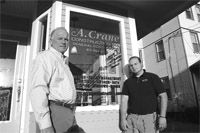
    Sections Supplements
    Texcel Sees Dramatic Growth in Medical Device Manufacturing
    Keith Checca

    Keith Checca stands in Texcel’s manufacturing facility in East Longmeadow, where complicated, implantable medical devices are created.

    In the 1990s, Texcel, a company that designs and constructs devices and components for some of the most highly regulated markets in the world, was working on some big things — literally. The company was a major player in the aerospace and defense industries, but gradually that started to change, and today Texcel works with international clients to devise some of the smallest, most intricate medical technologies ever seen. And this, the company has found, is where its heart lies.

    Larry Derose, president of Texcel, a medical device manufacturer in East Longmeadow, said there’s story behind every tiny component his company creates that speaks volumes regarding the importance of this work.

    “We’ve had clients come back to us with presentations that show how a device is working in its early stages,” he said. “We’ve seen stroke victims who’ve improved enough to use the telephone or change a diaper. When you’re working to develop theories that have that kind of promise, everyone feels connected to the process, and everyone sees how important their work is.”

    Derose founded Texcel in 1987, and said it was always his passion to work with this type of technology. However, only recently has the company come into its own with the development of complex, implantable medical devices — some of which many within health care and technology fields see as the future of modern medicine.

    “Our long-term goal was to use our expertise in the field of medical devices,” said Derose, noting that this expertise includes the use of precise, high-powered lasers, clean-room assembly, and product and process development. “It took a number of years to achieve that while we waited for the market to develop. But new information in this field is triggering a wave of new device design and development, and that’s creating a great number of opportunities for us.”

    Bionic Biology

    Texcel contracts with several different international companies to help them develop devices including pacemakers, endoscopic surgical instruments, spinal orthopaedic implants, total artificial hearts, and neurostimulators. More specifically, this line of work is dubbed ‘implantable device architecture and construction.’

    Some in the industry refer to Texcel as an ‘integrator,’ because it joins technology with the necessary raw materials, both figuratively and literally.

    Due in part to increased activity in the development of neurostimulating devices in particular, Texcel is now enjoying a major growth period in its history. Keith Checca, director of business development for the company, said several new employees with expertise in areas specific to the medical device market have joined the company over the past three years, nearly doubling its size.

    “The last two years have been really explosive,” said Checca. “We’ve realized what we’re good at, and we know how to focus it — that’s really the key for a contract company like us. Our clients are everything.”

    Checca said attention to this specific niche in the medical device market is important to working with these diverse clients, most of which are kept confidential by Texcel.

    “We’re big enough to offer everything that’s needed, and small enough to remain a dynamic firm that’s easy to work with,” he said. “Clients don’t want to hear ‘we can’t do that’ — they want you to be an infinite well. That’s where our focus on that niche comes back in.”

    Planes, Trains, and Biomanufacturing

    But it also helps to underscore the company’s long-held mission to use its capabilities for the greater good, despite many years of building to this point and working in other fields. Medical manufacturing was not as brisk in the past as it is today, Checca explained, and over the years, this has opened the door to contracts in other highly regulated fields such as aerospace and defense.

    “The medical device market was evolving, but aerospace and defense were already here,” he said, adding, however, that as global needs and trends began to shift, Texcel began taking on more medical device work, and today, that sector represents more than 95% of the company’s contracts.

    A handful of aerospace- and defense-related partners remain, but with an FDA- and ISO-registered environment in which to work and a medical technology boom underway around the world, Checca said the company has long been primed and ready to become a strong player in this sector.

    “Equipment-wise, we haven’t had to change much,” said Checca. “We are a laser-processing, controlled environment, and that’s technology that is being adopted by the medical community. This has been not so much a facility-changing event as it has been a culture-changing event.”

    New partnerships have also emerged, including one forged in June with Microtest Labs of Agawam. The strategic alliance will capitalize on a particularly healthy aspect of medical manufacturing — combination products, which pair devices with pharmaceutical or biologic components like those Microtest works with. The market is expected to reach approximately $9.5 billion in 2009.

    Checca added that the existing emphasis placed on quality of both work product and service has been another hallmark of Texcel’s foray into this arena.

    “Perfect is barely good enough,” he said, borrowing a phrase he said he heard at a recent internal meeting. “We’re lucky to have built a culture focused on that very early, and it’s something of which we are constantly aware.”

    Theories of Evolution

    Still, Checca added, with such growth spurts come some requisite internal changes, including some to workforce development and process management. With potential openings for professionals ranging from engineers to manufacturing technicians and assembly operators, Texcel has forged relationships with several area colleges, including Springfield Technical Community College, Western New England College, UConn, and the University of Hartford, to create a sort of educational pipeline to its doors.

    “It’s a little hard to find applicable experience in this area because there aren’t as many companies doing what we do,” he said. “But last year, the story would have been all about growth; we climbed that hill, and we’re still breathing heavy, but now we’re moving forward.”

    Checca said Texcel is likely to continue expanding in size, both physically and in terms of staff, which now totals about 65 people.

    “There will be further growth at a slower pace,” he said. “Now, we’re more focused on refining the mix. The life cycle of some of the products we manufacture is very long, often five or six years until they’re ready for use on humans, and until our client is ready to ask us for more than a few. To that end, we’re looking now to be even more efficient on the manufacturing side, and changing how we manufacture.”

    One way the company is striving to do this is through ‘cellular manufacturing,’ which spreads work on a single item out more evenly throughout the facility. Checca calls it a “tried and true manufacturing principle” that can be applied to many different industries, and can especially help improve efficiency among growing businesses.

    It’s also another system of checks and balances in this highly regulated environment, which also includes several clients (Checca estimates there are about four dozen) with varying development schedules.

    “These companies don’t follow the old vertical-integration model,” he said. “Because the process of developing a medical device is a long one, they need suppliers that can cover the needs of an entire product, and that will remain strong partners for the long term.”

    Part of Texcel’s business model is to actively seek out these types of companies, and educate the industry as a whole regarding its capabilities.

    “But they’re out there searching for us, as well,” Checca said. “If we’re doing our job right, we find them before they find us.”

    The Human Experience

    Derose said that active recruiting, so to speak, leads to a greater number of opportunities to help in the creation of new, innovative, and potentially life-saving devices.

    “It’s inspiring when a client approaches us with a product that hasn’t been recognized by the public or even the medical community yet,” he said. “Usually, when a client comes to us, they’re in the embryonic stage of development. We’re a high-tech manufacturer, but really, we act like a fulfillment agency.

    “We help them convert a dream into a reality.”

    Jaclyn Stevenson can be reached at[email protected]
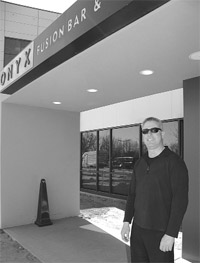
    Departments

    The following building permits were issued during the month of March 2008.

    AGAWAM

    Hillside Development Corporation
    1152 Springfield St.
    $2,000 — Sub-divide floor space in existing building

    Six Flags New England
    1623 Main St.
    $350,000 — Erect new Coldstone & Papa John’s building

    AMHERST

    Miles Herter
    401 Shays St.
    $40,200 — Build a 12 x 24 addition to create a new cabinet shop space

    CHICOPEE

    Pride
    167 Chicopee St.
    $10,000 — Remodel interior

    EAST LONGMEADOW

    Doblewood LLC
    265 Benton Dr.
    $143,000 — Second-floor office renovation

    GREENFIELD

    233 One LLC
    233 Main St.
    $41,000 — Renovate an existing restaurant to a new restaurant/cafe

    Argotec Inc.
    53 Silvio O. Conte Dr.
    $1,652,000 — Convert existing warehouse areas to office/production workspaces.

    Franklin Associates
    87-91 Main St.
    $1,350 — Interior renovations at Precision Driving School

    HADLEY

    Sandon Pearson
    173 Russell St.
    $337,500 — Renovation of existing commercial building

    Target Corporation
    367 Russell St.
    $235,000 — Install freezer/refrigeration fixtures on existing sales floor

    HOLYOKE

    First Light and Power
    200 Northampton St.
    $17,133,000 — Construct air pollution facility


    LONGMEADOW

    GPT Longmeadow LLC
    704 Bliss Road
    $40,000 — Exterior renovations

    NORTHAMPTON

    SF Properties
    491 Pleasant St.
    $545,000 — Construction of new commercial building

    SOUTH HADLEY

    South Hadley Housing Authority
    69 Lathrop St.
    $3,800 — Renovations

    SPRINGFIELD

    Haymarket Square Associates
    1736 Boston Road
    $11,000 — Interior renovations

    Mass Mutual
    1500 Main St.
    $64,000 — Renovations to suite #2518

    Ryder System Inc.
    220 Tapley St.
    $3,500 — Repair overhead doorjamb

    St. George Orthodox Greek Cathedral
    2320 Main St.
    $30,000 — Fire restoration

    Venture Properties, LLC
    254-270 Worthington St.
    $100,000 — Renovate offices into apartments

    WESTFIELD

    Lucier Development
    139 Union St.
    $320,000 — Four new units

    Mark Lavalley
    785 North Rd.
    $157,000 — Commercial addition

    WEST SPRINGFIELD

    99 Restaurant
    1053 Riverdale St.
    $80,000 — Renovate 3,200 square feet of restaurant

    Departments

    The following is a compilation of recent lawsuits involving area businesses and organizations. These are strictly allegations that have yet to be proven in a court of law. Readers are advised to contact the parties listed, or the court, for more information concerning the individual claims.

    CHICOPEE DISTRICT COURT

    Chicopee Mason Supplies Inc. v. Masonry Restorations of Boston Inc.
    Allegation: Non-payment of goods sold & delivered: $4,051.20
    Filed: 3-04-08

    Gilbert & Son Insulation v. VIP Home Associates, LLC
    Allegation: Balance due for insulation services rendered: $3,595.85
    Filed: 3-03-08

    Instar Services Group v. David Poulin & Sons Construction Inc.
    Allegation: Breach of contract and negligence: $20,650
    Filed: 3-12-08

    GREENFIELD DISTRICT COURT

    David Tower v. Rice Oil Co.
    Allegation: Personal injury due to slip and fall: $10,528.18
    Filed: 2-20-08

    HAMPDEN SUPERIOR COURT

    Lease Corporation of America v. Len’s Heating & Cooling Inc.
    Allegation: Breach of lease agreement: $66,554.03. Filed: 2-07-08

    Liberty Mutual Insurance Company v. Rio Minas Roofing
    Allegation: Non-payment of workers’ compensation policy: $87,054
    Filed: 2-12-08

    Mary Laporte v. Tammy Table d/b/a Yellow Jackets of Springfield, TNC, and Hideaway Bar & Grill
    Allegation: Failure to have workers’ compensation insurance: $144,244.86
    Filed: 1-23-08

    Richard T. Jordan III v. Gamestop a/k/a EB Games
    Allegation: Employment discrimination based on handicap and failure to reasonably accommodate: $50,000+
    Filed: 1-05-08

    William S. Carrol v. AOS Operating System
    Allegation: Breach of contract: $60,000
    Filed: 1-16-08

    HAMPSHIRE SUPERIOR COURT

    Alandev, LLC v. East Coat Construction Services
    Allegation: Breach of contract for construction services: $130,000
    Filed: 3-14-08

    Howard Gorniak v. Hardigg Industries
    Allegation: Wrongful termination: $61,000
    Filed: 3-13-08

    John & Brandy Sullivan v. Anthony’s Residential Contracting
    Allegation: Breach of contract and negligence: $32,044.95. Filed: 2-20-08

    HOLYOKE DISTRICT COURT

    Gerard Morrissette v. Greater Holyoke YMCA
    Allegation: Negligence in property maintenance causing injury: $7,652.62
    Filed: 3-06-08

    Sylvan Corporation v. Mid-Atlantic Postal Properties Inc.
    Allegation: Breach of contract: $6,619.82
    Filed: 3-04-08

    NORTHAMPTON DISTRICT COURT

    Anthony’s Dance Club v. Presstek Inc.
    Allegation: Lost business revenue due to negligence: $5,554
    Filed: 3-07-08

    Fleetcor Technologies Operating Company LLC v. Healy Transportation Inc.
    Allegation: Non-payment of goods sold and delivered: $6,144.71
    Filed: 3-10-08

    Liberty General Contracting Inc. v. Anderson Builders Inc.
    Allegation: Breach of contract and unpaid invoice: $35,823.80. Filed: 3-13-08

    Interim Capital LLC v. Papa George Pizza
    Allegation: Breach of contract and failure to pay promissory note: $4,537.93
    Filed: 3-13-08

    Steven Koledziej v. Scottish Inn
    Allegation: Personal injury due to negligence in property maintenance: $3,534
    Filed: 3-12-08

    PALMER DISTRICT COURT

    Bruce Gilbert v. Bertera Chevrolet Inc. and Todd T. Lamb
    Allegation: Negligence in motor vehicle operation causing injury: $12,261
    Filed: 3-11-08

    Pioneer Valley Renovators v. Penn Lyon Homes Corporation
    Allegation: Breach of contract for construction of modular home: $14,588.96
    Filed: 3-11-08

    SPRINGFIELD DISTRICT COURT

    Jacqueline Stratos v. TLC Health Care Services, Inc.
    Allegation: Failure to pay wages & commissions: $7,000
    Filed: 1-09-08

    Medeiros Real Estate Investments LLC v. Frame & Picture Shoppe
    Allegation: Breach of lease contract: $22,575
    Filed: 1-11-08

    Pramco Cv7, LLC v. Let’s Go Bakery Inc.
    Allegation: Default on commercial promissory note and guaranty agreement: $22,966.43
    Filed: 1-10-08

    WESTFIELD DISTRICT COURT

    Lawrence Pooler & Stacy MacQueen-Pooler v. Sears Roebuck & Co. & Liberty Transportation Inc.
    Allegation: Breach of contract: $12,600.72
    Filed: 3-04-08

    Opinion
    The Teen Job Crisis

    In the 1990s, many young people worked both year-round and seasonally in communities across Massachusetts — in construction, retail, finance, parks and playgrounds, and community centers. Today, however, the level of national joblessness for teens is greater than at any time over the past 60 years, and this summer will produce a new record unemployment rate unless we take action now.

    The collapse of the teen labor market has affected all demographic and socioeconomic groups. There are, however, large gaps in teen employment rates across race-ethnic and income groups. During an average month in 2007, only 20% of black teens across the nation had jobs, compared to 30% of Hispanics and 40% of white non-Hispanics.

    The teen job market in Massachusetts has also collapsed since the late 1990s. Despite modest growth in overall payroll employment, the state’s teen employment rate last year was only 38%, a 30-year low. The state is no longer a national leader in the employment of teens, whether in school or out of school.

    There are many reasons to care about rising youth joblessness. Path dependency is strong in teen employment behavior. The more teens work this year, the more they work next year. Less work experience today leads to less work experience tomorrow and lower earnings down the road. Disadvantaged teens who work in high school are more likely to remain in high school than their peers who do not work. Teens who work more in high school have an easier transition into the labor market after graduation. National evidence shows that pregnancy rates for teens are lower in metropolitan areas where female teen employment rates are higher.

    Congress had an opportunity to boost teen and young adult employment this year when it passed a fiscal stimulus package to boost consumer spending. Yet despite efforts led by U.S. Sen. Edward Kennedy and evidence that job-creation programs have been found to be effective in creating new jobs for teens, particularly low-income teens, the White House and the congressional leadership killed the proposal to add $1 billion to create jobs for teens and unemployed young adults.

    There are a variety of workforce-development strategies that can be pursued to boost teen employment opportunities this year.

    First, the summer youth employment program funded by Congress for the past 35 years to create jobs in the nonprofit and public sectors should be reinstituted with an appropriation of at least $1.5 billion. Funds also could be used by state and local workforce investment boards to subsidize jobs for teens in the private, for-profit sector.

    Second, the existing network of one-stop career centers should be assigned a priority to recruit and place teens in jobs.

    Third, recent efforts by the Patrick administration to create year-round jobs for youth should be expanded in every region of the Commonwealth and supported by the Legislature.

    Fourth, state funding for school-to- career connecting activities programs that support local workforce boards to develop year-round and summer intern jobs for high school teens should be expanded to boost access to a wider variety of jobs in the state’s economy.

    The U.S. Bureau of Labor Statistics preliminary payroll numbers for February are down 63,000 jobs from the previous month. The governor must provide leadership to engage Congress, the business community, and elected officials to follow the lead of Boston, where Mayor Thomas Menino has aggressively recruited jobs for teens in private sector firms.

    Young people are leaving Massachusetts in record numbers. The state needs to make youth joblessness a priority in order to keep them here.

    Andrew Sum is director of the Center for Labor Market Studies at Northeastern University. Don Gillis is executive director of the Mass. Workforce Board Assoc.

    Sections Supplements
    Life in the Quirky Northampton Real Estate Market

    Each time I pass by the Ten Thousand Villages store on Main Street in Northampton — a retail chain that sells what is described as ‘fair-trade products’ from 100 artisan groups in 30 countries — I am reminded of how I perceive the Northampton office real estate market: 10,000 psychotherapists.

    Northampton is honeycombed with countless small-office users. Some are attorneys, some financial advisors and other professions, but most seem to be related to providing some sort of mental health counseling. The net result is that, in the aggregate, they all occupy a vast amount of space in very small increments — about 200 square feet on average.

    They are all over town. Much of the upper-floor space on both sides of Main Street hasn’t changed much from the days of Sam Spade. Small offices with translucent-glass-paneled doors and creaky wooden floors. All are walk-ups, although some buildings do have elevators. The former Elks Lodge on Gothic Street was sold several years ago and converted into very handsome office space. What was once a tired and fairly wide-open building is now the home of dozens of social service or mental health practices. This is typical all along the Route 9 corridor into Florence and Haydenville as well. And nowhere is this pattern more apparent that at the Potpourri Plaza on King Street.

    This community of small users is generally a favorable one from a landlord’s perspective, in that many tenants in one building have a tendency to spread the risk. But it makes it very difficult for a company in need of 5,000 square feet or more to find space in the city. Many companies looking to expand simply can’t find large blocks of space in the market. Everyone wants to be downtown, and who can blame them?

    The largest single office user in Northampton is Disney Publishing, which occupies 10,000 square feet at the former post office building on Pleasant Street.

    In 2006, Disney relocated from another downtown site, the Roundhouse Building, which contains 15,000 square feet of truly unique space. That building, just off Pulaski Park, proved too large for Disney, which was downsizing at the time. Also, the building was about to go through a protracted environmental remediation by Baystate Gas. That project will be concluded within the next few weeks, and the building will once again be available to accommodate the needs of larger users.

    Another large space, at 109 Main St., was most recently occupied by Fleet Bank, a victim of the merger and acquisition quicksand, and is in the process of being leased. The owners have responded aggressively to unmet requirements in the market, and the results are becoming apparent.

    The top floor of Thorne’s Marketplace is also being converted into much needed larger blocks of downtown office space — fortunately, however, not at the expense of relocating PACE into nearby street-level space on Main Street.

    I expect this available supply of larger blocks of downtown office space to be absorbed in the next 12 to 18 months. Once the inventory is depleted, the only alternative will be new construction elsewhere.

    The project planned for King Street, a commercial-office mix at the former Lea Honda dealership site, was out of step and has stalled. Rents associated with new construction there, coupled with a less-than-desirable ‘strip’ location, have proven to be impassable obstacles for the project. The Hospital Hill commercial development, at the site of the former Northampton State Hospital, will offer a more desirable office venue than King Street, but it’s a far cry from downtown. And, as previously mentioned, everyone wants to be downtown.

    Several office-conversion projects that are not located downtown have succeeded nonetheless. The Cutlery Building complex in the Baystate section of the city is near capacity and offers affordable and somewhat non-traditional office space. The building has plenty of on-site parking and is located in a safe rustic setting along the Mill River. While such office locations can succeed as alternatives to downtown, they often prove to be much more challenging.

    Northampton’s allure is so compelling that, most days, we are willing to endure the inconvenience of circling the block for a parking place only to wait again for a table at one of downtown’s many wonderful restaurants.

    I guess that’s why those 10,000 psychotherapists are there, too — ready to help us work out all such stresses and pressures in our lives.

    John Williamson is president of Springfield-based Williamson Commercial Properties; (413) 736-9400.

    Sections Supplements
    Springfield Developer Bucks Current Trends with Unique, Retro-inspired Project

    Leslie Clement has always had a creative mind.
    She graduated from Indiana University with a Liberal Arts degree, having studied dance, music, art, and culture for many years of her life. But eventually, she said, she had a revelation.

    “I realized my degree prepared me for absolutely nothing,” said Clement, who soon started searching for more practical applications for her far-reaching creative interests. She recalled one of her favorite hobbies as a child — her father would often channel Clement’s flair for thinking outside of the box into small building projects — and took a dramatic leap onto a new career path, studying to be a carpenter’s apprentice in the late 1970s.
    The apprenticeship, completed with the Springfield Carpenters Union Local 108, required four years of working construction, as well as specialty skills such as draftsmanship, finish carpentry, surveying, and estimating.

    A number of intriguing jobs followed, including work on a series of bridges for Interstate 391 and a downtown highrise, but the more views of the city she saw, the more changes Clement wanted to make.

    “In Springfield, I saw a city that needed a lot,” she said, “but more than anything, it needed help with its poor self-image.”

    So she set out to do something about it.

    Raise the Rafters

    Clement’s first solo project in the housing sector was a home restoration in the historic Maple Hill section of the city, which later led to the renovation of 14 additional National Historic Register properties in concert with a team of tradespeople (funding for these projects included financing from limited partnerships, private funding, loans, and grants). 

    “These were incredible, historic homes, and a number of the projects had strict criteria for renovation,” she said, noting that, upon completion of that suite of projects, she’d developed an interest in and respect for historical design, as well as the city’s assets.

    Soon though, it was on to new endeavors, including a condominium conversion in a Victorian mansion in Holyoke, the Wyndhurst Condominiums overlooking the Connecticut River on Crescent Hill in Springfield, and nine homes on a parcel of land abutting Lake Massasoit in the East Forest Park section of the city. The latter ultimately sold for a total of $1.05 million over the course of 18 months.

    By that time, the early 1990s, Clement had also become a real estate broker as well as a developer, and this began to further shape her home-building goals.

    “I began to see home sales from a reverse perspective,” she explained. “Instead of only saying, ‘if I build it, they will come,’ I started saying, ‘if I build it, there’s still a chance they won’t come.’”

    Stepping back to take a broader look at the home-building landscape, Clement said she saw a huge disconnect between the labors of love required to restore an old home to its former glory and what was happening in the new-home market.

    At that time, she told BusinessWest, few developers were building homes in urban areas based on consumer wants or demands.

    She added that without something interesting to draw buyers into — or keep them within — an urban area like Springfield, those with the means to purchase new, moderate- to high-end homes soon flee to new areas or suburbs.

    “Nobody was building what people wanted,” Clement said. “There was a lot of cookie-cutter activity going on, and I saw a huge opportunity being missed — to give people some beautiful, interesting homes that they were instantly attracted to.”

    The Forest Through the Trees

    Thus, her latest project, now being developed under the company name Forest Park Fine Homes, is one answer to the question of how to retain these homeowners.

    “This community has a ton of urban professionals,” said Clement. “That’s a lot of money that’s going unnoticed in this city, and people are leaving for other places or not even considering Springfield as a destination.

    “But often, these are people who are looking for interesting properties,” she continued, “something with great architecture that doesn’t look like everything else — and the goal here is to reach those untapped markets.”

    Located off of Tiffany Street not far from the Longmeadow town line, the new neighborhood Clement is now in the process of developing abuts the southern end of Forest Park and is about a half-mile away from Franconia Golf Course.

    Today, Clement’s varied experiences lend a number of additional titles to her business card, including general contractor, designer, and listing agent. All of these skills are being put into play in creating her new niche neighborhood in the City of Homes, and Clement estimates they also save her about $5,000 per property in general development costs.

    She purchased the 12-acre parcel from a private owner in 2004, again with the help of private investors and financing through United Bank, and from that parcel has created 37 individual lots with the assistance of Springfield-based architect Phil Burdick.

    “He suggested we created little clusters of homes on small streets that branch off of the main road, which is Brentwood,” said Clement, adding that this idea was also in line with the historic-inspired type of homes she wanted to build.

    Until 1943, when the town line was moved, she explained, this area was actually part of Longmeadow, and was dubbed ‘Franconia Village’ on some historical maps.

    She added that when constructing new homes on the previously undeveloped land, she wanted to honor the area’s heyday, and modeled some of her plans after the 1920s-era ‘craftsman style,’ the originals of which can still be seen in historic parts of the Forest Park section of Springfield and in Longmeadow.

    June Gets Her Way

    These homes typically have large front porches and use natural materials when available, including wood shingles, stone walls woven throughout the landscaping, and detached garages that Clement said “make for a friendlier-looking street.”

    The lots are spaced out across five roadways. Grace Street represents what will be the final phase of the project, including 18 lots that have yet to be developed. Also in process are home plans on Craig and Bassing streets, which will accommodate houses in the $300,000 to $390,000 range, and on South Park Avenue, building is now in process on 11 homes in the $290,000 to $340,000 range, slated for completion in or around spring 2008.

    But the current jewel of Clement’s project is June’s Way, named for her daughter and including six lots on a private cul-de-sac. Four homes, each unique in design and ranging in price from $330,000 to $390,000, have already been completed, while two lots remain for construction.

    The finished homes on June’s Way are geared, Clement said, toward empty-nesters and urban professionals. In contrast to the retro feel of the houses’ exteriors, the floor plans inside are more modern and informal, with a ‘bungalow’ feel. They feature bedrooms on both the first and second floors, most with adjoining private bathrooms, which can accommodate ‘aging-in-place’ living for older Americans planning to stay in the home or living with elderly parents.

    The homes also have a relatively small footprint, between 2,200 and 2,600 square feet per lot, but the wide-open floor plans inside are meant to maximize space.

    All of these features, Clement said, work together to create a quality product that is in keeping with her goal to offer something new and yet solid to Springfield’s real-estate market.

    “People move for real needs,” she said. “The need for more space, proximity to schools, etc. This development offers these things, and with slightly better design and better buyer targeting, we’re attracting the right people.”

    National Staging

    The project is attracting some positive press for Springfield, too. It was recently featured in Builder magazine as one of five “bright spots” across the nation that have taken “design’s high road” and reached some positive benchmarks.

    Builder identified Clement’s project along with others in Las Vegas, Portland, Ore., Los Angeles, and Fowler, Mich. (a stretch between Detroit and Lansing). While sales volume isn’t the best indicator of the Forest Park lots’ success — seven homes have been built and sold since construction began — the magazine took particular note of the going rates for these homes. New, single-family properties in Springfield typically sell for between $275,000 and $315,000, but Clement’s properties are averaging $75,000 above that or more, and prices haven’t slid in the four years since the project started, regardless of the tepid state of the current housing market.

    “I think that’s proof that details make the difference, and people appreciate quality,” said Clement, wiping a speck of dust off of the bay window seat and flicking the ambient lights off in the kitchen.

    It would also seem she’s found an outlet for a lifetime of creative thinking.

    Departments

    The following building permits were issued during the month of March 2008.

    AGAWAM

    GAC Realty Trust
    720 Silver St.
    $2,000,000 — Construction of two additions to existing building

    AMHERST

    Amherst Associates Inc.
    384 Northampton Road
    $4,000 — Construction of handicap ramp

    Amherst Associates Inc.
    388-394 Northampton Road
    $4,600 – Install new handrails and guards for exterior stairs

    Amherst Associates Inc.
    384-378 Northampton Road
    $4,000 — Install new handrails and guards for exterior stairs

    EV Realty Trust
    24 North Pleasant St.
    $35,000 — Install fire sprinkler system in Amherst Brewing Company

    CHICOPEE

    American Renal Associates
    601H Memorial Dr.
    $669,000 — Interior renovations of 7,237 square feet in existing building

    Chicopee Housing Authority
    Stonina Dr.
    $330,000 — Replace 126 exterior doors

    Child Development Center
    989 James St.
    $13,600 — Strip and re-roof

    D’Angelos
    1606 Memorial Dr.
    $65,000 — Interior fit out

    EAST LONGMEADOW

    Council on Aging
    328 North Main St.
    $80,000 — Refurbish office

    Salon Karma
    576 North Main St.
    $100,000 — Renovations

    GREENFIELD

    Mark Sirum
    41 Garfield St.
    $23,000 — Excavate and rebuild foundation

    HADLEY

    Eden Avant
    454-460 Russell St.
    $1,600 — Minor interior renovations


    HOLYOKE

    D’Angelos
    2175 Northampton St.
    $690,000 — Interior renovations to restaurant

    O’C Ingleside LLC
    361 Whitney Ave.
    $2,841,000 — Renovate existing office and warehouse space

    LUDLOW

    Constantine & Christine Dourountondakin
    7 McLean Parkway
    $144,000 — Alterations

    NORTHAMPTON

    Coolidge Northampton, LLC
    243 King St.
    $3,000 — Move reception area

    Cooley Dickinson Hospital
    30 Locust St.
    $973,000 — Renovate first floor for new practice

    PALMER

    Pioneer Valley Group LLC
    354 Wilbraham St.
    $55,000 — New commercial building

    SPRINGFIELD

    Cooley Street Associates
    415 Cooley St.
    $1,000,000 — Add 10,800 square feet of retail space to Stop & Shop

    Diocese of Springfield
    260 Surrey Road
    $6,000 – Install 12 x 12 column to add support

    Rent Prop LLC
    414 Boston Rd.
    $266,000 — Install new storefront & renovations

    WEST SPRINGFIELD

    T.D. Bank North Insurance
    123 Interstate Drive
    $196,000 — Renovate 3,300 square feet of existing office space

    Vadim Kot
    534 Union St.
    $38,000 — Strip and re-roof

    Departments

    The following is a compilation of recent lawsuits involving area businesses and organizations. These are strictly allegations that have yet to be proven in a court of law. Readers are advised to contact the parties listed, or the court, for more information concerning the individual claims.

    CHICOPEE DISRICT COURT

    Theresa Szkolt v. Johnson Construction
    Allegation: Breach of contract for construction services: $4,600
    Filed: 1-28-08

    WJF Geoconsultants Inc. v. Bernard Brunelle & Triple B Auto Service Inc.
    Allegation: Non-payment of environmental services: $6,771.25
    Filed: 2-07-08

    FRANKLIN SUPERIOR COURT

    Gilbert R. Lanoue v. Big Y Foods Inc.
    Allegation: Negligence in dispensing of drug causing personal injury: $6,200
    Filed: 1-31-08

    GREENFIELD DISTRICT COURT

    Sherwin Williams Company v. Todd Baker Decoration
    Allegation: Non-payment of goods sold and delivered: $2,870.15
    Filed: 2-13-08

    HAMPDEN SUPERIOR COURT

    Helen Santaniello v. James Harrington & Hawk Liquors & Spirits Inc.
    Allegation: Breach of purchase and sales contract: $325,000
    Filed: 12-28-07

    Mary Lewandowski, administratrix of the estate of Fred Lewandowski v. Edward Steven Ballis, M.D.
    Allegation: Medical negligence causing death: $25,000+
    Filed: 1-23-08

    Miriam Rosa v. Goodwill Industries Inc.
    Allegation: Other negligence and personal injury: $25,000+
    Filed: 2-01-08

    Nicholas Lynch v. Douglas G. McAdoo, M.D. and Emergency Medicine Associates
    Allegation: Medical malpractice: $25,000
    Filed: 1-30-08

    Roger Cortis Jr. v. Crystal Brook Landscape Construction Inc.
    Allegation: Motor-vehicle negligence: $26,258.55
    Filed: 1-20-08

    Taylor M. Coutant v. Eastern States Expo and North American Midway Entertainment
    Allegation: Negligence causing personal injury while entering amusement ride: $526,136.18
    Filed: 2-05-08

    HAMPSHIRE SUPERIOR COURT

    David Bogardus v. Packaging Corporation of America
    Allegation: Negligent failure to maintain property, causing injury: $601,768.27
    Filed: 1-16-08

    Pramco CV8, LLC v. J & P Dunham Truck & Tractor Service, LLC
    Allegation: Default on commercial promissory note and guaranty agreements: $27,275.32
    Filed: 1-24-08

    William and Ann Marie Woods v. Wagner Spray Technology Corporation
    Allegation: Negligence in design and manufacture of product causing fire damage: $200,000+
    Filed: 1-24-08

    HOLYOKE DISTRICT COURT

    Ramon Suarez v. El-Ro Realty and Pleasant Realty Apartments, LLP
    Allegation: Negligent maintenance of property causing injury: $6,331.59
    Filed: 1-18-08

    NORTHAMPTON DISTRICT COURT

    Assured Nursing Services Inc. v. Somerset Longterm Care, LLC d/b/a Poet’s Seat Health
    Allegation: Principal due on promissory note: $29,764.31
    Filed: 2-15-08

    Fierst, Pucci, & Kane LLP v. Replay Studios GMBH
    Allegation: Failure to pay for legal services rendered: $9,705.39
    Filed: 2-14-08

    McCarthy, Burgess, & Wolff v. Northeast Woods & Waters Inc.
    Allegation: Non-payment of balance on equipment lease: $11,885
    Filed: 2-14-08

    PALMER DISTRICT COURT

    Budget Truck Rental LLC v. Liberty Transportation Inc.
    Allegation: Motor vehicle negligence: $9,676.72
    Filed: 1-30-08

    SPRINGFIELD DISTRICT COURT

    Alan Planky v. Regency Pontiac
    Allegation: Breach of car sales contract: $7,235.47
    Filed: 1-03-08

    WESTFIELD DISTRICT COURT

    Abraham Forish v. YMCA of Greater Westfield Inc.
    Allegation: Negligent maintenance of exercise equipment causing injury: $21,000
    Filed: 2-04-08

    Departments

    The following business incorporations were recently recorded in Franklin, Hampden, and Hampshire counties and are the latest available. They are listed by community.

    AGAWAM

    Berkshire4wheelers Inc., 44 Arbor Lane, Agawam 01001. Robert Lacoste, 35 Doughlass St., Keene, NH 03431. Vasilios Pananas, 44 Arbor Lane, Agawam 01001, treasurer. (Nonprofit) To promote the responsible and safe use of four (4) wheel drive vehicles, maintain existing trails, etc.

    BELCHERTOWN

    Mi Great Ideas Inc., 376 Stebbins Ave., Belchertown 01007. Marilyn R. Iannaccone, same. Sale of various products at trade shows, flea markets, and other venues.

    CHICOPEE

    ABA Convenience Inc., 1031 Chicopee St., Chicopee 01013. Faisal R. Khan, 59 New Ludlow Road, Chicopee 01020. To operate a convenience store and gas station.

    Chicopee Public Library Foundation Inc., 339 Front St., Chicopee 01013. Carl E. Sittard, 38 Fletcher Circle, Chicopee 01020. (Nonprofit) To support the restoration, improvement, and function of the Chicopee Public Library, etc.

    Maun Convenience Inc., 810 Meadow St., Chicopee 01013. Mehreen S. Ahmed, 8 Osceola Lane, Longmeadow 01106. To operate a convenience store and gas station.

    National Amateur Fight League Inc., 327 East St., Chicopee 01020. Louis A. Thouin, III, same. To carry on the business of Martial Arts and Boxing, training, managing, and competing throughout the USA, etc.

    EASTHAMPTON

    Sisyphus Woodworking Inc., 1 Cottage St., Easthampton 01027. Gregory W. Larson, 9 David St., Easthampton 01027. Woodworking education and related activity.

    HADLEY

    Dennis R. Bernashe Electrical Inc., 46 East Carew St., Unit No. 2, South Hadley 01075. Dennis R. Bernsahe, 1 Island Road, Holland, 01521. Electrical contractor.

    HAMPDEN

    AllBrite Restoration Inc., 51 Oak Knoll Dr., Hampden 01036. Vincent Mineo, 147 Maple St., Hampden 01036. Maintenance and restoration.

    HOLYOKE

    Mary’s Meadow at Providence Place Inc., 5 Gamelin St., Holyoke 01040. Joan Mullen, same. (Nonprofit) To continue providing high quality, mission-driven services to members of the Sisters of Providence, etc.

    Massachusetts Academy of Ballet Educational Training Association Inc., 4 Open Square Way, Holyoke 01040. Charles Flachs, 113 Amherst Road, South Hadley 01075. (Nonprofit) To educate residents of Holyoke and area about the art of classical ballet at schools, senior centers, etc.

    LONGMEADOW

    Five Star Anesthesia Service, PC, 103 Blueberry Hill Road, Longmeadow 01106. Syed Asad Rizvi, same. To engage in the practice of anesthesiology.

    ORANGE

    Grrr! Gear Inc., 84 Prescott Lane, Orange 01364. Christine A. Noyes, same. Wholesale and retail sale of apparel and sporting goods.


    RUSSELL

    Pavel’s Construction Inc., 56 Patriots Path, Russell 01071. Pavel Usatyy, same. Construction.

    SPRINGFIELD

    B4You Inc., 608 Main St., Springfield 01104. Mukesh Patel, 120 Hannah Niles Way, Braintree 02184. Convenience store.

    F & T & A Inc., 71 Wexford St., Springfield 01118. Thomas Grimaldi, same. Rental real estate.

    Family Pizzeria Europa Jerry Inc., 715 Sumner Ave., Springfield 01108. Gennaro Buonfiglio, 141 Blueberry Hill Road, Longmeadow 01106. Pizza restaurant.

    Hampden Bank Charitable Foundation, 19 Harrison Ave., Springfield 01102. Thomas R. Burton, same. (Foreign corp; DE) To provide funding to support charitable causes and community development activities.

    Jennings Real Estate Services Inc., 73 Chestnut St., Springfield 01103. Kevin M. Jennings, same. Real estate.

    Mano A Mano Mission Foundation Inc., 55 Pendleton Ave., Springfield 01109. William Ortiz, same. (Nonprofit) To promote positive spiritual, emotional, mental and physical health to the young, old, widows, aliens and the spiritual warriors of Christ, etc.

    Valley Radio Reading Service Inc., 1 Federal St., Springfield 01105. Catherine Banks, 33 Beechwood Ave., Springfield 01108. (Nonprofit) To provide blind-and print-impaired Western Massachusetts individuals with current information from print media, etc.

    WESTFIELD

    Merchamp U.S.A. Inc., 116 Wildflower Circle, Westfield 01085. John McKiernan, Unit 7, Baldoyle Estate, Dublin, IRL. Con A. Daly, 116 Wildflower Circle, Westfield 01085, agent. Sales of eyewear and related products.

    Traveler-er Inc., 94 Falley Dr., Westfield 01085. Thomas R. Mihalek, same. Medical software for travelers in emergencies.

    TRM Consultants Inc., 94 Falley Dr., Westfield 01085. Thomas R. Mihalek, same. Marketing, strategic planning, and governmental affairs.

    Westfield Youth Lacrosse Inc., 31 Gladwin Dr., Westfield 01085. Paul Jones, same. (Nonprofit) To promote and support youth lacrosse athletes for local, statewide national and international lacrosse competitions, etc.

    WILBRAHAM

    Hapi World Inc., 16 Hemingway Road, Wilbraham 01095. Omar Faruk, MD, same. (Nonprofit) To establish mobile health clinics and ultimately to build hospitals to provide free basic medical care to the sick and poor worldwide, etc.

    Lawn Partners Inc., 1223 Stony Hill Road, Wilbraham 01095. David F. Elliot, same. Chemical lawn care.

    Sections Supplements
    Farren Care Center Specializes in Turning Lives Around
    Jim Clifford

    Jim Clifford, administrator of the Farren Care Center, describes the unique facility as a “safety net” for a challenging constituency.

    It’s called ‘specialized long-term care.’

    That’s an industry term, and maybe the most expeditious way to categorize the services provided at the 122-bed Farren Care Center (FCC) in Turners Falls. But the phrase doesn’t begin to describe what goes on inside the walls of this former acute-care hospital built more than century ago — and often outside them, as well.

    To become a resident at what is often referred to as simply ‘the Farren,’ individuals must have been rejected for admission at no fewer than five traditional nursing homes. Most have been turned down by a multiple of that number, and Jim Clifford, administrator at FCC, recalls one man who was rejected by 75 such facilities before he eventually came to his new home on Montague City Road.

    The ‘nos’ from traditional care centers are prompted by dual diagnoses, or combinations of needs that Clifford describes as ‘me, me’ — meaning medical and mental, or psychological — and an inability to adequately meet them. Specific conditions vary with each individual, he explained, but the common denominator is that the sum of their problems places their care requirements into the realm of the extraordinary.

    And with the phasing out of mental-health facilities such as Northampton State Hospital and Belchertown State School nearly two decades ago, the Sisters of Providence Health System recognized a need to serve this challenged and challenging constituency, and responded by creating a truly unique care center at the site of the former Farren Memorial Hospital.

    There, dedicated, specially trained staff members work to provide a better quality of life for residents ages 30 to 90, but often, the caring doesn’t stop when a life is over.

    Indeed, there are many spaces in St. Anne’s Cemetery in Turners Falls that have been set aside for residents of the Farren. The facility, through various funding mechanisms and partnerships, ensures that individuals who have no family to speak of — and many at FCC fall into this category — are given proper funeral services and burial.

    For most residents — that’s the term staff members prefer over patients or clients — the Farren will indeed be their last address, because no other facility can fulfill their needs, and their condition will not improve to the extent that they can live in another setting.

    But some, perhaps 10% and a number that is trending upward by some accounts, will be discharged to a group home or perhaps even their own apartment because they have improved.

    ‘Michele’ is one such individual. She told BusinessWest that she has very much enjoyed her stay at Farren, which she described as much better than any of the many traditional nursing homes she’s been in, but is nonetheless looking forward to the day, probably weeks or a few months away, when it will end.

    “And I hope it will be permanent,” she said of her pending relocation to a group home in the Boston area, knowing that many who are discharged eventually return to FCC. “It’s going to be hard for me at first, but I’m going to be ready, and work hard so I don’t have to come back.”

    In this issue, BusinessWest goes inside a little-known, often misunderstood health care facility to examine not only the specialized variety of care provided there, but how it is provided.

    Starting Points

    As she talked about FCC and its mission, Anne Nusbaum, its director of Nursing, got right to the larger point.

    “We take these people who are so difficult, and we change their lives around,” she said rather emphatically. “We give them a quality of life they’ve either never had or haven’t had for many years.”

    Elaborating, Nusbaum said staff members at FCC give residents a fresh start — “we don’t care what these people have done before” — and then help them make the most of it, by providing some things that many residents hadn’t seen much, if at all, before arriving at the facility.

    These include such tangibles and intangibles as an extended family (in this case, the staff and other residents), some positive reinforcement, and activities, such as gardening, parlor games, or van trips into the community, that fill their time — and their lives.

    It’s been this way since Farren Memorial, opened in 1899 in a broad act of philanthropy on the part of construction company owner Bernard Farren, was transitioned into specialty long-term care nearly two decades ago.

    Tracing the history of the facility, Clifford said that a changing competitive landscape eventually doomed Farren as an acute-care hospital, and that by the mid-’80s, the SPHS had began exploring alternative roles for the four-story complex that would help the system fulfill its mission — specifically to meet the needs of generally underserved segments of the population.

    Eventually, the system focused on specialized long-term care, a need exacerbated by the mainstreaming of mentally disabled individuals by the closing of Northampton State Hospital and similar facilities across the state. An extensive licensing process ensued, said Clifford, and the Farren eventually opened its doors in 1990.

    It is the only facility of its kind in the state and one of the few in the Northeast, he continued, noting that referrals come from across the Commonwealth and New England, and sometimes well beyond. There is an extensive waiting list that ensures nearly 100% occupancy.

    Residents who meet that rather stern entry requirement — being rejected by at least five traditional nursing homes — have a variety of medical and psychological conditions that are bound by the adjective ‘extreme.’

    “These people aren’t criminally insane; they just have behaviors that make it hard to treat them elsewhere,” said Clifford, who used the term “safety net” to describe Farren and its purpose.

    These behaviors vary, and include schizophrenia, obsessive-compulsive disorders, aggressiveness, and other maladies that go well beyond dementia.

    From a care perspective, the facility was designed to provide each resident with a level of dignity, said Nusbaum, while treating combinations of conditions that are beyond the scope of most other long-term care facilities.

    Meanwhile, from a practical perspective, FCC helps dual-diagnosis individuals stay out of acute-care hospitals, where care would be much more expensive than it is at Farren — and draining on an already overburdened system.

    “One of the stated goals for this facility when they created it was to prevent or reduce hospitalizations,” Clifford said. “A lot of these people lived in community settings of one sort or another, and were constantly in and out of the hospital for exacerbation of their psychiatric behaviors.”

    Such problems would often prevent them from being returned to the community, he said, before and until their condition was stabilized, which is one of Farren’s primary reasons for being.

    Life-and-death decisions

    When asked how the Farren goes about providing that quality of life, that dignity in life and death that he and others continually referenced, Clifford said it comes down to compassion and a broad team approach to providing care.

    And while each case is different, there is what Clifford described as a “nuts-and-bolts” approach to creating care plans, or strategies, for individuals.

    It starts with an overall assessment that begins long before a resident actually arrives at FCC, he said, noting that extensive reviews, which include face-to-face evaluations, are carried out by the facility’s admissions director, the nurse manager for the unit the individual in question will live in, and other staff members.

    The assessment process continues after a resident arrives, he said, noting that a nurse manager, nurses, certified nurse assistants (CNAs), social workers, and others are all involved in putting together a care plan. The overall process — assessing an individual, identifying problems and issues, developing a care plan, implementing the plan, and continually re-evaluating the resident — is similar to that found in traditional long-term care facilities, “with the difference being the nature and scope of the interventions needed to stabilize these individuals,” he said.

    In such an environment, some residents thrive and improve to the point where they are ready to be discharged, said Nusbaum, who cited ‘Michele’ as one of several comparatively younger residents who have re-entered the community, or soon will if their progress continues as expected.

    While such discharges are still somewhat rare, they are the stated goal, especially for younger residents, she explained. “When someone comes here in their 30s or 40s, we don’t want them to spend the rest of their life at Farren.”

    ‘Michele’ will be returning to the Boston area and a group home there “soon” — that was her word — and gave credit to staff members who helped stabilize her condition and enable her to find new levels of independence.

    She had high praise for one of the foundations of care at Farren — its so-called milieu program, or package of activities staged between 7 a.m. and 7:30 p.m. every day. The concept of activities is common to all long-term care facilities, said Nusbaum, but owing to the severity and complexity of medical and psychological conditions prevalent among residents, staff members must be especially creative in this realm.

    “Customize” was the word she used to describe how programs are tailored for individual units or specific residents.

    As an example, she referenced a clambake, staged last year, that was crafted so that even residents with swallowing disorders — and there are many of them — could partake and enjoy the festivities. Other activities include gardening — Farren has extensive facilities, all at wheelchair height to enable all residents to take part — and also parlor games, excursions off site for ice cream or apple picking, for example, and an annual strawberry festival,

    And some activities don’t fall neatly into the traditional daily schedule, said Nusbaum, noting a recent meteor shower that occurred around 2 a.m. Some staff members not on duty at that time actually came in to work at that hour to help take residents outside so they could get a glimpse of the rare occurrence.

    Such efforts on behalf of the staff help provide a sense of involvement that has been missing from the lives of many residents, she continued, adding that it extends to the last days of one’s life — and even beyond.

    Some of the patients have outlived family members or are alienated from family, Nusbaum explained, adding that when these individuals approach the end, there is no one to be with them for their final days or hours, and when they die, there’s no one to make arrangements and bid farewell.

    Farren staff members fill in under both circumstances, continuing that sense of community.

    “No one dies alone here,” she said, adding that staff members often volunteer their own time to be with residents at the end. When residents pass on, FCC staff members stage memorial services on site, and those without family or for whom no arrangements have been made — more than 25 since the program started in 2002 — are buried in St. Anne’s, with their own grave marker.

    “It’s a very unique program,” Clifford said of the burial service, carried out with the help of a local church and funeral home. “We carry that sense of involvement beyond the grave.”

    Care Package

    Even for those who are never discharged from FCC, there is a better quality of life than what existed before they arrived, said Nusbaum.

    She told BusinessWest that she’ll often hear staff members at traditional nursing homes say of individuals who eventually wind up at Farren, “that person was really a challenge!”

    “Well, we love people like that here,” she continued, adding that such an attitude makes FCC special, and uniquely qualified to change such lives around.

    George O’Brien can be reached at[email protected]
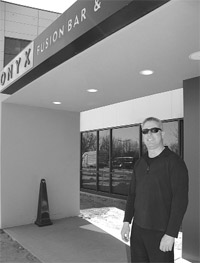
    Sections Supplements
    The Regional Homebuilders Association Focuses on Education to Strengthen the Market
    The team at the Homebuilders Assoc. of Western Mass. stands in front of their offices, designed to look like a private home, on Cadwell Street in Springfield.

    The team at the Homebuilders Assoc. of Western Mass. stands in front of their offices, designed to look like a private home, on Cadwell Street in Springfield.

    There’s a quaint, stone-walled home that seems out of place on Cadwell Street in Springfield, the industrial roadway on which it’s located.

    But inside, there’s much more going on than Sunday dinners. This is the headquarters of the Homebuilders Assoc. of Western Mass. (HBAWM), a member-driven organization formed in 1939 to promote the trade of residential construction as a whole, as well as responsible practices therein and affordable home ownership.

    The building was constructed in 1998 by some of the association’s 550 members — who hail from all four counties in Western Mass. — and represents the only physical offices maintained by any of the five regional home-builders associations in the Commonwealth.

    The Cadwell Street facility is home to an extensive library and meeting space for use by both the association and its members when needed. Operated by a staff of six, it serves as a model home of sorts, too; the molding is a little different in each room, as are the windows, cabinets, floors, and color schemes, and builders often use these examples to show clients.

    Beyond a spiffy home base, though, the HBAWM is also one of the most active such organizations in the country. The group’s annual Spring Home and Garden Show, this year slated for March 27-30, is one of the 10 largest in the nation, and was joined last year by a second show held in the fall, which is more ‘lifestyle-based,’ focused on topics like home entertainment and healthy living rather than the nitty-gritty of building and remodeling.

    The HBAWM also conducts educational, charitable, and promotional efforts throughout the year for both consumers and members. These are steered by several volunteer-based committees and a 40-member board of directors, also volunteers, many of whom are past presidents of the association who hold a term for one year (this year’s president is Paul LeClerc, co-owner of LeClerc Bros. Inc. in Chicopee).

    Members range from seasoned professionals to small-business owners just starting out, and the association’s executive director, John Lilly, said there’s no shortage of topics to discuss.

    “We just completed a construction licensing class, as well as an OSHA certification class, and our members have asked us to look into holding courses in small business ownership,” he said, noting that informational sessions are another major aspect of the HBAWM’s educational offerings.

    “As a member of both the state association of home builders and the national association, members can take advantage of information on many different levels,” added Lilly, noting that this focus on current information and professional development is a key tenet of the HBAWM. “If we educate ourselves, we’re armed to make better decisions, and gradually raise the standards for residential building. Plus, we’re better-prepared to pass that education on to consumers.”

    Banking on It

    Lilly’s own story is an intriguing one — he spent 36 years in the banking industry before signing on to lead the HBAWM in December. While he admits he’s no builder, the respect and admiration he has for this profession is evident in his remarks, as well as his plans for the future as he settles into his post.

    “Continued education is at the top of my list, as are addressing liability issues and doing whatever we can to help our members,” he said. “The people doing it right — the registered builders who keep on top of changing laws, regulations, and trends — are finding it increasingly difficult to compete in this economy. Our goal is to educate them on how to do their jobs as best they can, and to educate consumers that when selecting a contractor, it’s important to compare apples to apples.”

    In other words, comparing reputable, licensed contractors to one another, and in the case of the HBAWM’s membership base, Lilly says that’s each and every one of them.

    “The amount of time people put into this organization is significant. We have a membership committee, a legislative committee, an ethics committee, a spring home show committee, a fall home show committee, and a lot of camaraderie. You’d think that all of the builders in the area would be in competition, and while that’s sometimes true, that’s not the attitude within the organization.”

    Lilly said outside pressures tend to create a bond between like-minded professionals, and the home-building industry is not immune to that.

    At the top of the current list of concerns are the state of the region’s economy and the health of the real-estate market, both of which directly impact the building sector. Meanwhile, there are legislative issues, safety concerns, regulatory questions to be answered, and new trends to explore.

    For example, there is a new state law that will go into effect July 1 of this year that the organization is working diligently to publicize among the building and renovating community, which will require contractors specializing in roofing and window and siding installation to be licensed with the state. Previously, these professionals needed only to be registered. In addition, rumblings on the state level to pass legislation requiring formal continuing education for contractors are being tracked closely.

    And there are other discussions surrounding the day-to-day challenges of doing business, especially in this challenging economic climate. Tina Smith, sales director for the HBAWM, who has been with the organization for just under 20 years, said that, largely, builders in the area seem to be holding strong, although they certainly aren’t enjoying boom times.

    “Overall, builders are doing OK. A lot have been through this in the past, and I think they were able to see this coming and adapt,” she said, noting that the health of the building industry often fares better in Western Mass. because of the wide availability of open, developable space. “We have cycles like everyone else, but it’s not as dramatic a downturn as in other regions of the country.”

    The Trends of the Trade

    Lilly added that while remodeling often becomes a sign of a tight economy, certain trends in the building sector today, including ‘aging in place’ work for older Americans and green building, lend themselves to renovations and additions.

    “‘Green’ is the biggest thing,” said Lilly. “People are trying to work through what green means in today’s market.”

    He added that the HBAWM has recently formed a ‘green committee’ to further study its effect on the building trade; it recently voted to recommend promoting green building as an organization.

    The HBAWM is also in the midst of efforts to bolster its own ranks and those of the homebuilding and renovating trade in general, to prepare for the future of the industry. It does so through scholarships made available to high school and trade school students to further their educations or start their own businesses, amounting to $20,000 annually.

    In addition, the association takes on a certain amount of charity work each year, sponsoring the Pioneer Valley chapter of the American Red Cross’ Hometown Heroes event, for instance, and participating in a Springfield-based program called Christmas in April, during which members and staff of the HBAWM provide both financial and in-kind assistance to individuals and families in need, completing minor home improvement projects, yardwork, and small construction projects, such as building handicapped-accessible ramps.

    The association also volunteers with Habitat for Humanity on a regular basis. Lilly said it’s an excellent way for builders to give back without taking too much time from their own job sites.

    “We have a lot of very busy members,” he said, referring not just to their businesses but their work within the association. “Our members want to move the association forward for the good of everyone involved.”

    An Open-door Policy

    And as he walks through the 5,500-square-foot building that the HBAWM calls home, Lilly takes note not just of the recessed lighting and the dramatic staircase, but also of the staff members stuffing envelopes, putting the finishing touches on marketing materials for the spring home show, and straightening the shelves in the resource library.

    “Our staff learns from our members, and at the same time, we do a great deal of lobbying on their behalf,” he said. “Overall, it’s a system with which I’m very impressed.”

    Jaclyn Stevenson can be reached at

    [email protected]

    Cover Story
    Historical architect draws from past experience
    March 17, 2008 Cover

    March 17, 2008 Cover

    The act of giving old buildings new life is a discipline that requires endless study and research, but also creative thinking for architects who’ve chosen to focus on this aspect of their field. Stephen Jablonski is one such professional, whose work can be seen across the Pioneer Valley and beyond. He says many think his line of work is staid and stuffy, but his portfolio of projects in Western Mass. shows that it is anything but.

    Architect Stephen Jablonski works out of one of the oldest homes in Springfield, the Alexander House, built in 1811.

    It was recently moved to accommodate the new federal courthouse on State Street, and some feared that the building wouldn’t make it to its destination. But with nary a crack in sight, it stands — original columns, windows, and elliptical, cantilevered staircase intact.

    “This building is in line with the work that I do,” said Jablonski, who has focused on a specialty known as historical architecture, a specific niche within the industry, for the majority of his career. “A lot of architects want to knock things down to show what they can really do, but I slow down and explain what a building like this is made of, and why it’s important.”

    The Alexander House’s spiral staircase, for instance, is unique because it uses no supports — the design alone makes it sturdy — and because it’s the only known elliptical, cantilevered staircase in the city.

    It’s also just one of many examples of intriguing design that Jablonski can offer when discussing historical architecture. His is a discipline that draws from countless architectural styles and implements an equally large number of methods, but still, Jablonski said his field is one that has taken some hard knocks.

    “The perception is that historical architects are not cutting-edge,” he said, “or that we’re frumpy and boring and wear bow ties. While I do have a large collection of bow ties, the perception is not accurate. There is an innate creativity associated with historical work, and there are plenty of craftsmen to recreate historical structures.”

    And while historical architecture is often seen as a specialty that recreates the past but shies away from devising anything new, Jablonski said this, too, is a fallacy. The field is broad, including historical restoration and renovation, but also the design of, additions to, and replacements of buildings. It’s never the same, he said, and every job is a new challenge that opens up a world of possibilities.

    “When creating something new, most of society tends to go in a banal direction,” he said. “It may be new, but often, new buildings are designed to look more like everything else, not less.”

    What’s more, Jablonski’s specialty sometimes makes him an anomaly within his own profession.

    “As an architect, everything you do is focused on change, but how things change is really the essence of historical architecture,” he said. “Building standards vary from property to property; some are broad-brushed, and some are very strict. The guidelines are necessary, especially because historical renovation or replication can be very expensive. That’s where the real creativity comes in.”

    The Nuts and Bolts

    As an historical architect, Jablonski has a set of specific concerns that he must consider with every project. There’s considerable research to do before even setting pencil to plans, for instance, and it’s aimed at developing a keen understanding of how a building was constructed, what it’s been used for in the past, and how many changes have taken place within its walls since they were erected.

    “You have to appreciate what a building was designed for,” he said, “and look for any changes in use. You also need to make a good record of what’s there; often, existing drawings are incomplete, and in any case, you don’t want to confuse the map for the territory.”

    Further, properties that have been placed on the National Register of Historic Places offer their own design challenges, including standards set forth by the Secretary of the Interior. These center on preserving the historical integrity of a building by requiring the use of ‘in-kind’ materials, for example (a copper roof can only be patched with copper; finding the right storm window can take months).

    Jablonski attended the School of Architecture at Syracuse University and said that, even as a student, he had to forge his own path to study historical buildings and their design.

    “Syracuse has a very modern program, so I more or less had to train myself,” he said. “We were discouraged, for instance, from using color when drafting plans, whereas I always wanted to use color in my designs. I never wanted to wrap a building in steel or something to make a statement. To me, there’s something about a patina of age that adds character that is real.”

    His passion for history remained strong through college, and Jablonski began his career in Boston in the early 1980s, later relocating to Northampton in 1987 and practicing there until 1994, when he relocated again to Springfield. Today, Jablonski’s firm includes three employees, and works frequently with other architects, drafters, and craftsmen in the area. Their renovations and restorations can be seen across Western Mass., and the company is beginning to expand its reach toward the eastern part of the state and into Connecticut.

    Jablonski’s first historical project in the area was at Holyoke’s Wistariahurst Museum, a National Historic Register property. The work began with restoration of the Bell Skinner bedroom, but over the past decade, his firm has completed interior and exterior restoration to the museum’s siding, paint schemes, roofs, and conservatory.

    The Skinner bedroom renovation was followed by an interior renovation project at the Sacred Heart Church in Springfield, restoring floor patterns and long-faded color schemes. That led to a particular professional focus on places of worship for the firm.

    “I’d never worked on a big church before, but I liked the approach,” he said. “The parish didn’t want to change their church, but rather embellish what it already had, and maintain its character.”

    His work at Sacred Heart led to similar projects across the region, including the Holy Spirit Chapel at St. Michael’s Cathedral in Springfield, the Old First Church in Holyoke, First Congregational Church of South Hadley, and Worcester’s Hadwen Park Congregational Church.

    Jablonski’s calling card can be found in many other locales, too. His portfolio includes the Latino Professional Building in Holyoke, the Barney Carriage House at Forest Park, the Brennan and Admissions buildings at Springfield College, and the Museum of Fine Arts at the Springfield Museums.

    In all of these projects, said Jablonski, close attention was paid to the use of lasting and traditional materials, natural light, custom woodwork, well-thought-out circulation, and blending old with new. Energy efficiency, affordability, and the ability to stand up to wear and tear are also important considerations, as in any architectural endeavor, which brings Jablonski to another defense of his trade: the intrinsic green qualities of historical construction.

    “The big thing now in the building industry is going green, and in my mind there’s nothing greener than preserving what you already have,” he said.

    A City of Stories

    Others are beginning to understand this, and while the surge in interest regarding historical architecture of late is helping to expand Jablonski’s radius of influence, he said Springfield provides plenty of work.

    “There aren’t too many cities like Springfield, of this size with world-class buildings,” he said. “It looks the way it does because of the people who came here, often to manufacture things. There is no predominant architectural style because of the multitude of periods of growth — we see Greek revival, neoclassic, arts and crafts … my job includes not just architecture, but making sure people understand the region’s resources, especially when they’re feeling down on their luck.”

    Jablonski said that in Springfield, as in many urban centers attempting to spur a rebirth, the first instinct of many is to raze older buildings that are long past their heydays.

    “People don’t see these properties with the eyes that I see with,” he said. “Does Springfield have some dust on it? Yes, but I urge people to understand that once a building is gone, it’s next to impossible to recreate what we once had.

    “There’s a lot of talk about this city as a glass that’s either half-full or half-empty,” he continued. “I see many of the same problems other people cite, but from my point of view, the glass is more than half-full, and it’s a beautiful glass.”

    Currently, he’s in the middle of a project that speaks to that belief, designing what will be the newest addition to the Springfield Quadrangle — the Museum of Springfield History. Slated to open in 2009, the facility will be located in the former telephone operating building on the corner of Edwards and Chestnut streets, and will house such firsts for the city as the GeeBee plane, a Silver Shadow Rolls Royce, and an original Indian motocycle.

    “This project is the type of work I love to do,” said Jablonski. “But it’s also the first time that the museums have expanded outside of the perimeter of the Quad, and the first new museum to be constructed since the Depression.”

    He added that the project includes both renovation aspects and new construction.

    “We’re finalizing drawings for an addition now, and renovation to the existing building is about 50% completed,” he said. “We’re adding a lot of vertical space and not a lot of square footage, but this will still be the largest exhibit space at the Quad.”

    He noted that the Museum of Springfield History will also offer a new type of museum experience to the city, its residents, and, most importantly, visitors to the region.

    “This is going to be totally different, because it will attract the male population,” Jablonski explained. “The museums do an excellent job catering to many different groups, but they’re pretty much maxed out on women and kids. With the cars, airplanes, and guns that are part of Springfield’s history on display, the missing population can be drawn in, as we showcase what has also been a missing part of Springfield’s story.”

    A New Way of Seeing Things

    For Jablonski, the project couples an important mission with a rewarding architectural challenge, creating the perfect kind of historical project.

    “It’s a combination of the architecture I love and the opportunity to do something important in the city where I make my home,” he said.

    He can see the project from his second-floor window at the Alexander House as well, in addition to a handful of others he’s completed, and a few at which he’d like to try his hand.

    “I think I have a quality product in historical renovation,” he said, “and I have a constantly broadening scope. One thing I don’t want to ever become is isolated, working on plans in the proverbial ivory tower of a locked-up office. Inspiration is critical.”

    To that end, Jablonski can sometimes be seen strolling the streets of Springfield, pausing at a building and perhaps asking passersby, “what do you see?”

    Jaclyn Stevenson can be reached at

    [email protected]

    Departments

    The following building permits were issued during the month of February 2008.

    AGAWAM

    Six Flags
    1756 Main St.
    $52,000 — Install automatic sprinkler system in Human Resource building

    AMHERST

    Amherst Associates Inc.
    376-370 Northampton Road
    $4,000 — Install new handrails and guards for exterior stairs

    Amherst Associates Inc.
    368-362 Northampton Road
    $5,000 — Install new handrails and guards for exterior stairs

    Amherst Associates Inc.
    358-352 Northampton Road
    $4,000 — Install new handrails and guards for exterior stairs

    CHICOPEE

    Chicopee Housing Authority
    Stonina Dr.
    $139,000 — Termite repair

    George Whitehead
    625 McKinstry Ave.
    $35,000 — Install 33 replacement windows

    Hawthorne Services Inc.
    93 Main St.
    $75,000 — Renovate meeting room, main room, and lodge room

    Walgreen’s
    1195 Granby Rd.
    $1,200,000 — Construction of a new Walgreen’s store

    EAST LONGMEADOW

    East Longmeadow Center Village LLP
    32 Center Square
    $40,000 — Retail build out of Kate Gray

    Henrod Holdings LLC
    81 Maple St.
    $91,000 – Remodel second floor and handicap ramp

    Town of East Longmeadow/Verizon Wireless
    Prospect Street Water Tower
    $141,000 — Cell tower

    GREENFIELD

    Antonio Siano
    392 Deerfield St.
    $12,000 — Re-roof

    HADLEY

    220 Russell Street LLC
    220 Russell Street
    $317,000 — Create office space in existing building


    Randall Roberts
    47 Russell St.
    $3,000 — Interior renovations

    HOLYOKE

    Holyoke Mall Company, L.P.
    50 Holyoke St.
    $622,000 — Remodel Burlington Coat store

    Holyoke Mall Company, L.P.
    50 Holyoke St.
    $78,200 — Remodel Hallmark store

    Holyoke Medical Center
    575 Beech St.
    $16,000 — Interior renovations for new machines

    NORTHAMPTON

    PowerTenInTwo LLC
    21 Conz St.
    $92,000 — 5,400-square-foot retail build out

    PALMER

    Presidential Realty Corporation
    21 Wilbraham St.
    $20,000 — Add office spaces and display area

    SPRINGFIELD

    3640 Main Street LLC
    3640 Main St.
    $692,000 — Create new medical offices in existing first floor

    HDC Four LLC
    575 St. James Ave.
    $440,000 — Construct 4,000-square-foot convenience store

    Springfield Holdings LLC
    926 Worthington St.
    $10,000 — Exterior repairs

    Springfield Holdings LLC
    895 Worthington St.
    $15,000 — Exterior repairs

    Yanbul Lokman
    52 Pinevale St.
    $5,000 — Replace walls & ceiling

    WEST SPRINGFIELD

    NPN Realty
    425 Union St.
    $10,000 — New roof

    Sections Supplements
    Cities Seek Strategies to Break Through in the Convention Market
    Todd Greenwood

    Todd Greenwood, vice president of convention center sales and marketing, says Springfield has what it takes to be a major player in the conventions market.

    The convention business sector is slowly improving across the nation, returning to pre-9/11 levels of activity, according to those in the industry. This more-robust climate is creating opportunities for cities like Springfield and Hartford that have invested heavily in convention facilities, but competition is immense in this sector, with communities essentially fishing from the same pond. As in other industries, success in this one lies with effectively building a brand, which for Springfield is still a work in progress.

    To publicize Greater Springfield as a destination for conventions, Mary Kay Wydra says that focusing on its small-market character can sometimes help distinguish the region and its convention facility, the MassMutual Center, from other, competing markets.

    “If you bring your convention here, odds are you’ll own the building,” she said. “But we take it step further, and tell people that, for a few days, they can also own the region.”

    To better illustrate that notion, Wydra, director of the Greater Springfield Convention & Visitors Bureau (GSCVB), cited a recent delegation — the Daughters of the Nile, a charitable organization that raises funds for Shriners Hospitals for Children nationwide. More than 2,500 members descended on the City of Homes last June. Dressed in colorful costumes that are one trademark of the group, members were visible, and their presence was noticed — with the group returning an estimated $1.6 million to the region in direct spending.

    “They also had four front-page stories written about them in the time they were here,” said Wydra. “We want to showcase the conventions that choose Springfield — in larger cities, they’re not going to get that kind of press. We offer a small-town environment in a large city, and the front-line people know how to treat visitors well.”

    Despite this ability, Springfield is finding the convention business a challenging one to enter, and the city somewhat of a tough sell nearly three years after the MassMutual Center opened its doors.

    “The booking pace for the long term isn’t where we hoped it would be,” said Wydra, noting, however, that the GSCVB is working closely with the Mass. Convention Center Authority (MCCA) and other partners to boost those numbers. And officials here can take some inspiration from other Northeast cities, including Hartford and Providence, that had similar teething troubles while getting serious about the convention business.

    Those cities learned that it takes time to establish a solid reputation in the industry and effectively build their brands, she said, noting that Springfield is making considerable progress with that assignment.

    Todd Greenwood, the GSCVB’s recently appointed vice president of Convention Center Sales and Marketing, says the city has a lot to offer convention planners, including attractions, plenty of hotel rooms, and especially prices that are affordable, especially when compared to major metropolitan areas.

    “Hotel rates, parking fees, restaurant bills, these are all going to be lower than in Boston or New York City,” he explained, “and that’s especially important on ‘expense report day,’ when planners start breaking down how expensive it is to hold a convention in a given area.”

    In this issue, BusinessWest looks at the highly competitive convention business, and what cities have done, and are doing, to put themselves on the map.

    The States of the Industry

    H. Scott Phelps, president of the Greater Hartford Convention and Visitors Bureau (GHCVB), said he remembers similarly lean times for that city not so long ago.

    He told BusinessWest that Hartford, like Springfield, continues to build momentum after opening a new facility — the Connecticut Convention Center — in 2005. It has done so by paying attention to activity in the hospitality sector to ensure that an adequate number of well-appointed, updated hotel rooms and other convention-related facilities are available to delegates of all kinds.

    “We can’t just book any time,” he said. “We have to make sure we have the rooms, and hotels have been an issue.”

    Phelps explained that before the Connecticut Convention Center, which carried a $270 million price tag, opened, the city was “under-facilitied,” and thus had difficulties drawing meetings and conventions. But now, the opposite problem exists — keeping up with the demand for convention space in four diverse venues.

    “We’re overcoming that,” said Phelps. “We added 409 rooms with a new Marriott; the Goodwin Hotel is completing a multi-million renovation; the Hilton was closed prior to opening the convention center to become a brand-new, upscale, trendy hotel; and the Crowne Plaza is also completing renovations now. In short, the hotels have proved their products.”

    In Rhode Island, Neil Schriever, vice president of Sales and Marketing for the Providence-Warwick Convention and Visitors Bureau (PWCVB), which oversees bookings at the Rhode Island Convention Center and the adjacent Dunkin’ Donuts Center, said the recent addition of new hotel rooms in the capital city has also raised Providence’s convention business profile.

    “We are finding that in Providence, changes to our rooms packages in the last eight months enables us to be considered for groups that would have overlooked us before,” said Schriever, noting that the bulk of major convention business is done in Providence, with smaller meetings often welcomed elsewhere in the state. “We added 500 new hotel rooms in the community, 200 of which are at our anchor hotel, the Westin, connected to the convention center.

    We’ve increased the city’s walkability for convention attendees, and we’re seeing great signs of success for future business.”

    While the Rhode Island Convention Center, which focuses on meetings, and the Dunkin’ Donuts Center, which includes expansive arena space, are not new buildings, both have undergone renovations in the last decade, and just last month, the two buildings were connected by a covered walkway.

    “The Dunkin’ Donuts Center is also in the midst of a three-phase renovation due to be completed next fall,” said Schriever, noting that the project amounts to a complete overhaul of the center’s interior and façade.

    To continue to build on that momentum, Schriever added that the PWCVB is working to identify meetings and events that can utilize both buildings in the coming years.

    “We’ve really put a bigger focus on our convention services division, working to promote the destination and boost attendance,” he offered. “For instance, we may go to a conference the year before it’s scheduled to come to Rhode Island, put up a booth, and work to get attendees excited about the coming year.

    “We have a good brand,” he continued, “but there is still increased competition regionally and nationally, and we must maintain our presence on a national level. Not having enough availability — of convention space or rooms — is another challenge.”

    Conventional Thinking

    The GHCVB has also instituted programs with similar goals, including a hospitality task force that meets every month to discuss new programming options and improvements to the existing model, and a free shuttle service that runs from the Convention Center to downtown Hartford six days a week, every 12 minutes. Phelps said it’s a Connecticut Transit Authority program that directly connects convention delegates with the dining and entertainment options in the area.

    “The restaurants are doing a plethora of new things on their own that we can now better introduce to new audiences,” he said. “The convention center has been a catalyst for other things happening. It’s what we hoped for, and what the center’s supporters anticipated.”

    Wydra said she expects that Springfield will follow that same script, but knows that the road ahead is paved with challenges — and expectations that will be difficult to meet.

    The $71 million renovation/new construction project that created the MassMutual Center set the stage for some specific booking goals; in 2005, MCCA executive director Jim Rooney told BusinessWest he hoped to reach a rate of 65% of the year — 237 out of 365 days. The city is well behind that pace, but making progress, said Wydra.

    She noted that, like Hartford and other cities, Springfield must endure a considerable ramp-up period in the convention sector. Many organizations plan their conventions as many as five years ahead of time, and often rotate between a handful of different venues; as such, the MassMutual Center could easily need another two to four years to reach what Wydra calls “a steady diet” of convention business.

    She explained further that, due to the lengthy construction period for the building, it was essentially removed from most meeting planners’ radar screens for a considerable time, and now, the GSCVB must work to re-enter the picture.

    “The civic center was offline for five years,” she said. “I think the hotels in the area have gotten used to not having a convention center from which to draw business, and now part of our job is to change that mindset and attract more business.”

    Greenwood said the Greater Springfield area has the convention-sector pieces in place to do just that. Hotel capacity in the region, which includes access to more than 50 facilities in Western Mass. and Connecticut, is generally solid, he said, creating a healthy base from which to grow.

    “This area has all of the critical components,” he said. “We have the facility itself and the hotel capacity. This city is affordable, but not cheap.”

    Greenwood, who comes to his new position most recently from the Indianapolis Convention and Visitors Association, returned to that region-wide marketing effort currently being used by the GSCVB to sell Western Mass. along with the MassMutual Center, adding that, while Springfield may not offer the largest market, it does offer a number of positives that are attractive to meeting planners, including those affordable prices.

    Greenwood said the GSCVB is also enlisting the help of the region’s citizens to promote the MassMutual Center and its home base as a viable convention venue through a program called Pioneer Valley Pride, which charges local residents who belong to regional, state, or national associations to provide the bureau with the names of those who run those organizations.

    Raising Reservations

    And if the emerging success stories in Hartford and Providence are any indication, skies could be clearing here over the next few years.

    Schriever said he’s beginning to see some positive trends affecting the Providence market, such as the emergence of a new, short-term demand for mid-sized meetings, which can help to bridge the gap between periods of wooing and waiting and those of bargaining and booking.

    “We’re still getting calls for 1,000-person meetings within a 12-month window,” he said. “Right now, with the state of economy as it is, we might see a slowdown in this area, but we’re not anticipating one.”

    Further, Schriever said, while convention bureaus across New England are often ladling from the same pot of stew, collaboration in this region of the country is more robust than in most, and this helps move everyone forward in the long run.

    “As much as we all compete, we work together to target trade shows on a national level,” he said, noting that this work is often done through the New England Society of Convention and Visitors Bureaus, a membership organization. “We collaborate to sell the whole destination, and it’s important work, because it gets people to New England. If one of us brings in a conference, it’s possible that they will want to return to another venue in New England in the future.”

    Indeed, the Hartford, Providence, and Springfield convention markets are very different in many respects; both Hartford’s operating budget and convention facility footprint, for instance, are much larger, and its venues more diverse, than in the City of Homes.

    However, convention bureaus across the nation share similar strengths and weaknesses, and the industry itself is experiencing an upswing.

    “The industry has seen growth over the past five years; we’ve caught up to pre-9/11 numbers, and there are no signs of a slowdown,” said Greenwood.

    Hartford is also a year or two ahead of the GSCVB in terms of construction of a new facility and the subsequent development programs that follow.

    Phelps said business was good for all of the city’s convention spaces last year — the Connecticut Expo Center, the Hartford Civic Center, the Connecticut Convention Center, and Rentschler Field.

    “We had an outstanding 2007,” he said, noting that, on average, a delegate at a Connecticut convention will stay in the area for an average of 3.6 days and spend about $300. “Part of the reason we had a successful year was because we hosted large conventions, some with up to 10,000 delegates, and also hosted some for up to five days. The economic impact was that much greater, and we utilized a terrific number of hotels. We spread groups out among our hotels, and that created a spread across the city.”

    To capitalize on the growth now being seen in the convention industry, Phelps said the GHCVB is focusing on a few key elements of the convention-planning process in 2008. The first is selling Hartford’s convenient locale, close to major thoroughfares including interstates 91 and 84, as well as its affordability as a smaller city. As in Springfield, Connecticut’s small size as a state can be a draw rather than a hindrance, added Phelps.

    “Connecticut could fit into many metropolitan areas, such as Houston or Atlanta,” he said. “The diversity of experiences that creates within an hour’s drive is attractive to a lot of people, including those who come from those big cities.

    “Here, they can see the bigger region, including the casinos, Mystic Seaport, the college town of New Haven, and the Basketball Hall of Fame in Springfield. These are especially attractive for offsite meetings and spouse programs.”

    One Fish, Two Fish

    Greenwood agreed that when it comes to convention planning, no market, no matter how big or small, can rely on any one strength to pull new audiences in.

    “You can’t hang your hat on one thing, but if we we’re going to boil it down to one major effort, it’s concentrating on how to get attendees excited. The city is very capable of doing this.”

    And, he said, the GSCVB and Greater Springfield as a whole will continue to reach out to all types of delegates, not only because the region needs the traffic, but because it wants to be a gracious host.

    “It’s no secret that many convention bureaus are fishing from the same pond,” he said, “but the hard part is getting people here. Once we do, we think they’re impressed; the ‘big fish’ mentality appeals to them.”

    Jaclyn Stevenson can be reached at[email protected]

    Departments

    The following building permits were issued during the month of January 2008.

    AGAWAM

    Town of Agawam
    68 Main St.
    $100,000 — Construction of new special education classroom

    CHICOPEE

    Centro Properties
    591B Memorial Ave.
    $59,500 — Install two walk-in freezers and reach-in coolers

    D & G Realty
    70 North Chicopee St.
    $8,200 — Renovate office space

    EAST LONGMEADOW

    First Congregational Church/T-Mobile
    7 Somers Road
    $140,000 — Wireless antenna

    Pineknoll Recreation Center
    1974 Allen St.
    $80,000 — Roof and new siding on five buildings

    GREENFIELD

    Greenfield Savings Bank
    201 Munson St.
    $64,200 — Re-roof

    Mohawk Greenfield Motel Corporation
    125 Mohawk TL
    $2,300 — Interior repairs

    HADLEY

    Anthony Gleason
    10 South Maple St.
    $10,000 — Construct a 460-square-foot kitchen in former storage area

    Pyramid Mall of Hadley, LLC
    367 Russell St.
    $123,000 — Construct nail salon in existing mall

    Richard Hollrock
    294 Russell St.
    $5,000 — Interior alterations

    HOLYOKE

    Holyoke Mall Company, L.P.
    50 Holyoke St.
    $105,000 — Remodel Mrs. Fields store

    Holyoke Mall Company, L.P.
    50 Holyoke St.
    $127,000 — Remodel Spencer’s store

    Holyoke Mall Company, L.P.
    50 Holyoke St.
    $34,000 — Remodel Pandora store

    NORTHAMPTON

    Cooley Dickinson Hospital Inc.
    30 Locust St.
    $973,000 — Renovate first floor for new OB practice

    Don Obitz
    388 King St.
    $74,000 — Interior renovation of dining room & restrooms at D’Angelos


    Richard Boyle
    141 East Damon Road
    $1,500 — Construct wall to divide room for waiting room & dance studio

    Smith College
    29 Kensington Ave.
    $1,500 — Install replacement windows

    St. John’s Episcopal Church
    48 Elm St.
    $7,200 — Replace kitchen cabinets

    Sullivan & Sons Inc.
    84 North St.
    $50,000 — Office renovations

    PALMER

    John Libeda
    1293 South Main St.
    $2,000 — Rebuild roof over loading dock

    SOUTH HADLEY

    Royal Properties Investors
    1 White Brook Lane
    $490,000 — Renovations

    SOUTHWICK

    T-Mobile
    22 Industrial Road
    $2,400 — Cell tower attachment

    SPRINGFIELD

    Ellen Boynton
    666 State St.
    $3,000 — Construct covered walkway between Cory Café & Open Pavilion

    WESTFIELD

    Forish Construction
    45 Broad St.
    $55,0000 — Commercial renovation

    Paul & Angela Polo
    15 Nobel Ave.
    $58,000 — Commercial addition

    Westfield Bank
    300 Southampton Road
    $3,000 — Commercial renovation

    WEST SPRINGFIELD

    Alex Rassim, LLC
    1142 Memorial Ave.
    $26,000 — Renovate 600-square-foot of existing commercial space

    Century Investments Company
    239 Memorial Ave.
    $35,000 — Renovate checkout counter area

    Gullam Kagzi Islamic Center
    377 Amostown Road
    $8,700 — New commercial kitchen hood exhaust system

    Departments

    The following is a compilation of recent lawsuits involving area businesses and organizations. These are strictly allegations that have yet to be proven in a court of law. Readers are advised to contact the parties listed, or the court, for more information concerning the individual claims.

    CHICOPEE DISTRICT COURT

    Christina A. Douglas v. Nathaniel Woods and VanPak Inc.
    Allegation: Motor vehicle negligence: $24,000
    Filed: 1/08/08

    Roland Kolek v. A. Perreira Construction
    Allegation: Seeking payment for damages to car due to improper grading of street: $1,261.36
    Filed: 1/10/08

    FRANKLIN SUPERIOR COURT

    James E. Muenkel v. Mohawk Trail Regional School District
    Allegation: Negligence in property maintenance causing injury during gym class: $27,136.31
    Filed: 12/27/07

    HAMPDEN SUPERIOR COURT

    Frank Montaneiz v. United Parcel Service and Vincenzo Mazzeo
    Allegation: Employee discrimination: $25,000
    Filed: 11/26/07

    Lisa Miller v. Carlo M. Buendo, CDB Realty, LLC and Reminder Publications Inc.
    Allegation: Personal injury due to fall: $363,856
    Filed: 11/21/07

    Philip Clouter v. Wild Turkey Development, LLC
    Allegation: Construction of sub-division changed water flow and floods plaintiff’s property: $50,000.00
    Filed: 12/24/07

    HAMPSHIRE SUPERIOR COURT

    Wells Fargo Bank N.A. v. George E. Browne Associates
    Allegation: Breach of credit contract: $77,044.34
    Filed: 12/24/07

    HOLYOKE DISTRICT COURT

    Five Star Jet Center Inc. v. Air Fleet Management Enterprise Inc.
    Allegation: Non-payment of goods received: $2,728.11
    Filed: 12/21/07

    PALMER DISTRICT COURT

    James Kokoszyna v. Building Blocks Construction Inc.
    Allegation: Negligent construction of single-family home and breach of warranty: $17,500.00
    Filed: 1/16/08

    Bozzuto’s Inc. v. Tenczars Superette Inc.
    Allegation: Non-payment of goods delivered: $15,419.76
    Filed: 1/04/08

    SPRINGFIELD DISTRICT COURT

    Jay Marie Burgos, by her mother v. YMCA of Greater Springfield
    Allegation: Negligence causing personal injury: $4,081.40
    Filed: 12/19/07

    Patterson Dental Supply Inc. v. Art Dental Lab Inc.
    Allegation: Breach of credit agreement: $10,326.78
    Filed: 12/19/07

    WESTFIELD DISTRICT COURT

    Anderson Associates v. Northeast Construction Services
    Allegation: Non-payment of surveying services rendered: $2,040.00
    Filed: 12/18/07

    Cynthia Bruneau v. Wal-Mart
    Allegation: Falsely accused of shoplifting: $2,000
    Filed: 1/08/08

    Departments

    The following business incorporations were recorded in Franklin, Hampden, and Hampshire counties, and are the latest available. They are listed by community.

    AGAWAM

    KRIDE Inc., 68 Plantation Dr., Agawam 01001. Mark D. Benedix, 38 Old Farm Road, Somers, CT 06071. Steven D. Stark, 68 Plantation Road, Agawam 01001, treasurer. (Nonprofit) To raise funds for the research, treatment, etc., of cancer, etc.

    AMHERST

    Clemente Course in The Humanities Inc., The, 23 Flintlock Lane, Amherst 01002. Earl Shorris, 444 East 82nd St., Apt. 4N, New York 10028. Grace Glueck 23 Flintlock Lane, Amherst 01002, clerk. (Nonprofit) To provide free education in the humanities at the college level to the multi-generational poor in the U.S. and other countries.

    Pioneer Valley Personal Training Inc., 534 Main St., Amherst 01002. Jessica P. Phaneuf, 24 North St., Hatfield 01038. Physical therapy and rehabilitation, health counseling, etc.

    The Pioneer Valley Gamer Collective Inc., 48 North Pleasant St., Amherst 01002. Michael Whitehouse, 279 Amherst Road, #14, Sunderland 01375. (Nonprofit) To provide a social center for gamers and other geeks to enjoy each other and their hobby and social pursuits.

    BELCHERTOWN

    Marshall Color Studios Inc., 6 Berkshire Ave., Belchertown 01007. Dean Marshall, same. Technical services and prepress for apparel.

    CHESTER

    Gateway Little League Inc., 28 Soisalo Road, Chester 01011. Paul Graham, 23 East Windsor Road, Worthington 01098. (Nonprofit) To provide a supervised program of competitive baseball and softball games for the children of the Gateway School District, etc.

    CHICOPEE

    Anthony R. Kryusz, CPA, P.C. Inc., 77 Yorktown Ct., Chicopee 01020. Anthony R. Krusz, same. Public accountancy.

    Flamingo Property Management Inc., 1981 Memorial Dr., Suite 147, Chicopee 01020. John P. Robillard, same. To deal in real estate and ancillary services.

    EAST LONGMEADOW

    Henry Street Management Co. Inc., 200 North Main St., Suite 204, East Longmeadow 01028. Ernest A. Gralia, III, 24 Ridgewood Road, East Longmeadow 01028. Real estate development.

    FLORENCE

    Breathe Deeply Inc., 101 Black Birch Trail, Florence 01062. Brandt Passalacqua, same. Web design.

    GRANVILLE

    Prince Island Association Inc., 392 Water St., Granville 01034. R. Scott Freebern, 5746 Main St., Manchester VT 05255. Gilbert M. Faulkner, 392 Water St., Granville 01034, resident agent. (Nonprofit) To provide beach and pier facilities for members.

    HOLYOKE

    G & G Restaurant Mfg. Imports Inc., 60-66 Jackson St., Holyoke 01040. Iorgu Rama, 4526 44th St., Apt. 1D, Sunnyside NY 11104. Iorgu Rama, 60-66 Jackson St., Holyoke 01040, registered agent for manufacturing, restaurant equipment, imports.

    HUNTINGTON

    Timothy Hill Christian Camp Inc., 128 Norwich Lake, Huntington 01050. Howard Wright, 4180 Manor Hills Ln., Atlanta GA 30331. Edward D. Etheredge, 128 Baker Hill Road, Florence 01062, clerk. (Nonprofit) To operate an educational outdoor camp to teach children and families leadership skills and life skills with a spiritual foundation, etc.

    INDIAN ORCHARD

    Youth Excellence Through Innovation Inc., 115 Dubois St., Indian Orchard 01151. Jacqueline E. Farrow, same. (Nonprofit) To inspire youth by helping them identify and achieve goals through mentoring, learning experiences, and participation in a powerful community, etc.

    LONGMEADOW

    DHW International Inc., 541 Laurel St., Longmeadow 01106. Tracy E. Carman, same. Marketing of consumer products and components.

    LUDLOW

    Winsor Realty Inc., 119 Winsor St., Ludlow 01056. Lori C. Marta, 33 Bridle Road, Ludlow 01056. Real estate services.

    NORTHAMPTON

    ATA & EFE Corp., 18 Green St., Northampton 01060. Harun Iyigel, 134 Entrynbrook Dr., Springfield 01108. To engage in the pizza restaurant business.


    SOUTH HADLEY

    Legowski Landscaping & Construction Inc., 49 Westbrook Road, South Hadley 01075. Renata A. Legowski, same. Landscaping and construction.

    SOUTHWICK

    Three Sisters Marketing Inc., 41 Foster Road, Southwick 01077. Corine A. Magni, same. To engage in E-commerce.

    SPRINGFIELD

    Helping Hands Collecting and Distributing Inc., 11 Rush St. Springfield 01109. Oliver Figuereo, same. (Nonprofit) To promote the welfare of the Latinos and Children of the Commonwealth of Massachusetts, provide affordable clothes and health opportunities, etc.

    In His Presence Christian Counseling Inc., 205 Florida St., Springfield 01109. Emily Kozodoy Harrison, same. (Nonprofit) To strive to empower people to learn to trust in God, etc.

    Manolyam Corp., 608 Page Blvd., Springfield 01104. Pinar Karaaslan, 15 Wilson St., Wilbraham 01095. Pizza restautant business.

    Oflu’s Captain Pizza Inc., 30 Fort Pleasant Ave., Springfield 01108. Dursun Oflu, same. Restaurant pizza shop.

    Project H.O.P.E. International Inc., 93 Parker St., Springfield 01151. Juliet Maxwell, 14 Berbay Cir., Springfield 01109. (Nonprofit) To promote stability in our immediate communities and the world at large, provide educational instruction and tutoring, etc.

    Ronald L. Mack Tax & Accounting Group Inc., 82 Main St., Suite 1, West Springfield 01089. Ronald L. Mack, 192 Captain Road, Longmeadow 01106. Accounting services.

    Trustcheck Inc., 1 Monarch Place, Suite 250, Springfield 01144. Suzanne F. Murphy, 20 Olde Plains Hollow, South Hadley 01075. Employment verification.

    THORNDIKE

    Combat Veterans of America, Iraq Afghanistan Chapter Inc., 4020 Pine St., Thorndike 01079. Fred Gula, same. (Nonprofit) To promote a public awareness and remembrance of the sacrifices of the members of American Military Forces of all Combat veterans of America.

    WARE

    Expense Control Inc., 73 Beaver Road, Ware 01082. David P. Dylewicz, Sr., same. To provide consulting services related to expense reduction.

    WESTFIELD

    Cocchi Paint Inc., 11 Blueberry Ridge, Westfield 01085. Ralph J. Cocchi, same. Painters.

    Greater Westfield Free Health Services Inc., 60 Court St., Westfield 01085. Candy Dyler, 33 Southview Dr., Southwick 01077. (Nonprofit) To provide free health services to persons with need from the Greater Westfield area who lack medical insurance, etc.

    Proulx & Proulx Inc., 167 Loomis Ridge, Westfield 01085. Gerard E. Proulx, same. Contractor – building.

    Violet-Ion Systems Inc., 28 Laro Road, Westfield 01085. David H. Wicker, same. Computer and computer systems consulting, engineering, sales and services.

    WEST SPRINGFIELD

    Gar Wood Inc., 928 Riverdale St., West Springfield 01089. Naif Makol, 451 Russell Ave., Suffield, CT 06078. Bruce E. Devlin, 1441 Main St., Suite 905, Springfield 01103, registered agent. Operation of gasoline station and convenience store.

    HB Retail Inc., 134 Capital Dr., West Springfield 01089. Norman A. Hannoush, same. Jewelry retail sale and repair.

    Nicola E. Gioscia, P.C., 82 Main St., Ste. 2, West Springfield 01089. Nicola E. Gioscia, same. To engage in the practice of law.

    Rita Bobb-Rollins, DDS, P.C., 36 Memorial Ave., West Springfield 01089. Rita Bobb Rollins, DDS, same. The practice of dentistry.

    Vincent F. Gioscia, PC, 82 Main St., Suite 2, West Springfield 01089. Vincent F. Gioscia, same. The practice of law.

    Opinion

    There’s one overriding positive regarding the role conventions play in the health and well-being of a given city or region: volume.

    Tourism and hospitality are relatively robust sectors in Western Mass.; there are several attractions across the region with a national pull, including the Naismith Memorial Basketball Hall of Fame, Historic Deerfield, the college towns of Amherst and Northampton, and virtually the entirety of Berkshire County. However, the contributions of convention business to the area’s visibility are often overlooked, or not seen to be as newsworthy as a boost in foot traffic among leisure travelers.

    But the proof of the convention industry’s effect, or potential effect, on Western Mass. is in the numbers; convince one tourist to vacation in Western Mass., and they may bring along their family or a few friends. Convince one meeting planner, and they bring along hundreds, maybe thousands, and sometimes return several times.

    It’s in this vein that conventions can help restore and strengthen the region’s economy, particularly in Springfield, where the area’s largest convention facility, the MassMutual Center, is located. Put simply, conventions offer a much bigger bang for the buck in terms of tourism and hospitality activity.

    And while the Greater Springfield Convention and Visitors Bureau casts a wide net when wooing possible visitors to the City of Homes, welcoming virtually any type of conference (and there’s a conference for everything), there are also some key formulas it adheres to.

    For one, the GSCVB is working to identify events that will offer the greatest return of dollars to Western Mass. — through bookings as well as hotel stays, restaurant visits, and other entertainment options, such as athletic competitions. They also pay attention to some industry rubrics that measure overall success, based on the size and type of an event as well as the size of the venue and its hometown. These are doubly important because the Mass. Convention Center Authority (MCCA), arguably one of the most successful such bodies in the nation and owner of the MassMutual Center, pays close attention to the statistics, too.

    And the GSCVB is turning some of its efforts inward, in part through the Pioneer Valley Pride program that charges area residents with identifying potential convention guests through their own professional, civic, and community affiliations. This is an effort not only to increase local confidence in the MassMutual Center’s future, but also to better reflect the needs of the region. For example, health care-related events could indirectly address the ongoing nursing shortage, or life sciences conferences could have an impact on extending the Commonwealth’s so-called life sciences supercluster farther west.

    Another overlooked aspect of convention business, though, is the time it takes to get into the loop of national meeting planners and major organizations that routinely hold gatherings. The MassMutual Center reopened its doors as an expanded, renovated MCCA property two and a half years ago, and GSCVB president Mary Kay Wydra estimates that it takes at least three years to truly enter the rotation. That reality, compounded by the fact that the former Springfield Civic Center was effectively offline during construction and a change in ownership, means the center could have a few more quiet months before activity starts to ramp up.

    For those who may have seen the new convention center as a panacea for Springfield, or, conversely, those who’ve long been skeptical of the center’s ability to help turn things around for the better, these hallmarks of the industry are important to note and understand. As they say, Rome wasn’t built in a day, and it will take time for this city’s convention business to jell, as well.

    Perhaps the Field of Dreams adage, “if you build it, they will come,” should be modified, too, to read, “if you build it, they will come … eventually.”

    Just be patient. Wooing one person to the region for a weekend getaway is a success, but attracting thousands a few years out is worth the wait.

    Opinion
    Easing the Burden of Unemployment Insurance

    After nearly a year of haggling over the most recent round of proposed business tax changes, a compromise seems to be emerging. A special commission voted to recommend that the state Legislature close loopholes, but also enact a meaningful cut in the Commonwealth’s 9.5% corporate tax rate, the fourth-highest in the nation.

    House Speaker Salvatore DiMasi has maintained that the tax code should be reviewed in its entirety rather than in a piecemeal fashion. He’s right. A 2006 Pioneer Institute/Global Insight study found that high business costs — some of which have nothing to do with taxes — put Massachusetts at a serious disadvantage compared with competitor states.

    One of the main sources of that disadvantage is a business tax that has hardly even been mentioned during the recent debate: unemployment insurance. The unemployment insurance program levies a payroll tax on employers that is used to provide a financial cushion for individuals who unexpectedly lose their jobs.

    This entirely rational idea has spiraled out of control. The average unemployment insurance taxes paid by a Massachusetts company nearly doubled between 2003 and 2005. Today, only property and excise taxes account for a larger share of the overall state business tax burden. In 2006, Massachusetts companies paid $576 per employee in unemployment insurance taxes, more than twice the national median of $261.

    Part of the reason the Commonwealth’s unemployment insurance tax burden is so high is because it provides more generous benefits than other states — 76% above the national average, according to a just-released Pioneer study.
    Forty-eight states allow claimants to collect for 26 weeks, but in Massachusetts it’s 30 weeks (Montana has a 28-week limit). Most states require 20 weeks of work before qualifying for benefits; here it’s 15 weeks. In addition to offering the easiest eligibility and longest benefit period, the Commonwealth’s maximum benefit of $600 per week is also the nation’s richest.

    Generous benefits aren’t the only reason for our unemployment insurance mess. Although companies whose employees use the system more pay higher taxes, those additional contributions don’t come close to covering the cost of the benefits they generate. In 2004, laid-off workers from about 4% of Massachusetts companies accounted for almost one-third of total benefits. The companies paid $124 million into the system, while their former employees pocketed $403 million in benefits.

    All too often, these “former” employees are current employees. They work in seasonal businesses like construction or landscaping and are laid off like clockwork each year, effectively shifting the burden to unemployment insurance during a company’s slow months. The more closely you look at the program, the less surprised you are to learn that about half the people who apply for benefits in a given year also applied the previous year.

    Fixing unemployment insurance isn’t rocket science, but it will require substantial political courage. First, we should eliminate incentives to collect rather than work by bringing benefits more in line with other states.

    Next, we should force companies who habitually use the system to shoulder more of the load. This would have the additional benefit of reducing the burden on “good” companies that don’t take advantage of the system and bear a larger share of the unemployment insurance costs in Massachusetts than in most other states.

    Finally, instead of being allowed to lay themselves off, small business owners should be required to demonstrate that their business has actually closed in order to collect.

    In addition to eliminating a major competitive disadvantage for Massachusetts, fixing unemployment insurance would stimulate the economy and generate revenue for the Commonwealth. It would also allow us to make decisions about business taxes within the context of a fairer and more rational business climate.

    Charles D. Chieppo is a senior fellow at the Pioneer Institute.

    Sections Supplements
    At GCC, Students Draw on Their Experiences
    Bob Pura

    Bob Pura, president of Greenfield Community College, says new programs at GCC are aimed at economic and social stability locally and globally.

    There’s construction underway at Greenfield Community College, and a temporary hallway connecting the campus’ north and south wings has been adorned with drawings, quotes, song lyrics, and signatures by its students.

    It speaks to the strong arts programming at the college, and perhaps also to the sensibilities of many of its students; a large blue peace sign stands out from the rest of the largely good-natured graffiti.

    Bob Pura, president of GCC, isn’t surprised by the composition of the makeshift exhibit.

    “Our arts programs are all very strong, and I’d say among the finest of all college arts programs,” he said. “I say that as objectively as I possibly can. It’s based on what I’ve seen at our portfolio days; four-year and arts colleges have come to the campus literally with checks in hand, ready to award scholarships to our students.”

    GCC offers a number of arts-related degree and certificate programs, including Fine Art, Graphic Design, Dance, Digital Media, and Theater. Some course tracks fall under the Commonwealth Transfer Compact, which allows students to transfer their credits to state colleges or UMass (50% of GCC students move on to a four-year institution), while other classes, such as painting and photography, are offered in conjunction with the Massachusetts College of Art.

    The strong arts component at GCC is also derived in part from the Franklin County region, which has a robust creative community. However, Pura, who has served as GCC’s president for seven years, said the community has other strengths, opportunities, and needs that the college is also well-positioned to address as the only community college serving the county.

    “We are the only point of access to higher education in Franklin County, and as such we feel a sense of responsibility to meet the needs of the community,” he said.

    To that end, GCC has long offered a wide range of courses in health care and health sciences. It serves as the primary training center for future EMTs living and working in Franklin County, and its nursing program has the highest pass rate among community colleges in the state. In addition, the college also offers a certificate program in massage therapy, and degree tracks in occupational therapy and the so-called ‘healing arts.’

    About 5,000 students, largely from Franklin County, attend GCC; about half of that number are enrolled in credit-bearing courses, while the remainder take part in non-credit, professional-development, and continuing-education courses ranging from accounting to software development to the politics of the Middle East.

    Pura said creating a pipeline from the community to GCC is an ongoing effort at the school, regardless of its status as the county’s only college.

    This April, a community-access scholarship fund designed to reach students, as he put it, “at risk of not continuing on to higher education,” will be rolled out, awarding scholarships to about 40 individuals. The fund was started by two anonymous donors, both living in Franklin County.

    “They saw a need, as we do, to underscore the importance of the associate’s degree to economic and social stability in our world today,” said Pura. “We truly believe that the associate’s degree is the new standard, and this fund is important in getting the word out. Too many people in our community have been told that they don’t have to continue their education beyond high school, or that they can’t.”

    But Pura believes the bond between GCC and the county it serves is only strengthening, and that bodes well for the campus, the community, and a number of new initiatives that are broadening the scope of educational options for people from all walks of life.

    Pura said each program is aimed at the broad goal of creating a social and economic impact on the community and the world through a strong, liberal arts-based education.

    “We’ve been working aggressively to create collaboration within the community that addresses workforce needs,” he said. “Our students learn in a hands-on manner, in order to be an asset to the workforce, but they’re also taught to see the big picture.”

    Power to the People

    Part of that picture is ecological responsibility, said Pura, and a number of initiatives on the GCC campus have ‘green’ components to them. These new green practices are being put into play in ways both small and large. In an effort to reduce the number of plastic water bottles used each day by students and faculty, for example, water fountains are being fitted with spouts designed to refill them, as often seen in health clubs, as part of the current construction projects — largely renovations and improvements to existing buildings, funded in part through GCC’s annual campaign, which last year raised more than $1 million.

    But on the other side of the spectrum, a more far-reaching endeavor is gaining steam: a new focus on sustainable energy, introduced last year, strives to prepare students for the jobs of the future.

    “Sustainable energy is getting a lot of attention, and we’ve already been identified as a model for the state,” said Pura. “We’re working with individuals and businesses to educate and train people in sustainable fields, such as solar power. As these fields emerge, employers will look to our graduates to perform the work they need.”

    Pura said GCC received a grant four years ago from Northeast Utilities to develop and teach a course called ‘Sustainable Energy: Theory and Practices.’ As the need for workforce education in this field grew, the college began seeking funds for an expanded sustainable-energy program, and last summer garnered a $372,000 grant from the Workforce Competitiveness Trust Fund for a Sustainable Practices in Construction (SPC) project, administered by the Commonwealth Corp.

    The grant paired GCC with local businesses to defray tuition and materials costs, allowing local employees to take renewable energy courses.

    In October of last year, the program expanded again, this time through a $50,000 grant from the Mass. Technology Collaborative that trains high-school educators through GCC courses that teach renewable-energy technology techniques and theories.

    In turn, the teachers who are taking courses at GCC can then create equivalent courses at their schools, which students will be able to take and receive credit from GCC.

    Pura said the college is also constructing a new teaching greenhouse that will assist in delivering the key concepts of sustainable energy, but will also serve as a showcase for sustainable practices.

    “This will be the greenest of all greenhouses,” he said. “We are developing a strong curriculum for teaching sustainable energy, but at the same time, we’ve made a commitment, like many colleges across the nation, to increase our energy efficiency, and to learn as much as we can to reduce our own footprint. We call them ‘role-model practices.’”

    Overall, said Pura, the sustainable energy program is indicative of an ‘act locally, think globally’ model that has long been in place at GCC.

    “It’s probably one of the best examples of how we’ve stayed engaged in the community in order to learn what’s needed, so our graduates are sought after,” said Pura, noting that in recent years, GCC has identified several economic clusters in Franklin County that are poised to welcome college-trained professionals. “We’ve filled gaps in health care, especially through the nursing program; we’ve worked with artists and writers to create networks of support, and we’ve created a very technology-focused business program.”

    Peace of the Puzzle

    Moving forward with that mission of community-minded, globally focused student and resource development, Pura said there’s another academic program blossoming at GCC: a degree-bearing suite of courses in Peace and Social Justice that was also unveiled last year.

    The program evaluates the concepts of peace and conflict through an interdisciplinary studies option, which includes courses in mediation and conflict-resolution and seminars addressing nonviolence and social action.

    Through this program, which awards an associate of arts degree, students are presented with eight tenets of a culture of peace: respect all life, reject violence, share with others, listen to understand, preserve the planet, rediscover solidarity, work for women’s equality, and participate in democracy.

    “It may not be a big program, but it’s one that elevates the definition of student success,” said Pura, explaining that often, a barrier to higher education is the inability on the part of the student to answer the question ‘what do I want to be when I grow up?’

    “At student orientations, I often ask how many students don’t know why they’re here,” he said. “After an uncomfortable silence, usually a few hands start going up, then a few more.”

    Peace and Action

    “I tell them they don’t have to have everything figured out,” he continued. “They’re here to learn how to learn, and through education, they can find their purpose and meaning. They’re here to find out what brings meaning to their lives.”

    That could be a career in art, or installing water-conserving spouts on public drinking fountains. It could be a job in health care, or a mission to promote peace around the globe.

    The writing on the walls at GCC suggests that anything is possible.

    Jaclyn Stevenson can be reached at[email protected]

    Cover Story
    The Prospects for a Casino in Western Mass.
    February 4, 2008 Cover

    February 4, 2008 Cover

    Many casino proponents say that when it comes to legalized gambling in the Commonwealth, the question isn’t if it will gain the blessing of the Legislature, but when. Some lawmakers may not agree, but there is mounting evidence that the pendulum has swung in support of casinos. While that debate continues, focus turns to the next matter involving this high-stakes issue — where to put them. At the moment, a plan for a hilltop facility in Palmer seems to have considerable momentum.

    ‘Inevitable’ is one of those words that doesn’t need an accompanying adjective or adverb, but Peter Dragone added one — ‘absolutely’ — just for effect.

    He did so when asked about the prospects for legalized gambling in the Bay State, a subject he’s been involved with for roughly three decades, starting with a plan to put a hotel and gaming facility on Mount Greylock in Berkshire County. There have been other initiatives since, ventures that have made Dragone, a Longmeadow resident, real estate appraiser, and consultant on casinos, one of the foremost authorities on that still-controversial subject, and now part of a group trying to place one on a 150-acre parcel it owns just off exit 8 of the Turnpike in Palmer.

    Using a tone brimming with confidence, he said he believes that it’s no longer a question of if the legislature will make casino gambling legal, but when — and he thinks the answer is ‘soon,’ perhaps this year. There are many reasons for this, he said, including growing support among state residents for legalized gambling; similar support from institutions like the Boston Globe, which has historically opposed casinos; critical need for new sources of revenues for the state that do not include tax hikes (the governor has actually taken the bold step of including casino revenues in his FY ’09 budget — more on that later); and, perhaps most importantly, the fact that casino gambling is already a fact of life for many living in the Bay State, as evidenced by how many trips they make to Foxwoods, Mohegan Sun, and other Northeast facilities on an annual basis.

    Summing things up, Dragone, in a recent interview with BusinessWest, said “there are already casinos in Massachusetts — they just happen to be in Connecticut.

    “It’s an industry that’s already here,” he continued. “The problem is, the tax revenue is going elsewhere.”

    Changing that equation and developing casinos within the confines of the Commonwealth is a multi-step process that begins with the Legislature, said Dragone, noting that he and many others, while certainly not looking past this hurdle, despite that aforementioned confidence, are already focused on that next step — the matter of where to locate said casinos.

    And he’s already rolled the dice in this regard, with a pretty substantial bet.

    Indeed, Dragone is lead partner with the Northeast Group, which owns the Palmer property as well as a 35-acre waterfront site in New Bedford also proposed for a casino. The former is considered the casino site with the most momentum at this date and time. It has caught the attention of Mohegan Gambling LLC, operators of Mohegan Sun, who late last month presented preliminary plans for what is being called Mohegan Sun Palmer, a $1 billion entertainment/gaming facility that would feature a 164,000-square-foot casino, a 600-room hotel, 12 restaurants and food venues, and 100,000 square feet of retail space.

    Paul Brody, Mohegan Gambling’s vice president of development, gave a lengthy presentation that touched on everything from traffic to table games; employment opportunities (3,000 of them) to the projected impact on area businesses.

    Using what’s happened in Connecticut as a predictor of what can happen in Palmer — and with other casinos in the Bay State — Brody said the state can expect good-paying jobs, heavy spending on the part of casinos with locally owned businesses, and a manageable amount of problem gamblers.

    All this was outlined in a PowerPoint presentation that noted, among other things, that Connecticut’s two casinos are now among the five largest employers in the state, that last year, the Mohegan tribe provided the state of Connecticut with $223 million in revenue ($4 billion since it opened), and that the planned Palmer casino will create 1,500 construction jobs in addition to the 3,000 permanent jobs, Such numbers will be just part of the equation for making a casino in Palmer a reality. Gov. Deval Patrick’s casino plan calls for three resort-style casinos to be located in a manner that would spread the wealth to all portions of the state, including Western Mass. But, for the purposes of this exercise, the governor is including Worcester County in Western Mass.

    The myriad matters impacting the ‘if,’ ‘when,’ ‘how,’ ‘where,’ and other questions concerning casinos has fueled considerable speculation — as well as plenty of work for lobbyists. Bill Cass, with the Boston-based Suffolk Group, is one of them. He told BusinessWest that his assignment is to promote Northeast’s interests, and this includes work to sell the Palmer location as a logical site with benefits for both Western Mass. and the state as a whole.

    “I’m confident that if legislation passes, this land would be part of a successful development, due in large part to its attractive location,” he said. “I’m on the Hill to make sure the legislation is fair and that it allows the Northeast Group to compete based on the merits of this site.”

    The $64,000 question, however, said Cass, is whether the Legislature will vote on casinos this year or sometime soon and, if so, whether Dragone and others are correct when they use that word ‘inevitable.’

    “And if someone tells you with a great degree of certainty that they know what’s going to happen,” he said, “they probably don’t know what’s going to happen, because no one knows.”

    Doubling Down

    Jeff Ciuffreda has heard the ‘when, not if’ argument with regard to casinos. He puts some stock in it, but certainly isn’t ready to place any odds on whether a casino vote is imminent or how one may wind up.

    As vice president of Government Affairs for the Affiliated Chambers of Commerce of Greater Springfield, he keeps his ear to the ground on the matter. He told BusinessWest that casinos have not been a direct subject of most conversations he’s had with legislators, but they have certainly been a background topic and, in many respects, the elephant in the room.

    He’s also talked with some developers, whom, he said, are of course interested in coming to the Bay State, but have questions about how many casinos may be developed and what impact these numbers may have on revenues and developers’ ability to recover licensing fees that will run in the hundreds of millions of dollars.

    With regard to a vote, he said the outcome will likely be swayed by House and Senate leadership, which still includes proponents and opponents, the latter list including state Rep. Daniel Bosley, a democrat representing the First Berkshire District and current chairman of the Economic Development Committee.

    “I think you see a lot of people (legislators) out here who are not really passionate about it one way or the other, and are likely to follow leadership closely,” said Ciuffreda, noting that some in those posts do support gambling, while others don’t, and many are not pleased that the governor went against their wishes and included casino revenues in the budget.

    Ciuffreda said there is talk of only a few sites in Western Mass. as potential locations for casinos, and as far as some parcels are concerned, it is simply talk.

    Donald Trump is rumored to have some interest in the Holyoke Mall, he said, adding that the facility has been for sale for some time, and that the casino talk is a “stretch” that has probably resulted “from someone putting two and two together,” with regard to location, accessibility, and possible conversion to gaming resort. Meanwhile, Chicopee Mayor Michael Bissonnette is keeping his options open on a 100-acre parcel located between the Turnpike and the end of the runway at Westover Air Reserve Base. That site is landlocked, said Ciuffreda, and has other challenges beyond access, including multiple owners and strong interest from Westover Metropolitan Development Corp.

    “From everything I’ve heard thus far,” he said, “Palmer is considered the Western Mass. site.”

    The ACCGS has taken no official stance on casinos and probably won’t, at least for the foreseeable future, said Ciuffreda, noting quickly that it has taken part in meetings where questions have been asked about the impact such a facility would have on small businesses, wages, workforce quantity and quality, and other matters.

    “There’s still a lot of questions out there, from developers, legislators, and mayors, and a lot of moving parts to this,” he said, adding that when it comes to casinos and their overall impact, “the devil is in the details.”

    Some of those details, at least as Mohegan Gambling LLC sees them, were put on the table in Palmer on Jan. 22, when Brody and other representatives of the corporation gave a lengthy presentation before the Palmer Citizen Casino Impact Study Committee.

    The well-attended session was significant in that it represented, for the first time in anyone’s knowledge, the first time a casino-development group had actually laid out a plan, with specifics on everything from the number of table games and slot machines (150 and 4,000, respectively) to plans for traffic control, including a flyover that would take vehicles off the Turnpike and directly onto the casino property without clogging local roads.

    The package of proposed attractions for the Palmer site — which go well beyond gambling — and the remote location combine to give this plan the look and feel of what is being called the ‘casino in the woods,’ said Dragone, which is emerging as the preferred venue for Massachusetts, especially in the wake of the mostly positive developments in Connecticut and the opposite trend in Atlantic City.

    “What occurred there — and a lot of it had to do with the state not doing what it said it was going to do — shaped some opinions about casinos here,” he explained, noting that monies that were supposed to go toward revitalizing Atlantic City went instead to plug budgetary holes elsewhere. “A lot of people saw what was happening — or not happening — in Atlantic City, and envisioned that happening here.”

    There have been far fewer problems in Connecticut, he continued, and the familiarity that many Bay State residents have with the casinos there has played a huge role in creating what he called a “sea change” in attitudes about legalized gambling.

    “There’s a very positive feeling about the existence of those casinos in the woods,” he explained. “Their impact has been overwhelmingly positive in the state of Connecticut, with regard to everything from jobs to revenue for the state — and this has changed the way many people think about gambling in this state.

    “And that’s one of the big reasons why the Palmer location works in the minds and eyes of many decision makers and the people themselves,” he continued. “It embodies the spirit of the ‘casino in the woods.’”

    Dicey Situation

    There has been interest in the Palmer site as home for a casino for more than a decade now, said Dragone, noting that there have been other plans forwarded that fall into the category of ‘destination’ venue. Bass Pro Shops was interested in the site as a possible location for a large-scale location in the Bay State before it eventually settled on becoming part of a large-scale retail/entertainment complex being created by the Kraft family, owners of the New England Patriots, adjacent to the team’s stadium in Foxboro.

    Dragone first toured the Palmer parcel, located on a hill off Route 32, in the mid-’90s, and came away impressed with its potential as a development site for a casino or other venue. He acquired an option on the land in 1996 and, along with several other investors, acquired the property in 2006. (Northeast recently acquired site control of an additional 80 acres adjacent to the proposed site.)

    Dragone believes Palmer represents the most logical of the Western Mass. sites for a casino, and perhaps the best option for spreading the gaming wealth to the Pioneer Valley. Peter A. Picknelly, third-generation president of Peter Pan Bus Lines in Springfield, agrees.

    A partner in the Northeast Group along with his brother, Paul, he acknowledged that his interest stems in part from the vast potential growth of an already lucrative business taking individuals and groups to and from casinos in the Northeast; he didn’t have a specific number concerning passenger volume to Foxwoods, Mohegan Sun, Turning Stone resort in New York, and other venues, but said it is significant.

    But he noted that scores of other businesses across many different sectors would also benefit, and that he is committed to seeing Western Mass. get its slice of any casino pie.

    Picknelly told BusinessWest that he and others believe that casinos in the Eastern part of the state would, because of their convenience, draw visitors from that part of the Commonwealth, as well as Rhode Island and Southern New Hampshire. The Palmer facility, meanwhile, would draw residents from the four counties of Western Mass., Northern Conn., Eastern New York, and perhaps from Worcester County.

    This traffic pattern holds some theoretical benefits for Springfield and other Pioneer Valley communities, he explained.

    “I think restaurants in Springfield will benefit,” he said. “And attractions like the Basketball Hall of Fame will benefit as well. If even a small percentage of those traveling to the casinos get off the highway and visit venues like that, there will be a very real impact.

    “I have no doubt that the projects in Palmer and New Bedford will spur economic development and other significant private investments in regions that are currently economically distressed,” he continued, adding that he’s seen it happen in Connecticut, where unemployment rates are so low Peter Pan struggles to find drivers and other employees. “If gaming is legalized, I think Western Mass. ought to be a beneficiary, and I’m convinced that Palmer offers the best site for development.”

    Cass, a former legislator with a diverse lobbying portfolio, said he, like Dragone, believes legalized gambling is inevitable in the Bay State, but the ‘when’ part is still a matter of conjecture.

    The governor has certainly upped the ante, he said, borrowing a phrase from the industry, by including casino revenues in his budget for the fiscal year that will start on July 1.

    “This is a significant development that could play out a number of different ways, and I don’t have a crystal ball,” he said, noting that if the House, which gets the appropriations bill first, takes the casino revenue out of the budget, the Senate could put it back in. The matter would then go to a conference committee, where anything could happen.

    Dragone believes the Legislature will legalize gambling, in large part because it can’t afford not to, given the number of players already in business in New York and New England, and the potential for more in the years to come, in the same way that state lotteries have proliferated and enjoyed explosive growth.

    “The lottery started in New Hampshire and then spread through New England and westward — it was like a domino effect,” he explained. “And table games and slot machines are following that same path. Today, New Hampshire is making a push to put an installation in Rockingham Park on our northern border; you have a slot casino in Bangor, Maine and other initiatives that will bring it to the south counties of that state; there are casinos and slots on our western frontier, in Saratoga, N.Y., for example, and you have the equivalent of a casino in Newport, R.I., and the world’s two largest gaming reports in Connecticut.

    “So there are a number of border wars going on already,” he continued, noting that millions of Masachusetts residents are crossing state lines
    o gamble, taking untold revenues with them.

    Of Wages and Wagers

    Dragone acknowledged that he and his partners have taken a fairly substantial gamble on casinos, and specifically the Palmer site, given the Legislature’s track record on legalized gambling.

    But he believes the odds are now heavily stacked in his favor, given not only the growing sentiment in favor of gambling — from the governor to the Globe to state residents — but also the many factors that point toward Palmer as a logical choice for a destination venue.

    Time will tell, but in looking at all the cards currently on the table, Dragone thinks he’s made a fairly safe bet.

    George O’Brien can be reached at[email protected]
    Sections Supplements
    Green Building Can Benefit the Environment and the Bottom Line
    The photovoltaic roof on the new Food Bank of Western Mass. is already producing significant energy savings over a traditional roof.

    The photovoltaic roof on the new Food Bank of Western Mass. is already producing significant energy savings over a traditional roof.

    It’s called ‘green,’ or ‘sustainable,’ building, the practice of incorporating environmentally friendly concepts into design and materials. It’s not exactly a recent phenomenon, but it’s gaining greater acceptance as home and business owners and developers realize that the practice is not simply the right thing to do — it can also help on the bottom line.

    A recent expansion of the Food Bank of Western Mass. doubled the space at the Hatfield facility from 17,000 to 35,000 square feet. The facility, which once could store 2 million to 3 million pounds of food at any given time, can now stockpile up to 9 million pounds.

    It’s a recipe for electric bill sticker shock, right? Well, not exactly.

    Thanks to a new photovoltaic roof, which features panels that harness solar power, the Food Bank saves some $5,000 in electricity costs annually; in fact, the cutting-edge roof generates some 10% of the building’s total energy.

    “This way, we’re able to experience a 35%-per-square-foot reduction in energy costs,” said Andrew Morehouse, executive director of the Food Bank. “So while our total energy costs have increased because of the new space and new freezers, our per-square-foot energy costs have been greatly reduced.”

    Morehouse said the Food Bank’s interest in incorporating what is known as ‘green’ or ‘sustainable’ design in its expansion project eventually led to a $250,000 grant from the Kresge Foundation to install the energy-saving roof. Recently, the U.S. Green Building Council awarded the facility its gold certification, one step below the highest level, platinum, for its efforts.

    “We’re a food bank; we rescue food from the food industry and are able to turn that around with very little waste,” Morehouse explained. “The way we look at it is, if we minimize our overhead costs, that plays right into our mission, helps us be stewards of the environment, and sets an example for other businesses in the Pioneer Valley.”

    It’s an example that others are already taking seriously. In this issue, BusinessWest examines why a combination of cost savings and environmental stewardship is convincing state agencies and construction leaders that sustainable design has a clear future in the Bay State.

    Crunching the Numbers

    In 2005, the Mass. Sustainable Design Roundtable, a public-private partnership of more than 70 professionals involved in design and construction of buildings in Massachusetts, was convened under the direction of the Executive Office of Environmental Affairs (EOEA) and the Division of Capital Asset Management (DCAM), and funded by the Mass. Technology Collaborative.

    The group examined sustainable-design concepts — which consider site selection, waste minimization, energy efficiency, water conservation, indoor environmental quality, and other environmental and health factors in construction — with the goal of fostering dialogue about green-building issues among public and private design and construction professionals and other experts.

    The roundtable also examined barriers to sustainable design and discussed ways to promote widespread incorporation of sustainable design practices and technologies into all state government construction. It eventually determined that, like the Food Bank found, the initial investment in such practices is often followed by long-term cost savings.

    “Across the country, initial experience with both public- and private-sector buildings that incorporate sustainable design principles is demonstrating that operating-cost savings provided by green buildings are considerably greater than any additional upfront or ‘first’ costs,” wrote Robert Golledge Jr., secretary of the EOEA, and David Perini, commissioner of the DCAM. “First-cost premiums, if present, generally do not exceed 4% and commonly have simple payback periods of as little as three or four years.”

    In fact, the roundtable cited one comprehensive study of green buildings claiming that an average cost premium of $3 to $5 per square foot produced direct operational savings of about $15 per square foot over 20 years. Recent efforts to use such practices on Massachusetts public schools showed an even greater rate of return, the Roundtable claimed, with average cost premiums of 3% to 4% resulting in long-term savings of at least six times that amount.

    “Although the most advanced green buildings have been operational for only a short period of time, initial evidence of their improved performance is highly compelling, most notably energy cost savings of at least 20% and up to 50% compared to baseline,” Golledge and Perini reported. “At a time when energy costs are high and getting higher, the ability to reduce energy consumption and gain significant financial savings is perhaps the single most significant benefit that green buildings provide” — savings that offset the extra up-front costs that green building often requires.

    Green buildings also help to protect and conserve water resources, they continued, as well as providing a market for recycled and environmentally preferable products, and creating improved working and learning environments for building occupants.

    None of that surprises Jeff Hayden, executive director of the Kittredge Business Center at Holyoke Community College, which opened in 2006 with a ‘green roof’ covering 2,500 square feet of its fourth-floor roof.

    “A portion of the fourth-floor roof is a green roof,” Hayden said. “It essentially takes care of itself in that there’s very limited maintenance that needs to be done on it. That was part of the design — the fact that it would operate on its own. Essentially, it’s the first public building in the Commonwealth to have a green roof, and it’s part of our effort to look at these issues.”

    The roof has been populated with native ground cover, grasses, and plants — a modern design concept that students in the environmental science program may eventually incorporate into their program of study. HCC officials intended for the roof to attract some of the birds and insects native to the area, as well as reducing water runoff from the building and lessening the environmental impact on a neighboring brook — one way the campus could preserve some of the rural, woodland feel of its surroundings.

    “As a matter of fact, one of our college priorities for the coming year is to add a plan around sustainable development here on campus,” Hayden noted. “We’re looking at education in relation to the carbon footprint that we make, and to implement green policies that will help with more environmentally sensitive development of the college as we go forward.”

    Easy Being Green?

    That, in a nutshell, is why green building has become an attractive option for some developers; they see it as a crossroads of two desirable outcomes, cost savings and environmental impact. In a state as progressive as Massachusetts, these are no small concerns.

    Take the Food Bank, for instance, which didn’t stop at the photovoltaic roof; it also replaced its inefficient diesel refrigeration units with ozone-friendly refrigerators and freezers, and used more natural light in its offices to cut down on fluorescent lighting.

    “The features of this building are low-ozone-generating and low-toxicity,” Morehouse said, adding that any unusable food is donated to local farms as animal feed, and all paper products are recycled to generate additional revenue.

    “To receive this top-of-the-line green building certification is an extremely difficult and complicated road,” said Peter Wood, vice president of sales and marketing at Associated Builders in South Hadley, which worked with the Food Bank on the project. “It’s called sustainable building because it’s developed from a green concept but is also sustainable in the business market.”

    The U.S. Green Building Council certified the Food Bank through its Leadership in Energy and Environmental Design (LEED) rating system, which provides a set of standards for environmentally sustainable construction.

    Most recent and current LEED-certified projects in Massachusetts are located in the eastern part of the state, but there are several in Western Mass., including the Mount Holyoke College Science Center in South Hadley, as well as an addition and renovation to the college’s Blanchard Campus Center; the Koch Center at Deerfield Academy; and the North Adams Public Library.

    The roundtable, for its part, has called for the adoption of minimum green building standards for all new construction and major renovation projects overseen by designated state agencies — standards that take into account both environmental impact and long-term operating costs.

    Considering that buildings in the U.S. account for 40% of total energy consumption and 70% of total electricity consumption, according to the federal Energy Information Administration, as well as using more than 12% of fresh-water supplies and generating 25% of all solid waste, these are no small goals.

    “Buildings have a significant impact on our budgets,” said Golledge and Perini. “The Commonwealth already commits more than $1 billion of public money each year to building construction and renovation projects. The state constructs a range of buildings for a variety of uses, from schools, hospitals, offices, and courthouses to colleges, prisons, park facilities, and affordable housing.”

    But public-sector activity isn’t enough, Morehouse said, which is why the economic benefits of sustainable design must be effectively communicated. “The bottom line,” he asserted, “is that it’s going to take government support to convince the private sector to invest in green technologies to reduce costs for businesses and households alike. This is common in other countries; we’re behind the curve.”

    As for Holyoke Community College, “I think it’s very important for us to do what we can to maintain and enhance our environment, especially since we are a community campus and have a lot of people driving cars here,” said Hayden. “We need to provide an example to our students and the community.”

    It’s an example some are shouting from the rooftops — be they shingled, covered with grass, or powered by the sun.

    Joseph Bednar can be reached at[email protected]