Home Posts tagged Events (Page 44)
Sections Supplements
Clean-water Outreach Initiative Follows the Current to Western Mass.

His name is Stormy. He’s a cheeky, bright yellow duck that serves as the mascot of Think Blue Massachusetts, a burgeoning environmental campaign in the Commonwealth aimed at fostering and maintaining clean water.

Stormy is more than just a pretty face. He pens his own Think Blue newsletter called the Stormy Report, operates a Stormy Store, offers ‘Stormy Tips’ on the Think Blue Web site, and often visits community events to raise awareness of Think Blue’s message, resplendent in all of his 15-foot, inflatable glory.
Anne Capra, senior planner with the Pioneer Valley Planning Commission and an administrator of Think Blue’s local component, Connecticut River Think Blue, is a fan.

“Stormy’s quite a draw,” she said. “Kids love him, of course, but I think anyone who sees a giant yellow duck wants to come by and see what he’s all about.”

Still, Stormy is just one aspect of a much larger initiative that’s making some important inroads in Western Mass. Think Blue, an environmental campaign aimed at clean water, is a brand that originated in San Diego, Calif. in the early years of this decade, as part of efforts undertaken by that city and its suburbs to battle pollution issues in their coastal water bodies. In 2006, officials from Boston caught wind of the initiative and decided to create their own Massachusetts-based version in conjunction with the Massachusetts Bay Estuary Assoc. (MBEA), with hopes of gradually extending the program’s reach across New England.

Stormy is a part of the mission. To separate Think Blue Massachusetts from its California counterpart, MBEA charged Dwell Creative, an advertising and public relations firm in Portland, Maine that specializes in promoting environmental and cultural change, with creating a touchstone that could float easily within all types of water bodies in the northeast, including its inland rivers.

Capra said the Connecticut River Think Blue campaign, which operates as part of the Pioneer Valley Planning Commission and is focused on communities in the Connecticut River Valley (particularly in Hampshire and Hampden counties), is the first version of Think Blue Massachusetts to be launched outside of the Greater Boston area.

“All of our communities are connected to the Connecticut River in some way,” she said. “We see it as a common thread that ties many different towns and cities together. It’s the longest river in the U.S. east of the Mississippi, so it’s important to keep it clean, but also to understand what types of things contribute to its pollution.”

Take Me to the River

Capra told BusinessWest that the majority of pollutants reach rivers, lakes, ponds, and coastal areas through storm-water runoff, leaving behind deposits of a variety of substances, ranging from chemical fertilizers to automotive oil to pet waste. She said the federal Clean Water Act of 1972, which set in motion a number of regulatory and remedial mechanisms to improve the nation’s overall water quality, addressed many additional issues over time, but storm-water pollution remains a problem for many communities.

“The EPA passed the Clean Water Act to better regulate discharge of pollutants in our waters,” said Capra, “but the waters that are still polluted are so because of storm-water drainage. Massachusetts in particular has a big problem with this.”

Think Blue has become a good fit for the environmental issues of the Commonwealth in general for this reason, but it’s also well-suited for the PVPC, which added Think Blue to an existing suite of clean-water programs by joining the Massachusetts coalition in 2007.

The Connecticut River Cleanup Committee (CRCC), for instance, was founded in 1993 to address combined sewer overflows into the river.

Representatives from five local communities — Springfield, Ludlow, Holyoke, Chicopee, and South Hadley — work in tandem with the PVPC to identify funding sources for all of the municipalities, as well as to plan cooperative cleanup activities. These efforts are mandated in all five communities by the EPA, which monitors negative water impacts along the Connecticut River in addition to other rivers across the country.

Similarly, the CRCC’s Stormwater Subcommittee has been in place since 2003, formed in response to the National Pollutant Discharge Elimination System’s (NPDES) requirements. At this time, membership in the program, which is currently in ‘Phase II’ and centers on public education and outreach, was opened to cities and towns in Hampden and Hampshire counties to assist them in fulfilling federal mandates.

Capra explained that Think Blue has become a perfect umbrella for these existing initiatives, creating an even more cooperative environment for participating cities and towns, as well as an effective marketing tool to add other communities to the fold.

“Communities need to regulate and manage storm water, and they need to implement different things, including community education and awareness programs to reduce pollutants,” she said.

While not all cities and towns are bound by these regulations, there are more than 20 in Hampden and Hampshire counties that are — those that abut the Connecticut River or larger-sized ‘hub’ communities, such as Springfield or Northampton. “Many communities in our region were already doing things, but we wanted to pool our resources and make a more regional campaign that could have a greater impact.”

To date, 11 municipalities are involved with Connecticut River Think Blue. All five of the CRCC communities have signed on, and have been joined by Easthampton, Granby, Agawam, Longmeadow, West Springfield, and Westfield.

Within these cities and towns, Connecticut River Think Blue is focused on three specific audiences with which it works to raise awareness about how daily activities affect water resources. Working with homeowners, school-aged children, and municipal offices and public officials, the campaign has a strong educational component that is meant to instruct people in how to better manage potential pollutants such as landscaping fertilizers, pet waste, and general litter — especially cigarette butts, the most littered item in the U.S., creating 176 million pounds of waste each year.

Blue Is the New Green

Capra said habits such as failing to remove a pet’s waste while on a walk or even washing the car in the driveway using synthetic cleaners may seem like a drop in the bucket when it comes to water pollution. But when thousands of people engage in the same activities, the problem becomes sizeable, and this, essentially, is why Think Blue exists.

“Changing behaviors is a very difficult, complicated thing to do,” she said. “We had to think long and hard about what we were going to target — what groups of people, and which behaviors. We want to break things down and get the message across that people can take steps to improve their habits; it doesn’t need to be hard, and it doesn’t need to happen all at once. Think Blue is one way we can hold people’s hands, so to speak.”

Capra said that, over the past year, Connecticut River Think Blue has launched a series of programs within the 11 participating communities, often as pilot programs in just one city or town that can be replicated in other areas once they’ve been tested and finalized.

The first of these efforts is called ‘Greenscapes,’ designed to address the impact landscaping can have on surrounding bodies of water. The program is underway now in Ludlow, Agawam, and Easthampton, and is geared toward several different sectors, including single-family households and various types of businesses, such as landscapers and farms. Each municipality contributes $2,000 each year to the initiative to fund these programs, and the PVPC also works to secure grant funding from state and federal sources.

As part of this new program in the region (it’s sponsored in part by the EPA and operates in other parts of the country in various ways), 19,000 homes received the ‘Greenscapes Guide’ this year. It offers landscaping tips to help protect water sources, composting tutorials, information on how to secure irrigation system audits, and how-tos for planting low-maintenances blooms and ‘rain gardens,’ which require little watering beyond what Mother Nature provides.

In addition, Capra said the PVPC has also entered into a partnership with NOFA, the Northeast Organic Farming Assoc., which includes 10 participating farms in the Connecticut River Valley, to host workshops looking at similar topics throughout the spring and summer.

Think Blue has also called upon the area’s garden centers to participate as well, both externally as a community resource (informational kiosks are now being devised) and internally, working to make their own green houses even greener, or, in this case, a little bluer.

One such center, Randall’s Farm and Greenhouse in Ludlow, has become Greenscapes’ premier participant.

“We’re hoping to get several garden centers involved, because it points people in the right direction when they’re trying to curb pollution in their own yards,” Capra said. “Once they learn what methods to use, they need to know which products to buy, and garden centers are where they’re going to go.”

Bring Back That Sunny Day

With Stormy at the helm, all of these endeavors are coupled with marketing efforts that spread the Think Blue message. Capra said the PVPC uses print, radio, television, direct mail, and point-of-sale media to get the word out, but this year, the primary thrust of Think Blue’s outreach will be community- and event-based.

“We’re working on getting out into the communities and talking to various groups at least once a week,” Capra said, noting that these include chambers of commerce and libraries, where children are reached through games, books, and other activities. “We’re also getting out into the community at events — we’re setting up at farmer’s markets across the region, and soon, we’re going to be featured at the Big E.”

Stormy is slated to attend the Big E along with Capra and her staff, and it’s likely that he’ll attract some new audiences. There’s just something about a bright yellow duck that makes people stop and pay attention.
Departments

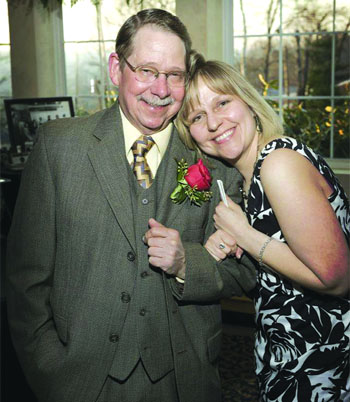
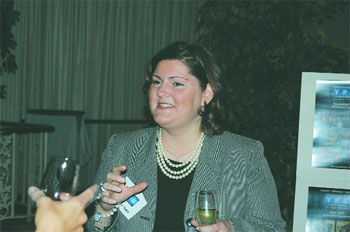
1. Michelle Sade, president of the Young Professionals Society of Greater Springfield.


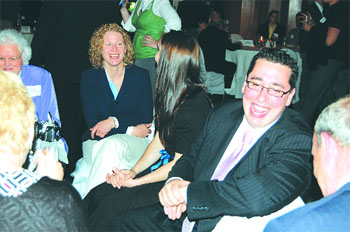
2. Forty Under 40 Class of 2008 member William Collins, director of operations with Spoleto Restaurant Group, shares a laugh with colleagues.


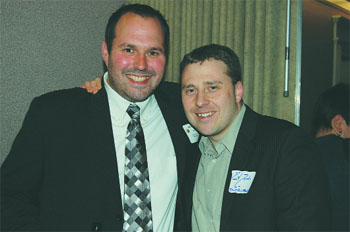
3. Class of 2008 member Rob Anthony, left, program manager for 94.7 WMAS, shares a moment with class of 2007 winner Ed Zemba, co-owner of Robert Charles Photography.


4. BMW of West Springfield showcased a number of new models at the event.


5. Class of 2008 winner Brendan Ciecko, owner of Ten Minute Media in Granby, jokes around near the Forty Under 40 ice sculpture.


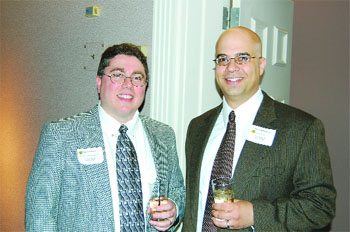
6. Class of 2008 members Paul Yacavone, left, CFO of Brain Powered Concepts in Agawam, and Steve Bandarra, co-owner of Atlas TC in Holyoke


7. Guests take a look at the schedule for the evening’s events.


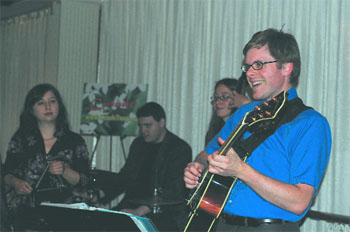
8. Cidade, a jazz and tango ensemble, provided live music for guests.


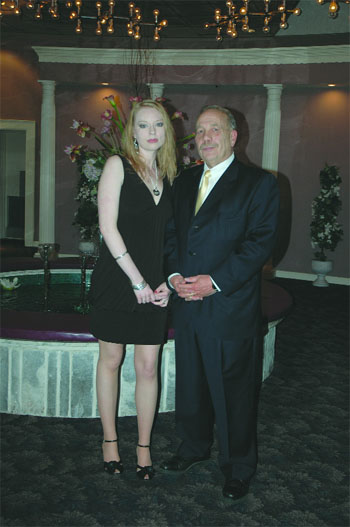
9. Merrilee Aurora Hale, left, art education director for Gallery 137 in Indian Orchard, shares a moment with Rick DeBonis, vice president of Marketing and Communications for Hampden Bank, which sponsored the event.


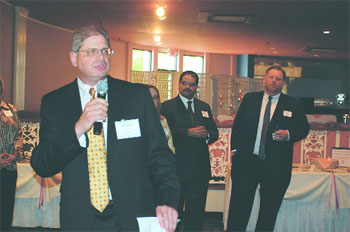
10. BusinessWest editor George O’Brien speaks during the Forty Under 40 VIP hour, held for winners and their guests at Chez Josef.


11. Winners were given complimentary bags, provided by sponsor Comcast, which were filled with additional prizes from the evening’s other sponsors.


12. Guests check in at the welcome desk as the event gets underway.

Sections Supplements
The Colonial Reinvents Itself as a Pittsfield Gem

With a clear plan for the future and some help from its friends, the Colonial Theatre in Pittsfield staged a rebirth at the start of this decade, and today continues to grow as the Berkshires’ ‘community theater.’ The story is one of success after a long wait, and audiences are both buying tickets and taking cues from the little venue that could — and did.

From the stage of the Colonial Theatre in Pittsfield, a performer has a clear view of nearly all of its 800 seats.

That was one thing a local performer of some note liked about the venue. Folk hitmaker James Taylor, a Berkshire County resident, factored the intimacy and the acoustics into his decision last year to record his CD/DVD One Man Band at the theater, which is now in its second year of business following an extensive restoration and rehabilitation project.
In the liner notes, Taylor writes, “the Colonial Theatre in my hometown of Pittsfield just managed to escape the wrecking ball. … People have invested time, money, and themselves resurrecting the old girl. And along the way, they have found a new sense of belonging: a sense of place; a place called home.”

But the events surrounding Taylor’s rare appearance (he usually commands audiences in the thousands) are also an illustration of what’s still in store for patrons of The Colonial. A live performance? No problem. An upscale party or event? They’ve got the space and the staff to pull it off. And a screening of a film, be it a silver-screen classic or One Man Band itself? Bring on the popcorn.

What’s more, David Fleming, executive director of the Colonial Theatre, said those offerings aren’t reserved for summer travelers by any means. Rather, he said the landmark is currently enjoying a new heyday not just as a tourist attraction in the Berkshires, but as the local community’s theater of choice.

“The most important thing I can say about the theater today is that when we opened, there were a lot of skeptics out there who weren’t convinced we were here to serve the Berkshires,” said Fleming. “But we’ve been embraced by the community — to the point where we’re recording some of our biggest audiences in January and February.

“That’s been the most satisfying aspect of our work,” he added. “We’re trying to continue to be responsive to people’s needs and wants, and with everything we do, we try to deliver a message of welcome.”

Road to Restoration

The road from renovation to fully operational venue has been a long one, noted Fleming, which nevertheless has been marked by a number of positives.

The Colonial was a movie theater until 1952, when the owner of a paint and wallpaper store acquired the property through an auction, installing a drop ceiling and using just a portion of the space with the hope that one day, the theater could be restored to its former glory.

That day didn’t come until this decade, but Fleming said his vision and that of the Colonial’s staff and supporters was not far off from its former owner’s.

“We restored the theater to exactly its 1903 condition,” Fleming said of the so-called ‘gilded-age’ theater. “Some people remember when the theater was a movie house, and others only remember it as a paint store. But either way you look at it, this building has a past. Now, it has a future, too.”

Restoration was completed in August of 2006, after a two-year period refurbishing the theater building itself and also retrofitting an adjacent building formerly used as a car dealership. Fleming said the total project cost of $21.5 million included acquisition, hard and soft construction, and design, with $1 million of that total coming from a $10 million economic development fund established for Pittsfield in the 1980s by General Electric, after the company left the region and some staggering unemployment numbers in its wake. The Colonial was the first entity to receive such a large lump sum.

However, Fleming added that the project was identified as eligible for funds through the Save America’s Treasures federal program in 1998, and also received federal and state historic tax credits amounting to $7 million. Another $7 million was collected through government and foundation grants, and the final third of funding was raised through private contributions.

That leaves the Colonial in good shape to move forward, with the bulk of the renovation work now completed and paid for.

“The money to restore the building was not enough to take care of the ongoing shopping list,” he said, “and we’re going to be applying for grants for years. But our focus now is on annual support, and we’re currently operating at a rate of 60% earned revenue. Most theaters with 1,000 seats or fewer operate around 30% or 40%, so we’re ahead of the game there.”

Fleming added that the Colonial requires about $600,000 a year to cover general operations and programming needs, and part of that amount is gleaned through membership drives that collect donations from $50 per patron well into the thousands.

One development Fleming said he’s even more excited about, though, is the success of the venue’s sponsorship and advertising programs.

“In the beginning, we were timid about asking people to buy ad space in our programs, on tickets, and to become sponsors,” he said. “We wanted to make sure we were targeting the right people — the businesses that could really benefit from having their name on our materials — and that we were working well with the community and their needs. But now, we can’t keep up with the requests — people are coming to us and asking for space, and that is just a fantastic feeling. They want their names tied to the Colonial because they see us as a success story.”

Some of these advertisers and show sponsors are retail or hospitality businesses that benefit directly from the exposure, said Fleming, noting, however, that a new group of companies, larger outfits that may not have a storefront or a specific service to offer patrons, still want to be involved.

“Some just want to be a part of what we’re doing,” he said, citing Lyon Aviation Inc., the Commonwealth’s largest private charter operator based at the Pittsfield airport, as a prime example. “This is a large, family-owned company that doesn’t stand to gain a lot of customers from having its name in our brochure, but the owners are fans, and wanted to help.”

The New Song and Dance

Performance-wise, the Colonial is in full swing, offering stage shows, concerts, films, and opportunities to rent the space for a variety of events, ranging from wedding receptions to community fund-raisers.

Fleming said the theater’s first two years in operation were largely experimental, staging a wide variety of options to best gauge what kinds of performances would resonate with local audiences and best use the space.

“Now, we’re beginning to narrow things down,” he said. “Singer-songwriters love the space for its acoustics, and theatrical comedy has been a good fit for our audiences.”

Still, the 2008-09 schedule of performances is nothing if not diverse. It includes that singer-songwriter component (Marc Cohn, Arlo Guthrie, Kate Taylor, and Livingston Taylor) and the theatrical comedy aspect (Jewtopia, Steve Solomon’s My Sister’s an Only Child), but also presentations by Tibetan monks; the Machine, a Pink Floyd tribute band; and the National Acrobats of the China Celtic Crossroads. The theater is also equipped to show films and documentaries, and that programming is in the process of expanding.

The Colonial’s schedule is actually broken into 10 key sections: Great Nights Out, the Singer-Songwriter Series, Just for Laughs, International Discovery, Holiday Cheer, Guest Presentations, Family Time, and Berkshire County Collaborators — performances by the Berkshire Opera Company and Pittsfield City Jazz Youth Orchestra are examples of these — round out the live performances. There’s also a film series and a Sunday opera series, at which broadcasts of performances by the internationally acclaimed La Scala Opera are shown.

Jessie Virgilio, director of public relations and education for the Colonial, said these film offerings are a new foray for the theater and as such constitute a learning experience. But they are bringing in new visitors and more walk-in traffic.

“Film is still relatively new for us, so our challenge now is to really sell it,” she said. “Walk-up sales aren’t something we’ve typically depended on; we’ve always been very pre-sale-oriented. Since this is a whole new animal, we’re looking at new and different ways of advertising.”

Some of these initiatives include partnerships with local eateries to offer ‘dinner-and-a-movie’ specials — Virgilio said the theater is finalizing just such a relationship with Pittsfield favorite Patrick’s Pub. This is an example of making inroads in the community to integrate the Colonial into its landscape, both literally and figuratively, but Virgilio said there are many other projects underway aimed at the same goal.

Setting the Stage

“We’re really focused on education,” she said, noting that her title is one sign of that commitment. “Part of my job is to work with schools and families to create opportunities for children to expand their learning experiences.”

The theater has already worked with upwards of 7,000 children as part of this outreach, Virgilio added, welcoming them either to special performances that fit into their classroom’s curriculum or to performing arts classes, where they can learn the ropes themselves.

“Most of these children are from the Berkshires, but we’re pulling from Vermont and New York, too,” Virgilio said. “The education piece is a good fit for us for a few reasons. For one, many grants tend to give funds to educational efforts. Plus, I’ve learned a lot in the past two years about how small school budgets are and what teachers do to work around that. We work closely with the teachers to match their curriculum because they can’t justify taking their class to a show unless it matches a lesson.”

That said, the International Discovery performances the Colonial hosts often blend well with world history, and a recent circus-arts performance taught some of the basics of physics.

“We’re offering students a chance to take what they’re learning and see it played out for them on a stage,” Virgilio said. “It’s an excellent way to reinforce what they’re learning, while at the same time making theater attainable to them at a young age.”

I Always Thought That

I’d See You Again

These programs all go back to that larger goal of creating a “message of welcome,” as Fleming says. This message has become an integral part of the Colonial’s overall mission to create a community theater, seen in all parts of the venue both large and small.

“A theater becomes a people magnet, and a symbol of something people can be proud of. That alone drives property values and leads to more effective recruitment of residents, and the creation of more high-paying positions in the area,” Fleming said. “A whole chain cascades from something like a successful historical restoration of a theater downtown. Performance centers spark creativity and move themselves forward, but anything can spark the enthusiasm and open-mindedness in a community, whether it’s a facility or a person.”

A person like James Taylor, who returned to his coffeehouse roots somewhat through his recorded performance last year, singing many of his hits and taking his time telling the stories behind them.

“I’ve lived and worked in New York and Los Angeles, London and Paris, Sydney and Rio,” he wrote for the subsequent DVD. “But the Berkshires are home at last. And somehow the Colonial Theatre, that plucky survivor, is at the heart of the place.”

Sections Supplements
CISA’s Model for Locally Grown Produce is Putting Western Mass. Farms on the Map

Helping farms introduce their products to the local marketplace is one part of CISA’s mission, but there are several other aspects of the organization’s work that place greater emphasis on integrating the community at large with the agricultural economy to help people eat healthier — and promote social change through everyday decisions.

At a time when the world is focused on differences — be they political, religious, or just matters of taste — Phil Korman, executive director of South Deerfield-based Community Involved in Sustaining Agriculture (CISA), said his organization focuses on the one thing that we all share, and always have.

“One thing that’s definitely true for everyone is that we all eat,” he said. “And it’s part of our core mission to make local, fresh produce a part of our community’s everyday decisions.”

CISA has been in existence for 15 years, providing marketing support and advocacy to local farmers (or producers) and buyers across the region, as well as bolstering access within the community at large to fresh, local food.

A largely member-driven organization, its influence is felt most predominantly in three counties of Western Mass.: Franklin, Hampden, and Hampshire. However, that reach is gradually expanding to include parts of Worcester County and some of the Berkshires.

Several programs of CISA also bring local products to buyers in other parts of New England, further adding to its name recognition as a proponent of sustainable agriculture and buying locally, and the organization also partners with other groups across the country.

Korman said this work is important on a number of levels. It assists the local agriculture force, one of the largest business sectors in Western Mass., and in turn gives the region’s economy a needed shot in the arm.

But it also, says Korman, helps to preserve the area’s rural character by maintaining its farmland, creates a positive impact on the environment by promoting the purchase of fresh produce in lieu of processed, packaged foods, and adds to the overall social well-being of Western Mass. by making a strong bridge between agriculture and community.

“The agricultural economy is so important here,” he said, “but agriculture is also important to the landscape — the vistas we see, and the food culture we have. CISA really represents the diversity of the community; there are lots of reasons why we love where we live, and this ties a lot of those reasons together.”

A Menu of Options

CISA has a number of programs that formalize this work to increase access to local food produced by local producers. Four separate initiatives fall under the group’s ‘business development and marketing’ arm, while two round out the ‘community access to local food’ project. CISA’s advocacy efforts are also ongoing, and factor into both community and business-related programs.

CISA’s largest endeavor is its Be a Local Hero — Buy Locally Campaign, the longest-running such program in the country, founded in 1999. It works by promoting local farms through point-of-purchase materials, events, and advertising.

Korman said CISA promotes agriculture in general through its marketing efforts, but noted that the Local Hero program has proven to be a particularly strong brand.

Bolstered by the involvment of CISA’s membership, ‘Be a Local Hero’ is the country’s longest-running and most comprehensive ‘buy local’ program for farm products.

The Local Hero campaign uses a wide array of paid advertising — print, radio, and the Web among them — to engage the public and increase support for local farmers.

CISA’s bright yellow logo, seen everywhere from bumper stickers to bread aisles (bright yellow stickers differentiate local products from others in stores), is a key part of this multi-channel marketing effort, as well.

“We did a study in Franklin and Hampshire counties that reported that 82% of local residents recognize the Local Hero logo,” Korman said. “And in 2006, we surveyed our producers, and 90% said that the program had a positive impact on their business. They’ve also found that if they don’t sticker all of the product going to a store for sale, the unstickered units actually move slower.”

There’s also a training component; once an individual or business becomes a member of the program, they’re eligible to take part in workshops covering everything from financial literacy to wholesale markets.

The success of the program has earned CISA some national attention — it collaborates frequently with other agriculture-based assistance, marketing, and advocacy organizations across the country that are looking to replicate the model in their communities. Sometimes, groups travel to Western Mass. to meet with CISA staff, and other times, CISA sends representatives to other locales. The agency has also penned a manual titled Harvesting Support for Locally Grown Food that offers a primer of sorts to any community looking to start a buy-local campaign.

“We’re so well-established that we get contacted a lot, and we do some national consulting,” said Korman. “It’s not often that a nonprofit like us is a marketing leader. But we’re also so excited that it works as well as it does to keep us connected to the community.”

CISA also publishes a Food Products Guide each year, in both print and on the Web, which lists all of the places CISA members produce and sell local food. In addition to a listing of farms, stores, farmers markets, and restaurants, the guide also includes a regional farm- and food-festival calendar and a ‘farm product availability chart,’ designed to further promote buying locally year-round (and keep the guide itself hanging around, too).

“People have gotten disconnected from how and when food grows,” Korman said. “This tells them when different things are coming out, and they can find out in the guide which farms produce what.”

Finally, CISA chooses three recipients of Local Hero awards each year as a capstone event of the program, in recognition of achievement furthering CISA’s mission and sustainable agriculture in general. The winners can be individuals or organizations, and range from farm owners to journalists to other nonprofit groups in the region.

Margaret Christie, special projects director with CISA, said the Buy Local program was created to allow people working in agriculture — not just farmers, but farmers’ markets, restaurants, grocery stores, landscapers, garden centers, foresters, fiber producers, and others — to connect with the community more easily and effectively.

Share Cropping

“When we launched Buy Local, we were looking for ways everyone could work together better,” said Christie. “A lot of groups needed a buy-local campaign.”

She added that creating Buy Local didn’t require a lot of explanation, though — they were already aware of many of the potential positives associated with sustainable agriculture, but needed a way to harness that potential, and an independent entity to organize those efforts.

“Before we launched, we did some research, and found that people already understood that buying local helps the economy,” she said. “But they saw it as something that could be more convenient. Our mission became helping people do what they already wanted to do.”

Today, about 170 farms participate in the program, and Buy Local foods and products can be found in a variety of stores, from farmstands to small grocers to large supermarkets, including Big Y and Stop & Shop locations. In addition, more than 30 restaurants buy ingredients from Local Hero farms.

But beyond the Buy Local Campaign, there are several other CISA initiatives working concurrently to reconnect the community with its agricultural roots. These include farm sales to institutions such as medical centers and colleges, programs for senior citizens, and the Farm2City program that provides for deliveries of fresh farm goods to various urban centers.

All three of these initiatives recruit members to become ‘shareholders,’ allowing businesses, organizations, and community members to buy in, essentially, and receive produce and other products during various times of the year, particularly in the summer and fall months. Farm sales to institutions, for example, provide ingredients for cafeterias and dining halls but also what amounts to exclusive farmers’ markets for employees.

“What you’re saying when you become a shareholder is, ‘I want to help this farm be sustainable and share in the bounty,’” said Korman. “It also provides another line of capital to the farmers, helping the economy, which is on everyone’s minds these days. Thinking locally also addresses other concerns many people have today, including environmental issues.”

Christie said Baystate Medical Center is one of the largest participants in this program; employees sign up to be members, and can purchase produce and other goods directly on-site when suppliers make seasonal visits.

“Employees can even set up a payroll deduction plan, so the cost of their purchases is spread out over the whole year,” Christie said. “This is another good example of our range, and an assistance program that connects farms directly with the consumer, as well as creating new wholesale markets.”

Similar to the institutional farm sales program, Senior FarmShare also serves as a membership-driven project, recruiting low-income senior citizens to become ‘shareholders’ at a farm in their local area, in order to receive a share of the produce each summer. Farms deliver food to about 340 senior centers, apartment complexes, and independent- and assisted-living facilities in the region.

And Farm2City is an effort to raise awareness of locally grown food in urban areas; individuals can purchase shares from area farms, and farmers deliver the shares once a week from June through October to workplaces and community hubs.

All of these programs are geared toward that larger goal of easier access for all types of individuals to locally grown food, but CISA also works directly with the agricultural sector to boost the health of their industry as a whole, too.

The Pioneer Valley Women in Agriculture Network, for instance, sponsors activities for the growing number of women farmers in Western Mass., from seminars on how to stay healthy while farming to Web site development, Internet sales, and risk-management courses.

So-called ‘agritourism’ events such as festivals and farm tours raise awareness of individual farms and the breadth of the products they produce — CiderDay, FiberTwist, the Garlic & Arts Festival, and the Tomato Festival are just a few events on the calendar — and, on a more serious note, CISA works to involve local farmers, retailers, and other members and supporters in its advocacy efforts on a legislative level.

“There are so many things involved in this aspect that there’s a move here to involve farmers in the Northeast more in the discussions on a federal level,” said Korman, adding that CISA regularly holds forums for farmers and citizens to keep both groups abreast of trends on state and national levels that could affect the health of local agriculture. “Hunger is a big part of these discussions — it’s a societal issue that we’re looking to chip away at. Also, we’re constantly evaluating how we can make our farms even more sustainable, and more vibrant.”

Fruits of Labor

Moving forward, Christie said CISA is looking to diversify even more, conducting some additional market research and tailoring new programs to address current and developing needs.

“We’re setting up for larger volume,” she said. “We’re interested in learning how to do more with larger outfits, for instance. Farms need to be fairly large to supply the warehouses of major supermarket chains or other entities, so we’re looking at what’s necessary to fit into these larger systems.

“We’re also looking at consolidating product to get more food out to more people, more often, so they can make the choice to eat locally more easily throughout the year regardless of income or schedule,” Christie continued. “We’ll do a year of research to answer the questions surrounding these areas, and to determine what we can launch and when.”

Overall, it will be a busy year for CISA for this reason and others. While planning for a new set of initiatives is underway, a series of events will also be kicking off as part of a year-long celebration of CISA’s 15th year in operation.

It’s a busy itinerary, but Korman returned to the notion that CISA’s many programs remain bound by one, overriding constant.

“It really is all about the fruits and veggies — and potatoes and cheese and yogurt and wool,” he said. “All of our goals are tied together because they each allow people to pair their values with the decisions they make about what they buy, and what they eat.”

Sections Supplements
Some Due Diligence Can Help Employers with This Daunting Task

Massachusetts and federal law prohibits employers from discrimination on a wide variety of bases, including race, color, religious creed, national origin, sex, sexual orientation, genetic information, military status, ancestry, age, or handicap. In order for these laws to have their intended effect, employees need to pursue claims of workplace discrimination without fear of retaliation from their supervisors and employers.

Co-workers and others must also feel free to support victims of discrimination who do come forward without fear that they, too, may be putting their jobs at risk by doing so. Our society has seen the importance of whistleblowers, and what happens when they are ignored, in situations ranging from Enron to events in movies like Erin Brockovich.

Yet courts have expanded the concept of protection from retaliation to the point where many poorly performing employees, sensing discipline or even termination, assert weak or baseless claims of discrimination as a smokescreen in the face of a supervisor’s legitimate criticisms. Recent court decisions seem to give employees who make claims of discrimination a sort of ‘invisibility cloak’ like the one used by Harry Potter to disappear from the prying eyes of his enemies at Hogwarts.

Employers should always address all claims of employment discrimination carefully and thoroughly, but in some cases, employers are forced to simply forego discipline or risk the near-certainty of expensive litigation.

What Is a Retaliation Claim?

Retaliation is a distinct cause of action, motivated at least in part by a distinct intent to punish or to rid a workplace of someone who complains of an unlawful practice.

Employers need to realize that an employee who brings a charge of discrimination as well as a claim of retaliation can bring both claims forward in court. Juries can, and often do, find that an employer did not discriminate against an employee, but retaliated against the employee, often awarding large damages against the employer.

Federal and state laws prohibit a wide category of persons, not merely supervisors or employers, from taking adverse action against a person because he or she has opposed a practice forbidden under discrimination laws or because he or she has filed a complaint, testified, or assisted in any proceeding brought under various discrimination laws. Nor may any person coerce, intimidate, threaten, or interfere with any person for aiding or encouraging another person in the exercise or enjoyment of any of the civil rights granted by federal and state anti-discrimination laws.

Activities protected by the anti-retaliation provisions include speaking to someone at the MCAD, U.S. Equal Employment Opportunity Commission, or another civil rights or law-enforcement agency, or testifying in any proceeding about a charge of discrimination. It can also include complaining to management or filing an internal complaint of discrimination, asking a supervisor or coworker to stop engaging in discriminatory conduct, or cooperating in an internal investigation of discriminatory conduct.

Expansion of Employment Retaliation Claims

The U.S. Supreme Court has continued to widen the courthouse doors to persons claiming retaliation. In June of 2006, the Supreme Court handed down its Burlington Northern and Santa Fe Railway Co. v. White case. Sheila White complained about sexual harassment by a supervisor, and she was subsequently reassigned. She filed a charge at the EEOC and a few days later was suspended without pay for 37 days.

After filing an internal grievance, she was reinstated and received full back pay. She filed a second charge alleging retaliation, and a jury found in her favor, awarding her $43,500 in compensatory damages. The Supreme Court stated that, in order to show a level of harm necessary to support a retaliation claim, a plaintiff must show that a reasonable employee would have found the challenged action materially adverse, which means that it might well have dissuaded a reasonable worker from making or supporting a charge of discrimination.

This standard is a fact-intensive one, and has encouraged courts to allow retaliation cases to go to full jury trials so that these questions as to how a ‘reasonable employee’ would act would be resolved by a jury.

Recently, the U.S. Supreme Court continued the trend toward allowing a wide range of retaliation claims to proceed. Section 1981 of the Civil Rights Act of 1866, a predecessor of Title VII of the Civil Rights Act of 1964, prohibits racial discrimination against those that make or enforce contracts, including employment contracts. On May 27, 2008, the Supreme Court decided the case of CBOCS West Inc. v. Humphries extending Section 1981 to prohibit retaliation against those that seek to “vindicate the rights of minorities.”

Unlike Title VII, which also protects against retaliation, Section 1981 does not require an employee to first file a charge of discrimination, typically within 300 days with the EEOC or MCAD. Consequently, an employee can wait up to four years before brining a wrongful termination or racial harassment claim. While Title VII claims contain caps on certain damages, Section 1981 does not.

One U.S. Court of Appeals has even gone so far as to protect a man who claims he was fired after his fiancée filed a discrimination charge with the Equal Opportunity Commission against their common employer. The 6th Circuit Court of Appeals sitting in Cincinnati stated that Title VII prohibits employers from taking retaliatory action against employees who, although not directly involved in the protected activity, are so closely related to or associated with others who are directly involved that it is clear that the protected activity motivated the employer’s actions.

Discrimination and retaliation claims pose particularly sensitive problems for employees when the complaining employee is still employed by the company. The situation becomes compounded when the employee’s supervisor is also the subject of allegations of discrimination. Tensions may reach the boiling point. Little things can add up. While a snub, a stray remark, or certain looks may not by themselves qualify as adverse actions, the combination of actions may slowly ‘add up to a wound.’ As the Supreme Judicial Court has stated, “One pinprick may not be actionable in itself, and its abusive nature may not be apparent except in retrospect, until the pain becomes intolerable.”

Supervisors often resent being accused of discrimination, maintaining that they are simply enforcing company policies and holding an underperforming employee’s feet to the fire.

Defending retaliation claims successfully can seem hopeless when the employer takes an adverse action, such as disciplining or terminating an underperforming employee shortly after that employee has made a complaint of discrimination. Courts routinely instruct juries that they are permitted to infer retaliation from the ‘timing and sequence of events.’ An inference of retaliation may be drawn if adverse action is taken against a satisfactorily performing employee in the immediate aftermath of the employer’s becoming aware of the employee’s protected activity, or where the adverse employment action follows close on the heels of protected activity.

The terms ‘close on the heels’ or ‘immediate aftermath’ have been expanded to include lengths of time up to four months or more. What is an employer to do? Should he merely wait four months after somebody files a charge of discrimination to even talk about terminating the complaining employee?

Some Practical Tips

1. Train managers in all categories of potential retaliation complaints. The challenge of dealing with possible retaliation claims places a premium on training all managers and supervisors and recognizing categories of potential retaliation claims.

2. Document the company’s business reasons for taking an adverse employment action. Although some employees may believe so, making a complaint of discrimination does not confer immunity upon an employee from discipline or from material changes in conditions of employment, including termination. Documentation in writing, including references to specific written policies, rules, and regulations, are essential. The more documentation, the better. If the employer has a progressive discipline policy, it must be careful to follow each and every step of that progressive discipline system, lest skipping a step would be considered retaliatory.

3. Have a ‘neutral’ party review or administer the discipline. If an employee alleges supervisor discrimination and runs into performance problems, the individual who ultimately administers discipline to address the performance problems should be independent from the accused supervisor. The ultimate decision-maker should be able to demonstrate that she has not merely accepted the recommendations of an accused supervisor at face value, but has made a sufficiently independent determination as to whether discipline or adverse action is appropriate.

4. Investigate all claims of retaliation, and consider using an independent third party to do so. Employers should investigate all complaints of unlawful conduct, including complaints of retaliation. That policy should be in writing and disseminated to all employees. Employers should consider bringing in trained third-party investigators, whether they are consultants or attorneys, to conduct such investigations. A track record for taking all complaints seriously can prove a valuable tool in the defense of retaliation claims. The employer’s goal should be to investigate and judiciously address all complaints of discrimination so that they never ripen into litigation.

5. Consider delaying discipline. An employer needs to consider the timing of taking adverse action against persons who have made claims of discrimination. One of the best defenses against any type of discrimination claim, whether a direct claim of discrimination or retaliation, is that the employer gave the employee a second chance, rather than disciplining or terminating. An employee bringing an unsupported, unfounded claim of discrimination often is an employee who will squander a second chance and commit another workplace rules violation that will justify discipline.

The courts and agencies charged with enforcing anti-discrimination laws will take time to develop workable guidelines on separating legitimate retaliation claims, necessary to protect the right to seek redress for violations of civil-rights laws, from those claims asserted by underperforming employees seeking a legal shield from legitimate discipline. In the meantime, employers need to tighten their policies and practices and ensure that all managers receive appropriate training in preventing retaliation claims.

Sections Supplements
BerkshireRides Fills a Transportation Need for the North County Workforce

In 2002, the nonprofit transportation-assistance outfit BerkshireRides, based in North Adams, had its maiden voyage, picking up two families to take them to see their children perform at a local theater festival.

Jana Brule, executive director of BerkshireRides, said the organization had scarcely set up shop when the mayor called with a simple request: “can you help these people?”

“We said yes, and that was it,” said Brule. “It was a good example of the connection with the community we were trying to create, and two families got to see their children in their play. Things like that are important.”

Since then, BerkshireRides has completed more than 200,000 rides, delivering Berkshire residents living in Adams, Cheshire, Clarksburg, Florida, North Adams, Savoy, and Williamstown to their jobs, job training, or other community-related events.

The concept is simple: to combat transportation issues — particularly those that affect the workforce, such as bus schedules that don’t mesh with work schedules or a lack of service within certain parts of the service area — BerkshireRides offers van service to work, work-related appointments such as interviews, and training programs. In addition, the organization provides transportation to community-related meetings and events through various partnerships, and serves as a call center for residents in the Northern Berkshire area who need transportation for any reason by helping them locate a ride, either through the Berkshire Regional Transportation Authority (BRTA), or by other means.

Brule said the idea of such a service was born from a Northern Berkshire Community Coalition forum held in 2000, at which residents cited a need for reliable transportation to get to jobs.

From there, U.S. Rep. John Olver lent his legislative support, helping to secure federal funding. BerkshireRides was launched in 2002 as what’s known as a ‘federal demonstration project,’ designed to test a concept and, hopefully, develop a model for other communities across the country.

The organization, which operates in association with the Transportation Assoc. of Northern Berkshire Inc., has a sister project based in Athol called Community Transit Services Inc. that is also a federal demonstration project in Olver’s district.

Wheels in Motion

About 80% of BerkshireRides’ funding comes from the Federal Transportation Authority. The remainder is offset by local grants from entities such as the United Way and the Berkshire Taconic Community Foundation, and by nominal fares collected from riders — $1.25 for transportation within the residential service area, and $4 to Pittsfield or the Jiminy Peak resort in Hancock.

Brule added that, since 2002, Berkshire Rides has grown and diversified its organizational structure. The service runs 24 hours a day, seven days a week, and its two major prongs — what are dubbed ‘employment transportation’ and ‘community transportation’ — operate independently of one another, while still addressing the same needs in the region.

“Employment rides are provided by a for-profit transportation provider that we contract with,” she explained, “and then we also have a community van pool, helped by local grant funds, for which we purchased four of our own vehicles.”

That pool carries people to various specific activities sponsored by other nonprofits and community groups (BerkshireRides partners with 11 different groups that help screen drivers and pay some expenses), including youth programming, leadership workshops, and career-development classes. In addition, Brule said the model is flexible enough to allow for rides for other reasons, including those involving school-related functions and appointments, such as parent-teacher meetings.

But despite the success of the program — it averages 3,100 rides a month on the employment transportation end, and an additional 250 rides a week to community events, meetings, and programming — Brule said it’s not the intention of BerkshireRides to replace any existing services in the region.

“The mission is to remove transportation barriers, period,” she said. “We’re here to augment what’s already out there and to fill gaps, not take passengers away from other services.”

Lines of Communication

Further, Brule said those other services, BRTA busing included, play a strong role in BerkshireRides’ plans for the future.

“We hope to always be able to expand, but also to advocate for good transportation,” she said. “We have a good relationship with the BRTA, and our hope is that we can help them develop new routes that are responsive to residents’ needs.”

Brule noted that it has been several years since the BRTA made a route change, and she’s recognized a need for expanded hours and geographical reach.

“The biggest issue is timing,” she explained. “In North County, a lot of people work in Pittsfield because it is our biggest hub. The hope is to get an express route to Pittsfield, or start buses earlier in the morning for those who need to make a 7 a.m. shift.”

Brule said BerkshireRides will continue to work closely with the BRTA to make those “fine-tunings,” as she called them, and will also continue to offer transportation services in those areas not yet served by the bus lines.

“We will continue to fill in those gaps; we want to be here for folks as a back-up,” Brule said, noting that the organization doesn’t do a lot of aggressive marketing, but awareness of its service continues to gradually spread through word of mouth.

She said she and other representatives from BerkshireRides will most often have face-to-face chats with other groups and individuals in the region to spread the message, and to appeal to younger riders, the group has its own MySpace page.

“We’re out there talking a lot,” said Brule. “When we hit our five-year mark last August, we produced our first report and mailed it to every home in our service area, so that has brought a lot of awareness.”

And, she expects the service to continue to grow; currently, BerkshireRides adds an average of 20% more rides to its load every six months, and with the current state of gas prices, that’s expected to ramp up.

That puts an added squeeze on BerkshireRides’ own business model, which includes vans that drive upwards of 1,200 miles a day. However, Brule said the group is taking advantage of its affiliation with the Community Transportation Assoc. of America and its newly retooled fuel-reimbursement program, and working alongside its service vendors to get them a 3-cent reimbursement on fuel costs.

It’s a small kickback, but a big help in a larger mission — to help the workforce, assist the community, and make school-aged children feel like the star of the show as their parents applaud from the audience.

Jaclyn Stevenson can be reached at[email protected]

Sections Supplements
More Students in All Disciplines are Taking an Entrepreneurial View of the World
Bob Hyers

Bob Hyers says that formalizing the entrepreneurial programming at UMass has had a marked effect on the number of students involved.

More than ever before, entrepreneurial education is in the spotlight on college campuses, both regionally and nationally. There are many reasons for this, but the overall goal is to hone in on the strengths of students in all majors and tap their entrepreneurial drive, in hopes of giving them some career options, while perhaps creating some jobs in the process.

Lauren Way, director of Entrepreneurial Programming at Bay Path College, has a succinct way of summing up the importance of teaching entrepreneurship at the collegiate level.

“The next Steve Jobs is probably going to be a computer science major, not a business major,” she says. “But he’s still going to need the characteristics and skills necessary to form the next Apple Computer.”

That’s why Bay Path and several other colleges and universities across the region and the nation on the whole are ramping up their entrepreneurship programming — in hopes of conveying to all types of students the hard and soft skills necessary to launch new ventures, introduce new products and services, and diversify the economy while filling needs in the marketplace.

It wouldn’t be bad to have the next Steve Jobs, or Bill Gates, for that matter, as a member of the alumni.

Indeed, there are a number of trends colliding nationwide to create greater interest in entrepreneurship as a course of study, not just a way of thinking. Today’s students of traditional age, the Millennials, for instance, are a technology-driven, globally minded set who see no limits to what they can achieve.

Bob Hyers, professor of Engineering and director of the UMass Entrepreneurial Initiative at UMass Amherst, said this group is actually a major driver behind the evolution of entrepreneurial study on college campuses, shaping the discipline with every new idea.

“Being involved in this with the students on campus has changed how I work,” he said. “I do a lot of research, and I write my proposals differently now. I’ve gotten involved on an entrepreneurial level with two businesses, and I’m not that far ahead of the students in terms of what I’m doing and what I know. I think today’s students look at successful entrepreneurs and say, ‘there’s someone who’s not any smarter than me who’s really successful; I can do that.”

And Diane Sabato, director of the Entrepreneurial Institute at Springfield Technical Community College, said today’s students at all age points are changing the face of entrepreneurial study purely through their own drive and interests, introducing intriguing concepts and ideas that can literally change the world, in small ways and large.

“One thing that’s interesting to me is the amount of innovation and invention happening,” she said. “Students are adapting and creating product lines that lead to real entrepreneurial ventures, and that’s a great way to engage people from a lot of different disciplines. We’re drawing people from all areas, and it’s really having an impact on how we teach entrepreneurship.”

Everyone’s an Entrepreneur

Those ideas are coming from all corners, too. Way said the national model for entrepreneurship training is gradually becoming a comprehensive one that spreads across all majors and departments on campuses offering such course tracks.

“The model casts the net wide with programs that are open to everyone,” she said, noting that Bay Path offers an elevator-pitch contest, entrepreneurial summits, a lecture series, and other events that are open to all students. “So many fields play into entrepreneurship; the trend is to introduce it to non-business majors so they can take their skills to new levels and be innovative within their field.”

Hyers said there are two such all-encompassing programs on the UMass campus that support entrepreneurship: the Isenberg School of Management and the UMass Entrepreneurial Initiative, which grew out of a student organization called the Entre Club.

The club has been on campus for 10 years, but reorganized last year to serve as a complement to a for-credit course and a series of networking and business-planning activities.

“The big driver behind that was increasing the level of engagement with the students,” said Hyers. “To strengthen the value proposition of entrepreneurial activities on campus, we went from just a club to a class — offering credit helps the students justify their time. We also set some goals for the students to be more competitive in contests like the Technology Innovation Challenge, and to focus on the early stages of starting a business. It’s very applied, and the businesses are very diverse.”

Since the evolution of the Entre Club to a more formal entity at UMass, students have returned some impressive results. Two years ago, involved students produced seven active companies; this year, that number has risen to 47. These ventures are nothing to sneeze at, either. One, Condition Engineering, founded by doctoral student Alaina Hanton, introduced an engineering breakthrough that could help alert communities to catastrophes, while another, Brian Mullins Therapeutic Systems, is a vest that offers the equivalent of ‘mechanical hugs’ for children with autism, a technique that allows them to feel more secure and in control.

“Even though the businesses themselves are so different, the entrepreneurs are finding that they have more in common than not,” said Hyers. “Through the conversations they have, the people with the music magazine are seeing the similarities their company has to the Web startup. All of the students see their businesses as an opportunity to make a difference, and they’re focused on making the world better.”

Positive Signs

It can be a formidable task for colleges and universities to create this synthesis across a diverse set of academic departments. “We might need to create not just one umbrella of programs for all students, but multiple umbrellas,” said Way. “It’s about cultivating an entrepreneurial attitude, one that includes honesty, innovation, and an ability to ‘bend’ a company to accommodate the changing needs of the population.”

But she added that the demand to offer this kind of instruction exists, and is growing due to a number of variables in addition to the entrepreneurial-mindedness of today’s younger set.

Recent studies of entry-level salary ranges for students who studied entrepreneurship in college, for instance, don’t hurt the discipline’s reputation much.

“Looking at programs nationwide, the trend is a high average starting salary for entrepreneurship graduates, so that’s a big draw,” she said. “And one of the main reasons it’s becoming such a trend now is that our economy, as we know, is not looking good. The days of staying with one company for security are gone.”

However, other studies suggest that entrepreneurship — whether it’s inventing, starting a business, offering a service, or merely applying entrepreneurial skills within a larger company — is gaining acceptance for other reasons; among them, a failure to discriminate.

“There’s a lifespan of ages being represented,” Way began. “There are a lot of different things coming together, and people are coming at it from different sides. Some want new careers, some are looking for new ventures for economic reasons, others want to fill a need and serve humanity.”

In addition, entrepreneurs of all ethnicities and backgrounds are making their mark on the U.S. business landscape. According to a study performed at Babson College, Black Americans are 50% more likely than others to start a business. The Small Business Advancement National Center (SBANC) reports that Latinos are the fastest-growing entrepreneurial segment, and according to the Center for Women’s Research (CFWR), 40% of all privately held companies are owned or headed by women, and woman-owned businesses are more likely than all others to stay in business for five years or more.

There’s also no general ‘type’ of person who is more likely to succeed as an entrepreneur, said Way.

“There are some born entrepreneurs, and others need to be encouraged,” she said. “There are some students who are naturally inclined to ‘just do it,’ and others who want to approach it in a scholarly way.”

Courses of Action

There are several things happening on college campuses in the region to cater to this broad group of students, and to promote entrepreneurship in other areas, including high schools.

Sabato said there’s a movement afoot both nationally and on the STCC campus to create a culture of entrepreneurship that extends to all age groups — beginning with children. The Entrepreneurial Institute actually begins reaching out to futurepreneurs as kindergartners, and starts guiding students through the business-owning process as early as grade school.

“Developing a lifelong educational model for entrepreneurship is a trend we’re seeing nationally,” she said. “When the program started, we saw the need to raise awareness that entrepreneurship is a legitimate program of study, regardless of the vocational specialty someone is pursuing.”

Sabato explained that elementary-school students receive entrepreneurial training, such as financial and workplace literacy lessons, through a variety of means, depending on their grade level. Older students take trips to New York City’s wholesale district to learn about purchasing, for example, after they’ve already toured the STCC institute, its business incubator, and its Entrepreneurial Hall of Fame. For the younger students, there’s something called ‘Play-Doh Economics.’

“High school students start their own actual businesses and run them,” said Sabato, noting that, during the experience, the students are treated much like any business owner, drafting their own business plans and receiving invitations to networking events, for instance. “Essentially, we’re providing entrepreneurial education and experiential learning opportunities early on.”

Sabato added that STCC’s entrepreneurial programming for high-school students began more than a decade ago as the YES (Young Entrepreneurs Society) program, starting with four area high schools and expanding to work with more than 25 today. She agreed that entrepreneurship is receiving more attention of late than ever before, and having a program in place from which to build is prompting the entrepreneurial institute to keep a close eye on emerging trends, in order to capitalize on that strong base.

“I think that we’re fortunate to have a seasoned program. We’ve watched it evolve to include more students every year, and we’ve seen awareness increase at all ages,” said Sabato. “The openness to study entrepreneurship has increased as well. There’s always been a strong student demand, but we’re seeing students at all grade levels and in all kinds of circumstances. Some people have been laid off; others just know what they want to be when they grow up.”

The Power to Fail

Once they reach college, however, there are a few constants that students can expect in their academic preparation, though the entrepreneurial field is one that is ever-evolving.

The first is a strong emphasis on practical application. Way said Bay Path offers case studies of local companies, with the participation of its principals, for students studying entrepreneurship — whether as a major of study or as a complement to a different major.

“Generally, we have business owners, managers, and CEOs come to our students with a problem, so the students can help address their issues,” she explained. “They problem-solve and give a presentation, and in some cases, there’s hard advice to be given.”

That’s a prime example, Way noted, of having students ‘learn by doing’ on a very real level. There’s the chance, she said, that a business owner might not like the suggestions the students suggest, and ask them to tweak the model or dismiss it altogether.

It’s a Good Thing

But in one way, there’s some success in that.

“We encourage them to move forward with these projects, as well as their own micro-businesses, without knowing everything first, so they see what they don’t know,” said Way. “Things like product development, manufacturing, inventory, accounting — you can’t learn those things in a class in a month. Failure is a big trend in entrepreneurship, and to some it’s even a badge of honor in the field.”

Way went so far as to muse that, in the future, she may pursue setting her students up to fail to drive this reality home.

“Learning how to fail is one part of learning how to succeed,” she said. “I would like to find a way to do this now, in the controlled, college environment, to give them a chance to process their own reactions and learn how to bounce back.”

On that note, Way cited another well-known entrepreneur as a perfect example of one who’s mastered this skill.

“We all know Martha Stewart had failed once or twice, but no one knows how to make a comeback like her,” she said. “And Martha Stewart didn’t even go to business school.”

Jaclyn Stevenson can be reached at[email protected]

Sections Supplements
FieldEddy Strives to Grow Its Family and Strengthen Its Brand

Sam Hanmer says it was nothing personal, and certainly not a knock on one of the company’s early executives.

No, the decision to drop ‘Bulkley’ — as in Chester B. Bulkley — from the corporate name Field Eddy & Bulkley was taken in an attempt to shorten and simplify things, and also to help strengthen the brand.

The new name on the letterhead and business cards — FieldEddy Insurance — is what most people have called the company for some time anyway, said Hanmer, its long-time president. “When they did include Bulkley they would usually mispronounce it and come out with ‘Buckley,’” he explained. “And besides, it was a real mouthful for our receptionist.”

In dropping ‘Bulkley’ and the ampersand from the name over the door, the company is following the lead of law firms and accounting firms, said Hanmer, adding quickly that the change is one of the smaller, more cosmetic steps being taken in an ongoing brand-building endeavor.

Other, more significant steps include consolidating three offices into a recently constructed office complex at 96 Shaker Road in the center of East Longmeadow. There, FieldEddy occupies 10,000 square feet, and can operate — and communicate — far more effectively than it could in separate facilities in downtown Springfield, East Longmeadow, and Windsor Locks, Conn.

“Add up the square footage in the other three locations, and it’s a lot less than what we have now,” said Hanmer as he led a tour of the new facilities, “but we can do a lot more here because it’s much more efficient space; we can communicate much better because we’re all on one floor.”

‘More efficient’ and ‘better communication’ are words you hear quite frequently within this organization these days, as the company, which has been expanding through acquisition and organic growth in recent years, continues work to build and strengthen what Hanmer and partners Tim Marini and Michael Coffey all call a “network” of agencies.

Indeed, while the search continues for possible acquisition targets — “there are some potential opportunities we’re looking at and talking to,” said Hanmer — there are broad efforts underway to build the FieldEddy brand.

The new name and logo are part of this effort, as are some marketing initiatives, said Marini, but the bulk of the work involves taking a host of agencies now under the FieldEddy umbrella — Remillard Insurance in South Hadley was the latest addition — and making full use of the benefits, or clout, that this growing family provides.

Some of the agencies have been rolled into FieldEddy and have taken that name, while others, including Remillard, have kept their names because of the equity held in them. Whatever names they take, the individual agencies can now represent a large number of carriers, just one of the benefits of size gained through this network. And this presents opportunities during an intriguing time for the industry — one in which profound change in auto-insurance regulations enables consumers to shop for options as perhaps never before.

In this issue, BusinessWest looks at the continued growth of FieldEddy, the process of building a true network of agencies, and the strategic initiatives being taken to make that network wider and stronger.

Calculated Risks

As he referenced the auto-insurance reform steps taken recently, which shift the state from what was a fully regulated system to something called ‘managed competition,’ Hanmer did so rather reluctantly. So much has been said and written about the changes he was getting tired of hearing himself talk about it.

But he did say that most of the marketing and branding initiatives taken by the company have come in direct response to those changes — which have brought new carriers into Massachusetts, such as Liberty Mutual — and in an effort to capitalize on all those opportunities they present for companies with the requisite wherewithal.

“The good news is that we’re big enough to have multiple options for customers,” he said, adding that, through this strength in numbers, coupled with more-aggressive marketing, which has been an industry-wide trend, the network has added significantly to its books, or book of business. “We’ve certainly had an increase in opportunities, and we’ve come out on the winning side in a lot of those, if not most of those.”

And there could be many more of these triumphs ahead as competition increases, which all observers expect it will, and consumers gain still more options.

“Smaller agencies are going to have a very difficult time if they can’t offer more than one or a few options to consumers,” Hanmer explained. “And it’s only getting worse for them as it gets better for the customer.”

Summing up the events and the initiatives of the past 18 months or so, Hanmer said they were efforts to make FieldEddy stronger, or much stronger, as the case may be, than the sum of its parts.

And there are many parts.

Indeed, the network now includes Curtis Hodskins & McKelligott Insurance Agency in Monson, which is actually a collection of smaller agencies in the Palmer-Monson area; Remillard, which was acquired about 18 months ago when FieldEddy prevailed in spirited competition to obtain that brand; Your Choice Insurance Agency in Ludlow; and the Meadows Insurance Agency in East Longmeadow, which is now under the FieldEddy name.

These acquisitions were all part of a broad, five-year strategic plan for the company which Hanmer formulated in 2003, that called for tripling sales from $30 million to $100 million. While FieldEddy is closing in on that goal — the Remillard acquisition brought it much closer — Hanmer admits that the bar has been moved much higher than its original height.

Which is why he continues to search for acquisition opportunities, and why the firm embarked on his brand-building, network-building campaign.

“Historically, we had run those agencies we acquired as separate and distinct operations, with FieldEddy mostly staying behind the scenes,” he explained. “By identifying ourselves as a network of agencies, we can better serve our customers, who will know that they can go to any one of those locations and receive the same services and options.”

Marini agreed. “Some of what we’ve done is a bit of a reaction to the auto-insurance reform, but it’s basically good, common sense,” he explained. “This gives us the opportunity to put all our carriers in each office; in the past, we would buy an agency and essentially leave it alone with its carriers and sprinkle our carriers in a little bit.

“Now, we have all our carriers in all our locations,” he continued, “so that every customer has options, and plenty of them.”

And these options are adding up to growth opportunities for the network, he said, referencing recent performance, not only with auto insurance, but across the board in both residential and commercial lines.

He attributes that growth not merely to the availability of options for consumers, but also the incorporation of the FieldEddy culture, which is grounded in strong customer service, in those agencies that have been acquired.

Moving forward, the company intends to capitalize fully on the many assets present in the FieldEddy network. This includes, said Coffey, the names and the people behind those agencies that have been acquired, the benefits that come with the size and flexibility gained over the years, and even what the partners call a unique demographic advantage in its staff.

Elaborating, Marini said FieldEddy has a number of women working in the field and behind the scenes — a percentage of the overall staff that is much higher than industry norms.

“It wasn’t anything we planned — our strategy has always been to hire the best people available,” he explained. “But now that it’s happened, we can see it’s a great asset for us; we’ve seen a very favorable response from the marketplace because there’s a lot of women-owned businesses out there.”

The space at 96 Shaker Road provides room for further expansion, said Hanmer, who told BusinessWest that he expects this to happen, both through more organic growth and additional acquisitions.

“We don’t stop when enough is enough,” Hanmer of the company’s growth spurt and the prospects for more of the same. “There are a few acquisition opportunities that we’re talking about, and we will continue to be very inquisitive, to say the least.”

Recent expansion efforts have taken the company further east from its roots, into the Quaboag region, and south, into Northern Conn. The next step could be to go farther east in Massachusetts, to the Worcester area and perhaps beyond, said Hanmer.

The name FieldEddy isn’t known there, he acknowledged, but given the options it can present to potential customers, “we can make it known, and quickly.”

Growth Policy

For the record, the ‘Field’ in the company name is Henry Field, a prominent Springfield businessman who, in 1925, put his name and that of partner Schuyler Eddy on a venture that could trace its roots to the start-up of the Springfield Fire and Marine Insurance Company in 1849.

Chester Bulkley, a graduate of Yale University and the brother of James Bulkley, a founder of the Springfield law firm of Bulkley, Richardson and Gelinas, would soon join Field and Eddy in the business.

Hanmer told BusinessWest that, while Bulkley is now longer on the letterhead, his contributions to the company have certainly not been forgotten. His name was dropped in one of many steps, small and large, to help build and strengthen what has become an insurance network, one that has made continued growth its main policy.

Mr. Bulkley would certainly understand.

Opinion
Averting an Energy Crisis

Gas prices are skyrocketing; the average price of a gallon of regular hit $4 last week. Venezuela has threatened to cut off oil exports to the United States. The dollar has fallen by 30% against the euro over the past two years. Could things possibly get worse?

Yes. Real-world events underscore our nation’s acute energy-security vulnerabilities. Over the past year, oil prices have surged in a short period of time without any single precipitating event. The effects are stark. Every $10 increase in the annual price of a barrel of oil costs the economy $75 billion.

The average American household spends $5,750 a year on energy, up more than $2,000 from just four years ago. The increase in the cost of gasoline alone amounts to a more than $1,500 tax on the typical American family. Over much of the past decade, Americans have been able to compensate for rising energy costs by drawing on the also-rising equity of their homes. But that did not solve the problem; it camouflaged it. And now that the mortgage crisis and the resulting collapse in property values have taken that crutch away, Americans are more conscious of the impact of the rising cost of oil on their livelihoods.

The United States consumes 25% of the world’s oil: 21 million barrels every single day. The transportation sector — not just cars, but the trucks and airplanes that are crucial to delivering goods and services — use petroleum products for 97% of its energy needs. And the picture is not getting any better: demand in the United States is expected to grow by 30% — to 27 million barrels per day by 2030.

Add to this continued instability — and in some cases, hostility — in some of the world’s most prolific oil-producing nations, and the conclusion is clear: America’s dependence on oil, particularly oil from unstable and undemocratic parts of the world, threatens national security and economic stability.

Recently, in the Forum of the Harvard Kennedy School, a group of former high-level government officials gathered to take part in Oil ShockWave, a high-tech, realistic simulation exercise based on an all-too-possible scenario: a series of geopolitical events leading to a sudden and sustained jump in the price of oil.

The simulation illustrates how one small event in one corner of the world can cascade through the entire global supply system. Courses of action, at that point, would be limited. Would Americans accept an emergency restriction on driving, rationing, or forced carpools? Would we have to deplete our strategic stores, which are held in reserve largely for extreme contingencies, including military shortages? Would we be willing to send troops to secure oil facilities abroad? Would we have to bow to the demands of nations like Iran and Venezuela?

This is not just the stuff of Tom Clancy; these are scenarios we may have to one day face if we continue down our current path. None of them is palatable, and none is even guaranteed to work. Once the crisis occurs, it is already too late.

The objective is to keep the crisis from occurring. Since we cannot control the entire global oil market, we need to do the next best thing: reduce our dependence on oil and increase our resilience and capacity to cope with interruptions. There are meaningful steps we can take, from reducing demand through fuel economy and other standards to increasing the production and deployment of alternatives, to looking at other methods of powering our transportation sector (like electricity), to expanding domestic production of energy in an environmentally responsible way, to working in concert with other major consumers to increase strategic reserves.

The alternative — waiting until the real crisis occurs — is unacceptable.-

Graham Allison is director of the Belfer Center for Science and International Affairs at the Harvard Kennedy School. Robbie Diamond is founder and president of Securing America’s Future Energy.

Features
A Unique Family Business Looks to Capitalize on the Region’s Youth Sports Legacies
Natalie and Patrick Lynch

Natalie and Patrick Lynch, owners of a local branch of TSS Photography, say their new venture is bringing them closer as a family.

As parents of athletic children, Patrick and Natalie Lynch have purchased their share of team-related photos and chotchkes.

“Our kids are all involved in sports,” said Patrick. “As a result, we’ve purchased a lot of product.”

But last year, the couple started looking at things a little differently when they attended games and other events. Seeing the volume of items purchased by families to commemorate a team, a big game, or other important times in their children’s lives, they stopped viewing trophies, plaques, and fun rewards as an expense, but instead as a business opportunity.

“Natalie and I talked about starting a family business for many years,” said Patrick. “We’ve always been avid photographers, and we’re passionate about our children’s lives and the role sports play in them. We like the involvement because it teaches them teamwork.”

Taking a cue from the same lessons their children are learning, the Lynches embarked on a new endeavor last September, designed to bring them closer as a family as well as bring new revenue to the household. The two opened a local branch of TSS Photography (formerly the Sports Section) in their hometown of Southwick, thus bringing to the region a national outfit headquartered in Atlanta that offers a wide range of unique, photo-based products geared toward families.

TSS began by offering sports memorabilia to commemorate experiences on various teams, from Little League to Mighty Mite hockey, but over the past decade it has expanded to offer other innovative packages, including the transfer of a child’s original artwork onto various items such as mugs, T-shirts, mouse pads, and other memorabilia, and services for another aspect of childhood that’s familiar to any parent with school-aged children: ‘Picture Day.’

We Are Family

The Lynches said their new venture is exciting not only because they’ve long been immersed in the very atmosphere their products serve, but also because Western Mass., they say, is an area primed and ready for such a niche suite of offerings.

“We’ve been involved in our children’s school and sports lives for so long,” Natalie said. “In doing so, we’ve developed several relationships with various groups, and because of that, we won’t put our name on it if it’s not the best we can offer. There’s a huge emphasis on quality for us, because we know these people.”

In addition, the two have also come to realize just how vast the photo and sports-memorabilia industry has actually become.

“When we focus on youth sports photography alone, the opportunities are endless,” said Patrick. “Think of the sports that kids are involved in these days: there’s karate, swimming, cheerleading, golf, bowling … the list goes on and on. Almost any organized youth activity takes photos of its teams and team members as a part of the experience, and there’s absolutely a huge youth sports culture in Western Mass.”

This volume of sports teams and leagues in the region is complemented, Lynch went on, by the vast amount of items — more than 250 of them — that they can offer as TSS’s local affiliate.

The more-common photo plaques and framed prints are part of the mix, but so are ‘photo balls,’ water bottles, magnets, photo ‘dog tags,’ totes, stickers, buttons, coasters, bulletin boards, blankets, pillows, statuettes, gift tags, and much more.

It’s All in a Name

One of the couple’s favorite items was inspired by another product with an interesting name — Fatheads.

The life-size vinyl cutouts of star athletes, entertainers, cartoon characters, and others are a brand-name offering of the company that creates them (also called Fathead).

Another branded item that TSS sells, Wallpix, raises the cool factor. Wallpix use a concept similar to Fatheads to place large, removable cutouts of a child’s photo next to their hero, be it Tom Brady, Big Papi, or Hannah Montana.

“The idea behind all of these products is really cool — it takes photos and artwork that parents want to keep, but sometimes don’t know what to do with — and makes something useable that is less likely to get ruined,” said Patrick. “When we were first introduced to these items, we were blown away by the products and services. The pictures are top-quality, and there’s an extremely wide range of items — everything from the individual pictures of students taken on picture day to team photos, to really unique items we’d never seen before.”

The Lynches take the photographs that are mounted or transferred to these products themselves, and the images are sent to TSS’s headquarters in Atlanta for processing. Local clients, however, always have a contact nearby to keep tabs on orders, and that was an important part of the decision to bring the TSS model to Western Mass., they said.

Moving forward, the partners say they’re focusing on developing more relationships with leagues, teams, schools, and other entities to further grow their business in Western Mass.

“This is an area we believe in, and we believe that there are opportunities waiting for us,” said Natalie. “We just need to make the appointments.”

The couple has a specific plan in place to broaden the TSS presence in Western Mass. by focusing first on the youth sports market, and later moving into school photography and other co-curricular events.

“We want to get word out there, but in the meantime, we’re loving it,” Patrick said. “The interaction with the kids is probably the most rewarding part. We make silly faces to make kids laugh, and sometimes the parents give us positive feedback … it’s a great business.”

Capturing the Moment

Plus, Patrick added, he and Natalie hope TSS Photography will grow into a business opportunity for their own children later in life.

“We have three kids, plus we own a daycare, and this has turned into a tremendous opportunity to do well while doing something we enjoy, as well as a chance to grow a family business,” he said. “This could give our daughter summer work, a chance to earn her own money and to learn the business with us.”

TSS Photography is also adding a new wrinkle to the Lynch family’s involvement with sports, and their purchases of full-color memories. If nothing else, Patrick and Natalie are confident they can cull a few interesting decorating ideas for their home — a Wallpix of a treasured moment, a keepsake of a childhood work of art, or a snapshot, preserved on anything from a coaster to a ballcap, of a home run.

Jaclyn Stevenson can be reached at

[email protected]

Features
Tuxedo Venture Could Be a Rags-to-riches Story
Kevin Kousch

Kevin Kousch says he considers Formal Affair a sound business decision and a common-sense entrepreneurial gambit.

Kevin Kousch was walking on the beach in Maine when he got the call alerting him to be at work early at Yale Genton the next day.

Upon arriving, he and other employees were quickly informed by owner Mark Berman that the store, which was slated to undergo a much-publicized makeover, from formal clothing to more casual apparel, would, in fact, be closing its doors instead. Before that meeting was officially over, Kousch was already thinking strongly about purchasing the division of the company that he had managed for several years — its tuxedo-rental operation — and a few days later, he would officially seal the deal.

“Within 10 minutes after that meeting broke up, I was in Mark’s office talking about how I would like to move forward with the formalwear division,” he said. “Mark said he couldn’t imagine a better fit.”

His fast action has taken him from employee to employer in just a few months, from a situation where he managed a business as if he owned it — those are his words — to one where he really does own it.

Things moved so quickly that Kousch hasn’t had much time to think about his decision to create Formal Affair, a tuxedo rental and tailoring shop, located on Westfield Street in West Springfield. When he has reflected, there have been some expected nervous doubts, but mostly quiet confidence about what he considers a solid business decision — one that, well, suits him perfectly.

Indeed, while Kousch has some doubts about the viability of formal-clothing operations — “people just aren’t wearing suits anymore” — he believes there will always be room for a venture like Formal Affair, which he opened on March 8.

Moving forward, Kousch said he plans to apply lessons in customer service he learned while at Yale Genton (and also working as a concierge on a luxury cruise line), while also capitalizing on some of the many connections he made as manager of the RSVP Formalwear Shop.

Meanwhile, he’s learning while doing with regard to other aspects of business, such as budgeting, staffing, inventory, and marketing.

For the last of those, he’s putting his English bulldog, Dutch, to work; he’s featured in several promotional items, including a postcard for a prom-time special offer he’s running.

“People love him, and he’s very recognizable,” Kousch explained. “People will call or stop by and say, ‘are you the store with the bulldog?’”

He is, and Kousch figures that, between Dutch’s looks and marketability and his own experience in the formalwear business, his venture is, indeed, a logical fit for the Greater Springfield market — and his own entrepreneurial drive.

Ties That Bind

‘The rag business.’

That’s how some in the clothing industry refer to their sector. Kousch has been in and around it for most of his working life, and has seen enough to know that it is challenging and often tough to predict.

He told BusinessWest that he wasn’t completely surprised by the demise of Yale Genton — he had noticed societal changes, especially a far-less-formal workplace, and understood how competitive the market was for more-casual clothing — but the suddenness caught him somewhat off guard.

Ultimately, what it did was compress the process most entrepreneurs go through when first deciding if a venture is viable and whether they have what it takes to be a business owner, and then actually doing it, securing everything from a location to financing.

“I had about nine weeks,” said Kousch, referring to the timeline from when he was told Yale Genton was going to close to when it actually ceased operations.

He wanted to make a fluid transition, so as not to lose any momentum, but also to hit the ground running and thus be ready for one of this sector’s busiest seasons — high-school prom time. By his count, there are 30 high schools within a 25-mile radius, and he wanted (needed) a good share of that market his first year in business.

Going back to that compressed schedule for opening, Kousch acknowledged that most entrepreneurs take more than a few hours or a few days to decide whether something will work or not. But he already had a good understanding of the nuances of this business and a firm grasp of the market and the competition within it.

“Within a 20-mile radius there are four operations renting tuxedos,” he said, adding that, from his years of experience at Yale Genton, he knows how many black-tie events there are in this market (four major ones), how many proms, roughly how many weddings, and, all told, maybe 2,500 tuxes to be rented each year. He did all that math (again, quickly) and decided that he and Dutch would go into business together.

With financing from the Bank of Western Mass., he secured a sizable inventory (25,000 units, meaning everything from tuxes to shoes, bowties to cummerbunds), a location on busy Westfield Street, signage, and more.

Kousch has launched a number of specials and promotions to let people know he’s open and that he was the formalwear manager at Yale Genton, in order to generate some momentum and quickly establish a presence in what is a fairly competitive market.

He told BusinessWest that there are some challenges and nuances to this business that most not in it wouldn’t understand, starting with inventory.

There is a science, an inexact one, to determining which styles and colors to have on hand, how many and what sizes, he said, adding that preferences change, and often quickly. The key is to have a good variety, but not have too many of a model that could well go out of style within a few months or quarters.

Thus, Kousch keeps plenty of what he called “your basic James Bond look” — black tux, white shirt, black bowtie — on the racks, but also lots of options, particularly regarding color, especially with ties and vests.

“One of the first questions we like to ask now is not ‘what’s your size?’ but ‘what is your wife wearing?’” he explained, adding that he provide colors that will match and won’t clash.

As for a more unusual challenge, Kousch mentioned trying to properly fit high-school students for tuxes when they usually wear their jeans halfway down their backside.

“It’s a problem … most of these kids don’t know how to wear clothes,” he said, adding that he is patient with them and goes the extra mile — and for a reason.

“This is their first experience with renting a tux,” he said. “There will be more years down the road. When they get married, I want them to think back to the prom and come back to me.”

Overall, Kousch is confident about his venture, and admits that it there is a sizable transition to make when one goes from being an employee to being an employer.

“Before, when I went home at 5, I would concentrate on other things; now, I’m still thinking about Formal Affair all the time,” he explained. “And those 5 o’clock days are gone — long gone.”

Kousch said he learned a lot about the rag business, and business in general, from the Berman family, which owned and operated Yale Genton for decades, and he intends to apply those lessons. He’ll also try to maximize the many connections he made at that store, such as the one with the Spirit of Springfield, for which he ran tuxedo specials for attendees of its Bright Nights Ball.

He’s a Shoe-in

Kousch says it will take a few quarters, if not a few years, to ultimately decide whether his entrepreneurial gambit was a wise business decision.

But for now, he believes he has the many pieces in place to succeed in what it is a specific niche but also a competitive market. Among those pieces are know-how, connections, and even a dog with a face that resonates with his intended audience.

“When the phone rings, there are generally two questions — ‘are you Kevin from Yale Genton?’ and ‘are you the guy with the bulldog?’” said Kousch.

Because he can answer “yes” to both, he believes he has a good chance to succeed in a business for which he’s obviously well-suited.

George O’Brien can be reached at[email protected]

Departments

Comfort Inn Opens in Hadley

HADLEY — The Comfort Inn at 237 Russell St., franchised by Choice Hotels International Inc., is now open. Formerly a Quality Inn, the hotel underwent renovations to convert to a Comfort Inn hotel, including updating bed linens, a deluxe continental breakfast, and the lobby area. Owned and operated by Parmar & Sons of Hadley, the Comfort Inn features 86 guest rooms and one meeting room that can accommodate up to 40 people. The hotel also offers free high-speed Internet access, free in-room Comfort Sunshine Roast coffee, complimentary USA Today, and an indoor heated pool.

Yiddish Book Center Caps $32M Campaign with Groundbreaking

AMHERST — The National Yiddish Book Center has completed a six-year fund-raising campaign that brought in $32 million, and, to mark the occasion, conducted a groundbreaking ceremony on May 4 on a $7 million construction and renovation project that will double the size of its facility. The campaign has allowed the center to eliminate organizational debt, increase its endowment from $600,000 to $5.8 million, proceed with expansion plans, and significantly strengthen its donor base. Funds raised will also benefit educational and public programs. Built in 1997, the center’s current, architecturally distinctive headquarters offers exhibitions, galleries, open stacks of Yiddish books, a reading library, a bookstore, and public gardens. With the 21,000-square-foot expansion, the structure will include a state-of-the-art book repository for 500,000 of the center’s most important Yiddish volumes; a Yiddish Education Center with classrooms, a distance-learning center, and a student center; a 4,000-square-foot multipurpose space with a stage, professional lighting and projection equipment, and flexible seating for 275; a large kosher kitchen for conferences and other events; expansive galleries for traveling exhibitions and permanent installations; and offices for faculty and program staff. For more information about the center, visit www.yiddishbookcenter.org.

J. Polep Acquires Lesco Distributors

CHICOPEE — J. Polep Distribution Services recently announced the acquisition of Lesco Distributors in Mattapoisette. The sale adds $40 to $50 million to J. Polep’s annual sales, according to Jeff Polep, president and treasurer. Polep noted he will be employing 10 of Lesco’s sales representatives. J. Polep is a wholesale candy, tobacco, cigarette, grocery, and food-service distributor.

AIC Formalizes International Student Agreement

SPRINGFIELD — American International College (AIC) took a step toward becoming an international college recently by formalizing an agreement to bring undergraduate and graduate international students to campus. The college entered a partnership with Global Systems Management of Australia that could result in up to 100 new undergraduate students and even more graduate students. Global Campus Management Pty Ltd., headquartered in Australia, develops programs for students who may or may not speak English as their first language and who desire to study in the United States, United Kingdom, Australia, Canada, or New Zealand. As part of the agreement, Global Campus Management will recruit, process admission files, and manage student services for international students. AIC is the only college partner on the East Coast working with Global Campus Management. AIC President Vince Maniaci noted that the new agreement is an “excellent opportunity” for AIC to exercise its historic sensibilities. Maniaci said AIC was founded as a school for immigrants in the 1800s, and this is one way to get back to its roots.

MassMutual Participates in Pro-bono Housing Court Project

SPRINGFIELD — MassMutual Financial Group recently announced its participation in a local pro bono program in which attorneys in its Law Division offer free legal services to income-eligible tenants and landlords in Hampden County Housing Court. The program was founded by local members of the Mass. Women’s Bar Foundation, which provides free legal services for litigants who are facing either eviction or loss of their home and who do not have the financial means to retain the services of an attorney. In addition to this project, MassMutual attorneys are also doing pro-bono work for the Volunteer Income Tax Assistance Program in the Springfield area, which offers free tax-preparation help to low- and moderate-income individuals. If area attorneys are interested in participating in the Housing Court program, contact Suzanne Garrow at (413) 739-7094.

NewAlliance Sees 18.3% Increase In Earnings

NEW HAVEN, Conn. — NewAlliance Bancshares Inc., the holding company for NewAlliance Bank, recently announced net income of $12.9 million for the first quarter of 2008, compared to $10.9 million for the fourth quarter of 2007 and $9.3 million for the first quarter of 2007. The company also voted to increase the quarterly dividend to $.07 per share from $0.65 per share, payable on May 16 to shareholders of record on May 6. The dividend is up 8% from the prior quarter. First-quarter highlights included average loan balances increasing by $376.5 million, or 8.6%, and the net interest margin increasing six basis points to 2.56%, compared to 2.50% for the first quarter of 2007. On March 31, NewAlliance Bancshares had $8.18 billion in assets with 89 banking offices in Connecticut and Massachusetts.

Chicopee Bancorp Reports Income Drop

CHICOPEE — Chicopee Bancorp Inc., the holding company for Chicopee Savings Bank, recently announced net income for the three months ended Dec. 31, 2007 was $107,000 compared to $369,000 for the same period in 2006. The decrease in net income for the quarter is primarily due to an increase in salaries and employee benefits expense relating to expenses associated with the 2007 Equity Incentive Plan, according to bank officials. The company’s assets increased by $13.4 million or 3.0%, from $450.0 million at Dec. 31, 2006 to $463.4 million at Dec. 31, 2007, primarily as a result of an increase in loans of $10.9 million, short-term investments of $8.1 million, as well as federal funds sold of $7.5 million. The loan growth was offset by maturities of securities held-to-maturity of $10.1 million. In other news, the company reported a net income for the first three months of 2008 of $188,000, compared with $555,000 in income for the first quarter of 2007.

Big Y Plans Mother’s Day Promotion

SPRINGFIELD — Big Y Foods Inc. is donating 5 cents for every package of Big Y-branded products purchased during the Mother’s Day week sale through May 14 to the fight against breast cancer. Funds raised will benefit the Massachusetts and Connecticut affiliates of Susan G. Komen for the Cure.

O & P Labs Acquired

SPRINGFIELD — James Haas, CO, and Blaine Drysdale, CP, recently purchased Orthotics & Prosthetics Laboratories Inc., with offices in Springfield, Northampton, and Pittsfield. Haas, of Easthampton, is a certified orthotist at the facility with more than 16 years of experience, and Drysdale, of Northampton, is a below-knee amputee who has been a certified prosthetist at the company for more than seven years. Drysdale is also a licensed physical therapist specializing in amputee gait analysis. Both Haas and Drysdale look forward to a continued relationship with Salvatore LaBella, who founded the O & P Labs in 1984.

Whalley Computer Adds Course for Teachers

SOUTHWICK — Whalley Computer Associates recently announced “Integrating Technology in the Classroom” courseware to its eLearning Training Program for Educators. The program focuses on using the knowledge gained from learning computer programs such as Microsoft Office and incorporating it into daily lessons to enhance the students’ learning environment. The courseware consists of more than 28 chapters and will earn the educator 24 Professional Development Points. For more details, visit www.wca.com.

Easthampton Savings Sees Assets Rise

EASTHAMPTON — Easthampton Savings Bank President William S. Hogan Jr. recently announced that bank assets were more than $764 million at the end of the first quarter. The bank’s total assets were up $48 million from a year ago, an increase of 7%. In other news, the loan department reported loans now at more than $575 million, with a total loan portfolio that has increased by more than $39 million, and the bank’s deposit growth was $47 million, or up 9% from this time last year. Total deposits now exceed $544 million. During its annual meeting, the following elections took place: Richard A. Perras, clerk of the corporation, for one year; Thomas W. Brown, corporator, re-elected for a 10-year term; David K. Bridgman, William S. Hogan Jr., and Carol A. Perman, trustees, re-elected for three-year terms; and Thomas V. Giles, Carol A. Perman, and Stanley Paulauskas, elected to the Audit Committee for one-year terms.

River Valley Market Opens

NORTHAMPTON — The 15,000-square-foot River Valley Market recently opened its doors featuring large fresh produce, meat, and seafood sections; a deli seating area; beer and wine, bulk foods; cheese; dairy; grocery; and more. The community food store — specializing in fresh, organic, and locally grown foods — is unique in its concept as a member-owner investment. Membership at $150 is still available, and the co-op currently consists of more than 2,500 founding member-owners. Benefits to membership include savings on hundreds of specials and discounts on case purchases, and rebates on purchases when the co-op becomes profitable.

pton Inn Voted No. 1

HADLEY — The Hampton Inn Hadley-Amherst was recently named the number one Hampton Inn among the more than 1,400 Hampton Inn and Hampton Inn Suites hotels in the United States, Canada and Latin America for the first quarter of 2008. The Hampton Inn Hadley-Amherst was recognized for quality, guest satisfaction and business performance.

Goff Media Receives Addy Award

NORTHAMPTON — Goff Media recently received a Gold Addy Award for its ad campaign for Providence Auto Body to distinguish themselves from insurance affiliated auto body shops. The campaign features an insurance executive whom undergoes a lie detector test for installing cheap and inexpensive repair items in a vehicle in an effort to save money. Goff Media entered the 60-second radio ad, titled “Lie Detector,” in the radio category for the 2008 Addy Awards. Gold is the highest achievement in the regional competition, and the entry will now move onto the finals. The Addy Awards are the advertising industries version of the Grammies. For more information, visit www.goffmedia.com.

Chicopee Bancorp Reports Income Drop

CHICOPEE — Chicopee Bancorp Inc., the holding company for Chicopee Savings Bank, recently announced net income for the three months ended Dec. 31, 2007 was $107,000 compared to $369,000 for the same period in 2006. The decrease in net income for the quarter is primarily due to an increase in salaries and employee benefits expense relating to expenses associated with the 2007 Equity Incentive Plan, according to bank officials. The company’s assets increased by $13.4 million or 3.0%, from $450.0 million at Dec. 31, 2006 to $463.4 million at Dec. 31, 2007, primarily as a result of an increase in loans of $10.9 million, short-term investments of $8.1 million, as well as federal funds sold of $7.5 million. The loan growth was offset by maturities of securities held-to-maturity of $10.1 million. In other news, the company reported a net income for the first three months of 2008 of $188,000, compared with $555,000 in income for the first quarter of 2007.

MassMutual Graduates Special Care Planners

SPRINGFIELD — MassMutual recently graduated more than 110 Special Care Planners, strengthening the company’s ability to provide help to families with special needs. The agents received advanced training in estate and tax-planning concepts, special-needs trusts, government programs, and the emotional dynamics of working with people with disabilities and other special needs and their families, among other topics. The Special Care Planner certificate program is offered by the American College in Bryn Mawr, Pa., exclusively for MassMutual financial professionals. All agents also take an Emotional Intelligence Assessment to help them determine if they have the kind of emotional resiliency and personality that make them well-suited for this type of work. For more information, visit www.massmutual.com/specialcare.

Noble Hospital Earns High Grades for Patient Care

The Centers for Medicare & Medicaid Services (CMS), part of the U.S. Department of Health and Human Services, recently posted new survey information at the Hospital Compare consumer web site offering consumers more insight about the hospitals in their communities. In addition to adding the new information about Medicare patients about their hospital stays, CMS has added information about the number of certain elective hospital procedures provided to those patients and what Medicare pays for those services. For the first time, consumers have the three critical elements – quality information, patient satisfaction survey information and pricing information for specific procedures – they need to make effective decisions about the quality and value of the health care available to them through local hospitals. The updated information is part of the public health effort to strengthen consumer choice and create incentives to motivate providers to provide better care for all Americans. Five hospitals across Western Massachusetts were among the more than 2,500 hospitals in the country that participated in the patient satisfaction survey from October 2006 through June 2007. Local hospitals participating in the survey which was optional were Noble Hospital, Mercy Medical Center, Holyoke Medical Center, Cooley Dickinson Hospital, and Wing Memorial Hospital and Medical Centers. Noble Hospital in Westfield ranked tops among the regional hospitals in nine of the 10 categories in the patient satisfaction survey. Patient survey questions ranged from “nurses communicated well,” “doctors communicated well,” “received help as soon as wanted,” and “pain was well controlled,” to “staff explained medicines before giving,” “room and bathroom clean,” “room was quite at night,” “received home recovery information,” “hospital ranks 9 or 10 on scale from 0 to 10,” and “definitely recommend the hospital.” For more information, visit www.hospitalcompare.hhs.gov.

Departments

Current Events

Rodney Powell, right, president and COO of Western Mass. Electric Co., presents a check for $50,000 to Springfield Technical Community College as part of the college’s major-gifts campaign. The donation will be used for student scholarships in the School of Math, Sciences, and Engineering Transfer at STCC. From left are RushikeshPatel (partially hidden), STCC President Ira H. Rubenzahl, Quynh Anh Tran, Paola Santiago (partially hidden), Alex Lukomskiy, Karla Santiago, Matthias Galvin, Christopher Childs (holding the check), and Powell.


Maximum Exposure

Robert Charles Zemba, who founded a photography studio that took his name, recently retired after 30 years in the broad business of photography. More than 250 friends, family, and colleagues turned out to salute his work and wish him well in retirement. In a bit of role reversal, he had to pose for the pictures and not take them. Here, he does so with his daughter, Christine Little.


Summit Meeting

More than 70 area business leaders participated with the Affiliated Chambers of Commerce of Greater Springfield in the annual Beacon Hill Summit in Boston on April 30. The participants heard from many legislators about issues that affect the cost of doing business in Massachusetts.


Business Market Show 2008

The MassMutual Center was buzzing May 7, as the Affiliated Chambers of Commerce staged Business market Show 2008. More than 150 exhibitors graced the floor of the exhibition hall. At right, representatives of Agawam-based Hastie Fence greet visitors to their booth.

Cover Story
Brimfield’s Antique Shows: A Regional Treasure

Nearing its 50-year anniversary, the Brimfield Antique Shows are a tourism magnet for shoppers from around the globe. As the events continue to evolve, celebrity endorsements, technological advances, and increasing interest in the unique experience of hunting for treasures are creating a solid base for growth in this tiny New England town.

It’s one of Martha Stewart’s favorite ‘good things.’
It’s a constant haunt for staffers from Ralph Lauren, who come armed with cameras to snap photos of vintage fabrics that could inspire new clothing lines.

And recently, Oprah Winfrey caught wind of the oldest outdoor antique show in the U.S. and its acres of one-of-a-kind items, featuring it in her magazine, O.

Not a shabby following for a flea market that began back in 1959 with one man operating out of the tailgate of his pickup truck.
What’s now known as the Brimfield Antique Shows started with a local auctioneer looking for a way to sell some of his goods without the use of a podium and gavel, who began holding informal sales on Saturday afternoons. Other entrepreneurs saw passersby stopping to have a peek, and gradually began setting up their own tables of wares, and from there, it mushroomed.

Today, the shows, held three weeks out of the year in May, July, and September, are among the most widely recognized markets of their kind around the world, and are almost synonymous with the town of Brimfield’s name to many antique aficionados. The shows are sometimes still referred to as the flea markets or just ‘the fleas,’ but residents closely involved with the show, such as Bill Simonic, owner of the Yankee Cricket B&B and Web master for the privately maintained site Brimfield.com, say that’s become a bit of a misnomer.

“People come for the antiques before anything else — that’s why they’re here,” he said. “Plenty of people have tried selling plenty of other things on the grounds, but there’s nothing like seeing and touching something that might not exist anywhere else. There’s nothing like the hunt.”

The shows operate under an intriguing business model, too, with no one coordinator or managing body, but rather a number of property owners (also known as show promoters), local business owners, and dealers working in concert with the town and its government to make each week-long event a success.

The Brimfield Show Promoters Assoc. (BSPA) is a major driving force, made up of promoters — primarily those who own the fields and buildings that accommodate dealers, and line Brimfield’s share of Route 20. The Quaboag Hills Chamber of Commerce works closely with promoters and the town to promote the shows, and professional associations such as the Heritage Corridor Bed & Breakfast Group, made up of B&B owners, keep tabs on this important source of bread and butter. All of these groups serve as watchdogs over publicity, show information, developing regulations on the legislative level, and even the weather.

Each promoter advertises individually through the usual channels (newspapers, trade journals, radio, and some new forays into television), and sometimes, more frequently now than ever, as a group. There’s no official Web site for the shows, but many exist, including Brimfield.com, maintained by Simonic; BrimfieldExchange.com, maintained by Tim May, who also owns May’s Antique Market and the Brimfield Pocket Guide; and a site created by the Quaboag Hills Chamber of Commerce.

All of the promoters’ fields that are flooded with dealers, buyers, and individual shoppers during the shows are individually owned plots of land — there are about 20 of them. In the off-months, these fields are downright desolate, but during show weeks, people line up on opening day like runners in the Boston marathon, maps in hand, ready to pick the tables over for the perfect find.

And, as various show promoters have realized over the years, one of the secrets of the Brimfield Shows’ success is that the proverbial ‘perfect something’ is different for everyone. Sometimes, it’s a Japanese tourist staying at the Yankee Cricket, shrugging off jetlag to be the first to find some specific vintage books. Other times, it’s a wealthy socialite looking for new furnishings for her vacation home. And sometimes, it’s Martha Stewart, looking at shabby chic teapots and tableware, and taking careful notes.

A New Day Dawning

While shoppers strain at the gates before a show opens at daybreak (“that’s part of the draw,” said May), most are unaware that a complicated, if not choreographed, dance is happening on the other side of the entrance.

May explained that the shows grew relatively unchecked until the late 1980s and early 1990s, when residents began realizing the lack of a pre-approved schedule for the shows, and the days dealers would begin arriving en masse were causing disruptions across town.

“It wasn’t until then that the town instituted new regulations on the shows,” said May, “and the result is largely what you see today, which works pretty well for everyone.”

The town government imposed limitations on the events — each of the three show weeks must now be identified more than a year in advance (they’re different every year, but begin on a Tuesday and extend until Sunday) — and approved by the Board of Selectmen. The 2008 show schedule kicks off on May 13.

Show promoters also work in concert with the town to secure police and fire personnel to staff the events, and even to keep an eye on the weather. While once, field owners and dealers came to the shows equipped with hand-held radios to listen to forecasts, now the town’s Doppler radar system helps tremendously in watching for storms and ensuring that no major issues — hurricanes, microbursts, and the like — sneak up on the tents that cover a third of the show grounds during the markets.

Don Moriarty, another show promoter who owns Heart-o-the-Mart, location self-explanatory, explained that dealers are assigned various opening times within that six-day period to lessen the stampede of new people into town all at once.

“All of the dealers open at different times because of logistics,” he said, “and as a result I think opening works very well.”

E-Brimfield

Over the years, promoters have watched the shows grow, change, and evolve with the times. There was a period when some feared that online access to the same kinds of items found in Brimfield, however vast, could adversely affect the events. But as the Internet matures, the opposite is proving true.

David Lamberto, owner of Hertan’s Antique Shows, said the tangible quality of the shows is likely one reason why.

“The education, the interesting wares, the nostalgia … all of these are things that connect people in a world that can be very disconnected,” he said. “The shows are a destination for antiques, but also for face-to-face interaction and an opportunity to see, feel, and touch things.”

Plus, said Lamberto, the sheer amount of items at the shows ensures that there’s something for everyone, and moreover that the events remain relevant in terms of design and decorating trends.

“People follow what the trade journals and Martha Stewart promote,” he said, noting with a laugh that, a few years ago, it seemed like everyone was toting a metal sap bucket or two back to their cars. This year, he expects to see large metal stars in people’s hands, ready to be hung on the outside of a house.

“Not only are we a source for these trends, we’re a source for ideas for designers, and we promote ourselves as that,” he said.

May added that technology is augmenting the shows’ role in the design sector rather than lessening it.

“It used to be that dealers had little black books and were constantly running back and forth from pay phones, with walkie-talkies in their hands trying to seal deals,” he said. “Now, technology is part of the evolution of the shows. Many dealers have Internet access. Buyers can take a photo of an item with their iPhone and send it to a colleague for an instant assessment. Instant gratification has become part of the game, and it’s not taking people away.”

Moriarty said that, as technology continues to become a greater part of everyday life, he has nothing but optimism for its role in Brimfield. Even the online auction giant eBay has become a complement to the events, not a drain.

“eBay and other online auctions are a big advantage for Brimfield, not a bane,” he said. “It has an impact on the volume of sales, and Brimfield isn’t always competing with online auctions. In fact, it’s an outstanding buying source.”

The Economics of Antiquing

There, Moriarty hits upon another hidden strength of the Brimfield Shows — the buyers. While many outsiders see the events as prime shopping time for homeowners and antique lovers, it’s also a hotbed for professionals such as antique dealers, shop owners, and online sellers, not to mention film and television crews that routinely visit Brimfield to find props and set design materials.

Camera phones, for instance, are not to be taken lightly on the grounds; often, they’re in the hands of ‘runners,’ people sent to the shows by major corporations including restaurants, magazines, film studios, and interior-design outfits to capture the flavor of a show and make purchases based on what are seen as hot sells.

“The 20 contiguous fields are a buyer’s mecca because of the social aspect and the opportunities to see people in the trade,” said Moriarty. “It’s almost like a convention.”

And, similar to conventions, the Brimfield Shows’ economic impact on the region is diverse and far-reaching, including the sought-after extended hotel stays and increased restaurant business. It’s estimated that the shows bring in between $30 and $50 million a year in revenue, and not just to Brimfield. Adjacent Sturbridge is home to more than 40 restaurants that are often filled to capacity during show weeks, and bed-and-breakfasts in the Quaboag area begin booking reservations a year in advance, if not sooner.

“The B&Bs and motels are filled in Brimfield, Sturbridge, and into South-bridge,” said Simonic, “and at this point, we usually start sending people toward Worcester and Springfield. Many hotels, even in those areas, have begun running special ‘Brimfield rates.’”

Essentially, Simonic said, an entire city — albeit a tent city — springs up in Brimfield three times a year, and the return to the region and even the state through room taxes is unmistakable.

“Brimfield has a population of 3,400,” he said, “but during the May show, which is typically the largest, there are a half-million people in attendance. There are between 3,000 and 5,000 dealers, 80% of whom are returning dealers who man the same booth at every show, and all of them need supplies — everything from gas to food to packing tape. The domino effect is very visible.”

Even the town’s churches have a stake in the shows. Moriarty noted that about a third of the budgets of Brimfield’s churches, including the First Congregational Church on North Main Street, is derived from parking fees during the antique shows, and many residents have had similar success.

“A lot of children from this town have gone to college thanks to parking cars,” he said.

The softened economy in the U.S. this year has slowed room bookings somewhat, said Simonic, but he expects that the numbers will reach similar heights as previous years, with a greater number of last-minute bookings.

“People are making their decisions in a shorter time period, so I think what we’re really losing is that long-term security we’ve had in the past,” he said, noting other trends, including solid interest in culture, history, and the antiques that are part of both among the European market.

“The shows get a great deal of international travelers,” he said. “Antiques are a major attraction and a huge market.”

The Future of the Fleas

Moving forward, promoters are hoping to continue to streamline the show-planning and organizing process, with the town’s needs always in mind as well as those of its many visitors. Next year marks the 50th year of the Brimfield Antique Shows, and Simonic said he and several others are now in the midst of planning events they hope will span the entire year, not just its three flagship weeks.

In addition, some of those varied groups working together in town are lobbying to extend public transportation from the Greater Springfield area to Brimfield to create a stronger connection between the westerly part of the region and the shows.

“We’d like more attention from the Springfield area,” said Simonic. “The tourism profile in the Quaboag Hills is still in its infancy, but we’re making progress. Better lines of communication and transportation between Springfield and here would definitely help, though we understand that it will take a little time.”

That sentiment is proof of an appreciation across Brimfield for things that take time to grow — sometimes, 50 years. It’s taken that long to build to a point where the atmosphere of the Brimfield Antique Shows is palpable in the air and sightings of Martha Stewart are commonplace.

“We could fill an encyclopedia with stories,” said Simonic. “They’ve become part of the area, and they add to the excitement that keeps people coming back. You can’t put a price tag on that.”

Sections Supplements
Tourism Sector Seeks Visitors from Across the Valley — and Across the Big Pond

As the peak summer tourism season approaches, the players in this sector are tempering their expectations against the backdrop of a softened economy and soaring gas prices. They see potential opportunity with regard to two quite different constituencies — those who may stay closer to home due to the current economic conditions, and Europeans who can take advantage of a weak dollar, and can now take a flight directly into Bradley International Airport in order to do so.

Western Mass. Woos International Travelers

Ray Smith, vice president of Marketing and Operations with the Berkshire Tourism Council, said he’s heard one intriguing statistic that speaks to current trends within European tourism in the U.S., regarding the number of new suitcases that are purchased to bring back to home countries.
“Apparently, a lot of Europeans are coming here and making specific trips to buy new bags, leaving the old ones here,” he said.

With a laugh, Smith added that he’s more than happy to capitalize on whatever “keeps them coming back.”

“All the more power to the luggage stores,” he said. “That’s one of the things that is already wonderful about Western Mass. — those shopping areas, from the outlets to the outdoor shopping venues and eclectic galleries. Those are a key part of a region’s entire flavor.”

That flavor is something the Berkshire Tourism Council and other regional tourism councils (RTCs), including the Greater Springfield Convention and Visitors Bureau (GSCVB), are working diligently to highlight of late, as they are in the midst of a new, stronger focus on attracting international tourists to the state, particularly from European countries.

Mary Kay Wydra, president of the GSCVB, said Europeans already have an understanding and appreciation for the Bay State and New England as a whole, making them a prime audience to target. Now, the various regions of the Commonwealth, from the Cape and Islands to its most westerly borders, are trying concurrently to bring new tourists in, with significant assistance from the Mass. Office of Travel and Tourism.

“MOTT has taken international tourism on 100% this year,” said Wydra. “The office has facilitated contacts in various European countries — Germany and the U.K. being the biggest markets for visitors to Massachusetts.”

Just as day and driving trips are gaining popularity among domestic travelers seeking more cost-efficient vacation options in light of soaring gas prices and a weak U.S. dollar, European travelers are taking advantage of this economic downturn in the states as well. For them, there’s never been a better time for a trip across the pond, and MOTT and its member RTCs are hoping they can turn an economic downturn into a traveling boom.

Selling the State

Smith said Massachusetts, and the Berkshires in particular, have already seen some healthy numbers in terms of European and other international travelers, but this is the first time the entire state has worked as one to create a cohesive plan that, after it’s been given time to root itself, could return some significant, measurable results.

“The exciting aspect for the Berkshires and many other regions is that now, we have a significant plan,” he said. “The Commonwealth of Massachusetts has an international marketing plan that started when Gov. Patrick was elected, and we’re doing quite a bit of outreach.”

Smith added that MOTT secured press contacts abroad and created a number of targeted marketing plans for each country. In addition, the department has planned several ongoing ‘sales missions’ to Europe that involve representatives from all of the RTCs across the Commonwealth.

“We have been challenged, and are in fact required, to talk about the entire Commonwealth and to sell the entire Commonwealth,” he said. “MOTT has created teams covering various countries, and we need to be able to sell our own regions as well as New England. It’s a total team effort.

“It’s exciting to see this occurring in this fashion,” Smith continued. “We’re knocking down borders that international travelers never see anyway. They don’t care where the Berkshires end and Greater Springfield begins.”

Smith added that the collaborative aspect of MOTT’s approach to international tourism does more than offer an opportunity for RTCs to bone up on attractions in the rest of the state. It also makes available precious funding that each region could not otherwise access.

“This goes a long way toward pooling resources,” Smith said. “We wouldn’t be able to do this alone. The state is taking the lead to make it easier for its regions to execute plans, because we don’t have the dollars to put into the initiative solely. That means we’re working with MOTT and partnering with the GSCVB and the Mohawk Trail Assoc., too.”

He went on to note that this collaboration, especially on the local level, is important in calling attention to Western Mass. as a destination.

“Boston and New England in general are already recognized by international travelers, but the Berkshires and the Pioneer Valley are not on their radar yet,” he said.

Western Ideas

Still, there are several existing facets of the region that are well-suited for further development in order to attract the international tourism market. The most recent and perhaps notable of these is Bradley Airport’s recently added direct flight from the Hartford/Springfield corridor to Amsterdam.

“It’s not just Amsterdam,” said Wydra. “That airport is a major hub, with connections to 84 different cities.”

That direct access to Western Mass. is a huge benefit for the region, and adds one more option for European travelers, who can already fly into Boston’s Logan Airport. But there are other strengths as well, including that existing general understanding overseas of the diversity of New England.

“Europeans in general love New England,” said Smith. “They know it, and they understand its history. Their sense of discovery is big. By and large, once they come once, they come back.”

Smith noted that, of all U.S. destinations, California, the Grand Canyon, Las Vegas, and New England are the first four attractions Europeans will consider, based in part on name recognition.

“Plus, New York City and Boston are generally the first entry points for Europeans, so geographically, we have an advantage there,” he said.

To keep them coming back to Western Mass. specifically, the GSCVB and the Berkshire Tourism Council have put a number of initiatives in motion, designed to build on existing strengths and take advantage of that one big weakness — the U.S. dollar.

A considerable amount of preparation is necessary; Wydra said the GSCVB has already translated ‘lure pieces’ featuring the Pioneer Valley into Dutch, Italian, French, Spanish, and German.

The same information is available in multiple languages on the GSCVB’s Web site, valleyvisitor.com, as are sample itineraries for all types of travelers.

Beyond that, Wydra and Smith agreed that a deeper understanding of international travelers is a large part of the puzzle. To that end, the GSCVB is taking steps to better-prepare members of the convention and visitors bureau for welcoming international travelers, particularly Europeans.

“It’s important for people to know how to greet European travelers,” Wydra said. “We’re talking to various market segments about customs and communication, and offering profiles of travelers from different countries. For instance, Germans tend to be very punctual, so it’s doubly important to ensure that events don’t begin late.”

There are other European habits to understand; most, for instance, use a travel agent or tour operator to help plan their initial visit, whereas Americans are more likely to use Web-based travel-planning tools.

“The leap across the pond necessitates using someone who knows what they’re doing for Europeans,” Smith explained. “Because of that, we see a lot of larger to mid-sized groups of travelers taking their first tour around, and we need to be ready to welcome them as soon as they step off the plane. Often, a first impression sets the tone for the entire trip, so we’re working to ensure that those first lines of hospitality — the concierges, help desks, and maitre d’s — are properly trained.”

Once they’ve arrived, both the GSCVB and the Berkshire Tourism Council have a number of day trips from which travelers can choose, based on their specific interests. These include outdoor activities, fine dining, historic-tourism opportunities, and cultural destinations that define Western Mass., but there’s one major activity that nearly all Europeans seem to be interested in lately.

“Europeans like to get an overall flavor for an area by doing many different things,” Smith said. “But bar none, the main component in these trips is shopping.”

As part of the materials used to woo European travelers to Western Mass., the GSCVB presents a list of popular items and the difference in cost between the U.S. to Europe to really drive that difference home. A pair of Levi’s, for example, is £45 in London and the equivalent of about £20 in Massachusetts. Nike tennis shoes are three times more expensive in Europe in the current economic climate, and Ralph Lauren bath towels are the equivalent of a paltry £5 to £8 here, whereas they’re about £15 in the U.K.

Making Inroads

There are several reasons why international audiences are integral to Western Mass. and the Commonwealth as a whole in terms of travel and tourism. The most basic and yet most important of these is that international travelers tend to stay at their destination longer, and therefore spend more money. The strong Euro is only helping to boost that trend.

That said, it will still be some time before these efforts can be evaluated in terms of economic impact, but Smith said that, in the Berkshires and beyond, this is an important building year in moving Massachusetts to the next level as an international tourist destination.

“The tough part is that we’re just starting, so it’s going to be difficult to really gauge,” said Smith. “It will take about three years to see measurable results. But we’re investing dollars in this initiative, and tracking is going to be extremely important. This year is going to be one of taking the plunge.”

40 Under 40 Class of 2008
Age 28: Director of Operations, Spoleto Restaurant Group

When Bill Collins was 13 years old, visiting Northampton for the first time, he ate at Spoleto — and was impressed.

“At that point, I already wanted to follow in the family business, which was hotels and restaurants,” he said. “I was with my uncle, and I said, ‘you know what? I’m going to work at this restaurant someday.’”

After high school, Collins was managing an Applebee’s when he responded to a help-wanted ad for a waiter at Spoleto. To get his foot in the door there, he did both jobs for awhile, until Spoleto founder Claudio Guerra, who already operated three restaurants, began talking about launching Spoleto Express, a more casual eatery, in Northampton.

“I told him, ‘listen, I just want to learn how to open a restaurant from the best in this business,’” said Collins. “So I spearheaded the project when we opened Spoleto Express, and it was hugely successful.” Soon after, Guerra had Collins scouting out locations for other restaurants, and eventually made him director of Operations for a group of dining locations that now totals six.

In that role, Collins does a bit of everything, from overseeing the day-to-day details of the restaurants to advertising; from marketing to special events. “I’ve helped with the transition from a mom-and-pop style to a more corporate style,” he explained. “We’ve come up with new systems and procedures to manage the business. Claudio is such a visionary, and I have a lot of the corporate background, having managed at Applebee’s, so together we make a great team.”

The proof, he said, is in the doubling of the group’s revenues since he stepped into his role — and, of course, all the full bellies and smiling faces.

“For me, the biggest payoff is when I’m in the restaurant and I look around and see all these people eating, drinking, having parties and anniversary dinners, and I think back to when the restaurant was just bare walls,” he said. “And I know this was something Claudio and I created as an escape, where people can come and enjoy themselves.

“Many people appreciate art or music or different areas of life,” he continued, “but dining is such a special experience. To give them that experience, to make people happy, that’s my favorite part of this job.”

Joseph Bednar

40 Under 40 Class of 2008
Age 36: Co-owner, Log Cabin Banquet and Meeting House

Michael Corduff was talking about banquets, events, and the need to be creative and cutting-edge in such work. Which brought him back to the goldfish.

It was the 2004 Entrepreneurship Hall of Fame dinner, and staff at the Log Cabin Banquet and Meeting House served sorbet in dishes atop glass bowls, each one containing a goldfish. The trick wasn’t so much in the presentation — although that was tricky — but in the preparation, specifically keeping and feeding the fish for three weeks before the event.

“They told us to get a few extra, because sometimes they don’t survive the trip from the bag to the jar,” Corduff recalled. “We stored them in our sous chef’s basement … we had to go around and feed 600 fish; that was really going above and beyond.”

Today, ownership at the Log Cabin, which later acquired the Delaney House restaurant in Holyoke, continues to go above and beyond, often with events to support area nonprofit agencies such as the United Way and the March of Dimes.

Corduff has played a pivotal role in these efforts since coming to the Log Cabin from the Springfield Marriott, which was his first career stop after emigrating from West Kerry in Ireland in 1989. He progressed from line cook to banquet chef at the Marriott, and was looking for a new challenge in the hospitality sector when he interviewed with Larry Perrault, then-restaurant manager at Twin Hills County Club. Perrault didn’t have a good match for him then, but advised him to check back in a few months, when he might have “something else.”

That something else turned out to be the Log Cabin, which Perreault had resurrected as a banquet facility with partner Peter Rosskothen. Corduff, named ‘chef of the year’ by the Mass. Restaurant Assoc. in 2001, would eventually become a partner, and today, he and Rosskothen remain as principals of this two-venue enterprise.

As he talked with BusinessWest, Corduff was preparing the Log Cabin for a night of boxing — an eight-bout card featuring New England area amateurs that reflected Holyoke’s tradition as a boxing hub. Like the goldfish, the boxing event was something different, something unique for this area.

You might say they were both events on a grand scale.

George O’Brien

40 Under 40 Class of 2008
Age 32: Director of Public Relations, Winstanley Associates

For Jennifer Glockner, it’s all about getting the word out.

The director of public relations for Lenox-based Winstanley Associates handles not only the regular PR work for her firm, but also similar duties for some big-name clients such as Spalding. Recently, she helped coordinate community events surrounding the visit of Prince Saud bin Thunayan Al-Saud of Saudi Arabia, chairman of SABIC, the new owner of GE Plastics (now SABIC Innovative Plastics).

But it wasn’t always PR and the Berkshires for Glockner. Starting out in Kalamazoo, Mich. at a television station, she relocated to Denver, Colo. to become producer of a top morning show. The show even ended up with the highest ratings in the country for its market. Then, after meeting her future husband, who is originally from Pittsfield, she took another leap and moved to Massachusetts to become an advertising salesperson for the Berkshire Eagle.

“This is actually my third career,” she said. “Sometimes I wonder what I was thinking when I risked moving without a job or knowing anyone, but it was also nice to go off on my own.”

Despite her taste for new frontiers, Glockner thinks she’ll be staying put for a while. Since moving to Massachusetts in 2003, she has become involved with a variety of community organizations, including the Berkshire Leadership Program Committee, the Mass. Audubon Berkshire Wildlife Sanctuaries, and the Pediatric Development Center.

Most dear to Glockner, however, is the Junior League of Berkshire County. Initially coaxed by her mother-in-law to join so she could meet people and become familiar with the area, Glockner ended up falling in love with the organization. In fact, Glockner is slated to become the next president of the group.

“I am excited to take over as president. This is an organization with a great group of women in it,” she noted. “I know that we’ll get a lot done in the community over the next several months and have fun doing it.”

In her spare time, Glockner loves to ski, something she picked up in Colorado. But now that the snow is almost gone, you can find her and her husband, Theodore, trekking across the Berkshires with their loveable dog, Pudding, a 10-year-old chocolate lab, who can’t get enough of the outdoors — or carrots.

Laura DeMars

Departments

Care Center Annual Dinner

April 29: The Care Center on Cabot Street in Holyoke will celebrate its students and staff at its annual dinner from 6 to 8 p.m. at the Log Cabin, also in Holyoke. The event features performances and presentations by Care Center students, including ballroom dancing. The Care Center provides services to pregnant and parenting teen mothers and their children. The celebration is being sponsored by Weiss Consulting, PeoplesBank, and the Northwestern Mutual Financial Network. Dinner and dancing are free, and guests will be invited to make a meaningful gift at the event. For more information, call (413) 532-2900, ext. 128. For details on the Care Center, visit www.carecenterholyoke.org.

Marketing Program

April 30: Anne West, founder and president of the Atlanta-based consulting firm Strategic Communication Counsel, will present “Remarketing Marketing … Creatively” at the Log Cabin Banquet and Meeting House in Holyoke. West offers a down-to-earth look at some common strategies and tactics that marketers overlook. The morning event is sponsored by the Ad Club of Western Mass. Registration begins at 7:30 a.m., with the seminar slated from 8 a.m. to noon. Registration includes a continental breakfast, seminar, and handouts. The cost is $75 for Ad Club members, $85 for non-members, and $50 for students. To register online, visit www.adclubwm.org.

Financial, Estate-planning Workshops

April 30, May 14, May 21: Applewood at Amherst, a part of the Loomis Communities, will host a free public series of financial and estate-planning talks, all beginning at 7:30 p.m. On April 30, Peter Ziomek, J.D., of Ziomek & Ziomek, will discuss wills, durable powers of attorney, health care proxies, and trusts. On May 14, Eva Thomson of Thomson Financial Management will share methods of maximizing one’s assets for a fulfilling retirement and beyond. The series concludes on May 21 with Hyman Darling, J.D., of Bacon and Wilson, P.C., reviewing ways to personalize one’s legacy through ethical wills, pet trusts, charitable bequests, gift annuities, or specific burial instructions. All talks will be conducted in the meeting room at Applewood at Amherst, One Spencer Dr., Amherst. Reservations are encouraged and may be made by calling Kelley Murphy at (413) 253-9833.

Women’s Professional Development Conference

May 1: Bay Path College in Longmeadow will host its 13th annual Women’s Professional Development Conference at the MassMutual Center in Springfield. Actress Jane Fonda will be the keynote speaker for the affair, which is planned from 7:30 a.m. to 4:30 p.m. For a complete list of workshops and speakers, visit www.baypath.edu. Tickets are $250 for the general public and $225 for Bay Path alumni, with an early-bird registration deadline of April 17. A vendor fair is also planned throughout the day.

RTC Digital Marketing Series

May 2: “Using Social Networks as Marketing Tools” will be offered by the Regional Technology Corp. (RTC) from 8:30 to 10:30 a.m. in the tele-classroom at the Springfield Technical Community College Technology Park in Springfield. This is the second seminar in RTC’s Digital Marketing Series, and will offer guidance on developing new relationships with clients, partners, and other key players in one’s industry. Presenters at the seminar will include Mark Firehammer, co-founder of Rumetagro Relationship Technologies, and Morriss Partee, the founder of EverythingCU.com. The class is free to RTC members and costs $50 for non-members. Advance registration is required. For more information or to register, contact Suzanne Parker at (413) 755-1301 or via E-mail at [email protected].

Business Market Show

May 7: The Affiliated Chambers of Commerce of Greater Springfield Inc. will host its 2008 Business Market Show from 7 a.m. to 5 p.m. at the MassMutual Center in Springfield. The show will feature more than 225 booths offering products and services to help, enhance, and grow one’s business. Attendance is free with a business card, and no registration is required. For a complete schedule of workshops throughout the day, as well as exhibitor listings and parking locations, visit www.businessmarketshow.com.

Customer-service Seminar

May 8: Marty Clarke, president of Martin Productions and author of Communication Land Mines: 18 Communication Catastrophes and How to Avoid Them, will present a seminar titled “Customer Service Land Mines and How to Avoid Them” from 8:30 to 11:30 a.m. at the Clarion Hotel in West Springfield. Clarke’s program will lay out a road map of how one can avoid common and damaging customer-service land mines, and begin to set a company apart in the most powerful way possible. Clarke will offer an encore seminar titled “Leadership Land Mines: 8 Managerial Catastrophes and How to Avoid Them” from 1 to 4 p.m. The presentations are presented by the Employers Assoc. of the NorthEast (EANE). The cost for either the morning or afternoon session is $179 for EANE members or $229 for non-members. The cost for the full day is $279 for both sessions for EANE members, and $329 for non-members. For registration information, visit www.eane.org.

Wine Tasting and Auction

May 9: The Chicopee Chamber of Commerce will host a wine tasting and silent auction at the Castle of Knights on Memorial Drive. Proceeds raised from the event will be used to fund chamber events. For more information on the event, visit www.chicopeechamber.org.

‘Defining the Goals’

May 20: Agawam High School is hosting a “Defining the Goals” expo from 8 to 10 a.m. Companies are invited to share products or services, as well as employment needs for the future. The event will be an opportunity to showcase a company and enlighten students regarding its operations and the educational requirements necessary to secure employment in various industries. The event is being sponsored by Engineering Projects in Community Service, Life Science Career Development grants, and MassLive. The event will include a coffee reception, scheduled presentations, and a question-and-answer session. For more information or to RSVP, E-mail [email protected].

Woman of the Year Banquet

May 21: The Women’s Partnership of the Affiliated Chambers of Commerce of Greater Springfield will honor Kristina Drzal Houghton as its Woman of the Year at its annual banquet planned at Chez Josef in Agawam. The award represents the recognition of extraordinary achievement by a woman in the Greater Springfield community whose efforts exemplify the leadership, community involvement, and professional goals of the Women’s Partnership. A reception begins at 5 p.m., followed by dinner at 6:15. Tickets are $35 each, and the deadline to register is May 9. For more information, visit www.myonlinechamber.com.

Torch Awards

May 12: The Better Business Bureau of Central New England Inc. (BBB) will stage its anual Torch Awards & Breakfast at the Orchards Golf Club in South Hadley, starting at 7:30 a.m. At the event, the BBB will honor American Pest Solutions Inc. of Springfield with its prestigious “Torch Award. It will also extend its Honorable Mention distinction to another local company, Moving/Odd Job Unlimited of Chicopee. “The purpose of this award is to recognize businesses that operate with integrity, trust, and marketplace ethics in their approach to commerce,” said Ray Frias, president of the BBB. “The Better Business Bureau is aware that there are businesses that maintain good business ethics and work every day to assure the public of their commitment to fair and honest business practices, and this award was established to focus attention on those good companies.” Also, BBB Student Ethics Award winner Evan Coleman from Amherst Regional High School will be presented with a $500 scholarship. This prestigious award recognizes students who live up to and inspire others with their commitment to ethical living. Individual seats at the event cost $20. Those interested in registering for the event may do so by visiting www.central-westernma.bbb.org/torch  or calling (413) 594-2163, ext. 105

Sections Supplements
Indian Orchard Partnership Says Blossoming Gallery 137 Is Just the Beginning

It’s a welcoming atmosphere at Gallery 137 in Indian Orchard.

The storefront-style windows let in natural light, hardwood floors speak to the quality materials of days gone by, and displays of handmade crafts and original artwork adorn the walls and shelves.

But to its directors and the Springfield arts community, this is more than just a gallery; it’s the start of what many hope will be a larger cultural movement in the city.

Gallery 137 opened at 137 Main St. in September 2006, in what was once Stella’s Restaurant, a popular Indian Orchard eatery for many years. Its focus is on exhibiting contemporary art of all kinds, as well as promoting accompanying educational and community-minded projects.

However, it’s also a project of the Indian Orchard Main Street Partnership (IOMP), a 501(c)3 nonprofit aimed at expanding cultural opportunities in the neighborhood, including through the development of arts-based businesses. The partnership also works to increase visibility of the artists working in the nearby Indian Orchard Mills, drive traffic to the mills’ existing Dane Gallery, and promote the Main Street Art Walk, which runs along the roadway adjacent to Gallery 137.

Brian Hale, a board member of the IOMSP, spearheaded the gallery project. The owner of Design Workshop Inc., a boutique graphic design firm based in the Indian Orchard Mills, Hale said he joined the board when he relocated the business to the neighborhood five years ago. He is also actively involved with the X Main Street Partnership, a similar organization that is now concentrating much of its efforts on the renovation and restoration of the Bing Theatre in another Springfield neighborhood, Forest Park.

“There are many ‘Main Street’ programs around the country, all geared toward revitalizing urban economic areas,” he said. “However, right around the time I joined, the community development block grant funding that had been available was pulled from the city, and the group was suffering.”

Hale said a number of area legislators, including former state Sen. Brian Lees and Reps. Sean Curran, Tom Petrolati, and (now-Sen.) Gale Candaras stepped in to champion the cause, securing a $100,000 earmark for the partnership.

“It paid for renovations to the gallery space, the Web site, promotions, and salaries,” Hale noted, adding that the earmark has remained in place for three years and allowed the group to hire artist Heidi Coutu to serve as its executive director a year ago.

Coutu is a co-founder of Minds Island, one of the first online businesses designed to promote artists’ work. Now, she says she’s focused not as much on hawking individual works, but rather on selling an entire area, through the power of cultural programming.

“With its proximity to the Indian Orchard Mills, the great ‘bones’ of Main Street, and the devoted supporters of the project, I am confident that a real art scene is emerging in Springfield at last,” she said. “Plus, the residents, businesses, and artists of the city will all be the benefactors.”

The IOMP has also drafted a specific set of goals aimed at augmenting that scene, the centerpiece of which is Gallery 137.

“The foundation is set,” said Coutu, “and I’m working to expand each aspect on Main Street.”

Curb Appeal

Hale told BusinessWest that putting more arts-related businesses and activities front and center — i.e., right on the Orchard’s main thoroughfare — is one way to make cultural opportunities more visible to both visitors and residents.

“We’re trying to move the arts scene of Indian Orchard from the mills to Main Street, and to add more creative businesses to the neighborhood,” he said. “In doing that, we’re also tying in educational components, doing some streetscaping, and adding banners that speak to the arts, to get people thinking about it — because that’s half the battle.”

This larger, behind-the-scenes aspect of Gallery 137 alone makes it unique; however, it’s also an intriguing addition to the Indian Orchard neighborhood for other reasons. Hale explained that the gallery does exhibit local artists, and includes a number of local artist members, who are eligible to participate in its annual juried show.

“But we’ve shown the work of many regional artists, and some international artists,” he said. “We try to show everything — crafts and contemporary art in many different mediums — that is accessible to many people.”

The gallery’s current show is titled “A Sense of Place,” and includes a collection of sky, sea, and landscape images by artists Robert Masla, Grant Strange, and Jeff Kern.

In the recent past, shows have included “Uncommon Threads,” an exhibit of contemporary fiber art; an arts-and-crafts boutique exhibit held near the holidays; a selection of work by married artists Rod and Carole Guthrie; and a multimedia show titled “The Female Mystique,” featuring paintings, photography, sculpture, and other works.

Gallery 137 also hosts a “First Fridays” series each month, sponsored in part by the Springfield Cultural Council. These events bring music, spoken word, and other performance arts to the space, thus expanding its cultural impact and welcoming more diverse audiences.

“We have opened 11 exhibitions, which have included local, national, and international artists,” said Coutu, “and we have packed the house with our First Friday live performances.”

Class in Session

Meanwhile, the gallery hosts art classes for children taught by artist and gallery volunteer Merilee Hale, a project that has led to other off-site programming around the city.

“We do outreach in the Springfield schools with art-based programs to help children access art and foster creative thinking,” explained Coutu, noting that other entities, including area businesses, have also taken note of the IOMP’s work and created connections. “We have begun a collaboration with Hampden Bank, which has offered wonderful support to our project, with a rotating exhibition and an art walk that will include their lobby, the gallery, and our new ‘art corner’ in the Indian Orchard Library.”

All of these inroads are leading to the same place, Hale added — to a neighborhood that is more culturally enriched, and therefore more likely to attract positive attention from various sources.

“We’re increasing access to cultural events for the people in the community, but that also brings people into the city,” Hale said. “This is a gateway neighborhood, and a wonderful place to jump-start cultural tourism.”

Changes Afoot

That, after all, is the primary goal for the IOMP and Gallery 137 — to use cultural development as an economic driver.

“It’s a good fit for this area,” he said. “We’re not where, say, Easthampton is yet, but that’s where it’s heading.”

In the future, Hale said he’d love to see a few more galleries, an arts-related business, two or three more restaurants, and perhaps a coffee bar where art aficionados can rest their weary feet.

In the meantime, Gallery 137 is a nice venue from which to watch the changes.

Jaclyn Stevenson can be reached at[email protected]

Sections Supplements
Lime Rock Park Launches a Series of Improvements to Rev the Economic Engine
Skip Barber

Skip Barber, owner of Lime Rock Park, is currently focused on improvements to the track that will bring in new audiences.

Fifty years ago, a racetrack opened in Northern Conn. on what was once a potato farm. Today, Lime Rock Park remains one of the most uncommon tracks in the country, but as audiences change and competition mounts, this historic destination is gearing up for a series of improvements and new programs to keep the spectators coming back.

Maria Jannace, chief marketing officer for Lime Rock Park, says that running a racetrack is a detail-oriented venture.

There are gourmet hot dogs to secure, for one. Jannace said Lime Rock, an historic facility set in the foothills of the Berkshires in Lakeville, Conn., is no “Oscar Meyer racetrack.” The iced tea, Harney’s, has some cache, too — it’s the official tea of Buckingham Palace.

Beyond concessions, there are races to plan, sponsors to secure, town noise ordinances to abide, and dozens of one-day events to coordinate.

“The details are important to every single aspect of running this track,” said Jannace, adding that she started coming to Lime Rock as a child with her “racehead” dad.

As a lifelong fan-turned-professional, Jannace said she believes that many people don’t have a true understanding of the business of racing, because it’s such a beloved pastime.

“The racetrack business is unusual,” she explained. “People don’t think about what it takes to plan these kinds of events because, to them, it’s a fun day outside.”

But the fans are also an extremely loyal bunch — to the track and its sponsors — if not a fickle one as well. Jannace said their opinions color every decision at Lime Rock, and work continues behind the scenes to preserve that carefree feel among visitors.

“We take people into consideration with everything we do,” she said. “Many of them are attached to this place.”

And, she hopes, many more soon will be, through a series of ongoing developments at the track aimed at increasing attendance, bolstering an already rich legacy, and diversifying the Lime Rock experience.

The Rubber Meets the Road

The park’s owner, Skip Barber, is keeping an eye on one of the larger projects. Barber became a household name in 1975 when he started Skip Barber Racing Schools (he sold the business five years ago, but it remains headquartered at Lime Rock Park, and it is the track’s best customer). Since then, Barber has gone on to lend his name to an entry-level race series, a national championship, and a master’s national championship for drivers over the age of 40.

On hand opening day in the park’s clubhouse, Barber was busy watching cars that were part of a BMW racing club run the course, and also surveying the newly-seeded lawn.

He’s a stickler for perfect grass.

By June, the park will be looking much different, as a series of upgrades to the track itself, some of its buildings, and the surrounding grounds were launched this month. Roughly $5 million has already been appropriated for the projects, a figure that’s likely to cover the start of repairs, but not all of them.

First, said Barber, frostheaves will be addressed, and the underground causes remedied. The track, already unique in shape, will retain its course, but will be repaved, and a number of ‘optional corners’ are being added to diversify the route.

“Much of this is a safety issue,” he added. “Cars are getting faster and better.”

Finally, renovations are being made now to various buildings on the property, including the Club at Lime Rock, a members-only hospitality area Barber hopes to expand. Currently, there are about 100 members, who can take advantage of not only amenities on race days, but reserved ‘club days’ squeezed into the park’s already tight schedule of events.

“We’ve carved out a chunk of time for the club, because otherwise the track would be full,” Barber said. “We’re in the process of building our membership, and I hope to eventually reach 300 people.”

Members Only

Club membership, similar to a country-club or golf-club model, is one way Lime Rock is taking steps to attract new, younger constituencies.

“We’re looking to develop a new core audience,” said Jannace. “We face an interesting problem here in the foothills; people drive right through. Once we get them here, we know we can get them to come back, but first we need to let people know that this corner of Connecticut is not empty.”

So far, the promotions, events, and activities at the track, both race-related and otherwise, are doing their job to bring in crowds; Jannace said ticket sales increased by 37% in 2007 over the previous year.

The track hosts four major events for the public each year: the Grand-Am GT Classic on Memorial Day weekend, which features races as well as an exotic car show; the American Le Mans Northeast Grand Prix in July; the Mohegan Sun NASCAR Camping World 200 in August; and the Rolex Vintage Festival on Labor Day weekend, featuring a collection of historic cars.

Throughout the track’s season, which begins in April and generally extends through October if weather permits, Lime Rock hosts several types of organizations that rent the course on a daily basis. These include racing and driving schools conducting classes, car clubs, and corporate clients, who can take part in race car-centered team-building activities or simply conduct meetings or hold parties on the expansive grounds.

For children, there’s a bounce house, a kid’s club, and games, while adults can take advantage of an outdoor market called Locals on the Green, which welcomes area vendors of all types of wares to the track for recurring shopping fairs.

Several New England-based companies serve as sponsors at the track, and Jannace said she hopes to cultivate that model as well to create a sort of showcase for regional businesses.

“We’re not looking for mega-brands as much as ‘special attention’ brands,” she said. “Motorsports fans are loyal to sponsors because they understand the expense of the sport. Without sponsors, they realize that there is no operation.

“It’s a viable way to get a brand’s name out there, and we offer an incredible avenue for people to expose their products to a captive audience,” she added.

That attention to detail that Jannace says is so integral to running the racetrack is part of the sponsorship process, too. Just as it’s not an ‘Oscar Meyer’ racetrack, it’s not a Budweiser track, either — its official beer is Boston-made Harpoon. Big Y supermarkets sponsors the kids’ club, a Mohegan Sun car can be seen at some races, and while Coca-Cola is a major sponsor and beverage provider, the park has a clause in its agreement to sell Crystal Rock bottled water, another New England outfit, alongside Coke products.

A Day at the Park

Jannace said Lime Rock is a unique track for these reasons and many others. While Sunday is considered ‘racing day’ by most enthusiasts, for instance, the park never holds a race on a Sunday, in order to comply with Lakeville’s noise restrictions.

Physically, the track is also unique in that it doesn’t offer the typical oval-shaped course, nor does it include grandstand seating.

“It feels like a park — hence the name,” she said. “It’s also the only track in America that has an open hillside for seating instead of grandstands. It creates a very family-friendly atmosphere; often, we see kids flying kites, families spread out with lawn chairs … it really is a day at the park, and we work to maintain that.”

In fact, the family feel created by the open (if not well-manicured) hillside of Lime Rock Park is just one aspect of a larger effort on the part of park staff to position the track as a destination and a entertainment option in an increasingly competitive market.

“This is not the healthiest time for sports car racing, and there are a lot of options out there today. People have a lot of choices,” said Jannace. “We compete with other entertainment venues as well as other sports, but even in good economic times we market ourselves as an entertainment venue.”

These tough economic times are signaling a potential drop in ticket sales this year, but Jannace added that she hopes to counteract this trend through several initiatives aimed at further broadening Lime Rock’s appeal.

She’s actively promoting the track to European travelers, who are expected to take advantage of the weak dollar during key travel periods, and ramping up promotions. Several sponsors have donated prizes for raffles, such as overnight stays at Mohegan Sun, a set of tires, or a two-day driving class offered by BMW, and the track now has a presence on MySpace to cater to younger fans.

Landmark Decisions

Jannace is also looking closely at the arena of historical tourism as another avenue to increase Lime Rock’s visibility. One project she’s particularly excited about is the track’s pending application for inclusion on the National Register of Historic Landmarks. It would be an intriguing addition; presently, there’s only one racetrack listed, the famed Indianapolis Motor Speedway.

“I think we have a good chance of getting it,” she said. “We’ve been running nonstop for 50 years, and not many tracks can say that.”

In addition, Lime Rock hosted a race in 1959 that has become one of the most famous events in the sport’s history. Called the Formula Libre, the event marked the first time cars of all different types met on the start line. Jannace said it was a radical concept in racing at the time. “Different types of cars don’t usually mix,” she said.

Foreign sports cars like Ferraris and Maseratis were matched against sprint cars — high-speed, lightweight vehicles designed to run short distances. Rodger Ward, a driver racing in an 11-year-old Kurtis Midget, made history by winning the race, overtaking an Astin Martin. Ward also won the Indianapolis 500 the same year.

There are other notable aspects of the track and its history, too, including its ownership. In addition to Barber’s contributions to the sport, Lime Rock’s first owner, John Fitch, made a name for himself developing safety equipment and systems for both racetracks and traditional streets and highways.

“It’s neat to have had all of those things start here, and they also fit the criteria for a national landmark,” said Jannace.

Far from the Finish

She’ll know if Lime Rock made the cut by October, but in the process of culling the many stories of the track — and every last detail — Jannace said she learned enough about its past to build a lengthy list of facts, strengths, and opportunities that will help guide the racetrack through choppy economic waters and beyond.

“It’s not just about asphalt,” she said. “It’s about creating a sense of place, and the more we learn about the track, the more we realize how varied the reasons are why people love it.”

Barber, still keeping one eye on the grounds and scanning for brown spots on his prized lawn, agreed that it’s a special spot for many race fans, but added a wrinkle.

“People say racing is part of a lifestyle,” he mused. “But I think it’s part of life.”

Jaclyn Stevenson can be reached at

[email protected]

Sections Supplements
There’s Often Some Rough Going in the Business of Golf
Tim Kurty

Tim Kurty at the ‘new’ Mill Valley Golf Links.

It looks like fun — and sometimes it is. But owning and managing a golf course is also hard work, and there are challenges around every dogleg. Owners must contend with mounting competition, swings in the economy, and even the weatherman and the dreaded five-day forecast.

If Tim Kurty could do it all over again, he would probably change the name.

When some people hear ‘Mill Valley Golf Links,’ they summon memories from a few decades ago, he said, when the always-picturesque course in Belchertown had only nine holes, was too short by most players’ standards, and was in pretty tough shape, primarily because previous ownership didn’t invest in automatic watering equipment.

“None of that is true anymore,” said Kurty, a retired MassMutual employee who bought the facility nearly a decade ago with two partners and is now the sole owner. “But a lot of people go with what they remember, and they only know the old Mill Valley.”

Getting them to try the new version, which opened nine new holes in 2004, is one of many challenges facing Kurty, who is a proud member of a fairly unique fraternity — entrepreneurs trying to make it in a changing, and in many ways more difficult, golf industry.

“A lot of people say this is a dying sport,” said Kurty, repeating an often-voiced opinion that the game does not resonate with younger generations, despite the presence of Tiger Woods, and that the future doesn’t look as bright as the present or certainly the past. He doesn’t agree with that sentiment, at least based on what he can see from his clubhouse porch. Indeed, Mill Valley, despite those perceptions he noted, remains a popular venue, especially among women and couples, who come to socialize as much as to play golf.

Still, this is a tough business, he acknowledged, one in which players — meaning those owning the golf courses, not those playing them — must be diligent about all the factors they can control, especially the applicable contributors to overhead, because there are many things they can’t control, like diesel fuel prices or the state of the economy.

And don’t forget about the weather — or the daily forecasts of same.

Ted Perez Jr. gives the five-day forecast a prominent place on the list of challenges facing course owners, right there beside soaring insurance costs and a growing population of municipally owned courses that don’t have the same expenses, or revenue pressures, as the privately owned tracks.

“People like those five-day forecasts,” said Perez, the pro at East Mountain Country Club, a course built by his father in the early ’60s only a drive and a wedge from the main runway at Barnes Municipal Airport in Westfield. “The problem is, the forecasters tend to play up the negative, even the slightest bit of it. If there’s 30% chance of rain, that means there’s a 70% chance that it won’t. But what graphic do they use? — the one of the cloud with rain coming out of it; people see that on Tuesday, and they change their plans for Saturday.”

Paul Napolitan doesn’t like the long-range forecasts, either, and he says the shorter-range variety can also cause trouble.

“They kept saying it was going to rain yesterday,” said Napolitan, co-owner with his brother, Tom, of St. Anne’s Country Club in Agawam, which was built by their father in 1963 on his family’s farm. “My office has all kinds of windows … I kept looking out them, saying, ‘where’s that rain?’ We never got a drop, and that happens all the time.”

Despite those inaccurate forecasts, St. Anne’s has seen steady increases in rounds and revenues over the past several years. Napolitan attributes this to his ability to deliver value — St. Anne’s has one of the lowest rates in the area and is in generally good condition — and some imaginative steps that bring benefits to players and, especially, associate members.

Take his so-called ‘points program,’ for example.

Members get points for each dollar they spend beyond their yearly dues, he explained. When they reach 200, they’ve earned a free round, and at lower thresholds they can earn a sleeve of balls or other equipment.

“We’re innovative here … we do a lot for our members,” he said. “You have to be creative today and really focus on customer service. It’s not like the old days when you could wait for business to come to you; now, you have to earn their business.”

In this issue, BusinessWest talks with some individuals who won’t round up or down when talking about how many Saturdays were washouts last year — they know exactly, and, fortunately, it wasn’t a big number — and who say that, while golf is a sport, it’s also a very competitive business, and in both cases, it’s not as easy as it looks.

Avoiding the Rough

Before talking with BusinessWest on the warm but misty Tuesday that Napolitan referenced (in fairness to the forecasters, it did rain a little in Belchertown), Kurty had just finished putting out yardage markers on several holes. These are white poles placed on the edges of the fairways to tell players when they are 200, 150, or 100 yards from the middle of the green. Earlier in the day, he rung up a few greens fees, sold a membership, took a beer delivery, and met with his insurance agent.

This, he said, is life for a golf course owner like himself, and it is a matter of necessity, not want.

“People have to be able to do everything here,” he explained, adding that it is not uncommon for those who mow the fairways to fill in behind the bar or in the kitchen if needed.

There is no counter in the pro shop at Mill Valley — “people get trapped behind a counter,” said Kurty — and one person will usually act as cashier, armed with a wireless credit-card swiper, starter (the individual charged with getting groups off in good order), and designated checker for coolers; courses lose money when players bring their own beer on the course, and there are strictly enforced rules forbidding such action.

Perez can relate to all this. On the day he spoke to BusinessWest, he opened the pro shop, as he always does, but also got a pot of coffee going in the snack bar area in preparation for a group of senior men heading out in about a half hour; it’s still early in the season, and the person handling the snack bar doesn’t come in until 8:30 or so — much later than she would in the middle of summer — to reduce costs.

The ability to multi-task is just one skill that golf course owners and managers must possess, said Napolitan, adding that they must also be determined, imaginative, and responsive to the needs of customers.

These are all lessons he learned while growing up with the game — and the business.

His father started with nine holes that he designed and built himself, and added a second nine in 1970. Napolitan said he handled every job there is on a golf course, starting when he was in grade school. “I was a cart kid, I washed dishes … I did everything.”

Those experiences gave him an appreciation for how a staff has to work together efficiently to make an operation run profitably, he said, before returning to that word ‘innovative’ to describe the approach he and his brother take at St. Anne’s.

“Sometimes it’s little things, but important things, like our cart enclosures,” he explained, referring to the devices that protect occupants from cold, wind, and rain. “Things like that add up; overall, though, it comes down to having what every business must have — a good product.”

That adjective couldn’t be applied to Mill Valley, or at least not to the course, said Kurty, when he and partners Silvia Bertolaccini, a former LPGA player; and Stan Kogut, the long-time course superintendent at Ludlow Country Club, acquired it.

So the three pumped some money into the layout and the clubhouse, with the goal of building upon a loyal membership base that existed despite the course’s problems. The biggest investment came in the form of a second nine holes.

The partners acquired 150 acres from the Canadian National Railroad, then swapped that land for 54 acres closer to the original nine holes that were owned by the town. Kurty and Kogut, who passed away last year, designed a few of the new holes themselves, and also did some of the tree-clearing work while also handling the extensive permitting and red tape that accompany such an undertaking.

“When you build a golf course, you get to meet a lot of people at the DEP,” said Kurty, referring to the state Department of Environmental Protection. “And you get to know them on a first-name basis.”

The investments, totaling roughly $3 million, have paid off, said Kurty, noting that they have helped to stabilize and expand the membership base, while also (through the help of some aggressive marketing) bringing some new players to the course. Overall, the Mill Valley operation is at or near the break-even point financially, and with most of the hard work and major expenditures in the rear-view mirror, the future looks bright.

“The course just has to mature some,” noted Kurty, adding quickly, however, that he, like all course owners, must be diligent to control expenses, while making the venue attractive to a broad range of constituencies.

Going for the Green

Perez concurred. He said there was a time when the nickname ‘Easy Mountain’ used to bother members of his family. It doesn’t anymore.

The moniker has become part of the local golfing lexicon to connote that the layout is not as demanding as most others, primarily because it’s short and, for the most part, wide open. Some steps, such as the addition of a few new sand traps, have been taken over the years to make the course a little tougher, said Perez, but “the Mountain,” as it’s also called, will always be what his father intended it to be — a place for working people of average golfing skills — and it won’t pretend to be anything else.

“Nowhere on the scorecard does it say that this is a ‘championship’ course, because it’s not,” he said, adding that the track appeals to a broad range of players, including women, and this helps at a time when competition is mounting, the number of golfers remains relatively flat, costs are soaring, and courses like East Mountain simply can’t pass on all those increases to the players in the form of higher greens fees.

Not when there are several municipal courses in the area that have lower fees, lower expenses, and even get grants from the Legislature, like the one given to the Ledges in South Hadley to build a new clubhouse.

“They got a $260,000 grant — they don’t have to pay that back,” said Perez in a voice displaying a sense of astonishment, as he referenced the Ledges, the still-struggling ‘muni’ that opened a few years ago. “Some legislators told us that municipal golf courses were long ago put in the category of parks and recreation. Well, it’s not recreation, it’s a business.

“It’s not a level playing field,” he continued, referring, again, to the municipal tracks and some of the competitive advantages they enjoy. “We put a big addition on our clubhouse years ago … we got a grant, too; it was called a loan from the bank, and we had to pay ours back; banks are rather insistent about that.”

While he tried, unsuccessfully, not to rant about municipally owned courses, Perez said they comprise just one of the challenges facing golf-course owners today. Overall, he said, there are still ample revenues for the courses in the area, but expenses are rising at an alarming rate, and facilities like his can’t pass them on.

Using diesel fuel as an example, he said those skyrocketing costs touch everything from the equipment used on the course to the food served in the snack bar. Meanwhile, other costs, from labor to insurance, are also soaring.

“Our insurance bill this year is $149,000,” he said. “Just 12 or 15 years ago, it was more like $50,000. Many of our expenses are moving in that same direction, so you have to get as many rounds as you can.”

Thus, East Mountain opens early in the season and stays open late — it has developed a reputation as a course one can play when others are closed — but sometimes Mother Nature prevails, such as this past winter.

“We closed last December 3rd, and didn’t open again until March 14th,” said Perez, adding that he doesn’t have to check those dates — they’re etched in his memory. “In the winter of ’06 and ’07, we were closed for seven weeks total; this past winter it was three and a half months. Things have a way of balancing out, but it’s hard when you have no control over things.”

To survive and thrive in this environment, said Kurty, privately owned courses have to do whatever is necessary to control overhead, while also being creative in developing new revenue streams and creating new customers.

As an example, he pointed to the two large card tables that were still occupying the pro shop in early April. They were used for Texas hold ’em events on Friday nights during the winter, one of the many steps taken to keep revenues coming in during the long offseason.

Kurty went as far as to describe Mill Valley as “a great sports bar with a golf course wrapped around it.” Elaborating, he cited events such as regular summer clambakes; for $45, participants can play a round of golf and eat lobster and clams.

Napolitan told BusinessWest that the focus on customer service at St. Anne’s has yielded strong results. The club now boasts 600 members and has been averaging nearly 50,000 rounds per year, which is about the max.

“We peaked in 2005 — it was so crowded we couldn’t get people out,” he said, adding that volume has decreased only slightly, and he believes the future is looking good for his club and the industry in general.

“I think golf is picking up, and Tiger Woods has certainly had something to do with that — he’s bringing people into the game,” he said. “Overall, this is still a fun business. I love it; it’s great coming to work every day.”

Perez wouldn’t go that far.

“This used to be fun, and a lot easier — if you had a course in the ’90s and it wasn’t making money, something was wrong,” he said. “Now, it’s a lot harder.”

Clubhouse Turn

Perez told BusinessWest that his now-semi-retired father still jokes about one of the things he would do if he could do it all over again.

“He said he would have bought up all the radio stations in the area,” said Perez, “and for the weather forecasts, every day they would say ‘sunny and in the 80s.’”

That would have eliminated just one of the challenges facing golf course owners, and there are plenty more, as Perez and others noted.

This is a realm the Legislature may consider parks and recreation, but it is really a business — one in which adversity as well as storm clouds (real and proverbial) are par for the course.v

George O’Brien can be reached at[email protected]

Departments

Marketing Program

April 30: Anne W. West, founder and president of the Atlanta-based consulting firm Strategic Communication Counsel, will present “Remarketing Marketing … Creatively” at the Log Cabin Banquet and Meeting House in Holyoke. West offers a down-to-earth look at some common strategies and tactics that marketers overlook. The morning event is sponsored by the Ad Club of Western Mass. Registration begins at 7:30 a.m., with the seminar slated from 8 a.m. to noon. Registration includes a continental breakfast, seminar, and handouts. Cost is $75 for Ad Club members, $85 for non-members, and $50 for students. To register online, visit www.adclubwm.org

Financial and Estate- planning Workshops

April 30, May 14, May 21: Applewood at Amherst, a part of the Loomis Communities, will host a free public series of financial and estate-planning talks, all beginning at 7:30 p.m. On April 30, Peter Ziomek, J.D., of Ziomek & Ziomek, will discuss wills, durable powers of attorney, health care proxies, and trusts. On May 14, Eva Thomson of Thomson Financial Management will share methods of maximizing one’s assets for a fulfilling retirement and beyond. The series concludes on May 21 with Hyman Darling, a partner with Bacon Wilson, P.C., reviewing ways to personalize one’s legacy through ethical wills, pet trusts, charitable bequests, gift annuities, or specific burial instructions. All talks will be conducted in the meeting room at Applewood at Amherst, One Spencer Dr., Amherst. Reservations are encouraged and may be made by calling Kelley Murphy at (413) 253-9833.

Women’s Professional Development Conference

May 1: Bay Path College in Longmeadow will host its 13th annual Women’s Professional Development Conference at the MassMutual Center in Springfield. Actress Jane Fonda will be the keynote speaker for the conference, which is planned from 7:30 a.m. to 4:30 p.m. For a complete list of workshops and speakers, visit www.baypath.edu. Tickets are $250 for the general public and $225 for Bay Path alumni, with an early-bird registration deadline of April 17. A vendor fair is also planned throughout the day.

Business Market Show

May 7: The Affiliated Chambers of Commerce of Greater Springfield Inc. will host its 2008 Business Market Show from 7 a.m. to 5 p.m. at the MassMutual Center in Springfield. The show will feature more than 225 booths offering products and services to help, enhance, and grow one’s business. Attendance is free with a business card, and no registration is required. For a complete schedule of workshops throughout the day, as well as exhibitor listings and parking locations, visit www.businessmarketshow.com

Customer Service Seminar

May 8: Marty Clarke, president of Martin Productions and author of Communication Land Mines: 18 Communication Catastrophes and How to Avoid Them, will present an informative seminar titled “Customer Service Land Mines and How to Avoid Them” from 8:30 to 11:30 a.m. at the Clarion Hotel in West Springfield. Clarke’s program will lay out a road map of how one can avoid common and damaging customer-service ‘land mines,’ and begin to set a company apart in the most powerful way possible. Clarke will offer an encore seminar titled “Leadership Land Mines: 8 Managerial Catastrophes and How to Avoid Them” from 1 to 4 p.m. The presentations are presented by the Employers Association of the NorthEast (EANE). The cost for either the morning or afternoon session is $179 for EANE members or $229 for non-members. The cost for the full day is $279 for both sessions for EANE members, and $329 for non-members. For registration information, visit www.eane.org

Wine Tasting and Auction

May 9: The Chicopee Chamber of Commerce will host a wine tasting and silent auction at the Castle of Knights on Memorial Drive. Proceeds raised from the event will be used to fund Chamber events. For more information about the event, visit www.chicopeechamber.org

Departments

MassMutual Touts Breast Cancer Awareness Program

SPRINGFIELD — MassMutual recently concluded its innovative, year-long 2007 breast cancer awareness program that featured a series of financial donations and seminars to benefit the cause. MassMutual donated close to $100,000 in sponsorships of breast cancer awareness-related events, including the Danskin Triathlon Series and American Cancer Society “Making Strides” events, and donated more than $80,000 in contributions to organizations supporting breast and other cancer causes in 25 states. Also, more than 1,500 women were educated at MassMutual-sponsored seminars that taught women about the importance of preparing financially for unexpected life events, such as breast cancer. MassMutual further supported awareness efforts by continuing to make available its informational brochure that informs women about financial preparedness, insurance, and breast cancer. For more information on the brochure, visit www.massmutual.com/women

Peter Pan, Greyhound Launch BoltBus

SPRINGFIELD — BoltBus, a division of Greyhound Lines affiliated with Peter Pan, was recently launched, offering inexpensive fares and free Wi-Fi Internet access and power outlets for laptops and other electronic devices. In addition to high frequency of departures and low fares, the new entry into the inter-city bus business will offer comfortable seats, with leather seating available on select coaches, extra leg room, and street-side service in New York City and Washington, D.C. Customers can board the street-side service in New York City at 33rd Street and 7th Avenue near Penn Station and also in South Manhattan at 6th Avenue and Canal Street. The street-side service is also available in Washington near the Metro Center Station at 11th and G Street. Service into and out of Boston will be at the South Station Bus Terminal. Tickets are available for purchase in advance by logging onto boltbus.com or from a driver before boarding. One-way fares between New York and Washington start at $1, plus a booking fee. The highest fare will adjust based on market demand. All tickets are non-refundable.

Formal Affair Opens

WEST SPRINGFIELD — Formal Affair, a new tuxedo and tailor shop, opened March 8 on Westfield Street. Owner Kevin Kousch, the former manager of the R.S.V.P. Formalwear Shop at Yale Genton, has more than 20 years of experience in retail, specifically men’s clothing. The new store carries “first-quality, top-name, designer tuxedos at discounted prices,” according to Kousch. He added that there are five distinct styles of designer tuxedos to choose from, and all are fresh and custom-tailored specifically for the customer. Kousch noted that Formal Affair has the largest on-site selection of men’s formalwear in New England. Store hours are weekdays, 10 a.m. to 6 p.m., and Saturdays from 10 a.m. to 4 p.m. For more information on the 581 Westfield St. site, call (413) 781-4889 or visit www.formalaffairtux.com

Skybus Adds Florida Service

CHICOPEE — Skybus Airlines recently announced new service beginning June 1 between Chicopee and St. Augustine, Fla., as well as Punta Gorda in Southwest Florida. Reservations for the new service, as well as for all Skybus flights from Aug. 1 to Sept. 2, are available at www.skybus.com. Skybus offers 10 seats at $10 on every flight, every day. Skybus officials noted that it will have to adjust its schedule to help deal with the unprecedented increase in the cost of fuel. The adjustments will include some flight reductions as Skybus focuses on improving customer service and meeting demand on its most profitable routes.

Southworth Acquires Byron Weston

AGAWAM — Southworth Company recently announced the acquisition of the Byron Weston Co. from Crane & Co. Inc. of Dalton. Byron Weston is the leading brand of cotton fiber archival paper in the U.S., according to Southworth President David Southworth. Its permanent record papers are used for recording deeds; land records; birth, marriage, and death certificates, as well as other government records. Southworth noted that the addition of Byron Weston brings another trusted brand and leadership in the permanent-papers market to the Southworth product line. Southworth Company produces premium paper products and specialty papers. Byron Weston’s manufacturing operations will be transferred to Southworth’s Turners Falls facility. Southworth said he does not expect an interruption in service to customers during the transition.

Departments

Cash Flow Workshop

March 19: Robb Morton of Boisselle, Morton & Assoc. LLP will present “Understanding Your Company’s Cash Flow” from 9 to 11 a.m. as part of the ongoing training seminars sponsored by the Mass. Small Business Development Center Network in Springfield. The workshop is slated at the Andrew M. Scibelli Enterprise Center, One Federal St., Springfield. The cost is $40. For more information, call (413) 737-6712 or visit www.msbdc.org/wmass.

Working Clutter-free

March 19: The Women’s Partnership of the Affiliated Chambers of Commerce of Greater Springfield presents “Working Clutter-free” from 11:30 a.m. to 1:15 p.m. at the Clarion Hotel in West Springfield. Carleen Eve Fischer Hoffman, owner of The Clutter Doctor Inc., will help participants explore ways to create order in the office through simple organizing techniques. The cost is $25, and reservations can be made by contacting Diane Swanson at the Affiliated Chambers of Commerce of Greater Springfield, 1441 Main St., Springfield; by fax at (413) 755-1322; or via E-mail at [email protected]

Seminar on Undergraduate Programs

March 20: Cambridge College will host an informational session on its Bachelor of Arts-Multidisciplinary Studies and Bachelor of Science-Human Services programs for working adults from 6 to 8 p.m. in the Boardroom of the Springfield Marriott. For more information, contact Mary A. Nelen, undergraduate admissions counselor, Cambridge College, at (800) 829-4723, ext. 6617, or via E-mail at [email protected].  To view more Cambridge College offerings, visit www.cambridgecollege.edu

Digital Marketing Seminars

March 21: The Regional Technology Corporation’s Technology Enterprise Council network will conduct a series of five seminars this year focused on digital marketing. The first seminar, “Viral Marketing,” is planned from 8:30 to 10:30 a.m. in the tele-classroom at Springfield Technical Community College’s Technology Park. Seminars also planned include “Using Social Networks as Marketing Tools,” “Business Blogging,” “Using Video to Enhance Marketing,” and “Web Trends.” The March 21 event is free to RTC members and $50 to non-members. Advance registration is required and can be made by calling (413) 755-1314 or by E-mailing April Cloutier at [email protected].

Adult Fitness/ Wellness Fair

March 22: As part of its commitment to total wellness, the Springfield YMCA is hosting a “New Attitude – New You Fit Fair” for adults from 10 a.m. to 2 p.m. The event is free and open to the public. Health screenings will include blood pressure, cholesterol level, glucose level, and body composition. Other offerings will include physical therapy and chiropractic assessments, product samples, raffle prizes, total body health and beauty tips, basic financial and consulting tips, healthy food and soft drink samples, and a fitness wear fashion show. For more details, call the YMCA at (413) 739-6951, ext. 145, or visit www.springfieldy.org

Peacebuilding Workshops

March 26: As part of its free 2008 Speaker Series, Elms College in Chicopee will host a workshop titled “Peacebuilding” by Hedley Abernethy, peacebuilding education advisor for Catholic Relief Services, at 3 p.m. Abernethy will also participate in a panel discussion on “Peacebuilding” with Michael True, Ph.D., professor emeritus of English at Assumption College, and Sharon Shepela, Ph.D., professor of Psychology at the University of Hartford, at 7:30 p.m. Meeting locations were not available at press time. Visit www.elms.edu   for more information.

Panel Discussion on Civil Rights Lessons

March 26: “Unsettled Histories: Civil Rights Lessons from Jena and Beyond” will feature civil rights advocate and law professor Margaret Burnham and legal investigator Terry Davis discussing their work on behalf of a Jena 6 student. The 7:30 p.m. panel discussion will be conducted in Gamble Auditorium, and is free and open to the public. For more information, call (413) 538-3071.

YPS Celebrates March Madness

March 27: The Young Professional Society of Greater Springfield marks its one-year anniversary during its monthly social at the MassMutual Center from 5 to 7 p.m. Highlighting March Madness and the NCAA Elite Eight Division II basketball championship in downtown Springfield, YPS has partnered with the Collegiate Championship Committee of Greater Springfield for its March social. While attendance is free with YPS membership, non-members are welcome for $5 per person. The event will be held on the second floor, outside the main ballroom, overlooking Court Square. Active networking will be accompanied by hors d’oeuvres, a cash bar, and lively entertainment. Tickets for that evening’s semifinal games will be available during the event. March corporate sponsors are BusinessWest and Avanti Skin Care, and the nonprofit spotlight is the United Way of Pioneer Valley. For more information, visit www.springfieldyps.com

Create-a-Strategy Lecture

March 27: Representatives of the Berkshire Chamber of Commerce will host a lecture from 9 to 11 a.m. titled “Create-a-Strategy” as part of the ongoing training seminars sponsored by the Mass. Small Business Development Center Network, with offices in Springfield and Pittsfield. Participants will learn to create a seven-sentence marketing strategy that informs and drives marketing campaigns, media selection, messaging, and marketing budgets. Also, learn the secret of delighting the few to attract the many and how to describe your target market and identify your niche. The cost is $40. For more information on the lecture that will be conducted at the Chamber office, 75 North St., Pittsfield, call (413) 499-0933 or visit www.msbdc.org/wmass

‘Green’ Workshop

March 27: Andrea Nager Chasen, assistant regional director for the Climate Change Project of Western MA, will present “Climate Change,” a 45-minute workshop and discussion on how an individual can help reduce the problems of a warming atmosphere and climate. Her 7 p.m. lecture is planned in Mills Theater in Carr Hall at Bay Path College in Longmeadow as part of its Kaleidoscope spring lecture series. The event is free and open to the public. For more information, visit www.baypath.edu

Cultural Diversity Reading

March 27: Elms College in Chicopee will present “Ferociously Yours: Poetry as Resistance,” a reading celebrating cultural diversity, in the Alumnae Library Theater at 8 p.m. The reading will include diverse performance pieces and new works by several poets. The event is free and open to the public, and there will be an opportunity to purchase books and CDs from the performers after the reading. For more information, contact Alexander at (413) 265-2343.

Walking with Dinosaurs

March 27-30: “Walking with Dinosaurs – the Live Experience,” based on the award-winning BBC television series, will be staged at the Mullins Center in Amherst for seven shows. Ten species are represented from the entire 200-million-year reign of the dinosaurs. The show depicts the dinosaurs’ evolution, complete with the climatic and tectonic changes that took place, which led to the demise of many species. For ticket information, call (413) 733-2500 or visit www.ticketmaster.com

Legislative Breakfast

March 28: The presidents of Greenfield Community College, Holyoke Community College, Westfield State College, and Springfield Technical Community College will host a legislative breakfast at STCC, beginning with breakfast at 7:30 a.m. on the seventh floor of Scibelli Hall. The formal program begins at 8 and will feature discussions on public higher education in Massachusetts. For more information, call STCC at (413) 755-4906.

‘Globalizing Gender?’

March 31: The Five College Women’s Studies Research Center in South Hadley will host a presentation titled “Globalizing Gender?: Militarization, ‘New Wars’ and the Global Economy” by Dubravka Zarkov, Ford Associate from the Institute of Social Studies. Zarkov looks at the nexus of the economy and militarism as a contemporary global condition, asking whether this nexus is dependent on specific notions and practices of masculinities and femininities, and thus in need of reproducing them. The free event is open to the public. For more information on the event, visit www.fivecollege.edu/sites/fcwsrc  or call (413) 538-2275.

UMass Exhibition

April 1-12: The Augusta Savage Gallery at UMass Amherst will present an exhibition titled “Charles ‘Teenie’ Harris: Rhapsody in Black and White,” featuring works by the late, famed photographer of Pittsburgh. The gallery will feature a talk by choreographer Ronald K. Brown at 7 p.m. during the closing reception on April 11 from 5 to 7:30 p.m. The show documents the historic and daily events of the Pennsylvania city’s African-American community between 1936 and 1975. The event is free and open to the public. For more information, call (413) 545-5177.

Workshop on Branding

April 2: John Bidwell of Bidwell ID will present a workshop on “Branding” from 9 to 11 a.m. at the Andrew M. Scibelli Enterprise Center, One Federal St., Springfield, as part of an April Mornings Marketing Series, sponsored by the Mass. Small Business Development Center Network in Springfield. The series continues on April 9 and April 16. The cost is $40 for one workshop, $75 for two workshops, $100 for three, and $125 for the series. For more information, call (413) 737-6712 or visit www.msbdc.org/wmass

Departments

MMWEC, Evergreen Solar Announce Project

LUDLOW — The Mass. Municipal Wholesale Electric Company (MMWEC) recently announced it is working with Evergreen Solar Inc. to advance solar-power opportunities for customers of Massachusetts municipal utilities. MMWEC and Evergreen Solar are installing pilot photovoltaic (PV) systems on schools, municipal buildings, and other high-profile sites in communities served by municipal utilities. These installations will serve to promote renewable energy and as a visual statement of MMWEC’s commitment to solar power in conjunction with Gov. Deval Patrick’s “Commonwealth Solar” program. Additionally, MMWEC plans to work with Evergreen Solar to develop a municipal program that will provide incentives for municipal utility customers to purchase solar systems for both residential and commercial installations.

Berkshire Chamber Redesigns Web Site

PITTSFIELD — The Berkshire Chamber of Commerce has redesigned its Web site with a new site interface, enhanced navigation, and site map reorganization. The new site will also allow the Chamber to update important information including networking events, newsletters, event photo galleries, and up-to-date member business information. A searchable online directory of member businesses has also been enhanced through the implementation of new Web-based software created especially for membership organizations such as chambers of commerce. In addition, members will access an improved members-only subsection through a secure user name and password assigned by the chamber. The members-only area will allow users to update company and individual information, and post news releases and events to provide increased exposure for member businesses. The Web site also features event registration enhancements, allowing registrants to register other employees from their company through a few simple clicks. The new site is located at www.berkshirechamber.com

Baystate Tax Service Expands

AMHERST — Richard Holbrook of Baystate Tax Service has recently added offices in Bernardston and Amherst. Baystate Tax Service specializes in small-business and individual tax compliance, and also offers bookkeeping and payroll services in addition to consulting. Holbrook is a 20-year veteran of offering public accounting, tax compliance, and consulting services.

MassMutual Offers Elite Advisor Program

SPRINGFIELD — MassMutual’s Retirement Services Division is introducing a new Elite Advisor Program that recognizes loyal retirement-plan advisors who consistently strive to provide outstanding service to MassMutual retirement plans. Charter members of MassMutual’s new program who have already met the criteria will be notified of their qualification over the next several weeks. For more information, call MassMutual at (866) 444-2601.

Merrill Lynch Supports Falcons

SPRINGFIELD — Merrill Lynch has purchased a major season-ticket package to help the Springfield Falcons launch its season-ticket drive, according to Bruce Landon, Falcons president. Merrill Lynch has committed to 50 Falcons youth full-season ticket packages and 10 adult full-season ticket packages for the 2008-09 season. Landon noted that Merrill Lynch’s commitment to the team is the type of corporate involvement the Falcons need for its ticket drive to “get off on the right foot.” The ticket packages will be used as part of the Falcons Friends Program, an initiative that will provide local youth groups throughout the Pioneer Valley and northern Conn. with tickets to Falcons’ home games throughout the 2008-09 campaign. The goal of the Falcons’ current season-ticket-package campaign is 500 new packages by June 1. For more information on the program, call (413) 739-3344.

Have Computer Stress? Need a Massage?

NORTHAMPTON — From now through mid-summer, TechCavalry Inc. will be giving away free 30-minute massages to clients with the most stressful computer issues. During daily door-to-door services for both small businesses and the home user, TechCavalry technicians will be on the lookout for the most stressed-out clients who could benefit from a massage. TechCavalry has teamed up with Karen LeTourneau Massage to revitalize not only one’s technology but also one’s mental well-being. TechCavalry services include server installations, PC and Mac hardware and software installation, operating system upgrades, Internet set-up and assistance, security checks, networking, data cleaning, PC and Mac tune-ups, training, virus detection, digital camera set-up, accessory installation, printer troubleshooting, and childproofing. For more information, visit www.techcavalry.com or call (413) 586-7070.

Opinion

There’s one overriding positive regarding the role conventions play in the health and well-being of a given city or region: volume.

Tourism and hospitality are relatively robust sectors in Western Mass.; there are several attractions across the region with a national pull, including the Naismith Memorial Basketball Hall of Fame, Historic Deerfield, the college towns of Amherst and Northampton, and virtually the entirety of Berkshire County. However, the contributions of convention business to the area’s visibility are often overlooked, or not seen to be as newsworthy as a boost in foot traffic among leisure travelers.

But the proof of the convention industry’s effect, or potential effect, on Western Mass. is in the numbers; convince one tourist to vacation in Western Mass., and they may bring along their family or a few friends. Convince one meeting planner, and they bring along hundreds, maybe thousands, and sometimes return several times.

It’s in this vein that conventions can help restore and strengthen the region’s economy, particularly in Springfield, where the area’s largest convention facility, the MassMutual Center, is located. Put simply, conventions offer a much bigger bang for the buck in terms of tourism and hospitality activity.

And while the Greater Springfield Convention and Visitors Bureau casts a wide net when wooing possible visitors to the City of Homes, welcoming virtually any type of conference (and there’s a conference for everything), there are also some key formulas it adheres to.

For one, the GSCVB is working to identify events that will offer the greatest return of dollars to Western Mass. — through bookings as well as hotel stays, restaurant visits, and other entertainment options, such as athletic competitions. They also pay attention to some industry rubrics that measure overall success, based on the size and type of an event as well as the size of the venue and its hometown. These are doubly important because the Mass. Convention Center Authority (MCCA), arguably one of the most successful such bodies in the nation and owner of the MassMutual Center, pays close attention to the statistics, too.

And the GSCVB is turning some of its efforts inward, in part through the Pioneer Valley Pride program that charges area residents with identifying potential convention guests through their own professional, civic, and community affiliations. This is an effort not only to increase local confidence in the MassMutual Center’s future, but also to better reflect the needs of the region. For example, health care-related events could indirectly address the ongoing nursing shortage, or life sciences conferences could have an impact on extending the Commonwealth’s so-called life sciences supercluster farther west.

Another overlooked aspect of convention business, though, is the time it takes to get into the loop of national meeting planners and major organizations that routinely hold gatherings. The MassMutual Center reopened its doors as an expanded, renovated MCCA property two and a half years ago, and GSCVB president Mary Kay Wydra estimates that it takes at least three years to truly enter the rotation. That reality, compounded by the fact that the former Springfield Civic Center was effectively offline during construction and a change in ownership, means the center could have a few more quiet months before activity starts to ramp up.

For those who may have seen the new convention center as a panacea for Springfield, or, conversely, those who’ve long been skeptical of the center’s ability to help turn things around for the better, these hallmarks of the industry are important to note and understand. As they say, Rome wasn’t built in a day, and it will take time for this city’s convention business to jell, as well.

Perhaps the Field of Dreams adage, “if you build it, they will come,” should be modified, too, to read, “if you build it, they will come … eventually.”

Just be patient. Wooing one person to the region for a weekend getaway is a success, but attracting thousands a few years out is worth the wait.

Features
In the World of Sports Economics, Andrew Zimbalist Knows the Score
Andrew Zimbalist

Andrew Zimbalist says the sheer enormity of baseball revenues have been sufficient to quell any labor discord since 1995 because, no matter how the pie is sliced, owners and players are both getting a big piece.

It was bedtime, and Andrew Zimbalist’s son was worried.

It was the spring of 1990, and Major League Baseball owners had dug in on a lockout that would eventually delay the start of the season by about a month. And that saddened 11-year-old Jeff — an avid fan with baseball cards plastered all over his walls — because, he told his father, he wouldn’t be able to play Little League ball, either.

“It was a peculiar comment,” said Zimbalist, a professor of Economics at Smith College. “I explained to him why the major-leaguers weren’t playing, and that it wouldn’t stop him from playing. Then, as I was walking out, he said, ‘hey, Dad, you’re an economist. Why don’t you write a book about baseball economics?’”

It was a precocious question coming from a preteen, but it got Zimbalist thinking. “I went to the library and starting looking up sports economics,” he said. “And I found that no one had written a book about the economics of baseball.”

So he worked up a proposal and some sample pages and whisked them off to a publisher, thinking he’d never hear anything back. But two weeks later, the editor called with a $30,000 advance to write the book. The end result, titled Baseball and Billions: A Probing Look Inside the Big Business of Our National Pastime, became a business bestseller in 1992, and Zimbalist began receiving invitations to TV and radio talk shows — and requests to do more writing.

That he did — following up Baseball and Billions with eight other sports-themed tomes, covering such wide-ranging topics as college athletics, Title IX equality, the economic impact of teams and stadiums on cities, and, of course, baseball, which he has revisited in three other books.

In the process, Zimbalist, now one of the country’s leading ‘sports economists,’ has found himself increasingly in demand — not only in the media, but as a legal consultant in dozens of cases involving salary arbitration, collective bargaining, antitrust laws, and even litigation involving teams, cities, and leagues.

“All sports, from baseball and football to NASCAR, tennis, and golf, have lots and lots of issues, and we live in a very litigious society,” he told BusinessWest. “Anyone can find something to sue someone over. There’s always something going on.”

All of which has helped Zimbalist, who began his career as an expert in Latin American economies, to carve out a starting role in a vastly different arena.

Halftime Adjustments

Zimbalist’s career arc has taken him well outside his original goals.

As an undergraduate in the 1960s, a time of war and social upheaval, he majored in economics as a way to understand the world. He eventually became intrigued with questions of poverty and economic development in Latin America, a broad subject on which he has written several books. He arrived at Smith in 1974, teaching comparative economics.

But his shift into sports economics has introduced him to far different subjects, such as Sports, Jobs, and Taxes: The Economic Impact of Sports Teams and Stadiums, to quote the title of his 1997 book.

“My basic finding was that, as a general matter, cities should not anticipate that building a facility or attracting a team will have an impact on the general economy,” he told BusinessWest.

“If the deal is done in the best conceivable way and the stars align properly,” he explained, “maybe you’ll see a small positive impact, and if the opposite occurs, you might have a small negative impact. Now, if the plan comes with other components, such as a village around the stadium with integrated themes, then you can say the overall project is pro-development, but you can’t say that of a stadium by itself.”

In 1999, Zimbalist delved into the lucrative world of collegiate athletics with Unpaid Professionals: Commercialization and Conflict in Big-Time College Sports. He doesn’t argue, as some have, that college athletes should be paid, partly on the basis that colleges don’t pay other amateur talent, such as orchestra musicians.

At the same time, however, he acknowledges that the big money generated by sports programs, particularly football programs at top Division I schools, have led to an uncomfortable hybrid boasting both professional and amateur elements. By some estimates, he said, a star football player may generate more than $1 million for the school by himself.

“If I had my druthers, I’d sever these big-time programs from college,” Zimbalist said. Athletes would still play at the college stadium, but be paid by an independent team affiliated with the school. In return for the exposure, the college would offer a lifetime free pass — four years of free tuition, room, and board if the athlete ever has the motivation to attend the school.

“That would get rid of all the contradictions right there,” he said. “They would no longer have to pretend to be students.”

While the influx of money has arguably changed college athletics considerably over time, said Zimbalist, Major League Baseball has changed enormously just since the 1980s and early 1990s, when strikes and lockouts occurred every few years, culminating in the strike of 1994-95 that erased the World Series for the first time in almost a century.

“Baseball was dysfunctional from a business perspective then,” said Zimbalist. “The owners couldn’t agree with each other, let alone the Players Association. But historically, baseball had never had any real competition, and it grew very arrogant, with lax business practices, and didn’t innovate at all. It had no central marketing department. As a business, it was limping along.”

But the lengthy, bitter strike — the last one the sport has endured, in fact — changed all that. “The strike was finally a recognition by both sides that they were wasting a treasure,” he said. “The fan reaction and media reaction were extraordinarily negative, and it scared them. They felt like they had to get their act together and cooperate with each other.”

That crystalizing moment dovetailed with the ascent of Milwaukee Brewers owner Bud Selig into the commissioner’s chair. Selig is widely credited with many of the popular innovations in baseball since 1995, including interleague games, playoff wild cards, market expansion, and — most notably — revenues that have been growing by an average of 11% per year.

“One of his greatest strengths has been that he knows the owners, and he spends countless hours talking to them about their issues. He was an effective force in turning baseball in the right direction,” said Zimbalist, who chronicled Selig’s achievements in 2006’s In the Best Interest of Baseball? The Revolutionary Reign of Bud Selig.

“The economic riches have become so great that the players lost all appetite for going on strike, and the owners lost their appetite for doing lockouts,” he said. “As imperfect as the situation seems to them sometimes — everyone has something to complain about — the bottom line is that everyone does pretty damn well, and under those circumstances, everyone has learned to get along.”

Shutting Out the Competition

Few would deny that the professional sports world, with its billion-dollar coffers and individual monopolies that typically allow one league to dominate each sport, is fertile ground for greed and even corruption.

However, Zimbalist stops short of calling for federal regulation, noting that even baseball’s legendary anti-trust exemption, so often discussed during the strike of 1994-95, is more a symbol today than anything else.

“We’ve had anti-trust laws in this country since the 1880s,” he said, “and they used to be vigorously enforced to prevent monopolies from forming and abusing customers.

“They used to be somewhat effective,” he continued, “but since at least Ronald Reagan and maybe back further, they’ve been eviscerated, and new standards for finding companies in violation make it very difficult to prosecute. It’s almost as though society has deemed that monopolies are bad, but trying to prosecute them is worse, just a waste of resources.”

Given that scenario, he noted, it’s easy to understand how fans of average and lower income are slowly being priced out of the experience of watching live sports.

“Revenues have gone way up, players’ salaries have gone way up, and consumers have to pay a lot more to attend events,” said Zimbalist. “All of this could be taking place at a lower level. If stadiums didn’t extort large sums from cities, they’d have to play in more modest facilities and generate less revenue. Players would get paid less, ticket prices would be lower, and profits would be lower. It’s the exact same game, but ratcheted down a notch or two.”

He doesn’t blame the owners or players, though — “they want to maximize their profit, just like anyone else would do in their situation” — and doesn’t expect the system to change internally. But he says government interference isn’t the answer, either.

“If we knew how to regulate in this country, I would be more in favor of that, but regulators tend to get captured by industry and the morass of bureaucracy,” he said.

“I could see it on the world stage, where members of a commission put checks on policies,” he continued, “but I’m not sure the U.S. political scene could accommodate that very well.”

Two decades considering such debates, and immersing himself in the financial nitty-gritty of the games we play and watch, haven’t made Zimbalist less of a fan — just one with a more critical eye.

“I’m a different fan than I used to be,” he said. “I have less-focused preferences than I used to. I’ve worked with so many teams and leagues that I’ve come to appreciate many of them. So I tend to root for the teams of my friends, people I respect and like. My preferences are much more evenly distributed, but that just means I have more horses in the race.”

And if he gets too jaded? Well, there’s always Little League.v

Joseph Bednar can be reached at[email protected]

Sections Supplements
The Real Reasons Employees Leave, and How to Keep the Best

Why do people leave teams and organizations?

The No. 1 reason people leave jobs is because they fail to connect with their bosses as leaders and as people. People are rarely honest about why they leave a company. Too many associates that depart follow the advice of Jimmy Conway (played by Robert DeNiro) in the 1990 hit movie Goodfellas, who told Henry Hill (played by Ray Liotta), “Never rat on your friends, and keep your mouth shut.”

There is no up-side incentive for the employee to be open and honest. Think about it: the primary reason people leave companies is because of the relationship and lack of emotional connection with their boss. However, it is almost never talked about in the exit interview. Why? Who wants to burn a bridge with a boss they may need for a future job reference? It is easier to talk about work-life balance, moving on to build your skill sets, or the need to make more money. Salary is much further down the list as a reason to leave than what is usually reported in exit interviews.

What is your current game plan to keep your best people? While most companies talk a great deal about the need to retain the best people to sustain growth, they lack an integrated game plan to create retention momentum.

As a leader, you are personally accountable to acquire and retain the very best people. It is that simple. If you fail to recruit and retain the top talent, you will not sustain growth over time. At the end of the day, the effective leader must embrace a plan to retain the very best talent.

Emotional Connection Points

Emotional connections provide the fuels that greatly enhance retention. It is driven by the trust and development of your individual team members.  It starts with building your emotional connections with each team member.

The power of the ‘unexpected’ is the most powerful way to emotionally connect with another person. Think about it: do you get more credit with your significant other when you send a handwritten note when they least expect it? Of course you do. The same concept applies to you as a leader. It is the unexpected things a leader does that really make the difference. Some examples:

  • Write a personal, handwritten note or send a greeting card to the spouses or significant others telling them what a difference their partner is making to your business.
  • Take the employee to breakfast, lunch, or dinner (if appropriate) and ask them what really matters to them and what you can do as a leader to help them build their future dreams.
  • Take your entire team out together to celebrate a special event. For example, when I was with Hallmark, I would take my team out every year for a holiday dinner in the private dining room of a local restaurant. At the end of the meeting, I would go around the room and say something special about each of the team members. The primary message delivered in front of the entire team focused on the unique skill sets each person brings to the table throughout the year to make us all successful.
  • Place calls to significant influencers or key family members in their lives. You should make phone calls to fathers and mothers if you believe it will make a difference to your best employees. Always ask permission first if you are going to contact anyone beyond the spouse. It is impossible to know without asking whether a call to someone’s parents would be comfortable for an employee or not. You also should follow any laws or rules regarding employee privacy.
  • Create a surprise, fun outing as part of a team business trip. For example, I took my team on a business trip together to the West Coast. While on the trip, we made an unexpected stop at ‘the Rock,’ or Alcatraz, in San Francisco. This created wonderful experiences that directly enhanced team bonding.
  • Organize local activities for the team. These events are fun team activities that should be done during regular business hours to truly be appreciated. Weekend team activities that cut into individual personal time are almost always guaranteed to land with a giant thud. Remember, your team wants you to be a great leader. They are not looking for another weekend friend.
  • Utilize your boss to deliver special praise for a job well done in a one-on-one meeting with your team member. If you are not a CEO, you can engage your supervisor, to conduct a one-on-one meeting with your best-performing team members. Again, this meeting should be unexpected and focus on results and accomplishments as well as the recognition of the unique strengths of the individual. If you are a CEO, having a key member of the board of directors call one of your best people just to tell them how much they are appreciated will go a long way toward retention.

  • Create an unexpected personalized memento for individual team members celebrating the accomplishment of a major event.
  • Retailer Connection

    Ron Cox, an Ace True Value Hardware owner in Appleton, Wis., represents a great example of emotionally connecting with employees. He sent a handwritten note and gift card to the significant other of each of his star employees to let them know how much their spouse meant to his store as a highly valued employee and person. These emotional connections will be transferred to the customer as Cox’s staff ‘pays it forward.’

    In the 2000 movie Pay It Forward, Kevin Spacey indicated that sometimes the smallest things make the biggest difference, and by using random acts of kindness you can ‘pay it forward.’ This will work very well from you to your employees and in turn to your customers.

    Big Foot

    I have always had a habit as a leader of stomping my feet when I walk down the hallway. People could always hear my size 12 loafers before we made visual contact. This habit has followed me throughout my career.

    During my early years I was counseled to walk slower and talk lower if I really wanted to move into senior management ranks. My teams always had fun with my foot stomping on a regular basis. In fact, I was given the unexpected gift of a ‘big boot’ from my team that was placed on a plaque with the inscription “Big Foot … Keep on Stompin’.” Everyone had a lot of fun with this award at my expense. I loved it!

    Combine all of these emotional connections with self-effacing humor. Always remember, humor at the expense of your team almost always removes deposits from the emotional connection bank. Take your job seriously, but go crazy making fun of yourself. Your team will love it. Humor also relaxes your team and reduces tension. Why were the movie and television series M*A*S*H so successful? They conveyed the humor that was so necessary to maintain sanity in a horrific situation.

    Home Turf

    Don’t forget how the little things can make a huge difference. For example, instead of always having your people meet with you in your office, go visit them on their home turf. It is a sign of mutual respect.

    The ironic part is that, by going to their home base, you give up your legitimate management authority to that person. They will actually see you as a more confident and caring leader. The location of the meeting is a little thing that makes a big difference. You will increase your effectiveness as a leader when you visit your people’s home turf regularly.

    Make Time to Connect

    Remember, people do not usually leave organizations. They leave their leaders. If you lose enough good people, your organization will be unable to grow. The effective leader understands that emotional connections to the leader are the most powerful retention devices in the tool kit.

    If this is all true, why do leaders so often fail to build these emotional connections with their people? Because it takes time and places leaders outside their comfort zones, thus increasing their vulnerability.

    It is easier to tackle those 85 E-mails sitting in your in-box. What many leaders fail to realize is that they are actually more vulnerable if they choose not to invest the time to do it. How does the time needed to replace all your top talent compare with the investment you need to make to emotionally connect with your people? You need to invest every day.

    Jim Welch is founder and president of The Growth Leader Inc., a business-leadership consulting firm, and principal owner in LeadershipFuelNow, LLC. He works with Fortune 500 clients and entrepreneurs throughout the U.S. He is the author of Grow Now: 8 Essential Steps to Flex Your Leadership Muscles;www.thegrowthleader.com

    Sections Supplements
    Cities Seek Strategies to Break Through in the Convention Market
    Todd Greenwood

    Todd Greenwood, vice president of convention center sales and marketing, says Springfield has what it takes to be a major player in the conventions market.

    The convention business sector is slowly improving across the nation, returning to pre-9/11 levels of activity, according to those in the industry. This more-robust climate is creating opportunities for cities like Springfield and Hartford that have invested heavily in convention facilities, but competition is immense in this sector, with communities essentially fishing from the same pond. As in other industries, success in this one lies with effectively building a brand, which for Springfield is still a work in progress.

    To publicize Greater Springfield as a destination for conventions, Mary Kay Wydra says that focusing on its small-market character can sometimes help distinguish the region and its convention facility, the MassMutual Center, from other, competing markets.

    “If you bring your convention here, odds are you’ll own the building,” she said. “But we take it step further, and tell people that, for a few days, they can also own the region.”

    To better illustrate that notion, Wydra, director of the Greater Springfield Convention & Visitors Bureau (GSCVB), cited a recent delegation — the Daughters of the Nile, a charitable organization that raises funds for Shriners Hospitals for Children nationwide. More than 2,500 members descended on the City of Homes last June. Dressed in colorful costumes that are one trademark of the group, members were visible, and their presence was noticed — with the group returning an estimated $1.6 million to the region in direct spending.

    “They also had four front-page stories written about them in the time they were here,” said Wydra. “We want to showcase the conventions that choose Springfield — in larger cities, they’re not going to get that kind of press. We offer a small-town environment in a large city, and the front-line people know how to treat visitors well.”

    Despite this ability, Springfield is finding the convention business a challenging one to enter, and the city somewhat of a tough sell nearly three years after the MassMutual Center opened its doors.

    “The booking pace for the long term isn’t where we hoped it would be,” said Wydra, noting, however, that the GSCVB is working closely with the Mass. Convention Center Authority (MCCA) and other partners to boost those numbers. And officials here can take some inspiration from other Northeast cities, including Hartford and Providence, that had similar teething troubles while getting serious about the convention business.

    Those cities learned that it takes time to establish a solid reputation in the industry and effectively build their brands, she said, noting that Springfield is making considerable progress with that assignment.

    Todd Greenwood, the GSCVB’s recently appointed vice president of Convention Center Sales and Marketing, says the city has a lot to offer convention planners, including attractions, plenty of hotel rooms, and especially prices that are affordable, especially when compared to major metropolitan areas.

    “Hotel rates, parking fees, restaurant bills, these are all going to be lower than in Boston or New York City,” he explained, “and that’s especially important on ‘expense report day,’ when planners start breaking down how expensive it is to hold a convention in a given area.”

    In this issue, BusinessWest looks at the highly competitive convention business, and what cities have done, and are doing, to put themselves on the map.

    The States of the Industry

    H. Scott Phelps, president of the Greater Hartford Convention and Visitors Bureau (GHCVB), said he remembers similarly lean times for that city not so long ago.

    He told BusinessWest that Hartford, like Springfield, continues to build momentum after opening a new facility — the Connecticut Convention Center — in 2005. It has done so by paying attention to activity in the hospitality sector to ensure that an adequate number of well-appointed, updated hotel rooms and other convention-related facilities are available to delegates of all kinds.

    “We can’t just book any time,” he said. “We have to make sure we have the rooms, and hotels have been an issue.”

    Phelps explained that before the Connecticut Convention Center, which carried a $270 million price tag, opened, the city was “under-facilitied,” and thus had difficulties drawing meetings and conventions. But now, the opposite problem exists — keeping up with the demand for convention space in four diverse venues.

    “We’re overcoming that,” said Phelps. “We added 409 rooms with a new Marriott; the Goodwin Hotel is completing a multi-million renovation; the Hilton was closed prior to opening the convention center to become a brand-new, upscale, trendy hotel; and the Crowne Plaza is also completing renovations now. In short, the hotels have proved their products.”

    In Rhode Island, Neil Schriever, vice president of Sales and Marketing for the Providence-Warwick Convention and Visitors Bureau (PWCVB), which oversees bookings at the Rhode Island Convention Center and the adjacent Dunkin’ Donuts Center, said the recent addition of new hotel rooms in the capital city has also raised Providence’s convention business profile.

    “We are finding that in Providence, changes to our rooms packages in the last eight months enables us to be considered for groups that would have overlooked us before,” said Schriever, noting that the bulk of major convention business is done in Providence, with smaller meetings often welcomed elsewhere in the state. “We added 500 new hotel rooms in the community, 200 of which are at our anchor hotel, the Westin, connected to the convention center.

    We’ve increased the city’s walkability for convention attendees, and we’re seeing great signs of success for future business.”

    While the Rhode Island Convention Center, which focuses on meetings, and the Dunkin’ Donuts Center, which includes expansive arena space, are not new buildings, both have undergone renovations in the last decade, and just last month, the two buildings were connected by a covered walkway.

    “The Dunkin’ Donuts Center is also in the midst of a three-phase renovation due to be completed next fall,” said Schriever, noting that the project amounts to a complete overhaul of the center’s interior and façade.

    To continue to build on that momentum, Schriever added that the PWCVB is working to identify meetings and events that can utilize both buildings in the coming years.

    “We’ve really put a bigger focus on our convention services division, working to promote the destination and boost attendance,” he offered. “For instance, we may go to a conference the year before it’s scheduled to come to Rhode Island, put up a booth, and work to get attendees excited about the coming year.

    “We have a good brand,” he continued, “but there is still increased competition regionally and nationally, and we must maintain our presence on a national level. Not having enough availability — of convention space or rooms — is another challenge.”

    Conventional Thinking

    The GHCVB has also instituted programs with similar goals, including a hospitality task force that meets every month to discuss new programming options and improvements to the existing model, and a free shuttle service that runs from the Convention Center to downtown Hartford six days a week, every 12 minutes. Phelps said it’s a Connecticut Transit Authority program that directly connects convention delegates with the dining and entertainment options in the area.

    “The restaurants are doing a plethora of new things on their own that we can now better introduce to new audiences,” he said. “The convention center has been a catalyst for other things happening. It’s what we hoped for, and what the center’s supporters anticipated.”

    Wydra said she expects that Springfield will follow that same script, but knows that the road ahead is paved with challenges — and expectations that will be difficult to meet.

    The $71 million renovation/new construction project that created the MassMutual Center set the stage for some specific booking goals; in 2005, MCCA executive director Jim Rooney told BusinessWest he hoped to reach a rate of 65% of the year — 237 out of 365 days. The city is well behind that pace, but making progress, said Wydra.

    She noted that, like Hartford and other cities, Springfield must endure a considerable ramp-up period in the convention sector. Many organizations plan their conventions as many as five years ahead of time, and often rotate between a handful of different venues; as such, the MassMutual Center could easily need another two to four years to reach what Wydra calls “a steady diet” of convention business.

    She explained further that, due to the lengthy construction period for the building, it was essentially removed from most meeting planners’ radar screens for a considerable time, and now, the GSCVB must work to re-enter the picture.

    “The civic center was offline for five years,” she said. “I think the hotels in the area have gotten used to not having a convention center from which to draw business, and now part of our job is to change that mindset and attract more business.”

    Greenwood said the Greater Springfield area has the convention-sector pieces in place to do just that. Hotel capacity in the region, which includes access to more than 50 facilities in Western Mass. and Connecticut, is generally solid, he said, creating a healthy base from which to grow.

    “This area has all of the critical components,” he said. “We have the facility itself and the hotel capacity. This city is affordable, but not cheap.”

    Greenwood, who comes to his new position most recently from the Indianapolis Convention and Visitors Association, returned to that region-wide marketing effort currently being used by the GSCVB to sell Western Mass. along with the MassMutual Center, adding that, while Springfield may not offer the largest market, it does offer a number of positives that are attractive to meeting planners, including those affordable prices.

    Greenwood said the GSCVB is also enlisting the help of the region’s citizens to promote the MassMutual Center and its home base as a viable convention venue through a program called Pioneer Valley Pride, which charges local residents who belong to regional, state, or national associations to provide the bureau with the names of those who run those organizations.

    Raising Reservations

    And if the emerging success stories in Hartford and Providence are any indication, skies could be clearing here over the next few years.

    Schriever said he’s beginning to see some positive trends affecting the Providence market, such as the emergence of a new, short-term demand for mid-sized meetings, which can help to bridge the gap between periods of wooing and waiting and those of bargaining and booking.

    “We’re still getting calls for 1,000-person meetings within a 12-month window,” he said. “Right now, with the state of economy as it is, we might see a slowdown in this area, but we’re not anticipating one.”

    Further, Schriever said, while convention bureaus across New England are often ladling from the same pot of stew, collaboration in this region of the country is more robust than in most, and this helps move everyone forward in the long run.

    “As much as we all compete, we work together to target trade shows on a national level,” he said, noting that this work is often done through the New England Society of Convention and Visitors Bureaus, a membership organization. “We collaborate to sell the whole destination, and it’s important work, because it gets people to New England. If one of us brings in a conference, it’s possible that they will want to return to another venue in New England in the future.”

    Indeed, the Hartford, Providence, and Springfield convention markets are very different in many respects; both Hartford’s operating budget and convention facility footprint, for instance, are much larger, and its venues more diverse, than in the City of Homes.

    However, convention bureaus across the nation share similar strengths and weaknesses, and the industry itself is experiencing an upswing.

    “The industry has seen growth over the past five years; we’ve caught up to pre-9/11 numbers, and there are no signs of a slowdown,” said Greenwood.

    Hartford is also a year or two ahead of the GSCVB in terms of construction of a new facility and the subsequent development programs that follow.

    Phelps said business was good for all of the city’s convention spaces last year — the Connecticut Expo Center, the Hartford Civic Center, the Connecticut Convention Center, and Rentschler Field.

    “We had an outstanding 2007,” he said, noting that, on average, a delegate at a Connecticut convention will stay in the area for an average of 3.6 days and spend about $300. “Part of the reason we had a successful year was because we hosted large conventions, some with up to 10,000 delegates, and also hosted some for up to five days. The economic impact was that much greater, and we utilized a terrific number of hotels. We spread groups out among our hotels, and that created a spread across the city.”

    To capitalize on the growth now being seen in the convention industry, Phelps said the GHCVB is focusing on a few key elements of the convention-planning process in 2008. The first is selling Hartford’s convenient locale, close to major thoroughfares including interstates 91 and 84, as well as its affordability as a smaller city. As in Springfield, Connecticut’s small size as a state can be a draw rather than a hindrance, added Phelps.

    “Connecticut could fit into many metropolitan areas, such as Houston or Atlanta,” he said. “The diversity of experiences that creates within an hour’s drive is attractive to a lot of people, including those who come from those big cities.

    “Here, they can see the bigger region, including the casinos, Mystic Seaport, the college town of New Haven, and the Basketball Hall of Fame in Springfield. These are especially attractive for offsite meetings and spouse programs.”

    One Fish, Two Fish

    Greenwood agreed that when it comes to convention planning, no market, no matter how big or small, can rely on any one strength to pull new audiences in.

    “You can’t hang your hat on one thing, but if we we’re going to boil it down to one major effort, it’s concentrating on how to get attendees excited. The city is very capable of doing this.”

    And, he said, the GSCVB and Greater Springfield as a whole will continue to reach out to all types of delegates, not only because the region needs the traffic, but because it wants to be a gracious host.

    “It’s no secret that many convention bureaus are fishing from the same pond,” he said, “but the hard part is getting people here. Once we do, we think they’re impressed; the ‘big fish’ mentality appeals to them.”

    Jaclyn Stevenson can be reached at[email protected]

    Sections Supplements
    Time-tested Tactics Still Outshine the Bells and Whistles
    Paul Robbins

    Paul Robbins, president of Paul Robbins Associates, says he undertakes a certain amount of pro bono work each year to assist causes he feels strongly about and keep his name relevant in the marketplace.

    Marketing is a multi-faceted business sector that draws from many different disciplines to create results for a wide array of clients. But what about when the advertising gurus must promote themselves? It seems the best courses of action still include some of the oldest tricks in the book, revamped with a focus on today’s diverse marketplace — in other words, practicing what you preach.

    There’s an aspect of marketing and advertising that Janet Warren, owner of MarCom Capital in Hatfield, says is unique to the industry.

    “You get to be your own guinea pig,” she explained. “As marketers, we are constantly giving advice to our clients, so we routinely test our own advice on ourselves. We have to take a look at what we’re saying to clients — it helps us to be objective and critical, in a positive way, about the advice given to other people.”

    Indeed, marketers are business owners, too, and they’re frequently charged with getting their own name and message out to the masses, just as they help position their clients for increased success in the marketplace.

    This often means turning their own advice inward, and in turn, this tactic sometimes helps them gauge what’s working and what may be ready for retirement in an increasingly specialized, fast-paced business sector.

    “Whether you’re a marketer or not, you need to know what it is about your business that is unique and makes you stand out,” said Warren. “And that process starts with asking questions.”

    The Value-based Sale

    Some of those questions include ‘what are my strengths?’ ‘how can I best help my clients?’ and ‘which types of clients are the best fit for my set of specialties?’ Further, all of these queries are aimed at one goal: translating the value of a marketer’s services to the most appropriate audience. Warren said it’s the most important aspect of what she calls “value-based selling.”

    “It’s really important for marketers to develop a clear, concise message, and to be transparent about what they do,” she said. “Value-based sales sell results: things like our portfolios or case studies of past projects. We have to have results at the ready. They give someone an illustration of what we do, but also help to explain the process.

    “The overall idea is that, through value-based selling, clients or potential clients walk away with information they didn’t have before,” she added.

    Paul Robbins, president of Paul Robbins Associates in Wilbraham, added that honing in on existing strengths adds even more weight to such presentations, and to advertising one’s own marketing outfit, as it allows firms of all types to speak more directly to the types of clients they can best serve.

    “You can be everywhere, or you can be scarce and let your work be your calling card,” he said, likening the difference between the two avenues to the steady stream of guests on a late-night television show. “Johnny Carson used to have guests that were on all the time, but he also had guests that chose to appear only a handful of times who were just as memorable because they chose their appearances very carefully.”

    In Western Mass., he added, the marketing and advertising sector is robust, creating healthy competition for work. Some firms choose to be as all-encompassing as possible to thrive in this market, while others choose to hone in on a specific niche. Either way, he said, the focus should always been on quality, not quantity, because a marketer’s most powerful tool is the work they’ve completed.

    “Marketers rely heavily on their reputations — letting their projects speak for them,” he said. “If I achieve a successful result, if my client is happy with the work, then that’s an automatic marketing tool for me.”

    Warren agreed, adding that this market is one that is also becoming increasingly diverse in a number of creative and technology-related fields. This, she speculated, could signal a shift in the industry toward greater collaboration and subcontracting among firms with various competencies.

    “I think one of the reasons that firms have tried do everything in the past is that this is a small market, and there aren’t many companies that can afford to hire a number of experts,” she said. “But what is important is not to be the best marketer, but to do what we do really well, and to link strategy with action steps and coordinate the pieces. There are a lot of really smart marketers in this market — there’s something about each firm that is a forté.”

    She said that by differentiating a firm’s services from all others, a marketer can not only better reach clients, but business partners as well. “I focus on strategy, and I work with both small and large companies to pull multiple things together. I am not the most technology-savvy person out there, but I can easily pull in an SEO (search-engine optimization) expert if needed, for example.”

    There are some things that all marketers must do, added Robbins, to remain relevant, among them a maintaining a Web presence and rethinking traditional office hours.

    “This is a whole new arena for business,” he said. “Clients want to be able to reach me at any time — at noon on a Tuesday, or on a Saturday morning. This still boils down to good customer service and accessibility, but with the Internet and cell phones, the channels have changed. We must engage people in a different way.”

    March of the Penguins

    But while the industry is evolving, especially through technology, there are still many time-tested tactics that continue to factor greatly into a firm’s success, including the power of word-of-mouth.

    “It’s still the single most powerful marketing tool in the world, and that’s true for marketers as much as anyone else,” said Robbins. “If someone receives great service, they’re going to refer me to someone else.”

    Lucy Carlson, owner of Carlson Advertising based in Palmer, said word-of-mouth has factored greatly into her business plan, and was also integral in getting her business off the ground two years ago.

    “I mostly started getting work by making contacts through the Quaboag Chamber,” she said. “That was really a home run — my first two clients came from that affiliation. From there, I’ve continued to develop relationships. Developing a level of trust and comfort is important, because it increases the clients’ confidence in referring you to other people.”

    Carlson said that’s doubly important for smaller firms like her own, which is positioned to offer companies of varying sizes a wide range of marketing services.

    “I’m small, so I’m focused on personal, one-on-one service. I want people to see me as their marketing person, handling the things they don’t have time for in their business and to help them stand out by finding their own voice.”

    This has become a key aspect of Carlson’s internal advertising. Her firm’s tag line — “In an over-communicated world, how are you going to stand out?” — sends a message to potential clients, but also applies to her own business strategy. A print ad designed for Carlson Advertising by a design firm she often contracts with translated the phrase visually into a sea of penguins, featuring one bird in particular separated from the flock.

    “When you see footage or photos of penguins, there are always thousands of them, just walking in the same direction,” said Carlson. “This business can feel like that sometimes, so the idea became, ‘how do I stand out from the crowd?’”

    She added that public events such as trade shows have returned positive results as far as getting her company’s name and message out in the region.

    “Public events work for me because of the amount of people seeing my work,” she said. “We’re a visual society, so I think that’s why they’re effective. If someone walks by the booth of a client of mine and asks about who handled the design or the copy, I’m getting a benefit, and it’s not even my business on display.”

    Front-porch Pitch

    Robbins said there are other ways to get a firm’s name out in front of the public eye, including efforts to factor in a certain amount of pro bono work each year.

    Robbins completed just such a project recently for the Hatikvah Holocaust Education Center in Springfield, creating a suite of marketing materials to publicize the museum. He calls such jobs “front-porch projects,” because they are as important to the community as they are to raising his firm’s profile.

    “I do a fair amount of pro bono work, and personally, I feel strongly about healing racism in America,” he explained. “I try to invest in projects that have that characteristic because, first, it’s important to me, and that adds value to my work. Second, there’s a real benefit when someone picks up a brochure for one of these projects and asks who designed it.”

    Warren said that regardless of the project, allowing work to speak for itself is a huge part of any marketer’s self-focused campaign because of the sheer nature of the work at hand.

    “We sell abilities,” she said. “Savvy business leaders and entrepreneurs who don’t know marketing particulars understand that they need people to help them translate their message, and in this ‘Web 2.0’ world, things are getting very specialized. What I try to do is be the one person to pull it all together.”

    Jaclyn Stevenson can be reached at[email protected]

    Sections Supplements
    This Generation Has Some Different Views — on Work, and the World
    Jeanie Forray

    Jeanie Forray, professor of management at Western New England College, says Millennials sometimes lack certain skills, but are very strong in terms of technology and innovation.

    The ‘kids’ aren’t so young anymore. The first wave of the so-called Millennial generation is now a major force in corporate America, and soon, even more members of this large age group will be ready for entry-level positions — and some will be managers. There are several challenges for employers when it comes to this generational shift, among them work habits that are very different from those of older managers and co-workers. But many local experts say it’s less about ‘conforming’ for either party, and more about meeting in the middle.

    “Does a BlackBerry come with this job?” “How about a company car?” “Will they make me take out my eyebrow piercing?”

    These are questions Jennifer Brown has heard from recent college graduates as part of her work with Staffing Now, an employment agency with local offices in West Springfield and Easthampton.

    “We don’t always see that,” Brown, a branch manager, cautioned, “but we are witnessing it more. Even more often than that, we’re seeing some high expectations regarding salary among new graduates … some expect the best, because they’ve been provided with the best.”

    But the questions about high-tech perks and meaty paychecks comprise just one aspect of a larger phenomenon many employers are taking a close look at lately — the effect the so-called Millennials are having on recruitment, retention, and overall management in the workplace.

    “Millennials may come into the marketplace with high expectations, but if we keep the communication lines open and mentor them as well as learn from them, I think companies will find themselves enriched by their ideas,” said Brown. “This is a very smart group of people, and one that is very sophisticated. They have been shaped by things like Enron, handheld communication, and the effect of the media on American business. We shouldn’t be afraid of recognizing some of the things they have to say; that’s what will keep them in a position, and keep them creative, challenged, and happy.”

    Frank Lovelock agreed. He’s an internal organizational development consultant with Baystate Health who told BusinessWest that many organizations are taking a closer look at employees of all ages, in order to better manage them and their strengths.

    “I think that one of the biggest things going on now is an effort to be aware and really learn about each generation,” he explained, “but the Millennials are a special focus. There’s a move to try to provide awareness to managers and employees in general so people can learn to work with them without misunderstanding what they do and why they do it. If we understand a behavior and where it comes from, it’s easier to work and cope with it.”

    In this issue, BusinessWest takes an indepth look at the Millennials, why they are the way they are, and what managers can do to ‘adjust’ — that’s the word HR professionals use — rather than ‘cater’ to this generation.

    Meet the Millennials

    The Millennials, formerly referred to as Gen Y, is the collective name given to the generation born roughly between 1982 and the present. The group, nearly 80 million strong, is quickly surpassing the Baby Boomer generation in size — most Millennials are the children of Boomers — and the oldest members of this group are now in their mid-20s and beginning to make a significant impact on the American business community through both their size and their habits.

    There’s been a lot of talk surrounding all of the five generations present in today’s society of late, and how each group works with others. The ‘G.I. Generation,’ those born between 1901 and 1926 or so, have the smallest impact on the workplace, due to their advancing age and dwindling size. The ‘Silents,’ born between 1927 and 1945, come next — most of them are retired — followed by the Boomers, previously the largest generation in existence, and Generation X, a relatively small group.

    While Boomers and Xers in particular remain a hot topic in terms of management, marketing, wealth transfer, and other areas, Millennials are receiving particular attention because they represent the future of the workplace, and also tend to live life and do business in ways that have never been seen before.

    This generation has been influenced most by the events spanning from the mid- to late 1980s to today, and as such are strongly motivated by technology, environmental issues, and education. It’s an ethnically diverse generation, and one that has been influenced by major events, including 9/11 and Hurricane Katrina.

    It’s a generation that effectively multi-tasks more than any other, values flexibility and work-life integration, and, in general, has been raised by involved parents, which can sometimes make navigating the choppy corporate waters alone a challenge for this set.

    Jeanie Forray, chair of the Management Department at the Western New England College School of Business, said that while not everyone who falls into the Millennial category will display these traits on the job, the trends are no less important to study as a means of better understanding this large generation. This summer, she and Marketing professor Janelle Goodnight will pilot a course called “Professional Presentation” that will speak to many of the areas in which some Millennials need assistance.

    “There are some lessons that other generations have learned that Millennials haven’t,” she said, noting that these lessons include appropriate dress and voice-mail, E-mail, and meal etiquette, as well as acceptable questions or challenges within meetings, for example. “As a college, we focus on career preparation, and as a faculty, we’ve noticed this. We want to teach these people some of the basics that they will face in the workplace, but at the same time, we don’t want to constrain their strengths.”

    As much as most Millennials have yet to learn, said Forray, they also comprise a generation that is not shy about sharing opinions and ideas, and this is where she said their impact will likely be felt most strongly in the future of the corporate sector.

    “It doesn’t have to be seen as catering to them; that has a somewhat negative connotation. But if we look at it as ‘adapting,’ then it’s something we can embrace. It becomes one more aspect of organizational life.”

    Raised to Rebel?

    Lovelock said many ‘Millennial behaviors,’ as he called them, stem from one’s upbringing, generally speaking, as well as from the technology-saturated years in which this group has come of age.

    “A lot of habits spring from what they’ve grown up with. For instance, communication is constant for them. This is a group that multi-tasks; they can work and communicate with friends at other companies via instant messaging, E-mail, and cell phones.

    “Companies have to think about that,” he added. “There are some things you can’t do at work, but there are other areas in which an employer might be well-served to step back, ensure that an appropriate level of productivity is being achieved, and meet halfway.”

    Lovelock added that flex time is another attractive draw for Millennial job-seekers that could help businesses attract and retain young, quality employees.

    “There’s a strong need for flexibility,” he said, noting, however, that this isn’t the first generation to foster change in the workplace. “Gen X came into the marketplace touting work-life values in a big way. But Millennials take it further. They look for flexibility as a requirement.”

    Gen X factors into another variable that is causing managers to take a longer look at their younger Millennial counterparts; because ‘X’ is a small generation, there are too few employees in this age bracket to fill vacancies left by retiring Baby Boomers.

    “The Baby Boomers generation is huge, and X is small, so as Boomers retire, we have to be aware of the Millennials and work to make a bridge to them,” said Lovelock. “Part of that means understanding how they behave in the workplace, and how managers have to be, too.”

    To help foster that understanding Lovelock says is integral, Baystate has developed courses for employees in generational diversity and generational competency that focus on all four generations. These voluntary classes offer training in how to deal with younger employees and, conversely, what younger employees should understand about their older co-workers.

    “These courses have generated a lot of interest, as well as lively discussions,” he told BusinessWest. “The topics also continue to evolve — most Millennials in our organization are still too young to hold management positions, but courses in ‘Millennials as managers’ are coming. I think when that hits, it’s going to stir up a whole new set of comments and questions.”

    He said it’s important to note that Millennials should be involved in those discussions, not just analyzed from afar.

    Questions and Answers

    “Millennials must change and conform to some things,” said Lovelock. “Often, rules and regulations have been put into place after much research and careful thought. I really think that Millennials are not so much resistant as they have a need to understand why things are the way they are. Once they do, they jump to be part of the team.”

    Brown agreed, noting that while she occasionally gets an off-the-wall question from a young job-seeker, more often than not these young employees, like all professionals just starting out, have a burning desire to be heard and to contribute.

    “It’s very possible that they’ll have to modify their behaviors a bit to fit the company culture,” she said, “and it’s just as possible that managers will have to change with the times, too. It’s about moving forward together, in the right direction.”

    Jaclyn Stevenson can be reached at

    [email protected]

    40 Under 40 Class of 2008


    Age 27: Program Supervisor, Best Buddies of Western Mass.

    A lot of people spend their 20s killing time. Matthew Andrews didn’t want to waste any.

    And considering the arc of Andrews’ travels the past few years — volunteering at a South American orphanage, helping people in a remote village in India learn practical trades, working at a soup kitchen in Baltimore, and hiking from Georgia to Connecticut, to list a few — ‘time well spent’ seems like an understatement.

    “I spent my high-school years goofing off. But I turned 21 the day I got to India, and that was the end of it; I was ready to do something else,” said Andrews, whose latest adventure is serving as program supervisor of Best Buddies of Western Mass. That’s the local arm of an international organization that matches individuals suffering intellectual disabilities with adult friends, enhancing their access to community ties and employment.

    After his long walk (he had previously hiked the Appalachian Trail), “my feet gave out on me, so I took a break,” he said, during which time he worked as a carpenter’s apprentice and, significantly, befriended a supporter of Best Buddies. When she secured funding to open a Western Mass. office, she offered Andrews a job.

    Today, his expansive role includes fund-raising and finances, event planning, public-awareness efforts, and supervision of the friendship programs, which currently serve more than 600 clients throughout the region. “The range of activities here is so diverse,” he said. “I never know what’s going to happen next, and I never get bored.”

    To Andrews, the work isn’t far removed from the community-building efforts he has taken on stateside and overseas for much of the past decade.

    “Best Buddies is all about empowerment. A lot of organizations raise money through special events with no connection to the organization’s mission,” he said, explaining that his agency’s clients are consistently involved in such efforts. For example, a benefit concert in Northampton on May 3 will feature national and local musicians performing alongside Best Buddies clients from Berkshire Hills Music Academy, a private music school for students with developmental disabilities.

    “Our mission is to show that people with special needs have talent, so we develop opportunities for them at public events,” said Andrews.

    For many, that alone is a huge step — almost as big as a stroll up the East Coast.
    Joseph Bednar

    Sections Supplements
    NLRB Rules that Employers Can Restrict Union Use of Company E-mail

    In a decision that impacts both unionized and non-unionized employers, the National Labor Relations Board ruled late last year that employers who restrict employee use of their E-mail system to business-related purposes do not violate federal labor law.

    The case involved an Oregon-based newspaper publisher, the Register Guard, which had a computer and information system in place since 1996, and provided computers and/or E-mail access to most of its 150 employees. Like many other employers, Register Guard adopted a communications systems policy (CSP) that specifically provided that “communications systems are not to be used to solicit or proselytize for commercial ventures, religious or political causes, outside organizations, or other non-job-related solicitations.”

    Although a violation of the CSP could lead to discipline up to and including termination, Register Guard did not regularly enforce the CSP against employees, and even managers, for sending E-mails over its system regarding parties, jokes, breaks, community events, sporting events, births, or solicitations for the United Way.

    In 2001, the union challenged Register Guard’s CSP as unlawful under the National Labor Relations Act. The union argued that the communications system was a “work area,” and as such, Register Guard could only restrict employees’ use of it during “working time.” Register Guard, however, argued that its communications system was company property, like its bulletin boards, telephones, and televisions, and, thus, it had the right to limit employee use of it to business purposes.

    The union also claimed that Register Guard discriminatorily enforced its CSP against union activity because it disciplined employees for sending union-related E-mails while it allowed employees to send other non-business-related E-mails without punishment.

    The board concluded that Register Guard’s CSP was lawful because its communications system was company property and not a work area. The CSP also served another “legitimate business interest,” according to the board, in preserving server space, protecting against viruses, and avoiding liability for inappropriate E-mails. The board found that the CSP did not “entirely deprive” employees of their ability to exercise their rights under the act to communicate amongst themselves about the terms and conditions of their employment. Even if E-mail activity on that topic was restricted, employees retained the ability to engage in face-to-face communication.

    Having found the terms of the CSP lawful, the board then considered whether Register Guard had discriminatorily enforced the CSP. In the past, the board has generally found discriminatory enforcement where, for example, an employer prohibited employees from using its property for union-related purposes but then allowed employees to use its property for non-work related purposes. A classic example of this would have been allowing employees to post personal notices on a bulletin board, such as a car for sale or a wedding announcement, but then prohibiting union-related postings on the same bulletin board.

    In this case, however, the board abandoned that approach and decided that discrimination under the act exists only where an employer draws a distinction along union-related lines. The board explained its new discrimination rule as “unequal treatment among equals.” It further explained it as “disparate treatment of activities or communications of a similar character because of their union … status.” Some examples include:

    • Permitting employees to use E-mail to solicit for one union but not another; or
    • Permitting solicitation by anti-union employees but not by pro-union employees.

    The board’s new approach to discrimination under the act may not outlast the terms of three members of the majority, and it may not even survive an appeal. Two board members dissented “in the strongest possible terms,” claiming that the majority overruled very settled law.

    E-mail has become an indispensable communication tool in the American workplace because it is so quick and effective. With just a click of a button, you can contact someone, whether across the hall or across the country. For this very reason, it is a coveted way for unions to communicate with prospective and current members.

    Unions are acutely aware that cyberspace is an effective medium with which to recruit and retain members.

    This decision will be upsetting to unions, which will undoubtedly mobilize their resources to overturn it in the courts and in the political arena. For this reason, employers may want to think twice before changing their electronic communications policies to reflect this decision. Chances are this is not the last word on this issue.

    Tim Murphy and Tim Cavazza are partners with the Springfield-based firm Skoler, Abbott & Presser, P.C.; (413) 737-4753;www.skoler-abbott.com

    Departments

    Here’s the Scoop

    Some honored guests visited Friendly’s Learning Center in Wilbraham late last month to celebrate the corporation’s 27th year of raising money for Easter Seals and disability services through ‘Cones for Kids.’ On hand for the celebration were (back row, left to right) Jim Williams, president and CEO of the Easter Seals national office in Chicago; Dick Hoyt, Ironman Triathlon celebrity and president of the Team Hoyt Foundation; and Kevin McNamara, vice president, Operations Support Services for Friendly Ice Cream Corp. Also enjoying the day in Wilbraham were local Easter Seals clients (front row, left to right) Dominic Mondon-Poirer, Rick Hoyt, Colleen Flanagan, and siblings Brina and Ronald Tasker. Friendly’s has raised $24.6 million for Easter Seals since 1981.


    Raising the Bar

    Funds raised at Martini Magic events at Max’s Tavern recently paid for the dedication of a room at the Ronald McDonald House in Springfield. Pictured from left to right are John Thomas, general manager of Max’s Tavern; Harding; Rosenthal; Dianne Prince, CFO of Max Restaurant Group; and Mike Favreau, president of the Ronald McDonald House board of directors.


    On with the Fight

    The Sr. Caritas Cancer Center at Mercy Medical Center was recognized by a national organization recently when the Commission on Cancer of the American College of Surgeons once again granted ‘Three-Year Approval with Commendation’ to the program. Pictured from left to right are Yvonne Pola, director of the Sr. Caritas Cancer Center; Dr. Catherine Carton, medical director of the center; Barbara Lamy, cancer registrar; and Lisa Vona, cancer program coordinator.

    Sections Supplements
    Nonprofits Learn How to Make Their Case to Boston

    As David Magnani stood before about 200 key players within Western Mass. nonprofit organizations, he had one overriding message: legislators, believe it or not, are human.

    “The first lesson is that legislators are people,” said Magnani, a former state lawmaker and now executive director of the Mass. Nonprofit Network, which builds awareness of the Commonwealth’s nonprofit sector. “They have lives. They have likes, dislikes, relatives, friends, hobbies — or they used to have hobbies.

    “And because they’re human beings, they have passions about issues they care deeply about,” he added. “If they didn’t, they wouldn’t be in office. And if you know what they care deeply about, you’re one step ahead.”

    That was one of many messages delivered by Magnani and a handful of panelists from the legislative and nonprofit arenas at the third Hot Topics in Philanthropy Breakfast staged late last month at Bay Path College. “Making Your Case within the Political Landscape” was the topic of this particular roundtable, and Magnani, the keynote speaker, stressed the need for nonprofits not only to build relationships with lawmakers, but to involve their constituents in grass-roots appeals if they want access to state funds.

    “The role of nonprofits is to affect public policy,” he said. “Anyone who thinks that all they have to do is provide services is missing the boat. Every citizen, particularly in the nonprofit sector, should have as part of their job description ‘political organizer.’ And if you’re not getting paid for it, it should still be part of your job description. It’s essential to the ability to shift the conversation.”

    Even then, said Magnani, lawmakers often get bogged down in day-to-day business — not to mention campaigning, fundraising, keeping up on the activities of town councils and boards of education, and trying to have a home life. As a result, they often fail to immediately see the value in looking at a problem — and allocating resources to address it — in a different way than they have in the past.

    “The system is not designed for change,” he said. “No system pays revolutionaries to change it. The system is designed for inertia. You can overcome that through persistence and focus and consistency. You won’t get it all in one day. It takes time, but if you’re in it for the long haul, you’ll be successful.”

    Passion and Ego

    State Sen. Gale Candaras (D-1st District) told the breakfast attendees that, while most nonprofits would love their own recurring line item in the state budget, most would be happy with in earmark carved out of an agency’s budget, directing a certain amount of money their way. She said the House has largely opposed earmarks in the past, but argued they serve a purpose, particularly in this region.

    “They wanted the heads of the agencies to have absolute discretion over how money was spent in Western Mass.,” she said, “but an agency head doesn’t always understand our needs. We’ve insisted on earmarking and substituting our judgment for that of an agency head.”

    But before a legislator can take up for an issue in Boston, he or she must be convinced of that issue’s importance. “As a legislator, I had 75 great causes coming down the pike, so you have to stand out among all the other good causes,” Magnani said.

    The key, he told those assembled, is building relationships, not just asking for money. And to that end, the best time to bring an idea to a lawmaker is at his or her own fundraiser.

    “You start by offering something, not asking for something,” he explained. “For example, ‘hi, Senator. I heard your son is the captain of the football team. Congratulations, you must be proud. Here’s $25.’ You’ve built a relationship in 30 seconds. When you talk about lobbying, it’s about relationships, not just about data.”

    Magnani cautioned, however, not to ask for the moon, since all legislators face budget limitations. “You don’t get everything you want. Democracy was designed for something we consider a dirty word: compromise. When you’re writing legislation, only one person is going to agree with every word, and that’s the person who wrote it. The other people in the State House have to compromise.”

    If a nonprofit doesn’t get everything it wants, he said, it’s still important to thank lawmakers for what it did get. And even that might involve some public ego-stroking, he explained, noting that the best way to thank a congressperson isn’t with a note or personal greeting, but with a letter to the editor of a local newspaper. “If someone has to run for re-election and you think he did a good job, let people know about it.”

    Another key factor in working into a lawmaker’s good graces is through his staff, particularly his chief of staff.

    “I’m the puppet, the one that’s run out in public,” Magnani said. “The chief of staff runs the place and pays attention to all the legislation. And the chief of staff listens to her staff, so if you get to them, you get to the chief of staff.”

    Legislators have egos, and some of them are oversized, said Ronald Cretaro, executive director of the Conn. Assoc. of Nonprofits, which supports the work of nonprofit work to benefit Connecticut communities. “But some legislators are humble; they do care about the issues. Most are there because they want to make a difference and do good.”

    He agreed with Magnani that it’s important to engage lawmakers on a personal level. Whether it’s giving them an award, asking them to present an award, or asking them to speak at an issues forum for five minutes, the important thing is creating valuable face time.

    “Invite them to your organization. Tell your story over and over again,” said Cretaro. “Successful marketing involves getting a message out as many as seven or eight times. Sometimes we think legislators get our message, but we need to find new ways to share it.

    “Your first contact should not be asking for something, but just finding a way to be with them, engage them, and help them become familiar with the work you do,” he continued. “Instead of saying, ‘this is what we do; can you find us some additional money?’ say, ‘this is what we do to help the community, and we’d like to be a resource for you.’’

    With One Voice

    Even purveyors of a worthy cause have to deal with some stiff competition, said Candaras, which has been exacerbated by a recent proliferation of nonprofit groups — and, often, a resulting redundancy in services.

    “When legislators are confronted with three or four nonprofits who want to do the same thing, the natural response is, ‘get together, form a coalition, and speak to us with one voice,’” she said. “And you need to tell us how many people you’re going to serve.”

    She used as an example the state’s support of Square One, formerly Springfield Day Nursery, which provides early education and care to more than 1,000 infants and preschoolers each day. “We are listening to you, but we need strong voices, especially in Western Mass. Legislators aren’t going to ignore an organization serving 1,100 children in their district.”

    However, she and the other panelists also kept returning to the concept of grassroots advocacy — in other words, the involvement of an organization’s clients, not just its leadership, in promoting a cause. And that takes organization.
    “It matters deeply that we provide services, and it matters even more deeply how we provide those services,” said Carolyn Ford, executive director of the Human Service Forum, which advocates for human-services organizations in the Pioneer Valley. “And we think constituents and clients of the organization can make this easier. An engaged and invested constituency involved in governance and legal advocacy lends credibility to our efforts to get funds for the organization.”

    That may involve letter- and postcard-writing campaigns, hosting legislative receptions and events, staying informed about relevant bills in the State House, and forming coalitions between like-minded groups, she explained.

    “We all get caught up in the day-to-day running of nonprofits, and out constituents get caught up in the daily issue of surviving,” Ford admitted. “But it’s important for us to become the educating force behind these issues. Having a targeted message is essential, and so is building relationships across issues, looking also to faith-based organizations and the business community.”

    As a case in point, Ford cited the unlikely coalition that has formed between environmental groups and sportsmen — particularly hunting and fishing enthusiasts — in promoting conservation and protection of land and natural resources.

    Michael Weekes, president and CEO of the Mass. Council of Human Service Providers, said nonprofits need to begin a national dialogue about the needs they represent in society, noting that even though there are 1.9 million such organizations in America, employing 14 million people and putting 80 million more volunteers to work each day, he has yet to hear the word ‘nonprofit’ uttered at any of the many presidential debates.

    “Martin Luther King Jr., our greatest community organizer, said it’s our task to discover how to organize our strength into compelling power. We need to talk about what we do in this nation,” he said, adding that some people still confuse restrictions on political speech with the ability to advocate for a cause.

    “It’s legal to advocate — there are rules, but you can speak on behalf of bills,” Weekes said. “When talking to your legislator about issues, give them information in a way they can understand. And don’t underestimate grassroots lobbying. If you’re not there lobbying for your issues, then other people are lobbying against your issues, taking money away from you.”

    Joseph Bednar can be reached at[email protected]

    Departments

    University Without Walls

    Feb. 2, 12, 23: University Without Walls (UWW), an adult bachelor’s degree completion program at UMass Amherst, is conducting information sessions this winter for individuals interested in applying. Classes are offered on campus, online, and in blended format (mostly online, with a few live meetings). Information sessions run approximately 90 minutes and are conducted at the UWW office, 100 Venture Way, Room 229A, Hadley. For more information on dates and times, visit www.umass.edu/uww or call (413) 545-1378.

    Camera Classes

    Jan. 23, 30, Feb. 6: Iris Photo & Digital of Northampton will offer several digital point-and-shoot camera classes this winter, including “Intermediate Camera Class” on Jan. 23, “Advanced Camera Class” on Jan. 30, and “Basic Photo Editing Class” on Feb. 6. Classes run from 6:30 to 9:30 p.m. at the shop at 164 Main St. For more information, call (413) 586-8417 or visit www.iris-photo.com.

    De-clutter Workshops

    Jan. 24, 28, 29, 30: Professional organizer Carleen Eve Fisher Hoffman, also known as ‘The Clutter Doctor,’ has teamed up with two financial services professionals from Charter Oak Insurance and Financial Services, Ann Sapelli and Judith Luddy, to host free seminars titled “Organize Your Financial Fitness: Uncover Your Assets and Improve Your Bottom Line.” Participants will learn various methodologies for organizing their financial papers and documents. Sessions are planned Jan. 24 at the Palmer Library; Jan. 28, Monson Library; Jan. 29, Belchertown Library; and Jan. 30, Northampton Library. All sessions are planned from 6 to 7 p.m. For more information, call (413) 525-7345.

    Lessons from the Real Pepsi Challenge

    Jan. 29: Stephanie Capparell, a journalist, author, and filmmaker based in New York City, will present “Innovation & Diversity: Lessons from the Real Pepsi Challenge” at noon as part of the Western New England College Law & Business Center for Advancing Entrepreneurship’s speaker series. Her most recent book, The Real Pepsi Challenge: The Inspirational Story of Breaking the Color Barrier in American Business, is a case study of Pepsi-Cola’s groundbreaking all-black sales division (1940-1951), and tells the story of some of the first African-Americans in corporate America. Her lecture is planned in S. Prestley Blake Law Center on the Springfield campus, and is free and open to the public. For more information, call (413) 736-8462 or visit www.law.wnec.edu/lawandbusiness.

    Clio Awards

    Jan. 30: The Ad Club of Western Massachusetts will screen the 2007 Clio Award winners from 11:30 a.m. to 1:30 p.m. in Rivers Memorial at Western New England College, Springfield, as part of a luncheon affair. Reservations must be made by Jan. 25. Tickets are $25 for members; $35 for future members, and $15 for students. For more information, call (413) 736-2582 or visit www.adclubwm.org.

    Amherst Chamber Luncheon

    Jan. 31: Interim UMass Chancellor Thomas W. Cole Jr. and UMass President Jack Wilson will address the Amherst Area Chamber of Commerce at a luncheon from 12 to 1:30 p.m. at the Courtyard by Marriott. The event is open to the public, but reservations are required by calling (413) 253-0700 or E-mailing [email protected]. Tickets are $25 per person.

    ‘Outlook 2008’

    Feb. 1: The Affiliated Chambers of Commerce of Greater Springfield will present “Outlook 2008” with keynote speaker John Zogby, a national pollster and political analyst, from 11:45 a.m. to 1:30 p.m. at Chez Josef in Agawam. In addition to Zogby’s presentation, Holyoke Mayor Michael Sullivan will present the regional outlook as the District One representative of the Mass. Mayors’ Assoc. Tickets are $45 per person and $65 for nonmembers. For more information, contact Diane Swanson, events manager, at (413) 787-1555, or visit www.myonlinechamber.com.

    Features
    John Robison Puts Aside the Wrench to Write His Story of Life with Asperger’s
    John Robinson and Derek Cyboron

    Author and self-described ‘machine aficionado’ John Robison (at right) Master Auto Technician Derek Cyboron at Robison Service.

    In the early 1970s, John Robison found a blue Porsche missing its engine hidden in the woods of Amherst near his childhood home, and, after a quick look around to make sure he was alone, slid into the driver’s seat.

    That marked the start of a lifelong obsession, and the root of a successful business — Robison Service, a European and exotic auto sales and service outfit tucked into a corner on Page Boulevard in Springfield.

    Through that venture, Robison was able to put many of his self-confessed quirks, including the ability to relate better to machines than people, to good use. While some clients may have noticed Robison’s tendency to avoid idle chit-chat and direct eye contact, it was often chalked up to nothing more than a businessman with a demanding schedule, or maybe one with a touch of social ineptitude.

    This year, however, Robison’s loyal client base, along with thousands of others, got a glimpse into what’s going on behind his wire-rimmed glasses. The explanation begins on the cover of his first book, a memoir titled Look Me in the Eye: My Life With Asperger’s.

    Robison was diagnosed with Asperger’s Syndrome, a close cousin to autism, in 1996 — well into his adulthood. The syndrome is characterized by difficulty interacting with others, impaired nonverbal communication (a lack of facial expressions and an awkward gait are two examples), and focused, repetitive interests in specific areas — in Robison’s case, it’s on machines, including cars, trains, cameras, and sound equipment.

    Today, it’s a syndrome that is most often identified during childhood, and one that is receiving more attention than ever before. Robison’s late realization that he was an Aspergian — his own term — led him to pen Look Me in the Eye in 2006, and it was published by the Crown Publishing Group, an affiliate of Random House, in January, 2007 with a foreword by his younger brother, author Augusten Burroughs. The story of the abandoned Porsche also appears, in an account so detailed, it’s as though it happened yesterday.

    Show Us Everything You’ve Got

    This year could return a paragraph or two to the new author, as well. Look Me in The Eye was placed on the New York Times Bestseller List five months after its publication, and has also garnered a slew of other accolades, among them inclusion on Amazon.com’s 100 Best Books of 2007, a People magazine Critic’s Choice, and Elle magazine’s Reader’s Prize.

    It’s also the latest chapter in a decidedly colorful life. Despite his condition, and sometimes because of the advantages it provided, Robison’s history includes a gig in the 1970s traveling with and creating special-effects guitars for KISS. Later, he worked as an engineer for a major toy company, and after that, parlayed his love and proficiency for servicing high-end cars into one of the busiest repair, restoration, and customization outfits in the Northeast.

    Twenty years later, Robison retains that low level of animation that is often associated with Asperger’s Syndrome, but it’s paired with a biting wit and the knowledge that, yes, he’s done some amazing things with his years.

    “Who woulda thought,” he deadpans.

    But he says that what he finds more notable than how his memoir sets him apart are the ways in which his story parallels those of other adults, many children, and plenty of Aspergians.

    “It’s not a story of what you can’t ever be,” he said. “It’s not like I walked on the moon. Having a dream to fix nice cars is real, and attainable.

    “What I did is stuff that millions of ordinary people can do,” he added. “There are kids being raised right now in Western Mass. who can go on to tour with bands or write books. That accessibility, I think, makes it more inspiring.”

    It seems plenty of other people agree with that assessment.

    Look Me in the Eye is currently in its ninth printing in the U.S., and its fifth in Australia. Robison said the book will be on sale in the U.K. in a matter of weeks, and is being translated into a number of languages for continued sale around the world, including Portuguese, Italian, and Chinese.

    There are two audio versions of the book, one read by Robison and recorded locally at Armadillo Audio in Pelham, and the book is also being incorporated into U.S. high school curricula as part of a new, national focus on teaching diversity. On the college level, a teaching guide has been developed by Dr. Kathy Dyers, an autism and speech pathology professor at UMass Amherst and Elms College.

    As an outgrowth of that success, Robison has taken to public speaking, discussing the book and his experiences in various locales across the country. At times, he’s working in collaboration with New York City-based documentarian Jennifer Venditti, introducing screenings of her film Billy the Kid, which follows a 15-year-old Aspergian and has received awards this year at the L.A., Edinburgh, and Melbourne film festivals, among other accolades.

    Locally, Robison is also speaking in schools and at colleges, and is working with Elms College to assist in the development of a graduate program in understanding Asperger’s and autism for teachers.

    “That’s a big deal for me, because this is a failing of the education system,” he said. “It’s important to me to help provide training for teachers, especially in our area.”

    Shifting Gears

    Indeed, Robison is a hometown boy. Look Me in the Eye details a number of people, places, and events that are familiar to Western Mass. residents, and while his success has taken him to several new destinations (that travel will expand and continue in 2008, when his memoir is introduced in Europe), he always returns to the roots he’s firmly planted locally, including those at his shop in Springfield.

    “My business serves a continuing need, so I’ll continue doing that and continue writing,” he said, noting that the publicity afforded him by his memoir has also benefited Robison Service, which is now drawing clients from an even wider radius. “It’s amazing to me, as a guy in the car biz, to see how things have taken off in such a big way. I’ve worked for 20 years in the auto world, and in a matter of weeks, the name recognition from the book surpassed 20 years of work.”

    He added that while there are no plans to abandon his first love, his book’s success has also opened up doors through which he’s looking for new and different opportunities more than ever before.

    “Cars have always been important to me,” he said. “I love this machinery, but when someone says my book is a window into their husband’s mind, or their child’s, I have to see that it’s significantly more important than putting a new water pump into a Mercedes.”

    Robison said that when he set out to write Look Me in the Eye, he had certain notions about how it would be perceived: as an entertaining account of an unusual life. But as it turned out, the book was received by a much greater audience, and in a much different way, than he suspected.

    “It has turned out that the book speaks to a larger percentage of the population than I ever imagined,” he said. “I didn’t realize that Asperger’s and autism were so pervasive, but the CDC says they affect one in 80 boys and one in 300 girls. That means everybody knows someone.

    “I was very surprised by the response I got, and also surprised because I thought I had written a book about how different I was,” he continued. “But even people without Asperger’s have written to me to say that in parts, they see themselves.”

    A Space Reserved

    That’s because, Robison says, that pressing need to fit in is a feeling everyone has at one time or another, and in the case of Aspergians, this feeling is often magnified and ongoing.

    “There are many things that I do that seem eccentric and that some people find offensive,” he said. “I still don’t look at people. But, I have found a niche where my handicaps are advantages. Having a compulsion to know everything there is to know about Rolls Royces and Land Rovers is ideal in my profession –– whereas, it would be irritating if I worked in a record store.”

    Finding one’s place is a pervasive theme in Look Me in the Eye, Robison said, which also resonates with many readers of all types.

    “Sometimes without my own knowledge, I have turned my Aspergian traits into benefits,” he said, noting that some Aspergian tendencies are more accepted in the auto service field than in most.

    Robison has, for example, a tendency to be very truthful and direct with his customers.

    “If I worked in a grocery store and a customer came through my line and I said, ‘hey, looks like you’ve put on some weight,’” he offered, “I wouldn’t have a job very much longer.

    “But I’m talking about the reality of what’s wrong with people’s cars,” he said. “They may not like to hear it at first, but it’s something they can accept.”

    Robison’s late diagnosis was also a boon in other ways, he said. While he often felt like the odd man out, he also spent many years learning how to adapt to more conventional society — a task all Aspergians must eventually tackle.

    “Often, a diagnosis is an excuse,” he explained. “People have to recognize that there are conditions for which society makes no accommodation; you need to teach yourself how to deal with the public. Society will not adapt to you –– and that goes for everyone. I think I’m more keenly aware of that fact than a lot of young people.

    “But at the same time, I grew up thinking many of the things that were said about me, that I was a sociopath or ‘no good,’ were true.”

    The Porsche Swing

    In between book signings and appearances, Robison said he’s working on his second book, a how-to of sorts that will delve further into the ways he’s “succeeded as a misfit,” as he puts it, and is mulling plans for a third tome.

    He’s also continuing to reap the benefits of Look Me in the Eye’s popularity, and among his favorite byproducts are the letters he receives daily from readers, which he said are burying those memories of being called ‘no good’ under a pile of ‘thank yous.’

    One letter in particular came by certified, overnight mail from the general counsel at Porsche Cars. Sure he’d committed some sort of copyright or trademark infringement, Robison tore open the envelope and was surprised yet again to read a grateful, personal note.

    “He just wanted to say he loved the book and the mentions of Porsche cars,” said Robison. “And, he said Porsche is home to a lot of Aspergians.”

    With that, Robison let out a short but jubilant belly laugh.

    For him, the more he blends in, the more comfortable he feels.

    Jaclyn Stevenson can be reached at[email protected]

    Features
    YPO Provides a Unique Forum for Business Leaders

    Tyler Young was looking for what he called a “second opinion” — actually, several of them.

    The president of East Longmeadow-based W.F. Young Inc., distributors of Absorbine Junior and a host of other health products for people and animals, Young, now 48, was considering an acquisition that would supplement the animal-care side of the operation.


    Peter Picknelly

    He had his own thoughts about whether to proceed, but decided that before making a move of this magnitude he should first bounce the idea off fellow members of the Berkshire chapter of the Young Presidents Organization (YPO).

    This is a nonprofit group of young business leaders — one must be under 45 when joining and can’t stay past 55, although they can join what amounts to a graduate organization — that currently boasts roughly 11,000 members and 25,000 alumni in more than 100 countries. For this exercise, though, Young was focused on feedback from the other 10 members of his ‘forum,’ one of several smaller groups within that Berkshire chapter that meet monthly.

    These individuals essentially convinced him that this was one of those deals that would be good because it didn’t get done.

    “They helped me look at the pros and cons, and the hidden issues that might trip you up during the negotiations,” Young said of his fellow forum members. “Having that second look, having that input, really helped.”


    Tyler Young

    Elaborating, he said that lawyers and accountants tend to look at business deals purely from the standpoint of numbers and whether they work or not. YPOers, as they’re called, go beyond the math and look at the individual and whether the deal works for him or her. “Sometimes, you have to look at the whole person, where they are in their life, where’s the balance in their life, and how much appetite they have for change,” he said. “There are issues that become more personal than business that YPOers can supplement, because they get to know you on a very intimate and personal basis.”

    Just about every member of the Berkshire chapter can relate a story similar to Young’s — and with issues that go well beyond the day-to-day operation of a business.

    Peter Picknelly, 48, third-generation president of Springfield-based Peter Pan Bus Lines, told BusinessWest that he turned to members of his forum for help in deciding whether to make a major acquisition of several bus lines a few years ago — he eventually went ahead with that deal and has no regrets. But he’s also used that group as a sounding board on many personal issues that collectively speak to the daunting challenge of balancing life and work.

    “I think most people think of YPO as a strictly business organization,” he said. “And while there are great business aspects to it, and I absolutely believe I’m a better business person because of my association with it, just as importantly, I am absolutely a better father and a better husband as a result of my association with YPO.”


    Rocco Falcone

    There are several elements to the YPO experience, including the forums, monthly chapter meetings, national and international conventions, retreats that often involve spouses and children, and something called the YPO Member Exchange, or M2Mx. This is a confidential, member-driven referral service that helps members tackle issues large and small, personal and professional.

    “It’s just an unbelievable resource,” said Rocco Falcone, president of Rocky’s Ace Hardware and longtime YPO member, who said the forum has helped him grow his business — while also providing rewarding opportunities to enable others to do the same.

    In this issue, BusinessWest takes an in-depth look at YPO and how it goes about meeting its mission — creating “better leaders through education and idea exchange.”

    Follow the Leaders

    Like most YPOers around the globe, members of the Berkshire chapter are well-traveled, and they can drop some names.


    Larry Eagan

    They’ve been to NORAD (North American Aerospace Defense Command) headquarters in Colorado to see how that operation monitors the airspace over the U.S. and Canada. They’ve also visited Lime Rock in Connecticut, where they were put behind the wheel of a race car for a few spins around the track at over 100 miles per hour. They’ve been to Mohegan Sun to see, among other things, how casinos track cheats across the country, to Baystate Medical Center to observe open heart surgery, and to the Dana Farber Cancer Institute to learn about new research and techniques.

    Meanwhile, at the chapter or network level, they’ve heard talks from Barack Obama, Colin Powell, Jack Welch, F. Lee Bailey, and even Dr. Ruth, who, recalls Picknelly, talked about “different things” in an address to members and their spouses.

    Young told BusinessWest that YPO has unique access to military operations and installations, and that there have been many field trips over the years at which participants learned not only how equipment works, but also how the military functions organizationally, with the goal of taking some lessons back to the office or factory.

    “We’ve been to Westover to do flight simulations,” he explained. “When we can, we drive tanks, shoot guns, go on aircraft carriers — anything that will take us behind the scenes to learn how something is managed.”


    Al Kasper

    These junkets and speeches are made possible by YPO’s clout and connections (as well as the financial wherewithal of its members), and are just part of the way YPO goes about making members into better business people, and simply better people.

    Much of this learning goes on at those forum meetings, said Picknelly, noting that he joined YPO 13 years ago, when he was only 35. He told BusinessWest that he joined for the same reason most do — the opportunity to tap into a wealth of knowledge possessed by people who speak the same language, figuratively speaking, and to get some support with matters on both sides of the work/life balance equation.

    “The only mentor I ever had in my life was my dad,” he explained, referring to Peter L. Picknelly, who greatly expanded the bus company and later became involved in a number of real estate ventures, including the acquisition of Monarch Place. “But he was fairly one-dimensional — he was all business. I figured out early on in my career that I wasn’t my dad, and didn’t try to duplicate what he did; YPO helped me establish my own self and the balance I want to have. Being a good father and husband is as important to me as being a good, solid businessman.”

    This is what Ray Hickok had in mind when he started YPO nearly 60 years ago.

    Hickok was just 28 when he was given the reins of his family’s business, Hickok Belts, after the death of his father in 1945. At that time, there were few people that age leading companies of such size, and Hickok, upon meeting and talking with individuals in similar situations, recognized the need for an organization that would serve as a support network. He created the first YPO chapter in New York, with 20 members, in 1950.

    Over the years, YPO has evolved — the forum, as an established component of the organization, was created in 1975 — and expanded into a national and international entity now boasting 300 chapters worldwide. Last year, YPO merged with its graduate association, the World Presidents Organization (WPO), to become the world’s largest global network of business leaders.

    Membership guidelines make this a fairly exclusive group. Beyond the age restrictions, members must lead companies with at least 50 full-time employees and $8 million in annual revenues (financial institutions must have annual assets of at least $160 million). And while the name says Young Presidents, other titles are acceptable — ‘chairman,’ ‘CEO,’ ‘publisher,’ ‘managing director,’ and ‘managing partner’ will do — as long as the person in question is in charge.

    This combination of rank, young age, and significant business size (at least for this chapter’s geographic coverage area) certainly limits the field of candidates for membership, said Picknelly, who believes that most everyone in the Greater Springfield area who would qualify is either a member or has made a conscious decision not to become one.

    But there are some others from within the wide coverage area — which includes Western New Hampshire, all of Vermont, Western Mass., and parts of Eastern New York — who could join.

    Young Ideas

    And they should, said Larry Eagan, 47 president of Collins Electric in Chicopee, because there is a good amount of truth to that old adage about it being lonely at the top.

    YPO makes it less so, he told BusinessWest, by providing some collective knowledge and insight that simply can’t be found anywhere else.

    “It can be lonely being the president or chairman of a company if you have some issues you can’t talk about with employees, or family, especially if it’s a family business, or just your lawyer and accountant,” said Eagan, who joined YPO at age 44 after realizing he was in a ‘now or never’ situation with regard to membership and would likely regret ‘never.’ “YPO provides a way for people to open up and talk about pressures and issues when they really have no one else to turn to.

    “Then, you find out that other people are facing these same issues, and that’s comforting,” he continued. “You say, ‘OK, I’m not alone with some of my frustrations.’”

    Picknelly agreed, noting that consultants are expensive, and often provide advice that suits them and their contracts, but not the company, while lawyers and accountants are driven mostly by numbers. “There’s a place for those people,” he said. “But with YPOers … they’ve been in the trenches, they’ve done it, and that’s how they can provide solid advice.”

    Such advice often comes during the forums, at which members will discuss matters involving work and life — everything from mergers and acquisitions to dealing with teenagers — and then hear a formal presentation from a member who has been coached in advance to make sure that the program in question is relevant and worthy of the group’s time and energy. Sometimes, the presentation takes the form of Young’s overview of his potential acquisition and request for advice and whether and how to proceed, but other times it can be an informative program on subjects ranging from weight loss to caring for an aging parent to career choices for members’ children.

    Falcone described his forum group (the same as Picknelly’s) as a “personal board of directors,” while Young said it was a place to talk about “anything that keeps you up at night.”

    Such references show how effective the sessions are at providing insight for businesses decisions, but also “getting to the person,” as Young put it.

    “There are a lot of business associations and industry groups that get together and talk strictly business,” he explained. “We spend a lot of time getting to the personal side of someone, meaning their family and their personal life issues, so we know the total life balance of an individual when they’re facing an issue, and we come at it from a couple of different angles, so it’s not just nuts and bolts on the business side.”

    Al Kasper, 51, current president of the Berkshire chapter, is part of a minority among YPO members — those who are not part of family businesses, but are instead ‘hired guns,’ which in his case is in appropriate term because he’s president and COO of Westfield-based Savage Arms Corp., a maker of sporting rifles, among other products.

    He said his situation is different from that of other members (usually business owners) because he’s accountable to a superior, which means that he doesn’t have the same freedom to come and go (to YPO events, for example) as they do. He also believes he’s under perhaps more pressure to grow the business, because it’s not his business.

    “There’s a different dynamic — I have a boss, and I have to answer to him,” he explained, adding that YPO and his forum group have helped him better handle his relationship with his boss and, in the process, move the company forward. “I didn’t know anything about YPO when I first joined — and I wish I had known a few years earlier.”

    Falcone said that another key element of YPO is the networking opportunities it presents. Through the meetings, conventions, retreats, and especially the exchange, members can tap into the collective knowledge and clout of the entire organization.

    “The resources and the contacts you can have are phenomenal,” he explained. “If you reach out to another YPOer, 99% of the time they’re going to return your phone call in a day. If you have a challenge, an issue, or just want to make a contact, there are people you can turn to.”

    This is made possible by something called the ‘inventory of skills,’ that each individual fills out when they become a member. A database lists the skills and special interests of each member, along with contact information.

    Over the years, Falcone has been of assistance to individuals on matters concerning retail, franchising, and other matters, and he credits the exchange with helping him secure Benjamin Moore paints for some of his stores. “I got in touch with a guy who’s president of a company that makes color chips, including some for Ben Moore. He put me in touch with some people at the company and helped get the ball rolling. We don’t have it all our stores, but we managed to get it in some.”

    Overall, Falcone said his YPO experience has made him a better manager, by helping him find balance and, as the saying goes, “work on his business, not in his business.”

    Knowledge is Power

    Picknelly said the true value of YPO can perhaps best be seen in the attendance records for his forum.

    Over the past 13 years, he’s missed one session due to the birth of a child, and another member missed one due to the death of his father. “These are 11 guys who are really busy people, but they show up every month, because they always take something away from these meetings,” he said.

    Young agreed, and stressed again that the group’s work goes well beyond business and profits.

    “This is not a private club where we sit around and talk about how to make more money,” he explained. “We’re broadening ourselves beyond the scope of our business; we’re building our family and our community.”

    George O’Brien can be reached at[email protected]

    Sections Supplements
    Norman Rockwell Museum Introduces the Art of Illustration to a New World
    Norman Rockwell's Studio

    Norman Rockwell’s studio on the Norman Rockwell Museum grounds.

    The images are painstakingly rendered portraits of iconic moments: two teenagers at a soda fountain. A family gathered for a holiday meal. A soldier, returning from war.

    By documenting life, Norman Rockwell created a collection of work that remains vital today. And through the work at the Norman Rockwell Museum in Stockbridge, the legendary illustrator’s iconic images are reaching a greater number of people than ever before.

    The museum, founded in 1969, serves to showcase the illustrations of one of the nation’s most recognizable and prolific artists. It has plenty to draw from; the Norman Rockwell personal collection is just one part of a massive store of paintings, reproductions, and other artifacts, and includes 367 pieces alone.

    Through a comprehensive suite of programs, ranging from traveling exhibitions to several types of educational initiatives, the museum’s collections are living on in myriad ways, as Rockwell’s art enters a new, digital age.

    But in addition, there’s more going on at the Norman Rockwell Museum than exhibits of its namesake’s work, and that is creating an even greater presence for the hidden museum, being felt across the country.

    Laurie Norton Moffatt, director of the Norman Rockwell Museum, said the collection is one that is steeped in history on both general and artistic levels, and therefore it resonates within a large, diverse audience.

    “These are pieces of artwork that also documented historic events, values, and moments that are timeless,” she said. “It’s a wonderful collection to work with.”

    The museum’s challenge of late, according to Norton Moffatt, has been to use new technology to deliver Rockwell’s art to new audiences, as well as use his importance in the medium of art and illustration to move the entire discipline forward.

    “Rockwell painted for 70 years and came of age when magazine publishing was booming, and his talents and industry capability made for a great mix. It is our mission is to present this broad form of illustration,” she said. “There are a lot of exciting new programs happening here that are aimed at preserving the centuries, and keeping artists’ work relevant and tied to the times.”

    Have Art, Will Travel

    For instance, the traveling exhibits the museum develops and maintains have become a staple of the Rockwell Museum’s repertoire. The initiative includes exhibits of varying size, often designed to be accessible to small or medium-sized museums, and move around the country for an extended period of time.

    This year, there are more than 10 NRM exhibitions in circulation. Norton Moffatt said the demand for Rockwell artwork is high in the U.S., and the traveling exhibit model allows many people to see original pieces of his work in various venues, rather than copies — even those as famous as Rockwell’s many Saturday Evening Post covers.

    “This is how we reach new audiences,” she said. “Upwards of one million people see these exhibitions, and most are illustration shows.”

    There is a major Rockwell exhibit traveling now, called American Chronicles: The Art of Norman Rockwell, featuring 41 original oil paintings. Norton Moffatt said the exhibit will return to Stockbridge this autumn, but until then will allow thousands of viewers to see Rockwell’s work up close and in full color.

    “It’s a big undertaking; we have a lot of staff overseeing the movement of art across the country,” she said, adding that the impetus behind staging such an extensive collection for traveling exhibits stems from Rockwell’s sheer popularity as a contemporary American artist.

    “Rockwell is the favorite illustrator of this country, and in turn, he was influenced by other great American illustrators including Andrew Wyeth and Maxfield Parrish. He continues that tradition for new illustrators who are influenced by him, and as such, illustration art is important to us in general.”

    To that end, it’s not just Rockwell who appears in NRM exhibits, but a number of illustrators working in various media. Another traveling show, titled Picturing Health, features a collection of advertising marquees designed for use by the Pfizer corp., using some of the famous ‘doctor and patient’ Rockwell paintings. The show also includes the work of 15 additional artists, however, who use various media to portray issues that are relevant to contemporary health care. That exhibit is now traveling in the U.S., and will make a stop at the Atlanta Center for Disease Control.

    At the Stockbridge museum, that focus on illustration is also prominent. LitGraphic: The World of the Graphic Novel opened at the museum last month, and represents a move toward showcasing the new illustrators — graphic novelists — who create the more mature, developed version of comic books.

    “We’re so excited about this exhibition,” said Norton Moffatt. “To the best of our knowledge, this is the most indepth treatment of the art of the graphic novel in any museum.”

    The show includes the work of 20 artists and includes both new and recognizable works such as Maus: A Survivor’s Tale, a Holocaust memoir rendered with both words and pictures by Art Spiegelman.

    “This is a field that is growing by leaps and bounds, which requires the talents of both an artist and a storyteller. It is an art form with a long tradition, but that is experiencing a real renaissance right now, and appealing to people in their teens and twenties, who are very visual,” Norton Moffatt said. “It covers a wide variety of topics, from the funny to the fantastical — there are a lot of modes of expression, and we’re seeing tremendous interest in our exhibition in the blogosphere.”

    The New Media

    That virtual attention is both the cause and effect of the museum’s concerted effort recently to move the Rockwell collection and mission into the digital age.

    Norton Moffatt said the museum will unveil what is called ‘Project Norman’ in 2009, digitizing not just the collection but also Rockwell’s archives, which include sketches, art ephemera tear sheets, photos, personal and professional correspondence, audio recordings, and other effects from Rockwell’s studio, which is also part of the museum’s grounds.

    “All of our materials are being digitized, and that has received tremendous support,” she said of the museum’s fundraising efforts. “We have been very successful in gaining support, and that has been the result of continued dialogue with patrons. It’s also an important testament to Rockwell and how many people believe in his collections.”

    The museum has several new educational programs that are also rooted in visual and interactive learning. NRM already reaches more than 10,000 students a year through onsite programs, and is now using emerging technology to take its mission further.

    “We’re working to make online programs more interactive,” Norton Moffatt said. “This is a new area for many museums, but we feel we are extremely well-suited. As an illustrator, Rockwell’s work was intended for reproduction.”

    And in another vein, NRM is also launching the Rockwell Scholars initiative, which has been designed to better prepare high-level academics for technology’s effect on the art world. The program is expected to begin in 2009 along with Project Norman.

    “The Rockwell Scholars are people who are working in visual studies; graduate students, PhD candidates, curators, and others,” said Norton Moffatt. “These are the people who are shaping culture and doing scholarly work in the field of American illustration.”

    Life Imitating Art

    A number of these programs are funded through foundation grants small and large, such as those provided by the National Endowment for the Arts. The remainder of funding comes from memberships and admissions and program fees, as well as corporate sponsorships, which can be applied to exhibits in the Stockbridge museum, traveling shows, and programs for children, adults, and educators.

    “In an ideal world one always hopes for major sponsorships,” Norton Moffatt said. “We depend on philanthropy for a third of our budget, and we have a full national educational curriculum that sponsorship makes possible. We have some wonderful supporters, who believe in the importance of our mission.”

    That, she said, speaks to that vitality of Rockwell’s art that keeps it moving forward.

    “It’s an extremely vital collection, and one that keeps on living,” she said. “We work to keep it visible, to give it a longer life. It’s wonderful to have it live on.”

    Jaclyn Stevenson can be reached at[email protected]