Home Posts tagged Events (Page 47)
Features
Disney Institute Brings Creativity and Team-building Expertise to Western Mass.
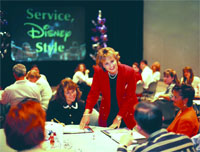
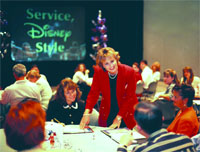
Business owners often wish for a little magic to help them through the tough spots. While the Disney Institute, the professional development arm of the world-famous corporation is quick to note that the company’s success didn’t happen overnight, some Western Mass. companies are hoping the Disney model will be just the thing to help them pull the sword from the stone.

It can still be a challenge for executives at Disney to explain that the global corporation that began as a cartoon studio in the 1920s doesn’t run on pixie dust and wishes on stars.

But undoubtedly, there’s a little more going on behind the scenes than flights of fancy at a company that now includes 10 theme parks, motion picture studios, countless consumer products, and its own television channel and radio station. Since 1986, the Disney suite of services has also included the Disney Institute, a professional development and training entity that has been using Walt Disney World in Orlando, Fla. as a ‘living laboratory,’ examining the effectiveness of day-to-day operations and translating them to businesses and organizations around the globe.

Those everyday practices at Disney recently became the backbone of Team Creativity, the latest Disney Institute offering that brings the Disney method to various groups and businesses. The program, which launched just this year, will be staged at Holyoke Community College’s Kittredge Business Center on Sept. 26. Keith Hensley, executive director of business and workforce development at HCC, said the college reached out to Disney earlier this year, in hopes of bringing a little bit of the company’s magic – but more importantly, its corporate know-how – to Western Mass.

“We’ve had the Disney Institute out twice before,” said Hensley, “for training on two separate topics – customer service and leadership, Disney style. Both were very well-received, and when I found out the institute had come forward with Team Creativity, I thought it was a great thing to offer area businesses.”

Hensley said it’s coincidental that the program will be staged so soon after the Kittredge Center’s opening, but it’s a fortuitous coincidence nevertheless.

“We wanted the institute to come and offer this particular training regardless of the venue, but it’s a great fit with some of the things we’re trying to achieve through the business center,” he said. “It’s getting more and more competitive out there in the business world, and what want we try to do is provide tools companies can use to stay economically viable by improving their competitive edge.

“It’s a two-pronged approach,” Hensley continued, “that focuses on using assets within a company and being able to use sparks of creativity to better position that company.”

Hi-ho, Hi-ho

And that, he said, is where the Disney Institute comes in. The organization uses the Disney corporate model and culture as a springboard for training workshops and seminars, and according to Bruce Jones, programming director for the institute, creative problem-solving and a team-based approach are two major hallmarks of that model.

“Creativity and high performing teams are our tenets at Disney,” he said. “We’re always looking at ways to broaden the definition of ‘team.’ We’ve long had content surrounding teams and creativity, but they’re things that are constantly improved.”

Jones explained that the institute’s first off-site program, Keys for Excellence, touched on the power of team-building through creative channels, but Team Creativity takes it to a new level.

“Keys was the first program created for which we leave property on a scheduled basis,” he said. “That continues to be a strong focus. But recently, participants started asking for more. Keys is more of a presentation, but Team Creativity is a full-day workshop that uses brainstorming and team-building activities to discover effective uses of both.”

Jones added that the institute terms the all-day events workshops rather than seminars, because of the high level of audience participation, modeled after Disney employee trainings.

“We are pretty confident in the program,” he said, “because it’s based on leadership, people, management, service, and loyalty – all things we’ve researched and put into practice at Disney, not to mention our audiences expect Disney to have a story to tell, which is another strength.”

Jones added that the workshop is well-suited for those who do not often find themselves in creative positions.

“This is not necessarily tailored to those who find themselves in the traditionally creative role, but to those who want to examine the strength of creativity in their own jobs and teams,” he said. “We’ll look at the analysis of ideas and the implementation of ideas, take them through activities that explore that team dynamic, and hopefully, they’ll discover the dynamic that exists between relationships and results.”

A Problem-free Philosophy

That link between relationships within the workplace and how they often affect the outcome of a given team-related task is something Hensley said he hopes will resonate within the Western Mass. business community. While they’re often seen as ‘soft skills,’ he said team-building and creative management are two things Team Creativity can offer to give the region that competitive edge he sees as essential.

“As we all know, Disney is a hospitality leader, but we absolutely know that their model works and can be applied to other industries,” he said, noting that some local companies, such as Balise Auto Sales, have already jumped on board. “It’s nice that companies will have the opportunity to experience a model that is known to work and not have to reinvent the wheel. That’s why we reached out to Disney – they have a tried and true system from which we want to learn.”

Ann Holland, director of organization development for Balise, echoed Hensley’s comments, adding that as part of a company that has grown considerably in recent years, participants attending Team Creativity from Balise are hoping to glean some information on how to maintain a cohesive corporate culture.

“Balise is growing by leaps and bounds, and with that kind of growth, gaps can occur within internal branding efforts,” she explained. “Disney has built a culture and built an internal brand to support its external branding, and because of our expansion, we are at a point at which we have a tremendous opportunity to learn from that, and engage our associates.”

Holland added that as Disney has already gone through that process of major growth and expansion, she’s also hopeful that the workshop will provide some insight into corporate growth, and how to best streamline the process.

“As a company gets larger, there are more and more projects happening simultaneously and people running in all different directions,” she said. “The question becomes ‘how do you avoid getting too subdivided?’ Disney has really latched onto the answer.

“One of my number one concerns is to keep our culture healthy and strong, as well as be more efficient, and provide career pathing for our associates, which is another thing Disney does well,” Holland added. “I’m also hoping to get some insights on new ideas, and confirmation of current ideas.”

Makes No Difference Who You Are

Jones said some of Holland’s questions are indeed the type of complex issues Team Creativity aims to address, however he did note that the validity of the Disney model might not be immediately evident to some. Therefore, there are several components of Team Creativity that explain how one industry’s culture can be applied in other sectors.

“We don’t hear a lot of cynicism, but it’s probably there,” said Jones. “Some people can’t get past our product. But we do the work up front to address concerns; we ask people who might not be sure how this will apply to their business to think about a scenario in which Disney is in a completely different business, and ask themselves, ‘could these principles apply elsewhere?’

But beyond that, Jones said there are some specific aspects of the program that were designed to make the key points even more relevant to various industries, in part to answer to skepticism regarding the relevance of corporate culture at, essentially, a theme park.

“We point out that there are many similarities among our business and others,” he said, “and competition – the need to stay on top of our game – is one big piece of that.

“It’s important to understand teams and how they work,” he added. “Teams are units of performance. We’re not teaching creativity for fun, but rather creativity to help deliver results. It helps build effective groups and networks; more ideas are generated, teams are strengthened, and that becomes a powerful tool to move an organization forward.”

Jones also noted that Disney functions in a unionized environment, another similarity to many local businesses.

“All types of organizations benefit from thinking about teams and creativity,” he said. “We have that conversation right up front with the audience – we tell people that we’re going to concentrate on the principles at play in our organization, and we stress that it doesn’t always come easy … we’re not perfect, and we don’t take for granted that people understand our culture. But we’ve evolved to where most big organizations find themselves thinking about things like corporate culture very deliberately.”

Fast Facts:

What:Team Creativity, Disney Style
When:Tuesday, Sept. 26, 8 a.m. to 4:30 p.m.
Where:The Center for Business and Professional Development at Holyoke Community College
Cost:$349/person; teams of three may bring a fourth team member at no cost. Breakfast, lunch, and materials included.
Contact:(413) 552-2122;[email protected]

Bedknobs and Broomsticks (and Business)

That deliberate approach, added Jones, includes sharing the Disney model with other businesses through the institute, as a way to not only share ideas with others, but to hone a culture that has been ingrained at the company since the early 1950s.

“Disney is always working on improving,” he said. “But we have a culture that has been grown organically since the days of Walt – he thought of himself as a bee, pollinating others with ideas that they could take hold of.

“It’s a culture that has grown organically, but now it’s something that we incorporate into virtually everything we do.”

And that’s not magic, though it does make for some animated conversations.

Jaclyn Stevenson can be reached at[email protected]

Sections Supplements
CityBlock Concerts are Revving Springfield’s Economic Engine

Bikers are outlaws.
That’s a little piece of American myth that persists in some circles. But if catering to a motorcycle crowd is wrong, there are dozens of business owners and city planners in downtown Springfield who don’t want to be right.

Seven years ago, the Springfield Business Improvement District (BID) launched its first summer concert series downtown, luring visitors to the city’s streets with the promise of free, family-friendly entertainment every Thursday night. The event caught on, thanks to a strong roster of national acts – among them, Delbert McClinton, Pete Best, Sophie B. Hawkins, Cracker, and others – and cooperation between the BID and many downtown restaurants and clubs. But the real change began about five years ago, when a few motorcycles roared into the event to take advantage of warm summer air and easy parking in Springfield’s club quarter. Soon, word began to spread that downtown Springfield was ‘bike-friendly.’

The phenomenon progressed gradually, as more bikes arrived each Thursday throughout the summer, creating long rows on the streets of the city’s club quarter. This year, the Stearns Square CityBlock Summer Concert Series is seeing its busiest and most successful season yet, though the event’s proper title is foreign to many of its regulars.

Now, they just refer to Thursday nights in downtown Springfield as Bike Night.

Doctors, Lawyers, and Indian Chiefs

A visit to downtown Springfield on Bike Night reveals thousands of motorcycles, some customized with everything from flashing lights to fiberglass spoilers, lining the two main arteries of the city’s entertainment district, Bridge and Worthington streets, as well as many side streets and privately owned parking lots. The CityBlock concerts staged in the center of the club quarter at Stearns Square are still the main draw, but Bob Turin, executive director of the Springfield BID, admits that Thursdays are starting to take on a two-wheeled life of their own.

“Some people still have that outlaw image of the biker stuck in their heads,” said Turin, “but what we see are thousands of people who have enough disposable income to afford a $20,000 toy. They might not have summer homes in the south of France, but they’re certainly not criminals.”

Rather, for the most part they’re an older crowd, between 30 and 50 years old, most with little interest in starting trouble. They also arrive early to stroll the streets, and stay late for dinner or drinks. And they keep coming, week after week, with their wallets in hand.

Dan Poirier, manager of the Salty Dog Saloon on Bridge Street, said the bar already bolsters its business by regularly promoting live bands, ‘flair’ bartenders, and mechanical bull rides, among other perks. But for 10 Thursdays out of the summer, he said, every other night’s sales are routinely blown out of the water.

“Thursday nights in the summer mark the strongest sales nights for the entire year,” he said. “It’s so busy we bring in extra staff on Thursdays. But what always gets me is that it’s the night of the week with the fewest problems. Bikers don’t want to start fights and get rowdy … none of them want anything to happen to their bikes.”

Poirier added that he sees firsthand every week the economic impact of Bike Night in Springfield. While it’s hard to quantify exactly how much money is rolling into the city each week, the visible proof of activity downtown is unmistakable. Worthington and Bridge Streets are now blocked off to cars on Thursday nights, the BID provides outdoor beer and wine stations in the square, and Springfield police work additional details around the concerts’ perimeter.

Similarly, the Salty Dog provides a safe, private parking area for bikers, and often, Poirier said those riders are coming in from as far as Boston, Buffalo, and New York City and staying overnight at one of the downtown hotels. Some notable names in the motorcycle world have also taken notice, among them Dave Perewitz, featured on the Discovery Channel’s Biker Build-off, who motors in regularly to take in the sights and will soon present the Salty Dog with a one-of-a-kind creation.

“I would venture to say it’s not thousands of dollars coming into Springfield every week,” Poirier mused. “It’s in the millions.”

Crowds and Chrome

Turin said the concerts typically attract between 3,000 and 6,000 people, and with the BID’s primary objective creating a better image for a cash-strapped city, those numbers are his biggest concern.

“We gauge by buzz, not budget,” he said, “and essentially we’re getting 10 weeks of positive press out of these events.”

The BID, funded by yearly assessments to property owners in the district, sinks $75,000 a year into the CityBlock concerts, of which about half is offset by funding from grants and sponsorships. Turin said the concerts only represent about 5% of the BID’s overall program budget; funds are also allocated to city improvement projects ranging from a $50,000 pledge for surveillance cameras to hanging flower baskets on the city’s lampposts.

But with plenty of good works in place, Turin, who began the CityBlock concerts a year after taking his post, recalls a time when Springfield lacked confidence in the idea, which has been successful in other cities including New York and Boston.

“It’s funny to think back now to the time when people thought having these concerts on Thursdays instead of weekends was a mistake,” he said. “My feeling was that if bars and restaurants weren’t doing well on Friday and Saturday nights on their own, they had bigger problems. So, we created a new Friday night.”

Keith Weppler, owner and manager of Theodore’s, a popular blues bar and restaurant on Worthington Street that serves as a CityBlock sponsor, can attest to that. Band members sometimes end the free concert at Stearns Square only to jump on stage at Theodore’s Thursday night open mic, and plenty of patrons are there to cheer them on.

“We’re doing extremely well,” he said, adding that he typically sees a 100% to 200% increase on Thursdays in the summer, over any other night. “We saw an increase in traffic immediately when the concerts started, but this is by far the best year yet.”

Weppler said Theodore’s serves for the most part as an in-kind sponsor of the CityBlock concerts, providing a meal, green room space, and other hospitality services for the acts. The services total $5,000 each year in value, he said, a relatively small price when compared to the return.

“This has become such an event unto itself that people aren’t coming downtown for any one attraction anymore,” he said, adding that most, if not all, club owners on Worthington Street are very much in favor of the concerts and the surrounding activity, if for no other reason than because they help the bottom line.

“For a long time, we didn’t have anything going on in the summer months; CityStage doesn’t put on shows, the symphony is taking time off, and we would feel that hit,” he said. “Now, we’re much more able to keep our staff working year-round, and that’s huge.”

Weppler also noted that the motorcycle crowd is an easy one to please.

“We serve the ribs and pour the beers, and they’re happy,” he said. “And that’s fine with us.”

And now, the BID is responding to the bike presence at the CityBlock shows too, which this year again welcomed a number of national acts including The Yardbirds, Cherry Poppin’ Daddies, and Roomful of Blues, among others.

While Turin said he doesn’t want to promote CityBlock Thursdays merely as ‘bike nights’ – plenty of people still drive in on four wheels, he said, and the BID hopes to maintain a strong family feel for all of its events – some small changes have been made to marketing materials, such as the addition of a logo created this year by marketing and public relations director Taryn Markham that couples a guitar with a motorcycle.

Born to Ride

“This has become three events in one,” said Turin. “It’s a music event that draws fans from all over the region, it’s a family event that offers something free for all ages, and now the bikes are the last piece.”

But they’re a piece he has some affinity for. Turin will retire this year, and with thousands of bikes revving their engines in his wake, he’s going out with a roar.

“Motorcycles and bikers – they’re American icons,” he said. “And they’re forging a road that is changing Springfield’s image.”

Jaclyn Stevenson can be reached at[email protected]

Opinion
Make Investments in Your Community

I have been in my position as president and chief executive officer for the Pioneer Valley United Way for 15 months. During this time, I feel that I have learned as much from my experience as I have contributed to it. Among the many things I have learned is that the success of the work that our United Way does would not be achieved if not for the partnership that we have with our more than 50 member, affiliated, and partner agencies, nor without the scope of services that are provided by their 130 programs and services.

In 2005, the United Way annual campaign raised more money than it did the prior year, and it still was not enough to meet all the challenging needs that our community faces. I have also learned that if we are to be successful and raise the resources that would be necessary to create healthy and strong communities, we will need to do so with the understanding that we are more than just a fundraising entity, but also are an organization that must operate and direct our actions and programs with a set of core values, and with a mission that extends way beyond the work we do through our annual campaign.

Our mission is driven by the need to be able to develop and support effective programs that directly improve the lives of the people in Hampden County, South Hadley and Granby, and that we will do so by providing a commitment to this mission that is grounded in the core values of leadership, integrity, collaboration, and innovation. We provide leadership by serving as a convener, enabler, and a facilitator in addressing community problems, and by educating and bringing together diverse communities around our tables that will help us to promote the work of the United Way, our agencies, and the programs that they provide.

Our second core value suggests that all of this needs to be done with integrity and by serving the communities in which we live and work honestly and with transparent practices. We do so by communicating directly and accurately and by encouraging effective community partnerships to help us carry out our important work. This will be accomplished, as our third core value suggests, by initiating collaborations, strategic partnerships, and community-wide relationships, which have the main goal of providing a catalyst for positive change in our neighborhoods and workplaces.

Finally, we expect that all of our work will be viewed through our final core value of innovation. We want to create value in investments in our work by using the most current technology systems and tools that are available to us that keep our United Way and the work that our agencies do relevant in our community.
At the end of the day, we want to provide an environment that is empowering, that is flexible and that helps us celebrate success.

The United Way campaign will kick off during the month of September at a variety of community-wide events. The goal this year is very simple: To raise more money than we did in 2005.

We also know that whatever it is that we are able to raise will not meet all the needs that our community has. This, together with our move toward impact funding based on the results of our recently completed needs assessment, will help us direct our resources in a way that will provide for strong, healthy and secure communities, and position the Pioneer ValleyUnited Way in partnership with you, our community, to respond quickly and efficiently to the concerns and needs of the larger community.

Your individual or corporate gift to the United Way campaign is the single best investment you can make in helping us reach these lofty goals. We will continue to provide you the accountability and assessment of how your investment is working. Most importantly, this campaign can and will help us create a unified address to the many worthy causes that we face, but with the overriding objective of providing for the well-being of our community and our children’s community.

Joel Weiss is President & CEO of the United Way of Pioneer Valley

Departments

MassMutual announced the following:
• Executive Vice President and Chief Administrative Officer Elaine A. Sarsynski has been named head of MassMutual International. She will have overall management responsibility for MassMutual International, a group of MassMutual subsidiaries that offer life insurance, health and accident insurance, annuity and pension products and asset management products, through a network of 15,000 full- and part-time representatives in Hong Kong, Taiwan, Japan, Luxembourg and Chile. She will also retain her responsibilities as Chief Administrative Officer at MassMutual, a role in which she has oversight of several corporate functions, including Corporate Services, Corporate Human Resources, Corporate Communications and Community Relations. She is also responsible for MassMutual’s Strategy Implementation Office, which oversees and facilitates the company’s overall strategy.
• Elroy Chan, who had been serving as head of MassMutual International, will continue in his role as Managing Director and CEO of MassMutual Asia Ltd. In addition, he will also serve as special advisor to MassMutual President and CEO Stuart H. Reese on a wide range of strategic business issues in Asia.
• While Sarsynski will now be responsible for international insurance operations, MassMutual Chief Investment Officer Roger Crandall will continue to oversee MassMutual’s investment subsidiaries abroad, including Baring Asset Management Limited and Babson Capital Europe Limited in London.


Ted J. Dickinson

Ted J. Dickinson of Dickinson Financial Consulting, Inc./Money Concepts FPC has received the 2005 Planner of the Year Award for the Western Mass. region. The award is presented by Money Concepts International, based in Palm Beach Gardens, Fla., and is in recognition of outstanding customer relations and leadership within the financial planning industry. Dickinson has won the award two years straight and has also won the President of the Year honor three of the past five years.

•••••

Gregory Rolland has joined Meyers Brothers Kalicka, P.C. of Holyoke and Greenfield as an Associate in the Holyoke office.

•••••

Dr. Julie Siciliano has been named Dean of the School of Business at Western New England College in Springfield. Siciliano joined the WNEC faculty in 1984, most recently serving as a Professor of Management. Dean Siciliano succeeds Dr. Stanley Kowalski, Jr., who stepped down recently after 27 years as Dean.

•••••


Glenda K. DeBarge

Health New England of Springfield announced the following:
• Joanne N. Shaw has been named Claims Manager;
• Kim N. Kenney-Rockwal has been named Manager of Workforce Development;
• Glenda K. DeBarge has been hired as an Account Executive;


Matthew J. Hastings

• Matthew J. Hastings has been hired as an Account Executive;
• Eric P. Harlow has been promoted to Sales Manager, and


Jim M. Buker

• Jim M. Buker has been promoted to Account Executive.

•••••


Jennylyn Fontaine and Melissa Voutour have been named Sales Managers for the MassMutual Center’s 64,000-square-foot convention center. Fontaine and Voutour will be responsible for overseeing all of the facility’s sales, including solicitation for new business for trade shows, corporate meetings, public exhibitions, weddings, and special events. Their responsibilities will also include working closely with the staff of the Springfield Convention and Visitor’s Bureau.

•••••

Keller Williams Realty in Longmeadow announced the following:
• William R. Resnick has joined the South Hadley/Northampton Market Center. He will specialize in residential real estate;
• Carl E. Sittard has joined the South Hadley/Northampton Market Center. He will specialize in residential real estate;
• Elizabeth A. Villani has joined the South Hadley/Northampton Market Center;
• Frances M. Hill has joined the Longmeadow Market Center. She will specialize in residential sales;
• Michele M. Caldwell has joined the South Hadley/Northampton Market Center. She will specialize in all areas of real estate;
• Sarah A. Hadley has joined the Agawam Market Center. She will specialize in residential sales, and
• Sophia J. Harvey has joined the Longmeadow Market Center. She will specialize in residential sales.

•••••


Denise Dukette has joined Sovereign Bank as Vice President and Relationship Manager in its commercial lending group.

•••••

Michele L. Billingsley has joined Better Life Whole Foods in Springfield as a Corporate Executive Assistant. She will focus on organic produce, meat, wines and beers.

•••••

Momentum Group has named Carlo Centeno as Vice President of Marketing.

•••••

Deborah A. Nadle has been named Branch Manager for the Holyoke Credit Union.

•••••

Park Square Realty in Westfield announced the following:
• Maureen L. Staccato has joined the firm as a Sales Associate. She will work in the Feeding Hills office.
• Leslie J. Lambert has joined the firm as a Sales Associate.

•••••

Richard E. Gore III has joined Lee Audio ‘N Security Inc., as an Engineer, responsible for sales and service of the company’s engineered systems throughout Western Mass. and eastern New York. He is the son of Lee Audio President Richard E. Gore II and grandson of company founders Richard E. Gore Sr. and Barbara Gore.

•••••

Diane McClellan, Chief Financial Officer of Hampden County Physician Associates LLC, has become a Fellow in the Healthcare Financial Management Association.

•••••

Carlos Rios has joined Applied Mortgage Services Corp. as a Loan Officer in the West Springfield office.

•••••

van Schouwen Associates LLC announced the following:
• Daniel W. Horlitz has been promoted to Art Director, and
• Rebecca J. Leutert has been promoted to Technology Director.

•••••

Harry Monti has been promoted to Senior Vice President of Benefit Management Services in the group benefits division at The Hartford Financial Services Group Inc.

•••••

Barbara Haswell, RN, COHN, MBA, has received the Medique Leadership Award from the American Association of Occupational Health Nurses Inc.

•••••

The Affiliated Chambers of Commerce of Greater Springfield announced the following election of officers:
• Chairman David M. Hobert, Sovereign Bank New England;
• Vice Chairman Arlene Putnam, Eastfield Mall;
• President Russell F. Denver, Springfield Chamber of Commerce;
• Treasurer Barbara Jean DeLoria, United Bank;
• Budget Director Malcolm Getz, Belt Technologies;
• Clerk David J. Martel, Doherty, Wallace, Pillsbury & Murphy, and
• Past Chairman Richard Ayers, Mount Tom Box Co.

•••••

Douglas K. Engebretson has been elected First Vice President of the National Council of Architectural Registration Boards.

Features
Springfield Club Owners Take to the Sky with New Entertainment District Venture
Steven Stein and Mike Barrasso

Steven Stein and Mike Barrasso, at SkyBar overlooking Springfield, adopted the concept of a rooftop bar from several successful venues worldwide.

From their newest venture in Springfield’s entertainment district, club owners and developers Steven Stein and Mike Barrasso have an enviable view: one that includes the city’s skyline and comes complete with comfortable seating and a chilled martini.

Located at Stearns Square in the heart of Springfield’s club quarter, Skyplex is Springfield’s newest nightspot, replacing Stein and Barrasso’s former business, Rain Entertainment Complexes, with the goal of catering to an older, more sophisticated crowd.

The facility will include three separate clubs, each the product of months of research and redesign on the part of the business partners; the ground floor has been converted into a country western bar dubbed Buck Wild, while the second floor has become Vivid, an interactive, video-driven dance club.

But it’s the complex’s third component that is creating the loudest buzz. Modeled after similar ventures in other parts of the country, SkyBar is an open-air rooftop lounge complete with private VIP seating, cabana bars, and a view of the Springfield skyline.

Rooftop lounges are becoming popular venues in several major cities across the globe, including Las Vegas, New York City, and London. Stein and Barrasso, known locally for large-scale projects including the purchase and renovation of the Hippodrome, formerly the Paramount Theatre, in 1999, said they’ve tried to bring some of that big city flair to Springfield in an effort to improve the city’s economic picture as well as its overall image.

“We try to stay ahead of the trends, not follow them,” said Barrasso, “and rooftop ultra bars are huge right now. What we’re trying to do is attract more people from the disposable income crowd – it’s all in keeping with ongoing economic development.”

Leaping Tall Buildings

The partners said they embarked on a country-wide fact-finding mission last year in search of fresh, new ideas in the entertainment sector, and they happened frequently upon rooftop bars teeming with patrons. Such facilities capitalize on little more than some savvy design schemes and fresh, night air. Country-western themed bars, they said, have also proven to be lucrative in other parts of the country, and tend to attract an older, more sophisticated crowd. Similarly, they noted that dance clubs such as Vivid remain a constant draw for a diverse customer base, especially in urban areas.

But applying big-city formulas in a smaller locale, one that has seen its share of financial woes of late, isn’t the only risk the duo has taken in changing the property they manage. In completely overhauling the complex, Stein and Barrasso made some substantial financial committments.

In addition to the creation of SkyBar, Buck Wild, the complex’s country western offering, for instance, includes a mechanical bull that was installed at a cost of $15,000. It also features the first of what Stein and Barrasso hope will be many cross-promotional items with area businesses – a Harley Davidson from Tibby’s in Springfield.

Similarly, Vivid includes a full lighting system, private dance floors, couches for seating, and a 360-degree video-screen that is fully-synchronized with the sound system – allowing for dj-mixing and video presentations that reflect the beat of the music.

Technological upgrades such as these have been paired with more-pressing renovations, such as a new sprinkler system and handicapped-accessible elevator. All of these improvements have added up to a price tag that exceeds $250,000.

“The cost actually ended up being about double what we originally anticipated,” said Barrasso. “But we’ve done our best to use local contractors and local materials, and we expect that the amount of business we’ll attract will more than take care of it.”

Climbing to the Top

That’s not to say the partners are blindly optimistic about their new venture, Barrasso added; they are aware of the leap of faith involved with overhauling an existing club in a struggling city.

“We know this is a risk, changing the format completely at Stearns Square,” he said. “But the Hippodrome and Rain were also risks with which we believed we could serve a new entertainment market niche in Springfield.”

Indeed, both venues turned profits. The Hippodrome remains a popular nightspot that draws national acts to its stage regularly, and Rain, formerly the Hot Club, also maintained steady traffic prior to the format change and renovation project. However, Barrasso explained that over the past two years, its clientele began to shift toward a younger, rowdier set.

“There were a lot of factors that led to that,” he said, noting that among them were crime statistics that kept many older, more discriminating club-goers away.

We weren’t happy with the direction the complex was moving in, so we decided to shut it down and start over.”

Stein added that since the new venue has been modeled directly after similar venues in Vegas and California, he expects new audiences to visit if for no other reason at first than the curiosity factor.

“It’s something that is totally unique to Springfield,” he said, adding that a twist on the rooftop concept in Springfield will be the expansion of service not only at night, but during after-work hours and for private and corporate functions.

Stein said he hopes to see the Springfield business community leading the way toward utilizing the space for after-hours socializing or as a venue for events ranging from networking opportunities to office parties.

“We’re getting feedback already from the city’s professionals who work in the high rises,” he said, “because they can literally look out and see our progress in transforming the roof into an open-air gathering place. I think this beats any other function space you can find, and with the demographic we’re trying to hit, cooperation with the business community is a perfect fit.”

To further promote that idea, Stein and Barrasso have begun an extensive marketing campaign announcing the creation of Skyplex, targeting adult contemporary radio stations, local television networks, and private households through a direct mail campaign.

“We’re also very Internet savvy,” said Barrasso, “and that has helped us get the word out to our key demographic. We’re looking for a nice mix of professional, 25- to 45-year-olds, and using E-mail and certain Web sites like MySpace are a great way to reach them.”

SkyPlex’s page on MySpace.com – the well-known networking site that is increasingly prevalent in the marketing repertoire of many entertainment-based businesses – has already attracted more than 300 ‘friends,’ or MySpace users who receive regular bulletins and event listings from the club.

Watching the World

Stein conceded that even he is amazed at how much his industry has changed, both in terms of trends and the role that virtual marketing plays.

“It’s a new world out there,” he said with a laugh. “It’s our job to keep up with it.”

He and Barrasso have a vantage point, however, that allows them to see many things coming early – be it a rain cloud on the horizon, or a new venture – or adventure.

Jaclyn Stevenson can be reached at[email protected]

Sections Supplements
Hatfield Mill Finds a New Life As the Region’s Newest Banquet Facility and B&B
Tony Martino and Ted Jarrett

Tony Martino and Ted Jarrett at the Old Mill, the building they’ve recently converted into a banquet house and B&B.

It’s easy to find — only minutes off I-91 and now painted a bright yellow — but still tucked away and somewhat hidden.

The Old Mill on the Falls, an imposing building that towers over the Mill River in Hatfield, has a long, colorful history as an industrial center in Western Mass., dating back to the mid-1600s. Today, however, it has a new, intriguing life in the hospitality sector.

Once a mill for grain serving early settlers and later home to a bustling gun manufacturer, the mill had been vacant for several years, awaiting a new purpose. And after years of waiting and watching, Tony Martino, an executive chef and restaurant owner, and Ted Jarrett, a veteran of the hospitality sector, have created one.

Martino, the mill’s new owner, and Jarrett, who will manage the property, have established a unique banquet facility and bed and breakfast following months of renovations that were completed earlier this month.

Purchasing and refurbishing the Old Mill has been a dream come true, said Martino. He and Jarrett are already seasoned Springfield-based business owners – Martino owns the Fantastico Café downtown, while Jarrett, until recently, owned and operated the Maple Heights Bed and Breakfast, and continues to operate the Berkshire Folkstone Bed and Breakfast Reservation Service in Springfield.

They said they had long envisioned a distinctive space with a New England flair that could serve as a home for Martino’s eclectic cuisine, as well as a new destination for travelers visiting Western Mass. Martino and Jarrett had their eyes on the Old Mill for some time, but said that, until recently, the property was priced out of their reach.

Legend of the Falls

The Old Mill has a rich history that certainly adds to its appeal. Built in 1881, the three-story building was constructed on land that served as one of the first settlements in the Connecticut River Valley. Thomas Meekins, a miller, was granted the land on the Mill River in 1661, in order to use the river’s natural water power to grind grain for the local community.

In the mid-1800s, miller Harvey Moore purchased the site, and following the Civil War it became a center of activity as the manufacturing sector grew in the area. The Crescent Pistol Company was established on the north side of the falls, and it later became the Shattuck Gun Shop; that business operated at the site for 35 years.

The original mill, however, was destroyed by fire, and what is now known as the Old Mill on the Falls was constructed in its place. From 1881 to 1932, the building housed several businesses, including the Shattuck Gun Shop, a lathe-manufacturing business, and a manufacturing facility for automotive spark plugs. In 1932, it was purchased for use as a gristmill, then sold again in 1965 to serve as home for an antiques dealership. Finally, from 1980 to 2000, the Old Mill served as the headquarters for Advocate Newspapers, now located in the Eastworks building in Easthampton.

Despite its proud industrial history, though, the building that overlooks a man-made waterfall remained vacant for five years after The Advocate moved. Martino and Jarrett, interested in the property since it first went on the market, kept a close watch over the mill and its sale price as it gradually declined, until 2005 when, for just under $600,000, Martino bought the building. Jarrett signed on as the property’s manager soon after.

“When we bought it, the inside was just wide open space,” said Martino. “It needed a lot of work … a lot more than a paint job.”

Milling About

Martino said he and Jarrett put about eight months of work into the building, and opened for business officially just this month. The Old Mill now serves as a full-service bed and breakfast, with nine rooms – each unique, furnished with antiques from various locales and periods, and each with a private bath.

With the hope of attracting a diverse set of guests, rooms at the Old Mill are also priced reasonably. With what is expected to be the inn’s busiest season, the foliage months, just around the corner, rooms rates are between $100 and $125. There is a handicapped-accessible room on the first floor, and an ‘animal friendly’ room as well. Another plus, though, are the rooms with waterfront views. And at the Old Mill, that’s all of them.

Martino and Jarrett will also host weddings, rehearsal dinners, receptions, showers, private parties, and corporate functions for 20 to 60 people, and it’s in this arena that they hope to truly stand out, filling a niche as a distinctive venue that caters to more-intimate crowds.

“We’re hoping to specialize in banquets and showcase many different types of cuisine,” said Martino, a native of Italy who was trained at the Italian Culinary Institute. “Italian cooking will definitely be featured, but we’re well-versed in other things.”

A preliminary menu already created for Old Mill guests suggests an Italian flair, but with plenty of deviation; banquet selections include, for instance, bruscetta, Risotto a la Milanese, and chicken Parmesan topped with Martino’s homemade tomato sauce. But crabmeat stuffed mushrooms also appear, as well as roasted red potatoes, carrots with an amaretto glaze, and clams Casino.

In addition to a varied menu, Jarrett added that the Old Mill’s ambience is expected to be an equally strong draw for potential guests and banquet service clients.

“We’re nestled in a quiet area,” he said, “and we have room to fully accommodate many different types of events, but without feeling too cavernous. I think the bed and breakfast is also going to be a great fit for college parents visiting their children in the area, younger people, or weekend travelers.”

Falling into Place

The finishing touches were put on the B&B’s rooms only days before the Old Mill opened. Jarrett and Marino are hoping for a brisk opening season, one that introduces the property to a wider audience, and adds a new chapter to its compelling story.

Jaclyn Stevenson can be reached at[email protected]

Cover Story
Drive, Imagination Help Answer Catering Challenges
The Main IngredientMocktails for teenage guests. Organic meat stations. Chilean ingredients prepared in Lebanese fashion. Such catering requests are fast becoming the norm, not the exception, and caterers and event planners in Western Mass. are responding accordingly. Handling new and ever-more-demanding client needs is challenging, but those in this industry say it stirs their creative juices, while fueling their entrepreneurial fires.

Caterer Michael Sakey was reminded recently of just how much his industry has changed when a client made this request for her event:

“I want everything flat.”

“Flat?” Sakey said, still questioning the directive long after the event had passed. “I didn’t know what she meant, but she didn’t give me much more than that … just flat.”

Sakey, general manager of Spoleto Catering in Northampton, filled the request successfully by providing large platters for hors d’oeuvres, set side by side instead of tiered. He placed large pieces of slate in the centers of tables, scattered rosebuds in place of floral arrangements, and used stemless glassware for wine and champagne. The client loved it, he said, but the job was not without some anxiety.

“That’s a great example of what caterers face today,” he said. “We’ve seen a huge step back from all things traditional, and people are getting much more creative, if not eccentric. But they also have different expectations in terms of our level of service and expertise.”

Sakey said the new, more rugged demands on caterers are a relatively recent phenomenon – one that comes with its share of challenges, but also with a few perks.

“It’s funny how things change so quickly, because it wasn’t like this five years ago,” he noted, explaining that until recently, most clients played it safe, requesting foods or themes they’d enjoyed elsewhere. “Now, people want us to create an atmosphere that their guests have never experienced before, so more and more problems fall to the caterer. But at the same time, we’re having a ball with it, because this market is ready for creativity.”

Causing a Stir

A number of factors seem to be spurring this new trend in the catering business, among them a proliferation of food and event-planning television shows, magazines, and books that are introducing more-sophisticated themes to a larger audience and blurring the line between creative food preparation and full-on event management.

Kristen Rowell, event manager for the Garden House at Look Park in Northampton, said the only constant she’s seeing in terms of recent catering requests at her facility is a steady stream of clients with big ideas. Each request, however, is vastly different from the one before it.

“People want their events to be personalized,” she said, “to reflect who they are. Because of that, we’re seeing a lot of themed events – but those range from Hawaiian luaus to refined cocktail parties with signature martinis.”

Rowell said specific age groups are also influencing event-planning trends – the younger, 20-something set, for instance, tends to cut costs with a do-it-yourself approach – creating their own music mixes via computer programs, for instance, or having a friend with a good eye – and a great digital camera – take photos. But those money-saving tactics are aiding the catering boom, she explained, rather than taking away business.

“I’ve had a huge influx of events where the clients virtually put every cent they have into the food,”she said.

Similarly, Baby Boomers are also putting some new demands on caterers, looking for sophisticated, unique themes for their parties, although Rowell said this set, many of them celebrating a new found freedom of both time and money as children grow up and move out, are less likely to skimp on the other aspects of a party. Instead, she said, they’re going all out, requesting full-service cooking stations where guests can sample the food, but also learn how to cook it; they’re asking for specific cuisine such as Russian or Brazilian, or for fusion dishes, such as Mediterranean food with a Latin flair.

In short, Rowell said everyone is asking for parties that are absolutely fabulous.

“Clients know what they want and how to get it,” said Rowell, “but when it comes to the food and the presentation, they would still rather have a professional handling it, and that’s at all ages.

“I never expected to cater a prom, but we did recently, for the Pioneer Valley School of Performing Arts,” she continued. “They said, ‘we know you think we’re just kids, but this is what we want.’ And they had a laundry list of requests, which we answered.”

Meat of the Matter

The trend of specific, personalized service has not eluded the corporate set, Sakey added. Rather, corporate events represent some of the most uniquely catered events of late. When Fathers and Sons of West Springfield, for instance, held a launch party for the new Porsche Cayman S, Sakey was called upon to provide food that mirrored the car – European, but with bit of a hot, spicy touch. ‘Caymantinis’ were also concocted at the bar.

“But at the same time,” Sakey said, “corporate events are based around convenience for the client, and that means often, I never even meet my client face-to-face until the day of the event. Sometimes, all I get is a four-line E-mail and an AmEx number. But there’s always an expectation that the food will be of a certain quality. Essentially, they’re paying for me to take on that responsibility.”

Tabitha Mahoney, event manager for the MassMutual Center in Springfield, echoed his comments regarding an increasingly in-the-know public, and the effect that’s having on the catering sector.

“Customers are increasingly savvy,” she said. “They’re creative and well-versed in what is available, and they’re not afraid to ask for new things. More and more, we’re being asked to execute some very unique spreads, and it seems as though this is happening everywhere.”

Indeed, these trends are being seen not only across the region, but across the country as well. Diane Welland, a registered dietitian with the U.S. Food Service, listed several ‘hot trends’ in catering that have emerged in the last decade. Among them unusual starches (farro, quinoa, risotto, black rice, couscous), fusion buffets, homestyle desserts, and soufflés – once seen as passé, she said. Each illustrate the diversity of requests as people strive to create a ‘dining experience’ for their guests.

“In an effort to appease clients, menus have gotten bigger, better, and more sophisticated than ever before,” she said. “Variety and excitement are buzzwords in the industry and creative chef-manned stations and buffets specifically tailored for each event are the norm rather than the exception.

“To attract and keep customers, caterers must not only follow the latest ‘in’ foods in restaurants,” added Welland. “they must also create their own trends.”

Sakey agreed, noting that as demand increases, his job becomes more complex as well. Caterers are also being charged with other tasks that once fell far out of their realm, such as designing banquet space, or not only creating menus, but devising recipes as well.

“One major shift in this industry is that caterers are being asked much more often to be event planners as well,” Sakey said. “Once, I worried only about the food; now I’m worrying about tent rentals, lighting, and disc jockeys. I’ve even been asked to help coordinate wedding processions.”

And along with developing confidence about food choices, clients are also getting more comfortable with non-traditional event spaces as well. Sakey harkened back to an event he catered recently at a venue that began as an empty barn.

“The request was to create a beautiful New York-style cocktail lounge … but in a barn,” he explained, noting that instead of visiting gourmet food-sellers in search of ingredients, on this particular occasion Sakey spent more time at Home Depot than anywhere else. “I have a background in theater that literally saved me. We did some extensive lighting treatments, used contemporary tables and set the stage for the event, and it was beautiful, but it shows how much the media influences people. I know the clients saw something like this on T.V., thought it was great, and decided to execute it.”

Food for Thought

Sakey still marvels at the turn his industry has taken, but repeated that with these new, varied requests has come a new day for caterers and event planners that allows them to flex their creative muscle.

“Everything is breaking away from tradition,” he said. “Maybe it’s a reflection of what the world is like in general right now – people are becoming more worldly, and they’re trying their best to enjoy themselves in new ways.”

And sometimes, that means creating a world that is flat.

Jaclyn Stevenson can be reached at[email protected]

Departments

Stone Soul Festival

Sept. 1-3: Hampden Bank will continue its title sponsorship for the 18th annual Hampden Bank Stone Soul Festival at Blunt Park in Springfield. One of the largest multicultural events in the Northeast, the festival features fun and educational activities for all ages, as well as prize drawings, great food and live music. Festival hours are Sept. 1, 6 to 10 p.m., Sept. 2, 10 a.m. to 10 p.m., and Sept. 3, 10 a.m. to 6 p.m. Free admission.

The Big E

Sept. 15-Oct. 1: The 2006 edition of The Big E will present more than $1.7 million in free entertainment, a ticketed Brad Paisley concert, the Miss Latina U.S.™ Pageant, the return of Marriage on the Midway, and BiggiE’s Character Breakfast as well as the Mardi Gras Parade, rides, crafts, good food, animals, and the best of the old and new that fairgoers have come to expect and enjoy. The Big E is located on Memorial Avenue in West Springfield. Advance discount tickets and 17-day value passes are available online at www.thebige.com and the Big E Box Office by calling 1-800-334-2443, now through Sept. 9. Tickets are also sold at Big Y World Class Markets now through Sept. 13.

“Generations …”

Sept. 20: At its September professional development meeting, the Women’s Partnership will present “Generations…Working and Living Side by Side.” A representative from Big Y Foods Employee Services department will be presenting material about preparing employees to face the everyday life of managing and working with people of all generations. The meeting will be held at the Best Western Sovereign Hotel and Conference Center in West Springfield. Networking begins at 11:30 a.m., the program and lunch will be begin at noon and end at 1:15 p.m. Tickets are $20 in advance for chamber members, $25 for non-chamber members or payment at the door. To register and purchase a ticket to the meeting, book online at www.myonlinechamber.com or contact Diane Swanson at (413) 755-1313.

‘Team Creativity Disney Style’ Workshop

Sept. 26: The Center for Business and Professional Development at Holyoke Community College will sponsor an all-day workshop titled Team Creativity Disney Style from 8 a.m. to 4:30 p.m. at the Kittredge Center for Business and Workforce Development on the HCC campus. The Disney Institute will share with participants the motivational tools that can unleash the creative power of one’s entire organization. The cost is $349 per person which includes continental breakfast, lunch and materials. For more information, contact Maria at (413) 552-2122 or via E-mail at [email protected].

HCC Business Summit

Sept. 27: The Holyoke Community College Center for Business and Professional Development is sponsoring a free workshop for business owners and managers who are looking for more effective ways to train their employees. Titled Training for the 21st Century, the workshop is planned from 8:30 a.m. to 12:30 p.m. at HCC’s Kittredge Center for Business and Workforce Development. The workshop will introduce employers to a new training approach that uses real-life scenarios, follow-up sessions, ongoing contact with instructors, and actual homework for participants. The deadline to register is Sept. 13. For more information, call (413) 538-5817 or (413) 538-5815.

Western Mass. Entrepreneurship Hall of Fame

Oct. 5: The seventh annual induction ceremony for the Western Massachusetts Entrepreneurship Hall of Fall is planned Oct. 5 at the Log Cabin Banquet and Meeting House in Holyoke. The event is sponsored by Springfield Technical Community College. Event hosts include The Fontaine Family (Fontaine Bros. Inc.); Jesse and Barbara Lanier (Springfield Food Systems); Horace Smith and Daniel Baird Wesson (Smith & Wesson); The Balise Family (Balise Motor Sales), and The Grenier Family (Grynn & Barrett).

Super 60

Oct. 27: The Affiliated Chambers of Commerce of Greater Springfield, Inc. will present its annual ‘Super 60’ program at Chez Josef in Agawam. The event is a salute to the entrepreneurial spirit of the region’s privately owned businesses.

Departments

PeoplesBank Expansion Planned

HOLYOKE — Within the next two years, PeoplesBank plans to open six new branches between Northampton, Wilbraham, Springfield, and West Springfield. Depending on land acquisition or lease costs, PeoplesBank expects to spend between $2 million and $2.5 million per branch. PeoplesBank recently opened a branch in Westfield and will open two branches this month, one at The Village Commons in South Hadley and the other in the Sixteen Acres section of Springfield. In other news, the bank recently reported that assets have increased by $200 million, or 18%, and loans increased by 25% to $950 million. Also, bank deposits rose by 22% to $863 million over the last 12 months that ended June 30. PeoplesBank has 14 offices in Amherst, Chicopee, East Longmeadow, Hadley, Holyoke, Longmeadow and South Hadley.

MassMutual Creates Structured Settlement Annuity Concept

SPRINGFIELD — Massachusetts Mutual Life Insurance Company recently introduced MassMutual ® Structure Plus, a new concept using a structured settlement annuity that is designed to provide a more comprehensive solution for the life-care needs of catastrophically injured persons. The structure helps satisfy both the certain and uncertain needs of the injured party by providing access to trust services offered by the MassMutual Trust Company, FSB. With MassMutual ® Structure Plus, claimants place their settlement proceeds into a MassMutual structured settlement, which provides – for the convenience of the claimant – a lump sum payment which also funds a trust account for which the MassMutual Trust Company will serve as trustee. The advantage is that it works with the structured settlement annuity, and the structured settlement annuity is all that has to be funded by the initial settlement. A portion of the settlement proceeds will be directed from the structured settlement annuity to the MassMutual Trust Company, FSB, as trustee of a trust established by the injured party.

MassMutual Center Receives Positive Rating

SPRINGFIELD — The Pollstar Online listing recently ranked the MassMutual Center as one of the 100 most popular arenas in the world during the first half of 2006. The center was ranked 81st on its list of 100 facilities, according to total ticket sales. From January through June, the center held eight events, not including convention center programs and Falcons hockey games, and brought in more than $1 million with 60,276 tickets sold. Top-selling events included concerts by Motley Crue, Martina McBride and Larry the Cable Guy, as well as Disney on Ice and the Harlem Globetrotters. For September, country music star Alan Jackson is scheduled to perform and several children’s shows are planned.

Easthampton Savings Continues Strong Growth

EASTHAMPTON— Easthampton Savings Bank continued to experience steady growth during the second quarter of 2006, with total assets increasing $35.2 million from a year ago, an 8.8% increase over the last quarter. Total assets now stand at $647 million. In addition, the loan portfolio totaled $511 million at the end of June, an increase of $8.4 million, or 7%, for the quarter and $36.7 million or 8% for the year. Also, the bank experienced a deposit gain of $20.8 million from a year ago, representing a 4% increase since the end of June last year. In other news, the bank is now entering the permit phase of a new office in Westfield which is expected to open in approximately 15 months.

Roofing Contractor Receives Quality Award

SPRINGFIELD — Morris Roofing & Sheet Metal Corp. is a recipient of the 2006 Partner in Quality Award from Firestone Building Products Company. The award distinguishes the firm for its dedication to installing quality roofing systems and recognizes contractors who installed a minimum of four warranted Firestone roofs in each of the past five years, maintained at least 1 million square feet of Firestone roofs under warranty, and achieved an annual Quality Incidence Rating of 2.0 or less.

ValleyStone May Close Wal-Mart Site

SPRINGFIELD — Due to lower-than-expected traffic and earnings, the ValleyStone Credit Union may close its branch office in the Chicopee Wal-Mart since it will be forced to relocate its site when the company expands into a super center. Currently, the credit union is located just inside the entrance, however, with Wal-Mart’s expected super center expansion plans, ValleyStone will be forced into a new spot that will be less visible and have less square footage. ValleyStone officials acknowledged they had incurred considerable expense to build the current branch and would once again have to incur more costs to build the new branch. Wal-Mart has offered a small contribution to help offset the costs, according to ValleyStone officials.

Departments

Chicopee Savings Begins Life as Publicly Traded Company

CHICOPEE — Chicopee Savings Bank made its debut on the Nasdaq Global Market on July 19, and got off to a solid start as a publicly traded company — 1.4 million shares were traded. The stock opened at $14.25 and hit a high of $15.29 during the day. The bank sold 6.8 million shares in its subscription offering, and proceeds from that offering came in at $68.9 million, with net proceeds of $67.1 million. Bank President William Wagner said the institution, with nearly $400 million in assets, will proceed with its plan to build one new branch a year for the next four years. The bank currently has seven branches in Chicopee, West Springfield, and Ludlow.

United Financial Reports Solid Second-quarter Results

WEST SPRINGFIELD — United Financial Bancorp Inc., the holding company for United Bank, reported net income of $1.3 million for the second quarter of 2006, or $0.08 per diluted share, compared to $1.6 million for the same period in 2005. The company earned $2.6 million, or $0.16 per diluted share, for the six months ended June 30, compared to $3 million for the 2005 period. The 2006 results were largely affected by growth in average earning assets, net interest-margin contraction, and an incrtease in on-interest expenses. The company also announced a quarterly cash dividend of $0.05 per share payable on August 22 to shareholders of record as of August 6. Total assets increased $55.3 million, or 6.1%, to $961.8 million on June 30, up from $906.5 million at Dec. 31, 2005. Total loans grew $59.4 million, or 9.3%, to $695.2 million. Loan growth was solid in all categories, including residential (4%), commercial mortgages (8.8%), construction (41.8%), commercial (8.2%), and home equity (16.3%).

Whalley Computer Ranks 276th on VARBusiness Top 500

SOUTHWICK — Whalley Computer Associates (WCA) was recently ranked by VARBusiness Magazine as the 276th largest computer reseller in North America. The ranking places WCA in the top one-third of 1% of the more than 120,000 VARs throughout North America, according to Paul Whalley, vice president, WCA. Whalley added that the company reported $73,400,000 in revenues in 2005, which represents an increase of 9.25% from the previous year. In other company news, WCA has received the IBM Chairman’s Award for Customer Service, which recognizes the company’s outstanding customer service during the past five years.

New England Financial Moves to East Longmeadow

EAST LONGMEADOW — In a strategic move by managing partners James Marlor and Christopher Gent, New England Financial (NEF) recently moved to 200 North Main St., Suite 17. Serving local individuals and small business owners, NEF has offices across Western Mass., as well as in Connecticut and Rhode Island. NEF, a Metlife company, made the move to allow easier access for clients to walk in after the rollout of their new investment and mortgage services through MetBank.

Winstanley Associates Teams Up with Spalding to Design New NBA Game Ball

LENOX — The National Basketball Assoc. and Spalding have announced the adoption of a new official NBA game ball. The new ball, a result of years of research and development, was designed by Winstanley Associates in Lenox, in cooperation with Spalding’s R&D group. Featuring Cross Traxxion™ technology, the ball delivers enhanced grip, feel and consistency, and features an interlocking two-panel design with a patented Cross Traxxion™ microfiber composite material that provides moisture management throughout the course of a game. Beginning with the 2006-07 season, the game ball will be the only basketball used during all NBA games, practices and events. The ball will also be available for sale on Oct. 31 at major sporting goods outlets as well as the NBA Store and NBAStore.com.

Smith & Wesson Move to Nasdaq

SPRINGFIELD — Seeking a larger exchange to do business, the Smith & Wesson Holding Corp. recently moved to the Nasdaq’s new Global Select Market from the American Stock Exchange. The company’s stock ticker changed from SWB to SWHC. Company officials hope the move to the Nasdaq will provide more visibility to the financial world, as well as greater recognition to the company and increased liquidity to shareholders.

ReStore Announces Home Improvement Workshops

SPRINGFIELD — ReStore Home Improvement Center has announced a new workshop series beginning this month, which will run throughout the year. “We are offering educational, economical, and eco-friendly workshops to teach do-it-yourself home repairs with an emphasis on used and surplus materials,” said John Grossman, ReStore Manager. August Workshops Include Tile Installation on Saturday, August 5, 2006, 11 a.m. to 12:30 p.m., and Community Economy in The City, a presentation by Kristin Brennan and Daniel Staub, as heard on NPR, on Saturday, August 19, 2006, 11 a.m. to 12:30 p.m. All ReStore workshops are free and open to the public. Please call Mary Wiseman, Marketing & Outreach Coordinator at 413-788-6900 to reserve a seat.

Ianello Legal Associates Expands

SPRINGFIELD — Richard Ianello, principal of Ianello Legal Associates, recently announced the opening of a second satellite office at 48 Elm St., Suite 5, in Westfield. Ianello operates the main office out of 55 State St., Suite 201 in Springfield, with a satellite office at 10 Center St., Suite 200, in Chicopee. The firm represents clients in the areas of personal injury and criminal defense. Attorney Ianello’s associate is Attorney Mark Brittain, who has extensive experience from his previous work with the Clerk Magistrate’s office in the Springfield District Court.

STCC Offers Pharmacy Tech Program

SPRINGFIELD — The Center for Business and Technology at Springfield Technical Community College will offer a Professional Pharmacy Technician Program beginning this fall. The 75-hour program is designed to teach students the fundamentals of being a pharmacy technician, as well as how to effectively assist in pharmaceutical preparations and complete daily required tasks in any pharmacy environment. For more information, call (413) 755-4502 or (413) 755-4225.

Princeton Rejoins MMWEC Membership

LUDLOW — The Princeton Municipal Light Department is returning to membership in the Mass. Municipal Wholesale Electric Company (MMWEC), bringing to 26 the number of state municipal utilities that are members of the MMWEC organization. Princeton, which serves approximately 1,800 customers with a peak load of about 4.5 megawatts in Central Mass. voted to rejoin the MMWEC membership in May. MMWEC is a nonprofit, public corporation and political subdivision of the Commonwealth of Massachusetts that provides a wide range of power supply, financial and other services to the state’s consumer-owned, municipal electric utilities.

Berkshire Hills Bancorp Declares Dividend

PITTSFIELD — Berkshire Hills Bancorp Inc. has declared a quarterly cash dividend of $0.14 per share, payable on Aug. 24, to the stockholders of record at the close of business on Aug. 10. Berkshire Hills Bancorp is the holding company for Berkshire Bank.

Springfield College, STCC Sign Admission Agreement

SPRINGFIELD — Springfield Technical Community College (STCC) students may be admitted jointly into bachelor’s degree programs at Springfield College (SC), thanks to a recent admission agreement between the institutions. The plan encourages transfer between the two colleges in certain programs for students who meet the qualifications. The agreement includes significant financial incentives, as high as $10,000 per year, for STCC students accepted into certain SC programs, who maintain a specified grade point average and who have exhibited special leadership skills.

MassMutual Web Site Focuses on Women’s Financial Needs

SPRINGFIELD — MassMutual Financial Group recently unveiled a new addition to its Web site that focuses on the financial needs of women, enabling them to educate and empower themselves to help build a more secure financial future. The new section, available at www.massmutual.com/women, contains a wide range of financial content of interest to women, including articles that outline the important elements of a sound financial strategy, financial calculators, and a calendar of events that are of interest to professional women.

Sections Supplements
Getting the Big Picture on Copyright Law

In my legal practice, I focus on the unique legal issues facing photographers and artists. Lesley Arak of FNS Studios in Springfield asked me an interesting copyright-related question recently that touches on issues impacting many business owners. The question was ‘If I wanted to recreate a famous photograph, and I hired a model, a stylist, acquired the right outfit, and created an image that looked a lot like the original – would I be in violation of the original photographer’s copyright?’

In thinking about the answer, more questions arose in my mind. Would it make any difference if the original image were not a photograph at all, but perhaps a drawing or painting? What if the original photograph was not of a person, but rather a location or an object. Would it matter if a photographer took a similar picture of the same subject matter?

While these questions may not directly affect you in your business – the implications of the answers most certainly do. What if you are trying to create an image for your company that relies on an established theme or image? How can you protect yourself when you are borrowing a concept, the goodwill, or actual pieces from a previous work?

In order to prevail in a copyright-infringement claim, a plaintiff would have to prove the following two things: ownership of a valid copyright and that copying of original elements of the work occurred. In order to prove both elements, we need to examine the components of a work that has valid copyright protection, in addition to the details surrounding the copying of those protected elements.

What is Copyrightable?

• Originality
According to section 102(a) of the Copyright Act, protection can be afforded to ‘original works of authorship fixed in any tangible medium of expression.’ According to the Supreme Court in Feist Publications Inc. v. Rural Telephone Services Company (1991), a work is considered original if it was created by the author, rather than copied from other works, and it possesses at least some minimal degree of creativity.

Originality is satisfied so long as it possesses some creative spark “no matter how crude, humble, or obvious,” the Feist court ruled. This concept was first applied to photography back in an 1884 Supreme Court case of Burrow-Giles Lithographic Co. v. Sarony, where the question of whether a photographic process was merely mechanical and therefore not original was decided. The court decided that posing a subject, selecting and arranging the clothing, draperies, and other accessories so as to present graceful outlines and promote an artistic expression constituted originality and therefore such work was copyrightable.

However, the court specifically left open the question whether an ordinary photograph of a real-life scene could be a proper subject of copyright. There certainly could be an argument made that when a photograph is documentary in style and is almost identical to the original subject matter, that the originality requirement has not been met.

The federal district court in Bridgeman Art Library, Ltd. v. Corel Corp. (1999), bought into that argument, and held that a group of skillfully rendered photographic depictions of public domain art works was not ‘original’ for copyright purposes. Looking to the facts of the case, Corel sold a CD-ROM containing images that were faithful reproductions of public domain works taken and maintained by the Bridgeman Art Library. While the court recognized that the photographic reproductions of the original works required skill and effort to not provide any addition, alteration, or transformation to the work, it held that the art library did not own the copyright in the resulting images. In the words of the court, ‘slavish copying’ of another work, even where it reproduces the work into a different medium, does not have sufficient ‘originality’ to be copyrightable.

At what point does a work become original enough to no longer be considered slavish copying? The same court that decided Bridgeman provided some guidance a year later in Eastern America Trio Products v. Tang Electronic Corp. (2000). The court found the originality requirement met by the choices made by the plaintiff in the layout, angles, and lighting of the common industrial items. The court noted that ‘originality’ might be founded upon other factors such as choice of subject matter, timing, and selection of camera, film, or lens.

Keep in mind that originality is not a judgment of artistic merit or worth. Many things are protected by copyright that may not have much artistic merit such as taxonomies, the actual code written in programming language (as opposed to the execution of the code – which is the purpose of the program), or tabloid newspapers featuring stories about alien abductions and the largest hot dog ever eaten. Most likely any sort of picture, drawing, or photograph that one would use as a reference for reproduction would meet the originality requirements for copyright ability.

•Fixability
For purposes of these questions, fixability is probably not going to be a problem. According to section 101 of the copyright act, a work is ‘fixed’ for copyright purposes if it is in a tangible medium that is “sufficiently permanent or stable to permit it to be perceived, reproduced, or otherwise communicated for a period of more than transitory duration. Section 102 provides that perception, reproduction, or communication may occur directly by a person or with the aid of a machine, such as a computer.

Just as an aside, while this may seem straightforward – a basketball game is not copyrightable, but the recording of the basketball game would be – things can get murky in today’s digital world. The Ninth Circuit Court of Appeals decided in MAI Systems Corp. v. Peak Computer, Inc. (1993) that software copied temporarily into a computers RAM (chip memory) is sufficiently fixed to meet the ‘fixation’ requirements of copyright protection. Taking that ruling to an extreme could mean that almost anyone using a computer – or the Internet – would be infringing upon copyright. Because copies of information are made at a multitude of points – both on a person’s computer, computers on the Internet, and many places in between. This becomes important because whenever a situation arises where there is no alternative to copyright infringement – enforceability of the provisions becomes weaker, if they are enforced at all.

An example would be for those of you who are reading this online. The article was hosted on a server. It traveled across the Internet – probably stopping through a number of computers (perhaps for a cup of coffee and a donut) before getting to your screen. Every place that a copy of the article was – even for an instant – could be considered eligible for infringement under the Peak Computer standard. The Digital Millennium Copyright Act (DMCA) limits the seemingly unlimited applicability of this decision by means of excluding certain processes and providing safe harbors in other situations. This strengthens actual claims for infringement.

•Content
We know that a work needs to be original and fixated in some sort of tangible medium that can be perceived again with or without the assistance of a machine.

However, just because something fits within those two requirements does not mean that it is protectable — in whole or in part. Copyright protection is only available for the expression of ideas and not the ideas themselves. This is known as the idea/expression dichotomy. An example of this dichotomy would be that copyright would not protect a discussion with my partner about how we could set up a particular photo – but the notes we wrote on the back of a cocktail napkin would be protected.

The purpose for this distinction is to balance the First Amendment goals of free expression with the copyright goals of advancing the useful arts and sciences and affording protection to the creators of such work.

This idea/expression dichotomy is ultimately the crux of the analysis regarding potential copyright infringement in regard to the concerns raised by Arak.

If we were to create an image that resembled the Mona Lisa (an example that I use only because it is so widely known. However, if this were really the initial work, copyright wouldn’t have been an issue as the time of protection has expired), I find a woman who is of similar appearance and I dress her in a similar manner, placing her in front of a similarly situated background and take a photo. All I have copied is the idea of the original. No actual part of the original was used in my re-creation and therefore this copy would not violate the initial creators’ expression, rather just the idea.

However, if I took a high resolution image of the Mona Lisa and through the powers of Photoshop put my face into her head – I would have been using the actual original expression in my work – and assuming that copyright protection still existed in the original work – I would have violated it.

Before continuing in this analysis, it is important to note that copyright infringement is not an absolute ban on being able to use the material. It means that you will need to seek a license, or right to use, the material from the copyright holder. In a fairly recent movie, I am Sam, the soundtrack consisted of Beatles tunes. The producers of the movie sought permission from the applicable rights holders to use the original songs in the soundtrack. However, the cost to obtain the rights for all of the original performances was more than the cost to make the entire film. So the producers opted to acquire the rights in the words and music, and re-record the songs using mainstream artists as performers.

How Does a Plaintiff Show Copying?

Generally, to establish that copying occurred, a plaintiff must show that the alleged infringer had access to the plaintiff’s original work, that the work contained copyrightable elements, and that the infringing material is ‘substantially similar’ to those copyrightable elements in the original work. If the works were genuinely independently created and just happen to be similar – then there is no case for a copyright infringement suit.

There are two ways of establishing that the infringer had access to the original work. The first is more circumstantial — that the work had been widely disseminated. The second way is more direct by establishing a particular chain of events by which the alleged infringer might have gained actual access to the original work. Now, in the example question – this prong is clearly met. Of course we would have had access to the original work as we are using it as a guide from which to work. However, in some circumstances it may not be as clear-cut.

In the matter of Lloyd-Webber v. Repp, the court concluded that just because a song (“Close Every Door” from the musical Joseph and the Amazing Technicolor Deamcoat) had been widely disseminated as an LP, a hit single, in sheet music, in theater performances, and on the radio, is not evidence to support that the alleged infringer had access to the particular song. Contrast this New York district court case with a case in Florida determined a year earlier. The court in Playboy Enterprises Inc. v. Starware Publications Corp. concluded that the alleged infringer of images from Playboy magazine had access stating, “virtually every adult in this country has had ‘access’ to the copyrighted photographs published in Playboy® Magazines.” Ultimately, the court in Lloyd-Webber determined that access is not truly an essential element and that it may be presumed if the works are “strikingly similar” — a higher standard than “substantially similar.” The example the court gave in the Starware case was the “virtually exact copies” of photographs scanned in from Playboy magazine and sold on CD-ROM.

In regards to the direct manner in which an alleged infringer might have gained actual access to the original work, the court in Santrayll v. Burrell (1998) concluded that a reasonable juror could find that the alleged infringer could have acquired access to the plaintiff’s song by means of their mutual acquaintances, regardless of the fact that the connections were attenuated. In the event that one was not directly referring to a particular photo, just having connections to the artist or the work is probably enough to satisfy this requirement.

So Where Does the Buck Stop?

I have heard it proclaimed by numerous people that there are only five photographic ideas that have ever been taken in the world. Every other photograph has been some sort of derivative of those initial ideas. While this is certainly questionable, it does wrap up this essay in a concise manner.
Just because someone had an idea before you – does not mean that you will be unable to use that same idea for your own work – so long as you express it in your own original way.

Matthew B. Harrison, Esq. is an arts and entertainment lawyer with the firm Harrison Strategies, LLC in Springfield. He also is a photographer with FNS Studios;www.photosandthelaw.com

Sections Supplements
Rondeau’s Dairy Bar Serves Up a Family Success Story
Dick and Mike Rondeau

Dick and Mike Rondeau say Alvina the cow has been a hit with customers who visit the 66-year-old ice cream stand.

In 1940, Alvin Rondeau borrowed $200, took a week’s vacation from his job, hired a couple of helpers for $100 each, and built an ice cream stand.

In doing so, he also built what would become a sweet legacy on Route 32 in Palmer.

“The big factor in our being successful here is that it’s homemade ice cream,” said Dick Rondeau, Alvin’s son, who now runs Rondeau’s Dairy Bar with his son, Mike.

“We have Camp Ramah right here, and the kids come up from camp,” Mike Rondeau said. “One day, I overheard the mother of one of the girls say they named their dog Rondo – they just spelled it differently. I asked where she came up with that name, and she just said, ‘your ice cream is wonderful.’”

Yes, it seems Rondeau Dairy Bar has a following, one that proves that in today’s fast-paced world, there’s still a place for the more leisurely traditions of the past – traditions the Rondeau family knows well.

Cranking It Out

Dick Rondeau said his father worked in the life insurance business, but “he had always fooled around with making ice cream – with a hand cranker,” he told BusinessWest. “He finally said, ‘I’m going to put a dairy bar on this spot,’ and he did.

“Back then, he sold a limited number of flavors, but not milkshakes – just white milk and chocolate milk,” he continued. “And, Blue Seal hot dogs.”

Rondeau still sells the brand today, but the menu has expanded considerably in the past 66 years. Patrons can now choose from almost three dozen hot and cold sandwich options, and a selection of seafood dinners. The stand boasts 34 ice cream flavors these days, plus four no-sugar-added options, as well as ice cream sodas, floats, and, yes, milkshakes.

Alvin Rondeau owned three dairy bars at one time, but the South Hadley location was overtaken by road expansion, and the West Springfield site was lost to the 1955 flood. Still, the original stand remains largely unchanged on Route 32, Dick said.

Another thing that hasn’t changed is the way the Rondeaus make their ice cream. After abandoning the hand crank, Alvin Rondeau favored a process – still in use today – that employs 40-quart batch freezers to turn ingredients like milk, cream, butterfat, and sugar into fresh ice cream at the rate of 50 gallons per hour – much slower than the 300-gallon-per-hour machines used by ice cream powerhouses like Friendly’s and Breyers.

“We always say we make our ice cream with a little bit of love,” Dick said.

“Every can that leaves here is touched by our own hands,” Mike added.

Just as consistent as the production method has been the Rondeau family tradition. Michelle Rondeau, Mike’s sister, tells of working for their grandfather from age 10 – and how they learned responsibility and built a strong work ethic from the experience. But Mike is quick to note that the business isn’t for everyone; two other siblings have nothing to do with the company.

Alvina, on the other hand, is just like family, and a visible player at Rondeau’s.

How Now, Blue Cow?

Alvina is a blue-and-white cow statue that has stood watch outside the business since October, serving both as a mascot and an educational tool. Fitted with working mechanical udders that give water (a sign encourages visitors to “squeeze, don’t pull”), the cow reminds customers of where their ice cream really comes from.

“I think a cow is the greatest factory in the world,” Dick said. “What we get from a cow is unbelievable. And she’s housebroken.”

This sort of dry wit is evident to passersby, who might see Alvina decked out in holiday attire, as on the Fourth of July, or in beach gear. When it rains, sometimes Alvina gets an umbrella. She has also been immortalized with her own flavor, Alvina Tracks: white chocolate ice cream with raspberry swirls and dark chocolate raspberry cups.

The Rondeaus admit that running the dairy bar is hard work, but the element of whimsy that Alvina represents reminds them that they’re in the business of fun – especially for younger patrons, many of whom are third- or fourth-generation customers.

To mark that passage of time, the dairy bar celebrated its 65th anniversary last year with a three-day special: hot dogs, fries, sodas, and cones sold for 65 cents each. Predictably, the lines were long. The staff served up 4,000 hot dogs and 2,500 pounds of fries.

So how do the Rondeaus top that weekend?

“We always need something to celebrate, and we couldn’t see having a 66th anniversary party,” Dick said. “So we thought, let’s give a birthday party to the cow.” And so they will, this October.

“We try to make it an enjoyable experience,” he said. “We don’t want this to be just some place to get a hot dog.”

In fact, it’s not. Rondeau’s is hosting its fifth annual car show on Sept. 2, and has hosted other events in the parking lot. Meanwhile, the family recently added shaded patio tables to encourage customers to hang out a little longer.

But it’s not just patrons who keep coming back. Dick Rondeau tells of a woman who worked for his father in high school before moving on to a long career in Monson. After retiring at age 62, she asked if she could return to part-time work at the dairy bar, which she did for eight years. “She was fantastic,” Mike said.

She outworked the high-school girls.”

The Long Haul

The Rondeaus will bring their mobile ice cream wagon to the Big E this year, as they do every year, but most of the time, they concentrate on strengthening what works at that little roadside stand in Palmer. A deep reverence for the past is evident in several touches throughout the building, including a framed T-shirt produced in 1970 for the company’s 30th anniversary.

“There’s an ambience here that people like, and we don’t want to make any drastic changes,” Dick said.

Mike noted that Rondeau’s is a place where patrons slow down and take the time to watch – and feed – the sparrows. “They’re fat sparrows,” he said. “They don’t fly as much as hop.” In the same way, the Rondeau ice cream business continues to hop along, putting smiles on patrons’ faces.

“We take pride in serving good food and good ice cream,” Mike said. “Customers have told us, ‘there’s got to be a Rondeau here. You could sell it to someone else, but it wouldn’t be the same.’”

But there’s no need to worry about that, Dick said. He recalls his father working until he suffered a stroke at age 78, but still stopping by regularly in his remaining years – he died at age 83 – to see how things were going.

“It will never be Michael’s and my life as much as it was his, because he brought the business up from nothing,” Dick said. “But I enjoy this. I’m 63 years old. He was here until he was 78, and I’d like to beat him.”

Opinion

It’s the non-glamorous side of economic development.

We’re talking about the process of business retention, which doesn’t get the attention — or the headlines — reserved for bringing new companies and jobs to a region. But it is just as important, and perhaps more so, to the Pioneer Valley’s economic health and well-being as recruitment.

That’s because, as we’ve said many times, this is not a region that has historically done well with attracting companies, especially larger employers, and, given current trends in energy prices and other costs of doing business in the Northeast, there is little to suggest that this pattern will change.

Thus, the best hope for real economic development is retention of current jobs, expansion of existing companies, and new-business development. And thus we’re encouraged by the creation of a new business-retention strategy, or program, called HomeField Advantage.

Launched by the Economic Devel-opment Council of Western Mass. earlier this year, HomeField is a proactive, team-based approach to retention that, as analysts like to say of sports teams at the start of a season, certainly looks good on paper.

What the program strives to do is help companies that are experiencing issues or problems — or anticipating them down the road — with identifying and implementing solutions. History has shown that several companies have had to leave the region or shut down altogether because they were unable to cope with issues ranging from workforce recruitment to fuel prices, or were too slow to seek help in addressing them. And when such a company leaves, some elected official will inevitably say, ‘why wasn’t more done to prevent this from happening?’

HomeField was created to provide the more.

In a nutshell, it works to link businesses with resources that will help them to not only stay in this area code, but also expand, improve product quality, and, in general become more competitive. To accomplish all this, the program creates teams of economic development administrators, legislators, and business leaders that work with the company to create long-term solutions.

Using a state-of-the-art business-retention software program called the Synchronist Business Information System, HomeField administrators hope to more easily identify companies with the best growth potential, and also predict businesses at risk. And by using databases created by Synchronist, the EDC will look at help not only individual companies, but also business clusters, as it did with the region’s base of precision manufacturers.

One company that has found HomeField is East Longmeadow-based Lenox American Saw, which is facing a number of competitiveness issues and clearly understands that it needs help in addressing them. The company has identified several wants and needs, including workforce training funds, strategies to reduce energy costs that have risen by 40% over the past year, and possible designation of East Longmeadow as an Economic Target Area, a designation needed for tax-increment financing.

Bill Burke, the company’s president, said Lenox America Saw has no desire or intention to leave the Pioneer Valley. But he also understands that staying in East Longmeadow will not be easy, and that doing so brings several competitive disadvantages.

To overcome them, he must create competitive advantages elsewhere, and he and others believe HomeField can help in the process of generating them.
As we said, HomeField Advantage looks good on paper.

However, business-retention efforts, like sporting events, are not staged on paper on paper. They’re played — and victories are forged — in the trenches, and through teamwork.

That’s why this is the non-glamorous side of economic development, the side the doesn’t get the banner headlines and the visits from the governor.

But is very important work that now takes a fresh, new approach that holds enormous potential for area employers and the communities that host them.

It is our hope that businesses will take full advantage of this new opportunity and, in so doing, help the region become a stronger and more diverse economic region.

Sections Supplements
Northampton Chamber Launches New Web Site

The Greater Northampton Chamber of Commerce has a new home, virtually speaking.

Earlier this month, the chamber launched its new Web site, explorenorthampton.com. Suzanne Beck, executive director of the Northampton chamber, said the new site has been in the planning stages for some time, and brings several benefits to the chamber, its members, and the community.

“We’ve been talking about redeveloping the site for two or three years,” said Beck, “because we have been aware for some time how important a tool the Internet is in terms of travel and tourism.”

But because the site is self-funded by the Chamber, Beck said it took some time to raise the necessary capital.

“Last year was when we started getting specific with our plans,” Beck added. “We knew from the beginning that we wanted a major emphasis to be placed on promoting our members and their services, but we needed to start thinking about how we were going to highlight those businesses.”

Some of the features incorporated into the site to do just that include an itinerary function, which, similar to the ‘shopping cart’ aspect many retail sites use to assist shoppers with making purchases, will allow visitors to add exhibits, restaurants, shops, or other points of interest to a list, then view or print out the list in preparation for a trip.

In addition, a revamped online directory has been created, which allows businesses and organizations to update their listing online as needed, ensuring the most current information is viewed by visitors.

Beck explained that the Chamber’s online directory was already averaging about 7,500 hits a month, and the new format will make the service even more relevant for those seeking information about Northampton. Chamber members (membership stands at about 750 members) can also take advantage of on-line registration for events, display company press releases, and utilize exclusive ad space on the site – two ad spaces on every page of the site reserved for use by Chamber members only

“Thousands of referrals stem from the Web,” she said, “and the primary purpose of the site will be to maximize that for our businesses.”

The site will also include a calendar that any community organization can contribute to, by filling out a simple form and posting upcoming events and fundraisers.

Beck said the calendar will also be updated daily.

“This feature is as valuable to people who live here as it is for tourists,” she said. “Plus, any area business can publicize its events on this calendar for free, by submitting the information from any page on the site by clicking on ‘Submit to Calendar.’

As that gets used more, it will have more value,” said Beck, “and the overall site will have more value. It will make events and exhibits more available to people, both visitors and those living in the area.”

Beck explained that the site was developed through the efforts of several local firms and individuals. Three chamber committees spearheaded the process — the membership and tourism committees and an ad hoc Web site committee — and Dot Inc. Solutions of Hadley served as the site developer, while Novak Advertising of Northampton created the site’s page design.

Several area photographers were also tapped to provide art for the site, including members of the Pioneer Valley Photographers Assoc.

“The photographers were very generous with their work,” said Beck, noting that the site features original photographs taken by local photographers on nearly every page, rather than stock photos.

The site has been added to the chamber’s repertoire of services aimed at chamber membership development, tourism in Northampton, and economic development of the region. Some primary objectives of the overall chamber campaigns include promotion of the area as a destination; the development of new travel and tourism markets, and of new infrastructures to support tourism; expansion of the commercial base in Northampton; and the development of the town’s economic development priorities in terms of regional initiatives.

Sections Supplements
New Program at STCC Expected to Yield More Construction Managers
Ted Sussmann

Ted Sussmann says STCC’s new program in Construction Management should help ease a shortage of qualified help now challenging the industry.

The bulletin board outside the Civil Engineering Technology office at Springfield Technical Community College tells the story — or at least a good part of it.

It is nearly covered with letters from construction companies — the letterheads reveal some of the best-known firms in the region — all looking for help. The specific needs vary, but most operations are looking for individuals versed in what is known as construction management — the art and science of coordinating the various aspects of a specific project, from scheduling to tracking equipment rentals.

There is a consistent shortage of such individuals, said Joe Marois, president of South Hadley-based Marois Construction — one of the firms now posting job openings on that bulletin board — and for a number of reasons. Chief among them is a discernable shift in opinion about construction as a career, he said, adding that more young men and women are looking instead at the technology and health care sectors, among others.

“People are migrating to the less-physical fields,” said Marois, adding that, by doing so, individuals may be overlooking some fairly attractive career options in construction, ones with starting salaries of $40,000, $50,000, or more. The process of changing perceptions and attracting more people to the field requires exposure to the industry and an understanding of the opportunities it presents, said Marois, who is among those expressing optimism about a recently launched program at STCC that is expected do all that and thus put more talent in the construction pipeline.

An associate’s degree option in Construction Management completed its first semester of operation in May. There are just a handful of students in that program at present, said Ted Sussmann, chair of the school’s Civil Engineering and Architectural Technology program. But that number could grow to 20 or more in the future, and if it does, more matches can be found for the jobs posted on the bulletin board.

“Right now, there are about twice as many jobs as people to fill them,” he explained. “Look at the board — just about every construction company in the area is on there; everyone is looking for help, and right now I have to tell people, ‘sorry, everyone’s placed.’”

This issue, BusinessWest looks at what is becoming a fairly acute shortage of construction managers in the region, and how the STCC program may help close the gap.

Hammering out the Details

A quick look at the some of the required courses in the Construction Management program — ‘Business Law,’ ‘Principles of Management,’ and ‘Organizational Behavior’ have been added to such staples as ‘Construction Estimating’ and ‘Reinforced Concrete Analysis’ — reveal both the nature of the work such individuals now handle and also how construction has changed in recent decades.

“Everything is much more complex now; there is much more regulation of the business and a lot more paperwork,” said Marois. “It takes a talented individual to keep a job flowing properly.”

Jim Whalen, chief engineer for Daniel O’Connell’s Sons in Holyoke agreed. And in addition to the mounting paperwork, employment-law matters, and other bureaucratic issues, he said, construction itself is becoming increasingly elaborate and complex in terms of design and materials.

Citing the new federal courthouse taking shape on State Street in Springfield, an O’Connell project, as one example, he said the facility is curved, built almost in a semi-circle, posing a host of challenges for sub-contractors and the construction managers and project supervisors who coordinate their work.

“Everyone is using computers to make buildings much more complex, and not only in aesthetics and structure,” said Whalen, adding that while the courthouse is an extreme case, construction at all levels is more complicated and technology-driven, making it more difficult to attain the skills required of a project manager through merely on-job-training, as was possible years ago.

And this phenomenon coincides with that shift among young people toward less-physical careers, as Marois described them.

This confluence of challenges was part of the motivation for the Construction Management program, said Sussmann, adding that it was a blend of needs — construction companies looking for help and area residents seeking new career opportunities — that accelerated the process.

Sussmann said graduates of the new program will likely move on to four-year degrees in Construction Management, a step that is nearly a pre-requisite for employment with firms like O’Connell, which handles mostly large, complex projects. But the new option is not merely preparation for a baccalaureate degree.

Indeed, the advisory board that gauged need for the program and offered insight on its scope and direction, insisted that it provide “employable skills,” said Sussmann. “These graduates will be workforce-ready.”

And graduates of the two-year program should find ample job opportunities in this region and beyond, said Whalen. He noted that while most project managers at O’Connell have four-year degrees, the company has, when need and supply have dictated it, hired those with an associate’s. Meanwhile, each project the firm handles has ‘assistant managers,’ a job for which most STCC graduates would be qualified, and many smaller firms in this region are hiring individuals with two years of schooling — usually in civil engineering — for managers’ positions.

“There’s a need for project managers at all the various levels of construction,” he said. “Programs like this are valuable because they expose people to the construction industry, and they can see that, while this is demanding work, it’s also very rewarding.”

Exposure to the field is one of the main goals for the new degree program, said Sussmann, who, like Whalen and Marois, believes more young people would pursue work in construction if they fully understood the number and variety of opportunities now available.

To shed some light on the subject, Whalen and others at O’Connell hosted a series of visits to the courthouse site late last winter and spring. The visits, which featured discourse on the various stages of the project and the challenges involved with keeping the $55 million venture on time and on budget, was required of Construction Management and Civil Engineering Technology students, but some were also attended by others at the college.

The initial courthouse visit and the press it generated produced spikes in both interest and applications for the program, said Sussmann, noting that through such events, some advertising in construction industry journals, and news stories about the construction field and job opportunities in it, he expects steady enrollment in the Construction Management option.

Which is good, because both Marois and Whalen see no quick or easy resolution to the current need for qualified people.

“Looking down the road, I don’t see this problem solving itself,” said Marois. “In all the trades, it’s getting harder and harder to find people.”

Paving the Way

As he pulled one posting off the top of the bulletin board outside his office, Sussmann said the company requesting help hasn’t stopped with that letter.

“They’ve called at least three times … they really need someone,” he said, adding that he would like to help the firm but currently can’t connect it with a graduate or current student — they all either have a job or need more education to meet the need.

If the Construction Management program succeeds in putting more talent into the pipeline, as its organizers and area construction company owners hope and expect, then the phone may eventually ring less often.

But for now and the foreseeable future, need will outstrip supply — and that adds up to both challenge and opportunity for the region and its construction community.

George O’Brien can be reached at[email protected]

Sections Supplements
JGS Continues to Adapt as the Tide Turns in Elder Care
Resident James Moberg and Director of Case Management Lucy Giuggio

Resident James Moberg and Director of Case Management Lucy Giuggio share a moment outside of the JGS campus.

With its 100-year anniversary fast approaching, Jewish Geriatric Services is a mainstay in the Western Mass. landscape with which many people are familiar. However, what people often do not realize is the breadth of JGS services – from home care to comprehensive health and wellness management to day programs. Through them, the organization is redefining the very process of aging for many seniors.

Lucy Giuggio RN, director of case management for Longmeadow-based Jewish Geriatric Services, often compares the organization to a ship; and the seniors the organization serves, she says, are the captains.

“There are a sea of options for seniors today,” she said, continuing the metaphor. “The challenge is identifying what the best option is for each person, and recognizing that changes … what’s good today may not be suitable tomorrow.”

To that end, JGS, which began in 1912 as a nursing home in Springfield called that Daughters of Zion Home for the Aged, has grown in its 95-year history to not only meet the needs of area elders, but also to predict those changes on the horizon.

“I spend a lot of time answering questions,” said Giuggio, “from seniors as well as their families and caregivers. When need arises, the first thing that comes to mind for most people is a nursing home. But part of my job is explaining that there is a continuum of care today to be utilized.”

 Homeward Bound

Indeed, many people still equate JGS only with its nursing facility, the Julian J. Leavitt Family Jewish Nursing Home (JNH), a 200-bed facility that serves as the flagship for JGS at its Converse Street location. However, the JGS footprint is much larger than that, including several aspects of that continuum of care, a staff of more than 400, and an operating budget of $25 million.

In addition to JNH, the non-profit also operates Ruth’s House, a 76-bed assisted living facility; Genesis House, a 109-unit independent living facility; Spectrum Home Health Care, which offers home-based nursing and assistance services to residents in 10 towns, and the Wernick Adult Day Health Care Center, which provides daily acitivities and health assistance to seniors still living in their own homes.

Alan Rosenfeld, president and CEO of JGS, said keeping people in their own homes will be a driving force behind several new initiatives within the organization in the coming years, as JGS embarks on a new strategic planning phase this year.

“We’re looking very closely at home-based care and trying to create more opportunities for people that will allow them to stay in their own homes,” said Rosenfeld. “It goes back to our mission. We started as a nursing home, but our mission is much broader — to serve the elderly. We have no desire to bring people into a nursing home that do not need to be.”

The growing need for comprehensive care that caters to a wide range of seniors at various levels of independence and health is indeed a major focus for Rosenfeld and his team as JGS moves forward. Baby Boomers are aging, and that means all elder care facilities will be facing capacity issues in the next 20 to 30 years.
But more pressing, Rosenfeld said, is the WWII generation, which although markedly smaller than the Boomers, represents the population with the greatest need.

“The older Boomers are currently turning 60,” he explained. “But the generation that went through World War II — they’re turning 85. That’s the highest-demand population, although it is one that is shrinking.”

The strategy moving forward, then, becomes two-fold, added Rosenfeld — maintaining the quality of the nursing home as enrollment numbers dip, and refocusing attention on home and community services, in order to enter the next decade with a strong care model.

“Baby Boomers will begin turning 85 in 2030,” he told BusinessWest. “And this idea of entering a nursing facility as one’s health declines, I don’t think they’re going to go for that.”

Diane Mintz, executive vice president for Spectrum Home Health Care, agreed with Rosenfeld that in terms of the broad makeup of care at JGS, Spectrum’s services will be very much at the forefront of new planning initiatives, because the home health agency often represents the entry point for seniors seeking assistance. That in turn can lead to a long-standing relationship with the organization as an elder’s needs change.

“Spectrum launched in 1994,” she explained, “which makes us relatively young — many visiting nurse services in the area are more than 130 years old. But in terms of our relationship to the entire campus, we represent a big part of the team. Our clinicians are seeing about 80 people a day, offering specific services including nursing care and rehab.

“And if extended care is necessary due to an acute illness or a fall, for instance,” added Mintz, “there are other services readily available within the same system. I think it’s comforting for people to know that everything is all right here.”

More importantly, though, Rosenfeld noted that Spectrum allows JGS to extend its services and its mission to a larger audience.

“We need to be able to address the needs of the aging population while at the same time keeping them independent longer, and we’re making progress in this area.”

Staying on Course

The work is multi-faceted — in addition to some program additions and enhancement, Rosenfeld said JGS’ new strategic plan, currently still on the drawing board, is expected to include the creation of a privately operated Hospice program. Also planned are an expansion of home health services, a revamped approach to treatment services, particularly of chronic ailments such as Alzheimer’s Disease and diabetes, and an ongoing effort to streamline the many service aspects at JGS, so they work together as seamlessly as possible.

The new directions are an extension of similar initiatives taken on in recent years at JGS to address the varied needs of seniors. These include the addition of telemedicine to home health care services, free-standing digital health diagnostic centers in every building on the JGS campus (residents swipe an ID card and can immediately check blood pressure, weight, and other variables), and a remodeling effort at Genesis House two years ago that added 29 units, new elevators, and a community kitchen and meeting room.

Prior to that project, though, was the notable construction of Ruth’s House assisted living eight years ago, and a renovation of JNH that made the facility more home-like.

Susan Halpern, director of development at JGS, said those projects were funded largely by a capital fundraising campaign called ReGeneration, which took place from 1995 to 1997 and raised more than $7 million.

“The ability to meet the changing needs of the elderly and to be able to adjust to a changing health care community were the driving forces behind that campaign,” she said, noting that as JGS embarks on new projects, the mission will remain largely the same.

The organization conducts an annual fundraising campaign, but also an annual donors’ night, complete with entertainment, and the Kinsler Classic, a bridge, tennis, and golf tournament, among other endeavors. Halpern said the events as well as the annual appeal allow JGS to maintain services and to develop new ones, but in the coming years she expects a greater focus on major gifts and planned giving, in preparation for new additions to the JGS suite of services.

“Part of my job is to educate the public on the challenges of providing quality care for elders,” she explained. “The task is very taxing on our system, because essentially we are being called upon more and more each year to provide more costly health care with fewer dollars.

“We are very blessed with a supportive community of donors who understand and embrace our mission,” she continued, “but there is a growing gap between funding and services, and the question becomes ‘where do we look to fill that gap?’”

Halpern said some of the options she’s experimented with have been some new media initiatives — billboards and other marketing tools that the organization had not used before. She also said JGS recognizes contributors whenever possible through events and inclusion in the community, and through a number of educational projects, meant to better translate the JGS mission to a greater number of people. Naming opportunities — from bricks in the walkway to entire builings on the JGS campus — remain a strong fundraising tool as well.

“We continually establish new budgets and try to reach new goals time and time again, in terms of major gifts and growing our endowment,” Halpern said of JGS’ fundraising objectives (the endowment currently stands at approximately $22 million). “What got us here today was our ability to remain fluid in terms of fundraising, but also in terms of the entire health care picture.”

Sailing Away    

Giuggio agreed.
“We are a long-term care system that offers most levels of care that people need,” she said, “and that allows us to help others balance care with quality of life.

“I use the analogy of the sea a lot because of the many options we provide for the elderly,” she continued, “but also because we provide a sort of telescope for them … the ability to sail through those options, and find the best possible outcome.”

Jaclyn Stevenson can be reached at[email protected]

Sections Supplements

A Declaration of Homestead, also sometimes referred to as a Declaration of ‘Homestead Protection’ or of ‘an Estate of Homestead,’ provides certain protection from creditors for real estate or a manufactured home that serves as an individual’s personal residence.

The law is contained in Mass. General Laws Chapter 188, sections 1-10. Protection is obtained by filing a Declaration of Homestead, with a description of the property, at the Registry of Deeds in the county where the property is located. As of Oct. 26, 2004, homeowners in Massachusetts can protect their property from unsecured creditors up to the amount of $500,000 of equity per residence. Homesteads existing before that date (the amount of protection was previously $300,000, and before that $100,000) automatically get the increased protection, provided the homestead has not been terminated either explicitly by the homeowner or by subsequent events effectively terminating it.

The protection is against attachment, levy, on execution, or sale to satisfy debts asserted after the filing of the homestead declaration, with some important exceptions:

  • Debts incurred or contracted prior to the acquisition of the homestead;
  • Mortgages used to purchase the residence;
  • Federal, state, and local taxes, assessments, claims, and liens;
  • An execution issued from a court of competent jurisdiction to enforce its judgment based on fraud, mistake, duress, undue influence, or lack of capacity;
  • An execution from the probate court to enforce a judgment that a spouse pay for the support of a spouse or minor child; and
  • In the case of a renter of land who owns a homestead in a building on the land, where those buildings are attached, levied upon or sold in connection with the ground rent of the lot on which they stand.

A homestead declaration protects the homeowner only from unsecured creditors. Thus, it does not offer protection from first- or second-mortgage lenders or other equity lenders who possess a security interest in the home. Similarly, liens imposed by the Mass. Department of Public Welfare in connection with the payment of Medicaid benefits are exempt from homestead protection.

Under current law and practice, as long as the recipient of those benefits, or the spouse of the recipient, is alive, the department will not try to attach the residence for reimbursement of Medicaid benefits. If the surviving spouse is also a recipient of Medicaid, the Commonwealth will file a claim for reimbursement from the estate for the entire amount of Medicaid benefits paid, once both spouses have died. There are special rules governing the effect and extent of homestead protection where the homeowner is in bankruptcy.

A homestead can only be declared on an individual’s ‘principal residence,’ so no homestead can be filed on a vacation home unless it is the principal residence of the filer. The law provides that only one spouse under the age of 62 can file a homestead on behalf of themselves and his or her family, but that the protection will extend to the spouse and to minor children (under age 18) for so long as the property remains the primary residence. There is an exception for elderly and disabled individuals, who are each entitled to protection of $500,000.

A homestead will be terminated:

  • Upon the sale or transfer of the real property or mobile home during the homestead holder’s lifetime;
  • If the holder dies, his or her surviving spouse remarries, and each child reaches the age of 18, or if a release of homestead is signed, sealed, acknowledged and recorded at the registry of deeds;
  • If the property ceases to be the individual’s principal residence; or
  • Upon the subsequent filing of a declaration of homestead by the holder.

Nicole’s Law

Homeowners should also be aware of a new law, which went into effect on March 31, requiring that every building or structure occupied in whole or in part for residential purposes that either contains fossil fuel burning equipment or a closed parking area within its structure (i.e., an attached garage) must be equipped by the owner with approved carbon monoxide alarms in conformance with the requirements of the Board of Fire Prevention Regulations.

This will cover most Massachusetts residences. The law is named Nicole’s Law in memory of seven year old Nicole Garofalo who died after a snowdrift blocked an exhaust vent from her family’s propane boiler, filling the house with an odorless, colorless, lethal gas.

Nicole’s Law is very similar to a smoke detector mandate enacted 20 years ago and requires installation in most residences of a battery operated or plug-in detector by March 31. Like the smoke detector requirement, Nicole’s Law will be enforced by local fire departments during home inspections prior to the sale or transfer of the property. A seller of a home will not be able to sell the property if it does not meet the new requirement.

There were nearly 3,000 carbon monoxide cases reported in Massachusetts in 2003. The cost of carbon monoxide detectors starts at about $30.

Brenda Doherty joined Doherty, Wallace, Pillsbury & Murphy in 2001, and practices in the areas of corporate, real estate, tax, estate planning, and education law. (413) 733-3111 Ext. 318;[email protected]

Features
Stuart Reese Leads a Cultural Change at MassMutual

Stuart Reese, who was thrust into the role of president and CEO at MassMutual in the wake of the scandal that took down his predecessor, Robert O’Connell, recently completed his first year at the helm. This has been a time of transition, he said, noting that in some ways — especially with regard to individual businesses and their performance, as well as community involvement — it has been seamless. But with others, most notably the corporate culture he’s instilling and a strategic plan he’s shaping, it’s been anything but.

Stuart Reese remembers the phone call. It would be a hard one to forget.

It was from board member James Birle (now chairman) and it came on June 2, 2005, around lunch time. He was calling to say that, amid a series of allegations of improper conduct, Robert O’Connell was out as president and CEO of MassMutual, the largest company in Massachusetts and a Fortune 100 stalwart, and that Reese, then the company’s executive vice president and chief investment officer, was in.

Asked to recall his immediate reaction to that news, Reese struggled somewhat, saying that the ensuing minutes, hours, and days were in some ways a blur, with he and many others at the company “going 24/7,” as he put it.

“It was a difficult moment conceptually and logistically, because there were so many issues that had to be dealt with very, very quickly, and so few people who knew what was going on,” he remembered, adding that he had to address regulators, rating agencies, the press, the board, and employees, all of whom were looking for answers.

“We had to engage a lot of people to get many things done quickly, and these people weren’t exactly sitting around waiting for this to happen; they were doing other things,” he continued. “The mindset at the time was that we knew there were so many good people at the company running the businesses; we said ‘let’s engage them and let them know what’s going on and rely on them to run the business while we deal with these other issues.’”

Thus began what has been an intriguing transition process, said Reese, one that is in many ways still ongoing. In some respects, that transition has been seamless in nature, he said, especially with regard to individual businesses and their performance — year-end 2005 and first-quarter ’06 numbers show strong gains in many areas — but definitely not in some others.

That was certainly the case with corporate culture, said Reese, who sat down with BusinessWest recently to talk about his first year at the controls of the company and his focus moving forward.

“We had to make a very clear statement internally and externally that there was a change in culture and that things were going to be different in some ways,” he explained. “There were some things that had been done wrong, and they were not going to be done that way any more. In that regard, the transition was intentionally not seamless in some ways.”

Elaborating, Reese said that since last June, he, the board, and the leadership team he’s assembled have promoted a culture defined by transparency — a word he would use often — as well as meritocracy and open lines of communication, all traits he believes were missing during the O’Connell years.

But the cultural shift involves more than improved communications and open doors, said Reese, noting that the company intends to be more customer-driven in the development and refinement of products and services.

“We need to be more of an outside-in driven organization, and less of an inside-out driven organization,” he explained. “We need to have a higher percentage of our employees closer to the customer and responding to the customer, so what’s taking place within the company is driven more by the customer than by internal processes.”

BusinessWest looks this issue at Reese’s first year of work guiding the financial services giant, and about how he’s spreading a new culture among its nearly 6,000 employees.

Mutual Respect

Reese says his primary goals for his first 12 months at the helm were to have a strategic plan in place and a team assembled that is “second to none.”

He’s just about there. “There are some ‘i’s to do be dotted and ‘t’s to be crossed, and we’ll do that by the June board meeting,” he told BusinessWest. “But those primary goals of having the team in place, as well as the strategy and the vision, have been accomplished.

“We still have some work to do communicating our plan to the company, and we’ll do that — there are many methods for communication,” he continued. “What I’ve learned is that people need to hear these things many times, so we’ve got lots of repetition ahead of us and helping people understand exactly what it all means; we’re just beginning execution.”

Reese uses the third-person plural quite regularly as he discusses the company, its present, and future. He’s spent the past year assembling his leadership team — there are a few holdovers from the O’Connell era, some from within the company in new positions, and several newcomers to MassMutual — and is a strong proponent of teamwork.

“I want people who are team players,” he said. “This isn’t about me, it’s about the company and moving it forward.”

The concept of ‘team’ is a recurring theme for Reese, who first came to MassMutual in 1993 and has served in a number of roles since.

A graduate of Gettysburg College in his native Pennsylvania, Reese majored in biology and had designs on a career in veterinary medicine. Such thoughts subsided when he actually started working for a local vet.

“I realized rather quickly that this wasn’t what I wanted to do with the rest of my life,” he told BusinessWest, adding that he took a few business courses, found the subject matter intriguing, and eventually earned an MBA at the Amos Tuck School of Business Administration at Dartmouth College.

He mulled several job offers before taking one from Aetna in 1979. There, he served in several capacities, most involving investments. He eventually rose to the rank of vice president and managing director of Capital Markets, overseeing the management of all external funds.

A search firm hired to identify candidates for positions in asset-management at MassMutual contacted him, thus beginning a dialogue that brought him to Springfield in early 1993. Over the years, he held various leadership positions at several MassMutual subsidiaries, serving as chairman and CEO of Babson Capital Management LLC, chairman of Cornerstone Real Estate Advisors LLC, and as a member of the Board of Directors for Oppenheimer Acquisition Corp.

As executive vice president and chief administrative officer, he was responsible for the management of the company’s general account and served as a key advisor on overall business strategy.

He was handling those duties and others when MassMutual and its State Street headquarters became ground zero for a highly public and controversial change of command, one that played itself out on the front pages of the Boston Globe and Wall Street Journal at the top of the local news broadcasts.

Details of the firing emerged, and specific allegations against O’Connell — all of which he denied — ran the gamut from improper use of company planes and helicopters to nepotism; controversial real estate transactions to questionable handling of a ‘shadow’ account.

Reese was reluctant to revisit the events of June ’05 — and the weeks and months that preceded them — other than to praise the board for addressing the matter, not covering it up, and also the team of leaders that effectively moved the company forward from that fateful phone call.

“Instinct plays some role in that process, but I think instinct is somewhat overstated,” he explained. “Basically, I had to rely on the existing management team, trust them to do the right things, and just grind through it. And that’s what we did.”

Policy-maker

While the O’Connell firing is not exactly behind the company — several investigations are still ongoing and arbitration requested by O’Connell is still pending — MassMutual has, in most respects, put that ugly chapter in its 154-year-history, in the rear-view mirror, said Reese.

Indeed, in areas ranging from community involvement to the Q1 numbers posted by the company and its subsidiaries, life has been seemingly unchanged, he told BusinessWest.

And if there has been change on the business end, it has mostly been for the better.

First-quarters numbers show strong gains: total assets under management for the company and its subsidiaries rose to $418 billion, a $23 billion, or 6%, gain from the end of ’05. That projects to a 24% increase for the year, slightly better than the already solid 22% registered in ’05. Life company assets climbed to $116.5 billion in Q1, up 7% from the same quarter a year earlier, while net income soared to $143 million for the period that ended March 31, up 55% from the $92 million posted in that same period a year earlier.

As for individual subsidiaries, most had strong performances in ’05. Oppenheimer Funds Inc. was recently named the ‘best large overall fund family’ and ‘best large fixed-income fund family’ at the 2006 Lipper Fund Awards in New York, said Reese. In addition to those top honors, three Oppenheimer mutual funds — Oppenheimer AMT-Free Municipals, Oppenheimer California Municipal Fund, and Oppenheimer Rochester National Municipals, were recognized for their individual achievements within their respective Lipper classifications.

Other subsidiaries, including Babson Capital Management LLC, Baring Asset Management Limited, Cornerstone Real Estate Advisers LLC, MassMutual International Inc., which has operations in Chile, Hong Kong, Japan, Luxemburg, Macau, and Taiwan, also had solid gains in 2005, said Reese.

“We had a fabulous year.” And while individual businesses have put up good numbers, the company has expanded its physical presence. It opened a 66-acre office complex (the former Phoenix headquarters) in Enfield last fall, and recently completed a $45 million renovation to the State Street headquarters. That project included construction of an 80,000-square-foot document-management building and renovation of a major building wing, including a complete overhaul and expansion of its employee cafeteria.

Progress in these areas, as well as continued strong involvement in the community — to the tune of $5.9 million in total corporate donations in 2005, a $2 million increase over ’04 — constitute the seamless elements of the transition, as Reese described them.

But there have been other changes for which that adjective would not apply, said Reese, referring to a new management team he assembled, an emerging strategic plan, and that broad cultural change he mentioned and its focus on transparency.

Open to Discussion

When asked what that word meant to him, Reese said it comes down to making all matters of the company visible to all constituencies, including the board, rating agencies, and employees.

Change, in the form of greater visibility, was needed, he said, because in the O’Connell years, the management style could be described as exclusive, not inclusive, with managers aware only of their specific piece of the company.

Reese used the term ‘hub and spoke’ to describe it.

“There was a relatively small group, maybe two or three people, that knew everything about what was happening,” he explained. “You had Bob and one or two other people at the center of the hub and everyone else on the outside, knowing only their small piece of what was going on.

“To me, this ‘you can focus on your piece and don’t bother with the rest of it, I’ll take care of it’ style is not an effective management strategy,” he continued. “I want a management team that’s involved in managing the entirety of the corporation; I lead the team, but every member of that team should have a clear understanding of what’s going on with the company.”

Which brings him to the strategic planning activities that have been ongoing since last June, and undertaken with the help of a consulting firm. Reese offered few real specifics on the plan’s contents, other than to say that this is a mutual insurance company owned by its policyholders and it will remain that way; there are no plans to take it public. Also, he said MassMutual will refocus on its core business — protection, especially the life insurance business.

Reese said the company will look for opportunities to grow its international business — China and India are two logical areas for expansion — and will also be exploring new acquisition opportunities, looking, as always, for ventures that make sense for the company and fit into its evolving strategy.

Overall, Reese said that more important than the strategic plan’s specific contents is the fact that employers and board members must know and understand the basic goals and how to achieve them.

And this is another change from the O’Connell administration, he continued.

“To the extent that there was a strategy for the company before, it was probably only known to a few people,” he said, referring to the hub-and-spoke nature that existed. “We want to clearly communicate our strategy to everyone.”

When asked how he intends to spread his new culture and explain his strategic plans to 6,000 employees, Reese acknowledged that this is certainly a challenge.
The process involves many methods, he said, including a trickle-down theory that involves individual businesses and departments and successive layers of leadership. But Reese will also work to get the message out personally.

He has staged several ‘all-employee meetings’ and recently initiated a series of what amount to ‘lunches with the president,’ involving small groups of employees covering all rungs on the ladder. The first installment was considered a success.

“From my vantage point it was great … there’s no agenda; you just pick up a pizza and talk about the company,” he explained, noting that he has staged such sessions in prior jobs and with measurable results. “It’s a chance for them to talk to me and for me to hear from them about what’s on their minds.”

The Bottom Line

The small gatherings are just one component of a much larger culture of openness and communication, said Reese, noting that such a change in a large company doesn’t come quickly or easily.

And it comes through teamwork, he stressed repeatedly, as well as a management philosophy in which there is no real hub or a few spokes. Instead, there’s a system of mutual understanding — both literally and figuratively.

George O’Brien can be reached at[email protected]

Departments

The following business incorporations were recorded in Hampden and Hampshire counties and are the latest available. They are listed by community.

AGAWAM

Concept Builders Inc.,
1775 Main St., Agawam 01001.
Carlo P. Donavita, 68 Old
Feeding Hills Road, Westfield
01085. A construction company.

Namking Garden Inc.,
115 Southwick St., Agawam
(Feeding Hills) 01030. Kam
Kay Tang, 70 Southwick St.,
Agawam (Feeding Hills)
01030. Restaurant.

Root Technology Inc.,
188 Pine St., Amherst 01002.
Muthoni Magua, same.
(Nonprofit) To provide access
to computer technology to
African youth through
donations of computers and
software to schools.

Belchertown Flag Football League Inc.,
109 Howard St.,
Belchertown 01007. Josh
Kusnierz, same. (Nonprofit) To
create a framework for boys
and girls in Western Mass. to
play flag football games, etc.

BLANDFORD

Music Literacy Inc.,
112 North Blandford Road,
Blandford 01008. Nina Dawe,
same. (Nonprofit) To increase
awareness of the value of
musical educational programs
and technology, fund research
into new ways of teaching
music and into music and the
brain, etc.

CHICOPEE

EJ’s Pizza Cafe Inc.,
140 1/2 Exchange St., Chicopee 01013.
Evelyn Robinson, 57 Felix St.,
Chicopee 01020. Food service.

Sky Dragon Restaurant Inc.,
1995 Memorial Dr., Chicopee
01020. Jin Min Li, same.
Restaurant.

EASTHAMPTON

KSG. Inc.,
121 Holyoke St.,
Easthampton 01027. Scott D.
Akers, same. Pizza restaurant.

HOLYOKE

Ministerio Musical Un Nuevo Renacer Inc.,
14 Quirk Ave,
Holyoke 01040. Edgardo
Santana, same. (Nonprofit) To
make a difference in Christian
communities.

Pereira Mortgage Inc.,
82 Nonotuck St., Holyoke 01040.
Jesus M. Pereira, same.
Mortgages, first and second
liens and construction loans.

INDIAN ORCHARD

No Limit Investment Inc.,
17 Dunhill Ave., Indian Orchard
01151. David Sims, same. Real
estate purchase, improvement
and sales/rental.

LONGMEADOW

Hugh O’Donnell Metallurgical Enterprises Inc.,
389 Converse St.,
Longmeadow 01106. Hugh
O’Donnell, same. To provide
consulting and other services
in the field of metallurgy and
related fields.

LUDLOW

Delisle Management Inc.,
26 Chadbourne Ave., Ludlow
01056. Douglas M. Delisle,
same. Business management
services, coordinating retail
food sale entities.

Hair Gallery & Day Spa Inc.,
345 Holyoke St., Ludlow 01056.
Ann M. Roberts, 424 West St.,
Ludlow 01056. To own and
operate a beauty salon/spa.

PALMER

Computer Training of America Inc.,
1448 North Main
St., Palmer 01069. Thomas M.
Gingras, #2 Woodcrest Dr.,
North Oxford 01537. Computer
training and database
consulting.

Zin Food Corp.,
1432A Main
St., Palmer 01069. Alan R.
Aubin, 29 Highland St., West
Warren 01092. To carry on a
general restaurant, banquet and
catering business.

PLAINFIELD

Ravenwood Freedom Farm and Learning Center Inc.,
63 Hawley St., Plainfield 01070.
Saralinda Lobrose, 122 East
Main St., Plainfield 01070.
(Nonprofit) To provide
educational programs focusing
on the life sustaining
importance of human and
ecological diversity, farm,
nature, and arts-based
programming, etc.

SOUTHAMPTON

Opa Opa Brewing Co. Inc.,
162 College Highway, Southampton
01073. Antonios Rizos, 2 Geryk
Court, Southampton 01073.
Marketing, importing, exporting
and distribution of brewery
products.

RJM Landscaping Inc.,
33 Pomeroy Meadow Road,
Southampton 01073. Richard J.
Miller, same. Landscaping.

SPRINGFIELD

272 Worthington Street Inc.,
272 Worthington St.,
Springfield 01103. Paul V.
Ramesh, 935 Main St.,
Springfield 01103. Restaurant
and bar.

Dong Ting II Inc.,
19 Abbott St., Springfield 01118. Xiao
Ting Dong, same. Food service.
Harry Van Wart Painting Inc.,
160 Cambria St., Springfield
01118. Harry Van Wart, same.
Residential and commercial
painting.

Mason Square Veterans Association Inc.,
59 Tyler St.,
Springfield 01109. Richard
Horace Griffin, 252 King St.,
Springfield 01109. (Nonprofit)
To assist veterans and their
dependents access federal, state,
local and veterans benefits, etc.

NAOS Development Corp.,
100 Wait St., Springfield 01107.
Jae Wook Jee, 525 Hillside
Ave., Palisades Park, N.J.
06650. Bernal E. Ramirez, 100
Watt St., Springfield 01107,
registered agent. To engage in
the construction industry.

RBSGD Unlimited Inc.,
171 Belvidere St., Springfield 01108.
Grace Murray, same. To own
and operate a restaurant.

WESTFIELD

March for Christ — March for Life Inc.,
26 St. Paul St., Westfield 01085. Deborah Olive
Nilesmorgan, same. (Nonprofit)
To organize Christian marches,
gatherings and events for the
sole purpose of Christian
outreach ministry.

WILBRAHAM

Creative Woodworking Corp.,
995 Stony Hill Road,
Wilbraham 01095. Jim
Goodrich, same. Construction.

WEST SPRINGFIELD

Arena’s Fencing Inc.,
168 Windsor St., West Springfield
01089. Mark A. Arena, 127
Coyote Circle, Feeding Hills
01030. To install and deal in
fencing items.

United Charitable Foundation,
95 Elm St., West Springfield
01089. Dena M. Hall, same.
(Foreign corp; DE) To conduct
charitable activities.

Sections Supplements
Franklin Medical Center Expands its Horizons

Greenfield Savings Bank (GSB) recently pledged $500,000 to Franklin Medical

The population of Franklin County hovers around 72,000, but it’s growing.

Staff at Franklin Medical Center in Greenfield see that growth firsthand, introducing about 400 babies to the region each year. That statistic sends a very clear message: Franklin County is changing, and its time for FMC, its largest employer and only hospital, to grow up a little.

The facility is currently in the midst of a comprehensive five-year plan drafted by FMC to address issues caused by increased admittance, aging technology, and an increasingly health care-savvy public, which includes three major expansion projects currently underway and a number of safety and quality-improvement initiatives.

But according to Michael Skinner, FMC’s president, the physical changes are paired with the ongoing challenges all community hospitals face, as well as those currently affecting all Massachusetts hospitals in the wake of sweeping health care reform. It’s a balancing act, Skinner said, that is centered on providing the most quality care to the largest amount of people, while still remaining true to the community hospital model.

“What we hear again and again is that people like the fact that they can turn a corner and be greeted by one staff member after another making sure they’re getting the attention they need,” he said. “We don’t want to lose that feel. We want to get better, not necessarily bigger.”

But some growth is inevitable, and currently the hospital is seeing more construction activity than it has in years, simultaneously completing those three major renovation projects totaling $16.3 million and working toward a $5.5 million capital fundraising goal through a campaign dubbed Second Century.

“There are a lot of changes happening at once,” said Skinner, “But I think it’s pretty clear that we’re meeting the vast needs of the community and that’s the goal that we are most focused on achieving.”

Big Fish

Indeed, FMC has a formidable presence in Franklin County. It’s the county’s largest employer, with a workforce of nearly 900 people and a $35 million payroll. Skinner said numbers like these necessitate a very keen sense of responsibility to the community from an economic perspective, as does the hospital’s affiliation with Baystate Health.

“All community hospitals typically have peaks and valleys in terms of patient flow, but being part of the Baystate health care system allows us to access resources that other small community hospitals cannot,” he said. “That’s huge for us, because in many ways our systems, such as those for critical, clinical information, mirror those at the large acute care hospitals like Baystate, and that in turn benefits the well-being of the community.”

Skinner did note that not all challenges of the community-sized hospital are eradicated by such affiliations, however, among them staffing issues.

“We still must work very hard to recruit top-notch, experienced, board-certified physicians, because physicians have a lot of choices,” he said. “So small community hospitals have to pull out all the stops to convince prospects that yes, we provide great care, but there are also advantages to living and working in the community.”

The visible role FMC plays in Franklin County also helps to shape answers to a number of health care delivery-related quandaries that are unique to community hospitals.

“We meet frequently with a lot of other community hospitals, and we do share a lot of the same challenges,” he explained. “There is a sort of fraternity of folks who share strategies; all community hospitals face issues due to our smaller size, and there is an overall change everywhere in how health care is delivered that smaller hospitals must work harder to keep up with.”

Skinner added that those variables led specifically to the current renovations and projects on tap at FMC, and in turn fine-tuning of the Second Century campaign.
Now underway are major improvements to FMC’s emergency department, radiology department, inpatient medical/surgical unit, and the intensive care unit. The project’s $16 million price tag will be offset in part by Second Century funding, and represents the largest expansion effort the hospital has ever undertaken.

“In terms of the emergency and radiology departments, we were at capacity,” said Skinner. “We are adding emergency treatment rooms, expanding from 14 rooms to 20, all of which will be private and allow patients to be seen more quickly and efficiently.

“Without an expansion to the radiology department, we would be hard pressed to get any more patients through the door,” he added, noting that the renovations will also include the installation of a permanent MRI – the hospital currently uses a mobile unit a few days a week – and a brand new CT scanner.

But Skinner also told BusinessWest that in addition to capacity issues, some aspects of the renovations are in response to feedback from the community in terms of comfortable, efficient health care service.

“The renovations to the inpatient rooms are the third component,” he said. “We have quite a few four-bed patient rooms, and in the past, they have created the most dissatisfaction, among both patients, and staff. Now, the rooms will be semi-private – the improvement is another type of rationale that leads to caring for more patients more effectively. With more comfortable facilities, people are more apt to choose us.”

Second Sight

He added further that Second Century is expected to serve as a starting point for continued renovation and expansion in the coming years. While he said it’s not a goal of the hospital to change its community-based model, capital projects will take on a brisk pace over the next few years in order to address immediate needs and those that will be necessitated by aging Baby Boomers.

“We only want to be as large as we need to be,” he said. “But we need to project to the future and how many patients are coming in.”

Skinner added that upgrades in response to a changing health care landscape and the needs of Baby Boomers are a particular challenge for smaller hospitals, because many are still emerging from a school of thought that had them scaling down and reducing beds.

“At one time not long ago people still thought community hospitals would disappear, but the Boomers change that,” he said. “Now, we’re faced with planning delayed expansions because of the old model. We’re rapidly trying to catch up with Boomers. There is a wide range of issues to be addressed over time, and we can’t solve all of them with these three projects. We also can’t tear down our walls and build a brand new, $100 million hospital, so we hope the Second Century campaign will sort of whet peoples’ appetites for more projects and attract their support.”

The public portion of the campaign was launched this April after a ‘quiet phase’ that lasted about a year and centered on garnering contributions from FMC employees, medical staff, and its board of trustees.

“We did that to show to the community how the staff supports the hospital, and why others should as well,” Skinner explained, adding that soon after the public campaign was launched, several pace-setting contributions were made by Franklin County employers and organizations, including Greenfield Savings Bank, Channing Bete, the Rice Family Foundation, Greenfield Cooperative Bank, and MassOne Insurance.

“We’re close to the $4.5 million mark already, Skinner remarked, adding quickly, however, that the homestretch has become the most pressing – and community-oriented – phase of the campaign. “The large givers have made their pledges, but that doesn’t mean that we don’t have a long way to go. The public campaign has shifted to be primarily focused on individual community members, and we’re asking people to play some strong leadership roles in the campaign.”

To that end, Skinner himself has taken to shaking the proverbial trees, through a series of public awareness events. The events are not large or flashy in nature, he explained, but they are frequent, and often effective. To raise that last million or more, Skinner, along with Dr. Jacques Blanchet, FMC’s director of emergency medicine, have been visiting homes to conduct information sessions hosted by residents, and often attended by 20 to 40 friends and neighbors.

Growth Factors

“We’ve done about a dozen of them,” he said, noting that while the presentations center on the ongoing renovations and the Second Century campaign, a give-and-take of thoughts and ideas has become the definitive aspect of the home visits.

“We go in and present the hospital in its best light, but we also ask to hear opinions – the good, the bad, and the ugly,” he said. “A pretty intense dialogue usually occurs, but we are also learning what are we doing well.

“The vast majority of people seem to really love this hospital,” he concluded, “and it’s important for us to hear that and respond to it. We’ve chosen not to get bigger, just better at whatever size we choose to be.”

Jaclyn Stevenson can be reached at[email protected]

Departments

Florence Savings Bank announced the following:

Big Y Foods Inc. in Springfield announced the following:

• Gary Dziekan has been promoted to Store Team Trainer in Produce;
• Jeanne Platt has been promoted to Store Team Trainer in Deli;
• Laura Heon has been promoted to Store Team Trainer in Floral;
• Margaret Shea has been promoted to Staff Accountant, Treasury;
• Marie Major has been promoted to Database Marketing Analyst, and
• Eva Gosselin has been promoted to Database Marketing Coordinator.

••••

Bacon & Wilson in Springfield announced the following:

Julie A. Dialessi-Lafley

• Associate Julie A. Dialessi-Lafley has been named a 2006 Massachusetts SuperLawyer Rising Star. She is a business lawyer with experience in all aspects of corporate, business, and commercial and residential real estate;


Gina M. Barry


• Associate Gina M. Barry has been named a 2006 Massachusetts SuperLawyer Rising Star. She is a member of the Estate Planning/Elder Law Department whose practice include estate planning issues including pet estate planning;


Justin H. Dion


• Associate Justin H. Dion has been named a 2006 Massachusetts SuperLawyer Rising Star. He is a general practitioner who specializes in business and financial matters;


Brett A. Kaufman


• Associate Brett A. Kaufman has been named a 2006 Massachusetts SuperLawyer Rising Star. His practice includes estate planning issues, guardianship, conservatorship and planning for long-term care, and


Mark A. Tanner


• Associate Mark A. Tanner has been named a 2006 Massachusetts SuperLawyer Rising Star. As a prosecutor and in private practice, he has spent considerable time advocating for his clients before judges, juries and administrative agencies in Massachusetts and New York.


•••••

Park Square Realty announced the following:

• Mary Jo Whiteway has been named a Sales Associate in the Agawam office, and
• Edward J. Salem has joined the Agawam office.

•••••

Donna Paquin has joined the Sales Team of the Westfield office of Coldwell Banker Residential Brokerage of New England.

••••

Gwen Glass recently received the Loomis Communities’ 2006 Elvira Whiting Ball Award, given to an individual who has demonstrated outstanding volunteer leadership and commitment to the organization’s mission.

••••

Holyoke Community College announced new members of the Board of Trustees: They are:

• Helen R. Caulton-Harris, Executive Director of Health Service for the Homeless Health Center in Springfield;
• James M. Lavelle, General Manager of Holyoke Gas & Electric;
• Douglas A. Bowen, Executive Vice President for PeoplesBank, and
• Kevin A. Jourdain, a Holyoke City Councilor.
Paul Boudreau and Harold Brunault, both longtime board members, recently retired.

••••

Carlson GMAC Real Estate announced the following:

• Rebecca Martin has joined the Agawam office as an Agent;
• Nathan Czub has joined the Holyoke office as an Agent;
• Carole Sterritt has joined the Longmeadow Shops office as an Agent;
• Linda Ferrero has joined the Longmeadow Shops office as an Agent;
• Brian Spears has joined the Wilbraham office as an Agent, and
• Michael Guardione has joined the Wilbraham office as an Agent.

••••

Holyoke Medical Center announced the following:

• Kathy Lefrenaye, R.N., has been appointed Oncology Nurse Manager;
• Hector Vega has been appointed Manager of the Patient Accounts Department, and
• William Sullivan has been appointed Nurse Manager of the Emergency Department.

••••

Paul A. Dombrowski, P.E., P.L.S., DEE, Senior Project Manager for Tighe & Bond Inc. in Westfield, was recently presented with the Alfred E. Peloquin Award at the New England Water Environment Association’s annual awards luncheon in Boston. The prestigious award is presented to an individual who has shown a high level of interest and performance in wastewater operations and who has made a significant contribution to the field. Dombrowski is known for his work in the wastewater engineering field, particularly in Connecticut.

••••

Michelle M. Begley, a Partner of the law firm Begley & Moriarty, LLC in West Springfield, has been honored with the distinction of Massachusetts Super Lawyer Rising Star for 2006. Begley’s areas of practice include employment law, domestic relations, family law/divorce, personal injury, real estate, criminal law and Social Security disability appeals.

••••

Florence Savings Bank announced the following:

Mary Ellen Kaeding


• Mary Ellen Kaeding has been elected Vice President/Retail Operations Director for the Operations Department, and


Susan Teixeira


• Susan Teixeira has been elected Vice President/ Operations Project Director and Information Security Officer of the Operations Department.


••••

Peter Pan Bus Lines driver Edward Hope has been named ‘Driver of the Year’ in the Scheduled Route Division at the 70th Annual Conference and Meeting of the Trailways Transportation System in Scottsdale, AZ. Trailways bases annual driver honors on demonstrated professionalism and documented safe performance records. The award was based on 2005, when Hope completed his 36th year of accident-free driving, becoming the first Massachusetts motorcoach operator to achieve 3 million miles of safe, accident-free driving, according to officials at the National Safety Council.

••••

Denis M. Horrigan has joined St. Germain Investment Management in its Hartford, Conn. office.

••••

Michael Ferrero has joined the Feeding Hills office of Century 21 Hometown Associates as a Real Estate Consultant.

••••

Dale M. Jones has been named Director of Development for the Cancer House of Hope in Westfield. She will be responsible for building the new Endowment Fund, implementing and overseeing fundraising events, and major development strategies.

•••••

Kevin Wright has been named Director of the Massachusetts Municipal Wholesale Electric Company’s new Supply and Trading Division.

Uncategorized

What is now the Hampshire Hospitality Group started small, with a Howard Johnson’s Motor Lodge on Route 9 in Hadley. It has grown over the past 40 years into one of the largest hotel groups in the region with six — soon to be seven — properties and nearly 500 rooms. The philosophy guiding the company now is the same one employed in 1966 — smart, conservative growth.

Curt Shumway says the Hampshire Hospitality Group has owned the parcel on the south side of Route 9 in Hadley — home over the years to a driving range, restaurant, tire outlet, and the Hangar nightclub — for more than 20 years.

Since acquiring the parcel, the group’s plan has always been to put a higher-end hotel there, Shumway, HHG’s chief operating officer, told BusinessWest. “But whenever we asked ourselves if the local economy was ready for something like that, the answer was always ‘not quite.’”

In his view, that’s still the answer, but HHG is moving ahead anyway with plans for a 96-room Courtyard by Marriott, the seventh property in the group’s inventory and in many ways its most intriguing venture, and calculated risk, to date.

“We just decided that since there would be never be a perfect time to do this, we might as well do it now,” said Shumway, adding that ground was broken for the project last week, and the new hotel should open its doors for business in about a year — a time chosen to coincide with commencement at the area’s colleges.

When the Courtyard does open, the HHG will have more than 500 rooms at a collection of sites in Northampton, Hadley, and Amherst, a corridor that includes the Five Colleges, a number of cultural and tourist attractions — and a highly competitive hospitality sector.

The portfolio includes a Clarion Hotel and Autumn Inn in Northampton, a Holiday Inn Express Hotel & Suites, Econo Lodge, and Howard Johnson’s hotel in Hadley, and the University Lodge in Amherst.

The breadth and depth of that stable of facilities gives HHG a competitive edge in that in that it has virtually all segments of the market covered, providing options for corporate and leisure customers, Shumway explained. And an edge is needed, because while there has been some growth in the region’s tourism sector, the business market has remained fairly stagnant and a number of new hotels have come onto the market over the past several years.

“I would say the Springfield market is over-saturated and the Hampshire County market is nearly saturated,” said Shumway, who left a career in banking to join the venture started by his father, Robert, and two other partners in 1994. “It’s very competitive out there right now.”

In such an environment, companies looking to continued growth must be aggressive and entrepreneurial, said Shumway, noting that HHG is doing so in several ways, including the new Marriott, but also the recent hiring of Michelle Boudreau, most recently director of convention center sales for the Greater Springfield Convention and Visitors Bureau, to a position as director of Sales and Marketing.

In that capacity, she will lead a team tasked not only with filling hotel rooms and booking meeting and banquet room dates for the Marriott, but positioning the entire roster of HHG properties for continued growth, said Shumway.

“This was a real coup for us,” he told BusinessWest. “She’s knows this market and the players in it, and she’s going to help us get where we want to go.”

BusinessWest looks this issue at how the HHG continues to expand its portfolio and succeed in a challenging hospitality market by responding intelligently to the laws of supply and demand.

Pillow Talk

Shumway told BusinessWest that the Marriott has long been intrigued by Hampshire County, and specifically the stretch of Route 9 that connects the bustling college communities of Amherst and Hadley.

But the company has long adhered to strict guidelines about the look of its hotels, and didn’t want to acquiesce to Hadley officials’ insistence on an old New England/Colonial look that defines many of the properties in the old farming community. Eventually, however, the promise of the Amherst-Northampton market, coupled with HHG’s prodding, compelled Marriott to “bend,” as Shumway put it.

Thus, the Maryland-based chain’s flag will soon fly over a Courtyard hotel depicted in a large sign erected in what was the parking lot of the former night spot/restaurant/driving range.

As he talked about the Marriott and the decision to bring more rooms into what most consider to be a saturated market, Shumway said the decision-making process was influenced by the same principles that guided his father, Ray Vincunas (now deceased) and Ed O’Leary, when they built a 60-room Howard Johnson’s motor lodge on Route 9 in Hadley in 1966.

“Each project has to make sound business sense,” he said, adding that the partners certainly thought their first acquisition fit that criteria. Likewise with their next venture, purchase of the 20-room University Lodge on North Pleasant Street in Amherst in the early ’70s, and with a 40-room expansion of the Howard Johnson’s in 1994.

A year later, the partners rolled the dice on a tired property off I-91 in Northampton known then as the Quality Inn. Originally a Hilton, the facility had deteriorated to the point where it lost its franchise, said Shumway, who joined the company just prior to that acquisition.

The partners gave the property a new name, the Inn at Northampton, undertook extensive renovations, and eventually became part of the Clarion chain of hotels in 2002.
“It’s still a challenging property,” said Shumway, adding that it has seen several renovations over the past several years, and has been a solid performer with room nights, banquets, and meetings.

The growth process continued with the construction of a 100-room Holiday Inn Express Hotel & Suites on Route 9 in Hadley in 2000, and the purchase of the 32-room Autumn Inn in Northampton (what Shumway described as a cross between a large bed & breakfast and a small hotel) in 2001.
By this point, the company decided an umbrella group to properly manage the growing collection of properties was needed, and thus the Hampshire Hospitality Group was created.

That entity continued its expansion initiatives with the purchase of the Country Bell hotel on Route 9 in Hadley in 2002. That property was then torn down and replaced with a 63-room Econo-Lodge in 2003, giving HHG more than 430 rooms, a variety of banquet and meeting facilities, and locations near all five colleges in the area.

No Reservations

But there was room for additional expansion, said Shumway, noting that the decision to add the Marriott Courtyard also fits the basic tenet of ‘making sense,’ although some say the Route 9 corridor was already packed with hotels — a 90-room Hampton Inn was opened on Bay Road in early 2005, making it the latest addition to the inventory.

There was, and is, a need in the marketplace for a higher-end room, a small step over the Holiday Inn, he explained, noting that the Marriott name is very popular among travelers and business people alike.

“We thought there was a small gap in the market that we could fill — we had many people calling us looking for a nicer hotel,” he told BusinessWest. “My first reponse to that has been that the Holiday Inn is a much nicer hotel. Some agreed and said they really like that brand, but there were continued comments to the effect that they wanted something even nicer. I think the Marriott flag will be very popular.

“I’ve heard some people say we’re growing too fast and moving too quickly,” he continued. “Actually, we’re being fairly conservative and growing in a controlled fashion.”
With the addition of the Marriott, HHG could attract more banquets and meetings, especially from the colleges in the area, he said, and also take better advantage, from a room nights perspective, of the seven-month season (May to November) when all area hotels must make hay.

And the group can do so without taking business away from its other properties, he said.

“We believe we’re going to be generating new business with the Marriott, while also giving people more options for their stay here,” he explained. “The market is a little saturated, and we know we’ll be pushing the limit with the Marriott, but we see an opportunity for growth and we’re definitely thinking long term.”

He told BusinessWest that most hotels in the Pioneer Valley are averaging occupancy rates of about 60% to 70% annually (they go higher in peak periods) and that HHG’s properties are right in that ballpark and won’t trend downward with the addition of the Marriott.

Boudreau agreed. She said she left the GSCVB and a position selling the new convention center because she was impressed with HHG’s track record and aggressive approach to further growth.

“It’s an exciting company, and this is a great opportunity for me,” she told BusinessWest, adding that in her newly created position she hopes to create more awareness of HHG and its various facilities — and then move those products.

In the Marriott, she sees a vehicle for seizing more of the opportunities presented by area businesses and colleges.

“Many of the colleges have meetings and conduct professional-development programs off-campus,” she said, adding that the Marriott will have a number of function rooms to handle such events. “And there are many businesses in this area that do a lot of business in Amherst and Hadley and just haven’t had the facility in this part of Hampshire County to conduct meetings and events.

“Our goal is to fill every facility within the hotel, from the sleeping rooms to the meeting rooms to the banquet hall,” she continued. “And we have an exciting game plan to do that.”

Staying the Course

Reflecting on the fact that it took what is now HHG two decades to move ahead with its plans for a hotel on the former Hangar sight, Shumway returned to the laws of supply and demand in the hospitality industry.

“The time just never seemed right to do it — and it’s still not really right,” he explained. “But we know this market better than anyone, and we decided that this time was as good — or bad — as any other.

“I’ll let you know if we made the right decision in a few years,” he told BusinessWest with a laugh. “In this business, you do your homework, gauge the market, and make what you believe are smart choices.”

That’s a game plan has served HHG well for its first 40 years in business.

George O’Brien can be reached at[email protected]

Uncategorized

In many ways, the history of what is now The Williston Northampton School has been inexorably linked to Easthampton’s manufacturing sector — it was created by a fortunate button maker based in the mill town. Its early function was to provide educational opportunities for the common working man. Times, the fortunes of the mills, and the school’s demographic reach have all changed (it is now co-ed) but the basic mission hasn’t.

The story goes that Emily Graves Williston had a houseguest from Europe sometime in the early 1800s.

She noticed the buttons on his waistcoat were covered in bright fabric, and when evening fell, she crept into his room, snipped one of the buttons from the vest, and took it apart to see how it was made. She shared the discovery with her husband Sam Williston, an Easthampton-based button manufacturer whose business had begun to struggle.

The introduction of what became known as the Williston fabric button was the boon he needed to revive his finances — and part of his fortune went to found the Williston School, now known as Williston Northampton, in 1841.

The school’s current headmaster, Brian Wright, Ph.D. explained that Sam Williston wanted to provide educational opportunities to the ‘average working man,’ the types of men working in his then-bustling factory. In that way and many others, the history of the school is intertwined with Easthampton’s business community, he continued, adding and both have had many ups and downs.

Easthampton, for one, is seeing massive change demographically, only recently changing its distinction from a town to a city.

But more importantly, the school’s history mirrors the community-based model for education and collaboration that has become the hallmark of Williston Northampton, as well as the specific challenges that small, private schools face in today’s world.

Community Fabric

Wright said Williston controlled the school throughout his life, and consequently, its success rose and fell with his own finances. It flourished when Williston began producing those fabric-covered buttons, but it also suffered when the manufacturing heyday of Easthampton and of Western Mass. as a whole drew to a close.

“By the late 19th to early 20th century, the manufacturing sector in Easthampton started to decline, and he was no longer the force he had once been,” Wright said. “The school began to decline along with the town, and there was no institutional framework for fundraising because it was Williston’s school, and for a very long time he wanted to do things his way. This school has never been a wealthy one.”

In the 1950s, the Williston homestead was donated by the Williston family to the school, which, under the direction of then headmaster Phillip Stevens, soon became the new home to the school on Payson Ave.

“Stevens was charged with devoting much of the school’s resources to that moving of the school from the center of town to the Williston family property,” explained Wright. “When he started, the school was already somewhat behind the eight ball. After the move, it had virtually no endowment.”

Wright said Williston continued to struggle financially throughout the ’50s and ’60s, as did the nearby women’s school, the Northampton School for Girls. In 1971, Wright said Williston and Northampton followed a national trend among boarding schools and small colleges and merged to become one co-educational institution, still located on the Williston grounds.

“Like many schools, it was time for us to go co-ed,” he said, noting that while such mergers can solve some financial issues, they can create others. “It can spur setbacks in terms of the financial model. Northampton brought with it some debt, and we maintained a minimal endowment well into the 1980s.”

Indeed, even today the school remains largely tuition driven, while still offering substantial scholarship and financial aid packages to 40% of its 500-plus students. Those students are enrolled as boarders from 15 different countries and 26 states, and as day students from Massachusetts and Connecticut, in grades 7 through 12, with about a dozen post-baccalaureate students. He said the school has maintained its focus on providing a “triple-threat” education – academics, athletics, and the arts – to a wide range of students hailing from various socio-economic backgrounds and cultures, in keeping with Sam Williston’s original goal of providing education to the masses.

“We try to provide depth and strength in all areas of education,” Wright said, “and try to avoid giving students a narrow focus on any one discipline at an early age, which is actually a trend in many boarding schools today.”

While all types of students are still encouraged to apply to the school, Wright did note that admission policies are more stringent today than ever before at Williston Northampton, due in part to the school’s commitment to providing aid to a large percentage of students balanced against tuition costs. A boarding student now pays $37,000 in tuition, and the school’s day program, which includes about 135 local students, costs $26,500 (middle school enrollment is slightly lower). Both aid and admission are based largely on a student’s overall merit.

“Our job is to continue to offer top-notch programs, but to do that, we need to make every dollar dance,” he said.

Climbing Times

Wright, who took on the headmaster’s post six years ago, said his predecessor, Dennis Grubbs, managed the school’s finances very carefully, in an effort to stabilize and grow its endowment, and currently it’s Wright’s challenge to build on that base.

He’s spearheaded a $36 million fundraising campaign, focused largely on strengthening that endowment and procuring unrestricted gifts to boost financial aid packages and faculty salaries, as well as funding for some capital improvements on campus.

“When I arrived (in 1999), the school’s endowment stood at about $30 million, and it declined somewhat in 2000 and 2001. We are at about $38 to $39 million right now, and that’s still inadequate.”

Wright said similar, established boarding schools across the country such as Phillips Academy in Andover and Phillips Exeter in Exeter, N.H., often have endowments in excess of $300 million, and that’s a level Williston has never reached in its 165-year history.

“It’s a little daunting. We also don’t have a hugely wealthy alumni base, so fundraising becomes a dance in which we are constantly making far-reaching plans that will move us ahead steadily.”

One way the school is doing that is by drafting specific plans for improvement ahead of time, in order to provide to potential contributors a menu of choices when considering financial gifts. Williston Northampton recently completed a master plan, for instance, which details several goals for fundraising, construction, and programming in the coming years.

Wright cited a long-range plan to centralize the school on one side of Main Street to alleviate safety and traffic issues students now face when crossing the increasingly busy street to come and go from dormitories. “There’s no set date for that, we need a donor first. But that’s one major reason for the master plan – we all need a good, clear picture in our minds and real, concrete plans to get people excited enough to give money.”

The excitement seems to be growing; Williston just passed the half-way mark in terms of that $36 million goal, and has also secured a handful of grants for programming improvements, including a $50,000 matching grant from the E.E. Ford Foundation that has been used to augment the school’s writing center.

“The school has come a long way,” Wright told BusinessWest. “When we look at those schools that are our competition, we don’t compare in terms of endowment. But when we look at ourselves in terms of being part of the Western Mass. and the Easthampton community, it’s a different story. We’re one of the largest employers in town, and the community still has a very deep connection to the school. Some people still see us as ‘the wealthy school in a manufacturing town.’ We don’t see it that way, but we are careful to work closely with the city in ways that are appropriate.”

Educating the Public

Charles McCullagh, chief financial officer at Williston, said the school tries to remain as transparent and accessible to the town and the region as possible to continue to foster relationships. As a private school that does not pay property taxes, McCullagh said it’s doubly important to ensure residents, especially in a city growing and changing as quickly as Easthampton, that Williston Northampton takes its role in the community seriously.

“We try to be deliberate in making sure that the local community knows that we are working diligently with the town, not just within the town,” he said, noting that one of those deliberate actions to underscore what he calls the “town and gown” cooperation is an annual letter detailing various partnerships, contributions, and other financial data that impacts the area.

As of March 2005, for instance, the school employed 176 full-time and 50 part-time employees. That produced a payroll of $7,090,318, 74% of which went to Easthampton residents. Of the current student body, 33 hail from Easthampton, and were awarded a total of $522,300 in financial aid. The school also logged $577,000 in purchases of goods and services from businesses in Easthampton.

“Like most non-profit organizations, Williston Northampton has to be very mindful of multiple budget pressures,” added McCullagh. “Our health insurance increases, escalation in utility costs, and constrained income from the school’s endowment have made the last few years extremely challenging. Nevertheless, given the extensiveness of an operation such as this, there is bound to be some economic impact to Easthampton and the surrounding area.”

McCullagh listed a number of upcoming and ongoing programs taken on by the school to foster stronger relationships with the city, including a program that will donate 50 to 60 lap top computers, valued at $30,000, to the city every three years, beginning in 2007. The school also routinely donates or discounts the use of various athletic facilities and fields to the Easthampton Public School system, parks and recreation, and other departments. It also assists with the plowing and policing of roads that run through campus, and provides upkeep services for a portion of the Manhan Rail Trail.

“To remain community-minded without an incredibly wealthy donor base and not affect the quality of our programs is challenging, but also critical,” he said, noting that while partnerships between the city and the school often benefit the community, the school has been able to glean support – and, in some cases, shave expenses – through those collaborations.

McCullagh said one recent example was the renovation of Easthampton’s Whitebrook Middle School track, taken on by both the city and Williston Northampton at a cost of about $14,000. The renovation will provide a new track for the school, but also a practice space for Williston Northampton runners while the school’s Galbraith Field is renovated. In turn, Galbraith will be open to the public for a number of uses, from fundraisers to athletic events to use for the city’s annual fireworks display.

Buttoning Down

“That happens a lot,” he said. “There is a community reaction to financial realities, and subsequent constructive suggestions that are made to solve problems creatively, saving money, time, and energy.”

The school and the city in which it stands are no longer snipping buttons to make a dime, but the metaphor is not lost on many: bright ideas are often found in the most unlikely of places, large and small.

Jaclyn Stevenson can be reached at[email protected]
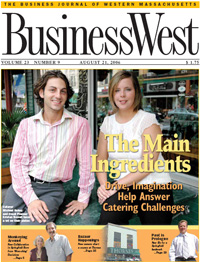
Sections Supplements
Collins Electric: A century of making connections
Larry Eagan, Bill Collins, and Joseph Collins say their company has the size and experience to respond quickly to the most demanding projects.

Larry Eagan, Bill Collins, and Joseph Collins say their company has the size and experience to respond quickly to the most demanding projects.

Wiring the Valley

Collins Electric Marks 100 Years of Making Connections

Bill Collins wants you to look at the Springfield skyline some night.

Note the buildings you see — Monarch Place, Tower Square, One Financial Plaza, the Marriott and Sheraton hotels, City Hall, and the Hampden County Hall of Justice. Collins Electric Co. has installed electrical systems — from lighting and alarms to phone and data lines — in all of them.

That’s an impressive resume for a company that began 100 years ago converting Springfield homes from gas light to electricity.

“In those days, the materials were delivered to the job by horse and buggy, and the workmen got to the site by trolley car,” said Collins, the company chairman who first joined his family’s operation in 1950.

A lot has changed since 1906, both in Greater Springfield and in the business of electricity overall. But Collins Electric, now headquartered in Chicopee, has endured as a family business now boasting four generations of history.

“How does a company stay in business for 100 years?” Collins asked. “It’s rather simple: we give our customers excellent service, and we have awfully good people who are very dedicated. We’ve had some customers for 80 years. Many other companies would like to have those customers, but our service is so good that people are delighted to have us as part of their team.”

This week, BusinessWest sparks up a conversation with a company that has been plugged into success for a century — with no sign of switching off the lights anytime soon.

Century of Change

Collins’ grandfather, John Collins, was the man who first loaded up the buggy and brought electricity into Springfield homes. “He was a good salesman, but not a good businessman,” Bill Collins said, so he persuaded his brother, Timothy, to help run the fledgling business in 1911.

In 1919, Collins Electric became a multi-generational family business, when John Collins’ son, William, joined as general manager.

“He felt there was a great opportunity in having a retail electric store, which he started during the Great Depression,” Bill Collins said. “There was no construction happening at that time, so the store really carried the company through the Depression.” After those years, in the buildup for World War II, construction began booming again, and Collins, now a long-established contractor, was well-positioned to take advantage of the momentum shift.

Over the next several decades, Collins Electric gradually expanded its range of services and scale of projects, becoming a full-service contractor offering both design-build and subcontracting services, depending on the needs of its clients.

The design-build element is especially important, said Larry Eagan, co-president of the company along with fellow fourth-generation officer Joseph Collins.
“We can truly give the best value to the customer by partnering with the owner and working on budgeting even as the construction is going on,” Eagan said. “We can make changes to stay on budget or make additions to the budget; either way, we give them the best value because we’re the installer as well as the designer.”

Not many electrical contractors have licensed engineers in-house to allow for the design-build option, Bill Collins added.

“Design-build work has some real advantages,” he said. “It allows the job to be done faster and at less cost than going with a conventional outside designer and a bidding routine.”

The facilities that have used Collins Electric in this capacity over the years — dozens of major names including the Berkshire County and Hampden County jails, the Wall Street Journal, MassMutual, Mercy Medical Center, Yankee Candle, and many of the Springfield skyline structures — speak to the company’s reach.

“We do work in Connecticut, and on occasion we go to New York, Vermont, or New Hampshire,” Collins said, “but our concentration is primarily in Western Mass.”

Built for Speed

As the largest employer of electrical tradespeople in Western Mass., Collins boasts a definite edge in its ability to respond quickly to large or difficult jobs, Collins said. And make no mistake: the industry has sped up, and customers have heightened their expectations on timelines.

“We find that the fast-tracking of jobs has actually helped our business because, being large, we have the manpower and resources to allocate to jobs,” Eagan noted. “We feel like we’re more responsive than many other contractors, which helps us perform better on a tight schedule when others would be hard-pressed to manage it.”

Bill Collins noted one recent school project in which another company was the low bidder, but could not commit to meeting the tight deadline, and Collins won the job instead.

“Everything is like that nowadays,” Joseph Collins added. “At some colleges, we’ll get an entire dorm renovation that has to be done in two months. Everything has sped up dramatically.”

Eagan said the company also separates itself from its competitors in its knowledge of electrical products on the market — some of it learned from experience. When T5 lights, a high-efficiency form of fluorescent lighting, appeared on the market several years ago, Collins installed them in its own warehouse for six months before determining that it was a reliable new technology for its customers.

“We know firsthand what products are best, and we’re up to speed with product reliability,” Eagan explained, “so we can recommend and install something that’s not only efficient but will also work well.”

A commitment to keeping abreast of industry trends has led Collins to several firsts, including the first fluorescent lighting system in the world, at the Springfield Armory in 1939 — a development so significant in energy efficiency that it helped many abandoned factories return to service to assist the World War II effort.

Bill Collins should know his history — he’s well into his sixth decade with the company. But he’s not the only one. Two employees who had joined Collins Electric out of high school recently retired in their 60s, and the company boasts other, similar lifetime relationships.

“We’ve got a loyal group of people,” Collins said. “They know they’re part of a good operation, and we pay them well. It’s a win-win situation.”

High Ground

Bill Collins noted that the company’s headquarters, at the east end of Interstate 291, is on geographically high ground, reflecting the fact that Collins Electric has, on several occasions over the past century, been able to help area businesses that were knocked out of service by floods.

But that elevated location also signifies the company’s position in the field of electrical contracting, and a reputation that has grown with each generation of the Collins family that oversees its legacy —even in times when the overall economic health of Western Mass. has ebbed.

“The economy does affect us a little bit; we’ve been through some pretty lean years, and we’ve been able to adjust very well,” Bill Collins said. “Even in those lean years, we’ve always been in the black.”

They’ve done that by keeping the Pioneer Valley in the light.

Departments

The following Business Certificates and Trade Names were issued or renewed during the month of March 2006.

AGAWAM

Agawam Music
326 Walnut
St. Ext.
John Stokosa

The Buccaneer
Lounge/Buc Inc.
86 Maple St.
Michael Fila Claire’s

Errand Professionals
36 Mountainview
St. Claire Cardin

D & D Remodeling
48 Cedar Knoll
Dr. Dan and Dave
MacWilliams

Earthly Designs
577 Mill St.
Heather Tourigny

Mowin’ n Blowin’
38 River St.
Gregory Barnette

Premium Landscape
Design
39 Vadnais
St. Matthew Biza

Tan Factory
850 Suffield St.
Jason Mancuso
Utopia Convenience Store
713 Main St.
Zafar Rana

AMHERST

Ben & Jerry’s
19 South Pleasant St.
Twilight Tone Inc.

Brazilian Fashion Style
321 Main St.
Henrique Daveiga, Ester
Rodrigues

Diana Ditmore
44 Summer St.
Diana Ditmore Beechhaven

Ink Solutions
233 North Pleasant St.
Serges LaRiviere

Louis J. Manfredi Consulting
1055 South East St.
Louis J. Manfredi

Quiznos Sub
181D University Dr.
Paul Bogacz, John Pielock

Short Story Press
60 Echo Hill Road
Michael Jenson

Yoga Center Amherst
17 Kellogg Ave.
Patty Townsend

CHICOPEE

DC Property Management
138 Grattan St.
Daniel Crane

J & B Property Maintenance
148 State Road
Britt Richards, Joseph Labonte

Johnson Interiors
77 Beauchamp Ter.
William Johnson III

Monkeys with Hammers
21 High St.
Elaine Schultz-Kehoe

EAST LONGMEADOW

Beauty Skin & Hair Studio
143 Shaker Road
Mary Jane Kelley

J & E Contractors
388 Elm St.
Eric and Joel Bousquet

Operational Success LLC
48 Shaker Road
Pedro Caceres

Premier Limousine
1 Panama St.
Wayne Roberts

Spartan Sport Shots
70 Bayne St.
William Sharon

Tranghese Auto Detailing
95 Hampden Road
James Tranghese

HADLEY

Emjoca
37 Spruce Hill Road
Tsuneo and Sachite Ichimura
QRSTUVR
71 Lawrence Plain Road
Christopher Gendron

HOLYOKE

AOK Improvements
120 Front St.
Edward Owen
Diva Fashion
303 High St.
Suk Hui Forrester
Sacrifice Recordings
168 West St.
Marvin Santiago

LONGMEADOW

Angel Feathers
362 Converse St.
Kelleen Batchelor

Kristine Kulesa Dineen
1617 Longmeadow St.
Kristine Kulesa Dineen

Nancy J. Miller-Sanborn CLU
666 Bliss Road #5
Nancy Miller-Sanborn

Strategic Property Solutions
19 Lincoln Park
Christine Tamsin

NORTHAMPTON

Baystate Medical Practices
118 Conz St.
Baystate Affiliated Practice
Organization Inc.

Direwolfe PC
1 Isabella St.
Dennison Wolf

German Automotive
286 Coles Meadow Road
Norbert and Renate Schulte

Jacobs Auto Transport
23 Cahillane Ter.
Paul Jacobs

What Do You Need?
16 Center St.
Thomas Herman

SOUTH HADLEY

Cumberland Farms #6718
507 Newton St.
Cumberland Farms Inc.

Lawns R Us Landscaping
193 Granby Road
David McAuliffe

Olde Time Service
609 Newton St.
Brian Kennedy

SPRINGFIELD

Alley Graphics
21 Clifton Ave.
Iasia Martin

Brown’s Painting
134 Malden St.
Lennie Brown Jr.

Diva Fashion
1153 Main St.
Suk Hui Forrester

413 Video Productions
40 Edgewood St.
Aaron Williams

HLW Consulting
4 Niagara St.
Haven Williams

Imagination Entertainment
101 Mulberry St.
Bianca Humphries
I Wireless
1156 Main St.
Phung Le

K.P. Bennett Trucking
100 Wheeler Dr.
Kevin Bennett

L.A. Construction
16 Athol St.
Barbara Dobronski

Lia Sophia
122 Cuff Ave.
Tracye Whitfield

Med Law Analysts
174 Patricia Circle
Joanne Kennedy

N.E. Auto Loans
242 Main St.
Jessica Amaro

Quick Cargo Services
44 Bissell Ave.
James Mbugua

Reyroso Construction
135 Oakland St.
Rascacio Reyrosa

Sullivan Factory Outlet
180 Avocado St.
Richard Spafford

Vibrations Hair Salon
120 Boston Road
Maureen Brown

WEST SPRINGFIELD

Affiance-Events Wedding
and Events
93 Charles Ave.
Angela Cooper

Baystate Medical Practices
West Springfield
46 Daggett Dr.
Baystate Affiliate Organization
Darlene Kurman & Assoc.
158 Edgewood Road

Darlene Kurman
Giovanni Pizzaria
88 Westfield St.

Gwendolyn Mirisis
Mass Trac
49 Prospect Ave.

Megan Landry
Pro Wireless
1362 Westfield St.

Rizwan Ahmed
R & G Heating & Air
155 River St.
David Goldrick

Roberts Executive Search
30 Capital Dr.
Robert Francoeur

Serguei Morozov Trucking
45 High St.
Serguei Morozov

V.R. Construction
96 New Bridge St.
Viktor Reznichenko

WESTFIELD

Crystal Childs Design
29 Stephanie Lane
Crystal Childs

Davenport Flooring
97 Fairfield Ave.
Michael Davenport

Frequency Deleted Records
342 Southwick Road
Anthony Cruz

Millwrite Machine Inc.
587 Southampton Road
Robert Valcourt

Quality Consultant
8 Pilgrim Dr.
Jason Lindwall

Stop & Go
35 Mill St.
Amir Paracha

Uncategorized

For most people, their home is their most prized possession. This is often true from both a financial standpoint and a sentimental one. Both aspects of your attachment are key factors to consider when planning to undertake a major home improvement, and there are things you can do to help assure your project satisfaction.

Know Your Contractor

When undertaking a major home improvement, you are placing a considerable amount of trust in your contractor. At a time when you can get medical advice, purchase real estate, and even obtain a college degree online, it can be tempting to surf the net to find a contractor. If possible, this should be avoided.
The best and most honest contractor advertising is previous customers. Ask your friends, family, and neighbors who they used. Check out the contractor’s work, and speak directly to the other homeowners. If you are unable to get a recommendation, and you speak to contractors found online or in the Yellow Pages, ask for references of jobs they have completed. If the contractor has performed well in the past, those homeowners will often be pleased to show off their own projects.

Check the Records

Every home improvement contractor must be registered with the Com- monwealth. Once you have tentatively selected a contractor, you should visit www.mass.gov/bbrs/hic.htm. This Web site allows you to confirm that your contractor is registered. If the one you have selected is not, a red flag should go off in your mind, and you should select another contractor.

The most important aspect of hiring a registered contractor is your future ability to access the Guaranty Fund. Should the project sour and a lawsuit follow, the Guaranty Fund will pay a judgment in your favor up to $10,000. In many cases, this represents the only ability you will have to collect on a judgment.

The Contract

Every contract between a homeowner and a contractor should be reduced to writing. Actually, by law, all contracts over $1,000 must be in writing. In most cases, the contractor provides a contract, and a homeowner simply looks at the price and services, then signs it. Most do not read or give weight to other provisions.
For example, one common provision is the recovery of attorney’s fees in the event that the contractor must file a lawsuit against the homeowner. While this may seem reasonable, it doesn’t permit you to recover your own attorney’s fees if you must file a lawsuit against the contractor as a result of poor workmanship. You should insist that reciprocal language be included with respect to any attorney fee provision.

The Payment Schedule

It is just as important how and when payments are going to be made as how much the entire project will cost. While you always hope that the project will go smoothly, even though careful precautions have been taken, problems can arise. If they do, and the contractor either decides to walk off the job or is terminated, it is critical that the payments made to date have not exceeded the value of the work done. While it is standard practice to make payments under a contract in thirds (one-third as a deposit, one-third in the middle of the project, and one-third at the end of the project), tenths are preferable.

For example, if the contract is for $60,000, in the first scenario you are paying $20,000 before any work is performed and then an additional $20,000 with half the project left to unfold. After each payment is made, you expose yourself to a $20,000 loss. In the second scenario, only $6,000 is paid at a time, limiting the amount of money paid for future services. If the project ceases at any time, you will be less underwater.

Keep Records

Undertaking a home improvement should be a pleasurable experience that provides fond memories. In this respect, taking photographs at various stages of the project and keeping a contemporaneous journal can be a nice keepsake. These can also be powerful tools should future litigation arise. In this event, you will need to articulate your claim, and it is true that a picture is worth a thousand words.

The ability to show a jury pictures of defects throughout all stages of construction can be extremely persuasive. In addition, by referring to a journal, exact dates and times of events and conversations can be testified to. This also makes the claims more persuasive.

Lien Waivers

Even if you are satisfied with the quality of the home improvement, you will still not want to pay twice for it. If payments to the general contractor are made before lien waivers are received, this is a possibility. In Massachusetts it is illegal to require a contractor or subcontractor to execute a blanket lien waiver prior to performing his or her services. Although a homeowner cannot require a contractor or subcontractor to agree that they will not file a lien upon your property at the onset of a project, this can be required at the time of payment.

In most construction contracts, especially ones for new construction, payments are made to the general contractor at different intervals throughout the project. Prior to tendering any funds to the general contractor, the homeowner should require that the general contractor and all subcontractors who will perform services on the project execute a lien waiver.

The Punch List

A punch list is created toward the end of a project. It lists items that that you and the contractor agree need to be finished or repaired. These are usually small items that are mostly ‘fit and finish’ issues. All too often, by the end of the project the punch list has many individuals’ scribbles on it, is illegible, and perhaps torn and coffee-stained.

Should your relationship with your contractor break down, you will look to the punch list as a basis for refusing to pay the remaining balance due on the contract.
To restore the value of the punch list, a computer can be of immense value. A list of items that need to be finished or corrected can be generated, then you and contractor can both sign it. This is evidence of what both parties agreed were the issues. As items are finished or repaired, both parties should initial them. Should a dispute arise in the future, your relationship will be unambiguously documented. And in the event that litigation ensues, the punch list will allow the disputed items to be clear-cut and well-defined, making litigation streamlined and less expensive.

As the old saying goes, an ounce of prevention is worth a pound of cure. This certainly holds true when undertaking a construction project. By following these steps, you can increase your chances of success.

Adam J. Basch, Esquire, is an associate with Bacon & Wilson, P.C. He is a member of the Litigation Department with expertise in the areas of construction litigation, personal injury, general litigation, and creditor representation; (413) 781-0560;abasch@ bacon-wilson.com.

Uncategorized

Last fall, as the MassMutual Center was getting set to open its doors, there were more than a few skeptics who doubted whether the $70 million facility would succeed in drawing events to Springfield and bringing people downtown.

Today, such doubters remain, but they’re considerably harder to find.

Granted, it’s only been a few months, and the success of such a massive public project is measured over a long period of time, but there are many signs that the facility is doing what it was designed to do — breathe some much needed life into downtown.

Two successful concerts, Martina McBride and Motley Crue, drew large crowds, and downtown parking lots have been jammed most weekends with mini vans and SUVs, the vehicles of necessity for audiences drawn to shows ranging from Dora the Explorer to pro wrestling; monster trucks to Disney on Ice.

This early success and the promise for much more — the March schedule was packed with events including auto and flower shows and college basketball championships — should give city officials and Financial Control Board members pause to consider creation of a broad strategy that will seize on the momentum being created by MassMutual Center.

It is clear that one doesn’t exist, because the facility has been left largely on an island, with very little to support it or to ‘extend the stay’ of visitors, as those in the travel and tourism business like to say. Indeed, while there are a few restaurants and attractions close by, there is little to keep those mini vans and SUVs from getting back on the highway after the shows end.

Extending the stay will take a coordinated effort, one that will require steps ranging from a beefed up police presence to finding some way to bring the long-stalled plans for a boutique hotel in Court Square to reality. And there will be a number of challenges, ranging from economics to the deteriorating condition of the Court Square building.

But right now, the MassMutual Center is a vital component of the overall economic development strategy in Springfield, and thus city and state officials must be aggressive in pursuit of ways to extend the building’s influence beyond its four walls and downtown parking concessions.

Put another way, they need to facilitate what should be — if the MassMutual Center continues on its current path — an intriguing exercise in the laws of supply and demand. How? For starters, they could explore options to incentivise national restaurant chains, especially those that cater to families, to look at and eventually invest in downtown Springfield. Meanwhile, they should engage downtown property owners in discussions on ways to bring in new businesses, ones that will complement the MassMutual Center.

City officials and the Control Board must also continue their work — there has been noted progress — to make the downtown cleaner, brighter, and safer.

And there must be a concerted effort to somehow rescue plans for a hotel at the Court Street property or find some other use for the century-old building. At present, the city is moving to foreclose on the property, burdened with more than $1 million in back taxes and a dispute over them between the city and the Picknelly family, which purchased the historic property several years ago.

Control Board officials say they are restricted in what they do in terms of forgiving back taxes and interest, and remain hopeful that there will be interest within the development community for such a venture. We are not as optimistic, and believe that a way should have been found to allow the Picknelly family to move ahead in its endeavor.

Foreclosure will likely serve to only delay this project further, not move it forward.

The MassMutual Center is not going to turn Springfield into Orlando. The city’s downtown isn’t likely to become a real destination any time soon. But the early success of the new facility provides a measure of optimism, a sense that it can bring greater prosperity to that area — if some encouragement is provided.

The city and state invested more than $70 million in the MassMutual. Now it needs to invest some time and energy to make sure it doesn’t remain an island.

Uncategorized

When Pulitzer Prize-winning dramatist and Mount Holyoke College alumna Suzan-Lori Parks delivered the college’s commencement address five years ago, she remarked “when you wish for it, you begin moving toward it, and it, in turn, begins moving toward you.”

That’s a sentiment that this private women’s liberal arts college, established in 1837 by Mary Lyon, has held onto since Parks spoke those words. In fact, it now uses them in some admissions materials sent to prospective students.

And, in many ways, the essence of the message describes the school’s efforts to become ever more visible in the community and take an active role in educational, cultural, and economic-development-related initiatives. Indeed, as the college moves closer to the community, and especially the town of South Hadley, the community moves closer to the school.

Mary Jo Maydew, vice president for Finance and Administration at Mount Holyoke College, said the institution has historically been a ‘friendly resident’ of South Hadley, serving not only as a landmark institution – it is one of the vaunted Seven Sisters of women’s higher education, and the first – but as a partner in a number of ventures, from conservation efforts to development projects.

The school’s contributions can be quantified, said Maydew, noting that the college disseminates an economic impact report annually, which breaks down the various events, programs, and contributions the college has made throughout the course of the year that have, directly, or indirectly, had a positive impact on South Hadley and the region as a whole. But they can also be qualified through a growing number of partnerships and collaborative efforts that include everything from programs for area elementary school students to the 2004 U.S. Women’s Open, played at a golf course, The Orchards, owned by the school.

“We began offering this information to the town for use during its annual town meeting,” said Maydew, referring to the economic impact report. “We didn’t think people fully understood the economic impact of the college, and we also sensed a lack of understanding in regard to what the college does and how it fits into the life of the community.”

College Town

Referencing the report, Maydew said the college contributes regularly to town programs and purchases, including two $25,000 infusions to the town’s stabilization fund in 2003 and 2004, a town grant program that assists graduates of South Hadley High School who attend Mount Holyoke College, and a recent $300,000 pledge toward the purchase of the Bachelor Brook property, a $1.55 million transaction the town has undertaken in order to preserve the property for passive recreational use.

Donations such as these are a large part of the annual reports, as are the more constant economic variables provided by the college, including jobs, tax dollars, and property development within South Hadley.

The college has a $447 million endowment and an $89.4 million operating budget for FY 2005-2006. In addition to bringing about 2,100 students to the area each year, Mount Holyoke is also one of the largest employers in the area, with an annual payroll of $48 million and a workforce of 1,050.

Beyond that, though, the college’s economic impact report for 2005 states that the college made $13,619,457 worth of purchases within the four counties of Western Mass. alone, $5 million of which was spent in South Hadley, where MHC is also one of the largest taxpayers, paying about $136,000 in property taxes.

Maydew said that while the college remains relatively neutral when it comes to town issues, financial and development-related or otherwise, Mount Holyoke does communicate regularly with town officials and regional leaders in order to maintain a strong voice within the community.

“Interactions between colleges and towns have to be ongoing and cooperative,” she said. “We keep in touch with the businesses in town and meet with the chambers of commerce regularly. We don’t enter discussions with particular points of view, but we are mindful that we are a big player in this area, and if we can make a difference or have an effect, we need to contribute.”

That is particularly important for Mount Holyoke, given the college’s physical reach extends beyond the campus in South Hadley. In addition to the 800-acre campus, the college also owns the Village Commons, the office, retail, and restaurant complex located just across the street, and The Orchards. Those two ventures alone employ nearly 400 people, and in 2004, the property taxes paid to the town between the two holdings exceeded that paid for the college itself – about $155,000.

Maydew said it’s numbers such as these that the annual reports help call greater attention to, as well as the morenebulous economic benefits Mount Holyoke offers, through various events and programs.

One of the more visible examples of college-sponsored events was the U.S. Women’s Open, a mammoth undertaking that Maydew describes as a true partnership between the college and the community. The event brought millions of dollars worth of economic activity to the region, but Maydew said other, less-visible programs held at Mount Holyoke are held year-round, benefiting residents and bringing in a steady influx of visitors.

The Mount Holyoke College Art Museum and the Talcott Greenhouse are active throughout the year, for instance – both are involved in the region-wide Go Dutch! program, celebrating Dutch art and culture and sponsored by Museums 10, a marketing partnership of 10 college and independent museums of which Mount Holyoke is a member.

The college also has a robust conference schedule, particularly in the summer months, when visitors academic and otherwise flock to Mount Holyoke for a number of programs, ranging in length from days to months in session.

“We have enormous stability in the area of conferences and events,” said Maydew. “We typically stage several at a time, and we’re booking one to two years out.”

In addition, more than 1,000 school-age children from across the region participate in the museum’s educational programs, and Maydew said a number of community and cultural events are open to the public, often free of charge or at a nominal fee.

“We try to make the campus as permeable as possible,” she said. “Anything that demystifies the college is an immediate benefit.”

The New Recruits

Maydew said that practice can also aid in marketing future opportunities, as well.

Opportunities such as the economic impact colleges can create by stimulating the area’s educational landscape, through partnerships with the region’s community colleges.

Kevin McCaffrey, associate director of communications at Mount Holyoke College, said the college recently secured a $779,000 grant from the Jack Kent Cooke Foundation, which will enable Mount Holyoke to offer scholarships to students transferring to the school from Holyoke Community College or Springfield Technical Community College. Amherst College also received a similar grant.

“We’re looking at community colleges as untapped sources for high-achieving students,” he said, “and this grant is going to help us step up a number of programs we already have in place.”

McCaffrey added that with an already strong national and international presence, it has become a particular goal of Mount Holyoke’s to improve its visibility within Western Mass.

“There won’t be any particular focus on any specific type of student,” he said, “we want to attract high ability, high achievement students from wherever we can get them.

“But, we would like to reach out to people who might not at first see Mount Holyoke as an obvious choice for schooling,” he continued, “through some more continuous communication with the region. This is an opportunity to make some new, strong partnerships.”

Those partnerships are something the college wished for, and it’s a goal Mount Holyoke is moving toward.

And it, as Parks might say, is beginning to move toward the institution, as well.

Jaclyn Stevenson can be reached at[email protected]
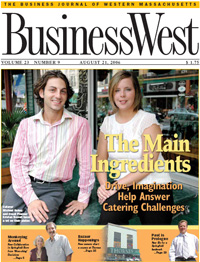
Uncategorized

A Phantom Stock Plan can be an attractive incentive option for an employer to provide a valued key employee with a financial stake in the growth of a company without actually giving the employee an actual ownership interest in the company or a vote regarding management of the company.

What follows is an overview of the basic structure of phantom stock plans as well as issues to consider with regard to creating such a plan.

Taking Stock

A phantom stock plan is a plan whereby a company gives an employee ‘phantom’ shares of stock in the company rather than real shares. Awards of phantom shares are generally given to employees based upon performance at the discretion of the employer at various times chosen by the employer. Phantom shares represent the right of the employee to cash payments upon the occurrence of a triggering event such as the employee’s death, termination of employment (in certain circumstances), retirement, or disability. The employee never actually owns stock and thus obtains no stockholder rights under the plan.

Phantom shares can typically be converted into cash payments to the employee under either of two scenarios. Under a ‘stock’ approach, the phantom share could be given the same economic value as if the employee were given an actual share of stock in the company. Thus, if the employee were given one phantom share and the value of the company never increased between the date of the grant and the date the phantom shares are ‘redeemed’ by the company, the employee would receive a payment equal to the value of one share of stock of the company.

An alternative is a ‘stock appreciation right’ approach, which values the phantom share at the date of the grant at the same value as the actual shares of the company at the time of the grant. When the phantom share is ‘redeemed’ the employee gets paid the difference between the value at the date of the grant, and the increased value, if any, at the date of redemption. Under this method the employee would only receive payment if the value of the company increased between the date of the grant and the redemption.

Phantom stock plans are not only attractive options to award key employees and retain their services by giving them a stake in the growth of a company, but they are also an attractive plan for employees and employers from a tax point of view, because the employee is not taxed upon receipt of phantom stock shares.

Rather, employees are only taxed upon their receipt of a cash payment from a phantom share award or sooner if pursuant to the plan the employee has the right to demand a cash distribution. Note that the plans are also attractive to employers as well as the company is typically entitled to deduct (as compensation) from its taxable income the payments made to employees pursuant to phantom stock plans. Payments to the employee are taxed at ordinary income tax rates.

Limitations on the Amount of Phantom Shares/Method of Granting.

Most phantom stock plans place a limitation on the number of phantom shares or percentage of the value of the company that will be granted pursuant to the plan. There are different ways in which the granting of phantom shares is structured. One method involves creating a schedule providing for a certain number of phantom shares to be granted each year for a term of years (such as 10 years) to be vested immediately upon the grant of the phantom shares.

For example, the employee would earn the right to the phantom shares for each year that he or she completes employment, subject to vesting. A twist on this approach is to grant a certain number of phantom shares each year (unvested) and provide that the shares vest after a certain term (such as 5 or 10 years or upon retirement after a certain age).

Another alternative to the grant schedule is for the employer to grant shares to the employee periodically at its discretion without a predetermined schedule but according to the employee meeting certain performance goals set each year. However, this method is less common because it typically does not provide the employee with any degree of certainty or security that his or her efforts will be rewarded, and may not have the ‘golden handcuff’ effect that most employers are seeking when establishing these plans.

One further alternative to annual grants (and which is somewhat related to the scheduled grants) is a one-time grant of a block of phantom shares, all of which vest at a certain time in the future (such as over 10 years) assuming no other triggering events occur prior to that time which would cause the shares to vest earlier or cause the shares to be forfeited.

Vesting/Other Triggering Events.

The phantom shares to be granted to an employee (irrespective of the method selected) should be vested over a term of years. Typically, if an employer chooses a term vesting plan or vesting schedule, the employee’s phantom shares are generally immediately vested under certain circumstances, including a change in control (such as a sale of the business), in the event of the employee’s death or disability, or if the employee is fired without good cause. If an employee is fired ‘for cause’ (i.e., for engaging in illegal or harmful conduct during the scope of employment), or if the employee resigns, all of the employee’s phantom shares are typically forfeited without payment irrespective of whether they are vested or not.

Payment of Phantom Share Awards.

Some phantom stock plans provide the employee with the right to exercise (cash out) their phantom share awards upon the vesting of the phantom shares. However, it is much more prudent to structure the plans in a manner in which the phantom share awards will only be payable upon certain triggering events such as termination of employment (other than termination for cause), death, disability and change of control.

Valuation of Stock.

If the phantom share award is based upon the increase in the value of the company from the date of the grant of the phantom shares until the date of the payment of the phantom share award, the plan must establish a means of evaluating the fair market value of the company. This value would be determined through a formula, which is described in the plan. The formula should accurately reflect the true value of the company and once the plan is put into effect, the formula typically cannot be changed unless both the employer and employee agree to the change. Normally, the formula takes into account the value of assets and goodwill.

Non-Competition/Non-Solicitation.

Most employers require plan participants to sign a non-competition/non-solicitation agreement in exchange for implementing the phantom stock plan for their benefit. The execution of this type of agreement is typically a condition attached to the participation in the phantom stock plan and is usually not considered to be unreasonable in light of the benefits to the employee associated with this type of plan.

In summary, phantom stock plans are very flexible agreements that may be specifically tailored to all businesses and employment relationships. They have increased in popularity over the past several years due to the fact that they provide the employer with an option to reward a valued employee with a financial stake in the success of a company and provide a means of retaining the employee without actually giving up a voting interest or stock in the company, which can help eliminate costly shareholder/member/partner disputes in the unlikely event that the employee/employer relationship deteriorates in the future.

Bruce E. Devlin, Esq. is an associated attorney at the law firm Robinson Donovan, P.C.; (413) 732-2301.

Departments

David Pinsky has been named President and Chairman of the Board of Tighe & Bond of Westfield. Joining the firm in 1988, Pinsky has led many project teams with his expertise in water supply, distribution and treatment.

•••••

Debra Mahannah

Debra Mahannah has joined The O’Leary Company of Southampton. She brings more than 20 years of experience in the design and management of office renovation projects in Western Massachusetts and Connecticut.

•••••

Carla Oleska, Ph.D., former Associate Academic Dean of Elms College, Chicopee, will serve as Executive Director of the Women’s Fund of Western Mass., based in Easthampton.

•••••

Architect Jeremy Toal, AIA, has joined Dietz & Company Architects of Springfield. Toal’s previous works incorporated renewable energy, energy efficiency, and healthy, durable, natural materials.

•••••

Massachusetts Mutual Life Insurance Company in Springfield announced the following:
• William F. Glavin, Jr. has been appointed head of the Individual Insurance Group at Massachusetts Mutual Life Insurance Company. He moves to MassMutual from his position as President and CEO of Babson Capital Management LLC. Both MassMutual and Babson Capital are members of the MassMutual Financial Group family of companies.
• Charles Schuhmann has been named Western Life Sales Manager, and
• Bradford Smith has been named Eastern Life Sales Manager.
Both Schuhmann and Smith will be responsible for MassMutual’s field wholesaling force that delivers life insurance products to independent life brokerage agencies and third party marketing firms in the western and eastern regions respectively.

•••••

Susan L. DeFeo

Susan L. DeFeo has been elected Senior Vice President, Director of Operations and Technology at Florence Savings Bank.

•••••

Sarah J. Zingarelli recently joined the Pioneer Valley Planning Commission of West Springfield as a Planner in the Land Use and Environment section.

•••••

UMass Amherst alumni Ellen Ferraro and Regina Valluzi will be honored by Mass High Tech as Women to Watch 2006. Mass High Tech is a weekly publication, based in Boston, which focuses on business and technology challenges in New England. Ferraro is the deputy director of the system validation, test and analysis directorate for Raytheon Integrated Defense Systems, and Valluzi is the founder and chief scientific officer of Evolved Nanomaterial Sciences. Both women were among 10 New England-based women who were recently recognized as future leaders and innovators at an awards dinner in Boston.

•••••

T. David Constant

Webster Bank announced the following:
• T. David Constant has been appointed Vice President of the West Springfield office, and

Amybeth Perry

• Amybeth Perry has been named Vice President of the Westfield office.


•••••

Sherry Leastman has been promoted to Branch Manager of Countrywide Home Loans’ Northampton branch, where she will be responsible for developing Hampshire, Franklin and Berkshire counties.

•••••

Matthew Nocton has been promoted to Senior Account Executive for MassLive.com. He will oversee major local and regional accounts.

•••••

Lisa Watts, owner of Cold Spring Events in Belchertown, has earned the designation of Certified Bridal Consultant through the Association of Bridal Consultants.

•••••

Crystal Carrol has joined the Palmer office of Carlson GMAC Real Estate as a Sales Agent.

•••••

Zoar Outdoor in Charlemont announced the following:
• Nicole Yezierski has been appointed Office Manager, overseeing customer service, reservations and group sales;
• Michael Porter has been appointed Assistant Rafting Manager.

•••••

Darryl Thomas has joined 84 Lumber in West Springfield as a Manager Trainee.

•••••

Lawyer Richard S. Ravosa Jr. has been recognized by Massachusetts Lawyers Weekly as a “Rising Star/Up and Coming Lawyer.” Ravosa has offices in Springfield and Boston, and is the founder and executive director of Town & Country Legal Associates, with offices in Springfield, Boston, Salem and Natick.

Gregory M. Schmidt has been named an Associate in the commercial transaction and banking practice of Doherty, Wallace, Pillsbury and Murphy P.C.

•••••

Vicki S. Donahue has been named a Director for Cain Hibbard Myers & Cook PC in Pittsfield. She has been an Associate with the firm for eight years.

•••••

United Bank of West Springfield announced the following:
• Joseph Young has joined the staff in Westfield as a Senior Vice President of Commercial Banking, and
• Darilynn Nardi has joined the staff as Assistant Vice President of Branch Administration.

•••••

Noble Health Systems in Westfield announced the following:
• James C. Hagan has been elected Chairman of the Board;
• Mark A. Morin, Vice Chairman;
• James F. Shea, Treasurer;
• Timothy P. Scanlan, Secretary;
• George J. Koller, President, and
• Murray Watnick, M.D., has been elected as a Trustee.
Board members also include Robert J. Bacon, John M. Greaney, Carol A. Kauffman, Robert L. LaPalme and Richard K. Sullivan Jr.

•••••

Bruce Leshine has joined the law firm of Jorden Burt LLP, as a Partner in the technology practice group. The firm has offices in Simsbury, Conn., Washington, D.C., and Miami.

••••

Monson Savings Bank announced the following:
• Carolyn E.D. Szarlan has been named Vice President for Information Technology, and
• Daniel R. Moriarty has been named Vice President of Finance.

•••••

Country Bank in Ware announced the following:

Denise Jaworsk

• Denise Jaworski has been promoted to Treasurer, and will be in charge of the bank’s finance and budget functions;


Robert Paulsen

• Robert Paulsen Jr. has been named Vice President of Commercial Loans, and will oversee the development of new and existing business relationships; and


Christopher Wszolek

• Christopher Wszolek has been named Vice President of Commercial loans, and will also oversee the develop ment of new and existing business relationships.

•••••

Debra Mahannah recently joined the staff of The O’Leary Company of Southampton, MA. She brings more than 20 years of experience in the design and management of office renovation projects in Connecticut and Western Massachusetts. Mahannah is a member of the Construction Institute and the National Association of Women in Construction. The O’Leary Company is celebrating its 50th year as a full service design-build firm specializing in large scale commercial and industrial construction.

•••••

Larry A. Letendre

Larry A. Letendre, Jr. recently joined Southbridge Savings Bank as the Branch Manager of the Ruthven Ave. location in Worcester. His responsibility is to establish new customer relationships with consumers and local businesses. Aside from his managerial duties, he plans to continue working with community groups in the area including Worcester Housing and the Worcester County Food Bank.

•••••


Beverly Ouellette

Beverly Ouellette joined the Phillips Insurance Agency Inc. as its new Benefits Director. Her responsibilities will include the management and marketing of the life, health, and employee sponsored benefits products.

•••••

Michelle N. Theroux, M.Ed., LMHC, has been named Executive Director of Child & Family Service of Pioneer Valley, Inc. Ms. Theroux served most recently as Director of Family Networks at Key Program, Inc., and was previously the Family Based Services Program Manager at Key. She is an adjunct faculty member in the Department of Psychology at Springfield College, teaching courses in Behavior Management and Life Span Development.

•••••

James C. Hagan was recently elected Chairman of the Board of Noble Health Systems. A Westfield resident, Hagan is the President of Westfield Bank. Other officers are Mark A. Morin, Vice Chairman; James F. Shea, Treasurer; Timothy P. Scanlan, Secretary and George J. Koller, President. Murray Watnick, M.D. was elected as a trustee. Other board members include: Robert J. Bacon, John M. Greaney, Carol A. Kauffman, Robert L. LaPalme and Richard K. Sullivan, Jr. Noble Health Systems is the parent corporation of Noble Hospital, Noble Visiting Nurse and Hospice Services and Westfield Medical Corporation.

Uncategorized

The salespeople employed by James J. Dowd & Sons Insurance Agency have, on average, more than 20 years of experience selling insurance products. And they’ve always done things their way.

“Now we require our salespeople to use PDAs,” said John E. Dowd Jr. one of the agency’s three partners, referring to the handheld electronic devices used to store and transmit information. “They’re all going high-tech – some of them kicking and screaming.”

OK, so maybe that’s an exaggeration – the fact that Dowd’s salespeople carry portable digital assistants and have learned how to navigate cutting-edge database software in the office hasn’t caused any actual screaming.

But still, “for people who have done things a certain way for 20-plus years, saying we’re going to throw away paper and centralize our technology has been a big challenge,” Dowd said. “And if we insist that they become high-tech, we have to provide the training for them to utilize the technology in which we’ve invested so heavily. Our challenge is to teach people how to use it in a way that makes them better salespeople.”

In short, even a company that has been a part of the Pioneer Valley for 108 years needs to continually adapt to new modes of doing business, Dowd said.

Long History

While the Dowd agency has long been a recognized name in the region, its origins are humble. James J. Dowd was one of 14 children brought to America by their father in 1865 to escape hard times in County Kerry, Ireland. In 1898, he and partner Jeremiah Keane opened the Keane and Dowd insurance and real estate business in Holyoke.

The company was renamed James J. Dowd & Son before Dowd’s son took over the firm in 1916, eventually moving it into a new, larger building on Suffolk Street in 1926. Over the next 50 years, two more generations of Dowds would move into company leadership. The agency moved into its current location on Bobala Road in 1993 and boasts branch offices in Amherst and Southampton.

Today, as part of the fourth generation of Dowds at the company, John Dowd says his path was inevitable. “I thought about no other careers,” he told BusinessWest. “From the time I started thinking about what I would do when I got out of school, I had only the insurance business on my mind. It’s in my blood.”

That heritage includes a well-honed sense of when to adapt to the changing times. For example, to survive in an increasingly competitive marketplace, today’s insurers have become more creative with the range of services they offer, and Dowd is no exception.

“We offer all lines of property and casualty insurance for any size business, from a corner store to a publicly traded company with worldwide operations. We have that range,” Dowd said, adding that the company also offers several personal lines, such as homeowners’ and auto insurance.

But in addition, Dowd also carries financial products ranging from life insurance and investment services to employee benefits such as 401k plans and health insurance.
“The idea is to become a one-stop shop for insurance and financial services,” he said. “We’re looking to expand that where it makes sense to provide other services that our customers might like to have available. From our standpoint, that’s the direction the industry has gone.”

The major shift came in 2002 when banks were allowed to sell insurance. “We, in essence, now look at them as competitors,” Dowd said, “so we compete with them not only on insurance, but on financial services as well. That really opened up the financial marketplace to where different services that were once separated are now sold under one roof.”

But the products Dowd offers are only one factor in the company’s success. He said customer service is crucial to building and keeping a loyal clientele.

“We’ve long recognized that we sell services and products similar to what’s being sold by many of our competitors,” he said. “But it happens to be a complex product that can be fraught with potential problems, concerns, and misunderstandings. We feel we need to see things from the customer’s standpoint, anticipate their needs, and make the whole process as easy as possible for them.”

That means putting a premium on finding information for clients quickly and making sure they’re able to talk to a person on the phone, not an automated wall of options behind an 800 number.

“People want to have their hand held, and we want to hold their hand,” Dowd said. “We’ve done surveys of our clients to assess how well they are treated, not just by us but by their insurance carriers and people in claim services. If it’s not a positive experience for whatever reason, we make sure that the parties involved are aware, and that steps are taken so the same problems don’t occur next time.”

He said those surveys produce consistently high feedback ratings, but he pays close attention to the few that do not. “Those are the people who can shape your reputation. For better or for worse.”

Repeated Cycles

In order to build a strong reputation over 108 years, a company in any industry must go beyond offering strong products backed by solid service. Part of the challenge is anticipating and riding shifting trends, and insurance is particularly sensitive to market shifts.

For example, throughout the 1990s, rates stayed low in a soft market as insurers were happy to underwrite policies at a loss because they were making more profits by reinvesting that money in financial markets, often to double-digit returns. But that couldn’t continue forever, and the market was already hardening when the terrorist attacks of Sept. 11, 2001 accelerated that process.

“Many insurance companies went out of business. It did turn the industry upside down for a time,” Dowd said. “But we’ve grown accustomed to going from a soft market to the inevitable hard market and back to a soft market. It’s a fairly predictable cycle. When insurance companies experience losses, they need to restore their surplus and profit margins.

“There is a softening now,” he added, “but it’s not in all segments of the marketplace. The challenge is to know which ones are susceptible to softening and which ones aren’t.”

One trend that emerged from the hard market following 9/11 was a new emphasis among companies on internal loss control and loss-prevention measures, such as disaster-recovery plans and safety awareness programs.

“Claims are inevitable, but good loss control minimizes the number of claims,” Dowd said. That, in turn, allows insurers to gradually sell policies at a lower price, and competitive pressures eventually toward another softening trend – that predictable cycle Dowd talks about.

Other trends have emerged in recent years as well, particularly in response to major insurance events. For example, following the devastation along the Gulf Coast last year following hurricanes Katrina and Rita, it’s difficult to find coverage for coastal properties, including on Cape Cod, Dowd said.

Around the World

James J. Dowd & Sons has come a long way in more than a century of insurance and financial services, now reaching around the globe as part of an international insurance network.

“If you have operations in Singapore, I can provide coverage for you,” Dowd said. “We’ve been able to provide everything from workers’ compensation to property and liability coverage for publicly traded companies as far away as Asia. This is a smaller world than we used to live in, and we can now insure companies with a global exposure.”

Whether dealing with customers around the world or close to home, he said, it helps that Dowd shares a strong relationship with its carriers, some of whom have been associated with the agency for 100 years.

“Those relationships do come into play when settling claims,” he said. “Our carriers trust us; they trust our knowledge and integrity, and that’s important to us.”

Dowd also boasts of the quality of his employees, not only the experienced sales force, but support personnel – a team he calls the strongest in the company’s history.

Still, he worries that the pool of insurance professionals on which to draw is shrinking, which is why the agency is teaming up with Holyoke Community College to help provide insurance-related courses and assist students with internships.

“We want to help this industry grow by helping people get into this business, so we can continue to have strong professionals serving our clients,” he said.

And if, along the way, they learn how to use a PDA, that can’t hurt.

Departments

Heart Ball 2006

Below, Red drapes decorated the banquet room at the Log Cabin Banquet and Meeting House in Holyoke, site of Heart Ball 2006, staged by the American Heart Assoc. At right, Allison Belanger (left), account executive for the Healthcare News, BusinessWest’s sister publication, and Jaclyn Stevenson, senior writer for BusinessWest and The Healthcare News, pose with plaques awarded to the two publications in recognition of sponsorship and coverage of the AHA’s fundraisers and awareness events held in the Pioneer Valley this year.


The 2006 Heart of Gold Award was presented to Craig Rydin, CEO & Chairman, Yankee Candle Company.

Here, Linda, Craig and Brent Rydin and Lauren Ayers pause for a photo.

Attendees at the Heart Ball were able to take part in an extensive silent auction, as well as a live auction later in the evening. All proceeds went toward the continued fight against heart disease.

Fitness 5K

Above, runners and walkers at the starting line for the 13th annual Western Area Mass Dietetic Association (WAMDA) Fitness 5K Run/Walk, held on Saturday, March 4 at Look Park. WAMDA also held a fitness and health fair, celebrating National Nutrition Month.

Cindy Boutiette gets her blood pressure checked by Jayne Heede.

Grand Opening


U.S. Rep. John Olver chats with Jean Forget, a long-time supporter of the Holyoke Health Center, at the grand opening ceremonies.

Above, Executive director of the Holyoke Health Center Jay Breines poses with Joe Flatley, a guest speaker at the grand opening of the center’s new facilities in downtown Holyoke.

By the Book

On Feb. 27, Holyoke Mayor Mike Sullivan read to a group of children at the Holyoke Mall’s monthly Storytime. Sullivan is one of several special guest readers who visit the mall regularly.

‘Market’ Prep

Deb Boronski, vice president of the Affiliated Chambers of Greater Springfield, leads an informational program for exhibitors planning to take part in the 2006 Business Market Show at the MassMutual Center on April 5.


Uncategorized

The annual spring trade show of the Affiliated Chambers of Commerce of Greater Springfield moves to the MassMutual Center for 2006. Organizers say the new venue provides facilities and amenities that will take the Market event to a higher level and bring greater value for exhibitors and visitors alike.

Deb Boronski says a new venue, the MassMutual Center, will no doubt generate some excitement and curiosity for the 2006 Business Market Show, set for April 5.

“People are always asking, ‘what’s new for this year?’” said Boronski, vice president of the Affiliated Chambers of Commerce of Greater Springfield and coordinator of the Market event for the past several years. “Well, now we’ve got a pretty good answer for them.”

But the gleaming new convention center will do more than draw some attention to the event and perhaps a bigger crowd, she said; it will also create a bigger and better show.

Elaborating, she said the facilities at the center, especially the smaller function rooms, will enable organizers to schedule a number of programs and seminars during the day — from the monthly luncheon of the Advertising Club of Western Mass. to the launch of the Affiliated Chambers’ new Division of Business Excellence.

The number and variety of scheduled programs has even prompted organizers to change the event’s name. “It’s no longer just a trade show,” said Boronski, “we’re calling it a conference and exhibition.”

And it is one that will likely live up to that often-used phrase ‘something for everyone,’ she said. In addition to the nearly 200 booths on the exhibition floor, the 2006 show will feature seminars on everything from identity theft to Internet marketing; the region’s burgeoning Hispanic market to making full use of those electronic gizmos.

“This is not just a trade show any more it’s a showcase,” said Boronski. “What we’re doing is giving businesses more reasons to send more of the people to the show.”

Getting Down to Business

As she talked with BusinessWest in the main exhibition hall at the MassMutual Center, Boronski said the $70 million facility, opened last fall, gives show organizers a large degree of flexibility simply not obtainable at the Eastern States Exposition, the show’s home for the past decade.

“The Big E was a great venue, it served us well for many years,” she said. “But we were limited in some of the things we could do there; it was essentially one big room, which made it more difficult to conduct break-out sessions and seminars. Here, we have the facilities to do a lot more of everything.”

And, in the progress, provide the change and value (to both exhibitors and visitors alike) that a show must provide to succeed, she explained.

“Each show is going to be different from the one before,” she said, noting a turnover rate among exhibitors of about 30%. “But we strive each year to bring new programs and events that will give people ample reason to leave their offices and plants and come to the show.”

This year, there will be a number of incentives for coming to downtown Springfield, starting with the annual breakfast and its keynoter, Steven Little, a senior consultant for Inc. Magazine, who will speak on business growth and what he calls the “future of opportunity.”

Meanwhile, the Advertising Club of Western Mass. will stage its monthly luncheon at the show, and is inviting exhibitors and visitors to join in the festivities. Reservations will be needed for the luncheon (tickets are $25 for ad club members and $30 for non-members; visit www.adclubwm.org), which will include the program Branding: Making Your Mark. It will feature regional case studies that will examine the elements of effective branding.

In the afternoon — 4 o’clock to be exact — the ACCGS will launch its new Division of Business Excellence. A successor to the membership-driven agency SPACE, the Springfield Area Council for Excellence, the DOBE as it’s called will provide a number of services aimed at helping area companies become more competitive in a global marketplace.

These will include informational programs as well as linking business owners with consultants who will provide assistance on a fee-for-service basis with implementation of business excellence strategies including Kaizen, lean manufacturing, Six Sigma, and others.

“We thought the Market show was the perfect forum for us to launch the business excellence division,” said Boronski. “There will be hundreds of business owners and managers there, giving us an opportunity to generate awareness of the division and how it can make the region more competitive.”

Market 2006 will also feature a number of free business seminars, to be staged in morning and afternoon sessions, in the MassMutual meeting rooms next to the exhibition hall. The scheduled programs include:

  • Managing Your Electronic Gizmos and Office Technology, a how-to and ‘how-to-get-the-most-out-of-your-devices’ hosted by Sean Hogan, president of Hogan Communications;
  • Grow Your Business — Hire Right, led by Ethan Bloomfield of HRD Press;
  • The Business Incubator at the Andrew M. Scibelli Enterprise Center, led by Thomas Goodrow, vice president of Economic and Business Development at Springfield Technical Communnity College;
  • Entrepreneurship: Make the Transition to Grow Your Business, led by John Rogers, dean of the School of Business at American International College;
  • Internet Marketing, presented by David Flaherty of Ashton Services;
  • Run Your Business So You Can Leave it in Style, a panel discussion coordinated by the Bank of Western Massachusetts;
  • Focus Your Marketing Vision, led by Tina Stevens, president of Stevens Design Studio;
  • Improve Team Collaboration and Have Fun, led by Robert Rasmussen, president of Robert Rasmussen and Associates, LLC;
  • Understanding New England’s Hispanic Market Potential, led by Hector Bauzá and Francisco Javier Solé, of Bauza & Associates in Holyoke;
  • Credit Reports, Nondisclosure Laws, and Identity Theft, led by Guy Swiatlowski of Cambridge Cradit Counseling;
  • The LifeBridge Free Insurance Program, led by the MassMutual Financial Group;
  • Treat Business Like a Business and Family Like Family, a panel discussion coordinated by the UMass Family Business Center; and
  • More on the Future of Opportunity, led by Steven Little, senior consultant for Inc. Magazine.

The attractive lineup of events should attract a larger number of visitors than previous shows, said Boronski, adding that she is hopeful that individuals working in downtown office towers will set aside at least some of their day for the show.

“They don’t have to get in their cars and drive anywhere,” she said, noting that some people working downtown were put off by the prospect of driving to the Big E. “There are 9,000 pre-paid parking spaces in downtown Springfield — if we can get just 10% of those people to come to the show, that’s an additional 1,000 visitors, and that would make the event so much better.”

Show Time

The 2006 Business Market Show will be the 17th edition of the event, said Boronski, adding that since year 2, the goal — and the challenge — for organizers has been to make the show different and better.

The MassMutual Center provides the setting and the amenities to make that assignment somewhat easier, she said, noting that additions for this year take the event well past the label trade show.

“We’ve gone to a new, much higher plane,” she explained. “We’re still a showcase of 200 area businesses, but now we’re so much more than that.”

Fast Facts

What:The 2006 Business Market Show Conference and Exhibition
When:April 5
Where:The MassMutual Center in downtown Springfield
Schedule:Breakfast is at 7:15; the business exhibition runs from 9 a.m. to 5 p.m.
Breakfast Keynote Speaker:Steven Little, senior consultant for Inc. Magazine
Parking:Ample parking is available in downtown Springfield lots. Exhibitors will receive a $5 voucher for parking in the Civic Center garage. Fees for attendees will not exceed $8.
For More Information:Call Deb Boronski at (413) 755-1309
Web site:www.businessmarketshow.com


Uncategorized

Since Janet Wanczyk arrived at Springfield Technical Community College four years ago and started signing the checks in her capacity as vice president for Administration and chief financial officer, she has been on a mission to reduce the school’s enormous fuel bills.

“We’ve been scouring the Earth looking for ways to cut our expenses,” she told BusinessWest, noting that the campus, housed partly in former Springfield Armory buildings, occupies some 1 million square feet — perhaps three times the space of a more-modern school with similar enrollment — much of it very inefficient when it comes to heating and cooling.

The dire need to reduce fuel and electricity bills, which will reach $2 million for the fiscal year that ends next June 30 (a 33% increase over a year ago) has prompted the school to look at alternatives ranging from co-generation to windmills and to take steps that range from installing more energy-efficient exit signs to shutting down most buildings for two weeks during winter break.

And it also inspired a sequence of events that led to the installation of what is being called the largest photovoltaic (PV), or solar energy system in Western Mass. on one roof in the Technology Park that sits across the street from the STCC campus.

Installed in January and unveiled to the public late last month, the $255,000 system is comprised of 108 PV panels that effectively convert sunlight into electricity — roughly 33,000 kilowatt hours of it per year. That production rate will save the Technology Park, administered by the STCC Assistance Corp. (STCCAC) about $6,000 per year, making only a small dent in the park’s $1 million budget for fuel and electricity in FY ’06.

But the current system, which is expandable, is considered merely a “starting point,” said STCCAC Chairman Brian Corridan, who told BusinessWest that phrase refers to much more than the generation of electricity.

Indeed, he said the PV installation is expected to spark a number of academic initiatives, entrepreneurial ventures, and public-private partnerships in the broad realm of renewable energy. Looking down the road — and not very far down it — Corridan said he envisions developments in PV and other renewable energy products involving virtually every aspect of the college and its technology park.

This includes the training of individuals who will work in this field, the creation of new businesses focused on renewable energy, which could be nurtured in the Scibelli Enterprise Center within the tech park, and the emergence of a renewable energy business cluster, possibly at the tech park. Eventually, the STCC complex may become a teaching and demonstration center for photovoltaic energy in the Northeast.

“I think we’ve just taken the first steps in what will be a long journey,” said Corridan, adding that the ambitious expansion of the park’s focus into renewable energy, building on its base in telecommunications, is a natural progression — literally. “This is the kind of thing that a technology park should be doing.”

BusinessWest looks this issue at how the installation at the tech park came to be, and what it could eventually mean for the college and the region.

Shedding Light on the Subject

Chris Derby Kilfoyle became involved with photovoltaic energy pretty much out of necessity.

He had acquired a cabin in Vermont that was not served by the electric grid, and needed some way to light the place. He turned to what was then a technology still very much in its infancy. Indeed, in the early ’80s solar power was both less efficient and more expensive than it is now, but for some, it is essentially the only option.

Inspired by his own experience, Kilfoyle, a philosophy major in college but knowledgeable in the sciences, attended one of the first conferences on solar power in 1985 and later that year started Berkshire Photo Voltaic Services, which has installed more than 130 solar power systems (most of them residential) over the past 20 years, and was chosen to handle the project in STCC’s tech park.

He said the initiative is an intriguing one not merely for its size and cost-cutting capacity, but also for its ability to generate awareness for photovoltaic energy and to help that industry grow. And it comes at a time when President Bush is challenging the nation to reduce its dependency on foreign oil by expanding the use of alternative sources of energy.

“I get calls all the time from people who want to know about opportunities in this field … they’re excited about getting it, said Kilfoyle. “I believe it has a bright future, and what’s happening at the college is an exciting development.”

And it came about because Wanczyk was at wit’s end in her quest to do something, anything about the college’s staggering fuel and electricity bills.

Those bills and the need to reduce them eventually brought school administrators to the Mass. Technology Collaborative (MTC), a public agency and administrator of the Renewable Energy Trust, in search of grants to study photovoltaic systems and other forms of renewable energy.

The college was turned down in its initial bid for a $50,000 grant three years ago, said Wanczyk, but the tech park (STCCAC) later partnered with Appleton Corp., the management company for the park, and Western Mass. Electric Co., a park tenant) in a grant application that was eventually approved by the MTC.

The $123,000 awarded by the agency was essentially matched by STCCAC, she explained, and the project commenced last fall.

The 108 photovoltaic panels are placed at a 6-degree angle and positioned in rows at the southwest corner of what is known as building 111. Each cell contains 216 silicon semi-crystalline solar cells that produce power with no moving parts.

As Kilfoyl explained, electricity is produced as photons of sunlight penetrate the silicon, bumping electrons into a flow. This photovoltaic effect, as it’s called, produces direct current (DC) electricity, which is converted to alternating current (AC) to match the American standards of AC frequency and voltage.

Over the course of its 35-year lifetime, the PV installation at the tech park will replace the energy equivalent of 150 tons or coal or 31,000 gallons of gasoline, and avoids 756 tons of carbon dioxide emissions. Meanwhile, it will save the park an estimated $5,800 in annual energy costs, and will help WMECO more easily manage peak usage periods in the summer.

Current Events

The installation covers only a small percentage of the roof space at the tech park, noted Kilfoyle, adding that it can be expanded onto both flat and angled sections of roof. The pace of expansion will be determined by economics, the availability of grant money, and a current worldwide shortage of poly-silicon, the main ingredient used in the production of solar cells, and also computer chips.

“That shortage will definitely limit the availability of product,” he said, adding that there are no real estimates on how long the shortage will last.

In the meantime, a small (10 kilowatt) photovoltaic installation is being planned for the college, said Wanczyk, adding that, like the tech park installation, it is environmentally friendly and another step being taken in the effort to reduce dependence on fossil fuels.

And the benefits to the college and the tech park will far exceed cost savings, said STCC President Ira Rubenzahl. He told BusinessWest that the school has plans to revive its Environmental Technology associate degree program, with a focus on clean water or wastewater management, and will likely include options to that program in renewable energy.

Rubenzahl said the college offered an academic program in solar power in the’80s, but at that time, the field was not as technically advanced not as economically feasible for homeowners and smaller scale corporate applications. Now that the energy is more affordable and the technology more efficient, the school will look to take a lead role in the field.

“There are opportunities for initiating workforce development partnerships and training within the renewable energy industry,” he said, noting that the school’s Center for Business and Technology (CBT) is already talking with the North American Board of Certified Energy Practitioners, which offers a certification exam for PV installers. CBT is working with industry experts to develop a certification exam preparation course, which could be offered as early as the fall.

Meanwhile, for the tech park, the PV installation provides a foundation on which to build a renewable energy cluster to complement one in telecommunications that includes such tenants as Choice One Communications, CTC Communications, Northeast Optic Network Inc., WilTel (Williams Communications), Verizon Business, and MAP Internet.

“What we saw was an opportunity to draw companies that are in this field to the tech park,” he said, referring not only to photovoltaic energy, but also wind power, hydro, and other types of renewable energy. “These companies could use the college as a reservoir for talent that they need to grow.

“This would be a first step in that direction,” he continued, adding that as more companies in this broad field locate in the park, the environment will logically create a larger critical mass of businesses. “Telecommunications breeds more telecommunications, and renewable energy will breed more renewable energy.”

Watt’s Happening?

Wanczyk’s fight to reduce the school’s energy bills continues. The photovoltaic installation in the tech park, as well as the one soon to be installed at the college, will bring only minor relief.

But they are, as she and Corridan said, just the start of something bigger, and offer the promise of much more than some help with the bottom line.

They could help the school — and the renewable energy field itself — take steps toward a brighter future.

George O’Brien can be reached at[email protected]

Uncategorized

Clad in bright sweatshirts and comfortable walking shoes, four of the Eastfield Mall’s veteran mall walkers list the many benefits of participating in the well-known fitness activity.

Good exercise, improved health, and free gifts top the list.

But it has taken more than the occasional chotchke to keep the nationally known phenomenon in place for decades – welcoming thousands of participants during that time.

Many people hear of mall walkers, but never see them – most arrive at the mall before the stores open to get their laps in before the hallways get crowded. Still, there are mall-walkers like those who meet each morning at the Holyoke Mall at Ingleside, and organized groups like the Eastfield Mall Walkers Club scattered across the country. The groups entitle members to a number of perks – many free – in addition to early-morning walking privileges.

Physicians routinely recommend mall walking as an easy, inexpensive way to improve health through regular exercise, especially for seniors, and as an alternative to pricey gym memberships or unsafe walking conditions outside.

As part of that focus on improving health, many malls have taken steps to become more involved in the promotion of mall-walking benefits. Some measure out how many laps it takes to complete anywhere between one and five miles, allowing walkers to easily gauge how much exercise they’re getting. One lap around the Eastfield Mall, for instance, is five-eighths of a mile, and each level at the Holyoke Mall is three-quarters of a mile, so walkers can start slowly and work up to the level of exercise with which they’re comfortable.

Malls also often provide an informational packet when new members register and information sessions regularly, which include tips to maximize a workout – start slowly, pace yourself, maintain good posture, talk while walking (if you’re out of breath, you’re going too fast), cool down at the end our your workout, and have fun.

Talking the Talk

Lisa Wray, marketing director for the Holyoke Mall, said mall walkers are a constant fixture.

“We open our doors early, at 6 a.m., for mall walkers, but they are in and out throughout the entire day,” she said, adding that it can be hard to pin down an exact number of how many walkers pass through each day. “I would say hundreds walk throughout the week.”

As any mall walker will tell you, however, membership in a mall-walkers club entitles one to much more than access to a safe, warm place to exercise, at no cost.

Rather, many programs have evolved to include weekly health-related presentations, mini health fairs, annual get-togethers, discounts at mall stores, free gifts, breakfasts, and more.

Members of the Mall Walkers Club at the Eastfield Mall routinely brainstorm new ideas for programs, featured speakers, or events planned around mall walking – most are health related and take place in the morning. In addition to walking, free health presentations attract hundreds of guests.

“There’s always someone who comes in to talk with us and the programs are great,” said Warren Hudson of Indian Orchard, one of the club’s most seasoned walkers – he and his wife Jackie have been walkers since the club’s inception 18 years ago, even walking the perimeter of the building before an expansion was completed. “We’ve heard talks on every subject you can imagine – from Alzheimer’s to nutrition, and Social Security to changes in health insurance. It’s very informative, and all geared toward health. We even get our blood pressure checked twice a month.”

Those presentations are often held in partnership with local health care providers and businesses. Wray said programs are held in conjunction with Baystate Health at the Holyoke Mall, providing speakers to educate walkers through free presentations.

And according to Carolyn Varnadore, marketing associate at the Eastfield Mall, the Baystate Visiting Nurse Assoc. and Hospice and Baystate Senior Class, both aspects of the Baystate Health system, are the primary sponsors of the free health presentations at the mall. Meanwhile, quarterly health fairs are currently sponsored by Redstone Rehabilitation and Nursing Center in East Longmeadow and Springfield’s Boston Road Stop & Shop.

“We’re very proud of our mall walkers,” said Varnadore. “They are a wonderful group of people and a great addition to the Eastfield Mall, and we are always trying to add to the program for them.”

And the walkers themselves often participate in talks regarding improvements at the mall, she said, adding that they serve as a sort of built-in market research group and sounding board. As constant visitors to the mall, they weigh in on general issues concerning mall management and security, including safety, services for customers, and accessibility for the handicapped, children, or the elderly.

Jackie Hudson said she recommended, for instance, getting an indoor entrance installed within the mall leading to the 99 Restaurant.

“Before, you had to go outside, and it wasn’t as safe,” she said, noting that the improvement had an effect not only on safety at the mall, but also patronage at the restaurant, at least among her high-stepping associates. “We go there all the time now. It’s much easier.”

Ease on Down

But one of the most valuable aspects of the program, according to Janice Jones of Springfield, a four-year veteran walker at the Eastfield Mall, is the camaraderie.

“We all come to know each other,” she said. “We may not know your name at first, but we know the face, because we pass by walking, wave, and say ‘hello.’ It’s a very friendly atmosphere.”

Jones said she began walking as part of the Mall Walkers Club shortly after retiring.
“I didn’t know what was on television during the day, so I took some time to sit and relax, and bought all of my favorite snacks,” she explained. “Sure enough, my cholesterol shot up.”

Jones’ physician recommended walking, and soon thereafter she began regularly walking at the mall, her cholesterol lowered. The new friendships and the regular programs to look forward to help keep her going, she said.

Claire Lebel of Ludlow said her doctor also recommended walking, and advised mall walking over outdoor exercise, because her neighborhood doesn’t include safe sidewalks.

Lebel said she was skeptical of mall walking at first.

“He told me I should try mall walking, and I didn’t want to go alone,” she said, “but there were some other ladies in Ludlow that were in a club of their own and they asked me if I wanted to join. I made my mind up that I was going to do this and stick to it, so I came to the mall early one morning, and never stopped.”

Lebel added that walking does more than improve her health – it takes her mind off of her problems as well.

“You come in and sometimes you’re half asleep,” she joked, “but there’s always someone to say ‘good morning,’ and that’s a great feeling. It gets your day off to a good start and that’s important, because it stays with you all day long.”

The Finish Line

The mission of the club is still the exercise component, however, and those walkers who spoke with BusinessWest are all firm believers in mall walking as a fitness regimen that promotes overall wellness of the mind, body, and spirit.

In addition to Jones’ cholesterol numbers going down, Lebel’s health has also improved, and as she looks at a photo from a recent health fair, she smiles as she spots herself and her friends.

And Jackie and Warren Hudson have slightly different evidence of the health and longevity their mall walking has helped along.

“We’ll be married 58 years in June,” they say together with broad smiles, as Jackie jokingly waves a gold-ringed fist in the air, and Warren tightens the lace on his sneaker.

Jaclyn Stevenson can be reached at[email protected]

Uncategorized

Pat Montgomery says his job is be to the face of the MassMutual Center. By that he means it’s his responsibility to build the relationships and partnerships needed to make the $71 million facility a success, while also doing whatever it takes to provide event organizers and convention planners with a positive experience.

Pat Montgomery says the community of promoters and meeting and convention planners is a small, fairly close-knit group.

“They all know each other and they like to talk and compare notes,” he told BusinessWest. “That’s why you want them saying good things about you.”

Creating such positive talk could be considered a very broad job description for Montgomery, who last summer became general manager of the MassMutual Center, which opened its doors in October.

And that means that he’ll definitely be earning his keep this month.

Indeed, by the time March is over, there will be considerable talk within meeting and convention circles about Springfield and its new, $71 million convention center. Events on tap range from an auto show to a performance by Larry the Cable Guy; the Division II men’s basketball finals to Disney on Ice; the Governor’s Council on Travel and Tourism conference to a Motley Crue concert.

“It’s a big month … we’re going to be really busy,” said Montgomery, adding that the packed schedule brings both challenge and opportunity. The former will come in both the number and diversity of the various events — on a few dates there are big shows going on simultaneously in the arena and the convention floor — while the latter involves the potential for generating large amounts of that favorable talk he referred to.

“It’s all about creating a positive experience, and a lot goes into that,” he explained, adding that his broad assignment is to make Springfield and the region ‘convention-ready.’

To successfully carry out that assignment, Mongtomery said he and his staff must build a number of relationships and partnerships with groups and organizations that range from the Greater Springfield Convention and Visitors Bureau (GSCVB) to the city’s police department; the Spirit of Springfield to area hotel managers.

It is through such partnerships that the MassMutual Center can meet the financial goals set by the Mass. Convention Center Authority, which owns the building, and also make the Pioneer Valley a viable tourist and convention destination, said Montgomery, who added that as GM, he acts as the ‘face’ of the facility.

Elaborating, he said that means he’s very visible — in the building and in the community — and interfacing with a number of constituencies, from audience members to Chamber of Commerce leaders. This is an evolving role, one that Montgomery, who came to Springfield and the MassMutual Center from the Liacouras Center at Temple University in Philadelphia, says he’s growing into.

“This is a great opportunity for me … it’s been wonderful learning experience,” he said, adding that his education will no doubt be enhanced by the crowded March schedule. “Every day, every show, brings something new.”

BusinessWest looks this month at the many aspects of Montgomery’s new assignment, and how he goes about the task of putting his facility, and the region as a whole, on the map.

Pinning Him Down

Like most people, Mongtomery doesn’t exactly understand the attraction of professional wrestling. “I don’t get it personally, but to each his own,” he said, adding quickly that he was there, in the front row, for the December Smackdown put on by World Wrestling Entertainment (WWE), the publicly traded conglomerate headed by Vince McMahon.

He wasn’t exactly taking in the action on the mat, though. Rather, he was doing what he does at every event staged at the facility — watching, listening, and doing everything in his power to make sure organizers leave with smiles on their faces.

“That show was amazing,” Mont-gomery said of the Smackdown, referring not to the wrestling per se, but the scope of the production staged by the WWE. “There were giant screens and this huge metal fist they brought in — it was great a show and a real test for us, one that we passed easily.”

Each show tests Montgomery and his staff of 22 in some way, be it parking, traffic, lighting, logistics, or making sure the carbon dioxide levels are within safe limits at the recent monster truck show. “Each event is different, and each one presents us unique challenges,” he explained. “That’s what makes this work fun and, in many ways, rewarding.”

Montgomery was drawn to the field of arena management as an undergraduate at Temple. He later earned a master’s degree in Sports Administration at the school and started his career as event manager and assistant general manager of the Liacouras Center.

That’s one of 40 arenas (the Mullins Center at UMass is another) managed by Philadelphia-based Global Spectrum, a subsidiary of ComCast and the world’s second largest management, consulting, and event development company for public assembly facilities. That category includes stadiums, ice rinks, and exposition centers, as well as convention centers in Palm Beach and Miami, Fla., Richmond, Va., Pueblo, Colo., and other cities.

That list grew by one last summer when the Mass. Convention Center Authority chose Global Spectrum to manage the MassMutual Center. Montgomery sought to come from Springfield because the facility here represents a larger, sterner challenge.

“This has both an arena and a convention center,” he explained. “This is a bigger, better facility that will provide me with experience in putting on a wide array of shows and events.”

The center’s first four months in business offer a glimpse of that diversity. In addition to the wrestling and monster truck shows, the facility hosted two performances of Dora the Explorer, a Martina McBride concert (the first sold-out concert in Springfield in more than 15 years), the Harlem Globetrotters, and several other events.

Work staging those shows has helped prep the MassMutual Center staff for its own version of March Madness.

The month started with the Inter-national Auto Showcase, a giant car show staged in the exhibition hall Feb. 28-March 1, as well as shows of Monsters, Inc. Disney on Ice and the March 6 Motley Crue concert. Other events on tap include:

  • The Northeast Campground Asso-ciation’s regional industry trade show and conference;
  • The NCAA Division III Women’s Basketball finals and Elite Eight Division II Men’s Basketball tournament;
  • The annual Mass. Governor’s Conference on Travel and Tourism;
  • A performance by Larry the Cable Guy, who offers what is called ‘redneck humor’; and
  • The annual conference of MATHWEST, the Association of Teachers of Mathematics in Western Mass.

The March events at the MassMutual Center will complement others in the area during the month, including a conference of the Mass. Municipal Auditors and Accountants at UMass, a gathering of New England District Key Clubs at Springfield’s Marriott and Sheraton Hotels, and a conference of the New England Cheerleading Assoc., expected to bring 3,500 people to Western New England College.

The sum of the various events is expected to generate, by the GSCVB’s estimates, more than 32,000 visitors to the region, nearly 5,000 room nights, and close to $1.2 million in overall economic impact.

“March will give us a great opportunity to introduce some people to Springfield and the region, and let them see that we can put on a good show,” said Montgomery, adding that the generation of positive experiences is a process, one that requires teamwork and cooperation.

Working in Concert …

As he gave BusinessWest a quick tour of the MassMutual Center and its many different facilities, Montgomery, referring to the designers and contractors, said, “they did it right.”

By that, he meant that the facility and its specific parts, from the arena bowl to the smaller meeting rooms, were designed and built to be user-friendly and to solve problems, not create them.

“This facility has all the bells and whistles, starting with the scoreboard — it definitely creates a ‘wow’ factor,” he explained, “but beyond that, it was designed with the users in mind. The designers anticipated virtually every need, from where to put electrical outlets on down the list, and they addressed them; it’s a great asset for the region.”

But the building itself is only part of the equation when it comes to making the MassMutual Center successful and able to meet its stated goals — generating revenue for both the Mass. Convention Center Authority and the region as a whole.

Other components include an aggressive sales strategy that focuses on selling not merely the MassMutual Center or the city of Springfield, but the region itself; continued building of partnerships within the broad tourism and hospitality sector in the region; and working to break through the perception that Springfield is a troubled city.

Competing cities, including Worcester, Lowell, Providence, and Hartford, no doubt help to create that perception, said Montgomery, noting that the business of attracting shows and conventions is like any other — it’s cut-throat. What Springfield must do, he continued, is counter those perceptions by addressing its issues with regard to crime and budget deficits, while also generating solid reviews within the meeting and convention community.

“We have to create a good name for ourselves … that’s how you break through the perception problems we have,” he explained. “And you do that by making sure that when people leave, they have a good taste in their mouths.

“You want to develop a good reputation,” he continued, “you want to have people saying ‘they do a really good job there, they took good care of us.”

Thus far, Montgomery believes he and his staff — and the many other players involved in bringing conventions and events to the region — have created positive talk about Springfield and its facility.

“The wrestling people loved us — they want to come back,” he said, noting that return visits will be one good barometer of how the MassMutual center is meeting or exceeding expectations. Another will be the number of new events that are gained through positive word-of-mouth referrals.

Using concerts as an example, he expects that promoters will look at both the numbers from the Martina McBride show and the smoothness of that concert and conclude that Springfield is ready and able to handle more of such shows.

“We had a lot of positive press from that event, and a lot of E-mails and letters from people who attended saying they had a good time,” he said. “That all helps to create that reputation you’re looking for.”

Closing Number

Montgomery said he attends virtually every event at the MassMutual Center. That includes Martina McBride, the monster trucks, and Dora the Explorer.

“It can wear you out a little, but it’s one of the things that makes the job fun,” he explained, adding that by attending in person he can get the look and feel of an event from a spectator’s perspective.

That’s just one of many aspects of being the ‘face’ of the facility and one of the strategies being employed to create positive experiences and, as Montgomery put it, “getting people to say good things about you.”

George O’Brien can be reached at[email protected]

Uncategorized

Springfield-based Spalding has been making a name for itself in recent years for essentially re-engineering the common basketball. It started with a product that placed the inflating pump inside the ball itself, and continued with the introduction last fall of something called the Never Flat™, a ball that is guaranteed not to deflate. The product has met with solid early reviews, and sales for the company have been anything but flat.

When Bob Llewellyn talks about concerns over inflation, he’s not referring to the economy and the threat of price increases that Alan Greenspan spent a career working to minimize.

No, he’s talking about filling a ball with air or, to be more specific, the challenge of keeping one filled.

Over time, air will eventually leak out, he explained, adding that this has been a long-time problem for many consumers; people often put their pump and inflating needle in a special place — and then forget where that is.

They may never need to remember, thanks to a new product rolled out (literally) by Springfield-based Spalding last fall. It’s called the NEVER FLAT basketball, a name that is also a slight exaggeration.

The ball stays inflated 10 times longer than a traditional basketball, said Llewellyn, Spalding’s director of Consumer Marketing and Business Analysis, noting that this amounts o perhaps 15 months or so, longer than the lifespan of many balls.

So, in that respect, the ball often never does go flat, he said, adding that the product has become a real hit with retailers and consumers alike. Meanwhile, the new science involved, which includes proprietary pressure-retention technologies and, in essence, changes the air inside the ball, has been nominated for several sports-innovation-related honors.

Indeed, for Spalding, the ball represents another step forward in the use of new technology to improve product quality and enhance sales, said Llewellyn. Five years ago, the company introduced a product called Infusion, which features technology that builds an inflating pump into the ball.

It was introduced with basketballs, but was eventually incorporated into new models in football, volleyball, and soccer lines, he explained, adding that Never Flat, which goes one step further — virtually eliminating the need for a pump — will likely be used in other Spalding products as well.

For now, though, the focus is on the basketball realm, where the Never Flat gives Spalding a real opportunity to expand market share by giving consumers even more options, said Christy Hedgpeth, a former college and pro player who now serves as Spalding’s senior manager of basketball marketing.

Gesturing to a display in the company’s main conference room featuring dozens of different styles and colors of basketball, she said Spalding has greatly increased its number of skews in recent years, a strategy that has succeeded it giving it roughly half of all basketball sales.

The Never Flat will complement the existing portfolio, not render other models, such as Infusion, obsolete, she explained.

“We want to establish is the notion that no matter what price point they may be looking at, people can rely on Spalding,” she explained. “Hopefully, we’ll have something to meet the needs of everyone looking for a basketball; that’s how we’ll gain market share.”

BusinessWest looks this issue at how this new product is helping Spalding in its broader mission to become a stronger, more versatile sporting goods company.

Pressure Points

Lebron James, Shaquille O’Neal, Kobe Bryant, and other NBA players were the real standouts of the NBA All-Star game and related festivities staged last month in Houston.

But there was another, far less heralded, individual putting up some impressive numbers.

Like 26.5. That’s the number of continuous hours that Joseph Odhiambo dribbled a basketball during a special promotion during all-star week, a performance good enough to break a Guinness world record. He eclipsed another one two days later when he spun a ball on his finger for a continuous four hours and 15 minutes, shattering the old mark by 16 minutes.

He accomplished both feats with a Never Flat ball, said Hedgpeth, noting that one was also in use when students from Duke and the University of North Carolina squared off in record-breaking 58-hour basketball game staged in mid-January. The final score was 3,688-3,444, with Duke prevailing. Also tallied, sort of, was the number of times the ball bounced. Using an average-bounces-per-minute multiplier, the final number was projected at 125,000.

These exhibitions and others — Never Flats were used in recent attempts to break the Guinness records for most free throws and three-point shots made in one minute — are part of a broad campaign to introduce the ball to consumers, said Hedgpeth. All-star weekend was the perfect launch platform, she explained, noting that the various events and exhibits — and Spalding had a presence at all of them — were attended by more than 120,000 people.

They took in Odhiambo’s efforts at a facility called the ‘Spalding Record Setting Court,’ and also were exposed to banners, video promotions, and a host of other marketing strategies. “The ball was everywhere people looked,” she said.

To top things off, the company gave a Never Flat ball to an entire section of fans at the Toyota Center during the All-star game— an estimated 200-250 people.

What these individuals took home looked just like a normal basketball — on the surface. Inside, of course, things are much different, and this is what allows the ball to take its name.

Left on a shelf or a ball rack, the average basketball will eventually lose air, Llewellyn explained, noting that the recommended pressure for a ball is 7 to 9 pounds per square inch, and that over the course of a year that number will fall to 3 or 4 psi. Looking at it another way, he said a basketball will fall out of game-ball specifications in three months.

These numbers provide the primary motivation for the Never Flat, which was developed over the course of only a few months through a partnership between Spalding and Primo Innovations, an invention laboratory started by two materials scientists, Dan Sandusky and Michael O’Neill, after they left DuPont. The product attacks air loss through several changes in basic basketball design.

First, the scientists addressed air loss through solid membranes by reducing the porosity of the ball’s internal bladder through the incorporation of new materials that reduce the size and number of holes in the bladder. Next, Primo’s team addressed air leakage from the standard ball’s rubber valve by incorporating a removable plug. The hole in a valve is tiny, said Llewellyn, but air can still get through. Meanwhile, the plug keeps dirt from getting into the valve, further reducing the loss of air.

But the biggest change is to the air inside the ball itself.

Primo developed a proprietary gaseous concoction called NitroFlate. It is comprised of a mix of large and small gas molecules that effectively block the exits used by air molecules as they try to escape through the pores in the ball’s inner membrane.

The combination of these ingredients has produced a ball that lives up to its name, said Llewellyn, adding that the Never Flat exemplifies Spalding’s ongoing work to take the hassles out of playing a sport, but preserving its core aspects.

“The company has adopted the slogan ‘True to the Game’ to describe the products it brings on the shelves,” he explained, “and Never Flat builds on that reputation.”

The new technology has gained the attention of Popular Science, which made it a semi-finalist in its ‘Sports Edge Product of the Year’ competition, and by the Sporting Goods Manufacturing Assoc. (SGMA) which made it one of five finalists for ‘New Sports Product of the Year.’ It is competing against, among other things, a treadmill, an elliptical machine, and a sports bra that comes complete with a heart monitor.

Round Numbers

What the Never Flat technology allows consumers and (soon) college and high school equipment managers to do is forget about the needle and pump. And if that sounds like a big step forward in sports technology — it is, said Llewellyn.

And this was reflected in the reaction by retailers when they were first shown the ball and told about its performance capabilities last fall.

“They all wanted to know when they could get the ball, how many, and if they could have exclusivity,” he said, adding that the product made its retail debut at a Dick’s sporting goods store in Danvers, Mass.

That launch time, around Thanksgiving, is a period when stores are loading up for the holidays and floor and display space is at a premium. “But for this ball, they made space on the shelves,” he explained.

And the balls moved off the shelves as well. Spalding saw its market share in the basketball market jump from just over 40% to nearly 55% in the month between Thanksgiving and Christmas, said Llewellyn, noting that the share dropped back to the mid-40s in the subsequent months, which are generally slow when it comes to sporting goods sales.

Things pick up in the early spring, however, as the weather gets warmer and March Madness and, later, the NBA playoffs commence, said Hedgpeth, adding that Spalding will utilize the marketing slogan ‘enhanced performance under pressure’ to convey how the ball and the individuals using it can perform.

The company is gearing up for the spring with a series of promotional strategies, including print ads, in-arena marketing, as Hedgpeth called it, and a recently debuted television commercial featuring Boston Celtics star Paul Pierce.

Produced in conjunction with Lenox-based Winstanley Associates, the commercial was crafted in a way that seeks to take the target audience (12- to 24-year-old males) inside the basketball. Describing the effects used in creating the ad, Winstanley’s Creative Director Ralph Frisina said they had a dual mission.

“They needed to be so descriptive as to be scientific,” he explained, “yet cool enough to elicit a ‘wow, did you see that?’ reaction.”

Whether total sales volume will eventually wow Spalding executives remains to be seen, but if the Infusion’s performance is any indication — the company projected first-year sales of 250,000 and then sold nearly 1 million — the Never Flat will do well.

“We’re very confident that consumers will embrace this ball because it solves what is, for many, a real problem,” said Llewellyn, who declined to release specific sales goals or projections. “We know this product is a winner.”

A New Spin

As part of its broad promotional strategy for the Never Flat, Spalding supplied retailers with displays that let the consumer know exactly how long the ball they were considering would go before losing perfect pressure and game-ball status.

It reads ‘374 days, 04 hours, and 21 minutes,’ and was calculated to account for several days or even weeks on the store shelf before purchase.

Early indications are that most of the balls won’t be in the store that long. The product, and the technology, seem to be scoring points where it counts the most — the court of public opinion.

George O’Brien can be reached at[email protected]

Uncategorized

With a number of recent expansion projects completed and more on the horizon, the national reach of Westover Air Reserve Base is extending rapidly. Rather than becoming more withdrawn from the community as the military steps up operations at the base, however, Westover is becoming even more integral to the Western Mass. Economy, bringing more visitors, more industrial activity, and most importantly, more jobs to the Valley.

It could be viewed as a town within a city.

Westover Air Reserve Base in Chicopee is the workplace of over 2,400 Air Force reservists and 600 civilian employees, including 50 active air force pilots. It’s home to the 439th Airlift Wing – capable of providing worldwide air movement of troops, supplies, equipment, and medical patients, and airdrop and combat off-load operations.

In terms of land area, Westover is the largest Air Force Reserve base in the country. In terms of staff, military and otherwise, it’s ranked third. In addition to its winding maze of internal roadways, building complexes, and airfields, Westover also features living quarters, food service facilities, and a full-scale bowling alley – it’s the only reserve base in the country with such an amenity.

It even has its own Galaxy – nickname to Westover’s fleet of 16 C-5 cargo aircraft.

But despite its breadth within the guarded gates, Westover is not an island within the Western Mass. landscape. As the base continues to grow, following a pattern that began shortly after 9/11 when the base’s importance to national security was realized more fully by the U.S. military, its relevance to the local economy has also become that much more prevalent. With a greater part to play in national security comes a greater influx of federal dollars, to fund increases in personnel, services, and facilities.

All of those initiatives lead to new jobs – both in the civilian and military sectors – and a trickle-down effect that benefits many businesses in Chicopee and across Western Mass., both directly and indirectly.

Major Patrick S. Ryan, deputy mission support commander at Westover, calls the phenomenon the “municipal-military bond.”

“The old paradigm that a military base must stand apart and separate from the community in which it functions is dead,” he explained. “Just like any other business, we need to consistently attract more and better employees, and being an active part of the Western Mass. community helps us do that.”

A Changing Skyline

Indeed, since 2001, some major additions and renovations have been undertaken at the base; some are being completed now, and others are slated to begin in the coming years.

One of the largest projects on the drawing board will be in response to the Army’s decision to constuct a three-building complex to house an Army regimental headquarters, bringing upwards of 1,000 new personnel. The details are still unclear in regard to the expansion, which is scheduled to begin in 2007, but Ryan noted that 1,000 is a cautious number in terms of additional staff and reservists.

“The Navy SeaBees will also be moving into a new facility here, and that will bring a 400-man battalion to the base,” he added, noting that change will come further on in the future, in 2008 or early 2009.

But other changes to the base are expected to begin this month, including the addition of a new base operations building, made possible by a recent surge of federal dollars following an emergency insertion by Sen. Edward Kennedy.

In addition, a new security forces building officially opened in January, after construction that began in 2003 was completed to construct a new home for the 140-member 439th Security Forces Squadron, allowing them to move out of the World War II-era building they once occupied. The base’s gym and dining hall are also both currently under construction.

Those projects are the latest in an ongoing surge of facility upgrades and additions in both staff and services at Westover that Ryan said began following 9/11, but has continued in part due to the base’s role in Operation Iraqi Freedom.

“We are the closest base to Europe in the nation, so that means we can transport more cargo using less fuel,” he explained. “That becomes increasingly important during times that movements are happening on a large scale. We are also a reserve base with a large faction of seasoned, experienced personnel, some of whom have been here for 10 to 20 years and have an incredible depth of understanding in their field. People come here to tap into that experience – to tap into us when structuring movements such as Iraqi Freedom, or relief efforts following Hurricane Katrina.”

In 2001, for instance, the 2nd Lt. Michael J. Casey Reserve Training Center was constructed, moving all Marine offices at Westover into one facility, and a Military Entry and Processing Station (MEPS) was also built in 2001, replacing the former, smaller facility once located in downtown Springfield. The facility at Westover now serves as a physical and career testing and processing center for new or potential recruits, and serves not only Western Mass., but Connecticut, Vermont, and parts of New Hampshire as well. There is only one other MEPS in the state, Ryan said, in Boston.

“The MEPS is definitely busy,” he said, noting that when recruits or potential recruits visit the base for testing and processing, they’re using all of the base’s lodging, meal, and recreation services, as well as patronizing area businesses outside of the base.

Like a Good Neighbor

That’s a trend he said will continue as the base grows and expands, but the importance of the base to the local economy, as it expands on a level of national importance, is much larger than a few reservists grabbing dinner at a local eatery.

“Overall, our growth in the past four or five years has been exponential. We’ve had good luck with receiving (federal) money for construction projects, and a lot of that was driven by 9/11,” said Ryan. “At any given time, we have thousands of people living or working here, and those people are using the resources available to them in the community.”

Conversely, the base is an increasingly valuable asset to the surrounding community, as well. For one, the base provides those 600 full-time civilian jobs, ranging from maintenance crews to engineers to civilian flying operations personnel.

But the base has also been instrumental in other career-oriented arenas. Through a strong partnership with the Federal Executive Administration of Western Mass., military and civilian employees at Westover lobbied to change the locality rate – the salary awarded to employees working in a number of federal jobs, such as in Social Security offices and with the Division of Fish, Game and Wildlife – to mirror that of Hartford, Conn. That meant many employees received a 10% boost in pay last year, mostly ‘general schedule,’ or salaried employees. This year, paperwork is flying to get ‘wage grade’ employees – those paid hourly – a similar increase.

David Kocot, chief engineer at Westover and a civilian employee himself, said that on a more regular basis, local firms and individuals benefit when new projects are undertaken at Westover, and are encouraged to enter the bidding process, often winning the jobs. But even if a firm based outside the area is chosen, Kocot said the area still receives a boost.

“Even when a national firm accepts a job, often local employees are hired,” he said.
On an ongoing basis, for instance, two firms – Phoenix Management, based in Austin, Texas, and Burns and Roe, based in New Jersey – oversee a number of regular base services in-house, such as property management, supply transportation, and air field management, and all of the firms’ employees at Westover were hired locally.

Kocot agreed with Ryan that the civilian/military cross-over has created a unique bond between the base and Western Mass., the city of Chicopee in particular.

“There is tremendous communication with the mayor’s office and the base, and historically, that has been the case,” he said.

Ryan added that the base also wastes no time in forging new bonds with new mayors, including current Mayor Mike Bissonnette.

“It starts with extending a hand as soon as a new mayor takes office, and the commander meets the mayor as soon as possible. The municipal/military bond is very strong – we want to participate in community efforts, and we’re happy to have them as well.”

That bond touches on a myriad of issues within the city of Chicopee. Cooperation is essential during major events such as the annual Westover Air Show, which brings more than 300,000 people to the base and the city each year.

But it’s also important during quieter times, when cooperation can augment not only military organization and safety, but that of the community as a whole.

The base recently collaborated, for instance, in a mock emergency drill in the center of Chicopee, which simulated a plane crash. That drill was staged in order to create a better understanding between military emergency procedures and those of the city’s police and fire departments.

The base also partners regularly with the Pioneer Valley Planning Commission and local planning boards in surrounding communities such as Chicopee, South Hadley, and Granby, to address various environmental and community planning issues that might be affected by operations at the base.

For the Birds

“We collaborate on noise studies, planning efforts, and conservation efforts,” said Kocot. “For instance, if a school is going to be built, we want the community to know if our flight patterns are going to create a noise issue. If there is a particular type of bird that is prevalent in a certain area, we want to work with the community to make sure the activity at the base isn’t disrupting its population, or that the birds aren’t disrupting our flights.”

And while keeping an eye on the local bird population is just one small aspect of Westover’s operations, it’s an important show of solidarity from the base, extended to the surrounding communities; one that underscores the fact that Westover does not stand alone, but rather alongside a wide series of community partners.

The only thing they keep for themselves is the bowling alley.

Jaclyn Stevenson can be reached at[email protected]

Uncategorized

Pedro Caceres says today’s businesses are — or should be — in a constant state of transformation.

“There is no time to rest,” said Caceres, vice president of Operations for East Longmeadow-based Hasbro Games. “That’s because the competition doesn’t just come from the company across town, but from companies around the world.”

This state of heightened competition, and the need for companies to respond to it, provided ample motivation for Caceres to step forward and assume a lead role with what is being called the Division of Business Excellence within the Affiliated Chambers of Commerce of Greater Springfield.

The DOBE, as it’s also called, is a mostly volunteer-led agency and the successor group to a membership-based organization known as the Springfield Area Council for Excellence. SPACE, as it was called, operated for more than a dozen years before ceasing operations last spring in favor of the new model for a business excellence division.

The ensuing months have been spent putting together a product and an operating strategy, said DOBE Executive Director and ACCGS Vice President Deb Boronski, who told BusinessWest that the group will roll out its ambitious plans at the chamber’s annual spring trade show on April 5 at the MassMutual Center.

Offering a preview, Boronski, Caceres, DOBE’s chairman, and other members of the group’s advisory board, said the new business excellence division will endeavor to fill the large void left by the demise of SPACE and, in so doing, help companies effectively compete in an increasingly global marketplace.

“There is a definite need for an organization that will promote business excellence and provide resources for area companies,” said Jeff Glaze, president of Westfield-based Decorated Products, who will lead the DOBE’s Business Process Improvement Team. “That’s why we came together … to address that need.”

John Maybury, president of East Longmeadow-based Maybury Material Handling and leader of DOBE’s Business Transformation team, agreed. He told BusinessWest that SPACE was created to help area businesses — and the region as a whole — remain competitive. It carried out that assignment through roundtables, assistance with implementation of specific excellence programs such as Kaizen, Six Sigma, and others, and creation of the Business Excellence Award, which provided a platform from which to promote excellence and show how area companies were achieving it.

The DOBE wants to do all that, said Maybury, but in a different format, one designed to reach a much broader audience.

Indeed, while SPACE tended mostly to its members — which numbered over 100 at its height — the DOBE will provide services and referrals for every company in the region, he said.

“We need to figure out how the Pioneer Valley and the Northeast as a region can stay competitive as we face wage issues, insurance issues, energy issues, and pressure from competition around the world,” he said. “We can do that by collaborating and working together to solve common problems.”

BusinessWest looks this issue at how the DOBE will carry out that challenging assignment.

Business Plan

Caceres told BusinessWest that after he attended an early meeting staged to outline what the new business excellence division would do and how it would do it, he came away impressed with the chamber’s intentions and desire to continue the work carried out by SPACE.

But he thought the DOBE lacked needed structure, and he set out to provide some. He was joined by Maybury and Glaze, also long-term SPACE members, and, working with Boronski, they have spent the past several months setting a tone and an agenda for the division.

The first step was creation of an advisory board, which includes several area business leaders. That group then went about generating a portfolio of events and activities that would enable the DOBE to meet its primary goal — becoming an effective resource for business owners who recognize the need for continuous improvement and need help to achieve it.

The DOBE will provide that help on a number of levels, said Maybury. First, it will conduct informational programs on specific issues and products in the broad realm of continuous improvement. It will also work to create an environment in which companies can share knowledge and experience in ways that make the region as a whole more competitive. The excellence division will also link business owners with consultants who will provide assistance on a fee-for-service basis.

Prospective consultants were being interviewed by the advisory board earlier this month, said Boronski, noting that a list of “excellence associates,” as they will be called, will soon be finalized. These individuals will provide direct support for implementation of a number of business excellence strategies, including lean manufacturing, Kaizen, the Japanese continuous improvement model, Six Sigma, various customer-satisfaction-improvement efforts, and others.

Lastly, the group will work to reintroduce and reinvigorate the Pioneer Valley Business Excellence Award, which was last awarded in 2004. Maybury, whose company won in the manufacturing category in 2002, described the process of applying for the award as a valuable learning experience.

“It helped make us a better company because we learned a lot about ourselves,” he said, referring to the review process carried out by a team of judges. “It was an awesome experience for everyone involved. We want more companies to benefit as we did.”

Entries for the award had dwindled in recent years, perhaps because of the time-consuming nature of the process, said Boronski, adding that organizers will seek to simplify it in an effort to prompt greater participation.

Re-establishing the PVBEA will be one of the duties assigned to the DOBE’s Business Transformation unit. That branch will have a number of sub-teams, including ones focused on small businesses, research, development, and innovation, and strategic sales and marketing. The Business Improvement Unit, meanwhile, will have teams focusing on lean enterprise, quality systems, “people development,” and top management.

The broad mission for all the teams is to promote the sharing of resources, said Glaze, noting that this is a key ingredient in efforts to enable the region to remain competitive.

“Sharing experiences and collective knowledge is important — that’s how all of us can get better at what we do, whether we’re in manufacturing or the service industry,” he explained. “The whole, in this case our combined knowledge, is truly greater than the sum of the parts.”

A long-time SPACE member, Glaze said that group was instrumental in helping his company, which produces nameplates, decals, and other promotional products, to incorporate continuous improvement programs and thus more effectively compete with competitors in China and elsewhere. But he said the membership fees charged by the group often served as a barrier, especially for small companies.

“What we’re doing is removing that barrier,’ he said, “and, in the process, creating opportunities to make programs available to all chamber members.”

Getting in Gear

Reflecting on the work performed by SPACE, Caceres said it was invaluable in helping companies operate in that state of continuous transformation he described.

“SPACE may be gone, but the need is still there and it’s real,” he said, explaining his commitment to the DOBE. “Comp-anies are in permanent need to re-examine how to improve, and it’s our mission to help them do it.”

For information on the Division of Business Excellence, contact Boronski at (413) 755-1309, or[email protected]

George O’Brien can be reached at[email protected]

Features
For years, Springfield, the birthplace of basketball, was also home to the finals of the NCAA Men’s Division II Basketball Championship. After a 12-year hiatus, the city has been awarded the Elite Eight for the next two years. Event organizers intend to use that time to make a solid case for establishing Springfield as a permanent home.

Of late, when the National Collegiate Athletic Assoc. (NCAA) awards the Division II Men’s Basketball Championship to a city, it’s a one-year proposition.

That’s the way it’s been since the start of the decade, with stops in such places as Lakeland, Fla., Evansville, Ind., Bakersfield, Calif., and, last year, Grand Forks … North Dakota.

But when a group of Springfield businesspeople and basketball enthusiasts made a bid to bring the tournament back to Springfield for what would the 50th anniversary of the Division II championship in 2006, they asked the NCAA for two years — and they got them.

But that wasn’t the real goal.

Indeed, their mission was and is to make The City of Homes a permanent home for what has come to be known as the Elite Eight. This is a nearly week-long series of games that climaxes a 64-team tournament staged over two weeks each March, with the championship game broadcast live on CBS.

The request for two years, says Don Senecal, vice president of Finance and Operations for the Basketball Hall of Fame, was a bid to give Springfield a chance to show what it can do.

“This will be our opportunity to show that Springfield, Basketball City, is the place where the Elite Eight should be,” he told BusinessWest, “and we’re going to do our best to convince them.”

Already, organizers have commitments from 22 area businesses, amounting to more than $100,000 that will be used to stage the event and purchase tickets, some of which will go to area young people as part of broad basketball-oriented educational program called MVP’s of Character. Senecal said the immediate goal is to build on that base of support and thus show the NCAA that Springfield’s desire to host the event is a region-wide phenomenon.

Springfield was home for the tournament’s final games throughout the ’80s and early ’90s, Senecal explained, and drew decent crowds. But with a desire to spread the wealth, and perhaps give the tournament a boost, the NCAA took the show on the road — specifically to Louisville, Ky. There it stayed for six years before moving on to Bakersfield, Evansville, and other locales.

But Bob Burke and others in Springfield believe the Elite Eight belongs here.

Burke, athletic director at American International College, a Division II school that has acted as official host for the tournament in the past, and will do so again in ’06 and ’07, called Springfield the “natural home” for the championship.

“This is the birthplace of the sport,” he explained. “And we have everything the NCAA needs — a great facility, a number of hotels, and some great educational opportunities for the athletes playing in the tournament.”

Burke said this is a different Springfield than the one that last hosted the event in 1994, one with a refurbished arena that is part of a new, $55 million convention center, and a new Basketball Hall of Fame, one with a number of facilities and exhibits that didn’t exist in the old Hall.

“We have a lot to offer here,” he explained. “This will be a great opportunity for Springfield, the NCAA, and the athletes themselves.”

Sal D’Amato agreed.

Chairman of this year’s tournament and executive vice president of the TD Banknorth Insurance Group, he said the Elite Eight is about much more than basketball.

He told BusinessWest that there are economic benefits for Springfield and the region — for starters, the event is expected to consume 1,000 hotel nights — but there are other dividends, as well. The event will provide a chance to showcase the city and its gleaming new MassMutual Center, for example, and in the process show the NCAA and other groups it is a fitting site for conventions, meetings, and other sporting events.

Meanwhile, the games and the accompanying festivities could provide a needed psychological boost for the city at a time of extreme fiscal duress and headlines about possible bankruptcy or receivership.

“Springfield has had some difficult times, to be sure, but it’s starting to climb back,” D’Amato said. “The Elite Eight can be a big part of that comeback.”

BusinessWest looks this issue at how Springfield intends to make the most of its two-year window, and soon make the city and the name Elite Eight synonymous.

Bouncing Back

The colleges are not exactly household names.

Kennesaw State. Fort Hays State. Virginia Union. North Carolina Central. Kentucky Wesleyan. Metro State. These are some of the recent Men’s Division II champions, and most people would be hard pressed to find some of them on a map.

But while the schools may be small and somewhat obscure, the basketball they play is still top caliber, said Mark Morris, vice chairman of this year’s event and director of public relations for Health New England.

Tracing the history of the event, Morris said it all started in 1957 in Evansville (with Evansville College as the host school) and remained there for 20 tournaments, five of which were won by the hosts.

When Evansville became a Division I school, the tournament had to move, and Springfield earned its first opportunity to host the event in 1977. The event moved to another Springfield, the one in Missouri, for the next two years, before it returned to the Pioneer Valley for a 15-year run.

It was during that time, that area residents became familiar with such schools as Central Missouri State, Florida Southern, St. Augustine’s, Alaska-Anchorage, and Mount St, Mary’s. Attendance for the final games was fairly steady through those years — championship game turnout ran from a high of

6,894 in 1987 to a low of 3,555 in 1980 — and often reflected the proximity of the teams to the region and the number of fans they brought with them, Morris explained.

But by 1994, the NCAA wanted to take the event to other sites, said Morris, noting that this is the policy with Division I basketball finals, the hugely popular Final Four, and other tournaments. Louisville played host for six years, drawing attendance numbers similar to Springfield’s. But turnout has declined in the past few years, with only 2,378 coming out for the championship game in 2002 in Evansville, 1,600 for the 2004 game in Bakersfield, and about 1,500 for last year’s tilt in North Dakota.

“Grand Forks had a great facility, a wonderful place to watch a basketball game,” said Morris. “But they didn’t get the turnout; there were some logistical challenges — only one airline actually flies into the city.”

But even before the tip-off in Grand Forks, Springfield was making its case to bring the tournament back to Springfield, said Senecal, noting that as it did so, it had commitments from 22 area businesses and organizations that helped sell the NCAA on the city and the region.

Net Results

As he talked about Springfield’s two-year window of opportunity to impress the NCAA and make the Elite Eight a fixture in the city, D’Amato said organizers have to do more than fill seats — although that is an important consideration.

Indeed, there must be a broad base of support that includes business and civic leaders and area residents. Building that base is a process that started more than a year ago, he told BusinessWest, adding that it started with a commitment on the part of officials at the Hall of Fame and others to bring the championship back to Springfield.

To make that happen, the city needed to make a bid to the NCAA, and to do that it needed a solid case.

There are many elements to that case, said Senecal, including accessibilty — getting teams and fans to the game — and also facilities and accommodations. Beyond those essentials, however, he added, the city needed a solid core of supporters.

Springfield had one in the form of an organizing committee for the championship comprised of those 22 businesses and groups, also known as ‘Community shareholders.’

They include the Affiliated Chambers of Commerce of Greater Springfield, TD Banknorth, the Hall of Fame, Chicopee Savings Bank, Comcast, the Economic Development Council of Western Mass., Freedom Credit Union, the Greater Springfield Convention and Visitors Burea, Health New England, Houser Auto Group, and Verizon. Also, MassMutual, the Northeast-10 Conference (which includes AIC), Peoplesbank, The Republican, Sheraton Springfield, Six Flags New England, Spalding, the MassMutual Center, Springfield Marriott, the Tip Off Committee, and Western Mass. Electric.

“Having that base of supporters really convinced the NCAA that Springfield could do this, that we could put on a great championship,” said D’Amato, adding quickly that organizers are seeking additional sponsorships from area businesses. “That’s what sold them.”

Now that Springfield has the Elite Eight for this year and next, said Senecal, the assignment is to put on tournaments that will give the NCAA reason to keep the event here. He said the facilities such as the MassMutual Center, the new Hall of Fame, the downtown hotels, and the proximity to Bradley International Airport will all help in that regard.

But another key ingredient in the equation is making the Elite Eight more than a series of seven basketball games, he said, and instead a community event.

This was the motivation behind such initiatives as MVP’s of Character, which is expected to include nearly 1,000 area students. They will hear several speakers, including Bob Amastas, founder and director of Students Against Drunk Driving, and former Olympic gold medalist and motivational speaker Tim Daggett.

“There is an important philanthropic component to this,” said D’Amato. “We’re going to have 1,000 kids at the MassMutual Center to watch some basketball, but also listening and learning.”

Senecal told BusinessWest that there are no hard estimates on the overall economic impact of the championship on the city and region. Beyond the 1,000 hotel nights, however, the event is expected to be a boon for area restaurants, clubs, the Hall of Fame, and other hospitality related businesses.
But there will other benefits, he contin

ued, including the opportunity to showcase the city before a fairly large and diverse audience (the final game will be broadcast nationally) that includes the NCAA, which stages hundreds of championships and events each year.

“This will be a chance for us to show we a great city this is,” said D’Amato. “And if we do a good job hosting this event — and I’m very confident that we will — there may be opportunities for us to host other NCAA events down the road.”

In the meantime, the event should provide a psychological boost, the size of which is still to be determined.

“There will be a sense of pride to come with staging this event and making it successful,” said Senecal. “

Fast Facts

What:The NCAA Division II Men’s Basketball Championship — the Elite Eight.
When: March 22-25
Where: Springfield, Mass., the MassMutual Center
Contact: For tickets, information, or sponsorship details, call (413) 231-5515.

Courting History

The tournament committee has chosen the marketing slogan The National Championship Happens Here for the upcoming Elite Eight.

The plan, however, is to be able to use the branding tool for a long time.
Armed with a solid game plan and a team of business leaders supporting the effort, organizers believe they have a winning proposition.

They’ll have two years to make their case.

George O’Brien can be reached at[email protected]