Home Posts tagged Holyoke Community College (Page 8)
Daily News

HOLYOKE — Holyoke Community College (HCC) has been awarded a five-year, $1 million grant from the National Science Foundation that will enable students majoring in STEM fields to qualify for scholarships of as much as $6,500 a year toward tuition and fees.

The scholarships are open to current and incoming HCC students enrolled full-time or part-time in chemistry, biology, biotechnology, environmental science, computer science, engineering, mathematics, physics, or other STEM areas of study.

Students selected for the scholarship awards will become part of HCC’s STEM Scholars 2.0 program. HCC started a STEM Scholars program in 2015 after receiving its first five-year STEM grant from the National Science Foundation.

“We are really excited to be re-funded for this program so we can continue and expand the work that we’ve been doing for the past five years,” said Ileana Vasu, professor of Math and coordinator of HCC’s STEM Scholars program. “The grant not only provides significant money to students for college, but will enable us to focus on culturally relevant practices in STEM that will help us work toward equity in education for all members of our community.”

HCC STEM Scholars are required to complete a one-credit STEM seminar each semester and attend several STEM events each semester they are enrolled in the program. The NSF STEM Scholarships continue each semester students remain in good academic standing.

The scholarship application deadline for the 2020-21 academic year is Friday, Sept. 4. Awards will be announced by Tuesday, Sept. 8, the first day of classes of the fall 2020 semester.

Applicants must be enrolled in a STEM program, demonstrate academic ability or potential, and demonstrate financial need. Full eligibility guidelines for the NSF Scholarship in STEM, as well as a link to the online application, can be found at hcc.edu/stem-scholarship.

Daily News

HOLYOKE — Cannabis cultivation, beer and cider brewing, and winemaking are just a few of the new academic programs being offered this fall at Holyoke Community College (HCC).

All three were developed as one-year, 24-credit certificate programs through the college’s Sustainability Studies department.

“As the cannabis industry has moved into Holyoke and other area towns, a number of the owners of these enterprises are asking for trained employees,” said Kate Maiolatesi, chair of HCC’s Sustainability Studies program. “Estimates for new cannabis jobs in the region range as high as 1,500.”

One new course, “Cannabis Today,” provides knowledge of the growing part of the industry. Other requirements for the certificate include classes in agriculture, marketing, and entrepreneurship.

Maiolatesi said the college also developed the brewing and winemaking certificates with an eye on expanding industries. Another new course, “Fermentation Science,” explains the scientific processes of fermentation as it applies to both brewing and winemaking.

This fall, HCC is also unveiling new certificate and associate-degree programs in a range of other academic areas, including behaviorial neuroscience (degree), critical social thought (degree), geoscience (degree), child development (certificate), mental health (certiificate,) and veterinary assistant (certificate).

“Despite the COVID-19 pandemic, HCC continues to be innovative in creating new courses and programs that will set students up to either immediately enter the workforce or prepare them for transfer to four-year schools,” said Rachel Rubinstein, HCC’s vice president of Academic and Student Affairs.

The fall semester at Holyoke Community College begins Tuesday, Sept. 8. To enroll for fall, visit hcc.edu/admission, call (413) 552-2321, or e-mail [email protected].

Daily News

HOLYOKE — U.S. Rep. Richard Neal recently visited Holyoke Community College (HCC) to announce the awarding of a four-year, $1.89 million federal grant aimed at helping families impacted by opioid use.

The funds — $399,676 in the first year — will enhance HCC’s existing Community Health Worker training program with the goal of increasing the number of CHWs qualified to work on integrated opioid-use disorder teams in area health centers in medically underserved communities.

The grant comes from the Health Resources and Service Administration (HRSA), part of the U.S. Department of Health and Human Services.

“We all know someone who suffers from this epidemic,” Neal said during a press event outside the HCC Campus Center. “This disease touches all people from all walks of life. We must continue to work together to combat this critical public-health and safety issue, and I am grateful for the good work HCC continues to do in this realm.”

HRSA’s Opioid-impacted Family Support Program supports training programs that enhance and expand paraprofessionals’ knowledge, skills, and expertise. It aims to increase the number of peer-support specialists and other behavioral-health-related paraprofessionals who work on interprofessional teams to provide services to children whose parents are impacted by opioid-use disorders and other substance-use disorders, as well as their family members in guardianship roles.

HCC’s partners in the grant project include Behavioral Health Network, Holyoke Health Center, and the MassHire Hampden Country Workforce Board.

“Funding to launch this new program could not come at a more critical time for our community and economy,” HCC President Christina Royal said. “COVID-19 has made clear how essential community health workers are in addressing the wide range of physical, behavioral, and mental-health issues faced by members of our community. Through this program and with our partners, we will not only have the ability to support more families struggling with substance use, but we will also be creating more jobs in a sector central to our region’s economic growth.”

Community health is an emerging healthcare field and community health workers are typically employed by agencies to focus on underserved populations, conducting home visits and connecting clients with needed services. They do not provide medical care.

Five years ago, HCC became one of the first colleges in Massachusetts to offer a community health worker certificate program, part of the college’s Foundations of Health program.

The funding from the latest grant will provide training for an additional 100 individuals (25 students and incumbent workers each academic year for four years) as CHWs in Western Mass. Each participant will receive $3,000 to help defray the cost of tuition, fees, and supplies, and a $5,000 stipend while in Level 1 training.

The grant will also allow for the creation of a registered apprenticeship program with HCC’s partners that will be the first of its kind in Western Mass. Students who enter an apprenticeship after they finish training are eligible for an annual stipend of $7,500.

Daily News

HOLYOKE — Holyoke Community College President Christina Royal and Amanda Sbriscia, HCC’s vice president of Institutional Advancement, will kick off a reimagined monthly Women’s Leadership Luncheon Series on Wednesday, July 29.

The 2020 Women’s Leadership Luncheon Series, postponed from spring due to COVID-19, will now take place virtually over Zoom on the last Wednesdays of July, August, September, and October from noon to 1 p.m.

The series is sponsored by HCC and Training and Workforce Options (TWO), a collaboration between HCC and Springfield Technical Community College.

“Women leaders and up-and-comers will be joined by panels of like-minded women each month for small group discussions and open dialogue,” said Tracye Whitfield, TWO’s director of Business Development. “Participants will have the opportunity to form a supportive network of women leaders, discuss topics of interest, and enjoy a brown-bag lunch, virtually. Professional development, networking, and socialization over a delicious meal — does it get any better?”

Each lunchtime event will feature two presenters leading discussions on different topics, as follows:

• July 29: “Leading Through Change,” with Royal and Sbriscia.

• Aug. 26: “Empowering Women in the Workplace,” with Denise Jordan, executive director, Springfield Housing Authority; and Julie Quink, managing partner, Burkhart, Pizzanelli, P.C.

• Sept. 30: “Comfortable in Your Own Skin, Finding Your Voice,” with Tanisha Arena, executive director, Arise for Social Justice; and Pam Victor, owner, Happier Valley Comedy.

• Oct. 28: “Women Leaders in Non-Traditional Businesses,” with Colleen Loveless, president and CEO, Revitalize Community Development Corp.; and Nicole Palange, vice president, V&F Auto.

The July 29 session is free. The remaining three sessions are $20 each, or $50 for the full series. Registration is required. Space for each luncheon is limited to 25. To register, visit hcc.edu/womens-leadership.

Daily News

HOLYOKE — After COVID-19 broke, applications to the President’s Student Emergency Fund at Holyoke Community College (HCC) soared. The fund, established by President Christina Royal through the HCC Foundation, is meant to assist students facing unanticipated financial burdens, such as a lack of affordable housing, childcare expenses, and transportation.

For the 2019-20 academic year, 93% of student requests to the fund have come since mid-March. As HCC transitioned to remote learning, nearly $25,000 has been distributed to help students facing income loss and struggling to pay their bills in the midst of the pandemic.

“We are talking about an average gift of $500,” said Amanda Sbriscia, HCC vice president of Institutional Advancement and executive director of the HCC Foundation, the college’s nonprofit fundraising corporation. “That is often the difference between staying on a path to a college degree or never being able to return to the classroom. Studying and learning remotely has meant added an unanticipated expenses for our students. Faster internet, upgraded technology, housing and food costs, utility bills — seemingly simple shifts in daily life are easy to manage for some, but for many HCC students, they can derail their entire education.”

This week, the President’s Student Emergency Fund at HCC received a $35,000 boost in the form of a grant from the Community Foundation of Western Massachusetts (CFWM) designated for COVID-19 relief. The HCC Foundation was one of 29 area nonprofits receiving financial assistance in the latest round of COVID-19 relief funds from the Community Foundation.

“You are receiving this grant thanks in part to funding from the Massachusetts COVID-19 Relief Fund,” Jim Ayres, CFWM vice president for Programs & Strategy, said in an e-mail to Sbriscia. “The Massachusetts COVID-19 Relief Fund works in concert with regional community foundations and nonprofit leaders to support those across the state most impacted by the COVID-19 health crisis, focusing on essential frontline workers and vulnerable populations, including the homeless, immigrant populations, people with disabilities, and those facing food insecurity.”

With the Community Foundation grant, the HCC Foundation has now raised $72,480 for the President’s Student Emergency Fund since late March when it launched the “TogetherHCC” fundraising campaign in response to the pandemic, placing the total amount of dollars available for student relief at $190,000.

The largest single donation to the campaign was $20,000 from HCC alumna Margaret “Peg” Wendlandt (’58) and her husband, Gary, who have supported the emergency fund since it was established three years ago. The rest of the contributions have come in much smaller increments from 160 individual donors and area businesses.

“We are so grateful to the Community Foundation of Western Massachusetts, our alumni, and HCC employees and friends for believing in the power of our emergency fund to help our students,” Sbriscia said. “In one way or another, all our students have been affected by the COVID-19 pandemic. The sense of relief and comfort we’re able to provide thanks to the generosity of so many is honestly life-changing for them.”

COVID-19 Daily News

HOLYOKE — Surplus food from Holyoke Community College (HCC) has benefited hundreds of individuals and families who frequent area food pantries and social-service agencies.

With the HCC campus now closed and all classes moved online because of the COVID-19 pandemic, the college donated its perishable food supplies to three area nonprofits: the Martin Luther King Jr. Family Center in Springfield, the YWCA Transitional Living Program in Holyoke, and the Easthampton Community Center. The Food Bank of Western Massachusetts helped coordinate the donations.

In late March, college staff emptied the pantries and refrigerators at the HCC MGM Culinary Arts Institute on Race Street. Stacy Graves, the institute coordinator, estimated that the college donated about $600 worth of produce, fruit, milk, eggs, butter, yogurt, and cream to the YWCA Transitional Living Program. The food had been slated for use in HCC’s Culinary Arts program.

“I hope you guys like carrots and potatoes because there’s lots of them,” Graves said to Sharifa Forbes, the YWCA program supervisor, as they unloaded the van.

“We really do appreciate it,” Forbes said. “Thank you so much for this. This is awesome.”

Tess Gordon, the YWCA’s direct-service advocate, said the food would be portioned out for the dozen or more teen moms who live with their children at the center, where they prepare their own meals.

“Right now, with COVID-19, it’s hard for them to go out into the community to shop, especially with keeping their kids safe,” Gordon said.

“I wish I could give you a big hug,” Forbes said to Graves from a safe distance in the parking lot outside the center. “It helps out a lot. Times are uncertain. The girls are nervous.”

On another day, after emptying the walk-in coolers of the college’s cafeteria kitchen, Mark Pronovost, director of Aramark/Dining Services at HCC, delivered nearly 400 pounds of assorted produce, fruit, and dairy products to the Martin Luther King Jr. Family Center — enough food, he was told, for 327 meals.

Pronovost also cleaned all the perishables out of the college’s vending machines and delivered those items — fresh fruit, dairy products, yogurt, chips, popcorn, pretzels, and other retail products — to the Easthampton Community Center, which runs a food pantry for area residents and works closely with HCC’s Thrive Student Resource Center to provide free backpacks and school supplies to low-income students and families.

“If we hadn’t done this, we would just been throwing all the food in the trash,” Pronovost said. “It’s impressive that HCC is willing to do this, and I’m very happy to do it.”

Daily News

HOLYOKE ­— Holyoke Community College (HCC) will run a free online program starting Tuesday, May 5 for people who want to sharpen their digital-literacy skills to become more effective remote workers and learners.

“How to Work & Learn Online,” offered through HCC’s Kittredge Center for Business and Workforce Development, is a four-part workshop series that will be conducted in a live, interactive, streaming forum on May 5, May 7, May 12, and May 14 from 1 to 3 p.m.

Participants will learn how to navigate computer settings, create and organize files, and safely use the internet and digital communication tools such as Zoom. Sessions will cover best practices for being an effective online learner, including tips on study habits, expectations of online learning, and how to use Google Drive and other computer applications.

The course was developed and will be taught by Jose Pedraza, assistant coordinator of HCC’s Gill Community Technology Center, which promotes technology literacy for HCC’s education and workforce-training programs.

“Our staff and faculty have been working hard to find creative ways to help students and people from the community during these challenging times,” said Michele Cabral, HCC’s executive director of Professional Development and Corporate Learning. “Knowledge of computers and online literacy have become more important than ever lately. This course is really designed for anyone — students, parents with young children, people forced to work at home because of COVID-19 restrictions, and others who want to develop a greater mastery of digital technology.”

Those enrolled will be sent a link to the class, which they can join using any device with an internet connection, such as a desktop computer, laptop, Chromebook, or smartphone.

For more information or to register, contact Valentyna Semyrog (413) 552-2123 or [email protected].

Daily News

HOLYOKE — Holyoke Community College (HCC) President Christina Royal has issued a personal $10,000 challenge gift toward a new HCC campaign that is as much about building moral support in a time of great uncertainty as it is about raising money for students experiencing financial distress.

On Monday, the HCC Foundation launched “Together HCC — A Campaign for Caring.” As part of that campaign, students, staff, faculty, alumni, relatives, and friends are being asked to use the hashtag #TogetherHCC to share stories and images on social media that show the strength of the college community in response to the COVID-19 crisis.

Royal’s $10,000 challenge is not just a financial one. Instead, the goal is to gather 1,000 contributions of any kind toward the #TogetherHCC campaign. That includes monetary donations as well as social-media posts on Facebook, Twitter, and Instagram as well as e-mail submissions that describe an inspirational tale or messages of encouragement relating to the ongoing pandemic.

“This is an unprecedented time in our history that can only be navigated if we work together,” Royal said. “Our campaign for caring enables members of our community to offer encouragement to one another and provide inspiration. The financial investments and kind words offered through this campaign are vitally important to our students’ success and to the well-being of every member of our community.”

Besides scholarships, the HCC Foundation manages several funds that directly support students facing financial emergencies as well as those experiencing food and housing insecurity. These include the President’s Student Emergency Fund, which was established by Royal, and another that supports HCC’s Thrive Student Resource Center, which manages the HCC Food Pantry. 

“This has been, and continues to be, a stressful and challenging time for everyone,” said Amanda Sbriscia, HCC vice president of Institutional Advancement and executive director of the HCC Foundation, the college’s nonprofit fundraising corporation. “The COVID-19 crisis has turned the world upside down, and amidst this uncertainty, we still need to do everything we can to provide our students with the education and support they deserve. Meanwhile, our students are facing all kinds of challenges in their own lives. Together, HCC isn’t just about providing financial support for them, it’s also about providing moral support. Through this campaign, we want to let our students and other members of the college community know that it’s going to be okay and that we are all in this together.”

COVID-19 Daily News

HOLYOKE — In response to requests from area hospitals experiencing shortages of supplies, Holyoke Community College (HCC) is preparing to donate surgical masks, isolation gowns, exam gloves, and other personal protection equipment from its health-science programs to help front-line medical professionals as they battle conoravirus.

HCC’s Emergency Response Team has been coordinating with the Massachusetts Emergency Management Agency (MEMA) on the collection of supplies from the college’s Health Sciences division and its division of Business & Workforce Development.

Late last week, the Economic Development Council of Western Massachusetts sent out a list of personal protection equipment (PPE) for which Baystate Medical Center and other area hospitals have a desperate need.

“I know we have all been looking for meaningful ways to help out during these stressful times of COVID-19,” said the message, which was sent out on behalf of EDC President and CEO Rick Sullivan. “Our front-line medical professionals and first responderss need our help.”

The items HCC has been collecting include boxes of isolation gowns, exam gloves, masks, goggles, hand sanitizer, and microbial wipes from its nursing, radiological technology, veterinary technician, biology, forensic science, and certified nursing assistant programs.

HCC Police Captain Dale Brown spent Tuesday afternoon conducting an inventory of the PPE supplies at the Campus Police station. He said he expected that a representative from MEMA would be picking up the items on campus sometime today, March 24. MEMA will then in turn coordinate delivery to area hospitals.

Daily News

HOLYOKE — Holyoke Community College (HCC) has extended by two weeks the deadline to apply for scholarships for the 2020-21 academic year. The new application deadline is Wednesday, April 8.

“We recognize the challenges that the COVID-19 crisis is presenting for our students on many levels, academically and personally,” said Amanda Sbriscia, HCC’s vice president of Institutional Advancement. “By extending our scholarship deadline, we hope to alleviate a small bit of the stress or anxiety our students may be facing and ensure that they are given all the time they need to submit their applications. As a college, we’re committed to helping students overcome barriers to success. In light of these unprecedented times, this is a potential barrier that’s easily removed.”

Students must be currently enrolled at HCC or have been accepted for the upcoming academic year to be eligible for scholarships, which are awarded through the HCC Foundation, HCC’s nonprofit fundraising corporation. Awards totaling more than $200,000 are available for incoming, continuing, and transferring HCC students.

Applicants need only to fill out a single online form to be automatically matched with the scholarships they are most qualified to receive. There are scholarships for new students, current students and students transferring to other institutions, scholarships based on financial need, scholarships for students in specific majors, scholarships for residents of certain communities, and scholarships that recognize academic achievement. For the 2019-20 academic year, the HCC Foundation awarded $223,000 in scholarships to 231 students.

To begin the application process, visit www.hcc.edu/scholarships. Questions should be directed to the HCC Foundation office at (413) 552-2182 or Donahue 170 on the HCC campus, 303 Homestead Ave.

COVID-19

HOLYOKE — In accordance with recommendations from public health authorities, Holyoke Community College (HCC) has cancelled these previously scheduled college events:

• March 12: HCC Jazz Night at Theodore’s in Springfield

• March 13-14: HCC Jazz Festival

• March 19: HCC College for a Day

• March 24, 25, 31: HCC French Film Festival

• March 25: College Career Centers of Western Massachusetts Spring Career Fair

• March 28: Cannabis Career Fair

Visit www.hcc.edu/about/news-events-and-media/news-stories/event-cancellations for further updates on event cancellations.

Daily News

HOLYOKE — Holyoke Community College (HCC) recently welcomed Dale Brown of Sunderland as its assistant director of Public Safety.

Brown comes to HCC with more than two decades of law-enforcement experience, both as a military officer and as a civilian. He most recently worked for the Hampshire County Sheriff’s Office in Northampton, where he was a deputy sheriff and corrections officer in the Hampshire County corrections system, while also serving in part-time positions at Greenfield Community College as a special state police officer and as a patrol officer in Sunderland.

At HCC, Brown serves as second in command to campus Police Chief Laura Lefebvre, the director of Public Safety. He started in his new job in January.

Brown is a 15-year veteran of the U.S. Air Force, where he served in military law enforcement as a master sergeant, technical sergeant, staff sergeant, senior airman, and airman. During his service, he experienced multiple overseas deployments, including during operations Iraqi Freedom and Enduring Freedom.

Brown earned his associate degree in criminal justice from the Community College of the Air Force and his bachelor’s degree in criminal justice from American Military University. He also holds a third-degree black belt in taekwondo.

Daily News

HOLYOKE — Holyoke Community College (HCC) has received by far the largest donation in the college’s 74-year history — $7.5 million — and what could very well be the largest donation ever recorded by a community college in Massachusetts.

The gift comes from a familiar source, the Elaine Nicpon Marieb Foundation, established by the late Elaine Marieb, a longtime HCC faculty member, alumna, best-selling textbook author, and Northampton native.

The $7.5 million includes $5 million outright and a $2.5 million matching gift that will go toward future renovations of HCC’s main science facility, the Marieb Building, as part of a multi-phase plan to expand the recently opened Center for Life Sciences to encompass the entire three-story structure.

“This gift is a testimony to the importance of community colleges in the lives of their students,” said Carlos Santiago, commissioner of the state Department of Higher Education. “Under President Royal’s leadership, HCC is to be congratulated for raising the bar for community-college philanthropy that will benefit all of our public institutions.”

Marieb died in December 2018. During her lifetime, she was the college’s biggest benefactor, donating more than $1.5 million to HCC in large and small amounts, including a $1 million gift in 2014 to support construction of HCC’s Center for Health Education & Simulation and the Center for Life Sciences.

Until then, HCC had received only one other gift of that magnitude, a $1 million donation from alumnus and Yankee Candle Co. founder Michael Kittredge in 2003 to establish the Kittredge Center for Business and Workforce Development.

Last year, the Marieb Foundation made a $1 million legacy gift to the college that Marieb had set up as part of her estate plan, money targeted for HCC programs that benefit non-traditional-age students, particularly women.

The Center for Life Sciences opened in 2018 on the first floor of the Marieb Building, featuring state-of-the-art microbiology and biotechnology labs as well as an ISO-certified, instructional cleanroom.

“This is thrilling,” HCC president Christina Royal said. “We are honored and incredibly grateful for the Marieb Foundation’s generous and unprecedented gift. This will support HCC’s continued investment in high-demand, high-wage fields in STEM and healthcare and help us provide generations of students with the academic space and experience they need and deserve. The Marieb Building represents the heart of her life’s work, since HCC is where her career began.”

According to a database maintained by the Chronicle of Philanthropy, the $7.5 million gift to HCC is the single largest private donation ever made to a community college in Massachusetts. The largest previous gift was a $5 million donation to Cape Cod Community College in January 2019.

“Dr. Marieb’s belief in HCC was extraordinary,” said Amanda Sbriscia, HCC’s vice president of Institutional Advancement and executive director of the college’s nonprofit fundraising corporation, the HCC Foundation. “Private and individual philanthropy to our community colleges sends a powerful message about the exceptional quality of education our students receive, because these gifts come most often from the alumni and friends who have experienced those classrooms firsthand.”

The $7.5 million Marieb donation follows the Feb. 28 grand opening of the HCC Campus Center after a two-year, $43.5 million renovation and expansion.

Daily News

HOLYOKE — Holyoke Community College (HCC) will welcome Gov. Charlie Baker and other state and local officials today, Feb. 28, for the grand-opening celebration of its Campus Center, following a two-year, $43.5 million, top-to-bottom renovation and expansion.

The event begins at 2 p.m. for tours, remarks, a ribbon cutting, food, and a variety of student-led activities on all three floors of the 66,000-square-foot facility.

Other expected guests include Patricia Marshall, deputy commissioner for Academic Affairs and Student Success at the Department of Higher Education; Holyoke Mayor Alex Morse; state Sen. Jo Comerford; and state Reps. Aaron Vega, Lindsay Sabadosa, Daniel Carey, Brian Ashe, and Angelo Puppolo.

A short speaking program in the second-floor dining area will begin at 2:30 p.m. with remarks from Baker, state Secretary of Education Jim Peyser, HCC President Christina Royal, HCC trustee Evan Plotkin, and Maiv Lee-Ruiz, a nursing student and New Student Orientation leader.

Before and after the speeches, guests will be invited to sample food prepared by HCC Dining Services/Aramark, listen to live music from an HCC student quartet, play dominoes with students in El Centro (home to HCC’s Multicultural Academic Services program), watch eSports students in action on a virtual playing field, buy HCC gear in the College Store, and visit HCC’s Student Engagement area to talk to students representing clubs and other campus activities.

The Campus Center first opened in 1978 and had been plagued by leaks and water damage for decades before it was closed for reconstruction in 2017. The lower floors of the building were essentially gutted down to its concrete foundation and supports before being rebuilt. It reopened for the start of the fall 2019 semester while construction crews continued the finish work.

Key parts of the project included adding about 9,000 square feet to the building, enclosing an external walkway on the second floor to expand the dining area, squaring off the sloping façade and encapsulating the entire building to make it watertight, adding an atrium entrance off the HCC Courtyard on the west side, and a bridge over Tannery Brook that leads from a dedicated visitors parking lot to a first-floor welcome center, where visitors and students will find easier access to HCC’s offices of Admissions, Advising, Careers, Transfer, and Testing.

Education

Culture Shock

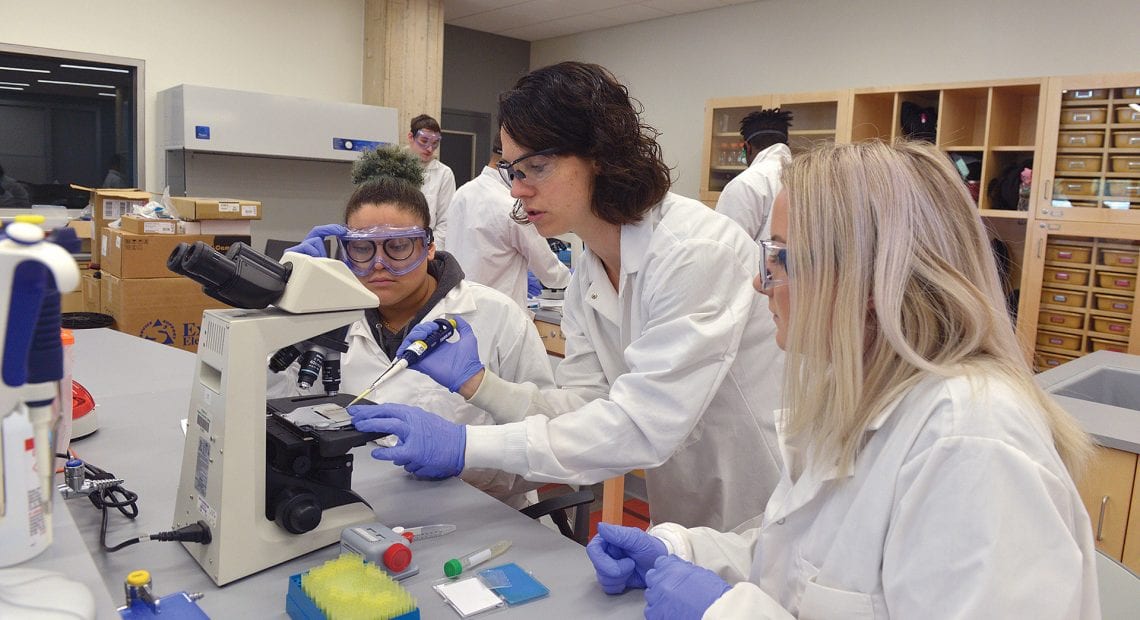
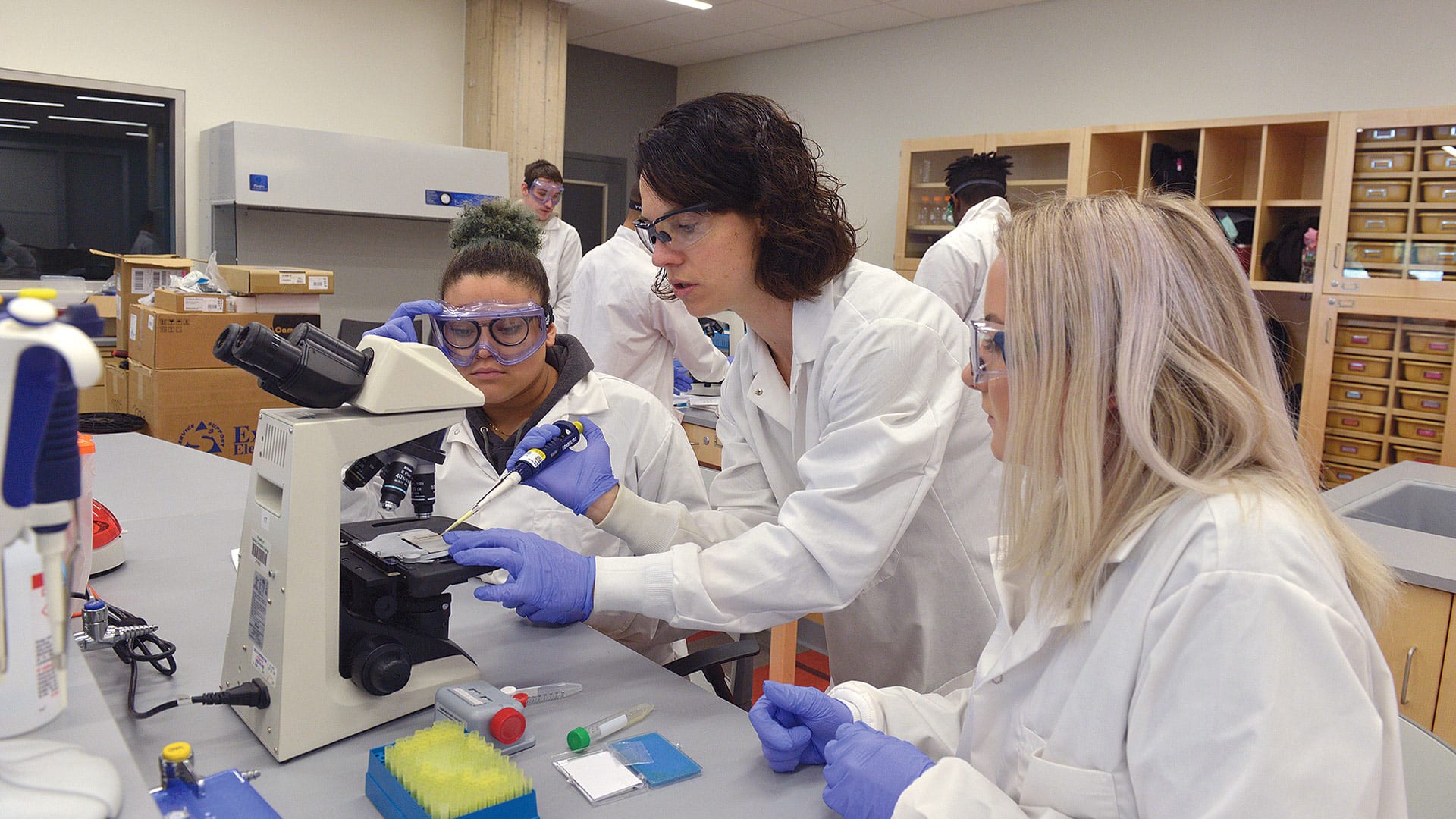
Emily Rabinsky guides two HCC students in a lab project.

Emily Rabinsky guides two HCC students in a lab project.

As she walked BusinessWest through one of the brand-new labs in Holyoke Community College’s Center for Life Sciences, Professor Emily Rabinsky said there’s plenty for students to appreciate.

“Our old lab space was very outdated and not very conducive to learning,” said Rabinsky, who coordinates the Biotechnology program at HCC. “There were two long bays with a tall shelf in between that made it very difficult for the students to see what the lecturer was referring to, and the equipment was very outdated.”

Not so today.

“At our recent open house, some students happened to walk by, peeked in, and said, ‘wow, this is amazing,’” she said. “I think this facility could rival many of the four-year colleges.”

Take, for example, the only certified cleanroom at any Massachusetts community college, and one of very few at any college or university in Western Mass.

Once it’s fully operational, the cleanroom will have a certification rating of ISO 8, which means air quality of no more than 100,000 particles per cubic foot. Inside the cleanroom, there will be a hooded biosafety cabinet where the sterility will increase to ISO 7, or no more than 10,000 particles per cubic foot.

“It’s pretty unique at the community-college level,” Rabinsky told BusinessWest. “It’s something commonly used in many of the life-science research areas. Students will learn how to minimize contamination and keep the space sterile for any kinds of cells they’re working with.”

Take, for example, a class she’s currently developing called “Cell Culture and Protein Purification,” which will make copious use of the cleanroom.

“We’ll be training students in the cell-culture class in how to maintain mammalian cell cultures, because they can be easily contaminated with bacteria or other microbes that are in the air,” she explained. “Mammalian cell cultures are commonly used in any kind of research studying cancer, or studying new drug therapies, so it’s a good skill to know.”

The cleanroom will also be utilized as a training facility for area professionals — for instance, in how to monitor the air for microbial content, commonly known as particle count.

“In a cleanroom, there should be fewer particles in the air because we have a special kind of filtration. So it has to constantly be monitored and verified,” she said. “Any cleanroom at UMass or any kind of industry has that monitoring done for them, so if someone wants to go into that kind of field, they could get that training here.”

So, while students are being trained in laboratory settings similar to what they will experience in industry, making them more competitive for the biotech job market, Rabinsky said, HCC serves a local workforce-development mission by training non-students as well.

“A lot of these local biotech companies that do this kind of work, they find it can be very costly for them to train new employees at their facility, and at the same time, they’re risking contaminating their facilities with these new workers that are just learning the technique, so why not do it here where it’s not such a high risk?”

On the Cutting Edge

HCC recently staged a grand-opening ceremony for the 13,000-square-foot, $4.55 million Center for Life Sciences, located on the lower level of HCC’s Marieb Building. The Massachusetts Life Sciences Center awarded HCC a $3.8 million grant for the project, which was supplemented by $750,000 from the HCC Foundation’s Building Healthy Communities Campaign, which also paid for the construction of the college’s new Center for Health Education on Jarvis Avenue in Holyoke.

“Those grants outfitted the biotechnology program but also all of the programs that fit in around it, including microbiology, general biology, and genetics,” Rabinsky said, noting that the new space includes two labs, the cleanroom, a prep room, and a lecture area.
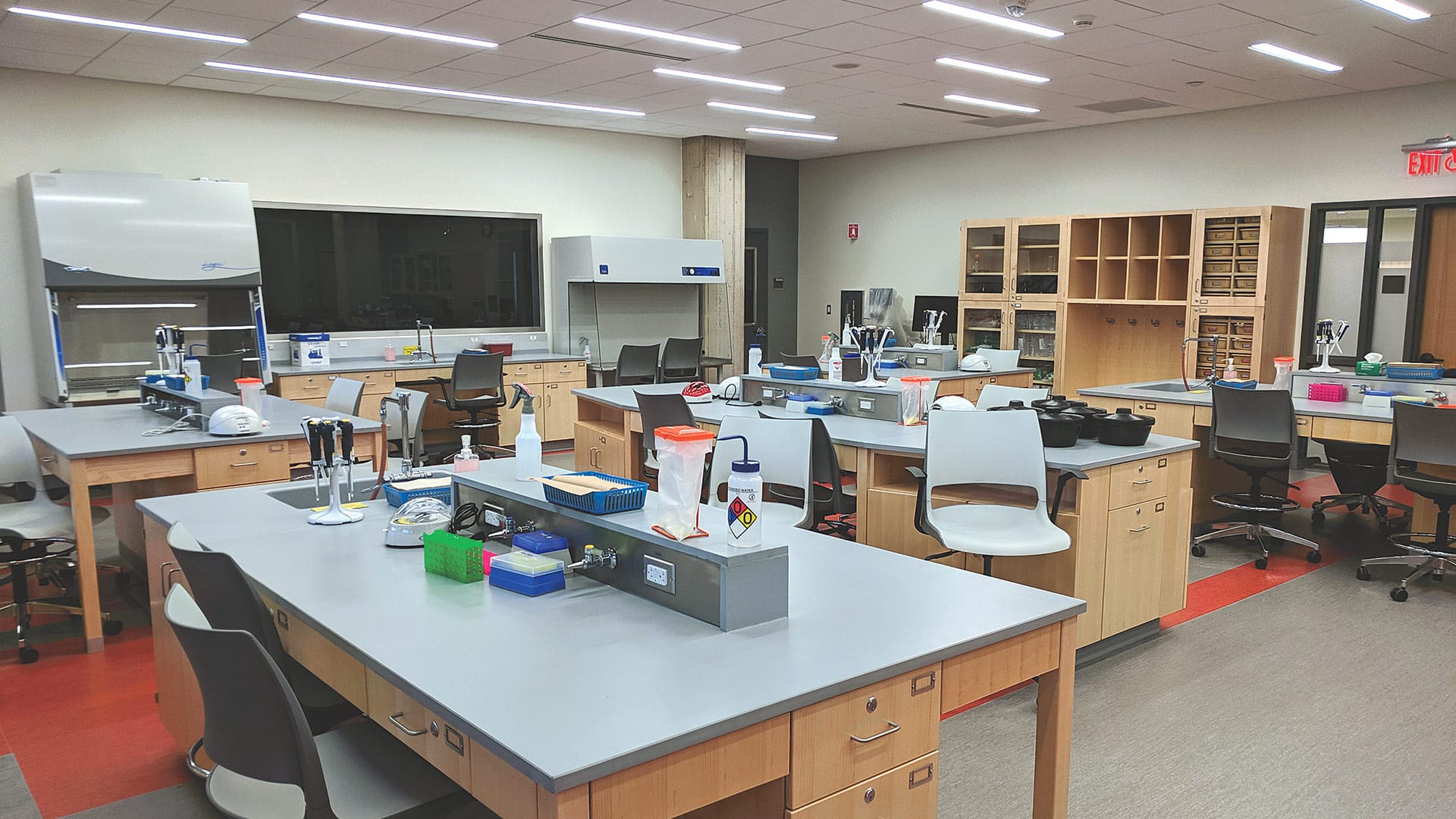
Grant funds and donations also paid for new equipment, including a high-end, research-grade fluorescent microscope, like those used in the pharmaceutical industry; a micro volume spectrophotometer, used to measure small amounts of genetic material; and an electroporator, for genetic engineering. Meanwhile, a cutting-edge thermocycler can take a small sample of DNA and make billions of copies in an hour.

About half of Rabinsky’s students are interested in going into biotechnology, with most of those specifically interested in medical biotechnology and pharmaceuticals, as well as medical devices, an industry with strong roots in Western Mass. and the Boston area.

“I also have students who are just interested in the life sciences, interested in research, and just want to be exposed to all the different areas of biotechnology,” she went on. “A lot of these skills can be applied to many different fields. They may be interested in going into genetics, for example. I would say one of the challenges is drawing in the kids in who may not have thought about biotechnology or biology.”

To that end, in her introductory biotechnology course, she incorporates activities that students can relate to their everyday lives.

“Last week, we did a fun lab where he tested for the presence of genetic modification in things like cheese fries and Cheetos,” she explained. “Food producers aren’t required to list the presence of GMOs unless it’s above a certain percentage. So they’ll grind it up, extract the DNA, and test for the presence of GMOs. That was fun — they could have a hands-on experience and test for something that is very commonplace that we’re all aware of.”

Important Evolution

Rabinsky admitted some might not see the new center as a necessity since HCC already had a functioning facility upstairs, but said it was important to keep the college on the cutting edge and attract more students to give the life sciences a look.

“This makes them excited about the field, and it’s more a conducive space for learning, with these small tables that make working in groups much easier. Then we have newer technologies and new equipment to train students on, which are very similar to what they’ll in the field.”

Of course, it all starts with the instruction, and on that front, Rabinsky said the Center for Life Sciences will continue to prepare students to enter what is certainly a growing field from a jobs perspective.

“I’ve had students that have gone on to UMass and said that they learned things here they haven’t learned there, and that our equipment properly prepared them for graduate research,” she said. “That’s really nice to hear.”

Joseph Bednar can be reached at [email protected]