
Home Posts tagged Insurance (Page 34)
Sections Supplements
Bolstered by Its Diversity, the Local Job Market Remains Fairly Stable
Bill Ward

Bill Ward says this region, once dominated by manufacturing, has diversified economically over the years, which insulates it during a downturn.

Bill Ward says he grew up in the town of Bethlehem, Pa., a community that through much of its history owed its identity and its livelihood to the steel mills that took the same name.

“About 60% of the population worked for Bethlehem Steel, and there was probably a supply chain of another 20%,” said Ward, executive director of the Regional Employment Board of Hampden County, referring to conditions years ago (the company was dissolved in 2003). “When that industry went, there was nowhere to hide.”

He related that story to explain why concern, and not panic, is the watchword for the region’s job market. It comes down to one word: diversity.

“We’re not as sector-sensitive here,” he explained, adding that the once-manufacturing-dominant region now has jobs spread across a number of business groups, none of which seem to have been very hard hit to date by a recession that is devastating other parts of the country, where unemployment is approaching 10%

Indeed, ‘stable’ is the word that Ward and others used to describe sectors ranging from health care to education; from financial services to manufacturing. They mixed it in with ‘holding their own’ to describe these industries and the impact to date.

There have been some layoffs and hiring freezes in each of these sectors, said Ward, but nothing approaching the shock waves hitting construction-related businesses in many regions and the widespread devastation in the financial districts in New York, Boston, Charlotte, N.C. (home to several large banks, including Bank of America), and even Hartford.

This is evidenced by a current unemployment rate in the region that is slightly below the national average of 6.5%. As of the end of October, jobless rates in Springfield (7.8%) and Holyoke (7.5%) were significantly higher than the state average of 5.5%, but many Hampden County communities lie well below that figure.

That’s not to say that there isn’t concern or apprehension about the future of the local job market. Some sectors, especially those dependent on state and federal funding (and there are many), are hurting, and there are some warning signs, said Rexene Picard, executive director of the Springfield-based one-stop career center FutureWorks.

These include growing numbers of individuals showing up at her agency and also at CareerPoint in Holyoke looking for job opportunities, and also greater interest in temporary employees, with some business owners wary of hiring on a more-permanent basis due to uncertainty about what the future will hold.

“The major impact that I see every single day is the number of people coming in for unemployment assistance,” she told BusinessWest. “I’ve never seen it this difficult.”

Seeking Hire Ground

Moving down an unwritten list of the region’s major employment sectors, Ward and Picard said none of them have been unscathed by the downturn, but, by and large, they remain stable — there’s that word again.

The term accurately describes the state of manufacturing, an important sector because it brings money into the region from outside its boundaries and has a high ‘job-multiplier effect,’ said Ward, meaning that for every job in that realm, another two to three are created in other sectors.

“If you lose manufacturing jobs, your economy is likely taking a bigger hit than what a raw number of job statistics would suggest,” he explained. “In general, though, the high-tech and precision manufacturing sector in Western Mass. is holding its own.”

The same can be said of the financial-services arena, said Ward, noting that other regions and individual cities, such as Hartford, with its high concentration of insurance industry-related jobs, have been hit much harder.

“The dramatic financial collapse we have seen on the national level and on the state level are clearly reverberating in our region, but we are not going to see a big hit like you see elsewhere,” he told Business-West. “Our financial markets are stable, but I’m sure they’re very cautious as well.”

Picard agreed, and noted, as others have over the years, that the region actually benefits from its historically moderate pace of growth in trying times such as these.

“In contrast to the financial sector in Boston, we haven’t grown as rapidly out here,” she explained, “so we aren’t laying off as many now.”

In health care, one of the region’s strongest employment sectors, the sagging economy has created a new set of hurdles for an already-challenged industry (see related story, page 26). These have led to some layoffs at Northampton’s Cooley Dickinson Hospital and Baystate Health, the region’s largest employer, as well as some hiring freezes involving non-clinical workers. But overall, the sector remains solid, and in some cases is still experiencing difficulties filling job openings.

This is a separate challenge for the region, said Picard, noting that there are ongoing efforts to close a recognized skills gap with many positions within the health care industry and to put workers into the pipeline.

As for the education sector, another pillar of the local job market, the private colleges have yet to be seriously affected by the economic downturn, said Ward, and the public schools have taken small-scale steps to date. This could change, however, as those institutions adjust to $1 billion in budget cuts recently announced by Gov. Deval Patrick, and the possibility of additional reductions.

There are a number of institutions threatened by federal and state cutbacks, said Picard, listing her own as just one example; the two one-stop career centers have been forced to lay off 11 workers between them, she explained, adding that a host of social services, encompassing everything from mental-health services to childcare to transitional services (all of which are in greater demand during an economic downturn), are seeing their funding cut.

Meanwhile, other sectors are struggling. The sharp decline in the housing market has deeply impacted Realtors, said Picard, and also businesses in a host of related industries, including retail, which is smarting from an overall erosion in consumer confidence.

This phenomenon can be seen in a drop-off in holiday-season hiring, said Picard, with many stores wary about adding additional personnel. A lackluster holiday shopping season is predicted for the region and the nation, and if this comes to pass, then January will not be kind to some workers in that sector.

“What we’re hearing is that, come January, we might see additional layoffs,” she explained, “or actually more stores closing.”

Overall, caution is the prevailing attitude among employers, said those who spoke with BusinessWest, and this is reflected in greater reliance on temporary workers and temp-to-hire scenarios.

Rick Caneschi, corporate account manager for the Valley Employment Group, has seen seen such patterns develop, especially the hiring of temporary workers instead of permanent employees, a clear sign that business owners are apprehensive about the months ahead. And he knows from experience and navigating through more than three decades of business cycles that 2009 will be more challenging than ’08.

“I hate to say it, but I think it’s going to get worse before it gets better,” he said. “We’re seeing more and more companies asking how long they can keep their temporary employees on the payroll; they are being very cautious.

“It was in 1989 when we had an economic slowdown,” he continued. “But it was in 1990 when we saw the cuts. The question I ask myself is, where will we see the cuts in 2009?”

Strength in Numbers

This is the question on everyone’s mind as a dizzying year draws to a close.

The volume of traffic at FutureWorks is certainly enough evidence that the local job market is not exactly healthy, but it remains stable, as the experts told BusinessWest, and the signs point to more of the same in the year ahead.

“It’s going to be tough here,” said Ward, “but we do have that fundamental diversity, which gives us strength.”

Sections Supplements
Pension and Benefits Associates Helps Employers Navigate Challenges

Bruce MacDonald (left) and Mark Shea

Bruce MacDonald (left) and Mark Shea say the world of health insurance and employee retirement plans is much more complex than it was a decade ago.

Mark Shea says he has always strived to provide two things to clients: knowledge and responsiveness. At a time he refers to as an “unprecedented awakening of America,” both services are more needed than ever.

As owner of Pension and Benefits Associates Inc. in Springfield, Shea works with area employers to craft benefit programs, including retirement plans. And these days, the picture on the street isn’t pretty. Retirement accounts lost some $2 trillion in value between the summer of 2007 and October 2008, which has not only hampered families’ abilities to make major purchases, but in many cases is making delayed retirement a real possibility for some.

The awakening Shea refers to is the fact that most American workers are realizing for the first time the full implications of the 401(k) age — specifically, the fact that they shoulder all the risk in their retirement accounts, a situation that most workers of 20 years ago would have found strange, to say the least. And that risk has hit home in a major way.

“Twenty years ago, the way pension plans worked was, you worked 30 years, then got a check in your mailbox,” Shea said. “But the promise of working 30 years for a company and getting a guaranteed retirement check … it’s gone.”

“In the past, a company would provide a pension benefit of X dollars per month,” he continued. “The new paradigm is, ‘we’ll sponsor a 401(k) plan. We may have a match, we may have a company deposit, but we’re not making any promises.’”

In other words, there’s no safety net, at least in the short run, for workers who have seen, say, a 401(k) account worth $150,000 fall into the high five figures within a year’s time.

“In the old days, a company took care of everything: your health plan, your disability plan. They weren’t asking people to pay more for this, more for that,” Shea said. “Now, people are saying, ‘I want to stop the pain; put me in a money-market account.’ The volatility is gut-wrenching.”

Evolving Story

The old pension system, Shea told BusinessWest, is simply not cost-effective for today’s employers in the vast majority of cases, partly due to gradual changes in the tax code for businesses. The dominance of 401(k) plans, which began in the 1980s, has injected an element of uncertainty into retirement plans that didn’t exist for most retirees of past generations. “It’s not some employer plot,” he said. “It’s an evolution.”

It’s also quite a change from what the experience of Shea’s own parents, both of whom, after retirement, started receiving a set amount of money each month that never varied; they could plan for their needs because they knew how much money would be available at any given time.

“Under the old pension plans, the employer absorbs the market risk,” he said. “It could be good for them, and it could be bad. But in a 401(k) account, you put X amount of money in the cookie jar, and it goes up and down based on what the market is doing.

“Back then, if there was underfunding, the company would have to put more dollars in,” he continued. “Today, people are at or near retirement, and they may have 30% less in their retirement account, and they’re sick over it.”

Shea understands the long-term picture better than most, as the third owner, since 1998, of a business that began 63 years ago.

Today, three separate entities operate under the Pension and Benefits Associates umbrella. Shea handles employee benefits, including group life insurance, medical disability, retirement, and executive compensation. Bruce MacDonald is president of Dependable Benefits Management, which focuses on medical, dental, group life, and disability coverage, among other services, while Gregory Sheehan heads Sheehan Financial, offering wealth-management services to individuals.

All have seen dramatic shifts in their respective fields. For example, MacDonald noted how ‘cafeteria plans’ have allowed companies to offer benefits to workers who would not have received them in the past.

“They may also have a very transient workforce, a very large part-time workforce,” he said. “Benefits are typically provided to people who work full-time — more than 30 hours a week, or in some cases 20. But a lot of firms have people who work steadily but at fewer hours than that. Voluntary plans provide the ability to obtain benefits in a cost-effective manner, because it’s billed on a group basis.”

Employers also offer post-retirement health benefits far less often than they used to, Shea noted.

“People in their 60s can’t retire because they need health insurance,” he said, adding that those fortunate enough to retire from companies that provide such continued coverage benefit in more ways than one. He cited one of his own employees around that age who was already covered by his former employer when he sought a job working for Shea.

“That person has more employability than if you’re looking at a candidate who’s 61 years old, and to whom you have to provide health insurance,” he said. “That age demographic is going to kill me.”

Instant Access

But the biggest change, obviously, has been the dramatic devaluation of retirement accounts. Financial crises always seem to bring out political teeth-gnashing, and there’s certainly plenty of that going on these days.

“Unlike Wall Street executives, America’s families don’t have a golden parachute to fall back on,” U.S. Rep. George Miller, D-Calif., said recently, as quoted by the Associated Press. “It’s clear that their retirement security may be one of the greatest casualties of this financial crisis.”

Of course, all this is happening during an age of instant online information, which poses its own challenges.

“We have 24/7 access,” Shea said. “You can go on the Internet, you can pull up a graph, you can look at it daily … basically, you can drive yourself crazy. Fifteen, 20 years ago, before everyone had a PC on their desktop, before we all had the Internet, employees would get a retirement statement maybe once a year and say, ‘oh, that’s nice.’ There was no instantaneous information. Today, we’re bombarding people with connectivity, and that’s both good and bad.”

One negative is the immediate urge to get out of the market, said MacDonald, but that would be the wrong strategy, especially for those who won’t retire for some time, or who don’t need all their invested money right away.

“You’re putting a lot of personal money into these programs, but I think it’s safe over the long term,” he said. “Historically, we’ve had ups and downs. This year was historic, and there’s a tendency to pull back. But this is not the time to stop. This is the time to double up. Everything is on sale now. It’s almost like saying, ‘I want to wait until we’re paying full price again for me to get back in.’”

“My outlook?” Shea said. “Things go down, but I think things will come back up. I have a positive outlook over the long run.”

Joseph Bednar can be reached at[email protected]

Sections Supplements
A Well-designed Document Can Help Employers Avoid Lawsuits

An unfortunate reality of any business, especially in the current economic climate, is that an employer will, at some time, have to terminate an employee. Employers must carefully navigate this process to avoid the numerous pitfalls that can result from the need to terminate employees.

Terminated employees may challenge the legality of their termination, often by contending that they were discriminated against, constructively discharged, or even retaliated against for acting as a ‘whistle-blower’ regarding the practices of the employer. Even if these claims are unfounded, the employer will incur some legal fees responding to any allegations.

Severance agreements are a useful tool that employers may wish to consider when making the decision to terminate an employee. Such agreements are designed to avoid litigation by providing former employees with valuable consideration in exchange for a release of certain claims against the former employer. However, if the severance agreement is drafted incorrectly, it can also be the cause of litigation. Further, employers must take into consideration several federal laws that protect the rights of employees. Failure to do so can render a severance agreement unenforceable despite the value the employer has already given to the former employee.

There are many important factors that must be taken into consideration when negotiating a severance agreement: provisions for wages, taxes, continued health care, other benefits, assistance in locating future employment, and, of course, the all-important release. These provisions should be specifically detailed in the agreement with regard to the amounts being paid to the employee as well as rights and responsibilities. Broad or over-generalized statements should be avoided because they can lead to unintended consequences that may negate the employer’s protections under the agreement.

The severance amount can be paid either as salary or in one lump-sum payment. The agreement should specify the manner of payment, along with what portions of any payment represent normal wages, back pay, and any other sums that are included. Emotional-distress damages are often included as well, which raises important tax questions for the employer and the employee. Emotional-distress damages are not subject to the same tax withholdings as wages, which generally shifts the burden of paying these taxes to the employee, rather than being deducted and paid by the employer.

Care must be taken in explaining this to avoid misleading the employee. The employer will need to include the wage portion in the employee’s W-2, and issue a 1099 for any non-wage payments.

Provisions providing for continued health care benefits must also be carefully drafted. These provisions should explain the duration of continued coverage, which party has responsibility for premiums, and the employee’s COBRA rights. Ancillary benefits, such as accrued vacation time and retirement, must also be dealt with.

Releases must be carefully drafted to achieve their expected results. Employers should be aware that certain claims cannot be waived under Massachusetts law. These claims include worker’s compensation claims, unemployment benefits, and payment of wages. Additionally, the protections of certain federal statutes, such as the Fair Labor Standards Act, cannot be waived, either. Including language in the agreement that purports to waive an employee’s rights in these protected areas could itself expose an employer to liability.

Other employee protections can be waived, such as age-discrimination claims, but employers must be sure to meet the technical requirements for these waivers to be effective. For instance, the federal Older Workers Benefit Protection Act (OWBPA), which sets requirements for an effective release of claims under the federal Age Discrimination in Employment Act (ADEA), requires that releases be written in plain and understandable language, that individual employees are provided with at least 21 days to consider the waiver and 45 days in the event of a group reduction in force, and that the employee has seven days to rescind the agreement, so that it does not become effective until the eighth day after it is signed by the employee.

Additionally, the employee should be notified that it is his right to seek the advice of counsel before signing the release. Failure to follow the technical requirements of OWBPA will leave an employer open to litigation despite the consideration already given by the employer. The release may also provide that, even if someone else pursues a claim on behalf of the employee (such as the EEOC), the employee will not seek to be paid any monies by the employer other than those received in the settlement.

Although properly worded severance agreements will cost the employer some money in the short run, they can serve as an effective insurance policy for the employer against claims by discharged employees, whose claims may or may not have merit, but at the very least, will cost the employer legal fees to defend them.v

Paul H. Rothschild, Esq. is chairman of Bacon Wilson, P.C.’s Litigation Department. His practice is concentrated in general litigation, as well as personal injury, product liability, medical malpractice, and employer/employee disputes. He also represents a number of employers in general business and higher education, providing advice on issues relating to termination, discrimination, and avoidance of disputes; (413) 781-0560;[email protected]

Sections Supplements
The Dangers of Estate-planning Software Programs

The recent sophistication of software has contributed to an increase in homegrown estate planning. These mass marketers of legal services misinform people into thinking that they are saving money and that they are receiving sound legal advice. This is simply not true.

As an estate-planning attorney, I felt an obligation to learn more about these sellers of legal advice. As such, I visited the Web sites and researched the software applications of several well-known estate-planning services.

One of them called itself a ‘Legal Documentation Service.’ The service purported to “save time and money on common legal matters … and create reliable legal documents from your home or office.” Another purported to “help protect your family and your assets, and save on legal fees.”

The process of preparing the documents among these companies was similar. Each required you to answer a series of questions, either online or via their software package, and your documents are prepared either instantaneously or within 48 hours. However, one software-based company suggests that you read an accompanying book, which is hundreds of pages in length. Although, you may not need to read the entire book, I do not understand how the public can decipher which parts to skip over and which to read thoroughly with only a basic understanding of estate planning. This seems like a hefty burden on the consumer and not quite the time-saver that the company publicizes.

Intrigued, I moved forward. I started answering the will questionnaires of several services, and due to my own thorough understanding of the intricacies of estate planning, I was perplexed that my options were limited on these questionnaires. Among other issues, I specifically wanted to better understand my options regarding the inheritance distribution alternatives for my children:

  • Could the distribution ages be staggered so that the children would not receive a windfall at age 18?
  • Could I separate principal and interest?
  • Could my children approach the trustee for health or educational needs prior to the set distribution age?
  • So, I called the telephone number provided on one of the Web sites, and I spoke to a young woman who was very pleasant. But when I asked if she could provide me with examples of how I could distribute my assets to my children in the event that I survive my spouse, she simply stated, “you can distribute any way you wish.”

    Although this may be somewhat accurate, it did not truly answer my inquiry. I then asked if she was a practicing attorney, and she answered that she was not.

    This was just the first of many questions that I had about the questionnaire. Another question regarded whether or not I was required to state my desire for organ donation and cremation in my will instead of my health care proxy. The representative answered that I am only able to insert this information into the will. Many attorneys suggest that this language be included in one’s health care proxy because that document is usually reviewed prior to the will.

    As such, the will may be read by your loved ones well after your body has been buried, and therefore, your intent will not be adhered to. But several of these companies do not allow this flexibility.

    Additionally, with many services, nothing prevented me from including a disabled child, who would be receiving governmental assistance, as a beneficiary under the will. As experienced estate planners know, the receipt of assets by a disabled individual on governmental assistance most often disqualifies them from governmental benefits.

    One company uses the tag line: “We Put the Law on Your Side,” a claim that a law firm cannot make under the marketing rules that govern the legal profession. Nevertheless, the company claims to be a leading legal Web site. Huh? The people that work on the documents are not attorneys, and they cannot, by law, give legal advice.

    To further illustrate this point, one Texas court went so far as to declare that a software-based mass marketer of legal documents constituted the unauthorized practice of law because its process was too interactive and sophisticated.

    Most companies do a review, making sure that all answers are completed in the questionnaire and that all spelling is correct. These minor tasks are akin to a very narrow role as a proofreader of the consumer’s data entries. This has to be limited by law, since no attorney is involved in this process.

    These companies hope that you will never read their disclaimer or terms-of-use disclosure. One such disclaimer provides that they are not providing any legal advice, that their documents may not work in your situation, that their documents may not be valid in your state, and that you agree to hold them harmless for any consequences resulting from your choice to use their services rather than seeking the advice of an attorney. Another disclaimer provides that “this product is not a substitute for … an attorney” and “we’ve done our best … but that’s not the same as personalized legal advice” and “if you want help understanding how the law applies to your particular circumstances, or deciding which estate-planning documents are best for you and your family, you should consider seeing a qualified attorney.”

    How can this provide the end-user with the confidence that their estate-planning documents are both legally binding and appropriate to their particular situation?

    Probate law is strict and unforgiving. Good estate-planning attorneys work diligently to keep abreast of changes in the law through memberships in such organizations as the National Academy of Elder Law Attorneys Inc. and the Estate Planning Council of Hampden County, and through extensive, continuous reading and legal research. Creating your own legal documents provides a false sense of security, and the inaccuracies are usually discovered only when it is too late to do anything about them.

    Most people need the perspective that an impartial, experienced estate-planning attorney provides. You are playing with fire if you engage the services of these companies for the following reasons:

    • These programs largely disregard specific laws that can dramatically affect your estate;
    • Your unique issues and circumstances can be flushed out and addressed only through consultation with an attorney; and
    • You are not securing the experience and the knowledge of an attorney trained to handle the specific circumstances of your estate.
    • Another inaccuracy that I found regarded the fee structure. One company claims that, “with [the company’s] lawyer-free service you can save up to 85% off the rates an attorney would charge for the same procedure.” Upon a review of what the company claimed to be an estimated fee that an attorney would charge for the preparation of the will, I was flabbergasted. I can only speak for my firm, but our fee is approximately 4.5 times less than the estimated fee quoted on the Web site.

      Moreover, one company suggests that its service is equivalent to the services of an attorney, which is undoubtedly inaccurate as outlined above. In fact, a Colorado attorney boasts that he loves these online and software companies because he has been retained by individuals to correct mistakes included in documents prepared through one of these companies, and he has earned more than what he would have if he had performed the work in the first place.

      In conclusion, the subjects that typically matter the most to you — your health, your family, and your finances — warrant the attention of an experienced, trained professional who will put their bar license and malpractice insurance on the line to provide you with the advice, counsel, opinions, and recommendations that are essential to drafting a proper estate plan.

      People generally create estate plans for the peace of mind that they provide. The question is whether or not a software program and/or an unlicensed, uninsured, and largely unregulated document preparer can provide you with the peace of mind that your estate plan was done appropriately and addresses your specific needs.

      Todd C. Ratner is an estate planning, business, and real estate attorney with the Springfield-based law firm of Bacon Wilson, P.C. He is a member of the National Academy of Elder Law Attorneys and recipient of Boston Magazine’s 2007 Massachusetts Super Lawyers Rising Stars award; (413) 781-0560;[email protected]

      Cover Story
      A Passion for Wellness Has HNE Moving Up the Charts
      Cover 11/24/08

      Cover 11/24/08

      Health New England has been moving up in the national rankings of health plans — all the way to No. 1 in one agency’s ratings for customer service. While such scores are generating headlines, it’s what’s behind the attractive ratings that constitutes the real story — specifically, the company’s strong focus on wellness, healthy communities, and strong growth, and not simply the bottom line.

      Peter Straley says there are a host of quantitative methods for measuring the relative success of a health care plan such as Health New England — and by that he doesn’t mean the bottom line, but rather efforts to effectively serve clients.

      There are numbers, and lots of them, said Straley, the company’s president and CEO, such as those awarded in national rankings of health insurance providers, and for HNE, they’re getting lower, which is the direction of choice in such matters. On Nov. 17, U.S. News & World Report, collaborating with the National Committee for Quality Assurance (NCQA), placed the company at number six out of 239 commercial health care plans; it ranked 11th three years ago and 9th in 2007. And in NCQA’s own annual report — the Quality Compass 2008 — Health New England was ranked No. 1 in terms of customer service among 160 health plans evaluated.

      Meanwhile, there are some numbers that are rising — again, the desired trend — such as the totals for members (more than 100,000) and companies (more than 5,000) being served by the 22-year-old venture, and even in the number of physicians’ offices stocking a series of educational pamphlets, or comic books, created by the health plan.

      They teach young people about everything from asthma to diabetes to the importance of weight control, said Straley, and they speak to the general operating philosophy that has enabled Health New England to score so well in those national rankings.

      Summing it up, Straley said HNE has always focused on creating healthy communities — in every way that word can be defined — and not on the perceived role of an HMO, simply deciding what gets covered and what doesn’t.

      “The true HMO was designed to take a holistic view of the person,” he explained. “It wasn’t about denying care or paying bills; it was about trying to engage you in what will make your life fuller and richer — which you can’t do unless you’re healthy, or as healthy as you can be.”

      Overall, Straley attributed HNE’s success in the national rankings to its ability to listen and learn. In the case of the former, this means hearing from a host of constituencies, from individual members to business owners; from doctors to hospital administrators. And with the latter, it means observing what has worked and what hasn’t when it comes to health-plan administration and employing best practices.

      In this issue, BusinessWest talks at length with Straley and others at HNE about why the company is turning heads on a national level, and how it certainly isn’t satisfied with the glowing approval ratings it has earned to date.

      A Cover Story

      Indeed, Pat Scheer, HNE’s Quality Operations manager, says the company wants to continue the current trend and do better than sixth in the next U.S. News/NCQA ranking. He and Straley believe that number will continue to fall due to the common denominator known as passion that they say permeates the company of some 240 employees.

      These individuals, including Straley himself, know and live among the people they insure; this lack of corporate distance means feeling a personal responsibility for how well providers, employers, and consumers are treated.

      “What differentiates HNE,” Straley said, “is that we really want to help people get the benefit of their health plan. Because, what’s your biggest fear? That something has just happened to you or a family member, and they’ll say, ‘oh, we don’t take that insurance here.’ We want to make sure that people are confident that, if they need their benefit, they’re going to get it. Because we’re going to see these folks on the soccer field or in the grocery store, we take it really seriously.”

      It’s been this way since HNE was created in the mid-’80s amid concern from area doctors that Blue Cross’ new HMO would drain patients away from their practices—and potentially deliver lower-quality care.

      A group of physicians collaborated with Michael Daly, then-CEO of the system now known as Baystate Health, and other administrators to integrate their own financing and delivery of health care through creation of a new HMO.

      The result of that collaboration, said Staley, is that HNE remains sensitive to both the doctors providing the care and the employers who choose HNE for their employee insurance. “The ultimate goal is to provide high-quality health care,” he explained, “and we don’t think you can do that with a sledgehammer from either vantage point, because that’s been tried, and that’s failed.”

      How these efforts to strike a needed balance and promote healthy communities become visible to the national organizations that rank health plans is another story — and Scheer’s bailiwick.

      “Managed-care organizations have a choice whether or not to seek the NCQA accreditation or not,” he explained. “Back in 1991, HNE was actually the first health plan in the country to seek that accreditation level, and we’ve been accredited ever since.”

      There are dozens of standards by which a health plan is judged, he said, including whether a company has a quality care committee; whether it collects data and how that data is used; how medical necessity is determined; how quickly a company responds to a patient appeal; and how the appropriateness of a provider is determined. The NCQA also asks for an additional 74 measures called HEDIS — the Health Care Effective Data and Information Set — as well as customer service surveys.

      “It’s not something where we can say, ‘hey, everybody, NCQA is coming in three months, so get ready,’” Scheer explained. “They look back for a two-year period to be sure that you have quality-committee meetings. They say, ‘show me the minutes for the last 24 months. Show me that you’re taking action.’ There’s no possible way you can bluff anyone.”

      All health plans are required to have the collection of their data audited, to make sure they’re adhering to the technical requirements. So while accreditation happens every three years, Scheer says documenting their efforts is a rigorous process that begins again the minute the current accreditation process is complete.

      Well Done

      Behind those attractive rankings are programs and operating philosophies grounded in imagination, innovation, and a commitment to the broad subject of wellness.

      “I love wellness … it’s all about behavioral change, and doing what your mother said you ought to do all along,” Straley joked, adding that one of HNE’s successful wellness initiatives is that series of comic books that educate young people on health-related issues.

      During their creation, the books were reviewed by medical personnel — and kids. The comic books have been distributed to pediatricians’ offices and offered to schools, and several have won National Health Information Awards.

      “What we’ve found,” Straley said, “is that the pediatricians are doing a great job of explaining to mom and dad what the condition is and what the kids should do. And the kid is standing beside them getting some of it, but then they’re out on the playground and have an attack and wonder what to do.”

      It’s an instance, he noted, where improving health care does not involve new science or treatment methodologies — just providing practical information in an accessible format.

      It also means providing members with options, and plans specifically tailored for their changing needs.

      Thus, in January of 2009, HNE will begin offering Medicare Advantage coverage for the first time. For people who are 65 and older, the Advantage plan allows them to remain within the system of their current HMO with Medicare coverage and the option to purchase additional benefits. On a day-to-day basis, the switch to some Medicare-paying benefits will be invisible to the consumer; they will experience the same health care package they had before turning 65.

      “The individual who’s 64 years old and has our insurance through her employer is still the same person at 65,” said Straley. “She’s still seeing the same doctor. She still has the same issues. Nothing has changed.”

      Enrollment levels in Massachusetts in Medicare Advantage plans are currently below the national average, but with HNE’s entry into the arena, that’s likely to change.

      Meanwhile, HNE’s focus on overall wellness extends well beyond what would be considered traditional health care. Indeed, the company participates in the larger health of the community by supporting cultural institutions like the Springfield Symphony and museums, and helping fund and organize kids’ programs with the Urban League.

      “Quality of life,” said Straley, “is not just are you coughing, but are you healthy physically, mentally, and spiritually?” It’s not just the right thing to do, he added — it also makes financial sense to support other businesses and the quality of life in Springfield and surrounding areas.

      The company has become involved in the issue of homelessness for both reasons, helping raise money for a new resource center that will break ground next spring, eventually providing around-the-clock counseling, medical care, and other support services to homeless individuals.

      “I think that it’s a failing of society when we don’t take care of people who are most in need,” Straley told BusinessWest. “This is not something you should blame people for — you need to provide help. But I’m also interested in economic development, and if we have people panhandling on the streets, it does not reflect well on Springfield.”

      Turning again to the challenges being faced on a national level in caring for people’s health and well-being, Straley said HNE is already confronting the central issue that health plans will face as more people are insured: how to change the delivery of services to accommodate demand. “As you get more experienced, you literally can do more with less,” he said, offering an example: “If you do group information sessions rather than individual sessions, you’re dealing with 80% of the solution for 10 people all at once, and that creates capacity. There are pieces that you want to keep individual, but there are behavioral pieces that could be done differently.”

      As a self-described “walking billboard for the company” (he often wears HNE logos), Straley expects people to approach him with questions. He listens, gives them his card, and says he’ll get somebody on it. It’s part of his belief that communication is at the core of the company’s success. “We try really hard to communicate clearly. We’ll try anything. We’ll write comic books! We’ll send you a memo! It doesn’t mean we’re always successful, but it’s the way you’d want a friend sitting across the table to tell you, ‘well, here’s how it works.’

      “As you can tell, I’m so proud of what the people in this company do,” he continued, “and how connected they are to the communities that we serve, and just how passionate they are about not wanting to be the big, bad HMO the way the industry gets painted. We’re really different, and they care about that. We’re committed to what we do, and we know how important people’s health is. At the end of the day, if your health isn’t good, the rest doesn’t matter a whole lot.”

      The Bottom Line

      Returning to the subject of numbers, Straley said HNE passed the 100,000-member plateau two years ago, and has been enjoying steady, controlled growth since — a pattern he desires.

      “I don’t want explosive growth,” he explained. “I want steady growth where we can manage the quality of the product we deliver.”

      If one does that, he said, the numbers, including those in the customer service rankings, should take care of themselves.

      Departments

      The following is a compilation of recent lawsuits involving area businesses and organizations. These are strictly allegations that have yet to be proven in a court of law. Readers are advised to contact the parties listed, or the court, for more information concerning the individual claims.

      CHICOPEE DISTRICT COURT

      Ford Motor Credit Company, LLC v. Hospitality Group Inc.
      Allegation: Non-payment of money loaned: $10,703.83
      Filed: 10/24/08

      Monica Dusseault & Stephanie Boryczka, as parents and guardian of minor Kyle Boryczka v. Bob’s Discount Furniture, LLC
      Allegation: Negligence and breach of implied warranty: $21,040.03
      Filed: 10/21/08

      GREENFIELD DISTRICT COURT

      Creative Office Interiors, Inc. v. PDV Inc.
      Allegation: Non-payment of goods sold and delivered, and breach of purchase and sales agreement: $10,7032.90
      Filed: 10/06/08

      HAMPDEN SUPERIOR COURT

      Daniel O’Connor & Sons Inc. v. Six Flags New England
      Allegation: Non-payment of services rendered and merchandise delivered: $38,208.36
      Filed: 9/28/08

      Harleysville Insurance v. Brake King Automotive Inc.
      Allegation: Insurance premium due: $32,441.32
      Filed: 9/29/08

      KLC Inc. v. Nita Inc.
      Allegation: Breach of lease agreement: $53,091.95
      Filed: 10/06/08

      HAMPSHIRE SUPERIOR COURT

      Cheryl Jolana Talbot v. Michael E. Coby, DPM
      Allegation: Medical malpractice: wrong site surgery: $30,809.42
      Filed: 10/22/08

      James L. Parks, et al v. Savvas Papazoglou, M.D., et al
      Allegation: Medical malpractice:
      $1.1 million
      Filed: 10/22/08

      Kenneth Smith v. Tubed Products Inc.
      Allegation: Employment discrimination: $25,000
      Filed: 10/15/08

      R. Lavoie Trucking Company Inc. v. Barr Inc.
      Allegation: Non-payment of materials, labor, and services rendered: $220,000
      Filed: 10/16/08

      South Hadley Electric Light Dept. v.
      Berkshire Design Group Inc.
      Allegation: Negligence and breach of implied and express warranties in preparation of engineering and utility plans: $110,000
      Filed: 10/28/08

      HOLYOKE DISTRICT COURT

      Francis Heating & Air Conditioning v. Stony Hill Realty, LLC
      Allegation: Non-payment of services rendered: $12,000
      Filed: 9/25/08

      PALMER DISTRICT COURT

      Electrical Wholesalers Inc. v. R.F.L. Electric Inc.
      Allegation: Breach of contract and non-payment: $13,000.00
      Filed: 10/21/08

      SPRINGFIELD DISTRICT COURT

      84 Lumber v. Belco Construction Inc.
      Allegation: Non-payment of goods sold and delivered: $2,845
      Filed: 10/03/08

      ABC Refrigeration & Air Conditioning v. Miller Development Enterprise Inc.
      Allegation: Non-payment of goods sold and delivered: $24,238.70
      Filed: 9/20/08

      Jorge Yahdiel Lebron p/p/a Yanitza Lebron v. Bertera Chrysler Inc.
      Allegation: Minor plaintiff sustained burns from coffee on a table in defendant’s showroom: $2,671.41
      Filed: 9/16/08

      Keystone Automotive Operations Inc. v. Accessory Group of New England Inc.
      Allegation: Non-payment of goods sold and delivered: $18,805.07
      Filed: 10/03/08

      Mary Lou Sanborn v. Greg’s Electrical Service
      Allegation: Non-payment of goods sold and delivered: $6,057.95
      Filed: 9/18/08

      Palazzesi Realty v. Pet Resorts International LLC
      Allegation: Non-payment of rent: $6,600
      Filed: 9/19/08

      Sections Supplements
      United Bank Is Paving New Avenues for Growth
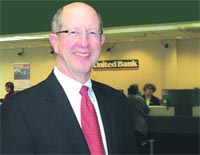
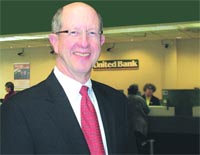
      United president Richard Collins

      United president Richard Collins

      Well-capitalized after going public several years ago, aggressively branching out, and operating in a regional banking sector that is generally healthy compared to the nation as a whole, United Bank has a lot going for it, says its president, Richard Collins. On the flip side, the area’s banking landscape remains fiercely competitive, especially given limited demand for commercial loans in a lackluster economy. To succeed, a bank needs to set itself apart with service and a wide range of financial products — and by always keeping an eye on the next trend.

      At a time when banks nationally are failing or at least in crisis, United Bank has benefited from good decisions, says its chief executive — not to mention some good timing.

      Specifically, upon becoming a fully public bank last December, United raised $95 million in its second public offering, following an initial round in 2005 that netted $72 million. “That puts us on a short list of banks with an awful lot of capital,” said Richard Collins, president of the 126-year-old institution.

      “I wish I could say I was smart enough to see the banking crisis coming,” he added, “but we did raise capital to prepare for growth and whatever the future might bring. And having this much capital means we’re not affected by some of the problems of the national banks.”

      Specifically, Collins noted that United, like many institutions in its region, is not burdened with the ‘toxic paper’ that has weighted down the large Wall Street banks — mainly in the form of subprime loans.

      “We haven’t made any troublesome investments,” he said. “A lot of banks bought Fannie Mae- and Freddie Mac-preferred stock, but we’ve stayed away from that, and we don’t do any subprime lending. Every mortgage loan we make, we intend to keep, so we make those loans in a way that we’re happy to have them on the balance sheet.

      “So we’re anxious to lend,” Collins continued. “We’re anxious to put dollars out there, but it has to be in a fashion that adheres to straightforward lending standards. We’ll stick with that, and we can put dollars to work for qualified borrowers who are looking for a home loan, car loan, or business loan.”

      Going public was key to a newly aggressive growth stance for United, which has operated from its West Springfield headquarters since 1882.

      At the start of 2006, United boasted a dozen branches across the Pioneer Valley, but then began rapidly expanding, adding five locations over the past three years. First was a downtown Northampton office in mid-2006, followed by a Westfield branch in early 2007. This year alone has seen United expand into Longmeadow and Agawam, and also add an ‘express’ branch right off Interstate 91 in Northampton in order to serve drive-thru customers; the city’s other branch takes only walk-ins.

      Plans for a branch in Chicopee, are underway, “and then we’ll keep looking from there,” said Dena Hall, vice president of marketing and community relations, noting that all the new branches are performing well — a critical factor, since no bank wants to expand just to have a presence in a certain town.

      “If a branch doesn’t do well, it’s very expensive, between maintaining the building, paying rent, and paying our people,” said Collins. “Fortunately, that doesn’t seem to be happening.”

      What is happening is a period of robust expansion for United, in an effort to attract more business in Western Mass., a region known for as fiercely competitive banking landscape. In this issue, BusinessWest examines some of the strategies United is employing to do just that.

      Saving Money — and Time

      Some concepts seem like small matters, but go to the heart of customer service, which is critical to retain business with so many other banking options available, said Hall. Take, for example, that express branch off I-91. “The idea was to meet the needs of those who couldn’t drive right up before,” she explained, “but we’ve been pleasantly surprised by the foot traffic.”

      It’s the most basic example of the different ways customers choose to conduct bank business today, she noted. For example, United, which had one of the first Internet banking products in the region, recently introduced ‘mobile banking,’ which allows access to financial information using a cell phone.

      But customers who use such technology aren’t completely divorced from bricks-and-mortar banking, she said; increasingly, many people want a mix of both — which is why United is expanding its physical presence along with its technological options.

      “We’re an older bank, so we’ve been around a long time,” said Collins. “But in terms of introducing our customers to computer-based products, we’ve been pretty far ahead of the curve.”

      Offering convenience and a variety of banking options isn’t just window dressing, however — not in Western Mass., where an overload of different banks are all competing for business. For example, he said, “I’d like to see a more-vibrant market for commercial loans, but the economy is not demanding it, and there are other good banks out there who want a piece of those loans.

      “We’re having some growth in the commercial portfolio, but it’s not as robust as I’d like it to be, whether that’s due to the health of the market, or the competition out there for commercial loans, or a little bit of both,” he added.

      Collins doesn’t include the ongoing national banking crisis on that list of factors — at least not so high — because, like other executives BusinessWest has spoken to recently, he describes the Western Mass. banking sector as essentially healthy and well-capitalized.

      That gives United opportunities to seek growth areas, such as its 2006 purchase of a Northampton-based financial advisory firm, the Levine Financial Group, which added $88 million in assets under management. Today, the United Wealth Management Group reports $120 million in investments.

      Indeed, Hall noted, on the investment side, “we’ve done a good job increasing our presence and expanding awareness in our area. Certainly, over the last couple of months, the financial markets have been steadying, and our representatives have been actively calling customers, having meetings, and fielding phone calls. They’re being proactive to reach a level of service that’s crucial to a locally based group such as ours.”

      Collins said having a solid investment arm is important at a time when many individuals either want to do all their financial business under one roof, or mistrust traditional brokerage houses, for whatever reason.

      “Some people like working with a bank in terms of managing personal wealth. The bank is central to our financial life in lots of ways,” he said. “I think our reputation for being customer-oriented helps us attract people, and we offer a great line of investment products and the professionals we work with can help people make those decisions.”

      “At the same time, there’s a lot of competition,” he continued, “but we’re picking up people who are comforted by having wealth management done through their bank. There are some concerns about some of the larger brokerage firms having problems or being reorganized. We’re a small organization, but we’ve got a lot of capital and no real problems in our loan or securities portfolios, and there’s not much chance that we’ll be forced into a sale.”

      Personal Touch

      Collins stressed, however, that United’s success will not be achieved simply by expanding its locations and product lines. An emphasis on customer service is reflected in United’s ‘personal bankers,’ who operate under a model that assigns each retail customer to one employee who is tasked with getting to know them and their individual needs over the long term.

      Hall explained that the concept is also reflected on the commercial-lending side. “We have a team approach, where the customer has not only a lender, but also a personal loan assistant working behind the scenes, doing what needs to be done. We have business-development officers who sell cash-management products and personal bankers on the retail side.”

      Hall said the personal-banker model is one reason why United is able keep its own employee-retention rate around 95%. “We’ve done a nice job attracting new employees from other banks, and also promoting from within,” she noted.

      “We’ve had very little turnover. It’s a unique job. Personal bankers are responsible for maintaining the customer relationship. They don’t have to be concerned with the branch hours and the teller lines; a branch manager sees to that. They’re here for the customers.”

      It’s a model that has captured plenty of attention in the community, Hall added. “It’s funny; when I tell people I work for United, they immediately say, ‘my personal banker is Nancy,’ or ‘my personal banker is Judy.’ The concept has really worked.”

      And community remains an important part of United’s culture, as well. Hall heads up the bank’s charitable foundation, which was launched in 2005 and typically grants between $200,000 and $240,000 annually to nonprofit organizations.

      “We’ve always tried to be a good community partner,” she told BusinessWest, “and we support a lot of different foundations in different ways.” Between the foundation and bank sponsorships — such as the one forged with the Springfield Falcons — United puts about $350,000 into the community each year.

      “People see that and recognize that we’re committed to the community,” Hall said. “We can’t always say yes, but we try to do as much as we can.”

      It’s a cheerful thought, which is appropriate as the skies begin to clear — at least a little bit — over the nation’s financial crisis, aided by the recent government bailout and additional layers of protection from the Federal Deposit Insurance Corp.

      “People have been concerned,” Collins, “but they’re less worried now.”

      Perhaps confident enough to borrow money and invest for the future. If so, United is willing to talk.

      Joseph Bednar can be reached at[email protected]

      Departments

      Bay Path Receives NSF Awards

      LONGMEADOW — The National Science Foundation (NSF) recently awarded a grant of $505,920 to Bay Path College to support scholarships and activities to attract and retain undergraduate women, in particular minority students, in biology, biotechnology, and forensic science. A primary goal of the grant will be to ensure that academically talented but financially challenged students who wish to pursue a career in the sciences will receive a scholarship and other financial assistance. Scholarship grants of up to $10,000 per year for four years will be available to academically qualified students. Additionally, work-study and research internships in a student’s given field of interest will be funded, allowing her to develop valuable career experience while earning money. Also, a book fund will be established to aid students in purchasing increasingly expensive science textbooks. The college will make its first awards for spring 2009. Bay Path President Carol A. Leary noted that, as part of the college’s five-year plan, focusing on significant investments in science education also coincides with Massachusetts Gov. Deval Patrick taking steps to secure the state a global position in the life sciences and biotechnology industry with a $1 billion, 10-year Life Sciences Bill that has been signed by the state Senate and House. With this grant, Bay Path students will be well-positioned to take advantage of job opportunities as a result of this important initiative for Massachusetts, added Leary.

      Hampden Bancorp Declares Dividend

      SPRINGFIELD — Officials at Hampden Bancorp Inc., the holding company for Hampden Bank, recently announced that net income for the three months ended Sept. 30 was $47,000, as compared to $521,000 for the same period in 2007. The decrease in net income was primarily the result of an increase in the provision for loan losses of $422,000 for the three months ended Sept. 30, compared to the same period in 2007. The increase in the provision for loan losses is due to increases in loan delinquencies, growth in the loan portfolio, and general economic conditions, according to bank officials. The company’s total assets increased by $7.7 million, or 1.4%, from $543.8 million at June 30 to $551.5 million at Sept. 30. Deposits increased $12.1 million, or 3.6%, to $343.5 million at Sept. 30, from $331.4 million at June 30. In other news, the board of directors declared a quarterly cash dividend of $0.03 per common share, payable on Nov. 26 to shareholders of record at the close of business on Nov. 12.

      Seahorse Labware Expands

      CHICOPEE — Seahorse Labware recently leased 3,750 square feet of additional space at its 300 Griffith Road site to accommodate growth, according to company officials. Initially, the additional space will be for warehouse use; however, officials note that the space may be converted for lab or manufacturing processes over time. Seahorse now occupies 30,000 square feet in the multi-tenant facility in Westover Airpark North, managed by Development Associates of Agawam. Seahorse services the life-sciences industry with instruments and consumable labware products for biological research and drug discovery.

      MassMutual Approves $1.35B Dividend

      SPRINGFIELD — Massachusetts Mutual Life Insurance Company recently approved the payment of approximately $1.35 billion in dividends to eligible participating policyholders in 2009. The payout reflects a dividend interest rate of 7.6% on new eligible participating life-insurance policies. MassMutual, as a mutual company, is owned by its policyholders, meaning they share in the ownership of the company. Customers who purchase participating products from MassMutual receive an equitable share of a portion of the company’s divisible surplus in the form of dividends as approved by MassMutual’s Board of Directors each year. Company officials note that MassMutual has consistently paid dividends since the 1860s.

      Peter Pan Celebrates 75th; Driver Saluted

      SPRINGFIELD — Peter Pan Bus Lines driver Everett Anderson, who recently completed his 38th year of accident-free driving, was honored Nov. 5 for his accomplishment at the Affiliated Chambers of Commerce of Greater Springfield breakfast. Peter Pan’s 75th anniversary was also saluted at the morning affair. As a surprise for Anderson, a new model Peter Pan coach was unveiled with a wrap reading “Three Million Miles of Accident-Free Driving — Everett Anderson.” Anderson is one of a handful of motorcoach or commercial truck drivers nationwide to become a 3 million-mile safe driver, according to the National Safety Council. He is the second Peter Pan motorcoach operator to reach this milestone. A city resident, Anderson began driving for Peter Pan in 1970. During his tenture, he has received its highest honor, the Peter C. Picknelly Founder’s Award for excellence and the Mrs. Picknelly Sr. Award – Driver of the Year. Peter Pan serves more than 100 communities throughout the northeast corridor with daily express scheduled service, including Boston, Philadelphia, Baltimore, New York, and Washington, D.C.

      Business Assists Local Families

      HOLYOKE — Employees of Ace Fire and Water Restoration Inc. recently donated toys and books to the local Women, Infants and Children (WIC) program in the city. A wooden activity center, blocks, and Sesame Street books were among the donated items. Ace co-owner Gary Brunelle noted that his company was “very pleased” to present the toys and books to an important resource for local families. “Suffering property damage is especially stressful when young children are involved — this was a no-brainer,” he added.

      Pacesetter Award Winners Named

      HOLYOKE — Winners of the 2008 Pacesetter Awards were recently spotlighted at an awards breakfast, sponsored by the Greater Holyoke Chamber of Commerce. The honorees were CRA Inc. as Small Business of the Year; Conklin Office Furniture, Inc., Pacesetter Award; Square One, Non-Profit Operational Excellence Award; and Western Mass. Enterprise Fund Inc., Business Advocate of the Year. Pacesetter Committee Chair Kathleen Buckley of Holyoke Medical Center noted that Holyoke has an abundance of small companies and nonprofit organizations that are highly successful and meeting challenges daily through ingenuity and outstanding management practices.

      Sunshine Village Relocates

      WESTFIELD — Sunshine Village, a nonprofit organization that cares for individuals with developmental disabilities, recently relocated its day-habilitation program to 74 Franklin St. Donna Erickson, program manager for the satellite location, noted that the new space offers more room for training and activities and is a more convenient location for most of its participants. In addition to its headquarters and worksite in Chicopee as well as the Westfield site, the organization maintains day-hab programs in West Springfield, Holyoke and Three Rivers. As part of its program, participants learn fundamental life skills, participate in self-help activities, and work to build a greater sense of self-worth. An open house is planned during the holiday season to introduce the program to the public.

      Student Prince Is ‘Legendary Restaurant’

      SPRINGFIELD — Each fall for the past 13 years, Gourmet has published a special restaurant issue that explores the newest trends in restaurants. This fall, Gourmet editor-in-chief Ruth Reichl wanted the October edition to be “different.” She noted on the Gourmet Web site that her staff went looking for a few grand American restaurants that have stood the test of time. Of the 20 ‘legendary’ American restaurants that met that criteria — and still serve great food — was the Student Prince. For information on the restaurant, visit www.studentprince.com.

      New Owner at Danco/Danish Inspirations

      WEST HATFIELD — A wide selection of clearance and discontinued items at Danco/Danish Inspirations may be purchased at further reductions in price this holiday season when making a donation to the United Way of Hampshire County, according to new owner Peter Knapp. Knapp noted that, during the holidays, various suppliers of Danish Inspirations will participate with incentives on their items if donations are made. Knapp added that he feels this is a “wonderful opportunity” to make good on his commitment to offer new designs and events to benefit the community. Since 1983, Danish Inspirations at Danco Modern has specialized in contemporary furniture and accessories. For more information, visit www.dancomodern.com.

      ESB Sponsors Town Celebration

      EASTHAMPTON — Easthampton Savings Bank recently contributed $15,000 to the Town of Hadley 350th Committee to help celebrate the town’s 1659 founding. The celebration will kick off in January with a dinner dance and continue with events and programs throughout 2009, including a lecture series, workshops, a picnic, a parade, a block party, a town history day, a fair, and a road race. David Martula, co-chair of the Hadley 350th Committee, noted that without the generosity of businesses and donors, it would have been impossible to plan such a varied and comprehensive list of activities. “Thanks to our donors, our celebration will go down as one of the most memorable in our history,” he said.

      Departments

      Joseph Wojnas of Hatch Mott MacDonald in Holyoke has obtained his Leadership in Energy and Environmental Design accreditation. Wojnas is a Physical Engineer and works as a project manager on municipal infrastructure and natural-gas pipeline projects.

      •••••

      Todd M. Crevier, a real-estate Sales Professional, recently joined Keller Williams Realty and will be working in the Longmeadow office.

      •••••

      Amy Egan has joined the Enfield, Conn. office of Prudential Connecticut Realty as a Sales Executive.

      •••••

      Dr. Pikeshkumar Patel has joined the practice of Baystate Medical Practices – Greenfield Gastroenterology. Patel, a Gastroenterologist, is on the medical staff at Baystate Franklin Medical Center.

      •••••

      Wendy M. Murakami has been appointed Wellness Coordinator at Ruth’s House, a program of Jewish Geriatric Services. Ruth’s House is an assisted-living residence.

      •••••

      Joe Moleski has been named by Penske Truck Leasing to the newly created position of Vice President/Sustainability.

      •••••

      Speech Therapist Natalie Powers has joined the Rehabilitation Department at Baystate Rehabilitation Care located at Baystate Mary Lane Hospital in Ware.

      •••••

      Chicopee Savings Bank announced the following:
      • Kerri Herzig has joined the bank as Assistant Vice President-Financial Reporting, and
      • Lloyd Hall has joined the bank as an Internal Auditor.

      •••••

      Don Rivard of Rivard’s Resources: IPM was recently recognized as a “Boston Hero at Home” by the Boston Public Health Commission. The award represents contributions to improving the health and quality of life for Boston residents, particularly those with asthma. Rivard is a former resident of Springfield.

      •••••

      Terry Ianello, owner and operator of Terry Etc. Hair & Nails Salon in Springfield, has recently returned from a five-day trip to France. Ianello was one of 12 hair designers across the United States invited as guests of Rene Furterer, the hair-care division of French pharmaceutical giant Pierre Fabre.

      •••••

      Environmental Compliance Services Inc. has named Michael Murdzia as a Senior Project Manager.

      •••••

      The Community Foundation of Western Massachusetts announced the following:
      • Elizabeth D. Scheibel has been named the new Chair of the Board. Scheibel is the Massachusetts District Attorney for the Northwestern District;
      • Sandy Belden, retired President of the Community Bank of Syracuse, has been named to the Board;
      • Dianne Doherty, Regional Director of the Mass. Small Business Development Center, has been named to the Board;
      • Sue Lobello, former Chair of the Board of The Food Bank of Western Mass., has been named to the Board;
      • Steve Mitus, Executive Vice President of Balise Auto Sales, has been named to the Board, and
      • Jay Primack, Managing Partner of Moriarty and Primack, P.C., has been named to the Board.

      •••••

      William B. Meyer Inc. has named Mike Humen to serve as Director of Business Development.

      •••••

      Adam D. Raczkowski has been appointed President of W. F. Young Inc. of East Longmeadow. Raczkowski is only the third president in the company’s history who is a non-family member.

      •••••

      The Children’s Study Home announced the following:
      • Shawn M. deVillier, Senior Vice President of Investments at Raymond James in Springfield, has joined the Board of Directors, and
      • Dale Desmarais, General Sales Manager at Grynn and Barrett in Holyoke, has joined the Board of Directors.

      •••••

      Vascular and interventional radiologist Dr. George Hartnell has joined the medical staff of Cooley Dickinson Hospital in Northampton.

      •••••

      Ronn Johnson, Director of Community Responsibility at Massachusetts Mutual Life Insurance Company in Springfield, will become a member of the Early Education for All (EEA) Campaign’s advisory committee. EEA is a coalition of leaders from business, early childhood, labor, religion, health care, education, and philanthropy, working in partnership with families, grass-roots leaders, and state policymakers to make high-quality early-education available to every Massachusetts child.

      •••••

      Todd Peetros has been named an Account Executive at Integrity Graphics Inc. of Windsor, Conn. He will be responsible for sales and the development of targeted markets.

      •••••

      John Mankowski has been appointed to Manager of Engineering for Convergent Lasers at PRIMA North America Inc, the North American subsidiary of PRIMA INDUSTRIE S.p.A., Torino, Italy.

      •••••

      The Greater Springfield Convention & Visitors Bureau announced the following:
      • Greg Chiecko, Sales Director at the Eastern States Exposition, will serve as Chairman of the Board of Directors;
      • Peter Rosskothen, Owner of The Log Cabin & Delaney House, will serve as Vice Chairman of the Board of Directors;
      • Joseph Carvalho, President and Executive Director of the Springfield Museums Assoc., will serve a two-year term on the Board of Directors;
      • John Doleva, President and CEO of the Naismith Memorial Basketball Hall of Fame, will serve a two-year term on the Board of Directors;
      • Carolyn Edwards, Senior Marketing Director of Prime Outlets, has been named to a two-year term on the Board of Directors;
      • Debra Flynn, Owner of Eastside Grill, has been named to a two-year term on the Board of Directors;
      • Robert Gilbert, President and CEO of Dowd Insurance, has been named to a two-year term on the Board of Directors;
      • Harlan Kent, President and COO of Yankee Candle Company, has been named to a two-year term on the Board of Directors;
      • Larry Litton, Park President, Six Flags New England, has been named to a two-year term on the Board of Directors;
      • Bruce Nable, President, SER Expo Services, has been named to a two-year term on the Board of Directors, and
      • Christina Pappas, President, Open the Door Communications, has been named to a two-year term on the Board of Directors.
      Members of the Board of Directors who have been nominated to serve an additional two-year term include:
      • Stu Hurwitz, Owner of the former Rein’s Deli;
      • William Rogalski, General Manager of the Holyoke Mall at Ingleside;
      • Robert Schwarz, Vice President of Peter Pan Bus Lines, and
      • Daniel Walsh, Vice President and Managing Director of Columbus Hotels.
      The following individuals, whose terms will expire in 2009, will remain on the Board of Directors:
      • John Hesslein, Station Manager of CBS-3 Springfield;
      • Matt Hollander, General Manager of the MassMutual Center;
      • Kevin Kennedy, Communications Director at Museums10/Five Colleges, Inc.;
      • Bruce Landon, President and General Manager of the Springfield Falcons Hockey Club;
      • Judith Matt, President of the Spirit of Springfield;
      • Tim O’Brien, President of Scorpio Communications;
      • Shardool Parmar, Co-owner of the Pioneer Valley Hotel Group;
      • Paul Picknelly, President of Sheraton Springfield Monarch Place Hotel;
      • Rod Warnick, Hospitality Tourism Management Department Head at the UMass Amherst, and
      • Lenny Weake, President of the Quaboag Valley Chamber of Commerce.

      •••••

      Winners of the 2008 Pacesetter Awards were recently announced by the Greater Holyoke Chamber of Commerce as follows:
      • CRA Inc. was named Small Business of the Year;
      • Conklin Office Furniture Inc. received the Pacesetter Award;
      • Square One received the Non-Profit Operational Excellence Award, and
      • Western Mass. Enterprise Fund Inc. received the Business Advocate of the Year Award.

      Sections Supplements
      Business Owners Should Never Overlook Springfield’s Central Business District

      Economic cycles come and go (at least so far). However, parking, safety, and competition from suburban properties are the three ever-present factors that impact the downtown Springfield Class A office market. And, as is so often the case with commercial real estate and urban central business districts, perception is not exactly reality.

      Indeed, while these matters of parking and safety certainly constitute challenges, they are not as formidable as some make them out to be. Meanwhile, space in the suburbs does not come free of issues — or with free parking, either. In other words, there is some fiction that needs to be separated from fact on these matters.

      Let’s start with parking. It was getting a bad rap long before I came to the area in 1985. And while enormous progress has been made with the addition of the I-91 North and South garages, companies still maintain that they have trouble attracting employees, especially females, due in part to the cost (which has remained nearly constant for the last 10 years) and safety issues related to parking.

      Ironically, the cost of parking in downtown Springfield is a bargain when compared to other office markets in New England. Monthly parking in the City of Homes runs on average $80 per month in one of several covered garages or surface lots. Similar parking in Hartford is $200 or more per month, and in Boston it’s $400, or about as much as a car payment.

      Meanwhile, Hartford’s downtown environment isn’t any safer than Springfield’s, and neither is Boston’s. The fact is that some people simply have a parking-garage phobia. It’s the earthbound version of a fear of flying.

      One possible way to assuage this inherent aversion to parking garages might be to seek the help of the Springfield Business Improvement District. This seems like the logical organization to turn to, with such a perfect name for the job. The BID is supported by a special tax assessed on certain property owners in the designated district to improve the quality of the downtown business environment. For example, the Sovereign Bank Building makes an annual tax payment to the BID in excess of $50,000 a year. This is over and above the real property taxes it pays to the City of Springfield. All landlords, including the Class A and B office buildings, pay this tax in varying amounts.

      Some of this revenue could be directed toward improving the collective sense of well-being as it pertains to parking. The BID has numerous uniformed officers, intended to be high-profile, who could, when requested, serve from time to time as escorts between the office buildings and garages. It seems like the most fundamental service for the BID to provide.

      I don’t believe the primary objection to parking is really the cost. Parking translates into an additional cost of occupancy to a tenant of between $2 and $3 per square foot in rent if, in the extreme, the employer pays for 100% of every employee’s parking. Class A lease rates in the CBD top out at about $18 per square foot. With parking factored in, the rents are at $21 per square foot. In the prime suburban locations, the land of so-called ‘free’ parking, rents peak in the $25-per-square-foot range with parking.

      Viewed in this light, ‘free’ seems to have lost some of its meaning.

      Overall, the suburban office market has a significant impact on the downtown Springfield market. The suburban multi-tenant properties have been traditionally very close to capacity. When, on occasion, the suburban market experiences a sizeable vacancy, as was the case recently when ISO New England vacated 330 Whitney Ave. in Holyoke for newly built nearby quarters, a gold rush of sorts ensues. Two notable companies with downtown roots going back 20 years made commitments to the vacated space.

      Monarch Life Insurance left, as did the Novak Insurance Agency leaving Tower Square. The combined square footage left behind in downtown amounts to more than 30,000 square feet. Fortunately, most of this has already been absorbed.

      Liberty Mutual’s recent decision to locate at the Technology Park at Springfield Technical Community College, as opposed to staking a downtown presence, plugs a 30,000-square-foot hole there that could have eventually lured away other CBD tenants. So, for the time being at least, the downtown area is the only game in the region for office users in need of large blocks of available space.

      Time will tell, but there is some optimism that business owners can look past downtown’s challenges and the often-misleading perceptions about that area, and help generate some real momentum in the CBD.

      Downtown Springfield is, has been, and always will be the center of culture, commerce, and government in the region. For many companies, it is the only place to be. The David L. Babson Company, Court Square Data, and Western Mass Legal Services have all re-upped their commitment to downtown. The Premier Education Group (Branford Hall) recently moved its executive offices from East Springfield to Monarch Place.

      These companies don’t need to be downtown — technology enables businesses to locate virtually anywhere — but they saw some of the inherent advantages to being in that area, and found space that will enable their companies to grow.

      Other business owners can do the same — if they can look past challenges and some lingering misperceptions, and see opportunity.

      John Williamson is the president of Williamson Commercial Properties in downtown Springfield; (413) 736-9400.


      Sections Supplements
      Restoration Firm Has a Niche That Soots It Well
      Gary Brunelle

      Gary Brunelle stands in front of the historic home on Elliott Street in Springfield, the latest addition to his growing portfolio.

      Gary Brunelle knows that, unlike business owners in countless other lines of work, he can’t expect to build his enterprise on the strength of repeat business.

      That’s because the commercial and residential restoration work he does follows a fire, flooding, strong-wind damage, sewage backup, or even a vehicle plowing into a home or storefront. In other words, calamities that usually — and hopefully — visit the homeowner or business owner once.

      “There is a little repeat business,” said Brunelle, co-owner of West Springfield-based Ace Fire & Water Restoration Inc., citing, as an example, some neighborhoods prone to flood damage and, in rarer cases, sewage backup issues. “But not a whole lot.”

      Thus, the task at hand for Brunelle and others, in what is considered an emerging specialty in the construction services sector, is to constantly generate new business. This puts a premium on marketing, he explained, noting that this is one of those businesses where people who need help and need it fast will resort to the phone book. Thus, he has several large, colorful, information-packed ads in those directories.

      But it also puts a strong emphasis on word-of-mouth referrals, he continued, or, to get right to it, on those things that generate such positive recommendations. In this case, factors include quick response, quality work, strong, effective communication between Brunelle and his clients, and, of course, helping people get back to a state of normalcy as quickly and painlessly as possible.

      The ability to do all that has helped Brunelle quickly grow his portfolio and, quite recently, add what will soon be its centerpiece.

      This will be work to restore the historic home at 2527 Elliott St. in Springfield (next door to the new federal courthouse) that was extensively damaged by an electrical fire last January. Its 8,003 square feet of space are “completely cooked,” said Brunelle as he gave a tour of what remains, adding that this will be a total rebuild (price tag: $1.6 million) that will take roughly 18 months to complete.

      “We’re going to strip it right down to the brick walls and rebuild it from the inside out,” he explained, adding that the former duplex will be converted into office space.

      Landing this huge contract was, Brunelle believes, a function of his company’s visibility and track record, which are the cornerstones to success, as he’s learned through nearly two decades of work in a business specialty he says he entered pretty much on a fluke.

      Indeed, Brunelle, a long-time carpenter, said that after one of many layoffs in 1990, he began what he expected to be a short-term assignment with a Connecticut company that specialized in fire, water, and related restoration — and he’s stayed in that business ever since. He made the transition from employee to employer in 2005, starting Ace Fire & Water with the confidence — and conviction — that there was ample room for another player in what was and is a somewhat crowded field.

      And thus far, he’s been proven right.

      “In a given year, about 3% of the population will be calling their insurance company about a loss involving some kind of damage,” he said, adding that this equates to considerable business across this region in both the residential and commercial quadrants, and Ace is succeeding in gaining progressively larger amounts of market share.

      In this issue, BusinessWest will explore how, and, in the process, provide some insight into a construction specialty that most people don’t pay much attention to — until they need it.

      No Smoke and Mirrors

      It is Friday, and as he talks with BusinessWest in his office/warehouse complex on Elizabeth Street, Brunelle is interrupted early and often by his cell phone.

      “This is typical for a Friday … there’s always a lot of calls,” he explained after handling another quick question, noting that clients typically pick that day of the week to get updates on the status of their projects, and crews in the field are always looking ahead to what will be on the slate the following week.

      Brunelle, who splits his time between the office and the field, with the latter earning a much higher percentage of his calendar, says there are many updates to offer on a typical Friday. The company usually has 15 to 20 jobs of various sizes ongoing at any given time, and, while half are completed in a month or less, some can take 120 days or more.

      And the jobs run the gamut. As the name of the company suggests, many of the projects are, indeed, fire- and water-related, with the latter category being replete with everything from flood damage to bursting pipes in the cold of winter; from so-called ice dams — a condition where ice builds up on the edge of a roof and water trapped behind it seeps into a home, damaging walls and ceilings — to dishwasher malfunctions.

      But there are other kinds of work as well.

      Indeed, mold remediation is becoming an increasingly common assignment for Ace crews, said Brunelle, adding that sewage backups are another frequently occurring annoyance for home and business owners, and there is considerable high-wind damage to address, as well. And then there’s the motorist who encountered some type of medical problem, apparently, and wound up driving his car into a home on East Mountain Road in Westfield.

      “That happens more than you might think,” said Brunelle of the motor vehicle mishap, adding that, in this case, the home was actually knocked off its foundation, making this a rather extensive addition to the Ace portfolio, which has been building steadily since 2005.

      That’s when Brunelle and partner Thomas Howe decided to go into business for themselves. They understood that this was a competitive field and that theirs’ was a fairly capital-intensive business, with several pieces of equipment to acquire. But they were confident that they could leverage their combined quarter-century of experience in the restoration field and become significant players in the market.

      Which they have. And Brunelle credits this success in large part to the experience he’s amassed over the years.

      Dry, Dry Again

      He recalls his entry into this business with a firm called Michaud Fire & Water restoration and his first assignment as what’s known as a ‘trim carpenter.’ “This is the very bottom rung of the ladder, the lowest of the low,” he explained. “And when I asked my boss, Gene Michaud, why I had to start there — because I had a lot of experience — he said that, if I wanted to learn the business, I had to start at the bottom and experience everything. And I did.”

      After Michaud sold the business several years later, Brunelle went to work for one of the break-off companies, and later joined what was then Action Fire Restoration in Chicopee and worked there for several years. By 2005, he and Howe, with whom he worked at Action, were ready to launch their own venture.

      With considerable help from the Small Business Administration, which assisted with the preparation of a detailed, 75-page business plan, the partners got Ace Fire & Water Restoration off the ground, with the requisite specialty equipment and something called IICRC, or Institute of Inspection, Cleaning, and Restoration Certfication.

      As Brunelle mentioned, repeat business doesn’t come often in this line of work, so most all customers are new customers. Thus, the primary challenges for players like Brunelle are to attract these customers and then deliver the kind of customer service that will yield positive referrals, and thus business from those who have the time and inclination to do more than search the Yellow Pages after disaster strikes.

      Regarding the former, Brunelle understands that he must market himself extensively — more than most businesses his size — and he does this though the phone book, but also print, radio, and television ads that are building brand awareness. He’s also joined several business networking groups to enhance his referral-generation capabilities.

      As for customer service, Brunelle says his firm can provide a more-personable, hands-on approach then some of the larger players in this market.

      “This is one contractor who will return your phone calls,” he said, citing this particular Friday as a good example of his operating style. “Here, your file’s not sitting on the desk of a business on the 20th floor of a building in Chicago.”

      Elaborating, Brunelle said that he, like others in this business, keeps vast files of before-and-after pictures — for insurance companies, prospective clients, and other constituencies. What matters most in this business is how the contractor — and therefore the client — gets from one point to the other.

      “This is a people-oriented business,” he explained. “The people we’re working with have gone through something traumatic — it’s a difficult time for them. We’re small enough and personal enough to make that time less-difficult for them.”

      With this blend of aggressive marketing and strong customer service, Brunelle is looking to grow market share, especially on the commercial side of the ledger sheet, which currently accounts for only about 15% of his total volume.

      “We’re working to change that number,” he told BusinessWest, noting that larger players have a firm hold on the commercial market and he wants to alter that equation.

      Cellars Market

      In one of his television ads, Brunelle hints strongly at the non-repeat nature of the restoration business, and the fact that roughly 97% of the home and business owners in this market won’t have cause to even think about dialing his number in a given year.

      “I sincerely hope you never need our services,” says Brunelle in the spot, “but if you do …”

      It is the ‘but’ that has given rise to this emerging specialty within the construction sector, and also provided Brunelle with an entrepreneurial opportunity.

      He’s making the most of that opportunity by helping the victims of calamity get back on their feet — which, of course, is situation normal for Ace Fire & Water.

      George O’Brien can be reached at[email protected]
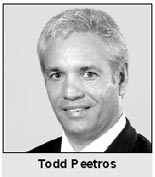
      Sections Supplements
      List of Top Performers Showcases Region’s Vibrancy, Diversity

      The region’s economy may be softening, but there is still plenty to celebrate in terms of business growth and diversity, as the Super 60 Class of 2008 reveals. The ‘Revenue’ and ‘Revenue Growth’ lists represent a wide range of business sectors, and include enterprises ranging from a Ford dealership to the Springfield YMCA.

      Russell Denver acknowledged that the region’s economy — like the nation’s — has slowed somewhat in recent months, and that there is some uncertainty about the future, especially in the wake of the turmoil on Wall Street and within the financial services sector.

      But the president of the Affiliated Chambers of Commerce of Greater Springfield said there are many strong signs of continued vibrancy in Western Mass. As evidence, Denver, a lawyer by trade, offered up what he considers exhibit A: the collective companies on the ACCGS’s Super 60 list for 2008.

      The enterprises on the ‘Total Revenue’ and ‘Revenue Growth’ lists, which range from a software maker to a local college; a car dealership to the Springfield YMCA (the nation’s second-oldest Y), were feted at the annual Super 60 luncheon, staged Oct. 24 at Chez Josef. There was much to celebrate, said Denver, noting that this year’s list features wide diversity, as seen above, several repeat winners from last year and beyond, and a number of newcomers.

      All of these characteristics reflect the strength of the local economy, said Denver, who told BusinessWest that the ACCGS started this recognition program 18 years ago — it was called the ‘Fabulous 50’ in the beginning, but it’s been expanded since — to showcase the region’s strength, resiliency, and ability to continuously spawn new ventures.

      “The list for 2008 shows that a number of companies are doing well — they’re thriving,” said Denver. “This area is a successful place to do business. This Super 60 list doesn’t just reflect that; it helps attract other businesses to this area.”

      Some statistics help explain Denver’s bullishness on the local economy. The ‘total revenue’ winners, for example, combined to amass close to $1 billion in the past fiscal year, with average revenue for all participants exceeding $19 million and more than $32 million for the top 30. Meanwhile, in the ‘growth’ category, average growth exceeded 30% for all participants, and topped 51% for the top 30. More than four-fifths (84%) recorded growth in excess of 20%, while nearly half had growth in excess of 60%

      Seven of the ‘revenue’ winners also qualified for the ‘growth’ category, while seven of the ‘growth’ winners also qualified for both lists.

      A look at both categories reveals the diversity — in terms of business sector, size, and geography — that Denver spoke of, as well as good mixes of return companies and newcomers.

      The ‘revenue’ category was topped by Southwick-based Whalley Computer Associates Inc., a veteran of the Super 60 competition and frequent top-five performer. Placing second was Ware-based Berkshire Blanket Inc., while Springfield College, the top finisher in ‘revenue’ in 2007, came in third.

      The ‘revenue’ list also includes several companies in retail: Bassett Boat, Louis & Clark Drug, Rocky’s Hardware, and Marcotte Ford, for example, as well as technology: Rediker Software and Valley Communications; manufacturing: Univer-sal Plastics, University Products, and Astro Chemicals; service: Disability Management Services, Braman Chemical Enterprises, and even the New England Farmworkers Council; and health care: Jewish Geriatric Services and Pioneer Spine & Sports Physicians Inc.

      On the ‘Revenue Growth’ side of the ledger, Springfield-based Complete Payroll Solutions topped the charts, while another Springfield company, R & R Industries, a wholesaler of scrap metal and distributor of truck and automotive parts, finished second, and East Longmeadow-based Biolitec, a maker of medical lasers and fiber-optic medical laser delivery systems, placed third.

      Also appearing on the ‘growth’ category are companies with names indicating that this roster crosses a wide spectrum of business sectors: Dimauro Carpet & Tile, Haluch Water Contracting, Kleet Lumber, McHill Hose & Coupling, Parts Tool & Die, FieldEddy Insurance, Dietz & Co. Architects, and many others.

      In the pages that follow, BusinessWest provides snapshots of all 60 companies. The top three finishers in each category appear in that order, with the rest of the lists running alphabetically.

      Departments

      Reality Store

      Area high-school seniors learned the financial facts of life at the Reality Store event hosted at Springfield Technical Community College on Oct. 17. Tables represented categories such as housing, transportation, clothing, furniture, child care, groceries, insurance, and financial institutions, and were staffed by local business volunteers. Each student was handed a card with a life scenario, including a fictitious age, salary, education level, marital status, number of children, employment history, etc. They were given a check register and had to allocate their funds to provide necessities of life; if they ran out of money, they were steered to the part-time job table to see if there were any jobs available for which they would qualify. The students came from Chicopee High School, Chicopee Comprehensive High School, Enfield High School, Enrico Fermi High School, and West Hartford High School. The financial-literacy event is held annually by the Enfield Public Schools, based on a national model pioneered by the Indiana chapter of the Business and Professional Women Assoc. At top right is Barbara Lyon, transition coordinator for the Enfield Public Schools, who has organized the Reality Store event for students in this area for the past five years.


      Driving Force

      All States Transport Inc. (AST) recently celebrated the official opening of its national headquarters at 1067 East Columbus Ave. in Springfield. Founded in 1985, AST is a freight-brokerage company with offices in Texas, Florida, and Wisconsin, and it moves customer freight via road, rail, water, and air. From left are Pam Okeefe, an employee of AST; Angie Florian, a representative of the South End Citizens Council (SECC); Chris Kingston, AST; Leo Florian, SECC; Springfield Mayor Domenic Sarno; Billy Kingston, president of AST; and Jennifer Irwin, Phil Ierasi, Mary Dinas, and Natalia Wichowsky, all employees of AST.


      County Strengths Dialogues

      Hampden County leaders gathered recently to discuss the strengths of the county and their vision for change. The luncheon at the Delaney House was part of the Women’s Fund of Western Mass. “County Strengths Dialogues” in each of the counties of Western Mass. From left are Carla Oleska, CEO of the Women’s Fund of Western Mass.; Carol Klyman and Ellen Freyman of Shatz, Schwartz and Fentin; and Joan Kagan, CEO of Square One.

      Departments

      HNE Achieves High Rating on Customer Service

      SPRINGFIELD — Health New England (HNE) recently achieved the highest rating in customer service among 160 commercial HMO/POS health plans surveyed in the U.S., according to a report released by the National Committee for Quality Assurance (NCQA). In the Quality Compass 2008 report, HNE achieved the highest ratings in the country in the ‘customer service’ composite measure. HNE scored 93.46, acknowledging that 93.46% of the respondents answered ‘always’ or ‘usually’ to questions including, “in the past 12 months, how often did your health plan’s customer service give you the information or help you needed?” HNE is a managed-care organization with a service area covering Franklin, Berkshire, Hampden, Hampshire, and parts of Worcester counties. NCQA is a private, nonprofit organization dedicated to improving health care quality, and publicly reports comparative results of health plans regionally and nationally in its annual Quality Compass report.

      United Bank Opens Express Branch in Northampton

      NORTHAMPTON — United Financial Bancorp Inc., the holding company for United Bank, has opened its Express Branch, its second Northampton location and the 16th banking office in the network. Located near Interstate 91, the Express Branch offers both walk-in and drive-up banking with a drive-up ATM, drive-up teller window, and a night depository, as well as lobby teller service for account opening and routine banking transactions. The downtown office opened in June 2006.

      Aucella & Associates Wins National Award

      WESTFIELD — Aucella & Associates has won an American Graphic Design Award for its 2008 Pilgrim Candle catalog from Graphic Design USA. The catalog was recognized for meeting a difficult design challenge, according to Phil Aucella, president. Aucella noted that he found a “visually interesting way” to differentiate Pilgrim from its competition. Overall design elements encourage the reader to learn more about the products while featuring each item in a manner that highlights the entire line, he added. For more information on the catalog, visit www.aucellainc.com.

      Renz Marks 30 Years in Region

      AGAWAM — On the heels of Renz’s 100th anniversary in Germany, Renz America celebrated its 30th anniversary locally on Sept. 26 with a tour of its facility in the Industrial Park. Company President Peter Renz opened the 48,000-square-foot facility for tours to local dignitaries, customers, and vendors. Renz America, which employs 27 in town and more than 200 worldwide, manufactures punching and binding equipment for Ring-Wire wire-comb binding, plastic-spiral or ‘coil’ binding, and plastic-comb binding. The company also produces Ring-Wire and plastic-spiral-binding supplies. Additionally, covers are made in a variety of styles, materials, and textures. For more information on the company, visit www.renz.com.

      BMC’s Cardiac Care Work Recognized

      SPRINGFIELD — Masspro has recognized Baystate Medical Center for leadership in the areas of acute myocardial infarction, heart failure, pneumonia, and surgical care. Masspro monitors and promotes health care quality in Massachusetts on behalf of the federal government. The award acknowledges Baystate’s work as part of a federal Centers for Medicare and Medicaid Services project to set benchmarks for high-quality health care in hospitals. In participating in the project and sharing best practices, Baystate has helped establish applicable standards for excellence in patient safety and the overall quality of care in the state and around the country. Baystate was also cited by Masspro for its frequent mentorship of Massachusetts hospitals in caring for heart attacks and heart failure, and for surgical care. Baystate is one of only two hospitals in the state to be recognized in that area.

      Cartelli Named President of Fathers & Sons

      WEST SPRINGFIELD — Damon S. Cartelli, son of former Fathers & Sons Inc. president and founder Robert T. Cartelli, assumed full ownership of the dealership last month. Since 1974, Fathers & Sons has grown into a multi-franchise dealership representing six car manufacturers at three locations in town — Porsche, Audi, Volvo, and Saab at Fathers & Sons Collection, 989 Memorial Ave.; Volkswagen at Fathers & Sons Volkswagen, 434 Memorial Ave.; and Kia at Kia of West Springfield, 468 Memorial Ave. Cartelli began working for his father when he was 14, performing a variety of duties ranging from managing the lot to washing cars and working in the service department. After graduating from Boston College in 1994, he joined his father selling cars and honing his skills to be the successor in the family business. He received a diploma from the National Automobile Dealers Assoc. (NADA) Dealer Candidate Academy in 1998, and was named general manager in 2001, overseeing 120 employees. Cartelli is a member of several business and trade organizations including NADA.

      Big Y Supports Breast Cancer Awareness

      SPRINGFIELD — Big Y Supermarkets are raising awareness and funds for breast cancer in October by donating proceeds from its produce department as well as select products to the Susan G. Komen for the Cure foundations in Massachusetts and Connecticut. Last year, the chain raised more than $85,000 and hopes to top that amount with this fall’s campaign. The program is called “Partners of Hope” to reflect the partnership, commitment, and support of breast-cancer awareness and research. In addition to partnering with many manufacturers to procure pink-labeled products with funding toward breast-cancer research and awareness, Big Y will be selling pink T-shirts, pink-frosted cupcakes, pink travel mugs, water bottles, and more. Pink paper ribbons will also be available for a $1 donation and will be posted in each supermarket. For information on additional programs, visit www.bigy.com.

      River Valley Market Celebrates in Style

      NORTHAMPTON — More than 10 years of effort to build a green grocery in the Valley was marked by a grand opening party on Oct. 1 which was attended by more than 750 member-owners and staff of the River Valley Market on North King Street. The community-based market specializes in fresh, local, and organically grown foods with an emphasis on supporting regional farmers in their quest to care for the land and supply foods that the community can trust. Throughout October, there will be a host of free activities, cooking tests, specials, door prizes, and food demonstrations to celebrate the grand opening. River Valley Market is open daily from 9 a.m. to 9 p.m. For events and specials, visit www.rivervalleymarket.com.

      Coldwell Banker Employees Donate $25,000

      SPRINGFIELD — Through the efforts of sales associates and employees of the Coldwell Banker Residential Brokerage offices, the fund-raising arm of the firm recently donated $25,000 to benefit the Greater Springfield Habitat for Humanity. The funds raised will enable the organization to complete the 171 Cabot St. project this fall. Offices participating in the efforts included those in Belchertown, Chicopee, East Longmeadow, Longmeadow, and Westfield. Additionally, employees have been supporting the local Habitat for Humanity through a variety of fund-raising initiatives and volunteering, according to Mary Leahey, regional vice president of Coldwell Banker Residential Brokerage. Leahey noted that the foundation of the business is providing homes, so the partnership with Habitat for Humanity “emphasizes our sincere dedication to all families and achieving their homeownership dreams.”

      Cooley Dickinson to Join New Alliance

      NORTHAMPTON — Cooley Dickinson Health Care Corp. recently announced it will join New England Alliance for Health (NEAH), a health care alliance that will be formed to include hospitals in Massachusetts, New Hampshire, and Vermont on Jan. 1, 2009. This change is coming as the Dartmouth-Hitchcock Alliance (DHA) plans a restructuring that includes dissolving the current DHA on Dec. 31, 2008. Craig Melin, president and CEO of Cooley Dickinson, noted that ,through membership in DHA, the hospital realized savings through the coordination of equipment, supplies, pharmaceuticals, and insurance-coverage purchases. Melin added that the alliance also provided for improved productivity and efficiencies in contract management and information systems. Melin noted that he expects Cooley Dickinson to achieve similar benefits through NEAH.

      SPHS Capital Campaign Gets $400,000 Boost

      SPRINGFIELD — The Sisters of Providence Health System’s capital campaign has received contributions totaling $400,000 from two prominent businesses — Big Y World Class Markets and the MassMutual Financial Group. The Hope and Healing Capital Campaign supports Mercy Medical Center’s construction of the new Mary E. Davis Intensive Care Unit and renovation of the Ambulatory Surgical Center. Big Y World Class Markets contributed $250,000 to the campaign, and MassMutual Financial Group has donated $150,000 to the campaign. Officials from both businesses were recognized at a special reception at Mercy Medical Center on Sept. 16. Additionally, health system employee donors have contributed almost $500,000 to the fund-raising effort over the past two years. The capital campaign is on track to raise $6 million by the end of the year, according to Mercy officials..

      Departments

      The following is a compilation of recent lawsuits involving area businesses and organizations. These are strictly allegations that have yet to be proven in a court of law. Readers are advised to contact the parties listed, or the court, for more information concerning the individual claims.

      CHICOPEE DISTRICT COURT

      Belmont Laundry Inc. v. Prospect Lawn
      Allegation: Breach of contract: $7,043.40
      Filed: 9/10/08

      GREENFIELD DISTRICT COURT

      Janine Boudreau Health Care Inc. v. Anchorage Nursing Home
      Allegation: Non-payment of billing services rendered: $12,000
      Filed: 9/23/08

      HAMPDEN SUPERIOR COURT

      Darlene Marchand v. Thomas Kaye M.D., Catherine Dutton R.N., Patricia Kress S.T., Judith Stacy R.N., & Valley Neurological Surgery, P.C.
      Allegation: Medical malpractice: $25,000
      Filed: 8/28/08

      Dr. Vijai B. Pandey v. Liberty Mutual Insurance Company
      Allegation: Breach of contract: $250,000
      Filed: 9/11/08

      Ludlow Construction Co. Inc. v. City of Marlborough
      Allegation: Non-payment of services rendered: $31,319.30
      Filed: 8/21/08

      Tom Ferreira v. Stop & Shop Supermarket, LLC
      Allegation: Slip and fall: $38,571.94
      Filed: 9/23/08

      HAMPSHIRE SUPERIOR COURT

      Darren D. Powell and Paul S. Bargreen v. Russell St. Realty Corp.
      Allegation: Breach of settlement agreement: $200,000
      Filed: 9/15/08

      Matthew & Jennifer Massengil, as parents of Ellinor Massengil v. Joseph E. Lellman M.D., New England Orthopedic Surgeons, and Charles L. Bernstein M.D.
      Allegation: Misdiagnosis of hip dysplasia requiring corrective surgery: $135,000
      Filed: 9/29/08

      NORTHAMPTON DISTRICT COURT

      Berkshire Design Group Inc. v. Valley Planning Inc.
      Allegation: Non-payment of professional services rendered: $23,769.36
      Filed: 9/23/08

      Berkshire Design Group Inc. v. Tomlinson Builders
      Allegation: Non-payment of professional services rendered: $12,214.87
      Filed: 9/23/08

      Krisen Day v. Fraternal Order of Eagles of Northampton Inc.
      Allegation: Plaintiff seeks return of real-estate deposit because of title defect: $20,000
      Filed: 9/29/08

      PALMER DISTRICT COURT

      Kathy Lucas v. BNC Countertops Inc.
      Allegation: Breach of contract in counter installation: $4,643.63
      Filed: 8/28/08

      SPRINGFIELD DISTRICT COURT

      Arch Aluminum & Glass Company Inc. v. Hampden Structural Systems d/b/a Private Garden, Joseph and Katherine Hickson
      Allegation: Non-payment of goods sold and delivered: $7,981.15
      Filed: 9/16/08

      Palazzesi Realty v. Pet Resorts International, LLC
      Allegation: Failure to pay rent: $6,600
      Filed: 9/19/08

      Departments

      The following building permits were issued during the month of September 2008.

      AGAWAM

      Hillside Development Corp.
      959-967 Springfield St.
      $200,000 — Renovation of existing building

      Litron, Inc.
      207 Bowles Rd.
      $70,000 — Install steel support beams to relocate HVAC unit on roof

      CHICOPEE

      Adams & Ruxton Construction Co.
      124 Cabot St.
      $41,500 — Make improvements to teller stations

      JK Harbey LLC
      55 West St.
      $25,000 — Renovate kitchen

      JK Harbey LLC
      59 West St.
      $50,000 — Renovate kitchen

      EASTHAMPTON

      George R. Dion
      141 Northampton St.
      $19,300 — New roof

      John Moriarty
      77-87 Main St.
      $39,000 — Construct new means of egress in rear of building

      Mai Stoddard
      24-26 Northampton St.
      $21,000 — Replace roof covering

      EAST LONGMEADOW

      BCHP Partners LLC
      98 Shaker Road
      $20,000 — Interior renovation

      First Baptist Church
      50 Parker St.
      $2,973,000 — Construction of new fellowship building

      GREENFIELD

      Bete Inc.
      50 Greenfield St.
      $47,000 — Erect a 42x14x45 storage building

      Dimitriou Panagiotis
      256 Federal St.
      $10,000 — Renovate interior of existing structure

      Erin Miner
      469 Bernardston Road
      $2,000 — Remove a non-bearing wall

      Mary Calagione
      285 High St.
      $4,000 — Office renovations

      Town of Greenfield
      Nashs Mill Road
      $5,000 — Rebuild new first aid room

      HADLEY

      Pyramid Mall of Hadley, LLC
      367 Russell St.
      $36,500 — Renovation of two mall restrooms

      Steve Lewis
      184 Russell St.
      $11,000 — Re-roof

      Whole Foods Market
      327 Russell St.
      $20,000 — Install new customer service booth and new express checkouts

      HOLYOKE

      O’C Ingleside LLC
      361 Whitney Ave.
      $200,000 — Build expansion to the Baystate Health Data Center


      Windship Enterprises Inc.
      366-372 High St.
      $7,000 — Reline chimney with UL listed stainless steel

      LUDLOW

      Aubie Precision Tool
      54 Moody St.
      $20,000 — New roof

      NORTHAMPTON

      Alan Berkenwald
      38 Mulberry St.
      $5,000 — Construct roof over building walkway

      Coolidge Northampton LLC
      241 King St.
      $6,100 — Create a handicap bathroom

      Gerald & Sandra LaFrance
      29 North Maple St.
      $10,000 — Strip and shingle roof

      LHIC INC
      34 North Maple St.
      $5,000 — Buildout for woodworking shop

      Paul A. Sereo
      63 Center St.
      $19,500 — Remodel unit #1

      Pride Convenience Inc.
      17 Damon Road
      $3,500 — Remove and repair concrete floor

      Robert S. Berniche
      5 Audubon Road
      $2,000 — Construct second-floor means of egress

      Smith College
      17 Prospect St.
      $8,700 — Repair exterior ramp and railings

      WAM LLC
      115 Industrial Dr.
      $672,000 — Construct 16,969-square-foot addition and renovation

      SPRINGFIELD

      3640 Main Street LLP
      3640 Main St.
      $124,000 — New build-out of phlebotomy space

      Garden Park Management Company
      15 Temple St.
      $14,000 — Repair fire damage

      Picknelly Family Partners
      1414 Main St.
      $86,000 — Build-out for Sinclair Insurance

      Sanjo LLC
      150 Taylor St.
      $12,000 — roof renovation

      WESTFIELD

      AeroServistar LLC
      76 Service Star Industrial Way
      $1,550,000 — New distribution center

      Pasquale Cardento
      278-288 Elm St.
      $17,000 — Addition

      Sullivan West Property Group LLC
      39 South Broad St.
      $5,000 — Commercial renovation

      Sections Supplements
      PeoplesBank Expands Its Footprint — and Moves Up the Donors’ List
      Doug Bowen, left, president and CEO of PeoplesBank, congratulates Henry Thomas III,

      Doug Bowen, left, president and CEO of PeoplesBank, congratulates Henry Thomas III, president and CEO of the Urban League of Springfield Inc., on his organization’s selection as a donation recipient.

      PeoplesBank President Doug Bowen has several different numbers to be proud of these days.

      For starters, there’s $1.41 billion. That’s the total-assets figure for the Holyoke-based institution, making it the largest community bank in Western Mass. There’s also $912,262,000 (total deposits), and 15, the number of locations the bank now has in the Pioneer Valley.

      There are a few more figures of note: one that Bowen certainly knew about, $412,376 (the amount donated by the bank to area-based nonprofit groups in 2007), and one he didn’t, until recently, anyway. That would be 52.

      That’s where the bank ranked in the Boston Business Journal’s third annual “largest charitable contributors list,” which is based on donations to Massachusetts nonprofits. That’s just one slot below giant Friendly Ice Cream Corp., ($421,031), in roughly the same neighborhood as KPMG, Arbella Insurance, and even Microsoft Corp., all corporations with a large presence in the Bay State, and comfortably ahead of Dunkin Brands ($218,020) and Reebok International ($138,345).

      These numbers for assets, branches, and donations are all intertwined, of course, said Bowen, who noted that, as PeoplesBank expands its footprint in Western Mass. — including its two most recent branch openings, both in Springfield — the levels of deposits and assets naturally increase. But so too does the amount of giving within the community, he noted, adding that the bank’s presence within a given community extends well beyond bricks and mortar.

      The opening of the institution’s newest branch, on Sumner Avenue in the Forest Park section of Springfield, for example, was accompanied by some checks signed by PeoplesBank and made out to American International College ($50,000); Rachel’s Table ($15,000); the Springfield Falcons ($11,200); ReStore Home Improvement Center ($10,000); Springfield Public Forum ($4,000); Springfield Symphony ($8,000), and the Urban League of Springfield ($15,000).

      That’s a total of more than $113,000, which will help the bank keep a strong presence on the Journal’s largest-charitable contributors list, an honor that Bowen relishes because it exemplifies the bank’s mission to make a difference in the communities it serves through contributions to such groups, and not merely compile assets, deposits, and mailing addresses.

      “This ranking speaks to our commitment to the region … we’re proud of our track record for giving,” said Bowen, noting that he’s not sure what the final tally for donations will be for ’08, but it will be well north of $500,000. That should move the bank up the list, but Bowen is focused more on what these and other types of donations will mean within the community.

      “A lot of people talk about commitment,” he explained. “We do it through our financial resources, but just as important, we encourage people here to donate their time, energy, and leadership skills — and they have.”

      Branches of Service

      Upon crunching the numbers from the Journal’s contributor list for 2007, one finds that PeoplesBank is exponentially (two zeroes, actually) behind frontrunner State Street Corp., which doled out a whopping $33 million in ’07. That’s roughly double the amount contributed by runner-up Blue Cross Blue Shield of Massachusetts ($16.6 million). Meanwhile, Bank of America ($14 million), Liberty Mutual Group ($11.9 million), and Partners Healthcare ($11.54 million) round out the top five. MassMutual? It was 14th at $4.6 million, one slot ahead of the Red Sox, $4.4 million.

      But the Holyoke institution wound up as the 10th-highest bank on the list. It is the fourth-largest outside Worcester, and the largest based in the Pioneer Valley.

      Bowen says this standing is one of the anticipated, and more pleasurable, byproducts of an ambitious expansion strategy that the bank set in place a few years ago. Then-president Joe Lobello described it as a somewhat unusual game plan given the over-banked nature of many area communities (or the perception of same within the industry and outside it) and planned or anticipated expansion by other institutions, especially ones that had recently gone public.

      But Lobello thought then, and Bowen believes now, that the strategy is sound. It calls for giving PeoplesBank, which has historically been focused on Holyoke and surrounding towns, a presence in more communities, including Springfield (where it has only had ATMs until recently) and, eventually, Northampton, West Spring-field, and other cities and towns.

      These bridgeheads, if one can call them that, will properly position for the bank for expected future consolidation, mergers, and acquisitions that will leave fewer locally owned and managed banks, said Bowen, noting that Springfield has become the first phase of the plan’s execution.

      And while some might put Springfield in the ‘over-banked’ category, PeoplesBank saw what it considered to be room for another, in this case, locally based institution.

      “We saw space for a local bank with local control,” said Bowen, noting that most all the banks doing business in the City of Homes are headquartered out of the region or even out of the country. “And we went ahead to fill that space.”

      The first foray into Springfield was in Sixteen Acres, with a branch that opened in late 2006, he said, noting that the Sumner Avenue facility was already in the planning stages when that facility opened. Likewise, the next step — a branch in East Springfield, near the Springfield Plaza — is set to move off the drawing board.

      As the bank has expanded into Springfield, it has written checks to benefit groups and facilities based in that city or that do business there, said Bowen, noting that, with the opening of the Sixteen Acres branch, the bank donated $75,000 to the Greenleaf Senior Center, among other donations to groups that serve that area.

      These gifts no doubt helped push PeoplesBank onto the Boston Business Journal’s list, and the donations that have accompanied the Sumner Avenue branch opening may propel it higher, said Bowen, adding quickly that the chosen beneficiaries are as important as the dollar amounts.

      “There are organizations — the symphony, the Public Forum, and the Springfield Falcons are all examples — that clearly enrich our lives,” said Bowen. “And then there are others that reach out and support the most vulnerable members of the community, and Rachel’s Table and the Urban League are good examples of that. These are the kinds of groups we want to support because they improve quality of life within a community.”

      The bank has an individual with the title “community manager,” Bowen continued, who takes requests from nonprofits, weighs the merits of applications, and makes recommendations to company leaders. “We consider these applications based on the scope and the impact in the community, and our giving is focused on putting dollars where they can impact the most people and have the greatest impact.”

      The Bottom Line

      Bowen said the bank has a number of possible options as it mulls the next steps in its broad expansion plan.

      Creating a presence in Northampton, the largest community in Hampshire County, is certainly at or near the top of the list, while a West Springfield location is also a likely eventuality.

      And as the bank expands, it will continue to support those communities where the name goes, said Bowen, hinting broadly that while he’s certainly proud of that number 52, this is one of those rare incidences when an bank executive would like to see a smaller figure next year.

      — George O’Brien

      Departments

      Robert A. Plasse has been named Assistant to the President for Communications at Westfield State College. Plasse is the founding member, president, and director of programs for Westfield on Weekends, and most recently served as Assistant Professor in the Human Services Department at Holyoke Community College.

      •••••

      Chuck Breidenbach has joined Mountain Development Corp., owner and manager of the Eastfield Mall in Springfield, as Managing Director of the MDC Retail Properties Group. He will oversee the retail business operations incorporating his wide variety of experience including development, leasing, management, marketing, and construction of both enclosed and open-air retail facilities. His background in new development, turnarounds, and expansions will help facilitate Mountain Development’s continued growth.

      •••••

      Carolyne Hannan has been named Vice President of Sales and Marketing for Comcast in Western Mass., Connecticut, and New York. In this role, Hannan will oversee all marketing and sales initiatives in the 128 communities that comprise the region. Hannan has 15 years of experience in the communications industry, including four years with Comcast.

      •••••

      Witalisz & Associates Inc. of Westfield announced the following:
      • Bernadette Bain joins the firm as a Realtor/ Consultant;
      • Grace Sullivan joins the firm as a Broker/Realtor, and
      • Barbara Petrucelli joins the firm as a Broker/Realtor.

      •••••

      Mark Grumoli has been named Senior Vice President and Commercial Loan Officer at Greenfield Savings Bank. He brings more than 17 years of sales, commercial-banking, and management experience to his new position.

      •••••

      Maryann Lombardi, who for the past year has served as acting Director of Creative Economy for the UMass Amherst division of University Outreach, has been named to become the first full-time director for that office. In this role she also serves as Managing Director of the Sankofa Dance Project, which celebrates African roots in American dance through intensive summer study, choreographic residencies, performances, and events. She brings extensive directing and production experience to the new Outreach position, having served almost 10 years as producer, general manager, and resident director for boulevard arts, inc., and as artistic producer and resident director for the Leopold Project.

      •••••

      Edward J. Garbacik has been elected Vice President, Investment Executive of Financial Services of Florence Savings Bank. He has more than 20 years of financial services experience, having worked previously for UBS Financial Service Inc.

      •••••

      William E. Templeton has joined Berkshire Bank as AVP/Mortgage Loan Manager for the Pioneer Valley. He will concentrate his efforts on developing mortgage business in the Greater Springfield area.

      •••••

      Hogan Communications in Easthampton announced the following:
      • Jenna Gable has joined the firm in the Accounting Department. She is creating policies and procedures that will further enhance the company’s customer service.
      • Krystal Ayala has joined the firm as a Customer Advocate, specializing in increasing customer satisfaction.

      •••••

      UMass Amherst faculty and staff members have received recognition for their work in recent weeks:
      • Fergus M. Clydesdale, Distinguished Professor and head of the Food Science Department, presented the 2008 Sterling B. Hendricks Memorial Lecture on Aug. 19 at the national meeting of the American Chemical Society in Philadelphia;
      • Ashoke Ganguli, Director of Auxiliary Services, received the Pinnacle Award from the (OS1) Users Group Aug. 18 in recognition of his “outstanding contributions to the cleaning industry and the (OS1) program”;
      • Eliot Moss, Professor of Computer Science, shared an award for the most influential paper at the International Symposium on Computer Architecture June 21-25 in Beijing; and
      • Brian D. Bunk, visiting Assistant Professor of History, co-edited Nation and Conflict in Modern Spain: Essays in Honor of Stanley G. Payne, published in August by the Parallel Press of the University of Wisconsin-Madison. Co-edited by Sasha Pack and Carl Gustaf-Scott, the book is a collection of original scholarship and reflective essays written by students and colleagues of the distinguished Hispanist.

      •••••

      Pat French has been named SCORE Community Outreach Coordinator for the Western Mass, division at H&R Block.

      •••••

      FieldEddy has appointed Wendy L. Fitzgerald and Dina N. Rehbein as Personal Line Account Managers. Both are licensed property and casualty insurance agents in Massachusetts.

      •••••

      Andrew Ross has been promoted at Scottrade’s Springfield branch office at 1441 Main St. Ross is responsible for branch operations, managing personnel, and providing customer service.

      •••••

      Kristina Lavigne has been promoted to Personal Insurance Manager for Insurance Center of New England in West Springfield.

      •••••

      GCB Financial Services division in Greenfield announces the addition of Sharon A. Connery as a Financial Services Representative.

      •••••

      UMass Five College Federal Credit Union announced that Craig Layman, a registered representative affiliated with broker-dealer and registered investment adviser CUSO Financial Services, was a recent recipient of the CFS 2007 Bronze Pacesetter Award at the annual conference in San Diego. The award honors the top-producing registered representatives among 100-plus credit union programs. UMass Five serves UMass as well as the Five College System and other select employee groups.

      •••••

      Realtor Association of Pioneer Valley President-Elect Mark Abramson and Executive Vice President Edward M. Moore recently attended the 2008 National Association of Realtors Leadership Summit in Chicago.

      •••••

      Donna Huff, Minimum Data Set Coordinator for Jewish Geriatric Services, was recently awarded Minimum Data Set (MDS) certification granted by the National Assoc. of Subacute/Post Acute Care. MDS, a uniform set of elements for assessing the functional capacity of residents of long-term care facilities, is required for communication with designated state agencies as a condition of Medicare and Medicaid programs.

      •••••

      Bill Blair recently joined ERA Laplante Realty of South Hadley.

      •••••

      Peter Spedero, a Senior Analyst for Unemployment Tax Control Associates in Springfield, recently celebrated his five-year anniversary with the firm. Spedero services the multi-state accounts division, including the US Air-America West and Sovereign Bank accounts.

      •••••

      Terrie Edson recently joined Franklin County Home Care as Program Director of the Men’s Health Partnership and Women’s Health Network.

      Departments

      The following is a compilation of recent lawsuits involving area businesses and organizations. These are strictly allegations that have yet to be proven in a court of law. Readers are advised to contact the parties listed, or the court, for more information concerning the individual claims.

      CHICOPEE DISTRICT COURT

      United Rentals Inc. v. Titan Roofing Inc.
      Allegation: Breach of contract, unjust enrichment, and negligence: $7,924.80
      Filed: 7/24/08

      HAMPDEN SUPERIOR COURT

      Advance Foam Recycling v. Advance Wire Solutions & Equipment
      Allegation: Non-payment of judgment rendered: $50,685
      Filed: 7/11/08

      Charles Winston v. Commerce Insurance Co.
      Allegation: Breach of insurance contract: $43,000
      Filed: 7/15/08

      Heather Carpenter v. Francis Cannizzo, M.D.
      Allegation: Medical malpractice: 180,000+
      Filed: 7/10/08
      Jeane Raudensky v. JGS Family Medical Care
      Allegation: Medical malpractice: $104,423+
      Filed: 7/09/08

      Jeanette Rivera v. Chrysler LLC & Hampden Dodge Inc.
      Allegation: Breach of contract and violation of consumer protection act: $17,000
      Filed: 7/11/08

      NAPA Auto Parts v. Midas-Ludlow
      Allegation: Non-payment of goods sold and delivered: $124,720.22
      Filed: 7/11/08

      William Moran v. City of Holyoke, Holyoke Fire Department, and David Lafond
      Allegation: Discrimination: 100,000
      Filed: 7/11/08

      HOLYOKE DISTRICT COURT

      Elizabeth Tap v. Holyoke Medical Center Inc.
      Allegation: Negligence in leaving patient unattended in wheelchair while waiting for transportation, causing injury: $11,493.87
      Filed: 7/16/08

      NORTHAMPTON DISTRICT COURT

      Toshiba America Information Systems Inc. v. Superior Mechanical Contractors Inc.
      Allegation: Breach of equipment-lease agreement: $4,481.24
      Filed: 7/22/08

      Zap Electric Inc. v. Valley Home Improvement Inc.
      Allegation: Non-payment of electric services rendered: $4,484.49
      Filed: 7/31/08

      PALMER DISTRICT COURT

      A & A Transport v. Nieroda Transport Inc.
      Allegation: Damages stemming from defendant’s conversion of plaintiff’s trailer: $14,278.42
      Filed: 6/27/08

      Northwave America v. Ski In Inc.
      Allegation: Non-payment of goods sold and delivered: $8,611.44
      Filed: 7/16/08

      SPRINGFIELD DISTRICT COURT

      Autoline Marketing Group, LLC v. Sarat Ford
      Allegation: Breach of contract: $2,659.88
      Filed: 5/08/08

      Integrated Illumination Systems Inc. v. Ledlight Illuminated Signs, LLC
      Allegation: Non-payment of goods sold and delivered: $9,964.44
      Filed: 7/23/08

      Michael St. Andre v. Commerce Insurance Co.
      Allegation: Breach of insurance contract: $18,000
      Filed: 5/07/08

      Royal Harvest Foods v. Wellshire Farms Inc.
      Allegation: Non-payment of services rendered: $8,353.97
      Filed: 5/08/08

      Springfield Chiropractic Sports Rehab Center, LLP v. Premiere Insurance Co. of Mass.
      Allegation: Failure to pay personal injury protection: $4,207
      Filed: 5/08/08

      United Rentals Inc. v. the Coastline Co. Inc.
      Allegation: Non-payment of materials, equipment, and services for various construction projects: $5,216.04
      Filed: 5/08/08

      Departments

      Witalisz & Associates Inc. of Westfield announced the following:
      • Bernadette Bain joins the firm as a Realtor/Consultant;
      • Grace Sullivan joins the firm as a Broker/Realtor, and
      • Barbara Petrucelli joins the firm as a Broker/Realtor.

      •••••

      Gary Gray has joined Morgan Stanley’s Global Wealth Management Group in Springfield as a Financial Advisor.

      •••••

      Suzanne Cappella of Holyoke and Patricia Bray of Monson have received top honors in lia sophia’s Excellent Beginnings Program Achievers program for outstanding sales accomplishments and professionalism.

      •••••

      April M. Beston has been promoted to Branch Manager for Berkshire Bank’s Ludlow branch on Center Street. Beston is responsible for branch sales and operations, new business development, and educating customers on products and services offered by the bank.

      •••••

      Lisa Patenaude has been named Partner at Meyers Brothers Kalicka in Holyoke. In addition to her work in the Health Care Services Division, she also works with clients in the manufacturing, real-estate, retail, construction, and personal-service industries.

      •••••

      Dr. David I. Peck attended the fourth annual International Assoc. of Comprehensive Aesthetics (IACA) conference recently in Orlando. Peck’s aesthetic dental case was recognized at the IACA for case success and was chosen by the Aesthetic Eye of the IACA to be displayed at the conference.

      •••••

      Berkshire Bank of Pittsfield announced the following:
      • Eliot Chartrand has joined the bank as a Mortgage Originator and will work out of the Memorial Drive office in Chicopee, and
      • Michael A. Mirski has been promoted to Vice President and Regional Branch Manager for the Pioneer Valley region. Mirski will be located at the bank’s Court Street, Westfield location.

      •••••

      Bryarly C. Lehmann of Bryarly Consulting LLC has been certified as an owner’s project manager by the Massachusetts School Building Authority after completing the authority’s certification process this June. Lehmann is certified to manage, in accordance with the law, all aspects of school-building renovations and new construction for an owner within the Commonwealth of Massachusetts as funded by the MSBA.

      •••••

      As part of its expansion into contract surety bonding to local construction firms, the FieldEddy Insurance network has hired Bruce Wilson as Account Executive.

      •••••

      Dr. Sean Dacus joins South Deerfield Family Practice and certified family nurse practitioner Gail Blanchard in providing primary-care medicine for infants through seniors.

      •••••

      Florence Savings Bank announced the following:
      • Kimberly L. Baker has been named Assistant Vice President, Commercial Loan Administration Officer;
      • Douglas B. Baker has been elected Vice President and Branch Manager of the Williamsburg branch;
      • Toby L. Daniels has been elected Vice President and Branch Manager of the Hadley branch;
      • Sandra P. Smith has been elected Vice President and Branch Manager of the downtown Northampton branch;
      • Beth M. Carr has been elected Vice President of Operations, and
      • Thomas G. Conner has been elected Vice President and Branch Manager for the Easthampton branch.

      •••••

      Peg McDonough has joined Bank of America as a Reverse Mortgage Equity Loan Officer for Hampden, Hampshire, Franklin, and Berkshire counties. McDonough will specialize in educating seniors on the benefits of a reverse mortgage and help determine if it’s the right financial tool to meet their individual needs.

      •••••

      New Alliance Bank announced the following:
      • Brandon E. Braxton has joined the firm as a Vice President in the bank’s business-banking unit, and will work out of the Park Avenue, West Springfield office, and
      • David A. Chase has joined the firm as a Vice President in the bank’s business unit, also working out of the West Springfield office.

      •••••

      Michelle N. Theroux has been appointed Vice President of Clinical Services for the Center for Human Development.

      •••••

      Dr. John Tsongalis has joined Northampton Family Practice. He provides primary and preventative care to family members of all ages, from newborns to adults.

      •••••

      Jeffrey J. Trant has been named Director of Lighthouse. Trant will be responsible for the operational and strategic management of the program, as well as the promotion of strength-based recovery practices.

      •••••

      Dr. Steven Weinsier, a cardiologist with specialized training in peripheral vascular disease and coronary interventions, has joined Cooley Dickinson Hospital’s medical staff and Northampton Cardiology Associates.

      •••••

      Grace L. Smith has joined Webster Bank as a Residential Mortgage Officer serving the Greater Springfield market.

      •••••

      The National Assoc. of Workforce Development Professionals announced the election of Keith Hensley, Executive Director of Workforce and Economic Development at Holyoke Community College, to its board of directors.

      •••••

      Lisa Christie has been honored for her client service excellence in her work at the branch office of Norm Stafford in South Hadley.

      •••••

      The Scuderi Group of West Springfield has named Bill Wrinn as Director of the company’s global marketing and communications initiatives. Wrinn is responsible for building awareness of the Scuderi Group and the company’s Air-Hybrid Engine to the automobile industry and the investment and business communities worldwide.

      •••••

      Human Resources Unlimited of Springfield has appointed Aimee Bell as Transportation Manager. Bell is a National Safety Council Defensive Driving certified instructor.

      •••••

      Jennifer DeMoe has joined the staff of United Bank as Vice President of Finance.

      •••••

      The Mass. Supreme Judicial Court appointed Jacqueline E. Farrow to a five-year term on the Board of Directors of the Massachusetts Legal Assistance Corp. Farrow is employed by the Stavros Center for Independent Living, where she serves on the Advocacy Committee.

      •••••

      Gerri Hedblom has joined Park Square Realty’s Westfield office as a Sales Associate. Hedblom has more than five years experience in the local real-estate market, specializing in residential listings and sales.

      •••••

      PeoplesBank has announced that Janice Mazzallo, Senior Vice President, Human Resources, has graduated with honors from the American Bankers Association’s National School of Banking at Fairfield University.

      •••••

      Thomas M. Cleary Jr., D.D.S., has joined the dental practice of Thomas M. Cleary, D.M.D., of Easthampton.

      •••••

      Michael and Traci Connors, owners of Sir Speedy at 1441 Main St., Springfield, announced they were recently honored with a Sir Speedy Century Club Award for the second consecutive year. The award recognizes Sir Speedy’s top 100 centers by sales, placing Sir Speedy of Springfield in an elite group of franchises represented worldwide.

      •••••

      Jewish Geriatric Services announced the following:
      • Laurie Lipscomb Alves, RN, Assistant Director of Nursing, was awarded Wound Care Certification granted by the National Alliance of Wound Care;
      • Donna Campbell has been honored as a 2008 Massachusetts Long Term Care Foundation Scholarship recipient;
      • Gina Francis-Wilson has been honored as a 2008 Massachusetts Long Term Care Foundation Scholarship recipient;
      • Diana Thamage-Kibodya has been appointed Resident Service Coordinator at Genesis House – Housing for Independent Seniors, and
      • Moira Chiusano will serve as a Social Worker at the Wernick Adult Day Health Care Center.

      •••••

      Franklin County Home Care has named Terrie Edson, R.N., as its Program Director of the Men’s Health Partnership and Women’s Health Network.

      •••••

      Lisa K. Reilly, APR, Assistant Vice President of Advertising and Public Relations for the Retirement Services Division of MassMutual Financial Group in Springfield, has completed the Examination for Accreditation in Public Relations, allowing her to use the APR professional designation.

      •••••

      Neurosurgeon Dr. Robert Schapiro has joined Baystate Neurology in Springfield. He specializes in the treatment of tumors, spine and pediatric neurosurgery.

      •••••

      Heather Johnson has earned membership with the National Association for College Admission Counseling. She is an educational consultant specializing in boarding school and college guidance. She is a professional member of the Independent Educational Consultants Association and a member of the New England Association of College Admission Counselors.

      •••••

      Primary care physician Dr. Ritika Bhatt has joined Baystate Medical Practices in Springfield.

      Features
      ‘Profit Recovery’ Firm Is Changing the Methodology and Image of Collections

      Alan Surprenant says he can understand why some companies and professionals are somewhat passive when it comes to the matter of collecting past-due bills.

      There is a fine line that most must walk, he explained, noting that, while business owners obviously want and need to get paid, they usually don’t want to offend long-time — or potential long-time — customers, who may end a relationship if they sense over-aggressiveness in pursuit of payment.

      Meanwhile, many business owners and managers simply don’t want to turn over a percentage of what they are owed (usually 25% to 50%) to a collection agency, he continued. Some try small-claims court (if the amount owed fits that category), but often they just get a ruling in their favor, and not a check. “Courts don’t collect money.”

      So many companies try to do things on their own and mostly wait and hope that the payment will come in soon, said Suprenant, Western Mass. and Northern Conn. sales representative for a company called GreenFlag Profit Recovery. This strategy, if one can call it that, often leads to bills getting ‘stale’ — six months overdue or older — when the odds of getting paid are much lower than when a bill is 60 or 90 days out.

      GreenFlag takes care of most all of these concerns, said Surprenant and Michael Bernier, the company’s sales manager. It does so by convincing companies to more-aggressively, but not over-aggressively, pursue payment much earlier than they might otherwise, and in a manner that Bernier says “takes some of the stink out of collections.” And the company also has a flat-fee schedule, sometimes as a low as $10 or $12 per bill.

      Thus, it relies on volume, which it achieves through both its 123 offices scattered across the country and a willingness to accept everything from a five-figure bill all the way down to a few bounced checks.

      Summing things up, Surprenant said GreenFlag acts more like an extension of a company’s accounts-receivable department than a hired gun brought on to go after a few past-due bills.

      “I like to call what we do pre-collection work,” he explained, adding that the company takes its name because it’s not recovering money, but instead is recovering profits, and at a time when many business owners are facing noticeably slimmer margins. “What we’re doing is putting a system in place that prevent accounts from going into what most would consider the ‘collections’ state.”

      Bernier told BusinessWest that his company, like all collections businesses, is busier at times like these, when the economy is slower and when consumers, be they individuals or businesses, have decisions to make about which bills to pay, and when, because they can’t pay them all on time. Virtually every industrial sector and individual business sees its accounts-receivable file impacted by times like this, but some, including professionals such as health and dental care providers, lawyers and accountants, and service-oriented ventures, feel it more, usually because of the size of the bills they send out.

      And then there are the fuel-oil dealers, who deliver a commodity that is essential but increasingly difficult to afford.

      “Some have just gone out of business, and a lot of it has to do with getting paid, or not getting paid, as the case may be,” said Bernier, noting that some, when possible, are demanding cash on delivery. “When you talk to talk to those people today, they’re generally not as concerned with how many gallons they’re delivering as they are with just getting their money.”

      In this issue, BusinessWest takes an indepth look at GreenFlag and its different approach to collections. In the process of doing so, we’ll shed some light on an all-important but still somewhat overlooked aspect of business management — getting paid.

      Due Diligence

      As he talked about those ‘decisions’ now facing individuals and business owners, Bernier recalled a recent visit to the convenience store.

      “There was a guy in line ahead of me who had $10,” he explained. “He bought a pack of cigarettes and said, ‘put the rest on pump 2.’ He needed those cigarettes, and put what was left on gas, which was what … just over a gallon — maybe?’”

      The anecdote is somewhat extreme, but drives home a point, he explained. Specifically, most all people have less buying power than they did a few weeks or a few months ago, and they have decisions to make about how they spend what they have. There are some things they need (or believe they need), like cigarettes, some things they can do without (many are in fact cutting back), and some things they need but don’t necessarily have to pay for right away — and don’t.

      Anyone who handles accounts receivable can see this phenomenon at work, said Surprenant, adding that, while collections are an ongoing issue for most businesses, they are a far-more-pressing concern at the moment, because more people are having trouble paying bills, and small businesses, which are also facing rising costs, need proper cash flow. If they don’t have it, then they can easily find themselves on the other end of the bill-collection problem.

      Despite all this, Surprenant says he consistently sees a lack of proper attention and/or a lack of understanding regarding the matter of getting paid. Thus, he says he spends a good amount of time educating or re-educating clients about the art and science of collections.

      It certainly isn’t rocket science, he explained, but there are some points that business owners should keep in mind, starting with the long-held mindset concerning this business.

      “A business owner always thinks that they’re going to figure out a way to collect the money without going to collection,” he explained. “And the reason they do is because their thought is that ‘collections’ is percentages, or giving up a big piece of what they’re owed, and they don’t want to do that.”

      At the top of that list when it comes to re-educating clients is emphasizing the need to start getting serious about collecting a debt well before it becomes stale, said Surprenant.

      Elaborating, he said that too many business owners will wait several months before thinking about taking a bill to collection, and for all those reasons listed earlier. The basic mentality held by many is to take a bill to collection only when they’ve become convinced they’re not going to get paid, and when they are subsequently less concerned about paying the collector’s percentage.

      “This is backward thinking,” said Bernier, who told BusinessWest that there are ways to go after past-due bills earlier, and without being over-aggressive to the point of alienating people.

      He calls GreenFlag’s methodology “a diplomatic and professional approach.”

      It starts with what he calls a “courtesy letter,” which politely asks if the tardiness is an oversight. The letter then invites and encourages prompt payment to the vendor in question and not the collection agency, which is the standard procedure so that the agency can take its cut first.

      This letter generally yields one of four responses, said Bernier: prompt full payment, partial payment, negotiation of a payment schedule, or it’s ignored. And in this last scenario there is a series of follow-up letters (one issued every 10 days) designed to generate a different, better response.

      Generally, GreenFlag is able to generate one, he said, adding that the company has been able to recover roughly 56% of the debts it is assigned, a rate four times the national average of 14%, as estimated by the American Collectors Assoc.

      This track record has enabled Green-Flag’s regional office to build a client list that includes everything from sole proprietorships to a health care system to a pharmacy chain (which needs ongoing help collecting from people who order prescriptions online and then don’t pay).

      It also includes several oil dealers, said Bernier, who expects this coming winter to be as difficult for those businesses (from a collections standpoint) as it will be for those facing soaring fuel-oil prices.

      But the current bill-collecting climate is challenging for most all businesses, he continued, noting that some physicians have reported growing problems with self-pay accounts, and many dentists are being challenged to collect the difference between what they are owed and what the insurance company will pay.

      “Every business that extends credit or accepts checks is feeling the pinch right now,” said Bernier, who noted that many expect conditions to get worse before they get any better.

      By All Accounts

      Returning to the matter of that fine line he referenced — the one that everyone has to walk when it comes to accounts receivable — Surprenant said business owners must be aware of it and respect it.

      But they don’t have to be paralyzed by it, and thus become passive with regard to an important issue for everyone doing business.

      “These are your profits we’re talking about,” he said. “Many professionals and business owners are concerned about diplomacy, and they need to be, but the bottom line is, well … the bottom line, and making sure its healthy.”

      Opinion

      Springfield, which had been doing somewhat better in the public-relations department of late, suffered a potentially significant setback recently, when it landed on one of those lists that no city wants to be on.

      In this case, it was a compilation from Forbes.com of the nation’s “fastest-dying cities.” Springfield is right there, along with Buffalo, N.Y., Charleston, W.V., Scranton, Pa., Detroit and Flint, Mich., and no less than four cities from Ohio — Canton, Cleveland, Dayton, and Youngstown. More than 150 cities were supposedly considered for this ‘honor,’ and these are the ones that have “struggled the worst of any areas in the nation in the 21st century, and they face even bleaker futures,” including to the author.

      In its quick summation of why Springfield is on the list, Forbes.com writes, “the Western Mass. home to Massachusetts Mutual Life Insurance and Smith & Wesson has suffered for a long time as the Northeast becomes less and less a destination for manufacturing.” It goes on to note that the city has partnered with Hartford in an effort to stave off further decline.

      There were a number of factors that went into gaining designation as one of the fastest-dying cities, including high unemployment, population loss, comparatively modest GDP, and others. List such as this one are subjective, arbitrary, completely unscientific, and somewhat sensational, but that doesn’t stop publications from Forbes from doing them.

      And now that Springfield’s on the list, it will be interesting to see and hear how it handles this and what the fallout might be.

      Indeed, while the knee-jerk reaction is to discount this list and Springfield’s placement on it, or argue with its basic premise — and that’s what area leaders and some media outlets have done since it came out — those closely involved with crafting Springfield’s future shouldn’t dismiss the main point.

      And that is that most all the cities on this list are once-thriving manufacturing centers — most located in what is still known as the Rust Belt — that have struggled, in some cases mightily, to build post-industrial economies. Springfield is still hard at work with this assignment, with limited progress to date.

      The city’s defenders say there are some positive things happening here — and there are. But a new federal courthouse, Liberty Mutual’s arrival (300 or so jobs), a few new hotels, some progress on the riverfront, and even Baystate Health’s $250 million expansion in the form of the ‘hospital of the future’ do not constitute ‘re-invention,’ and that’s what has to happen if Springfield is to truly get off the deathbed Forbes.com says it’s on.

      Reinvention will come through the development of new sources of good, high-paying jobs (tourism and distribution positions don’t qualify) to replace those lost due to the decline in manufacturing. There is some progress on this front — in areas such as biotechnology, renewable energy, and ‘green’ business development — but still a very long way to go.

      Meanwhile, true reinvention won’t come until Springfield can do something substantial to lower an appalling 50% dropout rate in its high schools, a statistic that speaks volumes about why, with an unemployment rate at or slightly above the national average, many area companies in this region simply can’t find qualified individuals to fill vacancies.

      Does Springfield belong on the fastest-dying cities list? One could debate this question forever, and since this was a subjective exercise and we don’t really know enough about the other 149 cities evaluated, there seems little point in doing so — and that exercise only adds validity to the list.

      A series of mayors from Flint have argued long and loudly that their community does not belong on ‘worst places to live’ or ‘fastest-dying cities’ lists, and it hasn’t done much, if anything, to benefit that community. One year, people there burned copies of the magazine that compiled the ‘worst places to live’ list, as if that would make the problem go away.

      Springfield is on the ‘fastest-dying’ list, and thus the assignment is to get off it. No one likes to hear that their city is dying, but perhaps, in this case, inclusion might just spark an even more vigorous effort to complete that reinvention process.

      It was Mark Twain who said, “the rumors of my death have been greatly exaggerated.” Springfield can’t just say the same; it has to prove it.-

      Departments

      The following is a compilation of recent lawsuits involving area businesses and organizations. These are strictly allegations that have yet to be proven in a court of law. Readers are advised to contact the parties listed, or the court, for more information concerning the individual claims.

      CHICOPEE DISTRICT COURT

      Legowski Landscaping & Construction v. Creative Design
      Allegation: Non-payment of landscaping services: $18,000
      Filed: 6/11/08

      FRANKLIN SUPERIOR COURT

      Erin Szalankiewicz v. Bulkley Healthcare Center
      Allegation: Employment discrimination: $25,000+
      Filed: 6/17/08

      Laurie Baggetta v. Judith Hamilton and Lydian Enterprises Inc.
      Allegation: Negligent establishment of an area for dancing causing injury: $101,480
      Filed: 6/23/08

      HAMPDEN SUPERIOR COURT

      Construction Service, a division of Dauphinias & Son Inc. v. T&M Concrete
      Allegation: Non-payment of merchandise sold and delivered: $37,924.01
      Filed: 6/05/08

      David L. Clowes Painting and Decorating v. GFI Prospect Park Development and GFI Longbrook, LLC
      Allegation: Non-payment of labor and materials: $29,200
      Filed: 6/26/08

      Dusty Corporation v. Donovan Oil Co.
      Allegation: Failure to properly bleed heating system, resulting in water damage to home: $27,983.45
      Filed: 6/28/08

      John Angelica v. A. Boilard Sons Inc.
      Allegation: Breach of warranties and damages: $50,000
      Filed: 6/30/08

      Liberty Mutual Insurance Company v. AG Asbestos Inc., et al
      Allegation: Breach of worker’s compensation policy and fraudulent misrepresentation: $189,208.89
      Filed: 6/23/08

      Macey Trustee, et al v. GBG Consulting Services, LLC
      Allegation: Breach of contract: $114,508.42
      Filed: 5/22/08

      Rockstone Capital, LLC v. D’Amours General Contractors
      Allegation: Breach of small-business credit agreement: $68,406.83
      Filed: 6/25/08

      Shawn P. Allyn v. GFI Longbrook LLC
      Allegation: Breach of contract and real-estate fraud: $30,000
      Filed: 6/25/08

      HAMPSHIRE SUPERIOR COURT

      Mary Lou Sanborn v. Gatesman Electric, LLC
      Allegation: Non-payment of goods and services rendered: $38,958.17
      Filed: 6/16/08

      Seth Powers v. JDR Builders
      Allegation: Negligent and unsafe working conditions causing permanent injury: $1,127,000
      Filed: 6/17/08

      NORTHAMPTON DISTRICT COURT

      Analysts in Media Inc. v. Overlook Industries Inc.
      Allegation: Breach of advertising agreement: $20,516
      Filed: 6/30/08

      Karen Barnes v. Starbucks Coffee Co.
      Allegation: Improperly placed lid on cup and other negligence, causing serious injury: $15,577.00

      PALMER DISTRICT COURT

      Gallerani Electric Co. Inc. v. O’Driscoll’s Inc.
      Allegation: Non-payment of electrical work: $4,135
      Filed: 6/10/08

      Mary Hall v. Yogi Bear’s Sturbridge Jellystone Park Resort
      Allegation: Failure to maintain property, causing slip and fall: $5,360
      Filed: 6/13/08

      SPRINGFIELD DISTRICT COURT

      Bradco Supply Co. v. CP McDonough Construction Corp.
      Allegation: Non-payment of merchandise sold and delivered: $8,478.76
      Filed: 4/16/08

      City of Holyoke Gas & Electric v. Nutmeg International Trucks Inc.
      Allegation: While in defendant’s possession, vehicle was broken into, damaged, and had items stolen: $5,524.00

      Emanuel Brown v. Michael Brown d/b/a Building Renovations
      Allegation: Breach of contract for residential renovations: $5,000
      Filed: 4/02/08

      General Construction & Environmental Inc. v. On Target Utility Services
      Allegation: Non-payment of services rendered: $5,525
      Filed: 4/03/08

      Liberty Mutual Insurance Co. v. Lumas Painting Inc.
      Allegation: Non-payment of workers’ compensation insurance: $11,249.70
      Filed: 4/09/08

      Martindale-Hubbell v. Hare & Stamm
      Allegation: Non-payment of services rendered: $4,259
      Filed: 4/01/08

      O.K. Baker Supply Co. Inc. v. Gus & Paul’s Bakery
      Allegation: Non-payment of merchandise sold and delivered: $16,890.65
      Filed: 4/04/08

      Saga Communications of NE Inc. v. Good Deal Auto
      Allegation: Non-payment of advertising services: $10,436.60
      Filed: 6/25/08

      Springfield Lumber Company v. Allied Industries Inc.
      Allegation: Non-payment of merchandise sold and delivered: $20,891.56
      Filed: 3/28/08

      TBF Financial, LLC v. Ashton Services Inc.
      Allegation: Breach of lease agreement: $11,920.89
      Filed: 4/18/08

      Zielinski Brothers Inc. v. Hydro-Pro Inc.
      Allegation: Negligent installation of irrigation system, causing damage: $15,000
      Filed: 4/09/08

      Sections Supplements
      The Pros and Cons of Identity Scoring and Credit Monitoring

      The Identity Theft Resource Center, a non-profit organization dedicated exclusively to the understanding and prevention of identity theft, defines it as “a crime in which an impostor obtains key pieces of personal identifying information, such as Social Security numbers and driver’s license numbers, and uses them for their own personal gain.

      “It can start with a lost or stolen wallet, pilfered mail, a data breach, a computer virus, phishing, a scam, or paper documents thrown out by you or a business that result in ‘dumpster diving.’ The crime varies widely and can include check fraud, credit-card fraud, financial identity theft, criminal identity theft, governmental identity theft, and identity fraud.”

      According to Javelin Strategy and Research, a firm dedicated to researching financial-service areas, nearly 8.4 million people were victims of identity theft in 2007, totaling $49.3 billion in fraudulent charges, with the average victim spending at least 25 hours trying to resolve the issue. Identity theft is one of the fastest-growing crimes in the nation — accounting for as much as 25% of all credit-card fraud loss each year. Though victims may not be liable for charges made on fraudulent accounts, it can be extraordinarily difficult to improve credit reports. The theft of your identity can leave you with a poor credit rating and a ruined reputation, which may take months or even years to correct.

      To make the situation worse, thieves want more than just your money.

      In 2007, the Federal Trade Commission reported that credit-card fraud accounted for 23% of the reported identity-theft cases. However, the non-financial types of fraud, including employment fraud, accounted for 14%, and government documents/benefits fraud accounted for 11%. Non-financial types of identity theft include utilities and phone fraud; medical, criminal, employment, and government benefits fraud; and synthetic identity theft, where the identity is fictional rather than stolen.

      Criminals can readily obtain our personal data without having to break into our homes. The U.S. Department of Justice reports that, “in public places, for example, criminals may engage in ‘shoulder surfing’ — watching you from a nearby location as you punch in your telephone calling-card number or credit-card number — or listen in on your conversation if you give your credit-card number over the telephone to a hotel or rental-car company.” Applications for pre-approved credit cards in the mail, which are often discarded without shredding the enclosed materials, roll out the welcome mat to predators who may retrieve them and activate the cards for their use without your knowledge. The Internet has opened up a global village for criminals seeking to obtain identifying data, such as passwords or banking information, because many people respond to unsolicited, official-looking spam.

      Once the predator has enough identifying information, they can take over that person’s identity by falsely completing applications for loans and credit cards, making bank-account withdrawals using the victim’s information, and engaging in other unscrupulous activities, inflicting substantial damage on the victim’s assets, credit, and reputation.

      Is Free Credit-card Monitoring the Answer?

      People are bombarded by offers of free credit-card monitoring that will reduce identity theft. Enterprises that are compromised by data break-ins generally offer free credit-report monitoring to potential victims. Are there limitations to the protection you receive from these free offers? Unfortunately, there truly is no ‘free lunch.’

      A study conducted by Gartner, the world’s leading research company, revealed that “identity scoring and monitoring is more effective than credit-report monitoring to watch for potentially fraudulent activity.” According to the U.S. PIRG, the federation of state public-interest research groups, 79% of credit reports contain some type of error. With so many errors, credit monitoring is not a reliable solution for identity-theft prevention.

      Notebook computers filled with confidential employee information are stolen on a daily basis, and data breaches and criminal access also occur at retailers, payment processors, and other types of companies all the time. Following a compromise, affected enterprises generally offer potential victims free credit-report monitoring from one of three major credit bureaus: Experian, Equifax, or TransUnion, This implies that credit-report monitoring will protect customers from criminal use of their identity records for subsequent crimes.

      However, there are major deficiencies in relying on credit-card monitoring for battling identity theft. If you are an ID theft victim with a stolen Social Security number that was used in concert with other data that does not belong to you, such as a different address or date of birth, you will not be alerted. Potential victims are contacted only if their exact identity, including full name, date of birth, etc., was used to apply for a new mortgage, credit, or other loan.

      Most important, any credit-monitoring report will arrive days after the criminal activity has transpired. One has to hope that the criminal hasn’t done too much damage in those few days. Credit-card monitoring also does not catch the non-financial use of your stolen identity, and can, in fact, damage your credit rating even further.

      Identity Scoring Makes a Hit

      If you are given one tiny piece of a giant puzzle, your odds of being able to determine the whole picture are slim. With identity scoring, however, you get an accurate and comprehensive picture of the person’s credit-related activity. Identity-score systems tap into a broad set of consumer data that judge a person’s authenticity. Identity-score components used by identity-scoring companies include government and public records, corporate data, credit records, and predicted behavior patterns based on empirical data.

      Gartner Research defines identity scoring as “scoring the behavior of an identity’s or a criminal ring’s activities over time and across enterprises. Suspect patterns of behavior that show up across different organizations would not necessarily appear if the activity within only one organization was being monitored.”

      Credit-report monitoring is not able to identify criminal activity or individual records linked by stolen data. Identity scoring takes into affect far more attributes that clearly define the individual and their behavior over a significant period of time.

      The basic identity-score components a company uses in its ID scoring include name and address components; Internet monitoring of personal information found online on Web sites, newsgroups, and blogs; fraud information such as that found with stolen credit cards; behavioral-pattern analysis; synthetic-identity information, which is the information used to create a fake identity; and predictive analytics, which weighs behavioral data against earlier set patterns of behavior.

      Gartner Research’s July 2006 report titled “Limit ID Fraud: Use Identity Scoring, Not Credit Monitoring” indicates that “identity scoring and monitoring was explicitly designed to look for identity-theft-related fraud.

      Credit scores were designed to help lenders make good credit decisions. Direct-to-consumer credit reports and monitoring evolved several years ago when consumers wanted to know the content of their credit score. Consumer credit-report monitoring further developed as a way for consumers to directly monitor inquiries about their credit reports to determine if such inquiries were made for either legitimate or potentially criminal purposes.”

      Recovery after an identity is stolen is very important and very complex. There are many calls to make and steps to take, and, unfortunately for the victims, identity theft is often much simpler, and quicker, than the recovery.

      Low-cost Employee Benefit

      In our recessionary times and with medical insurance being very expensive, not every business can afford to offer health care and disability insurance to their employees. More and more businesses are looking for lower-cost, yet high-value employee benefits that will give their workforce peace of mind. Identity protection is a value-added benefit that companies are offering to their employees as a low-cost addition to their benefit package.

      If your company does not offer an identity-scoring and monitoring service for employees, daily vigilance is vital. If you are denied credit for no valid reason or receive new credit cards in the mail that you did not request, you may be an identity-theft victim. Call each of the credit-card-reporting agencies and have them place a fraud alert on your file. Call to dispute each fraudulent charge. The Federal Trade Commission offers an ID Theft Affidavit that should be filled out if companies don’t have their own dispute forms.

      It is important to treat one’s financial and personal information with care and discretion and to be vigilant about checking statements and accounts. When you are proactive about protecting yourself, your chances of being the next identity-theft victim are reduced dramatically.

      Jim Collins is president of HR Plus, a provider of background screening and pre-employment services, www.hrplus.com; and a division of Allied Barton Security Services, a provider of highly trained security personnel.

      Sections Supplements
      Employers Must Understand and Respond to Workforce Issues

      Quickly rising and about to strike, the tidal wave of demographic pressure in the U.S. is a formidable threat to the health of American business. Employers are already passing up opportunities to expand their businesses because they do not have and cannot find workers who can handle what is required.

      The challenges are well-documented, but remain daunting:

      • In the U.S., someone turns 60 every 10 seconds. Yet, few have sufficient savings for retirement, and many must stay in the workforce longer, although they may have difficulty keeping pace with the job demands.
      • Up to 75% of those 18 to 24 years old are not eligible for the military due to obesity, illiteracy, or substance abuse. Yet, jobs that once were available to workers with limited skills now require competency in reading, math, communication, and the use of computers.
      • Trends show that this is the first generation to be less healthy than their parents, with epidemic incidents of obesity and rising rates of adult-onset diabetes in children. Yet, employers are hard-pressed to meet today’s costs of health insurance, and, while wellness programs are as accepted as mom and apple pie, employers continually struggle with incentivizing participation.
      • Although this demographic tidal wave has been stirring for some time, few employers have strategies to deal with it. That’s not surprising, when Peter Cappelli, Wharton’s director of Human Resources, points out that about two-thirds of companies do no planning for workforce issues at all.

        The confluence of these challenges means there is a decreasing number of available fit, educated, trained employees with a strong work ethic. While knowing how best to attract, manage, and retain employees has always been a key component of sustaining growth and high productivity, this is the only way to grow profitably in times of scarcity.

        A good example is automobile technicians, jobs that will never be outsourced. The rapidly changing nature of the job, coupled with the need for highly technical skills and a negative stigma associated with this career choice, have resulted in a shortage of 35,000 to 60,000 technicians per year, according to Richard White, senior vice president of marketing and member relations for the Automotive Aftermarket Industry Association (AAIA). The situation will only be exacerbated in the next decade when Boomer-generation technicians enter retirement, with more than one-half of the top technicians expected to retire in the next 10 years.

        White strongly believes the solution is local and not national, according to “The Growing Scarcity of Qualified Auto Technicians” on search-autoparts.com. “The quality repair shops are involved with schools in their community and are willing to mentor young people,” he notes. “They pay their employees fairly and run a clean, professional business. They treat their employees with respect, and in turn, their employees have a positive self-image that is portrayed to colleagues and customers.”

        Employers need to ask some serious questions: Are they the employer of choice in their area — the one that everyone wants to work for? Do their top employees regularly refer qualified candidates for hire? With rigorous hiring standards and high performance expectations, can they select and retain the best employees for the job? Which employees do they want to attract and retain, and how are they going to develop them?

        While the parameters defining ‘employer of choice’ will vary by industry and location, there are commonalities. Clearly, attractive salaries and wages, job security, advancement opportunities, rich benefits, flexibility, desirable perks, managers who treat their employees well, and ethical practices are all on the list.

        Each year, Fortune partners with the Great Place to Work Institute to pick the ‘100 Best Large Companies to Work for in America,’ and with the Society for Human Resource Management to pick the ‘50 Best Small and Medium Companies.’ Selections are made based on management’s credibility, job satisfaction, respect, fairness, and camaraderie — and, to a lesser degree, demographic makeup, pay and benefit programs, the company’s management philosophy, methods of internal communications, opportunities, compensation practices, and diversity efforts.

        Taking steps — such as employee surveys, retention, and exit interviews — to understand what motivates and drives employees and potential employees is key to becoming an employer of choice. For two consecutive years, Google has topped the list of large employers, and while financial security and flexibility are key attractions, the ‘opportunity to get things done’ is at the top of the list as well.

        Many companies might claim that they cannot afford to be among this group, but, in truth, they need to recognize that they must structure their budgets, priorities, and cultures so that they become an employer of choice. They cannot afford the alternative; only those employers that can be very selective and attract, retain, and motivate the best employees will grow profitably.

        An engaged employee has a vested interest in an employer’s success, and creating career paths is often identified as a way to keep people interested in their jobs. While younger employees with high potential are the focus of career-development opportunities, extending and redefining career paths to all employees enhances retention strategies and strengthens productivity. For example, the older automobile technician may move on to service writing or be paired with new employees as a mentor.

        Creating an environment people want to be a part of motivates employees and drives performance. The dramatic turnaround of the Boston Celtics from the worst team in 2007 to NBA champions a year later offers a valuable lesson. Three of the league’s top players (Paul Pierce, Kevin Garnett, and Ray Allen) sacrificed their personal glory and focused on a singular goal — winning the NBA championship — and did everything they could to speed up the team’s learning curve and solidify chemistry.

        Complementing this was the addition of savvy veterans who not only contributed meaningful minutes but also mentored young players to help them maximize their capabilities. The leadership of the Celtics was agile, attracting the talent they needed, fostering chemistry among young and veteran players, and focusing on a common goal.

        Stay in the Game

        Employers also need to be agile and responsive as they face the challenge of maintaining a healthy, trained, productive workforce. As workers’ comp professionals, we often see workers’ compensation used as an exit strategy. Pushing their physical capabilities, some older workers are injured, take longer to recover, and in many cases never return to the workforce. Not only does this drive up an employer’s workers’-compensation costs, but it also leads to a loss of capable employees with critical legacy knowledge.

        Constantly threatened with a double-edged sword — younger employees entering the workforce are less healthy than previous generations, and older employees are often working beyond their physical abilities to perform their jobs — employers need a strategy. While EAP and wellness programs are valuable and necessary tools, the best solution is to be the employer of choice. With ample job applicants and rigorous hiring practices, employers can hire the best and secure a lasting competitive advantage.v

        Frank Pennachio, CWCA is co-founder and director of learning at the Institute of WorkComp Professionals, Asheville, N.C., the largest network of workers’ compensation professionals in the nation. He is also president of a workers’ compensation insurance agency, and a licensee and trainer for Injury Management Partners;[email protected]

        Departments

        The following Business Certificates and Trade Names were issued or renewed during the month of June 2008.

        AGAWAM

        Alan’s Vibrant Violin
        304 Silver St.
        Alan Whimeyer

        Dragon House
        760 Springfield St.
        Kai Chen

        Elizabeth A. Melchiori E.A.
        343 North Westfield St.
        Elizabeth Melchiori

        Galina’s Alterations
        62 Riviera Dr.
        Galina Kondybko

        AMHERST

        Five College Movers
        7 Trillium Way
        Patrick Macwilliams

        Judgement Recoveries
        6 University Dr.
        Richard Todrin

        TD Banknorth
        11 Amity St.
        John R. Opperman

        Technology Horizons
        401 Main St.
        James Triplett

        CHICOPEE

        Adam Demarsh Home Improvements
        94 Walter St.
        Adam S. Demarsh

        “Ed” of All Trades
        19 Rochester St.
        Edwary and Mary Grogan

        Lacroix’s
        582 Chicopee St.
        Brian F. Battista

        Shop Smart Convenience
        659 Grattan St.
        Umar F. Bhatti

        Vit’s Landscaping
        26 Felix St.
        Vitaly Vlasyok

        EASTHAMPTON

        Industree Standard
        116 Pleasant St.
        Manifesto Letterpress

        Mountain View Child Care
        155 Holyoke St.
        Heather Petrowicz

        Solutions By Computer
        48 Clapp St.
        Chris Pierce

        EAST LONGMEADOW

        College Realty
        25 Granby St.
        Peter Levesque

        RWG Paralegal Group
        26 Yorkshire Place
        Richard Wesley Gebo Sr.

        GREENFIELD

        Cardaropoli Lawn Maintenance
        248 Chapman St.
        William Cardarolopi

        Fresh Jones
        14 Miner St.
        Florence Jones

        Totally Toes By Bevie
        41 Bank Row
        Beverly Labelle

        Transitions
        94 Main St.
        Debra Dehoyos

        HADLEY

        Mountain View Farm
        128 West St.
        Benjamin Perrault

        Wendy’s Inc.
        376 Russell St.
        Bob Meyer

        HOLYOKE

        B & C Cleaning Service
        1159 Dwight St.
        Brent Lavigne

        CVS Pharmacy #2071
        400 Beech St.
        Linda M. Cimbron

        Ed’s Computek
        154 Oak St.
        Edwin Arzuaga

        Emmanuel Jewelry Store
        311 High St.
        Tai W. Kang

        Luigi’s Christian Book & Music Store
        103 High St.
        Eddie Rivera

        Mass Discount Inc.
        116 High St.
        Muhammed Sabir

        Paper City Productions
        225 High St.
        Gilberto J. Sotolongo

        Pizza D’Action
        232 Lyman St.
        Scott W. Lucchesi

        Source of New York 8
        354 High St.
        David Woo Myung Pack

        LONGMEADOW

        Campbell Recruiting Group
        61 Catham Road
        Peggy A. Marchant

        Life Settlement Insurance Agency
        29 Englewood Road
        James Aronson

        LUDLOW

        Oscar’s Pizza Restaurant
        973 East St.
        Lokman & Sultan Yanbul

        Lavoce Development Corp.
        733 Chapen St.
        David Lavoce

        NORTHAMPTON

        Hampden/Zimmerman Electric Supply Co.
        440 Pleasant St.
        Electric Wholesalers Inc.

        Lucky Nails
        32 Pleasant St.
        Timothy Nguyen


        Retro Genie
        15 Market St.
        Jeanne Mulvey

        TD Banknorth
        175 Main St.
        John R. Opperman

        The Townhomes at Hathaway Farms
        73 Barnett St.
        Ronald Cote

        www.freedrexam.com
        81 Sandy Hill Road
        Matthew Beeke

        PALMER

        Countryside Baker
        4175 Pleasant St.
        Charles L. Tyburski

        J & J Removal Service
        125 State St.
        John Hoy Jr.

        Labonte Storage
        250 Wilbraham St.
        Eva Labonte

        Public Petroleum
        2394 Main St.
        Nitaken Patel

        SOUTH HADLEY

        B & D Painting
        28 Pershing Ave.
        Bruce Williams

        SOUTHWICK

        Country Auto Sales
        532 College Hwy.
        Al Gendron

        L & E Foss Company
        18 Ed Holcomb Road
        Lisa McFarlin

        L M Landscaping
        35 Woodland Ridge
        Michael Dennis

        Red Oak General Contractors
        610 College Highway
        Phillip Bellinghausen

        SPRINGFIELD

        Chestnut Convenience Store
        115 Chestnut St.
        Seema Akhter Awan

        COM-C-PC-LLC
        1295 Boston Road
        Alfraido L. Wray

        Dac Handyman Services
        60 Ingersoll Grove
        Devon Smith

        It’s a Snap Creative Photo
        155 Lucerne Road
        Richard Fullwood

        JCJ Scrap Removal Got Me
        22 Cherrelynn St.
        Josepsh R. Derosier

        Kemetic Braiding
        344 Bay St.
        Errole Jovan Lynch

        Phillip J. Leclair Jr. D
        35 Island Pond Road
        Phillip J. Leclair Jr.

        Terrapin Printing
        207 Worthington St.
        James F. Carson

        Ummi’s Haven Daycare
        16 Glendall Terrace
        Saliyhah Amatul-Wadud

        Underworld Importz
        160 Santa Barbara St.
        Greg Peguero

        WESTFIELD

        Adiago’s Restaurant
        485 East Main St.
        Matthew J. Tarka, Jr.

        Dintzner Electric
        41 Pochassic St.
        Michael V. Dintzner

        Gigi Pizza Inc.
        358 Southwick Road
        Luigi Calabrese

        Itchy Insulation Co.
        283 Sackett Road
        Thomas Pease

        JJ’s Landscaping
        129 Root Road
        Jeff James

        L & B Freightliner
        910 Southampton Road
        Carl Wistreich

        Panorama
        30 Montgomery Road
        Aleksandr Mokan

        T. Girroir Construction
        330 East Mountain Road
        Thomas J. Girroir

        WEST SPRINGFIELD

        Bunnell Photography
        45 Laurence Dr.
        Kathryn Bunnell

        Jobbers Auto Electric
        26 Mulberry Street
        John Phillips

        MJL and Associates
        425 Union St.
        Michael Lamoureux

        PC Warehouse
        935 Riverdale St.
        Young Zhang

        Piccadilly Pub Restaurant
        1506 Riverdale St.
        MPG West Springfield Inc.

        Subway
        1339 Riverdale St.
        Steven Petow

        The Cozy Cricket
        148 River St.
        Linda Vigliano

        The Loft Salon Studio
        201 Westfield Road
        Ann Marie Walts

        Cover Story
        CRA Locks Down Telecom Costs as It Opens New Lines of Communication

        Laura Bernstein and Bob Varady say there are three bills no one can read: the electric bill, the tax bill, and the phone bill.

        It’s the last of these that the business partners, co-owners of CRA — Cost Recovery Associates Inc., in Holyoke — chose to tackle after years of cumulative experience in the telecommunications industry.

        “We knew a lot about the phone business, and we saw a need for a service that was more beneficial to the end-user,” said Bernstein. “And where there is confusion, there is profit.”
        And that’s where CRA comes in.

        The Telecommunications Society of America estimates that U.S. businesses accrue more than $47 billion in costs due to errors in billing every year, and that’s quite a mountain that Bernstein and Varady have been working to move since 1999.

        The relationship between the two entrepreneurs began while both were sales associates for what was then known as Brooks Fiber in Springfield, later purchased by MCI, in 1998. Varady, a long-time entrepreneur, had already founded his own telecommunications business, the Telephone Group, on Dwight Street in Holyoke, but left it in the hands of his staff while he pursued sales positions in an attempt to, as he put it, “learn the nitty-gritty.”

        Bernstein put it a different way. “He was bored,” she said. “But telecom is a very difficult business to work in, and for Bob, as a business owner, to take on a sales position just to learn more was very inspiring. Everyone wanted to emulate that.”

        Conversely, Bernstein had never run a business on her own, but Varady said she stood out in her field.

        “Something just clicked,” he said. “Laura is an excellent salesperson and knows how to build and maintain relationships. After six months of working with her, I knew I wanted to go into business with her.

        “It took some convincing,” Varady added. “I asked, she passed. I told her to think about it, and then I asked again.”

        This pattern continued for a few years — the co-workers even left MCI more or less together after the company stopped its local selling operations, taking jobs with Total Communications in Connecticut. The polarized objectives of Bernstein and Varady were still there — she wanted to pay the bills and excel in her career, while he wanted to take advantage of company-sponsored workshops and training courses, and forge his own path.

        There were a few other career stops for both of them, always with Varady asking Bernstein to go into business with him, accepting a ‘no,’ waiting a few months, and trying again.

        Finally, she gave a different answer — and the first permutation of CRA, a business doing work that had really never been done before, was born.

        “We started doing audits of bills,” said Varady, “and that was a good start, but we’d fix one bill and then the next month there would be problems again. That’s when the business morphed into a more service-oriented venture.”

        The subsequent business model is unique, and essentially puts CRA behind the wheel when it comes to evaluating, disputing, and ultimately reducing the telecommunications-related expenses for a diverse set of clients, ranging from colleges and universities to financial institutions and restaurant chains. Bernstein and Varady, who represent two of a six-person staff, rely on technology, careful record-keeping, and an extensive list of contacts within provider companies and other allied fields to save their clients thousands of dollars, if not hundreds of thousands, each year.

        In this issue, BusinessWest looks at how they do it, and where these business partners want to take their venture.

        A Positive Tone

        CRA charges each client a flat fee on a monthly basis, based on the client’s monthly expenditure, its number of locations, and the complexity of the services it contracts for. Bernstein said 99% of CRA’s clients sign a three-year contract.

        At first, this multi-faceted service was a hard sell to business owners, many of whom had never even questioned the total amount due on their telecom invoices. But as the amounts on those bills soared, and companies became more bottom-line-focused, that mindset changed, said the partners.

        CRA’s current client list includes upwards of 500 different customers both regionally and nationally, and it is comprised mostly of small and mid-sized businesses. Clients with a national reach include Newbury Comics, Encharter Insurance, and Rand McNally, while locally, CRA’s clientele includes Florence Savings Bank, Human Resources Unlimited, Teddy Bear Pools, the Holyoke Chamber of Commerce, O’Connell Oil, and American International College, among others. All of these companies have forged ongoing relationships with CRA to save much-needed dollars and cents — but also some aggravation.

        Susan McEvoy, chief information officer with American International College, said her work with CRA in the past year has resulted in substantial monetary savings, but she was quick to note that the time savings have been equally important.

        “Working with the big telecom vendors can be incredibly time-consuming and often frustrating, because it is difficult to get the attention of the right people who can actually help you solve your problems,” she said. “These issues are usually compounded by layers of technical and business complexity inherent to the industry.”

        McEvoy said that, with CRA handling these issues, she’s gained valuable hours to focus more on the core aspects of her job.

        “This leaves me with more time to focus on matters where I have a great deal more expertise — and interest,” she said.

        Bernstein said this is an apt endorsement and description of what CRA strives to do — offer its collective expertise in an area that often distracts and confuses a company’s administrative team.

        “At first, I think people are a little leery about giving up control to someone else, but really that’s an illusion,” she said. “Our involvement gives them more control in the long run. We’ve gotten very good at anticipating our clients’ needs and delivering a level of service that assures them we can reduce not just costs, but mistakes, grief, and time waiting on hold.”

        It’s Got a Ring to It

        CRA works with clients through a number of steps, each designed to help businesses better understand their telecom services and, most importantly, to reduce their costs.

        Bernstein said the process begins with a blueprint: bills, customer-service records, and the findings of on-site surveys performed by CRA are compiled and cross-checked, to create a sort of snapshot of what a given company’s telecom network looks like.

        “We compare paper records with the physical site to compare what’s in writing with what’s going on at that site,” Bernstein explained, noting that it’s not uncommon to find unused lines that a client is still being charged for, or other technical glitches. “If the information doesn’t jibe, that affects cost, and errors continue because of the paper game. We want to make sure people are paying for what they’re actually getting.”

        Once that blueprint has been drafted, the company takes the next step, by rerouting a client’s telecom bills directly to CRA’s Holyoke offices. The customer’s name remains on the bill, and only the mailing address changes, but Bernstein said this step is integral in creating a comprehensive record of charges and services that both CRA and the client can access and manage.

        “We open the bill, date-stamp it, enter the information into our server, and send an E-mail to the client within 48 hours letting them know their bill has arrived,” she said. “We don’t interfere in accounting at all; that’s handled by the client. But the bill does make a pit stop here, and that’s when we audit it, identify whatever errors there may be, and fix them.”

        At this point, CRA adds or changes any necessary services — adding or removing lines, for instance — and addresses any cost- or service-related issues directly with both service and hardware providers. The firm will also meet with sales representatives on a client’s behalf, and will make technical and carrier recommendations to allow clients to streamline their operations and save money.

        “We can do that because of our relationships in the industry,” said Varady, noting that CRA is also a member of one of the largest telecom buying groups in the country, allowing the company to secure better pricing than a client could on its own. “In some cases, we have contractual relationships with phone companies where we make a commission, and we’ll make an allowance in our client’s fee in those cases so we aren’t double-dipping.

        “We do have biases,” he continued, “but that’s because we’ve learned to be biased. Some companies do better with certain services with others, and the technology moves so fast in the telecom world that some companies have gotten good in certain areas, while other companies do well in other areas. That knowledge helps us help our clients do things smarter and save money.”

        In fact, Bernstein and Varady say their clients average between a 10% and 40% savings annually in telecom costs after signing on with CRA, and many of the errors they identify and eliminate are paper- or human-based. Further, the model allows CRA to remain fluid when working with clients, shifting focus to address different needs.

        McEvoy said AIC’s relationship with CRA reflects this malleability.

        “The college originally hired CRA to help us resolve some major phone system issues resulting from miscommunications and misunderstandings in working with the big telecom vendors,” she explained. “CRA helped us get past some difficult holdups when we would have otherwise been dead in the water. Now that we’ve smoothed out some of the bigger issues, CRA is helping us to streamline our telecom spending and manage our day-to-day phone system operations.”

        Busy Signals

        As the business continues to grow, Varady said he’d like to expand the brand in some way, perhaps by creating additional CRA branches in other parts of the country, or by passing some of the partners’ knowledge on to like-minded entrepreneurs.

        “I would love to replicate this model elsewhere,” he said. “The policies, plans, and procedures we have in place have taken years to develop, and they’re proven to work.”

        Plus, CRA has few, if any, competitors conducting the same type of work, and this also bodes well for expansion.

        “We never run into anyone with a similar model; there’s no issue with competition,” said Bernstein. “We often have CFOs give us a call and say, ‘I’d love to compare your prices with your competitor, but I can’t find any.’”

        With a laugh, Bernstein added that she doesn’t think there are many people out there who want to deal with phone bills and their myriad nuances, but for her and Varady, it’s as good a fit as a receiver to its cradle.

        “I’m glad I agreed to do this, because I’ve received a tremendous education,” she said. “I’m very fortunate.”

        To that, Varady added that, for him, it’s been a wonderful ride.

        “In the beginning, Laura kept saying she couldn’t go into business — that she just couldn’t do it,” he said. “I’m glad she changed her mind.”

        Health Care Sections
        Keeping Health Care Reform on the Front Burner

        No single reform would do as much to improve the wealth of our nation and the lives of Americans as a comprehensive overhaul of our health care system. But the best chance of swift and major reform may have died with the end of Hillary Clinton’s run for the White House.

        Sen. Clinton kept health care on the front burner, promising action in her first term. Health care has already slipped as the top domestic concern, a position it held earlier in the campaign for the first time since the last Clinton campaign in 1992. The economy has passed it. But you can’t have a healthy economy without a functioning health care system.

        Unfortunately, there are no easy fixes, no simple wands that can be waved to solve what ails our health care delivery system.

        America should be the envy of the world when it comes to delivering health care, since we pay more per capita than any other nation, soon nearly 20% of our gross domestic product. In many areas of medicine, particularly in research, we are leading the world. But in others, we are not keeping pace.

        We have the second-worst newborn-mortality rate in the industrialized world, and rank highest in preventable medical errors. Even worse, one in six Americans has no access to high-quality medical care. What we need from the next president is real leadership and a vision for changing what’s wrong with our health care system.

        Sens. John McCain and Barack Obama have reform plans that take divergent paths, neither of which is as comprehensive as Clinton’s. Obama would require that children have health coverage, but not adults. The problem with that is, if there is no mandate for adults, the young and the healthy will opt out, leaving the older and sicker in the system. This would likely force premiums up.

        Obama takes a page from the Massachusetts health-reform law and would require employers to offer ‘meaningful coverage’ or contribute to a new public plan for the uninsured and small businesses. He also says health insurance would be more affordable with lower co-pays and deductibles, and he would require insurers to offer coverage without exclusion for pre-existing conditions. He would also allow those without insurance through an employer to buy into plans now available to some federal employees.

        McCain’s plan follows the Republican playbook, that the answer is to cut costs and inspire all Americans to buy insurance by means of tax incentives. His plan would end the tax deduction that employers get for their share of employees’ premiums, thus undercutting the employer base of most families’ insurance. Instead, he would give families a $5,000 tax credit toward any coverage they buy.

        The McCain camp says the tax credit should encourage insurance companies to develop plans that come in at that price, no easy task in high-cost states such as Massachusetts. He would encourage competition by allowing insurance to be sold across state lines.

        Both plans fall short, and neither truly promises universal access. McCain’s plan is particularly radical in that it would eliminate the ‘safety net’ that employees have come to value and would undoubtedly put more of the cost of health care directly on individuals and families. Furthermore, individual insurance sold on the open market is inevitably more inefficient for insurers and more expensive for consumers. It may make it harder for those with chronic conditions to get health insurance.

        There are three areas the next president must focus on, and all three must be in balance: making sure every American has health insurance, improving the quality of care, and controlling costs. Viable solutions to our nation’s health care crisis will require a bold plan for action, not rhetoric. We can thank Clinton for driving that point home. Whether her health plan was right or wrong, she was tenacious and brave, and her plan was the most comprehensive and detailed. We should demand the same from McCain and Obama.

        Sections Supplements
        Why Your Customers Will Never Be the Same

        ‘Let’s put it all behind us.’ These few words capture Americans’ unquenchable optimism. If there’s a roadblock, we go around it, and no hurdle is ever too high. Nothing stops us. We regroup and move on. Besides, tomorrow will be a better day.

        Without such a heritage, we would be a far lesser nation.

        Yet, there is nothing less than a sea change taking place. We have been forced to turn to Middle Eastern and Asian countries to save us from financial disaster, the same ones that have long been siphoning off millions of U.S. jobs.

        If all this isn’t enough, we are rendered impotent to do anything about rising energy costs and falling home prices. The situation is so serious that hundreds of thousands of consumers have abandoned their homes before foreclosure. On top of all that, we’ve parked our pickups and abandoned buying SUVs.

        At the supermarket, Spam sales have shot up for the first time in 40 years, while canned beans and macaroni and cheese fly off the shelves. Half the current crop of college graduates is boomeranging back home, and families are missing from family restaurants.

        Unquestionably, our country and the economy are in the midst of what may be an unprecedented upheaval that no one can escape. Incredibly, however, many in sales and marketing seem to ignore the unpleasant realities, even pretending the harsh realities don’t exist.

        But in the words of Warren Buffett, “the party’s over.”

        Rather than burying our heads in the sand, a much more productive approach is to discover the marketing and sales messages that make sense to customers in a clearly painful economic situation. Here are five essential marketing and sales themes:

        1. It’s time to stop pretending nothing has changed. It took a decade for General Motors and Ford Motor Company to finally confess that the auto-buying public wants small, fuel-efficient vehicles. They are on life support today because they couldn’t resist blaming their problems on just about everything else as they failed to see that they were the ones on the wrong road.

        There’s a huge lesson in all this. It’s not just that buying behavior has changed. There’s far more to it: those in marketing and sales often persist in the belief that it’s someone else’s customers whose buying behavior has changed. They want to believe that their customers are different.

        We want to believe that we will get over this and every other hurdle and all will once again be well. When the term ‘downsizing’ was first heard nearly 20 years ago, we said it was a temporary situation, even though there were indications that it was a permanent part of the corporate landscape.

        The point: basing marketing and sales on what we want to believe rather than reality can and will hurt us.

        2. Recognize that caution prevails. Let’s face it — there’s a serious problem when the auto repo trucks roam the nation’s suburban neighborhoods day and night, while a Mortgage Bankers Assoc. report indicates that nearly 1 in 10 American homeowners with a mortgage faced foreclosure or fell behind in their payments in the first quarter of 2008.

        Then, pile on the dramatic downsizing of the nation’s airlines, add widespread job insecurity and the fact that companies are warning employees to be alert to gas tank thefts, and there’s a flood of uncertainty and fear. To ignore this situation is a strategic mistake.

        A more beneficial approach is to create marketing strategies and sales messages that acknowledge the uncertainty and demonstrate how buying your products or using your services minimizes risk and creates greater security.

        The point: no one wants to get in too deep into anything. Offering assurance that customers will avoid getting in trouble is an appealing message.

        3. The desire to do something is strong. Whether the current ‘green revolution’ is real or a fad is irrelevant. There may be some of both. The cynics are always quick to point out that such activities as annual ‘clean up the town’ days or ‘save the something or other’ are more PR than practical. Even so, in times of crisis, people want to feel that they are doing something to help. They remember these experiences for years to come.

        It’s difficult to get our arms around global warming, and we’re impotent when it comes to doing anything about the price of oil. Yet, we want to feel that we’re helping, and the current green movement is a way to take a stand.

        During World War II, millions of Americans planted ‘Victory Gardens’ and collected scrap rubber (including millions of elastics), cans of fat, and tons of metal. All this may have helped the war effort, but it also gave Americans the opportunity to be involved.

        The point: finding ways to support and align ourselves with the ‘green revolution’ or similar movements allows consumers and companies to feel they are making a difference and that we are all in this together.

        4. Life is filled with disappointment. No matter how you look at it, Americans are being bombarded with disappointment: pensions are disappearing, and cost-of-living increases and the day one can retire are fading. Even the horizons of those largely unaffected by such experiences are changing.

        As Sandra Block of USA Today writes, “Patty Stewart of Redlands, Calif., is beginning to think she won’t be able to retire at 65. Or 67. Or possibly ever.” With the drop in her 401(k) and the equity in her home sinking fast, retirement may be an illusion.

        Since the 1950s, we have been able to gratify more desires than any people on earth, culminating in the bizarre belief that $50,000 or $60,000 annual incomes could support $400,000 and $600,000 mortgages.

        Now, disappointment prevails. Even Boomers are moving back in with their parents, and their kids are joining two generations under the same roof.

        To some extent, gratification is not just being delayed; it is disappearing.

        The point: the genius of Starbucks is immediate, low-cost gratification. It took the founder to see that the company had strayed from this path. The product is affordable, immediate gratification, a powerful message in all marketing and sales today.

        5. Get off the slam-dunk sales mentality. Selling is a tough job, but had it not been for a population that could afford the plethora of products and services produced by U.S. corporations, it would have been a thousand times more difficult.

        Companies have been able to raise quotas, cut commissions, minimize territories, and give little support to their salespeople and get away with it, primarily because most of the fruit was waiting to fall to the ground.

        That party is over, too, leaving companies unhappy with their salespeople and salespeople making excuses without really knowing what’s wrong.

        The problem was expressed by an insurance agency president when he said, “what we need is more sales,” as if there is some magical way to turn doubting, worried, cautious, reluctant customers into instant buyers. He is not alone with his ‘slam-dunk’ sales mentality.

        The point: the marketing-sales challenge today is one of identifying and cultivating specific customers with messages that speak to their perceptions and understanding of where they are in life. That takes time, time, and more time. We have left ‘getting the sale’ behind, and now we are in a period where ‘deserving the sale’ prevails.

        The only real marketing and sales challenge today is having the strength and will to take our marketing and sales direction from our customers instead of from our companies.

        Departments

        MassMutual Completes Acquisition of First Mercantile Trust Company

        SPRINGFIELD — Massachusetts Mutual Life Insurance Co. announced recently that it has completed its previously announced purchase of First Mercantile Trust Company from SunTrust Banks Inc. Headquartered in Memphis, Tenn., First Mercantile provides retirement-plan record-keeping and investment-management services throughout the U.S. With nearly $5 billion in assets under management as of Dec. 31, 2007, First Mercantile’s operations add complementary products and further scale to MassMutual’s Retirement Services Division.

        STCC Selected for Collaborative Program with Johnson Controls

        MILWAUKEE — In the midst of a national shortage of skilled building technicians, Springfield Technical Community College (STCC) has been selected by Johnson Controls Inc. (NYSE: JCI), a leader in providing smart environments, to participate in a collaborative program dedicated to attracting and recruiting the next generation of heating, ventilating, air conditioning, and refrigeration (HVACR) technicians. Through the CareerConnect program, Johnson Controls donates resources and equipment to partnering schools to simulate the work environment and enhance the program curriculum. The company’s contributions to STCC will include learning materials, instruction from industry experts, and faculty-development opportunities. The market value of the CareerConnect program to STCC is more than $10,000 over three years. In addition, Johnson Controls will team with the school through various community initiatives to increase awareness of local career opportunities available to skilled technicians. In Massachusetts alone, the total number of HVACR-related skilled trade positions will increase more than 7% by the year 2014, with 560 new job openings. Students enrolled in STCC’s HVACR Technology program are also eligible for the Johnson Controls Future Hires Program. This opportunity provides exceptional students with tuition aid and a guaranteed job with Johnson Controls upon graduation. Up to five students from STCC can be selected annually for participation. “Both current and future students will benefit from this program,” said Adrienne Smith, dean of the School of Engineering Technologies at STCC. “Current students have the opportunity to receive an employment offer with a Fortune 500 company upon graduation, and the cutting-edge learning tools will no doubt attract new students to the HVACR Technology program.” To date, STCC is one of 11 CareerConnect partnerships that Johnson Controls has established throughout North America. Colleges are evaluated based on school and program demographics including diversity statistics, curriculum and ability to modify it, geographic areas served, enrollments, placement statistics, strategies, and relationship with Johnson Controls.

        Westfield State College Campaign Spurs 25% Enrollment Increase

        WESTFIELD — Stevens Design Studio’s contribution to the Westfield State College awareness campaign was recently highlighted in the April 2008 issue of Admissions Marketing Report. A 25% increase in enrollment occurred at WSC following the launch of this campaign. The goal of the Westfield State College Awareness Campaign was to raise the profile of the college in the community at large. Stevens Design Studio strategized and conceived an awareness campaign celebrating Westfield State College alumni and the contributions they make to their local communities by highlighting the services they provide in areas of business, government, and education. The campaign’s implementation included an extensive billboard schedule, print advertising, and direct-mail brochures. Stevens Design Studio is an experienced, multi-channel marketing firm. Its services include strategic marketing, print communication, and Web development.

        Hampden Bancorp Inc. Reports Authorization of Stock-repurchase Program

        SPRINGFIELD – Hampden Bancorp Inc., the holding company for Hampden Bank, announced recently that its board of directors has authorized a stock-repurchase program for the purchase of up to 397,493 shares of the company’s common stock, or approximately 5% of its outstanding common stock. Hampden Bancorp is seeking approval under Massachusetts laws and regulations to initiate such repurchases. Any repurchases will be made through open-market purchase transactions from time to time. The amount and exact timing of any repurchases will depend on market conditions and other factors, at the discretion of management of the company, and it is intended that the stock repurchase program will complete all repurchases within 12 months after commencement. There is no assurance that Hampden Bancorp will repurchase shares during any period.

        TechCast at UMass Explores Web-based Learning Systems in Several Fields

        AMHERST — UMass Amherst’s podcast series on breakthrough discoveries by campus researchers focuses this month on OWL, an online, Web-based learning system that is helping students across the country understand chemistry and a variety of other subjects. TechCast at UMass includes interviews with the program’s developers, Peter Lillya, professor emeritus of Organic Chemistry; and David Hart, director of the Center for Educational Software Development (CESD). In addition, Lisa Lockwood from the educational publisher Cangage Learning discusses how OWL is being used in many schools thanks to a licensing agreement with the UMass Amherst Office of Commercial Ventures and Intellectual Property (CVIP). TechCast episodes are created and posted at www.umasstechcast.org, where they can be downloaded to a computer or portable audio player. Visitors to the site can also subscribe to automatically receive new episodes. OWL, short for Online Web-based Learning, was first created by computer scientists at UMass Amherst working with Chemistry faculty about 12 years ago when it became apparent that the existing online homework system used for introductory courses was out of date. The goal was to create a system that motivated students to do the homework, learn the material, and enjoy it at the same time. OWL serves more than 20 departments at UMAss Amherst, and about 20% of fall semester coursework for freshmen and sophomores is supported by OWL-based homework. The university licensed the software with Cengage, and now offers instruction to more than 100,000 college students. TechCast at UMass is produced under the direction of the Office of News and Information at UMass Amherst in conjunction with CVIP. The program host is Francesca Rheannon, an award-winning producer whose work has been heard on National Public Radio. The program is supported by a gift from UMass Amherst alumnus Lewis J Geffen. To learn more, visit umass.edu/research/cvip.

        Departments

        The following is a compilation of recent lawsuits involving area businesses and organizations. These are strictly allegations that have yet to be proven in a court of law. Readers are advised to contact the parties listed, or the court, for more information concerning the individual claims.

        CHICOPEE DISTRICT COURT

        Gilbert & Sons Insulation Inc. v. Maple Ridge Construction Inc.
        Allegation: Non-payment of insulation services rendered: $3,269.07
        Filed: 5-15-08

        GREENFIELD DISTRICT COURT

        Bunker Hill Insurance Company v. Cooke Construction
        Allegation: Contractor failed to protect the interior of property from water damage: $14,198.08
        Filed: 5-15-08

        HAMPDEN SUPERIOR COURT

        Consolidated Health Plans Inc. v. Regis College
        Allegation: Breach of contract and failure to pay for services rendered: $224,264
        Filed: 4-23-08

        Doralbo Velasquez and Julio Abrew v. Baystate Health Inc.
        Allegation: Medical malpractice: $2,000,000
        Filed: 4-25-08

        Little River Plaza LLC v. Manny’s TV & Appliance Inc.
        Allegation: Defendant has failed to pay sums due under a written lease agreement: $90,000+
        Filed: 4-28-08

        HAMPSHIRE SUPERIOR COURT

        Commonwealth of Massachusetts v. Presstek Inc. & SDK Realty Corp.
        Allegation: Gas cloud and chemical release at facility operated by Presstek and owned by SDK Realty. Monies owed for cost of emergency mitigation response action: $192,125.32
        Filed: 6-04-08

        Rugg Building Solutions v. Souza Building and Design, LLC
        Allegation: Non-payment of merchandise sold & delivered: $48,396.60
        Filed: 5-28-08

        HOLYOKE DISTRICT COURT

        Verizon New England Inc. v. City of Holyoke
        Allegation: Negligent performance of excavation work causing damage: $16,781.04
        Filed: 5-15-08

        NORTHAMPTON DISTRICT COURT

        E. Osterman Gas Services Inc. v. MaMa Maria
        Allegation: Non-payment of goods and services purchased on account: $4,011.33
        Filed: 5-28-08:

        E. Osterman Gas Services Inc. v. the O’Leary Company Inc.
        Allegation: Non-payment of goods and services purchased on account: $5,401.60
        Filed: 5-28-08

        Rugg Building Solutions v. W. Kulig Inc.
        Allegation: Non-payment of merchandise sold and delivered: $9,634.52
        Filed: 6-02-08

        PALMER DISTRICT COURT

        Capital One Bank USA v. Custom Computers Inc.
        Allegation: Non-payment on credit account for goods sold and delivered: $6,959.30
        Filed: 5-21-08

        SPRINGFIELD DISTRICT COURT

        Broadcast Music Inc. v. Ares Inc.
        Allegation: Claim on defaulted contract: $3,015.84
        Filed: 2-20-08

        Steven Bilodeau v. Pioneer Valley Concrete Services
        Allegation: Non-payment of wages: $5,216.60
        Filed: 2-29-08

        Clarification:

        An item in the Court Dockets from the June 9 issue of BusinessWest is in need of clarification. The suit, Carol L. and James S. Glanville v. Hu Ke Lau Restaurant, involves the establishment in Longmeadow, which is under different ownership than the facility on Memorial Drive in Chicopee.

        Departments

        The following business incorporations were recorded in Hampden, Hampshire, and Franklin counties and are the latest available. They are listed by community.

        AMHERST

        CampusLive Inc., 9 East Pleasant St., second floor, South Amherst 01002. Jared R. Stenquist, same. (Foreign corp; DE) Online communities for college students.

        Latinos Unidos Inc., 460 West St., Rear, Amherst 01002. Norma Maritza Lopez Strectwilk, 79 Colonial Village, Amherst 01002. Food and beverage service.

        CHICOPEE

        Change Happens Inc., 71 Mary St., Chicopee 01020. Renee Simone, same. Behavioral health and substance abuse therapy, etc.

        Sneaker Emporium Inc., 113 Wheatland Ave., Chicopee 01020. Natasha C. Perez, 142 Mill St., Apt. 19, Springfield 01108. (Nonprofit) To provide low-cost footwear to communities and individuals who cannot afford reliable footwear.

        Western Mass Shipping Inc., 282 Narragansett Blvd., Chicopee 01013. Frank C. Brooks, same. Going postal shipping store.

        EAST LONGMEADOW

        The Hindes Group, 5 Revere St., East Longmeadow 01028. Carl R. Hindes, same. Consulting, entertaining, catering, R.E.

        GREENFIELD

        Valley Mart Inc., 4 Mill St., Greenfield 01301. Muhammed Eyasin, 162 Davis St., Greenfield 01301. Convenience grocery store and lottery sales.

        HOLLAND

        AMA Construction Services Corp., 29 Lakeshore Dr., Holland 01521. Albert Gene Lavalley, III, same. Energy efficiency and construction services.

        LONGMEADOW

        Creation World Inc., 226 Franklin Road, Longmeadow 01106. Tatyana Zak, same. Apparel custom design, alterations, retail, wholesale.

        Hung Fa Inc., 795 Maple Road, Longmeadow 01106. Yungfong Yeung, 551 Washington St., Enfield, CT 06082. Xiao Ni, 809 Maple Road, Longmeadow 01106, registered agent. Food business.

        Longmeadow Youth Sports Council Inc., Community House, 735 Longmeadow St., Longmeadow 01106. John Dowd, 139 Longmeadow St., Longmeadow 01106. (Nonprofit) To create and promote an organized and structured athletic program focused on girls and boys youth sports in Longmeadow, etc.

        LUDLOW

        Gowen, Trombly & Goldsmith Insurance Group Inc., 34 Chestnut St., Ludlow 01056. Gordon L. Goldsmith, 223 Chicopee St., Granby 01033. Property and casualty insurance agency.

        NORTHAMPTON

        Greenstone Partners Inc., 5 Cedar St., Unit B, Northampton 01060. Timothy Thompson, same. Importation of precious stones from Columbia into the US.

        Herrell’s Development Corp., 8 Old South St., Northampton 01060. Judith U. Herrell, 13 Ranch Ave., Easthampton 01027. To operate ice cream franchises.

        Summit Woodworks Inc., 340 Riverside Dr., Northampton 01060. Nelson Shifflett, 1114 Shelburne Falls Road, Conway 01341. Carpentry and woodworking.

        ORANGE

        Dean’s Beans Foundation Inc., 50 R.W. Moore Ave., Orange 01364. Dean Cycon, 9 Cemetery Road, Leverett 01054. (Nonprofit) To design and fund people-centered development throughout the coffee growing countries of the world, etc.

        SOUTH HADLEY

        Airmeith Bodyworks Inc., 10 Waite Ave., South Hadley 01075. Antony T. Kelly-Niziolek, same. Massage and sale of bath and body works.


        FOH Inc., 769 Worthington St., Springfield 01105. Robert S. Carroll, 211 Concord Road, Longmeadow 01106. Ownership and operation of homeless shelter.

        Halsho Pizza & Grill Inc., 7 Audubon St., Springfield 01108. Halsho Amin, 47 Hutchinson St., Revere 01251, Restaurant.

        IT Advisors Inc., 57 Florence St., Springfield 01105. Darnel Ali, same. St. (Nonprofit) To provide free and low cost technical consulting services for implementation of voice over IP (VOIP).

        J&S Express Inc., 501 Berkshire Ave., Springfield 01109. Svetlana Barrios, same. General contracting.

        Labor One Enterprises Inc., 44 Maynard St., Springfield 01109. Stewart Wilkerson, same. (Nonprofit) To assist individuals in obtaining and securing gainful employment.

        Mak G Entertainment Inc., 327 Saint James Ave., Springfield 01109. Anibal Olivieri, same. (Nonprofit) Development of youth and artists in music production and design.

        Sun Roofing Construction Inc., 71 Walnut St., Springfield 01105. Richard Rousakis, 201 Monrovia St., Springfield 01104. Residential roofing.

        Two-Step Dance Studio Inc., 42 Albemarle St., Springfield 01109. Latoya Withrow, same. (Nonprofit) To help children learn how to dance for little or no cost.

        SUNDERLAND

        Emerald Island Realty Corp., 87 South Silver Lane, Sunderland 01475. Ross B. Finch, same. Real property purchase and sale and leasing.

        WESTFIELD

        A & J Grocery Inc., 40 Franklin St., Westfield 01085. Amjad Hussain Malik, same. Grocery store with gas station.

        GG’S Auto Repair Inc., 988 D Southampton Road, Westfield 01085. John R. Gagnon, 36 Old Holyoke Road, Westfield 01085. Auto repair and service.

        The Hockey Project Inc., 19 Mallard Lane, Westfield 01085. Donald L. Moorhouse Jr., same. (Nonprofit) To provide opportunity for hockey competition, in local, state, national or international events at the amateur level for underprivilleged children.

        Trala Diversified Enterprises Inc., 1 West Parker Ave., Westfield 01085. Lawrence Siok, same. E-commerce, general merchandise.

        WCJ Inc., 15 Brimfield Way, Westfield 01085. Christopher Viale, same. Wholesale and retail sale of consumer products.

        WILBRAHAM

        Aljera Inc., 2589 Boston Road, Wilbraham 01095. Alexander A. Berezkin, 38 Souie Road, Wilbraham 01095. Hold real estate.

        Belas Inc., 2589 Boston Road, Wilbraham 01095. Alexander A. Berezkin, 29 Soule Road, Wilbraham 01095. Bar/restaurant.

        Western Massachusetts House of Hope Inc., 7 Bellows Road, Wilbraham 01095. George Charles Collins, same. (Nonprofit) To provide substance free housing and life skills training for individuals seeking recovery from substance abuse.

        Wings of Love Inc., 348 Stony Hill Road, Wilbraham 01095. Rev. Brian Glen Tracy, 41 West Colonial Road, Wilbraham 01095. (Nonprofit) To provide charitable and educational services to those in need in Springfield and area communities.

        WEST SPRINGFIELD

        Gengras Motors Inc., 1712 Riverdale St., West Springfield 01089. E. Clayton Gengras, Jr., 30 Braeburnie Ln., Bloomfield, CT 05002. Corporation Service Co., 84 State St., fifth floor, Boston, registered agent. Acquisition, ownership, and operation of automobile dealerships.

        Opinion

        It was with significant fanfare — and some lofty rhetoric — that Gov. Deval Patrick signed into law a 10-year, $1 billion life-sciences bill that he first put on the table more than a year ago in an effort to boost the state’s already-strong national and global position in that industry.

        The measure calls for a $95 million research center at UMass Amherst, and the university’s president, Jack Wilson, called the life-sciences initiative “a game changer for the Commonwealth.” Elaborating, he said the bill would create “new breakthroughs, new jobs, and new companies.”

        It will do so, according to its proponents, through $250 million in tax credits for companies, $250 million in research grants, and $500 million in bonds for capital projects. Locally, in addition to the new research center at UMass, the bill calls for $5.5 million to be earmarked for a business incubator at the Pioneer Valley Life Sciences Institute in Springfield, a joint venture between UMass and Baystate Health.

        Dr. Paul Friedmann, director of the PVLSI, said the bill will enable the state to more effectively compete with other states and other countries at a time when said competition is considerable — and mounting. Indeed, Maryland Gov. Martin O’Mally this week unveiled his own $1.1 billion plan to buoy that state’s life-sciences industry, while California, Texas, and other states have also made sizeable investments.

        But if the BIO bill, as it’s called in some quarters, represents a step forward, perhaps a giant step, in terms of competitiveness in that all-important sector, the state is in danger of taking two steps back with regard to its overall economic health and prospects for future job growth.

        Several measures small and large, ranging from $500 million in corporate tax hikes that are soon to be enacted, to soaring health insurance costs, to a bill mandating triple damages in cases involving violation of state wage-and-hour laws, threaten to seriously impact the state’s level of competitiveness and possibly bring the term ‘Taxachusetts’ back into vogue.

        The governor didn’t sign the amendment to the Commonwealth’s wage-and-hour laws — in fact, he wrote legislators a letter warning them of its possible consequences to businesses large and small. But only a few of the representatives heeded the message.

        And this was not a conservative Republican governor sending out that letter and challenging the largely Democratic Legislature to take a step back and consider the ramifications of its actions — but a fellow Democrat, one who took office with hopes that he and members of the House and Senate could work together to bolster the state’s economic future.

        The disconnect between Patrick and the Legislature on the triple-damages provision underscores the need for a government-wide focus on making this state more competitive across all sectors of business.

        What’s needed overall is a change in attitude, and this is nothing new. For too long now, business in Massachusetts has been viewed as something to tax more heavily when times are tough. When jobs are lost and businesses close or move out, there is significant mourning and finger-pointing about what could have been done differently. But there has never really been a broad focus on efforts to truly make Massachusetts more business-friendly.

        Elected leaders can do it for a little while, as they did in the late ’90s, and they can make some big headlines, as they did with the BIO bill. But they need to be more consistent and, overall, change the general attitude about business in this state. And they need to do it soon, because the competition is mounting, and not just in the life-sciences sector.

        The BIO bill may indeed prove to be a game-changing step for Massachusetts. It holds enormous promise for the state and especially for UMass Amherst, which can, and needs to be, a more powerful economic engine for the Commonwealth.

        But while putting in place these tax credits, bonds, and research grants for selected players in this emerging sector, elected officials have to consider businesses of all shapes and sizes and what it will take to bring them here or keep them here.

        And this will take real leadership — something we need to see much more of.

        Departments

        Bradley J. Lucido was recently named Chief Compliance Officer of the MassMutual Financial Group in Springfield, succeeding Margaret Sperry, Senior Vice President and Chief Compliance Officer, upon her retirement on July 1 after 27 years with the company. Lucido is currently a vice president and associate general counsel responsible for all regulatory matters at MassMutual’s investment management affiliate, Babson Capital Management. He now joins MassMutual as a senior vice president with responsibility for oversight of ethics, compliance and government programs, policies, and procedures across the MassMutual Financial Group companies.

        •••••

        Adam Raczkowski of W.F. Young Inc. in East Longmeadow has been elected to serve on the Board of Directors of the Consumer Healthcare Products Assoc. He also holds the positions of Executive Vice President, COO, CFO, and General Manager.

        •••••

        PeoplesBank has named Paul E. Hillsburg as Assistant Vice President for PeoplesFinancial and Insurance Services at the bank’s South Hadley office. Hillsburg has served as a financial consultant for Infinex Financial Group and as a financial advisor for Merrill Lynch. He holds Series 7 and 66 registrations and holds an insurance license with life, health, and variable products.

        •••••

        Nadia M. Baral has been promoted to the position of Compliance Officer at Springfield-based Hampden Bank. In her new position, she will be primarily responsible for the day-to-day regulatory compliance functions.

        •••••

        The Springfield-based law firm Shatz, Schwartz and Fentin, P.C. announced the following:
        • Ann I. Weber, an attorney and shareholder with the firm, was the guest speaker at the May Estate Planning Council luncheon staged at the Colony Club in Springfield. Weber presented on the topic “Safeguarding the Castle: Can a Trust Keep the Dragon from the Gate?” Weber explored with the audience ways of protecting homes and investment properties from taxes and the cost of long-term care; and
        • Carol Cioe Klyman, attorney and shareholder with the firm who specializes in elder law, estate planning, guardianships, and probate litigation, is among the contributors to The CPA’s Guide to Long-term Care Planning, recently published by the American Institute of Certified Public Accountants and ElderLawAnswers. Klyman contributed to the book’s section on Massachusetts.

        •••••

        Stanley D. Komack, an attorney operating Record Title & Law Offices in West Springfield, has been chosen as the 2008 Affiliate Member of the Year by the Realtor Assoc. of Pioneer Valley. Komack, a member since 1972, has played an active role on a number of committees, including service as the 2008 chairman of the Affiliate-Realtor Work Group, and as a member of the Realtor of the Year Committee and the President’s Advisory Group.

        •••••

        The Associated Industries of Mass. announced that the following Western Mass. business leaders have been elected to three-year terms on AIM’s board of directors:
        • Jens Bauer, Managing Director of Interprint Inc. in Pittsfield;
        • Charles Hatch, General Manager of Packaging Corp. of America in Northampton; and
        • Jay Nesbitt, Plant Manager at Solutia Inc. in Springfield.

        •••••

        Environmental Compliance Services Inc. has named Al Les as a Senior Project Manager. His primary responsibilities include providing functional expertise in the areas of safety and health, industrial hygiene, homeland security, and environmental management. Les is a Massachusetts board-certified wastewater treatment operator.

        •••••

        Shane Bajnoci, Chief Forester and Saw Mill Manager at Cowls Land and Lumber Company in North Amherst, has received the Oustanding Management of Resources Award from the Northeastern Loggers Assoc.

        •••••

        Julia Kincade has been named Manager of Ticket Operations for the Springfield Falcons.

        •••••

        Notch Mechanical Constructors of Chicopee announced that Sharon Orr has taken over as President, and Steven Neveu, previous President, will assume the position of Vice President of Business Development. Neveu will also lead new ventures in Eastern Mass., including a new subsidiary, Energy Recovery Systems LLC.

        •••••

        The Association of Independent Colleges and Universities announced that Dr. Anthony Caprio, President of Western New England College, has been elected to serve on its executive committee of college and university presidents.

        •••••

        The Hampden District Medical Society announced the following:
        • Dr. Philip Stoddard was awarded the 2008 Senior Volunteer Physician of the Year Award. Stoddard, a past President (1981-82), was nominated for this award based on his substantial contributions performing cleft lip and palate surgery at Shriners Hospital for Children in Springfield;
        • Dr. Cyril Shea Jr., retired Orthopedic Surgeon; Dr. Alonzo Sheffield Jr., retired Gastroenterologist; Dr. John Sullivan, retired Pathologist; Dr. William Walthall Jr., retired Radiologist; and Dr. Alan Ziskind, retired Pediatrician, were awarded the 50-year Member Award;
        • Dr. Stephen A. Metz was recently named President;
        • Dr. James K. Wang, Assistant Clinical Professor, Department of Ob/Gyn, Baystate Medical Center, was named President-elect;
        • Dr. Claudia T. Martorell, an Infectious Disease physician in private practice in Springfield, was named Vice President;
        • Dr. Teresa Klich-Nowak, an internist who specializes in Rheumatology in Holyoke, was named Secretary;
        • Dr. Mark Mullan, an Internist with Cardiology & Internal Medicine in Springfield, was named Treasurer;
        • Serving as Trustee to the Mass. Medical Society Board of Trustees is Dr. Mark Sherman, a cardiothoracic, vascular surgeon in private practice in Springfield; and
        • Dr. Stephen Metz was named Alternate Trustee.

        •••••

        UMass Amherst’s School of Education announced its first-annual Awards of Distinction, given this year to nine educators from across the country who are UMass alumni, including:
        • Westfield State College President Evan S. Dobelle;
        • Mary Cowhey, recipient of the Milken National Educator Award and a Teacher at the Jackson Street School in Northampton;
        • Patricia Crosson, Professor Emeritus and Trustee of Greenfield Community College; and
        • James Mullen Jr. President of Elms College in Chicopee and soon-to-be President of Allegheny College in Pennsylvania.

        •••••

        David Hayes has joined Sports Travel & Tours as a Travel Coordinator.

        •••••

        Ken LeGendre has joined Unemployment Tax Control Associates of Springfield as Vice President of Business Development. He will be responsible for developing strategic marketing and sales plans to accommodate corporate goals for the company, which assists clients with reducing the cost and complexities of managing their unemployment compensation programs. LeGendre was previously a national sales manager for a Manhattan-based company at which he developed sales and marketing plans for executive conferences staged on cruise ships and luxury resorts.

        •••••

        Wanda Mooney, a Real Estate Sales Associate with Coldwell Banker Upton-Massamont Realtors, has been recognized as the No. 1 sales associate in Massachusetts for the highest number of closed transactions for Coldwell Banker Affiliates in 2007.

        •••••

        The Center for Human Development in Springfield announced the following awards and accomplishments of staff members:
        • Deviegene Reid has received the Mass. State Assoc. of Developmental Disabilities Providers Direct Support Professional Award for 2008 in recognition of superior performance in her work. Reid has been a House Manager for the Meadows Homes Program in West Springfield for six years.
        • Ja’Net Smith, Clinical Director for the Center for Human Development, has been recognized as one of BusinessWest’s Forty Under 40 recipients; and
        • Program Director Jim Williams will be honored as the recipient of the Robert J. Van Wart Award, which is given to an individual who has worked as a leader in a nonprofit or public human-service organization for at least five years and demonstrates leadership skills.

        Sections Supplements
        Creating a Financial Strategy for the Long Haul

        Conventional wisdom tells us that once you start getting a paycheck, you should save a portion of it for retirement.

        Too bad life gets in the way: illness, children’s education, home renovations, job loss, divorce, and more can all dip into funds earmarked for retirement. It’s no wonder that 44% of Americans age 55 and older have saved less than $100,000, according to a Retirement Confidence Survey by the Employee Benefit Research Institute.

        Still, it’s important for Americans — even those in their 50s and 60s — to know that it’s not too late to jumpstart their savings as they approach retirement. What follows are some simple financial strategies to consider:

        Know what you’ll need. Take the time to figure out — and revisit — how much money you’ll need in retirement. Experts estimate that retirees generally need at least 70% to 80% of their pre-retirement income. You can tap into Web sites that help calculate your life expectancy and how long your money will last in retirement. Among the sites featuring financial calculators are www.longevitygame.com, www.smartmoney.com, www.aarp.org, and www.ssa.gov. If you haven’t already, it might be helpful to talk with a financial professional to develop a strategy to meet your individual needs. Here are some points to remember:

        Cut the debt. Eliminating consumer debt and curbing spending is a critical precursor to retirement. This may not be easy, however, since the average American carries $2,328 in credit card debt, according to 2005 research by Myvesta, a non-profit consumer education organization.

        If credit cards are sabotaging your pocketbook, you can call your credit card company and renegotiate the interest rates being charged. You can also make a point to pay a set amount of extra money toward your debt. Look for this money by cutting out expenses you could do without — regular trips to coffee shops, pricey restaurants, membership fees for services you don’t really use. It’s also wise to destroy your credit cards and keep just one card in hiding in case of emergencies.

        Check how you’re saving. Many experts suggest that pre-retirees save at least 10% of their annual gross income, but those with fewer resources may need to save more. In any case, how you save can be as important as how much you save.

        First, always contribute as much as you can in savings plans. The government allows workers age 50 and over to save more than younger employees with ‘catch-up contributions,’ allowing older workers to contribute thousands more to their 401(k)s and IRAs each year. The maximum contribution limit for an IRA (Roth or traditional) is $4,000 for the general population and $5,000 for those 50 and older by year-end. For 401(k)s, the maximum contribution limit for pre-tax employee contributions is $15,000 for the general population; for those 50 and older by year-end, the limit is $20,000.

        Annuities are another savings vehicle worth considering. They offer a tax-advantaged way to guarantee an income for life, or, alternatively, a set amount of income for a specific number of years. In general, funds can be withdrawn from an account after age 59 1/2, at which time the earnings withdrawn are taxed. Withdrawals prior to age 59 1/2 may be subject to ordinary income taxes and a 10% IRS early-withdrawal penalty. It’s best to consult with a tax advisor for specific tax advice.

        Be prepared for health’s ups and downs. While Americans are living longer, there are no guarantees for good health. Health-related expenses can impact the income you’ll need in retirement while medical conditions can jeopardize your retirement plans. It’s estimated that 60% of people over the age of 65 will need help with health and personal needs and activities of daily living as they grow older. Having insurance for such needs may be a consideration.

        Consider working at least part-time. If you receive a regular paycheck, you don’t have to draw as much from your investments to get by. This gives your savings a chance to grow and lowers the risk of your portfolio running dry. Employer-paid medical insurance for you and your spouse may also be a major benefit, especially if you’re waiting for Medicare to kick in.

        Another way to look at working: those who retire at 65, work two days a week, and earn 40% of their pre-retirement salary can increase their savings by 30% over five years.

        Even with retirement only a decade or less away, those in their 50s have the power to make the most of their prime earning years while refining their retirement strategies. By saving, investing, and preparing wisely, pre-retirees can ensure a growing retirement nest egg for years to come.

        John H. Joyce is a financial representative with Northwestern Mutual Financial Network, the marketing name for the sales and distribution arm of the Northwestern Mutual Life Insurance Company (NM) in Milwaukee, Wis., its affiliates and subsidiaries. Joyce is an insurance agent of NM based in Springfield. Securities are offered through Northwestern Mutual Investment Services, LLC, 1351 Main St., Springfield, member FINRA and SIPC. NM is not a broker dealer; (413) 748-8744;[email protected];nmfn.co/johnjoyce. This article is for educational and informational purposes only. It is not intended to be used for tax or legal advice.

        Departments

        The following is a compilation of recent lawsuits involving area businesses and organizations. These are strictly allegations that have yet to be proven in a court of law. Readers are advised to contact the parties listed, or the court, for more information concerning the individual claims.

        CHICOPEE DISTRICT COURT

        Gilbert & Son Insulation v. Creative Design Custom Homes
        Allegation: Non-payment of insulation services provided: $4,069.79

        GREENFIELD DISTRICT COURT

        Weslee Sicard v. Favorites Staffing Agency
        Allegation: Emotional distress caused by actions of employee: $5,000
        Filed: 4/29/08

        HAMPDEN SUPERIOR COURT

        C & S Distributors Inc. v. Carlson Siding Company
        Allegation: Non-payment of goods sold and delivered: $87,700.84
        Filed: 4/17/08

        Carol L. and James S. Glanville v. Hu Ke Lau Restaurant
        Allegation: Failure to provide alternate transportation to intoxicated patron resulting in motor vehicle injuries: $186,685.46
        Filed: 4/18/08

        Country Bank for Savings v. Munson Heating
        Allegation: Failure to make payments: $49,699.92
        Filed: 4/22/08

        Peabody Family Investments, LLC v. Turfgrass Environmental Consulting
        Allegation: Breach of Contract: $200,000+
        Filed: 4/22/08

        HAMPSHIRE SUPERIOR COURT

        Doris Montgomery v. City of Northampton
        Allegation: Failure to provide access to health insurance benefits: $10,000
        Filed: 5/05/08

        Laura Singleton v. Sinclair Broadcast Group & Patrick Berry
        Allegation: Employment discrimination and wrongful termination: $633,197+
        Filed: 5/13/08
        Miller Development Enterprise Inc. v. World War II Veteran’s Association of Hampshire County Inc.
        Allegation: Breach of contract for services, labor, and materials: $52,034.00
        Filed: 5/12/08

        Murphy Construction v. Mike’s Landscaping and Excavating
        Allegation: Breach of contract for services, fraud, and intentional misrepresentation: $41,775.52
        Filed: 5/08/08

        NORTHAMPTON DISTRICT COURT

        Michael & Diane Ventrice v. Diamond RV Center & Bridgestone/Firestone Inc.
        Allegation: Plaintiff was sold a recreational vehicle with defective tires, and seller did not remedy: $15,000
        Filed: 4/16/08

        Rugg Building Solutions v. TNT General Contractors Inc.
        Allegation: Non-payment of goods sold and delivered: $16,215.36
        Filed: 5/08/08

        SPRINGFIELD DISTRICT COURT

        Carter-McLeod Paper & Packaging Company v. Iris Media Group Industrial, LLC
        Allegation: Non-payment of goods sold and delivered: $7,027.21
        Filed: 2/06/08

        Reliable Temps Inc. v. C & C Salvage LTD
        Allegation: Failure to pay for temporary employees provided by plaintiff: $4,154
        Filed: 2/14/08

        The Marlin Company v. 135 Benton Drive Operating Company, LLC
        Allegation: Non-payment of goods sold and delivered: $10,535.52
        Filed: 2/16/08

        WESTFIELD DISTRICT COURT

        Capital One Bank (USA) v. Gary’s All Nite Towing
        Allegation: Non-payment of credit account: $17,563.81
        Filed: 4/18/08

        Opinion
        The Battle to Curb Public Pensions

        It’s one step forward, two steps back in the battle to bring pensions and other public-employee retirement benefits under control in Massachusetts. Beginning in January, MBTA retirees under 65 will contribute 15% toward the cost of their health insurance. Most T employees can retire with generous benefits after 23 years. Until now, those benefits included free health care for life. Not a bad deal, especially when you can retire in your 40s.

        Phasing in a plan that would have provided incentives for recent and soon-to-be retirees to choose less expensive health insurance, as proposed by a panel charged with assessing state transportation finances, would have been fairer to those nearing the 23-year mark, saved more money, and avoided a potential spate of retirements at the T. Still, treating younger MBTA retirees the same as retired state employees is a step in the right direction.

        But while most state workers pay around 10% of their salaries toward retirement, T employees still pay just 4%. Unlike state employee contributions — which are set by law — MBTA pension contributions are subject to collective bargaining.

        At least the MBTA pension situation isn’t getting any worse. An amendment adopted during the state House of Representatives budget debate and included in the Senate’s recent budget proposal increases from $12,000 to $16,000 the amount upon which cost-of-living increases are calculated for teacher and other state retiree pensions. Earlier this month, busloads of retired teachers descended on the State House to lobby for pending legislation that would guarantee future escalation by linking the base amount to the consumer price index.

        The change would raise the average pension just $120 for the coming year. But compounded annually, the move could end up costing taxpayers more than $8 billion.

        Next year, taxpayers will pay almost $1.5 billion out of a likely $28 billion budget to retire the Commonwealth’s more than $13 billion unfunded pension liability. Hiking retirement benefits would extend the time at which state pension obligations will be fully funded from 2023 to 2026.

        State Treasurer Tim Cahill warns against extending the date, saying it could hurt the Commonwealth’s bond rating. The higher interest costs that would result are no small matter, given that $16 billion in new borrowing has either recently been approved or appears headed toward approval.

        Payments to retire the liability are set to increase each year, reaching more than $2.8 billion in 2023. That means three additional years would cost taxpayers more than $8 billion. Keeping to the current schedule would result in the annual sum rising even higher than $2.8 billion by 2023.

        Part of the problem with the Commonwealth’s pension system is that it’s just too easy to push the burden out to future generations. Three early-retirement programs earlier this decade saved money in the short term, but added nearly $2 billion to overall liability.

        Reining in pensions is not about shortchanging public employees. For years, the argument was that government workers got rich benefits to make up for lower pay. But according to the federal Bureau of Labor Statistics, public employees in Eastern Mass. now earn 15% more than their private-sector counterparts who perform comparable work, and that number is exclusive of more generous government benefit packages.

        The new health care reform law is just one of the priorities Massachusetts is struggling to fund. If not for the nearly $1.5 billion taxpayers will have to put toward retiring unfunded pension liability next year, the Commonwealth could pay costs related to the law; eliminate the need to pull $400 million from the rainy day fund, as the state Senate did to balance its budget proposal; and still have money left over. That’s why we have to resist the pressure to add to already-staggering liabilities.-

        Charles Chieppo is a senior fellow at the Pioneer Institute. This article first appeared in the Boston Globe.

        Departments

        United Bank announced the following:
        • Michael Whitman has joined the bank as Vice President of Commercial Lending;
        • Terry Bennett has joined United as Administrative Officer;
        • Deborah Gebo has been promoted to Senior Vice President, Retail Banking;
        • Joan Klinakis has been promoted to Senior Vice President, Operations; and
        • Miriam Siegel has been promoted to Senior Vice President, Human Resources.

        •••••

        Berkshire Bank of Pittsfield announced the following:
        • Amy E. Fyden has been appointed Branch Manager for the Westfield branch at Little River Road. She is responsible for branch sales and operations, new-business development, and educating customers on products and services offered by Berkshire Bank, and
        • Brandon J. Kot has been appointed Branch Manager for the Clifton Park, N.Y. branch. He is also responsible for branch sales and operations, new business development, and educating customers on the bank’s products and services.

        •••••

        Donald Fletcher, Executive Director of the Association for Community Living in Springfield, has announced his retirement for February 2009. An executive transition plan has been implemented to find a successor that will ensure a smooth transition in leadership next spring.

        •••••

        Michael D. Ravosa of the Burke Ravosa Group, a Morgan Stanley Financial Advisor, has obtained the Certified Financial Planner designation from the Certified Financial Planning Board of Standards Inc.

        •••••

        Visael “Bobby” Rodriguez has been named Baystate Health’s first Chief Diversity Officer, a position created to help the health system attract, develop, and retain a diverse workforce and ensure that Baystate’s work environment reflects the organization’s values, its commitment to its employees, and the cultures of the communities it serves.

        •••••

        Andrew R. Beaudry has been recognized by John Hancock Financial Network at a recent gathering of the top-performing sales representatives in Puerto Rico. Beaudry is the Senior Financial Advisor at Private Financial Design and is also President of the South Hadley Chamber of Commerce.

        •••••

        Janet D. Allen has joined Banknorth Investment Group Inc. as an Investment Representative based in the TD Banknorth Branch in Westfield. She provides retirement and financial reviews for individuals as well as small businesses.

        •••••

        Dana C. Huff has been named a leader in the civil engineering technical practice group of Tighe & Bond in Westfield. Huff is a professional engineer with nearly 30 years of experience in his field. He is an active member of the Solid Waste Assoc. of North America.

        •••••

        Tina J. Null, RN, BSN, has been appointed Director of Patient Safety in the Department of Quality Improvement and Innovation at Holyoke Medical Center.

        •••••

        Hasbro Inc. has appointed Bennett Schneir to Senior Vice President and Managing Director, Motion Pictures. Based in Los Angeles, Schneir will serve as Hasbro’s lead creative executive for feature films, focused on the company’s new six-year strategic partnership with Universal Pictures.

        •••••

        Lillian George has announced her affiliation with Carlson GMAC Real Estate. She will work out of the Wilbraham office.

        •••••

        Deborah A. Pace, Director of Employer Relations at Western New England College in Springfield, has been selected to the National Advisory Committee of the National Conference on Race and Ethnicity. Pace will serve a two-year term on the National Advisory Committee, helping set the vision for the annual conference.

        •••••

        Holyoke Community College announced the following:
        • Doreen Larson, Vice President for Student Affairs, received the 2008 Professional Development Award given by the Mass. Women in Higher Public Education;
        • Maureen Conroy, Director of the Office for Students with Disabilities and Deaf Services, received an award from the Federation for Children with Special Needs that recognizes her efforts and advocacy to make the college accessible to people with disabilities, and
        • Isolda Ortega Bustamante, Director of Engaging Latino Communities for Education, was recognized by the Five Colleges Committee for Community-based Learning for her leadership of Holyoke Bound Orientations.

        •••••

        Barbara Grynkiewicz has joined the John M. Glover Agency of Holyoke.

        •••••

        Sarah Torres recently joined Unemployment Tax Control Associates of Springfield as a Staff Attorney. She will manage and oversee regional hearing representatives serving the firm’s clients.

        •••••

        James B. Dunbar has been promoted to Vice President within the government-relations practice of O’Neill and Associates.

        •••••

        Nick Morganelli and Donna Hawk have joined the American Lung Association of Massachusetts Leadership Board. Morganelli is a business owner, meteorologist, and science teacher, and Hawk is a respiratory therapist at the Weldon Rehab Hospital at Mercy Medical Center.

        •••••

        Partners in Prosperity, a Chicopee chapter of Business Network International, has named the following new members:
        • Marco Dermith is a home inspector, teacher, and radio-show volunteer. He is the owner of Home Inspections by Marco Inc.;
        • Paul Stallman is owner and creative director of Alias Solutions;
        • Rachel White is a Web-site designer and creator, and
        • Alex Lak is a financial advisor at Edward Jones.

        •••••

        The Mass. Municipal Wholesale Electric Co. announced the following directors and corporate officers for 2008-09:
        • Ashburnham Municipal Light Department Manager Stanley W. Herriott, serving his second three-year term as a Director, was elected Chairman of the MMWEC Board of Directors;
        • H. Bradford White, Manager of the West Boylston Municipal Light Department, was re-elected to his third one-year term as President of the MMWEC organization;
        • James M. Lavelle, Manager of the Holyoke Gas & Electric Department, was re-elected to a three-year term as a Director;
        • Robert V. Jolly Jr., General Manager of the Marblehead Municipal Light Department, was re-elected to a three-year term as a Director;
        • Jonathan V. Fitch, Manager of the Princeton Municipal Light Department, was re-elected to a three-year term as a Director;
        • Thomas R. Josie, General Manager of Shrewsbury’s Electric & Cable Operations, was elected to complete the one year remaining on the unexpired term of an MMWEC director who retired earlier this year;
        • Other MMWEC officers for the coming year, as elected by the board, are: Ronald C. DeCurzio, Chief Operating Officer and Secretary-Treasurer; Kelly R. Joyce, Assistant Treasurer; Nancy A. Brown, Assistant Secretary; and Nicholas J. Scobbo Jr., General Counsel;
        • The newly elected directors join MMWEC’s other board members, which in addition to Herriott include William F. Waters, General Manager of the Peabody Municipal Light Plant, and Sean Hamilton, General Manager of the Templeton Municipal Light & Water Plant.
        • Michael J. Flynn and Paul Robbins serve on the board as Gubernatorial Appointees. Flynn also represents the Town of Wilbraham on the board, with Luis Vitorino and John M. Flynn representing the towns of Ludlow and Hampden, respectively.

        •••••

        Beth Callery has joined MetLife Financial Group of Mass. as a Financial Services Representative. Callery is licensed to sell life and health insurance, as well as fixed and variable annuities, in Massachusetts.

        •••••

        Holyoke Medical Center announced the following:
        • Priscilla Mandrachia has been named a member of the Board of Directors. Mandrachia is Second Vice President in the Corporate Audit Department of MassMutual Financial Group of Springfield;
        • Dr. David Tupponce has been named a member of the Board of Directors. Tupponce is Vice President of the Medical Staff at Holyoke Medical Center, and serves as the Medical Information Officer and Chair of the Medical Quality Assurance Committee, and
        • Sean Mitchell has been named Director of Development.

        •••••

        Convergent Solutions Inc. in Wilbraham announced the following:
        • Ronald Duquette Jr. has been appointed IT Delivery Services Manager. He will serve on the medical billing and practice management systems team and will participate in client-related electronic-medical-record installations and maintenance.
        • Christina Dever has been named Client Relations Manager. Dever will specialize in the development of charge-capture processes focused on compliant coding and customized design.

        •••••

        Ellen Desmarais has been named General Manager of the Colony Club in Springfield. The Colony Club is a private dining club located in Tower Square.

        •••••

        P. Edgardo Tarrats has been named Branch Manager of the Springfield office of the U.S. Small Business Administration. In his role, Tarrats is responsible for the SBA’s financial-assistance and entrepreneurial-development programs in the four counties of Western Mass.

        Features
        It’s Not What Your Business Makes That Counts — It’s What You Get to Keep

        “The hardest thing in the world to understand is the income tax.”

        —Albert Einstein

        There are two things in life you don’t want to watch closely as they’re made; the first is sausages, the second is tax laws. While death and taxes are inevitable, death doesn’t get worse every time Congress meets. The constant push-pull of special interests, partisan and ‘pork-barrel’ politics left us with an income tax system that is convoluted and overly complex.

        The system has one saving grace: it’s semi-voluntary. For example, everyone knows that if you own a home, you may deduct the property taxes and mortgage interest. But you are not required to. You could file form 1040A and forego deductions and ‘volunteer’ to pay more taxes.

        There are a great number of tax-saving opportunities available to business owners. Sad to say, many of these opportunities are not well-known and are often ignored even by tax planners, CPAs, and attorneys. By not using them, you will have volunteered to pay more taxes.

        Let’s get one thing out in the open at the get-go: everything this article covers is legal, audit-tested, and rooted well within the IRC (Internal Revenue Code). So let’s get started so you can keep more of that hard-earned money from your business.

        There are plenty of business tax savings in the system without resorting to illegal strategies that can come back to bite you. Stay away from tax-evasion schemes such as foreign trusts, secret offshore bank accounts, claiming your house as a ‘church,’ and other shady deals sold out of magazines or the Internet. Remember what happened to Wesley Snipes recently? Well, here are a few legitimate strategies you can implement now:

        • Rent part of your home to your business. Many business owners use part of their homes for business, second office, storage, etc., and yet those expenses are not deducted. Determine the portion of your home that is used for business and rent it to your corporation or LLC. Rent should be reasonable and average for your area. You must report the income on Schedule E of your personal tax return (1040), but you will apply a percentage of deductions against that income such as utilities, home insurance and maintenance, depreciation, etc. that you cannot use otherwise.

        Don’t fear the home-office deduction. If you operate as a sole proprietor, you cannot rent part of your home to yourself. However, you can use the home-office deduction. A court ruling in the late ’80s resulted in that deduction being outlawed and denied to many businesses. Legislation two years later overturned this ruling and restored the deduction. However, many accountants to this day fear using this. Don’t listen to them. Home office deductions are legitimate and allowed by the IRC. As in all deductions, be sure to keep documentation to back it up.

        • Don’t neglect business use of your automobile. Simply because you don’t use your car often in your business, it doesn’t mean you shouldn’t deduct the amount that you do use. Keep a log of your business mileage, reimburse yourself by using the IRS mileage rate, and deduct it on your business tax return. Do not include the commute to and from your business, and make sure to document the business reason for auto usage.

        • Make your spouse part-owner (shareholder) of your Sub S Corpora-tion. A recent tax court ruling held that any money paid sole shareholders of S corporations from the business must be taken as payroll. That’s because S distributions are not subject to payroll taxes, and the IRS wants those taxes paid. The tax court backed it up by stating that a single shareholder-owner is rendering service to the corporation.

        By having a spouse part owner, you no longer have a sole shareholder and the spouse may receive distributions without payroll taxes. Caution: Be certain you have a good marital situation because your spouse will now own part of the business.

        • Are you bad at record-keeping? Consider LLC ‘Disregarded Entity Status.’ If you are a single-member LLC owner, the IRS allows your status to be ‘disregarded’ for income-tax purposes. You file a Schedule C (self-employment) just like a sole proprietor, yet you are protected from liability. The advantage is simplification of record keeping. You can take money out of your business anytime, co-mingle money, avoid filing as a corporation, and generally make business life easier. Caution: you must still document income and expenses and retain documentation to back it up.

        • Set up a SEP IRA, SIMPLE, 401(k), or other retirement plan. Since it comes off the top, this will save 27.5% and 7.5% in the average brackets. Sure, you can’t spend it until you retire, but so what? You’re going to get older and need money for retirement; where will it come from if you don’t accumulate it? Caution: if you have employees, you must contribute equally to their retirement plan. Consult with a pro for the details.

        These are only a few business ideas. There are tons more in the IRC. Be proactive. Work with your accountant to develop safe, tax-saving strategies. If you want to volunteer money, give it to your favorite charity, not the IRS.v

        Patrick Astre, CFP, EA, RFC, is an author, speaker, and tax and financial expert specializing in the economic issues of longevity and business. As the founder of Astre Planning Inc., Patrick has been advising individuals, small businesses, and corporations for nearly 40 years. He is the author of This is Not Your Parents’ Retirement, as well as Educated Investing and the Four Seasons of Money;www.prosperousboomer.com

        Sections Supplements
        Supporters Cheer as Legislation Moves to Senate

        The state House of Representatives voted 119-35 on May 22 to approve a bill to guarantee safe registered nurse staffing in all Massachusetts hospitals, dubbed the Patient Safety Act.

        The measure calls upon the Mass. Department of Public Health to set safe limits on nurses’ patient assignments, prohibits mandatory overtime, and includes initiatives to increase nursing faculty and nurse recruitment. If enacted into law, Massachusetts would be the only the second state in the nation to set safe staffing limits in hospitals.

        While some prominent nursing organizations, such as the Mass. Nursing Assoc. (MNA) support the bill, others, including the Mass. Hospital Assoc. (MHA), oppose it.

        “We are committed to working with all of the stakeholders — including the business community — to make reform a success,” said Lynn Nicholas, president and CEO of the MHA. “But we share the serious concerns of Massachusetts business leaders that mandated ratios would wreak havoc on health care costs, raise health insurance premiums, and could seriously threaten to derail our achievements on reform — with no improvement to patient care. As improved technology alters the manner in which we deliver health care, we cannot afford to be wed to an outdated delivery model based on ratios. We need the flexibility to deliver care for the 21st century.”

        Conversely, John McCormack, co-chair of the Coalition to Protect Massachusetts Patients, an alliance of more than 130 of the state’s leading health care and patient-advocacy groups, said the law would have a marked effect on improving patient care in the Commonwealth.

        “We applaud the House of Represent-atives for its overwhelming vote in support of the Patient Safety Act,” McCormack said. “When enacted, this law will improve the quality of care for all patients in our hospitals and save thousands of lives.”

        The proposed legislation will now move to the Senate for consideration. In May 2006, the Mass. House of Representatives passed a similar bill, the Patient Safety Act, but it was not taken up by the Senate. The current bill is co-sponsored by state Rep. Christine Canavan (D-Brockton) and state Sen. Marc Pacheco (D-Taunton).

        “The time has come to pass this law and to protect the patients of the Common-wealth,” said Canavan. “I am so pleased that my colleagues have recognized the merits of this bill. Let’s make this the year we finally reach the governor’s desk.”

        “The Mass. Nurses Association commends the House for their courageous vote to support the Patient Safety Act,” said Beth Piknick, president of the MNA. “This bill is about patient safety. We want to thank the Legislature for recognizing the need to improve patient safety for all our citizens, and we urge the Senate to vote to support the Patient Safety Act as well. Every day we wait for this bill to pass, patients are suffering and patients are needlessly dying due to lack of appropriate nursing care.”

        Among its key components, the bill:

        • directs the Mass. Department of Public Health to develop and implement staffing standards and enforceable limits on the number of hospital patients assigned to a registered nurse at any one time;
        • requires that staffing standards be developed within 12 months of the bill’s passage and be based on scientific research on nurse staffing levels, patient outcomes, expert testimony, and standards of practice for each specialty area;
        • calls for the safe staffing limits to be implemented in all teaching hospitals by 2009, with implementation in all community hospitals by 2011;
        • allows DPH to grant waivers to hospitals in financial distress;
        • provides flexibility in staffing and accounts for patients who require more care. Once established, the staffing levels will be adjusted up or down based on patients needs using a standardized, DPH-approved system for measuring patient needs;
        • aims to reduce errors caused by fatigue and overwork by prohibiting hospitals from forcing nurses into mandatory overtime, and also prevents hospital administrators from moving nurses into unfamiliar assignments without proper orientation;
        • prevents the reduction of support services, including services provided by licensed practical nurses, aides, and technicians;
        • establishes strong consumer protections for safe RN staffing, including a prominent posting of the daily RN staffing standards in each unit; and
        • establishes a number of nurse-recruitment initiatives—sought by the hospital industry and supported by the Coalition—to increase the supply of nurses by providing nursing scholarships and mentorship programs, as well as support for increases in nursing faculty to educate new nurses.
        • It also creates refresher programs to assist nurses who want to return to practice at the hospital bedside. A survey of Massachusetts nurses found that more than 65% of those not practicing in hospitals would be likely to return if a law providing safe limits was passed.   In California, where similar limits have been in place for three years, 80,000 nurses have returned to the bedside, according to the California Board of Nursing.

          To date, 130 of the state’s leading health care and patient advocacy groups have endorsed the Patient Safety Act and have joined forces to push for its passage in both the House and Senate. Recent voter surveys indicate that more than 80% of the public supports establishing safe staffing limits.