Home Posts tagged Law (Page 37)
Agenda Departments

Extreme Business Makeover
Dec. 8: Western New England College’s Law and Business Center for Advancing Entrepreneurship will host an Extreme Business Makeover session from noon to 1:30 p.m. in the NUVO Bank community room, 1500 Main St., Springfield. Olive Tree Books-N-Voices will be the featured business that will receive advice from Pamela Aronson, owner of Pam’s Paperbacks “Plus”; Lou Cadorette, CPA, MST; Antonio Dos Santos, Esq., Robinson Donovan, P.C.; Janine Fondon, president and CEO, Unity First Direct Inc.; and John F. White, SVP commercial lending, NUVO Bank & Trust Company. Olive Tree Books-N-Voices is a familyowned bookstore which focuses on African-American books and literature, multicultural books, book accessories, journals, Bibles, religious books, and many more Afro-centric items. The event is free and open to the public. Lunch will be served.

Value Management Seminar
Dec. 9: The Purchasing Management Assoc. of Western New England is sponsoring a breakfast seminar titled “Value Management: Key to a Profitable Company” from 8:15 to 10:15 a.m. at the Yankee Pedlar Inn in Holyoke. Breakfast will be served at 7:30. Joseph F. Otero, CVS of Pratt & Whitney, will discuss how to implement the value- management approach to the purchasing of goods and services. The business objective, according to Otero, is to avoid paying for features and functions that one’s company doesn’t need. The cost is $25 for members and $30 for non-members. The deadline to register is Dec. 6. For more information or to register, visit www.pmawne.com, e-mail [email protected], or call Donna Bitzer at (413) 594-4400.

Nutcracker & Sweets
Dec. 10-12: The Wistariahurst Museum in Holyoke welcomes back the Massachusetts Academy of Ballet and members of the Ballet Educational Training Assoc. for several magical performances with a Skinner twist on a holiday classic. Listed on the National Register of Historic Places, Wistariahurst is the former home of William Skinner, a prominent silk manufacturer. Advance registrations are recommended; seating is limited. Show times are Friday at 7 p.m., Saturday at 1:30 and 4 p.m., and Sunday at 2 p.m. Admission is $10 with children 12 and under admitted free. For more information, call (413) 322-5660. The Wistariahurst is located at 238 Cabot St.
‘Talking with Dolores’
Dec. 15: The Center for Human Development (CHD) will host a one-act play about aging, life, and death choices from 1:30 to 2:30 p.m. at the Majestic Theater, 131 Elm St., West Springfield. The performance celebrates the merger of Hawthorn Services and CHD and introduces a new elder-services division, Hawthorn Elder Care. A reception will follow the play. Tickets are $10 and $7 for seniors. The deadline to make reservations is Dec. 10. For more information, contact Janet Simeone at (413) 439-2106, or visit www.chd.org.

Victorian Crafts Workshop
Dec. 18: Celebrate the holidays by crafting ornaments and gifts from 1 to 3 p.m. in the decorative splendor of the Wistariahurst Museum in Holyoke. Participants of all ages will employ Victorian techniques to make fresh orange pomanders decorated with clove designs, embellished gift boxes, and paper lanterns to hang from ceilings or on trees. The cost is $5 per person. For more information, call (413) 322-5660. The Wistariahurst is located at 238 Cabot St.

Hometown Heroes
Seeks Nominations
March 17: The American Red Cross Pioneer Valley Chapter will present its annual Hometown Heroes breakfast at the MassMutual Center in Springfield. The event honors local individuals (or groups of individuals) who have shown courage, kindness, and unselfish character when a friend, family member, or stranger faced a life-threatening situation, or who have had an extraordinary impact on the community or his or her fellow man. Members of the community are invited to nominate a local hero for consideration. Honorees will be selected by a committee of individuals from our community, including former Hometown Heroes. The chapter welcomes the submission of nominations from throughout Hampden, Hampshire, and Franklin counties. Nomination forms and criteria are available on the chapter Web site at www.redcrosscwm.org. Nominations must be submitted online or postmarked no later than Dec. 30, 2010. Sponsorship opportunities are also available. Hometown Heroes is the chapter’s largest annual fund-raising event, helping to provide the resources necessary to serve its communities. For further information, contact Dawn Leaks at [email protected] or (413) 233-1006.

Sections Supplements
StenTel Keeps the Information Flowing

President Ray Catuogno

President Ray Catuogno

Ray Catuogno didn’t graduate high school with plans to become a court reporter. But when opportunity knocked, he ran with it, and eventually founded a company that employs about 700 people nationwide, providing transcription services for the medical, legal, law-enforcement, and insurance fields. His story is a case study in how embracing new technology, and being willing to change with the times, have continually opened doors for growth.

In the front lobby of StenTel in Springfield, several shelves are lined with decades-old typewriters, adding machines, and other outmoded devices.
One is a Dictaphone that used wax cylinders to make recordings; to erase a message and start over, the wax was simply heated and melted. Against another wall sits a Graphotype, a century-old machine that punched words onto paper from metal plates. One of the typewriters dates from the 19th century.
Among these devices, which Raymond Catuogno has collected over a lifetime in the transcription industry, is the first dictation machine he used to record court proceedings some 40 years ago. He would keypunch words onto reel-to-reel tapes, which a secretary would type onto paper. “How far we’ve come,” he said.
Indeed, Catuogno — who launched Catuogno Court Reporting in 1978 and later expanded the business to medical dictation and other fields under the name StenTel — is now president of a nationwide network of transcription services that employs the Internet and state-of-the-art communication tools to provide clients with same-day or next-day turnaround.
“We’ve grown to approximately 700 people working for the firm, across the United States,” he said. “Most of them work out of their homes, using the Internet, doing transcription for us.”
It’s a classic story of a business model that rode a wave of technological advances to grow market share. In this issue, BusinessWest examines how StenTel has continually staked out new ground on the cutting edge, and why this family business is well-positioned for the next wave of changes, particularly in health care.

Courting a Career
Catuogno’s life may have been completely different had he not taken a typing course as a teenager.
“After high school, I wanted to build skyscrapers and bridges around the world. But my father said, ‘geez, Ray, I don’t have the money to send you to college; what about joining the Navy on the GI Bill?’ I said, ‘sure, Pop, no problem, I can do that,’ and I joined the Navy.”
He ended up stationed in Key West, Fla., and because he had taken that high-school typing class, he was assigned an administrative role there. Later, his boss sent him to Newport, R.I., where he went through the Naval War College, learning about military law. After that, he returned to Florida, where he served as a court reporter for Navy court martials in Key West and similar Air Force proceedings at Homestead Joint Air Reserve Base in Miami.
“Back and forth along the Florida Keys for three and a half years … that was a really good duty,” he recalled with a smile.
After his military service, Catuogno brought his skills back home to Springfield, where he took a job as a court reporter at Hampden Superior Court, and also started picking up freelance work in courts across the region. In 1978, sensing a growing opportunity, he launched Catuogno Court Reporting, and eventually grew it to five offices, in Springfield, Boston, Worcester, Chelmsford, and Providence, R.I.
But that was only the beginning.
“Over the course of time, we ended up helping a gentleman out with medical transcription, and medical transcription was becoming a national type of business, so we started doing that, too,” Catuogno said. Transcription for insurance companies and police departments soon followed.
But medical transcription was a slower process back then, and required employees who were local.
“The way it used to be done was on tapes — cassette tapes, or even reel-to-reel tapes when we first began — and it’s changed along the way,” he said. “We went from tapes to phone dictation with 800 numbers, and then, of course, to the Internet.”
Catuogno’s son George joined the company in the mid-’80s and eventually took the reins of the medical-transcription side of the business.
“When we entered into medical transcription, we were transcribing cassette tapes for the first customers we picked up,” the younger Catuogno told BusinessWest. But even after the Internet, “we saw an opportunity to further develop that part of the business and do it well. We wanted to get the technology that would allow us to pick up and support customers anywhere in the United States, and wouldn’t be limited to the local region.
“When we went down that road,” he continued, “we saw what technology was available, and we saw an opportunity to develop our own technology.”
The breakthrough was the company’s development and patent of a system of combining audio and text in the same database, allowing doctors, police officers, or other clients to dictate information into the system and print out the transcript from the same location the next day. That technology allowed Sten-Tel to grow rapidly nationwide.
StenTel has since adopted speech-recognition technology and developed a product called Natural Language Processing, that codifies items such as problems, findings, allergies, procedures, lab tests, etc. That capability will streamline the construction of electronic medical records, which will soon be required of all medical practices in the U.S.
That federal mandate, George Catuogno said, will only make cutting-edge medical-transcription services more important, as doctors, by and large, are not going to want to keypunch their own records.
“That’s just not going to happen. In smaller markets, the low-volume guys may be willing to do that, or have their staff do some of that work,” he said, but he predicts most offices will rely on transcription professionals who can create those documents with speed, completeness, and efficiency. “In the end, time is money for these guys.”

New Opportunities
StenTel has built its client roster to more than 7,000, including some of the largest hospitals in the region, including Baystate Medical Center, Mercy Medical Center, Holyoke Medical Center, Wing Memorial Hospital, and UMass Medical Center, as well as Mass General and Brigham and Women’s Hospital in Boston.
“Police, lawyers, doctors — they use handheld recording devices, and they download those through the Internet, and thousands of reports come here daily,” Ray Catuogno said. “Transcriptionists located across the country access those reports, transcribe them in their homes, and then send them back to our mainframes.”
From his start in a one-room office on State Street, Catuogno’s Springfield operation now occupies the entire sixth floor of Monarch Place downtown. And with additional space has come new avenues for business.
“Our five New England offices are set up for attorneys to use,” he said, gesturing around the large conference room where he spoke to BusinessWest. “Lawyers come in and do arbitrations or depositions here just about every day. It gives attorneys a neutral place to go, which works well for the legal profession.”
The offices are also equipped with videoconferencing equipment, so individuals, groups, or companies can connect to some 10,000 sites around the world. “We can connect to China, Russia, Japan, South America, Europe … almost anywhere in the world.”
Like the use of StenTel offices by attorneys, this was a service that grew organically, and made sense. “It’s expensive to fly, and time-consuming,” Catuogno said. “Here, talking to someone on the TV screen, within five minutes, it’s like they’re here in the room. It’s amazing how it works.”
When asked what he enjoys most about this work, Catuogno immediately cited the relationships he has built over 45 years in the profession — with attorneys and court personnel, insurance companies and medical practices, and the public, but especially with the people his growing business employs.
“One of the things I enjoy is seeing young people come into this business and start their lives — lots of them don’t even have an apartment or an automobile — and then begin to grow,” he said. “As their lives evolve, down the road, you see them get their car, get their apartment, eventually become engaged, get married, have children, and really launch their lives.
“I call them all my family, my working family,” Catuogno continued. “I feel close to all the people here, and I love to see their successes. That’s probably my favorite part of doing this work today.”
But it’s a family business in the literal sense, too, as three of Ray’s children work in the Springfield office full-time, and another daughter, a teacher, helps out during the summer.
“That’s the exciting part,” he said. “The family being here means the business will continue for years to come and, I’m sure, become a much larger and more exciting business with all the new technologies coming on line.”
Whether it’s giving credit to the people who helped grow StenTel into a major player in transcription or proudly displaying those typewriters and dictation machines from the last century or two, Catuogno hasn’t forgotten the past as he looks to what promises to be a bright future. n

Joseph Bednar can be reached
at [email protected]

Sections Supplements
New Law Offers Tax Savings to Real-estate Industry

By JEFFREY CHENEY, CPA/CFE

After several months of negotiations and overhauls within the House and Senate, President Obama recently signed into law the Small Business Jobs Act of 2010. This bill contains two key provisions for the real-estate industry: enhanced Section 17 depreciation and the return of ‘bonus’ depreciation.
Both provisions are designed as incentives targeted to small-business owners, but owners of many large businesses will benefit, too.
 
Boost to Section 179 Depreciation
Rather than depreciating business property over several years, Section 179 now allows a taxpayer to expense the entire cost of certain property in the year of purchase. The new law allows a Section 179 deduction for up to $500,000 in 2010 and 2011 for qualified property. If the total purchase of all acquired property exceeds $2 million, there is a dollar-for-dollar decrease in the allowable deduction.
Generally, qualified property includes tangible personal property (such as equipment and furniture) and software that must be used more than 50% in a trade or business. Prior to this new act, real property (buildings and structural components, air and heating units) did not qualify for this special treatment. Now the definition of qualifying property expands to include ‘qualified real property,’ and limits the Section 179 deduction on this type of property to $250,000. Qualified real property includes the following:
• Qualified leasehold improvements. These are improvements to interior parts of non-residential real property placed in service more than three years after the date the building was first placed in service. This does not include improvements to the exterior, elevators or escalators, common areas, or internal structural framework.
• Qualified restaurant property, a building or improvement to a building if more than 50% of the building’s square footage is devoted to preparation of and seating for on-premises consumption of prepared meals.
• Qualified retail improvement property, improvements to non-residential real property if such space is open to the general public and used in the retail business of selling to the general public that meets the other definition of qualified leasehold improvements.
The Section 179 deduction is allowed to the extent of taxable income, with the remainder carried forward to the next year. Be careful, however, because Section 179 carry-forwards on qualified real property are not allowed beyond 2011.

Extension of ‘Bonus’ Depreciation
The bill also extends through 2010 the 50% first-year bonus depreciation that had expired. The allowance is 50% of the depreciable basis of qualified property for assets purchased and placed in service for 2010. To qualify, the property must be a new (not used) asset that has a depreciable tax life of 20 years or less, software, water-utility property, or qualified leasehold-improvement property.
Land improvements also qualify as eligible property and include items such as sidewalks, roads, fences, bridges, and landscaping. There are no purchase or income limitations as described in the Section 179 deduction, and many large businesses can benefit from taking this extended provision to offset taxable income.

New Reporting Requirements
The law provides for $12 billion of tax relief and builds in some revenue raisers to help foot that bill. One revenue booster requires informational reporting (typically 1099-MISC) on rental-property expense payments of $600 or more for individuals who receive rental income. There are exceptions to reporting requirements, such as for individuals who can show that the requirements create a hardship, individuals who receive rental income of a minimal amount, for members of the military who rent their principal residences temporarily. Further guidance on these exceptions should come out by the end of the year.

What This Means for Your Business
For many, 2010 may be a year when cash flow does not match taxable income, and businesses are striving to maintain their capital in the business instead of paying taxes. If qualified-asset purchases are less than $2 million, a Section 179 deduction can be taken to reduce taxable income.
In addition, if there are new land improvements or qualified asset purchases over $2 million, taxable income can be offset by taking the bonus 50% depreciation. Businesses can also elect to exclude real property from qualified Section 179 property if the regular $2 million cap is close to being reached. Whichever method is used, there are several strategies that may be implemented to defer taxation. In deferring taxation, property owners have additional cash available to grow their business.
The act has given plenty to discuss over the coming months. With proper planning and analysis of capital purchases, businesses can achieve favorable tax treatment. Consult your tax professional as to the most effective approach as well as proper qualification and timing of purchases.

Jeffrey Cheney, CPA/CFE, is a manager in the Tax Department at Kostin, Ruffkess & Co., LLC, a certified public-accounting and business-advisory firm with offices in Springfield as well as Farmington and New London, Conn. Beyond traditional accounting, auditing, and tax consulting, the firm also specializes in employee-benefit-plan audits, litigation support, business valuation, succession planning, business consulting, forensic accounting, wealth management, estate planning, fraud prevention, and information-technology assurance; (413) 233-2300; www.kostin.com

Sections Supplements
10 Reasons Why You May Need One — and Why You May Not

Ann I. Weber, Esq.

Ann I. Weber, Esq.


Perhaps you have heard a neighbor or a friend comment that they have put their house in a trust or that they have a trust that avoids probate or saves taxes. These are good reasons to have a trust, but all trusts are not alike, and there are just as many reasons not to set up such an arrangement.
Trusts can be revocable or irrevocable, for the benefit of the individual who set them up or for family members, friends, or charities. Trusts are set up by one person and managed by an individual or institutional trustee for beneficiaries.
So, you may need a trust:
To avoid probate. If your assets are held in a revocable trust rather than in your name alone, your property passes to your heirs directly without going through the expense, delay, and publicity of probate. But you don’t need a revocable trust if all of your property is held jointly with a right of survivorship with another person, and your life insurance, retirement benefits, bank accounts, and investment accounts all have beneficiaries.
To minimize estate taxes. In Massachusetts, if an estate exceeds $1 million, the estate will pay taxes on the entire amount, not just the excess. If a married couple has $2 million and leaves everything to the survivor, the tax on the survivor’s estate will be in excess of $100,000. However, if the property had been left through a revocable trust to a marital trust for the survivor, there is no tax on either estate. But if you are married with assets under $1 million or single with any amount of assets, you do not need a revocable trust for estate-tax purposes. Note: the federal estate tax returns in 2011, and revocable trusts work just as well to reduce federal taxes. For larger estates, specialized trusts such as qualified personal residence trusts or grantor-retained income trusts can also help to reduce taxes.
To protect assets for children of your prior marriage. A revocable trust can pass assets to a marital trust for a current spouse, with the property remaining at the spouse’s death going to the children. But mutual wills leaving all assets to the children also work as long as your spouse does not change his or her will after your death.
To protect a family member whose medical expenses may exceed their resources. A special-needs trust (SNT) can hold assets for the beneficiary without adversely affecting eligibility for Medicaid, MassHealth, etc. But a SNT cannot be for your own or your spouse’s benefit.
To delay distribution to your beneficiaries. A revocable trust pours over into a family trust which holds property until trust beneficiaries reach specified ages or a sufficient level of maturity. But in these days of merging financial institutions, be sure the beneficiaries can remove and replace an institutional trustee.
To provide centralized management. A trust can hold and administer property for the benefit of multiple trust beneficiaries and succeeding generations. But a limited-liability company may be more appropriate for business-property management.
To provide liquidity at death to pay estate taxes. An irrevocable life insurance trust can hold life insurance proceeds outside of your taxable estate. But if your estate is not taxable, life insurance (and the creation of a trust) may not be the best investment.
To provide financial-management services while you are living. A trustee named by you in a revocable trust can do this. But you could individually hire a trustee to do the same thing.
To make gifts to charity. A charitable-remainder trust allows you to receive annual payments from trust property, often well in excess of customary investment returns. The charity receives what is left at your death, and you receive a charitable deduction against income. But charitable gift annuities frequently work better for smaller gifts and are much less expensive to create.
To preserve some of your assets for your heirs in the event of a long-term illness. An income-only trust can own your home, and you can continue to live there or in a replacement home purchased by the trust. But do not use such a trust if you anticipate the need for nursing-home care for you or your spouse in the next five years, because the transfer disqualifies you (and your spouse, if applicable) for MassHealth nursing home benefits for five years.
So, a trust is a great tool, but only if you need it!

Ann I. Weber is a partner with the Springfield-based law firm Shatz, Schwartz & Fentin. She specializes in estate planning, elder law, and probate; (413) 737-1131.

Sections Supplements
NLRB: Employees May Complain About Their Employers on Facebook

Kimberly Klimczuk, ESQ.

Kimberly Klimczuk, ESQ.

It’s not surprising, but it’s official. The National Labor Relations Board has taken the position that criticizing one’s employer on Facebook or other social-networking sites constitutes protected concerted activity under the National Labor Relations Act.
Over the past several years, as Facebook and other social-networking sites have increased in popularity, employers have become concerned about the potential implications of their employees’ use of such Web sites. Social-networking sites tend to foster a very casual atmosphere, and such an atmosphere often leads to interactions that employers feel are inappropriate. Facebook status updates like “my job sucks” or “I hate my boss” (or worse) are not uncommon. Understandably, employers want to discourage employees from broadcasting negative comments about them to the Web, and many employers have adopted social-networking policies for employees to follow in their use of these sites.
One such employer is American Medical Response of Connecticut. AMR created a policy prohibiting employees from representing AMR “in any way” on social-networking sites. It also prohibited employees from making disparaging comments about the company or the employees’ superiors or coworkers.
Accordingly, when an employee posted comments on Facebook complaining about her supervisor, AMR fired the employee. The employee had posted the complaint about her supervisor on her Facebook wall, and other co-workers saw the message and posted follow-up comments, creating a situation where employees were having a discussion about the supervisor. The National Labor Relations Board filed a complaint against AMR, alleging that its termination of the employee violated the employee’s right to engage in protected concerted activity.
Section 8 of the National Labor Relations Act provides, among other things, that it is an unfair labor practice for employers to “interfere with, restrain, or coerce employees in the exercise of the rights guaranteed in Section 7.” Among the rights guaranteed in Section 7 is the right for all employees, whether unionized or non-unionized, to engage in concerted activity for the purpose of “collective bargaining or other mutual aid or protection.” This means that employers may not prohibit their employees from discussing with co-workers their wages or other terms and conditions of employment, such as benefits, work hours, or assignments.
The NLRB traditionally has interpreted employees’ Section 7 rights very broadly. For example, under the National Labor Relations Act, employers may not enact confidentiality policies that require employees to keep secret their wages or benefits, and the NLRB has held that even a general confidentiality provision that makes no reference to wages or working conditions constitutes a violation of the National Labor Relations Act if an employee reasonably could interpret the confidentiality provision to include information concerning wages or other working conditions.
Given the NLRB’s broad interpretation of employees’ rights to engage in protected concerted activity, the NLRB’s position regarding employees’ social-networking activity is not surprising. The NLRB has taken the position that AMR’s termination of an employee for complaining about her supervisor on Facebook was a clear case where an employer took action against an employee for discussing the terms and conditions of her employment. According to Lafe Solomon, the NLRB’s acting general counsel, “this is a fairly straightforward case under the National Labor Relations Act — whether it takes place on Facebook or at the water cooler, it was employees talking jointly about working conditions, in this case about their supervisor, and they have a right to do that.”
The NLRB also has suggested that merely having a general policy prohibiting employees from making disparaging comments about the company violates the National Labor Relations Act, because it interferes with the right of employees to discuss their working conditions with each other.
An administrative law judge is scheduled to hear the NLRB’s case on Jan. 25. Although we expect the employee’s conduct in this case to be protected by the NLRA, there may be circumstances in which an employee’s Facebook activity is not protected by the NLRA, such as when the employee’s comments are not shared with any co-workers, or when the employee makes false (i.e., defamatory) statements about his or her employer.
Still, employers should review their social-networking policies to determine whether they could be interpreted to interfere with employees’ rights to discuss wages and working conditions, and, if so, they should revise their policies accordingly. Employers who are uncertain as to whether their social-networking policies would run afoul of the National Labor Relations Act should consult with labor and employment counsel. n

Kimberly A. Klimczuk, Esq. is a partner at Royal LLP, a women-owned law firm that exclusively represents management in all aspects of labor and employment law; (413) 586-2288; [email protected]

Sections Supplements
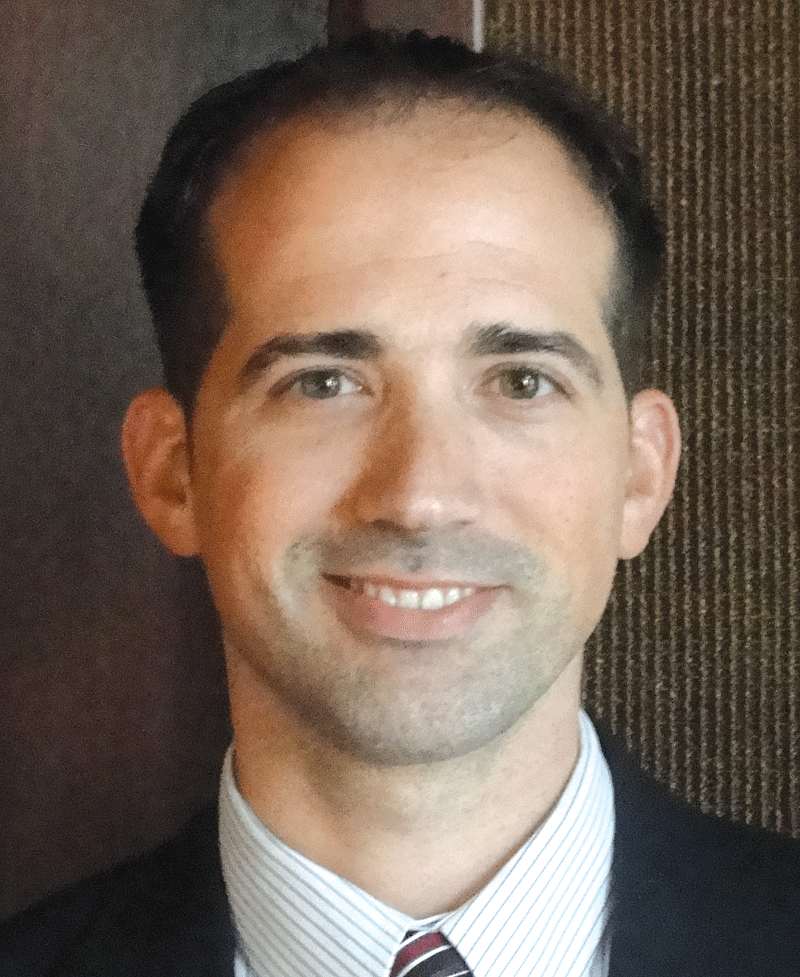
Jack St. Clair Becomes a Bold Addition at Bacon Wilson

Jack St. Clair, right, with Steve Krevalin

Jack St. Clair, right, with Steve Krevalin, managing partner of Bacon Wilson.

Jack St. Clair says he rose to the ranks of the region’s most prominent criminal-defense lawyers in large part because he was always pushing himself to reach higher and accept new challenges. This philosophy helps explain his recent decision to join Bacon Wilson, a firm that has aggressively expanded its reach and more than doubled in size in the past eight years. Both sides are looking forward to seeing how this move works out, and they’re both using the same language to describe it: “perfect fit.”

Jack St. Clair says that, while he was recovering from a serious automobile accident this past spring and summer — he was broadsided by a driver who ran a red light, and sustained nine broken ribs and a collapsed lung, among other injuries — he had a lot of time to think and reflect on his life and career.
As he was doing all this thinking, he told BusinessWest, he came to the conclusion that, despite what most would consider a highly successful career, mostly as a noted criminal-defense lawyer, he thought something was missing from the equation.
That ‘something’ became somewhat difficult for him to articulate, but it boils down to a desire to do more for many of his clients, while also honing his skills in what would have to be considered a new specialty within the law — representing the families of special-needs students with the goal of securing them the rights and services to which they are entitled from the community in which they live.
This new career ambition was spawned in large part by St. Clair’s grandson, an autistic child whom he referred to early and often as he talked with BusinessWest. Successfully representing the child and his parents in a recent case involving claims of unmet needs prompted St. Clair to want to do the same for others. And he’s hoping to achieve all that and much more by joining the Springfield-based firm Bacon Wilson, a move that both sides believe will bring a number of benefits.
A sole practitioner for most of his career, St. Clair said he opted to join a firm now because of the many opportunities such a move presents.
“When you’re one person, as I was for most of my career, you’re limited in what you can do,” he said, referring to both the volume of cases he could handle and the services he could provide to specific clients. “I didn’t want to be limited any more. I want to continue to develop a client base and service them in areas that I did at times, such as tax law and business law, but couldn’t continue to do.”
Meanwhile, Steve Krevalin, managing partner for Bacon Wilson, said the addition of St. Clair will enable this steadily growing firm, now with 44 lawyers, to reach new levels of prominence in this region and far outside it.
“He’s one of the best-known and highest-regarded lawyers in Western Mass. — by far,” Krevalin said. “His reputation allows him to attract a lot of clients.”
For this issue and its focus on business law, BusinessWest talked with St. Clair and Krevalin about what this partnership means for the lawyer and the firm.

Cases in Point
St. Clair officially arrived at Bacon Wilson on Nov. 1, and now occupies a large office in space that was most recently occupied by PeoplesUnited Bank (formerly Bank of Western Mass.) while it was still a tenant in the building at 33 State St., which is owned by several partners at the law firm.
There are boxes still to be unpacked, but St. Clair is mostly settled in. While his desk and credenza are dominated by pictures of his family, and especially his grandson, the walls are devoted mostly to paintings of the holes that comprise Augusta National Golf Club’s fabled Amen Corner.
St. Clair had the opportunity to attend a number of Masters tournaments, and has also amassed a sizable amount of golf memorabilia, including some letters from Bobby Jones, thanks mostly to his father, who was the long-time head of design and custom manufacturing with Spalding back in the days when it was a major player in the golf-equipment market. But St. Clair also secured from his father an intriguing outlook on retirement.
“He never retired, and I have the same opinion on that subject,” St. Clair explained. “My father used to say that, when you retire, you start to hang around with people who are only interested in whether there’s enough mayonnaise on the tuna salad; I have no intention of ever retiring.”
It was with this knowledge that his 34-year career is on the proverbial back nine, but certainly not near its end, that St. Clair contemplated what its next chapter would be. After all that contemplation while recuperating from the accident, he said it was time for a change — and to be re-energized.
“There’s a tremendous amount of vision in this firm — they don’t want to remain stagnant,” he said of Bacon Wilson. “They’re always looking for new ways to serve a client base, and they have a philosophy based in growth; that started the discussions, and after we talked, everyone felt that this could be an extremely good fit.”
St. Clair was with a smaller firm early in his career — he was part of Chicopee-based Murphy, McCoubrey, Murphy, St. Clair, Gelinas, and Auth — but for the past 20 years or so, he’s been on his own.
Part of the reason he didn’t join a large firm early on is that he was fairly certain that, if he did so at that stage of his career, he probably wouldn’t have been able to try the high-profile cases he would go on to handle.
“I wanted to try cases right away,” he explained. “And if I was the head of any large firm in Boston, Washington, or here, I wouldn’t let a rookie out like that. But I had the confidence, and I won those cases. That’s something I wouldn’t have had the opportunity to do if I was with a large firm.”
Three decades later, however, circumstances had certainly changed. St. Clair was no longer a rookie and didn’t have to worry about getting high-profile cases. He was, however, looking for an opportunity to tap the resources of a larger firm and generate growth potential for himself and those he would work beside.
That’s when talks began in earnest, first between St. Clair and Gary Fialky, a long-time friend and senior partner with Bacon Wilson, and later with Krevalin, who told BusinessWest that the addition of St. Clair made sense for both parties, which is a pre-requisite for any move of this nature.
“The first threshold before we take in anyone — first year or after 30 years — is that the personalities have to gel; if that doesn’t work, we pass,” he explained, adding that St. Clair easily met this test, and that his personality, track record, and reputation combined to make this a a solid fit.
Krevalin said the decision to bring in St. Clair is perhaps the firm’s most high-profile addition in recent years, but also simply the latest of many steps taken to give the firm more depth and opportunities for growth. Elaborating, he said the firm has added a number of lawyers with established practices over the past decade, many in Hampshire County, where the firm has greatly increased its presence with offices in Northampton and Amherst, but also several in Springfield.
Growth opportunities from such additions come from essentially acquiring those lawyers’ existing books of business, but also from the potential to provide other services to those clients from attorneys in the firm that specialize in many different areas, Krevalin continued, adding that, in St. Clair’s case, the potential is vast.
“He has a lot of clients that have used his litigation services that have other requirements, including estate planning, business, and many others,” he said. “We’re able to provide the backup and safety net for him.”
St. Clair agreed. “I’ve always had a practice that was all-consuming in that I was always running from one court to another,” he said. “And I’ve had a varied practice, doing a lot of criminal work in seven different states, but also civil work in three. I’ve always had a lot friends and acquaintances I couldn’t service because I was a sole practitioner. And this firm can service almost any need a person could have.”
While shedding some of the prior limitations he mentioned, St. Clair said he is also looking forward to working with other lawyers at Bacon Wilson to develop a specialty in special-needs work.
“I saw what can happen in a school district that fails the child and doesn’t provide the resources it agreed to provide,” he explained. “I really wanted to develop a practice dealing with the special needs of children; it’s certainly one of the most rewarding areas one can get into, and I’m going to bring a passion to this.”

Powerful Arguments
As he talked with BusinessWest, St. Clair used the words ‘energy’ and ‘energized’ several times each.
He said there is quite a bit of the former at Bacon Wilson, a firm that has more than doubled in size over the past eight years. And he utilized the latter when talking about what both his move to the firm and the experiences representing his grandson have done for him.
Just where all this energy will take St. Clair and the firm remains to be seen, but it’s certain that this high-profile change for both parties will bear watching. n

George O’Brien can be reached at [email protected]

Features
He’s Found the Right Ingredients for Career Success

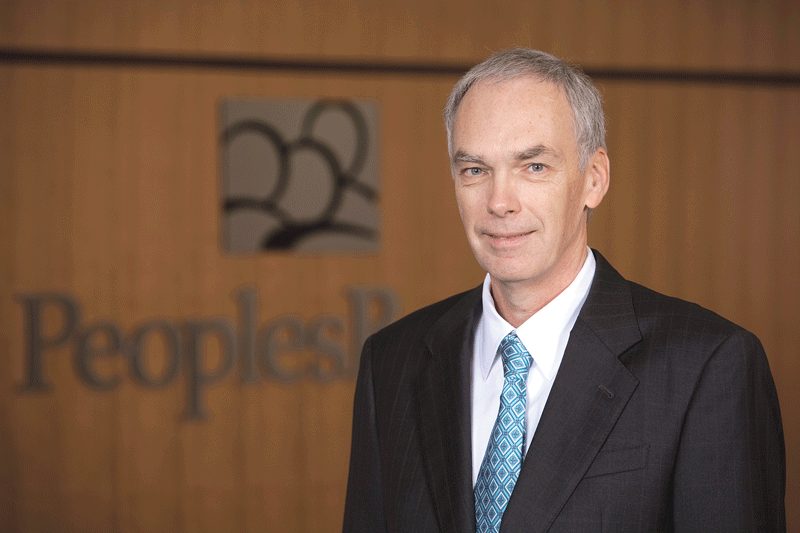
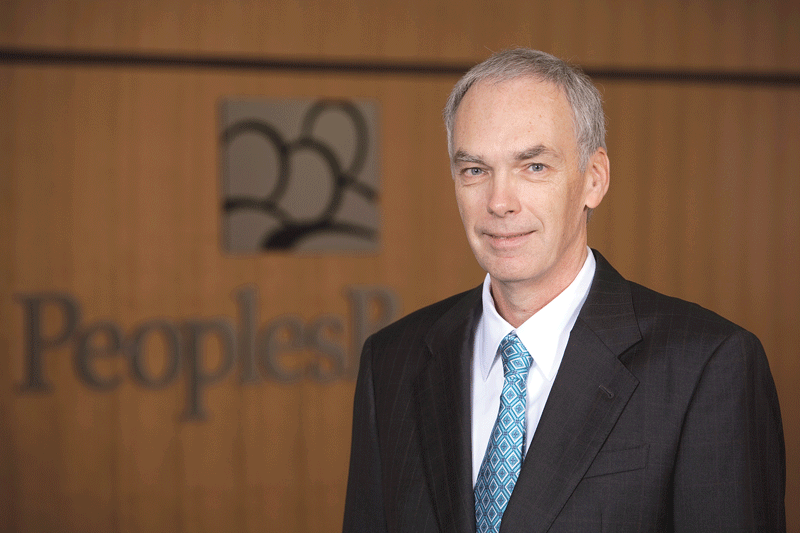
Doug Bowen

Doug Bowen, president and CEO, PeoplesBank


Doug Bowen says cooking is a big part of who he is — in more ways than one.
He and his wife, Anna, have traveled to Europe a few times for culinary tours, or extensive learning experiences (more on those later), and he really enjoys bringing new recipes off the page of a book and onto a plate — although he admits that Anna does most of the cooking at home.
Meanwhile, he jokes that it was someone else’s cooking that just might have enabled him to launch what has become a 35-year career in banking, all with the same institution: PeoplesBank.
“My wife’s mom was a short-order cook at one of the luncheonettes in Holyoke,” he said while explaining how he eventually landed work after a lengthy search in the midst of the recession of the mid-’70s. “It just happened to be where Warren Rhodes, the president of the bank, went for lunch every single day; she just kept plugging me to Warren.”
Whether it was his future mother-in-law’s persistent selling or Bowen’s résumé that landed him in PeoplesBank’s leadership-development program is a matter of speculation. What is known is that Bowen made it all the way from the teller’s window (that’s where all those in the program began, and still start today) to the president’s office, and in so doing, he provided a dramatic illustration of one of the bank’s commonly used tag lines: ‘a passion for what is possible.’
“We make it happen every day for employees and customers,” said Bowen. “When you start as a teller and end up in the corner office, that just shows that anything’s possible.”
These days, Bowen and the extended team are making PeoplesBank known for much more than a catchy marketing slogan. Indeed, it is taking the lead in everything from ecologically minded programs and ‘green lending’ to corporate philanthropy.
Indeed, toward the end of the interview in Bowen’s office at the PeoplesBank Executive Office Park in Holyoke, the bucket of a boom truck suddenly appeared in one of the windows, lifting a worker toward the top of one of the light poles in the parking lot outside the complex.
“We’re replacing the bulbs with more energy-efficient products,” he explained, adding that this exercise is one of many at the bank, which acquired the office tower a decade ago, that fall into the broad category of green initiatives. Others include everything from a LEED-certified branch in Springfield, opened earlier this year, to LED lights on holiday displays, which those in the boom truck were also putting up.
The environmentally friendly steps are like PeoplesBank’s now-regular standing near the top of the Boston Business Journal’s annual list of top corporate givers in the Commonwealth, and its recent listing among “America’s Best Banks to Work For” — just some of the ways the institution reflects the character of its president and CEO, who is quite involved in the community.
But Bowen, whose leadership efforts in all of these areas, as well as his extensive work in the community — he currently sits on six boards — helped make him one of BusinessWest’s first Difference Makers in 2009, is prolific in his use of the words ‘team’ and ‘we.’ And he states repeatedly that leadership in such things as corporate giving and going green reflect the mood and direction of an institution, not one person.
Consider this remark when he was asked about his management style and strategy. “I’m a big fan of ‘good to great,’ and I think it all starts with people, getting the right people on the bus, as they say metaphorically, getting them in the right seats, and then providing the driving and direction for the bus. My philosophy is simple: you get good people, give them some direction, and then get out of the room; they do all the heavy lifting.”
For this, the latest installment of its Profiles in Business series, BusinessWest talks with Bowen about everything from his take on the local banking scene to his fascination with wine and wine-making, to what he called a “holistic approach” to both work and life.

Shedding Some Light
Bowen said the economic conditions that prevailed when he graduated from Salem State College in the spring of 1975 were quite similar to what exists today.
“The unemployment rate was around 9%, about what it is now,” he explained. “I was looking for work — GE was right there in Lynn, and Polaroid was close by as well — but no one was hiring.”
Engaged to be married to Anna, his high-school sweetheart, at that time, Bowen started focusing his employment search in Western Mass., and eventually applied to jobs at PeoplesBank, MassMutual, and the former Third National Bank. With that assist, whatever it was worth, from his future mother-in-law, he landed in downtown Holyoke — and has never left.
He credited the leadership-development program with putting him on the proper path and honing the skills he would need to stay on it. And he now considers such talent development some of the most important and intriguing work he does.
“Our program is a little more accelerated now — we put people through it in about six to 12 months as opposed to two years when I did it,” he said. “And we still start people off as tellers, because that’s great experience. Most banks don’t have programs like this anymore, but we’re at a size where we need to have a constant influx of these management-development candidates, so we hire two to three a year, sometimes out of the Isenberg School of Management at UMass, and sometimes out of other schools in New England.
“Leadership development is probably the most fun part of my job; it’s rewarding to see these young people come on and work their way up,” he continued. “I was given the opportunity so many years ago, and it’s great to see these people at the beginning of their careers and know that there’s no limits for them. People can do what I did.”
Indeed, to say that Bowen made the most of his opportunity would be a huge understatement. Before becoming just the 10th president in the history of the 125-year-old bank in 2007, he held just about every title one could have in such an institution.
He acknowledged that most people don’t stay with one bank for 35 years, but quickly added that PeoplesBank is one of a maybe a handful of institutions in this region that someone could work with for that long, given the large number of banks that have disappeared from the landscape or been absorbed by larger banks.
“I was fortunate to work in pretty much all areas of the bank,” he explained. “I started in retail, moved on to operations, and actually trained to be the new chief financial officer, but the person who was going to retire didn’t, so I moved on, which was a good thing. I moved on to the lending areas — consumer lending, residential mortgages, and then in the early ’80s, started the commercial-loan department — before eventually becoming executive vice president.”
Today, Bowen is driving the bus at PeoplesBank, in that metaphoric sense. He has steered it toward leadership in not only green initiatives such as paper-use reduction and those LED lights on the Christmas decorations, but also in green lending. The bank has funded a number of clean-energy business initiatives, ranging from wind-power projects to a partnership with the Holyoke Gas & Electric Department to develop and expand hydroelectric facilities.
He’s also taking the bank ever higher on the Boston Business Journal’s list of the most charitable companies doing business in Massachusetts. In the most recent ranking, involving 2009 numbers, the bank was at number 35 with $705,000 in corporate giving, behind only MassMutual on the list of companies based in Western Mass. Two years earlier, it was 52nd, at $412,000.
Bowen said the bank has historically been generous in its corporate giving, but management, and the workforce as a whole, have made this even more of a priority in recent years.
As for the local banking scene, Bowen said it is more competitive than ever, and that individual institutions, like businesses in most all sectors, must work harder, and be more diligent and creative, to record the profits they have enjoyed over the years.
As an example, he cited one of the bank’s recent initiatives, a drive to open new checking accounts that included a $125 incentive, to match the bank’s 125th birthday.
“It was hugely successful; we did better than we anticipated,” he said, adding quickly that banks have to keep such creative ideas coming. “You need more programs like that because people will copy your idea or try something similar; you have to keep developing new concepts for generating business.”

Recipe for Success
Bowen says PeoplesBank got what he calls a “two-fer” when it hired him.
By that, he meant that his wife, Anna, while never actually an employee, has nonetheless been a visible and, in some cases, integral part of some of the things Bowen and the bank have been doing within the community.
“The bank got me, and it got her, too … she’s such a huge part of my life,” he said, adding quickly that the two do almost everything together, be it in Western Mass. or the Hawaiian islands, where they vacation for a few weeks every late winter, around the time the whales are migrating.
“Sometimes, we’ll kayak out to see the whales — there are hundreds of them,” he said, adding that Hawaii is the perfect place to leave the often-frenetic pace, and formal wardrobe, of a bank president far behind. “It’s a great place to relax and unwind; it’s all T-shirts, flip-flops, and shorts.”
Things were a little different when the two traveled to France and later Italy with friends to learn from some of the best chefs in the world.
The first culinary tour, to the Bordeaux region of France, was 10 compelling days spent with Jean-Pierre Moulle, long-time head chef at the renowned Chez Panisse restaurant, and his wife, Denise.
“It was an incredible experience,” Bowen recalled. “We’d go to the market every day and pick out what we wanted, we’d cook for a good part of the day, then go do a little sightseeing in the afternoon — maybe see cheesemakers or see where they made wine barrels — and then come back, finish cooking, and eat what we had prepared; we had a blast.”
The second trip was to Tuscany in Italy, “another 10-day adventure,” Bowen called it, at a facility connected with a restaurant. “Some of the things we cooked were actually served to guests that evening, and I guess we did OK — no complaints,” he said. “It’s a great way to learn about food, and for a long time I’ve been fascinated by food and how to properly prepare it.”
Bowen was quick to say that he had nothing entrepreneurial in mind when it comes to his culinary interests, and dispatched the notion that he might spend retirement running a restaurant somewhere.
“No, this is something I like to do on a very small scale; I’d never want to do this on a large scale for other people,” he explained, adding that he rarely cooks at home. “My wife is a great cook; on most days, my job is to pick out the wine for dinner, which I’m fine with. Maybe down the road I’ll do more cooking.”

The Bottom Line
Bowen says he’s not looking too far down the road at this point. He’s only 57 and not even thinking about retirement, except to the extent that, when it does come, he’ll be able to spend more time, perhaps a month or more, in Hawaii each year.
“I do two weeks now; maybe I can get it to three — I’ll have to check with the board,” he joked.
In the meantime, he’s perfectly content to keep driving the bus for the bank, helping to find new ways to be green, giving back to the community, and, perhaps most importantly, helping people unlock their passion for what’s possible.

George O’Brien can be reached at [email protected]

Departments Incorporations

The following business incorporations were recorded in Hampden, Hampshire, and Franklin counties and are the latest available. They are listed by community.

AMHERST

Uppermark Inc., 20 Gatehouse Road, Amherst, MA 01002. Paddieh Jalali, same. Educational materials and services.

BELCHERTOWN

LKB Realty Inc., 93 Canal Dr., Belchertown, MA 01007. Lloyd Butler Jr., same. Invest, acquire, and maintain real estate.

Quadcom Carting Inc., 260 Turkey Hill Road, Belchertown, MA 01007. Eric Duseau, same. Residential and commercial waste removal and recycling.

CHICOPEE

Samlep Inc., 74 Roosevelt Ave., Chicopee, MA 01013. John Pelmas, same. Package delivery.

SMEB Corp., 386 Irene St., Chicopee, MA 01020. Suzanne Marotta, 69 Sherwood Ave., West Springfield, MA 01089. Provides physical, emotional and spiritual health through varied types of yoga instruction.

Ten-90 Inc., 44 Dwight Street, Apt. #2R, Chicopee, MA 01013. Aristides Nunes, same. Bar and restaurant.

EAST LONGMEADOW

The Jos Salvon Memorial Scholarship Inc., 75 Canterbury Circle, East Longmeadow, MA 01028.

Tickets for Groups Inc., 337 Pinehurst Dr., East Longmeadow, MA 01028. Deborah Axtell, same. Group ticket sales.

EASTHAMPTON

Up From the ground Inc., 6 Laura Ave., Unit 1, Easthampton, MA 01027. Brian Farr, same. Delivery business.

HOLYOKE

Larochelle Construction Inc., 7 Westernview Road, Holyoke, MA 01040. Daniel Larochelle, same. Construction services.

Mrs. Mitchell’s Kitchen Inc., 514 Westfield Road, Holyoke, MA 01040. John Mitchell, 18 Cass Ave., West Springfield, MA 01089. Restaurant.
 
LEE

Lynchristopher Homes Inc., 170 Orchard St., Lee, MA 01238. Cindy Giovine, same. General building construction.

NORTHAMPTON

National Alliance of Concerned American’s for the Wellbeing of All People and Earth Inc., 101 Washington St., Northampton, MA 01060. Doug Wight, same. Non-profit organization designed to educate and inform Americans on capitalism, consumption, waste, and pollution and their effects on our environment.

PITTSFIELD

Taconic Conservation Foundation Inc., 59 Oak Road, Pittsfield, MA 01201. Francis Tremblay, Route 44 Orchard Ave., Pittsfield, MA 01201. Non-profit organization designed to provide educational programs to the public.

SOUTH HADLEY

Wicked Willows Inc., 37 Prospect Street, Apt. A, South Hadley, MA 01075. Nancy Cote, same. Sales of Halloween costumes.

SPRINGFIELD

Minority Business Workforce & Technology Council Inc., 1655 Main St., Suite 403, Springfield, MA 01103. Carlos Gonzalez, 44 Dover St., Suite 403 Springfield, MA 01107. Non-profit organization aimed at training and workforce development.

Murphy’s Law Sports Bar & Pub Inc., 1019 Main St., Springfield, MA 01103. Yasser Hussain, 10 Button Road, Easthampton, MA 01027. Sport bar.

New Leadership Charter School, 37 Alderman St., Springfield, MA 01108. Peter Daboul, 1242 Stony Hill Road, Wilbraham, MA 01095. Charter school.

Premier Accounting Inc., 1127 Main St., 4th Floor, Springfield, MA 01103. Felix Morales, 10 Magnolia Ave., Holyoke, MA 01040. Accounting, payroll, tax, and consulting services.

Ridgewood Neighborhood Improvement Initiative Corporation, 101 Mulberry St., PH 605, Springfield, MA 01105. Michael Thomes, same. Organization dedicated to improving the amenities and historical significance of the greater Ridgewood neighborhood.

State Street Laundromat Inc., 555 State St., Springfield, MA 01109. Mario Tedeschi, same. Laundromat.
 
WEST SPRINGFIELD

Synergy It Inc., 635 Piper Road, West Springfield, MA 01089. Mark Lilly, 6 Old Rochester Road, Suite 302, Silver, NH 03830. Computer networking, software and hardware.

WESTFIELD

Magic Printing USA Inc., 14 Lisa Lane, Westfield, MA 01085. Emily Wechter, same. Graphic design sales and service.

New England Lawn Care Inc., 491 West Road, Westfield, MA 01085. James Yarasavych, same. Landscaping.

Westfield Historic Industries Preservation Project Inc., 360 Elm St., Westfield, MA 01085. Peter Martin, 110 Western Circle, Westfield, MA 01085. Non-profit organization designed to develop and maintain a museum to display and preserve artifacts relating to Westfield’s industrial revolution.

Court Dockets Departments

The following is a compilation of recent lawsuits involving area businesses and organizations. These are strictly allegations that have yet to be proven in a court of law. Readers are advised to contact the parties listed, or the court, for more information concerning the individual claims.

CHICOPEE DISTRICT COURT
Capital One Bank, N.A. v. ABM Clothing and Beverley Thorington
Allegation: Monies owed for credit advanced: $3,117.19
Filed: 10/8/10

FRANKLIN SUPERIOR COURT
Alyssa Alger v. The Yankee Candle Co. Inc.
Allegation: Negligent maintenance of business property, causing injury: $41,392.18
Filed: 10/7/10

Christopher and Bethany Maselli v. Eric Freeman, D.O. and Ravi Kumar, M.D.
Allegation: Medical malpractice: $1,025,000
Filed: 9/20/10

GREENFIELD DISTRICT COURT
David A. Perok v. Rice Oil Co. Inc.
Allegation: Negligent maintenance of a worksite, causing injury: $6,151.30
Filed: 9/30/10

HAMPDEN SUPERIOR COURT
Dave Sakowski v. Baystate Contracting Services Inc.
Allegation: Failure to pay wages: $30,000
Filed: 9/30/10

Nellum Realty Trust v. Gliptone of Mass. & Lyons Home Improvement
Allegation: Non-payment for rent of commercial building: $81,000
Filed: 10/4/10

Superior Products Distributors Inc. v. Shawn’s Lawns, Inc., RIV Construction Group, and HD Westfield, MA Landlord, LLC
Allegation: Failure to pay under the terms of a construction contract: $297,361.45
Filed: 10/4/10

Western Mass. Environmental, LLC v. Dapri Rentals, LLC and Mary & Chris Clark
Allegation: Non-payment of services rendered: $36,816
Filed: 10/13/10

HAMPSHIRE SUPERIOR COURT
Roger Harrington v. C.H Nickelson & Co. Inc.
Allegation: Plaintiff was working on a roof at a construction site where the defendant was a general contractor, when he slipped and fell: $164,817.88
Filed: 9/20/10

SPRINGFIELD DISTRICT COURT
Arrow Concrete Products Inc. v. W.A.L. Development, LLC
Allegation: Non-payment of goods sold and delivered: $10,413.92
Filed: 8/27/10

Comcast Spotlight Inc. v. Direct Finance Corp.
Allegation: Non-payment of advertising services: $4,215.44
Filed: 8/26/10

Margaret N. Broughton v. Fifth Third Bank, et al.
Allegation: Breach of agreement for payment of car loan: $10,000
Filed: 9/7/10

Slope Properties, LLC v. J.K.A. Contracting
Allegation: Breach of home-improvement contract. Monies received and work not performed: $3,301.95
Filed: 8/23/10

United Rentals Inc. v. Tetreault Masonry Inc.
Allegation: Non-payment for materials, equipment, and services provided: $5,485
Filed: 9/9/10

Western Mass Electric v. Dog Days & Nights, LLC
Allegation: Non-payment of utility services provided: $6,584.04
Filed: 8/27/10

WESTFIELD DISTRICT COURT
Capital One Bank, N.A. v. TRM Consultants, LLC & Thomas R. Mihalek
Allegation: Breach of credit agreement and monies owed: $16,031.67
Filed: 9/3/10

Carole Fabrics Inc. v. King Brothers Painting & Staining
Allegation: Non-payment of goods sold and delivered: $2,738.98
Filed: 10/8/10

Sections Supplements
Take Advantage of the Repeal of the Generation-skipping Tax

Timothy P. Mulhern, Esq

Timothy P. Mulhern, Esq

Dec. 31, 2010 may be the last time, ever, to make large gifts to grandchildren without having the gifts carry a 55% tax burden.
No, this is not about grandparents giving birthday, holiday, or other small gifts, because gifts with a combined value of $13,000 annually generally carry no tax, even when made to grandchildren. The $13,000 exception (called the annual exclusion) makes a gift of the latest gaming device or even a car to a grandchild free from tax, unless the gaming device comes wrapped in a house or the car is a Telsa Roadster.
Before this year, big gifts or, more often, an interest in a trust that holds an appreciating asset (an interest in a business venture or the family lake house) carried the full 55% tax burden when received by a grandchild. However, the tax could be zero if the gift is made before the end of this year.
This year only, a high-value asset may be given to a grandchild or placed in a trust for grandchildren and later generations, and avoid the 55% generation-skipping tax (GST), regardless of when the asset is distributed.
Since it was enacted in 1986, the GST has been due whenever valuable assets are distributed to persons at least two generations younger than the person who made the transfer initially. But not this year. The GST is repealed, and the impact of repeal can be huge. For example, assume Grandpa funds a trust with $1 million of GrowthCo stock on Dec. 15, 2010, the trust stays in place for 20 years, and assume that in the next 20 years the GrowthCo stock increases in value to $10 million. In year 20, when the GrowthCo stock is distributed to grandchildren, the distribution may be subject to some other taxes, but no GST will be due.
If Grandpa waits until Jan. 1, 2011 to establish the same trust with the same $1 million of GrowthCo stock, when the stock is distributed in 20 years it will be subject to a 55% GST, $5.5 million in tax. The $1 million of GrowthCo stock staying in the same trust for the same 20 years, appreciated to the same $10 million of value, will yield only $4.5 million to the grandchildren, and the federal government will get the $5.5 million difference.
The same gift made before the end of 2010 would yield the full $10 million. The only difference between the two is the application of the GST to the trust established on or after Jan. 1, 2011.
The GST is a tax that sits on top of the better-known federal estate- and gift-tax structures. The estate and gift taxes are essentially taxes on the privilege of distributing accumulated wealth. Wealth distributed during life is a taxable gift unless there is an exemption. Wealth distributed at death is subject to the estate tax, again after exemptions. The rates for the estate and gift taxes are essentially the same. The GST rate is the maximum estate-tax rate applicable when the tax is due: 45% last year, zero this year, and back to 55% next year.
Most of the popular press has focused on the temporary repeal of the estate tax in the year 2010. George Steinbrenner has been called a master tax planner for having avoided the estate tax. Unfortunately, this level of planning requires that one die in 2010. The press does not often say that the gift tax remains in effect in the year 2010. Nor do they mention the $1 million lifetime exemption from the gift tax.
At its simplest, the generation-skipping tax can be understood as a tax levied on the privilege of passing assets that skip over an entire generation. It can be illustrated by a couple of examples from 2009, before the temporary repeal. If Grandpa gave his granddaughter the $2.5 million lake house in 2009, he made what the tax law calls a ‘direct skip.’ Up until the end of 2009, Grandpa’s gift would have been subject to the gift tax when made (or would use up some of his $1 million exemption), and it would also be a subject to the GST, which was at 45% in 2009. If instead, again in 2009, Grandpa put the lake house in trust for the grandchildren, the gift to the trust would have been subject to the gift tax when the gift was made, but also subject to the GST, not at funding in 2009, but when the lake house is distributed to the grandchildren out of the trust (what your tax advisors would call a taxable termination or distribution), and using the value of the asset at distribution.
If the lake house was valued at $2.5 million in 2009 on the date of the gift, the gift tax would be paid or the exemption used at that time. The trust might provide that the house would be held for grandchildren for 20 years. If the house appreciates to $10 million in those 20 years, then on distribution to grandchildren (the taxable termination or distribution), the GST will apply at the maximum estate tax rate. At next year’s rate of 55%, the $10 million distribution would carry with it a GST liability of $5.5 million.
Like the estate tax, the generation-skipping tax is repealed for the year 2010 only. The law simply says that the GST “shall not apply to generation-skipping transfers after Dec. 31, 2009.” This opens a door for a few more weeks that has been closed since 1986.
The GST repeal effectively permits large amounts of value to be placed in trust for later generations without the later application of the GST. For the first nine months of 2010, most tax practitioners believed that Congress would act to close this substantial loophole and re-impose the GST effective as of Jan. 1, 2010. Now, as the year winds down, it appears increasingly less likely that Congress will act at all, and even if it was to act, constitutional challenges might prevent a reinstitution of the GST effective Jan. 1, 2010.
Nonetheless, making a generation-skipping trust gift on the belief that Congress won’t create a retroactive application of this tax requires some nerve, but unlike George Steinbrenner, you don’t have to die to try it. This is a door open only until Dec. 31, 2010, and it is unlikely that Congress will ever leave it open again.

Timothy P. Mulhern, Esq. is a partner at Springfield-based Shatz, Schwartz and Fentin, P.C., providing tax and business legal services since 1979; (413) 737-1131; [email protected]

Sections Supplements
New Tax Provisions Could Benefit Small-business Owners

Nicholas LaPier, CPA

Nicholas LaPier, CPA

As tax practitioners, we are often asked by our clients during tax time to help them lessen their overall tax burden. So we employ various tax strategies that apply to them and calculate their taxes. We remind our clients that we should talk often during the year so that we can better assist them with their needs.
Our job is to keep up with the ever-changing tax laws, and we can do better tax planning during the year, not after. Almost comically, I tell my clients to “contact your legislator.” Call, write, e-mail, text, blog, Facebook, or Twitter them. Our elected officials are always working on tax legislation at some point during the year, and their votes will have a direct impact on what you pay for taxes.
Both of these recommendations are important, and here is why. As for contacting your legislator, to quote John F. Kennedy, “my fellow Americans, ask not what your country can do for you; ask what you can you do for your country.”
How does this apply to an article on taxation? The answer is simple: service via involvement. In the speech from which the above quote originates, he was encouraging all citizens of our country to become involved.
The economy of our country relies on the success of small business. The Small Business Administration (SBA), in its 2009 report to the president states that “half of all Americans that work in the private sector are employed in a small firm.” There are millions of small firms in America. By getting and staying involved, small businesses can and will have an impact on how they are taxed. When the small business can reduce both its own taxes and its owner’s taxes, it theoretically would have more resources available to grow the business and, ultimately, enhance the overall economy.
In 2010, there were various lobbying efforts led by businesses and business associations (or their lobbying groups). Because of this, many new tax laws were passed this year to help businesses.
However, there is a lot more tax relief needed for individuals. For example, there’s the alternative minimum tax (AMT), which, according to the non-partisan Congressional Budget Office, could affect approximately 28 million taxpayers in 2010 unless Congress acts before the end of the year. The AMT is a second tax calculation that impacts higher-income taxpayers who itemize their deductions on Schedule A.
And let’s not forget about the Bush tax cuts from 2001 that will expire on Dec. 31, 2010, which will affect every business and individual. The 10% personal income tax bracket will go away, the marriage penalty will come back, and capital gains tax rates will increase. Congress, by not acting on this, will raise everyone’s taxes on Jan. 1, 2011. Ouch.

Recently Enacted Tax Changes
The remainder of this article focuses on the recent Small Business Jobs Act of 2010, which was signed into law by President Obama on Sept. 27. These are the highlights of this legislation:
• SBA loan limit increase. It’s no secret that, during a recession, credit for businesses is hard to obtain, if not impossible. With revenues down, many small businesses are becoming undercapitalized, and may also have a lot of cash tied up in receivables or inventories. An option available for credit has always been by way of a Small Business Administration loan, or SBA loan for short, obtainable through most banking institutions.
These loans have federal government backing that makes a favorable credit decision by your bank a lot easier to obtain. In this new legislation, the maximum lending limit for SBA loans was permanently increased to $5 million for two of its largest loan programs, the 504 and 7(a) loan. A manufacturer could qualify for up to $5.5 million in the 504 program. It also temporarily increases the more popular SBA express loans from a maximum of $350,000 to $1 million. Smaller businesses often utilize these fast-track loans with fast approval and lower fees.
• Increase in Section 179 capital acquisitions. This provision gives a company the option to expense up to $500,000 of eligible new capital equipment and furnishings purchased, if the total capital outlays are less than $2 million. This section of the federal tax code, more commonly referred to as the Section 179 deduction, was set to return to a maximum of $25,000 to write off in 2011. Congress, in expanding the total capital purchases limit to $2 million, significantly expands this favorable tax deduction to up to $4.5 million for individuals and businesses to get this benefit, according to the president’s press release on Sept. 27, when he signed this legislation into law.
• New $30 billion lending fund. This new fund was established to provide smaller banks with much-needed capital and incentives to then lend out to small businesses. According to the legislation, eligible institutions “must provide to the government a small-business-lending plan describing how the institution’s business strategy and operating goals will allow it to address the needs of small businesses in the areas it serves, as well as a plan to provide linguistically and culturally appropriate outreach, where appropriate.”
• Health-insurance deduction for the self-employed. This provision now allows a self- employed business owner to deduct the cost of their own health insurance premiums on their Schedule C profit or loss from business. These business owners were previously allowed to take this as a deduction from their adjusted gross income and reduce their taxable income only. The new provision allows for the health-insurance deduction against the self-employment tax, which could amount to a 14.13% tax savings on the premiums paid.
• $10,000 deduction for start-up costs. This provision allows for a new company to expense its startup costs of up to $10,000, if no more than $60,000 is spent. Startup costs, which typically include initial fees for attorneys, consultants, state filing fees, and other one-time setup costs, are normally capitalized and amortized over a number of years. A new company may elect to opt out of the expensing option, especially if it already has a loss for the first year.

Meet with Your Outside Accountant
Chances are you have one. If you don’t, consider getting one. The reason you’re in business is because you have a niche and do it well enough to have your own business. The reason you need an outside accountant is because they too have a niche and do it well enough to help you and your business. In other words, do what you do on a daily basis because it is what put you where you are in the first place, and use the expertise of an independent accountant or CPA to advise you on tax strategies.
Your CPA should be acutely aware of your business and keep you abreast of any new or changing tax initiatives that apply to you and your business. Your CPA should also know your banker and be able to work directly with you and them in designing lending programs that fit. Remain in contact with your CPA frequently during the year, even if it’s a quick phone call or e-mail. Even more importantly, schedule a review of your year-to-date financials well before Dec. 31 so that you will have ample time to implement their suggestions into your own personal scenarios.

Conclusion
One key to success for you and your business is to stay in contact with your accountant. He or she can be an important and reliable asset to you and your business, whether it’s by helping you with financing, business advice, or tax planning. And stay on those legislators; they may even help you with tax relief if enough businesses and individuals get involved.

Nicholas LaPier, CPA, is the principal at Nicholas LaPier CPA, P.C., located in West Springfield; (413) 732-0200; www.lapiercpa.com

Features Sections Supplements
Medical Society Study Shows Continued Primary Care Shortages

The Mass. Medical Society recently released its annual Physician Workforce Study, showing a fifth consecutive year of shortages of primary care physicians, half of primary care practices closed to new patients, shortages in 10 of 18 physician specialties across the state, and community hospitals continuing to be the most affected by persistent physician shortages.
The 2010 study is the society’s ninth annual look at multiple aspects of the physician workforce, and builds on the previous eight years of data. The study surveys teaching hospitals, community hospitals, practicing physicians, medical directors of medical groups, and resident and fellow programs throughout the state. It is the most comprehensive examination of the physician workforce in the state done on an annual basis.
The report’s key findings include:   
• The primary care specialties of family medicine and internal medicine are in critically short supply, the fifth consecutive year of shortages for these specialties;
• Ten of 18 specialties studied have been found in short supply, three more than last year;
• High percentages of primary care practices are closed to new patients: 54% of family medicine physicians and 49% of internal medicine physicians are not accepting new patients;
• Wait times for new patients for primary care continue to be long, with an average wait time of 29 days for family physicians and 53 days for internists;
• With the exception of Boston, physician shortages exist in all regional labor markets across the state;
• Community hospitals continue to be the most seriously affected by the physician shortages, with difficulty filling vacancies and retaining physicians, resulting in the need to alter services and change staffing patterns; and
• The fear of being sued remains a substantial negative influence on the practice of medicine, affecting access to and availability of physician services.
“The findings from this latest analysis,” said Dr. Alice Coombs, president of the Mass. Medical Society, “clearly show how fragile access to care for patients is across the entire Commonwealth.
“The state’s universal health care plan has improved access to care,” she continued, “but universal coverage and access can only be sustained with a strong physician workforce. As we continue to look at reforming the health care system, we must do so carefully and deliberately in all aspects, and that includes the next steps for cost control, particularly with respect to establishing a fair system of payment reform.
“A strong physician workforce is critical to delivering top-quality and cost-effective care,” Coombs went on. “If physicians think that the viability of their practices is threatened or unsustainable under a new payment system, Massachusetts may encounter further problems with recruitment and retention. And that, certainly, will affect patient care.”
Coombs said the physician workforce in Massachusetts continues to be affected by a lingering poor practice environment in the state. The Society’s Physician Practice Environment Index, a statistical indicator of nine factors that shape the environment in which physicians provide patient care, dropped 0.8% in 2009, and has fallen in 16 of the past 18 years. Since 1992, the Massachusetts Index has declined by 26.4%, significantly more than the 21.3% decline in the comparable national index. The index takes into account such factors as the cost of maintaining a practice, median physician income, liability insurance rates, and hours spent on patient care.
Here are some details on the report’s key findings: 
 
Specialties Classified in Short Supply
The medical society’s 2010 analysis found 10 of 18 specialties studied in short supply: dermatology, emergency medicine, family medicine, general surgery, internal medicine, neurology, orthopedics, psychiatry, urology, and vascular surgery.
Over the last three years (2008-10), six specialties have been operating within tight labor market conditions in each of those years: family medicine, internal medicine, vascular surgery, urology, dermatology, and neurology.
A trend analysis over a five-year period (2006-10) shows that 11 specialties have been in short supply in at least three of those five years: family medicine, internal medicine, vascular surgery, urology, dermatology, neurology, psychiatry, general surgery, orthopedics, emergency medicine, and neurosurgery.
  

Primary Care Practices Closed to New Patients; Long Waits
The primary care specialties of internal medicine and family medicine continue to be under intense pressure following the establishment in 2006 of the state’s health care reform law, which resulted in some 440,000 residents being added to the insurance rolls.
A survey of physician practices showed that approximately half of primary care physicians are not accepting new patients. The percentage of family medicine physicians who are not accepting new patients has increased from 30% in 2007 to 54% in 2010 — the highest it has been in four years. The percentage of internal medicine physicians no longer accepting new patients decreased slightly from the previous year to 49% in 2010 — the same level it was in 2007.
Meanwhile, long wait times for appointments for new patients continue. For internal medicine, the average wait time increased to 53 days, nine days longer than last year’s figure of 44 days and the highest it has been in six years. For family medicine, the average wait time is 29 days, 15 days shorter than last year’s figure of 44 days.

Shortages Across the State
A regional analysis of the 18 specialties for the five metropolitan statistical areas in the state (Boston, Worcester, Springfield, New Bedford/Barnstable, and Pittsfield/Western Mass.) found that, with the exception of Boston, all regional labor markets were experiencing shortages of physicians. Critical shortages exist in Pittsfield/Western Mass. and Worcester.
In an analysis of the 18 specialties examined by the study, the percentage of practicing physicians in the four labor markets of New Bedford/Barnstable, Pittsfield/Western Mass., Springfield, and Worcester who responded that they were dealing with an inadequate pool of physicians, had difficulty in filling vacancies, needed to alter services, and needed to adjust staffing exceeded the percentage of physicians in the Boston market by at least nine percentage points.
In the four labor markets outside of Boston, more than two-thirds of the practicing physicians said there was an inadequate pool of physicians for recruiting. This characteristic was especially acute in New Bedford/Barnstable and Pittsfield/ Western Mass., where more than eight out of 10 said the pool was inadequate.

Community Hospitals Are Most Affected By Shortages
Community hospitals continue to be the most affected by the consequences of physician shortages. All (100%) of the medical-staff presidents of community hospitals reported they are experiencing difficulty filling vacancies, and 82% reported that the amount of time to recruit a physician has risen, an increase of 5% over the average of the previous eight years of the studies.
Community hospitals are also reporting the most difficulty with retaining physicians, with 64% saying retention has become harder over the past three years. However, this is an improvement from the average of the previous seven-year period, when 79% reported difficulty in retaining physicians.
Additionally, 64% of community hospitals reported that physician shortages required them to alter the services they provide, a substantial increase from 43% in last year’s study. Meanwhile, 82% of medical-staff presidents responded that physician-supply problems required adjustments in their staffing patterns, a large increase from 64% last year and the average ratio of 56% for the years 2003-09.

Professional Liability Hinders Practice of Medicine
The 2010 study once again found that medical malpractice concerns and the fear of being sued continue to have a substantial negative influence on physicians and the practice of medicine. This finding is consistent with the society’s previous workforce studies and its first-of-a-kind Investigation of Defensive Medicine in Massachusetts, released in November 2008, which showed that the fear of being sued is a serious burden on health care. Findings from the 2010 Workforce Study:
• A full 46% of practicing physicians surveyed said their practice has been altered or limited because of the fear of being sued, the same percentage as last year; and
• More than half of physicians in five specialties said they have altered or limited their practice because of the fear of being sued: neurosurgery (82%); urology (74%); emergency medicine (70%); orthopedics (70%); and obstetrics/gynecology (60%). Also, 40% or more of physicians in nine other specialties have changed their practice for the same reason: cardiology, neurology, gastroenterology, general surgery, dermatology, psychiatry, radiology, internal medicine, and family medicine.

Additional Findings
For the first time, more physicians (43%) expressed satisfaction with the practice environment than not (41%).
However, more physicians expressed displeasure with the tradeoff between patient care and administrative tasks. More than half (51%, up from 44% last year) of all practicing physicians regardless of specialty expressed displeasure with the abundance of administrative measures. Among primary care physicians, 59% expressed displeasure.

Sections Supplements
Hospital Interpreters Translate More Than Just Words

Ramona Quintana says says a hospital interpreter must, in a way, become the patient.

Ramona Quintana says says a hospital interpreter must, in a way, become the patient.

A law requiring interpreter services in Massachusetts hospitals is less than 10 years old, but most facilities have offered them for much longer — and for good reason. At some hospitals, tens of thousands of non-English speakers walk through the doors each year, facing not only a language hurdle, but cultural barriers as well. As local patient interpreters explain, they play a critical role in health care, one that extends beyond mere words.

Tim Moriarty says some patients who don’t speak English want to bring their own interpreter — a friend or family member — into the examination room. But that’s usually not a good idea.“They tend to withhold information from the patient. They might not know some vocabulary. And they often provide opinion, and you don’t know that they’re saying, ‘your cousin Bill had this same procedure last year, and he died, so you shouldn’t have it,’” said Moriarty, manager of Interpreter and Translation Services for Baystate Health.
Better to use one of the professional interpreters that hospitals are required by law to provide patients who don’t speak English.
“One of the standards of practice is transparency, to relate what’s said without adding or omitting anything,” he told BusinessWest. “Interpreters actually speak in the first person: ‘I feel pain today.’”
And when speaking for the doctor or nurse, they address the patient in the same way, as if they were the provider.
Ramona Quintana, who coordinates interpreter services at Mercy Medical Center, said it’s all about becoming a conduit, as if the third person in the room doesn’t exist.
“As an interpreter, I am not me,” she explained. “I’m trying to be as invisible as I can become, and my words and even my gestures become that of the patient, so the provider gets an idea of what’s going on, so he knows how to treat that patient — not just medically, but also with other issues that might be present.”
Quintana said some people have the impression that interpreting in a medical setting is easy work, simply reciting back and forth. “But it’s not just repeating words; it’s interpreting meaning.”
And it’s complex work, which is why a national certification for hospital interpreters has been established, starting with Spanish speakers this year; other languages will follow.
This month, BusinessWest examines how interpreter services are implemented at area hospitals, and why such programs are so necessary. After all, at such a critical moment in someone’s life, it’s important to have someone speaking not on their behalf, but directly in their place.

Beyond the Law
While most hospitals in Western Mass. have had interpreter services available from at least the mid-’90s, if not before, such programs were not mandated by state law until 2001. The law requires hospitals to provide ‘competent,’ trained interpreters, not family members. It also requires hospitals to designate a coordinator or director of such services; to post notices in emergency rooms, psychiatric units, and registration areas advising patients of their right to an interpreter; and translate relevant documents into languages commonly encountered at the hospital.
“Patients have a right to an interpreter, and that’s posted,” Quintana said, a standard document that outlines that right in dozens of languages. Quintana said Mercy sees not just Spanish speakers, but also Russian, Polish, Portuguese, Vietnamese, and Chinese speakers, among others.
“It’s quite a diverse community we serve as we try to meet these needs. And the languages we don’t speak, we reach through agencies in the area,” she explained, adding that interpreters need to be aware of vocabulary and cultural differences even within the same language group. “There are so many different cultures that speak Spanish, and South America is different than Mexico.”
While Massachusetts is among the states that have been responsive to the need for interpretive services, others cannot make the same claim, which is why national certification is a good idea, Moriarty said.
“Right now there are no national minimum requirements for interpreters,” he noted. “Some states have instituted testing and certain requirements, but most states don’t have that. National certification will require the interpreters in the field to demonstrate their knowledge or functional understanding of their practice, their knowledge and fluency in English and a second language, and their knowledge of medical terminology in both languages.”
Those requirements, he continued, will make it much easier for managers doing the hiring, because they can make assumptions that someone has a high skill level prior to being hired and not just count on someone’s education and state certification, if any, the requirements for which can vary widely from state to state. “Now, interpreters, will have to prove their skills before we bring them on board, and that minimizes the risk, especially to the patient. It ensures that communication between the patient and provider will be very clear.”
Because of Baystate’s size and the fact that about 80,000 patient visits require language translation each year, it boasts a wider range of interpreting skills in house than other regional hospitals, Moriarty said. Its staff of 45 can interpret Spanish, Vietnamese, Polish, Arabic, and Mandarin, and it works with two local agencies to provide services in Swahili and Khmer, among others. “Then, if a really unusual language comes up, which sometimes it does, we have telephonic interpreting with a company that assists us with more than 100 languages in less than 30 seconds.”
At Holyoke Medical Center, Spanish is the overwhelming language barrier, said Rafael Mojica, coordinator of the Community Outreach Department, of which interpreter services are a part. “Last year alone, we had almost 18,000 visits from Spanish-speaking patients who didn’t speak English, but we also had about 2,400 visits from patients who didn’t speak English but spoke another language, like Polish, Portuguese, Russian, Vietnamese, or Arabic,” he explained. Other patient visits required interpretation of Cantonese, French, Tagalog, Italian, Somali, Urdu, Gujarti, and sign language.
“We have staff in person from 6:30 in the morning to 11:30 at night, and overnight we have telephonic interpreting services that speak about 150 languages,” Mojica said. And because the hospital experience can be confusing and frustrating for a non-English speaker from a different culture, Mojica’s department goes beyond making sure services are provided when patients come through the door during the day.
“We originated what we call daily rounds,” he explained. “Every single morning, we have a medical interpreter visit all the bilingual patients and new admissions, and every morning we get a report making sure they can either speak the language or are informed of our services. And we make sure that, if any provider comes in, they call the interpreter. It’s pretty simple; we carry cell phones around the hospital, and we’re a phone call away.”

Emma Dias

Emma Dias used to be an architect, but she gets more satisfaction building bridges between patients and care providers.

Emma Dias, coordinator of Medical Interpreter Services at Cooley Dickinson Hospital, said it’s gratifying to see interpreters make a real difference in someone’s hospital experience, which is often an anxious time even without language and cultural barriers.
“It’s very rewarding,” she said. “I was an architect for more than 10 years, and I never felt that rewarded. This is a really great field.”
Because CDH, like most all Western Mass. hospitals, also encounters more Spanish speakers than any other non-English language, Dias serves as a Spanish-speaking coordinator, and two per-diem interpreters also specialize in that language. Another per-diem interpreter speaks Portuguese (as does Dias), and the hospital contracts with an outside agency for other commonly heard languages, including Korean, Cambodian, and Chinese.
The hospital ensures that an interpreter stays with a patient who needs assistance throughout his or her visit, leaving when there’s a wait and returning for the next test or meeting with a provider.

Beyond the Language
Even without the national certification, New England hospitals have proven to be progressive when it comes to honing interpretive skills. Moriarty serves as president of FOCIS (the Forum on the Coordination of Interpreter Services), members of which meet bimonthly at different hospitals across Massachusetts. They discuss issues including interviewing interpreters, working with interpreter contract agencies, defining patient encounters, and developing a basic assessment tool. The FOCIS model has since migrated across the Northeast and even to North and South Carolina.
And what hospitals are assessing isn’t just how well an interpreter knows the language, but, as Quintana noted, how well they help patients from different backgrounds and cultures navigate an often-anxious time.
“We need to guide patients,” she told the BusinessWest. “We not only serve as interpreters, but we meet different cultural needs. When a patient comes in, we ask that patient through an interpreter if they have any cultural needs that would make their stay more comfortable.”
At Holyoke Medical Center, Mojica said, not only are the interpreters fluent in at least two languages (English and Spanish), have formal interpretive training, and understand medical terminology, but they’ve also received specialized training in the areas of substance abuse, mental health and crisis intervention, domestic violence, oncology and bereavement, cultural competence, and diversity. Recently, interpreters underwent a five-week training course on health interpretation taught with the specific needs of the hospital in mind, reflecting the sort of emphasis on continuing education seen in many Massachusetts hospitals.
“It’s a very rewarding job,” said Mercy’s Quintana. “We do and see it all. It is about quality of life, and that spreads out to the community when patients leave, and society as a whole benefits.”
Yet, while seeing and hearing plenty during patient encounters, she said interpreters are trained not only to be good listeners, but also “fast forgetters,” due to the obvious privacy issues raised by having a third person in the doctor’s office or testing room.
“We also have to read body language. Different cultures have different body language,” she said, noting that certain gestures that are friendly in one culture are disrespectful in another. “Interpreting is more than words.”
Still, she said she sees herself largely as a conductor of language, like metal conducts electricity, hopefully presenting the meaning unchanged to the doctor, and the provider’s instructions back to the patient.
Her job, and that of other medical interpreters, is like electricity in another way, too, shining a light on what might otherwise be a dark, confusing experience. n

Joseph Bednar can be reached at
[email protected]
“They tend to withhold information from the patient. They might not know some vocabulary. And they often provide opinion, and you don’t know that they’re saying, ‘your cousin Bill had this same procedure last year, and he died, so you shouldn’t have it,’” said Moriarty, manager of Interpreter and Translation Services for Baystate Health.
Better to use one of the professional interpreters that hospitals are required by law to provide patients who don’t speak English.
“One of the standards of practice is transparency, to relate what’s said without adding or omitting anything,” he told BusinessWest. “Interpreters actually speak in the first person: ‘I feel pain today.’”
And when speaking for the doctor or nurse, they address the patient in the same way, as if they were the provider.
Ramona Quintana, who coordinates interpreter services at Mercy Medical Center, said it’s all about becoming a conduit, as if the third person in the room doesn’t exist.
“As an interpreter, I am not me,” she explained. “I’m trying to be as invisible as I can become, and my words and even my gestures become that of the patient, so the provider gets an idea of what’s going on, so he knows how to treat that patient — not just medically, but also with other issues that might be present.”
Quintana said some people have the impression that interpreting in a medical setting is easy work, simply reciting back and forth. “But it’s not just repeating words; it’s interpreting meaning.”
And it’s complex work, which is why a national certification for hospital interpreters has been established, starting with Spanish speakers this year; other languages will follow.
This month, BusinessWest examines how interpreter services are implemented at area hospitals, and why such programs are so necessary. After all, at such a critical moment in someone’s life, it’s important to have someone speaking not on their behalf, but directly in their place.

Beyond the Law
While most hospitals in Western Mass. have had interpreter services available from at least the mid-’90s, if not before, such programs were not mandated by state law until 2001. The law requires hospitals to provide ‘competent,’ trained interpreters, not family members. It also requires hospitals to designate a coordinator or director of such services; to post notices in emergency rooms, psychiatric units, and registration areas advising patients of their right to an interpreter; and translate relevant documents into languages commonly encountered at the hospital.
“Patients have a right to an interpreter, and that’s posted,” Quintana said, a standard document that outlines that right in dozens of languages. Quintana said Mercy sees not just Spanish speakers, but also Russian, Polish, Portuguese, Vietnamese, and Chinese speakers, among others.
“It’s quite a diverse community we serve as we try to meet these needs. And the languages we don’t speak, we reach through agencies in the area,” she explained, adding that interpreters need to be aware of vocabulary and cultural differences even within the same language group. “There are so many different cultures that speak Spanish, and South America is different than Mexico.”
While Massachusetts is among the states that have been responsive to the need for interpretive services, others cannot make the same claim, which is why national certification is a good idea, Moriarty said.
“Right now there are no national minimum requirements for interpreters,” he noted. “Some states have instituted testing and certain requirements, but most states don’t have that. National certification will require the interpreters in the field to demonstrate their knowledge or functional understanding of their practice, their knowledge and fluency in English and a second language, and their knowledge of medical terminology in both languages.”
Those requirements, he continued, will make it much easier for managers doing the hiring, because they can make assumptions that someone has a high skill level prior to being hired and not just count on someone’s education and state certification, if any, the requirements for which can vary widely from state to state. “Now, interpreters, will have to prove their skills before we bring them on board, and that minimizes the risk, especially to the patient. It ensures that communication between the patient and provider will be very clear.”
Because of Baystate’s size and the fact that about 80,000 patient visits require language translation each year, it boasts a wider range of interpreting skills in house than other regional hospitals, Moriarty said. Its staff of 45 can interpret Spanish, Vietnamese, Polish, Arabic, and Mandarin, and it works with two local agencies to provide services in Swahili and Khmer, among others. “Then, if a really unusual language comes up, which sometimes it does, we have telephonic interpreting with a company that assists us with more than 100 languages in less than 30 seconds.”
At Holyoke Medical Center, Spanish is the overwhelming language barrier, said Rafael Mojica, coordinator of the Community Outreach Department, of which interpreter services are a part. “Last year alone, we had almost 18,000 visits from Spanish-speaking patients who didn’t speak English, but we also had about 2,400 visits from patients who didn’t speak English but spoke another language, like Polish, Portuguese, Russian, Vietnamese, or Arabic,” he explained. Other patient visits required interpretation of Cantonese, French, Tagalog, Italian, Somali, Urdu, Gujarti, and sign language.
“We have staff in person from 6:30 in the morning to 11:30 at night, and overnight we have telephonic interpreting services that speak about 150 languages,” Mojica said. And because the hospital experience can be confusing and frustrating for a non-English speaker from a different culture, Mojica’s department goes beyond making sure services are provided when patients come through the door during the day.
“We originated what we call daily rounds,” he explained. “Every single morning, we have a medical interpreter visit all the bilingual patients and new admissions, and every morning we get a report making sure they can either speak the language or are informed of our services. And we make sure that, if any provider comes in, they call the interpreter. It’s pretty simple; we carry cell phones around the hospital, and we’re a phone call away.”
Emma Dias, coordinator of Medical Interpreter Services at Cooley Dickinson Hospital, said it’s gratifying to see interpreters make a real difference in someone’s hospital experience, which is often an anxious time even without language and cultural barriers.
“It’s very rewarding,” she said. “I was an architect for more than 10 years, and I never felt that rewarded. This is a really great field.”
Because CDH, like most all Western Mass. hospitals, also encounters more Spanish speakers than any other non-English language, Dias serves as a Spanish-speaking coordinator, and two per-diem interpreters also specialize in that language. Another per-diem interpreter speaks Portuguese (as does Dias), and the hospital contracts with an outside agency for other commonly heard languages, including Korean, Cambodian, and Chinese.
The hospital ensures that an interpreter stays with a patient who needs assistance throughout his or her visit, leaving when there’s a wait and returning for the next test or meeting with a provider.

Beyond the Language
Even without the national certification, New England hospitals have proven to be progressive when it comes to honing interpretive skills. Moriarty serves as president of FOCIS (the Forum on the Coordination of Interpreter Services), members of which meet bimonthly at different hospitals across Massachusetts. They discuss issues including interviewing interpreters, working with interpreter contract agencies, defining patient encounters, and developing a basic assessment tool. The FOCIS model has since migrated across the Northeast and even to North and South Carolina.
And what hospitals are assessing isn’t just how well an interpreter knows the language, but, as Quintana noted, how well they help patients from different backgrounds and cultures navigate an often-anxious time.
“We need to guide patients,” she told the BusinessWest. “We not only serve as interpreters, but we meet different cultural needs. When a patient comes in, we ask that patient through an interpreter if they have any cultural needs that would make their stay more comfortable.”
At Holyoke Medical Center, Mojica said, not only are the interpreters fluent in at least two languages (English and Spanish), have formal interpretive training, and understand medical terminology, but they’ve also received specialized training in the areas of substance abuse, mental health and crisis intervention, domestic violence, oncology and bereavement, cultural competence, and diversity. Recently, interpreters underwent a five-week training course on health interpretation taught with the specific needs of the hospital in mind, reflecting the sort of emphasis on continuing education seen in many Massachusetts hospitals.
“It’s a very rewarding job,” said Mercy’s Quintana. “We do and see it all. It is about quality of life, and that spreads out to the community when patients leave, and society as a whole benefits.”
Yet, while seeing and hearing plenty during patient encounters, she said interpreters are trained not only to be good listeners, but also “fast forgetters,” due to the obvious privacy issues raised by having a third person in the doctor’s office or testing room.
“We also have to read body language. Different cultures have different body language,” she said, noting that certain gestures that are friendly in one culture are disrespectful in another. “Interpreting is more than words.”
Still, she said she sees herself largely as a conductor of language, like metal conducts electricity, hopefully presenting the meaning unchanged to the doctor, and the provider’s instructions back to the patient.
Her job, and that of other medical interpreters, is like electricity in another way, too, shining a light on what might otherwise be a dark, confusing experience.

Joseph Bednar can be reached at
[email protected]

Agenda Departments

“What’s in Your Dash?”
Nov. 9: Harold T. Epps, president and CEO of PRWT Services Inc., based in Philadelphia, will present “What’s In Your Dash?” at noon as part of the speaker series at the Western New England College Law and Business Center for Advancing Entrepreneurship in Springfield. Epps will discuss how quickly time and a career can go by and the importance of the choices people make as they balance their professional and personal lives. The lecture is free and open to the public. Lunch will be provided. For more information, call (413) 796-2030 or visit www.wnec.edu/lawandbusiness.

‘Secrets of Successful Businesses’
Nov. 9: The next program in the Innovative Thinking & Entrepreneurship Lecture Series features three speakers on “Secrets of Successful Businesses” from 7:30 to 9:30 a.m. in Blake Student Commons at Bay Path College, Longmeadow. Stanley Kowalski III, chairman of the board of FloDesign Inc.; Alaina Hanlon, Ph.D., president and CEO of Phenotype IT; and Anthony Newman, owner and founder of the Barkers Dozen, will be the presenters for the morning session. A continental breakfast will be served from 7:30 to 8:15 a.m. To register, call Briana Sitler at (413) 565-1066 or e-mail [email protected]. Seating is limited.

AIM Energy Summit
Nov. 16: Associated Industries of Massachusetts will host a Western Mass. Energy Summit from 8:30 to 11:30 a.m. at the Mass. Career Development Institute in Springfield. The program will feature a discussion on energy-related tax incentives and capital incentives. Also, networking with representatives from various energy programs and resources is encouraged. Speakers will include Bob Dvorchik, supervisor of commercial and industrial conservation programs, and Dick Oswald, manager, both of WMECO; Jeff Cady, general manager of Chicopee Electric; Paul Trangedi, president of ECS; Gene Giuliano of Columbia Gas of Massachusetts, and Beka Kasanovic of the US-DOE Save Energy Now Program. The event is free; however, registration is required. For more information, contact Dawn Creighton at [email protected].

Forensics Night
Nov. 16: Bay Path College in Longmeadow will host its annual Forensics Night from 5:30 to 8:30 p.m. The program is designed for young women in high school who are considering a forensics-related career path. The keynote speaker will be Northwestern District Attorney Elizabeth D. Scheibel, the first woman district attorney in the history of the Commonwealth. Also, participants and their families will have the opportunity to tour Carr Hall, which houses Bay Path’s new science facility. The program is free; however, space is limited. To register, call (800) 782-7284, ext. 1331, or (413) 565-1331. For more information, visit ww.baypath.edu.

Staying Healthy Program
Nov. 16: Holyoke Medical Center will present a program on helping area residents stay healthy at 6 p.m. in the Auxiliary Conference Center. The program is free as part of the hospital’s community education series Dessert with the Docs. Dr. Garry Bombardier will be the featured speaker, discussing physical exams, blood pressure, cholesterol, smoking, and diet. Refreshments will be served. Pre-registration is required, and seating is limited. For more information, call (413) 534-2789.

Advanced Manufacturing Competition & Conference
Nov. 16: The first highly concentrated, cluster-centric, regional manufacturing conference of its kind will be held at the MassMutual Center in Springfield. The event, called the Advanced Manufacturing and Innovation Competition & Conference (AMICCON), is being staged in response to growing recognition among area manufacturers and supply-chain members that there is an urgent need to find and meet one another. “AMICCON was formed to identify who’s here in manufacturing, expose them to OEMs (original equipment manufacturers) and procurement, and to make these introductions,” said co-founder Ellen Bemben. “The ultimate goal is to be the advanced manufacturing region in the U.S., where exotic manufacturing, such as micro, nano, and precision, meet higher specifications and tighter tolerances, and short runs are the norm.” Industry sectors to be represented at the event will include plastics and advanced materials, precision machining, paper and packaging, electronics, ‘green’/clean technology, and medical devices. Business opportunities in defense and aerospace will also be highlighted at the event. OEMs and their supply chains are being invited personally to participate. For more information, visit www.amiccon.com.

Sections Supplements
NTS Takes Its Problem-solving Approach into the Greater Springfield Market

New Technology Systems (NTS), the East Hartford-based technology-solutions company, has always had a portion of the Western Mass. market, but never really a strong presence. Things are changing, with the opening of a new office in Monarch Place and an aggressive effort to grow market share by being visible and selling the company’s partnership-focused approach to doing business.

Barry Kelly says he had a simple, three-word set of instructions for Stan Bates as he was joining East Hartford-based New Technology Systems (NTS).
“I told him to go conquer Springfield,” said Kelly, who founded the technology-solutions company with his brother in 1981 and, until very recently, focused the vast majority of his time and energy on the Greater Hartford area. Over the years, he picked up several clients on this side of the border, but he never really made Western Mass. a strong priority.
Until now.
Or, to be more precise, until Bates took on the role of business development manager for NTS and started talking up Western Mass. as a potential growth area.
“He was and is very bullish on Springfield,” said Kelly, adding that he’s giving Bates the room (a new office on the second floor of Monarch Place) and the resources to be aggressive in Greater Springfield and grow market share here.
And as he sets out to conquer Springfield, he says he’s selling the company’s full roster of products and services — hardware, software, and consulting — but what he’s actually offering to potential clients is partnerships. That’s the word he chose to describe how NTS goes about its work — with all customers, but especially the SMB (small to medium-sized business) clients, or those who don’t have an IT manager, let alone an IT department.
Describing his approach with clients and potential clients, Bates says he spends time and energy getting to understand someone’s business, and, from an IT perspective, identify their “pain points,” and reduce or eliminate them.
“I really try to think outside the box with technology and find ways to help people use technology more effectively, while also keeping their costs under control,” he explained. “We had one client who had a whole bunch of laptops that he couldn’t afford to upgrade with the recession — but he needed to do something. With the latest technology in hard drives, we were able to significantly increase the performance of his laptops, but at a fraction of the cost of upgrades. That’s what we mean by working in partnership with the client.”
Kelly and Bates say these partnerships are made stronger by the relationships NTS has forged with manufacturers, vendors, and service providers, including Microsoft, HP, IBM, Dell, Intel, Cisco Systems, and many others. Products handled include everything from copiers and printers to computer networks.
Over the past few months, NTS has hosted a number of events featuring some of these manufacturers and their latest products, and more will be scheduled. They’ve been successful, said Bates, because busy business owners often need an education in the latest products that can help them do what they do better and faster than before. What’s more, after pushing most major investments, including those in IT, to the back burner during the economic downturn, many business owners and managers are ready to spend again, or soon will be ready.
“We’re seeing things picking up somewhat … people seem to have more confidence in the economy now,” said Bates, adding that there is a lot of new technology for business owners to consider as they look at their needs and their budgets and try to determine what to do next. “Besides the new operating systems and new equipment that’s much faster and better, there’s new technology that we have to educate our clients on.”
For this issue and its focus on the technology sector, BusinessWest takes an in-depth look at NTS, and why Kelly and Bates believe the timing is right for its expansion into the Springfield market.

Technically Speaking
Tracing the history of NTS, Kelly said the company got its start in the Hartford area and, like most technology-solutions companies 30 years ago, had to work hard to establish itself and grow its client list.
The venture grew largely on the strength of handling all-sized accounts, but especially the large insurance companies that give that city its identity, or ‘enterprise businesses,’ as Kelly called them. NTS still has many in its portfolio, but its bread and butter has always been small to medium-sized businesses with 100 or fewer employees.
And it is this market that Bates has essentially been hired to penetrate in the Greater Springfield area, where NTS has always had a presence — it has handled work for several enterprise businesses over the years — but not a large share of the market.
Since arriving late last year, Bates, working closely with Kelly, has expended considerable time and energy making introductions to business owners and IT managers in Western Mass., and keeping NTS visible.
For example, he secured a major role for NTS in something called the MassISS, or Massachusetts Information Security Summit, a comprehensive program outlining the state’s new information-security regulations, staged on Jan. 27.
“We brought a lot to the table for that event, and it was a major success for us,” said Bates, noting that the company was able to not only introduce itself to the business managers and IT professionals who dominated the audience, but also gain some business, on both the new security law and other matters.
The company also staged an elaborate open house in early May to mark the opening of downtown Springfield office, as well as other events to put the NTS name out and educate its target audience about what’s new in technology. However, most all of the portfolio-building work is done the old-fashioned way, said Bates, through pavement-pounding and earning the kinds of word-of-mouth referrals that bring new business to the door.
From the beginning, the company has worked with that ‘partnership’ mentality, said Kelly, as he talked about how NTS works with clients find ways to get the most out of advancing technology to work better and smarter.
And most companies need a partner to handle those assignments properly, said Kelly, noting that most very small companies don’t have a designated IT person, and even in larger businesses, IT staffs are thin, to say the least.
“You’ll have some companies with 300 employees, and they’ll have one person in IT who’s not even full-time,” he explained. “It’s pretty hard to stay on top of technology under those circumstances.”
Bates agreed, noting that companies in that category, and there are many of them, need assistance with everything from coordinating break-fix work to determining when, how, and with what to upgrade technology.
“You go in looking for the pain, saying, ‘how can I help this customer?’” he said. “Then you work the problem and essentially try to make that pain go away.”
Elaborating, Bates and Kelly said company representatives work with a company’s managers and IT directors to first identify and quantify problems, and then generate solutions. The key to successful outcomes, they said, is asking the right questions, listening carefully to the answers, and creating solutions that serve the client, not the company selling products.
“We try to get the C-level, where we can help those managers lower the cost of technology, or to the IT directors themselves, who might need a little bit of a helping hand getting their network to the next level,” said Bates. “And we approach things with the mindset of forging a long-term relationship.”
Kelly concurred, and said that a client’s representatives will have one eye on managing and reducing costs, and the other on efficiency and optimizing the technology that’s on the market. NTS works on both sides of the equation.
“IT people are all about performance, while the C-level folks are focused on dollars and cents — if it’s going to save them money, on power or cooling, for example, they’re all about that,” said Kelly. “As for the IT people, if you’re solving problems that are keeping them up at night, that’s huge.”
While helping the tech people sleep better, NTS is focused on educating clients and prospective clients about new technology, how it works, and how it can help companies with everything from sales to marketing.
“Things like digital signage,” said Bates, referring to the LCD, LED, plasma displays, or projected images that are becoming more commonplace. “People are aware of the technology, but many don’t know how they can take advantage of it. I have five or six potential clients coming in to meet with us and some professionals on that subject who will be teaching them the pros and cons of digital signage.”
The company also staged informational events like one on May 13 at the Sheraton in Springfield, where attendees were briefed on Windows 7 and learned about HP business-notebook innovations and HP client virtualization, and it has more planned, said Bates, adding that these are true win-win-win scenarios. Clients and potential clients benefit from the education they’re receiving in new technology, while NTS and the manufacturers involved gain exposure and business.

Keys to Success
Time will tell how Bates fares with his assignment to “go conquer Springfield.” For now, both he and Kelly are confident that NTS has the products, services, track record, and excellent timing needed to accomplish that mission.
And as it goes about that work, the company will take the same approach that it does with clients and that process of eliminating pain: in short, NTS is in this for the long haul.

George O’Brien can be reached
at [email protected]

DBA Certificates Departments

The following Business Certificates and Trade Names were issued or renewed during the month of October 2010.

AGAWAM

Dream Catchers Café
360 North Westfield St.
Kristin Wampler

Jondani
61 Oak Hill Ave.
Michael Murray

Lunatek LLC
34 Henry St.
Peter Nunnallee

Malone’s Farm & Garden Center
338 Silver St.
Ernest Malone

AMHERST

Clearwater Seafood & Grille
178 North Pleasant St.
Jason Brown

D.P. Dough
96 North Pleasant St.
William T. Rock

The Option Bookstore
Garman Dormitory
John W. Whitney

CHICOPEE

Mutt Cuts
63 1/2 Main St.
Lori Jerusik

The Living Wood
63 Woodbridge Road
Samantha Lavine

Walk-in-Technology
620 Grattan St.
John W. Cote

EASTHAMPTON

Fran’s Fine Editing
6 Cedarwood Ave.
Frances Fahey

Hair It Is
94 Union St.
Jeannie Thibodeau

Integrity Care Association Agency
2 Holyoke St.
Charles Ackerfi

Lynne’s Hair @ Salon O
163 Northampton St.
Lynn M. Dunn

Pepin Farm
491 East St.
Kenneth Pepin

Pierre J. Bechumeur Energy Consulting
11 Holyoke St.
Pierre J. Bechumeur

EAST LONGMEADOW

Alpha Waves DJ’s
84 Oak Brook Dr.
Dan Chrisis

Architecture Environment Life Inc.
264 North Main St.
Kevin Rothschild-Shea

Douglas White Electrical Services
245 Shaker Road
Mario Cardinal

Gebo’s Glass Creations
23 Hazelhurst Ave.
Brian Gebo

Happy Acres Farm
43 South Bend Lane
Ronald I Goldelein

Sleep Management Solutions, LLC
382 North Main St.
Thomas P. Gaffney Jr.

Splash Belle’s Creations
165 Mountainview Road
Mary Kossick

What’s Cooking, Kids?
41 Maple St.
Dorothy Fleishman

GREENFIELD

Celtic Heels
267 Main St.
Cara Leach

HADLEY

Hadley Dry Cleaners
206 Russell St.
Hyeryong Whang

River Valley Dental
63 East St.
Babak Gojgini

HOLYOKE

Ameerah
50 Holyoke St.
Tarek Farousi

Glamour
119 High St.
Efrain Martinez

Icky Sticky Goo Grueser Enterprises
50 Holyoke St.
William Grueser

International Laser Systems
362 Race St.
Edward Sordillo

Reyes Auto Sales
100 Main St.
Oscar Reyes

LONGMEADOW

Change in Action Inc.
PO Box 60222
Susan Choquette

Interior Inspirations
43 Benedict Terrace
Susan Green

Lisa’s Cottage Cleaning
84 Riverview Ave.
Lissa Stone

Longmeadow Stone & Restoration
115 Dover Road
James Nurse

Maid Tough Cleaning Services
1 Henry Road
Kalee Plasse

Technical-Support-for-Senior-Citizens.com
83 Hopkins Place
Thomas Johnson

NORTHAMPTON

Coffee & Heady
23 Hooker Ave.
Donald P. Coffee

The Green Cab Company
1 Roundhouse Plaza
Peter Pan Bus Lines, Inc.

PALMER

Alladin’s Services
9 Charles St.
Raymond Brodeur

C&C Services
8 Crest St.
Marie Skorupski

Maxim Archery
17 Salem St.
Shawn Doran

Voight Energy Saving Technologies LLC
365 River St.
John D. Voight

SOUTHWICK

Cupcake Consignments
272 South Longyard Road
Jodi Nylund

Moments in Time
43 Berkshire Road
Christine Caruso

SPRINGFIELD

Gus Coelho Auto Repair
390 Main St.
Augusto Coelho Jr.

Heavenly Grooming
1648 Carew St.
Norberto Crespo

Howell’s Reupholstering
75 Mulberry St.
Richard Anthony

ICC Inc.
313 1/2 Eastern Ave.
Daniel Tulloch

J Automotive
149 Rocus St.
Timothy A. Cooper

K.A.M. Technology
203 Ellsworth Ave.
Keith A. Millet

Larochelle Construction
79 Lancashire Road
Danny S. Larochelle

Lennox National Account
90 Carando Dr.
Joseph J. Gennari

Mason Square Insurance Co.
886 State St.
Chester-Chester Inc.

Max’s Catering
1000 West Columbus Ave.
Max’s Catering, LLC

Mindscape Technologies
63 California Ave.
Scott A. Dudas

NJ’s Commercial Appliance
1655 Main St.
Jose G. Barbosa

Page Convenience
500 Page Blvd.
Zahdor U. Haq

Pioneer Valley Legal Association
34 Sumner Ave.
Karen J. Murphy

Ruth Family Day Care
44 Lester St.
Ruthnie Alce

Seven Heaven Pest Control
64 Champlain St.
Wilfredo Gonzalez

T-Mobile
774 Boston Road
T-Mobile Northeast

Tax X-Press
921 Worthington St.
Jamal R. Pressley

The Tessier Law Firm
78 Maple St.
Denise R. Tessier

Tom James of Springfield
191 Chestnut St.
Walter Salyer

World Wide Communication
522 Main St.
Othoniel Rosario

WESTFIELD

Got Junk
51 Washington St.
Mark Gilmore

Mundale Farm
1714 Granville Road
William S. Florek

Paul Jandaczek
549 Russell Road
Paul Jandaczek

Pet Rescueville.com
22 Oakcrest Dr.
Barbara Lynch

Pignatare Farms
380 East Mountain Road
Maria J. Pignatare

Preferred Wood Flooring
15 Cranston St.
Chris J. Roit

Tangles
43 Union St.
Cinda Parnagian

The Grape Crusher
20 School St.
Rosanne Bonavita

WEST SPRINGFIELD

Beauty Gate Salon and Spa
1646 Riverdale St.
Konrad Chmiel

Caring Solutions LLC
680 Westfield St.
Patricia L. Baskin

Carter’s
935 Riverdale St.
Carter’s Retail Inc.

Cleanslate Centers LLC
82 Main St.
Total Wellness Centers LLC

Cutting Edge Pro Consulting
42 Chester St.
Stephen M. Sjostrom

D Berry Services
118 Pease Ave.
Donald Berry

Geraldine’s Lounge
1501 Elm St.
Ares Inc.

Jimmy Larochelle’s Finish Carpentry
164 Lower Beverly Hill
Jimmy Larochelle

Just Blaze Barber Shop
409 Main St.
Jose A. Gonzalez

Physician Care West
274 Westfield St.
Reda Ishak

Tatyana’s Hair Salon
1098 Memorial Ave.
Tatyana Yermakov

Agenda Departments

NEPM Product Showcase
Oct. 26: NEPM (New England Promotional Marketing) will stage its annual Promotional Product Showcase at Ludlow Country Club. The event will feature products from a number of vendors suitable for holiday gifts, trade-show handouts, or ideas for marketing plans. RSVP is required. For more information or to reserve a seat, call (413) 596-4800.

Developers Conference
Oct. 27: The Naismith Memorial Basketball Hall of Fame in Springfield will be the setting for the 2010 Springfield Developers Conference, sponsored by the City of Springfield. The conference theme is “Innovate, Grow, Create … Make It Happen,” and will feature opportunities for incorporating new technologies and innovative practices in the building, energy, and information-technology industries to improve one’s business. Exhibitor opportunities are still available. For more information, contact Samalid Hogan at (413) 787-6020.

Get on Board!
Oct. 28: OnBoard, a Springfield-based nonprofit, hopes to connect local organizations with individuals looking to increase their involvement in the community, from 5 to 8 p.m. at the Naismith Memorial Basketball Hall of Fame. The event will take place at Center Court, where attendees will meet with as many as eight or more organizations. The meetings will be orchestrated using the ‘speed-dating’ format, with individuals spending a few minutes with an organization of their choice, then, on the sound of the basketball buzzer, moving on to the next. Representatives from each organization will discuss their history, mission, goals, and what it is they are looking for in board members. Interested individuals will have the chance to explain what skills and interests they have to make a potential match. The event is free and open to the public. For more information, call Elizabeth Taras at (413) 687-3144, Brittany Castonguay at (413) 737-1131, or visit www.diversityonboard.org.

EANE Conference
Nov. 4: The Employers Assoc. of the NorthEast will host its annual Employment Law and HR Practices Update Conference from 8:30 a.m. to 4 p.m. at the Publick House in Sturbridge. The conference will be led by professionals in the areas of labor law, safety, employee relations, and unemployment. Conference highlights include up-to-date state and federal employment laws, recent court decisions, agency interpretations and prospective changes, as well as new compensation, safety, and employee-relations practices. For more details, call Karen Cronenberger at (877) 662-6444 or e-mail [email protected].
United in Hope
Nov. 14: New York Times bestselling and two-time Oprah Book Choice author Wally Lamb, will visit Springfield for the second annual United in Hope. He will raise awareness for how reading and writing build voice, and how sharing that voice creates hope for individuals and communities. Lamb will be joined by speakers, performers, and participating organizations and programs that focus on literacy and expression and community engagement. “United in Hope spotlights and models the dedicated efforts of many working together to conquer some of the urban challenges our city faces,” said Springfield Mayor Domenic Sarno. United in Hope will take place from 2 to 4 p.m. at the High School of Commerce at 415 State St. in Springfield. The event will be held in the Auditorium and is sponsored by Hasbro Inc. Immediately following the event, from 4 to 5 p.m., there will be opportunity to meet Lamb, purchase books, and browse community-resource tables. The event is free and open to the public.  For more information, contact Gianna Allentuck at (703) 930-0243 or [email protected].

Advanced Manufacturing Competition & Conference
Nov. 16: The first highly concentrated, cluster-centric, regional manufacturing conference of its kind will be held at the MassMutual Center in Springfield. The event, called the Advanced Manufacturing and Innovation Competition & Conference (AMICCON), is being staged in response to growing recognition among area manufacturers and supply chain members that there is an urgent need to find and meet one another. “AMICCON was formed to identify who’s here in manufacturing, expose them to OEMs (original equipment manufacturers) and procurement, and to make these introductions,” said co-founder Ellen Bemben. “The ultimate goal is to be the advanced manufacturing region in the U.S., where exotic manufacturing, such as micro, nano, and precision, meet higher specifications and tighter tolerances, and short runs are the norm.” Industry sectors to be represented at the event will include plastics and advanced materials, precision machining, paper and packaging, electronics, ‘green’/clean technology, and medical devices. Business opportunities in defense and aerospace will also be highlighted at the event. OEMs and their supply chains are being invited personally to participate. The Mass. Export Center has already produced two programs for AMICCON: an Export Experts Panel, and a seminar, “International Traffic in Arms Regulations for Defense and Aerospace Export.” For more information, visit www.amiccon.com.

Court Dockets Departments

The following is a compilation of recent lawsuits involving area businesses and organizations. These are strictly allegations that have yet to be proven in a court of law. Readers are advised to contact the parties listed, or the court, for more information concerning the individual claims.

FRANKLIN
SUPERIOR COURT
Joan Barry v. Franklin County Home Care Corp., Ari Fleet, Cambridge Integrated Services Group Inc., and American Home Insurance
Allegation: Negligence in the operation of a motor vehicle: $5,660,009.55
Filed: 8/24/10

HAMPDEN
SUPERIOR COURT
Barbara Mackenzie-Rodgers and Robert Rodgers v. Pioneer Spine & Sports Physicians and Michael J. Woods, D.O.
Allegation: Six-year delay in treatment of severe hip fracture leading to permanent disability: $115,508.24
Filed: 8/5/10

Dayna Scott v. Commerce Insurance Co.
Allegation: Breach of contract: $107,500
Filed: 8/20/10

Jeffrey Bradley v. The Golf Group Inc.
Allegation: Non-payment of wages and overtime pay: $95,000
Filed: 8/20/10

Liam & Kate Reynolds, as administrators of the estate of Liam Reynolds v. Blue Fusion Bar & Grille, Tony M. Miller, Edward Taylor Newton III, and April B. Griffin
Allegation: Incident occurred inside the Blue Fusion in which Conor W. Reynolds, a 17-year-old male, was stabbed and died as a result of his injuries: $5 million
Filed: 8/11/10

Maria G. Luis v. The Seajay Group, LLC
Allegation: Cost of cleanup for previous oil contamination in home: $100,000
Filed: 8/18/10

People’s United Bank v. La Cucina de Pinocchio Inc.
Allegation: Non-payment on promissory notes: $673,140.77
Filed: 8/11/10

Phoenix Development Inc. v. Mass. Property Insurance Underwriting Associates
Allegation: Breach of insurance contract: $96,552.41
Filed: 8/11/10

T.D. Bank N.A. v. Neivar Enterprises, Thomas D. Lesperance, and Carol Balakier
Allegation: Non-payment of promissory note: $491,255.97
Filed: 8/17/10

Wall Construction Co. v. City of Chicopee and Chicopee Housing Authority
Allegation: Breach of construction contract: $10,944.09
Filed: 8/23/10

NORTHAMPTON
DISTRICT COURT
Leo Laporte Jr. v. Mill Valley Golf Links
Allegation: Injuries sustained by plaintiff after losing control of a Segway provided by plaintiff: $336,713.97
Filed: 8/19/10

PALMER
DISTRICT COURT
The Bell/Simons Company v. Al’s Heating & Cooling Inc.
Allegation: Non-payment of goods sold and delivered: $7,791.87
Filed: 9/6/10

SPRINGFIELD DISTRICT COURT
Bank of Boston, N.A. v. A&T Construction Inc. and John C. Auger
Allegation: Non-payment on a small-business term loan and a line of credit: $72,277.61
Filed: 8/11/10

The McGraw-Hill Companies, LLC v. Leadership Prep Academy for Young Men Inc.
Allegation: Non-payment of goods sold and delivered: $5,885.77
Filed: 8/11/10

Western Mass. Electric v. Canta Napoli Pizzeria Inc.
Allegation: Non-payment of utility services: $5,832.99
Filed: 8/9/10

O.K. Bakery Supply Co. Inc. v. Abrantes Bakery & Pastry Shop
Allegation: Non-payment of goods sold and delivered: $7,428.53

O.K. Bakery Supply Co. Inc. v. Elm Farm Bakery
Allegation: Non-payment of goods sold and delivered: $7,316.27
Filed: 8/17/10

O.K. Bakery Supply Co. Inc. v. Gourmet Donuts II
Allegation: Non-payment of goods sold and delivered: $6,210
Filed: 8/17/10

O.K. Bakery Supply Co. Inc. v. Royal Bakery
Allegation: Non-payment of goods sold and delivered: $2,242.65
Filed: 8/17/10

Sections Supplements
The Occupancy Rate Is Rising at One Financial Plaza

Joe Gaffney, vice president of Sales for BKM Total Office

Joe Gaffney, vice president of Sales for BKM Total Office, says he wanted to be in downtown Springfield, and One Financial Plaza was the best option.

Steve Roy says that he and other managers of GZA GeoEnvironmental probably looked at more than 20 locations across Western Mass., more than a third of them in Springfield, after the company decided it needed to relocate from its long-time home on Main Street in East Longmeadow.
There were several factors that led to that decision, said Roy, office manager for the local office and a principal with this corporation that has sites up and down the East Coast and as far west as Milwaukee. Chief among them was the desire to be much more visible, he told BusinessWest, but the company also needed some room to grow, and wanted an easier, quicker commute for its 20 employees.
And, like most businesses looking at their space options, GZA wanted an attractive lease deal, one that would enable it to upgrade to better quarters.
In the end, the company was able to draw lines through all those stated wants and needs with a decision to move to One Financial Plaza, a.k.a. 1350 Main St., a.k.a. the Sovereign Bank Building. It should be in its new space on the 14th floor sometime next month. “It’s a move that just makes good sense for us,” said Roy.
Thus, GZA joins a number of companies who have said essentially the same thing, and are therefore helping to turn lights on across some floors that have been dark at One Financial Plaza for several years now.
Evan Plotkin, a principal with NAI Plotkin and co-owner of floors 6-17, said a number of new tenants have been added over the past few years, and there could be more in the pipeline for early next year.
With the recent addition of GZA (taking 7,106 square feet) and BMC HealthNet Plan (12,445 square feet), the occupancy rate in the tower will reach 62%, compared to 39% when the upper 12 floors were purchased in 2007. Overall, 138,089 square feet will be occupied, compared to 86,046 square feet two years ago.
A tenant’s market and the resulting attractive lease rates and amenities, coupled with high occupancy rates in most all other Class A buildings, in both downtown Springfield and area suburbs, have certainly contributed to the increasing popularity of One Financial Plaza, but Plotkin would like to believe there are other reasons.
He told BusinessWest that he’s worked hard to create an environment that businesses want to be in. Efforts have included everything from revitalizing the ornamental fountain along the Court Square side of the property to the rotating art exhibits in the front lobby and other common spaces in the building, to the rack of umbrellas available to tenants who find themselves on the wrong end of unpredictable New England weather.
“We’re creating positive experiences for people,” he said, “and I think this is putting our building into a class all its own.”

News Desk
Joe Gaffney told BusinessWest that he’s had a lot of visitors to BKM Total Office’s space on the 11th floor of One Financial Plaza since the company moved in last April. Some had scheduled appointments, but many just dropped in, he said, to look around what isn’t exactly a product showroom, per se, but rather an office equipped with the very latest office furniture and accessories.
“I call it the ‘work area of the 21st century,’” said Gaffney, vice president of Sales for BKM, as he pointed out things such as the latest in work stations — minus the high cubicle walls — and something called the media:scape, a product designed to enable people to more easily share ideas through state-of-the-art technology. Many people working in One Financial Plaza, but also others from neighboring buildings in downtown Springfield, have come to see and hear about these products, he said, adding that this wasn’t exactly predicted, nor was it among the stated reasons for moving to the tower from a site on Interstate Drive in West Springfield.
Among the motivations that were on that list was a desire to upgrade to something more contemporary — “the place we were in was stale” — as well a need for more efficient space (the company actually went from 3,000 square feet to 2,000 and has plenty of room) and a real desire to be downtown, a departure from the trend of recent years.
“I’m in the habit of supporting hubs — I want to be where the hub of business is,” said Gaffney, adding that he finds himself in downtown Springfield often for business and networking meetings, and decided it made good business sense to slash his commute times.
BKM is one of several companies and agencies that have made 1350 Main their new mailing address over the past year or so. Others include MassDevelopment; the law firm Minnoff, Parish, and Greenhut; the U.S. Government; Cannex Financial Exchanges Ltd.; attorney Daniel Szostkiewicz; Milone & MacBroom; a consulting firm providing civil-engineering, planning, landscape-architecture, and land-survey services; and O&G Industries, a construction-services company.
In total, a dozen or so new tenants, including GZA and BMC HealthNet, will absorb 52,043 square feet. That leaves another 82,491 still dark, but Plotkin says he has a strong prospect sheet and sees many reasons for optimism. For starters, there’s the building’s high retention rate among tenants approaching the end of their leases, including Disability Management Services, which occupies 43,000 square feet.
Meanwhile, Plotkin says he’s witnessing companies moving from the suburbs — and even Northern Conn. — into downtown Springfield, something that wasn’t happening a few years ago. And he’s also hearing a number of positive comments from tenants, even about the parking, or perceived lack thereof.
“We’re seeing companies like GZA coming downtown from places like East Longmeadow,” he said. “I think it’s very encouraging when you see things like that happening. And while I think location is certainly part of the reason, what we’ve been able to do with this building is also a big factor.
“I think this building is now in a class of its own by virtue of the service level we offer,” he continued. “One of the things that I said right from the beginning when I invested in this property is that we had to assemble the best management team that we could. And we have, and that’s because I knew that the biggest risk that I had here wasn’t so much whether I could lease up the building — I knew I could do that — but keeping the ones that we had.”
But Plotkin knows there is still considerable work to do to fill vacant space across several floors of the tower. He said he intends to be aggressive in marketing the space, adding new amenities such as valet parking to address that nagging concern among some prospective tenants, and continue to look for ways to add value to the equation.
The umbrellas are a simple example of such value adding, he said, adding that other, more elaborate efforts include plans for what he called a ‘high-tech conference room’ to be made available to tenants as well as businesses across the region, more art exhibits, and additional events, or “happenings,” as Plotkin called them, aimed at bringing tenants together.
Over the past few years such events have ranged from music programs to an appearance from the Zoo at Forest Park’s Zoo on the Go, to a program featuring exotic birds.
“The plaza here is a place where people come together,” he said. “It’s a whole different feel, and people want that. They like seeing other people around; it feels safe, it feels comfortable, it’s enjoyable on a beautiful day.”

Success Stories
There are still a number of dark floors at One Financial Plaza — nearly 40% of the building remains unoccupied.
But little by little, a few thousand square feet at a time, the tower is gaining new tenants and additional vibrancy.
In short, more people are coming to the same conclusion as Steve Roy — that this mailing address simply makes good sense.

George O’Brien can be reached at [email protected]

Opinion
Getting the Nation on Track for Jobs

This appears to be a good season for investment in transportation. In September, President Obama proposed to invest $50 billion in the nation’s transportation infrastructure. Transportation Secretary Ray LaHood has already committed $776 million to bring buses and bus facilities into a state of good repair. Combined with the $8 billion investment in high-speed rail that was part of the February 2009 stimulus package, it seems that the nation is finally putting a down payment on a 21st-century transit system.
But these sums are a pittance compared with the need. The U.S. has yet to commit the money needed to create a world-class rail system, or to stimulate a transit-vehicle manufacturing industry that today depends mostly on imports. In reports we released this week in cooperation with the Apollo Alliance and Worldwatch Institute, we estimate that a serious investment in public transit could stimulate thousands of sorely needed manufacturing jobs. To appreciate how far we are falling short, consider the example of China.
China recognizes the economic links between developing rail lines and promoting manufacturing. In 2001, it began a $132 billion rail-construction project, which is scheduled for completion in 2012. During roughly the same period, the U.S. appropriated just $19 billion for rail construction, or about one-seventh China’s level.
As part of its recession-recovery package, China committed $88 billion in 2009 to railway infrastructure, doubling its 2008 investment. The goal: to create much-needed transportation links, to generate demand for 20 million tons of domestic steel, and to create 6 million new jobs overall.
To reach the government’s goal of 1.1 million kilometers (about 450,000 miles) of railroad by 2012, China will spend a total of $292.5 billion. Of this, 13,000 kilometers will be for high-speed rail. A key benefit: China’s two leading locomotive and rail-car manufacturers will employ more than 212,000 people combined to meet domestic goals. If transportation policy is to create domestic manufacturers and permanent manufacturing jobs, a steady and predictable level of investment is needed. The U.S. lost its domestic passenger rail-car industry by the late 1980s not because of high labor costs, but because of erratic demand. Most of the countries that dominate the industry today, such as Germany and France, have wages comparable to the U.S., but they have a comprehensive strategy that allows producers to anticipate stable demand for their products.
Annual domestic demand for production of rail cars in the U.S. bounced between a low of 268 units to a high of 1,067 units during the 1970s, according to Thomas Boucher of Rutgers University. And as demand for transit vehicles waned, U.S. companies couldn’t come up with investment dollars to keep up with state-of-the-art technology.
We analyzed the job-creation potential of investment in rail infrastructure and estimate that the U.S. could gain 79,000 jobs in rail and bus manufacturing and related industries under an investment scenario sufficient to double transit ridership in 20 years. An investment at levels similar to China — $24.4 billion per year over six years — would yield 252,213 jobs, including many well-paid blue-collar jobs of the kind that have been devastated over the past decade.
Reclaiming a domestic rail industry is part of a broader need to revive competitive manufacturing. Even in its weakened state, manufacturing accounted for $1.6 trillion (12%) of U.S. GDP in 2008 — more than real estate, finance, and insurance.
Manufacturing accounts for 60% of U.S. exports and 70% of private-sector research and development funding. Yet the U.S. goods deficit with the rest of the world in 2008 exceeded $836 billion. The annual trade deficit with China alone was $266 billion in 2008, with 75% due to the manufactured-goods deficit.
A high-quality passenger-rail system is a trifecta. It would attract more riders and cut dependence on private cars — in turn reducing the carbon emissions that cause global warming. More than that, a commitment to mass transit could promote the resurgence of a major manufacturing sector that we’ve lost, reducing our trade deficit and increasing domestic jobs.

Joan Fitzgerald is professor and director of the graduate program in Law, Policy and Society at Northeastern University. Joseph McLaughlin is a senior research associate at the Center for Labor Market Studies at Northeastern.

Departments Incorporations
The following business incorporations were recorded in Hampden, Hampshire, and Franklin counties and are the latest available. They are listed by community.

AMHERST
 
Amherst Inn Co., 155 South Pleasant St., Amherst, MA 01002. Peter Shea, same. Restaurant and Inn.
 
CAIA Foundation Inc., 100 University Dr., Amherst, MA 01002. E. Craig Asche,
36 Laurel Hill Dr., Leverett, MA 01054. Charitable organization established to promote religious, scientific and literary educational purposes.

BELCHERTOWN
 
Auction Shipper Inc., 442 State St., Belchertown, MA 01007. Aytac Camdeviren, same. Shipping and receiving.

EASTHAMPTON
 
Feeding Tube Records Inc., 150 Pleasant St., Suite 235, Easthampton, MA 01027. Edward Lee, same.

EAST LONGMEADOW
 
Auto Glass Replacement Inc., 119 Pleasant St., East Longmeadow, MA 01028.
Ann Bean, same. Auto glass replacement.
 
Gutter Protection Systems Inc., 123 Melwood Ave., East Longmeadow, MA 01028.
Michael Gregory Jr., same. Sales, distribution, and installation of gutter systems.

FLORENCE
 
Bidwell ID Inc., 30 North Maple St., Florence, MA 01062. John Bidwell, same. Strategic marketing and branding design and consultation services.

GREENFIELD
 
Fisher Express Inc., 331 Wells St., Greenfield, MA 01301. Michael Fisher, same. Trucking company.

HATFIELD
 
Data Engines Corp., 450 Main St., Hatfield, MA 01038. Walker Lee, same. Software and computation services.
 
HOLYOKE
 
Arena Realty Inc., 75 Lyman St., Holyoke, MA 01040. Luis Arena, same. Real estate investment and management company.
 
IHEG Inc., 47 Jackson St., Holyoke, MA 01040. Eric Suher, 28 Jefferson St., Holyoke, MA 01040. Organization, promotion and conduction of entertainment at musical venues.

LENOX
 
Guenhwyvar Inc., 55 Pittsfield Lenox Road, Lenox, MA 01240. Michelle Vanallen, 24 Rotermel Lane, Kinderhook, NY 12106. Restaurant and bar.

LUDLOW
 
Appleton Healthcare Franchising Pro Inc., 185 West Ave., Suite 101, Ludlow, MA 01056. Rebecca Pacquette, same. Franchise health care staffing business model.
 
East Baking Co. Inc., 220 West St., Ludlow, MA 01056. Danny Serra, same.
 
Funland Party Rentals Inc., 29 Deerhill Circle, Ludlow, MA 01056. Pedro Almeida, 56 Lillian Ave., Ludlow, MA 01056. Party supply rentals

NORTHAMPTON
 
Intake Advantage Inc., 355 Bridge St., Northampton, MA 01060. Brigitte Freda, same. Web site development, design, hosting consulting, and other Web-related services to businesses.

PITTSFIELD
 
A Mind Full of Life Inc., 133 High St., Pittsfield, MA 01201. Randal Williams, same. Mindfullness education and retreats.

SPRINGFIELD
 
Helaman Inc., 109 Vincent St., Springfield, MA 01129. Harold Wilson, same. E-commerce activities.
 
Ianello & Brittain, P.C., 55 State St., Suite 201, Springfield, MA 01103. Richard Ianello, 17 Woodside Dr., Longmeadow, MA 01106. Law practice.
 
JDR Construction Inc., 34 Grant St., Springfield, MA 01105. Jailyn Rosario, same. General contractor.
 
JRL Construction Inc., 1145 Main St., Springfield, MA 01103. James Lessard, 24 Arcadia Blvd., Springfield, MA 01118. General contractor.

WEST SPRINGFIELD
 
Ares Inc., 387 Riverdale St., West Springfield, MA 01089. Richard Harty, same.

WILLIAMSTOWN
 
Afghan Youth Initiative Inc., 18 Mill St., Williamstown, MA 01267. Matiullah Amin, same. Charitable and education organization.

Agenda Departments

Talk on Emily Dickinson
Oct. 14: Biographer Lyndall Gordon will discuss her controversial new book, Lives Like Loaded Guns: Emily Dickinson and Her Family’s Feuds, in a talk in Johnson Chapel at Amherst College. Gordon will address the limitations of biography and its risks and gains by focusing on several of the story’s principal players. The 7 p.m. talk is free and open to the public. A book signing and reception will follow Gordon’s lecture. For more details, visit www.emilydickinsonmuseum.org/events.

Witchcraft Lecture
Oct. 25: Witchcraft and its effects on Europe will be the subject of a lecture by Dr. Donald D’Amato, adjunct professor at Springfield Technical Community College, at 6 p.m. at the Wistariahurst Museum, 238 Cabot St., Holyoke. The title of the lecture is “The Unhappy History of Witchcraft.” He’ll discuss how people tend to misinterpret witchcraft by romanticizing its history and making it exciting. Admission is $5 for adults, $3 for students and seniors. For more information, call (413) 322-5660 or visit www.wistariahurst.org.

NEPM Product Showcase
Oct. 26: NEPM (New England Promotional Marketing) will stage its annual Promotional Product Showcase at Ludlow Country Club. The event will feature products from a number of vendors suitable for holiday gifts, trade-show handouts, or ideas for marketing plans. RSVP is required. For more information or to reserve a seat, call (413) 596-4800.

Developers Conference
Oct. 27: The Naismith Memorial Basketball Hall of Fame in Springfield will be the setting for the 2010 Springfield Developers Conference, sponsored by the City of Springfield. The conference theme is “Innovate, Grow, Create … Make It Happen,” and will feature opportunities for incorporating new technologies and innovative practices in the building, energy, and information-technology industries to improve one’s business. Exhibitor opportunities are still available. For more information, contact Samalid Hogan at (413) 787-6020.

Get on Board!
Oct. 28: OnBoard, a Springfield-based nonprofit, hopes to connect local organizations with individuals looking to increase their involvement in the community, from 5 to 8 p.m. at the Naismith Memorial Basketball Hall of Fame. The event will take place at Center Court, where attendees will meet with as many as eight or more organizations. The meetings will be orchestrated using the ‘speed dating’ format, with individuals spending a few minutes with an organization of their choice, and, on the sound of the basketball buzzer, moving on to the next. Representatives from each organization will discuss their history, mission, and goals, and what they are looking for in board members. Interested individuals will have the chance to explain what skills and interests they have to make a potential match. The event is free and open to the public. For more information, call Elizabeth Taras at (413) 687-3144, Brittany Castonguay at (413) 737-1131, or visit www.diversityonboard.org.

EANE Conference
Nov. 4: The Employers Association of the NorthEast will host its annual Employment Law and HR Practices Update Conference from 8:30 a.m. to 4 p.m. at the Publick House in Sturbridge. The conference will be led by professionals in the areas of labor law, safety, employee relations, and unemployment. Conference highlights include up-to-date state and federal employment laws, recent court decisions, agency interpretations, and prospective changes, as well as new compensation, safety, and employee-relations practices. For more details, contact Karen Cronenberger at (877) 662-6444 or [email protected].
Advanced Manufacturing Competition & Conference
Nov. 16: The first highly concentrated, cluster-centric, regional manufacturing conference of its kind will be held at the MassMutual Center in Springfield. The event, called the Advanced Manufacturing and Innovation Competition & Conference (AMICCON), is being staged in response to growing recognition among area manufacturers and supply-chain members that there is an urgent need to find and meet one another. “AMICCON was formed to identify who’s here in manufacturing, expose them to OEMs (original equipment manufacturers) and procurement, and to make these introductions,” said co-founder Ellen Bemben. “The ultimate goal is to be the advanced manufacturing region in the U.S., where exotic manufacturing, such as micro, nano, and precision, meet higher specifications and tighter tolerances, and short runs are the norm.” Industry sectors to be represented at the event will include plastics and advanced materials, precision machining, paper and packaging, electronics, ‘green’/clean technology, and medical devices. Business opportunities in defense and aerospace will also be highlighted at the event. OEMs and their supply chains are being invited personally to participate. “AMICCON is a new consortium on innovation that also delivers manufacturers to innovators and new markets in order to cause new business,” said Gary Gasperack, vice president and general manager (retired) of the Spalding Division of Russell Corp. “We are very excited about introducing it to our region.” The Mass. Export Center has already produced two programs for AMICCON: an Export Experts Panel, and a seminar, “International Traffic in Arms Regulations for Defense and Aerospace Export.” For more information, visit www.amiccon.com.

Sections Supplements
Steps to Take from the Funeral Home Right Through to Probate

ToddRatner

ToddRattner

Coping with the death of a loved one is difficult. Since family members and friends will be experiencing a time of emotional strain, it is important for those involved with the funeral arrangements and estate settlement to have the fundamental information necessary to perform their respective tasks.
This article will demystify the important action steps needed to ensure a smooth process of administrating and settling a loved one’s estate.

Actions Immediately upon Death
Upon the death of a loved one, there are certain actions that should take place immediately. A funeral director should be notified, and an appointment should be made to discuss funeral arrangements. These may include transfer of your loved one to another location and the decision whether to pursue burial or cremation, which has become increasingly popular.
At that time, you should request certified death certificates from the funeral director, and in the event that you require additional ones, they may be obtained through the municipality or town where the death occurred. Notification of your loved one’s death should be made to the post office, especially if the decedent lived alone; the Social Security administration; a retirement plan custodian, if any; investment professionals; an accountant or tax-return preparer; and the attorney for your loved one’s estate, among others.

Duty to Deliver the Will
Massachusetts law requires that any person having custody of a will must, within 30 days of acquiring knowledge of the death, deliver the will to the Probate and Family Court Department for the county in which the decedent lived at the time of death. However, as a practical matter, oftentimes the will is filed more than 30 days after without penalty.

To Probate or Not to Probate the Will?
Probate is the court’s supervision of the process that transfers the legal title of property from your loved one’s estate to his or her beneficiaries. The court appoints an executor as the personal representative of the estate and adjudicates the interests of heirs and other parties who may have claims against the estate.
In short, the probate process proves the validity of the will. This counters the erroneous but widely held belief that, if you have a valid will, you will avoid probate. However, not all estates need to go through the probate process.
Basically, any property held in trust or in joint names is non-probate property, so in the event that all of your loved one’s property passes outside of his or her will, there is no need to go through probate. In addition, property passing by beneficiary designations to anyone other than the estate of the decedent, such as TOD accounts, POD accounts, life insurance, annuities, retirement, and pension accounts, are non-probate property. However, if any asset is owned individually by the decedent, without a joint owner or beneficiary, or is held in trust, the asset is considered a probate asset and must go through the probate process to reach its proper beneficiary.

The Probate of the Will
To start a probate action in Massachusetts, you must petition the Probate Court, asking for the allowance of the decedent’s will and appointment of the executor. Until the executor is appointed, he or she has no authority to pay bills or distribute your loved one’s property.
In the event that the decedent did not have a will, a similar procedure is necessary to appoint an administrator with power to handle the decedent’s property. It is important to note that, if the decedent’s assets are below $15,000, a shortened procedure, called a voluntary administration, may be possible.
An executor, or administrator, as the case may be, typically engages an attorney to prepare and file the petition for probate, as well as the fiduciary bond and other corresponding legal documents. After the petition is filed, the Probate Court will issue a formal notice that needs to be published in a local newspaper and sent to all heirs. This notice alerts any creditors and other interested parties that the will has been offered for probate. If no one objects to the will or to the appointment of the nominated executor or administrator, the attorney requests the allowance of the will, the judge to sign the fiduciary bond, and the appointment of the nominated executor or administrator.
Three months after the judge signs the fiduciary bond, and the executor or administrator is appointed by the court, Massachusetts requires the filing of an inventory showing the probate estate held at date of death. However, oftentimes the executor waits until the estate-tax figures have been established to complete and file the final inventory.
Massachusetts also requires an accounting at the end of the administration of an estate that provides for all probate estate items received and distributed during the administration, income earned, and fees and expenses paid. Accounts are either prepared annually, or a single account called the first and final account is prepared at the end of administration. Typically, once the court allows the account, the executor’s liability for the estate ends.
During the probate process, the executor typically performs the following tasks:
• Identifying and inventorying estate property;
• Paying estate debts, expenses of administration, and taxes;
• Distributing property as directed by a will or state law;
• Accounting to the Probate Court or beneficiaries for the collection and distribution of probate assets; and
• Preparing estate-tax returns if necessary.

Estate-tax Returns
Executors are required to have estate-tax returns prepared if the estate assets (probate and non-probate) reach a certain threshold. Under current law, the threshold for Massachusetts estate tax is $1 million. As of now, no federal estate-tax return is required for a decedent dying in 2010. However, Congress may enact a law during 2010, and if it does, it may be retroactive to Jan. 1, 2010. Federal and state estate tax returns are due nine months after the date of death.
Many people are interested in the distribution of the estate, including creditors, a surviving spouse, government taxing authorities, beneficiaries, and executors of the estate. Individual parties may have competing interests in the probate and estate administration, so sound estate planning during one’s lifetime often facilitates the estate administration upon death and prevents the various challenges and potential disputes that may plague the unprepared.

Todd C. Ratner is an estate-planning, business, and real-estate attorney with the Springfield-based law firm Bacon Wilson, P.C. He is a member of the National Academy of Elder Law Attorneys and recipient of Boston Magazine’s 2007, 2008, and 2009 Massachusetts Super Lawyers Rising Stars award; (413) 781-0560; baconwilson.com; bwlaw.blogs.com

Sections Supplements
National Labor Relations Board Declares Union ‘Shame’ Banners Lawful

Amy Royal

Amy Royal

In light of the new Democratic majority on the National Labor Relations Board (NLRB), many businesses have braced themselves for the flurry of pro-union decisions likely to come. In fact, in a decision issued in September, the new NLRB confirmed its suspected pro-union stance by significantly expanding a union’s ability to protest against neutral, secondary employers by displaying large stationary banners at their facilities.
In United Brotherhood of Carpenters and Joiners of America, Local Union No. 1506, 355 NLRB No. 159, the union accused several non-unionized construction contractors of paying substandard wages and benefits to their employees. In order to put pressure on the contractors to change their ways, the union began protesting at companies that utilized the services of the contractors (so called neutral businesses). In doing so, the union displayed large banners at the neutral businesses’ worksites that were three to four feet high and 15 to 20 feet long and contained messages, such as “SHAME ON [neutral business]” or “DON’T EAT RA SUSHI” directed at a sushi restaurant that did business with one of the contractors. Each message was flanked on either side with the words “LABOR DISPUTE” and were held as close as 15 feet from the entrance to the neutral company’s worksite.
Benjamin Bristol

Benjamin Bristol

In addition to displaying the banners, union representatives also distributed handbills to the public explaining their underlying labor dispute concerning the contractors who purportedly were not paying their employees enough. The handbills stated that consumers who patronized the neutral customers were “contributing to the undermining of area labor standards.”
The neutral businesses sued the union for unfair labor practices, contending that the union’s conduct by displaying banners at their businesses involved them in the union’s dispute with the contractors and, thus, amounted to a secondary boycott in violation of the National Labor Relations Act (NLRA). Section 8 of the NLRA prohibits secondary boycotts. Indeed, under the NLRA, secondary boycotts are defined as a labor union’s conduct that threatens, coerces, or restrains any person with the intention of forcing that person to cease their business dealings with any other person. The purpose behind the secondary boycott provision is to shield neutral businesses from improper pressure to stop them from doing business with a company with which a union has a dispute.
This issue of whether a stationary banner violated the NLRA had never been addressed before. Picketing at neutral companies, however, had previously been declared unlawful under the NLRA because of the confrontations that could occur between the picketers and other individuals who attempt to cross the picket line.
In a 3-2 decision, the NLRB held that the union’s conduct was not threatening or coercive and, therefore, did not violate the secondary-boycott provisions of the NLRA. In reaching this decision, the NLRB ruled that “the banner displays here did not constitute such proscribed picketing because they did not create a confrontation. Banners are not picketing signs … [and] the banner holders did not move, shout, impede access [to], or otherwise interfere with the [neutral customers’] operations.”
Despite the inherent similarities between picket signs and banners, the NLRB majority reasoned that, even though union representatives held the banners, the banners were not threatening or likely to lead to a confrontation like picketing because the banners were held in a stationary position and placed at a sufficient distance away from the neutral businesses’ entrances, and the individuals passing by could simply ignore the banners.
The NLRB’s decision signifies a considerable expansion of a labor union’s rights under the NLRA. By allowing the display of banners at a neutral party’s place of business, unions have increased their protesting power and access to companies and their employees with which they have no contractual relationship. Beyond these immediate implications, the NLRB’s decision also appears to foreshadow the types of decisions that will come out of the new Obama NLRB. Now that the term of Republican Peter Schaumber has expired, the current NLRB is comprised of only four members, three of which are considered to embrace pro-union views because of their lengthy prior careers as labor-side attorneys.
Pro-union decisions are likely to increase even more due to the U.S. Supreme Court’s ruling earlier this year voiding nearly 600 NLRB decisions from January 2008 to April 2010 when there were only two members sitting on the board. In response, the NLRB has begun to reconsider those cases. 
Because of the new dynamic of the NLRB and because of unions’ increased efforts to organize, non-union businesses should begin assessing their vulnerabilities to any potential organizing efforts and then create strategies, in consult with their labor and employment counsel, for responding to any such organizing efforts.

Amy B. Royal, Esq. and Benjamin A. Bristol, Esq. specialize exclusively in management-side labor and employment law at Royal & Klimczuk, LLC, a women-owned, boutique, management-side labor- and employment-law firm; (413) 586-2288; [email protected]

Sections Supplements
Bequeathing Life’s Lessons, Dreams, and Hopes

Gina Barry

Gina Barry

There is richness to your life that cannot be measured in dollars and cents, but should be shared with future generations. In fact, some would argue that your emotional wealth — values, ideas, beliefs, and life experience — is worth far more than your financial wealth ever could be.
Yet many times, the wisdom of the generations is lost simply because the questions were never asked and the conversations were never had. Where typical estate-planning documents falter by not conveying this intangible wealth, ethical wills fill the void.
It is likely that you have executed a last will and testament and have possibly even established a trust. You’ve probably protected yourself from times of incapacity by executing a durable power of attorney and health care proxy. By most standards, your estate plan is considered complete, but it seems that a critical aspect is missing. While these documents are crucial to addressing the legal aspects of estate planning, they are very technical and ill-suited for passing on the intangible assets you have accumulated throughout your lifetime.
Ethical wills are the spiritual counterparts to traditional wills and trusts. They distribute blessings, life lessons, dreams, and hopes, as opposed to tangible possessions. As such, the creation of an ethical will often involves serious consideration of your values and morals, advice to loved ones, invaluable memories, and important events in your life. You may also contemplate themes, such as regrets and forgiveness, personal love, mentors and teachers, cultural beliefs, ancestry, or how you would like to be remembered.
There is no set format for an ethical will because it is not a binding legal document. Unlike traditional wills, ethical wills are not written in stone and are often revised to reflect turning points and transitions in the writer’s life, such as the birth of a child, a marriage, or end-of-life planning. Each ethical will is as unique as the individual who creates it, and your personal preferences are the only constraints.
You may choose to develop and impart a family mission statement or provide blessings for future generations. An ethical will can be a letter to loved ones or to children not yet born. It may also be a detailed account of a life journey or even a set of instructions regarding your family business. Your ethical will need not be limited to writing, either. It may incorporate multimedia messages, such as photos, drawings, music, or videos. The possibilities are endless.
While some may choose to keep their ethical will private until they pass away, creating one need not be an individual endeavor. You may share your ethical will with your family, friends, and loved ones during your lifetime. Indeed, by encouraging input from others, an ethical will may serve as a tool to give them insight into your wishes and intentions. Likewise, many a family rift has been healed during the creation of an ethical will, as the process serves to promote a family cohesiveness that can heal old wounds and last well beyond your lifetime.
If the thought of creating an ethical will is overwhelming, there are various resources available to assist you, including professionals who specialize in this area. These professionals may provide an individual consultation or group writing workshops. If you desire to make an ethical will that is oral or videotaped, they can assist you with the production aspects. They can also help you ascertain what is most important for you to express, and then guide you along in the process so that you will be certain to create an ethical will that is a true reflection of you. If you are inclined to work alone on your ethical will, an Internet search will provide a variety of free resources and examples that you may use as you pursue this process.
Although they have recently gained in popularity, the concept of ethical wills is not new. Medieval models of ethical wills have been found in Jewish, Christian, and Islamic cultures. In the days of illiteracy, wills were read aloud so that all concerned may hear. Thus, it became common practice to attach one last communication to a captive audience.
Today, ethical wills are increasingly being created alongside traditional wills as part of the estate-planning process. While traditional wills are filed in probate court and become public documents, ethical wills often become privately treasured family heirlooms.
Throughout their lives, your loved ones can continuously glean wisdom and advice from the life lessons you have bequeathed in your ethical will.

Gina M. Barry is a partner with Bacon Wilson, P.C. She is a member of the National Assoc. of Elder Law Attorneys, the Estate Planning Council, and the Western Mass. Elder Care Professionals Assoc. She concentrates her practice in the areas of estate and asset-protection planning, probate administration and litigation, guardianships, conservatorships, and residential real estate; (413) 781-0560; baconwilson.com/barry

Court Dockets Departments

The following is a compilation of recent lawsuits involving area businesses and organizations. These are strictly allegations that have yet to be proven in a court of law. Readers are advised to contact the parties listed, or the court, for more information concerning the individual claims.

CHICOPEE DISTRICT COURT
NES Rental Holdings Inc. v. Alpha & Omega Construction
Allegation: Breach of contract for rental equipment: $2,789.35
Filed: 8/23/10

HAMPDEN SUPERIOR COURT
CIT Technology Financing Services LLC v. Billups World Entertainment Inc.
Allegation: Breach of lease agreement: $54,598.34
Filed: 7/16/10

Liberty Mutual Insurance A/S/O Smith & Wesson Holding Corp. v. Kennedy, Gustafson, & Cole Inc.
Allegation: Breach of warranty and property damage caused by fire: $1,982,000
Filed: 7/21/10

People’s United Bank v. La Cucina Di Pinocchio Inc.
Allegation: Breach of several promissory notes: $673,140.77
Filed: 8/11/10

Plaza @ Buckland Hills LLC v. Emanuel Rovithis and Demetia Inc.
Allegation: Enforcement of judgment: $274,582.32
Filed: 7/23/10

Pravin Mathur v. Roy’s Towing Co. and John Burdick
Allegation: Negligence in operation of motor vehicle: $1,600,000
Filed: 8/6/10

NORTHAMPTON DISTRICT COURT
Acadia Insurance Co. v. Bishop Burner Services
Allegation: Balance due for insurance premium: $37,042
Filed: 8/11/10

SPRINGFIELD DISTRICT COURT
Bradco Supply v. Henderson Roofing Co.
Allegation: Non-payment of goods sold and delivered: $3,174.35
Filed: 7/23/10

Comcast Spotlight Inc. v. Brockton Fair
Allegation: Non-payment of goods sold and delivered: $11,025.72
Filed: 7/22/10

Consumer Auto Parts v. Fini’s Auto Sales
Allegation: Non-payment of goods sold and delivered: $5,549.60
Filed: 7/22/10

High Priority Associates Inc. v. Ilmondo Pizza
Allegation: Non-payment of goods sold and delivered: $7,298.91
Filed: 7/22/10

Western Massachusetts Electric v. Springfield Bible Institute & Theological Seminary
Allegation: Non-payment of utility services: $10,243.93
Filed: 7/15/10

WESTFIELD DISTRICT COURT
ServiceMaster Assured Cleaning v. Big Family Adventure
Allegation: Failure to pay for cleaning services and breach of contract: $14,270.78
Filed: 7/26/10

Sections Supplements
New ‘Green’ Laws May be Considered a Double-edged Sword

Dennis G. Egan

Dennis G. Egan

As Kermit the Frog so aptly put it: “It’s not easy being green.” While this may be true as it relates to a talking frog, achieving ‘green’ status doesn’t have to be an arduous process so long as you are familiar with the laws and regulations — federal, state, and local — that govern the process of going, and the status of being, green.
As the green movement continues to grow in both depth and breadth, so too do these laws and regulations.
In May, the Massachusetts Board of Building Regulations and Standards adopted an amendment to the Massachusetts building code, which has become known as the “Stretch Code.” This allows cities and towns throughout the Commonwealth to adopt stricter energy-savings provisions to their respective residential and commercial building codes. In communities that have adopted the Stretch Code, newly constructed single- and multi-family homes must achieve a HERS (Home Energy Rating System) index rating of 60 or less, as certified by a third-party HERS reviewer.
The HERS index is a ratings system introduced by the Residential Energy Services Network in 2006 that is used to calculate a home’s energy efficiency. The index is based on a point scale ranging from 1 to 100. The lower the score, the better. Locally, the Stretch Code has been adopted in Springfield, Holyoke, Northampton, Greenfield, Pittsfield, Palmer, and Easthampton, just to name a few.
As a point of reference, currently a newly constructed home in Massachusetts must achieve a minimum HERS rating of 99 (a rating of 100 represents the American Standard Building.) Consequently, a new single or multi-family home built in a municipality that has adopted the Stretch Code must be almost 40% more energy-efficient than the same home built in a municipality that has not adopted the code. Additionally, major renovations undertaken in cities and towns that have adopted the code must receive a HERS rating of 70 or less. While debate continues regarding the efficacy of the Stretch Code, one thing is certain — the cost of construction and/or major renovation of single- and multi-family homes in Stretch communities has increased, significantly in some cases.
One of the most recognized certifications that can be attained by builders, developers, building owners, and landlords is Leadership in Environment and Energy Design (LEED) standards set forth by the U.S. Green Building Council, which awards points based on building specifications. LEED certification can be achieved in a number of different areas, including but not limited to existing buildings (operations and maintenance), commercial interiors (leases/tenant improvements), core and shell (design for new core and shell construction), schools (construction of K-12 schools), retail (retail design and construction), and health care (planning, design, and construction for health care facilities).
More important is the fact that these certifications are being recognized and adopted as the benchmark in ever-increasing numbers by federal, state, and local governments. As such, many government entities are requiring that government buildings, new and existing, owned and leased, comply with LEED standards.
In Connecticut, a state law passed in 2006 that requires all new buildings costing more than $5 million dollars and financed with state funds to be constructed and designed in conformance with LEED standards. As a result, contractors who bid on applicable public projects must adhere to the LEED standards.
Likewise, in January of this year, California became the first state to implement a statewide green-building code. Some of the mandates of this new building code are the use of plumbing components designed to reduce water consumption, diversion of construction waste from landfills to recycling centers, and the inspection of mechanical systems and components to ensure that certain efficiency standards are being met. Interestingly, the code allows local municipalities to implement standards that are stricter than the state standards. As a result, a great deal of power will rest with local governments in determining their respective green-building requirements.
More and more companies and government entities are now demanding green lease space. For example, in 2007, the Energy Independence and Security Act of 2007 (EISA) was enacted, which set forth goals and standards for the reduction of energy use in federal buildings. This includes all buildings in which the federal government leases space. The new standards include the use of energy-efficient lighting fixtures and bulbs and a prohibition against federal agencies leasing space in buildings that do not have an Energy Star rating. Additionally, many companies have enacted sustainability statements that, in addition to other provisions, require that leases entered into by the company contain at least some green language. These mandates, along with a growing and continuing trend toward green building and green initiatives in general, are beginning to force landlords and tenants to rethink lease arrangements in order to meet the goals of both parties.
As you can see, the green movement’s momentum continues, and its reach has grown. As such, you would be wise to understand the related laws and regulations, and the effect they can have on your bottom line, both positive and negative. n

Dennis G. Egan Jr. is an associate with Bacon Wilson, P.C, concentrating in business and corporate law; (413) 781-0560; [email protected]

Departments

The following business incorporations were recorded in Hampden, Hampshire, and Franklin counties and are the latest available. They are listed by community.

BELCHERTOWN

Kac’s Corp., 67 Russell Ave., Belchertown, MA 01007. Katherine Currier, 67 Dressel Ave., Belchertwon, MA 01007. Travel writing.

BRIMFIELD

M.K. Fuel Inc., 4 Sturbridge Route 20 and Route 19. Brimfield, MA 01010. Anwar Afrede, 286 Middle Haddam Road, Portland, CT 06480. Gas station and convenience store.

CHICOPEE

Mick Euclid Corp., 27 Washington St., Chicopee, MA 01020. Michael Methe, same. Transportation services.

Szlachetka Dubay, P.C. 10 Center St., Suite 200, Chicopee, MA 01013. Stanley Szlachetka, 66 Airport Hill Lane, West Springfield, MA 01089. General law practice.

DEERFIELD

S.R. Marketing Services Inc., 81 Old Main St., Deerfield, MA 01342. William Moncrief, 2310 Central Ave., North Wildwood, N.J. 08260. Marketing and promotional services.

FEEDING HILLS

Organic Change Inc., 368 North St., Feeding Hills, MA 01030. Josephine Ann Smith, 346 Rowley St., Agawam, MA 01001. Non-profit organization established exclusively for educational purposes.

FLORENCE

Michael Kayne’s Family Restaurant, LTD, 176 Pine St., Florence, MA 01062. Kerry Ann Avezzie, 32 Berkshire Ave, Southwick, MA 01077. Family restaurant.

HOLYOKE

Ken’s Auto Sales Inc., 921 Main St., Holyoke, MA 01040. Michael Cashman, 36 Indian Ridge Road, Westfield, MA 01085. Auto sales.

LENOX

Pilson Communications Inc., 25-B Main St., Lenox, MA 01240. Neal Pilson, same. Consultation services.

NORTHAMPTON

Pioneer Ecovalley Inc., 42 Day Ave., Northampton, MA 01060. Danielle McKahn, same. Organization established to promote environmental sustainability in the Pioneer Valley region.


Primary Care Foundation Inc., 378 Pleasant St., Northampton, MA 01060. Joyce Miga, same. Primary health care private practice.

SPRINGFIELD

Ianello & Brittain, P.C., 55 State St., Suite 201, Springfield, MA 01103. Richard Ianello, 17 Woodside Dr., Longmeadow, MA 01106. Law practice.

Osaka Japanese Hibachi Steak House Inc., 1380 Boston Road, Springfield, MA 01119. Wai Tin Cheng, same. Restaurant.

Project Progress Inc., 137 Barre St., Springfield, MA 01119. Nadhir Abdul-Wadud, same. Non-profit youth mentoring organization.

Samson Pharmaceuticals Inc., 52 Mulberry St., Springfield, MA 01105. Sherman Fein, 224 Longmeadow, St., Longmeadow, MA 01106. Pharmaceuticals.

Shephard Security Corp., 191 Chestnut St., Suite 2C, Springfield, MA 01103. Dennis Cote, 55 Dearborn St., East Longmeadow, MA 01028. Commercial security.

Sr. Williams Resource and Development Center Inc., 132 Florence St., Springfield, MA 01105. Steven Williams Sr., 141 Florence St., Springfield, MA 01105. Non-profit organization for the purpose of making distributions to organizations that qualify as tax- exempt organizations.

St. Germain Investment Management Inc., 1500 Main St., Springfield, MA 01115. Michael Matty, same. Investment management services.

St. Germain Securities Inc., 1500 Main St., Springfield, MA 01115. Michael Matty, same. Broker-dealer transactions.

WEST SPRINGFIELD

Sun Air Transport Inc., 57 Amherst St., West Springfield, MA 01089. Sergey Poddubchak, same. Transportation services.

The Car Spa of Western Massachusetts Inc., 115 Stevens St., Springfield, MA 01104. Michael Freedman, 71 Woodsley Road, Longmeadow, MA 01101. Cleaning and detailing of motor vehicles.

The Leather Guy, 149 Bolton St., Springfield, MA 01119. Carlos Arce, same. Automotive finish restoration services.

Features
This Time-tested Vehicle Remains a Solid Estate-planning Tool

Kevin Hines

Kevin Hines

Family limited partnerships (FLPs) have long been considered an estate-planning tool for transferring wealth at discounted values and ultimately reducing estate-tax transfer costs. With the possible repeal of the federal estate tax (maybe, maybe not), is there still a need for these family limited partnerships?
The answer remains a strong ‘yes,’ and there are many reasons for this. What follows is a basic primer on the FLP and as well as some of the best practices that should be followed so that your partnership will be recognized as an entity and not considered a sham.

Family Limited Partnership
First, what is a partnership? A partnership is a joint venture between at least two investors or owners to manage and operate a business or investments. Generally, there is a written plan (operating agreement) that lays out various terms of the agreement such as, but not limited to, who and how will the partnership be managed, who are eligible partners, if and when earnings and profits will be paid, and how and when the relationship will end. A partnership is a ‘flow-through entity’ for income-tax purposes. This means that the individual partner will be responsible for payment of the taxes rather than the partnership.
A limited partnership is a similar entity but will have two classes of investors, general partners and limited partners. As the name implies, the limited partners have limited powers in the management of the partnership. This can be good and bad. You may not have a say in the management, but you also have a limited liability based on those decisions (your loss is limited to your investments into the partnership). Family limited partnerships will usually be formed as a limited partnership. The managing partner determines in accordance with the operating agreement if and when distributions will be made and when to terminate the partnership, thus controlling the management of the assets.
 
How It Works
The family limited partnership is formed by the senior generation. Oftentimes, a second-generation family member will manage the partnership (general partner). Assets of the senior generation will be transferred into the FLP in exchange for limited partner interests. These limited partner interests are then gifted to family members either at one time or through a systematic annual gifting program. The managing partner can then determine the level of distributions from the partnership.
Should limited distributions be made to cover income taxes of the partners, since this is a pass-through tax entity? Or should the distributions be higher to help pay for college education or another life event? The options are numerous but at the discretion of the manager.
 
Purpose of the FLP
Although the primary reason for using a FLP might be the possible reduction of the estate and gift transfer tax due the IRS (through the use of valuation discounts), there continues to be other non-tax purposes to validate the formation of the family limited partnership. Additionally, there is a requirement that one or more of these other purposes be met so that the partnership is recognized as a business entity for legal reasons. These purposes and benefits should include one or more of the following:
• Transfer of the family business or investments for succession planning (ease of transferring FLP interest);
• Centralized management of investments or other family assets such as a second home or other assets that you would rather not have to liquidate;
• Diversification of investments;
• Management during the senior generation’s lifetime and thereafter; and
• Credit protection and spendthrift  protection.
Remember, when forming the FLP, think long-term. What will your situation be in 10 years or 15 years?

Dos and Don’ts of an FLP
Operation of the FLP is key (in addition to the business purpose of the entity) in order to withstand a challenge to the entity recognition. Here are some of the dos and don’ts to formation and operation of the FLP.
• Provide for a succession plan from the senior generation;
• Limited partners should contribute assets to the partnership at start-up. Consider using prior gifts from the senior generation;
• The senior generation should retain other liquid assets in their name to cover living costs. Don’t transfer all of senior-generation assets nor the primary residence;
• Do not commingle personal assets and FLP assets; 
• Ensure that distributions follow the operating agreement and are in proportion to ownership;
• Prepare management reports on a regular basis and distribute to all partners; and
• Do not terminate FLP shortly after the passing of senior members.
As we all wait to see how the debate regarding the federal estate-tax law plays out in Congress, recognize that there are other non-estate-tax reasons for having your own family limited partnership. But the most important point is that once you set up your FLP, it is of the utmost importance to follow good business practices in managing it. You want your state and the federal government to recognize it as a separate entity so that you will be able to achieve your goals that were set out when the FLP was formed. Always consult with your accountant and attorney when setting up these entities.
 
Kevin E. Hines, CPA, MST, CVA, CSEP, is a partner with Meyers Brothers Kalicka, P.C., with specialties in business valuations, estate planning, and taxes; (413) 536-8510.

Sections Supplements
Why Alternative Dispute Resolution Is Growing in Popularity

Dispute Resolution

Dispute Resolution

Parties in legal matters ranging from divorce and child custody to business contracts are increasingly opting for alternative dispute resolution to settle their differences. Proponents of this model note that conflicts can be settled more quickly and amicably — especially important when children are involved — but also in a way that gives both parties more control over the outcome, and at far less cost.

A judgment of the court — whether on a divorce settlement, child custody, breach of contract, or ownership of a business — is final. And that can be a frightening thought for parties on both sides of a dispute.
“You’re handing these issues over to a third party who, in the best of circumstances, is going to have a day or two in trial to understand all the aspects of a business that may have been going on for 100 years or a marriage that has gone on for 30 years,” said Carla Newton, an attorney with Robinson Donovan, P.C. in Springfield.
“No matter how studious or attentive or learned the judge may be,” she added, “he doesn’t understand as much as the parties themselves about all the details and nuances of the needs of a child or the management of a business. When you use alternative dispute resolution, you’re making your own determination how the issues are going to be resolved.”
Alternative dispute resolution, or ADR, is a growing niche in the legal world that bypasses litigation before a judge and instead encourages parties to work out issues themselves, typically with the help of one or more neutral parties.
“In the past few years, it’s grown tremendously,” said Michael Grilli, an attorney with Springfield-based Bacon Wilson, P.C. “It first gained acceptance because of the potential cost savings, as opposed to having to litigate things in a traditional sense. And it’s a cleaner way to do things, especially with issues involving children. People acknowledge that, although their relationship is broken, they still need to maintain some sort of civility to parent their children together to some extent.”
But Grilli also echoed Newton’s point about the desire for control on both sides of the table.
“When you take things in front of a judge, the judge is going to make a lifetime, life-altering decision for you and your children,” he said. “In alternative dispute resolution, you own the outcome because it’s something you arrive at.”
In this issue, BusinessWest examines the various types of ADR and the benefits they provide to opposing parties who, in many cases, just want to stop fighting and work it out.

Common Goals
Alternative dispute resolution can take several forms. In mediation, a neutral professional guides the discussion, with or without counsel present, and helps the parties reach consensus on all issues. However, they cannot force any resolution; the opposite is true if the parties choose arbitration, in which a mutually agreed-upon third party is authorized to make binding decisions.
Meanwhile, collaborative law involves both parties, their attorneys, and one or more experts in various fields, from finance to behavioral health, in a group effort to reach consensus.
“The attorneys are still advocating for their clients, but also working as a team to resolve the issue in a way that involves the expertise of everyone at the table,” Newton said, adding that this is a particularly beneficial model for dealing with issues of business law. “You have more time to explore all the issues, and there’s a transparency of information that’s crucial. All the information is on the table and shared in a way that people can make thoughtful and meaningful decisions about resources, income, and property distribution.”
Neutral experts weighing in on, say, the value of a business or piece of real estate “reduces the cost of having my expert go up against your expert,” she added. “It doesn’t mean that everyone always agrees on the valuation, but it does provide a more open forum to explore these questions and come to a resolution in terms of how that asset is going to be valued.”
A fourth model of ADR, conciliation, is similar to mediation but focuses on compromise and concessions to reach resolutions with a minimum of rancor. Grilli has been on both sides of ADR cases, as an attorney representing one of the parties, and as a conciliator working for both.
“We can’t force the outcome on anyone,” he said of his role as a conciliator. “They don’t have to trust us with their stories, and they don’t have to litigate their case with us. It’s more of a dialogue than a litigation.
“I encourage people to use it,” he continued. “Very often, in cases I have of a contentious nature, I’ll ask judges to make referrals to use alternative dispute resolution. I think the people appreciate it and get the sense that I’m pursuing all avenues to solve their case. And the other attorneys like it; at least in the family-law field, they’re getting very experienced mediators and conciliators who know what they’re doing. I’ve had a lot of good experiences with it.”
A good conciliator, he explained, can examine a case and tell both parties how a judge would likely rule on certain matters. “It opens their eyes. They think, ‘well, doesn’t it make more sense to see if we can reach some sort of settlement that mirrors that, with less money, time, and pain?’”

Cut to the Chase
An aversion to spending years in legal proceedings, with steadily escalating bills, is, in fact, one of the driving factors in the increasing popularity of ADR, Grilli noted. Take, for example, a damage claim in a personal-injury case — say, an automobile rear-ending accident — in which liability is not an issue.
“Instead of a long, drawn-out process for damages, you can submit the medical bills to an arbitrator or mediator, and the case expenses are significantly less, and cases are resolved more quickly,” he said.
“It’s all about cost and time. You could be looking at a couple of years after filing a case to get before a judge, as opposed to a couple of months, not to mention that much more money spent litigating. Claimants think, ‘I don’t want to wait two years to have my case resolved.’”
Overloaded dockets have lent a new appeal to ADR, Newton said.
“Our courts are very crowded, and there are limitations on the amount of personnel and resources available to move cases through the court process,” she told BusinessWest. But other factors take into account the long-term emotional health of the parties, especially in divorce and custody disputes.
“People are becoming more sensitive to the fact that there is a benefit to being able to resolve family matters in a way that preserves what can be preserved of these family relationships, especially in families with children, where the parties are going to be connected for the rest of their lives through the children,” Newton said.
“They want to maintain a respectful communication with the other party,” she added. “They want to sustain that after the proceeding is over, and many people feel they have a better chance of doing that through an alternative dispute process as opposed to a situation where they’re resolving arguments by testifying against the other person.”
Grilli agreed. “I’ve heard a lot of judges say they consider it a more child-centered way to handle things, as long as you can get everybody on the same page,” he said. “If we want the end result that is best for the child, then people should be able to put their own selfish solutions aside and work for the best interest of the child.”

Not for Everyone?
Brad Spangler, a former research assistant at the University of Colorado Conflict Research Consortium, notes, in an online article for the university’s Beyond Intractability Project, that ADR has some potential drawbacks if used inappropriately.
“Some critics have concerns about the legitimacy of ADR outcomes, charging that ADR provides ‘second-class justice,’” he writes. “It is argued that people who cannot afford to go to court are those most likely to use ADR procedures. As a result, these people are less likely to truly ‘win’ a case because of the cooperative nature of ADR.
In addition, Spangler notes, “compromise can be a good way to settle some disputes, but it is not appropriate for others. In serious justice conflicts and cases of intolerable moral difference, compromise is simply not an option because the issues mean too much to the disputants.”
Another concern is the private nature of ADR settlements, which are off the public record and not exposed to public scrutiny. “This could be cause for concern in some cases. For example, using ADR to settle out of court could allow a company to resolve many instances of a defective product harming consumers, without the issue getting any public exposure. On the other hand, a court ruling could force the company to fix all problems associated with the bad product or even to remove it from the market.”
On the other hand, that privacy aspect is an attractive quality of ADR when dealing with a family matter or a business issue that affects only the individuals in dispute, Newton said.
“It’s starting to gain more acceptance in the areas of business disputes, home repairs, and contract litigation,” Grilli added. “I think what makes it attractive to people are the time savings, the cost savings, and the sense that you’re a little more actively involved in the process than you would be with traditional litigation.”
As for those family-law matters often marked by bitterness and resentment, Newton stressed that no alternative to litigation can totally suppress the bad feelings that led the parties to court. But maintaining a sense of control over the proceedings, she noted, can significantly reduce their level of anxiety.
“The process itself is innately difficult,” she said. “But in the case of a custody dispute, it’s a given that both parents love the child dearly, and you’re asking someone who doesn’t know them at all to make a decision that is going to impact them for the rest of their lives. That’s an overwhelming responsibility for any judge.”
Individuals who opt instead for alternative dispute resolution, on the other hand, maintain more control over the situation even as they trust the other party with an equal measure of control, she noted. “They’re acknowledging that they, who love this child dearly, can make this decision. And the vast majority of people do have the ability to reach these agreements and, with the right guidance, understand that not every divorce resolution has to be one where someone wins and someone loses.”
At what is often the most difficult point in two people’s lives, that’s a goal worth fighting for.

Joseph Bednar can be reached at
[email protected]

Sections Supplements
A Recent SJC Decision Clarifies Their Status Under Massachusetts Law

Carla Newton

Carla Newton

Prior to the recent decision by the Mass. Supreme Judicial Court (SJC) in the matter of Kenneth S. Ansin vs. Cheryl A. Craven-Ansin, the status of ‘postnuptial’ or ‘marital’ agreements in Massachusetts was uncertain.
Massachusetts has long recognized (since 1981) the rights of parties to enter into premarital or antenuptial agreements before marriage and to enter into separation agreements (since 1976) when they are approaching divorce. Prior to Ansin, however, the issue of postnuptial or marital agreements, which are entered into after marriage and alter marital rights or distribute marital assets between parties not contemplating divorce, had not been decided in Massachusetts.
The use of postnuptial/marital agreements has been determined in other states with mixed results. Courts in Florida, Arizona, Wisconsin, and Tennessee, for example, have allowed such agreements under certain circumstances while Ohio, by statute, specifically prohibits them no matter when or where signed.
With the decision in the Ansin case, the SJC has now established criteria for the enforcement of what will be known as ‘marital’ agreements, which differ from the criteria for enforcement of prenuptial agreements or separation agreements. The SJC’s rationale for the difference in criteria rests on the leverage that a party has during the negotiation of the agreement. In the case of prenuptial agreements, if a party is not in agreement with the terms that have been proposed, then the party is free not to marry. When negotiating separation agreements, the parties have acknowledged that their marriage has failed, and each is negotiating for their own independent interests, and if they cannot agree, they are free to proceed to a determination of their rights by the courts. Once parties are already married, the scrutiny applied to the terms of a marital agreement should be more strenuous.
There are specific criteria set forth in the Ansin case that provide guidance as to factors by which future cases will be determined as follows: (1) each party must have had an opportunity to obtain separate legal counsel of his or her own choosing; (2) the marital agreement must have been signed freely and voluntarily without any fraud or coercion; (3) the marital agreement must contain a full disclosure of all assets with their approximate market value, a statement of each party’s approximate annual income, and, equally as important, disclosure of any significant future acquisitions or changes in income which are reasonably anticipated; (4) the marital agreement must also contain a clear and explicit waiver of the right to a judicial determination of marital rights and asset distribution in the event that a divorce does take place at some point in the future; and (5) the martial agreement must be evaluated to determine if the terms were fair and reasonable at the time of the execution of the agreement and are still fair and reasonable at the time of the divorce.
The SCJ has established that the spouse who seeks to enforce a marital agreement is the one who has the burden to prove that the other spouse’s consent was not obtained through coercion or fraud. In the Ansin case, Cheryl argued that Kenneth had committed fraud by misrepresenting his intention to remain in the marriage in his effort to convince her to execute the marital agreement. Kenneth presented evidence that he had made significant efforts to improve the marriage, that they had purchased and renovated at great expense a new home after the signing of the agreement, and that he did not file for divorce until Cheryl had asked him to leave the home and was involved with another man. It should be expected that, in any review of a marital agreement, a court will closely examine whether or not a spouse has been misled regarding the other party’s commitment to the marriage.
The decision in the Ansin case includes detail for the evaluation of whether or not there has been a valid waiver by a party of his or her right to have a judge determine his or her marital rights and asset distribution at the time of the divorce. The criteria for a valid waiver include whether or not a party has been represented by independent counsel, whether they had sufficient time to review the terms of the agreement, whether they understood the terms of the agreement and their impact, and whether or not they understood what their rights would have been absent the agreement.
The standard for evaluation of a marital agreement will differ from that of a prenuptial agreement because of the context in which the marital agreement takes place. There will be heightened scrutiny in the evaluation of marital agreements. Massachusetts has already described the contractual obligations between spouses in the matter of Krapf vs. Krapf in 2003 by stating that spouses “stand as fiduciaries to each other and will be held to the highest standards of good faith and fair dealing in the performance of their contractual obligations.”
When reviewing whether or not the marital agreement was fair and reasonable at the time of its execution, there are standards a judge ‘should’ consider and standards which a judge ‘may’ consider. The SJC has stated that a judge should consider the entire context in which the agreement arose, including a consideration of whether or not each party was represented by independent counsel. While the failure of independent representation will not be fatal to an agreement, it is likely to impact the scrutiny which is applied. A judge may consider: (1) the difference in the outcome under the marital agreement from the outcome under current law, (2) whether the purpose was to benefit the interests of third parties such as children from a prior relationship, (3) the impact of the agreement on the children of the parties, (4) the length of the marriage, (5) the motives of the parties, (6) the bargaining positions of the parties, (7) the circumstances which gave rise to the agreement, (8) the degree of pressure experienced by the spouse who is contesting enforcement of the marital agreement; and (9) other circumstances that the judge may want to consider.
When reviewing whether or not the marital agreement is fair and reasonable at the time of a divorce, the SJC requires that the same criteria be used that is utilized to evaluate a separation agreement. A judge may consider: (1) the nature and substance of the objecting party’s complaint, (2) the financial and property provisions of the agreement as a whole, (3) the context in which the negotiations took place, (4) the complexity of the issues involved, (5) the background and knowledge of the parties, (6) the experience and ability of counsel, (7) the need for and availability of experts to assist the parties and counsel, and (8) the mandatory and, if the judge deems it appropriate, discretionary factors set forth in G. L. c. 208 § 34.
Marital agreements will likely find a variety of uses as a method to protect third parties such as children from a prior marriage or to strengthen a relationship by providing assurances of asset distribution should there be a divorce in the future. Marital agreements also have significant estate planning consequences for married couples. Similar to those couples who enter into prenuptial agreements, a marital agreement will need to be reviewed by the attorney doing one or both parties’ estate plan.
Ideally, a marital agreement should be drafted in consultation with both parties’ estate-planning attorney(s). The document may set forth parameters within which the estate planning attorney must work to effectuate the individual or couple’s estate planning goals while ensuring that those goals will not interfere with the mandates of the new marital agreement.
Marital agreements, like pre-nuptial agreements, will often contain guidelines concerning gifts between the spouses as well as benefits to a surviving spouse upon the death of the other. All of these provisions, as well as others, can have a significant impact on a client’s overall estate plan. Further, marital agreements may well impact certain spousal rights and/or obligations with regard to Medicaid or MassHealth planning for either or both spouses.
In any contemplation of the use of marital agreements, it is clear that great care must be taken so that the intentions of the parties will not be undermined by the failure to follow the clear criteria that have been established.
This article is a general summary only and does not constitute legal advice.

Carla Newton is a partner at Robinson Donovan, P.C.; (413) 732-2301.

Departments

The following is a compilation of recent lawsuits involving area businesses and organizations. These are strictly allegations that have yet to be proven in a court of law. Readers are advised to contact the parties listed, or the court, for more information concerning the individual claims.

CHICOPEE
DISTRICT COURT
Debra A. Wajda v. Price Rite
Allegation: Negligence, causing slip and fall: $20,194.55
Filed: 8/25/10

FRANKLIN
SUPERIOR COURT
Mandy Boutell v. The Maple Valley School Inc. and Windwood Meadow Inc.
Allegation: Employment discrimination by failing to accommodate a disabled person and handicap discrimination: $25,000+
Filed: 8/20/10

HAMPDEN
SUPERIOR COURT
Caroline Dauplaise v. Commonwealth of Massachusetts
Allegation: Wrongful discharge of employment with Mass Turnpike Authority and breach of contract: $100,000
Filed: 7/27/10

Farm Credit East v. Rocky Mountain Wood Co. Inc.
Allegation: Action to recover on promissory note by sale of collateral: $894,254.26
Filed: 7/26/10

Immi Turbines Inc. v. LDH Inc.
Allegation: Texas court default judgment on underlying claims: $596,918.48
Filed: 7/22/10

John’s Trucking of Agawam v. Shawn’s Lawn Inc., RIV Construction Group Inc., and HD Westfield, MA Landlord Inc.
Allegation: Failure to pay under the terms of a construction agreement: $561,827.23
Filed: 7/26/10

Lizbeth Rosario, administratrix of the estate of Carmen Velazquez v. Mercy Hospital
Allegation: Negligence and failure to properly diagnose, causing death: $2 million
Filed: 7/27/10

HAMPSHIRE
SUPERIOR COURT
Galex Inc. v. Precision Metal Goods
Allegation: Non-payment on aluminum purchased and received: $1,113,286
Filed: 8/20/10

Jack Ernst v. Berkshire Electric Cable Co.
Allegation: Breach of contract and non-payment on two promissory notes: $136,346.07
Filed: 8/16/10

Sona Dolan v. Holyoke Community College
Allegation: Employment discrimination and civil-rights violation based on national origin: $150,000
Filed: 8/2/10

TR’s Excavating and Landscaping Construction v. Landmark Health Solutions, LLC and Northampton Care Center, LLC
Allegation: Non-payment of services, labor, and materials: $43,700
Filed: 7/23/10

SPRINGFIELD
DISTRICT COURT
Bradco Supply v. Edward M. Casti Inc.
Allegation: Non-payment of goods sold and delivered: $6,653.97
Filed: 7/22/10

Bradco Supply v. RPE Contracting Corp. Inc.
Allegation: Non-payment of goods sold and delivered: $12,473.69
Filed: 7/28/10

Comcast Spotlight Inc. v. Beverly Golf & Tennis Club
Allegation: Non-payment of advertising services rendered: $2,234.45
Filed: 7/28/10

O’Connell & Plumb, P.C. v. Kushner Realty Inc.
Allegation: Non-payment of attorney fees and services: $33,598.03
Filed: 7/20/10

WESTFIELD
DISTRICT COURT
Mountainview Concrete Foundations, LLC v. W & I Construction Inc.
Allegation: Failure to pay for services on construction project: $4,942
Filed: 8/23/10

Departments

The following business incorporations were recorded in Hampden, Hampshire, and Franklin counties and are the latest available. They are listed by community.

BELCHERTOWN

Kac’s Corp., 67 Russell Ave., Belchertown, MA 01007. Katherine Currier, 67 Dressel Ave., Belchertwon, MA 01007. Travel writing.

BRIMFIELD

M.K. Fuel Inc., 4 Sturbridge Route 20 and Route 19. Brimfield, MA 01010. Anwar Afrede, 286 Middle Haddam Road, Portland, CT 06480. Gas station and convenience store.

CHICOPEE

Mick Euclid Corp., 27 Washington St., Chicopee, MA 01020. Michael Methe, same. Transportation services.

Szlachetka Dubay, P.C. 10 Center St., Suite 200, Chicopee, MA 01013. Stanley Szlachetka, 66 Airport Hill Lane, West Springfield, MA 01089. General law practice.

DEERFIELD

S.R. Marketing Services Inc., 81 Old Main St., Deerfield, MA 01342. William Moncrief, 2310 Central Ave., North Wildwood, N.J. 08260. Marketing and promotional services.

FEEDING HILLS

Organic Change Inc., 368 North St., Feeding Hills, MA 01030. Josephine Ann Smith, 346 Rowley St., Agawam, MA 01001. Non-profit organization established exclusively for educational purposes.

FLORENCE

Michael Kayne’s Family Restaurant, LTD, 176 Pine St., Florence, MA 01062. Kerry Ann Avezzie, 32 Berkshire Ave, Southwick, MA 01077. Family restaurant.

HOLYOKE

Ken’s Auto Sales Inc., 921 Main St., Holyoke, MA 01040. Michael Cashman, 36 Indian Ridge Road, Westfield, MA 01085. Auto sales.

LENOX

Pilson Communications Inc., 25-B Main St., Lenox, MA 01240. Neal Pilson, same. Consultation services.

NORTHAMPTON

Pioneer Ecovalley Inc., 42 Day Ave., Northampton, MA 01060. Danielle McKahn, same. Organization established to promote environmental sustainability in the Pioneer Valley region.

Primary Care Foundation Inc., 378 Pleasant St., Northampton, MA 01060. Joyce Miga, same. Primary health care private practice.

SPRINGFIELD

Ianello & Brittain, P.C., 55 State St., Suite 201, Springfield, MA 01103. Richard Ianello, 17 Woodside Dr., Longmeadow, MA 01106. Law practice.

Osaka Japanese Hibachi Steak House Inc., 1380 Boston Road, Springfield, MA 01119. Wai Tin Cheng, same. Restaurant.

Project Progress Inc., 137 Barre St., Springfield, MA 01119. Nadhir Abdul-Wadud, same. Non-profit youth mentoring organization.

Samson Pharmaceuticals Inc., 52 Mulberry St., Springfield, MA 01105. Sherman Fein, 224 Longmeadow, St., Longmeadow, MA 01106. Pharmaceuticals.

Shephard Security Corp., 191 Chestnut St., Suite 2C, Springfield, MA 01103. Dennis Cote, 55 Dearborn St., East Longmeadow, MA 01028. Commercial security.

Sr. Williams Resource and Development Center Inc., 132 Florence St., Springfield, MA 01105. Steven Williams Sr., 141 Florence St., Springfield, MA 01105. Non-profit organization for the purpose of making distributions to organizations that qualify as tax- exempt organizations.

St. Germain Investment Management Inc., 1500 Main St., Springfield, MA 01115. Michael Matty, same. Investment management services.

St. Germain Securities Inc., 1500 Main St., Springfield, MA 01115. Michael Matty, same. Broker-dealer transactions.

WEST SPRINGFIELD

Sun Air Transport Inc., 57 Amherst St., West Springfield, MA 01089. Sergey Poddubchak, same. Transportation services.

The Car Spa of Western Massachusetts Inc., 115 Stevens St., Springfield, MA 01104. Michael Freedman, 71 Woodsley Road, Longmeadow, MA 01101. Cleaning and detailing of motor vehicles.

The Leather Guy, 149 Bolton St., Springfield, MA 01119. Carlos Arce, same. Automotive finish restoration services.

Departments

The following is a compilation of recent lawsuits involving area businesses and organizations. These are strictly allegations that have yet to be proven in a court of law. Readers are advised to contact the parties listed, or the court, for more information concerning the individual claims.

CHICOPEE DISTRICT COURT

Debra A. Wajda v. Price Rite
Allegation: Negligence, causing slip and fall: $20,194.55
Filed: 8/25/10

FRANKLIN SUPERIOR COURT

Mandy Boutell v. The Maple Valley School Inc. and Windwood Meadow Inc.
Allegation: Employment discrimination by failing to accommodate a disabled person and handicap discrimination: $25,000+
Filed: 8/20/10

HAMPDEN SUPERIOR COURT

Caroline Dauplaise v. Commonwealth of Massachusetts
Allegation: Wrongful discharge of employment with Mass Turnpike Authority and breach of contract: $100,000
Filed: 7/27/10

Farm Credit East v. Rocky Mountain Wood Co. Inc.
Allegation: Action to recover on promissory note by sale of collateral: $894,254.26
Filed: 7/26/10

Immi Turbines Inc. v. LDH Inc.
Allegation: Texas court default judgment on underlying claims: $596,918.48
Filed: 7/22/10

John’s Trucking of Agawam v. Shawn’s Lawn Inc., RIV Construction Group Inc., and HD Westfield, MA Landlord Inc.
Allegation: Failure to pay under the terms of a construction agreement: $561,827.23
Filed: 7/26/10

Lizbeth Rosario, administratrix of the estate of Carmen Velazquez v. Mercy Hospital
Allegation: Negligence and failure to properly diagnose, causing death: $2 million
Filed: 7/27/10

HAMPSHIRE SUPERIOR COURT

Galex Inc. v. Precision Metal Goods
Allegation: Non-payment on aluminum purchased and received: $1,113,286
Filed: 8/20/10

Jack Ernst v. Berkshire Electric Cable Co.
Allegation: Breach of contract and non-payment on two promissory notes: $136,346.07
Filed: 8/16/10

Sona Dolan v. Holyoke Community College
Allegation: Employment discrimination and civil-rights violation based on national origin: $150,000
Filed: 8/2/10

TR’s Excavating and Landscaping Construction v. Landmark Health Solutions, LLC and Northampton Care Center, LLC
Allegation: Non-payment of services, labor, and materials: $43,700
Filed: 7/23/10

SPRINGFIELD DISTRICT COURT

Bradco Supply v. Edward M. Casti Inc.
Allegation: Non-payment of goods sold and delivered: $6,653.97
Filed: 7/22/10

Bradco Supply v. RPE Contracting Corp. Inc.
Allegation: Non-payment of goods sold and delivered: $12,473.69
Filed: 7/28/10

Comcast Spotlight Inc. v. Beverly Golf & Tennis Club
Allegation: Non-payment of advertising services rendered: $2,234.45
Filed: 7/28/10

O’Connell & Plumb, P.C. v. Kushner Realty Inc.
Allegation: Non-payment of attorney fees and services: $33,598.03
Filed: 7/20/10

WESTFIELD DISTRICT COURT

Mountainview Concrete Foundations, LLC v. W & I Construction Inc.
Allegation: Failure to pay for services on construction project: $4,942
Filed: 8/23/10

10 Points Departments

In this economy, companies are trying harder to protect what they own, at minimal costs. Manufacturers do not want their confidential business information, their trade secrets, taken by desperate competitors or sold by disgruntled employees. Here are 10 physical steps businesses can take within their plants to protect trade secrets:

1. Identify potential trade-secret ‘leak points.’ Minimize exposure of trade secrets to them

2. Password-protect confidential computer files and establish secure storage files for hard copies of confidential documents.
3. Establish general and restricted zones within the plant. Confine all trade-secrecy development and utilization, where possible, to the restricted zones.
4. Utilize warning signs on all entrances to the physical plant to advise non-employees to utilize only a secure, monitored ‘main entrance.’

5. Utilize color-coded identification badges for external use by all employees during work hours. Have specific colors of badges correlate with permission to be within restricted and general zones of the plant.

6. Post ‘Authorized Employees Only’ signs at the entry to all restricted zones.
7. Use locked doors for all restricted zones. Make them open only by scanning correctly colored ID badges or ID cards. Some companies scan fingerprints or eyeballs.
8. Utilize painted, directional floor lines for visitors and tours to ensure they do not stray into restricted zones.
9. Screen all visitors by having them sign a log book. Some companies make visitors produce a passport or birth certificate.

10. Prohibit any photograph taking or recording by visitors.

Donald S. Holland, Esq. is the senior partner at Holland & Bonzagni, P.C., an intellectual property law firm based in Longmeadow; www.hblaw.org.

Agenda Departments

District Attorney Candidates Forum

Sept. 7: Western New England College School of Law will host a forum featuring the candidates for the office of Hampden County District Attorney at 6 p.m. in the Blake Law Center’s J. Gerard Pellegrini Moot Court Room. The event is free and open to the public. The candidates will face questions from a panel including a journalist, a local criminal attorney, and a professor from the School of Law. The forum is scheduled for approximately 90 minutes. WNEC is located at 1215 Wilbraham Road in Springfield.

CORI Board Training

Sept. 14: The Berkshire Area Health Education Center is collaborating with the Mass. Criminal Systems History Board to sponsor training on criminal offender record information (CORI) from 1 to 3 p.m. at Berkshire Hills Country Club in Pittsfield. The training is for staff of agencies who are certified to request CORI information for non-criminal-justice purposes. A $13 fee covers the cost of the venue and refreshments. To register or for more information, visit www.berkshireahec.org   or call (413) 447-2417.

EANE Healthcare Conference

Sept. 16: The Employers Assoc. of the NorthEast will conduct its annual Health Care Conference from 7:30 a.m. to noon at the Publick House in Sturbridge. A panel of experts, representing insurance carriers, brokers, health care providers, and legal professionals, will discuss the challenges of the changing health-care-reform landscape. Attendees will be encouraged to ask questions of the panel. For more information on the conference, contact Karen Cronenberger at (877) 662-6444 or [email protected] .

Mountain Park Memories

Sept. 17: The Holyoke Merry-Go-Round is inviting area residents to take a trip down memory lane with an event called Mountain Park Memories, slated for 6:30 p.m. at the Log Cabin Banquet & Meeting House. The event, a fund-raiser for the Merry-Go-Round, will capture the history and nostalgia of the amusement park located near the base of Mount Tom, which closed in the 1987 after operating for nearly a century. The program will include memorabilia, games, auctions, food stations, and music by Joe Canata & the Memories. Tickets are $45 per person. To order tickets, or for more information, call (413) 538-9838, or visit www.holyokemerrygoround.org .

Financial Pathways at Bay Path

Sept. 19: Intuition, creativity, and empathy are characteristics women can leverage to take control of and build their personal wealth. Bay Path College will continue its Financial Pathways series from 2 to 4 p.m. by examining these traits with A Purse of Your Own author Deborah Owens. Owens will highlight simple approaches to understanding investments and share the seven wealthy habits of successful women. The seminar is planned for the Blake Student Commons on the Longmeadow campus, 588 Longmeadow St. A question-and-answer session and book signing with Owens will follow the presentation. To build on the series’ philanthropic participation, attendees are asked to bring a gently used purse to the workshop as a donation to the college’s Professional Clothing Closet, which provides each undergraduate with one professional outfit as they begin their careers. Registration is required, and light refreshments will be served from 1:30 to 2 p.m. during event registration. Tickets are $10 each or $15 for two when signing up with a friend. To register or for more information, contact Mary Pajak at (413) 565-1115.

Sunday Brunch with Dr. Joy Browne

Sept. 19: Radio psychologist Dr. Joy Browne will be the guest speaker at a program, slated for noon to 3 p.m., sponsored by the UMass Amherst Family Business Center at the Log Cabin Banquet & Meeting House in Holyoke. Browne’s nationally syndicated daily radio show can be heard on the WOR Radio Network weekdays from noon to 3 p.m. A licensed clinical psychologist, Browne will answer questions about family, business, and family business. For more information on the program, contact Ira Bryck at (413) 545-1537, or visit www.umass.edu/fambiz .

Rick’s Place Open House

Sept. 21: Rick’s Place recently moved into a new facility at Kids Village, 35 Post Office Park, Suite 3514, Wilbraham, and an open house is planned from 3:30 to 5:30 p.m. to introduce its services to the public. Established in memory of Rick Thorpe, who died in Tower Two of the World Trade Center on 9/11, Rick’s Place provides a supportive and secure environment for grieving families. Scheduled two weeks before grand opening day, the open house will raise awareness of the work being done by staff and volunteers. For more information, visit www.ricksplacema.org .

Springfield Developers Conference

Oct. 27: The Naismith Memorial Basketball Hall of Fame in Springfield will be the setting for the 2010 Springfield Developers Conference, sponsored by the City of Springfield. The conference theme is “Innovate, Grow, Create … Make It Happen,” and will highlight opportunities to incorporate new technologies and innovative practices in the building, energy, and information-technology industries to improve one’s business. Exhibitor and sponsorship opportunities are still available. For more information, contact Samalid Hogan at (413) 787-6020.

Get on Board

Oct. 28: OnBoard, a Springfield-based nonprofit, hopes to connect local organizations with individuals looking to increase their involvement in the community, from 5 to 8 p.m. at the Naismith Memorial Basketball Hall of Fame. The event will take place at Center Court, where attendees will meet with as many as eight or more organizations. The meetings will be orchestrated using the ‘speed-dating’ format, with individuals spending a few minutes with an organization of their choice and, on the sound of the basketball buzzer, moving to the next. Representatives from each organization will discuss their history, mission, and goals, and what it is they are looking for in board members. Interested individuals will have the chance to explain what skills and interests they have to make a potential match. The event is free and open to the public. For more information, call Elizabeth Taras at (413) 687-3144 or Brittany Castonguay at (413) 737-1131, or visit www.diversityonboard.org .

Advanced Manufacturing Competition & Conference

Nov. 16: The first highly concentrated, cluster-centric, regional manufacturing conference of its kind will be held at the MassMutual Center in Springfield. The event, called the Advanced Manufacturing and Innovation Competition & Conference (AMICCON), is being staged in response to growing recognition among area manufacturers and supply chain members that there is an urgent need to find and meet one another. “AMICCON was formed to identify who’s here in manufacturing, expose them to OEMs (original equipment manufacturers) and procurement, and to make these introductions,” said co-founder Ellen Bemben. “The ultimate goal is to be the advanced manufacturing region in the U.S., where exotic manufacturing, such as micro, nano, and precision, meet higher specifications and tighter tolerances, and short runs are the norm.” Industry sectors to be represented at the event will include plastics and advanced materials, precision machining, paper and packaging, electronics, ‘green’/clean technology, and medical devices. Business opportunities in defense and aerospace will also be highlighted at the event. OEMs and their supply chains are being invited personally to participate. “AMICCON is a new consortium on innovation that also delivers manufacturers to innovators and new markets in order to cause new business,” said Gary Gasperack, vice president and general manager (retired) of the Spalding Division of Russell Corp. “We are very excited about introducing it to our region.” The Mass. Export Center has already produced two programs for AMICCON: an Export Experts Panel, and a seminar, “International Traffic in Arms Regulations for Defense and Aerospace Export.” For more information, visit www.amiccon.com .

Briefcase Departments

AIM’s Business Confidence Index Stumbles in July

BOSTON — The Associated Industries of Massachusetts Business Confidence Index dropped 5.2 points in July to 48.5, falling below 50 — neutral on its 100-point scale — after moving into positive territory in May and June. This is the index’s most significant monthly setback since it bottomed out in February 2009, according to Raymond Torto, global chief economist at CB Richard Ellis Group Inc. and chair of AIM’s board of economic advisors. Despite 14 gains in the previous 16 months, Massachusetts employers’ doubts about the strength and staying power of the economic recovery have been evident throughout, and those concerns are now coming to the fore, he added. Torto noted there are global as well as domestic issues in play; the fate on the euro, for example, will affect Massachusetts exports. The quarterly Massachusetts Consumer Confidence Index, released by Mass Insight, showed similar backsliding. Mostly due to concerns on jobs, the July Consumer Confidence Index fell 19 points to 61, its lowest level since last year. Torto added that weakening consumer confidence, nationally and here in Massachusetts, is a grave concern for employers because there can be no real economic recovery unless consumer spending picks up. AIM’s Business Confidence Index has been issued monthly since July 1991. Its historical high was 68.5, attained in 1997 and 1998; its low was 33.3 in February 2009. The Index was up 3.7 points from July 2009 and 4.1 over two years, but down 6.5 from July 2007. All of the sub-indices based on selected questions or respondent characteristics lost ground in July along with the main index, but there was marked variation in the magnitude of the declines. The Current Index of conditions prevailing at the time of the survey was off 2.2 points to 49.1, while the Future Index of expected conditions six months ahead plunged eight points to 48.1. The Massachusetts Index of business conditions prevailing within the Commonwealth fell 6.1 points to 41.7, but remained above the U.S. Index of national conditions, which lost 6.6 to 38.2. The Company Index, which measures survey respondents’ overall confidence in the situations of their own operations, was down 3.9 points in July to 55.0. The Employment Index held up well, edging off eight-tenths to 53.7, but the Sales Index dropped seven points to 54.4. Confidence was lower in July among manufacturers (down 4.3 to 52.5) and among other employers (down 6.2 to 44.2). Manufacturers were more likely to call current conditions for the companies ‘good’ (50% to 35%), were more positive about sales and employment, and foresaw less deterioration of conditions ahead. Respondents outside Greater Boston were slightly more confident (down1.6 to 49.5) than those within the metropolitan area (down 7.9 to 47.8). Employers of all sizes were less confident in July, with an especially steep decline among small companies. The monthly Business Confidence Index is based on a survey of AIM member companies across Massachusetts, asking questions about current and prospective business conditions in the state and nation, as well as for respondents’ own operations.

Former Mastex Site Chosen for Computing Center

HOLYOKE — After months of speculation, state officials revealed announced recently that the former Mastex Industries Inc. facility on Bigelow Street would become the site for a highly anticipated high-performance computing center. Gov. Deval Patrick, flanked by state and local officials, including Holyoke Mayor Elaine Pluta, U.S. rep. John Olver, and UMass President Jack Wilson, made the announcement, calling this “one of the most excitinjg developments in Western Massachusetts.” The project, which will entail an initial investment of $168 million, has a number of partners, including the state, UMass, MIT, Harvard, Boston University, Cisco Systems, and EMC Corp. Officials expect that the center will create only about 20 full-time positions, but that the computing capacity may eventually lure other companies and perhaps government agencies to the area.

Callaway Announces More Job Cuts at Chicopee Plant

CHICOPEE — Callaway Golf Corp. announced recently that it will substantially reduce its workforce in Chicopee over the next 12 to 18 months as it continues to expand golf ball and club manufacturing operations at its location in Mexico. The cuts are expected to leave the plant, which employed roughly 600 people as recently as the fall of 2008, with 150-200 workers. In a prepared statement, the company, Callaway cited a softness in the golf industry as one of the reasons for the move to Mexico.

Bay State Continues to Add Jobs

BOSTON — Massachusetts employers continued to add jobs for the sixth consecutive month in July, continuing a pace of growth that is well ahead of the nation’s. The state gained more than 13,000 jobs in July, while data revisions showed that employment growth in June, nearly 3,000 jobs, was far stronger than initially estimated, according to the Executive Office of Labor and Workforce Development. The state unemployment rate held steady at 9%.

Legislation Reduces Health Care Costs for Small Businesses

BOSTON — Governor Deval Patrick recently joined legislative leaders and small business owners to sign legislation that could save small employers up to 12% on insurance premiums, increase transparency among providers and insurers, and improve the quality of health care for residents across the state. The law also makes small businesses eligible for savings on health care premiums, and will allow them to be able to pool their resources and establish cooperatives for the purpose of purchasing health insurance. As part of his efforts to control skyrocketing health care costs, Patrick has instructed the Division of Insurance to review rates from carriers using the Division’s existing authority..