Personal Touch
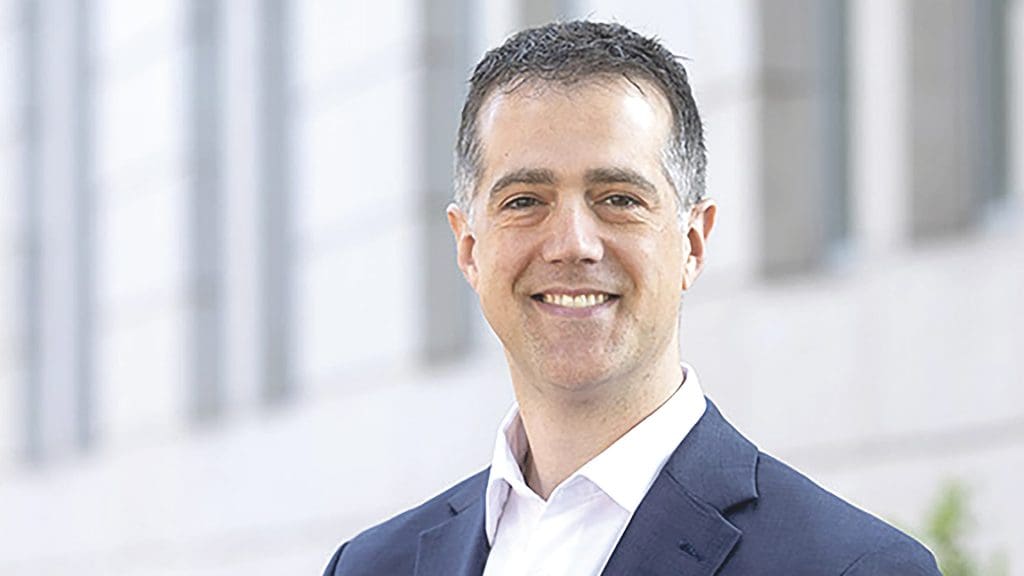
Lee Morrissette says it’s rewarding to see the impact the firm’s completed projects have on the community.
As Kerry Dietz planned her transition away from day-to-day leadership of the architecture firm she launched four decades ago, she was on a site visit to one of the firm’s Boston-area projects with Lee Morrissette — now one of the company’s four principals — and he asked her about her vision for the firm after she steps away.
“She said, ‘well, I’ve always envisioned the firm as a place for people to have a career in architecture.’ I thought that was a really interesting perspective,” Morrissette told BusinessWest. “It’s wasn’t ‘we want to build this building’ or ‘we want to get that award or make a lot of money from this particular type of project,’ but rather, ‘we want to be a place for people to have a career, to be part of a community,’ which I think is really rewarding.
“That, for me, has really resonated. Since becoming a principal over the past five years, I’ve realized that, even though I do interviews with clients and try to get new work and take on that competitive process we do for public work — which is great — it’s occurred to me that clients hire architects as people, not really as companies.”
And that’s important, Morrissette added, considering the relationship aspect of this work.
“You get the company, with all the breadth of experience. But you’re really hiring an architect, a person, to work with,” he explained. “The fastest projects barely get done in a year, and the really big, complex ones go three, five, seven, sometimes 10 years. You’re building a long-term relationship with somebody, so it needs to be somebody you can actually work with, someone who has your back. It’s like having a friend with special expertise you can really tap into. Perhaps friend isn’t the right word, but it’s building a relationship.”
Those relationships have grown over the years, and so has the firm, which now boasts a team of 30, completely filling the space in Springfield Union Station it has occupied since 2017. It has also opened a second office in Cambridge.
“Architects don’t build anything; contractors build things. We just provide all of what they need to be able to do that. And over that year of construction, 18 months, whatever it is, it slowly comes to life for us.”
“The bread and butter for our firm has always been affordable public housing, and there are a lot more housing authorities in the eastern part of the state than in the western part of the state, so we found ourselves getting more work in Eastern Massachusetts,” Morrissette said, noting that three team members work at that satellite.
But staff growth isn’t the only goal, he noted. Professional development is critical, as evidenced by the company’s designation, since 2018, as an Emerging Professional Friendly Firm by the New England Components of the American Institute of Architects. That program acknowledges architecture firms that promote the advancement of emerging talent through professional development and personal growth opportunities.
“It’s like a stamp of approval that we have an established professional-development program that includes mentorship and study materials and support of emerging professionals on a regular basis,” he said.
But it’s not just younger team members who are immersed in a culture of learning. Morrissette spent several recent weekends studying for an exam to become a certified passive house consultant, a cutting-edge type of sustainable design that dramatically reduces the amount of energy a building consumes.
“I’ve taken 56 hours of training to do this. And I’m really lucky that I can participate in that lifelong learning, just like the new grads that join our office,” he told BusinessWest. “We’re all learning together, and I think it’s a cool profession to be in. There’s a lot of variety in what we do, and there’s a lot to explore.”
Market Diversification
Dietz, like many large, well-established firms, designs projects in a range of sectors, including commercial, education, housing, senior living, hospitality, municipal work, and more.
“It sounds kind of like investment strategy, but it’s very similar. We have our hospitality industry, which is fairly market-driven, and then we have our publicly funded work,” Morrissette said, noting that publicly funded projects tend to land in a few buckets, from schools to housing authorities to municipalities. “They all have different budget cycles and money sources, but we’re working with public money from the very local level all the way to the feds, and that’s a nice balance to have.”
The principals at the firm — architects Morrissette, Jason Newman, and Kevin Riordan and chief financial officer Tina Gloster — regularly strategize on what projects to pursue or types of work to emphasize, and each brings different experiences and expertise.
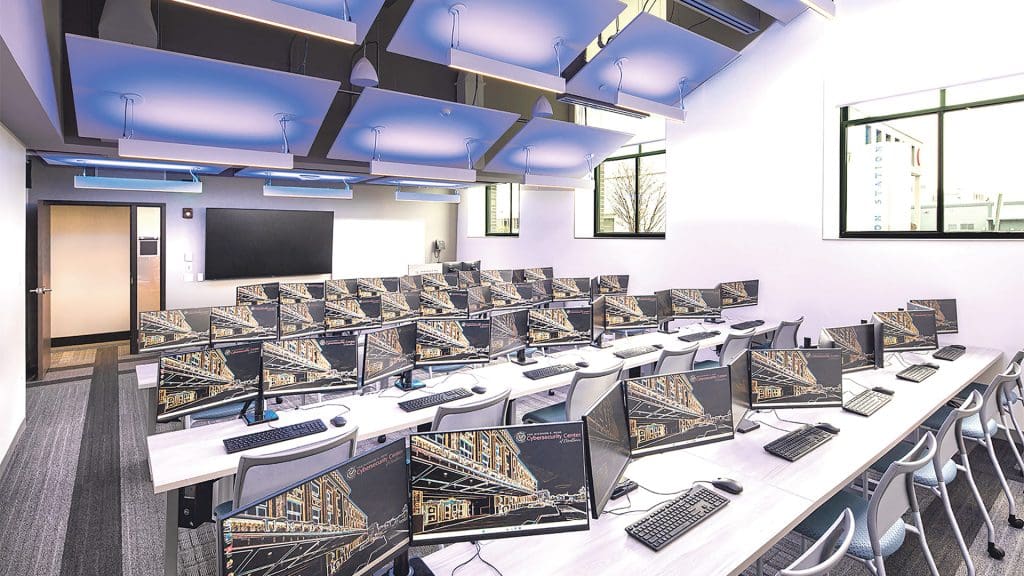
Dietz & Company designed the new Richard E. Neal Cybersecurity Center of Excellence in Springfield.
“The business side, for architects, can be challenging. We don’t go to business school; we go to design school. But when you’re a really good designer, you get a lot of work, and you find yourself running a company, and you find yourself having to make business decisions,” Morrissette said.
One of them is Dietz’s continued evolution as a leader in sustainable design, with one recent example being the Wilmington Senior Center, the firm’s first exposed mass timber project.
“Instead of the old timber — huge trees cut into big pieces, like the interior of mill buildings with huge timber frames and brick exteriors — mass timber is when you take a whole bunch of small pieces of wood and glue them together to make either columns or beams or floor blocks or wall blocks,” Morrissette explained.
“It’s a good sustainability story because it’s wood that’s pretty quickly grown because you’re growing little trees instead of big trees. It’s fairly renewable and reasonably fast-growing. It helps manage the forests. It also sequesters carbon into the building.”
But despite the excitement of new designs and industry innovations, the most gratifying part of any project is watching the final product emerge — and the impact it has on clients.
“Architects don’t build anything; contractors build things. We just provide all of what they need to be able to do that. And over that year of construction, 18 months, whatever it is, it slowly comes to life for us,” Morrissette told BusinessWest, using the senior center as an example. “Nothing is more rewarding than walking an owner or a client through a building and saying, ‘over here, remember we talked about what that café was going to be like? This is where the coffee is going to be. This is where that beautiful tile you picked out is going to go.’
“And then you get to the ribbon cutting, and they say, ‘I can’t believe we’re here.’ To see the building full of its occupants — not contractors or architects, but to actually see it full of its occupants, enjoying the space, playing pool in the rec room and doing yoga in the fitness studio and sitting down for a meal — yeah, that’s pretty cool.”
Handing It Over
Still president and board chairman of the firm, Dietz can take a lot of pride in the company and culture she has built, which also includes an employee ownership model launched in 2021. Morrissette is proud of the work, too, but it goes deeper than that.
“In truth, there’s something a little bit zen about it. We spend all this time in this building. We argue and collaborate with the contractors and the owners about details and budget. We advocate for it like it’s our baby. And then we just give to the owner — because it’s not our building. You have to get used to giving it up and walking away.
“But it’s very rewarding,” he added. “It is incredibly challenging and nuanced, and I’m always tested, but I’m really lucky that I get to do this on a daily basis.”