The MassMutual Center is nearing the end of a prolonged construction period and preparing to open its doors for business. The next five years will be focused on polishing and cultivating the center’s business model, and only time will tell how successful Springfield’s newest – and largest – attraction will be.
Jim Rooney, executive director of the Mass. Convention Center Authority (MCCA), says that convention centers are much like restaurants ‚ people often let someone else try out the menu first, and wait to hear the review.
"Does that mean disaster could occur? Yes," he confirmed. "It happens. Just like in a restaurant, one bad review could spread like wildfire."
So as the MassMutual Center readies to begin its first year in business, the MCCA, which oversees its operations, the city of Springfield, and other local entities are focused on doing everything possible to make sure the center’s opening is a raging success.
Sept. 30 will mark the official end of the center’s construction phase, as the faÁade of the Springfield Civic Center gradually gives way to a brand-new, expanded convention center. The changes have created a buzz in the city, anticipation has only grown, and hopes that the building will lead Springfield into a period of growth and prosperity have been firmly pinned on its new white walls.
However, the convention center’s long-term contributions to Springfield remain a matter of speculation. As Rooney’s restaurant comparison suggests, the end of construction merely ushers in the start of another set of important building years, during which the overall health of the region will be as important as the level of traffic flowing in and out of the center’s spacious new entryway.
Rooney said it will be at least five years before the center reaches a level of stability necessary to accurately gauge its success.
"First and foremost, we need to create a balance of strong bookings, strong management, and great publicity. If we don’t start in balance, we won’t finish in balance," he said. "So the next five years are our growth years, focused on letting people know we’re on the map."
That process, Rooney explained, will include creating a buzz about the center both regionally and nationally, achieving an exemplary level of quality service, and ensuring that the performance of the center’s management team and staff remains nationally competitive.
"That’s the first year," he said, noting that several firms have bid for the right to manage operations at the center, and one should be chosen by August. After that work is done, the center will move into an aggressive market-penetration phase with a specific business goal in mind: booking events for 65% of the year: 237 out of 365 days.
Bookings have been brisk for the center, which features several meeting and function rooms, banquet halls, a 40,000-square- foot exhibition hall, and the civic center’s original arena, refurbished with new seats, concession stands, and other amenities. The early reservations suggest that the convention center is indeed moving in a positive direction.
But Rooney cautioned against placing too much emphasis on the center’s ability to kick-start a turn-around in Springfield. He said that, for a city in a fiscal crisis, especially one steeped in controversy and with issues ranging from public corruption to the safety of its streets, there is no silver bullet.
"In and of itself, this convention center is not an economic revitalization plan," he said. "It’s a major contribution, no doubt about it, but there are other things involved in terms of righting this ship. The destination is sold as much as the building is sold."
And there are other concerns, among them the state of the convention industry itself (a recent report indicates that the sector is declining) and the impact of escalating competition from facilities in other area cities, including Hartford’s new Connecticut Convention Center.
There are also questions about the MassMutual Center’s impact on existing banquet and meeting facilities in the area, and whether the center will bring new business to the region or merely take a large share of the existing market.
But Rooney and others closely involved with the project are optimistic that the new convention center will be able to compete on a national level and bring new convention dollars to the area. They’ve taken the risks and the realities into account, and the MCCA, along with the Greater Springfield Convention and Visitors Bureau (GSCVB) and other local organizations have developed a plan that starts with promoting the region and new center as a package, and capitalizes on the building’s size, design, location, accessibility, and the innate desire of many to see the facility ‚ and the city ‚ succeed.
"It takes a lot more than one building to bring a city back to life," Rooney said. "It takes a strong cooperative, strategic effort, and that’s what we have in mind here."
Making Concessions
The MassMutual center project was spawned, like many other projects across the country, by the boom enjoyed by the convention industry in the late ’90s. The health of the industry nationwide initially spurred Massachusetts and other states to evaluate their current convention facilities and make financial commitments for improvement.
Rooney said those commitments represent an economic strategy to cultivate convention business in the state, treating it as a primary economic driver.
"All over the country, people were trying to get into this game and get a piece of the pie," he said. "That included deciding what should happen in Boston, Worcester, and Springfield. Funding was made available in all three cases, and a substantial statewide strategic commitment was made to the convention industry."
But Springfield’s convention center project represents more than merely one part of the Commonwealth’s convention industry initiative; the city’s civic center, built in the early ’70s, was in dire need of a facelift even before the state took control of it. Rooney explained that at the same time state leaders made the decision to build new convention facilities, the Springfield Civic Center was falling on its hardest times.
"The civic center was in a serious state of disrepair," he said. "It was controlled by the city at that time, and the city was unable to keep up with what needed to be done."
So, in what Rooney termed a "friendly transaction," management of the property was transferred to the state.
He explained that $52 million was originally earmarked for the Springfield leg of the statewide convention facilities project, but that initially, the MCCA had envisioned a building that required about $80 to $90 million. The Legislature did appropriate more money, bringing the amount up to $66 million, but the convention center still needed to be re-evaluated to fit the budget.
"We set about managing our appetite for improvements and making some engineering tradeoffs ‚ essentially, we down-sized," said Rooney, adding that soon after those adjustments were made, a partnership was formed with MassMutual, which bought the naming rights for the center for $5 million.
"Ultimately, everything came together in 2002," he said. "MassMutual’s purchase of the naming rights brought the project’s budget up to $71 million, and we could work within that number, so the program was in balance."
He added that the downsizing of the MCCA’s initial plans for the center actually helped to underscore how its size could be an asset.
"Architecturally and functionally we are at the right scale for this marketplace," said Rooney. "For the kinds of regional and local events we should be competing for, it’s the right size ‚ we have the advantage of 40,000 square feet of exhibit space without the disadvantage buildings sometimes have when they’re too big. People know what size facility they want when they’re booking events, and they know what types of events fit well."
Meeting Expectations
Mary Kay Wydra, president of the GSCVB, which is working under the auspices of the MCCA to market and sell the convention center, agreed that capitalizing on the center’s existing strengths is a key component of its business plan. But perhaps more important is promoting the entire region as a destination, not merely the location of a brand-new convention center.
"Different groups look for different types of locations," she said. "We’re perfect for a lot of different organizations, and we market directly to them. We’ve bumped up against Hartford a couple of times, but in general they’re looking for larger groups."
She added that an ideal booking is one that necessitates what she called "city-wides" ‚ the need for 500 to 800 hotel rooms or more per night, which requires that multiple hotels are involved and means in theory that a greater impact on area restaurants, stores, and attractions, would be created.
About a dozen events, including five of those citywides, have been booked for the center to date, beginning shortly after opening day, in November, and extending into 2008. These early bookings will account for 23,050 anticipated attendees, 14,000 new overnight hotel stays, and a projected direct spending impact of $3.8 million over the next three years. Wydra said several other bookings are currently pending, adding that the she’s confident the early interest is indicative of the level of success the building will have in years to come.
But that confidence hasn’t negated the need for creative marketing and promotion of the center in the increasingly competitive convention industry. Half of the events currently booked, for instance, were the result of a burgeoning program within the GSCVB called Pioneer Valley Pride, which asks local residents, businesses, and organizations to use their connections with regional and national groups to draw business to the MassMutual Center ‚ essentially, bringing new business home.
"As members of regional or national organizations, local residents can have a positive impact on the economic well-being of the region," said Wydra, adding that Pioneer Valley Pride is just one way that the GSCVB is working to promote the region and its new facility as a package. "A lot of bureaus have similar programs, and they are a great asset if you can make it happen. Since people have been watching this building as it goes up downtown, it’s definitely in the forefront of their minds. I think that’s going to help our program succeed."
Wydra agreed with Rooney that packaging the building along with the region is essential to the process of marketing and selling both, noting that the GSCVB sales staff members actually focus more on the region than the convention center itself when soliciting new convention business. A new logo and marketing plan have recently been put in place for the Pioneer Valley, for instance, and have become some of the primary selling tools for the convention center.
"The pitch is 80% the region and 20% the building at this point," she said. "We highlight easy access to the building, but also other attractions, first class accommodations, and plenty to do."
Russell Denver, president of the Affiliated Chambers of Commerce of Greater Springfield, said the chamber is also working to increase the visibility of the convention center by collaborating with other area chambers to get the word out and to create a cohesive ring of support around the center.
"We’ve coordinated with other chambers to make sure the building and the events within are well publicized," said Denver, adding that, in addition to the chambers’ involvement, every mayor in Hampden, Hampshire, and Franklin counties recently signed a letter promising cooperation and collaboration with the convention center, the MCCA, and the GSCVB. He said the action calls attention to the importance of the facility to the Western Mass. community.
"The impact of the building during construction is something that a lot of people overlook," he said. "It has been very positive ‚ a lot of people have been employed by this project, and the local confidence is already there.
"What the long-term impact will be, time will tell," he continued. "But there is a definite spin-off phenomenon expected. What it comes down to is that $71 million has been pumped into Springfield, and that’s outstanding."
Still, Denver, like Rooney, tempered his positive outlook with the knowledge that only after several years will the region know whether the convention center has become a player in the industry, and a boon for Western Mass.
"I have no lofty expectations," he said. "If you create goals and they’re not met, expectations get dampened pretty quickly. The center is just one more tool in the tool box for us."
A Study in Black and White
Rooney said the propensity toward guarded optimism is actually an appropriate response to the approaching start of the MassMutual Center era.
While he and others are hopeful that the center will bring much-needed dollars into Springfield and surrounding communities, the worst-case scenario has been considered: that tough competition will prove to be too high a hurdle, and the center will languish in a tepid sea of bookings, fighting for business not with other convention centers in the country, but instead with other local venues.
"This industry is very competitive," he said. "Any business we get will come at the expense of somebody else, somewhere."
But Rooney was quick to note that stiff competition, though real, is no reason to bow out of the game entirely. He acknowledged that the convention industry of the ’90s, which remained a strong growth sector well into 1999, has slowed in recent years. But he explained the change as proof of an industry that is maturing, not declining.
"Conventions were driven largely by the technology industry," he said. "It has slowed recently, and I’ll admit that demand leveled off. But that’s just American Economics 101; industries mature. This is an $80 billion industry ‚ a big industry. A lot of money is still being spent."
Rooney’s characterization of the convention industry came in response to a controversial study released in January by the Brookings Institution, a research and analysis organization in Washington, D.C. that focuses on economics and metropolitan policy, which questioned the validity of convention centers as economic drivers.
The report, Space Available: The Realities of Convention Centers as Economic Development Strategy, authored by Heywood Sanders, proposed that while convention business has long been an attractive option for struggling cities hoping to rejuvenate their streets with a steady stream of visitors spending money in hotels, restaurants, and stores, some trends in the industry suggest that the strategy is one that could backfire.
"The overall marketplace is declining in a manner that suggests that a recovery or turnaround is unlikely to yield much increased business for any given community, contrary to repeated ind
stry projections," Sanders wrote, citing advances in communications technology as one reason for decline. "Nonetheless, localities, sometimes with state assistance, have continued a type of arms race with competing cities to host these events, investing massive amounts of capital in new convention center construction and expansion of existing facilities."
Indeed, the MassMutual Center project fits such a description; it is one of 44 new or expanded convention centers currently in construction across the country. Meanwhile, it functions under the direction of the state, and will open for business shortly after nearby Hartford opens the doors of its new convention center, which dwarfs Springfield’s facility.
But Rooney was skeptical of some of the study’s findings.
"Sanders has taken some statistics and tried to create an impression of an industry that is dying," he said. "But there is one way to measure his success as devil’s advocate: there isn’t one convention center in America he’s been able to close yet.
"It’s foolish to suggest that because competition is fierce that we all take our bat and ball and go home," he continued. "Springfield can compete as much as anyone. It will be the execution of well-laid plans that will create new demand."
But in an increasingly competitive field, how real is the potential for in-fighting among the convention center and existing facilities in the area?
It’s a very real fear, said Rooney, and one that has been addressed.
"Our desire is for Greater Springfield to compete and to compete aggressively," Rooney explained. "Jockeying for position locally is a real possibility, but the convention center can’t do that and be competitive ‚ none of the venues in the area can, and it’s not our objective. What we do want is to add value to the region, and in five years, watch all of our boats rise. It comes back to managing Springfield as a destination ‚ it’s going to take a great deal of cooperative effort."
He added that as various meeting facilities compete for business, they also continuously hone their strengths and focus on the niches they best cater to, and that should stave off any major struggles for clients between the center and surrounding facilities such as the Basketball Hall of Fame, Eastern States Exposition Grounds, the Mullins Center in Amherst, and banquet facilities such as the Log Cabin in Holyoke.
Wayne McGarry, president of the Eastern States Exposition, shared Rooney’s positive outlook.
"We lost the Affiliated Chamber’s Market Show to the convention center already, but I certainly understand why," he said, citing the Chamber’s support of Springfield’s newest venture. "The long-term impact of the center remains to be seen, but as far as we are concerned, I’m sure we’ll remain competitive."
McGarry added that overall competition may be minimal because the two venues have different roles and serve different audiences.
"Their focus is conventions, ours is really trade shows because we have wide-open spaces and staging areas," he said. "That’s not to say that there may not be an event some day that we both want. But overall I don’t see us being too competitive with each other. One would have to be optimistic that the new facility will spark interest in the region overall ‚ anything that proves to be good for the overall economy is good for everybody."
And while no specific partnerships have been formalized between the convention center and other facilities in the area, McGarry didn’t rule that out.
"Who’s to say that at some point there might not be an opportunity we could enter into jointly?" he mused. "It’s not out of the realm of possibility."
Wydra agreed that partnerships are an area that could be examined in the future.
"A lot of people like to have their conventions and meetings all in the same place, but hold a dinner or a cocktail party off-site," she said. "Already, the Hall of Fame is generating a lot of interest for things like that. Dual interest is another way that promoting the entire region to add to the strength of the convention center comes into play."
Fear vs. Fortune
Wydra concluded that the GSCVB, MCCA, and others will continue to address and often allay others’ fears regarding the center’s future role in the region. But she said they don’t toss that sentiment around in their own circles.
"Fear doesn’t enter our vocabulary," she said. "Excitement does. This is a first-class property that we have to offer here."
One that they hope will receive a five-star review very soon.
Jaclyn Stevenson can be reached at[email protected]



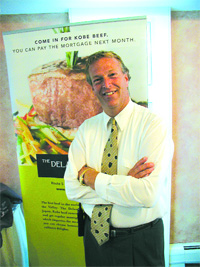
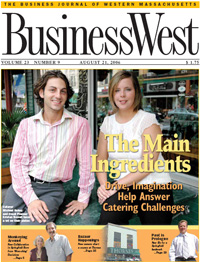
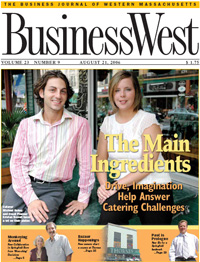 Mocktails for teenage guests. Organic meat stations. Chilean ingredients prepared in Lebanese fashion. Such catering requests are fast becoming the norm, not the exception, and caterers and event planners in Western Mass. are responding accordingly. Handling new and ever-more-demanding client needs is challenging, but those in this industry say it stirs their creative juices, while fueling their entrepreneurial fires.