Home Posts tagged Restaurants (Page 13)
Sections Supplements
L’uva Strives to Give Customers a Grape Experience
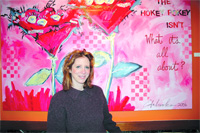
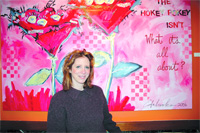
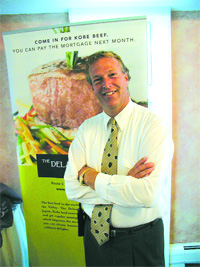
Michael Ratté

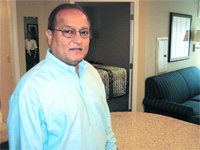
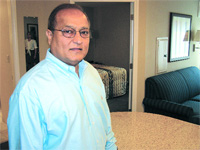
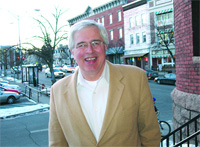
Michael Ratté says a large, diverse menu and an impressive wine list keep customers coming back to L’uva.

Michael Ratté operates an award-winning Springfield restaurant, the culmination of almost 30 years in the food-service business.

But the co-owner of L’uva didn’t start anywhere near the top; his first foray into the business was busing tables at Springfield Country Club at age 16.

“I’ve been in fine dining almost exclusively ever since, in many places in this area and elsewhere,” he said. And when it came time to actually own a restaurant, Ratté soon decided he was better off following his own instincts.

“At first, I was with a few other guys with their own concepts, and none of them were in the restaurant business,” he said. “When I pointed out the inadequacies of their ideas, they got afraid. So I bought them all out and did it on my own.”

Well, not quite.

Ratté partnered on the venture with chef Joseph Groth, who remains co-owner and head chef today, and earns credit for the eclectic nature of the expansive and ever-changing menu.

“The idea was fine dining, a big menu, and lots of wines,” said Ratté; indeed, L’uva is a French word for grape, and the wine list features more than 60 selections by the glass, 350 by the bottle, “and there are probably another 75 to 100 that aren’t even on the list.”

In this issue, BusinessWest visits what is quickly becoming a Springfield destination for food fans and wine lovers alike.

Creative Touches

Ratté has described Groth’s food creations as having Asian, French, and Italian influences, but with a distinctly American twist.

There’s an element of adventure in the menu, from a Caesar salad topped with semolina-fried oysters to entrees including maple-crusted scallops and duck with sun-dried cherries. L’uva also offers creative cheese plates, a selection of desserts all made in-house, and petite entrees that leave room for … well, salads, cheese, and desserts.

“My chef is outstanding, and this is a family venture, so everybody involved cares about what we’re doing,” Ratté said. “We’ve all been together for so long, we work really well together.”

Even though Ratté and Groth’s earliest concept, something resembling a sandwich shop, morphed into the fine-dining establishment L’uva is today — “this is a much fancier look than what we were originally going to do,” Ratté said — even then they intended to include plenty of beer and wine selections.

And L’uva has certainly forged a reputation for wine, hosting wine clubs, private wine tastings where people can learn more about different varieties, and even “wine flights” — sample servings of four different wines, offered on their own or with a meal. Just a year after its 2003 opening, L’uva was earning ‘best wine list’ honors in the Valley Advocate’s annual Best-of-Springfield poll — in addition to ‘best restaurant,’ ‘best creative American cuisine,’ and ‘best service and waitstaff.’

That latter honor is no accident; L’uva is staffed by professional waiters, some of them seasoned industry veterans — “not college kids working for extra money,” Ratté said — and customers are greeted with the option of valet parking on Friday and Saturday nights.

Ratté is pleased by the way his restaurant has become a noted part of the downtown dining and entertainment scene. “I don’t think this area is underserved by restaurants,” he said, “but I don’t think many places pay as much attention to detail as we do.”

That attention to detail is evident in the way Ratté restored the brick walls and tin ceiling of L’uva’s 1850s building. “We feature art by local artists on the brick wall on the bar side, and that changes every month, so it changes the look in here and also gives plenty of locals an opportunity to show off their works,” he said.

Forward Thinking

Ratté’s plans to open a second location in Belchertown, at the site of the former state school, fell through last year, but he continues to keep his eyes open for other opportunities to expand. “Many opportunities have arisen, but I’m waiting for the perfect fit for what we want to do.”

In any case, he said, locals who patronize L’uva at its current location don’t have anything to worry about.

“A lot of people heard about Belchertown and thought I’d leave the downtown location completely,” he said. “But that’s not true. We have a following down here, and there’s no reason to leave Springfield.”

In fact, he said, many people don’t believe that a pleasant dining experience can exist in that area of Main Street, close to the Hippodrome and the entertainment district — until they stop by for the first time.

“There’s so much negativity about the downtown, but we’ve never had any problems,” he said. “Things that happen miles away are not what the downtown is like, and any negatives here are things that happen at 2 in the morning, so it’s nothing that affects my customers.”

In fact, Ratté said all the news outside his front window lately has been positive, including the city’s installation of new sidewalks, pavement, and streetlights on Main Street. “A lot of people from the suburbs are afraid to come to downtown Springfield,” he said, “but I don’t think that’s founded.”

Changes are constantly afoot inside L’uva as well, as Groth produces a new menu four times a year, keeping some favorites but always introducing new items.

“It’s a huge menu, but our regular customers still often wind up trying everything, so it’s important to change it for them,” Ratté said. “It also allows us to take advantage of seasonal items, so we get things when they’re at their best. And we’ll go a little heavier in the winter, which is nice.

“Besides,” he added, “I have to vary it for myself. I eat here all the time.”

Joseph Bednar can be reached at[email protected]

Sections Supplements

It’s the last workday before Christmas, and there’s a gilt-wrapped package on your desk from a co-worker.

What could it be? Personalized golf balls? A handy letter-opener? The latest best-selling title atamazon.com?

The anticipation can fill many an employee with glee — but others with dread. Gift giving at the office can be a tricky task, and sometimes, a well-intentioned present can backfire.

A few Western Mass. professionals answered the call (anonymously) from BusinessWest to ’fess up about the best and worst holiday gifts they’ve received, and their stories offer some insight into what to give and what to shelve.

For one bank vice president, his favorite gift was also his most lamented. A client presented him with a brand-new set of Callaway golf clubs as a special thank you for a year of good advice; however, the gesture was too extravagant for him to accept.

“They were even left-handed,” said the southpaw, “but as a gift that cost in the thousands, of course I couldn’t take them.”

The clubs did eventually find a good home, though, as a raffle prize raising funds for a local Boys and Girls Club. But the story calls attention to a common error in the arena of corporate gift-giving: before you reward a colleague for a job well-done, make sure your sentiments — and your spending — are in line with their company handbook.

That said, the pendulum shouldn’t swing too far in the other direction, from fabulous to free. A stylist in Hampden recalls a well-traveled client presenting her with a bag of used hotel samples of shampoo and conditioner. “We laughed for weeks over that one,” she said.

An account executive in Springfield said that after many years of graciously accepting the good, the bad, and the ugly, she’s drafted her own short-list of appropriate Yule-tidings.

“One of the worst gifts I received was a ‘boxed’ bread called Panettone,” she began. “It’s supposed to be an Italian treat, but upon taking it out of the packaging, it was dry and spongy and utterly gross. My husband and I played a really awesome game of catch.”

Instead of petrified pastries, she suggests small, crowd-pleasing items for coworkers, such as scratch tickets, movie passes, or gift cards, especially for coffee and gas.

“No plush items, they should only be given to children under the age of eight,” she said. “No items that play Christmas carols, and please, do not re-gift items! It’s so obvious!”

Instead of rewrapping, consider donating unwanted items to a local survival center, she said.

Finally, a business owner in Springfield bravely shared a tale that teaches us to reel in our holiday expectations in the workplace. Every job is different, as she found shortly after finishing college, and even a fruitcake isn’t mandatory.

“After working in restaurants for the many years it took me to complete my college education, I had my first office job working for a non-profit organization,” she recalled. “In restaurants, the holidays were a bountiful time. Not only did we get good food to eat and very generous tips from regular customers, we’d always get gifts of nice bottles of wine or other swag, plus at least a $100 bonus from the owners.

“At the holiday party at my new office job, I was absolutely astonished when our holiday cards were empty, except for a nice note from the executive director of the agency,” she continued. “Flabbergasted, I asked the accounting department if we should expect our bonuses in our paychecks that week. After all, in my conception of ‘office job,’ big Christmas bonuses were the norm. The accountant gently informed me that non-profits had to account for every dime of government funding and couldn’t just give money away. I turned about 12 shades of red and slunk back to my rickety metal desk.”

Opinion

This issue, BusinessWest begins a series of articles on how other cities are faring with the challenges facing all urban centers in the 21st century, with the goal of identifying strategies and philosophies that may be incorporated in this region. We start with Lowell, a community similar to Springfield in many ways — it is a former manufacturing (textiles) hub, runs along a major river, pursued minor league baseball (successfully), and was managed by a finance control board during its darkest days — and also a community hailed by many as a model for urban revitalization.

The comeback effort, waged over the past 30 years or so, was recently called into question by some academics and economic development experts, who say that Lowell hasn’t created enough new jobs and still has high rates of poverty. This may be true, but by most estimates, what Lowell has accomplished is worthy of praise and emulation. The city is vibrant, with perhaps 3,000 more residents living in its downtown (most all of them with disposable income) than just seven years ago, and it has re-invented itself as a cultural destination, and an attractive place to live and work.

Springfield has those same goals, but it faces some handicaps that Lowell doesn’t. It is too far from Boston and the Route 128 beltway to gain appreciably from the strong economy there. Meanwhile, it doesn’t have the millions of square feet of vacant mill space that developers transformed into condos and apartments in Lowell’s downtown area.

But there are plenty of lessons Springfield officials can take from Lowell, and we hope they do. Here are a few:

  • Embrace the Past: Lowell’s revitalization efforts started with the Lowell National Historic Park, which pays tribute to the city’s heritage as a planned industrial city, and it was moved forward by the fact that the city didn’t bulldoze all those old mills. Springfield can learn from this and try to create more cultural and historical attractions. The Armory museum is already here, and it can supplemented by facilities that recognize the city’s manufacturing heritage, the products made here, the many ‘firsts’ for which the city is known, and the entrepreneurs who started those ventures.
  • Focus on Market-rate Housing: Lowell found a way to add market-rate housing to its downtown without displacing poor residents and those in subsidized housing. Springfield can do the same, but it will have to be more creative. It doesn’t have mills, but it does have upper-floor spaces in many buildings downtown. And if the struggles to attract commercial tenants to One Financial Plaza continue, maybe, just maybe, several floors could be converted to market-rate (not subsidized) housing. It may be necessary to incentivize developers to build such projects, and if that’s the case then the city needs to find a way.
  • Embrace the Arts: The key to urban residential development in any city is to make that urban area attractive enough for people to want to live there. Thus, Springfield has a lot of work to do. Part of the success formula in Lowell was a full embrace of arts and culture. The city boasts a number of museums and galleries, and hosts several music and cultural festivals each year. These assets are complemented by restaurants and clubs that keep the downtown humming throughout the day. Springfield can and must do the same.
  • Foster Teamwork: Little of what has happened in Lowell could have been accomplished without teamwork and consensus-building. Creating the same type of working environment in Springfield will be an important assignment when — and even before — the control board eventually finishes its work here. One planning official in Lowell said a key to progress there was the ability to get officials to share in the responsibility for getting things done — and then share the credit. This may be the most important lesson Springfield can learn.
  • Be Positive: It would wrong to say that the “Lowell miracle,” as some call it, was made doable by a can-do attitude. But it certainly helped. At some point early in the revitalization process, Lowell started believing in itself. In Springfield, it seems, a ‘can’t-do’ attitude seems to prevail.
Features
As Confusion Mounts, Cautious Optimism Surrounds Health Insurance Reform
Christine Phillips and Carole Parlengas

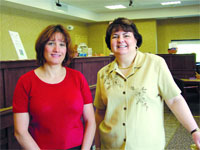
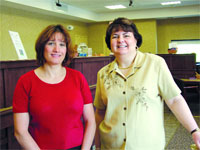
Christine Phillips (left) and Carole Parlengas of United Personnel say health insurance reform could have some rocky times ahead, but they view the changes as necessary and important.

‘One calendar month is the calendar month, commencing with the first calendar month following the first day of employment, unless the first day of employment is the first day of a calendar month, in which case the calendar month commences with the first day of employment.’

That’s how one sentence, regarding employee start dates and how they affect a company’s calculation of full-time equivalent (FTE) employees, reads on the Mass. Office of Labor and Workforce Development Web site.

Carole Parlengas, vice president and CFO, and Christine Phillips, executive vice president with United Personnel, a staffing agency based in Springfield, said it’s also a good example of the verbiage surrounding the Commonwealth’s health insurance reform legislation that has their heads spinning.

“If just one sentence is overwhelming, think of all the other things we haven’t even seen yet,” said Parlengas, to which Phillips added that, while in many respects United Personnel has stayed ahead of the game in terms of implementing new requirements, there’s still an anxiety level surrounding what needs to be done, and how.

“From the beginning, we’ve said that we will work with whatever the state gives us in order to stay legally compliant and in step with the legislation,” said Phillips, “but we’re still nervous, because we’re not always sure what the state is doing. And from what I’m hearing, we’re actually ahead of some other companies who’ve gotten lost in the quagmire and are waiting for more direction.”

United Personnel represents the business sector that could be experiencing the most problems with the Commonwealth’s implementation of health insurance reform, signed into law by former Gov. Mitt Romney in April 2006. It requires all Massachusetts residents to have health insurance — the deadline was this past July — and through mandates and new filing requirements, places this responsibility not only on individuals, but state agencies, health plans, and employers as well.

Devil in the Details

While the plan has received little public criticism of late on administrative or legislative levels, employers are beginning to feel the weight of the new paperwork required by the law.

Staffing agencies are particularly stymied, trying to understand how to efficiently file new forms when employees are temps, often starting a new position multiple times throughout the year. This makes it difficult to pinpoint how many FTEs an agency actually has, not to mention those employees are scattered throughout various businesses, not contained in one office.

“I don’t think the administration ever thought about transient employees,” said Parlengas, who, over the course of the last month, has attended several meetings with legislators, health insurance companies, and other staffing agencies across the state as they scramble to find their place in the puzzle. “They thought of seasonal and part-timers, but not the temps.”

This concern has moved closer to the forefront in recent weeks due to the arrival of the first round of new annual filings for employers that are part of the legislation.

Employers were notified the week of Sept. 24 that beginning on the first of October, they would receive their first Fair Share Contribution report (FSC), which can be completed online and details whether or not an employer with 11 or more FTE employees has made a ‘fair and reasonable contribution’ to their employees’ health insurance, and if not, to what extent a per-employee Fair Share Contribution (of up to $295 per employee annually) must be paid.

Employers have also received a second form, the Employer Health Insurance Responsibility Disclosure report (HIRD), which confirms whether or not an employee has been offered a Section 125 plan, a pre-tax payment system for health coverage and the minimum requirement for employers. Forms must be signed by each employee regardless of their decision to accept or decline the plan, and must be kept on file for three years.

Further, they must be filed with the state by Nov. 15, and that quick turn-around has many people reeling. Staffing agencies have arguably felt the pressure first, but Phillips said she wonders if similar worries will surface in other industries, such as health care, which employs a large number of per diem employees, and in restaurants, in which servers rarely work ‘normal’ hours.

“The data is the scariest thing; it’s going to be a few rocky years for some companies,” she said. “It’s the biggest piece of this right now — record-keeping, and producing the data the state needs.”

In some ways, the problems brought on by the new filing requirements start at a very basic level, Phillips noted. For one, the computer systems currently used at United Personnel have no way of ‘answering’ the questions posed by the state: questions such as ‘what is the percentage of the premium cost for individual coverage your business offered to contribute for all full-time employees?’

“We need certain tools in order to report the data correctly that we don’t have; our databases weren’t built to deal with such sophisticated queries,” she said, adding that for now, the process has become a very human one — and therefore very time- and resource-consuming. “It’s daunting that record-keeping has become so important … especially when we don’t even understand what constitutes a calendar month.

“I think that when this was being planned out, the administration was thinking in terms of standard jobs, and standard hours,” she continued. “When I think of people in restaurant and hospitality jobs, or the medical field, I think they must have some of the same challenges as we do. I don’t think the administration thought long on logistics.”

Painting with a Broad Brush

Still, some with a bird’s-eye view of the reform say that while some roadblocks are bound to crop up, the plan has moved ahead as smoothly as they could have hoped.

Mike Widmer, president of the Mass. Taxpayers Assoc. (MTA), spoke with BusinessWest a year before the health coverage deadline, and at that time cautioned employers against leaping to any conclusions when the legislation’s reporting components began to fall into place.

“The classic, Massachusetts response at the first sign of trouble is ‘man the torpedoes,’” he said in May 2006. “We have to keep working, to progress into new territory.”

Today, his sentiments have not changed much.

“Massachusetts gets very high marks for how well the implementation has gone, and I include the Connector in that,” said Widmer, referring to the Commonwealth Health Insurance Connector Authority, an independent public authority created to implement significant portions of the health care reform legislation, including assisting qualified Massachusetts adult residents with the purchase of affordable health care coverage.

“The administration in general deserves high marks for implementing health care reform. It could have been a problem with a Democratic governor taking over after a Republican governor, but they’ve been sensitive to this and have not tried to reinvent solutions to the issues.

“It took a broad and unusual coalition to pull this off, and a group of constituencies sought to achieve compromises that have held together,” Widmer continued. “We’ve enrolled 200,000 people to date, and moreover, the Connector Authority votes on tough issues, like affordability. Those votes have been largely unanimous, and that reflects the compromise and proves that the board is not going to the mat on every issue.”

Widmer said he, too, has some looming concerns despite his confidence in the system, including the possibility of losing key federal funds.

“We are negotiating with the federal government to maintain funding in 2008 that is critical,” he said. “Once the reform was in place, they approved it, and we didn’t lose the money, but now, we must re-evaluate, and that’s going to determine how much funding we’ll get.”

The Finer Points

Jeff Ciuffreda, vice president of Government Affairs with the Affiliated Chambers of Commerce of Greater Springfield, agreed that while much remains to be seen, the current climate in the region seems to be one of acceptance of the law, and of respect for its objective. But like Widmer, he also guards his optimism.

“The roll-out of the products is being seen as fairly good,” he said, “and overall, we haven’t heard a lot of negative feedback. I do hope, though, that there aren’t too many people adopting a ‘let’s-wait-and-see’ attitude.”

Ciuffreda said he fears some employers may be unclear on some of the details of the legislation, in particular the role of the Fair Share Contribution, and that this could create a backlash later in the year as tax time approaches.

“I hope this lack of feedback isn’t a sign that employers are not understanding some of the fine complexities of the law,” he said. “When they file their taxes, they could face the first phase of penalty, and we could hear more complaints.

“The biggest misconception is that the Fair Share Contribution of $295 is a good deal, but that’s just the first part,” he added. “It could get exceedingly worse for those employers.”

That’s because if employees at a given company (of 11 employees or more) accrue more than $50,000 in health care costs drawn from the free care pool the legislation is aimed at eliminating, the employer is responsible for at least a portion of the bill, and possibly the whole amount.

“If the legislation hasn’t gotten people’s attention, those penalties will,” said Ciuffreda. “They’re not meant to fine; they’re meant to make health care ultimately more accessible for everyone, and by the end of this year, we’ll have a clearer picture as far as how that is progressing.”

Agents for Change

Despite the challenges they’re currently facing, Phillips and Parlengas also agreed that with any new legislation, especially one with such broad implications, there are bound to be some stumbling blocks.

Overall, though, they’re optimistic that the Commonwealth’s health insurance reform will achieve its goal — to make health care universally accessible to Massachusetts residents.

“We’re patient, and we’re positive,” said Phillips. “We have a commitment to making sure we’re compliant and we take doing business in this state very seriously.”

“Something needed to be done,” added Parlengas. “Even though it’s confusing now, and the employer bears the brunt — it’s important.”

Jaclyn Stevenson can be reached at[email protected]

Sections Supplements
Commerce Show Organizers Want Some Net Results at the Hall
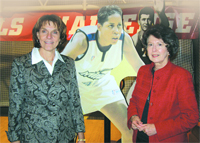
Gail Sherman and Doris Ransford

Commerce ’07 organizers Gail Sherman, right, president of the Chicopee Chamber of Commerce, and Doris Ransford, president of the Greater Holyoke Chamber.

In 2006, organizers of the Commerce trade show took their game up a notch by relocating the annual fall event to the Basketball Hall of Fame. The change of venue, coupled with some different programs, generated some new excitement for the show. Seizing on that momentum, planners have brought the show back to the Hall, but with some new wrinkles to the game plan designed to bring more value to exhibitors and visitors alike.

‘Elevate Your Game.’

That’s the theme for Commerce 2007, the 17th edition of the annual fall trade show staged by the Chicopee and Greater Holyoke Chambers of Commerce, slated for Nov. 1. It was chosen to draw a strong connection between the event and its new home, the Basketball Hall of Fame, to which the show was first taken last year; the event’s brochure is replete with double entendres covering both sports and business. But it also speaks to business owners about the opportunities that show organizers believe the event offers for companies to take their marketing efforts to a higher plane.

Indeed, there are several new wrinkles to the traditional trade show format designed to give participants more exposure. These include a ‘star exhibitor status’ package, which gives vendors more visibility, both on the show floor and in marketing materials for the event. Meanwhile, companies can also sign on as ‘playmakers,’ an upgraded ‘star status’ product tailored toward companies that plan to offer demonstrations or mini-seminars at their booths.

But ‘elevating the game’ also refers to what show organizers, especially Chicopee Chamber President Gail Sherman and her counterpart in Holyoke, Doris Ransford, have been trying to do with their trade show. The move to the Hall of Fame energized some long-time participants and sparked enough curiosity to attract several newcomers last fall, said Sherman, noting that the chambers want to seize on that momentum and make the show an even more attractive marketing option for business owners.

To that end, they have created the new initiatives aimed at exposure, while also tweaking the show layout and some of the programs — all in an effort to add value. Last year, booths were spread out over several levels of the Hall and many different rooms, which many attendees found inconvenient; this year, all the booths are on one floor, but over a broader area. Last year, breakfast was in the Hall’s auditorium, with people essentially eating out of their laps; this year, a buffet-style restaurant will be staged in Pazzo’s restaurant in the Hall complex.

Meanwhile, show attendees will also be given free entrance to the Hall of Fame’s exhibits, as they were last year, and visitors and exhibitors alike can mix their time at the show with a visit to one of three restaurants located within the complex.

“We think it’s a very attractive package of programs and opportunities for networking,” said Ransford, adding that show organizers are expecting to at least match last year’s turnout, a considerable feat considering an ongoing trend of declining participation in trade shows, coupled with an economic outlook now featuring many question marks.

In this issue, BusinessWest previews Commerce ’07, a show that promises exhibitors some real scoring opportunities.

Hook Shots

Flashing back to 1991, Ransford said the Commerce Show was launched to provide area companies, many of them smaller businesses with limited marketing budgets, a chance to gain some important exposure at a time when they needed it — the start of a prolonged recession — and when most couldn’t afford to market themselves extensively, or thought they couldn’t.

The Western Mass. landscape has changed considerably since then, and the economy is obviously much improved, although there are some concerns about the future and more frequent references to the dreaded ‘R’ word, said Ransford. But the basic mission of this trade show hasn’t changed — it remains an opportunity for companies to gain some cost-effective exposure and gain some potentially valuable leads.

“These days, it seems that there’s far less human interaction when it comes to sales and marketing, and technology has a lot to do with that,” said Ransford. “Today, people use E-mail and voice mail to communicate. But there’s no substitute for face-to-face contact, and the show gives people a chance to reconnect.”

Since the beginning, the challenge has been to keep the show fresh and make it well worth it for business owners and managers to devote a day, some expense, and considerable energy to the event.

“Business owners make a big investment in the show in terms of their time, their employees’ time, and the cost of exhibiting,” said Sherman. “We want to make this a prudent investment for everyone, and we do that by providing a lot of bang for the buck in terms of exposure to decision-makers.”

The Commerce Show has been well-traveled throughout its history. It started out at what is now the Plantation Inn in Chicopee, and later spent a number of years operating out of one of the large hangars at Westover Air Reserve Base. The events of 9/11 made those facilities unavailable, so organizers took the show to the Big E, where it remained until the MassMutual Center opened in the fall of 2005.

That year’s Commerce Show was one of the first events staged at the downtown Springfield facility, and it went well, said Sherman, but there were some glitches. Parking was a problem, either real or perceived, she explained, and there were some other logistical and practical concerns; organizers tried a shuttle bus from downtown parking lots, but it didn’t prove popular.

Weighing the pros and cons of that location, Commerce organizers considered other venues, and gave the Hall of Fame a hard look. The uniqueness of the facility, the potential to collaborate and co-market with the Hall, and acres of free parking made the site an attractive alternative.

What the Hall provided was a clean break from the look and feel provided by the traditional, large exhibition hall, said Sherman, noting that in year one at the Hall of Fame, organizers had booths and tables spread out on each of the shrine’s many levels. Such an arrangement looked good on paper, but didn’t work out as well as hoped, she told BusinessWest, adding that for year 2, the show will be on one level, utilizing the Hall’s Center Court area, the hallway outside it, the food court, and a now vacant Adidas storefront. In the promotional brochure for the event, these areas are called the ‘Front Court,’ ‘Back Court,’ etc., in keeping with the general theme.

Beyond the changes in layout for the show — designed to add convenience while still providing a non-traditional trade show experience — there are some new wrinkles designed to provide more value for exhibitors, said Ransford.
The ‘Star Exhibitor’ designation provides added exposure in several forms, including everything from links on the show’s Web site to mentions in all press releases to passes to the Star Exhibitor luncheon at Pazzo’s. Meanwhile, the so-called Playmakers, get those benefits plus announcements on the loudspeaker system prior to their demonstrations, postings of those demonstration and seminars on the Web site, and even discounts on booth prices.

“Thus far, the new packages are proving to be popular,” said Ransford. “They’re something new, and what we expect will be effective ways for companies to get more exposure and more people to their booths.”

Transition Game

Beyond the many imaginative plays on words now available to those marketing the Commerce Show, its current home provides something else — that different look and feel that organizers have long desired to make their show stand out.

Capitalizing on the venue, but also adding more value whenever and wherever possible is the simple game plan for the ’07 show. Early forecasts project that for this event, exhibitors should expect nothing but net.

George O’Brien can be reached at[email protected]

Features
Max’s Golf Tournament Shows the Power of Philanthropy
Ann Marie Harding; Ron Sadowski; Jennifer Baril; Edward Reiter

Gathered on the play deck at BCH are, from left, A.M.Harding, Evnts. Dir. for Max’s Tavern; R.Sadowski, V.P of Williams Distributing; J.Baril, major gifts officer for the Baystate Health Foundation; & E.Reiter, Chm.of the Dept. of Pediatrics.

They call it a “shotgun start.”

That’s the name given to the process used to get as many as 120 people around a golf course in a timely fashion for a charity tournament or even a regular Saturday morning’s play at the local municipal course. The idea is to send everyone off at the same time, using all or most of the 18 holes, enabling them to finish at the same time.

The name is derived from the fact that in the old days, the individual starting the tournament would sometimes actually fire off a shotgun to signal the start of play. Those crackles have long since been replaced by horns.

But for the start of the first Max Classic tournament in 2004, organizers, looking to evoke some nostalgia or to just get the ambitious event off with a bang — literally — fired a Revolutionary War-era cannon to get things going. The blast cracked a mirror in the lobby at Crestview Country Club in Agawam.

Seven years of bad luck? Hardly.

It’s been four years of incredibly good fortune for Baystate Children’s Hospital — which has been the beneficiary of the tournament since the start — with the promise of many more to come. Indeed, the event, so-named because Max’s Tavern is the lead presenting sponsor, is fast becoming one of the most popular tournaments on the region’s crammed slate, and the benefiting organization is one that touches, in one way or another, virtually everyone who puts a tee in the ground or places their name on a tee sign. So the future looks bright.

The past and present aren’t bad, either. In four short years, the Classic has raised more than $500,000 for the Children’s Hospital. Those who organize or play in charity tournaments might think that’s a misprint; it’s not. But perhaps more important than the number behind the dollar sign is the direction in which the money goes — toward specific equipment purchases identified as priorities by hospital administrators.

In the first year, proceeds went toward purchase of omnibeds, or high-tech incubators, for the hospital’s Neonatal Intensive Care Unit — with the accent on the plural. Organizers thought they’d raise enough for one, but obviously did much better than expected. In years two and three, a total of more than $250,000 was channeled toward asthma programs at the hospital, and this year’s event raised more than $160,000 for a digital pediatric echocardiogram.

That’s roughly half the actual sticker price, said Dr. Edward Reiter, chairman of Pediatrics at Baystate Children’s Hospital, who told BusinessWest that the donation probably expedited the process of moving the echocardiogram up the list of capital purchases within the Baystate Health system. Overall, he said the golf tournament and other special events staged on behalf of the hospital have helped the facility stay on bthe cutting edge of technology and programs at a time of still-inadequate reimbursements for care and fierce competition for capital dollars.

“The challenge of the capital budget process for any children’s hospital is a dramatic one,” said Reiter. “That’s because the amount of revenue that comes in from insurance payers for clinical care doesn’t enable you to purchase all the things you need for a modern setting.

“That’s why the gifts from generous individuals and the proceeds from events like the golf tournament are so important,” he said. “New technology is very expensive, but it’s also very necessary if we’re going to provide the best care.”

In this issue, BusinessWest looks at what has become a perfect match between a company, Max’s, with a deep commitment to philanthropy, and a beneficiary that has important items on its wish list.

Round Numbers

It took some doing, but organizers of the 2007 Max Classic managed to get one of the manufacturers of the desired digital echocardiogram to bring one of the machines to the Ranch Golf Club in Southwick, one of two venues used for the tournament, so participants could see where their largesse was going.

The sales representative brought his son along to act as a ‘patient’ for demonstrations, said Jennifer Baril, major gifts officer for the Baystate Health Foundation. “We wanted to make a strong connection between the golf and the beneficiary,” she explained, adding that this has been accomplished in several ways, right down to ‘Children’s Hospital’ logos placed on the golf balls and bottles of water given to each of the players before the start of the tournament. “By making that connection, people can better relate to the hospital and see why their help is needed.”

As she talked about fund-raising efforts for the Baystate system and specifically the Children’s Hospital, Baril said there are several special events during the year involving the Children’s Miracle Network, the fund-raising platform for pediatric care — including an annual radiothon and telethon — that raise money for programs across the system. This includes two other hospitals — Baystate Mary Lane in Ware and Baystate Franklin Medical Center in Greenfield. The system also solicits major gifts from area residents and business owners that are often put toward specific purposes and programs.

The Max Classic is a type of hybrid, she explained, adding that it is a special, annual event, but one with a specific beneficiary — the Children’s Hospital in Springfield — and often very specific equipment purchases. It is quite unique, because it’s organized by a private entity, Max’s, and not the benefiting institution or non-profit group.

It all started with the philanthropic tendencies of Rich Rosenthal, founder and owner of a series of Max’s restaurants: the Tavern, within the Basketball Hall of Fame complex in Springfield, and five others in the Greater Hartford area.
When he started doing business in Connecticut, Rosenthal soon sought out a major beneficiary for fund-raising activities involving his restaurants, said AnnMarie Harding, events coordinator for Max’s Tavern, and found one in the Arthritis Foundation. His restaurant group has also staged events to benefit the Connecticut Children’s Medical Center and myriad other groups, she said.

Rosenthal’s arrival in Springfield coincided with efforts among supporters of the Children’s Hospital to find new funding sources, she continued, adding that the hospital seemed like a perfect fit for Rosenthal’s efforts to find high-impact ways to benefit the Greater Springfield community.

Fund-raising efforts for that facility started with grand-opening festivities for the restaurant in the summer of 2003 — continuing a tradition involving each of the Connecticut eateries — and have been followed up with several special events, including two galas staged at the restaurant and the golf tournament, which has quickly become one of the largest and most popular in the region.

Ron Sadowski, vice president of Williams Distributing in Chicopee, a family-owned business started by his father, Bill, said that despite a saturated schedule of charity golf tournaments, he and others recruited to organize the Max Classic knew there was room for one more, especially if it was unique and had a beneficiary with which area individuals and especially business owners could relate. He’s been proven right.

The Sadowsky family, which has been very philanthropic in its own right over the past several decades, has a strong connection to the Baystate System and especially the Children’s Hospital, said Ron Sadowsky, noting that his wife, Brenna, has been involved in several fund-raising initiatives for the facility and the group Friends of Children’s Hospital.

Couple that interest with Ron Sadowsky’s major contributions over the years — in both time and money — to golf tournaments for the American Heart Assoc. and the Jimmy Fund, and it’s easy to see why the Max’s tournament has become a Sadowsky family affair, with Ron’s brother Jim and his wife Barbara also becoming major sponsors.

And to honor Bill Sadowsky and the philanthropic traditions he established for his family, the 2007 Max’s Classic was played in his memory.

Fair Way to Succeed

The first Max Classic raised just over $100,000 for the Children’s Hospital, said Harding, and has grown in size — in terms of golfers and the number printed on the check given to the hospital — each year since, to the point where the amount raised is approaching that garnered from a similar event staged in the Hartford area for the Arthritis Foundation.

This has been accomplished by gaining the support of numerous corporate sponsors, who contribute on a number of levels. For the 2007 tournament, Max’s was joined as a lead, or presenting, sponsor by Cadillac and Winer/Levsky Group. There are several other sponsorship levels, said Sadowsky, adding that the event has added new supporters each year, again because of the uniqueness of the event and the beneficiary.

“The tournament has really captured the attention of the business community,” he said. “People come back every year, and more people want to be a part of it — it’s really amazing.”

The 2007 event was played seven weeks ago, but already planning is underway for next year’s edition. This means work on the part of the tournament committee to continue to find new and intriguing ways to bring value for sponsors and individual golfers, and among those involved with the Children’s Hospital to identify specific needs that could be met by the event.

A new fiscal year will be starting soon, said Reiter, adding that he and others will soon be reviewing lists for capital requests and programming needs to determine how the 2008 Classic can best help the hospital advance its mission.

He said that it is usually easier to capture the attention of hospital administrators — or golf tournament organizers — with requests for the latest high-tech equipment that can be seen, touched, and heard. It’s harder, but no less important, to gain funding for programs that will have long-term benefits for the region.

“What are the things that your children’s hospital should be doing for the community?” he asked, noting that this question should be the basis of the discussion. “We already have a comprehensive obesity program that needs to be increased in size, and a diabetes program, which is exploding in part because of the obesity problem, that needs more staff.

“And for some reason, this region is a hotbed for asthma,” he continued, adding that he expects the golf tournament and other special events to play a key role in expanding and improving programs to combat these problems for years to come.

Rub of the Green

For the second Max Classic, organizers dispensed with the cannon and started things off with strains from a bagpiper.

It was a safer approach — no cracked mirrors — but one no less poignant.

That’s because since the start, this has been a tournament, and a unique partnership, certainly worthy of note.

George O’Brien can be reached at[email protected]

Opinion
The Arts Mean Business

Every day, the nearly 100,000 nonprofit arts and culture organizations that populate the nation’s cities and towns are making their communities more desirable places to live and work. They provide inspiration and enjoyment to residents, beautify shared public places, and strengthen the social fabric. New research by Americans for the Arts provides further evidence that the nonprofit arts and culture industry is an economic driver in those communities — a growth industry that supports jobs, generates government revenue, and is a cornerstone of tourism.

Arts & Economic Prosperity III, the largest study of its kind ever conducted, shows that, nationally, the nonprofit arts and culture industry generates $166.2 billion in economic activity annually, a 24% increase over just the past five years. The economic benefits of this spending are significant. It supports 5.7 million full-time U.S. jobs, an increase of 850,000 jobs since the 2002 study. Furthermore, because arts and culture organizations are locally based, employing locally, purchasing locally, and generating local spending, these are jobs that necessarily remain local and are unlikely to be outsourced.

The industry also generates nearly $30 billion in revenue to local, state, and federal governments every year. By comparison, the three levels of government collectively spend less than $4 billion annually to support arts and culture — a remarkable 7:1 return on investment.

Arts & Economic Prosperity III features findings from 156 study regions (116 cities and counties, 35 multicounty regions, and 5 statewide studies). Data was collected from 6,080 nonprofit arts and culture organizations and 94,478 of their attendees across all 50 states and the District of Columbia. The study uses four economic measures to define economic impact: employment, resident household income, and revenue generated to state and local governments. The study focuses solely on nonprofit organizations and their audiences. It does not include individual artists for the for-profit and entertainment sector. As a result, it is extremely conservative in how it measures the economic impact of the arts.

Nonprofit arts and culture organizations are active contributors to their business community. They are employers, producers, consumers, and members of the chamber of commerce as well as key partners in the marketing and promotion of their cities and regions. In 2005, their estimated total spending was $63.1 billion. This output supports 2.6 million U.S. jobs, provides $57.3 billion in household income, and generates $13.2 billion in total government revenue.

Arts and culture, unlike most industries, leverages a significant amount of event-related spending by its audiences. For example, when patrons attend an arts event, they may pay to park their car in a garage, purchase dinner at a restaurant, eat dessert after the show, and return home to pay the babysitter. This generates related commerce for local businesses such as restaurants, parking garages, hotels, and retail stores. Total event-related spending by nonprofit arts and culture audiences was $103.1 billion in 2005. This spending supports 3.1 million full-time jobs in the U.S., provides $46.9 billion in household income, and generates $16.4 billion in government revenue.

In addition to spending data, researchers asked each of the 94,478 survey respondents to provide their home zip codes. This enabled an analysis of event-related spending by local and nonlocal attendees. Previous economic and tourism research has shown that non-local attendees spend more than their local counterparts do. This study reflects those findings. Nationally, 39% of the respondents were non-local — evidence that arts and culture is a magnet that will draw people to your community.

Arts & Economic Prosperity III is great news for those whose daily task is to strengthen the economy and enrich quality of life. It lays to rest a common misconception: that communities support arts and culture at the expense of local economic development. In fact, they are investing in an industry that supports jobs, generates government revenue, and is a cornerstone of tourism, and our local and national economies. This report shows what most of those in the know already understood — that the arts mean business.

Randy Cohen is vice president of Policy and Research for Americans for the Arts.

Sections Supplements
This Regional Landmark Focuses on Traditional Fine Dining
Stephen ‘Chip‘ Kloc

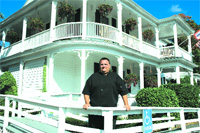
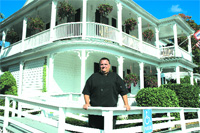
Stephen ‘Chip‘ Kloc, the third in his family to own and operate the Whately Inn, says consistency is the key to success at the restaurant and guest house.

In the ’60s, Stephen Kloc placed ‘Frog Legs Provencale’ on his paper menus at the Whately Inn, right next to ‘hot turkey sandwich.’

Today, the latter is nowhere to be found, but the frog legs remain, a particular favorite of traveling gourmets.

The inn, a combination restaurant, guest house, and banquet facility, is now owned by Kloc’s grandson, Stephen Kloc III, who followed in the footsteps of his father and grandfather in creating a unique dining experience in the hills of Franklin County.

It’s an experience that takes into account the bucolic charm of Whately (population about 1,600), but also considers fine dining a luxury that need not be relegated to large cities and affluent arts towns.

“We’re one of the only restaurants that continues to serve full-course meals for one price,” Kloc said. “That’s an appetizer or soup, salad, entree, potato, vegetable, dessert, and coffee or tea. We hold to that colonial, classic theme, and that’s our draw. We keep customers happy, and they know they can order their favorites.”

That’s because in 25 years, the Whately Inn’s menu has barely changed. While other establishments might chase trends, this venue’s claim to fame is a wide selection of time-tested fine-dining favorites.

The inn’s biggest seller is prime rib, but that’s not to say it has cornered the market merely in the meat-and-potatoes arena. Entrees range in price from about $17 to $30, and include roast crisp duckling, Lobster Savannah, and Alaskan king crab.

Steaks, veal, and seafood dominate the menu, and many dishes are prepared with a French-American flair — deep cuts of beef with rich sauces, for instance, and scallops topped with butter and cheese. Kloc said despite sometimes higher prices, local produce is used whenever possible to draw from the region’s agricultural heritage.

The More Things Change…

“Consistency is key for us, and it’s something we’ll continue to work toward,” said Kloc, who began his career in the restaurant business as a child, learning the ropes from his grandfather and father, and later honing his skills at various eateries in Massachusetts and Florida.

“We’ve definitely made small upgrades and changes here and there, but the more things change elsewhere, the more we stay the same.”

With changing dietary trends, for example, vegetarian dishes have been added to the menu, and specials are created daily. Kloc listed a Cajun pork tenderloin known as the Bourbon Street Sizzler and Potato-crusted Salmon Oscar among some of his recent favorites. Florentines and seafood fare well, he said; anything with lobster tends to keep the kitchen slammed for the majority of the evening.

The building in which the Whately Inn operates is another draw for tourists and locals alike. The white clapboard landmark with its wrap-around verandas has been a Franklin County staple since 1880, and is located on one of the area’s more historic thoroughfares, Chestnut Plain Road, which was once a main north-south route between Albany and Boston.

Despite its small-town address, the inn is minutes from I-91, attracting skiers (December and January are its busiest months), leaf-peepers, and summer travelers alike. It’s also not far from downtown Greenfield, the Yankee Candle flagship store, and the Mohawk Trail, all popular tourist attractions that bolster the area’s hospitality businesses.

In the past, the building has housed the Whately Post Office, a switchboard for AT&T telephone service, and a general store. When Kloc’s grandfather first bought the property in 1961, it had served as a tavern for several years, and he chose to push the landmark in a slightly different direction, transforming it into a burlesque house and nightclub. The club often welcomed nationally touring performers, who sometimes flew into Whately by helicopter.

Kloc said he remembers seeing the Ink Spots perform, and also recalls selling clean towels to performers for $1 each. It was an entrepreneurial venture that reflected those of his father and grandfather before him, in addition to foreshadowing his involvement in the family business later in life.

His father owned and operated the property until 1971, when he sold it to embark on new ventures, including the former Captain’s Table in Northampton. But the Whately Inn remained on Kloc’s mind, and the family bought the property for a second time in 1980, renovated the premises, and reopened as a white tablecloth restaurant with overnight accommodations.

Kloc remembers opening day — Aug. 8 — as a new beginning for the inn.

“We did very little advertising, and attracted diners mostly by word-of-mouth,” he said. “Our family has been in the area for a long time, and that helped us create a local following.”

That strong, steady pace has continued at the restaurant, said Kloc.

Out of the Frying Pan

There’s another date that Kloc can remember without a pause — Sept. 13, 1984 — the day a fire decimated the inn’s second floor and shut down the restaurant for eight months.

“It was my first time managing here alone … my father was away,” he recalls, the memory still causing a grimace. “The design in the kitchen wasn’t right, and a broiler overheated, causing the fire. Looking back, though, it was a blessing in disguise.”

The fire reduced the number of guest rooms from 13 to four, but also prompted upgrades to the inn’s infrastructure. Since then, Kloc said there have been few major changes to the property.

The building includes a second-floor banquet room that seats 80, popular for rehearsal dinners and small weddings. The central dining room can seat about 130 people, and the inn employs about 36 full- and part-time staff throughout the year.

Kloc said there are no plans to make any major changes to the property or its services, although he admitted maintaining the business model is often a challenge in and of itself.

“There’s often a greater expense associated with staying the same,” he said, “but to us, it’s well worth it. Our growth is slow but steady, and that’s a good thing. It’s going to remain our main goal.”

That said, traveling foodies need not worry. The turkey sandwich may not have stood the test of time, but the lemon butter brown sauce on the fried frog legs is as fresh as ever.

Jaclyn Stevenson can be reached at[email protected]

Cover Story
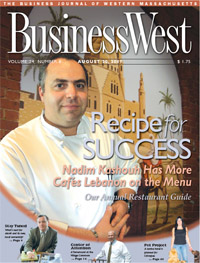
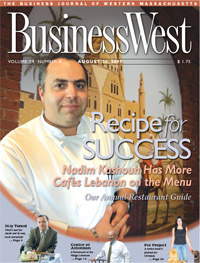
Nadim Kashouh Has More Cafés Lebanon on the Menu
August 20, 2007

August 20, 2007

Nadim Kashouh says he’s always had a “passion” for sales — and also a fondness for the restaurant business. He’s blending both in a growing venture called Café Lebanon, although now he needs to use the plural when referring to his entrepreneurial exploits. He started in downtown Springfield, expanded into Northampton, will open soon in East Longmeadow, and is now eyeing the West Hartford market. Such growth stems from having a good product and knowing how to sell it.

Nadim Kashouh has traveled a long road to get to where he is: status as an up-and-coming restaurateur in the Pioneer Valley.

From a geographic standpoint, the trip has included stops in Monrovia, Liberia in West Africa (where he was born); Bmakkine, Lebanon, to which his family moved in 1974; Roslindale, Mass. (where he lived for a time with his sister, who emigrated a few years before he did); Nashua, N.H.; and a few other communities in Eastern New England before coming to the Pioneer Valley.

Meanwhile, career-wise, he’s logged time, though sometimes not much of it, as a line person in a Jewish deli, short-order cook, car salesman, and jewelry store assistant manager.

In all of those scenarios, he was working for someone else — something Kashouh (pronounced ‘cashew’) ultimately decided he didn’t want to do anymore. That decision came in the spring of 2000, soon after an acquaintance urged him to take a look at the Café Lebanon restaurant on State Street in Springfield, which had just closed its doors because, in Kashouh’s view, its owner couldn’t turn what seemed like vast potential into profits.

He thought he could do better, and his track record to date shows that his judgment was pretty good. After enjoying initial success at the State Street site, he relocated the restaurant to a Main Street address formerly occupied by Tilly’s. In 2005, he opened a second Café Lebanon on Conz Street in Northampton, and later this year he will open a third in the center of East Longmeadow, at the site of the former Wild Apples eatery. And he’s already looking hard at the West Hartford market and opening a restaurant there.

This isn’t a chain, said Kashouh, stressing that, while each facility will have roughly the same menu — dominated by Middle Eastern staples ranging from lamb kabobs to grape leaves — they will have their own identity and target audience.

The Springfield location does better with the lunch crowd, which features both those working downtown and others attending meeting and conventions in the city, he said, while the Northampton location fares better with dinner and those willing to travel to sample that community’s eclectic mix of eateries. The planned East Longmeadow facility will join a growing list of restaurants in that town and target both lunch and dinner crowds from several mostly residential communities.

Kashouh described his first several years as a restaurant owner as an education — one that is certainly ongoing — and acknowledged that there is a learning curve that most not in this business wouldn’t appreciate.

“It is a very tough business,” he said, acknowledging that longevity is hard to achieve because of the level of general competition, swings in the economy, and the fickleness of the dining public. “The key to success is a consistently good product and attention to every detail.”

Out on a Lamb

Kashouh told BusinessWest that while there is a sizable Lebanese population in the region, he’s not relying on it for his livelihood.

“They don’t go to restaurants very much,” he explained with a laugh that speaks of personal experience, “because they’re got a wife or a mother or a grandmother who cooks for them. They’re enjoying home-cooked meals — they don’t need to go to a Lebanese restaurant.”

Apparently there are enough area residents of Middle Eastern or Mediterranean descent, or that enjoy food from those regions, to enable two Café Lebanons to thrive, and for Kashouh to be confident enough to open a third and make preliminary plans for a fourth.

They are drawn by the menu, complete with a number of recipes Kashouh has collected from his mother and other relatives, but also by ambience and special programs, such as belly dancing, comedy, and Arabic music. The Springfield location, for example, features several wall murals, painted freestyle by artist Clint Magoon, that present an Arabian Nights feel, if not exactly an accurate representation of Lebanon.

“We don’t have deserts, and we don’t really have camels — there are some, but they’re for the tourists,” said Kashouh, as he pointed to another feature painted on one wall that is also slightly out of place (although not to him) — his Jack Russell Terrier, aptly named Jack.

All this might have been hard to imagine in 1990, when Kashouh, with but one suitcase and $500 given to him by his uncle, landed in New York and made his way to Roslindale and, soon thereafter, a job at the Jewish deli. No fan of politics, to use his own words, he sought to escape the turmoil that then defined Beirut, only a 20-minute drive from Bmakkine, and considered returning to Liberia. But civil war had broken out there, so he instead sought much higher ground.

After working a few jobs in the restaurant sector, for which he developed a liking and an understanding, Kashouh, who had what he called a passion for sales, sought to indulge it. He thought about opening an import-export business, but couldn’t get that off the ground and instead segued into automobile sales. His first experience was neither fulfilling nor profitable, but theorizing that it might be the dealership and not the business, he tried another, this one in Nashua, N.H.

And he found out it was, at least for him, the business after all.

It was in Nashua that he met Eli Hannoush, one of eight brothers who emigrated with their parents from Zaleh, Lebanon in the late ’70s and would later go on to create one of the largest jewelry store chains in the Northeast. Eli talked him into working for the chain’s Nashua store as an assistant manager, which he did for a year before taking the same role at stores in Saugus and then Peabody, Mass.

Kashouh eventually left the Hannoush jewelry chain and went to work for another, E.B. Horn, in Boston. He spent two years there, but was becoming increasingly determined to scratch his entrepreneurial itch.

“I always wanted to have my own restaurant; I always enjoyed cooking for people and catering to people,” he said. “And I said, ‘maybe I should go into business for myself.’”

He did so with the help of another Hannoush brother, Norman, who first suggested to Kashouh that he look at a building the Hannoushes owned in Salem, N.H, then a Chinese restaurant, as the site for an eatery with his name on it. He looked, but determined the storefront needed more work than his budget could afford.

“That was on a Monday,” said Kashouh, adding that Norman Hannoush quickly moved the conversation to the Café Lebanon in Springfield, opened by Lebanese native Marie Zaide, which had gone out of business the previous Saturday.

After surveying the property and gauging the market, Kashouh decided to take on the challenge — creating Nadim’s Café Lebanon, which would open three months later — with plenty of confidence and some practical experience from which he thought he could build.

“When you have a passion for something, you can learn it,” he said, referring in this case to the restaurant industry, but implying any sector. “And I’m still learning today; it never stops, really.”

Appetizing Proposition

Surveying the local restaurant landscape, Kashouh sees plenty of competition — but little if any in his specific niche, one that he is determined to exploit.

“I think there’s a great market for this kind of restaurant here,” he said. “People can only have so much Chinese or Mexican, or whatever. They’re going to want something different.”

Kashouh provides it with a menu that is Middle Eastern in nature, a cuisine that he describes with two simple words: “fresh and healthy.” The menu includes traditional favorites from that region, including lamb, chicken, and turkey kabobs, grape leaves, tabouli, and rice pilaf, with baklava, rice pudding, and other stalwarts from that part of the world for dessert.

The appetizer list is topped by something called Kibba Naya (for Friday and Saturday dinner only), which is freshly ground raw beef mixed with wheat germ, onions, and Lebanese spices, and topped with olive oil. The list also includes hummus, Baba Ghannouj (roasted eggplant), grape leaves, spinach pie, meat pie, Kibbie Krass (hand-rolled ground meatballs with wheat germ, stuffed with sautéed meat, onions, pine nuts, and spices), and Makanik, Lebanese sausage sautéed with lemon juice.

There are also combo platters named for Middle Eastern cities past and present — Beirut, Tripoli, Sidon, Byblos, and Anjar — and the traditional Lebanese “full maza,” a four-course dinner.

Kashouh had such good success with that menu in Springfield that he opted to open a second location in Northampton two years ago, or roughly the same time he was moving the Springfield facility from State Street to Main Street, where he has more room and is closer to the downtown office towers.

The Northampton location has enjoyed steady if unspectacular growth, he told BusinessWest, while Springfield has done well with its predominantly luncheon business, something he expects will improve if and when new ownership of the neighboring Sovereign Bank building (now known as One Financial Plaza) succeeds in improving on its 40% vacancy rate.

While downtown Springfield is showing signs of improvement, in terms of image and the perception of crime, there are many who are still reluctant to come into the city at night, said Kashouh, adding that this phenomenon is part of the reason why he is opening a third location in East Longmeadow, which is quickly becoming another restaurant mecca.

“East Longmeadow is fast becoming the new Northampton — there’s a lot of new restaurants opening there,” he said, citing a new Spoleto’s, Fusion, and others. Such a proliferation of eateries makes a community a good spot, he said, because although there is plenty of competition, the city or town in question becomes a dining destination.

The third Café Lebanon, due to open this fall, intends to be a big part of that mix, he said, noting that the location provides ample room for dining and other programs — belly dancing has become a permanent fixture in both Springfield and Northampton, and it will in East Longmeadow as well.

As for West Hartford, Kashouh said he has always drawn well from the Northern Conn. area (he tracks the calls for reservations through a dedicated phone number), and, while he believes many from those communities will travel to East Longmeadow, they will be better served, and he will draw more of them, with a restaurant in the Hartford area.

Desserts and Deserts

When asked about the restaurant business in general, Kashouh sounded like someone who had already learned many lessons in seven years.

“Business is up and down, but generally pretty good,” he said. “But you have to work hard all the time. You have to keep yourself above the others, somehow.

“We can’t do that just by offering a Lebanese or Middle Eastern menu that no one else has,” he continued. “It goes well beyond the food; it’s all about making sure the customer is satisfied.”

His success in that regard can be measured in many ways, but mostly by the fact that there are now several Cafés Lebanon with Nadim’s name on them, and more on the drawing board.

George O’Brien can be reached at[email protected]

Sections Supplements
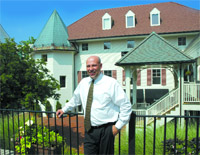
After Some Uncertain Years, the Village Commons Makes a Comeback
Jeffrey Labrecque

Jeffrey Labrecque says good relationships with tenants are helping move the Village Commons complex ahead.

Ten years ago, the Village Commons in South Hadley was having more than its share of problems. Tenants were unhappy, or else they were moving out; the stores inside weren’t what many had hoped for, and a feeling of unrest was settling over the architecturally striking shopping center owned by Mount Holyoke College. There’s been a quiet turnaround in recent years, however. Occupancy has improved to 100%, and management is involving tenants in a greater number of decisions. Now, some say ‘the Commons’ is starting to feel like the bustling retail and business center it was
always supposed to be.

Jeff Labrecque, COO for Center Redevelopment Corp. (CRC), the management firm that handles operations at the Village Commons in South Hadley, says he’d sooner hold a bottle-and-can drive than ask the shopping center’s owners for an influx of cash.

That sentiment was born, he said, from a time, not so long ago, when The Village Commons survived only when financed by its corporate parent and neighbor, Mount Holyoke College. And it has only been strengthened by a subsequent turnaround the Commons has orchestrated.

“At one time, we were draining funds from Mount Holyoke to survive,” said Labrecque, noting that when his current management team was formed, a goal was set to redefine the complex as one that could stand alone on its own two feet.

“The arrangement we made was that we would not borrow from Mount Holyoke,” said Labrecque. “That earned us the respect of the tenants, and now, 10 years later, we require no money from the college, and we never want to ask.”

Mount Holyoke College made a sizable investment in the Commons in the early 1980s to improve South Hadley’s town center and create a more welcoming atmosphere for both potential and current students, faculty, and their families, as well as general visitors.

The original vision of quaint, upscale shops and restaurants that would draw visitors from near and far has proven, however, to be largely unrealistic. But there is life in the Commons — spawned by a workable mix of office, retail, and residential tenants — and a great deal of optimism for the future.

BusinessWest looks this issue at how the picture continues to change, and for the better.

Making Change

Beyond ownership, Mount Holyoke has little involvement on a regular basis, said Labrecque. CRC handles day-to-day management of the complex, which hosts 56 businesses and 19 residential units and is led by President James Carey, who was appointed to his post in 1996. Labrecque was promoted to his current position at the same time, having previously served as director of operations at the Commons, and administrative assistant Trish Neiland rounds out the sparse team.

The Commons has navigated its share of bumpy roads since its inception, especially in the mid- to late ’90s. In addition to a lack of self-sufficiency, many storefronts were vacant, and, according to some tenants, that was due to a lack of a clear vision and a cohesive management plan.

Darby O’Brien, owner of Darby O’Brien Advertising, located in Building 9 of the Commons, was vocal about the center’s issues in 1997. At that time, O’Brien had been a tenant for six years, and told BusinessWest that the shops had “no buzz” and that the complex had “lost its soul.”

But he doesn’t feel that way now. O’Brien’s sentiments toward the Commons have become more positive, and he said it’s the development’s new management that has made a difference.

“I’ve been critical in the past, but things are moving well, and that’s because of the front office,” he said. “We’ve been here since this building went up, and when we first showed up, there was tenant unrest. But now, it feels like a neat little community. Jeff Labrecque is hands-on and non-stop; he understands small businesses, and really, it’s been calm ever since he stepped in.”

O’Brien said he gets the impression that through careful perseverance and hard work, many of the Commons’ issues are being resolved, or at least addressed.

“Several businesses are thriving here, expansions have happened … I noticed that the landscaping is really up to speed, and (CRC) seems to be employing local, independent companies. I think things have come together. I wondered back then how it would happen, but now I don’t even think about it anymore — this is a relaxed, fun, little neighborhood, and it feels good to be here. A lot has changed.”

Scrapping the Original Plan

LaBreque agreed that the climate at the Village Commons has in fact shifted, and while challenges remain, including the maintenance of architecturally unique buildings with unique problems, there are several positives to report.

For one, the complex is on more solid financial footing than it was 10 years ago — overall revenue at the retail stores ticked up by 3%, on average, over last year, while the restaurants averaged a 1% increase. Occupancy has also improved dramatically over the past decade. Between 1997 and 1998, CRC increased occupancy from 70% to 90%, and the Commons has been fully occupied since Sept. 11, 2002.

Currently, the ratio of office tenants to retail businesses is about one-to-one, and that’s one example of a change to what Labrecque refers to as “the original plan” for the property, which leaned more heavily on retail operations than office use.

“The original business plan that was put together was more retail and restaurants than office space,” he said, “but we’ve moved more toward office leases because those and residential rentals create stability and constant, consistent revenues.”

The original plan also included attracting upscale, trendy retailers proffering high rents. And while attracting quality tenants is still very much an objective, the focus on recognizable names and high-end merchandise has softened. Labrecque said the businesses that were expected simply never came, and many might not have even considered the Village Commons an adequate location.

“Tenants and Mount Holyoke were sold a bill of goods that didn’t play out,” he said. “For one, national tenants were promised, but the buildings here just weren’t built to attract them — they need space, on one level. There are 11 Victorian, all-wood, free-standing buildings here that are like houses — the largest space is about 3,000 to 4,000 square feet, and that’s why there’s no CVS here.”

Labrecque added that high vacancy rates became the root of other problems on the property in the late ’90s, some of which CRC is still working to correct.

“When the original plan didn’t come together, people were upset,” he said. “Tenants were unhappy, and the college was unhappy. Management wasn’t performing — they started treating it like a mall, affixing marketing fees on top of tenants’ rent.”

To begin a return to health, CRC did away with marketing fees and rents based on projected percentages of business when Carey took over as CEO, and instituted gross leases instead.

Lebrecque added that current lease rates are on par with similar markets. “ It is fair to say that the current rents are lower than the projections presented to the owner by the developer some 19 years ago,” he said.

New Day Dawning

That change, plus an overall shift to better incorporate tenants into the decision-making process at the Commons, has helped some businesses feel the same sense of inclusion that O’Brien cited as a benefit that once seemed lost.

Royanna Law, owner of Arts Unlimited, an art gallery offering framing services, retail sales, and corporate art consulting, relocated her operation to the Commons from Chicopee eight years ago, and characterized her decision as “wise.”

“The move to the Village Commons has proven to be a great place to have a business, and I really enjoy the people I work with, as well as my faithful clientele,” she said.

Law was one of the businesses that was able to expand recently within the complex, adding a gift gallery three years ago. Labrecque said hers is an example of how CRC is working with tenants to both retain them and strengthen the Commons as a whole.

“What we’re doing now is building from within,” he said. “We have a core group of tenants, and we are working to find out who needs what — expansions or changes, for instance — before going outside.”

As another example of renovations and expansion, Labrecque said the Commons will soon be seeing tenants leave for the first time in five years; 60 Minute Photo is closing its doors in response to increasingly sparse business for photo developers, and Saia Jewelers will also be leaving the complex soon.

But instead of viewing the changes as a dip in business, Labrecque sees an opportunity. The open space will allow for an office expansion project as well as a renovation of the Odyssey Bookshop, the Commons’ first tenant, and he expects the complex to be fully occupied again within a few months.

“We have an understanding of the types of businesses that do well here, and as such, we are also more discerning with leases,” said Labrecque of the decision to invest in existing tenants, rather than scramble for new ones. “We don’t fill empty spaces with the first offer we get to save face. That affects our overall stability, and just causes a lot of in and out.”

Moving forward, there are some concerns to address; the Commons is not located in a particularly high-traffic area, he said, so it must be marketed as a destination to thrive. Conversely, the shops’ parking lot is proving to be too small of late, and CRC and Mount Holyoke are also looking into a parking expansion to better accommodate shoppers, although that plan is only in the fledgling stages.

“Most of our tenants’ sales are good, but we’ve noticed they’ve maxed out,” said Labrecque. “We’re still looking at ways to pay for that investment; steel and concrete are so costly now — it will probably be some sort of platform, not a garage, and we’re asking our tenants for input on that.”

But Labrecque said infrastructure issues are his biggest challenge now, with repairs surpassing utility costs in his budget.

“The expenses keep growing. Our tenants provide us the revenue we need for upkeep, but we still spend every dollar we take in — we don’t have ‘plenty of money,’” he said. “We’re constantly correcting building issues, and it’s our largest budget buster. We’ve probably spent more than a half-million on builder blunders.”

Those issues include roof failures and water damage that began in earnest about eight years ago, with no signs of abating.

A Penny Saved Is a Penny Spent

In addition, the Commons faces retail challenges that continue to affect most small businesses and collections thereof, such as the pressure created by big-box stores and national chains that provide both convenient locations and, often, lower prices. It’s a reality, says Labrecque, that at this point in American business must be accepted.

“The nature of the business is delicate,” he explained. “The picture isn’t always great. It gets tiring at times, but it’s always challenging, and that’s what keeps us moving.”

Progress comes slowly, but there are no can drives in sight, and that’s Labrecque’s most oft-used benchmark.

“We don’t have a dime to save,” he said, “but we do have a dime to spend, and that means we spend that dime on improvement.”

Jaclyn Stevenson can be reached at[email protected]

Opinion

It’s way, way too early to speculate about what the arrival of the low-fare airline Skybus at Westover Metropolitan Airport in Chicopee will mean for that facility, the region’s tourism and hospitality sector, and the Western Mass. business community as a whole. But at this early juncture, it all looks good — very good.

There is a buzz at the airport each evening just before 7, as the inbound flight from Columbus, Ohio arrives, carrying an average of about 100 passengers. These are, by and large, people who wouldn’t be coming into the Pioneer Valley otherwise. They are taking advantage of the carrier’s low fares (some tickets sell for as little as $10) to fly into a stop labeled ‘Hartford’ on the Skybus map of its routes.

Many of those arriving in Chicopee are moving on to other destinations — Boston, Cape Cod, Albany, and others — while some are making the Valley their destination, which means they’ll be spending some money here.

It will take several weeks or perhaps months or even a full year to gauge just how much they’re spending and what the overall impact from the one daily flight will be, but early returns show that people are renting cars, staying in area hotels, eating at local restaurants, and visiting area attractions. Skybus isn’t transforming the local economy, certainly, but all signs show that it will provide a needed boost in the form of both awareness and actual spending.

This is what Westover officials envisioned when they first sat down with Skybus administrators more than two years ago, but it took quite some time and considerable negotiations to make the vision reality.

The success of Southwest Airlines, among others, would certainly indicate that low-fare carriers make travel (or more travel) feasible for many people. Thus, they make the cities they fly to more accessible. Any time a region is more accessible, it benefits economically — if it is positioned to take full advantage of its opportunity.

And here, the Valley has some work to do. It needs to step up marketing efforts in Columbus and perhaps other cities served by Skybus to keep the region visible and plant the seeds for more visits. Meanwhile, all those involved with tourism and hospitality in this region have to work together to generate positive experiences for visitors, stays that will prompt them to return and also offer positive reviews that will prompt others to come here.

Overall, what people have to remember is that the current Skybus service is a start. Eventually, there could be a different flight, one departing earlier — thus giving passengers better odds of making connecting flights the same day — or two daily flights. And perhaps there could eventually be more low-fare airlines operating out of the airport.

This is a start — but a very solid start.-

WGGB Acquired by BusinessWest Publisher

On July 31, BusinessWest publisher John Gormally entered into an agreement with the Sinclair Broadcasting Group to acquire substantially all the assets of WGGB Channel 40 in Springfield for $21.2 million.

Gormally, who founded BusinessWest in 1984, has created Gormally Broadcasting LLC, a venture that will now make ABC40 the only locally owned television station in the Greater Springfield market.

“I’m very excited about the prospects of returning local ownership to Channel 40, which has been a Springfield-area institution for more than a half-century,” said Gormally. “I look forward to working with the staff at the station and members of this community to make Channel 40 an even greater asset to our region.”

The sale of the station is expected to close in the fourth quarter of 2007.

Cover Story
The Arrival of Skybus is Fueling the Region’s Imagination
August 6, 2007

August 6, 2007

Skybus Airlines began daily flights to and from Westover Metropolitan Airport in Chicopee last month. Tourism and economic development leaders say it will take weeks, perhaps months, to effectively gauge the impact of the service on the local economy, but early evidence shows it could benefit several business sectors while putting the Pioneer Valley on the map.

Columbus, Ohio?

Allan Blair understands that these are usually the words, and the accompanying punctuation, that people utter when they first hear about Skybus, the self-proclaimed “next generation of low-fare airlines,” which uses that city’s airport as its hub, and its recent decision to initiate non-stop flights to and from Westover Metropolitan Airport in Chicopee.

But Columbus — Ohio’s capital, a city of 700,000 people, and home to Ohio State University’s main campus, the largest in the country with 100,000 students — isn’t the story, said Blair, executive director of the Economic Development Council of Western Mass. and director of the Westover Metropolitan Development Corp., who now knows much more about that municipality than he did a few months ago.

Well, it’s part of the story, because some people leaving Westover make that community their destination, he said. But the larger pieces involve where they can get to from there — and for rates that are only a fraction of what other airlines charge — and, even more importantly, the 100 or so people now arriving in Chicopee each night at or around 6:53 p.m.

Skybus now flies from Columbus to smaller airports outside several major cities — Burbank (Los Angeles), Bellingham, Wash. (Seattle and also Vancouver, British Columbia), Portsmouth, N.H. (Boston), and others — and is projected to add many more as it tries to replicate the hugely successful model pioneered by Europe’s Ryanair.

On July 16, Skybus started flying in and out of Westover, which, depending on the marketing material in question, makes the official destination Hartford, Springfield, Chicopee, or some combination thereof, which is a problem Blair is addressing. There were 101 people on the inaugural inbound flight and 86 on the outbound back to Columbus, including Blair and Westover airport director Michael Bolton.

Blair and others involved in economic development and tourism in the Pioneer Valley weren’t sure what all those people were going to do after they arrived in Chicopee that night, but they worked hard to find out. And they will continue to poll passengers as they arrive — and depart from Westover — because that’s how they’ll determine just how much of an impact Skybus and its new service will have on the region and its hospitality-related businesses.
Blair anticipates there will be boosts in hotel stays, restaurant visits, stops at area tourist attractions, and other benefits, because the airline’s ultra-low fares — the first 10 tickets for each flight sell for $10 each — will bring people to the area (at least to start their travels) who may not make it here otherwise.

“You’re going to be having roughly 700 people coming into the area every week,” said Blair, doing some quick math in his head as he talked. “We don’t know how many of them will be needing hotels, but if it’s 20%, which is probably a good estimate, that’s 140 room nights that you wouldn’t have had, which will make an impact.”

Chicopee Mayor Michael Bissonette has been doing some math of his own. Basing his calculations (from some unknown formula) on 80 of the passengers arriving each evening staying an average of three nights each and spending $200 a day, he pegs the potential windfall at a very unscientific $20 million a year. And he expects his city, which has several hotels, restaurants, and car rental agencies within a few miles of the airport, to get a good share of whatever the final number is.

Some quick polling revealed that some who arrived that first night, and on subsequent arrivals, were taking advantage of the low fares to see relatives in the region. Others were using Chicopee as a staging area for visits to Albany, the Boston area, the Cape, or other destinations within 100 miles or so. And still others were intent on exploring Western Mass. and its many attractions.

“This is another gateway into Western Mass., another way to get people here,” said Mary Kay Wydra, executive director of the Greater Springfield Convention and Visitors Bureau (GSCVB), who can’t hide her enthusiasm about the arrival of Skybus. “It’s a great opportunity for this region, and we have to take full advantage of it.”

In this issue, BusinessWest talked with Blair, Wydra, and others about how the Valley intends to do just that.

Flight Plan

Blair told BusinessWest that it will be at least several weeks and probably many months (meaning deep into the new school year at area colleges) before the EDC and the GSCVB have some working data to effectively gauge the economic impact of the Skybus flights, the first commercial activity at Westover in nearly 20 years.

In the meantime, there is some qualitative and anecdotal evidence that the airline is bringing some attention — and visitors — to the area, while also making Columbus and other points near and far from that city more accessible (meaning affordable) to area residents.

Wydra said her office has detected a noticeable uptick in the volume of calls from people inquiring about the region and what they can do here when they arrive. “As soon as this was announced [in the spring], the phone started ringing, and it hasn’t stopped since,” she said, adding that those at the GSCVB are tracking how many of the calls are Skybus-inspired, and it’s a good number.

“We’ve seen a real increase in inquiries coming out of the Columbus area, and lots of E-mails from Ohio, with people looking for visitor information,” she said. “In the beginning, we were getting deluged with calls about how to get transportation while at the airport.

“There were calls from people looking to come and visit family,” she continued, “and even some people who used to live here and are planning to come back because they want to go to the Big E.”

Meanwhile, Wydra, Blair, Bissonnette, and others are already compiling stories from friends, relatives, and area business people who are taking advantage of the Skybus service with scheduled trips to Ohio and elsewhere.

“I know someone who’s flying to Columbus and then heading to Cleveland to watch the Indians play the Red Sox,” said Bissonnette, adding that the excursion will be easier, and probably cheaper, than getting tickets for a game at Fenway. “I know someone else who’s flying out to Columbus to play Jack Nicklaus’s course [in nearby Dublin]; he’s paying much more for the green fees than for the flight, but Skybus is what’s making it doable.”

Such stories are at the heart of what inspired the no-frills airline, which starts with those $10 seats and moves on from there, with the price of tickets getting progressively higher as the date of the flight in question draws closer and the number of available seats dwindles. Overall, fares run roughly 50% of the going rate of other carriers serving the same markets. Already, the lowest price available for most tickets for the Columbus-to-Chicopee run over the next few months is at or more than $70, which area tourism leaders interpret as solid interest in the Pioneer Valley.

On the drawing board since the late ’90s, Skybus takes its cue from Ireland-based RyanAir, which uses smaller airports, modern equipment, outsourced services, fees for everything from luggage service ($5 for the first bag, $50 and more when it gets past two) to pillows and blankets, and placing ads on the side of its planes in order to keep fares low. The 150-seat Airbus 319 that landed at Westover on July 16, painted in the company’s bright orange color, came practically out of the box, as did others in the growing fleet, which helps keep maintenance costs down.

The company’s operations took flight on May 22, with initial service offered to Burbank, Portsmouth, and Kansas City, Mo. Flights to Richmond, Va.; Fort Lauderdale, Fla.; Greensboro/Winston Salem, N.C.; Bellingham; Oakland; and a second flight to Burbank were added over the next month.

The next wave came in mid-July, with Westover, San Diego International Airport, and St. Augustine, Fla. (providing access to Jacksonville and Daytona Beach) added to the mix.

More cities and flights to each destination will be added as the market dictates, said Denis Carvill, vice president of Ground Operations for Skybus. While waiting for the inaugural inbound flight to arrive, he told BusinessWest that the company became attracted to Westover for its location (close to Springfield and Hartford, but also not far from Boston and New York), facilities, infrastructure, runway length — and apparent interest among Columbus-area residents.

“Our research showed that this one of the places to which people wanted to go,” he explained, listing everything from colleges to attractions to family as reasons why.

While the airport was a good fit for the company, much work, following some lengthy negotiations, had to be done to make it ready for the July 16 startup.

Bolton said talks between Westover administrators and Skybus officials started in late 2005. The airline was looking for deals — meaning it wanted everything for free — so the talks never really got off the ground. But there were subsequent rounds of negotiations that eventually led to a deal late last year.

Terms of the agreement between the airport and the airline were not disclosed, but Bolton said a three-year contract was inked that included several of what he called “introductory rates” on such things as landing fees, parking fees, and handling fees. There were many logistics to be worked out over the past several months, including Skybus’s hiring of an outside company called Quickflight to handle ticket counters, baggage handling, and other tasks; a staff of roughly 15 works a three-hour shift each day. Meanwhile, the airport hired additional personnel to handle obviously larger auto parking operations.

New signage, a temporary baggage-claim area on the tarmac, and other additions were made, said Bolton, who told BusinessWest that, with revenues from parking and the assorted fees paid by the airline, the airport should at least break even the first year, with expectations of higher profits down the road.

Beyond the revenue, however, the airport will — after 10,000 paying passengers have filed through it (probably late this year) — qualify for Federal Aviation Administration entitlements that will pay for a new baggage area and new restrooms.

Winging It

In addition to his many duties with Westover and the EDC, Blair has also been monitoring the passenger volume on incoming and outbound Skybus flights, checking rental car business activity, and trying to gauge any increase in hotel room stays.

In time, said Blair, the Skybus service will increase awareness of the Hartford-Springfield area on a national level. “It will put us on the map — that’s what air service does,” he explained, adding that from this there will be benefits to the tourism sector and perhaps broader economic development initiatives. “This can only help this region grow.”

Measuring the direct impact from the visitors will be difficult, said Wydra, noting that it’s much easier to track the spending of convention-goers than it is for people coming in to see friends or family or moving on to other destinations like the Cape.

“When they come for a convention in Springfield, you can see the added number of rooms at the Marriott and the Sheraton,” she explained. “But when they come in to see family or to take in Six Flags, you don’t know where they’re staying — and many are staying with family.”

But over time, and probably not much of it, Wydra believes the Skybus service will have measurable results on several types of businesses, because the low fares will bring travel (or more travel) within reach for more people.

“I think you’ll see more people coming in to the area colleges for parents’ weekends’ and others coming in for homecoming that might otherwise have stayed home,” she said. “There will be more people coming in to visit family members, and others making two visits instead of one. These are the kinds of things those lower fares will do.”

A quick visit to the Skybus Web site reveals that early bookers on flights to Columbus are not thinking too far out — not yet, anyway. While most dates in August had the cheapest seats remaining going for $90 or $110 (there were some with $70 seats available), the November calendar shows many dates with $10 seats still there for the taking, including the days around Thanksgiving; the Christmas season seats seem to be going much faster. As for flights from Columbus to Chicopee, there are only a few dates remaining on the 2007 calendar when $10 seats can be had, and, on most days, the lowest-priced ticket is moving toward $70.

The 7:21 p.m. departure time for the outbound flight has passengers in Columbus by around 9, making it difficult to get connecting flights until the next morning, said Bolton, adding quickly that, even with a hotel stay factored in, Skybus allows travelers to get from Hartford/Springfield to Los Angeles, San Diego, and other destinations for far less than they could on other airlines.

There was no negotiation about the departure time from Westover, he continued, adding that the airport, like most others now hosting Skybus service, is already lobbying for earlier flights and additional flights.

While already enthused about the potential gains from the Skybus flights, area officials know there is work to be done to help maximize the impact.

For starters, Wydra said she’s working with Bolton and others at the airport to place more material about the region in the hands of those arriving from Columbus. Those on the inaugural flight were given gift bags complete with tourism guides to the region, a luggage tag with the Pioneer Valley logo on it, a coupon book, and a map. Budgetary considerations won’t permit all incoming passengers to get the same treatment, but Wydra said racks could be placed at the terminal with some information.

Meanwhile, Wydra is also exploring ways to create greater awareness of the Pioneer Valley in the Greater Columbus area to more effectively leverage the Skybus service to Chicopee. Advertising in Columbus-area media outlets will be expensive given the size of that market, she explained, but she is looking at ways to gain additional funding from the state for such marketing efforts while also exploring possible collaborations — with groups like the Springfield Business Improvement District and area tourist attractions and hospitality facilities — to share those costs.

During his short stay in Columbus, Blair took in some of the sights — “there really is a lot to do there” — while also meeting with Skybus officials to discuss ways to give Western Mass. possibly greater play in marketing of the Chicopee service. The map on the company’s Web site identifying service areas lists the Westover stop as “Hartford,” in a likely nod to current awareness of that city among travelers who use Bradley Airport, while some marketing and press advisories list the stop as “Hartford/Springfield.”

“There is a connection to Hartford, which is understandable,” he said, “but we want there to also be a connection to Springfield and Chicopee.”

Blair says there is also work to be done as far as ground transportation from Westover for arriving passengers. While the demand for rental cars is being met, he told BusinessWest, taxi service could be improved, and public transportation to downtown Springfield or perhaps area colleges would be a good addition.

Flights of Fancy

As the ‘Spirit of Columbus’ taxied to the terminal area at Westover on July 16, water cannons from two fire trucks based at the airport created an arch and a rainbow.

And as passengers disembarked, some in a large crowd gathered nearby started clapping. T
e assembled included elected officials, economic development leaders, press, military personnel from Westover Air Reserve Base, and some who were just curious.

Actually, that word pretty much describes everyone in attendance, as uncertainty and intrigue abound when it comes to this venture and what it will eventually mean for the region and its hospitality-related businesses.
Blair, for one, is certainly confident that the flights will have an impact, that the region will register gains in visibility and tourism-related spending — and that people will soon stop saying, “Columbus, Ohio?”

George O’Brien can be reached at[email protected]

Sections Supplements
Noted Photojournalist Diana Mara Henry’s B&B Offers a Snapshot of Springfield
Diana Mara Henry

Diana Mara Henry stands at the entrance to her bed and breakfast in the Forest Park section of Springfield.

A bloodhound named Holly recently stole Diana Mara Henry’s heart.

The dog arrived at Henry’s bed and breakfast, Lathrop House in the Forest Park section of Springfield, on a clear summer day with her trainer and a British film crew, which was following Holly on her trek from West Virginia to Massachusetts, where she would make an attempt at becoming a K-9 with the State Police.

“It was our first celebrity canine,” said Henry, an acclaimed photojournalist by trade, whose photos are housed in both the Library of Congress and the Smithsonian.

As a photographer, Henry said her eye is trained to find beauty in unexpected places, just as she did in Holly’s droopy, forlorn face.

She also found it in a large home on Sumner Avenue with peeling paint, and within the beleaguered city in which it stands.

Henry said her daughter was readying to attend Miss Hall’s boarding school in Pittsfield, and she wanted to be close enough to see her on weekends and holidays. She was also drawn to Springfield’s vibrant Jewish community and the close proximity to Boston and New York, which would simplify business trips for her ongoing photography business.

“Springfield is a nicer, more cosmopolitan, open-minded city than any other in which I’ve lived, and I speak with some knowledge of other places,” said Henry.

Indeed, she has traveled to countless locales and has called California, Texas, and New York City home during different times in her life.

“When I first came to the area, I thought I might like to live here, and I asked where the bed and breakfasts were in Forest Park,” she added. “I was astounded to find out that there weren’t any. There are so many beautiful houses, and the idea that others might want to visit the area, as I did, spurred the renovations and the move to open a B&B.”

She said the business augments her photography practice, but more importantly allows her to thrive in Springfield, the city of her choosing.

New Beginnings

Henry easily recalls the date she moved into the Lathrop House: Sept. 10, 2001. She said she spent the bulk of that first year making gradual improvements, fixing an antiquated heating system, stripping windows, and refurbishing radiators, one task at a time.

In 2002, Henry moved on to the exterior of the landmark, replacing its roof and repainting in the original ‘painted lady’ shades of rose and cream. In the garden, new plantings were added and a seating area constructed where an above-ground pool once stood.

Work inside continued, including a full sanding and refinishing of the original hardwood floors, re-hanging of stained glass panels, and retiling of the fireplace, among many other tasks.

In December 2003, Henry welcomed her first guest to the newly established B&B, a father traveling from Virginia to Boston with his son, touring colleges. It was only when he was preparing to leave that he revealed he was actually U.S. Rep. Robert Goodlatte of Virginia, by quietly handing Henry his card. She has preserved it on page 1 of her now nearly filled guest book.

“I’m not one who’s prone to fainting,” she joked, “but when I realized who he was, I came close. What a great way to start.”

Since then, business has grown steadily at the Lathrop House. Henry said she’s seen about a 30% increase in bookings each year since she opened, and welcomes guests ranging from business travelers to visiting families to foreign tourists.

“I have a few antique dealers who stay during the Brimfield antique show,” she said, “and a few people who come for the Big E. I think many of our guests are indicative of aspects of Springfield’s economy — parents visiting college students, professors, people changing careers and looking for a fresh start. Some people rent the whole house for a group, attending reunions or graduations.”

Her guests are people (and sometimes pooches) looking for an alternative to more traditional hotel experiences.

“We have a more relaxed atmosphere,” Henry said. “People can come to breakfast in their PJs or stretch out on the couch with a movie and some popcorn … all things you wouldn’t do in a hotel. That’s especially nice for those people who travel a lot —hotels are hard on them. They can make life feel artificial.”

There are modern amenities available at Lathrop House, including wireless Internet access, fax and copy services, in-room refrigerators stocked with soft drinks and snacks, and cable television, but it’s the homespun touches that make it unique.

The Little Things …

Breakfast is served family-style at a rectangular table in the salon. Fresh fruit, yogurt, cereal, juice, tea, and coffee dominate the menu. Guests are welcome to invite friends, family, or business associates to the B&B to enjoy breakfast with them at no cost, and also to take advantage of the garden and backyard for small gatherings.

Two short-haired cats, Bobbie and Toesey, serve as concierges, leading guests to their rooms (if they are so inclined). Robes are given as gifts to visitors, and children and pets are welcome (the latter with a few restrictions). The B&B is also kosher.

Each of the rooms is decorated differently, featuring antiques and eclectic pieces, including a number of one-of-a-kind pieces of art from Henry’s collection.

Several of her own photographs — Bella Abzug on the wall, Andy Warhol on the bookcase — grace the common rooms and bedrooms, and French impressionistic originals hang along with flea market finds, gifts from friends and colleagues, and family heirlooms — including a portrait of Henry’s mother that hangs stoically over a twin bed.

“Many bed and breakfasts are taking the posh route, becoming more like boutique hotels,” she said. “This is truly a homestyle B&B with interesting art and Victorian surroundings, but not pretentious. Guests can feel free to order a pizza.”

The house itself also has an intriguing history. Built in 1899, its original owner was real estate developer F.W. Lathrop, who oversaw its construction. The design resembles Southern Colonial most closely, including a double veranda and four two-story-high columns that frame the home’s oak vestibule.

The vestibule opens into the house’s main room, revealing twin staircases that lead to the second and third floors.

Throughout the 20th century, the Lathrop House served as the first home of Temple Sinai, now located on Dickinson Street in Longmeadow, and later as the Lubbavitch Yeshiva Academy.

An art school operated from the house for a time as well, and that artistic feel was maintained when Patrick and Frances Griffin, its immediate past owners, bought the house and lent their own talents to the décor of the home.

Patrick painted murals on the ceiling of a front room called the morning room — big, bulbous clouds on a pale blue sky — and a water and forest scene in the downstairs washroom, and Frances stenciled the kitchen, hallway, and an upstairs billiard room. Those decorations remain today, often serving as conversation pieces among overnight guests.

As the establishment becomes more well-known, Henry said she’d like to increase ‘day use,’ welcoming corporate meetings or retreats and cultural events, such as poetry readings. She’ll continue to blend some modern touches into the house, setting her sights next on installing some flat-screen televisions, but said she will remain true to the home’s unique look, in part by cultivating the spreading garden and sitting area outside.

It’s a good blending of tradition with technology; Henry is able to market her B&B as a slice of history, while still taking advantage of the hospitality industry’s many Web-based tools for exposure. Her Web site,www.dianamarahenry.com/lathrop, includes a directory of things to do in Western Mass. sponsored by the Mass. Office of Travel and Tourism, and many restaurants and attractions have placed reciprocal links on their sites.

In addition, guests can now book directly through travel sitesexpedia.comandhotels.com.

“Relaxation is a part of the draw, but when they’re booking, people still want it done quickly,” Henry said of the developments.

The Big Picture

Guests like Holly, the big, lumbering bloodhound, who trotted quickly to Lathrop House’s front door and settled in easily once she’d checked into her room.

She, too, turned her visit to Springfield into a new life, passing the State Police exam and joining its ranks. There are others in Henry’s guestbook who have done the same, finding new careers and choosing to stay in the area.

Once, the B&B was a sprawling estate with an overgrown backyard. But today, it’s a home away from home.

And for Henry, it’s just home.

Jaclyn Stevenson can be reached at[email protected]

Sections Supplements
Long-delayed Union Station Project May Still Get on Track
Union Station

Union Station

When the state Executive Office of Transportation (EOT) recently awarded Springfield $350,000 to create a new development plan for Union Station, it revived the hopes of those who believe the project holds the promise of economic development, higher property values, and a more vibrant lifestyle in downtown Springfield.

One thing it does not promise is instant gratification.

“This is a very large, complex, and lengthy project — a project that will take years to be completed,” said David Panagore, Springfield’s economic development director. “That said, there are substantial state and federal resources already leveraged.”

Indeed, $37 million in federal dollars alone have been earmarked toward the project, $7 million of which has already been spent on efforts to slow the building’s deterioration, including asbestos removal and a new roof. But the project has been stalled ever since.

As envisioned several years ago, an intermodal transportation project at Union Station, integrating intra-city and inter-city bus lines, taxi service, and Amtrak rail service — in addition to possible retail and office components — would cost $115 million to complete. Supporters of the project see that as a worthy investment.

“This project is a key step in the city regaining its stride as the driver of the Western Mass. economy,” Lt. Gov. Timothy Murray said in announcing the latest state grant.

That EOT grant was awarded to the Pioneer Valley Transit Authority (PVTA), which will work with the city and the Springfield Redevelopment Authority to develop a new, economically viable plan for the long-delayed project.

“The job here in Washington is getting the funding, and we’ve gotten a significant amount,” said U.S. Rep. Richard Neal. But now comes the hard part. The rest of the funds have long been frozen by the Federal Transit Administration (FTA), which requires a certain degree of progress — and an economically feasible plan — before the funding becomes available in Springfield.

“I agree with holding the funding back,” Neal told BusinessWest. “You need progress, you need benchmarks, and you need some achievement. At the same time, you can’t overstate how difficult these projects are.”

With the vision of Union Station as a mixed-use boon for Springfield apparently still alive, city officials and planners hope the next several months provide answers — and some real progress on a project that some had considered dead in the water.

Train Not in Vain

On the contrary, said Neal, noting that transportation-oriented developments that mix transit with housing, restaurants, retail, and office space are on the rise nationwide. He cited a recent Wall Street Journal article detailing how cities across the U.S. — from Charlotte and Denver to Arlington, Va. and even Naugatuck, Conn. — have been banking on multimodal transit projects as economic drivers.

In fact, 100 such developments have already been completed across the country, with another 100 in the pipeline.

Research suggests benefits that go beyond mere transportation convenience. For example, the Journal article noted, economists from the University of North Texas found that, between 1997 and 2001, office properties near suburban Dallas Area Rapid Transit stations increased in value 53% more than comparable properties not served by rail, and values of residential properties rose 39% more.

That’s especially relevant in Springfield, which has been trying to attract more downtown commercial development and higher-value housing.

“These projects are very difficult, and the buildings we’re talking about here are old,” Neal said, referring to the two existing Union Station structures, totaling 213,000 square feet. “But there’s an emerging pattern across the country where these projects are beginning to catch on.”

He mentioned similar restorative projects he has observed in St. Louis and Albany — one a major metropolis, and one a city around Springfield’s size — as “impressive accomplishments” that might be duplicated here in Western Mass.

But the first step toward realizing that vision is a new plan. The PVTA will hire a consultant by the end of August, who will be charged with presenting a feasibility study and project plan to be submitted to state and federal agencies six months later.

“In the past, the prior administration had spent all the planning dollars that were made available by the EOT and the FTA, and this gives us a fresh start,” said Mary MacInnes, PVTA administrator. “If we didn’t have this funding, there would be no way for us to prepare a plan.”

The plan, she said, must propose a transportation component, detailing how PVTA buses, Peter Pan buses, taxis, and trains would serve the station. To that end, she said it’s important to involve potential stakeholders such as Peter Pan and Amtrak — which owns the actual track — early in the process. “We want to get these organizations in on the ground floor.”

Peter Picknelly, president of Peter Pan Bus Lines, said he wants to be involved in any discussion of the redevelopment of Union Station, which was built in 1926 but has been largely vacant for the past four decades.

“The reason we’ve been involved in these meetings is that the project cannot be viable without the inter-city bus,” Picknelly said. “We’re the major transportation component in this city. I don’t mean to be arrogant, but I don’t believe the project works without us.” He noted that 11,000 people enter the current downtown bus terminal every day, making it the most-trafficked building in Springfield.

Picknelly’s vision for Union Station goes beyond moving the bus terminal there, however. He told BusinessWest that he wants to work with the project’s development team to examine the possibility of making the Peter Pan company the site’s major tenant, moving its operations to Union Station and occupying up to 30,000 square feet of office space.

“If done correctly, this will be very good for downtown Springfield,” Picknelly said, noting that Peter Pan has participated in the Union Station revival efforts in Worcester and Hartford. “Those stations have been successful with trains, buses, and taxis combining. So we’re very supportive of this project. It could be the catalyst for real economic development downtown.”

Next Stop, Springfield

However, said Panagore, the first step is producing a study that grounds the eventual redevelopment in economic reality.

“Who are the projected users, and based on that, what would be the transit-related uses?” he asked. “Is there too much office space? Is it right-sized, or should it be smaller? We need to make a viable project that works for Springfield’s market realities.”

He said Springfield officials would like to avoid as much as possible the funding model of Worcester, in which the city underwrites a portion of the cost of its Union Station operations.

“At the end of the day,” Panagore said, “this needs to be sustainable, it has to be feasible, and it has to pay for itself.”

Whether or not the city can answer those questions could decide the fate of the federal money already earmarked, he said. “The federal government is looking for us to meet these benchmarks. Those funds are currently available, but we have to make sure they stay available.”

Neal said it’s a goal worth pursuing, not only because of the project’s projected economic benefits, but because of the significant emotional ties Union Station has for the city.

“This is where soldiers shipped off for World War II, Korea, and Vietnam, which highlights its significance in history,” he said. “But it also has considerable opportunity for the future.”

Still, with so much money on the line, said Panagore, city officials know that it’s crucial to get the details right, no matter how long the planning process might take.

“In everything we participate in, whether it’s the State Street Alliance or the work we’ve done with market-rate housing downtown, we’re making sure we do our work, our due diligence, up front,” he said. “What we want to create are sustainable, viable projects based on more than a wing and a prayer.

“We’ve been a big champion of this project,” he added. “Those funds were made available for Springfield, and they need to stay in Springfield.”

Neal agrees. “This has enormous potential,” he said. “And securing $37 million is no easy task in Washington.”

Neither, it seems, is bringing a complex, multi-modal transit project to fruition. But for those who believe Union Station could one day be a revitalizing force in downtown Springfield, it’s time — and eventually money, they hope — well-spent.

Joseph Bednar can be reached at[email protected]

Sections Supplements
Candlewood Suites Takes Aim at the Extended-stay Market
Ray Desai

Ray Desai was looking for an established, well-respected hotel brand to bring to his property on Riverdale Street in West Springfield — and found one in Candlewood Suites.

“Consider us home.”

That’s the marketing pitch used by the Candlewood Suites chain of hotels, and Ray Desai believes that phrase sums up perfectly what his latest entrepreneurial venture provides. Specifically, a home away from home for those who are going to be on the road — or out of their own home — for an extended period.

This constituency includes consultants, contract nurses, construction managers on out-of-town assignments, doctors recently hired by area hospitals, executives settling into new jobs before they settle into the area, and people remodeling their houses or condos. Each of these groups is represented on the current guest list at the 71-room Candlewood Suites facility that Desai constructed on the site of the former Roadway Inn he owned for several years on Riverdale Street in West Springfield.

An immigrant from Gujarat, India, Desai segued into the hospitality business following a stint working for the Conn. Department of Health as a chemist. He cut his teeth in the hotel business working beside his brother, who came to the U.S. about a decade before Desai did and eventually came to own a string of hotels in the Northeast.

Desai started with the Roadway Inn, originally an independent operation known as the Knoll Motel, and later acquired the Econo Lodge on Elm Street in West Springfield. He wanted a new, more modern venture for the Roadway property, however, and waited patiently for the right franchise opportunity, one that would give him a somewhat unique niche in the region’s highly competitive hospitality sector.

He found one in Candlewood Suites, which be believes is the leader in the so-called extended-stay category within the hotel sector, status achieved through a sharp focus on replicating ‘home’ in every way possible, from a pool and fully equipped gym to flat-screen televisions, kitchens with full sets of appliances, and a gazebo and barbecue grill outside.

“It’s home for people who can’t be at home,” said Desai, who invested $6.5 million in the venture, which he expects will not be his last in this region. He told BusinessWest that he is looking at several sites in Western Mass., and will likely add to his portfolio in the years ahead.

For now, though most of his concentration is focused on Candlewood, and gaining a large share of the expanding extended-stay market in the Pioneer Valley.

Staying Power

It is Wednesday, and the ‘cupboard’ is, well, almost bare — but not for long.

That’s the name of a small grocery store, for lack of a better term, located just off the front lobby that is a feature at all Candlewood Suites facilities. Stocked with items ranging from ice cream bars to microwavable dinners to bagels, the cupboard is a popular stop for those on extended stays who don’t want to travel to area restaurants, and also for those who choose the hotel for a weekend stay while visiting Six Flags or any of the region’s other tourist attractions.

There were many such guests that week, which explained why the cupboard needed to be restocked, said Susan Daley, the facility’s general manager, adding that the store is one of many amenities that has helped the hotel get off to a fast start since it opened last Christmas.

Winter is a relatively slow period in the local hotel industry, she explained, but a good time to open a new facility because it gives staff an opportunity to work out any kinks and fine-tune efforts in the broad realm of customer service. This is important, she said, because a hotel’s ability to approximate ‘home’ comes not only with amenities and a look — but also with a feel.

“And here, people do feel that they are at home,” she explained. “They feel comfortable, and because many are here for extended stays, they almost become family.

“You come to know everyone by their first names because you see them every day; you don’t get that experience at other hotels.”

These were the tangibles and intangibles that appealed to Desai as he was looking for a brand he could bring to the Roadway Inn site. This was a quest complicated by the fact that most major chains are well-represented in the area, and most of the familiar names in the industry already have sites on Riverdale Street.

One brand that hadn’t penetrated the market was Candlewood Suites, a member of the Intercontinental Hotels Group, which also includes Holiday Inn and Holiday Inn Express, Crowne Plaza Hotels and Resorts, Hotel Indigo, and Staybridge Suites. There are now more than 100 Candlewood Suites locations across the country, including three in Massachusetts (the others are in Braintree and Burlington), and two in Connecticut — in Meriden and a recently opened facility near Bradley International Airport.

Thorough research and market analysis provided Desai with the supporting evidence needed to convince the International Hotels Group that there was, indeed, room for another extended-stay facility in the Greater Springfield area — there are already several in the region. That research concluded that the Valley’s many colleges, hospitals, and other major employers would provide an adequate base for room occupancy. Meanwhile, the region’s strong tourism base and location off major highways would provide additional support.

The Roadway Inn was razed in late 2005, with construction of the Candlewood Suites, which would take roughly a year to complete, started soon thereafter.
Desai said the chain has strict standards with regard to room size and amenities — which he met — but he also built in several features that would not be considered standard equipment. These include the pool and Jacuzzi, located in the basement, which have become popular with both families and health-conscious professionals alike, said Daley.

Another non-standard feature is the gazebo, complete with a gas grill, which has become a popular option for cooking, eating, and relaxing during the summer months.

Sixteen of the 71 rooms are larger, two-room suites, popular with those staying several weeks or months, while the rest are comprised of one larger room. All rooms come complete with a full kitchen, the aforementioned flat-screen TV, DVD player, Internet access, and other features.

To date, business has been steady and improving, said Daley, with occupancy rates near 60% on weekdays and higher on weekends, especially since Six Flags opened. To build on that solid start, the management team, which also includes sales director Tina Lenke, is working to build relationships with area companies that make use of extended-stay facilities, while also building awareness of a brand that is well-known in other parts of the country, but not necessarily in the Pioneer Valley.

“Experienced travelers know that name, and some look for it wherever they go — they want to stay at a Candlewood,” said Daley. “Our job is to make acquaintances with those who don’t know the name.”

Checking Out

As she offered a tour of the facilities, Daley stopped at one of the suites. Among the items she pointed out was a laundry basket placed at the bottom of the closet.
Each room comes with one, and the laundry facilities in the basement are offered free of charge. It’s a small but rather unique service within the industry, Daley said, noting that at most hotels, guests are scrambling to find quarters.

“It’s just another way we try to make feel comfortable, like they’re at home,” she said. “This isn’t really home …. but it’s close.”

Departments

Friendly Sale Brings Showdown to an End

WILBRAHAM — The board of directors for Friendly Ice Cream Corp. has unanimously approved a sale of the chain to a division of the private equity firm Sun Capital Partners Inc., a move that will head off a proxy battle showdown and end a bitter lawsuit filed by the company’s cofounder that accused the current chairman of mismanagement. The $337 million deal was struck on June 17 and it is expected to close this year. The all-cash deal calls for payment of $15.50 per share, an 8.2% premium over the closing price of the company’s stock on the Friday before the sale was announced. The deal requires the resignation of all board members, except George Condos, who recently took over as president and CEO. While the long-term ramifications of selling Friendly’s to Sun Capital Partners, which has turned around such brands as Bruegger’s Bagels and Fazoli’s, a casual Italian restaurant chain, are not known, short-term, the move some relative peace to the company. In addition to the lawsuit filed by cofounder S. Prestley Blake against chairman Donald Smith, the company was also staring a potentially ugly proxy fight involving its largest shareholder, Sardar Biglari, who was offered a seat on the board, but demanded two.

Goyette Admits to Extortion

SPRINGFIELD — Former Chicopee Mayor Richard R. Goyette pled guilty to extortion in a public courtroom June 13 after watching two videotapes showing him taking bribes from Charles M. Swider, a local towing company owner, and Donald Szczebak, a real estate developer in Chicopee, another FBI informant. Goyette is charged with two counts of extorting $5,000 from contractors doing business with the city. Goyette faces up to 51 months in federal prison, and is expected to be sentenced on Oct. 3. He is the first Chicopee mayor to be indicted.

Mixed-use Project Planned for Palmer Parcel

PALMER — A mountainous 150-acre parcel off Route 32 is being considered for a mixed-use project that could include office and retail space as well as housing. The parcel, owned by Northeast Realty Associates of East Longmeadow, is adjacent to a Massachusetts Turnpike exit, which makes the site even more desirable for developers, according to company officials. The project is still in its infancy, but the first phase of the front 10 acres has already received Planning Board approval. Northeast recently received a one-year extension of its special permit for that phase that includes a fast-food eatery, a gas station-convenience store and bank, and two family-style restaurants. Northeast officials note that future plans could include a hotel, a residential component, and a casino if casino gambling becomes legal in the state.

Developer Pulls Out Of Westfield Hotel Project

WESTFIELD — Local businessman John E. Reed has walked away from a proposed downtown hotel and transit center venture with the city after considerable personal regret. At one time Reed considered the proposed 48-room hotel a legacy project of his; however, at this time he feels the project would be a losing proposition financially. Reed noted that considerable delays on the public side of the project, as well as a recent announcement of a new 86-room Holiday Inn Express near the Massachusetts Turnpike Interchange, led to his decision. Community Development Director James M. Boardman noted that the city will continue plans for the transit center portion of the project and will search for a new developer to create the hotel concept.

FDR Museum Selects Chicopee for New Home

CHICOPEE — The original historic Chicopee Public Library in Market Square will be transformed over the coming months to accommodate the Franklin D. Roosevelt American Heritage Center Museum (FDR Center Museum), which recently vacated Worcester’s Union Station. Dr. Joseph J. Plaud, president and founder of the museum, said the new space is significantly larger than the Worcester location, with greater potential for further development in the future. The FDR Center Museum will also become an active partner with Elms College in the establishment of a Roosevelt Public Policy Institute to teach students about the New Deal legacy, provide students with internships and other learning opportunities, and formulate and promote public policies based upon the principles of the New Deal. In addition, Plaud sees the museum as a centerpiece for downtown Chicopee cultural offerings to children, college students, area residents, and tourists interested in the history and culture of the generation that fought the Great Depression and World War II.

Survey: Orientation Programs Can Be Effective

MENLO PARK, Calif. — Although businesses want new staff to hit the ground running, some firms may be hindering employees by not offering enough resources during their first days on the job. According to a recent survey, one-third of workers said their employers offered no formal orientation program when they joined the company. This could be a missed opportunity — a large majority of respondents (87%) who received this type of training said it helped prepare them for success with the organization. To be effective, the orientation process must be an ongoing one, according to Max Messmer, chairman and CEO of Robert Half International. He added that managers should consider assigning new staff a mentor who can provide guidance and answer questions. The survey was developed by Robert Half International, and includes responses from 492 full- or part-time workers 18 years of age or older and employed in office environments.

Pet Services Directory Available

NORTHAMPTON — A directory listing local pet care providers is now available thanks to the efforts of local businesswomen Elise Gouge and Alyssa B. Ward. The directory includes veterinarians, trainers, groomers, doggie day cares, kennels, pet sitters, and dog walkers. All providers have been evaluated to ensure they offer progressive, high-quality services for pet owners, according to Ward. The free directory is available at the offices of listed providers, and can also be viewed at www.petbehaviorsconsulting.com or at www.friendlypettraining.com.

SBA Launches Patriot Express Loan Initiative

BOSTON — The U.S. Small Business Administration (SBA) recently announced the launch of a comprehensive initiative that focuses on the agency’s full range of financial, procurement, and technical assistance programs for the military community. The capstone of this initiative is a streamlined loan product based on the SBA Express loan program. The Patriot Express Initiative includes new and enhanced programs and services for veterans and members of the military community wanting to establish or expand small businesses. For more information, visit www.sba.gov.

New Center Seeks To Assist Low-Income Workers

SPRINGFIELD — A new worker center in the South End hopes to prevent the exploitation of hourly wage earners through its grassroots efforts. Formerly known as the Anti-Displacement Center, the Alliance to Develop Power Worker Center/Casa Obrera is an affiliate member of the Pioneer Valley Central Labor Council and member of the AFL-CIO. Members associated with the Anti-Displacement Center worked alongside unionized members on their own time to give the two-story building a major facelift. Supplies were subsidized through grants awarded by the Community Foundation of Western Mass. The center will focus its efforts on protecting the wages of workers in the region, and to expose contractors who violate the state’s prevailing wage laws.

Boomers Expected to Put Off Retirement

WASHINGTON — Baby Boomers are now easing into their 60s, and many expect to delay retirement longer than their parents and grandparents, according to a new report from the Brookings Institution, a Washington think tank. Studies note that aging Boomers are better-educated with higher incomes and longer life expectancies than previous generations. Boomers also tend to have fewer children and are less likely to be married, leaving them with fewer options for assistance as they age. Researchers predict that, due to higher rates of divorce and separation, this trend could result in greater financial hardship for aging Baby Boomers. Researchers note that some Boomers will have to continue working because they can’t afford to retire, and some will continue working by choice. Presently, there are about 78 million Baby Boomers, those born from 1946 to 1964. The oldest will turn 62 next year, the age at which they become eligible for Social Security benefits.

CFO Survey: Integrity Most Desired Leadership Quality

MENLO PARK, Calif. — The mark of a good leader may lie in his or her ability to be honest and upstanding, a new survey suggests. Nearly one-third (31%) of chief financial officers (CFOs) polled said the most important quality for a business leader to possess is integrity. Experience and communication skills followed, each receiving 27% of the response. The survey was developed by Robert Half Management Resources and includes responses from 1,400 CFOs from a stratified random sample of U.S. companies with 20 or more employees.

Departments


Karen Buell

PeoplesBank in Holyoke recently announced the appointment of Karen Buell as a Mortgage Consultant. She will focus on Internet-based lending for residential mortgage and home equity products in addition to managing and assisting customers.

•••••

Karen P. Cardoza, owner of Karen Cardoza Handcrafted Jewelry of East Longmeadow, has been named the 2007 Business Woman of the Year by the Women Business Owners Alliance. She designs and creates a wide range of jewelry using gems, freshwater pearls, and 14-carat gold and silver fill.

•••••

Massachusetts Mutual Life Insurance Company in Springfield has announced it has elected Thomas C. Barry as the newest member of its Board of Directors. Barry is CEO and founder of Zephyr Management, L.P., a New York City-based specialized investment firm.

•••••

Alan Schneyer, Ph.D., has joined the Pioneer Valley Life Sciences Institute in Springfield as a distinguished scientist. Schneyer’s research concerns the reproductive and metabolic roles of follistatin and follistatin like-3 proteins. Also, he recently received a research grant from the National Institutes of Health to support this work.

•••••

Angela M. Moorhouse has been promoted to Vice President of Direct Banking at TD Banknorth. She is in charge of the call centers in Springfield and in Lewiston, Me.

•••••

United Bank in West Springfield has hired Victoria Graffam as Security and Bank Secrecy Act Officer.

•••••

Berkshire Bank in Pittsfield has announced that Maura Kelly has been named Vice President of Cash Management. She is a certified treasury professional.

•••••

Century 21 Pioneer Valley Associates announced the following:
• Bruce Dearborn and Naomi Gendron have joined their firm, and
• Arthur Haskins III, Terry Bartus, and Erica Burns have completed the CREATE 21 New Agent Training Program.

•••••

Concetta Calitri has joined Ayre Real Estate in Agawam as an Associate.

•••••

American Rug in Holyoke has hired Diana L. Fitzpatrick as a Design Consultant.

•••••


Donna L. O’Shea

Health New England announced the following promotions:
• Dr. Donna L. O’Shea has been named Medical Director;


Julie Bodde

• Julie Bodde has been named Director of Finance;


Joanne Walton

• Joanne Walton-Bicknell has been named Reporting and Analysis Manager, and


Patrick O’Shea

• Patrick O’Shea has been appointed Statutory, Budget, and Tax Manager.

•••••


Peter Vecchiarelli, with Nutmeg Isuzu Trucks of West Springfield, has joined the Professional Landcare Network.

•••••

The board of directors of the Amherst Area Chamber of Commerce has appointed Patty Brandts as Executive Director of the Chamber.

•••••

Meyers Brothers Kalicka has hired Jamie L. Barber as a Senior Associate in the Holyoke office.

•••••

The Mass. Community Development Finance Corp. has named Charlene Golonka as its Lending Representative for Western Mass. Golonka will be responsible for Berkshire, Franklin, Hampshire, and Hampden counties.

•••••

Robert S. Wheten has been named Commercial Credit Officer at Easthampton Savings Bank.

•••••


Russell Fleury

Tighe & Bond of Westfield announced the following:
• Michael McManus has joined the firm as a Registered Professional Engineer;
• Michael Petrin has joined the firm as a Registered Professional Engineer, and
• Russell Fleury has relocated to the firm’s Worcester office. Fleury is an Environmental Scientist who provides regulatory compliance and permitting support to the firm’s client base.

•••••

The Springfield Business Improvement District has promoted Christopher J. Castellano to Operations Manager.

•••••

The members of the Mass. Alliance for Economic Development recently elected Directors for 2007. They include:
• William Hines, President and Chief Executive Officer of Interprint Inc.;
• Joe O’Leary, Senior Vice President and Regional Executive of Sovereign Bank;
• Rob Reilly, Vice President of Fidelity Real Estate Co., and
• Glenn Steiger, General Manager and Chief Executive Officer of the Massachusetts Municipal Wholesale Electric Co.
Re-elected Directors are:
• Carol Adey, Executive Director of CoreNet Global New England;
• Robert Brustlin, Chief Executive Officer and President of Vanasse Hangen Brustlin;
• Peter Corbett, Director of Foulston & Storrs, and
• Girard Sargent, Senior Vice President and Division Executive for middle-market commercial banking at Citizens Bank.
Directors elected as Officers include Michael DiGiano as Chairman, Girard Sargent as Vice Chairman, Tim Horan as Treasurer, and Robert Brustlin as Clerk.

•••••

The Greater Holyoke Chamber of Commerce announced the following during its recent annual meeting:
• James M. Lavelle, General Manager of the Holyoke Gas and Electric Department, has been elected Chairman of the Board;
• Stephen Corrigan of Mountainview Landscape was awarded the Henry A. Fifield Award for Outstanding Volunteer Service to the Chamber;
Officers elected included:
• Israel Schepps of Mastex Industries, First Vice Chairman;
• Stephen Corrigan of Mountainview Landscape, Second Vice Chairman;
• Deborah Buckley of Goss & McLain Insurance Agency, Treasurer;
• Carol Katz of Loomis Communities, Assistant Treasurer;
• Atty. John Driscoll of Resnic, Beauregard, Waite & Driscoll, Clerk, and
• Atty. John Ferriter of Ferriter & Ferriter, Past Chairman.
Elected to three-year terms on the Board of Directors were:
• Daniel O’Neill of Westfield Bank;
• Sheryl Quinn of Holyoke Geriatric Authority;
• James Sagalyn of Holyoke Machine Co., and
• Jeffrey Sullivan of United Bank.
Re-elected to three-year terms were:
• Douglas Bowen of PeoplesBank;
• Kathleen Buckley of Holyoke Medical Center, and
• Jorge Gomez of McDonald’s Restaurants.
Elected to two-year terms were:
• Wolfgang Schloesser of Ruwac Inc., and
• Joshua Vassallo of Country Inn & Suites.

•••••

Chicopee Savings Bank announced the following:
• Darlene M. Libiszewski will serve as Vice President of Information Technology;
• Jill D. Fox will serve as Vice President of Sales and Branch Administration, and
• Tammy L. Howe will serve as Assistant Vice President of Cash Management.

•••••

Veritech Corp. announced the following new members to its leadership team:
• David Sweeney has been named Vice President of Business Development & Operations. He will oversee all revenue growth, relationship building, and Veritech’s overall marketing and positioning;
• Carl Fortin, Chief Financial Officer, will oversee financial forecasting and the establishment of accounting policies and procedures, and
• Kimberly Mawaka-St. Marie, Comptroller, will oversee the day-to-day financial and accounting operations, financial reporting, and the company’s financial affairs.

•••••

Sherri L. Gagne has been named Media Director for the Momentum Group in East Longmeadow. Handling a wide variety of broadcast, print, and online media, Gagne will be responsible for research, planning, negotiation, implementation, and monitoring.

•••••

The Berkshire Chamber of Commerce recently announced its newly appointed board of directors members. They are:
• Vicki S. Donahue, Partner at Cain Hibbard Myers & Cook, P.C., where her practice focuses on corporate and real estate law;
• Joan Bancroft, President of Berkshire Life Insurance Co. of America, and
• Laura Cece, Director of Finance and Chief Procurement Officer for the City of North Adams.

•••••

Dr. Louis J. DeCaro, a South Deerfield podiatrist, has been elected to the Board of Trustees of the Massachusetts Podiatric Medical Society, an affiliate of the American Podiatric Medical Association. He is a staff member at Cooley Dickinson Hospital and Baystate Franklin Medical Center.

•••••

Janelle Soucia has joined Country Bank as a Retail Mortgage Originator serving the Wilbraham area.

•••••

George R. Ditomassi, a Holyoke native and 1957 graduate of the UMass Amherst, has been elected to the college’s Foundation Board of Directors. In addition to earning his bachelor’s degree in Business from the college in 1957, Ditomassi served in the U.S. Army as a finance officer and was honored as a distinguished military graduate. In 1980 he graduated from the advance placement program at Harvard College.

Sections Supplements
Premier Source Credit Union Continues to Reinvent Itself with New Services
Bonnie Raymond and Carmen Bastos

Bonnie Raymond, right, with marketing director Carmen Bastos, said customer service and new product development are topping her list.

It’s not the largest credit union in the region, but Premier Source has been parlaying its ‘hometown service’ model into successful returns since the 1940s.
Today, that model remains a large part of the institution’s business practices, and it’s leading to new opportunities.

Bonnie Raymond, CEO and manager of Premier Source Credit Union, said massive growth or major changes to how the institution does business are not currently on the drawing board. However, recruitment of new members is, as well as the introduction of innovative, convenience-based products and services geared toward businesses and individuals, particularly in the credit union’s new home base of East Longmeadow.

“The biggest goal for us is to continue to attract a steady stream of members and to develop great products,” said Raymond. “We don’t need to be the biggest, but we would like to take our piece of the pie.”

Branching Out

Premier Source began as Kelko, a select employee group (SEG) credit union, in 1941, serving the employees of the Kellogg Envelope Company (later Westvaco) in Springfield. Since then, the entity has grown through a series of expansions and mergers.

By 1972, Kelko served employees and retirees of all Westvaco facilities and their families. Following a move to a new facility on Cottage Street in Springfield in 1993, Kelko’s membership pool expanded again to include businesses within the Springfield Industrial Park, which numbered approximately 200.

A 2000 merger with Twin Meadows Federal Credit Union, formerly based in Longmeadow, further expanded that base of SEG members to about 3,500, and added two branches at Springfield College and Western New England College, which still operate today.

A year later, Kelko merged again with Spalding Employees Credit Union of Chicopee, resulting in another branch office (now located at Top Flite in Chicopee) and a total membership base of about 4,100.

Kelko retained its name until 2004, a year before the company applied for a charter change to become a community-based credit union, thus opening its doors to any and all residents and employees within its service area. The move was made to combat the declining membership that many SEG credit unions have faced since the 1990s due to plant closings, consolidation, and downsizing. The charter was approved in February 2006.

Today, Premier Source has about 4,700 members with six offices: its branch on Cottage Street and newly constructed main branch on North Main Street in East Longmeadow, and those located at Top Flite, WNEC, Springfield College, and Hasbro Games, a branch that was added just six months ago.

Dollars and Change

With its new identity as a community-based credit union, Premier Source has been continuing its tradition of growth and cohesion in the market it serves. Its new main office in East Longmeadow was just opened in May, and a formal open house to introduce the branch to the community is being planned.

“In the beginning, we delayed a big marketing push because we knew we were putting up the new building,” said Raymond. “But under the old charter, we used to get calls from the community all the time, and now that we can serve them, I think word-of-mouth is going to be big.”

To augment that organic spread of information, however, Raymond said Premier Source has also begun some print and radio advertising, promotions at benefits fairs within local companies, and reaching out to area businesses.

“It’s not a huge splash, but it’s a big splash for us,” said Raymond. “We’re pretty small, but we feel comfortable in our identity as a small, hometown institution, and at this point, we’re most focused on slow, steady growth and trying to remain a true alternative to banking.”

Premier Source is on terra firma in terms of its financials, said Raymond. It reports $13.4 million in capital-to-assets, and total assets are currently $32.4 million. With that base bolstering the institution’s development efforts, Raymond added that her goals for growth are about 3% to 5% over current membership. She hopes to achieve that through continued community involvement on both local and corporate levels, and by promoting a suite of unique services and products.

“We’re having some specials on things like home equity loans to educate people that we offer that product,” she said, “and we’re hoping to recruit both new corporate and individual members.”

Some of the credit union’s efforts, for example, have been centered in East Longmeadow’s growing industrial park, a source from which Raymond said she’d like to glean some new members.

“Many of them have existing relationships with other credit unions or banks, and we’re not looking to bowl anyone over,” she said, “but we would like to let those companies know that we’re another alternative.”

Raymond added that Premier Source’s small, local feel appeals to many employees in the area.

“I think they see that small size and convenience of location truly are benefits,” she said. “It takes the pressure off the employee, and we strive to offer products and services that do the same.”

Direct deposit and free checking are already offered at the credit union, as are a number of unique amenities designed to make banking, and other time-consuming errands, easier for members. While making a deposit or withdrawal, for instance, members may also purchase stamps, discount movie tickets, and gift certificates to restaurants or attractions such as Six Flags.

“We’ve done that for many years, and we only sell to members,” said Raymond, adding that a new set of products is now in development, to be gradually introduced over time.

“We’re looking into product development to spur income, which in turn will help us add to our marketing budget so we can do more things in that arena,” she said. “We’re looking at overdraft protection, tier checking, and online bill pay; we’re also looking to offer mortgages. We have a referral service with Members Mortgage now that is effective, but I think we’d like to bring it in-house.”

Selling Service

As new products are rolled out, Raymond said a strong focus on member service is being maintained. She said it’s long been a strength for the credit union, and even as new opportunities present themselves, relying on existing strengths will allow Premier Source to preserve its already strong foothold in the region.

“We are on the smaller end as far as credit unions go,” she said, “but our forte is small-town service. That’s the atmosphere we want to create, and the image we want to portray.

“We feel strongly that it’s our role to work with people through good and difficult times, and we’re not interested in outsourcing every decision.”

And as Premier Source continues to carve out its piece of the pie, Raymond said it will be an overriding goal to strengthen community ties and to rely on the traditions of service the credit union has honed since 1941.

“Our new ads say ‘a star is coming,’” she said. “True, we’ve been here for some time, but as a credit union that is newly open to the public, there are plenty of new introductions to be made.”

Jaclyn Stevenson can be reached at [email protected]

Cover Story
George Condos Wants to Re-energize and Contemporize the Friendly’s Brand
May 28, 2007 Cover

May 28, 2007 Cover

George Condos met his future wife at a Friendly’s restaurant, one he hung out at while growing up in Webster. His parents love the chain, he said, and so do his children. This generational aspect of the Wilbraham-based icon is one of the things that appealed to Condos as he mulled a job opportunity he eventually accepted — president and CEO of the company — as well as a stern challenge: to re-energize a somewhat tired brand.

George Condos was asked for a current copy of Friendly’s lunch/dinner menu for a quick read of its contents.

“Have you got half an hour?” he joked, implying that he wouldn’t put ‘quick’ and this menu together in the same sentence.

Indeed, as he flipped through the menu, and flipped, and flipped, he passed by traditional items like burgers, wraps, baskets, and salads, and eventually reached grilled flounder, steaks, and ‘homestyle meatloaf.’

“This is not what we’re really about — it takes the focus away from what makes Friendly’s great,” he said of those last few items, adding that they are far removed from the company’s core of hand-held food items, the signature Fribble milkshake, and ice cream. They serve largely as a distraction to the customers, but also to managers and kitchen staff who must order and prepare foods that are ordered infrequently at best.

“And this is just one of our menus,” said Condos, fanning out different models for breakfast, desserts, and children. Simplifying and shortening them are just a few facets of a very broad plan that Condos, who took the role of president and CEO at Friendly’s in mid-January, has for re-energizing and contemporizing the 72-year-old chain that has been in the news lately — but for mostly the wrong reasons.

There have been many stories in publications ranging from the Wall Street Journal to the Boston Globe that have chronicled an ongoing proxy fight involving the company’s largest shareholder, lawsuits filed by 93-year-old co-founder S. Prestley Blake against its current chairman alleging self-dealing, and, most recently, the commissioning of Goldman Sachs to explore options for the company moving forward, including a possible sale.

All of the above has become a “distraction” (that’s a word Condos would use often) for the new CEO, who came to Friendly’s after a lengthy stay at Dunkin’ Donuts, where, among other things, he led a repositioning and brand-development effort that more than tripled the number of stores in the Northeast and took sales from $400 million to more than $2 billion.

Just five months into his assignment at Friendly’s, Condos sees several signs of progress. Sales are improving, franchisees are, by his account, expressing more confidence in the chain, and steps are being taken to simplify the menu while adding new products.

These include an Angus beef burger now being tested; iced lattes, with flavors ranging from French vanilla to caramel, which will be private-labeled in most markets, but sold in the Albany area under the name Seattle’s Best Coffee, the company owned by Starbucks; some new cold beverages called tropical chillers to be ready for summer; and a planned new chocolate/chocolate chip ice cream featuring Ghirardelli chocolate.

Co-branding with companies like Ghirardelli and Seattle’s Best is one of the many strategies moving forward, said Condos, adding that marketing efforts will be retooled to reflect the many changes within the chain. They will still emphasize the family aspect of the business, but also focus on the younger audience that is driving many trends in the hospitality sector and society in general.

“We want to increase our relevance with young adults by adding contemporary cold beverages and healthy menu items,” he explained, “and we also intend to improve quality by phasing out low-volume, high-complexity items.”

In this issue, BusinessWest looks at the many things Condos has on his plate as he tries to provide a needed spark for a chain with a glorious past but an uncertain future.

Shaking Things Up

Condos told BusinessWest that he’s probably eating at Friendly’s three or four times a week these days.

He’s now well-known at the restaurant next door to the company’s headquarters on Boston Road in Wilbraham, but, outwardly, just another customer at the many other locations he’s visited. However, he’s not interested in undercover work.

He makes a point of introducing himself and seeking out the manager of every Friendly’s he visits, and comes ready with a long list of questions. These are information-gathering sessions, and to date they’ve been quite eye-opening, with informal reviews running the gamut when it comes to overall grades.

“We have some excellent restaurants, but there is some inconsistency,” he said, adding that bringing all of the chain’s 500 or so restaurants up to the same high level of quality, in terms of food, service, and appearance, would be his broad job description. And this was an assignment that appealed to him when he was approached by a recruiter last fall and asked to consider taking the helm of a chain to which he had both a personal attachment and some professional curiosity.

After all, Condos met his wife, Laurie, at a Friendly’s in the Worcester suburb of Webster. The two were among the many neighborhood teenagers who liked hanging out at the eatery — a tableau repeated in countless communities across the Northeast over the past seven decades.

Indeed, there are now at least four generations that have grown up with Friendly’s. Some of these constituencies have specific needs and tastes, said Condos, adding that the chain’s mission moving forward is to properly address these preferences (lattes, for example) — but without trying to be all things to all people.

This may sound confusing, but for Condos, it’s rather simple. The plan is to focus on core products — ones that appeal to all generations, from those that blog to the one that fought World War II. Meanwhile, he wants to add some new products to the menu that appeal to what he called “young people” without elaborating.
Condos will bring to this assignment some extensive experience with both restaurants and brands. He started acquiring it at Dairy Queen soon after graduating from the University of Vermont with a degree in Business Administration and Management.

“That’s where I learned how to run a restaurant,” he said of his stint with the company, where he eventually assumed the role of regional manager of Operations and Development.

At Dunkin’ Donuts, which he joined in 1986, Condos held a number of positions, including area vice president for the Northeast, U.S., Canada, Europe, and the Middle East, as well as vice president of Marketing, Development, and Operations, and, most recently, brand officer for the chain. In that capacity, he was lead executive for Dunkin’ Donuts in the U.S., and responsible for developing brand strategy and execution for the nearly 5,000 franchised stores, which generated more than $4.3 billion in sales when he left, voluntarily, last year following the second of two ownership changes.

Condos said he wasn’t looking for work — his intention was to begin a career serving on corporate boards — when he was called by the recruiter last fall.
He met several times with the Friendly’s board, and became intrigued with the opportunity to breathe some life into the chain that he knew so well as a customer.

“I believed that Friendly’s had some great opportunity that was not being leveraged,” he said. “I saw a brand that has a unique emotional attachment with its customers that was similar to the two brands I had worked with previously; there are certain brands in the world where the consumer loves the brand, and Friendly’s is one of them.

“As a consumer and an executive within the industry,” he continued, “I saw a number of opportunities where I believed my experience could significantly help the Friendly’s brand.”

The Company’s Bread and Butter

When asked about the board controversy and other matters he lumped in a category of “things beyond my control,” Condos feigned turning off the tape recorder on the table in front of him.

As it continued running, he spoke again of distractions, but how ultimately they weren’t keeping him from his appointed rounds. “It’s a distraction from a time standpoint, but also a distraction for the brand in the marketplace. That said, I was hired to re-energize the brand, and that’s where my primary focus lies.”

Condos said he spoke at length with Prestley Blake — still one of the largest shareholders and one who many say simply can’t let go of the venture he started — soon after he arrived at the company, and talked with him again recently, when the discussion included Blake’s positive review of a visit to a Friendly’s in Florida.
As for the proxy fight, Condos said he can really only watch as matters play themselves out. Texas businessman Sardar Biglari, the largest shareholder with 15% of the stock, asked for a seat on the board of directors last fall, and Friendly’s gave a conditional ‘yes’; it stipulated that he not seek any additional seats. But Biglari refused, and in a letter sent to the board in early March said he and a business partner are running against two incumbents who are seeking re-election at the annual shareholder’s meeting. Billboards calling for the election of Buglari and his partner have gone up in a few locations locally.

And regarding Goldman Sachs’ work, Condos said there are many options that the company will be considering, none of which he cared to discuss in any detail. “We’re not saying that there will be a sale, or that a sale is the only option,” he explained, adding that the review work is expected to be wrapped up by year’s end.

By then, he said, moving on to the many things that are within his control, he expects to be able to qualify and quantify significant progress in his mission to bring more consistency and overall quality to his product — which he described as both the food in the restaurants and the manner in which it is delivered.

This will be a three-pronged approach, focusing on menu choices, service, and the appearance of the restaurants, he said, adding that steps are being taken with regard to each.

On the menu side of the equation, simplification is the order of the day, he said, emphasizing greater focus on handheld items (burgers, melts, wraps, and chicken-strip baskets, for example), cold beverages, including the new iced lattes and tropical chillers, and ice cream. The chain will still offer appetizers, entrée salads, kids meals, and breakfast items, but it will focus its marketing, menu, and operations on the core items.

This approach can be seen with that lengthy lunch/dinner menu, which was actually made one page bigger, with a large insert touting five new burgers, including the tomato pesto provolone and ‘Chicago firehouse’ models. Subsequent inserts will feature other menu staples, said Condos, adding that the new approach is already registering results, with a noticeable increase in sales.

Meatloaf and grilled flounder are still on the menu, but perhaps not for much longer.

“Those are not core to what Friendly’s is, and continuing to expand in that direction is a distraction from the main part of the menu; it makes it more complex and harder to execute,” said Condos, adding that it took years for the Friendly’s menu to get large and complex, and the process of reversing that trend won’t happen overnight.

As for service, the company is introducing something called the ‘Friendly Service Way,’ a model designed to vastly improve the company’s recent poor grades in customer service, at least as measured by Consumer Reports.

“When your brand name is Friendly’s, you absolutely have to be the leader in the industry around what great, friendly service looks like, ands that’s what we intend to do,” he said. “I’ve recognized a big opportunity for us to improve our operating standards within the restaurants.

“My own experience and my own research shows that we have some inconsistent restaurants,” he continued. “We want to significantly improve the guest experience through speed, cleanliness, and friendly service.”

Meanwhile, many of the restaurants will be getting a new, more contemporary look, said Condos, adding that the same can be said of the company’s marketing images.

In the past, the company has focused on families, generations of same, and the great Friendly’s tradition, he explained, adding that while this has been somewhat effective in generating sales, a stronger emphasis on food, including tight, close-up images of specific menu items, will be much more so.

While addressing the menu, service, and the look and feel of the restaurants, Condos is also focusing on the broad and important matter of franchisee-relations, a task that took on even more significance after it was announced that the strategic initiatives to be explored would include a sale.

Condos said he has met with franchisees individually and at district meetings, and believes he’s generating some enthusiasm and support for his plans moving forward.

“They’re supportive of the brand, they love the brand, and they’re looking forward to sales-building initiatives that my team and I are working on, including a stronger focus on the core part of the menu,” he said. “They’re also excited about improvements in our marketing creatives.

“One of my first priorities was to develop a great working relationship with the franchisees,” he continued. “Coming out of 30 years of being in the franchise business, I know how important such a relationship is to re-energizing this brand.”

That’s a Wrap

As he talked with BusinessWest about his plans moving forward, Condos displayed the new rounded tubs, called “squrounds,” that started serving as containers for half gallons of ice cream earlier this spring.

They replace the rectangular cardboard boxes, or bricks, that have been used almost since the company’s beginning. The change wasn’t a slap at tradition, but rather an acknowledgement that the boxes simply weren’t customer-friendly, or at least as much as the new model.

“Have you ever tried to use a round scoop in a square corner?” he asked. “It doesn’t work.”

Neither, apparently, does grilled flounder. At least not at this chain, which is trying to shake things up and simplify them at the same time.

George O’Brien can be reached at[email protected]

40 Under 40 Class of 2007
Age 36. Owner, Bueno y Sano and Rolando’s restaurants

It all started with a late-night stop at a Mexican joint on Nantucket.

Bob Lowry, then a recent graduate of UMass-Amherst, came away from that visit with more than a full stomach. He also took some inspiration for an entrepreneurial venture. Upon returning to Amherst, he noticed a ‘for rent’ sign in a storefront, and began putting some numbers together in his head.

“I figured I needed to sell $600 worth of burritos a day to break even,” he said. After that, Lowry’s plan unfolded rather organically. He said he’d never made a burrito in his life, but had a sense that he could make a good one. He’d never considered being a restaurateur before, but thought he might make a good boss.

His hunches turned out to be right on the money. He opened his first location in Amherst in 1995, and the healthy, hearty burrito eatery was a hit — especially among the late-night crowd.

“When I opened Bueno y Sano, I thought, ‘this is me. This is exactly what I was meant to do.’ And I love what I do.”

Today, Lowry has two Bueno y Sano locations, in Amherst and Northampton, and is in the process of opening a third restaurant with a new theme in Amherst. It will be called Rolando’s, named for his long-time general manager, and will specialize in roast beef and falafel. In addition, his brother is planning to open a third Bueno y Sano in Burlington, Vt.

The business has opened the door to community service for Lowry, who began working with local nonprofits, initially providing fundraising dinners. He now sits on a number of local boards, including Northstar: Self-directed Learning for Teens, Big Brothers Big Sisters, and Hampshire Health Connect.

Even with so much on his plate, Lowry maintains a laid-back view of the world.

“I have it pretty good because I have a great staff,” he said. “I’m not a slave to my places.”

Looking ahead, Lowry said he hopes to maintain that peace of mind, and to keep having fun at work. That said, Lowry is still one of the busier ‘Type B’ personalities you’re likely to meet.

“People who know Bueno y Sano know I’m hard to find,” he said. “I’m usually out finding some other crazy project.”

Departments

Former Springfield Official Indicted On Tax Fraud Charges

SPRINGFIELD — Joseph McDowell, a former deputy director at the city’s Facilities Management Department, was recently indicted on five counts of tax evasion triggered by a multi-agency public corruption probe. A federal grand jury found McDowell guilty of failing to report almost $180,000 in outside income from his construction business to the Internal Revenue Service. His arraignment was scheduled for the week of April 23. If McDowell is convicted, he could face up to three years in prison.

Lowe’s Named as Major Tenant of Westfield Complex

WESTFIELD — A Lowe’s Home Improvement Center has been named as the first major tenant for a proposed $70 million retail complex planned on the North Side. National Realty and Development Corp. is the developer for the 812,900-square-foot Westfield Pavilion project. In addition to retail chains, the complex is also expected to include restaurants, a cinema, and 4,700 parking spaces. Traffic issues still need to be revisited by the developer and city planners.

GSCVB Produces 2007-2008 Tourism Guide

SPRINGFIELD — The Greater Springfield Convention and Visitors Bureau is making its 2007-2008 Guide to Massachusetts’ Pioneer Valley available free to potential visitors to the region. The four-color, 84-page, glossy, magazine-size publication features some of the region’s top attractions, accommodations, and restaurants, all of which are GSCVB members. The guide’s specific segments include “arts and entertainment,” “shopping,” “outdoor activities,” “nightlife,” and “what’s new.” To request a free copy of the guide, call (413) 755-1351 or E-mail [email protected].

Inflation Remains Stable

WASHINGTON, D.C. — The Consumer Price Index (CPI) was up 0.6% in March, the largest jump in 11 months, according to the Labor Department. Energy prices surged in March; however, other consumer costs eased, which provided relief from worries that inflation was spiraling out of hand. The Labor Department noted that the March increase was driven by a 5.9% spike in energy costs, with gasoline prices shooting up 10.6% and another big increase expected in April. Besides gasoline and other energy products, inflation was well-contained in March, according to the CPI report. Additionally, the CPI report noted that prices for the first three months of 2007 are rising at an annual rate of 4.7%, far above the 2.5% price increase for all of 2006, with the increase coming in large part from big gains in energy costs.

Site Selectors Can Benefit from New Database

HOLYOKE — The Connecticut Economic Research Center recently demonstrated the capabilities of EDDI, a program providing economic development data and general information about Western Mass. and Connecticut, to a group of local business leaders. The online database has 26 categories, ranging from demographics of the largest employers to contact names. Staff members of the research center, based in Rocky Hill, Conn., have been working alongside the Pioneer Valley Planning Commission to enter data for Franklin, Hampden, and Hampshire counties. The goal of the software is to let site selectors compare communities when trying to locate the ideal location for a client.

Survey: Ability to Organize, Communicate Beats Technical Talent

MENLO PARK, Calif. — When hiring administrative staff, it’s tempting to focus on the technical expertise needed for the position, but a new survey shows that less tangible “soft” skills often are valued more. Nearly 70% of human resources managers recently polled by OfficeTeam, HR.com, and the International Association of Administrative Professionals (IAAP), said they would hire an applicant with strong soft skills whose technical abilities were lacking; only 9% would hire someone who had strong technical expertise but weak interpersonal skills. The overwhelming majority — 93% — of HR managers felt technical skills are easier to teach than soft skills. More than 300 administrative professionals and 400 HR managers took part in the study, which was released to coincide with Administrative Professionals Week, April 22-28. The full survey results are reported in Fitting In, Standing Out, and Building Remarkable Work Teams, a resource guide available from OfficeTeam. Diane Domeyer, executive director of OfficeTeam, pointed out that, while administrative professionals frequently focus on building technical expertise to advance their careers, they also should look at how well they work with others. Domeyer stressed that the ability to collaborate and build consensus on projects distinguishes top performers. When asked which soft skills they would like to improve, IAAP members surveyed ranked analytical skills, verbal communication, negotiation, and problem-solving skills above others.

Features
Museums10 Prepares a Celebration of the Art of the Book
Artwork created with or inspired by books of all types, which will be on display as part of BookMarks.

Artwork created with or inspired by books of all types, which will be on display as part of BookMarks.

Last year, residents and visitors to the Pioneer Valley alike were asked to take a virtual tour of another destination through Museum10’s inaugural, cross-promotional arts and culture endeavor, GoDutch!.

This year, however, Museums10 has closed the book on Dutch culture, and opened a new volume on the written word, and how it has been historically celebrated right here at home. Museums10, a partnership of 10 museums in the upper Pioneer Valley, has announced its second cross-cultural initiative, titled BookMarks: A Celebration of the Art of the Book.

The program follows the success of GoDutch!, which explored the art and literature of the Dutch culture past and present. BookMarks will be the largest Museums10 event of the year, geared toward its mission of using the region’s museums and cultural attractions as magnets for cultural tourism and, ultimately, economic vitality in Western Mass.

According to Tony Maroulis, project coordinator for Museums10, the goal for GoDutch! was to increase attendance at the participating museums by 5%. Instead, the event boosted visitation by 15% across the board, and in some venues by as much as 40%.

This year, the group will be building on that success, and also taking BookMarks in a few different directions, aimed at further increasing visitation to its participating museums and marketing the various attractions within the Valley.

“GoDutch! was a success on many levels, we really did well,” said Maroulis. “The drawback was that the season was really long – it ran from January to the end of August, and that’s a really long time to sustain momentum.”

With that in mind, BookMarks has been planned to run for a shorter period —from September 2007 to January 2008 – a stretch that coincides with the Pioneer Valley’s busiest season for tourism.

In addition, targeted weekends have been created this year, to keep interest and public knowledge of BookMarks programs from waning: Art of the Book Weekend will kick off the initiative, from Sept. 20 to 23, and will be followed by Books Out Loud, from Oct. 12 to 14.

Two weekend programs are still in the planning stages, he said, adding that one will explore the effect technology has had on books and literature, while the other will be a science fiction weekend, planned to coincide with Halloween.

“The weekends looking at different topics differ from our schedule last year,” said Maroulis. “BookMarks already includes quite a few programs — it’s packed, and the weekends help to point out the various options to people.”

Ties the Bind

And similar to last year’s endeavor, several free-standing programs have also been scheduled throughout the fall and winter months at the museums and at area businesses, which speaks to the cross-collaborative goals of Museums10 and of BookMarks.

“This is where we start to meet our mandates in promoting the region,” said Maroulis. “By involving the business community in cross-promotional events, we’re getting people into the museums, but also the stores, restaurants, and hotels.”

According to some data collected during last year’s GoDutch!, Museums10 has had some success in this arena, as well.

Maroulis said the organization recorded about 105,000 visitors to GoDutch! exhibits and programs. Of the visitors surveyed, 60% reported that they were also patronizing stores and restaurants during their visits, and a whopping 40% said they stayed overnight in the Valley – a percentage that was higher than expected, and certainly welcomed.

“There was real economic impact, and that’s exactly what we wanted to hear,” he said, adding that, while applying for a grant for BookMarks from the Massachusetts Cultural Council (the group received $75,000 toward the program), Museums10 estimated a $10 million boost to the local economy during GoDutch!.

“We’ve done a lot more this year, talking with businesses and giving them ideas, not just saying ‘come up with something,’” he said, noting that readings by authors and poets has been one area in which businesses have shown early interest.

To date, businesses such as the Odyssey Bookshop in South Hadley, Thornes Marketplace in Northampton, and Amherst Cinema, which is mulling a mini-film festival inspired by literature, have expressed interest in partnering with Museums10 to create events.

In addition, the organization is actively seeking corporate sponsors, and has already begun preliminary talks with Veridian Village in Amherst, a community geared toward Baby Boomers, and media sponsors WGBY in Springfield, Preview magazine of Easthampton, and WFCR in Amherst.

Maroulis said he hopes to see even more interest as BookMarks’ launch date nears, in part due to the theme Museums10 chose for its second foray into a multi-organization, cross-promotional, regional event.

“It is really unique for us to cross-promote,” he said. “this is something where people can piggyback on our initiative to add value to their events, and if they’re putting our name and our logo in their own materials, it’s just as valuable to us. Everyone wins, and there are very few scenarios like that.”

Literary Prowess

Maroulis added that BookMarks evolved from a desire to offer a program that leaned more heavily on the Valley’s exisiting merits.

He explained that curators who work within the museums initially introduced the idea of celebrating the art of the book, as well as the role books and literature have played in history and how that role has changed in recent years. They were looking for a truer, more organic, museum-centric theme, and added that unlike GoDutch!, which brought the art and culture of a completely different region to Western Mass., BookMarks is a perfect fit for the Valley, drawing on its long, literary history.

“This is a theme that makes sense for the Valley,” said Maroulis. “We have such a rich tradition of literature and art — that’s what the Valley is about.”

BookMarks will present programs or exhibits at all of Museums10’s venues, which include seven college museums, all located on the ‘Five College’ campuses in Amherst, Northampton, and South Hadley: The University Gallery at UMass, Amherst; the Mead Art Museum; the Emily Dickinson Museum and Homestead; the Museum of Natural History at Amherst College; the Hampshire College Art Gallery; the Smith College Museum of Art, and the Mount Holyoke College Art Museum. Two independent Amherst museums – the Eric Carle Museum of Picture Book Art and the National Yiddish Book Center – and Historic Deerfield complete the group. Maroulis said seven museum exhibitions will serve as the anchors for BookMarks:

  • Spiderwick from Page to Screen at the Eric Carle Museum, which will display materials from the books Arthur Spiderwick’s Field Guide and The Spiderwick Chronicles, which is currently being made into a feature film by Paramount Pictures;
  • The Write Stuff: The Material Culture of Literacy, presented at Historic Deerfield, displaying various objects related to reading and writing in colonial New England;
  • Two by Two: Lines, Rhymes, and Riddles, on display at the Mount Holyoke Museum of Art, including original artwork and poetry by Brad and Mark Leithauser, two brothers who collaborated on four volumes of art and verse;
  • Off the Shelf: Books from the Amherst Library Collection at the Mead Art Museum, displaying unique and limited edition volumes;
  • The People’s Book and Alpha Botanica at the National Yiddish Book Center, concentrating on the Five Books of Moses and a book of engraved alphabets by Sarah Horowitz;
  • Poetic Science: Bookworks by Daniel E. Kelm at the Smith College Museum of Art, featuring the work of the artist and book-binder, and
  • Bethan Huws at the University Gallery, UMass Amherst, featuring the artists’ work in text and language as a conceptual art movement.

To promote those wide-ranging events cohesively, Maroulis said Museums10 called on Barry Moser, who has lent his illustrative talents to more than 250 books, to create a logo for the event.

“We had a logo for GoDutch! last year that was cute, and people really liked it,” he said, “but I think they had a hard time making the connection between GoDutch! and Museums10.”

This year, the group has taken that into account, he said, noting that effective branding is key to the success of all cross-promotional events sponsored by Museums10, because of the wide range of activities and venues.

Stepping up to the Plate

“This year, we made sure to have Museums10 in the logo, to tell people who and what we are,” he said. “Another goal of ours is to really create a true sense of brand awareness.”

“Along with that, we’d of course love some brand loyalty – in other words, repeat visitorship.”

In keeping with that goal, Museums10 has already begun mulling 2009’s cross-promotional offering, hoping to take yet another tack and focus on gastronomy – and all things edible.

With a European country and a major mode of communication under their belts, Maroulis expects that this upcoming chapter in Museums10’s legacy will be a piece of cake — or at least include one.

Jaclyn Stevenson can be reached at[email protected]

Sections Supplements

Breakfast (7:15)
Featuring a keynote address by Wes Moss, a certified financial planner, entrepreneur and former candidate on NBC’s The Apprentice.

Lunch (noon)
Hosted by the Better Business Bureau and featuring motivational speaker Dr. Steve Sobel, author of the Good Times Handbook.

A Microbrew Tasting (12-2 p.m.)
Participants can sample three craft beers distributed locally by Williams Distributing: The Redhook Brewery (Portsmouth, N.H.), Magic Hat Brewery (South Burlington, Vt.),
and Sierra Nevada (Chico, Calif.)

Seminars (10 a.m. to 2:45 p.m.)
Topics range from work/life balance to effective E-Commerce;
from workforce hiring to multi-channel marketing
(see the full schedule, page 19)

Taste of the Market (3-5 p.m.)
Local restaurants, sponsored by show exhibitors, will offer
free samples from their menus.

Departments

Marketing Research Workshop

April 17: The Western New England College Law and Business Center for Advancing Entrepreneurship has rescheduled a free workshop on marketing research for noon at the Scibelli Enterprise Center, One Federal St., Springfield. Originally scheduled for Feb. 14, the session was postponed due to snow. Workshop discussion will include how to make better business decisions by learning how to plan a market study, collect data, and interpret the results. For more information about the workshop, call (413) 736-8462 or visit www.law.wnec.edu/lawandbusiness.

Creating Healthy Conversations

April 18: Guillermo Cuellar, Ed.D., MBA faculty member, and MBA students discuss why it is so difficult to create and sustain genuine, collaborative, healthy conversations, even among people who have similar goals, as part of the Kaleidoscope series at Bay Path College in Longmeadow. The lecture is planned for 7 p.m. in Blake Student Commons and is free. The audience and facilitators will discuss opportunities to create a culture of collaboration, beginning with how mental models or strategies for behavior determine the process of our conversations. For more information, call (413) 565-1293 or visit www.baypath.edu.

Selecting a Legal Entity

April 18: The Mass. Small Business Development Center Network will host a workshop, “Selecting the Right Legal Entity,” which will offer an overview of legal entities available when one is forming a new business. Discussion will focus on the benefits and drawbacks that must be considered when deciding to operate your business as a sole proprietorship, corporation, or limited liability company. The workshop will be conducted at the Florence Savings Bank Community Room, on Russell Street in Hadley, from 9 to 11 a.m. For more information, call (413) 737-6712.

Beacon Hill Summit

April 25: The Affiliated Chambers of Commerce of Greater Springfield Inc., the Chicopee Chamber of Commerce, and the Greater Holyoke Chamber of Commerce have planned a full day of learning and experiencing government firsthand at the State House for local business executives. Gov. Deval Patrick, Lt. Gov. Timothy Murray, Speaker of the House Salvatore DiMasi, and Senate President Robert Travaglini have all been invited to participate in the day’s events. A luncheon and reception with area legislators is also included in the package. The cost is $165 per person, and advance registration is required. For more information, contact Diane Swanson at [email protected].

Marketing to Multiple Generations

April 25: The Ad Club will present a half-day seminar titled “The Generational Imperative: Because It’s No Longer an Option” at the Log Cabin in Holyoke. Chuck Underwood, founder and president of the Cincinnati-based consulting firm the Generational Imperative, will be the guest speaker. Underwood has been studying America’s generations for 20 years and will share his knowledge of how to market to multiple generations that can benefit small and large corporations. He provides consulting, research, and seminars to some of America’s largest corporations and organizations, including Procter & Gamble, Time Warner, Sony, Disney, and Coca-Cola. Registration begins at 8 a.m. with a continental breakfast. The program starts at 8:30 and wraps up with a luncheon at noon. The cost is $85 for Ad Club members and $100 for nonmembers. For more information or to register for the event, visit www.adclubwm.org.

2007 Business Market Show

May 2: The Affiliated Chambers of Commerce of Greater Springfield Inc. (ACCGS) will host its 2007 Business Market Show from 7:15 a.m. to 5 p.m. at the MassMutual Center in downtown Springfield. The show will feature more than 225 booths offering products and services to help, enhance, and grow one’s business. Admission is free with a business card, and no registration is required. Special events include the ACCGS Breakfast Club meeting featuring guest speaker Wes Moss from The Apprentice, the Better Business Bureau luncheon, and 12 business seminars. In addition, a “Taste the Market” event is planned from 3 to 5 p.m. with local restaurants offering free samples from their menus, and a microbrew tasting rounds out the day’s highlights. For more information, visit www.businessmarketshow.com.

Go FIT Breakfast

May 3: Go FIT of Springfield will present Dr. Charles Steinberg, executive vice president of public affairs for the Boston Red Sox, as its keynote speaker at a 7:30 a.m. breakfast at Bay Path College in Longmeadow. Steinberg will focus his talk on how loyalty, creativity, and the love of the game are major themes that have driven him throughout his career. He will also explain how the organization engenders good will — and how that translates into good business — even through the smallest gestures. Go FIT will also present the Go FIT Champion Award to William A. Burke III, global president of Lenox/American Saw. Since the organization’s inception, Burke has been both a supporter and a resource who has made a tremendous impact for Go FIT. The breakfast is planned from 7:30 to 8:45 at the Blake Student Commons. Tickets can be ordered by calling Go FIT at (413) 796-9007. Pre-registration is required. Tickets are $25 per person. Go FIT is a non-profit organization that provides health and fitness opportunities to economically underprivileged and underserved youth and women in inner-city and rural settings.

The After 5

May 9: The Affiliated Chambers of Commerce of Greater Springfield, Inc. will host its “After 5” from 5 to 7 p.m. at Balise Toyota Scion, 1399 Riverdale St., West Springfield. The After 5 is an opportunity to meet business professionals in a casual setting. Participants are encouraged to bring business cards. Reservations can be made by signing up online at www.myonlinechamber.com. Tickets are $10 for Chamber members and $15 for non-members. For more information, call (413) 755-1313.

‘Not Just Business as Usual’

May 10: As part of ongoing celebrations marking its 40th anniversary, Springfield Technical Community College, in collaboration with Berkshire Bank, will host “Not Just Business as Usual,” a program highlighted by a presentation from business leader Larry Bossidy, at the Naismith Memorial Basketball Hall of Fame from 5:30 to 9 p.m. The program will include a networking cocktail hour followed by a dinner catered by Max’s Tavern. Highlights of STCC’s first 40 years will be followed by the address from Bossidy, who will bring a wide range of experience to his presentation. Named CEO of the Year in 1994 by Financial World, and Chief Executive of the Year in 1998 by CEO magazine, Bossidy is a retired chairman and CEO of Honeywell International Inc., former chairman of Allied Signal, and is on the board of directors of Merck & Co., as well as an incorporated member of the Business Council and Business Roundtable. He is also a best-selling author whose book, Execution: The Discipline of Getting Things Done, details how business leaders can turn strategy into results. Sponsorships for the evening will benefit the STCC Foundation. For more information, call (413) 755-4477.

‘In the Driver’s Seat’

May 10: Study after study recognizes that women-led businesses outpace state and national averages in growth rate, and are becoming key drivers of the state’s revenue and employment. This is not coincidental. There are very specific strategies and management styles adopted by women business owners and executives that promote exceptional business growth. At this workshop, organized by the Mass. Small Business Development Center Network, attendees can hear women business owners and leaders share their knowledge, experiences, and keys to success. The program, slated for 9 a.m. to noon (with an optional lunch), will be staged at the Country Club of Pittsfield, 639 South St. Speakers will include Allison Berglund of the Mass. Office of Small Business & Entrepreneurship, and Kathy Selvia, president of New England Promotional Marketing. For more information, call (413) 737-6712.

The Voice of Fenway Park

April 19: The Valley Press Club will host a luncheon featuring Carl Beane, the so-called “voice of the Red Sox,” in Western New England College’s River Memorial Hall at noon. Beane, an Agawam native, has been uttering those famous words “Ladies and gentleman, boys and girls, welcome to Fenway Park’ since 2003, when he became the club;s public address announcer. Tickets are $20 in advance, $25 at the door. For more information, call (413) 335-8551

Sections Supplements
Westfield on Weekends Brings Some Energy to the City’s Streets
The eye-catching logo used by Westfield on Weekends helps to draw in new supporters and volunteers.

The eye-catching logo used by Westfield on Weekends helps to draw in new supporters and volunteers.

Creating traditions.

That’s what Bob Plasse, president of Westfield on Weekends, says is the group’s most important mission.

“We’re making connections between people, businesses, and neighborhoods,” he said. “The overriding goal is to market the city as a great place to live, work, and play, and we’re employing some new, innovative concepts to do so.”

Westfield on Weekends, or W.O.W. for short, is a non-profit organization dedicated to spearheading and promoting the arts, entertainment, and culture in its home city and creating a more cohesive community feel among its many neighborhoods.

To do so, W.O.W. hosts and promotes arts and culture-based events in Westfield, both independently and in conjunction with other organizations in need of assistance.

It’s an entirely volunteer-staffed non-profit organization, currently gleaning the bulk of its funding from miscellaneous grants and contributions. But despite small beginnings, some notable developments are sprouting in Westfield with the ‘W.O.W.’ name attached, adding further weight to the notion of the arts as an effective economic driver.

The W.O.W. board of directors is a diverse, lively bunch made up of area professionals, business owners, and leaders in arts, culture, and community planning. Each member says they got involved with W.O.W. at various times and for different reasons, but agree that the organization’s primary role is to improve the arts, culture, and entertainment profile of Westfield, which had been waning in recent years, by creating unique, branded events that involve all sectors of the community.

Plasse said he was planning a series of holiday events with the Western Hampden Historical Society when he crossed paths with Chris Dunphy, senior planning manager with the Pioneer Valley Planning Commission and now treasurer for W.O.W.’s board of directors, who was trying to initiate a performing arts series in town.

The duo joined forces, and soon after, additional members began to add themselves to the fold – many already active members of the community, including Lisa Blouin, a psychology professor at Mount Holyoke College, Jeff Bradford, a sales manager, Kathi Palmer, a school teacher, Kate Pighetti, a Noble Hospital employee, Carl Quist, executive director of Stanley Park, and Chris Lindquist, director of the Westfield Atheneum.

“The opportunity came at the perfect time,” said Lindquist. “There were a few things going on in town that came together, and everyone seems to bring a different set of interests to the table that click together, and work.”

The Buzz Patrol

The group formalized themselves in 2003 with the help of the Westfield Community Development Corp., serving as a committee within the CDC before incorporating and securing its own non-profit status last year.

“That relationship opened us up to funding sources we wouldn’t have found on our own,” said Plasse, noting that W.O.W. continues to collaborate with the CDC.
The boost W.O.W. got from the affiliation also led to greater interest and membership, and created a backbone – and a board of directors – to strike out as an independent entity.

Gary Midura, for instance, was already involved with event planning with the Westfield High School football team, and saw an opportunity to extend his volunteerism, and that of Westfield’s students, into the greater community.

Pamela White, owner of the With Heart and Hand vintage, gift, and home décor shop on Court Street, said she was “strongly urged” by Plasse to join, and Karen Eaton, an attorney, said she’d been living in Westfield for only two months when she began volunteering, now serving as the board’s assistant clerk.

“We were looking to create broad themes, which in turn could serve as vehicles for all kinds of groups to market their events,” said Plasse. “Out of that evolved the greater mission of marketing Westfield, and out of that grew our board.”

W.O.W. secured its non-profit status and incorporated last year, and has since embarked on an extensive branding campaign.

The board enlisted the help of TSM Design in Springfield to create a cohesive identity, including a logo. To separate the new entity from the Pioneer Valley’s logo, which also used the word ‘wow,’ the group designed on a graphic treatment of just the letter ‘W’, followed by some multi-colored rectangles.

“It’s exactly what we were hoping to convey,” said Dunphy. “A spirit of movement, of a jumping, lively place.”

Brand Westfield

That logo is now the icing on the cake that is W.O.W.’s Web site, www.westfieldonweekends.org, which includes a calendar of events, a description of the many events W.O.W. has either created or participated in collaboratively, a growing list of area businesses that support W.O.W., maps and driving directions around Westfield, and a listing of places to eat, stay, and shop.

Plasse said the site is attracting a steady stream of visitors and is beginning to spread the arts and culture news of the city across the region.

“We’re really seeing the Web site take off,” he said. “When we hear of people coming in from other cities and towns to check out our events, that’s the greatest reward. That’s when we feel as though we’ve arrived.”

Dunphy said it’s also proof that the work W.O.W. has done to market Westfield as a leisure destination among its residents as well as potential visitors is beginning to take hold.

“The idea is to provide a sort of one-stop shop for non-profits, businesses, and individuals to promote their events, or to receive some assistance in planning one,” he said. “Through that process, some ideas will grow, some will change, and some might be shelved. But we welcome anyone to come to the table with an idea that, in turn, we can help to develop.

“It’s all geared toward generating interest in Westfield,” he continued, “and promoting the community as another alternative for entertainment, dining, or the arts.”

But there are a number of ancillary benefits emerging from W.O.W.’s work that also have an impact on Westfield’s overall community and cultural development.
For one, the events held throughout the year are helping to create a more lively downtown, which Eaton said is beginning to have an effect on the area’s housing market.

“Property values are rising, people are fixing their houses up, and overall it’s becoming a vibrant downtown community,” she said. “We still need to work on bringing Elm Street back to life, but already these new developments are exciting and energizing, and they add intangibles to the area that we didn’t have before.”

Dinner, Dancing, and Dickens

As Westfield on Weekends continues to mature, it’s serving as an increasingly effective umbrella for businesses, non-profit groups, community organizations, and individuals interested in planning or participating in community-wide events throughout the year.

The organization was recently written into the newly-formed Westfield Business Improvement District’s plan for the city, and will serve as a contractor with the BID to plan and host events.

In addition, W.O.W has received a handful of grants, including one from the Mass. Turnpike Authority for $50,000, shared with the city, which funded programming, Web site development, and advertising, among other operations. Sponsorships, membership fees (at different levels, similar to a public television or radio station), and private donations also fund programs, and costs are further defrayed somewhat by ticket sales.

Since its inception, W.O.W has spearheaded a number of arts and culture-inspired events, including:

  • Dickens Days, a holiday celebration with a literary feel, and the first month-long event produced by Westfield on Weekends;
  • Colonial Harvest Day, which celebrates the colonial history of Westfield as well as the autumn harvest;
  • Arts on the Green, a visual and performing arts festival held on Labor Day, now entering its fourth year;
  • Westfield in Motion, a series of events that celebrate the city’s contributions to transportation;
  • Westfield CommUnityfest, held for the first time last year, which celebrated diversity and local heritage through art, music, and cuisine, and
  • Wintergreen Fest, a month-long celebration held in March to mark the end of winter and the beginning of spring.

There are several other events encapsulated within those larger themes, and others that are on the drawing board now, in order to offer at least one themed event per season.

A ‘Great American Picnic’ is now being planned to coincide with Independence Day, for instance, and W.O.W. will also collaborate with the Westfield Wheelmen to host the World Series of Vintage Baseball this July and August.

Already, about two-dozen organizations and businesses collaborate with Westfield on Weekends, as volunteers, sponsors, or event planners. Those groups include churches, historical societies, booster clubs, and a few large employers, such as Noble Hospital, Westfield State College, and the Westfield School Department.

Westfield restaurants and clubs regularly participate in W.O.W. events, often providing live entertainment or menu choices to coincide with an event’s theme. Eaton said those establishments get an advertising boost from the city-wide events, and in turn W.O.W. enlists the help of area businesses to sponsor the events.

“There are also opportunities for the smaller businesses in town, which I think is important,” she said. “There’s a greater sense of inclusion and value when a smaller business can sponsor one event or one part of an event in a low-cost way.”

And in addition to business involvement, Midura, who joined W.O.W. initially to expand his own volunteerism, said the group’s year-round event-planning initiatives have also opened new doors for community service in Westfield, allowing many groups and individuals to contribute on a number of levels, and creating a cross-generation appeal.

“There are so many events in a year that volunteers can give their time during certain months – a little or a lot,” he said. “Any bit of help people can offer, we can use them.”

Midura said that model has also allowed W.O.W. to recruit Westfield students to volunteer, yet another byproduct of the organization that is bolstering its membership and its overall presence in town.

“If kids grow up not forced to volunteer, but rather shown the opportunities that abound, they start to recognize the various community resources that are open to them more quickly,” he said.

White agreed, noting that she plans on entering the schools in the fall in hopes of adding a few more volunteers to the fold, perhaps as part of a W.O.W. off-shoot for kids.

“I know that personally, I’m not just in this for the betterment of Westfield’s businesses or for the adult programming,” said White. “There is also a pride issue that’s important. We’re generating excitement about our community, and that needs to extend to our kids, because they’re the ones who will be running this city very soon.”

The Business of Traditions

Moving ahead, Plasse said W.O.W. will continue to brainstorm new events and to welcome new, partnering organizations and individuals to the fold. He said using technology as a tool is a prime focus – the Web site is updated constantly to remain up-to-date, and the group recently made itself known on the ubiquitous social networking site, MySpace.

Adding to the coffers through grants and donation is another concern, as is eventually adding paid staff to W.O.W. to streamline its many operations.

“Staff, sponsorship, and support are what we need,” said Plasse. “We are all creative, energetic people, but we need new blood to keep things running smoothly.”

Still, that’s not to say that he’s not pleased with the work W.O.W. has done in its short four-year existence. Indeed, it’s the opinions the group has changed over that time of which Plasse is most proud.

“Changing perceptions is a difficult thing,” he said. “Initially, there were some nay-sayers who said we’d never get everyone – or anyone – working together, but now we have a number of businesses working with us, faith-based organizations the boys and girls club, the YMCA, city departments, city government … the city in general has been very supportive.

“And that’s the real success.”

Jaclyn Stevenson can be reached at[email protected]

Sections Supplements
Memorial Drive Remains Poised for New Development Opportunities
The Chicopee Marketplace

The Chicopee Marketplace, adjacent to a Wal-Mart that will soon be expanded, are two signs of new life on Memorial Drive.

Chicopee’s planners are learning some new verbiage as development continues on Memorial Drive, a.k.a Route 33, the city’s main retail corridor.

Terms like ‘linger zone,’ ‘redemising,’ and ‘alternative hospitality options’ are being tossed around more often as the thoroughfare evolves — proof of some new, innovative changes both in the works and on the horizon.

That said, change is not coming at an explosive pace along Memorial Drive: ‘gradual’ is a better description of the additions to its growing legion of businesses.

However, it’s an area that Mayor Mike Bissonnette said is currently garnering some real interest in Western Mass., and with that interest comes a new focus on further diversifying the roadway to include a greater mix of retail and restaurant establishments. The end goal, he said, is to make Memorial Drive a destination, and not a throughway.

“This is one of the hottest areas for commercial real estate in Western Mass. right now,” said Bissonette, who attributes that to a number of inherent traits that have existed in the area for some time, including the thousands of employees working out of Westover Air Reserve Base and the Chicopee Industrial Park, as well as Memorial Drive’s close proximity to the Mass Pike.

But there are new variables that are adding to the surge of activity on Route 33, including a $110 million construction project at Westover that will add new buildings and, subsequently, new jobs. The revival of some key parcels on Memorial Drive, such as the former Fairfield Mall site (now called Chicopee Marketplace) has also created new interest and confidence in the strip among developers.

“The Fairfield Mall project really seemed to spur what I call the second generation of Route 33,” said Bissonnette. “The first generation was the housing, commercial, and retail real estate boom we saw in the 1960s following the construction of Westover.

“I also think we have a quick permitting process,” he continued. “We can get things moving usually within two months, and overall, I think developers like working with us.”

Follow the Franchises

Today, the mix on Memorial Drive is primarily casual dining franchises like Applebee’s and the 99 Restaurant; fast-food chain locations such as Arby’s, Subway, Quiznos, KFC, and McDonald’s; discount retail stores including Marshall’s and Payless Shoes; a smattering of auto dealers and local businesses including the landmark Hu Ke Lau; and big boxes like Wal-Mart and Home Depot. Two hotels — a Days Inn and Hampton Inn — round out the mix.

Moving forward, Bissonnette said he’d like to see a greater mix of retail and restaurant choices, and a greater percentage of higher-end establishments, those he says carry “a little cache.”

Some success has already been observed in the higher-end stratum, including the addition of a Starbucks across from Chicopee Marketplace. In addition, the McDonald’s on the roadway was recently one of 30,000 franchises across the country to get a facelift and image redesign, now including wi-fi access, premium coffee, and that aforementioned ‘linger zone,’ complete with plasma televisions and sofas, designed to keep people in the restaurant longer.

Bissonnette said he’ll keep a close watch for any other opportunities to make Memorial Drive more diverse, especially within the retail and hospitality sectors. “We’re still getting a lot of inquiries from chains, which is fine, but there is a need, for instance, for an additional hotel,” he said.

Still, while new opportunities are being mulled constantly for Memorial Drive, Bissonnette said he doesn’t discount the importance current retailers, franchises, and other businesses have had on the street’s overall health.

“It’s important to point out the jobs these places create,” he said. “They aren’t the kinds of jobs that you can necessarily build a future on, but they fill a vacuum in this area’s economy, and also keep dollars in Chicopee.”

Bissonnette cited one example as proof of the need for such jobs in retail and the food and hospitality sectors. When one of Memorial Drive’s more popular spots, Applebee’s, opened in 2006, the mayor said 1,200 applications were received for employment.

“We tend to talk about ‘meds and eds’ a lot,” he added, “but 1,200 applications — 600 of them completed online — shows that people are looking for these jobs, and moreover that they’re very important.”

On the Drawing Board

Kate Brown, Chicopee’s city planner, agreed, noting that there is already some interest among developers that suggests a new hotel might not be far off for Route 33.

“There’s been some interest from various types of outfits,” she said. “We’re still in the early days of that, but I think people are recognizing that this is a great location for spill-over from the Springfield market, for Six Flags visitors, or for travelers going east or west to other destinations.”

Brown said that while she, too, worried at one time that Memorial Drive would become a sea of fast-food restaurants, bank branches, and discount retailers, that trend is slowly changing. Further, she said existing businesses on the roadway have created a base from which to grow that, before 1996, was non-existent.

“Today, it’s very competitive,” she said. “The boom started in 1996, with an auto parts store and a Taco Bell, and it mushroomed from there. For a while all I saw were auto parts stores and banks, and I started to bite my fingernails a little.

“We’d still like to be able to orchestrate things a little better,” she added, “but I’m seeing a move toward businesses that better fill the needs of the community.”
Brown also agreed that the redevelopment of the former Fairfield Mall parcel that created what is now the Chicopee Marketplace has been one of the driving forces for growth on Memorial Drive, and that trend continues.

“Wal-Mart will soon be expanding, and the Ocean State Job Lot property is redemising, which is a new word I’ve been introduced to of late.”

In short, this is a 50-cent term for restructuring; the site will soon be home to seven different stores of varying sizes, creating what Brown calls a ‘plaza environment’ with the possibility of outdoor dining space.

“Buildout of the Chicopee Marketplace has made other undeveloped properties along Route 33 more attractive,” said Brown, noting that in particular, activity directly surrounding the parcel, which is also near the on-ramp to the Mass Pike, has been brisk. “Everyone wants to be near the Pike, which actually creates an interesting problem — there’s limited land available in that particular area of Memorial Drive, and it will be interesting to see who wins that race.”

Adding to that area’s draw is a $750,000 renovation of the Days Inn at 450 Memorial Drive now underway, spearheaded by the property’s owner, Dinesh Patel, who also owns the Hampton Inn on the other side of the Turnpike off-ramp.

To capitalize further on those positive developments, Brown said she’d like to see the area augmented by stores that could elevate the city’s shifting retail identity.

“Chicopee has never really been on the front line in terms of retailer choice,” she said. “I think that has a lot to do with base income in the city, and I think that has shaped what Memorial Drive looks like.

“But with the existing mix of discounters on the drive, having upper-scale goods at lower prices would be a great addition; I also wouldn’t mind seeing a bookstore,” she said.

Outlet for Greatness?

Bissonnette offered another option for growth, proposing that the area could be suitable for outlet shopping.

The model has already seen success in Lee and in the eastern part of the state in Wrentham; however, Bissonnette concedes that making it work in Chicopee may be problematic. Most retailers require that their discounted stores be placed a certain geographical distance away from existing stores, and with the Holyoke and Eastfield malls bookending Chicopee, that’s a high hurdle to clear. But Bissonnette said with existing discount clothing stores such as Marshall’s, Fashion Bug, and Payless Shoes already in operation, as well as a strong mix of casual dining establishments, the infrastructure is there for further development of destination shopping, rather than the ‘passing-through’ variety that is now more common to Route 33.

And Brown said that, while large parcels of land are becoming more scarce on the strip, there are many smaller development opportunities remaining, as well as a few sites that city officials are keeping a close eye on.

One such parcel is about 60 acres owned by the Springfield Diocese, located across the street from the Arbors assisted living facility at 929 Memorial Drive. The plot of land has yet to go up for sale, but Brown said it’s being watched closely.

“That’s the last big piece of real estate left on Memorial Drive,” she said.

Whether it will be redemised for an alternative hospitality venue or a hip, new eatery outfitted with a linger zone remains to be seen. Those are, after all, just some of the trends on a street that is definitely in the fast lane of progress.

Jaclyn Stevenson can be reached at[email protected]

Sections Supplements
Officials Want to Make it Easier to Do Business in Amherst

Amherst boasts one of the healthier economies in Western Mass., yet, ironically, it has a reputation as a difficult place to set up shop, one with an oppressive and confusing maze of bureaucracy to navigate. But Town Manager Laurence Shaffer and other Amherst officials have begun to address that reputation — and make some concrete changes in the way business gets done.

Emily Wadham and her husband, Adrian D’Errico, opened a new restaurant, Tabella, in Amherst in October.

They had been shooting for July.

“One of the complications was the lack of some protocol that was understandable to new business owners in town,” Wadham told BusinessWest. “It was a runaround trying to figure out what we needed and when we needed it.”

Specifically, the couple was surprised by the volume of paperwork and permits involved in opening a restaurant, and confused by the lack of a clearly communicated strategy for the order in which to tackle them. “It’s so arbitrary,” she said, “that you can really shoot yourself in the foot if you don’t get everything lined up the right way.”

Their experience is far from an isolated one in a community that in many ways is thriving economically, yet still has a reputation as a sometimes-difficult place in which to do business. Town Manager Laurence Shaffer thinks something should be done about that.

“Generally, there has been a sense in the community that inspections are not logical, not efficient, and maybe not effective,” he said.

“I don’t know if any of that is true, but a much smarter philosopher than me said that perception is reality, and when our community says that this is indeed their perception, we need to respect that, and we need to look for opportunities to change our reality in order to change that perception.”

In this issue, Shaffer and others discussed with BusinessWest what steps the town is taking to alter its business-unfriendly reputation when it comes to the permitting process — and why that’s important even for a community with as much life as Amherst.

Grinding to a Halt

John Coull, executive director of the Amherst Area Chamber of Commerce, did not hesitate when asked about the town’s red tape-laden image among current and prospective businesses.

“I do believe that’s the perception, and that perception is reality,” Coull said. “Therefore, I think businesses will be extremely interested in seeing an improved process and especially improved communication of that process, which is a good deal of the issue.”

The reasons, he continued, are uncomplicated, and have everything to do with the adage that ‘time is money.’

“When someone takes on a lease for an expensive piece of real estate and is ready to build out in preparation for opening, a day is a dollar,” Coull said. “If they’re forced to eat heavily into their operating budget just to endure the time these delays might make necessary, it sets them at a distinct disadvantage when they do open their doors.”

And that, in turn, creates often-unnecessary obstacles to do business in a town that in many ways has become an attractive place to set down roots.

“This is one of the most desirable places to live in Western Mass.,” Shaffer argued, noting the presence of three colleges — UMass, Amherst College, and Hampshire College — as well as an array of museums and cultural attractions.

In addition, “we have an intact downtown that’s bustling and thriving, and we have one of the best conservation programs in Western Mass., with thousands of acres under protection. The quality of life here is confirmed every day by the number of people who want to live here.”

Yet, Amherst has well-documented hindrances to new business. For one thing, the commercial tax rate in neighboring Hadley — $9.12 per $1,000 in assessed valuation — is much lower than Amherst’s rate of $15.68. Then there’s that perception of slow, confusing permitting — but Shaffer says relief is coming.

“We have a goal of trying to make the process more transparent, open, and streamlined,” he said, “so we’re looking at a variety of new approaches and philosophies to deal with inspections.”

Currently, he said, eight separate entities that conduct building inspections — covering building, plumbing, electrical, fire, and health codes, among others — do their work independently of all the others, with little communication between them.

“Each entity has its own very valid, very important regulations that require compliance,” Shaffer said. “We’re looking for a synchronized process that makes it more logical and streamlined so that each process relates to the others, rather than being independent.

“That isn’t to negate the very serious health and safety issues that the codes attempt to get at in each of these disciplines,” he added. “But there needs to be a recognition that each works with the others. We want a process that’s logical and transparent so that people involved in these things know where they stand in the process.”

Access Point

Part of the solution involves electronic infrastructure, said Shaffer — specifically, allowing all stakeholders in a project to access the information they need on their computers.

“We’ve acquired a new software system, similar to the software platforms used throughout the town, to create a single point of entry into the system, and a repository of information about individual building projects,” he said.

Allowing easier electronic access is part of an overall culture change aimed at dispelling the perception of closed-door dealings.

“We need to be more transparent to the public,” Shaffer said. “How does the public know what the status of a permit is? What kinds of outstanding items remain? The expectation on our part is that can be done electronically, so a lot of this comes down to the whole method of how we gather, compile, and share information.”

For their part, Wadham and D’Errico had no problem with any individual board — just the lack of communication between them.

“Of all the individual people we spoke with in the town offices, no one was unhelpful,” Wadham said. “But you had to do the hunting yourself to figure out how to make them work together. Everyone does their job, but there’s no simple protocol for new businesses to follow.”

She suggested establishing some kind of business welcoming committee to help guide newcomers through the process — or at the very least issue a checklist that explains the order in which each permit, meeting, and stack of paperwork should be tackled.

The town’s Select Board has been discussing various options with local developers and business owners, Shaffer said, creating a forum of sorts to air issues that have arisen during various inspection processes.

“The town collects a lot of information,” Shaffer said. “We need to allow each department to know the status of other inspections with some kind of local synchronization process.”

Coull said such an effort is long overdue.

“I have strong hopes for an improved system,” he said. “The communication among and between the departments is going to make a difference. And for the consumer, the business person, to know what their status is at any time, that too will make a difference.”

Bright Future

When Shaffer was appointed town manager in mid-2006 — hired away from Vernon, Conn., where he had served as town administrator since 1999 — he brought some 30 years of municipal management experience to the table.

With a degree in Public Administration in hand from the Rockefeller School at Albany State University in New York, Shaffer first tasted public service in a variety of capacities in Oneonta, N.Y., including city assessor and head of economic development.

After a decade in Oneonta, Shaffer spent another 10 years as assistant city manager in Keene, N.H., followed by three years in Durham, N.H. as town administrator, before moving on to Vernon. Amherst, however, projects a sort of vibrancy that both excites and challenges him like none of his past roles.

“We’re in the midst of developing a master plan for Amherst, and one of the areas of discussion is the whole aspect of economic development,” Shaffer said. “I’m hoping that, through this process, we bring some definition to this issue, and provide some directions for where the town government might go in terms of being a catalyst for economic development.”

That plan, however, is still being hammered together, Shaffer added, and for now he’s trying to strengthen the relationships the town already has with its major economic players, including the three colleges.

“We’ve begun to have conversations with them and begun to explore what’s possible in terms of collaborating on projects of mutual benefit,” he said.

In many ways, he explained, Amherst is in the uncommon position of being able to shape its own future, partly because many consider it such an attractive place to live. The question now remains: what model of growth best fits the town’s profile as a regional center of culture, education, and conservation?

“It all relates directly to economic development,” Shaffer said. “We have developers interested in putting in 55-and-older communities in town, folks who want to open up new restaurants — and I think the sky’s the limit for our downtown and its desirability as a destination point. I think the future is very bright for our community.”

And discarding a few layers of red tape, he suggested, can only make it brighter.

Uncategorized

At the Super Bowl, the Boston Culinary Group provided hot dogs as well as honey-baked ham. Here in Springfield, the MassMutual Center touts the availability of ‘everything from burgers to Beef Wellington.’ Whatever the menu items, the message is clear: this is a company that has built a reputation for being able to handle any culinary task. And even as national notoriety grows, local facilities that work with the catering and concessions giant say it’s a big company that hasn’t forgotten the little guys.

The day before boarding a plane to the Super Bowl, which was catered from soup to nuts by the Boston Culinary Group, members of the company’s management team were at the Big E.

Testing recipes for cream puffs to be served in the Dolphin Stadium luxury boxes, they were not; the stop at the Eastern States Exposition was all business, as BCG staff checked in on their operations at the Better Living Center, for which they assumed food service duties just over a year ago.

Sue Lavoie, vice president of the Big E, said she was impressed with the visit, and the timing thereof. She said it was proof of a hands-on management style within BCG, which she appreciated, and also of the wide array of services this national company can handle without alienating smaller clients.

“We enjoy working with them, and they come and check their operations constantly,” she said. “It’s kind of this hidden secret. A lot of people don’t know about BCG, but they are huge, and we’ve been very impressed with what they can do.”

Indeed, the acronym ‘BCG’ was new to many as they scanned Super Bowl headlines earlier this month, several of which mentioned the catering company’s menu choices at the big game, including mozzarella salad topped with ciliegene, braised beef short ribs, Florida stone crab claws … and hot dogs. Lots and lots of hot dogs.

BCG, which changed its middle name from ‘Concessions’ to ‘Culinary’ in 2004, has been a growing presence in the national food and beverage scene ever since, though the change was more to affect outside perceptions than internal operations, according to staff at all levels. It has always handled hot dogs, but although few realized it until recently, it’s been handling lobster tails and Bananas Foster for nearly as long.

“I think it was a wonderful choice,” said Lavoie of the name change. “When you’re on my side of the business, ‘concessions’ means hamburgers and hot dogs, but they do a lot more than that and still maintain the concession end, which is exactly what we needed.”

And with jobs like the Super Bowl and the 2003 World Series between the Yankees and Marlins (who also play at BCG client Dolphin Stadium), the company seems to have succeeded in its plan to better translate its diverse model to a larger audience. But as Lavoie attested, this ‘well-kept secret’ in the culinary world has actually been a major player in Western Mass. for several years, with no signs of leaving for longer than the length of a football game.

‘Culinary’ is Their Middle Name

BCG was founded in 1961 in Cambridge by Everett, Mass. native Joe O’Donnell, who remains the company’s chairman. His objective was to serve the food and beverage needs of the recreation and leisure industry, including at convention centers, stadiums, museums, theaters, and ski resorts, among other venues, and today, that business model largely persists, though it has expanded considerably.

In 2004, said Dave Oberlander, regional vice president, the name change was happening concurrently with a greater marketing push to tout the various services and accomplishments of BCG, as well as a level of quality and high-end service he said had existed for many years.

“As much as everyone knew that the old name was well-respected, they knew that it was not reflective of what we do,” he said in a formal statement. “Has anything changed besides the name? Yes, I think we’ve set the bar even higher for the type of quality and service we expect from our employees, and they have risen to the challenge.

“It’s not like our managers showed up at their facilities the day after the name change went into effect and said, ‘all right, everyone start doing culinary stuff,’” added Oberlander. “The culinary knowledge was there long before it appeared on our shirts and business cards.”

BCG is the full-service provider of food and beverage services for more than 100 diverse properties throughout the country, including LaGuardia Airport, Bristol Motor Speedway in Tennessee, Boston’s Wang and Schubert theaters, and Miami Arena.

It works with a dozen college athletic facilities, including those at Yale, Harvard, Wake Forest, and Kansas State University, and 13 ski resorts, including Smuggler’s Notch in Vermont and Sugarloaf in Maine.

BCG also provides catering and food services for a number of seasonal events, among them King Richard’s Faire in Carver, Mass., and the Florida State Fair in Tampa, Fla., and, in addition, owns and operates 23 movie theatres across the nation, from art houses to multiplexes.

Finally, four fine-dining restaurants round out the list of responsibilities: the John Harvard’s Brewery chain, with locations in five states, all purchased by BCG in 2004; Porcini’s Mediterranean cuisine in Watertown, Mass., Tia’s Waterfront in Boston; and Figs, at La Guardia Airport.

But even with this growing national reach, BCG has maintained a strong presence locally, which augments the business of some of the region’s primary economic drivers.

The company provides both arena concessions and high-end banquet and catering services for the MassMutual Center in Springfield, for instance, as well as for the Eastern States Exposition and the Mullins Center at UMass. BCG has also handled food operations at Hancock’s Jiminy Peak Mountain Resort since 1970, and opened a John Harvard’s location there in 2005.

Hockey Pucks and Haute Cuisine

Diane Smolenski, general manager for BCG at the MassMutual Center, said the company has handled concessions at the site, formerly the Springfield Civic Center, since 2000. When a request for proposals was issued for catering and banquet service providers as the new MassMutual Center reached completion, she said BCG was able to secure the contract, thanks in large part to its ability to provide both high-end dining options and casual fare.

An executive chef was hired, as well as the necessary culinary team to serve the largest banquet facility in the area, when the change to operations was made, but Smolenski, who has worked with BCG in various locations for nine years, said many corporate practices and services have remained unchanged.

She said the expansion of services that contract necessitated is probably the best example of why the name change was a small shift that nevertheless speaks volumes about BCG’s capability.

“The word ‘concessions’ has a certain connotation,” she said, “and ‘culinary’ suggests a sort of cultural upscaling. People are so savvy these days in terms of food and food service, that the name change does make a big difference in terms of how we’re perceived.”

Although prior to the MassMutual Center’s opening the civic center had worked primarily with arena food — hot dogs, nachos, and the like — the transition to a wider array has been relatively seamless.

“Now, we handle everything from burgers to Beef Wellington,” she said. “That’s one of the great things about working with a company of this size — we have a fantastic network of good people if there is a change to a facility’s needs, or if we need help. ”

Smolenski added that the company’s size also allows for the same amount of attention to be paid to consumer trends at concessions and catering levels. There was a small coup for the center recently, for instance, when it became the first venue in the area to offer the popular frozen treat ‘Dippin’ Dots,’ and wrap sandwiches have been added to the arena’s list of snacks in response to customer demands for healthier food choices.

Conversely, banquet business has been brisk for the 200-person BCG staff at the center; it has catered events recently such as the Bright Nights Ball, a welcome-home celebration for troops returning from active duty, Rock 102’s 10th anniversary roast of morning show hosts Bax and O’Brien, and a 70th anniversary dinner for Big Y foods, which Smolenski said was one of her staff’s more formidable tasks: a seven-course, plated dinner for 1,500 people.

“Being able to offer a wide array of services allows us to be very community-oriented,” she said, noting that despite its size — BCG employs about 11,000 people nationwide — she rarely feels like part of a vast, corporate organization. “I’m part of a big company, but I don’t see that on a daily basis. What I see are the people we serve as a downtown facility, and the people we employ — 200 local people.”

From the Mountains, to the Prairies, to the Oceans

Still, with gigs like the Super Bowl, there’s no denying the growing size and scope of BCG.

“I hope it affects us in a positive way,” said Smolenski, who noted that on a local level, business has been good, and showing promise. “Of course, last year was great, because we were new. But this year is right on track, and clients are rebooking, which I think is the key.”

Jim Bronson, director of Food and Beverage at Jiminy Peak Mountain Resort (through BCG), agreed that as BCG becomes a more recognized name nationally, it brings a little of that notoriety home to Western Mass. and the facilities that use BCG’s services.

Bronson has been with the company since 1982, when he began working at the now-defunct Mt. Tom ski area in Holyoke. Since then, he’s worked in several BCG locales across the country, and has seen firsthand the changes the company has made. But he said he doesn’t foresee the company becoming too big to serve its local clients.

“I’ve seen the company grow into something new and exciting,” he said, noting, however, that while BCG may have changed its name, its internal identity has remained intact.

“We changed our name because we offer so many different levels of service. We catered the Super Bowl, but everything else that leads up to that point, too.

“We’ve always had that capability,” he added. “Saying the name change was a sort of culture change suggests that we weren’t doing something right before, when really the performance is largely the same. The word ‘concessions’ was limiting, but the service was not.”

Indeed, Jiminy Peak itself is a sort of mini-representation of the breadth of services offered through BCG. Bronson oversees the food-service operation of three ski lodges, John Harvard’s Brewery, a gourmet coffee shop, a tavern, and several ongoing events, such as the resort’s children’s program and all corporate and social events held at the mountain.

“BCG is an entrepreneurial company that is big and getting bigger all the time, but with a small-company feel,” he said. “The owner’s name is Joe, and everyone knows that. What’s more, if I see Joe, I just say, ‘hi, Joe.’ None of our management members are untouchable; in fact, I think they’re inspiring.”

Just Desserts

As an outside vendor who utilizes BCG’s services, Lavoie said she too has noticed the company’s accessibility. She explained that prior to BCG taking over food operations at the Better Living Center, a family operation had handled concessions and catering for more than 40 years. As family dynamics changed, the company chose to opt out of the assignment — very quickly.

“They left in December, and we had a show booked for Jan. 1,” said Lavoie. “I was familiar with BCG because of all of the places they operate, and contacted them immediately. They were ready to take over within 24 hours, and since then, they’ve made a lot of upgrades.”

And when all is said and done, that attention to service is more impressive to Lavoie than the splash made by the Super Bowl menu. The Big E has plenty of cream puffs; what’s more important is a team that will get to the meat of the matter.

Jaclyn Stevenson can be reached at[email protected]

Departments

Commission to Study Gambling Avenues

BOSTON — In the coming weeks, a casino study commission will be created by Gov. Deval Patrick to study the feasibility of casinos in the state and whether that initiative would help boost the economy. The commission is expected to study the pros and cons of gambling and its social and economic effects over the course of six months. The commission has been charged with framing the issue for Patrick rather than making concrete recommendations. Commission membership will include individuals from across the state, as well as someone who understands Western Massachusetts’ interests. The state Legislature would need to approve any proposal that would legalize casinos.

AIM’s Confidence Index Declines in January

BOSTON — The Associated Industries of Massachusetts (AIM) Business Confidence Index lost 2.6 points in January to 56.6, reflecting state employers’ weakening in sales and concerns about business conditions within the state. Despite closing 2006 with its best quarter since 2004, the index has now returned to the lackluster, moderately positive range where it spent most of 2005-2006, according to Raymond Torto, co-chair of AIM’s Board of Economic Advisors and principal, CBRE Torto Wheaton. Torto added that January’s reading was, however, 1.9 points above its level from last January. By type of employer, confidence was off sharply in January among manufacturers, and fractionally among other employers. Manufacturing sector respondents were largely responsible for the considerably lower ratings for current conditions, state business climate, and sales. On a regional basis, confidence levels held up better in Greater Boston than in the rest of the state, according to Torto. Large employers were more positive than smaller ones on most questions, with small employers on balance negative about conditions in the state. The monthly index is based on a survey of AIM member companies across the state, asking questions about current and prospective business conditions in the state and nation, as well as for their respective organizations.

National Jobless Rate Inches Up

WASHINGTON — Employers across the country slowed hiring in January, pushing the unemployment rate to a four-month high of 4.6%. In contracts, the Labor Department’s employment report suggests that the jobs market remains solid. The country saw an increase of 111,000 positions created in January, compared with 206,000 in December. Analysts predict that the economy’s growth as a whole will remain moderate which, in turn, means the unemployment rate may slowly climb during the year. Job eliminations in January were seen in automotive companies, factories, furniture makers and homebuilders, all attributed to the housing slump and the ailing auto industry. Job gains included hospitals and nursing homes, restaurants and bars, engineering and architectural firms and bookkeeping companies.

Kittredge Property Goes on the Market

SPRINGFIELD — The East Columbus Avenue building of Kittredge Equipment Co. is on the market for $1.75 million since its lease has expired and the company is seeking a more modern warehouse for its bustling business. The one-acre site includes a two-story building at the corner of East Columbus and Liberty streets, a one-story showroom, and a four-story office building at East Columbus Avenue and Emery Street. William H. Low Jr. of Samuel D. Plotkin and Associates is handling the property for George and Sid Kittredge, the former owners of the kitchen supply company.

Sotirion Given 9-Year Prison Term

SPRINGFIELD — Arthur Sotirion, 58, the former assistant director of the Springfield Housing Authority, was recently given a prison term of nine years and one month for his role in the decade-long corruption scheme of the agency. Following his 109 months in federal prison, Sotirion will also be subjected to three years of supervised release and will pay a $150,000 fine. Both Sotirion and Raymond B. Asselin, Sotirion’s boss at the authority for 30 years, pleaded guilty last summer and were facing up to 14 years in prison. Both men resigned under pressure in 2003 and pleaded guilty to conspiracy, tax evasion, and racketeering charges as part of a 12-defendant plea deal last summer.

MTF Forecast: Slowdown in Tax Revenues

BOSTON — The growth in state tax revenues will slow markedly in 2007 and 2008 — to less than half the rate of 2006, according to a recent forecast by the Mass. Taxpayers Foundation. The MTF estimates that fiscal 2007 tax revenues will total $19.27 billion, an increase of 4.2% over 2006 and $135 million higher than the forecast released by the Romney administration in October. In fiscal 2006, tax revenues increased by 8.2%. According to the foundation’s forecast, the growth in tax revenues will slow further — to 3.0% in fiscal 2008. Tax revenues will rise to $19.85 billion, an increase of only $580 million over 2007.

Sections Supplements
An Amherst Institution Gets a Facelift as Judie’s Expands Its Walls and Menu
Judie Terapulsky

Judie Terapulsky, inside the restaurant the bears her name, stands in front of an original painting by Donna Estabrooks.

Judie Terapulsky still waits tables at the restaurant that bears her name. She also continues to tend bar and help in the kitchen, as well as conceive new, intriguing dishes regularly.

And she’s not above peppering the guests.

Indeed, a visit to Judie’s might result in a little dusting from the grinder, courtesy of the restaurant’s self-described live wire. If it doesn’t, some regulars leave somewhat disappointed.

It’s one part of “having fun at work,” she says, a large piece of the Judie’s culture created by its owners — Terapulsky, David Williams, and Katie Eagan — that has led to some impressive benchmarks of success, including a smattering of celebrity guests over the years and a dash of accolades — among them Terapulsky’s distinction as the Mass. Restaurant Assoc. ‘Restaurateur of the Year’ not long ago.

She and Williams spoke with BusinessWest about this unique eatery’s history, as well as its plans for the future.

Williams said the idea for Judie’s started to germinate in 1977, while dining at the Lord Jeffery Inn in Amherst, where his preferred server — and the establishment’s part-time baker — was Terapulsky, a Bronx native and transplant to the Pioneer Valley.

“She was a personality who gave spectacular service,” said Williams, “and a budding young chef.”

He later found that Terapulsky also possessed a bachelor’s degree in Home Economics from Indiana University, in addition to a desire to advance her culinary career.

Williams, an architect, had completed a number of retail-centered design projects by the mid-’70s, and saw an opportunity to take a slightly different tack and test the waters of the restaurant business. He and Terapulsky joined forces (Eagan was recruited as operating manager in 1981 and was made partner in 2002), and set out to find a suitable location in Amherst. They found one at 51 North Pleasant St., where Judie’s still operates today.

Two months after finding the spot, the property was purchased and renovations begun, with Williams blueprinting a design that would reflect the unique dining experience Terapulsky hoped to create.

“We had certain basic ideas,” he said, “but the key was authenticity, and maintaining a strong image that included Judie as the frontrunner.”

Meanwhile, Terapulsky began work on both the menu and ambiance of the restaurant that would bear her name. She was looking for something new and different, but also user-friendly — a menu that would cater to tourists as well as the area’s professional set.

“I came in with my own menu concept of ‘light eating,’” she said. “It was a lunch-for-dinner, dinner-for-lunch kind of idea.”

Shortly thereafter, a visit to Boston’s Faneuil Hall and one innovative eatery in particular — the Proud Popover, no longer in operation — gave Terapulsky the inspiration for her signature menu item: football-sized popovers that are part of nearly everything they do at Judie’s, from salads to desserts.

“I made them the centerpiece of the menu,” she said, “and we crank out a zillion popovers. But there are many other signature items here, too.”

Good Eats

Terapulsky says she can name about 12 such menu standouts, including ‘Soupers’ (a soup, salad, and popover combo), and white chocolate bread pudding, as well as poppyseed dressing and apple butter, both of which are packaged and sold at the restaurant and through its Web site.

Those signature dishes serve as anchors among Judie’s ever-changing menu, appeasing regulars while creating a buzz that attracts new diners.

“Part of the concept here is the invention of new food, so our menu simply isn’t big enough for us,” said Terapulsky, adding that unlike a more conventional list of specials, the one at Judie’s fills a page or more each day, and accounts for one-third of the restaurant’s total sales.

She attributes the popularity of that inventive approach to Amherst’s constant influx of new diners, as well as the town’s overall acceptance of innovative cuisine.

“Amherst is a hub of activity, and this market was ready for us,” she said. “We have people traveling here from all over the world to visit the colleges regularly, and travelers are often looking for a cosmopolitan dining experience that is unique and different.”

In addition to interesting food choices, offered in small sizes and larger portions and created by Judie’s chef Michael Babb, Judie’s has also maintained that ambience its owners first set out to create — in ways both small and large.

Rooms with a View

The greenhouse dining area, added in 1983, for example, was designed to sit high enough up from the street that diners don’t feel stared at as they eat. Meanwhile, wine is offered in single and double sizes, to comfortably appease those who might like half a glass, or conversely a second glass without the hassle of reordering.

The restaurant’s walls are decorated with the vibrant, mixed-media paintings of artist Donna Estabrooks, which are also for sale, and a closer look often reveals suspicious sprinkles of pepper on the bar, the tables, or the hostess stand; Terapulsky remains infamous for positioning the grinder over plates, pockets, and under the occasional ball cap.

But the most notable change in the works to further enhance the Judie’s experience is the expansion now underway, which will double the restaurant’s size to about 6,000 square feet.

The expansion, which will increase bar seating and open up new dining and event space, raising seating capacity from 93 to 170, is slated for completion in May. It’s taking up the area once occupied by Barselotti’s tavern, already owned by Williams, Eagan, and Terapulsky, who purchased that landmark in 1983 to create a buffer between Judie’s and other potential eating establishments.

The project is expected to cost about $750,000, and Williams has again stepped to the plate to lead the design of the expansion, construction of which is being handled by Integrity Development and Construction of Amherst.

Terapulsky said the new bar will be “outrageous,” including contemporary metals, skylights, oversized mirrors, and a few select double-wide bar seats for couples. The neon sign that was a big part of Barselotti’s will be added, as well as a few tweaks to the menu, to offer more diversity in meal sizes and offerings.

Williams said he expects the restaurant to remain open during normal hours throughout construction, save for perhaps a few days to erect its new, updated kitchen.

Seasoned Staff

As for the long view, Williams said Judie’s shows no signs of slowing down despite its long history in Amherst. In fact, it is moving into a higher gear.

“We’re in our 30th year, and not many restaurants can say that,” he said.

Nor can they boast an owner who maintains a steady schedule as waitperson or bartender, and avoids alienating her customers at all costs, even as she crushes fresh pepper into their shirt pockets.

“Expect the unexpected, that’s our motto,” she says, “and we really mean it.”

Jaclyn Stevenson can be reached at[email protected]

Sections Supplements
Convention and Visitors Bureau Gives Its Web Site a Facelift
The Convention and Visitors Bureau’s Web site

The Convention and Visitors Bureau’s Web site has been overhauled to make it more user-friendly.

When administrators with the Greater Springfield Convention and Visitors Bureau launched a strategic planning initiative last spring, it engaged the services of a consultant versed in both tourism and the intricacies of agencies charged with promoting it.

When the discussions turned to the subject of marketing, the consultant, Bill Geist of Madison, Wis., gave the GSCVB consistently high marks for its various programs, with one significant exception — the Web site.

“He said it needed complete revamping,” said GSCVB Director Mary Kay Wydra, adding quickly that the remarks didn’t constitute a news flash. “We weren’t surprised … we knew we had some work to do.”

Since the site had been created in 1996, making Springfield’s one of the first of the state’s tourism bureaus to have a Web presence, it had been consistently updated, said Wydra, adding that, over the years, it had become an effective marketing vehicle for the GSCVB’s diverse membership, comprised of tourist attractions, restaurants, hotels, and meeting facilities. But it was less effective in meeting the needs of a bigger, more important constituency — potential visitors.
So the bureau’s staff went about rectifying that situation.

The end product, unveiled late last month at a presentation at the Basketball Hall of Fame, is a higher-octane www.valleyvisitor.com, one that is more informative and user-friendly, said Wydra. It features an improved search engine, better navigation, a streaming video highlighting the Pioneer Valley’s many attractions, a calendar of events in the region, and a large image of the region’s tourism brand: a logo and the words, ‘Massachusetts’ Pioneer Valley — Arrive Curious, Leave Inspired.’

The net result is a site that makes it easier to discover the Valley and plan a trip to the region, said Wydra, or, to put it another way, “put heads in beds,” which is the stated mission of the bureau.

“The Web is a very important marketing tool when promoting a region,” she explained. “It will never replace a guide, because people want something in their hands. But it’s an entry point, and we need to make it friendly and informative.”

Site for Sore Eyes

As she demonstrated the new and improved Web site at last month’s kickoff, Wydra went to the search function on the home page and typed in Basketball.
More than two dozen listings came up, ranging from the Hall of Fame to the NCAA Elite Eight Men’s Division II Basketball Championship (coming up in March) to an item called ‘Pioneer Valley Fun Facts, Firsts, & Claims to Fame.’

“If you had put in Basketball 10 years ago, when we first created our site, there would have been two listings,” Wydra told BusinessWest, “the Hall of Fame and the old Tavern restaurant on the riverfront, which, smartly, used that word to help market itself.”

This bit of comparing and contrasting was designed to show how the Web site has been retooled to better serve the three recognized target groups for the PVCVB — leisure travelers, group tours, and meeting planners. In the case of basketball, all three constituencies can now use the Web site to do much more than learn about the Hall of Fame, its exhibits, and its hours of operation, although they can still do all that. Visitors can now plan a trip around that theme, or more easily discover what else there is to do in the region.

This is the broad goal of the bureau, said Wydra, noting that while the region certainly wants to encourage day-trippers, its real mission is to make the Valley a destination, one with enough attractions to keep a family, tour group, or professional organization having its annual meeting busy and entertained for several days.

Extended stays have been the thrust of recent marketing efforts, Wydra continued, and it was clear to Geist and GSCVB officials that the Web site needed an overhaul to play a key role in that strategy.

The bureau issued a request for proposals, and ultimately hired the New Hampshire-based firm The Glen Group to revamp the site, with the goal of making it a more effective tool for the region.

Key changes and additions include the two-minute video, which spotlights attractions, shopping centers, restaurants, hotels, and meeting facilities. There are also news items, such as Six Flags’ newest addition, Wiggles World, an area devoted to families with young children; the latest exhibits at the Springfield Museums, including the Dinosaurs and Ice Age Mammals program at the Science Museum this spring; and the upcoming men’s and women’s (Division III) collegiate basketball championships.

Another enhanced feature, funded by a grant from the Massachusetts Cultural Council, will highlight GSCVB member cultural and heritage attractions through text and photos, and enable the Web site visitor to send an electronic postcard from one of many area attractions.

Overall, the site was retooled to make it easier for visitors to learn about the region, become intrigued with its many offerings, and then plan a trip or meeting, said Wydra, adding that the site provides benefits for both members — who can post calendar items and news — and visitors.

“We lost sight of our customer with our old site,” she explained. “It was a great site if you were a member of the GSCVB, but that’s not really the audience we want to reach; we want to reach our three target groups. We were failing in that area, so we knew we needed to make changes.”

To ultimately succeed, however, the GSCVB knows it’s not enough to merely improve the site, she continued. It must also take steps to bring people to that page.
“We’re not taking an ‘if we build it, they will come’ attitude with this site,” she explained. “We’re allocating dollars to this project and stressing search engine optimization. We want to move up on those search engines; that’s how people are going to find this region.”

The work to update and improve the Web site will be ongoing, said Wydra, adding that sometime soon she would like to include floor plans for area meeting facilities and other bits of information designed to help people make informed decisions about the Valley and its facilities.

“I’m really big on making it easy for people,” she explained. “That was our real goal — to make this more user-friendly.”

The Valley’s Greatest Hits

The Web site revamping efforts represented a significant investment for the bureau, said Wydra, noting that the agency, an affiliate of the Economic Development Council of Western Mass., spent more than $70,000 on the initiative.

But it will ultimately prove to be money well-spent, she continued, adding that the Web site plays many roles, from revenue generation through ads and calendar listings to branding — generating greater awareness of the region’s logo and tag line.

Still, its most important function is attracting visitors to the Valley, and Wydra believes the new features and improved navigation will give the region’s tourism sector what it really needs: staying power.

George O’Brien can be reached at[email protected]

Sections Supplements
Her Career in Cooking is Successfully Panning Out

Cindy Pierce always enjoyed cooking.

She fondly remembers taking part in the preparation of lavish Sunday dinners orchestrated by her Italian grandmother and great aunt.

“They were like master chefs,” she said of her older relatives, noting that they took pride in making their own sauces and breads and turning meal preparation into an event. “I think that’s now somewhat of a lost art; these days, more and more people are saying, ‘what I can I slap together quickly?’”

Despite her fondness for the stove — Pierce experimented with French cooking in her teens, won ribbons for her baking at 4-H fairs, and financed her college education by working in various restaurants — she never imagined she could ever make a living from it. It wasn’t until nearly 20 years after she graduated from college — and after assorted career stops in fields ranging from broadcast journalism to software development — that she realized she could.

It was while in that software industry phase of her career that she started working long hours, getting home late, and, after discussing dinner options with her partner, often resorted to take-out food.

“That was the epiphany for me,” she said. “While trying to decide between Dominos or Chinese, we would say how we wished there was a person, an elf, that would magically make us dinner.”

Soon, she would learn that many colleagues and friends had similar wishes, and this eventually led her to revisit her youth and juxtapose her culinary skills with her career situation. “I said, ‘wait … I like to cook, I’m not happy at work; I could be that person who magically cooks dinner.”

Using the kitchen at the Polish American Club in South Hadley (a facility she rents for a few hours a day), and not magic, she is doing just that under the corporate name Abbondanza! LLC, which, in Italian, means abundance. That term would not accurately describe the size of her client list, but she’s getting there through a service largely unique to this region.

Rather than personal chef work, which is where Pierce started and involves an individual coming to one’s home and cooking meals to their specifications, Abbondanza! delivers up to a week’s worth of meals to clients who range from a young couple struggling with 70-hour work weeks to an elderly woman suffering from a bad back.

Pierce currently prepares and delivers several dozen meals a week, and expects to grow her client list through word-of-mouth referrals and societal dynamics that will keep her products and service in demand — and more-so as the Baby Boom generation heads into retirement.

“These are people who realize that they need some help and value their time,” she explained. “They’re willing to make a trade-off — spending a little more, perhaps, but gaining some precious time and eating meals that will serve them far better than most take-out.”

Her Bread and Butter

Braised chicken with dried fruit. Pan-seared whitefish and potatoes. Curried couscous with broccoli and feta. Turkey cutlets with cider and thyme sauce. And something called ‘Caribbean stew.’

These are just a sampling of the offerings Pierce has put on the menu for the past few weeks; she says she has roughly eight months’ worth of different offerings. The stew, by the way, is described on the menu as a tropical blend of sweet potatoes, tomatoes, greens, and other vegetables. It’s served over brown rice with cornbread, and, like other dishes, comes in regular (usually 8 ounces) and spa (4 ounces) portions, and blends taste with nutrition and affordability. The stew is $13, while most entrees are a few dollars more.

“And it comes right to your door,” said Pierce, noting that convenience, above everything else, is the factor that will take this business where she wants it to go.
The business card says ‘Chef Cindy Pierce.’

That’s not something the Tewksbury native could have imagined while attending the University of South Carolina and working toward a degree in broadcast journalism. She took that diploma and went to work for WSBA, a small CBS affiliate in Spartanburg, S.C. There, she worked in the production department for the 6 and 11 nightly news broadcasts, starting as a studio camera person and working her way up to lighting chief and assistant director, eventually working on a number of projects including an American Bandstand-like program called Sound Effects.

She eventually segued out of TV and into freelance video and production work. Soon, however, she realized this was a field with limited income potential, and thus sought something with better opportunities.

She found it in the technology sector which was booming at that time, the late ’90s, and place, the Route 128 corridor in Eastern Mass. She worked first for Reading-based Addison Wesley Longman, a textbook publisher, and was part of the team that created its InterAct math tutorial program. Later, she became a Lotus Notes developer for Lexington-based IBS America Inc.

She enjoyed the work, but the long hours and lengthy commute brought her home late — too late on many occasions to do anything but order out, a practice that wasn’t good for her health or her wallet.

These experiences ultimately led to some soul-searching and a decision to start over — in a big way. She would embark on a new career, as business owner and personal chef, and do so in Western Mass. (specifically Holyoke), where the cost of living, and especially real estate prices, were and still are far lower than in Eastern Mass.

Before launching Abbondanza! Personal Chef, however, she did considerable research, talking with a number of people who have chosen that profession in this market and outside it.

“When I Googled ‘personal chef,’ I found all kinds of information,” she said, adding that she eventually communicated with a personal chefs organization, which offered direction on how to get started. “What I kept hearing was that this is a viable field to go into. People can make it work; they just have to do it right.”

Stirring Things Up

Pierce enjoyed some initial success as a personal chef, and still works in that capacity for a few clients, but eventually came to the realization that there was a bigger, better market for a different kind of service, one where the meals are cooked off-site and then delivered to the home.

“That’s what this market seemed to want,” she explained. “I was getting a lot of calls from people who wanted meals, but they didn’t want me coming to their house; they were saying, ‘we just want the food.’”

The nature and volume of those comments brought a new name and direction to her venture.

Pierce now spends Mondays and Tuesdays preparing meals (ordered by noon the preceding Friday) at the Polish American Club, which has the requisite licensed kitchen as well as long stretches during most days when those facilities aren’t being used. Deliveries are made on Wednesdays to Southern Hampden County, and on Thursdays to Chicopee, Holyoke, and the Northampton area. They are accompanied by advice on which entrees will freeze better or should be eaten first.

Since shifting to delivery of meals, Pierce said she has seen the venture take off. She has a group of what she calls “regulars” — whom she described as individuals or couples who can’t cook for themselves for mostly physical reasons, or can but don’t have the time to do so or would prefer to put that time to other uses — and some who use the service on occasion.

To grow those numbers, Pierce is relying on word-of-mouth referrals, some marketing, mostly through a Web site (www.abbondanzachef.com) that includes everything from menus to reviews, and some extensive networking. She’s a member of the Women Business Owners Alliance (WBOA), the networking group BNI, and other organizations, and is involved with the Northampton Chamber of Commerce.

Her immediate goals include expanding the array of offerings to include meals that would fit in with many of the more popular diet plans, while longer-term she hopes to add volume to the point where she can hire staff and perhaps drop delivery duties from her job description. For now, though, she enjoys that assignment, because it keeps her in touch with the client base, providing important feedback on the menu.

Pierce acknowledges that she has considerable competition in the form of individual restaurants and companies that will bring meals from a wide list of area restaurants to one’s door. But she believes she has something unique, something more personal, that has strong growth potential.

“I think I go beyond what restaurants can offer,” she said, listing everything from the variety of the menu to the local produce she uses (when it’s in season) to the give and take she has with clients about ways to deliver what they want. “It’s a more personal approach that people like.”

Bringing Home the Bacon

Pierce says recipes for meals ranging from lasagna to “Nuts4Nuts Crusted Pork Chops” — with seasoning that comes from another WBOA member enjoying success — arrive from a number of sources. They include cookbooks, magazines, acquaintances, the cooking shows she catches on rare occasions, and her own imagination.

Her specialty? She thought for a moment and summoned pan-roasted eggplant Parmesan — and her in-demand morning glory muffins.

They represent both part of her desire to revive some of that lost art mastered by grandmother and great aunt, and her broad goal to forge a career that brings the many different kinds of rewards she’s seeking.

Time will tell just how popular this venture becomes, but for now, its certainly panning out the way she’d hoped.

George O’Brien can be reached at[email protected]
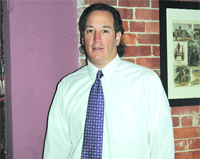
Departments

The following Business Certificates and Trade Names were issued or renewed during the month of January 2007.

AGAWAM

Agawam Pizza & More
421 Springfield St.
Zahra Mortazi

Bobbie J’z
1668 Main St.
Mary-Jane Jensen

Bobskill Paver Stone Co.
17 McKinley St.
William Bobskill

City Fashion
299 Springfield St.
Tommy Mgauyen

Extra Innings of Agawam
45 Tennis Road
Mark L. Tengren

AMHERST

A.D. Cleaning Service
147 Bay Road
Amaro Ferreira

Carrie at Salon Divine
15 Pray St.
Caryl Whiteman

Coinshow.Com
409 South Main St.
Jonathon C. Roche

CHICOPEE

Auto-Pro’s Vehicle Service
35 Gladd Avenue
Robert J. Brault

Chase Automotive Trim & Glass
1422 Granby Road
John H. Chase

Daigle’s Truck Master Inc.
57 Fuller Road
Jeffrey Charles Daigle

Happy Days Breeding and Training
30 Shea Dr.
Elizabeth Ann Leclerc

Intensity Motor Sports
970 Burnett Road
Joseph T. Goulet

Mario’s Auto Service
63 Center St.
Mario J. Domingos

Moran’s Garage USA Inc.
536 East St.
James M. Garvey

Rosy’s Nails
25 Burnett Road
Tina Nguyen

Timberline Properties
83 Thaddeus St.
Robert Kachinski

Vitaliy’s Autobody and Repair
108 Meadow St.
Dmitriy Salagornik

EASTHAMPTON

ABC Construction & Roofing Service
150 Pleasant St.
Bruce Bliven

Eliza Consulting
35 Fort Hill Road
Eliza Lake

Kaleidoscope Institute
116 Pleasant St.
Jennifer Winick

EAST LONGMEADOW

Caldwell Banker Residential Brokerage Real Estate School
55 North Main St.
NRT New England Inc.

Clark’s Landscaping
20 Alandale Dr.
Andrew Clark

Daniel P. Dirico Pro-Shop
176 Millbrook Dr.
Daniel P. Dirico

Family Bike & Sports
217 Shaker Road
Raymond D. Plouffe

NAPA Auto Parts
167 Shaker Road
Stephanie Nelson

GREENFIELD

Harmon Personnel Services
326 Deerfield St.
Community Action Enterprises Inc.

Sonam’s Stonewalls
310 Chapman St.
Sonam Lama

HADLEY

Culinary Partners
84 Russell St.
Valley Computer Works Inc.

HOLYOKE

Dairy Market
1552 Dwight St.
Irfan Kashif

Finding Time
583 Pleasant St.
Marie M. Sheedy

Green Room Salon
159 St. Jerome Ave.
Jennifer Sicotte

SoHo Holyoke
50 Holyoke St.
Hae Yeon Cho

Special Effects Entertainment
179 Pearl St.
Jose Lebron

LONGMEADOW

Alex’s Bagel Shop
786 Williams St.
Aleksandr Belyshev

Creative Edge Salon
7 Edgewood Ave.
Ingrid Margaret Kuselias

LUDLOW

Joseph Testori Electrical Contractor
21 New Crest St.
Joseph J. Testori

NORTHAMPTON

A2Z Pest Control and Problem Wildlife
296 Spring St.
Steven J. Rosetti

Cracked Film Productions
12B Randolph Place
Jared M. Sena

Gear Noho
9 Trumbull Road
Ann S.Colbourn

Hayfield’s Café
48 Main St.
The Certo Group, LLC

Mark Lantz Group
74 Lyman Road
Mark M. Lantz

Small Beer Press
176 Prospect Ave.
Gavin J. Grant


PALMER

Autumn Portraits
51 Vicardau Ave.
Autumn Delaney

Akcess Biometrics
21 Wilbraham St.
Katrina Champagne

Innovative Web Design
1528 North Main St.
Anthony L. Casperini

SOUTH HADLEY

Beautiful Beginnings Event
92 Riverboat Village Road
Christina Stevenson

Blackbird Design
80 Granby Road
Richard Watanabe

DMS Financial Services
50 Prospect St.
Scott M. Duguay

Dwight Prosthetics
128 North Main St.
Eugene J. Sigda

Ichaban
2090 Memorial Dr.
Huang Family Restaurants, LLC

SOUTHWICK

Colonial Windows and Siding
229 Hillside Road
Lisa & Ronald Vandervliet

SPRINGFIELD

Absolute Voice & Data
33 Dana St.
Darren Evangelista

Allied Waste Transfer of Springfield
44 Rose St.
F.P. McNamara Rubbish Removal

Anderson’s Cleaning Company
174 Spear Road
Theresa Anderson

Blueprint Investments
One Monarch Place
Blueprint LLC

B & A Home Improvements
23 Decker Place
Germain Almeida

Carolina’s Montehatillo Variety Gift Shop
2595 Main St.
Carmen V. Fernandez

Cottage St. Motors
807 Cottage St.
Vincenzo Botta

DC Gift & Variety Store
19 Dearborn St.
Diana C. Pusey

Deb’s Place
812 Cottage St.
Deborah Pafumi

DeMars
71 Pear St.
Kenneth DeMars

Dreams by Dana
17 Parkside St.
Dana Hines

Ebony Hill Web Design
111 Florida St.
Derrick & Lillian Hill

Eva’s Beauty Salon
9 Dorset St.
Eva Polanco

Fantastico Wraps & Salads
1500 Main St.
Nazario & Maria Settembre

1st Call Real Estate
770 Plumtree Road
Kenny Nguyen

First Fruits Children’s Center for Learning & Development
54 Marlbough St.
Tiffany McCarr

Fortuna Auto Sales
1650 Bay St.
Jose Taveras

Global Link Translations & Interpreting Service
One Federal Building
Glolin, LLC

The Good Shepard
10 Merrick Ave.
Francis Addai

WESTFIELD

A.J. Stables
1040 East Mountain Road
Tammy Zabik

All Pro Lawn Care
28 Woodbridge Lane
Michael Goodreau

Extreme Consulting
9 Colony Crest
Paul P. Tobias

Reflections Hair & Nail
2 Russell Road
Gloria P. Dandeneau

Serene Photography
51 Court St.
Joan Karanas

T & N Tree Service
77 Mill St.
Anthony Fastiggi

WEST SPRINGFIELD

A Chipaway Windshield Repair
480 Bear Hole Road
William L. Matte

Antonio’s Ringside Incorporated
125 Capital Drive
Gregory A. Vatrano

Canta Napoli Pizza and Restaurant
261 Union St.
Silvestro Vivenzio

Case Handyman and Remodeling
380 Union St.
New England Handyman Services

Charlie’s Diner
218 Union St.
Michael Alfano

Friendly Car Wash
668 Westfield St.
Quicky’s Car Wash, LLC

Melon-Collie Entertainment
445 Cold Spring Avenue
Robert Lewis Pepek, Jr.

Mike’s Auto Service & Repair
173 River St.
Michael Zabik

Riverdale Storage Center Inc.
143 Doty Circle
Jan A. Chrzan

Total Women’s Health Care Inc.
46 Daggett Drive
Aleli L. Villanueva, M.D.

Sections Supplements
Obesity Trend Demands Personal and Societal Responses

In December 2001, then-U.S. Surgeon General David Satcher issued a call to action on the trend toward being overweight or obese, saying both conditions “may soon cause as much preventable disease and death as cigarette smoking.”

Two years later, his successor, Dr. Richard Carmona, addressed Congress on the obesity crisis, calling it “the fastest-growing cause of disease and death in America.”

The situation is not improving. Today, obesity in America, and indeed throughout the world, is a runaway freight train heading down the track of public health. The question is whether we stand still or do something to stop the train.

A Large Problem

The National Center for Health Statistics says that more than 30% of U.S. adults — some 60 million people — are obese, and at least an additional 35% are overweight. The distinction between the two is determined by Body Mass Index, a physical measurement using an individual’s height and weight.

The Centers for Disease Control and Prevention (CDC) says the percentage of overweight young people has tripled since 1980: among children and teens age 6 to 19, 16% — about 9 million — are considered overweight. In Massachusetts, the CDC estimates that 55% of adults are overweight or obese, and 24% of high-school students are overweight or at risk of becoming so.

The consequences of overweight and obese children are that adult complications begin much earlier. Imagine patients in their 30s comprising more than half of the beds in an intensive care unit for heart disease, standing at the pharmacy to get bottles of pills for their diabetes, filling the roster of the cancer care center, or lining up for injections to treat their arthritis.

Obesity is associated with more than 30 medical conditions, including coronary heart disease, high blood pressure, respiratory illness, low back pain, and cancer. It’s a major cause of joint-replacement surgeries, type 2 diabetes, and osteoarthritis, the most common form of arthritis, affecting about 21 million Americans.

There’s more. Studies show that overweight Americans are sicker late in life and die prematurely, women who are overweight or obese at 18 are at greater risk of dying in middle age than women who stay at a healthy weight in their teens, and obesity is even affecting infants, posing potential health problems in children as they age.

Obesity has some troubling side effects as well. Radiologists say that very obese people can’t get full medical care because they’re too big to fit into imaging scanners, or their fat is too dense for X-rays or sound waves to penetrate.

As a result, hospitals are making capital investments to care for such patients, paying for wider doorways, beds, and operating tables that hold up to 1,000 pounds, and special lifting devices to move obese patients, to avoid injuries to the staff.

The causes of obesity — genetic, environmental, and behavioral — are being debated around the world. Nonetheless, as a ‘super-size me’ society, we find ourselves in a perfect storm, consuming much larger numbers of calories than we expend.

Today, even small amounts of physical activity are decreasing, as remote controls, escalators, and now personal transport devices are all designed to remove the need to put one foot in front of the other.

Dual Response

Our response to this crisis must be both personal and societal. Individuals must think more about healthy eating and less about convenience eating. Physical activity must become a part of everyday life.

In other words, the best parking space is farther away from the entrance. Take the stairs for one or two flights.

Meanwhile, businesses can provide on-site exercise programs. Buildings can be built or renovated to encourage using the stairs. Communities and government agencies can develop walking and biking trails and provide safe places for exercise. Schools can promote physical activity and healthy eating and create smarter consumers and shoppers in restaurants and grocery stores.

If we become more informed and take action, we can influence the marketplace — and business, government, and communities — to create the goods, services, and environment we need to maintain a healthy life.

Stuart R. Chipkin, M.D., a physician with the Valley Medical Group in Amherst and a research professor in the School of Public Health and Health Sciences at UMass Amherst, chairs the Mass. Medical Society’s Committee on Nutrition.

Sections Supplements
Start! Program Reaches Out to Employers to Improve National Health Statistics
Matt Bannister

Matt Bannister says Start! is an ambitious effort to help improve cardiovascular health.

According to a recent Harvard University study, for every hour of physical activity, the average person gains two hours of life expectancy.

That’s just one nugget of information the American Heart Association (AHA) needed to bolster its newest nationwide program, Start!, which is designed to promote healthy living through regular physical activity and better nutrition.

Start! was launched this year and represents the newest program introduced by the AHA to raise awareness of cardiovascular health. Like other AHA initiatives such as Power to End Stroke and Go Red for Women, Start! works to promote education and awareness of cardiovascular disease, the nation’s number-one killer.

However, Start! is also unique, in that it promotes specific ways to prevent heart disease and other health issues by partnering with employers across the country.

Specifically, companies are being urged to do whatever they can to get their employees to do some walking.

In the Right Vein

Matt Bannister, senior vice president of Health Strategies for the AHA’s Northeast Affiliate, explained that Start! is the first program geared toward participation on a corporate level that goes beyond sponsorship or financial assistance.

“We’re really trying to focus on prevention with this program,” he said. “Historically, the American Heart Association has been focused on treatment and research, and we still will be. But if that’s all we do, then there’s this enormous bubble of people with existing problems moving through the health care system. If we don’t get to them beforehand, we’ll never meet our goals.”

These include increasing understanding of cardiovascular disease and its risk factors, but also reducing the number of preventable illnesses in the United States. In turn, Start! is geared toward the nation’s employers because of the connection between preventable illness and skyrocketing health care costs.

According to a study evaluating physical activity and its correlation with disease, the U.S. Department of Health and Human Services found that fitness programs can reduce employer health care costs by 20% to 55%, and further, that preventable illnesses make up 70% of illness costs in the U.S.

Reducing just one health risk, the study continues, can increase a person’s productivity on the job by 9%.

“What we’ve recognized is that health care costs are a major concern among U.S. employers, and we can already prove through research the health care benefits that come to an employer if employees are more active,” Bannister said. “Productivity increases, and there is less absenteeism. Better health can have a significant impact on an employer’s bottom line, so we’re looking to them to join with us to improve the health of their employees, but also of their wallets.”

Bannister said two basic factors lead to weight problems — too many calories in and too few calories out — and creating a balance between the two in order to help curb health problems is the crux of the Start! program for both individuals and employers.

“On a corporate mission level, our goal is to reduce injury and death from cardiovascular issues such as heart disease and stroke. One way to do that is to tackle the risk factors that lead to cardiovascular disease, and one of those is obesity,” he said. “At this point, we’re not looking for anything except for individuals and companies to join us, and within those companies, we’re looking for internal champions of the cause. This is our chance to give instead of ask.”

Weighing In

Start! revolves around walking as a cardiovascular activity, because it has the lowest drop-out rate of any fitness regimen among Americans. Participating companies are given a kit that includes weekly mile trackers for internal teams and access to several assistance tools, such as the My Start! online portal that logs daily activity and weighs it against calories ingested, and a wake-up call service that provides 12 free calls for an earlier start to the day, recorded by celebrities such as Jane Seymour, Vanna White, and Jared Fogle, spokesperson for Subway restaurants.

“It’s something you can stay with, and it isn’t intimidating,” said Bannister, adding that for Western Mass., the AHA has set a preliminary goal to enroll at least 10 of the region’s top employers in the Start! program by April.

On the 25th of that month, the AHA will stage an ‘Icon Day,’ which has been designed to put a public face on the initiative, asking company leaders both locally and across the country to lead their employees in walking activities, wearing sneakers to work, or participating in walking meetings and walking press conferences.

“The idea is that employers will encourage employees to go walk at some point during the day,” said Bannister, “and lead by example to incorporate walking into the work day.”

Among those companies already pledging involvement is Lenox American Saw in East Longmeadow. Bill Burke, its president, first became involved with AHA initiatives three years ago and has already promoted healthy habits within the company, but said Start! is a natural, easily implemented addition to AHA programming on the corporate level.

“It’s a perfect fit to bring additional awareness,” he said. “There are so many companies that recognize the problem, but how do you grab on to it and formalize it? In this case, the AHA has done the tough work and given us a comprehensive package.”

Burke added that, from a business perspective, Start! addresses not only physical issues, but job satisfaction as well.

“In a pressure-packed work environment, exercise allows you to think more clearly,” he said.

“On every single front, it’s a good cause,” Burke added. “It promotes awareness of a major health issue that affects virtually everyone in some way, and it’s great for families and companies. At American Saw, we’re getting people involved through contests, so even more get out and walk.”

Making Strides

A Start! Heart Walk, which Burke will chair, will be held on May 20 in Forest Park, and overall, Bannister said the program may expand in coming years. But at this point, he said, the main objective is to spread the word about the program and, more importantly, its importance.

“Like with other programs such as Go Red, we’re primarily trying to create awareness,” he said, noting that Start! has begun with a focus on major employers, on both the national and regional level, in order to allow that awareness to gradually trickle down. Nationally, companies like Subway, ConAgra Foods (which produces Healthy Choice), and AstraZeneca have signed on, while locally, American Saw, Health New England, Peter Pan Bus Lines, and Western Mass. Electric (WMECO) will serve as sponsors of the Start! Heart Walk.

“The next phase will be to introduce Start! to the consumers, in hopes of creating a culture of fitness in America,” Bannister said. “We’ve completely gotten away from the ‘I think I’ll take the stairs’ mentality … so not only are we an aging society, but we’re much more sedentary.”

To change that, the AHA maintains that just an hour a day could lead to a new lease on a longer life.

Jaclyn Stevenson can be reached at[email protected]

Sections Supplements
Private Garden Provides an Oasis for a Unique Set of Clients

As Hurricane Rita ripped its way through the Texas-Louisiana coast in September, 2005, home and business owners braced for the worst.

The owners of the Timberline Nursery in Hillister, Texas as well as the greenhouse’s designer — Private Garden of Hampden — were among the worried. Indeed, the 650,000-square-foot glass structure was among the largest and most vulnerable buildings in the storm’s path.

But when the skies cleared, the nursery still stood — with minimal damage, and far better off than many surrounding buildings.

And 2,000 miles away in Western Mass., the Hickson family breathed a sigh of relief, knowing their client’s business was safe, and that their product had just weathered the ultimate test.

Joe and Kathy Hickson, who started Private Garden in 1984, have created a name for themselves in the home and garden industry, as one of just a handful of companies that offer high-end glass enclosures for commercial and residential use.

Locally, they are also an example of a thriving family business, one that began with a $200 loan more than two decades ago and now employs not only the Hicksons, but also two of their children, Joe Hickson III and Jennifer Sackrider, who spoke with BusinessWest about the business, its history, and its future.

“We’ve worked in almost every state,” said Sackrider, noting that the wide reach of the company requires plenty of international and domestic travel for its principles; in fact, her parents were on location at press time in Hillister, meeting with the Timberline Nursery owners to finish a final round of repairs. “It’s our job to bring the customers in, and also to design and build the structure they need. We’re involved from start to finish.”

Pane and Simple

Private Garden specializes in the design, sale, and installation of both residential and commercial greenhouses. That includes glasshouses, heated conservatories, and pool enclosures for residential clients, and growing ranges, garden centers, and boutique greenhouses on the commercial end.

Joe and Kathy Hickson first entered the business while living in Virginia and while Joe was working with a local park and recreation department. He hired a glasshouse company for a project, according to Sackrider, and later decided to enter the industry himself.

He has a master’s degree in education and Kathy a degree in occupational therapy, but still, the business that draws from specialties such as architecture, engineering, construction, and horticulture has proven to be a good fit for the Hicksons. The company is at the close of a strong year, and saw one of its best years ever in 2005. Private Garden is also one of just five such companies nationwide that provide these high-end types of glass structures, and even within such a small pool of competitors, the company has carved its own niche to stand out.

The first strength is seen in the customization of orders. Every order is different, especially in the residential sector, and while Sackrider said about 80% of Private Garden’s clients are commercial, many of the more customized aspects of the smaller, residential enclosures are now being seen among corporate clients such as garden centers.

Garden centers are getting creative, she said, to survive in a landscape dominated by big box stores offering similar products at lower prices.

“The big boxes are knocking out the little guys,” said Sackrider. “And if they don’t have something that’s appealing and makes them stand out, those smaller centers are not going to last.”

Climate Control

Those ‘little guys’ include destination garden centers — larger businesses that attract customers from a wide radius; regional garden centers, and boutique garden centers, the smallest of the three and those most threatened by the big box trend.

To better compete, all types of garden centers are adding an array of bells and whistles to increase productivity, such as irrigation and environmental control systems, or adding a little flair to an existing business by constructing a greenhouse that includes cupolas, lanterns, or covered walkways, and in some cases, even added event space, restaurants, or coffee bars.

To offer that customization that is increasingly in demand, Private Garden works closely with a number of European fabricators that specialize in different types of greenhouses, such as Lloyd Hamilton of Belgium, which manufactures wood conservatories and orangeries, and Hartley Botanic of England, which has earned an endorsement from Royal Botanic Gardens Kew for its Victorian glasshouses.

“There are so many different products to choose from that there are limitless things we can do,” said Sackrider.

The structures start at about $23,000, but after pouring a foundation and completing the necessary masonry on their own, Sackrider said most people are committed to upwards of $50,000 to install a residential greenhouse, and much more than that for a commercial model.

“We’re the Rolls Royce of the industry,” she said, adding that the lofty distinction also adds some interesting wrinkles to an already very specialized business.

All Private Garden structures, commercial as well as residential, are custom- designed and built, using a team of architects, designers, craftsmen, and engineers culled from both the Private Garden staff and those of the European partnering companies. They’re also constructed onsite across North America, as local as a few feet down the street from the company’s headquarters at Hampden Nurseries, and as far away as Washington, California, Bermuda, and Hawaii.

But the high-end nature of the product, particularly in the residential market, also creates some intriguing concerns for the company.

The firm has a number of wealthy and, in some cases, well-known clients, so Sackrider explained that staff members, numbering about 20, are trained to value the privacy of their customers as much as quality of craftsmanship.

Beyond that, many affluent areas, Beverly Hills, for instance, have ordinances in place to maintain quality of life for its residents, such as construction bans after certain times of the day and noise restrictions on weekends.

Private Garden also has a strong following in New York City, as the only greenhouse purveyor in the Northeast that uses aluminum frames as well as wood; building codes in major cities often prevent the use of anything other than aluminum when building additions of any kind, said Sackrider, let alone one as unique and fragile as a glass conservatory.

That has created a cadre of clients who have ordered custom conservatories in the logistical nightmare that is Manhattan because, well, they can — one client even had one installed in his 16th floor, penthouse apartment — and making no easy feat out of completing an already complicated job.

Inch by Inch

That’s a trend, Sackrider added, that illustrates the nature of Private Garden’s business. On one hand, it caters to a wealthy set, and on the other, to garden centers that instead of dying in the shadow of big box competitors, are making major investments in their craft.

“In our industry, we see firsthand on the residential side that regardless of the economy, the rich keep spending,” she said. “And commercially, people are either getting out or stepping up.”

The Timberline Nursery in Hillister, however, is simply doing what its customized greenhouse allows them to — standing tall, while the winds of change blow around its reinforced glass and aluminum walls.

Jaclyn Stevenson can be reached at[email protected]
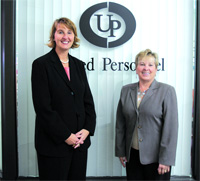
Sections Supplements
Music-booking Business Creates Some Performances of Note
Amy Bateman and Charlie Apicella of CArlo Music Management

Amy Bateman and Charlie Apicella of CArlo Music Management

The strains of a new party-planning trend are being heard locally, as one area musician pairs creativity with commerce to offer a unique, intimate addition to any gathering.

Charlie Apicella, owner of CArlo Music Management based in Amherst, a live-music booking service that specializes in providing unique jazz and classical ensembles, has been a musician since childhood, as well as a performer. After completing his degree in Arts and Administration at UMass Amherst, Apicella put his musical skills to work in a number of music- and culture-based jobs, among them assisting with the management of the UMass ‘Jazz in July’ workshop and the Litchfield Jazz Festival in Connecticut.

But two years ago, he moved on to start his own venture, and said creating a business to serve as an outlet for his talents and those of several other area musicians has helped him cultivate a creative career and fill a niche in the entertainment scene, particularly during the holidays. But on a grander scale, Apicella, a jazz guitarist, said he also feels he’s resurrecting an important piece of American culture and introducing it to new audiences.

“I love jazz,” he said. “We need to go back to the time when there was more of a community for musicians, and we sadly are lacking that today. The environment I would like to help create is a partnership between the venue and the musicians.”

To that end, Apicella has begun to develop relationships with a number of local restaurants and businesses, providing music for events such as holiday celebrations and themed dinners, and tailoring programs to fit those themes.

Apicella performed recently at Yankee Candle in South Deerfield, for instance, as part of a trio put together solely for the event, a Veteran’s Day observance.

“We performed Dixieland, swing, and patriotic melodies for the people while they were shopping,” he said, noting that the performance was well-received, and is indicative of the personal touch music can lend to any event.

“It was really nice to see some older gentlemen in their military uniforms,” he said. “People were filled with pride, were very responsive to the Duke Ellington and Louis Armstrong selections we played, and were noticeably touched when our trumpet player did his solo rendition of ‘America.’”

Apicella was also called upon to provide entertainment for Thanksgiving at the Delaney House, and said he worked to provide something both intimate and original for diners.

“I put myself with a violinist and trumpet player,” he said. “We performed in duo and solo formats and moved around among the tables to interact with the guests, and gave them something special to remember for the holiday.”

Apicella said bookings are moving briskly as he continues to develop entertainment packages for venues such as Del Raye in Northampton and Night Kitchen in Montague, and to book holiday parties throughout November, December, and January. That’s due in part to the way Apicella said he manages his musicians and his business — with a strong focus on professionalism and customer service.

He explained further that the music he provides adds a new layer to events, by complementing the ambience a restaurant strives to achieve.

“Wine dinners are meant to highlight the food and wine of a certain country or region,” he offered as an example. “I also do a lot of private parties for people, often at their homes. The versatility of music I can offer for such events is what I feel sets CArlo Music apart.”

Those styles include Latin jazz, tangos, bossa nova, Italian folk songs, light classical (particularly of France and Eastern Europe), and Dixieland jazz (especially of New Orleans and Kansas City). Apicella also manages three specific groups: Cidade, which provides tango and Latin jazz music; the Rhythm Kings, which performs ragtime and early jazz; and Iron City, a jazz groove ensemble. He also books performances in other styles in tandem with partnering musicians, such as string quartets and classical groups.

And while Apicella said his business can provide entertainment to venues across the Northeast, he plans to maintain a strong presence locally.

“The Pioneer Valley has been very good to me, and business is steady,” he said. “I feel very good when I am asked to do special events, and to put together something nice for a large audience.

“My philosophy is that I can help hosts exceed the expectations of their guests,” he concluded. “This is the obvious outcome when you offer music you are passionate about, in a way that is entertaining and engaging for the audience.”

Contact Charlie Apicella at CArlo Music Management at (413) 824-9267;[email protected]. Music samples can also be heard at www.cidadetango.com andwww.ironcityjazz.com

Sections Supplements
Agri-Mark’s West Springfield Facility Has Quality Down Pat
Lenny Dion, butter room manager at Agri-Mark’s West Springfield plant, next to one of the largest butter churns in the world.

Lenny Dion, butter room manager at Agri-Mark’s West Springfield plant, next to one of the largest butter churns in the world.

There is a worldwide competition for butter making, and West Spring-field is home to one of its champions.

The honor goes to Agri-Mark and its Western Mass. plant, which produces butter for the dairy co-op owned by dairy farmers throughout New England and New York.

Packaged under the Cabot brand name, Agri-Mark’s butter took ‘Best in the U.S.’ honors in 2003, and this year had an even better showing, placing second in the world, in the salted category. It’s a point of pride for the West Side plant’s 65 employees, especially during times when the dairy industry is struggling.

Unfortunately, this is one of those times. Agri-Mark, which has three other facilities in Cabot and Middlebury, Vt. and Chateaugay, N.Y., and a corporate headquarters in Methuen, Mass., produces cheese and butter for the Cabot and McAdam brands, as well as condensed dairy blends and milk powder for commercial use. While two years ago the co-op recorded its best year ever, with $11.4 million in net income, Agri-Mark’s director of communications Doug DiMento said this year he’s just hoping they’ll break even.

“We’ve been taking deductions from farmers’ milk checks to make ends meet,” he said, “and in our history we’ve only had to do that a couple of times.”

Spread Sheets

The reasons for the crunch are many, but not unfamiliar to those in the dairy industry. With both product and profit riding on variables such as weather conditions, the rising costs of farm labor, energy use, insurance, and USDA regulations, milk prices fluctuate regularly. DiMento said they’re so tenuous that something as random as a heat wave can send the entire industry into a state of disarray.

“In hot weather, cows produce less,” he explained, adding that a good year in one part of the country, such as California, the largest dairy producer in the U.S., can also hurt other regions. “New England already has a smaller dairy area than most. California had some hot weather two years ago, and that helped us. But then they bounced back, and that hurt us.”

These factors are also exacerbated by the fact that all farmers are now receiving the lowest rates on their milk in 25 years, prompting debate in Washington about whether to ease restrictions on raising milk prices at the consumer level. DiMento said all of Agri-Mark’s employees are watching that debate very closely, as the outcome could directly affect the security of their jobs.

“The USDA regulates milk pricing, so we can’t pass on our rising costs,” he said. “But just a one- or two-cent increase on the consumer end could make an enormous difference for us and for our farmers, so we’re waiting and hoping that something will ease the burden soon.”

Milk Money

Agri-Mark farmers produce 2.4 billion pounds of fresh milk a year (every 100 pounds equals about 11.6 gallons), and are capable of handling much more. That makes the Agri-Mark dairy cooperative the largest supplier of farm-fresh milk in New England, marketing more than 300 million gallons of milk each year for more than 1,300 of the region’s farms.

Much of the current infrastructure was added during an extensive renovation in the mid-1990s, which increased the plant’s capacity by 25%. Today, the facility can handle greater rates of production and can store almost double what it will see in a normal year, which is an apt safety net for an industry that sees dramatic changes in production totals from one year to the next. Ten raw milk silos can contain about 4 million pounds of milk (or about 465,000 gallons; pounds are usually used to measure milk quantities in the dairy industry). Meanwhile, milk powder is stored in two silos, each with a 160,000-pound capacity, and the 25,000-square-foot distribution warehouse on site can store all of the products made and packaged at the plant before being delivered to customers directly from West Springfield.

The milk received is processed into butter, milk powder, and condensed blends for ice cream outfits such as Friendly’s and Hood. The West Springfield location is also what’s known as a balancing plant, receiving milk from various sources, within the co-op and outside it, that would otherwise spoil. An adjacent quality-control laboratory also makes the location a necessity in the dairy industry of the Northeast, as New England’s largest testing facility.

Churn for the Better

Inside, the plant is a well-oiled machine that, especially in these trying times, leaves no milk-based product untouched. Much of the milk powder produced on site, up to 50 million pounds through an intense heating process, is shipped internationally to countries such as China and Mexico, in cooperation with other dairy co-ops across the country.

That partnership was formed to stem competition between already struggling dairy farms and processing plants nationwide, explained DiMento, and pricing is done collectively. Any powder that is not shipped to waiting customers, even that swept off the floor, is put to some use, such as bagged products for animal feed.

Perhaps the West Springfield facility’s busiest room, however, is the butter room, which churns out 28 million pounds of the product a year, with the ability to handle 40 million pounds. The churn itself is one of the largest in the country, with a 250,000-pound capacity, and is similar to most of the plant’s equipment and storage containers in its size.

The butter is packaged into pounds, quarters, and continental chips — the small, gold-foil-wrapped single-servings seen in restaurants — in order to serve a wide range of customers in the grocery, commercial, and food service sectors.

Agri-Mark’s other plants focus primarily on cheese production, so the butter room is of particular importance to the co-op and to the local plant’s operation. Lenny Dion, butter room manager, said there is a strong focus on quality and brand loyalty in terms of butter production, especially with a number of prestigious wins in international competitions already recorded.

“We used to produce about 53 million pounds a year, but we downsized to cut costs,” he said, adding that the plant is also trying to phase out its butter production for private-label use. “We’ll still do it, but we’ve made the service more expensive. Our focus is on making butter for the Cabot brand and making that brand the best we can.”

As packaged butter zooms through the room on a series of conveyors, Dion explained that several units are kicked out of line automatically and randomly for quality testing. And after packaging, the product is moved to a freezer room to harden and await shipping, at which point on-site USDA testers again sample the product.

A Pat on the Back

With the cheeses marketed under the Cabot and McAdam names in New England and New York garnering awards for quality at the ‘Olympics of Cheese’ just about every year, Dion doesn’t mind seeing a slight slowing of the pace of butter production to test for quality. As the lone butter churner serving companies known for their time-tested cheese-aging practices, he has a lot to prove.

And this year, Dion’s butter room produced entries into the World Championship that returned high marks — 99.2 in the salted category and 98.65 in the unsalted, to be exact. In an industrial climate that increasingly has Agri-Mark farmers and employees on edge, they are important wins that take the focus off quantity and redirect it toward quality, and that’s exactly where the co-op wants that focus to stay.

Jaclyn Stevenson can be reached at[email protected]
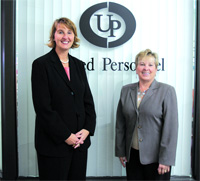
Uncategorized

Gail Sherman says she knew next to nothing about golf until she started working on the annual fund-raising tournaments staged by the Chicopee Chamber of Commerce, which she now directs.

In time, and not much of it, she picked on the nomenclature, and terms like ‘mulligan;’ that’s a do-over of a specific (usually poor) shot, for which the golfer in question pays $5, thus raising more money for the chamber.

These days, Sherman is getting an education in another sport she previously knew little about — basketball. That’s because the annual Commerce trade show staged by the Chicopee and Greater Holyoke Chambers will be at that sport’s shrine on Springfield’s riverfront. In the course of planning the event, Sherman and Holyoke Chamber President Doris Ransford have made several trips to the Hall, and thus have absorbed some of the game’s history and terminology — even the phrase one-on-one.

Which they have made part of their elaborate, basketball-focused marketing strategy for the Nov. 2 gathering, the 16th edition of the Commerce event. They’re calling the show a ‘one-on-one opportunity,’ or a chance for exhibitors to make solid connections with both existing and potential clients.

The show has always been that, said Ransford, who told BusinessWest that the change of venue — the event was staged last year in the MassMutual Center and had been at the Big E for most of this decade — can make it more so by creating some excitement and a new and different feel for the show.

Indeed, instead of one large room, the Hall of Fame will offer several different areas for exhibition booths and tables, including the Hall’s Center Court, the MassMutual Room (often used for business meetings), and even the second and third floors of the Hall, where exhibitors can hang banners over railings to draw attention to their companies. This collection of sites should stimulate greater circulation among exhibitors and guests, said Ransford, noting that while people can see what’s going on in their area, curiosity will prompt them to see what else is going on.

But the Hoop Hall offers much more, said Sherman, noting first that visitors to Commerce will also gain free admission to the shrine. There are also three popular restaurants on site — Max’s, Pazzo’s, and McDonald’s — giving exhibitors and visitors some enticing options for lunch or even dinner after the show, and there’s also a Stone Cold Creamery on the premesis to tempt attendees.

And on top of all that, there is ample free parking, including 150 spaces in an underground lot right under the Hall, which will provide a new standard of convenience for exhibitors — especially if it rains.

The sum of all these parts should make Commerce ’06 an intriguing event, or, as they say in this sport, a slam dunk.

Points of Interest

As they talked about Commerce and its continuing evolution since its start in what is now the Plantation Inn in Chicopee, both Ransford and Sherman referenced a recent nationwide trend toward declining trade show participation.

There are many theories for this development, including an overall drop in chamber of commerce membership, the cost of participation, the time a show entails (a full day for most of those taking part), and shifts toward other marketing platforms. Whatever the reasons for it, this phenomenon has pushed trade show organizers to elevate their game when it comes to value and convenience for attendees.

And it has taken the Commerce show to the Hall of Fame, said Sherman, adding that the change in venue is part of a broad effort to keep the show fresh and different — and to distinguish it from the region’s spring trade show, Market, staged by the Affiliated Chambers of Commerce of Greater Springfield.

The quest for new and different prompted organizers to move Commerce from the Big E to the new MassMutual Center a year ago, said Ransford, adding that, while the event was generally successful, there were some problems, particularly with parking, booth set-up, and even food concessions (high prices and few offerings).

To address those issues and give Commerce some added zip, organizers took a quick look at other venues, and became intrigued with the Hall, she continued. “The more we looked at it, the more we liked it; we saw a chance to do something special.”

Specifically, organizers saw a popular tourist attraction, but still one that many from the region have not seen, at least not in its entirety. For that reason, organizers have dubbed Commerce ’06 “two shows in one” — the Hall and its thousands of artifacts and programs, and the trade show itself.

Meanwhile, the layout and amenities of the Hall complex provide some unique twists on the traditional trade show formula.

First, there’s the break from the large, single-room layout; the Hall offers several rooms on three levels, including an actual basketball court. It also has a theater that will be used for the kick-off breakfast as well as morning and afternoon seminars.

Visitors to the Hall of Fame start on the third floor of the shrine, featuring the so-called Honors Ring, and work their way down, said Sherman, adding that she hopes Commerce visitors will do the same thing. “We’re going to have three different floors of exhibits and utilize lots of different spaces,” she explained. “It will be a very different feel that we think people are doing to like.”

The Hall also provides another popular amenity people will like, free parking, said Ransford, noting that the importance of this perk shouldn’t be minimized.

“While parking in this area isn’t expensive when compared to other areas,” she explained, “it’s still an expense, and some people just don’t like to pay to park; if you charge a dime, that’s too much.”

There will be ample free parking at the Hall, which has its own spacious area as well as the lot for the old Hall of Fame just a few hundred yards away.

Commerce organizers have borrowed heavily from basketball’s lexicon in their marketing for the show. The event brochure is replete with hoop terminology, with phrases like ‘put your game face on,’ ‘it’s your ball, register now,’ ‘see you courtside,’ and ‘one-on-one opportunity.’ But beyond the slick marketing and the flash of a new venue, show leaders know the success of the show hinges on its ability to provide real value.

Commerce ’06 will do that in several ways, said Sherman, listing a large and diverse group of exhibitors, including many newcomers; several programs, including a breakfast keynote address from Springfield Symphony Orchestra Conductor Kevin Rhodes; a seminar on branding led by the manager of national advertising for AFLAC (no word on whether the duck is coming), and another on employee-retention strategies; and some tiered pricing options.

For the first time, the show will offer business owners the chance to purchase table space to promote their venture and display products and literature, said Sherman, adding that, at roughly half the cost of a traditional booth, the tables could be an attractive option to smaller businesses and start-ups.

“It’s part of the effort to make the event different and give people opportunities to get some exposure,” she explained. “People measure their trade show success in different ways, but the bottom line is getting some visibility and putting your message in front of decision makers.”

Transition Game

In still another attempt to create parallels between basketball and business, Commerce organizers borrowed a quote from legendary Kentucky coach Adolph Rupp in their marketing brochure: Success is the glue that holds a great team together.

Success in the realm of trade shows is becoming more elusive due to a growing number of challenges in the form of competition for the time — and marketing dollars — of business owners. Commerce organizers believe their change of venue and new programs will add up to a successful day for them and, more importantly, for show exhibitors and attendees.

In other words, they think they’ve got a great game plan.

George O’Brien can be reached at[email protected]
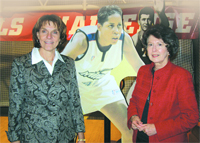
Sections Supplements
A Smaller Serv-U Continues to Thrive with a Focus on Emerging Technology
Steve Horowitz

Steve Horowitz, co-owner of Serv-U Locksmiths and Design Center, said downsizing allowed the company to thrive within two niche markets.

For several years, Serv-U didn’t refer to just one store or a chain of stores; it referred to an entire intersection of stores that sold everything from auto parts to baby furniture.

The business has been a household name in the region in 1954. Once, Serv-U included several locations across Western Mass. including Westfield, Springfield, and Northampton, and in Enfield, Conn., and remained as such until 2001, when the decision was made among members of the family business to sell all remaining locations in favor of operating one store, on St. James Avenue in the eastern section of Springfield. That store now focuses on two of the company’s strongest niches — its locksmith shop, and a design center that sells interior design and maintenance supplies.

“The old model was very susceptible to competition,” said Steve Horowitz, who oversees the locksmith division of the company. “We identified the two areas where we’ve always done well — areas that are service oriented, which means the big box stores can’t do what we do.”

In the Safe

While they choose to keep specific numbers to themselves, Horowitz said that, over the past five years, or since the decision to downsize was made, Serv-U has thrived, advancing forward with a business model that remains focused on service.

“It’s definitely a growing business,” he said. “We’re profitable.”

In 2001, Horowitz said it was already abundantly clear that remaining an all-purpose hardware store in a region increasingly saturated with lower-cost, higher-volume retail stores such as Lowes and Home Depot was not viable. So, Serv-U stopped selling many of its product lines that could no longer effectively compete, among them plumbing supplies, power tools, garden equipment, and traditional hardware. The baby furniture — sold primarily at Serv-U locations called ‘Baby Castles,’ survived for a time, but another national juggernaut – Wal-mart — contributed to that venture falling by the wayside, too.

The locksmith and security services were conversely expanded, as was the design center that sells paint, wallpaper, window treatments, and other home improvement supplies, which require a fair amount of expertise on the part of staff, in order to assist customers. Many of those supplies are also available for purchase online at Serv-U’s Web site.

Serv-U now offers the sales and service (with the help of a six-van fleet) of door locks, high security locks, and safes, with those services ranging from re-keying and master-keying; lock installation and repair; recombination of safes; automotive services, and the installation of doors, security systems, and safes.

“Our people really know their stuff,” said Horowitz. “We picked two service-heavy areas in which to concentrate, and it’s working.”

Horowitz added that, especially in terms of the locksmith services, that growth and profitablity is due largely to the company’s ability to hone in on evolving technology and offer the most current products and services to customers. It’s a direct effect, he said, of abandoning less-profitable aspects of the business in favor of those that have historically brought the greatest return.

“The growth and success continues to build because we’ve been able to keep up with technology,” he said. “We’re keeping our employees trained, and investing in equipment we need to stay current.”

One area that sees brisk business is in the area of car key duplication, which in recent years has taken a technological turn: many vehicle keys now come equipped with computer chips, which require a special process of duplication.

But more importantly, that emphasis on evolving technology has also allowed Serv-U to expand its commercial business, working with office suites, government facilities, restaurants, schools, and other organizations to provide state-of-the-art security and lock systems. Currently, about 70% of the company’s client-base is represented by commercial accounts.

“The commercial work that we do requires today’s technology,” said Horowitz. “Our customers need the proper security.”

Access Granted

In the industry, he said, that’s often referred to as access control, calling attention to the fact that locksmiths are far from being key-cutters.

“Keys are never going to go away,” Horowitz said. “They’re an easy, inexpensive security measure that works. But access control offers a number of security combinations. We can provide card-swipe systems, that tell the lock to open for a specific person, or, if someone’s been bad, to not open for a specific person. They can also be programmed to do certain things at different times of the day.”

Beyond that, Horowitz said many security systems provide printed ‘audits,’ detailing who opened a door and when, or even if a person tried to open a door, and when.

But it’s not just the cool factor that keeps Serv-U in business. Horowitz explained that the ability to garner additional commercial accounts through the development of more sophisticated services and offerings has also allowed Serv-U to increase its percentage of repeat business.

“You put a deadbolt on someone’s house, they don’t really have much more need for your services at that point,” he said. “But in the commercial sector, there’s an ongoing need due to employee turnover, new staff, and maintenance on security systems and safes, among other concerns.”

Job Security

Horowitz noted that smaller locksmiths will always have a job — there is a need for new keys and less sophisticated-security systems.

“Locksmiths are specific tradesmen,” he said. “You can’t go to a hardware store to get the expertise we offer.

“This is an evolving industry,” he continued, “ and that keeps things exciting, because we are evolving with it.”

Jaclyn Stevenson can be reached at[email protected]