Home Posts tagged Technology (Page 26)
Features
Hospital CEO’s Career Is a Study in Determination
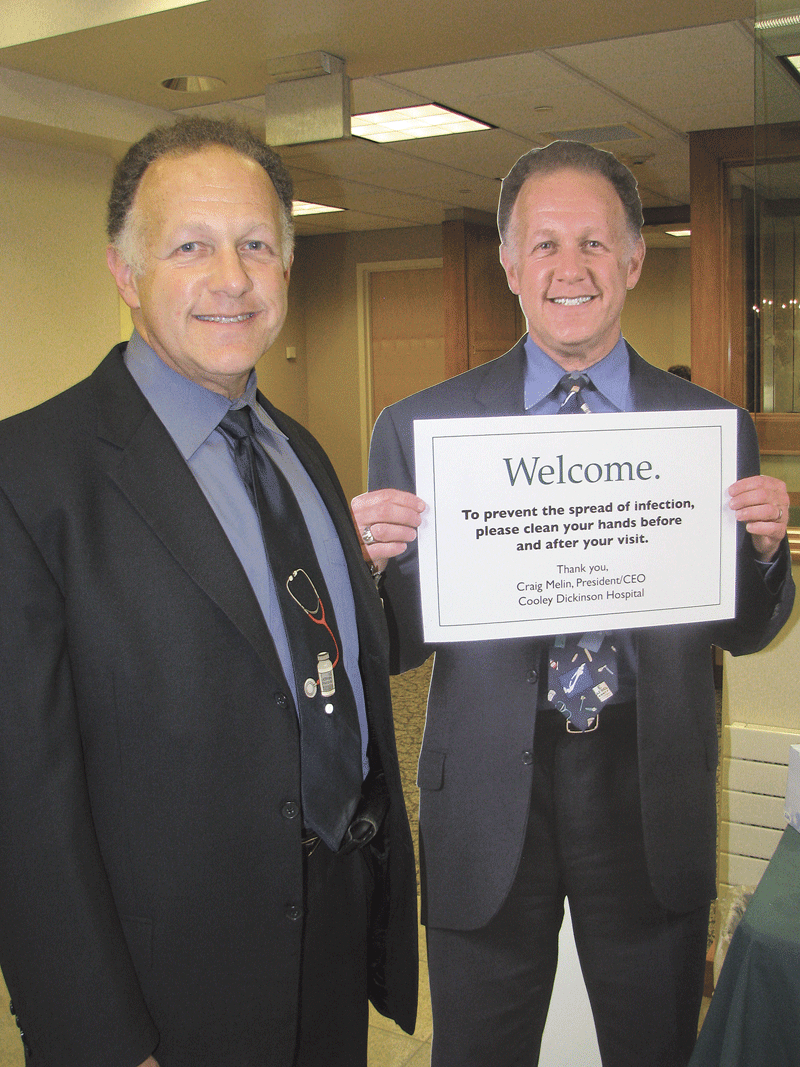
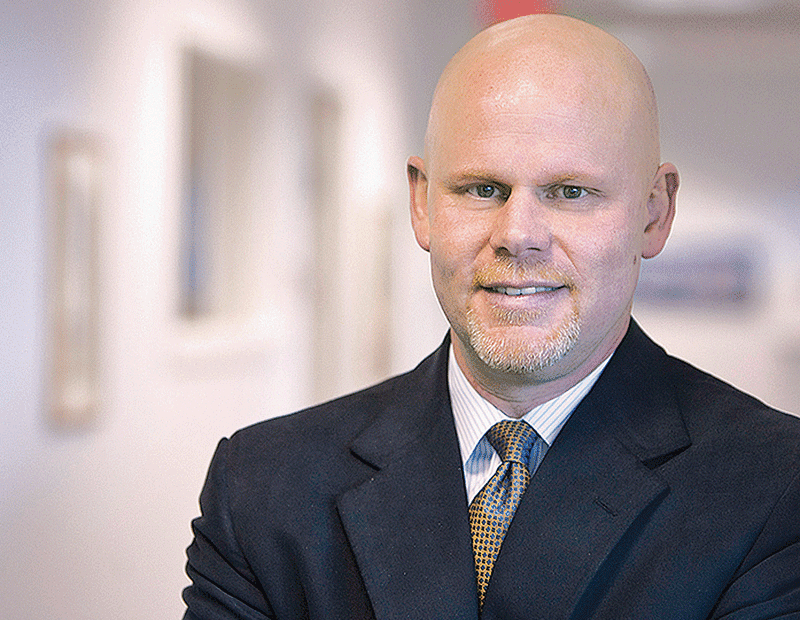
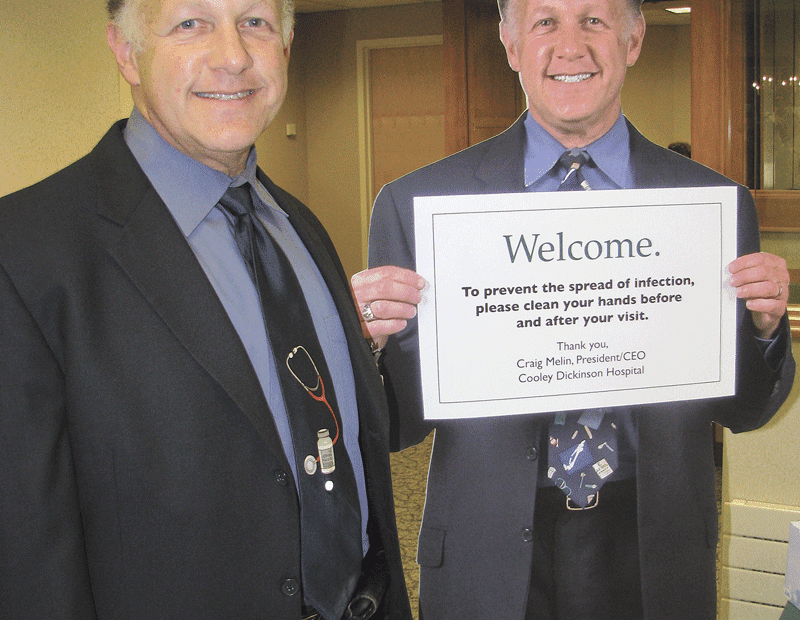
Craig Melin President and CEO, Cooley Dickinson Hospital

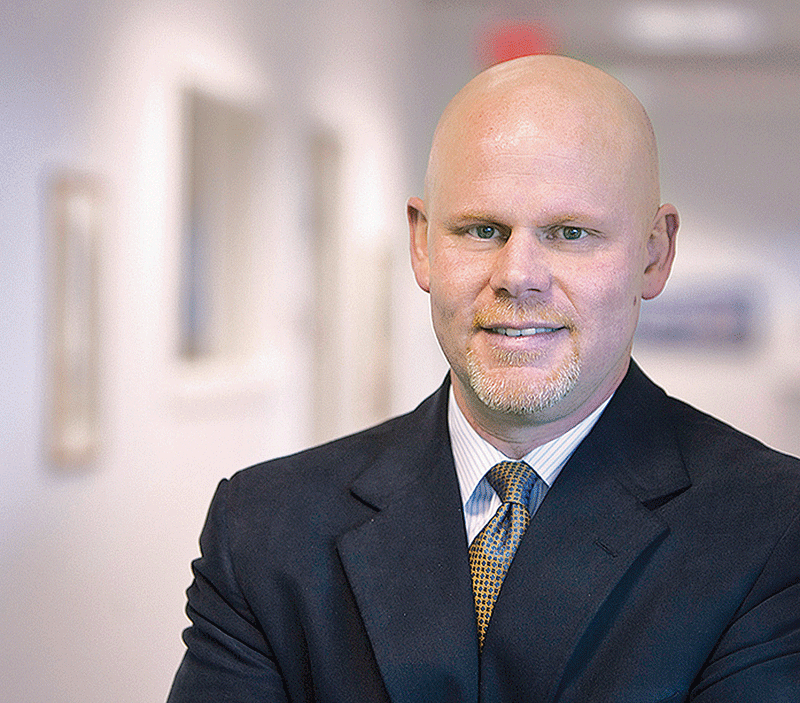
Craig Melin President and CEO, Cooley Dickinson Hospital

When Craig Melin embarked on his pursuit of a doctoral degree from the Dartmouth Institution for Health Policy and Clinical Practice, he figured it would be a two- or three-year journey.
Almost five years after he started, Melin, president and CEO of Cooley Dickinson Hospital in Northampton, still has a ways to go, but there is light, he said, at the end of the proverbial tunnel.
Work on his dissertation has been slowed, and made both more challenging and intriguing in many respects, by the lengthy recession and its ongoing impact within the broad health care community, he explained, and especially hospital administration, which is at the heart of his work.
“There were two factors, both of which had to do with the health care environment, that slowed things up,” he explained. “One was that this environment became so treacherous that two of the hospitals that I wanted to visit were going through such economic upheaval that, at the times I wanted to visit, they were going through reductions in force.
“And to interview people about all the wonderful things they’d done and how great their outcomes were, at a time when the staff was going through the angst of feeling that they had failed and that the world doesn’t work … well, the timing just wasn’t right,” he continued, adding quickly that the second delaying factor was that he was dealing with these same issues, including workforce reductions, at CDH — work that absorbed early-morning and evening hours he would otherwise have devoted to his studies.
When asked about the specific thrust of his doctoral work, Melin said it centers on “how to transform the quality of care in community hospitals.” He then caught himself and made a key adjustment. “It’s actually ‘how to lead the transformation of the quality of care in community hospitals.’ It’s from a leader’s perspective.”
That’s an important distinction, and in many ways, Melin isn’t simply studying this concept, he’s living it. It has become much more than the title of a dissertation — it has become a life’s work.
Indeed, when Melin arrived at Cooley Dickinson in 1988, soon to commence work that would pull the hospital from the brink of financial collapse, he figured the stay would be no longer than five years. Close to a quarter-century later, he is still at the helm, primarily because he believes this is where he can make the most significant impact with regard to that ‘big picture’ that is modern health care administration.
His goal, almost since the day he arrived and especially over the past decade or so, has been to make CDH what he called a “model community hospital.” And to do that, he decided he needed to take his base of knowledge to a much higher level. “I understood that I needed to be an expert in that field, not simply know about it, and that’s why I decided to pursue my doctorate.”
This pursuit has been a learning experience on a host of levels, one that has brought new perspectives on the ongoing work at Cooley Dickinson and lessons in how to do it better.
For this, the latest installment of its Profiles In Business series, BusinessWest talked with Melin at length about the process of putting Ph.D. after his name, and about what is certainly much more than a research topic; it’s what he hopes will become a blueprint for more effective hospital administration.

Healthy Perspective
Regarding the timeline for his dissertation, Melin said most all of the course work, research, site visits to four of the top-performing community hospitals in the country (which he couldn’t disclose at this time), transcription of dozens of interviews, and coding of most results is now all behind him.
What remains, essentially, is completion of his analysis and the writing, which he has started, both on his home computer and in his mind. He said he anticipates being finished by this June, but followed that statement with a qualifying ‘but…’
While acknowledging that it is quite difficult to sum up what he has learned and what his dissertation will say quickly or in simple terms, Melin said much of his doctoral work comes down to five steps, not necessarily sequential, that he has identified and that he believes form a framework that can be followed by virtually any community hospital as it goes about working to transform quality of care.
“The first involves how the leader got the attention of his or her organization regarding the gap between where they are and where they need to be,” he explained. “And the second, after you’ve recognized, for example, that more people are dying in health care than should be or people are harmed in health care organizations more than is necessary, the next question is how to get people’s intentions to change. So you go from attention to intention.”
In other words, he said, the employees of the hospital, not merely the administrators, take ownership of that aforementioned gap.
“The third piece concerns how we translate that ‘intention’ into the work that people actually do,” he continued. “So it’s one thing to believe that we need to do a better job of eliminating infections in a hospital, it’s another question to look at whether we can figure how to test every patient who comes in and disinfect rooms in a very different way. It has to be the work of the people on the front lines, not the managers and directors.”
The fourth step involves how to hold people within an organization accountable for the change in their work and the results that are expected, he went on, adding that this step is necessary to ensure that the changes that everyone agreed to make are actually happening.
As for the fifth … “you can do all of this and still fail as a leader if, as an organization, you don’t provide all the system supports to help people change their work, know how they’re doing, and so on,” he told BusinessWest. “Whether it’s IT support, or, for the front-line staff, whether the group has time to sit down and think, rather than just do, whether they have a facilitator and outside resources to look at what others are doing and what can be copied and adjusted for us … the system supports are central to success. You’ll see systems that will do the first four things and then fall apart, because they’re expecting everyone to change the work they do, but not give them any time to think about how they would do it.”
The dissertation will go into several hundred pages worth of elaborate detail on these five steps, and essentially take a retrospective look at how those four chosen hospitals, each with outstanding outcomes, navigated them.
Meanwhile, the experience of doing the research and those interviews has provided invaluable opportunities to look prospectively at how CDH may be able to take what those hospitals have done and are doing and apply them to its quality-improvement efforts (more on that later).
How Melin arrived at this place in both his professional career and education is an intriguing story that really begins to take shape at the Massachusetts Institute of Technology, where Melin earned a bachelor’s degree in Mathematics and for a long time thought he would wind up teaching that subject at some level.

Adding Things Up
“But I sort of adjusted to more practical uses for math,” he said, adding that his search led him to actuarial work with some insurance companies and, eventually, a summer job with the Mass. Rate Setting Commission, where he worked for a group redesigning the payment system for hospitals and nursing.
“Through that, I came to the conclusion personally that the data suggested that health care organizations were not well-managed,” he said, “and that this represented an opportunity for me.”
So he enrolled in Harvard Business School with the mindset of pursuing a career in health care management. While there, the School of Public Health created a new program called Health Policy and Management and invited the 800 first-year students at Harvard Business to consider a course of study that would essentially combine management and health care. Melin said he was the only one who did.
Fast-forwarding a little, he said he would go on to earn master’s degrees in business and health policy as well as management. He would put them to work first at Beth Israel Hospital in Boston, which he would eventually serve as associate director; National Jewish Hospital in Denver, where he would become both vice president of Planning and director of Hospital and Clinical Services; the Cambridge Research Institute; and University Hospital (now Boston University Medical Center), which he would serve as vice president of External Affairs.
His career then approached what could only be described as a crossroads.
“I was contacted by a search firm to look at the possibility of a teaching hospital in another state and also Cooley Dickinson Hospital,” he explained. “I didn’t really know Cooley Dickinson or Northampton, and I was at a career stage where I was considering two paths to reach my ultimate goal, to be CEO of a major teaching hospital; one was to be the CEO of a community hospital first, and the other was to be the number-two person at a teaching hospital.
“There was something about Cooley Dickinson and the community that attracted me, and so I came here,” he continued. “I thought it would be five years, but once here, that attitude changed, because underlying all that was wanting to change the health care field, not just where I was working. I soon got the sense, from all that we were able to do, that you could develop a model community hospital that others could learn from, and change the field.”
Melin told BusinessWest that recruiters have contacted him countless times over the past 23 years to gauge his interest in other administrative positions, some at facilities several times the size of CDH.
They still call, or e-mail (the more common method of making such inquiries these days), but he said he hasn’t seen or heard anything that would take him away from CDH. When asked to elaborate on why, he said, in essence, that there is still considerable work to be done with regard to making Cooley Dickinson into that model community hospital. In short, he hasn’t finished what he started.
Which brings him back once again to his Ph.D. and that prospective work he’s doing with taking lessons from his site visits back to CDH. He said those visits have generated tremendous learning experiences and provided plenty of insight into the work he’s doing in Northampton — and how he might do it better.
“I’ve got a framework for how I think and how I lead,” he explained. “The experience of seeing other places has given me guidance on how to adjust that framework, because it’s always going to be different based on context. There’s a concept called realist evaluation that says that you need to look at the mechanisms of change in the context in which they occur, and then look at the outcomes.
“And where the process I’m talking about has five steps,” he continued, “we’re looking at five different mechanisms of change, but the question becomes, ‘how do you adjust them in different contexts, and what outcomes do you get?’
“Basically, it comes down to what works where, when, and why,” he went on, adding, once again, that his site visits have provided myriad talking points for his dissertation and plenty to think about at CDH. “Cooley Dickinson has a completely different context than those other places, and our outcomes will be different, but we can still ask the question, ‘how can we make that framework successful in our community?’”
And while his site visits have involved lengthy visits to CEOs’ offices, they’ve also included talks with physicians and quality-improvement staff and lengthy stints on the front lines, said Melin, adding that with each group came a unique perspective on the steps taken and, more importantly, why they were successful.
“This was a real learning experience for someone who’s a CEO,” he told BusinessWest. “When I talk to the CEO about what he or she has done to lead change, and then I talk to the front-line staff, they’ve experienced the change, too, and they know why it is they made the changes, but they might not be the same reasons as the leader thought.
“And as someone who’s in a leadership position, this was a great opportunity to see first-hand somewhere else that there is that disconnect,” he continued. “That doesn’t mean that what the leader did wasn’t really effective, because in each of these places it obviously was, but it wasn’t necessarily what they thought they did that caused the success at the front lines; it was something that happened within their organization because of the transitions they set in place.”

Degree of Progress
When asked what he does in his spare time, Melin smiled and said that, at this time in his life, there simply isn’t much of that precious commodity.
Indeed, between his work molding CDH into a model community hospital and work on his Ph.D., most everything else has been put on hold. He still finds time to visit the Connecticut shore with his wife, who operates a unique bed-and-breakfast in Northampton that features extended-stay programs. There will be more time for the beach when his doctoral work is completed, obviously, a day Melin is looking forward to seeing.
But while that work will eventually end, the more important assignment of applying what’s learned won’t. That’s because hospitals must seek to continuously improve, he said, adding that this is the real framework for a model community hospital.

George O’Brien can be reached at [email protected]
Agenda Departments

‘Web Advertising’ Workshop
March 30: Derek Allard of Gravity Switch will present a workshop titled “Web Advertising” from 9 to 11 a.m. at the Scibelli Enterprise Center, 1 Federal St., Springfield. The morning program is sponsored by the Mass. Small Business Development Center Network (MSBDC). Allard will discuss organic search-engine strategies, paid options to help attract visitors to your Web site, defining relevant keywords to target, the importance of Web-site content, building inbound links to your Web site, and paid advertising with Google AdWords and Facebook. The cost is $40. For more information, call the MSBDC at (413) 737-6712 or visit www.msbdc.org/wmass.

Financial Forum
March 31: Cambridge Credit Counseling Corp. and the Council of Churches of Greater Springfield will host the “Hope, Faith, and Healing Financial Forum” beginning at 6 p.m. at Cambridge’s office at 67 Hunt St., Agawam. Hors d’oeuvres and refreshments will be served. The educational summit will bring together financial experts, public officials, and clergy to discuss the financial challenges facing the region and opportunities to empower area residents. State legislators, lenders, and other community leaders will also be in attendance. For more information or to register, contact Thomas Fox, Cambridge’s community outreach director, at (413) 241-2362 or [email protected]. For more details on Cambridge Credit, visit
www.cambridgecredit.org.

Healthy Back Class
April 2, 9, 16, and 30: The YMCA of Greater Westfield Inc. on Court Street will sponsor a Healthy Back Class on Saturdays during April from 10 to 11 a.m. in the board room. Instructor Paul Warner, owner of Body Wise Physical Therapy, will teach the basics of back care that can make the difference between a healthy back and an aching one. The cost is $35 for YMCA members, $55 for non-members. For more information or to register, contact Charlene Call, member retention/wellness director, at (413) 568-8631, ext. 305.

USO Dinner Dance
April 2: U.S. Senator Scott Brown will be the keynote speaker for a 1940s-themed dinner dance titled “As Time Goes By” as the Pioneer Valley United Service Organization (USO) hosts its first formal event to mark its 70 years of service to local families of the Armed Forces. The event is planned from 6 p.m. to midnight at the Delaney House in Holyoke. Brown will speak at 8:30 p.m. The event for the local USO chapter, which operates out of the Westover Air Force Reserve Base in Chicopee, will also honor Checkwriters Payroll, Clear Channel/KIX 97.9, Big Y World Class Markets, and local heroes from each branch of the U.S. Armed Forces, in addition to the Pioneer Valley USO Volunteer of the Year. The evening will begin with a welcome reception, followed by the dinner and program with Brown and the awards presentation. The evening will end with dancing to 1940s swing, R & B, and music from the era of Motown performed by the O-Tones. For tickets or more information, call Al Tracy at the USO Office, (413) 557-3290, e-mail [email protected], or visit www.pioneervalleyuso.org.

Workshop on Web Sites
April 6: Derek Allard of Gravity Switch will present a workshop titled “Making the Most of Your Web Site” from 9 to 11 a.m. at the Scibelli Enterprise Center, 1 Federal St., Springfield. Allard will discuss defining goals for a Web site, elements of a good home page, writing content to pull people in, measuring success and failure, and common Web site mistakes to avoid. The cost is $40. The Mass. Small Business Development Center Network (MSBDC) is sponsoring the workshop. For more information, contact the MSBDC at (413) 737-6712 or www.msbdc.org/wmass.

Science Hoaxes Lecture
April 6: Richard Sanderson, curator of physical science for the Springfield Science Museum, will present a lecture titled “Believe It or Not: Science in the Age of Misinformation, Hoaxes, Bad Science, and Bad Astronomy” at 10:10 a.m. and again at 11:15 a.m. in Scibelli Hall at Springfield Technical Community College, Armory Square, Springfield. Sanderson’s appearance is presented by the Ovations Series, and the public is welcome to attend.

Chief Scott Roast
April 7: Dr. Bill Cosby will be among the dozen or so ‘inquisitors’ during Holyoke Police Chief Anthony Scott’s Retirement Roast at the MassMutual Center in downtown Springfield. The doors will open at 5:30 p.m., and the dinner begins at 6, with a cash bar. Tickets are $40 per person or $375 for a table of 10. The menu includes salad, chicken breast with sweet sausage apple stuffing, red bliss potatoes, vegetable, dessert, coffee, and tea. For tickets, call Sullivan, Hayes & Quinn at (413) 736-4538, or the Holyoke Police Department, chief’s office, at (413) 322-6901.

Chamber’s ‘Shining Stars’
April 8: The Castle of Knights on Memorial Drive in Chicopee will be the setting for the Chicopee Chamber of Commerce’s annual “Shining Stars” event, which includes recognition of the Business of the Year, Citizen of the Year, and Volunteer of the Year. For more information, call the chamber office at (413) 594-2101.

‘Performance Appraisals’ Workshop
April 12: Attorney Susan Fentin of Skoler, Abbott & Presser, P.C., of Springfield, will present a workshop titled “Performance Appraisals: Rewards and (Yes) the Risks” at the Human Service Forum Nonprofit Risk Management Conference at the Clarion Hotel in Northampton. The daylong event includes breakfast and a keynote address, followed by workshops in which Fentin and participants will analyze the top risks facing human-service and nonprofit organizations. Other workshop topics include “For EDs/CEOs Only: Let’s Talk About Risk,” “Financial Risk Management,” and “Facilities/Property Management.” For more information on the program, visit www.skoler-abbott.com.

Mobile Tech Workshop
April 13: Chris Amato of Knectar Design and Jeff Hobbs of Advanced Internet will lead a workshop on the various critical aspects of the shift to a mobile-technology landscape from 9 to 11 a.m. at the Scibelli Enterprise Center, 1 Federal St., Springfield. The workshop is sponsored by the Mass. Small Business Development Center Network (MSBDC). Amato and Hobbs will discuss how mobile and smart-phone technology has surpassed expectations to become the leading communications and application technology platform for users in many market sectors. The cost is $40. For more information, contact the MSBDC at (413) 737-6712 or www.msbdc.org/wmass.

Public Health Series
April 13: Dr. Leonard Morse will be the keynote speaker as the Desmond Tutu Public Health Lecture Series continues at American International College, 1000
State St., Springfield. The 10 a.m. talk in Griswold Theatre will focus on education to address patterns of behavior that promote and preserve one’s health. The event is free and open to the public. A reception for Morse will follow in the west wing of the Sprague Cultural Arts Center. For more information, call (413) 205-3231.

Royal LLP Open House
April 14: Royal LLP will conduct an open house for the public from 5 to 8 p.m. to celebrate its new offices at 270 Pleasant St., Northampton. Cocktails and hors d’oeuvres will be provided by Side Street Café. Anyone planning to attend should RSVP by April 4 to [email protected] or call (413) 586-2288.

Marketing Basics Workshop
April 20: A workshop led by Dianne Doherty of the Mass. Small Business Development Center Network (MSBDC) will focus on the basic disciplines of marketing, beginning with research — primary, secondary, qualitative, and quantitative. Topics will include advertising, public relations, and the importance of developing a marketing plan. Doherty’s presentation is planned from 3 to 5 p.m. at the TD Bank community room, 175 Main St., Northampton. For more information, contact the MSBDC at (413) 737-6712 or www.msbdc.org/wmass.

Not Just Business as Usual
April 26: Al Verrecchia, retired CEO and chairman of the board of Hasbro Inc., will be the keynote speaker for a program titled Not Just Business as Usual, presented by the Springfield Technical Community College (STCC) Foundation. The STCC Foundation will capture the energy and excitement of the college’s past, present, and future at the unique affair to will be staged at the Log Cabin Banquet and Meeting House in Holyoke. In addition, two past Entrepreneurship Hall of Fame inductees, Balise Motor Sales and Smith & Wesson, will be honored for their continued success and contributions to the local community. A cocktail and networking reception is planned from 5:30 to 7 p.m., followed by a dinner program from 7 to 9 p.m. Tickets are $175 each or $1,500 for a table of 10. Proceeds raised from the event will benefit STCC. For more information, visit www.notjustbusinessasusual.net.

CPA Workshop
April 26: Timothy Murphy, partner at Skoler, Abbott & Presser, P.C., of Springfield, will present a workshop titled “Continuing Legal Education” to certified public accountants from 3 to 5:40 p.m. at the Kittredge Center at Holyoke Community College, Homestead Avenue, Holyoke. For more details, visit www.skoler-abbott.com.

Understanding Financial Reports
April 27: Robb Morton of Boisselle, Morton & Associates will lead a workshop from 9 a.m. to noon on how to read financial statements. Following the presentation at the Scibelli Enterprise Center, 1 Federal St., Springfield, a lunch is planned as well as a question session. The program is sponsored by the Mass. Small Business Development Center Network (MSBDC). The cost is $40. For more information, contact the MSBDC at (413) 737-6712 or www.msbdc.org/wmass.

Cash-flow Workshop
May 4: Robb Morton of Boisselle, Morton & Associates will present a workshop on the basics of cash flow, how to improve cash flow, the timing of cash inflows and outflows, how cash flow is different from profit, and how to determine your company’s cash flow. The cost is $40. The 9 to 11 a.m. program is planned at the Scibelli Enterprise Center, 1 Federal St., Springfield, and is sponsored by the Mass. Small Business Development Center Network (MSBDC). For more information, contact the MSBDC at (413) 737-6712 or www.msbdc.org/wmass.

Online Tools Seminar
May 11: From FourSquare to YouTube, Yelp, Groupon, Facebook, Google Places, Twitter, MagCloud, and Issuu, there is an array of low-cost, easy-to-use online tools that allow small-business owners to attract new customers and enhance relationships with existing ones. Larri Cochran of Fresh Table, LLC will present a talk from 9 to 11 a.m. at the Scibelli Enterprise Center, 1 Federal St., Springfield, on who is using which tools so you can identify where your customers are online and which tools fit your business. The seminar goal is to create an integrated marketing strategy that maximizes returns for manageable efforts. The cost is $40. The program is sponsored by the Mass. Small Business Development Center Network (MSBDC). For more information, contact the MSBDC at (413) 737-6712 or www.msbdc.org/wmass.

Springfield 375th Parade
May 14: The Spirit of Springfield is seeking community involvement for the city’s 375th birthday celebration, which will include a parade that represents all that Springfield has to offer, its roots, and its future. If you have a business or group that would like to get involved in the festivities, call (413) 733-3800 or e-mail [email protected].

EASTEC 2011
May 17-19: EASTEC, the East Coast’s largest annual manufacturing event, will once again be staged at the Eastern States Exposition in West Springfield. For exhibition or registration information, call (866) 635-4692 or visit www.easteconline.com.

Using New Media
May 18: Gretchen Siegchrist of Media Shower Productions and Robert Malin of Malin Productions will lead a presentation from 9 to 11 a.m. that will teach participants how they can use the new media to grow their social-media reach and influence. After an overview of different types of online videos for businesses, they will look at various platforms for sharing videos online, including YouTube. The cost is $40 for the presentation at the Scibelli Enterprise Center, 1 Federal St., Springfield. The Mass. Small Business Development Center Network is sponsoring the event. For more information, contact the MSBDC at (413) 737-6712 or www.msbdc.org/wmass.

40 Under Forty Gala
June 23: BusinessWest will present its 40 Under Forty, Class of 2011, at a not-to-be-missed gala at the Log Cabin Banquet & Meeting House, beginning at 5 p.m. The 40 Under Forty program, initiated in 2007, has become an early-summer tradition in the region. For more information on the event or to order tickets ($60 per person, with tables of 10 available) call (413) 781-8600, ext. 10; or visit www.businesswest.com.

Summer Business Summit
June 27-28: The Resort and Conference Center of Hyannis will be the setting for the Summer Business Summit, hosted by the Mass. Chamber of Business and Industry of Boston. Nominations are being accepted for the Massachusetts Chamber, Business of the Year, and Employer of Choice awards. The two-day conference will feature educational speakers, presentations by lawmakers, VIP receptions, and more. For more information, visit www.masscbi.com.

Western Mass
Business Expo
Oct. 18: Businesses from throughout Hampden, Hampshire, Franklin, and Berkshire counties will come together for the premier trade show in the region, the Western Mass Business Expo. Formerly known as the Market Show, the event, produced by BusinessWest and staged at the MassMutual Center in Springfield, has been revamped and improved to provide exposure and business opportunities for area companies. The cost for a 10-by-10 booth is $700 for members of all area chambers and $750 for non-members; corner booths are $750 for all chamber members and $800 for non-members; and a 10-by-20 booth is $1,200 for all chamber members and $1,250 for non-members. For more information, log onto www.businesswest.com or call (413) 781-8600, ext. 10.

Sections Supplements
The Ondrick Group Takes It ONE Step at a Time

Adam Ondrick

Adam Ondrick says it’s important in the construction industry to figure out where the market is moving next.


If you’ve been in the construction business for almost 75 years, chances are you’ve made some good decisions along the way.
Adam Ondrick is the latest generation to lead the company that bears his grandfather’s name, the Ted Ondrick Co., and he said that one way to move forward in this industry is by figuring out where the market is heading next.
Ted Ondrick started the firm back in 1937, when the operation consisted of a tractor to create gardens and a horse and scoop loader to dig foundations. Mechanization was the next step, and with more machinery meant more jobs — Adam said that his father, Tadj, joined Ted in the business around this time, and the pair was taking on more utility work.
“When my dad entered the business,” he continued, “they were building sewer systems — larger infrastructure-type projects. But it was my father who started the company in the materials and environmental side of the business.”
He said this while driving around the extensive Ondrick yards off Fuller Road in Chicopee, and from this vantage point, it’s easy to see how construction material is still the biggest facet to this family operation. With a large asphalt-manufacturing plant and environmentally-sound remediation for contaminated construction and landscape debris, the Ondrick Group is one of the area’s leaders for building materials.
But, like the generations before him that saw the necessity of keeping ahead in the industry by broadening the scope of the business and adding diversity, Ondrick is focused on the future as well as the present. And he told BusinessWest how the newest component to what may soon be called Ondrick Materials Group is all about the next big thing.
The latest business venture is called Ondrick Natural Earth (ONE), and when the family members opened the doors to this showroom and material yard across the street from the larger offices almost five years ago, they knew that the time had come to do more business by expanding both what they sell, and to whom they sell it.
He called this a “vertical integration” of construction materials, “so that we can provide material to any type of project, and fit the needs of any type of client.
“Before we opened up ONE, we were serving larger customers,” he continued, “and we had to turn away a lot people, homeowners, masons, small contractors, and landscapers. We didn’t have the venue to facilitate working with them. Now we do.”

Rock and Roll
“In my grandfather’s time, we were primarily focused on construction; he really built the business on that,” Ondrick said. “My father ushered in the era of materials and construction.”
In that time, he elaborated, the business didn’t become the largest construction or commercial-materials firm, but large enough to handle some pretty big jobs.
“Rock crushing at Gillette Stadium, runways at Westover, that’s just some of things we’ve been involved in,” he explained. “Over the years, my dad did runways for about eight different airports. We have been doing roadways across New England for decades.”
But, he continued, the business has changed over time.
“Over the years, we had to evaluate what our company was made of,” he explained. “We realized that there’s a lot of competition out there in the construction business. Not that we don’t have a lot of competition for the materials business, but not everyone has the facility and permits to operate, or manufacture asphalt, or to recycle contaminated soil, buildings, and property to facilitate the manufacture of materials.”
The primary components of the Ondrick business are still asphalt and material construction, and material remediation. These operations dominate the back landscape at the yards in Chicopee.
But Ondrick explained how his grandfather’s approach gives the business a competitive advantage, using proprietary methods in material production.
“We crush concrete and asphalt and make hard pack, which is then used in roadway construction,” is how he explained one process. “We’re recycling construction debris and reusing it instead of using product from a quarry. It’s very popular in urban areas, not so much in rural areas, but in urban situations where there aren’t as many landfills, and hauling debris is more of a necessity.
“And with the remediation of the petroleum-impacted soil,” he continued, “we put the soil through a proprietary process where we encapsulate the hydrocarbons and make a reusable, non-leaching product. My father was at the forefront of that industry back in the 1980s. It has stood the test of time, that business. It still goes strong today.”

Material Witness
When the company officially celebrates its 75th anniversary in 2012, Adam Ondrick said one of his big plans as president of the company will be in name only.
“Probably at that time I’m going to rebrand,” he said, “perhaps to the Ondrick Materials Group, to show the different extensions and the scope of the business.”
That newest addition to the Ondrick portfolio, ONE, officially started five years ago, but Adam said the venture was a few years on the drawing board.
“In driving around New England, we had a lot of exposure to different companies that had diversified their holdings,” he explained. “But we noticed, in our area, a lack of a true landscape-product supply yard. There were many older models of how to do business in that field, where people would take a masonry yard and adapt it, or a nursery, greenhouse type environment would have a small selection of hard goods. We noticed in the Boston and Connecticut markets that yards were popping up where all they sold were hardscape materials — stone, concrete pavers, concrete retaining-wall block.”
The property across the street from the company’s headquarters was coming on the market, and the Ondricks knew that the time had come for that business model they had seen elsewhere to come a little closer to home.
Fast-forwarding to the opening of the Ondrick Natural Earth showroom and sales yard, with materials ranging from bluestone to mulch to engineered concrete-building materials, the company president said that everything they had always wanted to offer their customer base was finally all on one property contiguous to the Ted Ondrick facility. Everything was falling into place … except the economy.
“I had a lot of people coming up to me saying, ‘you picked the worst time to be getting into business,’” Ondrick joked.
“At first I was kind of discouraged about that,” he continued, “but, really, it had taken us three years to get that division of the company on its feet. It took a long time in permitting, in negotiating the property purchase, getting it renovated. Getting into business when we did, it made us take a look at everything we did and really analyze it, because we couldn’t afford to make a mistake.”
ONE is a reinvention of the original firm’s founding, he said, and in keeping with the generations before him who helped the company evolve to what it has become, this new venture keeps the Ondrick legacy relevant, and ahead of current market trends.
The backyard do-it-yourself ethos has gained ground in the tough economy, and Ondrick said that reaching out to that demographic, as well as to smaller contractors, is a way to keep building the business.
“And we’ve been able to grow about 25% every year even through the down economy,” he said.
Prior to ONE, the Ondrick name was most likely seen on large commercial or state construction projects. “But we’ve fashioned our business model at ONE to attract homeowners into our store. There, they can learn about the product we’re selling and get educated by our staff with information on the products that we offer.”
At the beginning, he thought that natural stone materials — granite, bluestone, Goshen stone — would be the bulk of what people would want to use. “We were totally wrong about that,” he said, smiling. The wave of the future for homeowners, he explained, is in concrete-based products.
“People think of a concrete patio,” he said, “and the old model was a poured slab that over time cracks and heaves. With the new paver technology, you can install a patio that will last a lifetime. And if you need it to be free draining, there are permeable pavers where the water drains right through to an underground area. You avoid runoff on your property and have lifelong longevity.”
These materials aren’t just relegated to the DIY crowd, either.
“The DEP and EPA put increasing stormwater mandates into developing,” Ondrick explained, “and developers are looking for ways to control that storm water on their properties. The new generation of concrete pavers will help them with that problem.”
While the initial cost may be higher at this time, he said that the future of infrastructure construction will need to meet those tighter guidelines, and the products are going to address those constraints.
EZ Street cold asphalt is another product that he sees revolutionizing the industry, and the company is the local manufacturer and distributor, an introduction to the Ondrick portfolio made by his vice president and brother, Todd. “The process that we use to make EZ Street is contained in a safe environment,” he said. The product is also bagged for smaller applications, and the demand for this material has had the business sending it as far afield as JFK Airport, and even Ireland.
Unlike traditional hot-asphalt installation, or cold patch, “with EZ Street there’s never any diesel that comes in contact with the ground. There’s also a hybrid mix that we make which utilizes some recycled materials. Cities and towns that are looking for a green product, we have it.”
And that’s the message he wants the region to know — when it comes to hardscape products of all types, ONE will have it.

Paving the Way
Where the generations before him saw new ways to expand in construction, the latest Ondrick to head the family business says that ONE is the latest means to stay on top of the industry. “We definitely see a lot of growth with ONE,” he said. “There is potential out there that we haven’t captured yet.
“We don’t look at ONE as opening a new business,” he continued. “It’s more a continuation of what we already do.”
With his father still clocking in every day, the latest generation looks to the future grounded in the strength of its past. “My dad is still very active here, for which we are all thankful. He has so many years of industry experience, having ridden the ups and downs over the years — he’s a great resource to have.”
And, like any project that promises good results, Ondrick knows how important it is to have the best materials to work with.

Sections Supplements
WMECO Projects Shine Light on Solar Power’s Potential

Manager William Blanchard; and Director of Business Development Carl Frattini

From left, WMECO President and CEO Peter J. Clarke;Project Manager William Blanchard; and Director of Business Development Carl Frattini stand in the field of solar panels at the company’s Silver Lake solar-power facility in Pittsfield.

On the heels of its first large solar-power installation in Pittsfield, built on land once owned by GE, Western Mass. Electric Co. is ready to build an even-larger facility on the site of a capped landfill on Cottage Street in Springfield. The projects are breaking new ground in terms of the size, scope, and cost-effectiveness of solar power, while also putting brownfield sites to new and productive uses.

Last fall, Western Mass. Electric Co. embarked upon a difficult and ambitious project.
In October, the Springfield-based utility completed the largest solar-energy facility in New England at the William Stanley Business Park on Silver Lake Boulevard in Pittsfield. The photovoltaic system contains 6,500 low-profile solar panels and produces 1.8 megawatts of electricity, or enough to power about 300 homes. And in January, the company announced plans to build an even larger solar-energy facility on a capped landfill on Cottage Street in Springfield. When it is complete, it will contain more than 15,000 panels that will produce up to 4.2 megawatts of solar energy, or enough to power about 700 homes.
Several objectives led WMECO to this huge undertaking, including the question of economy of scale. Not only did the company want to be a leader in the utility industry in terms of solar power, it also wanted to discover whether large installations would prove more cost-effective to build than smaller ones.
“Solar power is one of the more expensive types of green technology,” said Carl Frattini, director of business development for Northeast Utilities. “The price is declining quickly, but it costs considerably more than wind power. It is so new that it has been a riddle to solve how to make it less expensive for the customer. Our bet with these projects was that we could build them for less than in the past. We also wanted to act as a catalyst to the development of solar infrastructure because we are trying to help develop the market. We are very pleased with the progress that has been made.”
The construction of both of WMECO’s solar power facilities has involved a multitude of environmental, business, energy, and technical challenges. “We have developed a new type of project in an area where there was very little activity,” said Frattini. “We did it with a considerable amount of collaboration with the solar industry, the state’s indigeneous technical resources, the administrations and local communities.
“The only way these projects can happen is through an aligning of interests,” he continued. “It is exciting work and really gratifying to see it come together.”
The new project in Springfield will bring $22 million in construction work to the region and is expected to contribute several hundred thousand dollars in annual property-tax revenue to the city.
In this issue, BusinessWest looks at the challenges these projects presented and the impact they will have on future solar installations.

Powerful Arguments
WMECO’s decision to build a large solar-energy facility was groundbreaking, and the first time a project of this size had been built in New England.
“By 2009, 1,200 solar projects had been built in the state. But the majority of them were residential roof-mounted installations or consumer-based systems. There were only 11 on a larger scale and nothing in the utility class,” Frattini said.
WMECO decided to take on the challenge due to a 2008 state initiative.
“Gov. Deval Patrick set a goal of having 250 megawatts of solar power installed by 2017; it is a formidable objective,” Frattini said, explaining that, at the time, the entire country only had 475 megawatts of solar power. The bulk of that was in California, and Massachusetts was producing less than 10 megawatts of solar power.
“The state had a very ambitious agenda for renewable energy. But to help it achieve the goal, the Legislature passed the Green Communities Act, which put policies and mechanisms in place to help with the transition,” Frattini said.
One new provision allowed electric utilities to own up to 50 megawatts of solar generation. Prior to that, they could purchase solar power, but were not allowed to produce it. And in the past, incentives had always been targeted toward small, residential, roof-mounted systems.
The Green Communities Act provided new incentives, tax credits, and zoning provisions for all types of solar-power development.
“Solar is a very expensive renewable technology which is not cost-competitive, so it has to be subsidized,” Frattini explained. “But there was nothing in the utility class, and we figured we could add value by going in where no one had gone before.”
He explained that, since the cost of research and development is built into electric rates, it is utilities’ responsibility to do what they can to reduce their customers’ bills. “So if we can figure out how to lower the cost of solar projects, we will need less in subsidies, which will reduce the burden on our customers,” he said.
In August 2009, WMECO became the first utility in New England to receive approval from the Department of Public Utilities to build solar-energy facilities in the region.
Initially, it began looking at doing rooftop installations on a variety of sites. But as company officials continued to explore options, using remediated brownfield property made more sense.
“The state has more than 490 landfills with 5,000 acres of site potential whose uses are very limited,” Frattini said. And since building a solar-energy facility requires a lot of open space, the company realized it could build large projects that were less expensive on remediated landfills.
The Pittsfield property, which is now owned by WMECO and the Pittsfield Economic Development Authority, seemed like the perfect fit for their needs. The eight-acre site was once owned by General Electric.
The project became a collaborative effort as the Berkshire Economic Development Corp. worked with the city of Pittsfield, WMECO, and the Pittsfield Economic Development Authority to secure the project for Pittsfield.
After obtaining permits and financing to move forward, WMECO put out requests for proposals to the solar industy. “We wanted to use indigenous resources. A lot of the solar equipment wasn’t made in Massachusetts, but we had the technical services already here,” Frattini said, referring to construction equipment, electricians, civil engineering, and legal services.
The utility also wanted to inspire solar firms to develop a new infrastructure. Its work has paid off, and the $9.4 million Silver Lake facility, which was completed last November, proved that large-scale solar projects were less expensive to develop than small projects.
The cost to produce 1.8 kilowatts in the new solar-energy facility was $5,200, said Frattini, adding, “if you build solar into a house, the cost is $6,000 to $8,000 per kilowatt.”
And solar development is continuing.
“In the past year there was more development in Massachusetts than in the total three years before as a result of the new energy policy,” Frattini said. He added that National Grid has two solar projects underway in the eastern part of the state that will produce a total of 5 megawatts of electric power.
“Since we built Pittsfield, we have seen an influx of projects such as these and the one in Amherst,” he said (see related story, page 23).
After completing the Pittsfield project, the question remained as to whether an even larger facility would be even more cost-effective. So, WMECO decided to build again in Springfield. “We are trying to verify if economies of scale are achievable and make the projects worth doing,” Frattini said.
WMECO began looking at the capped Springfield 60-acre landfill in June. And by fall, it decided to move forward. Company leaders were pleased to discover that the solar industry had made advances after the Pittsfield project.
“We were very pleased with the progress we saw in the requests for proposals that were submitted, not just in terms of cost but in their level of preparedness,” said Frattini. “We were trying to help develop the market, and they all came in with viable, actionable proposals. The day we signed the contract, they were ready to go.”

Watt’s Happening?
WMECO is currently in the final stages of formalizing the project, and expects to begin work in April and have the solar facility finished by November. Frattini said it will provide jobs for about 120 union workers.
“It is exciting, and we are verifying our original theory that larger projects can be done in a cost-efficient way. Once it is built, there will be very little maintenance over its 25-year lifetime because there are no moving parts and no fuel costs.
“The excitement is to go where no one else has gone, and do it in a way that resolves a lot of environmental, technical, and business challenges with a variety of stakeholders,” he continued. “In the end, this benefits the community, the people who work in it, the state as a whole, and our customers.”

Sections Supplements
Green Monster e-Cycling Finds New Uses for High-tech Trash

Sam Galiatsatos

Sam Galiatsatos sits atop three days’ worth of dropoffs waiting to be broken down.

“Look at these dinosaurs,” Sam Galiatsatos said, prodding a hulking television console with his foot. “They come here to die.”
That mound of outdated TVs at Green Monster e-Cycling is one of many piles stacked on the warehouse floor, arrayed on shelves, or deposited in large boxes, all sorted by type: computer monitors, air conditioners, circuit boards, copper wiring, and plastic, metal, and glass pulled from hard drives, TV sets, and other equipment. And much more.
“We are an electronics recycling and processing company,” said Galiatsatos, whose brother, Joe, started the outfit four years ago in his garage in West Hartford, Conn. before moving to a 20,000-square-foot space soon after. Sam operates the just-opened Springfield site on Turnbull Street, the company’s second location — but likely not the last.
“From its inception, Green Monster has been an organic-growth type of company,” he said. “It’s evolved from being a service that only processes the electronic waste from the general population to one that also handles the environmental-health, safety, and sustainability directives that small, mid-sized, and large companies have to abide by.”
It also offers a line of information-technology services to customers, installing and servicing equipment that hasn’t quite reached the dinosaur stage yet. But the company’s considerable early success rests largely in showing people an environmentally friendly way to get rid of the equipment they can no longer use.
“It’s reverse supply-chain logistics,” Galiatsatos said. “We receive manufactured electronic goods of different sorts from different sources, and, typically speaking, we recycle about 80% to 90% of what comes in here. We take apart and sell the scrap metal to companies that use metal, plastics to companies that use plastic, and electronic components to companies that break them down further and extract whatever they want.”
A few pieces that arrive are actually usable with a little refurbishing; for example, an occasional discarded laptop has found a second life in the Green Monster offices. But for the most part, the computers, monitors, TVs, and phones that make up a large percentage of donations indeed comprise a high-tech Jurassic Park.

Waste Not
E-waste, as Galiatsatos calls it, can include just about any device with a battery or a power plug that’s no longer wanted, from computers and printers to televisions and monitors; from VCRs and DVD players to kitchen appliances and power tools. All have the potential to pollute the environment when tossed out, and all contain parts which, on their own, have value.
To create that value, Green Monster accepts dropoffs of electronic and computer equipment from residents free of charge, as well as partnering with businesses and municipalities to collect their outdated items. All electronics are torn down to their basic components, which are then sorted into batches of similar materials and sold to refiners, smelters, and other companies that can use them.
Joe Galiatsatos said the idea for Green Monster sprang from his realization that tons of electronics were being tossed into landfills daily, or else being exported in an unsafe manner. With the tide shifting in business toward more ‘green’ practices, he saw an opportunity in the recycling of such materials.
He was right; from its humble garage beginnings in 2007, the company has at least tripled its work volume in each subsequent year, serving Connecticut municipalities, transfer stations, businesses, and individuals.
Sam Galiatsatos — who learned a lot about electronics and avionics components while in the Air National Guard, stationed in Westfield — had been working in various types of energy consulting when Green Monster started to grow. When the opportunity arose to join the company full-time, he jumped at it, telling BusinessWest that he believes in the green economy and sustainable practices, and loves coming to work every day to live those ideals.
Sustainability comes in different forms, however, and Galiatsatos said he also strives to support the local economy by partnering with area companies in his recycling efforts. “I believe in Springfield,” he said. “And people have greeted me here with open arms.”
The timing for further growth seems right, as companies move toward cloud computing, or Internet-based computing, whereby shared servers provide resources, software, and data to individual computers and other devices.
“That’s a growth opportunity for our business,” he said. “Where a company once needed a room to do its computing, now it can do all that from a terminal at a desk. We can take all their antiquated electronics, break them down, and offer them to different companies.”
Green Monster’s Springfield facility now employs three people, with plans to increase that to 12. Meanwhile, the brothers have their eyes on future expansion, possibly in the Easthampton and Pittsfield areas. But they’re not moving too aggressively, opting instead for what Sam Galiatsatos called “smart growth.”
“That’s our business model; I believe in organic growth,” he said, noting again that Hampden County has been a good fit so far. The firm is gradually adding business clients, including the city of Springfield, Manny’s TV & Appliances, Savers, and also MassMutual, which will be holding simultaneous electronic-waste drives at its Springfield and Enfield locations on Earth Day next month.

Change of Habit
Galiatsatos said Americans toss in the trash out all sorts of things they shouldn’t, from old phones to used batteries, because they’re not thinking of the long-term effects of what winds up in landfills. That’s why he and his brother are trying to educate the public, realizing that what’s good for their business is also simply good stewardship of the earth.
“Don’t just chuck your stuff,” he said, admitting that he, too, used to throw out such items without thought. “If that trash bag is biodegradable, it’s designed to break down in five years, which is great. But then the [electronic] components will break down in 15 years. And they’ll contaminate the environment for 150 years.”
Unless those dinosaurs — or at least their various parts — find new homes.

Joseph Bednar can be reached at [email protected]

Sections Supplements
What Is the Future of the So-called ‘Watson’ Technology?

James Allan, co-director of UMass Amherst’s Center for Intelligent Information Retrieval.

James Allan, co-director of UMass Amherst’s Center for Intelligent Information Retrieval.

The recent Jeopardy! contests featuring IBM’s Watson computer was a success on a number of levels, from television ratings to exposure for IBM and its products. In a quieter fashion, the show and the computer have shed some light on what’s known as question-answering, or QA, technology, and the important work being done in this realm by UMass Amherst and its Center for Intelligent Information Retrieval, which is hard at work finding new and better ways to search materials, extract information, and help people make sense of the information they retrieve.

The correct response, or question, in Jeopardy! parlance, was, “what is Chicago?”
The category was U.S. Cities, and the answer (paraphrasing) was ‘this city’s two airports are named after a war hero and a World War II battle.’
Watson, the IBM-designed supercomputer that cost between $100 million and $2 billion to develop, depending on who is answering that question, ‘wrote’ “what is Toronto” in its Final Jeopardy space.
Hmmmmm.
“That just goes to show that computers can’t do some things as well as humans,” said James Allan, a computer scientist at UMass Amherst and co-director, along with Bruce Croft, of the university’s Center for Intelligent Information Retrieval (CIIR). While not a real fan of the show, he watched every minute of the Jeopardy! episodes involving Watson and his routing of the show’s most accomplished human champions, because UMass — and specifically its CIIR — was one of eight universities collaborating with IBM on the question-answering, or QA, technology behind the company’s new computing system.
So how could Watson, the system named after IBM founder Thomas J. Watson, have made a mistake that most grade-school students wouldn’t have?
It’s fairly simple, said Allan, noting that the computer, in its sophisticated search of a host of databases for the answer, focused on the ‘two airports/war hero’ aspect of the query, and not as much (obviously) on the ‘U.S. Cities’ part. (For the record, the question refers to Chicago’s O’Hare and Midway airports, but one of Toronto’s airports is named after William “Billy” Bishop, a Canadian World War I fighter ace.)
“Toronto’s case is very similar, but not exactly the same as Chicago’s,” Allan explained, adding that the search, in this instance, went in a similar fashion to another of Watson’s few missteps.
The question (answer) from the category Alternate Meanings was ‘stylish elegance or students who all graduated together.’ Watson’s reply was ‘chic’ — other options it considered were ‘panache’ and ‘Vera Wang’ (more on how it could have arrived at such candidates later) — while the correct response was ‘class.’ “Here, ‘stylish elegance’ was obviously more important to Watson,” said Allan, adding that ‘chic’ clearly doesn’t have a definition approaching a ‘group of classmates.’
But while Watson had some wrong answers that led to some serious head-scratching, and even a snicker from Jeopardy! host Alex Trebek, the focus should certainly be on how many questions it got right, said Allan, noting that the computer exceeded the expectations of all but the most optimistic of the individuals involved in the project. And the stunning performance, coupled with vast amounts of hype — television commercials on the Jeopardy! experience were still running weeks after the shows aired — has brought QA technology and its more practical uses to the forefront.
Some of the more obvious of these are in health care, said Allan, noting that IBM, in tandem with voice-recognition software maker Nuance, is already working to produce a medical version of the computer system. It will use speech recognition, super-fast processing, and massive databases to help doctors and nurses find answers to questions from and about patients.
The intelligence sector is another logical landing place for Watson-like technology, he said, adding that a such a system can and likely will be used in “any situation in which getting the answer quickly is an important step in the process.”
Meanwhile, Watson’s exploits have brought some attention — MIT received considerably more — to UMass and the CIIR. Launched in the late 1990s, the center’s work comes down to one word — search — and how to do it better, faster, and more efficiently.
“We look for ways to search for things, ways to organize materials, ways to help people build queries, ways to present what’s on there,” he said. “We’re very interested in issues that are new and interesting; more and more, people are using streaming media, stuff that comes at you all the time, like Twitter feeds and news feeds.
“We’re focusing on finding ways to use computers to help pull from that fire hose of information coming at you stuff that’s interesting to you and also different from what you’ve already seen,” he continued. “In other words, we want to answer the question, ‘how do you find new and interesting stuff in all the stuff that’s constantly arriving?”
For this issue and its focus on technology, BusinessWest takes an indepth look at the Watson technology and its vast potential, and also sheds some light on the ongoing work at the CIIR and how computer scientists at UMass continue to search for answers to the question of how to make computers search better and faster.

It’s Elementary
Allan admitted to BusinessWest that, deep down, he didn’t think Watson would beat his human opponents, and he never imagined the kind of drubbing the computer eventually administered.
This mindset had more to do with the quality of the computer’s opponents than any lack of confidence in the system he and his team helped create. In the end, though, he learned at least a few things — first, that Watson was indeed quite skillful in searching and then finding the right answer, and second, that he was really good at ‘buzzing in,’ as it’s called in Jeopardy!
Actually, some would say the computer had an unfair advantage in that regard, said Allan, noting that many Jeopardy! players don’t fare well on the show, not because they lack smarts, but because they lack good timing with that buzzer. Hitting it too early locks a contestant out for a costly fraction of a second, he explained, and hitting it too late isn’t good, either, obviously.
Watson, because it’s a machine, essentially had perfect timing with the buzzer, he said, adding that he, like all viewers, could see some frustration on the part of Watson’s opponents, and especially Ken Jennings, who knew many of the answers but simply couldn’t buzz in faster than the computer.
That skill — not to mention Watson’s odd ‘Daily Double’ wagers (those certainly weren’t round numbers) — came from some other contributors, said Allen, noting that the CIIR’s assistance came in the form of information retrieval, or text search. This capability of QA technology is the first step taken when looking for text that’s most likely to contain accurate answers. The system’s deep language-processing capabilities then analyze the returned information to find the actual answers within that text.
What IBM essentially borrowed from UMass and adopted for its own use is an open-source software product called Indri that effectively initiates and facilitates the computer’s search for the information that will ultimately lead to an answer, and preferably the right one.
“The question you have essentially becomes a search request,” he explained. “And a search engine, just like a Web-search engine, goes out and searches all the text, the unstructured free text we have available, to pull back portions of documents that seem likely to have an answer. The way that works in a question-answering system is that all those documents are then passed on to the next steps, which do a lot more deep processing to try to extract the specific answer.”
There were many components to Watson’s success, Allan continued, but the search software was critical.
“Search is a very important first step in the question-answering process. If we don’t find the answer, then the system can’t work,” he explained. “If the search step fails early on, all the rest of it doesn’t matter.”
The process of taking a question and arriving at an answer has several components, said Allan, all of them handled in about three seconds total. Specifically, the computer:
• Identifies plausable targets;
• Builds queries to find answers;
• Searches unstructured text for matching text;
• Extracts candidates from the text;
• Looks for evidence for each candidate;
• Scores the candidates; and
• Ranks them and decides if it’s confident enough to choose one.

Nowhere to Hyde
Using some fairly simple language, Allan explained how it all works, using a question from one of the Jeopardy! shows. From the category Literary Character APB (all points bulletin) came the question (answer) ‘Wanted for killing Sir Danvers Carew; appearance: pale & dwarfish; seems to have a split personality.’ Here’s how Watson arrived at the correct answer (question): ‘Hyde,’ as in Mr. Hyde, the alter ego of Dr. Jekyll.
First, it looked at possible targets for the answer (question), said Allan, meaning something or someone that can be wanted, has an appearance, is involved in a killing, and has a personality — more specifically, a split one. The computer then looks for strings that fill all of those, working on the premise that the target is probably a noun, possibly a person (though other animate objects fit), and the category’s key words are ‘literary,’ ‘character,’ and ‘ABP.’
The computer then builds a query from the question (answer), Allan continued, with some words and phrases becoming important: in this case, ‘killing,’ ‘Danvers Carew,’ ‘pale,’ ‘dwarfish,’ and ‘split personality.’ Then, using the CIIR’s Indri search engine, the computer searches text sources — encyclopedia articles, dictionaries, books, newspapers, movie scripts, and some added material needed for Jeopardy!, including the complete works of William Shakespeare.
Next, the computer extracts candidates from the text it searches, he continued, adding that, in this case, it would come across passages such as “Sir Danvers Carew: member of Parliament who is murdered by Hyde,” “Mr. Hyde was pale and dwarfish,” “Mr. Hyde-type split personality,” and “Sherlock Holmes solves the mystery surrounding Jekyll and Hyde.” It would then identify candidates such as:
• Sir Danvers Carew, member of Parliament;
• Murdered, Hyde;
• Sherlock Holmes, mystery; and
• Jekyll.
It would then look for evidence to support candidates, or not support them, as the case may be. ‘Parliament,’ for example, has no personality, and it’s also real, not a literary character; ‘mystery’ is not a character; ‘murdered’ is not a noun; but ‘Hyde’ is a person, has a connection to Jekyll, was the killer of Carew, was wanted, had a split personality, and is fictional.
Fast-forwarding, Allan said Watson eventually came up with three candidates — ‘Hyde,’ ‘Sherlock Holmes,’ and ‘Dracula’ (who indeed had a split personality), and ranked the three in terms of its confidence level — 71%, 15%, and 7%, respectively, and thus chose ‘Hyde.’

Creating a Buzz
That lengthy tutorial explains, sort of, how and why Watson kicked ass on Jeopardy!, said Allan, but it also shows the vast potential for this technology to help users answer questions when there is much more at stake than winning a game show.
Noting that the Watson system used for Jeopardy! is about the size of 10 full-size refrigerators, Allan said that model doesn’t have very many practical, or affordable, applications. But the basic technology (not the buzzing-in capability) does.
“You can get a lot of Watson’s power without all of Watson,” he explained, adding that IBM is already marketing the technology in a smaller, slightly slower package, especially to the health care community, where there is a great deal of potential.
“What is the recommended dose of ibuprofen for a 10-year-old child? — that’s the kind of question this technology can answer and answer quickly,” he explained, adding that there are myriad other examples of medically related questions that don’t involve cause and effect, or subjective thinking, that a computer can help with.
Intelligence analysis, from both business and national-security perspectives, is another potential landing spot, he said, stressing again that the technology is most relevant in realms where correct answers — and speed — are equally critical. “‘Name the people who were seen with Gadhafi in the last year?’ — that’s the kind of question that can be answered.”
As for the CIIR, meanwhile, the Jeopardy! project may be over, but the work to find new and better ways to extract information from a host of databases goes on.
“We have a large project going on now concerning why people want to search books and how we can do that better,” he said. “Some of the early work we’re doing is in collaboration with humanities scholars who want to look at old books, read them, analyze them, and understand what’s happening.”
Meanwhile, Allan said he is spending a good deal of his time involved with something called ‘information literacy.’
Elaborating, he said this genre, if it can be called that, involves helping someone looking at a Web page decide whether — and how much — to trust the material in question.
“We don’t want to tell them whether it’s right or wrong, necessarily,” he explained. “But we want to help them look at it and be literate about material and look at it critically.”
As an example, he cited a theoretical cancer-treatment page.
“There are a lot of bogus cancer treatments out there, but the Web sites look very good; they’re beautifully crafted and seem authoritative,” he explained. “We want to help people look at something like this and decide whether it is to be believed, or how to go about deciding.”
Coming up with answers to such questions will likely take years, not a few seconds, said Allan, adding quickly that, while IBM’s computer amazed those who watched it, the realm of information retrieval and analysis is still in its infancy, and the art of the search is still a work in progress.

Class Act
Watson’s ‘Toronto’ answer shows that QA technology, while it has witnessed significant advances over the years, still has some limitations, said Allan.
But the system’s performance — not the final scores in relation to its human opponents, necessarily, but the number of questions it answered correctly — shows that great strides have been made in enhancing a computer’s ability to understand language, take a question, and efficiently search for the answer.
Where this technology will wind up and when are questions no one can fully answer at this point, he continued, but the practical applications are many.
So, for this exercise, Watson went to the head of the class — and not the ‘chic’ — and showed a good deal of style in the process. n

George O’Brien can be reached
at [email protected]“That just goes to show that computers can’t do some things as well as humans,” said James Allan, a computer scientist at UMass Amherst and co-director, along with Bruce Croft, of the university’s Center for Intelligent Information Retrieval (CIIR). While not a real fan of the show, he watched every minute of the Jeopardy! episodes involving Watson and his routing of the show’s most accomplished human champions, because UMass — and specifically its CIIR — was one of eight universities collaborating with IBM on the question-answering, or QA, technology behind the company’s new computing system.
So how could Watson, the system named after IBM founder Thomas J. Watson, have made a mistake that most grade-school students wouldn’t have?
It’s fairly simple, said Allan, noting that the computer, in its sophisticated search of a host of databases for the answer, focused on the ‘two airports/war hero’ aspect of the query, and not as much (obviously) on the ‘U.S. Cities’ part. (For the record, the question refers to Chicago’s O’Hare and Midway airports, but one of Toronto’s airports is named after William “Billy” Bishop, a Canadian World War I fighter ace.)
“Toronto’s case is very similar, but not exactly the same as Chicago’s,” Allan explained, adding that the search, in this instance, went in a similar fashion to another of Watson’s few missteps.
The question (answer) from the category Alternate Meanings was ‘stylish elegance or students who all graduated together.’ Watson’s reply was ‘chic’ — other options it considered were ‘panache’ and ‘Vera Wang’ (more on how it could have arrived at such candidates later) — while the correct response was ‘class.’ “Here, ‘stylish elegance’ was obviously more important to Watson,” said Allan, adding that ‘chic’ clearly doesn’t have a definition approaching a ‘group of classmates.’
But while Watson had some wrong answers that led to some serious head-scratching, and even a snicker from Jeopardy! host Alex Trebek, the focus should certainly be on how many questions it got right, said Allan, noting that the computer exceeded the expectations of all but the most optimistic of the individuals involved in the project. And the stunning performance, coupled with vast amounts of hype — television commercials on the Jeopardy! experience were still running weeks after the shows aired — has brought QA technology and its more practical uses to the forefront.
Some of the more obvious of these are in health care, said Allan, noting that IBM, in tandem with voice-recognition software maker Nuance, is already working to produce a medical version of the computer system. It will use speech recognition, super-fast processing, and massive databases to help doctors and nurses find answers to questions from and about patients.
The intelligence sector is another logical landing place for Watson-like technology, he said, adding that a such a system can and likely will be used in “any situation in which getting the answer quickly is an important step in the process.”
Meanwhile, Watson’s exploits have brought some attention — MIT received considerably more — to UMass and the CIIR. Launched in the late 1990s, the center’s work comes down to one word — search — and how to do it better, faster, and more efficiently.
“We look for ways to search for things, ways to organize materials, ways to help people build queries, ways to present what’s on there,” he said. “We’re very interested in issues that are new and interesting; more and more, people are using streaming media, stuff that comes at you all the time, like Twitter feeds and news feeds.
“We’re focusing on finding ways to use computers to help pull from that fire hose of information coming at you stuff that’s interesting to you and also different from what you’ve already seen,” he continued. “In other words, we want to answer the question, ‘how do you find new and interesting stuff in all the stuff that’s constantly arriving?”
For this issue and its focus on technology, BusinessWest takes an indepth look at the Watson technology and its vast potential, and also sheds some light on the ongoing work at the CIIR and how computer scientists at UMass continue to search for answers to the question of how to make computers search better and faster.

It’s Elementary
Allan admitted to BusinessWest that, deep down, he didn’t think Watson would beat his human opponents, and he never imagined the kind of drubbing the computer eventually administered.
This mindset had more to do with the quality of the computer’s opponents than any lack of confidence in the system he and his team helped create. In the end, though, he learned at least a few things — first, that Watson was indeed quite skillful in searching and then finding the right answer, and second, that he was really good at ‘buzzing in,’ as it’s called in Jeopardy!
Actually, some would say the computer had an unfair advantage in that regard, said Allan, noting that many Jeopardy! players don’t fare well on the show, not because they lack smarts, but because they lack good timing with that buzzer. Hitting it too early locks a contestant out for a costly fraction of a second, he explained, and hitting it too late isn’t good, either, obviously.
Watson, because it’s a machine, essentially had perfect timing with the buzzer, he said, adding that he, like all viewers, could see some frustration on the part of Watson’s opponents, and especially Ken Jennings, who knew many of the answers but simply couldn’t buzz in faster than the computer.
That skill — not to mention Watson’s odd ‘Daily Double’ wagers (those certainly weren’t round numbers) — came from some other contributors, said Allen, noting that the CIIR’s assistance came in the form of information retrieval, or text search. This capability of QA technology is the first step taken when looking for text that’s most likely to contain accurate answers. The system’s deep language-processing capabilities then analyze the returned information to find the actual answers within that text.
What IBM essentially borrowed from UMass and adopted for its own use is an open-source software product called Indri that effectively initiates and facilitates the computer’s search for the information that will ultimately lead to an answer, and preferably the right one.
“The question you have essentially becomes a search request,” he explained. “And a search engine, just like a Web-search engine, goes out and searches all the text, the unstructured free text we have available, to pull back portions of documents that seem likely to have an answer. The way that works in a question-answering system is that all those documents are then passed on to the next steps, which do a lot more deep processing to try to extract the specific answer.”
There were many components to Watson’s success, Allan continued, but the search software was critical.
“Search is a very important first step in the question-answering process. If we don’t find the answer, then the system can’t work,” he explained. “If the search step fails early on, all the rest of it doesn’t matter.”
The process of taking a question and arriving at an answer has several components, said Allan, all of them handled in about three seconds total. Specifically, the computer:
• Identifies plausable targets;
• Builds queries to find answers;
• Searches unstructured text for matching text;
• Extracts candidates from the text;
• Looks for evidence for each candidate;
• Scores the candidates; and
• Ranks them and decides if it’s confident enough to choose one.

Nowhere to Hyde
Using some fairly simple language, Allan explained how it all works, using a question from one of the Jeopardy! shows. From the category Literary Character APB (all points bulletin) came the question (answer) ‘Wanted for killing Sir Danvers Carew; appearance: pale & dwarfish; seems to have a split personality.’ Here’s how Watson arrived at the correct answer (question): ‘Hyde,’ as in Mr. Hyde, the alter ego of Dr. Jekyll.
First, it looked at possible targets for the answer (question), said Allan, meaning something or someone that can be wanted, has an appearance, is involved in a killing, and has a personality — more specifically, a split one. The computer then looks for strings that fill all of those, working on the premise that the target is probably a noun, possibly a person (though other animate objects fit), and the category’s key words are ‘literary,’ ‘character,’ and ‘ABP.’
The computer then builds a query from the question (answer), Allan continued, with some words and phrases becoming important: in this case, ‘killing,’ ‘Danvers Carew,’ ‘pale,’ ‘dwarfish,’ and ‘split personality.’ Then, using the CIIR’s Indri search engine, the computer searches text sources — encyclopedia articles, dictionaries, books, newspapers, movie scripts, and some added material needed for Jeopardy!, including the complete works of William Shakespeare.
Next, the computer extracts candidates from the text it searches, he continued, adding that, in this case, it would come across passages such as “Sir Danvers Carew: member of Parliament who is murdered by Hyde,” “Mr. Hyde was pale and dwarfish,” “Mr. Hyde-type split personality,” and “Sherlock Holmes solves the mystery surrounding Jekyll and Hyde.” It would then identify candidates such as:
• Sir Danvers Carew, member of Parliament;
• Murdered, Hyde;
• Sherlock Holmes, mystery; and
• Jekyll.
It would then look for evidence to support candidates, or not support them, as the case may be. ‘Parliament,’ for example, has no personality, and it’s also real, not a literary character; ‘mystery’ is not a character; ‘murdered’ is not a noun; but ‘Hyde’ is a person, has a connection to Jekyll, was the killer of Carew, was wanted, had a split personality, and is fictional.
Fast-forwarding, Allan said Watson eventually came up with three candidates — ‘Hyde,’ ‘Sherlock Holmes,’ and ‘Dracula’ (who indeed had a split personality), and ranked the three in terms of its confidence level — 71%, 15%, and 7%, respectively, and thus chose ‘Hyde.’

Creating a Buzz
That lengthy tutorial explains, sort of, how and why Watson kicked ass on Jeopardy!, said Allan, but it also shows the vast potential for this technology to help users answer questions when there is much more at stake than winning a game show.
Noting that the Watson system used for Jeopardy! is about the size of 10 full-size refrigerators, Allan said that model doesn’t have very many practical, or affordable, applications. But the basic technology (not the buzzing-in capability) does.
“You can get a lot of Watson’s power without all of Watson,” he explained, adding that IBM is already marketing the technology in a smaller, slightly slower package, especially to the health care community, where there is a great deal of potential.
“What is the recommended dose of ibuprofen for a 10-year-old child? — that’s the kind of question this technology can answer and answer quickly,” he explained, adding that there are myriad other examples of medically related questions that don’t involve cause and effect, or subjective thinking, that a computer can help with.
Intelligence analysis, from both business and national-security perspectives, is another potential landing spot, he said, stressing again that the technology is most relevant in realms where correct answers — and speed — are equally critical. “‘Name the people who were seen with Gadhafi in the last year?’ — that’s the kind of question that can be answered.”
As for the CIIR, meanwhile, the Jeopardy! project may be over, but the work to find new and better ways to extract information from a host of databases goes on.
“We have a large project going on now concerning why people want to search books and how we can do that better,” he said. “Some of the early work we’re doing is in collaboration with humanities scholars who want to look at old books, read them, analyze them, and understand what’s happening.”
Meanwhile, Allan said he is spending a good deal of his time involved with something called ‘information literacy.’
Elaborating, he said this genre, if it can be called that, involves helping someone looking at a Web page decide whether — and how much — to trust the material in question.
“We don’t want to tell them whether it’s right or wrong, necessarily,” he explained. “But we want to help them look at it and be literate about material and look at it critically.”
As an example, he cited a theoretical cancer-treatment page.
“There are a lot of bogus cancer treatments out there, but the Web sites look very good; they’re beautifully crafted and seem authoritative,” he explained. “We want to help people look at something like this and decide whether it is to be believed, or how to go about deciding.”
Coming up with answers to such questions will likely take years, not a few seconds, said Allan, adding quickly that, while IBM’s computer amazed those who watched it, the realm of information retrieval and analysis is still in its infancy, and the art of the search is still a work in progress.

Class Act
Watson’s ‘Toronto’ answer shows that QA technology, while it has witnessed significant advances over the years, still has some limitations, said Allan.
But the system’s performance — not the final scores in relation to its human opponents, necessarily, but the number of questions it answered correctly — shows that great strides have been made in enhancing a computer’s ability to understand language, take a question, and efficiently search for the answer.
Where this technology will wind up and when are questions no one can fully answer at this point, he continued, but the practical applications are many.
So, for this exercise, Watson went to the head of the class — and not the ‘chic’ — and showed a good deal of style in the process.

George O’Brien can be reached at [email protected]
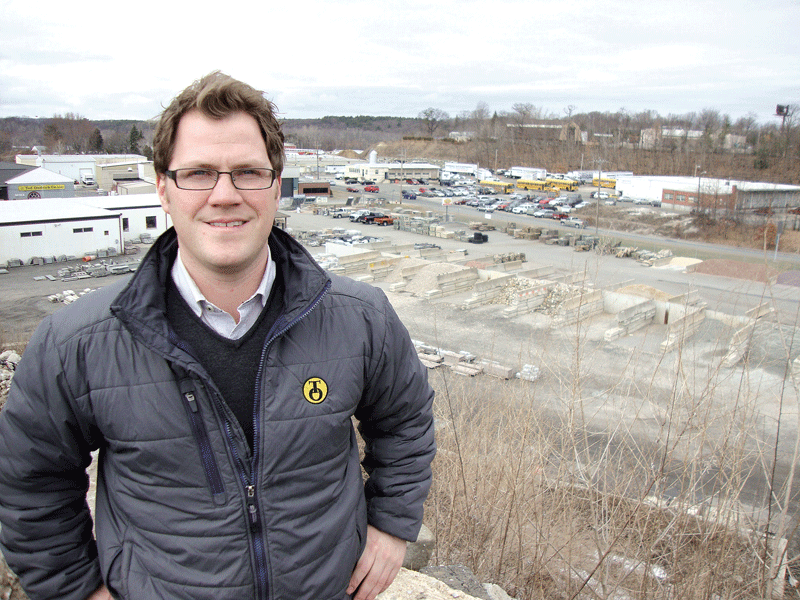
Features
City Leaders Want to Make It Easy to Get Started

Mayor Mike Bissonnette (left) and Tom Haberlin

Mayor Mike Bissonnette (left) and Tom Haberlin hope to see more shovels on the wall as Chicopee builds on its momentum.

Ask anyone about the business community in Chicopee, Mayor Mike Bissonnette told BusinessWest, and you’re going to get a biased opinion.
“Talk to new owners or existing operations, and they’ll tell you,” he said. “They come to City Hall telling us, ‘we want to be here.’”
With one of the Pioneer Valley’s more bustling commercial thoroughfares on Memorial Drive, along with an expanding series of industrial parks adjacent to the Westover Air Force Base, that rhetoric is indeed grounded in pragmatic reality.
But such enthusiasm has been put to the test in recent years, most recently and famously with the profound downsizing at the Callaway Golf plant on Meadow Street. The factory cut back hundreds of jobs due to corporate restructuring — meaning a shift in manufacturing to low-cost wages in Mexico and China — but the city was able to keep operations continuing for some of the more prestigious lines of the brand; for now, roughly 150 to 200 jobs are safe in Chicopee.
While that chip shot into the rough might spell disaster for many other communities’ business base, Chicopee, while impacted, has not been staggered because of its diversified business portfolio — both of varied industries and different geographic locations for growth. And Bissonnette gives a great deal of credit to the seasoned professionals he has in City Hall, all of whom he says are actively engaged in supporting a business-friendly climate for development.
“We have one-stop shopping on permitting and licensing,” he explained, “where we put all our department heads together when someone has a proposal, before they file it, so that we can identify for them what we see as significant issues or potential hurdles that they need to address before they file their plans.”
One of those departments in the city, the Office of Community Development, has a storehouse of ideas on what needs to be addressed within the city and how that can be, or has been, accomplished. Tom Haberlin has decades of experience as the city’s director of economic development, and he said that, while some solid momentum has been building in the Westover business parks and the city’s center, there is still considerable work to be done.
The Westover Economic Development Corp., owner of the burgeoning commercial parks — Airparks North, East, West, and soon-to-be-developed South — is affiliated with the Economic Development Council of Western Mass., and Bissonnette and Haberlin praised that organization for its substantial and fruitful marketing efforts.
“The EDC provides excellent overall region-wide marketing for prospects outside the area,” Haberlin said, “so when developers show up here, they might cast a wider net. Maybe five or six times a month we’ll get a prospectus looking for 25,000 square feet somewhere in the city.”
While new investors eye the desirable properties in the city’s portfolio, such as a $35 million development slated to break ground across from the Home Depot on Memorial Drive containing retail, restaurant, office, and hotel space, there are some businesses that didn’t need to look very far to find the perfect spot in Chicopee.
The John R. Lyman Co. has been a city business since 1906. As owner of the subsidiary LymTech Scientific, the business manufactures specialized wiping cloths for a variety of industrial uses. Third-generation owner Bill Wright said that, when it came time for him to realistically address the modernizing needs for his business, he needed to make a decision.
Should the company relocate closer to its suppliers and core clients, in the southern U.S.? It’s a decision that many business owners face, but for Wright and his wife, Anita, it was simple.
“There’s a lot of heart in my decision to stay,” he said, standing among the boxes scattered around his offices about to be moved to their new location on Westover Road. Like his own history with the company, he said that many of his employees are second- or third-generation also. He could have forced the hand of local officials to keep his expanding business in town, he explained, “but I’m not interested in playing hardball with these people’s jobs.”
Like the officials in City Hall, Wright said that Chicopee is a good place to do business, and his words are echoed by both newcomers to the commercial tax rolls as well as some that have put the city on the map. In this latest profile of the area’s business community, BusinessWest looks at Chicopee, a city that has good reason to have a biased perspective on its commercial future.

Practice Makes Permits
On a large wall opposite his desk, Bissonnette hangs the prized shovels from groundbreaking ceremonies in the city. It’s a fairly large collection, and if the trend continues, he might need a bigger wall.
Chicopee has been fortunate to secure some high-profile business imports, primarily in the Westover area. Bimbo Bakeries, new owner of Sara Lee, is one of the world’s largest commercial bakeries, and on Taxiway Drive, it is completing work on a $33 million warehouse and distribution center.
Bissonnette and Haberlin both agreed that the EDC is doing effective work in terms of attracting new tenants such as the bakery, and they said City Hall’s role in landing these businesses takes the form of making the process for stetting up shop as simple as it can be.
“In my view, the city’s role is to not be an impediment,” Bissonnette said. “In terms of our branding, from a sort of industry standpoint, people talk to each other. We want those people to know how easy it is to start here.”
As an example, he cited the research and development facility for Qteros at Westover. “That was a last-minute decision by Qteros to change its location and come to Chicopee,” he explained. “We were very proud of that. We were able to get their permitting turned around in two weeks, so they could move forward with applications for federal funding.
“The Commonwealth has said that they want to see permitting turned around in six months,” he continued. “They think that’s a good target. I think six weeks is too long, so we try to turn things around from the date it’s filed to the time it’s approved in about two weeks.”
Victor Augusto said that he grew up right around the corner, on Dwight Street, from his present office.
He’s the CEO of Bernadino’s Bakery, a Chicopee institution started by the Stadnicki family back in 1918. A decade ago, he underwent a $1 million expansion to modernize the facility and improve distribution and production. When asked if it would have been more cost-effective to build new, he said the company could have easily relocated to another community.
“Most of our employees live here, though,” he explained. “I would not want to lose them.”
Since the expansion, Augusto said that Bernadino’s has grown, and now provides bread to many area schools and hospitals. But a major avenue of commerce has come from private-label production and distribution of other manufacturers’ products.
“Our trucks are already going to Stop and Shop, with our label,” he explained. “While we’re there, in a few more minutes, we can put in Vermont Breads, or Joseph’s Pitas, or Mission products. Transportation is a good percentage of costs, so these outside companies benefit.”
Augusto said that Bernadino’s range spans most of the Northeast, as far south as New Jersey. He sees the distribution component of his operations as one key to the continued growth of the bakery, despite the trend toward low-carb lifestyles.
While the Atkins Diet phenomenon was a hiccup in the company’s history, he laughed as he described some of the customers that come from far outside the city limits every day to get his signature baked goods.
“One gentleman comes every day from Longmeadow to get one type of bread,” he said, “and he’s tall and skinny!”

People Power
There are many emotions wrapped up in Wright’s decision to move his operations to Westover. He was just a kid when he first started coming to work with his father in the same building where he later operated the company.
“Here we are manufacturing clean-room products in a warehouse built in the 19th century,” he explained. “We had a lot of space, but it was the wrong type of space. These buildings were designed for hand carts, and here we are with gas-powered fork trucks. The accident waiting to happen never happened, and thank goodness for that.”
Meanwhile, Lyman sells his high-tech and industrial wiping cloths all over the world, and to some of the biggest names on these shores. Steinway Pianos is one of his oldest accounts, and locally, he provides cloths to Yankee Candle, Callaway, Hasbro, and E-Ink in South Hadley, maker of the technology found in ‘e-reader’ portable devices, such as Kindles and Nooks.
After a Chicopee Chamber of Commerce event at the Westover municipal airport, he and his wife noticed a building with a large ‘available’ sign. “I wrote the number in my BlackBerry,” he said, “and called them the next morning.
“At the time it was still occupied by a shrinking plastics business,” he continued, “and I thought, ‘what would we ever do with all this space?’ Well, we bought the facility last March, and are constructing a building within the building to house a clean room. We haven’t even moved in yet, and I’m not worried at all about having too much space.”
As Lyman’s business expands into the high-tech arena, so too does his expanding market base. “But we’re a small business,” he said, “and we want to act small — to be reactive and personable.
“Our forte is service and quality,” he explained, “and while it’s tough to go head to head with the competition in Asia, what we do is outperform on this continent, quality and service-wise, because we’re here and we can react fast. We make good product and can make them think twice before shifting to an Asian competitor.”
Even though his client base in this area was once the manufacturing plants that have long since departed, he said that there never once was a thought that he would take the opportunity to expand by relocating his operations elsewhere.
“There’s a pledge of loyalty to our long-time employees,” Lyman said. “There are a lot of second-generation employees, or cousins, friends. There’s a community here.”

Strength in Numbers
It’s business owners like Augusto and Wright who give Bissonnette reason to think that his office’s collection of shovels hasn’t even come close to rounding out.
After the sale last year of 57 acres to the Westover EDC, the proposed Airpark South will have the ability to attract the largest-possible commercial tenants. The mayor cited the region’s loss of Pepsico some years back because no community in the Pioneer Valley had the space available for its needs, which was in the neighborhood of 1 million square feet of floor space.
And with that business community’s strength comes an important aspect for the city at large — a good commercial base to offset homeowners’ taxes.
“For the fifth year in a row we have the lowest residential tax bill in the entire Valley,” Bissonnette said, “and lower water and utility rates than most other communities. One of the things I hear almost universally, from places like Callaway, is that the dedication of the employees, the quality of the employees, is what keeps them wanting to stay here.”
Chicopee might have some hard numbers to put toward that line of thought, also, as census results are tallied. “We believe that our population has gone up, on the order of 1,000-plus. We’ll be one of the few communities in Western Mass to show that kind of growth,” said Bissonnette. “This augurs well for money allocated from the government, based on population. That could easily turn into $15 million to $20 million over the next decade.”
And that will turn into more people who are biased toward the city of Chicopee. Looking over the evidence from all those groundbreaking ceremonies, Bissonnette said, “I believe we are poised to come back bigger and better. I’m privileged to sit here.”

Briefcase Departments

2011 AIM Global Trade Award Nominations Open
BOSTON — The Associated Industries of Massachusetts International Business Council (AIM-IBC) has announced its call for nominations for the 16th annual Global Trade Awards, which recognize Massachusetts firms, institutions, and public agencies of all sizes that have demonstrated excellence in international trade. This year, a new award category will recognize a globally owned company that has positively impacted the Massachusetts economy. Kristen Rupert, executive director of AIM-IBC, noted in a statement that, “this year, we are focusing attention on the value of internationally owned companies, as their significant presence in the Commonwealth has led to the creation or retention of around 170,000 jobs.”Award winners will be honored at AIM’s Annual Meeting & Luncheon on May 13 at the Waltham Westin Hotel.  The deadline for nominations is March 18.  Entry forms are available online at www.aimnet.org/international. Since 1996, the Global Trade Awards have recognized more than 60 Massachusetts companies, institutions, and individuals. The AIM International Business Council helps Massachusetts employers engage in international trade and expand their global business activities. Through seminars, referrals, and e-newsletters, the AIM International Business Council provides companies with resources they need. For more information, visit www.aimnet.org/international.

UMass Research Spending Breaks $500M Mark
BOSTON — Research expenditures at the University of Massachusetts reached $536 million in fiscal year 2010, topping the $500 million mark for the first time in the school’s history, according to a statement by President Jack Wilson. Research spending increased by $47 million, rising from $489 million in fiscal year 2009 to $536 million in fiscal year 2010. The additional $47 million represents a 9.5% increase in research expenditures over the previous year. The research numbers, preliminary at this point, will be submitted to the National Science Foundation later this month. “Part of what makes the University of Massachusetts a world-class university is the sustained effort we have made in the past decade to increase research funding throughout all five of our campuses,” said Wilson. “The research work of our faculty is rocket fuel for the state’s innovation economy.  It is saving lives, cleaning the environment, and stoking economic development in Massachusetts. Our success in this area is the result of the hard work of the faculty, the leadership of the chancellors and their teams, and the encouragement and guidance we have received from our board of trustees.” With 9.5% growth in research spending, total research expenditures at UMass have been growing at a rate that exceeds the national average. Research expenditures have risen from $320 million in fiscal year 2003 to $536 million in fiscal year 2010. “Research activity at the University of Massachusetts has grown sharply over the past several years, and the Commonwealth and all of its citizens benefit from it,” added Wilson.  “The funding we have received creates new companies and new jobs in the state. It provides students with the kind of skills they need to be competitive in the workforce — and most of those students will stay here in Massachusetts to put that knowledge to work in the Commonwealth.” Most of the research that takes place on UMass campuses is externally funded, with the federal government providing research funding through the National Institutes of Health, the National Science Foundation, and other agencies. According to the new report, preliminary fiscal year 2010 research expenditures by campus were: Amherst, $169 million; Boston, $51.3 million; Dartmouth, $26 million; Lowell, $57.4 million; and Worcester, $232 million. The university’s research-expenditure accomplishment comes on the heels of the recent announcement that UMass is now the eighth-ranked university in the nation in terms of income derived from the licensing of faculty discoveries and products. According to the Assoc. of University Technology Managers, UMass, with more than $71 million in income generated in 2009, was the top Massachusetts university in this ranking. Annual intellectual-property income rose from $20 million in fiscal year 2003 to $71 million during fiscal year 2009.

Personal-bankruptcy Filings Rise 8.5% in State
BOSTON — Personal-bankruptcy filings in Massachusetts jumped almost 9% in 2010, compared to 2009, according to a new report from the Warren Group, publisher of Banker & Tradesman. There were 17,496 Chapter 7 bankruptcies filed in Massachusetts last year, an 8.5% bump from the 16,118 filed in 2009, and a 45% hike from 12,034 in 2008. Chapter 7 of the U.S. bankruptcy code is the most common option for individuals seeking debt relief, and accounted for 75% of Massachusetts’ bankruptcy filings last year. The fourth quarter saw the slowest quarterly bankruptcy pace of 2010, with 5,423 filers statewide seeking some kind of bankruptcy protection under Chapters 7, 11 and/or 13, compared to 5,350 in the fourth quarter of 2009. The second quarter experienced the most bankruptcy volume, with a combined 6,193 filings. Chapter 7 bankruptcy filings also accounted for almost 75% of all filings tracked by the Warren Group in the fourth quarter. Chapter 7 bankruptcy filings totaled 4,008 in the fourth quarter, a 4.8% decrease from 4,212 during the same period in 2009. People filing under Chapter 7 bankruptcy can eliminate most debt after non-exempt assets are used to pay off creditors. In contrast, Chapter 13 requires debtors to arrange for a three- or five-year debt-repayment plan. Filings under Chapter 13 of the U.S. bankruptcy code surged 52% to 5,392 in 2010, from 3,547 in 2009. The number of Chapter 13 filings rose 26.5% to 1,359 in the fourth quarter of 2010, up from 1,074 filings during the same period in 2009. Chapter 11 filings, which are used for business bankruptcies and restructuring, also rose in 2010; filings increased 10.2% to 237, up from 215 in 2009. Filings decreased in the fourth quarter, however. A total of 56 Chapter 11 bankruptcies were filed in the fourth quarter, down from 64 during the same period in 2009. A total of 23,125 filers statewide sought protection under Chapters 7, 11, and/or 13 of the U.S. bankruptcy code in 2010, up from 19,880 in 2009.

Small Grants Available for Connecticut River Improvement
SPRINGFIELD — Nonprofits, municipalities, and schools within the watershed of the Connecticut River in Massachusetts and Connecticut are invited to submit project proposals that will result in improved river-water quality, ecosystem health, public awareness, and recreational access to the Connecticut River. This project is a joint effort by the Pioneer Valley Planning Commission, the Capitol Region Council of Governments, the Franklin Region Council of Governments, and the Connecticut River Estuary Regional Planning Agency, which serve the towns in the Connecticut River watershed. Proposals are due March 18. For more information, visit www.pvpc.org. Funding for this project has been provided by the National Oceanic and Atmospheric Administration.

UMass President Praises Obama Decision to Invest in Higher-Ed Innovation
BOSTON — UMass President Jack Wilson recently praised President Obama’s decision to propose the creation of a $123 million fund aimed at fostering reform and innovation in higher education. Wilson called the proposed “First in the World” fund a “farsighted effort to foster educational innovation and to set the stage for long-term national economic growth.” Wilson added that the proposal is consistent with the principles Obama enunciated in his State of the Union address when he said the U.S. must “win the future” by investing in education and by maximizing the capabilities of every student and citizen. Wilson serves as chairman of the National Board of the U.S. Department of Education’s Fund for the Improvement of Postsecondary Education (FIPSE). FIPSE’s mandate is to improve post-secondary-educational opportunities across a broad range of concerns. Through its various grant competitions, FIPSE seeks to support the implementation of innovative education-reform projects, to evaluate how well they work, and to share the findings with the larger education community. The funding for the higher-education-innovation fund, which also seeks to increase college-completion rates, was proposed when Obama unveiled his 2012 federal budget.

Smith & Wesson Receives Tax Break
SPRINGFIELD — With a commitment to add 225 full-time jobs and invest millions of dollars in its plant on Roosevelt Street, Smith & Wesson recently received tax incentives totaling $600,000 over a five-year period. The City Council approved the special tax agreement on a vote of 12-1. Councilor Timothy Rooke voted no because he felt the firm had not met hiring obligations in a financing agreement from 1995. John Judge, Springfield’s chief development officer, called the vote a “big win” for the city, adding that it would set the stage for “bigger and better things” from the company. Councilors noted that the new agreement outlines clearly the requirements that the firm must follow, and that reviews will be done to ensure that guidelines are met. John Dineen, vice president of finance for Smith & Wesson, noted during the council meeting that the firm looks forward to working with the city as it has for the past 159 years. Dineen added that Smith & Wesson will begin filling the new jobs within the next month.

State Businesses Report Record Exports in 2010
BOSTON — Global demand for technology products was good news for state businesses, as exports rebounded in 2010 to the highest level since 2008. High-tech instruments, machinery, and equipment rose 11.3% to more than $26 billion, according to the World Institute for Strategic Economic Research (WISER). WISER, based in Leverett, noted that only in 2008 did state firms sell more than $28 billion in overseas sales. Andre Mayer, senior vice president for research at Associated Industries of Massachusetts, noted that the state’s gains fell “far short” of national export growth. Mayer added that the state’s growth lagged behind the nation because its largest trading partners — Canada, Japan, and Europe — are nations recovering slowly from the global recession. The top export market for Massachusetts products in 2010 was the United Kingdom at $3.2 billion.

Features
The Nominations Are In, and the Judges Are Hard at Work

40 Under FortyHector Toledo was getting ready to leave on a long-awaited school-break-week vacation in Maine, where it’s quite cold in February, but there’s still plenty to do. He said he was looking forward to spending some time away from work and with his family, including his in-laws. And while the slate was pretty full, he said there would be some down time to relax.
Well, maybe there was some down time.
Toledo, vice president and Retail Sales director for Hampden Bank, and proud member of BusinessWest’s 40 Under Forty class of 2008, agreed to be a judge for this year’s program, and further agreed to devote some of his vacation time to the cause. He may have wound up donating more than he planned.
Indeed, Toledo left Hampden Bank headquarters in downtown Springfield with a three-inch-thick packet under his arm, representing the nominations of more than 100 people. Toledo and four other judges will wrap up the scoring of those individuals this week, and then the 40 Under Forty class of 2011 will be known.
The winners will be notified later this week, and the fifth class of 40 will be announced in BusinessWest’s April 25 edition, with the annual gala slated for June 23 at the Log Cabin Banquet & Meeting House.
Kate Campiti, associate publisher and advertising director at BusinessWest, said the heavy workload for this year’s judges speaks well of the 40 Under Forty program, and the region as a whole.
“When we started this initiative, we believed that becoming a member of this club — having a 40 Under Forty award on one’s desk and the ceremonial plaque on one’s wall or cubicle — would become an honor, something to strive for, and it has,” she explained. “Meanwhile, we believed the program would become a way for businesses, nonprofit agencies, and government organizations to showcase their young talent and, in essence, show it off. And that’s happened as well, as evidenced by the number of nominations we’ve received in year five.”
The nominations, which include everything from assorted professionals to entrepreneurs getting businesses off the ground or to the next level, to a high-school student already donating time a number of nonprofits, truly runs the gamut, said Campiti, adding that the judges “really have their work cut out for them this year.”
Those judges are a diverse group, as well, representing several fields within business and two classes of the 40 Under Forty program. They, too, will be recognized on June 23, and they will have earned their applause and BusinessWest’s tokens of thanks (still to be determined to build suspense). Our judges are:

Hector Toledo

Hector Toledo

• Hector Toledo, who, in addition to his work with the bank, has long been very active in the community. He is currently chair of the Board of Trustees at Springfield Technical Community College (from which he graduated), and has long been active with the Juvenile Diabetes Foundation, Springfield’s libraries, his church, and a host of other nonprofit groups;
• Dianne Fuller Doherty, regional director of the Western Mass. Regional Office of the Massachusetts Small Business Development Center Network (MSBDC) since 1992. Part of the Isenberg School of Management at UMass Amherst, the MSBDC offers free and confidential business-advisory services, training programs, and information and referral to small businesses in Western Mass. Previously, she founded and served as president and CEO of Doherty-Tzoumas Marketing, a full-service advertising and public-relations firm based in Springfield. Active in civic affairs in the Greater Springfield area, Doherty is a founder of the Women’s Fund of Western Mass., an
Dianne Fuller Doherty

Dianne Fuller Doherty

endowment to support women and girls. She also serves on the boards of the Pioneer Valley Plan for Progress, Bay Path College, the Community Foundation of Western Mass. and the Regional Technology Corp. She is also a board member of Digital Divide Data, a U.S.-based, nonprofit corporation that offers employment and educational opportunities to disadvantaged youth in Cambodia and Laos, by addressing the technology divide;

  • Eric Gouvin, a professor of Law at the Western New England College School of Law and director of the WNEC Law and Business Center for Entrepreneurship, which provides a number of services to ‘low-income’ business owners, including clinical support and several forms of community outreach. Prior to joining the faculty at WNEC, Gouvin practiced corporate, commercial, and banking law with a large firm in Portland, Maine. He worked on

Eric Gouvin

Eric Gouvin

matters for business clients ranging from Fortune 500 companies to small, closely held concerns. He has been very involved in entrepreneurship education, having founded the Small Business Clinic at the WNEC School of Law, serving on the Board of Editors for the Kauffman Foundation’s eLaw Web site, and being a member of the Board of Advisors for the Scibelli Enterprise Center and for the Harold Grinspoon Charitable Foundation’s Entrepreneurship Initiative. His areas of scholarly interest include corporate, banking, and entrepreneurship law, often with an international or comparative perspective;

• Jeffrey Hayden, director of the Kittrredge Center for Business and Workforce Development at Holyoke Community College, which houses a number of workforce-development programs, the Mass Export Center, and WISER, the World Institute for Strategic Economic Research. Previously, he was the long-time director of the Holyoke Office of Planning and Development and the Holyoke Economic Development and Industrial Corp. In those capacities, he worked on a wide range of economic-development-related programs, and also assisted dozens of small businesses with efforts to locate and expand within Holyoke; and

Jeffrey Hayden

Jeffrey Hayden


• Michael Vann, a principal with the Vann Group, a professional-services firm that provides small to mid-size businesses with solutions such as accounting and bookkeeping, human resources, recruiting, and strategic advisory services. He is responsible for the day-to-day operations of the group’s strategic-advisory services and merger/acquisition activities, where he serves as the trusted adviser to several of the group’s key clients. In addition to his duties with the Vann Group, he serves on the Board of the Alden Credit Union and is actively involved in a number of charitable organizations. He is a member of the 40 Under Forty Class of 2007.
Michael Vann

Michael Vann

For more information on the 40 Under Forty gala or to order tickets — $60 per person ($50 for members of the Young Professional Society of Greater Springfield and Northampton Area Young Professionals), with tables of 10 available — call (413) 781-8600, or visit www.businesswest.com.

Departments Picture This

Send photos with a caption and contact information to: ‘Picture This’
c/o BusinessWest Magazine, 1441 Main Street, Springfield, MA 01103
or to [email protected]

Cones for Kids

Cones for Kids

Cones for Kids

Andrea McKenna, executive vice president and chief marketing officer for Friendly’s, shows off a T-shirt presented to her by Easter Seals Camp Friendly’s counselor Flemmings Beaubrun (far right). Pictured with McKenna are Jim Williams, president and CEO of Easter Seals (center), and staff from Easter Seals’ National Office in Chicago. The group visited Friendly’s last month to mark the start of the company’s 30th annual Cones for Kids fund-raiser to help kids with disabilities go to summer camp.

Photo by Dennis Vandal, Vandal Photo

Cutting the Ribbon

Cutting the Ribbon

Cutting the Ribbon

Alliance Medical Gas, an engineering firm that designs, sells, services, and installs medical gas systems for health care providers, has become a new tenant in the Scibelli Enterprise Center in the Technology Park at Springfield Technical Community College (STCC). On hand for the official ribbon-cutting at the announcement of the move are, from left: Marla Michel, director of the SEC and executive director of Economic Development Strategies at UMass Amherst; Linda Crouse, director of Marketing for Alliance; Springfield Mayor Domenic Sarno; Chester Wojcik, president of Alliance; Michael Suzor, assistant to the president at STCC; Glenn Welch, executive vice president of Hampden Bank and chairman of the SEC Advisory Board; and Robert Greeley, president of the R.J. Greeley Co., leasing agent for the tech park.

Opinion
Taking Away Lessons from Evergreen Solar

It was a headline that many in this region might have missed, lost amid the shootings in Arizona, a slew of snowstorms and subsequent cleanup efforts, and the area NFL franchise starting the offseason much earlier than expected. But it certainly bears noting.
Evergreen Solar, the solar-panel maker that opened a plant at the former military base in Devens just two years ago, amid considerable fanfare and with state aid to the tune of $58 million (one of the largest packages ever awarded in Massachusetts), announced on Jan. 12 that it would be shuttering that facility, thus eliminating about 800 jobs. That news was bad enough, but it got worse when the company said, in essence, that it was a victim of weak demand and competition from China, and would be shifting work to that country, where it also has a plant. Company officials would say only that this was “a grueling decision for any management team to make.”
The announcement must have sent shockwaves through the Statehouse, where the Patrick administration, which worked hard to bring Evergreen here, touted the company as perhaps the best example statewide of the emergence of clean-energy technology as a source of both new jobs and economic development, and as a indication that the Commonwealth’s shrinking manufacturing base could in fact diversify itself and find new avenues for growth.
What’s more, state officials cited Evergreen as a fine illustration of how state incentives could be effectively put to use to create jobs, drive innovation, and stimulate momentum at a time of economic duress.
So much for all that.
In the wake of the announcement, state officials searched hard for a silver lining to these clouds (no pun intended), but couldn’t find any. Instead, they were left to start backpedaling on the dollar amounts actually given to Evergreen (so the damage might not look as great), tallying up all that the corporation will have to give back to the state — $3 million in direct grants and perhaps $20 in future tax breaks — because it didn’t meet the terms stipulated in the aid agreement, and offering some hope that the many infrastructure improvements (mostly new roads) undertaken as a result of the project would benefit future endeavors.
But in the end, this is a huge setback for the state, one that will definitely leave a mark — and no shortage of skeptics to question the next clean-energy deals to come down the road.
In the end, though, no mistake is a complete loss if people can learn from it. What can we learn for this?
For starters, don’t put so many eggs in one basket. This is easy to say in hindsight, but a lot of people were saying it before the state handed over nearly $60 in incentives. Many were questioning the strength and longevity of the solar-panel business and casting doubts about whether this country could compete, cost-wise, with China on such products, despite public-sector support.
The conventional thinking then (and even more so now) would be that $58 million would be much better-spent on many different initiatives with promise. Some would not have worked out, but, undoubtedly, some would have. By going all in — or close to that — on Evergreen, the state left itself vulnerable to a big hit, and that’s what happened.
The other big lesson: don’t give up on clean-energy ventures. The Evergreen meltdown will undoubtedly leave the state gun-shy when it comes to future opportunities of this kind, and while an extra dose of caution, or two, is in order, there is no need to abandon this emerging sector and leave it to other states, regions, or countries.
There are a number of former manufacturing hubs, like Springfield, Holyoke, Chicopee, and others, that are still at the beginning stages of the reinvention process. Clean-energy developers can still play a big role in that process.
Like the Patriots’ debacle against the Jets, the Evergreen Solar experience is a tough and, in some ways, embarrassing loss for the Commonwealth. It will be interesting to see if and how it bounces back.

Features
A Progress Report from the State’s Economic-development Czar

Greg Bialecki, secretary of Housing & Economic Development

Greg Bialecki, secretary of Housing & Economic Development

As the Patrick administration begins its second term in office, the focus, from an economic-development perspective, will be to continue to use public dollars to leverage private investment, says Greg Bialecki, secretary of Housing & Economic Development. He noted that so-called gateway cities such as Springfield and Holyoke need investments from the state to stimulate private spending and create new sources of jobs and overall economic vitality. In a wide-ranging Q&A touching on everything from corporate incentives to market-rate housing development, Bialecki talks about what’s been accomplished, and the work still to do in such cities.

Greg Bialecki acknowledged that that much of the progress being seen in Springfield and other area communities has been generated by state and/or federal assistance — on one level or another.
Examples abound, from the presence of Liberty Mutual in the Technology Park at Springfield Technical Community College to the high-performance computing center in Holyoke; from the tax incentives recently awarded to Smith & Wesson in exchange for its pledge to create 225 new jobs at its Springfield plant and make significant investments there, to the backup data center soon to be take shape at the former Technical High School on Elliot Street in Springfield.
Bialecki, the state secretary of Housing and Economic Development, prefers to look at the state’s contributions as investments that will help trigger private-sector spending in older, former manufacturing centers, like Springfield, Holyoke, Chicopee, and others, that need a boost in their efforts to reinvent themselves and spur economic growth.
The Deval Patrick administration’s strategic plan has been to make prudent, well-thought-out investments capable of generating significant returns, said Bialecki, adding that this policy will continue in the second term that started this month, and that, given some help in the form of economic recovery, such returns should soon be visible and measurable.

data center

The data center taking shape at the old Tech High building is another example of state investment in a gateway city — Springfield.

In this Q&A, BusinessWest sounded out the state’s economic-development czar on what’s been accomplished to date, and what can be expected in the months and years to come.
BusinessWest: Talk about the state’s investments in economic development and the goals and expectations that come with this assistance.

Bialecki: “Everyone who does investing is always looking for leverage, and the state is no exception. The governor has asked me to look for opportunities where a state investment will be matched, not just one-to-one, but many times over, by private investment. The high-performance computing center is a good example of that; the state has committed $25 million to that effort, which will probably be a $160 million project when all is said and done, and a number of private colleges involved have made sizeable investments as well. Originally, we put out the promise of some public funding to encourage private funding, but at this point, all the money that’s needed to make this go is in hand.
“Smith & Wesson is another example. Our $6 million investment tax credit is probably going to be about 10% of the actual private investment. Smith & Wesson has committed to spend at least $60 million in new plant equipment there over the next several years, so we’re just making a commitment that’s way overmatched by private investment.”

BusinessWest: How do these investments fit into the state’s broad strategic initiative involving the so-called Gateway Cities, such as Springfield and Holyoke, and are there signs that state-assisted projects are, in fact, stimulating private development?

Bialecki: “You can see some examples of the model this administration is advancing taking place in Springfield. Liberty Mutual is one, and the old federal building, 1550 Main St., is another, and so is the data center. These are public/private projects, for the most part, and examples of how state assistance has been provided to help older cities. We do believe that, if you’re really going to be a catalyst for economic development and job creation, we need to be thinking not only about places where we can do public projects — Union Station might be an example — but balancing that out with projects where we are providing an incentive for private investment.
“These projects send a bit of a different message about the way we think of the economic potential of different regions of the state, including our older cities. In other words, this approach is based on the view, the perspective, that good things are happening in all the regions and many of our cities, and if we can address their challenges, but also talk up the good things about them, we can convince private business to locate there.”

BusinessWest: Some people and groups criticize such public assistance to private companies, calling it corporate welfare and a flawed system for spurring economic development and job growth. How do you respond to that, and does the state need to make such incentives available to compete with other regions and cities?

Bialecki: “We believe that some level of assistance is probably required in a number of these places to help people make the decision to locate in a Springfield or locate in Western Mass., in part because of what other regions are offering, but also in part because some companies like it here and want to be able to stay here.
“Frankly, the Smith & Wesson deal, although that was real money, was in a way a blockbuster deal, in terms of the amount of incentives compared to what other states are offering. We have other states offering some of our companies huge deals — they’re saying, ‘if you move here, we’ll build you a factory, and we’ll pay for it.’ And if you talk to Smith & Wesson and ask them if the state’s willingness to commit to incentives was an important part of their decision, they’ll say, ‘yes, absolutely.’ But they’ll also say that they really like being in Springfield, we’ve got a great workforce; it’s not a case where they’re saying, ‘we don’t want to be in Massachusetts, we don’t wan’t to be in Springfield, but if you pay us enough, we’ll stay here.’ They want to be here.”

BusinessWest: How important is balance, in terms of public and private investments, to a city’s long-term success?

Bialecki: “Very important. The ultimate goal, obviously, is to maximize the amount of private-sector job-creation and private-sector investment in the region. We’re glad to continue to make significant public investments as well, but, realistically, and from our point of view, you’re only to going to be able to say we have a healthy economy in Western Mass. if there’s not only public dollars going into employment and investment, but also private dollars, and more private dollars than public.”

BusinessWest: Talk about the plight of the gateway cities and what the state is doing to assist them.

Bialecki: “Our approach is very consistent in that we don’t look down condescendingly on these cities — we view them as being able to participate in and contribute to the economic health of the state. We want them to be in the mainstream of the business mix in the state. What are the big industries in Massachusetts? Health care, higher ed, financial services, high tech … a measure of our success should be that those industries are in our gateway cities. In Springfield, MassMutual was already there, but getting Liberty Mutual was big — these are Fortune 100 companies, and they both have a presence there.
“There are also many colleges and universities in Springfield, and that’s important, as well as Baystate Medical center and other health care providers. We want to add the tech sector to that mix, and the high-performance computing center will help. We want the gateway cities to be in the mainstream of the state’s economy, especially the innovation economy.”

BusinessWest: What role does housing, specifically market-rate housing that will, theoretically, attract young people and professionals, play in economic development, and what is the state doing to stimulate such developments?

Bialecki: “Housing is a critical component, and we want to make sure that cities have a good mix of all kinds of people living within their boundaries. We want there to be enough affordable housing for those at that end of the spectrum, but also enough places for people who are middle-class and above and have choices about where they want to live. How can we create an environment where people will want to live in our gateway cities?
“We started a new program where, for the first time, we have money available to provide tax-incentive support for people to create market-rate housing in gateway cities. It’s a pilot program with $5 million available initially, and it’s something [Springfield] Mayor [Domenic] Sarno has expressed great interest in. Officials in Springfield have done an inventory of what market-rate housing is available today, and identified potential pipeline opportunities where such housing can be created; developers will probably need some help, and we’re willing to do that.”

BusinessWest: Is there a policy or strategic plan for helping these cities, and if so, what are the main elements?

Bialecki: “Some of the strategies that people have talked about in the past for helping gateway cities have been to mitigate the challenges and the problems facing these cities, such as public safety, and those are important things to do. But we are actually aiming higher. We’re not just trying to mitigate the problems; our vision focuses on determining what these cities, like Springfield, would look like if they were functioning at a high level and were contributing to the economic life of the region.
“And if you look back, all of these played that role at one time, some more recently than others. Holyoke was the first planned industrial city in the country, New Bedford was the whaling capital of the world, and Lowell and Lawrence were main textile centers. Most all of these cities were, at some point in time, not just keeping up with the economic prosperity of their neighbors, they were driving the economic prosperity of their respective region.
“We understand the challenges, but we think that that is the right aspiration to have for these cities: what would it look like and feel like for Springfield to be that driving force again?”

BusinessWest: What are the immediate hurdles to achieving that goal, and what has to be done for the city to achieve this vision?

Bialecki: “There are a lot of good building blocks in Springfield, like its colleges, universities, and fine health care facilities. We would like to see other aspects of the innovation economy; we’d like to see more tech companies. There are some initiatives with incubator space [at STCC], and there is the Pioneer Valley Life Sciences Initiative to get some other life sciences and biotech. There is plenty to build on.
“And development of these sectors goes back to my earlier comments about how many projects require some measure of state assistance. While it’s true that, to jump-start some of these things, assistance is needed, our goal is to move off that.
“In other words, let’s talk about the things we have to do in Springfield and the other gateway cities so that the businesses will say, ‘you don’t need to persuade me to open a new business unit in Springfield — that’s where things are happening; that’s where I want to be.’

BusinessWest: Is there a model to be followed in terms of such a recovery?

Bialecki: “Lowell is the classic; that’s the one everyone points to, and they have had a good deal of success over a prolonged period of time, going back to the ’80s. But I’ve seen some very impressive changes and improvements more recently, over the past four years, for example. In Haverhill, the mayor has made a big focus on market-rate housing in the downtown, mostly in old mills and even to the point where people said, ‘what are you doing?’ But it’s worked out very well; he’s got a lot of telecommuters there and people who can work anywhere, and it’s a short commute to Boston. And he’s generated a lot of street life, a lot of new restaurants.
“And New Bedford’s done very nicely. We’ve helped them with some things, and they’ve used those projects to trigger some private investments; there is a nice creative-economy element to what they’ve done, with a lot of artists moving in.
“The thing about gateway cities is that there’s no silver-bullet project that’s going to put you over the top; it’s an accumulation of things that are going to make a difference, including that all-important private investment.”

George O’Brien can be reached at [email protected]

Agenda Departments

Smart Growth Zoning
Jan. 24: Proposed locations for Chapter 40R Smart Growth districts will be presented to Ludlow residents at 6 p.m. at Ludlow Town Hall. Chapter 40R Smart Growth zoning districts encourage a higher concentration of housing and mixed-use developments in areas with existing infrastructure to create a range of housing options and spur community revitalization. Communities that adopt Smart Growth zoning districts are eligible to receive special state funds. The presentation will be facilitated by the town’s Smart Growth Zoning Advisory Committee and the Pioneer Valley Planning Commission.

Clio Awards
Jan. 26: The Ad Club of Western Mass. will showcase the 2010 television/cinema winners from the 2010 Clio Awards, one of the most recognized international advertising, design, and communication competitions, from 11:30 a.m. to 1:30 p.m. at Rivers Memorial, Western New England College, Springfield. Reservations must be made by Jan. 19 by calling (413) 736-2582. The cost is $25 for Ad Club members, $35 for non-members, and $15 for students. For more information, visit www.adclubwm.org.

Visionaries Forum
Jan. 28: The University of Hartford’s Construction Institute will host its second annual Visionaries Forum, part of the A/E/C Issues series, “A Visionary Approach to Design and Construction,” from 8:30 to 11:30 a.m. at the Crowne Plaza Cromwell in Cromwell, Conn. Program registration, continental breakfast, and networking will begin at 7:45 a.m. For more information or to register, visit www.construction.org.

Rick’s Place Benefit
Feb. 5: The third annual Heart to Heart fund-raiser for Rick’s Place is planned from 6:30 to 10 p.m. at the Ludlow Country Club. Established in memory of Rick Thorpe, who died in Tower Two of the World Trade Center on 9/11, Rick’s Place was created to provide a supportive, secure environment where families can remember their loved ones and avoid the sense of isolation that a loss can produce. For ticket information, call Shelly Bathe Lenn at (413) 348-3120 or visit www.ricksplacema.org.

Business Open House
Feb. 9: The Scibelli Enterprise Center at the STCC Technology Park in Springfield will host an open house titled “Growing Successful Small Businesses” from noon to 1 p.m. The event is offered to explain how the Enterprise Center is the regional hub for entrepreneurship for Western Mass. Small-business owners and service providers are encouraged to attend the open house. For more information, call (413) 755-6109 or visit
www.springfieldincubator.com.

National College Fair
March 6-7: The Eastern States Exposition in West Springfield is the setting for the Springfield National College Fair, slated from 1 to 4 p.m. on March 6 and from 9 a.m. to noon on March 7. Sponsored by the National Assoc. for College Admission Counseling and hosted by the New England Association for College Admission Counseling, the event is free and open to the public. The fair allows students and parents to meet one-on-one with admission representatives from a wide range of national and international, public and private, two-year and four-year colleges and universities. Participants will learn about admission requirements, financial aid, course offerings, and campus environment, as well as other information pertinent to the college-selection process. Students can register at www.gotomyncf.com prior to attending the event to receive a printed bar-coded confirmation to use on-site at the fair as an electronic ID.

Summer Business Summit
June 27-28: The Resort and Conference Center of Hyannis will be the setting for the Summer Business Summit, hosted by the Mass. Chamber of Business and Industry of Boston. Nominations are being accepted for the Massachusetts Chamber, Business of the Year, and Employer of Choice awards. The two-day conference will feature educational speakers, presentations by lawmakers, VIP receptions, and more. For more information, visit www.masscbi.com.

Departments Picture This

Send photos with a caption and contact information to: ‘Picture This’
c/o BusinessWest Magazine, 1441 Main Street, Springfield, MA 01103
or to [email protected]

Grainger

Tools for Tomorrow

Two students in the Energy Systems Technology program at Springfield Technical Community College were recently awarded $2,000 scholarships from W.W. Grainger. In addition to the Grainger Tools for Tomorrow scholarship, the students will each receive a customized professional Westward toolkit, valued at $1,000, upon graduation. From left, STCC Energy Systems Technology Department Chair Bob Bujak; scholarship winners Brian Patterson and Luke Hardy; John Duffy, branch manager of the W.W. Grainger Springfield office; and Energy Systems Professor Michael Siciliano.

LinkToLibraries

Future Writers

BusinessWest Editor George O’Brien reads to students at Springfield’s Dorman School as part of the Link to Libraries read-aloud program. The students were given a book to take home, as well as a Link to Libraries book bag.

Court Dockets Departments

The following is a compilation of recent lawsuits involving area businesses and organizations. These are strictly allegations that have yet to be proven in a court of law. Readers are advised to contact the parties listed, or the court, for more information concerning the individual claims.

FRANKLIN SUPERIOR COURT
Paula Parsons, as executrix of the estate of Catherine Wellinger v. The Arbors at Greenfield
Allegation: Negligence and failure to provide adequate staffing and supervision, leading to wrongful death: $25,000+
Filed: 11/15/10

HAMPDEN SUPERIOR COURT
Alton E. Gleason Co. v. Cardaropoli Realty
Allegation: Breach of contract: $49,150
Filed: 11/12/10

Baystate Contracting Services Inc. v. Weston Sampson CMR Inc.
Alle gation: Failure to pay under the terms of a construction agreement: $122,031.70
Filed: 11/11/10

Bradco Supply v. Multi-State Roofing Inc.
Allegation: Non-payment of goods sold and delivered: $34,916.38
Filed: 11/3/10

Central Mutual Insurance v. All Hose Inc.
Allegation: Negligence causing fire damage to a property leased to defendant: $263,326.89
Filed: 11/5/10

Michelle Ruby v. Cyalume Technologies Inc.
Allegation: Unfair and deceptive business practices: $268,000
Filed: 11/9/10

Western Mass. Electric Co. v. Springfield Technology Corp.
Allegation: Non-payment of utility services rendered: $158,542.50
Filed: 11/3/10

NORTHAMPTON DISTRICT COURT
EMAP Limited v. The October Co. d/b/a/ Chemetal
Allegation: Breach of contract and unjust enrichment: $18,251.95
Filed: 12/13/10

SPRINGFIELD DISTRICT COURT
Accutech Insulation & Contracting v. Springfield Group Inc.
Allegation: Non-payment of materials, equipment, and services on a construction project: $16,677.46
Filed: 11/22/10

Performance Food Group v. Elita 7, LLC d/b/a/ Donna Kay Rest Home
Allegation: Non-payment of goods provided on credit account: $34,935.88
Filed: 11/23/10

Performance Food Group v. Samco and Jason J. Boucher
Allegation: Non-payment of goods provided on credit account: $47,220.82
Filed: 11/23/10

Performance Food Group v. Worcester Light d/b/a Anna Maria Rest Home
Allegation: Non-payment of goods provided on credit account: $35,072.77
Filed: 11/23/10

United Rentals v. Converted Organics Inc.
Allegation: Non-payment of materials, equipment, and services on a construction project: $19,068.62
Filed: 11/19/10

United Rentals v. Maxton Technology Inc.
Allegation: Non-payment of materials, equipment, and services provided on a construction project: $27,506.31
Filed: 11/22/10

WESTFIELD DISTRICT COURT
Pioneer Valley Winnelson Co. v. Statewide Mechanical Contracting Inc.
Allegation: Non-payment of goods sold and delivered: $22,440.99
Filed: 12/8/10

Sections Supplements
Stock Market Expected to Grow Along with Economy in 2011

Paul Valickus calls it “the Christmas-tree analogy.”
“Christmas tree sales over this past Thanksgiving weekend were up 12% year over year,” he said — and then wove that fact into his stock-market outlook for 2011. “That may sound a little silly, but it tells me that people were more confident and wanted to start celebrating a little earlier, to spend a little more money. It was an indicator of hope, if you will.”

President Michael Matty,

Paul Valickus (left), with St. Germain Investment Management President Michael Matty, says all signs point to a strong year on Wall Street.

It may be a small point, said Valickus, chief investment strategist at St. Germain Investment Management in Springfield, but it’s one of many larger trends — a decline in business vacancy rates and an uptick in employment among them — that point to rising confidence in a slowly improving economy, and that bodes well for the stock market in the coming year.
“I normally don’t make market forecasts, but I think this is an easy one,” Valickus said. “I think the economy and the stock market are going to do much better than most pundits are expecting.”
He cited last month’s Barron’s magazine forecast, which gathers the projections of 10 market experts, most of whom expect stock-market growth around 10%. “For me, that’s kind of a chicken forecast. A rise of 10% is what the market averages, trendwise, going way back. I think they’re just afraid to stick their necks out.”
Coming off the strong market surge late in 2010, George Keady hears the positive drumbeats, too, but has a different take. “That concerns me,” said the senior vice president and branch manager of UBS Financial Services in Springfield. “Don’t forget that what went on in November and December may have been an early 2011 gift. A lot of the movement in equity prices was a little premature.
“We’re expecting a moderate recovery in the economy — not a strong recovery, and not a double-dip,” Keady added. But because the market is all about expectations, he explained, that optimism has already been factored in. “When you see stocks move to the degree they moved in one month, that’s pretty optimistic. We have a positive outlook for next year, but part of next year happened in December.”
Boston Globe columnist Steven Syre agrees, noting that “a good deal of economic enthusiasm is already baked into the market. The S&P 500 index has climbed 21% in just the past four months.”

Changing of the Guard
Valickus, however, believes the upward movement is far from over, and he traces that belief back to the midterm elections two months ago, arguing that businesses spent the past two years in limbo in terms of their expectations about taxes, regulations, and other issues affected by the goings-on in Washington.
“Where I differ from a lot of people is, I think the economy will do a lot better than people expect, and I think the biggest catalyst is the November elections; people have a little more confidence in the business outlook now that Democrats lost their majority in the House.
“There’s a lot of pent-up demand out there,” Valickus added. “People were just afraid to do anything with certainty; they’re most comfortable having a Republican Congress going forward. Whether the Republicans are successful or not, there is that hope out there that maybe we’ll see a little more discipline in Washington. What the market abhors is uncertainty, and things now look a little more certain. Nothing is written in stone, but people are a little more comfortable.”
Writing in Barron’s, Kopin Tan sums up the view of the analysts who spoke with the magazine, noting that their modest projections about market performance bely a much more positive long-term outlook on the economy.
“A majority see 2011 as the year when a sustainable economic recovery takes root, winning over skeptics and persuading both companies and consumers to relax their stranglehold on squirreled-away cash,” Tan writes. “Improving confidence and low interest rates bode well for corporate profits. Meanwhile, the Federal Reserve remains hell-bent on propping up asset prices, and wages and prices of goods aren’t rising enough to sound an inflation alarm that would lead the central bank to alter its course of aggressive benevolence.”
Specifically, the strategists projected stock-market gains ranging from 7% to 17%. And while progress could be set back by global flareups such as trade tensions and conflicts in places like Iran and the Korean peninsula, Tan notes, “the market has started to flinch less at each flare-up of risk.”

Mixed Signals
At a time when rising interest rates are expected to weaken the bond market in 2 011, stocks are justifiably generating enthusiasm, but Keady pointed out that the picture is not rosy across the board.
For instance, he explained, while technology and consumer staples remain strong, health care and energy are charting a flatter course, and more than 30% of the companies in the S&P 500 overall were actually down in 2010.
Analysts note that prolonged cost-cutting and increasing consumer confidence, among other factors, point to long-term economic growth, but Keady said these market fundamentals still have to catch up with equity prices.
But in the short term, much of the market’s performance will depend on increasing confidence, and how long it can be maintained.
“What most people don’t understand is that the market can go up without the economy doing anything,” Valickus said. “People say, ‘wait, unemployment is 10%; how could the market go up?’ But it’s not what happened today; it’s what will happen tomorrow. That’s where a lot of people get confused.”
Still, judging by those Christmas trees in November — as well as plenty of other positive signs — confusion is giving way to confidence, and investors are putting more stock in the market.

Joseph Bednar can be reached at [email protected]

Sections Supplements
Innovative Business Systems Hones Its Pitch

IBS President Dave DelVecchio

IBS President Dave DelVecchio

In 20 years, Innovative Business Systems has evolved from a software-development firm to an outfit that businesses of all kinds rely on to manage their computer networks, data security, and a host of other high-tech needs. But as it celebrates this anniversary, IBS has launched a rebranding effort that aims to better-clarify what its services are, and why they are becoming increasingly necessary.

Dave DelVecchio says that the speed at which information technology advances can leave business owners confused, buffeted by buzzwords, and unsure of the value of an IT partner.
Innovative Business Systems Inc. has successfully built such partnerships for two decades, but DelVecchio, the company’s president, and his staff recently began to ask whether its customers and, perhaps more important, prospective clients really understand the need for its services.
“So many IT companies are so fixated on the ‘how’ that they can’t communicate the ‘why,’” he told BusinessWest. “We’re focused on helping businesses determine the why.”
Last year marked a 20th anniversary of sorts for this Easthampton-based IT sales and support firm (which launched in 1987 but didn’t officially incorporate until three years later). “And, as major milestones tend to be, that became a time for reflection,” DelVecchio said.
He explained that IT changes so much in a few years — “for some people, that’s a blink of an eye, but in our industry, it’s a lifetime” — that questions arose regarding how well IBS was delivering its message to the public.
“We weren’t sure we were doing an effective job communicating with prospects, clients, and the general public exactly what we do,” he explained. “Sometimes, we’re too close to it to communicate it ourselves.”
So the company launched a rebranding campaign, looking for a succinct way to communicate its range of services, and at the same time refreshing its logo. It enlisted an outside consultant for these tasks, and launched a new Web site earlier this month, presenting itself with the new tagline, “smarter technology for better business.”
“A lot of people historically have thought of companies like ours as computer repairmen, like they think of appliance repairmen or auto mechanics,” DelVecchio said. “That’s not what we do, or, it’s a very small subset of what we do.”
Rather, he said, “we help folks cut through the clutter of ever-changing technology, to find out what’s the right fit for a business, what’s applicable and what’s not, what fads stick and what’s a flash in the pan. We want to have conversations with them from a business perspective, not just a technology perspective. And we felt this tagline best encapsulates that.”

Gang of Five
Bill Tremblay began Innovative Business Systems in 1987 as a software-development outfit (more on that later), then sold the firm in 2003 to five employees — DelVecchio, Brian Scanlon, Scott Seifel, Ben Scoble, and Sean Benoit — who continue to run it today.
IBS handles PC sales, data analysis, networking, hardware and software support, repair, and maintenance services for businesses of all sizes. It built much of its business in the financial-services arena, working with banks and credit unions — both those with their own existing IT departments and those without — on issues including data access, information security, and disaster-recovery planning.
The rest of the IBS client list is comprised largely of small-to-medium-sized, privately owned businesses in a wide range of sectors, from health care to manufacturing, many of which are not large enough to have their own IT departments but view the need for constantly updated technology as a growing necessity.
“For many years, our niche was supporting banks and credit unions,” DelVecchio said. “But we’ve got multiple 10-employee companies running technology rivaling what the banks are running — remote offices, mobility suites, document imaging, hosting their own Web-based data applications, some of them being publicly accessible, and some in industries with strict security requirements.”
He said he gets annoyed when people assume that the need for the services IBS provides are always related to the size of the client. Instead, “the more technology-driven a business is, the better fit they are for us, regardless of size.”
One of the biggest issues IBS has dealt with in recent years has been access to data from various computers, company locations, or remotely. A related, and often equally important, consideration is data recovery, because it can be disastrous for a business to store information in one office only.
DelVecchio is especially excited about the company’s new data center in Marlborough, which will serve as a remote office, but, more importantly, as a disaster-recovery suite. In case of some event that renders a customer’s place of business unusable, IBS can transfer the contents of the client’s entire network to the Marlborough office, which is equipped with four workstations, in effect providing a location for that customer to continue to operate.
“From a solutions standpoint, this is huge,” he said. “In case of a localized disaster, like a fire, a flood, a sprinkler goes off at midnight and leaves the office knee-deep in water, this location is, in most cases, within an hour’s drive, so you have a place to function.”
Why Marlborough? Its distance is an asset, DelVecchio said, explaining that disaster-recovery suites should be close enough that the commute isn’t too onerous, yet far enough away to be clear of a regional disaster; 45 to 60 minutes away is ideal.
And while most businesses might never need the use of such a facility, many will, especially those in multi-tenant buildings, and should appreciate paying around $3,500 annually for a “a business continuity plan in a box,” he said.
“For tenants in a mixed-use, multi-tenant building, the odds of a localized disaster go up by a factor of 10. When you have a lot of tenants, all it takes is the tenant next door to plug up the drainpipe with grass and knock out the sprinklerhead, or put a candle too close to a curtain, to cause an issue. In multi-tenant buildings, we see this as an incredibly underused but much-needed solution.”

Down to Earth
Putting this sort of real-life face on often-complex technology is key to IBS’ new focus on communicating the big picture to clients, DelVecchio said.
He noted that Microsoft has been promoting ‘cloud computing’ — a term synonymous with Internet-based computing, whereby shared servers provide resources, software, and data to individual computers and other devices — “but if you ask 100 people what the cloud is, you get 100 different answers. The cloud can be a lot of things.”
He compared it to 15 years ago, when the commercial use of Internet technology was just exploding, and “cyber” became the hot buzzword, even though it wasn’t always used correctly. “We’ve developed our own cloud strategy to cut through that clutter.”
What businesses need to understand, he said, is what those buzzwords mean, and how the technology behind them can benefit their operations. He said some have predicted that 80% of all IT services will be cloud-based within five years, but feels that number may be a bit aggressive; he sees many firms using a hybrid approach. “Businesses might be running things like E-mail in the cloud and applications on premises, or vice versa. Determining the right mix for business is the foundation of what we do.”
No IT firm can be everything to all its clients, so IBS touts a number of ‘partners’ on its Web site — not formal partnerships, but related companies with whom IBS shares clients — that do a good job at what they do, and can benefit Innovative’s customers. “Building a strong partner network is something we take a lot of pride in; it takes a village to maintain an IT infrastructure, but we can be the hub that facilitates getting it done.”
Like companies of all sizes and in all sectors, IBS has endured a sluggish economy for the past few years, but felt it mainly in product sales, not consulting.
“In 2007 and 2008, most companies were investing in their business, with technologies like remote access and document-management solutions,” DelVecchio said. “When the economy slowed down, everyone went into a wait-and-see, maintenance mode; our revenue remained constant in 2009, but our material sales dropped 20%. People kept what they had; they weren’t upgrading. Over the course of 2010, though, we saw a consistent increase in projects.”
All the more reason to launch a rebranding effort — and make some hard decisions about the direction of the company.
“Every business has been forced to look at their balance sheet and take a look at expenses and figure out where they were getting value,” he said. “And if you’re not delivering value, should you be doing it?” In answering that question, last year, IBS phased out of the software-development business, which was the work on which the company was founded.
“Running a software-development business is a completely different model than running an IT service and consulting business,” said DelVecchio, noting that IBS’ full-time developer left the firm on amicable terms and continues to support all the clients for whom IBS had developed applications. “That allowed us to focus on our core business moving forward. After that decision, we focused creating branding for what our core business will be like in 2011 and beyond.”

Bottom Line
By all indications, that core looks healthy, he said, noting that, as clients started to order upgrades they had deferred during the recession, IBS saw a strong second half to 2010.
“Clients are back in the game,” DelVecchio said. “From a business outlook, I’m very positive about 2011. It appears that people have come out of their bunkers, and they’re ready to do business again.”
Whether in their offices, or in the cloud.

Joseph Bednar can be reached at [email protected]

Opinion
Incentives — They’re a Necessary Evil

‘Corporate welfare.’
That’s the term used in some circles to describe the incentives — mostly in the form of state and local tax breaks, but they come in other forms as well — given to companies to locate in a community or remain there and expand their operations. It has a very negative connotation, and, in the eyes of many, it’s warranted.
Welfare, a term that’s being removed from the lexicon, at least in this state, and replaced with ‘transitional assistance,’ implies help to those who outwardly need it. Some would say that businesses, or at least the vast majority of them, don’t need and don’t deserve tax breaks and other assistance when very few companies, and no residents, get such help.
But this view does not reflect the current world in which we live and try to do business. Indeed, jobs are the lifeblood of every community, every region, every state, and, yes, every country, and the competition for jobs has never been more intense. Thus, incentives like those recently awarded by the state and the city of Springfield to Smith & Wesson and Titeflex (see story, page 6), and by the state to Qteros (now doing business in Chicopee), are certainly warranted, if not exactly popular.
States and economic-development regions are being quite imaginative, and generous, with incentives, especially in this economy and when so many former manufacturing centers are struggling. If these companies and others, such as Performance Food Group in Springfield when it was looking to expand in the city, did not get the tax breaks they requested, they would, in all likelihood, have gone elsewhere.
All this said, communities and states have a responsibility to award incentives wisely and fairly, with an eye toward helping a region, not an individual business. Most people remember when Springfield was handing out grants and attractive loans willy-nilly, to seemingly anyone who wanted to open a restaurant and had a business plan in hand — and they remember the consequences: unpaid loans and vacant storefronts.
Which is why we’re pleased to see that the state’s Economic Assistance Coordinating Council has changed the rules when it comes to how it awards tax subsidies. These changes, which came in the wake of criticism that the state had squandered millions of dollars over the years on dubious projects, such as fast-food restaurants and retailers who probably would have opened in the Bay State anyway, were certainly overdue.
The new regulations, adopted early in 2010, limit which companies are eligible for subsidies, and give state economic-development officials more discretion over the awards. In short, priority is now given to manufacturers and companies at the cutting edge of new technology and processes (such as Qteros) and to opportunities for job growth in the so-called Gateway Cities, which include Springfield, Holyoke, Chicopee, and others in this region.
And these awards come with some heavy strings, such as the promise of new jobs and investments in these companies’ operations. So while time will ultimately tell what happens at Smith & Wesson, Titeflex, Qteros, and other companies in this region, the money spent by the state and the communities involved appears for now to be well-spent.
As we said at the top, business incentives — or that much-less-flattering term for them, corporate welfare — seem inherently unfair when residential taxpayers don’t receive breaks and many business owners stay in a region for decades, and sometimes expand several times, without asking for or receiving financial assistance.
But the reality is that these incentives are, indeed, necessary, and you might as well drop the word ‘evil’ that usually follows that term.
When you do the math, and divide the state tax subsidies awarded to Smith & Wesson ($6 million) by the number of jobs created (225), it’s about $26,000. That’s a lot of money for a job, but for a region that’s screaming for new employment opportunities, especially good-paying jobs in manufacturing, that price sounds like a bargain.
And a price well-worth paying — if, and only if, the conditions are right.

Features
Insurance Exec Has Modesty Element Fully Covered

Sam Hanmer President of FieldEddy Insurance Network

Sam Hanmer President of FieldEddy Insurance Network

Sam Hanmer could play football for Bill Bellichick.
Well … he could handle the pre- and post-game interviews with the media, anyway.
He sure sounds like one of the Patriots when he talks about his career, his life, and the things that define it. He’d much rather talk about the team than himself, and there’s an unassuming, ‘just-doing-my-job,’ ‘it’s-really-no-big-deal’ tone, or attitude, to much, if not almost all, of what he says. However, there’s a little more dry humor than most of the Patriots display.
Consider this comment when asked how he was able to exponentially grow what is now known as the FieldEddy Insurance Network in the 14 or so years after he took the reins as CEO soon after his father retired from the agency known as Field, Eddy and Bulkley:
“I think the thing I’ve done best is put together a really good team of people,” he started. “I want people to be smarter than me when they come here — which isn’t saying much, believe me; that’s not exactly a lofty goal. Together, this team gets it done, and they’ve enabled me to achieve a good work-life balance.”
There was similar modesty when he was talking about his athletic ability and proficiency in various sports.
Indeed, when asked if he was in an over-40 hockey league (he’s 48 and loves the game), he said, “no, but I’m certainly ready for one. I’m still in an over-30 league, and those guys are too fast for me. I’ve got to move on.”
On skiing: “I wouldn’t say I’m good at it … I’d leave it up to the people I ski with to say how good I am.” And on his exploits in triathlon competitions: “I just do the sprints, which is a half-mile swimming, 15 miles on the bike, and a three- or four-mile run,” he said, noting that these events progress markedly, distance-wise, with the so-called Olympic, half, and full, or ‘ironman,’ triathlons. “Each year I think I’m going to do an Olympic or a half, but haven’t gotten there yet; primarily, it’s the swimming that’s holding me back.”
Despite the understated tone to all these comments — and Hanmer’s insistence that his partner, FieldEddy President Timm Marini, who did spend some time playing for the NFL’s Miami Dolphins; his son, in training to be a marine biologist; or virtually anyone else would be a better profile subject for BusinessWest — there is an intriguing story here. Actually, several of them.
The first involves business, of course, and the expansion of FieldEddy well beyond its roots in downtown Springfield, an initiative that Hanmer orchestrated, and that continues today, although current market conditions have brought a temporary halt to the spate of acquisitions.
There’s also a strong track record of community involvement, especially with the YMCA of Greater Springfield, where Hanmer is in his fourth year as board chair and in the middle of his second search for an executive director with the recent departure of James O’S Morton for the Hartford YMCA.
Overall, there seems to be an attractive work-life balance that many business executives are still searching for. Indeed, thanks to that team he mentioned earlier, Hanmer was able to take Fridays off last summer and fall and spend more time at a home he purchased a few years ago in West Yarmouth. And with ski season now in full force, he’s thinking strongly about continuing that schedule into the spring.
The house on the Cape hasn’t helped Hanmer’s golf handicap — weekends there mean less time to play and practice — but he still gets out regularly enough, and there are those other sports, and even a fascination for ’60s and ’70s muscle cars, especially the Pontiac GTO.
“I’ve owned three of them — I’m a car nut,” he said, listing a ’65 tri-power, a ’65 four-barrel convertible, and ’67 hardtop, with a tinge of lament in his voice as he uses the past tense. “I’ll get another one … someday.”
For this, the latest installment of its Profiles in Business series, BusinessWest talks with a man who doesn’t like to talk about himself, but managed to do so just long enough to paint an interesting self-portrait.

Policy Statement
Hanmer was talking about the swimming leg of one of those sprint triathlons he’s taken part in, this one in Ludlow — but if you didn’t know any better, you’d swear he was expounding on the ultra-competitive world of insurance.
“The pack never really separates,” he explained, noting that there are dozens of people in a small stretch of water, kicking and clawing to gain some ground. “You get kicked in the face, punched in the face, and elbowed, and of course the anxiety level picks up; it gets a little crazy out there, a little wild.”
To some extent, though, FieldEddy has managed to gain some degree of separation. It now boasts more than 70 employees after acquiring several smaller agencies over more than a decade of aggressive expansion efforts, a crital mass that brings many competitive advantages. Still, this is a changing, ultra-challenging business sector, impacted most recently in the auto realm by a number of national online companies, such as Geico and Progressive, jockeying for position in a state that recently changed the rules to stimulate greater competition.
“It’s great for the consumers — they’ve seen up to a 20% reduction in their rates,” he explained. “The business has changed for us; it’s not necessarily good or bad, it’s just different. We’ve seen our share of the direct writers get a foothold here, but we’re starting to see that come back because they’re taking some rate increases.
“Geico has done a very soft launch in Massachusetts,” he continued, noting that that the company has been in the Bay State for more than a year, but has yet to make a lot of noise beyond its heavy marketing. “I’m just worried about what happens when they really want to pull the trigger.”
How Hanmer arrived at this position to reflect on, and react to, all these changes is an intriguing story. His father was the majority owner of a firm known then as Field, Eddy, and Bulkley, but Hanmer didn’t go to work for him upon graduation from UMass Amherst in 1984.
“I was interviewing at UMass for jobs, and went with the one that offered the most money,” he explained. “And that was with Liberty Mutual in Boston.”
Ironically, his girlfriend and future wife, Jenny, was working for the agency (she started part-time while they were both at UMass) when he ventured off to the Hub.
While Hanmer enjoyed his time in Boston — he said he spent many an afternoon and evening in the bleachers at Fenway — he soon returned to Springfield to get married and join Field, Eddy, and Bulkley.
He started in sales, but soon moved to the financial side of the business when the then-treasurer suffered a heart attack and had to leave the company for some time. He eventually gravitated back to sales and, in 1995 when his father retired, stepped into a leadership role.
And it wasn’t long before he started to capitalize on a trend within the industry — small, often mom-and-pop operations struggling to adjust to changes and technology began looking in earnest for exit strategies — to grow by acquisition.

Pedal to the Metal
Over the next dozen years or so, the firm acquired a number of agencies, some with familiar names known across the region and others with names known across the city or town in question. That list includes the Curtis and Hodskins agencies in Monson, Aliengena in Palmer, LDS in Three Rivers, Meadows in East Longmeadow, BPI in Springfield, Remillard in South Hadley, Buckley Bridge in Windsor Locks, and, most recently, Lawson, Marino & Bertera, another Springfield-based agency specializing in employee benefits.
When asked to evaluate his body of work with regard to growing the company, Hanmer was his usual modest self, almost Tom Brady-like.
“In the aggregate, it’s working,” he explained. “I’m not going to say all of those agencies are what I thought they were or that everything’s worked out exactly as I’d hoped, but for the most part, it’s worked, or it’s working; we’ve done well.”
Looking ahead, Hanmer said he continues to scan the horizon in search of new acquisition opportunities, but he’s not expecting additional expansion in the near term.
“There’s been a couple that have come across my desk,” he said, “but things are still pretty uncertain out there right now, especially in health care. And in personal lines, well … it’s really hard to put your finger on what might happen there. It’s a very competitive marketplace.”
In the meantime, he says his day-to-day job description at the moment involves working more on the business than in it — something else most area executives are striving to do. “But that’s difficult when you’ve been working in the business as long as I have,” he said.
Equally hard is achieving that desired balance between work, life, and community involvement, but Hanmer seems to found something approaching the right formula.
In addition to his lengthy stint as chair of the Y board — prolonged because successors due to succeed him have been unable to do so — Hanmer has donated time and energy to other agencies and causes. These include Bay Path College and the Springfield Museums, both of which he serves as a trustee, and Mason-Wright Retirement Community, where he’s a corporator.
He’s also a long-time member of an organization known as YPO, the Young Presidents’ Organization, a global network of young chief executives that currently boasts about 17,000 members in more than 100 countries. The local group acts as a de-facto board of directors for smaller companies that don’t have one, he explained, adding that roundtable discussions among members have helped him grow as a business leader and tackle some of the hard decisions he’s had to make over the years.
Hanmer also saves plenty of time for his family, especially his three children — Jessica, 25; John, 24; and Margo, 21 — and his two bulldogs, Bentley and Nola.
As for sports, as he said, he’s still in the over-30 league, playing left wing primarily, “but I go wherever they need me.” He’s also an avid skier and snowboarder — he sold his place at Mount Sugarbush and now rotates between Stratton, Okemo, Mount Snow, and, occasionally, Killington — and a triathlon veteran looking to get better in the water.
“I always thought I was a pretty good swimmer until I did one of these things; I found out in a hurry I wasn’t as good as I thought as I was,” he told BusinessWest, noting that the quality and quantity of competition usually leaves him playing catch-up when he gets out of the water and onto the bike.
“The good news with the swimming,” he continued, “is that it’s so short that being behind the pack means only about 20 seconds or half-minute, which you can make up on the bike, which is my best strength.”

Business Cycles
Time will tell if Hanmer graduates to an Olympic or half-marathon this year. He’s optimistic that will happen, but not exceedingly so.
He’s also not sure about the year ahead in insurance, where the economy continues to be a factor, and a green lizard and a woman named Flo are making things even more interesting in a business known for intense competition.
What is certain is that he will continue on in his understated way, giving credit to the team and essentially directing attention away from himself.
“That’s how I am — we just keep looking for ways to do things better and get ahead,” he said, sounding, again, like a certain hooded-sweatshirt-wearing football coach.

George O’Brien can be reached at [email protected]

Agenda Departments

Business Open Houses
Jan. 12, Feb. 9: The Scibelli Enterprise Center at the STCC Technology Park in Springfield will host two open houses titled “Growing Successful Small Businesses” from noon to 1 p.m. The events are offered to explain how the Enterprise Center is the regional hub for entrepreneurship for Western Mass. Small-business owners and service providers are encouraged to attend the open houses. For more information, call (413) 755-6109 or visit www.springfieldincubator.com.

National College Fair
March 6-7: The Eastern States Exposition in West Springfield is the setting for the Springfield National College Fair, slated from 1 to 4 p.m. on March 6 and from 9 a.m. to noon on March 7. Sponsored by the National Assoc. for College Admission Counseling, and hosted by the New England Assoc. for College Admission Counseling, the event is free and open to the public. The fair allows students and parents to meet one-on-one with admissions representatives from a wide range of national and international, public and private, two-year and four-year colleges and universities. Participants will learn about admission requirements, financial aid, course offerings, and campus environment, as well as other information pertinent to the college-selection process. Students can register at www.gotomyncf.com prior to attending the event to receive a printed, bar-coded confirmation to use on-site at the fair as an electronic ID.

Sections Supplements
Willie Ross Continues to Set the Tone in Education for the Deaf

Willie Ross School for the Deaf Executive Director Louis Abbate

Willie Ross School for the Deaf Executive Director Louis Abbate says people from school districts around the world have visited the campus to find out how it has been able to establish and maintain a ‘school within a school’ partnership with the East Longmeadow school system.

The Willie Ross School for the Deaf in Longmeadow has always been ahead of its time.
“The school was founded in 1967 by a group of parents who were pioneers in the field of education,” said Executive Director Louis Abbate, adding that an epidemic of rubella in the early ’60s caused many children to be born deaf. “They were led by Willie’s parents, Barbara and Gene Ross, at a time when all deaf children went to residential schools. It was a very bold step, because a day program for deaf children was something that was unheard of. But these parents wanted their children home so they could be part of the family.”
Since that time, Willie Ross has continued to forge ahead in the field of education for the deaf with a number of innovative programs that have served as a model for other schools of its kind. They include an integrated approach to communication, frequent examination of its instructional approach, and the acknowledgement and understanding that students with hearing loss from different backgrounds and cultures have different needs best met by a multitude of options to ensure that they get the best education possible and become productive members of society.
For this edition, BusinessWest takes an indepth look at what Willie Ross has done to stay at the forefront and inspire other schools for the deaf and hard of hearing, not only in this country, but across the world.

First Steps
In the beginning, the school’s founders rented self-contained space within public-school classrooms.
“The parents of these deaf children wanted them in a hearing setting,” said Abbate. “This was a bold first step because no one in the history of special education thought it was a good idea or even possible. But they wanted to integrate their children.”
The founders faced many challenges, as they had to develop a curriculum and were on uncharted ground. But they were able to pool their resources and, in 1967, purchased the old Norway School in Longmeadow for $27,000. “The school had been built in 1917 and was quite dilapidated. But the lot included three acres and another building,” Abbate said.
These parents were active advocates for their children in the early ’70s, and their program had made such progress that local public schools began sending students with hearing deficiencies to Willie Ross. The state paid their tuition because the school was a nonprofit. In 1974, a shift came due to the adoption of Chapter 776, which shifted the responsibility of educating students with special needs from the state to the local community.
“There was a big push toward mainstreaming in 1974, which really began to give children with disabilities the right to a quality education,” Abbate explained. “And at that point, the school began to roll forward.”
However, since Willie Ross had always rented classroom space in public schools, it had enough experience to recognize that, “although it was our legacy to find opportunities for mainstreaming, it was not what some students needed. So we also offered a center-based model,” Abbate said. They also had rented classroom space for elementary students in East Longmeadow schools, for middle-school students in Longmeadow, and for high-school students in Longmeadow, and at the old William Dean Technical High School in Holyoke.
Abbate was hired in 1985, and he developed a partnership with officials in the East Longmeadow school system that he says was unique in the U.S. at that time.
“It took time, but it is amazing,” he said, noting that all students in public schools were moved to East Longmeadow, giving them the opportunity to make friendships that could continue throughout their schooling.
“It’s very interesting that, over the past 20 years, an entire generation has grown up with deaf students. They have developed wonderful friendships in an extremely welcoming and supportive environment,” Abbate said, adding that many students and East Longmeadow staff members have taken sign-language courses offered by Willie Ross.
The system developed by the partnership offers immersion and inclusion as a service for deaf and hard-of-hearing students when it is appropriate. East Longmeadow agreed that the students could be mainstreamed, with the caveat that Willie Ross would provide interpeters and staff to teach the classes. Willie Ross also does consultations for East Longmeadow students who have hearing loss.
In fact, the system of shared resources works so well that, although Willie Ross has students from 19 school districts, it has never had one from East Longmeadow.
“We were able to keep our corporate soverigenty even though we were in the public schools, as both systems worked cooperatively; everything was worked out legally to make it an optimal experience for all students,” Abbate explanined. “Because we can offer our students two campuses, we can provide them with a wide range of opportunities. It is all about changing our business plan to respond to the changing needs of students, which is what we have always tried to do.”
The system has been so successful that it has become a model that others strive to emulate.
“Within the last three years, we have had visitors from South Africa, China, India, Taiwan, and Trinidad who came to see how it is possible to link public-school opportunties with a private school. People can’t imagine how a program like ours can work,” Abbate said, adding that one obstacle is that private schools are concerned about their institutional identity, while the notion of having a school inside a school seems like an insurmountable challenge to many public schools.
“But I think this is the model of the future and is a very good use of physical resources,” Abbate said, adding that he recently met with officials from the Washington D.C. public school system as part of ongoing efforts at Willie Ross to help other schools across the nation establish satellite programs.
A trustee committee oversees the partnership. “They are committed to children, and the fact that this school was founded by parents gives us a different view,” Abbate said. “The fact that a group of parents were so committed to their children that they built a school for them is a legacy that needs to be rejuvenated and change as kids change. It’s part of the reason why we are one of the only schools in the country for the deaf which has a campus inside a public school. We look at ourselves as heirs of the legacy of our founders, as our philosophy is to educate one child at a time.”
Five years ago, the school revisted its mission and instituted an outreach and early-intervention team. Not only did they realize it was important to serve students as early as possible, children’s needs were changing due to advanced technology, which includes cochlear implants, surgically implanted electronic devices that can provide a sense of sound to people who are profoundly deaf or severely hard of hearing.
In addition, an increasing number of students came from homes where English isn’t the primary language. So administrators assembled a team of three leading educators of the deaf and worked with them to develop a new mission, which reflects the contemporary needs of their students.
“We came to the conclusion that one size doesn’t fit all, which meant more recognition of the value of different approaches,” Abbate said, adding that this is highly ununsual for a school that serves the deaf and hard of hearing. “We started out as an oral school, saw its limitations, introduced sign language in addition to voice, and continue to use both modalities,” he said.
Meeting operational costs is a challenge, however, even though the school’s teachers work at well below the public-school rate. “Our revenue is dependent on tuition from students, and the state has frozen the rate. This year it only went up 0.75%. Plus, we are not eligible for any stimulus money which poured into the state for public schools,” Abbate said.
But administrators continue to forge ahead with programs and modes of learning to best serve their students.
“We have been able to do a lot, but it is primarily due to the generosity of the community. They are very supportive of us, and we rely on their help more and more,” Abbate said. “We have three goals for our students — competitive employment, sheltered employment, or college. Most schools of our size only concentrate on one of these goals, so it is a lot for us to do. But having our East Longmeadow partnership is an enormous opportunity for our students.”

New Opportunities
The school recently completed a campus-enhancement project, which involved purchasing an overgrown acre of land adjacent to the property and developing it to enhance programs for students.
The new West Campus will be used for recreational, instructional, and athletic programs, as well as for school activities. It boasts an outdoor classroom, a walking/fitness track, a nature trail, an honor garden with plaques that celebrate deaf people who have made significant contributions to improve the lives of their peers, a basketball court, and playing fields.
The $500,000 project, funded by a capital campaign, also features a new multi-purpose room which will help the school provide more sophisticated services to students with cochlear implants and expand transition services for students graduating from high school.
Abbate said the school plans to have an after-school and summer program, and he’s happy that the board and staff members had the vision to look at the land “which was completely overgrown and littered with trash” and see its potential for their population of students, who range in age from 3 to 22. They went ahead with their vision when the land became available, and staff and students participated in decisions, such as choosing the deaf individuals who are commemorated on plaques in their Deaf Honor Garden.
“We are a nonprofit school, and it has always been a challenge to operate with limited resources, so I am grateful for the support and proud of what we will be able to offer students,” Abbate said. “The outdoor classroom puts us in the forefront of research-based education, and the property combines instructional and recreational opportunities that weren’t available before. It is a wonderful feeling to know that generations of students will be able to enjoy it.”

Opinion
Continuing a Proud Tradition

In the fall of 1995, BusinessWest created a new recognition program. Called ‘Top Entrepreneur’ (‘Entrepreneur of the Year’ was and still is copyrighted), it was launched to pay homage to the strong tradition of entrepreneurship in Western Mass., recognize its vast importance in the development of this region, and honor those who are continuing that tradition today.
Past winners have included Jeb Balise, president of Balise Motor Sales; Andrew Scibelli, then-president of Springfield Technical Community College and catalyst for the Technology Park on that campus; the Falcone family, founders of the Rocky’s Hardware chain; and the Holyoke Gas & Electric Department, chosen last year for its entrepreneurial exploits in the realm of regional economic development.
This year, the honoree is Robert Bolduc, founder and CEO of Pride, the large chain of stores that has become a significant part of the local business landscape. Bolduc, who started his operation with one small, full-service gas station in Indian Orchard, later to become one of the first self-service facilities in the region, grew it in every way it can be grown — from geography to the products on the shelves — and could have been honored at any time over the past 15 years.
He was our pick this year not merely for his body of work, although that was certainly a big factor — but also for the way in which he pressed on and continued to expand during the past few years, when most business owners in this region were hunkering down and merely trying to survive.
Bolduc’s story, which is chronicled starting on page 24, is an inspiring and effective way for us to re-emphasize the importance of entrepreneurship to the growth and vitality of this region. As we’ve said on many occasions, while it’s possible that one or more very large employers could be attracted to this region, thus spurring employment opportunities, it is far more likely that real and substantial growth will come organically from small ventures growing into larger employers.
History has shown this to be the case, including such stories as those of Horace Smith and Daniel Wesson, who started small in Springfield before becoming one of the largest gunmakers in the world (and a company that, coincidentally, will soon be adding more than 200 new jobs); Milton Bradley, who reinvented toymaking; Michael Kittredge, who started Yankee Candle, and countless others.
These individuals all started with good ideas, but also had the skill, vision, persistence, courage, and, yes, healthy doses of luck to turn them into successful ventures that have contributed to the overall health and vibrancy of our region.
It is this tradition that we’re honoring with our Top Entrepreneur award, but we hope this recognition program does more.
Our other motivation in starting it was to inspire the colleges and business-development groups in the region to continue to find new ways to foster entrepreneurship. This means everything from educating elementary-school students that owning one’s own business is a very reachable, very worthwhile career option, to developing new facilities in which fledgling companies can get started and perhaps, if the individuals behind them have the wherewithal, get to the next level and beyond.
So as we honor Robert Bolduc for all that he and his team at Pride have accomplished, we also pay tribute to all those who carry on the tradition, and hope that these stories continue to fuel both the imagination and the spirit of entrepreneurship so vital to progress in the Pioneer Valley.

Company Notebook Departments

International EC Acquires MacDuffie School
SPRINGFIELD — Representatives of the MacDuffie School recently announced the planned sale of all school operations, not including the school’s city real estate, to International EC LLC, the group that acquired the former St. Hyacinth seminary campus in Granby in June. International EC is establishing an independent school in Granby and will absorb MacDuffie’s curriculum, corporate identity, intellectual property, furnishings, computers and business equipment, and faculty as it establishes a school serving grades 6 through 12 beginning next fall. The school, currently in its 120th year of operation, will continue as a day and boarding school. Massachusetts attorney-general approval is needed since the sale involves a nonprofit entity, the MacDuffie School, being acquired by a privately held company. Michael A. Serafino, chairman of MacDuffie’s Board of Trustees, noted in a statement that the acquisition “represents an exciting new chapter in MacDuffie’s history, offering the student body a larger campus with enhanced classroom space, outstanding boarding facilities, state-of-the-art technology, and athletic fields in a college-preparatory environment with high academic standards.” Serafino added that, in the highly competitive academic marketplace for private middle and secondary schools, “this move represents a chance to expand and promote the MacDuffie mission in a way that our current location, with space and infrastructure limitations, would not allow.” The sale of assets does not include the campus on Ames Hill Drive, and a workgroup has been established to ensure that the campus is maintained and secured after the school’s operations move to Granby. Efforts to prepare the campus for sale have started, according to Serafino. International EC, LLC has three managing partners — Craig Brewer, who currently oversees a large private high-school program for international students in the U.S.; Wayne Brewer, who is currently the CEO of International Student Exchange, and Dal Swain, the owner and president of FLS, which has a network of ESL schools for foreign students.

More Than 3,700 Sack Hunger at Big Y
SPRINGFIELD — In a chain-wide effort to help the hungry within their local communities, all Big Ys have initiated this year’s Sack Hunger program. The program consists of a large, green, reusable grocery bag filled with staple non-perishable food items selected by the food banks. Customers purchase a pre-assembled bag for $10, and Big Y then distributes the bags to that region’s local food bank. In turn, the food banks distribute the filled sacks to area soup kitchens, food pantries, senior food programs, day-care centers, as well as many of their other member agencies. All of the donated sacks will be distributed within the supermarket’s marketing area, so every donation stays within the local community. The Sack Hunger Campaign began Nov. 8 and will run through the rest of this year. So far, almost 4,000 bags have been sold. All five food banks within Big Y’s marketing area will be participating in Sack Hunger. These food banks represent more than 2,100 member agencies throughout the region. They are the Food Bank of Western Massachusetts, the Greater Boston Food Bank, the Worcester County Food Bank, Foodshare of Greater Hartford, and the Connecticut Food Bank. The sacks include the following non-perishable Big Y items: corn flakes, long-grain rice, elbow macaroni, kidney beans, peanut butter, cut green beans, sweet peas, whole kernel corn, chunk light tuna, and quick oats. Sacks are available at all Big Y Supermarkets and Fresh Acres. Big Y hopes to provide at least 5,000 bags to area food programs by the end of the program.

WMECo Starts Construction on Reliability Project
SPRINGFIELD — Western Massachusetts Electric Company (WMECo) recently broke ground for the Greater Springfield Reliability Project, a $795 million transmission upgrade designed to strengthen the region’s power grid, meet mandatory reliability standards, and allow power to move more freely around the Greater Springfield and North-Central Conn. area. Construction on the project has started at the new Cadwell Switching Station in Springfield and at the existing Agawam Substation. Construction of the overhead transmission line in Massachusetts is expected to begin on existing rights of way in early 2011. The creation of approximately 1,000 jobs is anticipated at the peak of construction, while adding about $11 million in much-needed tax revenues to towns along the project route. The project includes work along 39 miles of an existing transmission right of way between Ludlow and Bloomfield, Conn. The 27-mile portion in Massachusetts includes new 345-kilovolt (kV) transmission lines, new and reconstructed 115-kV lines, two new switching stations, and several substation upgrades. In Connecticut, construction is expected to begin with a substation upgrade in Bloomfield in mid-2011, and construction of the overhead line is expected to begin in late 2011. The project is expected to be in service in 2013. For more information about the initiative, visit www.neewsprojects.com

LENOX Earns OSHA ‘Star’
EAST LONGMEADOW — LENOX has been recertified for an additional five years in the prestigious ‘Star’ Voluntary Protection Program (VPP) of the U.S. Labor Department’s Occupational Safety and Health Administration (OSHA). LENOX has maintained this elite health-and-safety certification for more than 10 years. OSHA’s verification for the Star certification includes an application review and a rigorous on-site evaluation by a team of OSHA safety and health experts. In 1997, LENOX became the first cutting-tool company in the country to receive this honor. Since then, LENOX has earned recertification in 2000, 2005, and now in 2010. Sites that make the grade must submit annual self-evaluations and undergo periodic onsite re-evaluations to remain in the programs. The plant, which employs 720 workers, manufactures power-tool accessories and blades including band-saw blades, hack saws, hole saws, utility knives, and reciprocating saw blades. The VPP promotes effective worksite-based safety and health, according to Mike Avery, director of safety and security for LENOX.

Langone’s Florist Opens at Tower Square
SPRINGFIELD — Brent Bertelli, owner of Langone’s Florist, recently signed a lease to take the former Longmeadow Flowers space located on the street level of Tower Square. This new endeavor is the second Langone’s Florist operation. The original store, located at 838 Main St., has been family-owned and operated since 1967. Bertelli said he hopes to expand the business and offer more products and services to the downtown clientele through the new location. Langone’s Florist offers custom florals, tropical plants, silk arrangements, seasonal décor, and a diverse collection of gifts.

Fallon Supports
Hunger-relief Programs
WORCESTER — Fallon Community Health Plan recently distributed more than $170,000 to dozens of designated food pantries and hunger-relief programs throughout Massachusetts. The donations represent the total net proceeds from its annual fund-raising event in September. This year’s record-breaking result is due to the participation of 96 organizations that generously contributed to the effort. Organizations specifically recognized for their donations include Booz & Co., CVS Caremark, the Revere Group, Epstein Becker & Green, Fallon Clinic, Acton Medical Associates, Beacon Health Strategies, Income Research & Management, and Protector Group. Fallon will support the following regional hunger-relief programs: Alliance to Develop Power, Springfield; Amherst Survival Center; Berkshire Community Action Council, Pittsfield; Christian Pentecostal Church, Holyoke; Elder Services of Berkshire County Inc., Pittsfield; Gandara Mental Health Center, West Springfield; Jubilee Cupboard, Ware; Lorraine’s Soup Kitchen & Pantry, Chicopee; Open Pantry Community Services Inc., Springfield; Providence Ministries for the Needy Inc., Holyoke; Western MA Labor Action, Pittsfield; and the Westfield Food Pantry. Founded in 1977, Fallon is a national, not-for-profit health-care-services organization.

Baystate Rug and Flooring Receives Honor
CHICOPEE — Baystate Rug and Flooring was recently awarded the honor of being Mohawk Industries’ North American Flooring Store of the Year. Mohawk Industries awarded the firm the prestigious award based on criteria including sales, growth, marketing techniques, product knowledge, community service, and best practices. Baystate Rug competed regionally, winning the title of Northeast Flooring Store of the Year, before winning the national championship for all of Canada and the U.S. Joseph Montemagni, president of Baystate Rug, noted that, in order to qualify, “Mohawk evaluated our store’s business practices, our employees’ training, their product knowledge, and reviewed our commitment and involvement in our community.” Baystate Rug is a family-owned flooring company that specializes in retail and commercial flooring, installation, and decorating services. A diversified product selection includes carpet, ceramics, hardwoods, resilient, laminate, green flooring products, area rugs, and window treatments.

Bradley’s Paradies Shops Receive Awards
WINDSOR LOCKS, Conn. — Bradley International Airport’s prime retailer, the Paradies Shops, was recently honored with several awards recognizing its top-performing managers and first-class associates at the company’s annual management seminar and vendor show in Georgia. The seminar celebrates the accomplishments of managers and both customer-facing and support-level associates who exemplify the company’s mission statement “to exceed the expectations of the customers and business partners we serve.” The Paradies Shops has operated at Bradley for almost 25 years, serves 78,000 customers per month, and runs six retail stores at the airport. Its team at Bradley, led by General Manager Deb Donahue, received numerous awards, including Best Customer Service, Best 401(k) Participation, and the coveted Public Relations Award. These honors are considered qualifying awards and are the basis for the revered awards that recognize the best of the best within the company. Taking home the top honors as one of four Executives of the Year was Judy Heit, a regional merchandise planner based at Bradley. Additionally, Patty Tucker, also of Bradley International, was selected as one of three Assistant Managers of the Year. The Paradies Shops, a family business established in 1960, operates more than 500 stores in more than 70 markets across the U.S. and Canada.

Sections Supplements
For Many Locally, There Is Room for Cautious Optimism

Westover Road in Chicopee

Lym Tech Scientific will soon be moving into this building on Westover Road in Chicopee, an acquisition that is one of many positive signs for the local economy.

Kent Pecoy says he can always tell when a recession is coming to an end, not from a technical, economics-textbook definition, but from real-life experience. And he should know; he’s been through enough of them over a 30-year career.
He told BusinessWest that the evidence comes in the form of remarks and unspoken thoughts that come with conversations he has with prospective clients, specifically couples looking at major home-renovation projects or new-home-building initiatives.
“You sit with a couple, and whether it’s a remodeling job — a kitchen, family room, bedroom, whatever — or a new house, she’s saying, ‘we need to get this done,’ and he’s saying, ‘I’m not sure this is the right time to do it,’” said Pecoy, owner of Kent Pecoy & Sons Construction. “And she starts kicking him under the table, saying, ‘we can’t put this off any longer — the kids will be out of the house by the time we get this done.’”
While acknowledging that there is some stereotyping going on with this anecdote, Pecoy said it serves to make his point — that, during recessions, and especially this past one, couples will put off things as long as they can. The fact that the under-the-table kicking is prompting more husbands to say ‘yes’ to such projects means that many people really can’t wait any longer, but they also have the confidence to move ahead.
This is especially true with remodeling, he continued, adding that this segment of his business now accounts for far more than 50% of revenues, not the breakdown he’d like — he’d much prefer to build new, high-end homes — but he’s happy that at least one aspect of his operation is seeing an uptick, and that he’s getting more of his time-honored evidence that times are getting better.
Others involved in business and economic development say they don’t have such a tell-tale sign that a recession is winding down. For them, things are somewhat murkier. Indeed, there is still considerable uncertainty about if, when, and to what extent things will improve. There is, however, general agreement that 2010 was a real struggle, and the year ahead should yield some improvement, but this will be, by and large, a mostly jobless recovery.
“We predicted 2010 to be this kind of year; we were hoping it wouldn’t be, but we predicted it would be, in terms of land sales in our development corporations and general absorption of real estate,” said Allan Blair, president and CEO of the Economic Development Council of Western Mass. “We thought there would be a slowdown in layoffs in 2010 and there was, but we also thought the job growth would be slow, and it was. So as disappointing as all this was, it wasn’t a surprise to us.
“It looks as though the layoff situation has bottomed out, so that jobs appear to be stable, but there are a lot of unemployed people out there who are going to be struggling to find employment equal to what they left,” he continued. “They’re going to have a hard time — it’s going to be a real struggle for a lot of people, which is going to create a lot of problems for our communities and our citizens. The government is spending what it can to retrain and reposition people, but the business environment isn’t responding fast enough to absorb them.”
Russell Denver, president of the Affiliated Chambers of Commerce of Greater Springfield, said some sectors have performed better than others in 2010, and that uneven performance will likely continue in the year ahead as players in different industries respond — or don’t — to the conditions.
“It’s been a mixed bag … there is not general economic growth spread evenly among the business community. It entirely depends on what sector you’re in,” said Denver. “I’ve heard that temporary employment agencies are having a good year, and some advertising agencies are having a good year, and some architectural firms are enjoying better times.”
“Companies are becoming much more efficient, much more productive, and, interestingly, the companies that are hiring are having a difficult time finding the right person,” he continued. “People attribute this to the fact that, even a few years ago, people were willing to leave one company to go to another; now, many of the people are hunkering down, afraid to leave for another position, because the grass is not always greener on the other side, and if there’s a layoff, they may not get employed again very quickly.”

Hire Ground
Looking back on 2010, Blair said that, while it came off as predicted — rather unremarkable in terms of real growth — there were some positive developments.
At the top of that list would be the groundbreaking for the high-performance computing center, a project that has many question marks in terms of overall impact, especially with jobs, but enormous potential to spark other economic development.
“The Holyoke high-performance computing center is something that we’re looking forward to understanding, as far as the economic impact is concerned,” said Blair. “But the fact that this is happening, and with those particular players, is encouraging to say the least, and we’re optimistic that we have something to rally around in terms of that digital technology cluster, and can see what we have here.”
Movement with regard to identifying clusters and facilitating their growth was another of the bright spots in 2010, Blair continued, noting the hiring of the EDC’s first ‘manager of cluster development,’ Michael Wright (see related story, page 6).
Still another was some signs of movement on absorption of some of the vast amounts of commercial and industrial inventory now on the market, a situation that is no doubt contributing to the lack of new building in the EDC industrial parks and similar facilities across the region.
Bill Wright, president of Lym Tech Scientific, a manufacturer of cleanroom wipes, is responsible for some of that absorption. His company, which has been based in several smaller buildings at the Cabotville Industrial Park complex in Chicopee, recently acquired the 78,000-square-foot building at 2245 Westover Road that was most recently home to Engineered Polymers, and is slated to move in next month.
Wright said the move was necessitated by the need for more space and also better space — the multiple floors at Cabotville are not conducive to efficient operations — but also by confidence that the company would continue its recent growth pattern.
“I hope the economy stays on track,” said Wright. “It appears to be a jobless recovery, but we seem to have found some pockets of business that work OK for us. It’s tough to make predictions about the local economy and employment, though.”
Indeed, it is, said Jim Barrett, manager partner for the Holyoke-based accounting firm Meyers Brothers Kalicka, who hears from clients every day about the economy and how it is impacting business.
‘Cautious optimism’ was a phrase Barrett used repeatedly as he talked about 2011 and his clients’ prospects for stability, growth, and additional hiring.
“Some people are up this year, but most all business owners are thinking hard about whether they should bring back people,” he told BusinessWest. “They’re paying people overtime, things are looking up, but credit is still tight, and there are outside factors impacting specific industries, like health care reform and medical practices; there are a lot of question marks.
“With certain sectors, like manufacturers and retailers, things are looking better, but they’re not yet ready to commit a lot of capital to expansion, because they’re just not sure,” he continued, hitting on one of the variables that will certainly define progress in the year ahead: business confidence. “Some of them are, but most people are still very cautious about spending, and that includes hiring.”
Elaborating, he said many of the staffing agencies the firm represents are reporting growth in 2010, which is a good sign for the overall economy. This uptick means that, while companies might be reluctant to bring people on full-time, they are adding temporary help or paying overtime, which are big steps in the right direction (see related story, page 22).
“Some employers have people working overtime, which is always a good sign,” he said. “They’re paying OT and using temps, which is one step before actually hiring someone. Instead of hiring the staff in anticipation of the work coming, people are waiting for the work to come in, and then they’re hiring staff and they’re augmenting with temporary help or overtime.”

Watch Words
Denver said he’s also observed some improvement in various sectors. Like Barrett, he’s buoyed by the improved health of staffing agencies, but also sees rays of optimism in the growth of some marketing agencies and even architectural firms.
The former indicates that companies that have cut back on their marketing — one of the first areas to be trimmed when times are tough — are putting some dollars back in that area. As for the latter, it provides some glimmers of hope for the construction sector, one of the hardest-hit industries in the region.
Overall, Denver said 2010 was not a year of big, positive headlines in the business community, but of many important success stories. He listed the high-performance computing center, construction of Baystate Medical Center’s $251 million Hospital of the Future, more progress on the State Street corridor in Springfield and also in the South End and downtown, and the start of construction of the new data center in the old Technical High School on Elliot Street.
Many of the positive developments in 2010 were funded, or assisted, with federal stimulus money, said Denver, adding that as this pipeline dries up, which it is expected to do in the months ahead, there may be a negative impact on recovery and the rate of same.
“Government propping up the economy was the story of 2010,” he said. “And now those funds are running out. What happens without federal stimulus, or far less stimulus money, may well be the most significant story of 2011.”
Evan Plotkin knows what he would like the biggest story of the year ahead to be — more visible evidence of progress in Springfield’s central business district, a goal that has become somewhat of a passion for the president of NAI Plotkin.
While noting that the commercial real-estate market remains sluggish amid some signs of improvement, Plotkin said 2010 was a year in which downtown revitalization efforts took steps forward, through everything from the retenanting of the old federal building to the popular Art & Soles program that brought dozens of colorful, five-foot-high sneakers — and some additional vibrancy — to the downtown.
And 2011 may yield more positive developments with projects ranging from revitalization of long-dormant Union Station to ongoing efforts to bring more market-rate housing in locations such as Court Square, the Bowles Building, and others.
“I’m excited that developments like Union Station are getting to a point where people are developing those properties,” said Plotkin. “There’s been a lot of talk, and it’s been very frustrating for many years, but we’re at the end of the discussion phase, and I think we’re at the point where we’re ready to pull the trigger and get started on some of these projects.
“If we convert some of the buildings downtown into market-rate housing, and if we start to do some of these other cultural things that people have been talking about for some time,” he continued, “we’re going to start to see a whole new Springfield emerge.”

The Finish Line
If Pecoy is right, and the recession is not just technically over but really behind us, then more wives will be kicking their husbands under the table in the months ahead, urging them to move ahead with major renovation plans.
Area business owners and economic-development leaders will be looking for these and other signs — real and metaphorical — over the course of a year that seems destined to be defined by more uncertainty.
But it will be one that should, by most accounts, anyway, bring some much- anticipated improvement for a region that is still, in many ways, digging out from the Great Recession.

George O’Brien can be reached at
[email protected]

Opinion
A Key Step Toward Economic Diversity

There wasn’t much fanfare when the Economic Development Council of Western Mass. (EDC) created a new position this past summer, that of ‘manager of Cluster Development.’ But this addition to the staff could have some important implications for the future health and well-being of this region’s economy.
The new cluster czar, if you will, William Wright, who has held a number of business and economic-development-related positions at UMass Amherst and in Michigan, has been handed an important assignment: devising strategies for growing and strengthening clusters of like businesses in this region.
His presence in the EDC’s suite of offices in downtown Springfield is part of a growing movement, nationally and internationally, to take what is inherently an organic process — the development of business clusters — and essentially expedite the process. If he is successful, the region will be taking some big steps toward the diversification of its economy that has become necessary — but not exactly reality — since the area’s manufacturing base started to deteriorate.
Backing up a bit, Wright told BusinessWest (see story, page 6) that clusters are nothing new. They’ve been around for centuries, and this region has developed several, mostly small in size, including gun making, paper and textiles, and, to a lesser extent, plastics. What is relatively new is the notion that cluster development can be accelerated and facilitated, perhaps shaving years or even decades off the process.
This isn’t easy work, and it’s complicated further by the fact that many cities and economic regions are now doing it, but we believe it is an important step forward.
Why? Because, as we’ve said many times before, in this region, and Springfield in particular, there has not been sufficient movement in the process of reinvention. There has been movement in some areas, including distribution (many jobs have been added in that sector), precision manufacturing, technology, biosciences, and even clean energy — but certainly not enough to replace the thousands of manufacturing jobs lost over the past half-century, and not enough to sustain the region moving forward.
So many so-called Gateway cities — Lowell, Holyoke, Fall River, and Worcester are others — have been stuck in neutral for many years now. Clusters are game changers. Anyone who’s been to Cambridge (life sciences), Silicon Valley, or the Research Triangle knows that. The Pioneer Valley is certainly not likely to replicate any of those efforts, but it can grow some existing clusters into more powerful economic engines that will create vibrancy for the future.
There are many facets involved with cluster development, from fostering entrepreneurship to creating stronger partnerships between the business community and the region’s colleges and universities; from facilitating the flow of capital to making a region top-of-mind when it comes to deciding where to launch or grow a business. It all comes down to one word — connections.
Wright is just getting started with his work to make such connections and foster cluster development. This work is difficult, as we said, and no one really knows whether it will bear any fruit. But from all indications, this is an important step forward for the region, one that could lead to real progress in those ongoing efforts to diversify and reinvent.

Opinion
2010: A Year of Some Forward Progress

When all is said and done, 2010 will go down as a rather unremarkable year when it comes to business and economic development in Western Mass. Quite unremarkable might be more accurate.
Overall, there were few large-scale success stories, and as far as individual businesses were concerned, few if any will be calling this their proverbial ‘best year ever.’ As for headlines, besides the economy, which simply didn’t rebound here the way everyone was hoping and some were expecting, the next-biggest story was the groundbreaking for the high-performance computing center in Holyoke. This was really a 2009 story, and the groundbreaking was rather underwhelming and anti-climactic.
But while this past year lacked real drama, there were many stories from the pages of BusinessWest that seem to indicate some forward progress and give cause for optimism, if one is inclined to be optimistic.
Here are some positives to come away with:
• More signs of life in downtown Springfield. Maybe not as we’d like, but there are some. The lights are on in the old federal building, and the major landscaping work outside is nearly complete. The retenanting of the structure, a work in progress to be sure, will bring more foot traffic downtown and could help spur more retail development in a central business district that needs it.
Meanwhile, the Asylum building is coming down (not just yet, but soon, we hear) and the New England Farm Workers’ Council has acquired the historic Bowles Building, with designs on bringing market-rate housing and perhaps some retail to the long-vacant upper floors of the property known primarily as home to the Student Prince restaurant.
Other signs of progress: One Financial Plaza is turning more lights on, the State Street Corridor project added new chapters, work is underway on the new data center to take shape in the old Technical High School, and the ‘sneaker’ project, otherwise known as Art and Soles, spread some color downtown and gave people another reason to visit. And some did.
• More involvement from the state university. UMass Amherst Chancellor Robert Holub and his fedoras were seemingly everywhere this year, from the computing center festivities to an expansion of the Pioneer Valley Life Sciences Institute, to ceremonies marking construction of the new $156 million New Laboratory Sciences Building on the Amherst campus.
The multiple sightings of Holub and his hats mean that the university is doing what we know it has to do — become more of a force in this region. Initiatives such as those outlined above, as well as the university’s many other initiatives in Springfield, from the sneakers project to taking a lead role at the Andrew M. Scibelli Enterprise Center at the Technology Park at STCC, all bode well for the future.
• The continued health of the ‘eds and meds’ sector. These institutions have been hit hard by the recession, just like every other sector, but they continue to be the rock of the local economy. Area hospitals have weathered the economic storm and appear ready for a rebound, while the $250 million Hospital of the Future at Baystate Medical Center moves quickly toward an opening that will mean substantial job growth.
On the eds side, the renamed Westfield State University is playing a key role in revitalizing the downtown in that city, while Holyoke Community College is expanding its presence with the new learning center downtown. Meanwhile, other institutions, from Elms to Bay Path to AIC, continue to make an impact far outside their campuses.
There were many other positive stories in 2010, from the continued growth of the biosciences and clean-energy sectors to advancement of the Ludlow Mills project being undertaken by WestMass Development Corp. Together, they don’t make 2010 a year of big headlines or profound developments. But it was a year of some important forward progress.

Briefcase Departments

Growth Projections Remain Sluggish
WASHINGTON — The National Assoc. for Business Economics (NABE) recently noted that survey panelists made only modest revisions to their forecasts for the November report compared with their October projections for economic growth, according to NABE President Richard Wobbekind, associate dean of the Leeds School of Business at the University of Colorado. Wobbekind noted that projections for real GDP growth remain sub-par through the first quarter of 2011, but accelerate gradually through the forecast period. For next year as a whole, GDP growth is expected to be moderate. Factors restraining growth going forward include ongoing balance-sheet restructuring by consumers and businesses, and a diminished contribution to GDP growth from inventory restocking and government stimulus. Confidence in the expansion’s durability is intact, but panelists remain concerned about high levels of federal debt, a continuing high level of unemployment, increased business regulation, and rising commodity prices. To a large extent, the latest NABE forecast reflects the view that the economy will struggle against financial headwinds; 40% of survey respondents — compared to 37% in October — characterize the expansion as “sub-par with severe wealth losses and onerous debt burdens inhibiting spending and lending.” In contrast, 28% of respondents feel that “the economy will overcome its headwinds, and behave more in line with a traditional business cycle expansion: real output will grow at a rate above potential, and households and businesses will boost discretionary spending.” The likelihood of either stagflation or the economy slipping back into recession is viewed as relatively low. Also, consumer spending is expected to remain modest throughout the forecast horizon due to weak job gains, persistently high unemployment, and negligible growth in household net worth. This year’s holiday retail sales are still expected to be weak, rising only 2.5% from those of last year. Roughly half of the panelists expect the personal saving rate to fall over the forecast period, while the other half of the panel is divided as to whether it will rise further or stay at roughly the same rate. Additionally, labor market conditions are expected to improve slowly. Monthly payroll gains are forecast to average less than 150,000 until the latter half of 2011, at which time gains will improve at a range of roughly 150,000-170,000. Joblessness will remain high, with the unemployment rate persisting at over 9.5% or higher through the first quarter of 2011 before easing — but only slightly — to 9.2% by year-end 2011. This will mark the weakest post-recession job recovery on record. Panelists estimate the current long-run or natural rate of unemployment at 5.8%, up by one-half-percentage point since 2007.

Colonial Theatre, Berkshire Theatre Festival Team Up
PITTSFIELD and STOCKBRIDGE — The boards of trustees for the Colonial Theatre in Pittsfield and Berkshire Theatre Festival (BTF) in Stockbridge recently announced a partnership that will combine resources to strengthen the cultural vitality in the Berkshires. The partnership will stage performances and festivals interchangeably at the two historic theaters and BTF’s Unicorn Theatre. The Colonial and BTF will retain their boards of trustees and create a new board to oversee all operations. Staff activities of both organizations will also be integrated to produce efficiencies and reduce costs.

Calendar Sales Support Schools
AMHERST — The 2011 edition of the educational calendar When I Grow Up I Want To Be is now available at several local venues, according to Carroll G. Lamb, executive director of the Institute of Black Invention & Technology Inc. The calendar features color photographs of preschool-age children expressing their desire to be like significant black achievers in science, technology, engineering, mathematics, and other fields. Biographies of these achievers are included in the calendar. Donations from businesses and individuals and calendar sales enable the gift of calendars to elementary school classrooms in Springfield, Amherst, and Hadley. Calendars are available at Olive Tree Books-N-Voices, 97 Hancock St., Springfield; Helen’s Hairum Salon in Tower Square, Springfield; A.J. Hastings, 45 South Pleasant St., Amherst; and Food for Thought, 100 North Pleasant St., Amherst. For more information, visit www.tibit.biz.

Bright Nights Featured
on MSN
SPRINGFIELD — Bright Nights at Forest Park is featured at msn.com in an article titled “Everything is Illuminated.” The holiday-lighting display is first on the list of 10 lighting displays in the U.S. and Canada. The article notes that Bright Nights “adds a little color to the wintry staging with Dinner with Dickens, Supper with Santa, carriage rides, and an engine tour from Hartford to Springfield.” Bright Nights runs nightly from Dec. 8 through Jan. 2, starting at 5 p.m. Bright Nights is sponsored by the Spirit of Springfield with the Springfield Department of Parks, Buildings and Recreation Management. For more information, call (413) 733-3800 or visit www.brightnights.org.

Company Notebook Departments

Polish National Credit Opens New Office
HAMPDEN — The Polish National Credit Union’s newest office recently opened at 25 East Longmeadow Road. The branch has an in-house mortgage origination office, a drive-thru teller, and drive-up ATM. Carole A. Scott is the branch manager, with Claudine LaValley serving as the assistant branch manager. Tellers are Katie Vient, Sylvia Nadeau-Poole, and Sherry Skinner. Headquartered in Chicopee, the credit union operates full-service branches in Chicopee Center, Granby, Westfield, Southampton, and a stand-alone Mortgage Center on Main Street in Chicopee.

Stony Brook Receives ‘Pacesetter’ Designation
LUDLOW — The Stony Brook power plant, operated and principally owned by the Massachusetts Municipal Wholesale Electric Company (MMWEC), has been named a “Pacesetter Plant” for 2009-10 by the Combined Cycle Journal, an international publication that tracks innovation and advanced technology in combined cycle electric generators. In naming Stony Brook a Pacesetter Plant, the journal cites MMWEC’s role as an industry leader in retaining plant value through technological upgrades and innovative maintenance practices that address changing market conditions. The designation also reflects the successful installation this year of new generator-control systems on four of the plant’s five turbine generators. New controls will be installed on the fifth in the near future. Stony Brook is a nonprofit, public corporation and political subdivision of the Commonwealth of Massachusetts that provides a variety of power-supply, financial, risk-management and other services to the state’s consumer-owned, municipal utilities.

United Bank Provides
Gifts for Children
WEST SPRINGFIELD — United Bank has partnered with the Department of Children and Families in Springfield, Holyoke, and Worcester to provide holiday gifts for local youngsters who might otherwise go without. United’s Foster the Spirit program is in its 13th year in the Springfield area, and will be introduced for the first time this year in the bank’s new Worcester region locations. All United Bank branches are displaying a holiday tree decorated with tags, each representing a child’s wish. Customers, staff, and members of the public are welcome to participate by selecting a tag from the tree and donating that unwrapped gift for the child. Cash donations are used to purchase gift certificates for movies, clothing, and toys. United’s corporate contribution to Foster the Spirit will be supplemented by a special campaign at facebook.com/bankatunited. The bank will donate $1 (up to $1,000) for every visitor to the site who clicks ‘like’ from now until Dec. 17.
Baystate Named
One of Top 50 Hospitals
for Cardiovascular Care
SPRINGFIELD — Baystate Medical Center is one of the nation’s top 50 hospitals for heart and vascular care, according to a new Thomson Reuters study that examined patient outcomes and rated hospitals for their performance in several key areas of cardiovascular treatment. The study, now in its 12th year, examined the performance of 1,022 hospitals by analyzing outcomes for patients with heart failure and heart attacks and for those who received coronary bypass surgery and percutaneous coronary interventions such as angioplasties. Baystate Medical Center is on the Thomson Reuters honor roll for the second consecutive year. The study evaluated general and applicable specialty, short-term, acute-care, non-federal U.S. hospitals treating a broad spectrum of cardiology patients. Baystate was one of 15 teaching hospitals with cardiovascular residency programs named to the list. Thomson Reuters researchers analyzed 2008 and 2009 Medicare Provider Analysis and Review data, Medicare cost reports, and Centers for Medicare and Medicaid Services Hospital Compare inpatient data. The researchers scored hospitals in several key performance areas: risk-adjusted mortality, risk-adjusted complications, core measures, percentage of coronary bypass patients with internal mammary artery use, 30-day mortality rates, 30-day readmission rates, severity-adjusted average length of stay, and wage- and severity-adjusted average
cost.

Westfield Chamber Recognizes Businesses
WESTFIELD — Jen-Coat was named 2010 Business of the Year during the annual meeting of the Greater Westfield Chamber of Commerce on Nov. 17. Jen-Coat was chosen for its policies and projects that have had a positive impact on the community, as well as evidence of working together with community organizations and acting as a role model and inspiration to other organizations. The chamber also recognized Stevens 470 as 2010 Small Business of the Year; Sean Hogan, president of Hogan Communications, as 2010 Business Man of the Year; and Kathleen Damon, CEO of the Carson Center for Human Services, as 2010 Business Woman of the Year. Al Ferst, a long-time resident who has generously funded many projects in Westfield for the benefit of children, was named this year’s recipient of the Don Blair Outstanding Community Service Award.

MassMutual Plans RetireSmart Participant Web Site
SPRINGFIELD — Beginning in the first quarter of 2011, MassMutual’s Retirement Services Division will launch phase one of its new RetireSmart participant Web site that promises to be an “engine for action” among participants striving to plan and save for retirement. The new site will capitalize on significant technology investments MassMutual is making to support its simple, action-oriented approach to participant education. The differentiator behind RetireSmart is that it prompts participants to take appropriate steps when it makes the most sense for them — and makes it as easy as possible for participants to do so in the manner they prefer. Highlights of phase one include a video game designed to raise retirement awareness in a fun, engaging way, and shorter, more intuitive menus to help participants find what they need quickly and easily. For more information, visit www.massmutual.com.

Firm Creates Marketing Materials for New
Home Care Agency
WESTFIELD — Stevens 470 recently created brand marketing for Integra Home Health, LLC, a new home health care agency in the Greater Springfield area. Projects for the agency included a logo, brand standards, stationery, a consumer brochure, and an informational Web site. The Web site is built on a content-management system that allows Integra to update the site through an easy-to-use text editor. In addition, Integra can edit and create new content, update, and manage pages on the Web site. Integra’s Web site is www.integrahomehealth.com.

Giving Tree Marks
26th Year
SPRINGFIELD — The 2010 Hasbro Children’s Giving Tree program is now underway and runs through Dec. 17. Hasbro Inc. donates toys and games during the holidays to children in need in the Greater Springfield area while encouraging community members to perform “acts of kindness” and donate nonperishable food items to the program. The acts of kindness slips will be displayed on the giving tree through Dec. 17, the food items collected will be distributed by The Food Bank of Western Massachusetts, and the toys and games donated by Hasbro will be distributed by the United Way of Pioneer Valley.

Sections Supplements
New Law Offers Tax Savings to Real-estate Industry

By JEFFREY CHENEY, CPA/CFE

After several months of negotiations and overhauls within the House and Senate, President Obama recently signed into law the Small Business Jobs Act of 2010. This bill contains two key provisions for the real-estate industry: enhanced Section 17 depreciation and the return of ‘bonus’ depreciation.
Both provisions are designed as incentives targeted to small-business owners, but owners of many large businesses will benefit, too.
 
Boost to Section 179 Depreciation
Rather than depreciating business property over several years, Section 179 now allows a taxpayer to expense the entire cost of certain property in the year of purchase. The new law allows a Section 179 deduction for up to $500,000 in 2010 and 2011 for qualified property. If the total purchase of all acquired property exceeds $2 million, there is a dollar-for-dollar decrease in the allowable deduction.
Generally, qualified property includes tangible personal property (such as equipment and furniture) and software that must be used more than 50% in a trade or business. Prior to this new act, real property (buildings and structural components, air and heating units) did not qualify for this special treatment. Now the definition of qualifying property expands to include ‘qualified real property,’ and limits the Section 179 deduction on this type of property to $250,000. Qualified real property includes the following:
• Qualified leasehold improvements. These are improvements to interior parts of non-residential real property placed in service more than three years after the date the building was first placed in service. This does not include improvements to the exterior, elevators or escalators, common areas, or internal structural framework.
• Qualified restaurant property, a building or improvement to a building if more than 50% of the building’s square footage is devoted to preparation of and seating for on-premises consumption of prepared meals.
• Qualified retail improvement property, improvements to non-residential real property if such space is open to the general public and used in the retail business of selling to the general public that meets the other definition of qualified leasehold improvements.
The Section 179 deduction is allowed to the extent of taxable income, with the remainder carried forward to the next year. Be careful, however, because Section 179 carry-forwards on qualified real property are not allowed beyond 2011.

Extension of ‘Bonus’ Depreciation
The bill also extends through 2010 the 50% first-year bonus depreciation that had expired. The allowance is 50% of the depreciable basis of qualified property for assets purchased and placed in service for 2010. To qualify, the property must be a new (not used) asset that has a depreciable tax life of 20 years or less, software, water-utility property, or qualified leasehold-improvement property.
Land improvements also qualify as eligible property and include items such as sidewalks, roads, fences, bridges, and landscaping. There are no purchase or income limitations as described in the Section 179 deduction, and many large businesses can benefit from taking this extended provision to offset taxable income.

New Reporting Requirements
The law provides for $12 billion of tax relief and builds in some revenue raisers to help foot that bill. One revenue booster requires informational reporting (typically 1099-MISC) on rental-property expense payments of $600 or more for individuals who receive rental income. There are exceptions to reporting requirements, such as for individuals who can show that the requirements create a hardship, individuals who receive rental income of a minimal amount, for members of the military who rent their principal residences temporarily. Further guidance on these exceptions should come out by the end of the year.

What This Means for Your Business
For many, 2010 may be a year when cash flow does not match taxable income, and businesses are striving to maintain their capital in the business instead of paying taxes. If qualified-asset purchases are less than $2 million, a Section 179 deduction can be taken to reduce taxable income.
In addition, if there are new land improvements or qualified asset purchases over $2 million, taxable income can be offset by taking the bonus 50% depreciation. Businesses can also elect to exclude real property from qualified Section 179 property if the regular $2 million cap is close to being reached. Whichever method is used, there are several strategies that may be implemented to defer taxation. In deferring taxation, property owners have additional cash available to grow their business.
The act has given plenty to discuss over the coming months. With proper planning and analysis of capital purchases, businesses can achieve favorable tax treatment. Consult your tax professional as to the most effective approach as well as proper qualification and timing of purchases.

Jeffrey Cheney, CPA/CFE, is a manager in the Tax Department at Kostin, Ruffkess & Co., LLC, a certified public-accounting and business-advisory firm with offices in Springfield as well as Farmington and New London, Conn. Beyond traditional accounting, auditing, and tax consulting, the firm also specializes in employee-benefit-plan audits, litigation support, business valuation, succession planning, business consulting, forensic accounting, wealth management, estate planning, fraud prevention, and information-technology assurance; (413) 233-2300; www.kostin.com

Departments Incorporations

The following business incorporations were recorded in Hampden, Hampshire, and Franklin counties and are the latest available. They are listed by community.

AMHERST

Uppermark Inc., 20 Gatehouse Road, Amherst, MA 01002. Paddieh Jalali, same. Educational materials and services.

BELCHERTOWN

LKB Realty Inc., 93 Canal Dr., Belchertown, MA 01007. Lloyd Butler Jr., same. Invest, acquire, and maintain real estate.

Quadcom Carting Inc., 260 Turkey Hill Road, Belchertown, MA 01007. Eric Duseau, same. Residential and commercial waste removal and recycling.

CHICOPEE

Samlep Inc., 74 Roosevelt Ave., Chicopee, MA 01013. John Pelmas, same. Package delivery.

SMEB Corp., 386 Irene St., Chicopee, MA 01020. Suzanne Marotta, 69 Sherwood Ave., West Springfield, MA 01089. Provides physical, emotional and spiritual health through varied types of yoga instruction.

Ten-90 Inc., 44 Dwight Street, Apt. #2R, Chicopee, MA 01013. Aristides Nunes, same. Bar and restaurant.

EAST LONGMEADOW

The Jos Salvon Memorial Scholarship Inc., 75 Canterbury Circle, East Longmeadow, MA 01028.

Tickets for Groups Inc., 337 Pinehurst Dr., East Longmeadow, MA 01028. Deborah Axtell, same. Group ticket sales.

EASTHAMPTON

Up From the ground Inc., 6 Laura Ave., Unit 1, Easthampton, MA 01027. Brian Farr, same. Delivery business.

HOLYOKE

Larochelle Construction Inc., 7 Westernview Road, Holyoke, MA 01040. Daniel Larochelle, same. Construction services.

Mrs. Mitchell’s Kitchen Inc., 514 Westfield Road, Holyoke, MA 01040. John Mitchell, 18 Cass Ave., West Springfield, MA 01089. Restaurant.
 
LEE

Lynchristopher Homes Inc., 170 Orchard St., Lee, MA 01238. Cindy Giovine, same. General building construction.

NORTHAMPTON

National Alliance of Concerned American’s for the Wellbeing of All People and Earth Inc., 101 Washington St., Northampton, MA 01060. Doug Wight, same. Non-profit organization designed to educate and inform Americans on capitalism, consumption, waste, and pollution and their effects on our environment.

PITTSFIELD

Taconic Conservation Foundation Inc., 59 Oak Road, Pittsfield, MA 01201. Francis Tremblay, Route 44 Orchard Ave., Pittsfield, MA 01201. Non-profit organization designed to provide educational programs to the public.

SOUTH HADLEY

Wicked Willows Inc., 37 Prospect Street, Apt. A, South Hadley, MA 01075. Nancy Cote, same. Sales of Halloween costumes.

SPRINGFIELD

Minority Business Workforce & Technology Council Inc., 1655 Main St., Suite 403, Springfield, MA 01103. Carlos Gonzalez, 44 Dover St., Suite 403 Springfield, MA 01107. Non-profit organization aimed at training and workforce development.

Murphy’s Law Sports Bar & Pub Inc., 1019 Main St., Springfield, MA 01103. Yasser Hussain, 10 Button Road, Easthampton, MA 01027. Sport bar.

New Leadership Charter School, 37 Alderman St., Springfield, MA 01108. Peter Daboul, 1242 Stony Hill Road, Wilbraham, MA 01095. Charter school.

Premier Accounting Inc., 1127 Main St., 4th Floor, Springfield, MA 01103. Felix Morales, 10 Magnolia Ave., Holyoke, MA 01040. Accounting, payroll, tax, and consulting services.

Ridgewood Neighborhood Improvement Initiative Corporation, 101 Mulberry St., PH 605, Springfield, MA 01105. Michael Thomes, same. Organization dedicated to improving the amenities and historical significance of the greater Ridgewood neighborhood.

State Street Laundromat Inc., 555 State St., Springfield, MA 01109. Mario Tedeschi, same. Laundromat.
 
WEST SPRINGFIELD

Synergy It Inc., 635 Piper Road, West Springfield, MA 01089. Mark Lilly, 6 Old Rochester Road, Suite 302, Silver, NH 03830. Computer networking, software and hardware.

WESTFIELD

Magic Printing USA Inc., 14 Lisa Lane, Westfield, MA 01085. Emily Wechter, same. Graphic design sales and service.

New England Lawn Care Inc., 491 West Road, Westfield, MA 01085. James Yarasavych, same. Landscaping.

Westfield Historic Industries Preservation Project Inc., 360 Elm St., Westfield, MA 01085. Peter Martin, 110 Western Circle, Westfield, MA 01085. Non-profit organization designed to develop and maintain a museum to display and preserve artifacts relating to Westfield’s industrial revolution.

Briefcase Departments

Moen Named President and CEO of SPHS
SPRINGFIELD — Daniel P. Moen, president and CEO of Heywood Hospital in Gardner, Mass., has been named the new president and CEO of the Sisters of Providence Health System (SPHS). Moen, who will assume his new position in January 2011, will succeed Dr. William Bithoney, who has been serving in an interim capacity since the prior CEO, Vincent McCorkle, left the organization in June 2010. Moen was selected after a nationwide search by the Sisters of Providence Health System’s board of trustees. “Daniel Moen is a well-respected, pragmatic health care leader with many years of experience managing complex hospital operations,” said Dr. David Chadbourne, board chair of SPHS. “He is an excellent choice to lead the Sisters of Providence Health System. We are confident his talents will not only help sustain our rich legacy of providing high-quality and compassionate care, but will also help us reach new levels of service to our community.” Moen brings more than 28 years of senior leadership experience in health care in the state of Massachusetts; for 23 of these years he has served as a CEO. Since 1990, he has served as president and CEO of Heywood Hospital, a 125-bed, full-service community hospital based in Gardner. Under Moen’s leadership, the hospital has added key inpatient and outpatient services, initiated a major capital-expansion project, and built outstanding relations with its community. Prior to joining Heywood Hospital in 1990, Moen served for 10 years in progressively responsible leadership positions with Holden Hospital in Holden, Mass., including two years as its president and CEO. “We are pleased to have Daniel Moen join the Sisters of Providence Health System,” said Judith M. Persichilli, president and CEO of Catholic Health East, of which SPHS is a member. “He has extensive experience in the Massachusetts health care environment, an impressive track record of high performance in challenging times, and a strong commitment to the mission and core values of the Sisters of Providence Health System and Catholic Health East. We look forward to Dan’s contributions; we are convinced that he will prove to be an important asset to our entire health care ministry.” Moen earned a master’s degree in health administration from Clark University and UMass Medical School, a bachelor’s degree in management from Worcester State College, and an associate’s degree in radiologic technology from Quinsigamond Community College, all in Worcester. He is also a past chair (2006-07) of the Mass. Hospital Assoc., helping to lead that organization in the midst of groundbreaking health care reform legislation. “I am honored to be selected for this important role,” said Moen. “It will be a privilege to serve the Sisters of Providence Health System, Catholic Health East, and the Western Mass. community.”
AIM Business Confidence Index Surges in October
BOSTON — The Associated Industries of Massachusetts Business Confidence Index shot up 7.7 points in October to 55.3, its highest level since August 2008. Raymond G. Torto, Global Chief Economist at CB Richard Ellis Group Inc. and chair of AIM’s Board of Economic Advisors (BEA), noted the monthly gain was “unprecedented” in the 19-year history of the index, adding, however, that “we must regard it cautiously.” Nevertheless, he noted, there are reasons to take the improvement in employer sentiment seriously. Torto said the October result in effect returns the state, after a three-month gap, to the upward trend of the first half of the year, and is based to a considerable extent on a less negative, and probably more realistic, assessment of prevailing conditions in the national economy. He added that Massachusetts employers remain predominantly positive about conditions for their own operations, and they now expect significant improvement in the business climate generally over the next six months. Even in that timeframe, however, Torto foresees conditions approaching neutral, rather than rapid, expansion. The AIM index was up 12 points from its level of October 2009, and 13.9 over two years. It reached its historic low at 33.3 in February 2009, and its all-time high of 68.5 on two occasions in 1997 and ’98. Among the component sub-indices, the U.S. Index of national conditions led October’s rise with a gain of 12.2 points to 48.7, while the Massachusetts Index of conditions within the Commonwealth added 7.7 to 49.4. The Current Index, assessing overall conditions at the time of the survey, was up 7.1 points in October to 53.2, and the Future Index of prospects for six months ahead gained 8.5 to 57.0, while the Future Index edged up three-tenths to 48.4. In the past year, the Current Index has picked up 10.5 points, while the Future Index has gained 2.5. The sub-indices relating to respondents’ own operations all rose in October. The broadest of them, the Company Index, was up 5.8 points, and the Sales Index was up 5.5, both at 58.9, while the Employment Index added 2.3 to 53.7. Confidence levels moved up together among employers in Greater Boston (+7.6 to 54.4) and those elsewhere in the state (+7.6 to 56.7). The monthly Business Confidence Index, initiated by AIM’s Board of Economic Advisors in July 1991, is based on a survey of AIM member-companies across the state, asking questions about current and prospective business conditions in Massachusetts and the nation, as well as for respondents’ own operations. On the Index’s 100-point scale, a reading above 50 indicates that the state’s employer community is predominantly optimistic, while a reading below 50 points to a negative assessment of business conditions. A number of component sub-indices are derived by analyzing responses to selected questions or those of particular groups of respondents.

Pilot Energy-saving Program Underway
SPRINGFIELD — Western Mass Saves, a pilot energy-efficiency program, was recently launched by Western Massachusetts Electric Company (WMECO). The program helps customers manage their electric use and rewards energy savings with points that can be redeemed at national and local merchants. Under Western Mass Saves, selected customers receive printed reports in the mail that provide personalized recommendations to reduce and track their home-energy use. The report also shows customers how their energy use compares to the average use in their community. While selected customers will receive printed reports, all customers are eligible to participate through the Web site, www.westernmasssaves.com. Under the one-year pilot program, customers can log into the Web site for personalized online electric-bill savings advice. Customers can also review more than 250 ways to reduce their energy consumption, design an individualized energy-savings plan, track the results, and earn rewards. The program is a partnership among WMECO, Efficiency 2.0, RecycleBank, and SmartPower.

Art & Soles Gallery Open
to the Public
SPRINGFIELD — The Springfield Business Improvement District announced that the popular six-foot sneaker sculptures known as Art & Soles have moved indoors for the holidays. The 20 painted sneakers will be prominently displayed in the Art & Soles Gallery, located at 1391 Main St., at the corner of Main and Harrison Avenue. The space is being donated by owner Glenn Edwards. The sneakers will be auctioned off at a later date. The gallery will be open to the public Monday through Friday from 10 a.m. to 4 p.m. (Thursdays until 8 p.m.), and also on Saturdays from 10 a.m. to 2 p.m. In addition to the 20 sneakers, artists will have other merchandise available. Art & Soles is a public art project created by a team of volunteers, including the Greater Springfield-UMass Amherst Partnership, TSM Design, and the Springfield Business Improvement District.

Business Hiring Still Lackluster
WASHINGTON — In the week ending Nov. 6, the advance figure for seasonally adjusted initial claims was 435,000, a decrease of 24,000 from the previous week’s revised figure of 459,000. The four-week moving average was 446,500, a decrease of 10,000 from the previous week’s revised average of 456,500. The advance seasonally adjusted insured unemployment rate was 3.4% for the week ending Oct. 30, a decrease of 0.1 percentage point from the prior week’s revised rate of 3.5%. The advance number for seasonally adjusted insured unemployment during the week ending Oct. 30 was 4,301,000, a decrease of 86,000 from the preceding week’s revised level of 4,387,000. The four-week moving average was 4,388,250, a decrease of 35,750 from the preceding week’s revised average of 4,424,000. The advance number of actual initial claims under state programs, unadjusted, totaled 449,905 in the week ending Nov. 6, an increase of 28,808 from the previous week. There were 531,743 initial claims in the comparable week in 2009. The advance unadjusted insured unemployment rate was 3.0% during the week ending Oct. 30, unchanged from the prior week. The advance unadjusted number for persons claiming UI benefits in state programs totaled 3,745,901, a decrease of 13,638 from the preceding week. A year earlier, the rate was 3.8%, and the volume was 4,961,610. The total number of people claiming benefits in all programs for the week ending Oct. 23 was 8,624,679.

Sections Supplements
Changes Are Coming to Lease-accounting Rules

The recently issued exposure draft on lease-accounting rules proves to be one of the more significant and far-reaching proposals presented this year. Even though proposed lease-accounting changes are in draft form as we write this, they have been years in the making. As a result, the core elements are unlikely to change and will impact every organization that enters into a lease agreement.

Kyle Richard

Kyle Richard

Therefore, lessors, lessees, and other concerned parties must engage in conversations about the effect the proposed changes will have on their financial statements and their business, and be prepared to adjust operations accordingly.
Generally speaking, the proposed lease-accounting rules will require that all assets and liabilities arising from leased assets are recorded on the balance sheet. This will effectively eliminate off-balance-sheet accounting for operating leases. The proposed requirements would affect most any organization that enters into a lease. These changes are intended to more closely align the U.S. Financial Accounting Standards Board (FASB) standards with those of the International Accounting Standards Board (IASB), acknowledging the global nature of today’s market.

Apply Right Model
The FASB’s exposure draft states that, with a few exceptions, lessees and lessors should apply a ‘right-of-use’ model in accounting for all leases. On its balance sheet, a lessee would recognize an asset representing its right to use the leased asset for the lease term and a liability to make lease payments. Meanwhile, the lessor would recognize an asset representing its right to receive lease payments depending on its exposure to risks or benefits associated with the underlying asset. Your accountant should be prepared to share additional details about this part of the proposed lease changes.
Calculating these assets and liabilities can be a challenge because the exposure draft assumes the longest possible lease term that is more likely than not to occur. To make these calculations, management, with its accounting professionals, must make certain assumptions, including expected future payments, probability of lease renewal, current and future market conditions, and other considerable changes that may affect the assets and liabilities.
A larger liability could exist in the event that lease-extension options stated in the original lease contract are exercised. For example, if the exercised lease agreement states a five-year contract, with options to extend an additional five years, and management determines it will use the space for the entire 10 years, then all 10 years of lease payments must be recorded as a liability at the present value based on all 10 years.

Joe Milardo

Joe Milardo

The FASB also notes that the life-of-lease estimate may need to be reassessed at each point of financial reporting if significant changes to the facts and circumstances surrounding the lease would impact the original estimate and present value. The ‘right-of-use’ asset (which at initial recording is equivalent to the lease payment liability) would then be amortized over the life of that tenant’s estimated occupancy. Certain initial direct costs incurred to originate the lease and/or place the right-of-use asset into service (commissions, legal fees, negotiation of lease terms) can be capitalized, placing the right-of-use asset at a higher cost basis than the lease liability.

Key Accounting Changes
If confirmed, the proposals included in the exposure draft will result in considerable changes to the accounting requirements for both lessees and lessors.
Impacts to profit-and-loss statements as a result of the proposals in the exposure draft will be significant, as will balance-sheet alterations. Compared to current U.S. Generally Accepted Accounting Principles (GAAP) standards, if accepted, the proposals could result in much larger reductions on the profit-and-loss statements. For example, currently, U.S. GAAP requires the recognition of only a lease expense in an entity’s financial statements. The new proposal will require that same entity to recognize an interest expense on the lease liability, as well as an amortization expense on the right-of-use asset.
Here, the right-of-use asset is also subject to impairment. So an entity could record this right-of-use asset at the present value of its future minimum lease payments and immediately have to impair the asset as a result of fluctuations in the market. This could result in an extraordinary loss that would require close accounting and valuation attention as it comes into effect.

Response by Banks and Regulators
As a result of the new lease-accounting standards, balance sheets reflecting these new rules will be subject to immediate change. Will regulators and bankers consider the impact of the new lease-accounting rules when calculating financial-statement ratios and debt covenants? That’s uncertain.
We’ll have to wait and see how regulators and bankers interpret financial statements after the accounting change. To strengthen relationships with regulators and bankers, take a proactive approach by engaging in conversations about how the new lease-accounting rules will affect your business and financial statements.

Looking Forward
Tenants may prefer shorter-term leasing options to avoid recognizing larger lease liabilities. The downside is that shorter leases may increase lease rates to recover leasehold improvement build-outs and/or commissions paid to originate the lease. Some tenants may even be enticed to purchase real estate because there will no longer be a benefit to excluding these assets and liabilities from their financial statements.
The proposed lease-accounting changes will have a profound impact on all those entities that enter into leases — especially in the real-estate industry. Attending to your business yet ignoring the impending changes would be a mistake. Instead, in anticipation of the adoption of the new lease-accounting rules, talk with your accountant and build a plan to ensure the financial position of your company.

Kyle Richard, CPA, and Joe Milardo, CPA, are members of the Real Estate Services Group at Kostin, Ruffkess & Co., LLC, a certified public-accounting and business-advisory firm with offices in Springfield, as well as Farmington and New London, Conn. Beyond traditional accounting, auditing, and tax consulting, the firm also specializes in employee-benefit-plan audits, litigation support, business valuation, succession planning, business consulting, forensic accounting, wealth management, estate planning, fraud prevention, and information-technology assurance; (413) 233-2300; www.kostin.com

Features
Building on the Foundation of a Family Business

David Fontaine, president of Fontaine Bros. Inc.

David Fontaine, president of Fontaine Bros. Inc.

Dave Fontaine was in his conference room, referencing the pictures on the walls, all representing projects this family business had undertaken — from perhaps its biggest initiative, the complex at UMass Medical School, to one of the most visible in this region, Scibelli Hall on the campus of Springfield Technical Community College.
But it was one not spotlighted within this collection — there are many pictures elsewhere — that soon captured his attention as he attempted to place the history and longevity of Fontaine Bros. Inc. in perspective.
“Chicopee Comp High School … we built the new one, but as part of the project, we also had to raze the old one — which we also built, in 1962,” he said. “In this business, you never think about being around long enough to tear down your own work.”
Fontaine Bros. has been part of the construction landscape in this region for nearly 80 years. Dave Fontaine, its president since 1995, has been involved essentially since his father took a more prominent leadership role with the company in the late ’70s (more on that later). That means he’s been around long enough to experience at least five or six serious swings in the economy, both up and down.
But there’s been nothing that can compare with the current downturn, he said, adding that it is unlike those that have preceded it in many respects, but not all ways.
“We can always see them coming,” said Fontaine of dips in the economy large and small, noting that construction work is traditionally a lagging indicator, but those in the sector can easily see the dark clouds forming on the horizon. “And we can usually guess how long they’re going to last. With this one, no one knows, and I mean no one.”
There are other aspects to this downturn that are equally mystifying and compelling, he continued, citing the lack of method and what appears to be some madness when it comes to how companies are bidding on projects.
Indeed, Fontaine has come in as the runner-up in no less than 25 projects over the past 18 months or so — initiatives ranging from the new Putnam Vocational High School in Springfield to the new Longmeadow High School, to perhaps a half-dozen police and fire stations across the Commonwealth. The winning bids have been so low, he continued, that in at least 20 of the 25 cases, Fontaine Bros. simply wouldn’t take the job at the price it was awarded at.
When asked what it’s like to come that close, but apparently not that close, two dozen times, Fontaine simply shook his head repeatedly, as if to say he didn’t know how to put it into words and also didn’t need to.
In retrospect, Fontaine says this historically slow period for the company should have been a time to perhaps play a little more golf — he’s a 14-handicapper at Longmeadow Country Club and the incoming president of that institution. “But I always thought that the call that would turn things around for us would come in … and I’d be out on the course,” he laughed.
So like most in this business, he’s been in the office, doing some muttering and stewing about the economic conditions, while also welcoming the fourth generation of the family to the business (his son David), as well as his energy and imagination.
“He went to Bentley, and he’s bringing a lot of that business education to the company,” said Fontaine. “He has a lot of good ideas on how to generate new business.”
For this, the latest installment of its Profile in Business series, BusinessWest talks at length with Fontaine about his business, construction, overcoming shyness (a lifelong challenge for him), and cutting the grass.

Mow Town
That’s right, cutting the grass.
Fontaine says he’s always loved doing it and still does — and that’s good, because he and his wife, Beth, recently moved from East Longmeadow to a six-acre farm in nearby Somers, where she tends to a few horses and copes with a considerably larger lawn and a 200-year-old home that is decidedly high-maintenance.
Looking back, Fontaine said his first entrepreneurial venture was a neighborhood grass-cutting operation that lasted from the fifth grade well into high school. And he might have wound up pursuing a career in landscaping had not the family business started suffering through another of those pronounced downturns he described earlier.
Before telling that story, Fontaine ventured back to the 1930s, when his grandfather and one of his great uncles left their family farm in Canada at the ages of 12 and 13, respectively, to come to this country and seek their fortune. They landed in Chicopee Falls and eventually started building porches. They shaped this specialty into a residential construction company that would later be led by first cousins George and Ray Fontaine, who would transform it into a commercial builder.
Starting with some buildings at what was then Westover Air Force Base, the Fontaine company quickly evolved into one of the region’s largest construction companies, handling mostly public work that included everything from dormitories, academic buildings, and the Fine Arts Center at the rapidly expanding UMass Amherst campus to dozens of schools across the region and far outside it, to a host of municipal buildings.
The biggest project in the portfolio was the UMass Medical Center complex in Worcester, a $50 million project when built in 1970s, but perhaps a $500 million venture today, when adjusted for inflation.
But then, the bottom fell out — and in a big way.
“Overnight, the construction market just stopped,” he said. “It went from being the busiest time in the company’s history to a period when it had zero work.”
Things looked so bleak that Ray Fontaine, who was now alone at the top following George’s passing in 1972, was thinking about shutting things down. Before he did, he asked Dave’s father, Lester, a long-time field supervisor for the company, if he wanted to take a more active role in overseeing the business, its construction work (what little there was), and its many commercial real-estate properties, especially apartment complexes.
“It wasn’t a hard choice for my father,” Dave recalled. “It was essentially be out of work or give this a try; he gave it a try.”
The younger Fontaine started working at the family business part-time almost immediately upon graduation from high school, but he said his father informed him that, if he ever wanted to take a leadership role in the business, he would need more education.
So he enrolled in STCC’s Civil Engineering Technology department and graduated in 1982. He credits that experience with giving him not only the necessary skills for his eventual career path, but also some needed self-confidence. Today, he sits on the school’s board of trustees.

Nerves of Steel
Fontaine now manages the business with his first cousin, Chris, who handles the estimating work — all those bids — while Dave tackles the day-to-day operations.
In recent years, the portfolio and, in some cases, the office walls have been bolstered by work that includes the MassMutual Center, the new Chicopee Comp (perhaps its largest public-school project), and, more recently, the new Minnechaug Regional High School and soon-to-open Center for the Sciences and Pharmacy at Western New England College.
There are currently six projects on the company’s books — roughly half the number during what would be considered a typical year, if there is such a thing. Business has picked up slightly, said Fontaine, but there is still a ways to go before this sector can approach what can be considered normalcy.
Waiting for that time to arrive is more than a little nervewracking, he told BusinessWest, adding quickly that some of the anxiety is self-inflicted.
“After all this time and all these cycles, I should know better,” he said of the hand-wringing he’s been doing. “Eventually, things are going to pick up — I know that.”
He said those who remain cautious about the economy and moving ahead with building projects should understand that, while there are risks to doing so, the conditions, especially in terms of prices, won’t be better for a long, long time.
“We’re doing a four-story building at Holy Cross College,” he said. “The way the bids came in, they’re getting the fourth floor for free. There’s a lot of that going on.”
While waiting impatiently for conditions to improve, Fontaine is enjoying having the next generation of the Fontaine family come to the Cottage Street offices for work every day — a decision that wasn’t the foregone conclusion it was for the third generation.
“We had some discussions before he went to college,” he recalled. “I had always indicated that we’d love to have him and that there would always be a place for him, but it really needed to be his decision because there are certainly other ways to make a living, and if it was his idea, that would be terrific, but it had to be his idea.”
And Fontaine is happy that the younger David did choose this way to make a living.
“He’s been spending some time learning the estimating side of the business,” Fontaine continued. “And he’s become very proactive with getting our name out to the private-sector client base.”
Meanwhile, Fontaine has officially taken over as president of Longmeadow Country Club after working his way up the leadership positions. He’s expecting that his tenure, which could last anywhere from one to three years, will help in his seemingly lifelong battle against shyness and putting himself before large groups.
“I’m incredibly shy, and I fight that virtually every day of the week,” he explained. “From college on, it’s been one of my goals to get over that, and I’ve done a pretty good job of that. But every time I have to go speak or say something or meet new people, I think about it for a couple of days in advance; I’m still not comfortable with it.
“I am getting better — I think,” he continued, “and being president of the club will force me to get better still. I keep telling myself that I’m better than I think I am.”

Building Blocks
Looking ahead to 2011 and the plight of the construction sector, Fontaine said there is evidence that the skies are brightening somewhat.
Just when a pronounced turnaround will begin is anyone’s guess, though, he said, adding that it’s likely there will be more of those maddening runner-up finishes in project biddings in the months to come.
But there are some things to distract him — bringing his son along in the business, taking the country club through the process of installing a new irrigation system, and, starting in the spring, anyway, more chances to mow the grass.
At least that activity isn’t impacted by those wild swings in the economy.

George O’Brien can be reached at [email protected]

Bankruptcies Departments

The following bankruptcy petitions were recently filed in U.S. Bankruptcy Court. Readers should confirm all information with the court.

Ahern, Jeffrey T.
Ahern, Brenda M.
39 Jessie Lane
Westfield, MA 01085
Chapter: 13
Filing Date: 10/07/10

Anderson, Alan L.
Anderson, Judith C.
68 Kimberly Ave.
Springfield, MA 01108
Chapter: 7
Filing Date: 10/14/10

Anderson, Eric S.
83 South St.
Barre, MA 01005
Chapter: 7
Filing Date: 09/30/10

Anderson, Paul
1037 West St.
Barre, MA 01005
Chapter: 7
Filing Date: 10/11/10

Ball, Brian C.
67 Wilmont St.
Chicopee, MA 01013
Chapter: 7
Filing Date: 10/15/10

Barfitt, Ronald G.
213 Birnam Road
Northfield, MA 01360
Chapter: 13
Filing Date: 09/30/10

Batorfi, Andrea Katalin
8 Fiske Hill Road
Sturbridge, MA 01566
Chapter: 7
Filing Date: 10/13/10

Bean, Robert R.
Bean, Susan L.
46 Washington Ave.
North Adams, MA 01247
Chapter: 7
Filing Date: 09/30/10

Berg, Robert
Berg, Leea
66 Colorado St.
Springfield, MA 01118
Chapter: 7
Filing Date: 10/15/10

Boulette, James P.
P.O. Box 1446
Warren, MA 01083
Chapter: 7
Filing Date: 10/13/10

Brown, Marcia E.
943 Massachusetts Ave.
North Adams, MA 01247
Chapter: 13
Filing Date: 10/13/10

Bruso, Shannon A.
27 Hawthorn St.
Chicopee, MA 01020
Chapter: 7
Filing Date: 10/02/10

Candee, Melissa J.
17 Green River Valley Road
Great Barrington, MA 01230
Chapter: 7
Filing Date: 09/30/10

Carron, Joan A.
14 Highview Dr., #D
Colonial Gardens
Pittsfield, MA 01201
Chapter: 7
Filing Date: 10/09/10

Cayo, Edward J.
5 Countryview Lane
Granby, MA 01033
Chapter: 7
Filing Date: 10/08/10

Chaput, Marilyn E.
154 Franklin St.
Westfield, MA 01085
Chapter: 7
Filing Date: 10/12/10

Chumsae, Jamie J.
459 Hubbardston Road
Barre, MA 01005
Chapter: 7
Filing Date: 10/07/10

Collins, Brad Garett
1038 North St. Ext.
Feeding Hills, MA 01030
Chapter: 7
Filing Date: 10/04/10

Costa, Tony A.
Costa, Katherine L.
47 Thyme Lane
Springfield, MA 01129
Chapter: 7
Filing Date: 10/07/10

Curtis, Benjamin M.
PO Box 241
Brimfield, MA 01010
Chapter: 13
Filing Date: 10/06/10

Czuchra, Shellie J.
235 Ontario Ave.
Holyoke, MA 01040
Chapter: 7
Filing Date: 10/13/10

D’Agostino, Michele
D’Agostino, Paula D.
25 Webber St.
Springfield, MA 01108
Chapter: 7
Filing Date: 10/08/10

Davis, Frankie L.
Davis, Patricia M.
a/k/a McCray, Patricia
2062 Page Blvd.
Indian Orchard, MA 01151
Chapter: 7
Filing Date: 09/30/10

Delargy, James R.
Delargy, Susan S.
42 Sheridan St.
Chicopee, MA 01020
Chapter: 7
Filing Date: 09/30/10

Deshaies, Norman J.
80 Billings St.
Chicopee, MA 01013
Chapter: 7
Filing Date: 10/01/10

Dixon, John G.
Dixon, Frances L.
95 Clough St.
Springfield, MA 01118
Chapter: 7
Filing Date: 10/06/10

Dizik, Marina
a/k/a Dizik, Marina J.
a/k/a Dizik-Latourelle, Marina
5 Pinnacle Road
Monson, MA 01057
Chapter: 7
Filing Date: 09/30/10

Ducharme, Sharon Diane
269 Osborne Road
Ware, MA 01082
Chapter: 7
Filing Date: 10/08/10

Duprey, Dwayne J.
Duprey, Gina M.
a/k/a Hentosh, Gina M.
358 Main St.
Becket, MA 01223
Chapter: 7
Filing Date: 09/30/10

Elie, Leonard G.
1467 Main Road
Granville, MA 01034
Chapter: 7
Filing Date: 10/04/10

Estrella, Eddie M.
71 Orchard St.
Chicopee, MA 01013
Chapter: 7
Filing Date: 10/12/10

F.S. Whitney & Sons Inc.
814 East St.
Pittsfield, MA 01201
Chapter: 7
Filing Date: 10/04/10

Farrington, Daniel Scott
Farrington, Leslie
25 Tyringham Road
Lee, MA 01238
Chapter: 7
Filing Date: 10/08/10

Ferret, Karl Stanley
49 Old South St.
Apt. 501
Northampton, MA 01060
Chapter: 7
Filing Date: 10/13/10

Finn, Donna Ann
1241 Elm St. – A6
West Springfield, MA 01089
Chapter: 7
Filing Date: 10/01/10

Fumo, Rosary
93 Old Poor Farm Road
Ware, MA 01082
Chapter: 13
Filing Date: 10/08/10

Gardner, Tanya J.
48 Pine Lodge Park
Williamstown, MA 01267
Chapter: 7
Filing Date: 10/06/10

Garney, Linda N.
a/k/a Rayner, Linda N.
298 Hungerford St.
Pittsfield, MA 01201
Chapter: 7
Filing Date: 10/04/10

Gasparini, Ronald G.
343 Chicopee St., Unit 23
Chicopee, MA 01013
Chapter: 7
Filing Date: 09/30/10

Gil, Rita L.
161 Jasper St.
Springfield, MA 01109
Chapter: 7
Filing Date: 10/14/10

Glassman, Robert Charles
PO Box 862
Amherst, MA 01004-0862
Chapter: 7
Filing Date: 10/04/10

Gomes, Nancy M.
24 Daley St.
Chicopee, MA 01013
Chapter: 7
Filing Date: 10/14/10

Grajales, Elizabeth
a/k/a Camacho, Elizabeth
1142 Longmeadow St.
Longmeadow, MA 01106
Chapter: 7
Filing Date: 10/06/10

Graveline, Jennifer Lee
22 Simpson Circle
Agawam, MA 01001
Chapter: 13
Filing Date: 10/13/10

Griswold, William R.
Griswold, Charlann
45 Cleveland St.
Palmer, MA 01069
Chapter: 7
Filing Date: 09/30/10

Hale, Chester Kenneth
Hale, Carol Ann
740 James St.
Chicopee, MA 01020
Chapter: 7
Filing Date: 10/12/10

Harrity, James M.
122 North Maple St.
Florence, MA 01062
Chapter: 7
Filing Date: 10/04/10

Henin, Sherif A.
1607 Main St.
Springfield, MA 01103
Chapter: 7
Filing Date: 10/05/10

Hurley, Lynn A.
3 Seneca Dr., Box F3
North Adams, MA 01247
Chapter: 7
Filing Date: 10/07/10

Ingles, Roberta N.
328 Oakland St.
Springfield, MA 01108
Chapter: 7
Filing Date: 10/13/10

Integral Medicine
Hemingway, Michelle L.
a/k/a Maffeo, Michelle Hemingway
204 High St.
Lee, MA 01238
Chapter: 7
Filing Date: 10/06/10

Jones, Richard B.
19 Locust St.
Westfield, MA 01085
Chapter: 7
Filing Date: 09/30/10

Kang, Kye
78 Glenwood St.
Ludlow, MA 01056
Chapter: 13
Filing Date: 10/06/10

Keating, Daniel M.
Gallus-Keating, Constance R.
180 Leyfred Ter.
Springfield, MA 01108
Chapter: 7
Filing Date: 10/07/10

Kurtzhalts, Michael J.
Kurtzhalts, Aimee M.
a/k/a LaBaff, Aimee M.
23 Derryfield Ave.
Springfield, MA 01118
Chapter: 7
Filing Date: 09/30/10

Laramee, Ernest L.
Laramee, Cheryl Ann V.
80 Sun Valley Road
Holyoke, MA 01040
Chapter: 7
Filing Date: 10/01/10

Liquori, Carol A.
20 Alberta St.
Springfeild, MA 01108
Chapter: 7
Filing Date: 10/08/10

Mailloux, Wayne J.
56 Riverside Road
Orange, MA 01364
Chapter: 13
Filing Date: 09/30/10

Maslowski, Elena L.
110 Florence St.
Leeds, MA 01053
Chapter: 7
Filing Date: 10/11/10

Mathisen, Larry
Mathisen, Claudette
1134 Worcester St.
Springfield, MA 01151
Chapter: 7
Filing Date: 09/30/10

Maynard, Jill A.
20 Colony Road
Unit 20
West Springfield, MA 01089
Chapter: 13
Filing Date: 10/08/10

McLaughlin, Craig A.
30 Morgan Ave.
Westfield, MA 01085
Chapter: 13
Filing Date: 10/05/10

McMahon, Thomas Jon
1245 Bradley Road
Springfield, MA 01118
Chapter: 7
Filing Date: 10/15/10

Meade, Louise Ann
Meade, Guy Christian
965 Mckinstry Ave.
Chicopee, MA 01020
Chapter: 13
Filing Date: 10/02/10

Melendez, Lydia E.
146 Mill St., Apt. 9
Springfield, MA 01108
Chapter: 7
Filing Date: 09/30/10

Meuser, David John
11 Bancroft Road
Northampton, MA 01060
Chapter: 7
Filing Date: 10/05/10

Mitchell, Brian Anthony
Mitchell, Gina Ann
48 Plain St.
Easthampton, MA 01027
Chapter: 7
Filing Date: 10/13/10

Molina, Euphemia J.
a/k/a Calero, Euphemia J.
31 Westhampton Road
Florence, MA 01062
Chapter: 7
Filing Date: 10/13/10

Montes, Magali
a/k/a Montes-Benitez, Magali
162 Maple St.
Springfield, MA 01105
Chapter: 7
Filing Date: 10/04/10

Morin, Michelle A.
69 Starling Road
Springfield, MA 01119
Chapter: 7
Filing Date: 10/12/10

Neill, James Brockway
16 Market St. Apt. 3A
Northampton, MA 01060
Chapter: 7
Filing Date: 10/06/10

O’Connor, Patricia A.
8 Rosemary Dr.
Wilbraham, MA 01095
Chapter: 7
Filing Date: 09/30/10

Omartian, Virginia N.
1454 South Branch Parkway
Springfield, MA 01129
Chapter: 13
Filing Date: 10/06/10

Papini, Donald G.
294 Lincoln Ave.
Athol, MA 01331
Chapter: 13
Filing Date: 10/15/10

Perrier, Gail A.
48 School St., Apt. 4
Northampton, MA 01060
Chapter: 7
Filing Date: 10/08/10

Peskin, Robert J.
Peskin, Marilyn C.
9 Westminster St.
East Longmeadow, MA 01028
Chapter: 7
Filing Date: 10/04/10

Petrenko, Vera
Petrenko, Anatoliy
45 Belle Ave.
West Springfield, MA 01089
Chapter: 13
Filing Date: 10/04/10

Pizarro, Eva E.
15 Herbert Ave.
Springfield, MA 01119
Chapter: 7
Filing Date: 10/08/10

Polak, Deana M.
35 Karen Dr.
Agawam, MA 01001
Chapter: 7
Filing Date: 10/13/10

Polley, Debra A.
344 Warwick Road
Northfield, MA 01360
Chapter: 7
Filing Date: 10/15/10

Price, Wendy B.
a/k/a Kudo, Wendy
82 Debra Dr., Apt. 3A
Chicopee, MA 01020
Chapter: 7
Filing Date: 10/14/10

Renaud, Thomas J.
Renaud, Lynne M.
58 Roy St.
Springfield, MA 01104
Chapter: 7
Filing Date: 10/15/10

Robert, Benoit
24 Fariview Ave.
Pittsfield, MA 01201
Chapter: 7
Filing Date: 10/07/10

Rooney, Kathleen A.
95 Sterling St.
Springfield, MA 01107
Chapter: 7
Filing Date: 10/08/10

Russett, Bernard A.
34 Foucher Ave.
North Adams, MA 01247
Chapter: 7
Filing Date: 10/06/10

Rutstein, Ronald J.
P.O. Box 501
Richmond, MA 01254
Chapter: 7
Filing Date: 10/01/10

Sagan, Edward A.
P.O. Box 2
Greenfield, MA 01301
Chapter: 7
Filing Date: 10/08/10

Samson, Edward J.
Samson, Barbara
266 Monson Turnpike Road
Ware, MA 01082
Chapter: 13
Filing Date: 10/14/10

Sandomierski, Thomas C.
40 Palmer Road
Monson, MA 01057
Chapter: 7
Filing Date: 10/12/10

Sardeson, Nancy J.
115 State St.
Amherst, MA 01002
Chapter: 7
Filing Date: 10/14/10

Saunders, Lawrence M.
75 Edgemont St.
Springfield, MA 01109
Chapter: 13
Filing Date: 09/30/10

Schmukler, Kristina Ruth
12 North Main St.
PO Box 434
Williamsburg, MA 01096
Chapter: 7
Filing Date: 10/07/10

Sladdin, George A.
PO Box 86
365 Main St.
Sturbridge, MA 01566
Chapter: 7
Filing Date: 10/01/10

Sluter, Lois N.
140 Collier Cemetary Road
Northfield, MA 01360
Chapter: 7
Filing Date: 10/05/10

Snow, Betty Ann
13 Oak St.
Greenfield, MA 01301
Chapter: 7
Filing Date: 10/13/10

Soley, Jeffrey J.
2 Greenwood Lane
South Hadley, MA 01075-1612
Chapter: 7
Filing Date: 10/14/10

Sternowski, Scott James
1009 Berkshire Ave.
Indian Orchard, MA 01151
Chapter: 7
Filing Date: 09/30/10

Sundara, John P.
Sundara, Vieng N.
56 Lois St.
Springfield, MA 01109
Chapter: 7
Filing Date: 10/12/10

Surprenant, Doris P.
PO Box 342
Brimfield, MA 01010
Chapter: 7
Filing Date: 10/08/10

Teto, Matthew R.
67 Gage Road
Athol, MA 01331
Chapter: 7
Filing Date: 10/05/10

Thomes, Harold C.
Thomes, Gabrielle M.
164 Westwood Ave.
East Longmeadow, MA 01028
Chapter: 7
Filing Date: 10/14/10

Total Technology Solutions
Patryn, Brenna J.
100 Cummings Ave.
Pittsfield, MA 01201
Chapter: 7
Filing Date: 09/30/10

Tougas, Laurie
164 Chapin Ter.
Springfield, MA 01104
Chapter: 7
Filing Date: 10/14/10

Ugolini, Gina A.
69 River Road
Agawam, MA 01001
Chapter: 7
Filing Date: 10/08/10

Vaughn, Nicolas J.
28 Rapalus St. Apt 5
Indian Orchard, MA 01151
Chapter: 7
Filing Date: 10/14/10

Waple, James J.
Waple, Christine L.
73 Hall Road, #21
Sturbridge, MA 01566
Chapter: 7
Filing Date: 10/03/10

White, Beverly K.
8 Taylor St.
Chicopee, MA 01020
Chapter: 7
Filing Date: 10/05/10

White, David J.
PO Box 975
Chicopee, MA 01021
Chapter: 7
Filing Date: 10/05/10

Woodbury, Michael J.
5 Mattawa Circle
Orange, MA 01364
Chapter: 7
Filing Date: 09/30/10

Yacovone, Michael J.
194 Vineland Ave.
East Longmeadow, MA 01028
Chapter: 13
Filing Date: 10/07/10

Zilin, Robert Lyle
P.O. Box 494
Northampton, MA 01061
Chapter: 7
Filing Date: 10/13/10

Features
This Growing Company Puts Its Brand on Business

Pam and Andy Boryea

Pam and Andy Boryea say both corporate clients and individual customers are key to their success.

The term ‘visual branding’ translates roughly to depicting a specific design or logo — corporate, academic, political, personal — on everyday objects. For Andy and Pam Boryea, owners of Lil’ Dogs, the possibilities for what medium that takes knows few bounds.
Clothing, banners, those perforated vehicle wraps that one sees commonly on buses, the ubiquitous political lawn placards, as well as the smaller office objects like pens, travel mugs, and many, many other promotional items, all have passed through the shipping dock of the Ludlow-based company.
“It’s a one-stop shop,” Andy said. But the origins of the company were a bit more specific.
Back in 1997, three friends, all professional soccer players, decided to start a youth soccer camp. Stu MacRury and Glen Jusczyk asked Andy Boryea onboard to provide the goalie for the camp.
When Boryea bought into the business, he found that his partners had purchased some used screen-printing equipment. “They thought they were paying too much for the 60 camp T-shirts they ordered,” he told BusinessWest.
At the time, he knew nothing about that process, but as word-of-mouth spread locally that the trio could make T-shirts, the orders started coming in. “Friends and friends of friends would ask us to do shirts for construction companies, landscapers, you name it,” Boryea said. “My father was one of my first customers.”
Deciding to learn more about the process, he jumped in headfirst and went to school for advanced training. And that, he explained, is how the business got its start.
MacRury sold his share of the company, and Jusczyk and Boryea decided that the screen-printing facet needed its own name. Jusczyk had recently bought his girlfriend a Jack Russell terrier puppy, and after determining that a toll-free number could be acquired to correspond to the words ‘lil’ dogs,’ their own brand became visualized.
“After a while it was just Glen and myself, doing both camps and printing,” Andy continued. “So here we were, working a ‘real job’ during the day, landscaping or whatever soccer players do to make a living — roofing, siding, landscaping, you name it — then we would do the soccer practices after that, and then late at night, we’d be printing T-shirts.”
Around 2000, the state regulated athletic camps more stringently, requiring medical doctors to sign off on their health plans. Boryea said the cost to do so was prohibitive, and in 2001, they sold the soccer camp and became a full-time print shop. Pam joined the team in 2007, and a year later, husband and wife bought the company outright.
What started out as approximately $15,000 in sales in 1998 has grown exponentially each year.
Pam said that the year she joined the company, Lil’ Dogs was posting $2.5 million in total sales. There were some acquisitions along the way, she said, citing the purchase that year of Advantage Athletics in Palmer. But the pair credits a good part of the growth to both word-of-mouth and the aggressive sales techniques of their former partner.
“We were doing no advertising,” Andy said. “But the miles that Glen would rack up … 100,000 a year, easily. He was all over, pushing the company. He’d go play a match and come back with orders from the other team.”
But as sole owners, the Boryeas said that one doesn’t become a multi-million dollar company as a local screenprinter, so they made the shift toward corporate and academic clients, often doing subcontracted work for some of the most recognizable athletic brands.
But the individual customer is just as important, Andy emphasized. “We’re a one-stop shop for all visual branding because I don’t want my clients to need to go to someone else for different products. Because if I don’t have the ability to do it all, someone else will.”
And to keep that one stop always on the cusp of unfolding technology, Andy belongs to trade organizations and consults within the industry. “I’ve seen a lot, I know a lot, and we can offer more than our competition before they even hear about unfolding innovations,” he said, noting that a recent acquisition represents the latest word in specialized printing: wide-format digital. “Take your home printer and multiply its dimensions by 20. That printer can work on a multitude of rolled materials.”
Pushing their industry further, Pam said that she’s at work launching a Web-based self-created clothing program for customers, offering the ability to design online one T-shirt or many. But still, the pair said that their attention will always be on the customer’s immediate needs.
Andy related the story of how Nike contracted Lil’ Dogs to manufacture some transfer designs for the New York Yankees this past season, to be sold and custom processed at their home in the Bronx.
“They told me on a Monday night that they ‘might’ want me to print some transfers for sale at the stadium,” he said, pausing a beat for effect before adding, “for Wednesday morning.”
“So, I said, ‘OK … well, you have to let me know if you do want them,’” he continued. “They said, ‘we’ll let you know.’ I had to report back to the stadium on Tuesday, and at that time they said, ‘OK, but we don’t have any art for you.’
“So it’s Tuesday at 3:30, and I finally got the art,” he continued. “Given the technology we use, I was able to log into the office from my hotel room in New York and send it to Ludlow. By 5 that night we printed them all out, and they were in a box by the time I showed up for duty the next day.”
Of course, if the Yankees’ postseason was as successful as the work done by Lil’ Dogs, Red Sox fans would be a little less cheerful these days.

— Dan Chase

Sections Supplements
AMICCON Event Will Spotlight Companies, New Technologies

AMICCON

AMICCON

Ellen Bemben said she wasn’t sure this past summer how many manufacturers were coming to AMICCON, but she’s no longer concerned.
“If you asked us five or six weeks ago, it was going slowly, but then in September, people were getting back from vacations, and this thing pretty much took off,” said Bemben, one of the event organizers. “What a lot of manufacturers are telling us is that they finally have their own personal forum. There’s a lot of enthusiasm. This is going to be a happening.”
AMICCON, or the Advanced Manufacturing & Innovation Competition and Conference, was conceived in the fall of 2009, when area business leaders began discussing the issue of manufacturers awarding contracts outside the region, in most cases because they are not aware of the qualified supply-chain members and innovators doing business in their own backyard.
The program’s initial stage is a Nov. 16 event at the MassMutual Center in Springfield that will bring together manufacturers in several different categories to make key business connections.
“The goal is to bring business to the region and increase awareness among local manufacturers about what other manufacturers in the area are doing,” said Eric Hagopian, president of Hoppe Tool in Chicopee and an AMICCON steering committee member. “Together, we can really build on our reputation as a region for precision manufacturing of all types.”
According to event organizers, despite the richness and diversity of the region’s manufacturing sector, many manufacturers and supply-chain members are not aware of all that is produced in the Springfield-Hartford corridor.
As a result, they look outside this area — to other regions of the U.S. or even internationally — to supply goods that are actually being produced locally. When that happens, they lose potential customers — and profits.
The Nov. 16 event should start to turn that around, Bemben said.
“Manufacturers are excited. I think it’s because we’re grassroots, bootstrapping, apolitical,” she noted. “I like that they’re coming in from all areas, not just Massachusetts and Connecticut; some folks are coming in from as far away as New Jersey, New York, and New Hampshire.”
According to the AMICCON steering committee, the program’s goals include:
• Soliciting and exposing innovation in manufacturing, in areas ranging from products, processes, and IT to nanotechnology, robotics, coatings, and advanced materials, integrated systems, inventory management, and order tracking;
• Identifying local, qualified supply-chain members and introducing them to the region’s manufacturers through a dedicated Web site and database;
• Introducing original equipment manufacturers, procurement, and government contractors to the region’s advanced manufacturers through a continuum of highly focused programs;
• Promoting the region’s strengths in precision machining, plastics, paper and packaging, green technology, electronics, and medical devices; and
• Creating the region’s first manufacturing innovation competition, designed to promote the sort of forward thinking that has lent the Springfield area its manufacturing heritage.
Event organizers say that, while Western Mass. manufacturers must compete to survive, they also benefit when the entire sector is healthy, and to create that robustness, they need to show each other what they have to offer, along with attracting customers from outside the region.
Bemben said companies will have a chance to spotlight new technologies on Nov. 16 at a venue called the Innovation Station. For example, FloDesign plans to discuss a prototype for water purification using sonic technology, while Poly-Plating will show off a closed-loop system it created to recycle acidic water. Meanwhile, Universal Plastics might bring a thermoformed birthing tub, and Rensselaer Polytechnic Institute will be on hand with a variety of robotics.
“I think it’s going to be a very fast day,” Bemben said, stressing again that the event is only the first step in a long-term effort to boost manufacturing in the region. “It’s not going to be just one day, one event, where we walk away and say, ‘yippee, yay, we did something.’”
Hagopian, like Bemben, is pleased to hear that enthusiasm is rising.
“Any event like this is difficult to get off the ground in its first year,” he told BusinessWest. “But once you build up that momentum, people get excited and sign on. And when they see the value the show brings to the table for the region, they come back, and it’s a lot easier to get it done the next year. It becomes a bigger, more effective show.”
And a stronger, more robust region.

— Joseph Bednar

Opinion
Path to Recovery Poses Many Challenges

Incumbent Gov. Deval Patrick defied the national Republican tidal wave to win a second term at the helm of a commonwealth still seeking a post-recession economic identity. Massachusetts voters also retained overwhelming Democratic majorities in both House and Senate on Beacon Hill, sent a blue delegation to a newly red Congress, and defeated a proposal to reduce the state sales tax by more than half.
The Massachusetts that Gov. Patrick surveys as he savors his accomplishment is a paradox — stronger economically and with many more growth assets than other states, yet fragile in its ability to deliver on the promise of opportunity to all citizens of the Commonwealth.
The Bay State enjoys a lower unemployment rate at 8.4% than the nation as a whole, and the $2.5 billion state budget deficit pales in comparison with the fiscal disaster in California. But the 292,300 jobless people in Massachusetts and thousands of employers struggling to hold onto their businesses are anything but sanguine about what the future holds.
The challenges facing the governor and other policymakers seeking to promote economic growth are sobering — soaring health-insurance premiums, a looming 40% increase in average unemployment insurance rates, tight commercial credit markets, consumer uncertainty, and a state regulatory system that discourages innovation while creating little public benefit. Underlying many of these challenges is a pervasive sense among employers — many of whom expressed the opinion at the Associated Industries of Massachusetts’ recent regional policy briefings — that neither policymakers nor the general public really appreciate the complexity and risk of running a business in Massachusetts.
Bay State employers have solutions to offer and look forward to participating in the debate on the future of the Massachusetts economy. AIM represents thousands of employers who stand for jobs, economic opportunity, fiscal responsibility, business formation, and a government that acknowledges that the private sector has the unique ability and responsibility to create the common wealth for the people of Massachusetts.
We look forward to working with the governor, the Legislature, and the Congressional delegation to build support for several key principles of economic recovery:
• A uniformly favorable environment for business development across all industries and all regions of the Commonwealth;
• Economic policy that balances key public investments with a competitive cost structure that keeps jobs in Massachusetts;
• Predictable, responsible, and long-term state fiscal policy;
• Well-conceived and collaborative regulation that creates measurable benefits; 
• A nimble, world-class education system that provides opportunity for all Massachusetts citizens and the knowledge base for economic growth; and
• Collaboration be-tween business and government to ensure mutual success.
These principles will provide the foundation for a sustainable recovery that touches every sector of the diverse Massachusetts economy, from manufacturing to high technology to retail and hospitality.
Successful economic policy creates uniform benefit throughout the marketplace, balancing the need to invest in the future without simultaneously harming the industries of the present that employ the vast majority of Massachusetts residents.  
We look forward to the challenge.

Rick Lord is president of the Associated Industries of Massachusetts.

Sections Supplements
The Occupancy Rate Is Rising at One Financial Plaza

Joe Gaffney, vice president of Sales for BKM Total Office

Joe Gaffney, vice president of Sales for BKM Total Office, says he wanted to be in downtown Springfield, and One Financial Plaza was the best option.

Steve Roy says that he and other managers of GZA GeoEnvironmental probably looked at more than 20 locations across Western Mass., more than a third of them in Springfield, after the company decided it needed to relocate from its long-time home on Main Street in East Longmeadow.
There were several factors that led to that decision, said Roy, office manager for the local office and a principal with this corporation that has sites up and down the East Coast and as far west as Milwaukee. Chief among them was the desire to be much more visible, he told BusinessWest, but the company also needed some room to grow, and wanted an easier, quicker commute for its 20 employees.
And, like most businesses looking at their space options, GZA wanted an attractive lease deal, one that would enable it to upgrade to better quarters.
In the end, the company was able to draw lines through all those stated wants and needs with a decision to move to One Financial Plaza, a.k.a. 1350 Main St., a.k.a. the Sovereign Bank Building. It should be in its new space on the 14th floor sometime next month. “It’s a move that just makes good sense for us,” said Roy.
Thus, GZA joins a number of companies who have said essentially the same thing, and are therefore helping to turn lights on across some floors that have been dark at One Financial Plaza for several years now.
Evan Plotkin, a principal with NAI Plotkin and co-owner of floors 6-17, said a number of new tenants have been added over the past few years, and there could be more in the pipeline for early next year.
With the recent addition of GZA (taking 7,106 square feet) and BMC HealthNet Plan (12,445 square feet), the occupancy rate in the tower will reach 62%, compared to 39% when the upper 12 floors were purchased in 2007. Overall, 138,089 square feet will be occupied, compared to 86,046 square feet two years ago.
A tenant’s market and the resulting attractive lease rates and amenities, coupled with high occupancy rates in most all other Class A buildings, in both downtown Springfield and area suburbs, have certainly contributed to the increasing popularity of One Financial Plaza, but Plotkin would like to believe there are other reasons.
He told BusinessWest that he’s worked hard to create an environment that businesses want to be in. Efforts have included everything from revitalizing the ornamental fountain along the Court Square side of the property to the rotating art exhibits in the front lobby and other common spaces in the building, to the rack of umbrellas available to tenants who find themselves on the wrong end of unpredictable New England weather.
“We’re creating positive experiences for people,” he said, “and I think this is putting our building into a class all its own.”

News Desk
Joe Gaffney told BusinessWest that he’s had a lot of visitors to BKM Total Office’s space on the 11th floor of One Financial Plaza since the company moved in last April. Some had scheduled appointments, but many just dropped in, he said, to look around what isn’t exactly a product showroom, per se, but rather an office equipped with the very latest office furniture and accessories.
“I call it the ‘work area of the 21st century,’” said Gaffney, vice president of Sales for BKM, as he pointed out things such as the latest in work stations — minus the high cubicle walls — and something called the media:scape, a product designed to enable people to more easily share ideas through state-of-the-art technology. Many people working in One Financial Plaza, but also others from neighboring buildings in downtown Springfield, have come to see and hear about these products, he said, adding that this wasn’t exactly predicted, nor was it among the stated reasons for moving to the tower from a site on Interstate Drive in West Springfield.
Among the motivations that were on that list was a desire to upgrade to something more contemporary — “the place we were in was stale” — as well a need for more efficient space (the company actually went from 3,000 square feet to 2,000 and has plenty of room) and a real desire to be downtown, a departure from the trend of recent years.
“I’m in the habit of supporting hubs — I want to be where the hub of business is,” said Gaffney, adding that he finds himself in downtown Springfield often for business and networking meetings, and decided it made good business sense to slash his commute times.
BKM is one of several companies and agencies that have made 1350 Main their new mailing address over the past year or so. Others include MassDevelopment; the law firm Minnoff, Parish, and Greenhut; the U.S. Government; Cannex Financial Exchanges Ltd.; attorney Daniel Szostkiewicz; Milone & MacBroom; a consulting firm providing civil-engineering, planning, landscape-architecture, and land-survey services; and O&G Industries, a construction-services company.
In total, a dozen or so new tenants, including GZA and BMC HealthNet, will absorb 52,043 square feet. That leaves another 82,491 still dark, but Plotkin says he has a strong prospect sheet and sees many reasons for optimism. For starters, there’s the building’s high retention rate among tenants approaching the end of their leases, including Disability Management Services, which occupies 43,000 square feet.
Meanwhile, Plotkin says he’s witnessing companies moving from the suburbs — and even Northern Conn. — into downtown Springfield, something that wasn’t happening a few years ago. And he’s also hearing a number of positive comments from tenants, even about the parking, or perceived lack thereof.
“We’re seeing companies like GZA coming downtown from places like East Longmeadow,” he said. “I think it’s very encouraging when you see things like that happening. And while I think location is certainly part of the reason, what we’ve been able to do with this building is also a big factor.
“I think this building is now in a class of its own by virtue of the service level we offer,” he continued. “One of the things that I said right from the beginning when I invested in this property is that we had to assemble the best management team that we could. And we have, and that’s because I knew that the biggest risk that I had here wasn’t so much whether I could lease up the building — I knew I could do that — but keeping the ones that we had.”
But Plotkin knows there is still considerable work to do to fill vacant space across several floors of the tower. He said he intends to be aggressive in marketing the space, adding new amenities such as valet parking to address that nagging concern among some prospective tenants, and continue to look for ways to add value to the equation.
The umbrellas are a simple example of such value adding, he said, adding that other, more elaborate efforts include plans for what he called a ‘high-tech conference room’ to be made available to tenants as well as businesses across the region, more art exhibits, and additional events, or “happenings,” as Plotkin called them, aimed at bringing tenants together.
Over the past few years such events have ranged from music programs to an appearance from the Zoo at Forest Park’s Zoo on the Go, to a program featuring exotic birds.
“The plaza here is a place where people come together,” he said. “It’s a whole different feel, and people want that. They like seeing other people around; it feels safe, it feels comfortable, it’s enjoyable on a beautiful day.”

Success Stories
There are still a number of dark floors at One Financial Plaza — nearly 40% of the building remains unoccupied.
But little by little, a few thousand square feet at a time, the tower is gaining new tenants and additional vibrancy.
In short, more people are coming to the same conclusion as Steve Roy — that this mailing address simply makes good sense.

George O’Brien can be reached at [email protected]

Sections Supplements
This Software Company Has Several New Schools of Thought

inResonance President and CEO Kevin McAllister and Vice President of Global Sales Marlene Marrocco

inResonance President and CEO Kevin McAllister and Vice President of Global Sales Marlene Marrocco say the company provides software to more than 275 private and charter schools, including American schools in Tokyo, Geneva, Singapore, London, Paris, and Amsterdam.

Kevin McAllister has first-hand knowledge of the challenges private schools face.
He spent 17 years as a Geology and Spanish teacher at Loomis Chaffee School in Windsor, Conn., where he witnessed the nightmare of paperwork that everyone working there had to deal with.
“As a teacher, I had to send reports to parents six times a year. They had to be produced in triplicate through photocopying, then they were stapled together and mailed out,” he said. “I wanted to solve the problem, so I built a very primitive software system to make sending comments to parents easier.”
That was in 1992, and this system, which was expanded to include admissions, worked so well that word about it spread quickly. McAllister began running a sole proprietorship called KJM Consulting, and within a few years, 50 private schools were using his software.
By 1999, he had clients overseas as well as in the U.S. He had served on state and regional IT boards, had contracts as a consultant with schools, and had spoken at conferences across the country. What had started as a small side business was now starting to dominate McAllister’s time and his dreams for the future.
“My two daughters were graduating from high school, and I decided to take the jump,” he said, meaning that he had decided to give up teaching and start a business, one he would call inResonance Inc.
Today, the Northampton-based company provides database solutions and related Web applications that include fund-raising and constituent management, admissions and enrollment, and registrar functions to more than 275 private and charter schools, including American schools in Tokyo, Geneva, Singapore, London, Paris, and Amsterdam.
McAllister’s wife, Susan, is director of client services at inResonance, and together they share a passion for helping others and making a difference, which stemmed from time they spent as Peace Corps volunteers. “Susan was a math teacher in Africa, and I was a university professor in Paraguay. Watching inefficiency drove us to look for solutions,” McAllister said.
The name of their company is a reflection of his mission — to keep everything in tune by providing people with the tools they need to be efficient. “The people we work with are intelligent, dedicated professionals, but they don’t necessarily know the most efficient way to do their jobs,” he said, adding that everyone in an organization should be in resonance with each other. “You want everyone tuned up, singing the same tune, because the business process is only as efficient as the people working together.”

Problem Solving
McAllister says one of the problems private schools face is processing applications. He explained that schools can have several thousand applicants a year and need to rank them as well as keep on top of the process, which includes details such as whether they have received a student’s grades, transcripts, birth certificate, recommendations, photo, and other requirements, such as interviews conducted when the student and parents visit the school.
“It’s a long and complex process because the typical prep schools funnels 3,000 inquiries, which turn into 1,200 applications. They may accept 250 students, but only 125 of them decide to go there because they have also applied to other schools,” McAllister explained. “Then you have to throw in the financial-aid component, which makes it very difficult to fill 125 spots.”
However, admissions is the most critical office in many private schools because 85% to 90% of their income is dependent on it, McAllister said, adding that the remainder typically comes from endowments.
“Schools purchase our admissions systems to provide online applications and to process them in an efficient way, which can save them hundreds of man hours a year. Every school has a customized application, and it’s a complete transformation of the process. What used to take employees hours and hours to process now takes minutes.”
Another of inResonance’s mainstay products is used by registrars’ offices, where challenges include scheduling classes, grading, attendance, and teacher’s reports. The inResonance software system allows parents to go online and see their children’s grades and records, which McAllister considers critical to success.
Everyone who works at inResonance has a background in education. “We are not a bunch of programmers. We are efficiency experts who bring technology tools to the table. That’s our ethos — to empower dedicated professionals,” McAllister said. “We don’t want to work with organizations that don’t want to change. We want to work with people who are doers and innovators. We expect to be in conversation with our clients for many years as part of their strategic planning.”
McAllister said the company’s systems are not built for large public-school systems with rigid rules and that cannot afford variations. “The important word for us is independent. Our schools may run different classes every six weeks and do interesting things educationally, which we can accommodate. We don’t have a cookie-cutter system,” he explained, adding that charter schools are a growing segment of their clientele.
The company’s software also solves problems inherent to lottery systems used to determine which students are chosen to attend a school. “Before this software, people were literally picking cards out of a bowl,” McAllister said.
One of the many benefits of the company’s software is that it can be adapted to suit different needs. “We don’t build a custom solution for every school, but have a solid core that can be customized. Because we are small, nimble, and flexible, we are involved with a lot of factors and can serve a variety of educational innovations,” he said.
Another product, called Generations, helps schools with fund-raising. “It keeps track of constituents, parents, grandparents, trustees, and all their giving by allowing the school to run statistics. It also generates annual reports, including all activities and fund-raisers,” McAllister said. “The product was developed about six years ago and has allowed us to really move into radically different markets.”
Three years ago, the company began working on a new initiative called NodeLinks, with the aim of helping the nonprofit sector. McAllister hopes to launch it soon, and says the basic concept involves connecting clusters of nonprofits into nodes or groups who join and share their resources to generate success.
“We believe that, because of their limited budgets, they need to work together to become efficient,” he said. “We would like to create nodes in every city and link them together.”
Each node would be made up of 10 organizations with partners that include consultants, students, philanthrophists, volunteers, the Web community, and community developers. They would each pay one-tenth of the salary of a shared employee who would help them realize common goals using technology.
“There are 700,000 nonprofits competing for funds, and we believe there is opportunity and possibility for them to work together so they could provide a common front to funders and write more realistic grant proposals,” McAllister said. “We want to pilot this in the Pioneer Valley and are looking for nonprofits and funding agencies to participate.”

Textbook Examples
NodeLinks will be a separate division of inResonance and will satisfy the McAllisters’ desire to help others just as they did when they were Peace Corps volunteers.
“My journey has been very circuitous,” said Kevin. “We have come full circle in what we have learned about making schools and nonprofits efficient. Susan and I both have a common ethos that came out of education and nonprofits. NodeLinks will allow us to come full circle with our passion and love, which is the nonprofit sector.”
If all goes as planned, the two will be adding yet another way for people to accomplish goals without frustration, he continued. “We are creating a structure to link people together so they can also work together in an efficient way.”

Sections Supplements
New Technology Keeps Users Connected 24/7

New Technology

New Technology Gadgets

It says something about today’s Internet users — that would be just about everyone — that the year’s biggest high-tech gadget story is an electronic tablet that’s not much good at producing media, but spectacular at helping people consume it. From the iPad and smartphones to GPS systems and cameras that upload to the Internet in a flash, today’s devices are all about keeping the world connected, every second of every day. Here are some of the products that led the way in 2010.

Take a bow, Apple. You created the story of the year in technology.
That story, of course, is the launch last spring of the iPad, a device that rode massive waves of hype and garnered, for the most part, positive reviews — with a few caveats. For our annual look at what’s new in the world of technology, that’s the best place to start.
Essentially a wi-fi platform for audio and visual media that’s bigger than a smartphone but weighs less than a notebook computer, the iPad ($499) sold to the tune of 3 million devices in the first 80 days alone, and could sell around 12 million by the end of the year.
New York Times technology writer David Pogue produced perhaps the most novel — and certainly one of the most-talked-about — reviews of the iPad by writing two separate essays, one for techies and one for everyday users.
He gives vent to concerns from the tech-savvy crowd that the device doesn’t offer anything that someone with a notebook computer and a smartphone doesn’t already have, and detailed its lack of multitasking, Flash video, USB ports, and a camera.
But he is more enthusiastic in his “review for everyone else,” praising the iPad’s fast processing speed and impressive presentation of applications (and there are tens of thousands available) ranging from the iBooks e-reader to maps and driving simulators. In short — and to use a line that has appeared in countless writeups of the product — the iPad isn’t good at producing content, but it’s revolutionary as a way to consume it.
“In its current incarnation, the Apple iPad could no more replace your main computing device than could a netbook,” according to tech blog mashable.com. “A decade from now, the iPad will be less useful than the first iPod is today, but it will forever be the face that truly launched tablet computing. For that, it deserves recognition.”
Of course, smartphones have allowed users to access media on the go for a long time — albeit on a smaller scale — and 2010 was the year that the Motorola Droid stole the most headlines. Actually released late in 2009, the Droid (which is distributed exclusively by Verizon Wireless) sold 250,000 units its first week and has emerged as a rival for the Apple iPhone (more on that later).
According to cnet.com, the Droid boasts a gorgeous display, a fast Web browser, the Google Maps navigation app, and high-quality messaging and contact management, as well as excellent call quality, long talk time, and improved speed over previous Android devices. The reviewer did downgrade the device for its clunky sliding keyboard, music and video capabilities that are only OK, and lack of support for Bluetooth voice dialing.
However, Motorola improved on the experience this year with the release of the Droid Incredible ($199), which, cnet.com reports, is faster than its predecessor, upgrades the camera and internal memory, and supports wi-fi, GPS, 3G, and, yes, Bluetooth.
But Apple remained the bestselling name in smartphones and captured strong reviews, with one significant drawback, for its iPhone 4 ($299). According to cnet.com, the newest iPhone offers enhanced performance, a lovely new display, an improved design, and plenty of additional features. However, reception (exclusively through AT&T) is spotty — a longtime iPhone problem.

Notebooks and More
Apple was also busy this year with its MacBook Pro notebook computer ($1,799), which gives users a much faster processor than earlier models, as well as a bigger battery, illuminated keyboard, seamless switching graphics technology, a versatile touchpad, and overall better design engineering, according to PC magazine.
However, the magazine had even better things to say about the Asus U45Jc-A1, which it hails as one of the best mainstream laptops to come down the highway, and a good value at $867. PC praised its high-quality design (both aesthetic and functional), outstanding battery life, graphics, and performance.
As for printing documents, mashable.com placed the HP OfficeJet 6500A Plus ($199) in the category of products that broke new ground in 2010 — a category that includes the iPad and Droid Incredible, so that’s strong praise.
“If your objectives are to reliably print, scan, and fax, you’ll be hard-pressed to find a comparable and viable competitor,” it reports. “The 6500A Plus comes with ePrint, a service that, among other things, allows you to send documents to a special e-mail address to be printed automatically — no drivers necessary.”
Speaking of transmitting documents, digital cameras continue to proliferate, as the rise of social media has individuals uploading images online like never before. Fortunately, the top-rated models for 2010 come in a variety of price points, with a wide range of features, making it easy to find a camera to match one’s photographic needs.
Among cameras, PC World gives high marks to the Canon PowerShot A3000 IS digital camera ($249), calling it a light, compact camera that’s highly automatic, yet takes very clear images. It docked the PowerShot a bit for a subpar shutter button and zoom controls, but overall recommended it for everyday use by amateurs who don’t want to fiddle with too many settings.
For a bit more money ($499), PC World also likes the Ricoh CX4 digital point-and-shoot, which is bigger than most compact cameras on the market, but still rests comfortably in the hand. It’s equipped with a big optical zoom lens, and its LCD screen is one of the best the reviewer has come across on a digital camera. “Unfortunately,” he adds, “it has limited manual exposure features, so you’ll have to let the camera decide the aperture and shutter settings on its own; despite this, it’s a camera that’s a lot of fun to use, and everyone who played with it during our tests loved it.”
A similar sense of fun highlights the latest offering from GPS leader Garmin, whose Nuvi 3790T, according to PC World, is not only “drop-dead gorgeous,” but provides the best overall navigational experience of any GPS unit on the market. The magazine praises its touchscreen, voice commands, traffic updates, safety alerts, and lane guidance, while nicking the device for its glossy screen and slightly slow performance at getting a GPS fix. It’s also premium-priced at $549.

Fun Stuff
When work is over and you’ve navigated home, why not kick back with some TV? Another product highly recommended by mashable.com, the 47-inch Vizio XVT473SV packs all the features most people require in an LCD TV, including full 1080-pixel quality and an especially precise picture achieved through accurate color saturation alongside deep blacks.
The TruLED feature allows the display’s LED backlight to dim and brighten independently, so the picture remains fully dynamic and realistic. But Vizio has also led the way in making its devices Internet-connected. The XVT473SV, for instance, features Netflix, Amazon Video on Demand, and more.
If reading sounds better than TV viewing, e-readers continue to make news, and Amazon still leads the way, according to toptenreviews.com, which ranks the Kindle 3 ($139) as the best such product available, boasting size, speed, and picture quality that set the standard, not to mention ease of use.
“Though the Kindle 3 does not offer a touchscreen, the screen provides a high contrast that truly makes users feel as though they are reading text from a sheet of paper as opposed to a handheld computer screen,” according to the review, which also praises the device for eliminating glare, enough memory to store 3,500 books, and a battery that lasts up to one month on a single charge, longer than any other e-reader.
And if you fall asleep while reading, have no fear; even alarm clocks are getting an overhaul. Well, the Sony Dash ($199) is actually a personal Internet viewer, but unlike the iPad or a smartphone, it needs to stay plugged into the wall. “But that doesn’t stop it from being what amounts to an alarm clock for today’s Internet-dominated world,” reports askmen.com, which ranks it among the year’s best new tech devices.
Sporting a 7-inch touchscreen and integrated wi-fi, the Dash packs a slew of useful features into a small package, the reviewer notes. “So if you’re sick of leaning over to grab your phone in bed for social networking updates or to check out the weather, the Dash can provide a ton of convenience and still replace your current, beaten-to-death alarm clock.”
Until it’s time to head back out into an increasingly connected work world.

Joseph Bednar can be reached
at [email protected]