Home Posts tagged Technology (Page 27)
Sections Supplements
This Software Company Has Several New Schools of Thought

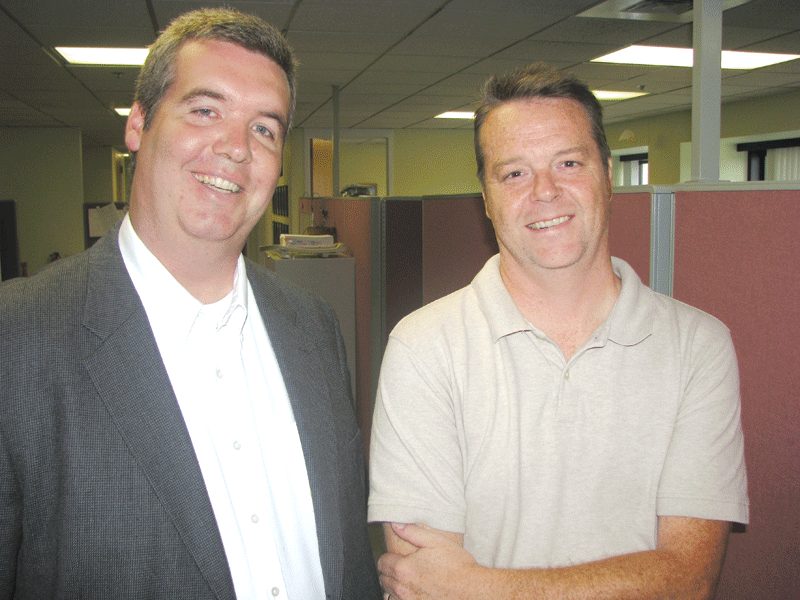
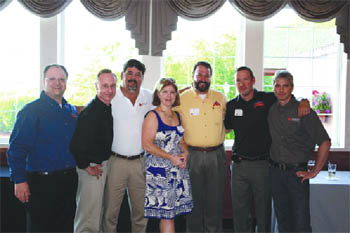
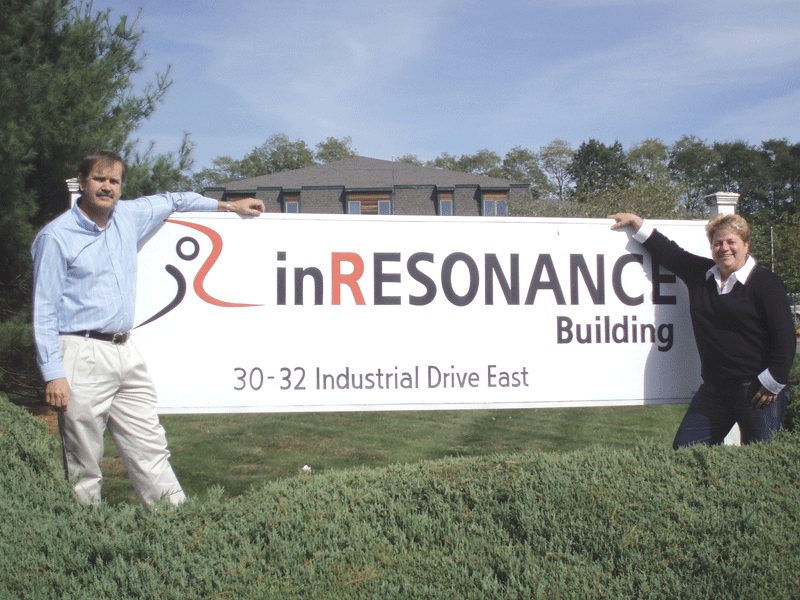
inResonance President and CEO Kevin McAllister and Vice President of Global Sales Marlene Marrocco

inResonance President and CEO Kevin McAllister and Vice President of Global Sales Marlene Marrocco say the company provides software to more than 275 private and charter schools, including American schools in Tokyo, Geneva, Singapore, London, Paris, and Amsterdam.

Kevin McAllister has first-hand knowledge of the challenges private schools face.
He spent 17 years as a Geology and Spanish teacher at Loomis Chaffee School in Windsor, Conn., where he witnessed the nightmare of paperwork that everyone working there had to deal with.
“As a teacher, I had to send reports to parents six times a year. They had to be produced in triplicate through photocopying, then they were stapled together and mailed out,” he said. “I wanted to solve the problem, so I built a very primitive software system to make sending comments to parents easier.”
That was in 1992, and this system, which was expanded to include admissions, worked so well that word about it spread quickly. McAllister began running a sole proprietorship called KJM Consulting, and within a few years, 50 private schools were using his software.
By 1999, he had clients overseas as well as in the U.S. He had served on state and regional IT boards, had contracts as a consultant with schools, and had spoken at conferences across the country. What had started as a small side business was now starting to dominate McAllister’s time and his dreams for the future.
“My two daughters were graduating from high school, and I decided to take the jump,” he said, meaning that he had decided to give up teaching and start a business, one he would call inResonance Inc.
Today, the Northampton-based company provides database solutions and related Web applications that include fund-raising and constituent management, admissions and enrollment, and registrar functions to more than 275 private and charter schools, including American schools in Tokyo, Geneva, Singapore, London, Paris, and Amsterdam.
McAllister’s wife, Susan, is director of client services at inResonance, and together they share a passion for helping others and making a difference, which stemmed from time they spent as Peace Corps volunteers. “Susan was a math teacher in Africa, and I was a university professor in Paraguay. Watching inefficiency drove us to look for solutions,” McAllister said.
The name of their company is a reflection of his mission — to keep everything in tune by providing people with the tools they need to be efficient. “The people we work with are intelligent, dedicated professionals, but they don’t necessarily know the most efficient way to do their jobs,” he said, adding that everyone in an organization should be in resonance with each other. “You want everyone tuned up, singing the same tune, because the business process is only as efficient as the people working together.”

Problem Solving
McAllister says one of the problems private schools face is processing applications. He explained that schools can have several thousand applicants a year and need to rank them as well as keep on top of the process, which includes details such as whether they have received a student’s grades, transcripts, birth certificate, recommendations, photo, and other requirements, such as interviews conducted when the student and parents visit the school.
“It’s a long and complex process because the typical prep schools funnels 3,000 inquiries, which turn into 1,200 applications. They may accept 250 students, but only 125 of them decide to go there because they have also applied to other schools,” McAllister explained. “Then you have to throw in the financial-aid component, which makes it very difficult to fill 125 spots.”
However, admissions is the most critical office in many private schools because 85% to 90% of their income is dependent on it, McAllister said, adding that the remainder typically comes from endowments.
“Schools purchase our admissions systems to provide online applications and to process them in an efficient way, which can save them hundreds of man hours a year. Every school has a customized application, and it’s a complete transformation of the process. What used to take employees hours and hours to process now takes minutes.”
Another of inResonance’s mainstay products is used by registrars’ offices, where challenges include scheduling classes, grading, attendance, and teacher’s reports. The inResonance software system allows parents to go online and see their children’s grades and records, which McAllister considers critical to success.
Everyone who works at inResonance has a background in education. “We are not a bunch of programmers. We are efficiency experts who bring technology tools to the table. That’s our ethos — to empower dedicated professionals,” McAllister said. “We don’t want to work with organizations that don’t want to change. We want to work with people who are doers and innovators. We expect to be in conversation with our clients for many years as part of their strategic planning.”
McAllister said the company’s systems are not built for large public-school systems with rigid rules and that cannot afford variations. “The important word for us is independent. Our schools may run different classes every six weeks and do interesting things educationally, which we can accommodate. We don’t have a cookie-cutter system,” he explained, adding that charter schools are a growing segment of their clientele.
The company’s software also solves problems inherent to lottery systems used to determine which students are chosen to attend a school. “Before this software, people were literally picking cards out of a bowl,” McAllister said.
One of the many benefits of the company’s software is that it can be adapted to suit different needs. “We don’t build a custom solution for every school, but have a solid core that can be customized. Because we are small, nimble, and flexible, we are involved with a lot of factors and can serve a variety of educational innovations,” he said.
Another product, called Generations, helps schools with fund-raising. “It keeps track of constituents, parents, grandparents, trustees, and all their giving by allowing the school to run statistics. It also generates annual reports, including all activities and fund-raisers,” McAllister said. “The product was developed about six years ago and has allowed us to really move into radically different markets.”
Three years ago, the company began working on a new initiative called NodeLinks, with the aim of helping the nonprofit sector. McAllister hopes to launch it soon, and says the basic concept involves connecting clusters of nonprofits into nodes or groups who join and share their resources to generate success.
“We believe that, because of their limited budgets, they need to work together to become efficient,” he said. “We would like to create nodes in every city and link them together.”
Each node would be made up of 10 organizations with partners that include consultants, students, philanthrophists, volunteers, the Web community, and community developers. They would each pay one-tenth of the salary of a shared employee who would help them realize common goals using technology.
“There are 700,000 nonprofits competing for funds, and we believe there is opportunity and possibility for them to work together so they could provide a common front to funders and write more realistic grant proposals,” McAllister said. “We want to pilot this in the Pioneer Valley and are looking for nonprofits and funding agencies to participate.”

Textbook Examples
NodeLinks will be a separate division of inResonance and will satisfy the McAllisters’ desire to help others just as they did when they were Peace Corps volunteers.
“My journey has been very circuitous,” said Kevin. “We have come full circle in what we have learned about making schools and nonprofits efficient. Susan and I both have a common ethos that came out of education and nonprofits. NodeLinks will allow us to come full circle with our passion and love, which is the nonprofit sector.”
If all goes as planned, the two will be adding yet another way for people to accomplish goals without frustration, he continued. “We are creating a structure to link people together so they can also work together in an efficient way.”


Sections Supplements
New Technology Keeps Users Connected 24/7

New Technology

New Technology Gadgets

It says something about today’s Internet users — that would be just about everyone — that the year’s biggest high-tech gadget story is an electronic tablet that’s not much good at producing media, but spectacular at helping people consume it. From the iPad and smartphones to GPS systems and cameras that upload to the Internet in a flash, today’s devices are all about keeping the world connected, every second of every day. Here are some of the products that led the way in 2010.

Take a bow, Apple. You created the story of the year in technology.
That story, of course, is the launch last spring of the iPad, a device that rode massive waves of hype and garnered, for the most part, positive reviews — with a few caveats. For our annual look at what’s new in the world of technology, that’s the best place to start.
Essentially a wi-fi platform for audio and visual media that’s bigger than a smartphone but weighs less than a notebook computer, the iPad ($499) sold to the tune of 3 million devices in the first 80 days alone, and could sell around 12 million by the end of the year.
New York Times technology writer David Pogue produced perhaps the most novel — and certainly one of the most-talked-about — reviews of the iPad by writing two separate essays, one for techies and one for everyday users.
He gives vent to concerns from the tech-savvy crowd that the device doesn’t offer anything that someone with a notebook computer and a smartphone doesn’t already have, and detailed its lack of multitasking, Flash video, USB ports, and a camera.
But he is more enthusiastic in his “review for everyone else,” praising the iPad’s fast processing speed and impressive presentation of applications (and there are tens of thousands available) ranging from the iBooks e-reader to maps and driving simulators. In short — and to use a line that has appeared in countless writeups of the product — the iPad isn’t good at producing content, but it’s revolutionary as a way to consume it.
“In its current incarnation, the Apple iPad could no more replace your main computing device than could a netbook,” according to tech blog mashable.com. “A decade from now, the iPad will be less useful than the first iPod is today, but it will forever be the face that truly launched tablet computing. For that, it deserves recognition.”
Of course, smartphones have allowed users to access media on the go for a long time — albeit on a smaller scale — and 2010 was the year that the Motorola Droid stole the most headlines. Actually released late in 2009, the Droid (which is distributed exclusively by Verizon Wireless) sold 250,000 units its first week and has emerged as a rival for the Apple iPhone (more on that later).
According to cnet.com, the Droid boasts a gorgeous display, a fast Web browser, the Google Maps navigation app, and high-quality messaging and contact management, as well as excellent call quality, long talk time, and improved speed over previous Android devices. The reviewer did downgrade the device for its clunky sliding keyboard, music and video capabilities that are only OK, and lack of support for Bluetooth voice dialing.
However, Motorola improved on the experience this year with the release of the Droid Incredible ($199), which, cnet.com reports, is faster than its predecessor, upgrades the camera and internal memory, and supports wi-fi, GPS, 3G, and, yes, Bluetooth.
But Apple remained the bestselling name in smartphones and captured strong reviews, with one significant drawback, for its iPhone 4 ($299). According to cnet.com, the newest iPhone offers enhanced performance, a lovely new display, an improved design, and plenty of additional features. However, reception (exclusively through AT&T) is spotty — a longtime iPhone problem.

Notebooks and More
Apple was also busy this year with its MacBook Pro notebook computer ($1,799), which gives users a much faster processor than earlier models, as well as a bigger battery, illuminated keyboard, seamless switching graphics technology, a versatile touchpad, and overall better design engineering, according to PC magazine.
However, the magazine had even better things to say about the Asus U45Jc-A1, which it hails as one of the best mainstream laptops to come down the highway, and a good value at $867. PC praised its high-quality design (both aesthetic and functional), outstanding battery life, graphics, and performance.
As for printing documents, mashable.com placed the HP OfficeJet 6500A Plus ($199) in the category of products that broke new ground in 2010 — a category that includes the iPad and Droid Incredible, so that’s strong praise.
“If your objectives are to reliably print, scan, and fax, you’ll be hard-pressed to find a comparable and viable competitor,” it reports. “The 6500A Plus comes with ePrint, a service that, among other things, allows you to send documents to a special e-mail address to be printed automatically — no drivers necessary.”
Speaking of transmitting documents, digital cameras continue to proliferate, as the rise of social media has individuals uploading images online like never before. Fortunately, the top-rated models for 2010 come in a variety of price points, with a wide range of features, making it easy to find a camera to match one’s photographic needs.
Among cameras, PC World gives high marks to the Canon PowerShot A3000 IS digital camera ($249), calling it a light, compact camera that’s highly automatic, yet takes very clear images. It docked the PowerShot a bit for a subpar shutter button and zoom controls, but overall recommended it for everyday use by amateurs who don’t want to fiddle with too many settings.
For a bit more money ($499), PC World also likes the Ricoh CX4 digital point-and-shoot, which is bigger than most compact cameras on the market, but still rests comfortably in the hand. It’s equipped with a big optical zoom lens, and its LCD screen is one of the best the reviewer has come across on a digital camera. “Unfortunately,” he adds, “it has limited manual exposure features, so you’ll have to let the camera decide the aperture and shutter settings on its own; despite this, it’s a camera that’s a lot of fun to use, and everyone who played with it during our tests loved it.”
A similar sense of fun highlights the latest offering from GPS leader Garmin, whose Nuvi 3790T, according to PC World, is not only “drop-dead gorgeous,” but provides the best overall navigational experience of any GPS unit on the market. The magazine praises its touchscreen, voice commands, traffic updates, safety alerts, and lane guidance, while nicking the device for its glossy screen and slightly slow performance at getting a GPS fix. It’s also premium-priced at $549.

Fun Stuff
When work is over and you’ve navigated home, why not kick back with some TV? Another product highly recommended by mashable.com, the 47-inch Vizio XVT473SV packs all the features most people require in an LCD TV, including full 1080-pixel quality and an especially precise picture achieved through accurate color saturation alongside deep blacks.
The TruLED feature allows the display’s LED backlight to dim and brighten independently, so the picture remains fully dynamic and realistic. But Vizio has also led the way in making its devices Internet-connected. The XVT473SV, for instance, features Netflix, Amazon Video on Demand, and more.
If reading sounds better than TV viewing, e-readers continue to make news, and Amazon still leads the way, according to toptenreviews.com, which ranks the Kindle 3 ($139) as the best such product available, boasting size, speed, and picture quality that set the standard, not to mention ease of use.
“Though the Kindle 3 does not offer a touchscreen, the screen provides a high contrast that truly makes users feel as though they are reading text from a sheet of paper as opposed to a handheld computer screen,” according to the review, which also praises the device for eliminating glare, enough memory to store 3,500 books, and a battery that lasts up to one month on a single charge, longer than any other e-reader.
And if you fall asleep while reading, have no fear; even alarm clocks are getting an overhaul. Well, the Sony Dash ($199) is actually a personal Internet viewer, but unlike the iPad or a smartphone, it needs to stay plugged into the wall. “But that doesn’t stop it from being what amounts to an alarm clock for today’s Internet-dominated world,” reports askmen.com, which ranks it among the year’s best new tech devices.
Sporting a 7-inch touchscreen and integrated wi-fi, the Dash packs a slew of useful features into a small package, the reviewer notes. “So if you’re sick of leaning over to grab your phone in bed for social networking updates or to check out the weather, the Dash can provide a ton of convenience and still replace your current, beaten-to-death alarm clock.”
Until it’s time to head back out into an increasingly connected work world.

Joseph Bednar can be reached
at [email protected]

Opinion
Patrick Gets Our Nod, but Has Work to Do

This is a critical time for Massachusetts, what most observers would describe as a critical crossroads. The state is still trying to recover from the worst recession in 80 years, while at the same time it is working to stimulate economic development in an ultra- competitive climate in which 49 other states and countless countries around the world are vying for businesses and jobs.
There is also the matter of casinos and whether they are to be part of the economic-development mix, the obvious need to make this state more business-friendly, and the very real possibility that the state’s sales tax will be rolled back to 3%, creating some possible opportunities for retailers but also a potential fiscal nightmare for the Commonwealth and its publicly funded institutions and programs.
For these reasons and others, BusinessWest lends its endorsement to incumbent Deval Patrick in the all-important governor’s race to be decided on Nov. 2. This is a nod over challenger Charlie Baker (Tim Cahill’s candidacy is a joke, and he should do the state a favor and drop out before the election) that comes with some caveats, as we’ll explain. The bottom line, we feel, is that Patrick is the best option for the state at this critical juncture.
For starters, we’ll note that Patrick has made some missteps in his first term. The Cadillac DeVille and office-redecoration exploits were among them, but more important were his steps backward in efforts to downsize government and stem the tide of patronage jobs. His failure to seal a casino deal has also led to questions about his leadership skills and ability to work with the Legislature to get things done.
But Patrick has matured in office and, over the past few years, has managed the deep recession effectively, while also amassing several legislative accomplishments, such as a toughening of pension and ethics laws, consolidation of transportation agencies, expansion of charter schools, and more.
What has stood out for us is his very real — not symbolic or token — support of Western Mass. and some of its struggling cities.
In Springfield, for example, Patrick was personally responsible for Liberty Mutual opening an office in the Technology Park at Springfield Technical Community College, a facility that now employs more than 300 people. His administration also played key roles in the State Street Corridor revitalization effort, South End redevelopment, efforts to make UMass Amherst a more vital force downtown, the Data Center being built at the former Tech High School site, and other initiatives.
Meanwhile, in Holyoke, another former manufacturing center trying to reinvent itself, Patrick administration played a key role in advancing the high-performance computing center project, an economic-development initiative that could have huge ramifications for that city and the region as a whole.
The wheels started turning thanks to officials at MIT, UMass Amherst, Boston University, and other schools, as well as private industry, but the Patrick administration helped steer this project to a successful conclusion, and in a city that sorely needs an economic boost.
While in the past, governors and candidates for that post have talked about how they represent the entire state and how important Western Mass. is to them, Patrick has backed up the talk, and in a way that hasn’t been seen since Michael Dukakis was in the corner office.
While we believe Patrick has earned another term to see if he can build on these accomplishments and create more progress for this region and the state as a whole, we’ll note that he and everyone else on Beacon Hill still have some serious work to make this state more business-friendly, and this must be one of the top priorities for whomever is governor next January.
Jobs are the real key to making a full recovery from the Great Recession and enabling cities like Springfield and Holyoke to forge new identities. And the key to creating them is making this a state business owners believe they can afford to be in. Right now, not enough people are of that sentiment, and until the reality, and not just the perception, changes, Massachusetts will be at an extreme disadvantage.

Features
She Helps in the ‘Upward Climb of Entrepreneurship’

Dianne Fuller Doherty

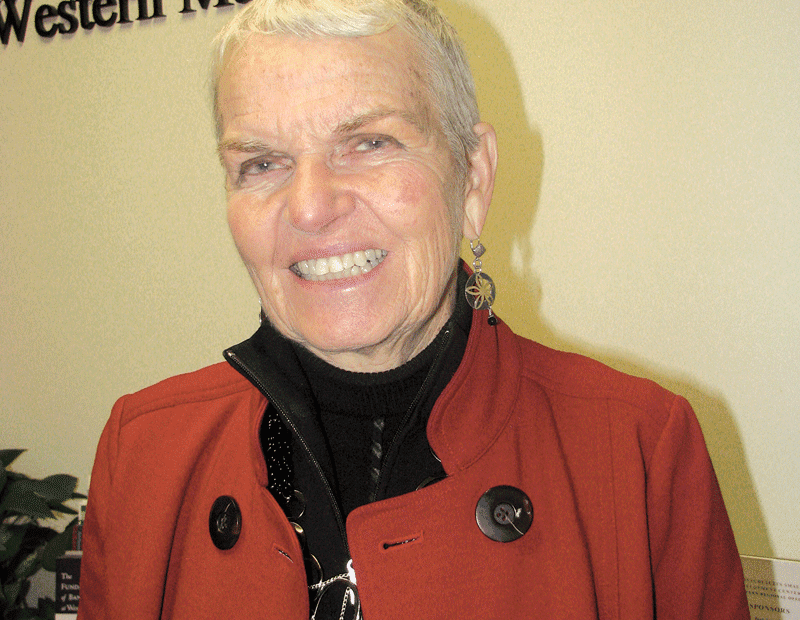
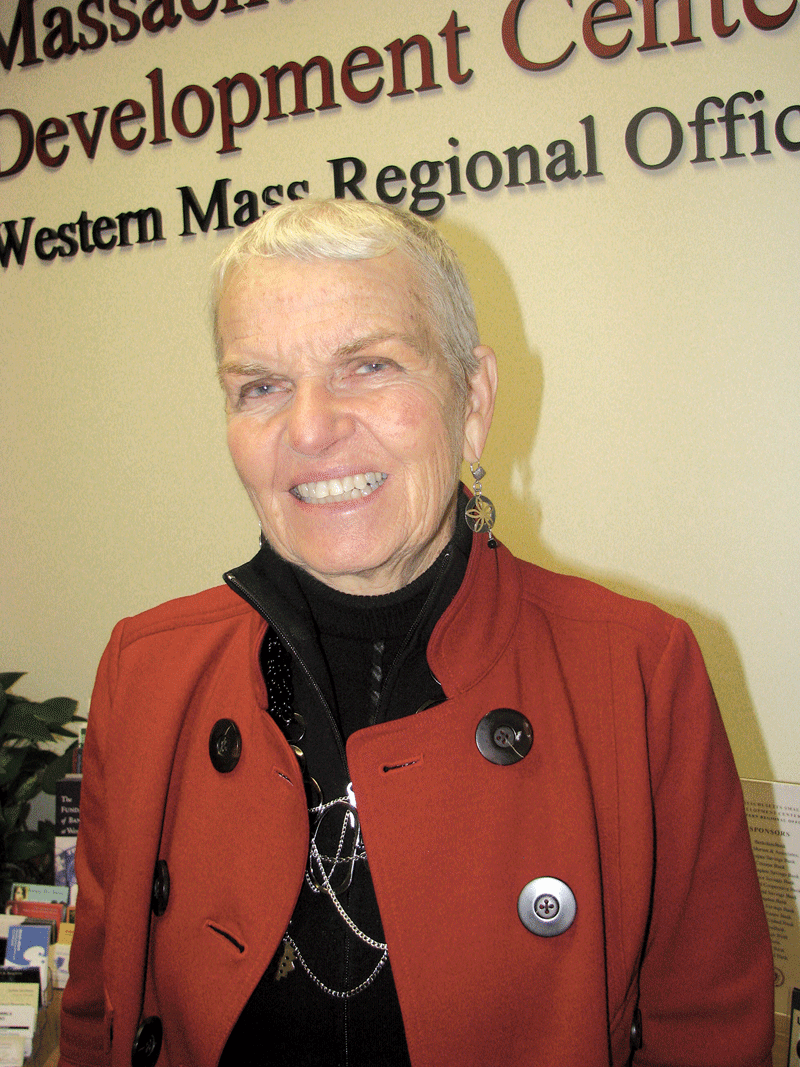
Dianne Fuller Doherty, director of the Mass. Small Business Development Center Network, Western Regional Office

Dianne Doherty remembers the urgent tone in the voice of Bai Qing Li, a client and friend who was looking for some help — and not the kind Doherty was used to offering.
Lee was looking for someone to teach a course in Marketing at Shandong University in Jinan, China. The individual who was slated to take that assignment had to back out of that commitment, and only a few weeks before the start of the spring semester. Lee wanted to know if Doherty could recommend someone with the skills and desire — and flexibility — to step in.
To make a long story short, Doherty wound up recommending herself.
“I was driving somewhere in Vermont with my husband [Paul], and I asked him, ‘what would you think of me taking that job?’” she recalled. “He reminded me that I’d never taught anything before, but then said, ‘if that’s what you want to do, go do it.’”
And she did.
Doherty quickly arranged a leave of absence from her job as director of the Mass. Small Business Development Center Network’s Western Regional Office, obtained a visa, and by early March she was in front of two different classes of 70 students each. She actually wound up teaching Finance 101 — another American woman took the Marketing classes — an assignment that became a learning experience on many levels.
“I learned about the country, the people, the economy — and a lot about myself,” she told BusinessWest, adding that, while she thoroughly enjoyed her stint in Jinan, by the time the semester was over, she was certainly ready to come home.
“I was very happy to be back, happy to be an American, and happy to be back in this job,” she said, adding that, among other things, her time in China provided her with great appreciation for everything she left behind when she got on the plane. Meanwhile, she added, her leave was “very renewing — it definitely recharged the batteries.”
Not that Doherty has ever lacked for energy. In addition to her more-than-full-time duties with the Small Business Development Center, she’s also involved with the Pioneer Valley Planning Commission’s Plan for Progress, sits on the task force for the high-performance computing center planned for Holyoke, and volunteers her time for Digital Divide Data, a social enterprise that provides jobs and training to youths in Laos and Cambodia, among other activities.
And she says she gets the energy for all that from her work and, more specifically, her clients. These are entrepreneurs, or would-be entrepreneurs, who come to the SBDC looking for assistance with everything from writing a business plan to securing financing, to pricing a product or service.
In her 18-year stint with the SBDC, Doherty and her staff have assisted budding entrepreneurs such as Stanley Kowalski, president of FloDesign and its subsidiary, which is working to bring a new wind-turbine design to the marketplace; Suki Kramer, who has developed her own line of cosmetics; Li, who immigrated to this country from China a decade ago and now has several business ventures, including China Access, which arranges visits for transfer students and others interested in that booming nation; and BusinessWest founder and ABC 40/Fox 6 owner John Gormally.
But there are hundreds of other stories, many of which haven’t generated headlines, but that, together, add up to thousands of jobs and some much-needed strength and flexibility for the local economy.
Through her work with several successful businesses, as well as her involvement with the computing center, the WestMass Area Development Corp., the Plan for Progress, and other economic-development-related agencies, Doherty is understandably bullish on Western Mass. She thinks others should share in this optimism, and believes, overall, that one of the things holding this region back is a self-confidence problem.
“There are a lot of exciting things going on in the Valley, and I really believe we need to change our attitudes about Springfield and believe in it again,” she said. “We need to change some attitudes about Springfield and this region, and put our inferiority complex behind us, because there is such great potential for this region, and it’s not just potential — it’s real.”

Occupational Therapy
Doherty told BusinessWest that she wasn’t quite sure what to think or do when a writer for the New York Times called her back in January and asked that she be a subject for an ongoing series called Preoccupations, which is essentially about people and twists and turns in their career paths. The slant for this particular piece was someone working well past what most would consider retirement age — and why.
For starters, Doherty wasn’t sure why she was being considered for this subject matter or how the Times knew about her. And she wasn’t exactly keen on talking about her age or the fact that she was working past 70. Eventually, though, she acquiesced, and in early February, her story, complete with the headline “When She’s Ready to Retire, She’ll Know,” appeared in the Times’ Jobs section.
“If I left now, I think I’d miss the structure and the intellectual challenge of the job and the people,” Doherty told the Times when asked why she was still working. “My feeling is that, as long as I am doing something of value, why not continue doing it?”
It is because of this mindset that Doherty, who told some people a few years ago that she might retire in a few years, doesn’t make any more comments or projections on that subject, other than to say that the Times headline sums it up nicely — and she’s definitely not ready yet.
Instead, she wants to add more chapters to a professional career that began shortly after earning an MBA from Western New England College, exactly two decades after graduating from Mount Holyoke with a degree in Philosophy. By then, her four daughters were all in their teens, and she had the time and the desire to go back to school.
“I wasn’t sure exactly what I wanted to do, so I decided on an MBA because it was a versatile degree,” she said. “That was interesting, going back 20 years later and taking classes with people half your age and with professors younger than you.”
She would eventually take a job handling business development for a marketing and public-relations firm in Hartford, and, after doing that for a few years, took a job centered on marketing and promoting downtown Springfield.
“MassMutual, SIS [Springfield Institution for Savings, now TD Bank], and Steigers put up a quarter of a million dollars to do a marketing campaign for the city,” she said. “This was after there had been a lot of bricks-and-mortar investment in downtown, but no one was coming. They wanted to change people’s attitudes about Springfield and downtown.
“What we discovered was that $250,000, while it sounded like a lot, was nothing for a media campaign, so we turned it into a PR campaign,” she continued, adding that she worked in conjunction with current Spirit of Springfield director Judy Matt, then working for the Convention and Visitors Bureau, and others to create programs including the Taste of Springfield, the Big Balloon Parade, and the holiday lighting initiative.
“All of those things brought people downtown,” said Doherty, adding that, 25 years later, the Spirit of Springfield continues many of those programs and has added others. “That was a fun job, and I never worked harder in my life.”
Eventually, though, the entrepreneurial spirit that Doherty fosters at the SBDC prompted her to start her own business. She partnered with Marsha Tzoumas (now Marsha Montori) to start a marketing and PR firm that would take their two names.
Between 1983 and 1992, the firm grew from its two principals to 12 total employees, and handled work for many prominent businesses, including Colebrook Realty Services, SIS, Fontaine Brothers, Daniel O’Connell’s Sons, and others. It was once named Agency of the Year by the Ad Club of Western Mass.

Getting into Gear
Doherty had just entered into some commitments for marketing projects when she saw the job posting for the directorship of SBDC’s western office, so while she was intrigued with the job and its description — she was very familiar with the SBDC, having served it as an advisory board member — she didn’t think she was in a position to pursue it.
“But a friend told me, ‘just apply — you don’t know the university’s search process,’” she said, adding that she did, and her friend was right; the search took several months, and when it was over, Doherty gained the nod.
She thought she would only be in that position for perhaps a few years, but instead it’s been almost two decades and counting, and for the reasons she outlined for the Times; the people and the intellectual challenges keep her coming back for more.
“It’s such a great job, because of the diversity and variety and the great staff I have,” she said, “and because of the great people I have to work with; it’s very rewarding to help people take their dreams and make them reality.”
When she came to the SBDC, Doherty brought with her a wall ornament from the marketing firm — a brass bicycle, almost life-size. She has it hanging in the agency’s front lobby, at an upward angle, and tells everyone who asks (and that’s most people) that this is to illustrate what she called the “upward climb of entrepreneurship.”
Helping people negotiate that climb is the unofficial mission statement for the SBDC, which is celebrating its 30th anniversary this year, said Doherty, noting that, while roughly half of her workload with the SBDC involves one-on-one consultation with clients, the rest involves economic development, a subject she’s passionate about.
This is evident from her 20 years of involvement with the Plan for Progress, a commitment of similar length to the Affiliated Chambers, work with the former Regional Technology Corp., and, most recently, the high-performance computing center, a project she believes has enormous potential to change the business landscape in Holyoke and the region as a whole.
“That’s one of the biggest things to ever come to this region, and I’m really excited about what can come from this,” she said. “It’s a tremendous opportunity for our area.”
Overall, Doherty says the region has an enormous amount of intellectual and entrepreneurial energy that has not been adequately tapped, a situation that she says must change.
“Here in the Pioneer Valley, which I think is aptly named, we have so many pioneers in terms of entrepreneurship and small business and good ideas around wind and energy and other things,” she told BusinessWest. “There’s such intellectual capacity in this valley, between the colleges and the businesses we have. We have an enormous amount of intellectual energy, but we have to harness it, package it, and market it, and these are things we haven’t done well.”
Doherty said she has no regrets about putting aside her work at the SBDC, as well as her economic-development exploits, for three months to take that aforementioned teaching assignment, one that gave her a detailed look at how China is growing, both outward and especially upward. Indeed, this was her fourth trip to that country and the first since 1998. She marveled at how the landscape had been altered in a dozen years.
“It was absolutely astonishing the changes that had taken place,” she explained. “As one friend said as we were driving from the airport at night into Shanghai, ‘this makes Manhattan look like a Third World country.’ The lighting is incredible in all the cities, but especially Shanghai. There were clusters of high-rises everywhere.”
As for the teaching assignment itself, Doherty said it was eye-opening, but also challenging. Her students had six years of English behind them, and were both hardworking and disciplined, but trained to essentially learn by memorization.
“It’s very hard to get them to be interactive,” she explained. “If you asked a question generally, there would just be dead silence. If you called on someone directly, they’d stand up very properly and try to answer as best they could. But they just weren’t used to speaking in English, and they weren’t used to dialogue or the Socratic method, which I was naive enough to try to explain to them during the first class.”
She said the Chinese people are very interested in the U.S. and Americans, and, upon learning what Doherty had for a day job, they wanted to know about entrepreneurship and owning a business.
“That’s just starting to happen there, so they were very interested in knowing about American business,” she said. “Meanwhile, the women there wanted to know about the women in America, because they’re going to be the first generation of women in the workplace, and they didn’t have colleagues and mentors and mothers and grandmothers who had been in the workplace.”
She came home with new respect for teaching, greater appreciation for the opportunities people in this country have, and recharged batteries with which to help clients make that upward climb of entrepreneurship.
“I blogged about the experience, and while doing so I talked about the external journey of China, but there’s also an internal journey that accompanies that, and it’s very important,” she said. “You get to see who you are in a foreign environment and who you are in this environment, and it’s an interesting process of introspection.”

Signs of the Times
Doherty told BusinessWest she was pleasantly surprised by the number of people, from this region and far outside it, who read the Times piece and commented to her about it in one way or another.
“I couldn’t believe the response … I had a woman call me, whom I’ve never met, who said, ‘I just want to thank you for that story; I’m going to start my third career now,’” Doherty recalled. “She said she was going back to get a master’s in Education and start teaching because she thought that was the most important thing she could do — something of great value to the community.”
Doherty believes she’s doing many things that are of value to this region, so she has no intention to stop or even slow down. Aside from the occasional break to teach in China, she’s going to keep working on ways to harness all that entrepreneurial energy in the Valley.

George O’Brien can be reached at [email protected]

Sections Supplements
This New Tool Takes Construction to Another Dimension

Stanley Hunter

Stanley Hunter, project executive of Baystate’s Hospital of the Future.

The $230 million Hospital of the Future taking shape at Baystate Medical Center is the largest building project in the region’s history, and it is drawing attention for everything from its size to its projected impact on the health care landscape. The initiative is noteworthy for another reason — it represents one of the first, and largest, implementations of building information modeling, a new and exciting construction tool, or process, that effectively simulates a project’s many phases or individual components, thus minimizing the chances for error and reducing the cost of a project.
By GEORGE O’BRIEN

Ed Tobin was talking about the “good old days.”
They weren’t that long ago, he told BusinessWest, and, well, in retrospect, they weren’t that good, at least when compared to the new way of doing business in the construction industry, made possible by something called building information modeling, or BIM for short.
In those old days, builders and architects would have to pore over thousands of two-dimensional drawings to see how a building is supposed to come together, Tobin, general supervisor for Berry Construction, explained. “Now, through BIM, they can use three-dimensional computer models and advanced GPS [global positioning system] to essentially simulate and coordinate a project well before actual work begins. In so doing, they can see potential problems emerging before they happen, saving time, money, and headaches.”
What’s more, various aspects of a construction project can be handled simultaneously, he continued, where before, things were done on much more of a sequential basis, because one subcontractor would have to see how a phase of work was completed before beginning his assignment.
“This is going to change the whole way we do construction — and construction doesn’t change easily,” said Tobin, who spoke to BusinessWest in one of several Berry trailers now parked at Baystate Medical Center for construction of that facility’s $230 million Hospital of the Future.
BIM is playing a huge role in the Baystate undertaking, said Stanley Hunter, ‘project executive for the BMC Hospital of the Future’ (that’s what it says on his business card). He started by saying that the tool takes construction to another dimension, but quickly amended that to note that BIM takes building well beyond 3-D.
Elaborating, he said the key word in the phrase ‘building information modeling’ is the middle one. In addition to providing 3-D models of what buildings and individual components will look like, BIM provides contractors, subcontractors, and architects with more data sharing than they are used to.

Ed Tobin

Ed Tobin says BIM represents a vast improvement over how projects were coordinated in the “old days.”

“Information is the fourth and fifth dimensions,” he said, adding that, with that information, contractors can do everything from scheduling workers more efficiently to putting in various systems correctly the first time. And while BIM and the information it provides streamlines the construction process, it also makes it easier to maintain buildings long after they’re built.
“Five, 10, 15 years from now, when our staff has to go back and maintain this building, they can just click on that button and know how to replace something,” he explained. “So BIM goes well beyond the drawing phase.”
While Hunter used words to describe how BIM works, Tom Hill, project engineer for Berry, provided a powerful demonstration that more than backed up the commentary.
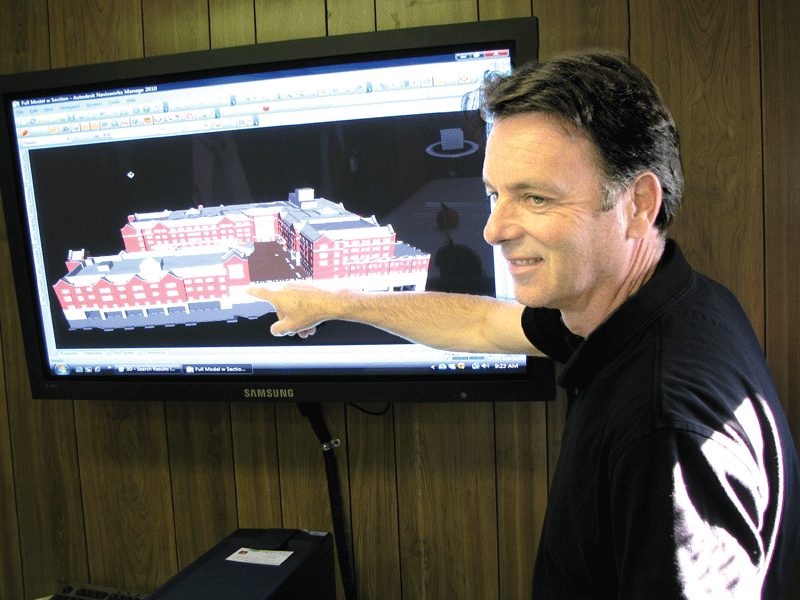
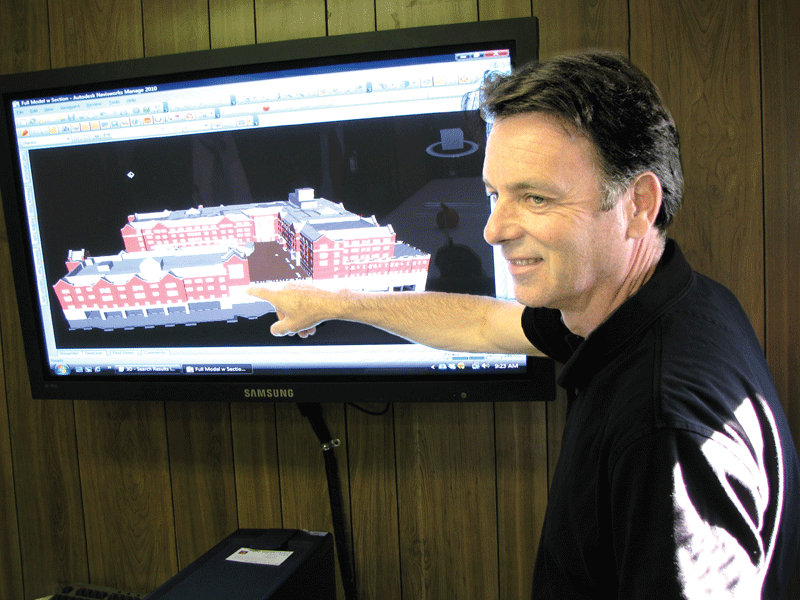
He called up a three-dimensional image of the Hospital of the Future, and then used his mouse and a few key strokes to turn it in every direction, so that one could even see the footings underneath the massive structure. Through BIM, he peeled off layers of the building, taking it right down to the structural steel. He took BusinessWest down hallways, inside new operating rooms, and then above the ceiling to show, in great detail, what goes where and how it will all come together.
When asked to quantify how much BIM might save Baystate in this massive project, Hunter said that would be very difficult to do, especially at this stage. But he could qualify it. “As they say in construction and every other business, time is money,” he noted. “And BIM will save us all kinds of time.”
For this issue, BusinessWest takes an indepth look at BIM from the perspective of the Baystate project. Those now working with the tool used various superlatives to describe it, but Tobin might have summed it up best when he said, “this reinvents how everybody works.”

Work in Progress
Both Hunter and Tobin stressed repeatedly that BIM is still very much in its infancy — which is just one of many things to get excited about when it comes to this process.
Indeed, as they looked at the images that Hill put up on the screen and talked about how BIM is changing the face of construction, they allowed themselves to ponder what might happen with this technology over the next decade or two.
“Five or 10 years years ago, GPS couldn’t get you within 100 feet of where you needed to be — it wasn’t applicable,” said Tobin. “Now, it can you within an eighth of an inch. And five years from now … who knows?”
But the present tense is certainly exciting enough, said Tobin, who noted that, while Berry first worked with BIM on a recent project at the Massachusetts Institute of Technology, the Hospital of the Future is by far the largest of the company’s projects to make use of the tool.
And he doubts there will be any large-scale projects undertaken without it in the future. That’s because BIM essentially changes the dynamic of a building project.
Hunter agreed, and said, in essence, that BIM will let construction and design teams know if something is buildable, or determine what Hunter called “constructability,” and then it will provide what amounts to high-tech, three-dimensional blueprints to be followed.
Elaborating, he said these blueprints are models of the actual parts and pieces being used to build a building. These models effectively ease the transition from the design phase to the construction phase by greatly improving the communication process between the parties involved.
The many benefits from BIM were generally known when the Hospital of the Future began to take shape on the drawing board, said Hunter, noting that, long before construction commenced in late 2008, Baystate officials had become sold on the technology’s capabilities and wanted to put them to the test.
To make a long story short, they have, and in the process, the Baystate project is providing lessons to both the health care industry and the construction sector about how BIM can be applied to not only large-scale projects, but also those on a much smaller level as well.
“We’re testing the boundaries of what we can do with BIM with this project,” he said, adding that he and others have been giving many demonstrations of how the process works. “There are many people in our industry trying to figure out ways that this can applied, so we’re fortunate to have this large project that we can apply it to.”
Tobin concurred, and before explaining how BIM works and why it is such a vast improvement, he returned to those aforementioned old days, meaning maybe a year ago.
When a project was handed off to a company like Berry, he and those representing the subcontractors would have to look over hundreds, if not thousands, of two-dimensional drawings to determine how floors, walls, and various mechanicals, including electrical systems, plumbing, and ductwork would come together.
“We’d have a series of meetings where we’d actually take a light table and lay these mylar drawings on top of one another and look for conflicts, look for two systems that hit each other and have to be moved,” he said. “It took months and months and months and dozens of these meetings to get the point where you were coordinated.”
BIM takes away all that handwork, he continued, adding that the computer software quickly and efficiently identifies potential hits. “It eliminates a lot of the time and solves potential conflicts.”

Model of Efficiency
To show how BIM accomplishes all this, Hill put his mouse to work.
He showed the Hospital of the Future from a number of angles, and then, after selecting one particular view, showed how the software can strip away layers of the building until only the steel remains.
Later, he focused on one of the operating rooms that will soon take shape and the “very coordinated spaghetti,” as Hunter called it, that represents the various mechanical systems, from plumbing to sprinkler systems, that would be installed in the high-tech ORs.
There is little margin for error when it comes to putting these systems in, Hunter continued, adding that, through the use of BIM, a contractor can greatly simplify and quicken the process known as clash modeling, or identifying where systems may collide and then making adjustments so they don’t.
“By using BIM, you’re essentially building something virtually before you build it in the field,” he explained. “So you can coordinate things so they don’t hit one another once you install them. And since you’re then confident that a system is in the right position, you can prefabricate long runs of that pipe instead of just building it all on site. So that makes the prefabrication process simpler, as well as the installation.
“In the first run-though, when you get everything plugged in, you’ll get hundreds of clashes, and then you sequentially go through them and solve them all,” he continued. “BIM tells them very quickly where the problems are; it takes a process that used to take a month down to a few hours and a few phone calls.”
In those old days, blueprints would simply be redrawn until the conflicts were eliminated, said Tobin, but inevitably, hits would be missed, a unction of human error that BIM eliminates.
“You’ll miss some when you’re hand-drawing things,” he explained. “But the computer doesn’t miss much.”
And because it doesn’t, Hunter and Tobin agree that the Baystate project has been a huge success in demonstrating just how beneficial BIM can be in construction projects of all sizes. Quantifying those benefits is difficult, and it may not be until this project is over before those involved with it can even begin to speculate on how much of a cost savings has been achieved because this process was chosen over traditional methods.
But Hunter believes that several months of time could eventually be taken off the construction process, and, as he said, time is certainly money. Meanwhile, Tobin believes use of BIM could easily take a few percentage points off the cost of a building project.
“As it becomes the standard, and as subcontractors become more comfortable with it, they won’t have to count every light switch; they can just push a button and know that there’s 5,000 light switches in the building,” he explained. “Just think about how much that saves over bringing an estimator out. And their prices go down, too, because they don’t have to spend as much time on coordination.
“There’s a lot of savings in terms of time and money,” he continued, adding that BIM will become even more efficient and cost-effective in the future. “This is what computers were invented to do; now we just have to apply it.”

Building Momentum
As he posed for some pictures on the roof of the parking garage across an entranceway from the construction site, Hunter said the project is on schedule for completion in the fall of 2011, and the facility should be open by early in 2012.
BIM has a lot to do with the pace of construction and scarcity of problems that can often hinder progress with such an undertaking, he continued, indicating that, if Baystate is indeed testing the boundaries of BIM with this project, then its potential may not have boundaries.
So while the name of this project is the Hospital of the Future, it has become a fertile testing ground for the building process of the future, one that, as Tobin said, reinvents how everyone works.

George O’Brien can be reached
at [email protected]

Sections Supplements
Get the Word Out: This Town Is Open for Business

Granby, Mass.

Granby, Mass.

The town of Granby has never been very successful at promoting itself. But that is about to change.
Emre Evren, who chairs Granby’s Planning Board and Master Plan Committee, said town officials have developed a new master plan that will focus on economic development.
It has been carefully crafted, using data collected from a number of sources. They include a self-assessment, a survey completed by residents of the town, and a list of Granby’s strengths, which were recently outlined in a report compiled by the Center for Urban and Regional Policy at Northeastern University. The new plan is scheduled to be completed this fall and will be presented to town residents thereafter.
Following one of the master plan’s recommendations, an economic-development committee will be formed, and it will take a proactive approach. “We are eager to send the message out that Granby is a great town for any type of business,” Evren said. “In the past, we haven’t promoted the availability of land and locations that are available and haven’t successfully told people we are open to new business. But the economic-development committee will drive relationships and promote the town to suitable investors.”
Evren cited strengths outlined in the Northeastern report as solid proof that Granby is a town that investors or business owners should consider. An important one is the uniform tax rate. “We were told our average tax rate is lower than most of the communities that participated in Northeastern’s survey. And the average square foot of manufacturing space is much cheaper here than in most other locations in the immediate area,” Evren said. “The report also stated that Granby has great access to a technically skilled and educated labor force. Plus, our housing market is affordable, and our public schools are well-performing, which is a concern for some business owners.”
Granby’s location is also a key to business success. Route 202 passes directly through the town, and the Massachusetts Turnpike and Route 91 are only about seven miles away. “People think we are in a remote location. But we are not,” Evren said. “We believe one advantage we have is that many neighboring residents drive through Granby. We are bordered by South Hadley, Chicopee, Belchertown, Ludlow, and Amherst, and we are only 15 minutes from Amherst Center.”
Cindy Mugnier, left, and Earleen Kenyon

Cindy Mugnier, left, and Earleen Kenyon, co-owners of the Earlee Mug restaurant/truck stop, say that business owners and residents have been extremely supportive since they purchased the eatery and renamed it a year ago.

Town officials are also working to streamline the permitting process. “We want to clear any unnecessary hurdles that new businesses may encounter, and are looking for ways to make the process more efficient,” Evren said. “We are taking a proactive approach to zoning and rezoning in certain areas to make them more attractive or suitable for businesses so we can meet our economic development goals.”
Evren said the emerging vision includes a livelier business district, which stretches along Route 202, from the South Hadley town line past the center known as Five Corners. Town officials would like to see more retail shops and restaurants open in that area. “Residents told us they would like to see more places in town where they could shop or eat.”

Food for Thought
Earleen Kenyon and her sister, Cindy Mugnier, have proof that residents will support restaurants. They purchased a truck stop/eatery known as Manny’s Place about a year ago and renamed it the Earlee Mug. Although they had never owned a restaurant before, they have done very well.
“We took a leap of faith when we bought it. But this is a good place to own a business,” Mugnier said. “The community gets behind you, and the town officials are very easy to work with. This is a rural community, and there is a real sense of community here. People have been here for multiple generations.”
The eatery is located between two farms, and both of them have been very helpful, letting Mugnier and Kenyon know when fruits and vegetables are at their peak.
“Pleasantbrook Farm and Feed has gone so far as to help us when we had problems with our cash register and other technology,” said Mugnier. “You get a real sense that everyone is pleased that you are here, that they want you to be successful and will do what they can to help that happen.”
Kenyon agrees. “The townspeople support local businesses,” she said, adding that she and Mugnier benefit from their location, which is directly across from Dufresne Park, which hosts events that range from baseball and soccer games to canine agility and horse shows. “Plus, we are right on Route 202, which is a busy road; everything is just pleasant here.”
Scott Merrill is vice president of Dressell’s Service Station. His family has owned the business since the 1960s, and he says Granby is a small but tightly knit community where people get to know one another.
“It has a nice country feeling and is a nice spot to live in. There is also quite a bit of land available,” he said. “There is room to grow and room to build — plenty of opportunity here. Plus, the taxes are lower than in surrounding communities.”

New Areas of Growth
Granby is home to large expanses of agricultural land and open space, since a portion of the Mount Holyoke Range State Park lies within its borders.
“Part of our endeavor is to keep a lot of open space,” Evren said. “We are trying to balance our agricultural/open space land with other types of economic development. Our premise is that new businesses should be consistent with Granby’s traditional New England town feel and fit in that overall mosaic, because we are a suburban town with a lot of rural characteristics which we don’t want to lose.”
Still, results from the town survey showed that the majority of residents are in favor of commercial and industrial development as long as new businesses don’t pollute the air or water.
To that end, the town is working on a green-communities initiative that could qualify Granby for state grants if it meets a number of requirements, which include designating an area for green-energy research and development or green manufacturing. “This would interest our residents based on our master plan survey results. We would like to see economic development, but it needs to be cognizant of the community’s environmental concerns,” Evren said.
Five Corners, located about a mile from the South Hadley line on Route 202, contains the majority of the town’s businesses. A corridor zoned for business extends several miles down the road, ending about a half-mile before the town common.
“This is the area that will be our primary target for new business,” Evren said. “There is vacant land available in that area.”
Five Corners offers connections to sewer and water hookups, which are not available in all parts of Granby. “But the town may be open to extending those services to new businesses along the corridor,” Evren said. “There is nothing concrete in place, but there has been conversation around it.”
Another area that holds promise for growth is New Ludlow Road. The town is currently working to install a sewer line extension there. “It will require some zoning changes, but there is a lot of possibility in the area,” said Evren, adding, “it could be an ideal location for an industrial or office park or light industrial development.
“The right new business could thrive in this town, because people are receptive and committed to local businesses,” he said. “Granby is a small town in terms of population. But we have a lot of land that would be suitable for businesses. We want people to come and take a look at what we have to offer. We believe they will like what they find here.”

Court Dockets Departments

The following is a compilation of recent lawsuits involving area businesses and organizations. These are strictly allegations that have yet to be proven in a court of law. Readers are advised to contact the parties listed, or the court, for more information concerning the individual claims.

CHICOPEE DISTRICT COURT
NES Rental Holdings Inc. v. Alpha & Omega Construction
Allegation: Breach of contract for rental equipment: $2,789.35
Filed: 8/23/10

HAMPDEN SUPERIOR COURT
CIT Technology Financing Services LLC v. Billups World Entertainment Inc.
Allegation: Breach of lease agreement: $54,598.34
Filed: 7/16/10

Liberty Mutual Insurance A/S/O Smith & Wesson Holding Corp. v. Kennedy, Gustafson, & Cole Inc.
Allegation: Breach of warranty and property damage caused by fire: $1,982,000
Filed: 7/21/10

People’s United Bank v. La Cucina Di Pinocchio Inc.
Allegation: Breach of several promissory notes: $673,140.77
Filed: 8/11/10

Plaza @ Buckland Hills LLC v. Emanuel Rovithis and Demetia Inc.
Allegation: Enforcement of judgment: $274,582.32
Filed: 7/23/10

Pravin Mathur v. Roy’s Towing Co. and John Burdick
Allegation: Negligence in operation of motor vehicle: $1,600,000
Filed: 8/6/10

NORTHAMPTON DISTRICT COURT
Acadia Insurance Co. v. Bishop Burner Services
Allegation: Balance due for insurance premium: $37,042
Filed: 8/11/10

SPRINGFIELD DISTRICT COURT
Bradco Supply v. Henderson Roofing Co.
Allegation: Non-payment of goods sold and delivered: $3,174.35
Filed: 7/23/10

Comcast Spotlight Inc. v. Brockton Fair
Allegation: Non-payment of goods sold and delivered: $11,025.72
Filed: 7/22/10

Consumer Auto Parts v. Fini’s Auto Sales
Allegation: Non-payment of goods sold and delivered: $5,549.60
Filed: 7/22/10

High Priority Associates Inc. v. Ilmondo Pizza
Allegation: Non-payment of goods sold and delivered: $7,298.91
Filed: 7/22/10

Western Massachusetts Electric v. Springfield Bible Institute & Theological Seminary
Allegation: Non-payment of utility services: $10,243.93
Filed: 7/15/10

WESTFIELD DISTRICT COURT
ServiceMaster Assured Cleaning v. Big Family Adventure
Allegation: Failure to pay for cleaning services and breach of contract: $14,270.78
Filed: 7/26/10

Sections Supplements
Health Care Hiring Is Sluggish — for Now

Mike Foss

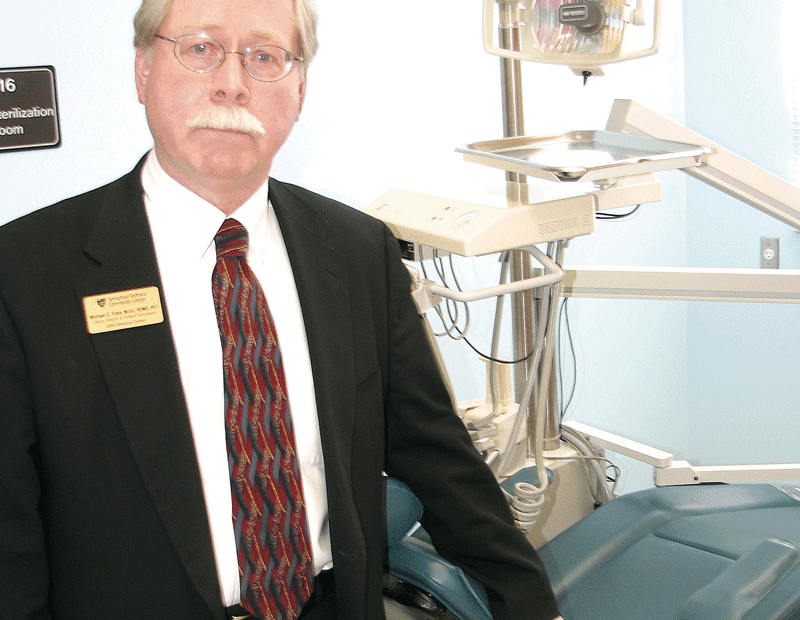
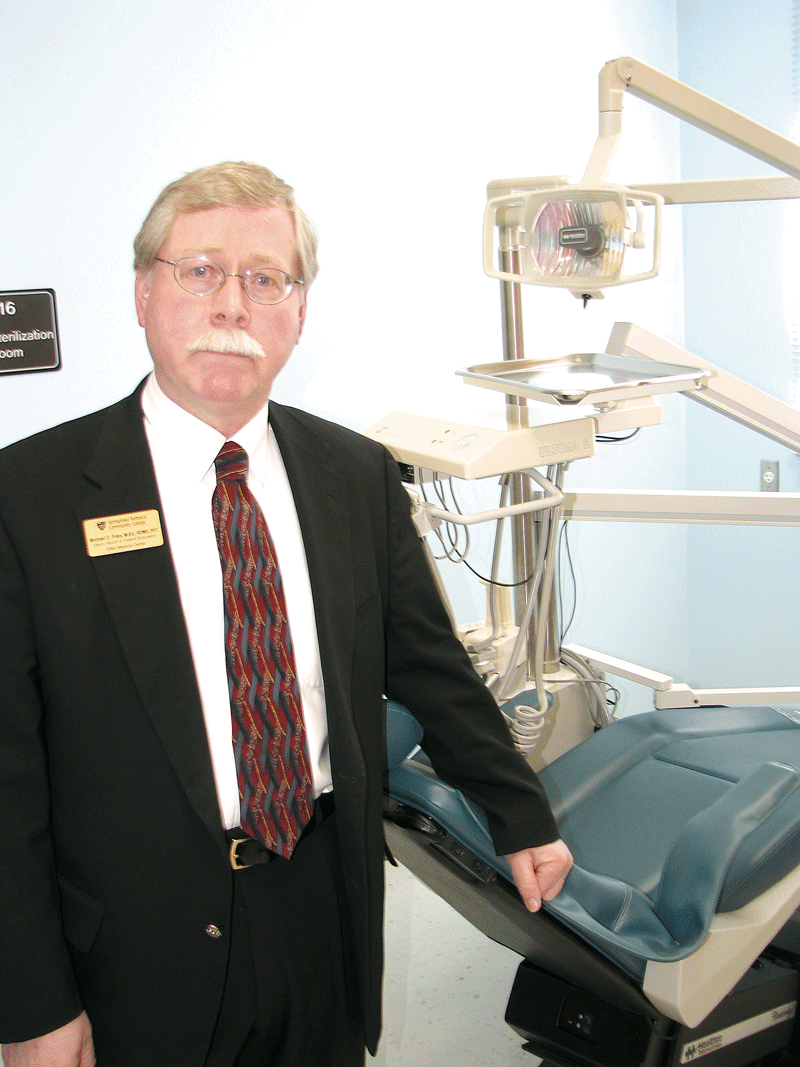
Mike Foss calls the health care job market “cool,” but sees plenty of positive signs for current students.

Through good and bad economic times, health care has always been one of the most robust job markets in Massachusetts. But that has not been the case in the current recession, as hospitals and other organizations have been slow to hire, even resorting to layoffs in many cases. Demographic factors, especially an aging population, are likely to render this sluggishness temporary, but the job market that emerges in coming years might demand far more flexibility from those looking to build a career in health care.

Health care, an industry that accounts for about one in every six jobs in Massachusetts, has long been seen as recession-proof in the Bay State.
The extended economic downturn has tested that, with once-brisk hiring turning stagnant and hospitals across the Commonwealth resorting to freezes and layoffs. Yet, most industry-watchers see the current sluggishness as a temporary swing, if only because people will always need health care.
“Hiring has to pick up,” said Kelly Aiken, director of Health Care Initiatives for the Regional Employment Board of Hampden County. “The economy can’t change how much care people need.”
In fact, despite pockets of layoffs, employment in health fields has ticked up slightly since it essentially ground to a halt last year.
That’s good news to students studying in health programs at area colleges. The robust job market over the past decade has drawn increasing numbers of applicants to those programs, but recent graduates have been navigating scarcer prospects than those who entered the workforce several years ago. Still, there’s reason for optimism.
“Last year, there was definitely a reduction in job availability, and this was pretty much across a dozen fields of health,” said Michael Foss, dean of the School of Health and Patient Simulation at Springfield Technical Community College. “One department chair told me that, since January of this year, there has been an upward swing in job openings, and others were beginning to see that as well.”
That perception is borne out statewide. According to the Executive Office of Labor and Workforce Development, 486,000 people were employed in health care in January 2009, and the number rose to more than 494,000 in January 2010 before essentially plateauing there.
But as the Great Recession fades, optimists say, certain demographic truths will take hold — specifically, mass retirements by the Baby Boom generation, coupled with an overall aging of the population.
“This whole issue with the Baby Boomers retiring — that’s national, and it’s not industry-specific. But the opportunities to replace those retirees might be greater in health care,” said Jean Jackson, vice president for Workforce Planning at Baystate Health, the region’s top employer.
“People are living longer, and they’re going to need care,” she continued. “So you have a combination of people retiring and living longer, and they’re going to need more people to care for them.”
That adds up to what should be increasing opportunities for health care careers, but job seekers may face a far different landscape when it comes to how and where care is delivered. For this issue, BusinessWest examines some of those trends, and why many observers see the current slow job market as a curable condition.

Day by Day
Foss has observed the cycle of medical hiring long enough to recognize a downturn. “It’s not hot; it’s a cool employment environment,” he conceded.
Meanwhile, many of the available openings, in a number of fields, are for per-diem work, essentially part-time jobs without benefits, he explained. Yet, that’s not necessarily a negative trend.
“I know that in some fields, per-diem is actually highly desirable, especially for individuals with families, or they’re the second person working. They kind of like the idea of not being tied down to a rigid work schedule.”
In addition, “I think a lot of people see that as one way they can prove to an employer that they should be full-time,” he said. “And it’s an opportunity for them to see if this is the environment they want to be in, if it’s the right institution, right office, wherever. It almost gives you an automatic job interview because, when there’s a full-time opening, they see the good work you’re doing and that you’re the person they need to hire.”
But the full-time job openings are slowly increasing, Foss noted. “And Baystate, a very large system with multiple locations, is building a brand-new facility. So we know those jobs will be available in the future.”
Indeed, Baystate’s Hospital of the Future project, set to be completed in 2012, is only the largest of a flood of hospital expansions across the Pioneer Valley over the past decade. From Jackson’s perspective, Foss’ assessment of what that means for hiring is right on.
“You have to look at all the factors — turnover, what the retirement plans look like, what the potential growth will be,” Jackson said. “And when you factor it all in over the next 10 years, we are looking at a projection to hire 15,000 employees.”
However, she added, “many of these jobs in health care require specialized skills and training beyond high school, and that’s another trend: concerns about the availability of workers. At Baystate, part of our mission is to recruit from the local labor market, and our work with education, employers, and workforce-development organizations to find solutions has been absolutely critical.”
Economic development leaders have long been concerned about a ‘skills gap’ in certain career fields — health care and precision manufacturing are two often mentioned in those discussions — that leave available jobs unfilled, and potentially create a deterrent for new employers to locate in Western Mass.
The collaborative workforce projects Jackson alluded to range from the Community Based Job Training Grant, a $1.65 million grant from the U.S. Labor Department that will create awareness of and training opportunities in health fields, to Collaborating for the Advancement of Nursing: Developing Opportunities (CAN DO), a grant program aimed at creating career ladders in nursing. Numerous other regional programs have similar goals.
“Everyone is struggling with the economic environment now,” Jackson said. “Health reimbursements are down, patients are choosing not to do elective surgery, putting things off, and people are delaying retirement. But eventually, they’re going to retire.” And sooner than many realize, she continued, the region will need a strong pipeline of qualified workers to take their place.
Care Where It’s Needed
That future workforce will need to be flexible as well as skilled, Foss said.
“Where they work is going to be different. We’re already seeing a shift from always thinking they’ll work at a hospital. Look at all the long-term care facilities out there now. And the outpatient clinics — in my lifetime, I’d never heard of outpatient surgical centers. No way; you had to go to the hospital. But that’s another place where people will work outside of hospitals.”
Home care is expanding rapidly as well, he noted, again, a reflection of that growing senior population that wants to maintain as much independence as possible. In fact, according to the Bureau of Labor Statistics, opportunities for personal and home care aides will increase by 50% between 2006 and 2016.
“I do think that jobs are going to be located in different places,” Aiken said. “When the recession ends and the economy bounces back, coupled with health care reform, the trend across the continuum will be to deliver patient-centered care, and much of that care will be occurring in many, many different places outside of the hospital setting.
“People who go into nursing thinking their first job will definitely be in a hospital need to look beyond that. They need to look where care is being provided and where the need is.”
Foss said he’s encouraged by this changing face of health care.
“There are niches being filled that never used to be there, and all these wonderful things happening with new technology,” he told BusinessWest. “Even with the cool market, I think it’s an exciting time for health care.”
Aiken agreed. “I think there are going to be changes, new health care occupations that may evolve, that we don’t even know about right now.”
One thing is certain, though, Foss said: no one’s going to work forever, and opportunities will be abundant again.
“The Department of Labor and other pundits, they always come back to health care,” he said. “A lot of people in my age group will be retiring in three or four years, and those who have planned their retirement well — especially now, with health care reform — are going to be using the health care system.
“So while things may be a little cool at the moment,” he concluded, “there are still opportunities out there, and those opportunities are going to increase every single year for the foreseeable future.”

Joseph Bednar can be reached at
[email protected]

Departments

UMass Amherst Sees Largest First-year Class

AMHERST — An academically outstanding group of first-year students and the largest-ever class to enter the UMass Amherst has been welcomed to the campus, according to Chancellor Robert C. Holub. The Class of 2014, numbering approximately 4,500 students, was selected from a record 31,000 applicants. Maintaining its commitment to state residents, the university expects total enrollment of in-state students to increase slightly, totaling more than 16,000. Meanwhile, a larger number of out-of-state students, which has gone from 800 to 1,150, constitutes about one-fourth of the entering class. The academic profile of the incoming class is strong, about the same as last year with SAT scores of 1167 and a high school GPA of 3.61, added Holub. The demographic characteristics of the entering class are similar to last year. The percentage of African, Latino, Asian/Pacific Islander, and Native American students is 21%, and women make up slightly more than half of the class.

AIC Sees Growth Spurt

SPRINGFIELD — The first decade of the new millennium was a period of growth at American International College, and with the arrival of the Class of 2014, it looks like the growth spurt is continuing into the new decade, according to AIC President Vince M. Maniaci. He noted that, for the fifth consecutive year, overall undergraduate enrollment is at an all-time high for the institution. Since 2001, undergraduate enrollment has nearly doubled, and under Maniaci, the graduate enrollment figures have increased from fewer than 300 students to more than 1,600. Peter J. Miller, vice president of admission services, added that the Class of 2014 will come from 24 states and 10 countries including Canada, China, Afghanistan, England, Nigeria, Ghana, St. Lucia, Bermuda, Sweden, Japan, and Vietnam. Miller noted that nursing is the most popular major among the incoming freshmen.

Laboratory Receives Accreditation

WARE — Baystate Mary Lane Hospital, a member of Baystate Health, has been awarded reaccreditation by the Commission on Laboratory Accreditation of the College of American Pathologists (CAP), based on the results of a recent on-site inspection. The CAP Laboratory Accreditation Program is recognized by the federal government as being equal to or more stringent than the government’s own inspection program. The CAP is an advocate for high-quality and cost-effective medical care. The stringent inspection program is designed to ensure the highest standard of care for the laboratory’s patients, according to John Olinski, laboratory supervisor. Mary Lane’s lab currently processes more than 240,000 tests per year.

Balise Supports Glendi Festival Raffle

SPRINGFIELD — Balise Motor Sales contimued its strong support of the Glendi festival this year, sponsoring the grand prize of the event’s raffle, a vintage 1968 red Chevy Impala convertible. Proceeds from the raffle benefit scholarships and church programs of St. George Greek Orthodox Cathedral of Western Massachusetts. The Glendi Festival was staged September 10-12 on the church grounds on Main Street in Springfield.

Realtor Receives Green Designation

LONGMEADOW — Brenda Flower, a sales associate in the local Coldwell Banker Residential Brokerage office, has been awarded the National Assoc. of Realtors (NAR) Green Designation, the only green professional real-estate designation recognized by NAR. The designation provides Realtors with comprehensive knowledge about green homes and buildings and issues of sustainability in relation to real estate. As part of the course, Flower was trained in understanding what makes a property green, how to help clients evaluate the costs and benefits of green-building features and practices, and how to distinguish between industry rating and classification systems. Additionally, Flower received training on financial grants and incentives that are available to homeowners seeking an eco-friendly living environment.

Games2U Entertainment Franchise Enters Area

SPRINGFIELD — Games2U Entertainment, a state-of-the-art game theater and entertainment franchise, is bringing futuristic parties to homes, companies, and schools, according to Paul Jenney, who has launched a franchise in New England. Games2U features video games, laser tag, hamster balls, and more, delivered to the door of the party location. Jenney noted the franchise offers everyone the chance to have a “rock-star” party at an affordable price. Trained game coaches oversee the entire experience and manage each Games2U party throughout the event, allowing parents and event coordinators the chance to relax and enjoy the party, added Jenney. For more information, visit www.g2u.com.

$1M Grant to Enhance History Education

WESTFIELD — A $1 million grant from the U.S. Department of Education will help area school districts improve history teaching in grades 7 through 12 with innovative programs and new technology. The Center for Teacher Education and Research at Westfield State University collaborated with the Gateway Regional School District, the lead school district, to acquire the grant. The other participating public school districts are Chicopee, Hampshire Regional, Pittsfield, Westfield, and West Springfield. Also included in the grant program are the Amherst-based Veteran’s Education Project, the Westfield Athenaeum, and the History Department at Westfield State, along with the Historical Journal of Massachusetts, which is published by the university. The grant, titled “Memorializing Promise and Conflict: A Monumental History of American Democracy,” is part of the federal Teaching American History (TAH) program. The TAH grants program seeks to increase teacher content knowledge in American history, develop historical thinking skills, and develop strategies and skills in implementing content into the classroom. Funded projects for the teachers will include travel, book discussions, and work with the Historical Journal of Massachusetts.

MassMutual Earns Top Rating from Research Group

SPRINGFIELD — In Boston Research Group’s recently released 2010 DCP Retirement Advisor Satisfaction and Loyalty Study, MassMutual’s Retirement Services Division ranked first overall among all providers in eight key categories important to adviser satisfaction. Advisers rated MassMutual number one in “offers competitive advantages,” scoring 21 points higher than the industry average and seven points higher than the nearest competitor. Notably, compared to the norm, advisers who work with MassMutual have 42% more plans in force, have 54% more defined-contribution-plan assets under management, and have sold more than twice as many plans in the past two years, indicating that advisers who are heavily focused on the institutional retirement-plan market have identified MassMutual as a provider of choice. The nationwide survey of 649 retirement advisers was conducted from February to April 2010 and represents 20 defined-contribution retirement-plan providers. MassMutual was also ranked first by advisers among all providers surveyed for: wholesaler partners for success, participant education program, Internet capabilities for plan sponsors, Internet capabilities for participants, participant statement, seminar assistance, and product education for the adviser. Boston Research Group is a strategic market-research and consulting firm that specializes in the financial-services industry.

Features
The Region Is Still Struggling to Recover from the Great Recession

Mass East West Economy

MassEastWestEconomyDPart

Recent statistics show that the Bay State is outpacing the nation when it comes to job creation and economic expansion since the recession officially ended roughly a year ago. But Western Mass. is not enjoying the same kind of recovery as the Boston area, primarily because its mix of businesses doesn’t lend itself to profound growth, say economists, and job growth has been negligible. This is not surprising, they say, but rather indicative of an east-west divide that this region has historically struggled to close.

Alan Clayton Matthews says Western Massachusetts is probably not officially still in a recession — although it’s very close to the line, by his estimates — but he wouldn’t blame anyone for thinking that it was.
“It certainly feels that way — there’s still negative job growth on the order of 3% year over year, and it may well be that gross output in Springfield is still declining,” said Matthews, contributing editor to the quarterly Mass Benchmarks, which charts the state of the economy in the Commonwealth. He noted that, while the Bay State as a whole has been growing at about a 6% clip for the past few quarters (far ahead of the national pace), Western Mass. hasn’t enjoyed anything approaching that rate of expansion.
“There’s been no recovery from this recession in Springfield to speak of,” said Matthews. “Year-over-year change in payroll employment has gone up 1.2% statewide, while there’s been no growth nationally. In the Springfield area, it’s declined 3.2%, so it’s been quite a different story there.”
Bob Nakosteen, a professor of Economics at the Isenberg School of Management at UMass Amherst, agreed. He said the discrepancy between what’s happening in the Boston area and in Greater Springfield, “shows more dramatically than ever the east-west divide.”
He chose that terminology to convey the sentiment that this region, known for not having the profound highs and subsequent lows that other regions experience, is simply not recovering from the Great Recession with any degree of vibrancy, and probably won’t for some time to come.
“Employment is going up in Boston, and it’s going down here,” he said, adding that jobs are perhaps the strongest indicator of the divide, but not the only one. “The regions are heading in different directions, and the difference in the numbers shows just how wide that divide has become.”
In the shorter term, Western Mass. will eventually see a bounce, said Matthews, noting that, historically, economic expansions in this state move east to west, and this one will almost certainly follow that pattern. Longer-term, though, the region must further diversify its economic base with technology-related manufacturers and larger employers, he continued, adding that, at present, this area simply doesn’t have the proper mix to generate a job growth and a pronounced recovery.
“In the Boston area, 9.8% of employment [in 2008] was in professional and technical services, and those tend to be high-paying jobs,” he explained. “In Hampden County, that number is only 2.8%; that’s a quite a difference.”
For this issue, BusinessWest looks at the short-term economic forecast for the region, and that east-west divide, the reasons for it, and the prospects for closing the gap any time soon.

Experiencing Some Turbulence
“Headwinds.”
That’s the term Nakosteen chose to describe what this region — and the nation as a whole — will be facing as the fourth quarter approaches, a time when hiring historically picks up.
These headwinds include the dissipating impact of federal stimulus programs, which have provided some sparks and kept things from getting worse than they are, said Nakosteen, as well as an ongoing lack of confidence among consumers, as evidenced by sluggish back-to-school sales, a still-struggling housing market, and a financial-services sector that remains what he called a “mess.”
Nakosteen told BusinessWest that he doubts that the nation as a whole will fall back into recession — the dreaded double dip; “we’re still a long way from that, but it could happen” — but be believes expansion will be modest for at least the next few quarters and slow in coming, especially for the Western Mass. region.
“There are a lot of doubts about whether the economy can sustain itself absent the stimulus,” he said. “In any case, things are going to be very sluggish, and it’s going to feel like we’re in a recession in terms of employment and the housing market, even if, ultimately, we’re not in one.”
The potent mix of headwinds will test the Bay State as a whole to continue its strong, steady pace of expansion, said Matthews, noting that the rate of growth is already slowing and will likely be closer to 4% than 6% for the third quarter, which will end Sept. 30. And for Western Mass., they will make it more difficult to really dig out of the recession and improve on unemployment figures that are north of 10% for the region and above 14% in Springfield, he continued.
Elaborating, he said that expansions do indeed move from Boston westward, “but it takes a while.” And the current conditions may make for a longer while with this cycle than what might be considered typical. “This expansion will have to continue on for quite a while before Springfield sees any real improvement.”
Dissecting the east-west divide, both Matthews and Nakosteen said it is really nothing new, but perhaps more pronounced than ever, due to several factors.
One is the emergence of technology-related sectors, or clusters, in Eastern Mass. that are enabling that region to bounce back more quickly and profoundly, and much smaller numbers of such jobs in this area.
“The largest growth in the first quarter of the year when it comes to national GDP [gross domestic product] was in business investment,” he explained, “and many of those investments came in high-tech areas, and that’s what the eastern part of the state specializes in. We don’t have that kind of mix here; the manufacturing in this region is mostly what would be called ‘low-tech’ in nature.

Work in Progress
Another factor, said Matthews, is that, unlike in the Boston area, major employers in Western Mass. are simply not adding large numbers of workers. In fact, many are still cutting workforces.
This is the case in health care, historically one of the region’s strongest sectors for employment, said Nakosteen, as several hospitals have pared workers or limited hiring in the face of economic pressures resulting from the stagnant economy (see related story, page 43).
“I’ve heard stories about nursing graduates who, two years ago, would have had several job offers, but now can’t get an offer,” he said. “That represents a real change, and it doesn’t bode well for an area so dependent on the health care sector.”
Kathleen McCormack-Batterson, director of Strategic Recruiting at MassMutual, said the financial-services giant did have some layoffs in 2008 and 2009 as a result of the recession, but said there was a pronounced spike in hiring that accompanied a reorganization in 2007, and, overall, hiring at the company has been steady and consistent in recent years.
“I have 125 open requisitions in the system right now,” she said, noting that these slots represent both new hirings and the filling of vacancies created by departures and retirements, and she would consider that number typical.
McCormack-Batterson did note, however, that overall hiring at the company might have slowed somewhat over the past year simply because there was less attrition, because there are, overall, fewer opportunities for existing employees to move on to, and some have put off retirement due to severe hits to retirement accounts.
“Our attrition rate is much lower this year,” she explained, estimating that the number of vacancies created is perhaps half what it was in 2009. “People aren’t leaving here and going elsewhere to pursue opportunities, largely because of the uncertainty of the market, so people are staying with the company, and that means we don’t have as many open positions. Meanwhile, anyone who’s close to retirement age is looking at things and thinking that if they stay a few more years, their 401(k) will rebound.”
Looking at the longer term and this region’s prospects for closing the east-west divide, Nakosteen and Matthews said the Pioneer Valley needs to further diversify its economy with more technology-related businesses, while also spurring new investment in the area.
“There has to be investment, both public and private, in the Springfield area,” said Matthews. “And for that to happen, people have to want to live there, and that takes an attractive quality of life, and that means public investments in infrastructure and public schools that will attract new employers.”
Nakosteen agreed. “The major employers in this region will eventually stabilize and even grow again,” he said, referring to the health care facilities, colleges and universities (many struggling due to state budget cuts), and financial-services companies. “But they’re never really going to be engines of growth. The only way this region has growth prospects is if there’s something new out there that catches on.”
Matthews told BusinessWest that the location of a planned high-performance computing center in Holyoke could be that something new that provides a needed spark in terms of both visibility (the facility may well put the region on the map) and computing horsepower that would draw major corporations, government agencies, or both.
“This is just the kind of investment that could positively effect future growth there,” he said, while acknowledging that there won’t be large numbers of jobs to start. “It could become a magnet to draw other investment in the region.”
Both Matthews and Nakosteen said that a high-speed rail line between Springfield and Boston would provide the connectivity that might spur growth. Such a line would make the region a more attractive place to live (because people could now commute to jobs in the eastern part of the state) and locate businesses, again, because talented workers could more easily access jobs here. But the prospects for such infrastructure improvement is dim.
“It’s just not going to happen,” said Nakosteen, adding that the region will have to find other ways to stimulate investment and create jobs.

The State We’re In
Once again summoning that phrase “a while,” Matthews used it to delineate how long it will take for the current expansion being enjoyed by the Boston area to work its way west and have a real impact on Greater Springfield.
“And a while could be a few years,” he said, noting, as Nakosteen did, that, for the short term, the region will be looking at sluggish growth, at best, that will feel like a recession.
For the longer haul, this area has to find ways to close the gap between east and west, and, as with this recession, creating progress will likely be a long, slow grind.

George O’Brien can be reached
at [email protected]

Opinion
Green: the Color, and Direction, of Progress

Even casual readers of BusinessWest would notice that a growing number of pages in this magazine are being devoted to all matters ‘green.’
Several months ago, we put out something called the ‘Green Issue.’ Yes, the cover was green (actually, several shades of it), and most all stories inside had a green tinge to them. This issue, Sean Anderson, assistant vice president of Facilities and director of Corporate Green Initiatives at MassMutual, graces the cover. He’s standing within a huge solar-power installation that sits on a one-acre section of roof at the company’s 1.4 million-square-foot headquarters building on State Street in Springfield.
In addition to the MassMutual story, which is about much more than solar power, there is another piece about the many ways in which area colleges are going green, and also the people who are heading these efforts: ‘green czars,’ if you will.
All this focus on green is not by accident; it’s by design — literally and figuratively — to show how green, or sustainability, has become part of the fabric of the region and its business community.
As we’ve said many times, our broad goal at BusinessWest is to essentially hold a mirror to this region’s business community, and try to articulate what appears in that glass. Increasingly, that mirror is reflecting businesses, institutions, and individuals working to do what is environmentally responsible and what also makes good common sense when it comes to running a business.
And in the process, these companies, institutions, and people are laying some track for what could be a dynamic new business sector, or cluster, that could create needed diversification for our region, and also more jobs.
Over the past several months, we’re published several green stories — from PeoplesBank’s building of a LEED (Leadership in Energy and Environmental Design) certified branch in Springfield to FloDesign’s efforts to reshape wind power with a radically new turbine design; from hospitals doing what they can to reduce their sizable carbon footprints to a new company trying to introduce this region to geothermal energy; from the new planned high-performance computing center in Holyoke to the YWCA’s efforts to incorporate green design into its new facilities.
The sum of all these stories amounts to a movement, one that has a number of potential benefits for the region and the planet as a whole. First, we’ll start with the ‘doing the right thing’ aspect of this work. From colleges encouraging students to turn out the lights in their dorm rooms when they’re not in use to MassMutual employing new technology to shut down vending machines when the area they are inactive, action is being taken to conserve energy and ultimately use less of it, which will benefit everyone in the long run.
In the meantime, these steps and countless others are not merely saving businesses and institutions money (in most cases), they are also making them competitive at a time when competition is coming from everywhere and it’s intensifying constantly. This is critically important because, in addition to attracting new jobs, the region needs to retain those that it has, and making companies more competitive is one way to help do that.
Also, when companies and institutions go green, they are helping to build another source of jobs and economic stability for Western Mass. Indeed, green is not merely a trend or a movement, or something for this business journal to write about. It is an economic sector that holds great promise in this region.
To make a long story short, we’re going to keep holding up that mirror, and we’re sure it’s going to yield many more stories about how green is working its way into the local vocabulary.
And that will certainly be a reflection of progress — on a number of levels.

Departments Incorporations

The following business incorporations were recorded in Hampden, Hampshire, and Franklin counties and are the latest available. They are listed by community.

BELCHERTOWN

Auction Shipper Inc., 442 State St., Belchertown, MA 01007. Aytac Camdeviren, same.
Shipping and receiving services.

FEEDING HILLS

AW Real Estate Corp., 74 Bessbrook St., Feeding Hills, MA 01030. Alfredo Improta, same. Real estate.

FLORENCE

Bidwell ID, 30 North Maple St., Florence MA, 01062. John Bidwell, same. Full-service advertising and marketing agency.

Click Workspace Inc., 109 High St., Florence, MA 01062. Ali Usman, 109 High St., Florence, MA 01062. Non-profit economic development organization through collaboration of entrepreneurs.

GREAT BARRINGTON

Ecaerus Inc., 80 Brush Hill Road, Great Barrington, MA 01230. Brian Sutton, same.
Consulting services.

GREENFIELD

Cold River Inc., 55 Main St., Greenfield, MA 01301. Peter White, 55 Main St., Greenfield, MA 01301. Retail store, sales of beer, wine, and liquor.

LENOX

Guenhwyvar Inc., 55 Pittsfield Lenow Road, Lenox, MA 01240. Michelle Vanallen, 24 Rotermel Lane, Kinderhook, N.Y. 12106. Restaurant and bar.

LONGMEADOW

Change in Action Inc., 184 Edgewood Ave., Longmeadow, MA 01106. Susan Choquette, same. Organization established to promote the ideals of respect, compassion, and mutual responsibility through the cooperative efforts of parents children and schools.

PITTSFIELD

1 Berkshire Strategic Alliance Inc., 75 North St., Suite 350, Pittsfield, MA 01201. Michael P. Daly, 14 Lynne Court, Lanesborough, MA 01237. Economic development agency serving the business community of Berkshire County.

Bella Terra Festival Inc., 1270 North Street, Pittsfield, MA 01201. Jeffrey Schneider, same. Entertaining event planning.

Chestnut Tree Trauma and Attachment Center Inc., 150 North St., Suite 220, Pittsfield, MA 01201. Wendy Aunitch, 121 Edward Ave., Pittsfield, MA 01201. Center providing therapeutic services to children, young adults, and non-offending family members who have experienced trauma or neglect.

SOUTHBRIDGE

Advanced Concepts in Tiles Inc., 43 Quail Run, Southbridge, MA 01550. Michael Paul Durocher, same.


Complete Technology Resources Inc., 317 Pleasant St., Southbridge, MA 01550. Jamie Stafslien, same. Computer services.

SPRINGFIELD

16 Acres Computers Inc., 115 Corey Road, Springfield, MA 01128. Mary Radogiewicz., same. Computer sales and service.

Bhutanese Society of Western Massachusetts, 67 Johnson St., Apt #1 Left, Springfield, MA 01108. Hari Khanal, same. Provides support for any Bhutanese family when someone dies, and for the treatment of any medical conditions as a result of an accident or major disease.

Charles Kearse Co., Andrew M. Scibelli Enterprise Center, One Federal St., Bldg. 101, Springfield, MA 01105. Charles Kearse, 30 Bowdoin St., Springfield, MA 01109. Non-profit and business development consulting.

WASHINGTON

Harmony Building Consultants Inc., 204 Johnson Hill Road, Washington, MA 01223. Georgette Keator, same. Building and construction consultation.

WEST SPRINGFIELD

AAA Pioneer Valley Driver Training School Inc., 150 Capital Dr., West Springfield, MA 01089. Chris Mensing, 12 Echo Hill Road, Wilbraham, MA 01095. Automobile driver instruction services.

Bart Truck Equipment Company Inc., 358 River St., West Springfield, MA 01089. Martin Tourtelotte, 47 Wild Grove Lane, Longmeadow, MA 01106. Sales and service of truck equipment.

DSVT Inc., 81 Humphrey Lane, West Springfield, MA 01089. Valerity Kolodzinskiy, same. Transportation services for food, commercial goods and vehicles via flatbed, container and heavy-duty hauling vehicles.

Hannahneena Inc., 217 Elm St., West Springfield, MA 01089. Sarabjit Chawla, 3050 Mountain Road, West Suffield, CT 06093. Restaurant and bar.

WESTFIELD

358 Southwick Inc., 358 Southwick Road, Westfield, MA 01805. Rachid Messoudi, 14 Willard St., Apt. 1, Quincy, MA 01085. Convenience store.

Direct Auto Realty Inc., 300 East Main St., Westfield, MA 01085. David Dicienzo, 90 Southwood Dr., Ludlow, MA 01056. Purchase, develop, manage, and maintain real estate properties.

WORTHINGTON

Arts Alive in the Hilltowns Inc., 4 Sam Hill Road, Worthington, MA 01098. Mary Pulley, 128 Old Post Road, Worthington, MA 01098. Association of artists to network, promote, showcase and support artistic and cultural endeavors.

Sections Supplements
Tech High Project Is a Complex — and ‘Green’ — Undertaking
An architect’s rendering of the new data center

An architect’s rendering of the new data center, which will incorporate the façade of the old Springfield landmark.

The recently initiated work to build a data center at the site of the former Technical High School in Springfield is unique in that the façade of the 105-year-old building will be incorporated into the design of the $110 million facility. But beyond this challenging assignment, the project will incorporate a number of energy-efficient systems that will make it truly state of the art. Thus, this is a project that brings the past, present, and future together in one bold initiative.

Transforming the old Springfield Technical High School into a new and secure data center to house the state’s electronic records and serve as the backup for its primary data center is a complex construction and engineering feat.
A tremendous amount of planning has gone into the design of the new facility. It involves erecting a state-of-the-art 149,000-square-foot, energy-efficient building that will be connected to the front and side sections of the school’s historic façade. But the result will be something that not only serves a critical need; it will also put Springfield on the map.
“When it is complete, it will be one of the most energy-efficient buildings of its kind in the world,” said Kevin Flanigan, deputy director for the Mass. Office of Finance and Administration Division of Capital Asset Management. “It is a challenging project that involves a great deal of coordination and quality control due to its complexity.”
Although other data centers are being built across the nation, preserving the front of an old building and three window bays on its sides that measure about 30 feet in length, then incorporating them into a new building design is highly unusual, said Henry Cence, the on-site project manager for Skanska USA Building Inc., which was awarded the contract and has made data centers a specialty.
“It is something you don’t see very often,” he explained as he stood near the school, where water was being sprayed out from an upper-story window to keep the dust down.
Flanigan says the $110 million project is a major investment the Commonwealth has made to revitalize the State Street corridor. “It represents a critical component of our overall effort to bring new life to this part of Springfield,” he said. “This is a highly anticipated project for the city that will also fill an important need.”
The construction will take two years to complete and is expected to create about 200 full-time jobs in addition to 35 information technology positions that will be filled after the project is finished.
“In addition to the economic benefit and revitalization, this will address the state’s need for a highly secure facility that will provide a critical backup for systems used by state workers who need immediate access to information to carry out their jobs,” said Flanigan.
The offices in the building will be housed against the existing brick façade, while the computer rooms and computer systems will be contained within the modern, new two-story structure.
For this issue, BusinessWest gives readers an inside look at what it will take to preserve the exterior of the old brick school and attach it to a building that will become a model for green construction.

School of Thought
Ethel Macleod is the senior associate of architecture for TRO Jung Brannen, and project manager for the data center. She said the exterior of the old high school sits in the historic Quadrangle/Mattoon Street district, but the land behind it, where the new building will be constructed, does not. After several meetings with both state officials and Springfield Historic District members, they agreed that the new construction could take place as long as the front of the old school and sections of both sides were preserved, she explained.
“It was a real challenge to incorporate the old façade with the new addition, which needed to be distinct and not replicate what is already there,” Macleod noted, adding that the design had to include a fence to meet security specifications. “Our original plan had to be modified to preserve the historic character of the exterior.”
The final plan calls for a steel fence that will resemble wrought iron to reflect the neighborhood’s character.
The windows also had to considered. “We removed them, but have taken care to save them so the manufacturer will be able to match the sizes and create identical windows that are energy-efficient replicas of the old ones,” said TRO Jung Brannen Principal Sandy Smith.
Part of the building was demolished several years ago to make room for the new federal courthouse. But removing the remainder of the building is no easy task, and cannot be done without a great deal of preparation.
Steve Eustis, senior vice president of Skanska USA Building, explained that a temporary steel skeleton must be built to provide support for the existing façade. “Structural steel will be anchored to the footings at the front of the building near the sidewalk on Elliot Street during the first phase of the project. Once the skeleton is installed, it will support the new masonry work that needs to be done on the inside of the façade,” Eustis said.
The next step will be the demolition of most of the building, followed by excavation of a new foundation that will be larger and deeper than the old one. The remainder of the old foundation will be filled in, and the temporary skeleton will remain in place until a permanent steel skeleton is put up and the roof is finished. In order to maintain authenticity, however, the old bricks will be salvaged and reused to infill the basement windows that line the front of the façade.
Smith said the new building will have aluminum-framed glass curtains of walls in the building’s two glass stair towers, as well as at the front entrance to the lobby. The remainder of the building will be made up of terra cotta panels clipped to a substrate.
The preliminary underground infrastructure work will begin this fall, and the project is expected to reach completion in the summer of 2012. The facility will operate 24 hours a day, seven days a week, and will contain many sophisticated systems that will provide backups to the primary systems, so operations can continue even if electricity or water power is lost.

Down to a Science
Since data centers consume a tremendous amount of energy, Smith said the goal of the design process for the Springfield Project was to create a structure that would serve as a showcase for green technology.
“Many strategies were incorporated that are sustainable and energy efficient,” she said, adding that when the building is complete, the state plans to seek a USGBC Leadership in Energy and Environmental Design (LEED) gold certification.
“The design included selecting materials that are energy and water efficient and will sustain the environment in the building,” said Smith. “There are a number of ways to achieve this, but among the more unique is daylight harvesting, which will be done using sensors in the lighting system. When there is enough daylight, the lights will go off. Plus, 90% of the occupants will have daylight views.”
Stormwater will also be collected and used in the cooling towers. “Another strategy that is very innovative is the heating, ventilation, and air-conditioning system, which will allow us to take advantage of free cooling in the spring and fall; we are using very energy-efficient plumbing fixtures and also reducing the heat-island effect, which occurs when surfaces soak up sun and become too hot,” Smith said. This will be accomplished by installing a white, reflective roof and reflective paving in the parking lot, sidewalks, and driveways.
The fact that the computer systems will run continuously creates a challenge, because they generate a lot of heat, she continued. “Computer equipment is very sensitive to heat so there is a tremendous need to generate cooling to keep the center at the appropriate temperature, along with the problem of what to do with the waste heat,” Macleod said. “Some systems expel it, but ours will capture it and reuse it, which is part of our HVAC strategy.”
Energy star equipment and servers will be installed in the computer areas, and the designers are working with Western Mass. Electric Company to maximize utility rebates. “They are helping to identify energy-efficient equipment, which allows us to install more than we would without the program. We are optimistic that the project will benefit greatly from the rebates,” Flanigan said.
Energy-saving measures are also being taken during the construction process. “We are diverting waste from the demolition and construction activity and will recycle 75% of all the waste,” Smith explained. In addition, designers are using carpet, ceramic, acoustical tiles and other products from companies within a 500-mile radius to reduce transportation costs.
Eustis said Skanska has done several billion dollars worth of work on data centers throughout the world, including one that is almost finished in Utah.
“The information age is exploding and creating a tremendous demand for data centers in both the public and private sector,” he said. “Businesses are much more dependent on information sharing. But this design is among the most efficient you will find anywhere with today’s technology.”
It will also stand as an intriguing example of how architects and construction firms can work together to create new history in an old building and change the face of a neighborhood with environmentally friendly measures.

Cover Story
A New Potential Developer, Renewed Optimism for State School Site

Cover August 30, 2010

Cover August 30, 2010

To date, efforts to redevelop the former Belchertown State School property have been met with only frustration and some embarrassing moments — the last lead development team bounced a check on the town as it proceeded with initial steps in the process. But there is renewed, if cautious optimism as another outfit, Pennsylvania-based Weston Solutions, goes through the due diligence process on the challenged but opportunity-laden property. Said a Weston executive: “Let’s look at the canvas, see what we’ve got. Then we can figure out what brushes and paint we want to use, and then we move forward.”

Bill Terry made a show of knocking on his wooden conference table when introducing the latest unfolding chapter in the redevelopment of the former Belchertown State School property.
Perhaps he did so because, after more than a decade of stalled or failed plans, the Belchertown Economic Development and Industrial Corp. (BEDIC), current owner of the site, may have finally found the right people for the right job.
And that’s on both sides of the negotiating table.
Terry is the chair of the BEDIC, and he said Weston Solutions, a Pennsylvania-based remediation and redevelopment firm signed a letter of interest this past July, giving it full rein over all past documents, research, and findings from the BEDIC.
That letter of interest begins a relationship between town officials and the employee-owned Weston, and while the process of due diligence is carefully underway, both sides expressed reserved, and not-so-reserved, enthusiasm.
One of the Weston officials on the site these days is Valarie Ferro, senior technical director for the Northeast Division. She told BusinessWest that “there are many fine assets to the property.
“Yes, there’s contamination there,” she continued. “But hospitals are not a new thing to us. We’ve looked at many, and were involved in a couple in various roles. When we walked onto the Belchertown property for the first time, we had a pretty good idea of what the project might entail, and when we got here, it was, ‘yup. That’s what we thought.’”
And that’s the attitude that has local officials betraying their reservations on the potential for redevelopment of the property. A 50-year-old firm with a long and successful history, Weston is no stranger to projects of this magnitude and degree of difficulty.
Weston now has 90 days to assess the property and the scope of the job. The BEDIC, meanwhile, also has 90 days of due diligence on Weston to see if its capabilities and track record are in line with the town’s master plan.
Terry acknowledged that, thus far, he is “reservedly excited.”
“They didn’t just come in and say, ‘we’re interested; we heard about this property from a developer,’” he said. “Their approach is, let’s crawl before we walk, and let’s walk before we run, and make sure that there is a good fit here for all parties involved.”
While others have come before and failed, Weston Solutions is not, as Terry said, “just some guy out of the wooly West who says he’s a developer. This company, they know what they’re doing.”
The halfway point for both parties’ pro forma on this job hasn’t yet been reached. But in separate conversations with BusinessWest, the hope for all involved is to no longer knock on wood when talking about the future of the Belchertown State School.

Strength in Numbers
The last time a developer took on the prospect of repurposing the Belchertown property, a grand resort and spa was envisioned for the remaining buildings and land at the state school, comprising just under 100 acres. Famously, the developer bounced the deposit check for the job, and the BEDIC found itself bounced back to square one — no development, a blighted property, and scant opportunity for a project to move forward.
But that’s history, and what is unfolding has those involved far more excited about prospects in tune with the community.
The details at this stage of Weston Solutions’ examination of the property is purely within the realm of speculation, but Terry allowed himself optimism when expounding on the current players involved on both sides of the property’s negotiations.
For starters, Belchertown has a crack team in its court, and Terry said that, going forward, it’s not now just him and his colleagues, all of whom have full-time jobs in addition to their role with the BEDIC. “We on the board have talents,” he explained, not diminishing whatsoever the solid work he and his colleagues have accomplished over the years, “but it is good to have these professionals in our camp.”
Among those professionals is MassDevelopment, with whom the BEDIC has been in collaboration since this past May. That signed memorandum of agreement, Terry said, puts all the resources of the state agency into play for the Belchertown property.
“These are dedicated professional real-estate people and engineers — big players,” he continued. “We need only write out a request for service, provide some sort of budget, and they get right to work.”
In addition, the town’s state legislators are all on board with any and all help that can be garnered from Beacon Hill, and Terry singled out Sens. Stan Rosenberg and Gale Candaras, and State Reps. Tom Petrolati and Stephen Kulik.
“It’s finally the time where we have the right team assembled to make this happen,” he said.

Finding a Solution
Of course, those players are an important step in maneuvering the Belchertown project toward a positive outcome. But an ace team alone doesn’t get a project of this size and scope closer to a finished product.
Weston’s history of engineering, procurement, property remediation, and development spans several countries and countless properties that were in far worse shape than the Belchertown site. From complex wetland locations to defunct chemical plants, Weston has a stated goal of “zero tolerance for unethical behavior” while working within communities.
Ferro quoted her company’s logo at the beginning of her conversation with BusinessWest: “The trusted integrator for sustainable solutions.”
“We do integrate, we pull it all together,” she explained, “but before that, we sort it all out. It’s an art, and it’s a science, and it’s an art and science at the same time. That’s where developers stumble with blighted or underutilized assets. There are just so many components to these projects.”
Like the team assembled by the BEDIC, Weston has mobilized its own bevy of seasoned professionals. At the Belchertown property that day, Ferro, who has a background in redevelopment planning and community planning, said that in addition to herself, there are three others with specialized interests.
A green deconstruction expert, “not just a landfill expert, but someone who knows how to safely and successfully repurpose any material,” she explained, was on hand along with Weston’s LEED-licensed site professional, to evaluate the environmental aspect. Rounding out the team was the LEED green-development expert, who also happens to be leading Weston’s Northeast efforts in a green-roof technology company it owns.
“That’s just three of maybe four or five other components that we have to sort together,” she emphasized.
When asked about the complexities of the Belchertown site, Ferro said, “by and large we are attracted to challenges. The projects we take on, and are successful at, are where others have failed before us. Or they were just not interested because of the inherent difficulties.”
In addition to all those difficulties, however, is a site that she said comes with just as many, if not more, attributes. She described the brick buildings as “stately,” but it’s the landscape that holds more promise than other projects Weston has overseen.
“The rolling topography, the views, the fact that it’s also a very valuable critical mass of land … you don’t know how much we struggle when working in urban environments, and we have to cobble together eight or 10 property owners just to sew together three acres. Here, we have a great big glob of land, and the surrounding land use is compatible.”
That was a word often repeated in her conversation, and in which lies a core value for Weston Solutions. She said that’s a major difference between her firm and a more traditional property developer, which customarily has a book of clients and end users for projects of this size.
“For us, we might want it, whatever it is,” she said of potential use at the site, “but if it’s not compatible with the town, or consistent with our core values, then we don’t pursue it. We just don’t go there.
“And that’s why, frankly, there’s not a lot of talk up front for us right now,” she continued, “because we’re just trying to understand what the context is — both the town and the property. What’s our canvas? Let’s look at the canvas, see what we’ve got. Then we can figure out what brushes and paint we want to use, and then we move forward.”
That canvas, however, has some underpainting already.
When asked if Weston has been given an understanding on issues of core importance for the BEDIC, town hall, and the voting population of Belchertown, Terry stated unequivocally, “absolutely.”
“They have our master development plan, and they have the 43D plan,” Terry said, referring to the site work made possible through MassDevelopment. “Not only that, we’ve verbally told them what is important to us. We told them we’re not building a new town center here. We’re not being disrespectful, but there are clear things that the community wants and doesn’t want.
“Our development plan says no big-box stores,” he added. “Nothing against ‘Wally World,’ we all go there, but we’re not a community that wants them. Weston knows that too, and knows that we won’t entertain that idea. That could have happened years ago, but we didn’t want it.”

Sense Break
Looking ahead, Terry said the BEDIC has some clear hopes for what might unfold at the state school property. As a town resident with roots that trace back to the earliest settlers, he said that it is important for him, and many others, to keep that intergenerational component in Belchertown.
To accomplish that, he sees health and wellness, specifically assisted living, as a good use for some of the property. He cited a similar project in Ludlow that had designs on full occupancy five years after construction, but successfully met capacity in two.
Belchertown, he maintains, is a middle-class community with good schools and a strong commitment to public services. In keeping with that tradition, he said, is the need to “take care of mom and dad.”
An assisted-living developer has expressed interest in parts of the property for several years, he continued, but has lacked the resources to tackle anything beyond his own slice of real estate.
To further substantiate the possibility of a successful market for that style of development, he noted that several other assisted-living builders have looked at the site and weighed in with their own vote of confidence and an interest in buildable property.
In a separate conversation, Ferro brought up a similar train of thought, giving evidence to her prior comments on collaboration. Weston has looked at the conceptuals for wellness and assisted-living development on the property, and while one of the things it is doing during this period is “going with their gut feelings and considerable contacts,” she agreed with that facet to Terry’s vision.
“I really am attracted to their idea of inter-generational living,” she said. “Right next door there’s the police station, the teen center, and maybe some of this can be expanded so that it represents Belchertown as a whole. I think there’s real potential there.”
But again, she tempered her enthusiasm with restraint. “I think we all wish there was a CliffsNotes on what to do about the Belchertown property. We’re sorting through an enormous amount of information and just literally sopping it up like sponges.”
Just like everyone working on both sides of the project, however, restraint gave way to hope. “My gut feeling is that, seeing what’s there, there is potential to pull this off,” she said.
From his office in Springfield, Terry echoed that sentiment.
“We’re conservatively excited,” he said again. “It’s going to take a lot of care, but it seems like we’re working with the right folks, and this is the best shot we have had since I’ve been on the board.”
Noticeably, he didn’t knock on wood this time. n

Briefcase Departments

State’s Economy Outpaces That of the Nation

BOSTON — The Bay State’s economy expanded twice as fast as the nation’s during the second quarter of the year, boosted by federal stimulus spending, demand for technology products, and the strongest job growth since the so-called miracle years of the 1980s,UMass reported recently. In its quarterly journal Benchmarks, UMass reported that the three-month period ending June 30 was the fourth consecutive quarter in which the state outpaced national economic growth. Analysts, however, warned that the state’s economy is likely to slow as stimulus programs fade and a weakened national recovery tempers economic growth here. “Government spending has played a much greater role in stimulating growth and encouraging consumer spending,” Robert Nakosteen, an Economics professor at the UMass Isenberg School of Management, told the Boston Globe. “Going forward, however, government stimulus is waning, and it is far from certain that private-sector spending will take up the slack.” The state’s economy grew at a 6.4% annual rate last quarter after expanding at a 4.1% rate in the first quarter and 6% at the end of last year, according to UMass. Nationally, economic growth was a sluggish 2.4% annual rate in the second quarter after expanding 3.7% in the first quarter and 5% in the fourth quarter of 2009, according to the U.S. Commerce Department.

Tech Park Releases Economic-impact Report

SPRINGFIELD — The economic impact of the Springfield Technology Park adjacent to Springfield Technical Community College is positive, according to recently released results of a report by the Center for Economic Development at UMass. The economic-impact report indicates that the nearly 900 jobs at the park create an additional 1,267 jobs in the regional economy due to the multiplier effect. Some $1.4 million is pumped into the local economy due to park management’s policy of favoring local contractors and service providers. In addition, the report indicates an estimated payroll of $37 million and estimated capital investments over the past three years of $4 million. Principal investigators and authors of the study are Zenia Kotval, Ph.D., and John Mullin, Ph.D., from UMass. The 15-acre park was founded in 1996 through an act of the Massachusetts Legislature and is the only technology-based business park connected to a community college in the U.S. The secure, gated site is a center of innovation with more than 70% tenant companies involved in the tech and engineering sectors.

AMICCON Organizers Move Event to Nov. 16

SPRINGFIELD — Organizers of the Advanced Manufacturing & Innovation Competition and Conference (AMICCON), www.amiccon.com, have moved the event from Sept. 23 to Nov. 16 in order to better respond to and convert the overwhelming response it has received from manufacturers, their supply chains, state organizations (from Massachusetts and Connecticut), and the business community as a whole. “We expected a good response to the AMICCON project, but the initial high caliber of participation set the bar very high,” said co-founder Ellen Bemben. “It is now clear that a few more weeks after the Labor Day holiday are necessary in order to satisfy the additional interest that those nationally acclaimed manufacturers are generating for a greater event.” Top companies in their industry sectors have confirmed their participation and support, including original equipment manufacturers (OEMs) such as Smith & Wesson, Callaway Golf, Savage Arms, FloDesign, and PolyOne, and precision manufacturers like B & E Precision Aircraft Components, D & S Manufacturing, United Plastics Group, and Boyd Technologies. With the momentum of media coverage, from Springfield to Chicago and beyond, preparations for the June 2011 national Advanced Manufacturing Innovation Competition are on schedule with co-chairs Paul Silva of Angel Catalyst in South Hadley and Michael Gurau of Clear Venture Partners in Freeport, Maine. Private investment firms are already offering their support for the unique competition with a $50,000 purse.

Construction Backlog Edges Higher

WASHINGTON, D.C. — Associated Builders and Contractors (ABC) recently reported that its latest Construction Backlog Indicator (CBI) increased to seven months in May, a 27% increase from January of this year. CBI is a forward-looking indicator that measures the amount of construction work under contract to be completed in the future.

Among the regional highlights: compared to a year ago, all regions but the South experienced a rise in backlog; the Northeast reports the lengthiest backlog at roughly 7.5 months, the highest level for this region in the history of the survey; and the Middle States report the shortest backlog at roughly 6.6 months. ABC is a national association with 77 chapters representing 25,000 merit-shop construction and construction-related firms with 2 million employees.

Former Finance Control Board Official Pays Penalty

SPRINGFIELD — The state Ethics Commission approved a disposition agreement in which former Springfield Finance Control Board Deputy Director Stephen Lisauskas admitted to violating G.L. c. 268A, the conflict-of-interest law. Pursuant to the agreement, Lisauskas paid a $3,000 civil penalty. The law prohibits a state employee from knowingly, or with reason to know, using or attempting to use his official position to secure for himself or others unwarranted privileges or exemptions that are of substantial value and which are not properly available to similarly situated individuals. Lisauskas did not file a written disclosure with his appointing authority to dispel the appearance of a conflict of interest. The agreement notes that, by using his position as SFCB deputy director, he steered the city of Springfield into investing with Merrill Lynch, when Lisauskas had a friendship with one of the vice president/brokers. Merrill Lynch was given approximately 60% of the city’s investment money to invest and subsequently invested approximately $13 million in risky, mortgage-backed securities which were not on a ‘legal list’ of investments. Those securities lost nearly all of their value. In January 2008, Merrill Lynch agreed to reimburse the city $13.7 million to cover its investment losses and legal fees.

Seminars Slated for Small-business Owners

WARE — The Quaboag Valley Community Development Corp. is offering seminars for small-business owners and entrepreneurs this fall who want to learn to promote their business. Seminars planned include ‘Growing Your Business Through Marketing and Advertising,’ Sept. 22 and 29, 6 to 8 p.m., in Charlton; and ‘Social-media Networking,’ Sept. 16, 5:30 to 7:30 p.m., in the Sturbridge area. For more information, call (413) 967-3001.

School Conversion Plan Dropped Due to Funding

WESTFIELD — The planned ‘academic village’ at the Westfield Normal School on Washington Street has been dropped due to lack of funding, according to Juan Cofield, president of Boston Realty Associates. Cofield noted that the original plan was to create housing for 90 Westfield State University students. Cofield’s firm would have leased the finished project to Westfield State. College officials will now work with the Mass. State College Building Authority (MSCBA) to determine if converting the school site can still be accomplished. MSCBA is responsible for all dormitories on state-college properties.

Union Station Project Back On Track

SPRINGFIELD — The Federal Transit Administration (FTA) recently lifted a freeze on funding for the Springfield Redevelopment Authority’s (SRA) $71 million Union Station project. The freeze was imposed in 2005 after an audit questioned spending by the Pioneer Valley Transit Authority (PVTA) for the intermodal transportation project. With SRA as the lead agency on the project, once all forms are now completed on the federal level, the project should get back on track. The Union Station project proposal includes space for the PVTA, commuter rail, intercity bus operations, Amtrak, and office space related to transit. In addition to federal funding, the project has state and private funding in place. In other news, an FTA study recently estimated at $77.7 billion the cost of bringing systems into a state of good repair. FTA’s National State of Good Repair Assessment Study, requested by the U.S. Department of Transportation, provides a comprehensive study of the nation’s rail and bus transit systems and notes that infrastructure development is needed to rebuild America.

Weston Solutions Expresses Interest in Belchertown Parcel

BELCHERTOWN — For the next several weeks, the town’s Economic Development Industrial Corp. will be working with MassDevelopment to determine if a Pennsylvania-based corporation has the experience and resources to develop the former Belchertown State School property. Weston Solutions Inc., which has a regional office in Connecticut, has expressed an interest in developing the site to build shops, offices, housing, and an assisted-living facility. A letter of interest has been signed with the town that allows the company to investigate financing, contamination, and construction issues facing Parcel B of the site.

Features
Creating Online Video — and Opportunities — for Clients

Dave Sweeney, left, and Marty Langford say they help companies get the big picture.

Dave Sweeney, left, and Marty Langford say they help companies get the big picture.

Dave Sweeney and Marty Langford believe in practicing what they preach.
And what they preach is that video on the Internet is a very popular medium — more than 70% of U.S. Web surfers view video on line, they say — and that business owners should take full advantage of this popularity to “advance their brand.”
So if one visits their Web site — www.viz-bang.com — he or she can see a clip featuring Sweeney and Langford talking about video, their company, and how they can use a host of platforms to help clients get their message across.
“If you don’t think this Web-video thing is real, what are you doing right now?” asks Sweeney shortly after introducing himself on the two-minute video. “You’re doing it — and your customers are doing it, too.”
The two partners, who launched Viz-Bang nine months ago, alternate with commentary throughout the video, with Sweeney saying at one point, “we make videos that move people — in a good way,” with Langford following with, “kick-ass videos.”
But the two were quick to point out — in both their video and an interview with BusinessWest — that they do more than create videos. They also combine them with some of the latest social-media vehicles, such as Twitter and Facebook, to give clients a diverse and cost-effective package of options for relaying a message to their intended audience.
All this means that there is a large educational component to their work, said Sweeney, adding that while most business owners are aware of the various social media outlets, they don’t know how to take full advantage of them. “So there are two conversations we have with people,” he explained. “We talk to business owners and managers about being on Facebook, Twitter, or a YouTube channel, and all the reasons they should be on those platforms. And then, what you hear often is, ‘OK, you’ve convinced me; now what are we going to say? What are we going to put out there?’ And that gets to the content question, which we can answer.’”
Doing both the convincing and the content has been the job description for the two partners since they came together late last year, confident that their talents would complement one another effectively.
Sweeney has a background in corporate communications (he spent 10 years with Cigna), while Langford has spent his career in video-production work. After working for other people for many years, the two went out on their own with entrepreneurial ventures. They collaborated on a few projects, and the resulting good chemistry prompted talk of going into business together — talk that eventually turned into action.
As he commented on video and the Internet, Langford said many business owners are taking advantage of advancing technology such as Web cams to gain visibility, tout their brands, and inform customers. But often, the product is lacking needed quality.
“As soon as the video question comes into the conversation, you can see it working in people’s eyes, you can see them tossing it around as we’re talking to them,” he explained. “They say, ‘I have a video camera, I have a Web cam on my computer, and I’ve seen lots of video blogs and links on sites for companies where they’re sitting at their computer blabbering away into their Web cam for five or six minutes.’
“That’s content,” he continued, “but it’s not particularly good content that’s maintaining and supporting the brand that they’ve established. It could actually hurt a company — we’ve seen it hurt clients and potential clients. There might be some good stuff in there, but production-value-wise, it’s probably lacking.”
Adding value that will enhance the brand is what the two partners say they specialize in, to the point where they’re using the slogan, ‘creating digital video they’ll wanna watch.’
But generating video is just part of the equation, the two stressed repeatedly. Another big part is taking that video and putting it to effective, cost-efficient use.
“One piece of video shouldn’t live or die based on one distribution method,” Langford explained, adding that he and Sweeney can work with clients to spread the content over several platforms, ranging from traditional media to social media.
The two partners said Viz-Bang is off to a solid start, with growth coming slowly and surely. They have been actively engaged in building awareness of their company, products, and services. Methods for doing so including participation in a series of seminars on social media called Online Impact, involvement in community projects such as the Big Theater restoration, and work on some high-profile projects such as the Art & Soles initiatives (those 5-foot-high sneakers visible throughout Springfield) and BusinessWest’s 40 Under Forty Gala, for which the company produced a humorous video introducing the Class of 2010.
And they also do it through their own marketing, which includes all those platforms, including Twitter, Facebook, and YouTube, that they pitch to their clients.
“Viz-Bang is more than a video-production company,” says Sweeney toward the end of that promotional video on the company’s Web site. “It’s more than a product or service; Viz-Bang transcends commerce.”
Perhaps, but for now, the two partners are working to build some commerce for themselves. They say their book of business is growing steadily, as evidenced by calendars that have a healthy number of appointments booked. They expect to become increasingly busy as word gets out about them and more business owners come to say, ‘OK, you’ve convinced me; now what are we going to say? What are we going to put out there?’

— George O’Brien

Features
The Region’s Plan for Progress Continues to Change and Evolve

Tim Brennan

Tim Brennan says the Plan for Progress is in a constant state of evolution.

Originally drafted in 1994, the region’s Plan for Progress, authored and administered by the Pioneer Valley Planning Commission in conjunction with area economic-development leaders, is anything but a static document. It is being constantly changed and updated to reflect new priorities, challenges, and opportunities. Recent additions and amendments have been made to address workforce-development trends and concerns, the desire to create a ‘green’ regional economy, and the need to connect the region to other urban areas in an emerging ‘mega-region.’

Tim Brennan says the Plan for Progress, the comprehensive regional strategic economic plan for Hampden, Hampshire, and Franklin counties, receives a major overhaul every 10 years; the last one came in 2004, a decade after the plan was originally drafted.
There are smaller, yet significant, updates every five years, said Brennan, director of the Pioneer Valley Planning Commission (PVPC) and the document’s lead author, noting that the most recent of these came in 2009. But in reality, the plan is constantly changing — the word he chose to describe it was “fluid” — because it needs to reflect new p
riorities, challenges, and opportunities.
Take, for example, the somewhat recent national and regional emphasis on all things ‘green.’
Indeed, as of June 2009, ‘the plan,’ as it’s called, has a “strategy to develop a green regional economy.” There is a stated goal — to “establish a regional economy where sustainable living and business practices combined with clean-technology opportunities are core to our economic, environmental, and cultural vitality” — as well as identified action steps in six key areas: business development, agriculture, education and workforce development, management of natural and built resources, transportation, and communication.
Brennan said plan administrators want to take the regionwide clean-energy plan put in place in 2008, as well as several existing clean-energy companies, such as FloDesign Wind Turbine, Qteros, and others, and use these as a starting point from which to build a green cluster over the next decade or so.
“We started looking at it from the standpoint of how we can use this to our economic advantage, to grow new businesses and create more jobs,” he explained, adding that the new chapter in the Plan for Progress was added to keep the initiative in the region’s collective consciousness.
The informal plan moving forward is to take the various components of a ‘green sector,’ everything from existing companies to the planned high-performance computing sector in Holyoke to the annual Energy Connections Conference in Springfield, and shape them into something larger than the component parts.
“As someone said to me at a recent event, ‘there’s a lot of stuff going on in the region in this green sector; we need something to take all the snowflakes and make a snowball out of them,’” said Brennan. “I thought that was a good way to explain how we’re trying to get some traction and push this from an economic-development standpoint as well as an energy standpoint.”
The new strategy to develop a green regional economy is just one example of how the Plan for Progress is in a continual state of flux, said Brennan, adding that is in many ways like a roadmap in that it is always being amended to reflect changes in the landscape.
Other recent changes to the document include a rewrite of the plan’s workforce component to address issues such as the retraining of area residents for jobs in the knowledge-based economy; intensified efforts to brand the Knowledge Corridor and connect it to other urban centers in the Northeast “mega-region,” as Brennan calls it (more on that later); a new emphasis on the creative economy; and a commitment among plan administrators to turn plans into action and also measure what they’re doing.
“The plan is the roadmap to the future,” he said. “Once we finish doing the plan, I feel like there should be no more planning; instead, let’s get on to doing.”
For this issue, BusinessWest takes a look at some of the recent additions and adjustments to the plan, and why annual upgrades are needed to make sure the region is putting its attention — and its energy — in the right directions, and making more of those snowballs.

Connecting the Dots
As he talked about the plan’s new green component, Brennan said that emerging strategic initiative is predicated on the belief that, perhaps sooner than later, the region and nation will be moving away from fossil fuels to alternative, cleaner forms of energy.
The consensus seems to be that it’s not a question of if that will happen, but when, he told BusinessWest, adding that the plan’s new green component was added to “give the region a competitive edge” when that day comes.
Making the region more competitive is the simple, yet also quite complex, overriding purpose of the plan, said Brennan, as he traced the steps in its development. Putting things another way, he said the plan was put in place, and is continuously updated, to put the region out front, or ahead of whatever curve it was confronting, and be as prepared as possible to answer the proverbial ‘what’s next?’
As an example, he cited the plan’s long-term focus on improved rail service and connecting the region to points south and east, a strategic initiative that paid off when the Obama administration announced a serious commitment to rail-system improvements.
“We’ve been working on this rail plan for five years now,” he said, referring to an initiative to connect Springfield with New Haven and thus New York. “You wake up one morning and Obama says, ‘we’re going to put $8 billion into rail projects.’ Because we had been planning, we could flip our plan into a grant application and get it; Connecticut gets $40 million, Massachusetts gets $70 million, and Vermont gets $50 million. We’re the only corridor in New England to get funded.”
By continually tweaking the Plan for Progress, its administrators can script more success stories like the rail grant, said Brennan, adding there are many forward-looking strategic initiatives being considered, most all of them focused on the emergence of the so-called mega-region.
In a recent presentation to the Springfield Business Roundtable — and in other talks and documents — Brennan has identified 11 of these mega-regions: The Northeast, ‘Piedmont Atlantic’ (slicing through the Carolinas, Georgia, and Alabama), Florida, the Gulf Coast, the Great Lakes, the Texas Triangle, ‘Front Range’ (in the Rockies), the Arizona Sun Corridor, Southern Calif., Northern Calif., and ‘Cascadia’ (the Seattle area).
The names given to these regions vary with the individual or group referencing them, he continued, but most analysts looking out 40 or 50 years believe these regions will be the main forces driving the economy, and it will be incumbent upon smaller regions within those areas to be players in those regional economies — or get left out of the party.
“Our work is designed to make the Knowledge Corridor more than a brand,” he told BusinessWest, acknowledging that, even a few years ago, awareness building was the primary objective when it came to the Hartford-Springfield partnership. “We want to make it real, make it connected, and make it a much bigger powerhouse from an economic point of view, and make sure it’s part of this constellation here in the Northeast corridor. We’re working to position ourselves to be not just a bystander, but a player.”
To thrive in the Northeast mega-region, said Brennan, Western Mass. must be effectively connected to other parts of the region, especially Boston and Hartford.
“We can’t end up as a cul-de-sac,” he said, using ‘we’ to mean the corridor, and implying that, while there is a degree of connectivity already, it needs to be improved.
To achieve the connectivity Brennan described, the region has to take full advantage of vehicles such as high-speed rail, improved broadband service in Western Mass. (a $71 million plan to do just that is on the drawing board), highways, and other forms of infrastructure. And with connection can come collaboration with other cities and regions, he said, which is how economic development is really achieved.
As part of the broad action plan on bolstering the corridor, officials on both sides of the border will be applying for a federal grant to create a sustainable development plan for the cross-border initiative. There will be considerable competition for such grants, said Brennan, adding quickly that he’s optimistic about the region’s chances.
“We’re going into this with our eyes wide open,” he said. “We’re going to be competing against the Chicagos, the LAs, and the Atlantas, but I think we have a story to tell, and we have some impressive accomplishments for a medium-sized area.
“The Knowledge Corridor brand now has some traction,” he continued. “The challenge now is to get a product that goes with that brand that has a lot of substance.”

For Good Measure
While moving beyond the brand is a top priority within the plan, there are many other initiatives as well, said Brennan, adding that they involve everything from keeping college graduates in the region to helping more area residents become workforce-ready to Connecticut River cleanup.
Returning to the new green strategic plan and that snowball he referenced, Brennan said there will likely be a number of components to a green cluster in the region, from new products and services, such as the Scuderi engine and FloDesign’s new wind turbine design, to existing products that could be ‘greened’ to help them achieve a larger market, to available green power that can be used to attract companies that want to reduce their carbon footprints.
“The high-performance computing center is coming to Holyoke for essentially one reason — low-cost, clean energy,” he said, adding that area municipal officials and economic-development leaders must look for ways to leverage that asset and others across Western Mass.
And when the computing center is up and running, it will become another huge asset to leverage. “There will be a number of businesses that will want to plug into that kind of computing power, and that’s where the job growth could come from if there can be a path to accessibility.”
The green strategic initiative is the most comprehensive new addition to the Plan for Progress, but there have been other tweaks, including revisions made earlier this year to a strategic initiative to integrate workforce development and business priorities.
Overall, said Brennan, the plan is putting more emphasis on devising methods to close the skills gap in the region, a gap that is keeping many unemployed, underemployed, and displaced workers from finding solid job opportunities.
“We need to address how to retrain workers who wake up one morning to find that what they’ve been doing for 15 or 20 years is now being done by machine, or is being done in Asia, or isn’t being done at all because some other product or service has trumped it and knocked it off the boards,” he said. “Figuring out to get people more gainfully employed if they run into some kind of quicksand is something that needs more attention.”
The revised strategy calls for several steps, including the creation of a regional workforce-development plan; engaging the business community, civic leaders, and various industry sectors to be involved in the plan’s development and implementation; and work to identify funding for regional workforce and educational planning. It also recommends formation of a workforce-development strategy team as a subcommittee of the Plan for Progress that will oversee the progress of the strategic initiative by working with various workforce and educational institutions, such as the regional employment boards.
Still another adjustment to the Plan for Progress is a greater sense of accountability, or measuring results, said Brennan, adding that the Web site www.stateofthepioneervalley.org has been created to show how the region, through various implementing agencies, is doing relative to key issues.
“We’re trying, 24/7, to show how we’re doing in these various categories,” he said of the indicators. “We’re trying to access whether we’re making progress with any of this, or if we’re in a steady state and need to try harder.”
Measuring is that third leg of the stool behind planning and doing, he said, adding that they are all equally important to achieving the larger goals of attaining progress and giving the region competitive edges.

When a Plan Comes Together
The next big overhaul for the Plan for Progress won’t come until 2014. But it’s safe to say that the document, if it can be called that, will see a number of changes and additions before then.
Keeping the plan current to reflect new challenges and opportunities is critical, said Brennan, to the ongoing efforts to make the region more competitive, at a time when the competition is mounting.
Planning, doing, and measuring, the three parts of this equation, are all keys to progress, or enabling sound ideas to snowball — literally and figuratively.

George O’Brien can be reached at [email protected]

Departments Incorporations

The following business incorporations were recorded in Hampden, Hampshire, and Franklin counties and are the latest available. They are listed by community.

BECKET

Technology Empowering Rural Individuals Inc., 23 Prentice Place, Becket, MA 01233. Steven Craig Schatz, same. Educational organization.

BELCHERTOWN

Quality Fleet Service Inc., 625 State St., Belchertown, MA 01007. Nicholas J. Moynihan, 25 Summit St., Belchertown, MA 01007. Mobile repair service.

CHCIOPEE

American Legion Auxiliary Fairview Unit 438 Inc., 29 New Ludlow Road, Chicopee, MA 01020. Edna Delsautels, 22 Pleasant St., South Hadley, MA 01075. Organization designed to preserve the memories and incidents of the association.

DALTON

The Home Shop Inc., 757 Dalton Division Road, Dalton, MA 01226. Colleen B. Maffuccio, same. Real estate agent.

LUDLOW

Seli’s Deli and More Inc., 223 East St., Ludlow, MA 01056. Ginger A. Seligman, 53 Mariana Way, Ludlow, MA 01056. Restaurant.

HOLYOKE

Tardy Foundation Inc., 4 Scott Hollow Dr., Holyoke, MA 01040. Alan Tardy, 4 Scott Harlow Dr., Holyoke, MA 01040. Fundraising for educations, charitable, benevolent, and religious purposes.

NORTHAMPTON

Baystate Metal Solutions Inc., 668 North Farms Road, Northampton, MA 01062. Anthony Fernandez, 668 North Farms Road, Northampton, MA 01062. Metal manufacturer.

Bustle Media Inc., 377 Prospect Street, Northampton, MA 01060. Anthony Sean Cahillane, same. Computer software application development.

PALMER

RLR Development & Management Inc., 45 Squier St., Palmer, MA 01069. Raymond J. Remillard, same. Land planning and construction-project management.


SPRINGFIELD

Pump Tech Inc., 127 Thompson St., Springfield, MA 01109. Robin Babineau, same. Pump repairs.

Renacidos En Cristo De Dios Es El Poder, 93 Mill Park, Springfield, MA 01105. Jose Juan Cabezudo, 299 Lexington, Springfield, MA 01104. Teach the word of God.

Roberto’s Sports Bar & Grille Inc., 272 Worthington St., Springfield, MA 01103. Paul Ramesh, 26 Nottingham St., East Longmeadow, MA 01028. Restaurant.

Roy’s Towing and Service Inc., 1130 Bay St., Springfield, MA 01109. George H. Roy Jr., 489 Trafton Road, Springfield, MA 01108. Towing Service.

Sound Performance Inc., 265 Mill St., Springfield, MA 01108. Hector L. Davila, same. Retail audio installation.

World Telephone Network Inc., 9 Gunn Square, Springfield, MA 01109. Darnel Ali, same. Low-cost Internet telephone service.

SOUTHWICK

Vinee Corp., 587 College Highway, Southwick, MA 01077. Dave Nitin, 22-B Maple St., Westfield, MA 01085. Convenience store.

STURBRIDGE

Wasp Audio Technologies Corp., 50 Main St., Sturbridge, MA 01566. David Tschirpke, 124 Fabyan Woodstock Road, North Grosvenordale, CT 06255. Consumer electronics.

Yankee Purchase Corp., 376 Main St., Sturbridge, MA 01566. Donald F. Cimini, 251 Mapleshade Ave., East Longmeadow, MA 01028. Package stores.

WEST STOCKBRIDGE

Queensborough Liquors Inc., 26 Main St., West Stockbridge, MA 01266. Leslie Mickle, 45 Garland Ave., Pittsfield, MA 01201. Package store.

WESTFIELD

Red Dog Realty Inc., 18 Country Club Dr., Westfield, MA 01085. Denise J. Calvo-Berndt, same. Realty services.

Sackett Brook Sand & Gravel Inc., 162 Union St., Westfield, MA 01085. Dawn Antonuzzo, same. Manufacture, purchase, and sale of sand, gravel, and related materials.

Departments People on the Move

Attorney David Webber of Shatz, Schwartz and Fentin, P.C. of Springfield was one of eight local attorneys who recently volunteered their time to answer questions from veterans at the Holyoke Soldiers Home. Veterans from across Western Mass. turned out to ask personal legal questions. In addition, veterans received information on particular state laws and appropriate court procedures. Webber practices law in the areas of business transactions, estate and succession planning, taxation, and nonprofits.

•••••

Brian Smith has joined Cambridge College in Springfield as an Admissions Counselor. He is responsible for educating individuals, health care professionals, and businesses in Connecticut and Western Mass. about the Master of Management Program for working adults.

•••••

Jan Steven Martell has joined UMassFive College Federal Credit Union as a Financial Adviser in the Financial and Investment Services Department for the Northampton and Worcester branches.

•••••

Carla Oleska was recently chosen as a delegate to the Vision 2020 National Convention. Vision 2020 is a national project focused on advancing gender equality by energizing dialogue about women and leadership. The national search for delegates focused on finding women with a demonstrated commitment to helping women and girls.

•••••

Brendan Neal has accepted a position with Higher Colleges of Technology in Abu Dhabi, United Arab Emirates. He will serve as Senior Officer involved in institutional development, planning and managing institutional development, and advancement activities with local and international partners, stakeholders, and alumni.

•••••

Kathleen Krisak, an employee in the Nuclear Medicine Department at Holyoke Medical Center, was elected Secretary of the Society of Nuclear Medicine’s technology section at the society’s 57th annual meeting in Utah. A member of the society for more than 30 years, Krisak received fellowship status in 2008 and recently completed her second term as president of the New England Chapter of the Society of Nuclear Medicine.

•••••

Claudine Parent recently joined Prudential Connecticut Realty in Enfield, Conn. as a Sales Executive. Parent will focus on residential real estate and providing service in Connecticut and Massachusetts. She is licensed in both states.

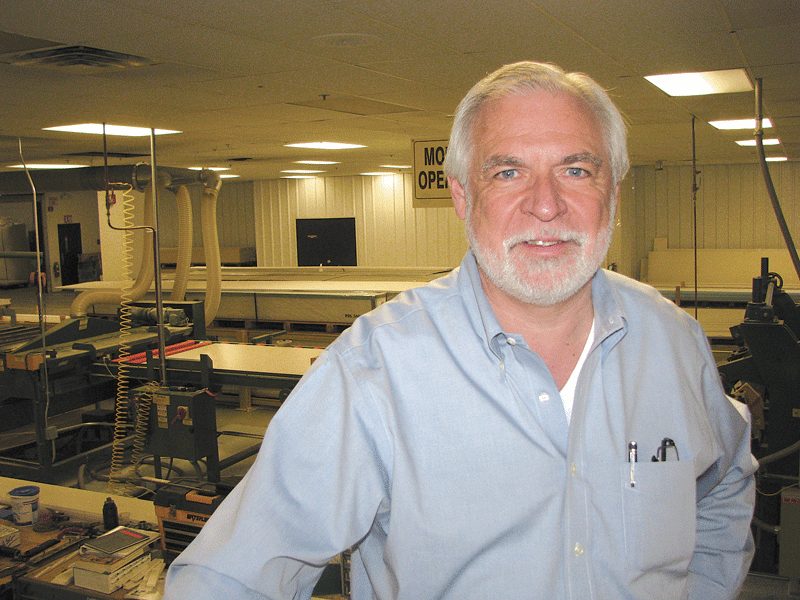
•••••

Robin Ann Bienemann of Touchstone Advisors in Enfield, Conn. has been named the first entrepreneur in residence at the UConn School of Engineering. At Touchstone Advisors, Bienemann advises companies looking to increase their value through improved business processes and innovation. She is also Chairman and Founder of Crimson Rook, a Connecticut-based firm specializing in helping small and medium-size businesses increase value through improved processes.
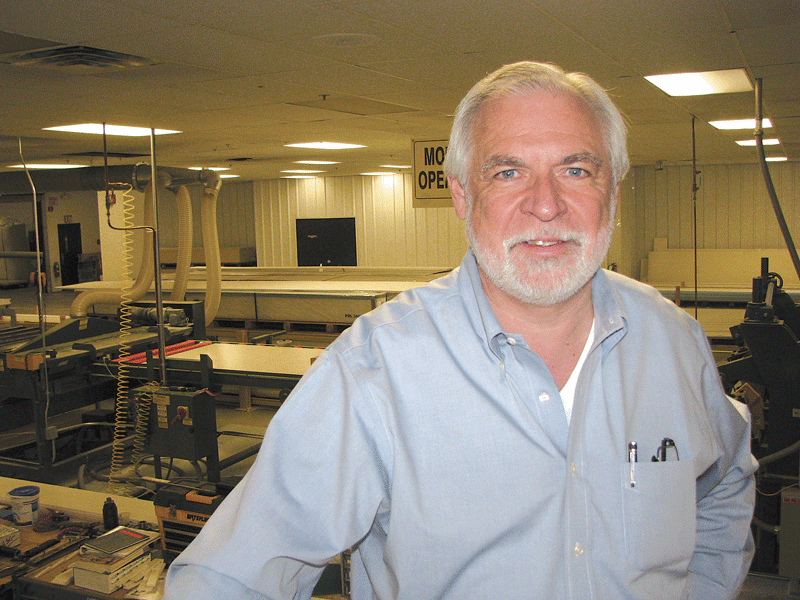
•••••

James B. Heffernan has joined Bacon Wilson P.C. as an Associate Attorney in the Springfield and Amherst offices. He will handle a variety of corporate transactional matters, bank financing, and Chapter 11 work.

•••••

Chicopee Bancorp Inc., the holding company for Chicopee Savings Bank, announced the following:
• Guida R. Sajdak has been appointed Chief Financial Officer;
• Lisa Crowley has been promoted to Assistant Vice President of Accounting;
• Maria Lopez has been promoted to Assistant Vice President of Residential Lending;
• Cidalia Inacio has joined the organization as the Senior Vice President of Retail Banking;
• Alyse Ramalho has joined the organization as Senior Vice President of Retail Lending; and
• Henry Downey has joined the organization as Assistant Vice President of Commercial Lending.

Departments Picture This

Arts & Soles

A flatbed truck carrying 20 six-foot-high fiberglass sneakers rolled into Springfield on July 8. Later in the day, an elaborate press event was staged to announce Arts & Soles, the community project involving the sneakers and the artists who will paint them in ways to answer the question, “what makes Springfield Great?” The footwear will be ready in time for the Basketball Hall of Fame induction ceremonies in August, and will be displayed in various locations downtown. Above, Springfield Mayor Domenic Sarno addresses those assembled for the media event. Behind him are, from left, Maryann Lombardi, director of creative economy for UMass Amherst, a partner in the project; Nancy Urbschat, president of TSM Design, one of the organizers; and John Judge, Springfield’s chief development officer. At left, Don Courtemanche, executive director of the Springfield Business Improvement District, one of the organizers, stands by one of the giant sneakers.


Comcast Digital Connectors

The Urban League of Springfield, Comcast, and One Economy held a special graduation ceremony at the Urban League of Springfield recently to honor a group of Springfield youths who have completed the Comcast Digital Connectors program. A total of 26 students completed the vigorous program, a year-long technology learning and service initiative that teaches teens and young adults from diverse, low-income backgrounds how to use broadband technologies and how to put that knowledge to work in their communities. At the event, several students shared the experiences they gained from the program. Each of the students was also presented with their own personal NetBook laptop, courtesy of Comcast, and the announcement was made that the Comcast Digital Connectors program will continue in Springfield next year. From left, Henry Thomas, president and CEO of the Urban League of Springfield, and Doug Guthrie, Comcast senior vice president for the Western New England Region, hand out NetBook laptops to the graduating Comcast Digital Connectors.


All That Jazz

More than 12,000 people turned out in downtown Springfield for the 4th Annual Hoop City Jazz and Art Festival, staged July 9-11. The event featured a number of regional and national entertainers, arts, crafts, a variety of food, and much more. Clockwise, from above, KASIF gets the audience hopping; Greg Caputo’s big band Velocity performs; members of Terrance Blanchard belt out another tune; trumpeter Cindy Bradley performs with Zoe; and employees and friends of event sponsor Hampden Bank, from left: Nancy Mirkin; Shana Hendrikse; Carolyn Ware; Bank President Tom Burton and his wife, Kathy; Nancy and Glenn McCarthy; John Osborn, president of the Hood City Jazz & Art Festival; Deb and Rick DeBonis; and Debbie Andrews.

Sections Supplements
Demographics, Economics, and Going Green Impact How the Office Looks and Feels

Ron Gordenstein

Ron Gordenstein says many of today’s offices are designed to facilitate a new culture of collaboration.

With the modern workplace operating much differently than it has in the past, today’s office spaces are steadily being reinvented from the inside out. To thrive in these changing times, office-design professionals have to stay atop trends ranging from environmental concerns to a shift away from cubicles to a more collaborative work culture, and create workspaces that reflect and facilitate these changes.

It’s no longer as simple a job as picking out the color of paint on the walls and the type of carpet in the hallway, says Debra Freedman.
As senior designer for Corporate Designs NE, she and Maria Czupryna, vice president of operations, said that interior design comes with an ever-increasing and shifting set of demands for the 21st-century office.
Many of these changes are strictly aesthetic, they said, with professional spaces mirroring current residential design. “There’s more of a ‘Pottery Barn’ quality to people’s aesthetics now,” Freedman explained.
But the modern office is reinventing not only the look based on current designs found in shelter magazines, but the very way that business within those walls is conducted.
Mary Wilczynski, design principal of Spec’s Design in Springfield, said that “jobs are changing so rapidly, and there’s a lot of movement within an organization. Current design reflects those needs.”
The days of the Dilbert-style cubicle are a thing of the past, said Ron Gordenstein, referring to that comic-strip portrayal of life in a droning example of corporate America. As president of Broadway Office Interiors of Springfield, Gordenstein said that his firm designs efficient and smaller work areas, “either to fit more people into that square footage,” he explained, “or to allow collaborative areas to happen, so that the business doesn’t have to find larger real estate.”
Such redesign of the nature of the workplace maintains an important concept of flexibility, he said, and furnishings and partitions are requested to maintain that goal. Reversible, L-shaped returns on desks and other modular concepts are a good means to allow furniture to be moved around the office.
“Let’s face it,” he said. “Office furniture is expensive. You want to make sure you’re making the best possible investment.”
Many trends have been introduced into the modern workplace, not the least of which is the concept of making the office greener. While finishes and furnishings can assist in a non-toxic environment, architect Steve Jablonski looks outside of the box — at the ‘box’ itself.
Using the term “adaptive reuse,” Jablonski is a local proponent of renovating existing, older structures to become contemporary workplaces. There are challenges to integrating high-tech and code-compliant infrastructure to these buildings, but he is committed to seeing these projects as the best possible use of resources.
For this issue, BusinessWest spoke to several design professionals to help get a better look at the specifics of the modern office, and how that institution is being reinvented, from the inside out.

Opening the Floor
Wilczynski said that, for the first time in her 25 years in the industry, some major changes are underway in how offices are designed, furnished, and, in some cases, how they operate.
“We used to have private offices in cubicles,” she explained, “but what we’re now seeing are those cubicle heights coming down, a lot more collaboration with project-driven teams, and less distinction between workstation designs. Before you’d have a supervisor, a manager with two side chairs, a technical person with one side chair, a data-entry person with a very small workstation. But now that footprint of the workstation is getting smaller and is being more universally designed.”
At Broadway Office Interiors, Gordenstein agreed that the changing nature of work practices has dictated a significant change in the workplace itself. He said that one of the most common terms he uses in meetings with clients is ‘collaboration.’
“When I first started in this industry,” he said, “I don’t think we ever used that term in a sales presentation. But today, I often ask, ‘tell me how your staff works with each other, and how they interact. How do they collaborate with one another to solve the problems of your business?’”
While this phenomenon would seem to be the style of creative-based offices and smaller boutique firms, Gordenstein said it is becoming common across all industries and among businesses of all sizes. “Companies aren’t staffed the way they once were,” he continued. “You have fewer people doing the same amount of work. In many cases there’s also a crossing over of traditional job descriptions. No longer does Mary do this and John does that. Now Mary and John do the work of three or four people.
“Inherently you have a need for better communication,” he added.
To illustrate this point, Gordenstein referred to one of his larger clients, a firm with more than 200 employees. Everyone in the office, from the president on down, sits within a space framed by panels that are 42 inches high.
“You can’t help but see, hear, and feel everything that’s going on around you,” he said.
Elise Irish of Spec’s Design added that, for companies operating with less staff, employee retention is more important than ever. “If you want to hold onto them, and you want them to do as much as possible, then you’ve got to give them the right environment.”
Across the table, Wilczynski added, “especially with Gen X and Gen Y, who might look to move through companies more rapidly, employers recognize that they have to design to a younger population.”
Addressing that workforce, with younger ages and attitudes, Wilczynski said that more ‘fun’ is being introduced to the office environment. Employers strive to fashion workspaces that closely mirror a more residential formula, with lounge areas and designated areas for staff to congregate and interact.
Explaining the benefits of such an office, Irish said that “you spend more time in your work environment than you really do in your home, and I think employers are aware of that. If you’re in a creative environment, you are more likely to think outside of the box.”
To help create a workplace that is less stressful, employers are looking for more ways to look after the health and well-being of their staff. Freedman says that in-house gyms have become more common, and one of her rural clients landscaped hiking trails around the facility.
“It’s very important for the employer to satisfy the needs of the employees,” she explained, “to show that they are valued, and that the boss is looking after them. They’ll do better work, and in the end, there’s better productivity.”

Trade Talk
The evolving workforce, with increased numbers of telecommuters, has introduced a new lexicon to the design trade.
It’s not just people who work from home, Wilczynski added, but staff that are encouraged to be out in the field, without the requirements of a full office.
These types of workers might share workspace, she said, “and the name for this style of space is the ‘touch down’ spaces — where your storage is separate, but you share a workstation. When you come in those one or two days per week, you bring your wheeled storage station to the work area, and it’s plug and play … no more leaning under the desk to get to outlets.”
But these aren’t restricted to non-traditional employees, Gordenstein said, but rather a non-traditional style of work. “A lot of employees today don’t sit at their desk all day long,” he said. “They have mobile technology, they’re walking around … they are in another employee’s office. So we create generic meeting spaces that are accessible and quick. They can be a simple table in the department, or a quiet meditative space for someone to read a trade journal, also.”
He added ‘hotelling’ to the new vocabulary of his industry.
“If you’re an outside salesperson,” he explained, “I as the employer don’t pay you to sit at your desk all day long. I need you out meeting clients and selling. If I make it too comfortable, you’re going to stay at your desk.”
Green Is Good
Another measure of creating a healthy workplace is the renewed importance of building and maintaining a green office.
When sales reps show her the latest in furniture and accessories, Irish said that the green option is always the first to be presented. “Because those questions do come up more and more now with our clients: what chemicals are used, were the components sustainably produced,” she explained.
Her colleague agreed with her, and added that tax breaks don’t exist for green office design to a great extent, so clients aren’t pursuing LEED certification, “but they are designing to it,” Wilczynski said.
“And we’ve been designing to it for about three years now,” she continued. “All of our specifications are written for finishes with low VOCs — we are very conscious about the products that we put into spaces. Regardless of whether a client wants to pursue the LEED plaque, we’re still finding a strong movement to designing greener spaces.”
Czupryna said that, while her office has also been seeing an increased use of green components in design, that consciousness extends to any material removed during office rehab. “It’s important to take it another step and take the older materials that have been removed and then recycle them,” she said. “The clients appreciate that we too are doing our bit.”
But going green can often come at a price that clients cannot carry. Gordenstein agrees that green is a popular phenomenon, yet, he added, “customers will ask me about ‘green,’ but they don’t really understand what it means, nor are they prepared to pay for what it means, or make the commitments for what it means.”
But greening the office often is a measure of changing technology as well. Wilczynski said that, as large central copy stations have been rendered irrelevant by desktop, all-in-one printers, those large spaces are now turned over to central recycling stations.
“And it’s the first time in my career that we are seeing the realization of the paperless office,” she continued. “It’s been a buzzword since I started 25 years ago, but it’s finally here. Technology has caught up.”

Everything Old Is New Again
Steve Jablonski sees the movement toward greener office spaces from a different perspective. The Springfield architectural firm that bears his name is well-known for its interest in historical redevelopment.
“With the emphasis on the environment and carbon footprints,” he said, “people are finally starting to say, ‘what’s the greenest thing you can possibly do?’— well, how about reusing what is already there?”
He agrees that it is easier to tear down and build from scratch; “that way, when you design a square, you get a square,” he said, simplifying the complexity of redeveloping older structures. But, he added, these resources are not only a link to history, but also to project cost.
“It’s a matter of enlightening the client to get over the hump of thinking it’s cost-prohibitive,” he explained of adaptive reuse of older buildings. “To knock down an existing building isn’t cheap. And all the hazardous waste has to go somewhere. So people are saying, ‘wait, I have to pay that much to throw it all away?’
“If you take the long-term picture,” he continued, “let’s say that in ten to 20 years you might come out ahead with the cheaper, bland office structure. But if you take the 50- to 100-year approach, that cheap and bland structure is going to need to be replaced itself. Whereas these buildings with character that have been modernized at first might be 10% to 20% higher in cost overall, but then after 50 years it’s still going strong.”
Admittedly, such a timeline is not suited to the budget concerns of every client, but for higher education, this is not only good for the schools’ mission to go green, but in many cases an important link to honoring their own history.
Jablonski unfurled the plans for a building project currently underway at Springfield College. Formerly called the Judd Gymnasium, the elegant, 19th-century brick structure is being converted to office and museum space, and has been rechristened the Stitzer YMCA Center.
The building’s older warren of rooms was quirky, he said, but he praised the vision of college President Dr. Richard Flynn, who had the initiative to make this the new showpiece of the campus.
It can often be a hybrid of architecture and archaeology, Jablonski said, during these projects. Pointing to a large room at the Stitzer Center, he said, “we took out the drop ceiling and restored the truss roof. People walk in and say, ‘this is beautiful, what you’ve done.’ But really, all we did was bring back what was already there.”
Springfield College joins the ranks of many other campuses across the country in the successful adaptive reuse of buildings, he said, adding quickly that “it takes leadership on the part of design people to take the initiative to use these spaces.”
He emphasized the importance of good office design as an important role for people like himself, and the people who furnish those rooms. But, ultimately, he credits the client for their acceptance of these reinvented workplaces.
“There’s only so much you can do as a designer to lead people along,” he said. “But if they’re not following, you’re not going to get far.”

Departments Picture This

Mission: AMICCON

Organizers of an event called AMICCON — the Advanced Manufacturing and Innovation Competition & Conference — staged a press event recently at the New England Air Museum at Bradley Airport to help build awareness of the Sept. 23 conference that will highlight manufacturing in Western Mass. and Connecticut. AMICCON will focus on six key manufacturing niches — plastics and advanced materials, precision machining, paper and packaging, electronics, ‘green’/clean technology, and medical devices — and has been designed to help area manufacturers make connections with one another and become aware of all that is produced in Springfield-Hartford corridor. The conference will take place at the MassMutual Center. For more information or to register, visit www.amiccon.com. Seen here are, from left, Jeff Sattler, president of NUVO Bank, one of the event organizers; Daryl Ott, executive director of the Connecticut Tooling & Machining Assoc. and also membership director of the National Tooling & Machining Assoc.; organizers Eric Hagopian, president of Hoppe Tool in Chicopee, and Ellen Bemben; and Mike Speciale, executive director of the New England Air Museum. Those gathered are standing under a fully rehabbed WWII B-29 bomber.


IBS Celebrates Its 20th

Innovative Business Systems staged a 20th-anniversary party recently at the Log Cabin Banquet & Meeting House. More than 100 clients, friends, and vendor partners attended. From left, Dave Delvecchio, president and owner; Scott Seifel, owner and technician; Bill Tremblay, former owner and president; Tremblay’s wife, Elaine; Ben Scoble, owner and technician; Brian Scanlon, owner, vice president, and treasurer; and Scott Benoit, owner and technician.

Sections Supplements
Entrepreneurship Hall of Fame Steers into Its Second Decade

Ira Rubenzahl says that, a decade after its creation, the Western Mass. Entrepreneurship Hall of Fame has earned a place within the region’s business community — and so has the banquet at which inductees are announced and celebrated.
There are now 57 inductees. Some of them are individuals (Theodor Geisel, Mary Lyon, Milton Bradley, and Primus Mason are in this category), a few teams of partners (Horace Smith and Daniel Wesson, Charles and George Merriam, and Silas Lambson and Abel Goodnow), as well as a couple of organizations (such as Baystate Health, for example). But most are families that started businesses and ran them for decades.
Those family names include Picknelly, O’Connell, Fontaine, Steiger, Sandri, Balise, Roberts, Falcone, Scherff, and many others. They are now etched into plaques that hang in the main lobby of the Scibelli Enterprise Center in the Technology Park at Springfield Technical Community College.
And there will be more names added to additional plaques, said Rubenzahl, president of STCC, who told BusinessWest that, a decade after its founding, the hall of fame will continue to honor and celebrate the region’s tradition of entrepreneurship.
“This has been an important event for this region,” he said of the annual dinner. “The college and the college foundation wanted to continue this, and we’re enthusiastic about the program moving forward.”
But there will be a few changes moving forward, said Rubenzahl, with most of them involving the annual induction dinner.
For starters, the event, traditionally staged in November, will be moved to the spring, with the one honoring the class of 2011 slated for April 14 at the Log Cabin Banquet & Meeting House. Meanwhile, inductees, which have been announced each May for the past decade, will now be introduced at the college’s annual Top of the City party, with the next one slated for Jan. 20. And moving forward, proceeds from the dinner will go toward scholarships for entrepreneurship students at STCC; in the past, they were used for youth-oriented entrepreneurship programs.
Another change will be the larger role being taken by BusinessWest, which has also been honoring the region’s rich history of entrepreneurship and will collaborate with STCC in matters involving the Hall of Fame and the annual dinner.
The magazine, which has, since 1996, presented its Top Entrepreneur Award (the Holyoke G&E was chosen for 2009), will honor its latest winner at the Top of City party. In addition, BusinessWest will play a prominent role in introducing the inductees for a given year and handling logistics of the annual banquet.
“This region has a strong heritage of entrepreneurship, and it continues today with a number of new and exciting ventures and the expansion and evolution of many family businesses,” said Kate Campiti, associate publisher and advertising manager of BusinessWest.
“We’re looking forward to collaborating with STCC to recognize people from the past and present who are continuing a tradition of innovation and excellence,” she added.
Also working with the college on matters involving the Hall will be UMass Amherst, said Rubenzahl, noting that the university recently entered into a collaborative effort with STCC on the management of the Enterprise Center and its Springfield Incubator. Marla Michel, director of Strategic Communications and Outreach for the university, is now a shared executive, working two days each week as director of the incubator.
Representatives from UMass will be among those chosen to serve on a committee that will select the inductees for 2010, said Bill Kwolek, director of Development at STCC, adding that the panel will also include representatives of the college and several area economic-development agencies.
Here are the inductees for the first decade of the Western Mass. Entrepre-neurship Hall of Fame.

Class of 2009
• Bacon Wilson, P.C.;
• The Cambi Family (Springfield Foodservice Corp.);
• Larry Derose (Texcel Inc.);
• The Desrosiers Family (Hadley Printing);
• John Gormally (BusinessWest, ABC40/FOX6); and
• The Peters Family (Universal Plastics)

Class of 2008
• Baystate Health;
• The Jacobson Family (OMG Inc.);
• The Samble Family (Belmont Laundry);
• The Scherff Family (Student Prince restaurant); and
• The Young Family (W.F. Young)

Class of 2007
• Theodor Seuss Geisel (Dr. Seuss);
• Charles and George Merriam (Merriam-Webster Inc.);
• The Bassett Family (Bassett Boat Co. Inc.);
• The Falcone Family (Rocky’s Hardware);
• The Gordenstein Family (Broadway Office Interiors); and
• The Roberts Family (F.L. Roberts)

Class of 2006
• The Balise Family (Balise Motor Sales);
• The Fontaine Family (Fontaine Bros. Inc.);
• The Grenier Family (Grynn & Barrett Studios);
• Horace Smith and Daniel Wesson (Smith & Wesson); and
• The Lanier Family (Springfield Food Systems)

Class of 2005
• Sister Mary Caritas and the Sisters of Providence;
• Joshua Brooks (Eastern States Exposition);
• William L. Putnam (WWLP TV-22);
• Mary Lyon (Mount Holyoke College);
• Fran and Teddi Laurin (Laurin Publishing); and
• Joseph Napolitan

Class of 2004
• Albert and Amelia Ferst (Camfour);
• Silas Lamson and Abel Goodnow (Lamson and Goodnow);
• Joseph V. Gosselin Jr. (Commonwealth Packaging Co.);
• Emanuel (Manny) Rovithis (Manny’s TV and Applicances); and
• William Skinner and Family (William Skinner and Sons)

Class of 2003
• Channing Bete Family (Channing Bete Co.);
• Samuel Bowles (the Republican);
• Milton Bradley (Milton Bradley Co.);
• The Hannoush Family (Hannoush Jewelers); and
• Daniel J. O’Connell Family (Daniel J. O’Connell Cos.)

Class of 2002
• The Carroll Family (Riverside Park);
• John E. Reed (Mestek Inc.);
• The Sandri Family (Sandri Cos.);
• Stephen Spinelli Jr. (American Oil Change Corp.); and
• Albert Steiger (Steiger’s)

Class of 2001
• The Davis Family (American Saw and Manufacturing Co.);
• Jane and Jack Fitzpatrick (Country Curtains);
• Primus Mason;
• Peter C. Picknelly and Peter L. Picknelly (Peter Pan Bus Lines);
• George W. Rice and Caleb Rice (MassMutual); and
• Amos Rugg (Rugg Manufacturing Co.)

Class of 2000
• Frank S. Beveridge (Stanley Home Products);
• Curtis Blake and S. Prestley Blake (Friendly Ice Cream);
• Zenas Crane (Crane Paper Co.);
• Paul D’Amour & Gerald D’Amour (Big Y Foods);
• Joseph J. Deliso Sr. (HBA Cast Products);
• Michael Kittredge (Yankee Candle);
• Albert G. Spalding (Spalding Sports Worldwide); and
• Rita M. Tremble (Valley Communications Systems)

Sections Supplements
Online Banking Services Surge in Popularity

Karen Buell

Karen Buell says banks are being challenged to recognize what tech-savvy customers want, and then provide it.

When online banking was introduced about a decade ago, some people predicted the eventual death of physical branches, while others wondered if people would ever be comfortable transacting business on their home computer. Neither has proven to be true. In the past couple of years especially, Internet banking has taken off, and not just among the younger, tech-savvy crowd. Yet, bank administrators say it doesn’t threaten to close teller windows, as customers simply do more business than they used to through multiple channels. But online banking has created a new competitive challenge — one that area banks are excited to take on.

When it comes to banking, Karen Buell knows how the younger generation thinks. That’s because she’s one of them.
“I’m Generation Y, and I haven’t been to the bank in years — I work at one, but that doesn’t count, does it?” said Buell, Internet branch manager for PeoplesBank. So she regularly asks herself what features she’d like to see in an online banking platform.
“Really, my job is to make sure that anything we can do in our branches can be done online,” she told BusinessWest. “Anything that can be done in person, you should to be able to do at home, 24 hours a day. We know that convenience is the key.”
That convenience is becoming more of a priority for an increasingly tech-savvy consumer base at Peoples and other regional banks. And Buell — as well as others we spoke with — said it’s not just younger customers moving to the Internet to do much of their banking.
“If you asked me a year and a half ago, I’d have said it’s mostly the younger generation, but it’s across the board now,” said Kelly Ryan, vice president of Operations for Berkshire Bank. “I think it’s convenient; it’s 24/7 access, having the information right at your fingertips.”
Lynn Starr, vice president of Systems and Operations at Easthampton Savings Bank, is seeing the same trend — specifically, more banking customers of all ages switching to online banking.
“I also think people are becoming increasingly comfortable with online shopping, using the Internet to search for products, just more comfortable with the electronic world, so to speak,” she explained. “So we see a wide spectrum of customers, from 18 to 65 or 70, using our online platform. It just depends on how comfortable they are with technology and how much they’ve adopted it in other areas of their lives. We don’t see it happening only in the younger generation, but across all demographics.”
That means that online banking has become more than just an innovative offering used by a small number of customers; it’s now a competitive issue, a feature increasingly seen as necessary. And that has required a shift in what services banks offer and how they market themselves to an increasingly tech-savvy clientele.

Logging On
According to a survey sponsored by Fiserv and conducted by Harris Interactive, more than 80% of households with Internet access last year used it for online banking services: to access balances, check account history, transfer money between accounts, or pay bills at a bank Web site — and the number continues to grow rapidly. Among those surveyed, 41% of online banking users said they planned to pay more bills online at their financial institution’s Web site in the coming months.
The major reasons survey respondents said they prefer to pay bills online included speed (79%), ease of use (72%), cost savings on stamps (71%), and control over the timing of payments (71%). In addition, 49% of consumers who use online bill pay said they are less likely to switch banks due to their experience, up from 43% the previous year.
“We believe that consumers will continue to conduct more and more of their financial activities online,” said Geoff Knapp, vice president of Online Banking & Consumer Insights for Fiserv. “Online banking and bill payment is a free service, and a convenient and environmentally friendly way to bank. Consumers are actively becoming fans of the user-friendly, secure services financial institutions are implementing.”
Ryan called Berkshire Bank’s online channel “robust,” noting that, “on the personal side, you can pay bills, check account balances, transfer funds between checking and savings, and get images and copies of cleared checks. But our major project recently has been FinanceWorks, an online financial-management tool for personal Internet banking. We had no marketing on it at first, but close to 1,800 hits in the first 24 hours. The product just sold itself.”
FinanceWorks allows customers to manage all their accounts — even those from other banks — with a single login, create and monitor budgeting categories to show where money is being spent, monitor recurring transactions, and remind the customer when bills are due, among other features.
“My total goal is to look at the infrastructure we have internally, then look at the Internet banking platform and keep it robust,” Ryan said, echoing Buell’s priority of making sure customers have access to as many services online as those who visit the branch — and, in the case of features like the budgeting tool, even more. “We do it because we have to be competitive.”
Fedelina Madrid, vice president and senior marketing officer for Berkshire Bank, added that many banks have a similar structure to their basic online services — again, to stay competitive in an area customers have come to expect — but her institution also offers customers online access to all the bank’s financial services, including investment and wealth-management products.
“Customers expect online banking,” she said, “but when we add network services, we move more customers our way.”
FinanceWorks has also been a hit at PeoplesBank, where customers appreciate the way it aggregates all accounts in one place, so they can see balances and account histories, and are able to set budgets and track spending habits and savings goals, Buell said.
“So if you go to Dunkin Donuts, it’s automatically categorized as dining or coffee, and you can set up a budget for that expense. If you want to spend only $20 a month on coffee and no more, you can tell if you’re close to that goal or exceeding it. It’s a helpful tool for budgeting and tracking. If people see us as a resource to help them manage their money most effectively with the best options, hopefully they’ll choose us.”

Secure Transactions
At Easthampton Savings Bank, “online banking is certainly becoming a much more popular option,” Starr noted. “It’s becoming more widely accepted as people become more comfortable online. We’ve structured our program so that you can do online what you can do in the branch. You can even open up many types of deposit accounts, apply for consumer and mortgage loans, and receive e-statements.”
Those are popular, Starr continued, partly because they give customers instant access to recent activity every time they log in, so they’re not waiting for a mailed statement to discover potential problems, like fraudulent use of their account. Ryan added that eliminating mailed statements, an option many banks offer, also eliminates the risk of the information being stolen out of a mailbox, a factor in identity theft. It also cuts down on paper waste and was part of Berkshire Bank’s recent ‘going green’ push, Ryan said.
Still, when most people think of online banking, they think of convenience, Buell said. “Within our online banking channel, we offer bill payment, transfers, account history, check images, e-statements, things like that,” she noted. “We also offer Direct Connect to Quicken for personal accounts, which allows you to manage your money a little easier, because you don’t have to manually enter all the data.”
Buell was also proud of the next step in online banking — mobile banking, which can be conducted on a wireless device.
“It’s a scaled-down version of online banking, but it allows for one-time bill payment and transfers on the personal side,” she explained. “We’re finding that more and more people are doing things from their mobile device; they want to do things straight from their phone. So our mobile banking adoption has grown immensely; we launched an actual application for the iPhone earlier this year, and since then, our mobile banking option has advanced even further.
“It’s important that we provide all these options,” Buell continued. “We know the demand is there; we just have to bring products to market to meet the demand.”
She noted that it’s a challenge to be among the first to bring products to market, but at the same time, that’s how banks differentiate themselves from their competition — and the online world has certainly become ground zero for that sort of competition.
So, will online banking eventually mean the death of branches? Starr doesn’t think so.
“It’s just another channel,” she said. “When ATMs came out in the late ’70s and early ’80s, we heard that ATMs will be the death of branches, the death of the lobby. And when online banking appeared a decade ago, we heard the same thing, that branches would go away. But it’s just another channel by which customers can do business with us. Some use only the ATM, some use only branches, some use online banking, and some use all of them.”
Starr noted that, unlike the days before Internet banking and especially before ATMs, when people would do more business in each trip to the bank, customers tend make more transactions today and do a little business at a time. In that way, she said, branches will continue to thrive.
But that doesn’t make the virtual world any less intriguing, Buell said.
“It’s an exciting job,” Buell told BusinessWest, “especially in a world where technology is progressing so quickly. Every day brings new challenges and new success. It’s all about creating convenience for the customer. Sometimes I step back and say, ‘how would I want to do this?’”
Good question — especially coming from someone who never goes to the bank.

Joseph Bednar can be reached
at [email protected]

Sections Supplements
Business Community Takes Lead Role in Building a New Putnam

From left, York Mayo, Cleveland Burton, and J.M. “Buck” Upson

From left, York Mayo, Cleveland Burton, and J.M. “Buck” Upson stand in front of Roger L. Putnam Vocational Technical High School in Springfield.

Construction is underway on a new Putnam High School in Springfield, a project that is being influenced in many ways by input and hands-on consulting from the business community. For those involved, it’s a labor of love, and a way to ensure that the new school is providing the kinds of training that can directly benefit several different sectors of the economy.

Last month, a groundbreaking ceremony was held for the new Roger L. Putnam Vocational Technical High School in Springfield, which will open its doors in the fall of 2012. And although replacing the 1938 building is a event worthy of celebration, there is a private project underway which is equally important in shaping the school’s future.
It’s called the Roger L. Putnam Technical Fund Inc. and was started in August 2008 by John Davis of the Irene and George Davis Foundation with the goal of insuring that students and staff in the new school have state-of-the-art equipment as well as support and guidance from industry and business leaders so they can succeed in their fields of endeavor.
A trio of ‘retired’ businessmen, York Mayo, J.M. “Buck” Upson, and Cleveland Burton, have been working tirelessly for two years to recruit people from the business community, forge mutually beneficial relationships, and raise $9 million in donations and/or equipment, which is the shortfall needed to purchase furniture, fixtures, and equipment to keep students in line with today’s technology.
“We don’t want to bring an old school into the new building. We are looking to the future and figuring out what changes need to be made to be more future-oriented,” Mayo said.
School officials are grateful for their efforts, which have resulted in significant donations and a veritable army of volunteers who came on board after touring the school and listening to presentations by students.
“Building a new building is one thing,” said School Superintendent Alan Ingram. “But it’s what takes place inside that affects our students. What’s exciting about this fund is the impact it will have on them, their lives, their futures, and the community. The crux of this [fund] is making sure that the work that takes place inside the building is relevant, is rigorous, and is predicated on relationships between the kids and the business community.”
Putnam’s senior vocational administrator, Fred Carrier, agrees. “Our students are going to work in industries, and if we don’t have vibrant relationships with businesses, we won’t be able to meet their needs,” he said.
Mayo, Upson, and Burton put in more than 50 volunteer hours a week collectively to meet their goals and hope other volunteers will join them. “There is no silver bullet,” said Upson. “It’s just hard work. We are putting in a lot of hours and working as agents of change by promoting the idea of having the business community get involved in government and education.”

Trade Deficits
Davis had thought about forming the Roger L. Putnam Technical Fund Inc. for several years. But when plans for a new school became immiment, he knew it was time to formulate a plan of action.
He modeled the Putnam fund after the Skyline Fund at Worcester Technical High School, which has raised more than $4 million in cash and more than $3.5 million in equipment donations since its inception in 2005.
Davis knows people who are involved with that program and thought it could be replicated locally.
“I was really impressed by the program and by how involved the business community is with it, and I knew it could be beneficial for Springfield,” he said.
“Technology is changing much more quickly than it did in the past, and although the students are enthusiastic, they need to have the right equipment and training.”
One of the first steps he took in establishing the Putnam fund was to recruit Mayo, who worked for American Saw (which was Davis family’s business) for 30 years before retiring and becoming an active community volunteer. He agreed to take over the helm after he toured Putnam in August 2008 and met with Ingram and Principal Kevin McCaskill.
“Kevin told me that, during his tenure, the school expanded from 900 students to 1,637, and the graduation rate went from 29% to 70%,” said Mayo. “The school now has 350 kids on the waiting list. And students in vocational regional schools in the state score higher on the MCAS on average than students in a purely academic school, even though they spend only half their time in those classes. I was so impressed and felt I could make a difference in the lives of hundreds, if not thousands, of students by helping them get the right equipment.
“Our goal is to form entrustments with national companies who will lease equipment or sell it to the school at reduced prices,” he continued. “In exchange, they can use the school to show off the equipment to their clients.”
Mayo is dedicated to his role with Putnam. “We can’t sit back and criticize if we are not part of the solution,” he told BusinessWest. “It’s what we need to do to change our country. We can’t just pay educators and expect them to do the job. The business community has to make a sacrifice and become involved.”
Mayo noted that it’s critical for the business community to get involved, because over the next several years, thousands of Baby Boomers will be retiring, and those who will be entering the workforce must have the requisite skills to replace them.
That translates into opportunities for students in a number of vocations, including health fields. “Baystate [Health] says it will have thousands of jobs open due to expansion and retirements,” Mayo said, adding that Putnam has an Allied Health Trade program with 140 participants.
“The business community needs to align itself with Putnam and with Springfield Technical Community College and get involved,” he said. “The way to change the world is not by talking, but by having a vision. Ours is to get every business owner in our school because we want to make it the number-one vocational school in Massachusetts.”
Burton is another recruit from American Saw who worked in the Human Resources department as manager of employee relations for 36 years before retiring. “My role is to work with our business partners to make Putnam the best school on the planet,” he said. “We are looking beyond 2010 and are reinvigorating their advisory council. The new school will have four academies and 21 programs, and we are putting a business chair in charge of each department.”
The advisory committees are meeting on a regular basis to talk about what Burton calls “burning issues and opportunities for improvements in each program.
“Our focus is on students because they are the product of the school; we are going to enhance their programs and engagement because our goal is to have them in their career when they graduate,” he said. “It’s a lofty goal, but if we involve business partners and build the right program, by the time the students graduate, they will have gone through internships, cooperatives, and be employed.”

Parts of the Whole
The new school is designed to house 1,400 students, which is about 200 less than the current population. “It will be smaller, so there will be opportunity for more focus,” Burton said. “A lot of kids feel disconnected and don’t feel there is much opportunity for them. But we will accentuate the positive so the negative goes away. If we put the right processes and systems in place, we can make Putnam the school of choice in Hampden County. These young people are our future leaders, and we need to help pay the tab for them, just like someone paid for us. The clock is ticking, and if we don’t do it now, it won’t happen.”
One of the most successful strategies the team has employed is group tours. Over the past 15 months, organizers have conducted 34 tours of the school with 236 business people from 134 companies, and the results have been remarkable.
The tours include PowerPoint presentations by students which show what they are working on and what they would like to have in the school, as well as graphic layouts for the new floor plans.
Mayo said that when Jeb Balise, president of Balise Auto Sales, and four key employees who accompanied him on the tour saw the proposed layout of the equipment in the new school’s automotive-technology program, he recognized there was a real gap.
“He needs 40 technicians this year and can’t find them,” said Mayo. “He just completed his Honda store and invited his administrators to the presentation. They looked at our plans and showed us his plans. There was a gap, because he is looking to the future and we were still in the past. He offered to engage an architect to look at our plans and paid for it.”
The new design, which aligns with current industry standards, will be given to the architects working on Putnam, so they can make the necessary changes.
“This is what happens when you open schools to organizations,” Mayo continued. “It works beautifully and has resulted in donations from 11 companies and a half-million dollars in equipment so far.”
Carrier is thrilled with the success. “The tours have gotten so many people from the business community to become passionate about Putnam,” he said. “They have become involved with the life of Putnam and have opened up their doors to us for tours, internships, and cooperatives. We always had them, but the program has never been this rich.
“Parents and students are also realizing the trades are where the future is,” he continued. “ You can’t send plumbing or electrical work offshore. Those jobs will always be here.”
Another component of the program is to establish a partnership between the business and educational communities, which operate in two different realms. “The business community needs to learn the needs of the educational program, and they need to learn the needs of the business world,” Mayo said.
Carrier concurs. “It’s very important, and you always have to push to try to improve things. It’s very easy for educators to get complacent,” he said, adding that the school is conducting training sessions this summer on new pieces of equipment.

Lathe of the Land
Upson drives from Cape Cod every Monday morning to spend three days working at Putnam. The retired president and owner of Pioneer Tool in West Springfield is responsible for resurrecting the machine-technology program at Putnam three years ago.
He says that, although there are seven vocational schools in the Pioneer Valley, only 50 machinists were graduating from them, which was problematic, since two years ago, the UMass School of Business documented over 8,000 jobs in precision manufacturing in the Pioneer Valley, and a report by Northeastern University projects a growth of 100,000 jobs in that field in Massachusetts over the next 10 years.
“There are many Baby Boomers retiring and there is tremendous opportunity for educated students,” he said, adding that it is their hope that Putnam graduates will go to college, although it’s not required to work in the field. “Almost every shop in the Valley has tuition reimbursement,” he said. “These jobs pay high wages and offer profit sharing and excellent medical benefits.”
In order to get the program restarted, Upson sought help from former School Superintendent Joseph Burke, David Cruise of the Regional Employment Board of Hampden County, and the board of directors from the National Tool and Machining Assoc.
They had little to start with, except some machines recycled from the Springfield Armory used during World War II. But thanks to Upson and a dedicated staff, the program has grown, and this year 16 students were involved in a cooperative, which allowed them to work in the industry during the school year.
Smith & Wesson donated four machines to the program and promised a donation of $250,000 over five years. “They have been struggling for years to find qualified employees, as there are no apprentice shops anymore,” Upson said.
In fact, Smith & Wesson became so vested in Putnam that it hosted a meeting for area businesses last October and asked others to leverage the $250,000 it is donating.
“It was the largest assembly of manufacturing senior business owners in more than 50 years, said Upson. “It was a very successful fundraising initiative, and more than 50 companies attended. The L.S. Starrett Company in Athol made a $50,000 contribution in measuring devices, and ANCA donated a $100,000 cutter grinding machine.”
Upson said local firms are hoping Putnam will host a night program to allow workers to upgrade their skills on the new equipment. “Putnam will become a center for continuing education for the industry, in addition to educating 9th- to 12th-graders,” he said.
Since joining forces with the fund, Upson has also become involved with the graphic-arts program and has reached out to large and small shops to make sure the school’s curriculum parallels job skills needed in today’s world.
“There are plenty of things people in the business community can do if they are willing to volunteer,” he said.
Anyone interested is invited to contact Mayo at (413) 596-8634, or (413) 537-0197, or by e-mail at [email protected]

Departments

40 Under Forty Gala

June 24: BusinessWest will celebrate its 40 Under Forty Class of 2010 at the Log Cabin Banquet & Meeting House with a gala to begin at 5 p.m. The event, which has become a spring tradition in Western Mass., will feature fine food, entertainment, and special presentations of the Class of 2010. Tickets for the event are $60. To order tickets or for more information, call (413) 781-8600, ext. 10, or e-mail [email protected].

The Coming Demographic Storm

June 30: The 2010 census statistics will prove it out over the next few years, but Kenneth W. Gronbach already knows what the stats will mean to America. A demographic storm of epic proportions is upon us, and if America’s businesses, regardless of size, are ready, they can plan for amazing success. But if they are not ready, they could be washed away in the giant generational wave. Gronbach, a gifted public speaker and a nationally recognized expert in the field of demography and generational marketing, will be the keynote speaker at the noon luncheon for the Advertising Club of Western Mass. at Longmeadow Country Club. Gronbach makes the science of the census results and shifting demography come alive with real-life examples that make it relevant to today’s culture, business climate, and economy. His presentation is based on the effects of shifting demography. He is an accomplished author with a new, bestselling book, The Age Curve: How to Profit from the Coming Demographic Storm. The demographic landscape in the U.S. is made up a series of waves that are about 20 years in duration. It would follow that business will rise and fall according to the critical mass of customers heading toward it. What is different about this wave is the extraordinary amount of population it includes compared to the past two generations. Businesses will enjoy extraordinary success if they are prepared and in front of the wave. Ad Club members are invited to bring a business associate and join the Ad Club for this presentation and network with the top advertising, marketing, and design talents in Western Mass. To make a luncheon reservation, contact the Ad Club at (413) 736-2582, or online at www.adclubwm.org. The cost for the luncheon is $25 for members, $35 for future members, and $15 for students.

Construction Course

July 14: The Home Builders & Remodelers Assoc. of Western Mass. will sponsor a six-session course starting July 14 to help individuals prepare for the Massachusetts Construction Supervisor’s Licensing Exam. Sessions are planned at the Home Builders & Remodelers Assoc. headquarters at 240 Cadwell Dr. in Springfield for six Wednesdays from 5:30 to 8:30 p.m. The exam is authorized by the State Board of Building Regulations and Standards and administered by Thomson Prometric. Registration forms to enroll for the exam will be distributed at the first session of the program. The fee is $250 for members of the Home Builders Assoc. of Western Mass. and $350 for non-members. All course participants must bring the 7th edition of the One & Two Family Dwelling Building Code book and the 7th edition of the Basic Building Code book to each class and to the open-book examination. There is an additional charge to order the code books through the association. For more information or to register, contact Sandra Doucette at (413) 733-3126.

Advanced Manufacturing Competition & Conference

Sept. 23: The first highly concentrated, cluster-centric, regional manufacturing conference of its kind will be held at the MassMutual Center in Springfield. The event, called the Advanced Manufacturing and Innovation Competition & Conference (AMICCON), is being staged in response to growing recognition among area manufacturers and supply-chain members that there is an urgent need to find and meet one another. “AMICCON was formed to identify who’s here in manufacturing, expose them to OEMs (original equipment manufacturers) and procurement, and to make these introductions,” said co-founder Ellen Bemben. “The ultimate goal is to be the advanced-manufacturing region in the U.S., where exotic manufacturing, such as micro, nano, and precision, meet higher specifications and tighter tolerances, and short runs are the norm.” Industry sectors to be represented at the event will include plastics and advanced materials, precision machining, paper and packaging, electronics, ‘green’/clean technology, and medical devices. Business opportunities in defense and aerospace will also be highlighted at the event. OEMs and their supply chains are being invited personally to participate. “AMICCON is also a new consortium on innovation that also delivers manufacturers to innovators and new markets in order to cause new business,” said Gary Gasperack, vice president and general manager (retired) of the Spalding Division of Russell Corp. “We are very excited about introducing it to our region.” The Mass. Export Center has already produced two programs for AMICCON: an “Export Experts Panel,” and a seminar, “International Traffic in Arms Regulations for Defense and Aerospace Export.”

Departments

Cutting the Ribbon

Daniel R. Zivkovich, executive director of the Mass. Municipal Police Training Committee, addresses the audience at the ribbon-cutting ceremony for the Western Mass. Municipal Police Training Academy on the campus of Springfield Technical Community College. The newly renovated building, formerly known as the West Arsenal of Springfield Armory, is the oldest standing building in Springfield, dating from 1808. The western regional academy provides training for police recruits and veteran officers from 107 Western Mass. communities.


Martini Magic

Max’s Tavern in Springfield was the site of Martini Magic, an event to help raise funds for Ronald McDonald House. More than 200 people turned out on June 10 to sample designer martinis, all for a good cause. Over the past six years, Martini Magic has raised more than $75,000 for Ronald McDonald House. Clockwise, from below right: Joan Shultz, president-elect of the board of directors of Ronald McDonald House, and board member Rick Katsanos; from left, Tina Varnat, with Max’s Catering Group; Dee Cady-Derose, principal and CEO of Foley Connelly; Chris Connelly, principal and president of Foley Connelly; and Sarah Peix, compliance manager for Health New England; Todd Goodrich, left, vice president of Sales for Sullivan & Co., and Rob Schroeder, vice president of Logistics for International Paper.


Reading Between the Lines

BusinessWest Editor George O’Brien reads to fourth graders at the Warner School in Springfield as part of the Linked to Libraries program. Founded by Susan Jaye-Kaplan and Janet Crimmins, Linked to Libraries collects books and donates them to the libraries of area elementary schools, day-care centers, YMCAs, and other nonprofit agencies. In addition to filling library shelves, the program features read-aloud sessions that provide lessons in vocabulary, stress the importance of reading, and help make people in the business community (like O’Brien) aware of the challenges facing area schools. Each student who participated in the read-aloud was given a book to take home.


Announcing AMICCON

Ellen Bemben, one of the founders of an event called AMICCON — the Advanced Manufacturing and Innovation Competition & Conference — addresses attendees at a large press gathering on June 4 at Pioneer Packaging in Chicopee to announce the Sept. 23 conference. AMICCON will focus on six key manufacturing niches — plastics and advanced materials, precision machining, paper and packaging, electronics, ‘green’/clean technology, and medical devices — and has been designed to help area manufacturers make connections with one another and become aware of all that is produced in the Springfield-Hartford corridor. The conference will take place at the MassMutual Center. For more information or to register, visit www.amiccon.com.


Getting a Lift

Balise Motor Sales in West Springfield recently put an exclamation mark on its partnership with the Automotive Technology Department at Springfield Technical Community College with the donation of $25,000 for the purchase of a state-of-the-art Hunter vehicle alignment lift. The equipment introduces students to real-world diagnostic equipment to better prepare them for their careers in automotive technology, said Ray Sbriscia, chairman of the Automotive Technology Department. Seen here, from left, are Steven Mitus, executive vice president of Balise Motor Sales and treasurer of the STCC Foundation; Michael Balise, vice president of Balise Motor Sales; Sbriscia; and Michel Oleksak, executive vice president of Berkshire Bank and president of the STCC Foundation.

Features
Holyoke, and His School, Are Hitting Their Stride

Bill Messner President, Holyoke Community College

Bill Messner President, Holyoke Community College

As part of the school’s 60th birthday party three years ago, Holyoke Community College officials commissioned an artist to create caricatures of the three men who have served as president of the institution.
In his, Bill Messner, who arrived in 2004 after the retirement of long-time corner-office-holder David Bartley, can be seen in his running clothes, high-stepping his way across campus, with students, faculty, and staff cheering him on. And it’s a fairly accurate portrayal of daily life for the rangy 65-year-old campus leader, who has competed in a number of marathons and half-marathons over the years in locales ranging from New York to Washington, D.C. to Cape Cod.
While at HCC, he runs on an almost-daily basis, sometimes with students and/or faculty and staff members joining him. “Although I seem to have run out of faculty and staff over the past year or so,” joked Messner, adding that, more often than not, he runs alone.
The routes and distances vary — “it all depends on what I have time for,” he said. Sometimes he’ll run on campus, while other times he’ll motor around the nearby McClean Reservoir or Mount Tom. He’ll do at least a few miles every time out, and sometimes logs six or more, as he did on the day he spoke with BusinessWest.
The runs are good stress-relievers, he said, and give him time to think and maybe solve some problems. And most often, he’s thinking about connections, and how the school, the oldest community college in the Commonwealth, can make more of them in the Greater Holyoke area.
Such connections include the school’s involvement in a learning center that will be a big part of a new intermodal transportation center to be created in an old fire station downtown, its participation in plans to create a high-performance computing center along the city’s famous canals, and work with Cisco on that company’s decision to choose Holyoke to host a pilot program called Smart + Connected Communities, which will experiment with ways to use data-networking technology to improve delivery of government services, health care, and education.
“You get some interesting thoughts out there around mile three or mile four,” he explained. “And usually, I’m thinking about where I want the college to go and what’s the next connection we can make.”
As president, Messner says it is his role to be the “door opener” for the institution, and by that he meant that he believes a big part of job description comes down to “creating pathways into and out of this place.” In other words, he and his team are working to make it easier to get to HCC, and then to take the big step from there to wherever the student wants to go, be it a four-year college or a job in the region.
Overall, Messner believes these are exciting, yet also challenging, times for both HCC and especially the city of Holyoke, which he sees emerging from a long period of dormancy as a reinvented manufacturing center on the cutting edge of technological advancements and economic-development policy.
“I recently gave a talk at the [Holyoke] chamber’s annual meeting, and I told the audience that they’re better off being in the city of Holyoke, given what I perceive to be its future, than any other community in the state,” he said. “Holyoke is the right size, it’s got the resources, it has the right people in place to make things happen. This is Holyoke’s time.”
For this, the latest installment of its Profiles in Business series, Messner talked about Holyoke, its community college, and his own career, all of which are stories with legs, in one way or another.

Jogging His Memory
From his office in Frost Hall, named after the school’s first president, George Frost, Messner has a panoramic view of the HCC campus, which was carved out of farmland off Homestead Avenue in the late 1960s. He referred to that view, in both a literal and figurative sense, a number of times as he discussed changes in higher education, technology, and society in general.
“If you were to look out that window once school begins in September, and look right down there, you’d see a dramatically different picture than what you would have seen 10 years ago — and 10 years from now, it’s going to be changed even more,” he said, that the numbers of Hispanic and African-American students, and even those with physical and mental disabilities, have risen dramatically, and will continue growing.
“We’ve been in business for more than 60 years, and we’ve got a really wonderful history of providing a solid general education and, for many of our students, transfer opportunities,” he continued. “Our challenge is to continue that tradition with a population that is dramatically changing.”
Messner has seen a good deal of change during a career in public higher education that spans more than 30 years. HCC is his third stop as a president, with his first coming at Orange County (N.Y.) Community College, where he served for 10 years, and his second at the University of Wisconsin Colleges, where he served as chancellor and was responsible for the management of a 13-campus institution that served as the transfer arm of the university system.
Desiring a return to a campus setting, as well as the Northeast, which both he and his wife, Eleanor, consider home, Messner accepted the challenge of succeeding a local institution in Bartley. And, while this might be his last career stop, Messner wouldn’t be at all surprised if it isn’t. “I have no notion of retiring any time soon,” he said.
He’s brought with him to Holyoke many lessons from his previous experiences — about everything from using technology to create learning opportunities to making connections within a community — as well as that passion for running, which he says started 30 years ago, when the activity was just coming into its own.
“I don’t go fast … I’m not a good runner, but I enjoy it,” he said while proudly displaying a picture of himself running in the Marine Corps Marathon in Washington 15 years ago. “I got started at Harvard, of all places. I went to a summer program there at the business school. In the afternoon, after classes, they ran a recreation program that had a lot of things they tried to introduce you to, and one of them was running.
“I started there and haven’t stopped,” he said, adding that, despite his height — he’s 6’ 7” — he has not had any knee problems or other physical ailments, and his running helps keep him healthy. “It keeps me away from lunches, for the most part, which is good, because they’re deadly for the waistline.”
Since arriving at HCC, Messner’s primary accomplishments include opening the Kittredge Business Center, a 55,000-square-foot facility that that houses workforce-development programs, several business-related agencies, and conference and meeting space; partnering with Peter Pan and the city of Holyoke on the learning center; and, in general, making more of those connections he spoke of.
He sees his primary role as that of facilitator.
“The president’s job, in some sense, is to make the contacts and rub shoulders with folks,” he explained, “and let people know we have programming and services available, and then to hand those folks off to the people who do the scut work of developing programs that meet needs. I’m the entry point for the institution.”

Running Theme
Returning to his thoughts on his role as door opener, Messner said he spends much of his time and energy creating and widening those pathways into and out of the HCC campus.
“In terms of getting into the place, we have a lot more students coming to us right out of high school — the student body gets younger all the time,” he said. “But beyond the traditional high-school student, we have students coming out of GED programs, home-schooled environments, jail, halfway houses … and we have international students coming to us from all sorts of backgrounds, as well as the whole array of adults returning after five, 10, 15, or 20 years.
“And they have such an array of backgrounds,” he continued. “We have an ESL (English as a Second Language) program here … you think you’re walking into the United Nations when you walk into a classroom.”
Easing the way into college for all these constituencies is one of the major challenges facing all community colleges and especially HCC, said Messner, adding that the learning center at the old downtown station, due to open late this summer, will play a key role in these efforts.
The center will have ESL programs, GED, and something called ‘transitions programming,’ which is designed to help prospective students who fall into that broad category of ‘non-traditional’ make the transition to college. “We’ll look at what kind of programming, support, and skills these people will need,” said Messner, adding that many are coming out of adult basic-education programs.
As for pathways out to four-year colleges, Messner said he and his team are working on those as well. Meetings have been staged between area community-college officials and administrators at UMass Amherst, for example, with the goal of developing strategies for making the transition from community college to the university easier, more comfortable, and more transparent for students.
“They’re considering an array of things to do at UMass,” he said, “some of it in the way of programming, some of it in support services, and some of it simply in the way of giving us better information about how our students fare.”
Meanwhile, HCC is working to strengthen already-solid transfer programs involving Mount Holyoke College and Smith College — several dozen women move on to those institutions annually — and an emerging initiative with Amherst College. “Transfer has always been our bread and butter,” he said, “and it will be going forward.”
As for Holyoke and its prospects, Messner believes the city is well on its way to reinventing itself, and he credits leadership in City Hall, from the City Council to the mayor’s office to Planning Director Kathy Anderson, for putting politics aside and pulling in the same direction on initiatives such as the computing center.
“I think the city’s been down for so long that its leaders learned that, if they’re going to get ahead, they’re going to have to work together,” he said. “And they are.”
The college has a stake, or role, in this reinvention process, he continued. When asked what it was, he said, “to simply do a good job living up to the mission of community colleges.”
By this, Messner meant providing needed programs and services to serve students, but also helping the business community by preparing a workforce that can thrive in the modern, technology-driven economy.
“Even though we’re a regional community college and only 15% of our students come from Holyoke, if we’re not doing our job in Holyoke in terms of meeting community needs, we’re not going to be doing it in Chicopee, West Springfield, Springfield, or anywhere else,” he said. “It starts right here, and we’ve made every effort to connect with the School Department, the city, the police, the Parks Department, and the nonprofit agencies in terms of collaborating and meeting needs.”

Miles to Go
When he isn’t working, Messner is often traveling with Eleanor. Destinations include places where their children now live — Washington D.C. and Wisconsin, for example — but also Europe and even China; they visited Beijing as it was ramping up for the 2008 Olympics.
Most of Messner’s traveling, however, is done on campus or along the reservoir, where he’s putting in a few miles and thinking — about all kinds of things.
But usually, it’s about connections, what the next one will be, and how it can move a college, a city, and a community forward.

George O’Brien can be reached at [email protected]

Agenda Departments

40 Under Forty Gala
June 24: BusinessWest will celebrate its 40 Under Forty Class of 2010 at the Log Cabin Banquet & Meeting House with a gala to begin at 5 p.m. The event, which has become a spring tradition in Western Mass., will feature fine food, entertainment, and special presentations of the Class of 2010. Tickets for the event are $60. To order tickets or for more information, call (413) 781-8600, ext. 10, or e-mail [email protected].

The Coming Demographic Storm
June 30: The 2010 census statistics will prove it out over the next few years, but Kenneth W. Gronbach already knows what the stats will mean to America. A demographic storm of epic proportions is upon us, and if America’s businesses, regardless of size, are ready, they can plan for amazing success. But if they are not ready, they could be washed away in the giant generational wave. Gronbach, a gifted public speaker and a nationally recognized expert in the field of demography and generational marketing, will be the keynote speaker at the noon luncheon for the Advertising Club of Western Mass. at Longmeadow Country Club. Gronbach makes the science of the census results and shifting demography come alive with real-life examples that make it relevant to today’s culture, business climate, and economy. His presentation is based on the effects of shifting demography. He is an accomplished author with a new, bestselling book, The Age Curve: How to Profit from the Coming Demographic Storm. The demographic landscape in the U.S. is made up a series of waves that are about 20 years in duration. It would follow that business will rise and fall according to the critical mass of customers heading toward it. What is different about this wave is the extraordinary amount of population it includes compared to the past two generations. Businesses will enjoy extraordinary success if they are prepared and in front of the wave. Ad Club members are invited to bring a business associate and join the Ad Club for this presentation and network with the top advertising, marketing, and design talents in Western Mass. To make a luncheon reservation, contact the Ad Club at (413) 736-2582, or online at www.adclubwm.org. The cost for the luncheon is $25 for members, $35 for future members, and $15 for students.

Construction Course
July 14: The Home Builders & Remodelers Assoc. of Western Mass. will sponsor a six-session course starting July 14 to help individuals prepare for the Massachusetts Construction Supervisor’s Licensing Exam. Sessions are planned at the Home Builders & Remodelers Assoc. headquarters at 240 Cadwell Dr. in Springfield for six Wednesdays from 5:30 to 8:30 p.m. The exam is authorized by the State Board of Building Regulations and Standards and administered by Thomson Prometric. Registration forms to enroll for the exam will be distributed at the first session of the program. The fee is $250 for members of the Home Builders Assoc. of Western Mass. and $350 for non-members. All course participants must bring the 7th edition of the One & Two Family Dwelling Building Code book and the 7th edition of the Basic Building Code book to each class and to the open-book examination. There is an additional charge to order the code books through the association. For more information or to register, contact Sandra Doucette at (413) 733-3126.

Advanced Manufacturing Competition & Conference
Sept. 23: The first highly concentrated, cluster-centric, regional manufacturing conference of its kind will be held at the MassMutual Center in Springfield. The event, called the Advanced Manufacturing and Innovation Competition & Conference (AMICCON), is being staged in response to growing recognition among area manufacturers and supply-chain members that there is an urgent need to find and meet one another. “AMICCON was formed to identify who’s here in manufacturing, expose them to OEMs (original equipment manufacturers) and procurement, and to make these introductions,” said co-founder Ellen Bemben. “The ultimate goal is to be the advanced-manufacturing region in the U.S., where exotic manufacturing, such as micro, nano, and precision, meet higher specifications and tighter tolerances, and short runs are the norm.” Industry sectors to be represented at the event will include plastics and advanced materials, precision machining, paper and packaging, electronics, ‘green’/clean technology, and medical devices. Business opportunities in defense and aerospace will also be highlighted at the event. OEMs and their supply chains are being invited personally to participate. “AMICCON is also a new consortium on innovation that also delivers manufacturers to innovators and new markets in order to cause new business,” said Gary Gasperack, vice president and general manager (retired) of the Spalding Division of Russell Corp. “We are very excited about introducing it to our region.” The Mass. Export Center has already produced two programs for AMICCON: an “Export Experts Panel,” and a seminar, “International Traffic in Arms Regulations for Defense and Aerospace Export.”

Cover Story
STCC/UMass Partnership Created to Take Incubator to
the Next Level

COVERart6.10a

COVERart6.10a

Springfield Technical Community College and UMass Amherst have announced a partnership involving the Springfield Incubator in the Scibelli Enterprise Center on the STCC campus. The collaborative effort is expected to breathe new life into a facility that has struggled — due in large part to the economy and the loss of a $500,000 state subsidy — while also increasing the university’s presence in Springfield.

Marla Michel and Ira Rubenzahl were trying — but not ultimately succeeding — in their efforts to come up with a single word to describe what they’re doing with the Scibelli Enterprise Center in the Technology Park at Springfield Technical Community College.
Both thought ‘reinvent’ was too strong a word and, overall, not accurate, since the basic operating model for the facility won’t change appreciably. Also cast aside were ‘reposition’ and ‘rebrand’ — they don’t really tell the whole story, they said — and while Michel appeared to like ‘rejuvenate,’ the two ultimately decided they would need phrases, not a single word, to convey their intentions.
“We’re going to take things to a much higher level,” said Rubenzahl, STCC’s president, as he talked about the Enterprise Center and the Springfield Incubator it houses, home to a few small businesses (clients) and several business-support agencies, and which will now be operated in partnership with UMass Amherst.
Michel, who works for the university as executive director of Strategic Communications and Outreach, and who also now directs the incubator as a shared executive, went further.
“We want this to be the entrepreneurial hub of Western Mass.,” she said, noting that her broad plan is to take the center, which opened a decade ago but has struggled in recent years with declining occupancy, from being a purely mixed-use facility — meaning that it has incubated ventures across many business sectors — to a ‘modified mixed-use’ center, or home to only IT-enabled companies and different kinds of ‘green’ enterprises.
She’ll start with a venture called Texifter, LLC, a spinoff company based on text-analysis research conducted by Stuart Shulman, a professor of Political Science at UMass Amherst. Describing his business in broad, simple terms, Shulman said they are “power tools for language” that, as the company’s contrived name indicates, allow users to sift through text — large amounts of it.
Texifter software and techniques can help government officials, academic and legal researchers, non-governmental organizations, and corporate employees make searching, sorting, and analyzing large numbers of documents far more manageable, he explained, adding that the company now has a small staff and is moving out of the research-and-development stage and into the contract-procurement stage, said Shulman, who spoke with BusinessWest from Ronald Reagan National Airport in Washington after talking with representatives from several government agencies about how his products can help them.
This makes Texifter exactly the kind of venture with which Michel is hoping to fill the many available suites at the incubator.
To grow the tenant population, Michel intends to aggressively market the incubator, which many small businesses, operating in basements, attics, and garages, probably don’t know about. While making them aware through a variety of vehicles, from social-media outlets to direct communication with area colleges whose students and faculty members have become entrepreneurs, Michel will also work to inform them about the benefits of incubation. And she says there are many.
“Research shows that 67% of companies that are incubated succeed, while for those that are not, it’s less than half,” she said. Thus, a part of her job description will be work to convince entrepreneurs looking for space to grow to look for an incubator and not simply square footage in an office building.
For this issue, BusinessWest looks at how the new partnership between STCC and UMass Amherst evolved, and why officials at both schools believe the collaboration will enable Michel to achieve that goal of making this the entrepreneurial hub of Western Mass.

Schools of Thought
Rubenzahl said there were a number of factors that brought the two schools together several months ago in discussions about the enterprise center. Chief among them was the fact that the facility had hit a wall of sorts in its efforts to attract and effectively incubate clients, and for several reasons.
First, STCC lost its $530,000 state subsidy for the center — which paid for staff and operating costs — in the wake of massive budget cuts across the public college system stemming from the economic downturn and its harsh impact on revenues to the Commonwealth. Meanwhile, the recession also took a toll on entrepreneurs trying to take their companies to the proverbial next level; many were slowed in their development due in large part to difficulties obtaining financing, and thus were not willing to take on the costs of moving into commercial real estate, he continued.
“Companies can’t get started without financing,” he said. “We would have more startups if entrepreneurs could get the money they need to get started.”
There were also some staff changes and turnover in leadership positions at the center, said Rubenzahl, adding that, collectively, these factors provided what he called “an opportunity to revisit” the facility and plan its future.
And as he did so, Rubenzahl recalled reading somewhere that in the original legislation for the technology park at STCC, opened in 1996, there was wording to the effect that UMass Amherst should be considered as a potential partner in that venture. This recollection, reinforced with suggestions from others to initiate a dialogue with the state university, prompted Rubenzahl to commence talks with Tim Milligan, executive vice chancellor for University Relations, and John Mullin, dean of the university’s graduate school, director of the Center for Economic Development, and point person for the so-called Springfield Initiative, the university’s ongoing efforts to increase its visibility and impact in the City of Homes.
Mullin told BusinessWest that the incubator project touches on at least a few of the primary goals for the initiative, including the twin desires to be more visible and to bring more of its spinoff companies to Springfield and its suburbs (see related story, page 9).
He recalls meeting last fall with Paul Stelzer, president of Appleton Corp., which manages the SEC and tech park, about ways to partner on the incubator and create momentum there. “Very gradually, a couple of things morphed,” he said, “including the idea of the university directing startups to the incubator, and the other was providing someone who would be a coordinator or manager.”
Fast-forwarding a little, Rubenzahl and Michel said these initial talks eventually led to the creation of a formal partnership that involves a ‘what,’ a ‘who,’ and a ‘how.’ The ‘who’ would be Michel, who has been part of several economic-development-related initiatives at UMass, including efforts to take research from the laboratories to area communities. She will now split her time between the university and the incubator, with the institutions splitting her salary.
The ‘what’ would be a collaborative effort between the college and the university to make the incubator a bigger economic force in the region. Doing so would serve many different purposes, said Michel, listing everything from potential job growth to giving the university a still-greater role in economic-development efforts in the region.
As for the ‘how,’ as in how to make the facility the entrepreneurial hub of Western Mass., Michel says she plans to utilize all the resources and connections available to her to bring more, and higher-quality, clients to the incubator. Creating this critical mass will achieve many goals, from making the facility far more self-sustainable (more on that later) to making the incubator a desired landing spot for entrepreneurs.
Moving forward, the operating model will remain essentially the same, said Michel, noting that this means attracting clients with sound business plans and growth potential, properly incubating them, or giving them the help they need to get to the next level through the agencies in the SEC and three-person advisory boards assigned to each client, and then ‘graduating’ them into the community in two or three years and using their spaces to assist more small businesses.
“This is the model that (former STCC President) Andrew Scibelli created,” said Michel, “and we don’t have to change it; it works.”

Getting Down to Business
What will change, however, is the makeup of the incubator’s clientele. Indeed,
to make her vision for the incubator become reality, Michel wants to recruit more companies like Texifter, which fits the profile for the preferred client in a number of ways. For starters, it can take advantage of the extensive fiber-optic infrastructure that runs through the technology park. Also, it is technology-enabled, has strong growth potential, is ready to move from R&D into the sales and marketing phase, can clearly benefit from being in the incubator and around business-support agencies, and may soon to be in a position to hire STCC students and graduates.
“This is the kind of company we’re trying to attract, and we believe there are many that fit this profile,” Michel said, noting that UMass Amherst probably has several spinoffs that already meet this description or soon will. Technology-related companies are a prime target, as are certain types of ‘green’ ventures, she said, noting that what are known as ‘green-technology companies’ may not be suitable for this type of incubator because of the long periods of time it takes to move products from the drawing board to reality.
Shulman has spent a number of years in the R&D stage, perhaps 10 by his count, but is now ready to move forward. He has one employee at present, but he hopes to have five within a year and perhaps 15 in two years. The growth rate will largely be determined by how many clients, especially government agencies, the company can add as either a primary contractor or subcontractor with other text-analysis companies. That’s why he was in Washington the day he spoke with BusinessWest.
“I was making presentations to the Environmental Protection Agency, the Department of Transportation, the Department of the Interior, the Bureau of Labor & Statistics, and others,” he said. “They all have one form or another of a common problem: either large piles of small documents or small piles of large documents. We’re trying to build search engines to get around document piles.”
One challenge facing Michel as she sets out to lease up the incubator is finding such companies. There are many out there, but some keep a low profile, she said, adding that UMass spinoffs like Texifter will obviously be among the primary targets.
Another challenge will then be to convince such companies to come to Springfield and the incubator, she continued, noting that it will be her job to sell the entrepreneurs in question on the benefits of incubation. Overall, she doesn’t think it will be a hard sell.
For starters, she said that, while operating out of one’s basement or garage may be cheap, it’s not an effective way to grow a business. The Springfield Incubator provides clients with facilities they simply couldn’t have in their home, such as a shared receptionist and conference rooms, and close access to agencies such as the Small Business Administration, the Mass. Small Business Development Center Network, and SCORE, the Service Corps of Retired Executives.
There are also more far-reaching advantages. Quoting statistics provided by the National Business Incubator Assoc. (NBIA), Michel said that incubation substantially reduces the risk of small-business failure. According to a report called “Incubation Works,” “historically, NBIA-member incubators have reported that 87% of all firms that have graduated from their incubators are still in business.”
There are benefits for the community, as well, she continued, citing more MBIA stats showing that, in 2005 alone, “North American incubators assisted more than 27,000 start-up companies that provided full-time employment for more than 100,000 workers and generated annual revenue of more than $17 billion.” Also, research has shown that 84% of incubator graduates stay in their communities.
The primary goal at the SEC will to make the incubator self-sustainable, or at least much more so than it has been historically, said Michel, noting that most incubators receive some sort of support — be it state, federal, or both — and the Springfield facility will certainly be aggressive in pursuit of such support.
And this is a good time to be doing so, she continued, adding that the federal government is putting additional emphasis on supporting innovation, and is making funds available to incubators and also companies like Texifter.
Indeed, Shulman said his venture will soon receive funding from the federal Small Business Innovation Research (SBIR) program, which he expects will help the company add staff and gain government contracts.
“The way the program manager describes it, the U.S. governments wants to invest in companies it wants to see succeed, but without taking any equity,” he said. “We’ll get $100,000 on July 1, and that could grow to $150,000 by the end of a six-month period. Then we’ll be eligible to get another $50,000 if we can bring in $50,000 from another source between now and Oct. 15. All told, we can get $200,000 from SBIR that will allow us to hire some programmers and pay lawyers to do something other than borrow cash.”
Meanwhile, Rubenzahl said the timing is also right as far as entrepreneurs stepping forward with new concepts, many of them out of sheer necessity, with the recovery taking on a decidedly jobless look and feel.

Room for Growth
At a packed press conference at the SEC to announce the partnership between STCC and UMass, Shulman was one of the final speakers to reach the podium. He talked at some length about what his company does (always a fairly difficult task), and then about what brought him to the incubator, specifically the physical space, but also, more importantly, the support he’ll find inside the facility.
Then, speaking for every entrepreneur who’s ever signed the front of a paycheck, he said that getting a venture off the ground isn’t anywhere near as easy as it might look.
“It is scary being a startup,” he told those assembled. “I have to admit that there was a month or two there when I woke up every morning sick to my stomach. I suppose it’s only going to get worse, but having this resource here has made it possible to forge on.”
In many ways, those last few words can also be used to describe how the STCC/UMass partnership will breathe new life into a facility that has always had vast potential.
One term won’t suffice, but ‘forge on’ does it nicely.

George O’Brien can be reached at [email protected]

Sections Supplements

John Mullin already had a number of titles at UMass Amherst — dean of the graduate school, director of the Center for Economic Development, and professor of Urban Planning — when Chancellor Robert Holub decided he needed one more.
That would be as ‘point person’ for the so-called Springfield Initiative, or, as Mullin called it least once, “the Springfield thing.”
This is an ongoing effort by the university to become more involved in matters affecting the region’s largest city and unofficial capital, in matters pertaining to economic development, certainly, but also many others, especially education and creating a greater pipeline between Springfield’s high schools and community college and the Amherst campus.
As he talked about the project in both broad and specific terms, Mullin told BusinessWest that he and Holub started discussing the Springfield initiative more than 18 months ago. In August 2009, after perhaps a year of round-table discussions, the chancellor said, in effect, that it was time to stop talking and stop doing.
Thus, Mullin has been busy blueprinting and executing several initiatives that cover one or more of five basic goals, he said. They are:
• Bringing more UMass Amherst spinoff companies to Springfield, especially those that are technology- and ‘green’-oriented;
• Expanding the university’s footprint and making it far more visible within the City of Homes;
• Taking steps within the broad realm Mullin called the “creative arts”;
• Expanding efforts at the Pioneer Valley Life Sciences Institute (PVLSI), created in conjunction with Baystate Health; and
• Increasing the flow of students from Springfield to the Amherst campus.
The partnership forged between Springfield Technical Community College and UMass Amherst to essentially co-manage the incubator at the Scibelli Enterprise Center (see related story, page 6) could cross over into at least a few of those strategic initiatives, said Mullins, listing startups and increased visibility for starters.
The newest tenant in the decade-old incubator is Texifter, a UMass Amherst spinoff focusing on test analysis, and there could be many others to follow, said Mullin, noting that the university is trying to steer many fledgling companies born from research on the campus to Springfield.
The City of Homes was the preferred landing point for Qteros, a venture working to revolutionize production of cellulosic ethanol, and the university came close, he said, with the eventual site of the company’s research facility becoming a location in Chicopee.
Regarding visibility, Mullin said it is an important factor moving forward because while the university has been involved in dozens of projects impacting Springfield over the years, most of them have gone on under the radar.
“We do a ton of things in the community and especially in Springfield,” he explained. “We’d get a grant, we’d do something, and then go home. There was often no real evidence that we were there.”
A few recent projects, and a few more on the drawing board, should change that, he said. The university’s relocation of its Design Center to a building in Court Square, done with state grants and contributions from the city, is one example, and there will likely be others in that same area.
The university is eyeing the historic First Church at the west end of Court Square, or at least the back end of it, for classroom space, and could have two rooms in use for the fall semester, said Mullin.
Meanwhile, discussions are underway to move WFCR, the five-college public radio station now headquartered on the Amherst campus, to the so-called parsonage building adjacent to the church, bringing its 20 employees with it. The station would still have a presence on the campus, including production capabilities, in keeping with the wishes of the five colleges, said Mullin, adding that an announcement is likely in the next few weeks.
“This is being done not only to help Springfield, but also out of recognition that Springfield is the centerpoint of WFCR’s listenership,” he explained. “One-third of its listeners come from Northern Connecticut.”
Continuing its work in Court Square, the university has agreed to place exhibits from its art students on the ground floor of 1350 Main St., also known as One Financial Plaza and the Sovereign Bank Building.
“If all goes as planned, by September of this year, we’ll be on all three enclosed sides of Court Square,” said Mullin, noting that the university is eyeing projects in other neighborhoods, including placement of a wellness center involving UMass nursing students, probably along the State Street corridor.
In the creative-arts realm, the university is planning the art exhibits at 1350 Main, as well as other initiatives, including one called simply the ‘sneakers project.’
Modeled after the ornamental fiberglass cows that have graced the streets of several cities and Easthampton’s bears, the project entails the creation of 20 five-foot-long sneakers that will be placed throughout downtown Springfield around the time of this fall’s Basketball Hall of Fame induction ceremonies.
Conducted in conjunction with the Springfield Business Improvement District, the sneakers project will feature a competition among artists painting the giant footwear, and sponsorships to raise funds.
As for the PVLSI, Mullin said plans are advancing to place a biosciences incubator on the third floor of that facility, located on Main Street near the Chicopee line. However, that project is dependent on state funding. “The price tag is about $5 million, and we’re hoping that this will be funded and that we’ll moving forward sooner or later.”
While all of the above is important from a business and economic-development perspective, perhaps the most important aspect of the Springfield Initiative is the educational component, said Mullin.
“We’re in the education business, plain and simple,” he explained. “The other projects are fine as far as colleges and universities as economic engines are concerned, but education is what we do.”
Elaborating, he said the university wants its enrollment numbers to more-accurately reflect state demographics, and this means effectively doubling the number of Springfield students attending the university. It hopes to do this through a project modeled after an initiative in Chelsea, another lower-income city, by which funds are obtained through private sources to essentially cover the difference between what a Pell grant would cover and what a student’s parents would be expected to pay.
“The intent of this is to have any top-flight candidate for UMass to come free — meaning free in the sense that parents would not have to pay,” he explained, adding that the goal is to have such a plan in place within a few years. “It’s not the 70% to 80% that a Pell grant would cover that’s our concern, but the 20% or 30% that someone else has to put up. If we can come up with that, we’re in business.”
Meanwhile, there will other initiatives to close the distance between Springfield and Amherst for potential students, interns, and other constituencies, in both a figurative and literal sense, he said, noting, for example, talks with the Pioneer Valley Transit Authority to possible provide free bus service from Springfield to the five-college area (where transit service is already free for students), and vice versa. A feasibility study on such a program might be undertaken as early as this fall.
“To kids in high school in Springfield, UMass might as well be 100 miles away,” he said. “We want to become much closer.”
Much closer and much more visible.

George O’Brien can be reached at
[email protected]

Opinion

Stuart Shulman got it right.
It is scary being a startup. Very scary. It’s also daunting and quite humbling. The odds, as they say, are stacked against you.
Which is why the partnership forged by UMass Amherst and Springfield Technical Community College concerning the incubator at the Scibelli Enterprise Center on the STCC campus is such an important development for the region. In short, it can significantly improve those odds.
The collaboration, announced late last month, makes the schools full partners in the work to operate the incubator and, in essence, take some of the fear, heartache, and headache out of the process of being an entrepreneur and trying to take a company to the next level.
Shulman, a professor of Political Science at UMass, is one such person. He has started a company, a spinoff from research at the university, called Texifter, which, as the name implies (sort of), creates software that will help users, especially government agencies, sift through large amounts of text. He is the newest tenant in the incubator and a poster child of sorts for the kind of company that Ira Rubenzahl, STCC president, and Marla Michel, the new director of the facility, want to see as clients. His venture is technology-oriented, has growth potential, can take advantage of the benefits of incubation, and it may someday soon be able to hire STCC students and graduates.
And Shulman’s story points up why a successful incubator is so important for this region. Ventures like his need help getting to where they want to go, and they can’t find that help, or support system, working out of their garage, attic, or office at UMass.
Before elaborating, we’ll note that the UMass/STCC partnership does a lot of things. For starters, it will breathe some new life into a facility that has struggled in recent years — especially with the loss of a $500,000 state subsidy and some key leaders — and has, by many accounts, underachieved since opening a decade ago. By bringing UMass in as a partner, STCC will likely gain better access to UMass spinoffs as potential clients, and more clout across the state.
Meanwhile, the collaboration represents another large step forward in the university’s efforts to be visible and involved in Springfield. This has been a priority for Chancellor Robert Holub, who has focused many efforts on helping fill vacant real estate. The incubator initiative could have more far-reaching implications.
Why? Because, as we’ve said many times, growth in this region is almost certain to come organically far more than it will from importing companies and jobs. While it’s always possible to recruit companies that will hire hundreds of people (it happed last year with Liberty Mutual), this isn’t anything anyone should plan on happening in this day and age.
Progress is far more likely to come from growing new businesses, and especially those with strong growth and employment potential. Statistics show that companies that are incubated, where they can benefit from the help of professionals and also learn from those two doors down or across the hall, stand a better chance of surviving and thriving.
The incubator at the Enterprise Center never has taken all the fear out of being a startup, and it never will. But it can take some of the anxiety out of the equation and better those long odds.
And that’s why the UMass/STCC partnership is such an important win/win for this region.

Sections Supplements
Manufacturers Seek to Forge Connections Through AMICCON

Eric Hagopian, right (with Douglas Hagopian, vice president and treasurer of Hoppe Tool), says AMICCON will benefit the area’s entire manufacturing sector.

Manufacturers in Western Mass. are skilled at putting the pieces together, so to speak, to create countless products. But they haven’t been as effective making connections amongst each other.
That’s the driving idea behind AMICCON, or the Advanced Manufacturing and Innovation Competition & Conference, which is, nominally, a regional event set for this fall in Springfield — and yet, its organizers say, much more.
“I feel it makes sense for us to get out there and have an event where we are aggregated together, all of us — metal processing, electronics, paper manufacturing, all the different manufacturing capabilities — in one place,” said Eric Hagopian, president of Hoppe Tool in Chicopee and a member of the AMICCON steering committee.
Why is that important? Hagopian and others on the committee say that, despite the richness and diversity of the region’s manufacturing sector — the showcase of which is one of the conference’s goals — many manufacturers and supply-chain members are not aware of all that is produced in the Springfield-Hartford corridor. As a result, they look outside this area — to other regions of the U.S. or even internationally — to supply goods that are actually being produced locally.
When that happens, Hagopian said, area manufacturers lose potential customers — and profits.
“For us, AMICCON is a chance to be in the room with companies that we didn’t know about,” he told BusinessWest. “Who knows — we may be making the same mistake some of our customers are making, looking outside our region because we don’t know who the manufacturers are, what their capabilities are, and how they can help us.”
The conference, slated for Sept. 23 at the MassMutual Center, will focus on six key manufacturing niches: plastics and advanced materials, precision machining, paper and packaging, electronics, ‘green’/clean technology, and medical devices. Business opportunities in defense and aerospace will also be highlighted. Original equipment manufacturers from around the country and members of their supply chains are being invited personally to participate.
Committee member Jeff Sattler, president of NUVO Bank, said that, while Western Mass. manufacturers must compete to survive, they also benefit when the entire sector is healthy, and to create that robustness, they need to show each other what they have to offer, along with attracting customers from outside the region.
“Manufacturers are tired of watching corporations shut down and move out,” he said. “If they had a better understanding of what their supply chain is around the marketplace, maybe they wouldn’t leave. That may be idealistic, but it’s necessary.”
Sattler said he’s dealt with many manufacturers in his portfolio of commercial lending at NUVO, and he has often tried to foster business connections between them. AMICCON, he said, is a way to do so on a larger scale.
But that event is only the first phase of AMICCON, said Ellen Bemben, one of the conference founders.
“We have an ultimate goal, within five years, to turn this region into the hub for exotic manufacturing — nano, micro, precision manufacturing,” Bemben said. “It’s here; all we have to do is identify it and market it.”
To do so will require making connections with colleges and universities to cultivate the next generation of manufacturers, by developing programs that promote what the sector has to offer, said committee member Gary Gasperack, vice president of the Spalding Division of Russell Corp.
“This is an effort by manufacturers for manufacturers,” he noted. “However, the intent is also to tap into and involve the academic community in a total way — the MITs and RPIs, UMass, UConn, that whole playing field will be phase two of what we do. The conference is phase one, and phase two will deal with the education area. Phase three deals with entrepreneurs and innovations.”
Part of that third phase will be something called the Advanced Manufacturing Innovation Competition, which is designed to promote the sort of innovation that has lent the Springfield area its manufacturing heritage. Companies participating in the Sept. 23 conference will help underwrite the $50,000 prize with their entry fees.
Gasperack touted the regional component of AMICCON, which seeks to forge connections across the Massachusetts border as well as within the Bay State, noting that a manufacturing region is not necessarily defined by state lines.
“In the political arena, the players tend to be more provincial, focused more on their state’s needs,” he said. “We have an opportunity — because of the mission and purpose of this organization — to look beyond the borders, go beyond local jurisdictions, and pull companies together, and we believe we can be successful in a broader sense by having that focus.”
Sattler agreed. “There’s nothing bad about this … if it’s done right,” he said. “This helps every business in the marketplace. Everyone benefits when a business comes into the region. That’s the key.”

Joseph Bednar can be reached
at [email protected]

Departments

EASTEC 2010

Key regional and national players from the manufacturing sector converged on West Springfield recently for EASTEC 2010. Top left: Gov. Deval Patrick (center) cuts the ribbon on the event along with, from left, Mark Tomlinson, executive director of the Society of Manufacturing Engineers; Wayne McCary, president of the Eastern States Exposition; state Rep. James Welch; and Debbie Holton, director of North America Events for the Society of Manufacturing Engineers. Top right: James Cepican, general manager at Citizens Machinery America Inc. in Agawam, explains his company’s offerings to Patrick. Bottom: Representatives from GenScope Inc. in East Longmeadow demonstrate their company’s technology.


Clockwise from bottom: A wide view of one of the EASTEC display halls; Mike Fausti, service technician with Cordstrap USA Inc. of Hamilton, N.J., demonstrates equipment for students from the Peck Middle School in Holyoke; Gov. Deval Patrick addresses manufacturers at EASTEC; Mike Reopel, principal of Deloitte Consulting in Boston, discusses trends in manufacturing.

Sections Supplements
NuCedar Mills Owner Hangs Out His Shingle — and His Clapboard

Tom Loper

Tom Loper is confident that a rebounding economy and the growing popularity of ‘green’ products will spawn strong growth at NuCedar Mills.

Tom Loper says he looks upon 2010 as what he calls a “restart” for his company, Chicopee-based NuCedar Mills.
Elaborating, he said the official start came in late 2006, when Loper, one of the founders of the Westfield-based company Kleer Lumber, a maker of PVC trimboard, decided to commence another venture that would go where Kleer Lumber didn’t or couldn’t — into the making of a product that reproduces vertical-grain cedar clapboard siding.
The product was several years and considerable pain and anguish in the making, but, when it was finally ready, it was everything that Loper hoped it would be — beautiful, durable, low-maintenance, and ‘green’ (more on that later). But more important was something it wasn’t — recession-proof.
“Our timing at the start wasn’t exactly good,” said Loper with a discernable trace of sarcasm. “I don’t think it could have been worse.”
But Loper has long known that his product is a good one, and he has since developed several new ones as well, including a shingle that is catching the attention of the marketplace. These developments have allowed his investors to remain patient and actually give him more room and capital with which to work. All this, coupled with the fact that the housing market, and especially the high-end market to which he caters, is coming around, has the energetic and entrepreneurial Loper quite optimistic about his restart.
NuCedar is a story that touches many bases: manufacturing, because Loper has done some pioneering to get his products to market in terms of innovation and waste-reduction efforts; entrepreneurship — there were some sizable risks with this startup; ‘green building,’ because of the environmentally friendly aspects to this product; and even marketing, for the ways Loper has been able to put his products in the spotlight — some through creativity and others through determination and simply having a good story to tell.
These include exposure through last summer’s Extreme Makeover: Home Edition project (his siding was chosen for the home built in Suffield) to upcoming appearances on the show This New House (produced by the same people who put on The Old House and debuting later this year) to face time on something called Renovation Nation, hosted by long-time This Old House host Steve Thomas, on the Planet Green channel. Those latter two shows highlighted both the manufacturing innovations and the green qualities of the products.
“We had the This New House people out to tour the plant, and they spent the entire day here; they watched us make clapboard from beginning to end,” said Loper. “We just got the call last week … we’re going to be on the premier show. The producers liked us so much, we’re going to be a big part of that show.
“And we received a lot of time on Renovation Nation, which is great PR for us — people know those names and faces like Steve Thomas, and they respect him,” he continued. “And whenever we’re on one of those shows, the hits to our Web site increase significantly. That’s how we know people are watching.”
Loper is hoping that all this publicity will help in his restarting efforts, which are already off to a promising start with the introduction of the shingles and an apparent willingness on the part of consumers to spend on their homes again.
“We’re about two years behind schedule,” he said, referring to the timetable outlined in an original business plan that has seen a number of revisions and updates. “But we’ve got a really good chance to do some catching up.”
For this issue and its focus on green business, BusinessWest takes a look at a company that might have gotten off to a slow start, through no fault of its own, but certainly seems to have the right products at the right time.

House Money
Tracing the history of NuCedar, Loper said it came about through the simple observation that, if Kleer Lumber could make a high-quality PVC trimboard, then logic dictated that a similar product approximating traditional cedar siding could also be produced.
But Loper knew it wasn’t that simple. First, a system would have to be devised for making a product that looked like real cedar, was durable, could hold paint, could withstand the elements, and, most importantly from a business perspective, could be produced in a cost-effective manner. A supplier of the PVC material would have to found, and financing would have to be obtained.
The good news, said Loper, is that all those hurdles were eventually cleared, and the company was up and running at more or less full speed by the middle of 2007. The bad news is that it wasn’t at that speed for long, as the economy took its serious nosedive, and the bottom completely fell out of the new-home construction and remodeling markets.
Telling the story more slowly, Lopor said there was a considerable amount of research and development that went into NuCedar’s main product, the vertical grain cedar, which meets a real need within the building community — something that looks like cedar, specifically old growth trees, but isn’t.
That’s because, as Loper put it, when it comes to the real thing, “you can’t get it.”
Part of the reason is the spotted owl, he said, noting that it is partial to cedar trees and its presence has limited the number of trees that can be cut. And in areas where trees can be cut, there are other problems. “There are two things going on, fires and floods, and you take trees down, it makes both worse.”
New growth trees can be cut, said Loper, but that cedar doesn’t have the same look, and it often develops moisture problems that limit paint’s ability to stay on the board. “I have that on my house,” he explained. “It’s beautiful cedar, the best that was available, but I have to paint it every four or five years.”
Coming up with a cellular PVC product that had cedar’s looks but also much more durability and sustainability, were just some of the hurdles for Loper to overcome.
Indeed, innovative and cost-effective methods were found for everything from cutting the board to applying the paint; from devising and producing an interlocking system that allows each clapboard to support the one below it, to recycling the dust created in the production process.
The paint itself was a work in progress for many months. Working with supplier Sherwin Williams, Loper was able to secure a product that has a two-part coating that chemically hardens to form an impenetrable barrier. It also helps reduce energy costs and is available in more than 1,400 custom colors, five ‘historical colors,’ and 17 popular selections, including Watch Hill white, Chatham sand, Sunapee stone, Mohegan tan, and Suffield blue (the color chosen for the Extreme Makeover home).
The downturn in the economy certainly slowed the company’s development, but it didn’t stop it in its tracks, nor did it derail efforts to build on the original product line.
“We’ve been lucky … during the downturn, we went to our investors and said, ‘our timing really stunk getting started in the first place, based upon the way the housing market has gone. We’ve seen a lot of manufacturers shuttering their doors,’” he said. “We told them, ‘we’d like to go in the opposite direction. You can close the doors if you want to, but we’d actually like to get a little more money out of you and build a couple of other lines.’ And they let us go ahead and do it.”
So in addition to the traditional, or ‘smooth,’ cedar, the company has subsequently produced a few other offerings, including a roughsawn model that is proving to be quite popular with homeowners, said Loper, adding that it was this development that eventually brought the company into an entirely new product line: shingles.
“People looked at the roughsawn clapboard and said, ‘if you can do this, why don’t you just go ahead and make shingles?” he said, adding that the products are similar in looks and manufacturing techniques. “We did, and now it seems like we can’t make them fast enough, with the market coming back, especially on the high end.
“For a long time, people with money were reluctant to spend it, because they didn’t feel secure enough to,” he continued. “Now, they’ve gained the confidence to make the investments in their homes that they want to make and have probably put off for a long time.”

Board Meetings
But there are other elements leading to NuCedar’s success beyond the economy and a unique way to replicate cedar.
Indeed, beyond the good looks and durability of the company’s products are a number of ‘green’ attributes, said Loper, noting that these qualities have made NuCedar products popular among architects who want to incorporate green into their design, and also with consumers, who like being environmentally friendly — and saving money.
NuCedar’s offerings are 100% recyclable, said Loper, adding that they can yield 5% to 9% savings on energy bills, depending on location and wall insulation, due in large part to a solar-reflective coating that reduces heat transfer from the sun’s rays, reduces the energy required to heat a home, and permits dark colors to be used in warm climates. The company calls it “cool-wall technology.”
“The Department of Energy did a study — those are their numbers, not ours,” he said, referring to the potential savings rates. “And in the south, those percentages equate to big money on air-conditioning costs; we’re talking about thousands of dollars in some instances.”
One key to those savings is the use of ceramic-based pigments in the paint applied to the siding as well as the shingles, said Loper, noting that it is the same material used in what’s known as ‘cool-roof technology,’ now mandated in many parts of the South and West. It’s also used by the U.S. military on ground vehicles and aircraft.
“If you take a aircraft that’s made out of composite materials that goes from being in 100-plus-degree heat in the desert to 20 below when they’re high in the atmosphere — and they do that every day — the composite material expands and contracts at a furious rate,” he explained. “Our product also expands and contracts, but with this coating on it, there is less of that. More importantly, it’s solar-reflective.”
Moving forward, Loper says the pieces are falling into place for what is shaping up to be a very solid restart for his company. He noted that the high-end housing market is rebounding, with consumers now confident enough to move forward with renovations and new building. This confidence, coupled with the products’ increasingly popular green qualities, would seem to indicate that, this time around, the timing couldn’t be better for the company.
“The Wall Street people have gotten their bonuses, and a lot of them are spending them on their homes,” he said, citing just one example of consumer activity that is giving the company a needed lift as it looks to grow market share.
“All of the sudden, people who let the paint go and let the shingles go, they don’t want to let them go anymore, and we’re getting those jobs,” he said. “And we’re getting work all along the East Coast; Florida is still hurting, but many other areas are coming back.”
And then, there’s all that exposure through the media, which is prompting Web-site hits that lead to phone calls and, eventually, jobs to bid on. And once he has a chance to show what his products can do, Loper believes he has a solid chance of getting the work.

Through the Roof
As he talked about the strong start for his shingle products, Loper said they are opening the door to other types of business and bigger contracts. “People will look at them and how well they work and say, ‘what else do you have?’ This leads to people looking at the trimboard, and then eventually to the clapboard.
“We’ve seen that happen I don’t know how many times,” he said, adding that the diversity of product offerings and the chance to handle one or several aspects of a home-renovation project have led to opportunities as the market picks up.
This is just another of many factors that together indicate that, while this company didn’t get off to a good start, it may get off to a great restart.

George O’Brien can be reached at [email protected]

Sections Supplements
Squad 16 Consulting Provides Sales Staffs with the Ability to ACT!

Tom Najemy

Tom Najemy is a certified ACT! consultant and premier trainer.

Tom Najemy has a goal. It’s to help businesses and their salespeople get organized and become more productive.
Najemy owns Squad 16 Consulting with his wife Sarah, and he accomplishes this by customizing a contact-management software program called ACT! for his clients. He is one of 400 certified ACT! consultants in the U.S. and a premier trainer who conducts both public and private corporate training classes.
Najamy says many businesses don’t have a centralized database of information, a situation that can inhibit growth and productivity and result in duplication of efforts or missed opportunities. Without a central database, it can also be difficult to effectively deal with customers when someone is on vacation or leaves the company, as they often take their records with them.
“A customized ACT! program allows a business to have a centralized database which contains information about customers and prospects. It will track all of their interactions with clients, including phone calls, meetings, e-mails, quotes, and sales opportunities,” Najemy said, adding that the system can be set up with Web information tabs to provide users with direct links to social-networking sites such as Facebook and LinkedIn.
The end result is that, when a customer calls, everything the salesperson needs to know, including their contact information and all of the caller’s history with the company, can be accessed with a few clicks of a computer mouse.
Najemy says ACT! can be used by any industry and adapted for single users as well as by large workgroups, which include salespeople who need the ability to connect to their company’s database from a remote location. His clients range from manufacturers to security companies, moving firms, insurance agencies, construction businesses, entertainment agencies, publishers, and schools.
“The program is very diverse. What it does is put everyone in an organization on the same page. It puts everything at their fingertips, including social media, which helps salespeople make better connections with their prospects or clients,” Najemy said.
“The product can help a business and its employees become more productive and organized. If data is entered on a daily basis, everything a person has ever done is there for him or her to analyze,” he explained. This can prove invaluable, as the software preserves details in the client’s records, which include every e-mail, phone call, and sale made, as well as information about key contact people within organizations and the best time to set up a meeting with them.
Although company executives can choose to have access to all of their employees’ files with ACT!, the purpose of the program is not to monitor people’s actions, but promote growth through shared resources and information.
“This is not about micromanagement. It’s about being proactive and helping individual salespeople help themselves,” Najemy said. “This system can allow people to analyze their market. It allows users to document what occurs when they make a call or have a meeting, as well as schedule their next activity, whether it is a phone call, e-mail, or visit.”
Najemy has found that individuals within companies that don’t have a centralized database typically employ different methods of documenting their work. One may use Outlook, while another may use salesforce.com or Excel to track their interactions with customers and prospects. Still others have a list on their computer, information stored in a BlackBerry, or their own method of tracking appointments. This can lead to problems, including losing valuable information.
“Customer-relationship management is a growing field for both large and small companies, yet many offices don’t have a solution in place to increase their customer base and retention,” Najemy said.
He knows firsthand what a difference ACT! can make. He began using it 20 years ago when he owned an entertainment-booking firm. “My problem was how to book 30 bands at 3,000 potential locations. I needed to know who I had called, what I had said to them, and what the conversations were about,” he said. “The program allows you to see the last time you spoke with a customer, what you talked about, how many messages you have left, and more. It also allows all users in a company to know the history of the company’s interactions, from e-mails that go out and come in to proposals and quotes that have been given.”
He told BusinessWest that ACT! can also be used to conduct e-mail marketing, and can be integrated with Microsoft Office, which includes Outlook, Word, and Excel. “You can generate a letter and merge relevant information from ACT!”
Today, the program has undergone many changes and is in its 12th release.
Najemy not only kept up with the technology, he became so proficient in it that he decided to become an ACT! consultant and share his knowledge with others. The timing was serendipitous, as he also wanted to get out of the entertainment-booking business. Although he had done well booking up-and-coming bands, “the music business is a real tough nut to crack,” he said.
Najemy maintained his music-booking agency for about a year as he grew a base of ACT! customers. In 2000, he changed the name of his business from Squad 16 Entertainment and incorporated as Squad 16 Consulting.
Today, he says people call on him for two reasons. The first is that they have adopted ACT! but don’t know how to make the best use of it. The second is that they want to implement a program to track customer interactions.
The first step he takes after he is hired is to conduct a brainstorming session with company officials using a software program called Mind Manager. “We discuss what they want to track as well as the best way to do that using the ACT! program,” he said, explaining that the conceptual design includes many details, including the configuration of drop-down menus and their placement on the ACT! layout.
“When that is done, I build a prototype,” he said.
ACT! provides filters for viewing users’ activities, and since the program contains five levels of user security, company executives can decide how much or how little employees will be able to access. “There are plenty of security features, and records can be open to everyone or limited to certain users. People can also have private records,” Najemy said.
After the program is customized to a company’s specifications, Najemy imports data into it from a wide variety of sources. “It can come from employees’ records or include things such as an industry or conference list,” he said.
The next step is to conduct a full day of training so employees understand all of the nuances of the program. This can be done on or off site, remotely or in his office, which includes a room with computer banks dedicated to training. Najemy also provides technical support once the project is complete.
He has the ability to take a comprehensive view of things, as he lived in Beirut for 14 years, Greece for three years, Iran for a year, and has worked in international sales, as well as owning his own companies. Several months ago, Squad 16 moved from East Longmeadow to a larger office space in East Windsor, Conn.
Najemy’s experience has made him aware that business success comes from giving employees the ability to record and share information via a centralized system. “If becoming organized and developing long-lasting, profitable business relationships is essential to your success,” he said, “then ACT! is right for you.”

Sections Supplements
Crime Insurance Is a Vital Need in Today’s Business Environment

David W. Griffin Sr., CIC, LIA

David W. Griffin Sr., CIC, LIA

According to a 2008 study conducted by the Association of Certified Fraud, U.S. businesses lose about 7% of their annual revenues to fraud. This equates to a staggering $994 billion loss each year nationwide to employee fraud. Even worse, occupational fraud schemes are extremely costly to a company’s bottom line, with the median loss in the 2008 study coming in at $175,000.
The three most common categories of employee scams are fraudulent statements, asset misappropriation, and bribery or corruption. Two out of five businesses suffer more than five instances of fraud, and one in four loses at least $1 million as a result of fraud. For these reasons, crime insurance is a wise purchase, extending coverage to you and your business for fraud-related financial losses.
In addition to covering employee fraud, most crime-insurance policies also cover third-party scams including forgery, counterfeit currency, and theft of company property. Many policies also cover money losses due to computer fraud by hackers who seek company funds, customer credit-card numbers, or other financial data.
Technology makes fraudulent schemes much easier to accomplish. In fact, as more and more business is done over the Internet, computer coverage and protection against unauthorized funds transfers or computer access are on the rise. For example, with a simple scanner, it is easy to forge a check, and many fraudulent Web sites attempt to collect personal data from unsuspecting victims.
Not all fraud-related crimes involve money. Some involve company goods that have no apparent value. Keep in mind that there are markets for many unusual items. One insurance company tells of a meatpacking plant where an employee was stealing animal fat and selling it for personal gain.
Although many employees carry out such crimes because they are disgruntled, the most common motivations for employee fraud are greed, vindication against the employer, and financial need. Regardless of motive, you need to be aware of the possibilities, and adequately covered.
When employees get caught for such crimes, they do jail time, but companies never fully recover the total amount lost. That’s where crime insurance comes in. With proper coverage, you can recoup your financial losses.
In addition to crime insurance, it is also recommended to maintain a strong system of checks and balances to ensure that unethical employee behavior doesn’t pay off. Such controls can affect your company’s insurability and premiums as insurers examine the extent of internal controls, as well as a company’s history of fraud losses, when determining whether the company is a good risk. With a combination of crime insurance as well as internal control procedures, you will protect your company as well as show dishonest employees that crime doesn’t pay.
Please keep in mind that several carriers have added a coverage to their crime package called ‘funds-transfer fraud.’ The coverage is inexpensive, but if you are doing a lot of banking via the Internet, it will cover an exposure to your business that could be sizeable. Unfortunately, hackers are here to stay, and you must consider this exposure in developing your business risk-management program.

David W. Griffin Sr. is one of three partners at the Dowd Agencies, a full-service agency providing commercial, personal, and employee benefits. It is the oldest insurance agency in Massachusetts with operations and management under continuous family ownership. The Dowd Agencies has four offices in Western Mass.; (413) 538-7444; [email protected]

Uncategorized
Health Care Fails Small Businesses

Not long after President Nixon took the unprecedented step of imposing peacetime wage and price controls, the American people learned a basic economic lesson: artificial controls don’t work unless underlying costs are controlled.

Four decades later, the Patrick administration is imposing controls on small-business health-insurance rates. The move will prove to be little more than an election-year reprise of Nixon’s failed effort.

The Commonwealth’s 2006 health care reform was supposed to address rising health-insurance costs for small businesses. It hasn’t — and small businesses are paying the price.

The Commonwealth Connector, an independent authority acting as an insurance-plan clearinghouse, was established to provide real choices and information needed to evaluate options. In theory, an informed and robust marketplace would bend the cost curve and get more of the working poor and lower middle class insured. The theory is right, but the implementation has failed in two key ways.

First, the Connector focused all its energy on providing nearly free products to the indigent. Its board seemed uninterested in market-rate products for small-business employees.

The Connector revenues come from selling plans, and selling nearly free products was the path of least resistance. Unsurprisingly, 90% of the Connector’s operating revenue has come from the fee it earns for state-subsidized plans.

The lack of focus on small businesses is evident. The Connector took three years to make information about provider networks and participating primary-care providers for small businesses available on its Web site. It took over two years to launch a small-employer pilot program; in more than a year, it attracted just 65 businesses and has now been replaced by a new program that offers only seven plans.

Implementation also fell short when the Connector chose to build a top-down bureaucracy rather than leverage the broker and private-market community. The quasi-governmental Connector has a $40 million annual budget and 45 employees earning annual salaries that average $100,000. Its board is heavily weighted toward government officials and unions.

Paternalistic fears about confusing people have led the Connector to overregulate and minimize consumer choice. Instead of engaging the private market by providing unique products, it has rejected or failed to renew products, resulting in offerings that simply duplicate ones already privately available.

This bureaucratic setup cannot provide choices that contain costs to employees and owners of small businesses — nor help address double-digit increases in small-business rates.

There is another path forward. Utah’s Health Insurance Exchange was started with a $600,000 appropriation and has no board and just two employees. It provides a technology backbone that enables brokers and businesses to take advantage of consumer-based options.

As its mission is to promote small-business growth, the Exchange is part of the Governor’s Office of Economic Development. Private-sector partners provide unpaid policy advice on what businesses and employees need.

Fewer than 1,500 small business employees receive coverage through the Connector. In Utah, with a far smaller population, about 55,000 small-business employees have purchased health insurance through the Exchange. It offers 66 plans from a number of carriers, including the largest ones in the state.

The focus on business growth and input from the private market has helped promote other reforms. In its first year, the Exchange developed a database that compares the cost of care across all providers; four years after its creation, the Connector hasn’t developed a similar tool. Unlike Massachusetts, Utah has also passed tort and medical-malpractice reform.

We applaud the Connector’s success in insuring the indigent. But it has failed to give small businesses affordable, diverse choices.

Small-business owners cannot afford 25% annual hikes to already-astronomical health-insurance premiums, especially in this economic climate. Price controls will do nothing to control the underlying forces that drive health-insurance premium increases. And unless Massachusetts does the hard work of getting costs under control, Patrick could be remembered as the guy who tried to prop up the levy as the floodwaters surged in.

Jim Stergios is executive director, and Amy Lischko is senior fellow on health care, at Pioneer Institute.

Uncategorized

Springfield Mayor Domenic Sarno calls it “playing to our strength.”

That was his way of conveying the manner in which area colleges, including all those that call his city home, are becoming more powerful forces in local economic-development efforts.

It’s not exactly a recent phenomenon — colleges have always played an important role in the region’s economic health and well-being, from their local purchases to their huge payrolls to seemingly constant new construction. But in recent years, and especially over the past 18 months or so, area schools have been front and center with initiatives that can, and probably will, have enormous benefits for area cities and towns.

Sarno was responding to news that American International College has been granted preferred-developer status for a project involving three key pieces of the Mason Square neighborhood — two sections of the massive former Indian Motocycle building and the long-vacant fire station next door. The college is looking at everything from a cyber café to a new home for its radio station in the fire station, and everything from housing options to incubator space in the Indian building.

The project is still very much in the due-diligence stage, and the college will move forward only if several funding sources can be tapped. But even if the vision for the properties doesn’t become reality, area colleges will clearly continue to be huge forces in economic-development efforts.

Start with the state university, which is playing a lead role in the efforts to bring a high-performance computing center to downtown Holyoke, a project that could change the face, and the fortunes, of the Paper City. UMass Amherst is also making its presence felt on Court Street in downtown Springfield. The university will be moving one of its departments into a building in that historic area — a project, conceived with generous amounts of encouragement and help from the city, that is expected to be the first of many that will increase the school’s visibility and impact there.

Meanwhile, Westfield State College is eyeing major investments in that city’s still-struggling downtown. WSC President Evan Dobelle helped change the landscape of some neighborhoods in Hartford when he was president of Trinity College through the creation of several public-private partnerships, and he is looking to do the same in the Whip City through a plan to put more student housing in the urban core, and thus boost existing businesses and attract new ones to the Elm Street corridor.

There are countless other examples:

• Springfield Technical Community College created a technology park in the former Digital Equipment Corp. complex across Federal Street from the campus, a gambit that has succeeded in bringing nearly 1,000 jobs to that complex of buildings. A few years later, the school opened a facility now known as the Scibelli Entreprise Center, that is both an incubator and home to agencies that help small businesses get off the ground and to the next level.

• Holyoke Community College is a partner in a project that will not only bring a learning center to a former fire station in the city’s downtown, one that will help give adults skills to succeed in the workforce, but also become another cornerstone in the revitalization of that city.

• Springfield College has, for many years, undertaken programs to improve quality of life in the neighborhoods surrounding the school, which are some of the poorest in the city, if not the state.

• Bay Path College has, for 15 years now, organized a women’s leadership conference that has imparted key lessons on life and business, and it has initiated a number of programs to help spur entrepreneurship.

• The Five Colleges in Hampshire Country have contributed in innumerable ways to the cultural and economic health of the Amherst and Northampton area.

The list goes on. Every school has stepped up, and the involvement is becoming deeper and more imaginative.

“Playing to our strength.” The mayor got it right. The area’s colleges represent perhaps its greatest strength, and cities and towns must collectively work to help find and nurture new ways to tap into that strength.

Uncategorized
You Don?t Need a Crystal Ball to Figure Out What They?re Thinking

Construction companies need the support of their bonding company to sustain the growth of their business. As a result of the current economic realities of the construction industry, bonding companies are spending more time scrutinizing the viability of their clients’ financial future and operations before issuing a bond.

Here are the 10 topics you need to be prepared to address the next time you sit down with your surety agent.

1. Banking covenants. Bonding companies want to know that you are satisfying the covenants as outlined in your loan or line of credit documents. If you’re not meeting the covenants, you need to talk to your banker about rewriting the covenants or developing a strategy for meeting them. Bonding companies get concerned when they see that construction companies are not meeting their banking covenants.

In fact, this could result in an immediate end to a line of credit or an immediate call for repayment of a loan. Needless to say, without access to financing, some construction companies couldn’t afford to complete their work in progress. In the end, bonding companies want to see a positive working relationship with your lending institution.

2. Accounts receivable. Your accounts-receivable aging report will be examined throughout the year. What are bonding companies looking for? They want to make sure that you’re being paid for your work, and you have business systems, policies, and procedures in place to track and encourage timely payments. Before starting work for a customer, perform enough due diligence that would lead you and your bonding company to believe you’ll get paid for your work.

3. Accounts payable. Pay your bills in a timely fashion. Bonding companies assume that, if you’re not paying your bills in a timely fashion, you either don’t have the resources to do so, or you have weak internal business systems. Either way, that’s bad news.

4. Backlog. In construction, it’s all about the backlog. Really, whether you are an accounting firm, law office, or a construction company, a backlog of work secures the future of your business. The longer the backlog, the more confidence bonding companies will have in your business, and the more likely they are to insure the completion of your work. Keep in mind that bonding companies will look at more than the total number of jobs backlogged; they’ll look for the number of profitable jobs.

5. Strategic business plan. We all get distracted by today’s challenges, but taking the time to write a strategic business plan is good for the future of your business. And that’s just what bonding companies are concerned about — the future of your business. What are your short-term, mid-range and long-term goals, and what is your strategy for achieving them? Write them down. A good strategic business plan includes timelines and benchmarks to measure progress. If your bonding company comes in for a visit and asks to see your strategic business plan, be ready to share a thoroughly prepared document.

6. Profitable and cost-controlled work. Your bonding company wants to know that your jobs are profitable and that costs can be controlled as shifts in the market demand. So be prepared to show how you plan to profit from your work and control costs. In addition, if market conditions change, you need to have a plan in place to adjust. Take a proactive approach to challenges by implementing smart solutions on a timely basis.

7. Equipment. Equipment represents a major investment for most construction companies. The patterns of acquisition and disposition of equipment tell the bonding company a story. Be ready to discuss the reasons why you are either acquiring or disposing of equipment. If you’re stuck supporting debt for idle equipment, there may be creative ideas you could explore to turn idle equipment into a revenue source. Discuss strategies like this with your surety agent.

8. Loans from owners. As an owner of any business, when times are tough, you may have to loan your company money to help it through a temporarily challenging time. Don’t be surprised if loans you make to your company get subordinated to other obligations of the company and require approval from your surety before you get paid back. As an aside, be sure to consult with your accountant and attorney before loaning money to your company; there may be tax benefits or implications that deserve additional discussion.

9. Indemnity. Personal and spousal indemnity is becoming commonplace, especially if your surety agent considers a particular job to be a stretch for your company. Your bonding company sees more risk associated when you do work outside of your areas of expertise. With additional risk comes additional indemnity. If this sounds like you, be prepared to discuss why your company can meet its obligations even outside its areas of expertise.

10. Unexpected taxes. If your construction company (structured as a C-corporation) has adopted the completed contract basis of accounting for tax purposes, you may not be in a position to defer taxes to next year without a sizeable backlog. As backlogs at some construction companies aren’t so large, this could mean that those deferred taxes are payable now. Unanticipated, this could place significant strain on cash flow. Even if your deferred tax is at the individual level, as is the case with a flow-through entity, be prepared to discuss this issue with your surety agent.

Surety agents can be supportive in helping you grow your construction business. That being said, in higher-risk environments, they’ll need additional and more detailed information about you and your business.

Take a proactive approach in developing a positive working relationship with your surety agent. Get together throughout the year. Share your success stories and your challenges. Tell your surety agent what your company is doing to improve business processes and procedures, and what strategies you’ve put into place to control costs and become more profitable. When you and your surety agent are on the same page, that’s good for business. n

Joseph Spagnoletti, CPA, CCIFP is partner in charge of the Construction Services Group at Kostin, Ruffkess & Co., LLC, a certified public-accounting and business-advisory firm with offices in Springfield as well as Farmington and New London, Conn. Beyond traditional accounting, auditing, and tax consulting, the firm also specializes in employee benefit-plan audits, litigation support, business valuation, succession-planning business consulting, forensic accounting, wealth management, estate planning, fraud prevention, and information technology assurance;www.kostin.com.