Home Posts tagged Westmass Area Development Corp
Commercial Real Estate

Vote of Confidence

Plans to redevelop the long-idle former Monson Developmental Center took a big step forward recently as town residents resoundingly approved a vote to establish a planned village district (PVD) for the sprawling property.

The plan creates the zoning framework for the redevelopment of approximately 108 acres of the former state hospital campus, enabling a future that includes housing, economic development, open space, and a “renewed sense of place on a historically significant site,” said Jeff Daley, president and CEO of Westmass Area Development Corp., which has been tasked with redeveloping the property.

“It is important to Westmass, the town, and its residents that this redevelopment supports needed housing and regional economic development in a tasteful, responsible, and community-focused way.”

The district also creates pathways for light industrial, research, and commercial uses, reflecting the site’s potential as a hub for economic activity alongside its residential program, Daley noted.

The PVD establishes two subdistricts tailored to the character and potential of different parts of the campus:

• Subdistrict A, 48 acres, allows multi-family housing, office, retail, restaurants, neighborhood-serving commercial uses, and select light industrial and R&D uses at densities appropriate for a walkable village center — up to 15 dwelling units per acre.

• Subdistrict B, 60 acres, calls for a quieter, pastoral setting for single-family homes, townhomes, and cottage cluster developments, with flexibility for up to six units per acre for attached housing types.

Together, the two subdistricts create the conditions for a diverse, mixed-income community that honors the history and landscape of the former MDC campus while opening the door to significant private investment and new tax revenue for the town.

“I am grateful and excited that the town of Monson voted in favor of creating the new Village District Zone and approving the zoning change for the former Monson State Hospital property,” Daley said. “For too long, this former state-owned property sat dormant, creating an eyesore and safety concern for the entire community. With the Westmass team prepared to move forward with demolition of the buildings on site, we can now begin the next phase of predevelopment work and thoughtful planning for the property’s redevelopment.

“As I have said many times to Monson residents, Westmass is committed to developing this site with respect for the town of Monson and the fabric of the community,” he added. “It is important to Westmass, the town, and its residents that this redevelopment supports needed housing and regional economic development in a tasteful, responsible, and community-focused way.”

Demolition work is expected to cost roughly $16 million, and after this phase is done, there is considerable infrastructure work to be undertaken — everything from new roads and utilities to a new, wider bridge over Sawmill Brook, which runs through the middle of the property, to work to repair and upgrade the water tower on the campus (there is no pumping station that can supply water to the higher portions of the campus).

The goal, Daley explained, is to be done with the cleaning and demolition by 2027, with the infrastructure work to follow. Like other projects to redevelop former state properties, such as Northampton State Hospital and Belchertown State School, he expects this initiative to take time and play out over the next
10 to 20 years. 

Commercial Real Estate Cover Story Special Coverage

Vision Quest

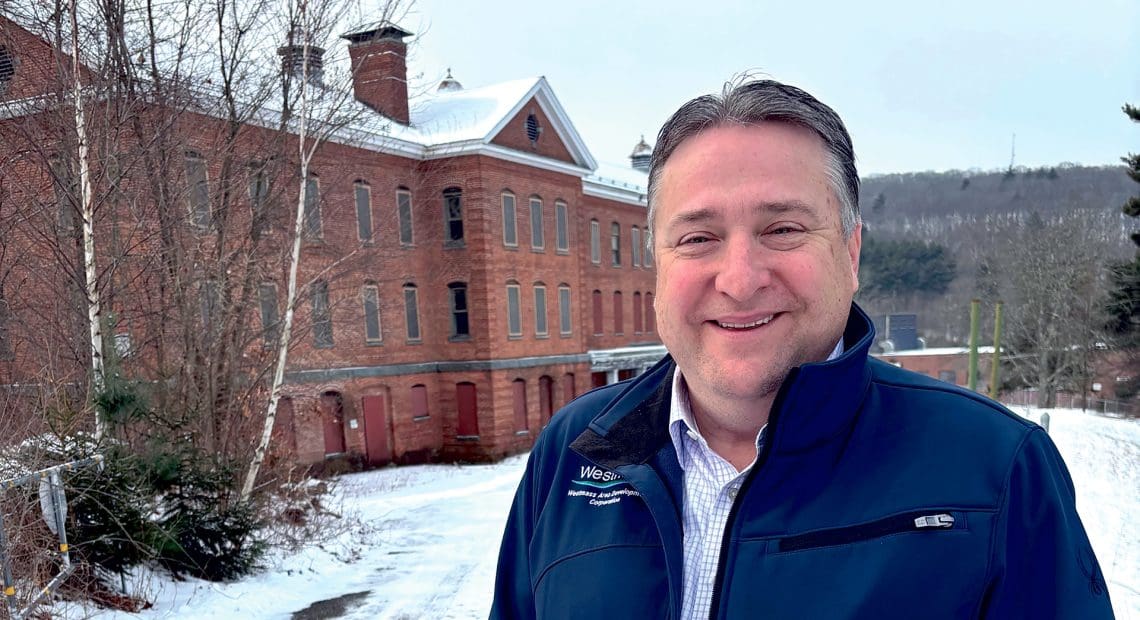
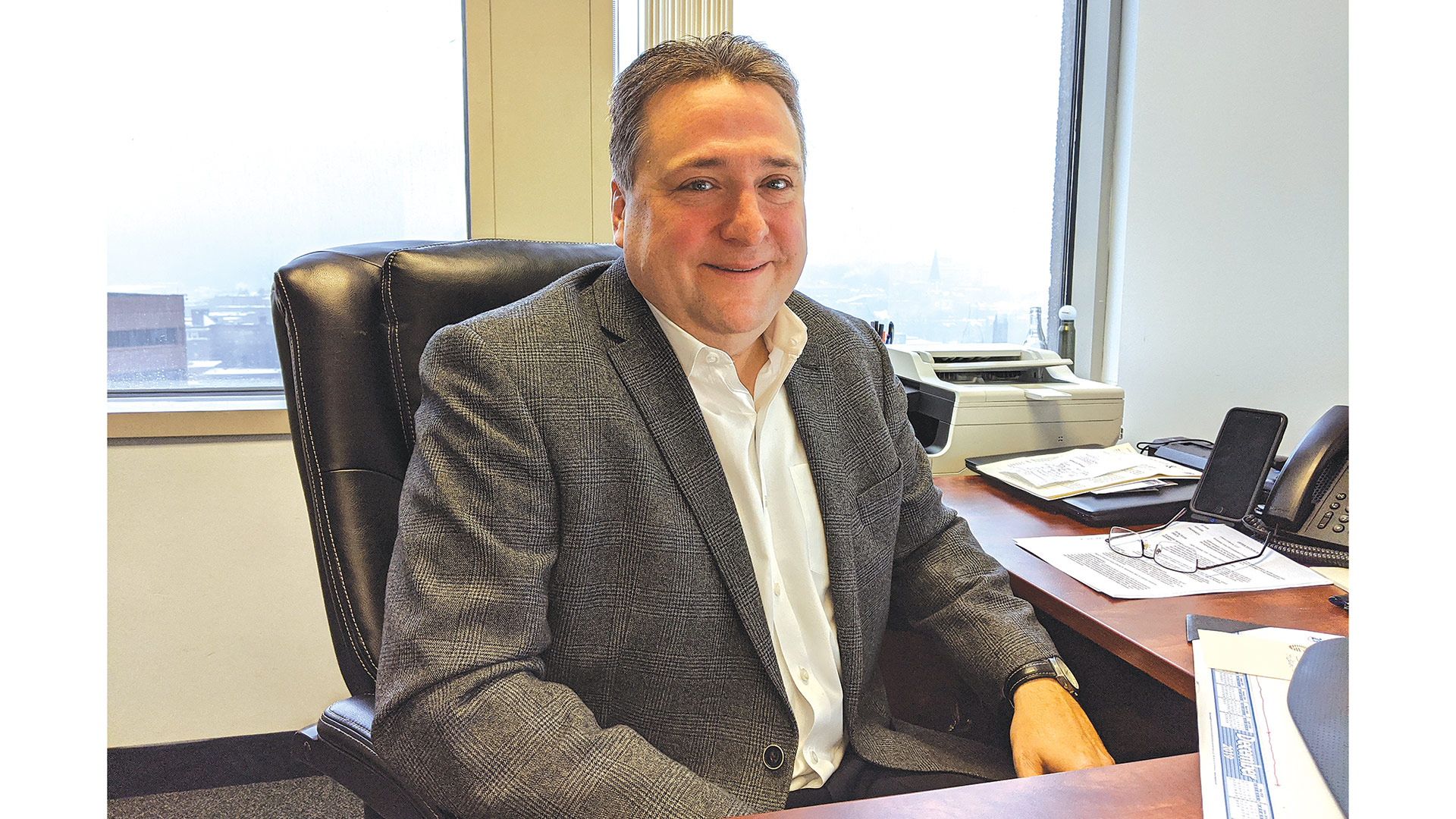
Jeff Daley at one of the ‘T-bones’ on the MDC campus.

Jeff Daley at one of the ‘T-bones’ on the MDC campus.

Jeff Daley stopped his pickup truck at a building known affectionately as one of the ‘T-bones,’ or ‘dog bones,’ because that’s what they’re shaped like.

It wasn’t the structure he wanted to comment on, necessarily — one of dozens of nondescript, red-brick buildings on the Monson Developmental Center (MDC) campus, this one a residential hall — but rather the view from it, of downtown Palmer and the mountains framing it.

“You don’t get many views better than that,” said Daley, president and CEO of Westmass Area Development Corp., which now owns a significant portion of the campus and is charged with redeveloping it, adding that he envisions this section at the high point of the sprawling complex to be ideal for estate lots of maybe five to 10 acres.

“Maybe a dozen or so could go right here,” he said, referring to an area with several T-bones, which, like almost all of the more than 40 buildings on the campus, are in an advanced state of decay and will be demolished.

“No matter how good you are, I really don’t think you can develop a vision of what this is going to be until these buildings are out of the way and we have a more permanent solution.”

And while he can imagine a large home with a bay window looking out on that view of the surrounding countryside, Daley said that it probably won’t be until all the buildings are down that Westmass and the developers it will likely partner with in this ambitious undertaking can fully understand what they have to work with — and what uses might emerge for this intriguing property.

“No matter how good you are, I really don’t think you can develop a vision of what this is going to be until these buildings are out of the way and we have a more permanent solution,” he noted. “But maybe by this fall we can start talking to developers, have them out, and see what they think.”

As he offered BusinessWest a tour of the rolling campus, Daley drove and talked about what might come next and the many hurdles to be cleared during what will likely be a 10- to 20-year project to transform the landscape into what will be known as the Village at Sawmill Brook and fill in a canvas that few residents of the 413 have seen.
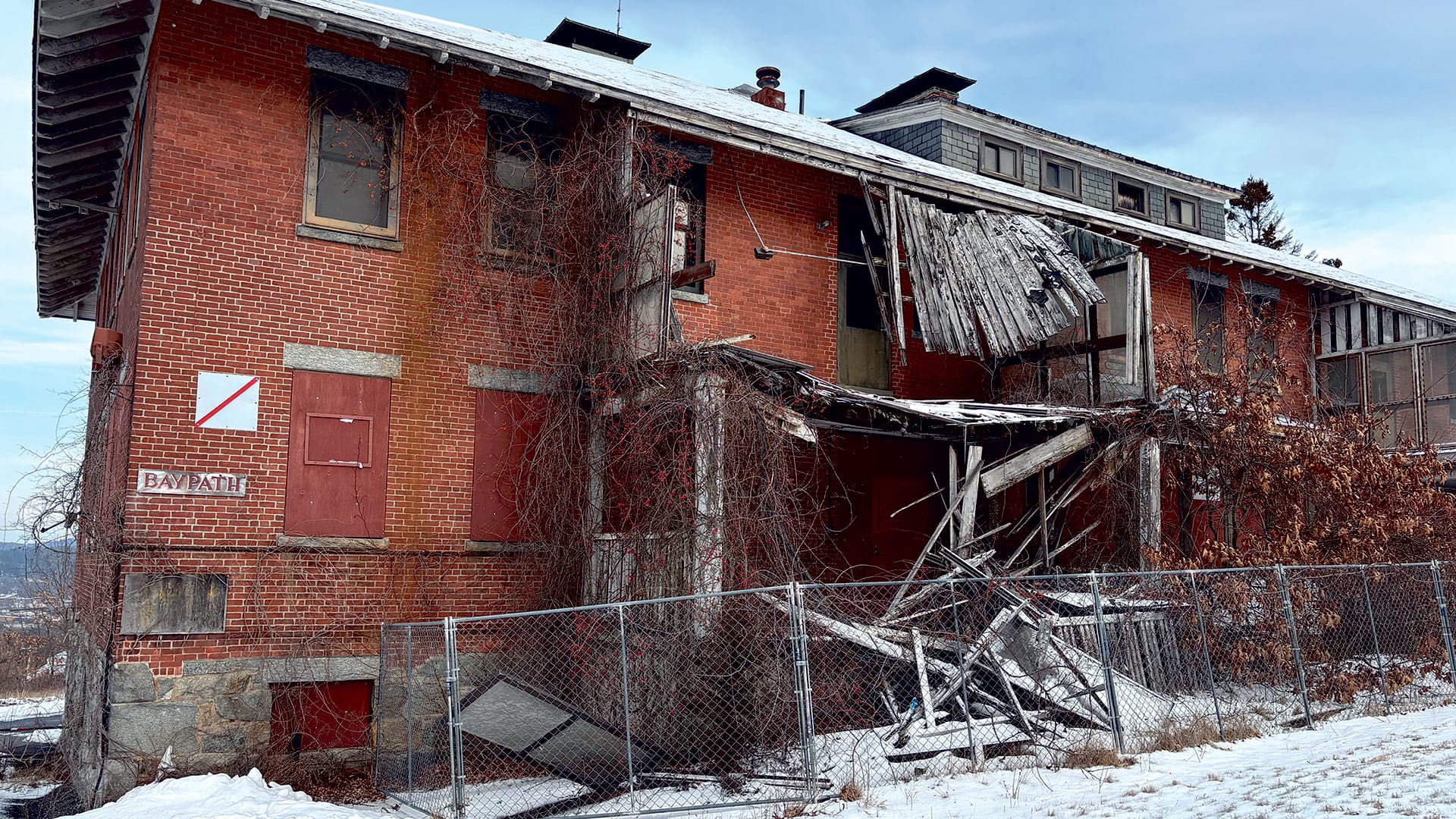
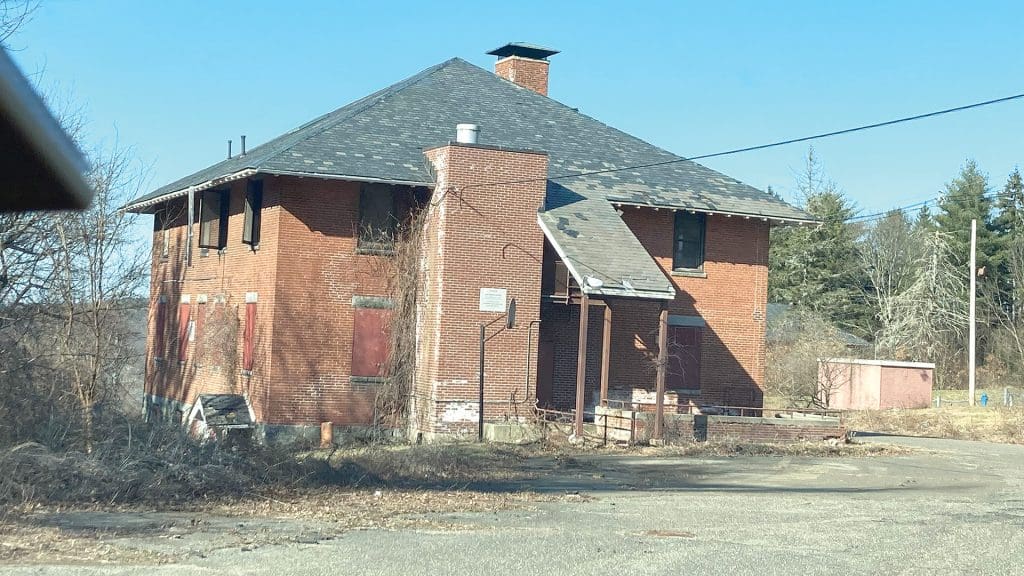
Most of the buildings at the MDC are in an advanced state of decay and must be demolished.

Most of the buildings at the MDC are in an advanced state of decay and must be demolished.

As he did so, he used the word ‘challenging’ repeatedly, in reference to everything from demolition of the buildings, which are loaded with asbestos in the walls, floors, ceilings, and slate roofs, to finding new uses for the property — built on the side of a mountain — that will mesh with Monson’s decidedly rural character and slow, as in very slow, pace of residential growth and new building.

“When you only have 8,000 residents, you can’t plunk down something that won’t fit the community, and that’s something we’re sensitive to when we’re looking at this type of development,” he said. It’s all going to be market-driven; whatever the market dictates and zoning — that’s what we’ll manage.”

For this issue and its focus on commercial real estate, BusinessWest visited the MDC campus to get the lay of the land, if you will, and talk with Daley about the next, and quite intriguing, addition to the Westmass portfolio.


Peaking Their Interest

Daley said the buildings on the campus have deteriorated quickly since the center shut down officially more than a dozen years ago.

And it’s mostly the elements that have been responsible for the highly visible damage to many of the structures, he noted, adding that there has been little vandalism on the closely patrolled campus and few people willing to ignore the myriad ‘no trespassing’ signs posted on every building, save for the occasional ghost hunters.

“When you only have 8,000 residents, you can’t plunk down something that won’t fit the community, and that’s something we’re sensitive to when we’re looking at this type of development.”

“They come in with their infrared cameras and sound machines,” said Daley, adding that they’ve come out more in the summer months, and there’s no word if they’ve found anything.

Given the history of the MDC, there just might be a few ghosts to be found there.
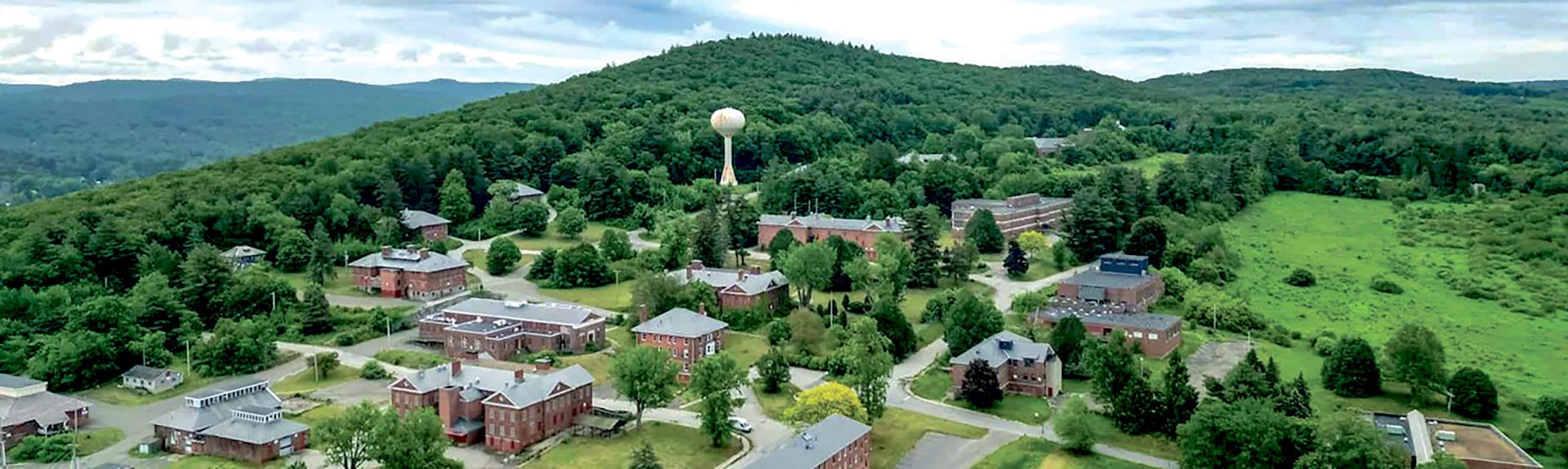
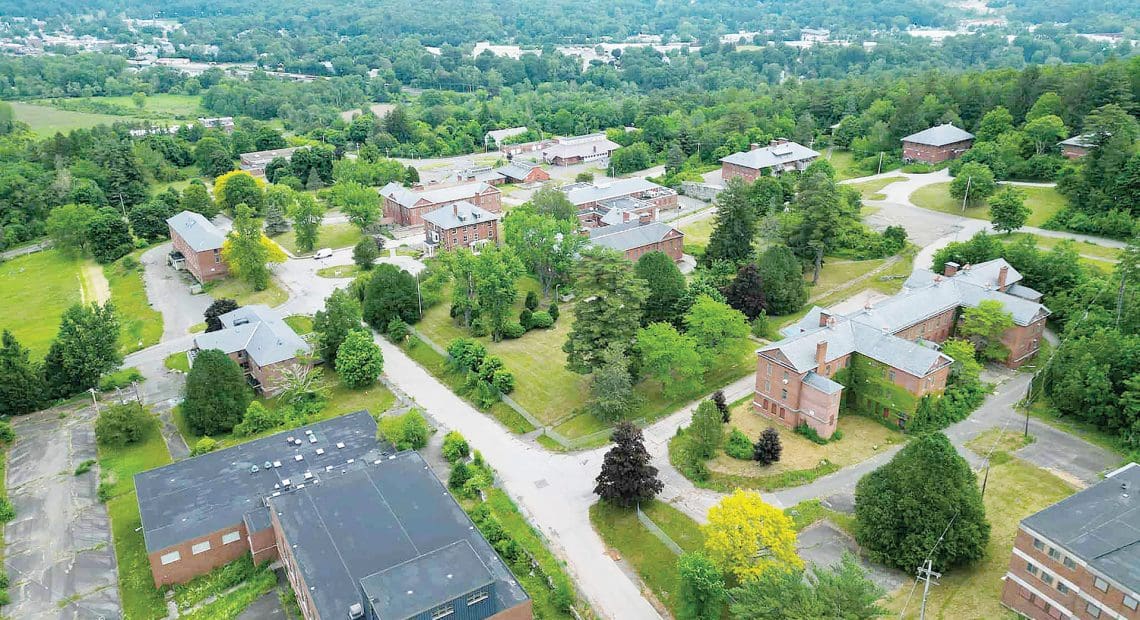
An aerial view of the MDC campus shows the rolling topography.

An aerial view of the MDC campus shows the rolling topography.

Established nearly a decade before the start of the Civil War, it was first a state almshouse for the poor and eventually evolved into a primary school for poor children and then the Massachusetts House for Epileptics in 1895, and later the Monson State Hospital, housing people with epilepsy and developmental disabilities. The campus grew significantly in the early 20th century — with the complex expanding to more than 70 buildings across 600 acres and the population peaking at about 1,700 residents in 1968 — but faced declining populations with deinstitutionalization.

Redevelopment of the 108-acre main campus will be similar in many respects to reuse initiatives at Northampton State Hospital and the Belchertown State School, also large campuses once owned and operated by the state, said Daley, but each initiative has its own personality, with MDC’s still to be determined, obviously.

While Northampton State Hospital became a mostly residential development — more than 400 homes geared to all income levels have been built at Village Hill — along with a large manufacturing facility, the Belchertown State School property, now known as Carriage Grove, is becoming more of a mixed-use property, with plans for everything from housing to a community center in the old administration building.

The MDC will likely be more like the latter, said Daley, adding that the pattern of reuse will ultimately be shaped by the town and the development community. He said Westmass plans to advance a zoning bylaw to a town meeting vote this spring; the proposed zoning would create a mixed-use district to support long-term development of the property.

“There are a lot of folks around Monson and Palmer who raised families in big farmhouses, and now they’re getting to the point where they don’t need the big farmhouse anymore. But there’s limited housing available to move into; whether it’s a single person or an aging couple, there’s really no housing for them.”

Housing of several different types may emerge as options, he said, listing everything from three- and four-story apartment buildings to multi-family homes to cottages and those aforementioned estate lots. Other permitted uses could include small-scale commercial and office facilities, light industrial, and civic uses compatible with the neighborhood character.

The first step in the redevelopment process is clearing the site and demolition of all but a few of the 42 buildings on the main campus, 18 of which (the larger brick structures) will be mitigated by Westmass, with the state responsible for the rest.

“Unfortunately, the buildings are not savable,” said Daley, adding that preliminary cleaning and demolition work — on buildings as well as several underground and above-ground tunnels to convey steam — is expected to commence within the next few months. Bids are currently being sought, with the goal of clearing the site by the fall of 2027.

Demolition work is expected to cost roughly $16 million, and after this phase is done, there is considerable infrastructure work to be undertaken — everything from new roads and utilities to a new, wider bridge over Sawmill Brook, which runs through the middle of the property, to work to repair and upgrade the water tower on the campus (there is no pumping station that can supply water to the higher portions of the campus).

As these pieces fall into place, development efforts can move to the next stages.
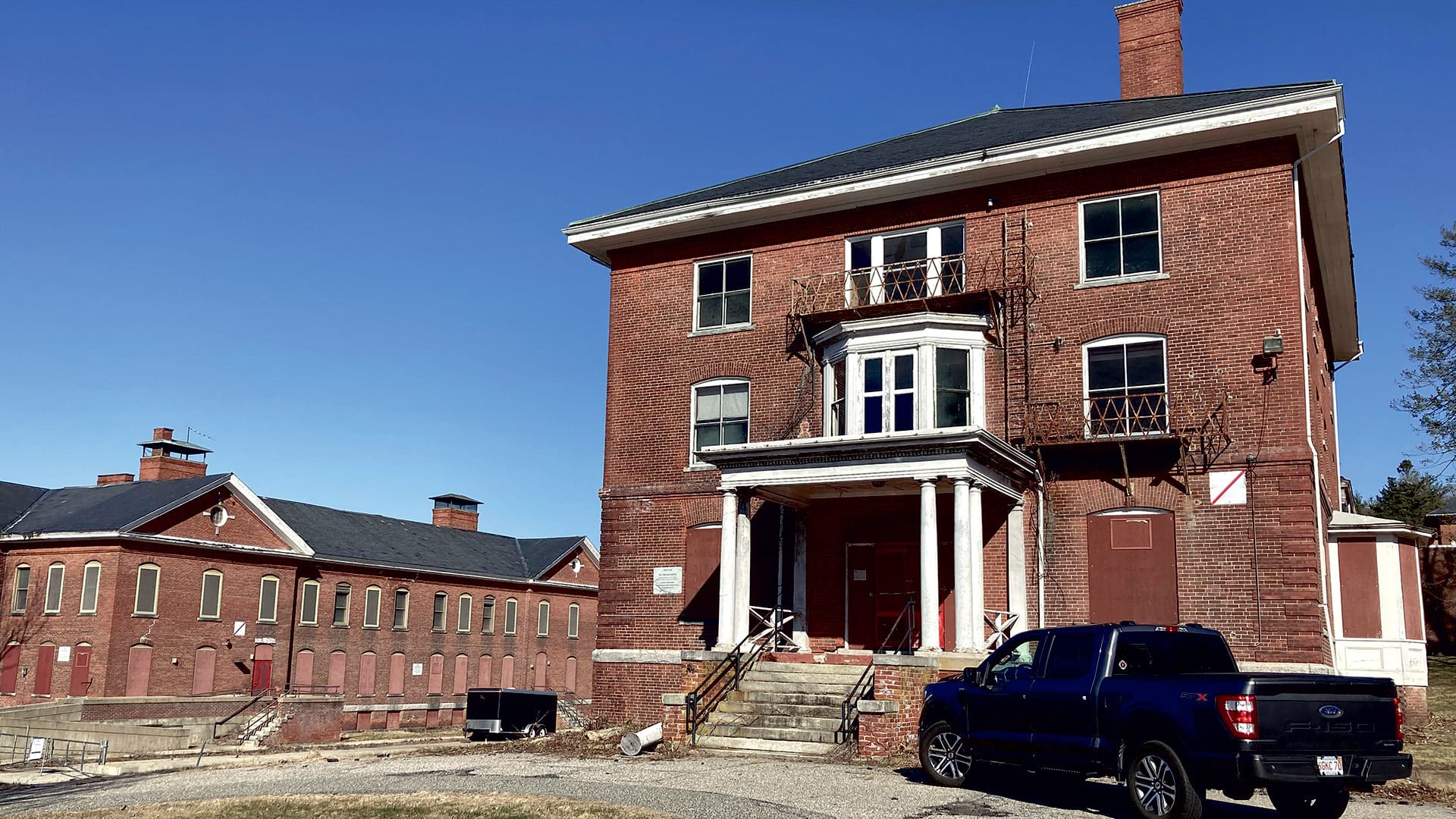
Demolition of dozens of buildings at the MDC is slated to start later this year and be completed in 2027.

Demolition of dozens of buildings at the MDC is slated to start later this year and be completed in 2027.

“Our goal is to be done with the cleaning and demolition by 2027, and between now and then, we’re going to be working on getting a full design of where the infrastructure — water, sewer, power — will go,” Daley explained. “Then, we can do a road development study and figure out where roads will go and to what part of the development. And at that time, hopefully, some of the easier development pieces can be developed or sold to generate revenues to offset the investment we’re going to have to make on the capital side on the infrastructure.”


Grounds for Optimism

While most of the buildings on the campus will come down, a few can be reused, said Daley, who pointed to a structure known, coincidentally, as the Daley Building, a recreation center with a theater on its upper floor as well as a basketball court and a decaying bowling alley.

“Our hope is that we can provide this as a community center for Monson and Palmer,” he explained. “It’s a great hall, and there’s a big gymnasium; we’re not sure how it will all work out, but we’re hoping to keep it for that purpose.”

Meanwhile, Brookside Hall, another residential facility, could be salvaged and converted into senior or veteran housing.

“We’d like to do a veterans housing project — there’s definitely a need for one in this area — but projects like that take four or five years to develop,” he noted, adding that, overall, there is a need for many different kinds of housing, especially affordable options for an aging population.

Indeed, the Commonwealth officially conveyed the property to Westmass as part of larger efforts to utilize properties under its control to address an ongoing housing crisis that is impacting every corner of the state.

“There are a lot of folks around Monson and Palmer who raised families in big farmhouses, and now they’re getting to the point where they don’t need the big farmhouse anymore,” he said. “But there’s limited housing available to move into; whether it’s a single person or an aging couple, there’s really no housing for them.”

Whatever comes of the site from a development standpoint, it will have to mesh with the town’s rural character and not dramatically change the dynamic in a community that hasn’t seen much, if any, residential growth in recent years.

“I think they’ve built something like 12 houses in the last 20 years,” said Daley, who didn’t know the exact figure but did know it wasn’t a big number.

And that statistic represents just one of the many challenges involved with a project that will unfold over the next decade or two and change the landscape of that area — literally and figuratively.


Commercial Real Estate

The Next Chapter

An aerial view of the Monson Developmental Center campus.

An aerial view of the Monson Developmental Center campus.


When Jeff Daley first pitched the Westmass Area Development Corp. board on the concept of redeveloping a portion of the former Monson Developmental Center (MDC) campus, it wasn’t a hard sell, necessarily.

“But it was a sell,” said Daley, the agency’s president and CEO, and for several reasons.

“It’s an imposing site, and there’s a ton of work that has to be done,” he said of the 100-acre parcel, which essentially sits between two mountains, with very little of what would be considered flat land. “And there’s a lot of money that has to be invested just to make the site developable again.”

But Daley was able to sell his board on the concept — a commitment from the state to provide a $9 million site readiness grant to the agency, as well as an accompanying reversion clause, certainly proved to be a turning point in the sales process — and late last month, the Commonwealth officially conveyed the property to Westmass, touting the transaction as part of ongoing efforts to utilize existing properties to build more housing in a state where there is a strong need for it.

And with that transfer, Westmass, in partnership with the state’s Division of Capital Asset Management and Maintenance, will commence work to create what will be known as the Village at Sawmill Brook.

The brook runs through the middle of the property, said Daley, adding that the name was chosen to reflect the rural nature of the community, and a ‘village’ is what is intended, with both residential and commercial development planned.

This is a village that will take shape over the next 10 to 20 years, he noted, adding that the first steps in the process involve demolition of almost all of the 14 existing buildings on the site — one structure, a recreation center at MDC, might be salvaged — as well as environmental remediation and infrastructure improvements.

Demolition is slated to begin early next year, and actual building will likely commence in maybe three years, Daley said.

Exactly what will be built remains to be seen, he told BusinessWest, as well as a gathering of about 100 Monson residents at a recent meeting of the Monson Board of Selectmen, noting that the site, and the market, will likely determine what shape this village will take.

“It’s an imposing site, and there’s a ton of work that has to be done. And there’s a lot of money that has to be invested just to make the site developable again.”

There will be housing, and probably several forms of it, with subdivisions, senior housing, veterans’ housing, and other options under consideration.

One of the first steps in the process will be creation of a master plan for the site to determine how many of those 100 acres can be developed, and in what ways.

“We’re in discussions with several of the groups that do housing for veterans,” Daley noted. “We’ll also talk with folks who do assisted living projects around the area to see if there’s a need for that in the Monson area.”

The next phase of the MDC project will involve demolition of the buildings on the campus

The next phase of the MDC project will involve demolition of the buildings on the campus, most of which are in an advanced state of deterioration.

There could also be senior affordable housing, similar to what has been created at another Westmass property, Ludlow Mills, he went on, adding that single-family homes, condos, duplexes, and fourplexes could also be in the mix. There will also be commercial elements, he said, such as retail businesses with residential units on the upper floors of buildings, in keeping with that ‘village’ concept.

“Right now, it’s a blank slate,” he noted, adding, again, that need and market conditions will likely dictate how the site is redeveloped.

Before any development can take place, the site needs to be cleared and infrastructure improved, a massive undertaking involving everything from the demolition of existing buildings, some of which are quite large, to replacement of a bridge that provides access to the site, for which the state has approved $5 million in funding.

The total cost of site preparation work is expected to approach and perhaps exceed $20 million, said Daley, adding that the state will work with Westmass to identify additional funding sources to advance the development.

Overall, the project represents a different kind of challenge for Westmass, but in many ways it is similar to the Ludlow Mills in that it involves extensive demolition and redevelopment of cleared sites.

“This is what we do … this is where Westmass shines,” Daley explained. “We take older properties and figure out what we can do with them, and I thank the governor and her team for trusting us and supporting us with the financial resources to do this. But once it’s down, cleaned, and demoed, it’s up to us to put together a really good, solid development plan that will benefit Monson.”

Daily News

MONSON — The Healey-Driscoll administration advanced the development of at least 600 housing units and other uses on the former Monson Developmental Center campus by initiating the transfer of more than 100 acres of the campus to Westmass Area Development Corp. The administration also reaffirmed its commitment to an ongoing partnership with Westmass and local leaders to secure funding and resources needed for a successful redevelopment.

“This is a great opportunity for Monson, the region, and the state, as this site offers major housing and economic development potential. This transfer demonstrates our focus on utilizing existing properties to build more housing, provide new opportunities for local businesses, and lower costs,” Gov. Maura Healey said. “Our administration is committed to supporting Westmass and the town in order to maximize that potential.”

The Division of Capital Asset Management and Maintenance (DCAMM) will complete this transfer by conveying the land for $1 in exchange for the redevelopment of the site into several hundred housing units. With the transfer initiated, Westmass, in consultation with DCAMM, will begin to ready the site for redevelopment.

The administration will also provide a $9 million site readiness grant to Westmass, authorized by the Massachusetts Legislature, to help ensure an expeditious path to construction. Given the size of the site, significant funding is needed to prepare for redevelopment through demolition, environmental remediation, and infrastructure improvements. In addition to announcing the transfer initiation, the administration will continue to work with Westmass to identify additional funding sources to advance the redevelopment.

Following the site readiness work, Westmass expects to make individual development sites available to a variety of partners to implement this large project. Under the terms of the disposition agreement, DCAMM and Westmass anticipate the construction of at least 600 new units of housing as well as commercial and industrial uses to expand the Monson tax base and create employment opportunities.

“Westmass Area Development Corporation is committed to transforming the Monson Development Center into a vibrant, mixed-use community that meets the housing and economic development needs of the region,” Westmass President and CEO Jeff Daley said. “Through strategic planning, strong public-private partnerships, and phased redevelopment, Westmass will remediate, repurpose, and revitalize the long-dormant site in a way that complements and maintains the town of Monson’s character.

In addition to the development areas, another 458 acres of the campus are being prepared for transfer to the Department of Fish and Game for conversation and recreation purposes, and 42 acres will remain under the care and control of the Department of Agricultural Resources for active farming.

Daily News

LUDLOW — On Tuesday, Lt. Gov. Karyn Polito, Housing and Economic Development Secretary Mike Kennealy, and MassDevelopment President and CEO Dan Rivera were joined by state and local officials and representatives from Westmass Area Development Corp. to announce $2,834,850 in funding to nine projects — including Ludlow Mills, the only Western Mass. project of the nine — in the sixth round of Site Readiness Program awards.

The Site Readiness Program is part of the Community One Stop for Growth, a single application portal and collaborative review process for grant programs launched in January to make targeted investments based on a development continuum. The program was established to help municipalities, private-sector businesses, and nonprofit economic-development entities advance prime sites for large-scale industrial and commercial use. The funding will be used for a variety of pre-development work, including planning studies, feasibility studies, master planning, environmental work, strategic land acquisition, and site improvements, increasing the development potential of nearly 665 acres across the Commonwealth.

In this round, Westmass Area Development Corp. is receiving $650,000 that will fund the design of a new access road, new water and sewer infrastructure, survey work, and parking areas as part of plans to redevelop the 130-acre Ludlow Mills site at 100 State St.

Also on Tuesday, the Baker-Polio administration celebrated Ludlow’s second One Stop award of $250,000 through the Underutilized Properties Program. The funding, which was also awarded to Westmass Development Corp., will be used for capital improvements to the historic stockhouses also within Ludlow Mills.

“Through the One Stop, our administration can continue helping cities and towns move forward with development projects that are critical to their future economic success,” Gov. Charlie Baker said. “The Site Readiness Program supplies key stakeholders with the financial assistance they need to prepare key sites for revitalization.”

Added Polito, “now in its sixth year, the Site Readiness Program complements other state programs like the Brownfields Redevelopment Fund, MassWorks, and the Underutilized Properties Program that support communities looking to advance their economic-development goals. Cities, towns, and their partners can easily access information about these resources through Community One Stop for Growth, a new simple and streamlined application portal for the Commonwealth’s community-development grant programs.”

Administered by MassDevelopment, the Site Readiness Program aims to boost Massachusetts’ supply of large, well-located, project-ready sites; accelerate private-sector investment in industrial and commercial projects; and support the conversion of abandoned sites and obsolete facilities into clean, actively used, tax-generating properties. Its first five rounds provided nearly $13.6 million for 58 projects in almost every region of the Commonwealth, increasing the development potential of 5,073 acres across Massachusetts. On Jan. 14, the administration signed new economic-development legislation providing $15 million in reauthorizations for the Site Readiness Program.

In One Stop’s inaugural round, the Executive Office of Housing and Economic Development received 267 expressions of interest from 178 communities through the new, simplified process. For this year’s awards, 196 grant applications received a total of $88.7 million for projects in 122 communities.

“The Site Readiness Program that we included in the economic-development bill is an essential component to getting underutilized properties back to productive use and generating economic growth in our communities,” state Sen. Eric Lesser said. “The Ludlow Mills is an excellent example of what is possible with smart state investment that can catalyze broader transformations across our Commonwealth.”

Ludlow Select Board Chair William Rosenblum noted that “the town of Ludlow looks forward to our continued relationship with Westmass Area Development. We welcome the opportunity to revitalize the Ludlow Mills in a manner that will benefit the taxpayers of Ludlow.”

Westmass President and CEO Jeff Daley added that “Westmass is grateful for programs like Site Readiness, as this allows us to unlock the capabilities of projects that will have a long-term, positive impact on the Ludlow Mills, Ludlow, and the Commonwealth,” and that “these dollars are the first step at redeveloping the largest brownfield project in New England.”

Daily News

SPRINGFIELD — Generally, unless there’s a power outage, the weather does not impact digital production. But this year, all the rules were thrown out the window. While snowflakes were still flying during GCAi’s planning phase for the new Westmass Area Development Corp. website, it was both the heat and wet weather that proved to be challenging while capturing the high-quality visuals that the project required.

The critical component of the project was Westmass’ expansion of its traditional development role. The method to achieve success would be to get that expansion documented through not only text, but video interviews, high-quality images of past and current projects, and even drone video, scheduled carefully to miss the aforementioned raindrops.

“For decades, Westmass has sought to benefit the communities and residents in our region through the development of business and industrial parks,” said Jeff Daley, president and CEO of Westmass. “Today, it is our continued goal to help provide communities and private developers with the tools and resources they need to do smart development. The new website allows us to showcase the exciting projects Westmass is undertaking, as well as promote our efforts to advance real-estate and economic-development opportunities throughout Western Massachusetts for years to come.”

News of the ongoing production leaked before the launch, and what Westmass was up to, as well as some of the businesses and projects impacted by its work, could not be contained. The GCAi Digital PR team helped coordinate coverage, which resulted in the article “Westmass Strives to Become a More Impactful Force in Economic Development” in BusinessWest.

GCAi has now turned the keys to the new website over to the Westmass team, who continue to make updates and add content from their new offices in Monarch Place, adjacent to GCAi’s new perch in Tower Square.

Opinion

Editorial

Over the past decade or so, one of the better stories to emerge in this region has been the development of the Ludlow Mills complex in Ludlow.

Acquired by Westmass Area Development Corp. in 2012, the mostly vacant set of jute mills and storage buildings has become home to an eclectic mix of businesses, and is now the site of a residential complex, a rehabilitation hospital (Encompass), and a host of small businesses that cross several sectors.

But this solid business story had been tempered somewhat by the very public, highly visible discord (there’s a diplomatic term) between Westmass and one of its more popular tenants, Iron Duke Brewing.

A disagreement over language in the lease eventually escalated into a bitter and protracted court fight, one that led to hard feelings, plans to relocate the business in Wilbraham, and a new and popular product — Eviction Notice IPA.

For a while, it looked like this court battle was going to end like so many before it — with no one really winning, despite how the ruling came down. It looked for all the world like both sides were going to be out perhaps hundreds of thousands in legal fees, Westmass would be out a good tenant, and Iron Duke would be saddled with the expense and challenge of essentially starting over in a new town and new brewery.

And then … things changed. Not overnight, but as the story on page 6 recounts, they did change.

Amid the heavy baggage from the lawsuit and the disagreement that led to it, the two sides agreed to sit down and talk. And from those talks came some progress and eventually a path to an agreement whereby Iron Duke would not only stay in its home at the mill — one of the century-old stockhouses that stored raw material — but expand within that site and perhaps own it someday.

An agreement that didn’t seem at all possible just 18 months ago.

Maybe there’s a lesson in all this — one about communication and listening and getting to understand both sides of a disagreement, on the theory that the more people know and the more people talk, the better the odds they can work out their problems.

Maybe the lesson is to try to do that before egos take over and before the lawyers get involved because, after that happens, it becomes that much harder.

We’re not sure about the lessons. We are sure that what was a good story for the region is now an even better story. Iron Duke will stay where it is, expand, and make the mill complex a better, stronger destination, one that might help attract more hospitality-related businesses like it.

Iron Duke will soon have to change its name to avoid another expensive lawsuit, this one from Duke University as it seeks to protect its brand. But that’s another story.

This story has what certainly appears to be a happy ending, after a plot twist as welcome as it was — that’s was — unlikely.

Daily News

SPRINGFIELD — The Westmass Area Development Corp. board of directors has elected Antonio Dos Santos its new chairman, replacing Carol Campbell as her term expires.

Dos Santos joined the board in 2011 and has served in numerous roles, most recently as vice chair. He is a partner at the Springfield-based law firm Crear, Chadwell, Dos Santos & Devlin, P.C., specializing in business, commercial real estate, and commercial lending.

Dos Santos brings years of leadership and commitment to the Westmass board as Campbell’s term concludes after three challenging years. Amid the unexpected passing of former President and CEO Eric Nelson in 2019 and hiring new President and CEO Jeff Daley in October 2019, Campbell’s management and commitment to Westmass has ushered in a strong financial and operational base for success in the years to come. She will assume the role of immediate past chair and continue to serve on the executive committee.

“Westmass has been developing projects in Western Mass. for over 60 years. I am honored to take on the role of chairman of the board for such a distinguished and recognized entity,” Dos Santos said. “Westmass continues to grow its portfolio of development opportunities, in particular the Ludlow Mills preservation and redevelopment, an exciting project which is quickly approaching $100 million in investment and represents significant economic development for the region. We are poised for growth in the years ahead, and I am excited to do whatever I can and whatever our board can to ensure Westmass is still doing business in the next 60 years.”

Daley added that “the team at Westmass is grateful for Carol’s stewardship over her three-year term as chair, and we look forward to working with Tony and the entire board as Westmass continues its long tradition of delivering quality real-estate development projects in Western Mass.”

Commercial Real Estate

Developing Story

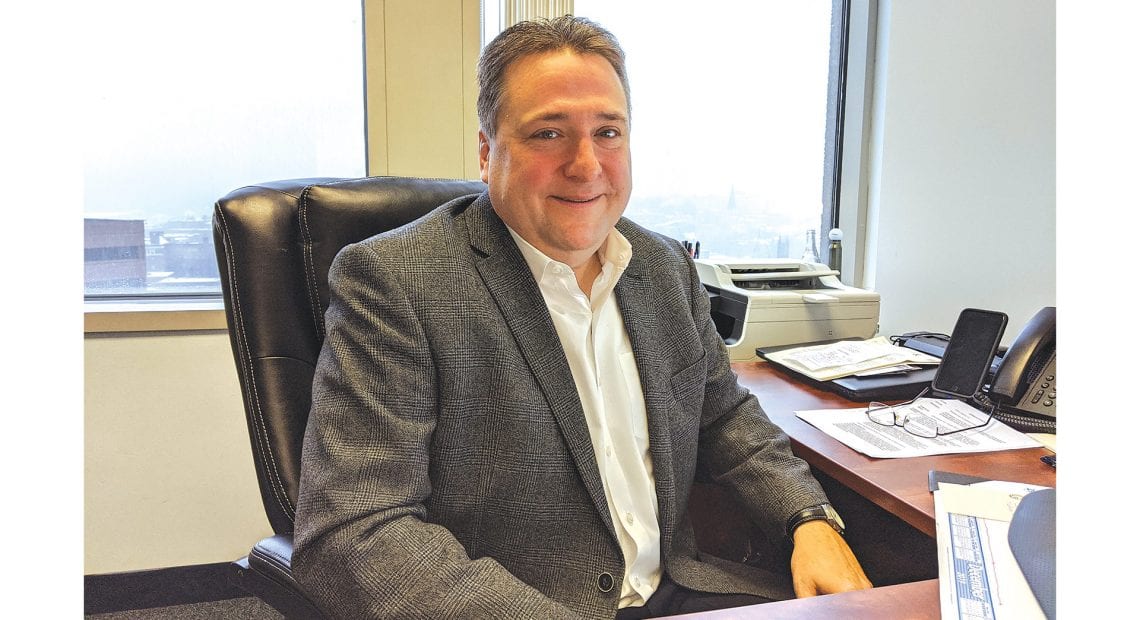
Jeff Daley, CEO at Westmass Area Development Corp

Jeff Daley, CEO at Westmass Area Development Corp

Jeff Daley boasted a long career in development, with experience on the municipal, state, and private realms, when an intriguing opportunity came about last year: the role of CEO at Westmass Area Development Corp., which oversees a number of newsworthy projects in the region, most notably Ludlow Mills. He couldn’t pass up the opportunity to connect municipalities and developers on a larger scale — and help generate the sort of economic activity and job creation that makes communities strong.

Jeff Daley was working for the state in 2005 when it created a district improvement financing (DIF) program, essentially a tool that enables towns to capture incremental tax revenues from new private investment to pay for public improvement projects.

A decade later, while leading his own development firm, CJC Development Advisors, he put that knowledge to good use on the Longmeadow/East Longmeadow line. It’s the sort of experience — working with muncipalities and developers — that he brings to his latest role as CEO of Westmass Area Development Corp., which he took on last summer.

The project he referenced was a campus of sorts being developed by two entities — Baystate Health, which was building a multi-practice healthcare center on the Longmeadow side, and Berkshire Healthcare, which was building East Longmeadow Skilled Nursing Center on that town’s side of the line.

“I looked at this as a challenge. Westmass has been around for 60 years, and certainly there’s still a lot of good left that needs to be done — there are a lot of good projects out there.”

“They needed about $3 million in public infrastructure to make those projects work,” Daley recalled, referring to the extensive road, water, and sewer work undertaken a few years ago along the Dwight Street corridor. So CJC put together a DIF by which new tax dollars from the two developers’ private investment paid for the debt service for the $3 million worth of public infrastructure.

“It was the first municipal DIF in the state,” he recalled. “And it’s a huge success. Those projects would not have come to fruition, either the larger Berkshire Health building out back or the Baystate Health facility up front. They just couldn’t make it work if they had to put $3 million into public infrastructure.”

Daley wants to bring that problem-solving spirit into his current role leading Westmass, where his responsibilities include negotiating corporate acquisitions, land sales and leases, and incentive proposals; applying for grants; and marketing resources and development services to organizations and businesses considering investment in the region, as well as evaluating opportunities for new industrial-park development and coordinating federal, state, and local economic-development grants and resources.

“If there are projects that need to be done, communities may not have the staff on hand to manage projects, and we can provide services for the development of projects,” he told BusinessWest. “And, in concert with that, we’re working with developers. They may not know all the programs that are out there, and those are the kinds of programs I want to instill at Westmass. When communities and/or developers have questions about development and how to go about programs, I want them to think of Westmass first. And if we can’t do it, we’ll tell you we can’t and set you up with who can.”

After all, development is good for communities, in many ways. But his passion is more organic than that, because when Daley sees development, he sees jobs.

“I believe the creation of good, stable jobs is really most impact you can have on communities. If people are working, they have money to spend, which is good for the economy. But it’s also providing a stable environment for kids to grow up in, when mom and dad are working and able to pay the rent. I look it as more granular economic development, as opposed to just building buildings and putting people to work. It affects everybody down to young kids in our communities, and that’s important to me when we’re doing developments.”

Park Life

The former executive director of the Westfield Redevelopment Authority, Daley worked on several projects in the downtown area, which certainly needed more energy and vibrancy. He left that job in 2014 to work for a couple of construction companies before launching his own company in 2016.

“At CJC, I worked with a lot of clients, including municipalities and private developers, working on putting financial plans together for public infrastructure, commercial-development projects, and such,” he explained. “We did construction management for private developers, did a couple of urban-renewal plans, and strategic planning for those projects.”

When the opportunity arose to head up Westmass following the untimely death of its former CEO, Eric Nelson, the job seemed to mesh well with Daley’s experience and passions.

“My business was going very, very well, I had very good clients, and it was a hard decision to make,” he recalled. “But I looked at this as a challenge. Westmass has been around for 60 years, and certainly there’s still a lot of good left that needs to be done — there are a lot of good projects out there.”

Like Ludlow Mills, one of the agency’s signature projects. Last summer, Westmass announced state and federal funding to construct Riverside Drive at the rear of the complex, making the development accessible to substantially more development. The site already includes 75 Winn Development apartments in Mill 10 for those over age 55 and is host to Encompass Health Rehabilitation Hospital of Western Massachusetts.

Creating a city street behind the property creates frontage for several properties and makes it more palatable for companies to access water and sewer, which makes the sites more attractive to lease, he explained. That project is scheduled to wrap up later this year.

In all, about 35% of the 7 million square feet at Ludlow Mills is rehabbed and active. “There’s a lot of activity,” Daley said, noting that Westmass moved its main leasing office to the site in December. “Additionally, we have about 80 acres off the east side of the back road, Riverside Drive, that is high, dry, and flat. There are some wetlands, but about 50 or 60 acres that are developable out there, and by doing this new road, it’s going to get them frontage in order for us to go out and market it to companies. So that’s really exciting.”

Meanwhile, Ludlow Mills is waiting for historical tax credits on the clock-tower portion of the development, a $20 to $30 million investment that will be what Daley called “the showpiece of our investment.”

“We’re really excited about that,” he added, noting that Ludlow is building a new senior center at the site. “That’s going to be a beautiful building to showcase the property from the eastern side. So there’s a lot of momentum, a lot of people are interested, and it’s not just storage facilities; there’s a lot of jobs in there. These people are coming in and creating jobs in machine shops and other facilities that really attract businesses. This is one of our marquee projects we’re looking to grow for a long time.”

A few miles away, the Chicopee River Business Park, which Westmass has owned for 25 years, tells a different story. Harvey Industries purchased a parcel a number of years ago, but Westmass is still looking to market the mostly vacant, 170-acre complex.

“We really want to look out for the long-term benefit of the park. We are selling it as a bulk sale for 170 acres, but we’ll work with people to do what’s best for them,” he explained, noting that the location is attractive for industry, with its proximity to I-291 and the ability to get trucks in and out without disturbing residential neighborhoods.

On the other hand, Westmass’ other industrial parks — in Hadley, East Longmeadow, and Westfield — are full, Daley noted. “We continue to build parks and take on projects that benefit Western Mass., both with jobs and creating quality of life for people. That’s the endgame of Westmass; we work to get parcels ready for sale and make sure the right businesses go into them.”

Step by Step

Westmass made a real-estate deal of a different kind in December, moving its corporate offices to Monarch Place in downtown Springfield, which Daley sees as an opportunity to raise the organization’s brand and presence, while continuing its work connecting developers, municipalities, and other entities.

“We can work with towns and cities and private developers as well, and act as their economic-development arm, whether it’s putting together public infrastructure financing, putting together urban-renewal plans, putting together plans for strategic development in communities — all that is needed out there,” he told BusinessWest. “That’s the exciting part. A lot of cities and towns don’t have the ability to do that because they don’t have the staff or the means to take on those sorts of projects. We can, here at Westmass.”

He harkens back to his time in Westfield, when the city tapped into numerous funding sources to develop urban-renewal projects downtown and elsewhere.

“We just dug deep and figured out what we could do. There are more programs out there than people realize. They go about their daily business and it’s not their job to know about the programs, but Westmass can help them see what’s available for public infrastructure programs, for land deals — we can put together the infrastructure to get their project done.”

Which is good — not just for communities, but the individual families living in them.

“I believe everything good starts with people working, and the things we do to help projects get to the finish line and get developed really impact thousands of people around Western Mass. every day,” Daley said. “That’s what I’m passionate about. If people are going out to work and working hard every day, it’s a different life at home. Every little bit helps.”

Joseph Bednar can be reached at businesswest.com