Education Sections
Link to Libraries Expands Its Mission — and Its Reach

Susan Jaye-Kaplan, left, and Janet Crimmins

Susan Jaye-Kaplan, left, and Janet Crimmins say the LTL mission has evolved and now involves much more than filling the shelves of area libraries.

It all started in early 2008 with a few dozen books collected and then donated to the library at the White Street School in Springfield. Since then, the work — and the mission — of Link to Libraries has expanded and evolved. Instead of simply filling shelves with books — although that’s still a big part of the equation — the organization is developing new and imaginative ways to not only put books directly in the hands of young children, but also involve business and civic leaders in the critical assignment of promoting childhood literacy.

By GEORGE O’BRIEN

Janet Crimmins says she’s read hundreds of letters from young students who have become involved in the Link to Libraries program.
Most of these missives come after a read-aloud program coinciding with a large donation of books to the school’s library from of the organization, which Crimmins and co-founder Susan Jaye-Kaplan started three years ago. Most of these handwritten notes come complete with some curious grammar and spelling, but they all get right to the point:
“Thank you for donating books to our library. We are going to have more fun and we are going to be smarter,” wrote Jerrick Wilson. “I can’t wieght [sic] to read it. I like the book you read to us. It was funny. The bookbag are [sic] cool.”
And there was this from a girl named Samantha: “Thank you Links to Librarie [sic]. I am so thankful because I got to learn new vocabulary to become smarter, so I can have a good job like you. Now I am going to read more books so thank you so much.”
As much as she likes reading such messages, and she really does, Crimmins says she covets her collection of photos featuring children and their books even more. “They’re more expressive than the letters,” she noted, adding that the smiles and the excitement they convey help those who volunteer time, energy, and imagination to this effort know that they are making an impact when statistical, measurable evidence to that effect is elusive and probably years if not decades away.
But those involved with LTL are driven by the belief that absolutely nothing bad can happen when you put books in the hands of young people who might otherwise not have that experience — and that plenty of good can result.
And their work is capturing the imagination of not only young people, their teachers, and principals, but also the business community, which is contributing in a number of different ways. Start with the space at Rediker Software’s headquarters in Hampden that’s been donated by the company as combination warehouse, staging area for donations and bookbag-packing efforts, and photo gallery (those aforementioned pictures of children with books now crowd the walls).
But there are many other efforts — ranging from financial gifts to donations of books and bookbags, to the recruitment of volunteer ‘celebrity’ readers, which include PeoplesBank President Doug Bowen; Steve Bradley, vice president of Government and Community Relations at Baystate Health; and Peter Rosskothen, co-owner of the Log Cabin and Delaney House — that speak to how far this organization and its work have come.
There is actually a waiting list for read-aloud assignments, said Jaye-Kaplan, noting that many individuals have expressed an interest in taking part in the program. There is another waiting list, however, one featuring several dozen schools seeking donations for their libraries, a situation that speaks to the toll the recent downturn has taken on education programs and facilities.
For this issue, BusinessWest relates the story of Link to Libraries, and how its founders are finding that the assignment they’ve taken on continues to grow in scope, importance, and overall satisfaction for those involved.

Must Reading
Margaret Thompson was asked for a snapshot of the student body at the Kensington Avenue School in Springfield. It’s not a particularly pretty picture.
Indeed, 96% of the youngsters, clustered into several streets near the ‘X’ in the city’s Forest Park neighborhood, live in poverty. Thompson, the school’s principal, says she has no hard figure on how many of her students live in single-parent homes, but offered “most all of them.” Some live with grandparents or other relatives, while others are in foster homes, and still others are in shelters, she told BusinessWest.
And then there’s the transience factor; between December and March of last year, 50 of the roughly 340 students in the school left as their parents or guardians moved out of the area, and another 30 came in, a revolving door that provides a stern test for educators.
“The neighborhood itself is not a safe place,” Thompson went on. “But the school is; it’s like a beacon in this neighborhood.”
It’s not written in the organization’s mission statement, but Link to Libraries was essentially created because there are, unfortunately, many schools like Kensington Avenue in the Pioneer Valley, and especially in urban areas like Springfield and Holyoke — places where the gift of a book is “like a treasure,” said Thompson, and donations of a few hundred books to that school’s library — extensively damaged in a flood two years — have an impact well beyond the dollar value of the volumes in question.
It was with facilities like Kensington Avenue School in mind that Kaplan and Crimmins launched Link to Libraries in early 2008. They started on Crimmins’ dining room table, where 65 books, gathered from various sources, were packed up and delivered to the library at the White Street School in Springfield, also in the Forest Park area.
The exercise served as an inspiring beginning, enough to validate what the co-founders were trying to do and ignite a passion to soon recalibrate goals and expectations.
“Everyone — the students, teacher, and principal — were so excited about what we left that we both said, ‘this is something we can do,’” Jaye-Kaplan recalled. “We spent the whole day afterward networking and talking about what we could do and what we should be doing.”
Such humble beginnings are certainly not forgotten amid the thousands of books that arrive at the warehouse monthly, but there have been profound changes and countless signs of exponential growth since a group of 10 volunteers got LTL off the ground.
Indeed, for an organization dedicated to the printed word, some impressive numbers are being used to tell the story.
For example, more than 35,000 books have been distributed to date, and the number for 2011 is approaching 25,000. Also, some 35 area schools and nonprofit organizations — most in Holyoke and Springfield, but several from other surrounding communities — have been involved in book donations, and nearly 10,000 students have received a book.
Meanwhile, another statistic was added this past September: 3,000. That’s the number of young people who received ‘Welcome to Kindergarten’ literacy kits for the start of the new school year. Each child receives two books, a bookbag, and several items for parents and guardians designed to stress the importance of reading and offer tips on encouraging children to do so.
The kit includes a bookmark supplied by the Reading Success by 4th Grade initiative created by the Irene E. and George A. Davis Foundation, as well as a pamphlet from the Harvard Graduate School of Education called Encouraging Your Child to Read.
The program is not exactly unique, said Kaplan, noting that many school departments in Massachusetts and other states have such initiatives. What is unique is that this is funded entirely by LTL, while the others are mostly supported by public dollars.
The kindergarten program, the contents of the literacy kits, as well as a new ‘Read Together’ initiative involving young, disadvantaged children are just a few examples of how the LTL mission has evolved from merely filling library shelves — which remains a big part of the equation — to putting books directly in the hands of children and offering encouragement to read.

Chapters and Verse
While Jaye-Kaplan and Crimmins both do a little of everything — and that includes lugging boxes of books up the three floors to the warehouse (“it’s good exercise; it keeps us in shape,” said the former) — they have developed their own assignment niches, and become quite proficient at each.
Crimmins is unofficially in charge of reading and reviewing children’s books and making recommendations for titles to be purchased and read, while one of Jaye-Kaplan’s primary assignments is writing grant applications.
“I’m the reader, she’s the writer,” said Crimmins. “I’m happiest when I have my nose in a book; I’ve probably read more than half the books we order — and that’s about 400-500 different titles at a time. Each one is chosen for a different reason; they’re all different topics, and they cover a broad age range.”
Jaye-Kaplan, who was a long-time grant judge for Billie Jean King’s Women’s Sports Foundation, believes she’s a better judge than grant writer, but has still enjoyed enormous success in winning funds for Link to Libraries. She says the organization’s mission and partnerships within the community help win the favor of the judges weighing her applications, and that she usually vies for smaller amounts — and for a reason.
“We know other organizations are in need of money, and if we get overzealous, then some others will lose out,” she explained. “So I’m willing to write more grant applications for smaller amounts and spread the wealth.”
And both founders have it within their job descriptions to recruit volunteers to help at the warehouse, readers for classroom duties, and businesses to provide both monetary and in-kind donations. And they don’t seem to be having problems on any of those fronts, especially when it comes to securing help from the business community.
Indeed, while wary of listing participating businesses out of fear that she might forget someone, Jaye-Kaplan eventually acquiesced, and noted that contributions in several shapes and sizes have come from businesses large and small.
She said companies as diverse as Excel Dryer, Big Y, Health New England, Kelly Fradet, Reddiker Software, and Johnson & Hill Staffing have provided financial support and/or help stamping books, loading bookbags, and helping to stock the shelves in the warehouse.
Meanwhile, the read-aloud initiative continues to grow, said Jaye-Kaplan, and is now an important component in the broader effort to promote literacy, not simply supply books to libraries.
She said there are a number of benefits for program participants, meaning both the adults and the children. The former gain an eye-opening look at the challenges faced by educators in schools and districts serving disadvantaged young people, as well as the satisfaction of being part of the solution to the problem. The latter, meanwhile, get to hear a story, while also gaining time with some positive role models (especially adult male professionals, who are missing from the lives of many of the students) and an understanding that community leaders think enough of this organization and its mission to take time out to volunteer.
Both the level of support from the business community and the growing ranks of celebrity readers help Crimmins, Jaye-Kaplan, and others involved with Link to Libraries answer that difficult but necessary question: is this initiative making a real difference in the community?
“I just look at the faces in the photos of the children,” said Crimmins. “They say a lot; they and the letters we get tell us that we’re making a positive influence in these kids’ lives.”
Said Jaye-Kaplan: “we have children tell us over and over again that they’ve never had a book in their home. Some of them are so overwhelmed that they don’t want to bring the book home for fear that it will be lost. We have principals and superintendents of schools who don’t just want us to deliver the books; they want to come here and see what we have, make suggestions, and thank us. They’re committed to helping us succeed.”

Far from the End
Given how far LTL has come in 3 ½ short years, Jaye-Kaplan and Crimmins say it’s difficult to project what those often-quoted numbers will be a few years out.
They both think it’s fair to say that the organization will continue to expand and hone its mission and find new and imaginative ways to put books in the hands of children, while continuing to preach the importance of childhood literacy.
Meanwhile, more read-alouds are scheduled to get more area business and civic leaders involved in the initiative and bring the message home in ways beyond the gleaming new volumes on the library shelves.
After all, there are thousands of children, like young Jerrick Wilson, who can’t wieght for their next book.

George O’Brien can be reached at [email protected]

Opinion
Gas Tax Isn’t a Simple Cure for Transit Ills

The trial balloons keep coming for some sort of transportation revenue. There was Lt. Gov. Murray’s August trial balloon for a gas-tax increase. Then public discussions about needing four times more funding to maintain the Big Dig tunnels, and Gov. Patrick’s trip to attend President Obama’s press conference on federal transportation legislation. Make no mistake about it, there will be a push to raise transportation revenues, most likely through the gas tax, in the coming year.
But the administration faces a real uphill battle to get it passed.
Over the past two years, the Commonwealth massively restructured the state’s transportation agencies. A new entity, MassDOT, now oversees most major pieces of transportation infrastructure, including those formerly held by the now-dissolved Massachusetts Turnpike Authority. The 2009 law included additional reforms that held the promise of increased efficiency and lower costs.
The outcome of the reforms? We don’t know.
MassDOT was to report consistently on key performance measures. But they have not provided enough in terms of data content or informing the public. The department has done a far better job of communicating tactical successes — innovative projects and reform-related events. But these press events don’t say anything about progress on many key measures — measures that matter to the public.
Without this strategic communication, MassDOT will rightly struggle to make the public case that it is managing our assets and our money more wisely than in the past. For a public with Big Dig cost overruns and MBTA service failures lodged firmly in our collective psyche, changing a negative perception of transportation spending and management is a herculean task, made more challenging without a consistent method of communicating performance and accountability. And reports over the summer that senior engineers at MassDOT purposely avoided tracking maintenance issues do not help.
Any tax-increase proposal must be akin to a social contract — you taxpayers pay this, and we, the government, will give you value in return. Without refocusing the transportation agency on consumer-centered metrics, why would the public think that an increase in the gas tax will lead to service improvements?
A two-way request for more tax dollars paired with specific performance benchmarks — e.g. reduced congestion, increased on-time performance, and fewer structurally deficient bridges — might get us to that elusive destination called compromise, while a one-way offer to siphon more tax revenue into a black hole will land squarely in the breakdown lane.
A two-way contract with the public would change MassDOT’s focus from a strong emphasis on expansion to addressing long-term neglect of maintenance. Expansion projects that do not significantly address ‘customer-service’ issues and, in fact, further burden the MBTA with a crippling debt load, such as the multi-billion-dollar South Coast Rail project, would no longer be a priority.
Instead, the agency would focus on meeting the hundreds of millions of dollars in annual unfunded maintenance needs outlined in the state’s transportation capital plan. Subway riders and highway commuters know well what the neglect of maintenance means — delay, congestion, and aggravation.
The days of expanding the system without the finances to pay for or even operate it are gone. As Federal Transit Administrator Peter Rogoff stated in Boston last year, “if you can’t afford to operate the system you have, why does it make sense for us to partner in your expansion?’’
If an increase in the gas tax means funding expansions that leave us in precisely the same situation 10 years from now, but with a larger portfolio of assets, you can forget about it. If it prioritizes maintenance and improves our current system’s operations, sustainability, and efficiency, then the politics might work.
That’s a tall order for the governor. Reshaping perceptions and the politics of transportation means lessening the emphasis on politically expedient (but financially disastrous) expansions. It means communicating to the public consumer-based goals and drilling them into agencies used to very different marching orders.
There’s no doubt that our transportation system is underfunded. But asking for more money to make the problem bigger is not the answer.

Steve Poftak is director of research at the Pioneer Institute.

Business Management Sections
There Are Many Applicable Lessons from Steve Jobs’ Succession Plan

By CHARLOTTE CATHRO

Charlotte Cathro

Charlotte Cathro

Former Apple CEO Steve Jobs passed away in October and left behind him an incredible legacy. He conceived and cultivated a successful and admired company, but a long history of health issues had investors concerned about where the business would be without him.
The company had been tight-lipped about their succession plan, leading to some speculation. The world was shown what Jobs intended for the company when he resigned in August and the plan was officially set in motion.
While a company as successful as Apple needs a plan on the largest of scales, there are some cues that can be taken to benefit all companies in planning for their future.
Jobs founded Apple with his high-school friend, Stephen Wozniak, in 1976, and the two transformed the personal-computer industry. After a disagreement with company executives, Jobs was ousted from Apple in 1985, but returned to take the helm in 1997 as part of a new management team. Upon returning to Apple, Jobs continually expanded the company with new innovations. What was a computer manufacturer became a conglomerate of music, software, and personal electronics. Jobs created a following for his sleek and modern design aesthetic. Keen marketing campaigns surrounded each new product in buzz. His charismatic presentations of new products were touted for their brilliance, and his own image became inseparable from Apple’s. It is this intertwining that makes Jobs an incredibly tough act to follow.
To ensure that Steve Jobs’ vision lived on, the company created Apple University. The university is a training program for Apple executives with high-level courses designed to instill Apple’s most important principles: accountability, perfectionism, simplicity, and secrecy. The project ensures that everyone is on the same page, and allows management to trust that the organization is acting with a collective brain.
Jobs took the project so seriously that he recruited the former dean of Yale University, Joel Podolny, to run it. While not all businesses have the resources to set up such a program, business owners can and should train employees to make smarter decisions independently. An education and training program fosters loyalty and a culture of self-improvement. It doesn’t just prepare them for when you are no longer running the business; building trust will allow you to transition responsibility over time.
When it came time to name a new CEO, Apple was ready. Jobs stepped down in August, and Tim Cook was appointed in his place. Jobs trusted Cook to take the helm for several reasons. First, Cook had a strong relationship with Jobs and considered him a mentor. He has respect for the vision and history of the company, and is not looking to completely revamp it now that he is in charge. He reportedly sent a memo to employees since he took over noting that Apple would not change.
Cook has a strong drive for success, which has gotten him this far in his career. As COO, Cook managed Apple’s enormous supply chain and enabled the company to post impressive profits. His experience will allow him to maintain Apple’s standing as a fierce market competitor. Most importantly, Cook loves Apple and its products.
Cook’s appointment in August was not his first time running the show. He had filled in on several occasions during Jobs’ previous medical leaves and had been in charge of the day-to-day operations of the business as of January. While it may have been Jobs’ continuous illness that required Cook to act as a standin, it served the succession plan well. Investors, analysts, and the public started to know his name, and employees of the company got a taste of what working under Cook would be like.
Field-testing executives allows them to get some comfort in the role, and gives opportunity for feedback. Businesses can begin by including protégés in meetings with major customers and suppliers and allowing them to create a rapport. Acclimating customers to future leaders can also result in fewer losses upon transition.
A succession plan doesn’t need to be a one-for-one replacement in leadership. Jobs had developed a team of advisors with specialties in different areas. This group includes Jony Ive, vice president of design; Scott Forstall, in charge of operating system software; Bob Mansfield, hardware engineering; and Phil Schiller, Apple’s marketing head. It is unknown whether roles within the organization will shift with Jobs gone, but this ‘two heads are better than one’ approach ensures that Cook will have a sounding board for ideas.
To follow the lead of Apple, companies developing succession plans should evaluate what skills are needed for future leadership and fill the gaps, spreading the abilities to supporting roles. Smaller organizations without the resources for multiple executives with different skill sets can retain consultants or send existing staff to targeted training.
Apple has reinvented itself several times over the years, and Jobs prided himself in knowing what the public wanted, even when they didn’t. A future for the company, then, needs to include continuous innovation. The vision for the future should not just be that of survival, but of growth.
In planning beyond Steve Jobs, Apple educated its employees, created a strong corporate culture, established a support team of differing skills, and test-drove their executives. To ensure that a company lives past its president, a succession plan needs to be more than just a decision. The plan needs to be in motion as an ongoing initiative.

Charlotte Cathro is a tax manager with the Holyoke-based CPA firm Meyers Brothers Kalicka, P.C.; (413) 536-8510; [email protected]

Health Care Sections
Mercy’s Expanded, Renovated ER Is a Statistical Success

Dr. Louis Durkin

Dr. Louis Durkin says Mercy’s updated ER successfully addresses issues of flow and flexibility, improving the department’s overall performance.

‘Flow’ and ‘flexibility.’
There were and are many goals and ambitions behind the $1.3 million expansion and renovation of Mercy Medical Center’s Emergency Department, but those two words pretty much tell the story, said Dr. Louis Durkin.
He’s the medical director for the Department of Emergency Medicine at Mercy, and while he didn’t actually design the ER improvements, he worked hand-in-hand with the architect to blueprint a facility designed to enable the department to move patients in and out more quickly (the ‘flow’ part of the equation), due in large part to space that can be used for many different purposes and to treat patients with various levels of emergencies (there’s the flexibility).
Ready for business starting early this fall, the expanded and renovated ER is already yielding improvement in some of many barometers used to track performance in the ER, said Durkin, citing both the “door-to-provider” measure — the medical center is now averaging under 30 minutes, the industry benchmark — and the stat known as “door to door,” which is now under four hours, another industry standard.
“For fast-track patients, it’s usually under 90 minutes,” he said, referring to those with less-serious issues. “But for our total population, which includes the patients that are admitted to the hospital with large workups, there is now a turn-around of under four hours, which is pretty good.”
Meanwhile, there’s also been improvement in another measure, the so-called “left without treatment” measure,” which, as the name suggests, denotes people who have left the ER for one reason or another — the wait was too long or the simply changed their mind, for example. At Mercy, that number has come down from 6% to 2% over the past several months.
The renovated ER passed a significant test during the recent late-October snowstorm, said Durkin, noting that resulting power outages taxed the facility and its personnel because many patients couldn’t be discharged to homes without power. And it will get another test in the flu season due to start later this month.
But he is confident the facility will bear up to those challenges because of the detail that went into the design, and also because of that level of flexibility, which enables the ER team to continually tweak and improve the facility and its operations.
Durkin told BusinessWest that the enhancements to the ER have been in the planning stages for more than two years now, and were made necessary by escalating numbers that were not an aberration but a trend expected to continue for many years.
Elaborating, he said that ER volume, which was averaging just over 70,000 several years ago, has been escalating steadily, peaking at 79,000 in 2009, and averaging more than 75,000 the past few years. The reasons for upward movement of the needle are many, he explained, citing two important trends — a significant rise in the number of people who have health care insurance (thanks to reform measures in the Bay State) coupled with stagnancy in the number of primary care physicians — as primary drivers.
“You have more people with insurance, but you have the same number of primary care physicians,” he said, adding that the bottom-line result is more visits to all ERs, and especially Mercy’s, one of the busiest in the state.
In response to the trend and its impact on some of the statistics referenced earlier, Mercy blueprinted a project that would increase the number of ER beds from 32 to 43, said Durkin, adding that this would yield significant improvement in another industry barometer for emergency departments. This would be the one using an official target of one bed for every 1,200 patient visits per year.
Mercy was well above 2,000 per bed before the expansion, and is now much closer to the industry goal, Durkin continued, adding that it is not only the number of beds that is improving overall statistical performance, but also that aforementioned flexibility in how they can be used.
To illustrate, Durkin provided a quick tour of the new ER, which is the result of a project that involved expansion, consolidation, renovation, and modernization. There are now five color-coded pods, or areas designated for specific types of patients. These include the so-called fast-track, or less-serious cases; acute cases (those more serious); and those involving patients with behavioral-health or substance-abuse issues.
Before, the ER had just one bed designated for behavioral-health-related cases, he said, adding that capacity for such cases has quadrupled, and even those expanded facilities are usually at or near capacity.
While each pod has a specific use, there is a large amount of flexibility that is part and parcel to emergency-room operations, and the new ER provides more of that commodity.
“The ideal flexibility comes when any patient can be seen in any bed, as opposed to having specialized beds and specialized rooms,” he explained. “We still need to have those, in that we have acute-resuscitation pods, but for the most part, we have more flexibility; if we start getting a higher number of more-acute patients, we can treat them in the fast-track area, and vice-versa.
“Soon, we’ll be able to treat almost any patient anywhere in the department no matter how acute they are,” he continued, “and that’s important, because most bottlenecks occur when you have specific rooms that you can only use for suture, for example. The ratio of acute to not-so-acute patients changes from day to day and hour to hour, so you have to be ready and make sure you can evenly distribute the workload.”

George O’Brien can be reached at [email protected]
Departments Picture This

Send photos with a caption and contact information to: ‘Picture This’ c/o BusinessWest Magazine, 1441 Main Street, Springfield, MA 01103 or to [email protected]

Resurgent Springfield

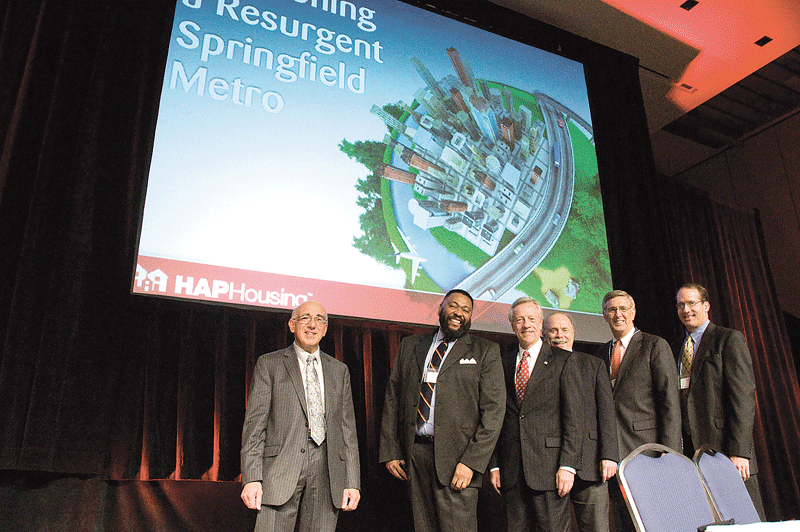
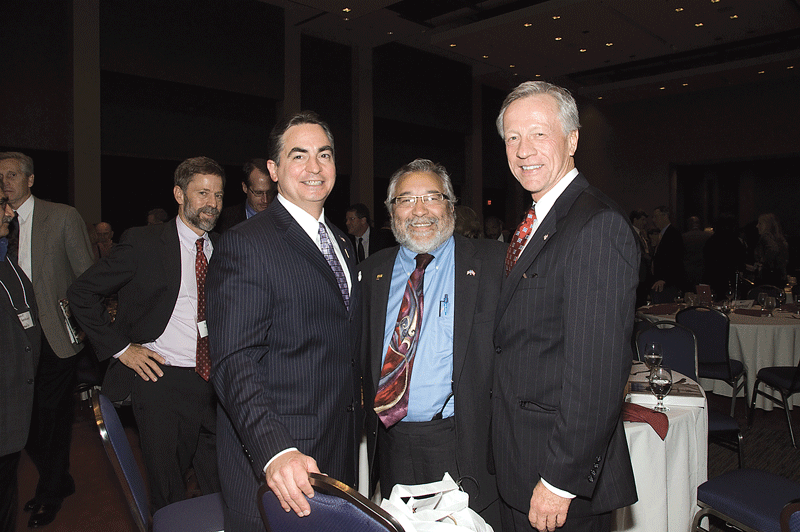
HAP1HAP2“Envisioning a Resurgent Springfield Metro” was the theme of HAPHousing’s annual symposium at the MassMutual Center on Nov. 16. The keynote address was delivered by Allen Joines, mayor of Winston-Salem, N.C., one of the cities visited by a delegation of Springfield-area business and civic leaders last fall as part of the City2City program. Top: from left, panelists Peter Gagliardi, HAPHousing executive director; Orson Watson, Community Revitalization Program advisor to the Garfield Foundation; Joines; David Dixon, principal at Goody Clancy; Gerald Hayes, vice president of Administration and Finance at Westfield State University; and Jeffrey Fuhrer, executive vice president and senior advisor at Federal Reserve Bank of Boston. Bottom: from left, Springfield Mayor Domenic Sarno; Heriberto Flores, chairman of the New England Farm Workers’ Council; and Joines.


ACCGS Government Reception

ACCGS1ACCGS2The Affiliated Chambers of Commerce of Greater Springfield staged its annual Government Reception at the Carriage House at Storrowton Tavern on Nov. 16. More than 200 state and local leaders networked with area business leaders. Top: Carl Breyer (left) of Park Place Real Estate Development with West Springfield Mayor Edward Gibson. Bottom: from left, state Rep. Don Humason, R-Westfield; state Rep. Michael Knapik, R-Westfield; and state Rep. Michael Finn, D-West Springfield.


Bright Nights Ball

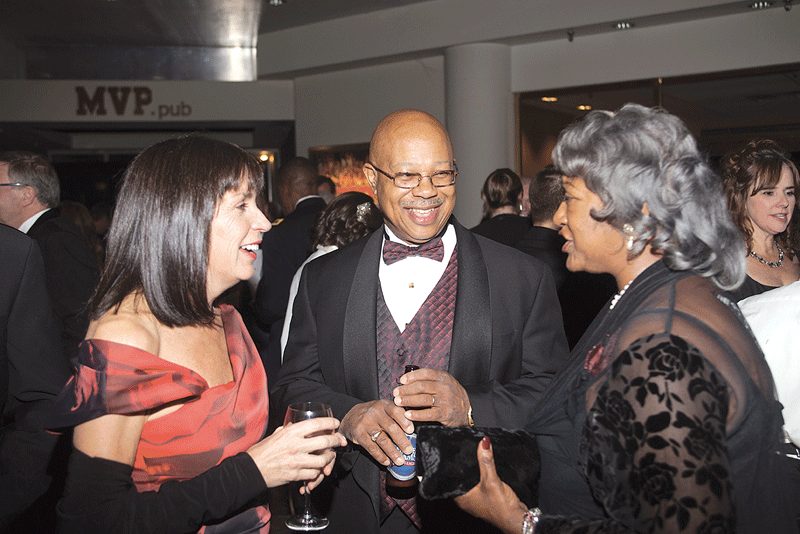
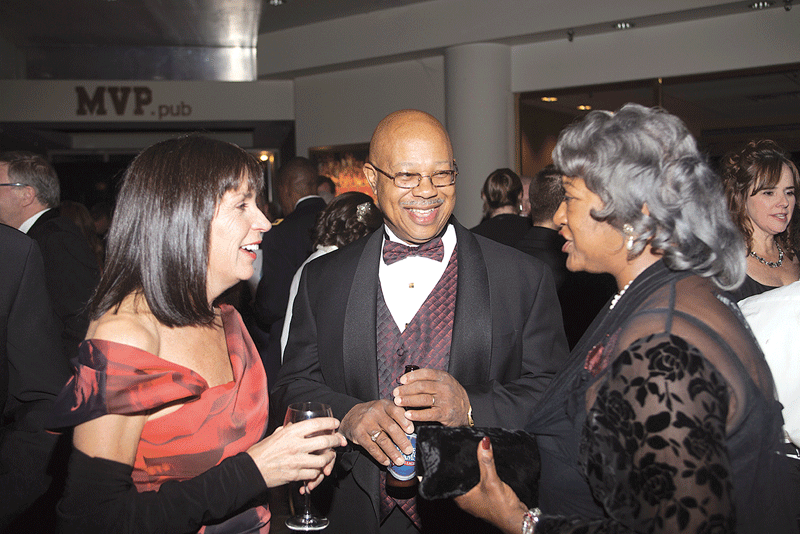
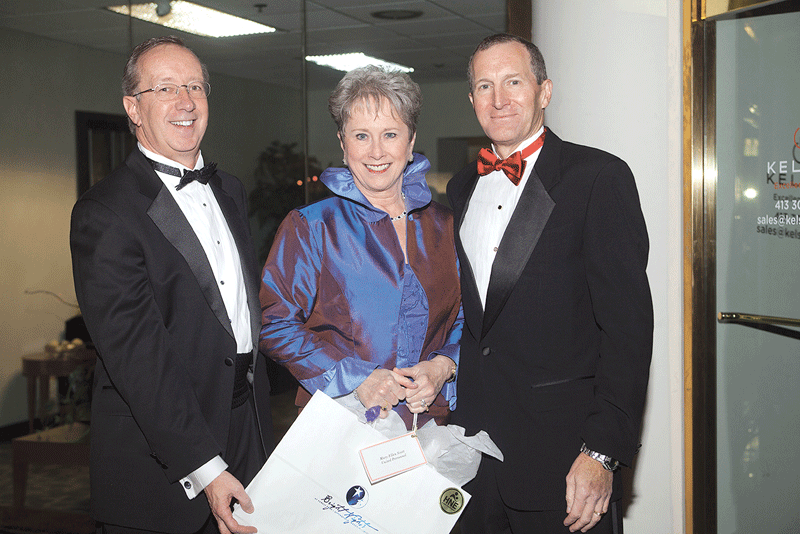
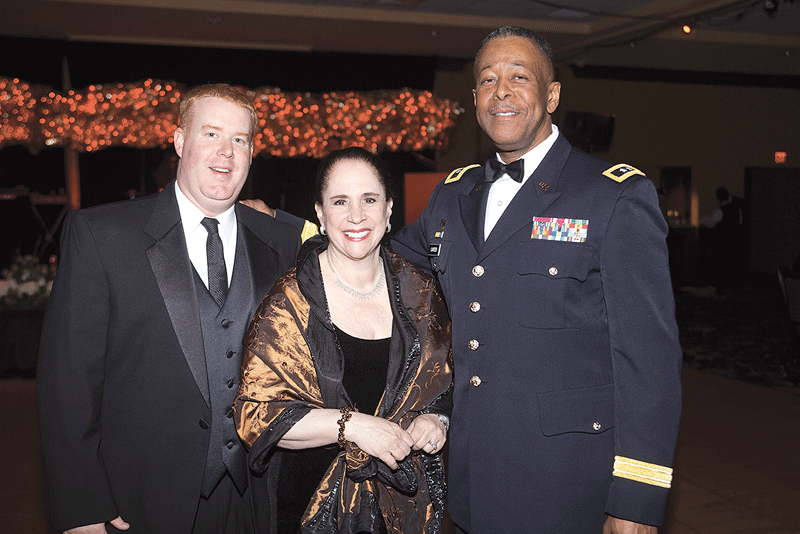
BriteNites1BriteNites2BriteNites3BriteNites4The Spirit of Springfield staged its annual Bright Nights Ball on Nov. 19 at the Sheraton Springfield. The event, which drew more than 500 business and civic leaders, featured dinner, dancing, a live auction and silent auction, and a salute to the Mass. Army National Guard. Top: from left, Donna Ross, senior vice president of Strategy and Business Development for Baystate Health; Frank Robinson, executive director of Partners for a Healthier Community, Baystate Health; and Dora Robinson, president and CEO of United Way of Pioneer Valley. 2nd from top: from left, Stephen Bryant, president of Columbia Gas of Massachusetts; Mary Ellen Scott, owner of United Personnel; and Peter Straley, president and CEO of Health New England. 2nd from bottom: from left, state Sen. James Welch; Judy Matt, president of the Spirit of Springfield; Maj. Gen. Joseph Carter, adjutant general of the Mass. Army National Guard. Bottom: from left, Maura McCaffrey, vice president of Marketing and Business Development for Health New England; Ross; Straley; and Amy Trombley, vice president and chief talent officer for Health New England.


Festival of Trees

FestTrees1FestTrees2FestTrees4Scenes from the Springfield Boys & Girls Club’s 11th Annual Festival of Trees at Tower Square in Springfield. Every tree donated helps the Springfield Boys & Girls Club provide programs and services to more than 1,500 inner-city youth who need it most.

Court Dockets Departments
The following is a compilation of recent lawsuits involving area businesses and organizations. These are strictly allegations that have yet to be proven in a court of law. Readers are advised to contact the parties listed, or the court, for more information concerning the individual claims.

HAMPDEN SUPERIOR COURT
Atlas Property Management Inc. v. Global Strategic Investment Corp.
Allegation: Non-payment of fees for services provided: $114,450.42
Filed: 9/20/11

Francisco Ramirez Jr. v. Matuszko Trucking Inc.
Allegation: Unlawful misclassification as independent contractor and unjust enrichment: $100,000
Filed: 9/15/11

Holyoke Economic Development Corp. v. Specialty Loose Leaf Inc.
Allegation: Default of commercial note: $145,134.17
Filed: 9/16/11

Lawrence and Debra Baker v. Vertex Air Quality Services
Allegation: Property damages following mold exposure to entire home: $1,028,000
Filed: 9/21/11

Peoples United Bank v. Harleysville Worcester Insurance Co.
Allegation: Breach of insurance contract and negligence: $500,000
Filed: 10/25/11

TD Bank, N.A. v. Parthenon Inc. and Pananas Grill and Bar Inc.
Allegation: Breach of personal guaranty agreements relating to note and mortgage: $832,161.07
Filed: 9/21/11

Tyler Fisher v. Pursuit Marketing Inc. and Nick’s Sport Shop Inc.
Allegation: Product liability involving a paintball gun causing personal injury: $31,103.50
Filed: 9/21/11

HAMPSHIRE SUPERIOR COURT
Carol Guenther v. Spoleto Inc. d/b/a Pizzeria Paradiso
Allegation: Chop Chop salad contained whole pits, and plaintiff sustained dental injury after biting into one: $12,258
Filed: 10/24/11

Marilyn Burns, administratrix of the estate of Henry Burns Jr. v. Daniel Paknia, D.P.M. and Decaro Total Foot Care Center
Allegation: Failure to properly treat medical condition causing death: $25,000+
Filed: 9/30/11

HOLYOKE DISTRICT COURT
Sarah Supernaw v. Travelers of MA
Allegation: Claim for unpaid benefits: $1,352
Filed: 9/26/11

NORTHAMPTON DISTRICT COURT
Caravan Canopy International Inc. v. Valley Marketing Inc.
Allegation: Non-payment of goods sold and delivered: $14,426.84
Filed: 9/11/11

Mario International Corp. v. Precision Metal Goods
Allegation: Non-payment of goods sold and delivered: $12,699.60
Filed: 9/28/11

Paciorek Electric Inc. v. LIT
Allegation: Non-payment of services and materials provided: $16,138.61
Filed: 10/6/11

SPRINGFIELD DISTRICT COURT
Hale Trailer Brake and Wheel Inc. v. Moosehead Harvesting Inc.
Allegation: Breach of lease agreement and unjust enrichment: $12,260.25
Filed: 10/25/11

MGA Cast Stone Inc. v. JRE Masonry and Restoration Inc. and Titeflex Corp.
Allegation: Breach of contract and enforcement of mechanics lien: $10,837.50
Filed: 10/25/11

WESTFIELD DISTRICT COURT
Ford Motor Credit Co., LLC v. EG Partners, LLC
Allegation: Default on retail installment sale agreement: $2,943.79
Filed: 11/2/11

Departments People on the Move

Meghan Lynch

Meghan Lynch

Meghan Lynch has been appointed President and CEO of Six-Point Creative Works in Springfield. In her new role, Lynch is responsible for business and client development, while continuing to manage day-to-day agency operations for the advertising and brand-development agency.
•••••
Kimberly A. Camp has joined Capuano Care as Marketing Liaison. She will direct the agency’s communication with the medical community.
•••••
Melissa Nelson has been named Project Manager for Medvest LLC, the local franchise holder for Doctors Express Urgent Care Centers in Massachusetts, Maine, New Hampshire, and Vermont. In her role, she is responsible for supporting the development and management of Doctors Express Urgent Care Centers.
•••••
James D. Chadwell

James D. Chadwell

Crear & Chadwell, P.C. announced that shareholder James D. Chadwell, Esq. has been selected as a 2011 Massachusetts Super Lawyer. He is the only Western Mass. defense attorney to have been chosen as a Super Lawyer based on his professional achievements in workers’ compensation, as well as a high level of peer recognition. Chadwell focuses 100% of his practice on representing insurers, self-insurers, and employers in their workers’ compensation requests. The objective of the Super Lawyers selection process is to create a credible, comprehensive, and diverse listing of outstanding attorneys that can be used as a resource to assist attorneys and sophisticated consumers in the search for legal counsel. In the Massachusetts Super Lawyers selection process, ballots are sent by Law & Politics to over 31,000 Massachusetts attorneys, each of whom must have been in practice for five years or more. Independent research is then conducted on each of the nominees, followed by a panel-review process. Only the top 5% of attorneys in each state are identified by Super Lawyers. Chadwell is well-known throughout Massachusetts as an expert workers’ compensation attorney, and was selected by Super Lawyers in 2005 as a Rising Star. He is a member of both the Hampden County and Massachusetts bar associations. Chadwell has been a member of, or very active in, local community and charitable organizations, including the Affiliated Chambers of Commerce of Greater Springfield, the Springfield Technical Community College Board of Trustees, the Western Mass. March of Dimes Golf Tournament, and the Alzheimer’s Assoc.
•••••
Amy B. Royal, Esq. has been elected Vice Chairperson of the Board of Directors for the United Way of Hampshire County. She is Senior Partner at Royal LLP, a management-side labor and employment law firm in Northampton.
•••••
Gwen Orzel has joined King & Cushman Inc. of Northampton as a Personal Lines Insurance Representative. She is a licensed broker with a certified insurance service representative designation.
•••••
Attorney Gregory S. Bombard has joined the law firm of Bulkley, Richardson and Gelinas as an Associate in its litigation and alternative dispute resolution department. His practice focuses on representing financial institutions in mortgage-related litigation and on general commercial and business litigation. The firm has offices in Springfield, Boston, and Amherst.
•••••
Environmental Compliance Services of Agawam announced the following:
• Mark C. Hellstein has been named President and CEO. Hellstein, the company’s founder, also serves as the chairman of the Board of Directors;
• Kevin C. Sheehan has been designated Corporate Operating Officer. He has been with the firm since 1989 and is a member of the board of directors. He also oversees the health and safety operations;
• Michael L. Fiorini has been named Senior Vice President, Business Development. He has been with the firm since 1989 and will continue to serve as treasurer and a member of the board of directors;
• Daniel W. Felten has been appointed Senior Vice President, Technology. Felten has been with the firm since 1999 and is a member of the board of directors. He is also responsible for the information-technology operations;
• Jon P. Berntsen has been designated Senior Vice President and Regional Manager. He has been with the firm since 2000 and will be responsible for the management of the company’s offices in Tampa and Jacksonville, Fla.; Charlotte, N.C.; and Columbus, Ohio. He is also a member of the board of directors;
• Douglas M. McVey will continue to serve as Chief Financial Officer and Trustee but will now oversee the firm’s human resources department in addition to accounting. He joined the firm in 1999 and is a member of the board of directors; and
• William J. Alpine Jr. will continue to serve as Director of Cost Recovery and Internal Counsel but will now oversee real estate and facilities for the firm. He joined the company in 2005 and also serves as a member of the board of directors.
•••••
Linda S. Syniec, CPA of Holyoke, has joined the accounting firm of Sullivan, Poulin & Payne, P.C. of West Springfield (sppcpa.com). She has more than 25 years of public accounting experience. Her expertise is in providing tax services to clients in most every industry group including closely held private companies and high net worth individuals. Syniec graduated from Western New England University with a Bachelor of Science degree in Accounting. She is a member of the American Institute of Certified Public Accountants and the Massachusetts Society of Certified Public Accountants.
•••••
Frederick L. Sullivan, founding Partner at Sullivan, Hayes & Quinn, has been named to the 2011 Irish Legal 100. The Irish Legal 100 is a network of distinguished and accomplished men and women of Irish descent in the legal profession.
•••••
Thompson & Thompson, of Springfield, has announced the following:
• Robert F. Hennessy has joined the firm as an Associate Attorney.
• Amos Nissenbaum has been promoted to Senior Paralegal.
•••••
Andrea Stalf has been named President and Chief Executive Officer of the Hartford Symphony Orchestra.
•••••
Claire Kenna has joined Park Square Realty in its Westfield office as a Sales Associate.

Agenda Departments

Anthropologist Lecture
Feb. 22: Susan Darlington, a professor at Hampshire College, will discuss her latest book, The Ordination of a Tree: the Thai Buddhist Environmental Movement, as part of the Ovations series at Springfield Technical Community College. Darlington has studied the work of Buddhist monks in Thailand who are engaged in rural development and environmental conservation. The science-based talks, at 10:10 a.m. and 11:15 a.m. in Scibelli Hall Theater, will also include insights into religion and social activism. The presentations are free and open to the public. For more information, call (413) 755-4233.
Author Lecture
March 28: Internationally acclaimed author Tom Perrotta will read from his upcoming novel, The Leftovers, at 10:10 a.m. and 11:15 a.m. in Scibelli Hall Theater, as part of the Ovations series at Springfield Technical Community College. The talks are free and open to the public. Two of Perrotta’s books, Election and Little Children, have been made into movies, and five novels have been national bestsellers. For more information, call (413) 755-4233.

Slam Poet Lecture
April 13: Taylor Mali, a former high-school teacher who has emerged from the slam poetry movement as one of its leaders, will discuss his performances at 10:10 a.m. and 11:15 a.m. in Scibelli Hall Theater, as part of the Ovations series at Springfield Technical Community College. The talks are free and open to the public. For more information, call (413) 755-4233.

Difference Makers
March 22: BusinessWest will stage its fourth annual Difference Makers celebration at the Log Cabin Banquet & Meeting House in Holyoke. The program recognizes area individuals and organizations that are truly making a difference in this region. Nominations are currently accepted for the prestigious honor, and will be taken until Dec. 30. (See form, page 19). The winners will be announced in February. The awards ceremony will feature entertainment, butlered hors d’oeuvres, and introductions of the winners. For more information or to order tickets, call (413) 781-8600, e-mail [email protected], or visit www.businesswest.com.

Chamber Corners Departments

ACCGS
www.myonlinechamber.com
(413) 787-1555
• Dec. 6: Springfield Chamber of Commerce Executive Directors’ meeting, noon-1 p.m. i• the  EDC Conference Room, Springfield.
• Dec. 7: ACCGS Business@Breakfast, at the Delaney House i• Holyoke. Doors ope• at 7:15 a.m. Tickets: $20 for members; $30 for non-members.
• Dec. 9: ACCGS Legislative Steering Committee, 8-9 a.m. i• the TD Bank Conference Center, Springfield.
• Dec. 14: ACCGS After 5, 5-7 p.m., at WWLP TV-22, Chicopee. Tickets: $10 for members; $20 for non-members.
• Dec. 15: ACCGS Executive Committee meeting, noon-1 p.m., i• the TD Bank Conference Room, chamber offices.
• Dec. 21: ERC Board of Directors’ Meeting, 8-9 a.m., at The Gardens of Wilbraham, Community Room, 2 Lodge Lane, Wilbraham.
Dec. 21: ACCGS Ambassadors Meeting, 4-5 p.m., EDC Conference Room, Springfield.

AMHERST AREA
CHAMBER OF COMMERCE
www.amherstarea.com
(413) 253-0700
• Dec. 14: Amherst Area Chamber After 5/Holiday Party, 5-7 p.m. at the Amherst Brewing Company, 100 University Dr., Amherst, MA 01002. Admission: $5 for members; $10 non-members. For more information, visit www.amherstarea.com

CHICOPEE CHAMBER
OF COMMERCE
www.chicopeechamber.org
(413) 594-2101
• Dec. 6: Holiday Party, 4:30-6:30 p.m. Hosted by the Chicopee Chamber of Commerce. Free to members.
• Dec. 21: Salute Breakfast, 7:15-9 a.m., at the Castle of Knights, Chicopee.  Advance tickets: $19 for members; $26 for non-members; at the door: $21 for members; $28 for non-members.

GREATER HOLYOKE
CHAMBER OF COMMERCE
www.holycham.com
(413) 534-3376
• Dec. 14: Holiday Salute Breakfast, 7:30 a.m., at the Yankee Pedlar, 1866 Northampto• St. Co-sponsored by Holyoke Gas & Electric and Health New England. Tickets: $20 for members; $25 for non-members.
• Dec: 21: Holyoke Chamber After Hours, 5-7 p.m. Hosted and sponsored by the Delaney House, 3 Country Club Road, Holyoke Tickets: $10 for members; $15 for non-members.

GREATER NORTHAMPTO• CHAMBER OF COMMERCE
www.explorenorthampton.com
(413) 584-1900
• Dec. 7: December Arrive @5, 5-7p.m. at Thornes Marketplace. Sponsored by King Auto Body, Johnso• & Hill Staffing, and United Bank. Tickets: $10 for members
• Dec. 13: New-member lunch, noon-1 p.m. Hosted by the Northampto• Chamber of Commerce, 99 Pleasant St., Northampton.

NORTHAMPTO• AREA YOUNG PROFESSIONAL SOCIETY
www.thenayp.com
(413) 584-1900
• Dec. 8: NAYP monthly networking event, at the Hotel Northampton
36 King St., Easthampton. Featured nonrofit is the Food Bank of Wester• Mass.

WEST OF THE RIVER
CHAMBER OF COMMERCE
www.ourwrc.com
(413) 426-3880
• Dec. 8: Food Fest West, 6-8 p.m., at Crestview Country Club, 281 Shoemaker Lane, Agawam. Tickets: $25 i• advance; $30 at the door. All proceeds go to WRC’s Educational Fund, providing scholarships and business educatio• grants to West Springfield and Agawam. For more information, contact Tamara Fricke, [email protected] or (413) 426-3880

GREATER WESTFIELD
CHAMBER OF COMMERCE
www.westfieldbiz.org
(413) 568-1618
• Dec. 9: Holiday breakfast, 7:30-9 a.m. at Shaker Farms Country Club, 866 Shaker Road.  Sponsors: Gold, Westfield Bank; Silver, Easthampto• Savings Bank and The Carso• Center for Huma• Services Inc. Highlights: the holiday benefactor this year is the Boys & Girls Club of Greater Westfield; attendees are asked to bring unwrapped gifts for childre• ages 5-15; age-appropriate games and toys are desired. Tickets: $25 for members; $30 for non-members

YPS-Young Professional Society of Greater Springfield
www.springfieldyps.com
• Dec. 15: Third Thursday, 5-7 p.m., Mckinney & Burbach Tavern, 1127 Mai• St., Springfield, 01105.  For more informatio• o• this event, visit www.springfieldyps.com

DBA Certificates Departments
The following Business Certificates and Trade Names were issued or renewed during the month of November 2011.

AMHERST

Amherst Chinese Medicine
409 Main St.
Xiaqiang Zhao

Amherst-Ideal Weight Loss
379 College St.
Jeanette Wilburn

Brigade
6 University Dr.
Kirsten Modestow

Ghoghoo Ghora
22 Southpoint Dr.
Shireen Chaudhy

Good & Healthy Inc.
1 Boltwood Walk
Robert Lowry

Thrada Design Studio
17 Walnut St.
Brian Devore

Valley Frameworks
534 Main St.
Archival Matters Inc.

HADLEY

Affordable Autos of Hadley
11 Railroad St.
Norman Wilber

Carey Farm
26 East St.
Cam Carey

Chinese Kung Fu Wushu Academy
206 River Dr.
Binh Q. Nguyen

Hadley Picture Framing
44 River Dr.
Thomas Vachula

Ken’s Catering
136 Russell St.
Ken Berestka

Payless Shoe
367 Russell St.
Cheryl Falk

River Drive Auto Body
81 River Dr.
Stephen Szymkowicz

Southern New England Spice
35 Lawrence Place
Diane Kirby

TJ’s Taylor Rental
301 Russell St.
James Falcone

HOLYOKE

All in One
92 Suffolk St.
Luis A. Arena

El Rincon Boricua Restaurant
216 Lyman St.
Virgen Lopez

K & C Cellphone Outfitters
166 High St.
Christopher Nieves

Schermerhorn’s Seafood
224 Westfield Road
Michael J. Fitzgerald

Southwest Crafts
50 Holyoke St.
Luis A. Chaguipuz

Wow Family Entertainment Center
50 Holyoke St.
Michael Fabrizi

NORTHAMPTON

Audobon Partners
118 River Road
Robin Fields

Burrows & Weiss
78 Main St.
Mikal Weiss

Chaput Marketing
152 Crescent St.
Christopher Chaput

Collaborative Restoration
239 State St.
Kevin Hayes

Gusakor Woodworks
23 Myrtle St.
William A. Wallace

Healthy Home Care
71 Gleason Road
Sarah Zabriskie

Industry Mint
97 State St.
Daniel Kates

Simona’s
74 South Main St.
Simona Pozzetto

Sullivan Companion Care
83 Maynard Road
Roberta Sullivan

The Botaniste
33 Summer St.
Corina Miller

SPRINGFIELD

Abdul Baki Exporting
8 Cherrelyn St.
Rayan C. Abdul

Alert Ambulance Service
1131 Boston Road
David George

Ambis
142 Dickinson St.
Tazeen Rafiq

Avtel Solutions
553 White St.
Moses L. Diaz

Barifamily Inc.
383 Belmont Ave.
Wahab Abari

Baystate Employee Assistance
50 Maple St.
Mark R. Tolosky

Bling Bling Style
625 Boston Road
Mian Ashiq

Calendar Holdings, LLC
1655 Boston Road
Felix A. Cordero

Chuk’s Bait-n-tackle
436 Boston Road
Carlos M. Ayala

Cost Cutters
370 Cooley St.
Regis Corporation

DJ Nails Supply
200 Dickinson St.
Tuan Dam

El Bohio Restaurant
809 Liberty St.
Luis R. Cotto

Gentle Family Dentistry
1206 Boston Road
David W. Chou

Grace Jewelry
1210 Main St.
Hwa Y. Kim

Honor Capital
1 Monarch Place
Founders Finance, LLC

WESTFIELD

Lifetime Tilers Inc.
565 North Road
Patrick Smith

ZING
104 Mainline Dr.
James Fogarty

WEST SPRINGFIELD

Infinity Auto Rental Inc.
52 Baldwin St.
Joseph Gallo

Olympia Ice Center
125 Capital Dr.
Massachusetts Skate I Corporation

Petsey Schreiber Transport
80 Brush Hill Ave.
Philomena Schreiber

Stone Installation Solutions
1029 Elm St.
Russell C. Kern

Bankruptcies Departments
The following bankruptcy petitions were recently filed in U.S. Bankruptcy Court. Readers should confirm all information with the court.

Acosta-Pacheco, Miguel
39 Ledyard St.
Springfield, MA 01104
Chapter: 7
Filing Date: 10/21/11

Adamczyk, Michael T.
177 Farnsworth St.
Chicopee, MA 01013
Chapter: 13
Filing Date: 10/28/11

Ahern, Jeffrey
Ahern, Brenda M.
39 Jessie Lane
Westfield, MA 01085
Chapter: 13
Filing Date: 10/19/11

Anuraj, Migdalia
337 Main St.
Indian Orchard, MA 01151
Chapter: 7
Filing Date: 10/17/11

Avila, Sonia I.
251 Beech St. #1
Holyoke, MA 01040
Chapter: 13
Filing Date: 10/19/11

Bacigalupo, Nancy A.
310 High Knob Road
Athol, MA 01331
Chapter: 7
Filing Date: 10/31/11

Baez, Ramon M.
40 Suffolk St., Apt. 2F
Holyoke, MA 01040
Chapter: 7
Filing Date: 10/28/11

Barker, Scott T.
335 Barker Road
Pittsfield, MA 01201
Chapter: 7
Filing Date: 10/20/11

Beany, Robert J.
27 Orile Dr.
Chicopee, MA 01020
Chapter: 7
Filing Date: 10/27/11

Beesen, Jens C.
Beesen, Marsha J.
177 Captain Beers Plain
Northfield, MA 01360
Chapter: 7
Filing Date: 10/19/11

Bello, David
51 Portulaca Dr.
Springfield, MA 01129
Chapter: 7
Filing Date: 10/25/11

Benedict, Harold C.
531 South St.
Pittsfield, MA 01201
Chapter: 7
Filing Date: 10/21/11

Bertram, Laura J.
295 Britton St., Apt.
Chicopee, MA 01020
Chapter: 7
Filing Date: 10/21/11

Bode, Stephen R.
Bode, Christina A.
221 Lancaster Dr.
Agawam, MA 01001
Chapter: 7
Filing Date: 10/17/11

Brooke, Kevin A.
2 Barker St.
Palmer, MA 01080
Chapter: 13
Filing Date: 10/18/11

Bruscoe, Jeffrey J.
108 West St.
West Hatfield, MA 01088
Chapter: 13
Filing Date: 10/25/11

Burke, William D.
Burke, Rhianna M.
99 Cambridge Ave.
Pittsfield, MA 01201
Chapter: 7
Filing Date: 10/27/11

Burris, Michael
1037 Shaker Road
Westfield, MA 01085
Chapter: 7
Filing Date: 10/26/11

Canevari, Elizabeth J.
17 Ridgeview Road
West Springfield, MA 01089
Chapter: 7
Filing Date: 10/17/11

Canine Design
Levchenko, Svetlana D.
83 Doverbrook Road
Chicopee, MA 01022
Chapter: 7
Filing Date: 10/27/11

Clark, Joan R.
147 Rosemary Dr.
Springfield, MA 01119
Chapter: 13
Filing Date: 10/25/11

Clark, Todd Andrew
81 Conz St., Apt 311
Northampton, MA 01060
Chapter: 7
Filing Date: 10/20/11

Cole, Nancy J.
95 Lasalle St.
East Longmeadow, MA 01028
Chapter: 13
Filing Date: 10/21/11

Coleman, Elizabeth Anne
a/k/a Mooney, Elizabeth Anne
2075 Old Keene Road
Athol, MA 01331
Chapter: 7
Filing Date: 10/29/11

Cook, Tobye Jill
101 Lake St.
Florence, MA 01062
Chapter: 7
Filing Date: 10/28/11

Curtis, Sean D.
6 Gardens Dr.
Springfield, MA 01119
Chapter: 7
Filing Date: 10/28/11

David, Rebecca Lynn
7 Jon Dr.
Belchertown, MA 01007
Chapter: 7
Filing Date: 10/19/11

Davis, Debra Asbury
158 Riviera Dr.
Agawam, MA 01001
Chapter: 7
Filing Date: 10/31/11

Davis, Jones Kirk
158 Riviera Dr.
Agawam, MA 01001
Chapter: 7
Filing Date: 10/31/11

Dawicki, John F.
Dawicki, Jannine M.
65 Fiske Mill Road
Shelburne, MA 01370
Chapter: 7
Filing Date: 10/20/11

Dieni, Daniel
13 Joanne Circle
Feeding Hills, MA 01030
Chapter: 7
Filing Date: 10/20/11

Drummond, Edward N.
229 Mohawk Trail
Florida, MA 01247
Chapter: 13
Filing Date: 10/17/11

Ellard, Dawn M
a/k/a Plourde, Dawm M.
113 James St.
Ludlow, MA 01056
Chapter: 7
Filing Date: 10/20/11

Fleming, Jean Strain
42 Vadnais St.
Holyoke, MA 01040
Chapter: 7
Filing Date: 10/27/11

Foy, Kris James
Foy, Dorothy L.
1076 Berkshire Ave.
Indian Orchard, MA 01151
Chapter: 7
Filing Date: 10/21/11

Gauthier, Johanna E.
114 Dubois St.
Indian Orchard, MA 01151
Chapter: 7
Filing Date: 10/24/11

George, Louis M.
George, Christy
1242 Dunham Town Road
Brimfield, MA 01010
Chapter: 13
Filing Date: 10/19/11

Giraldi, Denise
83 Crescent Dr.
Chicopee, MA 01013
Chapter: 7
Filing Date: 10/26/11

Gohr, Donna M.
40 Long Plain Road
South Deerfield, MA 01373
Chapter: 7
Filing Date: 10/24/11

Grayson, Kathryn Claire
33 Kellogg Ave. #37
Amherst, MA 01002
Chapter: 7
Filing Date: 10/26/11

Gulluni, Anthony
20 Rockland St.
Springfield, MA 01118
Chapter: 7
Filing Date: 10/28/11

Gurney, Christine L.
8 Brimfield Road
Monson, MA 01057
Chapter: 7
Filing Date: 10/28/11

Hamel, Debra Lenee
a/k/a Hamel-Kearney, Debra Lenee
P.O. Box 148
Easthampton, MA 01027
Chapter: 7
Filing Date: 10/20/11

Hartnet, Thomas D.
76 Lewis Road
Westfield, MA 01085
Chapter: 7
Filing Date: 10/21/11

Hopkins, Joyce L.
12 Princeton Ave.
Easthampton, MA 01027
Chapter: 7
Filing Date: 10/19/11

Joseph, Tricia Ann
11 Yale St.
Springfield, MA 01109
Chapter: 7
Filing Date: 10/24/11

Keeler, Thomas J.
Keeler, Mary F.
82 Meadowbrook Road
Holyoke, MA 01040
Chapter: 7
Filing Date: 10/25/11

Keough, Norma E.
46 H Prospect St.
Hatfield, MA 01038
Chapter: 7
Filing Date: 10/31/11

Kielbania, Jonathan Paul
Kielbania, Virginia Louise
a/k/a Barry, Virginia
a/k/a Miller, Virginia
a/k/a Richards, Virginia
81 Jacob St.
Chicopee, MA 01020
Chapter: 7
Filing Date: 10/31/11

King, Stephen W.
95 Butternut Dr.
Agawam, MA 01001
Chapter: 13
Filing Date: 10/26/11

Kozlowski, Marie J.
24 Farquhar Road
Sturbridge, MA 01566
Chapter: 7
Filing Date: 10/21/11

Lavigne, Alfred H.
Lavigne, Lola D.
P.O. Box 333
Lee, MA 01238
Chapter: 7
Filing Date: 10/24/11

LeClair, Rebecca J.
a/k/a Benoit, Rebecca J.
130 Main St., 2nd Floor
South Hadley, MA 01075
Chapter: 7
Filing Date: 10/27/11

LeClair, Robert J.
64 Timothy Circle
Springfield, MA 01119
Chapter: 7
Filing Date: 10/26/11

Lukin, Mikhail P.
Lukin, Marya
26 Alfred St.
Agawam, MA 01001
Chapter: 7
Filing Date: 10/19/11

Marcoux, Brian L.
115 Foch Ave.
Westfield, MA 01085
Chapter: 7
Filing Date: 10/23/11

Marion, Fred Robert
463 Beech St.
Holyoke, MA 01040
Chapter: 7
Filing Date: 10/31/11

Marsh, Richard T.
Marsh, Patricia R.
15 Autumn Lane
Belchertown, MA 01007
Chapter: 7
Filing Date: 10/27/11

Mascroft, Paula J.
a/k/a Dodge, Paula J.
216 Wheelwright Road
Barre, MA 01005
Chapter: 7
Filing Date: 10/20/11

Matias, Ramona
349 Chestnut St.
Holyoke, MA 01040
Chapter: 7
Filing Date: 10/18/11

Miller, Brandon J.
476 Berkshire Ave.
Springfield, MA 01109
Chapter: 7
Filing Date: 10/24/11

Mulvaney, Sonya
P.O. Box 516
Chicopee, MA 01021
Chapter: 13
Filing Date: 10/28/11

Nissopoulos, Cleopatra A.
110 Somers Road
East Longmeadow, MA 01028
Chapter: 7
Filing Date: 10/19/11

O’Day-Prizio, Melissa
254 Little Alum Road
Brimfield, MA 01010
Chapter: 7
Filing Date: 10/21/11

Orenstein, Matthew J.
61 Groveland St.
Springfield, MA 01108
Chapter: 7
Filing Date: 10/19/11

Pacunas, Kristopher J.
121 Aldrich St.
Belchertown, MA 01007
Chapter: 7
Filing Date: 10/26/11

Pedigo, Donna Ruth
15 High St.
Greenfield, MA 01301
Chapter: 7
Filing Date: 10/17/11

Pellegri, Robert C.
56 North Main St.
Belchertown, MA 01007
Chapter: 7
Filing Date: 10/18/11

Perusse, John E.
Perusse, Lucille B.
245 Johnson Road
Becket, MA 01223
Chapter: 7
Filing Date: 10/21/11

Polchlopek, Jennifer L.
72 Kendall St.
Granby, MA 01033
Chapter: 7
Filing Date: 10/21/11

Potvin, Paul E.
44 Kelley Road
Chicopee, MA 01022
Chapter: 7
Filing Date: 10/17/11

Reagan, James M.
Reagan, Joanne L.
1 Klondike Ave.
Westfield, MA 01085
Chapter: 7
Filing Date: 10/23/11

Reed, Jeffrey
Reed, Shelley
6 Terry Lane
Belchertown, MA 01007
Chapter: 7
Filing Date: 10/27/11

Rivera, Arida
15 Valley Heights St.
Holyoke, MA 01040
Chapter: 7
Filing Date: 10/24/11

Rodriguez, Lou W.
47 Grant St.
Springfield, MA 01109
Chapter: 7
Filing Date: 10/17/11

Rogalski, Jane T.
a/k/a Rogalski Hill, Jane T.
79 Alfred St.
Chicopee, MA 01020
Chapter: 7
Filing Date: 10/27/11

Rooney, Mary H.
5 Pine St. Apt. 3
Northfield, MA 01360
Chapter: 7
Filing Date: 10/26/11

Sanderson, Brenda Lee
47 Thayer Road
Monson, MA 01057
Chapter: 7
Filing Date: 10/27/11

Schryver, Harry J.
Schryver, Carole A.
46 Echo Lane
Easthampton, MA 01027
Chapter: 7
Filing Date: 10/27/11

Sebastino, Gene P.
100 Bucklin Road
Adams, MA 01220
Chapter: 13
Filing Date: 10/21/11

Sherblom, Carol Jane
a/k/a Bullard, Carol J.
a/k/a Richardson, Carol J.
46 Seminole Ave.
Hubbardston, MA 01452
Chapter: 7
Filing Date: 10/29/11

Silver Photography
Silver, David E.
Silver, Susan P.
21 Lower Beverly Hills
West Springfield, MA 01089
Chapter: 7
Filing Date: 10/28/11

Skorupski, Scott M.
a/k/a Parchinskaya-Skorupski, Natasha
69 Lathrop St.
West Springfield, MA 01089
Chapter: 7
Filing Date: 10/28/11

St. Louis, Daniel L.
138 West Silver St.
Westfield, MA 01085
Chapter: 7
Filing Date: 10/18/11

Steele, Dennis Robert
Steele, Susan Jean
162 North Hoosac Road
Williamstown, MA 01267
Chapter: 13
Filing Date: 10/25/11

Swan, Linda J.
65 Wheeler St.
Athol, MA 01331
Chapter: 7
Filing Date: 10/29/11

Taquino, Tammy J.
268 Palmer Road
Trailer 55
Monson, MA 01057
Chapter: 7
Filing Date: 10/20/11

Torres, Alexis J.
155 West St, Apt 2
Northampton, MA 01060
Chapter: 7
Filing Date: 10/20/11

Turan, Faith
40 Editha Ave.
Agawam, MA 01001
Chapter: 7
Filing Date: 10/21/11

Vega, Jorge L.
217 Merrimack Ave.
Springfield, MA 01104
Chapter: 7
Filing Date: 10/20/11

Wachta, Stanley J.
46C Valley View
Ware, MA 01082
Chapter: 7
Filing Date: 10/17/11

Welch, Kevin
3 Vista Cir.
Rutland, MA 01543
Chapter: 7
Filing Date: 10/27/11

Wheeler, Deborah A.
103 Parkedge Dr.
Feeding Hills, MA 01030
Chapter: 7
Filing Date: 10/27/11

Williams, Roy Blane
184 Birch Bluffs Dr
Westfield, MA 01085
Chapter: 13
Filing Date: 10/19/11

Wilson, Duane E.
281 Chauncey St. Lot #566
Belchertown, MA 01007
Chapter: 7
Filing Date: 10/27/11

Wright, Michael R.
444 Cooper St.
Agawam, MA 01001
Chapter: 7
Filing Date: 10/18/11

Building Permits Departments
The following building permits were issued during the month of November 2011.

AGAWAM

Crown Castle
628 Meadow St.
$15,000 — Telecommunications maintenance

Six Flags New England
1623 Main St.
$1,500,000 — Form and pour concrete footing for Giant Inverted Boomerang Rollercoaster

WWLP TV
591 North West St.
$15,000 — Telecommunications maintenance

AMHERST

First Congregational Church
165 Main St.
$2,000 — Repair two front entry columns

Sean M. Clarke
531 Main St.
$6,000 — Roof repair

UMass
388 North Pleasant St.
$38,000 — New roof at Hiller House

HADLEY

E & A/I & G
1221 Main St.
$291,000 — Interior renovations

Hadley Housing Authority
Golden Court
$17,500 — New roof

Yoon Chun Suk
229 Russell St.
$4,700 — New roof

HOLYOKE

Fontaine Properties
20 Easthampton Road
$40,000 — Re-install roof

Holyoke Water Power Company
200 Northampton St.
$15,000 — Remove and replace six antennas

Pulaski Heights Inc.
76 Maple St.
$15,000 — Remove and replace six antennas

NORTHAMPTON

Atwood Drive, LLC
Atwood Dr.
$100,000 — Construct 13,000-square-foot foundation for medical/office building

Cooper’s Dairyland
55 State St.
$8,900 — Emergency structural repairs

Covest Northampton, LLC
327 King St.
$250,000 — Exterior renovations

Covest Northampton, LLC
327 King St.
$183,000 — Construct 1,750-square-foot addition

Daniel Polachek
335 South St.
$4,700 — Strip and shingle portions of roof

Joe Curran
72 Masonic St.
$5,000 — Add roof over entry deck

Julia Freedgood
15 Merrick St.
$17,000 — Strip and shingle roof

Searle Realty Trust
85 Easthampton Road
$120,000 — Construct new storage building

SOUTH HADLEY

Loomis Village
246 North Main St.
$19,000 — Build porch enclosure

SPRINGFIELD

CSM North
195 State St.
$750,000 — Interior renovations

East Springfield Family Restaurant
1003 St. James Ave.
$15,000 — Interior renovations

Springfield Rescue Mission
146 Taylor St.
$31,000 — New roof

WESTFIELD

Dennis Botticello
11 Summit Lock Road
$38,000 — Addition

F.L. Roberts & Company Inc.
90 South Maple St.
$575,000 — Construct new Jiffylube

National Industrial Portfolio
1111 Southampton Road
$25,000 — Addition

North Hartland Dry Kilns Inc.
Sgt. TM Dion Way
$140,000 — Construct new commercial building

Ronald Cecchini
591 North Road
$12,000,000 — Construct new building

Zak Francis
501 Southampton Road
$596,000 — New floor covering building

WEST SPRINGFIELD

Bob Simpson
76 Westfield St.
$12,000 — Renovate 1,250 square feet of commercial structure

Cellular Sales of MA
6513 Kingston Pike
$100.000 — Commercial fit-out

Konover Corporation
380 Union St.
$12,500 — Pour concrete piers and lally columns

Mittineague Children’s Center
1840 Westfield St.
$1,000 — Erect two partition demising walls

Education Sections
Start Early When Determining and Preparing for Life After School

Dennis G. Egan

Dennis G. Egan

Parents and guardians of special-education students often misunderstand the rights that state and federal law affords such students, particularly in the area of transitional planning. Transition services are those designed to prepare children for education beyond high school, employment, and independent living, and must be included in the first individualized education plan (IEP) in effect when a child turns 16 years old (typically developed when the student is 15).
Federal and state laws dictate that school districts provide transition planning to special-education students between the ages of 14 and 22. These services are in furtherance of the free appropriate public education (FAPE) that special-education students are entitled to receive.
Melissa R. Gillis

Melissa R. Gillis

The IEP process for a student receiving transitional services is much like that of any special education student; however, it differs in one critical area — once a student reaches the age of 14, he or she must be invited, though is not required, to participate in the IEP process. The key to effective transition planning is starting early and understanding what services your special-education child is entitled to, and which are appropriate given his or her academic achievement and potential post-secondary life skills.
Effective transition planning starts well before the student reaches the age of 14, however, and takes into account individual needs, strengths, weaknesses, and interests. Specific services may include academic instruction, exposure to social experiences, training in adult living skills, or soft skills such as interviewing or résumé writing. Effective communication between your child (however he or she is able) and you, as the parent or guardian, is always the first step in successful transition planning. Although most students — special education or otherwise — don’t know what they want to do after leaving high school, these discussions should take place early and often during the child’s high-school career.
Whether your child wishes to attend college is another important consideration, because the answer to this question often dictates the transition services requested and received. For example, both formal and informal assessments should be performed in order to evaluate how your child compares to other students, as well as identify his or her strengths and weaknesses, all in an attempt to make a determination about whether college, trade school, life class, or another avenue should be pursued.
In order to identify your child’s needs, preferences, interests, and strengths, the following assessments can be performed. Formal assessments are standardized tests that include areas covering knowledge on independent living skills, the student’s personality, career preference tests, and vocational-skills evaluations. Informal assessments are the subjective observation of your child both in and out of the classroom setting, and may include viewing him or her in their workplace or interviews.
Transition planning is not an abstract idea. In fact, your child’s IEP should clearly identify his or her post-secondary goals, as well as the services being provided by the school district in furtherance of those goals. As with any effective IEP, post-secondary goals should be clearly stated, deemed achievable, updated at least annually, and address three general areas — those that the student hopes to achieve after high school, those appropriate to the individual student, and those capable of being objectively measured — all focusing on education and training, employment potential, and independent-living skills. Appropriate questions to ask when developing an effective IEP include:
• What are your child’s hopes and dreams?
• What skills are necessary in order for your child to achieve those hopes and dreams?
• What areas need attention in order for your child to master these skills?
• What services will help your child hone these skills? and
• How will you know that the services are or have been effective?
Effective communication with your special-education child is only the first step to ensuring that he or she receives appropriate and successful transition services. In fact, such communication will assure optimal results only if it is committed to writing. In other words, not only must the IEP be well-written, but the services requested to be provided by the school district must be memorialized in writing via the Transition Planning Form (TPF) in order to ensure that all services requested are accepted and document what services are to be provided.
It is important to note that, like any area of an IEP, the transition-services provision is a ‘living thing.’ That is, your child may want to attend college when they are 14 or 15, but by the time they turn 16 or 17, they may decide that a vocational skill is more desirable. In such cases, effective communication with both your child and the school district is imperative in order to assure that transitional services are adjusted when necessary so that the post-high-school student is on the desired path.
While this article contains only general considerations with regard to transition services, like any other part of special education, it is vital that you as a parent are an active participant in the process. Advocacy on behalf of your child, as well as self-advocacy, are the only ways to ensure that he or she receives the transition services necessary to promote a successful post-secondary life.

Melissa R. Gillis, Esq. is an attorney with Bacon Wilson, P.C. in the special-education, domestic, and real-estate departments; (413) 781-0560; baconwilson.com/attorneys/gillis. Dennis G. Egan Jr. is an attorney with Bacon Wilson, P.C., concentrating in special education, business, and corporate law; (413) 781-0560;  baconwilson.com/attorneys/egan.

Education Sections
Study on Community Colleges Prompts Questions, Criticism

Bill Messner

Bill Messner


Bob Pura says he found at least a few things to like about the recent Boston Foundation report titled “The Case for Community Colleges: Aligning Higher Education and Workforce Needs in Massachusetts” — especially the main subject of the account.
“I’m glad they focused on community colleges — we need and deserve that kind of attention,” said Pura, the long-time president of Greenfield Community College, noting that this segment of the Commonwealth’s higher-education portfolio is often overlooked due to the prevalence of top-shelf private colleges. He also liked the fact that the report, released late last month, said the 15 institutions are woefully underfunded and that the state needs to step up its commitment to the schools.
Bob Pura

Bob Pura

But beyond that, Pura had some major reservations about the document and its primary message — summed up by a recent local headline: “Report Slams Community Colleges” — that these institutions were essentially failing in one of their primary missions, to train individuals to succeed in today’s technology-driven job market.
Actually, this was the conclusion of two reports released within the same week. In the other, the Commonwealth Corp., in a report titled “Critical Collaboration,” found that the state’s community colleges are not properly aligning their training programs with the specific needs of the health-care industry. According to the report, the schools are not creating important standards that ensure sufficient academic performance from students.
This double whammy had many community-college presidents on the defensive, but those we spoke with mixed praise for the reports — especially the Boston Foundation document — with criticism that it was recommending that things be fixed that aren’t necessarily broken.
Pura said the report seemed far too Boston-focused to be considered complete and fully accurate — one of its main recommendations is the merger of Roxbury and Bunker Hill community colleges — and surmised that those doing the research might not have ventured west of Worcester or even Route 128 as they went about their work. If they were more thorough, he argued, they would have found plenty of evidence that community colleges are successfully training and retraining thousands of individuals.
Bill Messner, president of Holyoke Community College, agreed, and took exception to some of the report’s primary recommendations, including a centralization effort that would do away with local boards of trustees at the community colleges, and a call for a more singular focus on workforce training, presumably, he believes, at the expense of one of his school’s historical strengths — transfer programs to four-year schools.
Meanwhile, Messner, Pura, and others said a move back to a centralized board for all 15 institutions would rob those schools of individuality and probably stifle ongoing efforts at various schools to address many of the concerns listed in the report.
“How’s that going to enhance workforce efforts? I don’t know,” asked Messner in reference to the centralization proposal before answering his own question.
Ira Rubenzahl

Ira Rubenzahl

Meanwhile, Ira Rubenzahl, president of Springfield Technical Community College, said that, while many of the report’s conclusions can be debated, its basic argument — that community colleges have a huge role in both workforce development and economic development, and need more financial support to carry out that role — cannot be.
And this is what he hopes everyone — including the community-college presidents that have assailed the report — can take away from this exercise moving forward.
“The reason for looking at community colleges now is economic,” said Rubenzahl, referring to both the timing of the report and its main thrust. “We’re still in the throes of the Great Recession, and certainly employment has not responded. And if we’re going to have a vibrant economy in Massachusetts, the report argues, and I agree, that community colleges have to play an important role — a bigger role — for that to happen.”

Schools of Thought
The crux of the Boston Foundation’s report — and the reason for its focus on the role and performance of community colleges — can be found in its executive summary:
“Massachusetts has one of the lowest unemployment rates in the nation and has added more jobs throughout the recession than most states. However, this transition has not benefited everyone,” it reads. “Rather, as blue-collar jobs continue their long decline, it is leaving far too many workers on the sidelines. There are great rewards for those with the requisite levels of education and skills — and far fewer options for everyone  else, as the economy becomes more and more highly specialized.
“While traditional jobs are disappearing, the gap between the needs of the knowledge economy and the educational attainment of the state’s residents is growing every year,” the report continues. “The recession has been especially tough on on those with less than a high-school diploma, leading to unemployment rates that are four times greater than those of college graduates. Already there are regions of Massachusetts where low rates of educational attainment have exasperated high unemployment levels and stalled economic recovery.”
“The economic imperative for aligning the workforce needs of Massachusetts with the needs of students attending community colleges is powerful and growing,” the authors go on. “Massachusetts is at a crossroads in its capacity to compete — and the ability of its residents to fully participate in the current economy and the rewards that employment brings. For the Commonwealth to flourish going forward, a high priority must be placed on training the workforce that is needed by the industries that are driving the Massachusetts economy. That responsibility falls squarely on the Commonwealth’s public higher-education system, most predominately the 15 community colleges.”
To enable these institutions to effectively carry out that assignment, the report’s authors recommend a number of steps, starting with a clarification and simplification of the schools’ mission. Not only is that mission too wordy, says the foundation (252, compared to 102 for North Carolina and an ultra-concise 18 in Virginia), but it is too broad.
The mission statement “is indicative of a lack of focus and an attempt to be all things to all people,” the authors state. “It is time for community colleges to embrace their role as the link between elementary education and career. This encompasses transfer to to a four-year college, technical education, certificate programs, and career retraining programs. The mission should be providing the Commonwealth’s residents with the education and skills necessary for a productive career with a family-supporting wage.”
Other recommendations include:
• “Developing a strategic blueprint for building a system that effectively leverages the capacity of community colleges to be leaders in meeting the workforce needs of Massachusetts”;
• Strengthening the community-college system of governance and accountability. “The existence of 15 community college governing boards, to whom the presidents report, completely independent from the Board of Commissioner of Higher Education, is not conducive to achieving state and regional workforce-development goals,” the authors write;
• Adopting performance metrics;
• Better preparing students for community-college-level work and graduation;
• Forming a community-college coalition; and
• Stabilizing community-college funding and consolidating the funding into one line item managed by the commissioner of Higher Education.
Paul Grogan, CEO of the foundation, told the Boston Globe, “I hope the colleges see this is not a blame game, not an assault, but just the reverse — we’re saying these institutions are crucial to the economic future of the state.”

Grade Expectations
The community-college presidents we spoke with said this message is certainly embedded in the report, although they believe it may likely get lost amid headline-making recommendations such as merging two of the schools, eliminating local governance, and narrowing the schools’ broad focus to workforce-related initiatives.
Meanwhile, they hint strongly that the authors may have overlooked Western Mass. in their research, and thus some evidence that the schools are working on some of the issues the report details — specifically that often-mentioned jobs-skills mismatch — and achieving progress.
“I thought the study lacked perspective on Western Massachusetts,” said Pura. “I thought that the wonderful work that’s going on in Springfield, Holyoke, the Berkshires, and here in Franklin County was not spoken to. That fact is that community colleges are very tied to the workforce agenda, and they’re serving the communities of this region in a rather powerful and significant way.”
As examples, he cited work at Berkshire Community College to partner with business leaders there to help make graduates workplace-ready; a regionwide effort called the Healthcare Workforce Partnership of Western Mass., designed to draw more people into health care fields and train them for those jobs; and the recently announced collaborative between HCC and STCC called TWO (Training and Workforce Options) through which the schools are essentially combining their workforce-training initiatives.
And he also summoned a recent anecdote from his own school that he believes is quite typical of what’s happening across the region.
“I know of one particular individual who was laid off; he worked with the regional employment board, and essentially went through the system,” Pura explained. “He had never been out of work before, and didn’t know how he would provide for his family. He wound up at GCC, got involved in our sustainable-energy program, did an internship with Sandri Energy Co., and is now gainfully employed there.
“If you asked him, this gentleman would say that the system works,” he continued, “and there are countless other people who could say the same thing.”
Messner had some similar observations, but noted quickly that workforce preparation is simply a part of the community-college mission — a large part, to be sure, but only one component that should not become the singular focus of such institutions.
“As you read this report, you come away with the sense that what they mean is we should be focused on short-term training and technical training, and that this whole focus on general education and liberal-arts transfer amounts to resources that are misallocated — which we simply don’t agree with here,” he told BusinessWest. “We’re a comprehensive community college; that’s our mission. We do transfer, we do liberal arts, we do adult basic education.
“Is that a lot? Yes, but that’s what we’re in business to do; that’s what we’re charged with doing,” he continued. “And the notion that we’re somehow going to truncate our mission doesn’t make sense; more and more students are coming to us because they’re being priced out of four-year education, and they’re coming to us for a start in that direction.”
Rubenzahl, meanwhile, without necessarily disagreeing with his colleague’s comments, said he’s choosing to view the report in the most positive way he can, and that is by focusing on its central theme — that community colleges are at the crossroads of education and the workplace, and must function effectively in that role if the state is to reverse those recent trends concerning out-migration, unemployment, and underemployment.
“There has been a fundamental change in the way education has to interact with the economy,” he explained. “We all have to be very thoughtful about how to improve education in order to help the economy recover.”

Thoughts in Passing
Echoing Pura’s thoughts, both Messner and Rubenzahl praised the report’s authors for bringing needed attention to the plight of community colleges as they go about their work.
“I was generally pleased that we’re getting this kind of attention,” said Rubenzahl. “Because generally, community colleges have labored in this state without a lot of recognition, and without the kind of support that goes with more recognition.”
Whether that support is coming is a matter of conjecture, but for now, community-college leaders and state legislators have been given something to think about — and debate — concerning the future of institutions who are finally getting some due, even if it comes complete with large doses of controversy.

George O’Brien can be reached at [email protected]
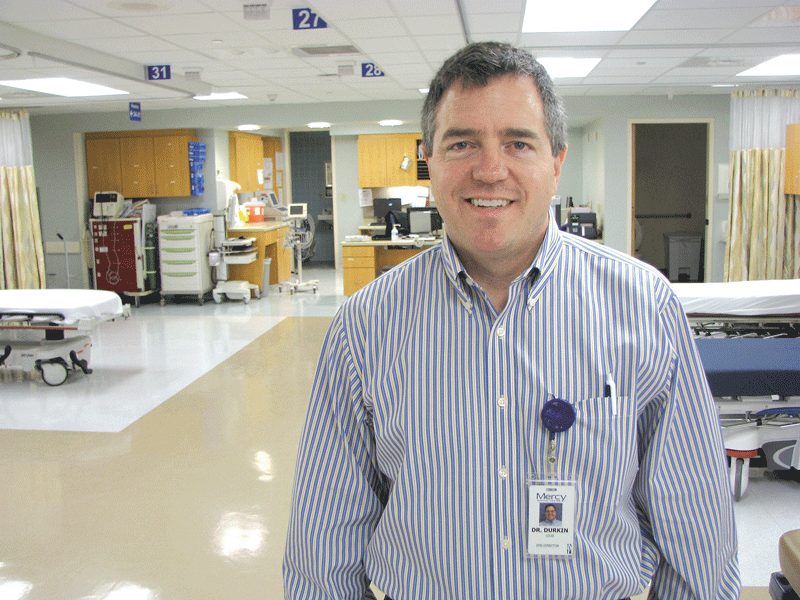
Law Sections
Curran & Berger Works to Ease the Path to Immigration

From left: Daniel Berger, Joseph Curran, and Megan Kludt

From left: Daniel Berger, Joseph Curran, and Megan Kludt

The immigration lawyers at Northampton-based Curran & Berger paint a picture of immigration far different from commonly held stereotypes about foreigners scaling walls and taking advantage of the system. They say they work with people unjustly separated from their families over technicalities, and of extremely talented professionals with much to offer this country. These lawyers must overcome a maze of statutory barriers and systemic suspicion that makes their jobs more challenging — but the inevitable success stories even more gratifying.

Joseph Curran likes to talk about a “culture of no.”
Well, ‘likes’ may be inaccurate. He would much rather talk about a culture of ‘yes,’ but Curran — a partner with Curran & Berger in Northampton — is just being realistic about some of the challenges of being an immigration lawyer.
“The culture of no is firmly entrenched. We’ve made very little headway,” he said, referring to changes in immigration policy at the federal level that came about after 9/11. Prosecutors tasked with enforcing those laws “are supposed to use prosecutorial discretion; they’re supposed to be focusing on drug dealers, criminals, terrorists — the bad guys.
“No one ever gets punished for overzealously prosecuting even small things,” he added, “but they could face discipline if anyone thinks they’re being too slack and easy on these people.”
One such ‘small thing’ involved a Portuguese man who had lived in America since 1980 and had grown children and grandchildren living here. He ran into some trouble recently in his home country — it involved surgery — and apparently spent too much time there. “When he returned, the Immigration Service wanted to send him back; they said he had abandoned his green card,” said attorney Megan Kludt, who joined the firm last year.
She went to the prosecutor, who worked for the Department of Homeland Security, Curran recalled, “and said, ‘there are only so many hours in the day; do you really want to waste a whole half-day on an 80-year-old man who has never done anything wrong, when there are so many other cases to work on?’ Even the judge was irritated.”
While immigration is the firm’s specialty, Curran said, there are many subspecialties within that field.
“We are a full-service firm,” Curran said, noting that he, partner Daniel Berger, and Kludt — along with a diverse staff of paralegals and researchers — work with a wide variety of clients, from businesses and colleges looking to bring foreign workers on board to families trying to stay together in the U.S. when one member is faced with deportation.
“I deal personally with a lot of foreign national doctors coming to the U.S.,” he noted. “They make a deal with the Immigration Service and the Department of Labor to work in medically underserved areas in exchange for a green card — and there are a lot of medically underserved areas in Western Mass., including Springfield, Holyoke, Greenfield, and outlying towns. They can’t find physicians, especially primary-care physicians.”
In fact, Kludt said, despite rampant unemployment in the U.S., many businesses and health care organizations are in desperate need of skilled workers that they cannot find, and talented foreign-born workers can fill that gap. The Department of Labor must perform a balancing act in these situations, she added, because it wants to make sure businesses have the staff they need, yet it also needs to protect the interests of U.S. citizens who might lose out on jobs.
Still, “people are not scaling the fence coming in from Mexico; that’s a common misinterpetation of the immigration situation,” she told BusinessWest. “The border is actually fairly quiet, but we’re seeing some highly eduated people struggling to get in, people who could benefit the U.S. One researcher from Iran won’t travel [outside the U.S.] because it’s always a hassle, and he’s never sure he’ll get back in.”

People Who Need People
Early in his law career, Curran explained, he was drawn to a field that gave him more personal satisfaction than, say, divorce law or tort law.
“I chose early on to do just immigration,” he said, noting that his passion was likely sparked at a young age, by a family heavily involved in international matters. “We always had foreign students in our house — maybe a dozen different students over the years. There would be someone from Botswana or Korea or Brazil, talking to me about what life was like in other parts of the world. I didn’t really think about it until later on, but it was something ingrained in me. Then after law school, I met a couple of immigration lawyers and got into this field.”
The firm’s newest lawyer said she was drawn into the immigration niche by the opportunity to make a positive difference in people’s lives.
“I thought I was heading into a career in international relations,” said Kludt, who holds degrees in that field. “My plan was always to do international work, but after graduating from law school, I realized I could do much more here in the U.S. In another country, you make a small difference as part of an international organization, but here, you can make a difference with every single family; every time you win a case, you can look at that person and see them smiling. It’s gratifying.”
She said the job is endlessly varied, and she essentially travels the globe from her office; in a single week before speaking with BusinessWest, she had worked with clients from Denmark, the United Kingdom, China, Brazil, Mexico, and other nations.
But the field can be heartwrenching as well as gratifying. One client had a green card pending when he took an unauthorized trip to Brazil to be with his dying mother, which jeopardized his immigration status. Curran & Berger has been fighting to allow him to stay in the U.S., with no positive resolution yet. “He might give up and go home,” Kludt said. “Sometimes it comes down to that.”
Both Curran and Kludt say they enjoy working through the highly complex statutes surrounding immigration law, but it’s a challenge as well.
“The statute part is very complex, like a Sudoku puzzle,” Kludt said. “Immigration law is one series of immigration reform piled onto another.”
Differences in state laws can pose difficulties as well. Typically, a “crime of moral terpitude” will jeopardize someone’s immigration status, she explained, yet definitions of those crimes can vary from state to state, often with severe consequences.
For example, one state might define assault as any innocuous scuffle, while another might reserve the charge for more serious matters. Yet, because a simple admission of guilt carries the same weight as a conviction in immigration law, someone who admits to a very minor assault charge, resulting in no real punishment, may do permanent damage to his chances of staying in the U.S., so it’s often better to go to court. Kludt said she is often consulted by criminal lawyers to help them avoid such pitfalls.

Dream On
The firm has also been supportive of the Development, Relief, and Education for Alien Minors (DREAM) Act first introduced in the U.S. Congress a decade ago and reintroduced earlier this year. The legislation addresses the plight of young immigrants who have been raised in the U.S. without proper documentation, and would offer a path to legal status to those who have graduated from high school, have stayed out of trouble, and plan to attend college or serve in the U.S. military for at least two years.
“We’re doing a lot of work with students all over the country, and we’ve been hoping for passage of the DREAM Act for the sake of people who came in very young, grew up here, and are highly educated with no place to go,” Kludt said. “We’re working with as many students as possible; a lot of them never talked with immigration lawyers and have no idea what their options are. We’re seeing what we can do for them.”
The problem with current hurdles to immigration, she said, is that too many bright, foreign-born people — some with hard-to-come by skills that could benefit medicine, science, the arts, and other fields — are studying here and then taking that valuable knowledge back to their home countries.
In fact, Curran & Berger specializes in serving “aliens of extraordinary ability,” Kludt said, a legal term for foreign-born individuals who are at the top of their field and are able to self-petition the government for citizenship without being sponsored by a university or other organization.
“Typically, what these people do is extremely complicated, like a seismologist discovering new things about earthquakes,” she said. “We spend a lot of time learning about these things ourselves so we can explain it to the government; we put together packets sometimes two inches thick to try to convince the government that this person is unique, and we don’t want to lose them.”
Of course, many cases are more emotional, such as people who have found their way into the U.S. through educational or humanitarian means and who petition the government for asylum because they have been battered, tortured, or harassed in their home country. Sometimes it takes a long time, with many meetings, for such people to fully explain their story to the point where it will be convincing to a judge.
It’s the successes, Kludt said, that stand out most and continue to energize and motivate the whole team — like in the case of the old man making his way back from Portugal.
“We had the whole family in the back of the courtroom, crying,” she said. “It was a really celebratory event.”

Joseph Bednar can be reached at [email protected]

Opinion
Making the Case for Community Colleges

Looking at it one way — maybe the way most community-college presidents choose to view things — it certainly was a tough stretch from a public-relations standpoint.
Indeed, the headlines following the release of two reports — from the Boston Foundation and the Commonwealth Corp. — were certainly not flattering. “Massachusetts Community Colleges Slammed Twice in One Week,” “Report: Massachusetts Community Colleges Fail in Preparing Students for Careers,” “Report Says Community Colleges Falling Short with Health Majors,” and “Mass. Community Colleges Slammed in 2nd Report This Week” were among the offerings (see story, page 18).
Like we said, not a good week PR-wise, at least on the surface. But we think there’s much more to these accounts — one of which says that many health care graduates are not fully ready for the careers they’ve chosen, while the other suggests that community colleges need to do more to close what the authors call a growing jobs-skills mismatch.
While most community-college presidents, including several in this market, got their backs up when the reports were released and spent most of their time defending their institutions and assailing the accounts (and some of that was and is warranted), we prefer to look at the week that was in late November in a very different way.
And that is from the perspective of opportunity, which we believe is buried in these reports somewhere amid several headline-grabbing suggestions — such as merging a few of the Boston-area community colleges, narrowing the mission of all 15 instituitions to workforce-related initiatives, and a centralization effort that would do away with the local boards of trustees.
That opportunity comes in the form of exposure, or recognition, regarding the vital role community colleges are playing and will continue to play in both economic development and workforce development across the state — and also the possibility that this recognition will eventually lead to greater support as the schools go about their work.
The Boston Foundation report notes that “Massachusetts is at a crossroads in its capacity to compete — and the ability of its residents to fully participate in the current economy and the rewards that employment brings,” and that community colleges will play a critical role in reversing many disturbing trends regarding the state’s skilled workforce. It suggests that several steps can be taken to make the schools more effective in that role. All this is much too difficult to cram into a short headline, and thus we are left with “Report Slams Community Colleges,” which isn’t entirely accurate but does catch the reader’s eye.
Over the past several years, community colleges have been involved in almost every major workforce-related initiative in this region, from the Healthcare Workforce Partnership of Western Mass. to the new Training and Workforce Options program involving Holyoke Community College and Springfield Technical College, to initiatives involving the area’s precision-machining sector and efforts to draw more people into that profession. And they have done their work extremely well, and under great duress in the form of reduced state funding in the wake of the recession.
None of this seems to have caught the attention of the Boston Foundation report’s authors, which is frustrating, but not the main point of this discussion. That point is that individuals and groups like the foundation and Commonwealth Corp. are finally waking up to the vital role being played by community colleges in this state, and that even more can and should be expected from them moving forward.
We can’t blame the community college presidents in this market for being defensive and critical of many of the recommendations in these reports. But most of those steps, especially the centralization of governance and a narrowing of the community-college mission, are not likely to happen any time soon, if at all.
But what might happen because of all this attention — and needs to happen — is for state leaders to adequately support these institutions, and in the many forms that the word ‘support’ connotes.