Daily News

AMHERST — Kuhn Riddle Architects, an Amherst firm established in 1988 by John Kuhn and Chris Riddle, has rolled out its new name and new look.

The firm is now Kuhn Riddle Architects & Designers and is headed by its second generation of leadership, President Aelan Tierney and Principals Jonathan Salvon and Charles Roberts.

The firm worked with a Northampton-based creative studio, Transit Authority Figures, to develop a logo, signature colors, fonts, and a name that reflects the firm’s foundation, as well as its transitions, growth, and views toward the future.

The new Kuhn Riddle logo is built on a simple grid using elemental shapes to create a symmetrical, abstract ‘KR’ monogram. These forms, each consisting of a quarter-circle and a triangle, face each other and together form a square. The new logo reflects Kuhn Riddle’s dedication to smart and creative problem solving rooted in timeless foundational principles.

The font used in the new logo recalls the Goudy Old Style used in the original firm logo, yet has its own history, weight, and meaning. The new font, called Martina Plantijn, was developed by the Klim Type Foundry and named after the strong and formidable Dutch businesswomen who ran the Plantin-Moretus publishing house — then the world’s largest — in the early 17th century. As a woman-owned business, Kuhn Riddle takes inspiration from Plantjin’s entrepreneurial spirit and the family-owned company’s legacy of empowering women, which inspired a series of women descendants who went on to manage the business for much of the next three centuries.

To complement the new logo, the firm chose deep blue and radiant yellow, color hues that are unique, bright, and friendly.

“Kuhn Riddle is well-known with deep connections to the community, so we felt it was very important to hold onto the name,” Tierney said. “But we also wanted to present the firm as who we are currently and who we are becoming. In thinking about who may be the next generation of owners, we are more than architects. We are interior designers, project managers, passive house consultants, planners, and possibly more. We wanted our name and our fresh, new look to be inclusive of the many different strengths and capacities of our team, and to welcome the future.”

Daily News

WILLIAMSBURG — A press conference announcing the release of a new report on aging and technology and advocating for digital-equity solutions will take place on Monday, June 10 at 10:30 a.m. in the second-floor auditorium at the Williamsburg Town Office, 141 Main St., Haydenville.

Co-hosted by the Northern Hilltowns Consortium of Councils on Aging and the Alliance for Digital Equity, the event will introduce the report, “Aging and Technology in Seven Rural Hilltowns,” which addresses ongoing inequities in the aging adult community regarding access to high-speed internet, equipment, and devices; digital skills; and the knowledge needed to participate in digital life.

The report compiles data gathered via mailed questionnaire from more than 1200 people — representing 34% of people age 60 and over — in the towns of Chesterfield, Cummington, Goshen, Plainfield, Westhampton, Worthington, and Williamsburg, locally referred to as the hilltowns.

Peg Whalen from the Northern Hilltowns Consortium, who co-authored the report, shared the ways that aging adults are navigating digital life. “A resident described the effect of a costly scam experience on their daily life and the subsequent fear that limits the ongoing use of technology. These costs go beyond lost money. The extent of fear for safety online and through theft is clear from the survey of our aging adult population.”

The report was encouraged in part through the Alliance for Digital Equity, a regional coalition of 64 organizations throughout all four counties in Western Mass. that amplifies local needs and solutions for bridging the digital divide. With recent cuts by Congress to the federal Affordable Connectivity Program, advocates have been raising the alarm about the 70,000 Western Mass. residents most affected by these cuts to affordable internet, including aging adults.

Kathy Bisbee, director of the Alliance for Digital Equity, noted that, while many residents of the region may have access to the internet, a hidden inequity lies in the lack of up-to-date technology, lack of digital literacy, or knowing how to fully use devices.

“While some residents have access to both devices and the internet, we know anecdotally that even those that do have internet access often do not have updated software and hardware, or the digital literacy and digital skills to fully utilize the tools they have to take advantage of everything digital participation has to offer,” she said, adding that, while digital equity is a social determinant of health and healthy communities, it is also a factor in civic life and participation in hobbies, and can be an antidote to loneliness and loss of connection often felt by older adults.

The alliance’s device-distribution and digital-literacy skill program offers resources to aging adults and vulnerable populations. More information can be found at alliancefordigitalequity.com.

Meanwhile, the Northern Hilltown Consortium of Councils on Aging offers the TechConnect program to increase digital literacy among rural older adults through the support of grants and their partnership with the alliance.

According to the report, results show that “many older adults have less access to information and services because they are unable to use technology. Although many older adults do use technology, many others do not use or have access to computers, the internet, training, and other technology. This reality has unique characteristics and causes which affect older adults, especially those living in rural communities.”

The event will be hosted by Bisbee; Whalen; Jan Gibeau, director of the Chesterfield Council on Aging; and Melissa Wilson, director of the Williamsburg Senior Center. Local residents will share their firsthand stories about the impact of the digital world on older adults. State Rep. Lindsay Sabadosa will also be on hand to lend insight.

Daily News

NORTH ADAMS — Massachusetts College of Liberal Arts (MCLA) will host a virtual graduate information session for its master of business administration (MBA) and master of education (MEd) programs on Wednesday, June 12 at 5 p.m.

Prospective students can meet with faculty and staff to learn about graduate education in MCLA’s innovative programs designed to support the rising workforce needs in the Berkshires and beyond.

The MBA program offers a broad-based, multi-disciplinary education that combines the strengths of MCLA business faculty with those of practicing managers actively involved in day-to-day decision making in the field. It is a part-time, 30-credit program designed for working professionals and in partnership with the Berkshire Innovation Center.

The MEd program offers a thoughtful blend of classroom and fieldwork experiences that prepare students to make a meaningful impact in their school communities. Programs include MEd with initial licensure, MEd with professional teacher licensure, MEd with individualized plan of study non-licensure, and accelerated +1 bachelor’s degree with MEd.

To register for the information session, visit lnk.mcla.edu/gradinfo or contact the Office of Graduate and Continuing Education at [email protected] or (413) 662-5575.

Daily News

PITTSFIELD — Goodwill Industries of the Berkshires and Southern Vermont announced it has received a grant of $1,200 from the Eversource Foundation for its Soar for Success program.

In the last year, Goodwill’s Soar for Success program served 53 individuals with job coaching and other services, while providing 1,168 vouchers for clothing and household items to individuals in need.

Goodwill’s Soar for Success job-training program focuses on teaching essential employment skills, provides interview and work-appropriate clothing, and helps community members secure meaningful work. The program is offered free of charge to all Berkshire County residents. Services are provided at Goodwill’s career centers in Pittsfield and North Adams and online.

Goodwill sells donated clothes and household items at a discounted price to aid in funding training and educational programs for individuals seeking employment.

Alumni Achievement Award Cover Story

2024 Finalists Continue to Lead by Example

Left to right: Andrew Melendez, Meghan Rothschild, Payton Shubrick, and Craig Swimm

In 2015, BusinessWest introduced a new award, an extension of its 40 Under Forty program. It’s called the Alumni Achievement Award (AAA), and as that name suggests, it recognizes previous 40 Under Forty honorees who continue to build on their résumés of outstanding achievement in their chosen field and in service to the community.

Along with honoring one winner (or, on a couple of occasions, two) each year, the program also gives us a chance to visit with, and write about, several finalists each year — which gives our readers an opportunity to read about the interesting and impactful things going on in their lives. After all, for most 40 Under Forty alums, that award recognizes only the beginning stages of where their paths will take them.

So read the links below for the subsequent, and often surprising, chapters in the lives of Andrew Melendez, Meghan Rothschild, Payton Shubrick, and Craig Swimm. These four were chosen by a panel of three independent judges among this year’s AAA nominees. The same judges were then tasked with agreeing on the ultimate winner, who will be revealed at the 18th annual 40 Under Forty Gala on Thursday, June 20 at the MassMutual Center in Springfield.

As the profiles that begin on page 5 reveal, these four finalists truly embody the spirit of this award. Their stories convey leadership, ongoing commitment to the region’s economic and civic life, and an ability to pivot and evolve as opportunities present themselves. They are, in a word, inspiring.

Special thanks to Health New England for its continued sponsorship of the Alumni Achievement Award.


Andrew Melendez

Founder, Latino Economic Development Corp


Meghan Rothschild

President and Owner, Chikmedia


Payton Shubrick

Founder and CEO, 6 Brick’s LLC


Craig Swimm

Senior Vice President, Audacy Springfield

Special Coverage Travel and Tourism

Hot Times Ahead

Summertime is a great time to get away, but in Western Mass., it’s also a great time to stick around and enjoy the many events on the calendar. Whether you’re craving fair food or craft beer, live music or arts and crafts, historical experiences or small-town pride, or sports ranging from baseball and 3-on-3 basketball to motocross and boat racing, the region boasts plenty of ways to celebrate the summer months. Admittedly, the following 20 events only scratch the surface, so we encourage you to get out and explore everything else that makes summer in Western Mass. a memorable time.


Valley Blue Sox

Valley Blue Sox

Valley Blue Sox

MacKenzie Stadium, 500 Beech St., Holyoke

valleybluesox.pointstreaksites.com/view/valleybluesox

Admission: $7; 12 games, $59; season tickets, $99

Now through July 30: Western Mass. residents don’t have to trek to Boston to catch quality baseball. The Valley Blue Sox, two-time champions of the New England Collegiate Baseball League, play the home half of their 44-game schedule close to home at MacKenzie Stadium in Holyoke. Frequent promotional events like postgame fireworks and giveaways help make every game a fun, affordable event for the whole family.


Westfield Starfires

Bullens Field, 181 Notre Dame St., Westfield

www.westfieldstarfires.com

Admission: $10; 20 games, $99; season tickets, $140

Now through Aug. 4: Still can’t get enough baseball? Celebrating their sixth season of action, the Starfires, a member of the Futures Collegiate Baseball League of New England, play a slightly longer schedule (56 games) than the Blue Sox. The team plays at Bullens Field in a city with a rich baseball history, and peppers its games with plenty of local flavor and fan experiences.


Juneteenth Jubilee

Juneteenth Jubilee

Juneteenth Jubilee

Downtown Springfield

facebook.com/juneteenthspfldma2023

Admission: Free

June 14-15: Juneteenth is a federal holiday celebrating the emancipation of those who had been enslaved in the U.S. two years after the Emancipation Proclamation was issued. Juneteenth in Springfield will celebrate this holiday with two days of activities, including a flag raising at the Black Vietnam Veterans Memorial at Mason Square and an adult block party at Level 5 restaurant on June 14, and a family fun day featuring music, kids’ activities, youth and business award presentationsl, complimentary food from Black-owned restaurants, and more.


Worthy Craft Beer Showcase

201 Worthington St., Springfield

www.theworthybrewfest.com

Admission: $50

June 15: Smith’s Billiards and Theodores’ Booze, Blues & BBQ, both in the city’s entertainment district, will host more than two dozen breweries at an event that also features live music and plenty of food. The event will also feature a home-brew contest; Loophole Brewing will make the winner’s beer and serve it at next year’s Brew Fest. Designated drivers pay reduced admission of $10.


Green River Festival

One College Dr., Greenfield

www.greenriverfestival.com

Admission: One-day passes, $79.99 to $89.99; two-day passes, $145; weekend passes, $99.99 for teens, $199.99 for adults

June 21-23: For one weekend every summer, Franklin County Fairgrounds hosts a high-energy celebration of music; local food, beer, and wine; handmade crafts; and games and activities for families and children — all topped off with hot-air-balloon launches and a Saturday-evening ‘balloon glow.’ The music is continuous on three stages, with 48 bands slated to perform, headlined by Cake on Friday, Fleet Foxes on Saturday, and Gregory Alan Isakov on Sunday.


Hooplandia

Eastern States Exposition and Naismith Memorial Basketball Hall of Fame

www.thebige.com/p/hooplandia

Admission: Free for spectators

June 21-23: For the second straight year, Hooplandia, the Northeast’s biggest 3-on-3 basketball tournament, will be hosted by Eastern States Exposition (ESE) and the Naismith Basketball Hall of Fame. The event takes place on the ESE grounds, with youth championship games held at the Hall of Fame. Seventy-five basketball courts will be set up to accommodate more than 650 games played by approximately 2,100 participants of all ages. Divisions have been created to provide an all-inclusive environment for players of all ages and playing abilities, including young girls, boys, women, men, high-school-level, college-level, OGs, veterans, and more.


Municipal Fireworks

Admission: Free

June and July: Western Mass. communities will host numerous fireworks events around the Fourth of July this year. Sites include Look Memorial Park, Northampton, June 22; Holyoke Community College, June 28; Westfield Middle School, June 29; UMass Amherst McGuirk Stadium, July 2; Smith Middle School, South Hadley, July 3; Franklin County Fairgrounds, Greenfield, July 4; Six Flags New England, Agawam, July 4-6; Riverfront Park, Springfield, July 4; and Beacon Field, Greenfield, July 6.


Southwick AMA Pro Motocross National

The Wick 338, 46 Powder Mill Road, Southwick

thewick338.com

Admission: $35-$435

June 29: The Southwick National at the Wick 338 is round 5 of the 2024 Lucas Oil Pro Motocross Championship, sanctioned by AMA Pro Racing. Gates open at 7 a.m., and ticket prices span a wide range of viewing opportunities, from general admission to a ‘preferred viewing island’ in the center of the track to multiple VIP locations offering spectacular views, tented seating, a live monitor feed, lunch, and private adult-beverage bars and facilities. 


Monson Summerfest

Main Street, Monson

www.monsonsummerfestinc.com

Admission: Free

July 4: In 1979, a group of parishioners from the town’s Methodist church wanted to start an Independence Day celebration focused on family and community, The first Summerfest featured food, games, and fun activities. With the addition of a parade, along with booths, bands, rides, and activities, the event has evolved into an attraction drawing more than 10,000 people every year. This year’s parade steps off at 10 a.m. on Main Street, followed by activities, music, and a beer garden later in the day.


Berkshires Arts Festival

380 State Road, Great Barrington

www.americanartmarketing.com

Admission: $14; weekend pass, $16; students, $7; under 10, free

July 5-7: Ski Butternut plays host to the Berkshires Arts Festival, a regional tradition for more than two decades. Thousands of art lovers and collectors are expected to stop by to check out and purchase the creations of 200 jury-selected artists and designers from across the country, in both outdoor and air-conditioned indoor exhibition spaces. The family-friendly event also features demonstrations, food, and live music.


Brimfield Outdoor Antiques Show

Route 20, Brimfield

www.brimfieldantiquefleamarket.com

Admission: Free

July 9-14, Sept. 3-8: After expanding steadily through the decades, the Brimfield Antique Show now encompasses six miles of Route 20 and has become a nationally known destination for people to value antiques, collectibles, and flea-market finds. Some 6,000 dealers and close to 1 million total visitors show up at the three annual, week-long events; the first was in May.


Springfield Jazz and Roots Festival

Stearns Square, Springfield

www.springfieldjazzfest.com

Admission: Free

July 12-13: The annual Springfield Jazz & Roots Festival descends upon Stearns Square and surrounding streets this summer, offering a festive atmosphere featuring locally and internationally acclaimed musical artists. More than 10,000 people are expected to attend. The musical lineup will be announced soon on the website.


Glasgow Lands Scottish Festival

300 North Main St., Florence

www.glasgowlands.org

Admission: $5-$28; under 6, free

July 20: Held at Look Memorial Park, this 29th annual festival celebrating all things Scottish features bagpipes, heavy athletics, Celtic dance, drumming, vendors, historical demonstrations, musical guests, children’s events, and much more. Guests can also attend a whiskey-tasting master class ($30) where they can sample and learn the differences and complexities of single-malt scotch whiskey, as well as learning the history of the spirit and how it is made.


Springfield Dragon Boat Festival

121 West St., Springfield, MA

www.pvriverfront.org

Admission: Free for spectators

July 20: The seventh annual Springfield Dragon Boat Festival returns to North Riverfront Park. Hosted by the Pioneer Valley Riverfront Club, this family-friendly festival features the exciting sport of dragon-boat racing and will include music, performances, food, vendors, kids’ activities, and more. The festival is an ideal event for businesses and organizations looking for a team-building opportunity, and provides financial support for the Riverfront Club.


Brew at the Zoo

The Zoo in Forest Park, Springfield

forestparkzoo.org/brew

Admission: $55-$75; designated drivers, $25-$35

Aug. 3: Brew at The Zoo is a fundraiser at the Zoo in Forest Park, featuring unlimited craft-beer samples from more than 15 local breweries, a home-brew competition, live music, food trucks, games, and, of course, animal interactions. The fundraiser supports the general operating costs of the more than 225 animals that call the zoo home, many of which have been deemed non-releasable by a wildlife rehabilitator for reasons relating to injury, illness, permanent disability, habituation to humans, and other factors.


Agricultural Fairs

Admission: Varies; check websites

August and September: As regional fairs go, the Big E (thebige.com), slated for Sept 13-29, is still the region’s main draw, and there’s something for everyone, whether it’s the copious fair food, livestock shows, Avenue of States houses, parades, local vendors and crafters, or live music. But the Big E isn’t the only agricultural fair on the block. The Middlefield Fair (middlefieldfair.org) kicks off the fair season on Aug. 9-11, followed by the Westfield Fair (thewestfieldfair.com) on Aug. 16-18, the Cummington Fair (cummingtonfair.com) on Aug. 22-25; the Three County Fair in Northampton (3countyfair.com) on Aug. 30 to Sept. 2, the Franklin County Fair in Greenfield (fcas.com) on Sept. 5-8, and the Belchertown Fair (belchertownfair.com) on Sept. 20-22, to name some of the larger gatherings.


Glendi

22 St. George Road, Springfield

www.stgeorgecath.org/glendi

Admission: Free

Sept. 6-8: Every year, St. George Cathedral offers thousands of visitors the best in traditional Greek foods, pastries, music, dancing, and old-fashioned Greek hospitality. In addition, the festival offers activities for children, tours of the historic St. George Cathedral and Byzantine Chapel, vendors from across the East Coast, icon workshops, movies in the Glendi Theatre, cooking demonstrations, and more.


Mattoon Arts Festival

Mattoon Street, Springfield

www.mattoonfestival.org

Admission: Free

Sept. 7-8: Now celebrating its 51st year, the Mattoon Arts Festival is the longest-running arts festival in the Pioneer Valley, featuring about 100 exhibitors, including artists that work in ceramics, fibers, glass, jewelry, painting and printmaking, photography, wood, metal, and mixed media. Food vendors and strolling musicians help to make the event a true late-summer destination.


FreshGrass Festival

1040 MASS MoCA Way, North Adams

www.freshgrass.com

Admission: Three-day pass, $64-$169

Sept. 20-22: The Massachusetts Museum of Contemporary Art is known for its musical events, and the FreshGrass festival is among the highlights, showcasing dozens of bluegrass artists and bands on four stages over three days. This year, the lineup includes Shakey Graves, Molly Tuttle & Golden Highway, the Devil Makes Three, Drive-By Truckers, Béla Fleck, Edmar Castañeda, Antonio Sanchez Trio, Steel Pulse, and more.


Old Deerfield Craft Fair

8 Memorial St., Deerfield

www.deerfield-craft.org

Admission: See website

Sep. 21-22: This award-winning show that closes out the summer tourism season has been recognized for its traditional crafts and fine-arts categories and offers a great variety of items, from furniture to pottery. And while in town, check out all of Historic Deerfield, featuring restored, 18th-century museum houses with period furnishings, demonstrations of Colonial-era trades, and a collection of Early American crafts, ceramics, furniture, textiles, and metalwork.


Healthcare News Special Coverage

Progress Report

Jason Pacheco doesn’t like using that phrase ‘new normal’ any more than anyone else these days.

It’s more than a little tired, and in most settings, it’s been retired.

But when it comes to the workforce issues facing healthcare providers these days, it ultimately works. Four full years after the height of the pandemic and maybe a decade after some not-so-subtle shifts in the workforce landscape, especially the retirement of Baby Boomers, there is what appears to a new normal, and one that will continue for the foreseeable future.

It’s no longer a crisis, in the true sense of that word, although there are certainly many challenges, said Pacheco, director of Workforce Planning, Analytics, and Compensation for Baystate Health.

He noted that Baystate and other providers are no longer using large numbers of very expensive travel nurses, and there is no longer a sense of desperation over if and how vacancies will be filled. But in this new normal, there are still many open positions at any given time — more than before the pendulum started to swing.

“Baystate has implemented several key training programs … for example, we’ll go out and recruit a cohort of medical assistants. Instead of people having to go to school to become a medical assistant, we’ll hire them, and we’ll pay them to train to become a medical assistant.”

There is also a greater need to be competitive with compensation, benefits, and other perks; added emphasis on retention and the many elements of that equation; many more pay-to-train programs, education-assistance efforts, and other inititiatives to get individuals into healthcare and then provide them with the skills to succeed at one job and then advance to others; greater collaboration with area colleges to train existing employees and help them advance; and an ever-growing need to listen to employees and create an environment they want to be part of.

Dr. Robert Roose says a focus on culture has helped to “reset” the workforce crisis.

Dr. Robert Roose says a focus on culture has helped to “reset” the workforce crisis.

“Baystate has implemented several key training programs … for example, we’ll go out and recruit a cohort of medical assistants. Instead of people having to go to school to become a medical assistant, we’ll hire them, and we’ll pay them to train to become a medical assistant,” said Pacheco, adding that the system is partnering with Holyoke Community College to deliver a medical assistant training course, just one of myriad examples of how providers and systems are being proactive, and getting creative, when it comes to recruiting talent and retaining it.

Dr. Robert Roose, chief administrative officer for the Springfield market of Trinity Health Of New England, overseeing Mercy Medical Center, Johnson Memorial Hospital, and the affiliates of both, said both elements of the equation are equally important.

And as he acknowledged that the workforce crisis in healthcare has eased — or “reset,” he said — there are many reasons for this, including, at Mercy and elsewhere, a healthy emphasis on culture.

“Our colleagues have found that culture is what has ultimately compelled people to come to a system and stay within a system and continue to engage in the wellness professions,” he told BusinessWest. “We’re looking at how we better redesign work to attend to the ways that healthcare delivery has changed and will continue to be changing, and looking at ways to reinforce what matters to people to retain them in our hospitals and healthcare systems, while recruiting more individuals.”

Emily Davis, senior director of Human Resources at Cooley Dickinson Hospital, concurred.

“From a retention standpoint, it comes down to … how do we provide an environment where employees feel not only appreciated, but where, in every position, they can understand and feel the impact they’re having on patient care?

Emily Davis says it’s important for employees to feel they are appreciated — and to feel the impact they have on patient care.

Emily Davis says it’s important for employees to feel they are appreciated — and to feel the impact they have on patient care.

“Also, how does the environment they work in every day contribute positively to not just their livelihood, but their lives?” she went on, adding that providers’ ability to answer those questions in a positive fashion will go a long way toward determining their ability to retain the employees they have worked so hard to attract and invested so much in terms of onboarding and continued training and professional development.

For this issue and its forcus on the healthcare workforce, we’ll get back to those questions, how systems and individual providers are answering them, and how they are looking to make additional progress in living with this new normal.


Hire Power

As he talked about the workforce issues still confronting healthcare providers — but also about the progress made on some levels — Pacheco used numbers to help get his points across.

He said the system has been averaging 1,600 to 1,650 job vacancies at any given time, a number that is more than double what the system was averaging (maybe 700 to 800 vacancies) before the pandemic, but a significant improvement over the more than 2,000 vacancies at the height of COVID.

Meanwhile, more than 600 individuals are currently in the onboarding process at Baystate, including more than 200 nurses, many of them recent graduates of area colleges, he said, adding that these numbers are one indication of the system’s ability to bring more individuals into postitions, an improvement over a few years ago.

“We’re looking at how we better redesign work to attend to the ways that healthcare delivery has changed and will continue to be changing, and looking at ways to reinforce what matters to people to retain them in our hospitals and healthcare systems, while recruiting more individuals.”

“We are making significant progress in terms of bringing people in,” he said. “For example, we’ve implemented a number of new training programs — we’re training medical assistants, patient care technicians, and our newest one is a sterile process technician; we’re teaching folks how to clean and work with surgical instrumentation. However, all of that requires a significant investment in orienting people.”

Meanwhile, when it comes to retention, while there has been some progress in bringing those vacancy numbers down, “we have not yet returned to a normal place, like what we experiencing pre-pandemic, for turnover levels,” said Pacheco, adding that the system is averaging roughly 19% turnover, with much of it coming in the first year of employment.

Michele Anstett

Michele Anstett says competition for workers in the home-care arena is fierce, and there is little loyalty to employers.

“So, are we making headway in terms of bringing people into healthcare? Absolutely,” he went on. “Do we still have a long way to go? You bet.”

Roose agreed, adding that, at both Mercy and Johnson Memorial, there has been recorded progress in both hiring and retention, with a roughly 40% reduction in turnover the past two years — 50% at Johnson Memorial and 35% at Mercy.

“Reducing those that are leaving the organization to levels that are under 20% has been very stabilizing,” he said. “And while reducing turnover, we’ve also, over the past several months, seen that the number of people coming into Mercy and Johnson Memorial has outpaced the number of those leaving, so the balance has shifted.”

This is true across many professions, especially nursing, where there has been reduced turnover and improved recruitment, he said, adding that other realms, such as transport, food and nutrition, and others, have recorded less progress.

Indeed, while things have stabilized somewhat, building and maintaining a workforce remains quite challenging for most healthcare providers.

Michele Anstett, president of the West Springfield-based home-care provider Visiting Angels, said conditions have improved somewhat since the height of COVID, when people were afraid to enter others’ homes. But competition for workers is intense, and the biggest problem is retention.

Indeed, there is comparatively little loyalty to employers, she said, adding that workers will often chase an additional dollar an hour in wages or some other benefit. She stays ahead of the game, if can be called that, first by “hiring, hiring, hiring,” as she put it, and then taking steps to try to hang on to some of those she brings in.

“People tend to fly more; because of the economy, because of society and everything being on the move, and people being really strapped, they go where they can best provide for their family,” she said. “So I’m going to hire faster than they go; I’m hiring about five a week. How many go a week? Maybe two. That’s how we’re adjusting to this new reality.”

“For a mom in the workforce, the most important thing is her family and making sure she can get them to doctors’ appointments, she can get to school functions, she can make sure that if they’re sick, they’re taken care of without repurcussions from the employer. And those are things that we find are intangible and so important to our workforce, so we do our best to make sure that their family needs are met.”

When it comes to retention, Anstett says she has what she calls a magic formula — a focus on the work-culture factor.

“It’s about how they’re treated, how we respect them, how all those different qualities that they find in an employer make them want to say,” she said, adding that working in such an environment often weighs more heavily with employees than an additional dollar an hour.

“About 95% of our employees are women, and I would say 80% of those women are moms with dependent children,” she went on. “For a mom in the workforce, the most important thing is her family and making sure she can get them to doctors’ appointments, she can get to school functions, she can make sure that if they’re sick, they’re taken care of without repurcussions from the employer. And those are things that we find are intangible and so important to our workforce, so we do our best to make sure that their family needs are met.”


Staying Power

Addressing the broad subject of retention, those we spoke with said there is strong need for being creative and showing employees at all levels that they are valued and part of something larger than their own job.

And it all starts with listening, Davis said. “A lot of it is really paying attention to our workforce — what they’re telling us, but also what we’re learning from paying attention to them, not only in their words, but what we see them struggle with and what we see them strive in doing.”

Another key to retention is effective recruitment, she said, attracting people who understand — and value — the environment they’ll be working in and the team they will be joining, and want to be part of all that.

“The key to successful recruiting is agility,” Davis said. “It’s changing our strategies as we see what’s happening outside our walls, what’s happening in our area from the standpoint of where we have people that we can attract, and how we attract them.

“What we’ve been doing recently is getting back into what I call the ‘milk and cookies’ of in-person recruitment,” she went on. “We’ll have a team of talent-acquisition partners, along with leaders, and have a day when people can come in for a given position. They can fill out the application, they can interview with the talent-acquisition partner, interview with the manager, and have a decision about their hiring right on the spot. And then they can meet with the onboarding coordinator. So before they even leave the building, they have an answer, and they’ve started on their journey.”

Elaborating, she said this strategy was recently deployed for the successful hiring of several environmental-services personnel, but it can be used — and has been — for other positions as well, including nurses.

Another key element in the equation is compensation, said all those we spoke with, adding that systems and individual providers must continue making the investments needed to remain competitive — to the extent they can, given the hard reality that reimbursement rates for care provided by those facilities continue to lag far behind the cost of providing that care.

Davis agreed, but said providers who want to retain talent have to go beyond compensation. And this brings her back to that notion of making employees at all levels feel valued.

“Compensation matters,” she said. “But what matters when you get your foot in the door is … how do I feel about the place that I work at? Am I valued? Am I making a difference? Am I treated well? Do I feel like I belong?”

There are many factors that go into how employees will answer those questions, she went on, listing everything from wages and benefits to flexibility in schedules to the willingness of leadership to listen to employees and repond to what they are hearing.

At Cooley Dickinson, there are surveys, said Davis, but the more important strategy is the rounding conducted by members of the leadership team and the visbility of those leaders.

“The staff needs to understand that there is someone there that they can check in with, someone that will get back to me, whether it’s an answer I want or an answer that I wish was different,” she said, adding that rounding, an ever-evolving practice that takes place on many different levels, is key to all-important visbility as well as the listening process.

Roose agreed, noting that Mercy and Johnson Memorial have placed additional emphasis on listening and responding to what is heard through initiatives such as a ‘new-colleague culture experience,’ to start later this month.

“We’ll provide every new colleague that enters our organization with an opportunity to really focus on what about the culture they do identify with and how we can best attend to that during the early period of their orientation and work with us,” he explained. “We find that most people who are going to leave the organization leave within the first year, and a lot of that has to do with expectations around work and whether they’re able to connect with what brought them there.”


Bottom Line

But there are other strategies as well, including educational assistance that will help existing employees seize other career opportunities.

At Baystate, the system has essentially doubled the amount allowable per year for tuition assistance, said Pacheco, adding that the new ceilings went into effect in January, and the investment (probably an additional $300,000 to $400,000) is already showing signs of paying off.

“We have people studying to become nurses, we have folks working on various lab occupations … it varies,” he said. “As long as there is a connection to the healthcare system, we’ll support them with educational assistance.”

Returning to the subject of pay-to-train initiatives, Pacheco said that, in addition to the program for medical assistants, there are others for patient-care technicians (another partnership with Holyoke Community College) and other positions, as well as apprenticeship programs, including one that trains individuals to read heart monitors.

All these initiatives are part of a broad response to a new reality — yes, a new normal — one that should prevail, and test healthcare providers across the board, for the foreseeable future.


Building Trades Special Coverage

Energy for Change

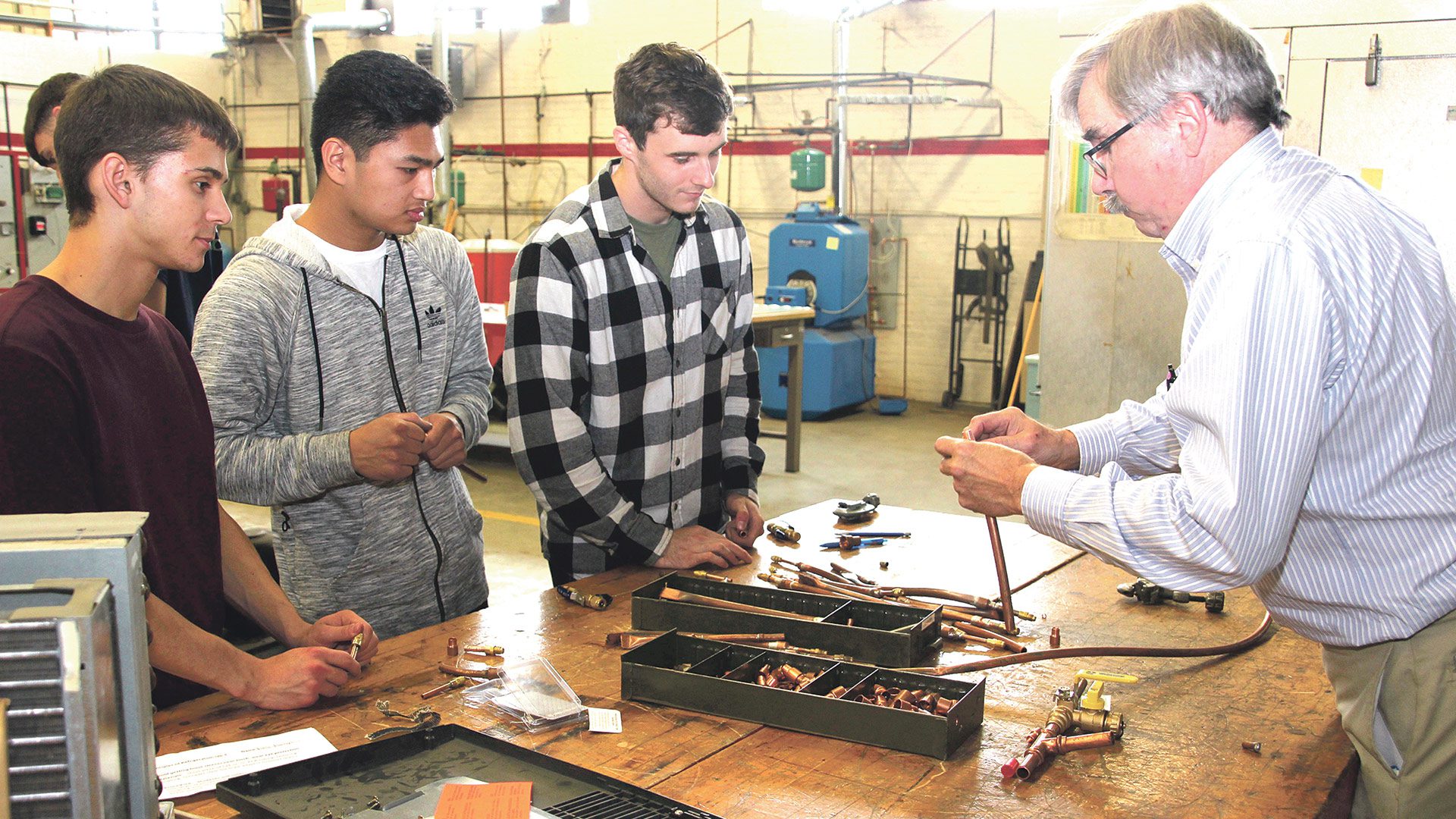
Professor William Halloran teaches HVAC students at STCC.

Professor William Halloran teaches HVAC students at STCC.

Dr. Fahad Khan said the HVAC program at Springfield Technical Community College (STCC) has been around since the 1960s.

“Many in the field around here went to STCC at some point,” said Khan, a professor in the college’s Engineering department. “It’s a legacy program.”

It’s also a program that has seen plenty of change and evolution over the years — which has only accelerated in the past decade or so.

Take, for example, an associate degree added in 2019 that focuses on building automation and control systems. Or advances in fuel, such as the emergence of biodiesel.

“Things have evolved a lot since the 1970s; boilers have improved in efficiency,” Khan said. “We still have to use combustion; some people hope that, in the next 10 years, we won’t need to use combustion for heat, but that’s probably too optimistic.”

But changes are already emerging, said Scott Cernak, owner of Western Mass Heating, Cooling & Plumbing in Haydenville.

“The big change in the past few years is the initiative to convert people from fossil fuels to heat-pump technology, or anything electric-driven.”

“The big change in the past few years is the initiative to convert people from fossil fuels to heat-pump technology, or anything electric-driven,” Cernak said, citing a broad push among government leaders in Massachusetts to move toward decarbonization through climate-technology investments and programs like Mass Save.

“People who have the money and care about the environment enough to do it are going to heat pumps — whole-house conversions, partial conversions, a lot of it driven by Mass Save rebates and tax incentives as well. It’s been about a decade-long push, but especially strong over the last two to three years.”

A heat-pump conversion can cost to to three times more up front than replacing one fossil-fuel system with another, he noted, which is why those rebates and incentives are so critical. And the Mass Save program recently committed to a three-year plan in which rebates will not decrease.

“There’s been a lot of training for our sales and estimation staff, manufacturer trainings, climate-initiative trainings from Mass Save,” Cernak added.

In addition, “it’s been a different mindset for people heating their homes. With fossil fuels, it’s very easy to make heat, it’s very efficient, and people feel that warmth right away. Heat pumps are different. You’re harnessing electricity through the heat-pump system, and the heat isn’t as profound as the fossil-fuel heat. So there’s a level of adjustment for the homeowner. And you also need to make sure the house has good-enough infrastructure to support it.”

Scott Cernak

Scott Cernak says a focus on indoor air quality and a move away from carbonization (in the case of heat pumps) are two major ongoing trends in the HVAC world.

While heat pumps have replaced carbon fuels in many residential and commercial systems, Khan said, the efficiency remains a work in progress.

“They have improved in terms of coefficient of performance, with how much heat you can extract from the outside to the inside. That varies depending on the temperature outside,” he added, explaining that, at very low temperatures, heating costs can rise dramatically. “With heat pumps, you can end up paying a lot of money between December and February.”

One way to combat that, he added, is with water-to-air geothermal heat-pump systems that draw on the stable temperature of the earth’s ground or water sources to provide efficient heating and cooling.

The other big shift in the HVAC world in recent years has been an emphasis on indoor air quality, which was certainly accelerated during the COVID years, but had taken root even before then, Cernak said.

“Indoor air quality has become a focal point in our business as well. A lot of people with allergies and sensitivities have embraced air scrubbers or electronic air cleaners because of all the ancillary benefits. They do kill bacteria and viruses, such as coronavirus. It won’t prevent you from getting sick out in the wild, but it can help you in your own home.”

“These guys are not going to be outsourced anytime soon. You’re not going to see a robot come into the house; somebody has to do the work. An engineer can be outsourced, but who’s going to install and cut metal and lay down the ductwork and do the wiring? Somebody has to do it.”

While technologies continue to advance, Khan said, the state is also focusing on incentives for weatherizing houses, making them more efficient in terms of heat loss and gain. “We’ll still rely on combustion, at least for the next 10 years.”


Priming the Pipeline

With business split about 75% residential and 25% commercial and industrial, Western Mass Heating, Cooling & Plumbing handles all aspects of that name, from installation and retrofitting to new construction and service, Cernak said. “We’ve had a steady incline since our inception in 2020 — we’ve tripled our sales and doubled our workforce.”

That employee growth is impressive in itself, at a time when all building trades are struggling with retention as retirements outpace new talent in the pipeline.

“We’ve seen challenges, especially at first. But we have a strong training program,” Cernak said. “It’s been relatively easy to hire young talent coming up from the trades. They’re not ready to run their own jobs yet, so we’re training them extensively to bring them up into our workforce. The growth has to come from within.

“For a young kid coming out of high school or college, bringing them up to speed usually takes one to three years, depending on the position,” he explained, adding that internal training has been very effective in bolstering his workforce.

Fahad Khan

Fahad Khan says STCC is equipping students to take the first steps into an HVAC field that needs young talent.

Cernak said the question of whether to go to a four-year college or enter a training program in the trades is one each young person needs to make based on their interests and needs.

“But what I can offer is, we pay for training, and you start making money immediately. Even in an internship, you’re making a livable wage, and then there are frequent increases, good benefits, and it’s satisfying at the end of the day, knowing that, by providing heating or cooling or plumbing, you’re providing comfort, safety, and efficiency in someone’s home.”

Khan also recognizes the need to bring more young talent into the world of HVAC.

“There is a vacuum in this field, as a lot of folks are retiring, or have taken early retirement since COVID. We’re trying to fill the gap.”

While STCC also offers a two-year degree program in HVAC, he explained, the one-year certificate program starts with the basics, and “by the time you finish, you’ve gotten your feet wet. You’ll still require some in-field training; you’re not going to hit the road and start fixing stuff. You’ll want to shadow somebody. But we have a lot of success covering all the bases, so, by the end of the year, you can start training in an internship.”

It helps, he said, that the state offers funding for businesses to take on interns for six months.

“It helps the employer, so they don’t have to carry the burden of training somebody and paying them, and it also helps the students with training hours, and gives them a chance to see if they really want to do it or not.”

Many do, of course, and the pay is a factor; HVAC professionals can make $55,000 after a year, or up to $75,000 or more if they go into automation and control, Khan said.

“These guys are not going to be outsourced anytime soon. You’re not going to see a robot come into the house; somebody has to do the work. An engineer can be outsourced, but who’s going to install and cut metal and lay down the ductwork and do the wiring? Somebody has to do it.

“So it’s a good area to be in, with a lot of job security, and it’s not going anywhere soon,” he added. “We can diagnose things faster, make things more efficient, but in the end, somebody’s got to go into the house for the actual repair.”


Changing Environment

The statewide push toward climate and energy innovation aren’t slowing down, and will continue to impact the worlds of construction and HVAC.

In a speech last month to the New England Council, Gov. Maura Healey cited figures from a UMass Donahue Institute report suggesting that the $1.3 billion her administration wants to invest in climate technology over 10 years would result in $16.4 billion in new economic activity and as many as 7,000 new jobs.

The state spending figure includes $400 million in bond authorizations for capital projects, $300 million in tax incentives, and $300 million to support the Massachusetts Clean Energy Center’s operations, as well as an expansion in eligibility for existing offshore wind tax credits that could cost up to $350 million.

At the same time, the Center for EcoTechnology in Florence — which has been at the forefront of innovation when it comes to energy efficiency and climate impacts for almost a half-century — expects to dramatically expand its work, President and CEO Ashley Muspratt recently told BusinessWest.

“The work we do ultimately rolls up to reducing carbon emissions and shepherding in all of the benefits that come with that,” she said. “Carbon reduction can allow for a better lifestyle in terms of cost savings, health benefits, energy independence, and a more comfortable, better livelihood. We could be tackling this crisis while also paving the way to a better way of life.”

And where there’s a will, innovation will follow.

“The technology is advancing tremendously. It has been forever, but especially the past few years. And that trajectory will probably continue as manufacturers learn new technologies to heat and cool homes efficiently,” Cernak said. “The next change is a new refrigerant which is more environmentally friendly and has a wider range of capability. By 2025, every manufacturer will be affected by that.

“It’s ever-moving,” he added. “We have administrative staff people who are always keeping up with regulations and changes and Mass Save incentives and tax incentives and manufacturer trainings. There are a lot of moving parts, but it all makes it better for the consumer.”

Insurance Special Coverage

A Powerful Partnership

Baystate, MassMutual Collaborate on New Community Health Center

From left: LaMar Cook and Kristen Elechko from Gov. Maura Healey’s Western Mass. office; Roger Crandall, chairman, president, and CEO of MassMutual; Springfield Mayor Domenic Sarno; U.S. Rep. Richard Neal; Baystate Health trustee Denise Jordan, executive director of the Springfield Housing Authority; Baystate Health President and CEO Dr. Mark Keroack; and Harriet DeVerry, chair of the Baystate Health board of trustees.


On May 21, in an effort to improve health equity and meet the growing needs of the Springfield community, Baystate Health announced a plan to build a comprehensive community health center in the heart of the city, made possible by the support of its longstanding partner, MassMutual.

MassMutual is donating approximately 10 acres of land valued at an estimated $5 million in the southeast corner of its Springfield campus, as well as providing financing and other support for the project. In addition, the MassMutual Foundation is donating $5 million over five years to support the new, state-of-the-art health center that will be owned and operated by Baystate Health. The expected total cost for the project is $45 million to $50 million.

The proposed 90,000-square-foot community health center, which will be accessible at the intersection of Wilbraham Road and Alden Street, will centralize services, creating a medical neighborhood caring for children, families, and adults and providing comprehensive primary care, integrated behavioral health, and ancillary services for the Greater Springfield area. The new center will have greater access by public transportation, ample free parking, and easy access from major thoroughfares.

Prior to conveyance to the Baystate Health Foundation, MassMutual will clear the site of the existing buildings, and the lot will be subdivided into its own parcel, separate from MassMutual’s headquarters. Construction is expected to begin sometime in 2025 and be completed in 2027.

“Thanks to the generous donations and substantial support provided by MassMutual and the MassMutual Foundation, Baystate Health’s vision to create a comprehensive, integrated community health and wellness center to serve the most vulnerable populations in Greater Springfield can advance toward realization.”

“Thanks to the generous donations and substantial support provided by MassMutual and the MassMutual Foundation, Baystate Health’s vision to create a comprehensive, integrated community health and wellness center to serve the most vulnerable populations in Greater Springfield can advance toward realization,” Baystate Health President and CEO Dr. Mark Keroack said.

With the new community health center and wellness hub in place, Baystate Health will consolidate services from four of its existing Springfield health centers to the new building, where they will continue to provide services, plus more, for adult and pediatric patients at the new location. These centers will remain open and fully functional until their services can be transitioned to the new health center, and Baystate Health is committed to engaging the community and local leaders during the planning phase of the project.

The centers and their services that will be transitioned to the future Wilbraham Road location include Mason Square Neighborhood Health Center, Baystate High Street Health Center, Baystate High Street Pediatrics, and Wesson Women’s Clinic.

Roger Crandall

Roger Crandall says MassMutual and Baystate Health have long been committed to each other’s success.

These existing community-based facilities are limited in size and scope with many infrastructure challenges that require significant upgrading and capital investment to allow for growth and expansion of services. The new center will provide Baystate Health with a state-of-the-art, modern facility to provide robust care for patients as well as attract top providers.

“We intend to co-locate four of our existing Springfield community health centers into a larger, modern facility to create this unified healthcare delivery wellness hub,” Keroack said. “Several convergent factors have informed our vision. The positive outcomes we have demonstrated in our Medicaid accountable care organization, involving more than 50,000 of the region’s most underserved patients, have provided value to this population, improved health, and allowed us to begin to address health disparities and inequities. We could not do this without the generosity of MassMutual and the MassMutual Foundation.”

In addition to MassMutual’s support, the project will also benefit from some expected state and federal grants. The land that will be donated to Baystate Health represents roughly 10% of MassMutual’s approximately 100-acre Springfield campus. The company’s move toward digitization and bringing its employees together in its iconic main office building on State Street has left a portion of its property underutilized, including two vacant buildings. Rather than leave this space unused, the company wanted to find a better, more long-term meaningful use for the land, one that would serve the community MassMutual has called home since 1851.

“Throughout our long histories in Springfield, both MassMutual and Baystate have had an enduring commitment to each other’s success as we’ve worked toward our own respective, yet similar pursuits, helping people live better, more fulfilling lives,” said Roger Crandall, chairman, president, and CEO of MassMutual. “We are incredibly proud that a portion of our property will serve a more meaningful purpose and a greater good, expanding access to high-quality medical care to improve the health and well-being of our community for generations to come.”

“We are incredibly proud that a portion of our property will serve a more meaningful purpose and a greater good, expanding access to high-quality medical care to improve the health and well-being of our community for generations to come.”

Combined, the four existing community health centers planned for the move currently serve 125,000 patient visits annually. In the envisioned community health center campus on the land to be donated by MassMutual, Baystate Health expects patient visits to increase to 145,000 annually by 2028.

As two of the area’s largest organizations, MassMutual and Baystate Health have come together to support the Springfield community before. A few examples include:

• Baystate Health’s role in the MassMutual Foundation’s work in the North End of Springfield focused on bringing together residents, service providers, community leaders, and other stakeholders to identify and prioritize removal of barriers to community financial well-being for the neighborhood’s residents;

• MassMutual and Baystate Health’s support of the Alliance for Digital Equity, a regional coalition of community-focused organizations working toward digital equity for all people;

• MassMutual’s $3 million donation to help Baystate Health fund its Hospital of the Future expansion; and

• MassMutual’s donation of medical supplies to Baystate Health and redeployment of Springfield-based health professionals working in MassMutual’s Wellness Center to serve broader community needs in the early days of the COVID-19 pandemic.

“Two titans of their industries once again come together for the betterment of our Springfield community to continue to proactively facilitate good health outcomes, especially when dealing with mental-health situations,” Springfield Mayor Domenic Sarno said of the community health center, the organizations’ newest collaboration. “My administration was proud to support this health initiative with nearly $1 million in ARPA funding.”

Alumni Achievement Award
Ashley Bogle

Ashley Bogle

Ashley Bogle is assistant general counsel and director of Legal Services for Health New England, where she manages the day-to-day operations of HNE’s Legal Department, from reviewing contracts to providing regulatory guidance and maintaining licenses and accreditation. A 40 Under Forty honoree in 2021, Bogle is a founding member of HNE’s diversity, inclusion, and belonging (DEIB) committee, which strives to embed DEIB and health equity into HNE’s strategic plan, mission, operations, community outreach, and member community. She currently serves as president of Art for the Soul Gallery’s board of directors in addition to working on other community projects.

Corey Murphy

Corey Murphy

Recipient of the 40 Under Forty award in 2009, Corey Murphy is president of First American Insurance Agency and CMS Associates, second-generation businesses started in 1986 and 1994, respectively. First American has two locations, in Chicopee and Brimfield. A veteran of the U.S. Marines who served four years of active duty and 16 years in the Reserves, Murphy has served on the boards of the Greater Chicopee Chamber of Commerce and Soldier On Inc., including stints as chair of both boards. He currently serves on the Holyoke Community College Foundation Board, recently completing three years as board chair.

Amy Royal

Amy Royal

Amy Royal is the founding owner and principal of the Royal Law Firm LLP, a boutique, woman-owned corporate law firm headquartered in Western Mass. with additional offices in Connecticut, New York, Rhode Island, and Vermont. Royal is a 2009 40 Under Forty recipient and the 2023 40 Under Forty Alumni Achievement Award winner. She is a trial attorney specializing in management-side labor and employment law and commercial litigation. Active in the community, she is a volunteer and board officer at several area nonprofits, including the Springfield Ballers and the Center for Human Development.


Alumni Achievement Award

Senior Vice President, Audacy Springfield

Craig Swimm today (above) and as a 40 Under Forty winner in 2007.

Craig Swimm today (above) and as a 40 Under Forty winner in 2007.

Craig Swimm was in the very first class of 40 Under Forty honorees.

That’s was 2007, for those who don’t know the history. And for Swimm, who would turn 40 just a few months later, he acknowledged that this would be his only shot at attaining that honor.

As he reflected on all that has changed since he received his plaque on the stage at the Log Cabin that spring, Craig paused a second, said “wow,” and then paused again as if deciding where and how to start.

Indeed, there have been momentous changes, in his own life and career obviously, and in radio and with his broadcast group, which now includes 94.7 WMAS, sports station 105.5 WEEI, and a new Spanish station, Nueva 98.1 WHLL. And in general, with the Great Recession, other economic ups and downs, a pandemic and its aftermath, the emergence of social media, and so much more.

As for radio and the changes that have come to the industry and his group in particular, Swimm had to do some counting.

“Let’s see — there’s been one, two, three mergers, two bankruptcies, and a lot of other changes,” he said while giving the Readers Digest version of the progression from Citadel Broadcasting, which he served as sales manager when named a Forty Under 40 honoree, to the entity known as Audacy, a huge group with a presence in more than 100 markets, including Greater Springfied.

But what he chose to focus on more is what hasn’t changed over all that time — the team at Audacy Springfield, which has remained largely intact over those years, even through mergers and downturns in the economy; the fact that station WMAS remains live and local, at a time when far fewer stations can make those claims; and especially the stations’ commitment to the community.

That commitment, through Swimm’s direction, now includes everything from book drives to job fairs to the hugely successful radiothon to benefit Baystate Children’s Hospital, which, in many ways, eptoimizes the station’s commitment to the community and Swimm’s own desire to use its impresssive reach to make an impact.

“Success to Craig is watching his team become better versions of themselves.”

“We’ve raised more than $4 million since we started this,” he said, adding quickly that the station’s efforts have also yielded books, winter coats, bike helmets, and much more.

Those who nominated Swimm for the Alumni Achievement Award — and there were several from Audacy Springfield that did so — described him as a caring and effective manager, but also a mentor.

Craig Swimm (center) with Dina McMahon and Chris Kellogg from the WMAS Kellogg Krew.

Craig Swimm (center) with Dina McMahon and Chris Kellogg from the WMAS Kellogg Krew.

“Success to Craig is watching his team become better versions of themselves,” wrote Chris Duggan, an account executive. “That can be said for current employees, but also past employees who have gone on to new careers. They all will say that they owe their success to Craig for the type of manager and mentor he was.”

Dina McMahon, an on-air personality and member of the Kellogg Krew, agreed, and talked about something she called Swimm’s ‘1% philosophy.’

“Craig has strongly supported many local organizations, but he is always looking to make something bigger, better, stronger,” she wrote. “His philosophy is always do 1% better today than the day before, and he lives by that motto.

“One of our biggest community efforts is the 94.7 WMAS Children’s Miracle Network (CMN) Radiothon for Baystate Children’s Hospital,” McMahon added. “Each year, Craig spearheads the station’s effort, encouraging more sponsors to support the cause, coming up with new and innovative ideas to encourage donations and volunteers. And he is the first to say after the event, ‘OK, let’s meet and come up with new ideas for next year.’”

Lucie Rubba, sales planner and administrator at Audacy Springfield, had this to say: “Craig possesses an exceptional resourcefulness, consistently navigating through challenges with adeptness and resilience. His ability to improvise effectively when faced with obstacles underscores his leadership prowess, demonstrating fairness and astuteness in all his endeavors. He embraces every challenge with open arms, whether it’s a 3K run/walk, a food drive, or particularly an event for children. He is invariably present, ready to lend his support in any capacity needed.”

For his part, Swimm said his job comes down to leading Audacy Springfield through the myriad challenges now facing all radio stations and groups — and all media outlets, for that matter — and also making sure that Greater Springfield, one of the smaller markets in the huge Audacy portfolio, is heard loud and clear. And while doing that, he’s always looking for new ways to make an impact within the community.

“Every day is a little different,” he acknowledged. “But I’m always focused on our two clients — the listeners and our advertisers. Every one of my decisions involves making sure we’re putting out a good product and that we’re connecting to the community.”

He points to numerous success stories, but especially the CMN radiothon and the job fairs, conducted in conjunction with MassHire Springfield, that are staged at the Basketball Hall of Fame.

The job fairs have changed and evolved as the economy has, he told BusinessWest, noting that, most recently, they’ve become a way for employers struggling to fill openings to become visible and tell their stories to those looking to enter the job market or take their next career step.

“We started during the Great Recession, and I think we’ve found jobs for 10,000 people since we started this,” he explained. “Back then, we had three companies and 5,000 people show up; now we have 40 companies and 300 people show up. I’m super proud of it because we’ve found so many people jobs; people have walked out of these expos who were hired on the spot. They’re walking through the Hall of Fame, and they’re saying, ‘I got hired.’ They’re happy, there’s tears, and … you’re part of that.”

He’s been part of a great many things since he joined the 40 Under Forty club 17 years ago, and he’s continously looking for ways to add to that list, while continuing to be an effective manager and mentor. This is the very definition of the Alumni Achievement Award and the reason why Swimm is now a finalist for that honor.

—George O’Brien

Alumni Achievement Award

Founder and CEO, 6 Brick’s LLC

Payton Shubrick today (above) and as a 40 Under Forty winner in 2019.

Payton Shubrick today (above) and as a 40 Under Forty winner in 2019.

Payton Shubrick joined the region’s 40 Under Forty club in 2019, when she was serving as ‘Innovation and Design Thinking manager’ for MassMutual.

That was one of the years when the honoree profiles consisted of answers to questions designed to provide some real insight into whom these individuals were and, well … what made them tick.

In Shubrick’s case, they certainly did.

Indeed, when asked how she defines success, she said, “living a life of intentionality — one that allows you to smile unwittingly with excitement because of what you do, understand that hard times are a necessary evil to get to good times, and live a life that the ones you love are proud of.”

When asked what three words best describe her, she replied, “innovative, tenacious, visionary.”

And when asked what she’s passionate about, she wrote, “I am passionate about challenging the status quo. It is not easy, nor it is ever comfortable, but one fearless choice at a time, one brave decison at a time, one courageous action at a time … you can change the world. In the end, some of life’s best moments are on the other side of fear.”

These answers explain the motivations for Shubrick’s subsequent career move — a bold entrepreneurial venture, a cannabis dispensary she would call Six Brick’s, a nod to the six people in her immediate family, many of whom are involved in this operation. And the words and phrases she used in those answers almost eerily portend what an extreme challenge this venture would become. Indeed, the cannabis industry has changed profoundly over the past few years as prices have fallen and the herd of players has been subsequently thinned; nearly 40 dispensaries in the Commonwealth have gone out of business over the past few years.

“The days of ‘if you build it, they will come’ are long gone,” Shubrick said simply when asked to describe the current state of the industry, casting new light and reflection on the answers to those questions five years ago and references to being innovative and visionary, and also hard times, brave decisions, courageous actions, and, yes, challenging the status quo.

“The business is definitely competitive, and prices continue to compress, but I’m extremely grateful for the team that I lead and the customer base we’ve been able to grow, and hopefully will continue to grow.”

In many ways, that’s what she was doing when she desired to take a leap, leave the relative comfort of corporate America and Mother Mutual, and not just start a business, but a cannabis dispensary — becoming a “legal drug dealer,” as she put it — at a time when many large multi-state operators, or MSOs, as they’re called, were eyeing Springfield, in a way that Shubrick, who had seen them come to the City Council first-hand while she was interning for that body, found more than a little disturbing.

“Hearing these multi-state operators talk about Springfield more as a profit center rather than as a place with people really became a catalyst for me wanting to get involved in this industry, especially acknowledging that I was a political science major and African studies major, so I understood and knew first-hand the horror that cannabis had done prior to its legalization in communities like Springfield,” she told BusinessWest. “And I really didn’t like the idea of having dispensaries owned and controlled only by wealthy white men who had no real community ties to Springfield or any real desire to see Springfield be able to leverage this industry and do better and provide not just jobs, but career paths for people.”

Inspired by this desire to challenge what could be considered the status quo, and further inspired by entrepreneurial family members — and especially her grandfather, Hercules Shubrick, who got into the recycling business long before that became meanstream and also owned two convenience stores — she launched Six Brick’s in some of the underused space in the Springfield Republican building nearly two years ago.

“Perhaps it was through complaints and the support of my family or a combination of the two, but I found myself in the process of starting up an adult-use dispensary,” she went on, “wanting to set the tone that those in the community could participate in the legal cannabis community and have authentic representation from the community, as opposed to some performative notion of hiring someone who is a person of color, but isn’t actually an owner/operator.”

Since opening, there has been success and recognition, for both Shubrick and her venture. She has been named to another 40 Under Forty list, this one compiled by Marijuana Venture, and was also named Young Entrepreneur of the Year by the New England Cannabis Assoc. Six Brick’s, meanwhile, was named Best Adult Use Dispensary in the state by that same agency.

But there have been challenges as well as the industry has retreated from its strong start of a few years ago.

“Ignorance is definitely bliss; I did not know nor fully understand all that I was getting myself into,” she said. “The business is definitely competitive, and prices continue to compress, but I’m extremely grateful for the team that I lead and the customer base we’ve been able to grow, and hopefully will continue to grow.”

In other words, and to recall those answers from her questionnaire five years ago, nothing is easy, nor is life in this industry anything approaching comfortable. But she is determined and, yes, tenacious, in her quest for both continued success in this business and opportunities to help people victimized by old cannabis laws and non-violent convictions — crimes that are no longer crimes under current state law. Indeed, she has helped many get professional legal guidance to expunge their records and clean their CORI records so they can move on in life.

To sum up her accomplishments to date and her outlook on the future, we return to that questionnaire one more time, and Shubrick’s answer to the question ‘what goal do you set for yourself at the start of each day?’

“I remind myself of the words of Maya Angelou,” she replied. “If you don’t like something, change it. If you can’t change it, change your attitude.”

She has certainly done all that, and this helps explain why she is not only a success in an extremely challenging business, but why she is a finalist for another honor — the Alumni Achievement Award.

—George O’Brien

Alumni Achievement Award

Founder, Latino Economic Development Corp.

Andrew Melendez

Andrew Melendez today (above) and as a 40 Under Forty winner in 2015 .

“How has the candidate been able to inspire others through his or her work?”

That’s a question that was added to the nomination form for the Alumni Achievement Award a few years back, with the goal of gaining some additional insight into why a certain candidate is worthy of the prestigious award — beyond the positions and titles on a résumé or a list of contributions when it comes to community involvement.

And in many cases, that question has provided some keen insight into not just what someone does for a living, but the impact of what they do.

Such is the case with Andrew Melendez, founder of the Latino Economic Development Corp. and a driving force in helping aspiring business owners get a venture off the ground or to the next level.

“He serves as an inspiration by demonstrating that, with access to the right resources and support, individuals from any background can achieve prosperity and success,” wrote Edna Rodriguez, director of Behavioral Health for Trinity Health Of New England. “His work highlights the transformative power of empowerment, education, and community support in overcoming barriers and realizing one’s full potential.”

And she had more to say on that subject.

“By championing inclusivity and providing opportunities for all, Andrew exemplifies the belief that everyone deserves a chance to thrive and contribute meaningfully to society,” Rodriguez went on. “His story serves as a beacon of hope and encouragement for those striving to build a brighter future for themselves and their communities, regardless of their starting point.”

Melendez’s story is, indeed, an intriguing and inspiring one, with several interesting chapters. These include everything from a short stint as coordinator of an early-literacy initiative led by the mayor of Holyoke to work managing and supervising about 500 substitute teachers for Springfield Public Schools; from a stint as executive director of the short-lived Agawam YMCA Family Center (he was in that role when he joined the 40 Under Forty class of 2015) to a turn in the private sector as operations director for CVS Health, where he was responsible for the efficient operation of multiple locations. There was also a stint as Western Mass. director for Associated Industries of Massachusetts.

“He serves as an inspiration by demonstrating that, with access to the right resources and support, individuals from any background can achieve prosperity and success.”

During that time with AIM, the pandemic hit, providing Melendez with some real insight into the reach and power of business assocations.

“They had an HR hotline; you could call and ask questions of a lawyer,” he recalled. “I said to myself, ‘this is amazing — all these multi-million-dollar companies are getting all this support.’ And I was thinking that, if all these large companies are getting support, we need to be giving support to our minority micro-businesses.”

This led to brainstorming, conducted with other leaders from the Latino community, such as state Sen. Adam Gomez, Springfield City Councilor Orlando Ramos (himself a past AAA finalist), and others to create the Latino Economic Development Corp.

The agency is unique in that it is not a chamber of commerce, nor a business incubator, although it serves as both in many ways. The LEDC provides support to entrepreneurs for all demographic groups (despite its name) in many ways and on many levels. That list includes everything from direct financial support through grants to a pool of coaches — experts who can assist entrepreneurs with everything from writing a business plan to marketing and public relations to support with coping with the huge amounts of stress that come with having one’s name on the business.

And over the past 30 months or so, the agency has made some real strides.

“We’ve brought close to 15 new businesses to downtown Springfield, we’ve given out $200,000 in mini-grants, and we’ve started a new cohort called the Latino Economic Development Institute, and we’ve just graduated 40 people in that cohort, and we have another 15 graduating this week … I could go on and on,” he said. “We have 12 different coaches doing one-on-one coaching; we’re leading the charge in micro-business support.”

Melendez, who was has been instrumental in getting the LEDC off the ground, shaping its unique mission, and running its operation, told BusinessWest that the work is impactful — and inspirational on many levels — although nothing about entrepreneurship is easy, so some of the conversations are difficult.

“Almost every day, I’m talking with someone who has this great idea that they want to bring to the table; they want to talk about creating a business plan, and I walk them through the process,” he said. “But small businesses and micro-businesses do fail; just this morning, I was talking with someone … they’re having a hard time, they’re not sure what to do, and don’t know whether to close their doors or not.

Whether it’s those first conversations — the ones about taking a bright idea to market and developing a business plan — or the harder ones, about whether to keep the doors open, the goal is the same, he said: to provide the business owner with support and a plan for moving forward.

“There are exciting conversations, and there are hard conversations,” he went on. “And I love the environment we’ve created, which is in many ways the first of its kind in the Bay State.”

For Melendez, this latest work is the culmination of everything that came before it career-wise, steps where he developed a passion for others and cultivated myriad skills, especially when it comes to organization, building teams, developing relationships, making connections, and getting things done.

All of this has come together at the LEDC, where not all dreams come true, but all dreams are given their best chance to come true.

And Melendez, through his work and the example he has set, is a huge part of the agency’s success.

As Rodriguez noted, he serves as an inspiration “by demonstrating that, with access to the right resources and support, individuals from any background can achieve prosperity and success.”

This has made Melendez a leader, a 40 Under Forty honoree, and now, an Alumni Achievement Award finalist.

—George O’Brien