
Day: April 10, 2025



NORTHAMPTON — Ruth Griggs, Northampton Jazz Festival board president, has been named a Jazz Hero by the Jazz Journalists Assoc. in its 25th annual recognition of “activists, advocates, altruists, aiders, and abettors of jazz” across the U.S.
Griggs has led the Northampton Jazz Festival since 2017, when she reformed the festival board, reinstated its 501(c)(3) nonprofit status, and planned the first festival since 2015, which took place in 2018 at various venues throughout downtown Northampton.
The Jazz Journalists Assoc., convened in 1987, is a nonprofit organization with 250 international members that provides creative and educational resources to individuals that forward the American art form known as jazz. The association offers events, podcasts, webinars, promotional and educational resources, and master classes to musicians, promoters, educators, broadcasters, journalists, photographers, and writers in the genre of jazz.
Since 2001, the Jazz Journalists Assoc. has identified and hailed individuals from local jazz communities across America who go beyond their basic responsibilities to sustain and expand on musical activities. The association believes Jazz Heroes are essential to the health of the overall jazz ecosystem and supports local efforts to celebrate them. The 2025 Jazz Heroes campaign is concurrent with the 30th annual Jazz Journalists Assoc. Jazz Awards for jazz musicians.
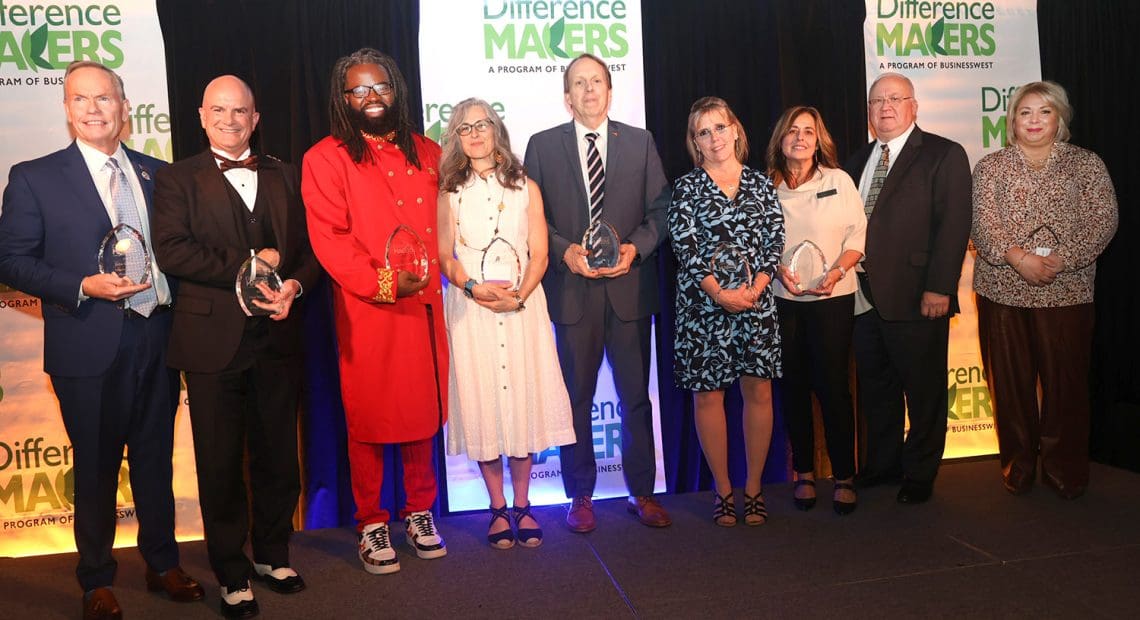
Griggs was also named a Difference Maker by BusinessWest in 2022 for her decades-long career as a marketing strategist and her leadership of the Northampton Jazz Festival, which has become a respected organization, attracting thousands to downtown Northampton each September.
A virtual gala celebrating the 29 Jazz Heroes of 2025 will be held on Thursday, April 17, and an in-person presentation of Griggs’ Jazz Hero certificate will be held locally at a later date.
SPRINGFIELD — Dewey’s Jazz Lounge, a Springfield restaurant and lounge known for its soulful ambiance, vibrant events, and dedication to community and hospitality, will permanently close its doors on Wednesday, April 23.
“Due to circumstances outside of our control, we are forced to close and will no longer be able to operate at our current location,” said Kenny Lumpkin, the establishment’s owner and founder.
Opened in 2021, Dewey’s Lounge has spent the past four years building a reputation as one of the city’s most welcoming, community-centered establishments. From live music and themed nights to special events and private celebrations, Dewey’s quickly became a cultural hub and a go-to destination for unforgettable experiences.
“Watching Dewey’s come to life from a vision in our heads to a real space filled with joy, laughter, and connection has been one of the highlights of my life,” Lumpkin said. “This was a labor of love, built with intention, passion, and the support of our community.”
Over the years, Dewey’s has hosted countless milestones: weddings, engagements, birthdays, bridal showers, retirements, and more.
“We are incredibly proud of what we’ve accomplished and deeply grateful to our guests, our staff, our vendors, and the city itself for believing in us,” Lumpkin added. “Thank you for making Dewey’s a part of your lives.”
The team invites the public to visit during the restaurant’s final weeks of operation to celebrate all that Dewey’s has meant to so many. More information can be found at deweyslounge.com/live-entertainment.
SPRINGFIELD — The Zoo in Forest Park will host its annual Eggstravaganza, presented by M&T Bank, on Saturday, April 19.
The event, which takes place from 10 a.m. to 2:30 p.m., caters primarily to children 0-12 years old. Kids will enjoy prize-filled Easter eggs, crafts, face painting, a scavenger hunt, and animal encounters. The Easter Bunny will also be hopping by to greet guests and pose for pictures.
“Eggstravaganza is our most well-attended event of the year,” said Gabry Tyson, assistant executive director at the Zoo in Forest Park. “We love seeing families return year after year and meeting new families who may be visiting us for the first time because of this event.”
Pre-registration is required to attend Eggstravaganza. Registration closes April 17 or when all tickets are sold. Tickets are available at www.forestparkzoo.org/eggstravaganza. In the event of severe weather, Eggstravaganza will be moved to Sunday, April 20. If the rain date is not utilized, the Zoo will be open to the public on April 20 from 10 a.m. to 4 p.m.
The Zoo in Forest Park is now open weekends only from 10 a.m. to 4 p.m., with last admission at 3:30. The Zoo will be open daily for both Connecticut and Massachusetts spring vacation weeks, April 14 to April 25. After Mother’s Day, the Zoo will move to its seven-day-a-week operating schedule.
SPRINGFIELD — Local business leaders announced an upcoming financial-literacy fair designed to prepare Springfield high-school seniors for real-world financial responsibilities before graduation. The fair, called Credit for Life, is expecting more than 350 seniors from all Springfield high schools.
The event will take place on Friday, April 11 from 8:15 to 11 a.m. at Springfield Technical Community College’s gymnasium, located in Building 2.
In this immersive experience, seniors will step into the shoes of their 25-year-old future selves. Each student will be assigned a career path complete with a starting salary, a credit score, and real-world life circumstances. From there, they’ll make a series of financial decisions — including housing, transportation, groceries, insurance, savings, student loans, and even entertainment — all while learning how to live within a budget and plan for their future.
“This fair gives students a hands-on opportunity to connect classroom lessons with real-life scenarios,” said Edward Nuñez, Credit for Life committee member. “By simulating adult financial responsibilities, they gain practical budgeting skills and a greater appreciation for the importance of money management.”
The event will feature interactive stations staffed by local business professionals and volunteers, guiding students through each decision point while offering advice and insights on how financial choices impact long-term goals and stability.
The Financial Literacy Fair is part of the Credit for Life committee’s ongoing commitment to equip students with the tools they need for success beyond the classroom. By providing real-world context and mentorship, the fair empowers students to take ownership of their financial futures.

Home Team

Owners Ellen and Jim Boyle
Any customer who hires Kitchen Concepts for a home-improvement job is asked to sign a piece of paper. On it is a promise they won’t yell at the contractors.
“Because someone did that one day, and I had had enough,” said Ellen Boyle, who co-owns the business with her husband, Jim Boyle. “I told Jim, ‘we’re making some changes.’ It’s just a simple piece of paper with a general explanation that they have to sign, and it’s made such a huge difference in our work because nobody deserves to be talked to like that, and I don’t want to ever speak to somebody like that. But it also creates this kind of camaraderie.”
It’s also part of a general focus on strong communication, she told BusinessWest.
“If someone decides to move ahead with us, we detail their payment schedule, so there’s never an uncomfortable moment of saying, ‘by the way, I need a check today.’ It’s set up from the beginning. Before we even get started, we explain what their schedule is going to look like, so there’s no question of when we’re starting and what our anticipated finish is going to be.”
And then, of course, there’s that expectation of mutual respect, right up front.
“As we’re walking into someone’s home, everybody that works for us is respectful, but we expect the same thing in return,” Ellen said. “We don’t have anybody above us, so if someone has an issue, we’re the ones that take care of it, but it has to be on a very mature and adult level.”
Jim said clients chuckle a little bit about signing the paper, but they also understand it — and it makes a difference.
“I think sometimes people have this expectation of contractors being gruff and rough and disappointing in nature. But we have done an incredible job over the years without having that kind of demeanor.”
“It just ruins the relationship if people yell at somebody over a knob or coming at 8 o’clock instead of quarter of 8,” he noted. “So we have a conversation for five minutes about all the little things that can happen when you’re in the house. And now, when something happens, this is what we get: ‘Ellen, I know I promised not to yell, but I’m a little upset.’ And they tell you the thing, but they preface it with that, and they don’t yell. And we easily handle whatever problem has come up and kind of move on.”
The consistent growth of Kitchen Concepts over the past quarter-century, much of it driven by word of mouth and customer loyalty, has validated that unusual ‘contract,’ if one could call it that. It’s also an effective icebreaker, Ellen said.
“I think sometimes people have this expectation of contractors being gruff and rough and disappointing in nature. But we have done an incredible job over the years without having that kind of demeanor. It’s not necessary, you know?”
From Painting to Kitchens … and More
Before meeting Ellen, Jim started a business called ASAP Painting — by accident, sort of — in 1998.
“I had started kind of cutting grass and doing some other stuff. I left an ad for painting in the paper by mistake, and somebody called me on it. So I painted an exterior house with a buddy of mine. We bought a couple brushes and paint, and that’s how that was born.”
Ellen was an executive secretary at Holyoke Community College when they met, and she eventually began helping with Jim’s business in an administrative role, handling scheduling, estimates, and the like.
“It grew right away,” he said. “It kind of organized us, and it made me able to concentrate on the work itself. And we grew incredibly fast.”

Kitchen Concepts grew out of Jim Boyle learning cabinet installation, and has grown from there.
They moved to an office in Hadley in 2001. “It was a dilapidated building that we renovated, and we were able to buy work vehicles and improve our equipment and bring on guys; I think we had at least four full painting crews,” Ellen said.
In addition to those interior and exterior paint jobs, they also built about 20 houses during that decade, drawing on Jim’s background in construction; his father was a developer. And they quickly outgrew their space and moved, in 2011, to their current, larger space on Russell Street, which used to house the Hadley Post Office and, later, an insurance company.
But the Great Recession had begun to take a bite out of the home-construction business, so they pivoted to selling cabinets and countertops, and eventually to full kitchen and bath renovations.
“We went out and did some training on how to design,” Ellen said. “And we had to renovate this entire building. We’ve made a lot of changes over the years, and we renovated this whole space to make it the showroom that it is. And maybe seven or eight years ago, we decided to solely concentrate on kitchen and bath remodeling.”
More specifically, they ditched whole-home construction; ASAP Painting is still going strong, as is a third business, called Premier Self Storage, which currently has a facility open in Greenfield and one under development in Southwick.
Their business partnership works for multiple reasons, Jim said. One is that they get along well as co-workers; not every couple does. The other is that they excel at different things. Jim realized early on he was much better at managing work crews and projects in the field, while Ellen, besides her organizational and administrative prowess, was much more at ease talking at length to customers about what they were looking for in a renovation.
“We’ve made a lot of changes over the years, and we renovated this whole space to make it the showroom that it is. And maybe seven or eight years ago, we decided to solely concentrate on kitchen and bath remodeling.”
Jim tells the story of spending two hours with a client early in the kitchen business and becoming frustrated.
“I’m a contractor-type person, so I care about being on budget, making sure the tiles and materials are there, making sure the guys are doing everything like they’re supposed to. I don’t necessarily care about colors and shades and things like that. When I buy cabinets, it takes me five minutes: ‘what are my colors? What’s my shape? OK, that’ll be good. Can you send me the price?’ And I’m done. And I thought that’s what everybody did.
“What we found was that she cares about all that stuff. So now, I have very little to do with scheduling or meeting with the customers. From that day, she started dealing with the clients, and I would get tied up with the guys, making sure they’re on budget, that they’re there on time. And she actually built the company to kind of a powerhouse, where we’re doing 15 to 25 kitchens a year, and maybe 25 to 30 bathrooms a year. It works really well.”
Time Management
The Boyles’ operation employs between nine and 15 employees, depending on the season, while the subcontractors that do plumbing, electrical work, and cabinet installation tend to be the same from project to project.
“Many of our people have been with us for a long time,” Jim said. “I have one guy that started with me since day one. Our assistant’s been with us 12 years. Two other guys have been here 17, 18 years. Everybody’s been around for a long time.”
Speaking of a long time, most remodels are completed in three weeks, though some larger, more complex jobs may go four or five. The three-week goal is out of respect for customers, he noted.
“If I build a garage for you at your house, if I take too much time, you could care less. I’m outside every day, and you might come say ‘hi’ to me when you leave for work and when you get back. But if I’m in your kitchen, when you get into a third week and everything’s still going on, it can be difficult for your wife or your partner, and if you get into a fourth week, they don’t want you there anymore; they need their stuff back.”
That consideration was even more acute during the pandemic — a time when home-improvement businesses everywhere reported soaring demand as people stayed home, stopped investing in vacations, and ramped up household projects.
“We were working at least 50, 60 hours a week. There was zero downtime,” Ellen said. “I had my two best years for kitchen consultancy. But yes, there was definitely a learning curve with how to interact with homeowners.

The bathroom and kitchen renovation business surged during the pandemic and has stayed relatively robust.
“Social distancing was new to everybody. But, again, we had honest conversations with homeowners, like, ‘this is how we will come into your house, this is how we will meet to do an estimate and a design, and this is how we will work to get the job done.’ And things took a little bit longer because we couldn’t really pile a lot of people into someone’s home, but the customers would just come in later in the day after we took off.”
Whatever the circumstance, Ellen said most clients have specific ideas in mind when they enlist Kitchen Concepts for a project.
“There’s a lot of information out there, and what makes us unique is having the construction background — so there’s what you see in a magazine or online, or what you’ve seen on TV, and then there’s the reality of what can be done,” she explained. “If someone has a certain dollar amount that they can spend, that definitely directs us where we need to go to. I never want to show somebody something that is three times the amount of money they’d actually be able to spend. So we do have discussions on what their total budget is going to get them and what we can do.”
How a customer intends to use the property makes a difference as well, she added. “Is someone renovating to sell their house? Are they renovating, but they’re only going to be there for five years? Or are they renovating because this is it — this is where they’re going to be for the rest of their lives?
“There are people who walk in and say, ‘I need a new kitchen, and I have no idea what’s out there.’ But I always encourage people to do all of the hard stuff first,” she went on. “I never want someone to come in here and feel like they have to pick their cabinets and pick their countertops. The hard stuff is understanding what design change would make it more efficient for you, and especially working in someone’s budget.”

Premier Self Storage, including this facility in Greenfield, is a successful side business for the Boyles.
Because budget is key, Ellen said, no matter the customer.
“One of our countertop companies, Cambria, has beautiful quartz countertops. But a lot of their designs are geared more toward, say, Boston-area homeowners, where it’s a very different demographic, a very different type of budget. Here in the college towns, some of the more expensive materials don’t fit into what their budget is going to be. So we have that conversation very openly with our Cambria reps, that we love these contemporary materials that they offer, and they’re big sellers in one area, but we say, ‘that’s never going to sell here.’
“But those products are out there, and you never know what someone will walk in and say they want,” she added. “Our cabinets are well-priced cabinets, so we have everything from standard SKU models up to full custom cabinetry.”
Another New Day
Jim called his partnership with Ellen — in life and in business — a good one, saying his day begins with a morning goodbye kiss, but they often see each other soon after — unless he’s on a job site.
“We’ve been working together since the beginning,” Ellen added. “We take separate cars to and from work, which gives us flexibility if he’s out on the road and I’m here, or vice versa. It’s good. It works.”

Law and Order

Anthony Gulluni
The ‘young jokes’ have stopped.
Well … there are fewer of them, anyway.
Indeed, Anthony Gulluni is still the youngest person in the room — by maybe 15 years, by his estimate — when the Massachusetts District Attorneys Assoc. gathers for its monthly meetings and an annual conference to discuss “whatever the crisis of the day is,” such as Rule 14, which puts greater burden on prosecutors and police departments to furnish discovery more quickly.
“It’s no fun; it’s not a good thing,” said Gulluni, 44, Hampden County’s DA, who has been the youngest person in that room for a full decade now, a milestone — there’s a handmade sign in his office congratulating him on that anniversary — that presents a time to pause and reflect on his tenure and what he calls its primary, overarching goal, then and now: “to build a safer community in Hampden County.”
This represents work in progress, noted Gulluni, who told BusinessWest that it’s difficult to quantify just how much safer area cities and towns are a decade after he took office. But he can qualify progress on several levels, everything from the ongoing fight against drugs to efforts to solve cold cases, while also stressing a need to continually improve.
“Ten years provides an opportunity to look back, look forward, and say, ‘what can we do better?’” he said. “And that’s a daily pursuit for this office because the work is so important. We’re serving the public, not unlike other public officials, but we’re working with people who have been victimized, people who have experienced some of the worst things imaginable and things they never expected.”
Overall, building a safer community involves a broad spectrum of programs, initiatives, and simply getting tough on crime and criminals, said Gulluni, adding that efforts at education, prevention, and providing second chances — everything from flag football to 3-on-3 basketball; from Stop the Swerve safe-driving events to the Emerging Adult Court of Hope — and imposing harsh sentences on offenders are not mutually exclusive.
“It’s not ‘lock them up and throw away the key,’ or ‘we want to be progressive and rehabilitate everybody.’ We can combine the two, we can be moderate, and we can be in the middle, and we’ve achieved that.”
“What I’ve tried to do is operate on the principle that we can do progressive things in this law-enforcement space and criminal-justice space,” he noted. “And it doesn’t prevent us from also upholding the law and understanding that there are violent people and repeat offenders who hurt people and need to be incarcerated.
“We can do both things,” he said, adding this has been his goal since he first campaigned for the office. “It’s not ‘lock them up and throw away the key,’ or ‘we want to be progressive and rehabilitate everybody.’ We can combine the two, we can be moderate, and we can be in the middle, and we’ve achieved that.”
Elaborating, he said his office has not “run from the enforcement stuff — taking drugs off the street and locking the person up for as long as possible because this person is killing people.”

Anthony Gulluni speaks at a ceremony marking the five-year anniversary of EACH, the Emerging Adult Court of Hope.
But it has also broken new ground with programs like the Commonwealth’s only Emerging Adult Court of Hope (EACH) — a name he came up with — which provides second chances to young offenders and brings graduates into careers, not merely entry-level jobs that most often fail to prevent recidivism.
“Each person matters; each person should have hope,” he told BusinessWest, adding that the program is designed to break the cycle whereby young people become repeat offenders essentially because there is no real alternative. EACH was designed to help such individuals earn a viable alternative.
There are many other initiatives as well, involving everything from preventing dating violence to internet safety to FLOS (Future Lawyers of Springfield), which seeks to identify young students who aspire to be lawyers and guide them into a career in the legal system. In short, his first decade has been guided by a desire to be tough on crime and creative with ways to build community.
For this issue, BusinessWest talked at length with Gulluni, who has been honored by the magazine as a 40 Under Forty honoree and Alumni Achievement Award winner, about what has been accomplished over the past 10 years, and the hard work that remains.
Coming to Terms
As he talked with BusinessWest on the last day of March, Gulluni was coming off a hard week.
Indeed, he was just a few days away from press conferences announcing charges related to a motor-vehicle accident on an I-91 off-ramp in West Springfield that killed three construction workers, and a hit-and-run incident in Springfield where a motorist struck and killed a pedestrian walking his bike across an intersection.
“This was tragic stuff, but this is what we do — it’s really about public safety, helping people be safe, and helping people make good decisions,” he said, adding that incidents like these help emphasize all aspects of his office’s work, from prosecuting offenders to helping to prevent such tragedies in the future.
“One of the points of frustration over my 10 years, and it’s become more acute and frequent, is the results in court.”
Such press conferences are one of the more visible aspects of a job where far more goes on behind the scenes, in offices spaced across four floors of Tower Square — after Gulluni ordered his staff out of the Roderick L. Ireland Courthouse amid growing health concerns — but in many different settings as well.
That move to Tower Square is one of many bold steps taken over the past 10 years, all aimed, in one way or another, at achieving that broad goal of making communities safer.
Others include everything from adding prosecutors (bringing the number from 61 to 90 over the past decade) and staff to bring the Hampden County DA’s office, among the busiest in the state, more in line with others in the Commonwealth, to ‘specializing’ those prosecutors.
“We’ve taken many of our most experienced and most talented prosecutors to work on cases involving children in our special-victims unit, domestic-violence cases, and homicide cases,” he said, adding that this region has led the state in homicides per capita, reflecting the demographics of a region with four gateway cities.
Overall, there have been several important initiatives undertaken over the past decade, said Gulluni, including a focus on cold cases that has brought charges — and, in some cases, resolution — to crimes committed decades ago.
“That was one of my initial focal points and something we talked about during the campaign, something we acted on immediately, and over the past 10 years we’ve had a great deal of success,” he said, citing the recent instance of an arrest involving a double murder on Route 5 in West Springfield 47 years ago.
Elaborating, he said cold cases require time and resources, factors that make it difficult to address them. But he has made such cases a priority.
“It’s all about focus,” he explained. “We’ve tried to, and we have, dedicated people to work on unresolved cases. I created a unit, I have a coordinator, I have an advocate, I have a prosecutor, and I have two, soon to be three, investigators working exclusively on these cases. You can’t throw a 30-year-old case at a prosecutor who has 50 other cases and expect her or him to really dive into that case.”
Court of Opinion
Meanwhile, some initiatives fall more into the category of prevention, community building, promoting healthy lifestyles, and even inspiring young people to join the legal profession.
“We’ve approached our work with a preventive lens — how can we get in front of issues; how can we identify things that metastasize and become worse?” he said, adding that his office devotes considerable time and resources to what it calls its Community Safety and Outreach Program.
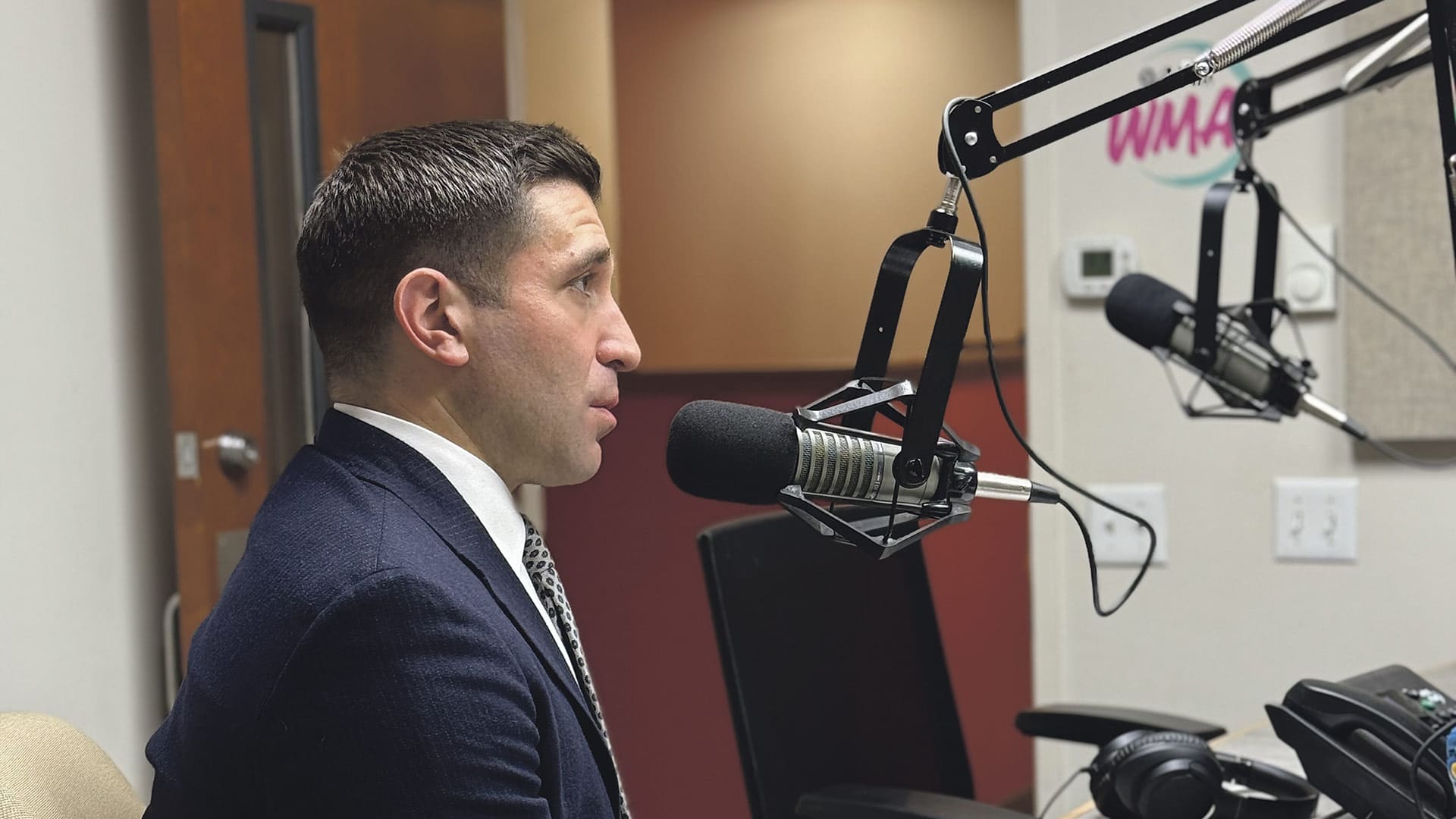
Anthony Gulluni speaks at 94.7 WMAS for its Radiothon for Baystate Children’s Hospital.
It includes more than a dozen initiatives, such as Stop the Swerve, a presentation (the latest staged last month) that addresses the dangers of impaired and distracted driving; Hoop Up Springfield, a 3-on-3 basketball tournament; a Youth Advisory Board consisting of student representatives from high schools across the county who identify issues facing youth today and provide recommendations on how best to address them; and a recent addition, a youth flag-football tournament, staged in partnership with Excel Sports Academy of New England.
The first such tournament was staged last June, and it will return this summer, said Gulluni, adding that, in addition to competition on the gridiron, it features several nutrition and wellness sessions.
Then there’s FLOS. Undertaken in partnership with Western New England University School of Law, it’s designed to inspire young people to enter the legal profession and bring more diversity to the legal community.
“Diversity is important, for our office and for the bar here in Hampden County,” he told BusinessWest. “We thought about how we can encourage and support young people, especially young people of color, to go down the road toward law school and become lawyers.”
As for the Emerging Adult Court of Hope, it is perhaps the most unique and ambitious initiative of Gulluni’s tenure.
Designed for those between ages 18 and 24, it gives individuals a chance to turn an arrest into a positive step forward, he said, adding that participants are carefully screened and, if chosen, assigned a team that includes a judge, service providers, assistant DAs, probation officers, case managers, and case coordinators.
“They come to the court, and it’s entirely different than any other court session anywhere,” he said, noting that the judge, probation department, and ROCA provide resources to make sure participants get needed support.
“Because a lot of these young people started their lives off in a very disadvantaged position — they started their lives off with horrible examples around them, no support, poor parenting, traumatic situations — and they set them adrift, it set them on a bad path.
“Look at the parole hearings … just over the past six months or year, the Parole Board is letting everybody out. There’s a pendulum that swings back and forth, and the pendulum is swinging, and has swung, a little too far, in my view, in the wrong direction.”
“And this is an opportunity for them to accept a hand up, not a handout,” he continued. “It’s not a slap on the wrist, and it’s not a gift; it’s an opportunity to change their lives with their own hard work and their own commitment to themselves.
“I talk to these young people extensively, and on the front end, I’m saying, ‘this court is about you. It’s about giving you an opportunity, but you have to work for it; it comes with a lot of small failures, ups and downs,’” he went on, adding that there have been seven graduates of the program, and another 15 individuals are working their way through it.
Full Sentences
While creating and expanding progressive initiatives in the broad realm of education, prevention, and rehabilitation, Gulluni said he and his staff have also been focused on the other half of that equation he mentioned earlier — upholding the law and punishing those who break it.
And as the discussion entered this area, he didn’t attempt to hide his dissatisfaction with current trends and patterns when it comes to how judges and parole officers are carrying out their work.
“One of the points of frustration over my 10 years, and it’s become more acute and frequent, is the results in court,” he said. “There’s been two or three rounds of criminal-justice reform over my tenure going back to [former Gov.] Deval Patrick early on and recently, over the past few years. The Supreme Judicial Court and other courts have continued to orient toward ‘how is the system wrong, and how can we provide more opportunities for defendants?’
“You look at the parole system, you look at medical parole … systemically, there’s a movement toward defendants’ rights, and that’s extraordinarily important; don’t get me wrong,” he went on. “The system operates rightly on the axiom that it’s better to let 100 guilty men go free than imprison one innocent man — that is the essence of our system, and that’s how it should be.
“But our sentencing practices across our courts, how we’re treating violent offenses, how we’re treating serious drug-trafficking and drug-dealing cases that have poisoned our communities and killed thousands of people through addiction, how we’re treating those who commit crimes against children, domestic-violence abusers, the worst of the worst, has really changed, even in the spectrum I’ve had over the past 10 years.”
The result, he went on, is that violent offenders and repeat offenders are not being held to account.
“That’s a point of great of frustration. Look at the parole hearings … just over the past six months or year, the Parole Board is letting everybody out,” he said, adding that he can’t pinpoint why, but conjectures that it could be everything from overall philosophy to appointments to the board. “There’s a pendulum that swings back and forth, and the pendulum is swinging, and has swung, a little too far, in my view, in the wrong direction.”
Elaborating, he said there are some cases in which those in his office will agree that someone should be granted parole. “But for most of these cases, we’re saying, ‘this person killed someone, took someone away from his or her family, and the sentence is a life sentence, and that’s what it should be.”
Work to help that pendulum swing back the other way is one of many focal points for Gulluni and his team. With this issue and others, it is difficult to measure success, he said, but added that he’s seeing progress on several fronts — and more momentum in the many efforts to build a safer community in Hampden County.

Critical Connections

It’s called Beat the Odds.
That’s the name of a youth group that meets across three community centers in Springfield: New North Community Center, South End Community Center, and Martin Luther King Jr. Family Services.
It was conceived a few years ago as a safe space for teenagers to express their thoughts or feelings without feeling judged or dismissed, and to reduce the stigma around mental health for youth and families and promote the importance of a prioritizing a healthy mental state.
“We’re able to provide a space for over 60 kids to be able to come together on a weekly basis and talk about topics of mental health that are prevalent in their lives, and also around problem-gambling awareness and how that’s showing up in their lives,” said Tiffany Rufino, senior manager of the Youth Mental Health Coalition, a program of the Public Health Institute of Western Massachusetts (PHIWM).
“We also partner with Behavioral Health Network, and we have therapeutic mentors who come to each of the meetings. They’re another leader in that space, and they do one-on-ones with the youth, including goal planning. Whether that’s around mental health or their academics, or just different skills that they want to learn throughout life, we make sure they’re checking in with them on their goals and providing a safe space for having private conversations. And it’s been really great so far.”
Beat the Odds — as noted, a partnership with other area health organizations — is just one way the Public Health Institute has been working to tackle some of the most pressing issues among area young people.
In fact, in late 2023, it began developing its Youth Mental Health Roadmap for Western Massachusetts, which focuses on five distinct themes: destigmatizing and normalizing mental health, conversations around it, and seeking help; boosting social connection for teens who have become isolated and lonely; developing social and emotional learning to support mental health, overall well-being, and productivity in school and society; social media, recognizing its potential as a tool for connection and social support but also the ways it can be harmful; and connecting mental-health promotion and prevention strategies with clinical care when necessary.
These themes were developed with the input of youth health surveys in Springfield Public Schools, as well as input from Beat the Odds participants themselves, said Kathleen Szegda, director of Community Research and Evaluation at the Public Health Institute.
KATHLEEN SZEGDA
“With the shutdowns and the prevention measures, I think it was hard. And one of the studies that we cited deals with the impacts of social isolation in students and young people.”

“These are the areas we’re focusing on for prevention and promotion, and we’re trying to better understand how can we support young people in these areas in the schools and community organizations,” she told BusinessWest.
PHIWM can also use the data to advocate for more resources for Western Mass., as well as policy changes at the state level.
“We’ve had young people at the table as part of the advisory group, along with different organizations who are doing prevention work focused on youth mental health and substance-use prevention, and people working in school districts,” Szegda explained.
“So it will have both the data from young people in schools about youth mental health, and also, on the same site, prevention and promotion strategies and examples of how some of these are taking place in Western Mass., because there’s so much good work going on, and we can learn from each other.”
Take, for example, social isolation, one of the Roadmap’s five focal points, and an issue certainly exacerbated by the pandemic.
“With the shutdowns and the prevention measures, I think it was hard. And one of the studies that we cited deals with the impacts of social isolation in students and young people,” Szegda explained. “Studies have shown that the effects can last as long as nine years later. So, if you look at it developmentally, as kids are developing, they are feeling these impacts for a long time.
“When I was looking at the data — and it’s both for Springfield Public Schools from the youth survey, and also data from our colleagues up in Franklin County, which is a more rural area — even before the pandemic, we saw a rise in ‘depressive symptoms,’ where they report being so sad or hopeless, they stop engaging in their usual activities. During the pandemic, it was particularly escalated. And now it’s gone down a little and is kind of plateauing, or even going down a little. But we’ll have to see how that continues, both here and in Franklin County.”
Multi-generational Approach
Szegda said it’s critical that young people themselves have been involved in this process, not just through surveys, but at the strategy table with adults.
“It’s important. It takes an intentional effort to be able to do that, to have everyone in the same space.”
That’s the same philosophy behind Beat the Odds (BTO), which elevates the voices and concerns of area teenagers, but connects with their parents as well.
“We are engaging parents and guardians more, recognizing that we’re educating youth, but then they’re going back home to their parents and guardians, and we want to make sure they also have some awareness around what their youth are learning,” Rufino said, adding that the young participants are also building skills beyond emotional learning.
“We have subgroups. We have a group that’s focusing on content creation and communications and learning about public speaking. We have a group that’s learning how to become facilitators so they can deliver workshops to their peers. We also have an event-planning group; we’re working with a couple of other youth organizations in the community to put together youth mental-health events. And then we have our data-to-action group, which is working on learning more about the youth health survey, how to interpret data and the stories it tells, and things like that. So there’s a lot going on.”
TIFFANY RUFINO
“We’ve definitely seen youth being more open to talking about their mental health, which helps to destigmatize it so much.”

As a youth-led organization, Beat the Odds also connects with other youth organizations and community nonprofits. Earlier this month, the Hampden County CHIP and nonprofit organization Breaking Oppression put together Voices for Change: A Youth Summit for Peace at the Basketball Hall of Fame. And BTO youth will also be facilitating a problem-gambling workshop with middle-schoolers across Springfield, Holyoke, and other communities — a priority for the group, which receives some funding through the Massachusetts Department of Public Health’s Office of Problem Gambling Services.
“With the boom of online gambling, and with us now getting programs and actual trainings and workshops together, it’s taken some time to build those tools up, but now we’re ready to start educating our youth about how problems show up and parenting guardians so they know how to look for it too,” Rufino said.
Beat the Odds has been helpful not only for the young group members, but as a learning experience for the adults who are involved in various ways.
“Because we have such a welcoming space, I can truly say they open up to our program coordinators. They share a lot about what they’re going through,” said Rufino, who was named to BusinessWest’s 40 Under Forty class of 2024 for her impactful work with the Youth Mental Health Coalition.
“We’re also seeing, more and more, that the young people are requesting one-on-ones with the therapeutic mentors because they just have things they want to share with them, or they’re going through different things at school or at home that they want to talk through. So they’re using the resources that we’re putting forth, and they are vocal and open to talking about challenges that they’re facing.”
“They are also really excited about sharing information with the community,” Rufino added. “Through different tabling events, they have been super excited to be able to deliver training to their peers. So, really, the awareness and advocacy is what they’re excited about. And that’s good to see.”
Tearing Down the Walls
In fact, many of those working in the mental-health realm, especially youth mental health, have been heartened by a lessened stigma around these issues compared to one or two decades ago.
“We’ve definitely seen youth being more open to talking about their mental health, which helps to destigmatize it so much,” Rufino said. “And as the Youth Mental Health Coalition, we recognize that it’s been a multi-generational stigma, which is why we’re focusing on parents and guardians now.
“We’re doing a two-generational approach — educating youth and encouraging them to be self-advocates and recognize their feelings and what they mean and how to cope and help themselves and others, but then also doing the same with parents and guardians and educating them also about some of the things that their youth are learning.”
One of the coalition’s recent projects was called “I Am More Than My Mood.” That public-awareness campaign, seen on billboards, buses, and digital ads in 2023, aimed to destigmatize the subject of mental health and empower young people to talk about it — and, hopefully, take steps toward self-care.
“I think it is getting better, but we still have a lot of work to do,” Szegda said. “We have a lot of resources and programs that folks can join, but now we need the promotion piece, with the Roadmap and really making sure that youth and families know about the programs that are accessible to them — and getting youth to sign up and meeting them where they’re at, so we can continue to see them getting involved and finding meaningful things in their lives.”
The Youth Mental Health Coalition meets the third Thursday of every month from 5:30 to 6:30 p.m. over Zoom. The public is welcome to these conversations about what youth and adults are experiencing around mental health and what resources are available. Email Rufino at [email protected] to receive a link.
Produce and Promise
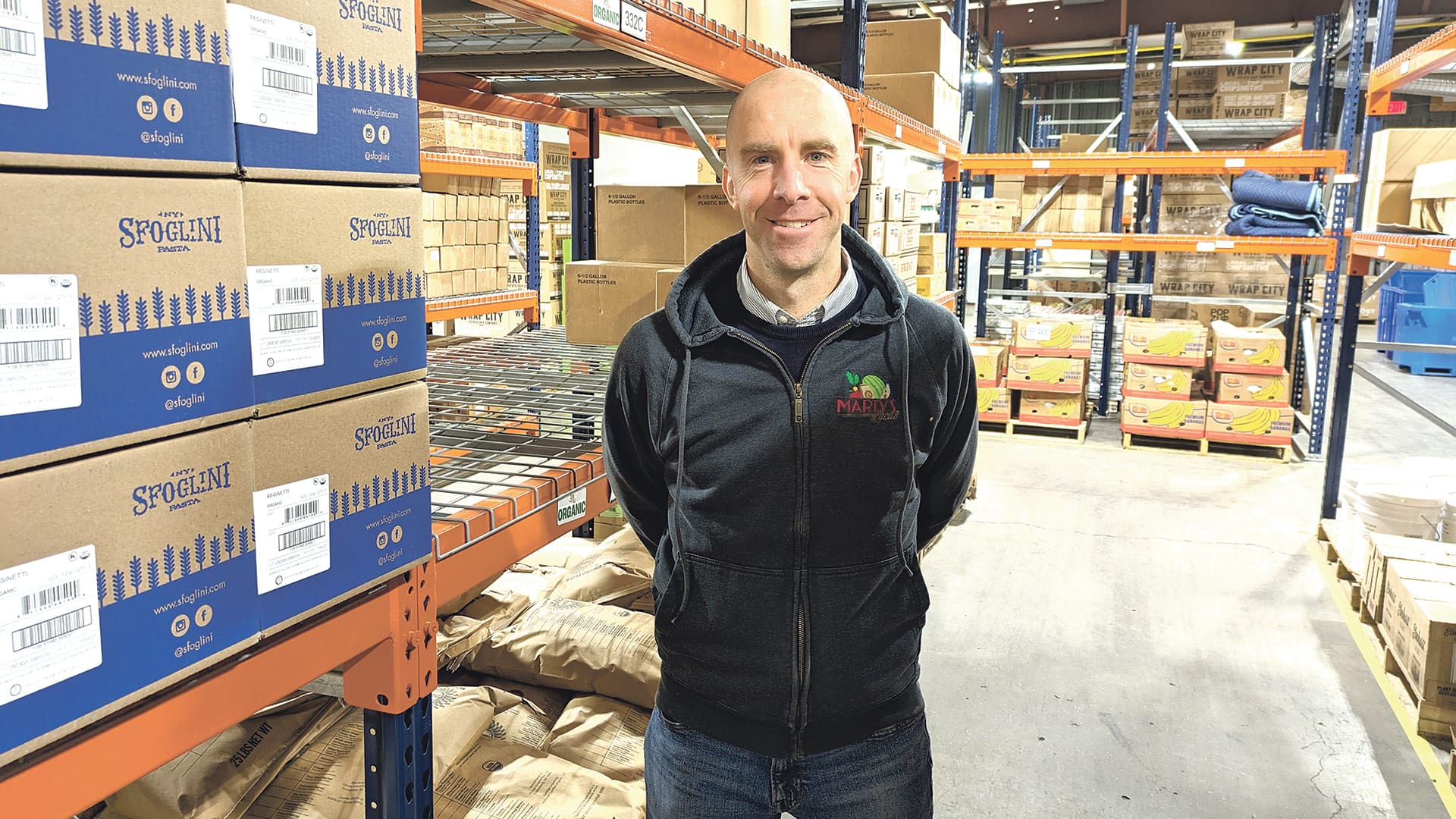
CEO Nick Martinelli
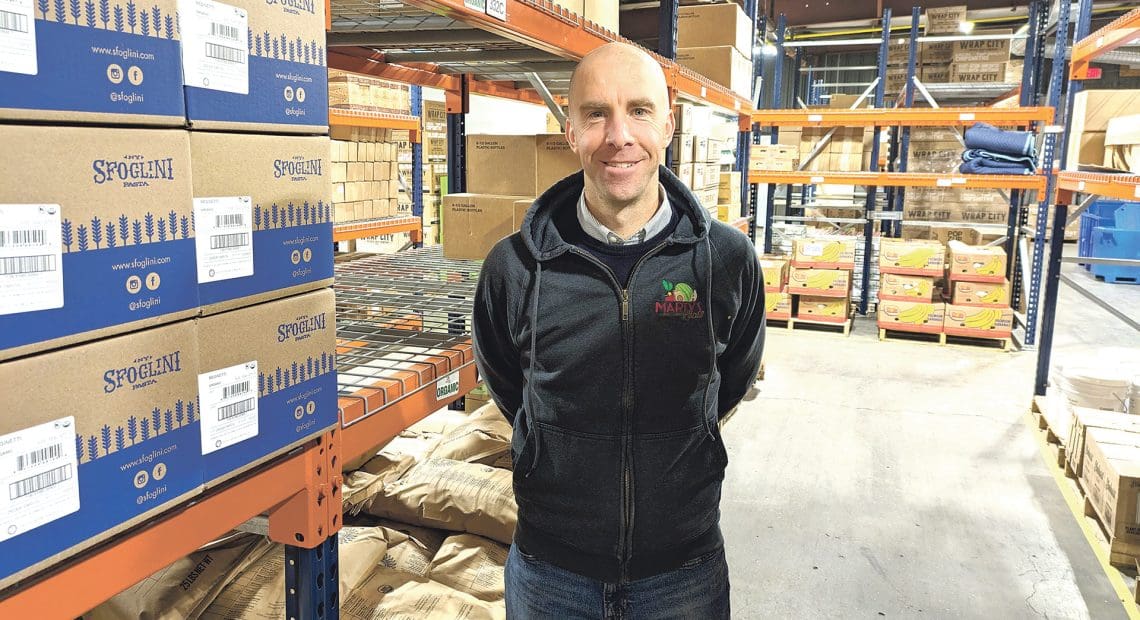
As he gave BusinessWest a tour of his 12,500-square-foot warehouse in Deerfield, winding past long, high racks of boxes and bags of fresh produce and other food and beverages, as well as a brightly lit cold-storage area, Nick Martinelli eventually came to a three-bay loading dock which he called perhaps the most important part of the decade-old operation known as Marty’s Local.
“We have eight trucks, and they’re going six days a week. They’re going out to the farms in the area, and then to the restaurants and colleges and grocers,” he explained. “Everything comes in and out of here.”
Indeed, food that arrives at the facility from farms doesn’t stay long; it heads right back out to its final destination, wherever that may be. The operation has about 115 different partners, counting both the farms and food producers on one end and those purchasing food on the other.
“They’re primarily in Western Mass., but also elsewhere in New England and New York,” Martinelli said. “There are instances where food will be picked up and delivered the same day. But the great majority of our business is having trucks on the road, making deliveries, and then ideally picking up from our farm partners on the way back to the facility, to be packed that night and go out the next day. That’s the ideal.”
Martinelli, founder and CEO of Marty’s Local, began this career in 2015, completing a farming program in Orange called the Farm School, knowing he wanted to work in agriculture, but not sure exactly how.
“I was looking to figure out a place in the local agriculture economy,” he recalled. “I was going to work on a farm, but then I started to talk to a bunch of farmers and realized that there was a real need for distribution. I was seeing some of the growers that I knew driving their own product around, and I knew the demand was strong for these these foods that are really good. So maybe there’s a business opportunity to play that role and just focus on distribution, marketing, trucking.”
So Martinelli started doing just that, first in his car and then with a rented truck. “Then folks would say, ‘what else can you bring us?’ So it started to grow organically that way.”
That was the birth of Marty’s Local, whose network of partners are based not only in Western Mass., but also Vermont, Connecticut, Maine, and New York’s Hudson Valley.
Produce and grains were the first focus of the operation, but it soon expanded to dairy, including butter and cheese, as well as eggs, honey, maple syrup, and even products like sriracha and salsa.
“Almost every week, another farm or maker would reach out and say, ‘we heard you have this distribution service; could we work with you?’ So that’s how we built our roster of partners.”
In 2019, Marty’s Local acquired Squash Inc., a similarly minded local food distributor that had been around since 1973.
“We’d started to do some work with them, and then their owners were looking to retire, so we acquired that business. They had a lot of relationships with growers in the area, and a great customer base, and that was a nice merging of the two businesses that’s worked well,” Martinelli said. “With Squash, we added non-locals. They were sending a truck to the New England Produce Center in Chelsea, outside of Boston, three times a week to get non-local produce — avocados, limes, things you can’t get around here. We continued that, and it’s been a helpful component of the business.”
About 50% of the operation’s food purchasers are retailers, meaning everything from farm stores to independent grocers to chain stores. On the food-service side, which is most of the other half, are colleges, K-12 schools, caterers, restaurants, and wellness and retreat centers.
“There are a ton of farms, and we’re just scratching the surface with the ones that we’re working with.”
Martinelli said one plus for this business is that schools and colleges — not all, but many — have become more diligent about serving healthy options, while restaurants, everywhere but especially in Western Mass., have increasingly seen the farm-to-table concept as a selling point.
To supply those end users, farms have several options, he explained. “Farms are still doing self-distribution. They’ll either have a refrigerated truck that they use, or they’ll have a pickup truck or their personal vehicle, depending on the scale they’re operating at. Some of the farms we work with have multiple trucks, depending on how many customers they have. Some of them are working with distributors that are much larger than us, or some of them work with regional distributors like us. It really depends on the scale of the grower and maker.”
What’s in a Local Name?
Grateful for the farms that choose to partner with him, Martinelli takes a broad view of the operation’s impact on the region.
“On a personal level, all of us are motivated and compelled by the trust we have in food when we know where it came from. And when I say all of us, I mean on our team, although I think, in the market, too, there’s some truth to that for sure.”
That idea has driven growth in the local food economy over the past couple decades, he added.
“The sector has grown so much. And I think the reason is that trust, in terms of what food you’re putting in your body, but also who you’re supporting. Are you supporting somebody that’s down the road that you might run into, a business that you’re familiar with, whether you know those people personally or just drive by their business regularly? That’s meaningful to me personally, and I think that’s meaningful to a lot of people, and it’s an opportunity to put your money where your values are.
“So that’s certainly a driver for us — facilitating that, making it easier for people to see more products they recognize on the shelves,” he went on. “On a lot of shelves, it will say, ‘product from X country.’ OK, that’s not really that helpful, right? But if it says it’s from such-and-such farm in Northampton, Massachusetts, well, that’s different.
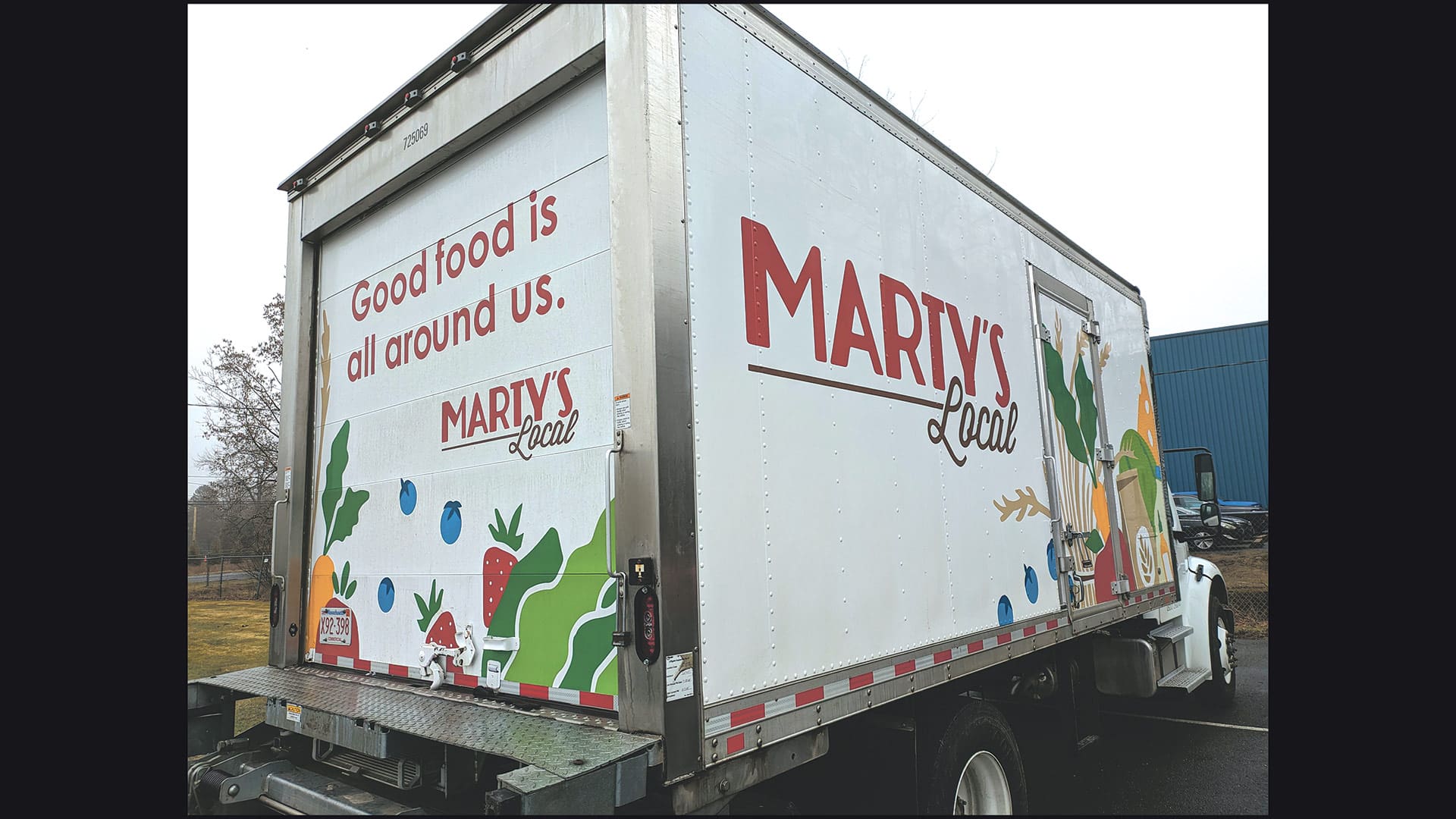
Eight trucks, both box trucks like this one and larger trailers, move food six days a week for Marty’s Local.
“Then you know what you’re getting,” he went on. “And you’re not only supporting the person or the business that’s down the road and putting food in your body that you can trust, you’re also supporting your regional economy, and maybe you’re preserving farmland. There are all sorts of ancillary benefits that come with it.”
Then there’s the matter of healthier eating.
“It’s more nutritious if it’s local,” Martinelli said. “I mean, there are studies showing that the nutrients are stronger after fewer days. So, if it’s coming in a truck five days across the country, it starts to leach out flavor — not in every single product, but there can be meaningful differences in the flavor and nutrition.”
Fortunately, he sees potential to grow this operation and continue to influence food freshness and nutrition while stimulating the local food economy.
“Are you supporting somebody that’s down the road that you might run into, a business that you’re familiar with, whether you know those people personally or just drive by their business regularly? That’s meaningful to me personally, and I think that’s meaningful to a lot of people, and it’s an opportunity to put your money where your values are.”
“There are a ton of farms, and we’re just scratching the surface with the ones that we’re working with,” he noted. “And not only farmers, but entrepreneurs who are one- or two-person businesses saying, ‘I have this great new product’ or ‘I make this great jerky.’ We’re talking about sauerkraut, yogurt, any number of different things where someone is eager to take their craft and get it out to the world, and that’s the role that we want to play.”
Recognizing that impact, Community Involved in Sustaining Agriculture (CISA) named Marty’s Local one of its Local Hero honorees in 2024.
“Marty’s functions in a part of our local food system that is absolutely essential but largely invisible to the general public (except inasmuch as we might see a truck making deliveries),” CISA noted. “We’re lucky to have thriving farmers’ markets, farmstands, and CSAs in our region, but the reality is that direct sales from farm to consumer make up only about 10% of Massachusetts farm sales. That means that 90% of the food grown by Massachusetts farms is winding its way through more complex channels from farm to table — and Marty’s Local smooths that complexity out, bridging the gaps and getting more local food onto more local peoples’ plates.”
Special Delivery
Martinelli said his operation’s continued growth is a testament to untapped demand in what is, after all, an agriculture-heavy region.
“That’s also a testament to the number of people growing great food or making great food. So you have people who want it and people who are providing it, and we get to do it really well in the middle,” he told BusinessWest. “We take pride in doing that and paying real attention to good relationships with our vendor partners and with our customers, and all three parties valuing one another.”
And he enjoys making the connections that drive that growth.
“It’s exciting to be able to say to another customer, ‘you know, I just talked to a guy recently who didn’t know there was a service like this, saw our catalog, and said, ‘these are exactly the kinds of foods that I want to have in my store.’ And we make it easy for them to get those foods in there, and do it in a way that’s just as professional as any very large distributor, but with a special focus on local and regional high-quality foods.”
Again, Martinelli added, “we feel like we’re scratching the surface, 10 years in, with the amount of suppliers that have food to go out into the world and the amount of people out there who want that good food.”

Community Spotlight

John Page describes Amherst as a “cultural college town.”
John Page calls it a ‘retail incubator.’
That’s the unofficial name given to a facility — still very much in the planning stages — designed to bolster retail in downtown Amherst and bring more balance (and more reasons to visit) to an area more known for its arts, culture, and restaurants.
“It’s a small location for retailers — people who are online, they’re artists, they do things at farmers markets — who are not quite ready to make the jump to a brick-and-mortar store, which is high-risk and quite complicated, said Page, executive director of the Amherst Business Improvement District (BID). “We’re hoping to make a half-step, where folks can start to test their concept out and learn more about being a brick-and-mortar retailer.”
The retail incubator (more details to come later this year, he said) is one of myriad initiatives in various stages of development in Amherst — a town where there is almost always a lot happening — that cross a wide spectrum, from housing to education; from new restaurants to new retail. That long list includes:
• A new elementary school that will be 100% carbon-neutral and ready for occupancy in the fall of 2026;
• Several new housing projects that include everything from market-rate apartments to home-ownership opportunities (much more on these later);
• An extensive, $46 million renovation and expansion of the Jones Library;
• A new restaurant, the Amherst Oyster Bar, which will bring much-needed new life to an historically vibrant spot, site of the former Judie’s restaurant on North Pleasant Street;
• An enhanced presence for both UMass Amherst and Amherst College downtown, with UMass Amherst recently opening UMass Downtown, a multi-purpose retail, event, and meeting space on North Pleasant Street, and Amherst College having opened a campus store on South Pleasant Street;
• Conversion of a former VFW post into a homeless shelter and supportive housing for veterans;
• The continued success story that is the Drake, a live-performance venue in the heart of downtown;
• The planned arrival of another cultural attraction downtown — Ancestral Bridges, an organization that celebrates the history of contributions of Black and Afro-Indigenous families in Amherst; and
• A reimagining of the space called North Common, a former a parking area that has become a popular gathering place downtown.
City officials and business leaders alike are enthusiastic not only about these individual developments, but how they will — and, in many respects, already are — working together to create more foot traffic and vibrancy in the downtown area.
“We’re between Boston and New York, and in such an academically driven area, you get a lot of people from those areas, and they’re looking for something they expect from a city vibe. That’s certainly new to Amherst, but that’s the direction we want to push things in.”
Indeed, the new housing units are bringing more residents to support the full spectrum of businesses downtown, said Page, adding that cultural attractions like the Drake and Amherst Cinema are bringing people to restaurants and bars before and after shows. Meanwhile, new retail, like Aster & Pine Market and the two college stores, are broadening the mix of things to do and reasons to come to the downtown.
“We have a lot of housing in our downtown, and that’s been very helpful to us because we have more people; those people go out to lunch and for coffee, and they spend money,” said Page, who referred to Amherst as a “cultural college town.”
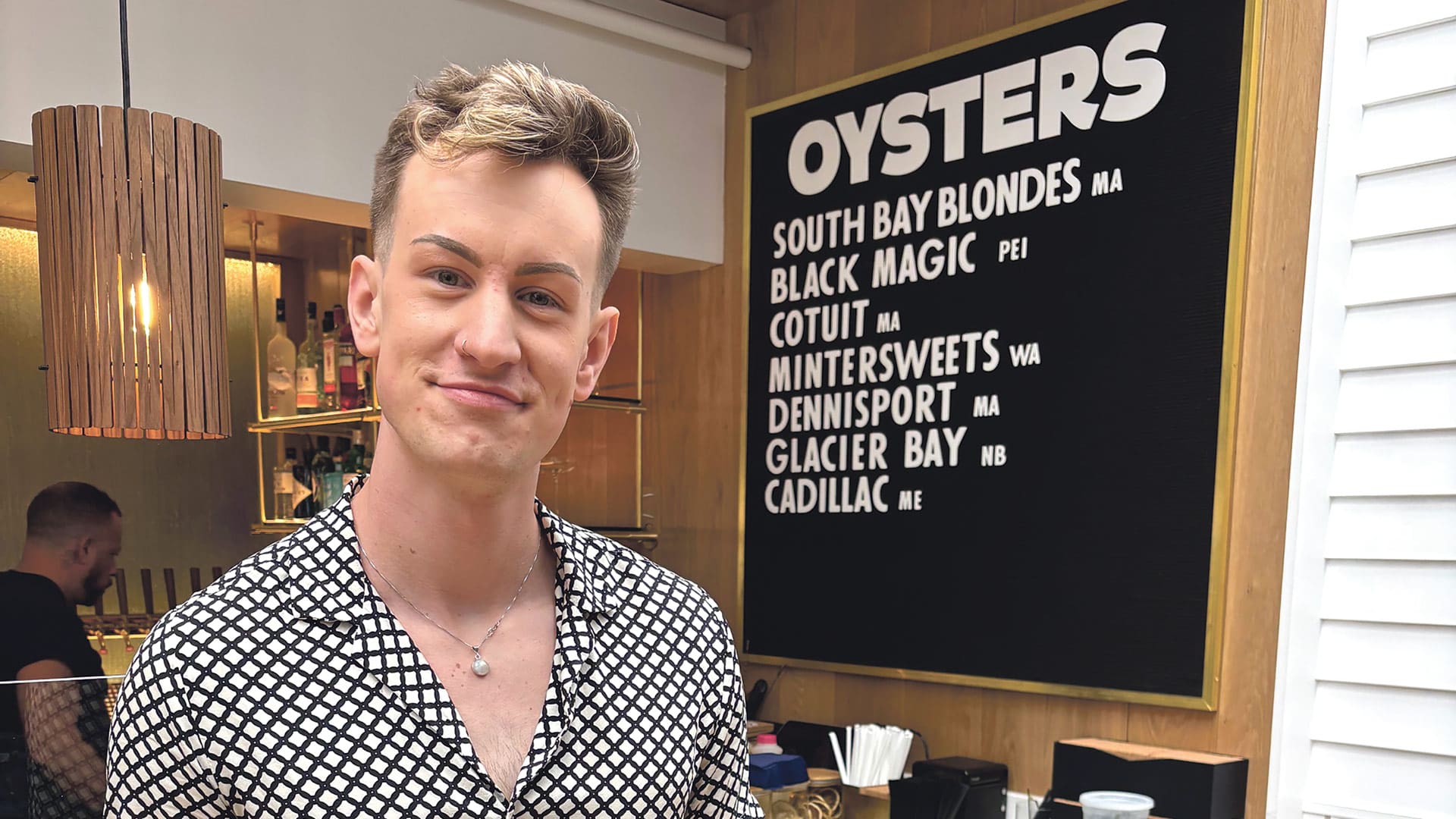
Alden Peotter shows off the recently opened Amherst Oyster Bar.
“Meanwhile, with Amherst Cinema and the Drake, we encourage people to enjoy a meal before or after, or maybe a cocktail, so that there is that stickiness — people linger and enjoy the downtown.”
Paul Bockelman, Amherst’s long-time town manager, agreed.
“The Drake, along with the Amherst Cinema, has made a huge impact in bringing people downtown to live events,” he said. “And once they’re there, they stay and they support other businesses.”
As for the Oyster Bar, it has been a long time coming. Its grand opening had been pushed back so many times that the eventual date, April 1, was taken by some as an April Fools joke, said Alden Peotter, operations manager for Amherst Innovative Hospitality, which also operates the nearby Protocol bar and restaurant.
He spoke with BusinessWest the day after a soft opening late last month, and said that both the Oyster Bar and Protocol, which opened as a bar but has evolved into a popular restaurant drawing people of all ages, provide what he called a “metropolitan vibe,” something he believes young people, and some not so young, are looking for.
“We’re between Boston and New York, and in such an academically driven area, you get a lot of people from those areas, and they’re looking for something they expect from a city vibe,” he said. “That’s certainly new to Amherst, but that’s the direction we want to push things in.”
For this, the latest installment of its Community Spotlight series, BusinessWest looks at the many forms of development and progress in Amherst, a college town that is so much more.
Building Momentum
For Page, who took the helm at the BID last October, his new job is a return to downtown Amherst.
Indeed, he worked at the Amherst Regional Chamber of Commerce, which shares space with the BID in an office on South Pleasant Street, handing marketing and membership, before taking a job at UMass Amherst working on large events like commencement.
“I wanted to get back involved with the town of Amherst and all that was happening downtown,” he said, adding that he was inspired to seek the BID job after doing consulting work for the agency on its summer concert series.
“It reignited my passion for that economic-development work,” he said, adding that, since arriving, he’s continued the BID’s work in tandem with the chamber to promote the downtown and generate more vibrancy in the central business district, which has made a nice recovery after being devastated by COVID — but with changes.
Indeed, while food and beverage taxes are exceeding 2019 levels, there are still fewer people going out, overall, with restaurants still doing strong takeout business. One goal — at the BID, the chamber, and with new destinations like the Oyster Bar and Protocol — is to get them back out.
Amherst at a Glance
Year Incorporated: 1759
Population: 39,263
Area: 27.7 square miles
County: Hampshire
Residential Tax Rate: $17.82
Commercial Tax Rate: $17.82
Median Household Income: $48,059
Median Family Income: $96,005
Type of Government: Town Council, Town Manager
Largest Employers: UMass Amherst; Amherst College; Hampshire College
* Latest information available
“Our real view on downtown Amherst is promoting not just nightlife, but getting people out of their house, getting people to form these communities that have really been missing due to COVID and what came after; we want to give them that location,” said Peotter, who described both establishments as “that third place.” By that, he meant it’s not home, and it’s not work — “it’s another place to be.”
Page said one of his focal points is what would be considered traditional, brick-and-mortar retail. The downtown has some, he said, and the goal is attract more, while also retaining what exists, through initiatives like the planned retail incubator, a site for which has yet to be determined.
“It’s a difficult industry,” he said, adding that Amherst is not known as a retail destination, but could become one. “You need critical mass — you need other retailers so that people view you as a shopping destination.”
Jacob Robinson, executive director of the Amherst Area Chamber of Commerce, agreed.
“Fortunately, downtown Amherst isn’t experiencing a significant vacancy issue, but there’s strong interest in attracting more retail to diversify the mix of businesses and further enhance the pedestrian experience,” he said.
“Of course, retail-space turnover is a normal and expected part of any dynamic downtown. As business owners retire, pivot, or evolve their offerings, it naturally creates opportunities for new entrepreneurs to bring fresh ideas and energy into the community. We’re seeing that play out in Amherst, with some beloved businesses closing for personal or planned reasons — often after years or decades of serving the community — and new ventures preparing to take their place. It’s a sign of a living, breathing local economy that continues to adapt and grow.”
Among the relatively new retail offerings are the Amherst College Store, which opened a year ago in the former A.J. Hastings space at 45 South Pleasant St., and UMass Downtown, which opened its doors in February at 108 North Pleasant St., in space most recently occupied by Greenfield Savings Bank.
The latter is a multi-purpose retail, event, and meeting space, said Nancy Buffone, associate vice chancellor of University Relations, who spoke with BusinessWest at the facility.
She said a downtown presence for the university has been talked about for many years, and it became a priority for Chancellor Javier Reyes when he arrived in 2023.
“This is truly about bringing UMass and the community together,” she said, adding that the facility will host both UMass events, such as lectures slated for this spring, and community events, such as registration for the Big Brothers Big Sisters Daffodil Run.
UMass Downtown has seen steady volumes of foot traffic, said Buffone, adding the numbers are expected to move higher as the weather improves and especially for commencement week and ‘destination days,’ when those students who have been accepted to the university, and their parents, are invited to take in the school and the town.
Developing Stories
Bockelman calls it the “mixing middle.”
He was referring to the broad segment of housing involving homeownership opportunities for segments of the population that might otherwise not break that barrier. This middle area is being addressed in a project on Ball Lane, undertaken by Valley Community Development Corp.
“We’re seeing a lot of apartments being built, but what has been largely missing has been homeownership opportunities, which is why the Ball Lane project is so exciting,” he told BusinessWest, adding that plans call for 30 units on an eight-acre tract.
The project is one of many housing initiatives, public and private, in various stages of development in town, and they address a critical need for new housing.
Other projects include two public projects totaling 78 apartments, 31 at the former East Street School and 47 at 70 Belchertown Road, said Bockelman, noting that these will be a mix, with varying levels of affordability. The developer, Way Finders, expects to have both sites developed and occupied by 2028.
On the private side, developer Barry Roberts is forwarding two projects, a large (but scaled-down) initiative at the corner of Amity Street and University Drive that will involve retail on the ground floor and apartments above, and the other at the former Hastings site. Meanwhile, Archipelago Investments LLC is set to break ground on a five-story, 68-unit project at Olympia Drive, a dorm-like building that will rise on the site of the former Iota Beta chapter of the Chi Omega sorority, which Archipelago acquired several years ago.
Archipelago has also been named designated developer for a project to create 140 residential units on a large tract of land owned by Hampshire College, adjacent to Atkins Farms.
These projects and others in different stages of development will make a large dent in the overall need for housing across the spectrum, said Bockelman, adding that such projects are needed to help seniors stay in town, young professionals to move there, and employees at many types of businesses, especially the hospitality sector, to afford to live in town.
Robinson agreed. “Housing remains a key issue,” he told BusinessWest. “While Amherst is actively exploring strategies to create more diverse and affordable housing options, it’s clear that housing supply directly affects workforce retention, talent attraction, and the overall economic vibrancy of the region. Our businesses need access to a stable workforce, and that depends in part on people being able to afford to live and thrive here.”

Opinion
By Shalini Bahl and Iman Fenina
With intention, consumers can make a powerful impact. Recent boycotts of companies like Amazon, protesting issues such as labor practices, environmental impact, and corporate greed, have highlighted the power of consumer action. But for such initiatives to succeed long-term, this shift needs to expand beyond occasional boycotts toward shopping in alignment with our values. It isn’t just about what we’re refusing to buy — it’s about what we actively choose to support.
What if we could reimagine our relationship with consumption? This past semester, students at the Isenberg School of Management at UMass Amherst explored this idea, finding answers close to home. North of UMass in the Mill District and in the heart of downtown Amherst, they identified six exemplary establishments that redefine marketplaces to nourish consumers and communities.
Located in the Mill District, Carefree Cakery is built on a foundation of fair-trade ingredients, health-conscious options, and empowerment for women and minority employees. Caring for the community, both locally and globally, this bakery is also committed to offering allergen-friendly desserts, making inclusivity at the heart of what they do.
“I’ve had people come in saying, ‘my kid has never had cake before because he’s allergic to eggs, and I can’t get that anywhere,’” founder and master baker Alysia Bryant said. “That’s why we’re here.”
If you’re like most people, you probably enjoy a good cup of coffee. But did you know that producing a single cup takes 140 litres of water? Also located in Amherst’s Mill District, Futura Coffee Roasters takes this issue head-on, sourcing their beans from regenerative farmers and investing 3% of sales back into sustainable practices. Unlike chains that have turned to limiting seating to increase turnover, Futura offers a warm and collaborative workspace.
“We’re part of a tight-knit community of business owners here in the Mill District,” General Manager Camden Mosher said. “Carefree Cakery next door supports us, and we support them by featuring their fair-trade muffins exclusively.”
Ultra-processed foods and excess sugar are a threat to public health, but Kwench in downtown Amherst is offering a refreshing alternative, making all orders with high-quality ingredients sourced from local organic farms. Unlike many competitors, Kwench’s commitment to fresh, whole ingredients delivers superior nutrition free of added sugars and preservatives, while also supporting local agriculture. The business also fosters a sense of community with local artwork, games, and occasional live music, creating a vibrant space that connects Amherst residents beyond just food.
With a focus on BIPOC and fair-trade artisans, and prioritizing composting and reusing materials, Mary Moore Design offers both a haven for mindful personalized interior design services and in-store classes. This downtown Amherst business is firmly rooted in ethical sourcing and sustainable living practices. The business places storytelling at the heart of its approach, with Moore noting that building relationships and calling attention to the stories behind her products is central to her mission.
The fashion industry contributes around 10% of global carbon emissions and is one of the most wasteful in the world. This is the challenge Andréa Marion, owner of the Closet, set out to combat. Her solution? A welcoming boutique in the Mill District offering luxury second-hand clothing at 60% to 75% below market prices, making sustainable fashion accessible to everyone. By promoting clothing reuse, the Closet helps extend the life cycle of garments, and Marion’s personal connection with customers turns shopping into a meaningful, sustainable experience.
Another Mill District gem, 3 Amigos was founded by immigrant families from Latin America who came to the U.S. without knowing English. They’ve created a cultural bridge that preserves Latin American heritage while strengthening community bonds through partnerships with local farmers, meat vendors, artists, and cultural celebrations.
Showcasing dishes from Puerto Rico, Chile, and Mexico, “our ingredients are primarily locally sourced, allowing us to create authentic dishes that stay true to our country’s traditional recipes while we lower our carbon footprint and offer the freshest food possible,” co-founder Matias Martinez said.
Being an intentional consumer isn’t about dogmas and guilt. It’s about staying true to our values. In a world defined by environmental urgency, inequality, and political division, our purchasing choices are an investment in the future we want to create. Choosing differently becomes an act of both rebellion and love — for ourselves and our community. These six small yet impactful local businesses exemplify how our choices can sustain not only local communities, but also foster a more sustainable, equitable, and connected future.