Home 2025 July (Page 2)
Daily News

SPRINGFIELD — In keeping with its longstanding commitment to supporting the cities and towns it serves, the Liberty Bank Foundation recently donated $10,000 to Square One in support of its Learn & Earn Workforce Development initiative.

“Building a foundation for children to be successful starts with a stable family,” said Kristine Allard, vice president of Development & Communication for Square One. “Our Learn & Earn program provides our young families with the education and training they need to build their careers and establish a successful foundation for their families. We are so grateful to Liberty Bank for recognizing this and supporting our work so generously.”

Through partnerships with Holyoke Community College and area employers, Learn & Earn participants receive HiSET education support and paid workforce training. Participants who need care for their children also receive access to Square One’s nationally accredited early education and care programs.

“Programs like Square One’s Learn & Earn help individuals through education and workforce readiness, both essential for stability and for building thriving communities,” said Tony Liberopoulos, Liberty’s Massachusetts market president, Commercial Banking. “This initiative is a powerful example of how education, job training, and childcare support can work together to create lasting opportunities. Liberty Bank is proud to invest in programs that help parents build brighter futures for themselves and their children.”

In addition to receiving support from the Liberty Bank Foundation and others, the program is largely funded through a grant from MassHire Hampden County Workforce Board. Together, these funds cover the salaries and expenses of the program participants, creating a risk-free experience for area employers and a rich learning opportunity the region’s youth.

Daily News

Kayla Sheridan

NORTHAMPTON — Kayla Sheridan, Marketing director of TommyCar Auto Group, was named one of Automotive News’ 40 Under 40. This annual program honors 40 high achievers at new car dealerships who are under 40 years old.

Automotive News received nominations from across the U.S. and identified outstanding performers in a large field of high-quality talent at dealerships. This year’s honorees are a diverse group with a broad range of titles and backgrounds. They were profiled in the July 14 issue of Automotive News, the leading news source for the global automotive industry.

“Our 40 Under 40 program celebrates dealership employees who stand out with their leadership and their results,” said Jamie Butters, executive editor of Automotive News. “The individuals on this 14th annual list have demonstrated significant business achievements that have improved their stores and their communities.”

As Marketing director at TommyCar Auto Group, Sheridan has played a pivotal role in shaping the brand’s voice, driving strategic campaigns, and deepening engagement with customers across Western Mass. and beyond.

“Kayla’s recognition is incredibly well-deserved,” said Carla Cosenzi, president of TommyCar Auto Group. “Her passion, leadership, and unwavering commitment to our customers and team have made a lasting impact. Kayla continues to set the standard for excellence in every initiative she leads, and we couldn’t be prouder to see her honored among the best in our industry.”

Daily News

Thomas Donnelly

CHICOPEE — Polish National Credit Union (PNCU) recently welcomed Thomas Donnelly as assistant vice president, commercial loan officer.

“Donnelly brings a dynamic and personal approach to business banking, rooted in strong client relationships and a deep understanding of commercial lending. Known for his drive, responsiveness, and thoughtful financial guidance, he works closely with local business owners to help them achieve long-term growth and success,” the credit union stated. “With a background in financial services, strategic business development, and client relationship management, Donnelly has built a reputation as a trusted advisor who puts his clients first. His ability to tailor solutions to each business’s needs reflects PNCU’s mission of delivering personalized service with a community focus.”

Donnelly holds a bachelor’s degree from St. Bonaventure University and a master’s degree in education from Springfield College. He has also completed the Massachusetts Bankers Credit Training Program and the 2025 Lender Training Program. He is based out of PNCU’s Westfield Loan Center and looks forward to contributing to the credit union’s continued commercial lending growth.

“Tom is a strong addition to our commercial lending team,” said James Kelly, president and CEO of Polish National Credit Union. “His energy, commitment to service, and local perspective are exactly what our members look for in a business banking partner.”

Daily News

SPRINGFIELD — Revitalize Community Development Corp. (CDC) announced a $10,000 grant from the Liberty Bank Foundation to support its annual #GreenNFit Neighborhood Rebuild program. This investment underscores Liberty Bank’s ongoing commitment to building stronger, healthier communities throughout Western Mass. and Connecticut.

The #GreenNFit program brings together volunteers, corporate partners, and community organizations to repair and rehabilitate homes for low-income families, veterans, seniors, and people with disabilities, all in a single neighborhood over the course of one day. In addition to this financial contribution, Liberty Bank employees also roll up their sleeves and volunteer at #GreenNFit events, making a direct and lasting impact on the lives of local residents.

“We are incredibly grateful to Liberty Bank and the Liberty Bank Foundation for their continued support of our mission,” said Colleen Shanley-Loveless, president and CEO of Revitalize CDC. “Their generous donation, combined with their dedicated volunteer efforts, helps us create safe, healthy, and sustainable homes for families in need. This is community partnership at its very best.”

In addition to Liberty’s support of Revitalize CDC, Dawn Creighton, Community Outreach officer at the bank, serves on Revitalize CDC’s board of directors.

“At Liberty Bank, we invest in community partners across our footprint that are aligned with our mission to improve the lives of customers, teammates, and communities for generations to come. But it’s not just an investment of dollars, it’s also an investment of time through Team Liberty’s selfless volunteerism,” said Tony Liberopoulos, Liberty Bank’s Commercial Banking market president in Massachusetts. “When you think of Western Mass. and the nonprofits serving this community, Revitalize CDC and their #GreenFit have rightfully earned the reputation by making our communities an even better place to live. Team Liberty is proud to be their partner in doing that.”

Daily News

SPRINGFIELD — In keeping with its mission to strengthen communities where its team members live and work, the Enterprise Mobility Foundation recently donated $22,000 to Square One. The gift will support Square One’s commitment to high-quality early education and care programming in Greater Springfield.

“We are so grateful for our longstanding partnership with Enterprise Mobility,” said Kristine Allard, vice president of Development & Communication for Square One. “Not only has the Enterprise Mobility Foundation supported us generously by funding our programs and services, but Enterprise Mobility team members also continue to volunteer monthly at our preschool centers. They are true difference makers in our work with young children.”

The mission of the Enterprise Mobility Foundation is to strengthen the communities where its team members live and work by actively supporting a range of charitable causes, such as the environment, health and human services, education, the military, and disaster relief. The foundation has contributed more than a half-billion dollars to thousands of local nonprofits in the U.S. and made wide-reaching commitments, from global philanthropic initiatives to community-focused projects.

“We are proud to support Square One and strongly believe in the organization’s vision of creating meaningful change for better lives and more promising futures for children, families, and communities,” said John Byrne, Enterprise Mobility’s vice president and general manager in Hartford, Conn.

Square One currently provides early learning services to more than 500 infants, toddlers, and school-age children each day, and family support services to 1,500 families each year, as they work to overcome the significant challenges in their lives.

Daily News

Paul Duquette

MONSON — Monson Savings Bank announced that Paul Duquette, a financial advisor with Osaic Institutions Inc., has joined the bank as a vice president. With more than 30 years of experience in the financial services industry, Duquette brings a wealth of knowledge and a client-first philosophy to his new role.

Duquette is based out of the bank’s East Longmeadow location at 61 North Main St. He is dedicated to helping individuals and businesses achieve their financial goals through thoughtful, personalized strategies. With a strong belief in acting solely in the best interests of his clients, he is not tied to any mutual fund or insurance provider, allowing him to offer truly objective advice.

“We are thrilled to welcome Paul to the Monson Savings Bank family,” said Dan Moriarty, president and CEO of Monson Savings Bank. “His extensive experience, commitment to customer service, and strategic approach to financial planning make him a valuable asset to our team and to our customers.”

Duquette holds a bachelor’s degree in economics from the University of Connecticut and maintains multiple securities licenses, including Series 6, 7, 26, 63, and 65, as well as a Connecticut life and health insurance producer license. His career includes leadership and advisory roles at institutions such as Wells Fargo, Citizens Securities, Santander Bank, and others, where he consistently demonstrated excellence in client relationship management and financial planning.

“I am thrilled to be part of the Monson Savings family,” Duquette said. “My entire career has been spent putting customers first, and I look forward to continuing this tradition by providing exemplary service and delivering solutions tailored to each client’s unique needs and goals.”

Daily News

SPRINGFIELD — Big Y Foods announced the reopening of its Big Y Express Fresh Market location at Tower Square in downtown Springfield, following a brief closure of just over two weeks. The temporary closure allowed for a strategic refresh designed to better meet the evolving needs of busy customers.

This update was driven directly by customer feedback, with shoppers expressing a desire for more grab-and-go and convenience-focused options. In response, the store has been reconfigured to feature an expanded selection of quick meal solutions, snacks, beverages, and everyday essentials. Shoppers will also find lottery tickets, greeting cards, balloons, gift cards, and more, all curated to support a fast, efficient shopping experience.

“We’re always listening to our customers,” said Nicole D’Amour Schneider, senior vice president of Retail Operations and Customer Experience. “This improved design is about delivering what our shoppers have asked for: more convenience, an effortless shopping experience, and more of the items that will help make their daily lives easier.”

The updated store hours are Monday through Friday, 7 a.m. to 6 p.m.; and Saturday and Sunday, noon to 5 p.m.

Daily News

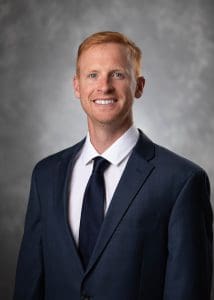
Brendan Theroux

HARTFORD, Conn. — KeyBank announced Brendan Theroux has been named relationship manager, Commercial Banking. He is responsible for providing tailored financial solutions to middle market clients and prospects across Connecticut and Massachusetts. He is based in KeyBank’s Hartford office, located at 225 Asylum St.

Prior to joining KeyBank, Theroux served as first vice president, Commercial Lending, at PeoplesBank in West Hartford, Conn. He has also held leadership roles at M&T Bank, including vice president and assistant vice president of Commercial Relationship Management. He has more than 10 years of experience in commercial banking, with a strong background in relationship management, credit underwriting, and strategic business development.

Theroux holds a bachelor’s degree in economics from the University of Connecticut and has earned certifications from the Connecticut School of Finance and Management and M&T Bank’s Leadership Accelerator program.

An active member of the community, he serves on the board of directors and finance committee for the 4-H Center at Auerfarm Inc. in Bloomfield, Conn.

Daily News

NORTHAMPTON — JKirley Collective announced that the Workforce Training Fund Express Grant is now open and accepting applications for professional development programs designed to strengthen Massachusetts businesses with fewer than 100 employees.

This is a prime opportunity for leaders committed to investing in their people without stretching their budgets. Training costs are reimbursable through the grant program, making it easier than ever to support team building, leadership growth, and workplace culture development.

JKirley Collective, a certified training provider, will offer an approved course through a program called “Essential EI Skills for a Positive Workplace Culture: Building Better Work Relationships at Every Level.”

This program combines Everything DiSC insights with emotional intelligence strategies to help teams collaborate more effectively, communicate more clearly, and build relationships rooted in trust and respect. Whether leading a small team or managing across departments, this training is designed to create lasting culture change — and it’s reimbursable. Click here to view course listings and apply.

Team leaders are invited to book a call with Jessi Kirley to explore how this course can support their team’s goals and culture transformation. Click here to schedule a free planning session.

Daily News

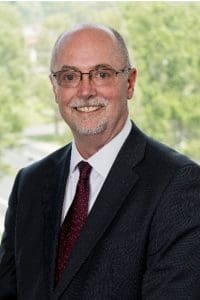
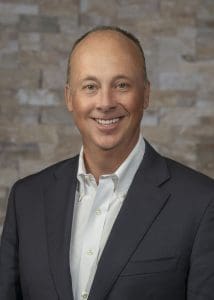
Gregg Levante

PITTSFIELD — Pittsfield Cooperative Bank announced the appointment of Gregg Levante as its new president. A lifelong resident of Berkshire County, Levante brings not only a wealth of banking experience, but an understanding of the community’s needs, values, and aspirations.

“Gregg embodies everything we stand for, dedication to serving others, a strong commitment to leadership development, and a belief in the power of connection,” said Mike Daly, the Bank’s CEO.

Levante has more than 15 years of experience in the banking industry, previously holding leadership roles in commercial lending at Berkshire Bank and NBT Bank and known for championing employee development and economic growth. He will now lead Pittsfield Cooperative Bank’s strategic initiatives focused on advancing financial prosperity, strengthening local small businesses, and investing in the future of banking.

“I’m honored to step into this role,” he said. “This community gave me my start, and I’m committed to ensuring the Co-Op continues to be a place where local people and businesses grow together.”

Under Levante’s leadership, the bank will continue to invest in community-first programs, continue the advancement of its digital banking capabilities, and empower team members to lead with purpose.

Daily News

SPRINGFIELD — In the spring of 2017, BusinessWest and its sister publication, the Healthcare News, created a new recognition program called Healthcare Heroes. It was launched with the theory that there are heroes working across this region’s wide, deep, and all-important healthcare sector, and that there was no shortage of fascinating stories to tell and individuals and groups to honor. That theory has certainly been validated.

But there are hundreds, perhaps thousands of heroes whose stories we still need to tell. And that’s where you come in — but time is almost up. The nomination deadline for the class of 2025 is Friday, July 25. We encourage you to get involved and help recognize someone you consider to be a hero in the Western Mass. region in one (or more) of these eight categories: Patient/Resident/Client Care Provider; Health/Wellness Administrator; Emerging Leader; Community Health; Health Educator; Innovation in Health/Wellness; Collaboration in Health/Wellness; and Lifetime Achievement.

Nominations can be submitted at businesswest.com/healthcareheroes/nominations.

The ninth annual Healthcare Heroes program is presented by Baystate Health/Health New England and Elms College, and sponsored by Trinity Health Of New England/Mercy Medical Center and Holyoke Medical Center.

Daily News

EASTHAMPTON — bankESB recently announced the promotions of two longtime employees, Katherine Sordillo and Susanne deVillier, to vice president, regional branch manager.

In this newly created position, deVillier and Sordillo will provide leadership and support to regions of bankESB’s retail banking network, working closely with retail branch staff in several communities to deliver exceptional customer service, drive performance, and uphold the bank’s commitment to community banking. They will also play a key role in supporting strategic initiatives focused on growth, operational excellence, and employee development.

deVillier has more than 30 years of banking experience and has played a vital role in bankESB’s growth and success, particularly in Agawam, where she’s led the retail banking team at the Main Street, Agawam office since it opened in 2011. She joined bankESB in 2010 as a branch officer and over the years has been promoted to senior branch officer; assistant vice president, branch officer; and vice president, branch officer. As VP, she also served as retail sales coordinator, lending her leadership experience to other branch managers.

In her new role, deVillier will oversee the bank’s Agawam, Amherst, Hadley, Northampton, Southampton, and Westfield branches, while maintaining a presence in the Agawam community, where she actively volunteers.

Sordillo brings three decades of leadership experience in retail banking and customer relationship management to her new role. She joined bankESB in 2001 as branch officer of the Granby Road, South Hadley office and over her tenure has been promoted to senior branch manager; assistant vice president, branch manager; and vice president, branch officer and retail sales coordinator. She is a passionate community leader and has served as president of the South Hadley/Granby Chamber of Commerce and chairperson for Loomis Communities.

In her new role, Sordillo will oversee the bank’s Belchertown, Holyoke, South Hadley, and two Easthampton branches, as well as the retail branch float team, while maintaining a presence in South Hadley.

“These promotions reflect our continued investment in leadership from within,” said Matthew Sosik, president and CEO of bankESB. “Kay and Sue have demonstrated a strong track record of success, a dedication to a customer-first experience, and team leadership. We are excited to see the impact they will have in unlocking potential across a broader region.”

Daily News

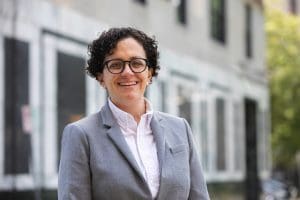
Dani Garber-Letitia

SPRINGFIELD — Dietz & Company Architects Inc. announced that Senior Architect Dani Garber-Letitia has earned the credential of certified passive house consultant (CPHC) through Phius (Passive House Institute U.S.), a nonprofit organization dedicated to decarbonization and passive building.

The Phius passive building certification standard is a rigorous energy standard that produces buildings that use 40% to 60% percent less energy than conventional structures. In order to achieve CPHC certification, Garber-Letitia completed a comprehensive training course and a rigorous multi-part exam to prove her knowledge.

She joined Dietz & Company Architects in 2021 and has more than 15 years of experience as an architect and owner’s project manager for firms in Massachusetts. As a senior architect in the firm’s Cambridge office, she manages medium to large-size construction projects specializing in renovation and modernization for multi-family housing clients and work for public school districts. In addition to managing the Cambridge office, she also serves as a mentor for junior staff and has taken the lead on organizing in-house educational and training opportunities.

“In my eternal quest to be a better architect and global citizen, pursuing and achieving passive house certification felt like an important step in being able to create architecture that reduces the human impact on the earth,” Garber-Letitia said. “Passive house projects reduce a building’s energy use by up to 90%, while providing more comfortable and healthier spaces for people. This is a huge step for the future of building resilience and the health of our communities. This certification and knowledge will not only increase Dietz & Company’s opportunities to work on such projects, but also enhance our ability to bring a higher level of sustainable design to all of our work.”

Daily News

FLORENCE — Florence Bank will take the next step in its expansion into Hampden County in August, when it breaks ground on a 2,500-square-foot office at 1504 Northampton St. in Holyoke.

The full-service Holyoke branch is expected to open in the spring of 2026 and will be the bank’s fourth in Hampden County. In August 2017, Florence Bank opened its first branch in the county in West Springfield, followed by a branch opening in Springfield early in 2019 and in Chicopee in the spring of 2021.

“We’re thrilled to be able to provide our current and future customers in Holyoke with a convenient way to bank with us and look forward to serving the people, businesses, and organizations in the Paper City,” President and CEO Matt Garrity said. “Our focus is on providing great customer service and helping to reinvigorate the community, and we are proud and committed to be meeting the banking needs of more residents of Hampden County.”

An invitation-only ceremonial groundbreaking event is planned for Friday, August 22 at 10 a.m. at the site of the new branch. Garrity will address an audience that is expected to include bank employees, board members, Holyoke Mayor Joshua Garcia, and other community leaders and elected officials.

The new branch, designed by HAI Architecture in Northampton, will provide a spacious lobby, traditional teller stations, five offices, a drive-up teller window, and a drive-up ATM.

Six employees will staff the branch, where customers can be assisted by tellers, meet with a customer service representative, or apply for a mortgage or commercial loan. The bank’s Spanish-speaking mortgage originator will also be based in the new branch.

Florence Bank has more than 1,200 retail and business customers in Holyoke, and Garrity said the bank looks forward to deepening its impact in the region.

Daily News

SOMERS, Conn. — Sonny’s Place will celebrate the 100th anniversary of its historic 1925 Philadelphia Toboggan Company Carousel on Friday, July 25 with a special event — titled “A Century of Whirls” — featuring free carousel rides all day and a variety of family-friendly activities from 4 to 8 p.m.

The event, held in partnership with the Carousel Museum, will highlight the carousel’s long and storied history, including its original construction in 1925, multiple relocations across the country, and its permanent installation at Sonny’s Place in 2017. Live restoration demonstrations and carousel history talks will offer guests a behind-the-scenes look at the craftsmanship that has kept this classic ride in operation for a century.

Additional highlights of the celebration include hourly carousel-themed scavenger hunts; free balloon art; carousel coloring pages and crafts; a build-your-own fidget spinner station; and face painting, glitter tattoos, and hair tinsel. Food concessions will be available for purchase, including popcorn, cotton candy, and family meal deals. Local 3D artist Bumpa Built will host a tent featuring additional crafts and take-home activities for guests.

“Our carousel has been delighting riders for a century, and we’re excited to be able to share this milestone with the community,” said Bryan Smithwick, general manager of Sonny’s Place. “It’s a chance to celebrate this unique piece of craft and history, while creating new memories with friends and family.”

The July 25 event is free and open to the public. While carousel rides and many activities are free, some attractions and concessions require a small fee. Activities will take place both indoors and outdoors around the carousel area, rain or shine. For more information, visit www.sonnysplace.com.

Daily News

SPRINGFIELD — The YWCA of Western Massachusetts announced it recently received $10,000 from Liberty Bank to support its mission.

This donation will be used to help fund the YWCA’s “Girls Count” financial empowerment program. The grant will help girls and young adults learn to budget their money and create conditions of success for a more financially secure future.

“By empowering women and girls, we empower future generations,” said Elizabeth Dineen, CEO of the YWCA of Western Massachusetts, adding that the organization is appreciative of Liberty Bank’s commitment to helping build a bright financial future for the girls, teens, and women the YWCA serves.

Founded in 1868, the YWCA of Western Massachusetts is guided by its founding principle to provide shelter, support services, and tools for self-sufficiency for women and girls in the community.

Daily News

BECKET — On July 16, Construct welcomed Massachusetts Attorney General Andrea Campbell to its recently renovated property in Becket to highlight the promise and potential of affordable homeownership in the Berkshires. The visit presented the opportunity to explore how innovative programs, such as the state’s receivership initiative, can help address the region’s growing housing crisis.

At 50 Dawn Dr. in Becket, what was once an abandoned and unsafe property has been transformed into a new opportunity for homeownership. Through the Commonwealth’s receivership program, the original structure was demolished and replaced with a newly built modular home. Now under contract with a local buyer from Becket, the property will soon provide safe, stable housing for a local household. This marks Construct’s second receivership project in Becket and highlights the potential of turning neglected properties into much-needed affordable homes that strengthen the community.

“We were honored to host Attorney General Campbell and share how this program helped bring a home back to life,” said Jane Ralph, executive director of Construct. “This is what affordable homeownership can look like in rural communities.”

During the visit, Campbell toured the property and met with Construct staff and Becket leadership to discuss opportunities for future receiverships. They also discussed barriers to homeownership in Western Mass., including the shortage of affordable inventory and the challenges of sustaining rural housing development.

Daily News

HOLYOKE — Citizens Bank announced the grand opening of its new branch at 1575 Northampton St. in Holyoke with a ribbon cutting ceremony and open house on Thursday, July 24 from 11 a.m. to 1 p.m.

The branch, which has relocated from a previous in-store location at Stop & Shop, now resides in a standalone facility designed to enhance the customer experience. The new location features a larger footprint with multiple teller stations, three private offices, and a comfortable waiting area. One of its key highlights is the interactive teller machine (ITM), providing customers with real-time access to virtual banking assistants. The ITM is available in the drive-up area, ensuring accessibility for all.

“We are excited to open this modern branch and bring new conveniences to the residents and businesses of Holyoke,” said Yari Rodriguez, branch manager. “This space was designed with our customers in mind, offering advanced technology alongside in-person service to better meet their needs.”

The grand opening event will feature a celebratory ribbon cutting at 11 a.m., attended by a number of guests, including Holyoke Mayor Joshua Garcia; Roshan Patel, retail market executive at Citizens Bank, and George Rosa, retail regional manager. Citizens Bank will also recognize the impactful work of Way Finders, a nonprofit organization, with a formal donation presentation with its CEO, Keith Fairey. Members of the community are invited to join the celebration, which will include an opportunity to explore the new facility and meet the branch team.

This new branch is expected to play a significant role in the local economy by providing streamlined access to mortgage, business banking, and financial management services. It also consolidates several in-store branches to offer a centralized hub of expertise, enhancing convenience for customers and fostering community growth.

“The opening of this branch represents another step forward in Citizens Bank’s mission to support the Greater Holyoke area with banking solutions that make life easier,” Patel said. “We are proud to expand our presence here and strengthen our relationship with the local community by investing in its future.”

Daily News

WEST SPRINGFIELD — For the fifth consecutive year, Keiter is supporting the Greater Northampton Chamber of Commerce with a $25,000 donation to fund the annual Keiter Card promotion. The initiative has generated $250,000 in direct economic impact on the Northampton community since its inception in 2021.

The Keiter Card allows consumers to receive $50 in local spending power for $25, effectively doubling the impact on participating small businesses. The Northampton Chamber will contribute $5,000 to the campaign this year as well, increasing the benefit to the local economy to $60,000.

“This milestone is a testament to what’s possible when businesses and communities work together,” said Scott Keiter, CEO of Keiter and former Northampton Chamber board member. “The Keiter Card supports local spending, keeps dollars circulating close to home, and helps small businesses stay strong — and that benefits everyone.”

The 2025 Keiter Card promotion launches Monday, Aug. 4. Cards can be purchased exclusively at the Greater Northampton Chamber of Commerce, 99 Pleasant St., Northampton, between 9 a.m. and 5 p.m., Monday through Friday. Supplies are limited, and customers must request the Keiter Card at the time of purchase.

The promotion applies only to $25 Northampton Gift Card purchases and is limited to one per customer, per transaction. The Northampton Gift Card is accepted at more than 131 local businesses, including restaurants, shops, services, and spas.

Keiter is a family-owned construction services firm known for managing complex projects. The company operates across a variety of sectors, including higher education, industrial, healthcare, commercial, multi-family, and residential developments.

Daily News

LUDLOW — The East of the River Five Town Chamber of Commerce announced the grand opening of Ludlow Coffee Company at 135 East St., Ludlow. The public is invited to a ribbon cutting ceremony on Tuesday, July 22 at 9 a.m.

Ludlow Coffee Company is the brainchild of a young couple who grew up in Ludlow, pursued their education and careers in Boston, and have now returned to their roots to establish a business.

“This event is not only a celebration of a new business, but also an opportunity to highlight the importance of community involvement and support for local entrepreneurs,” the chamber stated. “The Ludlow Coffee Company embodies the spirit of community with its inviting ambience, reminiscent of the classic coffee shops we love. It’s a place for friends to gather, share stories, and enjoy quality coffee sourced from George Howell. The couple’s vision is to create a space that fosters connections, creativity, and collaboration among community members.”

Daily News

AMHERST — Summerlin Floors, a woman- and family-owned flooring business based in Amherst, has launched Summerlin Supports, a dedicated branch of its business focusing on giving back through charitable initiatives, volunteer efforts, and monetary donations.

Throughout the years, Summerlin Floors has supported a variety of local organizations and initiatives, making contributions in a variety of ways, from radiothons and fundraisers to scholarship donations and community events. These contributions laid the foundation for Summerlin Supports, which formalizes the company’s ongoing commitment to making a positive impact and uplifting the local community.

“As a woman-owned flooring store, we believe a true foundation isn’t just beneath your feet, it’s in the community we build together,” said Ann Bronner, owner of Summerlin Floors. “At Summerlin Floors, we’re proud to serve our neighbors with quality flooring and a commitment to giving back. From supporting local initiatives to treating every customer like family, we lay every floor with purpose.”

Among the organizations and events Summerlin Floors — and now, Summerlin Supports — has supported and sponsored include Amherst Community Theater, Amherst Global Village Festival, Amherst Survival Center, Amherst WinterFest, Baystate Children’s Hospital, Empty Arms Bereavement, New England Public Media, Safe Passage, Granby Junior Senior High School, and Greenfield Community College (GCC).

“Greenfield Community College was a pivotal part of my life,” Bronner said. “The professors, faculty, and administration at GCC created an inspiring and enriching experience for me and now is my opportunity to give back. I love making this donation each and every year on behalf of my daughter, Erin, as I know she is extremely proud, and her memory will continue to live on.”

Daily News

LONGMEADOW — Country Bank announced the opening of its newest banking center, located at 919 Shaker Road in Longmeadow. The banking center officially opens to the public on Monday, July 28, with grand opening festivities planned for the week of Sept. 8. Melissa Stefanowich, assistant vice president and Retail Banking officer, will oversee the new branch.

To kick off the opening of the bank’s 15th location, customers and community members visiting the Longmeadow banking center between July 28 and Aug. 15 can enter a drawing to win four field box tickets to the Red Sox game on Saturday, Aug. 30 at Fenway Park. Entries must be submitted in person at the banking center. In addition, account specials, giveaways, and prizes will be available.

The ribbon cutting ceremony will take place on Tuesday, Sept. 10 at 11 a.m. The banking center team will welcome local dignitaries, members of Country Bank’s leadership team, and representatives from the Longmeadow community. The community is invited to join the celebration and enjoy complimentary treats from the DonutNV food truck from 11 a.m. to 1 p.m., along with giveaways and drawings throughout the week. Country Bank’s mascot, Buck, will be on site to give autographs and take selfies with his fans.

Daily News

BOSTON — The Executive Office of Labor and Workforce Development (EOLWD) released Massachusetts unemployment and job estimates for June, with preliminary data indicating 1,100 more Massachusetts residents gained employment, which includes individuals in private and nonprofit jobs plus self-employed individuals and entrepreneurs, while payroll jobs decreased by 1,900.

Additionally, while more individuals entered the Massachusetts labor force in June, the labor force participation rate and unemployment rate remained unchanged. Preliminary data is based on survey data provided by the U.S. Department of Labor’s Bureau of Labor Statistics (BLS).

Payroll jobs did experience growth in some BLS categories, including education and health services; construction; and trade, transportation, and utilities. In addition to payroll data, BLS also reported preliminary data indicating 1,100 more Massachusetts residents were employed in June for a total 3,767,900 employed residents; this data includes individuals who are self-employed (such as contractors, physicians, and drivers) and are not captured in payroll job data.

“As more Massachusetts residents enter the labor force, it is vital that we continue to make investments in job training, reduce barriers to employment, and connect untapped talent to local career opportunities,” Secretary of Labor and Workforce Development Lauren Jones said. “We are encouraged that data shows job postings remain stable — and growing for some industries — and our administration is dedicated to helping employers build their workforce right here in Massachusetts.”

Daily News

Dr. Scott Lichtenberger

SPRINGFIELD — Baystate Health announced the appointment of Dr. Scott Lichtenberger as its new chief operating officer. He started in that role on July 14.

As COO, Lichtenberger is responsible for overseeing health system operations across Baystate Health, with direct accountability for hospital operations, nursing leadership, quality, patient safety, and systemwide operational performance. He will partner closely with senior leaders to guide operational discipline, promote a strong culture of engagement, and ensure high-quality, financially sustainable care across the organization.

“We are excited to welcome Dr. Lichtenberger to Western Massachusetts and Baystate Health, and will benefit from his exceptional and knowledgeable leadership within physician-led organizations,” said Peter Banko, president and CEO of Baystate Health. “He is a collaborator and operational leader, and these skills will help to accelerate us in becoming the preferred destination to work and practice, elevate clinical excellence, and advance a seamlessly accessible care model to grow and expand care for our community.”

Lichtenberger joins Baystate Health with more than 20 years of experience in healthcare leadership. Most recently, he served as a principal in EY-Parthenon’s healthcare practice, where he led enterprise-level integration and redesign initiatives for academic medical centers and large regional health systems. His work focused on developing scalable and sustainable operational models that improved care delivery, enhanced efficiency, and drove organizational growth.

Previously, Lichtenberger held senior leadership roles at Centura Health, including chief transformation officer and president of the Physician Enterprise. There, he led efforts that resulted in very large EBITDA improvements through strategic enhancements in operational throughput, labor efficiency, supply chain, and revenue cycle.

He has also served as partner at McKinsey & Company, leading its Healthcare Provider Operations group, and as chief strategy officer at University of Colorado Health, where he directed enterprise strategy and marketing.

Lichtenberger earned his doctor of medicine degree from Indiana University School of Medicine and completed his residency in internal medicine at the University of Colorado School of Medicine, followed by a fellowship in gastroenterology at Yale University. He also holds a bachelor’s degree in economics from Northwestern University.

Daily News

MONSON — Michael Rouette, executive vice president and COO of Monson Savings Bank, recently presented a $2,000 donation to Robin and Kerry Plourde, co-founders of Whip City Animal Sanctuary, on behalf of the bank.

Whip City Animal Sanctuary was selected as a recipient of a donation from Monson Savings Bank after securing a spot in the top 10 of the bank’s 2025 Community Giving Initiative. Community members cast their votes for their favorite local nonprofits, and Whip City Animal Sanctuary was chosen to receive support.

“As a volunteer-run nonprofit, Whip City Animal Sanctuary relies heavily on the generosity of our community,” Robin Plourde said. “We’re incredibly grateful to everyone who voted for us and to Monson Savings Bank for organizing such a meaningful annual initiative.”

Whip City Animal Sanctuary is a Westfield-based 501(c)(3) nonprofit organization established in 2020 to provide long-term care for surrendered, neglected, and abused farm animals. The organization provides desperately needed shelter, feed, and veterinary care services to ensure that each one of its residents gets the chance to live out the remainder of their lives in a comfortable and safe environment.

“We are honored to be recognized through Monson Savings Bank’s Community Giving Initiative,” Kerry Plourde said. “Support like this makes a real difference in helping us care for the animals and continue our mission. We’re so thankful to everyone who took the time to vote for us.”

Rouette congratulated Whip City Animal Sanctuary on placing in the top 10 for the second year in a row.

“Monson Savings Bank’s commitment to the community goes beyond financial service; it extends to the care and well-being of all who call it home, including animals,” he said. “Whip City Animal Sanctuary provides a safe, nurturing environment for farm animals in need, and we’re proud to support their compassionate mission. We hope this contribution helps them expand their reach and continue making a meaningful impact.”

Business Talk Podcast Special Coverage

We are excited to announce that BusinessWest has launched a new podcast series, BusinessTalk. Each episode will feature in-depth interviews and discussions with local industry leaders, providing thoughtful perspectives on the Western Massachuetts economy and the many business ventures that keep it running during these challenging times.

Go HERE to view all episodes

Episode 238: July 21, 2025

George O’Brien Interviews Michelle Grout, executive director of the Springfield Business Improvement District

Michelle Grout

It’s called ‘Odyssey.’ That’s the art installation placed this summer in Tower Square Park in Springfield — the one featuring three pigeons around a Campbell’s soup can. It was placed there to turn some heads, generate talk, activate a space, and bring people to the downtown. And it’s doing all of that and more, according to Michelle Grout, executive director of the Springfield Business Improvement District. Overall, ‘Odyssey’ represents just one of the ways the BID is getting creative in its efforts to promote downtown, create vibrancy, and generate economic development, as Grout explains on the next episode of BusinessTalk, hosted by contributing writer George O’Brien. It’s must listening, so tune into BusinessTalk, a podcast presented by BusinessWest.

Also Available On

Features

Lots to Celebrate

Angela and Ted Chagnon (front, second and third from left) and the leadership team at Valet Park of America

Angela and Ted Chagnon (front, second and third from left) and the leadership team at Valet Park of America


When Ted Chagnon started his own business in 1990, he had big goals, but there were times, early on, when operating in seven states — from New England to Florida — and employing more than 1,250 people may have seemed like a dream too far.

But that’s precisely the growth trajectory Valet Park of America celebrated when it marked 35 years in business last month.

“It was kind of slow growth at first,” Chagnon said, recalling that his first two valet clients were Yankee Pedlar restaurant in Holyoke and Hotel Northampton, and other small businesses followed. It took two years before the company landed its first major client, Baystate Medical Center, and over the next several years, other large clients followed, particularly in the medical realm, from UMass Medical Center to MetroWest Medical Center in Natick and Framingham.

“Around 2005, we started adding ski resorts, locations in Albany, some locations in Connecticut, and we started to build some momentum. It was tough because we didn’t have any resources in the beginning.”

Initially focused on valet parking only, the business later expanded into parking management, operating lots and garages, and then other transportation services.

“That was simply because a lot of our clients, whether it’s a medical facility, a college, a casino, or a ski resort, sometimes need more than just valet; they need parking management services or transportation for guests, patients, or even transporting employees off site,” Chagnon explained. “Sometimes you’re moving the employees to off-site parking garages and parking lots when you run out of space.”

The company operates in a wide geographic footprint, from Buffalo, N.Y. to Boston, as well as in Vermont, Connecticut, Rhode Island, Virginia, and Florida. “We’re in Virginia as of last year, and we’ve been in Florida for five years now, and we’ve really grown tremendously there.”

Many employees have been with Valet Park of America for decades, some more than 30 years. Some of those are family, and Chagnon called this a family business; his wife, Angela, is senior vice president, with responsibilities in client relations, human resources, payroll, auditing, and marketing, and other relatives work in leadership positions as well.

“It’s so important to remember what those frontline people are doing out there, with the weather, and the circumstances, and the vehicles, and the hectic days. It can be stressful at times, and to have somebody in here who understands that and appreciates that is huge.”

“My sister was one of the founders. My niece runs our payroll department. My brother runs our fleet management and quality control department. So we are very much a family-run and owned and operated business,” he said.

But he also attributes this employee loyalty to a culture of opportunity, where someone can start by parking cars and eventually move up as other opportunities arise.

“As we grow, we have to hire more people, more regional managers, and it’s nice that we can promote from within. Many worked for us during college and came on board full-time right after college. I don’t think many of them thought they were going to have a career in parking, but then they stayed with the company. In fact, some of their kids are in college now and working for us.”


Getting Behind the Wheel

The Chagnons initially operated the company from home, then moved into an office at 191 Chestnut St. in Springfield, where Valet Park of America is still headquartered today.

“Then we kind of grew,” he said, but it was very gradual growth until about 20 years in, when both the roster of clients and the company’s geographic reach started to create more noticeable momentum. “Then you start becoming a bigger company, with different challenges. But one of the biggest, I think, has been keeping the mentality of a family-run and owned business and maintaining that culture.”

Angela agreed. “I think that just came naturally to Ted and me. I love seeing somebody that starts off as an entry-level valet attendant, and now they’re in the payroll department, or they’re helping me in the accounting department. It’s very rewarding to know that we can do that for them. Anytime we have an opening in the office, we post internally. I love to bring somebody up who knows us, who knows the business, who knows our culture, who appreciates what those frontline employees do.

“That’s the biggest factor for me,” she added. “I’m more internal; we’re more support staff on the back end, and it’s so important to remember what those frontline people are doing out there, with the weather, and the circumstances, and the vehicles, and the hectic days. It can be stressful at times, and to have somebody in here who understands that and appreciates that is huge. It makes a difference, I think, to the frontline employees when they see that. I’ve parked cars. I know what’s happening.”

With the company’s growth, Ted said he’s competing with a number of national firms, and dealing with the sorts of economic shifts that any industry faces — and, like many of them, he relies on a diverse client mix to weather those trends.

Angela and Ted Chagnon launched their enterprise 35 years ago last month

Angela and Ted Chagnon launched their enterprise 35 years ago last month

“During COVID, which was unusual, colleges got shut down; they’re doing well now, but they’re finding some fiscal restraints. Hospitals right now are finding some fiscal restraints as well; there have been some cuts there. And restaurants, in some cases, with inflation, have had to cut back, and valet services might be something that’s cut,” he explained.

“But we’ve expanded to ski resorts and casinos and still have medical facilities, colleges, and independent parking lots. So we have a wide range of industries that we service,” he added. “So we do well; one industry might be seeing some cuts or finding some fiscal restraints, and something else might be flourishing. And some states might be doing better than others. It’s never completely smooth sailing.”

The pandemic, as Chagnon noted, was indeed unusual, and particularly challenging, as colleges, casinos, and ski resorts shut down and hospitals cut way back on visitor traffic.

“We had to evolve and adapt, and we had to lay a lot of people off, but here’s what we did: we went back to our hospital clients especially and said, ‘is there anything you need us to do? You don’t need us to transport anyone. You don’t need any parking services, but what can we do for you?’

“And as things progressed, we ended up staffing a lot of COVID testing sites. We were greeting people, lining up the parking, queuing them up, checking them in. That rolled into screener services at a lot of facilities where you would come in and we’d check your temperature, and we’d ask you an array of questions pertaining to travel and things like that before you could enter the hospital. We’d register you. Because the hospitals were short-staffed, and we had a lot of people that had been working with us for a long time, and we wanted to retain them.”

Two scenes from last month’s 35th anniversary celebration, a family-friendly event that drew about 500 people.

Two scenes from last month’s 35th anniversary celebration, a family-friendly event that drew about 500 people.

It was a time of pivoting and resilience for most businesses, he noted.

“Everyone just said, ‘what do we need to do to keep the lights on?’ Because we still had bills to pay, mortgages and insurance and leases on vehicles. You still had to charge through that and make it happen. So we were fortunate that we had a decent number of people that were willing to do that,” he continued. “I was here at work every day just fighting through those challenges. It was a difficult time.”


Shifting into the Next Gear

With the pandemic well in the rear view — literally and figuratively — Valet Park of America continues to grow its services and footprint while maintaining that culture the Chagnons value. Last month, the company marked 35 years with a family-oriented celebration in its expansive parking lot, featuring inflatables, rock climbing, cornhole, face painting, and other activities.

“That brought about 500 people here — about 200 employees and all their kids and their spouses — and it was a very much a family environment for everyone to celebrate,” Ted said.

The event also individually recognized employees who had been with the company for 15, 20, 25, 30, and 35 years. “We wanted to start with the fifth year, but we had over 150 employees that were here more than five years and a large number of employees over 10 years, and would have been here for two days celebrating each one of them individually,” he said.

“We take pride in our employees’ tenure and the environment that we provide for them,” he added. “It’s a company that can’t run on its own. You can’t have just one person or two people running it. You need a large, supportive team behind you.”

The company also invests in plenty of training for its employees, he told BusinessWest. “We do a lot of training year-round for all our staff because we feel it’s important to make sure that they’re educated, that they know the business, and it gives them opportunity to advance.

“And it helps maintain our culture, too, because we’re in the people business, any way you look at it. We might be in the parking business, we might be in transportation, but it takes people to provide those services, and our employees are really our greatest asset.”

That culture extends to community involvement in many ways as well, supporting organizations like the USO, Jenna’s Blessing Bags, and the various foundations of the company’s medical clients — not to mention encouraging employee volunteerism with nonprofits and charitable events, like the annual UMass Cancer Walk. And those efforts are multiplied across the company’s seven states.

Looking ahead, Chagnon said Valet Park of America will continue to grow smartly and innovate in a number of ways — like its adoption some years ago of automation in the parking process at many sites.

“It’s a company that can’t run on its own. You can’t have just one person or two people running it. You need a large, supportive team behind you.”

“We distribute magnetic parking gates and started building our own entrance and exit payment kiosks for parking garages and parking lots. We kind of branched off into that a little bit to try to be a multi-faceted service provider for our clients.

“We try to control costs for them, provide a very good service, evolve, and adapt to their needs as a vendor or partner. And I think we do that well,” he continued. “Every year we see growth, and it’s primarily because of the services that we provide and the quality that we provide and a lot of good referrals.”

Angela agreed. “Our culture is so important to us, and it always has been. It’s something we focus on every year when we talk about our goals. We make sure to maintain, as best we can, communication and relationships with all the employees as we continue to grow,” she told BusinessWest. “And we have seen that nice, steady growth … obviously minus the COVID years.”

“We’re just looking forward to the next number of years,” Ted added. “Hopefully we have quite a few ahead of us.”

Accounting and Tax Planning

The Unseen Superhero

By Tanzi Cannon-Eckerle, Esq.


Most likely, nobody dreams of growing up and becoming a compliance officer. Hollywood has yet to greenlight Compliance: The Movie, and you’re unlikely to see glossy magazine profiles of the world’s top compliance chiefs (though wouldn’t that be a page turner?). Still, in the narrative of modern business, the compliance program is the unsung superhero — quietly saving the day, one avoided disaster at a time.

Why, you might ask, does your company even need a compliance program? Isn’t it just a bunch of paperwork, long-winded training sessions, and rules that seem designed to stop you from having fun? Well … kind of — but it is also so much more. The reality is far more entertaining — and, in the long run, far more profitable. Let’s unpack the reasons with wit, wisdom, and a few hypothetical examples that might hit closer to home than you’d expect.


The Wild West Without Compliance

Imagine a company called AutoToastBot, the world’s fastest-growing supplier of smart toasters, run by a CEO who believes rules are for “other people.” Employees are encouraged to be creative — so creative, in fact, that the accounting team once tried recording sales made to imaginary customers in Neverland. Human resources operates like a game show, where every new hire spins a wheel to determine their salary. Marketing’s latest campaign involves sending unsolicited bread samples to every mailbox in the country, leading to the Great Pigeon Stampede of 2025.

Tanzi Cannon-Eckerle“A compliance program is a structured set of internal policies, procedures, and controls designed to ensure that a company and its employees follow laws, regulations, and ethical standards. Think of it as the operating manual for not accidentally (or intentionally) landing your company on the evening news.”

Unsurprisingly, the government takes notice. Regulators descend. Fines are levied, lawsuits filed, and soon the only thing rising faster than the company’s bread is its legal bill. The story of AutoToastBot ends not with a bang, but with a whimper — and a cautionary tale about why compliance isn’t just a buzzword, but a business necessity.


What Is a Compliance Program, Anyway?

A compliance program is a structured set of internal policies, procedures, and controls designed to ensure that a company and its employees follow laws, regulations, and ethical standards. Think of it as the operating manual for not accidentally (or intentionally) landing your company on the evening news.

A proper compliance program typically includes:

• Clear guidelines on what’s allowed and what’s not;

• Training sessions to educate staff (yes, even those who think they know everything);

• Mechanisms for reporting and addressing violations; and

• Periodic reviews and updates to keep up with new regulations.

In short, it’s about building an organizational immune system to detect, prevent, and respond to business risks before they become full-blown crises.


Example 2: The Vendor Who Wasn’t

SirTechalot prides itself on speed. In the rush to launch a new product, the procurement team skips the vendor due diligence. The chosen supplier, BestParts4U, offers unbeatable prices and an address suspiciously similar to a parking garage. Months later, the company receives counterfeit parts, and customers post photos of exploding gadgets. Oops. The company’s new product is promptly banned from the market, and its CEO becomes intimately familiar with legal counsel.

A compliance program requires vendor vetting to ensure suppliers are real, reputable, and not just a front for creative entrepreneurship.


The Real Value (Beyond Avoiding Jail Time)

Even when the value of a good compliance program is clear, the implementation and continued execution of it can seem drab, dull, a fun sucker … yes, many employees see compliance as the ‘fun police’: “You can’t do this. You mustn’t do that. Please don’t build a zipline from the roof to the parking lot.”

While it may seem like compliance dampens creativity, the truth is that a good compliance program doesn’t stifle innovation — it guides it. Imagine trying to play a sport with no rules. The strongest players would dominate, injuries would soar, and chaos would reign. Rules, like those in compliance, create a level playing field. They keep the game fun for everyone (and out of court).

Of course, avoiding handcuffs and headlines is a good incentive, but the value of compliance goes deeper. It presents significant strategic value for forward-thinking organizations. A well-structured compliance program can:

• Enhance reputation: Nobody wants to do business with a company known for shortcuts or scandals. Compliance builds trust.

• Build employee morale: People thrive in environments where expectations are clear and fair. Compliance fosters a culture of integrity.

• Reduce risks: By proactively identifying and mitigating risks, companies can avoid costly fines, sanctions, and litigation.

• Create competitive advantage: Companies that anticipate and address risks don’t just survive — they outpace competitors mired in litigation and scandal.

• Promote sustainability: Long-term growth depends on responsible, legal operations. Compliance isn’t just a cost; it’s an investment.

• Attract investment: Investors are increasingly scrutinizing compliance and governance structures before committing capital.


How to Build a Compliance Program Without Losing Your Sanity

The good news? Compliance does not require a PhD in legalese or a taste for endless PowerPoints. Here’s how to get started.

First, leadership must be committed to compliance and must walk the walk. Remember, compliance works best when it’s embedded in the company’s culture, not tacked on like an afterthought. The next steps are to:

• Appoint a compliance officer or team (preferably someone who enjoys reading fine print);

• Map out the legal and ethical requirements for your industry;

• Draft clear policies, in plain language (bonus points for humor);

• Create regular, interactive training — think quizzes, scenarios, even the occasional game show;

• Set up anonymous reporting channels for concerns; and

• Review and update your program regularly to keep pace with new laws and business changes.


Some Key Areas of Compliance

• Data privacy and protection: In the age of digital everything, regulators have turned the spotlight on how businesses handle personal info. Companies must have robust security measures and transparency in their data practices.

• Anti-bribery and corruption: With laws like the U.S. Foreign Corrupt Practices Act and the U.K. Bribery Act, it’s all about keeping it clean. These regulations demand businesses whip up comprehensive training and auditing systems to deter any shady dealings.

• Environmental compliance: Sustainability is the new black. From emissions standards to waste management protocols, businesses are now expected to be green warriors, adhering to environmental regulations with gusto.

• Employment law and workplace practices: Fair hiring, anti-discrimination, and occupational safety regulations are the guardians of a positive work environment. Think of them as the cool kids ensuring every workplace is just and safe.

• Financial reporting and anti-money laundering: Accurate financial reporting and vigilance against money laundering are not just about ticking boxes. They’re the bedrock of maintaining investor and public confidence, making sure the financial ship sails smoothly.


The Compliance Program: Everyone’s Secret Superpower

In the end, a compliance program is less about red tape and more about creating a workplace where everyone knows the rules — and the reasons behind them. It prevents disasters, protects reputations, and empowers companies to grow with confidence.

So, the next time someone suggests that compliance is boring, remind them of AutoToastBot’s Pigeon Stampede, or SirTechalot’s exploding gadgets. A compliance program may never win an Oscar, but it will help your company survive to see another business day — and that’s a story worth telling.


Tanzi Cannon-Eckerle is the principal attorney at General Counsel by Cannon, PLLC, a fractional general counsel law firm that focuses on labor, employment, and business law. She is also a certified workplace investigator, compliance professional, and equity and inclusion officer. For more information about workplace investigations or to seek legal assistance on business matters or labor and employment concerns, schedule a free, 30-minute consultation by emailing [email protected], or visit gcbycannon.com and fill out the ‘Contact Us’ form.

Accounting and Tax Planning

Online Fraud on the Rise

By Dan Werme and Terra Carnrike-Granata


We’re all aware of the many ways scammers are working to defraud individuals out of their hard-earned money. But small businesses continue to be in the crosshairs of today’s online criminals.

The Federal Trade Commission highlights a wide range of fraudulent schemes targeting businesses, including scams involving fake invoices and unordered merchandise, online listings and advertising, credit card processing and equipment leasing, tech support, altering online reviews, bank and business impersonation scams, and the list goes on.

In its 2024 Internet Crime Report, released earlier this year, the FBI showed that business email compromises resulted in $2.77 billion in losses to businesses. Phishing or spoofing scams, defined by the FBI as “the use of unsolicited email, text messages, and telephone calls purportedly from a legitimate company requesting personal, financial, and/or login credentials,” were the cause of $70 million in losses. Other scams, like tech support and personal data breaches, resulted in losses exceeding $1.4 billion.

In all, businesses and individuals lost a record $16.6 billion to cybercriminals last year, and projections are that scams driven by artificial intelligence (AI) could result in as much as $40 billion in losses by 2027.

Terra Carnrike-Granata

Terra Carnrike-Granata

Dan Werme

Dan Werme

“In all, businesses and individuals lost a record $16.6 billion to cybercriminals last year, and projections are that scams driven by artificial intelligence (AI) could result in as much as $40 billion in losses by 2027.”

Protecting your company’s valuable financial assets starts with internal security; a few simple steps can go a long way in protecting your business from external threats. Your business should:

• Trust but verify whenever you receive a request for payment or invoice changes from customers, vendors, or partners. It is important to make direct contact using a trusted phone number to confirm the instructions aren’t coming from a scammer.

• Implement good computer security practices. It’s essential to establish and maintain basic security procedures and controls for your business, and to update and distribute these to all employees regularly.

• Safeguard your information. Some simple steps include installing commercial antivirus software on all computers, ensuring those programs are updated regularly, and installing spyware detection programs.

• Educate your employees. A robust security program, combined with awareness of warning signs, safe practices, and responses to a suspected takeover, is crucial for protecting your company and its customers.

• Protect your online environment. Do not use unprotected internet connections. Encrypt sensitive data and keep your computer up to date with the latest virus protections. Use complex passwords and change them periodically.

• Partner with your bank to prevent unauthorized transactions.

• Pay attention to suspicious activity and react quickly. Look out for unexplained account or network activity, pop-ups, and suspicious emails. If detected, immediately contact your financial institution, stop all online activity, and remove any systems that may have been compromised. Keep records of what happened. And never share one-time pins, especially if you receive a call from someone claiming to be your financial institution. Banks don’t ask that.

• Understand your responsibilities and liabilities. The account agreement with your bank will outline the commercially reasonable security measures required for your business. You must understand and implement the security safeguards in the agreement. If you don’t, you could be liable for losses resulting from a takeover.


What to Do After an Incident

Despite taking these critical steps, businesses can sometimes be victimized by cybercriminals. In such cases, immediate action is crucial to help limit the damage or loss.

In the event of a cybercrime incident, several steps should be taken. First and most important, cease all activity on your computer system immediately, contact your bank, and change your online banking passwords. Other actions include opening new accounts, filing reports with local police and the FBI’s Internet Crime Complaint Center, and keeping meticulous records of events around the hack.

If you’ve lost your business’s credit or debit cards or checks, contact your bank.

If you think you’re being scammed through email, remember that financial institutions will never ask for personal information or account access credentials in an email. Don’t click on any links or respond to the message — delete the email and check your computer for spyware or other malware and contact your bank.

Identity theft can impact businesses as well as individuals, and there are several ways to know if you have been victimized. They include notices or emails telling you that your account information has been updated or that your information may have been compromised, bills or collection calls for accounts you’ve never opened, unknown accounts or inquiries that appear on your credit report, or an unexpected denial of a credit card application. If you suspect your identity has been stolen, contact your bank and place a fraud alert on your credit report by contacting one of the three major credit bureaus: Equifax, Experian, or TransUnion.

In our increasingly digital world, threats abound, with the growth of AI-based scams exponentially increasing those threats. NBT Bank’s Business Fraud Information Center provides a full range of resources and information to help keep your business secure. We work to provide up-to-date fraud information and alerts to help ensure your business won’t be one of the thousands victimized by scammers.

Dan Werme is regional president of Massachusetts for NBT Bank, which serves commercial and retail banking clients at locations in North Adams, Pittsfield, Lee, Great Barrington, South Egremont, and Sheffield. Terra Carnrike-Granata is senior director of Information Security at NBT Bank, where she designs and implements sophisticated controls to prevent loss and mitigate risk, while also developing innovative ways to educate consumers and businesses on cyber threats.

Commercial Real Estate

The Next Chapter

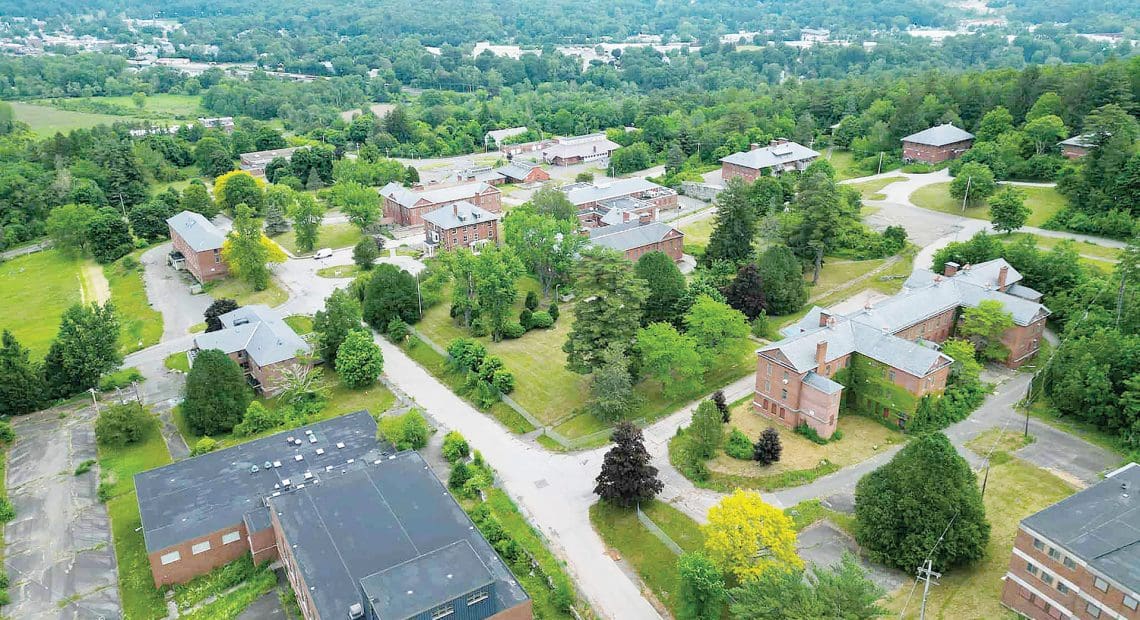
An aerial view of the Monson Developmental Center campus.

An aerial view of the Monson Developmental Center campus.


When Jeff Daley first pitched the Westmass Area Development Corp. board on the concept of redeveloping a portion of the former Monson Developmental Center (MDC) campus, it wasn’t a hard sell, necessarily.

“But it was a sell,” said Daley, the agency’s president and CEO, and for several reasons.

“It’s an imposing site, and there’s a ton of work that has to be done,” he said of the 100-acre parcel, which essentially sits between two mountains, with very little of what would be considered flat land. “And there’s a lot of money that has to be invested just to make the site developable again.”

But Daley was able to sell his board on the concept — a commitment from the state to provide a $9 million site readiness grant to the agency, as well as an accompanying reversion clause, certainly proved to be a turning point in the sales process — and late last month, the Commonwealth officially conveyed the property to Westmass, touting the transaction as part of ongoing efforts to utilize existing properties to build more housing in a state where there is a strong need for it.

And with that transfer, Westmass, in partnership with the state’s Division of Capital Asset Management and Maintenance, will commence work to create what will be known as the Village at Sawmill Brook.

The brook runs through the middle of the property, said Daley, adding that the name was chosen to reflect the rural nature of the community, and a ‘village’ is what is intended, with both residential and commercial development planned.

This is a village that will take shape over the next 10 to 20 years, he noted, adding that the first steps in the process involve demolition of almost all of the 14 existing buildings on the site — one structure, a recreation center at MDC, might be salvaged — as well as environmental remediation and infrastructure improvements.

Demolition is slated to begin early next year, and actual building will likely commence in maybe three years, Daley said.

Exactly what will be built remains to be seen, he told BusinessWest, as well as a gathering of about 100 Monson residents at a recent meeting of the Monson Board of Selectmen, noting that the site, and the market, will likely determine what shape this village will take.

“It’s an imposing site, and there’s a ton of work that has to be done. And there’s a lot of money that has to be invested just to make the site developable again.”

There will be housing, and probably several forms of it, with subdivisions, senior housing, veterans’ housing, and other options under consideration.

One of the first steps in the process will be creation of a master plan for the site to determine how many of those 100 acres can be developed, and in what ways.

“We’re in discussions with several of the groups that do housing for veterans,” Daley noted. “We’ll also talk with folks who do assisted living projects around the area to see if there’s a need for that in the Monson area.”

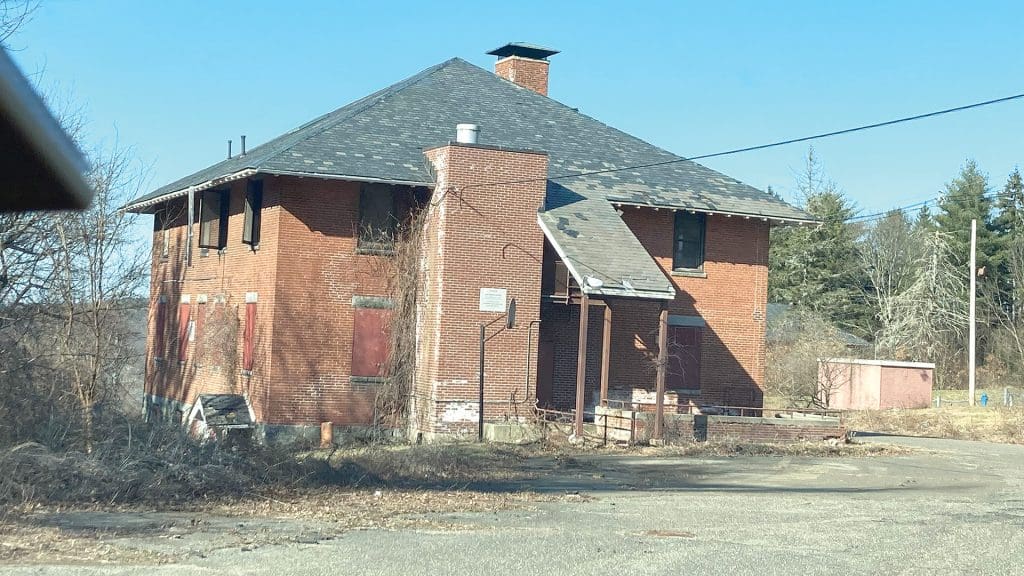
The next phase of the MDC project will involve demolition of the buildings on the campus

The next phase of the MDC project will involve demolition of the buildings on the campus, most of which are in an advanced state of deterioration.

There could also be senior affordable housing, similar to what has been created at another Westmass property, Ludlow Mills, he went on, adding that single-family homes, condos, duplexes, and fourplexes could also be in the mix. There will also be commercial elements, he said, such as retail businesses with residential units on the upper floors of buildings, in keeping with that ‘village’ concept.

“Right now, it’s a blank slate,” he noted, adding, again, that need and market conditions will likely dictate how the site is redeveloped.

Before any development can take place, the site needs to be cleared and infrastructure improved, a massive undertaking involving everything from the demolition of existing buildings, some of which are quite large, to replacement of a bridge that provides access to the site, for which the state has approved $5 million in funding.

The total cost of site preparation work is expected to approach and perhaps exceed $20 million, said Daley, adding that the state will work with Westmass to identify additional funding sources to advance the development.

Overall, the project represents a different kind of challenge for Westmass, but in many ways it is similar to the Ludlow Mills in that it involves extensive demolition and redevelopment of cleared sites.

“This is what we do … this is where Westmass shines,” Daley explained. “We take older properties and figure out what we can do with them, and I thank the governor and her team for trusting us and supporting us with the financial resources to do this. But once it’s down, cleaned, and demoed, it’s up to us to put together a really good, solid development plan that will benefit Monson.”

Daily News

SPRINGFIELD — West Springfield families will benefit from a new partnership between Western New England University (WNE) College of Engineering and Greater Springfield Habitat for Humanity (GSHFH) that uses drone and AI technology to identify heat loss and implement energy-saving home retrofits — at no cost to qualifying residents.

This partnership is possible thanks to a $149,700 EmPower Massachusetts grant from the Massachusetts Clean Energy Center.

Through this initiative, the team will conduct thermographic assessments to detect heat loss in the homes of low-income families in West Springfield. Principal investigator (PI) Yu Hou and co-PI Steven Li will lead efforts using drones equipped with thermal cameras to create thermographic models. They will apply artificial intelligence (AI) algorithms to analyze and quantify heat loss, simulate building energy consumption, and generate automated retrofitting plans. WNE will work with GSHFH to implement these plans for selected families.

“This project helps residents understand their home conditions and reduce energy costs while giving WNE students hands-on experience applying classroom knowledge to real-world construction projects,” said Hou, assistant professor in the WNE Construction Management department. “Students will use AI techniques — specifically computer vision methods — to identify areas of heat loss from building envelope images.”

Students can use local homes as case studies, integrating building energy simulation and tools like building information modeling into their coursework.

“This work enables us to assess residential energy consumption and building efficiency while also exploring public trust in generative AI,” said Li, professor in the Industrial Engineering & Engineering Management department at WNE.

Aimee Giroux, executive director at GSHFH, added that “we’re excited to partner with Western New England University on this important initiative. This grant will support our Home Preservation Program and help us provide lower-income homeowners with valuable information on improving energy efficiency. We’re especially thrilled to work alongside WNE students, whose participation brings fresh insight and energy to our shared mission of building stronger, more sustainable communities.”

Daily News

SPRINGFIELDMassachusetts Lawyers Weekly released its inaugural list of Legacy Law Firms, spotlighting firms that have not merely survived but thrived for 25 years or more years.

According to Massachusetts Lawyers Weekly, “Firms range in size from three lawyers to hundreds of attorneys, but all have weathered economic shifts, technological transformations, and an evolving legal landscape while maintaining a core commitment to client service.”

Bulkley Richardson’s profile, as prepared by a Massachusetts Lawyers Weekly staff writer, noted the firm’s size (39 attorneys) and commitment to talent acquisition, workplace culture, and commitment to the local community.

“Community engagement forms part of the firm’s foundational DNA,” the publication noted regarding the latter. “Through initiatives addressing food insecurity, supporting arts and culture, contributing to healthcare organizations, and funding educational programs, Bulkley Richardson actively participates in community development. Recent efforts include connecting lawyers and staff with meaningful volunteer opportunities.”

The publication also praised the firm’s longevity and strategic positioning, delivering service quality comparable to major national practices, but also the personalized attention and long-term relationships characteristic of boutique practices.

“The firm’s competitive edge stems from exceptional attorney retention, with many building lifelong careers while experiencing continuous professional growth,” it added. “Low staff turnover reflects loyalty earned through collaborative culture and mutual commitment. Strategic succession planning, developed years in advance, ensures seamless client transitions and relationship continuity when changes occur.”

Daily News

SPRINGFIELD — Rocky’s Ace Hardware, one of the country’s largest family-owned Ace Hardware dealers with 50 locations in nine states, recently helped bring to life a vibrant new mural supporting cultural pride in downtown Springfield.

“Echoes of Heritage,” a celebration of Latino culture and community, was created on June 28 on the side of Downtown Supermarket at 121 Spring St. Led by Dominican artist Pedro Veras and organized by the 7 Arts Latino Foundation, the mural was a one-day collaboration involving local students, families, and several community sponsors. While the mural was completed prior to its unveiling, the artist intentionally left a small section at the bottom unfinished so that members of the community could ceremoniously help complete it during the event.

Rocky’s Ace Hardware donated all the paint and materials needed for the large-scale public artwork, continuing its tradition of supporting the neighborhoods it serves.

“We’re honored to contribute to such a meaningful project that celebrates Springfield’s Latino community and empowers youth through art,” Rocky’s Ace Hardware President Rocco Falcone said. “While our part was small compared to the vision and talent behind the mural, we’re proud to help make their vision a reality.”

Spectators gathered throughout the day to watch the mural come to life, each brushstroke honoring the strength, heritage, and hopes of Latino immigrants.

In addition to Rocky’s Ace Hardware, the project was supported by the Hispanic-American Library, Harmony Entertainment Enterprise, and the Springfield Cultural Council. “Echoes of Heritage” now stands as a lasting tribute to the contributions of Springfield’s Latino community — past, present, and future.

Daily News

SPRINGFIELD — In the spring of 2017, BusinessWest and its sister publication, the Healthcare News, created a new recognition program called Healthcare Heroes. It was launched with the theory that there are heroes working across this region’s wide, deep, and all-important healthcare sector, and that there was no shortage of fascinating stories to tell and individuals and groups to honor. That theory has certainly been validated.

But there are hundreds, perhaps thousands of heroes whose stories we still need to tell. And that’s where you come in. The nomination deadline for the class of 2025 has been extended to Friday, July 25, and we encourage you to get involved and help recognize someone you consider to be a hero in the Western Mass. region in one (or more) of these eight categories: Patient/Resident/Client Care Provider; Health/Wellness Administrator; Emerging Leader; Community Health; Health Educator; Innovation in Health/Wellness; Collaboration in Health/Wellness; and Lifetime Achievement.

Nominations can be submitted at businesswest.com/healthcareheroes/nominations.

Cover Story

Work of Arts


As he talks about Hope for Youth & Families (HYF), the foundation he created in 2022 after selling his Pride chain of gas stations and stores, Bob Bolduc will inevitably reference the “three legs of the stool,” as he puts it, meaning its main focus points.

One is literacy, where the family foundation is making progress in efforts to help young people who fall behind in reading proficiency and are in danger of dropping out of school as a result. The initiative, involving interns and peer-to-peer support, has yielded results, with half of those involved moving up a full grade in reading level and another quarter moving up two grades.

Bob and Roberta Bolduc

Bob and Roberta Bolduc.

Students take a guitar lesson during one of the summer programs at Hope Center for the Arts.

Students take a guitar lesson during one of the summer programs at Hope Center for the Arts.

The second stool involves high-achieving students and providing them with avenues to a college education. And the third is participation in the arts, something that is in many ways lacking in Springfield, said Bolduc, due to funding restrictions in the schools.

It is this third leg, the arts, that is … well, taking center stage recently through a massive, ongoing effort to transform the former CityStage in downtown Springfield, dormant for several years now, into an arts hub for Springfield youth.

Called the Hope Center for the Arts, the facility has become a passion project for Bolduc, his wife, Roberta, and his foundation, which acquired the former CityStage for $1 million at auction in 2023 and has since invested roughly $15 million in the center, which will be thoroughly modern in every respect.

“We didn’t spare any expense — it’s all state-of-the-art, from the stage to the security,” said Bolduc, adding that the center, spread across nearly 40,000 square feet over two levels, is designed to provide flexible learning, rehearsal, and performance space that will advance the mission of HYF and several partner organizations focused on both the arts and helping youth and families in Springfield thrive.

Build-out of various spaces continued at a frenetic pace through the winter and spring, leading to the start of free summer programs for middle school and high school students, which began July 7 and will run until Aug. 1. During the school year, there will be after-school programs.

Meanwhile, the city and region will regain a valuable asset in the center’s main stage, which has been retrofitted with sound and lighting equipment that will make it one of the most advanced facilities of its kind in the country, one that will see a full schedule of performances — starting with the Springfield Jazz & Roots Festival earlier this month — by artists that will involve young people involved with the center in some way.

“The arts are not just entertaining and cultural, which we need in this city; they’re also inspiring. Imagine a kid who gets turned on to dance or vocals or an instrument and then goes to a good school on a scholarship … we’ve changed their life.”

As he talked about the main stage, Kyle Homstead, technical director of the center, said the sound will be “three-dimensional” in nature, and the lighting system will enable crews to create virtually any kind of digital landscape, both behind the performers on a large screen and beneath their feet on the stage.

“All this makes this room a multi-media powerhouse,” he explained, one that will draw performers across a broad spectrum to Springfield. “We’ll be able to transform and bring all kinds of imagination to life. Whether it’s a touring performance artist or kids in our program, we’ll be able to take their ideas and all the types of art going on in this facility and really bring it to life.”

While the main stage gets much of the attention, the center focuses on all aspects of the arts and also includes a 110-seat black box theater, two large rehearsal rooms and two smaller ones, practice rooms, a recording studio and media production room, a digital arts classroom, a visual arts studio, a photography studio, childcare space, a teen café and lounge, and a catering kitchen and service counter. There are also plans to convert the former Pizzeria Uno space (currently a hookah lounge at the tail end of its lease) into a student-run coffee shop.

Kyle Homstead (at left) on the main stage at the Hope Center for the Arts.

Kyle Homstead (at left) on the main stage at the Hope Center for the Arts.

Bolduc showed off all of this and more during a detailed tour during which he focused on not just on the facilities being created, but what they mean for young people in the city — and their families.

“The arts are not just entertaining and cultural, which we need in this city; they’re also inspiring,” he explained. “Imagine a kid who gets turned on to dance or vocals or an instrument and then goes to a good school on a scholarship … we’ve changed their life.

“Arts programming can be an important contributor to student success in school, and yet arts programs are often the first to fall victim to budget cuts,” he went on, adding that compounding this is a lack of things do after school. “Unless they play sports, they have nothing to do, and … being kids, some of them are going to get into trouble. Young people who may not be interested in sports deserve just as much opportunity and access to programs that enrich their lives and encourage them to express themselves.”

For this issue, BusinessWest got what we’ll call a backstage look at the Hope Center for the Arts, learning not only how that dormant space has been dramatically and colorfully transformed, but how its various programs may transform young lives.


Filling in the Canvas

Flashing back a few years, Bolduc said he approached the city about possibly renting CityStage for some initiatives to address that third leg of the stool he mentioned.

He said he was told that, while this might be an option, the city would prefer to sell it to him — or anyone else who might be interested.

“We came to realize that we had the potential here to be not just a theater, like it used to be, but to make this a true center for the arts.”

Not many were, and Bolduc prevailed at a public auction. And it was soon thereafter that he and others at the foundation realized that they could and should do much more than revive the main stage — originally known as StageWest and later renamed CityStage — that had hosted a wide variety of plays and other forms of entertainment for more than 35 years.

“We came to realize that we had the potential here to be not just a theater, like it used to be, but to make this a true center for the arts,” he explained. “We created an advisory board and met with just about every nonprofit group in the region and had them all through for tours. And people would say, ‘you can do this,’ and ‘you can do that.’ So it became very clear that we had the potential here to create a center for the arts, something like the Kennedy Center.”

And over the past 18 months or so, this vision has become a stunning reality, he said, adding that the project has involved a wide variety of tradespeople working on everything from HVAC systems to security systems; lighting installations to creation of a toddlers’ room where parents can leave younger children while they watch performances involving older siblings.

And the famously detail-oriented Bolduc has presided over every step in the process, from arrangement of free breakfast and lunch to a program enabling parents to drop off children early for programming — and pick them up late — to accommodate work schedules, to streaming services for parents and grandparents who can’t get to a performance for some reason.

“I’m a perfectionist; we’ve taken care of all those details. Whenever we see a problem, we fix it,” he said, adding that the summer programs alone come with a price tag north of $250,000.

An architect’s rendering of the courtyard area, being renovated by the city, outside the Hope Center for the Arts.

An architect’s rendering of the courtyard area, being renovated by the city, outside the Hope Center for the Arts.

Meanwhile, the facilities are, as noted, state of the art. And nowhere is this more true than in the main stage, which has been reborn, and transformed, in dramatic fashion, as Homstead explained.

“We’re super excited about what this theater is going to bring to Springfield,” he said, adding that, while the team at the foundation drew inspiration from its unique design and construction of the stage and seating areas, the technical systems have been redesigned to make this one of the most advanced theaters in the Northeast — starting with what’s known as a spacial audio system, designed by L-Acoustics, a global leader in speaker manufacturing.

“They’re at the vanguard of audio technology; across the front, instead of the traditional left and right speakers, there’s five hangs of speakers that are part of what we call the main scene, and then we have 26 speakers in surround. What that allows us to do is mix in a whole new way that’s three-dimensional.

“Instead of hearing all the sounds piled on top of one another coming out of two speakers, left and right, we’re spreading all those sounds across the entire sound field to create something that, if you close your eyes, sounds very three-dimensional and very much as if you’re listening to a band spread out on stage,” he went on, adding that this is the second such installation in the country.


The Sound of Progress

The huge investments in the former CityStage space, which include much more than the main stage, paid dividends that were recognizable on day two of the summer program, when Bolduc led another tour, showing young people getting lessons in guitar, vocals, dance, theater, and more.

“This is not a summer camp,” he explained. “Kids can sign up for it, state their preferences, and they’ll be able to go to programs by professional artists to learn and participate in theater, all kinds of chorus, all kinds of dance, all kinds of visual arts, photography, creative writing, and audio-visual media labs that are as good or better than any of the top colleges.”

The summer programs will be a testing ground of sorts, Bolduc noted, adding that they will help shape programming to be conducted during the school year, which will have those twin goals of immersing young people in the arts and perhaps inspiring pursuit of college arts programs and careers in various fields.

The facility even includes recording rooms that young people can utilize to create portfolios of their work that may help them get accepted into a college arts program.

“They need a recording of them singing, playing an instrument, dancing, or whatever — and there’s no place to do that,” he explained. “We have recording studios where they can do it for free.”

Overall, every aspect of the center is similarly designed to not only educate, but provide a leg up for pursuit of further education or employment.

And that extends to the planned coffee shop in the former Pizzeria Uno space, a work in progress on many levels and a program that may not become reality for a few years, but is already stirring the imagination.

“Imagine if this was run by kids so we can teach them business, marketing, finance, and culinary arts, and it was open to the public,” Bolduc said. “And suppose there was a small stage in there with an open mic so that students can go in there and perform for free; they get to shine.”

Allowing young people to shine, and perhaps change the trajectory of their lives in the process, is the overriding mission of the Hope Center for the Arts, which has transformed a once-vacant space and has the power to help transform Springfield’s downtown as well as generations of young people.

It is truly a work of arts.

Accounting and Tax Planning Special Coverage

A Sweeping Tax Overhaul

By Tim Provost, CPA

In a dramatic display of legislative determination, the U.S. Congress passed, and President Trump signed into law, a sweeping tax reform package on July 4. Though stripped of its campaign-era title for procedural reasons, the One Big Beautiful Bill Act represents one of the most comprehensive overhauls of the U.S. tax code since the Tax Cuts and Jobs Act (TCJA) of 2017.

Packed with both solidified extensions of soon-to-expire provisions and a host of new reforms aimed at individuals and businesses, the legislation reshapes the tax landscape for years to come. It also dramatically curtails green energy tax incentives to offset the substantial cost of these reforms, estimated to exceed $5 trillion over a decade.


Making TCJA Permanent

At its core, the bill cements many key provisions of the TCJA that were set to expire at the end of 2025. These include the maintenance of reduced individual income tax brackets (10% to 37%), the higher standard deduction, the elimination of personal exemptions, and the expanded alternative minimum tax thresholds.

The final legislation increases the standard deduction beginning in 2025, setting it at $31,500 for joint filers, $23,625 for heads of household, and $15,750 for single or married individuals filing separately. These figures will continue to be indexed for inflation.

The child tax credit is permanently increased to $2,200 per child, with inflation adjustments and a refundable portion of $1,700 for 2025.

The act also preserves the expanded estate tax exemption at $15 million (indexed for inflation) and makes permanent several itemized deduction limits and changes to the mortgage interest deduction, which will now include mortgage insurance premiums.

Tim Provost“In a move that drastically shifts federal energy policy, the act eliminates or shortens a range of green energy tax credits introduced in the Inflation Reduction Act.”

Tax Relief for Workers and Families

Among the most headline-grabbing provisions are new deductions designed to benefit middle-income earners in specific professions:

• A new tax deduction of up to $25,000 is available for tip income received in specific occupations (excluding highly compensated employees). The deduction begins to phase out at $150,000 of modified adjusted gross income for individuals and $300,000 for joint filers. This deduction is available through 2028.

• Overtime compensation is now partially shielded from taxation, with a deduction capped at $12,500 per taxpayer and income limits similar to those for tips.

• Seniors age 65 and over are eligible for a bonus standard deduction of $6,000 through 2028, subject to income phaseouts.


SALT Cap Expansion, Expiration

Long a point of contention, the state and local tax (SALT) deduction cap sees a temporary reprieve. The cap is lifted from $10,000 to $40,000 in 2025, increasing slightly each year through 2029, before reverting to the original limit in 2030. However, phaseouts apply for taxpayers with high incomes, starting at a modified adjusted gross income of $500,000.


Business Provisions Made Permanent

For businesses, the bill makes several long-advocated provisions permanent:

• It reinstates 100% bonus depreciation for qualified property placed in service after Jan. 19, 2025 and makes it permanent. The bill further includes expanded eligibility for manufacturing property and broader asset classes.

• The bill permanently reinstates full expensing of domestic research and experimental (R&E) costs from 2025. Small business taxpayers with average annual gross receipts of $31 million or less may even retroactively apply this change back to 2022 through amended returns. Taxpayers who previously capitalized R&E costs after Dec. 31, 2021, and before Jan. 1, 2025, may elect to accelerate the remaining deductions for such expenditures over a one-year period or ratably over a two-year period.

• Though the House bill proposed increasing the qualified business income (Sec. 199A) deduction to 23%, the final law keeps it at 20% while expanding phase-out thresholds. The deduction is now permanent.

• The maximum small business expensing (Sec. 179) deduction is increased to $2.5 million, with a phase-out beginning at $4 million of property acquisition.


IRS Reform and International Tax Tweaks

The Act terminates the IRS Direct File program, reallocating funds to study a public-private partnership model for free tax filing solutions.

International tax changes include renaming and modifying deductions:

• FDII and GILTI are renamed to FDDEI (foreign-derived deduction eligible income) and NCTI (net CFC tested income), respectively, with corresponding deduction percentages reduced slightly from current levels.

• The base erosion and anti-abuse tax rate is stabilized at 10.5% instead of the scheduled increase to 12.5%.

“Businesses, especially those involved in capital investment and research, will benefit from enhanced expensing rules and the permanence of deductions that had previously been temporary.”

Green Energy Rollbacks: A Major Offset

In a move that drastically shifts federal energy policy, the act eliminates or shortens a range of green energy tax credits introduced in the Inflation Reduction Act.

Clean vehicle credits, residential clean energy credits, alternative fuel infrastructure credits, and energy-efficient home credits are terminated after Dec. 31, 2025 (or slightly later in the Senate compromise).

Notably, the New Markets Tax Credit, supporting low-income investment, was preserved and even made permanent, a lone holdover in an otherwise sweeping repeal of energy-related incentives.


Final Thoughts

The One Big Beautiful Bill Act legislation brings a significant degree of clarity and continuity to the federal tax code. By making many provisions of the TCJA permanent and introducing new deductions targeted at workers and families, the law offers both simplification and expanded relief for a broad spectrum of taxpayers.

At the same time, the reduction or elimination of several green energy incentives reflects a reprioritization of fiscal resources aimed at offsetting the cost of these reforms. Businesses, especially those involved in capital investment and research, will benefit from enhanced expensing rules and the permanence of deductions that had previously been temporary.

As the new provisions take effect, taxpayers, advisors, and financial professionals will need to evaluate how the changes impact planning strategies and compliance obligations in both the near and long terms. Continued guidance from the IRS and Treasury will be critical to implementing the new rules effectively and ensuring that both individuals and organizations can make informed decisions under the updated tax framework.


Tim Provost, CPA is a partner at MP CPAs. He has more than 15 years of practice in personal and business taxation at both the federal and state levels, as well as experience working with international affiliates on foreign tax issues. He provides consulting and tax solutions to a diverse group of clients, including individuals, partnerships, limited liability companies, corporations, and trusts. Provost specializes in working with high-net-worth clients and private equity firms and their owners. He is also a certified valuation analyst who works with clients on the value of a particular business for the purpose of acquisitions, sales, and gift and estate tax purposes, to name a few.

Cybersecurity Special Coverage

Sophisticated Game


There’s no doubt, information security experts say, that people have become more savvy about detecting phishing attacks and other cyber threats.

Unfortunately, the hackers have become more savvy as well — exponentially so, in the era of artificial intelligence — and that’s a problem.

“The risk is getting worse, not better,” Bean said. “The sophistication of the attacks is getting infinitely better, and the variety or complexity of the attacks is getting significantly higher. And a lot of that is driven by AI.”

Elaborating, he explained that there are essentially two types of phishing attacks. One is the bread-and-butter, scattershot attacks that hope to ensnare as many random recipients as possible. And these hackers — many of them operating from foreign countries where English isn’t their first language — are now using AI to craft emails that sound more plausible, and don’t set off the same alarm bells as their cruder predecessors.

“But then there are high-value attacks, which are much more sophisticated and much more intelligent. They’re not just mass attacks sent out to hundreds or thousands or millions of people. They’re targeted attacks,” Bean said — and these employ AI to a troubling degree.

He related a real-life example of a CFO getting an email from a hacker posing as a vendor, urgently asking for a payment, at a time when the CEO was traveling and unavailable (which the hacker knew). To verify the transaction, the hacker set up a Zoom call with what turned out to be a deepfake version of an actual attorney.

“The lawyer says, ‘this is what the money is for; go ahead and wire it.’ And the CFO, at that point, is very comfortable and sends the money, no hesitation,” Bean said. “That kind of deepfake would have been impossible even three years ago; only Hollywood could provide that level of sophistication. But in the last couple of years, it’s so easy. You can get content online, combine it with certain tools, and do some really impressive stuff that’s beyond phishing — it’s straight-up cybercrime.”

Tim Miller, chief Information Security Officer at Community Bank, agreed that malicious AI tools are helping to create perfectly crafted phishing emails that are specific to a company or individual user, which is why the bank’s employees are not only trained on a regular basis to detect these threats, but tested as well.

“You don’t want to create a simulated fishing program without some level of training tied to failures,” he explained. “And you’ve got to make it believable; you’ve got to make it good. Sometimes that upsets people; we’ve done tests in the past that people have gotten really upset about, but that’s what these threat actors are doing. They don’t care what your feelings are. The point is to get an emotion out of you, a sense of urgency, of fear, and that’s how they get you to click.”

Exploiting the human element in cybercrime — known in IT circles as social engineering — is an ongoing concern for companies of all sizes.

Delcie Bean

Delcie Bean

“The risk is getting worse, not better. The sophistication of the attacks is getting infinitely better, and the variety or complexity of the attacks is getting significantly higher. And a lot of that is driven by AI.”

Hoxhunt, an organization that helps companies with IT risk management, notes that the human element is a factor in 68% of data breaches, according to a Verizon report. Of those, the Comcast Business Cybersecurity Threat Report says 80% to 95% are initiated by a phishing attack, and the total volume of phishing attacks has skyrocketed since the advent of ChatGPT in 2022.

“I think the risks from AI are going to continue to develop, and we’ve already seen significant changes from what the risks were before,” Miller said. “What was theoretical risk a year ago is actual risk now, and what that’s going to look like a year from now, I think, is somewhat unknown.”


Damage Done

For companies that do fall prey to cyberattacks and data breaches, the damage can be significant, Miller said, especially for companies (like banks and hospitals) in highly regulated industries, publicly traded companies, and businesses that operate in multiple states.

“Even if you deem it a small-scale event, it can mushroom very quickly,” he noted. “Now, let’s take the example of ransomware, where they’re able to get in and actually encrypt your data. In almost every ransomware event over the last couple of years, they’ve combined that with data exfiltration. So not only are they preventing you from accessing your files, they have a copy of it themselves. So it’s a combination of them wanting money from you, and they have the data already.”

Another big risk in these events is reputation risk, he went on.

“If a customer knows that you’ve had a security incident or a breach, especially a significant one, how do they know their data is going to be protected going forward? How do they know that the company is ultimately going to be able to protect them in the future? And are they more likely to find somebody else to do their business with? That’s the thing with cybersecurity incidents — it starts to degrade trust a little bit, which makes it challenging for companies to overcome.”

That’s why cybercrime is actually much more prevalent than public reports would suggest, Bean said. “You’re not going hear about 95% of them. The CEO or CFO doesn’t want to let that story get outside their little circle of trust.

“Ransomware has always been much more prevalent than we knew about because companies were keeping it secret, unless it caused a significant outage, like a hospital or an entire town being taken down,” he added. “For every one of those, another 100 businesses were hit quietly, and they dealt with it, and they weren’t telling anyone because they didn’t want it reaching the world because of loss of credibility and fear of lawsuits — and a lot of cybercrime stayed under the radar.”

Bean emphasized that the classic, non-AI attacks that have been around for years are still prevalent — essentially, “they’re trying to get you to log in and do something.” But these have become more sophisticated and targeted as well.

“They’ll know that you placed an Amazon order — ‘there’s a problem with the delivery of your dog food; click here if you still want to receive this order.’ They use very sophisticated tools to scrape your cookies when you’re on websites, and they see that you’re browsing for dog food, they assume you placed the order, and they send a very targeted attack. That stuff is growing.”

Miller said Community Bank communicates regularly with customers on how they can avoid becoming victims, while also making sure employees know what to look for.

Tim Miller

Tim Miller

“If a customer knows that you’ve had a security incident or a breach, especially a significant one, how do they know their data is going to be protected going forward? How do they know that the company is ultimately going to be able to protect them in the future? And are they more likely to find somebody else to do their business with?”

“It’s important, from our perspective, to make sure everyone inside the company understands that cybersecurity risks are everyone’s responsibility. It’s not just my role,” he explained. “And it’s important for the folks in our branches to understand what these threats are because they are the frontline to customer interactions. And if they can relay some of the information to them, that’s obviously beneficial for all.”

That’s especially true at a time when threats are increasing. “I mean, the concept of deepfakes is very much here, and it’s not going anywhere. And that’s a concept that’s really challenging for people to grasp,” Miller went on, going back again to what he emphasizes internally, which is the importance of following established processes — for instance, when a possibly deepfaked company executive is asking for a wire transfer.

“It goes back to adhering to your processes and not necessarily going off of your emotion — because your emotion in that instance would be, ‘I want to satisfy the CFO by making this wire.’ But the reality is, you might have a verification step where you call the CFO back. These attacks have gotten so good that the whole ‘smell test’ piece may not work anymore. So you have to go back to certain things that you know will identify those risks.”


Strong Defense

Bean emphasized the importance of both training and testing employees, saying one without the other isn’t enough.

At the same time, however, “we’ve had to shift to almost accepting that there’s going to be a certain amount of successful phishing attacks. It’s like a war — you have to cede one line in the battle and retreat to a different position that you feel is more defensible.”

And that second position, in many cases, has been recognizing what a successful breach looks like — often using AI systems to monitor that — and locking it down before damage is done.

“Most commonly, they’re stealing Microsoft 365 or Google Workspace credentials. But the second they log into the system, there are certain hallmarks about how that’s going to look. The login is different in subtle ways; a login by a bad actor sends up suspicious flags. An AI system can evaluate that login, and if there’s anything remotely suspicious, a human can lock the account, send a report to us, and we take over the case from there.

“That’s definitely been a godsend. We’re seeing hackers getting through MFA [multi-factor authentication] or getting a password through phishing, but we’re catching them the instant they log in,” Bean went on, comparing it to having both external home security and motion sensors inside the house. “The police arrive before there’s any damage.”

He added that this is a war being fought on multiple fronts, and companies need to take it seriously, through training, testing, and perhaps an outside partner.

“If someone can get in, it can be anywhere from a couple hundred thousand dollars to a couple million, and most businesses don’t have that floating around. Some go out of business or face financial hardships that might not be covered by cyber insurance. It’s not something you can afford to underinvest in.”

Miller added that “a lot of companies, especially smaller companies, don’t have budgets to invest in the latest and greatest, and that’s fine. It’s more about, are you patching your systems? Are employees aware of newer threats? There’s a lot that companies can do.

“These are the basics of cybersecurity — which, honestly, is what protects you 99% of the time,” he added. “It’s doing the basics of being skeptical. That’s one of the keys with phishing and all these other types of fraudulent attempts — being skeptical about it.”

Commercial Real Estate Special Coverage

Pushing the Envelope

Michelle Grout at the ‘Odyssey’ installation at Tower Square Park

Michelle Grout at the ‘Odyssey’ installation at Tower Square Park, one of the BID’s attempts to “push the envelope” in efforts to promote Springfield and bring people to the city.


Michelle Grout says she’s still getting emails and texts and seeing posts on social media platforms regarding the head-turning art installation in Tower Square Park known as “Odyssey,” featuring three seven-foot-tall pigeons and a Campbell’s soup can.

Not as many as when it first appeared a month or so ago, but they’re still coming in, with most of them positive in nature and candid about how nice it is to have something new and different downtown.

Her favorite missive is from a family not living in Springfield — they didn’t say where they were from — that jumped on a new reason to come to the city.

“The very first day, we had a post on social media … a family said, ‘we hadn’t been downtown in three years, but when we saw this, we know we had to come downtown for lunch,’” said Grout, president of the Springfield Business Improvement District (BID), which brought “Odyssey” to the park with support from several member sponsors. “They went to Hot Table and sat under the pigeons and had lunch.

“It’s doing its job — it’s got people talking, and it’s bringing people downtown,” she said of the installation, adding that, for the BID, the project is perhaps the most visible manifestation of ongoing efforts to do things differently when it comes to promoting the downtown and bringing people there, which is, in a nutshell, the agency’s mission.

“If you want the same results, keep doing the same things,” she said. “We don’t want the same results; we really want to try to push the envelope and get people to start thinking about Springfield as a destination again. We want to give people a reason to come.”

“Odyssey” will be on display until Labor Day, she added, and there will be other efforts to spur talk and visits — everything from a planned new mural project to a grilled cheese and tomato soup day at “Odyssey.”

These efforts coincide with new developments downtown, a rise in the number of people living there, and optimism about what’s to come, said Grout, who grew up in the city and remembers taking the bus downtown as a kid and going to the Steiger’s that sat near where those pigeons now do.

“It’s a balance of live, work, and play — it can’t be all people who live here, it can’t be all people who work here, and you can’t solely rely on people who visit here.”

The project at 31 Elm St., conversion of the former hotel into 70 units of market-rate and workforce housing, has been a catalyst for more development, with new initiatives, such as replacement of the Roderick L. Ireland Courthouse — she contends that the new facility needs to be downtown — creating speculation and anticipation.

Meanwhile, the tenants at 31 Elm are making an economic impact, which generates more anticipation about other residential initiatives in the planning stages.

“There are people from that building that we see all the time in their new routines,” she explained. “They go to the farmers market, they get their coffee at Palazzo, they go to Nosh … they’re investing in their new home,” she explained. “That’s one thing that attracts someone to live in a downtown — they have these amenities; we just need to come up with the amenities. It’s a balance of live, work, and play — it can’t be all people who live here, it can’t be all people who work here, and you can’t solely rely on people who visit here.”

There are certainly challenges in the BID district, Grout said, adding that many office buildings have not fully recovered from the aftereffects of COVID on where people work. And some of these properties may now be better suited for housing, although retrofitting them will be expensive. Meanwhile, some properties require extensive investments to host any kind of tenant, given modern standards and changing needs, and the costs are, in many instances, prohibitive.

String lighting, as seen here on Worthington Street

String lighting, as seen here on Worthington Street, is one of many BID initiatives to beautify downtown Springfield.

But overall, there is energy, optimism, and movement to create that needed balance, she said, adding that it’s a different downtown than the one she grew up with, but one with many strong assets and great potential.

For this issue and its focus on commercial real estate, we talked with Grout about how the BID is getting more creative as it carries out its mission, and ever more diligent in its efforts to put the city’s best foot forward, whether it’s with flowers, string lights, or art in the park.


Optimistic View

The large windows in Grout’s office at 1319 Main St. face south and provide direct views of the MassMutual Center and its marquee.

“I can’t miss what’s going on; I have no excuse to say I didn’t know what’s happening,” she joked, adding that she doesn’t need this view to know what’s going on across Bruce Landon Way — or at any of the other downtown venues downtown.

In fact, it’s her job to know — or at least one small part of her job, one that she arrived at after spending several years in residential real estate and a decade at the BID. She started there as administrative assistant to Director Chris Russell, then Operations director, then interim director when Russell stepped down three years now, and now director.

She’s seen and been through quite a bit over her 12 years with the agency, including what she called the “ebb and flow” of the downtown, a global pandemic and its many impacts, and now, what she describes as a resurgence in development over the past several years.

That resurgence has taken many forms, is both public and private in nature, and has involved several different properties, including 31 Elm St.; ongoing efforts to redevelop the Clocktower Building and adjacent Colonial Block into more housing and ground-floor retail; ambitious work to revitalize several long-vacant or mostly vacant properties on Worthington Street in the city’s entertainment district; the new Convention Center Carpark and the adjoining space, which is being activated for events; renovation of Court Square; the new Hope for Youth & Families Arts Center; and more.

“These investments are very inspirational and, I’m sure all would agree, necessary,” said Grout, adding that these initiatives and others will bring more people and vibrancy to a downtown the BID serves in many different ways — specifically, 221 parcels across an area stretching from West Columbus Avenue to Chestnut Street (but also Mattoon Street and the Quadrangle), and from just south of State Street to the Arch.

These include what Grout called supplemental services beyond what the city provides to keep the downtown clean and safe — from beautification efforts and lighting to broad economic development initiatives.

Indeed, the BID was awarded a $100,000 grant from the state Executive Office of Economic Development to subsidize new businesses and fill vacant storefronts in the district, she explained, adding that 13 ventures took advantage of the program, earning grants ranging from $7,500 to $15,000.

The farmers’ market in Tower Square Park

The farmers’ market in Tower Square Park is another BID initiative to activate downtown spaces and bring people to the city.

The BID is also charged with marketing the downtown, an assignment that takes on many forms, from robust programming to a website that that includes a calendar of upcoming events, snapshots of downtown restaurants with links to their websites, and listings of hotels and attractions, including MGM Springfield, Riverfront Park, the Springfield Museums, and the Basketball Hall of Fame.

Meanwhile, with programming, the BID has moved away from outdoor concerts, she explained, and much more toward promoting venues that offer live music, from MGM Springfield to Theodores’ to the Student Prince.

“We’ve pivoted to more destination placement, complimentary support to what’s already happening to grow a broader audience for that,” she said, adding that the “Odyssey” installation falls squarely into the category of marketing and promotion, although it is certainly non-traditional in nature.

As she talked about how it arrived in Springfield, Grout said the Downtown Boston Alliance had worked with a Quebec-based company called EXMURO on its Winteractive, a winter arts exhibition, and introductions were made.

“We saw the success they had in bringing people back to their district for a unique and unexpected experience, and the impact it had,” she explained. “And we thought that, on a Springfield scale, we could find the right piece to do the same thing, and after a few months of consulting, we landed on this piece.”

“Odyssey” has been in display in several cities — it was in Quebec City last fall, for example — but this is its first appearance in the U.S. And, as Grout noted, it has garnered attention and generated talk, which was the goal.

“People would ask, ‘what’s it for, what’s it about?’” she told BusinessWest. “My answer is getting people talking — it’s given people another reason to come down, another block to walk, another sight to see.”


Art and Soul

And there will be more efforts like it — although certainly not exactly like it — to keep creating a buzz, said Grout, noting there will be other art installations in other locations.

Meanwhile, another of her primary goals is to build on existing collaborations with community partners and “work smarter, not harder,” as she put it.

“We want to build efficiencies within everyone’s initiatives,” she explained. “You see a lot of people working at the same thing; if they all work together, it would be more efficient.”

As an example, she cited the relationship between the BID and the MassMutual Center and its marketing team. The two entities started working more closely together two years ago, and since that commitment, both have seen dramatic increases in engagement and followers on social media platforms, with the BID’s rising 18% and the MassMutual Center’s 65%. This surge has coincided with an increase in acts and a schedule that attracts people of all ages, she noted.

Another collaborative effort involves the Springfield Cultural Council, said Grout, adding that the agencies are working on several different initiatives, including a new mural project now in the planning stages and dependent on grant funding, as well as Art on Market Street, a free drop-in art program for young people slated for Saturdays this summer.

The downtown farmers market, meanwhile, has become a Friday tradition in the city. Presented by Country Bank, it runs from June until the end of September and features several local vendors, live music, and family-friendly activities.

Then, there are ongoing efforts to make the downtown clean and safe, which play a huge role in its overall success.

“If it looks good, people feel good, and that makes them want to come back and not be afraid to walk another block, go to another place, and see another site,” she explained, adding that these efforts go well beyond watering plants and picking up trash. “It takes a village.”

Indeed, it does. And in the village of downtown Springfield, there is progress, anticipation, and, yes, talk. And not just about the three pigeons and a Campbell’s soup can.


Community Spotlight Special Coverage

Community Spotlight

Ray Berry at Pridelands on Mane Street, what he calls a spinoff of a winning concept from the days before COVID.

Ray Berry at Pridelands on Mane Street, what he calls a spinoff of a winning concept from the days before COVID.

Diana Szynal took the job as president of the Springfield Regional Chamber — and an office overlooking Tower Square Park — three years ago.

Back then, the city was still trying to shake off the effects of COVID, she said, with many workers at downtown businesses still spending considerable time working remotely.

They’re not all back five days a week, she stressed, but there is far more vibrancy in the downtown than when she started — and on many levels.

“More people are in their offices more days of the week, and this has helped create a lot of vitality downtown … I’m seeing a lot of energy there,” she said. “There are some new restaurants opening and new businesses coming in. There are a lot of people walking around and enjoying being downtown.”

And that sentiment certainly includes what Szynal can see out her window in Tower Square Park, which is home to a popular farmers market and, more recently, an attention-grabbing art installation called Odyssey — one of the Springfield Business Improvement District’s more creative (literally and figuratively) efforts to promote the downtown and bring people to it  — and a new outdoor event destination created by White Lion Brewing called Pridelands on Mane Street, which kicked off July 9.

Diana Szynal

Diana Szynal

“More people are in their offices more days of the week, and this has helped create a lot of vitality downtown … I’m seeing a lot of energy there. There are some new restaurants opening and new businesses coming in. There are a lot of people walking around and enjoying being downtown.”

Ray Berry, owner of White Lion, said the destination, created from three custom-designed shipping containers, offers a unique backdrop for planned weekly entertainment on Wednesday and Thursday evenings, but also for company outings, team socials, or casual get-togethers with friends and family.

“There are so many positive moving parts to engage and enjoy downtown,” he said. “We see Pridelands as another piece of the mosaic.”

This broad activation of Tower Square Park is just one of many storylines converging in the City of Homes. Others include:

• Progress to create more housing of all kinds, from market-rate apartments in the downtown to higher-end homes in different areas of the city (more on this later);

• The high-profile project to redevelop the Clocktower Building, Colonial Block, and two other adjoining properties into roughly 100 units of market-rate housing, as well as infrastructure improvements in that area, including a new parking garage;

• The transformation of the former CityStage into the Hope Center for the Arts, a state-of-the-art facility to designed to educate young people and perhaps inspire careers in the arts ;

• Ambitious work to revitalize the entertainment district through redevelopment of a block of buildings on Worthington Street, a project led by Raipher and Joseph Pellegrino in partnership with the city, detailed in the July 7 issue of BusinessWest;

• Continued discussion, and some anxiety, about the future of some downtown office buildings, which continue to struggle in this post-COVID era;

• Plans to replace the troubled Roderick L. Ireland Courthouse — the Massachusetts Division of Capital Asset Management and Maintenance has issued a request for proposals for a new site, preferably in the downtown; they’re due back in October — and speculation about what will done with the existing structure as well as adjacent properties in that area off State Street, including the former First Church;

An architect’s rendering of the planned improvements, including a new parking garage, in the South End, between State Street and Union Street.

An architect’s rendering of the planned improvements, including a new parking garage, in the South End, between State Street and Union Street.

• The continued success of the Springfield Thunderbirds, which will soon enter their 10th season and continue to set the bar higher with everything from ticket sales to marketing and social media content (see below

• Movement toward creation of a master plan for redevelopment of the Mason Square neighborhood and adjoining areas;

• Visible signs of progress in a massive project to reimagine the former Eastfield Mall as a retail center with a large residential component; and

• Future redevelopment of the former Massachusetts Career Development Institute property on Wilbraham Avenue. The site was demolished four years ago, and speculation continues about what will come next in an area that has seen strong residential growth.

Overall, housing remains one of the main focal points, said Tim Sheehan, the city’s chief Development officer, noting that that there is both urgent need for more housing and several ongoing initiatives to address that need. These include everything from the aforementioned South End project to redevelopment of the former Springfield School Department headquarters on State Street to plans to build high-end homes on the pre-tornado campus of Cathedral High School.

This residential growth reflects both strong need for more housing as well as greater interest in the city overall as a place to live and work, he went on, adding that work is taking place on many fronts to meet the needs of new (and old) residents, and make Springfield a true destination.


All That Jazz

Evan Plotkin, president and CEO of NAI Plotkin, has long been a cheerleader for Springfield and a prime mover when it comes to projects to promote the city and especially its downtown and cast them in a positive light. These include everything from mural projects to the Springfield Jazz & Roots Festival, which took place last week and was in its final planning stages as he talked with BusinessWest.

Plotkin said he sees a number of positive developments taking place in the city, including several in the office tower he co-owns, 1350 Main St., where a high school now resides on the top two floors. But it’s what he’s not seeing that has him concerned.

Springfield at a Glance

Year Incorporated: 1852
Population: 155,929
Area: 33.1 square miles
County: Hampden
Residential tax rate: $15.68
Commercial tax rate: $35.22
Median Household Income: $35,236
Median Family Income: $51,110
Type of government: Mayor, City Council
Largest Employers: Baystate Health, MassMutual Financial Group, Big Y Foods, MGM Springfield, Mercy Medical Center, Center for Human Development
* Latest information available

That list includes new businesses coming to the city and its downtown; instead, he said, there’s much more movement of existing businesses and restaurants, a game of musical chairs that doesn’t result in real growth, just a shift of vacancies from one building to another.

Something else he’s not seeing is consistent effort from the city to maintain landmarks like Stearns Square, which was revitalized several years ago, but sees its ornate fountain not in use the majority of the time.

“They invested in the hardscape and the landscape, and then they walked away,” he said of the city and its efforts at the park. “And this is a pattern; we put up plaques saying ‘we did this’ and ‘we did that’ and ‘here’s this brand new park,’ but the next year, they don’t mow the lawn and let the weeds grow back.”

Overall, more work is needed to maintain and preserve such treasures and to make the city a more desirable place to visit — and work in and live in, he went on, adding that he would like to see the city create a permanent stage downtown near Stearns Square (a temporary one was set up for the Jazz Fest) and make live music a prominent piece of the puzzle, as it was years ago.

Live music is just one of the components of Pridelands on Mane Street, a play on words that also represents what Berry called a “spinoff of a proven concept, pre-COVID.”

Elaborating, he said that, before the pandemic, White Lion created pop-up beer gardens at several sites around downtown. The last few years, though, it has concentrated these efforts in Tower Square Park, making use of retrofitted shipping containers.

Fast-forwarding, he explained that, with an ARPA grant from the city, White Lion was essentially tasked with reactivating the park, and it’s doing so in colorful styles, as in a shipping container wrapped (by East Longmeadow-based Go Graphix) with the White Lion logo.

“We knew, by way of our partnership with the Business Improvement District and other stakeholders, that the beer garden concept worked in years past, and pre-COVID showed that a container park concept resonates with our customer base,” Berry explained. “So we thought, why not bring the concept back, look to make it more permanent, and have it be a true destination right in the middle of the business district and the emerging arts district?”

Approaching 10th Season, T-Birds Have Matured as a Business

Nate Costa says that, when it comes to the Springfield Thunderbirds and prospects for continued growth, there isn’t room for much more.

Well … at least when it comes to ticket sales.

Indeed, capacity at the team’s home, the MassMutual Center, a.k.a. the Thunderdome, is 6,700. For the 2024-25 season, the T-Birds, an affiliate of the NHL’s St. Louis Blues, averaged 6,369 per game, up from 6,321 the prior season. So, there’s still room for improvement, and the team will doggedly pursue it. But, again, not much.

Nate Costa

Nate Costa

“We’re going to eventually, hopefully, run out of tickets to sell,” Costa, the team’s president, said with a laugh, noting that this is both a good problem to have — one many other teams in the American Hockey League would love to have — and one of many solid indicators of how far this team has come.

As it readies for its 10th season of operation, with various plans to mark that milestone, the Thunderbirds have established themselves as a solid franchise with an increasingly loyal fan base, as evidenced by those numbers above … and the fact that they were achieved with the parking garage next door to the arena unavailable for the past three seasons.

Which means that, while there’s not much room for growth in ticket sales, there’s still plenty of room when it comes to growing revenue through increases in ticket prices — the team still charges well below the league average — as well as merchandise sales and other avenues.

“Over the past five years, we’ve continued to see the maturation of our business,” Costa explained. “We’re continuing to fill the building, and now it’s looking at our margins; we’re 30th in the league out of 32 teams in ticket price. It’s been really good to get the bodies in the building and show the value, but now it’s up to us to start walking that ticket price up effectively and generating revenue on the margins.”

Looking back, Costa said 2024-25 was another solid season for the T-Birds. There was a playoff run, albeit not a deep one (the team lost in the first round), with 20 sellouts, and, as noted, continued improvement in ticket sales and other measures of success.

“Every Saturday in the second half of the season, we sold out,” he noted, adding that many other games approached capacity over the final three months.

Meanwhile, off the ice, the team earned several awards from the league, which is becoming an annual tradition.

Indeed, in addition to benchmark awards for ticket sales and corporate sales, the team was recognized as having the AHL Marketing Department of the Year and the Most Unique Social Media Content. (More awards were expected at the annual league meetings in South Carolina, which were taking place as this story went to press.)

The marketing and social media content awards help explain the continued improvement in group sales and overall ticket sales, said Costa, adding that, with the shorter playoff run, the team is already “well ahead and well out in front of next season” in terms of season ticket renewals, group sales, and other initiatives.

Indeed, the team continues to set the bar higher, he went on, adding that, with the parking garage now open, the space adjacent to it being activated — the team, working with the state, which controls the property, will look to create a Yawkey Way-like atmosphere on game nights — and an already stable fan base, there are expectations for continued growth.

As for ticket sales, the team’s success on the ice and with creating a fun, always changing fan experience, coupled with the relatively small capacity of 6,700, has created both demand and urgency, said Costa, adding that the team has grown season ticket sales past 1,600 and looks to surpass 1,700 for next season.

“When you have a base like that coming in for every game, and we had a really great year for groups — we did more than $1 million in group revenue for the first time ever in Springfield hockey history — that gives you a really good base to work from to fill the rest of the building,” he explained, adding that the full (and nearly full) houses create a raucous atmosphere not seen in some other buildings.

“In Hartford, the XL Center [now PeoplesBank Arena] seats 16,000 people; when you bring 6,000 out, it just doesn’t have that same feeling,” he said. “If you get 5,000 in our building, the place is rocking; it feels like it’s full. That’s an advantage for us.”

As for ticket revenues, the T-Birds’ average price is just over $20, with the league average north of $28, said Costa, adding that there is some leeway for increases, given those statistics, the value the team delivers, and the growing demand for the product.

“Since we started here, the big thing was just trying to show as much value as possible, with the promotions and themes we do on game nights … that’s really added to why people want to buy tickets,” he explained. “Now, with the scarcity of tickets, the ticket packages are much more valuable because people are trying to lock in their seats, knowing that they’re not going to get them waiting until a week before a game.

“It’s been really good to change that mentality, and we’ve re-educated the community as to how to get tickets and the best way to get them,” he went on. “Coming out of the gates, we focused on building the base and going after large numbers; then, once you get the large numbers in the building and you start to create some emergency with sellouts, you can start to walk up your ticket price. I think we’re there.”

Heading into their 10th year, the T-Birds are ‘there’ in many respects and looking to soar still higher in 2025-26.

—George O’Brien

Pridelands is one of many sources of greater vibrancy Szynal is seeing downtown, and at the chamber as well, which is based in Springfield but boasts members from across the region. She said membership is up — 419 was the latest count — amid efforts to both grow and diversify the membership through initiatives such as a revamped, more member-focused website and television commercials.

“We’re really trying to diversify our membership in every possible way, from diversification of the people that are part of the chamber to the businesses and types of businesses that join the chamber,” she explained. “We’re really trying to cast a wide net; the chamber is most effective if there’s a lot of different types of people and businesses that are part of it.”

Elaborating, she said the chamber has been working in many ways to “be more out there,” through those TV commercials, social media content, the new website, a deeper event schedule, and more.


Progress Report

While there are several visible signs of momentum in the city, perhaps the most notable is what would be considered the ‘housing market,’ Sheehan said.

That’s a broad term that covers everything from still-rising home prices — the city has seen one of the more dramatic such increases in the state — to development of new housing of all kinds, including new market-rate apartments downtown, but also upscale homes in several sections of the city, including East Forest Park, the Bicentennial Highway area, and perhaps the site of the former Sears at the Eastfield Mall, acquired by one residential developer.

“The demand is for new product,” he said, referring to both homes and rental units. “And that’s why we’re seeing so much new housing development coming in that includes homes at the higher end of the market.”

Meanwhile, interior demolition has commenced at the South End properties — the Colonial Block, the Clocktower Building, and others, said Sheehan, noting that McCaffery, the Chicago-based development company leading the project, is finalizing financing, which is expected to cost roughly $50 million. Transfer of the Springfield Redevelopment Authority properties to McCaffery is expected to take place early next year, with construction expected to begin soon thereafter.

As that project progresses, so too has a $30 million infrastructure improvement initiative, including a new parking garage at the corner of Stockbridge and Willow streets, for the area from State Street to Union Street, one designed to make it more responsive to the residential growth taking place there.

“There’s significant housing development that’s back there now, with Stockbridge Court being the largest one, but there’s also the Lofts on Park Street,” he explained, adding that the work includes new sidewalks, lighting, road repair, and improvements to the surface parking in that area, and will create stronger connections to Main Street. “This will lift up that entire area, not just for the new housing, but the housing that’s historically been there for quite some time.”

While Sheehan sees progress on many fronts, from housing to the Eastfield Mall to the county courthouse, there are areas of concern.

These include the property at 101 State St., owned by MGM Springfield. There is still scaffolding on the structure nearly seven years after the casino opened, he said, adding that redevelopment of the property is a key bullet point in the host community agreement, and lack of progress there has become a point of contention between the city and the casino operator.

“We have concerns about that not moving forward in a timely way,” he said, adding that another pain point is the lack of any apparent progress at the former Vibra Hospital site on State Street, now vacant for several years, a campus that includes the so-called ‘Isolation Hospital,’ which preservationists want to save from the wrecking ball.

Another concern is the property known as the Mardi Gras building because it was home to a now-closed gentleman’s club. The restaurant known as 350 Grill will be moving from that building to the site of the former Jackalope on Worthington Street, becoming a key part of the revitalization efforts there. And while that location will likely work out well for the restaurant, it leaves the Mardi Gras building vacant and with little talk of redevelopment.

“There hasn’t been much dialogue, but there has been discussion of doing housing there,” said Sheehan, adding that the upper floors hold the potential to house dozens of units. “And it would be an ideal site for housing because there’s plenty of parking at the site, and you’re close to Union Station.”

Meanwhile, several other properties downtown are largely vacant — he listed Harrison Place and adjoining structures along Main Street, but there are others scattered across the central business district — and with little movement toward redevelopment and the properties in serious need of investment in new infrastructure.

“These owners have held and held and held and not kept up with the requisite investments they should be making in these properties,” said Sheehan, adding that speculation that some properties might become part of the MGM complex, such as those now being converted to housing in the South End, kept those owners from investing in their holdings.

Sheehan said one possible reuse for some of these properties is housing, although conversion would likely be an expensive undertaking. The state has launched a new initiative called the Momentum Fund, a first-in-the-nation state revolving fund to support mixed-income housing production, and it recently announced its first financing commitment from the fund, $5 million for the Residences of East Milton, which will create 92 new mixed-income rental units in an underutilized commercial property in the town of Milton.

He noted that Springfield has several buildings that meet that description, and hopes projects will materialize that can take advantage of the Momentum Fund, adding that housing might be the best option for many commercial properties in and around the downtown.

“We’d like to have a little more momentum in Western Mass.,” he said, “a part of the state that needs more help with housing.”


Daily News

SPRINGFIELD — American International College (AIC), in partnership with the Springfield Empowerment Zone Partnership (SEZP), has been designated as a Massachusetts Early College Program by the state’s joint Early College Committee. The AIC-SEZP partnership is one of 18 new Early College programs announced by the Healey-Driscoll administration. AIC is the only private college west of Worcester to receive this designation.

Beginning this fall, the program will launch in partnership with Duggan Academy in Springfield with a wall-to-wall model in which every student participates. Students will have the opportunity to earn up to 60 college credits at no cost before graduating from high school. Courses will include MassTransfer-eligible credits and focus on high-growth, high-wage fields such as health sciences, education, and criminal justice.

“Early college is an important and effective tool for making higher education more accessible and affordable for every Massachusetts student,” Gov. Maura Healey said. “These new partnerships give more young people the opportunity to earn college credit at no cost while still in high school, setting them on a path to success and helping to close opportunity gaps.”

Early College programs are a central element of the administration’s Reimagining High School initiative to prepare students for college or careers and expand access for those historically underrepresented in higher education.

The new AIC-Duggan Academy program builds on a long-standing partnership between the two institutions. Through earlier collaborations, Duggan students have already earned AIC college credits with strong pass rates, and college matriculation among participants has continued to grow. The new program is designed to build on that success and help even more students access college by removing common barriers.

Key program features include personalized support, including small cohorts, academic coaching, and dedicated advisors for multi-lingual and exceptional learners; advising to promote executive functioning and college readiness; culturally responsive teaching and staffing to reflect and support the student population; and universal access, with 100% of Duggan students participating regardless of prior academic performance.

This initiative reinforces AIC’s commitment to Springfield’s youth and complements similar partnerships with other local high schools. It also supports workforce development goals outlined in the Pioneer Valley Labor Market Blueprint.

“We’re proud to partner with Duggan Academy and the Springfield Empowerment Zone on this Early College initiative,” said Michael Dodge, executive vice president for Academic Affairs and Student Life at AIC. “This designation reflects our shared belief that all students deserve opportunities to succeed. Early College is about more than earning credits — it’s about building the skills, confidence, and support networks students need for college and life. It’s a direct investment in their future and the future of Springfield, and aligns fully with AIC’s mission to expand access and advance opportunity.”