Home Posts tagged Insurance (Page 37)
Departments

Scenes from Market 2007


Bryan Kaye, business development officer with Freedom Credit Union, mans his booth at the Business Market Show staged May 2 at the MassMutual Center in Springfield.


Craig Cote, chief marketing officer for American International College, laughs with a guest


Susan Walsh-Peterson and Christina Murphy of PepperBerry’s Flower Shoppe of Westfield share a light moment at their booth.


Stylists with DiGrigoli Salons offered free cuts to Market Show guests.


Lessons in Leadership


Actress Mia Farrow spoke to an overflow crowd at Bay Path College’s annual Women’s Professional Development Conference, held recently at the MassMutual Center in Springfield. Farrow talked at length about her work in the impoverished region of Darfour in Sudan, which is currently experiencing one of the worst genocides in history.


Bay Path President Carol Leary applauds Dr. Maya Angelou as she takes the stage. Angelou relayed a number of personal experiences, ending with a poem she asked Leary to keep and share with future students.


Shaken and Stirred

The Fourth Annual Martini Magic fundraiser was staged May 3 at Max’s Tavern in Springfield. The event, which benefits the Ronald McDonald House, featured 16 different vendors, each serving two different varieties of martinis.


Dennis Desmarais, past president of Ronald McDonald House and his wife, Linda Desmarais, a professor at Springfield Technical Community College; Joel Weiss, president and CEO of United Way; Melissa Kozub and her husband Paul, owner of V1 Vodka.


Representing the Ronald McDonald House are, from left, Jerry Houle, board member; Stew Young (past president), Dan Flynn, board member; Ann Marie Harding, board member and event planner; Michael Favreau, president, and Ed Abraham, board member.


John Joyce, second from left, president of Joyce Insurance and Financial Services, a division of Northwestern Mutual, with his wife, Lisa; Brad Handy, of Lendia Insurance, and Gary Lamarche, owner of Lamarche Associates.

Features
Turley Publications Makes an Award-winning Recovery from the Flood of ’05
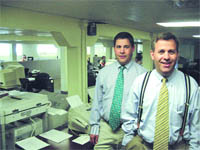
Doug and Keith Turley

Doug (left) and Keith Turley, stand in the renovated lower-level production room at Turley’s Palmer headquarters. The windows seen at the left were covered by water by mid-morning on that fateful Saturday.

By mid-morning on that fateful Saturday in October 2005 when the Quaboag River spilled over its banks, Pat Turley had called his wife to tell her he thought they’d lost everything. But then, the water that had invaded the publishing company Turley and his brother started 43 years earlier — and now threatened millions of dollars worth of printing equipment — stopped rising, and it receded almost as quickly as it had risen. The problems facing Turley Publications had really only started, but what would become an award-winning process of disaster recovery was already well underway.

Pat Turley remembers retiring to his office for a private moment, but not before locking the door.

He feared that he might get emotional, and didn’t want any of his employees, including his two sons, walking in. It wasn’t that he didn’t want anyone to see him crying — he just didn’t want anyone to think things were “really bad.”

Which … they were.

It was Saturday, Oct. 15, 2005, mid-morning by Turley’s recollection. The flood waters that hours earlier had just started to approach the headquarters building of Turley Publications Inc. in Palmer, the business he started with his brother, Tom, some 43 years earlier, had by that time crashed through air conditioners in windows on the lower level, nearly reaching the ceiling tiles in the seven-foot-high newsroom/production department.

The water was still rising, Turley recalled, and no one knew how high it would go. “If it flooded the upper level, where our printing presses were, we were dead,” he told BusinessWest, admitting that those thoughts, facilitated by the knowledge that he lacked flood insurance, were already crossing his mind. But by the time Pat’s son, Keith, knocked on his father’s door to tell him that things would be OK, the water had started to recede.

“I thought I was seeing my life’s work floating away before my eyes,” the elder Turley recalled. “This was my baby, and it was disheartening to see what was happening to it.”

By nightfall, the waters of the Quaboag River had retreated across Water Street, and the Turley company had already shifted gears — from disaster-watching (and praying) to disaster recovery. That Sunday was spent cleaning and mopping up the press room, said Keith Turley, the company’s executive vice president, noting that print deadlines for the Monday editions of the UMass-Amherst and Boston University daily newspapers were met.

“The presses never actually stopped,” he told BusinessWest, adding that it was only through a heroic effort involving everyone from reporters, editors, and truck drivers to the Palmer Fire Department, that the company was able to make that statement. And there were many other times when that phrase would be put to use, both on that first weekend and months after the waters had receded.

Indeed, the contributions of many individuals, municipal departments, and local, state, and federal agencies would combine to create an inspiring business-recovery story. So good, in fact, that it recently earned the company the 2007 Phoenix Award for Small Business Disaster Recovery from the Small Business Administration (SBA).

The award, presented last month in Washington, D.C., was granted in part because the company’s presses, which print 15 weekly and three monthly publications for the Turley chain and a host of other newspapers and magazines, including BusinessWest, kept running. But the bigger story was that Turley achieved its recovery without laying off any of its 230 or so full-time employees, although times would become tough for the business, which was facing $1 million in damages and would wait six months for a disaster-recovery loan from the SBA.

“We had graphics people working at six-foot-long tables — they were working elbow to elbow and doing it for six months; they were tremendous,” said Pat Turley. “How are you going to lay off anyone like that?”

Beyond the award, the flood has given those at Turley some practical lessons in disaster preparedness. The business is now the proud owner of flood insurance — it was purchased within days after the water receded — and central air conditioning. It also has a series of contingency plans in place if disaster strikes again.

Some of the bullet points in that plan were being contemplated just a few weeks ago, when the Quaboag River again spilled over its bank.

“We didn’t need to implement any of those contingencies,” said Keith Turley. “But we had them if we needed them. We were ready.”

He couldn’t say that when the subject turned again to that fateful Saturday morning.

Current Events

The younger Turley recalls thinking that he suddenly knew what it must be like to live in a fishbowl.

He was looking out the wide but shallow windows of the newsroom/production area, where 40 people worked, soon after being summoned to Palmer at 6 a.m. … and seeing nothing but muddy water. It had risen well beyond the tops of the those windows, Turley remembered, adding that while there wasn’t much water inside yet, perhaps a few inches, he understood that it was only a question of time — and probably not much of it — before that would no longer be the case. So he, his brother, Doug, several employees, and some firefighters scrambled to get whatever they could to higher ground.

They grabbed computers, servers, production equipment, some paper records, and whatever else that was easily transportable, and made several dozen trips each up the short flight of stairs to the upper floor of a building Turley compared to a split-level ranch. Only some phones, a few laptop computers, and one desktop model were lost as the water eventually broke through those windows.

That was just one of the impossible-to-forget scenes that played themselves out over a 48-hour span that began just past 5 a.m. on Oct. 15, the day when a week’s worth of heavy rains that pummeled the Pioneer Valley finally came to a merciful halt — a least a few hours too late.

“Most of it is a blur,” Turley said of that first weekend. “But there are many things I won’t forget, especially how people came together to help.”

Turley told BusinessWest that, ironically, among the things lost in the flood of ’05 were the company’s archives on the famous flood of 1955, which devastated many communities in the Pioneer Valley.

That was the last time the Quaboag River, just a few hundred yards from the company’s front door, had gone over its banks, he recalled, adding that the building on the aptly named Water Street became Turley’s home in 1962, and until the disaster of two years ago there wasn’t anything approaching a flood at that address.

“That’s why we didn’t have flood insurance — it never entered our minds,” he said, adding that, on a few occasions, there had been flooding of the athletic fields across the street from the plant. So when those fields were again covered with water in the early morning of Oct. 15, there was no immediate cause for alarm.

But all that changed when the water reached the street, and then started lapping at the building itself. “It was a very fast-moving event,” said Turley, noting that the flood waters rose three feet in one hour that morning and, overall, about 12 feet over three or four hours, and then receded just as quickly.

Pat Turley also remembers the fast pace of events, and recalled thinking just how quickly all that he had built appeared to be lost.

“It took me 40 years to build the business, and I thought it was going to be gone in a minute,” he said. “We kept watching the stairs … the water kept climbing up them.”

Eventutally, though, it would start to retreat, leading to a huge sigh of relief, but also realization that the problems had only begun.

The Beat Goes On

Jen Hoboth, editor of the Journal Register, the weekly paper devoted to coverage of Palmer, didn’t witness the flooding of her offices first-hand.

Like many employees of the company, she had difficulty getting to the plant because the streets surrounding it were flooded and closed off to traffic. And besides, she had work to do; Palmer’s most severe flooding in nearly a half-century would certainly dominate the front page of an edition that would hit the streets a few days later.

But while gathering news around town, Hoboth also received some from the Turleys, with whom she kept in touch via cell phone. When told that the space in which she worked was now underwater, Hoboth created a mental picture of what she thought that would look like; it turned out to be quite inaccurate.

“I thought everything would be just where it was before, but under water,” she said, adding that when she was finally able to see the damage, the reality was much different. “This was river water, and there was a lot of mud; the water pushed everything around, and desks were on top of one another. It was a mess.”

There wasn’t much time to contemplate the scene — again, because there was a newspaper to put out. Working from their homes, where they could write and also download photographs, reporters, editors, and photographers managed to get the Journal Register and the company’s other publications out on schedule.

While doing so, Hoboth said she and others could easily relate to the situations that faced journalists in Florida during Hurricane Andrew, in New Orleans during Katrina (only a few months earlier), and other disasters where writers and editors weren’t just reporting news, they were part of it.

“This was a little different because our homes weren’t destroyed and our personal lives weren’t turned upside down,” she said. “Still, our offices were flooded, and we couldn’t work in them. It was surreal.”

Like Hoboth, Keith Turley told BusinessWest that, for much of that first week after the flooding, he and others were preoccupied with various tasks that were right in front of them. “There just wasn’t much time to think,” he said, adding quickly that when there was time, there was plenty to think about.

For starters, the news/production area, while now dry, was completely unusable, and it was clear to all concerned that it would be so for several months. The first priority was to find more permanent places for people to work.

Some were relocated to other offices — Hoboth, for example, was given desk space in the company’s Ware facility, and others went to one in West Springfield — while others were squeezed into every usable space in the building’s upper floor.

The conference room was soon home to five production personnel, while every bit of floor and wall space was put to use. “We had people working shoulder-to-shoulder and back-to-back,” said Hoboth. “You had to be pretty skinny to get between the chairs.”

While shuffling personnel into new workspaces, the Turley company started replacing lost equipment and rebuilding damaged space. The process was costly, and money was tight, said Keith Turley, adding that the company was helped through it all by vendors, customers, employees, the Federal Emergency Management Agency (FEMA), MEMA (its Baystate counterpart), and the SBA.

“This wasn’t long after Katrina, and FEMA was still getting heavily criticized for how it handled that disaster,” he said. “But they were great with us; they helped us get back on our feet.”

As part of that effort, the agency connected the company with the SBA, which eventually granted it a $977,000, 30-year, low-interest loan that has greatly facilitated the recovery process.

Both Keith and Pat Turley said the company would have survived without the loan, but it made the process of recovery easier, and without any staff reductions.

To say that the loan probably saved 25 to 30 jobs wouldn’t be a stretch,” said Keith.

Bank Statement

The Turley company now has a wood-and-glass award for its front lobby as a testament to its inspiring recovery story. Pat Turley went to Washington to pick up the hardware and say a few words.

Not a polished public speaker, by his own account, Turley said his task was made harder by the fact that he had to follow Commerce Secretary Carlos Gutierrez to the podium. He said he told the audience the same thing he was now telling BusinessWest:

“People are good … their basic instinct is to do good; when they see someone down, they want to help,” he said. “We had employees who were scaling fences — they could have been hurt — to get inside the property and help us. Townspeople helped, and employees from all across the company came in; we had people in the newsroom hauling muck out of the press area.

“That phrase ‘family business’ is overused somewhat,” he continued. “But that’s how we’ve always run this business; yeah, you’re looking out for the Turleys, but you’re also looking out for 250 families.”

His son, Keith, agreed. “When adversity strikes, you learn a lot about yourself, and also about who your friends are,” he said. “It’s the same for a company. My father runs this company to high ethical and moral standards, and on the 15th and 16th of October in 2005, that paid us back.”

Beyond the gleaming award, Turley has taken home many other things from its experiences during and following the flood of ’05. First and foremost, there is respect and gratitude for everyone who helped. There is also a deep appreciation for the need for businesses to think about disaster prevention and recovery — and to ultimately do more than think about it.

The Turleys shared some of these thoughts in a trade industry magazine piece on that subject. But they told BusinessWest that these lessons, pertaining to everything from back-up generators to the need for regular insurance audits, apply to businesses across every sector.

The Palmer plant now has thicker windows that will better withstand flood waters that reach them, said Keith Turley, also noting the aforementioned central air conditioning and other steps designed to prevent future calamity. For example, important documents are now stored well above floor level, and the company’s vans and trucks are now moved to a higher, safer location at the first hint of flooding.

“We’ve changed things around a lot since the flood,” said the elder Turley. “We’re not all set, but we’d do better another time with the same amount of water.”

While the company has contingencies in place, its larger plan is to move to higher ground — literally, said Pat Turley, noting that he is searching for a site in Palmer that has both the requisite space and desired distance from the Quaboag River.

Press Run

What happened at Turley Publications during the flood of ’05 was downplayed somewhat in the Oct. 20, 2005 edition of the Journal Register. It was, as they say in the business, below-the-fold news.

The bigger, better story, the one about the company’s recovery, will likely see even less press coverage, which is regrettable, because it is inspiring and provides valuable lessons for all businesses.

As Pat and Keith Turley said, the waters from the flash flood went as quickly as they came. But the lessons — and memories of unselfish acts — will always be there.

George O’Brien can be reached at[email protected]

Sections Supplements
Why Starting at a Community College Can Be a Saving Grace
Nick Fusini

STCC student Nick Fusini, one of many people now taking what is known as the “community-college route” to a four-year degree.

Starting at a community college and then transferring to a four-year school has been a common strategy for decades at area schools. But there is evidence that more young people — often with encouragement from parents who will pay all or part of the bill — are taking the transfer route for financial and practical reasons. This trend is being facilitated by joint-admission agreements between the community colleges and both public and private four-year schools that could eventually boost enrollment at those institutions and keep more college graduates in the Pioneer Valley.

Nick Fusini’s career ambitions changed somewhat roughly a year after he enrolled at Springfield Technical Community College; his original plan was to get into civil engineering; however, he later focused his sights on the related field of construction management.

But his game plan for achieving his bachelor’s degree didn’t change.

From the start, his strategy was to start at a community college and then transfer to a four-year school, and the driving force behind that plan was simple: money — perhaps $50,000 by his estimates.

That’s how much the Dalton resident projects he’ll save by spending two years at STCC (annual tuition: roughly $5,000) and then transferring to the Wentworth Institute of Technology in Boston (current tuition: about $30,000), which recently sent him an acceptance letter. Just how much he’ll actually save remains to be seen because he’s not sure if he’ll be at Wentworth for two or three years — there is uncertainty about how many of his credits will be transferable — but he knows the total volume of student loans he’ll be repaying years down the road will be a fraction of what they would have been had he started and finished at the four-year college.

“I knew I could save a lot of money doing it this way,” said Fusini, who took a break from studying for finals to talk with BusinessWest. “I knew I’d be taking mostly the same courses to start here or at a four-year school, so it just made sense to take them here.”

Starting at a community college and then transferring to a four-year school — for reasons ranging from pure economics to general uncertainty over a course of study to both — is hardly a recent phenomenon. But it is happening with greater frequency these days, in large part because of the spiraling cost of a college education, and the fact that many (if not most) students simply don’t know what they want to study when they get to college.

And it makes a great deal of sense to spend $10,000 to try and find out, as opposed to $50,000 or, at the rate things are going, $100,000.

That’s what Mark Broadbent tells those looking at or enrolled within Holyoke Community College, which he serves as coordinator of Transfer Affairs. He told BusinessWest that he has definitely seen a surge in the number of students making both conscious and unconscious decisions to start their secondary education at HCC and finish it somewhere else. Sometimes, the students, both traditional and non-traditional, will make such a decision themselves, but, increasingly, the discussion is being started by parents who are paying all or some of the freight.

“We’re hearing about more parents saying, ‘we’ll pay for your education, but start here first and then figure out where you want to go, because I’m not wasting time and money while you go play around at a four-year school,’” said Broadbent, referring specifically to HCC but implying any community college.

And while young people and their parents are warming to the idea of starting at community colleges and then transferring, several recent initiatives make it easier for them to do so. These include articulation and joint-admission agreements between the community colleges and several area schools, both public and private, and, more recently, a Jack Kent Cooke Foundation grant designed to help elite schools create more economic diversity on their campuses by generating more transfers from community colleges.

Locally, Amherst College and Mount Holyoke College are participating in the program, which also includes Bucknell, Cornell, the University of Southern California, and other schools.

The joint-admission agreements vary somewhat in their language and grade point average requirements, but the tone is the same. Essentially, if someone attending a community college meets certain requirements, they will gain automatic acceptance to a four-year school upon graduation.

And there are some financial incentives for students to do so. Those who go from STCC, HCC, Greenfield Community College, or Berkshire Community College to AIC, for example, and have at least a 2.7 GPA will receive $6,000 in annual tuition assistance as long as they remain a full-time student.

Such incentives are enabling more students to transfer immediately after earning their associate’s degrees, said Pam White, director of Cooperative Education, Career Services, and Transfer Affairs at STCC.

“Before, people were still transferring, but some would put transfer on hold for a year or a semester,” she said, listing reasons ranging from finances to uncertainty over the need for the four-year degree. “But with these joint-admission program for both private schools and the Massachusetts state system, I think we’ll be seeing an increase, because it will be more affordable.”

This issue, BusinessWest examines this emerging trend in education and career development, and what it means for students, their parents, area schools, and even the region’s economy, which many say will stand to benefit if more people obtain four-year degrees — and earn them in the 413 area code.

Course of Action

STCC President Ira Rubenzahl told BusinessWest that many of today’s college students have a different mindset about their education, and how and where it will unfold, than previous generations.

Years ago, students would enter a college with the expectation that they would graduate from it two or four years later, he explained, adding that, generally speaking, today’s young people don’t have that same thought process.

“This generation moves around a lot; sometimes they’ll start at a four-year school, transfer here, and then transfer back or to another four-year school,” he said, adding that reasons for such movements vary from a change in major to dissatisfaction with an institution to that common theme of economics.

The phenomenon helps explain an increase, both locally and nationally, in the number of people taking what many call the “community college route,” he continued, but the root cause of the trend is the escalating cost of a college education and greater diligence in the search for ways to minimize it.

Broadbent concurred and said that, from his vantage point, students today are more savvy than previous generations about the cost of education, obtaining value for their (or their parents’) money, and, when possible, shortening the pace of their education to make it less expensive.

“You’re seeing fewer people start at a college and do their four years there because their father and their grandfather did — it’s not like that anymore,” he explained, adding that students will often go to several schools during their pursuit of a degree, and even to two or three at the same time to quicken the pace. “Students have become savvy at finding deals and finding what they want when they want it; if they can’t find it here, they’ll look at another school.”

Economics has been the primary driver of the trend toward more people — young, and sometimes not so young — starting (or starting over) at community colleges, said GCC President Robert Pura. He used his own experiences to explain the basic math.

“When my daughter was born 12 years ago, I sat down with my insurance guy to do some planning,” he said. “He told me I’d better figure on a college education costing about $50,000 a year. I thought he was just being a good salesman, but it turns out he was being conservative.

“My daughter is six years away from college,” he continued, “but some schools are already at or near that $50,000 figure.”

Such numbers will certainly limit access to elite schools, he said, noting that while many public schools, such as UMass and the nearby Mass. College of Liberal Arts, are less expensive, their costs are still challenging, if not prohibitive, for some families and individuals.

So it makes sense to perhaps take nearly half off those price tags by starting at a community college, he said, adding that the enrollment numbers at his school would indicate that people are heeding that advice.

“We’re seeing an increase in the number of students who are choosing to spend their first two years at a community college with the intention of transferring somewhere else,” he said, adding that there have always been, and still are, a large number of students who are arriving at community college campuses looking for some degree of clarity about their education, career options, and life in general. And it makes sense for those people to only be spending a few thousand dollars a year to sort things out.

Nicole Darden, a 2006 graduate of HCC now majoring in Psychology and minoring in Educational Studies at Mount Holyoke, did a lot of sorting out while taking a circuitous route to this point in her education.

She started at UMass-Amerst as a Nursing major several years ago and decided that wasn’t for her. “I was getting good grades, but didn’t think I was getting much out of college,” she explained, adding that she took six years off (four of them in the military) and started a family. She started at HCC in 2003, with the original intention of earning a certificate that would enable her to become an administrative assistant.

But she soon found her passions lay deeper, and told BusinessWest that her experiences offer evidence of why there are both financial and practical reasons for starting at a community college.

“Cost was a factor for me, and getting the first two years out of the way at a two-year college made perfect sense for me,” she explained. “But, furthermore, taking that route gives you a chance to hone your skills and decide on your major before you get into a track.

“Looking at some of my peers, people get a degree in something thinking that this is what they want to do,” she continued. “But often, they haven’t had time to really explore, and in the end, it’s not what they really wanted.”

Fusini used his time at STCC to clearly identify what he wanted. As part of his work toward an associate’s degree in Civil Engineering, he was introduced to the field of construction management, which, as the name implies, involves the management of construction projects, such as the building of the new federal courthouse two blocks down State Street from the STCC campus, an initiative that became part of Fusini’s studies.

“I got exposed to construction management and discovered I really liked it,” he said, adding that the discovery process was exponentially cheaper at STCC than it would have been at Wentworth and maybe half the total at UMass.

Degrees of Progress

White told BusinessWest that STCC’s transfer report for 2005 (the latest data available) is typical of recent years at the school.

The breakdown shows that the vast majority of students transferred to local schools, with 26% of the total enrolled in four-year colleges now going to Westfield State College, 17% to Western New England College, 12% to AIC, 7% to Bay Path, and 4% to Elms (figures for UMass were not available, but it has traditionally been the biggest receiver of STCC transfers, she said). But students also moved on to Rensselaer Polytechnic Institute (3% of them, in fact),

entworth, Chaminade University of Honolulu, the Rochester Institute of Technology, and Suffolk University, among others.

The joint-admission agreements with area schools and accompanying financial incentives in the form of merit-based scholarships will undoubtedly facilitate transfer to area schools, said White, adding that, overall, about one-third of the college’s students will transfer.

That number has fluctuated over the years but has hovered at or near that level. But she expects the lines on the bar charts to start pointing upward.

Matt Fox, associate director of Admissions and coordinator of Transfer Admission at Western New England College, said he has heard and read about a national trend toward more people starting at community colleges, but hasn’t seen it reflected in transfer applications coming into his office.

“Those numbers have been very steady,” he said, as have the number of annual transfers into the college — roughly 100, with an even mix of people coming from two- and four-year schools.

But he expects the joint-admission agreements with area community colleges, inked last year, to at least increase awareness of opportunities at WNEC — especially at GCC and BCC — and perhaps generate more applications down the road.

“The agreements have helped to increase awareness with local students,” he said. “We haven’t seen a surge in applications, but the programs are relatively new. We’ve made more of an effort to get out to the area schools, so we have more of a presence, at least a physical presence, than we have in the past.”

Beyond the awareness factor, the agreements should help facilitate what Fox called the “advisement process” with students. “We’re going to be able to get to them early on,” he explained. “For those who identify that they’re going to be at one of the community colleges and have aspirations to transfer at a later date, at least we can help them plot a course.

“Through joint admissions we identify programs that are more conducive to transfer than others,” he continued. “We can take a more proactive stance and really focus on the advisement piece; we want to help students maximize their transfer credits.”

Kim Hicks does a significant amount of advising in her role as coordinator of the Honors Program at HCC. She assists students with planning a course of study that will facilitate transfer, while also preparing individuals for the rigors of a four-year school — and well beyond.

Like Broadbent, Hicks said community college students must be diligent in not merely stockpiling credits, but amassing the right credits for their career ambitions.
Hicks said the majority of transferring graduates at HCC also move on to area public schools — Westfield State is the primary recipient for that institution, as well — but others are moving on to Cornell, Smith, Mount Holyoke, and other elite schools.

Recently, Amherst College was added to that list through its partnership with the Jack Kent Cooke Foundation. Launched just over a year ago, the $27 million initiative was created to markedly increase opportunities for high-achieving, low-income community college students to earn bachelor’s degrees from four-year schools.

The initiative was designed to spawn greater diversity on those campuses, said Hicks, with regard to both income level and age — many of the transfers from community colleges are in their mid- to late 20s, or older — and there is currently an HCC graduate at Amherst as a result, with two more planning to go there in the fall.

“Amherst has been working very closely with the Honors Program to become a real transfer destination,” she said. “They’ve been reaching out to community colleges; here, they’ve visited honors classes, been to department meetings, talked with students, and invited them to their campus for a transfer event. They’ve been open and receptive to HCC students.”

Overall, said Rubenzahl, the trend toward the community-college route will ultimately benefit both the two-year institutions and the four-year schools to which they feed students — statistics show that transfers do at least as well if not better than those who go directly from high school — as well as the region’s overall economy.

Indeed, today’s technology-driven economy, especially in the Bay State, often demands a four-year degree, he said, and the tran
fer trend, helped by the joint-admission agreements, will put them within reach for more people.

“It’s definitely a win-win scenario,” he said. “Society needs more people with bachelor’s degrees, and this transfer trend will produce them.”

Stern Test

As Fusini told BusinessWest, his shift in focus from civil engineering to construction management came through exposure to the latter and realization that this was what he wanted to do for a living.

The future path to that career remains to be charted, but the first few years have gone according to the script.

It’s one that a growing number of students will be following in the years to come as the cost of a college education continues to soar.

As those numbers escalate, the community-college route will make clear fiscal sense for many individuals and families. To take a line from the course directory, it’s Economics 101.

George O’Brien can be reached at[email protected]

Departments

DVP Garners Advertising Award

EAST LONGMEADOW — Del Padre Visual Productions (DVP) of East Longmeadow is among the winners of the first tier of competition for this year’s ADDY Awards, presented by the American Advertising Federation. DVP Inc., a multi-media firm specializing in video production, interactive CD-ROM design, and high-end web design, garnered a Silver ADDY Award on March 29 in the Interactive Multimedia category for a CD-ROM produced for Proficient Audio, a manufacturer of home theater components in Riverside, Calif. The project created a resource disk for a new Proficient product — the M4 Audio Controller, used to interface with various audio systems throughout a home or business, according to Nino Del Padre, president and founder of DVP. ADDY Awards recognize creative excellence in advertising on a three-tier basis; tier-one entrants who are forwarded to the second tier compete against other winners in district competitions, and winners at that level move on to the final ADDY Awards competition, where they compete for gold and silver awards.

Bank of Western Mass. Announces Funding for Two Community Projects

SPRINGFIELD — In celebrating its 20th anniversary, the Bank of Western Massachusetts hosted a luncheon for some 300 founding shareholders, customers, and friends on April 20 at Chez Josef in Feeding Hills. As part of its festivities, the bank announced the commitment of an interest-free line of credit for Habitat of Humanity, which will be used to acquire property Habitat for Humanity designates within Springfield for the construction of single-family homes for low-to-moderate income families in the city. The bank has also committed $75,000 as a major sponsor of a joint project with the Hampden County Bar Association to establish a legal clinic to be operated by the bar association members. The grant will be used to fund the initial start-up and operating costs of the office, which will be staffed by Western New England College’s Law School students, who will donate their time to those who cannot afford legal counsel.

Monson Savings Approved as SBA Express Lender

MONSON — The Small Business Administration has approved Monson Savings Bank as an SBA Express lender. The approval process is extensive, requiring review by SBA personnel in Springfield, Boston, and Washington, D.C. The designation means that Monson Savings may now offer loans to small and medium-size businesses that include a 50% SBA loan guarantee and are designed to provide expeditious service on loan applications. The program allows loans up to $250,000 with fixed or variable interest rates that cannot exceed SBA maximums. Up to 50% of these loans will be guaranteed by the federal government through the SBA.

MassMutual Web Site Earns ‘Excellent’ Ranking

SPRINGFIELD — Massachusetts Mutual Life Insurance Company (MassMutual) has been awarded an “excellent” rating for its consumer web site by DALBAR Inc., a leading financial services market research and consulting firm. MassMutual was one of an elite group of financial services companies whose Web site — www.massmutual.com — was designated excellent by DALBAR (its highest designation) in DALBAR’s Life Insurance and Annuity WebMonitor Quarterly Trending and Rankings Report, issued in February. The user-friendly Web site for consumers provides easy access to product information, educational materials, customer service, and experienced financial professionals. In addition, the company’s Web site for financial professionals, FieldNet, has received an ‘excellent’ designation by DALBAR for 11 straight quarters, and earned first place for eight of those quarters, making it the top site in the industry during that time period.

Callaway Golf Estimates 10% Increase in Sales

Callaway Golf Company officials estimate that net sales for the first quarter ended March 31 would be between $330 million and $335 million, an estimated increase of approximately 10% when compared to net sales of $302 million during the same period last year.

Departments

PVTA Ends Van Contract

SPRINGFIELD — In the wake of mounting complaints from users and the recent death of a passenger, an East Longmeadow man, the Pioneer Valley Transit Authority recently announced plans to cancel its contract with a California-based van contractor and have a replacement provider by the end of May. At an emergency meeting of the PVTA’s 24-member advisory board, Administrator Mary MacInnes announced that the three-year contract with MV Transportation would be ended. A spokesperson for the company said the decision was reached mutually. First Transit Inc., a Cincinnati-based chain now operating the PVTA’s bus fleet, will take over van service for elderly and disabled passengers by Memorial Day. Under the transition, First Transit will hire several smaller local companies to help run the van service, and will try to retain MV’s local drivers if possible.

Howdy Awards Finalists Chosen

SPRINGFIELD — The Greater Springfield Convention and Visitors Bureau has chosen 31 people from across the Pioneer Valley’s hospitality industry as finalists for the 12th annual Howdy Awards. The finalists will be feted at a reception April 19 at the Delaney House in Holyoke. Winners will be announced at a dinner May 15 at the Log Cabin Banquet & Meeting House in Holyoke. The program recognizes hospitality industry employees who provide exceptional service and raises the community’s awareness of the industry’s contributions to the regional economy.

Businesses Nationwide Cautiously Optimistic

TEMPE, Ariz. — Business activity in the non-manufacturing sector increased at a slower rate in March, according to the nation’s purchasing and supply executives at the Institute for Supply Management. Non-manufacturing business activity increased for the 48th consecutive month in March, but business activity, orders, and employment increased at a slower rate in March than in February. Members’ comments in March indicate a concern with fuel costs, the economy, and the impact on business conditions. The overall indication in March is continued economic growth in the non-manufacturing sector, but at a slower pace than in February. Industries reporting growth in March included utilities, educational services, retail trade, finance and insurance, transportation and warehousing, health care and social assistance, public administration, and construction.

City To Hire Capital Staff

SPRINGFIELD — The Springfield Finance Control Board has recommended hiring a capital project director and two capital project analysts to oversee a myriad of city projects including the demolition of the former York Street jail and a new, $120 million school to replace the Roger L. Putnam Vocational Technical High School. Capital projects that are also deemed a priority include demolition of the Chapman Valve factory in Indian Orchard and renovations to fire stations, the police station, and libraries. The new staff would be responsible for managing the financial aspects of the projects and ensuring contract compliance requirements are met. During a recent meeting of the Finance Control Board and Springfield city councilors, councilors were split on their feelings for the new positions. Control Board Executive Director Philip Puccia warned that mistakes in planning and managing capital projects can be costly to the city if they are not handled correctly. Puccia also noted that the financially strapped city is still on target for a balanced budget this year.

Survey: Longer Resumes Now More Acceptable

MENLO PARK, Calif. — The ‘keep your resume to one page’ rule may be on its way out, a new survey of executives suggests. While more than half (52%) of executives polled believe a single page is the ideal length for a staff-level resume, 44% said they prefer two pages. That compares to 25% polled a decade earlier who cited two pages as the optimal resume length; 73% of respondents preferred a single page at that time. Respondents also seemed more receptive to three-page resumes for executive roles, with nearly one-third (31%) citing this as the ideal length, compared to only 7% 10 years ago. Both national polls include responses from 150 senior executives with the nation’s 1,000 largest companies, and were developed by Accountemps. Many employers are willing to spend a little more time reviewing application materials so they can more easily determine who is most qualified and act quickly to secure interviews with these candidates, according to Max Messmer, chairman of Accountemps. Although employers may be willing to review longer resumes, job seekers shouldn’t go overboard, he added. Employers want to see that applicants can prioritize information and concisely convey the depth of their experience, said Messmer.

Cover Story
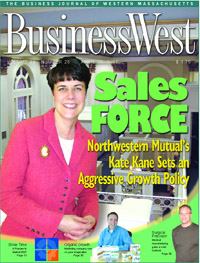
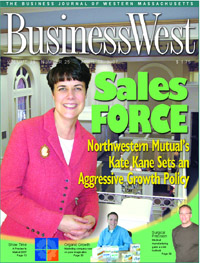
Northwestern Mutual’s Kate Kane Sets an Aggressive Growth Policy
April 16, 2007 Cover

April 16, 2007 Cover

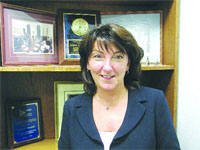
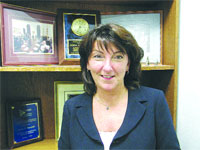
For years, the Northwestern Mutual Financial Network has marketed itself as the “Quiet Company.” It is still that, at least when compared to other giants in this industry, says Kate Kane, who nonetheless plans to make some noise as the new managing director of the company’s Springfield office. She has some ambitious plans for growing that facility and its market share — and possesses a background in talent recruitment and development she believes will help her achieve them.

Kathleen Kane was just looking for something to do between her graduation from Vassar and the projected start of her quest for a doctorate at the University of Chicago, the next step down a path toward a long-planned career teaching English.

That was the thought process as she took a job in 1986 in the Worcester County office of what is now known as the Northwestern Mutual Financial Network. But it only took a few months with the firm for her to adjust her thinking and her career plans and become, in her words, a ‘Northwestern lifer.’

“Ultimately, I decided I would rather be making money than spending more money to become a college professor, which I was no longer sure I wanted to do,” she explained, adding that both her parents were college professors, and early on, she had little doubt she would become an academic. There have been no regrets about not taking that road, she said, describing the academic scene, or the tenure track, as it’s called, as “almost a feudalistic system,” in which time served, and not necessarily performance, are the basis for advancement and reward.

That’s a far cry from the system she now administers as managing director of Northwestern Mutual’s Springfield office, which recently merged with the Hartford facility (more on that later). Here, performance is what matters, and driving agents to reach their top potential (teaching, in plain and simple terms) has been something Kane has been doing for most of her life with the company.

Indeed, after working as an office administrator in Worcester, she was lured to Northwestern’s Springfield office by the man she would eventually succeed, then-Managing Director Paul Steffan, to be his recruiter. The official title would become ‘director of recruitment and training,’ and, later, ‘field director.’

That role involved recruiting, developing, mentoring, coaching, and joint sales work with new agents. She served in it for three years, becoming quite proficient and rather comfortable.

But Steffan, recently promoted to regional vice president for the Midwest Region and now working in Northwestern’s home office in Milwaukee, always had a thing about people becoming too settled.

“He would always say, ‘now that you’re comfortable, let’s see if we can make you uncomfortable and move on to something else,’” Kane recalled. “He would say that someone was either green and growing or ripe and rotting, and he wanted people to keep growing.”

So, at Steffan’s urging, Kane became managing director of the company’s Worcester office, now part of the Boston facility, and quietly grew that branch. But deep down, she desired a return to Springfield, where she had built what she called a “connection,” and seized upon the opportunity to lead the office housed at 1351 Main St. last fall when Steffan moved on and up.

Looking forward — she said she doesn’t waste any time looking back — Kane has ambitious plans to grow the office, in terms of volume and agents. “There’s a lot of room in here,” she said glancing around the former bank headquarters facility now housing the Springfield office. “I can add 10 agents a year for a decade and still not fill the place.”

Securing top talent to fill available office space is obviously Kane’s biggest challenge, but one she approaches with abundant energy and years of experience in both recruiting and training. She approaches her assignment with the philosophy that she’s not looking for people who can merely sell, but individuals who are entrepreneurs in the purest sense of the word.

“And entrepreneurship is hard,” she said, adding that it takes a certain type of individual to succeed in this field. “It takes a special person to bang on doors and talk about things that people just don’t want to talk about.”

Policy Statement

There are a great many things that fall into that category, she continued, starting with life insurance, the product this company and others like it is most associated with, but also such things as long-term care insurance, retirement planning, and other products and realms that are now part of the broad package now offered by Northwestern.

And by Kane’s estimate, probably nine out of 10 individuals — across all income levels — can use help of some kind.

“It’s a common misperception that successful people have their finances all sewn up,” she said. “They don’t … I see it every day. I have many clients who are outwardly very successful. They have a nice house, lots of nice stuff in the house, a very nice income. But when you dig in and look at what they’ve got, where it is, and how it’s doing, nine times out of 10 there’s plenty of room for improvement.

“I have some clients making $500,000 or $700,000 a year and they haven’t paid attention to what they need to pay attention to,” she continued. “They’re living the life, but they’re not thinking about what life in the future is going to look like.”

Helping people realize they need some kind of help, and then effectively providing it, are, in very simplified terms, the keys to success in this industry, said Kane, who was quickly attracted to the business and the life, as she called it, and thus abandoned those plans to teach English Lit.

Instead, she merely went into a different kind of teaching.

Specifically, it was within a company-wide program called RACE — Record Activity, Coach to Expectations — for which she was a coordinator.

“The new reps would come in sit down and talk about how their day before went, what they got accomplished, and what they didn’t get accomplished,” she explained, adding that young agents would often leave her office with steam coming out of their ears. “I would then coach them, or yell at them, about what they did and didn’t accomplish.”

Her RACE work was part of what Kane described as one of the more unusual routes to a managing director’s position with Northwestern — most start and stay in sales — but one she believes has effectively prepared for that role. Elaborating, she said her work as a field director for the Springfield office gave her the direct work in sales that she would need to make the leap to the highly entrepreneurial managing director’s post.

“I knew that if I didn’t take that step and gain that experience, I would never move beyond being someone else’s employee, which I was with Paul, and move into an entrepreneurial role,” she explained, adding that, in effect, managing directors, like top agents, are independent contractors.

Steffan thought she was ready to take that step, and be uncomfortable again, in late 2001. That’s when she was assigned the Worcester County office, in Westboro, a facility that had been doing business since the late 1800s, but was, by most accounts, undeveloped territory.

She managed to achieve some growth there, but when the Springfield managing director’s position became available, she sought a return to that office. Part of the reason was the connection to the business community here — she had served on a number of non-profit groups, including Dress for Success, the Women’s Partnership, the Springfield Mentoring Project, and others — but there was also the entrepreneurial drive that Steffan had helped coax.

“He was good at thinking big for us,” she told BusinessWest, adding that the Springfield office was and is much bigger than Worcester’s and possessed, by her estimation, stronger and more attainable growth potential.

And in the six months she’s been at the helm, she’s been hard at work developing strategies to achieve it.

By the Numbers

Most all of them come back to that art and science known as recruiting, she said, adding that in this business, such activity is constant. “It never ends.”

The reason is because of the difficult nature of the work, she continued, adding that if it was easy everyone would want to do it because the rewards can be considerable.

“But it’s not easy … our type of entrepreneurship is particularly difficult because no one wants to talk about the issues we raise,” she said. “Individuals have to be willing, as I like to tell new reps, to acknowledge that they’ll be constantly dealing with other people’s baggage.

“And you have to learn how to be really good at helping when you can help and leading when you can lead, but also identify when ‘that’s their issue’ and leave it on that side of the table and not get crushed and emotionally battered by that,” she said, adding that sales don’t come easily or quickly, and sometimes they don’t come at all.

Identifying individuals with the personality and talent to handle all this is a challenge for all players in this industry, said Kane, noting that changing demographics, specifically the aging of the Baby Boom generation, is adding additional hurdles. Indeed, the average age of agents in this field is 54, she said, noting that the need to replace top talent prompts many companies to rely on essentially taking it from competitors.

Northwestern, which has a younger demographic (the average age of its agents is 42), is one of the few companies left that will devote the time, money, and energy needed to recruit and development young talent.

“We’ll take green kids and groom them,” said Kane, noting that the company has one of the most extensive, and successful, internship programs in the country.
“That’s our secret weapon,” she said, noting that locally, the program involves UMass-Amherst and Western New England College. By the time individuals graduate, they are licensed to sell and have started a book of business.

The company’s approach is obviously effective, she said, noting that, industry-wide, for every 100 individuals recruited, 11 will be retained five years later. For Northwestern, that number is 20, and 30 when its comes to a field of 100 interns.And as she goes about recruiting and developing her team, Kane says she will take a page or two from Steffan’s playbook, but also adopt some of her own insights into professional development.

“People are their own, unique individual selves, and if you don’t honor that, you’re going to drive them away,” she said. “So it can’t be about making them fit your vision of who they should be; it has to be about helping them discover who it is they want to be and then not letting them be comfortable.”

Both current and future agents should benefit from an office-consolidation initiative ongoing at Northwestern, said Kane, noting that people will often use the word satellite to describe the Springfield office, and also the district offices in Greenfield, which became part of the Albany facility, and the Northampton office, which also became part of West Hartford. But that is a bit of a misnomer.

“That’s the wrong word, because the managing director is an independent, solo practitioner,” she explained, adding that some in the Springfield area mistakenly believe her office lost something in the translation when it was joined with West Hartford. “I make my own decisions, and I can grow this office as big as I want to.”

Agents in all the company’s offices should have healthy markets in which to sell, Kane explained, because the need for such products and services will only continue to grow — even if existing and prospective clients don’t know they need them.

“Our industry is so secure in so many ways because of the fact that people’s need for advice, people’s need for a disembodied but yet still-involved third party to look at what they’re doing and help them make good decisions isn’t going away,” she said. “It’s always going to be there.”

Lessons Learned

Kane never made it to the University of Chicago, or the front of a college classroom.

But in her mind, she’s doing what she thought she’d be doing for a living — teaching. Just not in a feudalistic system.

“I teach every day, I explain things to people every day,” she told BusinessWest. “But I’m doing it in an environment where it is all based on merit, and on what you can accomplish — and here, there is no limit to what you can achieve for yourself.

Especially if you get that needed kick when you start to feel comfortable.

George O’Brien can be reached at[email protected]

Departments

The following Business Certificates and Trade Names were issued or renewed during the month of March 2007.

Agawam

C. J. L. Consulting
74 Glendale Road
Carla J. Lee

Clip Shop I Bargains Etc.
667 Springfield St.
Nancy Gentile

Frankie’s One Stop
91 Ramah Circle
Gianfranco Sciroccoo

Mass-Conn Inspections
99 Hendom Dr.
Sean Provost

Westfield Bank
655 Main St.
Westfield Savings Bank

Amherst

A Taste of Brooklyn
233 North Pleasant St.
Edna Richardson

Bresnahan Insurance Agency
231 Triangle St.
Terence Bresnahan

Chicopee

Custom Embroidery and Digitizing
1092 James St.
Nancy J. Perman

Dand L Home Improvement
16 Ducharme Ave.
Ralph E. Lussier

Monro Muffler Brake
461 Memorial Dr.
Mark Avery

Seibold Homes
75 Marble Ave.
Brian Seibold

Easthampton

Authentic Polish Pottery
68 Holyoke St.
Nora Bernier

Extreme Cleaning
27 Maple St.
Doug Beyer

Mt. Tom Soaps
5 Arthur St.
Cynthia Chamberland

Waxwing Design
59 Knipfer Ave.
Amy Bowes

Wheelchair & Senior Taxi
44 West St.
Bruce Cousineau

East Longmeadow

Money Management Associates
44 Harkness Ave.
Armand Arce

Villa Calabrese Inc.
162 Shaker Road
Antonio Fazio

Greenfield

Blue Blade Music
8 Prospect Ave.
Jeffrey Foucault

Flair for Hair
30 Chapman St.
Judith Ann Carter

Julia Grace Photography
60 Devens St.
Julia Grace Johns

Movie Gallery
68 Mohawk Trail
Lisa Carcione

Renfrew Real Estate
68 Mohawk Trail
Susan Renfrew

Second Chance
27 Chapman St.
Charlette Morin

The Arbors @ Greenfield
15 Meridian St.
Greenfield Assisted Living Limited Partnership

Hadley

Benjamin Zahradnik Systems
245 Russell St.
Benjamin Zahradnik

RCI Electric
1 Laurana Lane
Paul R. Miller

Secure Transportation
215 Russell St.
Norman Labonte

Holyoke

Techiemon
160 Suffolk St.
John Hanson

Theo Fadel Studio
95 St. James Ave.
Theodora Fadel

TNT Pizza
548 South St.
Anthony Favata

Who’s Next
273 Main St.
Eric Nieves

Longmeadow

Rick Forgay Leadership Institute
P.O. Box 60561
Richard E. Forgay II

RJB Real Estate
140 Hilltop Road
Richard J. Bellicchi

Tatyana Zak Apparel Group Inc.
226 Franklin Road
Tatyana Glukhovsky

Ludlow

East St. Variety
248 East St.
Lack Shah

Pioneer Realty
733 Chapin St.
Paul Miele

Turkish Soccer Club
305 East St.
Ahmet Citlak

Northampton

Custom Designs & Renovations
296 Turkey Hill Road
Tracy Sanyo


Exceptional Arts
213 Main St.
Bashir Ahamed

Pine St. Publishing
10 Pine St.
Fred Contrada

Sweeties Fine Chocolate
68 Main St.
Charles Burke

The Power Years
549 North Farm Road
Athleen Zimmerman

Palmer

The Concierge
90 Ware St.
Peter Gauthier

South Hadley

Dan Daniels & Your No Good Buddies
525 Hadley St.
Daniel Daniels

JZ Hair
491 Granby Road
Julie Zacharewicz

JustRight Masonry
582 Amherst Road
Gary Brissette

Solidarity for Families & Children’s Rights
7 Kendrick St.
Seth Diamond

Western Mass Cleaning Services
37 Lawn St.
Debra A. Kelly

Southwick

Clipshop Bargains Etc.
6 Judy Lane
Nancy Gentile

Sharon’s Errands
26 Granville Road
Sharon Tetreault

Springfield

B & A Produce Company
930 Bay St.
Loretta A Arillotta

Banks Carpet Cleaning
1129 St. James Ave.
Michael Sebastian

Cristianos Production
Wrentham Road
Emilio Pomales

Designs By Debi
77 Johnson St.
Debra A. Cappucci

Ed Pallets
44 Verge St.
Edwin Quinones

Ellary Associates
935 Main St.
Gary M. Heller

Gonzalez General Contract
100 Benton St.
Luis Gonzalez

Helpful Hands
35 Talmadge Dr.
Donna M. Waters

I Am Productions
18 Forest Park Ave.
Shariff Raheem Butler

Jack Casey’s Painting
5 Manor Court
Jack Casey

Journeys 1280
1655 Boston Road, SP 149
Michael Canterbury

K D Trucking
32 Clantoy St.
Kelvinson Ramon Duran

LaVallee Floors
221 Laurelton St.
Keith A. LaVallee

Mulberry Real Estate Group
40 Audubon St.
Jason Scott Donaldson

Sr. Productions
195 Worthington St.
Sergio Reodriguez

The Image Makers II
614 Carew St.
Malaquias Cortorreal

Tropical Food Mart
343 Wilbraham Road
Antonio Jimenez

West Springfield

ATC Systems
150 Grandview Ave.
Joseph Conti Jr.

Inter-Technologies, INC
451 Dewey St.
Yury Pshenichny

SGM Entertainment
74 Bosworth St.
Joseph Ross Jr.

The Super Washing Well Laundry
1126 Union St.
David Cortis

Westfield

Dena’s Petlane Products
64 Kane Brothers Circle
Dena Cavallon

Four Seasons Home Improvement
9 Spring St.
Michael J. Soto

Kirby of Western Massachusetts/DBA Saunders Distribution
108 Elm St.
Cynthia Saunders

North American Paper, Co.
61 Union St.
Robert Snyder

Stop & Go
35 Mill St.
Umair S. Farooqui

Swayger Plumbing and Heating
18 Llewellyn Dr.
Michael Swayger

Ticket Express
163 Barbara St.
Alan Metcalf

Opinion
Health Care Costs are Everyone’s Concern

Suddenly, everyone is concerned about the cost of health insurance. Massachusetts municipalities are raising taxes, cutting services, and even contemplating bankruptcy because of the cost of employees’ coverage. The Commonwealth’s financial reports must soon reflect a $13 billion item for retiree health benefits, hitherto left off the books. Non-profit agencies are realizing that the new health insurance mandate applies to their employees, too. The state’s Health Care Connector Board is struggling to devise an ‘affordable’ health plan, in the face of protests about cost from future customers.

To which those in the business community can only say: “Welcome aboard.”

Employer-sponsored health insurance covers almost three-quarters of the non-elderly population of Massachusetts, and the rapid rise in insurance costs — at a rate that outpaces general inflation by a 3-to-1 margin, averaging 8.6% annually — has long been a principal issue for business owners. The high cost of health insurance, currently averaging $4,147 per year for individual coverage and $11,504 for a family plan, threatens the survival of ‘legacy’ companies (think of the automobile and airline industries) and is a major deterrent to the creation of new industries and jobs, particularly lower-skilled and entry-level positions.

If Massachusetts is serious about leading the nation on health care reform, we must expend as much effort on decreasing cost as on increasing access. The state’s new health insurance law does not take on costs directly, but by extending insurance coverage to every citizen it lays important groundwork for further steps. The individual mandate and concomitant employer responsibilities should eliminate “free riders” from the system, those who can afford health insurance but choose to go without. Fairer funding of free care provided by hospitals will reduce cost shifting and improve transparency. The anomalous tax treatment of health insurance is partially addressed. And, as we are seeing, the new law is giving the cost issue more public visibility.

It is a real, serious issue, and it is an issue for everyone. Those 8.6% average increases, with spurts into double digits, play havoc with the budgets of cities, states, non-profits, and households, as well as the budgets of businesses. There are things we ought not do to control cost, such as rationing — but there are things we can do, ranging from developing a rational health care delivery system with properly aligned incentives, transparency, and electronic medical records to tiered networks which encourage consumers to seek medical care in the most cost-effective settings.

At the Associated Industries of Massachusetts, where virtually all of our members provide the benefit, health care costs have been the number-one concern over the past 15 years. We are convening a group of the state’s leading employers to focus on cost containment, and we look forward to working with health care providers, hospitals, doctors, nurses, pharmaceutical companies, medical device companies, insurers, public officials, and fellow employers toward finding solutions. Failure to get this issue resolved has serious consequences, not just for the recently passed law, but also for our economic future and the well-being of our Commonwealth.

Thomas Wroe Jr. is chairman of the Associated Industries of Massachusetts, and chief executive officer of Sensata Technologies Inc. in Attleboro.

Departments

The following business incorporations were recently recorded in Franklin, Hampden, and Hampshire counties and are the latest available. They are listed by community.

AGAWAM

Chase Enterprises Corp., 590 Meadow St., Agawam 01101. Donald R. Chase, 39 Timber Ridge, West Springfield 01089. Real estate holding.

Easterntronics Inc., 312 Springfield St., Agawam 01001. Dang Huynh, 166 Hancock St., Springfield 01009. Electronics repair and sales.

V&R Photography Designs Inc., 55 Rosie Lane, Agawam 01001. Vanessa Rossini, same. Wedding, special event, and portrait photography.

XLSpan Inc., 318 Leonard St., Agawam 01001. Benjamin N. Koenig, 32 West Main St., Westborough 01581. To offer telecommunications services to the commercial and residential markets.

CHICOPEE

BF Inc., 1271 Memorial Dr., Chicopee 01020. Frank Brooks, 282 Narragansett Blvd., Chicopee 01013. To sell a full line of shipping and packaging services.

Gary’s Auto Sales Inc., 125 Broadway, Chicopee 01020. Gary A. Lopuk, same. Purchase and sale of automobiles.

FLORENCE

O-Live Foundation Inc., 680 North Farms Road, Florence 01062. Steve Frank, same. (Nonprofit) To fund research leading to the prevention and cure of genetic cancers, etc.

GRANVILLE

Stopa Roofing Inc., 99 Reagan Road, Granville 01034. Travis Stopa, same. Roofing construction on homes.

GREENFIELD

Friends of the New England Peace Pagoda Inc., 98 Conway St., Suite 1, Greenfield 01301. Robert Lowry, 8 North Leverett Road, Leverett 01054. (Nonprofit) To help strengthen former community relationships and create new relationships toward building knowledge, understanding and support of Nipponzan Mychaji, Buddhist Religious Society-New England Sangha and the Peace Pagoda in Leverett, etc.

Tallk Inc., 23 Woodland Dr., P.O. Box 90, Greenfield 01302. Lisa M. Kovalski, same. To conduct a restaurant business.

HOLYOKE

JRE Masonry & Restoration Inc., 87 Pearl St., Holyoke 01040. Jerome Robert Ezold, same. Construction.

HAMPDEN

E-Scrap Removal and Recycling Inc., 42 North Monson Road, Hampden 01036. Chris Lomascolo, same. Recycling electric components.

HOLYOKE

Igl.Casa de Restauracion Levantando Al Caido (House of RestorationLifting TheFalling Inc. Luis A. Cortes, 70 David St., Holyoke 01040. (Nonprofit) To provide civic, social, and educational welfare for people in need of supportive services, etc.

HOLLAND

The Wicket Grounds Inc., 1043 Burt Hill Road, Holland 01034. Joseph Clark, III, same. To promote recreational and historical activities and property management, The Wicket Grounds Croquet Club and Rifle Range, airsoft military simulation games, and military reenactments.

HUNTINGTON

Word Alive Christian Fellowship Inc., 75 Worthington Road, Huntington 01050. Reverend Jeffrey Dean Adkins, same. (Nonprofit) To foster acts of charity, fellowship and other religious, educational, social and recreational activities as would enrich the lives of its members, etc.


LONGMEADOW

Character for Kids — Team Kids Inc., 96 Redfern Dr., Longmeadow 01106. Deborah S. Han, same. (Nonprofit) To promote, supervise the interest of the public in martial arts, etc.

LUDLOW

DeMone Electrical Inc., 39 Sawmill Road, Ludlow 01056. Gregory G. DeMone, same. To perform electrical installation, repairs services, etc.

MONTGOMERY

Sinigur Concrete Pumping Inc., 37 Main Road, Montgomery 01085. Victor Sinigur, same. To pump concrete.

MONSON

Viewsource Technogies Inc., 139 McBride Road, Monson 01057. Steven Curtis Howland, same. Internet services.

ORANGE

Athol-Orange Lodge #1837, Benevolent and Protective Order of Elks of the United States of America Inc., 92 New Athol Road, Orange 01364. Clyde Woodbury, 581 Barre Road, Templeton 01468. (Nonprofit) To inculcate the principles of Charity, Justice, Brotherly Love, and Fidelity, enhance the welfare of its members, etc.

SOUTH HADLEY

Legrandice Audio Inc., 8 Roundelay Road, South Hadley 01075. James Carl Legrand, same. On location/studio audio recording.

SOUTHWICK

Bill’T Well MFG Inc., 23 Hudson Dr., Southwick 01077. William H. Vredenburg, same. Machine shop.

Gogri Family Inc., 3 Robin Road, Southwick 01077. Hasmukh Gogri, same. To sell food and fuel at retail.

SPRINGFIELD

Charter Oak Insurance and Financial Services Co., 1500 Main St., Suite 1200, Springfield 01115. Peter S. Novak, 168 Colony Road, Longmeadow 01106. Insurance producer.

Everyday Electronics Inc., 75 Pilgrim Road, Springfield 01118. Kathryn Elizabeth Chianciola, same. Electronic sales.

Financial Answers Inc., 119 Maplewood Terrace, Springfield 01108. Charmaine White, same. Real estate investment, management and financial consulting.

Leahy & Brown Insurance & Realty Inc., 535 Allen St., Suite 1, Springfield 01118. Joseph P. Leahy, Jr., 83 Barrett St., Northampton 01060. Insurance agency and real estate broker.

New England Labsystems and Mobility Inc., 38 Van Buren Ave., Springfield 01104. Fritz Bosquet, same. Medical supplies and service.

SUNDERLAND

That’s My Carpenter Inc., 52 Kulessa Crossroad, Sunderland. Bruce Rondeau, same. Carpentry and construction.

WARE

Heat Pro Inc., 133 Greenwich Road, Ware 01082. Peter D. Harper, same. To provide heating and cooling services to the general public, etc.

WILBRAHAM

J & V Company Inc., 420 Monson Road, Wilbraham 01095. Metyu Chen, same. Restaurant and retailing business.

Opinion

Take in a public hearing on tax-rate classification in any local city with a split rate, and you will likely hear some long-time resident rise out of his or her chair and say, “raise the taxes for businesses … they can afford it.” Or something to that effect.

This is an attitude that also seems to prevail among many local office holders — who often have only the local chamber of commerce to offer a differing opinion and thousands of voting homeowners filling their ears — not to mention many in the Statehouse. They won’t use that language, or anything approximating it, but their actions often convey that basic belief.

This is part of the reason why ‘Taxachusetts’ came to be part of the lexicon, and we fear there may be good reason to start hearing it again after many years in which it didn’t apply as much as it has historically. It’s not one big thing that is causing alarm bells to start ringing, but lots of little things that, together, could add up to something big and troublesome.

The latest was Gov. Deval Patrick’s proposed changes that would ultimately raise the income tax burden paid by businesses by some $500 million a year. He calls it “closing loopholes,” but it amounts to a tax hike. The bottom line is that, if these proposals become reality, businesses will have additional expenses, and they will have to recover them through higher prices, smaller raises and reduced benefits for employees, or other steps.

That is the basic math, and it really can’t be argued.

But there’s more to this than adding a few cents to the cost of a loaf of bread or a microchip, increases that most consumers won’t notice and certainly won’t attribute to a governor closing tax loopholes. Indeed, if the small additions to the cost of doing business in this state keep coming, then eventually, companies will start going — to other states that have a more realistic take on how much businesses can afford.

Patrick’s initial response to early criticism of his tax proposals from the Greater Boston Chamber of Commerce is to say that it is a minor increase in the overall corporate income tax burden, 4% by his administration’s estimates. He’s right, but he’s missing the larger point — that this hike comes on top of a larger loophole-closing tax-burden increase implemented by a Romney administration that, by and large, did little if anything to improve the business climate in this state, and, in fact, made it worse.

During his tenure, companies doing business in the Bay State were visited by increases in unemployment insurance levies and a new health care insurance program that will add tens of millions of dollars in additional burden for the business community. Add up all these small paper cuts, and it could amount to a fairly substantial wound, one that might give business owners thinking about coming to Massachusetts or expanding here some good reasons not to.

Like Romney before him, Patrick is faced with a difficult budget situation and choices to make about how to address it. And Romney, like most politicians, to be fair, veered away from the hard choices and chose those that were easier and more politically correct — like closing tax loopholes for businesses that, as everyone knows, can afford it.

But, also like Romney, Patrick was swept into office on the wings of rhetoric to the effect that he would strive to make the Commonwealth a more attractive place in which to do business, something that needs to be done in a state where job growth has been anemic, at best, since those robust times before 9/11.

A small increase in the income tax burden, by itself, is not a huge deal, but, when put in the context of other steps taken lately, it is another sign that the pendulum is swinging in the wrong direction.

Like that homeowner at the tax classification public hearing, the governor and all those on Beacon Hill should understand that there are limits to what businesses can afford — and this state simply cannot afford to ignore that.

Sections Supplements
Chicopee Electric Light Partners with HG&E to Offer Fiber Optic Internet Service
Jeffrey Cady

Jeffrey Cady, general manager of Chicopee Electric Light, said fiber-optic Internet access in Chicopee is expected to create a new revenue stream.

Through a unique collaboration, Chicopee Electric Light (CEL) and Holyoke Gas and Electric (HG&E) are now offering fiber optic Internet connections and network services to commercial and industrial customers in Chicopee.

Jeffrey Cady, general manager at CEL, explained that a 30-mile fiber-optic backbone was installed in 2001 in Chicopee, with the goal of linking the city’s municipal buildings, including the police and fire departments at the Public Safety Complex and the Health Department, for increased productivity and reliability.

“The purpose was to link our facilities together to improve efficiency, which we felt was important for the community overall,” said Cady. “At that time, we bought and installed additional fiber, with the idea that we could lease that extra cable to generate potential revenue.”

Fiber optic systems, where available, are often deemed superior to cable modem, T1, or DSL technology in that they provide a direct line connection from host servers to a customer’s site, with no sharing of data and no competition for bandwidth. The connection’s speed is often faster through fiber optic lines, and more cost effective than other fast, reliable connections such as T-3 lines.

Cady said the last of the city’s buildings and departments were linked through the new system last year (the last to go online was the town’s landfill), and CEL was able to turn its attention to the additional cabling and what could be done with it.

“We started talking about what to do with the surplus cabling and about putting a structure together at the end of last summer,” he said, “and our first customer went online in January.”

HG&E has served as an Internet service provider since 1997 through its telecommunications arm, HGE.net. It has constructed one of the most advanced self-healing fiber optic rings in the Commonwealth, extending from Holyoke into Chicopee and to downtown Springfield, at the Tower Square and Monarch Place office towers.

The network has a redundant design which guards against interruptions, and it has also passed several quality and confidentiality audits, meeting or exceeding the standards set forth by the FDIC and HIPAA, the Health Insurance Portability and Accountability Act.

Jim Lavelle, general manager of HG&E, said HGE.net’s fiber optic services are currently being used through a similar agreement in Westfield, and he’d like to see such services extend further into other area towns and cities in the coming years.

He added that the new partnership in Chicopee stems from existing alliances between the Holyoke utility company and Chicopee Electric Light, which creates a natural avenue for gradually adding new and developing services.

“It first came about primarily because of our longstanding utility relationship with Chicopee Electric,” he said, echoing Cady’s sentiment that the partnership made sense for both parties. “This was a logical extension of existing collaborative efforts, and an opportunity to take advantage of excess fiber.

“The drivers for such collaborations have always been to improve service and reduce price for customers,” added Lavelle, “and this new partnership falls right in line with those efforts.”

The initiative will not expend city dollars, but it is expected to generate between $150,000 and $300,000 in revenues for Chicopee.

Cady said that, essentially, Chicopee will be leveraging Holyoke’s existing expertise to benefit its own business customers through the agreement.

“It makes more sense,” he said. “Holyoke has very high reliability, and that will support the economic development aspect of fiber optic Internet networking services in Chicopee.”

Through the partnership, fiber optic customers with multiple locations in Chicopee will also be able to link to each other within the network area of Holyoke, Chicopee, and downtown Springfield, and outside of that network footprint, customers will have the option of linking to branch offices through other types of Internet connections (T1 or T1 copper lines) anywhere in the 413 area code.

In addition, a company may place servers at HGE.net’s central office location, to take advantage of its climate-controlled facility and back-up power generators, and can opt for dial-up services for remote employees as part of the total package.

Customers who choose to purchase a fiber optic Internet connection will be connected to the existing ring in Chicopee via a portion of cabling that has been leased to HG&E, which in turn will provide sales, marketing, customer service, and billing support directly to the customer through HGE.net.

Pricing starts at just under $200 a month, and services can include hosted E-mail service and disk storage space for hosting a company Web site.

Cady said CEL and HGE.net are now ramping up their marketing efforts to promote the service in Chicopee.

“We’re really trying to get as many customers as possible,” said Cady. “Another benefit of fiber optic is we can always expand the network, so there’s no cap on how many customers we can serve.”

Departments

Ware-Based Bank Changes Name and Builds New Branch

` WARE — Ware Co-operative Bank is changing its name to FamilyFirst Bank, in a move that the institution’s president believes is necessary to reflect a new focus and commitment. “We did not come to this decision lightly,” said Gail A. Piatek. “Although we think fondly of Ware Co-operative and all that it represents, we want to let the community know where our main interests are, and we think our name says it best.” Piatek said the bank researched a number of options and interviewed customers before making the change. “Then, we decided to bring to the forefront what has been most important to our customers for years, the way we respect and treat them like family. We also recognize that our customers’ families are the most important aspect of their lives, so the new name reflects that.” In addition to the name change, FamilyFirst is building a new full-service branch office in East Brookfield this year. This new branch will add a presence to a third county, as currently the Ware branch is in Hampshire, the Three Rivers branch is in Hampden, and now the East Brookfield branch will be in Worcester County. That was another reason for the bank’s name change; it wanted people in the Brookfields to relate to their new bank in a meaningful way.

MassMutual Donates 100 Computers to STCC

SPRINGFIELD — One hundred Springfield Technical Community College (STCC) students will be receiving free computers through a donation from MassMutual. The computers will be accepted by the STCC Foundation and then refurbished by STCC students to be given to other students. “MassMutual has long felt that the biggest impact we can have on the community is through education,” said Ron Copes, corporate vice president, Strategic Communications and Community Responsibility, MassMutual. “We are pleased to have the opportunity to donate these computers and hope they will come in useful for STCC students in their educational endeavors.” This pilot program at STCC will accept donated computers and load them with free open source software, a Linux-based system called Ubuntu. Four STCC computer students — Mark Musante of Palmer, Eric Reynolds of West Springfield, Lance Cargill of East Longmeadow, and Rhea Scruggs of Springfield — will load the new operating system and software under the supervision of Computer Information Technologies instructor Stanley Jamrog. The computers will be given to STCC students who would not be able to purchase one on their own. Through a campus-wide application process, which includes a brief essay, students will be able to apply for one of the free computers. The computers will be given out throughout the semester, as they are made ready.

Easthampton Savings Has Strong Fourth Quarter

EASTHAMPTON — Easthampton Savings Bank has reported “exceptional growth” in assets, deposits, loans and capital in the fourth quarter, according to William S. Hogan, Jr., President and CEO. The bank’s total assets have grown to $702 million, an increase of 5%. Hogan also noted that the bank’s total loans increased 6% to $28 million, with total loans now at more than $523 million. In addition, the bank’s deposit growth was up $20 million for the year — an increase of 4%. Total deposits now stand at more than $534 million.

Progressive Enters State Market

CHICOPEE — Progressive Insurance Company has formally entered the Massachusetts commercial automobile insurance market with 35 independent insurance agencies to serve as exclusive representatives for the company. In other states, Progressive also sells direct to business, but in Massachusetts has opted to operate entirely through a limited group of agents located in the state. First American Insurance Agency in Chicopee has confirmed it has been selected to represent Progressive. Corey Murphy, vice president, First American Insurance Agency, said the appointment of his agency was a result of an extended review process between the two organizations. He said he is confident that Progressive’s successful ‘Drive’ commercial auto insurance program will provide commercial vehicle owners with competitive choices. The ‘Drive’ program is noted for its low pricing and superior coverage options, according to Murphy. Murphy added that more than 500,000 commercial customers already are Progressive Drive customers, and he anticipates many state businesses owning commercial vehicles to be likely candidates for the new program.

Berkshire Bank Opens Branch in NY

PITTSFIELD — Berkshire Hills Bancorp Inc. recently opened its second full-service branch in Guilderland, N.Y. This is also the second branch opened in the Capital Region, with two more planned to open in Glenville and Colonie in the coming weeks. Berkshire Hills Bancorp is the holding company for Berkshire Bank. In other company news, Berkshire Hills Bancorp reported a 37% increase in net income to $11.3 million in 2006 from $8.2 million in 2005. Earnings growth included the benefit of organic growth and expansion, along with the acquisition of Woronoco Bancorp in June 2005. For the fourth quarter, the company reported 2006 core income of $4.2 million, compared to $4.6 million in 2005. This decrease was due to additional after-tax costs of the de novo branch program and seasonal losses on newly acquired insurance operations. The Board of Directors declared a quarterly cash dividend of $0.14 per share, payable on Feb. 22, 2007, to stockholders of record at the close of business on Feb. 8.

Spalding Produces Official ABA Basketball

SPRINGFIELD — The American Basketball Association Inc. (ABA) has selected Spalding to produce the famous red, white, and blue basketball used by the ABA in all official games. Joe Newman, ABA’s CEO, noted that the new Spalding ball was introduced at the recent ABA All-Star Game in Halifax, Nova Scotia. Newman added that the league intends to offer several variations of the ball — from the official ball, to replicas, to an outside rubber ball.

Hampden Bancorp Inc. Completes Stock Offering, Conversion

SPRINGFIELD — Hampden Bancorp Inc. recently completed the conversion of the holding company structure of Hampden Bank from mutual to stock form and the related stock offering at the maximum offering amount, as adjusted, according to Thomas R. Burton, President. In completing the conversion and stock offering, Hampden Bancorp Inc. sold 7,571,313 shares of common stock to eligible account holders of Hampden Bank and to the Hampden Bank Employee Stock Ownership Plan at a price of $10 per share. The offering was oversubscribed by Hampden Bank depositors as of April 30, 2005, the first priority category. As a result, 6,935,323 shares will be allocated to them based on their deposits as of April 30, 2005, and the Hampden Bank Employee Stock Ownership Plan will be allocated 635,990 shares as provided in the amended and restated plan of conversion. Additionally, as part of the conversion, Hampden Bancorp Inc. will contribute 378,566 shares ($3.8 million based on the $10 offering price) to establish the Hampden Bank Charitable Foundation, a new charitable foundation that will make grants in markets in which Hampden Bank has offices. After the conversion and offering, Hampden Bancorp will have 7,949,879 shares outstanding. Shares of Hampden Bancorp Inc.’s common stock are on the NASDAQ Global Market under the symbol “HBNK.”

Louis W. Doherty Scholarship Created

SPRINGFIELD — A scholarship in the name of the late Attorney Louis W. Doherty, one of the founders of Doherty, Wallace, Pillsbury & Murphy, P.C., has been established by his sons, James and Paul Doherty, at Mass. Continuing Legal Education (MCLE) in Boston. The scholarship will support the mission of MCLE to provide specialized professional training for attorneys providing services to low- and moderate-income clients. MCLE’s scholarship program, which the new Doherty Scholarship will benefit, helps make it possible for hundreds of the state’s vulnerable residents to receive the legal services they need. Doherty graduated from Harvard Law School in 1922, returning to Springfield to practice law. In 1967, he joined colleagues from Harvard to found the general practice, Doherty, Wallace, Pillsbury and Murphy. He served in World War I and was also chair of the World War II bond effort in Springfield. He also served on a variety of local organizations in his lifetime. Doherty’s granddaughter, Attorney Brenda S. Doherty, is a business and tax associate at the firm.

MassMutual Receives Humanitarian Award

SPRINGFIELD — The American Red Cross recently presented its Circle of Humanitarians Award to Stuart H. Reese, chairman, president and chief executive officer, of MassMutual. The award is presented to only the most philanthropic corporations to acknowledge their outstanding support of the American Red Cross, nationally, regionally, and locally. MassMutual was recognized for its leadership in supporting the Hurricane Katrina relief efforts, as well as support of the local Pioneer Valley chapter during the busy fire season. Specifically, MassMutual’s combined corporate, individual/employee, and employee matching funds efforts for Hurricane Katrina efforts totaled $800,000.

Tighe & Bond Announces New Scholarship

WESTFIELD — Tighe & Bond has announced the creation of the Philip W. Sheridan Scholarship in honor of the firm’s past president. The scholarship will provide financial assistance to a Hampden or Hampshire County high school graduate pursuing a career in civil engineering or a related field. Under Sheridan’s leadership, the firm grew from 10 employees in the 1960s to more than 130 in the ’90s. During his tenure, Sheridan planned, designed, and oversaw the construction of many Hampden and Hampshire County public water supply wells, reservoirs and storage tanks; water distribution systems; sewer systems and pump stations, and water and wastewater treatment plants. Retiring in 1995, Sheridan currently resides in Holyoke. For more information on the scholarship, visit www.tighebond.com.

Departments

Joel Morse has joined Marcus Printing in Holyoke as Sales and Marketing Manager. He will be in charge of all sales and marketing functions for the third-generation commercial printing company.

•••••


Carole Parlengas

United Personnel Services Inc. in Springfield has promoted Carole Parlengas to Vice President/Chief Financial Officer. She joined the firm last year as the Chief Financial Officer.


•••••

The Western Mass. Pharmacists Assoc. announced the following officers and directors for 2007:
Officers are:
• H. John Mailhot, President;
• Eugene Cantor, Vice President;
• Robert Castelli, Recording Secretary;
• Norman Halperin, Treasurer;
• George J. Couchiaftis, Corresponding/Financial Secretary, and
• Stanley Derezinski, Sergeant-at-Arms.
Directors are: John Canninc, Robert Dobeck, Richard Garvin, Daniel Hayes, Christine Masciardelli, Clark Matthews, and Andrea Reid.

•••••

Walter E. Drenen of Drenen Financial Services Inc. in Southwick has been accepted into the National Assoc. of Enrolled Agents.

•••••

Amy Pinney has joined Carlson GMAC Real Estate’s Westfield office as a Sales Agent.

•••••

Sarah Kelley has joined the Northampton office of Countrywide Home Loans Inc. as a Home Loan Consultant.

•••••

Ilkwan Kim has joined Keller Williams Realty and will work at its Longmeadow Market Center office.

•••••

James Goodwin has been named President and Chief Executive Officer of the Center for Human Development Inc. Goodwin joined the organization in 1980 and most recently served as interim president.

•••••

Ida Tassinari has joined Park Square Realty in Westfield and will work out of its Feeding Hills office as a Sales Associate.

•••••

Michael M. Lefebvre has been promoted to Senior Vice President in the Commercial Lending Division at TD Banknorth Massachusetts in Springfield.

•••••


Tonya Plante has become a Sales Associate in the Agawam office of Carlson GMAC Real Estate.

•••••

Amy S. Leitl has joined Phillips Insurance Agency Inc. as head of the Life & Benefits Division.

•••••

The region’s largest local union of U.S. Postal Service Letter Carriers has elected officers for a three-year term as follows:
• Tina M. Richard, President;
• Michael Harazmus, Vice President;
• Richard Micelotta, Upper Valley Vice President;
• David Lamontagne, Secretary;
• Patricia Rogers, Treasurer;
• Chris Burrage, Health Benefits/MBA Representative;
• Laura Parenteau, Trustee;
• James Graham, Trustee;
• Bonita Berselli, Trustee, and
• William Gelinas, Sergeant-at-Arms.
Twenty-five stewards were also chosen in the recent election.

•••••

Tom Martucci has been appointed Vice President for the Momentum Group. He will provide business development, marketing and product development programs.

•••••

Marie Phillips has been named Human Resources Director at the Elms College, Chicopee.

•••••

Hampden Bank has announced that Glenn S. Welch has been named Executive Vice President. In this new position, Welch will oversee all of the organization’s lending and retail functions.

•••••

Human Resources Unlimited has appointed Debra Marvell as Program Director.

•••••

Vicky Applebee has joined Mass Match as its Director of Marketing and Sales. She is trained as a certified matchmaker from the Matchmaking Institute and is a member of the National Board of Certified Matchmakers.

•••••

Victoria A. White has announced that her Northampton-based Internet services business, eclecTechs, will be managed by David Flaherty, owner of Springfield-based Ashton Services. eclecTechs will retain its name, staff, services and product line.

•••••

Brenda Cuoco of the Wilbraham Coldwell Banker Residential Brokerage has achieved the International Sterling Society Award for 2006. Cuoco earned more than $6 million in sales with 30 homes sold. She has also placed 52 out of 1,845 realtors in the Realtor Association of Pioneer Valley.

Sections Supplements

If your business relies upon and operates commercial vehicles to get your work done, then the expense of keeping those vehicles on the road is probably a significant cost center for your company. But how much do you really know about the factors that impact the cost of your business automobile insurance?

A better understanding of what insurance underwriters look at in determining your premium can lead to lower insurance costs. Even more importantly, you can be confident that your policy is rated to accurately reflect your actual exposures, and therefore provides proper protection for your business.

An insurance underwriter generally relies upon the answers to the following questions when pricing business automobile insurance: What do you drive? Where do you drive? How do you drive? And Who are your drivers? How these questions are answered can have a significant impact on driving down your insurance costs.

The question of ‘what do you drive’ not only considers the physical characteristics of the vehicle, but how you use the vehicle and what is driven in or on the vehicle. Vehicles are first classified by their GVW, or gross vehicle weight. GVW is usually assigned to a vehicle by its manufacturer and simply translates into the weight of the vehicle when empty, plus the maximum load it is capable of carrying. Vehicles used to transport people for hire are classified not by their GVW, but rather by their seating capacity. A general rule of thumb is that the higher the GVW or seating capacity, the more it will cost to insure said vehicle.

Vehicles are next classified by their predominant use within your business. The standard classes include private-passenger types, service, retail, and commercial. A car that is driven by a salesperson to sell and service clients is a good example of a private-passenger type. A vehicle that is used to transport tools, equipment, and supplies to and from a job site or workplace, or used to service your business, is an example of a service auto.

Any auto used to pick up or deliver property to individual homes or businesses is an example of the retail class. Autos used to transport goods or people are classified as commercial, with further classification, depending upon what they carry, into either ‘truckers’ or ‘public auto classes.’

The question of ‘where do you drive?’ is answered by your operating radius, measured as the crow flies. Your radius typically originates from your vehicle’s principal place of garaging, but in some cases more weight is given to where your vehicles are customarily operated. For instance, if your vehicles are garaged in Chicopee, but spend most of the day traveling within Boston, you may find your vehicles assigned to the Boston territory, a much higher-rated territory than Chicopee.

Private-passenger vehicles typically have no radius restrictions. All other vehicle classes are assigned to either local (50 miles or less), intermediate (51 to 200 miles), or long-distance (over 200 miles). While one might think that long distance vehicles are the most expensive to insure, that is not always the case. In some instances, long-distance rates can be very advantageous.

The question of ‘how do you drive?’ is answered by reviewing the loss experience for your fleet. Businesses with few or no losses will receive better rates than those with poor loss experience. Typically businesses with five or more vehicles (power units) will be subject to experience rating. A modification formula compares your actual losses to the expected losses of a similar-type business, or industry standard. To the extent that your company’s experience is better than what is expected, you receive a credit. Conversely, if your experience exceeds the norm, your premium will be debited. If your policy is subject to experience rating, it is very important that you request a copy of the rating to ensure that it is accurate. Your local independent insurance agent can help you identify potential errors. Inaccurate calculations can cost your business plenty.

Finally, ‘who your drivers are’ can significantly impact your premium. Pay close attention to your driver selection. A written driver qualification program is a simple, yet very effective way to manage who is allowed to operate your vehicles. Select only the most qualified applicants for positions, and then ensure that your drivers remain eligible to operate your vehicles. A qualified driver is someone who obviously has a valid driver’s license and a clean driving record. If an applicant has a history of speeding, accidents, license revocations, or worse, it may be just too expensive for your business to risk having them on the road, driving up your insurance costs.

David Matosky is operations director of Chicopee-based First American Insurance Agency Inc.;www.faiagency.com

Departments

Peter Pan and Affiliates Launch Initiative

SPRINGFIELD — After months of planning and development, Peter Pan Bus Lines Inc. and its affiliates Bonanza and Arrow Bus Lines (collectively referred to as “Peter Pan”) have installed global positioning system (GPS) devices that will help the company reduce the greenhouse gas emissions from its motorcoach fleet. Peter Pan is the first inter-city bus carrier to install GPS devices in all of its 288 buses in its fleet serving the northeast corridor that stretches from Boston through Washington, D.C. Peter Pan has developed customized GPS hardware and software giving managers real-time data on the operation of each vehicle in service, allowing them to inform drivers when excessive idling is occurring with a vehicle. The cutting-edge technology will have the impact of limiting the amount of idling time and reducing greenhouse gas emissions substantially. Additionally, reduced idling time will reduce Peter Pan’s fuel consumption. The company also announced it is in the process of installing engine filters that will prevent releases of oil that could impact storm water, and to collect additional greenhouse gases produced during the operation of its motorcoaches, as part of a settlement with the United States Environmental Protection Agency. In a related move, Peter Pan has established an environmental compliance and safety team to ensure that the company is in compliance or exceeding all federal, state and local environmental law and regulations.

OMG Acquires Roofing Business

AGAWAM — OMG Inc. recently announced the acquisition of ITW Buildex’s roofing business segment, based in Illinois. OMG, a manufacturer of fasteners and building products for the commercial and residential construction industry, sought out the business since it develops and manufactures fastening systems for the commercial roofing industry, according to Hugh McGovern, President, OMG. McGovern added that the acquisition demonstrates OMG’s significant commitment to the commercial roofing sector. In addition, OMG will now be able to add a suite of new products to its catalog, including AccuTrac® Automated Insulation and Seam Attachment System, Polymer Batten Strip™ for membrane attachment, Eyehook Seam Plate, and Reel-Fast™ Collated Seam Plates. OMG’s new Chicago factory, previously maintained by ITW Buildex, will employ approximately 30 people and includes a full customer service center. No manufacturing layoffs are anticipated during the acquisition process. OMG is a division of Handy & Harman, which is a wholly owned subsidiary of WHX Corporation.

Berkshire Bank Opens Seventh New York Branch

PITTSFIELD — Berkshire Hills Bancorp Inc. recently announced the opening of a full-service branch at The Crossing in Halfmoon, N.Y. This is the bank’s sixth branch in the Albany Capital Region and its seventh in New York. The bank now operates a network of 28 full-service branches and 38 ATMs throughout Northeastern New York and Western Mass. Berkshire Hills Bancorp is the holding company for Berkshire Bank.

CDH Employees Exceed $500,000 Goal

NORTHAMPTON — Whether donating a small amount through payroll deductions or making a one-time gift, Cooley Dickinson Hospital employees have pledged $523,475 to Caring for the Future, the hospital’s $10.8 million campaign to fund the new Patient Building and Kittredge Surgery Center. To date, Cooley employees have exceeded the $500,000 employee campaign goal that was established in April 2005 when the hospital broke ground on the current $50 million expansion project. The fundraising effort at Cooley Dickinson will continue beyond the building opening date as the organization must raise $10.8 million by Sept. 30 to receive a $900,000 Kresge Challenge Grant. To date, $7.985 million has been raised toward this goal. On April 16, the Patient Building and Kittredge Surgery Center will open. The 116,000-square-foot facility will house eight surgery suites, a wing of 32 single-occupancy, private patient rooms, an eight-bed joint replacement center, and expanded laboratory and central sterile supply areas.

Bresnahan Insurance Relocates

HOLYOKE — Bresnahan Insurance Agency recently relocated its offices to 100 Whiting Farms Road. All phone and fax numbers and E-mail addresses have remained the same.

Smith & Wesson Completes Purchase

SPRINGFIELD — Smith & Wesson Holding Corp. recently announced its acquisition of Thompson/Center Arms Inc., based in Rochester, N.H. Thompson/Center is a manufacturer, marketer, and designer of premium hunting firearms. The deal includes the company’s plant in New Hampshire which produces all of its products. Products include black powder firearms, black powder accessories, and interchangeable firearm systems, as well as precision rimfire rifles. Smith & Wesson Holding Company is the parent company of gunmaker Smith & Wesson Corp., based in Springfield.

Fourth-quarter Sales Up At Yankee Candle

DEERFIELD — Yankee Candle officials have estimated that fourth-quarter sales were up 16% to 17% and earnings per share increased more than 25%. Officials also noted that retail sales in the quarter were $177 million and $178 million, up between 22% and 23%. Comparable sales in the 373 stores that have been open more than a year were up about 11%. In other company news, a special shareholders meeting is planned Jan. 23 to vote on its proposed merger with an affiliate of Madison Dearborn Partners LLC, a private equity firm. Yankee Candle has said the proposed transaction, which would take the company private, could close in February if approved by shareholders. The deal includes Madison Dearborn Partners affiliate to acquire all of Yankee Candle’s outstanding shares for approximately $1.4 billion in cash.

Sections Supplements
Younger Generations Show Savvy and Spunk When It Comes to Money and Managing It
Pat Grenier

Financial Planner Pat Grenier said many people under 40 are taking the precaution of saving earlier, but aren’t afraid to take risks, either.

On the whole, financial planners say younger investors are savvier and more willing to take charge of their own finances than any previous generation. This group, like those that came before it, will certainly face challenges. But it is in many ways better-suited to meet them, say the experts, because it is better-informed and has, for the most part, a no-fear attitude when it comes to wealth.

Pat Grenier, a financial planner with BRP Grenier based in Springfield, has been practicing for 22 years and said she’s seen a notable shift in how people approach money, and the saving thereof, in that time.

“Twenty years ago, if a young couple came to see me — which was rare — their outlook was much different,” she said. “They were looking at specific investment ideas, because the wide variety of options that we have today wasn’t available.

“Now,” she continued, “people are looking not for a product, but a plan, to create the financial future that they envision.”

Several factors contribute to this shift in financial planning trends among younger clients, said Grenier, among them a lack of confidence in Social Security and an increased awareness of money-management issues, thanks in part to the preponderance of free information now available on the Internet.

“Many people don’t believe Social Security will be in place when they reach retirement age,” Grenier said. “They have some knowledge, and usually have retirement plans at work, and many of them have also learned what not to do because their parents haven’t saved enough. They’re seeing firsthand the costs that can be incurred at an older age, especially when a parent is sick, and that’s prompting them to take action.”

Grenier isn’t alone in this assessment; many financial planners see the under-40 set, and Generation X in particular, as the most savvy of all constituencies when it comes to saving and investing, and also a group that is moving to the forefront of the country’s financial picture.

See How, Know How

Jeff Tomaneng is a financial planner affiliated with the Waltham-based Financial Planning Assoc. of Mass. (FPA), who, at 36, sees saving and investing trends developing among his peers as well as his clients.

“In general, there is a greater awareness of financial planning issues such as asset protection, insurance, retirement planning, and estate planning,” he said, adding that as recently as three or four years ago, if he attempted to address those issues with many of his younger clients, most would react with skepticism.

“Many would have thought I was trying to sell them something,” he said. “But now, there’s enough press out there to make people aware of the diversity of financial issues. Five or 10 years ago, specific financial information was only easily available to people with high net worth. Now, just about every type of information is available to everyone.”

Online resources such as Yahoo! Finance and Fidelity’s MyPlan are largely responsible for that new level of awareness, said Tomaneng, and for the younger set’s comfort level with finding and processing that information. It’s an awareness that wasn’t there for Baby Boomers during their earlier years, he noted.

“Baby Boomers didn’t see financial planning as important early on, and many figured it out during a mid-life career change,” he said, noting, however, that Generation Xers, those born roughly between 1963 and 1979 (the parameters have never been specifically defined), started investing, saving, or researching one or both earlier. “I find it easier to speak with Gen-X clients because of that awareness. They’re comfortable finding information on their own and presenting their ideas to me, and they’re more comfortable with the various software programs that can help them implement their own financial planning.

“As early as five years ago, people were still saying ‘I can do this later,’ but I’m not hearing that as much,” he continued. “Today, I’m starting to see college students opening their own IRAs.”

Tomaneng agreed with Grenier that there are social as well as political and economic reasons for the shift. But he said a common thread among many of his clients is that they’ve received somewhat of an early wake-up call, by seeing their older relatives struggling.

“It’s less about lessons learned than it is about learning what not to do,” he said. “Many people under 40 see their grandparents with nothing, and that, in turn, has led them to understand the importance of having a nest egg, and also having legal documents in place.”

Risk Takers

That’s not to say there aren’t some challenges for people under 40 in addition to this new mindset.

Molly Keegan, a registered representative and CPA with New York Life in Northampton, said this group has grown up largely in healthy economic times, and while that allows them to see the benefits of capitalism in general, it also leads them to spend more.

“These people have grown up in wonderful economic times, so they want nice stuff,” she said. “Their life costs are much different than those of older people, and therefore it’s easier for them to get trapped in a debt cycle.”

But Keegan added that Gen-Xers are also more prone to take financial risks than their parents and grandparents, and while debt coupled with risk is a real danger for many, she said those who are actively taking charge of their own financial futures by managing their cash flow and saving both pre-tax dollars — through a Roth IRA, for instance — and after-tax dollars are doing well.

“It boils down to behavior management,” she said. “These people are in their building years, and high-wage earners and good savers are not always the same thing. Those who will be financially secure in the long run are those who will practice cash-flow management, save early and often, save for the long term and the short term, and avoid debt.”

That advice resonates even more when some of the lifestyle choices of this age group are further examined, said Grenier. In addition to noting the effects of poor or tardy planning among older investors, other societal trends factor into the financial planning decisions of people under 40, such as having children later in life.

In that case, Grenier said, more people than ever are saving for college and retirement at the same time, a scenario that serves as an apt example of the financial pressures that could emerge as people age, but may be alleviated by making saving and investment decisions earlier.

“I approach it like building a house,” said Grenier of her work with younger clients. “I tell people to take care of their basic needs first — look at your cash flow, determine what any liabilities are, contribute to a retirement plan, and increase those contributions over time.”

She also recommends investing in life and disability insurance, “so the other plans don’t fail because of catastrophe,” and accruing and saving at least four months of living expenses as a general rule of thumb.

Beyond those steps, she said, the bulk of young professionals will then ask for assistance with creating a strategy to save for retirement, and for the most part are reaching that point armed with more knowledge — and wealth — than previous generations.

A Matter of Trust

But there are also some specific changes to the financial planning landscape in this country that specifically affect the under-40 set, among them the advent of one of the largest wealth transfers in history.

Boston College’s Social Welfare Research Institute (SWRI) estimates that $41 trillion is expected to change hands in the U.S. between 1998 and 2052; $25 trillion of that is expected to pass from decedents’ estates to their heirs, while the remainder will go to estate taxes, charitable bequests, and estate-settlement expenses, according to the SWRI’s findings. Of the $25 trillion slated to move from one generation to the next, the majority is expected to pass to the children and grandchildren of Baby Boomers.

That phenomenon, which was first reported by the SWRI in 1999 and updated in 2003 following a downturn of the economy, joins other variables that will impact younger investors, such as complicated tax law changes, dwindling numbers of defined benefit plans (being replaced by more versatile defined contribution plans), and the ever-fragile future of Social Security.

Together, they create a climate in which younger investors are more likely to take charge of their own destiny, rather than depend on employers or governmental bodies.

Robert Ostberg, a registered investment adviser with Eagle Strategies Corp. in Northampton, agreed with the notion that people under 40 are, in general, more financially literate and more willing to take risks than other generations, and that has an impact on their saving and investment habits.

“The impact of the tools available today is significant,” he said. “Generation X is comfortable doing research, they’re self-reliant, and the information available to them, often for free, is more substantive than ever before.”

Ostberg added, however, that the increase across the board in financial education also puts the onus on financial planners to be more progressive, in order to meet a new set of demands.

“People under 40 are generally interested, and want to participate,” he said. “They’re more sophisticated in their demands, and they want more for less — they’ll shop price and will pay for personal service, so there’s an entrepreneurial challenge for us there.”

Have No Fear

But overall, most financial planners who spoke with BusinessWest agreed that the higher level of awareness concerning financial issues among clients is a positive. And even with all of the pressures and changes affecting those clients, Grenier concluded that, for the most part, these investors are not afraid of the mighty dollar, or of using it to their advantage.

“People under 40 aren’t afraid of wealth,” she said. “They’re not embarrassed or apologetic. Most work to aspire to a lifestyle, they remain philanthropic, and to them, that’s the purpose of business.”

Jaclyn Stevenson can be reached at[email protected]

Departments


Karen Volpe

PeoplesBank has announced the promotion of Karen Volpe to Assistant Vice President of the Fairview office located at 1936 Memorial Drive in Chicopee.

•••••

The Springfield Business Improvement District (BID) has announced the promotion of Jeffrey K. Keck to Executive Director. BID is an affiliate of the Economic Development Council of Western Massachusetts. Prior to his promotion, Keck served as operations manager at the BID for more than seven years. In his new position, Keck will continue to work closely with BID property owners, businesses, government, and the general public. He will also be responsible for coordinating special events and programs that will enhance the downtown business district with a focus on real estate.

•••••

Carlson GMAC Real Estate announced the following:
• Barbara Robinson has joined the firm as a Sales Agent in the Wilbraham office;
• Deborah Lenz has joined the firm as a Sales Agent in the Wilbraham office;
• Gisele Meunier has joined the firm as a Sales Agent in the Wilbraham office;
• Christine L. Swanson has joined the firm as a Sales Agent in the Longmeadow office;
• Sheila Clapprood has joined the firm as a Sales Agent in the Longmeadow office;
• Judith S. Cohen has joined the firm as a Sales Agent in the Longmeadow office;
• Suzanne W. Carter has joined the firm as a Sales Agent in the Holyoke office;
• Amy Meo has joined the firm as a Sales Agent in the Holyoke office;
• Jennifer Fleury has joined the firm as a Sales Agent in the Agawam office, and
• Chris J. Hall has joined the firm as a Sales Agent in the Palmer office.

•••••

Lamson & Goodnow of Greenfield has hired Coreen Foote, CPA, as Chief Financial Officer.

•••••

Ryan W. Crosby has joined the Palmer office of Carlson GMAC Real Estate.

•••••

Eric A. Marsh has joined Greenfield Co-operative Bank as Treasurer and Chief Financial Officer.

•••••

Gina C. Birchall has been named Vice President of Underwriting at Berkshire Life Insurance Co. of America, headquartered in Pittsfield. Birchall will be responsible for evaluating the effectiveness of current underwriting processes and engaging with Berkshire Life’s reinsurers on a strategic basis related to risk retention.

•••••

United Personnel Services Inc. announced the following:
• Lauren Mendoza has been named a Staffing Consultant in the Springfield office, and
• Rebecca Freeman has joined the Hartford office as a Staffing Consultant.

•••••

William P. Chase II, President and Owner of Hi-Tech Window and Siding Installations Inc. of Haverhill, has been appointed to the Westfield State College Board of Trustees by Gov. W. Mitt Romney. Chase is a 1991 alumnus of the college.

•••••


Sheryl J. Sadler-Twyon

Sheryl J. Sadler-Twyon has been named Vice President for the Information Technology Department of Florence Savings Bank.

•••••

The Cancer House of Hope, with locations in Westfield and Springfield, announced the following:
• Parker Hodgman has been named a member of the Board of Trustees for the 2007 fiscal year;
• Jenn Cohen has been named a member of the Board of Trustees for the 2007 fiscal year, and
• Jennifer DeMoe has been named a member of the Board of Trustees for the 2007 fiscal year.

•••••

Century 21 Pioneer Valley Associates announced the following:
• Arthur Haskins III, a Sales Associate, has successfully completed the CREATE 21® New Agent Training Program;
• Terry Bartus, a Sales Associate, has successfully completed the CREATE 21® New Agent Training Program, and
• Erica Burns, a Sales Associate, has successfully completed the CREATE 21® New Agent Training Program.

•••••

Dave Boisselle has been promoted to Vice President of Operations at J. Polep Distributions Services in Chicopee. Prior to his promotion, Boisselle served as director of operations for 18 years.

•••••


The Greater Springfield Convention and Visitors Bureau (GSCVB) has appointed Alicia M. Szenda to Group Tour Coordinator. Her responsibilities will include working closely with the GSCVB’s Group Tour Committee to develop initiatives to increase motor coach visitation to the Pioneer Valley. She will also represent the region at industry-related trade shows and conventions.

•••••


Lyn Yarmesky

Lynn Yarmesky has been named Vice President of Lending at the STCU Credit Union, with offices in Springfield and Westfield.

•••••


Tighe & Bond, Inc., based in Westfield, announced the following:
• Alfred Mascia Jr., P.E. has joined the firm. Mascia is a civil engineering manager and licensed professional engineer with more than 28 years of experience in the design, planning, management, and construction administration for a diverse mix of site-development projects;
• Christopher O. Granatini, P.E., has joined the firm. A registered professional engineer, he brings more than 10 years of experience in various aspects of transportation and traffic engineering;
• Daniel P. Rukokoski, PWS, RSS, has joined the firm. He is a senior environmental scientist with more than 11 years of experience in wetland delineation; municipal, state, and federal permitting; remedial investigations; Phase I, II, and III environmental site assessments; and environmental health and safety, and
• Craig S. French, P.E. has joined the firm. A registered professional engineer in Massachusetts and New Hampshire, French adds a decade of structural engineering experience to the firm. As manager of the structural department, he will be responsible for structural engineering and architectural design, with involvement from the conceptual phase and planning through final design and construction.

•••••

OMG Inc. in Agawam announced the following:
• Brian Wroblesky is now the Midwest Regional Manager for Roofing Products Sales;
• Stephen Trites has been named Southeast Regional Manager;
• Sean Kelly is now in charge of the Northeast region;
• Joe DiSanto has been named Customer Service Manager for Roofing Products;
• Andy Cleveland is transitioning within Roofing Products from National Accounts to Product Management. He will be responsible for the sales and marketing of the OlyBond program;
• Brent Kreutzer has been named National Accounts Manager, and
• Corey Rohland has been promoted to Western Regional Manager.

•••••


Adam Lesko

Adam Lesko, a board certified Microbial Consultant, has formed Green Environmental Consulting in Northampton. His firm specializes in industrial hygiene, indoor environmental quality, and mold consulting services. In addition, his company develops and maintains custom database solutions for managing asbestos and other environmental data.


•••••


Michael T. Moriarty

Michael T. Moriarty has joined the staff at United Bank as a Senior Vice President in the Commercial Banking Department. He will be based out of the main office on Elm Street in West Springfield, and will work with commercial clients throughout the bank’s market area.

•••••


Madeline Claudio

Madeline Claudio has been promoted to Business Development & Sales Manager in the TD Banknorth branch at 958 State St., Springfield. In her new role, she will focus on growing and developing business in the branch serving customers throughout the region.

•••••


Denise Eldred

Denise Eldred has joined the Office of Development and Alumni Relations as Coordinator of the Annual Fund at American International College (AIC) in Springfield. In her new position, Eldred will serve as Phonathon Director. She will also work with AIC donors, and will be involved in planning alumni events.

Sections Supplements
Jobs Market Sees Little Pain, but Not Much Gain

Steady.

That’s the one and only word apparently needed to describe the local jobs scene. It represents the good news — “at least we’re not declining,” said Rexene Picard, executive director of the FutureWorks one-stop career center in Springfield, as well as the bad news, meaning that there is little if any growth to speak of. Steady is, in many respects, the only news.

The term applies, generally speaking, to the employment rate, which, for Hampden County, at 5.1%, is down one-tenth of a percentage point from this time last year. As for overall employment in the county over the past five years, the line on the bar chart is practically straight; the number was 204,800 in 2001, the start of the last recession, and it was 198,300 for mid- 2006, the latest data available. Conversely, the same line for the state looks more like an abbreviated ‘U,’ with 3.4 million people working at the start of ’01, 3.16 million at the low point in December of ’03, and 3.23 million by July of this year.

Steady also defines the broad picture in terms of job losses and gains. There have been a few hundred losses, most in manufacturing, over the past 12-15 months, and some gains, but mostly in the hospitality and distribution sectors, said Picard, meaning comparatively lower-wage jobs. This has been the trend for the past several years.

“In Western Mass., we don’t see the peaks and valleys that other regions of the country, and this state, do,” she said. “We tend to stay level, with no big drops.”

Steady, as defined in Webster’s Collegiate as ‘showing little variation or fluctuation,’ would also describe the state of the so-called skills gap in the region, a phrase used to depict scenarios when and where companies have the ability to grow but have difficulty finding individuals with the skill sets needed for the jobs in question.

This phenomenon is seen in precision manufacturing, and also in health care and especially nursing, said Bill Ward, director of the Hampden County Regional Employment Board (REB), noting quickly that grant-funded programs are underway to address the comparatively high job-vacancy rates in both sectors.

In the precision manufacturing arena, a $150,000 grant from the John Adams Innovation Institute is being used to fund a broad-ranging effort to improve the image of the that sector among both young people and their parents, and to put more individuals in a pipeline that will yield skilled workers who will provide long-term security for that industry. Similarly, a $250,000 grant is being utilized to address an ongoing nursing shortage in the region. Called CAN DO (Collaborating for the Advancement of Nursing: Developing Opportunities), the program will develop a structural framework for nurse advancement, from LPN through to a doctoral degree, and raise the bar for cultural proficiency within the profession.

Hampden County is one of 10 regions from across the country selected for the program from among nearly 200 applications, said Ward, adding that, if successful, CAN DO will put more individuals in nursing positions at the entry level and incentivise people to earn advanced degrees in nursing, enabling them to teach the subject at area colleges, thus allowing schools to accept more people into their programs.

The REB-orchestrated programs are among many short- and long-term efforts to help the region move beyond ‘steady,’ with regard to its employment picture and register real gains across several sectors.

For that to occur, many things will have to go right, said Joe Ascioti, owner of Agawam-based Reliable Temps, a company that handles staffing assignments across the board but is perhaps best known for its work in the manufacturing realm. He listed everything from the policies of the Deval Patrick administration, especially with regard to the cost of doing business in the Commonwealth, to efforts to improve local schools.

“We have a simple math test that we give to people when they come in the door,” he said of applicants for temp and temp-to-hire positions. “When I say simple, I mean basic multiplication, addition, and maybe some long division. And many people can’t pass it. We’re not going to lure jobs to this region if people can’t pass a math test.”

Work Study Job

Ascioti is also a frequent user of the word steady, and one can detect a general sense of frustration when he does.

Indeed, like others, he doesn’t mean it necessarily as a synonym for ‘good,’ although he acknowledges that things could be worse, and have been in years past.

Recently, he’s seen an ongoing trend among area companies, especially area manufacturers, to utilize staffing agencies as extensions of their own HR departments.

Elaborating, he said firms like his are used by businesses looking to outsource many of the steps in the hiring process, especially advertising for and the screening of candidates.

Individuals who pass muster (and the math test) are then subjected to a trial period lasting several weeks or months, after which, if they show enough ability and promise, they are added to the workforce. This ‘temp-to-hire’ process is certainly nothing new, said Ascioti, but what is relatively new, and disturbing, is the greater degree of difficulty for Reliable and other firms when it comes to filling orders.

They are almost always filled, he said, but sometimes it takes awhile, because the pool of qualified candidates is shrinking, and everyone is fishing from the same pond.

Creating a bigger pool is the broad goal for the region, he said, adding that there are several components to this assignment, including an improvement to the overall business climate in Massachusetts, and steps to reduce the number of individuals flunking Reliable’s math and reading tests.

“The climate in Massachusetts isn’t very good, and it could get worse,” said Ascioti, noting that several companies have left the region in recent years, and more will if other steps, such as mandated health insurance, are taken. “I think a lot of companies are waiting for one more straw, and that will be the one that prompts them to leave.

“If you’re a CEO looking to expand, you want to be in a state that has a favorable climate for business,” he continued. “Massachusetts is at the point where it needs to be careful.”

In many respects, Western Mass. has performed better than the state overall, from an employment perspective, over the past five years, said Ward, noting a slower rate of out-migration, actual growth in the labor force, and a less-pronounced decline in overall employment.

Statistics provided by the REB show there were 6,500 fewer jobs in Hampden County in 2005 than there were in 2001, the employment peak for this region and the state. The biggest gains came in health care (nearly 1,500 new jobs); education (almost 800), and the broad category called ‘other services,’ meaning those not in hospitality and retail, for example (2,100). The losses, meanwhile, came in manufacturing, a decline of 4,700; retail (1,470); finance (1,199), transportation and warehousing (1,019); ‘information’ (1,200); and government (723).

Projecting what will happen for these sectors in the months and years ahead is difficult, said Picard, who again summoned steady to describe what is likely.
In October, job postings were down roughly 16% from September and 16% from October of ’05 at FutureWorks, she said, noting many factors could be contributing to a general state of cautiousness when it comes to hiring.

These include the state of the housing market (better than in Eastern Mass., but still slower than a year ago), energy prices and their instability, and even uncertainty about the future of the war in Iraq — a concern to many companies that supply defense contractors.

“Some area firms are hiring,” she said, listing Smith & Wesson, which has added some new product lines, Performance Food Group, Big Y, and others. But overall, the region is seeing individuals move within the market, as companies compete for skilled workers, rather than real gains in employment.

As for the long term, Ward projects that real job growth can and probably will occur in health care and education, and perhaps precision manufacturing, including the development of a medical instruments cluster — there are a few companies now specializing in such manufacturing, and there is potential to expand that base, he said.

Much will depend on efforts to reduce the region’s vacancy rates, which are, in several fields, higher than the state’s.

The precision machining initiative, a two-year program, is already producing some results, some Ward, noting that enrollment is inching up at area technical high schools, and work continues to develop an interactive Web site that will inform young people and their parents about the many benefits of careers in machining.
Meanwhile, Ward is optimistic about CAN DO and its potential to eventually increase the number of nursing graduates at area schools.

“UMass had to turn away a large number of applicants because it just didn’t have the space for them, because they didn’t have enough faculty,” he said. “This program will streamline and facilitate the process of people working toward their master’s and doctorate degrees.”

Employing Logic

When asked for a prediction on the job market for 2007, Picard didn’t venture very far out on the limb.

She said some companies and sectors will likely register some small gains, but the factors she listed earlier — the housing market, energy prices, even uncertainty over the Patrick administration — will probably trigger only tepid growth.

In other words — or in another word — the region can expect more (you guessed) of that term steady.

George O’Brien can be reached at[email protected]

Departments


Pedro J. Caceres

Pedro J. Caceres has been appointed Global Vice President of Operations at LENOX® in East Longmeadow. He will be responsible for all manufacturing processes and support operations for the tool and band saw areas in support of LENOX’s global expansion.

•••••

Stevens Urethane has hired James P. Galica as Vice President of Market and Product Development.

•••••

Kristin S. Gravanis has been promoted to Assistant Vice President in the Mortgage Department at TD Banknorth Inc. in Springfield.

•••••

Frank Chiera Jr. will lead the Advertising, Marketing and Public Relations Department for Rocky’s Ace Hardware.

••••••

Suzanne L. Parker has been named Executive Director of Girls Incorporated in Holyoke.

•••••

Douglas Fish has been named Director of Financial Aid at American International College in Springfield.

•••••

Park Square Realty of Westfield has hired Duane Desilets as a Sales Associate in its Westfield office. His focus is in residential listings and sales.

•••••

Century 21 Pioneer Valley Associates announced the following:
• Greg Dibrindisi has joined the firm as a Salesperson;
• Erica Burns has joined the firm as a Salesperson;
• Naomi Gendron has joined the firm as a Salesperson, and
• Bruce Dearborn has joined the firm as a Salesperson.

•••••

Dr. Denise Spence has joined Amherst Medical Associates and the practice of Drs. William Smith and Joseph Coppola. Dr. Spence is board-certified in internal medicine and has special interests in women’s health care as well as preventative medicine and diabetes.

•••••

Go FIT announced the following:
• Doug Plavin has been named Program Director;
• Harriet Fingeroth will assume responsibilities for the Go FIT Mentor Training Program;
• Additional staff members have been added to support clinic offerings including: Patrick Tudryn, Mary Lovett, Amy Greenbaum, and Laura Hutchinson;
Speakers set to lecture at Go FIT include:
• Dr. David Cates, a licensed clinical psychologist and program manager for the Child and Adolescent Partial Hospital Program, Day School Program, and Central Intake Department in the Division of Behavioral Health at Baystate Medical Center;
• Erin Smith, a registered dietician and certified diabetes educator;
• Gail Stathis, a safety educator from Baystate Health System, and
• Kelly Tetrault-Stellato, a registered dietician who is also certified in first aid, weight management consulting, personal training, and yoga.

•••••

TD Banknorth Insurance Agency Inc. in Springfield announced that Rosa Dell’Aera-Smith has been promoted to Assistant Vice President.

•••••

Fidelity Bank has hired Brenda L. Young as Branch Services Manager for its Gardner office. She will be responsible for overseeing the daily operations of the facility.

•••••

James B. Ingram was recently awarded the International Society of Arboriculture 2006 Award of Merit. Ingram is the Vice President and Division Manager of the Northeast Division of Bartlett Tree Experts in Osterville.

•••••

At the 15th annual meeting of the Community Foundation of Western Massachusetts, the following announcements were made:
• Stephen A. Davis was appointed Chair of the Board of Trustees;
• Elizabeth D. Scheibel was appointed Vice Chair;
• Peter Daboul was named to the Board;
• Jean Deliso was named to the Board;
• James Morton was named to the Board;
• Peter Picknelly was named to the Board;
The following members were also nominated to serve an additional term: Bruce Brown, Carol Leary, Sonia Nieto, Mary Ellen Scott, and Linda Silva Thompson.

•••••


Michael M. Lefebvre

Michael M. Lefebvre has been promoted to Senior Vice President in the Commercial Lending Division at TD Banknorth Massachusetts in Springfield. He will continue to handle middle-market lending for business customers throughout Western Mass.

•••••

Peter Pan Bus Lines President Peter A. Picknelly recently dedicated a Springfield terrace to the memory of his late father, Peter L. Picknelly Sr., and his late mother, Mary F. Picknelly, at the corner of Park Drive and Normandy Road on the Springfield-Longmeadow border adjacent to Forest Park. The Picknelly family and Peter Pan developed the Springfield terrace as part of the city’s Adopt A Terrace program. The terrace has been landscaped by Ottani Landscaping and has an irrigation system, a park bench, and a memorial stone with Picknelly’s parents’ names inscribed.

•••••

Dowd Insurance Agency of Holyoke announced the following:


Lori Slezak

• Lori Slezek has been named Chief Financial Officer and Vice President of Administration, and


David W. Griffin

• David W. Griffin, CIC, Licensed Advisor and Partner, has been named Senior Vice President.

•••••

Meyers Brothers Kalicka of Holyoke and Greenfield announced the following:
• Jeremy M. Leblond, CPA, has met the requirements to obtain an MBA;
• Lisa M. Hazeltine has met the requirements to obtain an MSA, and
• Christel D. Harju has joined the firm as a Senior Associate in the Holyoke office.

•••••

Bacon & Wilson, P.C. of Springfield announced that the following attorneys were named “Super Lawyers” in the November issue of Boston Magazine:


Paul R. Salvage

• Paul R. Salvage, Co-chairman of the Insolvency Department;


Gary L. Fialky

• Gary L. Fialky, Chairman of the Corporate Department;


Michael B. Katz

• Michael B. Katz, Co-chairman of the Bankruptcy Department;


Paul H. Rothchild

• Paul H. Rothschild, Chairman of the Litigation Department’


Stephen N. Krevalin

• Stephen N. Krevalin, Managing Partner;


Hyman G. Darling

• Hyman G. Darling, Chairman of the Estate Planning and Elder Law Departments, who was also a speaker at the National Academy of Elder Law Attorneys’ Advanced Elder Law Institute in Salt Lake City, Utah, in November;


Francis R. Mirkin

• Francis R. Mirkin, whose areas of practice include commercial and residential real estate;


Bruce M. Fogel

• Bruce M. Fogel, a member of the estate planning and elder, real estate and zoning, and business and corporate departments, and


Gary F. Bevilacqua

• Gary F. Bevilacqua, whose primary area of practice is real estate.

•••••


Jacqueline Keegan McColgan

Nursing professor Jacqueline Keegan McColgan has been honored as the 2006-07 recipient of the Joseph J. Deliso Sr. Endowed Chair at Springfield Technical Community College. At STCC, the Deliso Endowed Chair award includes a $3,000 grant, with half to further the honoree’s professional pursuits and half in grant for the recipient’s academic department. McColgan is planning to use the department share of the award to update hospital equipment such as IV pumps and patient feeding pumps that are used in simulation experiences.

•••••

Diane M. Brzozowski, CPA, has been promoted to Audit Manager at Downey, Sweeney, Fitzgerald & Co., P.C., with offices in Springfield and Westfield.

Sections Supplements
Today, Medical Liability Means Never Having to Say You’re Sorry
Attorney Ronald Kidd

Attorney Ronald Kidd says the nuances of physician liability and medical harm can be difficult for jurors to navigate without expert witnesses.

Could the Bay State’s malpractice problem — and the soaring costs that accompany it — be solved with more openness and civility between doctors and injured patients? Some proponents of changing the current system think so.

It’s been well-documented that the Commonwealth’s system of medical malpractice has forced doctors in high-risk specialties, such as obstetrics and neurosurgery, to pay more than $100,000 in annual insurance premiums — while forcing many others out of the state entirely.

“It’s been shown time and again that when malpractice premiums are high, the physician workforce shrinks, and patients have less access to the care they need,” said Dr. Kenneth Peelle, president of the Mass. Medical Society (MMS). “The current medical liability system is not working for physicians and definitely not for patients.”

Peelle cited the typical long stretch between the filing of a malpractice claim and its resolution — five years on average — and cited a study suggesting that the system pays one-quarter of the people without a legitimate claim, and doesn’t pay one-quarter of the people with a legitimate claim.

“We think the current system is badly broken, and it’s broken from the patient’s perspective,” agreed Dr. Alan Woodward, a former MMS president who now chairs the group’s task force on liability reform.

He noted that only one of every 16 injured patients ever sees money, and it’s not unusual for a monetary award in one case to be 40 times that in another, very similar case. “That’s jackpot justice,” he said. “And it’s justice delayed — and we think that’s justice denied.”

Woodward further explained that the system is heavy on overhead, meaning about 30% of award money actually goes to plaintiffs, with more than 60% going to lawyers, expert witnesses, and layers of administrative infrastructure.

John Bagley, an attorney with Springfield-based Morrison Mahoney, disagrees that the system is in need of fixing, noting that physicians win around 90% of jury verdicts, but only after a lengthy, diligent laying out of the facts.

“There’s a perception in the health care community that the jury system doesn’t work in malpractice cases,” Bagley said, “and I think that’s a misperception based on the fact that the verdicts that are publicized tend to be big plantiffs’ verdicts. And that skews what juries are actually doing.”

He noted that many physicians he has represented over the years say that it’s a stressful thing to endure a lengthy litigation and trial, but when all is said and done, most feel good about the experience.

“The time it takes is just a part of doing business for a trial lawyer,” Bagley said. “The court system can only accommodate a certain number of civil trials at one time, and criminal trials take precedence. Also, on the state court level, where almost all medical malpractice cases are tried, courts are underfunded and understaffed, so that adds to the backlog.”

But there is a better way, Woodward claimed, one that promotes openness between doctors and injured patients, while meting out justice more quickly, more consistently, and with an eye on improving safety in medical settings.

In this issue, BusinessWest delves into the concept of health courts, and the establishment of a climate in which doctors aren’t afraid to tell patients they’re sorry. But first, let’s take a look at how the typical malpractice case is conducted today.

Long Road

In Massachusetts, all malpractice cases have to be approved by a three-member tribunal, made up of a judge, a lawyer, and a doctor. The physician must be in the same field as the defendant doctor but from a different county.

At the tribunal hearing, the plaintiff must provide expert testimony from a doctor. Without this testimony and the favor of the tribunal, the suit may still proceed, but the plaintiff must put up a $10,000 bond. If he loses the case, he loses the money.

Once the case moves to trial, several standards need to be met to formulate a successful malpractice case, beginning with what type of duty the doctor owes to the patient, said Ronald Kidd, an attorney with Robinson Donovan in Springfield.

“When you get in a car and go out on the road, you owe the duty of a reasonably prudent driver to everyone else on the highway — prudent, but not perfect. That’s a critical concept,” he explained. “In almost all cases, a similar duty is owed by a health care provider to a patient.”

The second factor, obviously, is whether a breach of that duty has occurred. That could mean one of two things, Kidd said: a doctor doing something that a reasonably prudent physician would not have done if faced with the same or similar circumstances, or failing to do something that a reasonably prudent physician would have done.

The other two factors are harm, and whether there is what Kidd calls a “proximate causal relationship” between the breach and the type of harm that resulted. And because this area can get technical, often requiring some knowledge of medical practice, both sides in a malpractice case rely on expert testimony, typically from other physicians, to make their case.

“That’s one place a medical malpractice claim differs from a typical tort claim,” Kidd said. “In a normal situation, a juror, in the absence of any expert opinion, can decide whether it was negligence to leave a rollerskate out on the porch where the letter carrier could step on it, or negligence for you to be on the wrong side of the road when the accident occurred.

“But jurors are usually not competent, in the absence of expert testimony, to decide whether a doctor failed to meet the standard of a reasonably prudent physician faced with the same or similar circumstances,” and whether an error in judgment directly resulted in harm, he added.

The law requires expert opinion in such situations — typically someone from the same specialty as the defendant, although that isn’t exclusively the case. Such witnesses on both sides help convince a jury whether or not a doctor acted within the accepted standard of care.

Cases often come down to which expert makes a stronger argument, Bagley said, but that goes beyond speaking skills; for instance, an expert who presents peer-reviewed medical articles to support a certain claim has an advantage over an expert on the other side armed only with his or her opinion. In general, he asserted, malpractice cases are decided on the merits by thoughtful juries. “A well-tried case can be a very impressive thing.”

Some tricky instances arise, Kidd noted, when the accepted standard of care changes over time, which it does in many situations. Take, for example, prostate cancer.

This condition can be detected with a test of a protein called the prostate-specific antigen, or PSA. “It has long been understood that elevated PSA in the adult male is suspicious for the presence of prostate cancer, and would warrant further evaluation,” Kidd said.

But how elevated? In the past, physicians called for further tests when a man’s PSA measured 10 or more nanograms per milliliter of blood. Today, the standard is 4. If a patient sued after a physician failed to order further evaluation, a question might then arise as to when the test took place, before or after the standard changed.

“You can’t expect that, the day after this is published in the New England Journal of Medicine, that this becomes the standard of care for every practice in the commonwealth,” Kidd said. “What is a deviation today might not have been three years ago. Reasonable people can differ over what is the standard of care.”

Let’s Talk

However, that very concept — reasonable people differing — is exactly what’s being lost in the current malpractice climate, Woodward said.

“There’s a culture of silence,” he told BusinessWest. “You’re told to talk only to your lawyer, and you can’t attempt dialogue that might improve patient safety and prevent a reoccurrence. This system thwarts direct communication.”

Part of the reason is that any kind of contrition on the doctor’s part may be used against him in court, which is why Woodward supports an ‘I’m sorry law’ that would make physician apologies inadmissible in court.

“An apology can be therapeutic to both parties,” he said. “In this situation, it’s an important part of the doctor-patient relationship.”

Such a law is just one part of a plan proposed earlier this year by Lt. Gov. Kerry Healey and endorsed by the MMS. Other elements in the plan include tightening the tribunal system to make the standard of proof of negligence more difficult before a claim can proceed; a hard cap of $500,000 on non-economic damages; a reduction in attorney fees from 25% for verdicts over $500,000 to 15% for verdicts over $600,000; and the funding of a patient safety initiative through the Betsy Lehman Center for Patient Safety and Medical Error Reduction.

The bill had made no headway even before the recent elections, and now that Healey is wrapping up her time in a lame-duck administration, it has no chance. But Woodward would not stop with those recommendations.

He sat on a task force of the Joint Committee on the Accreditation of Healthcare Organizations (JCAHO), which was tasked with improving patient safety across all institutions. Members talked about ideas that have been around awhile, such as electronic order entry, but they had some more radical ideas in mind as well — including full disclosure of medical errors and apologies to patients.

Those changes should, in the opinion of the task force, come as part of a complete overhaul of medical liability, one that replaces the current climate of mistrust and gag orders with one of openness and constant improvement.

“We are looking at a system of health courts where we have experts rather than the general court hear cases,” Woodward said. “Medical testimony is often beyond the expertise and understanding of the average person, so it’s better to have someone well-educated and versed in this type of litigation.”

Bagley disagrees. “It’s not a perfect system, but the system works,” he said. “Decisions in these cases are made by lay people, but that’s true of all types of cases. Juries admittedly do not have a medical background, but, having done this for 25 years, I can tell you that good lawyers should be able to present medical evidence effectively through qualified, expert witnesses.”

Bagley sees other problems with a health court system, noting that patients already have options for alternative dispute resolution, such as mediation and arbitration, if they do not want to go the trial route.

“If the proposed solution is to basically move malpractice litigation out of the judicial system, some constitutional issues would have to be dealt with — particularly the right to a trial,” Bagley said. “Just as someone in an auto accident has the right to a court action, someone who is injured through malpractice has a constitutional right to file an action.”

The only area of the law exempt from tort action is workers’ compensation, in which there is no burden to prove fault. However, he said, medical liability is “a whole different concept,” one in which proving or disproving fault is a central factor — and one not likely to change.

However, proponents of health courts envision appropriate, consistent compensation being paid more quickly to patients who merit it, and doctors allowed to speak with — and apologize to — those who have suffered wrong, all the while striving to fix the problem instead of wishing it away through a wall of lawyers.

“When it comes to litigation, when we ask patients what they want, it’s full disclosure and an apology — and to make sure it doesn’t happen again to someone else,” Woodward said. “They also want fair economic compensation, which they clearly deserve, and a system like this has the potential to compensate many more patients than 1 in 16.”

Culture Shock

However, it’s not just the liability landscape keeping doctors from saying they’re sorry; it’s the very culture in which they were trained, said Thomas Gallagher, an associate professor of medicine at the University of Washington. “The vast majority of doctors haven’t had any training in disclosure, and these conversations are really difficult.”

A recent survey revealed that 94% of doctors would be willing to disclose an error if it did not increase the risk of litigation, said Cecil Wilson, board chair of the American Medical Association (AMA).

“Patients deserve to know, and the AMA supports that, but in practice, disclosure may not be as frequent and complete as it should be,” Wilson said. “Our perception is that fear of medical liability litigation is one of the major deterrents.”

But something needs to be done, Woodward said, if only to stem the growing physician shortage in Massachusetts — and to allow the doctors who remain to work confidently and without fear. “If they view new patients as potential litigants, they practice more defensive medicine, which costs this country more than $100 billion a year in tests and consultations doctors wouldn’t order if they weren’t worried about legal ramifications,” Woodward said.

“We have to do what we can to change this system,” he concluded. “It’s obviously broken to those who look at it objectively. We need a kinder, gentler, more efficient, and more just system for everybody — both physicians and patients.”

Departments

Berkshire Bank to Acquire Five Insurance Agencies

PITTSFIELD — Berkshire Bank recently announced its intention to acquire five Western Mass. insurance agencies, four of which are located in Berkshire County and one in Franklin County. The agencies are Reynolds, Barnes & Hebb and McCormick, Smith & Curry Insurance Agency, both of Pittsfield; Minkler Insurance Agency of Stockbridge; H.S. Andrews Insurance Agency of Great Barrington, and MassOne Insurance Agency Inc. of Greenfield. The agencies are members of Alliance Berkshire, a consortium of insurance firms in Western Mass., which cooperate in contracting with insurers so they are able to offer the best insurance products to their customers. The management teams, all other licensed agents, all customer service representatives and all other employees of these agencies will remain with the organization, and will continue to operate from their existing offices after the acquisitions are completed. The purchases are being made by Berkshire Bank’s insurance affiliate, Berkshire Insurance Group Inc., which has offices in Westfield and Longmeadow. In all, the bank’s agencies will have 100 employees in 10 locations throughout Hampden, Berkshire and Franklin counties. In other company news, Berkshire Hills Bancorp Inc., the holding company for Berkshire Bank, announced third quarter 2006 net income of $5.0 million before charges for a loan loss allowance adjustment and investment portfolio repositioning. This represented a 6% increase over net income of $4.7 million in the same quarter of 2005. Also, the bank increased its loan loss allowance from $13.5 million at June 30, 2006 to $19.2 million at Sept. 30, 2006.

ESB Sees 6% Increase In Assets

EASTHAMPTON — Easthampton Savings Bank reached a record $695 million in total assets at the end of the third quarter, according to president and CEO William S. Hogan Jr. The bank’s assets, which were up $39 million from a year ago, is an increase of 6%, according to Hogan. Total assets were up $8 million for the quarter. In addition, loans now total more than $513 million. The total loan portfolio increased $31 million, an increase of 6% over last year. Deposit growth was $16 million, up 3% from this time last year, according to Hogan. Total deposits are now at $527 million. In related news, the bank’s Westfield office project is still scheduled for a summer opening.

Mercy Wellness Center Opens at Healthtrax®

WEST SPRINGFIELD — The Mercy Wellness Center at Healthtrax® has opened with physical therapy services through the Weldon Rehabilitation Hospital and dedicated space for community health education. Located at 155 Ashley Ave., the center joins a similar facility operating at Healthtrax® Fitness and Wellness in East Longmeadow. Physical therapy sessions are available weekdays at the Mercy Wellness Center in West Springfield. The community health education room at the West Springfield site continues to offer “Health Coach” lectures. For more information on services and programs, call (413) 746-2120.

TD Banknorth Earnings Slide 3%

PORTLAND, Me. — TD Banknorth Inc. recently attributed its third-quarter earnings drop of 3% to a drop in securities income and higher interest expenses. The company, a unit of Canada’s TD Bank Financial Group, reported net income fell to $86.1 million from $88.7 million a year ago. Net interest income climbed 21% to $301.1 million from $249 million in 2005, boosted by the acquisition of Hudson United. The company also noted that its interest expense doubled to $203 million. TD Banknorth declared a regular quarterly dividend of 22 cents, payable Nov. 13 to shareholders of record on Nov. 3.

Holyoke Medical Center Receives Major Gift

HOLYOKE — A $1 million surprise gift was recently received by Holyoke Medical Center from the estate of George W. Prentiss, the late wire manufacturer who served on the hospital’s board in 1893. Prentiss’s will provided for his heirs, however, he also included the hospital in his last will and testament in the event there were no remaining heirs to inherit the largesse. Prentiss was active in the city for many years and supported several organizations including the Holyoke Public Library, the Holyoke Boys’ Club and YMCA. Holyoke Medical Center officials were unaware of the donation until they received word from Bank of America representatives recently. Holyoke Medical Center President Hank J. Porten has said there are no restrictions on how the money can be used.

Sections Supplements
Agri-Mark’s West Springfield Facility Has Quality Down Pat
Lenny Dion, butter room manager at Agri-Mark’s West Springfield plant, next to one of the largest butter churns in the world.

Lenny Dion, butter room manager at Agri-Mark’s West Springfield plant, next to one of the largest butter churns in the world.

There is a worldwide competition for butter making, and West Spring-field is home to one of its champions.

The honor goes to Agri-Mark and its Western Mass. plant, which produces butter for the dairy co-op owned by dairy farmers throughout New England and New York.

Packaged under the Cabot brand name, Agri-Mark’s butter took ‘Best in the U.S.’ honors in 2003, and this year had an even better showing, placing second in the world, in the salted category. It’s a point of pride for the West Side plant’s 65 employees, especially during times when the dairy industry is struggling.

Unfortunately, this is one of those times. Agri-Mark, which has three other facilities in Cabot and Middlebury, Vt. and Chateaugay, N.Y., and a corporate headquarters in Methuen, Mass., produces cheese and butter for the Cabot and McAdam brands, as well as condensed dairy blends and milk powder for commercial use. While two years ago the co-op recorded its best year ever, with $11.4 million in net income, Agri-Mark’s director of communications Doug DiMento said this year he’s just hoping they’ll break even.

“We’ve been taking deductions from farmers’ milk checks to make ends meet,” he said, “and in our history we’ve only had to do that a couple of times.”

Spread Sheets

The reasons for the crunch are many, but not unfamiliar to those in the dairy industry. With both product and profit riding on variables such as weather conditions, the rising costs of farm labor, energy use, insurance, and USDA regulations, milk prices fluctuate regularly. DiMento said they’re so tenuous that something as random as a heat wave can send the entire industry into a state of disarray.

“In hot weather, cows produce less,” he explained, adding that a good year in one part of the country, such as California, the largest dairy producer in the U.S., can also hurt other regions. “New England already has a smaller dairy area than most. California had some hot weather two years ago, and that helped us. But then they bounced back, and that hurt us.”

These factors are also exacerbated by the fact that all farmers are now receiving the lowest rates on their milk in 25 years, prompting debate in Washington about whether to ease restrictions on raising milk prices at the consumer level. DiMento said all of Agri-Mark’s employees are watching that debate very closely, as the outcome could directly affect the security of their jobs.

“The USDA regulates milk pricing, so we can’t pass on our rising costs,” he said. “But just a one- or two-cent increase on the consumer end could make an enormous difference for us and for our farmers, so we’re waiting and hoping that something will ease the burden soon.”

Milk Money

Agri-Mark farmers produce 2.4 billion pounds of fresh milk a year (every 100 pounds equals about 11.6 gallons), and are capable of handling much more. That makes the Agri-Mark dairy cooperative the largest supplier of farm-fresh milk in New England, marketing more than 300 million gallons of milk each year for more than 1,300 of the region’s farms.

Much of the current infrastructure was added during an extensive renovation in the mid-1990s, which increased the plant’s capacity by 25%. Today, the facility can handle greater rates of production and can store almost double what it will see in a normal year, which is an apt safety net for an industry that sees dramatic changes in production totals from one year to the next. Ten raw milk silos can contain about 4 million pounds of milk (or about 465,000 gallons; pounds are usually used to measure milk quantities in the dairy industry). Meanwhile, milk powder is stored in two silos, each with a 160,000-pound capacity, and the 25,000-square-foot distribution warehouse on site can store all of the products made and packaged at the plant before being delivered to customers directly from West Springfield.

The milk received is processed into butter, milk powder, and condensed blends for ice cream outfits such as Friendly’s and Hood. The West Springfield location is also what’s known as a balancing plant, receiving milk from various sources, within the co-op and outside it, that would otherwise spoil. An adjacent quality-control laboratory also makes the location a necessity in the dairy industry of the Northeast, as New England’s largest testing facility.

Churn for the Better

Inside, the plant is a well-oiled machine that, especially in these trying times, leaves no milk-based product untouched. Much of the milk powder produced on site, up to 50 million pounds through an intense heating process, is shipped internationally to countries such as China and Mexico, in cooperation with other dairy co-ops across the country.

That partnership was formed to stem competition between already struggling dairy farms and processing plants nationwide, explained DiMento, and pricing is done collectively. Any powder that is not shipped to waiting customers, even that swept off the floor, is put to some use, such as bagged products for animal feed.

Perhaps the West Springfield facility’s busiest room, however, is the butter room, which churns out 28 million pounds of the product a year, with the ability to handle 40 million pounds. The churn itself is one of the largest in the country, with a 250,000-pound capacity, and is similar to most of the plant’s equipment and storage containers in its size.

The butter is packaged into pounds, quarters, and continental chips — the small, gold-foil-wrapped single-servings seen in restaurants — in order to serve a wide range of customers in the grocery, commercial, and food service sectors.

Agri-Mark’s other plants focus primarily on cheese production, so the butter room is of particular importance to the co-op and to the local plant’s operation. Lenny Dion, butter room manager, said there is a strong focus on quality and brand loyalty in terms of butter production, especially with a number of prestigious wins in international competitions already recorded.

“We used to produce about 53 million pounds a year, but we downsized to cut costs,” he said, adding that the plant is also trying to phase out its butter production for private-label use. “We’ll still do it, but we’ve made the service more expensive. Our focus is on making butter for the Cabot brand and making that brand the best we can.”

As packaged butter zooms through the room on a series of conveyors, Dion explained that several units are kicked out of line automatically and randomly for quality testing. And after packaging, the product is moved to a freezer room to harden and await shipping, at which point on-site USDA testers again sample the product.

A Pat on the Back

With the cheeses marketed under the Cabot and McAdam names in New England and New York garnering awards for quality at the ‘Olympics of Cheese’ just about every year, Dion doesn’t mind seeing a slight slowing of the pace of butter production to test for quality. As the lone butter churner serving companies known for their time-tested cheese-aging practices, he has a lot to prove.

And this year, Dion’s butter room produced entries into the World Championship that returned high marks — 99.2 in the salted category and 98.65 in the unsalted, to be exact. In an industrial climate that increasingly has Agri-Mark farmers and employees on edge, they are important wins that take the focus off quantity and redirect it toward quality, and that’s exactly where the co-op wants that focus to stay.

Jaclyn Stevenson can be reached at[email protected]

Sections Supplements
Steps to Take Even If You Think There Is No ‘Probate’ Estate

The passing of a parent, spouse, partner, or good friend is never easy to address or contemplate. In addition to the physical and emotional loss, the mere thought of navigating through the legal system is frequently overwhelming.

Generally speaking, if your loved one passes away and clearly has significant assets in his or her own name, i.e. stocks, bonds, or other securities; partnership business assets; bank accounts; real estate; or other assets, it is helpful to engage the counsel and assistance of an experienced estate administration attorney to provide guidance and help through the complex probate process.

Even if there is not a formal probate, certain steps should be taken. Some of them include:

  • Checking for abandoned property;
  • Filing the will with the appropriate court;
  • Changing title to jointly owned assets;
  • Contemplating whether estate tax returns are due.

One of the first things you should address is whether your loved one left a valid last will and testament. When this happens, he or she is said to have died “testate,” and where no will is found or properly executed (signed), then the decedent is said to have died “intestate.”

If you think that a will was properly signed by your loved one, but you can’t locate the original document, present whatever paperwork you have to your attorney and discuss the issues and options. Your loved one’s original will and other essential estate-planning documents may have been left with the offices of the attorney where the will was executed for safe-keeping, or the paperwork may be located in your loved one’s safe deposit box, which might not be easily accessed. Where appropriate, however, a photocopy can be probated.

 Whether or not a probate action is required will be determined, in part, by whether the person who passed (known as a “decedent”) held any assets that require a change in title from his or her own name alone. Generally speaking, all property is held in one of three ways:

Decedent’s name individually. This is when property is held in an individual’s name alone, so that some formal legal, (probate) action must occur to change the title. An example would be bank accounts in one person’s name or real estate held as a tenant in common. A tenancy in common indicates that each owner holds a separate share of the property, and that the interest can be sold by each separate owner, and/or it descends through probate for each separate owner.

A joint tenant designation or tenancy by the entirety. This usually means that survivorship is the only requirement to establishing one’s title. When a couple holds real estate or securities as joint tenants, the recording or submission of a certified death certificate is usually sufficient to establish the sole ownership of the surviving joint owner.

Designated Beneficiary. Ownership is clearly defined where there is a designated beneficiary under a contract. This would include named beneficiaries (other than one’s estate), trusts, a life insurance policy, annuity, or pension benefits.

Of the three title holding methods above, a probate action will only be required to be filed with the court where your loved one died owning assets in his or her name as described in example number one.

 If your loved one died with probate assets, the will and other paperwork must be filed and approved by the court and a fiduciary (responsible party) appointed to assist with moving the matter through the probate process. The fiduciary collects assets, pays bills, and ultimately distributes the net assets according to the decedent’s wishes under the will and/or as allowed under state law. A male fiduciary of an estate is referred to as an executor or administrator, depending on whether the decedent died testate or intestate, while a female fiduciary is an executrix or administratrix.

 Even if there are no probate assets, an original will and certified death certificate should be filed with the county probate court where the decedent lived. Here are some examples where filing with the Court is still prudent even though not required:

  • Where you believe that all of your loved one’s assets were jointly held;
  • Where there were designated beneficiaries for all assets (such as life insurance or annuities which name beneficiaries);
  • Where one died an impoverished resident of a nursing home, such that Medicaid is paying for the stay.

It is important to note that the general public is not required to file a decedent’s will with the court; nor are there statutory sanctions or penalties for not filing the paperwork.

 This filing is, however, recommended because you cannot know with certainty whether your loved one was named in a will of another, or whether there is that $8 million lottery ticket, as yet uncashed, sitting in your loved one’s old winter coat pocket. Further, probate records are regularly searched in conjunction with performing a title search for real estate, and it can be a significant time saver when the will and certified death certificate are on file with the proper court.

 Real estate conveyancers frequently have to address and resolve situations where a title search for a parcel of land reflects a ‘missing probate.’ In other words, a prior owner did not completely grant all of his interest in real estate when it was conveyed. Therefore, a portion of the interest remained in the property owner’s name at the time of his or her death. The original conveyance that triggered the problem, however, could have occurred decades before your loved one’s passing, but the oversight might have gone unnoticed. Without the will and death certificate on file, the search for the current record owner becomes harder and more expensive. If you file the will and death certificate with the court in a timely fashion, obstacles to clearing the record title will be reduced.

 In Massachusetts, if you file your loved one’s will and death certificate with the court together with a statement that there are no assets requiring probate, then there is no fee. On the other hand, if an original will is provided to the court without a certified copy of the decedent’s death certificate, then it is considered to be held for safe-keeping, and a $75 filing fee must be paid before the court will accept it. Generally the paperwork should be filed where your loved one last permanently lived.

 For non-probate assets, such as jointly held bank accounts or brokerage accounts, proper notification of your loved one’s passing, together with the correct tax-reporting form for the survivor(s), must be provided to the institution. In addition, under certain circumstances you might have to file federal and Massachusetts estate tax returns, even though there is no probate estate.

This is because the estate tax returns measure the transfer of all assets or interests that a decedent owned at the time of death, which includes assets held individually, jointly, in trust, life insurance proceeds, or in any other capacity, as well as certain gifts which may have been made during the decedent’s lifetime.

Even if an estate tax return is not required to be filed, you might still have to record an affidavit of no estate tax when your loved one died owning an interest in real estate, but where the total value of the decedent’s estate falls below the required filing threshold for a formal estate tax return.

The question of whether a probate action has to be filed for a deceased loved one is only the tip of the iceberg. Generally, even if you think that no other formal action is necessary, it is recommended that you contact an estate administration attorney to discuss the issues that may have to be addressed. In the process, the lawyer will also confirm that your loved one did not leave any abandoned property by design or neglect sitting in the state’s coffers. All loose ends will be tied up.

Lisa L. Halbert is an associate with the Springfield-based law firm of Bacon & Wilson. She is a member of the estate planning, elder, and real estate departments and is especially focused on matters relating to asset protection. She works out of the firm’s Northampton office; (413) 584-1287,[email protected].

Sections Supplements
Changes to the Safe Driver Insurance Plan Aren’t a Ticket to Savings

You may not have noticed it when you received your new auto insurance policy this year, but significant changes have occurred to the Safe Driver Insurance Plan.

Effective Jan. 1, 2006, Massachusetts switched from a step system to a points system. Under the new plan, accidents and convictions of traffic violations will be used by insurance companies to calculate a surcharge or discount factor to be applied to the policy premium when a new policy is initially written and at each policy renewal. In this new world of insurance points, it is important to consult with insurance and legal professionals when considering whether to contest that next ticket.

Under the new plan, there is a range of surcharges applicable to a points rating of 0 to 45 points. A major moving violation such as an operating under the influence charge will garner you five points. A major accident claim, which is defined as a claim with a payment of more than $2,000 exclusive of any deductible under collision, property damage, or bodily injury, will net you four points. A minor accident, which is defined as claims with a payment of more than $500 and up to $2,000 exclusive of any deductible, is assessed at three points. A minor moving violation such as speeding, failure to yield, or a stop sign violation carries with it a two-point penalty.

If the first incident on a driver’s record is a minor moving violation, no points will be assessed for that violation. Points are calculated based on one’s driving record and are then used to determine surcharges. Experienced drivers, defined as those with six or more years of driving experience, are charged 15% per point for accidents or moving violations. Inexperienced drivers will be charged 7.5% per point for accidents and moving violations. The percentage difference reflects the fact that inexperienced drivers are already paying a higher premium to start.

In addition to the punishment aspect of awarding points, experienced operators are eligible for discounts based on the absence of surchargeable events. The “Excellent Driver Discount Plus” provides for a 17% discount off of bodily injury liability, personal injury protection, damage to property of others, and collision premiums if the driver has no accidents or violations for the past six years. If a driver has no accidents or violations in the five years preceding the effective date of the policy, that driver will earn an ‘excellent driver discount,’ which provides a 7% reduction from published rates for the above-listed coverages. Additionally, the ‘excellent driver discount’ is available to a driver with one surchargeable incident in the past five years provided it was a non-criminal traffic violation and is more than three years old. The ‘excellent driver discount’ is also available to inexperienced drivers who otherwise meet the criteria.

The bad news with regard to the new Safe Driver Plan is that it replaces a step system that most people were somewhat familiar with and understood. The good news is that local insurance agents report that a large number of their clients have, in fact, experienced a reduction in the amount of premium owed. This precarious balance, however, can be easily upset. A speeding violation carries a penalty of two points; a minor accident gives you three points. Coupling a minor accident with a speeding violation will give rise to a total of a five-point assessment. An experienced operator with five points pays premiums at a surcharge factor of 1.75 times the base rate for insurance, or 75% more. Depending on the level and extent of coverages, this increase could represent hundreds of dollars per year for up to six years.

Traffic tickets are no longer simply a matter of paying a fine to the court. As a result, prior to accepting responsibility for any moving violations or accidents, it is wise to consult with an attorney experienced in motor vehicle law to determine any defenses available to you and with your local agent to determine how the points are going to affect you in the future. A swing of almost 100% increase in premiums can result from the loss of the ‘excellent driver plus’ discount (17%), plus a five-point surcharge (75% increase) based on one minor accident coupled with one moving violation.

Another important change in the premium paradigm is the concept of ‘aging’ versus the old ‘clean slate rule.’ Under the step system, you would be placed at a lower step after three years of incident-free driving, the so-called clean slate. Under the new points system, if you have no more than three surchargeable incidents over the last five years, the point value of each of these incidents is reduced by 1 point after three years of incident-free driving. Points are totally eliminated only after six years of incident-free driving (no moving violations and no surchargeable accident claims).

However, being found responsible in just one incident within that three-year period, the ‘old’ incidents will be returned to their original value. Therefore, if for example you had three surchargeable incidents in 2003, by 2007 you could enjoy a three- point reduction in points, however, one speeding ticket would add two points for the new incident and three ‘old’ points being restored to your points tally. This five-point turnaround based on one speeding ticket will be hard for any motorist to swallow. In addition, claims for bodily injury are now surchargeable even if there is no property damage or collision claims filed. This change increases the motorist’s exposure to surcharges.

The confusing maze of consequences that results from motor vehicle citations means that now, more than ever, a prudent driver must rely on the advice of insurance and legal professionals when deciding what route to take when that ticket gets handed through the window.

Robert S. Murphy, Jr., is a shareholder at Bacon & Wilson, P.C. He is the former Chief Prosecutor for Hampden County District Courts with experience in serious criminal and civil motor vehicle infractions; (413) 781-0560.

Departments

The following Business Certificates and Trade Names were issued or renewed during the month of October 2006.

Agawam

Audio Tan
719 Barry St.
Cary Burns

Lucky Design & Media
511 Springfield St.
Nathan Dumas

Kim Nail
299 Walnut St.
Ngan K. Lam

Amherst

Jack Radner, LAC
86 Heney St.
Jack Radner

Oliver Steele Consulting
409 Main St., Suite 212
Oliver Steele

TDX Fraternity
204 College St.
Ryan Smith
Greg Muecke

Chicopee

Fruit Fair
398 Front St.
Ziad A. Odeh

The Communications Club
165 Front St.
Richard Holland

Upscale Development Trust
97 Ohio Ave.
Angelica Urena
Roberto Mejia

Westover Saw & Mower
1735 Donahue Road
Scott R. Caron

Easthampton

Back on the Rack
121 Main St.
Rachel & Jillian Tarr

Kenneth W. Robinson
Attorney at Law
88 Clark Street
Kenneth W. Robinson

SRR Traffic Safety Consulting
198 East St.
Robert Bedfern

East Longmeadow

Carolyn Pickles Practice
Management Consultant
33 Anne St.
Carolyn Pickles

Hancock Signature
Decks & Remodeling
18 Rolling Meadow Lane
Kenneth L. Hancock

Heartsong Yoga Center
264 N. Main St.
Sheila W. & Antonio P. Magalhaes

Marin Inc.
145 Shaker Road
Mary Hurley
Erin Prystowski

Greenfield

Brian Niedbala Construction
89 Haywood St.
Brian G. Niedbala

Vicky Seavey Salon
41 Bank Row
Vicky Seavey

Holyoke

Scrub Wear House
2275 Northampton St.
Patricia Thompson

Northampton

Citadel Propert
Management, LLC
11 Winter St.
Marc Schoenbrun

Palmer

Country Tech
79 Kelly St.
Wayne Wrubel

Cutting Styling Mart
1418 Main St.
Robin L. Dane

Palmer Co-op
Laundry & Dryclean
1331 Main St.
VI H. & Huong T. Nguyen


Springfield

7th Heaven Pest Control
64 Champlain St.
Wilfredo Gonzalez

Bethania Market
2760 Main St.
Julio C. Rodriguez

Bonavita Properties
1506 Allen St.
Joe Bonavita

Brick City Fashions
604 Page Blvd.
Andre Williams

Cameron & Son
70 Courtland Street
Moraine Cameron

Douglas Home Improvement
1427 Southbranch Parkway
Douglas C. Guertin

E.K. McConkey & Co. Inc.
Insurance Agency
64 Wilmington Ave.
Norman F. Basso

Glenn’s Trucking
218 Cherokee Dr.
William Daniel Glenn

J.L.S. Property Management
& Handyman Services
49 Manhatten St.
Julius A. Jackson

JRG Enterprise
30 Governor St.
Jose Boliviar Rodriguez

Life Water Solution Inc.
2460 Main St.
Pedro Gonzalez
Hector Matias

Nelson’s Remodeling & Painting
17 Drake St.
Nelson Garcia

Pink Princess
431 White St.
Ali Shah
Sarifa Khan

Richard’s Variety
921 Belmont Ave.
Cecile Richard

Scott Williams Professional
Refinishing Services
46 Clearbrook Dr.
Scott Williams

Security Enterprise Technologies
10 Chestnut St., Apt. 2602
Angie Roman

The Braid Gallery
468 Bridge Street
Loretta Munford

The Pleasant Snack Bar
174 Main St.
Mercedes G. Porfirio

Westfield

Dunkin Donuts
625 Main St.
Emanuel Sardinha

Guardian Asset Management Co.
55 Oakcrest Dr.
Dan Waclawsky

Hairport
148 Elm St.
Hedwig Tomczyk

Scenic Landscapes
40 Bristol St.
Jennifer Carlson

West Springfield

Costco Wholesale
119 Daggett Dr.
Costco. Corp.

J.G.S. General Cleaning
113 Ashley Ave.
Joao Dasilva

Madni Food Mart
470 Main St.
Mohamed Faysal Abdi

Marlucia Aparicida Dasilva
Cleaning Services
113 Ashley Ave.
Marlucia Aparicida Dasilva

Departments

The following business incorporations were recorded in Hampden and Hampshire counties and are the latest available. They are listed by community.

AGAWAM

P&M Advertising Inc.,
2 South Bridge St., Agawam 01001.
Michael R. Kessler, same.
To coordinate advertising products
and services for businesses and individuals.

AMHERST

D. J. Provisions Inc.,
97 Crossbrook, Amherst 01002.
Fred J. Wang, same. To own and
operate commercial real estate and restaurant.

CHICOPEE

The Christine Giera Polish Heritage Trust Inc.,
61 Roosevelt Ave., Chicopee 01013.
Christine Giera, same. (Nonprofit)
To bring cultural, historical, entertaining
and/or educational programs with
Polish themes to the public, etc.

EAST LONGMEADOW

New England Termite and Structural Repair Inc.,
121 Mountainview Road,
East Longmeadow 01028.
Eric D. Lucas, same.
Wood destroying insect inspection, treatment.

HADLEY

Western Massachusetts Anthroposophical
Therapies Foundation Inc., 38 Breckenridge Road,
Hadley 01035. John Rollinson, same. (Nonprofit)
To provide conferences, etc. which promote
an understanding of the spiritual underpinnings
of anthroposophically-oriented medicine, etc.

INDIAN ORCHARD

SNOW SPORTS Inc.,
34 Front St., Indian Orchard Mills,
5th floor, Indian Orchard 01151.
Paul F. Tetreault, 397 North Main
St., South Yarmouth 02664.
To organize and market ski and summer
travel packages, etc.

LONGMEADOW

Wealth Preservation Group Inc.,
145 Franklin Road, Longmeadow 01006.
John G. Dee, same. To provide information
to allow clients to make well-informed
insurance decisions, etc.

LUDLOW

NSS Contracting Inc.,
212 Clearwater Circle,
Ludlow 01056. Carolyn Scyocurka,
same. Environmental remediation
and demolition.

MONSON

A & B Essentials Ltd.,
266 Wilbraham Road, Monson 01057.
Ann Gallano, 148 Yale St., Ludlow 01056.
Retail merchandise sales.

NORTHAMPTON

C&J Motor Cars Inc.,
110 Pleasant St., Northampton 01060.
Christopher P. Cahillane,
384 South St., Northampton 01060.
Automobile sales.


Extra Mile Inc.,
459 Pleasant St., Northampton 01060.
John N. Davey, Jr., 197 Upper Rd.,
Deerfield 01342.
Motor vehicle sales and service.

SOUTH HADLEY

Laurence Associates Consulting Inc.,
130 College St., Ste. 200A,
South Hadley 01075.
Frederick L. Sliva,
15 Catherine St., Belchertown 01007.
To provide employment consulting services,
deal in real estate.

Northeast Towing and Recovery Inc.,
410A East St., South Hadley 01075.
Timothy Laizer, 240 East St.,
South Hadley 01075.
Transportation, towing and storage of vehicles.

SPRINGFIELD

Brodeur-McGan, P.C.,
1331 Main St., second floor,
Springfield 01103.
Lisa Brodeur-McGan, same.
All phases of the practice of law.

Gonzalez Used Auto Sales Inc.,
1608 State St., Springfield 01109.
Milagros Andres Gonzalez,
48 Warrenton St., Springfield 01109.
Used auto sales.

H & E Affordable Kitchens and Baths Inc.,
29 Berkeley St., Springfield 01109.
Horace John, same.
Kitchen and bath sales and installation.

Springfield Homeowners Association Inc.,
135 Oakland St., Springfield 01108.
Pascacio Reynoso, same. Real estate services.

WESTFIELD

Allstate Hood & Duct Inc.,
277 Sackett Road, Westfield 01085.
Todd W. Duval, same.
To sell and service commercial exhaust hoods.

Park River Market Inc.,
505 Granville Road, Westfield 01085.
Penny J. Mitchell-Rogers,
604 Loomis St., Westfield 01085.
To manage a convenience store.

Star of Hope Missions Inc.,
21 Charles St., Westfield 01085.
Yevgeniy Sevostyanov, same. (Nonprofit)
To disseminate Christian instruction,
support missionaries, teachers in the
USA and abroad, etc.

Time-Bandwidth Products Inc.,
61 Union St., Westfield 01085.
Thomas Richti, same. (Foreign corp; DE)
Marketing and retail sales of laser systems.

WEST SPRINGFIELD

Michael’s Pasta in-the-Pan Inc.,
2648 Westfield St., West Springfield 01089.
Melissa B’Shara, 1214 Longmeadow
St., Longmeadow 01006.
A restaurant and bar.

Departments

Good Spirits

Max´s Tavern´s annual Wild on Wine event, staged earlier this month, raised $11,000 for the Springfield Boys and Girls Club. The event was held at the Basketball Hall of Fame, and sponsored by UBS Financial Services.


Members of the UBS Financial team: from left, Michael Jonah, Richard Crews, Sue Barlow, James Foard, and Anthony Montemagni, pose with AnneMarie Harding, event coordinator for Max’s Tavern.


From left, Gary Czelusniak of the Insurance Center of New England, Stefan Dean of Max’s Tavern, and Keith Albano of ASI Inc.


Tim Gallagher of the Gallagher Agency and Vinnie Daboul of TD Banknorth, both members of the Springfield Boys and Girls Club Board of Directors, pose with Barbara Kolosowski and Garret McCarthy, director of the Boys and Girls Club.


Tim Ryan, left, and Brendan Fitzgerald of the Ryan Mortgage Group


Carlene Shannon, left, of GMAC and Donna Lessard of the Holyoke Credit Union

Sections Supplements
The Many Benefits of Business Interruption Insurance

You don’t have to go far to hear disturbing news of a disaster crippling a local business – a fire, an explosion, etc. All systems are down, and day-to-day business operations come to a standstill.

Then the resilient business owner announces, to the delight of everyone, that the company will continue to pay its bills and salaries until it gets back on its feet – leaving many on the sidelines questioning, ‘How are they doing that?’ The answer: A well-advised business manager included business-interruption insurance in the company’s risk management program.

A properly designed insurance program will financially protect the business owner from events it would otherwise not be able to afford to recover from. These events could include a lawsuit stemming from the actions of one of its employees. It would most certainly include a fire that destroys the building, machines, and tools used every day to conduct business.

Most business people feel they are acting wisely in purchasing just such an insurance program, one that will financially protect the business from these crippling types of events. Unfortunately, this is a critical element of the insurance coverage that is often overlooked.

Your property policy will cover just that, the property of your business. It truly is a great relief to have the financial security to rebuild your building or replace the equipment that is vital to the functioning of your business. That is what comes most often to mind when people consider these types of events.

However, new construction of a building can take months. While equipment can be replaced relatively quickly, it will still take some time before a suitable replacement location can be found, if one can be found at all. In the meantime, the bills continue to come in, your employees can’t afford to be out of work, so they find new jobs, and your customers turn to your competitors to take care of their needs.

How does a business recover from that scenario?

An insurance program that includes a business-interruption policy could provide the resources for a business to survive such a scenario. In its simplest description, a business-interruption policy is designed to pay for the net income that would have been generated if the business were not shut down. It will also provide the funds to pay for expenses – including payroll – that will continue while the business is not operating. It could be tailored to compensate the business for additional expenses that result from efforts to keep operations going or reduce the length of the interruption. The policy could also be structured to extend beyond reopening of the business to allow the clientele to be re-established.

The key coverages of a business-interruption policy are business income and extra expense. These can be purchased as one policy or each separately. Business-income coverage is the portion of the policy that will respond to provide the policyholder the funds to pay for ongoing expenses and will provide replacement of net income. The interesting point here is that it is not necessary for the business to be making an actual profit. In this instance, the policy will provide for the portion of the ongoing expenses that the operation of the business was contributing. The extra-expense portion of the policy will provide reimbursement of above-normal expenses for the business to continue operations. It will also reimburse necessary expenses to get the business to normal operations as soon as possible.

By their nature, some businesses won’t actually have a suspension of operations. However, they would have significant additional costs to remain running. These types of businesses could purchase the extra-expense policy without including the business income section.

When reviewing a business-interruption policy there are several things to consider. First are the causes of loss that are covered on your property policy. The business interruption policy will respond if the loss occurs as a result of a covered cause of loss on the property policy. So business owners need to make sure they review these policies together.

A second important element is the deductible. Unlike most insurance policies that have a monetary deductible, the business income section of the policy has a time deductible; typically, the wait period is 72 hours. A third critical element of the policy is in selecting the limit of insurance. It is important to consider your past financial performance, the co-insurance clause on the policy, and your actual potential loss. If the limit of insurance that is purchased does not equal the co-insurance percentage of the actual potential exposure, a reduction in the settlement could result. Fortunately, there are optional coverages that could be included that will negate the co-insurance clause.

This policy can be customized in many different ways. There are several additional and optional coverages that can be incorporated into this policy. It is important that you and your independent insurance agent spend the time necessary to conduct the proper analysis to develop the right limits and structure of a policy that will financially protect your business from a crippling disaster.

Corey Murphy is a certified insurance counselor and vice president of First American Insurance Agency in Chicopee; (413) 592-8118;[email protected]

Departments

WNEC Awarded Challenge Grant

SPRINGFIELD — Western New England College has been awarded an $800,000 Challenge Grant from the Kresge Foundation. The grant is for Transformations: The Campaign for Western New England College, which is currently underway. The $20 million fund-raising effort is the largest campaign ever undertaken by WNEC, with more than $15.3 million raised to date. In order to receive the funds from the Kresge Foundation, WNEC must reach $19.2 million by Jan. 1, 2008. One of the campaign’s key objectives is a 10,500-square-foot addition to and renovation of the S. Prestley Blake Law Center.

Fly By Night Completes Renovations

NORTHAMPTON — Fly By Night recently completed renovations of its expanded showroom on State Street which increased its square footage five times, according to Richard Zafft, one of the store’s owners. Fly By Night specializes in a mix of high-quality furniture, bedding and accessories. In addition, the store will expand its futon and natural cherry furniture departments. In other company news, Fly By Night has become an official Norwalk Home Fashion Center and has added a Kids Furniture Department.

MassMutual Recognized By Working Mother
Magazine; Receives Top Marks in Study

SPRINGFIELD — Working Mother magazine has named Massachusetts Mutual Life Insurance Company (MassMutual) a 2006 Working Mother 100 Best Company. Profiled in the October issue, MassMutual is celebrated for creating a work environment that is especially hospitable to all women, including working mothers. In making family friendly policies, including flextime, child care and telecommuting, the “100 Best” are creating corporate cultures that encourage the retention and promotion of its female employees. In other company news, MassMutual has scored well above the industry average in 10 categories in Boston Research Group’s DCP 2006 Retirement Advisor Satisfaction and Loyalty Study. The results are the most recent in a succession of advisor satisfaction studies in which MassMutual’s scores were significantly higher than the industry average, reflecting the company’s continued excellence in satisfying the needs of retirement plan advisors and other industry professionals. For the study, 586 retirement advisors identified the “top three” providers with whom they work, as well as their “primary” provider. Among respondents, 45 named MassMutual their primary provider. MassMutual scored significantly above the industry average in the following key categories: overall satisfaction, commitment to 401(k) market, experience in the 401(k) market, wholesaler – partners with you for success, wholesaler – providing referrals/leads, cost of enrollment services, participant Internet capabilities/services, sponsor Internet capabilities/services, participant education program, and participant statements.

Hospital Seeks To Raise $3.4M within a Year

NORTHAMPTON — Cooley Dickinson Hospital (CDH) recently celebrated its 120th anniversary with a special celebration that included a public fund-raising campaign kickoff. CDH President and CEO Craig N. Melin announced that the new patient building and the Kittredge Surgery Center are on schedule and on budget for an opening next April. Melin also announced that the hospital’s fund-raising campaign had reached a pivotal point and that in order to receive the $900,000 Kresge Foundation Challenge Grant, the hospital must raise an additional $3.4 million by next September. For more information on the fund-raising campaign, contact Christina Trinchero at (413) 582-2421 or via E-mail, Christina_trinchero @cooley-dickinson.org.

Berkshire Bank appoints NY Advisory Board

PITTSFIELD — Berkshire Hills Bancorp Inc. recently established an advisory board for its New York region, comprised of leaders from the Albany area’s business, communications and education sectors. Advisory board members will consult with the bank’s senior management and board of directors on matters related to its business activities in New York, advise the bank on emerging regional trends and issues, and help identify opportunities for participation in community organizations and projects. Berkshire Hills Bancorp is the holding company for Berkshire Bank.

Swipe & Sign Initiative Raises Funds for Districts

GREENFIELD — Checks totaling more than $11,000 were recently distributed to area school districts from Greenfield Savings Bank’s Civic Action account. Since the launch of the program in 2005, more than $26,000 has been raised for participating districts. More than 1,000 of the bank’s customers participate in the Swipe & Sign program. The account is free for customers who make purchases by “swiping and signing” their bank card at least four times per statement cycle. School districts participating in the initiative include Amherst-Pelham, Four Rivers Charter, Franklin County Technical, Frontier Regional & Union 38, Gill-Montague, Greenfield, Mahar Regional, Mohawk Trail Regional, Orange, Pioneer Valley Regional and Union 28.

Departments


James W. Broderick Jr.

TD Banknorth Massachusetts in Springfield announced the following:
• James W. Broderick Jr. has been promoted to Senior Vice President in the Commercial Real Estate Lending Division. He will be responsible for providing a variety of real estate lending services to business customers throughout New England and New York;


Kenneth F. Tobias

• Kenneth F. Tobias has been promoted to Assistant Vice President in Merchant Services. He will continue to serve as a merchant sales representative serving Western Mass., and
• Sandra J. Boreland has been promoted to Officer in the Direct Banking Department. She will supervise 10 to 15 customer service representatives.

•••••

Marie Lisewski, owner and principal designer at Laurel Mountain Basket Company in Easthampton, recently earned an award of excellence at the National Gift Convention in Boston. She won the award in the Holiday Corporate Gift Designs category.

•••••

Stephen Gallagher of the Insurance Center of New England Inc. in West Springfield was recently honored by the Society of Certified Insurance Counselors (CIC) for his 20 years of leadership and continued participation in the CIC program. The Society of CIC is an organization recognized nationally as a leading continuing education program for insurance professionals.

•••••

Shepard D. Rainie has joined Berkshire Hills Bancorp Inc. in Pittsfield as Senior Vice President and Chief Risk Officer. Rainie is a member of the bank’s senior management team and is responsible for credit risk, loan review, loan documentation, internal audit, and compliance.

•••••

The Greater Springfield Convention and Visitors Bureau has appointed Gregory M. Pudlo as Convention Center Sales Manager for the MassMutual Center in Springfield. Pudlo will be part of a two-person sales team responsible for implementing strategies to promote and sell the MassMutual Center and the Pioneer Valley 18 months and out to conventions, meetings and trade shows.

•••••

Norman Lipsitz, PLS has been named Senior Project Manager at Coler & Colantonio Inc. in Norwell.

•••••

Gregory E. Deavens has been appointed Senior Vice President and Chief Financial Officer for the U.S. Insurance Group of MassMutual. He will be responsible for leading the financial management activities within the U.S. Insurance Group.

•••••

Monson Savings Bank announced the following:
• Melissa L. Hottin has been named Residential Loan Underwriter, and
• Susan J. Vanzandt-Driscoll has been named Residential Loan Underwriter.

•••••


Hampden Bank announced the following:
• Tara A. Grealis has been named Vice President and Finance Manager, and
• Diane M. Ulitsch has been promoted to Assistant Treasurer.

•••••

Dr. Lindsay E. Rockwell has joined Hampshire Hematology Oncology and the medical practice of Dr. George Bowers in Northampton. She specializes in cancer care for women.

•••••

Stevens Design Studio in Westfield has named Justin Friend as Senior Web Developer.

•••••

Westfield Bank announced the following:
• Jay Seyler has been named Vice President;
• Diane Meimiec has been named Assistant Vice President;
• Dan O’Neil has been named Assistant Vice President, and
• Phil Burns has been appointed Residential Loan Officer.

•••••

Bryan P. Portier has joined Meyers Brothers Kalicka of Holyoke and Greenfield as an Associate in the Holyoke office.

•••••

Eric Schweighoffer has been named Director of Advertising for Better Bedding, which has stores in Western Massachusetts and Connecticut.

•••••

Michael Supranowicz has been named President and Chief Executive of the Berkshire Chamber of Commerce in Pittsfield.

•••••

Phyllis Thane has been appointed Dining Center Manager for the meals program at Franklin County Home Care’s Shelburne Senior Center.

•••••

Anh N. Cameron has been promoted to Branch Officer at the Sixteen Acres branch of PeoplesBank in Springfield.

•••••

TD Banknorth Insurance Agency has promoted Anthony E. Szwez to Senior Vice President. He will oversee the Springfield-based FutureComp division covering claims across New England.

Features
Yankee Candle’s Programs, Philosophy Earn It the Work/Life Balance Award
Lori Kerwood and Laura McCormick

Lori Kerwood, left, and Laura McCormick, say Yankee Candle’s many programs and perks help in the process of attracting and retaining employees.

When Yankee Candle Co. stages job fairs, it conducts those well-attended events in its Employee Health and Fitness Center.

The facilty’s size, 10,000 square feet, makes it appropriate, said Laura McCormick, head of Corporate Communications and Employee Services for the South Deerfield-based company. But there is another motivating factor.

“We want to demonstrate our commitment to employees, even as they are applying for jobs,” she explained, adding that the wellness center, which opened in the late ’80s and is stocked with a wide array of cardiovascular and weight-training equipment, is one of myriad facilities, programs, and operating philosophies that define the company’s dedication to helping employees balance life and work.

The list of services and benefits is long, and includes everything from a day-care-service locator to a comprehensive disease-management program; a dry-cleaning service to discounts at area retailers; an employee assistance program to breast-feeding accommodations. This collection of perks and programs helps create an attractive work environment, said Lori Kerwood, benefits manager for the company, one that enables the candle manufacturer and retailer to attract and retain quality workers.

But beyond the impressive retention statistics (70% is the most recent number, meaning that more than two-thirds of the workforce has been there five years or more) the company’s various programs help employees live healthier, more balanced lives, said Kerwood. And this ultimately makes them better employees.
Said McCormick, “Yankee Candle’s work/life philosophy has always been to provide practices, policies, and programs that actively support efforts to make our employees successful at home and at work. That’s what we strive for.”

Yankee Candle’s many initiatives in this realm have earned it the Work/Life Balance Award, co-sponsored by BusinessWest and Springfield Day Nursery. Now in its fifth year, the award was created to recognize companies’ efforts to help employees balance work and life outside it — and also promote awareness of the subject and how proactive employers are addressing it.

“Yankee Candle is one of many companies that understood long ago that employers must do more than issue paychecks each week,” said BusinessWest publisher John Gormally. “They have to recognize that their workers are their best assets and that they have lives outside their office, cubicle, or work station.

“Helping their employees manage their health, their time, even their finances isn’t merely something that’s good to do,” he continued. “It’s smart business, and it helps strengthen our communities.”

Kerwood agreed, and said one of the challenges for Yankee Candle, or any company focused on work/life balance issues, is to remain on the cutting edge of programs and services for employees.

“That’s something which is on many people’s job descriptions,” she explained. “Part of being able to offer a great benefits package is to stay on top of trends and new products and offer our employees the very best.”

This issue, BusinessWest takes a detailed look at how Yankee Candle goes about that important, ongoing assignment.

Shedding Light on the Subject

McCormick told BusinessWest that, when advertising job openings at the company, Yankee Candle gets quite descriptive when it lists employee benefits and programs. The goal is to secure a large, qualified pool of applicants for the position in question, and the full menu of perks certainly helps with that mission.

But the benefits do much more than guarantee a large number of resumes, she continued. They help make the 1,500 or so employees at the South Deerfield complex and 5,000 around the world feel happy — and appreciated. And these sentiments no doubt play a role in the company’s explosive growth rate and continued expansion across the country.

Employee benefits, like scented candles themselves come in several flavors at this company, but there is a premium placed on overall health and fitness, said Kerwood. There are many programs that would be described as typical — health and dental plans, disability insurance, reimbursement for fitness club membership for satellite workers, and even discounts on flu shots — but several that go well beyond that word.

They are part of a broad effort on the company’s part to make all of its employees what she called “better health care consumers.”

Elaborating, Kerwood said Yankee Candle goes to great lengths to make sure that employees don’t merely have health coverage, but that they fully understand their plan and can use it wisely and cost-effectively.

“We know that a healthy employee is sometimes just not enough,” she explained. “A smart health care consumer can help control some of the health care costs at Yankee Candle.”

Steps to improve health care IQ include online education programs, on-site programs with area providers, and training initiatives on the part of insurer Blue Cross Blue Shield on how to make smart decisions on health care consumerism.

“Health care is expensive, for all of us,” said Kerwood. “If you have a child who has a health emergency in the middle of the night, the first impulse for most people is to go to the emergency room. But if people can instead use a nurse line available 24/7, they can save themselves the $100 emergency room co-pay.”

Communication plays a vital role in this process, Kerwood continued, adding that the company uses newsletters and other vehicles to get the word out. “We can offer all the services we want, but if we don’t communicate them to people, they won’t be taken advantage of.”

Another part of the broad focus on health and fitness is a commitment to employee safety and injury prevention in the workplace, said McCormick, adding that programs include stretch breaks to reduce repetitive motion problems and an injury-management initiative designed to identify and respond to injuries before they lead to lost work time.

As for the employee fitness center, it would rival any gym in the area and is open 24/7, thus serving all shifts, said McCormick, adding that the company sees its responsibility as going well beyond staffing and equipping the center. Indeed, the primary mission/challenge is to incentivise employees to use it. Meanwhile, for those who aren’t comfortable in a gym, the company wants to encourage exercise at home.

This is accomplished through a number of programs, she explained, noting that while the company certainly supports and encourages those who work out every day, they are equally, if not more, focused on those who might do so once or twice a week or month. And the first priority is to get them to increase that frequency.

“We tailor our programs to allow employees to create their own goals,” she explained. “Maybe for someone to walk once a week in their neighborhood with their grandchild is a big step for them; we want them to set their goals, and if they reach them, we’ll reward them through prize drawings.”

The broad mission is simply to encourage people to exercise more than they have in the past, said Kerwood, adding that those who increase the number of regular visits to the fitness center are recognized on a board at that facility. “We don’t just want to recognize people who find the time to work out every day; we want to encourage those who are taking the first step.”

Dollars and Scents

Beyond health and fitness initiatives, the company has a number of other programs designed to provide convenience and cost savings, said McCormick. In the former category are such things as a dry cleaning drop-off and pick-up service — a very popular perk — and a new item rolled out this year called the “total pay card.”

Issued in place of a paper check, the concept takes direct deposit a step further, she explained, noting that money is deposited onto what amounts to a debit card that employees can use in virtually any location that takes credit or debit cards.

As for cost savings, the company uses its large workforce numbers to create discount programs on everything from auto and home insurance to meals at area restaurants.

“Financially, we help our employees in a number of ways; we work with area and national retailers to secure discounts for our employees,” said McCormick, noting that many such programs are reciprocal in nature, with the company offering retailers discounts on its products.

National chains include BJ’s Costco, Dick’s Sporting Goods, and others, she said, adding that the company has worked with Staples in the past. Meanwhile, a local discount booklet offers deals at a number of Western Mass.-based shops and eateries.

Still another group of benefits falls under the category of personal and professional development, said Kerwood, noting that the company has a number of programs — designed to help employees (especially women) advance their careers and take more active roles in the community.

The company recently created the Yankee Candle Women’s Network, she continued, adding that the program, still in its embryonic stage, is a multi-faceted endeavor involving community outreach, mentoring, and a peer group that will meet quarterly.

The community outreach component involves support of such programs as Dress for Success, which provides clothes for women in need trying to enter or re-enter the job market, said McCormick. “We want to look for ways in which Yankee Candle women can affect and better the community.”

Meanwhile, the mentoring program is designed for women looking to take the next step in their careers, she said, while the peer group will be focused more on social development. “The group will get together, bounce around some ideas, and just have fun,” she told BusinessWest.

When asked to quantify the overall benefit Yankee Candle yields from its largesse with benefits and employee programs, Kerwood said numbers, be they from lowered health insurance rates to savings that result from low turnover, are hard to come by. But it is much easier to qualify the results.

Indeed, repeated surveys have revealed that employees are generally happy with their benefits packages and that Yankee Candle would be considered an employer of choice.

Illuminating Discussion

On top of all the other benefits offered at Yankee Candle, there is an attractive (50%) employee discount on the scented candles and myriad other items the company produces, one that is often extended to friends and family members, said McCormick.

This perk is particularly popular during the holidays, she said, adding that, in the larger scheme of things, the discount is not as important to employee retention or contentment as the health insurance package or the fitness center.

But it is part of the package, and the sum of the various parts is a factor in the company’s success — and its standing as a glowing example of an effective work/life balancing act.

George O’Brien can be reached at[email protected]

Sections Supplements
And All of Them Can Be Easily Corrected

To err is human, and to correct is divine. If you have an existing estate plan and haven’t revisited it for several years, or you never thought you needed one, there is no time like the present to fill that gap. You can address past oversights and begin creating an effective plan that protects your interests and those of your heirs.
Since no one has a crystal ball to tell what the future holds, here is a list of 10 common estate planning mistakes that can be easily be corrected.

1. Failure to accurately determine your taxable estate. It is important to understand what assets are taken into consideration in determining your taxable estate. Assets such as real estate, stocks, bank accounts, IRAs, and life insurance are all included in your taxable estate. By not properly valuing it you could be subject to a significant amount of estate tax, thereby reducing the amounts that could be left to your family and friends. It is crucial that you make yourself aware of the available estate planning options that could reduce or even eliminate potential estate taxes.

2. Failure to recognize recent changes to the Massachusetts estate tax law. Massachusetts recently ‘decoupled’ its estate tax from the federal estate tax, which means that your estate could be subject to Massachusetts estate tax even if no federal estate tax is due. Since the federal estate tax exemption is currently $2 million and the Commonwealth’s threshold is $1 million, without proper planning, this variance could result in an unpleasant surprise for your heirs upon your death. It’s a good idea to review your current financial situation to determine the potential exposure to Massachusetts estate tax and how to minimize it.

3. Failure to plan for a physical or mental disability. A power of attorney guarantees that your finances will be handled properly by someone you trust. A health care proxy will provide you with the comfort that your health care decisions will be made according to your wishes, thereby reducing that emotional burden on family or friends. If you do not have an updated health care proxy and power of attorney, costly and time-consuming court proceedings may be required in order to appoint a guardian or conservator to act on your behalf if you become physically or mentally disabled. These two documents are quite effective and relatively easy to implement.

4. Failure to review and update your estate plan. It is essential that you periodically review your estate plan to make sure it reflects your current wishes. Failing to address changes in the law or in your personal financial and family circumstances can result in additional taxes, family conflicts, and unintended people receiving a significant part of your estate. If any of the following events occur, you should make certain to review your estate plan:

• Relocation to another state;
• Changes in the estate tax laws;
• Birth of a child or grandchild;
• Receipt of an inheritance;
• Marriage;
• Death of an intended beneficiary; and
• Acquisition of real estate.

In order to keep your plan current, you should review it every three to five years.

5. Leaving your estate outright to minor children. In the unfortunate event that you die while your children are still young and maybe not responsible enough to handle a large sum of money, it might not be in their best interest to leave them their share outright. Without proper planning you could end up leaving thousands of dollars that young children may spend as they see fit.

Think back to when you were 20 years old. If you came into a significant amount of wealth to spend at your disposal, the money may possibly have been spent before your 21st birthday. To adequately address this scenario, your estate planning documents may provide that if any of your estate passes to someone who is under 30 or 35, it should be held in trust for them and paid out at predetermined ages. For example, one-third may be paid at age 25, one-half at age 30 and the balance at 35.

If you want to teach your children financial responsibility but also want to make sure they are properly cared for, you could have language in your documents stating that during the term of the trust, income and principal should be paid to your children for their health, education, support and other legitimate purposes.

6. Failure to plan for the possibility of a child getting divorced or having creditor issues. If your child is going through a divorce or has substantial creditor issues, you need to create an estate plan that will not bring unintended results. For instance, would you want your ex-son or daughter-in-law to be awarded an interest in your estate by a court? Alternatively, if your child has significant creditor issues, would you want their inheritance to be subject to a legal judgment against him or her? Such problems can be minimized through proper use of trusts or a business entity, such as a family limited partnership or limited liability corporation.

7. Failure to review beneficiary designations and asset ownership. Certain types of assets, such as life insurance policies and IRAs, pass directly to the recipients you specify on your beneficiary designations. Other assets pass by right of survivorship, such as bank accounts or real property held as joint tenants with right of survivorship. Assets such as these pass according to the beneficiary designation or the surviving joint tenant, regardless of the provisions of your will.
For example, if you intend to leave a joint bank account to all of your children but you only designated one child as a joint owner of the account, that child is only under a moral responsibility, not a legal one, to give his or her siblings an equal share of the account upon your death. Therefore, when planning your estate, it is important to review these types of assets to assure that the individuals designated as beneficiaries are those you intend to receive these assets. 

8. Failure to address life insurance ownership. Life insurance is often a significant part of an individual’s estate plan. A common misconception that people have about life insurance is that the policy is tax-free. It is important to understand that life insurance death benefits are not subject to income tax. However, they are subject to estate taxes if the policies are owned by the insured at their death. This can reduce up to 60% of your policies’ values. By transferring the ownership of your existing policies or purchasing a new policy through an irrevocable life insurance trust, you can avoid paying unnecessary estate taxes.

9. Failure to create a business succession plan. If you currently own a business that you want to pass down to your children or grandchildren, you need to address business succession as part of your estate plan. Family-owned businesses have only a 40% chance of surviving when passed from the first to the second generation, and that survival rate drops drastically as it passes to future generations. In order to plan for succession of your business to future generations, both tax and non-tax considerations should be considered as part of your planning. A properly drafted plan will assure that your business continues for future generations.

10. Leaving money to people with disabilities. If you have a disabled child who is receiving government benefits, such as Medicaid, and your current plan leaves him or her money outright, or in a trust without the required language protecting the benefits, you may disqualify him or her, either temporarily or permanently, from receiving future benefits. To avoid the loss of benefits, your child’s potential inheritance should be placed in a Supplemental Need Trust (SNT). An SNT will guarantee that your child will still receive government benefits, while providing for his or her additional needs through distributions from the SNT.

This list covers only the 10 most common mistakes, but an effective estate planning review addresses many other issues. It is important to understand the potential issues and conflicts that may arise from an improperly planned estate. Knowing your estate planning options provides you with the ability to create a plan that maximizes your wealth and minimize your taxes.v

Brett A. Kaufman is an Estate Planning and Elder Law associate with the regional law firm of Bacon & Wilson, P.C. His practice includes sophisticated estate planning issues, guardianship, conservatorship, and planning for long-term care; (413) 781-0560;[email protected].

Departments

Bank Opens Loan Office in West Springfield

FLORENCE — Florence Savings Bank (FSB) is increasing its commitment to small businesses with two new initiatives – a new loan office in West Springfield and an increased commitment of $100 million in loan funds. The new loan office, located at 117 Park Ave., will feature a team of commercial loan officers and will expand the bank’s reach into Hampden County. The new office will be staffed by James Montemayor who has more than 21 years in banking, and Michael Whitman with more than 12 years in banking. Both were recently named vice presidents of FSB.

MassMutual Recognized for Web Sites; Captures InformationWeek 500 Ranking

SPRINGFIELD — Massachusetts Mutual Life Insurance Company (MassMutual) has garnered the top spot in DALBAR’s latest WebMonitor rankings of the best Web sites in the life insurance and annuity industry. FieldNet ®, the Web site for financial professionals produced by MassMutual, received an “Excellent” designation for the ninth straight quarter and has earned first place for six of those quarters. WebMonitor tracks Web site improvements and innovations across the financial services industry and identifies the industry’s best sites. In other company news, MassMutual Retirement Services has been awarded the No. 1 ranking in this year’s InformationWeek 500 “Wireless Innovation” category for its e4 (SM) wireless enrollment technology. MassMutual pioneered the patent-pending e4 technology, short for Electronic Enhanced Enrollment Experience, to help American workers take an active role in planning for retirement by simplifying participation in company sponsored 401(k) plans.

Monson Savings Offers New Online Banking Service

MONSON — Monson Savings Bank recently introduced a new service, Enhanced Login Security, which adds another layer of protection against unauthorized access to online banking accounts. The service not only recognizes passwords but also the customer’s computer. Additionally, the bank is taking steps to educate its customers about identity fraud and Internet security by handing out a comprehensive Q+A package at its branches and by making the information available online at www.monsonsavings.com. The measures are in response to the Federal Financial Institutions Examination Council which requires financial institutions to conduct a risk assessment of its Internet banking service.

WNEC Enters Public Phase of $20M Campaign

SPRINGFIELD — Western New England College has embarked on the most ambitious fund-raising campaign in its history, a $20 million effort that will enable the college to advance its mission of helping students achieve their educational and career goals. Titled “Transformations: The Campaign for Western New England College,” it is the first time the college has undertaken a comprehensive campaign with multiple priorities. Since the launch of its leadership phase in July 2003, the campaign has raised more than $15 million from a select group of individuals, foundations, and corporations. The public phase of the campaign, which began Sept. 19, is expected to last through December 2007. Gifts to the campaign will support initiatives and programs in four areas: academic quality, $8.45 million; student enrichment, $4.05 million; financial aid endowment, $5 million, and The Fund for WNEC, $2.5 million. Persons interested in becoming involved in the campaign can contact the Advancement Division at (413) 782-1335 or toll-free at (800) 325-1122. Campaign-related news and information is available by visiting www.wnec.edu/campaign.

Greenfield Savings Names New CEO/President

GREENFIELD — Rebecca “Becky” Caplice, currently chief operating officer at Greenfield Savings Bank, will become president and CEO of the bank and its holding company, GSB, MHC, on Jan. 1. Caplice currently directs and supervises all bank operations and administrative departments as COO. Current president and CEO Joseph Poirier will stay with GSB as a member of its business development team. The bank’s governing body recently approved the leadership change at its quarterly trustee meeting. Caplice says she will build on the strong foundation that Poirier has contributed to during his 18 years at the bank. Her tenure with GSB began in 1991 as a senior vice president. In 1999, she was elected to GSB’s Board of Trustees and then promoted to executive vice president. In 2004, Caplice was promoted to COO. A resident of Shelburne, Caplice has been an active member of the Franklin County community since 1977. She is particularly interested in local economic development and Greenfield’s downtown revitalization.

Peter Pan’s Hall of Fame Bus Unveiled

SPRINGFIELD — Peter Pan Bus Lines recently unveiled its newly decorated Basketball Hall of Fame bus, complete with “HoopHall.Com” graphics and a basketball appearing on the front section of the bus. The bus is a regular Peter Pan line-run, 55-passenger motorcoach that travels the northeast corridor between Boston and Washington, D.C. The graphics promoting the Hall of Fame were the idea of Peter A. Picknelly, president of Peter Pan, who also serves on the Hall of Fame board, as a way to increase recognition of the Hall. The bus was wrapped in the new graphics by a Peter Pan affiliate, Coach Builders, which operates out of the Trolley Barn on Main Street.

Nursery Launches Parenting Services

SPRINGFIELD — Springfield Day Nursery has launched a parenting program to assist families in gaining self-sufficiency, acquiring better parenting skills, and becoming more involved in their child’s education, thanks in part to its new Under Five Initiative and funding from the Community Foundation of Western Massachusetts. Joni Beck Brewer, LICSW, will serve as the new vice president of parent services, and will be responsible for designing, developing, and implementing parent education and support services. In addition, Brewer will supervise Springfield College School of Social Work interns who will offer intensive case management, including child and family assessments and home visits to teach and model parenting skills. Brewer will also oversee the creation of a parent advisory council. For more information on services, call (413) 858-3108.

Spalding Takes Never Flat Success to Soccer Field

SPRINGFIELD — Spalding is now bringing its industry leading innovation – NEVER FLAT technology – to the soccer fields. The Spalding NEVER FLAT soccer ball line, centered around similar technologies found in its NEVER FLAT basketballs, are the first-ever soccer balls with proprietary pressure-retention technologies and are guaranteed to stay inflated 10 times longer than traditional soccer balls. All products within Spalding’s NEVER FLAT soccer line use patent pending, exclusive full-ball construction technologies, a first within the inflated sports category, to dramatically increase pressure retention. The soccer ball line will reach sporting goods store in early November and will feature three product levels – the NF-5000, the NF-3000, and the NF-1500.

Third Generation Taking Over Furniture Business

SPRINGFIELD — Hampden Furniture’s inventory is currently being liquidated and new owners are hoping to reopen the business as a Broyhill furniture gallery in a neighboring town by early 2007. Owner Eugene Z. Baker is retiring from the business and his children, Ira and Carol Baker, will take over daily operations when the new location is determined. Hampden Furniture occupies 45,000 square feet in downtown Springfield, but the future site is expected to only accommodate Broyhill’s new store format that is much smaller. The liquidation sale will continue until all inventory is sold, according to Eugene Baker.

UMass Amherst Wins $1 Million Grant to Support Doctoral Program in Nursing

AMHERST – The School of Nursing at UMass Amherst has been awarded a three-year, $1 million grant from the U.S. Department of Health and Human Services to support its new doctorate in nursing practice and the related Your Life Matters Program (LIFEMAP), a health-risk assessment, health and lifestyle management initiative. In May, the UMass Board of Trustees approved the doctorate in nursing practice (DNP), making UMass Amherst the first school in the state to offer the advanced degree. The DNP, a four-year post-baccalaureate degree, focuses on preparing advanced practice nurses for functioning at the highest level of nursing practice. The grant provides funding for implementation of the new doctoral program. The grant proposal was written by School of Nursing faculty in cooperation with the UMass Amherst School of Public Health and Health Sciences (SPHHS).

Zasco Productions Moves into New Quarters

CHICOPEE — Zasco Productions, a multi-media, event-production company, has moved into new quarters at 340 McKinstry Ave. In Chicopee. The 5,100-square-foot facility enables the company, this year celebrating its 20th anniversary, to bring office, production, and warehouse operations under one roof.

Sections Supplements
Area Medical Recruiters Must Show Physicians More Than the Money

If the numbers are to be believed, Massachusetts has a serious problem recruiting talented physicians to its many hospitals and other medical providers. The state’s well-publicized struggle to reimburse physicians for the value of their services, as well as its soaring premiums for liability insurance, make Massachusetts a tough sell for doctors who want to maximize their income. But recruiters who have been successful in recruiting say that, while profits are important, they don’t have to be the only consideration.

If most doctors are only in it for the money, then Massachusetts could be in some serious trouble.

Take, for example, what physicians are paid for their services, from Medicare, Medicaid, and private payers. Medicare payments are the same everywhere, but Medicaid and commercial insurers routinely pay less for doctors’ services in Massachusetts than in most other states – around 70 cents on the dollar, on average.
Then take malpractice insurance, which, in the case of an obstetrician or a radiologist, can run well over $100,000 per year – again, higher than in many other regions.

“Reimbursement in Massachusetts is not what it is in other parts of the country, and our malpractice insurance is high. Those are two of the negatives,” said Mary Kelleher, vice president of Human Resources at Holyoke Medical Center.

They are negatives that concern virtually every hospital, especially at a time when staff shortages are emerging in many specialties.

“It remains very expensive to practice here,” said James Fanale, chief operating officer and chief medical officer of Mercy Medical Center. “It’s always going to be challenging to get physicians to come to this area, when they can go 45 minutes south to Hartford or west to Albany, where commercial payment rates are higher. Massachusetts is bordered by five states, and the competition for talent is extremely high.”

The good news, area recruiters say, is that money is not everything – and the intangibles offered by a healthy hospital culture and a thriving community can make all the difference in convincing a doctor that Massachusetts, particularly Western Mass., is worth giving up the extra dollars.

In this issue, BusinessWest examines the areas in which medical facilities are struggling the most when maintaining adequate staffing – and why recruiters are selling their region as much as they are selling a career.

Crunching the Numbers

In some ways, the statistics seem ominous. According to the annual Physician Workforce Study conducted by the Mass. Medical Society (MMS), the state continues to face physician shortages in key medical specialties, and recruitment and retention of physicians generally remains challenging.

That’s not shocking to anyone who follows this particular study each year. Seven of the 14 specialties tracked by the MMS are experiencing severe or critical shortages: anesthesiology, cardiology, gastroenterology, general surgery, neurosurgery, orthopedics, and radiology. What is surprising, however, is a new trend uncovered by the MMS: an emerging shortage of primary care physicians.

“It is ironic and troubling that, in a state known for its leadership in health care, the physician workforce is so much under stress,” said Dr. Kenneth R. Peelle, MMS president. “The shortage of primary care physicians is especially disturbing.”

Fanale echoed the results of the study on the local level. “Recruitment is still very tight for lots of specialties, including anesthesiology, gastroenterology, and cardiology – but even more so for primary care physicians,” he said.

Community hospitals face the greatest difficulty in recruiting and retaining physicians, with 92% statewide expressing difficulty filling vacancies, as opposed to 67% of teaching hospitals and 65% of individual physician practices.

The MMS has long argued that the stress on the physician workforce is the result of a deteriorating practice environment, which the organization has demonstrated through its Physician Practice Environment Index.

The index, which takes into account factors such as physicians’ cost of doing business, median physician income, and professional liability costs, has declined for 12 consecutive years, and 37% of doctors surveyed by the MMS said they have considered changing their profession due to the practice environment – even though 84% of the same respondents consider their profession to be a rewarding one.

“When you’re looking at a decline 12 years in a row, you can see that the practice environment for physicians in Massachusetts is not very friendly, and that inhibits recruitment and retention of physicians,” said Richard Gulla, an MMS spokesman.

Success Story

Cooley Dickinson Hospital is a notable exception to the trend, having hired 88 new physicians since the start of 2005. Erin Wertheim, the hospital’s physician recruiter, said the key is to make sure potential recruits understand the whole package – which includes the quality-of-life factors the Northampton area is known for – not just the monetary compensation.

“I’ve heard that the Springfield area and Western Mass. in general is having trouble recruiting doctors, but I don’t find it to be an issue,” Wertheim told BusinessWest.

“Recruitment is tough in terms of the lack of doctors across the nation, but I think a lot of people who visit this area find it extremely appealing, for the quality of life, the excellent schools, and the cultural diversity. We try to show them the whole package – and it hasn’t been a difficult sell.”

“We do live in a lovely geographic area with lots of educational opportunities and a nice lifestyle for families,” Kelleher said. “A lot of times we recruit people who have been at Baystate or UMass and have roots in the area and want to remain here.”

She noted, however, that it takes work to get even those recruits to swim against the tide of financial question marks.

“There are some people who will not even list Massachusetts as a state where they’re willing to look at jobs,” said Dr. Glenn Focht, medical director of CDH. “That’s because of the perception of the low physician reimbursement compared to other states and the high liability costs. We need to do a good job letting them know about some of the non-monetary reasons to come here.”

Focht said there are many physicians who have a view on life that’s not overly driven purely by finances, and Cooley Dickinson has worked for the past 18 months to hone its message to those people. The problem, he said, is that certain surgical and technical specialties are already ultra-competitive, and if a doctor can earn hundreds of thousands of dollars more seeing the same number of patients in a different state, Massachusetts faces an uphill battle to attract that recruit – no matter how attractive a community is.

“For some of these specialties, there’s a very small pool of graduates each year – there may be only 90 to 100 graduates in some of them,” he said. “So your chances of finding someone with that broader view of life is much lower.”

Waiting Room

Meanwhile, the MMS claims that the liability issue continues to be problematic not only as a hindrance to attracting doctors to Massachusetts, but also in facilitating patient care. An MMS survey found that 46% of practicing physicians have altered or limited their services because of the fear of being sued.

And the landscape isn’t improving in that regard. Since 1992, liability insurance rates have increased 132% in Massachusetts, and 42% of survey respondents said insurance premiums account for more than 10% of their total operating expenses.

“The results of these studies should carry a strong message to health care officials and policymakers alike: it is imperative that we improve the practice environment for our physicians,” Peelle said. “If we do not make that a priority, our patients will suffer as access to care will continue to erode. Above all, this is an issue of patient care.”

Indeed, the MMS polled Massachusetts residents and found that the number of people who waited more than two months to see a primary care physician jumped from 10% in 2005 to 16% in 2006. The average wait times for patients for four especially short-staffed specialties – cardiology, internal medicine, OB/GYN, and gastroenterology – exceeded three weeks, and the number of women who reported waiting more than one month for an appointment with an OB/GYN doubled, from 20% in 2005 to 40% in 2006.

In general, the MMS claims, residents who say obtaining health care is difficult in Massachusetts rose from 17% in 2003 to 21% this year – and the fact that liability premiums are chasing doctors away isn’t helping to improve that trend.

“The liability premium increases have been relatively stagnant over the past year, but the bad news is that they’re still high,” Fanale noted. He added, however, that hospitals that make a priority of incorporating the latest technology and medical advances have an edge over those that don’t – and Massachusetts is still respected nationally for cutting-edge care.

“It’s easier to recruit where the technology is state-of-the-art, and they’re able to use the best equipment,” he said. “We’ve been successful there, but it’s still tough.”

Yet, he too came back to the most non-medical reason of all for choosing a medical job: the quality of life afforded by communities in the Pioneer Valley.

“If you’ve got family here or grew up here, it might have a bit of attraction for you,” Fanale said. “Either way, it’s a lovely region. If we didn’t have that, we’d be in trouble.”

As for Kelleher, she said some recruits have been attracted by Holyoke Medical Center’s recent expansion, its commitment to cutting-edge equipment, and the opportunity to work on advanced cases over a wide range of medical and surgical specialties.

“It’s never a single issue,” she noted. But even then, it’s often not enough to overcome the financial negatives.

“I think if the government would get on board with changing the reimbursements so physicians are paid better, and if the malpractice laws were reformed,” she said, “you would see a greater willingness to work in Massachusetts hospitals.”

Perhaps, then, future diagnoses of the Massachusetts health care system won’t be quite so critical.

Joseph Bednar can be reached at[email protected]

Departments

Fair Assessment

The Eastern States Exposition was in full swing this week, welcoming more than 800,000 guests by the middle of its last week. The Big E also reported record attendance days this year on Monday, Sept. 25 and Tuesday, Sept. 26. At left, two popular attractions at the annual fair: the petting zoo and Chicopee’s own Millie’s Pierogi stand. Above, the entrance to the midway beckoned kids and kids at heart with the signature Ferris wheel looming over a number of rides and games.

Kids First

A Kids Day VIP Planning Meeting staged held recently at First American Insurance Agency. In attendance were John and Magi Bish, Chicopee Mayor Michael Bissonnette, and various other community officials and business leaders. A Child Safety ID Day, sponsored in cooperation with The Molly Bish Foundation, was also held on Saturday, Sept. 30th, at First American. Pictured at left are: Gail Sherman, president, Chicopee Chamber of Commerce; Chief John Ferraro,Chicopee Police Dept.; John Bish, Chicopee Mayor Michael Bissonnette; Magi Bish, and Corey Murphy, vice president, First American Insurance Agency, Inc

Meet and Greet

Crocker Communications recently hosted a 50th anniversary celebration at its corporate office at the Greenfield Corporate Center. Jamie Crocker, left, president of Crocker Communications, greets guest Ken Vincunas of Development Associates.

Championing the Cause

Massachusetts Mutual Life Insurance Company (MassMutual) recently welcomed Olympic figure skating gold medalist Scott Hamilton to its home office to kick off Life Insurance Awareness Month, a national, industry-wide effort designed to raise the awareness of the importance of life insurance. Hamilton, who is serving as national spokesperson for Life Insurance Awareness Month, spoke to employees at MassMutual’s Springfield headquarters and its Enfield, Conn., campus, sharing his personal experience of losing his mother at a young age and overcoming a life-threatening illness to illustrate the importance of financially preparing for the unexpected.

Thanks for the Memories

Bill Tremblay, founder and President of Innovative Business Systems Inc. was honored for his career and accomplishments on Sept. 13, at the Look Park Garden House by several colleagues, long time customers, family, and IBS employees. The event coincided with the 3-year anniversary of the purchase of the company by five long time employees headed by Dave Delvecchio, vice president and general manager. At right, the five current owners of IBS with Tremblay and his wife. From left, Sean Benoit, Ben Scoble, Dave Delvecchio, Bill and Elaine Tremblay, Brian Scanlon, and Scott Seifel.

Departments

The following listings were omitted in error from the 2006-2007 BusinessWest Resource Guide:

Banquet Facilities
Melha Shriners
133 Longhill St., Springfield, MA 01108
(413) 736-3647
A fraternal organization supporting the Shriners Hospital for Children, which provides free care to children. The facility is available for social and business gatherings.

Early Education & Child Care Centers (Day Care):
YMCA of Greater Springfield
275 Chestnut Street
Springfield MA 01104
739-6951 ext 180
www.springfieldy.org
Capacity: 1,145
Infant (4 weeks) to age 13
Hours: 6:00 am-6:00 pm
Administrator: Kathleen Treglia
Services: Year- round educational programs at 19 convenient locations In Springfield, Chicopee, Wilbraham, Monson & Palmer. Scholarships available

Employment Agencies
Point Staffing
425 Union St., West Springfield, MA 01089
(413) 747-2516; Fax: (413) 747-2914
Web site: www.pointstaffing.com
Locations: 1
Owner: Mike Dumanie
Primary Specialties: Clerical and light industrial fields.

Multi-media and Video Production Firms
ATC Audio
89 Myron St., West Springfield, MA 01089
(413) 781-2327
Web site: www.atcaudio.com
Services: Audio, video, and lighting sales, rentals, and installation; system design, speaker repair, production assistance, and environmental noise analysis. Authorized reseller for audio, video, and lighting. Specializing in foreground and background music systems, small and large format sound reinforcement systems, whole house and home theatre audio-video systems, paging systems, and recording and production studios.
Employees: 7
President/CEO: Tony Caliento

Wassmann Audio Video
92 State Road, Whatley, MA 01093
(800) 286-9744; Fax: (413) 665-3732
Employees: 18
Web site: www.wassmannav.com
Services: Design and install audio, video, and multi-media computer projection systems and equipment for higher education facilities and businesses of all sizes.
President/CEO: Kirk Wassmann

Voice/Data Providers
Normandeau Communications Inc.
30 North Maple St., Florence, MA 01062
(413) 584-3131; Fax: (413) 586-1992
Web site: www.normandeaucommunications.com
Contact: Kim Durand
Service area: Massachusetts, Southern Vermont, and New Hampshire
Services: Sales, service, and installation of business telephone and voice mail systems. Installation of voice, data, and fiber-optic cabling for telephone service and connected voice and data equipment.

Restaurants
The Sierra Grille
41 A Strong Ave. Northampton, MA 01060
(413) 584-1150
Type of fare: Multi-ethnic foods; vegetarian and vegan choices, pick-and-choose sauces

The following listings contained incorrect information:

Advertising Agencies
Advertus Media was incorrectly listed as Advertus and Associates.

Banquet Facilities
The correct Web site address for The Delaney House in Holyoke is www.delaneyhouse.com.
The correct Web site address for Days Inn, Chicopee is www.trumpetsnightclub.com

Business and Manufacturing Resources
The correct information for the Biomedical Research Institute is: The Pioneer Vally Life Sciences Institute, 3601 Main St., Springfield, MA 01199
(413) 794-0653; Fax: (413) 794-0857
Contact: Dr. Paul Friedman
Web site: www.pvlsi.org

Credit Unions
STCU was incorrectly listed as the Springfield Teachers Credit Union.

Employment Agencies
The correct Web site address for Paratemps, Inc. is www.paratemps.net

Engineering Firms
The correct address for Vanasse Hangen Brustlin Inc. is One Federal St., Building 103-3N, Springfield, MA, 01105

Hotels and Meeting Facilities
The correct Web site address for Days Inn, Chicopee is www.daysinn.com/chicopeema
Park Inn in Chicopee should be omitted from this list.

Insurance Agencies
There was a misspelling in the listing for Crimmins Graveline Insurance; The information for top local officer should read: Tom Gravelin.

Internet Service Providers:
Crocker Communications, Inc.
Contact: Customer Care Division [email protected], 1-800-413-LINE, website: www.crocker.com
Services: Internet Access in Western MA (Dial up, DSL,T-1’s), Colocation, Web Hosting, Networking, Backup Server Protection
Prices vary by service/speed.

Voice/Data Providers:
Crocker Communications Inc.
Contact: Customer Care Division [email protected]
1-800-413-LINE, website: www.crocker.com
Services: VoIP (Voice over Internet Protocol), Telephone Answering Services
Prices vary

Features
ACCGS’s Boronski Earns Rare Chamber Designation
Deb Boronski

Deb Boronski, CCE, says chambers of commerce are now about much more than maps, and must provide large doses of value to their members.

Deb Boronski says it gets in your blood.

She was referring to the work undertaken by chamber of commerce administrators — duties that range from making coffee for a quick breakfast meeting to lobbying legislative leaders on minimum wage proposals and other matters that impact members and their bottom lines.

“The work is different every day,” Boronski, senior vice president for the Affiliated Chambers of Commerce of Greater Springfield, told BusinessWest. “You never know what business person will call you with what problem. It’s fun work and it’s challenging, and that’s why once it’s in your blood it doesn’t go away.” This explains why many chamber leaders stay in the profession, or sometimes one specific job, for many years, she said. “You become part of the community.”

Boronski speaks from experience; she’s been involved with chambers for more than two decades and has held leadership posts for the past 17 years, including a stint as president of the Chicopee Chamber and the past nine years in her post with the ACCGS. She wants to continue in this profession and build upon the skill set she has acquired, and for those reasons and others she sought and attained designation as a certified chamber executive.

Thus, she is now Debra A. Boronski, CCE.

Few of the officials working for the 4,500 or so chambers in the U.S. that have paid staff (perhaps 10%) achieve such status, she said, adding that doing so should help her advance her career in chamber work. But the designation also sends a message to the 1,500-odd ACCGS members that its leadership is serious about effectively serving its members and providing value for their investment in the chamber.

This is important, she said, because chamber members and would-be members are becoming ever-more-discerning customers, and ongoing education, including CCE designation, is necessary to effectively serve them.

BusinessWest talked with Boronski recently about that challenge, and also about a profession that few people really understand — or would even consider a profession.

Initial Reaction

Maps.
That what local chambers of commerce were perhaps most noted for years ago, said Boronski, adding that their lobbies were, and to some extent still are, dominated by maps of the community in question and brochures for area events, organizations, and hotels.

But the roadmaps that chambers are most concerned with now are more figurative in nature, she explained, adding that they detail how business owners and managers can run their ventures more effectively and more profitably.

This is part of an ongoing nationwide trend that sees chambers providing increasing value to their members, she said, adding that value is both needed and demanded.

“Businesses no longer join out of loyalty or feel-good reasons,” she explained. “Now, it’s all about WIFM — ‘what’s in it for me?’”

The need to effectively and continuously answer that question is one of many changes Boronski has witnessed during a long span of chamber involvement that began when she was the director of marketing and development for a Chicopee-based nonprofit organization known then as FOR Inc. and now as Sunshine Village, a group that provides employment opportunities for developmentally disabled individuals.

She became involved with the chamber’s women’s volunteer division known as the Super Cs. “The men had their own division called the Fireballs,” she said, rolling her eyes slightly. “That’s how long ago that was.”

Boronski became increasingly involved with the Chicopee chamber, and when its then-director, John Frickenberg, left his post and the profession, she applied for the job.

“I liked working for the business community,” she said of her decision to change careers, “and I felt like a natural in committee meetings and facilitating things; I really liked the work.”

It was the variety of that work and involvement in the community that most appealed to her, and these ingredients took on exponentially greater meaning when she became senior vice president of the ACCGS in 1997. That group, which has grown substantially over the past decade, now includes seven chambers — Springfield, Westfield, West Springfield, East Longmeadow/Longmeadow, Agawam, Ludlow, and Hampden/Wilbraham, and Boronski is very involved with each one.

“And that’s what makes each day different,” she explained. “One day you’re at a meeting on East Street Corridor work in Ludlow, the next it might be the Lowe’s project in East Longmeadow, or working with the redevelopment authority in West Springfield on the Merrick section initiative, or talking about Bowles Road in Agawam.”

Much of the work with and for those chambers would never be described as glamorous, she said, noting that there are countless breakfasts, golf tournaments, and after-hours gatherings for which her presence is required. But planning such events, and then being at them, networking with members, and listening to their concerns is part of the process of providing value to that membership.

Elaborating, she said that, while the chamber still provides maps and stages fundraising events like Chicopee’s famed Kielbasa Festival, which she orchestrated for many years, its primary function is economic development. “We’re here to help make businesses more profitable and to bring more businesses to cities and towns.”

This is achieved, she said, through a variety of chamber-led cost-cutting initiatives involving everything from health insurance to credit card transactions to a recently announced collaboration with W.B. Mason that will save members money on office supplies. Meanwhile, advocacy is another important element, she continued, adding that it is part of any chamber’s responsibility to see that the voice of the business community is heard.

Still another part of that equation is ongoing education, or “staying sharp,” as she called it.

“That’s how you effectively serve your members,” she said, “through education and learning from other chambers about what has worked in their communities and what could work in yours. We’re all happy to share ideas.”

As part of that ongoing education and process of getting better at what she does, Boronski first graduated from the U.S. Chamber of Commerce Institute for Organizational Management — a recognized standard for professional development and fundamental training in the chamber industry — and then sought CCE designation, which isn’t easy to earn.

“It’s quite a process,” she said, noting that first, applicants must qualify for the honor through several years of work in the industry, a demonstrably active role in the community, and service to the Association of Chambers of Commerce. Actual CCE designation is awarded through the accumulation of points — earned in several ways, including graduation from the institute, serving on and presiding over chamber association committees, and getting work published — and then several other steps designed to prove worthiness.

These include writing an essay on some aspect of one’s work — Boronski chose her involvement with the creation of the chamber’s new Division of Business Excellence — and also a lengthy interview with five CCEs, who grill applicants on subjects ranging from economic development to management style and grade their responses, and then a four-hour exam featuring essay and multiple-choice questions.

When the process is over, CCE designees are tired, but proud, said Boronski, noting that this is the only national certification for chamber professionals, and only a few people in the Commonwealth have such a plaque on their wall.

Chamber Music

Boronski told BusinessWest that while most people in the local business community understand and respect what she does, some confusion and/or ignorance remains.

“Some people will ask, ‘what’s your real job?’” she explained, “or they think I work in city hall.”

Having a few initials after her name is not likely to change that scenario any time soon, but it will give her a greater sense of pride and accomplishment that goes with venturing where few in her profession dare to tread.

And it will help her stay sharp.

George O’Brien can be reached at[email protected]

Sections Supplements
Moriarty & Primack Remains Focused on Addition
Jay Primack, Bob Suprenant, Doug Theobald, and Patrick Leary

From left, Jay Primack, Bob Suprenant, Doug Theobald, and Patrick Leary.

Bob Suprenant likes to borrow and amend that old adage from baseball — the one about how you can never have enough pitching.

“You can never have enough tax knowledge,” Suprenant, a CPA and director of special tax services for Moriarty & Primack, told BusinessWest. He was referring to how the Springfield-based accounting firm uses teamwork to resolve complicated tax matters and other issues for its large and growing roster of clients. “Tax work is all about saving people money.”

Success in the tax arena is just one of many factors that have enabled Moriarty & Primack to achieve growth that would be described as strong and rapid — it was formed only 13 years ago — and thus gain a firm footing in a highly competitive Western Mass. market.

“The primary goal for us, or any firm, is to build credibility, and we’ve done a good job of doing that in a comparatively short time; we’re still the baby on the block in some respects,” said Jay Primack, who founded the company with Richard Moriarty, who passed away two years ago.

The two were long-time employees of Coopers & Lybrand when they decided to put their own names over the door, and they used their own experience and some effective recruiting of talented CPAs and support staff to make their firm one of the standouts in the local accounting community.

The company’s broad operating philosophy, said G.E. Patrick Leary, who became a partner two years ago, is to ensure that none of its services be they tax matters, audit work, or technical assistance, ever become a mere commodity.

“That’s the approach we take — we’re not going to simply hand someone their financials, and say ‘see you next year,’” he explained, referring specifically to audit work. “We want the client to walk out of that meeting with a laundry list of ideas and opportunities to strengthen internal controls, improve cash flow, and help the bottom line.”

This operating philosophy helps explain double-digit growth over the past several years, including a 20% boost over the past year, and regular inclusion on the Affiliated Chamber’s Super 60 list for revenue-growth.

Looking forward, Primack said the firm’s growth strategy essentially calls for the company to practice what it preaches while advising business owners on how to manage their ventures and keep them fiscally sound. These steps include everything from solid customer service to succession planning; smart growth to smart hiring.

Through a mix of organic growth and potential acquisitions — it completed one merger with a local firm just over a year ago — the company intends to expand its already sizable footprint in Western Mass., and perhaps well beyond.

Round Numbers

Primack has his own phraseology for describing the firm’s teamwork-oriented approach and efforts to pool resources and personnel to assist clients. He calls it “circling the wagons.”

The circle, and the number of wagons in it, has grown steadily since Primack and Moriarty opted to quit life with what was then one of the so-called Big Eight accounting firms (Moriarty first and Primack soon thereafter) and start their own venture.

Actually, they had seen the handwriting on the wall — Coopers & Lybrand and other members of the Big Eight had been closing many of their offices in smaller, second- or third-tier markets, and it appeared to the two men that the Springfield location’s days were numbered.

They were right; it eventually closed in 1998.

By then, the two were in the midst of another in a series of office expansions necessitated by continuous growth and absorption of market share.

The two partners took most of their clients from Coopers & Lybrand with them — a common occurance in accounting, law, and other professions — and set about building on that portfolio. The methodology has been simple and straightforward, said Primack, and is grounded in quality products and services and a reputation for dependability and consistency. These are two traits that are critical ingredients in any accounting firm’s success formula, because they lead to the referrals from existing clients that are the lifeblood of all players in this changing and increasingly challenging industry.

Primack and Moriarty started, by themselves, in a 1,000-square-foot office in what is now known as the Sovereign Bank Building. They continually expanded that footprint before moving one block down Main Street to Monarch Place in 2001. Today, the firm has 12 certified public accountants, two partners, and 25 employees, a growth rate achieved through a combination of factors, said Leary.

These include a diversity of services, the ability to attract and retain both clients and employees, several niches, or industry groups that have become specialty areas, including construction, manufacturing, distribution, and others, and continuity of services, he said, adding that the operative word is value, and the ability to deliver it.

Teamwork certainly helps with this assignment, said Douglas Theobald, CPA, the firm’s tax director and one of its most recent additions. He told BusinessWest that, by bringing many minds to the table, the firm has been able to tackle some complex cases and often improve on the results generated by other firms taking on the same problem.

Primack agreed. “It’s very much a team approach in this office,” he explained. “If we have an issue or problem where someone thinks they see an opportunity to save dollars or create a better business approach to something, we’ll sit down spontaneously and bring together in that room a number of people whose combined experience might be several hundred years.”

In one case, that approach turned a local retailer’s tax liability of nearly $300,000 into a refund, said Suprenant, adding that there are several similar examples of postive outcomes to complex, often ominous problems.

Taxing Situation

The teamwork approach is applied to a number of products and services, said Leary, listing tax and audit services, estate and financial planning, business valuations, and litigation support, among others.

The firm also has two affiliated entities: MP Financial Services, directed by Primack, provides fee-based retirement, financial and estate planning, portfolio and asset management services; securities such as stocks, bonds, and mutual funds; and insurance products including annuities, life, disability, and long-term care. Meanwhile, New Technology Consultants, LLP (NETC), directed by Donald Smith, CPA, is focused on helping organizations of all sizes expand their technology capabilities. Assistance comes in many forms, including software selection, training, implementation, and project direction.

This broad portfolio enables the company to provide an umbrella of services that often makes it a one-stop source for individuals and businesses, said Leary, adding that this is one of many ingredients in the company’s success formula.

Another, said Theobald, is its ability to recruit and retain talented CPAs and support personnel. It has achieved this largely by creating an attractive work atmosphere, one that blends a dose of freedom with recognition of the need to balance work and life.

“It’s a good place to work, there’s a great environment,” he explained, noting that this was one of the reasons he returned to Western Mass. after a stint with Price Waterhouse Coopers as a tax partner. “This was the only firm I really looked at, because of the quality of the people and the work atmosphere.”

Primack agreed. He told BusinessWest that it often isn’t easy to attract top talent to Western Mass. and then keep it here — other markets offer higher wages and more cultural attractions and nightlife — but Moriarty & Primack has enjoyed some success in part because of its culture and opportunities to grow professionally.

This effective recruiting, part of a succession-planning initiative undertaken by both original partners, and which has drawn Leary, Suprenant, Theobald, and others, will help secure long-term stability for the company through continuity of service, Primack explained.

“This is a people business, and we looked for talented people who might have the prospect of becoming future leaders of the firm,” he continued. “We looked for people who could succeed us so that our clients would not experience any immediate or rapid change in process, attitude, or philosophy; our clients will enjoy the comfort of consistency.”

Looking forward, Primack said the company’s leadership intends to continue a pattern of mostly organic growth, using referrals and targeted marketing to gain a larger piece of the local accounting and tax planning pie. But it will also consider acquisitions and mergers.

A year ago, Moriarty & Primack merged with the Holyoke-based firm of Joseph S. Casden (formerly Casden & Casden), bringing three new CPAs to the company. There are ample additional acquisition opportunities expected in the years ahead, Primack explained, noting new challenges that make it more difficult for many smaller firms and sole proprietorships to succeed, and the firm will be carefully considering them.

“There’s a lot of small firms out there that haven’t done any real succession planning and don’t have an exit strategy,” Leary explained. “We’ve looked at a number of those, both locally and in other areas, and we’ll continue to do that, because there are some great opportunities for us.

“In many cases, clients have been served by one or two individuals for 20 or 30 years,” he continued. “Those people have done a great job for them, and we can now step into their shoes and bring those clients over to our firm.”

Playing the Numbers

The bottom line when considering any potential acquisition is a requisite match of philosophy, or business culture, said Primack.

“There has to be a meshing of ideas, personalities, and chemistry,” he explained. “You need a similar approach to doing business and treating customers.”

At Moriarty & Primack, that approach is to bring value to each of the services provided — and to always look for ways to find more tax knowledge.

George O’Brien can be reached at[email protected]

Departments

Modest Job Market Expected for Springfield

SPRINGFIELD — Area employers expect to hire at a conservative pace during the fourth quarter of 2006, according to the Manpower Employment Outlook Survey. From October to December, 20% of the companies interviewed plan to hire more employees, while 17% expect to reduce their payrolls, according to Manpower spokesperson Cathy Paige. Another 30% expect to maintain their current staff levels and 33% are not certain of their hiring plans. “Springfield area employers have softer hiring intentions than in the third quarter when 32% of the companies interviewed intended to add staff, and 21% planned to reduce headcount,” said Paige. “Employers have significantly more modest hiring intentions than they did a year ago when 43% of companies surveyed thought employment increases were likely and 17% intended to cut back.” For the coming quarter, job prospects appear best in Services. Employers in non-durable goods manufacturing and transportation/public utilities plan to reduce staffing levels, while those in durable goods manufacturing and wholesale/retail trade voice mixed hiring intentions. Employers in Public Administration are unsure of their staffing plans. Hiring in construction, finance/insurance/real estate and education is expected to remain unchanged.

Business Confidence Index Up in August

BOSTON — The Associated Industries of Massachusetts (A.I.M.) Business Confidence Index rose 1.7 points in August to 57.1, continuing its long-term fluctuation within a narrow, slightly positive range. The Index was down nine-tenths of a point compared to August 2005, and off 4.4 points from August 2004, but up over three and four years. Massachusetts employers reported stronger sales and hiring in August than in recent surveys, but did not foresee significant changes in conditions or results over the six months ahead, according to Raymond G. Torto, Co-Chair of A.I.M.’s Board of Economic Advisors and a Principal with CBRE Torto Wheaton. Confidence fell slightly in August among manufacturers and rose strongly among other employers. Confidence levels remained closely balanced statewide with Greater Boston moving above the rest of the state. Larger employers were markedly more positive than smaller ones on most survey questions, including those about sales and employment. The monthly index is based on a survey of A.I.M. member companies across the state, asking questions about current and prospective business conditions in the state and nation, as well as for their respective organizations. Readings above 50 on the 100-point scale indicate that the state’s employer community is generally optimistic, while a reading below 50 reflects a negative assessment of business conditions.

Asselins, Sotorian Plead Guilty to Variety of Charges

SPRINGFIELD — Several guilty pleas have been entered recently in a scandal at the Springfield Housing Authority. Raymond B. Asselin, former executive director of the authority and one of 13 defendants in a federal corruption case, recently pleaded guilty to racketeering, conspiracy, and tax evasion in U.S. District Court in Springfield. Other charges were dismissed in exchange for the pleas. He faces 11 to 14 years in prison and agreed to sign over his assets to the government to avert a forfeiture process. Meanwhile, his son, former state Rep. Christopher Asselin, pleaded guity to conspiracy to commit theft against the government and mail fraud, and will serve between 18 and 24 months in prison. Raymond Asselin’s assets include a BMW, a speed boat, $244,000 in cash, a $3.1 million home in Chatham and the equivalent of half the market value of his Mayfair Avenue residence. Asselin admitted to fleecing the housing authority for millions of dollars to decorate his homes and those of his children. Richard Asselin’s wife, Janet, also pleaded guilty to conspiracy to commit theft and tax evasion, and another son, James W. Asselin, also entered a guilty plea to conspiracy to commit federal bribery, conspiracy to commit theft against the government and mail fraud. Janet Asselin faces 10 to 16 months in prison under her plea agreement while James Asselin could receive 12 to 18 months in prison. Another former top official at the authority, Arthur Sortorian, agreed to forfeit his two homes and serve up to 14 years in prison for helping to embezzle more than $2.5 million from the authority.

Former Facemate Owner To Repay Retirement Fund

CHICOPEE — Walter F. Mrozinski, former chairman of the defunct Facemate Corp. on West Main Street, agreed to repay more than $13,000 into the company’s retirement fund. The judgment was recently settled in a suit filed in U.S. District Court in Springfield by the U.S. Department of Labor which charged him with failing to put money withheld from employee paychecks in 2002 and 2003 into the firm’s retirement fund. The retirement plan covers 39 participants, most of them former employees, according to the U.S. Department of Labor. Facemate made specialty textiles used in shirt collars until it shut down in November of 2003.

Survey: Lack of Company Knowledge Biggest Interview Mistake

MENLO PARK, Calif. — They say job-hunting success is all about who you know. But how much you know about prospective employers plays a crucial role too, a new survey confirms. Nearly half (47%) of executives recently polled said that having little or no knowledge of the company is the most common mistake job seekers make during interviews. The national survey, developed by Accountemps, includes responses from 150 senior executives with the nation’s 1,000 largest companies. Candidates should learn as much as they can about a company before meeting a prospective employer, according to Max Messmer, chairman of Accountemps. He added that the most successful applicants will have a beyond-the-basics understanding of the firm, including its history, chief competitors and business objectives. Armed with this knowledge, job hopefuls should be able to describe how their skills and experience can help the business reach its goals.

Departments

The following Business Certificates and Trade Names were issued or renewed during the month of September 2006.

Agawam

E & M General Cleaning Service
55 Royal Lane
Edward G. Filkoski

Gerry’s Painting
38 Pheasant Hill Road
Gerald Auby

Jay’s Barber/Styling
Dba Shear Illusions
497 Springfield St.
John Contrino

Karrah Creations
43 Beekman Dr.
Karen Rahilly

R & K Marketing
350 Meadow St., 28
Kim Parent, Richard Parent

Rock Daddy Cycles
830 Springfield St.
Rocco Basile Jr.

Sara’s Beauty Salon
28 Southwick St.
Sara Torres

X-Fusion Products
702 Barry St.
Nicholas D. Tassone

Amherst

Business Alliance Services
1278 Bay Road
Legrand Hines Jr.

Cherewatti Farm
575 Northeast St.
Ilona Cherrewatti

John B. Erskine Podiatry, PC
Dba Pioneer Valley Podiatry
20 Gatehouse Road
John Erskine

Leonard Farm
150 Sunderland Road
Scott A. Leonard , Marilyn Leonard

MHP-Massachusetts Housing
Partnership Fund Board
462 Main St.
MHP-Massachusetts Housing
Partnership Fund Board

Nails with Kocut
233 North Pleasant St.
Elaine Lanoue

East Longmeadow

4C property Services
91 Pease Road
Carl H. Otto III, Mary E. Otto

A-M Styles
2 North Main St.
Emanuela Hernandez

Bach Towing Inc.
174 Shaker Road
James Lawrence

Banner Residential Remodeling Co.
4 Elmcrest St.
Ralph Butler

Colson & Colson General
Contractors Inc.
714 Parker St.
Colson & Colson General
Contractors, Inc.

Curves
632 North Main St.
Susan Kozlik

Dan Chrisis
84 Oak Brook Dr.
Dan Chrisis

Douglas White Electrical
Services
245 C Shaker Road
Mario A. Cardinale

Facial Cosmetic & Maxillo
Facial Surgery, P.C.
382 North Main St., Suite 202
Dr. Richard J. Fraziero

House & Grounds Care
426 Porter Road
Gregory M. Thompson

Landmark Partners Inc.
60 North Main St.
Thomas Avezzie

Latulippe Construction
151 North Main St.
Yvon Latulippe

Newbury Associates
264 North Main St., Suite 9
Dorothy A. Patrakis, Michael P. S. Patrakis

Realistic Physiques
P.O. Box 623
Heather M. Sanford

Texcel LLC
55 Deer Park Dr.
Deborah Parys

Wingate at East Longmeadow
32 Chestnut St.
SRC East Longmeadow, Inc.
c/o Scott Schuster

Yummy Dough Inc.
53 North Main St.
Mike Change

Easthampton

Circle of Angels
13H Northampton St.
Kathy S. Grey

CWC/Hedgepeth Group
20 Kingsberry Way
Royster C. Hedgepeth

DEJ Custom Plastics
8B Orchard St.
Douglas E. Dionne

Hampshire Colon Hydrotherapy
25C Holyoke St.
Linda Whitford

Thomas E. Kelley, EA
184 Northampton St., Suite J
Thomas E. Kelley

Pioneer Valley Roofing
30 Garfield Ave.
Vincent Tortoriello

Pop Designer
26 Spring St.
Lynzi Williams

Roots Without End
13H Northampton St.
Kathy S. Grey

Sea-Scape Designs
116 Pleasant St., Suite 450
Brian Michael Hale

Valley Elder Care Management, LLC
359 Main St., Suite 27B
Patricia A. Knightly

Hadley

Designers
127 East St.
Chester E. Abel Jr.

Robert M. Burke
4 Bay Road, Building B
Robert M. Burke

Sibley Mechanical
3 Birch Meadow Dr.
John T. Sibley

Silverleaf Tyre Inc.
dba Hadley Tire
44 Russell St.
Stephan W. Gochinski

Workhorse Painting & Construction
115 River Dr.
Rebbecca Susan Woods

Holyoke

ABC Mini Storage
621 South Canal St.
Robert J. Celi

Andy Ramos Electric
52 Beacon Ave.
Andy Ramos

Atlas Automotive
8 Lynwood Ave.
Anthony Santiago

Carlex Inc.
D/B/A Auto Express
933 Main St.
James E. Balise Jr.

Dairy Mark
160-162 Lyman St.
Amir M. Paracha

Dairy Market
1552 Dwight St.
Amir M. Paracha

Dairy Market
96 Maple St.
Sagheer Nawaqz

Dillon & Edward F. Day
Funeral Home
124 Chestnut St.
Donald Shewchuk

Dollar Plus Home Décor
116 High St.
Muhammad Sabi

Fashion Nails
293 High St.
Tai Di Do

Forever 21 Retail
50 Holyoke St., Suite C333
Do Won Chang, President

Freshly Dipped
345 High St.
Shawn Marsh

M & H Construction
635 Homestead Ave.
Mark Haradon

Ngoc Minh Thi Le
D/B/A Subway
50 Holyoke St.
Ngoc Minh Thi Le

Shoeland Plus
166 High St.
Anthony Vazquez


The Barber Pole
117 High St.
William J. Kowal

LONGMEADOW

Golden Dragon Star, LLC
D/B/A Longmeadow Package Store
400 Longmeadow St.

Joanna H. Rosenthal
D/B/A London Theatre Tour
111 Woodsley Road

LUDLOW

AJ Electric
109 Lavoie Ave.
Nidal Abeid

Bay State Duct Manufacturing
26 Kirkland Ave.
Michael Gaudreau

Gillespie Car Care
407 West St.
Brian Gillespie

Port USA Entertainment
81 East St.
Maria F. Mendes

Scott’s Sprinkler Service
58 Duke St.
Scott Fortin

United Wireless
65 East St.
Jamie Kalagher

Westside Pizza
103 West St.
Vedat Kan

NORTHAMPTON

Lee Tower Real Estate
37 Averebrook Dr., Florence
Robert T. Doyle

New Outlook Construction Inc.
44 Massasoit Street
Peter G. Post

SOUTH HADLEY

AFC Improvements
23A High St.
Jason Patruno

Bloo Solutions
92 Lyman St.
Jeremiah Beaudry

Daniel Stebbins Bed & Breakfast
25 Woodbridge St.
Jean Foley

IB Cleaning & Sandblasting
315 Hadley St.
Irena Binczyk

Legowski Landscaping
49 Westbrook Road
Renata Legowski

Lewinski Lawn Care
197 Mosier St.
Craig Lewinski

Wendy Urban
470 Newton St.
Wendy Urban

Whitman Properties
29 Cariden St.
Anthony Whitman

SOUTHWICK

Berry Construction
73 Will Palmer Road
David W. Berry

Bonnie View Antiques & Collectibles
6 Bonnie View Road
Edward J. Deveno

Curves
320 College Highway
R. Craig Samuelson

Good Morning Building & Repair
6 Two States Ave.
Glen Gresham

LP Document Services
71 Berkshire Ave.
James E. Phelps, Laurie Phelps

Skilled Home Services
12 Secluded Ridge
Rick L. Bengston

SPRINGFIELD

A Basket to Remember
2058 Wilbraham Road
Julie Fiore

AD a Pt Publishing
456 Canon Circle
Andrea D. Piits

Auto Discounters
109 A Mill St.
Yehuda Schecter

Baez Property Services
558 Newbury St.
Jesus Baez

Boston Realty
489 Worthingon St.
Ritesh Patel

Builders Home Remodelers
185 Mill St.
Vincent Guiel

Charter Oak Insurance &
Financial Services
1500 Main St.
Peter S. Novak

Colon’s Touch of Elegance
154 1/2 Main St.
Lisandra Colon

Crosse Custom Graphics
34-40 Front St.
Corey R. La Crosse

Daddsyboy Music
164 St. James Ave.
John P. Morgan Jr.

Dave’s Express
41 Lancaster St.
David Lamarche

Direct-Tech
105 Jefferson Ave.
Bertrand Favier & Frantz Edouard Laporte

Excellent Cuts
538 Page Blvd
Willie A. Evans

Faith Unlimited Institute Inc.
39 Oakland St.
Edith Kaye

Ferrari Auto Sales
79 Carver St.
Francis K. Njorge

Finishmasters
102 Burn Ave.
Manuel Silva

GMCA Inc
D/B/A Finnegan’s Tavern
751-755 Liberty St.
Christopher Arillotta

Handy Man
71 Thompson St.
Jose A. Lopez

Jolie & Associates
130 Glenmore St.
Jacobs Olotu, Leah Kimani

WEST SPRINGFIELD

Allied Pest Control
380 Union St.
Walter Misialek

Attailus Delivery
1241 Elm St.
Collin Abebrese

Caring Solutions, LLC
632 Westfield St.
Patricia Lee Baskin

El Bohio Store & Deli
204 Balwin St.
Miguel A. Martinez

Intelistaff Healthcare Inc.
39 Van Deene Ave.
Tanya Clark

Kay Bee Marketing Resources
104 Brookline Ave.
Karen F. Blinderman

Kuhnel’s Auto Repair
2309 Westfield St.
Barry L. Kuhnel

Lampro Racing
2017 Riverdale St.
John J. Lampro Sr.

Mayimbe’s Auto Repair
55 Exposition terrace
Luis H. Martinez

Phiber Com
83 York St.
John W. Bryant

Red Light Lounge
125 Capital Dr.
Capital Liquors Incorporated

S.A. Processing
148 Chilson Road
Steve Fiske Ansara

Star Pizza
707 Main St.
Kenan Turkmen

WESTFIELD

A & M Small Engine Repair
77 Mill St., Suite 118

Brian Millette
5 Pequot Point Road

Millrite Design Inc.
579 Southampton Road

Onsite Computer Repair
of Westfield
66 Janis Road

Pete’s Renovations & Restorations
43 Washingon St., Apt. 4