Home Posts tagged Manufacturing (Page 17)
Building Permits Departments

The following building permits were issued during the month of January 2011.

AGAWAM

Coyote Realty
1340 Springfield St.
$425,000 — Construction of a new Wendy’s restaurant

Genesis Healthcare
55 Cooper St.
$290,000 — Upgrade of nurse’s station, patient, and dayrooms

Olympic Manufacturing Group
95 Bowles Road
$3,000 — Construct external deck

CHICOPEE

Salesmaster Associates Inc.
140 Padgette St.
$44,000 — Install 86.2 KW photovoltaic array

EAST LONGMEADOW

EL Village
34 Center Square
$25,000 — Tenant fit out

Roman Catholic Bishop
110 Maple St.
$15,000 — Replacement windows

HOLYOKE

Holyoke Gas & Electric
100 Gatehouse Road
$62,000 — Remove and replace roof

LONGMEADOW

American Legion
417 Longmeadow St.
$8,900 — Re-roof

Bay Path College
21 Hopkins Place
$18,500 — Construct wheelchair ramp

GPT Longmeadow
686 Bliss Road
$32,000 — New office space

Wolf Swamp Middle School
62 Wolf Swamp Road
$25,000 — Convert classrooms to offices

LUDLOW

Health South
14 Chestnut Place
$45,000 — New fire sprinkler system

John Goncalves & Sons
172 Munsing St.
$29,000 — New roof

SOUTH HADLEY

Coderre Development
192 Lathrop St.
$10,000 — Basement construction and finishes

E-Ink
7 Gaylord St.
$966,000 — Renovations

Mt. Holyoke College
50 College St.
$19,000 — Alterations

SPRINGFIELD

City of Springfield
474 Armory St.
$361,000 — Library renovations at Montessori school

WESTFIELD

Allen Street Realty
80 Main Line Dr.
$41,000 — Install new bathroom

Westfield Masonic Associates
72 Broad St.
$10,000 — Replace roof over front portico

Westfield Coatings Corp.
221 Union St.
$26,000 — Alterations

WEST SPRINGFIELD

Ashley Associates, LLC
95 Ashley St.
$25,000 — Fit out 2,684 square feet of office space

Salamon Realty Inc.
103 Myron St.
$40,000 — Remodel existing space to accommodate clinic

White Hut Inc.
280 Memorial Ave.
$5,000 — Interior renovations

Sections Supplements
Innovative Business Systems Hones Its Pitch

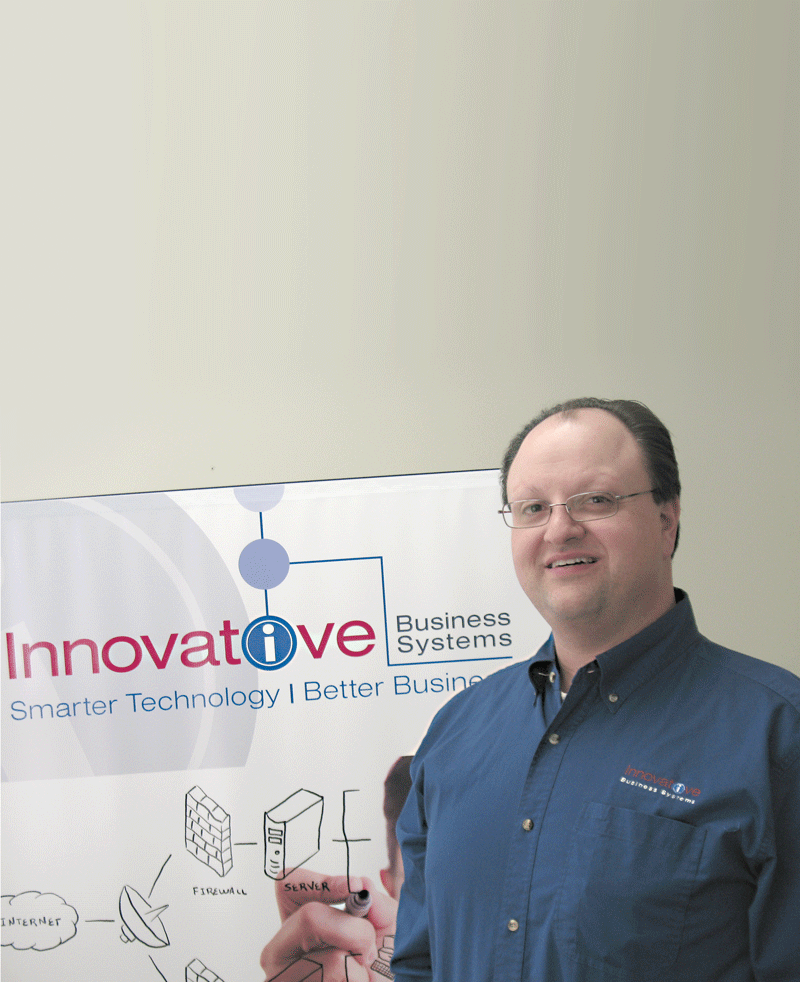
IBS President Dave DelVecchio

IBS President Dave DelVecchio

In 20 years, Innovative Business Systems has evolved from a software-development firm to an outfit that businesses of all kinds rely on to manage their computer networks, data security, and a host of other high-tech needs. But as it celebrates this anniversary, IBS has launched a rebranding effort that aims to better-clarify what its services are, and why they are becoming increasingly necessary.

Dave DelVecchio says that the speed at which information technology advances can leave business owners confused, buffeted by buzzwords, and unsure of the value of an IT partner.
Innovative Business Systems Inc. has successfully built such partnerships for two decades, but DelVecchio, the company’s president, and his staff recently began to ask whether its customers and, perhaps more important, prospective clients really understand the need for its services.
“So many IT companies are so fixated on the ‘how’ that they can’t communicate the ‘why,’” he told BusinessWest. “We’re focused on helping businesses determine the why.”
Last year marked a 20th anniversary of sorts for this Easthampton-based IT sales and support firm (which launched in 1987 but didn’t officially incorporate until three years later). “And, as major milestones tend to be, that became a time for reflection,” DelVecchio said.
He explained that IT changes so much in a few years — “for some people, that’s a blink of an eye, but in our industry, it’s a lifetime” — that questions arose regarding how well IBS was delivering its message to the public.
“We weren’t sure we were doing an effective job communicating with prospects, clients, and the general public exactly what we do,” he explained. “Sometimes, we’re too close to it to communicate it ourselves.”
So the company launched a rebranding campaign, looking for a succinct way to communicate its range of services, and at the same time refreshing its logo. It enlisted an outside consultant for these tasks, and launched a new Web site earlier this month, presenting itself with the new tagline, “smarter technology for better business.”
“A lot of people historically have thought of companies like ours as computer repairmen, like they think of appliance repairmen or auto mechanics,” DelVecchio said. “That’s not what we do, or, it’s a very small subset of what we do.”
Rather, he said, “we help folks cut through the clutter of ever-changing technology, to find out what’s the right fit for a business, what’s applicable and what’s not, what fads stick and what’s a flash in the pan. We want to have conversations with them from a business perspective, not just a technology perspective. And we felt this tagline best encapsulates that.”

Gang of Five
Bill Tremblay began Innovative Business Systems in 1987 as a software-development outfit (more on that later), then sold the firm in 2003 to five employees — DelVecchio, Brian Scanlon, Scott Seifel, Ben Scoble, and Sean Benoit — who continue to run it today.
IBS handles PC sales, data analysis, networking, hardware and software support, repair, and maintenance services for businesses of all sizes. It built much of its business in the financial-services arena, working with banks and credit unions — both those with their own existing IT departments and those without — on issues including data access, information security, and disaster-recovery planning.
The rest of the IBS client list is comprised largely of small-to-medium-sized, privately owned businesses in a wide range of sectors, from health care to manufacturing, many of which are not large enough to have their own IT departments but view the need for constantly updated technology as a growing necessity.
“For many years, our niche was supporting banks and credit unions,” DelVecchio said. “But we’ve got multiple 10-employee companies running technology rivaling what the banks are running — remote offices, mobility suites, document imaging, hosting their own Web-based data applications, some of them being publicly accessible, and some in industries with strict security requirements.”
He said he gets annoyed when people assume that the need for the services IBS provides are always related to the size of the client. Instead, “the more technology-driven a business is, the better fit they are for us, regardless of size.”
One of the biggest issues IBS has dealt with in recent years has been access to data from various computers, company locations, or remotely. A related, and often equally important, consideration is data recovery, because it can be disastrous for a business to store information in one office only.
DelVecchio is especially excited about the company’s new data center in Marlborough, which will serve as a remote office, but, more importantly, as a disaster-recovery suite. In case of some event that renders a customer’s place of business unusable, IBS can transfer the contents of the client’s entire network to the Marlborough office, which is equipped with four workstations, in effect providing a location for that customer to continue to operate.
“From a solutions standpoint, this is huge,” he said. “In case of a localized disaster, like a fire, a flood, a sprinkler goes off at midnight and leaves the office knee-deep in water, this location is, in most cases, within an hour’s drive, so you have a place to function.”
Why Marlborough? Its distance is an asset, DelVecchio said, explaining that disaster-recovery suites should be close enough that the commute isn’t too onerous, yet far enough away to be clear of a regional disaster; 45 to 60 minutes away is ideal.
And while most businesses might never need the use of such a facility, many will, especially those in multi-tenant buildings, and should appreciate paying around $3,500 annually for a “a business continuity plan in a box,” he said.
“For tenants in a mixed-use, multi-tenant building, the odds of a localized disaster go up by a factor of 10. When you have a lot of tenants, all it takes is the tenant next door to plug up the drainpipe with grass and knock out the sprinklerhead, or put a candle too close to a curtain, to cause an issue. In multi-tenant buildings, we see this as an incredibly underused but much-needed solution.”

Down to Earth
Putting this sort of real-life face on often-complex technology is key to IBS’ new focus on communicating the big picture to clients, DelVecchio said.
He noted that Microsoft has been promoting ‘cloud computing’ — a term synonymous with Internet-based computing, whereby shared servers provide resources, software, and data to individual computers and other devices — “but if you ask 100 people what the cloud is, you get 100 different answers. The cloud can be a lot of things.”
He compared it to 15 years ago, when the commercial use of Internet technology was just exploding, and “cyber” became the hot buzzword, even though it wasn’t always used correctly. “We’ve developed our own cloud strategy to cut through that clutter.”
What businesses need to understand, he said, is what those buzzwords mean, and how the technology behind them can benefit their operations. He said some have predicted that 80% of all IT services will be cloud-based within five years, but feels that number may be a bit aggressive; he sees many firms using a hybrid approach. “Businesses might be running things like E-mail in the cloud and applications on premises, or vice versa. Determining the right mix for business is the foundation of what we do.”
No IT firm can be everything to all its clients, so IBS touts a number of ‘partners’ on its Web site — not formal partnerships, but related companies with whom IBS shares clients — that do a good job at what they do, and can benefit Innovative’s customers. “Building a strong partner network is something we take a lot of pride in; it takes a village to maintain an IT infrastructure, but we can be the hub that facilitates getting it done.”
Like companies of all sizes and in all sectors, IBS has endured a sluggish economy for the past few years, but felt it mainly in product sales, not consulting.
“In 2007 and 2008, most companies were investing in their business, with technologies like remote access and document-management solutions,” DelVecchio said. “When the economy slowed down, everyone went into a wait-and-see, maintenance mode; our revenue remained constant in 2009, but our material sales dropped 20%. People kept what they had; they weren’t upgrading. Over the course of 2010, though, we saw a consistent increase in projects.”
All the more reason to launch a rebranding effort — and make some hard decisions about the direction of the company.
“Every business has been forced to look at their balance sheet and take a look at expenses and figure out where they were getting value,” he said. “And if you’re not delivering value, should you be doing it?” In answering that question, last year, IBS phased out of the software-development business, which was the work on which the company was founded.
“Running a software-development business is a completely different model than running an IT service and consulting business,” said DelVecchio, noting that IBS’ full-time developer left the firm on amicable terms and continues to support all the clients for whom IBS had developed applications. “That allowed us to focus on our core business moving forward. After that decision, we focused creating branding for what our core business will be like in 2011 and beyond.”

Bottom Line
By all indications, that core looks healthy, he said, noting that, as clients started to order upgrades they had deferred during the recession, IBS saw a strong second half to 2010.
“Clients are back in the game,” DelVecchio said. “From a business outlook, I’m very positive about 2011. It appears that people have come out of their bunkers, and they’re ready to do business again.”
Whether in their offices, or in the cloud.

Joseph Bednar can be reached at [email protected]

Opinion
America’s Revival Begins in Its Cities

During economic downturns, we begin to fear that we are entering a permanent period of decline. But we can avoid that depressing prospect if we recognize that a revival will not come from federal spending or another building boom. Reinvention requires a new wave of innovation and entrepreneurship, which can emerge from our dense metropolitan areas and their skilled residents. America must stop treating its cities as ugly stepchildren, and should instead cherish them as the engines that power our economy.
America’s 12 largest metropolitan areas collectively produced 37% of the country’s output in 2008, the last year with available data. Per-capita productivity was particularly high in large, skilled areas such as Boston, where output per person was 39% higher than the nation’s metropolitan average. Boston also seems to be moving past the current recession, with an unemployment rate well below the national average of 9.8%.
Since 1948, the national unemployment rate has exceeded 9% only one other time: the grave 1982 recession. During the 1980s, we looked at Japan and saw an economy that seemed to be surpassing our own. Today, we watch with unease as China surges.
Yet American decline is not inevitable. During the 25 years after 1982, our real gross domestic product increased by 3.3% per year, which was also the rate of growth during the quarter-century before 1982. Our post-1982 growth involved massive economic restructuring. Manufacturing employment fell by 39% from its peak of 19.4 million jobs in 1979. The 1979-2009 manufacturing decline was more than offset by the 126% employment jump in professional and business services and the 184% increase in education and health jobs.
Boston offers a model of how cities can foster such transformations. In the 1970s, Boston seemed headed for the trash-heap of history. Manufacturing jobs had vanished, and social chaos ensued. But Greater Boston experienced three great decades, as a former industrial hub became a capital of the information age.
To succeed in the future, the country needs to produce a stream of new ideas, like personal computers, Facebook, and steerable catheters. We must produce goods and services innovative enough to command the high prices needed to cover high labor costs.
Such breakthroughs rarely come from solitary geniuses. The movie The Social Network hints at the messy, interactive process that created Facebook, which now has over 500 million users and is valued at about $40 billion. Mark Zuckerberg benefited from being surrounded by smart peers, whose ideas about social networking helped his company get started.
The roots of Boston Scientific reveal a similarly collaborative process that started in the basement of a Belmont church. The brilliant inventor (and spiritualist) Itzhak Bentov created a steerable catheter, catering to the demands of Boston’s medical community. Boston connected Bentov with John Abele, who brought his business vision and later connected Abele with other partners, who helped him create a medical-innovation behemoth.
Cities have long enabled economic creativity. Detroit in 1900 looked a lot like Silicon Valley in the 1960s, with an entrepreneur on every street corner. In that urban hotbed, innovators like Ford, Buick, and the Fisher Brothers supplied and financed each other — and borrowed ideas freely. The urban edge in engendering innovation explains why globalization and technology have made cities more, not less, important. While all workers in the Boston area benefit from the region’s human capital, the flow of knowledge seems strongest in the dense clusters of Boston and Cambridge.
For decades, the American dream has meant white picket fences and endless suburbs. But the ideas created in dense metropolitan areas power American productivity. We should reduce the pro-home-ownership bias of housing policies, such as the home-mortgage-interest deduction, which subsidize suburban sprawl and penalize cities. We should rethink infrastructure policies that encourage Americans to move to lower-density environments. Most importantly, we should invest and innovate more in education, because human capital is the ultimate source of both urban and national strength.
As we grope toward a brighter future, we must embrace our cities, and invest in the skills that are central to their success.

Edward L. Glaeser, a professor of economics at Harvard, is the author of the forthcoming book The Triumph of the City.

Opinion
Incentives — They’re a Necessary Evil

‘Corporate welfare.’
That’s the term used in some circles to describe the incentives — mostly in the form of state and local tax breaks, but they come in other forms as well — given to companies to locate in a community or remain there and expand their operations. It has a very negative connotation, and, in the eyes of many, it’s warranted.
Welfare, a term that’s being removed from the lexicon, at least in this state, and replaced with ‘transitional assistance,’ implies help to those who outwardly need it. Some would say that businesses, or at least the vast majority of them, don’t need and don’t deserve tax breaks and other assistance when very few companies, and no residents, get such help.
But this view does not reflect the current world in which we live and try to do business. Indeed, jobs are the lifeblood of every community, every region, every state, and, yes, every country, and the competition for jobs has never been more intense. Thus, incentives like those recently awarded by the state and the city of Springfield to Smith & Wesson and Titeflex (see story, page 6), and by the state to Qteros (now doing business in Chicopee), are certainly warranted, if not exactly popular.
States and economic-development regions are being quite imaginative, and generous, with incentives, especially in this economy and when so many former manufacturing centers are struggling. If these companies and others, such as Performance Food Group in Springfield when it was looking to expand in the city, did not get the tax breaks they requested, they would, in all likelihood, have gone elsewhere.
All this said, communities and states have a responsibility to award incentives wisely and fairly, with an eye toward helping a region, not an individual business. Most people remember when Springfield was handing out grants and attractive loans willy-nilly, to seemingly anyone who wanted to open a restaurant and had a business plan in hand — and they remember the consequences: unpaid loans and vacant storefronts.
Which is why we’re pleased to see that the state’s Economic Assistance Coordinating Council has changed the rules when it comes to how it awards tax subsidies. These changes, which came in the wake of criticism that the state had squandered millions of dollars over the years on dubious projects, such as fast-food restaurants and retailers who probably would have opened in the Bay State anyway, were certainly overdue.
The new regulations, adopted early in 2010, limit which companies are eligible for subsidies, and give state economic-development officials more discretion over the awards. In short, priority is now given to manufacturers and companies at the cutting edge of new technology and processes (such as Qteros) and to opportunities for job growth in the so-called Gateway Cities, which include Springfield, Holyoke, Chicopee, and others in this region.
And these awards come with some heavy strings, such as the promise of new jobs and investments in these companies’ operations. So while time will ultimately tell what happens at Smith & Wesson, Titeflex, Qteros, and other companies in this region, the money spent by the state and the communities involved appears for now to be well-spent.
As we said at the top, business incentives — or that much-less-flattering term for them, corporate welfare — seem inherently unfair when residential taxpayers don’t receive breaks and many business owners stay in a region for decades, and sometimes expand several times, without asking for or receiving financial assistance.
But the reality is that these incentives are, indeed, necessary, and you might as well drop the word ‘evil’ that usually follows that term.
When you do the math, and divide the state tax subsidies awarded to Smith & Wesson ($6 million) by the number of jobs created (225), it’s about $26,000. That’s a lot of money for a job, but for a region that’s screaming for new employment opportunities, especially good-paying jobs in manufacturing, that price sounds like a bargain.
And a price well-worth paying — if, and only if, the conditions are right.

Briefcase Departments

Smith & Wesson to Add 225 Jobs in Springfield; Net Sales Rise Slightly
SPRINGFIELD — In the third quarter, Smith & Wesson made the strategic decision to relocate its Thompson/Center Arms operations from Rochester, N.H. to the company’s facility here. Approximately 225 jobs are expected to be added to the local economy with the Rochester relocation initiative. This relocation is designed to provide the company with increased operational efficiencies through the optimization of the company’s manufacturing footprint and increased synergies generated in fixed, marketing, and administrative costs. The bulk of the $9 million of estimated cash outlays associated with the relocation will occur in the second half of fiscal 2011, and those outlays are expected to be recovered in approximately 24 months. The relocation is scheduled to commence in January and conclude by November 2011. In other news, Smith & Wesson Holding Corp. recently announced that total net sales of $96.3 million for the second quarter decreased $13.4 million, or 12.2%, from net sales of $109.7 million for the comparable quarter last year. Indications are that the consumer firearm market has moderated further following the significant increase that started in the company’s third quarter of fiscal 2009. In the second fiscal quarter of this year, sales in all handgun and tactical rifle product lines, except premium products, were flat or lower than in the prior year quarter due to a more competitive environment and a trend toward more value-oriented products. Hunting products were the exception and increased 26.3% over the prior year’s comparable quarter on improved sales of black-powder products and the company’s new bolt-action rifles.

AIM Index Off in November, Retains Most Gains
BOSTON — The Associated Industries of Massachusetts (AIM) Business Confidence Index lost 3.2 points in November to 52.1, but held on to most of the gains from its record 7.7-point rise in October. The sub-indices based on selected questions or respondent characteristics all lost ground in November, though most gave back less than half of their October gains. The current index of conditions prevailing at the time of the survey was off 2.6 points at 50.6, while the future index of expected conditions six months ahead dropped 3.5 to 53.5. Andre Mayer Sr., vice president of communications and research for AIM, noted that employers are disappointed by the pace of recovery and are aware of considerable risk in the economy, but see conditions slowly improving and expect improvement to continue over the next six months. The Massachusetts Index of business conditions prevailing within the Commonwealth fell 2.6 points to 47.5, remaining above the U.S. Index of national conditions, which lost 5.8 (after a 12.3-point gain in October) to 43.0. On the year, the state indicator was up 9.0, its national counterpart up 6.3. Mayer added that survey respondents have rated the state’s economic climate better than the nation’s through this downturn and recovery. The monthly Business Confidence Index is based on a survey of AIM member-companies across Massachusetts, asking questions about current and prospective business conditions in the state and nation, as well as for respondents’ own operations. On the index’s 100-point scale, a reading above 50 indicates that the state’s employer community is predominantly optimistic, while a reading below 50 indicates a negative assessment of business conditions.

UMass Trustee Chairman Steps Down
AMHERST — University of Massachusetts Board of Trustees Chairman Robert J. Manning stepped down as the leader of the 22-person UMass governance board on Dec. 8, saying it would be beneficial for the university to have new leadership as it enters a period of transition. Manning noted in a statement that the university is “embarking on a transition phase” that is significant to UMass, and as his term winds down at the end of this academic year, he cannot sign up for another five years. Manning, who has served as chairman of the board for three years, noted of his tenure, “it’s been a remarkable experience for me.” Manning added that he was stepping down from the chairmanship and from the board effective immediately. Gov. Deval Patrick will appoint the next chairman, according to Manning.

Poll: Strong Support for Resort Casino
PALMER — A recent public-opinion poll commissioned by Northeast Realty Associates and conducted by Market Street Research of Northampton shows overwhelming support for the establishment of a resort-style casino destination on acreage across from the Mass. Turnpike entrance on Route 32. The survey, conducted in mid-November, indicates 64.8% of Palmer residents support the development of a resort-style casino on land owned by Northeast Realty, while 30.3% are opposed with 4.9% undecided. Mohegan Sun currently holds a 99-year ground lease with Northeast to develop the property into a destination resort casino should gaming become legalized in Massachusetts. Earlier this year, the state House and Senate passed legislation calling for three resort casinos in the state, stipulating one of the venues for Western Mass. While final agreement on the legislation is stalled, Gov. Deval Patrick has consistently supported the development of three resort-style gaming venues, including a Western Mass. destination.

Spalding Hoophall Classic Teams Named
SPRINGFIELD — Springfield College’s Blake Arena will be setting for the 10th annual Spalding Hoophall Classic Jan. 14-17, representing 46 teams from 17 states. The nation’s premier high school event will showcase its strongest field in its history with elite matchups including Dallas Lincoln High School (Dallas, TX) vs. Findlay College Prep (Henderson, NV), Oak Hill Academy (Mouth of Wilson, VA) vs. Milton High School (Milton, GA), and St. Patrick High School (Elizabeth, NJ) vs. Bishop Gorman High School (Las Vegas, NV). Numerous games from the 2011 Spalding Hoophall Classic will be televised nationally. Other programs scheduled to participate include DeMatha Catholic High School (Hyattsville, MD), Christ the King High School (Middle Village, NY), St. Thomas More School (Oakdale, CT), and St. Anthony High School (Jersey City, NJ), coached by Bob Hurley, Sr., who was inducted into the Hall of Fame in August. The 2011 event continues its tradition of talented players by featuring more than 20 of the ESPNU’s Top 100 in the class of 2011.

Cover Story
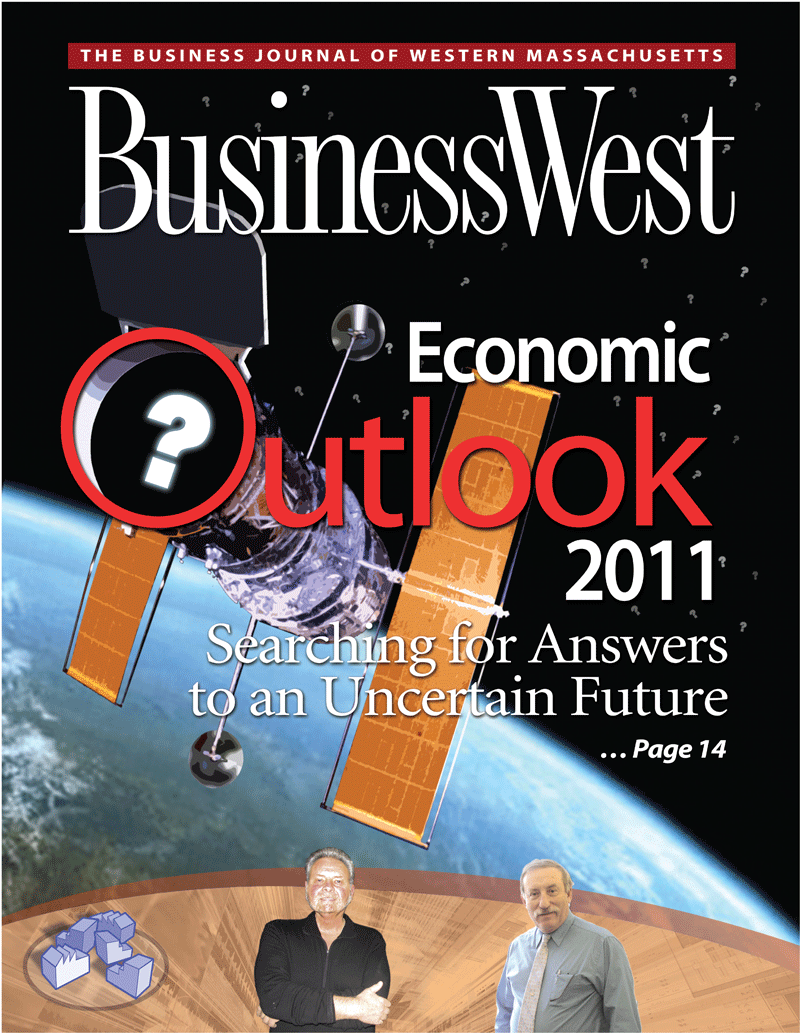
Searching for Answers to an Uncertain Future

Cover Decemebr 20, 2010

Cover Decemebr 20, 2010

While uncertainty is the one word most experts are using to frame their opinions about 2011, something approaching consensus is taking shape. It appears the region and nation are due for more slow, unremarkable growth, and probably insignificant gains in terms of employment. In other words, it looks like more of the same that we saw in 2010.

Andre Mayer had an intriguing way of summing up what happened with the economy in 2010, one that captured the sentiment of most observers.
“It’s been a year in which conditions have certainly improved … but in a rather disappointing way,” said Mayer, vice president of Communications and Research for the Associated Industries of Mass. (AIM). Indeed, after recording fairly significant growth in the first six months of the year, the economy stumbled, and then seemed to take at least one step backward for every step forward.
“In 2010, we had a pretty good first half in terms of working our way out of a recession,” Mayer continued. “The state economy improved, and business confidence increased, right up until June, and fairly steadily. But then, things began to deteriorate, and some of that has to do with the diminishing impact of stimulus actions on the part of the federal government. We had quite a disappointing third quarter, and while the fourth quarter has been a little better than the third, we’re well behind where we thought we’d be in terms of recovery.”
Karl Petrick, an assistant professor of Economics at Western New England College, agreed.

Karl Petrick

Karl Petrick says a “Mexican standoff” between consumers and business owners is one of the many issues limiting recovery from the Great Recession.

“The recovery’s been shaped like a U, a very long U,” he explained, referring specifically to the horizontal line. “There’s only been a little bit of an upward tick. It’s been really frustrating … we’ve just been bouncing along the bottom on this recovery, and that’s been nationwide, not just Western Mass. And every month there’s good news, the next month, there’s bad news. And the nationwide jobs report has done it again.”
That report — which showed that just 38,000 jobs were added for the month of November, after robust growth in October, and an unemployment rate of 9.8% — has many economists scratching their heads and shrugging their shoulders when they talk about 2011 and what can be expected regionally and nationally.
But while there is certainly a large amount of uncertainty, there is something approaching consensus when it comes to the outlook on the months and quarters ahead — growth that will be slow and generally unremarkable, with probably only slight improvement in the jobs situation.
This goes double for Western Mass., said Bob Nakosteen, professor of Economics at UMass Amherst, because this region lacks what he calls a “jobs-creating fuel source” like the technology and biosciences clusters in Central and, especially, Eastern Mass., which greatly outperformed the western counties in 2010.
“The problem, of course, is that we really haven’t replaced our declining manufacturing base with anything that has dynamism into the future,” he said, with ‘we’ referring to the Pioneer Valley as a whole, but especially its largest city. “Springfield has not reinvented itself; it has a lot of potential, but isn’t that the worst curse in life, to have a lot of potential?”
“We’re just in for a period of relative stagnation, if that’s the right word,” he continued. “There will be slow growth; I think this may start to improve, but it probably won’t happen before midyear. And it’s only when the national economy starts to improve that we’re going to feel some of the benefits in this part of the state. And there just isn’t enough of an economic engine here to have traction once the national economy starts to grow.”
But Mayer was much more positive in his outlook. “I think 2011 should be a year in which it becomes clear that the recovery is taking hold. We should see improvement from a very low rate of growth as the year goes on, and we’ll enter 2012 in much better posture than we’ll enter 2011.
“Unless we fall off completely,” he continued with a laugh, noting that there is just too much uncertainty — in this area code and countries like Ireland, Portugal, Greece, and others — to say with any degree of confidence what will happen.
For its Economic Outlook 2011, BusinessWest talks with several economists about the immediate future and what will shape it from a recovery standpoint. Overall, they said there are far more questions than hard answers.

Realistic State of Mind
Amid the prevailing disappointment over how 2010 played itself out, there were some bright spots that could prompt optimism if one were so inclined.
Mayer said the state’s performance, which exceeded the nation’s, was one such positive, in part because it showed some depth and diversity in the Commonwealth’s economy, although the good showing likely had more to do with the fact that the Bay State isn’t dominated by the industries hardest hit by the Great Recession, such as home building and automobile manufacturing.
“The fact that we’ve not only been able to keep pace, but actually outperform the nation so far in this slow and halting recovery is a good thing for us,” he explained, adding that, historically, the state has lagged behind the rest of the country when it comes to bouncing back.
Meanwhile, the Commonwealth’s performance helped it retain some talented young people who might otherwise have left for presumably greener pastures.
“We have not seen the kind of outflow of human capital, mostly young people with marketable skills, that we’ve seen after past recessions,” Mayer explained, “because they would leave to seek better job opportunities elsewhere in the country. Right now, there aren’t those kinds of opportunities.
“In fact, the kinds of places where they used to go, the areas with high population growth, like Arizona, Florida, and Nevada, are suffering very badly in this cycle,” he continued, “because those are places where real estate and home construction are very important parts of the economy, and those sectors have just been hammered.”
Overall, the Massachusetts economy — and individual businesses large and small — have “adjusted,” said Mayer, which, roughly translated, means they’ve become more efficient and able to do the same with fewer people, which is another positive from a competitiveness standpoint, but not from a job-growth perspective.
“On balance, companies have been able to adjust to more-difficult circumstances, to a slow-growth economy,” he told BusinessWest. “They’ve been able to keep afloat and in some cases do pretty well, but they’re doing this, in large part, at the expense of job creation; they’ve slimmed down their staffing, and they’re very reluctant to add on new people, so we haven’t seen a whole lot of job creation.”
And, surprisingly, one of the areas where there’s been recorded growth is manufacturing, noted Mayer, adding that this is probably the last sector most observers thought would expand. “Manufacturers can usually squeeze more productivity out of their existing staff, and they’ll usually do that before they add people, so this has been an odd pattern, but something else that bodes well for the state.”
Despite these positive developments, 2010 has been rather forgettable, said Mayer and other observers, and the sluggishness of the past few months, not to mention the November jobs report, makes it that much more difficult to gauge what the year ahead will be like.
“One month you get 172,000 jobs, and the next, 39,000 new jobs, one-fifth the number that was forecast,” said Petrick. “That just really shows how uncertain the recovery remains in terms of when it’s going to gain steam.
“Most forecasters were almost writing 2010 off, saying, ‘we’re going to see some improvement, but not a lot,’ and those people were right,” he continued. “But then, most people were forecasting that things would pick up in 2011; now, some of the more pessimistic forecasts are for 9.5% unemployment nationwide, and the optimistic ones are for 8%, which is significantly higher than it had been, and that doesn’t bode well for Western Mass.”
Petrick noted that perhaps the biggest stumbling block to economic progress, both regionally and nationally, is confidence, or lack thereof. This fear of what is still very much the unknown has both consumers and business owners frozen in their tracks and either unwilling or unable (or both) to step forward with any conviction.
“Consumers are uncertain — they’re holding back as much as they can,” he explained. “Businesses are uncertain, not because they’re worried about taxes, but because they’re worried about what’s happening with consumption. It’s a Mexican standoff between consumers and businesses, each one saying ‘you first.’ Consumers are saying ‘hire us and we’ll spend,’ and businesses are saying ‘spend and we’ll hire you.’”

Stimulating Conversation
Whether there is any relaxing of this standoff in 2011 depends largely on when and to what degree the national economy improves, said Petrick, adding that there are several factors that will play into this.
These include everything from the fate of the announced compromise tax plan to the impact of whatever stimulus funding is still to be spent, to the Federal Reserve’s attempts to actually spur inflation, or at least ward off the more dangerous deflation.
“They are trying to get a higher rate of inflation than we have now, because there are some things that might spring from this that are healthy,” said Nakosteen. “If businesses can get a bit more of a margin in the prices they charge, if low interest rates in the face of a little more inflation prompt investors to get more into the stock market, these are good things, and two outcomes the Fed is trying to get by doing this.
“The risk is that they’re in a little bit of uncharted territory,” he continued, “and it’s not real clear that those actions are actually going to prompt the economy to begin to recover. There are only so many things they can try, and they seem to have tried one of everything; no one really knows.”
Those four words apply to many of the questions concerning the regional and national economy, including the matter of federal stimulus efforts.
Indeed, while many believe the impact of stimulus programs is now mostly in the past tense, Petrick said there remains a substantial amount of stimulus funding that has been allocated for this region but not spent.
“This is construction money, by and large, and it will be helpful, because that’s the sector that’s been the hardest-hit,” he explained. “There still could be a positive effect in the next year from that money that’s been allocated for different projects but hasn’t been spent.”
Locally, progress for the short and long term may well depend on if and to what degree the region can advance the process of reinventing itself.
Petrick sees some signs of progress in the Valley’s ongoing efforts to build its ‘green’ sector.
“This is a region that could, with a lot of work, start to make a name for itself in terms of green technology,” he said. “We have some green shoots — individually, they’re not much, but collectively, this could be a positive thing that could prompt hiring across a number of skill levels.”
But Nakosteen says the region still has a lot of work to do with regard to the process of reinvention.
“We’ve had this long-term decline in our base,” he explained. “There’s nothing really stopping that, and there’s nothing arising to take its place. There’s nothing taking hold to get these gateway cities going, and Springfield is one of those gateway cities.”
The biggest concerns for the year ahead involve jobs and the likelihood that this state and region won’t be creating many.
“We’ve done all right in Massachusetts relative to the rest of the nation,” said Mayer. “October was a pretty good month, maybe the first we’ve had, and then the November report came out, and we went backwards. So it’s very hard to predict what will happen next year.”

U Guessed It
While the past few months have shown that seemingly anything can happen in 2011, economists are in general agreement that the nation and region will likely continue moving along what is the bottom of the U that several referenced when taking about the shape of the recovery.
There may be more movement back up, Petrick told BusinessWest, predicting what amounts to more of the same for at least the next few quarters.
In other words, when 2011 nears its end, you may be seeing and hearing economists say there was improvement, but in a rather disappointing way.

George O’Brien can be reached at
[email protected]

Opinion
A Key Step Toward Economic Diversity

There wasn’t much fanfare when the Economic Development Council of Western Mass. (EDC) created a new position this past summer, that of ‘manager of Cluster Development.’ But this addition to the staff could have some important implications for the future health and well-being of this region’s economy.
The new cluster czar, if you will, William Wright, who has held a number of business and economic-development-related positions at UMass Amherst and in Michigan, has been handed an important assignment: devising strategies for growing and strengthening clusters of like businesses in this region.
His presence in the EDC’s suite of offices in downtown Springfield is part of a growing movement, nationally and internationally, to take what is inherently an organic process — the development of business clusters — and essentially expedite the process. If he is successful, the region will be taking some big steps toward the diversification of its economy that has become necessary — but not exactly reality — since the area’s manufacturing base started to deteriorate.
Backing up a bit, Wright told BusinessWest (see story, page 6) that clusters are nothing new. They’ve been around for centuries, and this region has developed several, mostly small in size, including gun making, paper and textiles, and, to a lesser extent, plastics. What is relatively new is the notion that cluster development can be accelerated and facilitated, perhaps shaving years or even decades off the process.
This isn’t easy work, and it’s complicated further by the fact that many cities and economic regions are now doing it, but we believe it is an important step forward.
Why? Because, as we’ve said many times before, in this region, and Springfield in particular, there has not been sufficient movement in the process of reinvention. There has been movement in some areas, including distribution (many jobs have been added in that sector), precision manufacturing, technology, biosciences, and even clean energy — but certainly not enough to replace the thousands of manufacturing jobs lost over the past half-century, and not enough to sustain the region moving forward.
So many so-called Gateway cities — Lowell, Holyoke, Fall River, and Worcester are others — have been stuck in neutral for many years now. Clusters are game changers. Anyone who’s been to Cambridge (life sciences), Silicon Valley, or the Research Triangle knows that. The Pioneer Valley is certainly not likely to replicate any of those efforts, but it can grow some existing clusters into more powerful economic engines that will create vibrancy for the future.
There are many facets involved with cluster development, from fostering entrepreneurship to creating stronger partnerships between the business community and the region’s colleges and universities; from facilitating the flow of capital to making a region top-of-mind when it comes to deciding where to launch or grow a business. It all comes down to one word — connections.
Wright is just getting started with his work to make such connections and foster cluster development. This work is difficult, as we said, and no one really knows whether it will bear any fruit. But from all indications, this is an important step forward for the region, one that could lead to real progress in those ongoing efforts to diversify and reinvent.

Sections Supplements
Jack St. Clair Becomes a Bold Addition at Bacon Wilson

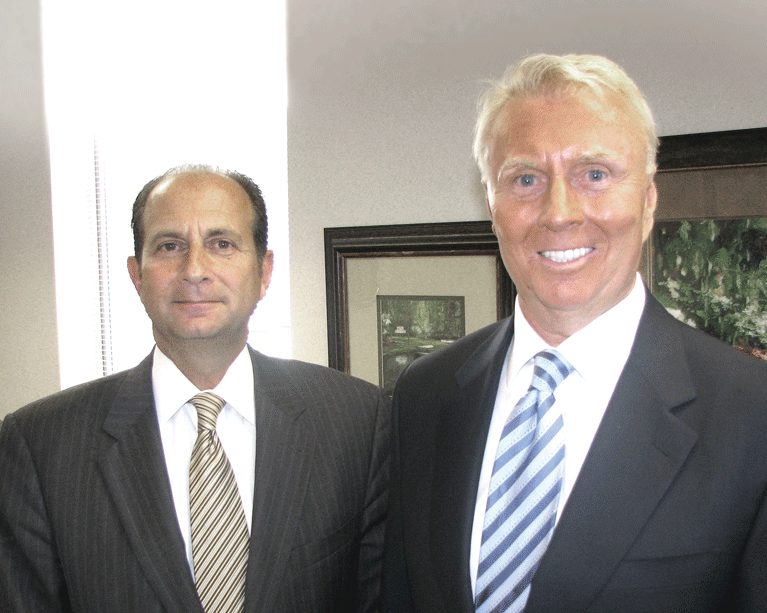
Jack St. Clair, right, with Steve Krevalin

Jack St. Clair, right, with Steve Krevalin, managing partner of Bacon Wilson.

Jack St. Clair says he rose to the ranks of the region’s most prominent criminal-defense lawyers in large part because he was always pushing himself to reach higher and accept new challenges. This philosophy helps explain his recent decision to join Bacon Wilson, a firm that has aggressively expanded its reach and more than doubled in size in the past eight years. Both sides are looking forward to seeing how this move works out, and they’re both using the same language to describe it: “perfect fit.”

Jack St. Clair says that, while he was recovering from a serious automobile accident this past spring and summer — he was broadsided by a driver who ran a red light, and sustained nine broken ribs and a collapsed lung, among other injuries — he had a lot of time to think and reflect on his life and career.
As he was doing all this thinking, he told BusinessWest, he came to the conclusion that, despite what most would consider a highly successful career, mostly as a noted criminal-defense lawyer, he thought something was missing from the equation.
That ‘something’ became somewhat difficult for him to articulate, but it boils down to a desire to do more for many of his clients, while also honing his skills in what would have to be considered a new specialty within the law — representing the families of special-needs students with the goal of securing them the rights and services to which they are entitled from the community in which they live.
This new career ambition was spawned in large part by St. Clair’s grandson, an autistic child whom he referred to early and often as he talked with BusinessWest. Successfully representing the child and his parents in a recent case involving claims of unmet needs prompted St. Clair to want to do the same for others. And he’s hoping to achieve all that and much more by joining the Springfield-based firm Bacon Wilson, a move that both sides believe will bring a number of benefits.
A sole practitioner for most of his career, St. Clair said he opted to join a firm now because of the many opportunities such a move presents.
“When you’re one person, as I was for most of my career, you’re limited in what you can do,” he said, referring to both the volume of cases he could handle and the services he could provide to specific clients. “I didn’t want to be limited any more. I want to continue to develop a client base and service them in areas that I did at times, such as tax law and business law, but couldn’t continue to do.”
Meanwhile, Steve Krevalin, managing partner for Bacon Wilson, said the addition of St. Clair will enable this steadily growing firm, now with 44 lawyers, to reach new levels of prominence in this region and far outside it.
“He’s one of the best-known and highest-regarded lawyers in Western Mass. — by far,” Krevalin said. “His reputation allows him to attract a lot of clients.”
For this issue and its focus on business law, BusinessWest talked with St. Clair and Krevalin about what this partnership means for the lawyer and the firm.

Cases in Point
St. Clair officially arrived at Bacon Wilson on Nov. 1, and now occupies a large office in space that was most recently occupied by PeoplesUnited Bank (formerly Bank of Western Mass.) while it was still a tenant in the building at 33 State St., which is owned by several partners at the law firm.
There are boxes still to be unpacked, but St. Clair is mostly settled in. While his desk and credenza are dominated by pictures of his family, and especially his grandson, the walls are devoted mostly to paintings of the holes that comprise Augusta National Golf Club’s fabled Amen Corner.
St. Clair had the opportunity to attend a number of Masters tournaments, and has also amassed a sizable amount of golf memorabilia, including some letters from Bobby Jones, thanks mostly to his father, who was the long-time head of design and custom manufacturing with Spalding back in the days when it was a major player in the golf-equipment market. But St. Clair also secured from his father an intriguing outlook on retirement.
“He never retired, and I have the same opinion on that subject,” St. Clair explained. “My father used to say that, when you retire, you start to hang around with people who are only interested in whether there’s enough mayonnaise on the tuna salad; I have no intention of ever retiring.”
It was with this knowledge that his 34-year career is on the proverbial back nine, but certainly not near its end, that St. Clair contemplated what its next chapter would be. After all that contemplation while recuperating from the accident, he said it was time for a change — and to be re-energized.
“There’s a tremendous amount of vision in this firm — they don’t want to remain stagnant,” he said of Bacon Wilson. “They’re always looking for new ways to serve a client base, and they have a philosophy based in growth; that started the discussions, and after we talked, everyone felt that this could be an extremely good fit.”
St. Clair was with a smaller firm early in his career — he was part of Chicopee-based Murphy, McCoubrey, Murphy, St. Clair, Gelinas, and Auth — but for the past 20 years or so, he’s been on his own.
Part of the reason he didn’t join a large firm early on is that he was fairly certain that, if he did so at that stage of his career, he probably wouldn’t have been able to try the high-profile cases he would go on to handle.
“I wanted to try cases right away,” he explained. “And if I was the head of any large firm in Boston, Washington, or here, I wouldn’t let a rookie out like that. But I had the confidence, and I won those cases. That’s something I wouldn’t have had the opportunity to do if I was with a large firm.”
Three decades later, however, circumstances had certainly changed. St. Clair was no longer a rookie and didn’t have to worry about getting high-profile cases. He was, however, looking for an opportunity to tap the resources of a larger firm and generate growth potential for himself and those he would work beside.
That’s when talks began in earnest, first between St. Clair and Gary Fialky, a long-time friend and senior partner with Bacon Wilson, and later with Krevalin, who told BusinessWest that the addition of St. Clair made sense for both parties, which is a pre-requisite for any move of this nature.
“The first threshold before we take in anyone — first year or after 30 years — is that the personalities have to gel; if that doesn’t work, we pass,” he explained, adding that St. Clair easily met this test, and that his personality, track record, and reputation combined to make this a a solid fit.
Krevalin said the decision to bring in St. Clair is perhaps the firm’s most high-profile addition in recent years, but also simply the latest of many steps taken to give the firm more depth and opportunities for growth. Elaborating, he said the firm has added a number of lawyers with established practices over the past decade, many in Hampshire County, where the firm has greatly increased its presence with offices in Northampton and Amherst, but also several in Springfield.
Growth opportunities from such additions come from essentially acquiring those lawyers’ existing books of business, but also from the potential to provide other services to those clients from attorneys in the firm that specialize in many different areas, Krevalin continued, adding that, in St. Clair’s case, the potential is vast.
“He has a lot of clients that have used his litigation services that have other requirements, including estate planning, business, and many others,” he said. “We’re able to provide the backup and safety net for him.”
St. Clair agreed. “I’ve always had a practice that was all-consuming in that I was always running from one court to another,” he said. “And I’ve had a varied practice, doing a lot of criminal work in seven different states, but also civil work in three. I’ve always had a lot friends and acquaintances I couldn’t service because I was a sole practitioner. And this firm can service almost any need a person could have.”
While shedding some of the prior limitations he mentioned, St. Clair said he is also looking forward to working with other lawyers at Bacon Wilson to develop a specialty in special-needs work.
“I saw what can happen in a school district that fails the child and doesn’t provide the resources it agreed to provide,” he explained. “I really wanted to develop a practice dealing with the special needs of children; it’s certainly one of the most rewarding areas one can get into, and I’m going to bring a passion to this.”

Powerful Arguments
As he talked with BusinessWest, St. Clair used the words ‘energy’ and ‘energized’ several times each.
He said there is quite a bit of the former at Bacon Wilson, a firm that has more than doubled in size over the past eight years. And he utilized the latter when talking about what both his move to the firm and the experiences representing his grandson have done for him.
Just where all this energy will take St. Clair and the firm remains to be seen, but it’s certain that this high-profile change for both parties will bear watching. n

George O’Brien can be reached at [email protected]

Features
This Town Manages to Strike a Winning Balance

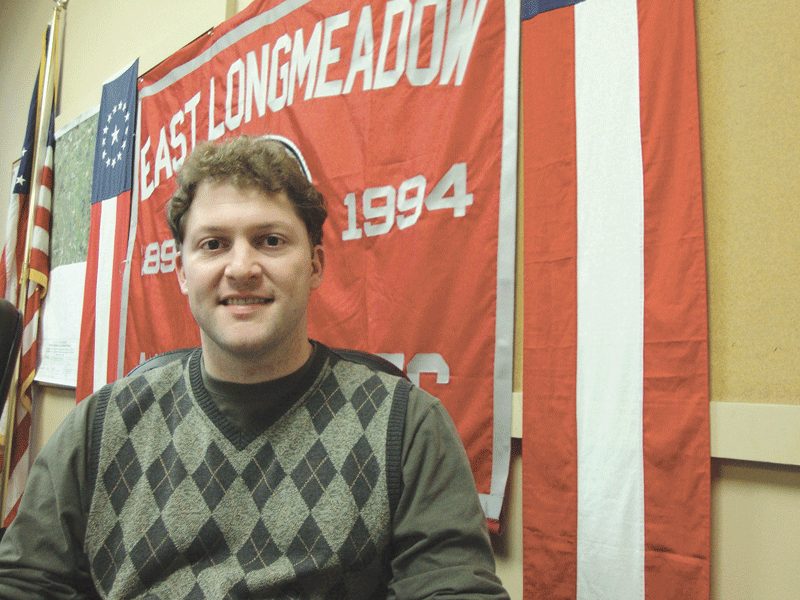
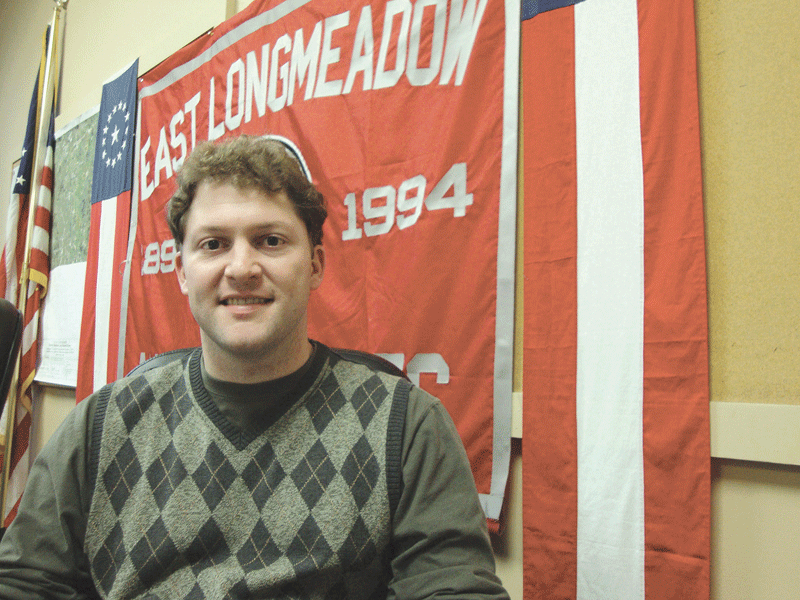
Selectman Jack Villamaino

Selectman Jack Villamaino can trace his family’s business roots back generations — a common story in East Longmeadow.

East Longmeadow Selectman Jack Villamaino is a lifelong town resident, from a family that traces its business roots to the last century.
He says that his great-grandfather’s farm is currently the fourth hole at Franconia Golf Course, but in the 1950s, his grandfather started the landscaping and asphalt-paving company that bears his family’s name to this day.
His story is not uncommon in this town of 16,000, where homeowners share space with a thriving retail sector, as well as one of the area’s healthier hubs of industry. He started out as “the coffee boy” for EJ Villamaino Paving contractors, and Villamaino said that there are “tons of guys I grew up with who work for their dads.”
“Those businesses might have started out as entrepreneurial enterprises,” he continued, “but now they employ a handful of people. And I think we’re fortunate for that, because they’re doing work in town, and they still live here. They have a stake in what they do in and around East Longmeadow.”
The town’s percentage of residential property to commerce and industry is around 78% to 22%, he said, and for Villiamaino and others in town, this is a winning mix.
“It’s a well-planned community, really,” said John Maybury. “There’s the proper amount of industrial and commercial development in the right zones.” And he should know; not only has he lived in East Longmeadow for most of his life, but he is one of the community’s most successful business owners, as president of Maybury Associates, a materials-handling firm.
Not far from his company on Denslow Road, the southwestern section of East Longmeadow is home to several world-class manufacturing plants. The world headquarters of Hasbro is nearby on Shaker Road, as well as Lenox Saw and Sullivan Paper, among many others. Maybury calls his and other businesses with a national and global reach “economic importers” for the town.
And while industry stays strong in East Longmeadow, those imported dollars find homes in a robust retail sector. Several large-scale plazas dot the landscape, with mom-and-pop stores alongside national retailers. At the East Longmeadow Center Village, Rocco Falcone said the plaza just filled its last available storefront.
A principal with Falcone Retail Properties, owner of that plaza, as well as the president of Rocky’s Hardware, Falcone is another native son who finds the balance of residential and industry a good fit, not just from the perspective of a fully tenanted plaza, but as a business owner.
“For Rocky’s to be one of the anchor tenants in that plaza,” he said, “this works on two levels. The locals like to do their purchasing within the town, and we have everything that a homeowner would need. But we also have accounts with some businesses in the industrial parks, for maintenance and supply products for the large companies.”
In this, the latest installment of its Doing Business In series, BusinessWest looks at some of those economic importers in East Longmeadow, a town that most observers say has struck the perfect balance between business and residential neighborhoods.

The Family Way
Villamaino said East Longmeadow is fortunate to have maintained this balance, some of which he calls just plain luck in the way developments have evolved over the past few decades.
“But part of that has to do with a master plan that goes back before I was born,” he continued, “with planning boards of the 1960s and earlier.”
As one of the current legislators, he said that Town Hall continues to work at keeping that balance.
“As far as the selectmen go,” he said, “I’ve voted four times — every time, really — in favor of the single tax rate. As long as I’ve been on the board, we’ve looked upon businesses as partners, not prey. We don’t want to subject them to unjustly high tax rates.
“They are dutiful taxpayers,” he continued, “and you have to consider them as landowners that aren’t sapping much of the municipal resources. For example, Hasbro isn’t putting any kids into the school system. Lenox uses their own waste-management system, not what the homeowners are using.”
Talking further about the Lenox complex in town, Villamaino expanded on the legacy from that business, and the original owners, in East Longmeadow. “You can’t credit the Davis family enough,” he said. “They owned it when it was American Saw, and they always made it a priority to keep the manufacturing and headquarters here. When they sold it to Newell Rubbermaid, they lobbied very strongly to ensure that all who were employed here remain here. Lenox employs somewhere in the neighborhood of 500 people. You don’t find that a lot in this area anymore.”
To this day, that home-field advantage has been broadened to encompass many other brands in the NR portfolio, with a list of household names such as Graco, Calphalon, Levolor, and many others. A training facility has been created at the East Longmeadow location for brand representatives of all NR products. “They spent about $50 million upgrading to make this a key component of their whole organization,” Villamaino said. “They’ve invested a lot to stay here, and we want to do whatever we can for them to stay.”
Speaking to his history as a town resident and entrepreneur, Maybury said that there have always been questions about large businesses that choose to stay in this region. “Usually it has to do with money — lower cost of a building, lower tax rates,” he explained. “But when you consider the bigger picture, and the roots that we have been able to sustain here, and the ability to network from here, there’s no reason to go.
“Even though there might be some other areas in the region that we could move to,” he added, “we have been able to retain a competitive advantage by staying local, staying with the people that are here. There’s an excellent core workforce, with a lot of tradesmen and machinists.”
In other words, people like himself. Maybury started the company from his parent’s garage as a teen, and while the business — selling and servicing forklifts and all the equipment behind the scenes to get the goods out on the shelves — has grown exponentially, it has never become too large for East Longmeadow.
Having just spoken at a meeting that day presented by the Affiliated Chambers of Commerce of Greater Springfield, titled “Thriving in a Difficult Economy,” Maybury echoed Villamaino’s comments that the town is a good partner for the business sector within it.
“It’s easy to do business here,” he said. “For the people who want to grow here, there’s a clear process through the Planning Board. As long as you put a comprehensive package together, it can happen really quickly. I’m involved in the Western Mass Development Collaborative, which is a part of the EDC, and we do a lot of the industrial-park buildouts. There are some other towns where businesses just can’t get things to happen fast enough, from the time someone has the idea and funding to the time when they want to be underway — that window can be very short.”
Maybury said that his firm has branched out to an office in Wallingford, Conn., and a sister operation in New Jersey. Not only is that good for his business, but also for the town it calls home.
“The cool part for East Longmeadow is that we are still going to be here, as an economic importer of dollars,” he explained. “Like some of our neighbors — Hasbro, for instance, with all of those jobs, selling all over the world, while the money comes back here. Similarly, although not to such a degree, we’re doing business all over Connecticut, the Worcester region, into New Jersey and New York. More than 70 employees here take a paycheck and distribute that locally.”

Center of Attention
Situated at the intersection of two roads leading into the rotary at the town’s center, the East Longmeadow Center Village is a relative newcomer to the retail district of town, but an addition that fits in comfortably with the community.
“In terms of marketing,” said Villamaino, “you can’t go anywhere in East Longmeadow without at some point passing through here. We as a town are lucky to have a few good people take advantage of opportunities to increase retail in town.”
In the not-too-distant past, an A&P sat on the property fronting North Main Street. Falcone said that a group of investors, including his father, bought the parcel, and one of the first Rocky’s went into the former grocery site. In the 1980s, the property increased, encompassing what is now the Healthtrax building, and a subsequent property venture brought along the other parcel, connecting the site to Maple Street.
Today, the bustling plaza is home to A.O. White, Spoleto, Starbucks, Sleepy’s, and a handful of other businesses. The buildings are handsomely styled, and Falcone said that considerable attention went into creating an architectural aesthetic that was suitable for the community. “We wanted a higher-end development that would attract a higher-end tenant,” he explained.
While Healthtrax is currently considering a sublease for what Falcone called a “synergistic” tenant to move into a small portion of that building, the retail component of the sprawling plaza is solidly filled. An adjacent property might be a potential addition to the plaza, but Falcone said that there are no specific plans yet to add on.
In Town Hall, Villamaino said that work continues to ensure that, with regard to East Longmeadow’s growth, those balanced scales are kept even for a town that has watched its population climb in the last few decades.
“Business is a great neighbor,” he said, “and, yes, it does make you a more solvent community. But you don’t want haphazard growth — you want to be sensible, with an eye to the future, so that the decisions we make today aren’t penny-wise and pound-foolish. I certainly don’t think we’re done growing — there are certainly people who want to live here, and I think we’re going to see, as that work base increases, business is going to want to locate itself near that population.”
As he looked out the windows from Town Hall on the busy intersection at the center of town, he smiled and said, “we’ve got a good thing going.”

Opinion
Time for Springfield to Get Its Message Out

Springfield Mayor Domenic Sarno is right.
The city is, in many respects, like a company with products, he told BusinessWest. And like those companies, it has to sell itself if it wants to grow and prosper. And so, what is being touted as Springfield’s first major marketing program is getting underway.
‘Make it Happen’ is the new marketing slogan, or tagline, and while it remains to be seen whether that message resonates with people here and elsewhere, and if the $100,000 budgeted over the next two years is anywhere near enough to properly convey the message — there is no debating that Springfield simply must begin to market itself, and in a big way.
Why? Well, there are several reasons, all of them spelled out in the Urban Land Institute (ULI) report completed a few years ago. In short, marketing works — whether it’s for a car manufacturer, a cereal maker, a political candidate, or a city — if it’s done properly and consistently. And while the city is late getting into this game, late is better than never.
To elaborate, marketing is, in most all cases, a proactive and very necessary activity. And for far too long, Springfield has been much too reactive. In other words, the city has been far too content to let others control the message being sent about it, and that simply must change.
That’s because the message out there, by and large, is that Springfield is an old, tired manufactured city whose best days are years, decades, or perhaps a century or more behind it. The message being sent is that the City of Homes is a place where it’s not happening, and probably can’t happen.
So to achieve progress, Springfield needs to change the message, and more importantly, it has to back up what it says.
‘Make it Happen’ is a nod to Springfield’s past, when it was, as everyone knows by now, a city of firsts, from the motorcycle to the board game; from the ice skate to the parking meter. All those things and many others happened here. But it wasn’t just products, it was highly successful companies created to make those products.
It’s been some time since there’s been a real first in Springfield, and many things have changed since the city earned that reputation. Competition is truly global now, and Springfield is in many ways at a disadvantage in terms of climate, geography, and the cost of doing business. But people can still makes things happen here, as FloDesign Wind Turbine, Seahorse Bioscience, and those bringing the Scuderi engine to the marketplace can attest.
It’s time Springfield started to tell these stories, and join cities like Lowell, Providence, and countless others and get its message out.
And a big part of this process is creating awareness, and a positive attitude within this market. Indeed, it’s probably safe to say that people far outside this market have a better impression of Springfield than many people who live and work here. Putting the ‘Make it Happen’ image on a billboard or the side of a bus won’t change attitudes overnight, but they can perhaps get people thinking that maybe, just maybe, the glass is actually half-full.
For too long, city officials and civic and business leaders have taken the approach that, if they can just get the local media to stop focusing so much on crime, poverty, and high dropout rates, then things will be much better. It doesn’t work that way; cities have to do things about those problems, not wish them away. And they have to change attitudes.
Like it or not, the perception of Springfield is that this city, like many older manufacturing centers, is troubled and tired, a place where you must summon the past tense when using terms such as ‘vibrant,’ ‘energetic,’ and ‘relevant.’
Whether this perception is indeed reality is a matter of conjecture. But there is no debating that, unless the city takes steps to change and control the message — and marketing is a big part of this equation — then perception will become reality.

Sections Supplements
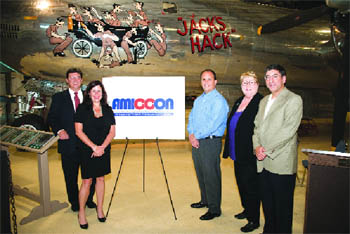
AMICCON Event Will Spotlight Companies, New Technologies

AMICCON

AMICCON

Ellen Bemben said she wasn’t sure this past summer how many manufacturers were coming to AMICCON, but she’s no longer concerned.
“If you asked us five or six weeks ago, it was going slowly, but then in September, people were getting back from vacations, and this thing pretty much took off,” said Bemben, one of the event organizers. “What a lot of manufacturers are telling us is that they finally have their own personal forum. There’s a lot of enthusiasm. This is going to be a happening.”
AMICCON, or the Advanced Manufacturing & Innovation Competition and Conference, was conceived in the fall of 2009, when area business leaders began discussing the issue of manufacturers awarding contracts outside the region, in most cases because they are not aware of the qualified supply-chain members and innovators doing business in their own backyard.
The program’s initial stage is a Nov. 16 event at the MassMutual Center in Springfield that will bring together manufacturers in several different categories to make key business connections.
“The goal is to bring business to the region and increase awareness among local manufacturers about what other manufacturers in the area are doing,” said Eric Hagopian, president of Hoppe Tool in Chicopee and an AMICCON steering committee member. “Together, we can really build on our reputation as a region for precision manufacturing of all types.”
According to event organizers, despite the richness and diversity of the region’s manufacturing sector, many manufacturers and supply-chain members are not aware of all that is produced in the Springfield-Hartford corridor.
As a result, they look outside this area — to other regions of the U.S. or even internationally — to supply goods that are actually being produced locally. When that happens, they lose potential customers — and profits.
The Nov. 16 event should start to turn that around, Bemben said.
“Manufacturers are excited. I think it’s because we’re grassroots, bootstrapping, apolitical,” she noted. “I like that they’re coming in from all areas, not just Massachusetts and Connecticut; some folks are coming in from as far away as New Jersey, New York, and New Hampshire.”
According to the AMICCON steering committee, the program’s goals include:
• Soliciting and exposing innovation in manufacturing, in areas ranging from products, processes, and IT to nanotechnology, robotics, coatings, and advanced materials, integrated systems, inventory management, and order tracking;
• Identifying local, qualified supply-chain members and introducing them to the region’s manufacturers through a dedicated Web site and database;
• Introducing original equipment manufacturers, procurement, and government contractors to the region’s advanced manufacturers through a continuum of highly focused programs;
• Promoting the region’s strengths in precision machining, plastics, paper and packaging, green technology, electronics, and medical devices; and
• Creating the region’s first manufacturing innovation competition, designed to promote the sort of forward thinking that has lent the Springfield area its manufacturing heritage.
Event organizers say that, while Western Mass. manufacturers must compete to survive, they also benefit when the entire sector is healthy, and to create that robustness, they need to show each other what they have to offer, along with attracting customers from outside the region.
Bemben said companies will have a chance to spotlight new technologies on Nov. 16 at a venue called the Innovation Station. For example, FloDesign plans to discuss a prototype for water purification using sonic technology, while Poly-Plating will show off a closed-loop system it created to recycle acidic water. Meanwhile, Universal Plastics might bring a thermoformed birthing tub, and Rensselaer Polytechnic Institute will be on hand with a variety of robotics.
“I think it’s going to be a very fast day,” Bemben said, stressing again that the event is only the first step in a long-term effort to boost manufacturing in the region. “It’s not going to be just one day, one event, where we walk away and say, ‘yippee, yay, we did something.’”
Hagopian, like Bemben, is pleased to hear that enthusiasm is rising.
“Any event like this is difficult to get off the ground in its first year,” he told BusinessWest. “But once you build up that momentum, people get excited and sign on. And when they see the value the show brings to the table for the region, they come back, and it’s a lot easier to get it done the next year. It becomes a bigger, more effective show.”
And a stronger, more robust region.

— Joseph Bednar

Opinion
Path to Recovery Poses Many Challenges

Incumbent Gov. Deval Patrick defied the national Republican tidal wave to win a second term at the helm of a commonwealth still seeking a post-recession economic identity. Massachusetts voters also retained overwhelming Democratic majorities in both House and Senate on Beacon Hill, sent a blue delegation to a newly red Congress, and defeated a proposal to reduce the state sales tax by more than half.
The Massachusetts that Gov. Patrick surveys as he savors his accomplishment is a paradox — stronger economically and with many more growth assets than other states, yet fragile in its ability to deliver on the promise of opportunity to all citizens of the Commonwealth.
The Bay State enjoys a lower unemployment rate at 8.4% than the nation as a whole, and the $2.5 billion state budget deficit pales in comparison with the fiscal disaster in California. But the 292,300 jobless people in Massachusetts and thousands of employers struggling to hold onto their businesses are anything but sanguine about what the future holds.
The challenges facing the governor and other policymakers seeking to promote economic growth are sobering — soaring health-insurance premiums, a looming 40% increase in average unemployment insurance rates, tight commercial credit markets, consumer uncertainty, and a state regulatory system that discourages innovation while creating little public benefit. Underlying many of these challenges is a pervasive sense among employers — many of whom expressed the opinion at the Associated Industries of Massachusetts’ recent regional policy briefings — that neither policymakers nor the general public really appreciate the complexity and risk of running a business in Massachusetts.
Bay State employers have solutions to offer and look forward to participating in the debate on the future of the Massachusetts economy. AIM represents thousands of employers who stand for jobs, economic opportunity, fiscal responsibility, business formation, and a government that acknowledges that the private sector has the unique ability and responsibility to create the common wealth for the people of Massachusetts.
We look forward to working with the governor, the Legislature, and the Congressional delegation to build support for several key principles of economic recovery:
• A uniformly favorable environment for business development across all industries and all regions of the Commonwealth;
• Economic policy that balances key public investments with a competitive cost structure that keeps jobs in Massachusetts;
• Predictable, responsible, and long-term state fiscal policy;
• Well-conceived and collaborative regulation that creates measurable benefits; 
• A nimble, world-class education system that provides opportunity for all Massachusetts citizens and the knowledge base for economic growth; and
• Collaboration be-tween business and government to ensure mutual success.
These principles will provide the foundation for a sustainable recovery that touches every sector of the diverse Massachusetts economy, from manufacturing to high technology to retail and hospitality.
Successful economic policy creates uniform benefit throughout the marketplace, balancing the need to invest in the future without simultaneously harming the industries of the present that employ the vast majority of Massachusetts residents.  
We look forward to the challenge.

Rick Lord is president of the Associated Industries of Massachusetts.

Features
As Key Votes Loom, Palmer Casino Backers Put Their Chips on the Table

Casino Rendering

Casino Rendering

For years now, casino backers, including those pushing for a resort operation in Palmer, have said it’s a question of when, not if, such gaming operations are approved. They’re saying it again this year, and with a House vote to support casinos already secured, and confidence that the Senate will follow suit, attention is now focused more than ever on where casinos will be located. Mohegan Sun, which would develop the $1 billion Palmer facility, believes it has a winning hand, because it maintains that the state needs what it calls a “Western Mass. outpost.”

The storefront has been open for just over a year now. In fact, an open house was recently staged to mark the anniversary.
It’s right in the middle of Main Street in Palmer, clearly visible to those approaching downtown from Route 32. The Mohegan Sun sign is large and prominent in the window.Visitors to the former retail space — now decorated in the motif of the casino in Uncasville, Conn. operated by the Mohegan Tribal Gaming Authority, complete with a few seats from the arena where the WNBA’s Connecticut Sun play — have a few primary objectives, said Paul Brody, vice president of development for that organization.
Some want to pose questions about the potential impact on their homes or businesses from a proposed $1 billion casino complex on land just off the exit 8 interchange of the Turnpike. “They want to know about traffic and how that will be and how it will be mitigated,” he said. But most are inquiring about jobs and, more specifically, what kinds of opportunities will be created. Mohegan Sun isn’t taking job applications, but it is signing people up, with the intent of calling them back if the complex becomes reality.
“And some others … they just want to know what’s going on with this thing,” said Brody, one of four Mohegan employees who staff the storefront. “They want to know if this is going to happen, and when — whether it will be one year, two years, or more.”
And Brody says he tells them basically what he also told BusinessWest when it stopped by the office: that these are certainly critical times for those who support — and oppose — organized gaming in Massachusetts, and especially for those who have invested considerable time (several years), energy, and emotion in Mohegan Sun’s proposed complex, which would be built on a hill high above the pike and Route 32 and include a 164,000-square-foot casino, a 600-room hotel, 12 restaurants, and 100,000 square feet of retail space.
The state House of Representatives has passed a bill calling for two casinos and several slot operations at racetracks (called racinos by some), and the Senate is due to vote on its own version later this month. There is strong sentiment that the Senate will also vote to support some kind of gaming package, but the devil is in the details, and Brody acknowledged that, while he is not conceding anything regarding the broad vote to green-light casinos, he said the conversation is, in many ways, shifting to where they’ll be located, not if.
And thus, Brody also tells visitors, as he told BusinessWest, that, in response to a request for data that might help legislators determine where, Mohegan Sun commissioned a study that shows that a casino in Palmer, or “Greater Palmer,” as she called it, would benefit the state more than one built in another proposed location (Milford), assuming that the second casino is built at the Wonderland complex in Boston.
The study, conducted by Morowicz Gaming Advisors, LLC, concludes that a casino in Palmer, instead of Milford in Central Mass., would result in $43.8 million in additional gaming revenue annually to the state, and nearly $100 million more in out-of-state dollars coming to the Commonwealth, primarily because it would lure more New York State residents than one farther east.
The study — which, to no one’s surprise, is being questioned by the backers of a Milford casino, who have a different take — is one of many ways backers of the Palmer resort are trying to build momentum at a time that many consider critical to the town’s future.
They’re presenting the proposal as more than a casino, but also as a way for an economically beleaguered community to replace manufacturing jobs that have left over the past two decades and provide long-term stability, while also bringing other types of development to nearby vacant or underutilized real estate. Meanwhile, they’re presenting it as the state’s best bet for a secondary resort outside Boston.
“This is not just a singular project on the hill, but potentially other kinds of development that will blend with the flow of traffic,” said Leon Dragone, president of the Northeast Resort Group, which owns the proposed casino property and leases it to Mohegan Sun, and now also occupies the space two doors down from Mohegan on Main Street. “There are several other properties we’re looking at.”

The Hand That’s Been Dealt Them
There’s a cluster of signs greeting motorists getting off the exit 8 interchange, most of them directing them to businesses and attractions in Palmer, to the right down Route 32, or in Ware, a few miles to the left.
But there are three relatively new additions that, along with a smattering of lawn signs along Route 32 supporting the casino effort, tell of the sense of urgency in Palmer these days and the importance of the casino to the town’s fortunes.
There’s the ‘Mohegan Sun — A World at Play’ sign in bright yellow, flanked by two signs of support, one for each of two recently formed groups: Palmer Businesses for a Palmer Casino and Citizens for Jobs & Growth in Palmer.
Robert Young is a member of both groups. He owns a landscaping company and has lived in Palmer most of his life, or at least long enough to see most manufacturing jobs leave and nothing of any substance to fill the employment void. Indeed, as he listed the manufacturers that have departed, including Tambrands, Zero Corp., Pearson Industries, and others, he said efforts to attract different kinds of employers, including those in high tech and the biosciences, have not met with success.
He acknowledged that the former Tambrands complex, seeking new tenants for more than a decade now, has attracted some new businesses, but few if any that are large employers.
“Palmer is a town that’s dying, and it’s been dying for a long time,” he said, noting that the ease with which Mohegan Sun and Northeast found vacant storefronts in the middle of downtown says something about the deterioration of the central business district. “We’ve lost tons of manufacturing jobs and support jobs, and nothing has materialized to replace them.
“We have no more jobs for a lifetime,” he continued, noting that, in his view and in the opinion of those who undertook a study on the subject at UMass, casino jobs are the new factory jobs that can support families for decades.
But jobs are not the only component of the argument being proferred by the support groups and other Palmer-site backers, who say a casino could lead to other kinds of economic development in the community and, in the process, fill a number of vacant parcels in and around Palmer with everything from additional hotels and restaurants to golf courses.
“There are a number of sites that could potentially be developed,” said Dragone, citing a 30-acre parcel once proposed for a Lowe’s and a 95-acre parcel in Ware as just two examples.
He said a North Carolina-based firm is being considered to create a master plan for nearby undeveloped parcels. Speaking broadly, he said a casino in Palmer could do for the town and surrounding region what the resort in Uncasville has done for Mystic, Conn., about a half-hour down the road, known for attractions such as its aquarium and Mystic Seaport.
“It’s quite legendary what’s occurred there, which has been a direct result of the blossoming of the gaming industry in the southeastern part of Connecticut,” he said. “It’s become much more of a year-round tourist attraction, where before, it was mostly seasonal.”

Doubling Down
While the Palmer casino support groups present their arguments about the benefits of resort casinos in general and a Palmer facility in particular, Mohegan Sun is devoting most of its efforts now toward pressing the case for a Western Mass. casino, said Brody, who is now splitting his time between Palmer and Boston, where he and lobbyists hired by the firm are trying to gain the ear of lawmakers.
The Morowicz Gaming Advisors’ numbers already have the attention of many legislators. They show that if there was one casino in Boston and a second in Palmer, the total gross slot and table revenues for the state in 2014 would be $1.168 billion, as opposed to $1.124 million for a Boston/Milford mix. Meanwhile, total out-of-state money coming into the Commonwealth would be $216.4 million with a Boston/Palmer scenario, compared to $119.1 million with a Boston/Milford combination.
The former numbers result from a Central Mass. facility essentially “cannibalizing” (the report’s authors’ word) the Eastern Mass. casino and racinos, while the latter is due largely to Palmer’s proximity to New York, resulting in reduced drive time for New York residents traveling to Palmer, as opposed to Central Mass.
Those in the industry say individuals will generally drive no more than two hours to frequent a casino, said Brody, which puts a Palmer resort in reach for people in Albany, Schenectedy, and Troy, and a Milford facility less so.
While Milford-resort backers have questioned the study’s results, Brody said that, objectively speaking, they are hard to argue with.
“There’s no outpost in the western portion of the state to attract the gaming revenue from this area and the New York, Vermont, and New Hampshire area,” he explained, adding that, in addition to that geographical logic, it’s clear, to him at least, that a Central Mass. casino would be far more vulnerable to cannibalism from existing facilities and ones that could come on the drawing board.
“What happens if New Hampshire launches gaming in the next few years at Rockingham and Seabrook?” he asked rhetorically. “That will have a profound impact on that whole Central Mass./ Eastern Mass. area. There’s a huge concentration of either existing or proposed facilities, all in or near Eastern Mass., and that’s why the math from this study is so compelling.”
Time will tell if the numbers and words coming out of the Mohegan camp will sway the decision makers in Boston, but Brody remains cautiously confident, and conveys this to visitors to the company’s storefront.
He said the volume of traffic increases when “something happens” like the House vote or when a key player endorses casinos. And that means the facility is quite busy these days.
“People sense that this is closer to reality than ever before,” he said. “We see it in the community, and we see it right here. There is still a ways to go, but people are excited; they sense that this is real.”

Roll of the Dice
Brody told BusinessWest that Mohegan Sun opened its storefront on Main Street to provide a resource for those with questions, opinions, and desires to land one of the projected 3,000 jobs to be created at the proposed resort. Meanwhile, the company wanted to provide a highly visible way of showing that, in some ways, it was already part of the Palmer community.
Whether Mohegan eventually assumes an exponentially greater presence and occupies a hilltop rather than a 1,000-square-foot storefront remains to be seen. The Legislature still has to decide if it will give the go-ahead for casinos, and then, if it does take that step, where to put them.
The Palmer site’s backers think they have a good hand, but they’re working hard to improve their odds in any way they can.
And in only a few weeks, they should find out if that hand is a winner.

George O’Brien can be reached at [email protected]

Agenda Departments

NEPM Product Showcase
Oct. 26: NEPM (New England Promotional Marketing) will stage its annual Promotional Product Showcase at Ludlow Country Club. The event will feature products from a number of vendors suitable for holiday gifts, trade-show handouts, or ideas for marketing plans. RSVP is required. For more information or to reserve a seat, call (413) 596-4800.

Developers Conference
Oct. 27: The Naismith Memorial Basketball Hall of Fame in Springfield will be the setting for the 2010 Springfield Developers Conference, sponsored by the City of Springfield. The conference theme is “Innovate, Grow, Create … Make It Happen,” and will feature opportunities for incorporating new technologies and innovative practices in the building, energy, and information-technology industries to improve one’s business. Exhibitor opportunities are still available. For more information, contact Samalid Hogan at (413) 787-6020.

Get on Board!
Oct. 28: OnBoard, a Springfield-based nonprofit, hopes to connect local organizations with individuals looking to increase their involvement in the community, from 5 to 8 p.m. at the Naismith Memorial Basketball Hall of Fame. The event will take place at Center Court, where attendees will meet with as many as eight or more organizations. The meetings will be orchestrated using the ‘speed-dating’ format, with individuals spending a few minutes with an organization of their choice, then, on the sound of the basketball buzzer, moving on to the next. Representatives from each organization will discuss their history, mission, goals, and what it is they are looking for in board members. Interested individuals will have the chance to explain what skills and interests they have to make a potential match. The event is free and open to the public. For more information, call Elizabeth Taras at (413) 687-3144, Brittany Castonguay at (413) 737-1131, or visit www.diversityonboard.org.

EANE Conference
Nov. 4: The Employers Assoc. of the NorthEast will host its annual Employment Law and HR Practices Update Conference from 8:30 a.m. to 4 p.m. at the Publick House in Sturbridge. The conference will be led by professionals in the areas of labor law, safety, employee relations, and unemployment. Conference highlights include up-to-date state and federal employment laws, recent court decisions, agency interpretations and prospective changes, as well as new compensation, safety, and employee-relations practices. For more details, call Karen Cronenberger at (877) 662-6444 or e-mail [email protected].
United in Hope
Nov. 14: New York Times bestselling and two-time Oprah Book Choice author Wally Lamb, will visit Springfield for the second annual United in Hope. He will raise awareness for how reading and writing build voice, and how sharing that voice creates hope for individuals and communities. Lamb will be joined by speakers, performers, and participating organizations and programs that focus on literacy and expression and community engagement. “United in Hope spotlights and models the dedicated efforts of many working together to conquer some of the urban challenges our city faces,” said Springfield Mayor Domenic Sarno. United in Hope will take place from 2 to 4 p.m. at the High School of Commerce at 415 State St. in Springfield. The event will be held in the Auditorium and is sponsored by Hasbro Inc. Immediately following the event, from 4 to 5 p.m., there will be opportunity to meet Lamb, purchase books, and browse community-resource tables. The event is free and open to the public.  For more information, contact Gianna Allentuck at (703) 930-0243 or [email protected].

Advanced Manufacturing Competition & Conference
Nov. 16: The first highly concentrated, cluster-centric, regional manufacturing conference of its kind will be held at the MassMutual Center in Springfield. The event, called the Advanced Manufacturing and Innovation Competition & Conference (AMICCON), is being staged in response to growing recognition among area manufacturers and supply chain members that there is an urgent need to find and meet one another. “AMICCON was formed to identify who’s here in manufacturing, expose them to OEMs (original equipment manufacturers) and procurement, and to make these introductions,” said co-founder Ellen Bemben. “The ultimate goal is to be the advanced manufacturing region in the U.S., where exotic manufacturing, such as micro, nano, and precision, meet higher specifications and tighter tolerances, and short runs are the norm.” Industry sectors to be represented at the event will include plastics and advanced materials, precision machining, paper and packaging, electronics, ‘green’/clean technology, and medical devices. Business opportunities in defense and aerospace will also be highlighted at the event. OEMs and their supply chains are being invited personally to participate. The Mass. Export Center has already produced two programs for AMICCON: an Export Experts Panel, and a seminar, “International Traffic in Arms Regulations for Defense and Aerospace Export.” For more information, visit www.amiccon.com.

Sections Supplements
Region’s Construction Sector Remains Sluggish

David Fontaine

David Fontaine says new schools are being funded, but other construction sectors continue to lag.

The continued weakness of the region’s construction industry has become frustrating and stressful for area builders, who have seen not just a drastic reduction in the pace of available jobs, but a significant influx of bidders on each project, some from far outside the Pioneer Valley. Faint indications point to a recovery starting next year, but right now, contractors are just looking for some good news to build on.

Joseph Marois shakes his head when he sees some of the winning bids in the current, hyper-competitive construction marketplace.
“The bids are normally pretty clustered together, with everything within a few dollars,” said Marois, president of Marois Construction in South Hadley. “You look at it now, and the low bidder is substantially lower than everyone else, sometimes by 20%. It’s incredible. It’s hard to understand how they make a profit on the jobs they’re doing.”
David Fontaine, president of Fontaine Brothers in Springfield, has noticed the same phenomenon.
“The price structure right now is incredible,” he told BusinessWest. “With some of the bids you’re getting beat by, you just shake your head and send the plans back. There seem to be eight to 10 bids on everything, at minimum, and it seems like there’s always one guy with a bid you just can’t understand.”
William Crocker, president of Crocker Building in Springfield, said these days were forecast by the collapse of the housing market a few years ago and the ensuing economic downturn. “The slowdown tends to affect us as general contractors late,” he said.
But while some other industries are reporting cautious optimism, construction work is as scarce right now — and competition as fierce — as Crocker has seen it since the recession began. “You see it in the bidding activity,” he said. “When there’s an open bid, every contractor in Western Mass. shows up.
“The margins are tight, and the numbers are tough,” he continued. “There’s some activity out there, but we’re still holding our breath.”
For this issue, BusinessWest examines why the major trends in building — few of them good — are continuing deep into 2010, and what contractors are saying about the road ahead.

Looking for a Silver Lining
Mark Erlich, executive secretary-treasurer of the New England Regional Council of Carpenters, recently noted in New England Carpenter magazine that hours worked by union carpenters in New England dropped 38% in the last 24 months, and unemployment in that group has hovered around 30% for much of the same period.
However, he writes, “I believe the worst is over. There are no prospects for a quick or extensive recovery, but I think the bleeding has stopped, and we can begin to think more optimistically about what is next. New England is positioned to rebound sooner than other regions because of the heavy presence of health care, higher education, and life sciences, industries that are more likely to witness future growth.”
That seems to be the case in Massachusetts especially, where the eds-and-meds sectors have been traditional drivers of the economy, and are spurring a significant portion of what activity is occurring right now.
“Look who’s building in Springfield. Look at the North End, and even the work we’ve done in the past few years,” said Crocker, citing projects like a new building for Hampshire Orthopedics in Hatfield. Public works and utilities are relatively active, too; “we’ve got several projects for National Grid substations.”
Others have seen similar trends.
“It seems that a lot of the schools are being funded,” said Fontaine, whose business tends to be about 70% public and 30% private — not a bad ratio in these times. “We recently started the new high school in Wilbraham, and we’re halfway into a new dormitory at the College of the Holy Cross. We’re also just getting ready to start a Transit Authority office in a building up in Greenfield.”
On the other hand, Crocker said, some traditional markets for builders — manufacturing foremost among them — seem to be stagnant. But it pays to be diverse. In addition to the health care and utility projects on his recent slate, Crocker also just completed the framework for Springfield’s Macedonian Church of God in Christ, which burned down a couple of years ago.
It’s good to diversify when things get this slow, he admitted, but even so, there are only so many projects. “We’re not seeing much of the small renovations. Everyone seems to be holding their purse strings rather tightly.”
There’s a little more public work available than private work, Marois said, although neither sector is exactly robust, and some industry watchers fret about the slow pace of infrastructure-investment legislation coming from Washington to help stimulate the pace of progress.
“Some people are busier than others. I think we’ve gotten our fair share of work, although the profit margins are minimal,” Marois said. “We’re just trying to keep our core base of employees. They have families, and they’ve been with us for a long time, so we want to make sure we maintain our relationship with them. I think that’s a common goal you’ll find among my peers.”

Better Days
Marois sees the clouds clearing somewhat, but there’s still a long way to go.
“It seems like there are more projects to bid now than in the past, but that hasn’t eliminated the number of people bidding on each one,” he said. “I’m bidding on a project now with 16 contractors on it. That’s getting to be pretty typical.”
Nationwide, construction employment expanded in 56 out of 337 metropolitan areas between August 2009 and August 2010, according to a recent analysis of federal employment data by the Associated General Contractors of America. More cities added construction jobs during the past year than at any point since September 2008, although Western Mass. has yet to see that sort of rebound.
“With construction employment on the mend in an increasing number of areas, it appears that the worst is finally over,” said Ken Simonson, the association’s chief economist, on the national picture. “The fact remains, however, that this industry has a long way to go before we see construction employment back to pre–recession levels.”
That’s especially true in the Pioneer Valley and into Northern Conn. The Springfield market ranked 208th on the list of 337 metro areas with a net construction job loss of 6%. The Pittsfield market held steady, ranking it 57th in the study, while the Hartford market lost 9% of its construction jobs in that time, ranking Connecticut’s capital at 269th. Overall, 11 of 12 Massachusetts metro areas lost jobs.
Fontaine has seen no improvement in the overall picture, but expects things to pick up soon. “We had scaled down a few years ago, and we stayed scaled down,” he said. “But we’ve been talking to some architectural firms, and they’re saying maybe one more year to go. There’s some large work out there — $100 million, $200 million work — but in the marketplace we survive in, not much.”
That’s why he, like so many other contractors, has been forced to look outside the Pioneer Valley for opportunities. “We actually picked up three projects in the last year, but we bid on probably 50 — most in the eastern part of the state,” he said. “Most of the things we’ve chased have been probably 75 to 90 miles from here.”
Marois has been surprised, however, not that builders are roaming outside of their usual geographic territory, but how far afield some are willing to travel to find work.
“I bid a job with contractors from Rhode Island, New York State, New Hampshire, Vermont, and the Boston area,” he said. “That job had 18 bidders on it, and the Rhode Island contractor got the job.
“I don’t understand it — they have to mobilize and set up, and that costs, and they have to know the local economy, the local vendors — it’s not necessarily something I would do to land a job.”
Until the industry picks up significantly, each construction company has to make those decisions to keep their business running.
“This is the time to get ready for the recovery that will come,” Erlich notes. “It may not be coming as fast as we would like, and there will be continued hardships.”
And way too many bidders for too few projects.

Joseph Bednar can be reached
at [email protected]

Opinion
Getting the Nation on Track for Jobs

This appears to be a good season for investment in transportation. In September, President Obama proposed to invest $50 billion in the nation’s transportation infrastructure. Transportation Secretary Ray LaHood has already committed $776 million to bring buses and bus facilities into a state of good repair. Combined with the $8 billion investment in high-speed rail that was part of the February 2009 stimulus package, it seems that the nation is finally putting a down payment on a 21st-century transit system.
But these sums are a pittance compared with the need. The U.S. has yet to commit the money needed to create a world-class rail system, or to stimulate a transit-vehicle manufacturing industry that today depends mostly on imports. In reports we released this week in cooperation with the Apollo Alliance and Worldwatch Institute, we estimate that a serious investment in public transit could stimulate thousands of sorely needed manufacturing jobs. To appreciate how far we are falling short, consider the example of China.
China recognizes the economic links between developing rail lines and promoting manufacturing. In 2001, it began a $132 billion rail-construction project, which is scheduled for completion in 2012. During roughly the same period, the U.S. appropriated just $19 billion for rail construction, or about one-seventh China’s level.
As part of its recession-recovery package, China committed $88 billion in 2009 to railway infrastructure, doubling its 2008 investment. The goal: to create much-needed transportation links, to generate demand for 20 million tons of domestic steel, and to create 6 million new jobs overall.
To reach the government’s goal of 1.1 million kilometers (about 450,000 miles) of railroad by 2012, China will spend a total of $292.5 billion. Of this, 13,000 kilometers will be for high-speed rail. A key benefit: China’s two leading locomotive and rail-car manufacturers will employ more than 212,000 people combined to meet domestic goals. If transportation policy is to create domestic manufacturers and permanent manufacturing jobs, a steady and predictable level of investment is needed. The U.S. lost its domestic passenger rail-car industry by the late 1980s not because of high labor costs, but because of erratic demand. Most of the countries that dominate the industry today, such as Germany and France, have wages comparable to the U.S., but they have a comprehensive strategy that allows producers to anticipate stable demand for their products.
Annual domestic demand for production of rail cars in the U.S. bounced between a low of 268 units to a high of 1,067 units during the 1970s, according to Thomas Boucher of Rutgers University. And as demand for transit vehicles waned, U.S. companies couldn’t come up with investment dollars to keep up with state-of-the-art technology.
We analyzed the job-creation potential of investment in rail infrastructure and estimate that the U.S. could gain 79,000 jobs in rail and bus manufacturing and related industries under an investment scenario sufficient to double transit ridership in 20 years. An investment at levels similar to China — $24.4 billion per year over six years — would yield 252,213 jobs, including many well-paid blue-collar jobs of the kind that have been devastated over the past decade.
Reclaiming a domestic rail industry is part of a broader need to revive competitive manufacturing. Even in its weakened state, manufacturing accounted for $1.6 trillion (12%) of U.S. GDP in 2008 — more than real estate, finance, and insurance.
Manufacturing accounts for 60% of U.S. exports and 70% of private-sector research and development funding. Yet the U.S. goods deficit with the rest of the world in 2008 exceeded $836 billion. The annual trade deficit with China alone was $266 billion in 2008, with 75% due to the manufactured-goods deficit.
A high-quality passenger-rail system is a trifecta. It would attract more riders and cut dependence on private cars — in turn reducing the carbon emissions that cause global warming. More than that, a commitment to mass transit could promote the resurgence of a major manufacturing sector that we’ve lost, reducing our trade deficit and increasing domestic jobs.

Joan Fitzgerald is professor and director of the graduate program in Law, Policy and Society at Northeastern University. Joseph McLaughlin is a senior research associate at the Center for Labor Market Studies at Northeastern.

Opinion
Patrick Gets Our Nod, but Has Work to Do

This is a critical time for Massachusetts, what most observers would describe as a critical crossroads. The state is still trying to recover from the worst recession in 80 years, while at the same time it is working to stimulate economic development in an ultra- competitive climate in which 49 other states and countless countries around the world are vying for businesses and jobs.
There is also the matter of casinos and whether they are to be part of the economic-development mix, the obvious need to make this state more business-friendly, and the very real possibility that the state’s sales tax will be rolled back to 3%, creating some possible opportunities for retailers but also a potential fiscal nightmare for the Commonwealth and its publicly funded institutions and programs.
For these reasons and others, BusinessWest lends its endorsement to incumbent Deval Patrick in the all-important governor’s race to be decided on Nov. 2. This is a nod over challenger Charlie Baker (Tim Cahill’s candidacy is a joke, and he should do the state a favor and drop out before the election) that comes with some caveats, as we’ll explain. The bottom line, we feel, is that Patrick is the best option for the state at this critical juncture.
For starters, we’ll note that Patrick has made some missteps in his first term. The Cadillac DeVille and office-redecoration exploits were among them, but more important were his steps backward in efforts to downsize government and stem the tide of patronage jobs. His failure to seal a casino deal has also led to questions about his leadership skills and ability to work with the Legislature to get things done.
But Patrick has matured in office and, over the past few years, has managed the deep recession effectively, while also amassing several legislative accomplishments, such as a toughening of pension and ethics laws, consolidation of transportation agencies, expansion of charter schools, and more.
What has stood out for us is his very real — not symbolic or token — support of Western Mass. and some of its struggling cities.
In Springfield, for example, Patrick was personally responsible for Liberty Mutual opening an office in the Technology Park at Springfield Technical Community College, a facility that now employs more than 300 people. His administration also played key roles in the State Street Corridor revitalization effort, South End redevelopment, efforts to make UMass Amherst a more vital force downtown, the Data Center being built at the former Tech High School site, and other initiatives.
Meanwhile, in Holyoke, another former manufacturing center trying to reinvent itself, Patrick administration played a key role in advancing the high-performance computing center project, an economic-development initiative that could have huge ramifications for that city and the region as a whole.
The wheels started turning thanks to officials at MIT, UMass Amherst, Boston University, and other schools, as well as private industry, but the Patrick administration helped steer this project to a successful conclusion, and in a city that sorely needs an economic boost.
While in the past, governors and candidates for that post have talked about how they represent the entire state and how important Western Mass. is to them, Patrick has backed up the talk, and in a way that hasn’t been seen since Michael Dukakis was in the corner office.
While we believe Patrick has earned another term to see if he can build on these accomplishments and create more progress for this region and the state as a whole, we’ll note that he and everyone else on Beacon Hill still have some serious work to make this state more business-friendly, and this must be one of the top priorities for whomever is governor next January.
Jobs are the real key to making a full recovery from the Great Recession and enabling cities like Springfield and Holyoke to forge new identities. And the key to creating them is making this a state business owners believe they can afford to be in. Right now, not enough people are of that sentiment, and until the reality, and not just the perception, changes, Massachusetts will be at an extreme disadvantage.

Cover Story
Human Resources Unlimited Has Been Supplying It for 40 Years
Cover October 25, 2010

Cover October 25, 2010

For four decades, Human Resources Unlimited has been debunking myths about people with disabilities and helping such individuals become part of the local workforce. As the agency marks its milestone, it reflects on a solid track record of success, but, more importantly, looks ahead, toward developing strategies for doing what it does even better.
Like many people across Western Mass., John Gullotti is looking for work — and not having much luck finding it.
But unlike most of those perusing the want ads and sending résumés to companies across the region, Gullotti is confronting much more than a lingering recession and wariness among many employees to make additions to the workforce as he carries out his search.
For starters, he’s hindered by a résumé that shouts that he is overqualified for some of the entry-level, minimum-wage positions he’s seeking; he has a bachelor’s degree and experience, some of it in management, with many national retailers. And then, there’s the 12-year gap on that résumé, which includes a five-year span during which he was simply too afraid to leave the house.
That fear was a byproduct of the deep depression and paranoia that Gullotti was diagnosed with years ago, and has been battling ever since.
And maybe because of his progress in that fight, especially in recent years, Gullotti has something in abundance that many job seekers have all but run out of: hope.
His large supply of that commodity comes mostly through his association with Human Resources Unlimited (HRU) — a private, nonprofit agency — and, more specifically, a program, or facility, called Lighthouse. There, Gullotti and dozens of other developmentally disadvantaged individuals are trying to enter or re-enter the workforce and thus connect with the community around them.
Providing hope and making connections to the community are not the official missions of HRU, but they might as well be, said Don Kozera, its long-time president, noting that, as the agency turns 40, it is not merely celebrating four decades of carrying out those assignments, but also looking ahead, toward creating ways of continuously doing what it does better.
And perhaps what the agency does best, said Kozera, is help debunk many of the myths or misperceptions about people with disabilities, while also helping members like Gullotti realize that they can do things that others say that they can’t, and that they themselves might believe they can’t do.
“It was believed that people with developmental disabilities couldn’t work with equipment or couldn’t work in outside businesses, or could only handle repetitive work, so that became our battle cry,” said Kozera, noting that, over, the years, HRU has accomplished that mission through programs and businesses it has created or acquired, which ranged from a printing shop to a restaurant to a packaging outfit. But it’s also done it by placing members in jobs with area companies.
Created in 1970 to be the vocational training center for Belchertown State School residents and provide employment opportunities for residents of the facility, HRU, known then as the Carval Workshop, has expanded and evolved over the years. It now offers a broad range of services, from assistance for individuals transitioning from public assistance to the workplace to a ‘day habilitation’ program called Pyramid for people with developmental disabilities; from a commercial division known as Custom Packaging to four so-called ‘clubhouses’ (more on that term later) — Lighthouse, Star Light, Forum House, and Trade Winds.
With most all of these programs, there is one common thread that has defined HRU since the beginning — putting people, or members, to work.
Since he first came to Lighthouse, rather reluctantly and with great doubt about whether it would help him in any way, Gullotti has worked in what’s known as a transitional employment (TE) position as a receptionist with the state Department of Mental Health. Later, he worked in a supportive employment position handling calls to First Response from business owners impacted by the massive oil spill in the Gulf of Mexico.
Over the past few months, he has continued his search for independent work, and while he’s had just one actual interview, he remains upbeat and believes that, overall, he’s in a much better place than he was when he first walked in the door at 1401 State St.
“I’m able to deal with different situations that I never could before,” he explained. “Hope … that’s been the strongest piece. I have seen results that, even if they’re small, allow me to push on.”
For this issue, BusinessWest takes an indepth look at HRU as it celebrates its milestone, and, while doing so, weaves in in Gullotti’s thoughts and experiences to show what this agency does and how it does it, and maybe quantify and qualify the sheer power of hope.

Unlimited Potential
Kozera was teaching a little, coaching soccer, and working toward his MBA at American International College when he applied for the job of fiscal director of the Carval Workshop in 1980.
“I saw 120 people sitting around with no work in front of them,” he recalled, “and I thought to myself, ‘I can’t mess this up any more than it already is.’”
So he took the job, while going to school at night — but with the expectation that it would be little more than a line on a resume. Instead, it’s become his life’s work — and very much a work still in progress.
And when one visits ETS Career Services and Custom Packaging, two programs that are essentially the current incarnations of Carval Workshop, there are dozens of people with plenty of work in front of them.
Those initiatives and their growth patterns are emblematic of how HRU has expanded well beyond its humble roots and evolved over 40 years, and especially Kozera’s tenure, which started in 1980.
Today, HRU has several components, including:
• Workforce Alternatives, which helps transition individuals from public assistance to the workplace through job-readiness skills, placement assistance, and ongoing support;
• Pyramid, a ‘day habilitation’ program that provides a caring environment in which individuals with developmental disabilities can enhance their physical, mental, and social competencies;
• ETS (Employment Training Support) Career Services, which provides individuals who are disadvantaged or have developmental or other disabilities with opportunities to increase their vocational skills and find meaningful work. Participants handle work ranging from light assembly to sorting gift cards bound for the Final Markdown;
• Custom Packaging, HRU’s commercial division that provides customers, including Olympic Manufacturing and other area employers, with services including hand assembly, heat sealing, shrinkwrapping, folding, collating, and mailing; and
• The four clubhouses, which help transition members, who join on a volunteer basis, to meaningful employment and, hopefully, independent employment.
Kozera said he doesn’t particularly like the word ‘clubhouse’ — he believes it conjures up images of children in tree forts — but he certainly likes the results these facilities have generated over the past half-century, and especially since they became part of the landscape in Western Mass.
The clubhouse model provides members with a supportive environment where they can get assistance with transitioning into the workplace or back into school as well as increasing their participation in the community.
Members work with staff to operate the clubhouse, said Kozera, adding that activities are designed to help members develop and hone critical vocational skills needed to succeed in the workplace. The facilities then help members transfer the skills and capabilities learned at the clubhouse to real jobs in the community. Over the years and decades, a number of area companies have stepped forward to provide such jobs.
That list of more than 120 business partners includes large regional or national retail chains, such Big Y, Friendly’s, CVS, A.J. Wright, Burger King, and others, but also such wide-ranging local businesses as WGBY and Berkshire Service Experts.
Each member of a clubhouse receives a comprehensive vocational assessment that identifies training and job-placement priorities, as well as preferences. Members are also provided with career counseling, interview-skills training, résumé writing, and job-search assistance, as needed.
Once a member is placed in a transitional or competitive employment job, clubhouse staff members continue to provide ongoing support for work-related and personal issues, said Kozera, adding that the goal with most members is to move them into independent employment after a specified period.
It was into this world that Gullotti walked about 18 months ago.

Seeing the Light
He told BusinessWest that it was his therapist who first suggested that he become a member of Lighthouse, thinking that its group setting would help him gain the needed confidence and inspiration needed to move his life forward and gain meaningful employment.
Gullotti agreed to give it a try, but did not share his therapist’s optimism, to say the least.
“I remember that my first impression of the place was that I couldn’t wait to see my therapist again and tell him that I thought he needed more help than I did,” said Gullotti with a laugh, adding quickly that with each visit he was getting more comfortable, while also learning and gaining inspiration from those around him.
Jeff Trant, program director at Lighthouse and Gullotti’s mentor since the day he walked in the door, said he is representative of the people who come to that facility — but also atypical in at least one respect: he wants to work, to be independent.
“He wants to get off of disability benefits,” Trant explained. “Many people are so polarized, they’re afraid that if they go back to work they’ll lose those benefits. John doesn’t want them; he wants to be independent and self-sufficient, and that’s an anomaly these days, because we have such a disability-entitlement culture.”
But it took Gullotti several weeks to get comfortable at Lighthouse, said Trant, adding that, at the beginning, he was overwhelmed by the situation he found himself in, and, in most all ways, simply not ready to join the workforce.
“It took a while for him to get really get comfortable, but once he got past that threshold and over that barrier of going into this place called Lighthouse, he found it extremely liberating,” said Trant. “You could almost see him relax once he got in and saw what this place was.”
A seminal moment in Gullotti’s progression came roughly a month after he arrived, when he was given a transitional employment assignment with the Department of Mental Health as a administrative assistant and receptionist. This was another transition that had some rough moments, but eventually, as he did with Lighthouse, Gullotti found a comfort zone and made it progressively larger.
“I remember having some impromptu counseling sessions with John in the early days when he would come back in tears,” said Trant. “He was so emotionally overwhelmed, and his confidence and his self-perception were so low that he didn’t think he was worthy and able to work.
“But very slowly, as he found his office colleagues were supportive and receptive, he went from doing the simple nuts and bolts of the job — answering the phone, sorting mail, and greeting people as they came in the door — to doing some very high-end projects that some of their more seasoned staffers would handle; he became a go-to person in that organization.”
The confidence he gained at DMH, coupled with ongoing support from family and both staff and members at Lighthouse, gave Gullotti what Trant called the “gusto” to move on to not only the next step employment-wise — a temporary position arranged through Johnson & Hill Staffing handling with Innovations First Notice — but also other platforms through which he could connect with the community.
“Here’s someone who, a few years earlier, wouldn’t leave his room,” said Trant. “Now, John is out speaking in front of Rotary clubs with me. He shares his story of hope and recovery, and he’s spoken in front of groups of more than 100 people. To me, that is so telling about how far he’s come and how much insight he has.”

Forward Thinking
There have been many success stories scripted by Lighthouse and the other clubhouses within HRU, as the walls within Lighthouse attest. There are pictures of members and former members in work settings and wall charts indicating current assignments and who has them.
Moving forward, Kozera said those at HRU want to make this 40th anniversary a time of celebration, obviously, but also a time for introspection, looking at programs, and developing a strategic initiative that will ultimately yield more pictures for the walls and more stories of individual triumph over adversity.
The company has always been focused on continuous improvement and the ‘good to great’ philosophy, said Kozera, but he wants the current milestone to spark an even deeper commitment to reach higher and, ultimately, put more members in jobs and have them thrive in those positions.
“We have a whole new level to get to,” he explained. “We have every accreditation in the world — national, international, state, and we get the highest ratings in all of those. But we don’t feel that we’re even close to the level we need to be at.”
To get to where it wants to go to go, HRU will continue to observe not only similar programs in other parts of the state and the country, but also businesses across myriad sectors and educational institutions, and “steal shamelessly,” as Kozera put it, when it comes to best practices and concepts it can apply.
In other words, the agency intends to be innovative, in the strictest definition of the word.
“Over the years, innovation has rarely been someone creating something brand-new,” he explained. “What they do is, they take a process, product, or system in one industry, and they tweak it and apply it to another system, and all of a sudden, it’s new.
“If you look at the iPhone and the iPad, these are things that are conglomerations of things that already existed; they’re just packaged in a different way,” he continued, adding that he wants HRU to continue innovating in that same fashion, again with the simple, overarching goal of putting people in the workplace.
And to achieve continuous improvement in that realm, Kozera and his staff will be focusing on the two agency’s two core functions — job preparation and job placement.
With regard to the latter, Kozera recently brought in some sales executives and sales-training professionals to work with and motivate those at HRU who are essentially selling job placements to area companies, thus creating opportunities for members like Gullotti.
“Most sales professionals are motivated by money, but the people who end in our industry are motivated by mission,” he explained. “Someone has to tie what your job is to the mission. So what we were able to do is bring in the sales principles, the sales discipline, and the sales structure, but then have individuals who have passion for what they do — because that’s why they’re in this industry and equate that there’s nothing more critical than them making a phone call and ultimately making a sale.
“It doesn’t matter how much you job train,” he continued, “if you don’t have a job waiting for you at the end of your job training.”
Meanwhile, on the job-preparation side of the ledger, HRU is working to make individuals better able to get and keep the jobs sold by the sales team. And at the heart of these efforts will be an initiative to be launched in January called “Changing Habits and Transforming Lives.”
It will take a number of proven principles not typically applied to job training and put them together for that purpose, said Kozera, noting that, collectively, individuals with disabilities mirror society in general, which means that many are obese and do not have the stamina to be employed, while others may lack the work ethic to obtain or keep a position. So HRU will be focused on those areas and others to help members become more workplace-ready.
As just one example, he cited exercise and its ability to help people focus.
“Exercise is really Miracle-Gro for learning,” he explained. “If you have an exercise routine, for up to four hours after that routine, you have the ability to take in information better, faster, quicker.
“There are schools around the country that are implementing this,” he continued. “I traveled to Naperville, Ill., and visited a school where they’re not cutting gym, like everyone else; they’re looking to expand it. Now, whatever your hardest subject is, you have gym right before that. And the results are amazing.”
The challenge for HRU will be to take some of these proven methods and repackage them to benefit members and meet the agency’s primary mission to get people employed, he told BusinessWest.
“The bottom line is get people to fit in,” he concluded, stating HRU’s reason for being in still another way. “That’s the number-one issue to getting people employed and keeping them employed — they get along with others, and they fit in.”

Getting the Message
As part of its 40th-anniversary celebration, HRU will stage a breakfast at the Sheraton in downtown Springfield on Oct. 26. The keynote speaker will be Troy Brown, former New England Patriots wide receiver and integral part of three Super Bowl-winning teams.
His talk is expected to center around his ability to defy the odds and rise to stardom in the NFL when few thought he would.
That message should resonate with an audience of HRU administrators, staff members, business partners, and business and civic leaders, who have helped enable the agency to permit others to beat long odds against them.
People like John Gullotti, who both understand and help create the power of hope.

George O’Brien can be reached
at [email protected]

Building Permits Departments
The following building permits were issued during the month of October 2010.

AGAWAM

Cirillo Realty, Inc.
1508 Main St.
$15,000 — Enlarge kitchen and increase seating capacity in restaurant

AMHERST

Amherst College
Orchard St.
$23,000 — Repair exterior stairs at football field press box

Yosrex Limited Partnership
266 E. Hadley Road
$12,000 — New roof

CHICOPEE

Chicopee Housing Authority
165 East Main St.
$94,000 — Install new generator

Knights of Columbus
1599 Memorial Ave.
$25,000 — Structural repairs

Lymtech – John R. Lyman Company
2255 Westover Road
$1,075,500 — Renovate existing commercial building to manufacturing & office spaces

Motel 6
36 Johnny Cake Hollow Road
$155,000 — Strip and re-roof

St. Christopher’s Episcopal Church
27 Streiber Dr.
$100,000 — Extend to exterior walls to create common room

EASTHAMPTON

Kevin Sahagian
228 Northampton St.
$30,000 — Construct a deck with ramp and replace siding at food establishment

EAST LONGMEADOW

Donald Lomasscola
147 Shaker Road
$75,000 — Renovation

East Meadow Realty
30 Shaker Rd.
$15,000 — Tenant fit-up

Family Bike
217-219 Shaker Road
$3,500 — New roof

Hasbro
443 Shaker Road
$44,000 — Modify mezzanine area

GREENFIELD

John F. Conley
1 Cumberland Road
$17,000 — Erect a three-bay garage

One Arch Place
6 Arch St.
$1,000 — Tenant fit-up

The Leonard House, LLC
116 Federal St.
$40,000 — Renovations

HOLYOKE

Holyoke Mall Company, L.P.
50 Holyoke St.
$3,950 — Remodel existing Bath & Body store

John Dafonte
130 Maple St.
$34,000 — Install new roof

Rafael Fernandez
161-163 High St.
$4,600 — Install new staircase

LONGMEADOW

Bailey Center
85 Hawthorn St.
$11,000 — Re-roof and exterior alterations

GPT – Longmeadow Shops
686 Bliss Road
$32,000 — Storefront alterations

Verizon Control Office
450 Longmeadow St.
$89,000 — Cell tower renovation

LUDLOW

David Lavoie
107-117 Center St.
$3,000 — Re-roof

NORTHAMPTON

City of Northampton
80 Locust St.
$175,000 — Install replacement windows at the Smith School

City of Northampton
42 Gothic St.
$202,000 — Remove partition walls and reconfigure classroom spaces

City of Northampton
210 Main St.
$4,000 — Enlarge opening in the city clerk’s office

City of Northampton
139 South St.
$230,000 — Install replacement windows and interior renovations

Coca-Cola Company
45 Industrial Dr.
$1,340,800 — Construct a 16,600-square-foot addition and renovate existing building

The College Church, Inc.
58 Pomeroy Terrace
$5,000 — Install four basement replacement windows

South Hadley

Loomis Village
20 Bayon Dr.
$35,000 — Renovation

SPRINGFIELD

Family Medical
1515 Allen St.
$15,000 — Remodel office areas

Iparty
1552 Boston Road
$1,500 — Bring in fixtures and set up merchandise

WESTFIELD

Industrial Precision
1014 Southampton Road
$22,000 — Construct wall

WEST SPRINGFIELD

Agri-Mark
958 Riverdale St.
$75,000 — Erect 28-foot opening in wall for truck sanitizing

Century Center, LLC
235 Memorial Ave.
$15,000 — Extend facade over store front

Verizon Wireless
120 Interstate Dr.
$12,000 — Install antenna on existing tower

Agenda Departments

Talk on Emily Dickinson
Oct. 14: Biographer Lyndall Gordon will discuss her controversial new book, Lives Like Loaded Guns: Emily Dickinson and Her Family’s Feuds, in a talk in Johnson Chapel at Amherst College. Gordon will address the limitations of biography and its risks and gains by focusing on several of the story’s principal players. The 7 p.m. talk is free and open to the public. A book signing and reception will follow Gordon’s lecture. For more details, visit www.emilydickinsonmuseum.org/events.

Witchcraft Lecture
Oct. 25: Witchcraft and its effects on Europe will be the subject of a lecture by Dr. Donald D’Amato, adjunct professor at Springfield Technical Community College, at 6 p.m. at the Wistariahurst Museum, 238 Cabot St., Holyoke. The title of the lecture is “The Unhappy History of Witchcraft.” He’ll discuss how people tend to misinterpret witchcraft by romanticizing its history and making it exciting. Admission is $5 for adults, $3 for students and seniors. For more information, call (413) 322-5660 or visit www.wistariahurst.org.

NEPM Product Showcase
Oct. 26: NEPM (New England Promotional Marketing) will stage its annual Promotional Product Showcase at Ludlow Country Club. The event will feature products from a number of vendors suitable for holiday gifts, trade-show handouts, or ideas for marketing plans. RSVP is required. For more information or to reserve a seat, call (413) 596-4800.

Developers Conference
Oct. 27: The Naismith Memorial Basketball Hall of Fame in Springfield will be the setting for the 2010 Springfield Developers Conference, sponsored by the City of Springfield. The conference theme is “Innovate, Grow, Create … Make It Happen,” and will feature opportunities for incorporating new technologies and innovative practices in the building, energy, and information-technology industries to improve one’s business. Exhibitor opportunities are still available. For more information, contact Samalid Hogan at (413) 787-6020.

Get on Board!
Oct. 28: OnBoard, a Springfield-based nonprofit, hopes to connect local organizations with individuals looking to increase their involvement in the community, from 5 to 8 p.m. at the Naismith Memorial Basketball Hall of Fame. The event will take place at Center Court, where attendees will meet with as many as eight or more organizations. The meetings will be orchestrated using the ‘speed dating’ format, with individuals spending a few minutes with an organization of their choice, and, on the sound of the basketball buzzer, moving on to the next. Representatives from each organization will discuss their history, mission, and goals, and what they are looking for in board members. Interested individuals will have the chance to explain what skills and interests they have to make a potential match. The event is free and open to the public. For more information, call Elizabeth Taras at (413) 687-3144, Brittany Castonguay at (413) 737-1131, or visit www.diversityonboard.org.

EANE Conference
Nov. 4: The Employers Association of the NorthEast will host its annual Employment Law and HR Practices Update Conference from 8:30 a.m. to 4 p.m. at the Publick House in Sturbridge. The conference will be led by professionals in the areas of labor law, safety, employee relations, and unemployment. Conference highlights include up-to-date state and federal employment laws, recent court decisions, agency interpretations, and prospective changes, as well as new compensation, safety, and employee-relations practices. For more details, contact Karen Cronenberger at (877) 662-6444 or [email protected].
Advanced Manufacturing Competition & Conference
Nov. 16: The first highly concentrated, cluster-centric, regional manufacturing conference of its kind will be held at the MassMutual Center in Springfield. The event, called the Advanced Manufacturing and Innovation Competition & Conference (AMICCON), is being staged in response to growing recognition among area manufacturers and supply-chain members that there is an urgent need to find and meet one another. “AMICCON was formed to identify who’s here in manufacturing, expose them to OEMs (original equipment manufacturers) and procurement, and to make these introductions,” said co-founder Ellen Bemben. “The ultimate goal is to be the advanced manufacturing region in the U.S., where exotic manufacturing, such as micro, nano, and precision, meet higher specifications and tighter tolerances, and short runs are the norm.” Industry sectors to be represented at the event will include plastics and advanced materials, precision machining, paper and packaging, electronics, ‘green’/clean technology, and medical devices. Business opportunities in defense and aerospace will also be highlighted at the event. OEMs and their supply chains are being invited personally to participate. “AMICCON is a new consortium on innovation that also delivers manufacturers to innovators and new markets in order to cause new business,” said Gary Gasperack, vice president and general manager (retired) of the Spalding Division of Russell Corp. “We are very excited about introducing it to our region.” The Mass. Export Center has already produced two programs for AMICCON: an Export Experts Panel, and a seminar, “International Traffic in Arms Regulations for Defense and Aerospace Export.” For more information, visit www.amiccon.com.

Opinion
The Income Gap Is Widening

The term ‘middle class’ is more than an economic distinction. It’s also an appreciation for balance and equity and a national yearning for a strong, cohesive society. Yet a polarizing income gap in Massachusetts and elsewhere is threatening both the class and the concept.
Massachusetts is emerging from the recession ahead of other states, with job creation on the rise. However, the state leads the country (it is tied for first place with Arizona) in having the largest gap between the haves and have-nots, according to the Center for Labor Market Studies at Northeastern University; 10% of households in the state earned as much income in 2009 as the bottom 70% combined during that year.
What is driving this widening gap? Economists differ on this, but many point to executive compensation, declines in manufacturing jobs and wages, a corresponding increase in employment in the so-called ‘knowledge economy,’ and changes in household dynamics, such as the rise in single-parent families. Gaining a better understanding of these issues should be a top priority for the next governor and should be at the forefront of the policy debate in the closing weeks of the gubernatorial election.
New data by the MassINC Polling Group suggest an eroding confidence in a cornerstone of the American Dream: the belief that the hard work of one generation opens the door to a better life for the next. Just 22% of Massachusetts parents believe the next generation will do better than they did financially. This pessimism is a new phenomenon. In 2003, when a slightly different question was posed in a MassINC poll, 68% of parents believed their children would be generally better off.
Why the dramatic change in public opinion? Income inequality has been rising for years, but the difference now is that economic growth isn’t lifting all boats. Over the last decade, census figures show median household income fell by between 1% and 8%. Little wonder that the mood of the electorate reflects strong undercurrents of frustration and resentment.
Growing income inequality and its political implications have received increasing attention across the political spectrum since the 1980s. Alan Greenspan had a point when he said in 2005: “a stark bifurcation of wealth and income trends among large segments of the population can fuel resentment and political polarization. These social developments can lead to political clashes and misguided economic policies that work to the detriment of the economy and society.’’
Perhaps we should have listened. The resentment, polarization, and political clashes contemplated by Greenspan have already materialized. The resulting anger is fueling a push for simplistic solutions to such complex problems as deficit reduction, immigration, and a host of other issues. In essence, the middle ground on policy issues is rapidly disappearing, just like the middle class itself.

Greg Torres is president of MassINC and publisher of CommonWealth magazine. Andrew Sum is director of the Center for Labor Market Studies at Northeastern University.

Cover Story
Casinos — and a Town — Are in Limbo

Cover October 11, 2010

Cover October 11, 2010

Town Council President Paul Burns says a proposed $1 billion casino casts a big shadow over the town of Palmer, a very big shadow. And this makes the current stalemate on the issue of gaming on Beacon Hill quite frustrating to those who support the initiative and the jobs and tax revenue it will generate. In some respects, the Palmer casino is closer to reality than ever, but in others, resolution of the matter still seems far off amid questions about who will be leading the state come January and whether he can broker a Palmer-friendly casino deal. Ultimately, many believe casinos are simply too big to fail in the Bay State.

“Hopeful frustration.”
That’s the phrase Paul Burns summoned, after a few moments of careful consideration, to describe his mindset these days, a few months after gaming legislation that seemed destined to pass in Boston fell by the wayside instead.
Failure on the part of the governor and Legislature to seal a deal on casinos has left gaming — and the town of Palmer, which Burns serves as town councilor — in a serious state of limbo, one where Mohegan Sun’s plans to build a $1 billion resort casino on a hillside parcel just off the Mass. Turnpike are agonizingly close to becoming reality, yet, in some ways, no closer than they were years ago.
That’s where the frustration comes in.
As for ‘hopeful,’ well, Burns, like many others in this town who support gaming, believes that casinos are essentially too big to fail in the Bay State, and that common sense dictates that if several casinos are approved — or even one — Palmer is the state’s first, best choice.
“It was very frustrating to watch the process — I couldn’t understand why the three groups couldn’t get together on this,” said Burns, noting that he’s become an unofficial spokesperson for supporters of a casino, although he stressed repeatedly that he speaks for himself, not the nine-member Town Council as a whole. “But at the end of the day, I think common sense will prevail and this will get done.”
Whether casinos are indeed too big to fail is still a matter for debate, but there’s no debating that the proposed facility in Palmer is a nearly all-consuming matter there, where the assessor’s office estimates that a casino on the scale being planned could bring the town more than $15 million in total tax revenues annually, nearly double the amount collected now. Meanwhile, there are estimates that the casino will create more than 3,000 jobs (not to mention 1,500 temporary construction jobs) and spur more ancillary economic development, and it will certainly change the landscape of the community in just about every way that word can be defined.
“Let’s just say it casts a very big shadow,” said Burns, noting that, while things haven’t ground to a halt while the gaming issue plays itself out, much of what happens in this town business- and economic-development-wise will be impacted by whether the casino becomes reality. “I want to see a casino project, but everyone wants to see a resolution to this matter.”
These are indeed frustrating, anxious times for Palmer. It has been 14 years, by Burns’ count, since the issue of a casino was first raised here. Over the past few years, gaming bills have come increasingly closer to passage, but have never made it to fruition. In late June, things came apart in an almost maddening way, as Gov. Deval Patrick and leaders of the state House and Senate could not reconcile their differences over how many slot parlors, or ‘racinos,’ as they’re called, the state should license, scuttling legislation that most in Palmer and elsewhere thought would pass — in some form.
Now, there is optimism that a measure can be passed next year or even this fall. But there are also nagging questions, especially about who will be governor come January and what that individual’s mindset will be when it comes to gaming.
Republican candidate Charles Baker has said publicly that he supports one casino to start to see how gaming and the Commonwealth suit one another. If Baker prevails in November, and sticks to that plan, will Palmer be the chosen site?
For this issue, BusinessWest examines the mood in Palmer and the thought processes moving forward as the elephant in the room that is casino gambling grows ever larger in stature.

High-stakes Proposition
It’s called Nostalgia Day.
That’s the name given to the annual community get-together in Palmer that marked its fifth year on Sept. 18. Once staged on Main Street, the event was moved a few years ago to Legion Field behind Converse Middle School. Nostalgia Day pays homage to the community’s past, especially its status as a rail hub; this is known as the ‘Town of Seven Railroads.’ This year, the event included everything from narrated trolley rides to a Wiffle ball tournament to entertainment ranging from polka music to a tribute to Fleetwood Mac.
While taking part in all those things, attendees were also talking about the casino, said Robert Young, president of K.E.Y. Property Services and also president of something called Palmer Businesses for a Palmer Casino. “And they were letting some anger out.”
“The frustration was palpable,” said Young as he described the general mood, at least among casino backers, and they are, according to most all assessments, in the majority in this community. “The issue’s not dead; it’s not moving forward, and it’s not moving backward. It’s in limbo.”
In some ways, it’s always been in that state. Palmer passed a resolution supporting a casino within its borders several years ago, and in 2007, the proposal for Mohegan Sun’s $1 billion facility — complete with a 164,000-square-foot casino, a 600-room hotel, 12 restaurants, and 100,000 square feet of retail space — took shape.
For the past several years, casinos have been the subject of debate on Beacon Hill, with the Palmer facility always taking prominence as one of the lead proposals and essentially the Western Mass. option. Over the past few years, gaming measures have been gaining momentum as the state’s fiscal situation has worsened and the need for additional revenue has risen.
Indeed, in previous years, the players in Boston never really came close to passing a measure, but earlier this past spring, Patrick, House Speaker Robert DeLeo, and Senate President Therese Murray were seemingly united in their support for some form of gaming measure.
They just couldn’t agree on the final details, especially those concerning the number of racinos, and once again, the clock ran out on the legislative session.
There is some speculation that the Legislature may return to session and vote on a casino bill this fall, but most consider it more likely that the issue will play itself out again next spring and summer, when there may be a new governor and several new legislators in office.
So this leaves casino backers watching, reading, assessing, and, well, weighing the odds.
Late last month, they read about the New England Gaming Summit, staged in Mohegan, Conn., where Mohegan Sun officials reaffirmed their commitment to a project in Massachusetts — and Palmer. “When Massachusetts is ready, we will be ready,” said Mitchell Grossinger Etess, the company’s president and CEO.
They’ve also read that, while more casinos are being proposed in the states surrounding Massachusetts, and the sector suffers through the effects of the Great Recession, the gaming industry remains bullish on New England, and Mohegan Sun is still focused on the Town of Seven Railroads.
“Palmer is without question the premier site for a casino resort in the Commonwealth,” Etess told the Gaming News late last month. “More than 11 million adults are within two hours of Palmer throughout New York and New England. Its central location makes it ideal to draw significant out-of-state traffic.”
While these signs look positive for casino backers, so, too do many of the comments from those now in the Legislature — and those who wish to unseat them in the November general election, said Leon Dragone, president of the Northeast Resort Group, which owns the proposed casino property and leases it to Mohegan Sun.
“I’ve been watching the legislative contests, from Cape Cod westward,” he said, “and almost everyone running is for casinos; no one is running away from this issue.”
Meanwhile, area legislators, as well as some from outside this region, seem to favor one of the resort casinos being located in Western Mass., said Dragone, adding that such strong support is a relatively new phenomenon and another reason to remain optimistic about the prospects for a Palmer casino.

A Winning Hand?
But while many signs seems to be pointing in the right direction, there are still a number of hurdles to clear and certainly no assurances that last summer’s close call will translate into triumph when the matter comes to the Legislature again.
And this is where much of the current frustration surfaces in Palmer, said Burns, noting that, to many, the casino has become Palmer’s best hope for economic revival after a prolonged slide during which most of the town’s manufacturing plants have closed down or moved out. And there really isn’t a plan B, or at least one that’s being given any real consideration until the casino mattered is settled — somehow.
“In the back of my mind, and for the sake of the town, I have to at least be prepared to say at some point, ‘if this doesn’t happen, what’s next?’” he told BusinessWest. “If it gets to that point, then I guess we’ve failed, and after two or three years of really hard work, that’ll be tough to deal with. But hopefully, we don’t wind up at that point.
“And if it doesn’t come here, the next steps are a little less clear,” he continued. “This helps to solve a lot of economic issues in one swoop. Without something of this magnitude, you’ve got to build in much smaller pieces; you’re not going to have someone come in and pay $9 million a year in property taxes — it’s going to take an awful lot of smaller entities to make up that difference.”
Young agreed. He said he’s watched a number of manufacturing facilities close or move, and only a fraction of the jobs lost have been replaced. The Monson Developmental Center, which is located in Palmer and employs several hundred people, is slated to be closed by the state in 2013, further reducing the base of jobs in the Quaboag area.
“We have to do something to create jobs here,” he said, “and a casino is easily our best option. People are losing their livelihoods here in Palmer, and that’s why this issue becomes extremely important.”
Moving forward, the main priority for Palmer casino backers is to stay visible, especially with regard to lawmakers, and drive home the point that the town intends to remain a prominent player in this realm.
“We’re trying to keep ourselves in the media so the focus stays on Palmer,” said Burns, “and people don’t assume we’ve given up or gone away.”
Young agreed, and said Palmer Businesses for a Palmer Casino is keeping the town’s name, intentions, and status as what he called “the frontrunner” in the casino race in front of people.
“We’re keeping the word alive,” he said, “that this bill is not dead, that Palmer and the business community are still active in pursuing this, and that most people in this town want this to happen.”
Meanwhile, Burns said he’s watching the governor’s race closely and knows who he’ll be voting for, although he’s not saying. He did say that this race poses some tricky questions for casino backers, and an atmosphere where it will be unlikely if individuals or groups like Palmer Businesses for a Palmer Casino will endorse either of the frontrunners, Patrick or Baker.
The latter is a somewhat unknown quantity on this issue, so he is somewhat of a wild card, said Burns. But Patrick, while he supports more resort casinos and essentially authored the legislation that came so close to passing, also gets most of the blame for the demise of this year’s effort.
“How can you go out and support the governor who killed the casino in Palmer?” asked Burns, referring to this year’s close call. “Still, you don’t want to tick off anyone; we need to be able to communicate with whoever ends up becoming governor in January.”
Sizing up the current state in Palmer, at least among casino backers, Burns again came back to that phrase ‘hopeful frustration,’ and said that mindset will likely remain until there is reason to lose either of those two words.
“There’s a sense in Palmer that this is still coming here,” he said. “We may be deluding ourselves, I don’t know; we understand it’s a process and there’s a lot to this process that still has to happen, but we’re hopeful this will work out for us.”

Still on Track?
Mohegan Sun officials have unveiled a new architect’s rendering of the planned Palmer casino. The new concept pays homage to the Town of Seven Railroads by incorporating what looks like a rail trestle into the design of the complex.
Whether this latest rendering actually moves off the drawing board and onto the hill just off exit 8 of the turnpike remains to be seen. Amid the myriad questions still to be answered, there is optimism among casino backers and that aforementioned hopeful frustration.
It may well be at least another nine or 10 months before they know for sure, but casino backers like Burns believe Palmer can and will eventually come out from under that shadow.

George O’Brien can be reached
at [email protected]

Building Permits Departments

The following building permits were issued during the month of September 2010.

AGAWAM

Marcell Welton
44 Annable St.
$3,775 — 12’x18’ New England Cape storage building

CHICOPEE

Campanelli Chicopee II, LLC
21 Taxiway Dr.
$1,765,000 — Construct a 31,000-square-foot warehouse

Chicopee Housing Authority
400 Britton St.
$76,000 — Remove old generators and replace with new

GREENFIELD

Gary L. Schaefer
76 School St.
$6,300 — Install new rubber roof

YMCA
451 Main St.
$232,000 — Construction of a spa addition and other renovations

Pushkin, LLC
332 Main St.
$29,000 — Installation of a sprinkler system

United Arc of Franklin & Ham Inc.
111 Summer St.
$2,000 — Install two doors

HADLEY

CBR Realty Corporation
195 Russell St.
$5,000 — Office build out on the second floor

Town of Hadley School Department
131 Russell St.
$11,000 — Replacement of acoustical ceiling tile in cafeteria

HOLYOKE

Holyoke Health Center
230-234 Maple St.
$108,000 — Tenant fit-out of existing space

Holyoke Mall Company, LLP
50 Holyoke St.
$72,000 — Remodel existing Express store

KMART Corporation
2201-2211 Northampton St.
$328,000 — Construction of a new Taco Bell restaurant

O’C Ingleside, LLC
361 Whitney Ave.
$38,000 — Install finishes to existing space

LUDLOW

SMD Properties
90 Center St.
$8,000 — New siding

NORTHAMPTON

Coolidge Northampton, LLC
243 King St.
$9,300 — Construct interior partitions in Suite 239

F. L. Roberts & Company
188 North King St.
$7,500 — New façade

Florence Congregational Church
130 Pine St.
$7,300 — Construct partition wall to create large room

Thornes Marketplace LLC
150 Main St.
$21,000 — Renovate Rao’s Coffee Shop

SOUTH HADLEY

Loomis Community
7 Ivy Lane
$3,500 — Install insulation

SPRINGFIELD

City of Springfield
70 Tapley St.
$96,000 — Renovations on 1st floor

3640 Main St., LLC
3640 Main St.
$188,000 — Office fit up for Valley Medical Associates

3640 Main St., LLC
3640 Main St.
$561,000 — Office fit up for Pediatric Gastroenterology & Nutrition

United House of Prayer
339 Wilbraham Road
$141,000 — Replace roofing and general maintenance

WESTFIELD

Mark Armanti
8 Turnpike Industrial Road
$385,000 – Construct new manufacturing building for cold storage

NEHTS
101 Springdale Road
$26,000 — Renovations

Samaritan Inn
7 Free St.
$18,000 — Re-roof

WEST SPRINGFIELD

Houston Enterprise
91 Riverdale St.
$209,000 — Remodel existing KFC restaurant

Oleg Abramettzer
553 Main St.
$5,000 — Renovate existing office space for hair salon

SBA Communications, Inc.
63 Bridge St.
$20,000 — Install three antennas and two communications cabinets

Sections Supplements
Get the Word Out: This Town Is Open for Business

Granby, Mass.

Granby, Mass.

The town of Granby has never been very successful at promoting itself. But that is about to change.
Emre Evren, who chairs Granby’s Planning Board and Master Plan Committee, said town officials have developed a new master plan that will focus on economic development.
It has been carefully crafted, using data collected from a number of sources. They include a self-assessment, a survey completed by residents of the town, and a list of Granby’s strengths, which were recently outlined in a report compiled by the Center for Urban and Regional Policy at Northeastern University. The new plan is scheduled to be completed this fall and will be presented to town residents thereafter.
Following one of the master plan’s recommendations, an economic-development committee will be formed, and it will take a proactive approach. “We are eager to send the message out that Granby is a great town for any type of business,” Evren said. “In the past, we haven’t promoted the availability of land and locations that are available and haven’t successfully told people we are open to new business. But the economic-development committee will drive relationships and promote the town to suitable investors.”
Evren cited strengths outlined in the Northeastern report as solid proof that Granby is a town that investors or business owners should consider. An important one is the uniform tax rate. “We were told our average tax rate is lower than most of the communities that participated in Northeastern’s survey. And the average square foot of manufacturing space is much cheaper here than in most other locations in the immediate area,” Evren said. “The report also stated that Granby has great access to a technically skilled and educated labor force. Plus, our housing market is affordable, and our public schools are well-performing, which is a concern for some business owners.”
Granby’s location is also a key to business success. Route 202 passes directly through the town, and the Massachusetts Turnpike and Route 91 are only about seven miles away. “People think we are in a remote location. But we are not,” Evren said. “We believe one advantage we have is that many neighboring residents drive through Granby. We are bordered by South Hadley, Chicopee, Belchertown, Ludlow, and Amherst, and we are only 15 minutes from Amherst Center.”
Cindy Mugnier, left, and Earleen Kenyon

Cindy Mugnier, left, and Earleen Kenyon, co-owners of the Earlee Mug restaurant/truck stop, say that business owners and residents have been extremely supportive since they purchased the eatery and renamed it a year ago.

Town officials are also working to streamline the permitting process. “We want to clear any unnecessary hurdles that new businesses may encounter, and are looking for ways to make the process more efficient,” Evren said. “We are taking a proactive approach to zoning and rezoning in certain areas to make them more attractive or suitable for businesses so we can meet our economic development goals.”
Evren said the emerging vision includes a livelier business district, which stretches along Route 202, from the South Hadley town line past the center known as Five Corners. Town officials would like to see more retail shops and restaurants open in that area. “Residents told us they would like to see more places in town where they could shop or eat.”

Food for Thought
Earleen Kenyon and her sister, Cindy Mugnier, have proof that residents will support restaurants. They purchased a truck stop/eatery known as Manny’s Place about a year ago and renamed it the Earlee Mug. Although they had never owned a restaurant before, they have done very well.
“We took a leap of faith when we bought it. But this is a good place to own a business,” Mugnier said. “The community gets behind you, and the town officials are very easy to work with. This is a rural community, and there is a real sense of community here. People have been here for multiple generations.”
The eatery is located between two farms, and both of them have been very helpful, letting Mugnier and Kenyon know when fruits and vegetables are at their peak.
“Pleasantbrook Farm and Feed has gone so far as to help us when we had problems with our cash register and other technology,” said Mugnier. “You get a real sense that everyone is pleased that you are here, that they want you to be successful and will do what they can to help that happen.”
Kenyon agrees. “The townspeople support local businesses,” she said, adding that she and Mugnier benefit from their location, which is directly across from Dufresne Park, which hosts events that range from baseball and soccer games to canine agility and horse shows. “Plus, we are right on Route 202, which is a busy road; everything is just pleasant here.”
Scott Merrill is vice president of Dressell’s Service Station. His family has owned the business since the 1960s, and he says Granby is a small but tightly knit community where people get to know one another.
“It has a nice country feeling and is a nice spot to live in. There is also quite a bit of land available,” he said. “There is room to grow and room to build — plenty of opportunity here. Plus, the taxes are lower than in surrounding communities.”

New Areas of Growth
Granby is home to large expanses of agricultural land and open space, since a portion of the Mount Holyoke Range State Park lies within its borders.
“Part of our endeavor is to keep a lot of open space,” Evren said. “We are trying to balance our agricultural/open space land with other types of economic development. Our premise is that new businesses should be consistent with Granby’s traditional New England town feel and fit in that overall mosaic, because we are a suburban town with a lot of rural characteristics which we don’t want to lose.”
Still, results from the town survey showed that the majority of residents are in favor of commercial and industrial development as long as new businesses don’t pollute the air or water.
To that end, the town is working on a green-communities initiative that could qualify Granby for state grants if it meets a number of requirements, which include designating an area for green-energy research and development or green manufacturing. “This would interest our residents based on our master plan survey results. We would like to see economic development, but it needs to be cognizant of the community’s environmental concerns,” Evren said.
Five Corners, located about a mile from the South Hadley line on Route 202, contains the majority of the town’s businesses. A corridor zoned for business extends several miles down the road, ending about a half-mile before the town common.
“This is the area that will be our primary target for new business,” Evren said. “There is vacant land available in that area.”
Five Corners offers connections to sewer and water hookups, which are not available in all parts of Granby. “But the town may be open to extending those services to new businesses along the corridor,” Evren said. “There is nothing concrete in place, but there has been conversation around it.”
Another area that holds promise for growth is New Ludlow Road. The town is currently working to install a sewer line extension there. “It will require some zoning changes, but there is a lot of possibility in the area,” said Evren, adding, “it could be an ideal location for an industrial or office park or light industrial development.
“The right new business could thrive in this town, because people are receptive and committed to local businesses,” he said. “Granby is a small town in terms of population. But we have a lot of land that would be suitable for businesses. We want people to come and take a look at what we have to offer. We believe they will like what they find here.”

Opinion
WestMass at 50: Still a Regional Asset

For some time now, those round-number anniversaries, especially the ones with names involving precious metals or gems, have become appropriate times to pause and reflect on whatever or whomever is celebrating that anniversary.
And so it is with the WestMass Area Development Corp., which marked 50 years of existence this past spring, and is making note of that milestone at ceremonies in October. Most people in the area and its business community would not have guessed that this organization is that old — it has made most of its headlines and impact in the past 25 to 30 years — but that is the reality.
It started in business as the Springfield Area Development Corp., and most of its early projects involved the City of Homes and bringing new economic-development opportunities to a city that hadn’t seen any in some time. The thought process at the time was that a nonprofit organization was needed to promote development by aggregating land, making it ready for building, and then patiently filling the space created with businesses that were appropriate for the community in question and would bring needed jobs and tax revenue.
The thinking was that a nonprofit group would be more willing to take on projects with certain degrees of risk, and that it would be more patient and prudent with regard to how this space was filled. And a half-century later, one could easily argue that those who conceived of this organization were correct in their thinking. The evidence can be found in Springfield, Agawam, East Longmeadow, Westfield, and other communities, where the landscape has literally been changed because of WestMass.
Nothing has come very easily for WestMass, but over the years, its track record has shown that it has indeed taken on some projects that the private development community would have passed on. In so doing, the region has several industrial parks that might otherwise have become large subdivisions or, worse, still be undeveloped, idle land.
WestMass has drawn some criticism over the years for not being more willing to take on difficult brownfield projects, such as the Uniroyal complex in Chicopee; for the painfully slow rate of progress in the Chicopee River Business Park; and for appropriating large tracts of the region’s precious developable land for massive distribution facilities that provide generally low-paying jobs — and not as many of them as they did in years past. Meanwhile, it’s been argued that too much of this region’s time and energy, economic-development wise, has gone toward filling WestMass and Westover Metropolitan Development Corp. industrial parks, when there are many other priorities in area cities and towns.
By and large, however, WestMass, like Westover, has been, and continues to be, a very valuable asset for the region. It is suffering mightily through this recession, as it has the past several, including the recession of the late ’80s, when it was forced to declare bankruptcy, but when the skies clear and the huge inventory of existing manufacturing and distribution space is depleted, WestMass properties will play a key role in attracting new businesses and retaining existing ones that need space to grow.
Looking down the road, we are reminded of something that Allan Blair, executive director of the Economic Development Council of Western Mass., has said often — that when it comes to economic development, all the easy projects have been done. Everything now is logistically challenging, and the degree of difficulty will only increase over the coming years and decades.
To thrive in such a challenging environment, this region and its economic-development leaders will have to be bold, imaginative, and persistent. These are the qualities that have marked WestMass since the beginning, and we hope they will see the organization through at least another half-century of service.

Features
The Region Is Still Struggling to Recover from the Great Recession

Mass East West Economy

MassEastWestEconomyDPart

Recent statistics show that the Bay State is outpacing the nation when it comes to job creation and economic expansion since the recession officially ended roughly a year ago. But Western Mass. is not enjoying the same kind of recovery as the Boston area, primarily because its mix of businesses doesn’t lend itself to profound growth, say economists, and job growth has been negligible. This is not surprising, they say, but rather indicative of an east-west divide that this region has historically struggled to close.

Alan Clayton Matthews says Western Massachusetts is probably not officially still in a recession — although it’s very close to the line, by his estimates — but he wouldn’t blame anyone for thinking that it was.
“It certainly feels that way — there’s still negative job growth on the order of 3% year over year, and it may well be that gross output in Springfield is still declining,” said Matthews, contributing editor to the quarterly Mass Benchmarks, which charts the state of the economy in the Commonwealth. He noted that, while the Bay State as a whole has been growing at about a 6% clip for the past few quarters (far ahead of the national pace), Western Mass. hasn’t enjoyed anything approaching that rate of expansion.
“There’s been no recovery from this recession in Springfield to speak of,” said Matthews. “Year-over-year change in payroll employment has gone up 1.2% statewide, while there’s been no growth nationally. In the Springfield area, it’s declined 3.2%, so it’s been quite a different story there.”
Bob Nakosteen, a professor of Economics at the Isenberg School of Management at UMass Amherst, agreed. He said the discrepancy between what’s happening in the Boston area and in Greater Springfield, “shows more dramatically than ever the east-west divide.”
He chose that terminology to convey the sentiment that this region, known for not having the profound highs and subsequent lows that other regions experience, is simply not recovering from the Great Recession with any degree of vibrancy, and probably won’t for some time to come.
“Employment is going up in Boston, and it’s going down here,” he said, adding that jobs are perhaps the strongest indicator of the divide, but not the only one. “The regions are heading in different directions, and the difference in the numbers shows just how wide that divide has become.”
In the shorter term, Western Mass. will eventually see a bounce, said Matthews, noting that, historically, economic expansions in this state move east to west, and this one will almost certainly follow that pattern. Longer-term, though, the region must further diversify its economic base with technology-related manufacturers and larger employers, he continued, adding that, at present, this area simply doesn’t have the proper mix to generate a job growth and a pronounced recovery.
“In the Boston area, 9.8% of employment [in 2008] was in professional and technical services, and those tend to be high-paying jobs,” he explained. “In Hampden County, that number is only 2.8%; that’s a quite a difference.”
For this issue, BusinessWest looks at the short-term economic forecast for the region, and that east-west divide, the reasons for it, and the prospects for closing the gap any time soon.

Experiencing Some Turbulence
“Headwinds.”
That’s the term Nakosteen chose to describe what this region — and the nation as a whole — will be facing as the fourth quarter approaches, a time when hiring historically picks up.
These headwinds include the dissipating impact of federal stimulus programs, which have provided some sparks and kept things from getting worse than they are, said Nakosteen, as well as an ongoing lack of confidence among consumers, as evidenced by sluggish back-to-school sales, a still-struggling housing market, and a financial-services sector that remains what he called a “mess.”
Nakosteen told BusinessWest that he doubts that the nation as a whole will fall back into recession — the dreaded double dip; “we’re still a long way from that, but it could happen” — but be believes expansion will be modest for at least the next few quarters and slow in coming, especially for the Western Mass. region.
“There are a lot of doubts about whether the economy can sustain itself absent the stimulus,” he said. “In any case, things are going to be very sluggish, and it’s going to feel like we’re in a recession in terms of employment and the housing market, even if, ultimately, we’re not in one.”
The potent mix of headwinds will test the Bay State as a whole to continue its strong, steady pace of expansion, said Matthews, noting that the rate of growth is already slowing and will likely be closer to 4% than 6% for the third quarter, which will end Sept. 30. And for Western Mass., they will make it more difficult to really dig out of the recession and improve on unemployment figures that are north of 10% for the region and above 14% in Springfield, he continued.
Elaborating, he said that expansions do indeed move from Boston westward, “but it takes a while.” And the current conditions may make for a longer while with this cycle than what might be considered typical. “This expansion will have to continue on for quite a while before Springfield sees any real improvement.”
Dissecting the east-west divide, both Matthews and Nakosteen said it is really nothing new, but perhaps more pronounced than ever, due to several factors.
One is the emergence of technology-related sectors, or clusters, in Eastern Mass. that are enabling that region to bounce back more quickly and profoundly, and much smaller numbers of such jobs in this area.
“The largest growth in the first quarter of the year when it comes to national GDP [gross domestic product] was in business investment,” he explained, “and many of those investments came in high-tech areas, and that’s what the eastern part of the state specializes in. We don’t have that kind of mix here; the manufacturing in this region is mostly what would be called ‘low-tech’ in nature.

Work in Progress
Another factor, said Matthews, is that, unlike in the Boston area, major employers in Western Mass. are simply not adding large numbers of workers. In fact, many are still cutting workforces.
This is the case in health care, historically one of the region’s strongest sectors for employment, said Nakosteen, as several hospitals have pared workers or limited hiring in the face of economic pressures resulting from the stagnant economy (see related story, page 43).
“I’ve heard stories about nursing graduates who, two years ago, would have had several job offers, but now can’t get an offer,” he said. “That represents a real change, and it doesn’t bode well for an area so dependent on the health care sector.”
Kathleen McCormack-Batterson, director of Strategic Recruiting at MassMutual, said the financial-services giant did have some layoffs in 2008 and 2009 as a result of the recession, but said there was a pronounced spike in hiring that accompanied a reorganization in 2007, and, overall, hiring at the company has been steady and consistent in recent years.
“I have 125 open requisitions in the system right now,” she said, noting that these slots represent both new hirings and the filling of vacancies created by departures and retirements, and she would consider that number typical.
McCormack-Batterson did note, however, that overall hiring at the company might have slowed somewhat over the past year simply because there was less attrition, because there are, overall, fewer opportunities for existing employees to move on to, and some have put off retirement due to severe hits to retirement accounts.
“Our attrition rate is much lower this year,” she explained, estimating that the number of vacancies created is perhaps half what it was in 2009. “People aren’t leaving here and going elsewhere to pursue opportunities, largely because of the uncertainty of the market, so people are staying with the company, and that means we don’t have as many open positions. Meanwhile, anyone who’s close to retirement age is looking at things and thinking that if they stay a few more years, their 401(k) will rebound.”
Looking at the longer term and this region’s prospects for closing the east-west divide, Nakosteen and Matthews said the Pioneer Valley needs to further diversify its economy with more technology-related businesses, while also spurring new investment in the area.
“There has to be investment, both public and private, in the Springfield area,” said Matthews. “And for that to happen, people have to want to live there, and that takes an attractive quality of life, and that means public investments in infrastructure and public schools that will attract new employers.”
Nakosteen agreed. “The major employers in this region will eventually stabilize and even grow again,” he said, referring to the health care facilities, colleges and universities (many struggling due to state budget cuts), and financial-services companies. “But they’re never really going to be engines of growth. The only way this region has growth prospects is if there’s something new out there that catches on.”
Matthews told BusinessWest that the location of a planned high-performance computing center in Holyoke could be that something new that provides a needed spark in terms of both visibility (the facility may well put the region on the map) and computing horsepower that would draw major corporations, government agencies, or both.
“This is just the kind of investment that could positively effect future growth there,” he said, while acknowledging that there won’t be large numbers of jobs to start. “It could become a magnet to draw other investment in the region.”
Both Matthews and Nakosteen said that a high-speed rail line between Springfield and Boston would provide the connectivity that might spur growth. Such a line would make the region a more attractive place to live (because people could now commute to jobs in the eastern part of the state) and locate businesses, again, because talented workers could more easily access jobs here. But the prospects for such infrastructure improvement is dim.
“It’s just not going to happen,” said Nakosteen, adding that the region will have to find other ways to stimulate investment and create jobs.

The State We’re In
Once again summoning that phrase “a while,” Matthews used it to delineate how long it will take for the current expansion being enjoyed by the Boston area to work its way west and have a real impact on Greater Springfield.
“And a while could be a few years,” he said, noting, as Nakosteen did, that, for the short term, the region will be looking at sluggish growth, at best, that will feel like a recession.
For the longer haul, this area has to find ways to close the gap between east and west, and, as with this recession, creating progress will likely be a long, slow grind.

George O’Brien can be reached
at [email protected]

Sections Supplements
Health Care Hiring Is Sluggish — for Now

Mike Foss

Mike Foss calls the health care job market “cool,” but sees plenty of positive signs for current students.

Through good and bad economic times, health care has always been one of the most robust job markets in Massachusetts. But that has not been the case in the current recession, as hospitals and other organizations have been slow to hire, even resorting to layoffs in many cases. Demographic factors, especially an aging population, are likely to render this sluggishness temporary, but the job market that emerges in coming years might demand far more flexibility from those looking to build a career in health care.

Health care, an industry that accounts for about one in every six jobs in Massachusetts, has long been seen as recession-proof in the Bay State.
The extended economic downturn has tested that, with once-brisk hiring turning stagnant and hospitals across the Commonwealth resorting to freezes and layoffs. Yet, most industry-watchers see the current sluggishness as a temporary swing, if only because people will always need health care.
“Hiring has to pick up,” said Kelly Aiken, director of Health Care Initiatives for the Regional Employment Board of Hampden County. “The economy can’t change how much care people need.”
In fact, despite pockets of layoffs, employment in health fields has ticked up slightly since it essentially ground to a halt last year.
That’s good news to students studying in health programs at area colleges. The robust job market over the past decade has drawn increasing numbers of applicants to those programs, but recent graduates have been navigating scarcer prospects than those who entered the workforce several years ago. Still, there’s reason for optimism.
“Last year, there was definitely a reduction in job availability, and this was pretty much across a dozen fields of health,” said Michael Foss, dean of the School of Health and Patient Simulation at Springfield Technical Community College. “One department chair told me that, since January of this year, there has been an upward swing in job openings, and others were beginning to see that as well.”
That perception is borne out statewide. According to the Executive Office of Labor and Workforce Development, 486,000 people were employed in health care in January 2009, and the number rose to more than 494,000 in January 2010 before essentially plateauing there.
But as the Great Recession fades, optimists say, certain demographic truths will take hold — specifically, mass retirements by the Baby Boom generation, coupled with an overall aging of the population.
“This whole issue with the Baby Boomers retiring — that’s national, and it’s not industry-specific. But the opportunities to replace those retirees might be greater in health care,” said Jean Jackson, vice president for Workforce Planning at Baystate Health, the region’s top employer.
“People are living longer, and they’re going to need care,” she continued. “So you have a combination of people retiring and living longer, and they’re going to need more people to care for them.”
That adds up to what should be increasing opportunities for health care careers, but job seekers may face a far different landscape when it comes to how and where care is delivered. For this issue, BusinessWest examines some of those trends, and why many observers see the current slow job market as a curable condition.

Day by Day
Foss has observed the cycle of medical hiring long enough to recognize a downturn. “It’s not hot; it’s a cool employment environment,” he conceded.
Meanwhile, many of the available openings, in a number of fields, are for per-diem work, essentially part-time jobs without benefits, he explained. Yet, that’s not necessarily a negative trend.
“I know that in some fields, per-diem is actually highly desirable, especially for individuals with families, or they’re the second person working. They kind of like the idea of not being tied down to a rigid work schedule.”
In addition, “I think a lot of people see that as one way they can prove to an employer that they should be full-time,” he said. “And it’s an opportunity for them to see if this is the environment they want to be in, if it’s the right institution, right office, wherever. It almost gives you an automatic job interview because, when there’s a full-time opening, they see the good work you’re doing and that you’re the person they need to hire.”
But the full-time job openings are slowly increasing, Foss noted. “And Baystate, a very large system with multiple locations, is building a brand-new facility. So we know those jobs will be available in the future.”
Indeed, Baystate’s Hospital of the Future project, set to be completed in 2012, is only the largest of a flood of hospital expansions across the Pioneer Valley over the past decade. From Jackson’s perspective, Foss’ assessment of what that means for hiring is right on.
“You have to look at all the factors — turnover, what the retirement plans look like, what the potential growth will be,” Jackson said. “And when you factor it all in over the next 10 years, we are looking at a projection to hire 15,000 employees.”
However, she added, “many of these jobs in health care require specialized skills and training beyond high school, and that’s another trend: concerns about the availability of workers. At Baystate, part of our mission is to recruit from the local labor market, and our work with education, employers, and workforce-development organizations to find solutions has been absolutely critical.”
Economic development leaders have long been concerned about a ‘skills gap’ in certain career fields — health care and precision manufacturing are two often mentioned in those discussions — that leave available jobs unfilled, and potentially create a deterrent for new employers to locate in Western Mass.
The collaborative workforce projects Jackson alluded to range from the Community Based Job Training Grant, a $1.65 million grant from the U.S. Labor Department that will create awareness of and training opportunities in health fields, to Collaborating for the Advancement of Nursing: Developing Opportunities (CAN DO), a grant program aimed at creating career ladders in nursing. Numerous other regional programs have similar goals.
“Everyone is struggling with the economic environment now,” Jackson said. “Health reimbursements are down, patients are choosing not to do elective surgery, putting things off, and people are delaying retirement. But eventually, they’re going to retire.” And sooner than many realize, she continued, the region will need a strong pipeline of qualified workers to take their place.
Care Where It’s Needed
That future workforce will need to be flexible as well as skilled, Foss said.
“Where they work is going to be different. We’re already seeing a shift from always thinking they’ll work at a hospital. Look at all the long-term care facilities out there now. And the outpatient clinics — in my lifetime, I’d never heard of outpatient surgical centers. No way; you had to go to the hospital. But that’s another place where people will work outside of hospitals.”
Home care is expanding rapidly as well, he noted, again, a reflection of that growing senior population that wants to maintain as much independence as possible. In fact, according to the Bureau of Labor Statistics, opportunities for personal and home care aides will increase by 50% between 2006 and 2016.
“I do think that jobs are going to be located in different places,” Aiken said. “When the recession ends and the economy bounces back, coupled with health care reform, the trend across the continuum will be to deliver patient-centered care, and much of that care will be occurring in many, many different places outside of the hospital setting.
“People who go into nursing thinking their first job will definitely be in a hospital need to look beyond that. They need to look where care is being provided and where the need is.”
Foss said he’s encouraged by this changing face of health care.
“There are niches being filled that never used to be there, and all these wonderful things happening with new technology,” he told BusinessWest. “Even with the cool market, I think it’s an exciting time for health care.”
Aiken agreed. “I think there are going to be changes, new health care occupations that may evolve, that we don’t even know about right now.”
One thing is certain, though, Foss said: no one’s going to work forever, and opportunities will be abundant again.
“The Department of Labor and other pundits, they always come back to health care,” he said. “A lot of people in my age group will be retiring in three or four years, and those who have planned their retirement well — especially now, with health care reform — are going to be using the health care system.
“So while things may be a little cool at the moment,” he concluded, “there are still opportunities out there, and those opportunities are going to increase every single year for the foreseeable future.”

Joseph Bednar can be reached at
[email protected]

Briefcase Departments

State’s Economy Outpaces That of the Nation

BOSTON — The Bay State’s economy expanded twice as fast as the nation’s during the second quarter of the year, boosted by federal stimulus spending, demand for technology products, and the strongest job growth since the so-called miracle years of the 1980s,UMass reported recently. In its quarterly journal Benchmarks, UMass reported that the three-month period ending June 30 was the fourth consecutive quarter in which the state outpaced national economic growth. Analysts, however, warned that the state’s economy is likely to slow as stimulus programs fade and a weakened national recovery tempers economic growth here. “Government spending has played a much greater role in stimulating growth and encouraging consumer spending,” Robert Nakosteen, an Economics professor at the UMass Isenberg School of Management, told the Boston Globe. “Going forward, however, government stimulus is waning, and it is far from certain that private-sector spending will take up the slack.” The state’s economy grew at a 6.4% annual rate last quarter after expanding at a 4.1% rate in the first quarter and 6% at the end of last year, according to UMass. Nationally, economic growth was a sluggish 2.4% annual rate in the second quarter after expanding 3.7% in the first quarter and 5% in the fourth quarter of 2009, according to the U.S. Commerce Department.

Tech Park Releases Economic-impact Report

SPRINGFIELD — The economic impact of the Springfield Technology Park adjacent to Springfield Technical Community College is positive, according to recently released results of a report by the Center for Economic Development at UMass. The economic-impact report indicates that the nearly 900 jobs at the park create an additional 1,267 jobs in the regional economy due to the multiplier effect. Some $1.4 million is pumped into the local economy due to park management’s policy of favoring local contractors and service providers. In addition, the report indicates an estimated payroll of $37 million and estimated capital investments over the past three years of $4 million. Principal investigators and authors of the study are Zenia Kotval, Ph.D., and John Mullin, Ph.D., from UMass. The 15-acre park was founded in 1996 through an act of the Massachusetts Legislature and is the only technology-based business park connected to a community college in the U.S. The secure, gated site is a center of innovation with more than 70% tenant companies involved in the tech and engineering sectors.

AMICCON Organizers Move Event to Nov. 16

SPRINGFIELD — Organizers of the Advanced Manufacturing & Innovation Competition and Conference (AMICCON), www.amiccon.com, have moved the event from Sept. 23 to Nov. 16 in order to better respond to and convert the overwhelming response it has received from manufacturers, their supply chains, state organizations (from Massachusetts and Connecticut), and the business community as a whole. “We expected a good response to the AMICCON project, but the initial high caliber of participation set the bar very high,” said co-founder Ellen Bemben. “It is now clear that a few more weeks after the Labor Day holiday are necessary in order to satisfy the additional interest that those nationally acclaimed manufacturers are generating for a greater event.” Top companies in their industry sectors have confirmed their participation and support, including original equipment manufacturers (OEMs) such as Smith & Wesson, Callaway Golf, Savage Arms, FloDesign, and PolyOne, and precision manufacturers like B & E Precision Aircraft Components, D & S Manufacturing, United Plastics Group, and Boyd Technologies. With the momentum of media coverage, from Springfield to Chicago and beyond, preparations for the June 2011 national Advanced Manufacturing Innovation Competition are on schedule with co-chairs Paul Silva of Angel Catalyst in South Hadley and Michael Gurau of Clear Venture Partners in Freeport, Maine. Private investment firms are already offering their support for the unique competition with a $50,000 purse.

Construction Backlog Edges Higher

WASHINGTON, D.C. — Associated Builders and Contractors (ABC) recently reported that its latest Construction Backlog Indicator (CBI) increased to seven months in May, a 27% increase from January of this year. CBI is a forward-looking indicator that measures the amount of construction work under contract to be completed in the future.

Among the regional highlights: compared to a year ago, all regions but the South experienced a rise in backlog; the Northeast reports the lengthiest backlog at roughly 7.5 months, the highest level for this region in the history of the survey; and the Middle States report the shortest backlog at roughly 6.6 months. ABC is a national association with 77 chapters representing 25,000 merit-shop construction and construction-related firms with 2 million employees.

Former Finance Control Board Official Pays Penalty

SPRINGFIELD — The state Ethics Commission approved a disposition agreement in which former Springfield Finance Control Board Deputy Director Stephen Lisauskas admitted to violating G.L. c. 268A, the conflict-of-interest law. Pursuant to the agreement, Lisauskas paid a $3,000 civil penalty. The law prohibits a state employee from knowingly, or with reason to know, using or attempting to use his official position to secure for himself or others unwarranted privileges or exemptions that are of substantial value and which are not properly available to similarly situated individuals. Lisauskas did not file a written disclosure with his appointing authority to dispel the appearance of a conflict of interest. The agreement notes that, by using his position as SFCB deputy director, he steered the city of Springfield into investing with Merrill Lynch, when Lisauskas had a friendship with one of the vice president/brokers. Merrill Lynch was given approximately 60% of the city’s investment money to invest and subsequently invested approximately $13 million in risky, mortgage-backed securities which were not on a ‘legal list’ of investments. Those securities lost nearly all of their value. In January 2008, Merrill Lynch agreed to reimburse the city $13.7 million to cover its investment losses and legal fees.

Seminars Slated for Small-business Owners

WARE — The Quaboag Valley Community Development Corp. is offering seminars for small-business owners and entrepreneurs this fall who want to learn to promote their business. Seminars planned include ‘Growing Your Business Through Marketing and Advertising,’ Sept. 22 and 29, 6 to 8 p.m., in Charlton; and ‘Social-media Networking,’ Sept. 16, 5:30 to 7:30 p.m., in the Sturbridge area. For more information, call (413) 967-3001.

School Conversion Plan Dropped Due to Funding

WESTFIELD — The planned ‘academic village’ at the Westfield Normal School on Washington Street has been dropped due to lack of funding, according to Juan Cofield, president of Boston Realty Associates. Cofield noted that the original plan was to create housing for 90 Westfield State University students. Cofield’s firm would have leased the finished project to Westfield State. College officials will now work with the Mass. State College Building Authority (MSCBA) to determine if converting the school site can still be accomplished. MSCBA is responsible for all dormitories on state-college properties.

Union Station Project Back On Track

SPRINGFIELD — The Federal Transit Administration (FTA) recently lifted a freeze on funding for the Springfield Redevelopment Authority’s (SRA) $71 million Union Station project. The freeze was imposed in 2005 after an audit questioned spending by the Pioneer Valley Transit Authority (PVTA) for the intermodal transportation project. With SRA as the lead agency on the project, once all forms are now completed on the federal level, the project should get back on track. The Union Station project proposal includes space for the PVTA, commuter rail, intercity bus operations, Amtrak, and office space related to transit. In addition to federal funding, the project has state and private funding in place. In other news, an FTA study recently estimated at $77.7 billion the cost of bringing systems into a state of good repair. FTA’s National State of Good Repair Assessment Study, requested by the U.S. Department of Transportation, provides a comprehensive study of the nation’s rail and bus transit systems and notes that infrastructure development is needed to rebuild America.

Weston Solutions Expresses Interest in Belchertown Parcel

BELCHERTOWN — For the next several weeks, the town’s Economic Development Industrial Corp. will be working with MassDevelopment to determine if a Pennsylvania-based corporation has the experience and resources to develop the former Belchertown State School property. Weston Solutions Inc., which has a regional office in Connecticut, has expressed an interest in developing the site to build shops, offices, housing, and an assisted-living facility. A letter of interest has been signed with the town that allows the company to investigate financing, contamination, and construction issues facing Parcel B of the site.

Cover Story
This Chamber Official Is Fond of Summit Meetings
Cover August 16, 2010

Cover August 16, 2010

Russ Denver has a number of vivid memories from his ascent last December to base camp at Mount Everest, some 17,500 or so feet above sea level.
One is of his first look at the glacier on which base camp sits, positioned between mountains on three sides. “You look out over the glacier and you see what looks like ocean waves, but they’re frozen at their peak height; it was very cool to be able to see that.”
An even more poignant sight came at the 15,000-foot level, when, after clearing a rise, Denver, president of the Affiliated Chambers of Commerce of Greater Springfield, and the other members of his party came across a collection of stone memorials to individuals who dared to climb to the top of the world’s highest peak — and died trying.
“There were maybe 100 of them, and they were all man-made,” he said, noting that this number alone was enough to give him pause. “Some were more sophisticated than others; they had interesting or funny inscriptions in the stones, like ‘he came, he saw, he didn’t conquer,’ or ‘it was always his dream to climb Everest, and he died trying to fulfill his dream.’
“It certainly made you aware of the dangers of what you were doing,” he continued, adding quickly that there are few, if any, fatalities among those whose goal is base camp, which is a little more than halfway to the summit, some 29,002 feet into the sky. But a good number don’t get that far, he went on, noting that he saw several people helicoptered out with extreme altitude sickness, broken bones from falls, and other maladies.
Denver made it to base camp — although he lost 21 pounds over the 18-day excursion (“it took me six months to gain it all back”) — giving him two major triumphs in what has become an intriguing new hobby, one that has given him more than stories to tell and photos to show (more on that later). The other came at Africa’s Mount Kilimanjaro, which he scaled in 2008.
And there are two more scheduled — Mount Elbris in Russia (18,800 feet) for early next year, and Mount Aconcagua in Argentina (21,000 feet) for late 2011. Doing two in one year — a feat made possible by the fact that it will be summer in South America in December — will be taxing on the body and the schedule, but Denver feels he can handle it.
He told BusinessWest that, as might be expected, there is a great sense of satisfaction that comes with reaching one’s goal on such peaks; one trains for months to get in proper shape, and there are many sacrifices that come with getting ready and hardships during the climbs, or what are technically known as ‘hikes.’
Things are a little different with his day job. For a chamber of commerce director, especially one based in a city with as many challenges as Springfield, the work is never really finished, and the triumphs are few and certainly not as definitive as reaching the summit of Kilimanjaro.
The victories are usually much smaller, and some of them don’t even get noticed by most business owners, he said, citing as one example success with tax classification in communities such as East Longmeadow, and keeping the commercial rates as low as possible.
“We have one business owner who’s been a member in East Longmeadow since 1963,” said Denver, who worked for the Springfield chamber for several years before joining a local law firm and then eventually returning to lead the ACCGS. “We’ve worked for years to keep a single tax rate in that town, and we’ve saved him $8,000 a year on his property. He said, ‘I never knew you guys did things like that.’ That’s because it’s behind-the-scenes work, like so much of what we do.”
As for Springfield’s future, Denver, whose 14-year tenure at the helm of ACCGS coincides with one of the most challenging periods in the city’s history, takes that optimistic, glass-half-full attitude that seems part of his job description. He said that things are looking up for the City of Homes in terms of recovery from its steep descent, but plenty of challenges remain, with everything from poverty and all that goes with it to convincing companies to look beyond current demographics and ultimately choose to locate or expand in Springfield.
For this, the latest installment of its Profiles in Business series, BusinessWest talked with Denver about everything from scaling one of the world’s tallest mountains to the role of the chamber of commerce in today’s business community. He had plenty to say about a host of topics.

Positive Steps
Denver said that while he’s always been interested in sports and staying fit — “I work out like crazy” — hiking some of the world’s tallest peaks was something he would never have considered even a few years ago.
Indeed, he came to this pastime in a rather roundabout fashion. It started, he told BusinessWest, with something called the HAM, or the Hike Across Maryland. He heard about it from a friend and former chamber colleague, and decided to take part in the 40-mile, one-day trek along the Appalachian Trail.
“The first year, I did it in 13 and a half hours, and I’ve gotten it down to 11:45,” he said. “That’s moving! We start at the Maryland-Pennsylvania border and finish up by crossing the Potomac River and then going on to Harper’s Ferry, West Virginia; it’s a fun event, and you meet a lot of interesting people along the way because you don’t walk with the same people all day.”
One of the people Denver encountered during the 2007 trek was a woman, a lawyer who had recently returned from scaling Kilimanjaro. “She said that if I could do the HAM, I could do Kilimanjaro, so the very next day, after getting back from the HAM, I started doing some research.”
Denver eventually talked a few local business people into making the hike with him, and the three made the trek in the summer of 2008. “I fell in love with it, and said, ‘OK, what’s my next adventure?’ I determined that I was in good enough shape to make the hike up to base camp at Mount Everest.”
That odyssey, completed early last December, like the Kilimanjaro hike before it, gave Denver what he called “new and different perspective” on life and an appreciation for what he and most Americans take for granted.
“One of the things that strikes you when you travel to unusual places like this is that poverty is a very subjective phrase,” he said. “You see people living with just a pipe sticking out of the ground — there’s no running water. When we were Tanzania, we saw people in thatched homes, and in Nepal, the higher up you went, people lived without electricity — the only heat was from a stove heated with yak dung.
“Another amazing thing is all the different ways people find to make a living,” he continued. “In Nepal, there were 15-year-old boys carrying 40 pounds of goods on their backs delivering things from village to village because there’s no infrastructure.”
Like his treks up mountains, Denver’s career path has also featured a number of interesting twists and turns.
He started out as the aide to the City Council in Springfield, a job he held from 1980 to 1984. In that role, he was responsible for handling committee meetings, requests from constituents, requests from councilors, writing press releases, and other matters. He described it as a good learning experience, one that gave him considerable insight into how local government works.
He took that experience to his next stop, as the first full-time administrative assistant to the Board of Selectmen (now known as town manager) in Longmeadow, a position he kept for the next five years. He then went to work for the Springfield Chamber of Commerce and then-Director Jim Shriver, and attended Western New College School of Law at night.
He took his juris doctor and worked for the Springfield-based firm Robinson Donovan Madden & Barry (now Robinson Donovan) for four years, before putting his name into consideration to succeed Shriver in 1996.
“I loved the law,” he told BusinessWest, “but the opportunity to run a large chamber, be involved in economic development, and have a dramatic impact on a region as an organization was something too big to pass up.”

Getting Down to Business
While he’s in a different profession, Denver says he’s putting his law degree to good use at the chamber.
“I use it almost every day here,” he said, “while interpreting legislation and working on local zoning and municipal ordinances, HR issues that require legal interpretation, and, as lead tenant [in the economic development offices at TD Bank], drafting and interpreting subleases. There’s a lot of use of my legal background.”
Many of these duties fall into that broad behind-the-scenes category that Denver described, which constitutes much of what happens at the chamber and also defines much of its relative worth to members. Putting things another way, Denver, when asked to delineate the value chambers (and especially this one) provide to members, said, “we’ve got your back.”
Elaborating, he summoned the chamber’s mission, “to create a positive business environment for businesses to start, grow, and prosper,” and said this is work he and others in the organization take very seriously — and that many in the business community may not know about, or appreciate, until they need it.
“There’s legislative work we do on specific matters of importance to the business community,” he said as he started listing chamber initiatives. “There are also the 15 to 20 businesses a week that I help out of jams, like people who need additional financing and don’t know where to turn, referrals for banks, people who want to open a restaurant and say, ‘how do I get started?’ and others who want to be hooked up with commercial real-estate people because they want to expand in Springfield.
“It’s these and many other things that seem mundane, but are very important to many individual businesses,” he continued. “I could help 20 to 30 people a week, and the staff people can help another 20 to 30, because they’re out there; people are so busy running their companies they don’t know what resources are out there.”
As for Springfield itself, Denver said demographic evolution, especially with regard to how many residents are at or below the poverty line, has changed the city’s fortunes, and, unless trends are reversed, they will likely hinder its progress moving forward.
“Over the past 10 or 12 years, Springfield has become much poorer, and many people don’t understand that this has a dramatic impact on economic development,” he explained, adding that the Urban Land Institute, in its comprehensive analysis of the city, strongly recommended steps to help reverse this pattern and improve the income demographic to attract more business. And the chamber is committed to following that advice.
“Companies will call that might be interested in the Springfield market because of its size,” Denver continued. “And then you share with them the income demographic for Springfield proper, and that does not put the city first on their list of places, so they may wind up in West Springfield or Wilbraham, so they can get the population size, but they draw a wealthier income demographic.”
Meanwhile, another problem is the educational demographics for the city, he said, adding that once — and not too long ago — the city could boast that a well-educated workforce. “That is not the case anymore.”
And education is just one of many ways that poverty directly and indirectly impacts economic-development efforts, he said, adding that, while there are no easy answers to the problem, Springfield has to do something to reduce its concentration of poverty.
From his office in the TD Bank building, Denver looks out on Main Street and, more specifically, Tower Square, which means he’s had a front-row seat from which to observe the changes that have come to downtown over the past 10 to 15 years.
Noting the sharp decline of the retail base in Tower Square — there are only a handful of stores left — and elsewhere, Denver said changing demographics have impacted that sector considerably, but he says other forces are involved, especially the Internet.
“I’m a lawyer, so I know that, in the old days, you had to file everything by paper — with the court system, with the government,” he explained. “Nowadays, everything is done electronically, so you don’t need to be close to a courthouse, because of all the electronic filing.
“If you were to go back 20 years and look at the number of law firms and accounting firms that were located in downtown Springfield, and compare it to today,” he continued, “there’s probably half the number, and that has a huge impact. With fewer professionals downtown, there’s less money downtown, and retailers look at that.
“If you were to take just 10 professional salaries out of downtown, that’s 10 fewer lunches being eaten every day, 10 fewer books being bought every day, it goes on and on and on,” he told BusinessWest. “I think the Internet has a lot to do with Springfield’s problems.”
Looking ahead, Denver said he expects that Springfield will eventually complete the process of converting to what he called an “eds and meds economy,” meaning one fueled mostly by its many colleges and health care facilities. Job growth in both areas will be significant, he said, adding that there will still be a solid base of manufacturing as well as a significant tourism sector.
However, if real growth is to occur, Springfield must take steps to present current and prospective employers with a better-qualified workforce. “We need to increase the graduation rates in Springfield,” he said, then repeated those words for emphasis. “That’s a must.”

Reaching the Top
While talking with BusinessWest, Denver, 53, allowed himself to contemplate retirement for a few moments.
He said he’d like to spend it in the Midwest, preferably working in some capacity for a minor-league baseball team. “I’ll do anything they ask,” he said. “I don’t care if it’s selling tickets, being a landscaper, whatever. I just want to be involved in sports at a lower level, where the players are still trying their absolute best so they can progress to the major leagues.”
With that, he acknowledged that retirement is still quite a ways off — “that will be well into my 60s; I love working.”
In other words, there are still a number of mountains to climb, in a literal sense, and a figurative one as well.

George O’Brien can be reached at [email protected]

DBA Certificates Departments

The following Business Certificates and Trade Names were issued or renewed during the month of July 2010.

GAWAM

Ian Parker
91 Parker St.
Pawel Muskus

Igliesia Christiana Casa
525 Springfield St.
Ramon Morales

On the Way
308 Suffield St.
Rashad Rauf

PWC Courier Service
218 Beekman Dr.
Patrick Camp

Tortoriello Construction
178 Maynard St.
Mark Tortoriello

AMHERST

Amherst Enterprises Park
463 West St.
Leigh Andrews

Amherst Extensions & Beauty Salon
233 North Pleasant St.
Yasmin Branford

Annias Garden & Gift
515 Sunderland Road
Russell Granguist

Auto Express
118 Southeast St.
Amir Mikhchi

Pioneer Valley Pizza
70 Belchertown Road
Joseph Rowman

Intelligent Machine Consulting
222 North East St.
Frank Stolle

Sonnhalter ETC
17 Aubinwood Road
Christine Sonnhalter

Strongbridge Associates, LLC
19 Amity Place
Theodore Rosenberg

Water Lifearts
511 West St.
Perry Conley

Yoga Center Amherst
17 Kellogg Ave.
Patty Townshend

CHICOPEE

Christian Brothers Painting Company
265 New Ludlow Road
Moises R. Cruz

New Pinoy Food Mart
157 Grove St.
Rhoda St. Germain

GREENFIELD

Beck’s Automotive
370 Deerfield St.
Lancelot J. Beck

Mirage
97 Franklin St.
Margary Fisher

Save Each Life
332 Deerfield St.
Dan V. Oros

HADLEY

Aranda Yoga Studio
41 Russell St.
Justine Humphrey

Michaels
325 Russell St.
Michaels Stores Inc.

Saint’s Landscaping
116 Rocky Hill Road
Philip St. Lawrence

HOLYOKE

Dancing Dog Café
191 High St.
Octavia Anderson-Mackey

Nathan’s Floors
18 Pearl St.
Nathan Holesovsky

New England Fish & Chip
530 High St.
Timothy S. Callahan

Trak II Convenience LLC
330 Main St.
Johnny Kayrouz

LUDLOW

Europa Café & Catering
390 West St.
Antonio Rodrigues

Permanent Addiction Tattoo
81 East St.
Shawn Murphy

Portelada Electric
168 Lockland Ave.
Antonio Portelada

NORTHAMPTON

McFalcon Construction
270 Bridge St.
Jose Guaman

Pioneer Valley Driving School
241 King St.
Mary E. Paciorek

Platinum Vision Records
21 Alamo Court
Tyler Geis


SOUTHWICK

Benny’s Heavy Equipment Repair
25 Sam West Road
Bernardo E. Garcia, Jr.

Craig Electrical Service
114 Granville Road
Craig R. Filiualt

JL Towing
40 Sam West Road
John A. Litwak

Laba Drycleaners and Alterations
208 College Hwy.
Vladimir Molokras

Liberty Enterprises
92 South Loomis St.
Robert Liberty

Mitchell’s Corner
9 Wood St.
Cheryl A. Mitchell

Pentz’s Parlour
38 Lakemont St.
Lisa Pentz

William Michael Lakota Plumbing
17 Sheep Pasture Road
William M. Lakota

SPRINGFIELD

Kidsandjeans.com
35 Berbay Circle
Nicole T. Wallace

King Nails
461 State St.
Nguyet Nguyen

Linda Nails
898 Main St.
Tuyen Nguyen

Mamma Mia Pizzeria
1441 Main St.
Maria Alfarone

Merchant Auto
354 Main St.
Kevin Scott

Nany’s Tag Sale Store
360-368 Walnut St.
Anna Medina

Novelty
1655 Boston Road
Ran Chang

Or Enterprises
97 Kane St.
Othoniel Rosario

Robbin D. Jones
21 Deveau St.
Robbin D. Jones

Santana Tax Service
882 State St.
Luis R. Santana

Santana X-Press Inc.
81 Ranney St.
Wilking Mateo

SRC Springfield
215 Bicentennial Highway
Brian C. Callahan

Tammies Bags and Things
23 Duggan Circle
Tammie M. Robinson

Terry Etc. – Hair and Nails
380 Allen St.
Teresa M. Ianello

Tong Tong Beauty Center
1293 Boston Road
Tong Wang

WESTFIELD

City Package Store
131 Meadow St.
Corey Phillips

Grammy’s Natural Soaps
467 Northwest Road
Diane Fothergill

Steve’s Glass & Mirror Company Inc.
21 Mechanic St.
Stephen J. Erwin

Tactical 4 Manufacturing Support Systems
432 Southwick Road
Linda L. Buzzee

Whip City Landscaping
817 Airport Industrial Park Road
Radames Lopez

WEST SPRINGFIELD

AT Installers
76 Merrick St.
Vlad Grechka

Christine Parizo Communications
118 Wilder Ter.
Christine Parizo

Ex Tempore
38 Front St.
John Mackay

Nathan P. Somers, MD
61 Bayberry Lane
Nathan P. Somers

Nutel-West Communications
1434 Memorial Ave.
Massachusetts SK Games Inc.

Ron’s Delivery Service
454 Main St.
Roland M. Navone

Travelodge
437 Riverdale St.
Bhavna V. Bhagat

Sections Supplements
How Manufacturers Can, with Careful Planning, Minimize Their Bills

Cheryl Fitzgerald

Cheryl Fitzgerald

As all manufacturing business owners know, today’s economic climate is one of the most difficult in U.S. history. Some analysts have likened the current recession to the Great Depression of the 1930s, wreaking havoc with corporate and industrial America in ways that were unimaginable a few short years ago.
State and local governments, reliant on the profitability of corporations and individuals to fund their operations, are struggling to keep their states functioning and provide expensive services to their populace as unemployment statistics rise. Given these challenges, governors nationwide are turning to their legislatures to update tax codes and raise revenue. In some instances, these efforts result in legislative proposals to broaden the tax base through different methodologies, including the imposition of tax on Internet businesses that provide goods and services, the creation of new nexus standards, and the enactment of required combined corporate income-tax reporting.
Since many of these initiatives can impact the manufacturing industry in particular, it is important to consider how you as a manufacturer and taxpayer can combat some of these initiatives and use them as planning opportunities.

Nexus
Nexus, a Latin word used in state taxation, means ‘connection.’ States are continually seeking to show that out-of-state companies have nexus in (connection with) their state, requiring tax filings. States have become increasingly aggressive as a result of recent government victories in so-called ‘economic nexus’ decisions, and taxpayers are struggling with the validity of each state’s authority to tax out-of-state businesses. Taxpayers should be concerned that any decision they make as to filing gross-receipts tax returns based on economic nexus principles can have historic and long-range effects.
When confronting the issue of nexus, you might consider the following:
• Don’t give up the fight. Despite the lack of success with regard to challenging state gross-receipts taxes, taxpayers should not necessarily concede the economic-nexus issue. If taxpayers do cease such challenges and allow the states to impose these taxes based on economic nexus, the states may become even more aggressive in their pursuit of manufacturers under those regimes. If you are not convinced that you should be filing taxes in specific states, seek out the advice of a qualified tax advisor before you file.
• Also consider the risks. Taxpayers who choose to take an aggressive stance by using a wait-and-see approach in filing their tax returns will face an increased risk of exposure that could affect their financial statements. This risk is due to the potential for retroactive application of economic-nexus standards and a possible reduction in the voluntary disclosure and amnesty program deals offered by the various states. Manufacturers should carefully consider whether the risks outweigh the rewards, and, if so, may want to take advantage of the voluntary disclosure and amnesty programs currently offered.
• Will Congress step in? Finally, although the discussion of state-tax nexus continues at the federal level, manufacturers should not have confidence that these issues will be resolved any time soon. Until Congress steps in and clarifies this area of state-tax law, taxpayers may continue to press for favorable federal legislation through their own in-house government-relations professionals, trade associations, or other industry groups.

Apportionment
Another way that states are trying to increase revenue is through revisiting their approach when it comes to apportionment, the method used to determine what share of a company’s profit they are entitled to. Many states that use a three-factor apportionment (sales, property, and payroll) are modifying their formulas or even eliminating some factors. Because of this and other differences in calculating taxable income from state to state, the potential exists to subject more than 100% of a manufacturer’s revenues to tax.
One strategy used to counter this scenario begins with knowing what states you are doing business in and their ‘throwback rules.’ The throwback rule dictates that, when tangible personal property is delivered or shipped to an out-of-state purchaser, it is considered an in-state sale if the selling taxpayer is not taxable in the state where the property is sold. If you have a facility in a state where there are no throwback rules and can modify your procedures to have sales considered sold by the non-throwback state instead of your home state, you could create a overall percentage of less than 100% for your sales factor, which would provide for a lower tax.

Credits
While nexus and apportionment-tax reforms seem to be leading the way this year, some states are continuing to offer generous tax credits and incentives to manufacturers choosing to locate, expend, or retain jobs in their jurisdictions. A number of states continue to show support for companies included in state-designated ‘enterprise zones.’ Generally, these enterprise zone credits incentivize employers to hire, retain employees, or expand in certain designated areas. Some states and localities encourage ‘going green’ by offering incentives. They provide for this through property and/or income-tax credits, exemptions, or abatements tied to green initiatives. However, many states require you to become certified for eligibility before you can claim these credits.
Don’t be caught by surprise and miss potential tax-saving opportunities. Find out about available credits before you make a relocation or expansion of your business. Area economic-development agencies can help you identify potential credits.

Sales/Use Taxes
As with corporate income taxes, states are reviewing how their sales-and-use tax structures can be amended to bring about increases in revenue. There are two prevalent factors causing this: an economy stalled by lack of consumer spending, and an increase in transactions such as Internet purchases. Some states are trying to overcome their shortfalls by considering increases to their rates (states like Massachusetts, California, and Minnesota have recently increased their rates).
Some states are also considering expanding their sales-and-use tax bases to incorporate service transactions (i.e., accounting, advertising, information services). Finally, states are seeking out businesses they believe have sales-and-use tax nexus and assessing for uncollected sales tax on taxable sales into their states. This poses a significant liability since states typically look back seven years, and a company’s ability to correspondingly bill and collect from their customers is difficult.

Personal Property Taxes
Allocations to local cities and towns have also suffered, and they have become aggressive in the area of assessing personal property taxes. Cities and towns will often request taxpayers’ depreciation reports, which will be a listing of their personal property. They will use original cost on these listings as a starting point in their assessment of personal property subject to tax.
Some cities and towns contend that any asset you own cannot be worth less than 50% of its original cost. One way to help lower these taxes is to review your fixed-asset listings and remove all items that are no longer in service, or that have been discarded.
In Massachusetts, corporations that are ‘classified manufacturers’ benefit from a lower tax rate on their manufacturing machinery as well as their inventory. This benefit does not apply to any corporation that has not filed for classification as a classified manufacturer. Cities and towns are cross-matching their records of businesses in their locality to the annual state listing of classified manufacturers. Businesses that never filed or are organized as an LLC, partnership, business trust, or sole proprietorship do not benefit from the lower tax rates regardless of their line of business.
If your business is a Massachusetts-based manufacturer, consider the tax benefits of qualifying and enrolling as a classified manufacturer. Your tax adviser can help you with this process.
If yours is a manufacturing corporation doing businesses out of state, you need to be aware of the potential nexus and apportionment issues, increased rates, as well as the expanded taxable services. However, there are credits and strategies that can help you minimize your multi-state tax burden. A qualified tax advisor can help you make the most of these opportunities.

Cheryl Fitzgerald is a senior tax manager with the certified public accounting firm Meyers Brothers Kalicka, P.C., based in Holyoke; (413) 536-8510.

Cover Story
Manufacturers’ Collaborative Puts Pieces Together

Cover July 19, 2010

Cover July 19, 2010

It’s called the Pioneer Valley Precision Manufacturing Collaborative, a bold initiative whereby four small area machine shops will market themselves as what amounts to one larger enterprise, one with capabilities ranging from injection molding to the machining of tiny components for medical devices to the production of parts that help NASCAR vehicles go faster. The collaborative is expected to help participating companies gain contracts they couldn’t garner on their own, while also making them better-able to compete on what has become a truly global stage.

Tom Langevin says the idea is to take what he calls “big-company philosophies” and bring them to exponentially smaller businesses.
This is the main motivation behind the Pioneer Valley Precision Manufacturing Collaborative, or what Langevin described as an ambitious pilot program that involves four small area manufacturing outfits: Boulevard Machine & Gear and Thorn Industries, both in Springfield; Mechanical Drive Components Inc. (MDC) in Chicopee; and Creative Machining & Molding Corp. (CMMC) in Westfield.
Each of these companies is successful and profitable, and enjoys a solid reputation in their respective specialties, said Langevin, who takes the title ‘technology innovation application engineer,’ and works for the Regional Employment Board of Hampden County (more on all that later). However, they, like most other small manufacturers in the under-20-employees category, live “day to day,” as he put it, a corporate lifestyle Langevin noted while surveying area companies in his first assignment with the REB as point person for efforts to expand and strengthen the region’s precision-manufacturing sector.
“All of the companies I surveyed really hadn’t planned beyond the current year,” he said. “There were no three-, four-, or five-year plans, meaning marketing plans or engineering-research plans, or anything else,” he explained. “Everyone was in the same predicament; they didn’t really have a business system in place to take them through the next several years.
“It became clear that we needed to come up with a way to help these companies develop a business system that would help them strategically plan for the future,” he continued, adding that the methodology chosen was the collaborative.
It should, in effect, enable the four companies, working in unison, to achieve progress in the key areas of revenue growth and cost reduction that they likely could not accomplish on their own, he explained, adding that, in addition to thinking and acting like bigger companies, those enterprises in the collaborative should be able to generate opportunities generally reserved for much larger corporations.
Chris Araujo, owner of CMMC, a unique outfit that handles both precision manufacturing and injection molding, agrees, and he says he’s not speculating when he talks about the collaborative’s chances for success; he speaks with the voice of experience.
“This is something I’ve done very successfully in my career,” he said of the concept of collaboration. “By bringing together several smaller companies as we have, we can go after work that none of us could go after individually. As a group, as a collaborative, as a much larger entity, we will now be able to be competitive and have the horsepower that a lot of the big companies want.
“Everyone’s reducing supplier bases, and they’re looking for unique opportunities with their suppliers to have them do more,” he continued, adding that the collaborative can accomplish this end. “This gives us a unique opportunity to go after some of the larger aerospace companies, medical companies, and possibly even automotive companies, utilizing not only the assets of four companies but the intelligence of four individual owners to problem-solve and uniquely put together schedules and other details to accomplish very difficult tasks.”
Susan Kasa, owner of Boulevard Machine & Gear, concurred, and said she believes the collaboration represents another manifestation of an emerging trend within the manufacturing sector, one where smaller shops are viewing other players in the sector more as possible partners than competitors to fear and resist.
“I think local business owners have gotten over the hurdle, and no longer look at each other as competitors; we’re starting to look at what we can do to help one another grow and not necessarily be afraid of what we can take from one another in business,” she said while borrowing an industry term — prototype — to describe what the collaborative is or could easily become.
For this issue, BusinessWest takes an indepth look at the Pioneer Valley Precision Manufacturing Collaborative, how it is expected to benefit the participants, and how this model might be emulated by other companies in the region.

Gauging Possibilities
Joe Giffune, owner of MDC, said that, among other things, the company makes parts for the after-market automotive sector, or what he called “speed products,” including horsepower boosters, vacuum pumps, and other parts for NASCAR and National Hot Rod Assoc. vehicles and other customers.
“It’s a fun niche,” he said, adding that, while the company doesn’t deal directly with NASCAR drivers and owners, it serves those who do. “You’ll get calls from people saying, ‘so-and-so’s team needs this part by next weekend … you’ve got to get this done.’ It’s a good talking point; it’s fun to do.”
While the 11-year-old company has done well historically, it has been limited by its small size, relatively tight niches, and that ‘day-to-day’ operating philosophy that Langevin referenced, said Giffune, adding that the opportunity to increase its reach and operate more strategically is what prompted him to jump at the chance to become part of the collaborative.
“He [Langevin] seemed to think our companies had a lot of similar things to bring to the table — skill sets, approaches to the way we do business, approaches to the way we do machining,” Giffune explained, “but also some unique things specific to our businesses. But his perspective is that we were also operating without a strategic plan as individual businesses, and that was a real shortfall — and no one realy disagreed with him on that.
“As a small business you’re caught up in the day-to-day processes of making your debt payments, making your payroll, those sorts of things, and that tends to lead to more short-term thinking,” he continued, “which comes down to getting through a specific time period, be it a day, week, month, or a year, rather than think strategically.”
Giffune’s story is similar in many ways to those of the other participants in the collaborative, said Langevin, a former engineer with Danaher Tool who was hired in May 2009 by the Regional Employment Board as part of the so-called PMRAP (Precision Manufacturing Regional Alliance Project), a multi-faceted initiative involving the REB, UMass Amherst, the Western Mass. Chapter of the National Tooling and Machining Assoc. (WMNTMA), and other parties.
He told BusinessWest that his basic job description is to identify and execute strategies for helping area manufacturers become more competitive and tap new markets. One of his current endeavors involves work with educators at UMass to develop a cryogenic milling process for project machining.
One of his first assignments, however, was to survey WMNTMA members and determine what kind of support they needed. It was during these interviews that he identified a lack of — and need for — longer-term planning, as well as a stronger commitment to continuous improvement.
This is what Langevin calls a big-company philosophy, or ‘lean’ philosophy, and he acknowledged that it is something difficult for smaller companies to embrace and implement because of the resources required to do so.
“You have to develop data, gather data, coordinate data, analyze data, and things of that nature, and that’s hard to do if you’re a mom-and-pop shop with 10 employees,” he explained. “But if you take three or four or five shops and put them together, you can amortize those administrative costs to implementing such a business system.”
The desire to spread the cost and combine resources was the spark for creating the collaborative, said Langevin, adding that several area companies were asked to participate, with Thorn, Boulevard, MDC, and CMMC eventually agreeing to join forces.
They were chosen because they are among the more progressive companies in the area, said Langevin, adding that they are well-managed, have good engineers, are “above water,” as he put it, and, above all, have something to offer each other.
Working together, said Langevin, the companies in the collaborative will be better able to do what he says they need to do to compete in the global marketplace — become what amounts to contract manufacturers focused on the big picture.
“I’ve sat with many companies, and their focus seems to be on how to increase the speed of their machines — that’s where they think their money is,” he explained. “But that’s not really where their money is. We can’t really compete with the rest of the world machine for machine; we can’t compete labor-wise. We have to compete more on services; we have to provide more services to our prime contractors.”

Parts of the Whole
Kasa told BusinessWest that, while Boulevard has a long track record of excellence in its specialty — machining parts for primarily the aerospace industry — she recognized that there were many potential benefits to becoming part of the collaborative.
That’s because the companies involved complement each other and bring different things to the table. This should enable the group to compete effectively for more and bigger contracts from customers that always looking to get more from their suppliers.
“By coming together like this, we can, in effect, corner the market and gain business,” she said, noting that the collaborative will likely enable individual companies to gain pieces of contracts that they could not have garnered otherwise. “We all bring very different things to the table: we have the aerospace certification, Thorn has the medical certification, Creative has the injection molding, and Joe [Giffune] has the commercial market.
“When we pool our facility list,” she continued, “it’s actually quite impressive, but we don’t necessarily have duplicate equipment; we all specialize in such different niches that we feel that, by coming together, we can have a true edge on the market.”
Steve Hicks, co-owner with his father of Thorn Industries, which specializes in machining parts for medical devices, agrees. He said the collaborative enables the four shops to merge in a figurative sense, not a literal one, and, in the process, present themselves in the same way that some of the area’s largest and most successful precision manufacturers, such as Hoppe Tool, Berkshire Industries, and others can, and compete for bigger contracts.
“As part of this collaborative, we can look at some of these big jobs that we couldn’t quote before and identify pieces of the pie that we’d like to work on,” he explained. “One of us can handle the milling, another one the turning, and someone else can handle another aspect of making the part; we can all broaden our horizons.”
Araujo, whose company produces everything from stands for scented candles (CMMC has dozens of manufacturers in that industry on its client list) to components for credit-card readers, has seen several collaborative efforts succeed through a lengthy career in precision manufacturing.
“I’ve done it with automotive, with medical, with gun companies, aerospace, and more,” he said, adding that, through one collaborative effort, he was able to win a contract from Hamilton Sundstrand to make the air-handling system for the Boeing 787.
Echoing Kasa and others, he said that companies that award such large contracts are looking for diversity, but also solid management and especially long-term stability, and these are tangibles and intangibles that most smaller companies can’t boast.
“With the size of these contracts and the number of years involved, they’re looking for very strong companies that are going to be around a long time, with proven backgrounds and opportunities to handle not only their growth but the customer’s growth,” he explained. “As an individual company, you would have to be very large and established to meet those needs. As a collaborative, we can do the same thing.”

End Product
All those participating in the collaborative say time will tell if it can yield the many benefits organizers say it can.
But there is considerable confidence within the various companies that, by coming together in this fashion, the machine shops in question can do far more as a group than they can individually.
In short, they believe they have a working prototype — a prototype for growth and progress.

George O’Brien can be reached at
[email protected]

Opinion
Helping Manufacturers Break the Mold

There are a number of intriguing initiatives underway to help grow and strengthen the region’s precision-manufacturing sector — everything from a project involving UMass Amherst that will drive innovation, to a conference this fall aimed at spotlighting this sector and keeping business in this region.
But perhaps the most promising endeavor is a recently launched collaborative involving four small area manufacturers. If successful — and everyone involved with this believes it will be — the collaborative will enable these companies to vie for contracts that they could not get on their own while also making them more competitive in the global marketplace.
One participant calls the collaborative a “prototype,” one that could, and hopefully will, become a model for other companies in this region to follow.
Here’s how it works: The four companies, Boulevard Machine and Gear and Thorn Industries, both in Springfield; Mechanical Drive Components Inc. (MDC) in Chicopee; and Creative Machining and Molding Corp. (CMMC) in Westfield, will market themselves as the Pioneer Valley Precision Manufacturing Collaborative. There will be a Web site developed for the group, and it will be one of the lead tools used to help steer business to the collaborative and its individual members.
In theory, and it’s a very sound theory, the collaborative will enable four very small companies with under 20 employees each to take on the look, feel, philosophy, and capabilities of one, much larger enterprise. Thus, these companies can get pieces of contracts that would otherwise be beyond their reach.
Why is this collaborative so important to the region and its precision-manufacturing sector? There are several reasons, but mostly it comes down to demographics. Indeed, while there are some large and very successful companies in the Western Mass. market, such as Hoppe Tool, Berkshire Industries, and Advanced Manufacturing, most are much smaller players that have cultivated niches for many years.
For Boulevard, that niche is aerospace and making parts for companies such as Hamilton Sundstrand, For Thorn, it’s medical-device work for customers such as Johnson & Johnson. MDC does work for several end-users, including NASCAR teams and National Hot Rod Assoc. members, and CMMC makes everything from holders for Yankee Candle products to parts for credit card readers.
These niches have served the companies well, but, in some ways, they limit growth opportunities. By bringing four diverse companies together — in what one participant called a “merger that isn’t really a merger” — the collaborative can open doors that might otherwise be closed.
And if enough doors are opened, then an historically significant sector of the region’s economy, precision manufacturing, which traces its roots to the opening of the Springfield Armory more than two centuries ago, can be an important part of the future, and not just a thing of the past.
This is significant because, as we’ve said many times, while the region is trying to create new business sectors or clusters, such as clean energy and bioscience, it must also commit time, energy, and resources to growing an already-solid employer such as precision manufacturing.
As we said at the top, there are a number of ongoing efforts that fall into that category. All of them bear watching, but the Pioneer Valley Precision Manufacturing Collaborative is extremely intriguing because of its potential to make small companies become much bigger in terms of their presence in the marketplace.

Departments Picture This

Mission: AMICCON

Organizers of an event called AMICCON — the Advanced Manufacturing and Innovation Competition & Conference — staged a press event recently at the New England Air Museum at Bradley Airport to help build awareness of the Sept. 23 conference that will highlight manufacturing in Western Mass. and Connecticut. AMICCON will focus on six key manufacturing niches — plastics and advanced materials, precision machining, paper and packaging, electronics, ‘green’/clean technology, and medical devices — and has been designed to help area manufacturers make connections with one another and become aware of all that is produced in Springfield-Hartford corridor. The conference will take place at the MassMutual Center. For more information or to register, visit www.amiccon.com. Seen here are, from left, Jeff Sattler, president of NUVO Bank, one of the event organizers; Daryl Ott, executive director of the Connecticut Tooling & Machining Assoc. and also membership director of the National Tooling & Machining Assoc.; organizers Eric Hagopian, president of Hoppe Tool in Chicopee, and Ellen Bemben; and Mike Speciale, executive director of the New England Air Museum. Those gathered are standing under a fully rehabbed WWII B-29 bomber.


IBS Celebrates Its 20th

Innovative Business Systems staged a 20th-anniversary party recently at the Log Cabin Banquet & Meeting House. More than 100 clients, friends, and vendor partners attended. From left, Dave Delvecchio, president and owner; Scott Seifel, owner and technician; Bill Tremblay, former owner and president; Tremblay’s wife, Elaine; Ben Scoble, owner and technician; Brian Scanlon, owner, vice president, and treasurer; and Scott Benoit, owner and technician.

Sections Supplements
Entrepreneurship Hall of Fame Steers into Its Second Decade

Ira Rubenzahl says that, a decade after its creation, the Western Mass. Entrepreneurship Hall of Fame has earned a place within the region’s business community — and so has the banquet at which inductees are announced and celebrated.
There are now 57 inductees. Some of them are individuals (Theodor Geisel, Mary Lyon, Milton Bradley, and Primus Mason are in this category), a few teams of partners (Horace Smith and Daniel Wesson, Charles and George Merriam, and Silas Lambson and Abel Goodnow), as well as a couple of organizations (such as Baystate Health, for example). But most are families that started businesses and ran them for decades.
Those family names include Picknelly, O’Connell, Fontaine, Steiger, Sandri, Balise, Roberts, Falcone, Scherff, and many others. They are now etched into plaques that hang in the main lobby of the Scibelli Enterprise Center in the Technology Park at Springfield Technical Community College.
And there will be more names added to additional plaques, said Rubenzahl, president of STCC, who told BusinessWest that, a decade after its founding, the hall of fame will continue to honor and celebrate the region’s tradition of entrepreneurship.
“This has been an important event for this region,” he said of the annual dinner. “The college and the college foundation wanted to continue this, and we’re enthusiastic about the program moving forward.”
But there will be a few changes moving forward, said Rubenzahl, with most of them involving the annual induction dinner.
For starters, the event, traditionally staged in November, will be moved to the spring, with the one honoring the class of 2011 slated for April 14 at the Log Cabin Banquet & Meeting House. Meanwhile, inductees, which have been announced each May for the past decade, will now be introduced at the college’s annual Top of the City party, with the next one slated for Jan. 20. And moving forward, proceeds from the dinner will go toward scholarships for entrepreneurship students at STCC; in the past, they were used for youth-oriented entrepreneurship programs.
Another change will be the larger role being taken by BusinessWest, which has also been honoring the region’s rich history of entrepreneurship and will collaborate with STCC in matters involving the Hall of Fame and the annual dinner.
The magazine, which has, since 1996, presented its Top Entrepreneur Award (the Holyoke G&E was chosen for 2009), will honor its latest winner at the Top of City party. In addition, BusinessWest will play a prominent role in introducing the inductees for a given year and handling logistics of the annual banquet.
“This region has a strong heritage of entrepreneurship, and it continues today with a number of new and exciting ventures and the expansion and evolution of many family businesses,” said Kate Campiti, associate publisher and advertising manager of BusinessWest.
“We’re looking forward to collaborating with STCC to recognize people from the past and present who are continuing a tradition of innovation and excellence,” she added.
Also working with the college on matters involving the Hall will be UMass Amherst, said Rubenzahl, noting that the university recently entered into a collaborative effort with STCC on the management of the Enterprise Center and its Springfield Incubator. Marla Michel, director of Strategic Communications and Outreach for the university, is now a shared executive, working two days each week as director of the incubator.
Representatives from UMass will be among those chosen to serve on a committee that will select the inductees for 2010, said Bill Kwolek, director of Development at STCC, adding that the panel will also include representatives of the college and several area economic-development agencies.
Here are the inductees for the first decade of the Western Mass. Entrepre-neurship Hall of Fame.

Class of 2009
• Bacon Wilson, P.C.;
• The Cambi Family (Springfield Foodservice Corp.);
• Larry Derose (Texcel Inc.);
• The Desrosiers Family (Hadley Printing);
• John Gormally (BusinessWest, ABC40/FOX6); and
• The Peters Family (Universal Plastics)

Class of 2008
• Baystate Health;
• The Jacobson Family (OMG Inc.);
• The Samble Family (Belmont Laundry);
• The Scherff Family (Student Prince restaurant); and
• The Young Family (W.F. Young)

Class of 2007
• Theodor Seuss Geisel (Dr. Seuss);
• Charles and George Merriam (Merriam-Webster Inc.);
• The Bassett Family (Bassett Boat Co. Inc.);
• The Falcone Family (Rocky’s Hardware);
• The Gordenstein Family (Broadway Office Interiors); and
• The Roberts Family (F.L. Roberts)

Class of 2006
• The Balise Family (Balise Motor Sales);
• The Fontaine Family (Fontaine Bros. Inc.);
• The Grenier Family (Grynn & Barrett Studios);
• Horace Smith and Daniel Wesson (Smith & Wesson); and
• The Lanier Family (Springfield Food Systems)

Class of 2005
• Sister Mary Caritas and the Sisters of Providence;
• Joshua Brooks (Eastern States Exposition);
• William L. Putnam (WWLP TV-22);
• Mary Lyon (Mount Holyoke College);
• Fran and Teddi Laurin (Laurin Publishing); and
• Joseph Napolitan

Class of 2004
• Albert and Amelia Ferst (Camfour);
• Silas Lamson and Abel Goodnow (Lamson and Goodnow);
• Joseph V. Gosselin Jr. (Commonwealth Packaging Co.);
• Emanuel (Manny) Rovithis (Manny’s TV and Applicances); and
• William Skinner and Family (William Skinner and Sons)

Class of 2003
• Channing Bete Family (Channing Bete Co.);
• Samuel Bowles (the Republican);
• Milton Bradley (Milton Bradley Co.);
• The Hannoush Family (Hannoush Jewelers); and
• Daniel J. O’Connell Family (Daniel J. O’Connell Cos.)

Class of 2002
• The Carroll Family (Riverside Park);
• John E. Reed (Mestek Inc.);
• The Sandri Family (Sandri Cos.);
• Stephen Spinelli Jr. (American Oil Change Corp.); and
• Albert Steiger (Steiger’s)

Class of 2001
• The Davis Family (American Saw and Manufacturing Co.);
• Jane and Jack Fitzpatrick (Country Curtains);
• Primus Mason;
• Peter C. Picknelly and Peter L. Picknelly (Peter Pan Bus Lines);
• George W. Rice and Caleb Rice (MassMutual); and
• Amos Rugg (Rugg Manufacturing Co.)

Class of 2000
• Frank S. Beveridge (Stanley Home Products);
• Curtis Blake and S. Prestley Blake (Friendly Ice Cream);
• Zenas Crane (Crane Paper Co.);
• Paul D’Amour & Gerald D’Amour (Big Y Foods);
• Joseph J. Deliso Sr. (HBA Cast Products);
• Michael Kittredge (Yankee Candle);
• Albert G. Spalding (Spalding Sports Worldwide); and
• Rita M. Tremble (Valley Communications Systems)

Sections Supplements
Business Community Takes Lead Role in Building a New Putnam

From left, York Mayo, Cleveland Burton, and J.M. “Buck” Upson

From left, York Mayo, Cleveland Burton, and J.M. “Buck” Upson stand in front of Roger L. Putnam Vocational Technical High School in Springfield.

Construction is underway on a new Putnam High School in Springfield, a project that is being influenced in many ways by input and hands-on consulting from the business community. For those involved, it’s a labor of love, and a way to ensure that the new school is providing the kinds of training that can directly benefit several different sectors of the economy.

Last month, a groundbreaking ceremony was held for the new Roger L. Putnam Vocational Technical High School in Springfield, which will open its doors in the fall of 2012. And although replacing the 1938 building is a event worthy of celebration, there is a private project underway which is equally important in shaping the school’s future.
It’s called the Roger L. Putnam Technical Fund Inc. and was started in August 2008 by John Davis of the Irene and George Davis Foundation with the goal of insuring that students and staff in the new school have state-of-the-art equipment as well as support and guidance from industry and business leaders so they can succeed in their fields of endeavor.
A trio of ‘retired’ businessmen, York Mayo, J.M. “Buck” Upson, and Cleveland Burton, have been working tirelessly for two years to recruit people from the business community, forge mutually beneficial relationships, and raise $9 million in donations and/or equipment, which is the shortfall needed to purchase furniture, fixtures, and equipment to keep students in line with today’s technology.
“We don’t want to bring an old school into the new building. We are looking to the future and figuring out what changes need to be made to be more future-oriented,” Mayo said.
School officials are grateful for their efforts, which have resulted in significant donations and a veritable army of volunteers who came on board after touring the school and listening to presentations by students.
“Building a new building is one thing,” said School Superintendent Alan Ingram. “But it’s what takes place inside that affects our students. What’s exciting about this fund is the impact it will have on them, their lives, their futures, and the community. The crux of this [fund] is making sure that the work that takes place inside the building is relevant, is rigorous, and is predicated on relationships between the kids and the business community.”
Putnam’s senior vocational administrator, Fred Carrier, agrees. “Our students are going to work in industries, and if we don’t have vibrant relationships with businesses, we won’t be able to meet their needs,” he said.
Mayo, Upson, and Burton put in more than 50 volunteer hours a week collectively to meet their goals and hope other volunteers will join them. “There is no silver bullet,” said Upson. “It’s just hard work. We are putting in a lot of hours and working as agents of change by promoting the idea of having the business community get involved in government and education.”

Trade Deficits
Davis had thought about forming the Roger L. Putnam Technical Fund Inc. for several years. But when plans for a new school became immiment, he knew it was time to formulate a plan of action.
He modeled the Putnam fund after the Skyline Fund at Worcester Technical High School, which has raised more than $4 million in cash and more than $3.5 million in equipment donations since its inception in 2005.
Davis knows people who are involved with that program and thought it could be replicated locally.
“I was really impressed by the program and by how involved the business community is with it, and I knew it could be beneficial for Springfield,” he said.
“Technology is changing much more quickly than it did in the past, and although the students are enthusiastic, they need to have the right equipment and training.”
One of the first steps he took in establishing the Putnam fund was to recruit Mayo, who worked for American Saw (which was Davis family’s business) for 30 years before retiring and becoming an active community volunteer. He agreed to take over the helm after he toured Putnam in August 2008 and met with Ingram and Principal Kevin McCaskill.
“Kevin told me that, during his tenure, the school expanded from 900 students to 1,637, and the graduation rate went from 29% to 70%,” said Mayo. “The school now has 350 kids on the waiting list. And students in vocational regional schools in the state score higher on the MCAS on average than students in a purely academic school, even though they spend only half their time in those classes. I was so impressed and felt I could make a difference in the lives of hundreds, if not thousands, of students by helping them get the right equipment.
“Our goal is to form entrustments with national companies who will lease equipment or sell it to the school at reduced prices,” he continued. “In exchange, they can use the school to show off the equipment to their clients.”
Mayo is dedicated to his role with Putnam. “We can’t sit back and criticize if we are not part of the solution,” he told BusinessWest. “It’s what we need to do to change our country. We can’t just pay educators and expect them to do the job. The business community has to make a sacrifice and become involved.”
Mayo noted that it’s critical for the business community to get involved, because over the next several years, thousands of Baby Boomers will be retiring, and those who will be entering the workforce must have the requisite skills to replace them.
That translates into opportunities for students in a number of vocations, including health fields. “Baystate [Health] says it will have thousands of jobs open due to expansion and retirements,” Mayo said, adding that Putnam has an Allied Health Trade program with 140 participants.
“The business community needs to align itself with Putnam and with Springfield Technical Community College and get involved,” he said. “The way to change the world is not by talking, but by having a vision. Ours is to get every business owner in our school because we want to make it the number-one vocational school in Massachusetts.”
Burton is another recruit from American Saw who worked in the Human Resources department as manager of employee relations for 36 years before retiring. “My role is to work with our business partners to make Putnam the best school on the planet,” he said. “We are looking beyond 2010 and are reinvigorating their advisory council. The new school will have four academies and 21 programs, and we are putting a business chair in charge of each department.”
The advisory committees are meeting on a regular basis to talk about what Burton calls “burning issues and opportunities for improvements in each program.
“Our focus is on students because they are the product of the school; we are going to enhance their programs and engagement because our goal is to have them in their career when they graduate,” he said. “It’s a lofty goal, but if we involve business partners and build the right program, by the time the students graduate, they will have gone through internships, cooperatives, and be employed.”

Parts of the Whole
The new school is designed to house 1,400 students, which is about 200 less than the current population. “It will be smaller, so there will be opportunity for more focus,” Burton said. “A lot of kids feel disconnected and don’t feel there is much opportunity for them. But we will accentuate the positive so the negative goes away. If we put the right processes and systems in place, we can make Putnam the school of choice in Hampden County. These young people are our future leaders, and we need to help pay the tab for them, just like someone paid for us. The clock is ticking, and if we don’t do it now, it won’t happen.”
One of the most successful strategies the team has employed is group tours. Over the past 15 months, organizers have conducted 34 tours of the school with 236 business people from 134 companies, and the results have been remarkable.
The tours include PowerPoint presentations by students which show what they are working on and what they would like to have in the school, as well as graphic layouts for the new floor plans.
Mayo said that when Jeb Balise, president of Balise Auto Sales, and four key employees who accompanied him on the tour saw the proposed layout of the equipment in the new school’s automotive-technology program, he recognized there was a real gap.
“He needs 40 technicians this year and can’t find them,” said Mayo. “He just completed his Honda store and invited his administrators to the presentation. They looked at our plans and showed us his plans. There was a gap, because he is looking to the future and we were still in the past. He offered to engage an architect to look at our plans and paid for it.”
The new design, which aligns with current industry standards, will be given to the architects working on Putnam, so they can make the necessary changes.
“This is what happens when you open schools to organizations,” Mayo continued. “It works beautifully and has resulted in donations from 11 companies and a half-million dollars in equipment so far.”
Carrier is thrilled with the success. “The tours have gotten so many people from the business community to become passionate about Putnam,” he said. “They have become involved with the life of Putnam and have opened up their doors to us for tours, internships, and cooperatives. We always had them, but the program has never been this rich.
“Parents and students are also realizing the trades are where the future is,” he continued. “ You can’t send plumbing or electrical work offshore. Those jobs will always be here.”
Another component of the program is to establish a partnership between the business and educational communities, which operate in two different realms. “The business community needs to learn the needs of the educational program, and they need to learn the needs of the business world,” Mayo said.
Carrier concurs. “It’s very important, and you always have to push to try to improve things. It’s very easy for educators to get complacent,” he said, adding that the school is conducting training sessions this summer on new pieces of equipment.

Lathe of the Land
Upson drives from Cape Cod every Monday morning to spend three days working at Putnam. The retired president and owner of Pioneer Tool in West Springfield is responsible for resurrecting the machine-technology program at Putnam three years ago.
He says that, although there are seven vocational schools in the Pioneer Valley, only 50 machinists were graduating from them, which was problematic, since two years ago, the UMass School of Business documented over 8,000 jobs in precision manufacturing in the Pioneer Valley, and a report by Northeastern University projects a growth of 100,000 jobs in that field in Massachusetts over the next 10 years.
“There are many Baby Boomers retiring and there is tremendous opportunity for educated students,” he said, adding that it is their hope that Putnam graduates will go to college, although it’s not required to work in the field. “Almost every shop in the Valley has tuition reimbursement,” he said. “These jobs pay high wages and offer profit sharing and excellent medical benefits.”
In order to get the program restarted, Upson sought help from former School Superintendent Joseph Burke, David Cruise of the Regional Employment Board of Hampden County, and the board of directors from the National Tool and Machining Assoc.
They had little to start with, except some machines recycled from the Springfield Armory used during World War II. But thanks to Upson and a dedicated staff, the program has grown, and this year 16 students were involved in a cooperative, which allowed them to work in the industry during the school year.
Smith & Wesson donated four machines to the program and promised a donation of $250,000 over five years. “They have been struggling for years to find qualified employees, as there are no apprentice shops anymore,” Upson said.
In fact, Smith & Wesson became so vested in Putnam that it hosted a meeting for area businesses last October and asked others to leverage the $250,000 it is donating.
“It was the largest assembly of manufacturing senior business owners in more than 50 years, said Upson. “It was a very successful fundraising initiative, and more than 50 companies attended. The L.S. Starrett Company in Athol made a $50,000 contribution in measuring devices, and ANCA donated a $100,000 cutter grinding machine.”
Upson said local firms are hoping Putnam will host a night program to allow workers to upgrade their skills on the new equipment. “Putnam will become a center for continuing education for the industry, in addition to educating 9th- to 12th-graders,” he said.
Since joining forces with the fund, Upson has also become involved with the graphic-arts program and has reached out to large and small shops to make sure the school’s curriculum parallels job skills needed in today’s world.
“There are plenty of things people in the business community can do if they are willing to volunteer,” he said.
Anyone interested is invited to contact Mayo at (413) 596-8634, or (413) 537-0197, or by e-mail at [email protected]
Opinion
Another Tax That Hits the Middle Class

With the agreement at the Toronto G-20 summit of major nations to cut public deficits at least in half by the year 2013, we will start hearing a lot more about a value-added tax (VAT). We should keep our hands on our wallets.
The goal of cutting the deficit by a set amount by 2013 is arbitrary and premature. Whether that formula makes sense depends on whether the recession is really over. Until we get a stronger economic recovery, too much deficit reduction reduces purchasing power and slows job creation.
A VAT, which is a kind of national sales tax, is especially perverse because it is a tax directly on consumers, who have already been hit hard by the recession.
But it does raise a lot of money. A VAT of 5%, the number usually proposed, would bring in about $250 billion a year.
In the fiscal year that begins tomorrow, the deficit will be $996 billion, according to the bipartisan Congressional Budget Office. The CBO projects that, by fiscal year 2013, it will still be $525 billion. If you do the math, that means a normal recovery plus the expiration of the Bush tax cuts will cut the deficit nearly in half by 2013 with no massive new tax increases. But that hasn’t stopped the budget hawks, who want new taxes to cut the deficit even more.
VAT supporters include many members of President Obama’s own fiscal commission; the billion-dollar Peter G. Peterson Foundation (which bankrolls a lot of deficit hawkery); former Democratic Treasury Secretary Robert Rubin; and the outgoing director of the Office of Management and Budget, Peter Orszag.
Sen. Kent Conrad, chairman of the Senate Budget Committee, likes a VAT. Ezekiel Emanuel, brother of President Obama’s chief of staff and a White House adviser on health care, has called for a VAT as a way to finance expanded health coverage.
Supporters also believe that a VAT offers a bipartisan grand bargain. Because it taxes consumption, it touches only income that is spent. So wealthy people, who invest rather than spend most of their income, would not pay much VAT. As a sweetener for Wall Street, some enthusiasts would include a cut in the corporate income tax as well. That presumably makes it a tax that even Republicans might like.
Advocates trying to sell Democrats on a VAT point to Europe, where value-added taxes as high as 25% in Scandinavia raise prodigious sums that in turn support generous social services. And because a VAT typically exempts products that are exported, it would be good for American manufacturing and our trade balance.
But American budget hawks don’t want VAT revenues to go for more and better preschool or health care or job training or other favorites of liberals. They want the proceeds to go for deficit reduction. And most of the Republican leadership in Congress is dead set against new taxes. So a VAT remains a political stretch.
As the European experience shows, a VAT can indeed be an effective revenue raiser. But unless the proceeds go to support valued public services, it is just another tax on the middle class.
It is possible to make a VAT less regressive by using some of the new revenue to reduce income taxes or payroll taxes paid by working families. Some countries with VATs exempt necessities such as food. We can also offset its regressive nature by coupling it with new surtaxes on very high incomes.
So when the president’s fiscal commission raises the idea of a VAT, as is likely, we need to ask three questions:
• Are basic necessities like food and housing to be exempted?
• Is it part of a package that makes the tax system fairer and less onerous to the middle class overall?
• Do some of the proceeds go to finance public services that have been shortchanged for decades and that got further reduced in the current recession?
If not, the VAT should be considered dead on arrival. The last thing we need in a deep slump with persistent unemployment is higher taxes on the middle class.

Robert Kuttner is co-editor of The American Prospect and a senior fellow at Demos. His new book is titled A Presidency in Peril.

Departments

40 Under Forty Gala

June 24: BusinessWest will celebrate its 40 Under Forty Class of 2010 at the Log Cabin Banquet & Meeting House with a gala to begin at 5 p.m. The event, which has become a spring tradition in Western Mass., will feature fine food, entertainment, and special presentations of the Class of 2010. Tickets for the event are $60. To order tickets or for more information, call (413) 781-8600, ext. 10, or e-mail [email protected].

The Coming Demographic Storm

June 30: The 2010 census statistics will prove it out over the next few years, but Kenneth W. Gronbach already knows what the stats will mean to America. A demographic storm of epic proportions is upon us, and if America’s businesses, regardless of size, are ready, they can plan for amazing success. But if they are not ready, they could be washed away in the giant generational wave. Gronbach, a gifted public speaker and a nationally recognized expert in the field of demography and generational marketing, will be the keynote speaker at the noon luncheon for the Advertising Club of Western Mass. at Longmeadow Country Club. Gronbach makes the science of the census results and shifting demography come alive with real-life examples that make it relevant to today’s culture, business climate, and economy. His presentation is based on the effects of shifting demography. He is an accomplished author with a new, bestselling book, The Age Curve: How to Profit from the Coming Demographic Storm. The demographic landscape in the U.S. is made up a series of waves that are about 20 years in duration. It would follow that business will rise and fall according to the critical mass of customers heading toward it. What is different about this wave is the extraordinary amount of population it includes compared to the past two generations. Businesses will enjoy extraordinary success if they are prepared and in front of the wave. Ad Club members are invited to bring a business associate and join the Ad Club for this presentation and network with the top advertising, marketing, and design talents in Western Mass. To make a luncheon reservation, contact the Ad Club at (413) 736-2582, or online at www.adclubwm.org. The cost for the luncheon is $25 for members, $35 for future members, and $15 for students.

Construction Course

July 14: The Home Builders & Remodelers Assoc. of Western Mass. will sponsor a six-session course starting July 14 to help individuals prepare for the Massachusetts Construction Supervisor’s Licensing Exam. Sessions are planned at the Home Builders & Remodelers Assoc. headquarters at 240 Cadwell Dr. in Springfield for six Wednesdays from 5:30 to 8:30 p.m. The exam is authorized by the State Board of Building Regulations and Standards and administered by Thomson Prometric. Registration forms to enroll for the exam will be distributed at the first session of the program. The fee is $250 for members of the Home Builders Assoc. of Western Mass. and $350 for non-members. All course participants must bring the 7th edition of the One & Two Family Dwelling Building Code book and the 7th edition of the Basic Building Code book to each class and to the open-book examination. There is an additional charge to order the code books through the association. For more information or to register, contact Sandra Doucette at (413) 733-3126.

Advanced Manufacturing Competition & Conference

Sept. 23: The first highly concentrated, cluster-centric, regional manufacturing conference of its kind will be held at the MassMutual Center in Springfield. The event, called the Advanced Manufacturing and Innovation Competition & Conference (AMICCON), is being staged in response to growing recognition among area manufacturers and supply-chain members that there is an urgent need to find and meet one another. “AMICCON was formed to identify who’s here in manufacturing, expose them to OEMs (original equipment manufacturers) and procurement, and to make these introductions,” said co-founder Ellen Bemben. “The ultimate goal is to be the advanced-manufacturing region in the U.S., where exotic manufacturing, such as micro, nano, and precision, meet higher specifications and tighter tolerances, and short runs are the norm.” Industry sectors to be represented at the event will include plastics and advanced materials, precision machining, paper and packaging, electronics, ‘green’/clean technology, and medical devices. Business opportunities in defense and aerospace will also be highlighted at the event. OEMs and their supply chains are being invited personally to participate. “AMICCON is also a new consortium on innovation that also delivers manufacturers to innovators and new markets in order to cause new business,” said Gary Gasperack, vice president and general manager (retired) of the Spalding Division of Russell Corp. “We are very excited about introducing it to our region.” The Mass. Export Center has already produced two programs for AMICCON: an “Export Experts Panel,” and a seminar, “International Traffic in Arms Regulations for Defense and Aerospace Export.”

Departments

SPHS Lays Off 135

SPRINGFIELD — Citing severe economic challenges in the first several months of 2010, the Sisters of Providence Health System (SPHS) has eliminated 135 full-time-equivalent positions across the system. “Like most health systems and hospitals in the region, state, and nation, SPHS is experiencing a decline in patient volume and continuing challenges with reimbursement levels that, for some services, do not adequately cover the cost of providing care,” according to an SPHS statement. “Factors such as increased health insurance deductibles and co-pays, coupled with general concern regarding the economy, appear to be causing a delay of non-urgent medical care and health services that is influencing this downward trend in volume,” the statement continues. “Without proactive changes in operations, SPHS would incur a projected budget shortfall of $14 million for 2010. Specific to Mercy Medical Center, year-to-date volume reflects that discharges are 8% below budget, and outpatient volume is 7% below budget.” The most significant impact of the layoffs will be on inpatient support staffing responsibilities at Mercy, due to the elimination of 63 patient care technician positions. This change will allow the retention of bedside, licensed nursing staff and allow nurse-patient ratios to remain at current, planned levels, “but will not impact care quality or patient safety,” the health system asserts. In addition to the elimination of positions at Mercy and across SPHS, including administrative positions, several other cost-saving measures are being taken to help improve the health system’s financial performance. For example, the overall salary increase program for 2010 is being suspended, and the internal employee referral bonus program is being discontinued. Other initiatives to help improve the system’s fiscal outlook include the renegotiation of service and vendor contracts at lower rates, the sublease of unused space in off-campus locations, and revenue-enhancement opportunities such as an increase in grant funding. “We deeply regret that the reduction of jobs is necessary,” said Dr. William Bithoney, interim president and CEO of SPHS. “The decision to make these changes has been difficult and the subject of a lengthy discernment process. Several potential alternatives were evaluated. However, we believe the course of action selected is the best for patients, residents, and clients, and for continuity of the SPHS mission. These changes reflect good stewardship and prudent management that will focus resources on the most important aspects of high-quality patient care. Providing high-quality care remains our focus and primary concern. Our clinical and nursing standards remain unchanged, and we continue to provide those we serve with the highest-quality care.”

Survey: Hiring Outlook in U.S. Gains Momentum

MILWAUKEE — U.S. employers anticipate favorable hiring plans for the third quarter of 2010, marking three straight quarters of positive survey findings, according to the seasonally adjusted results of the latest Manpower Employment Outlook Survey, conducted quarterly by Manpower Inc. Employers provided a seasonally adjusted outlook of +6%, up from -2% during the same period last year. According to the survey, 98% of U.S. states have a positive hiring outlook, and 95 of the nation’s 100 largest metropolitan statistical areas have a positive outlook for the third quarter. Of the more than 18,000 employers surveyed, 18% anticipate an increase in staff levels in their third-quarter hiring plans, while 8% expect a decrease in payrolls, resulting in a net employment outlook of +10%. When seasonally adjusted, the net employment outlook becomes +6%. More than two-thirds of employers (70%) expect no change in their hiring plans. The final 4% of employers indicate that they are undecided about their hiring intentions. Employers in 11 of the 13 industry sectors surveyed have a positive outlook for the third quarter: leisure and hospitality, +20%; mining, +17%; professional and business services, +15%; wholesale and retail trade, +15%; nondurable goods manufacturing, +12%; financial activities, +11%; information, +10%; durable-goods manufacturing, +9%; transportation and utilities, +9%; construction, +8%; and other services, +8%. The July-September outlook is -2% for two of the surveyed sectors — education and health services and government. Compared to one year ago, surveyed employers in all four U.S. geographic regions anticipate hiring increases. Employers in the Northeast have the brightest hiring intentions, with a net employment outlook of +9%. When adjusting for seasonal variations, Midwest employers report the strongest shift for the third quarter of 2010, with a considerable increase in confidence year-over-year and a slight increase quarter-over-quarter. Compared to the second quarter of 2010, employment prospects are stable in the Northeast and South, while slightly slackening in the West. The net employment outlook is derived by taking the percentage of employers anticipating an increase in hiring activity and subtracting the percentage of employers expecting a decrease in hiring activity.

Federalization of SHA Sites Yields $15M Impact

SPRINGFIELD — The Springfield Housing Authority (SHA) recently announced the federalization of the Robinson Gardens, Reed Village, and Duggan Park developments, which will lead to more than $15 million in improvements to bring them up to HUD standards. Contracts have been bid and awarded to several local companies for design services, construction supervision, and physical improvements. Funding sources for the new construction include $1.8 million awarded to the SHA under the American Recovery and Reinvestment Act and $13.1 million awarded to the SHA by the Commonwealth of Massachusetts Division of Housing and Community Development. During a recent press conference, Richard A. Walega, HUD’s New England regional director, noted that Springfield led the commonwealth in converting state projects into federal developments. “That’s a win for today’s tenants and a win for preserving affordable housing for future generations,” said Walega. The SHA is the third-largest housing authority in Massachusetts, with more than 2,300 housing units spread over 27 sites.

National Jobless Claims Fall

WASHINGTON — In the week ending June 5, the advance figure for seasonally adjusted initial jobless claims nationwide was 456,000, a decrease of 3,000 from the previous week’s revised figure of 459,000. The four-week moving average was 463,000, an increase of 2,500 from the previous week’s revised average of 460,500. The advance seasonally adjusted insured unemployment rate was 3.5% for the week ending May 29, a decrease of 0.2% from the prior week’s revised rate of 3.7%. The advance number for seasonally adjusted insured unemployment during the week ending May 29 was 4,462,000, a decrease of 255,000 from the preceding week’s revised level of 4,717,000.

State: May Revenues Strong, but $70 Million Below Benchmark

BOSTON — The state Department of Revenue (DOR) recently released its May revenue report showing a monthly collection of $1.573 billion, which was $292 million better than a year ago but insufficient to make up for all of the revenue loss experienced in April due to the filing extension to May 11. As a result, with one month left before the close of the fiscal year June 30, year-to-date collections are $70 million below the benchmark. DOR Commissioner Navjeet K. Bal noted that personal income-tax withholding and 2010 estimated payments, as well as sales and use tax and corporate collections, all of which are good indicators of a continued economic turnaround, were above the benchmark. Bal added that shortfalls for the combined April/May period in payments with 2009 returns and extensions probably reflect a decline in capital gains due to past economic performance, which caused the overall year-to-date below-benchmark performance.

Departments

Travelers Recognizes Sumner & Toner Agency

LONGMEADOW — The Sumner & Toner Insurance Agency was recently recognized by Travelers as one of 20 agencies in the country to receive its prestigious Insurance Agency of the Year Award. Firms are chosen based on their goals for long-term profitable growth, dedication to high-quality customer service, and commitment to Travelers. “The Sumner & Toner Insurance Agency demonstrates the highest level of motivation and commitment,” said Greg Toczydlowski, president of personal insurance for Travelers, in a prepared statement. Toczydlowski added that Travelers “truly values” the partnership they’ve developed with the local firm. Established in 1933, Sumner & Toner Insurance Agency is an independent provider of comprehensive auto, home, professional liability, and life insurance. In 2008, partners Warren Sumner and Bill Toner created a dual father-and-son family business with sons Bud Sumner and Jack Toner. The next generation of Sumner & Toner, they say, serve as the company’s sales representatives and are helping to lead the company into the 21st century.

MMWEC Redesigns Public Web Site

LUDLOW — The Mass. Municipal Wholesale Electric Co. (MMWEC) has redesigned its public Web site with the goal of bringing greater efficiency to its Web-site management and improving content to online visitors. The Web site, www.mmwec.org, provides a “fresh and sophisticated look” at MMWEC’s history, programs, and services as well as recent news, financial reports, and information about energy assets and renewable-energy initiatives, according to MMWEC CEO Ronald C. DeCurzio. The site also features improved navigation and a search function, making it simpler for visitors to find specific information that is enhanced with graphic detail. The new site is updated using a customized content-management system, giving authorized individuals the ability to update and publish Web pages as needed from any location with Internet access. In addition, the site is search-engine-optimized to direct more users to the site based on their search-engine queries. MMWEC is a nonprofit, public corporation and political subdivision of the Commonwealth of Massachusetts that provides a variety of power-supply, financial, risk-management, and other services to the state’s consumer-owned, municipal utilities.

STCC, Balise Create Partnership for Students

SPRINGFIELD — Balise Motor Sales recently donated $25,000 toward the purchase of a state-of-the-art Hunter vehicle-alignment lift for the Automotive Technology Department at Springfield Technical Community College (STCC). The lift will introduce students to real-world diagnostic equipment to better prepare them for their careers in automotive technology, according to Raymond Sbriscia, chairman of the Automotive Technology Department. Sbriscia noted that the lift will be an integral part of the education and training students receive. The college also has a relationship with the Hunter Engineering Co., the manufacturer of the lift and other automotive-repair equipment. Hunter uses the STCC facility as a training and demonstration center for repair companies throughout the region and neighboring states. In return, STCC receives the latest, highest-quality equipment in the industry. Michael Balise, vice president, noted that Balise Motor Sales is always in need of talented automotive technicians who have computer and electronics training in addition to the traditional mechanical training. During the first year at STCC, students work mostly in the lab, diagnosing and fixing problems. At the end of the first year, students receive a certificate of completion. Students can then either join the workforce or continue on to the second year of study and receive an associate’s degree in automotive technology. Only 22 students are accepted into a new class, so the competition is “fierce,” according to STCC officials.

“Hackman” Retires after 48 Years

EAST LONGMEADOW — Lee “Hackman” Breton recently retired from LENOX after a 48-year career that started out on the manufacturing floor. In 1962, Breton was credited with manufacturing the first bi-metal reciprocating saw blade entirely by hand. His career took a dramatic change in 1981 when the LENOX sales team asked him if he thought he could cut a car in half with the new Hackmaster hacksaw blades to show off their superior strength and durability. He accepted and met this challenge, which turned out to be the first of hundreds of car cuts — earning him his nickname. From that day forward, being Hackman became his full-time job. Over the years, Breton traveled the world as Hackman, demonstrating the strength and durability of LENOX Tools by cutting more than 500 cars and other items, including an oil tank truck, cargo plane, boxcar, house, armored car, and even a bus at Super Bowl XXXIIII in 1999. Rich Mathews, vice president of marketing and new business for LENOX, noted that Breton exemplified the LENOX brand with his trademark car cuts, and was always willing and able to help out the company with anything and everything. “He will forever be considered a great employee as well as the best ambassador for the LENOX brand that we ever could ask for,” said Mathews. Breton’s last day at LENOX was May 28.

Café Lebanon Celebrates 10 Years in Business

SPRINGFIELD — Nadim Kashouh, owner of Café Lebanon, recently invited customers and friends to a complimentary 10-year celebration extravaganza at the 1390 Main St. restaurant to thank everyone for their patronage over the years. Kashouh serves Lebanese and Mediterranean cuisine in what he calls “an elegant, yet relaxed atmosphere.” Café Lebanon also offers catering for weddings; showers; anniversary, birthday, and graduation parties; bereavement gatherings; holiday events; business meetings; and corporate events. Kashouh maintains a second Café Lebanon restaurant in the center of East Longmeadow at 60 Shaker Road.