
Home Posts tagged Manufacturing (Page 16)
Features
For Holyoke, the High- performance Computing Center Is Only the Beginning
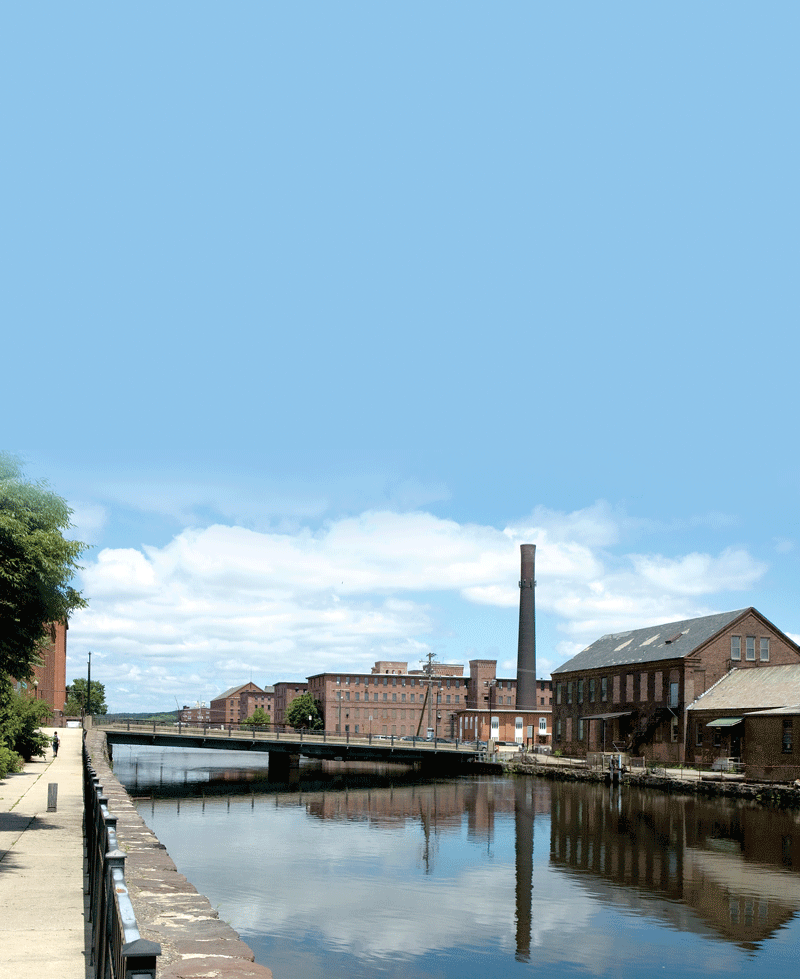
Holyoke Canals

Holyoke Canals

The high-performance computing center soon to take shape in downtown Holyoke is a large project creating a good deal of excitement. Two things it won’t create directly, however, are large numbers of jobs and tax revenue. So area planning officials are hard at work looking at ways to generate both indirectly. They call it leveraging an asset. The strategies being developed have many facets, and are summed up by one official as a “surround-sound approach to economic development.”

The high-performance computing center being developed in downtown Holyoke brings together a group of public and private partners in a groundbreaking initiative that will eventually provide unparalleled computing power for the state’s most prestigious universities.
Imagine its impact on … farming.
No, really.
“The high-performance computing center will generate a lot of heat,” said Kathleen Anderson, director of Holyoke’s Office of Planning and Development. “If we did urban agriculture, we could take the heat from the computing center and pump it into greenhouses or possibly older mill buildings and start growing things.”Such a project, she said, could generate more than 100 jobs.
“Then there’s distributors, processing plants up and down the Valley … how do you include them? An asset like that in Holyoke would need distribution, processing, transportation — how can we leverage that asset to help other businesses in the Valley?”

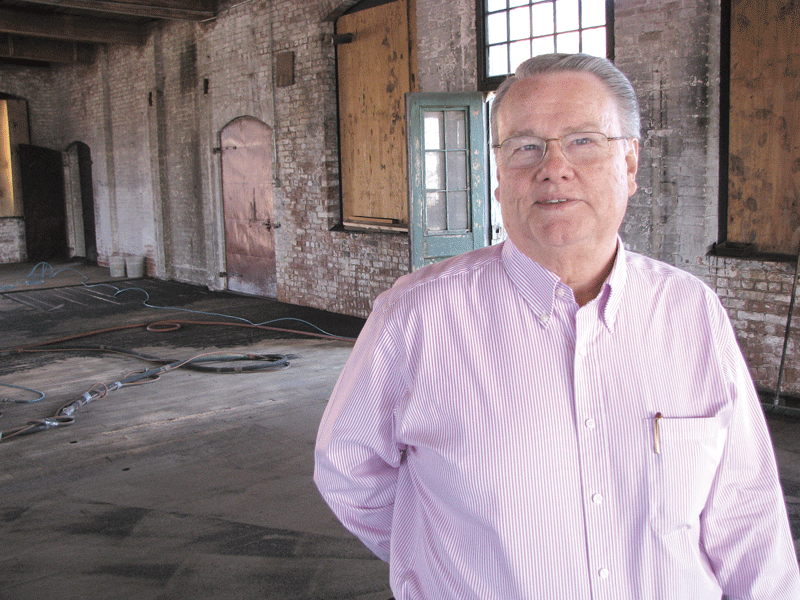
Tim Brennan

Tim Brennan says efforts to leverage the computing centers can be described as “the surround-sound approach to economic development.”

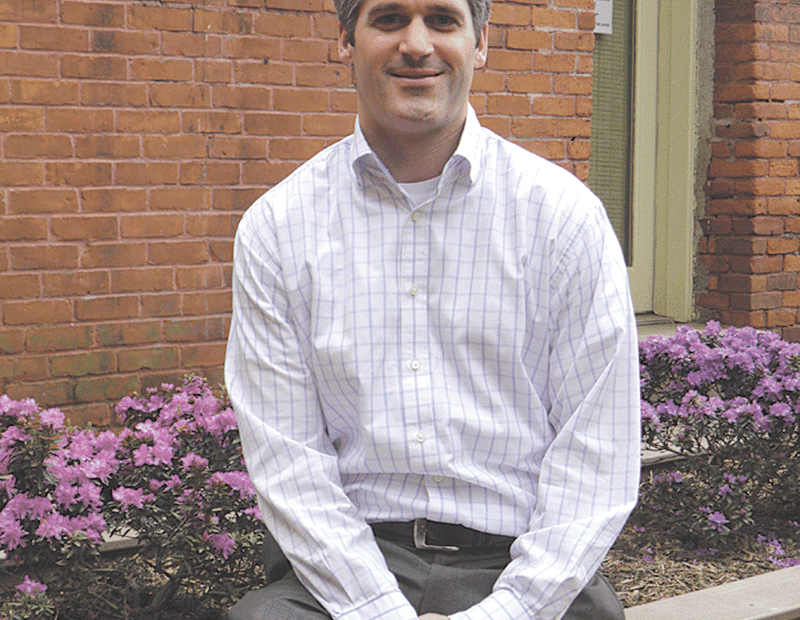
Tim Brennan, executive director of the Pioneer Valley Planning Commission, also cited agriculture as a way to create economic development from a facility that in itself won’t generate many jobs for the city.
“Can we capture the heat it gives off and create a very large-scale urban greenhouse where we could have vegetable production year-round?” he said. “That’s an asset to much of the region; many farmers are active in agricultural production but see the winter period as downtime, because the climate in New England is not conducive to growing in every season. And it could help create middle-income jobs with benefits for people in Holyoke.”
What has members of the Holyoke Innovation District Task Force — a broad partnership charged with leveraging the computing center and related downtown efforts into large-scale economic development — so excited isn’t the prospect of growing crops in a former mill. It’s that urban agriculture represents only one of many ways to make the city’s (and region’s) economy more robust.
Urban farming, said Brennan, “is an example people can get their heads around of how we can create leverage out of the computing center and get jobs and also off-site benefits that ripple positively to the regional economy. This region is disposed to being at the cutting edge, so can we use that quality to fuel more innovation, more technological entities here? And they don’t necessarily need to all be in Holyoke.”
“The strategy,” said Anderson, “is basically to determine what industries are most likely to take advantage of the assets in Holyoke and the Pioneer Valley and where they’re likely to locate. So we’re looking at economic opportunities within the Innovation District, the entire city of Holyoke, and the whole Pioneer Valley, and asking, what are the related investment pieces and strategies needed to achieve this economic potential?”

Thinking Big
The task force, Anderson explained, developed strategies with a threefold overall goal in mind: to increase and improve job opportunities for the residents of Holyoke and the Pioneer Valley, to attract an increased level of private investment into Holyoke, and to connect the green high-performance computing center and various regional assets into an integrated economic-development marketing and delivery system.
The eight broad strategies that sprung from this multi-pronged goal target different aspects of economic development, but tend to originate from strengths Holyoke already possesses. Clean-energy innovation and development is one example.
The idea is to maintain the city’s low-cost, renewable-energy-based competitive advantage by expanding the city’s portfolio of cost-effective renewable-energy generation capacity, and eventually transform Holyoke into a global leader in clean-energy research and applications. A longer-term objective is to convert that research into the widespread manufacturing of clean-energy products.
That goal makes sense in the context of Holyoke’s hydropower capacity, one of the significant factors in the computing center being located there.
“Holyoke Gas & Electric has the cheapest electrical rates in New England for industrial customers,” Anderson said. “They (center developers) saw the low-cost real estate and also wanted clean energy with hydro, and we were able to do that.”
Holyoke Mayor Elaine Pluta is certainly thinking big about Holyoke as a renewable-energy leader.
“Our overall goal is to become as close to 100% renewable energy as soon as possible,” she said. “That’s the message, and the word will get out, because we’re going to be promoting that to the economic developers and letting them know that, if they want to do green projects, this is the city to come to. The computing center is going to be a green project, and that’s going to be one of the first of many, we hope.”
Brennan has long been an advocate of moving toward renewable energy as the world’s primary source of power — and of thinking urgently about the issue.
“High energy costs, uncertainty of supplies, and threats from climate change are changing everything,” he said. “The transition from coal as the primary fuel source in this country took 30 to 50 years. I don’t think we have 30 to 50 years this time, so those parts of the country that don’t get out in front of this wave are going to fall behind it. We’ll also take that message about low energy costs and carry it as far as we can.”
Other strategies the task force has developed include:
• making the Innovation District a sort of laboratory for innovation and entrepreneurship, with assets in place to support startups;
• leveraging the region’s colleges and universities as a critical part of its talent base and reputation;
• creating more sites ready for development and redevelopment by identifying priority sites, selectively clearing and remediating abandoned properties, and providing incentives to encourage investment;
• coordinating among all regional economic-development players to streamline the processes for attracting and retaining businesses;
• creating and growing an information-technology industry cluster; and
• retaining and growing manufacturing opportunities in Holyoke by building from the city’s existing advantages, such as low-cost energy and real estate, available workforce, and transportation access.
In short, “the high-performance computing center is coming to Holyoke, so how do we leverage that opportunity?” Anderson said. “We know there’s going to be a minimal amount of jobs and no taxes — it’s a tax-exempt entity — so this task force was established to leverage this opportunity for economic-development opportunities.”
Pluta partly disputed those jobs-and-taxes claims, noting that “there will be a small amount of jobs, and we are going to be looking at a small amount of tax revenue from them. But, yes, we are mostly looking for the spinoff on that development, and it’s going to have an effect on all our economic development, especially in the immediate area.
“We already have the building across the way from [the computing center] being rehabbed for office space, and we’re looking for more of that,” she added. “We are making progress, and I’m assured that, within a short period of time, we’ll be targeting pieces of property where we anticipate seeing development and preparing those parcels for someone to come in and develop. We’re getting very close to being at that point in time.”

Scoring Opportunities
Brennan noted that the strategy part of the process is complete; “now we’re working with what’s been handed to us and trying not to fumble it, but taking it up the field to score.
“There are multiple tracks,” he noted. “What does Holyoke need to do, and what benefits can be derived locally, and what things does the region have to do, and what benefits can be derived from a regional perspective? Then there’s obviously heavy state interest in the whole property, as much as the state itself has an investment. This is sort of a surround-sound approach to economic development.”
Brennan stressed the need to prioritize. “We can’t do everything. We have to take these recommendations and assign some priorities to them, put them into time zones. What do we need to do in the short term that’s achievable? Mid-range and longer-range items need more time, but might have a more significant payoff.”
Pluta said she foresees a snowball effect once economic development related to the Innovation District begins in Holyoke, in no small part due to factors such as the city’s affordability and capacity for renewable energy.
“We want to create a climate for businesses to come, not only to Holyoke, but to the Pioneer Valley,” Anderson said. “A lot of people in Holyoke need jobs, so what kind of strategy could we use to create them? What things can we do to deal with that?”
Again, Brennan said, the idea is to determine what can be accomplished right away, and what needs to be cultivated over time.
“I think the Holyoke high-performance computing center is an attractive force, but the ability to be a magnet and pull firms from outside the region and outside Holyoke is one of the mid- or long-term targets,” he told BusinessWest. “I honestly see that, in the short term, small and mid-sized businesses are where the action is, and we have these within this region. We need to grow our own economic base in the Valley through entrepreneurship, and nurture the businesses we have and allow them to grow.”
In Brennan’s view – and he’s been observing the business culture in the Pioneer Valley for a long time – the raw materials are there.
“One of the things this work reinforces is that what matters most to all future economic development is not tax breaks, it’s not land – it’s about talent,” he said. “Talent matters most, and diversity is a close second. There are disguised opportunities here that the work of the task force has teased out.”
Anderson heartily agreed.
“I think right now, between the urban-renewal plan in our urban core and the whole Innovation District task-force strategies, there are a lot of eyes on Holyoke and how we can make a better business climate in the region,” she said. “To me, this work solidifies the things I know to be true, but we’re still trying to accomplish what’s been very difficult to accomplish.”
Still, she added, “I’m confident we have the strategy moving forward to benefit Holyoke and the region.”

Joseph Bednar can be reached at [email protected]
Departments Picture This
Pitching In for the Red Cross

In response to the storms and tornadoes that caused massive destruction in Western Mass. on June 1, Big Y World Class Markets responded by hosting a donation program in all 58 Massachusetts and Connecticut stores. Big Y World Class Markets collected donations from customers and employees resulting in a grand total of $141,882.64 for American Red Cross Disaster Relief. Funds were raised through a special in-store customer/employee donation program and from employees in all other Big Y locations, from the Store Support Center to distribution centers. This gift includes a matching gift of $50,000 provided by Big Y Foods, with $10,000 each from Donald and Michele D’Amour and Charles and Elizabeth D’Amour. The community and employee donations along with the personal contributions by the D’Amour family will be utilized in support of the ongoing local relief efforts in these devastated communities and the many people affected by the natural disaster. A formal check presentation to the American Red Cross of Pioneer Valley was held on July 28. From left are Donald and Michele D’Amour; Rick Lee, executive director for the Red Cross Pioneer Valley Chapter; and Elizabeth and Charles D’Amour.

A ‘Green’ Grand Opening

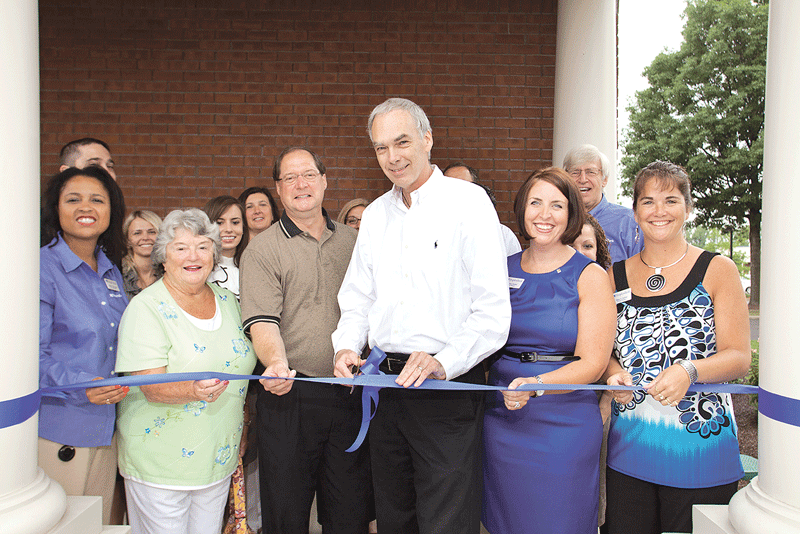
As part of the grand-opening celebration of PeoplesBank’s new LEED-registered branch in West Springfield, Douglas Bowen, president and CEO of PeoplesBank, cuts the ribbon to officially open the office. On hand are, from left, Sheila Goodwin, Barbara Bernard, West Springfield Mayor Ed Gibson, Bowen, Melissa Richter, and Stacy Sutton. Also, more than 100 children participated in the PeoplesBank free child ID event at the grand opening. Below, Yahaira Guzman (left), head teller from the bank’s St. James office, and Maggie Serrano, PeoplesBank teller supervisor, help collect information from the children to complete their Child ID Kit.


Getting a Good Read

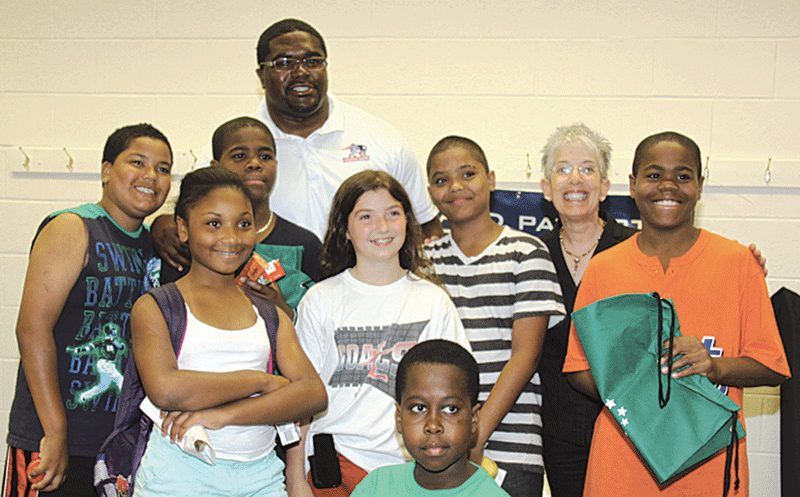
In June, Susan Jaye-Kaplan, co-founder and president of Link to Libraries, was one of five individuals from across New England recognized as a New England Patriots 2011 Community MVP Award winner. She was honored for her work with Link to Libraries, which has, since its creation, collected and distributed more than 27,000 books to area nonprofits and public elementary schools in underserved communities in Western Mass. and Connecticut. To commemorate that achievement, former Patriots running back Patrick Pass visited the Springfield Boys & Girls Club on July 19 to read to a group of 35 third- and fourth-grade students (some of which are enrolled in the Hasbro Summer Learning Initiative), and present Kaplan with a check to Link to Libraries for $10,000 to further the work of that organization.

Lymtech Cuts the Ribbon

On July 15, The John R. Lyman Co. staged an official ribbon-cutting ceremony for its Lymtech Scientific division at its new location on Westover Road in Chicopee. Elected officials, local business leaders, and company employees were all on hand to participate in the ceremony. Third-generation owner Bill Wright said, “I am delighted to continue our commitment to Chicopee and to our local workforce. We have been manufacturing in this area for 105 years and hope to continue for many generations to come.” The family company boasts several second-generation employees on its payroll and even some third-generation workers as well. From left are: Gail Sherman, director of the Chicopee Chamber of Commerce; Michael Burzynski of Lymtech; Mike Ciolek, president of Associated Builders; Dawn Creighton, representing Associated Industries of Mass.; Anita Wright of Lymtech; state Rep. Joe Wagner; Wright; Chicopee Mayor Michael Bissonnette; state Sen. Mike Knapik; and state Rep. James Welch.

Commercial Real Estate Sections
O’Connell Development Envisions Mix of Uses for Sprawling Complex

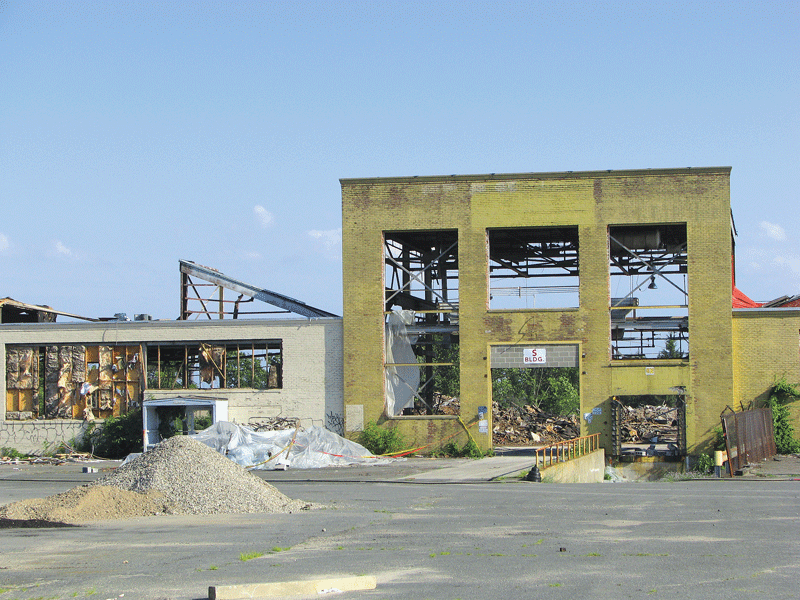
WestinghouseDPartThe former Westinghouse Electronics complex in East Springfield was slated for redevelopment into a large retail Mall, with perhaps two dozen stores, but then the recession sent that sector into a deep tailspin and eventually scuttled those plans. The O’Connell Development Group, creator of Holyoke Crossing in Holyoke, among other area retail complexes, acquired the property last fall, and is advancing plans for a mixed-use facility — although there is uncertainty about what that mix might entail.

As he talked about the sprawling former Westinghouse Electric manufacturing complex off Page Boulevard in East Springfield, and the prospects for redeveloping it, Andrew Crystal drew a number of comparisons to another project orchestrated by the Holyoke-based O’Connell Development Group, which he serves as vice president.
That would be the transformation of the former H.B. Smith boiler plant in the center of Westfield into a massive Stop & Shop supermarket and accompanying parking lot.
“That was a large industrial site that was demolished, cleaned up environmentally, and then turned into a retail location,” said Crystal, adding that this is the plan for the Westinghouse site, located just off I-291, as well. Actually, it’s been the plan for some time, and the fact that the 40 or so acres in question are still home to several buildings in the process of being razed points up a big difference between this initiative and the one in Westfield.
The H.B. Smith project unfolded in 1997, when the economy was humming and most major retailers were in an aggressive expansion mode. A planned transformation of the Westinghouse site into a $45 million retail complex with a mix of stores, undertaken by Newton-based Packard Development, was put on the drawing board more than three years ago, or just before the start of the worst recession in 80 years.
That downturn prompted the closing of thousands of retail establishments across the country and back-burnered a number of projects like the Westinghouse endeavor, said Crystal, adding that, while the retail sector is still reeling from the downturn in many respects, that segment of the economy is expected to eventually recover. Meanwhile, the Westinghouse complex has that most precious of real-estate qualities — location.
These factors and others prompted O’Connell Development, one of the O’Connell companies, to acquire the complex for $4.2 million last November and quickly commence with the process of razing the many buildings and cleaning up environmental contamination.

promising possibility for the site

Andrew Crystal says retail is one promising possibility for the site, although the sector isn’t as healthy as it once was.

“We think the site has a lot of potential, and clearly some of that is for retail uses,” he said, “because it is within a fairly dense residential area and has such easy and immediate access to 291. That access accounts for much of the site’s appeal, but there’s also the visibility from the highway.”
For this issue, BusinessWest takes an indepth look at the prospects for the Westinghouse property, identified as one of the key economic-development priorities in the City of Homes and a big piece of the ongoing revitalization puzzle.

Back to the Future
In its heydey during World War II, the Westinghouse Electric complex, opened in 1915, employed as many as 7,000 people in the manufacture of white goods and other products. The plant was part of a large industrial corridor where Rolls-Royces were once assembled and Smith & Wesson later became a huge part of the landscape.
The Westinghouse operation eventually wound down in 1970, and since then the cluster of buildings has become home to a number of warehousing and distribution tenants, said Crystal, adding that the site has long been considered an attractive location for a retail center, given its size and location only a few hundred yards from the East Springfield exit off I-291.
And in early 2008, Packard Development, a subsidiary of New England Development, which has developed a slew of retail centers across the Northeast, including several in Eastern Mass., put plans on the table for such a center, one that would be home to perhaps two dozen stores and a total of 450,000 square feet of retail. Formal plans were submitted, an environmental impact report was filed with the state (addressing, among other things, traffic issues), and the company met several times with neighborhood residents to hear and address their concerns.
All systems appeared go, but then … the recession hit, and the East Springfield project, like many planned retail developments, was first delayed and then scrapped.
“New England Development is a good firm, and they had a pretty aggressive development plan — they just got caught by the recession,” said Crystal. “It was a time when even the big national retailers were pulling back, and some didn’t make it through the recession; there were many casualties.”
But O’Connell saw enough potential in the property to make that $4 million roll of the dice last fall, said Crystal, adding that he considers this property to be a gamble well worth taking, considering the site’s size, location, and potential for a number of possible uses.
Crystal told BusinessWest that demolition will likely be concluded by the end of this year, clearing the way for what he calls mixed-use development, “although, at this point, we’re just not sure what that mix of uses is or would be.”
The property is zoned commercial, he continued, adding that this designation doesn’t permit some specific uses, such as a large distribution center, but does allow almost all others.
Retail is certainly at or near the top in terms of preferred uses, he said, adding that there is a recognized need for more retail in that part of the region, and dense population centers within a few miles of the site that could be attractive to major players in the industry.
But retail is still in a relative holding pattern overall as a sluggish recovery from the downturn continues, and Crystal acknowledged that many questions remain about when and to what degree the sector will bounce back.
“Retail is doing better than it was a year or two ago, certainly,” he said, “but it’s not like it was five years ago, and it likely never will be again. There are fewer national retail tenants now — the bankruptcy filings provide ample evidence of that — and the sector is still making its way back. Things are better, and consumer confidence has improved tremendously, but it’s certainly not like it was.”
The O’Connell Development Group has extensive experience in retail development, with several such projects in its portfolio, including the Westfield Stop & Shop initiative; Holyoke Crossing, its best-known retail effort, and one that has certainly felt the impact of the downturn; the Bernie’s store across Whiting Farms Road from Holyoke Crossing; and several CVS locations across the region.
Meanwhile, the company continues its work to redevelop the former Atlas Copco property just a few blocks from Holyoke Crossing and the Holyoke Mall into a retail facility; it is currently being used for distribution.
But there are several other potential uses for the Westinghouse site, said Crystal, listing everything from office space to health care services; from entertainment venues to a satellite post office. All are permissible uses under the zoning, and all are viable alternatives given the location just off the highway.
In the meantime, O’Connell is working to lease out space in the Westinghouse office facility fronting Page Boulevard, which is not slated for demolition at this time. Approximately 30,000 square feet across two floors is leaseable, said Crystal, adding that the company is still gauging demand for that space while deciding its ultimate future.
Marketing of the site will commence once O’Connell has a firmer grasp of just what it wants to do with the location and what the market will bear, said Crystal, adding that the site simply has too much going for it to remain dormant for long.
“You just don’t find close to 40 acres in an urban environment like this,” he said, “that has such close proximity to the highway and such high visibility from the highway.”

The Bottom Line
The H.B. Smith project succeeded in changing the look and feel of downtown Westfield. It removed a decaying, contaminated factory complex and brought retail — and some vibrancy — to the downtown.
Whether history will repeat itself in East Springfield remains to seen, but Crystal is optimistic that another location known mostly for what transpired in the past will have a different, and quite compelling, future.

George O’Brien can be reached at [email protected]

Education Sections
Initiative Creates an Ambitious Agenda for Public Higher Ed

VisionProjectThere are many moving parts to the state Department of Higher Education’s Vision Project, but the bottom line is jobs, or, to be more precise, properly preparing individuals for the jobs that define a new, technology-centered economy. The Vision Project aligns all 29 public colleges and universities behind seven identified goals — from improving graduation rates to getting more people into math and science fields — and adds several layers of accountability.

Richard Freeland says there’s nothing new or particularly imaginative about the goals spelled out in the Mass. Department of Higher Education’s so-called Vision Project.
They range from improving graduation rates to increasing the numbers of people entering college; from eliminating historical disparities among racial and ethnic groups to encouraging more people to enter the math and science fields of study — and they’ve been goals for individual colleges and universities for decades.
What is new, said Freeland, the state’s commissioner of Higher Education, is a heightened sense of urgency attached to these goals, created by truly global competition and technology-focused jobs that increasingly demand a college education.

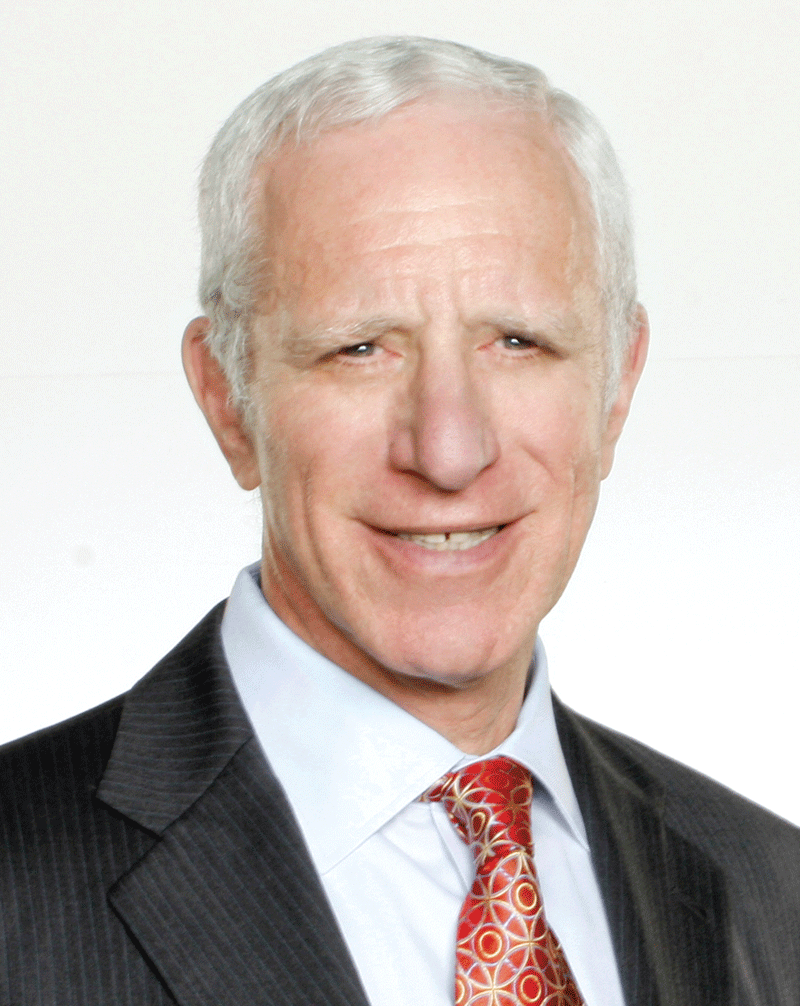
Richard Freeland

Richard Freeland

“Given where our economy is and given where our state is demographically, and given the competitiveness of the economic world, both nationally and internationally, we’re at a point in the history of Massachusetts where we need first-class public higher education,” he explained. “And I don’t think that, historically, public higher education has been the kind of priority that it needs to be today.”
And what’s imaginative is the Vision Project’s approach, a coordinated effort involving all 29 public colleges and universities that adds several layers of accountability.
“This is an attempt to pull together, against the background I’ve described, the coordinated efforts of all public high education,” Freeland explained. “We have a highly decentralized system that features a great deal of autonomy granted by statute to the colleges and local boards of trustees. That makes it extremely difficult for public higher education as an entity, as a statewide institution, to respond in a collective and focused fashion to statewide needs.
“There is a bit of a mismatch between the structure — the decentralized, desegregated, fragmented structure of public higher education — and the urgency of the concentrated focus on building a first-class system of public education,” he continued, adding that the Vision Project was created to align the 29 public campuses behind a short list of critically important goals.
To show how it will all work, Freeland talked about one of the items on that short list, the often-controversial matter of graduation rates.
“This is where the rubber meets the road,” he said of the need to see people who enroll through to commencement night. “When people talk about graduation rates, the answer, across the country, is that they’re not high enough; too many people are falling by the wayside.
To address the problem in the Bay State, a comprehensive, three-part program, developed as part of a national initiative known as Completing College America, has been implemented to move the needle in the right direction.
“The first part calls for every institution to have specific goals to improve student success,” he said, citing just one example of how the Vision Project operates. “When we surveyed our institutions, we found that that was not currently the case; while everyone’s working to do better, a number of our institutions had not formulated specific aspirational goals against national benchmarks to hold themselves accountable for forward motion.”
Ira Rubenzahl, president of Springfield Technical Community College, said he’s a strong proponent of the Vision Project, although, like others, he stressed that it will need a strong funding commitment from the Legislature to meet its goals, and he has concerns about whether that will materialize.
He stresses that the need for the initiative is real, and that while the initiative has a number of moving parts, at its core it is about one word: jobs, and, more specifically, adequately preparing people for the jobs of tomorrow — and today, for that matter.
Ira Rubenzahl

Ira Rubenzahl

“We recognize that some college is critical for young people to get jobs in this new economy, and it’s critical to grow this new economy,” he said. “All the elements — getting more students to attend college, getting more students to complete, getting students to be successful while they’re at college, eliminating disparities, and aligning with local businesses — have an economic lens to them.”
For this issue and its focus on education, BusinessWest takes an indepth look at the Vision Project, its goals, and the unique strategy mapped out for attaining them.

Schools of Thought
Freeland told BusinessWest that there are several reasons why Massachusetts has historically lagged when it comes to attention to and funding of public higher education. One has been the predominance of private institutions that attract students from across the state and around the globe.
“The success and sheer number of these schools have made it possible for state leaders at different kinds of institutions, as well as the general public, to believe that, because we have Harvard and MIT, not to mention all those other great places like my alma matter, Northeastern, we don’t necessarily have to invest in public higher education the way California does or Texas does or Ohio does,” said Freeland, who speaks with decades of experience working in the public higher realm, including a lengthy stint at UMass Boston. “But that perspective is way, way out of date.
“Over time, public higher education has grown increasingly important as an educator of young people in this state,” he continued. “When I started in 1970, the majority of high-school students were still going to private institutions for college, but today, two-thirds of the students who graduate from our high schools are going to public institutions if they pursue education in this state; we have become overwhelmingly a primary provider of higher education for the broad population of this state at a time when we’re not having a lot of in-migration, we’re not having any population growth, and we have a workforce that needs a large number of highly educated workers.”
All this adds up to what Freeland called a heightened sense of urgency that hasn’t existed before, and the need for a plan of action, or agenda, moving forward.
And thus, the Vision Project was conceived in late 2009, and officially adopted by the Board of High Education in May 2010. It completed its first full year of implementation on June 30, and the Legislature is earmaking several million dollars in the fiscal 2012 budget for the Department of Higher Education to provide incentive grants to individual colleges and universities to organize activities around the goals of the vision project.
In a nutshell, the initiative was launched with the recognition that the state is in fierce competition with other states and countries for talent, investment, and jobs, and that its primary assets in this competition are the overall education level of its people, its workforce, and the overall competence and creativity of individuals and organizational leaders driving the state’s knowledge-based economy.
“There is a heightened sense of urgency, because I do believe that Massachusetts needs the best-educated citizenry and workforce in the country, because that’s about all we’ve got in the competition among states,” he said. “And if we neglect public higher education, we’re simply not going to have that.”
The Vision Project is, in essence, the vehicle through which public higher education will remain focused on preparing individuals for this economy — and holding itself accountable for results.
Several key outcomes have been identified, said Freeland, noting that, for the state to thrive in this highly competitive environment, it must achieve national leadership in several realms, including:
• College participation, or the college-going rates of high school graduates;
• College completion, or graduation and success rates of the students enrolled;
• Student learning, academic achievements by students on campus-level and national assessments of learning;
• Workforce alignment, or alignment of degree programs with the key areas of workforce need in the state’s economy; and
• Elimination of disparities, meaning achievement of comparable outcomes among different ethnic/racial, economic, and gender groups.
Meanwhile, the University of Massachusetts must claim national leadership in research activity related to economic development, and economic activity derived from research.
As it went about creating the Vision Project, the Commonwealth’s public higher-education community considered what other states are doing well in this regard, said Freeland, adding quickly that the state’s highly de-centralized system makes it difficult to replicate what other systems are doing. Meanwhile, the state’s track record with public higher education and a lingering lack of urgency in some camps makes it hard just to put such an agenda in place.
“You don’t have to make much of an argument in Ohio that public higher education is critical to a state that has been losing altitude as the Rust Belt has declined,” he explained. “There, public higher education is understood to be the name of the game, and Ohio State is the Harvard of that region. But you do have to make that case in Massachusetts much more strongly.”

Extreme Measures
As he talked about specific goals within the Vision Project, Freeland said there is a universal aspiration for each  — that phrase “national leadership.”
This is inherently a subjective phrase, he said, but not in the case of such matters as graduation rates and diversity, where there are hard numbers to compare and contrast performance. It is one of the underlying missions of the project to create meaningful measures for the specific goals, and then to score high in each category.
Returning to the subject of graduation rates, he said the numbers used are broad and often misleading.
“The best metric for measuring student success and graduation rates, particularly at community colleges, is a vexed question,” he said. “The rate that is often cited as the national standard [about 25%] is based on whether or not students who begin as full-time students graduate in three years, which is a very small percentage of the students who actually attend our community colleges.
“So we are working to develop a much more useful metric,” he continued, “which would measure such things as how successful we are in graduating part-time students, how successful we are in graduating people who transfer in from someplace else, and how successful we are transferring students who start at community colleges and transfer on before completing a degree.”
And while graduation rates are certainly one strong focus of attention, there are several other goals within the Vision Project that are key to achieving that overarching goal of making the Commonwealth more competitive on the global stage, said Freeland.
And with that he referenced an acronym, and statewide initiative, that is gaining visibility and attention across the state: STEM. That stands for science, technology, engineering, and mathematics, and increasing the numbers of students enrolled in these fields — and then graduating them from those programs — are top priorities, said Freeland.
“Far too few young Americans are pursuing academic studies and scientific and technologically oriented careers, and far too few are coming out of our colleges with appropriate skills to drive an innovation-oriented economy,” Freeland told BusinessWest. “This has been a major focus in the business community as well as the education community.”
Local programs have been created to help spawn interest in the STEM fields, he said, listing everything from field trips to manufacturing plants to scientists coming into the classrooms to talk about careers, a “traveling road show,” as he called it, designed to inform and even entertain students.
One of the Vision Project’s goals is to build on these programs aimed at energizing students about STEM and graduating more students in those fields. “We get a good number of people coming out of high school who say they want to major in STEM fields, and start out in them,” he said, “but the dropout rate is very high.”
And the so-called ‘persistence rate’ is comparatively low, he continued, adding that this gauges how many students stay in the field of study they’ve chosen. Work to move those numbers higher is still another matter that the Vision Project will measure — and inject accountability.
The goal with all the initiatives is to prepare individuals for the job market they will face and create a workforce that will enable the state to compete for companies and jobs, said Rubenzahl, who echoed Freeland when he said the landscape has changed in nearly all aspects of business, and public higher education now has a larger role than ever in helping to create a pipeline of qualified workers.
He cited manufacturing and related fields such as biotech as examples of how things have changed, and how the role of public higher education has been broadened.
“We had some pretty good-paying jobs in various industries — originally it was textiles — that left,” he said. “And for many of those jobs, you didn’t need a college education. However, for many of the industries that stayed here or grew up here, you need much more education.
“The economy has changed, and public higher ed has a much larger role than it had before,” he continued. “Let’s face it, Harvard and MIT are not going to train highly skilled factory workers who can run these CNC machines or production workers in these biotech plants. They have a role, but we think we have a greater role as well.”

The Bottom Line
Summing up the Vision Project, Freeland said it is a comprehensive — and very visible — attempt to take public high education to a new level of excellence, responsiveness, and accountability.
“The campuses believe in these things … this isn’t about persuading schools to do things they don’t want to do,” he explained. “It is about taking it to a higher level of focus and having a higher level of aspiration and holding ourselves accountable.”
And it’s a long-term initiative, one that will play itself out over the next several years, involving perhaps many different gubernatorial administrations and college presidents. But he believes the program will stay on track, mostly because it has to if the state is going to thrive in this truly global arena.
“It’s easy for institutions to run out of gas addressing these very tough problems,” Freeland said. “You can bank on the fact that I’m not going to be here forever and Gov. Patrick isn’t going to be here forever, but these issues are going to be here forever.
“These are not issues for one day or one week,” he continued. “But once we get focus on them and get some momentum behind them, the gravitational force of statewide need will keep us focused. But it’s not going to be easy.”

George O’Brien can be reached at [email protected]

Opinion
Launching a Quest for Leadership

When we think about leaders, the discussion tends to gravitate — as it does when the subject is entrepreneurs — toward whether such individuals are born or cultivated.
The answer, with regard to each, is both.
Leaders, like entrepreneurs, simply must possess certain inherent traits, without which they won’t succeed. But we believe that leadership, like entrepreneurship, can be encouraged, developed, and, in effect, produced.
Which is why we are very encouraged by the creation of an initiative known as Leadership Pioneer Valley (see story, page 6). Spawned by the Plan for Progress and, more specifically, Action Item 7 in a 2004 update of that document — “Recruit and train a new generation of leaders” — the program was launched with the broad goal of creating an abundance of something the region will certainly need in the years to come.
Based on models created locally and in other communities, Leadership Pioneer Valley (LPV) will attempt to take people with inherent leadership qualities and provide training and insight that will help shape them into effective leaders than can serve — and benefit — this region in the decades to come.
In the ‘About Us’ section concerning LPV on the Pioneer Valley Planning Commission’s Web site, it notes that the 10-month program that recruits enter “immerses participants in an inspiring and enlightening curriculum that examines critical issues that the region’s numerous and diverse areas. During the program, participants expand their leadership skills while gaining connections, greater commitment to community stewardship, and cultural competency.” Roughly translated, this means that LPV intends to give participants an education in the Valley, its assets, challenges, goals, and aspirations — and then provide them with some opportunities to do something meaningful with that education.
We’re obviously hopeful that LPV can succeed with that overall mission, because this region has a number of very large challenges facing it, and none of them can be overcome without leadership.
For example:
• The region as a whole and most all of its larger communities must still reinvent themselves from former manufacturing centers into … well, something else. Unfortunately, most cities in the Valley carry that descriptive phrase ‘former manufacturing hub’ and have nothing to replace it with;
• While developing new sources of jobs, the region and its individual communities have to create a workforce with the skills needed to take on those new jobs, and thus attract new employers to the 413 area code;
• Springfield, the capital of Western Mass., is emerging from the economic meltdown that made it the butt of jokes for the better part of a decade, but it is still far from being the vibrant urban center everyone wants it to become; and
• The minority populations (soon to become the majority) in cities like Springfield and Holyoke need to become much more engaged in their communities and part of the pattern of progress. They have strength in numbers, but they’re not fully utilizing this asset.
These are just some of the myriad issues and challenges confronting our region, and the truth is that none of them are recent phenomena. They have been issues for many years — decades, actually — because the solutions are elusive; they don’t come easy.
And they won’t come through chance, fate, or the law of averages. They will come only through effective leadership that understands the region and the people who call it home, and are committed to moving it forward.
That’s why LPV is a critical development for Western Mass., and why we hope it will succeed in its all-important assignment.

Features
A Mill Town Writes a New Chapter in Its History

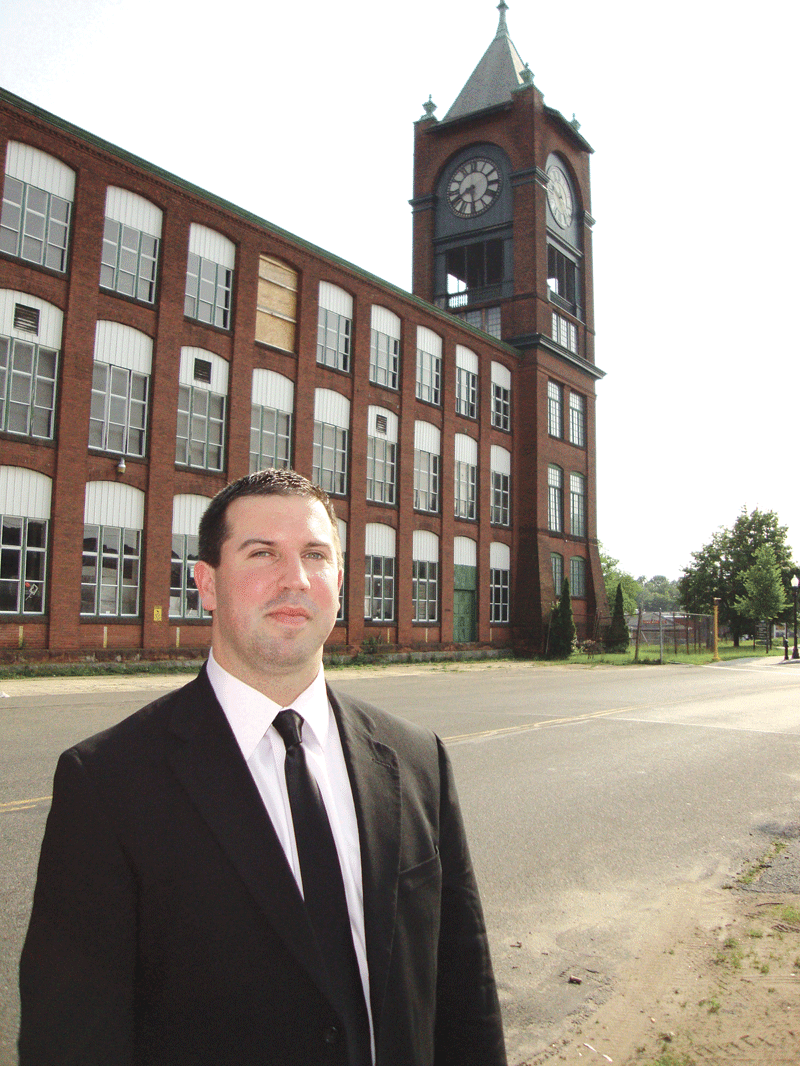
Aaron Saunders

Aaron Saunders says the Ludlow Mills site reflects one part of the town’s history, but farming has been another important aspect.


As he surveyed the landscape — old yet solid brick factory buildings bordered by broken expanses of asphalt with lanky grass growing in patches — Aaron Saunders said that this property is filled with the stories that gave birth to his town.
Walking around the Ludlow Mills, the chairman of the town’s Board of Selectmen remembered one particularly extreme tale — of the old smokestack, which he said was covered in diesel fuel and set afire to demolish it. “There are families living here that can trace their history there 100 years or more,” he said. “Those are the stories that maybe only one or two people still remember.”
Gesturing to the brick mills all around him, he added, “some of the older generations are still alive, and that means there’s a lot of living history here.”
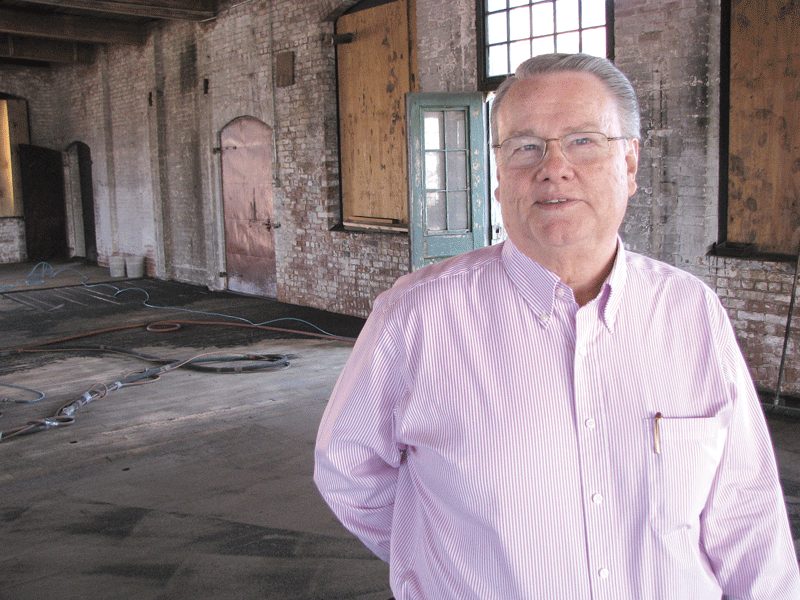
He was at the property to tell BusinessWest about history in the making at this site bordered by State Street and the Chicopee River. The former Ludlow Manufacturing Associates jute mill has been selected as the latest property development undertaken by Westmass Area Development Corp. This past March, that organization secured funding to go forward with the remediation and redevelopment of this 170-acre site on the town’s southern border.
Bill Wagner, right, with Kenn Delude

Bill Wagner, right, with Kenn Delude, says the Ludlow Mills project, if done right, could serve as a blueprint for other cities’ riverfront development projects.

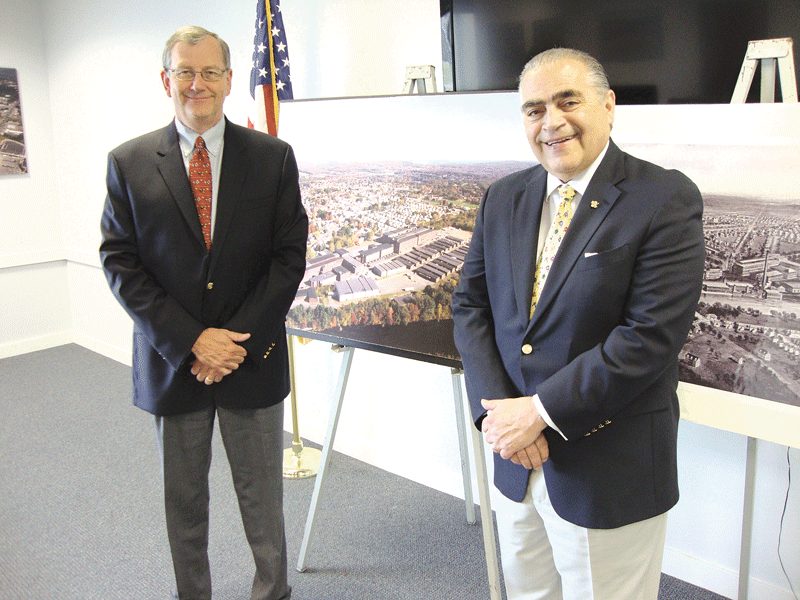
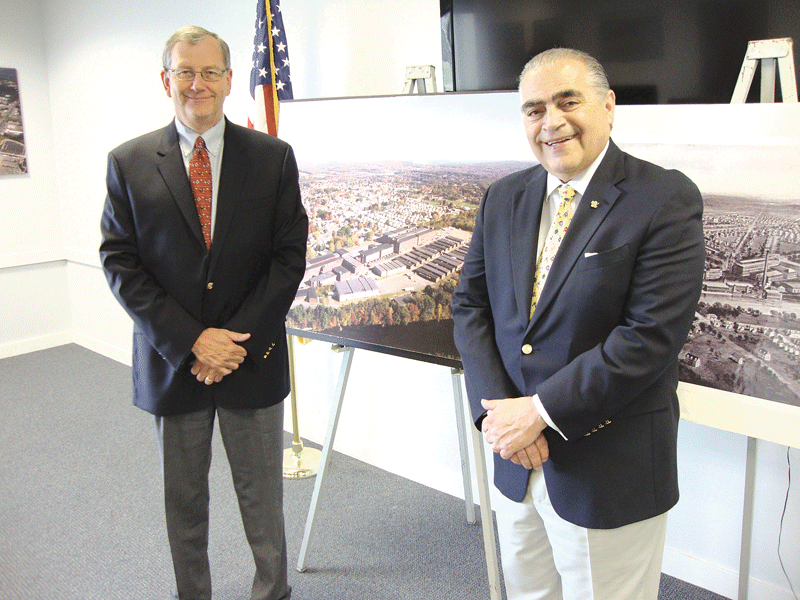
At Westmass headquarters in Chicopee, Kenn Delude, president and CEO of  the agency, and Bill Wagner, chairman of the board, sat before two posterboards: a present-day aerial shot of the property, and an historic etching of that same view.
Wagner said that, while Westmass has a history of successful site development, including the business and industrial parks at Westover, the project in Ludlow has some important and distinct qualities, some measured by the property itself, but also by the residents in town.
“When people in Ludlow first heard that we were involved in the property,” he said, “their first response was, ‘what can we do to help?’”
From the outset, the community has been invited to meetings intended to help determine the fate of this property, and both men agreed that Ludlow has been actively concerned with the property whose iconic clock tower graces everything from the town’s seal to its stationary to the high school’s class rings.
Doing business in Ludlow has long been reflective of many small towns in the area, with many primary services provided by locally owned operations. But as the mill property that gave the town much of its urban shape is redeveloped, an important aspect of this project stands a good chance to reinvent much of the way the Pioneer Valley looks at its riverfront industrial property.
It’s a big-picture perspective, but as Wagner pointed to a bucolic photograph of the greenway in front of the Ludlow Mills, he said, “the board’s opinion is that, if we revitalize this, and do it successfully, it will establish the blueprint for all the other communities to go forward with their riverfront property.”

Flower Power
Saunders was one of many people who spoke openly about their hopes for the future of the Ludlow Mills project. But he also mentioned the interesting nature of the town’s business profile. “Sure, this site is what built up all the houses in this part of town, but go just a couple miles east, and it’s all farmland.”
And while that agricultural legacy might have been eroded as the family farms were replaced by housing developments — another homegrown industry, you might say — Ludlow is still a place to get some of the finest local produce.
“Well, right now we’re in strawberry season,” Karen Randall said, “along with asparagus. This time of year is really the kick-off for the area’s growing season, and people have been busy putting in their perennial gardens, too.”
The second-generation owner of Randall’s Farm and Greenhouse on Center Street, she listed off all the local bounty that can be found in the market area of her operation. “Red and green leaf lettuces, summer squashes, tomatoes in late July, and then corn after the fourth of July. It’s really the exciting time of year for us. And if Mother Nature cooperates with sunny days, the ice-cream stand will be busy also.”
As she gets ready to celebrate the 50th birthday (next year) of the family business — what started out as a farmstand run by her mother and father — Randall said that her business has stayed in bloom throughout an otherwise down economy.
“The last two seasons have been good,” she explained, “and I’m really happy to say that. People do seem to be more relaxed. I haven’t quite figured out if people’s circumstances are better, or they’re just used to the way things are now, but people seem to be less nervous about the economy.”
While her business has a broad appeal far beyond the town limits, she said that efforts have been made to secure that market share. “We’ve developed our e-mail lists of customers, and our marketing through that. By touching our customers in that way, it has helped.”
But, as owner of one of the popular places for people to gather for coffee in the morning, she does see that there are other sectors that aren’t as rosy. “We do have a high concentration of construction companies in town who have taken a hit because there just isn’t a lot of new building out there,” she said.
That’s a sentiment that Bruce Libby said is unfortunate, but true.
He’s also a second-generation owner of a family business in Ludlow — Contemporary Structures Construction was started by him and his father back in 1975. They started as general homebuilders way back when, but in the early 1990s, during another downturn in the construction sector’s fortunes, a decision was made to hammer out some changes.
“We started doing staircases as a fill-in-the-gaps thing,” he explained. “Then it evolved into a great niche as the construction tide ebbed. So we focused on that, and today there are nine guys who work for me all year long — installers, shop people, estimators. Building finely crafted staircases is a nice area of focus.”
Today, that niche operation has ascended to a business that builds, on average, 200 to 300 staircases per year, from Worcester west to New York, up and down from Vermont to Connecticut.
In talking about the town’s construction economy, which saw a boom in houses built both in Ludlow and by its talented local builders in other communities, he tracked the changes from the perspective of his corner of the market.
“Five years ago, we probably did 95% new, and now it’s probably 50-50,” he explained. “There is still a market for new construction, but people are increasingly using remodeling as a means to get more out of their investment. New stairs, hardwood flooring, these are big improvements that add a lot of value to a home.”
He credits the Home Builders & Remodelers Assoc. of Western Mass as a key player in keeping the industry on a solid tread. “I’d say 80% of my contractor clients are from there,” he said of that trade group. And as tornado reconstruction gets underway, he’s looking to those colleagues to help rebuild the area. Ludlow, he said, will be well-represented in that effort.
“In general, Ludlow has a lot of contractor companies,” he added. “You won’t see a harder-working group of people.”

Rolling on the River
The development-update materials from Westmass refer to the Ludlow Mills project as “Our Next Challenge.”
While it is the largest brownfield mill-redevelopment project in New England, with nearly 1.5 million square feet of space in 66 buildings on 170 acres, the property is still in decent overall shape, both Delude and Wagner said. And, they agreed, the people of Ludlow have been vocal and helpful about what they hope to see both before and after the official sale — on track for early this month.
“The larger issue for the people of Ludlow,” Wagner explained, “was that they didn’t want it to deteriorate like other riverfront mill properties in the area, and become a potential big environmental hazard. They were very pleased that we were going to come in while the mill was still in a useful state.”
Delude said that Ludlow’s citizens have been engaged in meetings from the outset, to help determine what would be a good shape for the final results of the project. And, of course, his office’s track record speaks for itself.
“When people found out it was Westmass,” he said, “they knew that we’re looking for business uses, industrial uses, maybe in some cases a small residential component. This is contrasted with what they’ve seen in the past, when maybe there was a fear that there was too much of an emphasis on residential development.
“The focus here is on the creation of jobs still, with some mixed-use development,” he continued. “And that scope gives the plan its strength. If one sector is a little softer than others, you’ve got the others to support it.”
To elaborate on much-anticipated details is premature, Delude said, but he did note that two businesses have expressed strong interest in the property. “And both of them would be embraced by the community,” he added.
But one component to the Ludlow Mills which has both men, and indeed most everyone attached to the project, brimming with enthusiasm is the greenway along the property’s river edge. “There’s been a fence along State Street for almost 160 years,” Delude said, “prohibiting the people who live in these houses just across the street from getting to the river. In fact, by virtue of the infrastructure in town, there is no public access to this beautiful stretch of water.”
In response, Delude said that 50 acres of the project is to be set aside for a greenbelt and walkway along the river, stretching from the westernmost point, close to the town common, all the way along the property’s waterfront, up to a rail trestle spanning the bridge.
Putting that into perspective, Wagner said, “almost since we started talking about doing this, about five years ago, everyone is struck by the fact that, here in the Pioneer Valley, some of our most valuable land — the land along these clean and beautiful rivers — is banked with these old mills that are becoming more and more functionally obsolete. The real estate isn’t being put to its highest and best use.
“That has an economic cost to Western Mass. and to cities like Holyoke and Springfield and Chicopee,” he continued. “The fact that, thus far, you can’t use this shore property is a big negative. It’s a monumentally important effort that we’re putting forward here for not just Ludlow, but the future of our valley.”
It might sound like a lofty goal, but, then again, Delude and Wagner don’t limit the scope of what their office can accomplish. Looking at the images behind him of not just the Ludlow Mills complex, but of other Westmass projects, Delude said, “I think you can see why we chose this site in Ludlow; it does have the beauty, and it has the ability to create a model that Westmass could use going forward.”

Cover Story
Former Musician Ron Ancrum Now Hits High Notes with the Community Foundation

July 4, 2011

July 4, 2011


Growing up, Ron Ancrum wanted to be the next Quincy Jones. He was a skilled trumpet player, but liked writing music even more than performing it. He put aside those interests a quarter-century ago as he was shaping a career in higher education and the broad realm of philanthropy, which continues today as president of the Community Foundation of Western Massachusetts. He’s not writing music in that position, but he is working to orchestrate progress for the Pioneer Valley.

Ron Ancrum says he fell in love with jazz — and discovered the trumpet — when he was in the 7th grade.
And by the time he graduated from Rippowam High School in Stamford, Conn., he was, by his own admission, quite good at the craft, which he honed while playing with such groups as the Silver Falcon Drum & Bugle Corp and the Stamford Young People’s Symphony Orchestra. He wasn’t alone in that opinion, either; he earned a mention in Downbeat magazine in 1967 as a promising up-and-coming jazz musician.
“I was a senior in high school at the time,” he recalled. “They [Downbeat] did these jazz competitions where the magazine would go to different cities and have different groups compete; we didn’t come in first, but we got a mention.”
But as much as he liked playing music, he enjoyed composing it even more, and majored in theory and composition at UConn.
“My dream was to be the next Quincy Jones — I wanted to write for motion pictures,” he told BusinessWest, noting quickly that, while he had some success in music — one of many bands he played with, ANKH (his nickname), opened for Gladys Knight and the Pips back in 1973 at the Bushnell in Hartford, and another jazz band, Quintessence, released an album in 1981 — his career has gone in a completely different direction (actually, several of them), mostly out of necessity, but also desire.

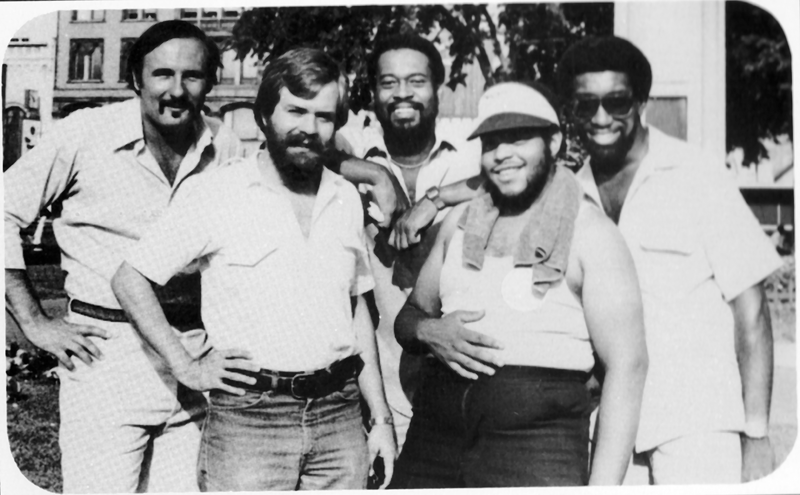
Ron Ancrum (center) on the back cover of the 1981 album recorded by his former jazz band, Quintessence.

Ron Ancrum (center) on the back cover of the 1981 album recorded by his former jazz band, Quintessence.

“The major record labels were not picking up jazz — they were more into pop and R&B,” he said of the then-unusual step of releasing the album himself, as well as the primary motivation for his entry into the higher-education sector in the early ’80s, and then a subsequent move into the broad arena of philanthropy, first as a consultant with his own company and later with an outfit called Associated Grant Makers.
His current assignment, as president of the Community Foundation of Western Massachusetts, carries with it some composition work of a different kind — in the realm of what’s known as ‘community leadership.’
Explaining the concept, Ancrum said it involves groups like the Community Foundation moving well beyond the work of managing funds and distributing grants to area nonprofits (although those are still important parts of the whole), and into efforts to address some of the many social and economic issues impacting the region — from school dropout rates to the creative economy to social entreprenuership.
This work has manifested itself in a number of ways, from the coordination of the first of what is expected to be several so-called ‘City to City’ tours — Springfield-area business and civic leaders visited Winston-Salem and Greensboro, N.C. last fall to learn how those communities have bounced back from adversity — to the funding of a new leadership-development program (see story, page 50). And more initiatives are in the formative stages, said Ancrum.
For this, the latest installment of its Profiles in Business series, BusinessWest talked with Ancrum about jazz, philanthropy, and community responsibility, and how they all involve hitting the right notes at the right time.

On-the-record Comments
Ancrum said his interest in jazz these days is confined mostly to listening to it — “picking up an instrument and playing is not what I’m interested in, although I would like to start writing again; that’s what I really enjoy.” But since he’s in Western Mass. at least five days a week (his permanent home is in Canton, Mass.), finding good listening can be challenging.
“I’m used to being in Boston, where there’s tons of jazz,” he explained. “There’s some here, but certainly not as much; there’s been a lot of good jazz at UMass through the Fine Arts Center, for example.”
He is putting his knowledge of the genre and the business to work as a member of the planning committee for the upcoming Hoop City Jazz & Art Festival, slated for July 8-10 at Court Square in downtown Springfield. “I found out that the person organizing it, John Osborn, is a UConn grad like myself, so we got together over lunch and I got involved,” he said, adding that his role is simply as adviser rather than band recruiter. “John’s more into smooth jazz, and I’m more into traditional jazz; I recommend people, but he doesn’t necessarily gravitate toward them.”
Ancrum thought he was destined for a career in music after UConn, where he ran the jazz band and was the arranger, French horn, and electric piano for a multimedia rock production of the Who’s Tommy, among other things. But the stars were simply not aligned for that eventuality.
“I actually took off for California right after graduating, but eventually turned around and came back,” he said, not wanting to go into details of that excursion. Instead of Hollywood, his next stop was a short stint in graduate school, studying music theory at UConn, while also finding different ways to remain active in the music business.
He wrote music and performed with the Voice of Freedom Gospel Choir, for example, and was leader, manager, arranger, and composer for Quintessence, which released an album with that same name in 1981 that has become a collector’s item of sorts.
“There’s a guy in New York who has it listed as a ‘rare-find album’ — he came up and purchased 200 of them from me,” said Ancrum, who found a copy for BusinessWest.
And while he continued to perform and compose until 1987, Ancrum was by that time well into a career in higher education. He started at UConn as a staff assistant in the Student Activities Department in 1972, and later became director of Admissions at Connecticut College. Next was a two-year stint as associate dean of Admissions at Colgate University in Upstate New York. “That’s one of the nicest places to work; it’s just in the wrong place,” he joked. “It’s in the middle of nowhere, and it snowed from Columbus Day to Easter.”
He then spent nearly a decade at UMass Boston as director of Undergraduate Admissions before starting his own consulting business in the Boston area, which provided services to numerous nonprofit organizations and higher-education instituitions. From there, he went to a Boston-based company called Third Sector New England, again providing consulting services to nonprofit organizations, and eventually on to a lengthy stint as president and CEO of Associated Grant Makers, a membership association for foundations and corporate-giving programs serving Massachusetts and New Hampshire.
During his tenure there, Mary Walachy, executive director of the Springfield-based Irene E. and George A. Davis Foundation, and Kent Faerber, then-president of the Community Foundation, both served on the board of directors, providing him some insight into Springfield and the Pioneer Valley in the process.
Over time, Ancrum said he developed a desire to work at a foundation, rather than for them, and began looking for such a position around the time Faerber announced that he would be retiring from his post. Following conversations with Walachy and others about the job and the region, Ancrum decided to apply and was ultimately chosen.

Projects of Note
Ancrum said that, when he took the helm at the foundation, he knew little about Springfield other than what he’d learned from Walachy, Faerber, and other funders. He had read of the city’s deep financial problems, but also that they were mostly a thing of the past by the time he started moving into his office on the 23rd floor of Tower Square.
“When I came here, I saw a lot of opportunity to do something,” he said, acknowledging that this was an outsider’s perspective, although little has changed since he’s become an insider. “I thought this was a place ready to take off; it has a lot going for it. There’s clearly some strength in the quality educational institutions, and the health community is quite strong.
“There are assets here,” he continued, “and culturally, there’s a lot of potential; there’s music and art and some museums. This should become one of the places in the state that people come to visit. It’s a destination stop; however, it needs to be marketed better.”
But along with all this potential there are issues and challenges, not only in Springfield, but in communities across the three-county (Franklin, Hampden, and Hampshire) area served by the Community Foundation, said Ancrum, noting, among things, a clear need to create new sources of jobs, efforts to replace lost manufacturing companies, and a need to rebuild what he called the “economic infrastructure.”
The sum of these challenges and the need for a coordinated response have been the primary motivators for the foundation taking big strides into the realm of community leadership, he continued, noting that this is now the third leg of the Community Foundation’s mission.
The first leg is essentially providing a vehicle for individual donors to engage in philanthropy, he said, adding that the foundation manages roughly 500 funds ranging in size from $10,000 to $12 million. The second leg is grant making, including the largest scholarship program in the region, awarding nearly $2 million in the most recent cycle.
There are also competitive grants, awarded in several cycles, that have recently totaled roughly $1.4 million. “We recently made 77 awards totaling $720,000,” he said of the most recent round, which featured 104 requests, one of the highest totals in recent years. Following the recent tornadoes, the foundation created a relief fund and directed $50,000 toward it, with other donations coming from a number of financial institutions and other area companies (see related story, page 28). At present, the fund now totals more than $125,000, and will be used to assist nonprofits directly impacted by the tornadoes (and there were several) or that provide assistance to victims.
The community-leadership component is part of a nationwide trend among community foundations, said Ancrum, adding that the agency’s board of directors approved a broad plan to move in this direction in late 2008, and a big part of his job description is carrying out that assignment.

Getting Creative
There have been several manifestations of this initiative, he explained, many of them sparked by what he called “community conversations.”
“These are simple convenings where we invite our donors as a way of educating them, and we invite other people in the field who can contribute to the conversation,” he said of the sessions. “We basically try to figure out what the really hot issues are and bring in national, regional, and local speakers who we feel can add to the discussion and provide direction moving forward.”
One such conversation was about the controversial subject of dropout rates in inner-city schools.
“We took an angle that it’s not just an educational issue — it’s really an economic issue, and it’s really a public safety issue as well,” he explained. “So we had the sheriff there, the superintendent there, someone from the state who could talk about the research done on the subject … we brought people together who we thought would be good to have in the room for the kind of conversation that probably should happen.”
This was followed up by a session on the creative economy, he continued, adding that this featured speakers such as state Sen. Stanley Rosenberg and others, who focused on the success achieved by North Adams and other communities as they have used the arts to stimulate economic development.
One of the most visible of the community-leadership initiatives was last fall’s City to City tour of Winston-Salem and Greensboro, this region’s first foray into a national program designed to let business and civic leaders in one area see, hear, and analyze how other urban areas of similar size and demographics have achieved progress with economic-development initiatives.
More than 50 representatives of area businesses, colleges, and nonprofit agencies spent three days in North Carolina, learning how the two cities had succeeded in revitalizing their downtowns, generating new sources of jobs, and making their cities safer and, overall, more livable.
Ancrum said he believes the program was a success on a number of levels, starting with how it brought a number of area leaders together for three days, giving them a chance to get to know one another, build relationships, discuss matters of importance, and analyze what they were seeing and hearing.
“We had people from the nonprofit sector talking with business leaders and also officials from the city,” he explained. “When you’re with people for several days like that, you can create relationships, and that makes it easier for people to pick up the phone later and talk with people and collaborate with them.”
The other obvious benefit was the rich learning experience, which yielded a number of potential takeaways, either in the form of projects to emulate or attitudes to embrace.
“Because we saw a baseball park in Greensboro, that doesn’t mean we need one here, necessarily,” he explained. “The lesson for me was that creating a venue that will bring families and individuals to the center of your city creates other business in that area that will help your economy overall; we need to create something like that, but it doesn’t have to be a ballfield.”
Another City to City tour is planned for late this fall, he explained, adding that trip organizers are currently researching several options, with Grand Rapids, Mich. and Jersey City, N.J. heading the list of possible destinations.
Meanwhile, the foundation continues to look for other ways to meet that stated commitment to community leadership.

A Major Hit
For $74.99, one can still obtain a copy of the Quintessence album. An outfit called Rarebro Records has it in stock, apparently.
Next to the item on the company’s Web site is a quick description and review of the album. “Recorded in 1980, the jazz arrangements here are soulful and full-bodied,” it reads, “with some nice texturing with the rhodes, saxophone, flute, trombone, flugelhorn, recorder, congas, bongos, bass, acoustic bass, handicaps, drums, and vocals by the lovely Kharmia.”
For this critic, at least, it appears that Ancrum was able to take a number of diverse elements (the flugelhorn?) and blend them into something distinct and meaningful. That’s not exactly his job description with the Community Foundation of Western Massachusetts, but, given its new focus on community leadership, it would seem to fit.
He’s dying to start writing music again, but in the meantime, he’s helping to script some economic-development success stories.

George O’Brien can be reached at [email protected]

Briefcase Departments

AIM Business Confidence Index Slumped in May
BOSTON — The Associated Industries of Massachusetts (AIM) Business Confidence Index dropped 4.4 points in May to 51.7 as state employers confronted a slowing economy and continuing uncertainty about the course of recovery. “The results mirror the national news,” said Raymond Torto, global chief economist at CB Richard Ellis Group Inc., the chair of AIM’s Board of Economic Advisors (BEA), in a statement. “A series of economic reports is telling us what AIM members were seeing in mid-May — disappointing growth and job creation, weakness in manufacturing and real estate, and declining consumer confidence locally and nationally, along with renewed turmoil in the euro zone and its impact on financial markets.” The economy, Torto added, “as we’ve often noted, is getting better but remains far from healthy, so it will be subject to relapses like this. The factors at work now are very similar to those that produced a dip in confidence last spring, with some added concerns about East Asia.” AIM’s Business Confidence Index, issued monthly since July 1991, uses a 100-point scale to judge business conditions, with 50 as neutral. Its historical high was 68.5, attained in 1997 and 1998; its all-time low was 33.3 in February 2009. “The index has been in positive territory for the past eight months, and it is up 12.7 points over two years, with most of its gain in late 2009 and early 2010,” Torto noted. “The economy, though clearly in stronger and more stable condition than it was in 2009, has yet to achieve sustained, robust growth.” All of the sub-indices based on selected questions or respondent characteristics gave ground in May along with the main index. The Massachusetts Index of business conditions prevailing within the Commonwealth dropped 1.5 points to 48.2, while the U.S. Index of national conditions fell 1.6 to 44.3. Since March 2010, the state indicator was ahead 4.1, and its national counterpart up 3.0 points. The Current Index of conditions prevailing at the time of the survey was off 4.2 points at 49.7, while the Future Index of expected conditions six months ahead lost 4.5 to 53.7. The Company Index, which measures survey respondents’ overall confidence in the situations of their own operations, dropped 6.6 points in May to 54.7. The two other company-specific sub-indices also fell, the Sales Index by 6.8 to 54.1 and the Employment Index by 6.0 to 51.9. Confidence was off among both manufacturers (-3.2 to 54.6) and other employers (-5.5 to 47.7); it also fell both in Greater Boston (-3.6 to 43.0) and outside the metropolitan area (-6.5 to 49.0). There was no clear pattern of responses by size of company. The monthly Business Confidence Index is based on a survey of AIM member companies across Massachusetts, asking questions about current and prospective business conditions in the state and nation, as well as respondents’ own operations. On the Index’s 100-point scale, a reading above 50 indicates that the state’s employer community is predominantly optimistic, while a reading below 50 points to a negative assessment of business conditions. A number of component sub-indices are derived by analyzing responses to selected questions or those of particular groups of respondents.

State Leading Growth Rate
BOSTON — The U.S. International Trade in Goods and Services report by the Commerce Department’s U.S. Census Bureau and the U.S. Bureau of Economic Analysis recently showed that U.S. exports of goods and services in April 2011 increased 1.3% from March 2011 to a record $175.6 billion, with record exports of both goods ($126.4 billion) and services ($49.1 billion). The monthly export values for U.S. industrial supplies ($43.4 billion) and capital goods ($41.0 billion) was also the highest on record.  U.S. imports of goods and services decreased 0.4% over this period to $219.2 billion, causing the U.S. trade deficit to decline 6.7% below March figures to $43.7 billion in April. “Over the past six months, the economy has added more than a million private-sector jobs, and exports — boosted by the president’s National Export Initiative — are helping us do that,” said U.S. Commerce Secretary Gary Locke in a statement. “President Obama announced several new commitments that will help 500,000 young Americans get the credentials they need to succeed in the manufacturing industry. Preparing Americans for good-paying jobs in the manufacturing sector will not only strengthen the economy and put people back to work, but will help us compete in today’s 21st-century global economy.” Locke noted that April is the second consecutive month of record export growth, and while there may be bumps on the road to recovery, he added that the administration is making the economy more competitive by fostering new jobs in new industries, and helping to educate and train workers to fill them. In Massachusetts, the state’s economy grew 4.2% in 2010, ranking it fourth in the nation in economic growth, according to the Commerce Department. The technology and health care industries have fueled the state’s growth, allowing Massachusetts to recover faster than the nation as a whole. Across the region, Vermont ranked second after Massachusetts with 3.2% growth, followed by Connecticut with 3.1%, Rhode Island with 2.8%, Maine with 2.1%, and New Hampshire with 1.3%.

Features
City of Homes Boasts an Inviting Mix of Amenities

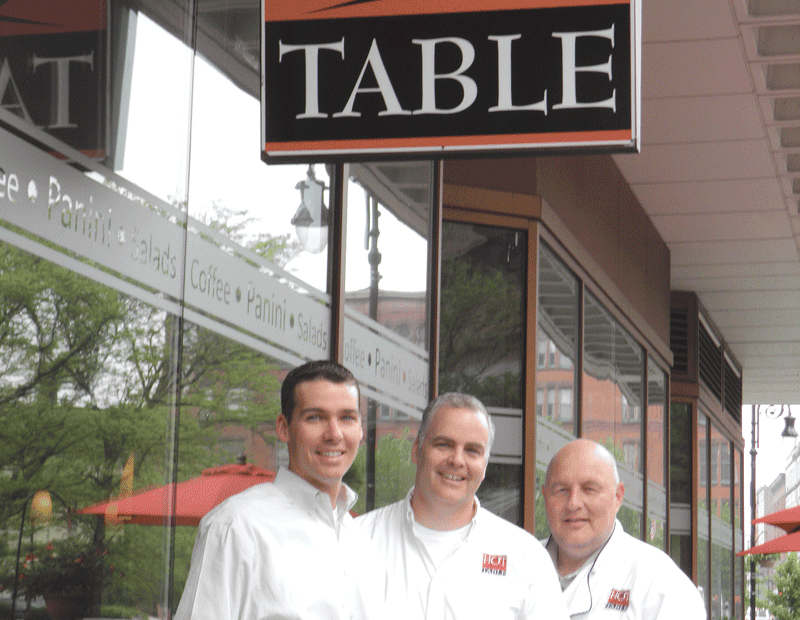
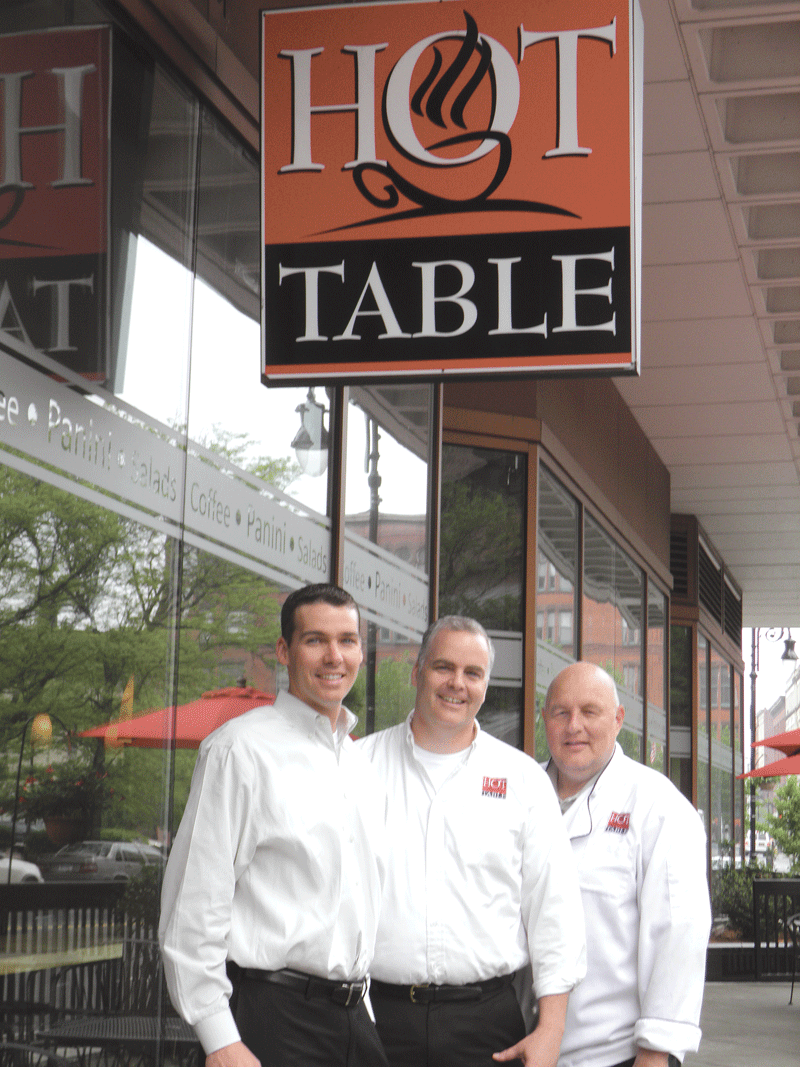
From left, Chris DeVoie, John DeVoie, and Don Watroba say Hot Table was so successful in 16 Acres that they expanded to a second, downtown location, which is also thriving.

From left, Chris DeVoie, John DeVoie, and Don Watroba say Hot Table was so successful in 16 Acres that they expanded to a second, downtown location, which is also thriving.

John DeVoie, his brother, Chris DeVoie, and Don Watroba opened Hot Table in the 16 Acres neighborhood of Springfield in 2007. The restaurant specializes in paninis, and the trio chose Springfield as the site for their new business because the city is their home and they are Springfield natives.
“We love the place and want to see it thrive,” John said. “We also saw an opportunity, as there was an underserved market there. Western New England College, which is now a university, was right across the street, and Springfield College was right down the street. And the college community didn’t even have a local coffeehouse.”
Their success led the restaurateurs to open a second location on Main Street in 2009, which is 1,000 feet larger and boasts an outdoor patio. John said the downtown site has also drawn a large crowd, and their location has one of the highest concentrations of working people in one location in Western Mass.
“I couldn’t be happier about our growth and the fact that we have expanded under the current economic conditions,” he told BusinessWest. “Everyone has to come into Springfield eventually, whether it’s for jury duty, to go to the hospital, or to see a lawyer, and the density of the population and traffic provides a real opportunity for businesses.”
The diverse population and the fact that economic incentives abound in the city are among the strong motivating factors for entrepreneurs and established businesses looking to relocate their operations, said Mayor Domenic Sarno, now winding down his second two-year term in office.
“The city is the economic engine for the region, and we have incentives for any and all businesses, from the mom-and-pop operations to businesses on a larger scale,” he said, adding that economic help can be found via initiatives like the city’s small-business loan program, which lends companies up to $20,000, its neighborhood storefront program, and special tax assessments that add gradual increments to a company’s tax bill after an expansion.
Bruce Stebbins, administrator for business development, explained that the city will exempt the value of improvements for a period of time and gradually ease them into a company’s tax bill. “The state also offers tax credits, because we are designated as a Gateway City, so we consider ourselves an affordable location for companies looking to serve the Northeast market,” he added.
Sarno cited access to broadband as another advantage. The city has allowed the Mass. Broadband Institute to thread a 21st-century communications network through a network of underground conduits that will result in broadband service up to 1,000 times faster when it is complete.
Business property exists in many neighborhoods, and the city has worked hard to streamline its permitting process. Christopher Moskal, interim chief development officer, said officials have spent three years on the project and eliminated many of the hoops businesses once had to jump through.
“We bring all of the necessary departments to the table for a one-stop shopping experience so businesses can get the permits they need quickly and save money,” he said.
Carl Frattini, director of business development for Northeast Utilities, says the city is easy to work with. “Our solar program focuses on using restricted-use properties such as brownfields to accommodate large-scale PV facilities. These projects offer economies of scale that make them more cost-effective, but they often have complex permitting requirements,” he explained.
“On May 12, we announced the Indian Orchard Solar Facility, a 2.2-megawatt project located on a 12-acre brownfield site in the Indian Orchard section of Springfield,” he continued. “The city was well-organized, particularly the Springfield Redevelopment Authority, and they did an outstanding job working with us to make this project happen. Given the time and resources necessary to develop these types of projects, it’s more than reassuring to know the city, along with community stakeholders like the Indian Orchard Citizens Council, are ready and willing to collaborate.”
Sarno cited other benefits of operating a business in Springfield. “We have a railroad, and the Springfield Technical Community College Enterprise Center is a great place for startups. And the city offers a complete toolkit for new and expanding businesses,” he said.
For this, the latest installment of ‘Doing Business In,’ BusinessWest looks at the current conditions in the City of Homes, and why there are some good reasons to consider the unofficial capital of Western Mass. as a place to locate or expand a venture.

It’s Elementary
Chet Wojcik is a real proponent of Springfield. He moved Alliance Medical Gas from North Carolina to Agawam in July 2010, and the following January, the owner and CEO relocated the firm to the Scibelli Enterprise Center in Springfield.
“We wanted to be in a building that was historically preserved, and all of the state and federal resources are in this building,” Wojcik said, ticking off agencies that range from the Mass. Small Business Development Center Network to the federal Small Business Administration to SCORE.
Wojcik has taken advantage of activities staged by the STCC Business Incubator, also located in the downtown site. “This city is pro-business,” he said.
Available property includes public and private sites that run the gamut from the former School Department headquarters on 195 State St. to sites in the Hollywood section of the South End that are included in the South End Redevelopment Plan, which has spurred a great deal of infrastructure work in the last few years.
“There are business parcels in every neighborhood, and we feel we can offer workforce-planning programs that businesses need to succeed in Springfield,” said Moskal. “We work hand-in-hand with them to provide skilled labor.”
An example of this is a collaborative effort between the School Department and Smith & Wesson, which brings high-school juniors and seniors into the company for hands-on experience and mentoring programs. “They are introducing their line of business to prospective high-school graduates,” Moskal said.
Nicholas Fyntrilakis, assistant vice president of Responsibility for MassMutual in Springfield, agrees that the city has a lot to offer. “This is MassMutual’s 160th anniversary. The business started as one person in a rented office and has grown to a Fortune 500 company,” he said. “Springfield has provided us with a terrific workforce locally and regionally, and is a terrific place to live and work. For those thinking of planting a flag in Springfield, we are centrally located with great access to highways, a nearby airport, and broadband fiber optics. Plus, the city is really committed to helping small businesses grow and transition.”
Fyntrilakis is also on the board of the nonprofit corporation DevelopSpringfield, which is dedicated to advancing development and redevelopment projects and expanding revitalization within the city.
“We offer grants up to $10,000 to businesses on Main Street and State Street,” he said, explaining that companies are required to provide 25% in matching funds for improvement projects. “It is a really nice initiative that is unique to Springfield. The economy and demographics of the city are also diverse, and the general climate toward business is positive.
“Folks are eager to support businesses, and many have had a lot of success,” he added, pointing to the Puerto Rican Bakery on Main Street and Red Rose Pizzeria, which started out small and has grown exponentially over the years to include a banquet facility.
Mary Ellen Scott says Springfield is the center of all of the activity in Western Mass. She opened United Personnel 26 years ago, and believes it is a perfect place for business owners who want to be situated in an urban setting, but also want to forge strong connections in the community.
“I grew up in Boston and lived in New York City for 10 years, and I believe Springfield is a great place for people to live,” she told BusinessWest. “It’s a smaller city and a place where people develop relationships. If I lived in New York City, I probably would not know the mayor personally or the president of MassMutual. You can walk down Main Street and say ‘hi’ to five people you know in one block.”
Scott, a member of the Economic Development Council of Western Mass., added that Springfield has a ready supply of labor. “My company is in the business of supplying people, and there is a diverse workforce in Springfield,” she said, adding that United is able to fill employers’ needs for positions in offices, light-industrial settings, manufacturing, and more.

At Home with the Idea
“Springfield also has easy access to highways for distribution purposes. And there is a lower cost of living here than in Hartford, Boston, or New York City, which means savings for employers,” Scott continued, listing more reasons why business owners and managers should give the community some consideration as a landing spot.
“The city has its issues,” she continued, “but the pleasure of living here far outweighs them, and city officials are really trying to make it a better place.”

Features
He’s Kept His Focus on Job Creation and Retention

Allan Blair

Allan Blair President of the Economic Development Council of Western Mass.


Allan Blair says his passion for photography started taking form just before his first son, Colin, was born in 1978.
“My wife was getting close with him, and I said to myself, ‘you better figure out how to take pictures,’” Blair recalled, adding that he bought a camera and managed to gain a degree of competence just as he was also becoming a father.
Over the years, he’s taken his hobby to a different level — and many different places — as the walls in his office attest. There are some framed photos from a trip several years ago to the town of St. Andrews in Scotland (the famous golf course, the world’s oldest, appears in the background in one of them), where Colin studied for a year. There are also a few scenes from Amsterdam, which Blair visited as part of a contingent from Western Mass. on one of the first international flights out of Bradley Airport in 2008 — a short-lived program, as it would turn out. And there’s an intriguing shot of an indoor mall in Melbourne taken while Blair was visiting his younger son, Justin, while he was studying in that Australian city.
“My wife, Sheila, has a better eye than I do,” he explained, “so she’ll often identify subjects or approaches to subjects that I don’t see, and I execute the photograph; it’s good teamwork.”
While some friends and colleagues are aware of Blair’s proficiency with a camera, most are more attuned to his efforts with regard to another form of big-picture developing. Indeed, as president of the Economic Development Council (EDC) of Western Mass., Blair is the individual most closely associated with the region’s overall economic health and well-being, and efforts to improve it.
This is a job that comes fully loaded with rewards, challenges, and expectations (many of them inherently unreasonable, he said, but more commentary on that later). It is also what Blair calls a complex, multi-faceted extension of his first real job, as a vocational counselor with the state Division of Employment Security, now known as the Division of Employment & Training, and subsequent work administering the Springfield chamber’s jobs program.
The common denominator, he said, is putting people to work, an assignment he finds both tremendously important and quite fulfilling.
“The one common thread that always stuck with me was that the importance of a job to a person’s feeling of worth is almost inestimable,” he explained. “Every person, no matter how down and out and destitute they might have been, wanted to be self-reliant; they wanted to be able to take care of their family.
“It’s somewhat ironic, the circuitous route I’ve taken,” he went on. “Being on the job-creation side, trying to provide the jobs or attract the jobs for people like those I worked with all those years ago, seems like closure, coming full-circle. Instead of working with individuals, I’m working with companies and regions and municipalities to create jobs and retain jobs.”
This task of putting people into employment situations has evolved considerably over the past 40 years, said Blair, speaking to his tenure in the broad realm of economic-development-related work. “It’s a different mindset; it’s not so much real-estate-based any more as it is business-to-business growth,” he explained, noting that in the past, much more emphasis has been placed on selling the region and recruiting companies here. “It’s a transition that’s been taking place over the past 30 years or so, and it has accelerated in the 21st century, where technology has been adopted to products and processes.”
And it has become much more difficult, he continued, as the cost of doing business in this region becomes an increasingly negative factor, as the regional and national economy moves increasingly away from manufacturing, and, perhaps most important, as the gap widens between the skills necessary for today’s technology-centered jobs and the skills most area residents possess.
The size of this gap became readily, and disturbingly, apparent with the deep economic downturn that started more than three years ago, said Blair, and it now looms as the biggest challenge for the region moving forward.
“In all my career, I’ve never seen such a dislocation between the skill preparation of the worker and the skill requirements of the new jobs,” he said. “There are going to be some who can make the transition and retool, and there are going to be many who can’t.”
For this, the latest in the ongoing series called Profiles in Business, Blair talked at length about this gap and the challenges it presents, as well as the many ways in which economic-development work has changed over the years.

Definitive Answers
When asked for his working definition of the phrase economic development, Blair gave a slight smile and a nod that indicated he’s been asked that question quite often over his career, and had a well-thought-out answer.
“I’ve given my definition of economic development to different groups over the years, and the more experienced I get, the more that definition morphs a little bit,” he explained. “Economic development, as I see it, is creating increasing investment in our region — and, ultimately, a city or town — that generates increased tax revenue to the municipality and the state and creates jobs; that’s my simple definition.
“But if I were to expand it, I would say that it is really also community development,” he continued, “because in order to have an environment that is conductive to those investments being made, you need to have a municipality as a host that can provide adequate services to the company and municipalities where the workers live that provide good school systems, public safety, and neighborhoods to keep those employees in our market. I see it as two sides of the same coin; the growth in taxes for any city or town enables that community to improve and increase the level of service it provides to both companies and residents, and as a result we all benefit, if it all works.”
Blair has been honing this definition since not long after he graduated from UMass Amherst and took that job with the Division of Employment Security, one that made a lasting impression and, in many ways, set a tone for his life’s work.
“That job with DES probably had one of the biggest influences on my future career and my perspective,” he told BusinessWest. “I was responsible for dealing with unemployed teenagers and trying to help them determine some sort of vocational choice, and often it meant referring them to the [chamber’s] jobs center, where in those days they got a stipend to go to school and either earn a GED or learn a trade.
“Over the years, as I’ve experienced the downsizing of our manufacturing sector and the big job losses at the Van Norman plant, American Bosch, and the Armory, those good-paying jobs that were family-supporting jobs were lost,” he continued, “and I never forgot the lessons I learned in those first four years after I was out of college about the importance of work.”
From his work with the chamber’s jobs center, Blair went on to become the organization’s vice president of administration and finance, a post that involved considerable legislative work. He eventually became executive vice president, and left in 1984 to become president of Westover Metropolitan Development Corp., which manages several industrial parks on land that was once part of Westover Air Force Base.
In 1993, he added the title of president of Westmass Area Development Corp. after that entity, which developed a number of industrial parks first in Springfield and then other cities and towns, successfully emerged from Chapter 11 bankruptcy. And in 1996, Blair became the first president of the EDC, an umbrella agency that includes a number of economic-development groups, including Westover, Westmass, the Greater Springfield Convention and Visitors Bureau, and other organizations.
In the mid-’90s, while doing all this, Blair took on another challenge, or detour, as he called it — earning his juris doctor from Western New England College School of Law. The four-and-a-half-year odyssey of night school was a learning experience on a number of levels, he told BusinessWest, adding that his pursuit of a law degree posed some challenges and taxed his schedule, while also providing him with career flexibility and, ultimately, some acquired analytical skills for his chosen day job.
“Just as I finished, and I got notification that I’d passed the bar, was when the EDC was created,” he explained. “I had to make a choice between a law career and this career, and I chose this. But the experience in law school provided a unique framework for looking at things, and in the world I’m in, with a lot of real-estate work, there were immediate applications for what I was learning at night.
“I found it to be really exciting and interesting,” he continued. “That may sound crazy to people who went to law school right out of college and probably hated the experience, but as a mid-lifer doing it with all my life experiences to date, it was really interesting to see how it all fit together.”
He credits his family with helping him to manage what was an even more complicated process of balancing life and work, and providing needed inspiration. “I wasn’t around much in those days, but I used to make it home for dinner, even on law-school nights, just to look my kids in the eye and give my wife a kiss on the cheek and say, ‘I’m still around, and don’t forget it,’” he said. “There were many nights when my kids and I were studying in the same room together, and that was pretty neat; Colin graduated from high school the same year I got through the bar, so that was a major celebration.”
It was a capped off with a trip to Wimbledon, where the tennis-loving Blair family took in a few matches — and Allan took several hundred pictures.

Moving Experiences
There have been some celebrations in his professional life, as well.
Indeed, Blair listed off a number of accomplishments from his career, including the broad category of industrial-park development, or creation of those neighborhoods that sparked the kinds of investments he spoke of. Such parks have been created in Chicopee at Westover, and also Agawam, East Longmeadow, Westfield, and other communities, resulting in the creation or retention of thousands of jobs.
Individual success stories include the recruitment of Emery Air Freight to Westover in the mid-’80s early in his career (another short-lived triumph, as major players FedEx and UPS soon dominated the market); bringing Sundor Brands, later to be acquired by Procter & Gamble, to Airpark West; attracting C&S Grocers to the north side of Westfield, where it built a massive freezer warehouse, in the mid-’90s; and the improbable rescue of Westmass from bankruptcy.
“In 1991, when they filed, I got involved with a number of people in the effort to salvage their properties and holdings because of my belief in having these neighborhoods available for expansion,” Blair told BusinessWest. “This was the first not-for-profit bankruptcy in Massachusetts that was successful, and it took a lot of hard work and imagination to make it happen.”
In recent years, the major economic-development triumphs have been fewer, different in nature, and more difficult to quantify and qualify, said Blair, adding that the recession has taken a hard toll on development efforts in this region and many others. Meanwhile, much of the workload for groups like the EDC has evolved and diversified over the years, becoming less real-estate focused. This is a process that really began in the ’70s, he explained.
“The source of jobs today is very different from when I started with Westover in the early ’80s, or even when I was with the chamber in the ’70s, when we were relying upon a number of very large employers, particularly in manufacturing, but also in financial services,” he told BusinessWest. “And most of those companies grew here — they developed out of someone’s garage into these great things or they fell from the Armory as intellectual property that propagated around the region and grew. Almost none of them moved into Western Mass.; they grew in here.
“The job-creation strategy in those days was to attract another big manufacturer that wanted to be around this big nest of companies, but even then, the growth was incremental,” he continued. “The difference today is that, while we’re still going to try to attract that prospect that’s looking around the country or the Northeast — we still need to have that flag out and about in front of those decision makers — most of our growth is going to come from small businesses, and with them, growth is in fives, 10s, and 20s at a time.”
And to accomplish growth of this nature, the region needs to have a different infrastructure in place than the one that has existed in recent decades — one that nurtures entrepreneurship and innovation, he explained, adding that, ironically, the region grew into a manufacturing mecca more a century ago because of such an environment.
“Most all of the big companies we have today — and that list includes MassMutual, Smith & Wesson, Big Y, the hospitals, and the colleges — and the plethora of smaller companies all started when someone had a good idea and took a risk,” he continued. “Today, we’re spending a lot of our time working on making sure that we have a robust infrastructure that supports new-business formation, provides ample capital for growth, and has plenty of mentorship and interactive opportunities for people to nurture their good ideas, because that’s where our future is.
“We’ve turned a lot of attention to the process of understanding it, figuring out what can enhance it, and then trying to put these things in place with partners who have more interest or more resources to bear,” he went on. “The problems of small businesses are different, and we need an infrastructure that can address them.”

Getting the Picture
Accompanying these changes in overall philosophy with regard to economic development have been several factors — many of them beyond the control of leaders in this region — that have made the tasks of job creation and retention much more difficult, said Blair as he addressed the subject of expectations regarding the EDC, and how he believes many of them are not realistic.
The biggest of these factors is the recession, which is over from the textbook-definition standpoint only, he said, adding that the prolonged downturn has created stagnancy and quiet — in both a literal and figurative sense — unlike anything he’s witnessed in his lengthy career.
“The phone literally stopped ringing for almost three years,” he explained. “Those phone calls from brokers, site selectors, and real-estate people inquiring about opportunities to invest in the region just stopped. And with growth literally halting and corresponding layoffs and contractions happening, the ranks of the unemployed grew exponentially. And probably the most compelling comment on this period as we look back on it is going to be that the rebound that’s coming is going to be more of a jobless recovery than anyone anticipated.
“It’s not just that the number of jobs may be down,” he continued, “but that the new jobs created will be very different from the skill sets of the people who are unemployed.”
This sizable gap poses a dilemma for economic-development leaders, he went on, noting that it creates questions about whether the region should continue trying to attract knowledge-based jobs for which many residents are simply not qualified, as it has for several years now, or shift the focus to industries with lower-skilled jobs, such as distribution.
“And this has implications for everything,” he told BusinessWest, “implications for marketing, land use — if you decide to go after more distribution than manufacturing, for example, the amount of land used is greater, so you’re chewing up that resource faster — and other factors. I don’t have the answer, but this has created a need for us to re-examine some of our strategies and targets.”
Another factor is the cost of doing business in this region, he said, adding that, despite the efforts of state and local officials to mitigate the overall impact, those numbers are more of an issue than ever before.
“By virtue of where we are in the world, those costs are higher than in lots of other places,” Blair explained. “In the ’50s, ‘60s, and ‘70s, it wasn’t that far out of whack with the rest of the country, and it didn’t matter anyway because the products were being produced here and companies wanted to stay.
“Today, if we as a state are not nurturing businesses that are producing high-value products that can absorb the underlying costs of doing business, we’re going to lose the manufacturing that we currently have,” he continued. “And the only way for companies to create those products is to be constantly innovating, finding that new thing, putting that new tweak on an existing product, designing a machine that makes something 10% cheaper so they can continue to stay on top and be unique and competitive.”
All this brings Blair to perhaps his most critical observation — that effective economic development requires more partnerships than ever before, with players that can assume key roles in creating an environment that fosters entrepreneurship and innovation and then provides the support network needed to help businesses get to the proverbial next level.
“The economic-development effort is much more of a partnership today than it ever was,” he said. “It always had to be, but there was a lot more room for lone rangers to go out there and make a deal, drag a company back, and put it in a building. Today, it’s such a complex decision-making exercise as to where a company locates that there has to be a broader circle of partners. That includes the planners, the municipal economic-development people, and higher education and other workforce-talent-development people, because that’s the biggest issue companies face.
“The circle of those of us involved in economic development, the collaborators, is much bigger today than ever before,” he continued. “And it has to continue to be flexible because of the sheer complexity involved. We’ve done a good job of responding to this change, this evolution, and we have to continue doing so, because if we don’t, we’re going to lose.”
While coping with all this change and evolution, Blair said he also has to deal with the high expectations for the EDC, a situation magnified by the recession and the critical need for jobs, especially in urban centers trying to reinvent themselves.
“When things are this difficult, people look to organizations like ours for solutions,” he explained. “They expect, because we have the leadership of our region involved, that we’re going to figure out some solutions and somehow put the resources there to make things happen. But those solutions are not easy to recognize.
“I’m sure that people are disappointed that we haven’t been able to create more jobs and attract more jobs to this region,” he continued. “I can say definitively that it’s not for lack of effort and it’s not for lack of trying to find a new, smarter, better way of doing what we do; things have just changed, and it’s going to take a while for us to get back in the game. And if misery loves company, we’re certainly not the only ones facing this.”

A Developing Story
Now 62, Blair told BusinessWest that, while he’s not fixated on the subject, thoughts of retirement and what it might be like enter his head every so often.
“At some point, you turn the corner,” he said, “and realize that you won’t be here for the next cycle of whatever it is you’ve been working on for years and years — someone else will be doing that.”
There will be several options if he decides to stay active professionally when that day comes, he continued, referring to his vast experience in real estate and other economic-development matters, not to mention that law degree he earned 15 years ago.
For now, though, he is focused on that career-long devotion to putting people into jobs and leading the region’s response to change in how that assignment is carried out. “I love what I do, and I’m still totally committed to working with our region for our economic growth and benefit.”
As the economic-development landscape continues to evolve, and recruitment of companies to Western Mass. absorbs less of his time, there will likely be fewer opportunities to add to that collection of photos in his office.
But then again, his attention has always been on the really big picture.

George O’Brien can be reached at [email protected]

Sections Supplements
Construction Industry Benefits from Manufacturing Deduction

Cheryl Fitzgerald

Cheryl Fitzgerald

What was once an incentive for manufacturers who exported now benefits many more taxpayers. Better yet, you don’t even need to export to benefit.
A tax incentive enacted to help offset the repeal of a tax break for U.S. exporters actually benefits many contractors and engineers as well. This tax incentive provides a deduction for many U.S. businesses that’s allowed for both regular tax and alternative minimum tax (AMT) purposes. The deduction has become known by many different names. It’s been called, among other things, the ‘U.S. production activities deduction,’ the ‘domestic production activities deduction’ (DPAD), and the ‘domestic manufacturing deduction’. For simplicity’s sake, we’re calling it the DPAD deduction.
The DPAD deduction equals a percentage of the net income from eligible activities — 9% after 2009. However, the amount of the deduction for any tax year may not exceed the taxpayer’s taxable income or, in the case of individuals, the taxpayer’s adjusted gross income.
As noted above, the DPAD deduction equals a percentage of the net income from eligible activities. Among the more common eligible activities are:
• The manufacture, production, or growth of tangible personal property, in whole or in significant part within the U.S.;
• The construction of real property in the U.S.; and
• The performance of engineering or architectural services in the U.S. in connection with real property construction projects in the U.S.
Purely sales activities aren’t eligible for the deduction, nor are purely service activities, except for construction, engineering, and architectural services.
Construction activities are eligible for the DPAD deduction, but only if the construction is of real property performed in the U.S. The real property may consist of residential or commercial buildings; permanent structures (like docks and wharves); permanent land improvements (like swimming pools and parking lots); oil and gas wells, platforms, and pipelines; and infrastructure (like roads, sewers, sidewalks, and power lines). Real property doesn’t include machinery unless it’s a “structural component” — for example, an elevator.
Examples of businesses conducting eligible construction activities are residential remodelers; commercial and institutional building construction contractors; foundation, structure, and building exterior contractors; structural steel and pre-cast concrete contractors; and electrical, plumbing, heating, and air-conditioning contractors.
Eligible construction activities don’t include tangential services such as hauling trash and debris, and delivering materials, even if the tangential services are essential for construction.
Construction includes ‘substantial renovation,’ but not decoration (or redecoration).
Substantial renovation does not include mere cosmetic changes, such as painting. However, painting is an activity constituting construction if it’s performed in connection with other activities (whether or not by the same taxpayer) that constitute the erection or substantial renovation of real property.
For purposes of the rules allowing the DPAD deduction for U.S. real property construction activities, real property construction includes substantial renovation of real property. Substantial renovation means the renovation of a major component or substantial structural part of real property that materially increases the value of the property, substantially prolongs the useful life of the property, or adapts the property to a new or different use.
For example, a plumbing contractor’s installation of a plumbing system in a new building may qualify as a construction activity eligible for the DPAD deduction. However, replacing the fixtures in the bathroom of an existing house won’t qualify because the job isn’t connected with a construction activity — unless the work is performed as part of a substantial renovation.
The DPAD deduction is allowed to all taxpayers — individuals, C corporations, farming cooperatives, estates, trusts, and their beneficiaries. The deduction is passed through to the partners of partnerships and the owners of S corporations (not to partnerships or the S corporations themselves), and may be passed through by farming cooperatives to their patrons. And, despite the deduction’s history, it’s fully available to taxpayers who don’t export.
In addition to taxable income limitations, the amount of the DPAD deduction can’t exceed 50% of the business’s ‘W-2 wages’ paid to employees working in the qualified activity. This means that businesses operated as sole proprietorships or partnerships with no employees aren’t eligible for the deduction.
There’s a lot more to the DPAD deduction — for example, determining whether your particular business construction activities are eligible for the deduction, how to compute the net income from activities that are eligible, and how to determine the amount of the deduction when you’ve got income from both eligible and ineligible activities. The statutory rules are complicated, and the IRS has issued voluminous — and equally complicated — guidance on those rules. You should contact your accountant if you think that your constructing business activities may fall into a category that would allow for this deduction.

Cheryl Fitzgerald is a senior tax manager with the public accounting firm Meyers Brothers Kalicka, P.C., in Holyoke; (413) 536-8510.

Features
Working in Paradise City Certainly Has Advantages

Crist Myers, president and CEO of Myers Information Systems

Crist Myers, president and CEO of Myers Information Systems, says the company’s Northampton location helps to enhance the creativity of its employees.


Six years ago, the owners of Myers Information Systems Inc. relocated the broadcast-software company from Holyoke to Northampton.
“We don’t do business locally or regionally,” said President and CEO Crist Myers as he explained that decision. “We moved here because we wanted to offer our employees the very best atmosphere we could find to enhance their creativity.”
The business is adjacent to the Norwottuck Rail Trail so employees can take a stroll or ride their bicycles on it. They can also walk downtown, which Myers said is a wonderful option when they need a break from work. “They don’t have to jump in their cars to go somewhere to have lunch. They can interact with people downtown where there is a blend of academics and professionals,” he said, adding that employees also take advantage of the many events and offerings available after hours and on weekends, which range from concerts to performances, restaurants, and pubs.
The fact that Northampton is the hub of the five-college area also made the city an attractive choice of mailing address, Myers said. “When you’re in the software business, it is important to have young, professional talent, and this area is conducive to attracting that kind of employee. We seem to get a higher quality of résumés here and can take advantage of the local college graduating classes.”
His rent is higher than it would be in surrounding communities. “But without a doubt, it’s worth it,” he told BusinessWest. “It is a nicer environment for employees, and in the long run, that is a positive for them and for an employer. They enjoy being here because it’s safe and quiet and there is alternative transportation — buses and walking and biking trails, which cuts down their expenses. Some of our employees ride their bicycles to work, which they couldn’t do before.”
There are many business owners in Northampton who use similar words to describe why they’re located in Paradise City, said Suzanne Beck, executive director of the Greater Northampton Chamber of Commerce. She agrees that Northampton is very appealing to young people and professionals because of the lifestyle it offers.
“It combines rural and urban characteristics and has everything from farmland to a vibrant downtown commercial district,” she said. “It’s also very easy to get to, and there are no traffic jams at any time of the day.”
Although rents downtown can be pricey, Beck says there are many different price points throughout the city, particularly for office space. And entrepreneurs thrive in all areas. “Entrepreneurs are attracted to Northampton because there is a very strong entrepreneurial character which is visible due to the mix of retail stores and commercial and professional businesses downtown. The entrepreneurial spirit is tangible here,” Beck said.
In addition, Northampton’s residents are well-rounded. Teri Anderson, the city’s economic development coordinator, says 91% have a minimum of a high-school diploma, and 50% have a bachelor’s degree or higher, making for a highly skilled and educated workforce.
“We also have a very good public-school system and offer business-development assistance through our office to help with site selection, resource and referrals, financial assistance, and business counseling sessions,” she told BusinessWest.
The single tax rate, set at $12.96 per thousand of assessed valuation, is another attractive draw. “It’s pretty low compared to a split tax where commercial and industrial property is taxed at $35 to $40 per thousand,” Anderson said, citing figures from surrounding communities. “And the proximity of the five colleges offers strong research capabilities and access to students for internships.”

Center of Attention
Northampton has a number of business hubs, including its downtown district, King Street and Pleasant Street, the I-91 Industrial Park, Village Hill, Florence Center, and the smaller Leeds Center.
“We have manufacturing and technology here, as well as a strong independent retail and restaurant sector,” Anderson noted. “Plus, Northampton’s commercial property values seem to hold their value even during recessions.”
Space is available for small and medium-sized businesses throughout the city, and opportunities exist at Village Hill, which occupies the grounds of the former Northampton State Hospital, which has been the subject of an ongoing reuse project for more than 20 years.
“Kollmorgen relocated to the village, and there is another 100,000 square feet available on smaller sites; it’s a good spot for small retailers and restaurants,” Anderson said, noting that there is a ready-made market of employees and residents who live in the 90 units on the property.
The downtown area is thriving and sees a steady stream of both foot and vehicular traffic. “We have one of the strongest downtowns in Western New England,” said Anderson. “We’re known as a cultural destination and have a large number of art organizations, businesses, and cultural events which range from art shows to music and concerts. In fact, Northampton has been listed among the top 25 art destinations in the country since 2000 by American Style magazine.”
The Three County Fairground, which serves as a showcase for cultural and agricultural exhibitions, also attracts tourists. “The Paradise City Arts Festival brings thousands of people to Northampton each year from all over New England and New York. It is important to downtown, as it is very beneficial to the retailers and restaurants,” Anderson said.
Pat Goggins has owned Goggins Real Estate for 30 years, and does most of the commercial rentals and sales business in Northampton. He said his job is made much easier because of the town’s well-deserved reputation as a cultural, retail, and culinary center.
“All people have to do is drive through the downtown area to see that it is thriving,” he said. “And the Business Improvement District, led by Dan Yacuzzo, helps make that happen.”
King Street and Pleasant Street benefit due to a ripple effect, he continued. “While they don’t have the same walkability as downtown, they lead directly there and are able to satisfy what the downtown area can’t in terms of demand.”
Meanwhile, Florence offers a village setting and is quieter than the downtown area, which some people appreciate. “It has its own business center and an industrial section in the old mill buildings, where space is available,” Anderson said.
Goggins concurred, and said Florence “has more of a service-based downtown but people love the quaintness and pace there.”
The industrial park is another attractive option. It is home to a wide range of ventures, including VOmax, which makes performance apparel for a number of sports, and relocated there from Plainfield in February of 2007.
“The top three reasons we moved here are access to a trained labor force, access to a major highway and metropolitan areas such as Boston and New York, and available space — we didn’t have the space to expand in Plainfield,” explained owner Michael Restuccia. “And the local access to art and design culture has certainly helped influence some of our newer products and designs.”
He said VOmax has taken advantage of the intelligent, well-skilled college population in the area. “We’ve hired a number of interns to help with initiatives, and have also engaged a local marketing and consulting firm to help build our brand,” he said. “They’ve helped us sign license agreements with the National Basketball Assoc., the National Hockey League, and Major League Baseball teams.”
The city is also becoming known as a prime location for green businesses and companies such as Environmental Compliance Systems Inc., which recently opened a new division in Florence in the Nonotuck Mill.

Thrive Time
Beck said one of the factors that attracts such companies is that the majority of Northampton business owners share similar values. “There are a lot of businesses here that are dedicated to supporting the community as well as their employees,” she said. “They are family-friendly.”
And while business owners and their employees support Northampton, it supports them as well, providing an attractive blend of commerce, activity, the arts, architecture, and, in a word, energy.
For visitors and business owners alike, it is truly paradise found.

Company Notebook Departments

Elms, STCC Offering Bachelor’s Degree Completion Program
CHICOPEE — Elms College and Springfield Technical Community College (STCC) recently announced a memorandum of understanding between the two institutions that will enable STCC graduates to complete their bachelor’s degree from Elms by taking courses on the STCC campus. The new program is now accepting applicants, and will begin in September. Initially, a bachelor of science degree will be offered in social work. The partnership honors the mission of each college to serve those in need. Through the initiative, Elms and STCC faculty will teach designated courses on the STCC campus, making it convenient for students and alumni of STCC as well as others from the community with associate’s degrees. Students with associate’s degrees will be able to substantially improve their employment and graduate-school opportunities in their chosen field in an accelerated time frame, completing their bachelor’s degree in 10 eight-week sessions, or 20 months. Under the degree-completion program, 120 credits will be needed for the degree, with a minimum of 42 Elms credits; all Elms core and program requirements must be met, and program models are based on students having at least 60 credits from their associate’s degree. Also, students can transfer in a maximum of 78 credits. Classes will be offered on Saturdays, and classes will be offered by major in a flexible cohort model of 20 to 25 students. STCC graduates who have earned an associate’s degree are eligible to apply to this program. Elms will provide a part-time program coordinator to facilitate academic advising, course registration, and orientation on the STCC campus. For more information, call (413) 265-2490 or e-mail [email protected].

Link to Libraries Receives Grant
EAST LONGMEADOW — The Rockville Bank Foundation has given a grant of $1,000 to Link to Libraries to help promote literacy and donate books to public elementary schools and nonprofit organizations in Western Mass., and also in Northern and Central Conn. The funds will be used to purchase new books and develop a read-aloud story hour for children at more than 40 of the sites. Laurie A. Rosner, senior vice president of marketing and administrative services for Rockville Bank, noted in a statement that the foundation is “proud to support the Link to Libraries program, which will enhance language and literacy skills of children of all cultural backgrounds and enable them to learn about the world through reading.” Rosner added that part of the foundation’s mission is “to make a positive difference in the lives of others.”

Organization Receives National Award
SPRINGFIELD — A 2010 Gold Standard Award has been received by Big Brothers Big Sisters of Hampden County by Big Brothers Big Sisters of America. The prestigious award, which will be presented at the Big Brothers Big Sisters of America national conference in Dallas in June, is given to the top agencies nationally in recognition of strong financial and programmatic growth and top-quality service delivery, according to Joel Morse, director of partnership development. The Springfield organization is one of 18 Big Brothers Big Sisters agencies to achieve Gold Standard status in 2010. The award letter to Beth Russell, executive director, notes that “meeting these standards means you and your agency have exhibited qualities that make your work among the top in the field.”

Yankee Mattress Factory Moves to Larger Space
SPRINGFIELD — Yankee Mattress Factory moved to a larger space in Haymarket Square in April, which will allow more space for growth, according to owner Joseph D. Noblit. Noblit noted in a statement that the move allowed the company to make some manufacturing adjustments for mattress-production innovations, as well as streamlined the process to keep offering a quality product at an affordable price. Noblit added that every mattress is assembled with “painstaking attention to detail,” and unlike big factories that make hundreds of mattresses each day, “Yankee Mattress can take the necessary time needed to make each mattress perfect.” Yankee Mattress offers “luxurious,” handcrafted sleep sets in ultra-plush, luxury-firm, and three levels of super-firm mattresses, according to Noblit. Noblit manages three locations: a manufacturing and retail store at 314 Springfield St. in Agawam, another at 104 Damon Road in Northampton, and the expanded store in Haymarket Square at 1704 Boston Road. For more information, visit www.yankeemattressfactory.com.

Bradley Receives Award for Snow Removal
WINDSOR LOCKS, CT — Acting State Transportation Commissioner James P. Redeker recently announced that Bradley International Airport has received the 2010-2011 Balchen/Post Award, an international honor presented to the snow crews of the airports in the Snow Belt. Bradley was competing against 60 airports throughout the world that were nominated for various awards at the recent 45th annual International Aviation Snow Symposium in Buffalo, N.Y. The Balchen/Post Award recognized the Bradley Team, comprised of airport operations and maintenance staff, for their dedicated efforts in maintaining the airport in safe and operational status during the past winter season. Bradley had previously won the award 28 years ago after the winter of 1982-83. Other Northeastern award-winning airports at the recent symposium were LaGuardia, Logan International, Niagara International, and Bangor International. Bradley is the second-largest airport in New England and serves an extensive geographic area, covering the entire Northeast, including New York and New Jersey.

Office Environments of N.E., BKM Merge

BOSTON and EAST HARTFORD — Office Environments of New England, LLC (OENE) and bkm Total Office (BKM), authorized Steelcase dealers, recently announced that they have combined to create a regional enterprise supporting workplace needs that will offer a broadened portfolio of products and services and expanded geographic coverage in New England. OENE has purchased substantially all of BKM’s assets. Each business will continue to operate under its individual name. By leveraging BKM’s and OENE’s combined resources and capabilities, the enterprise will provide customers with expanded audiovisual, architectural systems, floor covering and technology solutions, as well as the most comprehensive offering of contract furniture and services available in New England. “This is truly meaningful for our customers, who depend on us to help them create innovative and harder working spaces that inspire, foster collaboration, and optimize their real estate footprint,” said Robert Kelly, president of OENE. Don Griesdorn, chairman of BKM, has owned the company since 1977. He will be retiring and transitioning ownership. “I’ve had a long-standing vision of creating a stronger presence in the New England marketplace,” he said. “I’m excited to see that vision come to life as these two great organizations come together. I would like to extend my sincere thanks and gratitude to our loyal customers and dedicated employees.” Effective immediately, Larry Levine joins the company as president of BKM, with more than 25 years of contract furniture experience. Robert Kelly will continue to lead OENE as President. Orlando Corsi, CFO and COO of OENE, will expand his role across the entire enterprise. Dan Sabia, formerly BKM president, will assume a new role as executive business consultant.

40 Under 40 The Class of 2011
Regional Director, Mass. Office of Business Development

Michael Vedovelli

Michael Vedovelli

Mike Vedovelli draws a number of parallels between coaching basketball, which he’s done at both Cathedral and Agawam high schools, and his day job as regional director of the Mass. Office of Business Development.
“It’s all about relationships,” he said. “Both provide different situations, different scenarios, each day, and you have to respond. In coaching, you’re put in some difficult situations where you have a kid who’s trying really hard and giving to the best of his ability, but not able to really compete; you have to explain why he’s not playing, but that he’s still part of a team. It’s similar with businesses: they’re coming to you asking for the sky, and you can only realistically give them so much.”
Vedovelli’s had considerable success on the court — Cathedral teams he served as assistant coach won four Western Mass. championships in six years, and two of his Agawam teams won sportsmanship awards — and within the broad realm of state-supported economic development. Indeed, he’s had his picture in several press outlets, including BusinessWest, for his work helping companies such as Titeflex and Smith & Wesson, both in Springfield, gain the state and local support needed to expand. But ultimate success isn’t measured in photo ops, but rather with jobs created or retained, he said, adding that the number was 225 with Smith & Wesson and more than 100 with Titeflex.
What he likes best about his work is the diversity. “Every day is different; one day I’m dealing with a tiny manufacturing company in Conway, a nine-person operation that’s going to create two jobs, and the town is going crazy because they think it’s great, and the company is very excited because it thinks this will open doors to new business. The next day I’m dealing with a Fortune 25 company that could potentially add 100 new jobs.”
The hardest parts of this job, he continued, are managing the expectations of those seeking help, and saying no, which he has to do on many occasions.
Vedovelli is married to Sarah, and has two sons, Cameron, 6, and Ryan, 4.
— George O’Brien

DBA Certificates Departments
The following Business Certificates and Trade Names were issued or renewed during the month of April 2011.

AGAWAM

Compassionate Dental
850 Springfield St.
Agawam Dental Arts

Country Cottage Construction
44 Thalia Dr.
James Ayotte Jr.

Currier
50 Center St.
Connie Danek

EZ Green Pest Control
320 North St.
Dennis Gaynor

Granny’s Place
844 Main St.
Rick Seldomridge

AMHERST

Arts for the People
157 Columbia Dr.
Anne Krauss

Bramble Hill Farm
593 South Pleasant St.
Gordon Thorne

Dolma Cleaning Service
401 Old Farm Road
Tsering Dolma

Etta Art Studio
534 Main St.
C.A. Ezzell

George N. Parks Drum Major Academy
98 Wildflower Dr.
Jeanne Parks

CHICOPEE

AAA Commercial Cleaners
367 James St.
Larisa Mironova

Adams Vending Service
77 Neill Ave.
Christopher Pudelko

Garcia Cleaning Service
59 New Ludlow Road
Jackeline Garcia

MJ Nails Spa
1893 Memorial Dr.
Gai T. Vo

EASTHAMPTON

Frost Graphics
116 Pleasant St.
Jonathan D. Frost

Healy Guitars
116 Pleasant St., Suite 59
Trevor Healty

Renew Pilates
116 Pleasant St.
Nicole Kutcher

Sage of the Seven Sisters
46 Ladville Road
Susan Flynn

Skull Factory
12 Matthew Dr.
Eric Talbot

Union Mart
123 Cottage St.
Abdul M. Buff

GREENFIELD

Aliber’s Bridal
18 Federal St.
Cristen Rosinski

Fresh & Local
80 School St.
Gary Schaefer

Heavenly Sweet Nut Spreads
324 Wells St.
Munib Wober

HOLYOKE

Christian’s
330 Whitney Ave.
Nicholas DelBuono

H & M Mini Mart
46 Franklin St.
Sajio Zaman

Health, Beauty, and Success
119 High St.
Brenda Davila-Pacheco

Invisible Shield at Holyoke Mall
50 Holyoke St.
Fahol Issa

North American Kiosk, LLC
50 Holyoke St.
Max F. James

Pooltech
238 Linden St.
Richard J. Dupuis

Ray’s Barber Shop
451 ½ High St.
Edwin DeJesus

Skillwright Associates
17A Arbor Way
Michael D. Wright

Today’s Nails
50 Holyoke St.
Charles Tran

NORTHAMPTON

Full Circle Bike Shop
44 Maple St.
Jason M. Graves

Get Lost
58 Belmont Ave.
Brian P. Foote

M.E.A.I.
36 Menhan St.
Robert Soliwoda

Pine Street Publishing
10 Pine St.
Fred Contrada

Racing Mart
54 Easthampton Road
Lubna Ahmed

Seth Gregory Design
14 Northern Ave.
Seth H. Gregory

Viva Fresh Pasta
249 Main St.
Paul Milani

PALMER

Baldyga Services, LLC
16 Walnut St.
Bruce Baldyga

PC 360
1009 Central St.
Mark Bailey

Syriac General Contracting
49 Belanger St.
Wyatt Syriac

The Cute Kids Daycare
24 Lawrence St.
Ghada Ghrear

SPRINGFIELD

Pop’s Biscotti and Chocolate
26 Middlebrook Dr.
Maria Elizabeth

Prime Service Inspections
175 Oak Grove Ave.
Ralph M. Ward

Procleannow
100 Ambrose St.
John Andrew

Racing Mart RJ
363 Main St.
Robert Kayrouz

Realistic Expectations
85 Sumner Ave.
Dara J. Bartlett

Scores
453 ½ Worthington St.
Helen Santaniello

Springfield Home Owners Association
261 Locust St.
Pascacio Reynoso

Studio VP Photography
80 Milford St.
Victoria J. Pierce

Swanson Meetings & Event
3 Peer St.
Diane Swanson

The Brim and Crown Shop
439 White St.
Richard D. Little

The Wright House Café
281 State St.
Donald A. Mitchell

TJX Companies Inc.
1379 Liberty St.
Katherine Titus

Vida Latina Mass
38 School St.
Mildred Montalvo

Wayne’s Chimney Sweeps
340 Cooley St.
Wayne A. Huntoon

Wire Wizard
199 Laconia St.
Antonio Afonso

WEST SPRINGFIELD

A & A Furniture Repair
32 Partridge Lane
Alan Archambault

A & R Cleaning Service
40 Labelle St.
Renata Bialas

Class General Contracting
21 Murray Place
Brian St. Amand

Homegoods #716
1150 Union St.
Katherine Titus

Lees Milex Auto Repair
413 Main St.
Ali B. Kitchell

Park Street Convenience Store
54 Park St.
Patel Pravinbhai

Precision Manufacturing
54 Myron St.
Peter B. Urbanek

R & L Enterprises
287 Piper Road
Richard Lapinski

Village Pizza
1164 Westfield St.
Eray Arslan

Commercial Real Estate Sections
Race Street Project Embodies Progress in Holyoke’s Innovation District

Martin Kane

Martin Kane says the Race Street building that has become the Holyoke Professional Arts Center has “great bones.”

It’s called the Holyoke Professional Arts Center, or PAC, a retrofitted old mill building on Race Street in Holyoke that was once home to a company that made slitter knives. Soon, the Providence Prenatal Center of Holyoke and Tapestry Health will be tenants and thus part of a revitalization that is helping to change the look and feel of the city’s downtown and a section known as the Innovation District.

The banner gracing the front of the building at 306 Race St. in Holyoke is 25 feet wide, and it needs every bit of that length to contain all the information crammed onto it.
If one has the time and inclination, he or she could stop, read, and learn that the more-than-century-old, two-story, 18,000-square-foot building is now called the Holyoke Professional Arts Center (PAC) at Mahoney Place, with the latter part of that name referring to family members of the property’s owner, Jeff Cunningham. One could also see the creative logo for this facility, with a flywheel, similar to the ones that can be seen in the ceiling on the second floor, inside the ‘C’ in PAC.
Reading on, one could learn that the Providence Prenatal Center of Holyoke, a component of the Sisters of Providence Health System, and Tapestry Health, an agency that provides a wide range of health services to women through several locations in Western Mass., will be the first new tenants in the center. And, when seeing the name of the brokerage firm (King & Newton) handling the building — as well as a phone number and Web site — one could surmise that there is still space to be leased — roughly 10,000 square feet of it, to be more specific. Reading still further, one would note that Southbridge Savings Bank financed this endeavor, and also see some commentary in the form of a line that announces this project as “a new era in the rebirth of Holyoke.”
But while this banner tells much of the story concerning this downtown landmark and what its reuse means in the larger scheme of things, it doesn’t tell it all. Indeed, there is a lot of history to this building, and an intriguing series of developments that led to an elaborate construction kick-off ceremony on April 7, said Martin Kane, the broker with King & Newton who has handled the building for years and worked with Cunningham to give it a new start.
Meanwhile, this project is just one of several that are changing the look and feel of this section of downtown Holyoke — a few nearby buildings have been converted into artists lofts and a new convenience store recently opened — and there is the promise of much more to come.
That’s because 306 Race St. sits directly across the canal from the property that will be transformed into the Green High Performance Computing Center that is expected to fuel additional development in the downtown area, across Holyoke, and perhaps well beyond.
“We’re seeing a lot of interest in properties in that section of the city,” said Kathy Anderson, director of the Holyoke Office of Planning and Development. “We’re meeting with people and talking, and in the meantime we’re looking at what we need to do to spark private development there.”
Anderson said there are more developments — from new stages of the city’s canal walk project to the possible reintroduction of commuter rail service after a more-than-40-year absence, that could spur more progress in the central business district of the Paper City and a section now known as the Innovation District. Taken together, the initiatives are a classic case of public-sector investments designed to inspire private-sector spending.
“There’s private development happening, and that’s what we were hoping for,” she said of the Race Street project and others like it. “The Innovation District Task Force is charged with creating ways to leverage the high-performance computing center, to take advantage of it and make something more happen in Holyoke and the region because of it.
“This is just one small project taking shape across the canal,” she said of the PAC. “They’ll be seeing what’s going on outside their windows; people are getting excited about this — there’s a lot of interest in downtown Holyoke.”
For this issue and its focus on commercial real estate, BusinessWest takes an indepth look at the Race Street project and how it is just one small example of progress in Holyoke’s downtown, and evidence of that new era in the rebirth of Holyoke that the banner announces.

Building Momentum
“Great bones.”
That was the descriptive phrase Kane used at least a few times to describe the L-shaped Race Street building as he gave BusinessWest a tour of all three levels. “Rock solid” was also tossed out a few times for emphasis.
Such language was deployed to convey the sentiment that while this property has seen better days, it certainly has intriguing ones ahead of it, and has the foundation, in more ways than one, for new and intriguing uses.
Tracing the history of the property, Kane said it dates back to the late 19th century, and has housed a number of different manufacturing operations over the years. Most recently, it was home to Service Machine, an outfit that made slitter knives, which was purchased by Cunningham, a Worcester-based real estate developer, several years ago.
After that business and its equipment were moved to another facility owned by Cunningham, the property stood vacant for some time, said Kane, adding that Cunningham approached him in early 2008 to explore new options for filling the square footage.
“He asked me what I thought the highest, best use was,” Kane recalled, “ and I told him I thought it would be a good location for offices and service businesses.”
Plans to lease out the property for such purposes hit a brick wall in the form of the Great Recession, which created a huge glut of manufacturing, office, and warehouse space in Holyoke and across the region. But when Kane offered the site as a possible option for administrators at the Providence Prenatal Center of Holyoke, who were looking to trade up from space on High Street, there was strong interest.
“We explored it, and it got to the stage where there were lease negotiations, but nothing came from them,” said Kane, adding that by the spring of 2010, Cunningham was ready to put the property on the market, when the SPHS was approached one more time.
This time, a deal was struck, he said, adding that several months later, Tapestry Health, which has an office on Main Street in Holyoke, signed a letter of intent to relocate to the Race Street facility. Those two agencies will occupy the first floor of the building, said Kane, adding that the 6,000 square feet on the second floor and roughly 4,000 square feet in the lower level have a number of potential uses.
As he gave his tour, Kane gestured out an open window on the second floor to the buildings across the canal that will become the high-performance computing center, and expressed the hope — and expectation — that the much-anticipated project would attract a number of technology-related ventures to the downtown area.
“This would be an ideal site for a Web-development company,” he said of the longer leg of the ‘L,’ which has several of those aforementioned flywheels in the ceiling. “The computing center could generate a lot of interest in this space.”
The same could be said for the whole of Holyoke’s so-called Innovation District, said Anderson, adding that the HPCC is the largest of several developments that could bring new businesses — and greater vibrancy — to the downtown.
Another is the potential for the return of commuter rail, last seen in Holyoke in the late 1960s, she said, adding that the Paper City would be part of service that would run from New Haven into Southern Vermont.
City officials are currently looking at two options for a train station — the former station on Bowers Street, designed by HH Richardson, built in 1883, now owned by the Holyoke G&E, and vacant for some time, and a site for new construction at the corner of Dwight and Main Streets.
“We’re trying to get a train station up and running by the time the train goes by,” said Anderson, adding that the larger mission is to make infrastructure improvements that will connect the recently opened intermodal transporation center on Maple Street, as well as the canal walk, to that train station, wherever it is located.
Meanwhile, the canal walk project is bringing more vibrancy to the downtown area, said Anderson, adding that open studios conducted by groups of artists now located in buildings on nearby Dwight Street are creating more foot traffic in the area. One goal, long term, is to utilize a section of Race Street between Appleton and Dwight Streets for open-air festivals.
Overall, city planning officials are talking with developers now making inquiries about downtown Holyoke and its Innovation District, while also working to determine what additional steps can be taken to inspire and facilitate private-sector spending.
“We’re looking at it from the prospective of what we need to do to create more growth in that area,” she explained. “What type of public investments do we have to make in order to spur private development? We’re looking under the street, on top of the street — do we need to work on our water-supply system or fiber optic infrastructure? We’re preparing for the future growth of the city for the next 30 to 50 years.”

Positive Sign
The banner across the front of the Race Street building provides some good reading, and the expectation is that there will be more of these to appear on downtown properties in the months and years to come.
In many ways, it is a sign of the times, a sign of progress, and a sign of how public investment can spur private development — in both a figurative and very literal way.

George O’Brien can be reached at [email protected]

Banking and Financial Services Sections
These Are Commercial Loans at Below-market Interest Rates

Gary Fentin

Gary Fentin


For business owners and nonprofit managers, there is a way to finance your next capital project from your own bank, on the same terms you would obtain conventionally — but at a reduced interest rate.
The vehicle is a tax-exempt bond issued by the Mass. Development Finance Agency (“MassDevelopment”), a product that comes in several forms, including industrial revenue bonds (IRBs), bonds for nonprofit organizations (501c3 bonds), and bonds for other eligible entities.
But what is a tax-exempt bond? What do they cost? How do you get one? Who is eligible? Are they more trouble than they’re worth?  These are all commonly asked questions.
This article is geared primarily to tax-exempt bonds that are purchased by a bank or single lending institution. Bonds that are publicly issued or credit-enhanced involve additional parties and additional cost. Here are the answers to those questions and several others.

What is a Tax-exempt Bond? It is a financing vehicle that works basically like a loan from a bank that satisfies certain federal tax and MassDevelopment requirements. From the borrower’s and the bank’s perspective, it looks and feels like a regular bank loan, typically with the same payment terms and collateral as the borrower would obtain generally, but with a lower interest rate.

What are the federal tax requirements? The primary federal tax requirement is that the project finance capital costs incurred for qualified initiatives. Although there are other federal tax requirements, if your project qualifies and you feel that a bond is cost effective, you should contact MassDevelopment or the author of this article to inquire regarding qualification.

What are the MassDevelopment requirements? MassDevelopment must approve the project and the applicant. This is a fairly straightforward process that includes speaking to the local MassDevelopment representative for Western Mass., Frank Canning, and completing and submitting an application. Canning will coordinate with one of the agency’s bond counsels to review the application and to prepare the forms of votes for the agency approval and notices of public hearing. Shatz, Schwartz and Fentin, P.C. is the only approved MassDevelopment bond counsel firm with offices located west of Worcester.

What is a qualified project? Tax-exempt bonds are available to finance eligible capital costs incurred in Massachusetts by manufacturing companies, 501(c)(3) entities, and certain assisted-living and long-term-care facility developers, affordable rental housing developers, and solid waste and recycling facilities.

What do they cost? The cost of an IRB includes the following: (1) the cost the borrower would otherwise incur to close a conventional loan for the same project with a bank (2) plus MassDevelopment’s issuance fee and the cost of bond counsel, which is generally $12,000 to $13,000. For a bond amount of $2 million, MassDevelopment’s fee would be $20,000 (1%) for a manufacturing project, or $10,000 (.5%) for a 501(c)(3) project, plus $13,000 bond-counsel fee, for a total of about $33,000 for a manufacturing project and $23,000 for a 501(c)(3) project.

Are they worth the money? Typically the interest rate on a bond is up to 2% or more less than conventional financing.  For a $2 million bond, the interest savings could be $40,000 in the first year, which would pay all of the extra issuance costs in one year. The savings on a $1 million bond ($20,000) would pay the extra issuance costs in about one year for a 501(c)(3) project, and in about 1.5 years for a manufacturing project.

What does bond counsel do? Bond counsel is responsible for filing the necessary federal and state approval and filing documents, drafting the basic bond documents, and issuing an opinion that interest payments received on the bond are exempt from federal taxation. The exemption from federal taxation of interest on the bond is the reason that the bank can charge a lower interest rate and still earn a similar after-tax yield as it would have received on a conventional loan.
Bond counsel is also allowed to represent the borrower or the bank, in addition to acting as bond counsel.

Who should you contact to see if you are eligible? Frank Canning at MassDevelopment, 1350 Main St. 11th Floor, Springfield, MA 01103; (413) 731-8848; [email protected]

How long do they take to get?  A bond can usually close on the same closing schedule the bank and the borrower would use for a conventional loan. Generally it takes about 4-6 weeks to close a bond from the issuance of a bank’s commitment letter, which is the time that the borrower and the bank generally need to prepare and submit their respective due diligence items.

Attorney Gary S. Fentin is a shareholder of Shatz, Schwartz and Fentin, P.C., and concentrates his practice in the areas of commercial and real estate finance and development, industrial revenue bonds, affordable housing, estate planning, business law, and business foreclosures and workouts. He is the only approved bond counsel for Massachusetts Development Finance Agency with offices located west of Worcester;  (413) 737-1131.

Employment Sections
Employment Board’s Strategic Plan Identifies Challenges, Game Plans

Bill Ward of the REB

Bill Ward says that one of the goals of REB’s new plan is to have the organization become known as the leading source of regional labor market information and innovative ideas.


The days when a college degree or training certificate combined with years of experience were enough to ensure job security and a steady path toward advancement have all but disappeared.
Today, rapid advances in technology and outsourcing have made job competition fierce. In fact, one of the key findings in the recently released Regional Employment Board of Hampden County Strategic Workforce Development Plan for Hampden County 2011-2013 is that life-long learning is essential to job creation, retention, and the economic health of the region.
The report, which took nine months to produce and involved partnerships, collaborations, a retreat, and data compiled over a six-year period, paints a clear picture of the state of the region’s economy, workforce trends, challenges, and opportunities for growth.
REB Executive Director William Ward says the plan also creates a framework for solutions to the identified challenges and covers a broad continuum, which begins at the pre-school level and runs into the future, addressing gaps that local businesses anticipate over the next decade.
“The REB is embarking upon a new and more expansive strategic direction, and we’re looking at workforce development in a more comprehensive way, because we want to build a more prosperous community,” Ward explained. “One of the essential components of a high quality of life is safe, secure employment with adequate pay.”
Meanwhile, he continued, there is a direct relationship between the number of people with the requisite skills to fill open positions and the strength of the economy in Western Mass.
“When a company inquires about moving to a new location, one of its top three questions is, ‘what is your workforce like?’ he told BusinessWest, adding, “people call it ‘talent management.’ So, the REB looks at jobs and their connection to human capital and views it in terms of supply and demand. We ask what employers are looking for and then look to see whether we are producing sufficient numbers of people to meet their needs, or overproducing them.”
Ward said many jobs have moved to Boston, which has an economy based largely on higher education, health care, and financial services, due to the abundance of qualified talent there.
REP staffers Kelly Aiken and David Cruise

REP staffers Kelly Aiken and David Cruise are focusing on training in health care and precision manufacturing, respectively, to meet the needs of businesses today and in the future.

Still, health care is the largest employer in Western Mass., and the area boasts a large number of precision manufacturing companies not found in the Boston region, he said. These two sectors play prominently in the report, along with the need for more education for people along the continuum.
Ward said that last year, more than 20,000 area residents sought employment assistance at the REB’s one-stop career centers in Springfield and Holyoke (FutureWorks and Career Point, respectively), but fewer than half were able to secure jobs. At the same time, many good-paying positions went unfilled, especially in health care, precision manufacturing, human services, and financial services. The reason? A lack of qualified candidates.
Kelly Aiken, the REB’s project director of Health Care Initiatives, said it’s critical that the curriculum at local schools and training centers is in line with both the needs of industry and job seekers. “Education doesn’t move as fast as industry, so we had to figure out a way to ensure a continuum for learners and career pathways. These are main threads that run through the report,” she said.
The REB doesn’t train people, but it is the “go-to place” for companies to find out how they can find qualified workers or obtain grants or other assistance to help them train their workforce or hire new people,” said Ward, adding that the organization uses federal dollars to set up training programs and facilitates the infrastructure between education and local companies.
“This is a business-led organization, and our role is to ensure that state and federal investments in workforce development are wisely spent and have a good return on investment,” he continued. “The REB’s new strategic plan is data driven and we aim to be the leading source of regional labor market information and innovative ideas for advancing workforce development.”
The REB develops, plans, and contracts with providers to hold workshops for people in the job market through its one-stop career centers, and also community colleges and training schools. It also works hand-in-hand with businesses to create internships and increase work-based learning opportunities that align closely with the needs of industry.
“The jobs that have left this region are not coming back,” Ward explained. “And if new jobs emerge, people will need new skills, so workforce training is integral to our mission.”

Learning Curves
Springfeld and Holyoke have been earmarked as Gateway Cities with high levels of poverty and comparatively high dropout rates within their school districts, and those figures play a significant role in the REB’s report.
Ward said recent research shows that 74% of students who don’t read well in third grade will continue to have difficulty, which can lead to dropping out of school and lost opportunities. And local MCAS scores show gaps in the areas of reading, science, and technology — areas directly related to the types of jobs that will be available to graduates in the future. The picture doesn’t get better at the community college level, where one of every three students drops out because their schooling is too costly or they need too much remediation.
“Although Massachusetts ranks number-one in public education and the use of technology, the problem is that we have pockets and gaps within the community with very low achievement,” Ward explained. “Springfield and Holyoke are two of those pockets, so we need to make an above-average investment to close the educational skill gap. That’s why a strategic plan for our area is very different than one for Boston or Cambridge would be.”
The REB has several initiatives in place to expand family literacy. One is a pilot program called “Talk, Read, Succeed,” which is a collaboration between Springfield Public Schools, the United Way, Springfield Housing Authority, and the Irene E. and George A. Davis Foundation. The goal of this early-literacy project is to help ensure that children from 200 families in two Springfield public housing developments are proficient readers by the end of third grade.
Ward said studies show that the vocabulary of first-grade students is directly related to their environment. Children from poor neighborhoods and homes are deficient in this area, and once they start school, they usually experience learning setbacks every summer.
The staff members in “Talk, Read, Succeed” will work with families to help them increase their children’s vocabularies, and will also provide programs to help improve the odds that students will retain what they learned in school. In addition to helping children, “we’re also going to set up literacy programs for parents who want to learn English or get a GED,” Ward said.
The Hasbro Summer Learning Initiative is another program with a similar goal. In its third year, it serves about 2,000 children up to age 12 during the summer. Ward said the data is very clear that students in the program are making gains every summer instead of losing what they learned.

Making Connections
The new workforce plan also reinforces the REB’s commitment to partnerships. Ward said government cannot pay the entire bill for ongoing education, and that local businesses need to make investments in workforce development to remain competitive.
“They need to see it as an investment, not as a cost. Although we focus on adults, youth is the pipeline of the future and that begins at the pre-kindergarten level and goes up to age 21,” he explained. “We have to find ways to prepare our youth, stem the dropout rate and increase the graduation rate. It’s not simple, but we need to manage our human capital because it is the only way to ensure that the supply will meet the demand.”
Precision manufacturing is one of the areas targeted in the new plan, and David Cruise, director of Business and Employer Services, has been working with the Western Mass. Chapter of the National Tooling and Machining Assoc. (WMNTMA) to make gains in this arena using data collected from 33 local employers over a period of six years.
Last year these employers added 103 new jobs, which represents a 8.6% increase over the previous year. In addition, their sales increased 9.5% over the previous year to about $21 million.
“The sector is growing, and the REB has targeted it as having significant long-term potential for the area,” Cruise said. “The work they are doing is not going offshore, so we are trying to have the Pioneer Valley become ‘Precision Valley.’ We have companies here with the technology, leadership, and the skilled workforce to become what can be known as a precision manufacturing hot spot.”
WMNTMA and REB have joined forces, and are offering 34 evening courses for incumbent workers. They are also working diligently to encourage junior high school students and even elementary school students to to consider manufacturing — a sector that that has taken some public relations hits over the years as plants have shut down and jobs have moved overseas — as a viable career option.
In addition, local employers are donating equipment to schools, staging workshops and conducting tours of their facilities to showcase the types of jobs and environments they offer, and attract young people.
“The continuum is important, so we have put together a training network that utilizes the resources at several local companies along with local vocational technical high schools and Springfield Technical Community College, which is a major venue because it has a mechanical engineering technology program,” Cruise said. “Incumbent employees are volunteering for this training, and classes are held at these sites four nights a week.”
The new workplace plan also recognizes the industry’s concerns over its graying workforce.  “The owners of precision machining companies are very concerned about how they will replace those individuals. They expect to lose 25% to 27% of their employees over the next decade,” Cruise said.
Health care is also a major focal point of the new strategic report. “The plan highlights the fact that we are actively engaged in convening and building partnerships to ensure the region has a quality health care workforce,” Aiken said, adding that there is a major focus on jobs in elder care that will open up due to the fact that Baby Boomers are aging.
In fact, the face of the medical field is changing, and Aiken said health care workers of the future will need to plan to work in long-term care, home health, and community based venues instead of setting their sights only on acute care facilities or hospitals.
“It is our job to consistently stay in front of industry needs, which we do through partnerships, data collection, changing curriculums, and matching people with jobs,” she told BusinessWest. “One of the key themes of the strategic plan is how to do a better job defining and promoting seamless career pathways. Health care is changing dramatically, and it is a challenge to marry sector initiatives with federal funds to build a system that will support people on their continuous lifelong journey.”
In short, cooperation and investment in education is critical, and strategic workforce collaborations are more important than ever before.

The Bottom Line
Officials at the REB recognize that their goals are ambitious, but they plan to measure their progress, and are guardedly optimistic about the future.
“What is new about our sector initiatives is the realization that people need to learn outside of their silos,” Aiken explained. “Ongoing, sustained partnerships are required to ensure that we are always ahead of the game.”
Ward agreed. “The report is a call to action,” he said. “Everyone in the community needs to work more closely so the size and preparedness of our current and future workforce will make us more competitive as a region.”

Opinion
To Keep Jobs, Don’t Kill Tax Incentives

The debate about state economic policy has escalated in recent weeks, fueled by Fidelity’s decision to move jobs to neighboring states. While it’s good to have an honest and open conversation about state economic policy, we shouldn’t focus the discussion so narrowly that we miss the bigger picture.
Every month thousands of Massachusetts companies make decisions about adding, locating, or reducing jobs. The question is how to make more of those decisions go in our favor. The best way to do so is by sustaining the state’s leading industries, including financial services.
Financial services is a huge, under-realized contributor to Massachusetts’ economic strength, directly employing nearly 170,000 people and supporting one to two times that number of jobs in related industries.
The tax benefits from those jobs are immense — income tax payments representing 20% of total income-tax collections, hundreds of millions of dollars in state sales taxes, and hundreds of millions in property taxes.
How can this economic cluster be protected and nurtured in the face of competition and technological innovation that enables many of its functions to be performed anywhere in the world? A key answer can be found in a forward-thinking tax policy enacted in the mid-1990s — single-sales-factor apportionment.
The single sales factor bases firms’ state income tax on their sales in Massachusetts, instead of on a combination of sales, property, and payroll. It has been unfairly labeled a “Fidelity tax break’’ — unfair because it affects an entire industry, not just one company, and because it is not a tax break.
When Massachusetts passed a single sales factor law in the mid-1990s, it lowered the cost of employing people here. It spurred the creation of thousands of new jobs, preserved thousands more, and was fully complied with by the companies it affected.
More than half of all states have adopted some form of single-sales-factor apportionment. The adoption of single sales by neighboring and competitor states should lead us not to question its effectiveness or validity, but to strengthen our resolve to preserve it.
The financial services story — of large economic impacts, and tax policies that promote growth — applies equally to manufacturing, high technology, and other critical industries.
If we preserve the single-sales-factor, and take additional steps to lower the cost of job creation, we will win more than our fair share of battles for jobs and investment.
The future of the Massachusetts economy depends on it.

Michael Widmer is president of the Massachusetts Taxpayers Foundation. Jim Klocke is executive vice president of the Greater Boston Chamber of Commerce.

Opinion
Assessing the Job at Hand

The trends and statistics that form the basis of the Regional Employment Board of Hampden County’s latest strategic initiative are not exactly recent phenomena, and together, they would hardly be considered a news flash.
But they are still eye-opening, and comprise a significant challenge for this region moving forward.
Summing up what the report’s authors have noted, or recorded, there remains a significant gap in this region between what many employers are seeking in terms of requisite abilities and skill sets from their workers, and what is apparently available in the region’s workforce as currently comprised. This sobering realization can be drawn from the fact that we still have a rather high unemployment rate in Western Mass. — around 9% according to most estimates, with that number much higher in some metropolitan areas like Springfield and Holyoke — and yet there are many employers in several sectors of the economy, from health care to precision manufacturing, who have vacancies they can’t fill because they can’t find skilled workers.
This is a rather unique problem for this region, historically, and one that constitutes a major economic development agenda item, even if some still don’t understand that the phrases ‘workforce issues’ and ‘economic development’ can and must be put together in the same sentence.
Indeed, while most consider economic development to be luring new businesses to the region, building clusters of companies of specific sectors, such as green energy and biotechnology, and enabling existing companies to expand, none of that can really happen — even if the economic conditions were favorable — unless this area had the workforce to support such growth.
Which is why we’re glad that the REB has not only put a plan down on paper — it’s known officially as the ‘Strategic Workforce Development Plan for Hampden County 2011-2013’ — but has developed a game plan for addressing some of the major issues, and has the ability to keep these matters front and center, where they belong.
In short, the report concludes that closing that gap — the overriding mission beyond the strategic plan — will not be easy and it won’t happen overnight. But it must be done, and it will involve the continuation of several current collaborative efforts, and some new ones, to get the job done.
And the work encompasses many different elements, from promoting pre-school programs and helping young people gain the reading skills they need, to introducing junior high school students to the benefits of a career in precision manufacturing; from working with health care providers and area colleges to ensure that graduates have the skills necessary to succeed in specific careers, to the fostering of mentoring programs that will help curb the high drop-out rates in several areas cities.
For decades now, the REB’s unofficial mission has been to help create employment opportunities, anticipate where the jobs will be for the short and long term, and partner with area institutions to ensure that there is a match between the skills needed for those jobs and the skills possessed by those in the workforce. The mission hasn’t changed, but there is now a greater sense of urgency, because, in very simple terms, that aforementioned gap is getting wider, not narrower.
And unless that trend is reversed, cities and towns across the region will suffer in their efforts to attract new companies and diversify their bases of businesses.
Workforce development certainly would not be considered the glamorous side of economic development, which is reserved for those announcements of new companies or expansions of existing ones involving hundreds of jobs. But those announcements won’t come unless this region has workers of sufficient quantity and quality.
As we’ve said many times, and we’ll keep saying it— workforce development is economic development.

Company Notebook Departments

Tighe & Bond Plans ‘Centennial Project’
WESTFIELD — As part of its 100th-anniversary celebration in 2011, Tighe & Bond is lining up a series of events to give back to its communities, recognize its clients, appreciate its employees, and publish a book on the firm’s history. As part of the firm’s “Centennial Project,” two worthy projects for nonprofit agencies that are in need of Tighe & Bond’s services will each receive $50,000 worth of pro bono engineering services, according to Fran Hoey, senior vice president, who is overseeing the project. To identify potential projects for these services, Tighe & Bond has developed a request for proposals that nonprofit organizations can complete if they are interested. Tighe & Bond will be considering projects in the primary regions that it serves — Massachusetts, Connecticut, and New Hampshire. Preferably these will be projects that are in the planning stages and have a targeted construction date. “Tighe & Bond is looking forward to giving back to the community at large in a significant and meaningful way,” said Hoey in a statement. “We have a passionate and generous staff that believes strongly in helping others in need, so this is only natural.” For more information on the nonprofit project, visit centennialproject.tighebond.com. Submittals are due by April 29.

Hampden Savings Bank Foundation Donates to Link to Libraries
The Hampden Savings Foundation, the philanthropic arm of Hampden Bank, announced recently that it has awarded $1,500 to Link to Libraries Inc. Celebrating its third anniversary this May, Link to Libraries has thus far donated more than 26,000 books to area schools and nonprofits in Western Mass. and Northern Conn. Link to Libraries’ newest initiatives include the Link Senior Project with Loomis Communities and the Welcome to Kindergarten Project, which will supply Link to Libraries literacy packets (a book and bookbags) to 1,200 kindergarten children entering Springfield Public Schools this August on screening and testing day. “We are deeply grateful to Hampden Savings Foundation for their support to our mission.” said Susan Jaye-Kaplan, president and co-founder of Link to Libraries. “We are delighted this much needed assistance to our Read Aloud Programs is being made possible through the generosity of Hampden Bank.” Link to Libraries is a not-for-profit organization based in Western Mass. Its mission is to collect and distribute to public elementary schools and nonprofit organizations throughout Western Mass. and Northern Conn. new books to enhance reading, literacy, and language skills for children of all cultures.

Mahoney Place Construction Underway
HOLYOKE — A construction kick-off was held April 7 by Cunningham Equities, LLC for the development of Class A medical offices for the Sisters of Providence Prenatal Clinic and Tapestry Health at the former home of Charles Koegels & Sons Co. The manufacturing facility at 306 Race St. will be renovated to a first-class office building, with the first tenant, Sisters of Providence Prenatal Clinic, expected to take possession in June.

United Bank Foundation Pledges $83,500
WEST SPRINGFIELD — The United Bank Foundation recently awarded $83,500 to organizations and initiatives designed to benefit children, families, students, and schools in the Greater Springfield and Worcester regions, according to Dena Hall, foundation president. Big Brothers Big Sisters of Hampden County Inc. received a grant for $10,000 to support Chicopee youth in the community-based Mentoring Expansion Project. Also, a $25,000 grant was made to the Boys & Girls Club of Greater Westfield for its Raise the Roof Capital Campaign building expansion plans. Families will benefit from the foundation’s $4,500 award to the Community Music School of Springfield for a family concert Series. A grant of $10,000 to the Holyoke Community College Foundation will support the Community Technology Center located at the new Holyoke Transportation Center. In Ludlow, the Boys & Girls Club was awarded $5,000 to be used for scholarships and to provide access to subsidized child care for before- and after-school programs and summer camp for qualified families. Rebuilding Together Springfield was awarded a grant of $10,000 to support home repairs, modifications, and rehabilitations for low-income Springfield homeowners. The Western Mass. Council Inc., Boy Scouts of America received $5,000 for its Scoutreach Initiative for involving low-income urban youth in scouting. The YWCA of Western Massachusetts was awarded $5,000 to support renovations and the construction of additional rooms at its Clough Street facility. Also, Westfield Public Schools received a $2,000 grant. A $1,000 grant from the foundation to the Springfield Vietnamese American Citizens Assoc. will help the Family Empowerment Program provide educational support to Vietnamese students and families in Greater Springfield. With its $1,000 grant from the Foundation, Links to Libraries will provide new books to area preschools and elementary schools to promote language and reading skills. In Worcester, the foundation awarded a $5,000 grant to University of Massachusetts Medical School to support the UMass Labs Program for Worcester high school students. The foundation has awarded nearly $1.4 million in grants since it was established in 2005 as a permanent source of funding to benefit communities in United Bank’s market area.

Stitches & Ink Makes a Home at Fran Johnson’s Golf & Tennis
WEST SPRINGFIELD — Starting with embroidered hats and shirts, Tim and Rae Crary have built an apparel business into a growing offshoot of TC Sales. Calling on customers as a print broker, Tim Crary responded to customer requests to provide decorated apparel, and as the business grew, a decision was made to find a retail location. An open house was recently celebrated for Stitches & Ink at Fran Johnson’s Golf & Tennis on Riverdale Street. The new showroom includes two Brother 9100 embroidery machines, a Brother 782 digital garment printer, and a Logo Jet printer. Cindy Johnson, owner of Fran Johnson’s, noted that the opportunity for customers to get decorated apparel adds to the services already available at her store. “Customers can now get just about anything printed with their name, picture, or business,” said Johnson. “This now makes shopping for golf tournaments or special events even easier, and the no-minimum [policy] is significant.”

Departments People on the Move

Beverly L. Herbert, Director of Development and External Communications for the Assoc. for Community Living in Springfield, was recently featured in Kaleidoscope magazine, discussing the fund-raising profession. Herbert, who has been active in fund-raising efforts for more than 35 years, has been with the association for more than 10 years.
•••••

JoMaria Velez

JoMaria Velez

JoMaria Velez has been appointed a Mortgage Consultant at PeoplesBank, based in Holyoke. She will be responsible for residential mortgage business in Springfield, Wilbraham, Monson, Palmer, and surrounding areas.
•••••
Robert F. Borawski has been elected Chairman of the Board of Directors of Florence Savings Bank. Borawski is President of Borawski Insurance Co. He was elected a Corporator of Florence Savings in 1981 and a Director in 1992.
•••••
Roberta Hillenberg-Gang has been appointed Link Senior Project Coordinator for the Link to Libraries collaboration to offer read-aloud programs to area public elementary schools with Loomis Communities residents.
•••••
Monson Savings Bank announced the following:
John (Jack) W. Hibbard

John (Jack) W. Hibbard

• John (Jack) W. Hibbard has been promoted to Controller. He joined the Financial Department in 2004; and


Michele Ouhl

Michele Ouhl

• Michele Ouhl has been promoted to Branch Manager of the Monson branch. She joined the bank in 2010 as the Assistant Branch Manager of the Monson branch.

•••••
Attorney Robert Aronson has joined Royal LLP in Northampton. He has more than 35 years of litigation experience, and is admitted to practice in the state and federal courts in Massachusetts and New York.
•••••
Pierce R. Keefe has joined Aaron Smith of East Longmeadow as a Tax Manager. Keefe has more than 15 years of professional tax and accounting experience with manufacturing, construction, and closely held businesses.
•••••

Ellen W. Freyman

Ellen W. Freyman

Attorney Ellen W. Freyman has been named the 2011 winner of the Springfield Leadership Institute’s Community Service Award. The Affiliated Chambers of Commerce of Greater Springfield Inc. and Western New England College School of Business made the announcement. The award is given annually to a member of Greater Springfield who exemplifies outstanding leadership and service to the community. Freyman joined Shatz, Schwartz and Fentin, P.C. in 1988. She is active in several professional and civic organizations and most recently worked with the Springfield Planning Department to revise the Springfield Zoning Ordinance.
•••••
Denise C. Remillard has been named Manager of Human Resources at the Insurance Center of New England in Agawam. She brings more than 14 years of human-resources experience to her new position.
•••••
Brenda D. Cuoco has joined Real Living Realty Professionals in Wilbraham as a Sales Associate.
•••••
Dr. Pranay Parikh

Dr. Pranay Parikh

Dr. Pranay Parikh has joined the Medical Staff at Baystate Mary Lane Hospital in Ware. He earned his medical degree from Alpert Medical School – Brown University in Rhode Island. He completed his residency at Georgetown University Hospital in Washington, D.C., and his fellowship at Union Memorial Hospital in Baltimore. He is a faculty member of the Tufts University School of Medicine, specializing in plastic surgery. He is also a member of Baystate Plastic Surgery.
•••••
Pam Hixon, a Hall of Fame field-hockey coach and player, has been named AstroTurf’s ambassador to the sport. Hixon earned eight varsity letters in field hockey, softball, and basketball at Springfield College, and played for the U.S. National Team for 10 years. She coached field hockey, lacrosse, and basketball at Springfield College, as well as field hockey and lacrosse at the University of Massachusetts.

Agenda Departments

Mobile Marketing
April 12: Stevens 470 at 470 Southampton Road, Westfield, will host a coffee hour from 8:30 to 10 a.m. on mobile communication. During the coffee hour, the pros and cons of creating a mobile Web site will be featured, as well as discussion on the technology behind mobile Web sites and different ways to generate a mobile Web site. Stevens 470 Coffee Hours are informal discussions on current marketing-communications and Web-development topics. For more information on the event or to register, contact Tina Stevens at (413) 568-2660 or [email protected]. Seating is limited.

Performance Appraisals Workshop
April 12: Attorney Susan Fentin of Skoler, Abbott & Presser, P.C. of Springfield will present a workshop titled “Performance Appraisals: Rewards and (Yes) the Risks” at the Human Service Forum Nonprofit Risk Management Conference at the Clarion Hotel in Northampton. The daylong event includes breakfast and a keynote address, followed by workshops in which Fentin and participants will analyze the top risks facing human-services and nonprofit organizations. Other workshop topics include “For EDs/CEOs Only: Let’s Talk About Risk,” “Financial Risk Management,” and “Facilities/Property Management.” For more information on the program, visit www.skoler-abbott.com.

Mobile Technology Workshop
April 13: Chris Amato of Knectar Design and Jeff Hobbs of Advanced Internet will lead a workshop on the various critical aspects of the shift to a mobile technology landscape from 9 to 11 a.m. at the Scibelli Enterprise Center, 1 Federal St., Springfield. The workshop is sponsored by the Massachusetts Small Business Development Center Network (MSBDC). Amato and Hobbs will discuss how mobile and smart-phone technology has surpassed expectations to become the leading communications and application-technology platform for users in many market sectors. The cost is $40. For more information, contact the MSBDC at (413) 737-6712 or www.msbdc.org/wmass.

Public Health Lecture Series
April 13: Dr. Leonard Morse will be the keynote speaker as the Desmond Tutu Public Health Lecture Series continues at American International College, 1000
State St., Springfield. The 10 a.m. talk in Griswold Theatre will focus on education to address patterns of behavior that promote and preserve one’s health. The event is free and open to the public. A reception for Morse will follow in the west wing of the Sprague Cultural Arts Center. For more information, call (413) 205-3231.

Royal LLP Open House
April 14: Royal LLP will conduct an open house for the public from 5 to 8 p.m. to celebrate its new offices at 270 Pleasant St., Northampton. Cocktails and hors d’oeuvres will be provided by Side Street Café. For persons planning to attend, RSVP by April 4 at [email protected] or call (413) 586-2288.

Marketing Basics Workshop
April 20: A workshop led by Dianne Doherty of the Mass. Small Business Development Center Network (MSBDC) will focus on the basic disciplines of marketing, beginning with research — primary, secondary, qualitative, and quantitative. Topics will include advertising, public relations, and the importance of developing a marketing plan. Doherty’s presentation is planned from 3 to 5 p.m. at the TD Bank community room, 175 Main St., Northampton. For more information, contact the MSBDC at (413) 737-6712 or www.msbdc.org/wmass.

CPA Workshop
April 26: Timothy Murphy, partner at Skoler, Abbott & Presser, P.C., of Springfield, will present a workshop titled “Continuing Legal Education” to certified public accountants from 3 to 5:40 p.m. at the Kittredge Center at Holyoke Community College. For more details, visit www.skoler-abbott.com.

Not Just Business as Usual
April 26: Al Verrecchia, retired CEO and chairman of the board of Hasbro Inc., will be the keynote speaker for a program titled Not Just Business as Usual, presented by the Springfield Technical Community College (STCC) Foundation. The STCC Foundation will capture the energy and excitement of the college’s past, present, and future at the unique affair that will be staged at the Log Cabin Banquet and Meeting House in Holyoke. In addition, two past Entrepreneurship Hall of Fame inductees, Balise Motor Sales and Smith & Wesson, will be honored for their continued success and contributions to the local community. A cocktail and networking reception is planned from 5:30 to 7 p.m., followed by a dinner program from 7 to 9 p.m. Tickets are $175 each or $1,500 for a table of 10. Proceeds raised from the event will benefit STCC. For more information on the event, visit www.notjustbusinessasusual.net.

Understanding Financial Reports
April 27: Robb Morton of Boisselle, Morton & Associates will lead a workshop from 9 a.m. to noon on how to read financial statements. Following the presentation at the Scibelli Enterprise Center, 1 Federal St., Springfield, a lunch is planned as well as a question-and-answer session. The program is sponsored by the Mass. Small Business Development Center Network (MSBDC). The cost is $40. For more information, contact the MSBDC at (413) 737-6712 or www.msbdc.org/wmass.

Cash-flow Workshop
May 4: Robb Morton of Boisselle, Morton & Associates will present a workshop on the basics of cash flow, how to improve cash flow, the timing of cash inflows and outflows, how cash flow is different from profit, and how to determine your company’s cash flow. The cost is $40. The 9 to 11 a.m. program is planned at the Scibelli Enterprise Center, 1 Federal St., Springfield, and is sponsored by the Mass. Small Business Development Center Network (MSBDC). For more information, contact the MSBDC at (413) 737-6712 or www.msbdc.org/wmass.

ACS Gala
May 7: “The Legends of Hope” is the theme for the American Cancer Society’s 2011 Evening of Hope Gala at the Sheraton Springfield Monarch Place Hotel. This year’s gala will pay special tribute to members of the Sarat family of Agawam, who will receive the annual Omar T. Pace, M.D. Award, a prestigious honor awarded to community leaders who have made a significant difference in the lives of cancer patients and their families throughout Western Mass. The evening will include dinner, a silent auction, celebrity impersonators, and music by the Prime Time Players. For more information about tickets or sponsorship opportunities, contact Regina Pattison at [email protected], or call (802) 257-8908. Details about the Evening of Hope are also available at gala.acsevents.org/eveningofhopegala.
Online Tools Seminar
May 11: From FourSquare to YouTube, Yelp, Groupon, Facebook, Google Places, Twitter, MagCloud, and Issuu, there is an array of low-cost, easy-to-use online tools that allow small-business owners to attract new customers and enhance relationships with existing ones. Larri Cochran of Fresh Table, LLC will present a talk from 9 to 11 a.m. at the Scibelli Enterprise Center, 1 Federal St., Springfield, on who is using which tools so you can identify where your customers are online and which tools fit your business. The seminar goal is to create an integrated marketing strategy that maximizes returns for manageable efforts. The cost is $40. The program is sponsored by the Mass. Small Business Development Center Network (MSBDC). For more information, contact the MSBDC at (413) 737-6712 or www.msbdc.org/wmass.

AIM Annual Meeting
May 13: Gov. Deval Patrick will be the keynote speaker for the 2011 Annual Meeting of the Associated Industries of Mass. (AIM) at the Westin Hotel in Waltham. Highlights of the 10 a.m. to 2 p.m. event also include a panel discussion titled “Health Care Cost Control Solutions.” AIM’s 96th annual meeting will seek solutions to the health-cost crisis that is threatening employers, citizens, and municipalities across the state. For registration information, visit www.aimnet.org.

Springfield 375th Parade
May 14: The Spirit of Springfield is seeking community involvement for the city’s 375th birthday celebration, which will include a parade that represents all that Springfield has to offer, its roots, and its future. If you have a business or group that would like to get involved in the festivities, call (413) 733-3800 or e-mail [email protected].

EASTEC 2011
May 17-19: EASTEC, the East Coast’s largest annual manufacturing event, will once again be staged at the Eastern States Exposition in West Springfield. For exhibition and registration information, call (866) 635-4692 or visit www.easteconline.com.

Using New Media
May 18: Gretchen Siegchrist of Media Shower Productions and Robert Malin of Malin Productions will lead a presentation from 9 to 11 a.m. that will teach participants how they can use new media to grow their social-media reach and influence. After an overview of different types of online videos for businesses, they will look at various platforms for sharing videos online, including YouTube. The cost is $40 for the presentation at the Scibelli Enterprise Center, 1 Federal St., Springfield. The Mass. Small Business Development Center Network (MSBDC) is sponsoring the event. For more information, contact the MSBDC at (413) 737-6712 or www.msbdc.org/wmass.

Taste of the Valley
June 9-12: Restaurants and sponsors are needed for West Side’s Taste of the Valley, which is planned on the West Springfield Town Common. The Rotary Club and the Town of West Springfield are once again presenting the event, along with Chicopee Savings Bank, the title sponsor. The Taste event features local restaurants, as well as two stages for entertainment, rides, games, a petting zoo, a BMX exhibition, a 5K road race, and a “Saturday Cruise” showcase of antique, classic, and special-interest cars. For more information, visit www.westsidetaste.com.

40 Under Forty Gala
June 23: BusinessWest will present its 40 Under Forty Class of 2011 at a not-to-be-missed gala at the Log Cabin Banquet & Meeting House, beginning at 5 p.m. The 40 Under Forty program, initiated in 2007, has become an early-summer tradition in the region. This year’s winners will be announced in the next issue of BusinessWest. For more information on the event or to order tickets ($60 per person, with tables of 10 available), call (413) 781-8600, ext. 10, or visit www.businesswest.com.
Summer Business Summit
June 27-28: The Resort and Conference Center of Hyannis will be the setting for the Summer Business Summit, hosted by the Massachusetts Chamber of Business and Industry of Boston. Nominations are being accepted for the Massachusetts Chamber, Business of the Year, and Employer of Choice awards. The two-day conference will feature educational speakers, presentations by lawmakers, VIP receptions, and more. For more information, visit www.masscbi.com.

Western Mass.
Business Expo
Oct. 18: Businesses from throughout Hampden, Hampshire, Franklin, and Berkshire counties will come together for the premier trade show in the region, the Western Mass. Business Expo. Formerly known as the Market Show. The event, produced by BusinessWest and staged at the MassMutual Center in Springfield, has been revamped and improved to provide exposure and business opportunities for area companies. The cost for a 10-by-10 booth is $700 for members of all area chambers and $750 for non-members; corner booths are $750 for all chamber members and $800 for non-members; and a 10-by-20 booth is $1,200 for all chamber members and $1,250 for non-members. For more information, log onto www.businesswest.com or call (413) 781-8600, ext. 10.

Features
West Side’s Story Is One of Access and Diversity

Kevin Kousch

When it came time to launch his own business, Kevin Kousch says, it made good sense for him to stay in West Springfield.

These days you have to be ready to go boldly forward when it comes to strengthening your market position, Kevin Kousch told BusinessWest. And he should know.
He’s the owner of A Formal Affair, what he calls the “largest in-stock tuxedo rental this side of Boston,” and you might remember him from his days with the now-defunct clothier Yale Genton, also in West Springfield. Kousch was referring to the challenging circumstances facing everyone in business, and how his venture has wholeheartedly embraced new media, as well as good old-fashioned word of mouth, to secure a place as a go-to, top-of-the-line formalwear outfitter for the area.
In many ways, his comments were echoed by other business owners in this town, long a commercial destination for many in the region, due to the popular and thriving Riverdale Street thoroughfare. Cindy Johnson, owner of Fran Johnson’s Golf and Tennis along that strip, said that, since her much-publicized economic difficulties and comeback in 2010, she’s taken some creative steps to broaden the seasonal nature of her store’s offerings.
“It’s what you have to do in order to stay afloat,” she said, while describing an exciting new way for her customers to enjoy the game of golf — simulators that enable someone to play Pebble Beach without leaving the 413 area code.
But while there are businesses in town that are readily embracing new techniques to stay vital in a challenging economic time, there is one signature venue in West Springfield that believes it’s also important to keep in mind the past, and how history, specifically with regard to agriculture, is a key link to the future.
And where else could an agrarian industry be better represented than at the 17-day Eastern States Exposition, the Big E, held every September for almost 100 years along the town’s Memorial Avenue? Wayne McCary has been president of the Big E since 1991, and he told BusinessWest that “I think it’s important to know that we will continue to make sure that agriculture remains a part of this facility’s soul.”
With annual visitors to both the Big E and other events at the site totaling more than 2 million individuals, he also stressed the importance of the facility’s power to be an important agent for West Springfield, for both the town itself and the business community.

Go with the Flow
When asked what was happening in his office these days, Joseph Laplante, West Springfield’s Community Development director, said, “quite a bit, actually.”
The big news these days is forward momentum at the West Springfield Trade Center, a 5.750-acre parcel along Western Avenue that the town has been working on for several years. The property is adjacent to the CSX rail yards, said Laplante, adding that the town has just finished demolition and cleanup at the property, and now the redevelopment authority can proceed with a marketing plan.
An attractive aspect of the site is that proximity to CSX, which is also putting steam to a $10 million expansion and upgrade of its West Side yards, LaPlante continued, adding that the plan is to attract a new business, preferably in manufacturing, that will create new employment and a new tax base for the community.
“We’re trying to avoid, more or less, a warehousing operation, which doesn’t bring many new jobs in,” he said.
Additionally, he mentioned a project currently in the design phase to improve clearance at a railway underpass along Union Street, which will significantly impact larger tractor-trailer traffic flow to the south side of town, “which doesn’t exist right now.”
That $15 million project, with an estimated completion date in 10 years, will improve load-heavy traffic flow outside of the historic city center and some of the residential neighborhoods in town. But, he added, not all the good news is years away.
Some signs of economic recovery are coming from large stores along Route 5 that are in remodeling stages — Kohl’s, Dick’s Sporting Goods, and the Stop & Shop, all in the Riverdale Shops. And near that plaza, construction of a town canoe ramp this spring will offer visitors access to the river — and increased visibility for the stores there.
“I think that people find it easy to come to West Springfield,” Laplante said, “because there is more of a small-town atmosphere, and it’s a safe and easy place to stop off and do business.”

Tailor Made
After working at Yale Genton for many years, Kousch said, it made good sense to stay in West Springfield when the time came for him to start his own business venture.
“I’ve been here for the majority of my professional career,” he explained. “When you come from a company that was in business for over 75 years, and you’ve devoted a lot of your time to the community, I don’t think it’s fair to uproot and go somewhere to start fresh where you don’t have any roots. You build relationships with people, and then, in turn, those people know that they can count on you when they need your services.”
The economy has put a dent in business, he said, adding quickly that he is confident in his strategies for keeping both his business and his clientele in the black — quite literally.
“Every customer here is custom-fit,” he said. “And because all of our stock is right here, we don’t deal with any of the issues that the competition does, where they have to get their merchandise from a warehouse and then try to navigate any complications.”
Solid word-of-mouth referrals are a key part of Kousch’s marketing strategy, but embracing Facebook and e-mail-blast advertising help keep a company on point. “You have to be with the times for a business to succeed,” he continued.
And as prom season approaches, Kousch said that he was employing another strategy for success — lowering his prices for 2011. “It doesn’t do me any good to have the stock sitting here on hangers; we’d rather rent it.” His old sign from Yale Genton — and those historic prices — are right out in front of his shop.
For those folks who might ‘like’ AFA on Facebook as they consider who will be their prom date this spring, he added, “there’s going to be lots of specials starting in mid-April; we’re expecting to be very, very busy.”
That’s something that Cindy Johnson is also happy to report.
She said the new Tee2Green2 high-definition golf simulators that Fran Johnson’s purchased last November represent a “welcome opportunity to be busy during the winter months, which is a first for me in about 30 years.”
Using these high tech video displays, customers can choose to ‘play’ 18 classic courses, from Pebble Beach to Casa de Campo. “They use their own clubs, play with real golf balls,” she said. “It’s completely different from something like PlayStation.”
While in the past, Fran Johnson’s suffered through the winter months when dedicated duffers couldn’t be on the links, the simulators have finally turned her operation into a year-round destination.
But as the area courses get ready for the approaching season, Johnson said that she’s excited to begin fitting customers for clubs — both new and used sticks. “You want to make sure your old clubs still have the right loft and lie for your swing. As with everything else, things change over the course of a few years.
“Then you can take your newly fitted clubs and try them out on the first hole at Doral,” she added.

Farmer’s Almanac

The Big E

The Big E established a trust fund for the city in 1994 that has amassed more than $2.3 million to date.

For 17 days a year, said McCary, the Big E becomes one of the largest cities in the state.
“We’re fortunate to be located in West Springfield where we have built these significant bridges with people who have to play a critical role in the outcome,” he said, “especially when it comes to public services and safety.”
The Big E is one of the few fairs of its kind in the nation not heavily subsidized by state government, and as a nonprofit, he emphasized the importance of those bridges within the town.
“One of the unique things here, and I think this is a model way for a nonprofit to behave in a community, is the Big E West Springfield Trust Fund, which we created in 1994,” he explained. “It cements the relationship with people in the community, and it provides a very important revenue stream, especially in these times when municipalities and states are economically hard-pressed for resources. Through 2010, we have contributed more than $2.3 million, through 1% of our gross annual revenues.” That’s in addition to contracting the town’s services — its largest vendor, adding an additional $1.2 million to the city’s coffers.
But, he added, the Big E — as an exposition and a multi-use facility for those other 11 months of the year — is very aware of the business community nearby.
With many thousands of vendors descending on Memorial Avenue throughout the year, McCary stressed the importance of marketing West Springfield’s private sector to visitors from outside the environs.
“We encourage people to patronize business in the area,” he said, adding that “our marketing department creates a directory of local enterprises. We’re trying to channel those individuals to look into the service stream on Memorial Avenue.”
The Big E is a nonprofit, though, and McCary highlighted the importance of economic strength for the facility itself. “The other 11 months are absolutely critical to maintaining the economic stability of the exposition,” he said. “No matter how successful the fair is in 17 days, in today’s world, in order to maintain a first-class physical plant of 175 acres with more than 30 buildings, it’s a challenge.
“These year-round events contribute very significantly not only to the overall economy of the Big E, but to all the area services we’ve been talking about,” he continued. “That’s important to our own economy, and our own health, but I think it’s critical to the Big E as an economic engine; there’s no question about it.”
But the message he likes to drive home, he said, is that, since 1916, agriculture has always been the heart and soul of the Big E.
“We are an important forum to bring together young people from 4H and Future Farmers of America, who have commitments to being in the food industry for their livelihood,” McCary said. “As many as 17 states send kids here to compete in the different fields of agriculture.
“While we’re talking about economics, and how important they are,” he added, “without agriculture, none of us could continue to exist.”

Commercial Real Estate Sections
Ludlow Mills Project Takes Several Big Steps Forward

Kenn Delude says that, when officials at Westmass Area Development Corp. announced their intentions to acquire the former Ludlow Mills property in July 2008, they expected that it would take considerable time to secure the financing and handle the myriad other details needed to make the complex deal happen.
And they were right.
But most of the work on this phase of the ambitious project — amassing the $13.1 million in state grants, private debt financing, and equity investments for needed infrastructure improvements, site-remediation work, and acquisition of the buildings and land — can now be relegated to the past tense, said Delude, president and CEO of Westmass. He told BusinessWest that a purchase-and-sale agreement on the sprawling complex, identified by the clock tower that has become, in many ways, a symbol of Ludlow, should be completed in a matter of months.
And then … well, thus begins the next, probably equally challenging phase — re-tenanting the more than 1.4 million square feet of existing mill space in 66 buildings and developing more than 100 acres of adjacent green space. It is in many ways the most ambitious undertaking, and certainly the largest brownfields yet, for Westmass, which celebrated 50 years of doing business last fall, and an effort that will play out over at least the next 15 to 20 years and create and retain 2,000 to 2,500 jobs, said Delude.
“We knew it would be an exceptionally long lead time, but things should move much faster now,” said Delude, who expects the property to be ready for the marketplace by early 2013.
So, in a way, the protracted acquisition and site-preparation process should actually work to the benefit of WestMass, he continued, noting that, while the economy is in recovery mode and there is some pent-up demand for distribution and manufacturing space (which is what most of the Westmass inventory is targeted for), there should be much more by the time the Ludlow Mills project is fully ready for the market.
“We’ve been below the radar in a lot of ways on this project,” he explained. “During this recession, we’ve been doing our homework on this site; this is the time to get the i’s dotted and t’s crossed, and be prepared so that, when the economy does turn around, you’re there in the marketplace with a fresh resource that is hopefully attractive enough to spur economic development.
“I’m not going to suggest that we were market-timing by any means,” he continued, “but this was a prudent use of our time and resources in this recessionary period when we haven’t seen a great deal of activity.”
Breaking down that $13.1 million, where it came from, and how it will be allocated, Delude said the key to getting things moving was the securing of more than $5 million in state grants for road improvements, other infrastructure work, and site remediation.
“And that was the catalyst for us being able to go to private lenders, area banks, for a development loan for the project, and this request was well-received,” he explained, adding that Westmass borrowed from the scripts for previous projects, ranging from the Agawam Regional Industrial Park (built on the site of the former Bowles Airport) to the Chicopee River Business Park, and sought to involve a consortium of local banks.
At present, six such institutions are involved, he continued, adding that negotiations have been finalized with all but a few.
“With their participation comes the ability to share the risk that’s involved in a project of this type,” he said. “This is the model we’ve used in the past, one in which the local lenders would take portions of a project that had strong community benefits and regional impact.”
Delude said subsurface environmental and geotechnical investigations at the property were scheduled to commence on March 21 as a final step in advance of the acquisition of the property, with that work expected to be completed in early May, putting Westmass on track to acquire the property in June. Permitting, a zone change, and infrastructure commitments will be worked on simultaneously over the next two to three months.
These infrastructure improvements include the reconstruction of State Street, which runs parallel to the property, as well as water-distribution system upgrades, bringing a natural gas line down through the property so it can be converted from oil to gas, storm drainage, sidewalks, street lighting, and other amenities.
Marketing of the complex has already begun in some forms, said Delude, adding that it will become more comprehensive over the next several quarters, and, as with all Westmass projects, it will be local, regional, national, and even international in scope, with the efforts of the Economic Development Council of Western Mass. accounting for most all of the work in the latter two categories.
And with the Ludlow initiative, there will be one unique constituency to target, he continued, referencing the approximately 30 existing tenants in the mill complex, ranging from some warehouse and distribution operations to a kitchen-remodeling business to a fire-restoration company.
“We have businesses there that we need to work with and find accommodations for, and hopefully they can be the seeds for success moving forward,” he explained, noting that roughly 35% of the square footage is occupied with ventures employing a few hundred employees. “These businesses have strong potential for us; we want to sit down with them and talk about options we can make available to them that perhaps haven’t been available. If they fit the mold, perhaps this means new construction or owner opportunities as opposed to leasing.”
Meanwhile, with the acquisition, Westmass will assume property-management responsibilities, he continued, adding that this is another new challenge for the agency and will require additions to the staff.

George O’Brien can be reached at [email protected]

Sections Supplements
The Ondrick Group Takes It ONE Step at a Time

Adam Ondrick

Adam Ondrick says it’s important in the construction industry to figure out where the market is moving next.


If you’ve been in the construction business for almost 75 years, chances are you’ve made some good decisions along the way.
Adam Ondrick is the latest generation to lead the company that bears his grandfather’s name, the Ted Ondrick Co., and he said that one way to move forward in this industry is by figuring out where the market is heading next.
Ted Ondrick started the firm back in 1937, when the operation consisted of a tractor to create gardens and a horse and scoop loader to dig foundations. Mechanization was the next step, and with more machinery meant more jobs — Adam said that his father, Tadj, joined Ted in the business around this time, and the pair was taking on more utility work.
“When my dad entered the business,” he continued, “they were building sewer systems — larger infrastructure-type projects. But it was my father who started the company in the materials and environmental side of the business.”
He said this while driving around the extensive Ondrick yards off Fuller Road in Chicopee, and from this vantage point, it’s easy to see how construction material is still the biggest facet to this family operation. With a large asphalt-manufacturing plant and environmentally-sound remediation for contaminated construction and landscape debris, the Ondrick Group is one of the area’s leaders for building materials.
But, like the generations before him that saw the necessity of keeping ahead in the industry by broadening the scope of the business and adding diversity, Ondrick is focused on the future as well as the present. And he told BusinessWest how the newest component to what may soon be called Ondrick Materials Group is all about the next big thing.
The latest business venture is called Ondrick Natural Earth (ONE), and when the family members opened the doors to this showroom and material yard across the street from the larger offices almost five years ago, they knew that the time had come to do more business by expanding both what they sell, and to whom they sell it.
He called this a “vertical integration” of construction materials, “so that we can provide material to any type of project, and fit the needs of any type of client.
“Before we opened up ONE, we were serving larger customers,” he continued, “and we had to turn away a lot people, homeowners, masons, small contractors, and landscapers. We didn’t have the venue to facilitate working with them. Now we do.”

Rock and Roll
“In my grandfather’s time, we were primarily focused on construction; he really built the business on that,” Ondrick said. “My father ushered in the era of materials and construction.”
In that time, he elaborated, the business didn’t become the largest construction or commercial-materials firm, but large enough to handle some pretty big jobs.
“Rock crushing at Gillette Stadium, runways at Westover, that’s just some of things we’ve been involved in,” he explained. “Over the years, my dad did runways for about eight different airports. We have been doing roadways across New England for decades.”
But, he continued, the business has changed over time.
“Over the years, we had to evaluate what our company was made of,” he explained. “We realized that there’s a lot of competition out there in the construction business. Not that we don’t have a lot of competition for the materials business, but not everyone has the facility and permits to operate, or manufacture asphalt, or to recycle contaminated soil, buildings, and property to facilitate the manufacture of materials.”
The primary components of the Ondrick business are still asphalt and material construction, and material remediation. These operations dominate the back landscape at the yards in Chicopee.
But Ondrick explained how his grandfather’s approach gives the business a competitive advantage, using proprietary methods in material production.
“We crush concrete and asphalt and make hard pack, which is then used in roadway construction,” is how he explained one process. “We’re recycling construction debris and reusing it instead of using product from a quarry. It’s very popular in urban areas, not so much in rural areas, but in urban situations where there aren’t as many landfills, and hauling debris is more of a necessity.
“And with the remediation of the petroleum-impacted soil,” he continued, “we put the soil through a proprietary process where we encapsulate the hydrocarbons and make a reusable, non-leaching product. My father was at the forefront of that industry back in the 1980s. It has stood the test of time, that business. It still goes strong today.”

Material Witness
When the company officially celebrates its 75th anniversary in 2012, Adam Ondrick said one of his big plans as president of the company will be in name only.
“Probably at that time I’m going to rebrand,” he said, “perhaps to the Ondrick Materials Group, to show the different extensions and the scope of the business.”
That newest addition to the Ondrick portfolio, ONE, officially started five years ago, but Adam said the venture was a few years on the drawing board.
“In driving around New England, we had a lot of exposure to different companies that had diversified their holdings,” he explained. “But we noticed, in our area, a lack of a true landscape-product supply yard. There were many older models of how to do business in that field, where people would take a masonry yard and adapt it, or a nursery, greenhouse type environment would have a small selection of hard goods. We noticed in the Boston and Connecticut markets that yards were popping up where all they sold were hardscape materials — stone, concrete pavers, concrete retaining-wall block.”
The property across the street from the company’s headquarters was coming on the market, and the Ondricks knew that the time had come for that business model they had seen elsewhere to come a little closer to home.
Fast-forwarding to the opening of the Ondrick Natural Earth showroom and sales yard, with materials ranging from bluestone to mulch to engineered concrete-building materials, the company president said that everything they had always wanted to offer their customer base was finally all on one property contiguous to the Ted Ondrick facility. Everything was falling into place … except the economy.
“I had a lot of people coming up to me saying, ‘you picked the worst time to be getting into business,’” Ondrick joked.
“At first I was kind of discouraged about that,” he continued, “but, really, it had taken us three years to get that division of the company on its feet. It took a long time in permitting, in negotiating the property purchase, getting it renovated. Getting into business when we did, it made us take a look at everything we did and really analyze it, because we couldn’t afford to make a mistake.”
ONE is a reinvention of the original firm’s founding, he said, and in keeping with the generations before him who helped the company evolve to what it has become, this new venture keeps the Ondrick legacy relevant, and ahead of current market trends.
The backyard do-it-yourself ethos has gained ground in the tough economy, and Ondrick said that reaching out to that demographic, as well as to smaller contractors, is a way to keep building the business.
“And we’ve been able to grow about 25% every year even through the down economy,” he said.
Prior to ONE, the Ondrick name was most likely seen on large commercial or state construction projects. “But we’ve fashioned our business model at ONE to attract homeowners into our store. There, they can learn about the product we’re selling and get educated by our staff with information on the products that we offer.”
At the beginning, he thought that natural stone materials — granite, bluestone, Goshen stone — would be the bulk of what people would want to use. “We were totally wrong about that,” he said, smiling. The wave of the future for homeowners, he explained, is in concrete-based products.
“People think of a concrete patio,” he said, “and the old model was a poured slab that over time cracks and heaves. With the new paver technology, you can install a patio that will last a lifetime. And if you need it to be free draining, there are permeable pavers where the water drains right through to an underground area. You avoid runoff on your property and have lifelong longevity.”
These materials aren’t just relegated to the DIY crowd, either.
“The DEP and EPA put increasing stormwater mandates into developing,” Ondrick explained, “and developers are looking for ways to control that storm water on their properties. The new generation of concrete pavers will help them with that problem.”
While the initial cost may be higher at this time, he said that the future of infrastructure construction will need to meet those tighter guidelines, and the products are going to address those constraints.
EZ Street cold asphalt is another product that he sees revolutionizing the industry, and the company is the local manufacturer and distributor, an introduction to the Ondrick portfolio made by his vice president and brother, Todd. “The process that we use to make EZ Street is contained in a safe environment,” he said. The product is also bagged for smaller applications, and the demand for this material has had the business sending it as far afield as JFK Airport, and even Ireland.
Unlike traditional hot-asphalt installation, or cold patch, “with EZ Street there’s never any diesel that comes in contact with the ground. There’s also a hybrid mix that we make which utilizes some recycled materials. Cities and towns that are looking for a green product, we have it.”
And that’s the message he wants the region to know — when it comes to hardscape products of all types, ONE will have it.

Paving the Way
Where the generations before him saw new ways to expand in construction, the latest Ondrick to head the family business says that ONE is the latest means to stay on top of the industry. “We definitely see a lot of growth with ONE,” he said. “There is potential out there that we haven’t captured yet.
“We don’t look at ONE as opening a new business,” he continued. “It’s more a continuation of what we already do.”
With his father still clocking in every day, the latest generation looks to the future grounded in the strength of its past. “My dad is still very active here, for which we are all thankful. He has so many years of industry experience, having ridden the ups and downs over the years — he’s a great resource to have.”
And, like any project that promises good results, Ondrick knows how important it is to have the best materials to work with.

Sections Supplements
Event Will Honor Companies that Have Evolved and Persevered

njbauMike Oleksak was talking about all the changes that have taken place within this region and its business community over the past 10 years, and how they can make one pause and reflect, not only on what’s taken place, but what is likely to happen next.
And in a nutshell, this is the unofficial purpose, and theme, of an event called Not Just Business as Usual, slated for April 26 at the Log Cabin Banquet and Meeting House. It comes as Springfield Technical Community College’s annual fund-raiser in support of the school’s foundation and entrepreneurship programs — centered around the Western Mass. Entrepreneurship Hall of Fame — enters its second decade. And, thus, it is an appropriate occasion for looking back and ahead, while also honoring two companies that are in that hall of fame — Balise Motor Sales and Smith & Wesson — that embody the perseverance and willingness to change needed to survive and thrive today, said Oleksak, executive vice president of Commercial Banking at Berkshire Bank.
“These are companies that have not simply responded to changes in the marketplace and evolved to become more competitive in a more global economy,” said Oleksak, “but they’ve expanded, assuming large amounts of risk in the process, while adding jobs and a measure of momentum to our economy.”
Recognizing these accomplishments will be one of many highlights of the evening, said Oleksak, noting that keynote speaker Al Verrecchia, chairman of the board at Hasbro and former president and CEO of the company, will have some insightful thoughts on business, the seemingly constant state of change, and how to thrive in this environment.
But the spotlight will also be put on Balise and Smith & Wesson, two inspiring stories for the region, said Oleksak, not merely because of these companies’ success in their sectors, but also for their leadership when it comes to giving back to the community.
“There are a number of companies that have weathered storms and done well, altering their business model and adapting to change in the process,” he explained. “What we wanted to do with this event is take a hard look at two companies that have done that while also giving back.”
Elaborating, he said that Balise has built several new dealerships over the past several years in Western Mass. and also in Rhode Island, while donating money, time, and energy to a number of regional programs, especially those involving education. Meanwhile, Smith & Wesson, another contributor to education-related programs, especially those involving the manufacturing sector, has expanded and diversified its operations, while recently announcing plans for moving one of its divisions, its hunting-rifle operation, to its Roosevelt Avenue complex, adding 225 jobs in the process.
Tickets for Not Just Business as Usual are $175 each, with tables of 10 available for $1,500. More than 300 tickets and several sponsorships have already been sold, said Oleksak.
To see more information about the event, visit www.notjustbusinessasusual.net

Fast Facts

What: Not Just Business as Usual
When: April 26
Where: The Log Cabin Banquet & Meeting House
Honorees: Balise Motor Sales and Smith & Wesson
Keynote Speaker: Al Verrecchia, chairman of the board and former president and CEO, Hasbro Inc.
For More information: Visit
www.notjustbusinessasusual.net

Features
The ‘City in the Country’ Is Turning Some Heads

Michael Supranowicz

Michael Supranowicz says the Berkshires offer quality of life, good schools and colleges, and plenty to do after work, among other draws.

Michael Supranowicz says the business community in the Berkshires is vibrant and alive.
“Pittsfield had a $21 million increase in retail sales from 2008 to 2009. It was one of only three cities in the state with an increase, so we know we are attracting people and something is happening here,” said the president and CEO of the Berkshire Chamber of Commerce.
The region contains about 30 towns and cities, with commercial hubs in Pittsfield, Lee, and Great Barrington. These communities boast residential and business space that is lower in cost than other, larger cities in the Northeast, said Supranowicz, with plenty of opportunity for growth.
Deanna Ruffer, Pittsfield’s community development director, agreed. “We are the city in the country. That characterizes not only what we offer businesses but what we have for all those who come here as a destination for health care, legal activities, shopping, and more.”
During the past five years, Pittsfield, which is a short distance from the Mass Turnpike, has concentrated its efforts on becoming a cultural and entertainment destination.
The historic Colonial Theater reopened about five years ago after a comprehensive restoration, and the Barrington Stage Company moved to Pittsfield from Great Barrington, investing millions into renovating an old theater. The two attractions draw at least 100,000 people a year, Ruffer said. In addition, a six-screen movie theater opened a year ago behind the façade of a historic building.
“We have it all and are known to be very pro-business. Recently, the mayor approached the vice president of General Dynamics and helped them get a Navy contract which will create 500 new jobs,” she said.
There is land available for development in existing buildings as well in the 52-acre William Stanley Business Park, a remediated brownfield site that sits a quarter-mile from downtown. The chamber offers a site locator on its Web page that shows the diversity of properties and buildings available.
“Mayor James Ruberto set a vision for this community to become the best small city in New England, and we are well along the way to accomplishing that,” said Ruffer. “We really have something to offer everyone, and this is a great place to live, work, and play.”

Middle Ground
Richard Vinnette, executive director of the Community Development Corp. in the centrally located town of Lee, calls it “the gateway to the Berkshires.”
Located off Route 2 and boasting a single tax rate, the area has a rich concentration of art, recreation, and cultural venues. “We are right in the middle of what is the quintessential Berkshires. Tanglewood and Jacob’s Pillow are only minutes away, and we are well-positioned to accommodate innovative companies,” he said. “It is a great place to live and do business, and those who do live and work here know that there is no place like the Berkshires.”
There are a number of economic opportunities in Lee with state incentives available to relocate or expand businesses there. Greylock Mill, situated two miles from I-90, is offering both a 17-acre parcel and a 28-acre lot with rail service. Quarry Hill Business Park has a number of lots sized from two to eight acres, while Laurel Mill, which has a building on 15 acres, is also available, as is another six-acre parcel for sale or lease.
“There are a number of real-estate opportunities available to developers; we have a 200-year tradition of skilled manufacturing and innovation that continues today, and we are well-positioned to accommodate innovative companies,” Vinnette said, adding that businesses such as Country Curtains, Boyd Technologies, and Onyx Specialty Papers Inc. have evolved over the years and offer new businesses the chance to form synergestic partnerships.
“We also have wonderful restaurants and shops downtown, plus the 60 brand- name shops at Premium Outlets provide retail diversions,” Vinnette said, explaining that tourists who come to Lee to shop often explore its walking downtown, which “also has a great array of retail shops and restaurants.”
The Community Development Corp. and a private developer recently worked together to create a viable business plan in the downtown area. The CDC is building a 61-car parking lot near the historic Baird-Benton building, while the developer, whose business addresses the needs of college-age students with Asperger’s syndrome, is doing a $3 million renovation to convert the top two floors of the building into office and classroom space for students with special needs.

Southern Exposure
Great Barrington is nestled in the southwestern corner of the state, and its 46 acres are bordered by Connecticut and New York. It is the commercial and cultural hub of the Southern Berkshires and its eight contiguous towns.
Proponents say it has everything that a large city offers, but on a smaller scale, with close to 50 gourmet restaurants, a diverse number of small businesses, the county courthouse, a small hospital, and a large second-home market. The region, with its two ski areas, fall foliage, hiking trails, fishing, and more, attracts a continuous influx of tourists which double its population year-round.
“We have a walking downtown and are a quintessential New England village with a variety of businesses. There are also some tremendous businesses in the area with an international reach,” said Christine Ludwiszewski, chief executive officer of the Southern Berkshire Chamber of Commerce, citing examples that include Sheffield Plastics, Fairview Hospital, and Jane Iredale mineral cosmetics.
“But there are also many small new businesses that have opened recently, including the Magic Fluke, which relocated here on Jan. 1 from New Hartford, Conn. We have a new clothing shop opening on Main Street and a new restaurant, Fiori, on Railroad Street,” she continued. “Our downtown, which is very walkable, has two hardware stores, a half-dozen restaurants, a number of women’s clothing stores, and specialty shops such as a Swedish furniture store. There are also at least three art galleries downtown, so Great Barrington is a great tourist destination and an exciting place to live and shop. We get visitors from Hartford, Albany, New York City, and around the world.”
Great Barrington is also known as a cultural mecca. The historic Mahaiwe Performing Arts Center has undergone $8 million in renovations in recent years and offers concerts, lectures, and films, as well as Broadway plays. “They open here before they go to Broadway; we also have a castle in the middle of town that has been converted to a private school,” Ludwiszewski said.
And although Pittsfield is becoming a haven for artists and culture, “we definitely have a different ambiance, with well-established art galleries, films, and theater,” Ludwiszewski said. Antique shops in the area also bring in many tourists, and since Route 7 is the main downtown throughfare, businesses in that location see a lot of traffic.
The town also has a number of redevelopment projects underway which will provide new office, gallery, and/or loft space for businesses. The former St. James Episcopal Church is being refurbished, and the owner hopes to use it as a wedding and/or music venue. The purchase of the old firehouse was recently approved, and will have space for a café as well as classroom space for students studying culinary arts and woodworking.
Two former schools, which sit on the same piece of downtown property, are also undergoing renovation. Iredale Cosmetics is converting one into office space for its own use, while the other will be transformed into private residences, retail, and office space.
Nearby towns are home to vibrant businesses, and opportunity exists there, Ludwiszewski said. Egremont’s thriving retail shops include a high-end ski clothing store, an antique lighting store, and an Asian antique shop.
“The quality of life is peaceful in the Berkshires,” she continued. “We are surrounded by beautiful scenery, we have excellent schools and health care, and businesses rely on each other to prosper.”
Supranowicz agrees. “When people talk about relocating their business, they want to know what there is for employees to do after work, and we have so many established cultural attractions,” he said. “Plus, there is just such an attractive quality of life here. We have colleges that offer training opportunities so businesses can change as quickly as their customers and a huge second-home market in South County which provides another layer of customers who spend a lot of time and dollars here.
“There is a mix of business in every community,” he concluded. “A lot is happening here.”

Departments People on the Move

PeoplesBank announced the following:

Tammy Bordeaux

Tammy Bordeaux

• Tammy Bordeaux has been appointed Assistant Vice President and Branch Manager. She joins PeoplesBank with more than 13 years of banking experience and is working at the North Main Street office in East Longmeadow. She is President of East of the River 5 Town Chamber of Commerce and serves on the Board of Directors for the Affiliated Chambers of Commerce of Greater Springfield. She is also President of the East Longmeadow Rotary Memorial Scholarship Foundation and a member of the East Longmeadow Rotary Club; and


Amybeth Perry

Amybeth Perry

• Amybeth Perry has been appointed Branch Officer. She joins PeoplesBank with more than 10 years of banking experience and is working at the 610 Memorial Dr. office in Chicopee. Perry is the former President of the Westfield Rotary Club and currently serves on the Board of Directors. She is also serving on the membership committee of the Chicopee Chamber of Commerce and is on the Board of Directors for the Galaxy Community Council and Co-Chair of the Membership Committee.
•••••
Webber & Grinnell Insurance Agency of Northampton announced the following:
• Kevin Hart has joined the firm as an Account Executive and will develop new commercial-line accounts; and
• Adam Lafield has joined the firm as a Commercial Lines Assistant.
•••••
Nicholas P. Helides has joined United Bank, based in West Springfield, and will manage and be the lead lender of United’s new Loan Production Office at the Cummings Center in Beverly. In the newly created position, Helides will introduce the United Bank brand and the bank’s established commercial real-estate lending services to an expanded marketplace.
•••••
Michael Gregory Jr. has been promoted to Vice President, Financial Advisor, at Morgan Stanley Smith Barney’s wealth-management office in Springfield.
•••••
Anthony M. Sylvia, P.E., has joined Tighe & Bond Inc. of Westfield as a Project Manager for its water-resources and civil-engineering practice. He is slated to work primarily in the Pocasset office, reinforcing the firm’s continued growth and expansion in Eastern Mass., Cape Cod, and Rhode Island.
•••••
Joe Hoelzer has been named President and CEO at Süddekor LLC in Agawam. His areas of expertise include strategic planning and execution, profit planning and P&L management, organizational restructuring and leadership training and development, as well as continuous process improvements, multi-plan management, and Six Sigma/Lean implementation. He also specializes in executive management, change management, and turnaround management.
•••••
Community Enterprises Inc. of Northampton announced the following:

Benjamin A. Bristol

Benjamin A. Bristol

• Benjamin A. Bristol has been named to the Board of Directors. Bristol is an Associate Attorney at Royal and Klimczuk in Northampton;

Stephanie Burbine

Stephanie Burbine

• Stephanie Burbine has been named to the Board of Directors. Burbine is Vice President and Cash Management Officer at Florence Savings Bank;

Brittney Kelleher

Brittney Kelleher

• Brittney Kelleher has been named to the Board of Directors. Kelleher is a Commercial Loan Officer at Westfield Bank;

Gainer O’Brien

Gainer O’Brien

• Gainer O’Brien has been named to the Board of Directors. O’Brien is Co-creative Director of Darby O’Brien Advertising and Public Relations in South Hadley; and

Joseph D. Wendover

Joseph D. Wendover

• Joseph D. Wendover has been named to the Board of Directors. Wendover is Outreach Manager for the Walgreen’s Connecticut distribution center.
•••••

MaryLynn Murray

MaryLynn Murray

MaryLynn Murray has joined Phillips Insurance Agency Inc. of Chicopee as the head of New Business Development.
•••••
The Hampshire Council of Governments has named Lindsay Bennett-Jacobs the Director of the Retired and Senior Volunteer Program (RSVP) of Hampshire and Franklin Counties. RSVP of Hampshire and Franklin Counties currently coordinates 700 volunteers, age 55 and older, providing support to area nonprofit organizations.
•••••
Sanderson MacLeod of Palmer announced the following:
• Mark N. Borsari has been named President. He joined the firm in 2007 as Vice President of Strategy & Development. During his four years as vice president, he maintained the company’s market leadership in manufacturing mascara brushes for the cosmetic industry while expanding the medical, industrial, general cleaning, and firearm markets. In addition, he led an enterprise-wide LEAN manufacturing initiative, achieved record-setting sales levels, and was the inventor and product-development leader of a patent-pending product, the Z-Tip, a new way of putting a protective tip on a twisted wire brush; and
• Jim Pascale has retired from the firm after serving a 46-year career in manufacturing, including 20 years as President of Sanderson MacLeod. During Pascale’s tenure, the firm experienced significant growth and developed into an international leader in the production of twisted wire brushes.
•••••
Janet Uthman has been named Vice President of Marketing and Sales for Comcast’s Western New England Region.
•••••
Dr. Robert V. Chircop has been appointed to the Cardiology Staff at Noble Hospital in Westfield. He completed his medical degree at Georgetown University School of Medicine in Washington, D.C. He completed both his residency in internal medicine and a fellowship in cardiology at St. Elizabeth’s Hospital, Tufts University School of Medicine in Boston.
•••••
Kevin O’Donnell has been appointed Assistant Vice President at Berkshire Bank, based in Pittsfield.
•••••
Michele Houghtaling has been promoted to Director of the Hampshire Council of Governments Tobacco Control Program. Her focus is in working with tenants and landlords to ensure smoke-free living environments.
•••••
Steven Lowell has been named President of Monson Savings Bank.
•••••
Nicholas Strom-Olsen has been named Assistant Vice President at Berkshire Bank, based in Pittsfield. He serves the Vermont market and works out of the trust offices in Manchester Center and Rutland, Vt.
•••••
Bulkley, Richardson & Gelinas of Springfield announced the following:
• Kelly A. Koch has joined the firm as an Associate Attorney in the Domestic Relations Department;
• George W. Adams IV has joined the firm as an Associate Attorney in the Business-Finance Department;
• Christopher J. Visser has joined the firm as an Associate Attorney in the Litigation-Alternative Dispute Resolution Department; and
• Abena A. Mainoo has joined the firm as an Associate Attorney in the Litigation-ADR Department.

Agenda Departments

‘Web Advertising’ Workshop
March 30: Derek Allard of Gravity Switch will present a workshop titled “Web Advertising” from 9 to 11 a.m. at the Scibelli Enterprise Center, 1 Federal St., Springfield. The morning program is sponsored by the Mass. Small Business Development Center Network (MSBDC). Allard will discuss organic search-engine strategies, paid options to help attract visitors to your Web site, defining relevant keywords to target, the importance of Web-site content, building inbound links to your Web site, and paid advertising with Google AdWords and Facebook. The cost is $40. For more information, call the MSBDC at (413) 737-6712 or visit www.msbdc.org/wmass.

Financial Forum
March 31: Cambridge Credit Counseling Corp. and the Council of Churches of Greater Springfield will host the “Hope, Faith, and Healing Financial Forum” beginning at 6 p.m. at Cambridge’s office at 67 Hunt St., Agawam. Hors d’oeuvres and refreshments will be served. The educational summit will bring together financial experts, public officials, and clergy to discuss the financial challenges facing the region and opportunities to empower area residents. State legislators, lenders, and other community leaders will also be in attendance. For more information or to register, contact Thomas Fox, Cambridge’s community outreach director, at (413) 241-2362 or [email protected]. For more details on Cambridge Credit, visit
www.cambridgecredit.org.

Healthy Back Class
April 2, 9, 16, and 30: The YMCA of Greater Westfield Inc. on Court Street will sponsor a Healthy Back Class on Saturdays during April from 10 to 11 a.m. in the board room. Instructor Paul Warner, owner of Body Wise Physical Therapy, will teach the basics of back care that can make the difference between a healthy back and an aching one. The cost is $35 for YMCA members, $55 for non-members. For more information or to register, contact Charlene Call, member retention/wellness director, at (413) 568-8631, ext. 305.

USO Dinner Dance
April 2: U.S. Senator Scott Brown will be the keynote speaker for a 1940s-themed dinner dance titled “As Time Goes By” as the Pioneer Valley United Service Organization (USO) hosts its first formal event to mark its 70 years of service to local families of the Armed Forces. The event is planned from 6 p.m. to midnight at the Delaney House in Holyoke. Brown will speak at 8:30 p.m. The event for the local USO chapter, which operates out of the Westover Air Force Reserve Base in Chicopee, will also honor Checkwriters Payroll, Clear Channel/KIX 97.9, Big Y World Class Markets, and local heroes from each branch of the U.S. Armed Forces, in addition to the Pioneer Valley USO Volunteer of the Year. The evening will begin with a welcome reception, followed by the dinner and program with Brown and the awards presentation. The evening will end with dancing to 1940s swing, R & B, and music from the era of Motown performed by the O-Tones. For tickets or more information, call Al Tracy at the USO Office, (413) 557-3290, e-mail [email protected], or visit www.pioneervalleyuso.org.

Workshop on Web Sites
April 6: Derek Allard of Gravity Switch will present a workshop titled “Making the Most of Your Web Site” from 9 to 11 a.m. at the Scibelli Enterprise Center, 1 Federal St., Springfield. Allard will discuss defining goals for a Web site, elements of a good home page, writing content to pull people in, measuring success and failure, and common Web site mistakes to avoid. The cost is $40. The Mass. Small Business Development Center Network (MSBDC) is sponsoring the workshop. For more information, contact the MSBDC at (413) 737-6712 or www.msbdc.org/wmass.

Science Hoaxes Lecture
April 6: Richard Sanderson, curator of physical science for the Springfield Science Museum, will present a lecture titled “Believe It or Not: Science in the Age of Misinformation, Hoaxes, Bad Science, and Bad Astronomy” at 10:10 a.m. and again at 11:15 a.m. in Scibelli Hall at Springfield Technical Community College, Armory Square, Springfield. Sanderson’s appearance is presented by the Ovations Series, and the public is welcome to attend.

Chief Scott Roast
April 7: Dr. Bill Cosby will be among the dozen or so ‘inquisitors’ during Holyoke Police Chief Anthony Scott’s Retirement Roast at the MassMutual Center in downtown Springfield. The doors will open at 5:30 p.m., and the dinner begins at 6, with a cash bar. Tickets are $40 per person or $375 for a table of 10. The menu includes salad, chicken breast with sweet sausage apple stuffing, red bliss potatoes, vegetable, dessert, coffee, and tea. For tickets, call Sullivan, Hayes & Quinn at (413) 736-4538, or the Holyoke Police Department, chief’s office, at (413) 322-6901.

Chamber’s ‘Shining Stars’
April 8: The Castle of Knights on Memorial Drive in Chicopee will be the setting for the Chicopee Chamber of Commerce’s annual “Shining Stars” event, which includes recognition of the Business of the Year, Citizen of the Year, and Volunteer of the Year. For more information, call the chamber office at (413) 594-2101.

‘Performance Appraisals’ Workshop
April 12: Attorney Susan Fentin of Skoler, Abbott & Presser, P.C., of Springfield, will present a workshop titled “Performance Appraisals: Rewards and (Yes) the Risks” at the Human Service Forum Nonprofit Risk Management Conference at the Clarion Hotel in Northampton. The daylong event includes breakfast and a keynote address, followed by workshops in which Fentin and participants will analyze the top risks facing human-service and nonprofit organizations. Other workshop topics include “For EDs/CEOs Only: Let’s Talk About Risk,” “Financial Risk Management,” and “Facilities/Property Management.” For more information on the program, visit www.skoler-abbott.com.

Mobile Tech Workshop
April 13: Chris Amato of Knectar Design and Jeff Hobbs of Advanced Internet will lead a workshop on the various critical aspects of the shift to a mobile-technology landscape from 9 to 11 a.m. at the Scibelli Enterprise Center, 1 Federal St., Springfield. The workshop is sponsored by the Mass. Small Business Development Center Network (MSBDC). Amato and Hobbs will discuss how mobile and smart-phone technology has surpassed expectations to become the leading communications and application technology platform for users in many market sectors. The cost is $40. For more information, contact the MSBDC at (413) 737-6712 or www.msbdc.org/wmass.

Public Health Series
April 13: Dr. Leonard Morse will be the keynote speaker as the Desmond Tutu Public Health Lecture Series continues at American International College, 1000
State St., Springfield. The 10 a.m. talk in Griswold Theatre will focus on education to address patterns of behavior that promote and preserve one’s health. The event is free and open to the public. A reception for Morse will follow in the west wing of the Sprague Cultural Arts Center. For more information, call (413) 205-3231.

Royal LLP Open House
April 14: Royal LLP will conduct an open house for the public from 5 to 8 p.m. to celebrate its new offices at 270 Pleasant St., Northampton. Cocktails and hors d’oeuvres will be provided by Side Street Café. Anyone planning to attend should RSVP by April 4 to [email protected] or call (413) 586-2288.

Marketing Basics Workshop
April 20: A workshop led by Dianne Doherty of the Mass. Small Business Development Center Network (MSBDC) will focus on the basic disciplines of marketing, beginning with research — primary, secondary, qualitative, and quantitative. Topics will include advertising, public relations, and the importance of developing a marketing plan. Doherty’s presentation is planned from 3 to 5 p.m. at the TD Bank community room, 175 Main St., Northampton. For more information, contact the MSBDC at (413) 737-6712 or www.msbdc.org/wmass.

Not Just Business as Usual
April 26: Al Verrecchia, retired CEO and chairman of the board of Hasbro Inc., will be the keynote speaker for a program titled Not Just Business as Usual, presented by the Springfield Technical Community College (STCC) Foundation. The STCC Foundation will capture the energy and excitement of the college’s past, present, and future at the unique affair to will be staged at the Log Cabin Banquet and Meeting House in Holyoke. In addition, two past Entrepreneurship Hall of Fame inductees, Balise Motor Sales and Smith & Wesson, will be honored for their continued success and contributions to the local community. A cocktail and networking reception is planned from 5:30 to 7 p.m., followed by a dinner program from 7 to 9 p.m. Tickets are $175 each or $1,500 for a table of 10. Proceeds raised from the event will benefit STCC. For more information, visit www.notjustbusinessasusual.net.

CPA Workshop
April 26: Timothy Murphy, partner at Skoler, Abbott & Presser, P.C., of Springfield, will present a workshop titled “Continuing Legal Education” to certified public accountants from 3 to 5:40 p.m. at the Kittredge Center at Holyoke Community College, Homestead Avenue, Holyoke. For more details, visit www.skoler-abbott.com.

Understanding Financial Reports
April 27: Robb Morton of Boisselle, Morton & Associates will lead a workshop from 9 a.m. to noon on how to read financial statements. Following the presentation at the Scibelli Enterprise Center, 1 Federal St., Springfield, a lunch is planned as well as a question session. The program is sponsored by the Mass. Small Business Development Center Network (MSBDC). The cost is $40. For more information, contact the MSBDC at (413) 737-6712 or www.msbdc.org/wmass.

Cash-flow Workshop
May 4: Robb Morton of Boisselle, Morton & Associates will present a workshop on the basics of cash flow, how to improve cash flow, the timing of cash inflows and outflows, how cash flow is different from profit, and how to determine your company’s cash flow. The cost is $40. The 9 to 11 a.m. program is planned at the Scibelli Enterprise Center, 1 Federal St., Springfield, and is sponsored by the Mass. Small Business Development Center Network (MSBDC). For more information, contact the MSBDC at (413) 737-6712 or www.msbdc.org/wmass.

Online Tools Seminar
May 11: From FourSquare to YouTube, Yelp, Groupon, Facebook, Google Places, Twitter, MagCloud, and Issuu, there is an array of low-cost, easy-to-use online tools that allow small-business owners to attract new customers and enhance relationships with existing ones. Larri Cochran of Fresh Table, LLC will present a talk from 9 to 11 a.m. at the Scibelli Enterprise Center, 1 Federal St., Springfield, on who is using which tools so you can identify where your customers are online and which tools fit your business. The seminar goal is to create an integrated marketing strategy that maximizes returns for manageable efforts. The cost is $40. The program is sponsored by the Mass. Small Business Development Center Network (MSBDC). For more information, contact the MSBDC at (413) 737-6712 or www.msbdc.org/wmass.

Springfield 375th Parade
May 14: The Spirit of Springfield is seeking community involvement for the city’s 375th birthday celebration, which will include a parade that represents all that Springfield has to offer, its roots, and its future. If you have a business or group that would like to get involved in the festivities, call (413) 733-3800 or e-mail [email protected].

EASTEC 2011
May 17-19: EASTEC, the East Coast’s largest annual manufacturing event, will once again be staged at the Eastern States Exposition in West Springfield. For exhibition or registration information, call (866) 635-4692 or visit www.easteconline.com.

Using New Media
May 18: Gretchen Siegchrist of Media Shower Productions and Robert Malin of Malin Productions will lead a presentation from 9 to 11 a.m. that will teach participants how they can use the new media to grow their social-media reach and influence. After an overview of different types of online videos for businesses, they will look at various platforms for sharing videos online, including YouTube. The cost is $40 for the presentation at the Scibelli Enterprise Center, 1 Federal St., Springfield. The Mass. Small Business Development Center Network is sponsoring the event. For more information, contact the MSBDC at (413) 737-6712 or www.msbdc.org/wmass.

40 Under Forty Gala
June 23: BusinessWest will present its 40 Under Forty, Class of 2011, at a not-to-be-missed gala at the Log Cabin Banquet & Meeting House, beginning at 5 p.m. The 40 Under Forty program, initiated in 2007, has become an early-summer tradition in the region. For more information on the event or to order tickets ($60 per person, with tables of 10 available) call (413) 781-8600, ext. 10; or visit www.businesswest.com.

Summer Business Summit
June 27-28: The Resort and Conference Center of Hyannis will be the setting for the Summer Business Summit, hosted by the Mass. Chamber of Business and Industry of Boston. Nominations are being accepted for the Massachusetts Chamber, Business of the Year, and Employer of Choice awards. The two-day conference will feature educational speakers, presentations by lawmakers, VIP receptions, and more. For more information, visit www.masscbi.com.

Western Mass
Business Expo
Oct. 18: Businesses from throughout Hampden, Hampshire, Franklin, and Berkshire counties will come together for the premier trade show in the region, the Western Mass Business Expo. Formerly known as the Market Show, the event, produced by BusinessWest and staged at the MassMutual Center in Springfield, has been revamped and improved to provide exposure and business opportunities for area companies. The cost for a 10-by-10 booth is $700 for members of all area chambers and $750 for non-members; corner booths are $750 for all chamber members and $800 for non-members; and a 10-by-20 booth is $1,200 for all chamber members and $1,250 for non-members. For more information, log onto www.businesswest.com or call (413) 781-8600, ext. 10.

Briefcase Departments

Average Starting Salary for Class of 2011 Up 3.5%
BETHLEHEM, Pa. — For the first time since 2008, a college class is beginning the year with an average starting salary offer that is on the rise, according to results of a new survey conducted by the National Assoc. of Colleges and Employers (NACE). The overall average salary offer to a class of 2011 bachelor’s-degree graduate is $50,034, up 3.5% over last year at this time, according to NACE’s Winter 2011 Salary Survey report. For the Class of 2011, this is the latest sign of improvement in the college job market. Employers responding to an earlier NACE study reported plans to increase their college hiring of the class of 2011 by 13.5% over the previous year, and monthly polls conducted by NACE show hiring remains in positive territory. While not all categories of majors posted increases to their average salary offers, the increases seen in the Winter 2011 Salary Survey report far outweigh the decreases. That’s a significant improvement over last year at this time. Currently, 67% of disciplines posting a change this year are showing an increase. Last year, the opposite was true, as 63% of disciplines indicating a change to staring salary offers were projecting them to be decreases. Among the disciplines in the Winter 2011 Salary Survey report, business majors fared the best; their average offer rose almost 2% to $48,089. Accounting majors saw their average salary offer rise 2.2% to $49,022, and the average offer to finance majors rose 1.9% to $50,535. Business administration/management graduates saw a slight decrease to their average starting salary offer, which fell 2.3% to $44,171. Meanwhile, the average offer to marketing majors dipped by 1.3% to $41,948. Among the technical disciplines, computer-science majors posted a small increase; their average salary offer rose almost 1% to $61,783. Salary offers to engineering graduates as a group remained nearly level — a 0.3% increase to $59,435 — but some of the individual majors fared far better. Electrical-engineering majors saw their average salary offer jump 4.4% to $61,690, while mechanical-engineering graduates also saw a healthy increase — 3.8% — for an average salary offer of $60,598. Conversely, chemical-engineering and civil-engineering majors saw their average salary offers fall. The average offer to chemical-engineering graduates dipped by 0.8% to $64,641. Meanwhile, civil-engineers fared worst among their engineering peers; their average offer dropped 7.1% to $48,885. Data is limited for liberal-arts majors, but, as a group, their average offer is up 9.5% to $35,633. This is in sharp contrast to last year, when they watched their average offer fall almost 11%. The Winter 2011 Salary Survey report is the first look at salaries for the Class of 2011. NACE will continue to monitor salary offers to the current class and will release its next salary report in April with the Spring 2011 Salary Survey.

Employers Needed for Youth Summer Jobs Campaign
SPRINGFIELD — The Regional Employment Board (REB) of Hampden County Inc., will host its fourth annual Employer Outreach Breakfast on March 25, 7:30 to 9 a.m., at the Sheraton Springfield Monarch Place Hotel, One Monarch Place. The event launches Youth Summer Jobs Campaign 2011, spearheaded by the REB, FutureWorks and CareerPoint one-stop career centers, and the YMCA of Greater Springfield. Last year 158 employers across Hampden County were involved in putting 1,100 youth to work, and organizers are hoping to broaden their base of employers this year. Businesses can get involved by hiring youth, donating money, or becoming a work site. Pre-registration is required for the free event that will outline how businesses can help a young person this summer. For more information, contact Kathryn Kirby at (413) 755-1359 or [email protected].

Agency Purchases Paramount Theater
SPRINGFIELD — The Paramount Theater, a historic Main Street property, has been purchased by the nonprofit New England Farm Workers Council. A check for $54,000 was recently delivered by Paramount co-owner Steven Stein to the city’s License Commission to pay off a delinquent tax bill, paving the way for the purchase of the building, according to Heriberto Flores, council president. Stein is co-owner with Michael Barrasso of Paramount Realty Investment LLC. With the sale now complete, both men will remain at Paramount for several months, ensuring a smooth transition, added Flores. Flores noted that the Paramount purchase was privately funded and did not involve public funding. Future development at the Paramount by the nonprofit agency includes touring stage productions and national musical acts, in addition to focusing more on local talent, added Flores.

February Jobs Growth Shows Some Strength 
WASHINGTON, D.C. — The recent U.S. Bureau of Labor Statistics report of a 192,000 February increase in payrolls shows employment has rebounded from a disappointing start to 2011, according to the Conference Board. The Conference Board is a global, independent business membership and research association working in the public interest. While the increase in employment continues to lag the pickup in the broader economy, the Conference Board notes it is “encouraging” to see the job numbers moving in the right direction. It was also noted that, once officials account for the recovery from January’s weather effect, February’s gains hardly suggest an acceleration relative to the slow trend of about 100,000 jobs per month during the second half of 2010. The Conference Board concluded that, assuming an aggregate productivity trend, including government, of about 1.5%, the economy would need to grow well beyond 3% in order to double the trend to an average of 200,000 jobs over the next couple of months. With a shrinking government, a stagnant construction sector, and a small manufacturing base, only consumer spending can generate that kind of improvement in hiring, the Conference Board added.

Improved Job Prospects Trump Rising Prices
ANN ARBOR, Mich. — Consumer confidence rose to its highest level in three years in February, according to the Thomson Reuters/University of Michigan final index of consumer sentiment. Higher-income households were responsible for all of the February gain over the prior month. The Sentiment Index rose by 9.7% among households with incomes above $75,000, but fell by 1.4% among lower-income households. The difference was due to more-favorable job and income prospects among upper-income households. Also, news about recent economic developments was much more favorable than any time in the past six years. Greater job gains dominated the news, and consumers anticipated significant gains in employment during the year ahead. The favorable job news completely dominated rising concerns about higher food and fuel prices. The Sentiment Index was 77.5 in the February 2011 survey, up from 74.2 in January and last February’s 73.6. The February reading was the highest since 78.4 was recorded in January 2008. The February gains were concentrated in the Current Conditions Index, which rose to 86.9 from 81.8 in January and last February. The Expectations Index, a component of the Index of Leading Economic Indicators, rose to 71.6 in February from 69.3 in January and last February’s 68.4. The minimum monthly change required for significance at the 95% level in the Sentiment Index is 4.8 points; for the Current and Expectations Index, the minimum is 6.0 points.

Tax Cut Fails to Boost Economy In Early 2011
WASHINGTON, D.C. — The U.S. Commerce Department’s Bureau of Economic Analysis recently released data on personal income and outlays for January, noting personal income increased 1.0%, exceeding private-sector expectations of a 0.4% rise. Wages and salaries, the largest component of income, rose 0.3%, perhaps hampered by more severe than usual weather in some parts of the country. Real consumer spending edged down 0.1% in January but has already risen 0.8% at an annual rate above its fourth-quarter average. U.S. Commerce Department Chief Economist Mark Doms noted that personal income surged in January, largely as a result of the Middle Class Tax Relief Act. Doms added that, by lowering employee contributions for Social Security, workers have more take-home pay. This increased spending capacity should boost the U.S. economy and employment in 2011, he added. In other news, the Commerce Department recently released the second estimate of gross domestic product (GDP) for the fourth quarter of 2010. Real GDP grew 2.8% at an annual rate, less than expectations and revised down from the 3.2% advance estimate. The downward revision reflects a wider trade deficit, reduced state and local government spending, and lower personal consumption. Doms noted that the U.S. economy is continuing to expand, with increased growth at the end of 2010 and further strengthening expected in early 2011. Doms added that steps taken by the Obama administration to create jobs and help U.S. businesses grow, including the Middle Class Tax Relief Act, should encourage continued economic expansion.

Agenda Departments

‘Be the Authority’
March 16: Claudia Gere of Claudia Gere & Co. will present a lecture titled “Be the Authority & Attract More Customers” from 9 to 11 a.m. at the Scibelli Enterprise Center, 1 Federal St., Springfield. The lecture is hosted by the Mass. Small Business Development Center. Gere will explain how to create written content to demonstrate your expertise, establish yourself as an authority, and create trust. Templates, formulas, and how-tos will be provided. The fee is $40. For more information, call (413) 737-6712, e-mail [email protected], or visit www.msbdc.org/wmass.

The Price of Presenteeism
March 22: Presenteeism is the lost productivity that occurs when employees come to work but perform below expectations due to illness, low morale, or life-issue distractions. A 1999 study sponsored by the Employers Health Coalition calculated that lost productivity from presenteeism is 7.5 times greater that that from absenteeism. Learn how much presenteeism is costing your company and what you can do to improve employee productivity at a seminar, slated for 8 to 10:30 a.m., sponsored by the Associated Industries of Mass. (AIM) and the Economic Development Council of Western Mass. Panelists will include Patricia Guenette, vice president of Human Resources for Square One; Susan Moore, director of Sales and Marketing for the Loomis Communities; Bob Oldenburg, director of the Baystate Employee Assistance Program; Sandy Reynolds, executive vice president of the Employer’s Resource Group at AIM; and Dawn Creighton, regional membership director for AIM. Registration and a continental breakfast at 8 will be followed by the discussion. For more information or to register for this free event, call (413) 233-9850 e-mail [email protected].

‘High Performance Business Owner
March 23: Westfield Bank on Elm Street, Westfield, will host a lecture, “The High Performance Business Owner,” presented by Gerald Sherman of NorthStar Management Partners. The lecture, sponsored by the Mass. Small Business Development Center Network, is planned from 9 a.m. to noon. The fee is $25. For more information, call (413) 737-6712, e-mail [email protected], or visit www.msbdc.org/wmass.

Naturally 7 at STCC
March 23: Naturally 7 will bring its unique a capella style to Springfield Technical Community College for two free performances in the gymnasium, in Scibelli Hall, at 10 a.m. and 6 p.m. Their voices are not only the melody, but also the ‘instruments.’ The group refers to this style as ‘vocal play,’ which goes well beyond beatboxing to create flute, horns, drums, and more. Naturally 7’s music has been called faith-infused, although it encompasses secular as well as religious melodies, and includes soul music, rap, rock, R&B, jazz, and folk, as well as their own compositions. Free parking for the performances is available in off-campus lots. Parking passes are available on a first-come, first-served basis in the STCC Human Resources office in Garvey Hall, room 249. For more information or to bring a group, contact Myra Smith at (413) 755-4414.

Cloud Computing
March 24: Kostin, Ruffkess & Co., LLC will host a workshop titled “No More Fluff: The Reality of Cloud Computing” from 9 to 11 a.m. in Farmington, Conn. ADNET Technologies, LLC will lead the workshop on cloud computing and will discuss how cloud services can help a firm plan for growth. The workshop is designed for business leaders, IT executives, and IT professionals. A complimentary continental breakfast will be served. Pre-registration is required by March 22. For more information, visit www.goadnet.com.

Difference Makers Gala
March 24: BusinessWest will salute its Difference Makers Class of 2011 at a gala slated to begin at 5 p.m. at the Log Cabin Banquet & Meeting House in Holyoke. Initiated in 2009, the Difference Makers program recognizes individuals and groups making outstanding contributions to the Western Mass. community. You can read more about this event on page 14. For further information on the event or to order tickets ($50 per person, with tables of 10 available), call (413) 781-8600, ext. 10, or visit www.businesswest.com.

Independent Contractor Statute
March 25: Attorney Susan Fentin of Skoler, Abbott & Presser will discuss the amendment to the Mass. Independent Contractor statute in 2004, and how misclassification has caught the attention of the Department of Labor. Fentin will cover the amendment, how it applies to individuals in the workforce, and the steps an employer needs to ensure compliance. The fee is $10. For more information, call (413) 737-6712, e-mail [email protected], or visit www.msbdc.org/wmass.

‘Web Advertising’ Workshop
March 30: Derek Allard of Gravity Switch will present a workshop titled “Web Advertising” from 9 to 11 a.m. at the Scibelli Enterprise Center, 1 Federal St., Springfield. The morning program is sponsored by the Mass. Small Business Development Center Network. Allard will discuss organic search-engine strategies, paid options to help attract visitors to your Web site, defining relevant keywords to target, the importance of Web-site content, building inbound links to your Web site, and paid advertising with Google AdWords and Facebook. The cost is $40. For more information, call (413) 737-6712 or visit www.msbdc.org/wmass.

USO Dinner Dance
April 2: U.S. Sen. Scott Brown will be the keynote speaker for a 1940s-themed dinner dance titled “As Time Goes By” as the Pioneer Valley United Service Organization (USO) hosts its first formal event to mark its 70 years of service to local families of the Armed Forces. The event is planned from 6 p.m. to midnight at the Delaney House in Holyoke. Brown will speak at 8:30 p.m. The event for the local USO chapter, which operates out of the Westover Air Force Reserve Base in Chicopee, will also honor Checkwriters Payroll, Clear Channel/KIX 97.9, Big Y World Class Markets, and local heroes from each branch of the U.S. Armed Forces, in addition to the Pioneer Valley USO Volunteer of the Year. The evening will begin with a welcome reception, followed by the dinner and program with Brown and the awards presentation. The evening will end with dancing to 1940s swing, R&B, and music from the era of Motown performed by the O-Tones. For tickets or more information, call Al Tracy at the USO Office, (413) 557-3290, e-mail [email protected], or visit www.pioneervalleyuso.org.

Workshop on Mobile Technology
April 13: Chris Amato of Knectar Design and Jeff Hobbs of Advanced Internet will lead a workshop on the various critical aspects of the shift to a mobile-technology landscape from 9 to 11 a.m. at the Scibelli Enterprise Center, 1 Federal St., Springfield. The workshop is sponsored by the Mass. Small Business Development Center Network. Amato and Hobbs will discuss how mobile and smart-phone technology has surpassed expectations to become the leading communications and application technology platform for users in many market sectors. The cost is $40. For more information, call (413) 737-6712, or visit www.msbdc.org/wmass.

Marketing Basics Workshop
April 20: A workshop led by Dianne Doherty of the Massachusetts Small Business Development Center Network will focus on the basic disciplines of marketing, beginning with research – primary, secondary, qualitative and quantitative. Topics will include advertising, public relations, and the importance of developing a marketing plan. Doherty’s presentation is planned from 3 to 5 p.m. at the TD Bank community room, 175 Main St., Northampton. For more information, call (413) 737-6712, or visit www.msbdc.org/wmass.

‘Not Just Business as
Usual’
April 26: Al Verrecchia, retired CEO and chairman of the board of Hasbro Inc., will be the keynote speaker for a program titled “Not Just Business As Usual,” presented by the Springfield Technical Community College (STCC) Foundation. The STCC Foundation will capture the energy and excitement of the college’s past, present, and future at the unique affair that will be staged at the Log Cabin Banquet and Meeting House in Holyoke. In addition, two past Entrepreneurship Hall of Fame inductees, Balise Motor Sales and Smith & Wesson, will be honored for their continued success and contributions to the local community. A cocktail and networking reception is planned from 5:30 to 7 p.m., followed by a dinner program from 7 to 9 p.m. Tickets are $175 each or $1500 for a table of 10. Proceeds raised from the event will benefit STCC. For more information, visit www.notjustbusinessasusual.net.
Understanding Financial Reports
April 27: Robb Morton of Boisselle, Morton & Associates will lead a workshop from 9 a.m. to noon on how to read financial statements. Following the presentation at the Scibelli Enterprise Center, 1 Federal St., Springfield, a lunch is planned as well as a question session. The program is sponsored by the Massachusetts Small Business Development Center Network. The cost is $40. For more information, call (413) 737-6712 or visit www.msbdc.org/wmass.

Western Mass.
Business Expo
May 4: Businesses from throughout Hampden, Hampshire, Franklin, and Berkshire counties will come together for the premier trade show in the region, the Western Mass. Business Expo. Formerly known as the Market Show, the event, produced by BusinessWest, and staged at the MassMutual Center in Springfield, has been revamped and improved to provide exposure and business opportunities for area companies. The cost for a 10-by-10 booth is $700 for members of all area chambers and $750 for non-members; corner booths are $750 for all chamber members and $800 for non-members, and a 10-by-20 booth is $1,200 for all chamber members and $1,250 for non-members.
For more information, log onto www.wmbexpo.com or www.businesswest.com, or call (413) 781-8600, ext. 10.

Springfield 375th Parade
May 14: The Spirit of Springfield is seeking community involvement for the city’s 375th birthday celebration, which will include a parade that represents all that Springfield has to offer, its roots, and its future. If you have a business or group that would like to get involved in the festivities, call (413) 733-3800 or e-mail [email protected].

EASTEC 2011
May 17-19: EASTEC, the East Coast’s largest annual manufacturing event, will once again be staged at the Eastern States Exposition in West Springfield. For exhibition or registration details, call (866) 635-4692 or visit www.easteconline.com.

40 Under Forty Gala
June 23: BusinessWest will present its Forty Under 40 class of 2011 at a gala at the Log Cabin Banquet & Meeting House, beginning at 5 p.m. The 40 Under Forty program, initiated in 2007, has become an early-summer tradition in the region. This year’s winners will be announced in April. For more information on the event or to order tickets ($60 per person, with tables of 10 available), call (413) 781-8600, ext. 10, or visit www.businesswest.com.

Using New Media
May 18: Gretchen Siegchrist of Media Shower Productions and Robert Malin of Malin Productions will lead a presentation from 9 to 11 a.m. that will teach participants how they can use the new media to grow their social media reach and influence. After an overview of different types of online videos for businesses, they will look at various platforms for sharing videos online including YouTube. The cost is $40 for the presentation at the Scibelli Enterprise Center, 1 Federal St., Springfield. The Massachusetts Small Business Development Center Network is sponsoring the event. For more information, call (413) 737-6712, or visit www.msbdc.org/wmass.

Summer Business Summit
June 27-28: The Resort and Conference Center of Hyannis will be the setting for the Summer Business Summit, hosted by the Massachusetts Chamber of Business and Industry. Nominations are being accepted for the Massachusetts Chamber, Business of the Year, and Employer of Choice awards. The two-day conference will feature educational speakers, presentations by lawmakers, VIP receptions, and more. For more information, visit www.masscbi.com.

Features
City Leaders Want to Make It Easy to Get Started

Mayor Mike Bissonnette (left) and Tom Haberlin

Mayor Mike Bissonnette (left) and Tom Haberlin hope to see more shovels on the wall as Chicopee builds on its momentum.

Ask anyone about the business community in Chicopee, Mayor Mike Bissonnette told BusinessWest, and you’re going to get a biased opinion.
“Talk to new owners or existing operations, and they’ll tell you,” he said. “They come to City Hall telling us, ‘we want to be here.’”
With one of the Pioneer Valley’s more bustling commercial thoroughfares on Memorial Drive, along with an expanding series of industrial parks adjacent to the Westover Air Force Base, that rhetoric is indeed grounded in pragmatic reality.
But such enthusiasm has been put to the test in recent years, most recently and famously with the profound downsizing at the Callaway Golf plant on Meadow Street. The factory cut back hundreds of jobs due to corporate restructuring — meaning a shift in manufacturing to low-cost wages in Mexico and China — but the city was able to keep operations continuing for some of the more prestigious lines of the brand; for now, roughly 150 to 200 jobs are safe in Chicopee.
While that chip shot into the rough might spell disaster for many other communities’ business base, Chicopee, while impacted, has not been staggered because of its diversified business portfolio — both of varied industries and different geographic locations for growth. And Bissonnette gives a great deal of credit to the seasoned professionals he has in City Hall, all of whom he says are actively engaged in supporting a business-friendly climate for development.
“We have one-stop shopping on permitting and licensing,” he explained, “where we put all our department heads together when someone has a proposal, before they file it, so that we can identify for them what we see as significant issues or potential hurdles that they need to address before they file their plans.”
One of those departments in the city, the Office of Community Development, has a storehouse of ideas on what needs to be addressed within the city and how that can be, or has been, accomplished. Tom Haberlin has decades of experience as the city’s director of economic development, and he said that, while some solid momentum has been building in the Westover business parks and the city’s center, there is still considerable work to be done.
The Westover Economic Development Corp., owner of the burgeoning commercial parks — Airparks North, East, West, and soon-to-be-developed South — is affiliated with the Economic Development Council of Western Mass., and Bissonnette and Haberlin praised that organization for its substantial and fruitful marketing efforts.
“The EDC provides excellent overall region-wide marketing for prospects outside the area,” Haberlin said, “so when developers show up here, they might cast a wider net. Maybe five or six times a month we’ll get a prospectus looking for 25,000 square feet somewhere in the city.”
While new investors eye the desirable properties in the city’s portfolio, such as a $35 million development slated to break ground across from the Home Depot on Memorial Drive containing retail, restaurant, office, and hotel space, there are some businesses that didn’t need to look very far to find the perfect spot in Chicopee.
The John R. Lyman Co. has been a city business since 1906. As owner of the subsidiary LymTech Scientific, the business manufactures specialized wiping cloths for a variety of industrial uses. Third-generation owner Bill Wright said that, when it came time for him to realistically address the modernizing needs for his business, he needed to make a decision.
Should the company relocate closer to its suppliers and core clients, in the southern U.S.? It’s a decision that many business owners face, but for Wright and his wife, Anita, it was simple.
“There’s a lot of heart in my decision to stay,” he said, standing among the boxes scattered around his offices about to be moved to their new location on Westover Road. Like his own history with the company, he said that many of his employees are second- or third-generation also. He could have forced the hand of local officials to keep his expanding business in town, he explained, “but I’m not interested in playing hardball with these people’s jobs.”
Like the officials in City Hall, Wright said that Chicopee is a good place to do business, and his words are echoed by both newcomers to the commercial tax rolls as well as some that have put the city on the map. In this latest profile of the area’s business community, BusinessWest looks at Chicopee, a city that has good reason to have a biased perspective on its commercial future.

Practice Makes Permits
On a large wall opposite his desk, Bissonnette hangs the prized shovels from groundbreaking ceremonies in the city. It’s a fairly large collection, and if the trend continues, he might need a bigger wall.
Chicopee has been fortunate to secure some high-profile business imports, primarily in the Westover area. Bimbo Bakeries, new owner of Sara Lee, is one of the world’s largest commercial bakeries, and on Taxiway Drive, it is completing work on a $33 million warehouse and distribution center.
Bissonnette and Haberlin both agreed that the EDC is doing effective work in terms of attracting new tenants such as the bakery, and they said City Hall’s role in landing these businesses takes the form of making the process for stetting up shop as simple as it can be.
“In my view, the city’s role is to not be an impediment,” Bissonnette said. “In terms of our branding, from a sort of industry standpoint, people talk to each other. We want those people to know how easy it is to start here.”
As an example, he cited the research and development facility for Qteros at Westover. “That was a last-minute decision by Qteros to change its location and come to Chicopee,” he explained. “We were very proud of that. We were able to get their permitting turned around in two weeks, so they could move forward with applications for federal funding.
“The Commonwealth has said that they want to see permitting turned around in six months,” he continued. “They think that’s a good target. I think six weeks is too long, so we try to turn things around from the date it’s filed to the time it’s approved in about two weeks.”
Victor Augusto said that he grew up right around the corner, on Dwight Street, from his present office.
He’s the CEO of Bernadino’s Bakery, a Chicopee institution started by the Stadnicki family back in 1918. A decade ago, he underwent a $1 million expansion to modernize the facility and improve distribution and production. When asked if it would have been more cost-effective to build new, he said the company could have easily relocated to another community.
“Most of our employees live here, though,” he explained. “I would not want to lose them.”
Since the expansion, Augusto said that Bernadino’s has grown, and now provides bread to many area schools and hospitals. But a major avenue of commerce has come from private-label production and distribution of other manufacturers’ products.
“Our trucks are already going to Stop and Shop, with our label,” he explained. “While we’re there, in a few more minutes, we can put in Vermont Breads, or Joseph’s Pitas, or Mission products. Transportation is a good percentage of costs, so these outside companies benefit.”
Augusto said that Bernadino’s range spans most of the Northeast, as far south as New Jersey. He sees the distribution component of his operations as one key to the continued growth of the bakery, despite the trend toward low-carb lifestyles.
While the Atkins Diet phenomenon was a hiccup in the company’s history, he laughed as he described some of the customers that come from far outside the city limits every day to get his signature baked goods.
“One gentleman comes every day from Longmeadow to get one type of bread,” he said, “and he’s tall and skinny!”

People Power
There are many emotions wrapped up in Wright’s decision to move his operations to Westover. He was just a kid when he first started coming to work with his father in the same building where he later operated the company.
“Here we are manufacturing clean-room products in a warehouse built in the 19th century,” he explained. “We had a lot of space, but it was the wrong type of space. These buildings were designed for hand carts, and here we are with gas-powered fork trucks. The accident waiting to happen never happened, and thank goodness for that.”
Meanwhile, Lyman sells his high-tech and industrial wiping cloths all over the world, and to some of the biggest names on these shores. Steinway Pianos is one of his oldest accounts, and locally, he provides cloths to Yankee Candle, Callaway, Hasbro, and E-Ink in South Hadley, maker of the technology found in ‘e-reader’ portable devices, such as Kindles and Nooks.
After a Chicopee Chamber of Commerce event at the Westover municipal airport, he and his wife noticed a building with a large ‘available’ sign. “I wrote the number in my BlackBerry,” he said, “and called them the next morning.
“At the time it was still occupied by a shrinking plastics business,” he continued, “and I thought, ‘what would we ever do with all this space?’ Well, we bought the facility last March, and are constructing a building within the building to house a clean room. We haven’t even moved in yet, and I’m not worried at all about having too much space.”
As Lyman’s business expands into the high-tech arena, so too does his expanding market base. “But we’re a small business,” he said, “and we want to act small — to be reactive and personable.
“Our forte is service and quality,” he explained, “and while it’s tough to go head to head with the competition in Asia, what we do is outperform on this continent, quality and service-wise, because we’re here and we can react fast. We make good product and can make them think twice before shifting to an Asian competitor.”
Even though his client base in this area was once the manufacturing plants that have long since departed, he said that there never once was a thought that he would take the opportunity to expand by relocating his operations elsewhere.
“There’s a pledge of loyalty to our long-time employees,” Lyman said. “There are a lot of second-generation employees, or cousins, friends. There’s a community here.”

Strength in Numbers
It’s business owners like Augusto and Wright who give Bissonnette reason to think that his office’s collection of shovels hasn’t even come close to rounding out.
After the sale last year of 57 acres to the Westover EDC, the proposed Airpark South will have the ability to attract the largest-possible commercial tenants. The mayor cited the region’s loss of Pepsico some years back because no community in the Pioneer Valley had the space available for its needs, which was in the neighborhood of 1 million square feet of floor space.
And with that business community’s strength comes an important aspect for the city at large — a good commercial base to offset homeowners’ taxes.
“For the fifth year in a row we have the lowest residential tax bill in the entire Valley,” Bissonnette said, “and lower water and utility rates than most other communities. One of the things I hear almost universally, from places like Callaway, is that the dedication of the employees, the quality of the employees, is what keeps them wanting to stay here.”
Chicopee might have some hard numbers to put toward that line of thought, also, as census results are tallied. “We believe that our population has gone up, on the order of 1,000-plus. We’ll be one of the few communities in Western Mass to show that kind of growth,” said Bissonnette. “This augurs well for money allocated from the government, based on population. That could easily turn into $15 million to $20 million over the next decade.”
And that will turn into more people who are biased toward the city of Chicopee. Looking over the evidence from all those groundbreaking ceremonies, Bissonnette said, “I believe we are poised to come back bigger and better. I’m privileged to sit here.”

Departments People on the Move

Robert F. Borawski

Robert F. Borawski

Robert F. Borawski has been elected Chairman of the Board of Directors of Florence Savings Bank. Borawski is President of Borawski Insurance Co. in Northampton. He is a Certified Insurance Counselor and a Licensed Insurance Advisor. Borawski was elected a Corporator of Florence Savings Bank in 1981 and a Director in 1992.
•••••
Abby Mahoney

Abby Mahoney

Abby Mahoney has been selected as Director of Career Services at American International College in Springfield. Mahoney will maintain the career library, Web site, database, and current job listings, as well as plan and conduct career days, job fairs and a majors fair. She will also design and deliver workshops, seminars, and fairs to assist students with job-search strategies such as interviewing, résumé writing, mock interviews, and other related supports. Mahoney will also contact, schedule, and arrange guest speakers from local businesses, the community, and alumni to present information about specific careers.
•••••
Roberta Hillenberg-Gang has been appointed Link Senior Project Coordinator for the Link to Libraries Inc.’s collaboration to offer read-aloud programs to area public elementary schools with Loomis Communities residents.
•••••
Pamela Simpson

Pamela Simpson

Pamela Simpson has been promoted to Commercial Banking Officer at United Bank. Working from United’s Northampton branch, Simpson’s primary responsibility will be business development in the Hampshire County marketplace.
•••••
Denise Remillard

Denise Remillard

Denise Remillard has joined the Insurance Center of New England in Agawam as Manager of Human Resources.
•••••
Mark A. Germain has been appointed Vice President and Partner in charge of technology at Gomes, DaCruz & Tracy. He will have overall responsibility for the development, implementation, and support of internal technology-related design and procedures as well as providing clients with technology consulting. He will also be responsible for providing accounting and tax services, focusing on the construction and manufacturing industries.
•••••
van Schouwen Associates in Longmeadow announced the following:
• Shannon Filippelli has been promoted to Director of Strategic Communications; and
• Staasi Heropoulos has been hired as Manager of Strategic Communications.
•••••
Kate Reagan has been hired by PeoplesBank as a Mortgage Consultant.
•••••
Attorney Danielle P. Ferrucci has been named a Partner at the law firm of Shipman & Goodwin in Hartford, Conn. Ferrucci’s practice encompasses the areas of estate planning, estate settlement, and trust administration. She also represents individual and corporate fiduciaries and beneficiaries in contested matters in probate courts throughout Connecticut.
•••••
The Chicopee Chamber of Commerce announced the following:
• Richard Kos of Egan, Flanagan & Cohen, P.C., has been named Incoming Chair of the Board of Directors;
• Tina Kuselias of BusinessWest has been named to the Board of Directors;
• Cid Inacio of Chicopee Savings Bank has been named to the Board of Directors;
• Corey Briere of Complete IT Solutions has been named to the Board of Directors;
• Ben Garvey of Insurance Center of New England Inc. has been named to the Board of Directors; and
• Lt. Col. James G. Bishop of Westover Air Reserve Base has been named to the Board of Directors.
•••••
Gregory B. Chiecko, Sales Director at the Eastern States Exposition in West Springfield, has been elected to the International Assoc. of Fairs and Expositions’ Board of Directors and will serve as Chair of Zone 1 of the organization, which includes the Northeast U.S. as well as New Brunswick, Newfoundland, Nova Scotia, and Prince Edward Island in Canada.
•••••
Attorney William Hart, specializing in estate planning with the law firm of Bulkley, Richardson & Gelinas, has been appointed to the Professional Advisors Board of the Mason-Wright Foundation. The foundation provides housing and daily-living services to the elderly, regardless of their ability to pay.

Opinion
Business Needs Partnership with Education

A more comprehensive partnership between business and education could benefit both our student population and the economy. The need for expanded educational options, with more focus on career preparation, has been suggested in several recent studies and articles, and is becoming part of the national conversation.
And a new statewide vision can help us set that course.
We’ve read of states and cities with high unemployment where jobs are still unfilled due to a lack of potential employees with the necessary skill set. And according to a recent report, the National Skills Coalition has found that, by 2016, 38% of all job openings will require more than a high-school education.
Additionally, a new study conducted by the Harvard Graduate School of Education notes that, of the 47 million American jobs expected to be created by 2018, only one-third will require a bachelor’s degree. One solution, the report suggests, is to place stronger emphasis on career-focused education. The report also urges employers to expand opportunities for work-based learning by high-school students.
Over the past century, America moved ahead because of the widespread education of its workers. Now, that once-accepted education level has become inadequate, because many jobs previously available for a high-school graduate no longer exist, or at least not in this country.
With lower-skilled and lower-cost jobs moving abroad, could technically advanced products and processes lead to jobs that would be created and retained at home? Do the appropriate academic programs now exist, or can they be established in response to this need? Might the high-school dropout rate decrease if students could see a clear path through education to a useful and satisfying career?
One clear way to answer these questions in the affirmative is to strengthen partnerships — among educational institutions at different levels, and between education and business.
A pathway to progress in American education and jobs is being promoted by Richard Freeland, Massachusetts commissioner of Higher Education, in the Vision Project. This initiative asserts that Massachusetts will be a national leader, and will assess and report on five goals for our 29 public higher-education institutions. These goals include sending more Bay State high-school graduates to college, graduating them from college at a higher rate, measuring their academic achievement, aligning programs with the workforce needs of the state, and closing achievement gaps among different student population groups.
At Springfield Technical Community College, we have been working on these issues for some time, through a variety of means that include:
• Encouraging higher college-enrollment rates through outreach efforts to area high schools, and through scholarship and financial-aid support;
• Focusing on increasing student success through Achieving the Dream initiatives (STCC is the only Western Mass. college selected by the Lumina Foundation for this national, multi-year, grant-funded effort);
• Making sure our career programs lead to jobs in area businesses and organizations;
• Measuring student academic achievements, and comparing the results nationally; and
• Working to close the achievement gap among our varied student populations through focused advising and assistance toward student success.
One goal in the Vision Project — producing graduates that possess the skill sets demanded by business and industry — is the most relevant for this forum. Are we educating appropriately trained graduates for current and future jobs here in Western Mass.?
We believe so, partly because STCC career programs are advised by professionals in those specific industries. We are very grateful to the many businesses, banks, and foundations that have generously contributed toward these academic programs.
A few years ago, we conducted a series of studies in local industries from health care to financial services to manufacturing, and heard that we are, indeed, producing graduates with the requisite skills and knowledge.
We welcome a continued, ongoing discussion with industry leaders. What can we do better? Are there new academic areas that we should explore to assure a solid economic future not only for our graduates, but also for the potential employees needed to allow our regional industry to grow? We look toward an expanded, strengthened partnership between education and business to invigorate the economic vitality of our region.

Ira Rubenzahl is president of Springfield Technical Community College.

Opinion
Smaller Manufacturing Sector Still Relevant

Tony Fernandez said that, when a long-time Springfield official came to visit him recently at Baystate Metal Solutions’ Armory Street plant, this individual confessed that he long believed the property in question was abandoned and unoccupied. In fact, it had been humming — sometimes at a faster pace than others — for nearly 40 years.
This episode could effectively serve as a metaphor for the region’s manufacturing sector as a whole. To many, this industry is like that property on Armory Street: people drive by, figuratively, look at it quickly, and think there’s nothing going on there — that its day has passed.
In defense of that Springfield official, it would be easy to think this property was abandoned. Once a stable of sorts for the horses in Springfield’s mounted police patrol, it had certainly seen better days and looked shuttered (some renovations are now in progress). And in defense of those who see the manufacturing sector as a once-proud but now rather insignificant part of the region’s economy — well, it might be easy to think that, as well.
But as in the case of the Baystate complex, with the manufacturing sector, one just needs to look a little more closely.
Indeed, as the stories in this issue of BusinessWest relate, there is still a thriving manufacturing sector in this region. In truth, it’s a fraction of its once-massive size, but there is still depth, diversity, jobs, and resilience.
As the stories on Baystate and Hazen Paper reveal, manufacturing companies in this region — and all others — must, even if they’ve been around for 85 years (Hazen) or since 1973 (Baystate), adapt, change, diversify, and create ways to be ever-more resilient.
At Hazen, the third-generation paper converter still counts basic laminating work as its bread and butter. But in recent years, it has created and expanded a holographic division that is doing exciting, cutting-edge work helping graphic artists and packagers use a host of high-tech designs to sell everything from golf balls to toothpaste to Elvis CDs.
Investments required to bring creation and production of these holographic originations were significant and came with considerable risk, but the company made them, because they were necessary, not for survival, but for the company to continue growing in Holyoke and now Berkshire County and Indiana.
At Baystate, meanwhile, new ownership is injecting life into a company that had been declining for several years. A metal fabricator, Baystate, formerly Ace, still creates cabinetry and other components for everything from television transmitters to first-response vehicles on the decks of aircraft carriers.
Baystate has made significant strides in just seven months since Fernandez arrived, but it needs help in the form of local and state grants to help acquire new equipment and bring processes in house.
We hope that this help is forthcoming, and, likewise, we hope that economic-development officials, area lenders, and local leaders will look a little more closely at the existing manufacturing sector — what might appear to be abandoned, vacant property. If they do, they’ll often discover that there’s life inside.
And while it’s critical to support new, sometimes-exotic avenues of job creation — from wind turbines to cellulosic ethanol — investments in a smaller but still-significant manufacturing sector are equally important for the future of this region.

Sections Supplements
Job Outlook Brightens for Graduates … Who Have Planned Ahead

College Try

College Try

In decades past, getting a good job was often a matter of choosing a hot career field and getting into a well-regarded college program, and offers would follow. But in recent years, amid a crushing recession, new graduates have encountered a far more competitive job market. Prospects seem to be improving for the class of 2011, however — especially graduates who have paved their path with a steady diet of work experience while in college.

College used to be a time to prepare for the work world. These days, the lines between the two have been blurred, with work experience becoming a more prominent part of one’s education.
And those who graduate without that experience are finding themselves at risk to a greater degree than ever before.
“It’s become more competitive,” said Deborah Pace, director for Employer Relations at Western New England College, “and if an employer looks at a student with a business background who interned for a semester or two, and then one who didn’t, and they both interview well and present themselves well, more than likely they’re going to hire the student who did the internship.”
Internships are nothing new, but they’re an especially hot topic today, as a still-tight job market has allowed employers to be choosier with applicants, and they’re increasingly focusing on the volume and quality of work experience a college student has amassed before donning that cap and gown.
“Multiple internships are becoming very important now,” said Nicholas Wegman, executive director of the Chase Career Center at UMass Amherst. “It used to be that having an internship would get you an edge; now, it’s almost assumed that business students will have an internship, and the buzzword is multiple internships.
“There are lots of opportunities for experiential learning — doing a project for a small business or going out to a manufacturing site or a distribution center, or doing Web-based projects, interactive marketing, or social-media marketing,” he added. “These are things you can reference on your résumé and that give you something positive to say in an interview.”
Most observers of the employment landscape say things are looking up for the class of 2011, at least compared to the past two years. But progress in the marketplace has been gradual, and the recession has in some ways forged a new reality: yes, jobs might be available for new graduates, but the days of taking them for granted are, at least for now, a thing of the past.
First, the good news: even amid the persistent stagnancy of the job market, this year’s college graduates seem to have more options than last spring’s crop. According to the Job Outlook 2011 survey conducted by the National Assoc. of Colleges and Employers (NACE) last fall, companies anticipate hiring 13.5% more new college graduates from the class of 2011 than they hired from the class of 2010.
However, the improved expectations are not across the board; in fact, only 48% of responding employers expect to increase hiring at all. Meanwhile, 40% plan to maintain last year’s pace of hiring new graduates, and 12% anticipate reducing hiring among this age group. The odds of landing a job vary by region of the U.S., too; according to NACE, Pace pointed out, the Midwest promises to be more fertile ground than the Northeast when it comes to hiring graduates.

Pamela White

Pamela White says she has seen interest in internships rise over the past few years, among both students and employers.

“I think it’s going to be challenging,” said Pamela White, director of Cooperative Education, Career Services, and Transfer Affairs at Springfield Technical Community College. “For some fields, it seems to be a little better. Obviously, in health care there always seem to be more opportunities, but even in that field we’ve seen some challenges.”
For this issue, BusinessWest gazes upon the landscape being contemplated by the collegiate class of 2011, why there’s reason for optimism, but also why students who have not adequately trained for their future might be nervous about what awaits them this spring.

Looking Up
The Chase Career Center, as a department of the Eisenberg School of Management at UMass, serves about 3,400 undergraduate students in various business fields, from accounting and finance to management and marketing, so Wegman has the pulse of a variety of fields — and he likes what he hears.
“The indications I have are that the market is going to be a little better than it was last year, and certainly much better than it was the year before that,” he told BusinessWest. But there’s a caveat, one that can be frustrating for students anxious to line up jobs for the spring.
“I think the market is developing a little later,” he said, explaining that, in the past, recruiters would descend upon campus early each school year, in the fall, because competition for top students was high, and they wanted to get offers out as soon as possible. Now, companies are waiting until the spring, in many cases, because they don’t want to commit to new staff seven or eight months out, with their own balance sheets in flux due to an uncertain economy.
“When so many offers were made in the fall,” Wegman continued, “there was an expectation — even a little subtle pressure — for those students to commit. Their parents liked it, and the companies liked it. Now, they’re cycling back and making job offers more closely aligned to their market situation. They’re not as anxious to make offers in the fall.”
Pace — who regularly tracks information from NACE, and has also been involved in many job fairs, including last fall’s regional College 2 Career Expo — sees a mixed picture for graduates.
“We had about 50 employers [at the expo], and they were looking for students with all backgrounds — arts and sciences, business and engineering majors. And jobs are still available. But in the Knowledge Corridor, we’ve seen some decreases.”
She pointed to population growth in Massachusetts that has trailed behind other states, and anecdotal evidence, such as fewer companies participating in local chamber of commerce breakfasts, as signs that graduates may have to set their sights on other regions of the country where business is expanding more rapidly. But some fields remain strong in Massachusetts. She told of an accounting student who began doing projects for a local firm before graduation, and recently received an attractive job offer.
“They weren’t going to let him get away,” Pace said. “If you have an accounting or financial background, a good GPA, and excellent interviewing skills, they’re going to scoop you right up. Those graduates are still in high demand.”

Test Drive
But in that case and so many others, gaining real-world experience is key — moreso, perhaps, than ever before, White said, as employers seek to test-drive potential employees before making a commitment. Of course, internships also benefit companies in the short term.
“Many have some projects that need to be completed,” she noted, “but they don’t have funds in the budget to hire someone, so they’re seeking out college students to help fill that gap.
“I’ve seen a real increase in students seeking out internship opportunities,” she added. “More and more employers have been requesting interns than in the past. Given our population [at a two-year college], the majority of students are either working or need to work, and they’re receptive to the idea. I’ve had more and more students coming through who want to find internships, just to have that competitive edge, something on the résumé. They clearly understand the level of competition right now, and they’re doing what it takes to get experience.”
Pace agreed that internships have become more prominent over the past three years or so. “Definitely, employers would like to see internships on students’ résumés, and then be able to talk about that experience,” she told BusinessWest.
And for most students, she noted, getting that sort of experience shouldn’t be too difficult. “There are more than enough employers in the region for students to do internships.”
Given the opportunities available, Wegman says today’s business students are encouraged to start building a portfolio of these work-related experiences, transferable skills, and leadership roles starting freshman year — and they’re arriving on campus willing to do just that.
“We are finding that students are more invested, more interested” in their long-term outlook, he said, and parental encouragement to set career goals early and work hard to reach them seems to be a factor.
“They’re thinking about internships earlier, understanding some of the language of corporate America earlier, interacting with recruiters and companies earlier,” Wegman added. “They know they have to do that; it’s not such a big surprise to them anymore. And we’re trying to get our students involved with corporate recruiters and business representatives, and into internships, from their freshman and sophomore years.”

Attitude Adjustment
Considering the challenges they’re facing in a somewhat reordered economy, Pace was frank about the fact that many Millennials, the generation that includes the class of 2011, need an attitude adjustment before entering the work world, having grown up hearing stories of Silicon Valley employees kicking back at work in pajamas and slippers.
“Most industries aren’t like that,” she laughed. “Companies expect you to show up on time, fully clothed with a nice suit, with a service-minded attitude.”
What does that have to do with graduates’ employment outlook? Simply put, perceptions of this generation as entitled and transitory — earned or not — could be suppressing the number of entry-level jobs available to them.
“Some companies are hiring older people because they know they come to work on time and respect the workplace,” Pace said. “They know younger people take a job for a year and leave — they job-hop; they don’t want the onus of staying on a job for at least five years. That creates problems for employers, who need to spend money recruiting and then retrain and acclimate a new employee to the company.”
That presents opportunities for applicants who are able to project the right combination of maturity and experience, regardless of their age, and often community-college students fit that mold, STCC’s White said.
“We think our students are really qualified and able to compete for a lot of opportunities with people at four-year colleges,” she argued. “Employers know that these students are just as able to compete one-on-one with other students at four-year schools.”
For graduates with an adventurous streak, Pace said, the world of entrepreneurship holds promise, although their path carries more risk. Western Mass. has long boasted a strong tradition of business startups, and uncertainty in the employment market may be persuading some to create their own jobs.
“Here at Western New England College, that’s built into the curriculum — doing a business plan,” she said. “A lot of students say they want to get a business degree, then start their own business after they graduate, especially if the startup costs are low.”
But that general feeling of uncertainty in the job market may be lifting just a bit. Wegman has noticed a little more restlessness in his school’s graduate students after a few years in which workers not satisfied with their careers have often been unwilling to make a move and sacrifice their current job security.
“My sense now is that, after several years of being static, people are re-energized about making a change of company, or retool and move up, as opposed to the sense that, ‘this is a good job; I should stay focused on this.’”
And so the employment cycle continues — upward, by most accounts. But just in case, it wouldn’t hurt to pad that résumé a little more.

Joseph Bednar can be reached at [email protected]

Opinion
Taking Away Lessons from Evergreen Solar

It was a headline that many in this region might have missed, lost amid the shootings in Arizona, a slew of snowstorms and subsequent cleanup efforts, and the area NFL franchise starting the offseason much earlier than expected. But it certainly bears noting.
Evergreen Solar, the solar-panel maker that opened a plant at the former military base in Devens just two years ago, amid considerable fanfare and with state aid to the tune of $58 million (one of the largest packages ever awarded in Massachusetts), announced on Jan. 12 that it would be shuttering that facility, thus eliminating about 800 jobs. That news was bad enough, but it got worse when the company said, in essence, that it was a victim of weak demand and competition from China, and would be shifting work to that country, where it also has a plant. Company officials would say only that this was “a grueling decision for any management team to make.”
The announcement must have sent shockwaves through the Statehouse, where the Patrick administration, which worked hard to bring Evergreen here, touted the company as perhaps the best example statewide of the emergence of clean-energy technology as a source of both new jobs and economic development, and as a indication that the Commonwealth’s shrinking manufacturing base could in fact diversify itself and find new avenues for growth.
What’s more, state officials cited Evergreen as a fine illustration of how state incentives could be effectively put to use to create jobs, drive innovation, and stimulate momentum at a time of economic duress.
So much for all that.
In the wake of the announcement, state officials searched hard for a silver lining to these clouds (no pun intended), but couldn’t find any. Instead, they were left to start backpedaling on the dollar amounts actually given to Evergreen (so the damage might not look as great), tallying up all that the corporation will have to give back to the state — $3 million in direct grants and perhaps $20 in future tax breaks — because it didn’t meet the terms stipulated in the aid agreement, and offering some hope that the many infrastructure improvements (mostly new roads) undertaken as a result of the project would benefit future endeavors.
But in the end, this is a huge setback for the state, one that will definitely leave a mark — and no shortage of skeptics to question the next clean-energy deals to come down the road.
In the end, though, no mistake is a complete loss if people can learn from it. What can we learn for this?
For starters, don’t put so many eggs in one basket. This is easy to say in hindsight, but a lot of people were saying it before the state handed over nearly $60 in incentives. Many were questioning the strength and longevity of the solar-panel business and casting doubts about whether this country could compete, cost-wise, with China on such products, despite public-sector support.
The conventional thinking then (and even more so now) would be that $58 million would be much better-spent on many different initiatives with promise. Some would not have worked out, but, undoubtedly, some would have. By going all in — or close to that — on Evergreen, the state left itself vulnerable to a big hit, and that’s what happened.
The other big lesson: don’t give up on clean-energy ventures. The Evergreen meltdown will undoubtedly leave the state gun-shy when it comes to future opportunities of this kind, and while an extra dose of caution, or two, is in order, there is no need to abandon this emerging sector and leave it to other states, regions, or countries.
There are a number of former manufacturing hubs, like Springfield, Holyoke, Chicopee, and others, that are still at the beginning stages of the reinvention process. Clean-energy developers can still play a big role in that process.
Like the Patriots’ debacle against the Jets, the Evergreen Solar experience is a tough and, in some ways, embarrassing loss for the Commonwealth. It will be interesting to see if and how it bounces back.

Features
This Quaboag Town Ponders Its High-stakes Future

John Morrison

Through hard work and tenacity, John Morrison has occupancy at the Palmer Technology Center at around 90%.

Susan Rutherford said that, when it comes to fostering new business ventures in Palmer, her office isn’t just rolling the dice.
The executive director for the Quaboag Valley Community Development Corp., she told BusinessWest how her office has been helping to nurture an entrepreneurial business climate for the region. And in many ways, what she has found in the 15 years of seeing business in Palmer grow is that this recession hit hard, but there are some success stories.
“Obviously the past few years have been as stressful here as elsewhere,” she said. “But then there are some sectors that are doing okay, and some that are actually doing quite well.”
The town might be making the most headlines these days for that contentious piece of property eyed as a potential home for a resort casino to be developed by Mohegan Sun. But while the fate of gambling is still undecided on Beacon Hill, Palmer is steadily gaining ground for business initiatives to capitalize on the assets that are already in place.
Lucy Carlson

Where some see Palmer as off the beaten track, Lucy Carlson saw it as a place with untapped potential.

Five years after starting her advertising and marketing business just outside of the downtown area of Depot Village, Lucy Carlson said that Palmer presents a unique opportunity due to the very reason some cite as a business obstacle. Others might say that the town’s geographic location outside of the Route 91 corridor places Palmer off the beaten track, but she says otherwise.
“I saw that the Quaboag area in general was untouched and untapped,” she explained. “There are a lot of ad agencies in Greater Springfield, and then in Northampton. But this area didn’t seem to have that. There’s a lot of potential here, and especially Palmer as the largest town in this area.”
Up the street at the headquarters of the Quaboag Valley Chamber of Commerce, president Len Weake also said that the business climate mirrors that of most everywhere else in Western Mass., and Palmer has been affected by a recession that has cut through to commercial lending.
“In the past, when people were laid off, it pushed them into new ventures,” he said. “This time, we’re not seeing that — those people with entrepreneurial drive are having trouble getting the capital to start up.”
But, not wanting to focus on the negative aspects of the current economy, he quickly pointed out that thanks to the QVCDC, it’s not all doom and gloom within his region. And he pointed out the strong mill origins of the town as a link to Palmer’s full potential. The Garabedian family, owners of Thorndike Mills braided rugs, has been in business since 1925, and Weake cited them as an example of industry that continues to this day.
However, he also told BusinessWest of two properties that had seen the rug pulled from under them when the original owners of their buildings left the area. The Mapletree Industrial Plaza, just outside of downtown, and the Palmer Technology Center (formerly Tambrands), in Three Rivers, are prime examples of adaptive reuse, with both complexes boasting nearly-full occupancy.
“They aren’t retail locations,” he said to describe both properties, “but they have a strong commercial presence here in town.”
In this latest installment of ‘Doing Business In,’ BusinessWest talks to the principals at those industrial properties and finds out how they, and others, took a gamble on Palmer — and why it was a bet that paid off.

Home-field Advantage
Carlson said the business population in the Quaboag Valley is filled with, in her words, “hidden jewels.” As a full-service marketing and advertising agency, she said her office is primed to cater to those businesses, and that is what drew her to open shop in her location on South Main Street.
She acknowledged that one problem facing Palmer, in contrast to some of the other surrounding towns, citing Monson and Belchertown as two examples, is a lack of younger generations moving in — to work or live.
But residents have a strong sense of support for the hometown mom-and-pop shops, she went on to say. And with Palmer at the center of so many different, smaller communities, a good opportunity presents itself for anyone to hang out a shingle for new ventures. “There are so many opportunities for so many types of enterprises,” she explained, “and because we are just far enough from Springfield or Northampton, the local residents would be happy to support that business.”
Located in Ware, but serving Palmer and the other towns of the Quaboag Valley, the QVCDC is the place for local entrepreneurs to start when considering a new business. Stating the goals of her operation simply, Rutherford said, “we work with small businesses, including making loans to those who can’t get them from banks, and providing training, education, and consulting to businesses.”
The QVCDC’s stated mission is to “improve the quality of life in the Quaboag Valley by addressing the economic, environmental, and social needs of its residents while maintaining the integrity and character of each community in the region.”
When speaking of the new ventures that have come through her office in the 15 years of its existence, Rutherford said that this recession has proven more challenging for individuals than any downturn in the past.
“But a lot of it goes back to the ingenuity of the owners, and their adaptability, and ability to go with the flow,” she said. “And a lot has to do with good, tight management. The businesses that are having the most troubles are the ones that were lucky before — they were doing the right thing at the right time. The ones that are doing the best now are good planners, good users of resources.”
Citing some manufacturing concerns in town, she said success stories do exist. “There are imaginative people out there,” she added, “and they are developing interesting businesses. I’d say that it is individuals, more than an entire industry, who show the success of this region.”

Mill Power
An example of that definition of success, John Morrison and his industrial complex known as the Palmer Technology Center, could be exhibit A.
He is the owner of the buildings formerly housing Otis Mills, then Tambrands, maker of Tampax products, and even though he laughed when he said that, in some form or other, “these buildings have always made me money,” there was absolute truth in his statement.
His parents both worked at the plant when it was Tambrands, and as a youth, he had a job there also. He augmented his ‘day job’ with a plowing contract for the premises, and then a scrap-metal contract, and when the building was sold to Procter & Gamble in the 1980s, the new owners liquidated the offices and manufacturing facilities, but kept him on as ’round-the-clock security.
A brokerage firm was engaged to lease the facility, unsuccessfully, and as the site coordinator, Morrison became acquainted with some of the potential players. Eventually partnering with one of those individuals, Sid Kovitch from Boston (and, later, that man’s family after he passed away), Morrison took a gamble and purchased the four-building complex.
Originally there were no tenants on the property, but through hard work and determination, Morrison said that he has secured leases from 27 businesses. Presently, he puts the occupancy at just over 90%. And while he has been an unflagging point person for the property’s management, he credits the former owners for making this a top-notch, marketable facility.
P&G invested $20 million in the buildings in the late ’80s, which means that new tenants have the benefit of weather-tight construction, a T1 connection, and full fiber optics. Mustang Motorcycle Seats uses the original fabrication building, and today is Morrison’s largest tenant. But he also cites small operations, from musical-instrument teachers needing space, to Wing Memorial Hospital’s billing and visiting-nurse departments, who together occupy a full, 18,000-square-foot floor.
And his tenants can grow without leaving the property, he said. “We’ve had a lot of people who started out small, like Halpern Titanium. He came here with a table saw and a couple tools, and now has about 20 big machines. He started out cutting pieces of titanium and selling them, and he’s a full-blown machine shop now.”
But Morrison knows that if he doesn’t have the space for a prospective tenant, he can always refer them to another complex, Mapletree Industrial Park, for example, “so that the business and the jobs still stay here in Palmer.”
John Rottman is the senior property manager at Mapletree, and he shared the sentiment that keeping jobs in Palmer is important, especially when thinking of all the employment that was lost when the Colorado Fuel and Iron Steel Mill wire factory, whose mill his firm now owns, closed shop back in 1971.
“In its heyday, there were three shifts here running around the clock, with more than 1,000 workers; some old-timers here in town say that wire here went into the construction of the Golden Gate Bridge,” he said. “When the plant closed, there were still 700 people working here. It was quite a shock to the town.”
The current owners, Presidential Realty Corp., from White Plains, N.Y., bought the property in 1973. Rottman said there were a handful of small tenants for the next decade. He worked in the management office there for six months, in 1986, and at that time a concerted effort was made to lease out the rest of the property.
“We really pushed to make it a multi-tenant facility; we have 83 tenants, presently,” he said, adding that they come in a range of sizes. “Our biggest user is New England Wood Pallet, with more than 30,000 feet. But they are winding down now, due to transportation costs, and by summer, we’ll need to find another tenant for that spot.”
While that will mean another push to find tenants, Rottman said that, because his buildings have rail access, there is a whole subsidiary of rail marketing that exists to find properties like his. In his time, he has seen adaptively reused properties like Mapletree shift from light manufacturing to high-tech to, in some cases, warehouse space for other businesses off-site.
“But I hope that’s cyclical,” he said of warehousing. “I hope we get to the point where entrepreneurs can do some startups again, do some manufacturing and distribution. But it’s hard to find capital today to make that leap, and to take that chance.
“The last two years have been challenging,” he continued, “but we continue to rent space. It’s still chugging along. There are people with good ideas out there, though; hopefully, as soon as there’s money available, they will be able to make their business work.”
And that’s a sentiment that is echoed and supported across the town line at the QVCDC. Rutherford said that the challenge is not necessarily the funding, because that is what her office works to achieve, but to continue finding the right people to turn ideas into thriving businesses.
“That’s the goal,” she said, “to find those people who have a good work ethic who also have good entrepreneurial ability.”
And, rather than a bet with long odds, so far that has proven to be a sure thing.

Features
A Progress Report from the State’s Economic-development Czar

Greg Bialecki, secretary of Housing & Economic Development

Greg Bialecki, secretary of Housing & Economic Development

As the Patrick administration begins its second term in office, the focus, from an economic-development perspective, will be to continue to use public dollars to leverage private investment, says Greg Bialecki, secretary of Housing & Economic Development. He noted that so-called gateway cities such as Springfield and Holyoke need investments from the state to stimulate private spending and create new sources of jobs and overall economic vitality. In a wide-ranging Q&A touching on everything from corporate incentives to market-rate housing development, Bialecki talks about what’s been accomplished, and the work still to do in such cities.

Greg Bialecki acknowledged that that much of the progress being seen in Springfield and other area communities has been generated by state and/or federal assistance — on one level or another.
Examples abound, from the presence of Liberty Mutual in the Technology Park at Springfield Technical Community College to the high-performance computing center in Holyoke; from the tax incentives recently awarded to Smith & Wesson in exchange for its pledge to create 225 new jobs at its Springfield plant and make significant investments there, to the backup data center soon to be take shape at the former Technical High School on Elliot Street in Springfield.
Bialecki, the state secretary of Housing and Economic Development, prefers to look at the state’s contributions as investments that will help trigger private-sector spending in older, former manufacturing centers, like Springfield, Holyoke, Chicopee, and others, that need a boost in their efforts to reinvent themselves and spur economic growth.
The Deval Patrick administration’s strategic plan has been to make prudent, well-thought-out investments capable of generating significant returns, said Bialecki, adding that this policy will continue in the second term that started this month, and that, given some help in the form of economic recovery, such returns should soon be visible and measurable.

data center

The data center taking shape at the old Tech High building is another example of state investment in a gateway city — Springfield.

In this Q&A, BusinessWest sounded out the state’s economic-development czar on what’s been accomplished to date, and what can be expected in the months and years to come.
BusinessWest: Talk about the state’s investments in economic development and the goals and expectations that come with this assistance.

Bialecki: “Everyone who does investing is always looking for leverage, and the state is no exception. The governor has asked me to look for opportunities where a state investment will be matched, not just one-to-one, but many times over, by private investment. The high-performance computing center is a good example of that; the state has committed $25 million to that effort, which will probably be a $160 million project when all is said and done, and a number of private colleges involved have made sizeable investments as well. Originally, we put out the promise of some public funding to encourage private funding, but at this point, all the money that’s needed to make this go is in hand.
“Smith & Wesson is another example. Our $6 million investment tax credit is probably going to be about 10% of the actual private investment. Smith & Wesson has committed to spend at least $60 million in new plant equipment there over the next several years, so we’re just making a commitment that’s way overmatched by private investment.”

BusinessWest: How do these investments fit into the state’s broad strategic initiative involving the so-called Gateway Cities, such as Springfield and Holyoke, and are there signs that state-assisted projects are, in fact, stimulating private development?

Bialecki: “You can see some examples of the model this administration is advancing taking place in Springfield. Liberty Mutual is one, and the old federal building, 1550 Main St., is another, and so is the data center. These are public/private projects, for the most part, and examples of how state assistance has been provided to help older cities. We do believe that, if you’re really going to be a catalyst for economic development and job creation, we need to be thinking not only about places where we can do public projects — Union Station might be an example — but balancing that out with projects where we are providing an incentive for private investment.
“These projects send a bit of a different message about the way we think of the economic potential of different regions of the state, including our older cities. In other words, this approach is based on the view, the perspective, that good things are happening in all the regions and many of our cities, and if we can address their challenges, but also talk up the good things about them, we can convince private business to locate there.”

BusinessWest: Some people and groups criticize such public assistance to private companies, calling it corporate welfare and a flawed system for spurring economic development and job growth. How do you respond to that, and does the state need to make such incentives available to compete with other regions and cities?

Bialecki: “We believe that some level of assistance is probably required in a number of these places to help people make the decision to locate in a Springfield or locate in Western Mass., in part because of what other regions are offering, but also in part because some companies like it here and want to be able to stay here.
“Frankly, the Smith & Wesson deal, although that was real money, was in a way a blockbuster deal, in terms of the amount of incentives compared to what other states are offering. We have other states offering some of our companies huge deals — they’re saying, ‘if you move here, we’ll build you a factory, and we’ll pay for it.’ And if you talk to Smith & Wesson and ask them if the state’s willingness to commit to incentives was an important part of their decision, they’ll say, ‘yes, absolutely.’ But they’ll also say that they really like being in Springfield, we’ve got a great workforce; it’s not a case where they’re saying, ‘we don’t want to be in Massachusetts, we don’t wan’t to be in Springfield, but if you pay us enough, we’ll stay here.’ They want to be here.”

BusinessWest: How important is balance, in terms of public and private investments, to a city’s long-term success?

Bialecki: “Very important. The ultimate goal, obviously, is to maximize the amount of private-sector job-creation and private-sector investment in the region. We’re glad to continue to make significant public investments as well, but, realistically, and from our point of view, you’re only to going to be able to say we have a healthy economy in Western Mass. if there’s not only public dollars going into employment and investment, but also private dollars, and more private dollars than public.”

BusinessWest: Talk about the plight of the gateway cities and what the state is doing to assist them.

Bialecki: “Our approach is very consistent in that we don’t look down condescendingly on these cities — we view them as being able to participate in and contribute to the economic health of the state. We want them to be in the mainstream of the business mix in the state. What are the big industries in Massachusetts? Health care, higher ed, financial services, high tech … a measure of our success should be that those industries are in our gateway cities. In Springfield, MassMutual was already there, but getting Liberty Mutual was big — these are Fortune 100 companies, and they both have a presence there.
“There are also many colleges and universities in Springfield, and that’s important, as well as Baystate Medical center and other health care providers. We want to add the tech sector to that mix, and the high-performance computing center will help. We want the gateway cities to be in the mainstream of the state’s economy, especially the innovation economy.”

BusinessWest: What role does housing, specifically market-rate housing that will, theoretically, attract young people and professionals, play in economic development, and what is the state doing to stimulate such developments?

Bialecki: “Housing is a critical component, and we want to make sure that cities have a good mix of all kinds of people living within their boundaries. We want there to be enough affordable housing for those at that end of the spectrum, but also enough places for people who are middle-class and above and have choices about where they want to live. How can we create an environment where people will want to live in our gateway cities?
“We started a new program where, for the first time, we have money available to provide tax-incentive support for people to create market-rate housing in gateway cities. It’s a pilot program with $5 million available initially, and it’s something [Springfield] Mayor [Domenic] Sarno has expressed great interest in. Officials in Springfield have done an inventory of what market-rate housing is available today, and identified potential pipeline opportunities where such housing can be created; developers will probably need some help, and we’re willing to do that.”

BusinessWest: Is there a policy or strategic plan for helping these cities, and if so, what are the main elements?

Bialecki: “Some of the strategies that people have talked about in the past for helping gateway cities have been to mitigate the challenges and the problems facing these cities, such as public safety, and those are important things to do. But we are actually aiming higher. We’re not just trying to mitigate the problems; our vision focuses on determining what these cities, like Springfield, would look like if they were functioning at a high level and were contributing to the economic life of the region.
“And if you look back, all of these played that role at one time, some more recently than others. Holyoke was the first planned industrial city in the country, New Bedford was the whaling capital of the world, and Lowell and Lawrence were main textile centers. Most all of these cities were, at some point in time, not just keeping up with the economic prosperity of their neighbors, they were driving the economic prosperity of their respective region.
“We understand the challenges, but we think that that is the right aspiration to have for these cities: what would it look like and feel like for Springfield to be that driving force again?”

BusinessWest: What are the immediate hurdles to achieving that goal, and what has to be done for the city to achieve this vision?

Bialecki: “There are a lot of good building blocks in Springfield, like its colleges, universities, and fine health care facilities. We would like to see other aspects of the innovation economy; we’d like to see more tech companies. There are some initiatives with incubator space [at STCC], and there is the Pioneer Valley Life Sciences Initiative to get some other life sciences and biotech. There is plenty to build on.
“And development of these sectors goes back to my earlier comments about how many projects require some measure of state assistance. While it’s true that, to jump-start some of these things, assistance is needed, our goal is to move off that.
“In other words, let’s talk about the things we have to do in Springfield and the other gateway cities so that the businesses will say, ‘you don’t need to persuade me to open a new business unit in Springfield — that’s where things are happening; that’s where I want to be.’

BusinessWest: Is there a model to be followed in terms of such a recovery?

Bialecki: “Lowell is the classic; that’s the one everyone points to, and they have had a good deal of success over a prolonged period of time, going back to the ’80s. But I’ve seen some very impressive changes and improvements more recently, over the past four years, for example. In Haverhill, the mayor has made a big focus on market-rate housing in the downtown, mostly in old mills and even to the point where people said, ‘what are you doing?’ But it’s worked out very well; he’s got a lot of telecommuters there and people who can work anywhere, and it’s a short commute to Boston. And he’s generated a lot of street life, a lot of new restaurants.
“And New Bedford’s done very nicely. We’ve helped them with some things, and they’ve used those projects to trigger some private investments; there is a nice creative-economy element to what they’ve done, with a lot of artists moving in.
“The thing about gateway cities is that there’s no silver-bullet project that’s going to put you over the top; it’s an accumulation of things that are going to make a difference, including that all-important private investment.”

George O’Brien can be reached at [email protected]