Home Posts tagged Opinion (Page 11)
Sections Supplements
Green-power Costs Shouldn’t Be in the Dark

Green power curbs greenhouse-gas emissions, reduces our reliance on fossil fuels, and has the potential to create new industries and jobs. But it’s not cheap, and consumers footing the bill for green power have a right to know what it costs.
All too often the price tag is either not disclosed at all or hidden in plain sight on customer utility bills, buried inside charges for power generation and distribution. NStar, as part of its obligations under the state’s Green Communities Act, recently asked state regulators to approve three windpower contracts the utility signed after a lengthy bid process.
Hundreds of pages of testimony supporting the contracts were submitted to the Department of Public Utilities, but on the copies available to the public, the product and pricing information for each contract were blacked out.
NStar says public release of the pricing information would result in the disclosure of competitively sensitive bid terms and hinder the ability of its suppliers to compete for future contracts. Disclosure might also set a floor on bids for future windpower contracts. “This is consistent with all of NStar’s energy-supply contracts,’’ says NStar spokeswoman Caroline Allen.
But green-power deals are different from most other energy-supply contracts because they are being subsidized directly by utility customers. NStar acknowledges as much in its filings, noting that the cost of its three windpower contracts — two of which last 10 years and one that lasts 15 — will exceed market prices by a combined $62 million.
These above-market costs are essentially the premium NStar estimates its customers will pay for the green power. It would be helpful to know what assumptions NStar is making about future energy prices to develop its above-market cost estimates, but the utility says that information is also proprietary and confidential.
National Grid has been more forthcoming about the pricing of its windpower contract with Cape Wind, in part because the contract was negotiated and not put out to bid. The utility initially proposed paying Cape Wind 20.7 cents per kilowatt hour starting in 2013, a price that would rise 3.5% a year for the remainder of the 15-year contract. The above-market cost of the contract was estimated at $65 million the first year and somewhere between $734 million and $885 million over the entire 15 years.
Attorney General Martha Coakley, who represents ratepayers in utility proceedings, was battling National Grid and Cape Wind last week for more information about the project’s construction costs and profit margins when she decided to give her blessing to the contract in return for a 10% reduction in the initial price. The new, reduced price still requires DPU approval.
One would think consumers would find out the actual cost of these green-power contracts and the state’s other energy and environmental initiatives when the charges for them start showing up on utility bills. But that’s not the case. Aside from assessments for some energy-efficiency programs and the state’s Clean Energy Center, most of the costs associated with the state’s green initiatives are lumped in anonymously with other charges on the bill.
For example, the distribution charge on customer utility bills is ostensibly the cost of delivering electricity to homes. But it has become a dumping ground for all sorts of green-power charges, including the above-market cost of long-term renewable power contracts as well as the tab for utility solar installations, smart-grid pilot projects, and other programs subsidizing renewable energy. Even the fees utilities collect for signing green-power contracts are rolled into the distribution charge.
The cost of the state’s green initiatives should be separated out and clearly identified, either on customer utility bills or separate-bill impact statements. That way, consumers can decide if the environmental benefits of green power are worth the extra cost. If state officials want consumers to embrace a green future, they have to be truthful about what that future costs.

Bruce Mohl is the editor of CommonWealth magazine, which recently published a special issue on energy and environmental issues.

Opinion
Keeping the Best Minds Local

Massachusetts’ greatest natural resource is its stock of 535,000 college and graduate-school students. Human capital brings the ideas and entrepreneurship needed for regional success, yet too many of our students leave, including the entrepreneurs who created Facebook. Retaining talent requires us to fight the regulations that make entrepreneurship too rare and housing too expensive, but the state should also aim at winning students’ hearts while they are still in school.
Skills predict urban success. Across metropolitan areas, an extra 5 percentage points of the adult population with college degrees in 1970 has resulted in 8% more population growth and 4% more income growth. Yet the Federal Reserve Bank of Boston’s Alicia Sasser found that 29.5% of New England’s college graduates left the region within a year of graduation, the highest out-migration rate in the country. That exodus reflects our schools’ aim of educating the world, but the state not retaining the graduates.
Connecting students to our region requires a response to the good, bad, and ugly sides of college life. I see a remarkable number of college students with a profound passion for doing good, whether working in shelters or tutoring children. They have time and are looking for meaning in life, and leveraging that can both help the Commonwealth and bind college students to the state.
A statewide public service organization — a Bay State Service Corps — could provide meaningful altruistic activities for college students and connect them with local leaders and the larger community. For six years, I’ve helped oversee the Rappaport Institute’s summer fellows program, which pays and assists graduate students to serve the region.
I’ve watched the fellows’ work contribute to public agencies, build their skills, and create a bond with Greater Boston. Providing thousands of college students with ways to serve the state could produce an altruistic army today and a steady supply of future leaders.
The ugly part of college life is the misbehavior that can come from the emotional effervescence of youth. Not for nothing are 37.5% of America’s resolved murders committed by males between 17 and 24. College students aren’t usually killers, but they also have uncontrolled energy which leads them to annoy their neighbors with less-than-perfectly polite recreation.
Now, I’m no expert on fun, but I am sure that the state can do more to make nocturnal pursuits less harmful and more entertaining by focusing on transportation and concentration. Bringing people together in entertainment districts can make safety more enforceable and nightlife more enjoyable, since the real point is to meet people anyway.
But concentrating on enjoyment is only possible when transportation works well. The T’s night-owl service stopped years ago. A combined strategy of rethinking entertainment regulation and nighttime transportation, perhaps trying to use liquor-license fees to keep buses running later, could help make Massachusetts more fun and safe.
The high cost of housing is the bad part of college life. Dormitories can be more expensive than apartments, but undergraduates who choose to live in normal neighborhoods can create plenty of conflict with other residents. The natural solution is to build more dedicated college space, but that’s financially impossible for many educational institutions.
One vision is to explore private interest in building a student city somewhere in Greater Boston. Would a consortium of private developers and colleges be interested in erecting large amounts of dormitory space if they could also put in connected retail space and bypass local land-use controls? If a collection of builders were willing to deliver dormitories, then they would also have an incentive to make the experience pleasant. A collective student city would give students a sense of place and lead to more regional identity.
Massachusetts has survived over centuries largely because skilled people wanted to stay here. Our continued success depends upon students continuing to fall in love with the state. The state can help by strengthening students’ opportunities to serve and have fun, and by making it easier to creatively build student housing.

Edward L. Glaeser, a professor of Economics at Harvard, is director of the Rappaport Institute for Greater Boston.

Opinion
Another Tax That Hits the Middle Class

With the agreement at the Toronto G-20 summit of major nations to cut public deficits at least in half by the year 2013, we will start hearing a lot more about a value-added tax (VAT). We should keep our hands on our wallets.
The goal of cutting the deficit by a set amount by 2013 is arbitrary and premature. Whether that formula makes sense depends on whether the recession is really over. Until we get a stronger economic recovery, too much deficit reduction reduces purchasing power and slows job creation.
A VAT, which is a kind of national sales tax, is especially perverse because it is a tax directly on consumers, who have already been hit hard by the recession.
But it does raise a lot of money. A VAT of 5%, the number usually proposed, would bring in about $250 billion a year.
In the fiscal year that begins tomorrow, the deficit will be $996 billion, according to the bipartisan Congressional Budget Office. The CBO projects that, by fiscal year 2013, it will still be $525 billion. If you do the math, that means a normal recovery plus the expiration of the Bush tax cuts will cut the deficit nearly in half by 2013 with no massive new tax increases. But that hasn’t stopped the budget hawks, who want new taxes to cut the deficit even more.
VAT supporters include many members of President Obama’s own fiscal commission; the billion-dollar Peter G. Peterson Foundation (which bankrolls a lot of deficit hawkery); former Democratic Treasury Secretary Robert Rubin; and the outgoing director of the Office of Management and Budget, Peter Orszag.
Sen. Kent Conrad, chairman of the Senate Budget Committee, likes a VAT. Ezekiel Emanuel, brother of President Obama’s chief of staff and a White House adviser on health care, has called for a VAT as a way to finance expanded health coverage.
Supporters also believe that a VAT offers a bipartisan grand bargain. Because it taxes consumption, it touches only income that is spent. So wealthy people, who invest rather than spend most of their income, would not pay much VAT. As a sweetener for Wall Street, some enthusiasts would include a cut in the corporate income tax as well. That presumably makes it a tax that even Republicans might like.
Advocates trying to sell Democrats on a VAT point to Europe, where value-added taxes as high as 25% in Scandinavia raise prodigious sums that in turn support generous social services. And because a VAT typically exempts products that are exported, it would be good for American manufacturing and our trade balance.
But American budget hawks don’t want VAT revenues to go for more and better preschool or health care or job training or other favorites of liberals. They want the proceeds to go for deficit reduction. And most of the Republican leadership in Congress is dead set against new taxes. So a VAT remains a political stretch.
As the European experience shows, a VAT can indeed be an effective revenue raiser. But unless the proceeds go to support valued public services, it is just another tax on the middle class.
It is possible to make a VAT less regressive by using some of the new revenue to reduce income taxes or payroll taxes paid by working families. Some countries with VATs exempt necessities such as food. We can also offset its regressive nature by coupling it with new surtaxes on very high incomes.
So when the president’s fiscal commission raises the idea of a VAT, as is likely, we need to ask three questions:
• Are basic necessities like food and housing to be exempted?
• Is it part of a package that makes the tax system fairer and less onerous to the middle class overall?
• Do some of the proceeds go to finance public services that have been shortchanged for decades and that got further reduced in the current recession?
If not, the VAT should be considered dead on arrival. The last thing we need in a deep slump with persistent unemployment is higher taxes on the middle class.

Robert Kuttner is co-editor of The American Prospect and a senior fellow at Demos. His new book is titled A Presidency in Peril.

Opinion
‘C’ on Kids’ Dental Care Doesn’t Pass

Oral health is a little like Rodney Dangerfield — it doesn’t get the respect it deserves.
Ten years ago, the U.S. surgeon general declared dental disease to be a “silent epidemic.” A decade later we’ve made some progress, but clearly not enough. The recently released Pew Report “Cost of Delay: State Dental Policies Fail 1 in 5 Children,” which the DentaQuest Foundation and the W.K. Kellogg Foundation helped fund, paints a stark picture.
In America today, 17 million low-income children still go without dental care. The consequences of that are serious. In Massachusetts, one in 10 minority children goes to school with pain caused by completely preventable dental disease. That means lost school time, challenged learning, and impaired nutrition and health, and sometimes, if left untreated, it can result in serious illness or even death. That was the case with 12-year-old Deamonte Driver, who died of a brain infection caused by a tooth abscess in Maryland in 2007.
Unlike other health care problems which seem intractable and enormously expensive to fix, providing children with the dental care they need is doable at relatively low cost. In fact, if most low-income children got the preventive dental care they deserve, they could eliminate much of the higher-cost procedures down the road.
In grading the states, Pew used eight measures, including providing sealants, fluoridating water supplies, increasing Medicaid coverage for children, expanding the role of dental hygienists in schools, and maintaining an accurate database.
Only six states got an ‘A,’ meaning they met or exceeded six of the eight measures. Massachusetts got a ‘C,’ although if the study had used more recent data, we would have received a ‘B’ because we passed legislation that allows dental hygienists to apply protective sealants (coatings on molars) without a prior dentist exam in community settings.
We’ve come a long way in the Commonwealth. Ten years ago, Massachusetts would have received a failing grade. In fact, in 2005, a federal judge ruled in a lawsuit against the Commonwealth that there was insufficient access to dental care for children with MassHealth. Delta Dental of Mass., together with advocacy partners like Health Care for All, the Mass. Dental Society, key legislators, and others, have dedicated themselves to improving oral health for low-income children and adults.
Today, we should be proud that many more children with MassHealth in Massachusetts have access to dental care and that we are one of only nine states in the nation to have met the goal of having fewer than a quarter of our children at school with untreated tooth decay. In addition, Massachusetts currently reimburses dentists who serve Medicaid-enrolled children more than the national benchmark of the Pew Report, making it more likely that more dentists will accept Medicaid patients. Still, there is room for improvement.
What will it take for Massachusetts to continue our move from a ‘C’ to ‘B’ to ‘A’? The first and most important step is to make sure that more children in high-risk schools have access to school-based dental preventive programs. Those programs provide dental sealants, clear plastic coatings on chewing surfaces of molar teeth that have been shown to significantly reduce tooth decay.
Fluoridation is another important measure. Fluoride prevents tooth decay and strengthens teeth. To pass the Pew benchmark, at least 75% of Massachusetts residents should have access to community water fluoridation. Currently only 59% of residents have this access. This is easier said than done, as the decision to fluoridate is often a controversial local decision. Moving that needle will not be easy.
We have already done much of the heavy lifting. If we commit ourselves to improve the percentage of children who have access to oral health prevention and increase the number of communities that fluoridate their water, we can ensure that the next report will put Massachusetts in the ‘A’ column. A statewide coalition will soon release an oral-health plan that will provide a road map to achieve that goal.

Fay Donohue is the president and CEO of Delta Dental of Mass.

Uncategorized
Health Care Fails Small Businesses

Not long after President Nixon took the unprecedented step of imposing peacetime wage and price controls, the American people learned a basic economic lesson: artificial controls don’t work unless underlying costs are controlled.

Four decades later, the Patrick administration is imposing controls on small-business health-insurance rates. The move will prove to be little more than an election-year reprise of Nixon’s failed effort.

The Commonwealth’s 2006 health care reform was supposed to address rising health-insurance costs for small businesses. It hasn’t — and small businesses are paying the price.

The Commonwealth Connector, an independent authority acting as an insurance-plan clearinghouse, was established to provide real choices and information needed to evaluate options. In theory, an informed and robust marketplace would bend the cost curve and get more of the working poor and lower middle class insured. The theory is right, but the implementation has failed in two key ways.

First, the Connector focused all its energy on providing nearly free products to the indigent. Its board seemed uninterested in market-rate products for small-business employees.

The Connector revenues come from selling plans, and selling nearly free products was the path of least resistance. Unsurprisingly, 90% of the Connector’s operating revenue has come from the fee it earns for state-subsidized plans.

The lack of focus on small businesses is evident. The Connector took three years to make information about provider networks and participating primary-care providers for small businesses available on its Web site. It took over two years to launch a small-employer pilot program; in more than a year, it attracted just 65 businesses and has now been replaced by a new program that offers only seven plans.

Implementation also fell short when the Connector chose to build a top-down bureaucracy rather than leverage the broker and private-market community. The quasi-governmental Connector has a $40 million annual budget and 45 employees earning annual salaries that average $100,000. Its board is heavily weighted toward government officials and unions.

Paternalistic fears about confusing people have led the Connector to overregulate and minimize consumer choice. Instead of engaging the private market by providing unique products, it has rejected or failed to renew products, resulting in offerings that simply duplicate ones already privately available.

This bureaucratic setup cannot provide choices that contain costs to employees and owners of small businesses — nor help address double-digit increases in small-business rates.

There is another path forward. Utah’s Health Insurance Exchange was started with a $600,000 appropriation and has no board and just two employees. It provides a technology backbone that enables brokers and businesses to take advantage of consumer-based options.

As its mission is to promote small-business growth, the Exchange is part of the Governor’s Office of Economic Development. Private-sector partners provide unpaid policy advice on what businesses and employees need.

Fewer than 1,500 small business employees receive coverage through the Connector. In Utah, with a far smaller population, about 55,000 small-business employees have purchased health insurance through the Exchange. It offers 66 plans from a number of carriers, including the largest ones in the state.

The focus on business growth and input from the private market has helped promote other reforms. In its first year, the Exchange developed a database that compares the cost of care across all providers; four years after its creation, the Connector hasn’t developed a similar tool. Unlike Massachusetts, Utah has also passed tort and medical-malpractice reform.

We applaud the Connector’s success in insuring the indigent. But it has failed to give small businesses affordable, diverse choices.

Small-business owners cannot afford 25% annual hikes to already-astronomical health-insurance premiums, especially in this economic climate. Price controls will do nothing to control the underlying forces that drive health-insurance premium increases. And unless Massachusetts does the hard work of getting costs under control, Patrick could be remembered as the guy who tried to prop up the levy as the floodwaters surged in.

Jim Stergios is executive director, and Amy Lischko is senior fellow on health care, at Pioneer Institute.

Opinion
Health Care Fails Small Businesses

Not long after President Nixon took the unprecedented step of imposing peacetime wage and price controls, the American people learned a basic economic lesson: artificial controls don’t work unless underlying costs are controlled.
Four decades later, the Patrick administration is imposing controls on small-business health-insurance rates. The move will prove to be little more than an election-year reprise of Nixon’s failed effort.
The Commonwealth’s 2006 health care reform was supposed to address rising health-insurance costs for small businesses. It hasn’t — and small businesses are paying the price.
The Commonwealth Connector, an independent authority acting as an insurance-plan clearinghouse, was established to provide real choices and information needed to evaluate options. In theory, an informed and robust marketplace would bend the cost curve and get more of the working poor and lower middle class insured. The theory is right, but the implementation has failed in two key ways.
First, the Connector focused all its energy on providing nearly free products to the indigent. Its board seemed uninterested in market-rate products for small-business employees.
The Connector revenues come from selling plans, and selling nearly free products was the path of least resistance. Unsurprisingly, 90% of the Connector’s operating revenue has come from the fee it earns for state-subsidized plans.
The lack of focus on small businesses is evident. The Connector took three years to make information about provider networks and participating primary-care providers for small businesses available on its Web site. It took over two years to launch a small-employer pilot program; in more than a year, it attracted just 65 businesses and has now been replaced by a new program that offers only seven plans.
Implementation also fell short when the Connector chose to build a top-down bureaucracy rather than leverage the broker and private-market community. The quasi-governmental Connector has a $40 million annual budget and 45 employees earning annual salaries that average $100,000. Its board is heavily weighted toward government officials and unions.
Paternalistic fears about confusing people have led the Connector to overregulate and minimize consumer choice. Instead of engaging the private market by providing unique products, it has rejected or failed to renew products, resulting in offerings that simply duplicate ones already privately available.
This bureaucratic setup cannot provide choices that contain costs to employees and owners of small businesses — nor help address double-digit increases in small-business rates.
There is another path forward. Utah’s Health Insurance Exchange was started with a $600,000 appropriation and has no board and just two employees. It provides a technology backbone that enables brokers and businesses to take advantage of consumer-based options.
As its mission is to promote small-business growth, the Exchange is part of the Governor’s Office of Economic Development. Private-sector partners provide unpaid policy advice on what businesses and employees need.
Fewer than 1,500 small business employees receive coverage through the Connector. In Utah, with a far smaller population, about 55,000 small-business employees have purchased health insurance through the Exchange. It offers 66 plans from a number of carriers, including the largest ones in the state.
The focus on business growth and input from the private market has helped promote other reforms. In its first year, the Exchange developed a database that compares the cost of care across all providers; four years after its creation, the Connector hasn’t developed a similar tool. Unlike Massachusetts, Utah has also passed tort and medical-malpractice reform.
We applaud the Connector’s success in insuring the indigent. But it has failed to give small businesses affordable, diverse choices.
Small-business owners cannot afford 25% annual hikes to already-astronomical health-insurance premiums, especially in this economic climate. Price controls will do nothing to control the underlying forces that drive health-insurance premium increases. And unless Massachusetts does the hard work of getting costs under control, Patrick could be remembered as the guy who tried to prop up the levy as the floodwaters surged in.

Jim Stergios is executive director, and Amy Lischko is senior fellow on health care, at Pioneer Institute.

Features
Hat Shop Owner Is Brimming with Confidence
Companies to Watch: BRIM AND CROWN

Richard Little wants to match people to hats — from those who have never worn one before to “absolute hatters” who don’t leave home without one.

Richard Little’s original plan was to open a men’s clothing store.

That was the thought process about seven years ago as he was pondering when and how to make the transition from corporate employee (he had worked for Verizon for many years) to small-business owner. But his research told him there was already enough, if not too many, of those establishments in the Greater Springfield area.

However, it also told him something else: that there was a real need for a hat shop to serve both men and women. “There wasn’t anything like this,” he said, waving his arm toward the front of the Brim and Crown shop on White Street in Springfield.

This need was complemented by what Little could only describe as a passion for hats, which he’s been wearing for as long as he can remember. “I decided that, if I was going to do anything entrepreneurial, it should be something I love. And I really love hats.”

Not only that, but he loves matching people, and their personalities, to hats, from individuals who have never worn one before (a large constituency) to those who wear one practically every day — a group he calls “absolute hatters.”

Not everything has gone exactly according to script for Little, who opened the doors in 2005, but, by and large, he’s doing as well as he thought he might when he put the Brim and Crown on the drawing board.

He’s been helped by a moderate surge in the popularity of hats, especially among younger professional men (more on that later), and also by the emergence of the Kentucky Derby party in recent years (hats are a mainstay for such events) as well as the race itself, and even some larger special functions like the recent fund-raising tea for Square One; many attendees bought hats from him for the occasion. Meanwhile, he’s been hurt by the recession. “I’m in the ‘want’ business, not the ‘need’ business; people don’t really need hats,” he explained, adding that, in most respects, this is a luxury item.

But it’s one that has certainly turned into a sound business opportunity.

Like the optician who adorns his shop with photos of models wearing glasses, Little has his walls covered with pictures of people decked out in all types of hats. Many are actual customers, including some who needed items for the Square One tea and this year’s Kentucky Derby parties. There are also some models, and even a few actors: Frank Sinatra, Dean Martin, and Sammy Davis Jr., in one of the famous scenes from the original Ocean’s 11, and also Johnny Depp wearing a brown felt model.

“He’s not a customer — yet,” Little said of Depp. “But I’m working on it.”

The current client list includes mostly Springfield-area residents, but there are some from Northern Conn. and others from Boston and other points east. “I get a lot of customers from the Boston area,” he said. “More than a few of them are salespeople out on the road. They’ve heard about me or found my Web site, and they stop by when they’re in the area.”

And while clients’ mailing addresses vary, so too do their wants and, on some occasions, needs. Many women need what Little calls “church hats,” which are worn regularly on Sundays but also on other special occasions. Meanwhile, more men are deciding that a baseball cap is not the way they want to go, or at least not the only way.

“A lot more men are wearing hats now, especially young professionals,” said Little. “I have a lot of doctors, lawyers, and business people as customers.”

Hats will likely never again be as popular as they were decades ago, when men wouldn’t leave the house without one, said Little, noting that, contrary to popular opinion, hats were on the way out long before President John F. Kennedy conducted business without one. “But they are making something of a comeback.”

And there are several reasons why, he said, listing everything from changing fashion trends to a run of gangster movies that bring hats back into focus. Even health issues come into play; indeed, as Baby Boomers age, many of them are hearing their doctors tell them to put something on their head if they’re going out in the sun, said Little.

All this adds up to more of that aforementioned matching of people to hats, he continued, adding that quite a bit goes into this process, from the client’s build to the colors they prefer to wear, to the image they’re trying to project.

“A hat has to fit someone’s personality because, while everyone can wear a hat, no one can really wear every hat,” said Little, who uses the word “hatitude” to describe those who make a proper match.

Those visiting the Brim and Crown will find ample opportunities to create a match, with a wide variety of selections on both the men’s and women’s sides of the store, and a host of well-known brands to choose from, including Stetson, Biltmore, Dobbs, Bailey, and Makins for men, and Toucan, Betmar, Ellie, and Christine Moore for women.

With any luck, this selection — coupled with all those trends, from Derby parties to men dressing up more — will create more absolute hatters.

—George O’Brien

Features
As Key Votes Loom, Palmer Casino Backers Put Their Chips on the Table
Trying to Better Their Odds

Paul Brody says the state needs a casino ‘outpost’ in Western Mass.

For years now, casino backers, including those pushing for a resort operation in Palmer, have said it’s a question of when, not if, such gaming operations are approved. They’re saying it again this year, and with a House vote to support casinos already secured, and confidence that the Senate will follow suit, attention is now focused more than ever on where casinos will be located. Mohegan Sun, which would develop the $1 billion Palmer facility, believes it has a winning hand, because it maintains that the state needs what it calls a “Western Mass. outpost.”

The storefront has been open for just over a year now. In fact, an open house was recently staged to mark the anniversary.

It’s right in the middle of Main Street in Palmer, clearly visible to those approaching downtown from Route 32. The Mohegan Sun sign is large and prominent in the window.

Visitors to the former retail space — now decorated in the motif of the casino in Uncasville, Conn. operated by the Mohegan Tribal Gaming Authority, complete with a few seats from the arena where the WNBA’s Connecticut Sun play — have a few primary objectives, said Paul Brody, vice president of development for that organization.

Some want to pose questions about the potential impact on their homes or businesses from a proposed $1 billion casino complex on land just off the exit 8 interchange of the Turnpike. “They want to know about traffic and how that will be and how it will be mitigated,” he said. But most are inquiring about jobs and, more specifically, what kinds of opportunities will be created. Mohegan Sun isn’t taking job applications, but it is signing people up, with the intent of calling them back if the complex becomes reality.

“And some others … they just want to know what’s going on with this thing,” said Brody, one of four Mohegan employees who staff the storefront. “They want to know if this is going to happen, and when — whether it will be one year, two years, or more.”

And Brody says he tells them basically what he also told BusinessWest when it stopped by the office: that these are certainly critical times for those who support — and oppose — organized gaming in Massachusetts, and especially for those who have invested considerable time (several years), energy, and emotion in Mohegan Sun’s proposed complex, which would be built on a hill high above the pike and Route 32 and include a 164,000-square-foot casino, a 600-room hotel, 12 restaurants, and 100,000 square feet of retail space.

The state House of Representatives has passed a bill calling for two casinos and several slot operations at racetracks (called racinos by some), and the Senate is due to vote on its own version later this month. There is strong sentiment that the Senate will also vote to support some kind of gaming package, but the devil is in the details, and Brody acknowledged that, while he is not conceding anything regarding the broad vote to green-light casinos, he said the conversation is, in many ways, shifting to where they’ll be located, not if.

And thus, Brody also tells visitors, as he told BusinessWest, that, in response to a request for data that might help legislators determine where, Mohegan Sun commissioned a study that shows that a casino in Palmer, or “Greater Palmer,” as she called it, would benefit the state more than one built in another proposed location (Milford), assuming that the second casino is built at the Wonderland complex in Boston.

The study, conducted by Morowicz Gaming Advisors, LLC, concludes that a casino in Palmer, instead of Milford in Central Mass., would result in $43.8 million in additional gaming revenue annually to the state, and nearly $100 million more in out-of-state dollars coming to the Commonwealth, primarily because it would lure more New York State residents than one farther east.

The study — which, to no one’s surprise, is being questioned by the backers of a Milford casino, who have a different take — is one of many ways backers of the Palmer resort are trying to build momentum at a time that many consider critical to the town’s future.

They’re presenting the proposal as more than a casino, but also as a way for an economically beleaguered community to replace manufacturing jobs that have left over the past two decades and provide long-term stability, while also bringing other types of development to nearby vacant or underutilized real estate. Meanwhile, they’re presenting it as the state’s best bet for a secondary resort outside Boston.

“This is not just a singular project on the hill, but potentially other kinds of development that will blend with the flow of traffic,” said Leon Dragone, president of the Northeast Resort Group, which owns the proposed casino property and leases it to Mohegan Sun, and now also occupies the space two doors down from Mohegan on Main Street. “There are several other properties we’re looking at.”

The Hand That’s Been Dealt Them

There’s a cluster of signs greeting motorists getting off the exit 8 interchange, most of them directing them to businesses and attractions in Palmer, to the right down Route 32, or in Ware, a few miles to the left.

But there are three relatively new additions that, along with a smattering of lawn signs along Route 32 supporting the casino effort, tell of the sense of urgency in Palmer these days and the importance of the casino to the town’s fortunes.

There’s the ‘Mohegan Sun — A World at Play’ sign in bright yellow, flanked by two signs of support, one for each of two recently formed groups: Palmer Businesses for a Palmer Casino and Citizens for Jobs & Growth in Palmer.

Robert Young is a member of both groups. He owns a landscaping company and has lived in Palmer most of his life, or at least long enough to see most manufacturing jobs leave and nothing of any substance to fill the employment void. Indeed, as he listed the manufacturers that have departed, including Tambrands, Zero Corp., Pearson Industries, and others, he said efforts to attract different kinds of employers, including those in high tech and the biosciences, have not met with success.

He acknowledged that the former Tambrands complex, seeking new tenants for more than a decade now, has attracted some new businesses, but few if any that are large employers.

“Palmer is a town that’s dying, and it’s been dying for a long time,” he said, noting that the ease with which Mohegan Sun and Northeast found vacant storefronts in the middle of downtown says something about the deterioration of the central business district. “We’ve lost tons of manufacturing jobs and support jobs, and nothing has materialized to replace them.

“We have no more jobs for a lifetime,” he continued, noting that, in his view and in the opinion of those who undertook a study on the subject at UMass, casino jobs are the new factory jobs that can support families for decades.

But jobs are not the only component of the argument being proferred by the support groups and other Palmer-site backers, who say a casino could lead to other kinds of economic development in the community and, in the process, fill a number of vacant parcels in and around Palmer with everything from additional hotels and restaurants to golf courses.

“There are a number of sites that could potentially be developed,” said Dragone, citing a 30-acre parcel once proposed for a Lowe’s and a 95-acre parcel in Ware as just two examples.

He said a North Carolina-based firm is being considered to create a master plan for nearby undeveloped parcels. Speaking broadly, he said a casino in Palmer could do for the town and surrounding region what the resort in Uncasville has done for Mystic, Conn., about a half-hour down the road, known for attractions such as its aquarium and Mystic Seaport.

“It’s quite legendary what’s occurred there, which has been a direct result of the blossoming of the gaming industry in the southeastern part of Connecticut,” he said. “It’s become much more of a year-round tourist attraction, where before, it was mostly seasonal.”

Doubling Down

While the Palmer casino support groups present their arguments about the benefits of resort casinos in general and a Palmer facility in particular, Mohegan Sun is devoting most of its efforts now toward pressing the case for a Western Mass. casino, said Brody, who is now splitting his time between Palmer and Boston, where he and lobbyists hired by the firm are trying to gain the ear of lawmakers.

The Morowicz Gaming Advisors’ numbers already have the attention of many legislators. They show that if there was one casino in Boston and a second in Palmer, the total gross slot and table revenues for the state in 2014 would be $1.168 billion, as opposed to $1.124 million for a Boston/Milford mix. Meanwhile, total out-of-state money coming into the Commonwealth would be $216.4 million with a Boston/Palmer scenario, compared to $119.1 million with a Boston/Milford combination.

The former numbers result from a Central Mass. facility essentially “cannibalizing” (the report’s authors’ word) the Eastern Mass. casino and racinos, while the latter is due largely to Palmer’s proximity to New York, resulting in reduced drive time for New York residents traveling to Palmer, as opposed to Central Mass.

Those in the industry say individuals will generally drive no more than two hours to frequent a casino, said Brody, which puts a Palmer resort in reach for people in Albany, Schenectedy, and Troy, and a Milford facility less so.

While Milford-resort backers have questioned the study’s results, Brody said that, objectively speaking, they are hard to argue with.

“There’s no outpost in the western portion of the state to attract the gaming revenue from this area and the New York, Vermont, and New Hampshire area,” he explained, adding that, in addition to that geographical logic, it’s clear, to him at least, that a Central Mass. casino would be far more vulnerable to cannibalism from existing facilities and ones that could come on the drawing board.

“What happens if New Hampshire launches gaming in the next few years at Rockingham and Seabrook?” he asked rhetorically. “That will have a profound impact on that whole Central Mass./ Eastern Mass. area. There’s a huge concentration of either existing or proposed facilities, all in or near Eastern Mass., and that’s why the math from this study is so compelling.”

Time will tell if the numbers and words coming out of the Mohegan camp will sway the decision makers in Boston, but Brody remains cautiously confident, and conveys this to visitors to the company’s storefront.

He said the volume of traffic increases when “something happens” like the House vote or when a key player endorses casinos. And that means the facility is quite busy these days.

“People sense that this is closer to reality than ever before,” he said. “We see it in the community, and we see it right here. There is still a ways to go, but people are excited; they sense that this is real.”

Roll of the Dice

Brody told BusinessWest that Mohegan Sun opened its storefront on Main Street to provide a resource for those with questions, opinions, and desires to land one of the projected 3,000 jobs to be created at the proposed resort. Meanwhile, the company wanted to provide a highly visible way of showing that, in some ways, it was already part of the Palmer community.

Whether Mohegan eventually assumes an exponentially greater presence and occupies a hilltop rather than a 1,000-square-foot storefront remains to be seen. The Legislature still has to decide if it will give the go-ahead for casinos, and then, if it does take that step, where to put them.

The Palmer site’s backers think they have a good hand, but they’re working hard to improve their odds in any way they can.

And in only a few weeks, they should find out if that hand is a winner.

George O’Brien can be reached at[email protected]

Uncategorized
Officials Say City Is Positioned for a Comeback

From his office looking out on the sidewalks of Main Street in Springfield, Russell Denver can see firsthand what is happening in the downtown business district.

As president of the Affiliated Chambers of Commerce of Greater Springfield, Denver knows that a lot of work needs to happen in the city he’s called home for most of his life — and, for all but four years since 1980, where he’s worked as well. But some of the biggest points to address can’t be solved quickly by a shovel in the ground or a ribbon-cutting ceremony.

Like many others who talked with BusinessWest, he said that there’s a perception of Springfield’s safety and vitality that isn’t supported by hard evidence.

“Springfield is a big fish in a little pond,” he explained. “What happens is that the city gets magnified. For instance, do we have crime? Yes. But if those same statistics were reported in Boston, no one would even notice it.”

Addressing the empty storefronts downtown, he said, “I’m going to put a different spin on things. If you go around, you see a fair amount of vacant office and retail space. Well, that’s an opportunity, rather than a challenge. As things start to turn around, we’re going to have the locations ready so that people can move right in.”

Such glass-half-full enthusiasm is expressed by others as well.

Springfield’s chief development officer, John Judge, said that during the current down market, City Hall has been strategically addressing both strengths and weaknesses in order to make strides when the economy rebounds. He said that working toward a “21st-century downtown” is at the top of his priorities, and while the to-do list is not short for that goal, a few achievements have already been checked off as underway or complete.

In this, the latest installment of its Doing Business In series, BusinessWest takes an indepth look at the region’s unofficial capital. While there are problems shared by most every municipality across the nation after a couple of tough years, Springfield has had some of its own dark spots that are now relegated to the history books. The Finance Control Board left just under a year ago, turning the city’s red ledgers back on track, and in the recently-released budget for fiscal year 2011, Mayor Domenic Sarno unveiled plans for increased hiring in the public-safety departments and a priority for “strong and effective fiscal management,” according to the report written by Lee Erdmann, chief financial officer for the city.

Talking with various officials, a picture emerges of a city that has been maligned for what it both is and isn’t. And in the coming months, some of that will be changing, helping to drive home a important message, said Judge. “We’ve got to make sure that everything we do says that Springfield is open for business.”

The Center of It All

Denver identified one historic roadblock for business development in the city: a lack of developable real estate.

“But I think that a lot of people have done some great work, and now there is land for new construction,” he countered. “You have property at Smith & Wesson, Chicopee River Business Park, in Indian Orchard, for light industrial. So now, there’s plenty of land out there for new tenants, or for expansion and new buildings.”

Those commercial properties have been in good shape in the last year, and these pages have reported with due fanfare the addition of several big-ticket incoming businesses like Performance Food Group and the F.W. Webb Co., among others.

While those outlying properties are marketable and in the spotlight, downtown can also share some of that limelight. Denver called the four-acre York Street Jail site along the Connecticut River a “home run,” increasing developable land along what is rapidly becoming a true destination, featuring several popular restaurants bracketing the Basketball Hall of Fame.

He shifted his focus to the central business district, the area loosely defined by State Street and Court Square to the south up Main Street to the property north of the train station. “If there is only one thing that happens in 2010,” he said, “filling the vacant federal building is an absolute winner.”

Nick Fyntrilakis agrees. As the assistant vice president for Community Responsibility for MassMutual, he has been working closely on a variety of projects for the city, his hometown. He called the return of occupants to the federal building at 1550 Main Street “a key to revitalization for that section of the city.”

Plans are underway for the Springfield School Department and Baystate Health to become anchor tenants in the structure, turning the lights back on in the prominently located building that has been vacant for more than a year.

“One of the impacts from 9/11,” he explained, “is that the building was cordoned off from the street with Jersey barriers. Before that, the building was accessible via airwalks to Tower Square, it was accessible to the parking garage behind it, Uno’s was right next to CityStage, and it was a very active night spot. But all of a sudden, you lost those people that weren’t there having dinner, and the building became this real island, an air bubble of inactivity, really.

“Not only will the building in use again mean bodies downtown,” he continued, “but it flips the switch to make it another welcoming section of the city. I think the barriers and the access really had an impact on the psyche of that section of Main Street.”

Accentuate the Positive

Fyntrilakis said MassMutual is heavily invested in seven major revitalization initiatives in the city, four of which are moving “at various speeds and progressions.”

“The Corridor Storefront Improvement project is off the ground,” he continued. “Some grants were awarded last week, and you’re going to see more of that in the future. Basically any storefront along Main or State streets can receive up to $10,000 in grants, with a $2,500 match from the owners, to go toward improving their storefront — awnings, lighting, what have you. You’ll start to see pockets of those pop up.”

In addition, he mentioned projects at the former Indian Motocycle complex, market-rate housing at the building on State Street soon to be vacated by the School Department, infrastructure improvements along the State Street corridor, and the revitalization of Union Station for high-speed commuter rail.

While these are projects that will provide a much-needed boost in the right direction for retail and market-rate housing — two fundamental concepts for urban vitality — Fyntrilakis said that there are still specific, important building blocks that need to be addressed. In his opinion, the historic building at 31 Elm Street, directly across Court Square from City Hall, is a project whose importance can’t be understated.

“That property could potentially impact so much,” he said. “Moving north across Court Square, then to the MassMutual Center side, the lower part of State Street, and the beginning of the South End … getting that project online in some shape or form is absolutely critical.”

From a commercial real-estate perspective, William Low said that progress and revitalization at Elm Street “needs to happen.”

Low, senior vice president at NAI Plotkin on Taylor Street, said that, if that property is redeveloped, it will fundamentally change the landscape in downtown Springfield.

For reference, Low mentioned projects in Pittsfield that could very easily be duplicated for the vacant space, saying that, if it could happen there, Springfield can’t be far behind.

“Pittsfield has done a good job of revitalizing its downtown,” he began. “On the ground floor, you essentially just give away the real estate, just getting those spaces filled. Every time a third-tier city tries that, it works. Go to Pittsfield now and see how well it’s worked.

“Five or ten years ago,” he continued, “people in my business weren’t even considering that city. But now they are.”

Echoing just about everyone with an informed opinion, Low said that market-rate housing is of the utmost importance to foster a vibrant downtown economy. “And give them a reason to live there,” he said, counting off galleries, shops, and entertainment venues, “most of which are already here,” he added.

Citing the Quadrangle museums, Symphony Hall, Center Stage, and the MassMutual Center, he shrugged and said, “if housing has made a difference and has worked in other cities with so much less to offer, then it certainly could happen here.”

Denver said that, by realigning the income demographic for downtown with market-rate housing, the retail that consumers have long expected for the city might be a reality, but not until there are those numbers to support them.

“People complain sometimes about the type of retail that comes into downtown,” he said, “but look at the income demographics. No one should be expecting that Nordstroms will be coming to downtown — the market doesn’t support that. But should we be looking at the Gap or Old Navy types of stores, and start reaching for things like that? Absolutely.”

Eliminate the Negative

An important facet to reining in that desired demographic will be to change some perceptions concerning the downtown area. Low said that, when all one hears on the news are stories of violent crime in Springfield, the downtown becomes the symbolic hub for all of those ills.

“Sure, there’s crime in Springfield,” he said. “But it’s not in the central business district. The reality is that once you’re here, it’s nothing that you are even aware of.

“Having said that,” he added, “I would like to see more of a police presence. Every once in a while, you’ll hear talk about some kind of criminal activity, and for the next few days you’ll see police on the streets, walking around. I wish they would just stay there. That negative perception is a genuine challenge for the retail and restaurant sectors.”

From his desk at the chamber, Denver said that one of the biggest hurdles the city needs to address is the commercial real-estate tax rate, the highest in the state.

“We did a study that we handed to all city councilors last year showing that, consistently, for similarly sized properties in similarly-sized industries, you pay a higher per-foot real-estate tax than in any of the surrounding communities,” he said. “That needs to be addressed first and foremost.

He cited tax increment financing that was made available to a number of large commercial ventures in the city, among them Performance Foods, Titeflex, and Liberty Mutual. “My point to the city is that, if you can give those tax breaks — and I’m very happy you did — what about everyone else?” he asked.

Put into context, however, these hurdles don’t overshadow his feeling that the city is positioned for a comeback.

“I’m of the belief that there is a lot of good already going on downtown,” he said, “There have been nights this past winter where you had Symphony Hall sold out, CityStage sold out, and the Falcons with 5,000 people. Those people do go to restaurants, and there is the possibility that they could support strong retail.

“The product is there,” he added, “and it’s good. We need to make sure it continues to be good, and people will come.”

Uncategorized
John Ratzenberger Brings His Summer-camp Initiative to STCC

John Ratzenberger says that, when he speaks to groups of manufacturers, which he does often, he likes to hang around after the microphone is shut off and listen to what his audience members have to say.

And he’s generally alarmed by what he hears.

Such was the case at a recent gathering of machining company executives in Chicago, where Ratzenberger, best known to most as Cliff, the postal carrier he portrayed for more than a decade on Cheers, spoke about the perilous state of the sector, which he says is seriously threatened because young people don’t want to get into it anymore.

“I stayed and talked to some of the people there,” he told BusinessWest in a phone interview from his hotel room in the Windy City. “Every single one of them was worried — really worried. I was talking to one guy with an aircraft-manufacturing company who said most kids coming out of high school can’t even read a simple ruler. You ask them to find 3/4 of an inch, and most can’t do it.”

Beyond their lack of ruler-reading skills, most young people simply don’t have an appreciation for how to make things, or, equally important, how making things can be an attractive career, said Ratzenberger, who has made enlightening them a passionate endeavor for the last seven years or so.

His vehicle for getting the word out is an organization he founded called Nuts, Bolts & Thingamajigs, or NBT. That agency is now partnering with the Foundation of the Fabricators & Manufacturers Assoc. Intl. and the National Assoc. for Community College Entrepreneurship to develop a national program that builds on a summer-camp initiative blueprinted by NBT.

At 16 community colleges nationwide, including Springfield Technical Community College, students at week-long summer camps will be exposed to math, science, engineering, and entrepreneurship principles, while having an opportunity to see the technology being used in industry today.

“Those shop classes that high schools had years ago … they’re gone, a thing of the past,” said Ratzenberger. “These camps will do what those shop classes used to; they’ll expose young people to vocational and technical trades. Many young people today have no role models when it comes to fixing things themselves or taking pride in building something useful, and they dismiss the idea of considering a career in one of the manual arts such as manufacturing, electrical, plumbing, carpentry, or welding.”

Ratzenberger will be in the Springfield area for a few days in May to promote NBT and, more specifically, the summer-camp program. He has a few speaking engagements booked, including one before the local chapter of the National Tooling & Machining Assoc. on May 12 at the Springfield History Museum.

Trade Partners

The community colleges hosting manufacturing camps this summer are located in such places as Blue Bell, Pa., Marysville, Calif., Tupelo, Miss., Fergas Falls, Minn., and Appleton, Wis. That geographic coverage helps explain that the pending shortage of people who can build things with their hands is truly national, said Ratzenberger, noting also that time is of the essence.

“In four years, this is a problem that everyone will be talking about,” he told BusinessWest. “And in six years … well, by then it will be too late.”

This is the consensus opinion he’s gathered from those talks with manufacturers after his speeches about NBT and its mission. Ratzenberger said the problem has been building for some time now, and there are many reasons for it.

They range from negative portrayals of craftspeople in movies and television — “see a plumber on TV and he’s always portrayed as a simpleton, a loser,” said Ratzenberger — to parents and guidance counselors who are steering people away from the trades and toward a college education, whether they’re suited for one or not.

“So with all that happening, why would anyone want to explore those fields?” he asked before answering his own question. “It’s simple: they’re not.”

The summer camps are designed to do what the old shop classes did, and that’s at least enlighten young people about the trades and inform them about career opportunities, said Ratzenberger. “They’ll learn what it’s like to weld, bend metal, punch holes in metal, and more,” he said. “And we need to do that, because we’re simply running out of people who can do those things.”

And the prospects for filling the voids created by retiring machinists and craftspeople don’t look positive, and won’t until some perceptions about this sector change, he said.

Citing a recent poll conducted by NBT, Ratzenberger said that a majority of teens (52%) have little or no interest in a manufacturing career, and another 21% are ambivalent. When asked why, nearly two-thirds of respondents said they seek a professional career, while others cited issues such as compensation, career growth, and physical work, or a desire to avoid it.

“It’s absolutely critical for this mindset to change because, when America recovers from its economic downturn, there will be a dire need for skilled manpower in the trades,” he continued. “Numerous surveys conducted by the manufacturing organizations predict a labor shortage if we don’t inform the nation’s youth about the available opportunities and enlist them to fill the sophisticated, high-tech jobs available in areas such as robotics and laser technologies.”

The summer camp at STCC, to be called “Manufacturing Your Future,” is designed to do just that and, in the process, help in the process of putting more people in the pipeline, said Adrienne Smith, dean of the School of Engineering Technologies at the college. She said participants, 13- and 14-year-old technology students from area schools, will use technology to create a product from start to finish, providing them practical manufacturing experience in 3D design, computer numerical control programming, welding, and other applications.

Meanwhile, students will also visit area manufacturers to get an up-close look at manufacturing processes, new technology, and, perhaps most importantly, the people doing such work.

Overall, she said, the camps are designed to enlighten, inform, and ultimately change some of the attitudes that young people and their parents have about manufacturing.

Something to Build On

When asked if he could quantify or qualify how much progress NBT has made with fueling interest in the trades since it was formed, Ratzenberger paused and then said it would be difficult to do so.

The anecdotal evidence, such as that provided by the manufacturing executives he spoke to in Chicago, would seem to indicate that, however much progress has been achieved, there is still a lot of work to be done.

The planned summer camps won’t solve the problem, but they may help move an industry closer to a solution — and enable more young people to read a ruler.

George O’Brien can be reached at[email protected]

Sections Supplements
John Ratzenberger Brings His Summer-camp Initiative to STCC

John Ratzenberger

John Ratzenberger

John Ratzenberger says that, when he speaks to groups of manufacturers, which he does often, he likes to hang around after the microphone is shut off and listen to what his audience members have to say.
And he’s generally alarmed by what he hears.
Such was the case at a recent gathering of machining company executives in Chicago, where Ratzenberger, best known to most as Cliff, the postal carrier he portrayed for more than a decade on Cheers, spoke about the perilous state of the sector, which he says is seriously threatened because young people don’t want to get into it anymore.
“I stayed and talked to some of the people there,” he told BusinessWest in a phone interview from his hotel room in the Windy City. “Every single one of them was worried — really worried. I was talking to one guy with an aircraft-manufacturing company who said most kids coming out of high school can’t even read a simple ruler. You ask them to find 3/4 of an inch, and most can’t do it.”
Beyond their lack of ruler-reading skills, most young people simply don’t have an appreciation for how to make things, or, equally important, how making things can be an attractive career, said Ratzenberger, who has made enlightening them a passionate endeavor for the last seven years or so.
His vehicle for getting the word out is an organization he founded called Nuts, Bolts & Thingamajigs, or NBT. That agency is now partnering with the Foundation of the Fabricators & Manufacturers Assoc. Intl. and the National Assoc. for Community College Entrepreneurship to develop a national program that builds on a summer-camp initiative blueprinted by NBT.
At 16 community colleges nationwide, including Springfield Technical Community College, students at week-long summer camps will be exposed to math, science, engineering, and entrepreneurship principles, while having an opportunity to see the technology being used in industry today.
“Those shop classes that high schools had years ago … they’re gone, a thing of the past,” said Ratzenberger. “These camps will do what those shop classes used to; they’ll expose young people to vocational and technical trades. Many young people today have no role models when it comes to fixing things themselves or taking pride in building something useful, and they dismiss the idea of considering a career in one of the manual arts such as manufacturing, electrical, plumbing, carpentry, or welding.”
Ratzenberger will be in the Springfield area for a few days in May to promote NBT and, more specifically, the summer-camp program. He has a few speaking engagements booked, including one before the local chapter of the National Tooling & Machining Assoc. on May 12 at the Springfield History Museum.

Trade Partners
The community colleges hosting manufacturing camps this summer are located in such places as Blue Bell, Pa., Marysville, Calif., Tupelo, Miss., Fergas Falls, Minn., and Appleton, Wis. That geographic coverage helps explain that the pending shortage of people who can build things with their hands is truly national, said Ratzenberger, noting also that time is of the essence.
“In four years, this is a problem that everyone will be talking about,” he told BusinessWest. “And in six years … well, by then it will be too late.”
This is the consensus opinion he’s gathered from those talks with manufacturers after his speeches about NBT and its mission. Ratzenberger said the problem has been building for some time now, and there are many reasons for it.
They range from negative portrayals of craftspeople in movies and television — “see a plumber on TV and he’s always portrayed as a simpleton, a loser,” said Ratzenberger — to parents and guidance counselors who are steering people away from the trades and toward a college education, whether they’re suited for one or not.
“So with all that happening, why would anyone want to explore those fields?” he asked before answering his own question. “It’s simple: they’re not.”
The summer camps are designed to do what the old shop classes did, and that’s at least enlighten young people about the trades and inform them about career opportunities, said Ratzenberger. “They’ll learn what it’s like to weld, bend metal, punch holes in metal, and more,” he said. “And we need to do that, because we’re simply running out of people who can do those things.”
And the prospects for filling the voids created by retiring machinists and craftspeople don’t look positive, and won’t until some perceptions about this sector change, he said.
Citing a recent poll conducted by NBT, Ratzenberger said that a majority of teens (52%) have little or no interest in a manufacturing career, and another 21% are ambivalent. When asked why, nearly two-thirds of respondents said they seek a professional career, while others cited issues such as compensation, career growth, and physical work, or a desire to avoid it.
“It’s absolutely critical for this mindset to change because, when America recovers from its economic downturn, there will be a dire need for skilled manpower in the trades,” he continued. “Numerous surveys conducted by the manufacturing organizations predict a labor shortage if we don’t inform the nation’s youth about the available opportunities and enlist them to fill the sophisticated, high-tech jobs available in areas such as robotics and laser technologies.”
The summer camp at STCC, to be called “Manufacturing Your Future,” is designed to do just that and, in the process, help in the process of putting more people in the pipeline, said Adrienne Smith, dean of the School of Engineering Technologies at the college. She said participants, 13- and 14-year-old technology students from area schools, will use technology to create a product from start to finish, providing them practical manufacturing experience in 3D design, computer numerical control programming, welding, and other applications.
Meanwhile, students will also visit area manufacturers to get an up-close look at manufacturing processes, new technology, and, perhaps most importantly, the people doing such work.
Overall, she said, the camps are designed to enlighten, inform, and ultimately change some of the attitudes that young people and their parents have about manufacturing.

Something to Build On
When asked if he could quantify or qualify how much progress NBT has made with fueling interest in the trades since it was formed, Ratzenberger paused and then said it would be difficult to do so.
The anecdotal evidence, such as that provided by the manufacturing executives he spoke to in Chicago, would seem to indicate that, however much progress has been achieved, there is still a lot of work to be done.
The planned summer camps won’t solve the problem, but they may help move an industry closer to a solution — and enable more young people to read a ruler.

George O’Brien can be reached at [email protected]

Features
Officials Say City Is Positioned for a Comeback

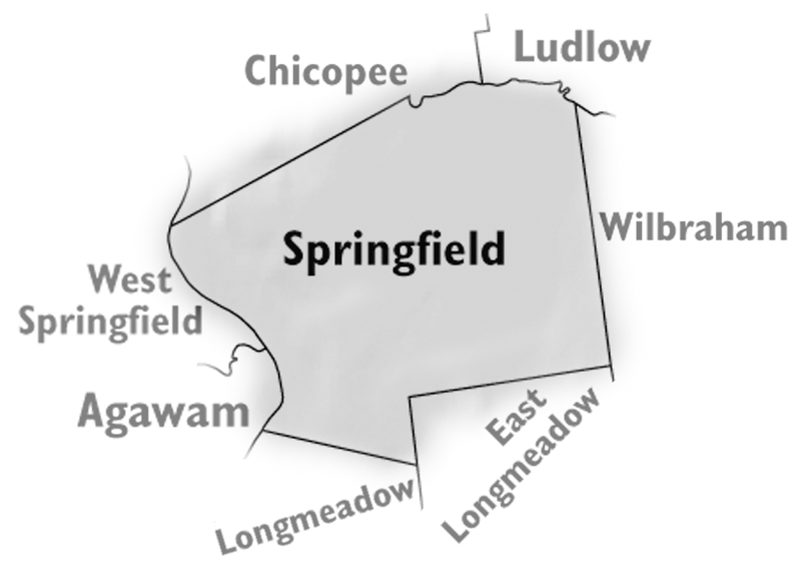
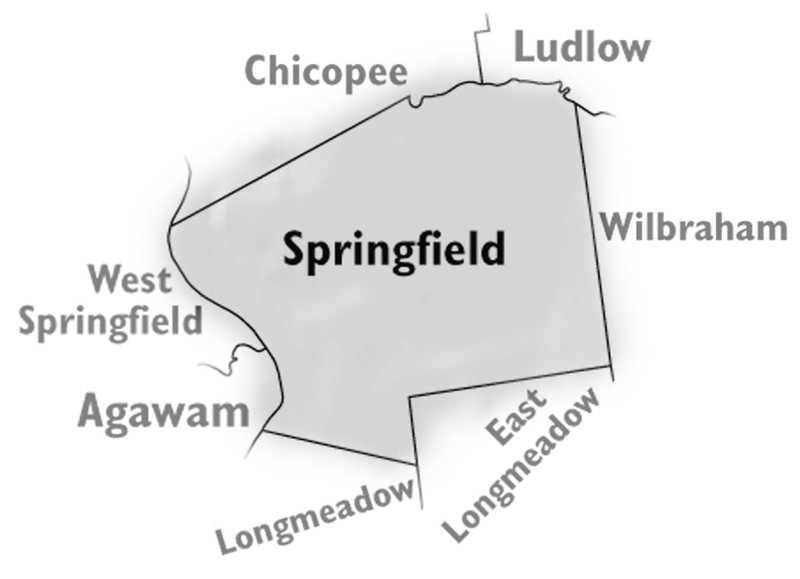
Springfield, Mass.

Springfield, Mass.

From his office looking out on the sidewalks of Main Street in Springfield, Russell Denver can see firsthand what is happening in the downtown business district.
As president of the Affiliated Chambers of Commerce of Greater Springfield, Denver knows that a lot of work needs to happen in the city he’s called home for most of his life — and, for all but four years since 1980, where he’s worked as well. But some of the biggest points to address can’t be solved quickly by a shovel in the ground or a ribbon-cutting ceremony.
Like many others who talked with BusinessWest, he said that there’s a perception of Springfield’s safety and vitality that isn’t supported by hard evidence.
“Springfield is a big fish in a little pond,” he explained. “What happens is that the city gets magnified. For instance, do we have crime? Yes. But if those same statistics were reported in Boston, no one would even notice it.”
Addressing the empty storefronts downtown, he said, “I’m going to put a different spin on things. If you go around, you see a fair amount of vacant office and retail space. Well, that’s an opportunity, rather than a challenge. As things start to turn around, we’re going to have the locations ready so that people can move right in.”
Such glass-half-full enthusiasm is expressed by others as well.
Springfield’s chief development officer, John Judge, said that during the current down market, City Hall has been strategically addressing both strengths and weaknesses in order to make strides when the economy rebounds. He said that working toward a “21st-century downtown” is at the top of his priorities, and while the to-do list is not short for that goal, a few achievements have already been checked off as underway or complete.
In this, the latest installment of its Doing Business In series, BusinessWest takes an indepth look at the region’s unofficial capital. While there are problems shared by most every municipality across the nation after a couple of tough years, Springfield has had some of its own dark spots that are now relegated to the history books. The Finance Control Board left just under a year ago, turning the city’s red ledgers back on track, and in the recently-released budget for fiscal year 2011, Mayor Domenic Sarno unveiled plans for increased hiring in the public-safety departments and a priority for “strong and effective fiscal management,” according to the report written by Lee Erdmann, chief financial officer for the city.
Talking with various officials, a picture emerges of a city that has been maligned for what it both is and isn’t. And in the coming months, some of that will be changing, helping to drive home a important message, said Judge. “We’ve got to make sure that everything we do says that Springfield is open for business.”

The Center of It All
Denver identified one historic roadblock for business development in the city: a lack of developable real estate.
“But I think that a lot of people have done some great work, and now there is land for new construction,” he countered. “You have property at Smith & Wesson, Chicopee River Business Park, in Indian Orchard, for light industrial. So now, there’s plenty of land out there for new tenants, or for expansion and new buildings.”
Those commercial properties have been in good shape in the last year, and these pages have reported with due fanfare the addition of several big-ticket incoming businesses like Performance Food Group and the F.W. Webb Co., among others.
While those outlying properties are marketable and in the spotlight, downtown can also share some of that limelight. Denver called the four-acre York Street Jail site along the Connecticut River a “home run,” increasing developable land along what is rapidly becoming a true destination, featuring several popular restaurants bracketing the Basketball Hall of Fame.
He shifted his focus to the central business district, the area loosely defined by State Street and Court Square to the south up Main Street to the property north of the train station. “If there is only one thing that happens in 2010,” he said, “filling the vacant federal building is an absolute winner.”
Nick Fyntrilakis agrees. As the assistant vice president for Community Responsibility for MassMutual, he has been working closely on a variety of projects for the city, his hometown. He called the return of occupants to the federal building at 1550 Main Street “a key to revitalization for that section of the city.”
Plans are underway for the Springfield School Department and Baystate Health to become anchor tenants in the structure, turning the lights back on in the prominently located building that has been vacant for more than a year.
“One of the impacts from 9/11,” he explained, “is that the building was cordoned off from the street with Jersey barriers. Before that, the building was accessible via airwalks to Tower Square, it was accessible to the parking garage behind it, Uno’s was right next to CityStage, and it was a very active night spot. But all of a sudden, you lost those people that weren’t there having dinner, and the building became this real island, an air bubble of inactivity, really.
“Not only will the building in use again mean bodies downtown,” he continued, “but it flips the switch to make it another welcoming section of the city. I think the barriers and the access really had an impact on the psyche of that section of Main Street.”

Accentuate the Positive
Fyntrilakis said MassMutual is heavily invested in seven major revitalization initiatives in the city, four of which are moving “at various speeds and progressions.”
“The Corridor Storefront Improvement project is off the ground,” he continued. “Some grants were awarded last week, and you’re going to see more of that in the future. Basically any storefront along Main or State streets can receive up to $10,000 in grants, with a $2,500 match from the owners, to go toward improving their storefront — awnings, lighting, what have you. You’ll start to see pockets of those pop up.”
In addition, he mentioned projects at the former Indian Motocycle complex, market-rate housing at the building on State Street soon to be vacated by the School Department, infrastructure improvements along the State Street corridor, and the revitalization of Union Station for high-speed commuter rail.
While these are projects that will provide a much-needed boost in the right direction for retail and market-rate housing — two fundamental concepts for urban vitality — Fyntrilakis said that there are still specific, important building blocks that need to be addressed. In his opinion, the historic building at 31 Elm Street, directly across Court Square from City Hall, is a project whose importance can’t be understated.
“That property could potentially impact so much,” he said. “Moving north across Court Square, then to the MassMutual Center side, the lower part of State Street, and the beginning of the South End … getting that project online in some shape or form is absolutely critical.”
From a commercial real-estate perspective, William Low said that progress and revitalization at Elm Street “needs to happen.”
Low, senior vice president at NAI Plotkin on Taylor Street, said that, if that property is redeveloped, it will fundamentally change the landscape in downtown Springfield.
For reference, Low mentioned projects in Pittsfield that could very easily be duplicated for the vacant space, saying that, if it could happen there, Springfield can’t be far behind.
“Pittsfield has done a good job of revitalizing its downtown,” he began. “On the ground floor, you essentially just give away the real estate, just getting those spaces filled. Every time a third-tier city tries that, it works. Go to Pittsfield now and see how well it’s worked.
“Five or ten years ago,” he continued, “people in my business weren’t even considering that city. But now they are.”
Echoing just about everyone with an informed opinion, Low said that market-rate housing is of the utmost importance to foster a vibrant downtown economy. “And give them a reason to live there,” he said, counting off galleries, shops, and entertainment venues, “most of which are already here,” he added.
Citing the Quadrangle museums, Symphony Hall, Center Stage, and the MassMutual Center, he shrugged and said, “if housing has made a difference and has worked in other cities with so much less to offer, then it certainly could happen here.”
Denver said that, by realigning the income demographic for downtown with market-rate housing, the retail that consumers have long expected for the city might be a reality, but not until there are those numbers to support them.
“People complain sometimes about the type of retail that comes into downtown,” he said, “but look at the income demographics. No one should be expecting that Nordstroms will be coming to downtown — the market doesn’t support that. But should we be looking at the Gap or Old Navy types of stores, and start reaching for things like that? Absolutely.”

Eliminate the Negative
An important facet to reining in that desired demographic will be to change some perceptions concerning the downtown area. Low said that, when all one hears on the news are stories of violent crime in Springfield, the downtown becomes the symbolic hub for all of those ills.
“Sure, there’s crime in Springfield,” he said. “But it’s not in the central business district. The reality is that once you’re here, it’s nothing that you are even aware of.
“Having said that,” he added, “I would like to see more of a police presence. Every once in a while, you’ll hear talk about some kind of criminal activity, and for the next few days you’ll see police on the streets, walking around. I wish they would just stay there. That negative perception is a genuine challenge for the retail and restaurant sectors.”
From his desk at the chamber, Denver said that one of the biggest hurdles the city needs to address is the commercial real-estate tax rate, the highest in the state.
“We did a study that we handed to all city councilors last year showing that, consistently, for similarly sized properties in similarly-sized industries, you pay a higher per-foot real-estate tax than in any of the surrounding communities,” he said. “That needs to be addressed first and foremost.
He cited tax increment financing that was made available to a number of large commercial ventures in the city, among them Performance Foods, Titeflex, and Liberty Mutual. “My point to the city is that, if you can give those tax breaks — and I’m very happy you did — what about everyone else?” he asked.
Put into context, however, these hurdles don’t overshadow his feeling that the city is positioned for a comeback.
“I’m of the belief that there is a lot of good already going on downtown,” he said, “There have been nights this past winter where you had Symphony Hall sold out, CityStage sold out, and the Falcons with 5,000 people. Those people do go to restaurants, and there is the possibility that they could support strong retail.
“The product is there,” he added, “and it’s good. We need to make sure it continues to be good, and people will come.”

40 Under 40 The Class of 2010

Anthony Gleason II: 24

Owner, Gleason Landscaping;
Commercial and Residential Sales, Roger Sitterly & Son Inc.

At 16 years old, Anthony Gleason was starting his own business while most of his friends were working for others.

It took him only one week of mowing lawns for someone else, he said, before he realized that the money he charged for each of those yards could go directly to his own bank account. “And that’s how it started,” he explained. “I just took it to a new level, growing wherever I could. Currently the company is quite large, in my opinion, and I’m very proud of its success.”

But while Gleason is an employer, he’s also an employee. Indeed, since 2000, he has worked for Sitterly Movers in Springfield, and in that time he has gone from summer, seasonal employee all the way up to the trusted professional overseeing commercial and residential sales for the

company. And Gleason takes that role very seriously. “What’s on the line every day is that I’m the one who’s trying to book jobs,” he said, “so that 12 to 15 of our guys have work and are going to be able to provide for their families.”

But also, he added, “I need to make sure that we’re making enough money so that we can continue our operations, taking the time to think of every decision, because it trickles down the chain within the company to affect every single one of us.”

Not many people his age are so entrusted with and invested in the livelihoods of their co-workers, but Gleason takes it in stride as part of the job. And he approaches his charitable deeds with the same conviction. “Right now, I’m at an age where the only thing I can really do is donate to such organizations as the Jimmy Fund and the Susan B. Komen Cancer Foundation,” he said.

“But I want to participate more,” he added. “And as time goes on, that’s my goal.”—Dan Chase

<<Back

Uncategorized
The Bay State?s Teacher Challenge

When Massachusetts lost out in the first round of federal Race to the Top awards, it came as a disappointment to the state’s leadership, especially given the passage of important education-reform legislation earlier this year.

But the Bay State can also find encouragement and direction in the results. The federal government’s final scores on state applications indicate that Massachusetts served itself well with recent reforms but just didn’t go far enough — especially in the area of improving teaching. With the right response, Massachusetts may yet declare victory.

For years, the state has rightfully been proud of its K-12 schools. But a few troubling policies were standing in the way of continued improvement: The state allowed too many persistently failing schools to avoid meaningful change, and despite having a number of the nation’s finest charter schools, the state stubbornly capped their growth.

January’s legislation addressed both issues, and it made a major difference.

On the issue of improving struggling schools, Massachusetts scored near the top among finalists. It bested one of two eventual winners, Delaware, and nearly tied the other, Tennessee. On the issue of charter schooling, Massachusetts was outpaced by only a few states. Had the reform legislation not been passed, Massachusetts would’ve found itself far behind.

So how did the state still manage to place a discouraging 13th overall out of 16 finalists?

By coming in very last place in the application’s most important section: improving the teaching profession.

A number of other states, following the Obama administration’s guidelines, acted boldly on this front, overhauling teacher-evaluation systems, toughening tenure rules, launching statewide performance-pay programs, and removing chronically underperforming teachers from the classroom. In Delaware, teacher evaluations must be based on student performance and must inform compensation and promotion decisions; teachers cannot receive tenure if rated ineffective more than once. In Rhode Island, all teacher placements must be based on school need, not seniority, and districts may not allow any student to be taught by an ineffective teacher two years in a row.

On these issues, Massachusetts demurred, deciding instead to form a task force to study such matters; the grant application also proposes ‘statewide conversations’ with stakeholders. In the few cases where the state proposed new initiatives, startlingly small portions of the state would have participated. A largely undefined pilot program to reform teacher personnel decisions would have been implemented in fewer than 1% of districts.

Federal reviewers subtracted points from Massachusetts in virtually every part of this section, from evaluations and compensation to teacher-preparation programs and staffing needy schools. In fact, had the state merely maximized these points, it would have displaced Tennessee for the second winning spot.

The good news, then, is that Massachusetts knows what must be done, and victory is within reach. The challenge for state leaders is in summoning the courage and energy to take these steps before the second and final filing deadline, only 60 days away.

Massachusetts and many other states have long avoided such reforms because of political opposition. Countless individuals and numerous organizations, from unions to higher-education institutions, have benefited by and grown accustomed to the current arrangements. But if we are to better serve our students, particularly the most disadvantaged, and elevate teaching to the ranks of truly esteemed professions, these changes are essential.

Fortunately, other states have blazed a trail for Massachusetts. Rhode Island crafted the second-highest-scoring teacher-quality provisions in the competition; these can serve as a model. The two winning states demonstrated that these bold reforms, if developed carefully, can generate broad support: In Delaware and Tennessee, all districts and virtually all unions signed on to their state’s plan.

Massachusetts has a stark choice and a golden opportunity. Because of the stiff competition, the state simply must address these issues if it is to have a realistic chance of securing one of these unprecedented grants. If it accepts this challenge, it is as well-positioned as any state to win in the second round.

Hesitant state leaders should view these reforms as the last leg of a marathon. For 20 years, since its early leadership on accountability, Massachusetts has been running strong. With January’s reforms, it moved into the lead pack. Teacher reform is Heartbreak Hill, the final challenge that has stopped others in their tracks. If Massachusetts can push through, it will find at the finish line several hundred million dollars and a brighter future for its students. v

Andy Smarick, a former U.S. deputy assistant secretary of education, is a fellow at the American Enterprise Institute and the Thomas B. Fordham Institute.

Uncategorized

Spring. Baseball returns, the golf pros head to Augusta, the days start getting longer … and another casino bill is taken up on Beacon Hill.

It’s becoming a Bay State tradition, these gaming measures and the discussions that precede them. For the past several years, the talk has started in the dead of winter: ‘is this the year that casinos finally get over the hump?’ ‘Is this the year the stars align for passage of a gaming bill?’

Usually, there is talk of pieces coming together and key players, such as Gov. Deval Patrick and House Speaker Robert DeLeo, forming alliances to get the job done. And in recent years, there’s has been some early momentum, such as last week’s 12-2 vote of the Joint Committee on Economic Development and Emerging Technologies to support a bill to establish two casino resorts and provide 750 slot machines for each of the state’s four racetracks.

But in the end, casinos have always come up short, often well short, of the votes needed. This year, once again, like the return of baseball to Fenway, the talk is of how things will be different this time around.

Let’s hope so.

Casinos are not a panacea, and they are not going to magically take a near-10% unemployment rate in the Commonwealth and bring it down several points. And they’re not going to spur large volumes of economic development, no matter where they are put.

But they will help Massachusetts gain a bit of economic stability at a time when the state’s struggles are really beginning to take their toll — on cities and towns, on sectors like health care, and on the public colleges and universities tasked with training future workers for businesses.

We’ve said it many times before, but it bears repeating: a healthy state financially is crucial to the well-being of this and other regions in the Commonwealth. Two resort casinos and some slot machines are not going to solve the state’s fiscal woes, but it’s better to have that revenue here than see it go to Connecticut. Meanwhile, our state Legislature can’t seem to find ways to help the state’s bottom line that don’t include punishing consumers and small-business owners. Casinos wouldn’t do either, if they were placed properly.

And a proposed location in Palmer is just such a location.

Indeed, we wouldn’t want to see a casino in downtown Springfield or downtown Holyoke, where the negative impact on residents and surrounding businesses would be considerable, and where other types of economic development are possible and perhaps probable, even though both communities are still struggling to reinvent themselves.

But a casino in the Quaboag region, which has been devastated by the loss of manufacturing jobs, and where is little hope for other types of job growth (that area is simply one or a few turnpike exits too far away from both Springfield and Boston), makes a good deal of sense.

A resort facility would create jobs, bring people who previously couldn’t find Quaboag with a good map to that area, and perhaps spur other forms of tourist-related jobs.

We’ve said all this before — seems like every spring for the past several years — but the common-sense arguments for resort casinos, one in Palmer and the other in the eastern part of the state, haven’t changed. What just might change this time is the opinion of many state legislators.

This could be the year. Let’s hope it is.

Uncategorized
New Economy, Old Economy, and Business Costs

Policymakers in Boston and Washington love to paint new-economy jobs as an economic panacea, immune to high taxes, staggering electricity costs, and bureaucratic regulation. They tout — and often subsidize — ‘industries of the future,’ while raising costs for the industries of the present that employ the majority of Massachusetts residents. But the new-economy myth exploded in 2009 as companies that have been poster children for innovation-based economic development in Massachusetts announced major expansion projects in Michigan, the Carolinas, and China.

A recent UMass study found that 70% of technology executives believe Massachusetts must address the cost of doing business, corporate taxes, unemployment insurance, and workers’ compensation. Business costs matter just as much in the new economy as they did in the old.

High-technology, biotechnology, and clean-technology jobs respond to the same economic influences that determine whether any job will provide economic opportunity to citizens of Massachusetts — or to citizens of Michigan or citizens of China. Innovation remains critical to economic growth, but government must also commit to supporting commercialization and the employment opportunities it will create.

Our economic future depends upon the ability of the Commonwealth to create a favorable business environment across all industries. The alternative is an ‘invented here, made elsewhere’ economy that provides opportunity for doctoral-level researchers, but leaves other citizens out in the cold.

That understanding is the foundation of the public-policy agenda of Associated Industries of Massachusetts, which continues to advocate on behalf of employers as Massachusetts enters a new decade struggling to emerge from a protracted economic downturn.

The document calls for an economic policy that balances key public investments with a competitive cost structure that keeps jobs in Massachusetts; a predictable, responsible, and long-term state fiscal policy; uniformly favorable environment for business development across all industries; leadership from business executives to help government resolve important issues; well-conceived and collaborative regulation policies that create measurable benefits; an environment that values contributions made by employers to operate successful businesses that employ state residents; a nimble, world-class education system that provides opportunity for all Massachusetts citizens and the knowledge base for economic growth; and the need for business and government to more fully collaborate in order to ensure mutual success.

Massachusetts employers, even ‘new-economy’ companies, have cause to worry as 2010 begins. They face an immediate 28% increase in unemployment insurance taxes and $44 million in new assessments for the Medical Security Trust Fund, as well as the Legislature’s failure to address flaws in last year’s $192 million Combined Reporting corporate tax increase that has put Massachusetts at the bottom of CFO magazine’s list of places to do business.

A better business climate — not higher business costs — is the key to rebuilding our economy and solving the budget crisis that threatens the ability of state and local government to deliver the services that citizens expect.

Richard C. Lord is president and CEO of Associated Industries of Massachusetts.

Uncategorized
An Inspiring Class of Difference Makers

When BusinessWest launched its Difference Makers program a year ago, it did so with many goals in mind. The first, of course, was to recognize people and institutions making important contributions to the health and well-being of this region. Beyond that, through the telling of their stories, we wanted to inspire others to make a difference as well.

The Class of 2009 made that second goal easily reachable, and the Class of 2010 (introduced in a special section starting on page 37) will do at least as well. Indeed, if there is one word that sums up this class, it is inspirational.

Let’s start with the Davis Foundation. Over the past 40 years or so, it has awarded grants to countless local nonprofit agencies, helping them do everything from constructing new buildings to launching new programs to simply meeting the confines of a budget. These acts of philanthropy alone are enough to make the foundation a Difference Maker. But in recent years, the organization has gone far beyond the act of donating money.

Perhaps its most important role now is to act as a convening power, bringing groups and individuals together to address issues like education and literacy. The word agenda often has a negative connotation to it, but not in this case. The Davis Foundation has a clear agenda — to focus energy, imagination, and, yes, money on the critical matter of young people, this region’s future.

Serving on boards and committees doesn’t necessarily make one a Difference Maker. But going well beyond the monthly or weekly meetings and compelling those involved with various groups to reach higher and work harder, well, that would put someone in that category.

And this pretty much sums up Ellen Freyman’s approach to her work. She’s not only tutoring and mentoring members of a Somali family, she’s working with Springfield school officials to improve their chances of succeeding in the classroom. She’s also starting to work with others to find new ways to bring more adult-literacy programs online, not merely to help the Somalis, but also the countless others who need such services. She’s even put a soccer team together for Somalis and arranged for donations of equipment.

All this shows creativity and the ability to think outside the box — just some of the traits that make her a Difference Maker.

Jim Goodwin has been at the helm of the Center of Human Development for more than 30 years now, and in that time he has helped create and expand dozens of programs that improve quality of life for society’s most challenged constituencies.

These include the mentally and physically challenged, children with developmental issues, seniors, those with substance-abuse problems, those who have been incarcerated, and others. He’s a Difference Maker not simply because he works with those groups, but because he’s created an organization — and a team — committed to the CHD mission.

Carol Katz, meanwhile, is also a Difference Maker on many levels. First, as CEO of Loomis Communities, she has orchestrated strong growth of that organization while also transforming the way in which care to seniors is provided.

She also gives back to the community, and by setting that example, and that tone, she has created a culture of community involvement in each of the Loomis properties.

Finally, UMass Amherst and its chancellor, Robert Holub, are making a difference in many ways, especially in Springfield, through a number of economic-development programs. Efforts include establishing a physical presence in downtown Springfield, partnering with area agencies to transfer technology from the university to area precision manufacturers, research projects, the Pioneer Valley Life Sciences Institute, work to create the High Performance Computing Center in Holyoke, and much more.

This is an exceptional class of Difference Makers, individuals and institutions that can inspire positive change while also inspiring others to follow their lead.

Kate Campiti is associate publisher and advertising manager of BusinessWest.

Uncategorized
Here Are 22 Effective Ways to Out-market the Competition

Out-marketing competitors is easy if you do it right. It takes a combination of work and savvy, but the results can be positive. Frankly, the competition often makes it unusually easy. They talk about what they are going to do, but never get around to doing much. They’re successful at missing marketing opportunities.

But not everyone. For example, a 44-store dry-cleaning chain responded to a request for submissions for family business of the year and another for community service. Detailed proposals were prepared and submitted, and the company took top honors in each one, which brought widespread recognition and additional opportunities.

While the possibilities are limitless, here are 22 marketing ideas that can help you out-market the competition.

1.Put your marketing under the microscope. Review everything. And that means all your various marketing activities, whether it’s advertising, letters, memos, eBulletins, newsletters, press releases, and so forth. Ask yourself, ‘is this about our company, or is it about our customers?’ The focus should be squarely on ‘them’ rather than ‘us.’ If it isn’t, change it!

2.Get a grip on the customer. This means thinking like a customer. Seems obvious, doesn’t it? If you’re selling something, why wouldn’t you try to get inside the customer’s head? After looking at recent GM ads, you might wonder what they’re thinking. Chevy ads focus on interior space, mileage, and OnStar, while Buick highlights a smooth ride. Is all that on target? If the Cash for Clunkers program is any indication, it isn’t. Consumers want value for their dollar. By the way, GM isn’t alone.

There’s just too much stuff that keeps us from seeing the world though the customer’s eyes.

3.Watch out for no-appeal perks. Just giving things to customers, including most so-called value-added ‘stuff,’ can backfire. It may send the message that you don’t really understand what they want. If it doesn’t have value for the customer, don’t do it.

4.Get the emotions going. Facts can be helpful, but they don’t translate into action. Reebok gets the message with its recent cable ads for its women’s EasyTone shoes with its compelling message, “Better legs and a better butt with every step.” The ad has both men and women talking, a sure sign that it hit an emotional target. Skechers’ Shape-ups for men aim at the same hot spot with the message, “get in shape without setting foot in a gym.”

5.Be ubiquitous. “Daimler AG’s two-year effort to win over U.S. drivers with a thrifty, plastic-clad minicar is running out of steam,” notes BusinessWeek. After a hot start, ForTwo sales stalled. Was it the car or an inadequate marketing budget? The ForTwo smart car was a new concept and it needed to be seen and promoted in every metropolitan area. It’s an example of how underpowered marketing gets you nowhere.

6.Power up your social-media skills. Look for sites that seem to fit your objectives and focus on one or two to start. Join the groups that are right for you on the sites and expand your connections. Then stay with it and make yourself part of the community by posting helpful information regularly.

7.Seek out presentation opportunities. Organizations look for presenters who can offer timely information and who won’t serve up an infomercial. If you’re an interesting speaker capable of delivering an applause-worthy presentation, and there are opportunities, you have an edge. It’s a great way for prospects to get acquainted with you.

8.Piggyback on hot news. A law firm specializing in divorces responded immediately to the Tiger Woods story with a local angle, just what the press was looking for. The story was picked up by more than 40 media outlets across the country. This is always a small window, but you need to act quickly.

9.Develop a prospect database. An inadequate prospect database thwarts the marketing efforts of most companies. It’s impossible to communicate with prospective customers and actively cultivate them unless you have complete and accurate contact information.

10.Communicate consistently in a variety of ways. No business can depend on one or even two ways to communicate with prospects and customers today. The goal is to bounce as many balls as possible: phone, e-mail, texting, print and electronic newsletters, blogs, and seminars. Not all at the same time, but in more than one way.

11.Sponsor a community-relations program. Go beyond just giving money. Identify a community need and make it yours by integrating it into your marketing plan so that it becomes an extension of your brand. The goal is to align your company and its resources with your community-relations program.

12.Stick with facts. Much of what passes for marketing is mere opinion shrouded in ‘puff and fluff.’ Third-party surveys and solid research can help build credibility by dispelling doubt.

13.Give your Web site a redo. Old Web sites never die, they just stay that way. Ill-conceived, poorly designed, and company-focused, they need to be filled with excitement and customer appeal.

14.Share your knowledge. Every business possesses expertise, but few share what they know with customers. Yet, it’s your knowledge that helps set you apart from the competition. Sharing what you know has the power to pull in customers.

15.Build your brand. What does your brand stand for? How is it perceived by customers? What do they think about when they think about you? What value does your company bring to your customers? And how do you know? Guessing isn’t good enough. Give attention to what makes your company unique.

16.Create a marketing calendar. Marketing plans are important, but the place to start is with a marketing calendar: what’s going to happen each month, week, and so forth. Use it as a road map to stay on track.

17.Follow up on sales leads. Lead accountability is essential, since studies show that follow-up fails with 30% to 80% of leads from inquiries, requests for information, telephone calls, and so forth. They’re ignored, thrown away, dismissed as unimportant, or fall through the cracks.

18.Avoid trite words and phrases. When everyone uses certain words, stay away from them. Watch out for these: ‘value’ (prove it), ‘we have great people’ (who says so?), ‘we care’ (words are not reality), ‘your business is important to us’ (is that why you give out 25-cent trinkets?), and ‘we provide solutions’ (what’s that mean?). Such words are high-level abstractions that don’t mean anything to customers. Be descriptive and tell stories. That’s what grabs customers.

19.Market bylined articles. Well-written, thoughtful, and informative (not self-serving) articles that meet an editor’s requirements are in demand for both print and online venues. They are a great way to demonstrate your ability to communicate successfully.

20.Avoid subterfuge. The e-mail message is clear: “ask for our free white paper on…” Then when you ‘click here’ to get it, up pops a form, which instantly devalues the white paper. In fact, it’s no longer free, since the ‘price’ is providing contact information. This sends the message to prospects that you’re not an up-front business. If it’s free, let the visitor get it now.

21.Understand the male and female shopping styles. Anyone who goes to the supermarket knows men and women are different. Men go down an aisle with speed and determination. They grab what they want, almost without slowing down. Women, however, take their time, check over possible purchases, and carefully check the differences before making a decision. As we all know, they easily irritate each other.

Researchers point out that, in prehistoric times women were the foragers, spending their days carefully looking for the best foods, while the men were making plans for which animal to kill and how to go about it. When ready, they went out, made the kill, and came home with the prey. Nothing has changed. Recognizing the differences is one key to successful marketing.

22.Why does your company deserve more business? Ford takes this question seriously by challenging itself and coming up with far-reaching changes in its thinking and operations, including moving to smaller vehicles and a truly global platform. Your actions let customers know what you really are.

If you’ve thought of other marketing activities to add to the list, that’s good. Continually expanding our marketing horizons is what it’s all about. It’s the best way to out-market the competition.

John R. Graham is president of Graham Communications, a marketing-services and sales-consulting firm;[email protected].

Uncategorized
A Rescue Mission for Education

Forty years ago, I changed schools. On the south side of Chicago, my school had few books, 40 children in a classroom (most of us poor), teachers whose role was mainly to keep order, and police at every intersection of the halls. The school I changed to was a private New England prep school with small classes, longer school days, teachers with the latitude to innovate and experiment, and high expectations for each child.

I still want to change schools. But private schools are not the answer. Public schools are where most children get their education, and they should be consistently excellent.

The Legislature is now in final deliberations on a new education bill I filed last July that will close, once and for all, the pernicious achievement gaps that damage the lives of low-income, special-needs and minority children. I applaud the House and the Senate for bringing us to the precipice of real and lasting reform.

The bill promotes the creation of ‘Innovation Schools’ — a new type of public school with more autonomy and flexibility. It authorizes a targeted lift of charter-school caps in the Commonwealth’s lowest-performing school districts, allowing only those charter operators with a proven record of successfully serving high-needs students. Most important, it expands the ability of local superintendents or the commissioner of education to intervene in low-performing schools by providing new tools to attract the best and brightest educators, and new supports to help teachers, students, and families overcome the disadvantages of poverty.

Changing schools rescued me 40 years ago. This bill is a rescue mission for every child in the Commonwealth trapped in an underperforming school. It’s all about the kids. And our future.

Some have portrayed the bill as a showdown between union and management interests — a debate focused on adults and not children. Both sides of the debate have occasionally fallen back on entrenched positions where the goals of compromise and common purpose become harder to reach. Our children can no longer afford that kind of debate.

Seventeen years after the passage of landmark education reform in the Bay State, it is past time we launch the next chapter of reform. We need to give educators and leaders in our lowest-performing schools the kinds of supports we know can make a difference. We need to give students more time in school and the health and human services necessary to overcome the disadvantages of poverty and other conditions that interfere with their readiness to learn. Whatever gets in the way of that has to yield.

And, yes, sometimes that may mean changing the principal or a teacher or some of the rules governing a handful of the state’s lowest-performing schools. But this is not too much to ask to ignite a lifelong love of learning in a child, and is long overdue. And it can and will be done in ways that are respectful and transparent. Tinkering at the margins of underperforming schools, only to see them continue to languish, is no longer acceptable.

Urgent problems, especially ones that involve children, demand urgent and new solutions. Now is no time for us to retreat to our familiar foxholes to fight the same, tired battles. We can deliver the next great stride forward in a quest to deliver on the promise of American public education: an excellent school for each and every child. That is a more important educational, economic, and moral imperative than the interests of any adult. v

Deval Patrick is the governor of Massachusetts.

Features
This Entrepreneur Is Getting the Bugs Out
Companies to Watch: Graduate Pest Solutions

Glenn Olesuk says his degree in Entomology gives him a competitive edge — and it also gave his company a name.

Glenn Olesuk says he won’t easily forget his first professional assignment.

That was as the technical director for a local pest-control company in Chicago. There were many elements to that job description, but at the top of the list was battling something the locals and the press had dubbed the “super rat.” This was a pest said to have amassed a resistance to all or most of the rodenticides in use at that time (1979).

“There was evidence that some resistance had been built up,” said Olesuk, now the owner and entomologist with his own company, Hampden-based Graduate Pest Solutions, adding quickly that the super rat was, in his opinion, more myth than reality.

But he did see plenty of rats, and he has some vivid memories from those days in the Windy City, including one that he and his wife, Brenda, often retell. Glenn, it appears, wanted to show Brenda just what he did for a living, specifically his work at some of the finer hotels to keep rats out of the view of guests.

“Every major city has layers — downtown Chicago had what’s known as Wabash Avenue, which is the layer below the main streets, where the service vehicles would come in,” he explained. “And that’s where the real battle with rats took place. We would trap and kills rats by the hundreds. One night I took my wife to show her what I do every day; I was driving with my lights off, and pulled into an alleyway behind one of the major hotels. When I turned the lights on, it was like a Hollywood movie — there was just a mass of dark gray that moved from the street and ran into these inconceivable little holes and openings in the alleyway.”

These days, Olesuk is doing battle with far-less-exotically named pests at a venture he named Graduate to call attention to something he says differentiates him from most all competition. That would be his bachelor’s degree in Entomology, the study of insects, that he earned at Syracuse.

“Sometimes I have to explain it,” he said of his company’s name and the motivation behind it. “But by the time I’m done explaining, they get it.”

Most in this huge, highly competitive industry don’t have such qualifications, he explained, adding that, from his studies in college — not to mention his 30 years in the field (and in attics and back alleys) — he can effectively answer most all questions people have about pests in their home or business.

And informed answers are what clients and potential clients want most, said Olesuk, adding that he’s been providing them since his career path took a turn at Syracuse. “I was going to get into forestry,” he explained, “But then one of my professors said, ‘take pest-control technology, and you’ll always be employed.’ He was right.”

Tracing his history in the pest-control business, Olesuk said he worked for both local and regional firms until becoming part-owner of a venture in 1998. That business partnership eventually dissolved in early 2007, he continued, adding that he launched Graduate Pest Solutions shortly thereafter, and has been building a book of business steadily since then.

Moving forward, Olesak, who has his two sons, Paul and Scott, working with him in part-time capacities, said his primary goal — and challenge — is to get his company’s name and his résumé in front of people. If he does so, he believes he can take market share from a host of local, regional, and national competitors.

And once he gets a customer, Olesuk says he keeps it. “I’ve always had 100% retention,” he explained. “I’ve never lost a client to service.”

Olesuk says the majority of his clients are commercial, and while he’s working to continually build that portfolio, he also wants to greatly increase his residential customer base as well.

In both realms, the key is exposure, he said, adding that he’s employing a number of marketing vehicles — from some direct mail to his service truck, outfitted with a new logo — to introduce people and businesses to his venture.

Olesuk hasn’t encountered any super rats in his current service territory (Hartford north through the Pioneer Valley), but he is being kept busy with Asian lady beetles, mice, spiders, ants, and bees, each with their own season, except spiders, which are generally a year-round concern.

He can talk at length about any and all of them, because he has not only experience, but that diploma that gives him a degree of separation — both figuratively and literally.

Uncategorized
High-speed Rail a Clean Win for Commuters

Americans traveling this holiday season were no doubt frustrated by long lines at airports and congestion on the roadways, caused by years of neglect to our national infrastructure. President Obama has an ambitious plan to fix these problems, which includes the creation of a nationwide network of high-speed and intercity passenger rail routes.

To advance this goal, the president made an $8 billion down payment through the American Recovery and Reinvestment Act and proposed another $1 billion for each of the next five years. Nearly 40 states have applied for this money.

To assist states, the Department of Transportation is providing funding and technical expertise as they meet important environmental planning benchmarks created by federal law. These benchmarks must be met before large-scale high-speed rail programs get underway, and they apply to every region of the country. Our goal is to make sure states follow these rules and are not burdened later with unnecessary project delays that drive up costs and hinder the long-term success of projects.

As a former secretary of transportation for Maryland, I know the issues faced by communities on the Northeast Rail Corridor. The Obama adminsitration is committed to the region, and the Northeast Corridor will certainly be part of our future high-speed rail network. Just last year, we opened up a new bridge over the Thames River in Connecticut, and there is a $100 million project underway to replace the Niantic Bridge through Recovery Act dollars. There are plenty of other opportunities to maintain and improve Amtrak’s current high-speed service on the Northeast Corridor.

The benefits of high-speed rail also include improving the environment by reducing carbon emissions, lessening highway congestion, and providing a much-needed alternative to the frustrations of air travel.

We are building long-term relationships with states and coalitions of states to build world-class high-speed rail service, something that already exists in Europe and Asia. The U.S. program will provide tens of millions of Americans with transportation options that have not previously been available.

The program will also offer relief to communities around the country that rely on manufacturing and that have been hard-hit economically. In fact, nearly three dozen rail manufacturers and suppliers, both domestic and foreign, have committed to establish or expand their operations here in America if they are chosen by states to build their high-speed rail lines.

This effort will take work from all sides: a continued commitment from the federal government to support these investments, real oversight to make sure these new lines are safe and reliable, and a sustainable funding stream from states to maintain these routes. Through these efforts, we will improve the quality of life in many communities across the country, including those along the Northeast Corridor.

John D. Porcari is the U.S. deputy secretary of Transportation.

Opinion
Decision Looms for ‘Death Tax’

I know you’re eager to return to those thrilling days of yesteryear — the Bush presidency — and there’s a pressing matter from that era on the national agenda: what to do about the estate tax. We have until New Year’s Day to settle this question, a small window on our values as a country. The background: on the charge that the ‘death tax’ was a punishing money grab from small businessmen and women — coming while they grieved a lost loved one, no less — opponents in 2001 succeeded in increasing the exemption; the tax currently kicks in on inheritances above $3.5 million rather than the old tax’s $1 million. The maximum tax rate, then 55%, was dropped to 45%.

When the Times Square ball rings in 2010, the tax will vanish altogether. Your ticket to the great beyond is tax-free next year. But not if you survive into 2011: because of deficit concerns, opponents had to agree that the tax would return that year, with a rate and exemption at their 2001 levels. This fiscal sleight-of-hand, disdained by all sides, has produced a yuletide debate. Should we repeal next year’s repeal to contain federal red ink, and if so, what should the rate and exemption be? Or do we just kill the tax permanently, as opponents have always urged? President Obama proposes threading the needle by keeping the tax next year but making permanent its current lowered rate and higher exemption. Boston College law professor Ray D. Madoff counters that that would cost the Treasury more in the coming decade than doing nothing. She proposes shielding family businesses under $10 million from the tax but preserving it at some level otherwise.

Both points are spot-on. The case against the death tax (opponents’ term) has always been daffy. Aug. 24, 2000 has passed into political lore as the day that Montana rancher Lynn Cornwell hopped atop a tractor to deliver a repeal plea to President Clinton at the White House. That same day, then-Republican House Speaker Dennis Hastert declared that the tax “is so steep that sometimes the deceased owner’s children must break up a farm or sell a business just to cover the tax.’’ But the tractor drive was a stunt. Far from being a victim of the tax man’s greed, Cornwell has benefited from taxpayer largesse. In the years after his ride, he pocketed $400,000 in federal farm subsidies and fed his herd on federal land at below-market rates, according to William H. Gates Sr. and Chuck Collins, two well-off men who wrote a book supporting retention of the tax.

And Hastert’s point? You could fertilize Montana with what the speaker was shoveling. In 2001, the New York Times asked the American Farm Bureau Federation, a repeal advocate, for examples of families that had to give up their farms because they couldn’t afford the estate tax. The federation found exactly zero victims. Five years later, the Times reported that just 50,000 families will be subject to the tax in 2011. They’re in a tax bracket that means they’ll be able to pay the IRS without having to miss the mortgage payment, turn off the electricity, or eat cat food.

Won’t killing the tax help during a recession? Tax cuts for average people who need to spend their money on necessities would indeed be smart in a downturn. But with the estate tax, we’re talking about the wealthiest Americans, people more likely to save their windfall, not spend it. As for arguments that the tax smothers job growth, President Clinton left the tax alone during the 1990s. Job growth sure was slumming it then, wasn’t it? Keeping taxes low and simple is sound policy. It is perfectly compatible with an estate tax.

Many of the same politicians who oppose the tax bray out of the other side of their mouths about swelling deficits. Meanwhile, a writer for the Weekly Standard made the conservative case for the tax: success in America should come from hard work and talent, not from being one of the “undeserving winners of the sperm lottery.’’

Rich Barlow is a freelance writer in Cambridge.

Opinion
Keep the Engine of Small Business Humming

In 1982 as an MBA student at The Ohio State University, I read Dr. Michael Porter’s book Competitive Strategies. Fast-forward to the mid-1990s when I attended Porter’s presentation in Springfield about the importance of businesses locating in the urban core. My then-business partner and I took the bait. Within a year, TSM Design was located in the heart of downtown on Bridge Street, where we remain today.

Recently I received an e-mail from Porter’s brainchild, the Initiative for a Competitive Inner City. The ICIC’s mission is “to promote economic prosperity in America’s inner cities through private-sector engagement that leads to jobs, income, and wealth creation for local residents.” Given my long history with Porter, I decided to attend the ICIC summit in Washington, D.C. titled “Growing Businesses in the Inner City: Building Capacity and Creating Impact.”

Featured at the two-day event was Porter’s presentation of 10 years of data collected among 600 successful urban enterprises. He focused on the following factors influencing the growth of inner-city firms: financing, the inner-city business environment, company revenue sources, and leadership and human capital.

Some of Porter’s findings are as you might expect. Inner-city firms generally use personal assets for startup funds and bank loans for growth. The vast majority (76%) indicate limited access to growth capital. Yet these financing statistics yield an interestingly low failure rate among the studied inner-city businesses.

Among the sectors represented, 3% of distributors, 3% of manufacturers, and 4% of service businesses have closed their doors during the 10-year study. None of the retailers have gone out of business.

Included in the summit were presentations from Karen Mills, the administrator of the U.S. Small Business Administration, speaking about national policy and the Obama administration’s commitment to growing the small business sector, and Rob Walsh, commissioner of the NYC Department of Small Business Services, who spoke in detail about best practices of a business-friendly city government.

Of particular interest to me was a panel discussion on how large companies use their procurement dollars to grow the inner-city economy, and a case study involving New England Blue Cross Blue Shield and one its small local vendors. BCBS and the vendor split the cost of hiring NextStreet Financial to mentor and grow the vendor into a more robust supplier. The vendor happens to be a communications firm specializing in diverse audiences. The net result is a vendor with increased capacity with more opportunities — both within BCBS as well as other companies.

All in all, this summit was personally affirming to me as a small-business owner in Springfield. Intuitively I’ve known we made the right decision 14 years ago to move the business out of the suburbs and into the center of the city. There are some discernable fringe benefits. For one, a downtown address has considerably more gravitas than a suburban one. Visibility is another factor. I can walk down the street and see dozens of current or potential clients and colleagues. Also, most of my civic involvements are within walking distance from my office. Lunchtime also yields far more interesting menu options.

The conference raised the bar for my expectations of the opportunities for my business and those of my peers. My eyes were opened to what other cities are doing to increase opportunities for small businesses. Even more importantly, I now know there are large corporations that both walk the walk as well as talk the economic-development talk. They make a point of doing business with local small businesses.

One eye-opening fact presented during the conference: 70% of all U.S. workers either work for or own a small business. The SBA definition of a small business is fewer than 500 employees. In Springfield, there are only 35 employers with more than 500 employees. So the thousands of businesses that comprise this city’s economy are small, like mine. If Springfield is going to regain its economic health, it’s time we develop a comprehensive strategy to keep this dynamic little engine going.

Nancy Urbchat is owner of Springfield-based TSM Design; (413) 731-7600.

Sections Supplements
Staying in the Market Using Active Management Is a Wise Strategy

Successful investing has never been for the faint of heart.

This has been especially true during this most recent 24-month period. Riding these recent highs and lows leaves one feeling quite dizzy. We have always maintained that a well-diversified portfolio employing high quality, active managers, coupled with a disciplined approach, will position investors favorably to take advantage of opportunities that the markets offer during periods of extreme volatility.

Last fall, when the economy and the markets came to a screeching halt, investor sentiment turned extremely negative in a very short period of time. As we then moved from the end of 2008 into the start of the new year, sentiment and the markets turned even gloomier.

Many investors could not stomach the idea of seeing their investment values decrease any further on paper; therefore, they moved to cash. These investors fled to ‘safe’ havens such as cash and Treasury bills, even when doing this meant receiving no interest payments. This stampede to cash created various dislocations in the markets, or, in other words, opportunities for those investors with the fortitude to stay the course. Since this year’s low on March 9, when the Dow reached levels in the 6,500 range, we have seen a tremendous run up in stock prices. It is, however, very important to note that not all stock price levels have increased significantly. This highlights the importance of investing with quality managers who can identify trends and pick stocks wisely.

There are market cycles when active managers, as opposed to passive management (as in index funds), produce significant value for their investors. We believe we have entered such a cycle. Extreme volatility in investor sentiment has resulted in an unprecedented amount of cash on the sidelines (not invested in the stock market). There is currently more than $11 trillion in cash and/or money-market accounts. Eventually much of those balances will be deployed in investments with the potential for a higher return than cash and/or money-market accounts. The successful investor should already be positioned in a diversified portfolio before other investors enter the markets chasing returns as prices increase.

As financial advisors, we believe it is our responsibility to assist clients in taking as much emotion out of investment decisions as possible; following the herd is not an investment strategy. These investors who have stayed the course have been, and in our opinion will continue to be, rewarded with rebounding portfolio values.

Once again, the old adage that it is time in the market, not timing, is proving to be the successful long-term strategy. Research has shown that being out of the market for just 20 of the best market days over the last 25 years cut investor returns in half. Since none of us ever knows what the best or worst days will be until we have the benefit of hindsight, staying the course will allow investors to take advantage of opportunities that are disguised as anything but.

Lorraine A. Hart and Cheryl A. Patterson are principals of Hart & Patterson Financial Services, LLP. They are certified financial planners, each with more than 25 years of financial planning experience. Hart & Patterson Financial Services, LLP is an independent financial-planning firm with offices in Amherst and Northampton. It handles multiple facets of financial planning, including wealth management, investment management, retirement plans for businesses and individuals, estate planning, insurance services, charitable giving, and tax planning; (413) 253-9454.

Opinion
It’s Time for the State to Fund All Hospitals Equitably

There has been a great deal of national debate about health care lately. Here in Massachusetts, many of our hospitals are facing a crisis that is every bit as critical.

Holyoke Medical Center is one of the hospitals that is most affected.

Though Holyoke Medical Center, formerly Holyoke Hospital, has been a vital component in taking care of the region’s most needy patients ever since it opened in 1893, we are witnessing an unparalleled crisis in state funding. For many years millions of dollars in state funding have flowed to facilities such as Boston Medical Center because, like us, they take care of the poor. There is no doubt that they do. And there is also no doubt that, thanks to state funding, Boston Medical Center, a fellow nonprofit facility, finished fiscal year 2008 with a profit of nearly $55 million. During the same period, Holyoke Medical Center, which also treats tens of thousands of poor people each year, lost $951,000. Something is not right with the system.

There are 14 community hospitals in Massachusetts designated as ‘disproportionate-share hospitals,’ each of which serves a large population of the poor and medically needy. A hospital is designated as a disproportionate-share hospital if more than 63% of the care it provides is reimbursable by public payers — Medicaid, Medicare, and Commonwealth Care. It is not just the poor who are served by such hospitals, but also people at risk of being underserved due to age, culture, or disability, or who lack the resources, insurance, education, or ability to travel for care. These hospitals — including Holyoke Medical Center — serve the most needy and vulnerable populations in cities that are struggling to provide services. Others are located in rural areas with challenged economies like the Berkshires and Cape Cod.

Each year, Holyoke Medical Center treats more than 40,000 patients in its Emergency Department alone. Additional services extend its reach to hundreds of thousands of patients. But many of the patients who come to the ER seeking care cannot afford to pay. We’ve never turned anyone away based on their income level, nor would we. The fact that we take care of this population is just one reason we are essential to this community and to this state.

And all we ask is that we are compensated fairly for this invaluable service, on par with hospitals in the Boston area.

It’s quite likely you know someone, a friend or a family member, who works at Holyoke Medical Center. HMC and its affiliates employ more than 1,800 people, and as the largest non-public employer in Holyoke,we pump more than $300 million in direct and indirect spending back into the local economy each year.

Our nurses and other professionals deserve to be compensated on par with those in Boston. Our patients deserve access to the same state-of-the-art medical equipment that Boston patients can access because their hospitals are adequately reimbursed for caring for the poor. The issues facing our hospital are no less pressing than the issues facing Boston Medical Center or Cambridge.

Western Mass. patients deserve better. You deserve better.

There is a growing gap between critical health care dollars being spent in Boston and elsewhere in Massachusetts. Hospitals such as Holyoke Medical Center are severely underfunded, and if the budget shortfalls continue, then the caring that has gone on at this facility and others for generations will be in severe jeopardy.

Supporting our community safety-net hospitals is critical to the health and strength of the towns and cities that depend on them for jobs, to stimulate the economy, and to care for the residents of our communities, including those most in need. In the end, what we ask for is fair and equitable support to fulfill this mission.

Please express your concerns on this issue to the Commonwealth’s administration and legislators.

Hank Porten is president of Holyoke Medical Center.

Opinion
How We Can Fix Beacon Hill

In the past several months Massachusetts citizens have witnessed the indictment of their third consecutive speaker of the House, learned of decades of pension system abuse, observed numerous lobbying scandals, and watched a senator allegedly stuff a bribe into her bra. It doesn’t take much digging to discover that issues such as these are not unique to this legislative session, but are merely symptoms of the broader disease — the absence of deliberative, representative democracy in the Legislature.

How did it get this way? Sixty years of single-party domination has allowed a slow, steady, incremental accumulation of power within the office of the House speaker and Senate president. Today, these two people control all leadership and committee chair appointments, thereby controlling the extra pay these positions receive.

They also control all committee appointments, drafting of their chamber’s rules, the daily schedule, when (and if) bills come out of committee, and whether a bill ever sees a vote on the floor. When a bill does make it to the floor for a vote, it often happens within hours after it is reported out of committee.

As a result, no legislators, regardless of their work ethic or staff size, can possibly review what’s in the legislation upon which they are being asked to vote.

As if all this were not enough, the speaker and president control members’ office assignments, budgets and staff size, where members sit in the chamber, where they park, how much party PAC money they receive, and so on. If legislators do not ‘go along to get along,’ they find themselves, quite literally, in the basement, enduring the retribution that comes with failing to follow their chamber’s leader.

Over the past five decades there have been several attempts to change the way the Legislature operates, including the efforts of Gov. Dukakis and Rep. Barney Frank in the 1960s, and Rep. George Kevarian’s floor revolt in 1983 when Speaker Tom McGee was overthrown. These efforts had a minor impact for a short period. Ultimately, though, the Legislature writes its rules, waives them as it sees fit, and exempts itself from the laws that would make members act otherwise.

So how do we restore the Legislature to the deliberative, representative, democratic institution that the framers of the world’s oldest continuously functioning constitution intended?

Last month, a citizen-driven petition for a constitutional amendment was certified by the Massachusetts attorney general, and a gras-roots signature drive, organized by FixBeaconHill.com, is now underway.

The proposed amendment seeks to reform the Legislature by requiring the speaker of the House and Senate president to be elected by secret ballot, just as all legislators are elected by us; allowing the speaker and the Senate president to each appoint four leadership positions; requiring both bodies to elect, by secret ballot, a Committee on Committees, which serves to assign committee membership, establish rules for the chamber, establish a consistent formula for members’ budgets, and assign members’ offices; requiring all committees to elect their own chairman, keep minutes, record all votes, and make such records available to the public; precluding the Legislature from exempting itself from the Massachusetts Open Meeting Laws; and requiring the House and Senate to produce and publish line-item budgets for the operation of their respective chambers.

Too often, hardworking and committed lawmakers are unable to effect change because of the concentration of power at the top. This amendment would allow all 200 legislators to speak their minds in the best interest of their constituents and the entire Commonwealth, without fear of retribution.

Isn’t it time to fix Beacon Hill?

Chris McKeown is founder ofFixBeaconHill.com

Cover Story
Friendly’s Is Focused on Branding, Execution
Cover

Cover

Friendly’s President and CEO Ned Lidvall says the current recession is unlike anything that has hit the restaurant industry in recent memory. It has created casualties — individual restaurants and entire chains have failed — and forced all players to examine what they do and how they do it. Friendly’s is responding with some new concepts, including an ‘Express’ model restaurant and a renewed focus on the fundamentals, or what Lidvall calls “blocking and tackling.”

Ned Lidvall says that, based on their experiences during the two previous economic downturns — the one in the early ’90s and the other one, which came after 9/11 — most in the restaurant industry entered the current slide thinking their sector was all but recession-proof.

They’ve learned, the hard way, that they were dead wrong.

Indeed, across the many categories within this broad industry — including fine dining, casual dining, mid-scale family, as it’s called, and even fast food — the numbers are down, said Lidvall, president and CEO of Wilbraham-based Friendly’s. And the reason is quite simple: people are eating at home more and eating out less.

“Everything that drove this industry over the past few decades, from the two-wage-earner households to people being compressed for time and needing quick food, to the affluence of Baby Boomers — all of those things have been reversed with the recession,” said Lidvall. “We’ve seen people change lifestyle habits and behaviors that we believed were entrenched.”

This phenomenon has resulted in more intense competition for fewer restaurant visits, said Lidvall, who arrived at Friendly’s roughly a year ago. That means it has also prompted a good deal of introspection and detailed review of how business should be conducted — not merely for the present with the goal of surviving the Great Recession (many restaurants and some chains have not), but also for the future and life after the downturn is over.

That’s because Lidvall, for one, is rather confident that when better times return, things will not simply go back to the way they were before. Instead, consumers will likely continue to put a strong emphasis on value, meaning not simply the food on the plate, but the overall experience.

To compete — and potentially thrive — in this environment, restaurants like Friendly’s, founded nearly 75 years ago by Curtis and S. Prestley Blake, must find ways to differentiate themselves, and then continually drive home to the consuming public what makes them different, said Lidvall, adding that, with Friendly’s, that differentiator is ice cream.

“The family meal occasion, while declining due to the economic conditions, is still a very relevant occasion in America,” he explained. “And we have the benefit of what I call a glaring point of difference, and that’s one of the things we really search for in our business today.

“As the industry has continued to segment, the lines and the definitions of brands have blurred somewhat, I believe,” he continued. “The fact that the Blakes built this company, and subsequent owners continued operating, around the notion of ice cream as a hero product is a point of difference. There’s not many companies you can point to that have that.”

To fully leverage that advantage, Friendly’s is focusing on the guest experience, meaning the basics, or what Lidvall, who played football at the University of Kentucky, calls “blocking and tackling,” gridiron fundamentals and terms that many in business have applied to what they do. Elaborating, Lidvall said it’s incumbent upon his company to simply execute better.

“This is an execution-based business,” he said of food service. “It’s not so much what you do, but how well you do it, because there are so many touch points when you go through a restaurant experience. It’s a matter of being competitive or slightly better with as many of those as you can, and that’s what we have to do to win.”

As part of this focus on execution, the company has created a new concept, called Friendly’s Express, its first foray into the relatively new food-service realm known as “fast casual.”

The first of these smaller restaurants opened two months ago in Mansfield, Mass., southwest of Boston. It offers a more condensed menu, with patrons ordering their meals at a window and then waiting, on average, about six minutes for their orders. Some eat on the premesis, but many take their items out.

In the first few weeks the first ‘Express’ was open, before school started, the venue saw a good number of visits from families, which was encouraging, said Lidvall, but more promising was the business from workers looking for a fast lunch — and finding it at a new face on the block.

Moving forward, the company plans to chart activity at the Friendly’s Express, refine the concept, and expand it (there are no immediate plans to place any in the 413 area code), said Lidvall, adding that the broader assignment is simply for more of that aforementioned blocking and tacking, and positioning the company for the day when the economy improves — and whatever it might bring.

Here’s the Scoop

Lidvall categorizes himself simply as a “career restaurant guy.”

He told BusinessWest that he got “the bug” soon after graduating from college as a biology major. Not knowing what to do with himself, he took a job at a Steak and Ale restaurant, and has been in food service ever since.

“Steak and Ale was one of the seminal breeding grounds for restaurant people back then — it sort of invented casual-theme dining,” he said, noting that it gave a solid education to those, like himself, who entered its management program. “In the realm of casual dining and full-service dining, [founder] Norman Brinker is considered one of the real innovators and one of the real creators, with both Steak and Ale and another chain called Bennigan’s.

“I was lucky to get started in a culture that was very educational,” Lidvall continued, adding that there have been a number of stops during his 35-year career, the last of which was a 12-year stint running the Colorado-based chain Rock Bottom Restaurants, which has locations in 14 states, including a few in Massachusetts.

He was in the process of leaving that corporation and beginning the search for a new opportunity in the industry when he interviewed with Sun Capital Partners, which acquired Friendly’s in 2007, for the opportunity to succeed George Condos as president and CEO.

“I guess the stars kind of aligned,” he explained. “I had spent my entire career in casual dining, and thought it would be fun and interesting to join a complex, vertically integrated family-dining, mid-scale chain.

Explaining that word ‘complex,’ he said it refers to the number of business units at Friendly’s. There are five: manufacturing and distribution, which are both profit centers, as well as a retail component, a franchise division, and 300 company-owned restaurants.

This complexity appealed to him, as did the company’s life-cycle status, which he said academics would call a realignment.

“The company’s financially healthy, but there’s work to do and wood to chop around improving the base business, and I wanted to do that,” he explained, adding that word on the street, meaning industry circles, concerning Friendly’s was that it was a strong brand that had let its value proposition weaken somewhat.

Since arriving, Lidvall and his team have been developing a strategic plan to regain some of that lost ground.

Perhaps the most noise is being made with the Friendly’s Express, which has earned solid reviews since it opened, and gives the company another way to compete for what Lidvall called “share of stomach.”

And it provides entry into an emerging segment in the industry known as ‘fast casual,’ or ‘quick casual,’ a progression that makes sense given the direction in which society is moving.

“It’s a natural development,” Lidvall explained, noting that it blends speed with more high-quality food than what one might encounter at fast-food establishments. “It’s a blend of limited service with better food, and it’s the one segment in the industry that’s been flat or has actually seen some growth over the past 12 months.”

The current leaders in the fast-casual segment are Panera Bread and Chipotle, and Lidvall expects to soon have Friendly’s on that short list, based on what he’s seeing in Mansfield.

There, at a 2,200-square-foot facility (just over half the size of a standard Friendly’s restaurant), the company is offering what Lidvall said is the best of its lunch and dinner menus — burgers, salads, and SuperMelt sandwiches — along with a vibrant selection of ice cream and sweet-treat offerings.

“What we like about the position of the Friendly’s Express is that we think we can play in the premium convenience or quick-casual food occasion,” he explained, “and we also think we can get the sweet-treat occasions, whether it’s sundaes, ice cream cones, or ice cream beverages that the Cold Stones and the Ben & Jerrys are currently getting.”

Any Given Sundae

The plan moving forward is to add four or five new ‘express’ locations in the near term, said Lidvall, adding that the company hasn’t yet opened up the concept to franchisees, although he expects this to be its biggest opportunity because of the lower cost of opening and operating such a facility. “It will be a significant piece of a our future growth.”

But it will be just a part of the equation, he continued, noting that Friendly’s is still in the traditional full-service food business, and will remain there. And as with the ‘express’ model, the assignment with the larger restaurants is to continue refining, improving, and growing that segment.

Which brings Lidvall back to the recession and how it has prompted all players in this industry to look hard at what they do and how they do it, with an eye toward not simply surviving — although for some, especially those not in Friendly’s strong financial position, that’s a real challenge — but positioning themselves for what happens next.

Overall, it’s been a long year for most independents and chains, said Lidvall, noting that ice-cream-focused outfits have been hit not only by the downturn, but Mother Nature as well. “To not have a 90-degree day in June or July was certainly tough for us,” he said.

Friendly’s has seen its revenues decline, but it is running better than most other players, again because of its diversity, said Lidvall, noting quickly that the current conditions are forcing everyone to ramp up their games.

“There’s been a marketplace retreat in terms of food eaten away from home since the Great Recession began,” he explained. “People are simply eating out less. But there’s also been a trade-down effect, where people have traded down from full service to quick service. All of that means that you have to become more competitive.

“As a result, we’re doing a lot of innovation around the menu — that’s going to be a big part of our strategy for next year,” he continued. “There will be significant menu work, largely improving the value proposition. People will also see a lot of work on how we execute, meaning speed of service, the cleanliness of our restaurants. And we’re going to continue to go to market aggressively from an advertising and promotional standpoint; we’re fighting for market share.”

And the fight will go on, in earnest, even when it is clear to all that the recession is over, he continued, reiterating his comments about how consumers will not simply open their wallets again.

“The rebound will come, but people are spending a lot of time talking about how the marketplace is going to be different, because the rebound will not, in my opinion, mean that things will go back to the way they were,” he said. “I really think that the consumer, in general, will be a lot more value-conscious, and that, in our industry, doesn’t just mean price, because we essentially market and sell experiences.

“The product is experiential, and for us that involves not only the tangible product,” he continued, “but the emotional product of service, hospitality, and atmospherics — those things that go into the purchase decision other than what I eat and drink.”

Just Desserts

As he talked about competition in his chosen industry, for today and the foreseeable future, Lidvall used the words ‘keen’ and ‘intense.’ And then summoned one more: ‘Darwinian.’

His intent was clear. While success in any business has always been about survival of the fittest, that phrase applies especially to the food-service industry, where, by some accounts, 4% to 5% of the nation’s nearly 1 million restaurants have closed in the past 18 months, with more failures projected.

Friendly’s is still among those standing, but the goal is not merely survival; instead it’s about fully leveraging a brand and a differentiator — and gaining a bigger share of the stomach.

George O’Brien can be reached at[email protected]

Sections Supplements
The Return of the Holiday Get-together
Peter Rosskothen

Peter Rosskothen says the key to a good party is to add something unique, a personal touch.

With economic stability slowly returning to the marketplace, an excellent way for businesses to express that optimism lies in staging an annual holiday party. Banquet facility owners report that, after a down year in 2008, many companies are ready to party again — but while still keeping a keen eye on the bottom line.

Peter Rosskothen said that he’s a “bit of a radical” when it comes to making a good party.

Co-owner of the Log Cabin and Delaney House in Holyoke, Rosskothen said that “a good party is one that adds a personal touch to it, something unique. Just saying, ‘I’m going to serve you dinner, bring in a DJ,’ that makes it a nice party, but I don’t think it makes it a special party. Something a little more is required.”

This season, a little more might have to be budgeted for a little less. Like most businesses, Rosskothen said that the special-event industry took a hit last season, adding that “most people in the industry will tell you that they were very scared last September.”

The lights dimmed across the nation on the party season last year. Forbes reported that the number of businesses holding holiday parties dropped to a 20-year low last winter, with only 81% of the nation’s businesses partying on. When the economy went into a skid — some saw it as a free fall — the idea of wining and dining employees in the wake of massive layoffs just didn’t feel right.

The story is different this year. Signs of an economic recovery are tentative, and analysts are presently predicting flat holiday sales, but area event professionals are reporting that confidence is returning to their holiday schedules. And that in itself is cause for some celebration.

Companies want to thank their employees after a tough year in business, but there is still an eye to that celebration’s spread sheet. “We’re seeing a lot of our repeat customers now asking to do a little less,” said Ralph Santaniello, owner of the Federal in Agawam. “People still want to do something fun and keep it festive,” he added, “but they’re obviously trying to keep the budget low. The trend thus is a bit more for the cocktail parties, hors d’oeuvres, and less for sit-down-type dinners with lots of food and multiple courses.”

With tight times still a reality, most event professionals said they have been devising creative ways over the past year to keep enthusiasm high. In Springfield, Pazzo head chef Byron White said his goal has been to provide good value for his clientele, but not at the cost of a memorable occasion. “Keep them satiated, keep them happy,” he said, “because we want them to take that experience to heart so that they want to keep coming back.”

’Tis the season for holiday parties. In this issue of BusinessWest, we take our annual look at the holiday event market, what venues are doing to keep the party rolling, and how the season’s tidings can spread beyond one night to remember.

Make It Special, Make It Different

When it comes to talking about all things party-related, Rosskothen is the perfect man for the job.

On a tour of the picture-perfect Log Cabin property, he brimmed with ideas as he walked from room to room. “What makes a party unique?” he asked, before answering his own question. “Something personal about your co-workers, or your employees. Something personal about the business, or about your results from the past year. Something that will become memorable. Something where the client says, ‘wow, we want to come back here next year.’ Those are the touches that make a party great.”

He pointed to a brochure advertising a promotion which joins his two properties with an off-site catering wing called Log Rolling. Rosskothen has organized a variety of holiday event options designed to appeal to a wide array of tastes. From formal dinners at the historic Delaney House to holiday-themed events with kids, to meals at one’s own location, the idea was to create packaged possibilities which he calls “products,” all with attractive price points.

“We try to come up with things that are unique and yet still come under budget for our clients,” he explained. “Come to comedy night, for instance. It’s not something that you normally would think of for holiday parties, but you don’t always have to go dancing or do elaborate sit-down dinners. This is bringing in differing ingredients, as it were, coming up with creative solutions for people to stretch their dollars and make it something different.

“Over the last two years, we have broken out of the element of just offering the basics,” he continued. “We want to be known as a group that can do those basics, but we want to offer you a bit more. Games, dancing, trivia, we have products for that. We’re giving you the idea, then you, the customer, can say that this fits me by the nature of this product, and it fits me by price, also.”

The competition for holiday events is keen, and while most people agree that the market has not reached saturation point yet, everyone strives to offer that “bit more.”

“What we do at the Federal is to cater to each individual customer’s tastes and budget, because the perfect party is different for everyone,” said Santaniello. Meeting with the client and finding what ideas they might have are the launching pad for his team to create the perfect event. Last year a customer wanted to do something with an Italian theme, and the Federal created a Tuscan Christmas party.

While people are ready to celebrate, expectations are kept in check with an eye toward a tough year, he said, and that means fewer tabled affairs on tap. But that suits him fine. “One of our signatures is passed hors d’oeuvres,” he said, giving high praise to his partner and chef, Michael Presnal, for his vision and creativity.

“He’ll do things you might not expect, or present them in ways you might not normally see them,” he explained. “We’re known for passing hors d’oeuvres on spoons, with different flavors and textures. Grilled, breaded shrimp with a gazpacho shooter, served in a shot glass. It’s a different take on the traditional shrimp cocktail.”

Even in a tough year, Chez Josef in Agawam offers flexibility for companies of all sizes that want to have parties. As in past years, groups of eight or more are welcome to participate in the facility’s group company holiday parties, which allow multiple organizations to celebrate with music and dancing, circulating hors d’oeuvres, and a multi-course dinner — to enjoy the trappings of a big event, in other words, while cutting down on planning time.

“Groups of 10 to 20 can enjoy a big party atmosphere, where it would be unaffordable for them to do that on their own. Those remain very popular and are a great value for the guests,” said Linda Skole, president of Chez Josef. She noted that sit-down dinners remain the most popular style of company party at her facility, and businesses are not cutting back on frills — but the bookings this year are smaller than in the past.

“Groups are still having holiday parties, and they’re not scaling back, but the counts may be a little bit lower due to economic conditions,” she told BusinessWest, adding that parties remain an important way for companies to motivate and reward employees. “Things are a little soft as everyone’s feeling the pinch, but we’re looking forward to a stronger next year.”

Coming Back for More

Growing up in a family of 12, Byron White knows a thing or two about hosting large groups of people.

In the fourth year of holiday events at Pazzo, his popular restaurant connected to the Basketball Hall of Fame, he said that this year, prices and value play an important role in creating some of the finest Italian food in the region. Winner of numerous accolades for his culinary skills, including a prestigious nomination from the James Beard Foundation for Outstanding Chef of the Year, White said he strives to make a holiday event that will remind people that good food at good prices is available to them all year long.

“When we book our holiday functions, whether it be for Halloween, Thanksgiving, Christmas, or beyond,” he said, “we are always looking to have ways to attract them not only for those events, but for all the other times of the year beyond that. Something where people will say, ‘I want to eat here again, I want to bring my family,’ whether it be for another event or simply lunch.”

So far, those holiday bookings are coming in fast. Like Rosskothen and Santaniello, White noted that, despite the downturn, dates are filling up, and business projections are good for the holidays.

White says his goal for the season, what he calls “synergy” — that which makes an event truly special — is a relationship with his clientele. From his open kitchen, he likes to see first-hand the role his food plays for what he calls his “extended family.”

“This open kitchen is not just so that people can see what we’re doing,” he said. “It’s also that we can see out there, and get that instant gratification of seeing people enjoying what we’ve made.

“Pazzo is the place where they can have a relationship with the owner, with the chef, the staff,” he continued. “To be a successful place, it’s got to have good ambience, good energy, a soul that will make you feel like this is above and beyond as an experience. The holidays are a good time of year for people to be reminded of the larger community they’re in, but we want to remind them of those other times of the year when that doesn’t change for us.”

White said that every night of the week, the restaurant offers some form of promotion, from half-priced appetizers on up to half-priced entrées. He’s heard that people want value for the holiday season and beyond, and he wants to show how much he wants the restaurant to be an intrinsic part of the community.

The Show Must Go On

The holidays are a time for people to join in celebration, and this year the reasons for holding a party might be more important than ever. In Rosskothen’s opinion, a company celebration transcends mere food and drink. “I think it’s a great way to motivate the people who work with you, especially during tough times,” he said, echoing Skole’s similar notion.

“Throwing a party during the holiday is as important as advertising in this economy,” he continued. “Morale is something that cannot be played with. Holiday parties are a great way to say, ‘we’re here, we made it, and we did it because we have a great team.’”

This year, the life of the party is the very company that made it through the recession intact. And that’s certainly something to celebrate.

Opinion
A Step to Manage Health Costs

Massachusetts’ managed care organizations lead the nation in quality of care and consumer satisfaction. So it is no surprise that the percentage of people in the Commonwealth’s private health insurance market who use managed care is the highest in the nation.

But 325,000 of the 750,000 Massachusetts residents receiving full benefits under the federal Medicaid program are not enrolled in managed care plans. These individuals are enrolled in a fee-for-service plan, called the Primary Care Clinician plan. Moving enrollees from the Primary Care Clinician plan into managed care plans would achieve two important outcomes: improve their care and, according to three recent studies, save the Commonwealth anywhere from $600 million to $1 billion over five years, easing the fiscal pressures of paying for health care reform.

Medicaid will cost the Commonwealth $8.6 billion this year, and the costs are increasing much faster than either economic or overall budget growth. Between 2001 and 2006, costs grew at an average of 8 percent annually. The result was that 35 cents of every new tax dollar went to pay for Medicaid. Clearly, the status quo is unsustainable.

With a deep recession making new revenue a pipe dream, Massachusetts faces a clear choice. We must either find a way to make Medicaid more efficient, or choose from among a slate of unappealing options like eliminating coverage for some, limiting services or cutting provider reimbursements.

Under the Commonwealth’s landmark 2006 health care reform law, almost 240,000 formerly uninsured residents have signed up for state-subsidized health insurance, either through Medicaid or the Commonwealth Care program. Finding a way to pay for that coverage makes the need to improve the efficiency of Medicaid service delivery even more urgent.

Managed care provides efficient, high-quality care by aligning financial incentives with clinical outcomes. It combines prevention and wellness services with programs to help individuals address specific conditions like obesity, diabetes, asthma and smoking that drive up health care costs. Patient outcomes are carefully tracked.

Massachusetts organizations have proven adept at combining access to quality care and cost control. Their quality outcomes are among the best in the nation as measured by prevention data, patient satisfaction and outcomes. In 2007 and 2008, Fallon Community Health Plan was rated the country’s top Medicaid health plan by the National Committee for Quality Assurance.

Despite high quality and the overall acceptance of managed care, Massachusetts has lower managed care penetration among Medicaid recipients than most other states do.

Eliminating the Medicaid PCC plan would yield an additional $40 million in savings over two years by foregoing the cost of infrastructure and program enhancements needed to bring the plan up to par with existing managed care programs. It suffers from limited accountability and lacks a reliable mechanism for ensuring coordination among various providers. It also would appear to support the efforts of the Commonwealth’s Payment Reform Commission to move away from fee-for-service reimbursement arrangements.

Savings wouldn’t come at the cost of patient care, as the Commonwealth’s Medicaid Managed Care providers consistently outperform the fee for service plan on many quality of care measures.

Massachusetts’ goal of universal coverage requires that we maximize the efficiency of services offered under Medicaid. Dismantling the Commonwealth’s fee-for-service Primary Care Clinician plan and moving all recipients of full Medicaid benefits to a managed care model would do just that. Even more importantly, it would improve the quality of care for some of our most vulnerable citizens.

Eric Schultz is president and chief executive officer of Fallon Community Health Plan. Jim Stergios is executive director of Pioneer Institute.

Features
The Town’s Torrid Residential Expansion Slows, Providing Time to Think and Plan
G Brougham and D Albertson

G Brougham and D Albertson say that, with the slowdown in Belchertown residential development, attention can focus again on their towns next steps.

Doug Albertson says he can finally take a breath.

After close to two decades of rapid residential growth in Belchertown, the nation’s sagging economy slowed the pace of further expansion for one of the fastest-growing municipalities in the Commonwealth. And a break, while it brings hardship to several sectors — from homebuilders to home sellers — was probably needed.

“I think that the building lull has given us a chance to catch up and regroup a little bit,” said Albertson, the town’s chief planner. “It’s always good to have a rest, especially after being frantically hurried over the last decade. It’s given us a chance to do some real planning.”

A town with a rich history, Belchertown was first settled in 1731, and retains much the same boundaries where Jonathan Belcher first took deed in the early part of that century. The October town fair is one of the oldest of its kind continuously operated in the nation, and the creation of the Quabbin Reservoir, mostly within those borders, is one of the Bay State’s most documented municipal projects of the 20th century.

These days, Belchertown is most noted for that once-enviable pace of robust residential development, what Town Administrator Gary Brougham calls the town’s “single largest industry.” But the community has been in the headlines for the past few years over the fate of the former Belchertown State School.

While the town has been active in seeking ideas for the property, there have been some setbacks. It has contended with both a developer whose ideas were bigger than his checkbook, and a site with millions of dollars in overdue cleanup costs presenting more than a minor challenge for any potential development.

But town leaders remain confident. The Belchertown Economic Development & Industrial Corp. is managing oversight of the state school property, and it is getting ready to propose some new findings to the Board of Selectmen this month. “That’s when the rubber really hits the road, ” said EDIC chair Bill Terry.

In the latest in its ongoing series of community profiles, BusinessWest takes an indepth look at Belchertown — past, present, and (potential) future.

Leaps and Bounds

According to town records, Belchertown’s population grew, on average, 2% annually for its first 200 years. In 1970, the population was just under 6,000, and by 2000, there were close to 13,000 people in town. The U.S. Census estimates Belchertown’s population to be close to 16,000 people now, and projections range to 25,000 in the next 20 years. Between 1990 and 2000, the rate of growth was 22%, more than four times the regional average of 5%.

Despite such an influx of new residents, Albertson said that what the community lacks is density.

“We are 50 square miles — that’s one of the largest geographical towns in the state,” he said. “If you look at the core of the town, out of the town’s 15,000 people, Belchertown’s center has maybe half that. Everybody else is closer to Amherst, Ware, Palmer, and Ludlow.”

What that translates to is a bit of a challenge for a homegrown business district. Belchertown’s center is an historic village green, but it lacks the presence of a commercial destination. Instead, business districts are pocketed in areas on Routes 9 and 202.

“In terms of new growth, we’re always trying to attract new business,” said Albertson. “But one of the challenges we have here is zoning. We don’t have a lot of land that is zoned for business, and changing that can be difficult. Once a residential neighborhood is established, people don’t like the idea that business can show up in their neighborhood. Everybody wants new business in town, but they want it ‘over there.’ And there really isn’t any ‘there’ here.”

Jim Phaneuf agrees. He’s the owner of Bell & Hudson Insurance, a business that can trace its roots back to the Civil War. For 23 years he has been located close to the downtown area, but doesn’t find the widely spread population to be a drawback.

“It’s a rural economy, sure,” he said. “For the people who live here, though, my sense is that people want to do their business locally. They tend to make a strong effort.

“One reason I think is that the business community does a great job of supporting local causes,” he continued. “If you look in our weekly paper, you see thank-you notes to the local businesses for supporting things at the high school, or local fund drives to donate money to cancer research. I don’t think that a week goes by where you don’t see a letter of some kind like that.”

Brougham said the town’s business population might not be highly visible for the outside visitor, but it is there, and strong.

“There’s a pretty equal mix of small mom-and-pop shops and larger businesses,” he said. “Two lumber companies, Northeast Treaters and Universal Forest Products, are both significant employers in town, and the construction sector, the way it is, hit them hard. But they are still in good shape.” Another manufacturer of construction materials, National Fiber, is also holding its ground.

With the residential boom in Belchertown, that construction sector has been an important facet to the town’s economy. And when turmoil hit Wall Street, it also hit Belchertown’s Main Street.

“The builders, tradesmen, landscapers, Realtors, bankers, lawyers, everyone has a stake in construction here,” said Brougham. But that pace has slowed significantly.

“From more than 100 or more housing starts per year we were down to 13 last year and 12 as of Aug. 1 this year,” he said, adding that, with such a slowdown in activity, the time is perfect for people wanting to make a move.

“There is still activity out there,” he said. “A new subdivision was recently approved, and there’s a multiple-year backlog of available property. Lots that had been selling for $160,000 could be had for much less today.”

For Albertson, the focus on town development in the residential market isn’t a drawback at all. “We’ve been growing at a manageable pace, really, and financially we’re sound. That might be one of the advantages of having a primarily residential tax base. People complain about it all the time, but when businesses suffer, we aren’t stuck with a lot of empty properties.”

Back to School

The 70-plus acres of the former Belchertown State School have been a concern since Beacon Hill decommissioned the facility in 1992.

Currently zoned for light industrial use, the property had a brief flicker of hope when a developer sought to bring a large-scale resort spa and wellness-related businesses to the site. The concept, though supported in principle, never got off the ground. Albertson credits the EDIC with solid vision, and said it has been great at “focusing on what can be done there.”

“We got a grant under Mass State Law 43D,” he continued, “which states that a town can designate an area a priority development, and we received $100,000. Looking at the site, we’ve hired the engineering firm Fuss & O’Neill to do site and conceptual planning. There’s been a marketing firm, RKG Associates, to do a feasibility analysis to find out where the market is, and to get a realistic and sober view of what we have there.

“So, instead of casting a line out and seeing where it blows,” he continued, “it’s a much better way of looking at our site objectively, and looking at what our assets and disadvantages are.”

Cleanup at the site has proven to be a big, lingering disadvantage. Old buildings (some in terminal deterioration), asbestos, and old steam tunnels all have conspired to keep most developers at bay. While the town has succeeded in gaining approval for a $10 million bond specifically to address those conditions, the bond market hasn’t hasn’t been very inviting of late, and cleanup continues to wait. “But the law is there,” Albertson said, “so once the money has been raised we should get up to that amount.”

Terry is one of those people who remains confident that, when it comes to effective reuse of the site, it’s a matter of when, not if, it will happen. Since 2000 he has been actively seeking answers for the property. While there is the main campus of just over 70 acres, other neighboring school parcels have been successfully developed. The new Hampshire County Courthouse and Sheriff’s Office, Easthampton Savings Bank, and TSC Tractor Supply Warehouse, all at the intersection of Routes 202 and 21, sit on one of those parcels.

“Sure, we’ve only delivered some $78,000 dollars to the town in taxes, and we’ve only developed slightly under $20 million in private investment,” he said. “And we’ve only delivered around 150 full-time jobs. This doesn’t sound like much, but when you consider that there was nothing … it’s not too bad.”

At the selectmen’s meeting scheduled in September, Terry said that there are two feasibility plans that will presented. While nothing could be made official at press time, he did say that “they are two solid approaches.”

“One of them is, as we have done since 2002, one property at a time,” he explained. “The second concept that I know is to consider a mixed-use type of development. However, that would require some retail/commercial-type space, and you would have to identify who would take advantage of that. Where are those customers going to come from?”

Terry has some thoughts for what he believes would be successful at the property. “We’ve been dancing around a bit with an assisted-living developer,” he said. “A project with 90 units … I absolutely believe that would be a slam dunk, because all those younger people moving into town have mom and dad to think of in the near future. Sooner or later, they’ll need assisted-living types of housing. There’s no reason, in my opinion, why that couldn’t be successful.”

Albertson also looks ahead, rather than dwelling on the past pitfalls. “I think there’s a lot of potential, but I think it has to be done in a way that will grow with the community. Rather than something imposed on the town, something that just shows up and buries us … do it in a way that improves the community and adds to our employment base. I think it can be done right. It’s not going to happen in a year, but it’s already been 15, so we do want to do this right.

“The New England Small Farm Institute is on the other side of the property,” he continued, “and we keep thinking about UMass, because an institutional connection seems to me like a perfect thing. We’ve got the UMass farms and orchards already in town, and it would not be much of a stretch at all if the university had a further presence here. It’s all about using the site, providing employment and activity in town without adding a lot of extra traffic.”

Speaking personally, Phaneuf said that he’d just like to see more jobs created in the town. “We employ 14 people here (at Town Hall), and while that’s small, that’s a similar size for many businesses in town.

“What I would like to see is a place to create jobs within the community so that people wouldn’t have to leave,” he continued, noting that 75% of the population currently travels out of town for work.

Plan Be

Devising ways to lower that number appreciably is just one of the things that town officials can do with that breathing room that comes with the lull in residential expansion.

That lull won’t last forever, or even another year or two, as the economy begins to improve and developers again eye ways to develop more of this community’s wide, open spaces. Challenges like the fate of the Belchertown State School property remain, but, overall, the forecast remains bright for a community with the room — and the imagination — to keep on growing.

Cover Story
Jeff Daigneau Creates a World of Possibilities at Lattitude
Cover

Cover

Jeff Daigneau says he’s long desired to be a chef/owner, the coveted title that most all those who enter the restaurant business aspire to. After working at several area landmarks, including, most recently, Max’s Tavern, he decided that he didn’t just want to be in the kitchen — he wanted to be in his kitchen. The story of how he created Lattitude in West Springfield speaks to the myriad challenges — and sleepless nights — facing those who choose this road.

Jeff Daigneau calls it the “itch.”

And like many of those who start working in a restaurant, usually washing dishes, at a very young age, he got it — big time.

Elaborating, he told BusinessWest that many of those who get exposed to the challenging but intriguing restaurant business early on get drawn into it and make plans to make it a career. From washing dishes, they move on to peeling potatoes, chopping onions, and assorted other duties. Those not intimidated by the long hours, hard work, and industry lifestyle often go to college to learn how to cook — Daigneau turned down a full scholarship at Johnson & Wales in Providence to attend a two-year program at the Culinary Institute of America (CIA) in Hyde Park, N.Y., instead — and eventually go to work in someone’s kitchen.

However, if one truly gets the itch, said Daigneau, he or she eventually wants their own kitchen, and if they go down that road, they get everything that comes with those bragging rights, from those long hours to credit card balances with lots of zeros to often-sleepless nights spent wondering how to make ends meet.

Daigneau got all that and much more — including the enormous challenge of coping with the Big E, located directly across Memorial Avenue from his establishment (more on that later) — when he decided to open Lattitude more than 20 months ago. He has absolutely no regrets, though, and nothing even approaching a second thought about his high-risk entrepreneurial gambit.

“That’s because it’s … really a lot of fun,” he said, shaking his head for emphasis. “I get to have fun every single day.”

This fun comes in the form of creativity he can express in myriad ways as he plays out the role of chef/owner, or “true chef/owner,” as he puts it, explaining that some who put this title on their business card are chefs who own merely a small piece of the restaurant in question. Daigneau, former executive chef at Max’s Tavern in Springfield, owns Lattitude lock, stock, and salad forks, and he has those credit-card balances — once soaring above $150,000 but now down to $30,000 or so — to prove it.

In that role, Daigneau is, in essence, carrying out the mission that prompted him to choose the name Lattitude, while giving the word an extra ‘t’ for some flair and to be a little different. “Latitudinal lines go around the world,” he explained. “I try to give people a little flavor of the world.”

Elaborating, he says part of that aforementioned mission is to educate his patrons, and he does so by introducing menu items such as “true” San Francisco cioppino, a bouillabaisse-like dish, and keeping some prices on wine “stupidly reasonable” to give people a chance to sample various labels.

Overall, his strategy is succeeding. Revenues are running well ahead of projections for where he thought the restaurant would be at this juncture, and the sluggish economy has, in his opinion, been a non-factor, a testament to the fact that he’s obviously doing something right.

As for the Big E, well, it was a big part of a first year that Daigneau described as a real learning experience.

“That first fair … it nearly put us out of business,” he explained, noting that the doors had been open only a few months before the start of the exposition’s 2008 run, and he simply didn’t know what to expect in terms of the challenge of luring customers to that stretch of Memorial Avenue for those 17 days in late September.

This year, he says, he’ll be ready, with a game plan — he’ll pay for his customers’ parking, for example — as well as some aggressive marketing to remind people he’s open, and a refined attitude born from last year’s experiences.

Meanwhile, for the other 49 1/2 weeks of the year — and fair time as well — the Big E represents opportunity, said Daigneau, one that he intends to fully maximize.

“We do very well with a lot of the weekend shows,” he explained. “The Morgan Horse shows have been really good, but all of them have helped — the dog shows, a motorcycle show, even the gun and knife show; someone from Ohio came in for dinner and asked what kind of heat we pack around here.”

In this issue, BusinessWest looks at Daigneau’s early success recipe, and how his story is typical, albeit with some different wrinkles, of those involving individuals who get that itch.

Entrepreneurial Flavor

Daigneau says he probably wouldn’t have his own kitchen — or at least not the one he currently patrols — were it not for a 57-page business plan he wrote for the restaurant that would become Lattitude.

“It was a work in progress for about three years,” he said of the document he eventually handed to commercial lending officers at Berkshire Bank in early 2008. “It was rock solid, and full of true facts and figures.”

Solid enough, apparently, to convince those at Berkshire to write the bank’s largest restaurant loan to date — $400,000 — after a few other institutions wouldn’t even talk to him. That wasn’t enough for Daigneau to get the doors open, actually; he had to start using his credit cards. But it came close, and it exemplified just how different, and compelling, the concept for Lattitude was and is.

Daigneau probably first starting thinking about it when he was washing dishes at a small breakfast place located on the Congamond Lakes in Southwick. This is where the itch first developed. It progressed while Daigneau, an Agawam native, went to work at the Chez Josef banquet house, where he handled a number of duties over a stint that lasted through most of his high school years.

“You start out washing dishes — everyone does — and you realize that what you’re doing is kind of cool,” he said of how his passion for the business developed and evolved. “Soon, you’re peeling potatoes and peeling carrots, and you get an itch — and that’s exactly what it is, an itch.

“You initially look around and see what else is going on, and you see the guy at the grill and the woman doing the fries, and you say, ‘I’d like to be doing that,’” he continued. “And pretty soon, you end up there because someone doesn’t show up for work. Eventually, you’re working on the line. By my junior year in high school I had decided that this is what I wanted to do for the rest of my life.”

After attending CIA, Daigneau worked in a few restaurants, including Eastside Grill in Northampton and School Street Bistro in Westfield, before eventually landing at Max’s. He started as executive sous chef, was quickly promoted to executive chef, and, in 2007, was tabbed to lead the eatery’s catering division.

Daigneau said he enjoyed the work, but kept returning to the notion of running his own establishment, a thought that first entered his head maybe five years ago and never actually left.

“I wanted to be able to do what I wanted to do and how I wanted to do it,” he told BusinessWest. “It’s not that I didn’t believe in everyone else’s way of doing things; owners were always giving me a lot of freedom, but I wanted more. I wanted to be the chef/owner, I wanted that level. I’ve had that goal since I was a kid.”

He started scouting for suitable sites, and had trouble finding what he was looking for. He said that when he “stumbled” across space, actually three spaces, in a building on Memorial Avenue that comprised the old Caffeine’s restaurant and the former home to Kent Pecoy Construction, he knew he’d found a home.

“I don’t know why, I just knew,” he explained. “I talked to the landlord and signed a lease immediately. I didn’t have any money, I didn’t have a liquor license, I didn’t have anything; I just said, ‘I’ll figure it all out later.’”

And he did.

Salad Days

As he assessed his first 15 or so months in business, Daigneau said most things have gone according to that detailed plan he worked out for the lenders. But not everything, obviously.

The restaurant has become popular with most demographic groups and draws patrons from across a wide geographic radius, he explained. But it has become, somewhat to his surprise, extremely popular with women, a fact he attributes to well-lit parking areas and entrances and a feeling of safety not attainable in many settings.

And then, there’s the Big E.

Daigneau said he was caught somewhat off guard last year by the fair, which can be a drain on Memorial Avenue businesses, as he soon learned. Most restaurants in the vicinity of the fairgrounds simply shut down for those 17 days (with most using their real estate to park cars), he explained, adding quickly that he didn’t have that option last year and, despite his strong start, doesn’t have it this year, either.

He’ll be open, but with the understanding that Lattitude will become more of a bar than a restaurant those 17 days, and he’ll be pouring far more draught beer than specialty martinis. But he wants his regulars and potential first-timers to know he’ll be open for lunch and dinner.

And despite the solid nature of his business plan and no shortage of confidence in his abilities and business instincts, Daigneau says there was plenty of apprehension in the weeks and months after he opened the doors to Lattitude. “I didn’t sleep much those first eight months,” he said.

Overall, Daigneau says he believes he’s planned — and guessed — right when it came to his menu, basic approach (a heavy emphasis on local, fresh produce) and the general experience he provides.

As for the cuisine, he calls it ‘Global American’ in another reference to latitude, and says he likes to mix things up, with new offerings regularly on both the lunch and dinner menus, with the former becoming increasingly popular of late with the business crowd. It features everything from a ‘house made mac & cheese’ to a grilled scallop salad to ‘Asian spiced grilled king salmon.’

“I didn’t want to limit myself on anything,” said Daigneau, referring both to what’s on the menus and how offerings are prepared. “I change the menu almost every day — dishes come off, dishes go on. We change all kinds of things because we want to educate people, not intimidate them.”

Most all of the items on the menus are prepared or accented with locally grown produce, said Daigneau, adding that he’s at Cecci Farms in Feeding Hills every day. “A case of tomatoes is $25 there, while I can get one from the wholesaler for $10, but I want the local,” he explained. “To have a true farm restaurant is a lot of fun.”

There’s that word again. Daigneau used it repeatedly in the course of his talk with BusinessWest, and he used it with sincerity, while reiterating, repeatedly, that this business certainly isn’t all fun and games.

Check, Please

Daigneau said his father got married a few months ago. It was still another event for which he handled the cooking.

He took the occasion to look through some old photographs and noticed that in practically every one taken over the past decade, he was in a chef’s outfit. Recalling the event prompted him to recite something he’s probably said hundreds of times in his career: “this isn’t a life,” he said of what it’s like being at the upper levels of the restaurant business. “It’s a lifestyle.”

It comes to those who get the itch, he continued, adding that few ever regret scratching it, and he certainly doesn’t.

After all, how many people get to have fun every single day?

George O’Brien can be reached at[email protected]

Opinion
Retooling the Medicare/Medicaid Model

National health reform is on a fast track. And most proposals draw heavily on the experiment in Massachusetts, which has led to a phenomenal coverage success. But there is a lesser-known innovation in Massachusetts that may offer greater lessons to our nation in improving health and lowering cost. It is called Senior Care Options, and it targets a population largely ignored by health reform — seniors. To understand its novelty, a quick review of Medicare and Medicaid is instructive.

Both public programs are overseen through one federal agency, the Centers for Medicare and Medicaid Services (CMS). Medicare is administered by the federal government and provides health insurance to seniors 65 and older. Medicaid is funded by the states and the federal government, but administered by individual states. It provides insurance to low-income families, disabled individuals, and seniors. Families represent three-quarters of Medicaid’s enrollment, but only 30% of the costs. Seniors account for much of the rest.

A child on Medicaid costs $1,700 per year. A senior in a nursing home costs $70,000. Herein lies an irony. Medicare was created to provide care for seniors. But that care is putting the greatest pressure on state Medicaid budgets. Why? Medicare does not pay for most long-term care services — the most expensive care for this population. And since most seniors cannot afford long-term care, once they become frail they ‘spend down’ their assets (or previously transferred them to their children) to qualify for Medicaid.

In order to deal with this growing burden, states are investing in innovative community supports and services — like home health and personal-care services — to keep seniors out of nursing homes. To do this well, a state must effectively manage the entire care for this population. But for the 9 million nationally who are on both Medicaid and Medicare, it is almost impossible to do so. This is because each program operates in its own silo with different rules, providers, and services, resulting in enormous fragmentation and added cost. And this cost is significant. Seniors in this circumstance — so-called ‘dual-eligibles’ — account for more than $200 billion in spending per year.

Enter Senior Care Options. Massa-chusetts and CMS entered into a novel experiment in 2004. For dual-eligible seniors, Medicare and Medicaid both provide funding to Senior Care Options organizations, which are responsible for managing all care. The organizations provide care that best meets the needs of individuals without separate funding sources and rules to fragment care. Care is fully coordinated, and patients and their families are actively involved in decisions about their health.

The program has had impressive results. Enrollment in this state now tops 11,000 and has increased each year. (Senior Care Options is not available in all regions of the state, and as a voluntary program does not cover all those eligible.) One recent survey found that customer satisfaction was generally very high. Another showed that those in these organizations entered nursing homes at a rate that was 25% lower than those not in the program.

Senior Care Options teaches that seamless coordination of care is critical to success. Yet, the arcane design of Medicaid and Medicare presents major obstacles. As a result, very few other states have successfully replicated this model, and the care for most dual-eligibles remains largely unintegrated.

As Congress considers a new public plan, shouldn’t we better align the public plans that already exist? The Obama administration can reorganize CMS so that it focuses as much on the unique needs of populations as it does on the rules of payment. CMS should create a program integration unit devoted exclusively to breaking down silos between the two programs and working with states to eliminate barriers to seamless care for dual-eligibles. Doing so will go a long way to reducing costs — and free up resources for more far-reaching reform.

Douglas S. Brown is senior vice president and general counsel of UMass Memorial Health Care in Worcester and a former state Medicaid director.

Sections Supplements
For Nearly 60 Years, She’s Been a Steady Influence
Ann Kantianis

Ann Kantianis says much has changed in banking in 58 years, but not her company’s approach to doing business.

Ann Kantianis had just graduated from Chicopee High School in June of 1951 when she took a job at Hampden Bank as a secretary.

The stint was supposed to be brief — “I told them it was just for the summer and then I was going to move on to something else,” she said. But Kantianis never left.

She’s been reporting to work at 19 Harrison Ave. in downtown Springfield ever since, and has no real plans to retire, although she admits that there are some days — albeit few of them — when the thought does cross her mind.

“I love what I do,” said the 75-year-old. “That’s why I’m still here and why I want to keep working.”

Kantianis’s desk has been replaced and moved at least a few times over the past 58 years, but it is probably no more than 40 feet from where she was first stationed to serve as secretary to George Holderness, then assistant treasurer and corporator at Hampden. Only a few months later, the secretary to then-President Robert McGaw passed away, and Kantianis was moved into that position.

She’s been serving in that capacity ever since, although the title was amended in recent years to administrative assistant. That’s been among the more minor changes to come to banking, Hampden, downtown Springfield, and society in general since.

Indeed, Kantianis, who started at Hampden when Harry Truman was president and the Korean War was ongoing, has seen the emergence of television, the computer, the office tower in downtown Springfield (Tower Square, then Baystate West, was opened in 1967), the bank branch (most banks had one location until the early ’70s), and eventually the Internet.

She’s connected to it from the latest PC in a line of computers she’s used since the early ’90s — but wouldn’t say which sites she visits.

“I remember how we would figure out interest rates by hand in the old days” she said, referring to large calculators. “I had a typewriter forever, and now I can barely remember how to use one.”

Over 58 years, one collects a lot of memories, and Kantianis has more than her share.

She remembers, for example, some of the apparently many idiosyncracies of McGaw, who died in 1961 at age 85 — while still serving as Hampden’s president. McGaw, it seems, didn’t drive — or at least he didn’t drive to or from work, Kantianis recalled, noting that she thought he had a chauffeur, but saw several different individuals handle that assignment.

McGaw, or ‘Mr. McGaw,’ as Kantianis remembers he insisted on staff calling him, also sent his dry cleaning to New York City, she recalled, adding that she was too young and too timid to question what seemed like an unusual practice. If the shirts came back and didn’t meet her boss’ expectations, Kantianis had to hustle down to the post office and mail them back.

There are also memories of what Kantianis described as a different, better time (in her opinion) for downtown Springfield. “I remember there were so many great stores, restaurants, and movie theaters,” she said, lamenting the loss of such landmarks as Forbes & Wallace, Steiger’s, Johnson’s Bookstore, and many others.

And then, there are memories of the only robbery to take place at Hampden over the past 58-plus years. It happened in 1994, when Victor Quillard was president and just a few days from retirement after 21 years at the helm.

Kantianis said she and Quillard were sitting in the lobby talking (his office was being used for a meeting) when they both observed a young man handing a note to a teller, then the teller handing him money — and reacting accordingly.

“As I remember it, I think I did just about everything wrong in that situation, meaning what they say you’re not supposed to do,” said Kantianis, adding that she distinctly remembers saying to her boss (who was obviously less formal than McGaw), ‘Victor, go get him.’”

And Quillard did.

He followed the robber out the door, then onto a PVTA bus, where Quillard told the driver to summon a police officer, and then off the bus after the perpetrator started getting nervous and exited out the back door. Quillard continued following him into Harrison Place, where he was eventually apprehended.

“It was quite a scene,” said Kantianis, recalling that the rest of her 58 years at the bank have been comparatively quiet, but marked by that seemingly constant change.

One thing that hasn’t changed, thankfully, she said, is that banking, at least at Hampden’s level, is still a people business.

“I’ve seen several generations of the same family come in here,” she said of her other home since 1951. “A lot has changed, but we still do business the same way.”

—George O’Brien

Opinion
Transportation Reform in Place, but Not Over

When Gov. Patrick recently signed the transportation bill into law, it marked a major step forward in a long and arduous process the Senate began last November. At that time, we wrote about the need for reform before revenue in transportation.

We outlined a series of changes we felt were badly needed, and we are proud that the final legislation we enacted specifically addresses those changes. Rather than simply talking about reform while waiting for others to act, the Senate worked swiftly, diligently, and collaboratively to arrive at this moment.

The new law stands as an example of what can be done when we put individual differences aside and work together to create real and lasting change.

In November, we discussed the need to consolidate the various transportation agencies into a new, unified surface-transportation agency to eliminate waste and duplication.

The new law accomplishes that by establishing the Mass. Department of Transportation. We urged the swift dismantling of the Mass. Turnpike Authority, another goal achieved.

MassDOT will operate on the same accounting systems and fiscal year as the state to create a level of consistency and transparency that was missing under the Turnpike Authority. It will also assume all remaining debt from the Big Dig and be able to engage in public-private partnerships to help fund investments in our transportation systems.

This transportation overhaul was not easy, and required a great deal of diligence and effort. Every decision required our full attention. There were legal and constitutional considerations along the way. And we made it our priority to seek input from stakeholders in our transportation system — from the Legislature and administration to our transportation agencies. We also listened to the Transportation Finance Commission’s recommendations and, most importantly, to the needs and concerns of our constituents across the state.

Shortly after announcing our priorities in November for a cost-efficient, restructured transportation system, the Joint Committee on Transportation held a series of public hearings around the Commonwealth to discuss and study transportation reform and the financing of transportation services. We created a blog to gather input from citizens on transportation issues.

All the information we collected was critical to producing our final plan for a unified, surface transportation authority and taking that first major leap to reforming the delivery of transportation services in the Commonwealth.

Throughout the process, we held steadfast to our insistence on reform before revenue. We strongly opposed a proposal for a significant increase in the state’s gas tax of 19 cents per gallon that did not include any discussion about reform or consolidation. Rather than continuing to throw money into a broken system, we felt, as we do today, that a fundamental overhaul of our transportation services was the better approach.

Now, as we celebrate the passage of transportation reform, we also recognize there is more work to do. Texting while driving remains on the table, as does the issue of impaired driving at any age, both of which the Joint Committee on Transportation took up in recent hearings. We must continue to implement the lessons learned from the Big Dig, and ensure that we do not slide further and further into debt.

The Joint Committee on Transportation intends to hold oversight hearings to monitor the progress of the reforms as they are implemented. We began with the strong conviction of reform before revenue, and we have delivered. Now, we cannot allow our efforts to go to waste. v

Sen. Therese Murray is president of the Massachusetts Senate. Sen. Steven Baddour is chairman of the Joint Committee on Transportation.

Uncategorized

Now more than ever, American businesses are trying to get the tools to make informed health care purchasing decisions in order to compete, both locally and globally.

Recently, the Business Roundtable, an association of chief executives whose businesses provide health care for more than 35 million Americans, released its first annual Healthcare Value Comparability study, which shows that the performance of the American health care system has placed U.S. companies at a significant disadvantage compared to their global competitors.

The report shows that American employers and workers receive 23% less health care value than that of the average of Japan, Canada, France, Britain, and Germany; and 46% less value than the average of emerging countries India, China, and Brazil. Verizon CEO Ivan Seidenberg concluded from the study that what is needed is to put consumers in control and use market forces to lower cost, improve quality, and expand access.

Whether or not one is of the mind that market forces alone will bring about these changes, it is undeniable that, in order for consumers to have control, they need access to good health care information.

Value, defined as quality divided by cost, is steadily gaining ground as a driver of health care purchasing decisions. But it is a bumpy road, and a long one at that. One of the biggest barriers to value-based purchasing is the problem of limited access to good information. This is changing in part thanks to a few notable, if imperfect, Web sites reporting cost and quality information.

Let’s look at cost first. In 2008, health care spending accounted for 17% of the U.S. gross domestic product, compared to about 10% of the GDPs of Canada, France, Germany, and Switzerland. Hospital care, which accounts for roughly one-third of all health care costs, is a major consideration for anyone looking at overall cost, and is a main focus of currently available information. Because actual costs are nearly impossible for most hospitals to track, payments made by insurers are used as a surrogate for costs.

On the federally sponsored Hospital Compare Web site (hospitalcompare.hhs.gov), average Medicare payments to hospitals for certain major conditions are reported. For example, one can find payments for heart failure, pneumonia, or heart attack on the site. Another site, mass.gov/myhealthcareoptions, rates Massachusetts’ hospitals on a cost scale using a one- to four-star rating. Both of these sites are designed for consumers, and, while both are somewhat clunky to use, they are improving.

What about health care quality? Typically, quality means either how care is delivered (for example, was the right antibiotic given for a patient with pneumonia? Did a patient receive medications to prevent blood clots after surgery?) or the outcome of the care (for example, did the patient with pneumonia return to work within two weeks?). A separate but related issue is that of patient satisfaction (did doctors treat you with courtesy and respect? Was the room quiet at night?).

Both sites provide information on quality of care, both the how and the what, including in-hospital mortality rates. Both sites also provide patient-satisfaction results. (The mass.gov site derives its information from Hospital Compare and a survey conducted by the Leapfrog Group, a coalition of major U.S. employers seeking better health care quality.)

The sites are limited in that the information is one to two years old (necessary to the vetting process), and, while spanning several major conditions, less-common ones are omitted. A new Web site, the Commonwealth Fund’s whynotthebest.org, takes Hospital Compare data and presents it using some of the Web’s latest technology to make it more accessible, but otherwise provides nothing new.

Are consumers — employers and patients — accessing these sites and making health care decisions based on them? Studies show that only a small number — well below 10% — use information from the Web to make health care decisions. Will this increase in time? Will the data they access improve over time? Yes and yes. But this will not happen overnight. Data must be scrutinized by those using them, just like car or appliance data are scrutinized by Consumer Reports.

Looking ahead, how should employers position themselves in the search for the health care provider with the highest quality, best patient satisfaction, and lowest cost? First, they should be attuned to the information available, and insist that it be meaningful and rigorously derived (much health information on the Web is not).

Second, they must have a seat at the policy-making table, so they can be engaged in how the information is generated and disseminated. Finally, employers should exercise their collective clout with health plans and providers to drive high-value health care for all. v

Dr. Winthrop F. Whitcomb is vice president of Quality Improvement for the Sisters of Providence Health System, and assistant professor of Medicine at UMass Medical School.

Uncategorized

Some Sound Advice on How to Protect Your Business from Libel Suits

“Truth is generally the best vindication against slander.”

— Abraham Lincoln

“Truth is rarely pure and never simple.”

— Oscar Wilde

It is usually assumed by both non-lawyers and lawyers alike that truth is an absolute defense to a defamation claim. But it now appears that Honest Abe had it wrong — at least according to a recent opinion from the U.S. Court of Appeals for the First Circuit in Boston.

In the case of Noonan v. Staples, the Circuit Court permitted a former Staples employee, Alan Noonan, to pursue a libel claim against Staples based on statements made about him in a companywide E-mail even though they were true.

It has been traditionally understood that under Massachusetts law, a plaintiff alleging libel (defamation based on a writing) must prove five elements in order to succeed on his or her claim, namely: (1) that the defendant published a written statement (2) of and concerning the plaintiff that was both (3) defamatory (harmed the plaintiff’s reputation) and (4) false, and (5) caused economic loss or other demonstrable injury.

The Noonan case stemmed from a mass E-mail (or broadcast E-mail) sent by a Staples executive to the company’s 1,500 North American employees. In the E-mail, the executive noted that Alan Noonan, a Staples sales director, had been terminated for falsifying expense reports. Noonan had, in fact, been recently terminated for cause after an internal investigation uncovered his wrongdoing. The E-mail stated:

“It is with sincere regret that I must inform you of the termination of Alan Noonan’s employment with Staples. A thorough investigation determined that Alan was not in compliance with our travel and expense policies. As always, our policies are consistently applied to everyone and compliance is mandatory on everyone’s part.”

Although the Circuit Court acknowledged that the statements in the E-mail were indeed true, it ruled that Noonan could nevertheless pursue his libel claim against Staples. In allowing the case to proceed to a jury trial, the Circuit Court applied an often-overlooked Massachusetts statute, G.L. c. 231, Section 92, which states that truth is a justification for libel unless “actual malice is proved.” The Circuit Court found that there was sufficient evidence for Noonan to be able to prove to a jury that the truthful statements in the E-mail were made with “actual malice.”

The court found two critical pieces of evidence to be significant. First, in similar E-mails, the Staples executive had never before mentioned a terminated employee by name. Second, the E-mail was addressed to hundreds of employees who were not even subject to Staples’ travel policies. If, based on this evidence, Mr. Noonan is able to convince a jury at trial that Staples sent the E-mail with “dislike, hatred, or ill will,” he could ultimately prevail on his libel claim if he can also prove that his reputation was damaged as a result.

The statute cited by the Circuit Court was thought to have been overturned by Massachusetts’ Supreme Judicial Court in Shaari v. Harvard Student Agencies Inc. In that case, the court applied the U.S. Supreme Court’s ruling in New York Times v. Sullivan, which dealt with the libel claims of an Alabama sheriff, to the Massachusetts statute. However, the Circuit Court in the Noonan case held that the Supreme Judicial Court overturned the statute only as to claims brought by so-called ‘public figures,’ like the sheriff, as opposed to private parties, such as Noonan.

The Noonan case is an important one for employers throughout the Commonwealth because it establishes that even a truthful statement can be the subject of a libel claim if it concerns a private person and is made with actual malice. In this new paradigm of Massachusetts libel law, how can employers protect themselves from libel suits? Here are a few simple rules:

1. Make sure that your company has a consistently applied, written policy governing the content of all internal communications. As a general rule, your policy should clearly prohibit including the name of an employee in any E-mails involving disciplinary or private matters if those E-mails are addressed to persons other than the employee involved or other select company personnel with a need to know — for example, the employee’s supervisor or the human resources manager. It is unnecessary to broadcast the actions of an individual in one department to the entire company. If the E-mail is sent only to those parties who are truly involved, it will be more difficult for the plaintiff to argue that the sender of the E-mail was acting with a hidden agenda.

2. If you feel that you must communicate the departure of an employee to the entire company, have an impartial party draft the message. Even if you have a well-established policy in place, if a direct supervisor harbors negative feelings toward the employee, those feelings may inadvertently find expression in a broadcast E-mail. An impartial person, such as an HR officer who was not directly involved in the employee’s termination, is generally better able to communicate objectively.

3. Any information involving an employee’s private life should be excluded. In Noonan v. Staples, it was the executive’s inconsistent application of his own personal policy of not including the names and personal information of employees in broadcast E-mails that got the company in trouble. At a minimum, such inconsistency may suggest an ulterior motive.

4. If you cannot verify a fact about someone, don’t include it in any internal communication. Even if you don’t believe a fact to be defamatory, a false statement made about an individual and published to a third party can lead to a libel suit.

5. Use common sense. It may sound silly, but before sending out that broadcast E-mail, even if its contents are entirely true, ask yourself a simple question: if that E-mail was about you, would you mind if your mother read it on the front page of the New York Times? If there is even a sliver of doubt in your mind, don’t send the E-mail. It is important to remember that any E-mail can always be retrieved, even if it is “deleted,” and may someday be offered as evidence in a court of law. n

Keith Minoff is an attorney with the Springfield-based law firm Robinson Donovan, P.C., specializing in business litigation and employment law; (413) 732-2301.

Opinion
The Race for Clean-energy Innovation

On a recent congressional delegation to Hong Kong, I toured a factory that is developing a thin solar cell that can be put on windows to generate electricity from the sun with zero carbon emissions. I thought of 1366 Technologies, a company in Lexington that is also racing to get advanced solar technologies to market.

It may seem like your typical competition between two companies, but this race is about much more than the solar market. It is about the race for trillions of dollars in clean-energy investments. As President Obama says, “the nation that leads in 21st-century clean energy is the nation that will lead the 21st-century global economy.”

And if we win the race, it could bring 150,000 new jobs and billions of dollars to Massachusetts.

American companies would get an edge with passage of the Waxman-Markey bill, the most sweeping energy legislation Congress has considered in a generation. The plan would end America’s dangerous dependence on foreign oil; increase the amount of clean energy we produce; make our buildings, homes, cars, and trucks more efficient; and cut the harmful carbon pollution causing global warming.

The bill requires that 20% of our electricity in 2020 come from clean-energy sources like solar or wind, or from energy efficiency. It establishes ‘clean-energy innovation hubs’ around the country to help researchers and inventors move their ideas from the lab to the market.

It also aims to reduce carbon emissions from major U.S. sources 83% by 2050 compared with 2005 levels, and saves consumers money at the pump by investing $20 billion to retool America’s auto manufacturers to produce electric cars that don’t use any gasoline.

The Waxman-Markey bill would invest more than $190 billion in clean-energy technologies that will go to the companies, research institutions, and entrepreneurs smart enough, agile enough, and innovative enough to devise the next great clean-energy technology.

Many of these cutting-edge companies will be in Massachusetts.

The state has always led the way in innovation, but, like the rest of America, our technological dominance is threatened. Germany has emerged as the global photovoltaic market, even though Massachusetts has 30% better solar resources. Korea and Japan are leapfrogging America in battery and electric-vehicle technology, even though we pioneered invention of these technologies.

Today, only one-fourth of the world’s top renewable-energy companies are American-owned, because we have failed to put in place a set of policies to promote alternative energy sources. China is spending $12.6 million per hour on clean-energy development and is preparing to invest $440 billion to $660 billion this year in clean-energy development.

As I traveled around China, I saw countless examples of how Chinese investments in clean energy are bearing fruit, from the solar company in Hong Kong to electric-car factories in Tianjin. And I came back thinking that these jobs belong in Massachusetts.

There are signs of a clean-energy economic recovery sprouting over our region. There is American Superconductor in Devens, a company pioneering wind-turbine designs and working on new power-cable systems to connect sources of renewable energy to the rest of the country. Marlborough’s Evergreen Solar is on track to be manufacturing 160 megawatts of solar panels annually, and recently opened a larger factory. These are only two local examples of the next generation of American entrepreneurs who stand poised to capitalize on the clean-energy revolution.

The American economy and the American dream have succeeded because we refuse to be shackled to old technologies and business as usual, but instead always look for the newest idea or opportunity.

In Massachusetts, we have the brain power. We have the potential. What we need are the right policies to unleash this revolution. And with the Waxman-Markey bill, the next great revolution will come to New England, as we shape a new-energy destiny for the nation.

U.S. Rep. Edward J. Markey (D-Malden) is chairman of twin climate and energy panels in the House.

Opinion
Addressing the Crisis in Math and Science

The U.S. owes a great debt to the makers of Sputnik 1. The Soviet Union’s 1957 launch of the world’s first earth-orbiting man-made satellite challenged our national self-image of leadership in mathematics and science. Within a year, Congress passed the National Defense Education Act, and by the time Apollo 11 landed the first humans on the moon in July 1969, American mathematics, science, and technology were the envy of the world.

Our nation’s leadership in mathematics and science is once again at risk, and a new congressional act of similar scope is needed. According to the recent National Mathematics Advisory Panel report, “American students have not been succeeding in the mathematical part of their education at anything like a level expected of an international leader.”

Changing this will take teachers with a dedication to math and science — and the knowledge to match. But the data suggest that we are in a feedback loop, with today’s ill-prepared students becoming tomorrow’s teachers. This week’s announcement that nearly three-quarters of aspiring elementary school teachers failed the math section of the state’s licensing exam is the latest example.

Last June, the National Council of Teacher Quality, a nonpartisan research and advocacy group, reported that the average 2007 mathematics SAT score of high-school seniors planning to major in education in college was 32 points below the national average for all college-bound students. And colleges themselves are too often not helping. The council surveyed 77 education schools, and it rated 37 of them as “fail on all measures” in preparing elementary teachers to teach math. The situation in science is no better — a 2007 report of the National Academies described the scientific knowledge of K-8 teachers as “limited” and “often quite thin.” Since teacher knowledge significantly affects student learning, this should give us pause.

The nation is not producing enough well-qualified teachers of math and science. And too many of the ones it does produce are leaving the classroom after a few years. We cannot continue to lead in math and science without substantial and immediate changes nationwide.

To break the feedback loop, we need a new Mathematics and Science Education Act. Its principle points should include:

  • Financial incentives to attract mathematically and scientifically able students to become teachers. It should provide low-interest college loans for top math and science students who want to become teachers, with debt forgiveness for those who remain teachers for a certain period of time.
  • A focus at colleges and universities on developing math and science content knowledge along with teaching skills. We must ensure that new teachers know these subjects thoroughly — the why, not just the what. This will require new classes, taught by mathematicians and scientists, who must take greater responsibility for preparing the next generation of teachers.
  • Professional expectations and opportunities for teachers. We need to re-envision teaching as a profession with a ladder of steps, progressing from novice to expert. Teachers should be subject to rigorous licensing requirements and periodic recertification. They should also be offered opportunities for substantial professional development leading to additional intellectual engagement with their subject areas. In particular, teachers in mathematics and science must be offered a regular sabbatical so that they can stay up to date and add to their knowledge with college or graduate-level disciplinary courses. And we must pay for those courses.
  • Increased salaries for mathematics and science teachers. The law of supply and demand cannot be avoided. We need this expertise, and we should be willing to pay for it.
  • The implementation of such an act will require a good deal of effort and is likely to trigger some controversy. But its long-term impact and benefits would far outweigh any growing pains.

    Sputnik included a radio beacon audible every 96 minutes. It became a clarion call to change. If only we could hear it now.

    Solomon Friedberg is a professor and chairman of the Mathematics Department at Boston College. He is a member of the Mass. Board of Education’s Math-Science Advisory Council and an editor of the book series Issues in Mathematics Education.

    Opinion
    JA: It’s Not Just About Building Birdhouses

    Junior Achievement has changed over the years, but the mission is as vital today as it was in 1919.

    A report from the Mass. Business Alliance for Education, released in October 2008, noted, “students in the 21st century must master skills that include: global awareness; financial, economic, business and entrepreneurial literacy; civic literacy … creativity and innovation; critical thinking and problem-solving; communication; and collaboration skills.” JA provides skills to our young people through the financial and volunteer support of local businesses.

    Nearly one in every four children in Springfield Public Schools is involved in JA this year, but there are more children who need the JA experience, and you can help by investing in JA. It’s good business.

    In 1919, JA’s founders wanted to teach children between the ages 8 and 12 about this country’s economic way of life and give them the skills to succeed in an economy that was changing from an agrarian base to a manufacturing base.

    The students were organized into clubs that had adult leaders and operated like a business. With the adults overseeing the program, the students developed an enterprise, made articles for sale, and learned how to operate their own company. The clubs were supported financially by local businesses. In the mid-1920s, the Junior Achievement Training Institute was built on the grounds of the Eastern States Exposition, where Achievement Hall still stands today.

    For nearly eight decades, JA remained an after-school program, where groups of high-school students, mentored by adult volunteers, formed a company, sold stock, made a product, and sold it with the goal of returning a profit to the shareholders. For more than 400,000 people in Western Mass., JA brings back fond memories of making birdhouses, aprons, wire hangers, hair products, or electrical gadgets.

    Today, 90 years later, JA is part of a worldwide organization where more than 3 million volunteers serve 9.2 million students in 137 JA areas in the U.S. and in 97 other countries. Despite the tremendous growth, JA remains true to its mission “to prepare and inspire young people to succeed in a global economy.” However, while our mission is the same, our approach to providing economic and entrepreneurial education has changed.

    Junior Achievement offers a wide variety of programs for students in grades K-12 that focus on business, citizenship, economics, entrepreneurship, ethics/character, financial literacy, and career exploration. The three pillars of JA’s foundation continue to be financial literacy, workforce readiness, and entrepreneurship.

    Junior Achievement has continued to grow over the years because it delivers relevant programs and, like business, adapts to the needs of the community.

    Today, JA programs are still delivered by local volunteers. The programs are found in schools, after-school programs, community youth organizations, and summer programs. JA’s programs can take place in one-day or in a series of weekly classroom visits. The program and the delivery method depend on the needs of the school or organization. The age-appropriate, interactive JA activities are correlated to the state frameworks in mathematics, language arts, reading, social studies, economics, and civics, as well as to the Mass. Comprehensive Assessment System.

    Today, a Junior Achiever might be a first-grader who learned the difference between a need and a want; a fourth-grader who knows about human, natural, and capital resources; or a middle-grader who knows about budgeting, how to use credit wisely, and the importance of insurance. A Junior Achiever can also be a high-school student who has completed JA Success Skills and four hours of JA volunteer training and can be found teaching JA to students in grades K-3, learning first-hand the importance of teamwork, time management, communication skills, and service. –

    Jennifer Connelly is president of Junior Achievement of Western Mass.; (413) 747-7670.

    Opinion
    2009 Agenda Links Economic Stimulus and Health Care Reform

    With the nation and the world watching, President Barack Obama and the 111th Congress have an incredible opportunity, and a formidable challenge: to enact comprehensive health care reform. While the economy will unquestionably dominate the early days of the 111th Congress, a compelling case is being made that health care is a key economic issue.

    Late in 2008, the presidential transition team worked to craft an economic stimulus package. Last month, Congress passed — and Obama signed into law — the $787 billion bill, which dedicates some money to help states with growing and underfunded Medicaid programs, and also funds to help physicians purchase health information technology.

    In late December, the Congressional Budget Office (CBO) released a cost-benefit analysis of 15 health care reform options. While the general finding was that most of the options would place significant cost burdens on the government, the CBO predicted that fostering the use of health information technology (including electronic medical records) would save the federal government $7 billion over the first 5 years and nearly $35 billion over 10 years, primarily through reductions in medical errors, lower health insurance premiums, and avoiding unnecessary tests and procedures.

    Another health-reform option predicted to positively impact the budget if enacted is a requirement (similar to that in the Massachusetts Health Reform Law) that all but the smallest employers who fail to provide health insurance to their employees pay a fee. The CBO estimates that this would result in $47 billion in new revenues.

    The Massachusetts law continues to serve as a possible framework for national health care reform.

    Both the Senate Finance Committee’s proposal and President Obama’s stated health care positions support an ‘incremental universalism’ approach that includes Massachusetts-style elements such as ‘play or pay’ provisions for employers, expansions of Medicaid eligibility and other public programs, and some form of ‘connector’ to help people purchase more affordable health insurance.

    U.S. Sen. Edward Kennedy continues to lead efforts in the Senate to develop a comprehensive proposal that would work at the national level. Kennedy recognizes that, while the principles of the Massachusetts plan are applicable nationally, there are significant differences between the state and national markets.

    This year considerable attention will also focus on efforts to change the Medicare physician payment formula. While a solution is far from clear, there is no question that Congress wants to move away from using volume as a basis for physician payment and toward a still-undefined measurement of value and cost- effectiveness. The Mass. Medical Society continues to work with the Massachusetts congressional delegation and the American Medical Society to forge meaningful national health care reform.-

    Alex. Calcagno is director of Federal Relations for the Mass. Medical Society. She is responsible for advocating the MMS positions before the Massachusetts congressional delegation, federal agencies, and the executive office. Calcagno has over 20 years experience lobbying in Washington, D.C. Before coming to Massachusetts she was assistant director of the Washington office for a national medical association and worked on Capitol Hill for a member of Congress.