Home Posts tagged Opinion (Page 10)
Opinion
An Age of Demoralizing Debt

The number itself is daunting: $1 trillion in student debt. That means there is more student debt than credit-card debt in the U.S. And that the amount of student debt in this country is in the realm of the GDP of such nations as South Korea, Mexico, and Australia.
This issue has the potential to fray our social fabric. The Occupy Wall Street protests inspired the Occupy Student Debt campaign, which has been asking 1 million students nationwide to pledge not to repay their student loans. This is a lose-lose proposition — one with potentially harrowing long-term financial implications for anyone who might follow this course — and it’s for the better that the Occupy Student Debt pledge has not caught on.
Yet the basic impulse is entirely understandable. There was a time in the not-too-distant past when student debt didn’t exist. When I went to college in the 1960s, students could pay for a college education without borrowing. College costs were low enough that a family contribution and a summer or part-time job got you through. You graduated with a degree — not with a payment plan.
As an educator, I have spent my entire career at public universities. When I was a young chemistry professor at Towson University in Maryland in the 1970s, a shared-responsibility social contract prevailed in the world of public higher education. Government funded about 70% of the cost of education, and students and families came up with the remaining 30%. Students graduated with little or no debt.
This shared-responsibility model acknowledged that earning a college degree benefited the student but also paid great social and economic dividends for communities, states, and the nation.
Today, that funding model has changed considerably. Nationally, the split is now closer to 50-50; the public subsidy and tuition dollars are roughly equal. The reason for this ominous change is clear: decreased funding by states has shifted more of the burden to the student.
In Massachusetts, the shift is even more acute. A decade ago the Commonwealth provided 63% of the funding for general education expenses at UMass. This year the state is providing 45%; students and their parents are on the hook for 55%.
So we have gone from the days when students took on no debt, moved through a period of ‘manageable debt,’ and now stand poised at the edge of an era of destabilizing, demoralizing debt. UMass students now graduate, on average, with $24,000 in debt, up from $14,000 only four years ago. At private universities, where education costs are two and a half times what they are at public universities, the debt story is even more daunting. How do we fix this major national problem?
There is no easy fix. But there are steps that, taken together, could put us back on a sustainable course.
For one, the 50 states need to make their public universities and colleges a higher priority. Next year is the 150th anniversary of the Morrill Act, which led to the creation of UMass and the vast expansion of public higher education nationwide. States should mark the occasion by rededicating themselves to the public institutions that have educated millions of citizens over the years and that drive the national economy.
The federal government should do its part by providing more grant aid to students — a step that would benefit public and private institutions alike.
We in higher education need to step up by reducing administrative and academic costs. We also need to make sure that students graduate in four years — eliminating the need for more loans and more debt.
While ‘crisis’ is a greatly overused word, its use is completely warranted in this instance. While organized default is not a good option, we do need to take a number of imaginative and purposeful steps to make sure that the student-debt storm does not batter our economy and our society. We need to keep our bridge to the future — our educational bridge — open wide for all citizens. v

Robert Caret is president of the University of Massachusetts.

Modern Office Sections
Social Media Poses Opportunities and Traps for Employers

Mark Adams

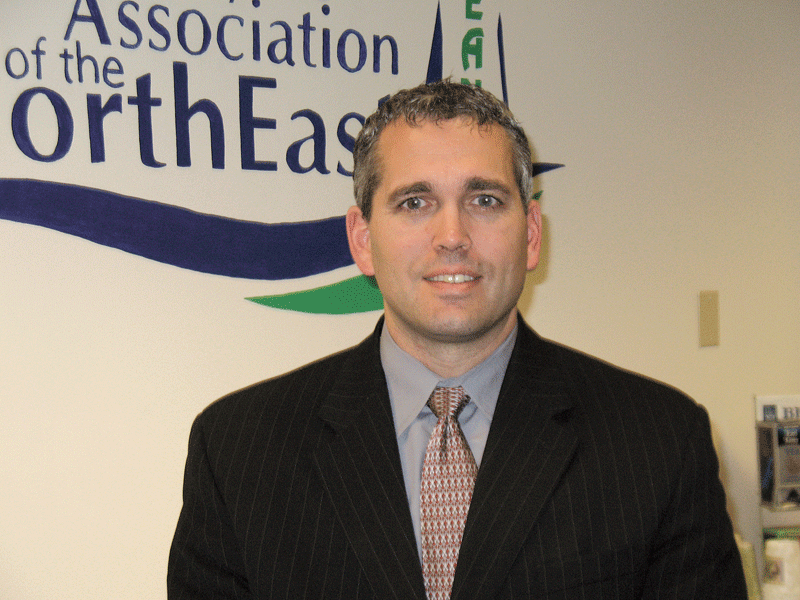
Mark Adams says some companies are starting to realize that barring all social-media use can be counterproductive.

Business owners and managers are increasingly realizing that social media is here to stay, but it’s not easy to craft workplace policies for social networking that are effective and enforceable. The challenges arise in three sticky areas: personal online activity during work time, companies controlling their own Internet presence, and employees badmouthing their employer through social-media channels after work hours. The answers don’t come easy in any of these cases, but popular opinion — and legal precedent — are beginning to crystallize.

By JOSEPH BEDNAR

As director of HR Services for the Employers Assoc. of the NorthEast, Mark Adams deals with some 800 area companies. And one aspect of the modern workplace has been particularly confounding for them.
“In some of the discussions I’ve had with companies, when social media comes up, there are some very strong viewpoints on it,” said Adams. “Some say they don’t want it in the workplace at all, that they abhor it in the workplace. They figure it’s a drain on productivity and can create a disturbance.”
But companies that see social media as more of a nuisance than a tool are missing an opportunity, said Christine Pilch Mancini, social media strategist, speaker, and trainer with Grow My Company.
“We’re in a world of emerging technology, and social media is a tool to get work done these days,” she said. “It allows quicker collaboration with other people to solve problems, and it allows people to share ideas.”
But it also poses a conundrum for employers who don’t want their workers distracted by online chatter during work hours — and who, in many cases, have instituted policies curbing its use, or blocked sites like Facebook and Twitter outright.
In the age of Web-enabled smartphones, Pilch said, that’s simply misguided. “Quite frankly, companies that are trying to block social media are sticking their heads in the sand, because every employee is holding the Internet in their pocket.”
So what’s an employer to do?
“Some companies use social media as a positive tool, or they acknowledge its existence and are providing some meaningful use of it,” Adams said. “For example, employees can use it on their own time — break times, what have you. In that respect, it’s akin to what some companies do with e-mail; they’re not going to bar all personal e-mail.”
Pilch Mancini and Adams are hardly alone in their assessment of the social-media paradigm at work; in fact, others go so far as to argue that tweets and status updates actually contribute to a healthy work environment, although most U.S. employers have yet to see it that way.
Socialcast, a microblogging platform, surveyed 1,400 chief information officers at U.S. companies and found that only 10% of those employers allow unlimited social networking on work time. Another 19% allow access for business purposes only, while 54% do not allow employees to use social networks for any reason while at work.
However, according to a University of Melbourne study, employees who engage in ‘workplace Internet leisure browsing’ — such as watching videos and keeping up to date with friends — while at work are 9% more productive than those who don’t.
The reasons touch on the benefits of a satisfied and de-stressed workforce, but Pilch said there are morale issues involved as well. “If you’re blocking social media, you’re telling employees you’re not treating them like adults and respecting them enough to know how to delegate their time and still get their work done.
“This is how people communicate,” she continued. “Employers allow personal phone calls at work. Every child has to be able to talk to their parents; people need to be able to talk to their family members. Husbands and wives communicate on the phone every day.”
Social media, she said, “is another means of communication, and if you slam that shut, employees will default to the other Internet in their pocket. Would you rather someone checked their computer screen once in a while for instant messages, or checked their Facebook or Twitter account, or had their nose in their cellphone all day? Because that’s what you’re going to have” by barring social media at work completely.

Honing the Message
That’s not the only new ground employers are navigating when it comes to social media. Completely different issues swirl about how a company presents itself on social-media platforms, and who controls the message.
“As far as corporate use of it, for marketing purposes, where we see companies getting into problems is consistency of substance and who is going to post things up on a company’s Facebook profile,” Adams said.
“Is it going to be centralized or decentralized? And if it’s going to be decentralized, does the content still have to be vetted, or left up to the individuals? Are there standards on how to craft those messages? There are a lot of companies that craft policies that don’t get into all those details,” he explained, while other businesses might have little if any consistency about how those policies are enforced.
Joshua-Michéle Ross, vice president of consulting firm O’Reilly Radar, writes in Forbes magazine that social media is an opportunity for savvy businesses, but employees shouldn’t be sent in without training.
“Begin from a position of trust,” he writes. “While there are possible negatives involved in having employees on the social Web, most employees have common sense. Begin with a set of possibilities first (increasing awareness, improving customer service, gaining customer insight, and so on), then draw up a list of worst-case scenarios (badmouthing the company, inappropriate language, leaking intellectual property, to name a few).”
Among the guidelines Ross suggests are: listen before jumping into a conversation; be upfront about your relationship to the company; show your personality (“you weren’t hired to be an automaton”); respond to ideas, not people; know your facts and cite sources; own up to mistakes; and never say anything online you wouldn’t say to someone’s face or in the presence of others.
In general, Ross concludes, companies should “encourage employees to use social tools to engage and interact with one another and with customers. In all likelihood they are already using the social Web. The difference is that currently they are using these tools without any guidance.”

Letter of the Law
Often, however, it’s employers who need guidance on social-media use, particularly when the law becomes involved.
“The National Labor Relations Board has said that, when employees converse among one another in a social-media context, that can be protected activity under the National Labor Relations Act,” Adams said. “We’ve seen a number of cases where companies have taken adverse action on people for discussions in a social-media context; that can be unlawful.”
Indeed, the NLRB has dealt with a number of cases over the past year alone in which employees were fired for badmouthing their employers through social-media channels away from work — and has come down fairly consistently in favor of the employee.

Meghan Sullivan

Meghan Sullivan says employers need to tread carefully when crafting a social-media policy and enforce it consistently.

“An employee’s speech is usually protected as long as it’s not publicly disgracing the employer,” said Meghan Sullivan, an attorney with Sullivan, Hayes & Quinn in Springfield. But even that description can be stretched, she said, noting that a recent case involved a worker using some fairly salty language to insult his boss — but, because it was posted in the context of some specific workplace complaints (how the company applies certain tax withholdings), the NLRB determined it to be protected speech.
“Employers definitely need to be careful,” Sullivan said. “The board has been looking very closely at employers’ policies and insisting that they be designed in such a way that they don’t restrict employees from talking with each other about the workplace, or determining whether the policy may be so overly broad that somebody thinks they’re not supposed to talk about the workplace.”
In one example, a hospital established a social-media policy forbidding employees from posting “anything confidential.” The hospital intended only to protect confidential patient data under the Health Information Portability and Accountability Act, but employees were confused by the language and thought they couldn’t discuss anything work-related online. “You’ve got to be more specific than that,” Sullivan said.
When a complaint arises from an employee alleging unfair treatment in a social-media situation, she continued, “the first thing the board’s going to look at is your policy, and whether it infringes on employees’ rights under the National Labor Relations Act to engage in protected speech.”
And if workers are allowed to badmouth their bosses online, it’s even more difficult to regulate employees simply naming or neutrally discussing their employer — although some businesses have tried.
“Some companies I’ve worked with have tried to regulate mentioning the company employees work for on their own personal pages,” Adams said, “but more and more, they’re realizing that they’re hard-pressed to enforce those standards aggressively.
“It’s an area where technology is ahead of what the law cases are,” he added. “Technology is evolving at such an extraordinary pace that we always have to catch up to it.”

Bottom Line
It seems as if social media is here for the long haul, said those we spoke with, and employers are better off understanding its dynamics and channeling their employees’ energies than cutting off something that is becoming as ubiquitous as e-mail.
“If your employees are using Facebook at work, they are also likely checking work e-mail after dinner or at odd hours of the day. Don’t ask them to give up the former if you expect them to continue the latter,” Ross writes. “If you have good performance measurements, playing the ‘lost productivity’ card is a canard.”
Pilch Mancini agrees. “If you really are concerned about social media sapping the productivity of your employees,” she said, “maybe you need to take a good, hard look at who you have working for you. There are plenty of other temptations to take you away from your work, and good employees know how to delegate their time.”

Joseph Bednar can be reached at [email protected]

Opinion
Gas Tax Isn’t a Simple Cure for Transit Ills

The trial balloons keep coming for some sort of transportation revenue. There was Lt. Gov. Murray’s August trial balloon for a gas-tax increase. Then public discussions about needing four times more funding to maintain the Big Dig tunnels, and Gov. Patrick’s trip to attend President Obama’s press conference on federal transportation legislation. Make no mistake about it, there will be a push to raise transportation revenues, most likely through the gas tax, in the coming year.
But the administration faces a real uphill battle to get it passed.
Over the past two years, the Commonwealth massively restructured the state’s transportation agencies. A new entity, MassDOT, now oversees most major pieces of transportation infrastructure, including those formerly held by the now-dissolved Massachusetts Turnpike Authority. The 2009 law included additional reforms that held the promise of increased efficiency and lower costs.
The outcome of the reforms? We don’t know.
MassDOT was to report consistently on key performance measures. But they have not provided enough in terms of data content or informing the public. The department has done a far better job of communicating tactical successes — innovative projects and reform-related events. But these press events don’t say anything about progress on many key measures — measures that matter to the public.
Without this strategic communication, MassDOT will rightly struggle to make the public case that it is managing our assets and our money more wisely than in the past. For a public with Big Dig cost overruns and MBTA service failures lodged firmly in our collective psyche, changing a negative perception of transportation spending and management is a herculean task, made more challenging without a consistent method of communicating performance and accountability. And reports over the summer that senior engineers at MassDOT purposely avoided tracking maintenance issues do not help.
Any tax-increase proposal must be akin to a social contract — you taxpayers pay this, and we, the government, will give you value in return. Without refocusing the transportation agency on consumer-centered metrics, why would the public think that an increase in the gas tax will lead to service improvements?
A two-way request for more tax dollars paired with specific performance benchmarks — e.g. reduced congestion, increased on-time performance, and fewer structurally deficient bridges — might get us to that elusive destination called compromise, while a one-way offer to siphon more tax revenue into a black hole will land squarely in the breakdown lane.
A two-way contract with the public would change MassDOT’s focus from a strong emphasis on expansion to addressing long-term neglect of maintenance. Expansion projects that do not significantly address ‘customer-service’ issues and, in fact, further burden the MBTA with a crippling debt load, such as the multi-billion-dollar South Coast Rail project, would no longer be a priority.
Instead, the agency would focus on meeting the hundreds of millions of dollars in annual unfunded maintenance needs outlined in the state’s transportation capital plan. Subway riders and highway commuters know well what the neglect of maintenance means — delay, congestion, and aggravation.
The days of expanding the system without the finances to pay for or even operate it are gone. As Federal Transit Administrator Peter Rogoff stated in Boston last year, “if you can’t afford to operate the system you have, why does it make sense for us to partner in your expansion?’’
If an increase in the gas tax means funding expansions that leave us in precisely the same situation 10 years from now, but with a larger portfolio of assets, you can forget about it. If it prioritizes maintenance and improves our current system’s operations, sustainability, and efficiency, then the politics might work.
That’s a tall order for the governor. Reshaping perceptions and the politics of transportation means lessening the emphasis on politically expedient (but financially disastrous) expansions. It means communicating to the public consumer-based goals and drilling them into agencies used to very different marching orders.
There’s no doubt that our transportation system is underfunded. But asking for more money to make the problem bigger is not the answer.

Steve Poftak is director of research at the Pioneer Institute.

Features
Business Owners Here Say This Town Is Ideal

Joe Hickson

Joe Hickson enjoys working in Hampden alongside his wife and children — and often his grandchildren.

There’s no town water and no sewer systems. Yet, somehow, a business class has emerged in Hampden that echoes the words of one business person in town: “I wouldn’t choose to be anywhere else, really.”
Those are the sentiments of Rich Rediker, creator and owner of Rediker Software. From his large, contemporary clapboard structure he built behind Monson Savings Bank in the center of town, he joked that, to build such a building as his, “not many would make a business decision like this in Hampden.”
“When you get to a certain square footage, you need fire sprinklers,” he explained, “and as there’s no town water, we had to spend an incredible amount of money to bury a tank to keep the water pressurized. To build this building in this town was many times more expensive than anywhere else I could have gone — more than I ever could have imagined, but worth it.”
Pointing out the window to the woods in autumn colors, he added, “look out there at the view — we’re in a beautiful spot. I like it here. It’s home.”
Rediker Software is a pioneering leader in school administrative software, and when Rediker said he wouldn’t imagine putting his business in any other location, he wasn’t the only one in this semirural town of 4,000 of that mind.
Joe Hickson’s Private Garden, recognized across the continent as the resource for greenhouse and agricultural glass buildings that are, in his words, “the crème de la crème,” also makes the conscious decision to stay home, as in hometown.
“We’re not the cheapest, and, in fact, we’re the most expensive,” he said of the glass buildings his company has built to clients’ specifications as far away as Europe. “But if you want something that’s going to stand out and make you money, that’s what you get.”
Fred Shea

Fred Shea says people who work for him tend to stay with his company for many years.

Just across the road, yet a little closer to heaven, is Stained Glass Resources Inc., owned and operated by Fred Shea. He graduated with a degree in English back in the mid-1970s, but he was unsure about taking a job in the rat race. “I had done stained glass as a hobby previously,” he said. “Rather than work some job that I didn’t enjoy, I’d try my hand at stained-glass repair.” After a short while passing out his business cards to churches and private institutions, it wasn’t long before he established a reputation as one of the region’s leading restorers of this ancient art.
When asked why he chose Hampden as the place for his work and home life, he said it just happened that way. But, as the years passed, the town became the place he wanted to stay. “It’s not crowded, close enough to the city, suburban in some ways, rural in others,” he said. “It’s like being out in the country.” And that, combined with these companies’ reputations in the world beyond, makes doing business in Hampden continue to be the ideal place that they all choose to call home base.

Nobody Does It Better
Shea went on to say that he moved to a few different locations within town before finally settling in the workshop that now contains all operations for complete stained-glass restoration, from the smallest of windows to full cathedrals.
At the height of his business, there was another outpost in the Pittsburgh area and, adjacent to the building in Hampden, a full millworking studio. The economic downturn, however, dimmed those operations. “We were one of the three or four largest studios in the country, right around the time the economy fell,” he said.
Describing some noteworthy jobs that his firm has overseen, Shea described the restoration of a cathedral in Pennsylvania with windows all designed by Tiffany Studios, but also cited several projects in the Pioneer Valley, like all windows at St. Mary’s Parish in Longmeadow, and in Springfield, the Bethesda Evangelical Lutheran church on Island Pond Road and the brownstone Sacred Heart on Chestnut Street, to name but a few.
In the airy space behind his office, the colorful panels from a church nearby await restoration. Shea explained how the cames, the lead support systems, deteriorate over time, along with the waterproofing becoming brittle. From careful dismantling to repair to fabrication of new panels that are indistinguishable from the old, it’s all done in his shop.
Hampden will always be the home base for this operation that has a strong national presence and continues to thrive despite the hard economic reality faced by his clients. “Endowments have been destroyed by this economy,” he said. “Schools, chapels, universities — all completely dried up. You get in touch with your contact people at those places, and they tell you that we have no money to spend on this work.
“Stained-glass windows last around 100 years,” Shea continued, “and sometimes the deterioration can go from moderate to severe in the course of a decade. So people might be postponing it as long as they can; it’s not like plumbing or the roof, or if the organ doesn’t play, then you couldn’t hold services. If the window falls out, it’s still a discretionary purchase.”
He has faith, however, that the current financial climate will eventually improve. “As the economy picks up, I’m sure our business will also,” he said.
“We love what we do here,” he added, “and everyone who works here stays here for a long time — 10, 15, 20-plus years. We provide ourselves on providing the highest quality. There are others, two or three other studios in the country, who also do high-quality work, but there isn’t anyone who’s doing it better.”
Across the street, Hickson’s business has been built on that same business credo.
He and others in the office threw out some client names that would be familiar to readers of Architectural Digest. Private Garden has an exclusive contract with the Bellagio in Las Vegas, and is also responsible for the largest hydroponic tomato grower in the Northeast, with many acres under glass. He displayed some plans for another installation, called GlassPoint, which comprises 500 acres under glass with concave mirrors. “It’s like a magnifying glass,” he explained, “turning water into steam, pumping the steam into the ground, to liquefy solid oil in the Bakersfield oil fields.”
The business that became Private Garden has a backstory that exemplifies how Hickson has earned the reputation his firm has built over the past few decades. As the regional manager for a company that sold greenhouses 28 years ago, he admitted that, at that time, fresh out of a career in the National Park Service, “I knew nothing then about greenhouses.
“In the first six to eight months, we sold $1.5 million in greenhouses,” he continued, “but nothing was happening … we were getting deposits, but no work was being delivered. As it happened, the parent company went into Chapter 11 and told me that they weren’t going to perform. The customers that you sold to, they were done. That went against everything in my grain — I had made a commitment with these people.
“I left the company, and soon thereafter, they went into Chapter 7 bankruptcy,” he went on. “When everything of theirs was liquidated, I sat down with each of my customers, all throughout New England. I went to the auction and bought all of the materials I needed to fulfill all of those obligations. I was just a young kid at the time, 28 years old, with no substantial money, but we did co-checks with the owners, and after all was said and done, we were late with fulfillment, but we performed. And from there we never looked back.”
These days, Hickson’s wife, Kathy, and their children are all part of the family business, and that means his grandchildren are also part of the daily operations. That, he said, is what makes it all worthwhile. He agreed that the economy is tough out there for an industry like his — it is the construction business, and clients have just as much trouble with bank financing — but that staying close to one’s roots makes it all worthwhile at the end of the day.
“Let’s face it, it’s been a tough economy, and in my opinion, it has transformed the way people do business,” he said. “But the grandkids are here four days a week all over my office. How many owners of a business can say they love having the place a mess?”

Setting the Record Straight
Rediker said he has a long commute to work each day — if he rides his bike. “It’s only about 20 minutes, but then much longer on the way home. It’s all uphill.”
That last statement wouldn’t be used to describe his business career or the success enjoyed by his software systems, used in all but one of the 50 states and in 115 countries. And in true entrepreneurial fashion, it all began because he saw a need and invented the means to address it.
“I kid my customers that I was a chemistry teacher back when they were adding carbon to the periodic table of elements,” he said of his backstory. “Sometimes people respond by asking, ‘in the 1980s, you mean?’”
As a teacher in high school, he wrote a program to take attendance. “To make a long story short,” he explained, “it just expanded. I was the class advisor and responsible for kids’ tardy letters. I was keeping track of it with pencil on a daily list every day. I figured out how to do it a lot more efficiently, quickly, and I figured there had to be a market for this.”
There was, and continues to be. He was on his way the next morning to a month of meetings from Bangkok to Portugal, and he said that the company was branching out from primary- and secondary-school administrative software to admissions programs for schools, replacing the pen-and-paper method of the application process.
Of his modern, yet traditional headquarters in town, he told of the many features designed into the building, all specific to the needs of Hampden: a $50,000 natural-gas generator, the aforementioned water system, and the ‘cloud’ of servers on the premises for his worldwide clients.
“I could have built an ugly building here, but together with the bank out closer to the street, we made it look the same,” he explained. “We didn’t have to, but we wanted it to be an attractive corner in town. When you live here, you don’t want to save a few hundred thousand dollars and put up an ugly building.”
Meanwhile, just as important to his hometown is the ability to create much-needed jobs at a time when they are the foundation of every financial-recovery plan. “These are my friends and neighbors here, and if there’s one single thing that this country needs right now, it’s jobs,” he said.
Rediker Software continues to be a business with a strong market share, and is the largest employer in town. The man himself just smiled and said he’s happy to be able to continue to run his business.
“Many businesses like this end up selling out to a larger company,” he said, “and once they do, they’re owned by some giant investment bank; then you have to grow by so many percent every year. To me, if I don’t grow, so what? And yet, we’ve still been profitable for 31 years.”

Cover Story
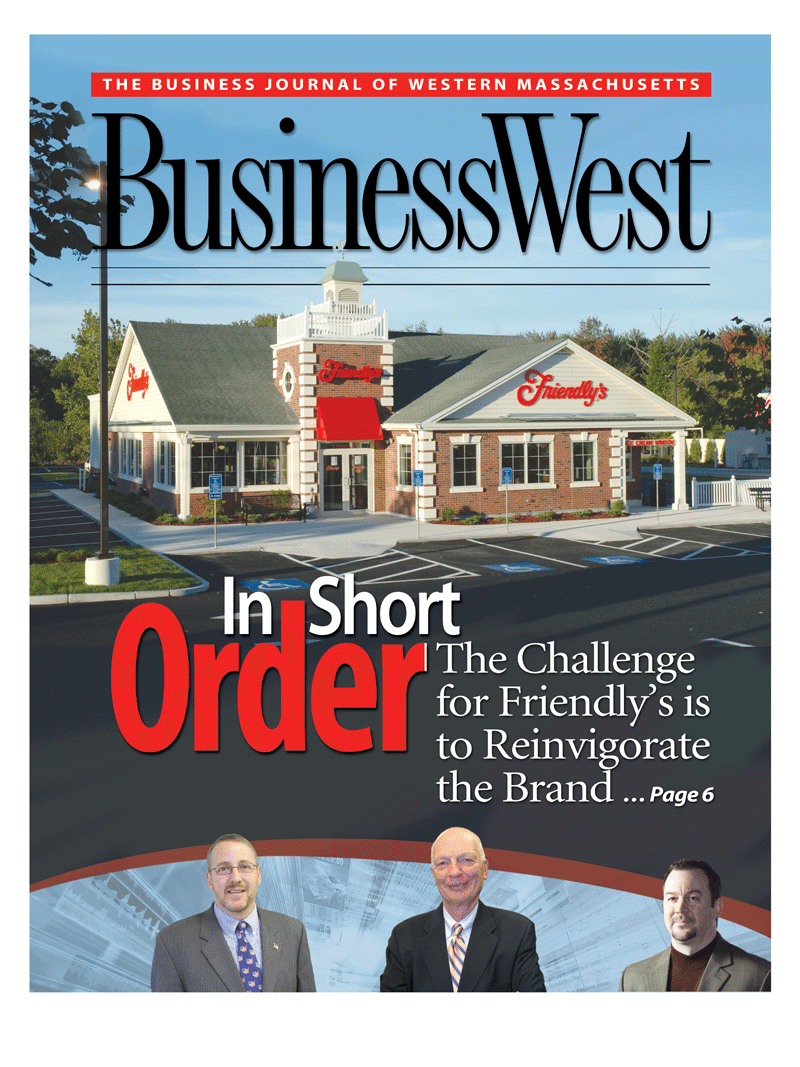
The Challenge for Friendly’s is to Reinvigorate the Brand

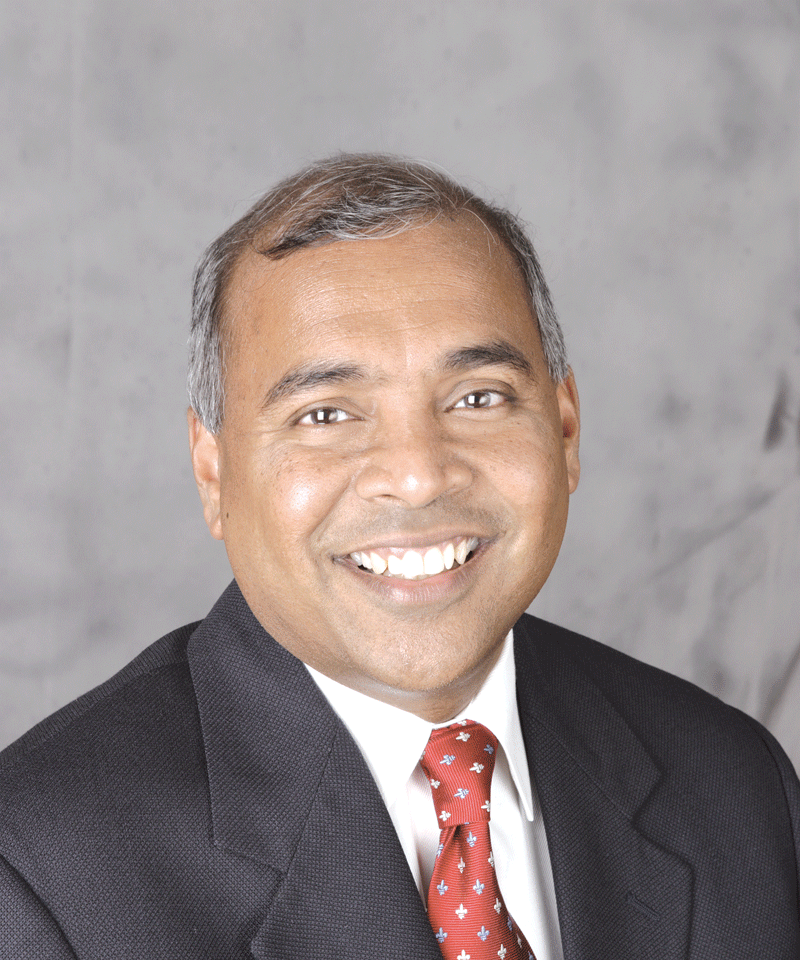
Harsha Agadi, Friendly’s chairman and CEO, has presided over several brand-reclamation projects over a 25-year career in the restaurant industry, most notably the recovery at Church’s Chicken, and he’s confident he can steer the Wilbraham-based chain to a similar comeback. He said the recent Chapter 11 bankruptcy filing is a regrettable but necessary part of that process, which includes a multifaceted plan to reinvigorate the brand by giving it a new look, feel, and attitude.

Were it not for the Boston Red Sox, Friendly Ice Cream Corp. would easily be the most criticized, scrutinized, analyzed, and perhaps overanalyzed institution in New England this fall.
Since the Wilbraham-based company filed for Chapter 11 bankruptcy protection on Oct. 5, there has been seemingly endless speculation about went wrong for this company (as with the local 9), and a few Canadian forests felled to provide the newsprint for the voluminous speculation about what could — and should — come next (again, just like with the team that plays on Yawkey Way).
Roughly a week after the filing, for example, the Boston Globe carried a piece with commentary from five restaurant-industry executives about what they believe the company might do to improve its chances for success post-bankruptcy. Ideas ranged from hiring a ‘cleanliness concierge’ as part of a focus on being family-friendly, to shelving the restaurants and putting Friendly’s ice cream counters in Panera Bread outlets, to moving the kitchen back to the front of the store as part of a ‘return to short-order cooking’ approach.
Chief Executive Harsha Agadi says he’s read much of the commentary, criticism, and thoughts on the future. And he agrees with some of it. He openly acknowledged that Friendly’s must improve its food, its service, and its looks, and there are plans in place to do all of that and more.
What he doesn’t agree with are any and all suggestions that, moving forward, Friendly’s will only be talked about glowingly in the past tense. He admitted to BusinessWest that, once a restaurant chain develops a reputation for being tired, slow, inattentive to changes in the marketplace, and inconsistent — and Friendly’s has earned all those adjectives, by most accounts — it is certainly difficult to change the course of public opinion.

Harsha Agadi

Harsha Agadi says the process of changing a restaurant chain’s reputation is not a simple thing, “but at the same time, it’s not terribly difficult, either.”

But he believes it can be done, and, more importantly, he made it happen with another restaurant chain he’s managed, specifically Church’s Chicken.
“When I got involved with Church’s in 2004, it had declining sales, hadn’t franchised anything in three years, and was closing more stores than it was opening,” he recalled. “From 2004 to 2009, we grew stores and sales every year, and we expanded into many different countries.”
Friendly’s can make a similar comeback, he said in a wide-ranging interview a few weeks after the bankruptcy filing, noting that the Chapter 11 procedure was a necessary step in that direction.
It will give the still-profitable company relief from a massive debt burden, and especially from leases signed during boom years for the commercial real-estate market that have severely hindered the company as it has sought to make investments in its operation.
The company won’t be starting over, Agardi stressed repeatedly, using the term ‘business as usual’ early and often, but rather building on its core strengths — especially an ice-cream business that has grown exponentially over the past several years (more on that later) — and, in many ways, updating and reinvigorating the Friendly’s brand.
For this issue, BusinessWest looks at how Agadi plans to go about that assignment and how, by next spring, if not much earlier, people will be talking about his company using much more positive tones.

Any Given Sundae

The Friendly’s on Route 20 in West Springfield

The Friendly’s on Route 20 in West Springfield was one of the casualties as the chain sought relief in Chapter 11 bankruptcy and the closure of several dozen locations.

Mike Katz, an attorney with Springfield-based Bacon Wilson who has handled a number of Chapter 11 filings over the past few decades, including the much-chronicled fall and rise of Savage Arms in Westfield, told BusinessWest that much of the stigma, or embarrassment, once attached to bankruptcy proceedings is a thing of the past.
In recent years, he went on, Chapter 11 has become an effective and increasingly popular relief mechanism for companies burdened with heavy debt, large court settlements, severe cash-flow issues, and combinations of the above.
And this has been especially true in the restaurant industry, he continued, due in large part to the high volumes of risk involved with establishments of any and all sizes.
“As a business lawyer, I’ve always thought that an investment in a restaurant or a chain was the riskiest investment you could make,” he explained. “For starters, tastes change; what’s hot today may not be hot tomorrow. There’s also high overhead — generally you have to lease the space, and there are often multiple employees — and a huge element of theft, of both money and product. And there’s also the spoilage factor; if you’re a seller of clothing, that product may eventually go out of style, but it doesn’t go bad and have to be thrown out if you don’t sell in three days.
“You have all of these problems conspiring against you as you’re trying to keep 12 balls in the air,” he continued, adding that these factors coupled with intense competition are responsible for the high mortality rate across the sector.
All that said, the Friendly’s filing, while certainly not surprising to most industry watchers, was met with large degrees of sadness and disappointment, Katz continued, noting that many in this region especially were dismayed that years of ownership changes, a revolving door at the top leadership rung, and apparent missteps or lack of proper response to changes within the restaurant industry would lead to this.
And like many in this area who can talk nostalgically about the Awful Awful (a Friendly’s milk shake so named because it was ‘awful big and awful good’) Katz had his own thoughts and theories on what happened to the company.
He mentioned everything from his belief that the Friendly’s name doesn’t resonate as well in other regions of the state or country as it does in Western Mass. — where it was founded by Curtis and Prestley Blake, and where that surname appears on many college buildings and other facilities — to a general deterioration in quality and consistency.
Perhaps the biggest factor, he believes, has been the larger, more convoluted menus in the restaurants and other indications that Friendly’s was (and is) trying to be too many things to too many people in an age of heightened specialization.
“It had morphed itself into a business that no longer knew what it was,” said Katz, echoing the sentiments of some of the analysts in the Boston Globe and other publications. “Friendly’s management may disagree, but I’ve talked to former employers and former managers, and my own personal opinion is that for a number of years you could go to Friendly’s and get a burger, a hot dog, and good fries; there were friendly people, good prices, and always great ice cream. You had a good time with your family, and it was a reasonable place to go. It’s all different now.”

Friendly Pursuasion
Agadi hears such comments, and while he agrees that some changes must be made, he bristles at the notion that Friendly’s has somehow lost its way.
“If we were drifting, how is that I’m still serving 1 million customers a week, 52 million people a year?” he asked rhetorically, adding that he believes that many elements of the company’s model still work. However, there is that proverbial but, or several of them, as the case may be.
“We need to improve our service dramatically, there’s no question in my mind,” he said. “Our number-one issue is speed, and we’re addressing that speed of service every day.”
Looking back, Agadi said it was series of factors that brought Friendly’s to this point, everything from the soaring cost of butter — a huge factor for a company that makes 16 million gallons of ice cream a year — to those aforementioned albatross-like leases, to an economy that has many still cutting back on non-essentials, which includes ice-cream cones and Jim Dandys.
“There’s been a massive — and that word is massive — escalation in commodities costs over the past two years,” he explained. “And that’s driven by butter pricing; it’s gone up 57% in the past two years, while milk has gone up 22%. And if my commodity costs go up 57%, I can’t go and charge my customer almost half more overnight and expect him to pay it.
“That cost essentially evaporated a lot of profitability, which caused many of these issues,” he continued. “The company is still profitable, contrary to what everyone in the media is saying, but these commodity prices are having a huge impact on us. The other thing is the economy itself; the unemployment rate is 9% or 10%, and it’s even greater than that because it doesn’t take into account the number of people who are working part-time that used to work full-time, or the people who have had their hours cut back, and all that affects restaurants.”
On the real-estate front, Agadi went on, the company has been able to get relief from some leases sold when market conditions where much different — generally from landlords concluding that a tenant paying less rent is better than no tenant at all — but not in enough instances to make a real difference.
“When you’re locked into stores that don’t make money and have these high rents,” he said, “all you’re doing is bleeding.”
Considering all these factors, he said the company had little recourse but to take relief in the form of Chapter 11, and to take other steps as well, including the closing of 63 stores, a few of them in Western Mass. What the filing does, in essence, is provide the company with time and breathing room, and the ability to renegotiate more of those leases, he went on, adding that the company intends to take full advantage of this opportunity and eventually emerge a stronger, more vibrant chain.
And most initiatives have been in place for some time, he said, noting everything from an aggressive marketing campaign for the company’s so-called ‘High 5’ menu (items cost $5) to a move back to fresh, not frozen hamburgers (“I wish we had 10 years ago”), to plans for remodeling and updating the chain’s restaurants.
Meanwhile, the price of butter has actually started to come down.
“Many good things are starting to happen,” Agadi said, adding that the code word being used internally is ‘the American,’ the name given to some new-look, new-attitude stores that will start taking shape over the next several months.
“We’re making changes to the product,” he said, referring specifically to food, but also a broad spectrum of measurables. “And those changes, in many respects, are going back to who we are and how we did things; we’re going back to our classical roots.”

Just Desserts
And with that, he returned to the subject of Friendly’s prospects for altering public opinion about its products and services, and the skepticism voiced by many analysts about whether it can actually do that.
“It’s not a simple thing to change your reputation,” Agadi told BusinessWest, “but at the same time, it’s not terribly difficult, either. You need a plan, you need capital, which we have access to through our partner, Sun Capital, and you need to test a few stores and then start replicating the entire chain with the new look — very aggressively and rapidly.”
And by that, he meant both the menu, featuring the High 5 component, and the facilities themselves, a few of which will soon sport a new, contemporary look that will be “brighter and fresher,” and immediately send a message that this is not the same restaurant it was even a few months ago.
“When you walk in, there has to be a marked change,” he explained, “so people will say, ‘wow, that’s a different-looking Friendly’s.’”
The new look has to be backed up by better service and food, he went on, adding that there is already some hard data confirming improvement in at least that first department.
“Our speed of service and friendliness have improved dramatically over the past six months,” he said. “We track this religiously, every day, every store — my head of operations gets a report, we all look at the results and see how our stores are doing in service, hospitality, friendliness, accuracy of order, and more.
“And this is measured not by us, but by outside customers who go to the Applebees, the Dennys, the Ruby Tuesdays, and other chains,” he continued. “We’re starting to see a measurable change in our service level.”
By next spring, the new-look Friendly’s will make its debut in the Greater Springfield area, he said, adding that a few area locations will be made over, and the movement will then spread to other regions. Beyond the look, there will be new, slimmer menus with more healthy choices, changes in staff uniforms, and remodeled fountain areas that will pay homage to the chain’s ice-cream lineage.
“We want to bring back heritage items,” he said, “in a contemporary atmosphere.”
At the same time, the company will continue to build on what Agadi calls its “other business” — ice-cream items sold in the restaurants and now more than 7,000 supermarkets (up from 4,000 just a few years ago), including the recently added Wal-Mart. The surge has brought Friendly’s to 95% capacity at its Wilbram manufacturing facility and a search for alternatives to make ice cream — a good problem to have, actually.
“We’ve been around for 76 years and just set a record — 165,000 cases of 48-ounce cartons,” he said. “That’s an example of what I mean by business as usual.”
As for the far-more-problematic and image-impaired restaurant side of the business, Agadi is confident that he can continue a quarter-century-long track record of success with brand building and, in many cases, revitalization.
“I’ve had 100% success with moving the brand in the right direction, and I believe that, in this case, we can, and will, do the same,” he said, adding that, three years out, he expects to be selling ice cream in 10,000 supermarkets and have the restaurant chain back up to 500 stores, with maybe half of those redone into the ‘American’ model, and movement into markets in Canada and Mexico.
Those are ambitious goals, but he’s done it with Church’s Chicken and other chains he’s been involved with.

Stepping to the Plate
Red Sox fans will have to wait until at least next February, and probably next April or even midsummer, to gauge how the team is faring with its bounce-back initiative.
Agadi says the transformation and rebranding of his company is already well underway, and by about the time the Grapefruit League swings into high gear, people in this area will be able to see and experience a change for the better.
Chapter 11 bankruptcy is a regrettable part of the process, he told BusinessWest, but it’s also a big factor in this company’s efforts to enable people to stop using the past tense when they refer to the Friendly’s brand in a positive light.

George O’Brien can be reached at [email protected]

Opinion
Are Background Checks Discriminatory?

In two hearings held earlier this year, the Equal Opportunity Employment Commission (EEOC) heard testimony about whether or not background checks cause a disparate impact on minorities.
Advocates for ex-offenders and various watchdog groups from around the country argue that it must, because African-Americans and Latinos have higher arrest and conviction rates than whites. Although the EEOC claimed its hearings to be fair and unbiased, many critics have argued that the panelists invited to speak were strongly biased in favor of limiting background checks.
The commissioner heard testimony from defense attorneys, various academics, and two employers who had positive experiences hiring ex-offenders.
In a letter to the EEOC sent from the U.S. Commission on Civil Rights (USCCR), Commissioners Peter Kirsanow, Gail Heriot, and Todd Gaziano asserted that the hearings were not balanced and that the omission of important data was a mistake.
The commissioners said the EEOC should have heard important research from economists Harry Holzer and Stephen Rafael, as well as public-policy professor Michael Stoll. Their research, published in the Journal of Law and Economics, showed that employers with access to background checks were actually about 10% more likely to hire minorities than those without access to that information.
The commissioners wrote that the studies from Holzer, Rafael, and Stoll “suggest that, in the absence of criminal-background checks, some employers discriminate statistically against black men and/or those with weak employment records.”
The USCCR commissioners have asked the EEOC to convene another hearing specifically to look at this additional information and to consider the negative impact that limiting background checks would have on minorities.
What should employers do? The discussion in Washington and around the country will continue, hopefully in a fair and balanced way that all sides can agree with. When it concludes, it is possible that the EEOC may revise its existing guidance or simply leave it alone. That doesn’t mean that employers should just wait it out. With increased attention on this matter and a surge in lawsuits claiming discrimination, now is the time for employers to look carefully at their policies and procedures regarding background checks.
Employers should always ensure that hiring decisions are made consistently. When negative information returned on a background check is considered, employers should be careful to weigh the job-relatedness of the crime and the amount of time passed since the completion of the sentence.
Some employers also look to consider additional factors such as any positive work experience since the sentence, references, or civic activity.
The Employers Association of the NorthEast (EANE) will be hosting a Webinar about this topic on Nov. 30 from 12:30 to 2 p.m.  Employers interested in attending can register by visiting www2.gotomeeting.com/register/531504930.

John McTighe is vice president of Strategic Information Resources, a background-screening company based in Springfield; (800) 813-4381; [email protected]

Law Sections
Bottlenecks Across the System Are Limiting Access to Justice

A perfect storm of conditions, but especially a hiring freeze within the state’s judicial system and a still sagging economy that has many people seeking various forms of relief through the courts, has created a huge bottleneck that is in many ways limiting access to justice across Western Mass. The planned closing of Westfield District Court, a step being fought by judges, lawyers, and state legislators, would make a difficult situation much worse, but even if that facility stays open, there appears to be little light at the end of this tunnel.

Diana Sorrentini-Velez

Diana Sorrentini-Velez says the bottlenecks in the area’s courts force justice seekers into a waiting game she compared to purgatory.

Diana Sorrentini-Velez was searching for the right words to sum up, or put into context, what the worsening bottleneck within the region’s judicial system — especially in Probate Court and District Court, where most of her work takes place — means for her clients.
And she managed to find several poignant ways to qualify the problem.
“People are being held in purgatory,” she said in reference to the weeks- or sometimes months-long waits for resolution of issues. “You don’t know which direction you’re going in, and you don’t know how to plan as a result. You know the rug is going to be pulled out from under you at some point; you just don’t know when it’s coming.”
And not knowing is the worst.
“District Court is the peoples court,” she continued. “Everybody goes to District Court, whether it be for personal issues, criminal law, civil issues, or whatever. And when you have individuals who are seeking justice and can’t even get before a judge, what does that do for their confidence in the judicial system? If they can’t be educated as to the alternatives, then they feel they have none, and they’re essentially stuck where they are.”
Tom Kenefick

Tom Kenefick says the region’s courts are in crisis, and will continue to be in that state until they are adequately funded by the state.

Tom Kenefick, president of the Hampden County Bar Assoc., was much more succinct in his commentary. “Our courts are in crisis,” he told BusinessWest. “There’s no other way to put it. Our judicial system is taking some enormously painful financial hits that are now starting to manifest themselves to the public — we’re to the point where the public is really starting to feel it.”
With those and other colorful statements, area attorneys tried to put into words their sentiments about a judicial bottleneck fueled by state budget cuts, a hiring freeze within the judicial system, and economic conditions that are only making the courts that much busier. Things are as bad as most people can remember, and the situation is almost certain to get worse before it gets any better.
Especially if the Westfield District Court is closed, as Robert Mulligan, chief justice for Administration & Management (or CJAM, as he’s called), intends. The closing is being fought on many levels and by many people, said Kenefick, adding that shuttering the facility will force people to drive longer distances to find justice and probably wait longer for it in the long run.
Kevin Maltby

Kevin Maltby says judges are doing the best they can given the circumstances, but they can’t be in two places at once.

“If it does close, that will cast a very long shadow, and I don’t know where it will end,” he explained. “You’re going to have displacement of court personnel, and you’re going to see cases move to other courts that are already overburdened. Meanwhile, people from the Westfield and the hilltowns are going to have to go Holyoke or Chicopee. It will have a huge impact.”
But even if the Westfield court remains open, the bottleneck created by unfilled positions and an unrelenting workload will impact people on a number of levels, said Kevin Maltby, an attorney with Springfield-based Bacon Wilson, who handles large amounts of probate work.
“The problem is there’s a bottleneck at the top,” he explained. “We have cases coming in, but we just don’t have enough judges, clerks, and support staff to move them through efficiently.”
In response to the crisis, the bar association and individual attorneys are stepping up through pro-bono work, much of it aimed at reducing the number of pro-se cases currently clogging the courts, said Kenefick. These efforts are making a small dent in the logjams, but significant steps are needed to bring a needed measure of relief.

Court of Opinion
All the attorneys who spoke with BusinessWest went out of their way to commend those who are still left working in courthouses across Western Mass. They used strong words and phrases to describe what they consider Herculean, but also Sisyphean efforts to keep the wheels of justice turning, albeit slower than most everyone would like.
“They’re being forced to do things with one hand tied behind their backs,” said Sorrentini-Velez. “There’s only so many hours in the day, only so many people who can look at a piece of paper, and so many hours a judge has to review motions and prepare for court hearings. And the consequences are always going to be felt by the general public, because no matter what, at 4:30 everyone’s gone, and people’s problems don’t go away at 4:30; their problems continue.”
Said Maltby, “everyone wants to be able to point the finger at the courts. But if they can’t hire the bodies they need to go through the amount of paperwork that gets filed there on a daily basis, there’re nothing they can do about it.
“Judges can’t be in two places at once,” he continued, adding that the cutbacks are forcing justices to often shuttle back and forth, with their commuting time further limiting their ability to get work done.
The situation is summed up in a recent CJAM edict concerning changes in the schedules for public office hours at the courts. The order to close those offices at 4 p.m. and use the time to catch up on paperwork is designed to help reduce delays, although those we spoke with are rather skeptical about that claim — and Thomas Moriarty, Hampden Register of Probate, is defying the order, noting that he won’t deny the taxpaying public access to justice.
“Our severe staffing reductions require an adjustment in some public office hours so that employees can more effectively serve those who depend on the courts,” Mulligan wrote in the missive. “Court staff have made remarkable efforts to deliver timely justice during three years of significant budget and staff cuts. However, almost one-third of courts now need some uninterrupted time to address backlogs and reduce delays, as already done by courts in other states.”
Quantifying the broad problem, at least from a dollars-and-sense standpoint, Kenefick noted that there has been an overall budget reduction of $85 million over the past three years, requiring implementation of a hiring freeze, among other steps. Overall, the Trial Court has lost 1,167 people statewide, which translates to a 15% reduction in staff.
There are currently 13 judicial vacancies statewide, and eight in Western Mass. alone, Kenefick continued, adding that the hiring freeze has put the remaining judges in a position where they’re often typing their own decisions because there are no clerks or secretaries able to do it for them.
“As people retire or get sick, they’re not being replaced,” he explained. “Staff members are trying to do the work of two or three people.”
Complicating matters further, he continued, is that the crisis comes at the same time legal aid programs are being slashed to the levels they were at 10 to 15 years ago, to roughly $300 million nationwide, said Kenefick, adding that the net effect of these various factors is a serious impact on overall access to justice.
And this phenomenon has a number of manifestations, said those we spoke to — from those agonizing waits for decisions to use of the clogged courts as leverage to gain desired ends.
This latter consequence can be seen in divorce cases, said Ellen Randle, an attorney with Springfield-based Bulkley Richardson and Gelinas Inc. and head of the firm’s Domestic Relations Department, noting that some attorneys and their clients are taking full advantage of the difficult circumstances.
“They put pressure on the spouse by shutting off the money,” she explained. “And that’s a real problem because of the length of time it takes to get even a child-support order.”

Taking a Long Recess
Meanwhile, the logjams in the courts are prompting more parties to look closely at alternative dispute resolution (ADR) options such as mediation and arbitration, as well as limited-assistance representation, in which an attorney takes part of a case — thus reducing the cost to the client — with the goal of moving matters through the process more quickly and easily.
However, many individuals, especially pro-se litigants, are often not aware that such programs exist, or have limited direction concerning them, which adds to the problem, said those we spoke with.
“I’ve had I can’t say how many calls from people saying, ‘I got your name from the court from the list’ — and that’s what it is, literally just a list with contact numbers of every attorney in Hampden County who’s certified to practice limited-assistance representation,” said Sorrentini-Velez. “So you have pro-se individuals who are already frustrated because they’re not in Probate Court for anything pleasant, and are emotionally taxed as a result of whatever is bringing them to the fourth floor [Family Court], and you add to that the fact that there’s not enough clerks because of the hiring freeze, and if they’re lucky enough to make it in front of a judge they’re not going to get a decision for a longer period of time because judges don’t have the staff they need to type up their decisions.”
In response to the growing bottleneck, bar associations and many individual lawyers are doing their part through limited-representation work and various forms of pro-bono work, said Kenefick, noting that these initiatives are having an impact.
“We try, as a bar association, to provide support services, and they are helping in many ways,” he said, adding that initiatives range from a panel dedicated to helping victims of the June 1 tornadoes to a host of legal-aid programs, to initiatives designed to help with the rising tide of pro-se cases, many of them spawned by the recession and its aftereffects.
Beyond such efforts, Randle, who’s taking part in many of them, offered the hope that attorneys across the region will recognize the scope of the problem facing the judicial system and those it serves and commit to putting their efforts toward mitigating the problem by working to revolve matters outside the courtoom.
“If they’re not the one that has control of the money, they need to get an order to get money flowing back into their household, and it’s difficult to tell them, ‘well, we can’t get into court for four weeks,’” she explained. “You hope that all the lawyers who do this kind of work on a regular basis are having this same experience, and so they’re going to be stepping up and being more cooperative in terms of working things out and staying out of court, which is always your first preference.”
Those who can’t stay out will likely wind up playing the waiting game, said Sorrentini-Velez, adding that the bottlenecks in the courts are essentially forcing people to put their lives on hold, and very much against their will.
“And as an attorney, there’s only so much comfort you can provide, because you’re in the same position,” she explained. “You’re also just waiting; you’re at the mercy of the court, and the court is at the mercy of whoever funds them.”

Final Arguments
Kenefick and others said efforts on behalf of many lawyers are helping to keep a bad situation from becoming even worse.
But all those we spoke with expressed real concern about the fact that there appears to be no relief on the horizon, and said the outlook for the courts, and the people served by them, looks very bleak unless lawmakers in Boston take steps to end the hiring freeze and properly fund the judicial system.
“It’s hard to know where this is going to go,” said Randle. “We’re down to two judicial case managers in the Hampden Probate Court for four judges. They’re the gatekeepers of the courtrooms; you have to go through them, and they just can’t keep the cases moving. And Hampshire County doesn’t even have a case manager.”
In other words, it may be some time before there’s anything approaching an end to the crisis in the courts.

George O’Brien can be reached at [email protected]

Opinion
United Way Merits Strong Support

Our community is filled with people, companies, and organizations who’ve proven they’re willing to do what it takes to help improve the lives of those in need while also investing in our community’s future. Last year alone, countless lives were improved by the generosity shown throughout our community, with an amazing $6.1 million given to the United Way of Pioneer Valley Campaign. We asked for everyone to give 110%, and many of you stepped up to meet the challenge.
One year later, we’ve made a lot of progress together, but there is more to be done. Just a few months ago, residents in our area faced tragedy and devastation. On June 1, three tornadoes ripped through our area, leaving a trail of destruction, crumpling homes, businesses, and schools. United Way of Pioneer Valley immediately took responsibility for the coordination of local volunteer services and partnered with a national organization, All Hands Volunteers, to support regional volunteerism. We assisted local chapters of organizations such as the Red Cross and Salvation Army in the identification and matching of volunteers for immediate relief, and we continue to work with local organizations to provide volunteer support to recovery efforts.
Additionally, we established a tornado-recovery fund in partnership with the Jewish Federation of Western Mass. that has raised $300,000. To date, our allocation team has awarded more than $125,000 to local organizations assisting individuals impacted by the tornado, and will continue to focus its efforts on the unmet needs of local residents.
The reverberations from the tornadoes are still being felt in the Pioneer Valley and will forever change the landscape of our community. As we get ready to start up our 2011 campaign, we are committed to fulfill the long-term response strategy to the needs that will continue to emerge in the coming weeks and months.
At the same time, we must face the issues of our community that were present before our area was faced with natural disaster. We will face these issues with the same hope, optimism, and courage that we always have with a new conviction of determination.
Far too many families are in need of food and shelter, and too many of our children arrive unprepared for school and later struggle to make it to their high-school graduation.
We, as a community, are the only ones who can make a change for the better. Everyone deserves the opportunity to have a good life, a quality education that leads to a stable job, enough income to support a family through retirement, and good health. UWPV supports a powerful network of agencies and programs that help people meet the essential human needs of life each day, and often they do it with too few resources.
We have a great challenge ahead, and we need your help to improve lives and our community. Your decision to give to the United Way is critical to the future of our community.
There are many ways to give — you can give your time, you can lend your voice and advocate for others, and you can give financially. You can find these opportunities on our Web site at www.uwpv.org. Your decision to get involved will impact the lives of the men, women, and children in our community that we pass on the street each day. So please give what you can, when you can.
If you’re someone who has given to us in previous years, thank you. If you’re just joining the United Way family, welcome.We need everyone, because we’re stronger together.

Dora D. Robinson is President and CEO of United Way of Pioneer Valley.

Opinion
Massachusetts Can Be a Model for Growth

During my travels across Massachusetts in the past few weeks, residents have expressed frustration and outright disgust with Washington. They don’t need Standard & Poor’s to tell them what they already know: Washington spends too much, borrows too much, and has for the most part been unable or unwilling to address our debt and deficit challenges in a bipartisan way.
We need to stop the finger-pointing and come up with a bipartisan and bicameral compromise to solve the nation’s fiscal problems. There are three key steps we need to take: cut spending, create a sound long-term fiscal plan, and enact a pro-jobs legislative agenda. In each case, recent history in Massachusetts can be a useful guide.
First, we need to stop spending so much.
In 2001 and ’02, the bursting of the technology bubble hit the Massachusetts economy hard. Our unemployment rate was growing faster than any other state in the country, and we faced a fiscal crisis that many experts said was the worst since World War II. The projected deficit for 2003 was nearly $3 billion.
But instead of raising taxes, Democrats and Republicans worked across the aisle: we tightened our belts and balanced the books by cutting spending. It wasn’t easy, but after some tough negotiations and resetting of priorities, we turned our deficit into a surplus, and the economy and jobs started coming back.
In Congress, we need to stop dithering and start looking at every opportunity for savings, both big and small. We can save at least $5 billion by stopping the ethanol subsidy, $15 billion by selling unused federal properties, and $150 billion by addressing the duplicative programs and improper payments recently brought to light by the Government Accountability Office. These are just a few examples of the waste that steals money from worthy projects. These are the types of bills we need to send to the president.
Second, Washington needs a solid long-term plan to get the $14.5 trillion federal debt under control.
In 2005, when S&P upgraded Massachusetts’ credit rating, it cited two key factors: reduced spending and greater budget certainty. Washington needs to do the same thing.
Many businesses in Massachusetts say they are paralyzed by uncertainty about Washington’s next move and overregulation. They can’t plan, and they are too nervous to hire new workers.
Congress needs to take a hard look at the long-term drivers of our debt — entitlements, the defense budget, annual spending, and our tax code — and have an honest conversation with the American people about how their money is being spent. Both Democrats and Republicans will have to accept less than 100% of what they want to get a big deal done, but that deal would give our job creators some of the stability that they are craving. And we must ensure that, in crafting reforms, those at or near retirement do not see changes to their promised benefits.
Finally, we need to implement a broad, pro-growth agenda.
In decades past, Massachusetts was often cynically referred to as ‘Taxachusetts’ and derided for its anti-business environment. But when the Legislature was faced with those daunting deficits in 2003, we didn’t panic and increase taxes. By holding the line, Massachusetts’ national tax burden ranking improved. We can do the same thing in Washington to compete globally. With personal income tax rates about to increase for millions of Americans in 2013, we need a broad tax-reform package that eliminates the special loopholes, simplifies the tax code, and lowers rates.
We should finally get moving on the stalled trade agreements with Korea, Panama, and Colombia that will open new markets to our products. And we should implement a common-sense approach to regulation that tells the world (including our own entrepreneurs) that America is open for business.
Americans know that borrowing 42 cents out of every dollar we spend is unsustainable, and that a record $14.5 trillion debt threatens our economic stability and future. However, despite our current challenges, America still has more potential for economic growth and job creation than any other country on earth. It’s time for us here in Congress and the administration to put our differences aside and do our job.

Scott Brown is a Republican U.S. senator from Massachusetts.

Opinion
Educate Our Cities Back to Life

Detroit has been losing people and jobs for decades, but it isn’t the only place where unemployment rates are well above 10%. Three of Massachusetts’ 12 largest cities have unemployment rates of 13% of more. At the top of the list is Lawrence, at 16.8%. Per-capita incomes in Lawrence, as in Detroit, are more than 40% below the U.S. average.
Yet Lawrence, unlike Detroit, is growing. In fact, it’s growing faster than any other city in Massachusetts. Its expansion as an entry point for immigrants in Massachusetts could be a source of economic strength if Lawrence could balance immigration with education. Regional disparities in Massachusetts are largely explained by education, which is why strengthening the schooling of our poorest communities must be a high priority for the entire state.
In practice, that will mean a keener educational focus on the recent immigrants who are fueling the growth of cities like Lawrence — perhaps with even more support for charter schools, some of which have achieved remarkable results with Hispanic children.
Population changes between 2000 and 2010 suggested a few key factors in the growth of U.S. cities with fewer than 200,000 people. One was a warm climate, a factor that doesn’t apply here in Massachusetts. Another was a high education level; cities where one-quarter or more of adults had college degrees grew much faster than less-educated cities. It’s easy to imagine educated hipsters flocking to dense but manageably sized cities in pursuit of a cool night out.
Still another factor was a sizeable Hispanic population. The U.S. is becoming increasingly Latin. A city like Lawrence — where more than one-third of the population is foreign-born and almost three-quarters are Hispanic — provides new immigrants with the comfort of ethnic enclaves and the ability to get around without a car.
When education and immigration are well-balanced, both forces help cities thrive. The foreign-born can be a bridge to the global economy. In mid-sized, northern-tier cities where more than one-quarter of adults have college degrees, incomes are 45% higher than in less well-educated cities.
Larger cities, like Boston and New York, can comfortably combine well-educated elites and poorer new arrivals. The peril of mid-sized cities is that they can become monocultures. If they become boutique towns that house only the well-educated, then they do little to spread prosperity. If they become isolated enclaves of poorer immigrants, they may lack the resources that enable opportunity.
Some former immigrant bastions, such as Cambridge and Somerville, have prospered because they are tightly tied to Boston’s success as a capital of the information age, and because they combine immigration and education. More than one-fourth of the residents of Cambridge and Somerville are foreign-born, and more than one-half of adults have college degrees. In both cities, unemployment rates are below 6%, and incomes are well above the national average.
Quincy and Worcester are two other mid-sized cities that are managing the balancing act moderately well. Worcester may have once seemed like an urban disaster, but the city’s abundant educational institutions have helped its population to grow steadily over the past 10 years. Quincy, the state’s most Asian city, has plenty of both foreign-born residents and college graduates.
But while Fall River, New Bedford, and Lawrence continue to play an important role welcoming large immigrant communities, they have too little education. Their large immigrant communities remind us of the opportunity that Massachusetts once provided for impoverished Irish and Italians, but their difficulties also remind us that opportunity rarely comes easily.
Expensive infrastructure schemes, like new commuter rail lines, are occasionally floated as tools to turn around these troubled towns. But the children growing up in these areas really need human, not physical, capital. Schooling is the most reliable source of individual and urban success. The work of MIT economist Joshua Angrist and his co-authors has identified particularly large benefits of charter schools for urban Hispanics, which should make us hopeful about the new charters that have recently been approved for Lawrence.
That is only a small step. But Lawrence’s fight is also the Bay State’s fight.

Edward L. Glaeser, an economist at Harvard University, is author of The Triumph of the City.

Opinion
What’s Behind the State’s ‘Big Shrink’

Massachusetts has lagged behind the rest of the country in job creation since the 2001 recession. While the rest of the country grew, we shrank.
Two interlocking factors explain a significant portion of our stagnation — Massachusetts is failing to create new businesses at the same rate it did in the ’90s, and the new businesses we manage to create are much smaller in size. The Pioneer Institute’s latest study, “The Big Shrink,” seeks to understand how the dynamics of firm size have changed.
Average establishment size dropped from 16 employees in 1990 to 9.7 employees by 2007. This decline has several causes. Large establishments in Massachusetts are disappearing, particularly branches of more than 100 people. Headquarters have actually grown in average firm size over the period studied. Unfortunately, we lost an astounding 5,000 of them from 1990 to 2007.
The most important changes have occurred at stand-alone, single-location firms that make up the vast majority of establishments in the state. The number of stand-alone businesses has increased by almost 150,000 establishments over the 17-year period. But most of that growth is from single-person or non-employer service companies, particular business services. That has resulted in a drop of average firm size at stand-alone companies from 8.38 employees to 5.48.
To be sure, small businesses are crucial to the economy, and we should support them.  There’s also a case to be made that high-value-added service businesses are a durable source of employment that is strongly resistant to outsourcing. But a job-creation dynamic that results in fewer, smaller businesses is incompatible with long-term economic growth.
What is precluding Massachusetts establishments from growing and, in the process, hiring more people? Given that firm shrinkage is pervasive across industries, the answer may lie in the general business environment, as opposed to our current economic-development focus on specific industry niches. Put simply, we need a broad-based effort to address those factors that make the costs of growing and hiring outweigh the benefits. These costs include taxes, unemployment-insurance charges, and the legal and regulatory environments, to name a few factors other studies have highlighted. Massachusetts regularly falls below average in studies that rank states based on their tax and regulatory environments.
Relative to the rest of the U.S., Massachusetts’ inability, long-term, to grow jobs suggests that our economic policies are not effective. To create jobs requires that Massachusetts dramatically increase its rate of business creation and reverse the firm-size trend. Reigniting the Bay State’s job engine will require a systematic approach that takes into account the real dynamics of employment in this state and makes the Commonwealth an attractive place to start and grow businesses.

John Friar is the Pioneer Institute’s senior fellow on Jobs and the Economy and executive professor of Entrepreneurship and Innovation at Northeastern University’s College of Business Administration.

Opinion
The Law of Unintended Consequences

I had an appointment with a client recently who told me that she was shocked to see how empty a restaurant was in downtown Springfield a few nights earlier. The reason she was so surprised was that this particular restaurant was relatively untouched by the tornado that tore through the center of the city on June 1. The owner stated that the reason things were so quiet was that people were simply afraid to come back.
Having read or viewed many articles and newscasts discouraging people from traveling to impacted areas (for completely understandable reasons) immediately after the tornadoes struck, I believe the law of unintended consequences might be starting to take effect in this region.
For instance, I myself have tried to stay clear of any impacted areas (unless going there to help with cleanup efforts). However, even though these intentions have been sound, the businesses that exist in these locations are suffering continued damages by this mindset. Many of these organizations were already struggling due to the recent, prolonged recession well before the tornadoes touched down. If their difficulties are now compounded by a sustained dropoff in business, a large number of them might not make it through to the other side. This could create a second wave of negative events for our region.
I write this in the hope that those who are in a position to do so can help spread the word regarding those conducting business in areas impacted by the recent tornado. I’ve already reached out to the leadership of Springfield encouraging them to use their amplified microphone to continue to spread the word that businesses are open and eager to serve — and that, when possible, individuals and business owners should do what they can to support these ventures.
I truly feel that those living and working in bordering communities need to be encouraged to travel back into impacted areas. The average local resident catches the news only on occasion, so it will take a genuine, concerted effort to convince people that it’s not only OK to come back, but such support is genuinely needed.
What we need is for individuals and business owners to think about both the direct and indirect victims of the tornadoes when they make decisions about where to stage the next staff luncheon or where to have their next date night. I’m a small-business owner in East Longmeadow, and I’ve been thinking a lot about how fortunate I’ve been to escape these tornadoes unscathed. But I’ve also been thinking about my counterparts in downtown Westfield, the center of West Springfield, the South End of Springfield, Wilbraham, or Monson who have been far less fortunate.
All businesses in our area are challenged by the economy, competition, and other factors. Businesses located in the paths of the tornadoes have been dealt an added blow that may prove crippling unless people step up and help in very simple ways.
My concern is long-term. If things are handled well, our entire region could use this experience as an opportunity to grow and prosper. However, if mishandled, we could see large-scale business closures and abandoned homes that could take many years to recover from.
Perhaps if we each do a little, then it might be enough to keep our collective community growing in the right direction.

Edward Zemba is president and co-owner of Robert Charles Photography; (413) 525-4263.

Features
A Mill Town Writes a New Chapter in Its History

Aaron Saunders

Aaron Saunders says the Ludlow Mills site reflects one part of the town’s history, but farming has been another important aspect.


As he surveyed the landscape — old yet solid brick factory buildings bordered by broken expanses of asphalt with lanky grass growing in patches — Aaron Saunders said that this property is filled with the stories that gave birth to his town.
Walking around the Ludlow Mills, the chairman of the town’s Board of Selectmen remembered one particularly extreme tale — of the old smokestack, which he said was covered in diesel fuel and set afire to demolish it. “There are families living here that can trace their history there 100 years or more,” he said. “Those are the stories that maybe only one or two people still remember.”
Gesturing to the brick mills all around him, he added, “some of the older generations are still alive, and that means there’s a lot of living history here.”
He was at the property to tell BusinessWest about history in the making at this site bordered by State Street and the Chicopee River. The former Ludlow Manufacturing Associates jute mill has been selected as the latest property development undertaken by Westmass Area Development Corp. This past March, that organization secured funding to go forward with the remediation and redevelopment of this 170-acre site on the town’s southern border.
Bill Wagner, right, with Kenn Delude

Bill Wagner, right, with Kenn Delude, says the Ludlow Mills project, if done right, could serve as a blueprint for other cities’ riverfront development projects.

At Westmass headquarters in Chicopee, Kenn Delude, president and CEO of  the agency, and Bill Wagner, chairman of the board, sat before two posterboards: a present-day aerial shot of the property, and an historic etching of that same view.
Wagner said that, while Westmass has a history of successful site development, including the business and industrial parks at Westover, the project in Ludlow has some important and distinct qualities, some measured by the property itself, but also by the residents in town.
“When people in Ludlow first heard that we were involved in the property,” he said, “their first response was, ‘what can we do to help?’”
From the outset, the community has been invited to meetings intended to help determine the fate of this property, and both men agreed that Ludlow has been actively concerned with the property whose iconic clock tower graces everything from the town’s seal to its stationary to the high school’s class rings.
Doing business in Ludlow has long been reflective of many small towns in the area, with many primary services provided by locally owned operations. But as the mill property that gave the town much of its urban shape is redeveloped, an important aspect of this project stands a good chance to reinvent much of the way the Pioneer Valley looks at its riverfront industrial property.
It’s a big-picture perspective, but as Wagner pointed to a bucolic photograph of the greenway in front of the Ludlow Mills, he said, “the board’s opinion is that, if we revitalize this, and do it successfully, it will establish the blueprint for all the other communities to go forward with their riverfront property.”

Flower Power
Saunders was one of many people who spoke openly about their hopes for the future of the Ludlow Mills project. But he also mentioned the interesting nature of the town’s business profile. “Sure, this site is what built up all the houses in this part of town, but go just a couple miles east, and it’s all farmland.”
And while that agricultural legacy might have been eroded as the family farms were replaced by housing developments — another homegrown industry, you might say — Ludlow is still a place to get some of the finest local produce.
“Well, right now we’re in strawberry season,” Karen Randall said, “along with asparagus. This time of year is really the kick-off for the area’s growing season, and people have been busy putting in their perennial gardens, too.”
The second-generation owner of Randall’s Farm and Greenhouse on Center Street, she listed off all the local bounty that can be found in the market area of her operation. “Red and green leaf lettuces, summer squashes, tomatoes in late July, and then corn after the fourth of July. It’s really the exciting time of year for us. And if Mother Nature cooperates with sunny days, the ice-cream stand will be busy also.”
As she gets ready to celebrate the 50th birthday (next year) of the family business — what started out as a farmstand run by her mother and father — Randall said that her business has stayed in bloom throughout an otherwise down economy.
“The last two seasons have been good,” she explained, “and I’m really happy to say that. People do seem to be more relaxed. I haven’t quite figured out if people’s circumstances are better, or they’re just used to the way things are now, but people seem to be less nervous about the economy.”
While her business has a broad appeal far beyond the town limits, she said that efforts have been made to secure that market share. “We’ve developed our e-mail lists of customers, and our marketing through that. By touching our customers in that way, it has helped.”
But, as owner of one of the popular places for people to gather for coffee in the morning, she does see that there are other sectors that aren’t as rosy. “We do have a high concentration of construction companies in town who have taken a hit because there just isn’t a lot of new building out there,” she said.
That’s a sentiment that Bruce Libby said is unfortunate, but true.
He’s also a second-generation owner of a family business in Ludlow — Contemporary Structures Construction was started by him and his father back in 1975. They started as general homebuilders way back when, but in the early 1990s, during another downturn in the construction sector’s fortunes, a decision was made to hammer out some changes.
“We started doing staircases as a fill-in-the-gaps thing,” he explained. “Then it evolved into a great niche as the construction tide ebbed. So we focused on that, and today there are nine guys who work for me all year long — installers, shop people, estimators. Building finely crafted staircases is a nice area of focus.”
Today, that niche operation has ascended to a business that builds, on average, 200 to 300 staircases per year, from Worcester west to New York, up and down from Vermont to Connecticut.
In talking about the town’s construction economy, which saw a boom in houses built both in Ludlow and by its talented local builders in other communities, he tracked the changes from the perspective of his corner of the market.
“Five years ago, we probably did 95% new, and now it’s probably 50-50,” he explained. “There is still a market for new construction, but people are increasingly using remodeling as a means to get more out of their investment. New stairs, hardwood flooring, these are big improvements that add a lot of value to a home.”
He credits the Home Builders & Remodelers Assoc. of Western Mass as a key player in keeping the industry on a solid tread. “I’d say 80% of my contractor clients are from there,” he said of that trade group. And as tornado reconstruction gets underway, he’s looking to those colleagues to help rebuild the area. Ludlow, he said, will be well-represented in that effort.
“In general, Ludlow has a lot of contractor companies,” he added. “You won’t see a harder-working group of people.”

Rolling on the River
The development-update materials from Westmass refer to the Ludlow Mills project as “Our Next Challenge.”
While it is the largest brownfield mill-redevelopment project in New England, with nearly 1.5 million square feet of space in 66 buildings on 170 acres, the property is still in decent overall shape, both Delude and Wagner said. And, they agreed, the people of Ludlow have been vocal and helpful about what they hope to see both before and after the official sale — on track for early this month.
“The larger issue for the people of Ludlow,” Wagner explained, “was that they didn’t want it to deteriorate like other riverfront mill properties in the area, and become a potential big environmental hazard. They were very pleased that we were going to come in while the mill was still in a useful state.”
Delude said that Ludlow’s citizens have been engaged in meetings from the outset, to help determine what would be a good shape for the final results of the project. And, of course, his office’s track record speaks for itself.
“When people found out it was Westmass,” he said, “they knew that we’re looking for business uses, industrial uses, maybe in some cases a small residential component. This is contrasted with what they’ve seen in the past, when maybe there was a fear that there was too much of an emphasis on residential development.
“The focus here is on the creation of jobs still, with some mixed-use development,” he continued. “And that scope gives the plan its strength. If one sector is a little softer than others, you’ve got the others to support it.”
To elaborate on much-anticipated details is premature, Delude said, but he did note that two businesses have expressed strong interest in the property. “And both of them would be embraced by the community,” he added.
But one component to the Ludlow Mills which has both men, and indeed most everyone attached to the project, brimming with enthusiasm is the greenway along the property’s river edge. “There’s been a fence along State Street for almost 160 years,” Delude said, “prohibiting the people who live in these houses just across the street from getting to the river. In fact, by virtue of the infrastructure in town, there is no public access to this beautiful stretch of water.”
In response, Delude said that 50 acres of the project is to be set aside for a greenbelt and walkway along the river, stretching from the westernmost point, close to the town common, all the way along the property’s waterfront, up to a rail trestle spanning the bridge.
Putting that into perspective, Wagner said, “almost since we started talking about doing this, about five years ago, everyone is struck by the fact that, here in the Pioneer Valley, some of our most valuable land — the land along these clean and beautiful rivers — is banked with these old mills that are becoming more and more functionally obsolete. The real estate isn’t being put to its highest and best use.
“That has an economic cost to Western Mass. and to cities like Holyoke and Springfield and Chicopee,” he continued. “The fact that, thus far, you can’t use this shore property is a big negative. It’s a monumentally important effort that we’re putting forward here for not just Ludlow, but the future of our valley.”
It might sound like a lofty goal, but, then again, Delude and Wagner don’t limit the scope of what their office can accomplish. Looking at the images behind him of not just the Ludlow Mills complex, but of other Westmass projects, Delude said, “I think you can see why we chose this site in Ludlow; it does have the beauty, and it has the ability to create a model that Westmass could use going forward.”

Cover Story
Former Musician Ron Ancrum Now Hits High Notes with the Community Foundation

July 4, 2011

July 4, 2011


Growing up, Ron Ancrum wanted to be the next Quincy Jones. He was a skilled trumpet player, but liked writing music even more than performing it. He put aside those interests a quarter-century ago as he was shaping a career in higher education and the broad realm of philanthropy, which continues today as president of the Community Foundation of Western Massachusetts. He’s not writing music in that position, but he is working to orchestrate progress for the Pioneer Valley.

Ron Ancrum says he fell in love with jazz — and discovered the trumpet — when he was in the 7th grade.
And by the time he graduated from Rippowam High School in Stamford, Conn., he was, by his own admission, quite good at the craft, which he honed while playing with such groups as the Silver Falcon Drum & Bugle Corp and the Stamford Young People’s Symphony Orchestra. He wasn’t alone in that opinion, either; he earned a mention in Downbeat magazine in 1967 as a promising up-and-coming jazz musician.
“I was a senior in high school at the time,” he recalled. “They [Downbeat] did these jazz competitions where the magazine would go to different cities and have different groups compete; we didn’t come in first, but we got a mention.”
But as much as he liked playing music, he enjoyed composing it even more, and majored in theory and composition at UConn.
“My dream was to be the next Quincy Jones — I wanted to write for motion pictures,” he told BusinessWest, noting quickly that, while he had some success in music — one of many bands he played with, ANKH (his nickname), opened for Gladys Knight and the Pips back in 1973 at the Bushnell in Hartford, and another jazz band, Quintessence, released an album in 1981 — his career has gone in a completely different direction (actually, several of them), mostly out of necessity, but also desire.

Ron Ancrum (center) on the back cover of the 1981 album recorded by his former jazz band, Quintessence.

Ron Ancrum (center) on the back cover of the 1981 album recorded by his former jazz band, Quintessence.

“The major record labels were not picking up jazz — they were more into pop and R&B,” he said of the then-unusual step of releasing the album himself, as well as the primary motivation for his entry into the higher-education sector in the early ’80s, and then a subsequent move into the broad arena of philanthropy, first as a consultant with his own company and later with an outfit called Associated Grant Makers.
His current assignment, as president of the Community Foundation of Western Massachusetts, carries with it some composition work of a different kind — in the realm of what’s known as ‘community leadership.’
Explaining the concept, Ancrum said it involves groups like the Community Foundation moving well beyond the work of managing funds and distributing grants to area nonprofits (although those are still important parts of the whole), and into efforts to address some of the many social and economic issues impacting the region — from school dropout rates to the creative economy to social entreprenuership.
This work has manifested itself in a number of ways, from the coordination of the first of what is expected to be several so-called ‘City to City’ tours — Springfield-area business and civic leaders visited Winston-Salem and Greensboro, N.C. last fall to learn how those communities have bounced back from adversity — to the funding of a new leadership-development program (see story, page 50). And more initiatives are in the formative stages, said Ancrum.
For this, the latest installment of its Profiles in Business series, BusinessWest talked with Ancrum about jazz, philanthropy, and community responsibility, and how they all involve hitting the right notes at the right time.

On-the-record Comments
Ancrum said his interest in jazz these days is confined mostly to listening to it — “picking up an instrument and playing is not what I’m interested in, although I would like to start writing again; that’s what I really enjoy.” But since he’s in Western Mass. at least five days a week (his permanent home is in Canton, Mass.), finding good listening can be challenging.
“I’m used to being in Boston, where there’s tons of jazz,” he explained. “There’s some here, but certainly not as much; there’s been a lot of good jazz at UMass through the Fine Arts Center, for example.”
He is putting his knowledge of the genre and the business to work as a member of the planning committee for the upcoming Hoop City Jazz & Art Festival, slated for July 8-10 at Court Square in downtown Springfield. “I found out that the person organizing it, John Osborn, is a UConn grad like myself, so we got together over lunch and I got involved,” he said, adding that his role is simply as adviser rather than band recruiter. “John’s more into smooth jazz, and I’m more into traditional jazz; I recommend people, but he doesn’t necessarily gravitate toward them.”
Ancrum thought he was destined for a career in music after UConn, where he ran the jazz band and was the arranger, French horn, and electric piano for a multimedia rock production of the Who’s Tommy, among other things. But the stars were simply not aligned for that eventuality.
“I actually took off for California right after graduating, but eventually turned around and came back,” he said, not wanting to go into details of that excursion. Instead of Hollywood, his next stop was a short stint in graduate school, studying music theory at UConn, while also finding different ways to remain active in the music business.
He wrote music and performed with the Voice of Freedom Gospel Choir, for example, and was leader, manager, arranger, and composer for Quintessence, which released an album with that same name in 1981 that has become a collector’s item of sorts.
“There’s a guy in New York who has it listed as a ‘rare-find album’ — he came up and purchased 200 of them from me,” said Ancrum, who found a copy for BusinessWest.
And while he continued to perform and compose until 1987, Ancrum was by that time well into a career in higher education. He started at UConn as a staff assistant in the Student Activities Department in 1972, and later became director of Admissions at Connecticut College. Next was a two-year stint as associate dean of Admissions at Colgate University in Upstate New York. “That’s one of the nicest places to work; it’s just in the wrong place,” he joked. “It’s in the middle of nowhere, and it snowed from Columbus Day to Easter.”
He then spent nearly a decade at UMass Boston as director of Undergraduate Admissions before starting his own consulting business in the Boston area, which provided services to numerous nonprofit organizations and higher-education instituitions. From there, he went to a Boston-based company called Third Sector New England, again providing consulting services to nonprofit organizations, and eventually on to a lengthy stint as president and CEO of Associated Grant Makers, a membership association for foundations and corporate-giving programs serving Massachusetts and New Hampshire.
During his tenure there, Mary Walachy, executive director of the Springfield-based Irene E. and George A. Davis Foundation, and Kent Faerber, then-president of the Community Foundation, both served on the board of directors, providing him some insight into Springfield and the Pioneer Valley in the process.
Over time, Ancrum said he developed a desire to work at a foundation, rather than for them, and began looking for such a position around the time Faerber announced that he would be retiring from his post. Following conversations with Walachy and others about the job and the region, Ancrum decided to apply and was ultimately chosen.

Projects of Note
Ancrum said that, when he took the helm at the foundation, he knew little about Springfield other than what he’d learned from Walachy, Faerber, and other funders. He had read of the city’s deep financial problems, but also that they were mostly a thing of the past by the time he started moving into his office on the 23rd floor of Tower Square.
“When I came here, I saw a lot of opportunity to do something,” he said, acknowledging that this was an outsider’s perspective, although little has changed since he’s become an insider. “I thought this was a place ready to take off; it has a lot going for it. There’s clearly some strength in the quality educational institutions, and the health community is quite strong.
“There are assets here,” he continued, “and culturally, there’s a lot of potential; there’s music and art and some museums. This should become one of the places in the state that people come to visit. It’s a destination stop; however, it needs to be marketed better.”
But along with all this potential there are issues and challenges, not only in Springfield, but in communities across the three-county (Franklin, Hampden, and Hampshire) area served by the Community Foundation, said Ancrum, noting, among things, a clear need to create new sources of jobs, efforts to replace lost manufacturing companies, and a need to rebuild what he called the “economic infrastructure.”
The sum of these challenges and the need for a coordinated response have been the primary motivators for the foundation taking big strides into the realm of community leadership, he continued, noting that this is now the third leg of the Community Foundation’s mission.
The first leg is essentially providing a vehicle for individual donors to engage in philanthropy, he said, adding that the foundation manages roughly 500 funds ranging in size from $10,000 to $12 million. The second leg is grant making, including the largest scholarship program in the region, awarding nearly $2 million in the most recent cycle.
There are also competitive grants, awarded in several cycles, that have recently totaled roughly $1.4 million. “We recently made 77 awards totaling $720,000,” he said of the most recent round, which featured 104 requests, one of the highest totals in recent years. Following the recent tornadoes, the foundation created a relief fund and directed $50,000 toward it, with other donations coming from a number of financial institutions and other area companies (see related story, page 28). At present, the fund now totals more than $125,000, and will be used to assist nonprofits directly impacted by the tornadoes (and there were several) or that provide assistance to victims.
The community-leadership component is part of a nationwide trend among community foundations, said Ancrum, adding that the agency’s board of directors approved a broad plan to move in this direction in late 2008, and a big part of his job description is carrying out that assignment.

Getting Creative
There have been several manifestations of this initiative, he explained, many of them sparked by what he called “community conversations.”
“These are simple convenings where we invite our donors as a way of educating them, and we invite other people in the field who can contribute to the conversation,” he said of the sessions. “We basically try to figure out what the really hot issues are and bring in national, regional, and local speakers who we feel can add to the discussion and provide direction moving forward.”
One such conversation was about the controversial subject of dropout rates in inner-city schools.
“We took an angle that it’s not just an educational issue — it’s really an economic issue, and it’s really a public safety issue as well,” he explained. “So we had the sheriff there, the superintendent there, someone from the state who could talk about the research done on the subject … we brought people together who we thought would be good to have in the room for the kind of conversation that probably should happen.”
This was followed up by a session on the creative economy, he continued, adding that this featured speakers such as state Sen. Stanley Rosenberg and others, who focused on the success achieved by North Adams and other communities as they have used the arts to stimulate economic development.
One of the most visible of the community-leadership initiatives was last fall’s City to City tour of Winston-Salem and Greensboro, this region’s first foray into a national program designed to let business and civic leaders in one area see, hear, and analyze how other urban areas of similar size and demographics have achieved progress with economic-development initiatives.
More than 50 representatives of area businesses, colleges, and nonprofit agencies spent three days in North Carolina, learning how the two cities had succeeded in revitalizing their downtowns, generating new sources of jobs, and making their cities safer and, overall, more livable.
Ancrum said he believes the program was a success on a number of levels, starting with how it brought a number of area leaders together for three days, giving them a chance to get to know one another, build relationships, discuss matters of importance, and analyze what they were seeing and hearing.
“We had people from the nonprofit sector talking with business leaders and also officials from the city,” he explained. “When you’re with people for several days like that, you can create relationships, and that makes it easier for people to pick up the phone later and talk with people and collaborate with them.”
The other obvious benefit was the rich learning experience, which yielded a number of potential takeaways, either in the form of projects to emulate or attitudes to embrace.
“Because we saw a baseball park in Greensboro, that doesn’t mean we need one here, necessarily,” he explained. “The lesson for me was that creating a venue that will bring families and individuals to the center of your city creates other business in that area that will help your economy overall; we need to create something like that, but it doesn’t have to be a ballfield.”
Another City to City tour is planned for late this fall, he explained, adding that trip organizers are currently researching several options, with Grand Rapids, Mich. and Jersey City, N.J. heading the list of possible destinations.
Meanwhile, the foundation continues to look for other ways to meet that stated commitment to community leadership.

A Major Hit
For $74.99, one can still obtain a copy of the Quintessence album. An outfit called Rarebro Records has it in stock, apparently.
Next to the item on the company’s Web site is a quick description and review of the album. “Recorded in 1980, the jazz arrangements here are soulful and full-bodied,” it reads, “with some nice texturing with the rhodes, saxophone, flute, trombone, flugelhorn, recorder, congas, bongos, bass, acoustic bass, handicaps, drums, and vocals by the lovely Kharmia.”
For this critic, at least, it appears that Ancrum was able to take a number of diverse elements (the flugelhorn?) and blend them into something distinct and meaningful. That’s not exactly his job description with the Community Foundation of Western Massachusetts, but, given its new focus on community leadership, it would seem to fit.
He’s dying to start writing music again, but in the meantime, he’s helping to script some economic-development success stories.

George O’Brien can be reached at [email protected]

Opinion
Region Displays Resolve, Resourcefulness

Since June 1, we have experienced the devastation of a natural disaster unprecedented in our region. But as stunned as we all were by the damage to residences and businesses alike, we take comfort in the responses to this tragedy at every level.
Whether it is businesses in West Springfield, the South End of Springfield, Watershops Pond, or Six Corners; or residents in East Forest Park, Wilbraham, Westfield, West Springfield, or Monson, the community of Western Mass. rallied behind those affected. The spirit and resilience of the people in our region are what make it special, and examples of those attributes are all around us.
The initial government response and follow-up has been and continues to be remarkable. At the local level, disaster-response teams kicked into action immediately, assessing damage and seeing to the public safety. Who will forget the images of Springfield Mayor Sarno accompanied by Gov. Patrick and Sen. Kerry surveying the damage in the South End of Springfield immediately following the tornado, while Congressman Neal contacted the White House to invoke federal assistance?
Mayors Gibson in West Springfield and Knapik in Westfield, as well as the selectmen in Wilbraham, Monson, and East Longmeadow, all had challenges of their own that they handled with equal responsiveness and leadership.
The community response led by the Pioneer Valley Red Cross and supported by hundreds of individuals and businesses throughout the region has been equally impressive, and further evidence of the extraordinary spirit of our people.
The Economic Development Council and the Affiliated Chambers of Commerce of Greater Springfield have been working partners in the cooperative efforts since the tornado struck, staying abreast of details through daily conference calls with local, state, and federal entities; touring the destruction to assess its impact; and reaching out to members both affected and not, in an attempt to match needs with resources.
The challenges presented by this disaster are being met with hope and resolve, but no one expects the solutions to necessarily be swift. Instead, the rebuilding phase will break down into the short, medium and long terms. In the short term, residents and business owners are assessing the damage and working with their private insurers to understand their options. But more help will be on the way soon.
The U.S. Small Business Administration (SBA) has programs to assist residents and businesses and not-for-profit organizations alike in the medium-term rebuilding effort. Through the use of long-term, low-interest disaster loans, the SBA can provide funding to replace damaged real estate and/or personal property, and provide needed operating capital to compensate for business interruption and economic injury. Soon, the SBA will be providing specific details on how individuals and businesses can avail themselves of these services and resources (see related story on page 9). The combination of home loans, business loans, and economic-injury disaster loans, together with private insurance, should give those most affected many of the resources needed to rebuild.
The state has set up two resource centers in our region to help all people affected by the tornado. They are in the following locations:

• Springfield: Department of Transitional Assistance Office
95 Liberty St., Springfield
(413) 858-1000
• Palmer: Department of Developmental Service Central/West Regional Office
171 State Ave., Palmer
(413) 283-3411 or (800) 323-3123

The city of Springfield has established a special page on its Web site to assist as well:  www.springfieldcityhall.com
Rebuilding the physical damage in many cases will be the easy part. For those who lost everything they own, or whose school was damaged, forcing them to attend another, and for all the others whose lives were turned upside down by this disaster, the path to normalcy may be more difficult and take longer. There is help for them, too. United Way of Pioneer Valley has a special phone line for assistance, 211. And beyond the organized help will be the many acts of kindness shared neighbor-to-neighbor and community-to-community.
The resilience of our region is found in the strength and resourcefulness of our people. The long-term rebuilding of our communities will require all hands on deck in a thoughtful and hopeful process. The EDC and the ACCGS, together with our members, will be active participants.

Allan Blair is president and CEO of the Economic Development Council of Western Massachusetts; Jeffrey Ciuffreda is president of the Affiliated Chambers of Commerce of Greater Springfield.

Opinion
The Tuition Savings Gamble

States like Massachusetts that slash funding for public higher education during recessions and expect families to make up the difference with stock-based savings accounts are subjecting them to unacceptable risk.
It’s a maxim that, in times of economic recession, public colleges and universities get less state financial support. It last happened following the 2001 recession, when per-student state funding for public higher education dropped by 17%. Funding levels began to inch back up in 2005, but, by the time the latest recession hit, per-student state spending was still 8% below 2001 levels. Then, the bottom fell out. Nationally, state spending on higher education dropped 12% between 2008 and 2010.
But, unlike families who cope with less income by reducing their spending on non-essentials, colleges and universities are just turning to another revenue source, by asking parents and students to pay higher tuition. Massachusetts provides an excellent example: between 2003 and 2008, tuition paid by students and parents at public research universities such as UMass Amherst increased by 30%. State support increased by just 8%. In Massachusetts now, the state covers less than half the cost of educating a student at its public research universities.
This shift of costs from states to students and their families accelerated nationally between 2001 and 2005, when appropriations fell precipitously and tuition rose quickly. Around the same time, states latched onto so-called ‘529’ savings plans as a way to encourage families to save more for college. Named after the tax code section that governs them, 529 plans allow parents to put money into managed investment accounts and avoid paying taxes on their gains. Now, every state offers such plans, which are marketed as a safe, conservative way to save for college. Families have gotten the message and opened 10 million accounts over the past decade; those accounts contain $135 billion in assets.
In fact, these plans are not safe. Their viability as a savings option depends on the stock market rising steadily, with few dramatic ups and downs. But that’s not how the stock market works, as we know well from recent experience.
So, by pushing 529 plans, states have not only shifted the cost of college to parents, they’ve also burdened them with significant risks. Consider a Massachusetts family that started putting away the equivalent of $1,000 a month (in 2010 dollars) back in 1980. Over the next two decades, the rise in the value of the Standard and Poor’s 500 Index would have boosted the value of their savings by nearly 300%. Times were good, and the S&P had just crossed the 1,000-point barrier for the first time. By 2002, even with the rise in college tuition, that family’s 529 plan would have been worth enough to pay for 3.3 years at UMass Amherst.
But a family that started investing the same amount each month in 1990 would have had a different experience. By the time their son or daughter was ready to enroll at UMass in 2008, the S&P 500 was once again flirting with the 1,000-point mark, this time as the result of falling 20% in one year. The value of the family’s savings would have plummeted in late 2008, just as the stock market did, and would have covered only half a year’s tuition. Even if tuition had stayed constant from 1998 to 2008 — instead of doubling — that family’s savings would not have been enough to pay for a single year.
While a worker can put off retirement for a few years to allow his 401(k) to recover, students usually don’t — and probably shouldn’t — put off college in hopes that the stock market will rebound. With less time for parents to save and only a four-year window of time to spend their 529 account funds, families have less flexibility to ride out ups and downs in the market. Instead, they must rely more on the luck of good timing than on careful planning.
As state budgets continue to be squeezed by the recession, policymakers will no doubt push 529 savings plans even harder as a way to offset the rising cost of college. But as the U.S. continues this slow drift toward financing higher education primarily through personal contributions, we need to have a real debate about whether that’s a good idea. Parents shouldn’t have to gamble with their children’s college educations. Relying on the luck of millions of families is not a strategy for keeping public higher education accessible and affordable.

Erin Dillon is a policy analyst for Education Sector, an independent, non-partisan education policy think tank based in Washington, D.C.

40 Under 40 The Class of 2011
President, the Sandri Companies

Tim Van Epps

Tim Van Epps

Tim Van Epps remembers the conversation vividly.
It was Christmas night, 2004. He was enjoying a single-malt scotch with his father-in-law, W.A. (Bill) Sandri, when the conversation turned in a direction he wasn’t expecting. “He asked me if I would be interested in coming to his office, taking a look at the family business [the Sandri Companies], and giving my opinion on things. That was the first time he had ever raised the subject.”
And thus began more conversations — and some hard vetting on the part of company executives — that would eventually prompt Van Epps to leave a lucrative job as a portfolio manager for Sovereign Bank and take the helm at one of Franklin County’s largest employers, a deeply diversified, $200 million company involved in everything from gas stations (116 of them under the Sunoco flag) to photovoltaic installations; from a host of clean-energy ventures to three semi-private, high-end golf courses.
It is Van Epps’ goal to continue this diversification, thus further expanding a company currently boasting 500 employees — and counting. “Right now, we can’t build office space fast enough for new people.”
Many of these employees wouldn’t know Van Epps by face, which is good because he likes to pop into his gas station/convenience stores and other businesses while on the road in a form of Undercover Boss work that, he said, keeps him in touch with things happening on the ground.
While working to continually expand the family business, Van Epps is also busy within the community. He’s on the board at Franklin Medical Center and the Greenfield Community College Foundation, and is a member of the Western Mass. Chapter of the Young President’s Organization. He’s also a big supporter of Big Brothers Big Sisters, for which he helps organize a golf tournament that has become a key fund-raiser.
Meanwhile he travels extensively with his wife, Wendy, and children, Aiden, Aaron, and Ashley — Singapore was one recent destination — leaving Van Epps with little time for golf on his company’s courses, including Crumpin-Fox in Bernardston.
Which, at this moment, is his only regret.
— George O’Brien

40 Under 40 The Class of 2011
Host and Executive Producer, The David Pakman Show

David Pakman

David Pakman

In the beginning, more than five years ago, the show was called Mid-week Politics. “It was on just once every other week, on Valley Free Radio,” David Pakman recalled. “I really just read articles on the air. It was … horrible.”
No one is using that adjective to describe The David Pakman Show, the current byproduct of a lengthy and quite successful course of evolution. Aired twice a week, it offers a steady diet of opinion, is aired on more than 100 radio and television stations, and features guests ranging from Richard Neal to Dennis Kucinich.
And then there was the show (an on-air confrontation, really) featuring the Westboro Baptist Church — known for its strong anti-gay stance and protests at the funerals of servicemen — and the hacking group called Anonymous. “We got them both on the air to sort of sort out whether Anonymous had threatened Westboro, and during that interview, Anonymous essentially seized the Westboro Web site and put up a message. It happened live on the show, about 10 a.m.; by noon, it was on more than 100 news outlets, and it received 1 million hits on YouTube.”
The show was a hobby when it started, he said, and it is now most definitely a business, one he is trying to grow through diversity — exposure via the radio, television, and the Internet — and creation of solid revenue streams, such as membership packages.
When asked about his style as a host and inquisitor, Pakman, a self-described liberal/progressive, said it’s not to be confrontational, necessarily, but to be direct, and ready with the right questions and commentary.
“My style is more to have researched well enough so that, simply by asking the right questions, I can expose that their position may be flimsy,” he explained, “or put into evidence the fact that the person may not be informed to the extent that they claim to be.
“I try to anticipate what the answers will be, and just be prepared — that’s my style,” he said, a characteristic of not only his show, but his approach to business in general.
— George O’Brien

Banking and Financial Services Sections
These Are Commercial Loans at Below-market Interest Rates

Gary Fentin

Gary Fentin


For business owners and nonprofit managers, there is a way to finance your next capital project from your own bank, on the same terms you would obtain conventionally — but at a reduced interest rate.
The vehicle is a tax-exempt bond issued by the Mass. Development Finance Agency (“MassDevelopment”), a product that comes in several forms, including industrial revenue bonds (IRBs), bonds for nonprofit organizations (501c3 bonds), and bonds for other eligible entities.
But what is a tax-exempt bond? What do they cost? How do you get one? Who is eligible? Are they more trouble than they’re worth?  These are all commonly asked questions.
This article is geared primarily to tax-exempt bonds that are purchased by a bank or single lending institution. Bonds that are publicly issued or credit-enhanced involve additional parties and additional cost. Here are the answers to those questions and several others.

What is a Tax-exempt Bond? It is a financing vehicle that works basically like a loan from a bank that satisfies certain federal tax and MassDevelopment requirements. From the borrower’s and the bank’s perspective, it looks and feels like a regular bank loan, typically with the same payment terms and collateral as the borrower would obtain generally, but with a lower interest rate.

What are the federal tax requirements? The primary federal tax requirement is that the project finance capital costs incurred for qualified initiatives. Although there are other federal tax requirements, if your project qualifies and you feel that a bond is cost effective, you should contact MassDevelopment or the author of this article to inquire regarding qualification.

What are the MassDevelopment requirements? MassDevelopment must approve the project and the applicant. This is a fairly straightforward process that includes speaking to the local MassDevelopment representative for Western Mass., Frank Canning, and completing and submitting an application. Canning will coordinate with one of the agency’s bond counsels to review the application and to prepare the forms of votes for the agency approval and notices of public hearing. Shatz, Schwartz and Fentin, P.C. is the only approved MassDevelopment bond counsel firm with offices located west of Worcester.

What is a qualified project? Tax-exempt bonds are available to finance eligible capital costs incurred in Massachusetts by manufacturing companies, 501(c)(3) entities, and certain assisted-living and long-term-care facility developers, affordable rental housing developers, and solid waste and recycling facilities.

What do they cost? The cost of an IRB includes the following: (1) the cost the borrower would otherwise incur to close a conventional loan for the same project with a bank (2) plus MassDevelopment’s issuance fee and the cost of bond counsel, which is generally $12,000 to $13,000. For a bond amount of $2 million, MassDevelopment’s fee would be $20,000 (1%) for a manufacturing project, or $10,000 (.5%) for a 501(c)(3) project, plus $13,000 bond-counsel fee, for a total of about $33,000 for a manufacturing project and $23,000 for a 501(c)(3) project.

Are they worth the money? Typically the interest rate on a bond is up to 2% or more less than conventional financing.  For a $2 million bond, the interest savings could be $40,000 in the first year, which would pay all of the extra issuance costs in one year. The savings on a $1 million bond ($20,000) would pay the extra issuance costs in about one year for a 501(c)(3) project, and in about 1.5 years for a manufacturing project.

What does bond counsel do? Bond counsel is responsible for filing the necessary federal and state approval and filing documents, drafting the basic bond documents, and issuing an opinion that interest payments received on the bond are exempt from federal taxation. The exemption from federal taxation of interest on the bond is the reason that the bank can charge a lower interest rate and still earn a similar after-tax yield as it would have received on a conventional loan.
Bond counsel is also allowed to represent the borrower or the bank, in addition to acting as bond counsel.

Who should you contact to see if you are eligible? Frank Canning at MassDevelopment, 1350 Main St. 11th Floor, Springfield, MA 01103; (413) 731-8848; [email protected]

How long do they take to get?  A bond can usually close on the same closing schedule the bank and the borrower would use for a conventional loan. Generally it takes about 4-6 weeks to close a bond from the issuance of a bank’s commitment letter, which is the time that the borrower and the bank generally need to prepare and submit their respective due diligence items.

Attorney Gary S. Fentin is a shareholder of Shatz, Schwartz and Fentin, P.C., and concentrates his practice in the areas of commercial and real estate finance and development, industrial revenue bonds, affordable housing, estate planning, business law, and business foreclosures and workouts. He is the only approved bond counsel for Massachusetts Development Finance Agency with offices located west of Worcester;  (413) 737-1131.

Opinion
To Keep Jobs, Don’t Kill Tax Incentives

The debate about state economic policy has escalated in recent weeks, fueled by Fidelity’s decision to move jobs to neighboring states. While it’s good to have an honest and open conversation about state economic policy, we shouldn’t focus the discussion so narrowly that we miss the bigger picture.
Every month thousands of Massachusetts companies make decisions about adding, locating, or reducing jobs. The question is how to make more of those decisions go in our favor. The best way to do so is by sustaining the state’s leading industries, including financial services.
Financial services is a huge, under-realized contributor to Massachusetts’ economic strength, directly employing nearly 170,000 people and supporting one to two times that number of jobs in related industries.
The tax benefits from those jobs are immense — income tax payments representing 20% of total income-tax collections, hundreds of millions of dollars in state sales taxes, and hundreds of millions in property taxes.
How can this economic cluster be protected and nurtured in the face of competition and technological innovation that enables many of its functions to be performed anywhere in the world? A key answer can be found in a forward-thinking tax policy enacted in the mid-1990s — single-sales-factor apportionment.
The single sales factor bases firms’ state income tax on their sales in Massachusetts, instead of on a combination of sales, property, and payroll. It has been unfairly labeled a “Fidelity tax break’’ — unfair because it affects an entire industry, not just one company, and because it is not a tax break.
When Massachusetts passed a single sales factor law in the mid-1990s, it lowered the cost of employing people here. It spurred the creation of thousands of new jobs, preserved thousands more, and was fully complied with by the companies it affected.
More than half of all states have adopted some form of single-sales-factor apportionment. The adoption of single sales by neighboring and competitor states should lead us not to question its effectiveness or validity, but to strengthen our resolve to preserve it.
The financial services story — of large economic impacts, and tax policies that promote growth — applies equally to manufacturing, high technology, and other critical industries.
If we preserve the single-sales-factor, and take additional steps to lower the cost of job creation, we will win more than our fair share of battles for jobs and investment.
The future of the Massachusetts economy depends on it.

Michael Widmer is president of the Massachusetts Taxpayers Foundation. Jim Klocke is executive vice president of the Greater Boston Chamber of Commerce.

Opinion
Public Radio, TV Strengthen Communities

National Public Radio is only a small part of federal funding for public broadcasting. This year it will receive about $3 million in direct programming support through the Corporation for Public Broadcasting. It’s true that stations may use some or all of their federal money to pay for NPR programs, but what’s really at stake here is our ability to serve our local communities.
The real issue is that your local public broadcasting stations will be defunded.
At a time when WFCR/WNNZ is planning a major expansion into downtown Springfield — something the business community has embraced as another step toward downtown redevelopment (part of the UMass-Springfield Partnership reported in this publication) — and when WGBY has just successfully added Connecting Point, a new local program, to its lineup of many successful programs and community efforts over the years, this would be the worst possible time to eliminate funding that is vital to your local stations.
For many years, WFCR/WNNZ and WGBY have broadcast the national programs Marketplace and The Nightly Business Report, respectively, hardly a “haven for left-wing radical ideologues spewing out anti-business rhetoric,” as BusinessWest stated in its recent editorial. In fact, WGBY’s Connecting Point has regular segments dedicated to local economic development in the Knowledge Corridor, and a good deal of WFCR/WNNZ’s local reporting is about the area’s business community.
Public radio and television stations are important sources of information in our communities. This is all the more significant given the contraction in journalism. According to the 2010 Pew Project for Excellence in Journalism, 72% of Americans feel that “most news sources are biased in their coverage.” But they don’t feel that way about public broadcasting — among the most trusted news sources anywhere. In fact, according to an annual Roper poll, PBS has been named as the most trusted institution in America for six consecutive years.
Other surveys by GfK MRI (a leading producer of media and consumer research in the U.S.) found that most NPR listeners consistently identify themselves as “middle of the road” or “conservative.” Millions of conservatives choose NPR, even with powerful conservative alternatives on the radio.
And right here in Western Mass., it is clear that businesses and individuals care about public broadcasting. Underwriting dollars and listener support are by far the largest parts of our annual operating budgets. But if federal funding were eliminated, we would have to make up the remaining 10% to 15% locally or reduce our local services by that amount.
Commercial broadcasting in America receives billions of dollars each year in public subsidies in the form of free use of the public airwaves, which belong to the American people. The federal government gives them licenses to make profits that dwarf what it spends on public broadcasting. It also appropriates millions of tax dollars to branches of the government and to states, which are spent on commercial advertising.
From Springfield and Longmeadow to Amherst and Greenfield, we rely on government to fund public schools and public libraries, and the need remains to preserve a spot on our airwaves for media that matters. WFCR/WNNZ and WGBY add value to the quality of life in our communities. And we do this as a free service for everyone every day.
We live in one of the greatest places in our country, and it benefits from having citizens who are informed, inspired, and educated with high-quality, intelligent, and meaningful public media. It plays a vital role in supporting the foundation of our democracy and civil discourse in communities as diverse and different as Holyoke and Huntington. Indeed, our content is a springboard for critical thinking, inspires entrepreneurial endeavors, and even attracts new residents and businesses to invest their lives and livelihood in our region.
WGBY and WFCR/WNNZ strengthen communities and provide positive economic and cultural impact that we need — especially now.

Martin Miller is CEO and general manager of WFCR 88.5FM and WNNZ 91.7FM; Russell Peotter is general manager of WGBY 57.

Commercial Real Estate Sections
Northampton Project Moves Off the Drawing Board

Northampton/I-91 Professional Center

Northampton/I-91 Professional Center

Development Associates, which has a portfolio boasting 1.5 million square feet of office and mixed-use facilities across Western Mass. and Connecticut, is adding a new facility to its product mix — a Class A office facility to be known as the Northampton/I-91 Professional Center. And as the name suggests, it promises access and a host of amenities.

Ken Vincunas says that considerable time and energy were devoted to coming up with a name for his company’s latest commercial real-estate endeavor.
And he considers it all very well spent.
Indeed, he believes ‘Northampton/I-91 Professional Center’ effectively conveys not only where his next project will take shape, but what it will become.
The two-building, 80,000-square-foot Class A office complex will be located in Paradise City and, more specifically, just off exit 18 off I-91, adjacent to the Clarion Inn and Conference Center, where it will be quite visible from the highway. Meanwhile, it is a facility being designed for professionals, and while the health care sector is certainly one target, he believes individuals and firms across several sectors will be attracted to this site’s combination of access and amenities.
And in time, the site will become a center of business activity, he predicts, noting that the location makes the complex accessible to points well north and south of that I-91 off ramp, and thus perfect for professionals that do business across the region.
“In the end, everyone involved thought this name captured the fact that it was in Northampton and on the highway, which are the two biggest features,” said Vincunas, president of Agawam-based Development Associates Inc., which is spearheading the project for the owner of the Clarion complex, Atwood Drive, LLC, which has assembled the needed acreage over the past several years. “There were options, incorporating phrases like ‘Mountain View,’ that were a little more touchy-feely, but we wanted to emphasize our strengths and what sets this project apart.”
He described his company’s latest venture as a ‘partial-spec project,’ meaning that work will not commence until commitments have been received for probably 60% to 70% of the available square footage. But there is some risk involved, he continued, adding that there are still some question marks concerning when and to what degree the economy will turn around in the months to come.
The professional center is the first undertaking by Development Associates in Northampton, and is the latest in a series of office and mixed-use ventures across Western Mass. The portfolio, which totals 1.5 million square feet in facilities stretching from New Haven to Greenfield, currently includes the 31,000-square-foot Agawam Crossing professional building, the 85,000-square-foot North American headquarters for Convergent Lasers in the Chicopee River Business Park, the 190,000-square-foot Greenfield Corporate Center, the headquarters for Seahorse Bioscience in Chicopee, and dozens of other single- and multi-tenant facilities.
Vincunas believes this will be a worthy addition to that portfolio and, more importantly, an economic driver for the Northampton area and the region as a whole.

Paradise Found?

Ken Vincunas

Ken Vincunas says that, in addition to location, his project would seem to have timing in its favor.

As he talked with BusinessWest about the Northampton/I-91 Professional Center, Vincunas said be believes this endeavor, the first Class A project to be built in Northampton in several years, has more going for it than an effective name and an attractive location.
Indeed, he’s also of the opinion that the timing is good, especially with regard to the laws of supply and demand. Elaborating, he said that, while the economy is still very much in recovery mode, there are certainly signs of progress and higher confidence on the part of business owners, including those in the health care sector.
“If we get the pre-leasing in place and get started soon, the timing could be perfect,” he said, citing what he considers a good amount of pent-up demand for such facilities within the health care sector and other professional groups. “We’d definitely be ahead of the curve because there’s not a lot of things being proposed for this kind of use.
“In the Northampton office market, while there is space,” he continued, “it’s mostly in the downtown where it’s hard to find parking and it can be challenging getting in and out of the center of town, traffic-wise. This gives people with a regional perspective a location that they can get to from all quarters very quickly. You can draw from all areas. You don’t have to be just a local office; you can be a regional office.”
Meanwhile, many of the office projects created for the health care market, such as a series of developments on Wasson Avenue in the North End of Springfield, near Baystate Health, are at or near capacity, said Vincunas, as are many of the rehabbed former mill buildings in Northampton, Florence, and Easthampton. And as the medical sector, one of the mainstays of the local economy, continues to grow, Class A space will be in demand.
The professional center has been on the drawing board for roughly two years ago, or since Atwood Drive LLC completed the task of acquiring additional adjacent parcels, including a former Mobil gas station and a small auto-repair venture, and assembling a parcel totaling just over four acres.
The timing certainly wasn’t as appropriate then, he noted, referring to both the economy as a whole and the fact that two major potential players, Baystate Health and Cooley Dickinson Hospital, were involved with other initiatives. Also, the project had not gone through the involved permitting process in Northampton, he continued, adding that the cart was essentially put before the horse.
“This time, we received the permitting first, so we know what we can offer,” he said, “and we know we can build it as soon as we’re ready.”
The center will consist of two buildings, one with 39,000 square feet of leasible space, and the other with 43,000 square feet. Full floors are approximately 12,000 square feet, and spaces as small as 1,000 square feet will be available.
The exterior of the buildings features a high proportion of glass, complemented by natural brick and EFIS (exterior insulation and finishing system) effects, said Vincunas, adding that the major entrances of the buildings feature a two-story glass lobby. Meanwhile, green materials and high-efficiency mechanical systems will be implemented throughout the project to reduce energy and improve overall quality.
Vincunas said marketing of the professional center has begun in earnest, and initial interest is solid and crosses several industry sectors. Pricing is currently being finalized on the shell and interior spaces, he continued, adding that these numbers will contribute to lease rates, which have not yet been determined.

Space Exploration
While Vincunas exudes confidence while discussing his latest endeavor, he noted that there are still many variables when it comes to the economy and its ongoing rebound, and that time will tell just how much demand there will be for this new supply of Class A space.
At this moment, though, he believes he has the right product in the right place at the right time.
And the name is pretty good, too.

George O’Brien can be reached at [email protected]

Features
City Leaders Want to Make It Easy to Get Started

Mayor Mike Bissonnette (left) and Tom Haberlin

Mayor Mike Bissonnette (left) and Tom Haberlin hope to see more shovels on the wall as Chicopee builds on its momentum.

Ask anyone about the business community in Chicopee, Mayor Mike Bissonnette told BusinessWest, and you’re going to get a biased opinion.
“Talk to new owners or existing operations, and they’ll tell you,” he said. “They come to City Hall telling us, ‘we want to be here.’”
With one of the Pioneer Valley’s more bustling commercial thoroughfares on Memorial Drive, along with an expanding series of industrial parks adjacent to the Westover Air Force Base, that rhetoric is indeed grounded in pragmatic reality.
But such enthusiasm has been put to the test in recent years, most recently and famously with the profound downsizing at the Callaway Golf plant on Meadow Street. The factory cut back hundreds of jobs due to corporate restructuring — meaning a shift in manufacturing to low-cost wages in Mexico and China — but the city was able to keep operations continuing for some of the more prestigious lines of the brand; for now, roughly 150 to 200 jobs are safe in Chicopee.
While that chip shot into the rough might spell disaster for many other communities’ business base, Chicopee, while impacted, has not been staggered because of its diversified business portfolio — both of varied industries and different geographic locations for growth. And Bissonnette gives a great deal of credit to the seasoned professionals he has in City Hall, all of whom he says are actively engaged in supporting a business-friendly climate for development.
“We have one-stop shopping on permitting and licensing,” he explained, “where we put all our department heads together when someone has a proposal, before they file it, so that we can identify for them what we see as significant issues or potential hurdles that they need to address before they file their plans.”
One of those departments in the city, the Office of Community Development, has a storehouse of ideas on what needs to be addressed within the city and how that can be, or has been, accomplished. Tom Haberlin has decades of experience as the city’s director of economic development, and he said that, while some solid momentum has been building in the Westover business parks and the city’s center, there is still considerable work to be done.
The Westover Economic Development Corp., owner of the burgeoning commercial parks — Airparks North, East, West, and soon-to-be-developed South — is affiliated with the Economic Development Council of Western Mass., and Bissonnette and Haberlin praised that organization for its substantial and fruitful marketing efforts.
“The EDC provides excellent overall region-wide marketing for prospects outside the area,” Haberlin said, “so when developers show up here, they might cast a wider net. Maybe five or six times a month we’ll get a prospectus looking for 25,000 square feet somewhere in the city.”
While new investors eye the desirable properties in the city’s portfolio, such as a $35 million development slated to break ground across from the Home Depot on Memorial Drive containing retail, restaurant, office, and hotel space, there are some businesses that didn’t need to look very far to find the perfect spot in Chicopee.
The John R. Lyman Co. has been a city business since 1906. As owner of the subsidiary LymTech Scientific, the business manufactures specialized wiping cloths for a variety of industrial uses. Third-generation owner Bill Wright said that, when it came time for him to realistically address the modernizing needs for his business, he needed to make a decision.
Should the company relocate closer to its suppliers and core clients, in the southern U.S.? It’s a decision that many business owners face, but for Wright and his wife, Anita, it was simple.
“There’s a lot of heart in my decision to stay,” he said, standing among the boxes scattered around his offices about to be moved to their new location on Westover Road. Like his own history with the company, he said that many of his employees are second- or third-generation also. He could have forced the hand of local officials to keep his expanding business in town, he explained, “but I’m not interested in playing hardball with these people’s jobs.”
Like the officials in City Hall, Wright said that Chicopee is a good place to do business, and his words are echoed by both newcomers to the commercial tax rolls as well as some that have put the city on the map. In this latest profile of the area’s business community, BusinessWest looks at Chicopee, a city that has good reason to have a biased perspective on its commercial future.

Practice Makes Permits
On a large wall opposite his desk, Bissonnette hangs the prized shovels from groundbreaking ceremonies in the city. It’s a fairly large collection, and if the trend continues, he might need a bigger wall.
Chicopee has been fortunate to secure some high-profile business imports, primarily in the Westover area. Bimbo Bakeries, new owner of Sara Lee, is one of the world’s largest commercial bakeries, and on Taxiway Drive, it is completing work on a $33 million warehouse and distribution center.
Bissonnette and Haberlin both agreed that the EDC is doing effective work in terms of attracting new tenants such as the bakery, and they said City Hall’s role in landing these businesses takes the form of making the process for stetting up shop as simple as it can be.
“In my view, the city’s role is to not be an impediment,” Bissonnette said. “In terms of our branding, from a sort of industry standpoint, people talk to each other. We want those people to know how easy it is to start here.”
As an example, he cited the research and development facility for Qteros at Westover. “That was a last-minute decision by Qteros to change its location and come to Chicopee,” he explained. “We were very proud of that. We were able to get their permitting turned around in two weeks, so they could move forward with applications for federal funding.
“The Commonwealth has said that they want to see permitting turned around in six months,” he continued. “They think that’s a good target. I think six weeks is too long, so we try to turn things around from the date it’s filed to the time it’s approved in about two weeks.”
Victor Augusto said that he grew up right around the corner, on Dwight Street, from his present office.
He’s the CEO of Bernadino’s Bakery, a Chicopee institution started by the Stadnicki family back in 1918. A decade ago, he underwent a $1 million expansion to modernize the facility and improve distribution and production. When asked if it would have been more cost-effective to build new, he said the company could have easily relocated to another community.
“Most of our employees live here, though,” he explained. “I would not want to lose them.”
Since the expansion, Augusto said that Bernadino’s has grown, and now provides bread to many area schools and hospitals. But a major avenue of commerce has come from private-label production and distribution of other manufacturers’ products.
“Our trucks are already going to Stop and Shop, with our label,” he explained. “While we’re there, in a few more minutes, we can put in Vermont Breads, or Joseph’s Pitas, or Mission products. Transportation is a good percentage of costs, so these outside companies benefit.”
Augusto said that Bernadino’s range spans most of the Northeast, as far south as New Jersey. He sees the distribution component of his operations as one key to the continued growth of the bakery, despite the trend toward low-carb lifestyles.
While the Atkins Diet phenomenon was a hiccup in the company’s history, he laughed as he described some of the customers that come from far outside the city limits every day to get his signature baked goods.
“One gentleman comes every day from Longmeadow to get one type of bread,” he said, “and he’s tall and skinny!”

People Power
There are many emotions wrapped up in Wright’s decision to move his operations to Westover. He was just a kid when he first started coming to work with his father in the same building where he later operated the company.
“Here we are manufacturing clean-room products in a warehouse built in the 19th century,” he explained. “We had a lot of space, but it was the wrong type of space. These buildings were designed for hand carts, and here we are with gas-powered fork trucks. The accident waiting to happen never happened, and thank goodness for that.”
Meanwhile, Lyman sells his high-tech and industrial wiping cloths all over the world, and to some of the biggest names on these shores. Steinway Pianos is one of his oldest accounts, and locally, he provides cloths to Yankee Candle, Callaway, Hasbro, and E-Ink in South Hadley, maker of the technology found in ‘e-reader’ portable devices, such as Kindles and Nooks.
After a Chicopee Chamber of Commerce event at the Westover municipal airport, he and his wife noticed a building with a large ‘available’ sign. “I wrote the number in my BlackBerry,” he said, “and called them the next morning.
“At the time it was still occupied by a shrinking plastics business,” he continued, “and I thought, ‘what would we ever do with all this space?’ Well, we bought the facility last March, and are constructing a building within the building to house a clean room. We haven’t even moved in yet, and I’m not worried at all about having too much space.”
As Lyman’s business expands into the high-tech arena, so too does his expanding market base. “But we’re a small business,” he said, “and we want to act small — to be reactive and personable.
“Our forte is service and quality,” he explained, “and while it’s tough to go head to head with the competition in Asia, what we do is outperform on this continent, quality and service-wise, because we’re here and we can react fast. We make good product and can make them think twice before shifting to an Asian competitor.”
Even though his client base in this area was once the manufacturing plants that have long since departed, he said that there never once was a thought that he would take the opportunity to expand by relocating his operations elsewhere.
“There’s a pledge of loyalty to our long-time employees,” Lyman said. “There are a lot of second-generation employees, or cousins, friends. There’s a community here.”

Strength in Numbers
It’s business owners like Augusto and Wright who give Bissonnette reason to think that his office’s collection of shovels hasn’t even come close to rounding out.
After the sale last year of 57 acres to the Westover EDC, the proposed Airpark South will have the ability to attract the largest-possible commercial tenants. The mayor cited the region’s loss of Pepsico some years back because no community in the Pioneer Valley had the space available for its needs, which was in the neighborhood of 1 million square feet of floor space.
And with that business community’s strength comes an important aspect for the city at large — a good commercial base to offset homeowners’ taxes.
“For the fifth year in a row we have the lowest residential tax bill in the entire Valley,” Bissonnette said, “and lower water and utility rates than most other communities. One of the things I hear almost universally, from places like Callaway, is that the dedication of the employees, the quality of the employees, is what keeps them wanting to stay here.”
Chicopee might have some hard numbers to put toward that line of thought, also, as census results are tallied. “We believe that our population has gone up, on the order of 1,000-plus. We’ll be one of the few communities in Western Mass to show that kind of growth,” said Bissonnette. “This augurs well for money allocated from the government, based on population. That could easily turn into $15 million to $20 million over the next decade.”
And that will turn into more people who are biased toward the city of Chicopee. Looking over the evidence from all those groundbreaking ceremonies, Bissonnette said, “I believe we are poised to come back bigger and better. I’m privileged to sit here.”

Opinion
Business Needs Partnership with Education

A more comprehensive partnership between business and education could benefit both our student population and the economy. The need for expanded educational options, with more focus on career preparation, has been suggested in several recent studies and articles, and is becoming part of the national conversation.
And a new statewide vision can help us set that course.
We’ve read of states and cities with high unemployment where jobs are still unfilled due to a lack of potential employees with the necessary skill set. And according to a recent report, the National Skills Coalition has found that, by 2016, 38% of all job openings will require more than a high-school education.
Additionally, a new study conducted by the Harvard Graduate School of Education notes that, of the 47 million American jobs expected to be created by 2018, only one-third will require a bachelor’s degree. One solution, the report suggests, is to place stronger emphasis on career-focused education. The report also urges employers to expand opportunities for work-based learning by high-school students.
Over the past century, America moved ahead because of the widespread education of its workers. Now, that once-accepted education level has become inadequate, because many jobs previously available for a high-school graduate no longer exist, or at least not in this country.
With lower-skilled and lower-cost jobs moving abroad, could technically advanced products and processes lead to jobs that would be created and retained at home? Do the appropriate academic programs now exist, or can they be established in response to this need? Might the high-school dropout rate decrease if students could see a clear path through education to a useful and satisfying career?
One clear way to answer these questions in the affirmative is to strengthen partnerships — among educational institutions at different levels, and between education and business.
A pathway to progress in American education and jobs is being promoted by Richard Freeland, Massachusetts commissioner of Higher Education, in the Vision Project. This initiative asserts that Massachusetts will be a national leader, and will assess and report on five goals for our 29 public higher-education institutions. These goals include sending more Bay State high-school graduates to college, graduating them from college at a higher rate, measuring their academic achievement, aligning programs with the workforce needs of the state, and closing achievement gaps among different student population groups.
At Springfield Technical Community College, we have been working on these issues for some time, through a variety of means that include:
• Encouraging higher college-enrollment rates through outreach efforts to area high schools, and through scholarship and financial-aid support;
• Focusing on increasing student success through Achieving the Dream initiatives (STCC is the only Western Mass. college selected by the Lumina Foundation for this national, multi-year, grant-funded effort);
• Making sure our career programs lead to jobs in area businesses and organizations;
• Measuring student academic achievements, and comparing the results nationally; and
• Working to close the achievement gap among our varied student populations through focused advising and assistance toward student success.
One goal in the Vision Project — producing graduates that possess the skill sets demanded by business and industry — is the most relevant for this forum. Are we educating appropriately trained graduates for current and future jobs here in Western Mass.?
We believe so, partly because STCC career programs are advised by professionals in those specific industries. We are very grateful to the many businesses, banks, and foundations that have generously contributed toward these academic programs.
A few years ago, we conducted a series of studies in local industries from health care to financial services to manufacturing, and heard that we are, indeed, producing graduates with the requisite skills and knowledge.
We welcome a continued, ongoing discussion with industry leaders. What can we do better? Are there new academic areas that we should explore to assure a solid economic future not only for our graduates, but also for the potential employees needed to allow our regional industry to grow? We look toward an expanded, strengthened partnership between education and business to invigorate the economic vitality of our region.

Ira Rubenzahl is president of Springfield Technical Community College.

Opinion
America’s Revival Begins in Its Cities

During economic downturns, we begin to fear that we are entering a permanent period of decline. But we can avoid that depressing prospect if we recognize that a revival will not come from federal spending or another building boom. Reinvention requires a new wave of innovation and entrepreneurship, which can emerge from our dense metropolitan areas and their skilled residents. America must stop treating its cities as ugly stepchildren, and should instead cherish them as the engines that power our economy.
America’s 12 largest metropolitan areas collectively produced 37% of the country’s output in 2008, the last year with available data. Per-capita productivity was particularly high in large, skilled areas such as Boston, where output per person was 39% higher than the nation’s metropolitan average. Boston also seems to be moving past the current recession, with an unemployment rate well below the national average of 9.8%.
Since 1948, the national unemployment rate has exceeded 9% only one other time: the grave 1982 recession. During the 1980s, we looked at Japan and saw an economy that seemed to be surpassing our own. Today, we watch with unease as China surges.
Yet American decline is not inevitable. During the 25 years after 1982, our real gross domestic product increased by 3.3% per year, which was also the rate of growth during the quarter-century before 1982. Our post-1982 growth involved massive economic restructuring. Manufacturing employment fell by 39% from its peak of 19.4 million jobs in 1979. The 1979-2009 manufacturing decline was more than offset by the 126% employment jump in professional and business services and the 184% increase in education and health jobs.
Boston offers a model of how cities can foster such transformations. In the 1970s, Boston seemed headed for the trash-heap of history. Manufacturing jobs had vanished, and social chaos ensued. But Greater Boston experienced three great decades, as a former industrial hub became a capital of the information age.
To succeed in the future, the country needs to produce a stream of new ideas, like personal computers, Facebook, and steerable catheters. We must produce goods and services innovative enough to command the high prices needed to cover high labor costs.
Such breakthroughs rarely come from solitary geniuses. The movie The Social Network hints at the messy, interactive process that created Facebook, which now has over 500 million users and is valued at about $40 billion. Mark Zuckerberg benefited from being surrounded by smart peers, whose ideas about social networking helped his company get started.
The roots of Boston Scientific reveal a similarly collaborative process that started in the basement of a Belmont church. The brilliant inventor (and spiritualist) Itzhak Bentov created a steerable catheter, catering to the demands of Boston’s medical community. Boston connected Bentov with John Abele, who brought his business vision and later connected Abele with other partners, who helped him create a medical-innovation behemoth.
Cities have long enabled economic creativity. Detroit in 1900 looked a lot like Silicon Valley in the 1960s, with an entrepreneur on every street corner. In that urban hotbed, innovators like Ford, Buick, and the Fisher Brothers supplied and financed each other — and borrowed ideas freely. The urban edge in engendering innovation explains why globalization and technology have made cities more, not less, important. While all workers in the Boston area benefit from the region’s human capital, the flow of knowledge seems strongest in the dense clusters of Boston and Cambridge.
For decades, the American dream has meant white picket fences and endless suburbs. But the ideas created in dense metropolitan areas power American productivity. We should reduce the pro-home-ownership bias of housing policies, such as the home-mortgage-interest deduction, which subsidize suburban sprawl and penalize cities. We should rethink infrastructure policies that encourage Americans to move to lower-density environments. Most importantly, we should invest and innovate more in education, because human capital is the ultimate source of both urban and national strength.
As we grope toward a brighter future, we must embrace our cities, and invest in the skills that are central to their success.

Edward L. Glaeser, a professor of economics at Harvard, is the author of the forthcoming book The Triumph of the City.

Opinion
A Taxing Situation for Businesses

Massachusetts general law allows cities and towns to tax business properties at a higher rate than residential properties even though all properties are assessed the same way, at full and fair market value. While this practice dates back to 1984, there really isn’t any factual or sound reasoning for it other than to shift some of the property-tax burden off of residents and onto business. That said, 106 of the 351 communities in Massachusetts take advantage of this option, and some of them now have a business tax rate more than twice that of residents.
One other property tax faced by businesses but not residents is a tax on ‘personal property.’ This levy is assessed on objects ranging from the dentist or hairdresser’s chair to the local variety store’s cash register, all of which is taxed at the business-tax rate.
Businesses face many other fees, taxes, and costs, ranging from their annual license to workers’ compensation insurance, unemployment insurance, and health care costs. All of these are either set or regulated on a regional or statewide basis, and therefore all would be using the same rate structure or tax table, as for unemployment insurance taxes. Let me note here that the per-employee cost of unemployment insurance is now the highest of any state. While these costs might cause an economic disadvantage to a Massachusetts business, they do not affect decisions on where to locate within the state.
Back to the local property tax that is set by an annual vote of elected officials. In the Greater Springfield area, five towns within the Affiliated Chambers of Commerce of Greater Springfield — East Longmeadow, Hampden, Longmeadow, Ludlow, and Wilbraham — all have a single rate for both business and residents. At the hearing prior to the vote, residents often speak out, as in Longmeadow this year, asking for property-tax relief, meaning a shift of more taxes onto businesses. Those boards of selectmen have consistently seen the folly in doing that and realize that any shift at all would severely burden a sector so vital to a town’s makeup.
In three other communities — Agawam, Springfield, and West Springfield — it is a different story; all three have adopted a higher business rate. One should note that these communities are surrounded by the other communities mentioned above, and many of those communities do have land zoned for business and therefore have very competitive rates.
This year, in each of the three communities with two rates, the councilors heard from the business community that this rate is important to them, especially in their efforts to survive this difficult economy, keep their doors open, and maintain jobs. As you think of these words, picture the stores that make up the fabric of the community; the barber or hairdresser you go to, where you have your car serviced, where you run to pick up that item or gift you forgot about. One other way to understand the importance of this issue is to look at the vacant storefront that once had a business in it with two to five people employed there.
At one of the hearings, it was noted that the difference in tax rates between Springfield and Ludlow, two communities joined by a very short bridge, is such that a barber on the Springfield side of the bridge would have to perform almost 200 more haircuts than his counterpart on the Ludlow side of the bridge just to pay the increased taxes due to his location. Several other examples showed that, when you break down the tax burden by the square foot of a property, those similar businesses in cities with two rates were paying more than twice as much per square foot as those in single-rate communities.
So, the question is: are local property-tax rates really important to local businesses? They certainly are when businesses make decisions about where to locate, whether to employ that extra person, often from the neighborhood, or simply whether to keep the doors open. In advocating for a fairer split of taxes, it is the business community’s hope that they can survive, prosper, and grow, and, more importantly, that other businesses will come into the city or town and expand the tax base. That way everyone, businesses and residents alike, win.

Jeffrey Ciuffreda is vice president of Government Affairs for the Affiliated Chambers of Commerce of Greater Springfield; (413) 787-1555.

Briefcase Departments

Smith & Wesson to Add 225 Jobs in Springfield; Net Sales Rise Slightly
SPRINGFIELD — In the third quarter, Smith & Wesson made the strategic decision to relocate its Thompson/Center Arms operations from Rochester, N.H. to the company’s facility here. Approximately 225 jobs are expected to be added to the local economy with the Rochester relocation initiative. This relocation is designed to provide the company with increased operational efficiencies through the optimization of the company’s manufacturing footprint and increased synergies generated in fixed, marketing, and administrative costs. The bulk of the $9 million of estimated cash outlays associated with the relocation will occur in the second half of fiscal 2011, and those outlays are expected to be recovered in approximately 24 months. The relocation is scheduled to commence in January and conclude by November 2011. In other news, Smith & Wesson Holding Corp. recently announced that total net sales of $96.3 million for the second quarter decreased $13.4 million, or 12.2%, from net sales of $109.7 million for the comparable quarter last year. Indications are that the consumer firearm market has moderated further following the significant increase that started in the company’s third quarter of fiscal 2009. In the second fiscal quarter of this year, sales in all handgun and tactical rifle product lines, except premium products, were flat or lower than in the prior year quarter due to a more competitive environment and a trend toward more value-oriented products. Hunting products were the exception and increased 26.3% over the prior year’s comparable quarter on improved sales of black-powder products and the company’s new bolt-action rifles.

AIM Index Off in November, Retains Most Gains
BOSTON — The Associated Industries of Massachusetts (AIM) Business Confidence Index lost 3.2 points in November to 52.1, but held on to most of the gains from its record 7.7-point rise in October. The sub-indices based on selected questions or respondent characteristics all lost ground in November, though most gave back less than half of their October gains. The current index of conditions prevailing at the time of the survey was off 2.6 points at 50.6, while the future index of expected conditions six months ahead dropped 3.5 to 53.5. Andre Mayer Sr., vice president of communications and research for AIM, noted that employers are disappointed by the pace of recovery and are aware of considerable risk in the economy, but see conditions slowly improving and expect improvement to continue over the next six months. The Massachusetts Index of business conditions prevailing within the Commonwealth fell 2.6 points to 47.5, remaining above the U.S. Index of national conditions, which lost 5.8 (after a 12.3-point gain in October) to 43.0. On the year, the state indicator was up 9.0, its national counterpart up 6.3. Mayer added that survey respondents have rated the state’s economic climate better than the nation’s through this downturn and recovery. The monthly Business Confidence Index is based on a survey of AIM member-companies across Massachusetts, asking questions about current and prospective business conditions in the state and nation, as well as for respondents’ own operations. On the index’s 100-point scale, a reading above 50 indicates that the state’s employer community is predominantly optimistic, while a reading below 50 indicates a negative assessment of business conditions.

UMass Trustee Chairman Steps Down
AMHERST — University of Massachusetts Board of Trustees Chairman Robert J. Manning stepped down as the leader of the 22-person UMass governance board on Dec. 8, saying it would be beneficial for the university to have new leadership as it enters a period of transition. Manning noted in a statement that the university is “embarking on a transition phase” that is significant to UMass, and as his term winds down at the end of this academic year, he cannot sign up for another five years. Manning, who has served as chairman of the board for three years, noted of his tenure, “it’s been a remarkable experience for me.” Manning added that he was stepping down from the chairmanship and from the board effective immediately. Gov. Deval Patrick will appoint the next chairman, according to Manning.

Poll: Strong Support for Resort Casino
PALMER — A recent public-opinion poll commissioned by Northeast Realty Associates and conducted by Market Street Research of Northampton shows overwhelming support for the establishment of a resort-style casino destination on acreage across from the Mass. Turnpike entrance on Route 32. The survey, conducted in mid-November, indicates 64.8% of Palmer residents support the development of a resort-style casino on land owned by Northeast Realty, while 30.3% are opposed with 4.9% undecided. Mohegan Sun currently holds a 99-year ground lease with Northeast to develop the property into a destination resort casino should gaming become legalized in Massachusetts. Earlier this year, the state House and Senate passed legislation calling for three resort casinos in the state, stipulating one of the venues for Western Mass. While final agreement on the legislation is stalled, Gov. Deval Patrick has consistently supported the development of three resort-style gaming venues, including a Western Mass. destination.

Spalding Hoophall Classic Teams Named
SPRINGFIELD — Springfield College’s Blake Arena will be setting for the 10th annual Spalding Hoophall Classic Jan. 14-17, representing 46 teams from 17 states. The nation’s premier high school event will showcase its strongest field in its history with elite matchups including Dallas Lincoln High School (Dallas, TX) vs. Findlay College Prep (Henderson, NV), Oak Hill Academy (Mouth of Wilson, VA) vs. Milton High School (Milton, GA), and St. Patrick High School (Elizabeth, NJ) vs. Bishop Gorman High School (Las Vegas, NV). Numerous games from the 2011 Spalding Hoophall Classic will be televised nationally. Other programs scheduled to participate include DeMatha Catholic High School (Hyattsville, MD), Christ the King High School (Middle Village, NY), St. Thomas More School (Oakdale, CT), and St. Anthony High School (Jersey City, NJ), coached by Bob Hurley, Sr., who was inducted into the Hall of Fame in August. The 2011 event continues its tradition of talented players by featuring more than 20 of the ESPNU’s Top 100 in the class of 2011.

Opinion
The Economy and Our National Funk

“Yes, we can.’’ That was Barack Obama’s mantra as he took the helm of the nation nearly two years ago. Even though the economy looked scary, he — and we — had a sense of optimism that we could fix it. Not only would we avoid a second Great Depression, but we’d make things better.
Since then, we’ve successfully pulled back from the precipice. Private employers have added jobs for 10 straight months. In September, the National Bureau of Economic Research declared that the recession ended in June 2009.
And yet, despite these improvements, we seem to have lost our can-do conviction that the economy can indeed improve, that we can again create good jobs for all who need them. There appears to be a growing acceptance that slow job creation is “just the way things are.’’ A growing fatalism convinces us that the economy will be stuck at the bottom for quite some time.
These diminished expectations aren’t merely evidence of a national funk; they also pose a real threat to our economy — not just by making businesses and consumers less willing to invest in the future, but also by letting elected officials off the hook. Bringing down unemployment means more stimulus programs, but the widespread idea that we are doomed to austerity gives policy makers an excuse not to tackle the problem.
Americans are talking as though 2008’s direst economic predictions had come to pass. “Recovery means lower expectations,’’ MSNBC recently pronounced, reflecting the tone. Three out of every four millennial workers — those age 18 to 27 — report feeling threatened by the possibility of a layoff or job loss in the near future, and this is dimming their career hopes, according to a recent study by Lumin Collaborative. Older workers are delaying retirement because of falling assets, and many are accepting jobs far beneath their experience and education.
We are sending a new Congress to Washington, but we lack any faith that our representatives actually can address the most pressing issue on our minds: jobs. According to a recent poll from CBS, barely four in 10 Americans think that congressional Republicans have a clear plan for creating jobs. Obama’s numbers on this issue are only slightly better.
When nearly one in 10 are struggling to find work, and after 2.5 million foreclosures and counting, this sense of despondency is understandable. But this reaction, even among those who are working, is one of the most insidious outcomes of the Great Recession. Even though you or I cannot create the 15 million jobs necessary to get all those unemployed back to work, believing that no one can do so can hurt us all. A lack of ‘can-do’ thinking on the part of those in power — and those who advise them — will be just as disastrous for the American economy as was recession.
Consider what’s happened in Japan. That economy continues to struggle to recover from the bursting of its housing bubble in the 1990s. Japan has been stuck in a deflationary spiral, eerily similar to the path the U.S. is headed down. The fundamental problem has been a lack of willingness to spend and the political will to take the necessary steps to push Japan back on a path of stronger economic growth.
A more encouraging example, from Germany, suggests that we don’t have to accept that high unemployment is “the way things are.’’ German policy makers, for example, take unemployment seriously. And while their nation saw a larger decline in output during the Great Recession than did the U.S., their unemployment rate did not rise. Policy makers had put in place measures to encourage employers to keep on workers by temporarily cutting hours. In this way, they avoided the kind of high unemployment we’re now seeing, and Germany is now set to experience its fastest year of growth since 1991.
The federal stimulus bill saved or created more than 3 million jobs, and states received some relief to help them cope with falling tax revenues. But federal dollars are fading long before we’ve solved the unemployment problem.
Now much of the conversation in Washington is turning to paring back spending, rather than focusing on job creation. Washing our hands of the problem of high unemployment won’t make it go away. We need to demand that our elected leaders continue to focus on job creation — and not accept the notion that they can’t solve the problem. v

Heather Boushey is a senior economist at the Center for American Progress.

Sections Supplements
Jack St. Clair Becomes a Bold Addition at Bacon Wilson

Jack St. Clair, right, with Steve Krevalin

Jack St. Clair, right, with Steve Krevalin, managing partner of Bacon Wilson.

Jack St. Clair says he rose to the ranks of the region’s most prominent criminal-defense lawyers in large part because he was always pushing himself to reach higher and accept new challenges. This philosophy helps explain his recent decision to join Bacon Wilson, a firm that has aggressively expanded its reach and more than doubled in size in the past eight years. Both sides are looking forward to seeing how this move works out, and they’re both using the same language to describe it: “perfect fit.”

Jack St. Clair says that, while he was recovering from a serious automobile accident this past spring and summer — he was broadsided by a driver who ran a red light, and sustained nine broken ribs and a collapsed lung, among other injuries — he had a lot of time to think and reflect on his life and career.
As he was doing all this thinking, he told BusinessWest, he came to the conclusion that, despite what most would consider a highly successful career, mostly as a noted criminal-defense lawyer, he thought something was missing from the equation.
That ‘something’ became somewhat difficult for him to articulate, but it boils down to a desire to do more for many of his clients, while also honing his skills in what would have to be considered a new specialty within the law — representing the families of special-needs students with the goal of securing them the rights and services to which they are entitled from the community in which they live.
This new career ambition was spawned in large part by St. Clair’s grandson, an autistic child whom he referred to early and often as he talked with BusinessWest. Successfully representing the child and his parents in a recent case involving claims of unmet needs prompted St. Clair to want to do the same for others. And he’s hoping to achieve all that and much more by joining the Springfield-based firm Bacon Wilson, a move that both sides believe will bring a number of benefits.
A sole practitioner for most of his career, St. Clair said he opted to join a firm now because of the many opportunities such a move presents.
“When you’re one person, as I was for most of my career, you’re limited in what you can do,” he said, referring to both the volume of cases he could handle and the services he could provide to specific clients. “I didn’t want to be limited any more. I want to continue to develop a client base and service them in areas that I did at times, such as tax law and business law, but couldn’t continue to do.”
Meanwhile, Steve Krevalin, managing partner for Bacon Wilson, said the addition of St. Clair will enable this steadily growing firm, now with 44 lawyers, to reach new levels of prominence in this region and far outside it.
“He’s one of the best-known and highest-regarded lawyers in Western Mass. — by far,” Krevalin said. “His reputation allows him to attract a lot of clients.”
For this issue and its focus on business law, BusinessWest talked with St. Clair and Krevalin about what this partnership means for the lawyer and the firm.

Cases in Point
St. Clair officially arrived at Bacon Wilson on Nov. 1, and now occupies a large office in space that was most recently occupied by PeoplesUnited Bank (formerly Bank of Western Mass.) while it was still a tenant in the building at 33 State St., which is owned by several partners at the law firm.
There are boxes still to be unpacked, but St. Clair is mostly settled in. While his desk and credenza are dominated by pictures of his family, and especially his grandson, the walls are devoted mostly to paintings of the holes that comprise Augusta National Golf Club’s fabled Amen Corner.
St. Clair had the opportunity to attend a number of Masters tournaments, and has also amassed a sizable amount of golf memorabilia, including some letters from Bobby Jones, thanks mostly to his father, who was the long-time head of design and custom manufacturing with Spalding back in the days when it was a major player in the golf-equipment market. But St. Clair also secured from his father an intriguing outlook on retirement.
“He never retired, and I have the same opinion on that subject,” St. Clair explained. “My father used to say that, when you retire, you start to hang around with people who are only interested in whether there’s enough mayonnaise on the tuna salad; I have no intention of ever retiring.”
It was with this knowledge that his 34-year career is on the proverbial back nine, but certainly not near its end, that St. Clair contemplated what its next chapter would be. After all that contemplation while recuperating from the accident, he said it was time for a change — and to be re-energized.
“There’s a tremendous amount of vision in this firm — they don’t want to remain stagnant,” he said of Bacon Wilson. “They’re always looking for new ways to serve a client base, and they have a philosophy based in growth; that started the discussions, and after we talked, everyone felt that this could be an extremely good fit.”
St. Clair was with a smaller firm early in his career — he was part of Chicopee-based Murphy, McCoubrey, Murphy, St. Clair, Gelinas, and Auth — but for the past 20 years or so, he’s been on his own.
Part of the reason he didn’t join a large firm early on is that he was fairly certain that, if he did so at that stage of his career, he probably wouldn’t have been able to try the high-profile cases he would go on to handle.
“I wanted to try cases right away,” he explained. “And if I was the head of any large firm in Boston, Washington, or here, I wouldn’t let a rookie out like that. But I had the confidence, and I won those cases. That’s something I wouldn’t have had the opportunity to do if I was with a large firm.”
Three decades later, however, circumstances had certainly changed. St. Clair was no longer a rookie and didn’t have to worry about getting high-profile cases. He was, however, looking for an opportunity to tap the resources of a larger firm and generate growth potential for himself and those he would work beside.
That’s when talks began in earnest, first between St. Clair and Gary Fialky, a long-time friend and senior partner with Bacon Wilson, and later with Krevalin, who told BusinessWest that the addition of St. Clair made sense for both parties, which is a pre-requisite for any move of this nature.
“The first threshold before we take in anyone — first year or after 30 years — is that the personalities have to gel; if that doesn’t work, we pass,” he explained, adding that St. Clair easily met this test, and that his personality, track record, and reputation combined to make this a a solid fit.
Krevalin said the decision to bring in St. Clair is perhaps the firm’s most high-profile addition in recent years, but also simply the latest of many steps taken to give the firm more depth and opportunities for growth. Elaborating, he said the firm has added a number of lawyers with established practices over the past decade, many in Hampshire County, where the firm has greatly increased its presence with offices in Northampton and Amherst, but also several in Springfield.
Growth opportunities from such additions come from essentially acquiring those lawyers’ existing books of business, but also from the potential to provide other services to those clients from attorneys in the firm that specialize in many different areas, Krevalin continued, adding that, in St. Clair’s case, the potential is vast.
“He has a lot of clients that have used his litigation services that have other requirements, including estate planning, business, and many others,” he said. “We’re able to provide the backup and safety net for him.”
St. Clair agreed. “I’ve always had a practice that was all-consuming in that I was always running from one court to another,” he said. “And I’ve had a varied practice, doing a lot of criminal work in seven different states, but also civil work in three. I’ve always had a lot friends and acquaintances I couldn’t service because I was a sole practitioner. And this firm can service almost any need a person could have.”
While shedding some of the prior limitations he mentioned, St. Clair said he is also looking forward to working with other lawyers at Bacon Wilson to develop a specialty in special-needs work.
“I saw what can happen in a school district that fails the child and doesn’t provide the resources it agreed to provide,” he explained. “I really wanted to develop a practice dealing with the special needs of children; it’s certainly one of the most rewarding areas one can get into, and I’m going to bring a passion to this.”

Powerful Arguments
As he talked with BusinessWest, St. Clair used the words ‘energy’ and ‘energized’ several times each.
He said there is quite a bit of the former at Bacon Wilson, a firm that has more than doubled in size over the past eight years. And he utilized the latter when talking about what both his move to the firm and the experiences representing his grandson have done for him.
Just where all this energy will take St. Clair and the firm remains to be seen, but it’s certain that this high-profile change for both parties will bear watching. n

George O’Brien can be reached at [email protected]

Opinion
‘Anchors’ Need to Step up in Springfield

A little over a year ago, I submitted an op-ed piece to BusinessWest. The subject was my attendance at the annual meeting of the Initiative for a Competitive Inner City (ICIC).
ICIC founder Michael Porter, a renowned Harvard Business School professor, presented 10 years of data about small, successful inner-city businesses. Some of you may recall that Porter spoke in Springfield during the mid-1990s about the importance of small businesses relocating to the urban center. His presentation prompted the move of my business to a downtown Springfield location, where it continues to operate.
While I didn’t attend this year’s ICIC meeting, I received a copy of Porter’s presentation. His subject was the role of anchor institutions — hospitals, colleges, and universities — in the transformation of economically disadvantaged inner cities. These anchors are generally among the disadvantaged cities’ largest employers. This is certainly true in Springfield, and thus the topic is certainly relevant.
Local colleges and universities and health care institutions make significant contributions to Springfield’s health and well-being. They have a sense of obligation and act as good corporate citizens. I believe they view these contributions as distinct from their core businesses and as such are considered expenses. They report how much they contributed in both dollars and volunteer hours, and measure both as costs to the institution.
If anchors are to have the transformative effect that Porter observed in other cities, he contends that these anchors must dramatically change their mindset. He believes they must begin to look at their relationship with the inner city where they reside through the lens of “shared value.” They must answer the questions: what do we (the anchor institution) need from the city? What does the city need from the anchor? At the intersection is where they will find shared value.
Porter challenges these anchor institutions to expand their definition of their respective core businesses beyond the obvious to include fundamentals such as real-estate developer, employer, purchaser, and workforce developer, among others. To achieve shared value requires making investments, but the outcomes are measured as returns on those investments. If you’re interested, you can access Porter’s presentation on the ICIC Web site, www.icic.org.
Among the data cited are some outstanding examples of anchor institutions that have created shared value in inner cities. One such example is the University of Pennsylvania and the impact made on West Philadelphia. In one category, that of purchaser, the university has increased its purchasing from local vendors to 12% of its entire procurement budget. According to Porter, this is by far the largest commitment he’s been able to document. Dramatically expanding local purchasing requires a commitment from an anchor organization’s leadership. These institutions are so large, their leadership understandably has no idea where goods and services are being purchased and who the qualified local vendors are. Porter says these anchors must clearly articulate their needs as well as their expectations to the local vendor community.
While anchors may need to change the way they normally structure contracts or the way they view vendor relationships, there are discernible benefits. Doing business in Springfield is generally less costly. Doing business locally means greater vendor access. This, in turn, should yield a better product. Doing business with people you know and work with on not-for-profit boards and community initiatives should provide assurances about the values of these small, local businesses. Most importantly, the impact of anchors willing to purchase from local businesses sends a signal to other small companies about business opportunity in Springfield.
Last year, I made an informal request of several anchors as well as the EDC — the organization that represents the region’s 80 largest employers. In each case, I asked them to review their accounts payable to determine their degree of local purchasing. I suggested each consider increasing local procurement by 5%. Naturally, they are under no obligation to respond to my request. However, this simple act would have an enormous impact on the local economy and specifically on the health of well-established small businesses.
The return on this investment could be easily measured, and is one of many examples of shared value that these anchor institutions can and should achieve. It is also a big step toward transformation, which is vital to the interests of businesses of all sizes in Springfield. v

Nancy Urbschat is the owner of TSM Design in Springfield; (413) 731-7600.

Opinion
Putting the Pioneer Valley Back on Track

A $70 million federal grant to rebuild the Pioneer Valley’s main, north-south rail line has generated excitement and anticipation across the region. Another $210 million of committed rail-corridor grants in neighboring Connecticut and Vermont underscores the strategic importance of this critical Northeast rail link connecting New York City with Montreal.
Next year, this $70 million award will begin funding the wholesale rebuilding of the rail line from Springfield north to Vermont — construction work that will take 24 months to complete. Thus, by 2013, we can look forward to rail passenger service being reintroduced and expanded to Holyoke, Northampton, and Greenfield, which all lost service in 1989 due to poor, unsafe track conditions. Rail revitalization constitutes a game changer, enabling the Valley to regain an asset that’s crucial to a prosperous and sustainable future.
The opportunity for the Valley’s 700,000 residents to access metro centers including New Haven, Hartford, and Springfield, plus major Northeast Corridor mega-regions like New York, Philadelphia, and Washington, is a rail benefit most area residents understand and are eager to take advantage of. Less known are the ways new and improved rail service constitutes an economic engine providing a powerful catalyst that spurs development and employment opportunities, especially around the stations that will serve thousands of train riders.
As has been demonstrated in the U.S. and around the globe, the introduction of intercity and/or commuter rail service stimulates new economic-development opportunities, which, locally, are projected to exceed $240 million in value. In the specific case of the Knowledge Corridor, a variety of economic opportunities are anticipated:
• Fostering transit-oriented developments in and around rail stations along the rail corridor that grow residential, commercial, and mixed-use developments by taking advantage of their proximity to rail; think of Springfield’s $70 million redevelopment of Union Station or Greenfield’s new Intermodal Center.
• Connecting rail-passenger services to transportation providers such as PVTA’s regional system and intercity carriers like Peter Pan Bus Lines; think PVTA and Peter Pan bus services feeding Five College students to new rail stations in Northampton and Holyoke.
• Reducing the Pioneer Valley’s overreliance on single-occupant automobile trips at a time of intensifying concerns about the cost and reliability of worldwide energy supplies and stark warnings about the urgent need to reduce greenhouse-gas emissions.
• Linking rail service to Bradley Airport and, by so doing, boosting transit ridership while gaining air travelers from both Connecticut and Massachusetts; think affordable and congestion-free rail access to Bradley.
As we await the start of reconstruction on the region’s north-south rail corridor, no one should overlook the importance of reinvigorating the east-west rail line connecting Springfield to Palmer, Worcester, and Boston. The Mass. Department of Transportation will soon launch a long-awaited, $1.9 million planning study to address this designated high-speed rail corridor.
Passenger trains are capable of moving people quickly, efficiently, comfortably, and safely. In addition, they are environmentally friendly, energy-efficient, and positively contribute to enhanced levels of national security by reducing our reliance on scarce natural resources. These benefits, coupled with the ancillary economic-development and job gains, add up to a significant and impressive return on investment that’s bolstered by a highly favorable 3-to-1 benefit-cost ratio. Given these favorable metrics, we can’t afford to forfeit these benefits nor the increased property-tax revenues generated from transit-oriented developments.
More than a century ago, as railroads emerged as a major force in growing and connecting a young nation, it was a small clique of local, private investors who used their funds to ensure that Springfield would be located adjacent to the rail lines that would connect the Commonwealth to a rapid westward expansion. These investments spurred Springfield’s growth into the region’s largest urban center.
Now, 170 years later, Pioneer Valley residents are once again confronted with the question of whether to invest in rebuilding a rail network capable of transporting the Valley into the 21st century and thereby achieve the sustainable success that will keep the Valley connected, competitive, compact … and special. v

Timothy Brennan is executive director of the Pioneer Valley Planning Commission; (413) 787-1547.

Opinion
Path to Recovery Poses Many Challenges

Incumbent Gov. Deval Patrick defied the national Republican tidal wave to win a second term at the helm of a commonwealth still seeking a post-recession economic identity. Massachusetts voters also retained overwhelming Democratic majorities in both House and Senate on Beacon Hill, sent a blue delegation to a newly red Congress, and defeated a proposal to reduce the state sales tax by more than half.
The Massachusetts that Gov. Patrick surveys as he savors his accomplishment is a paradox — stronger economically and with many more growth assets than other states, yet fragile in its ability to deliver on the promise of opportunity to all citizens of the Commonwealth.
The Bay State enjoys a lower unemployment rate at 8.4% than the nation as a whole, and the $2.5 billion state budget deficit pales in comparison with the fiscal disaster in California. But the 292,300 jobless people in Massachusetts and thousands of employers struggling to hold onto their businesses are anything but sanguine about what the future holds.
The challenges facing the governor and other policymakers seeking to promote economic growth are sobering — soaring health-insurance premiums, a looming 40% increase in average unemployment insurance rates, tight commercial credit markets, consumer uncertainty, and a state regulatory system that discourages innovation while creating little public benefit. Underlying many of these challenges is a pervasive sense among employers — many of whom expressed the opinion at the Associated Industries of Massachusetts’ recent regional policy briefings — that neither policymakers nor the general public really appreciate the complexity and risk of running a business in Massachusetts.
Bay State employers have solutions to offer and look forward to participating in the debate on the future of the Massachusetts economy. AIM represents thousands of employers who stand for jobs, economic opportunity, fiscal responsibility, business formation, and a government that acknowledges that the private sector has the unique ability and responsibility to create the common wealth for the people of Massachusetts.
We look forward to working with the governor, the Legislature, and the Congressional delegation to build support for several key principles of economic recovery:
• A uniformly favorable environment for business development across all industries and all regions of the Commonwealth;
• Economic policy that balances key public investments with a competitive cost structure that keeps jobs in Massachusetts;
• Predictable, responsible, and long-term state fiscal policy;
• Well-conceived and collaborative regulation that creates measurable benefits; 
• A nimble, world-class education system that provides opportunity for all Massachusetts citizens and the knowledge base for economic growth; and
• Collaboration be-tween business and government to ensure mutual success.
These principles will provide the foundation for a sustainable recovery that touches every sector of the diverse Massachusetts economy, from manufacturing to high technology to retail and hospitality.
Successful economic policy creates uniform benefit throughout the marketplace, balancing the need to invest in the future without simultaneously harming the industries of the present that employ the vast majority of Massachusetts residents.  
We look forward to the challenge.

Rick Lord is president of the Associated Industries of Massachusetts.

Sections Supplements
Hospital Interpreters Translate More Than Just Words

Ramona Quintana says says a hospital interpreter must, in a way, become the patient.

Ramona Quintana says says a hospital interpreter must, in a way, become the patient.

A law requiring interpreter services in Massachusetts hospitals is less than 10 years old, but most facilities have offered them for much longer — and for good reason. At some hospitals, tens of thousands of non-English speakers walk through the doors each year, facing not only a language hurdle, but cultural barriers as well. As local patient interpreters explain, they play a critical role in health care, one that extends beyond mere words.

Tim Moriarty says some patients who don’t speak English want to bring their own interpreter — a friend or family member — into the examination room. But that’s usually not a good idea.“They tend to withhold information from the patient. They might not know some vocabulary. And they often provide opinion, and you don’t know that they’re saying, ‘your cousin Bill had this same procedure last year, and he died, so you shouldn’t have it,’” said Moriarty, manager of Interpreter and Translation Services for Baystate Health.
Better to use one of the professional interpreters that hospitals are required by law to provide patients who don’t speak English.
“One of the standards of practice is transparency, to relate what’s said without adding or omitting anything,” he told BusinessWest. “Interpreters actually speak in the first person: ‘I feel pain today.’”
And when speaking for the doctor or nurse, they address the patient in the same way, as if they were the provider.
Ramona Quintana, who coordinates interpreter services at Mercy Medical Center, said it’s all about becoming a conduit, as if the third person in the room doesn’t exist.
“As an interpreter, I am not me,” she explained. “I’m trying to be as invisible as I can become, and my words and even my gestures become that of the patient, so the provider gets an idea of what’s going on, so he knows how to treat that patient — not just medically, but also with other issues that might be present.”
Quintana said some people have the impression that interpreting in a medical setting is easy work, simply reciting back and forth. “But it’s not just repeating words; it’s interpreting meaning.”
And it’s complex work, which is why a national certification for hospital interpreters has been established, starting with Spanish speakers this year; other languages will follow.
This month, BusinessWest examines how interpreter services are implemented at area hospitals, and why such programs are so necessary. After all, at such a critical moment in someone’s life, it’s important to have someone speaking not on their behalf, but directly in their place.

Beyond the Law
While most hospitals in Western Mass. have had interpreter services available from at least the mid-’90s, if not before, such programs were not mandated by state law until 2001. The law requires hospitals to provide ‘competent,’ trained interpreters, not family members. It also requires hospitals to designate a coordinator or director of such services; to post notices in emergency rooms, psychiatric units, and registration areas advising patients of their right to an interpreter; and translate relevant documents into languages commonly encountered at the hospital.
“Patients have a right to an interpreter, and that’s posted,” Quintana said, a standard document that outlines that right in dozens of languages. Quintana said Mercy sees not just Spanish speakers, but also Russian, Polish, Portuguese, Vietnamese, and Chinese speakers, among others.
“It’s quite a diverse community we serve as we try to meet these needs. And the languages we don’t speak, we reach through agencies in the area,” she explained, adding that interpreters need to be aware of vocabulary and cultural differences even within the same language group. “There are so many different cultures that speak Spanish, and South America is different than Mexico.”
While Massachusetts is among the states that have been responsive to the need for interpretive services, others cannot make the same claim, which is why national certification is a good idea, Moriarty said.
“Right now there are no national minimum requirements for interpreters,” he noted. “Some states have instituted testing and certain requirements, but most states don’t have that. National certification will require the interpreters in the field to demonstrate their knowledge or functional understanding of their practice, their knowledge and fluency in English and a second language, and their knowledge of medical terminology in both languages.”
Those requirements, he continued, will make it much easier for managers doing the hiring, because they can make assumptions that someone has a high skill level prior to being hired and not just count on someone’s education and state certification, if any, the requirements for which can vary widely from state to state. “Now, interpreters, will have to prove their skills before we bring them on board, and that minimizes the risk, especially to the patient. It ensures that communication between the patient and provider will be very clear.”
Because of Baystate’s size and the fact that about 80,000 patient visits require language translation each year, it boasts a wider range of interpreting skills in house than other regional hospitals, Moriarty said. Its staff of 45 can interpret Spanish, Vietnamese, Polish, Arabic, and Mandarin, and it works with two local agencies to provide services in Swahili and Khmer, among others. “Then, if a really unusual language comes up, which sometimes it does, we have telephonic interpreting with a company that assists us with more than 100 languages in less than 30 seconds.”
At Holyoke Medical Center, Spanish is the overwhelming language barrier, said Rafael Mojica, coordinator of the Community Outreach Department, of which interpreter services are a part. “Last year alone, we had almost 18,000 visits from Spanish-speaking patients who didn’t speak English, but we also had about 2,400 visits from patients who didn’t speak English but spoke another language, like Polish, Portuguese, Russian, Vietnamese, or Arabic,” he explained. Other patient visits required interpretation of Cantonese, French, Tagalog, Italian, Somali, Urdu, Gujarti, and sign language.
“We have staff in person from 6:30 in the morning to 11:30 at night, and overnight we have telephonic interpreting services that speak about 150 languages,” Mojica said. And because the hospital experience can be confusing and frustrating for a non-English speaker from a different culture, Mojica’s department goes beyond making sure services are provided when patients come through the door during the day.
“We originated what we call daily rounds,” he explained. “Every single morning, we have a medical interpreter visit all the bilingual patients and new admissions, and every morning we get a report making sure they can either speak the language or are informed of our services. And we make sure that, if any provider comes in, they call the interpreter. It’s pretty simple; we carry cell phones around the hospital, and we’re a phone call away.”

Emma Dias

Emma Dias used to be an architect, but she gets more satisfaction building bridges between patients and care providers.

Emma Dias, coordinator of Medical Interpreter Services at Cooley Dickinson Hospital, said it’s gratifying to see interpreters make a real difference in someone’s hospital experience, which is often an anxious time even without language and cultural barriers.
“It’s very rewarding,” she said. “I was an architect for more than 10 years, and I never felt that rewarded. This is a really great field.”
Because CDH, like most all Western Mass. hospitals, also encounters more Spanish speakers than any other non-English language, Dias serves as a Spanish-speaking coordinator, and two per-diem interpreters also specialize in that language. Another per-diem interpreter speaks Portuguese (as does Dias), and the hospital contracts with an outside agency for other commonly heard languages, including Korean, Cambodian, and Chinese.
The hospital ensures that an interpreter stays with a patient who needs assistance throughout his or her visit, leaving when there’s a wait and returning for the next test or meeting with a provider.

Beyond the Language
Even without the national certification, New England hospitals have proven to be progressive when it comes to honing interpretive skills. Moriarty serves as president of FOCIS (the Forum on the Coordination of Interpreter Services), members of which meet bimonthly at different hospitals across Massachusetts. They discuss issues including interviewing interpreters, working with interpreter contract agencies, defining patient encounters, and developing a basic assessment tool. The FOCIS model has since migrated across the Northeast and even to North and South Carolina.
And what hospitals are assessing isn’t just how well an interpreter knows the language, but, as Quintana noted, how well they help patients from different backgrounds and cultures navigate an often-anxious time.
“We need to guide patients,” she told the BusinessWest. “We not only serve as interpreters, but we meet different cultural needs. When a patient comes in, we ask that patient through an interpreter if they have any cultural needs that would make their stay more comfortable.”
At Holyoke Medical Center, Mojica said, not only are the interpreters fluent in at least two languages (English and Spanish), have formal interpretive training, and understand medical terminology, but they’ve also received specialized training in the areas of substance abuse, mental health and crisis intervention, domestic violence, oncology and bereavement, cultural competence, and diversity. Recently, interpreters underwent a five-week training course on health interpretation taught with the specific needs of the hospital in mind, reflecting the sort of emphasis on continuing education seen in many Massachusetts hospitals.
“It’s a very rewarding job,” said Mercy’s Quintana. “We do and see it all. It is about quality of life, and that spreads out to the community when patients leave, and society as a whole benefits.”
Yet, while seeing and hearing plenty during patient encounters, she said interpreters are trained not only to be good listeners, but also “fast forgetters,” due to the obvious privacy issues raised by having a third person in the doctor’s office or testing room.
“We also have to read body language. Different cultures have different body language,” she said, noting that certain gestures that are friendly in one culture are disrespectful in another. “Interpreting is more than words.”
Still, she said she sees herself largely as a conductor of language, like metal conducts electricity, hopefully presenting the meaning unchanged to the doctor, and the provider’s instructions back to the patient.
Her job, and that of other medical interpreters, is like electricity in another way, too, shining a light on what might otherwise be a dark, confusing experience. n

Joseph Bednar can be reached at
[email protected]
“They tend to withhold information from the patient. They might not know some vocabulary. And they often provide opinion, and you don’t know that they’re saying, ‘your cousin Bill had this same procedure last year, and he died, so you shouldn’t have it,’” said Moriarty, manager of Interpreter and Translation Services for Baystate Health.
Better to use one of the professional interpreters that hospitals are required by law to provide patients who don’t speak English.
“One of the standards of practice is transparency, to relate what’s said without adding or omitting anything,” he told BusinessWest. “Interpreters actually speak in the first person: ‘I feel pain today.’”
And when speaking for the doctor or nurse, they address the patient in the same way, as if they were the provider.
Ramona Quintana, who coordinates interpreter services at Mercy Medical Center, said it’s all about becoming a conduit, as if the third person in the room doesn’t exist.
“As an interpreter, I am not me,” she explained. “I’m trying to be as invisible as I can become, and my words and even my gestures become that of the patient, so the provider gets an idea of what’s going on, so he knows how to treat that patient — not just medically, but also with other issues that might be present.”
Quintana said some people have the impression that interpreting in a medical setting is easy work, simply reciting back and forth. “But it’s not just repeating words; it’s interpreting meaning.”
And it’s complex work, which is why a national certification for hospital interpreters has been established, starting with Spanish speakers this year; other languages will follow.
This month, BusinessWest examines how interpreter services are implemented at area hospitals, and why such programs are so necessary. After all, at such a critical moment in someone’s life, it’s important to have someone speaking not on their behalf, but directly in their place.

Beyond the Law
While most hospitals in Western Mass. have had interpreter services available from at least the mid-’90s, if not before, such programs were not mandated by state law until 2001. The law requires hospitals to provide ‘competent,’ trained interpreters, not family members. It also requires hospitals to designate a coordinator or director of such services; to post notices in emergency rooms, psychiatric units, and registration areas advising patients of their right to an interpreter; and translate relevant documents into languages commonly encountered at the hospital.
“Patients have a right to an interpreter, and that’s posted,” Quintana said, a standard document that outlines that right in dozens of languages. Quintana said Mercy sees not just Spanish speakers, but also Russian, Polish, Portuguese, Vietnamese, and Chinese speakers, among others.
“It’s quite a diverse community we serve as we try to meet these needs. And the languages we don’t speak, we reach through agencies in the area,” she explained, adding that interpreters need to be aware of vocabulary and cultural differences even within the same language group. “There are so many different cultures that speak Spanish, and South America is different than Mexico.”
While Massachusetts is among the states that have been responsive to the need for interpretive services, others cannot make the same claim, which is why national certification is a good idea, Moriarty said.
“Right now there are no national minimum requirements for interpreters,” he noted. “Some states have instituted testing and certain requirements, but most states don’t have that. National certification will require the interpreters in the field to demonstrate their knowledge or functional understanding of their practice, their knowledge and fluency in English and a second language, and their knowledge of medical terminology in both languages.”
Those requirements, he continued, will make it much easier for managers doing the hiring, because they can make assumptions that someone has a high skill level prior to being hired and not just count on someone’s education and state certification, if any, the requirements for which can vary widely from state to state. “Now, interpreters, will have to prove their skills before we bring them on board, and that minimizes the risk, especially to the patient. It ensures that communication between the patient and provider will be very clear.”
Because of Baystate’s size and the fact that about 80,000 patient visits require language translation each year, it boasts a wider range of interpreting skills in house than other regional hospitals, Moriarty said. Its staff of 45 can interpret Spanish, Vietnamese, Polish, Arabic, and Mandarin, and it works with two local agencies to provide services in Swahili and Khmer, among others. “Then, if a really unusual language comes up, which sometimes it does, we have telephonic interpreting with a company that assists us with more than 100 languages in less than 30 seconds.”
At Holyoke Medical Center, Spanish is the overwhelming language barrier, said Rafael Mojica, coordinator of the Community Outreach Department, of which interpreter services are a part. “Last year alone, we had almost 18,000 visits from Spanish-speaking patients who didn’t speak English, but we also had about 2,400 visits from patients who didn’t speak English but spoke another language, like Polish, Portuguese, Russian, Vietnamese, or Arabic,” he explained. Other patient visits required interpretation of Cantonese, French, Tagalog, Italian, Somali, Urdu, Gujarti, and sign language.
“We have staff in person from 6:30 in the morning to 11:30 at night, and overnight we have telephonic interpreting services that speak about 150 languages,” Mojica said. And because the hospital experience can be confusing and frustrating for a non-English speaker from a different culture, Mojica’s department goes beyond making sure services are provided when patients come through the door during the day.
“We originated what we call daily rounds,” he explained. “Every single morning, we have a medical interpreter visit all the bilingual patients and new admissions, and every morning we get a report making sure they can either speak the language or are informed of our services. And we make sure that, if any provider comes in, they call the interpreter. It’s pretty simple; we carry cell phones around the hospital, and we’re a phone call away.”
Emma Dias, coordinator of Medical Interpreter Services at Cooley Dickinson Hospital, said it’s gratifying to see interpreters make a real difference in someone’s hospital experience, which is often an anxious time even without language and cultural barriers.
“It’s very rewarding,” she said. “I was an architect for more than 10 years, and I never felt that rewarded. This is a really great field.”
Because CDH, like most all Western Mass. hospitals, also encounters more Spanish speakers than any other non-English language, Dias serves as a Spanish-speaking coordinator, and two per-diem interpreters also specialize in that language. Another per-diem interpreter speaks Portuguese (as does Dias), and the hospital contracts with an outside agency for other commonly heard languages, including Korean, Cambodian, and Chinese.
The hospital ensures that an interpreter stays with a patient who needs assistance throughout his or her visit, leaving when there’s a wait and returning for the next test or meeting with a provider.

Beyond the Language
Even without the national certification, New England hospitals have proven to be progressive when it comes to honing interpretive skills. Moriarty serves as president of FOCIS (the Forum on the Coordination of Interpreter Services), members of which meet bimonthly at different hospitals across Massachusetts. They discuss issues including interviewing interpreters, working with interpreter contract agencies, defining patient encounters, and developing a basic assessment tool. The FOCIS model has since migrated across the Northeast and even to North and South Carolina.
And what hospitals are assessing isn’t just how well an interpreter knows the language, but, as Quintana noted, how well they help patients from different backgrounds and cultures navigate an often-anxious time.
“We need to guide patients,” she told the BusinessWest. “We not only serve as interpreters, but we meet different cultural needs. When a patient comes in, we ask that patient through an interpreter if they have any cultural needs that would make their stay more comfortable.”
At Holyoke Medical Center, Mojica said, not only are the interpreters fluent in at least two languages (English and Spanish), have formal interpretive training, and understand medical terminology, but they’ve also received specialized training in the areas of substance abuse, mental health and crisis intervention, domestic violence, oncology and bereavement, cultural competence, and diversity. Recently, interpreters underwent a five-week training course on health interpretation taught with the specific needs of the hospital in mind, reflecting the sort of emphasis on continuing education seen in many Massachusetts hospitals.
“It’s a very rewarding job,” said Mercy’s Quintana. “We do and see it all. It is about quality of life, and that spreads out to the community when patients leave, and society as a whole benefits.”
Yet, while seeing and hearing plenty during patient encounters, she said interpreters are trained not only to be good listeners, but also “fast forgetters,” due to the obvious privacy issues raised by having a third person in the doctor’s office or testing room.
“We also have to read body language. Different cultures have different body language,” she said, noting that certain gestures that are friendly in one culture are disrespectful in another. “Interpreting is more than words.”
Still, she said she sees herself largely as a conductor of language, like metal conducts electricity, hopefully presenting the meaning unchanged to the doctor, and the provider’s instructions back to the patient.
Her job, and that of other medical interpreters, is like electricity in another way, too, shining a light on what might otherwise be a dark, confusing experience.

Joseph Bednar can be reached at
[email protected]

Features
As Key Votes Loom, Palmer Casino Backers Put Their Chips on the Table

Casino Rendering

Casino Rendering

For years now, casino backers, including those pushing for a resort operation in Palmer, have said it’s a question of when, not if, such gaming operations are approved. They’re saying it again this year, and with a House vote to support casinos already secured, and confidence that the Senate will follow suit, attention is now focused more than ever on where casinos will be located. Mohegan Sun, which would develop the $1 billion Palmer facility, believes it has a winning hand, because it maintains that the state needs what it calls a “Western Mass. outpost.”

The storefront has been open for just over a year now. In fact, an open house was recently staged to mark the anniversary.
It’s right in the middle of Main Street in Palmer, clearly visible to those approaching downtown from Route 32. The Mohegan Sun sign is large and prominent in the window.Visitors to the former retail space — now decorated in the motif of the casino in Uncasville, Conn. operated by the Mohegan Tribal Gaming Authority, complete with a few seats from the arena where the WNBA’s Connecticut Sun play — have a few primary objectives, said Paul Brody, vice president of development for that organization.
Some want to pose questions about the potential impact on their homes or businesses from a proposed $1 billion casino complex on land just off the exit 8 interchange of the Turnpike. “They want to know about traffic and how that will be and how it will be mitigated,” he said. But most are inquiring about jobs and, more specifically, what kinds of opportunities will be created. Mohegan Sun isn’t taking job applications, but it is signing people up, with the intent of calling them back if the complex becomes reality.
“And some others … they just want to know what’s going on with this thing,” said Brody, one of four Mohegan employees who staff the storefront. “They want to know if this is going to happen, and when — whether it will be one year, two years, or more.”
And Brody says he tells them basically what he also told BusinessWest when it stopped by the office: that these are certainly critical times for those who support — and oppose — organized gaming in Massachusetts, and especially for those who have invested considerable time (several years), energy, and emotion in Mohegan Sun’s proposed complex, which would be built on a hill high above the pike and Route 32 and include a 164,000-square-foot casino, a 600-room hotel, 12 restaurants, and 100,000 square feet of retail space.
The state House of Representatives has passed a bill calling for two casinos and several slot operations at racetracks (called racinos by some), and the Senate is due to vote on its own version later this month. There is strong sentiment that the Senate will also vote to support some kind of gaming package, but the devil is in the details, and Brody acknowledged that, while he is not conceding anything regarding the broad vote to green-light casinos, he said the conversation is, in many ways, shifting to where they’ll be located, not if.
And thus, Brody also tells visitors, as he told BusinessWest, that, in response to a request for data that might help legislators determine where, Mohegan Sun commissioned a study that shows that a casino in Palmer, or “Greater Palmer,” as she called it, would benefit the state more than one built in another proposed location (Milford), assuming that the second casino is built at the Wonderland complex in Boston.
The study, conducted by Morowicz Gaming Advisors, LLC, concludes that a casino in Palmer, instead of Milford in Central Mass., would result in $43.8 million in additional gaming revenue annually to the state, and nearly $100 million more in out-of-state dollars coming to the Commonwealth, primarily because it would lure more New York State residents than one farther east.
The study — which, to no one’s surprise, is being questioned by the backers of a Milford casino, who have a different take — is one of many ways backers of the Palmer resort are trying to build momentum at a time that many consider critical to the town’s future.
They’re presenting the proposal as more than a casino, but also as a way for an economically beleaguered community to replace manufacturing jobs that have left over the past two decades and provide long-term stability, while also bringing other types of development to nearby vacant or underutilized real estate. Meanwhile, they’re presenting it as the state’s best bet for a secondary resort outside Boston.
“This is not just a singular project on the hill, but potentially other kinds of development that will blend with the flow of traffic,” said Leon Dragone, president of the Northeast Resort Group, which owns the proposed casino property and leases it to Mohegan Sun, and now also occupies the space two doors down from Mohegan on Main Street. “There are several other properties we’re looking at.”

The Hand That’s Been Dealt Them
There’s a cluster of signs greeting motorists getting off the exit 8 interchange, most of them directing them to businesses and attractions in Palmer, to the right down Route 32, or in Ware, a few miles to the left.
But there are three relatively new additions that, along with a smattering of lawn signs along Route 32 supporting the casino effort, tell of the sense of urgency in Palmer these days and the importance of the casino to the town’s fortunes.
There’s the ‘Mohegan Sun — A World at Play’ sign in bright yellow, flanked by two signs of support, one for each of two recently formed groups: Palmer Businesses for a Palmer Casino and Citizens for Jobs & Growth in Palmer.
Robert Young is a member of both groups. He owns a landscaping company and has lived in Palmer most of his life, or at least long enough to see most manufacturing jobs leave and nothing of any substance to fill the employment void. Indeed, as he listed the manufacturers that have departed, including Tambrands, Zero Corp., Pearson Industries, and others, he said efforts to attract different kinds of employers, including those in high tech and the biosciences, have not met with success.
He acknowledged that the former Tambrands complex, seeking new tenants for more than a decade now, has attracted some new businesses, but few if any that are large employers.
“Palmer is a town that’s dying, and it’s been dying for a long time,” he said, noting that the ease with which Mohegan Sun and Northeast found vacant storefronts in the middle of downtown says something about the deterioration of the central business district. “We’ve lost tons of manufacturing jobs and support jobs, and nothing has materialized to replace them.
“We have no more jobs for a lifetime,” he continued, noting that, in his view and in the opinion of those who undertook a study on the subject at UMass, casino jobs are the new factory jobs that can support families for decades.
But jobs are not the only component of the argument being proferred by the support groups and other Palmer-site backers, who say a casino could lead to other kinds of economic development in the community and, in the process, fill a number of vacant parcels in and around Palmer with everything from additional hotels and restaurants to golf courses.
“There are a number of sites that could potentially be developed,” said Dragone, citing a 30-acre parcel once proposed for a Lowe’s and a 95-acre parcel in Ware as just two examples.
He said a North Carolina-based firm is being considered to create a master plan for nearby undeveloped parcels. Speaking broadly, he said a casino in Palmer could do for the town and surrounding region what the resort in Uncasville has done for Mystic, Conn., about a half-hour down the road, known for attractions such as its aquarium and Mystic Seaport.
“It’s quite legendary what’s occurred there, which has been a direct result of the blossoming of the gaming industry in the southeastern part of Connecticut,” he said. “It’s become much more of a year-round tourist attraction, where before, it was mostly seasonal.”

Doubling Down
While the Palmer casino support groups present their arguments about the benefits of resort casinos in general and a Palmer facility in particular, Mohegan Sun is devoting most of its efforts now toward pressing the case for a Western Mass. casino, said Brody, who is now splitting his time between Palmer and Boston, where he and lobbyists hired by the firm are trying to gain the ear of lawmakers.
The Morowicz Gaming Advisors’ numbers already have the attention of many legislators. They show that if there was one casino in Boston and a second in Palmer, the total gross slot and table revenues for the state in 2014 would be $1.168 billion, as opposed to $1.124 million for a Boston/Milford mix. Meanwhile, total out-of-state money coming into the Commonwealth would be $216.4 million with a Boston/Palmer scenario, compared to $119.1 million with a Boston/Milford combination.
The former numbers result from a Central Mass. facility essentially “cannibalizing” (the report’s authors’ word) the Eastern Mass. casino and racinos, while the latter is due largely to Palmer’s proximity to New York, resulting in reduced drive time for New York residents traveling to Palmer, as opposed to Central Mass.
Those in the industry say individuals will generally drive no more than two hours to frequent a casino, said Brody, which puts a Palmer resort in reach for people in Albany, Schenectedy, and Troy, and a Milford facility less so.
While Milford-resort backers have questioned the study’s results, Brody said that, objectively speaking, they are hard to argue with.
“There’s no outpost in the western portion of the state to attract the gaming revenue from this area and the New York, Vermont, and New Hampshire area,” he explained, adding that, in addition to that geographical logic, it’s clear, to him at least, that a Central Mass. casino would be far more vulnerable to cannibalism from existing facilities and ones that could come on the drawing board.
“What happens if New Hampshire launches gaming in the next few years at Rockingham and Seabrook?” he asked rhetorically. “That will have a profound impact on that whole Central Mass./ Eastern Mass. area. There’s a huge concentration of either existing or proposed facilities, all in or near Eastern Mass., and that’s why the math from this study is so compelling.”
Time will tell if the numbers and words coming out of the Mohegan camp will sway the decision makers in Boston, but Brody remains cautiously confident, and conveys this to visitors to the company’s storefront.
He said the volume of traffic increases when “something happens” like the House vote or when a key player endorses casinos. And that means the facility is quite busy these days.
“People sense that this is closer to reality than ever before,” he said. “We see it in the community, and we see it right here. There is still a ways to go, but people are excited; they sense that this is real.”

Roll of the Dice
Brody told BusinessWest that Mohegan Sun opened its storefront on Main Street to provide a resource for those with questions, opinions, and desires to land one of the projected 3,000 jobs to be created at the proposed resort. Meanwhile, the company wanted to provide a highly visible way of showing that, in some ways, it was already part of the Palmer community.
Whether Mohegan eventually assumes an exponentially greater presence and occupies a hilltop rather than a 1,000-square-foot storefront remains to be seen. The Legislature still has to decide if it will give the go-ahead for casinos, and then, if it does take that step, where to put them.
The Palmer site’s backers think they have a good hand, but they’re working hard to improve their odds in any way they can.
And in only a few weeks, they should find out if that hand is a winner.

George O’Brien can be reached at [email protected]
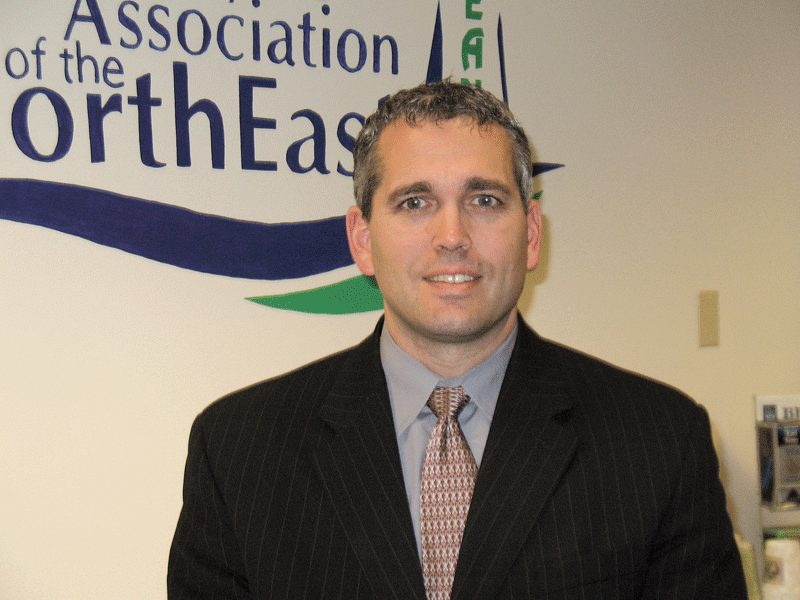
Opinion
Getting the Nation on Track for Jobs

This appears to be a good season for investment in transportation. In September, President Obama proposed to invest $50 billion in the nation’s transportation infrastructure. Transportation Secretary Ray LaHood has already committed $776 million to bring buses and bus facilities into a state of good repair. Combined with the $8 billion investment in high-speed rail that was part of the February 2009 stimulus package, it seems that the nation is finally putting a down payment on a 21st-century transit system.
But these sums are a pittance compared with the need. The U.S. has yet to commit the money needed to create a world-class rail system, or to stimulate a transit-vehicle manufacturing industry that today depends mostly on imports. In reports we released this week in cooperation with the Apollo Alliance and Worldwatch Institute, we estimate that a serious investment in public transit could stimulate thousands of sorely needed manufacturing jobs. To appreciate how far we are falling short, consider the example of China.
China recognizes the economic links between developing rail lines and promoting manufacturing. In 2001, it began a $132 billion rail-construction project, which is scheduled for completion in 2012. During roughly the same period, the U.S. appropriated just $19 billion for rail construction, or about one-seventh China’s level.
As part of its recession-recovery package, China committed $88 billion in 2009 to railway infrastructure, doubling its 2008 investment. The goal: to create much-needed transportation links, to generate demand for 20 million tons of domestic steel, and to create 6 million new jobs overall.
To reach the government’s goal of 1.1 million kilometers (about 450,000 miles) of railroad by 2012, China will spend a total of $292.5 billion. Of this, 13,000 kilometers will be for high-speed rail. A key benefit: China’s two leading locomotive and rail-car manufacturers will employ more than 212,000 people combined to meet domestic goals. If transportation policy is to create domestic manufacturers and permanent manufacturing jobs, a steady and predictable level of investment is needed. The U.S. lost its domestic passenger rail-car industry by the late 1980s not because of high labor costs, but because of erratic demand. Most of the countries that dominate the industry today, such as Germany and France, have wages comparable to the U.S., but they have a comprehensive strategy that allows producers to anticipate stable demand for their products.
Annual domestic demand for production of rail cars in the U.S. bounced between a low of 268 units to a high of 1,067 units during the 1970s, according to Thomas Boucher of Rutgers University. And as demand for transit vehicles waned, U.S. companies couldn’t come up with investment dollars to keep up with state-of-the-art technology.
We analyzed the job-creation potential of investment in rail infrastructure and estimate that the U.S. could gain 79,000 jobs in rail and bus manufacturing and related industries under an investment scenario sufficient to double transit ridership in 20 years. An investment at levels similar to China — $24.4 billion per year over six years — would yield 252,213 jobs, including many well-paid blue-collar jobs of the kind that have been devastated over the past decade.
Reclaiming a domestic rail industry is part of a broader need to revive competitive manufacturing. Even in its weakened state, manufacturing accounted for $1.6 trillion (12%) of U.S. GDP in 2008 — more than real estate, finance, and insurance.
Manufacturing accounts for 60% of U.S. exports and 70% of private-sector research and development funding. Yet the U.S. goods deficit with the rest of the world in 2008 exceeded $836 billion. The annual trade deficit with China alone was $266 billion in 2008, with 75% due to the manufactured-goods deficit.
A high-quality passenger-rail system is a trifecta. It would attract more riders and cut dependence on private cars — in turn reducing the carbon emissions that cause global warming. More than that, a commitment to mass transit could promote the resurgence of a major manufacturing sector that we’ve lost, reducing our trade deficit and increasing domestic jobs.

Joan Fitzgerald is professor and director of the graduate program in Law, Policy and Society at Northeastern University. Joseph McLaughlin is a senior research associate at the Center for Labor Market Studies at Northeastern.

Opinion
The Income Gap Is Widening

The term ‘middle class’ is more than an economic distinction. It’s also an appreciation for balance and equity and a national yearning for a strong, cohesive society. Yet a polarizing income gap in Massachusetts and elsewhere is threatening both the class and the concept.
Massachusetts is emerging from the recession ahead of other states, with job creation on the rise. However, the state leads the country (it is tied for first place with Arizona) in having the largest gap between the haves and have-nots, according to the Center for Labor Market Studies at Northeastern University; 10% of households in the state earned as much income in 2009 as the bottom 70% combined during that year.
What is driving this widening gap? Economists differ on this, but many point to executive compensation, declines in manufacturing jobs and wages, a corresponding increase in employment in the so-called ‘knowledge economy,’ and changes in household dynamics, such as the rise in single-parent families. Gaining a better understanding of these issues should be a top priority for the next governor and should be at the forefront of the policy debate in the closing weeks of the gubernatorial election.
New data by the MassINC Polling Group suggest an eroding confidence in a cornerstone of the American Dream: the belief that the hard work of one generation opens the door to a better life for the next. Just 22% of Massachusetts parents believe the next generation will do better than they did financially. This pessimism is a new phenomenon. In 2003, when a slightly different question was posed in a MassINC poll, 68% of parents believed their children would be generally better off.
Why the dramatic change in public opinion? Income inequality has been rising for years, but the difference now is that economic growth isn’t lifting all boats. Over the last decade, census figures show median household income fell by between 1% and 8%. Little wonder that the mood of the electorate reflects strong undercurrents of frustration and resentment.
Growing income inequality and its political implications have received increasing attention across the political spectrum since the 1980s. Alan Greenspan had a point when he said in 2005: “a stark bifurcation of wealth and income trends among large segments of the population can fuel resentment and political polarization. These social developments can lead to political clashes and misguided economic policies that work to the detriment of the economy and society.’’
Perhaps we should have listened. The resentment, polarization, and political clashes contemplated by Greenspan have already materialized. The resulting anger is fueling a push for simplistic solutions to such complex problems as deficit reduction, immigration, and a host of other issues. In essence, the middle ground on policy issues is rapidly disappearing, just like the middle class itself.

Greg Torres is president of MassINC and publisher of CommonWealth magazine. Andrew Sum is director of the Center for Labor Market Studies at Northeastern University.

Opinion
Don’t Put the Brakes on Science, Progress

In light of the latest developments of the on-again, off-again, on-again government funding of human embryonic stem-cell research, it is time to consider the devastating implications of this chaotic funding environment. And to do that, one needs to understand how a modern research lab operates.
A typical lab has 20 to 40 people, led by a senior researcher (the ‘principal investigator’). Most people in a lab are doctoral students or postdoctoral students who are pursuing careers in science.
Labs have many different projects under investigation simultaneously. Most labs have annual budgets of $1 million to $5 million, with most of that money coming from grants from institutions like the National Institutes of Health.
The NIH allocates money to researchers whose proposals are reviewed by a panel of scientists knowledgeable in the field. A typical grant proposal is 25 single-spaced pages and takes months to prepare. The NIH responds in approximately 9 months.
Because the demand for money exceeds the supply, only 20% of the proposals get NIH funding. A researcher receiving his or her first major NIH grant is more than 40 years old, on average.
Lab leaders spend a great deal of their energy recruiting the right people for their lab, nurturing a portfolio of interesting projects, and raising money. Most principal investigators, even the most successful ones in the world, spend at least 25% of their time trying to get money. If they can’t get money, they lay off people and cancel projects.
Now imagine you are a post-doc in a lab and are working on a project to use human embryonic stem cells to cure diabetes by creating new beta cells in the pancreas.
This is difficult work that is high-risk, but high-reward. You have come to grips with the many ethical considerations in working with stem cells derived from embryos that were created during IVF procedures and were destined to be destroyed before the donors agreed they could be used for research. You have begun to get traction in your career, and have been a prominent co-author on several articles in well-respected journals.
When you read the news that your research is now illegal, you are horrified. You are back at square one. Years of research are potentially wasted.
You have no viable research projects underway. It will take well over a year to begin a new research stream, and there is a low probability you will get funded in a new area. You may be fired. In short, your career is in danger of total meltdown.
That is the real cost of our randomized model of research support in the U.S., in which a change in administration or a court ruling can outlaw work that was previously supported by the government. Funding can be canceled with the stroke of a pen.
The projects are less important than the people, particularly people who have invested years in developing their careers and selecting an area on which to focus. People need predictability — not in the research ideas they pursue, but in basic human issues like pay and employment.
It may be possible to restart projects with private funds, but that is by no means certain. Raising philanthropic dollars can be as hard and time-consuming as raising money from the NIH. And these projects will have to be set up with duplicate equipment in geographically separate areas.
Sadly, great people will abandon promising projects. Great people will leave basic research and move to more predictable pastures. And some great young people will decide not to go into research careers at all. The precipitous shift in the legal and regulatory environment for human embryonic stem-cell work will have adverse implications for years to come.
Unpredictability inflicts a heavy cost on scientific progress, whether in domains like stem-cell research or in searching for safe alternative fuels. It damages the country’s competitive position because great projects won’t be completed in the U.S., and, more importantly, great people won’t do the kind of work that is necessary to make progress on our most intractable challenges.
Society pays a high price for randomization of research support — a fact that, sadly, is not recognized by the public, the media, or politicians.

William A. Sahlman is senior associate dean for external relations at Harvard Business School.

Opinion
United Way Focuses on the Building Blocks

By DORA ROBINSON
As we look outside our doors, it can be difficult to escape the challenges we face in the region.
Nearly 25% of Springfield families and 37% of Holyoke families with children under age 5 have incomes below the poverty level. Hampden County’s high-school graduation rate is 70.2%, compared to the statewide rate of 81.5%. Specifically, the graduation rate in West Springfield is 66.4%; in Springfield, 54.5%; and in Holyoke, 48.5%. And last year, food pantries in Hampden County served 22% more meals than in the previous year.
While we must face the issues of our community, we do not need to accept them as reality. We can face them with hope, optimism, and courage, knowing that we can make a difference. The United Way of Pioneer Valley is leading that effort. Our focus is on education, income, health, and basic needs — the building blocks for a good quality of life.
 Our efforts around income promote financial stability and independence by raising awareness of mechanisms that support income growth, convening stakeholders to strengthen income stability and enhance access to bank accounts and services, increasing volunteerism in support of financial education, and partnering on statewide collaborative efforts to bolster family assets and financial literacy.
To raise the bar on education, we partner with local, regional, and state initiatives that support the educational achievement of all children. We collaborate with the school systems and community providers to raise the high-school graduation rates. We invest in educational programming, like mentoring, summer learning, and family engagement.
 And, as the need for emergency food, fuel, and utility assistance increases, we will be there for individuals and families to provide much-needed resources and allocations to provide a hand up for those in need — as we always have.
 But it is not solely up to the United Way of Pioneer Valley. We are all part of the community, and we can all be part of the solution. We can all live united. But how? As part of the United Way Live United movement, we are asking people to “Give. Advocate. Volunteer.”  
 You can give of your time, energy, and talents to create lasting change and improve the lives of all.  Your financial contributions can help fund programs that make a difference for poor, low-income and working poor people to have a better life. Many of these are your co-workers, friends, family, and community members.
 You can foster a community of hope and opportunity through advocating for change — be it with a neighbor or a legislator. You can give voice to the vulnerable by supporting initiatives that raise awareness to the challenges faced by our homeless and those who may find themselves on the precipice.
 You can build a stronger community by serving as a mentor to a young adult. You can empower others with your experiences. You can simply share your wisdom with a child.
 We invite you to be part of the change. You can give, you can advocate, and you can volunteer. You can make a difference in the Pioneer Valley, and that’s what it means to live united.

Dora Robinson is president and CEO of United Way of Pioneer Valley.

Opinion
We Must Separate Doctors from Industry

This summer, Harvard Medical School announced new restrictions on the relationships between its faculty and the pharmaceutical and medical-device industries. The policy prohibits faculty from accepting gifts and meals, limits their consulting income, and requires public reporting of any payments received. The stated goal is to eliminate a perception of undue commercial influence in medical education. This is the right decision by Harvard. It is now time that all other medical schools and teaching hospitals follow suit.
The medical/pharmaceutical industry influence on academic medicine is ubiquitous. In 2007, a survey of academic department chairs published in the Journal of the American Medical Assoc. revealed that 60% reported some form of personal relationship with industry, including as a consultant, paid speaker, officer, founder, or member of a board.
While many of these relationships are appropriate, an increasing number go off-track. Later that same year, the Department of Justice filed criminal complaints against four of the five medical-device manufacturers in New Jersey, alleging that the companies used consulting agreements with orthopedic surgeons as inducements to use a particular company’s products. According to Justice, the investigation revealed it was common practice that surgeons “were paid tens to hundreds of thousands of dollars per year for consulting contracts and were often lavished with trips and other expensive perquisites.”
More recently, Sen. Charles Grassley of Iowa has investigated research conflicts of interests at numerous teaching hospitals and academic medical centers, including Harvard Medical School. In October 2008, an article in the the New York Times noted that Grassley’s findings “suggest that universities are all but incapable of policing their faculty’s conflicts of interest.” Eric Campbell, a health policy researcher at Mass General and Harvard Medical School, called these consulting arrangements “one of the great wink-winks of all time.”
Things must change. Medical schools and teaching hospitals have nothing to fear by establishing more appropriate restrictions governing their relationships with industry. The experience of our hospital system is one case in point.
Several years ago, clinical leaders at our system, UMass Memorial Health Care, became concerned about the problem created by these relationships. As a result, we launched a comprehensive process that resulted in the adoption, in 2007, of one of the strictest vendor-relations policies in the nation. Among other things, we prohibit gifts, meals, and entertainment, eliminate industry influence in medical education, restrict consulting to true scientific (not marketing) issues, and restrict access by sales and marketing representatives at our facility.
At first, there was skepticism. Some physicians resented the suggestion that accepting a mug or a free lunch somehow taints their medical judgment. Others worried that we would lose industry support for medical education and they would not be able to stay current on the latest drug and device developments. But almost three years later, there has been nary a whimper. No grieving at the loss of free lunches or dinners, and very few complaints about the loss of any educational opportunities. Indeed, most physicians are happier with the more limited, and more appropriate, interactions with industry. And they don’t mind writing with generic pens.
Recently, we conducted a survey of our physicians and residents to determine the level of support for our policy. While there remains some skepticism, almost two-thirds of respondents said they wanted UMass Memorial to continue to play a leading role among academic medical centers in promoting a strict policy. One resident said the policy made him so proud that, as he leaves his training, he asks all his potential employers about their policy.
This is not about demonizing pharmaceutical and medical-device companies. Our policy continues to allow significant contact with industry. These companies are vital to medical research and our continued ability to discover new and improved ways of caring for patients. But when we allow the good parts of those relationships to be sullied by the bad, we undermine the integrity of the entire interaction.
All of academic medicine needs to now acknowledge that the goals of a profit-driven industry, while laudable, do not always align with the goals of independent scientific research, teaching, and the delivery of high-quality patient care. Harvard is not the first to go down this road, but it may be the most influential. It should not be the last.

Douglas S. Brown is senior vice president and general counsel, and Stephen Tosi is chief medical officer, of UMass Memorial Health Care in Worcester.

Sections Supplements
Pioneer Valley Hospitality Group Adds Springfield Landmark to Its Portfolio

Shardool Parmar of City Place Inn & Suites

Shardool Parmar says City Place Inn & Suites, formerly the Holiday Inn, needs some work, but most of the fixes are small.


Shardool Parmar calls it a “fixer-upper — of sorts.”
That’s how he described what is now known as the City Place Inn & Suites — formerly named the Inn Place, and known throughout most of its existence as a Holiday Inn — on Dwight Street in Springfield. That qualifier “of sorts” was used to convey his opinion that the 12-story, 242-room landmark needs some work, “but the fixes are small ones.”
And many of them don’t involve a hammer, nails, paint, or wallpaper, he continued, noting that, overall, the building is in solid shape. Instead, they fall into the category of image repair and awareness-building.
“Many people don’t know this place still exists,” said Parmar, president of the Pioneer Valley Hospitality Group, the family-owned entity started by his father, Laxman, that now owns and manages four hotels in the region. He noted that, when the Dwight Street facility lost its Holiday Inn nameplate a year or so ago and became the Inn Place, it remained open, but lost a good deal of its presence within the market as an attractive, lower-cost alternative to the downtown Springfield hotels and others in the region.
The PVHG, as it’s called, is committed to gaining that standing back.
And Parmar says that process starts by simply going back to the basics of good service, something lost under previous ownership as its fiscal challenges mounted.
“Springfield has some great hotels that are on the higher end,” he explained. “Our goal is to provide quality service that won’t break the bank. This hotel has always had a lot going for it, but in recent years, it was simply not managed well.”
City Place Inn and Suites, which became part of the PVHG in late June, is now the largest property in the group’s portfolio — actually, it has more rooms than the other three, the Hampton Inn and Comfort Inn in Hadley and a Comfort Inn and Suites in Ludlow, combined — and represents a valuable addition, said Parmar.
It gives the group a presence in Springfield, something it hasn’t had since it sold the Howard Johnson’s on Boston Road, which it operated for nearly 20 years, he explained, adding that its location near the Turnpike, I-91, and I-291 makes it both accessible and visible. Meanwhile, the combination of location and lower price point has historically made the hotel a popular alternative for overflow from the downtown Springfield hotels and Hampshire County as well.
“Historically, this hotel has always done well,” said Parmar, noting that, until very recently, it enjoyed occupancy rates at or above 50%. “This is a great location; it’s situated so that you can quickly get north or south. The access is very good.”

Room for Improvement
As he talked about his family’s latest acquisition and what happens next for the PVHG, Parmar first went back in time. He opened his desk drawer and took out a brochure for the Holiday Inn that was about 40 years old.
Back then, and for several years thereafter, the facility’s main claim to fame was a revolving restaurant on the top floor, which offered stunning views of a downtown that had but one real office tower (Baystate West, as it was called then), as well as a North Blocks neighborhood just coming together after the building of Route 291.
The restaurant, now aptly named Panorama, remains a permanent fixture — literally and figuratively (it no longer spins) — but its look, and most other aspects of the hotel, have changed over four decades.
Over the past few years, the facility faded into near-obscurity as it lost the Holiday Inn flag and ownership let some aspects of service and infrastructure slide. Eventually, the hotel was lost to mortgage foreclosure. A broker was hired to sell the property, and the PVHG was among the many parties asked to give it a look.
But initially, the group had little interest in the hotel, said Parmar, adding that it was focusing most of its time and energy on plans to build a $15 million Hilton Garden Inn near Pulaski Park in Northampton. However, when that project was scuttled after PVHG failed to secure a needed $12 million bond, the group turned its attention to the landmark on Dwight Street.
What it saw was a hotel that was somewhat tired and had seen much better days, said Parmar, but one the family believed could make a full recovery from what was ailing it. In other words, the property represented the kind of challenge that the PVHG likes to take on.
“We’re always looking to find new opportunities that represent challenges,” he said, noting that both he and his father are engineers by trade and enjoy problem solving. “We figure that, if something’s easy, someone else is already doing it. We like taking on challenges and creating value.”
In the case of the former Holiday Inn, acquired by the PVHG for $2.5 million, the main challenges are bringing a higher level of quality to the service and building awareness of the facility and the fact that it is under new and better management.
“This business is fairly simple,” said Parmar, addressing the service issue first. “People’s expectations are very clear — they want a certain level of cleanliness, they expect all the lights to go on and the air conditioning and television to work properly. Our job is simply to make sure these expectations are met.”
As for awareness-building, some of it will come through word-of-mouth referrals from satisfied customers, he said, adding that he plans to do a lot of “face-to-face” work himself and get in front of the various constituencies he serves, especially the business community.
Meanwhile, there has been some infrastructure work undertaken, and more is planned, said Parmar. He noted that, in addition to considerable painting, wallpapering, and deep cleaning, hundreds of lightbulbs have been replaced with more energy-efficient units, and a poor chemical mix in the large indoor pool has been rectified.
“When we first started here, you couldn’t even see the bottom — now you can,” he said, adding that this new-found clarity has revealed a clear need to repaint the facility, a project to be undertaken down the road.
Overall, the hotel and its guest rooms are in generally good condition, he told BusinessWest, noting that significant renovations were undertaken three years ago, and that such initiatives usually have a shelf life of about a decade.
The challenge ahead, then, is to convince potential customers that the hotel that all but dropped from sight is still a viable player in the market, and to get that message out soon, with the Big E arriving in a month, ushering in the region’s busiest season for tourism.

Staying Power
Looking ahead, Parmar said he’s not sure when or if the PVHG will try to gain a prominent brand, like Holiday Inn, for the hotel, or remain independent.
There are significant costs attached to becoming part of one of the major chains, he explained, adding that one can certainly debate whether the resulting benefits justify those costs.
Meanwhile, he’s focused on the name currently on the property — City Place Inn and Suites — and making it a prominent part of the local hospitality sector. Meeting that goal will be a challenge, but, as he said, this family likes challenges.

George O’Brien can be reached at [email protected]