Home Posts tagged Rays of Hope
Daily News

SPRINGFIELD — The Springfield Thunderbirds and the T-Birds Foundation announced a donation of $28,000 to Rays of Hope as a result of proceeds from the live jersey auction and fundraising elements from the T-Birds’ ninth annual Pink in the Rink game on March 7.

Thunderbirds President Nathan Costa, Vice President of Sales & Strategy Todd McDonald, and Managing Partner Paul Picknelly presented a check to Rays of Hope earlier this month at the MassMutual Center. The Thunderbirds’ ninth annual Pink in the Rink game once again served as a powerful centerpiece in the organization’s ongoing fight against breast cancer, raising another impactful total through auctions of the team’s pink-themed, game-worn jerseys. The team also extended its sellout streak with this annual promotion, welcoming a capacity crowd of 6,793 fans for the ninth consecutive Pink in the Rink event.

“Pink in the Rink continues to be one of the most meaningful and cherished traditions in our community and one of the most anticipated days of the year,” Costa said. “Our partnership with Baystate Health and the Rays of Hope continues to bring people together in an incredible show of hope, strength, and support.

“As we now look ahead to our 10th annual Pink in the Rink game next March, there’s a real sense of excitement and pride surrounding what this event has grown into,” he added. “The atmosphere in the Thunderdome is always unforgettable, the personal stories shared throughout the night are incredibly powerful, and the bravery of survivors continues to inspire all of us. We’re already looking forward to making the 10th edition our most impactful yet as we continue supporting the fight for a cure.”

Established during the Thunderbirds’ inaugural 2016-17 season, Pink in the Rink marks the launch of the Rays of Hope fundraising campaign each March, shining a spotlight on breast cancer awareness outside the traditional October awareness month. Each year, those fundraising efforts culminate with the annual Rays of Hope Walk & Run in downtown Springfield each October. Since the tradition began, the Thunderbirds have helped raise more than $200,000 for Rays of Hope, with every dollar staying local in Western Mass. to support patients, families, and the ongoing pursuit of a cure.

“We are so fortunate to have the Thunderbirds as dedicated partners,” said Kathy Tobin, interim Vice President of Philanthropy for Baystate Health. “Each year, Pink in the Rink draws attention to breast cancer and kicks off the Rays of Hope fundraising season, which is critical to our success. Rays of Hope means so much to our survivors, and it’s emotional to see the tremendous community support, led by the Springfield Thunderbirds and their fans.”

Daily News

SPRINGFIELD — Market Mentors, LLC, a fully integrated marketing, advertising, and public relations agency with offices in Massachusetts and Florida, announced it has raised $5,000 for Rays of Hope, the Baystate Health Breast Network initiative supporting breast cancer patients, survivors, and research since 1994.

Each October, during Breast Cancer Awareness Month, the agency creates specially designed items to raise funds and awareness. This year’s featured travel mug delivers the simple, life-saving reminder: “Check them early, check them often.” The campaign reminds men and women alike to take small, proactive steps that can make a big difference in their health.

“Breast cancer touches so many people, and we’ve seen how awareness can save lives,” said Michelle Abdow, president and CEO of Market Mentors. “We are so thankful to all our generous friends and partners who contributed to our collection this year. With every travel mug donation, we’re keeping a life-saving message on the go while supporting Rays of Hope’s critical work.”

Since its founding, Rays of Hope has raised more than $17.2 million, with every dollar staying in Western Mass. to fund research, patient care, state-of-the-art equipment, educational programs, and community grants.

Daily News

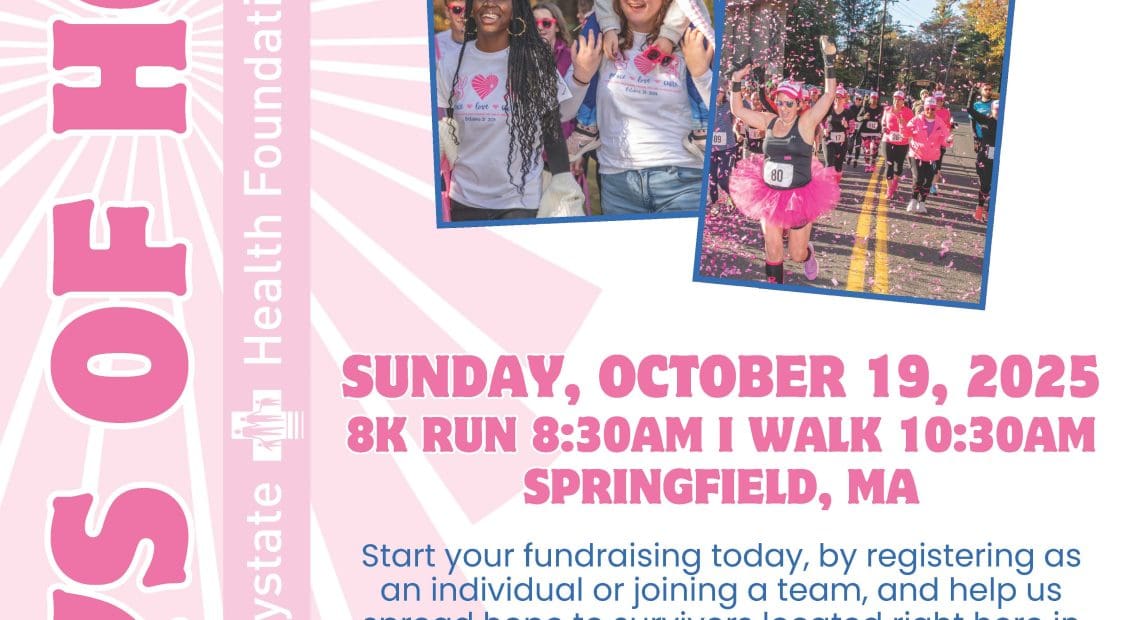
SPRINGFIELD — Bringing more than $17.7 million over 30 years to Western Mass. in support of breast cancer care, research, and education, the Rays of Hope Walk & Run Toward the Cure of Breast Cancer will once again welcome supporters to hit the pavement on Sunday, Oct. 19, beginning at Temple Beth El in Springfield and contunuing along a scenic walk route through Springfield’s Forest Park.

Over the years, all money raised remains local to assist individuals and their families affected by breast cancer. Baystate Health Foundation administers the funds, which support treatment, breast health programs, outreach and education, the purchase of state-of-the-art equipment through the Baystate Health Breast Network, as well as support for the Rays of Hope Center for Breast Cancer Research. Rays of Hope also provides grants to various community programs throughout Western Mass. that promote whole body wellness of survivors.

“Rays of Hope is a very unique organization that Western Massachusetts is very lucky to have,” said John Maybury, the 2024-25 Rays of Hope co-chair. “Not only does it raise money for local research, but it provides a support system for survivors. There is always someone there to talk to who understands what you’re going through in a way that goes beyond what you get at the doctor’s office.”

Added Sandy Maybury, 2024-25 co-chair, “to be there, it’s truly beautiful. There is just a sea of pink at the walk where people are showing their support for their community.”

There is still time to register to walk or run at baystatehealth.org/raysofhope. Participants can choose to register as an individual or start a team, then create their own personal webpage to assist them in their fundraising efforts. While there is no minimum donation to participate, participants are required to raise at least $50 to be eligible to receive a 2025 Rays of Hope participant T-shirt.

Once they arrive at the starting lot, participants are asked to visit the registration tent, in its new location at the back of the lot, to check in and pick up their participant T-shirt. Check-in for the Run Toward the Cure will begin at 7:30 a.m., and the race will take off at 8:30 a.m. Walker registration will open at 9 a.m., and the Walk Toward the Cure steps off at 10:30 a.m.

Buses begin operating at 7:30 a.m. for runners and at 8:30 a.m. for walkers to shuttle them to Temple Beth El. Parking for runners is only at Springfield Elks Lodge at 440 Tiffany St. in Springfield. Parking for walkers is at Blueberry Hill Elementary School, Cartamundi, East Longmeadow High School, and Longmeadow High School. More details on parking can be found at baystatehealth.org/raysofhope.

For more information about this year’s Rays of Hope Walk and Run Toward the Cure of Breast Cancer, held rain or shine, call (413) 794-8001 or visit baystatehealth.org/raysofhope.

Daily News

SPRINGFIELD — Throughout the month of October, Freedom Credit Union is accepting cash donations at all its branches to benefit the Rays of Hope Walk & Run Toward the Cure of Breast Cancer, a Baystate Health Foundation charity that provides vital support to breast cancer patients, survivors, and their families throughout Western Mass.

“For more than 30 years, Rays of Hope has been a lifeline for people in our community impacted by breast cancer,” Freedom Credit Union President Glenn Welch said. “At Freedom, we are deeply committed to helping our neighbors, and we are proud to once again support an organization that makes such a meaningful difference close to home.”

Since its inception in 1994, Rays of Hope has raised more than $17.2 million. Funds support research at the Rays of Hope Center for Breast Cancer Research, provide funding for state-of-the-art equipment, breast health programs and outreach, patient and survivor support, as well as grants for complementary therapies and cancer programs offered by community partners. Importantly, all funds raised remain local in Western Mass.

Community members are encouraged to donate at any Freedom Credit Union branch through Friday, Oct. 31.

In partnership with the Baystate Health Breast Network and Baystate Health Foundation, the Rays of Hope Walk & Run raises funds to benefit research at the Rays of Hope Center for Breast Cancer Research, breast cancer programs and services, outreach and education, and awards grants to various community support programs and organizations right here in Western Massachusetts. Since 1994, Rays of Hope has been committed to improving the breast health of people in our communities with quality and compassion. The Walk & Run Toward the Cure of Breast Cancer has grown from 500 to over 20,000 participants and has raised over $17.7 million for our community. The event includes a 2- and 5-mile walk, 8K run, survivor ceremonies, and entertainment, creating a vibrant and memorable experience for all. Breast cancer survivors and supporters are encouraged to register as an individual or as a team to fundraise and help spread awareness for breast cancer care and resources located right here in Western Massachusetts. Please visit our website at www.baystatehealth.org/raysofhope to learn more about the event and to create a fundraising team! This is a great way to engage employees and customers while supporting a cause that is near to so many in our community.

Daily News

SPRINGFIELDThe Springfield Thunderbirds announced a donation of $38,300 to the Rays of Hope thanks to proceeds from the live jersey auction and accompanying fundraising elements during the T-Birds’ 8th Annual Pink in the Rink game on March 8.

Thunderbirds President Nathan Costa, Vice President of Sales & Strategy Todd McDonald, and Managing Partner Paul Picknelly presented a check to the Rays of Hope earlier this month inside the MassMutual Center. This year’s Pink in the Rink game, the eighth annual centerpiece of the T-Birds’ community calendar, raised another tremendous total through auction sales of the T-Birds’ pink-themed, game-worn jerseys.

The MassMutual Center also continued its ‘Pink’ sellout streak, as the crowd reached its maximum capacity of 6,793 fans for an eighth straight Pink in the Rink.

“Pink in the Rink has truly grown into one of Springfield’s most powerful and uplifting traditions,” said Costa. “Thanks to our incredible partnership with Baystate Health and the Rays of Hope Foundation, this night continues to unite our community in hope, strength, and support. To see our eighth consecutive sellout is a testament to the heart of our fans and the importance of this cause. The energy in the Thunderdome is always palpable, the stories are deeply moving, and the courage of the survivors continues to inspire us all. We can’t wait to build on this momentum next season — and we hold onto hope for the day a cure is finally found.”

Established in T-Birds’ inaugural season in 2016-17, Pink in the Rink celebrates the commencement of the Rays of Hope fundraising efforts each March to shine a light on breast cancer awareness outside of the traditional October awareness month. Every year, the fundraising efforts culminate in the annual Rays of Hope Walk & Run in October in downtown Springfield. Since the establishment of this staple night, the Thunderbirds have generated more than $175,000 for the Rays of Hope Foundation, all of which stays local in Western Massachusetts in pursuit of a cure.

“Rays of Hope is very fortunate to have the support of the Springfield Thunderbirds and their fans,” said Baystate Health Foundation Director of Annual Giving and Events

Kathy Tobin
.

 “Thanks to their efforts, Pink in the Rink makes this disease visible and reminds the community that breast cancer is a year-round fight for too many. The generosity of our pink partners allows us to fulfill our mission of ensuring that, through research, medical intervention, and healthy programs, thousands of local survivors receive the care they deserve.”


Since its inception in 1994, Rays of Hope has raised more than $17.7 million to support the women and men living in Western Massachusetts touched by breast cancer. Funds also support vital research at the Rays of Hope Center for Breast Cancer Research.


The T-Birds Foundation was established in 2018 with a mission of serving the Springfield community and the Pioneer Valley beyond every win and loss through a focus on providing and supporting initiatives in the areas of health and wellness, youth enrichment, and civil service. During the 2024-25 season, the T-Birds Foundation raised more than $115,000 for charitable causes in Western Massachusetts.


Healthcare News Special Coverage

Pink Power

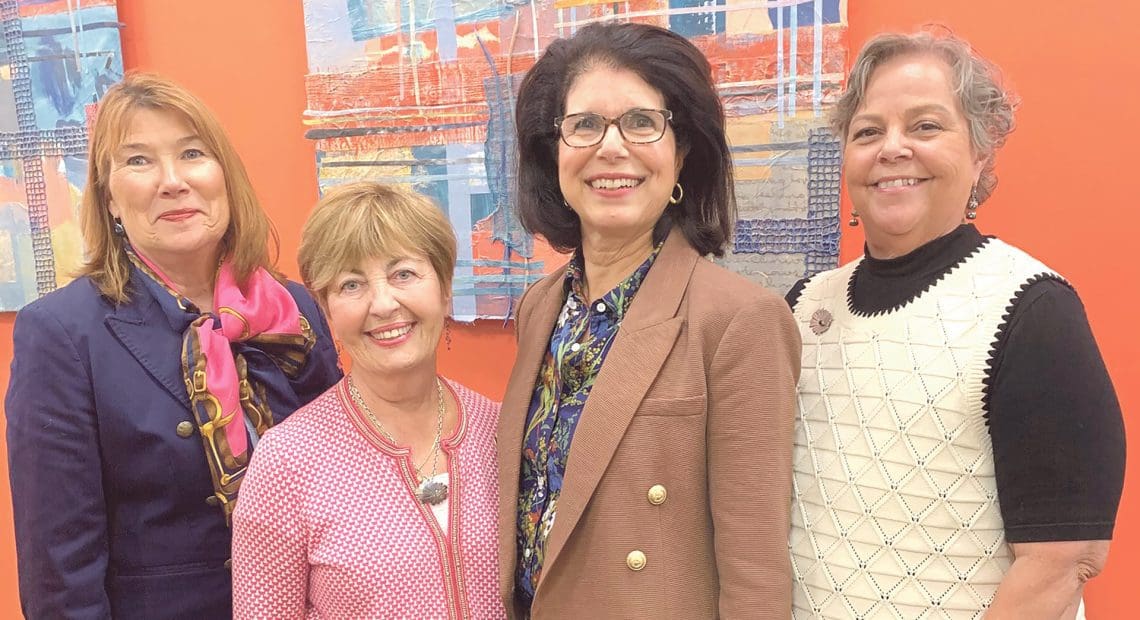
From left, Kathy Tobin, Lucy Giuggio-Carvalho, Dr. Grace Makari-Judson, and Michelle Graci.

From left, Kathy Tobin, Lucy Giuggio-Carvalho, Dr. Grace Makari-Judson, and Michelle Graci.


Kathy Tobin calls it a “big pink hug.”

That’s one of the many colorful ways she and others referred to Rays of Hope, the comprehensive program to support those with breast cancer and raise money for research, services, and grants, culminating in the annual walk and run that will take place on Sunday, Oct. 27.

To Tobin, director of Annual Events and Giving for the Baystate Health Foundation, that hug conveys that Rays of Hope (ROH) is more than a series of fundraisers, more than a gathering, more than the Walk & Run Toward the Cure of Breast Cancer, which has, to date, raised more than $17.2 million and become a time when a community of survivors, family, and friends gathers, reunites, walks, and inspires others in this fight.

It’s a support network, if you will, for those fighting breast cancer and who have survived it.

“The walk is an event, but what has happened is that this has become a year-round organization of support,” she explained. “It’s about executing support services and being there for people who call us on our phone lines; they’ve just been diagnosed, and they don’t know what to do. Or it’s someone who doesn’t have the money for a breast prosthetic; can we help them? We support, through our grant program, other organizations that are in the trenches with survivors.

“We’re like a network that works year-round. We want to surround people with a diagnosis with what they need.”

“We’re like a network that works year-round,” she went on, adding that this what she and others mean when they say ‘big pink hug.’ “We want to surround people with a diagnosis with what they need.”

Dr. Grace Makari-Judson, co-director of the Rays of Hope Center for Breast Cancer Research, agreed, noting that there have been significant advancements in breast-cancer diagnosis, treatment, and delivery of services over the past 30 years, with Rays of Hope’s fundraising efforts helping to make many of them possible, especially a far more integrated delivery of care.

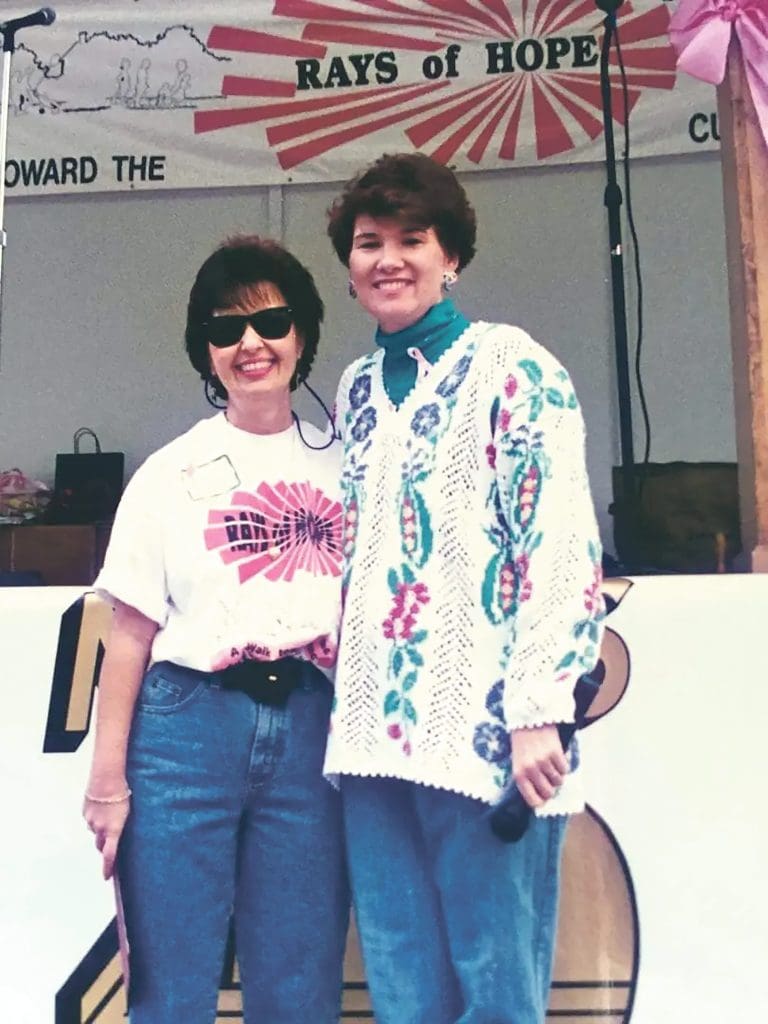
Lucy Giuggio-Carvalho (left) and Kathy Tobin at the first Rays of Hope walk in 1994.

Lucy Giuggio-Carvalho (left) and Kathy Tobin at the first Rays of Hope walk in 1994.

“Before 1994, care was very much linear,” she explained. “A patient would have her mammogram and biopsy, and the mammogram was often in a hospital, beside people getting imaging for other illnesses, not for health management. Meanwhile, the biopsies were often done as surgical biopsies in the operating room, as opposed to outpatient biopsies that we do today. And if there was a new diagnosis of breast cancer, the surgeon would do their breast surgery in a complete vacuum, a complete void — just doing their thing.

“And after the surgery, they would send the patient to the medical oncologist, who would do their thing if they needed chemotherapy or hormone treatments,” Makari-Judson went on. “And when they were done with that, they would go next to the radiation oncologist, who would do their thing. It was very linear — and that was not optimal.”

Since its inception 30 years ago, Rays of Hope has been supporting individuals in their breast-cancer fights by walking with them on their cancer journey, literally, but also figuratively. Through the Baystate Health Breast Network, ROH supports research at the Rays of Hope Center for Breast Cancer Research; provides funding for state-of-the-art equipment, breast-health programs, and outreach and education throughout Baystate Health; supports patients and survivors; and provides grants for complementary therapies and cancer programs to community partners across the region.

All this is what Lucy Giuggio-Carvalho, a breast-cancer survivor, had in mind when she conceived the Rays of Hope walk back in 1994. Well, sort of.

Back then, she just wanted to do something to help those facing what she faced, and provide the kind of love and support she felt when faced with her own diagnosis.

She told BusinessWest she was thinking big back then, but couldn’t have imagined just how broad and impactful her concept would become.

“I wanted it to be an event from day one, but I never thought it would just go on and on, get bigger and bigger, and survive,” she told BusinessWest, noting, like Tobin, that it has become more than an event; it has become a powerful force for those battling the disease and looking for many different forms of support.

“There was no breast center at that time. You had to figure out who to see and what to do next. I already had a medical background, but I found it extremely difficult because you’re dealing with all the emotional aspects of having breast cancer.”

Three decades later, there is now also a Rays of Hope Endowment within the Baystate Health Foundation, through which the community can designate gifts that will perpetually support the mission.

For this issue and its focus on cancer care, we take an in-depth look at this big pink hug; how it has grown, evolved, and widened its impact; and where it can go from here.


Walking the Walk

“In 1993, I was 38 years old and diagnosed with stage-1 breast cancer. I felt overwhelmed, alone, and lost about how to proceed with treatment and life during and after breast cancer. I was on an emotional rollercoaster with many ups and downs. My family and friends came together to support me, and I realized the incredible power of love and support when facing breast cancer.”

That’s one of the many powerful passages in a message Giuggio-Carvalho wrote for the fall 2023 issue of Supporting Hope, a newsletter of the Baystate Health Foundation on the 30th anniversary of the walk and run.

Looking back — and ahead — she and others we spoke with said ROH continues to meet its mission and help ensure that no one facing breast cancer has to feel alone, overwhelmed, or lost. There will always be an emotional roller-coaster ride with ups and downs, but ROH can make that ride more manageable.

Looking back, Giuggio-Carvalho, who was named a Difference Maker by BusinessWest in 2011 for her efforts to launch Rays of Hope, said she started the program to help provide the region with all that was missing when she (an oncology nurse at the time) was diagnosed with breast cancer.

Walkers gather at Temple Beth-El before one of the past Rays of Hope events.

Walkers gather at Temple Beth-El before one of the past Rays of Hope events.

“There was no breast center at that time,” she noted. “You had to figure out who to see and what to do next. I already had a medical background, but I found it extremely difficult because you’re dealing with all the emotional aspects of having breast cancer.

“That, in itself, is one of the more remarkable things that Rays of Hope has brought,” she went on. “We have a team; we have a breast center where people can go. That was lacking at the time, and that’s what precipitated my idea to start a walk and raise money — I was in Boston and went to a breast center, where all the people met together and I was able to hear everyone’s opinion at the same time. I said, ‘this is what we need,’ and now we have it.”

Tobin agreed. “The way we took care of breast cancer was on the cusp of changing — Rays of Hope made it happen faster.”

Makari-Judson concurred, noting that perhaps the biggest, most-needed change was a shift toward a more team-based, integrated model for delivery of care.

“Today, we have a multi-disciplinary team; people communicate, and it’s very integrated, so that people get not only the best care, but the best care in the right sequence,” she explained, adding that the Baystate Health Breast Network was created to look at guidelines and ensure that people were being treated in a guideline-based, consensus-based approach.

There have been many other advances over the past 30 years, she said, adding that, prior to 1994, there were limited support services, limited educational materials, and no survivorship clinics or programs. ROH has helped make them all available, as well as other products and technology needed to provide comprehensive care.

“When we hear that budgets are tight and there isn’t money for something, that’s when we step in,” Tobin said. “Or if there’s something we can’t afford that capital year, we can sometimes provide the funding so we get it a little faster and we keep this region ahead of the curve.”


Steps in the Right Direction

Rays of Hope has been able to support services, research, and developments such as a tissue registry, as well as providing grants through fundraising that has also evolved over the years, adding events and programs such as Pink in the Rink, established by the Springfield Thunderbirds and staged each March.

As for the walk and run itself, it has continued to grow and evolve, said Michelle Graci, manager of Events for the Baystate Health Foundation, noting that COVID forced the actual event (but not the fundraising) to pause for two years, with turnout slowly building back to what it was pre-pandemic.

Last year, more than 20,000 people turned out, with the event raising more than $500,000, she said, noting, as others did, that the walk owes its success to the manner in which organizers listen to participants, adjust, and keep the event fresh and different, while also maintaining elements that have become synonymous with its mission.

These include a survivors’ photo, one that gets bigger each year, as well as a moment to reflect on those who have lost their battles to breast cancer. Overall, said all those we spoke with, the walk is intended to be a celebration — of survivors, the progress made in diagnosing and treating the disease, and the fighting spirit of those battling the disease and their many supporters.

“We celebrate life — this is not a downer,” said Tobin, noting that the gathering of walkers and runners in the parking lot of Temple Beth El in Springfield has become a tradition, an opportunity to renew acquaintances, swap stories, and show that there is strength in numbers.

Graci agreed. “Everyone just crowds into that parking lot, and there’s a lot of love, a lot of laughter, hugging, tears — happy tears, sad tears. It’s just a lot of giving, as Kathy said, a giant pink hug.”

And while the event continues to grow in size and impact each year, organizers have long understood the need to make sure the work of Rays of Hope continues for decades to come — and ensure that it will through the creation of an endowment, through the Baystate Health Foundation, to coincide with ROH’s 30th anniversary.

“This is now a place where people can put their money, and those who understand the importance of long-term planning will get that, and this endowment will only continue to grow,” Tobin said. “Based on the support we’ve received over the past 30 years, I’m confident that this fund will grow proportionately now that it’s in place.”

Overall, Rays of Hope has provided ample proof that a small group of people can accomplish big things and make a huge impact when they work together, Giuggio-Carvalho said.

And this, as much as anything else, is what is being celebrated each October as thousands of people gather to walk and run.

Opinion

Editorial


In 1993, Lucy Giuggio-Carvalho was still recovering from breast cancer when she pulled together the concept, the sponsors, the upfront money, and the determination to get a fundraiser off the ground. She called it Rays of Hope, and she likely had no expectation that, three decades later, that annual walk and run would have raised more than $17.2 million and still be drawing some 20,000 participants each October.

One key to its success? Kathy Tobin, director of Annual Events and Giving for the Baystate Health Foundation and a breast cancer survivor herself, may have put it best in the article that begins on page 20, when she said, “we celebrate life — this is not a downer.”

It’s true. Anyone who has gathered at Temple Beth El in Springfield to step off for either the 5K or 2K walk first experiences something special in that large parking lot. From the annual survivors’ photo to the outward celebration of progress in cancer diagnosis and treatment, to the simultaneous tributes to the fighting spirit of those battling cancer and reflections on those we’ve lost, it truly is a celebration of life — or, as Tobin also put it, “a big pink hug.”

In another story in this issue, beginning on page 24, we visit with Cancer Connection, which is currently marking its 25th year of offering those with cancer diagnoses — and, importantly, their families — resources ranging from support groups to integrative therapies to programs that raise quality of life by nourishing body, mind. and spirit. And, of course, the organization’s signature ‘befriending’ program, which simply provides a compassionate ear at a critical moment.

Sitting down with Executive Director Chelsea Kline to talk about this work is not, in any way, a downbeat experience; she’s actually one of the most positive people you’ll ever meet. “I feel very, very lucky that I get to be a tiny part of it,” she said. “It’s an awesome place.”

Both stories, honestly, were inspiring to write. These are organizations that deal with one of the most terrifying words to hear: cancer. But a cancer diagnosis, in many cases, is a little less terrifying than it used to be thanks to evolutions in research and treatment that have lowered mortality rates and improved quality of life — thanks in part to funding streams like those millions of dollars generated by Rays of Hope.

It’s also less daunting thanks to resources like Cancer Connection and others (like the Center for Human Development’s Cancer House of Hope) that are helping those with cancer and their families find inspiration, support, and positive interactions along their difficult journey.

In short, these are organizations — thriving, growing organizations — worth celebrating right alongside the scientists and doctors working toward a cure.

Daily News

John and Sandy Maybury

SPRINGFIELD — John and Sandy Maybury have been named co-chairs of Baystate Health’s 2024-25 Rays of Hope.

Sandy, a breast-cancer survivor who was recently treated at the D’Amour Center for Cancer Care, and her husband John, former president and now chairperson of Maybury Material Handling in East Longmeadow, have been longtime supporters of Baystate Health and the Rays of Hope.

She first started walking 24 years ago to support her best friend who was diagnosed with breast cancer, and the couple has continued their support and dedication through walking, sponsorship, and donating proceeds to Rays of Hope from their annual Maybury Material Handling Car Show.

“I have made many friends through Rays of Hope, and I’m blessed to be part of this organization. There are so many warriors out there who have either gone through this journey, lost loved ones, or are going through the journey now that I hope I can be there for,” said Sandy, who leaned on support from the Rays of Hope community during her own health crisis.

John noted that spreading the word about Rays of Hope and its community are important to him in his role as co-chair.

“My experience at the Rays of Hope events has been both emotional and enjoyable,” he said. “The overwhelming sense of community that comes together to support the individuals is impressive. I believe Rays of Hope is making a positive impact to foster hope and resilience in the lives of those impacted by breast cancer. I want to bring others in, especially local businesses, to help support this work.”

John also supports Baystate as a member of the Baystate Health Foundation board of trustees, which he chaired from 2012 to 2014, helping guide important fundraising initiatives at Baystate Health, including Rays of Hope. He also served on the Baystate Health board of trustees, for which he also held the position of chair from 2019 to 2021.

The Mayburys were also honored by Baystate with the Baystate Health Foundation Impact Award at the President’s Evening of Gratitude in 2022. The Impact Award honors individuals who have made an impact on the philanthropic efforts to support Baystate Health.

“John and Sandy contribute their time, talent, and treasure to this community in so many ways,” said Kathy Tobin, director of Annual Giving and Events for the Baystate Health Foundation. “Leading Rays of Hope into its fourth decade is a natural progression of their involvement with Baystate Health. Their beautiful spirits inspire hope in so many.”

For more information on the 31st annual Rays of Hope or to register for this year’s walk and run on Sunday, Oct. 27, visit baystatehealth.org/raysofhope.

Daily News

SPRINGFIELD — The Springfield Thunderbirds announced a donation of $40,000 to Rays of Hope thanks to proceeds from the live jersey auction during the T-Birds’ seventh annual Pink in the Rink game on March 9.

Thunderbirds President Nathan Costa and Vice President of Sales & Strategy Todd McDonald presented a check to Rays of Hope earlier this spring inside the MassMutual Center. This year’s Pink in the Rink game, as has become tradition, set new records for total funds generated, and fans at the MassMutual Center came out in full force with a seventh straight Pink in the Rink sellout crowd of 6,793.

“We are so appreciative of our partnership with the Rays of Hope and equally overwhelmed by the support of our fanbase every year for Pink in the Rink,” Costa said. “The visuals of this event elicit so much inspiration, and we are privileged to celebrate these brave fighters whose strength and perseverance are unmatched. We cannot wait for next year’s event to break even more records, and furthermore, we long for the day a cure is discovered.”

Established in T-Birds’ inaugural season in 2016-17, Pink in the Rink celebrates the commencement of Rays of Hope fundraising efforts each March to shine a light on breast-cancer awareness outside the traditional October awareness month. Every year, the fundraising efforts culminate in the annual Rays of Hope Walk & Run Toward the Cure of Breast Cancer in October in Springfield. Since the establishment of this staple night, the Thunderbirds have generated more than $140,000 for the Rays of Hope Foundation, all of which stays local in Western Mass. in pursuit of a cure.

“The generosity and enthusiasm of the Springfield Thunderbirds players, staff, and fans have made a significant impact on Rays of Hope’s mission to support those affected by breast cancer here in Western Massachusetts,” said Michelle Graci, manager of Events for the Baystate Health Foundation. “They are champions both on and off the ice, and we are honored to be partnered with them. This year’s Pink in the Rink was an incredible evening of hope and strength, and the compassion of our Thunderbirds family proved yet again that no one faces breast cancer alone.”

Since its inception in 1994, Rays of Hope has raised more than $17.2 million to support women and men living in Western Mass. touched by breast cancer. Funds also support vital research at the Rays of Hope Center for Breast Cancer Research. This year’s Rays of Hope Walk & Run Toward the Cure of Breast Cancer will be held on Sunday, Oct. 27.

“We are profoundly grateful to the Thunderbirds for their unwavering support and dedication to Rays of Hope,” said John and Sandy Maybury, 2024-25 Rays of Hope co-chairs. “Their generosity and community spirit have made a significant impact in our fight against breast cancer. The funds they have helped raise will go a long way in supporting research, providing patient care, and raising awareness. As co-chairs of Rays of Hope, and on behalf of the countless individuals and families they have touched, we want to say ‘thank you’ to the entire T-Birds organization for skating alongside us in this crucial journey.”

The T-Birds Foundation was established in 2018 with a mission of serving the Springfield community and the Pioneer Valley beyond every win and loss through a focus on providing and supporting initiatives in the areas of health and wellness, youth enrichment, and civil service. During the 2023-24 season, the T-Birds Foundation raised more than $128,000 for charitable causes in Western Mass.

Daily News

SPRINGFIELD — The Springfield Thunderbirds announced a donation of $30,000 to Rays of Hope as a result of proceeds from the live jersey auction during the T-Birds’ sixth annual Pink in the Rink game on March 11.

Thunderbirds President Nathan Costa and Vice President of Sales & Strategy Todd McDonald presented a check to Rays of Hope earlier this week inside the MassMutual Center. This year’s Pink in the Rink game set new records for total funds generated, and the MassMutual Center came out in full force with a sixth straight Pink night sellout crowd of 6,793.

Established during the T-Birds’ inaugural season in 2016-17, Pink in the Rink serves as a kickoff to the Rays of Hope fundraising efforts each March to shine a light on breast-cancer awareness outside of the traditional October awareness month. Each year, the fundraising efforts culminate in the annual Rays of Hope Walk & Run in October. Since the establishment of this staple night, the Thunderbirds have generated more than $100,000 for the Rays of Hope Foundation, all of which stays local in Western Mass. in hopes of finding a cure.

“Pink in the Rink once again proved to be one of the most special nights of our historic season,” said Costa. “We share in the Rays of Hope Foundation’s pride for our community and our fan base for their steadfast support year in and year out. We want to congratulate the Rays of Hope on their 30th anniversary and are proud to continue such a meaningful partnership that celebrates so many brave women and men in Western Massachusetts who have not only survived breast cancer, but also thrived in generating awareness through their Rays of Hope family.”

Proceeds for this donation were raised primarily via the post-game live jersey auction, as every Thunderbirds player had his jersey sold to directly benefit Rays of Hope. In addition, Chris Hayes, general manager of Oak View Group Hospitality, the food and beverage partner for the MassMutual Center, contributed toward the donation total through the sales of Pink Whitney beverages throughout the evening.

“We’re sending our signature big pink hug to the Springfield Thunderbirds and their fans for illuminating hope in our community,” said Kathy Tobin, director of Annual Giving and Events for the Baystate Health Foundation. “As we kick off Rays of Hope’s 30th anniversary, we reflect on those who have helped us get to this moment. We may not have a cure for breast cancer yet, but we have made lifesaving breakthroughs in treatment, and the research continues. Importantly, we have a big extended family of support here in Western Massachusetts. Thank you to the T-Birds for lifting our survivors up.”

Business of Aging

One Step at a Time

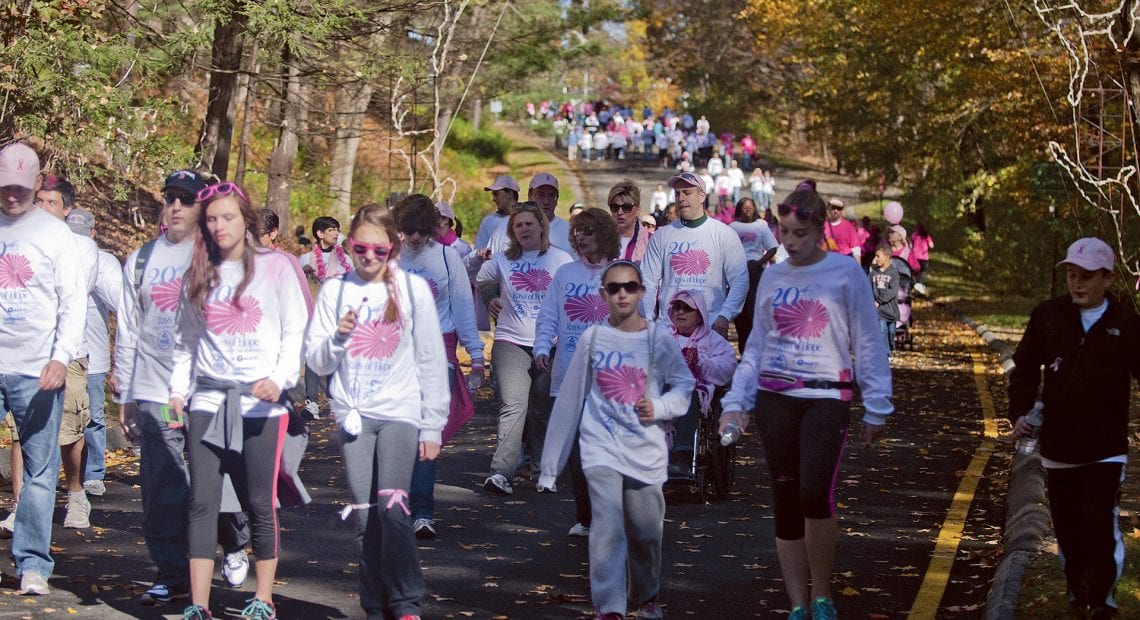
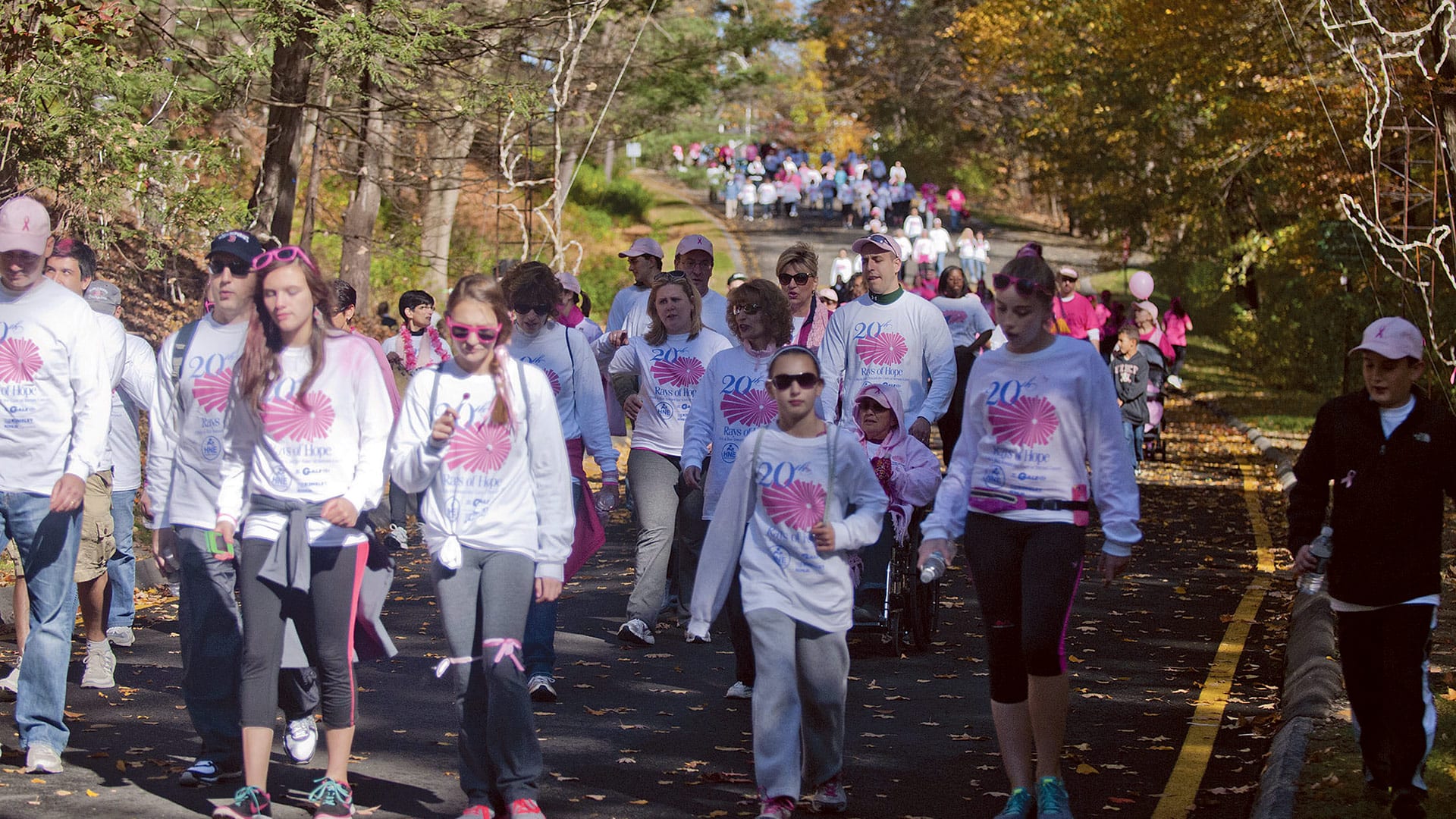
Scenes like this one — from the 20th Rays of Hope Walk five years ago — are played out each October in Forest Park.

Scenes like this one — from the 20th Rays of Hope Walk five years ago — are played out each October in Forest Park.

Lucy Giuggio Carvalho is a tough person to say no to, as Kathy Tobin found out one afternoon 25 years ago.

“I was a health reporter for WGGB, and I was in the lobby of Baystate Medical Center to do a story,” Tobin told BusinessWest. “And this little petite thing comes walking across the lobby, points at me, and says, ‘I had a dream about you, and you’re going to help me.’ And that’s how I met Lucy.”

Carvalho — then a nurse at Baystate — had been diagnosed with breast cancer some time earlier, and, inspired by an AIDS fund-raising walk she had recently participated in, had a vision to bring something like that to Western Mass. to raise money and awareness around the cause of breast-cancer research and treatment.

A quarter-century later, it’s safe to say that Carvalho’s creation — known as the Rays of Hope Walk & Run Toward the Cure of Breast Cancer — has done just that, and a whole lot more.

As it turned out, Tobin did help her; WGGB became the media sponsor of the first Rays of Hope walk in 1994, and Tobin spearheaded a half-hour documentary special to bring attention to the cause.

“She had this overwhelming desire, not just to do this walk, but to change the way we treat breast cancer,” said Tobin, who has come full circle since then, now serving as director of Annual Giving and Events for Baystate Health, which has long overseen the Rays of Hope organization.

The first Rays of Hope event attracted some 500 walkers and raised $50,000. Today, it has raised more than $14.2 million and attracts about 24,000 walkers and runners each October. This year’s annual fundraiser, slated for Oct. 21, will once again step off from Temple Beth El on Dickinson Street in Springfield and wind through and around Forest Park.

As usual, all money raised remains local, administered by the Baystate Health Foundation to assist patients and their families affected by breast cancer. Funds support research, treatment, breast-health programs, outreach and education, and the purchase of state-of-the art equipment, as well as providing grants to various community programs throughout Western Mass. 

“Sometimes I can’t believe all that’s been accomplished,” Carvalho said. “I never would have believed we could raise the amount of money we raised; $14.2 million over the last 25 years is a lot of money, and we can do a lot of things with it — and we have. I’m really proud of Rays of Hope and all we’ve accomplished.”

It wouldn’t have happened, she added, without the continuing, loyal support from the community. “We’ve mostly accomplished what we have through individual walkers and local organizations that have supported Rays of Hope from the beginning. Most of the agencies that got involved in the early years are still involved, as well as the walkers; they come back year after year.”

Carvalho said she created Rays of Hope with a very specific vision.

“I wanted to help people that were going through breast-cancer treatment, to help them navigate the healthcare system,” she explained. “I’d found it difficult, and it was my motivation to make it easier for other people, seeing that I had such a hard time. And I wanted the money to stay local, too. That was really important for me.”

Beyond the critical funding, however, she has long recognized the importance of Rays of Hope as a bonding agent for individuals facing one of life’s most daunting challenges, and the people who love them.
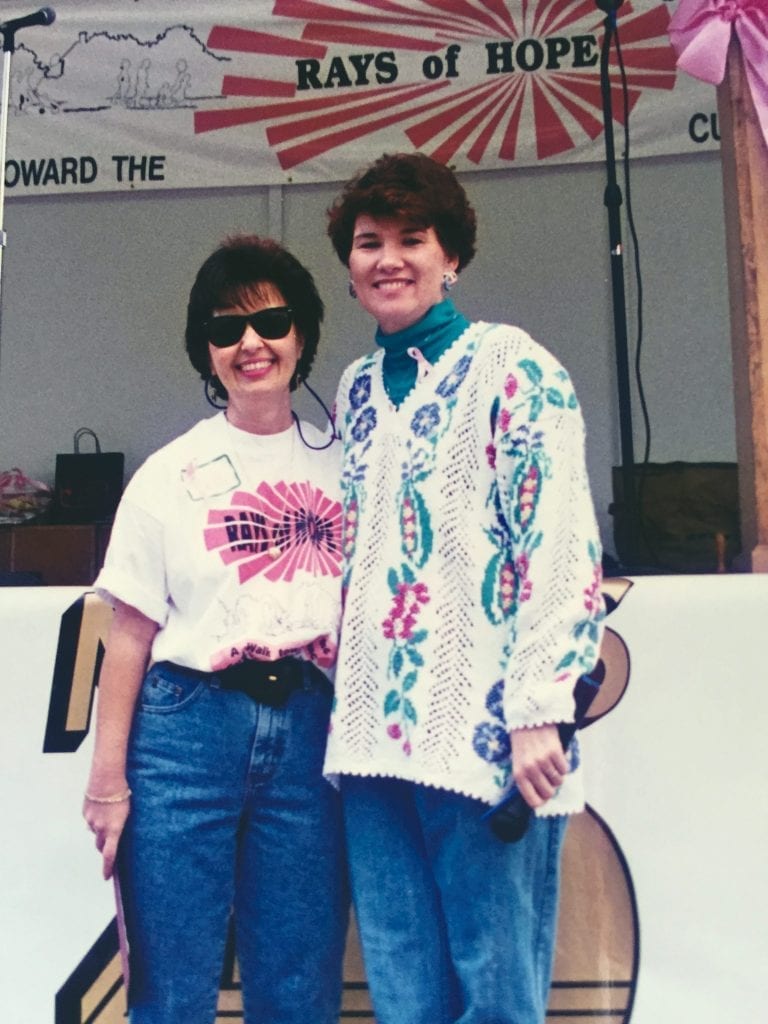
Lucy Carvalho (left) and Kathy Tobin at the first Rays of Hope walk in 1994.

Lucy Carvalho (left) and Kathy Tobin at the first Rays of Hope walk in 1994.

“I think the event is very unique in that, when you’re there, it feels like there’s a big hug all around you, and that people really care about you. It’s just uplifting to be involved, and it’s something to look forward to, something that has become a tradition.”

Tobin also compared the event to a massive hug — one with a great deal of feeling behind it. “We have such a support system in place. It’s like a sorority — but I shouldn’t say sorority, because men are diagnosed, too. It’s just a network of people who care.”

Changing Times

Dr. Grace Makari-Judson has witnessed the evolution of Rays of Hope from a clinical standpoint; she was appointed medical director of Baystate’s breast program at the same time Carvalho was organizing her first walk.

“Lucy’s initial mission for Rays of Hope was not only helping breast-cancer research, but trying to provide coordinated care … a holistic approach,” Makari-Judson said — in other words, to make the journey easier for others than it was for her.

“Thinking back, it’s amazing how much we’ve been able to do with addressing those goals,” Makari-Judson went on. “Twenty-five years ago, women were having mammograms in the hospital, sharing the same waiting room with people who needed X-rays or had pneumonia. Biopsies were done in the operating room, and women got unnecessary scars.

“Today,” she went on, “we have a dedicated breast center where women go for mammograms and other breast imaging. We have needle core biopsy, which is done at the breast center and is a less invasive approach, so women go home with a Band-Aid instead of a scar. That’s the minimally invasive approach started in the mid-’90s and has since become the standard of care. It’s the whole philosophy of less is more.”

Other examples are sentinel node biopsy, introduced at Baystate in 1996, and radiactive seed localization, started in 2010. Both are minimally invasive procedures that Baystate pioneered in the region that have since become national standards of care, Makari-Judson said — and both benefited from Rays of Hope funding.

Meanwhile, Carvalho’s vision of more coordinated care has become reality as well, the doctor said.
Dr. Grace Makari-Judson

Dr. Grace Makari-Judson

“Twenty-five years ago, physicians were seeing patients all in a row — the surgeon, then the medical oncologist, then a radiation oncologist,” she explained. “And sometimes that would leave women with conflicting information. In today’s approach, we have something called a multi-disciplinary breast conference, where we get all the experts together to review radiology images and pathologist slides and come to a consensus recommendation. That has had a positive impact on care and really enhances our mission.”

It’s a model, she said, that started to coalesce around the time Rays of Hope was being launched, and it eventually spread to all Baystate hospitals and eventually became the model of care regionally and nationally.

“Everything about cancer has come such a long way,” Tobin agreed. “Women don’t have to wait days for biopsy results; they don’t necessarily have to have drastic surgeries. Everything about treatment has changed.”

“Twenty-five years ago, women were having mammograms in the hospital, sharing the same waiting room with people who needed X-rays or had pneumonia. Biopsies were done in the operating room, and women got unnecessary scars.”

Then there’s the Rays of Hope Center for Breast Cancer Research, launched in 2011 with the help of a $1.5 million Rays of Hope grant. The center brings together a group of scientists with diverse areas of expertise who work toward reducing the impact of breast cancer — for instance, understanding how obesity, diabetes, and environmental exposures interact to alter breast-cancer risk and prognosis.

It’s important work, and not something to be taken for granted, Tobin said, adding that many events like Rays of Hope eventually peter out — Avon’s national fundraiser for breast cancer isn’t continuing this year, for example — and such events require a lot of work and diligence to thrive and grow.

“Sometimes the fundraising becomes secondary,” she added. “After a while, people want to be a part of it, but they don’t remember the fundraising piece, and that’s critical to our survival. We’re trying to drive home the point that, yes, we need your involvement, but we also need your fundraising, because that’s what makes the programs happen.”

And it’s not just Baystate programs that benefit, Tobin added. Other local organizations, like Cancer House of Hope, also rely on support from Rays of Hope.

“We’re always getting new people involved,” Carvalho said. “Unfortunately, it’s often because they have breast cancer or someone close to them has breast cancer — but that passion keeps us going, and keeps us a vibrant organization. I think we’re always going to walk until there’s a cure, and we don’t need to walk anymore.”

Personal Impact

Denise Jordan was first introduced to Rays of Hope by her late friend, Tracy Whitley, and she joined its advisory board in 2008. A decade later, she’s chairing the 25th interation of the event, dedicating her service to Whitley, who succumbed to the disease last year.

Jordan calls herself an ambassador for Rays of Hope, making public and media appearances and encouraging people to take part in the Oct. 21 walk. She hasn’t found it to be a hard sell.

“I think, as long as people are affected by breast cancer, there will always be a willingness to participate in an initiative whose main focus is finding a cure,” she told BusinessWest. “Also, unlike a lot of organizations, when you give money to Rays of Hope, you can actually say, ‘the money I gave went to this person or that person; I know that because all the money stays right here in the region.’”

During her time as chief of staff for the city of Springfield, Jordan helped establish Pink & Denim Days, when city employees took up that dress code in exchange for donations to Rays of Hope. “It was really an easy ask,” she said. “Folks were very enthusiastic.”
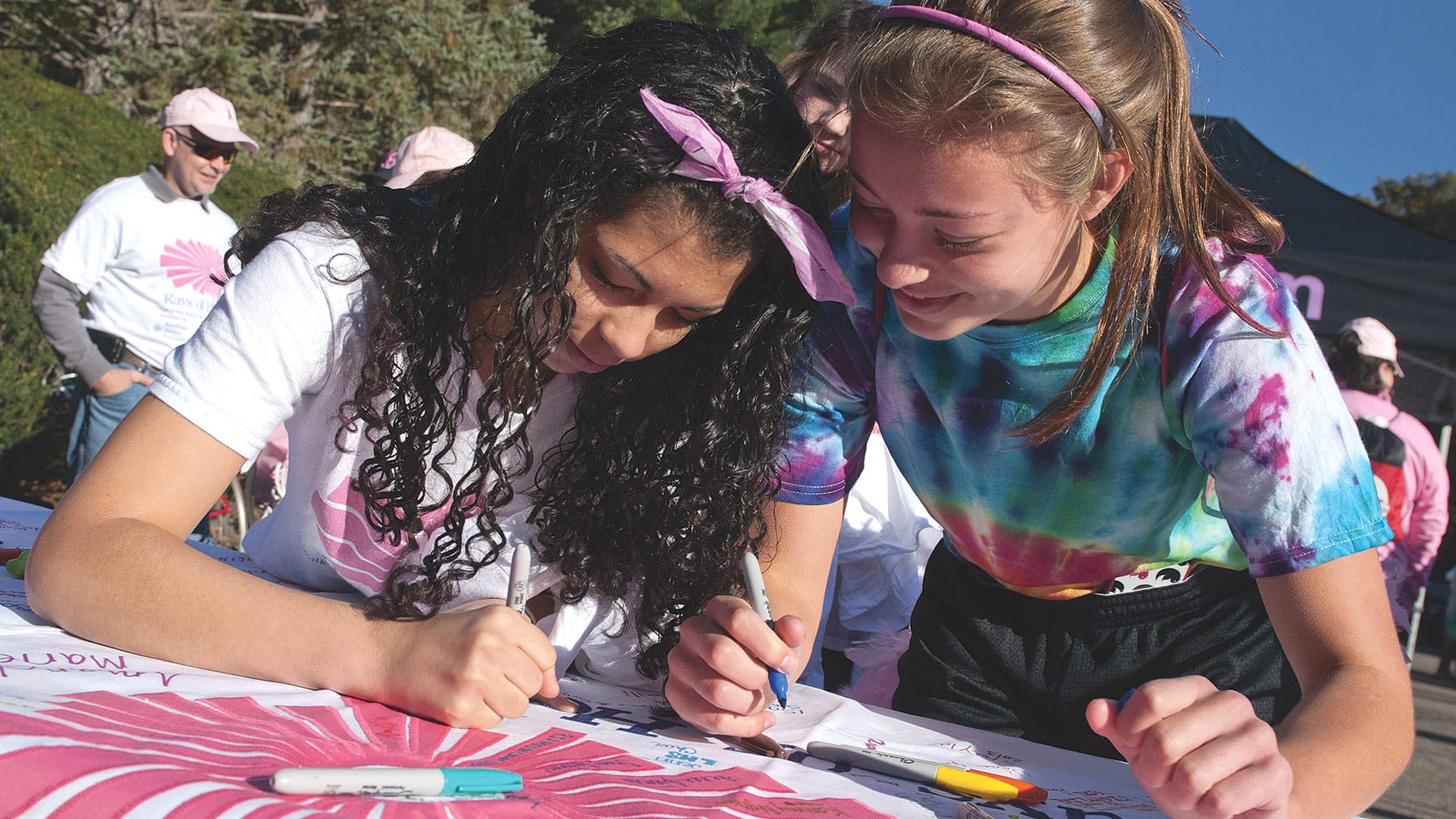
Rays of Hope has proven to be a meaningful event for both survivors and supporters, as well as an educational experience for all ages.

Rays of Hope has proven to be a meaningful event for both survivors and supporters, as well as an educational experience for all ages.

So was Jordan, when she was asked to chair the event this year, even though she had some reservations about the time commitment. But when she thought about her Whitley, and the way she not only battled cancer but became a strong advocate for survivors, it wasn’t a hard decision.

“There’s going to be some special things happening that day,” she said of this year’s walk. “I’m pushing to get more people involved. We’ve had participants in the past who have missed a couple walks, but, this being the 25th anniversary, we’re hoping to bring a lot of folks back to the walk.”

Tobin agreed. “We’re adding some exciting elements. We’re going to tell the story of the progress we’ve made and celebrate some joyous stories of beating the disease — and remember those we’ve lost. I think there will be some special moments.”

Having been active in the walk for 25 years, Tobin has lots of stories, but likes to recount one from the event’s first year. Her 4-year-old son attended and took in the speeches, and as he settled into his car seat for the ride home, he said, ‘I’m so glad I’m not a girl.’

“My feminist self practically slammed on the brakes,” she laughed. But when she asked why, “he said, ‘because I can never get breast cancer.’

“The earnestness of this little boy took my breath away,” she continued. “I realized in that moment the impact this walk was having, and could have, if someone that young understood the seriousness of breast cancer.”

The fact that he assumed it was a girl’s disease isn’t odd; many adults think the same thing, and Rays of Hope has created plenty of teaching moments around that misconception as well.

In short, it’s hard to overestimate the impact this 25-year tradition has had on breast-cancer treatment, research, awareness, education — not to mention the giant hug of support that so many women (and men) need.

“Lucy had certainly given us a gift,” Tobin said. “She had done something incredible in that parking lot that day, and $14.2 million later, we’ve seen a lot of profound moments.”

Added Carvalho, “there’s a spirit at Rays of Hope, and I don’t know exactly how it came to be, but it’s real, and it’s powerful, and it’s heartwarming. That’s what I’m proud of — how the community has come together to make a difference.”

Joseph Bednar can be reached at [email protected]