Home Posts tagged Technology (Page 31)
Opinion

All presidential elections are drawn out, trying, divisive processes, but this one was even more so — on every score.

It seems like it’s taken forever to reach this point, and the ugliness factor involved in choosing our next president has set a standard that will be hard to match. But through it all, we seem to have reached something approaching consensus — an electoral count of 349 to 163, at press time, allows us to use that word — that Americans want not simply change but better leadership, and they believe Barack Obama can provide it.

Let’s hope he can.

Because this country has lost something over the past several years. For lack of a better term, we’ll call it swagger.

The United States had, until quite recently, been respected by most of the rest of the world. It led the way when it came to innovation and entrepreneurship and bringing about positive change. All that seems gone now. The respect is certainly gone, and so, to a large degree, is that sense of entrepreneurship.

We’re no longer watching to see if other countries can catch up to us — instead, we’re hoping to catch up to the new standards being set by other countries, especially China.

This is one of the matters to consider as this nation enters what is always a very intriguing period, a time when the rancorous election process is behind us and people start to focus on the future and what can and should happen. We have some thoughts along those lines as well.

Obviously, the economy is first and foremost on everyone’s minds, and the turmoil of the past few months is no doubt one of the key reasons why Obama was elected. Now, it’s his job to fix things — but it’s not only his job; the task belongs to everyone who helped create this mess and then tried to fix it with stopgap, knee-jerk responses designed primarily to keep the Dow from sliding, and they didn’t even do that.

No, the economy can’t be fixed through $600 stimulus checks, nor with bailouts of major, and quite irresponsible, financial institutions. It will take much more than that, and perhaps the best place to start is with infusions of capital and support in programs that will generate new, well-paying jobs.

In the ’30s, the government did this by building roads, bridges, and dams. Today, it could do it by fostering development of new energy sources and technology that will rid this country of its dependence on foreign oil and help preserve the planet for future generations.

While making such investments, our elected leaders (not Obama all by himself) must address the annoying habit this country has of privatizing gains and socializing losses. The government enabled financial institutions to make the foolhardy moves that led to the recent meltdown, and then it bailed out those companies, or most of them, anyway. This wasn’t the first time this happened, but we hope it’s the last.

Elected leaders can help make sure it is by somehow changing attitudes in boardrooms across the country. We need to lose the ‘quick, easy buck’ mentality — like putting people in homes even if they don’t qualify, knowing that we can make billions if we do and the government will bail us out if it all blows up — and earn money the old-fashioned way.

In other words, corporations have to stop looking at the next batch of quarterly results and how to make them look better. They need incentives to look at and plan for the long term.

All this is difficult, because voters are aren’t focused on the long term, either. They want the economy fixed, and they want it fixed now. They don’t want to dread opening their next 401(k) statement.

In many respects, that’s Obama’s job — to make everyone’s 401(k) healthier. But in reality, the task is much broader and more difficult.

He’s got to get that swagger back.-

Features
Recognition Program to Honor Those Who Are Changing the Landscape

We’re calling it Difference Makers. And while that name says a lot, it doesn’t reveal everything about BusinessWest’s latest recognition program, to be launched early next year.

With this new initiative, BusinessWest, the region’s leading business publication, which next year will celebrate its 25th anniversary (2009 is shaping up as quite a year already) wants to recognize people and institutions that are, well, making a difference.

How?

It can be any number of ways, really, which is the best part about this new program.

A difference maker can be anyone from an inventor bringing some ‘disruptive’ technology or innovation to the market or at least to the drawing board, meaning a potential new product that could dramatically alter the landscape in a given sector, to an administrator who has changed the course of a local nonprofit agency.

It could be an elected or appointed official who has succeeded in improving the quality of life in one of this region’s cities or towns. Or it may be a college president or other administrator who has changed the fortunes of one of the Valley’s many institutions of higher learning. It could be the second, third, or even fourth generation within a family business that has taken that company to places that some of those earlier generations may not have dreamed possible.

It could be … well, one’s imagination is the only real limit.

The accomplishments that make someone or some group worthy of Difference Maker status can be very recent in nature, have taken place over the past several years, or even fall into that ‘lifetime achievement’ category. But ideally we’re looking for those who are helping to set the tone in our region today.

We’re launching Difference Makers because we believe this region has many such individuals and groups, and, while some of the stories are known — and have perhaps been told on the pages of BusinessWest — some are not, and we think it’s time they were. Meanwhile, we believe it’s also time for these individuals or teams of people to be recognized.

BusinessWest has a Forty Under 40 program (which will introduce its third class late next spring), but that recognizes only people too young to remember the Nixon years or, in some extreme cases, the Reagan years. The magazine also offers a ‘Top Entrepreneur’ program, but it recognizes only one individual, family, or set of partners each year.

Difference Makers will go further, and honor many of the people, institutions, and developments that are shaping the fortunes of the Pioneer Valley in the 21st century.

We’re excited about it, and we think you should be, too.

Here’s how it works: On this page (and at www.businesswest.com), you’ll find a nomination form for this latest recognition program. The form and its various questions, especially the explanation of why you believe someone or some group fits our description, is self-explanatory. These nomination forms will be due to BusinessWest — via E-mail, fax, or snail mail — by Dec. 31.

The writers and editors at BusinessWest will then review the nominations, make their selections (there will be no set number for a given year), and introduce them in a subsequent issue of the magazine. A special gala will be staged to recognize our winners.

It will be a real party, because the individuals chosen and their accomplishments will be worthy of a serious celebration.

So take a few minutes, think of those of who are making a difference in the Pioneer Valley — they may just be in the next office or cubicle — and nominate them for this special honor.

—George O’Brien, Editor

Sections Supplements
What You’re Missing If You’re Not Utilizing This Powerful Social-networking Tool

Old-school networking consisted pretty much of a round of golf, lunch, dinner, cocktails, and charitable and community involvement. Today’s networking strategies also include a much greater variety of online opportunities through which you can reach out to a much broader potential business base.

Blogging, microblogging, and social-networking site participation are some of the most powerful means to reach prospects and reinforce professional relationships today. They are the contemporary version of working the room.

Arguably, the most significant social-networking tactic that you should employ is LinkedIn. There are many professional networking sites, but as far as business potential and clout, no other site comes close.

LinkedIn.com is the grown-up version of the MySpace that your kids use to connect with their friends. LinkedIn’s unique advantage, however, is that your connections have access to you when they search for a professional resource with your skills.

It is akin to the Kevin Bacon six-degrees-of-separation formula and penetrates three layers deep. This provides the opportunity for someone in need to contact the middle-person (your connection), and inquire about you before blindly calling you.

The result is a warm introduction rather than a cold call to a stranger.

Connecting to Other Professionals

Building your network of connections takes dedication and commitment. You won’t gain much ground if you sit back and wait for peers, friends, and colleagues to find and connect to you. You must aggressively search for everyone you know professionally and send them an invitation to connect to you.

You may also invite people who are not yet members, but oftentimes this nets a disappointing result, because these people have not yet recognized the value of LinkedIn, and they aren’t willing to build up a network that enhances yours.

Remember that your network grows exponentially when you add a connection because you then have access to their connections (second tier) and people they are connected to as well (third tier), and vice-versa. It is entirely possible to build up a network of about 4 million people within 3 months by making smart connections with well-connected professionals.

Raising Awareness by Asking and Answering Questions

One very significant aspect of LinkedIn is its questions-and-answers component. Everyone has the opportunity to choose one or more industries to monitor on their home page, and new questions appear most every time you refresh that page. Usually these questions come from someone who needs advice or help with a problem. When you post a thoughtful and insightful answer, it’s like raising your hand and saying, “I’m here, and I’m available to help you,” but in a less boastful and intrusive way.

It is a means to demonstrate your expertise, establish some clout, and raise awareness.

Posting a question also has the potential to raise awareness of you within a particular industry. This is especially helpful if it is an industry that you are trying to penetrate. For example, posting an insightful and well-constructed question about employment law will raise awareness of you among employment-law attorneys on LinkedIn, and it will likely open a dialogue with several of them.

It is possible that at least one of them will evolve into a connection, which may one day result in a professional opportunity.

Finding a Job

The jobs component is another powerful advantage for employees and employers alike. From the employee side, the advantage is obvious. You can search for jobs by specific criteria such as title, keywords, location, experience level, company, function, industry, and time posted. Then you can sort the results by various criteria. LinkedIn has incorporated Boolean logic into its search function, so it is possible to target your search very specifically to narrow your results.

Monitoring Your Competition

The obvious advantage of the jobs function for employers is in the potential to recruit qualified candidates to fulfill a particular need. But there are additional LinkedIn benefits to employers that are not immediately obvious.

For example, LinkedIn makes it easy to monitor your competition from an employee standpoint. What is their employee structure? What is the rate of turnover? Are your competitors ramping up in a certain department? Are they laying off employees? By searching for a company and limiting the search results to current employees only, it is easy to see patterns. Monitoring your competition through LinkedIn may lend insight into their business models.

Getting Value Out of Groups

Groups are another powerful LinkedIn component. There are alumni groups, geography-specific groups, interest-based groups, industry-specific groups, and company groups. If you can’t find a group that suits your particular interest, it is easy to start one on your own and then invite others to join.

LinkedIn groups provide a good way to expand the network of people that have access to you, with the added advantage of a shared interest or characteristic. Linking to your school’s alumni groups is a no-brainer, but also be sure to join any professional-networking groups for your area and groups of professionals in your particular industry.

One of the most powerful aspects to groups is the discussion board. Here, members can post a question or any information that they want to share with the group, and others may post comments, much like a blog. For example, the LinkedIn Western Mass. group currently contains a job posting and an inquiry to find an industry-specific speaker, among other topics.

Imagine the immense potential of filling a job opening for free rather than paying for a classified ad. This may eventually become reality as more and more people join LinkedIn, while newspaper circulation continues to drop.

Remember that not every prospective employee reads job postings, but they may just monitor discussion boards and have their interest piqued. Groups are a great way to share resources and bounce ideas around. And, like ‘Questions and Answers,’ participation in discussions within groups raises awareness of you and increases your potential to establish and deepen relationships that may one day turn into business opportunities.

A Recruiter’s Dream Database

LinkedIn membership is exploding so rapidly that it is becoming a gold mine for recruiters. There are several levels of LinkedIn membership, with most members remaining content with the free level. Recruiters, however, have expanded potential to find candidates for job openings with paid memberships that include enhanced features, and recruiters who don’t use this powerful tool are being outgunned by those who are embracing this technology.

Putting Your Best Foot Forward with a Strong Profile

Currently, at least 50% of LinkedIn members have substandard profiles. Many people simply list their current employment and maybe their college, and add a link to their company’s Web site, then expect that to bring in business. It doesn’t work that way.

Your LinkedIn profile should be a high-test, souped-up version of your most polished resume. The best LinkedIn bios convey a compelling reason for a person to hire you or do business with you.

Your LinkedIn profile should convey your professional accomplishments and demonstrate what someone gets when they hire you. It should contain details about your professional accomplishments, community and civic involvement, educational background, interests, groups you belong to, and any honors and awards that you have received. It must be well-written and free of typos, as well as grammar and punctuation errors.

Benefits of Referrals

LinkedIn referrals are a public stamp of approval by someone you have worked with successfully. In fact, LinkedIn places so much significance on referrals that you need a minimum of three for LinkedIn to consider your bio ‘complete.’ Like references, referrals let potential employers and clients know the kind of employee or consultant you have been to others in similar situations.

Strong, well-written referrals sing your praises in a way that often embarrasses you a bit when you first read them, but they lend a lot of insight into what someone can expect from you by means of work ethic, dedication, skills, and commitment.

On the flip side, giving referrals has a dual benefit. You are helping your peer by detailing how instrumental they have been to you in a particular situation, but referrals are also a means of raising awareness of you among that person’s network, because everyone will see your referral on that person’s profile. This puts you in front of people who may be in a position to collaborate with or hire you one day. Giving a referral is another way of tactfully raising your hand in a crowded marketplace.

This article covers the major components of utilizing LinkedIn as part of your networking strategy. However, there are many fine nuances that can further contribute to separating you from the pack and helping you build a profile that will make you attractive to employers and prospects.

One thing is for sure — as more and more of your colleagues and peers build their own powerful LinkedIn networks, anyone who continues to ignore this contemporary networking giant does so at his or her own peril.

Christine Pilch is a partner with Grow My Company and a social-networking strategist. She works with clients to enhance their LinkedIn profiles, and she collaborates with professional service firms to get results through innovative positioning strategies; (413) 537-2474;www.linkedin.com/in/christinepilch;growmyco.com; “Miracle growth for your company.”

Cover Story
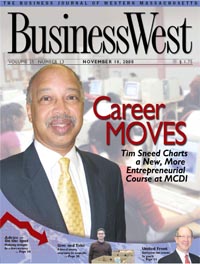
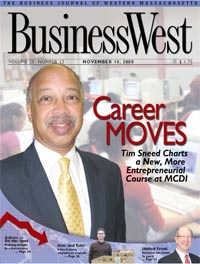
Tim Sneed Charts a New, More Entrepreneurial Course at MCDI
Cover 11/10/08

Cover 11/10/08

Earlier this decade, the Mass Career Development Institute and the acronym MCDI became almost synonymous with the mismanagement and corruption that plagued Springfield. Work to stabilize and refocus the institute began with now-former Director James Morton, and it continues with his successor, Tim Sneed, who is also developing a new strategic plan while also building awareness and transitioning the nonprofit workforce-training entity away from its partial subsidy from the city. ‘Transition’ is a word you hear often with regard to this agency, which Sneed is giving a more-entrepreneurial character as it strives to be an even-more-pivotal force in regionwide economic development efforts.

Tim Sneed was winding up his tour of the many facilities at the Mass. Career Development Institute (MCDI) with a quick stop in the expanded metal shop area. He stopped at a trash barrel in the making, quickly recognizable as the same model seen on many streets in downtown Springfield.

The unit features several iron rods twisted and welded into a somewhat artistic yet obviously functional shape as part of the training that individuals involved in this particular program gain as they look to enter or re-enter the workforce in one of many sectors that are struggling to find qualified help. As he looked over the nearly finished product, Sneed, MCDI’s executive director since early 2007, mused about an already-existing inventory and opportunities to make and sell more of the units, and said with a chuckle, “I’ve got 20 of these to sell; I want to be the trash barrel vendor of choice in this region.”

He would use such phraseology early and often as he talked with BusinessWest, and offered the rubbish-receptacle-manufacturing work as one very small but nonetheless significant and symbolic example of what he wants to do at and with MCDI. His mission is to do some shaping of his own — in this case transforming the once-troubled agency that became symbolic of the corruption and mismanagement that plagued Springfield earlier this decade (more on that later) into a major player in the revitalization of the city — and improvement of the economic health and well-being of the region as a whole.

He wants the nearly 40-year-old institute, now located in a former box-making plant on Wilbraham Avenue, to be a learning and training facility of choice, and he’s already taken some significant strides in that direction.

Indeed, the former financial management executive at Solutia (formerly Monsanto) and MassMutual, working in concert with a revamped, committed board of directors, is positioning the institute, which provides training in areas ranging from computer programming to culinary arts to that aforementioned welding and machinery, to be an integral player in workforce-development efforts in the region.

And this commitment comes at a time when workforce development has been identified as the most critical economic-development issue facing the region.

In many ways, Sneed is continuing the work started by now-former MCDI Director James Morton, who, before moving on to become director of the YMCA of Greater Springfield, commenced the often-difficult work of stabilizing the agency after a scandal involving previous Director Gerry Phillips tarnished its name. But Sneed told BusinessWest that the image-restoration efforts are now mostly in the rear-view mirror.

The task at hand has several components, he said, starting with awareness-building efforts and development of a new, comprehensive strategic plan that will evaluate specific programs and identify ways to strengthen and grow them. Meanwhile, the nonprofit agency is also transitioning itself away from its partial subsidy from the city in an agreement forged with the Finance Control Board.

To successfully handle all of the above, MCDI must become, in a word, far more entrepreneurial, said Sneed, noting that this means everything from program development to trash-barrel production and sales.

In this issue, BusinessWest talks at length with Sneed about his plans for MCDI and how he intends to make that vision reality.

Work in Progress

Sneed told BusinessWest that when he first came to Springfield and Monsanto, the expectation would be that the stay would be only a few years in duration, as it had been been with other stops while working for that company.

But more than two decades later, he’s still working in the region and with several of its nonprofit groups, such as the Martin Luther King Center, where he served as chairman of the board for two terms, and the Community Music School, among others. Such involvement helped create what Sneed called a mid-life crisis of sorts regarding his own career.

“I always said that if I had the opportunity to become the exec of a nonprofit agency, I’d try to take advantage of that,” he explained. “Lo and behold, a year and a half ago, this position opened up.

“I didn’t know anything about MCDI at the time,” he continued. “Someone referred my name to (former) Mayor (Charles) Ryan; he called me in, we talked, and three weeks later I was hired. I see this as an opportunity to really contribute directly to the community.”

Since arriving at MCDI, Sneed said he has focused his energies on improving visibility, especially within the business community, developing a strategic plan, recruiting a strong board of directors to provide better oversight, and instilling that more-entrepreneurial character he talked about. Add it all up, and it translates into work to make MCDI run more like a business itself than the quasi-public entity, or city department, that it has been.

“There’s probably a notion that MCDI is some sort of social-service organization,” he said. “I am of the notion that I don’t want to be a social-service agency — I want to be a training facility. And that’s the direction we’re taking.”

Such an attitude will be necessary as MCDI transitions itself away from its city subsidy, which is about 20% of a roughly $5 million annual budget also funded with help from state and federal allocations. Specifically, MCDI receives funding from the federal Department of Housing and Urban development, the federal Workforce Investment Act, the Employment Board of Hampden County, the Department of Labor and Workforce Development, and the Commonwealth Corp., among other sources.

Separation from the city will occur over the next four years, said Sneed, adding that this period of transition will allow MCDI to cultivate other funding sources and become more-entrepreneurial in its operations. And when asked where and how, he said, “everywhere and with everything.”

“The obvious challenge for us is to replace that revenue we receive from the city,” he explained, adding that there were plans to begin transitioning MCDI away from city assistance roughly a year ago, but they were pushed back, in part to provide more time to cultivate a strategic plan for moving forward and closing that funding gap.

Such work boils down essentially to partnership-building, said Sneed, adding that this has been the blueprint for MCDI since its start back in 1970, but these efforts now take on an ever-more-critical nature.

And they represent a form of ongoing evolution at the institute, which has seen a number of changes since it was founded as the Hampden District Regional Skills Center. Now, as then, the mission has been to work with various challenged constituencies — the homeless, those on transitional assistance (formerly known as welfare), the unemployed and under-employed, those once incarcerated, and youths at risk among other groups, and, “graduate them into the economy,” as Sneed put it.

Over the years, technology and other changes in the workplace have presented new opportunities and challenges for the institute, which has, generally speaking, responded effectively to demands for both broader skill sets and qualified help in specific sectors of the economy. Since its inception, MCDI has transitioned more than 18,000 people into full-time employment, the majority of them women and minorities.

But the institute was rocked by scandal earlier this decade, with Phillips eventually removed from his position amid allegations ranging from creation of no-show jobs to inappropriate use of funds to improper relationships with students — sometimes in exchange for those no-show jobs.

Morton, a former attorney and long-time teacher in Springfield, succeeded in putting the institute back on solid ground, reaffirming its relevance within the region, and even gaining some positive headlines, said Sneed, adding that his role is to build on what’s been done and move MCDI forward through creation of more and better partnerships with area economic-development agencies.

Training Grounds

Sneed said MCDI has always been performance-based in its operations, but now, it will be even more so as it becomes more entrepreneurial in nature.

“The incentive was never to get people in the door, but to get them jobs, and that’s more true today than ever before,” he said, adding that this operating philosophy (and funding provision) dovetails nicely with a new sense of urgency within the community regarding workforce development.

Indeed, the Regional Employment Board, working in concert with a host of other agencies and institutions, has blueprinted something called Building a Better Workforce — Closing the Skills Gap on the Road to Economic Resurgence, and MCDI is already slated to play a role in one of its first initiatives.

It’s a project within the health care sector to increase pathways for lower-skilled incumbent workers by providing certified nursing assistant (CNA) and acute-care training. The program will eventually involve both current health care workers and those outside that sector and, essentially, provide an entranceway and then a clearer path to better-paying jobs in that industry, which is struggling to fill vacancies in many areas.

MCDI will join Springfield Technical Community College and Holyoke Community College in training efforts aimed at making participants ready to work in an acute-care setting.

Meanwhile, the institute is also playing a part in efforts to help bring more skilled individuals into the manufacturing sector, and, specifically, the precision-machining quadrant, said Sneed, adding that work to secure more contracts of this type will be the real key to closing the funding gap that will result from the transition away from city support.

And to get them, MCDI must improve its visibility, he explained, but also continuously prove to business owners, groups like the REB, and other partners and potential partners that it can produce results.

“We have to show people that we can deliver — just like any business must,” he said, adding that, to continuously gain those desired results, the institute must make sure its programs are relevant, up-to-date, and provide graduates with those skills that employers are demanding.

Thus, the institute uses advisory boards to review the needs of various business sectors and even specific businesses to help make sure the institute is graduating individuals who can meet those needs.

These include the so-called “soft skills,” he continued, referring to everything from punctuality to communication to proper attire — something the institute helps to address through the Dress for Success venture, which provides graduating women with clothes and shoes for interviews or their first day on the job.

“It’s always been our mission to have people be job-ready,” he explained. “And that’s why we have conversations with people, starting on day 1, about what it takes to be ready.”

As for visibility, or marketing, this is something on which MCDI has traditionally not focused much of its time, energy, or budget (as a look at its Web site will reveal), but this philosophy, like many other day-to-day operations, will change with the institute’s more businesslike approach.

“We have to market ourselves more aggressively, we know that,” said Sneed, who has gone so far as to hire a consultant to assist with such matters. “We have to get our message out; too many people still don’t know who we are, why we’re here, or how we can help them. ”

And the message to be sent, he said, is that this is no longer a ‘troubled’ agency with a dark cloud hanging over it. “We’ve managed to put that behind us; we’re focused on the future and being a key part in workforce-development efforts here.”

Moving forward, Sneed said his basic mission is simply to make the institute’s phone ring more often — make that much more often. Calls are traditionally from companies that need help, or a problem solver, he explained, adding that his level of success in making MCDI a thriving, independent entity will ultimately be measured by that volume of phone calls.

“We want to be this region’s training facility of choice — it’s as simple as that,” he said, using, again, words that he summoned often.

Trash Talking

As Sneed gave BusinessWest a tour of the institute’s many programs — stopping in the computer lab, one of the English for Speakers of Other Languages (ESOL) labs, the commercial kitchen, and the Dress for Success shop, among others — he moved quickly and purposefully. He wanted to provide a detailed look at what the institute does and how it does it, but he also had work to do.

MCDI is entering a new, intriguing, and very challenging phase of its existence, and Sneed is quite busy with the many aspects of partnership-building, strategic planning, and developing new and reliable sources of revenue. If it all sounds like the process of running a business, that’s because that is increasingly what this entity has become.

And Sneed just might be able to sell a few trash barrels while he’s at it.

George O’Brien can be reached at[email protected]

Sections Supplements
United Bank Is Paving New Avenues for Growth
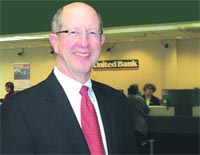
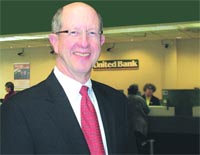
United president Richard Collins

United president Richard Collins

Well-capitalized after going public several years ago, aggressively branching out, and operating in a regional banking sector that is generally healthy compared to the nation as a whole, United Bank has a lot going for it, says its president, Richard Collins. On the flip side, the area’s banking landscape remains fiercely competitive, especially given limited demand for commercial loans in a lackluster economy. To succeed, a bank needs to set itself apart with service and a wide range of financial products — and by always keeping an eye on the next trend.

At a time when banks nationally are failing or at least in crisis, United Bank has benefited from good decisions, says its chief executive — not to mention some good timing.

Specifically, upon becoming a fully public bank last December, United raised $95 million in its second public offering, following an initial round in 2005 that netted $72 million. “That puts us on a short list of banks with an awful lot of capital,” said Richard Collins, president of the 126-year-old institution.

“I wish I could say I was smart enough to see the banking crisis coming,” he added, “but we did raise capital to prepare for growth and whatever the future might bring. And having this much capital means we’re not affected by some of the problems of the national banks.”

Specifically, Collins noted that United, like many institutions in its region, is not burdened with the ‘toxic paper’ that has weighted down the large Wall Street banks — mainly in the form of subprime loans.

“We haven’t made any troublesome investments,” he said. “A lot of banks bought Fannie Mae- and Freddie Mac-preferred stock, but we’ve stayed away from that, and we don’t do any subprime lending. Every mortgage loan we make, we intend to keep, so we make those loans in a way that we’re happy to have them on the balance sheet.

“So we’re anxious to lend,” Collins continued. “We’re anxious to put dollars out there, but it has to be in a fashion that adheres to straightforward lending standards. We’ll stick with that, and we can put dollars to work for qualified borrowers who are looking for a home loan, car loan, or business loan.”

Going public was key to a newly aggressive growth stance for United, which has operated from its West Springfield headquarters since 1882.

At the start of 2006, United boasted a dozen branches across the Pioneer Valley, but then began rapidly expanding, adding five locations over the past three years. First was a downtown Northampton office in mid-2006, followed by a Westfield branch in early 2007. This year alone has seen United expand into Longmeadow and Agawam, and also add an ‘express’ branch right off Interstate 91 in Northampton in order to serve drive-thru customers; the city’s other branch takes only walk-ins.

Plans for a branch in Chicopee, are underway, “and then we’ll keep looking from there,” said Dena Hall, vice president of marketing and community relations, noting that all the new branches are performing well — a critical factor, since no bank wants to expand just to have a presence in a certain town.

“If a branch doesn’t do well, it’s very expensive, between maintaining the building, paying rent, and paying our people,” said Collins. “Fortunately, that doesn’t seem to be happening.”

What is happening is a period of robust expansion for United, in an effort to attract more business in Western Mass., a region known for as fiercely competitive banking landscape. In this issue, BusinessWest examines some of the strategies United is employing to do just that.

Saving Money — and Time

Some concepts seem like small matters, but go to the heart of customer service, which is critical to retain business with so many other banking options available, said Hall. Take, for example, that express branch off I-91. “The idea was to meet the needs of those who couldn’t drive right up before,” she explained, “but we’ve been pleasantly surprised by the foot traffic.”

It’s the most basic example of the different ways customers choose to conduct bank business today, she noted. For example, United, which had one of the first Internet banking products in the region, recently introduced ‘mobile banking,’ which allows access to financial information using a cell phone.

But customers who use such technology aren’t completely divorced from bricks-and-mortar banking, she said; increasingly, many people want a mix of both — which is why United is expanding its physical presence along with its technological options.

“We’re an older bank, so we’ve been around a long time,” said Collins. “But in terms of introducing our customers to computer-based products, we’ve been pretty far ahead of the curve.”

Offering convenience and a variety of banking options isn’t just window dressing, however — not in Western Mass., where an overload of different banks are all competing for business. For example, he said, “I’d like to see a more-vibrant market for commercial loans, but the economy is not demanding it, and there are other good banks out there who want a piece of those loans.

“We’re having some growth in the commercial portfolio, but it’s not as robust as I’d like it to be, whether that’s due to the health of the market, or the competition out there for commercial loans, or a little bit of both,” he added.

Collins doesn’t include the ongoing national banking crisis on that list of factors — at least not so high — because, like other executives BusinessWest has spoken to recently, he describes the Western Mass. banking sector as essentially healthy and well-capitalized.

That gives United opportunities to seek growth areas, such as its 2006 purchase of a Northampton-based financial advisory firm, the Levine Financial Group, which added $88 million in assets under management. Today, the United Wealth Management Group reports $120 million in investments.

Indeed, Hall noted, on the investment side, “we’ve done a good job increasing our presence and expanding awareness in our area. Certainly, over the last couple of months, the financial markets have been steadying, and our representatives have been actively calling customers, having meetings, and fielding phone calls. They’re being proactive to reach a level of service that’s crucial to a locally based group such as ours.”

Collins said having a solid investment arm is important at a time when many individuals either want to do all their financial business under one roof, or mistrust traditional brokerage houses, for whatever reason.

“Some people like working with a bank in terms of managing personal wealth. The bank is central to our financial life in lots of ways,” he said. “I think our reputation for being customer-oriented helps us attract people, and we offer a great line of investment products and the professionals we work with can help people make those decisions.”

“At the same time, there’s a lot of competition,” he continued, “but we’re picking up people who are comforted by having wealth management done through their bank. There are some concerns about some of the larger brokerage firms having problems or being reorganized. We’re a small organization, but we’ve got a lot of capital and no real problems in our loan or securities portfolios, and there’s not much chance that we’ll be forced into a sale.”

Personal Touch

Collins stressed, however, that United’s success will not be achieved simply by expanding its locations and product lines. An emphasis on customer service is reflected in United’s ‘personal bankers,’ who operate under a model that assigns each retail customer to one employee who is tasked with getting to know them and their individual needs over the long term.

Hall explained that the concept is also reflected on the commercial-lending side. “We have a team approach, where the customer has not only a lender, but also a personal loan assistant working behind the scenes, doing what needs to be done. We have business-development officers who sell cash-management products and personal bankers on the retail side.”

Hall said the personal-banker model is one reason why United is able keep its own employee-retention rate around 95%. “We’ve done a nice job attracting new employees from other banks, and also promoting from within,” she noted.

“We’ve had very little turnover. It’s a unique job. Personal bankers are responsible for maintaining the customer relationship. They don’t have to be concerned with the branch hours and the teller lines; a branch manager sees to that. They’re here for the customers.”

It’s a model that has captured plenty of attention in the community, Hall added. “It’s funny; when I tell people I work for United, they immediately say, ‘my personal banker is Nancy,’ or ‘my personal banker is Judy.’ The concept has really worked.”

And community remains an important part of United’s culture, as well. Hall heads up the bank’s charitable foundation, which was launched in 2005 and typically grants between $200,000 and $240,000 annually to nonprofit organizations.

“We’ve always tried to be a good community partner,” she told BusinessWest, “and we support a lot of different foundations in different ways.” Between the foundation and bank sponsorships — such as the one forged with the Springfield Falcons — United puts about $350,000 into the community each year.

“People see that and recognize that we’re committed to the community,” Hall said. “We can’t always say yes, but we try to do as much as we can.”

It’s a cheerful thought, which is appropriate as the skies begin to clear — at least a little bit — over the nation’s financial crisis, aided by the recent government bailout and additional layers of protection from the Federal Deposit Insurance Corp.

“People have been concerned,” Collins, “but they’re less worried now.”

Perhaps confident enough to borrow money and invest for the future. If so, United is willing to talk.

Joseph Bednar can be reached at[email protected]

Departments

Health New England Recognized for Outstanding Customer Service

SPRINGFIELD — According to a report released by the National Committee for Quality Assurance (NCQA), Health New England (HNE) achieved the highest rating in customer service among 160 commercial HMO/POS health plans surveyed in the U.S. In the Quality Compass 2008 report, HNE achieved the highest ratings in the country in the ‘Customer Service’ composite measure. HNE scored 93.46, which means 93.46% of the respondents answered ‘Always’ or ‘Usually’ to questions such as: “in the past 12 months, how often did your health plan’s customer service give you the information or help you needed?” and “in the past 12 months, how often did your health plan’s customer-service staff treat you with courtesy and respect?” The NCQA publicly reports comparative results of health plans regionally and nationally in its annual Quality Compass report. NCQA is a private, non-profit organization dedicated to improving health care quality. It accredits and certifies a wide range of health care organizations and recognizes physicians in key clinical areas.

Berkshire Hills Completes Stock Offering

PITTSFIELD — Berkshire Hills Bancorp Inc. has raised $36 million through its public stock offering and has issued 1.5 million shares of common stock. The company expects to record net proceeds from the offering of approximately $33.5 million. Additionally, the underwriters have an unexercised 30-day over-allotment option to purchase an additional 225,000 shares. Sandler O’Neill + Partners, L.P. acted as lead book-running manager, and Keefe, Bruyette & Woods Inc. was a co-manager for the offering. Due to strong investor demand, the company increased the amount of the offering by 20%, according to Michael P. Daly, president and CEO.

Three Local Companies Win Impact Awards

WELLESLEY — Three Springfield companies were among a host of businesses across the state recently recognized by the Mass. Alliance for Economic Development for their “outstanding contributions” to the state economy. The state organization recently announced the winners in preparation for its Nov. 25 awards luncheon at the Renaissance Boston Waterfront Hotel. Solutia received a Gold Impact Award, while Liberty Mutual received a Silver Impact Award, and the Court Square Group received a Bronze Impact Award. The winning companies were selected after a reception with their competitors and judges at an event at the University of Massachusetts Club, hosted by UMass President Jack Wilson. The reception enabled representatives from the companies to present their attributes in the categories of job growth, facility expansion, investment, and community involvement since Jan. 1, 2007. For more information on the Nov. 25 luncheon, visit www.massecon.com.

Eastfield Mall Adds Electric Security Vehicle

SPRINGFIELD — Eastfield Mall recently purchased a three-wheeled electric vehicle, the T-3, which assists security officers patrolling the mall’s parking lots. On days with appropriate weather, the T-3 will replace one of the two trucks that would normally patrol the lots, according to Arlene Putnam, general manager of Eastfield Mall. The T-3 can go up to 20 mph and has a nine-inch platform to give the officer enhanced visibility over parked cars and crowds. The vehicle is also equipped with a horn, siren, headlights, and emergency lights. The T-3 uses rechargeable batteries, and the cost of running it is under 10 cents per day, added Putnam. Made by T-3 Motion, the environmentally friendly vehicle is a zero-emissions vehicle and gets the equivalent of more than 500 miles per gallon. Putnam noted that the T-3 purchase is the largest investment that mall management has made in taking steps to lessen the impact of the mall on the environment.

Stevens Design Studio Changes Name

WESTFIELD — Owner Tina Stevens recently announced that Stevens Design Studio at 470 Southampton Road has changed its name to Stevens 470 to better represent its current business model for delivering marketing expertise and creative solutions. Stevens 470 references its studio location and serves as an invitation to visit and exchange information and ideas on marketing, design, and technology. Stevens added that her team of marketing strategists, designers, and Web developers provide comprehensive programs for marketing products and services.

Banco Santander To Acquire Sovereign Bancorp

NEW YORK — Banco Santander, S.A. and Sovereign Bancorp Inc., the parent company of Sovereign Bank, recently announced that Banco Santander will acquire Sovereign in a stock-for-stock transaction. Under the terms of the agreement, Sovereign shareholders will receive 0.2924 Banco Santander American Depository Shares for every one share of Sovereign common stock they own. The transaction is subject to customary closing conditions, including bank regulatory approvals in the U.S. and Spain and approval by both companies’ shareholders. Sovereign Bancorp is a financial institution with principal markets in the Northeastern U.S. Banco Santander, S.A., the largest financial group in Spain and Latin America, is the largest bank in the euro zone by market capitalization and was fifth in the world by profit in 2007. For more information, visit www.santander.com.

United Financial Posts Strong Third-quarter Numbers

WEST SPRINGFIELD — United Financial Bancorp, the holding company for United Bank, reported net income of $2.4 million, or $0.15 per diluted share, for the third quarter of 2008 compared to net income of $1.3 million, or $0.08 per diluted share, for the corresponding period in 2007. The company’s improved results were due largely to a significant increase in net interest income, driven by net interest margin expansion and growth in average earning assets, and, to a lesser extent, growth in non-interest income. The company also announced a quarterly cash dividend of 7 cents per share, payable on Dec. 1, 2008 to shareholders of record as of Nov. 6, 2008. As for other third-quarter results: total assets increased $155.8 million, or 14.4%, to $1.2 billion at Sept. 30, 2008, from $1.1 billion at year-end 2007, reflecting growth of $111.2 million, or 55.2%, in securities for sale and $38.5 million, or 4.7%, in total loans, Balance sheet expansion was funded by increases of $42.2 million, or 5.9%, in total deposits and $118 million, or 109.4%, in Federal Home Loan Bank advances.

Opinion
Fostering the Development of a ‘Smart Grid’

New England states have laid out an ambitious agenda to slow the growth in electricity use, reduce greenhouse gas emissions, develop renewable resources, maintain power-system reliability, and lower costs. The sometimes-conflicting nature of these goals makes it difficult to align them.

Indeed, this is a critical juncture for New England. For decades, the region has faced formidable energy challenges, from a lack of indigenous fuel sources to historically high costs, a weak transmission system, and growing consumer demand. The introduction of competitive electricity markets a decade ago has provided a solid foundation for progress: almost $10 billion in private investment in new power plants has boosted supply by more than 30%, and $3 billion of long-overdue transmission investment with about $5 billion more being planned will result in a more-efficient flow of power throughout the region.

The next steps can be achieved by developing solutions that accommodate and harness recent technological innovations to improve the efficiency of the power grid — in other words, to foster the development of a ‘smart grid.’

This ‘smart grid’ means far more than the use of technology. It means establishing ‘smart’ policies that will bring new technology to all corners of the power system to optimize supply, transmission, and conservation. It also means being smart about resource choices in the long term, so that the region can diversify its fuel sources and lessen its reliance on natural gas and oil to produce electricity.

On the regional level, smart-grid technology has been incorporated into New England’s power system operations so that grid conditions both inside and outside the region can be monitored. Moreover, ISO New England is committing funds for the development of an ‘Advanced Grid Simulator’ that will help determine how the grid will operate with the addition of intermittent alternative energy resources such as wind.

New electricity markets were recently implemented to expand the types of resources used to meet consumer demand. New England’s markets now procure in advance not just traditional supply such as power plants, but also conservation resources that reduce electricity use and have never been included in the marketplace before.

This fall, the ISO began a pilot program designed to test alternative energy resources, including energy storage, as a way to instantaneously balance electricity supply and demand. At the state level, policies are being implemented that will maximize the potential of these innovations and encourage their continued development. The state recently enacted the Green Communities Act that promotes the development of renewable resources and energy-efficiency programs.

Meanwhile, the state of Connecticut passed energy legislation that promotes conservation and reduced demand to limit the growth in electricity use. Connecticut has become a leader in demand response, which provides financial incentives for customers to lower their electricity use during tight supply periods. And energy efficiency programs are giving consumers tools to better manage their energy use.

Some New England states are either considering the adoption of smart meters or have already introduced pilot programs. Such technologies would provide consumers with real-time price information to enable them to better manage their use and lower their bills.

The goals that have been set for renewable resources, conservation, and reductions in greenhouse gas emissions are ambitious, but feasible if industry and government continue to build on progress. Technology transformed the region’s economy in the 1980s and ’90s, and fostered improvements in productivity and efficiency in industries around the world. New England can be at the center of another technological revolution in power delivery and use — automating the system to make it more efficient and bringing the economic, environmental, and energy needs of the region into closer alignment.-

Gordon van Welie is president and CEO of Holyoke-based ISO New England Inc.

Sections Supplements
Business Owners Should Never Overlook Springfield’s Central Business District

Economic cycles come and go (at least so far). However, parking, safety, and competition from suburban properties are the three ever-present factors that impact the downtown Springfield Class A office market. And, as is so often the case with commercial real estate and urban central business districts, perception is not exactly reality.

Indeed, while these matters of parking and safety certainly constitute challenges, they are not as formidable as some make them out to be. Meanwhile, space in the suburbs does not come free of issues — or with free parking, either. In other words, there is some fiction that needs to be separated from fact on these matters.

Let’s start with parking. It was getting a bad rap long before I came to the area in 1985. And while enormous progress has been made with the addition of the I-91 North and South garages, companies still maintain that they have trouble attracting employees, especially females, due in part to the cost (which has remained nearly constant for the last 10 years) and safety issues related to parking.

Ironically, the cost of parking in downtown Springfield is a bargain when compared to other office markets in New England. Monthly parking in the City of Homes runs on average $80 per month in one of several covered garages or surface lots. Similar parking in Hartford is $200 or more per month, and in Boston it’s $400, or about as much as a car payment.

Meanwhile, Hartford’s downtown environment isn’t any safer than Springfield’s, and neither is Boston’s. The fact is that some people simply have a parking-garage phobia. It’s the earthbound version of a fear of flying.

One possible way to assuage this inherent aversion to parking garages might be to seek the help of the Springfield Business Improvement District. This seems like the logical organization to turn to, with such a perfect name for the job. The BID is supported by a special tax assessed on certain property owners in the designated district to improve the quality of the downtown business environment. For example, the Sovereign Bank Building makes an annual tax payment to the BID in excess of $50,000 a year. This is over and above the real property taxes it pays to the City of Springfield. All landlords, including the Class A and B office buildings, pay this tax in varying amounts.

Some of this revenue could be directed toward improving the collective sense of well-being as it pertains to parking. The BID has numerous uniformed officers, intended to be high-profile, who could, when requested, serve from time to time as escorts between the office buildings and garages. It seems like the most fundamental service for the BID to provide.

I don’t believe the primary objection to parking is really the cost. Parking translates into an additional cost of occupancy to a tenant of between $2 and $3 per square foot in rent if, in the extreme, the employer pays for 100% of every employee’s parking. Class A lease rates in the CBD top out at about $18 per square foot. With parking factored in, the rents are at $21 per square foot. In the prime suburban locations, the land of so-called ‘free’ parking, rents peak in the $25-per-square-foot range with parking.

Viewed in this light, ‘free’ seems to have lost some of its meaning.

Overall, the suburban office market has a significant impact on the downtown Springfield market. The suburban multi-tenant properties have been traditionally very close to capacity. When, on occasion, the suburban market experiences a sizeable vacancy, as was the case recently when ISO New England vacated 330 Whitney Ave. in Holyoke for newly built nearby quarters, a gold rush of sorts ensues. Two notable companies with downtown roots going back 20 years made commitments to the vacated space.

Monarch Life Insurance left, as did the Novak Insurance Agency leaving Tower Square. The combined square footage left behind in downtown amounts to more than 30,000 square feet. Fortunately, most of this has already been absorbed.

Liberty Mutual’s recent decision to locate at the Technology Park at Springfield Technical Community College, as opposed to staking a downtown presence, plugs a 30,000-square-foot hole there that could have eventually lured away other CBD tenants. So, for the time being at least, the downtown area is the only game in the region for office users in need of large blocks of available space.

Time will tell, but there is some optimism that business owners can look past downtown’s challenges and the often-misleading perceptions about that area, and help generate some real momentum in the CBD.

Downtown Springfield is, has been, and always will be the center of culture, commerce, and government in the region. For many companies, it is the only place to be. The David L. Babson Company, Court Square Data, and Western Mass Legal Services have all re-upped their commitment to downtown. The Premier Education Group (Branford Hall) recently moved its executive offices from East Springfield to Monarch Place.

These companies don’t need to be downtown — technology enables businesses to locate virtually anywhere — but they saw some of the inherent advantages to being in that area, and found space that will enable their companies to grow.

Other business owners can do the same — if they can look past challenges and some lingering misperceptions, and see opportunity.

John Williamson is the president of Williamson Commercial Properties in downtown Springfield; (413) 736-9400.


Sections Supplements
Scuderi Group Prepares to Unveil Landmark Engine
Sal Scuderi

Sal Scuderi discusses progress with the split-cycle engine at a recent investor meeting in Germany, where the Scuderi Group has an office.

Build a better mousetrap, Ralph Waldo Emerson quipped, and the world will beat a path to your door.

Had he lived today, Emerson might have a different perspective. Such as, build a better internal-combustion engine, and you might just change the world.

At least, that’s what Salvatore Scuderi believes could happen if the potential of an innovative, fuel-efficient engine — first envisioned by his father earlier this decade — is fully realized. The long-awaited prototype of that engine is set to be assembled and tested in the coming weeks.

“I think this could be very big,” Scuderi told BusinessWest. “I think it has the potential of being what we call ‘disruptive technology.’ We’re talking about a technology that could obsolete the electric hybrid and really change the face of major industries like automotive and trucking and things along those lines. There could be a fairly major impact.”

The great promise of the Scuderi split-cycle engine, as it’s called, is that it could dramatically increase the efficiency of a machine — the internal-combustion engine — that has been notoriously resistant to such efforts in the more than 130 years since it was invented.

And it all began in the mind of Carmelo Scuderi, who developed the concept shortly before he died in 2002. His sons — Sal, Stephen, and Angelo — have spent the past several years honing the idea, raising millions of dollars in research funding, and preparing to market the final product. Among the first steps was building a prototype, and that work, conducted by Southwest Research Institute in San Antonio, Texas, is nearly complete.

“The prototype will be done in December,” Scuderi said. “It will be fully assembled, and testing will begin, so we can have our first data in late January. You have to break the engine in before you can really start measuring, so by early February we’ll have some solid data coming out of the research lab.”

After that, who knows? One thing seems certain: if the Scuderi engine can actually reduce gas consumption and, by some estimates, double fuel efficiency, the path to the Scuderis’ door in West Springfield is going to get a whole lot wider.

Sparking an Idea

With more than 1 billion engines currently in use worldwide and more than 140 million more produced each year — in everything from commuter vehicles and military equipment to power generators and lawnmowers — even small gains in efficiency could have huge impacts on the economy, dependency on foreign oil, and the environment, Scuderi said.

Yet, the very simplicity of the internal-combustion engine — featuring a piston moving up and down in a cylinder connected to a crankshaft — has long made improving performance almost impossible.

In fact, the first four-stroke piston engine was developed in 1876, and remains the primary design of engines today. And despite the myriad changes to automotive technology over the past century-plus, the efficiency of this engine design has remained largely unchanged. Specifically, it operates at about 33% efficiency, meaning that only one-third of the energy in each gallon of fuel is used to power the machine, and the rest is lost through friction and heat. Scuderi believes his family’s engine will finally change that equation.

Here’s why. The heart of the internal combustion engine is a piston connected to a crankshaft, moving up and down in a cylinder through the intake, compression, power, and exhaust strokes. In a typical four-stroke cycle engine, power is recovered from the combustion process in these four separate piston strokes within each single cylinder.

The Scuderi split-cycle engine changes the heart of the conventional engine by dividing the four strokes of this cycle over a paired combination of one compression cylinder and one power cylinder. Gas is compressed in the compression cylinder and transferred to the power cylinder through a gas passage.

The gas passage includes a set of uniquely timed valves, which maintain a precharged pressure through all four strokes of the cycle. Shortly after the piston in the power cylinder reaches its top, dead-center position, the gas is quickly transferred to the power cylinder and fired (or combusted) to produce the power stroke.

By splitting the strokes of the cycle over a pair of dedicated compression and power cylinders, the design of each cylinder can be independently optimized to perform the separate tasks of compression and power, Scuderi explained. As a result, the split-cycle design provides more flexibility in how engines are built.

“Not many people know about it, though,” Scuderi said. “Some local people support our company and know us well, and some of the big OEMs know about it, but the general public, for the most part, doesn’t know about it yet.” OEMs are ‘original equipment manufacturers,’ or companies that use components made by another company in their own products.

“We’ve made some very good progress with a number of OEMs, most of the big players in the auto and trucking industries,” he continued, “and a number of them have signed non-disclosures and are planning trips to the research lab when the engine is up and running.”

Air Force

Beyond the basic engine concept, however, the Scuderi brothers have proposed an air-hybrid version of the Scuderi engine that, in theory, increases the energy efficiency of the split-cycle technology from 30% to 50% — an important consideration at a time when Americans are looking for ways to reduce gas consumption.

Instead of using an electric battery, the air hybrid stores unused energy in the form of compressed air. It also emits up to 80% fewer emissions than all the gasoline and diesel engines on the road today, Scuderi said.

“Our air-hybrid concept has gotten us an awful lot of attention,” he noted. “The split arrangement makes it easy for us to recapture and reuse energy, but we do it with compressed air instead of batteries.”

Bill Wrenn, director of marketing for the Scuderi Group, explained that a company could license the engine on its own, but by adding the air tank and a few controls, it could become a hybrid engine. A prototype of that design could be in the works later in 2009, along with a turbo-charged version of the split-cycle engine. “We’re taking a series of slow, conservative steps in doing this testing,” he said.

For now, however, the Scuderi brothers are getting set to unveil the first split-cycle engine to the world, and wondering how that moment will impact their company — and the way the world uses gasoline.

“We’re pushing toward the prototype, and there’s been a definite uptick in interest,” Sal said. “But we have a ways to go.”

Joseph Bednar can be reached at[email protected]

Departments

The following business incorporations were recorded in Franklin, Hampden, and Hampshire, counties and are the latest available. They are listed by community.

AGAWAM

Fusion Bath & Kitchen Inc., 56 Beekman Dr., Agawam 01001. James Kearney, Jr., same. To operate a kitchen and bathroom modeling and repairing company.

AMHERST

Dream Book Inc., #721 Keefe Campus Center, Amherst 01002. Melissa Lauren Atmadia, 4075 View Park Dr., Yorba Linda, CA 92886. Justin Park, #721 Keefe Campus Center, Amherst 01002, resident agent. (Nonprofit) To promote the resolution between the arts and sciences in the field of medicine, etc.

BRIMFIELD

Fairview Farms, JJC, Ltd., 121 Haynes Hill Road, Brimfield 01010. James J. Corkery, 159 Woodwind Dr., Rock Hill, SC 29732. Krystone O’Connor, 121 Hanes Hill Road, Brimfield 01010, registered agent. Equestrian boarding and activities.

CHICOPEE

Assembleia de Deus Ministerio Na Uncao, 419 Montcalm St., #214M, Chicopee 01020. Wellington de Brito Corraim, same. (Nonprofit) Church.

Western Mass Export Inc., 269 Chicopee St., Suite 12, Chicopee 01013. Vlad Bezruthchenko, same. To import and export auto parts and automobiles.

EAST LONGMEADOW

Link To Libraries Inc., 45 Rockingham Circle, East Longmeadow 01028. Susan Jaye-Kaplan, 35 Bluegrass Circle, East Longmeadow 01028. (Nonprofit) To enhance language and literacy skills of children of all cultural backgrounds, enabling them to learn about their world through reading.

RWG Paralegal Group Inc., 26 Yorkshire Place, East Longmeadow 01028. Richard W. Gebo, Sr., same. Paralegal services.

FLORENCE

Chemitorp Inc., 238 Nonotuck St., Florence 01062. Gabriel Munck, same. (Foreign corp; DE) Manufacture of maiamioa and urea molding compounds.

HOLYOKE

Joe Francis Inc., 514 South East St., Holyoke 01040. Joseph Francis, same.
To renovate and manage rental properties.

HADLEY

CBR Realty Corp., 87 Russell St., Hadley 01035. Daniel J. Regish, same. Real estate.

HAMPDEN

Houghton Business Systems Inc., 511 Main St., Hampden 01036. Scott Wentworth Houghton, same. Information technology consulting.

HOLLAND

Grasshopper Learning Solutions Inc., 236 Stafford Road, Holland 01521. Heather Briere, same. Health education services.

HOLYOKE

Ministerio de Misiones Uniendo Fuerzas Para Vencer Inc., 21 View St., Holyoke 01040. Wilma Rodriguez, same. (Nonprofit) To establish a good relationship with the community, bring help to the children in Central America, etc.

Western Massachusetts Catholic Homeschoolers, 74 Pearl St., Holyoke 01040. Mary V. Brazeau, same. (Nonprofit) Learning Bible and apologetics studies for adults and children, etc.

LONGMEADOW

Crestal Health Periodontics, P.C., 218 Pinewood Dr., Longmeadow 01106. Daniel B. Stiefel, same. To engage in the practice of dentistry, specializing in periodontics.

OTR International Inc., 785 Williams St., #214, Longmeadow 01106. Firangiz Ismailova Orel, 67 Broadway Lane, West Yarmouth 02673. Sale of tires, trucks, and related products.

LUDLOW

Environmental Safety Training Inc., 212 Clearwater Circle, Ludlow 01056. Carolyn Scyocurka, same. U.S. EPA approved asbestos training provider.

MONSON

CS Solutions Inc., 138 Wales Road, Monson 01057. Patricia L. Kustra, same. Customer service.

MONTAGUE

Northeast Toyota Crawlers Inc., 60 Randall Road, Montague 01351. Robert L. Tracey, 123 Western Pkwy., Schenectady, NY 12304. Cody Savinski, 60 Randall Road, Montague 01351, resident agent. (Nonprofit) To provide social, educational, and recreational activities for its membership, promote safe operation of our stock of modified 4-x-4 vehicles on and off road, etc.


NORTHAMPTON

Diploma Plus Inc., 75 Gothic St., Northampton 01060. Ephraim Weisstein, 6 Watertown St., Lexington 02421. (Nonprofit) To develop innovative educational approaches to improve outcomes for youths formerly failed by traditional schools.

Mo Willems Studio Inc., 75 Lyman Road, Northampton 01060. Maurice Willems, same. (Foreign corp; NY) Author — children’s books.

NORTHFIELD

The Eco School Inc., 1046 Millers Falls Road, Northfield 01360. Danielle Lejnieks, same. (Nonprofit) Educational facility for the underprivileged.

PALMER

1241 Park Street Realty Inc., 1241 Park St., Palmer 01069. Giampiero Borgovono, IV Novemkbre Merate 23807 ITA. Frank Fitzgerald, P.C., 46 Center Square, East Longmeadow 01028. To deal in real estate and personal property.

Al’s Heating & Cooling Inc., 37 Stimson St., Palmer 01069. Alan Nateau, same. Installation of heating and cooling systems.

SOUTH HADLEY

Corner Construction Inc., 18 Main St., Suite 2B, South Hadley 01075. Nasrullah Khan, same. Construction.

The Central Massachusetts Academy Inc., 9 College St., South Hadley 01075. James Levine, Ph.D, same. (Nonprofit) Exclusively for educational purposes.

Witman Properties Inc., 26 Camden St., South Hadley 01075. Anthony Witman, same. To deal in commercial and residential real properties.

SPRINGFIELD

BAC Foundation Inc., 15 Ruthven St., Springfield 01128. Cordell Valentine Rogers II, same, registered agent. To develop and sustain holistically healthy communities, etc.

Euro Marketing Group Inc., 934 Main St., Springfield 01103. Carmino Bonavita, 118 Southbrook Road, East Longmeadow 01028. Marketing and origination of commercial and residential mortgages.

Frodema Appraisal Inc., 50 Cherryvale Ave., Springfield 01108. Thomas P. Frodema, same. Real estate appraisal services.

Greenleaf Holdings Inc., 1655 Main St., Suite 201, Springfield 01103. Alex Aviles, same. Real estate.

KJR Commercial Cleaning Inc., 24 Stony Brook Road,
Springfield 01118. Kelly J. Raleigh, same. Commercial cleaning.

Zhen Bo House Inc., 762 Boston Road, Springfield 01119. Wei Dong Lin, 765 FDR Dr., #9G, New York 10009; Wei Dong Lin, 762 Boston Road, Springfield 01119, registered agent. Restuarant.

THREE RIVERS

VFR Inc., 2004 Main St., Three Rivers 01080. Rakeshkumar V. Patel, 1922 Wilbraham Road, Springfield 01129. To operate a supermarket.

TURNERS FALLS

Divine Mercy Academy Inc., 84K St., Turners Falls 01376. Lawrence Filiault, 297 Mountain Rd., Gill 01354. (Nonprofit) To provide a comprehensive liberal arts education in the Catholic classical tradition.

WESTFIELD

Gary Olszewski & Company, PC Inc., 94 North Elm St., Westfield 01085. Gary S. Olszewski, same. Public accountancy services.

WILBRAHAM

Burke Technology Inc., 35 Brookside Dr., Wilbraham 01095. Patrick D. Burke, same. Implement and maintain technology solutions.

WEST SPRINGFIELD

Lift Truck Parts & Service II Inc., 20 Parkside Ave., West Springfield 01089. Mario A. Sotolotto, 290 Rogers Ave., West Springfield 01089. To deal in industrial equipment for lift trucks, etc.

River Street Spirits Inc., 20 D River St., West Springfield 01089. Louis F. Bonavita, 67 Alexander Dr., Agawam 01001. To own and operate a package store.

Sections Supplements
Manufacturers, Developers Answer the Call for Customizable Phones

If you thought there was no place for Wack-a-Gopher or Word a Day calendars in today’s personal technology landscape, you’re wrong.

The latest craze among new phones — which, today, are not phones at all so much as personal online and connectivity devices — is not the handsets themselves, but the additional, customizable applications a user can download at any time. For some people, this might mean adding a racecar game or a relaxing, virtual pond of koi fish for idle gazing. Or, it could just as easily mean installing complicated stock programs to follow specific trades, a remote desktop that connects to a home or office computer, or a mobile version of the White Pages.

Regardless of the product, it’s a personalized climate in which we’re communicating, leading to new needs and wants among consumers. Here’s a look at some of the new offerings on the market.

An App a Day

Just this summer, the communications buzz centered almost entirely on Apple’s latest offering, the iPhone 3G. The new iPhone is said to be twice as fast as the first generation iPhone, allowing users to take advantage of faster access to the Internet and E-mail over their cellular network, as well as for voice and data connectivity worldwide.

But as autumn settles in, iPhone chatter has shifted to focus more on the vast number of services and applications (or what Apple calls Apps) that can be used in conjunction with the device. MobileMe, for example, is a new service available to all iPhone users that ‘pushes’ E-mail, contacts, and calendars instantly to iPhone, removing the need to manually check E-mail and wait for downloads. There are also about 600 ‘Web apps’ available to iPhone users, such as connectivity to popular social networking sites like Facebook and Twitter, and 2,500 applications to date that can be purchased (some are free) and downloaded to the iPhone via through Apple’s online ‘App Store.’

These include applications in a variety of categories, including games, business, news, sports, health, reference, and travel, and all are designed to help users customize their experience. There are more than 40 photography Apps alone, ranging from editing tools to uploaders to popular online photo hosts such as Phanfare and flickr, and a number of business-related Apps, including remote PowerPoint controllers, task managers, voice recorders, and automatic trackers for everything from headlines to real estate trends.

New Apps are added constantly, and Apple tracks its most popular products. Currently, the most-often downloaded Apps among free and for-purchase products include Wikipanion, a free search tool for use with the online encyclopedia Wikipedia; Stanza, a reader for electronic books; Pandora Radio, a free, personalized music service; and Spend Lite, a budget manager. (Wack-a-Gopher and the virtual koi pond are also in the top ten Apps this month.)

In addition, other companies, from technology firms to audio-visual manufacturers, are also capitalizing on the iPhone craze and introducing their own compatible hardware and software.

MODE for iPhone, for example, was created by audio-component manufacturer SpeakerCraft, based in Riverside, Calif., to expand upon the iPhone’s already-extensive music-playing capabilities.

MODE essentially transforms the iPhone into a remote control that can be used with home-theater and multi-room audio systems, as well as with every iPod within a household. The interface operates much like other iPhone applications, and displays song information, artist names, genres, and playlists on the interactive touch screen, making the process of accessing music simple and intuitive.

BlackBerry Cordial

These kinds of innovations — focused less on one-to-one conversations and more on the vast potential of hand-held communications devices of today — is an industry-wide trend, and not relegated to all things Apple. Another sweet spot in the industry is the BlackBerry, which is also revamping its image, capabilities, and relationships with those all-important third-party applications.

The BlackBerry Curve 8830 from Verizon Wireless is one of the latest models, featuring applications that can work together and load concurrently. With the Curve 8830, users can E-mail a Web page to a contact, for example, while browsing the Web or listening to music. The BlackBerry also utilizes a 3G network, which augments such real-time features as ‘VZ Navigator,’ an audio and visual GPS system that provides turn-by-turn directions.

‘Built by BlackBerry’ is this company’s version of an online application store, carrying both free and for-purchase add-ons in categories such as lifestyle, finance, news and weather, and music and media. Users can play a game of virtual Uno, read the New York Times, make stock trades, or track expenses by installing these diverse programs, which are added and expanded on a regular basis.

All of these innovations point toward devices that are increasingly versatile, as well as easy to use. As suggested by the iPhone 3G, keypads are beginning to give way to touch screens, and personal organizers, music players, phones, and portable Internet-connectivity devices are already morphing into one gadget rather than several.

A Soft Spot for Hardware

However, this is not to say that design and lifestyle don’t still play a part in which phone or accessories are purchased. High-end phones like the BlackBerry and iPhone are larger than some of the tiny devices of years past, and more complicated to replace or repair. That’s why many manufacturers are now striving to offer a multitude of options in terms of capabilities and space for added applications, while still taking into account the varied lifestyles of consumers.

The Motorola Adventure V750 Push-to-Talk Phone, for example, is designed to cater to travelers and businesses with a far reach. It connects one or multiple team members at the same time with one push of a button, and is a more rugged phone that meets military standards for shock, dust, vibration, solar radiation, altitude, and high and low temperatures.

It also supports a Verizon Wireless application called Field Force Manager, a business-to-business, multi-function tool that allows for the location and tracking of field workers, offers an electronic time-card option, creates an audit trail to validate job information for customers, and generates turn-by-turn driving directions.

If sophisticated business tools aren’t necessary, though, there’s also mobile Guitar Hero and Pac-Man Fever. A little something for everyone is the trend, and everything is close at hand.

Jaclyn Stevenson can be reached at[email protected]

Sections Supplements
Visual Concepts Finds a New Niche in Web 2.0
Ric Serrenho and Steve Shaw

Ric Serrenho and Steve Shaw built their multimedia business on the premise that visual marketing would stay strong, but the channels would change dramatically.

When Steve Shaw and Ric Serrenho founded Visual Concepts, a lot of thought went into the company’s name. The duo had a feeling that video production, their field of expertise, would soon change — and dramatically. The advent of the Internet proved them right, and today, the business continues to evolve with changing technology, but the ‘visual’ aspect has stayed very much the same.

Ric Serrenho says the fast-evolving Internet does more than diversify the business model at Visual Concepts, the company he co-founded with Steve Shaw more than two decades ago.

Rather, it’s also a great equalizer, directing people of all types to one place — their computers — for information, entertainment, and connectivity.

“The Web makes the world flat,” he said. “Almost everything in the world gets there eventually, and the Web plays a role in almost everything.”

With that realization, Shaw and Serrenho are moving confidently into the next phase of their business, which specializes in multimedia-based marketing communications.

The partners founded Visual Concepts in Easthampton, Conn., in 1986, after working together at Hartford’s WTNH Channel 8 as part of its news team. At the time, the Internet was still an unknown entity, but video production was something Shaw and Serrenho had grown to know well. They also saw a potential niche for their talents in corporate communications.

“We’re good at telling stories,” said Shaw. “We know how to marry words with pictures, and we thought we could offer something different to the corporate world.”

Visual Concepts began providing video-based marketing and business-development materials for their clients — materials such as new-product introductions, training videos, video press releases, and visual components for meetings.

“A lot of it was similar to producing live television, which we knew a lot about,” said Shaw, noting that the business grew alongside new technology, gradually adding on new capabilities as opportunities arose. “When the Internet started to evolve, that led to new and interesting things, such as animation and Web graphics. We strongly believed then, as we do now, that the Internet was going to be our future.”

The Wicked Web

Serrenho agreed, adding that not only has the Web opened up a whole new world of work for Visual Concepts, it has also allowed the firm to advance more quickly onto new avenues as it stays on pace and sometimes leads the technology race.

“Our roots are in video, but now the Web is becoming video,” he said. “Web and video technologies are combining and integrating to create something we’ve never seen before, and frankly, right now we’re enjoying that fact. The pipeline can now handle the kind of video we love to do online.”

Today, the Web factors into just about everything the company does. Having grown out of its original home in Easthampton, and later in Bloomfield, Conn., as well, Visual Concepts now owns its workspace in Windsor, Conn. Meeting staging for small and large corporations is still a part of the mix, as is electronic communications, Web design, programming, and online media production. Visual Concepts specializes in working with clients that manufacture or market consumer products, including Spalding, Peter Pan, Pilot Pen, and the Snapple Beverage Group, but also has a healthy list of clients in the non-profit sector, such as the Anti-Defamation League, Yale-New Haven Hospital, and the Hartford-Springfield Economic Partnership.

In addition, Serrenho said the firm will often work with other marketing agencies to serve as their video-production arm. Locally, Paul Robbins Associates often works with the company. Regardless of the relationship, though, Serrenho added that the list is only growing as more companies of all types and sizes ramp up their online presence in response to consumer demand.

“Companies are very conscious that we’re living in a Web world,” he said. “They know consumers are getting a lot of their information there. What we do in response is design ‘sticky’ sites — the kind that people will keep going back to. We learn about other people’s businesses to make each site a custom piece — like furniture makers. No two projects are alike, and that’s what makes them effective.”

Maintenance Plan

Over the years, Serrenho added, Visual Concepts has developed a strength in not just developing sites, but maintaining them with regular information and technology updates.

Nestled in an industrial park in Windsor, Visual Concepts is also positioned to take advantage of the business climate in both Connecticut and Western and Central Mass., in addition to clients in New York and, increasingly, New Jersey. Serrenho said it’s a business line with national reach, but there’s also some local loyalty that keeps him, Shaw, and their 15-person team grounded.

“We work with both large and small companies — some are $36 billion a year corporations, and others are small, independent businesses,” he said. “We have a big base of business in Western Mass., in part because we made a commitment to the area. We understand that Northern Conn. and Western Mass. need each other, and that there’s a rich business tradition to uphold. Most importantly, though, there’s also a lot of opportunity to be had.”

As the company continues to move forward, it’s branching out into new geographical areas as well as new areas of focus. Serrenho said a new niche in higher education is starting to develop, spurred in part by the large number of colleges and universities in the region. In addition, he said existing relationships with long-held clients are also starting to broaden.

Spreading the Word

Through its work with Spalding, for instance, Visual Concepts is now delving more into viral marketing and social media, in an effort to better reach the age-14-to-28 demographic. ‘Viral’ videos (those that can be easily spread from person to person), featuring athletes such as Olympic softball player Jennie Finch and 2007 top NBA draft pick Greg Oden, have been created and posted on YouTube, particularly at the new ‘Spalding channel.’

“People are much more aware that reaching out on the Web in this way is something you have to think about,” said Serrenho, “so there are so many more ways we can apply our skills.”

Shaw concurred.

“Everyone is waking up to social networking as a business tool,” he said. “Plus, this is a great example of how we typically move ahead: by moving into areas that haven’t previously been explored.”

Overall, Serrenho said Visual Concepts never strays far from its beginnings as a video production house, but one decision early on in the firm’s history helped pave the way toward bigger, better, and constantly evolving projects.

“We had the choice, early on, to call ourselves ‘Video Concepts,’” he said. “We had a feeling that things were going to keep changing, and someday our jobs were going to look very different. Becoming ‘Visual Concepts’ was a nod to our belief that we were going to be able to grow and sustain.”

Shaw added that in tough economic times like those we currently face, adaptation to market shifts is one key to success.

“Results are important,” he said. “We must have an impact on our client’s bottom line.”

And in a flat world, the bottom line isn’t so hard to find if you know where to look.

Jaclyn Stevenson can be reached at[email protected]

Opinion

The Mass. Turnpike Authority is broke, and state taxpayers are partially on the hook if it can’t pay the bills. Bridges are in woeful condition; the Commonwealth just agreed to borrow $3 billion to fix the nearly 600 of them categorized as “structurally deficient.”

Nationally, the Highway Trust Fund, which provides money for road and bridge projects, is tapped out. One recent proposal to keep it afloat would transfer billions from the deficit-ridden federal treasury.

Clearly, the days of funding highway projects with proceeds from state and federal gas taxes have come and gone. Higher-mileage vehicles, increasing use of alternative fuels, and reluctance to periodically raise gas taxes to keep up with inflation have produced an unsustainable system.

And if the nation is serious about renewable energy, independence from foreign oil, and reducing emissions, does it really want a funding system based on fossil fuels?

Governments have long looked to the private sector to fill funding gaps. Highway privatization can replace public debt with private capital, accelerate construction, and find innovative ways to reduce costs.

The most recent wave of privatization involves the long-term lease of a toll road to a private entity in return for a large up-front payment. The idea behind these so-called concessions is to give the private sector ‘skin in the game’ by creating an incentive to perform the maintenance on which government often skimps. Maximizing toll revenue, and recouping the initial payment, requires a well-maintained roadway.

When properly structured, concession deals can work for taxpayers. Indiana is investing all of the $3.85 billion it received for a 75-year lease of its 157-mile toll road in transportation infrastructure projects that will promote long-term growth, not using it to plug holes and go on a short-term spending spree. Privatization has been floated as an option to address the Turnpike’s financial woes. But there may be an even better way than the concession deals that are currently the rage.

A smaller up-front payment could be combined with annual payments to state or local government. Unless they get permission from their government partner, concessionaires would be prohibited from selling their equity in the transaction the way a financial institution might sell a mortgage. By giving taxpayers a seat at the table when decisions are being made, these changes would require the private sector to keep skin in the game for the length of the lease and discourage self-dealing and artificially inflated short-term profits.

This joint ownership model can be taken even further. Government is interested in providing maximum service for minimal cost; that gets people re-elected.

Business owes a fiduciary duty to its investors to maximize profits by collecting as much toll revenue as possible. Spending on maintenance and improvements, such as installing electronic tolling to cut travel times, is cost-effective only to the degree that it increases revenue.

If government wants service on the cheap and business wants profit, introducing a third class of road owners whose interest is in quality transportation — such as trucking and logistics companies and motorists — could balance the competing interests of government and private investors.

By themselves, new ownership models won’t solve our highway funding problems. We must create a system of user fees that relies on technology to collect revenue and manage demand.

Clearly, a system funded by gas taxes is neither sustainable nor desirable in the 21st century. Throughout the nation’s history, the private sector has played a critical role in the construction and maintenance of transportation assets. The time has come to forge new partnerships that serve a changing public interest.

Joseph M. Giglio is a professor of Strategic Management at Northeastern University’s College of Business Adminis-tration. Charles Chieppo is the principal of Chieppo Strategies, a public-policy writing and advocacy firm.

Sections Supplements
Economy, Technology Change the Face of Continuing-education Programs
Debbie Bellucci

Debbie Bellucci, dean of the school of Continuing Education at STCC, says technology is making navigating easier for non-traditional and returning students.

Kara Kapinos, director of student services in the School of Business at Western New England College, said that the majority of continuing-education students today, who are also referred to often as ‘non-traditional’ or ‘returning’ students, are most concerned with first getting into the academic pipeline, and then with getting out as expediently as possible while still receiving a quality education.

“What we’re finding is that the quicker a student can complete a degree program, the better,” she said. “Today’s non-traditional student is interested in one thing: completion, completion, completion.”

Kapinos said that’s why everything from admissions to class registration to academic advising is moving to online channels. What’s more, area administrators who specialize in continuing education say two major trends are driving this academic sector of late: technology and economy.

The former is aimed largely at making the educational process more accessible and streamlined for continuing-education students, while the latter has an effect on enrollment rates that, in some cases, puts more people in that pipeline, looking, and hoping, for opportunities.

Cost and Effect

Debbie Bellucci, dean of the School of Continuing Education and Distance Learning at Springfield Technical Com-munity College, said tough economic times often have a positive effect on enrollment in certain types of courses, including degree-completion programs.

“We’re seeing an increase in students, and that’s normal in a less-than-ideal economy,” said Bellucci. “In a good economy, students will pick up more adult-learning or personal-enrichment courses, but our increases are being seen in the degree programs.”

Bellucci explained that, in a tough economy, more people receive unemployment benefits, and education costs are picked up as part of those benefits within the first year after filing. That leads to a greater number of students at STCC within certificate and degree programs, or enrolled in a liberal-arts track, bound for four-year programs at other institutions.

However, Bellucci said she’s seen other, more specific increases that are new to this mix.

“We’re seeing larger-than-normal numbers of students from private colleges who are picking up courses with us and taking them concurrently with courses at Elms, Bay Path, or WNEC, for example, because it’s less expensive for them,” she said. “In some cases, if they take one course with us every semester for two years, they’ve knocked off the cost of a whole semester at the four-year institution.”

Bellucci said she’s also seeing a rise in first-time students enrolled in degree programs, and a spike in interest in distance (online) learning, a nod toward how technology is changing the college experience.

Believing in the Type

But it’s not just so-called online or ‘brick-and-click’ courses — those held partially online and partially in the classroom — that are making higher education more navigable. Rather, online tools are being used sooner, in order to better streamline the process for increasingly busy professionals and heads of households.

“Every service we offer is available online, from registering to paying bills,” she said. “That’s not to say we don’t have huge numbers of people who still come on campus, but there are options.”

One program assisting in these efforts at WNEC, for example, is the Manhattan Virtual system, which links students with faculty and administrators to get answers to everything from ‘where’s my classroom?’ to ‘how do I change my major?’

“We instituted this as a navigation system for students in the School of Business, particularly for part-time learners,” said Kapinos. “Instead of having them scour the college catalog for information, technology has allowed us to give students responses directly, and the service is more helpful than I could have imagined.”

She went on to say that academic advising could eventually become an entirely online aspect of the college experience.

“We could go completely online for advising — that’s achievable,” she said, going on to explain that the majority of non-traditional students also work, and many are the heads of families or two-income households. Thus, the needs of this population are the impetus behind online advising and registration.

“It’s one more thing they don’t have to worry about,” said Kapinos, noting, however, that this doesn’t mean physical classrooms are being replaced. “Learning is different. Adult learners are as individual as the day is long; some like the convenience of online learning, while others very much prefer a traditional setting.”

In terms of actual classes, Kapinos said the preference between online and on-campus courses seems to be split evenly.

“It’s right down the middle,” she said. “Individuals’ learning styles are so different that it’s important that students are able to choose. Many want face-to-face interaction when it comes to technology and math courses, for example.”

Going the Distance

Still, distance learning is definitely a big piece of the pie. WNEC, for example, offers a business bachelor’s degree completion program that is 100% online; Westfield State College has a similar program.

Sean-Michael Green, associate dean of the Division of Graduate and Continuing Education at WSC, noted that the college’s course track is the Commonwealth’s first fully online degree program among four-year state schools. The program’s first class is enrolled now, and in the future, Green said students who have completed all or the majority of their core classes, at a community college or elsewhere, are eligible to apply.

“We’re also moving other programs in that direction, including a masters of Public Administration, as early as next year,” said Green, adding that there’s been a lot of faculty interest in teaching these new online courses.

“We started with six instructors, and now we’re close to 30,” he said. “It’s not a case of new faculty pushing technology on the old guard, either — there’s a wonderful mix of professors interested in incorporating this kind of learning.”

STCC is also moving forward with new, online components; Bellucci said that to prepare for a greater number of ‘virtual jobs’ that are emerging, the college will be launching a new ‘virtual assistant’ certificate program in the spring, one that trains individuals to work effectively from home, utilizing current and emerging technology.

It’s all a move, she said, toward convenience. On today’s college campuses, it’s not exactly anything goes — but anything that goes a little quicker than it did before has a good chance of being considered.

Jaclyn Stevenson can be reached at[email protected]

Uncategorized

Employing teens has always come with challenges, and that’s more true today than ever.

Raised while multitasking on life’s super technology highway, they can confuse, complicate, and, at times, consternate and at times contribute.

The truth is, every generation thinks higher of their own performance when recalling their teen years. How soon we all forget. Still, the reality for many businesses is that that teens are the employees closest to the customer, the face of their company. To remain competitive and maximize profits, it’s essential that employers capture, leverage, and contribute to the skills that teens can bring to the workplace. But that requires change on the employers’ part.

This is an age group, most born since 1990, whose entire lives have been enveloped in a world of technology, information, and communication change, as well as major shifts in cultural and societal norms. Less attention has been given to personal responsibility, and and basic work ethics are not taught in school or at home. They simply have never heard about the importance of being on time and in uniform, giving respect to a manager/supervisor, communicating clearly, making eye contact, or job commitment significance.

So what’s an employer to do?

Plenty. The following are are some guidelines to an effective strategy to working with teens. I call it catching “WAVES.”

  • Way of Life: This is about improving the workplace environment. Appreciate the fact that young staff members are the way they are. It’s not wrong, it’s not right, it just is. Meet them where they are. Allow some failure. Don’t focus on what they’ve done wrong. Build your relationship by encouraging them on what they are doing right. They can become fiercely loyal if they are taken seriously and treated with respect.
  • First impressions mean everything. Be welcoming, provide social events, and emphasize fun. Celebrate their successes, and not those just from the workplace; learn where they excel away from work. Make a connection to with their parents/, families, and friends.
  • Attitude: They come with an attitude of independence and ‘what’s in it for me?’ If you learn how to feed this, you’ll find highly motivated teens. Provide flexible scheduling and incentives for performance … and don’t make them wait. Instant prize programs are best. Recognize positive behaviors and catch them doing something right. Promote strong performers quickly and give them more responsibility. Patience is not a virtue with teens, so provide variety in job duties. Establish goals and empower them to come up with the answers. You’ll be surprised.
  • Since we are talking about attitude, what about yours? A condescending and inconsistent attitude from anyone with influence at work will send your teen employee out the door and working down the street.
  • Verbal, Video, and Visual Communication: This age group has watched 20,000 hours of TV by the time they are 18. More than six hours per day are spent in front of a video screen. You need to use this technology to your advantage. For example, create a training video for your staff to watch, or use computer programs to train new hires.
  • Names are important, so use their nickname. Applications should be online and your work schedules posted on your Web site. Don’t print mounds of paper and expect the information to be read and retained. Make handbooks and memos less complicated and smaller, while focusing on the most important items for your business success. Enhance communication by using E-mail and text messaging. When available, use computers and DVD training. Create a vibrant workplace through the use of photos and/or videos of your employees at work and away from work.

    • Education, Not Just Training: If training is the ‘how,’ then education is the ‘why.’ This age group requires to know the purpose, the why, behind tasks. Never assume anything, confirm their knowledge, and explain the purpose behind every task.

      Parents and teachers used to prepare teens for the workplace. That does not occur at the same level as it once did. Build education into your training process, and you will find a longer-term, more-committed young workforce. This is the new calling for today’s teen employers. If not businesses, then who?

      • Style Matters: Style is how employees look, the image of your company, and how they are treated at work. Teens care about how they look and how they’re treated. Uniforms shouldn’t embarrass your staff, and your grooming policy should be relevant. Be prepared to justify both to your employees.
      • Be knowledgeable of current teen trends in fashion, music, and entertainment, and pay attention to the techniques and strategies utilized by retailers to get teens to spend their hard-earned money they make working for you. Today’s retailers are very good at motivating teens.

        Teens don’t quit companies; they quit people. As a supervisor of teens, how you carry yourself has a huge impact on performance and retention. Every manager or supervisor needs to be on board with the commitment of getting the most from teens.

        These five principles can be used as overview that will help you determine what would work best for your operation. A fresh approach in working with your teens does not mean that you need to compromise the values and principles of your business. Instead, it should provide the opportunity for you to sharpen your focus.

        Teens can be inspired, motivated, and productive. Today’s teens are the most knowledgeable and adaptive group ever. Don’t judge them through the eyes of when you were a teen … look through theirs. You have nothing to lose, everything to gain, and you’ll have a positive impact on the lives of the teenagers you employ.v

        Ken Whiting is an industry expert on providing solutions for entry-level workforce challenges. His WAVES for Success program teaches companies what inspires young adults and teens to participate, contribute, and excel at work. His new book, ‘WAVES for Teenage Workforce Success,’ provides insights on recruiting, motivating, and retaining;[email protected]

        Departments

        New Workforce- development Plan Launched

        SPRINGFIELD — Highlighting a continued commitment by the Patrick Administration to help revitalize Springfield, Secretary of Labor and Workforce Development Suzanne M. Bump recently joined city officials to launch a new comprehensive Workforce Development Plan. Bump announced $1.275 million in new workforce-development funding, $750,000 of which directly targets the city of Springfield in support of its workforce plan. The funding includes a $475,000 Workforce Competitiveness Trust Fund grant to Baystate Medical Center to increase pathways for lower-skilled incumbent workers by providing certified-nursing-assistant and acute-care training to 10 incumbent workers and 45 external candidates. Additionally, $475,000 in Workforce Competitiveness Trust Fund grant money will be given to the Regional Employment Board of Hampden County to provide 185 participants with access to education and training in early-childhood education with a focus on helping women, minority, non-English-speaking, and economically disadvantaged candidates. In related news, Mayor Domenic J. Sarno will present a proposal to the Springfield Financial Control Board to consider expanding job opportunities to East Longmeadow’s Garden Industrial Park. The control board will make the final decision on the proposal.

        State Labor Market Report Reveals Springfield Lags State in Job Growth

        BOSTON — The state’s Executive Office of Labor and Workforce Development recently reported that preliminary estimates show lower unemployment rates over the month in 11 of 22 Massachusetts labor market areas. Strong seasonal hiring resulted in the largest unemployment-rate declines in the Barnstable, Pittsfield, Tisbury, and Nantucket labor market areas. Over-the-year gains were seen in the Framingham, Boston-Cambridge-Quincy, Brockton-Bridgewater-Easton, and Leominster-Fitchburg-Gardner areas, with the Framingham labor market area recording the largest annual rate of growth. Job levels were off in the remaining labor areas, with the Springfield labor market seeing the largest job declines over the year. Statewide, the preliminary unadjusted unemployment rate edged down to 5.2% in July from 5.3% in June. Mirroring state and larger national trends, this rate is up from 4.7% one year ago. All 22 labor market areas recorded higher unemployment rates in July 2008 than in July 2007.

        Gaming Report Addresses Economic Impacts, Employment

        BOSTON — Spectrum Gaming Group recently presented an independent and comprehensive analysis of the potential impact of expanded gaming in the state, following Gov. Deval Patrick’s proposal last September to authorize up to three destination resort casinos in Massachusetts. The study noted that each casino would create 3,000 construction jobs and 4,377 permanent jobs, and would add about $2 billion in goods and services to the state each year. Additionally, the study suggests that the casinos would hurt sales from the state lottery in the short term only. The study also noted that the effects of casinos on other businesses will be felt on merchants a relatively short distance from casinos, and would generate $596.7 million a year in total government revenues. Key facts from the study also suggest that the destination casinos could create serious demands on local police. The Mass. Executive Office of Housing and Economic Development is currently reviewing the gaming analysis.

        Holyoke To Benefit From Implementation Grant

        HOLYOKE — Mayor Michael J. Sullivan and City Historian Kate N. Thibodeau recently announced that the National Endowment for the Humanities has awarded a grant of $399,950 to the City of Holyoke and Wistariahurst Museum to develop a city-wide exhibit and heritage tourism plan called Creating Holyoke. Thibodeau noted that the grant also encompasses collaboration with Holyoke Heritage State Park, the Children’s Museum at Holyoke, the Holyoke History Room of the Holyoke Public Library, and Enchanted Circle Theater. Creating Holyoke’s total budget of $692,970 will allow Wistariahurst Museum and partner organizations to finalize collaboration with humanities scholars and advisers, finish design and fabrication of long-term museum exhibits in three locations, install walking/driving tour panels and way-finding signs, develop teacher guides and curriculum materials, develop a website portal, and implement community programs in the humanities. For more information, contact Thibodeau at (413) 322-5660, or e-mail [email protected].

        Initiative to Improve Connecticut River Underway

        WEST SPRINGFIELD — Five partner organizations in three states — Massachusetts, New Hampshire, and Vermont — recently kicked off a multi-year, $1.4 million project to improve the Connecticut River by addressing bacterial-pollution problems, storm water, combined sewer overflows, riverbank erosion, agricultural runoff, and pollution from growth and development. The project is funded by a $953,000 Targeted Watershed Initiative grant from the U.S. Environmental Protection Agency, matched by $458,000 in local funding commitments. The project is led by the Pioneer Valley Planning Commission, and major partner organizations include the Connecticut River Joint Commissions, Franklin Regional Council of Governments, UMass Water Resources Research Center, and U.S. Geological Survey, as well as 18 other cooperating partners.

        PPC Headquarters Moves

        SPRINGFIELD — The Paperboard Packaging Council recently relocated its national headquarters to the Sovereign Bank building at 1350 Main St. The trade group closed its former offices in Alexandria, Va., on Aug. 11. As part of the transition, PPC is integrating its management, marketing, communications, data, and industry-analysis operations. For more information, visit www.ppcnet.org.

        Venture-capital Investment Holds Steady at $7.4 Billion

        WASHINGTON, D.C. — Venture capitalists invested $7.4 billion in 990 deals in the second quarter of 2008, according to the MoneyTree Report from Pricewater-houseCoopers and the National Venture Capital Assoc., based on data provided by Thomson Reuters. Quarterly investment activity was essentially flat compared to the first quarter of 2008, when $7.5 billion was invested in 977 deals. Growth in the clean-technology and Internet-specific sectors contributed to the solid level of investing seen in the quarter. The software industry gained top billing as the number-one industry sector in terms of deals and dollars in the second quarter with $1.25 billion going into 219 deals. The number of deals is nearly double the next-highest sector, which was biotech, with 111 deals for the quarter. Industrial/energy companies captured the second-highest level of funding in the second quarter with $1.2 billion being invested in the industry, pushing biotechnology out of the top two for the first time since the second quarter of 2003. The life-sciences sector (biotechnology and medical devices combined) saw a 14% drop in venture-capital investing in the second quarter with $1.9 billion going into 209 deals, a 9% drop in deals from the first quarter of 2008. In related news, U.S.-based venture capitalists invested $583 million into 47 deals in China, nearly doubling investment from the first quarter, when $296 million went into 34 deals. Investments into India by U.S. venture capitalists also jumped, rising 27% to $473 million going into 40 deals, compared to the $373.3 million going into 40 deals in the first quarter.

        Newsrooms Change with Times

        NEW YORK — The American daily newspaper of 2008 has fewer pages than three years ago, the paper stock is thinner, and the stories are shorter, according to a study recently released by the Project for Excellence in Journalism. Titled “The Changing Newsroom: What Is Being Gained and What Is Being Lost in America’s Daily Newspapers,” the report stresses that there is less foreign and national news, and less space devoted to science, the arts, features, and a range of specialized subjects. Additionally, business coverage is either packaged in an increasingly thin stand-alone section or collapsed into another part of the paper. The study also noted that while the crossword puzzle has shrunk and the TV listings and stock tables may have disappeared, coverage of some local issues has strengthened, and investigative reporting remains highly valued. Despite an image of decline, more people today in more places read the content produced in the newsrooms of American daily newspapers than at any time in years. The study notes that, as revenues continue to tumble, editors expect the financial picture only to worsen, and they have little confidence that they know what their papers will look like in five years. The study captures an industry in the grip of two powerful, but contradictory, forces. On one hand, financial pressures sap its strength and threaten its survival. On the other, the rise of the Web boosts its competitiveness, opens up innovative new forms of journalism, builds new bridges to readers, and offers enormous potential for the future. Amid the concerns and cutbacks, the study found that editors still sense their product is improving, not worsening, with more than 56% of editors reporting their news product is better than it was three years earlier.

        Departments

        Willie Ross School Undergoing Enhancements

        LONGMEADOW — The Willie Ross School for the Deaf is undergoing major enhancements on campus that will include $125,000 in new computers and related technology for its classrooms, the installation of energy-efficient windows, and new playground equipment. School administrators are also in negotiations to purchase approximately 37,000 square feet of land behind its campus, which would be used as an educational tool for students. Louis E. Abbate, executive director, noted that the entire project should be completed by 2010, and notes that the school anticipates raising most of the money needed on its own.

        Florence Savings Reaches $1 Billion in Assets

        FLORENCE — John F. Heaps Jr., president of Florence Savings Bank, recently reported that the bank has reached a milestone, surpassing $1 billion in assets for the first time in its 135-year history. The bank’s total assets on June 30 stood at $1.1 billion, up $120 million or 12.4% from the corresponding period last year. The asset growth was the result of continued growth in the bank’s loan portfolio. Additionally, total loans ended the quarter at $671.1 million, up $62 million or 10.2% from June 2007 levels. The loan growth was spurred by residential mortgage loans which increased $48.5 million or 12.2%, and commercial loans that grew $16.7 million or 13.0% in the year-to-year comparison, according to Heaps. Total deposits were $742 million at the end of June, up $71.5 million or 10.7% from June 2007 levels. Heaps credits the deposit growth to the success of its Rewards Checking program, which accounted for $63.2 million of the deposit growth. Since its inception in March 2007, the bank has paid $4.5 million in interest to its Rewards Checking customers.

        The Nut Lady Opens Store

        AGAWAM — Joanne Attardi, founder and CEO of the Nut Lady, LLC, recently moved her business to a large commercial facility at 303 Springfield St. The store is open Thursdays from 5 to 9 p.m. and Saturdays from 1 to 5 p.m. Attardi founded her company in 1997 from one of her grandmother’s old recipes, and today she has expanded her offerings to include sugar and salt-free nuts. Attardi also notes that all of her products are gluten-free. For more information, contact Attardi at (413) 335-0126 or [email protected], or check out her vendor space at the upcoming Eastern States Exposition in West Springfield.

        Burlington Coat Factory Partners with Leukemia & Lymphoma Society

        SPRINGFIELD — Employees of the Burlington Coat Factory in the city are joining with the Leukemia & Lymphoma Society in a company-wide initiative to help raise money for the organization that promotes blood-cancer research and awareness. The initiative, Light the Night Walk, runs through Nov. 28, and encourages shoppers to purchase a balloon icon to support the cause, according to Regina Nyman, store manager of the Burlington Coat Factory at 390 Cooley St. In addition, the store’s employees and local members of the community will be invited to join the Burlington Coat Factory team in a local Light the Night community walk. The balloon icons cost a minimum of $1 each. For more information about the company’s fund-raising efforts, contact Nyman at (413) 426-9327.

        Century Center Is Putting on a Fresh Look

        WEST SPRINGFIELD — Century Shopping Center has launched a comprehensive facelift project that includes façade and signage renovations to the 285,000-square-foot retail site. The project was undertaken to keep the site looking “fresh and up-to-date,” according to Century owner Andrew M. Cohen. He noted that the last renovation to the retail site was in 1988. Century tenants include T.J. Maxx, Modell’s Sporting Goods, Big Y, CVS, McDonald’s, Pet Supplies Plus, Bank of America, AutoZone, Party Warehouse, Casual Male, Rainbow Shops, Dot’s, and Payless Shoe. Cohen added that the renovations “will keep us at the top of our game in the face of the economic challenges now confronting the national economy.” The entire project, which will be completed in stages, is expected to take 90 days.

        Big Y Opens in Wilbraham

        SPRINGFIELD — A Big Y World Class Market opened June 26 at 2035 Boston Road in Wilbraham. New England Retail Properties Inc. of Wethersfield, Conn., is leasing the 63,850-square-foot site to Big Y. In this transaction, Matthew Halprin of New England Retail Properties, Inc. was the sole broker. Based in Springfield, Big Y employs more than 9,800 people in its stores, warehouses, and support centers.

        Paychex Sponsors National Payroll Week

        WEST SPRINGFIELD — Paychex Inc., a national provider of payroll and human-resource services with offices in the city, is once again a major sponsor of National Payroll Week, Sept. 1-5. Founded by the American Payroll Assoc., the annual event celebrates the relationship among millions of U.S. workers, their companies, and the payroll professionals who ensure that workers are paid accurately and on time. Paychex is also celebrating 401(k) Day on Sept. 5, which spotlights the importance of employer-sponsored profit-sharing and 401(k) plans.

        Foundation Changes Name

        SPRINGFIELD — Springfield Home for the Elderly, one of the city’s oldest nonprofits, has changed its name to Mason-Wright Foundation. The donor-supported foundation operates the Mason-Wright Retirement Community, with a mission to serve low-income elderly men and women. The community on Walnut Street supports 118 assisted-living, dementia-care and independent-living units. For information, visit www.masonwrightfoundation.org.

        Epstein Financial Moves Offices to Holyoke

        HOLYOKE — At Epstein Financial Group, they’re not “fretting” over a short-term economic slowdown, according to Charlie Epstein, CLU, ChFC, AIF. In fact, Epstein notes that the firm is “confident” about what the future holds. Epstein added that the firm is growing and adding new staff, and recently moved to a larger space in the People’s Bank building at 330 Whitney Ave. For more information, visit www.epsteinfinancial.com.

        Associates Receive National Awards

        EAST LONGMEADOW — The culture at East Village Place centers on creating a community where residents can express themselves to fully experience and celebrate life. Recently, Watermark Retirement Communities recognized five associates from East Village Place, as well as the community itself, with “express your Self” awards, the Director of the Year Award, and the Principle Award, for their dedication, leadership, and creative efforts in fostering this philosophy. Wanda Isales, care attendant, received an award for express your Creativity. Annetta Webley, care attendant, received an award for express your Joy. The new “express” awards are part of Watermark’s express your Self program, which encourages both residents and associates to express their true selves. The awards are presented to associates who, by expressing their passion for creativity, leadership, compassion, and more, are acknowledged for their contribution to the East Village Place community. Bob Sheets, maintenance director, and Jessica Szczepanek, marketing director, received awards for Director of the Year, awarded to the director who has demonstrated leadership excellence by leading his or her community through a successful year. Lastly, Liz Davila, business office manager, has been awarded the Principle Award. The award is given to one individual in the entire Watermark company for his or her “supreme dedication” to upholding the Watermark operating principles.

        FamilyFirst Bank Supports EQLT

        WARE — FamilyFirst Bank’s community commitment to the Federal Home Loan Bank of Boston’s special programs for community investment in New England recently resulted in the award of a $1,000 grant to the East Quabbin Land Trust Inc. (EQLT). The program was established to recognize the importance of developing successful community-investment initiatives within partnerships between member institutions and community-based nonprofit organizations, according to FamilyFirst Bank President Michael Audette. Focused on the communities of Barre, Hardwick, New Braintree, North Brookfield, Oakham, Petersham, Ware, and West Brookfield, the EQLT is a local, not-for-profit group that works to permanently protect open space, including farms, fields, woodlands, and riverways, ensuring a high quality of life for generations to come. EQLT Executive Director Cynthia Henshaw said she is grateful for the recognition from FamilyFirst Bank of the important role that land conservation and stewardship play in supporting local communities. “Keeping farmland and forests open are tremendous boosts to our quality of life,” she said.

        Southbridge Savings Closes Branches

        SOUTHBRIDGE — Southbridge Sav-ings Bank announced recently that it is closing its branches in Amherst and West Springfield as a part of a strategic plan to focus on its core market area in Central Mass. The branch in Amherst is located in the Big Y Supermarket at 175 University Dr., while the West Springfield branch is located in the Big Y at 503 Memorial Ave. The bank’s branch in Palmer will remain open.

        Opinion
        Clearing the Path to a Greener Future

        The relentless surge in energy prices and growing concerns about global warming are motivating many of us to change the way we use energy. Compared with the same period a year earlier, Americans drove 22 billion fewer miles from last November through April. Demand for smaller, more fuel-efficient cars exceeds supply, as do seats on the MBTA at rush hour. Home-improvement stores struggle to meet demand for insulation and compact fluorescent lighting.

        Consumers are not the only ones changing their behavior. Recently, Gov. Deval Patrick, Senate President Therese Murray, and House Speaker Salvatore DiMasi led the effort to enact a comprehensive energy reform bill. The Green Communities Act is a critical step for Massachusetts. It has the potential to increase our energy efficiency, expand our use of renewable fuels, and stimulate the development of new energy technologies.

        This is especially important in Massa-chusetts, where we mainly use carbon-intensive fossil fuels, imported from far away and bought at premium prices. For this state, and many others like it, increasing efficiency and developing clean, indigenous, and sustainable fuels are the essential elements of a sound, long-term energy policy. The Green Communities Act is built on those essentials and gives Massachusetts the opportunity to lead the nation to a greener, and more affordable, energy era.

        The law uses both carrots and sticks to dramatically transform our energy infrastructure. It calls for the state to meet at least 25% of electricity demand through improved efficiency and another 20% through the use of renewable energy by the year 2020. It also seeks to reduce the use of fossil fuels in buildings by at least 10% and reduce total energy consumption by at least 10% in that same time frame. Among its many provisions, utilities are required to invest in efficiency before purchasing new supplies of electricity and are encouraged to own and operate solar generators. Power suppliers are encouraged to use combined heat and power systems, coal gasification, and even flywheel energy storage devices.

        While the new law is a major achievement, daunting challenges remain. Patrick and state regulatory agencies will have to decide just how much additional energy efficiency and renewable energy the state can afford. Investments in these programs are likely to reduce supply costs in future years, but increase total spending in the near term, at the very moment consumers are paying some of the highest prices in decades. The agencies will have to solve that age-old dilemma: how much to spend now to save later.

        Whatever balance is struck by the agencies, Patrick can be expected to feel the heat from both disappointed reformers and overburdened consumers as he works to implement progressive, but responsible, reforms. Likewise, the Legislature must confront a serious practical constraint on fulfillment of the law’s promise: the limited availability of skilled workers needed to rapidly expand our clean-energy output.

        Recognizing this, DiMasi, with support from Patrick and Murray, has filed a Green Jobs Act that proposes to reallocate more than $50 million of existing funds over five years to provide specialized clean-energy workforce-training programs.

        The consequences of the energy-reform measure will not be known for some time. And the debates over emerging new regulatory requirements and the funding of workforce-development programs will undoubtedly be intense. But with continued leadership from Patrick and the Legislature, these near-term challenges can be solved and unleash tremendous long-term opportunities. There is little doubt that our current direction is the right one. We should not let squabbles over exactly how we get there deflect us from our vital goal: a greener — and more affordable — energy future.-

        David L. O’Connor is senior vice president for energy and clean technology at ML Strategies and previously served as state commissioner of energy resources. Thomas R. Burton III is an attorney and chairman of the Energy and Clean Tech Practice Group at Mintz, Levin, Cohn, Ferris, Glovsky and Popeo, P.C.

        Sections Supplements
        The Effect of E-mail Communication on Attorney-client Privilege

        There is no doubt that we are all more technologically advanced than ever. What used to be just a cell phone is now our phone, a camera, and it plays music. We are able to communicate with each other electronically 24 hours a day, and some of us have created relationships with others whom we have never met, having only communicated through E-mail, chat rooms, or social-networking sites such as MySpace, Facebook, or LinkedIn.

        What we don’t consider is how these advanced means of communication may be creating a trail that we do not want to be followed.

        Attorneys are always mindful of the attorney-client privilege. A prudent practitioner will take tremendous steps to see that communications between their client and themselves do not fall outside of that privilege. We instruct our clients as to the importance of the privilege and to take steps to insure that no one is privy to the communications so that the privilege may be lost.

        What some may not realize, though, is that they may be losing this privilege via the use of E-mail or other forms of electronic communication. A question arises: when a client communicates with his attorney via E-mail, is this communication still protected by attorney-client privilege?

        This issue that has yet to be addressed by the Appeals Court or the Supreme Judicial Court in the Commonwealth of Massachusetts, but it has begun to be addressed by courts in other jurisdictions. Notably, courts in the state of Tennessee in the case of Hazard v. Hazard stated that when one of the parties sent a letter to their attorney through the family computer, this communication was not protected by the attorney-client privilege. The court in the Hazard case reasoned that, because others had access to the computer, it was as if the husband was talking to his attorney with his wife in the room.

        In addition to the ruling in the Hazard case, other jurisdictions have held that there is no expectation of privacy on the family computer even if you are able to ‘password protect’ your communications. The consensus of other jurisdictions on this issue is that if others have access to the computer, anything that you do on this computer is fair game.

        This is not the first time that courts have determined that communications one might think are privileged are actually not safe from disclosure in the future. The issue arose previously when dealing with E-mail communications between a husband and wife.

        In Massachusetts, there is a doctrine known as spousal disqualification. This represents the proposition that communications between a husband and wife are private and cannot be disclosed to others by either spouse. (Note: There are exceptions to this rule that are not detailed here because they are not relevant to this discussion.)

        Courts in Massachusetts have held that this disqualification does not pertain to E-mails that are exchanged between the parties. The courts have reasoned that once the communication is put into writing, it is no longer to be considered subject to the disqualification. This may be somewhat disheartening to those who consistently use E-mail as a substitute for verbal communication and may now be faced with the prospect of being confronted with statements that would not otherwise be admissible, but now are because they have been reduced to writing.

        How can you prevent losing the privilege as it relates to either attorney-client or spousal communications? Here are some simple tips:

        • If you must send something electronically, use a computer that cannot be accessed by anyone else. Don’t use the family computer, and don’t use your work computer. If the computer used is yours alone, you can expect whatever is sent from it to be private.
        • Think before you write. Resist the temptation to send your spouse a scathing E-mail message or to engage in any other inappropriate language. A simple rule to follow is to assume that whatever you send may be read by someone else, such as a judge.
        • Don’t communicate electronically when you can do it verbally. We all fall victim to the ease of E-mail, but as noted above, this can create a trail that you might otherwise wish did not exist.
        • Technology has made all of our lives more convenient in many ways, and it has allowed us to communicate in ways some may never have thought possible. But as we have seen, it can create pitfalls that we all may want to avoid.

          Michael J. Grilli is an associate with the Springfield-based law firm of Bacon Wilson, P.C. His areas of expertise include divorce/family law, personal bankruptcy, and residential real estate; (413) 781-0560;[email protected]

          Sections Supplements
          How Professional Service Firms Can Tip the Scales

          Many professional service firms find that getting clients through the door is tough these days, and the competition for available business is fierce. So what is the silver bullet that gets prospective clients to hire you regardless of the economy and instead of your competitors?

          Add more and more value to your service.

          One of the most significant marketing lessons to be learned is that people want value. It may seem oversimplified, but all human beings are motivated the same way. All decisions are made by balancing investment against perceived returned value.

          Perceived returned value is the only reason people part with their money. When you create the perception that there is abundant value in your professional service, choosing you becomes obvious to prospective clients.

          As soon as your competitor adds more perceived value to their service than your firm has, the scales start tipping in its favor. However, the better you know and understand your particular clients’ wants, needs, motivators, and pain, the more value you can provide — and claim in your marketing.

          Take a few minutes right now to look at your own materials and Web site through fresh eyes. Put yourself in the shoes of a prospective client and ask, ‘What do I get?’ Now ask, ‘How can this firm or company solve my problems?’ And finally ask, ‘Why this firm instead of another?’ If there are no obvious and compelling answers to those questions, it is time to create everything afresh from your clients’ perspective. Yes, you will have to spend money, but what is the cost of letting all that business go elsewhere? It goes back to your own pain

          Is the cost of not doing this greater than the investment in materials that work? Only you can make that judgment.

          So how can you add value to your professional service?

          • Quality

          What quality do clients expect from your work? Explain this by defining exactly what quality means to your clients. Is it precision? Sustainability? Excellence? Superiority? Reputation? Worth? Simply listing the word ‘quality’ in an ad won’t do it. You must define the quality you provide in as many qualitative terms as you can, even if they seem obvious to you. Oftentimes, when you state something that your competition doesn’t, it appears that they don’t provide it.

          • Time

          Is the timeliness and responsiveness of your service to your clients comparable to or better than what they would receive elsewhere? This refers to the various aspects of delivering your work and how long it takes to initiate a project and submit work or changes back to your clients for review. What exactly does ‘time’ mean to your clients? How quickly do they expect to see preliminary drafts and final results? How does your work delivery compare with the competition? How can you one-up them? Can you promise delivery of your work by offering a bonus of some sort if you don’t deliver on time? Remember the power of Domino’s old offer, “30 minutes or it’s free.”

          • Expertise Provided

          How does your level of expertise compare to what your competition offers? How does that benefit your clients? For example, if you’re a lawyer who earned an LL.M in Taxation, and you simply list that as part of your signature, it just boosts your ego. But if you explain to your clients how that extra schooling and knowledge will save them save money and protect their interests, you effectively turn that distinction into a client benefit. Determine what special talents, personalities, employees, or technology your firm possesses that add value to your professional service. Is that being communicated as value-added to your potential clients?

          • Services Offered

          Does your firm offer an impressive range of services that can help your clients in some way? How so? Explain this in terms that benefit them. Do you have unique processes or equipment? Do you possess any copyrighted materials or contracts that streamline your work and benefit your clients by saving time and effort? How else can you embellish your offering to create more perceived value that is meaningful to your clients? If they don’t know they’re getting something special, they can’t possibly perceive it as a benefit that tips the scales in your favor. Spell it out. Remember, though, that you must explain these in terms of how they benefit your clients, because prospects will not necessarily make that leap if you simply list your services.

          • Guarantee

          Do you offer your clients a guarantee or assurance of your work? Do your competitors offer anything? Guarantees are all about reducing your prospects’ perceived risk and making them more inclined to engage you. Can you formulate a promise that eliminates or reduces the risk a client has to take when they hire you? If you are confident in the quality of your work product, and how much would it actually cost your firm to reverse the risk from your clients onto yourself? Even if the guarantee is challenged from time to time, the goodwill earned in making the client happy will more than pay off in referrals and repeat business.

          • Price

          How does your price compare to the competition’s in terms of the same levels of service, quality, response time, expertise, etc? To define exactly what price means to your clients, you must understand if there is a specific cost for your service that they expect to pay. Why is that? Can you offer packages of services under a larger fee that offer the perception that clients are getting a lot of value for their money? Can you add or subtract services to adjust the package price? Can your services be quoted on a pre-determined fee basis that eliminates the perceived risk factor of the client paying too much in add-ons and extra work?

          • Perceived Level of Service

          You should strive to control how potential clients perceive your firm. This is about how your clients compare you to other professionals in the market who do similar work. Although it is subjective, how can you tip the scales of this perception? To add value to your perceived level of service, you must thoroughly understand your market and your competition. How can you change or reframe the emphasis of your clients’ screening process or their encounter with your professional service to create a special experience that is uniquely yours?

          A word of caution, though, when using any of the above value-added techniques: do not fall into the trap of using just single-word descriptions. Firms typically use single words to describe themselves when they don’t understand their own innate value. Relative terms like ‘quality,’ ‘price,’ and ‘service’ are meaningless because people expect these things in all interactions with professionals. These terms don’t state anything uniquely yours.

          So, the only way to compete head-to-head with a firm that offers the same professional services at a similar price is to offer more perceived value. These can be subtle or explicit value differences. It can be as simple as an info-packed, regularly updated blog or a Web site that is really easy to navigate. It can be the extraordinary way clients feel they are treated, or it can be more-attractive payment terms or a guarantee that your competition doesn’t offer.

          Think of this in terms of a scale. The more you add to one side, the more the scale is weighted in your favor and the less resistance there will be to purchase. There comes a point when you’ve added so much value to your own service that it simply doesn’t make sense for a client to look elsewhere. That’s the position you want to be in.

          It is important to keep in mind, however, that sometimes people do business with a particular firm because they just plain like it. But once you define all the reasons your clients secure their professional services from you, keep giving them more of the same. Truly, the more you give, the more you get. Adding more value is about going that extra step to be perceived as a cut above your competitors.

          If you want more prospects to say yes, make your firm or practice outstanding by tipping the scales in your favor with exceptional value.

          Christine Pilch and Dennis Kunkler are partners with Your Brand Partnership. They collaborate with clients and agencies to get results through innovative positioning strategies: (413) 537-2474;yourbrandpartnership.com, “Expect Results.”

          Departments

          GSCVB Receives ‘Top Destination’ Award

          SPRINGFIELD — The Greater Springfield Convention & Visitors Bureau (GSCVB) has received a Top Destination Award from Facilities & Destinations (F&D) magazine in its 2008 annual publication. The designation was given to 63 convention and visitors bureaus in the United States, Canada, and Puerto Rico. The GSCVB was the only non-capital-city CVB in New England to receive the honor. F&D polls its readers and association meeting planners annually to select the top CVBs. Criteria include: quality of the convention center, professionalism of the staff, hotel accommodations, on-site management, special promotions and services, accessibility, attractiveness of the destination, and other factors. The is the 14th year the publication has conducted the poll. “This designation is very gratifying for us, and it speaks to the quality of convention amenities in the Pioneer Valley,” said GSCVB President Mary Kay Wydra. “We have a number of advantages to offer to meeting planners and other decision makers, including top facilities, easy access, a range of economic options, and a dedicated group of front-line hospitality-industry professionals who will create a pleasant visitor experience for our guests.”

          Many Area Cities and Towns Have Lost Population Since 2000

          SPRINGFIELD — While there are some notable exceptions — East Longmeadow and Belchertown chief among them — most area cities and towns have held steady in population or seen declines since 2000, according to estimates recently released by the U.S. Census Bureau. Among the losers are Springfield, down 2,100 people, or 1.41%; Chicopee, down 777, or 1.42%; Amherst, down 599, or 1.72%; Greenfield, down 462, or 2.54%, and Northampton, down 567, or 1.96%. Among the big gainers were East Longmeadow, up 1,122, or 7.96%; Southampton, up 575, or 10.67%; Montgomery, up 100, or 15.29%, and Belchertown, up 1,003, or 7.73%.

          Springfield Offered Extended Repayment Period on Loans

          SPRINGFIELD — State legislators and the Patrick administration have agreed on a bill that would give the city 15 years to pay back a $52 million state loan — three more than the governor originally proposed in June. The plan, described as a compromise measure, would save the city roughly $1 million per year in payments on the loan. It is subject to the approval of the state House and Senate, and would require the signature of the governor as well.

          Three Businesses to Receive Workforce- training Grants

          SPRINGIELD — While on a tour of Springfield and its South End recently, Gov. Deval Patrick announced the awarding of workforce-training funds totaling $164,350 to train 116 workers at three area companies. The grants will go to:
          • Hampden Bank ($91,250) to train 79 workers in customer service and sales management;
          • Thorn Industries ($36,500) to train 15 workers in lean manufacturing and inventory-control systems; and
          • Hayden Corp. ($36,600) to train 22 workers in RAPID robotics software.

          Springfield Gets $2.1 Million Grant for Armory Street Work

          SPRINGFIELD — Gov. Deval Patrick has awarded Springfield a $2 million grant to boost business development through a series of road improvements in the Armory Street area. The grant will fund a complete repaving of two miles of Armory Street from the rotary off Interstate 291 south to Federal Street near the Springfield Technical Community College Technology Park. The funds will also pay for new sidewalks and crosswalks; improved signaling to the intersection of Genesee, Taylor, and Worthington streets; and new catch basins. Trees will also be planted. City officials and administrators at the technology park said the planned improvements will make it easier to attract new businesses to that section of Springfield.

          Brownfields Assistance Agreement Inked

          SPRINGFIELD — The Pioneer Valley Planning Commission has signed a cooperative agreement with the U.S. Environmental Protection Agency for $1.62 million to clean up brownfield sites in Springfield. Chicopee, Holyoke, and Westfield. The agreement, dated April 17, is the result of the PVPC’s conversion of its original revolving loan fund to the Small Business Relief Rules for Brownfields. The new assistance agreement will provide funding to the PVPC to capitalize the Pioneer Valley Regional Brownfields Cleanup Revolving Loan Fund. Brownfields are real property, the expansion, development, or reuse of which may be complicated by the presence or potential presence of a hazardous substance, pollutant, or contaminant.

          Departments

          Baystate Mary Lane Hospital Honored

          WARE — Baystate Mary Lane Hospital, a 31-bed community hospital in Ware, and a member of Baystate Health, was named as a 2008 PRC Five-Star Hospital in a number of clinical areas for scoring in the top 10% nationally. BMLH is one of only 27 hospitals in the nation to receive four five-star awards. Professional Research Consultants Inc. (PRC) is a health care marketing research company headquartered in Omaha, Neb. PRC is the organization that Baystate Mary Lane Hospital uses to gauge patient-satisfaction levels. PRC’s Five-Star Excellence Award is a designation given annually to health care facilities that score in the top 10% of PRC’s national hospital perception database for the prior year. It is based on the percentage of patients who rate the hospital’s service in a particular area as “Excellent.” The Five Star Awards received by BMLH were:

          • Five Star Excellence Award Med/Surg — for scoring in the top 10% nationally for ‘excellent’ responses for inpatient medical/surgical overall quality of care;
          • Five Star Excellence Award Ob/Gyn — for scoring in the top 10% nationally for ‘excellent’ responses for inpatient ob/gyn services overall quality of care;
          • Five Star Excellence Award BMLH — for scoring in the top 10% nationally for ‘excellent’ responses for outpatient surgery services overall quality of care; and
          • Five Star Excellence Award BMLH — for scoring in the top 10% nationally for ‘excellent’ responses for inpatient services overall quality of care.

          Whalley Wins $18 Million State Contract

          SOUTHWICK— Whalley Computer Associates (WCA), one of the leading independent computer hardware and software resellers and system integrators in Massachusetts, was recently selected by the state to supply products under the ITC36 state contract. The state anticipates that $18 million of technology peripherals will be conducted through this contract. One of only two vendors selected, the contract allows WCA to provide IT supply and accessory products such as hard drives, memory, system boards, and more that will support the statewide contract for IT computer hardware and services for state organizations.

          ESB Supports Food Bank, Recycles for a Cause

          EASTHAMPTON — Easthampton Savings Bank recently contributed $5,000 to the Food Bank of Western Mass. The gift is part of ESB’s continuing $25,000 commitment to help the Food Bank feed people in need. “With the rising costs of food, we’re aware that more people are relying on the food pantries, soup kitchens, homeless shelters, elder programs, and child care centers that the Food Bank supplies,” said William Hogan, president and CEO of ESB. “We are gratified that our pledge can help the food bank reduce hunger here in Western Mass.” In other news, the ESB systems department donated several hundred dollars from its recent employee computer-recycling day to the Easthampton Council on Aging Enrichment Center for its technology needs. Bank employees donated a small fee to bring in their old computers, monitors, and printers to the bank for recycling.

          Spalding Introduces Rookie Gear

          SPRINGFIELD — Spalding is introducing Spalding Rookie Gear, a sporting-goods line of youth-sized basketballs, footballs, and soccer balls that weigh 25% less than standard youth products. Specifically engineered for the more than 40 million children ages 8 and under, Spalding Rookie Gear’s authentic, innovative product line is designed so kids can shoot, rebound, kick, and throw more easily and successfully, and with better form. “We want kids to enjoy, embrace, and achieve early success in sports,” said Bob Llewellyn, director of Consumer Marketing for Spalding. “Spalding Rookie Gear is all about keeping young athletes in the game because playing with a lighter ball builds confidence, enables sound fundamental skills, and keeps a child active. The end result is making sports more fun to play.” According to Llewellyn, youth products are traditionally made smaller in size but not appropriately weighted, which can lead to improper form, lack of success, and eventual frustration, which ultimately takes the fun out of play.

          Berkshire Bank Featured in American Banker Article

          PITTSFIELD — Berkshire Bank has been featured in the July 8 issue of American Banker, the financial-services newspaper focused exclusively on the banking and financial-services industry since 1835. The article discusses the bank’s 2007 introduction of its brand identity as “America’s Most Exciting Bank.”

          The article reports on the bank’s success in winning over and engaging new customers and energizing its staff. Sean A. Gray, senior vice president of Retail Banking, stated that the theme of excitement “allows us an emotional connection to our customers.” He added, “I really do believe we have the ability to be exciting because of the autonomy we have in the workplace.” Michael P. Daly, president and CEO, added, “we always believed that if employees feel good about what they’re doing, it will be contagious.” The article reports on the bank’s strong deposit growth and higher earnings in the first quarter of 2008. It also reports on the bank’s largest market share in its traditional Berkshire County market, and on its expansion into contiguous markets in Springfield, Albany, N.Y., and Southern Vermont. It also noted the importance of safety and solidity in bank marketing.

          Baystate Medical Center Is Again Named One of America’s Top Hospitals

          SPRINGFIELD — Baystate Medical Center garnered national recognition as one of the country’s best hospitals for the second year in a row, as the annual hospital rankings compiled by U.S. News and World Report placed Baystate in the top 173 of more than 5,400 medical centers nationwide. Baystate’s medical and surgical endocrinology programs led the hospital to the distinction, placing alongside some of the top endocrinology programs in the U.S. “This honor serves as a tribute to the hard work, dedication, and teamwork of the doctors, nurses, and staff in our endocrinology and bariatric surgery departments — as well as our pathology and clinical laboratory colleagues — and to those who laid the foundation for this success in years past,” said Dr. J. Enrique Silva, chief of the Baystate Division of Endocrinology, Diabetes and Metabolism. “It’s very gratifying to receive this national recognition, especially in a specialty as important as endocrinology to the community we serve. In addition, it’s an added stimulus to continue our mission, to reach out to the community for preventive interventions, and to continue to develop groundbreaking research in this field of medicine.” Dr. Loring S. Flint, senior vice president, Medical Affairs, Baystate Health, said the rankings demonstrate Baystate is a clinically excellent hospital. “We’re proud to be part of such a select group of care providers,” he said. “It means even more that our programs in endocrinology and obesity surgery are being particularly honored, since their work is so integral to our mission of improving the health of the people in our communities.” The U.S. News & World Report rankings, which honor Baystate for the second consecutive year, weigh three elements equally: reputation, death rate, and a set of care-related factors such as nursing and patient services. In 12 specialties, including endocrinology, hospitals have to pass through several gates to be ranked and considered a ‘best’ hospital. Baystate Medical Center is the only medical center in Western Mass. to be recognized by U.S. News this year.

          GCC Receives ‘Promise of Nursing’ Grant

          GREENFIELD — Greenfield Community College announced that it has received $25,000 from the Foundation of National Student Nurses Association’s ‘Promise of Nursing’ program. The funds will be used to develop and implement a recruitment effort directed at licensed practical nurses who are eligible to enroll directly into the second-year nursing program and graduate with their associate’s degree in Nursing (ADN) at the end of that year. “The LPN-to-RN bridge is the shortest route to becoming a registered nurse and, with enhanced advising and counseling support during the program, the most efficient and successful route to full employment in the nursing profession,” said Terri Mariani, GCC’s Nursing program director. GCC will collaborate with area long-term-care facilities, including Amherst Extended Care in Amherst; Buckley Nursing Home and Charlene Manor in Greenfield; Farren Care Center in Turners Falls; Heritage Hall Extended Care Facility in Agawam; Linda Manor, Northampton Nursing Home, and the Veteran’s Administration Medical Center in Northampton; and SunBridge Care & Rehabilitation in Hadley, to identify LPNs in their employment and assist with the transition to nursing school. GCC will use a two-pronged approach to recruit and support the targeted LPNs: first, develop and disseminate a variety of recruitment materials, such as brochures, flyers, mailers, and recruitment fair props, for the GCC ADN program that will market the program and make the case for moving from LPN to RN credentials. Secondly, GCC will extend the enhanced first-year student-retention activities, such as counseling and tutoring support, to the newly recruited second-year students. The LPNs may have completed their schooling many years in the past and may require additional support for math and science coursework, or their level of comfort with being back in school may be low — or both circumstances may be true, requiring the full range of academic and counseling support services. All GCC nursing faculty and staff will work to identify and assist each entrant to the second-year program with both their transition to college and their ongoing scholastic work.

          Uncategorized

          Schley Warren, general manager of Berkshire Service Experts in West Springfield, has been with the company for 26 years, working his way through the ranks from service technician to top dog.

          As such, he has the answers to many of the frequently asked questions about what’s known as the HVAC business. Ask what services are provided, for example, and he’ll answer quickly, “we provide heating, cooling, and indoor-air-quality services for both residential and commercial markets.”

          Ask what’s driving the business forward these days, and he’ll tell you it’s “energy efficiency and cost savings,” and add that, most often, those two drivers go hand-in-hand.

          Finally, ask Warren how the West Springfield-based outfit ended up with ‘Berkshire’ in its name, and he’ll give you the short answer:

          “The founder was from Boston,” he’ll say. “He made a little mistake.”

          Geography aside, though, Berkshire Service Experts has built a 30-year legacy on that name that continues to evolve today.

          The company began as Berkshire Train, evolving into Berkshire Air Conditioning as its business model narrowed. Warren explained that entrepreneur John Peterson, who subsequently led Berkshire for 20 years, founded the company in 1978. In 1998, the business was sold to Service Experts, a national outfit made up of several regional subsidiaries (about 140 across the country), resulting in the name its known by today.

          Peterson stayed on as general manager of Berkshire Service Experts until two years ago, when he passed the title on to Warren, who now oversees the company’s work with both residential and commercial customers across Western Mass. and Connecticut. He said that, over the years, Berkshire’s services have continued to reflect market trends brought on by consumer demand, energy-conservation concerns, and economics, while still leaning heavily on the expertise it has cultivated over the past three decades.

          Hot Pockets

          More specifically, Berkshire Service Experts provides a suite of services in heating, cooling, and maintenance of overall indoor air quality (IAQ). These include repair, annual maintenance and precision tune-ups, cleanings and inspections, installation, and duct cleaning. The company also offers an extensive educational component via both its office and its Web site.

          It is designed to answer those questions frequently asked by consumers — many of which, especially those affected by federal and state regulations, have constantly evolving answers, and range from “what is a variable-speed unit?” to “why is my throat so dry?”

          Warren said Service Experts has historically had a larger residential focus, but Berkshire’s strong presence in commercial markets in the past has allowed the company to maintain a strong presence in both areas.

          “We do a lot of new-construction design-and-build work of heating and air-conditioning systems on the commercial side,” he said, “and on the residential side, it’s mostly service and replacement work, so for us, it’s about 50/50.”

          Indeed, major local outfits such as Associated Builders and Big Y Foods have long been clients of Berkshire Service Experts, which, as part of its core work, stays abreast of regulatory changes and trends that can have a dramatic effect on both the installation of new systems and the maintenance of existing ones, not to mention the costs of each.

          “From an energy standpoint, we’re seeing higher-efficiency equipment being introduced,” said Warren. “That’s a good thing, but it’s also affecting how much systems cost. We do feel the result of that — right now, we’re doing more service and repair work than new installations, so it could be a tougher year — but in the long run, I think people are beginning to understand that continuously repairing old units is not going to be the right answer forever.”

          To help navigate the doldrums, Warren said Berkshire Service is looking to promote system replacements within commercial properties, as new construction begins to level off in time with the sluggish economy.

          “We’re really focusing on that this year,” he said. “We’re also going in and trying to make these systems run as efficiently as possible, to keep air as fresh as possible in response to people’s indoor-air-quality concerns.”

          Cold, Hard Cash

          One of those concerns is financial; an increasing number of companies and individuals are taking heed of the varied benefits of environmentally focused changes to their habits and infrastructures, said Warren, and that includes the impact to the bottom line.

          “So much of what we do is important because it creates energy savings, and that equals cost savings,” he explained. “People need to realize that we’re at that point — it’s time to replace old systems, insulate the attic, and start looking at new technology that can save money.”

          In addition, there are new regulatory issues. Warren said refrigerants such as R-22, found in many commercial and residential cooling units, must now be replaced with agents less harmful to the environment.

          “It’s less damaging than, say, R-12, which is found in cars,” Warren said, “but we’re trying to be proactive about it. R-22 is no longer manufactured, but it’s going to be around in older systems for a long time. As new ones are installed, we put in a new mix.”

          And there’s another reason the replacement market is strong for Berkshire Service — one that grabs fewer headlines, Warren said — and that’s a simple issue of timing.

          “Forty-one million homes were built in the last 20 years,” he explained, “and the average life of a furnace, for example, is 15 to 20 years. That alone makes the replacement part of the business huge. The economy may be going south, but all of these homes and businesses aren’t going with it.”

          Furthermore, Berkshire Service Experts is extending its geographical reach into Worcester County; the Pioneer Valley and Northern Conn. are its two primary areas of service. Ironically, the company does little business in Berkshire County.

          Core Temperatures

          But there’s more keeping BSE relevant than some savvy selling of specific business lines and expansion into new territories. Warren said that, as more companies and individuals jump on the ‘go-green’ bandwagon, more opportunities are surfacing in the heating, air-conditioning, and IAQ industries.

          Although the current state of the economy may be causing the wheels to turn slowly, Warren said there’s no doubt that, eventually, homeowners and business owners alike are going to need to start making investments in their own systems at an increasingly brisk pace, and that translates into a need for more qualified technicians to do the work.

          “We have an excellent career track in place for technicians,” he said. “Most people can start at the bottom and work their way up, and when people see opportunities in front of them, they’re more likely to want to learn and do well. The ‘people part’ of the business is a big deal for us.”

          Warren added that Berkshire Service regularly recruits interns from local trade and vocational schools, such as Putnam Vocational in Springfield and Porter and Chester, and is also ramping up its efforts in the community at large to create more company visibility.

          “We have a pipeline that is really working well for us,” he said. “We offer training in each area of service, and that adds to that feeling that there is room for advancement. How we deal with people when we bring them in to the company is important to us, and as such, we’re trying to be more community-oriented.”

          With an understanding of that community — and where it’s located — firmly in place, Warren said Berkshire Service Experts is suited to the current market and primed for growth. The only question he doesn’t have an answer for is when or if the industry will stop changing.

          To the best of his knowledge, it will be a long time from now.

          Jaclyn Stevenson can be reached at[email protected]

          Departments

          The following Business Certificates and Trade Names were issued or renewed during the month of June 2008.

          AGAWAM

          Alan’s Vibrant Violin
          304 Silver St.
          Alan Whimeyer

          Dragon House
          760 Springfield St.
          Kai Chen

          Elizabeth A. Melchiori E.A.
          343 North Westfield St.
          Elizabeth Melchiori

          Galina’s Alterations
          62 Riviera Dr.
          Galina Kondybko

          AMHERST

          Five College Movers
          7 Trillium Way
          Patrick Macwilliams

          Judgement Recoveries
          6 University Dr.
          Richard Todrin

          TD Banknorth
          11 Amity St.
          John R. Opperman

          Technology Horizons
          401 Main St.
          James Triplett

          CHICOPEE

          Adam Demarsh Home Improvements
          94 Walter St.
          Adam S. Demarsh

          “Ed” of All Trades
          19 Rochester St.
          Edwary and Mary Grogan

          Lacroix’s
          582 Chicopee St.
          Brian F. Battista

          Shop Smart Convenience
          659 Grattan St.
          Umar F. Bhatti

          Vit’s Landscaping
          26 Felix St.
          Vitaly Vlasyok

          EASTHAMPTON

          Industree Standard
          116 Pleasant St.
          Manifesto Letterpress

          Mountain View Child Care
          155 Holyoke St.
          Heather Petrowicz

          Solutions By Computer
          48 Clapp St.
          Chris Pierce

          EAST LONGMEADOW

          College Realty
          25 Granby St.
          Peter Levesque

          RWG Paralegal Group
          26 Yorkshire Place
          Richard Wesley Gebo Sr.

          GREENFIELD

          Cardaropoli Lawn Maintenance
          248 Chapman St.
          William Cardarolopi

          Fresh Jones
          14 Miner St.
          Florence Jones

          Totally Toes By Bevie
          41 Bank Row
          Beverly Labelle

          Transitions
          94 Main St.
          Debra Dehoyos

          HADLEY

          Mountain View Farm
          128 West St.
          Benjamin Perrault

          Wendy’s Inc.
          376 Russell St.
          Bob Meyer

          HOLYOKE

          B & C Cleaning Service
          1159 Dwight St.
          Brent Lavigne

          CVS Pharmacy #2071
          400 Beech St.
          Linda M. Cimbron

          Ed’s Computek
          154 Oak St.
          Edwin Arzuaga

          Emmanuel Jewelry Store
          311 High St.
          Tai W. Kang

          Luigi’s Christian Book & Music Store
          103 High St.
          Eddie Rivera

          Mass Discount Inc.
          116 High St.
          Muhammed Sabir

          Paper City Productions
          225 High St.
          Gilberto J. Sotolongo

          Pizza D’Action
          232 Lyman St.
          Scott W. Lucchesi

          Source of New York 8
          354 High St.
          David Woo Myung Pack

          LONGMEADOW

          Campbell Recruiting Group
          61 Catham Road
          Peggy A. Marchant

          Life Settlement Insurance Agency
          29 Englewood Road
          James Aronson

          LUDLOW

          Oscar’s Pizza Restaurant
          973 East St.
          Lokman & Sultan Yanbul

          Lavoce Development Corp.
          733 Chapen St.
          David Lavoce

          NORTHAMPTON

          Hampden/Zimmerman Electric Supply Co.
          440 Pleasant St.
          Electric Wholesalers Inc.

          Lucky Nails
          32 Pleasant St.
          Timothy Nguyen


          Retro Genie
          15 Market St.
          Jeanne Mulvey

          TD Banknorth
          175 Main St.
          John R. Opperman

          The Townhomes at Hathaway Farms
          73 Barnett St.
          Ronald Cote

          www.freedrexam.com
          81 Sandy Hill Road
          Matthew Beeke

          PALMER

          Countryside Baker
          4175 Pleasant St.
          Charles L. Tyburski

          J & J Removal Service
          125 State St.
          John Hoy Jr.

          Labonte Storage
          250 Wilbraham St.
          Eva Labonte

          Public Petroleum
          2394 Main St.
          Nitaken Patel

          SOUTH HADLEY

          B & D Painting
          28 Pershing Ave.
          Bruce Williams

          SOUTHWICK

          Country Auto Sales
          532 College Hwy.
          Al Gendron

          L & E Foss Company
          18 Ed Holcomb Road
          Lisa McFarlin

          L M Landscaping
          35 Woodland Ridge
          Michael Dennis

          Red Oak General Contractors
          610 College Highway
          Phillip Bellinghausen

          SPRINGFIELD

          Chestnut Convenience Store
          115 Chestnut St.
          Seema Akhter Awan

          COM-C-PC-LLC
          1295 Boston Road
          Alfraido L. Wray

          Dac Handyman Services
          60 Ingersoll Grove
          Devon Smith

          It’s a Snap Creative Photo
          155 Lucerne Road
          Richard Fullwood

          JCJ Scrap Removal Got Me
          22 Cherrelynn St.
          Josepsh R. Derosier

          Kemetic Braiding
          344 Bay St.
          Errole Jovan Lynch

          Phillip J. Leclair Jr. D
          35 Island Pond Road
          Phillip J. Leclair Jr.

          Terrapin Printing
          207 Worthington St.
          James F. Carson

          Ummi’s Haven Daycare
          16 Glendall Terrace
          Saliyhah Amatul-Wadud

          Underworld Importz
          160 Santa Barbara St.
          Greg Peguero

          WESTFIELD

          Adiago’s Restaurant
          485 East Main St.
          Matthew J. Tarka, Jr.

          Dintzner Electric
          41 Pochassic St.
          Michael V. Dintzner

          Gigi Pizza Inc.
          358 Southwick Road
          Luigi Calabrese

          Itchy Insulation Co.
          283 Sackett Road
          Thomas Pease

          JJ’s Landscaping
          129 Root Road
          Jeff James

          L & B Freightliner
          910 Southampton Road
          Carl Wistreich

          Panorama
          30 Montgomery Road
          Aleksandr Mokan

          T. Girroir Construction
          330 East Mountain Road
          Thomas J. Girroir

          WEST SPRINGFIELD

          Bunnell Photography
          45 Laurence Dr.
          Kathryn Bunnell

          Jobbers Auto Electric
          26 Mulberry Street
          John Phillips

          MJL and Associates
          425 Union St.
          Michael Lamoureux

          PC Warehouse
          935 Riverdale St.
          Young Zhang

          Piccadilly Pub Restaurant
          1506 Riverdale St.
          MPG West Springfield Inc.

          Subway
          1339 Riverdale St.
          Steven Petow

          The Cozy Cricket
          148 River St.
          Linda Vigliano

          The Loft Salon Studio
          201 Westfield Road
          Ann Marie Walts

          Departments

          MassMutual Completes Acquisition of First Mercantile Trust Company

          SPRINGFIELD — Massachusetts Mutual Life Insurance Co. announced recently that it has completed its previously announced purchase of First Mercantile Trust Company from SunTrust Banks Inc. Headquartered in Memphis, Tenn., First Mercantile provides retirement-plan record-keeping and investment-management services throughout the U.S. With nearly $5 billion in assets under management as of Dec. 31, 2007, First Mercantile’s operations add complementary products and further scale to MassMutual’s Retirement Services Division.

          STCC Selected for Collaborative Program with Johnson Controls

          MILWAUKEE — In the midst of a national shortage of skilled building technicians, Springfield Technical Community College (STCC) has been selected by Johnson Controls Inc. (NYSE: JCI), a leader in providing smart environments, to participate in a collaborative program dedicated to attracting and recruiting the next generation of heating, ventilating, air conditioning, and refrigeration (HVACR) technicians. Through the CareerConnect program, Johnson Controls donates resources and equipment to partnering schools to simulate the work environment and enhance the program curriculum. The company’s contributions to STCC will include learning materials, instruction from industry experts, and faculty-development opportunities. The market value of the CareerConnect program to STCC is more than $10,000 over three years. In addition, Johnson Controls will team with the school through various community initiatives to increase awareness of local career opportunities available to skilled technicians. In Massachusetts alone, the total number of HVACR-related skilled trade positions will increase more than 7% by the year 2014, with 560 new job openings. Students enrolled in STCC’s HVACR Technology program are also eligible for the Johnson Controls Future Hires Program. This opportunity provides exceptional students with tuition aid and a guaranteed job with Johnson Controls upon graduation. Up to five students from STCC can be selected annually for participation. “Both current and future students will benefit from this program,” said Adrienne Smith, dean of the School of Engineering Technologies at STCC. “Current students have the opportunity to receive an employment offer with a Fortune 500 company upon graduation, and the cutting-edge learning tools will no doubt attract new students to the HVACR Technology program.” To date, STCC is one of 11 CareerConnect partnerships that Johnson Controls has established throughout North America. Colleges are evaluated based on school and program demographics including diversity statistics, curriculum and ability to modify it, geographic areas served, enrollments, placement statistics, strategies, and relationship with Johnson Controls.

          Westfield State College Campaign Spurs 25% Enrollment Increase

          WESTFIELD — Stevens Design Studio’s contribution to the Westfield State College awareness campaign was recently highlighted in the April 2008 issue of Admissions Marketing Report. A 25% increase in enrollment occurred at WSC following the launch of this campaign. The goal of the Westfield State College Awareness Campaign was to raise the profile of the college in the community at large. Stevens Design Studio strategized and conceived an awareness campaign celebrating Westfield State College alumni and the contributions they make to their local communities by highlighting the services they provide in areas of business, government, and education. The campaign’s implementation included an extensive billboard schedule, print advertising, and direct-mail brochures. Stevens Design Studio is an experienced, multi-channel marketing firm. Its services include strategic marketing, print communication, and Web development.

          Hampden Bancorp Inc. Reports Authorization of Stock-repurchase Program

          SPRINGFIELD – Hampden Bancorp Inc., the holding company for Hampden Bank, announced recently that its board of directors has authorized a stock-repurchase program for the purchase of up to 397,493 shares of the company’s common stock, or approximately 5% of its outstanding common stock. Hampden Bancorp is seeking approval under Massachusetts laws and regulations to initiate such repurchases. Any repurchases will be made through open-market purchase transactions from time to time. The amount and exact timing of any repurchases will depend on market conditions and other factors, at the discretion of management of the company, and it is intended that the stock repurchase program will complete all repurchases within 12 months after commencement. There is no assurance that Hampden Bancorp will repurchase shares during any period.

          TechCast at UMass Explores Web-based Learning Systems in Several Fields

          AMHERST — UMass Amherst’s podcast series on breakthrough discoveries by campus researchers focuses this month on OWL, an online, Web-based learning system that is helping students across the country understand chemistry and a variety of other subjects. TechCast at UMass includes interviews with the program’s developers, Peter Lillya, professor emeritus of Organic Chemistry; and David Hart, director of the Center for Educational Software Development (CESD). In addition, Lisa Lockwood from the educational publisher Cangage Learning discusses how OWL is being used in many schools thanks to a licensing agreement with the UMass Amherst Office of Commercial Ventures and Intellectual Property (CVIP). TechCast episodes are created and posted at www.umasstechcast.org, where they can be downloaded to a computer or portable audio player. Visitors to the site can also subscribe to automatically receive new episodes. OWL, short for Online Web-based Learning, was first created by computer scientists at UMass Amherst working with Chemistry faculty about 12 years ago when it became apparent that the existing online homework system used for introductory courses was out of date. The goal was to create a system that motivated students to do the homework, learn the material, and enjoy it at the same time. OWL serves more than 20 departments at UMAss Amherst, and about 20% of fall semester coursework for freshmen and sophomores is supported by OWL-based homework. The university licensed the software with Cengage, and now offers instruction to more than 100,000 college students. TechCast at UMass is produced under the direction of the Office of News and Information at UMass Amherst in conjunction with CVIP. The program host is Francesca Rheannon, an award-winning producer whose work has been heard on National Public Radio. The program is supported by a gift from UMass Amherst alumnus Lewis J Geffen. To learn more, visit umass.edu/research/cvip.

          Cover Story
          CRA Locks Down Telecom Costs as It Opens New Lines of Communication

          Laura Bernstein and Bob Varady say there are three bills no one can read: the electric bill, the tax bill, and the phone bill.

          It’s the last of these that the business partners, co-owners of CRA — Cost Recovery Associates Inc., in Holyoke — chose to tackle after years of cumulative experience in the telecommunications industry.

          “We knew a lot about the phone business, and we saw a need for a service that was more beneficial to the end-user,” said Bernstein. “And where there is confusion, there is profit.”
          And that’s where CRA comes in.

          The Telecommunications Society of America estimates that U.S. businesses accrue more than $47 billion in costs due to errors in billing every year, and that’s quite a mountain that Bernstein and Varady have been working to move since 1999.

          The relationship between the two entrepreneurs began while both were sales associates for what was then known as Brooks Fiber in Springfield, later purchased by MCI, in 1998. Varady, a long-time entrepreneur, had already founded his own telecommunications business, the Telephone Group, on Dwight Street in Holyoke, but left it in the hands of his staff while he pursued sales positions in an attempt to, as he put it, “learn the nitty-gritty.”

          Bernstein put it a different way. “He was bored,” she said. “But telecom is a very difficult business to work in, and for Bob, as a business owner, to take on a sales position just to learn more was very inspiring. Everyone wanted to emulate that.”

          Conversely, Bernstein had never run a business on her own, but Varady said she stood out in her field.

          “Something just clicked,” he said. “Laura is an excellent salesperson and knows how to build and maintain relationships. After six months of working with her, I knew I wanted to go into business with her.

          “It took some convincing,” Varady added. “I asked, she passed. I told her to think about it, and then I asked again.”

          This pattern continued for a few years — the co-workers even left MCI more or less together after the company stopped its local selling operations, taking jobs with Total Communications in Connecticut. The polarized objectives of Bernstein and Varady were still there — she wanted to pay the bills and excel in her career, while he wanted to take advantage of company-sponsored workshops and training courses, and forge his own path.

          There were a few other career stops for both of them, always with Varady asking Bernstein to go into business with him, accepting a ‘no,’ waiting a few months, and trying again.

          Finally, she gave a different answer — and the first permutation of CRA, a business doing work that had really never been done before, was born.

          “We started doing audits of bills,” said Varady, “and that was a good start, but we’d fix one bill and then the next month there would be problems again. That’s when the business morphed into a more service-oriented venture.”

          The subsequent business model is unique, and essentially puts CRA behind the wheel when it comes to evaluating, disputing, and ultimately reducing the telecommunications-related expenses for a diverse set of clients, ranging from colleges and universities to financial institutions and restaurant chains. Bernstein and Varady, who represent two of a six-person staff, rely on technology, careful record-keeping, and an extensive list of contacts within provider companies and other allied fields to save their clients thousands of dollars, if not hundreds of thousands, each year.

          In this issue, BusinessWest looks at how they do it, and where these business partners want to take their venture.

          A Positive Tone

          CRA charges each client a flat fee on a monthly basis, based on the client’s monthly expenditure, its number of locations, and the complexity of the services it contracts for. Bernstein said 99% of CRA’s clients sign a three-year contract.

          At first, this multi-faceted service was a hard sell to business owners, many of whom had never even questioned the total amount due on their telecom invoices. But as the amounts on those bills soared, and companies became more bottom-line-focused, that mindset changed, said the partners.

          CRA’s current client list includes upwards of 500 different customers both regionally and nationally, and it is comprised mostly of small and mid-sized businesses. Clients with a national reach include Newbury Comics, Encharter Insurance, and Rand McNally, while locally, CRA’s clientele includes Florence Savings Bank, Human Resources Unlimited, Teddy Bear Pools, the Holyoke Chamber of Commerce, O’Connell Oil, and American International College, among others. All of these companies have forged ongoing relationships with CRA to save much-needed dollars and cents — but also some aggravation.

          Susan McEvoy, chief information officer with American International College, said her work with CRA in the past year has resulted in substantial monetary savings, but she was quick to note that the time savings have been equally important.

          “Working with the big telecom vendors can be incredibly time-consuming and often frustrating, because it is difficult to get the attention of the right people who can actually help you solve your problems,” she said. “These issues are usually compounded by layers of technical and business complexity inherent to the industry.”

          McEvoy said that, with CRA handling these issues, she’s gained valuable hours to focus more on the core aspects of her job.

          “This leaves me with more time to focus on matters where I have a great deal more expertise — and interest,” she said.

          Bernstein said this is an apt endorsement and description of what CRA strives to do — offer its collective expertise in an area that often distracts and confuses a company’s administrative team.

          “At first, I think people are a little leery about giving up control to someone else, but really that’s an illusion,” she said. “Our involvement gives them more control in the long run. We’ve gotten very good at anticipating our clients’ needs and delivering a level of service that assures them we can reduce not just costs, but mistakes, grief, and time waiting on hold.”

          It’s Got a Ring to It

          CRA works with clients through a number of steps, each designed to help businesses better understand their telecom services and, most importantly, to reduce their costs.

          Bernstein said the process begins with a blueprint: bills, customer-service records, and the findings of on-site surveys performed by CRA are compiled and cross-checked, to create a sort of snapshot of what a given company’s telecom network looks like.

          “We compare paper records with the physical site to compare what’s in writing with what’s going on at that site,” Bernstein explained, noting that it’s not uncommon to find unused lines that a client is still being charged for, or other technical glitches. “If the information doesn’t jibe, that affects cost, and errors continue because of the paper game. We want to make sure people are paying for what they’re actually getting.”

          Once that blueprint has been drafted, the company takes the next step, by rerouting a client’s telecom bills directly to CRA’s Holyoke offices. The customer’s name remains on the bill, and only the mailing address changes, but Bernstein said this step is integral in creating a comprehensive record of charges and services that both CRA and the client can access and manage.

          “We open the bill, date-stamp it, enter the information into our server, and send an E-mail to the client within 48 hours letting them know their bill has arrived,” she said. “We don’t interfere in accounting at all; that’s handled by the client. But the bill does make a pit stop here, and that’s when we audit it, identify whatever errors there may be, and fix them.”

          At this point, CRA adds or changes any necessary services — adding or removing lines, for instance — and addresses any cost- or service-related issues directly with both service and hardware providers. The firm will also meet with sales representatives on a client’s behalf, and will make technical and carrier recommendations to allow clients to streamline their operations and save money.

          “We can do that because of our relationships in the industry,” said Varady, noting that CRA is also a member of one of the largest telecom buying groups in the country, allowing the company to secure better pricing than a client could on its own. “In some cases, we have contractual relationships with phone companies where we make a commission, and we’ll make an allowance in our client’s fee in those cases so we aren’t double-dipping.

          “We do have biases,” he continued, “but that’s because we’ve learned to be biased. Some companies do better with certain services with others, and the technology moves so fast in the telecom world that some companies have gotten good in certain areas, while other companies do well in other areas. That knowledge helps us help our clients do things smarter and save money.”

          In fact, Bernstein and Varady say their clients average between a 10% and 40% savings annually in telecom costs after signing on with CRA, and many of the errors they identify and eliminate are paper- or human-based. Further, the model allows CRA to remain fluid when working with clients, shifting focus to address different needs.

          McEvoy said AIC’s relationship with CRA reflects this malleability.

          “The college originally hired CRA to help us resolve some major phone system issues resulting from miscommunications and misunderstandings in working with the big telecom vendors,” she explained. “CRA helped us get past some difficult holdups when we would have otherwise been dead in the water. Now that we’ve smoothed out some of the bigger issues, CRA is helping us to streamline our telecom spending and manage our day-to-day phone system operations.”

          Busy Signals

          As the business continues to grow, Varady said he’d like to expand the brand in some way, perhaps by creating additional CRA branches in other parts of the country, or by passing some of the partners’ knowledge on to like-minded entrepreneurs.

          “I would love to replicate this model elsewhere,” he said. “The policies, plans, and procedures we have in place have taken years to develop, and they’re proven to work.”

          Plus, CRA has few, if any, competitors conducting the same type of work, and this also bodes well for expansion.

          “We never run into anyone with a similar model; there’s no issue with competition,” said Bernstein. “We often have CFOs give us a call and say, ‘I’d love to compare your prices with your competitor, but I can’t find any.’”

          With a laugh, Bernstein added that she doesn’t think there are many people out there who want to deal with phone bills and their myriad nuances, but for her and Varady, it’s as good a fit as a receiver to its cradle.

          “I’m glad I agreed to do this, because I’ve received a tremendous education,” she said. “I’m very fortunate.”

          To that, Varady added that, for him, it’s been a wonderful ride.

          “In the beginning, Laura kept saying she couldn’t go into business — that she just couldn’t do it,” he said. “I’m glad she changed her mind.”

          Features
          Wing Memorial Hospital Opens New, $26.5 Million Building

          The new intensive care unit at Wing Memorial Hospital in Palmer, one of the departments overhauled in a just-completed, $26.5 million expansion project, will soon be equipped with something called the VISICU system.

          That’s a network that uses computer monitors to make each patient’s vital signs — among them blood pressure, oxygen saturation, and heart rate — viewable in real time by critical-care specialists at UMass Medical Center in Worcester, Wing’s parent hospital. Those same doctors can also monitor other patient information, such as current medications and recent test results.

          Proponents of such ‘telemedicine’ technology note that even the slightest change in a patient’s condition can cause potentially serious effects, and the ability to alert doctors to such changes instantly — doctors who, in turn, can immediately notify on-site staff in the Wing ICU — ensures that patients get urgent care when necessary.

          Compared to the manner in which hospital care was delivered only 10 or 20 years ago, that’s a long way for vital information to travel quickly. But Wing has come a long way in many other aspects, too, as evidenced by this week’s opening of the new, 58,000-square-foot Country Bank Pavilion on its campus.

          The addition, named for the Ware-based bank that donated $750,000 to the $26.5 million project, replaces the former operating rooms, intensive care unit, ambulatory surgery unit, and inpatient unit. The original hospital building has been renamed the Paul C. Michalski Pavilion after a former CFO at Wing who was a key player in the hospital’s previous growth, said Wing’s president and CEO, Dr. Charles E. Cavagnaro III.

          Investing in Tomorrow

          The new operating rooms will help Wing more effectively deliver general and laparoscopic surgical services including surgeries of the colon and rectum, gynecology, neurosurgery, orthopedics, ophthalmology, podiatry, urology, and ear, nose, and throat, as well as thoracic surgery and cosmetic and reconstructive procedures.

          The new medical/surgical inpatient unit features 18 private rooms and 11 semi-private units, with all beds featuring an unobstructed view out the window and the private rooms including recliners for family members to stay overnight.

          The mix of private and double rooms “makes it much easier for the staff to put people where they need to be to get the best care possible,” said Edward Noonan, chairman of Wing’s board of directors, at last week’s ribbon-cutting ceremony attended by hundreds of hospital employees, dignitaries, and local residents. “Even though the total number of rooms hasn’t changed dramatically, it extends our ability to take people into the hospital. And with telemedicine capabilities, doctors can look in on patients directly from UMass.

          “These are state-of-the-art operating rooms that no one imagined we would have here in Palmer,” Noonan added. “It’s spacious, and it’s your home when you or a loved one needs help.”

          State Sen. Stephen Brewer said the expansion is one example of the type of health care investment needed to create jobs and keep Massachusetts on the cutting edge of the industry, another being the life sciences bill recently passed by the state Legislature to provide $1 billion over 10 years for what could potentially be an $8 billion sector.

          “That’s a good economic multiplier and job creator, but more important was the person I met recently in Boston — a handsome young man in a wheelchair with Lou Gehrig’s disease.” The man had battled the disease for two years and didn’t have long to live, Brewer said. “I hung my head all the way back to my office thinking about the loss of this beautiful, talented individual. What we do for life sciences, how your tax dollars are invested for life sciences, is about alleviating the pain and suffering of your fellow citizens, and obviously we take it very seriously.”

          Likewise, any public or private investment in health care of all kinds, including Wing’s expansion, continues to benefit society, Brewer said, noting that the average life expectancy in Massachusetts, which stood at 52 a century ago, has now surpassed 78. “I think increasing life expectancy and the quality of life for our citizens happens because of the work that happens here.”

          At the same time, many of the speakers assembled for the ribbon-cutting ceremony on a rainy Monday morning spoke not just to the hospital’s technological advancements, but to a tradition of compassionate care.

          State Rep. Todd Smola, who has four living grandparents, was one of those who touched on the human side of Wing, recalling various occasions when they were admitted to the hospital. “Nobody’s more grateful to the care here than the person standing here,” the Palmer resident said. “Whenever we came to the hospital to visit my grandfather or grandmother, the doctors and nurses took the time to ask how we were doing, not just the people they were caring for.”

          State Rep. Anne Gobi noted that the hospital has made important strides in end-of-life care, including not only hospice care for the dying but bereavement counseling for families, among other services.

          Now and Then

          Wing’s expansion has cleared some space in the old, 111,400-square-foot building, and Wing administrators must still make decisions on the best use of that square footage. But at a time when Massachusetts residents are living longer, all the ceremony attendees said it’s important for Wing to remain in a growth mode.

          “At a time when community hospitals are struggling to stay open, Wing is building and growing,” said James Phaneuf, vice chairman of Wing’s board of directors, noting that the hospital employs 600 people and has benefited from its membership in the UMass Memorial Health Care system beginning in 1999. “We couldn’t have reached this point without the close support of UMass Memorial.”

          That system employs 13,000 people and treats some 3,000 to 4,000 patients per day, said John O’Brien, president and CEO of the health network. “In our system, some of the very best people we have work inside the walls of this hospital,” he said. “This has been a wonderful effort by this hospital to serve all who need help, and I am particularly thankful to this staff that does such an extraordinary job every day providing health care to everyone who comes through these doors.”

          Paul Scully, president of Country Bank, resorted to a little humor in recounting the bank’s decision to financially support the expansion project. “When I started to write a check for $750,000, my hand started to shake, but then a voice said this is the right thing to do,” he said, then turned to Cavagnaro. “Thanks, Charlie, for helping me to finish signing the check.”

          U.S. Rep. Richard Neal wasn’t able to attend the gathering, but his aide, Kevin Kennedy, promised additional federal funding for regional health care endeavors down the road.

          “The critical nature of health care in Massachusetts and all around the country is not something that I have to explain to any of you,” Kennedy said. “Looking at this magnificent structure, you deserve to be congratulated.”

          Sections Supplements
          Why ‘Viral Marketing’ Is Catching On

          Hear word of anything ‘viral,’ and our first response is to cover our mouths and wash our hands. In the case of viral marketing, however, companies of all sizes are embracing this burgeoning advertising tactic and learning how to leverage it, and thus fostering a healthier bottom line.

          The term ‘viral marketing’ might conjure up images of haz-mat suits and facemasks, but marketing and advertising professionals say it need not be so scary.

          “One way to explain viral marketing is to step outside the commercial arena,” said Michelle van Schouwen, president of van Schouwen Associates (VSA) in Longmeadow. “It works like a rumor or an urban myth. It’s also like gossip — it spreads through the willing involvement of many people.”
          By definition, viral marketing refers to any type of marketing that propagates itself by encouraging people to pass the message on to others. This could refer to word-of-mouth or ‘tell-a-friend’ campaigns, but in today’s technology-driven world, efforts are most often carried out online and via E-mail.

          Companies looking to expose their brand or message to a large audience are turning more frequently to E-mail campaigns that will foster high pass-along rates (free gifts or offers of online activities are one way to boost the forwards), video and photo sites like YouTube or Flickr, social networking portals such as Facebook or Twitter, and to the blogosphere, hoping visitors will see something they like and send it to a friend or colleague.

          Take, for instance, Excel Dryer. Based in East Longmeadow, Excel developed and now manufactures and sells the Xcelerator hand dryer, which delivers a high-powered, and much more effective, blast of air to get the job done in restrooms across the country. It’s proven to be a successful business gambit, but also a source of wonderment for many a restroom visitor since its launch.

          van Schouwen, whose company serves as Excel’s public relations and marketing partner, said viral marketing has been particularly beneficial for the company — a surprising development for its CEO.

          “The company didn’t create the word of mouth,” she said. “The Xcelerator dryer pops up frequently on blogs, in words, and in pictures, and generates incredible enthusiasm and funny comments from users. It’s an amazing phenomenon.”

          Ill Communication

          Indeed, a search on YouTube for ‘Xcelerator hand dryer’ returns videos posted by tourists, diners in restaurants, and giddy teenagers who discovered the dryers and felt they were cool enough to film and post for millions to view.

          “This is the craziest hand dryer I’ve ever seen,” says one amateur videographer who posts under the screen name ‘Poppytoad.’ She then pans to the dryer — pausing briefly on the brand logo — before demonstrating its capabilities.

          Another poster, ‘lavalencia,’ reports from a bathroom in Mexico.

          “There’s a dryer here called the Xcelerator,” she says, again panning to that logo. “For specific reasons. Watch!”

          van Schouwen said that once VSA and Excel realized there was a groundswell of conversation happening online regarding the Xcelerator, they began tracking it more formally. The existing and continuing online presence of the product is a perfect example of how viral marketing works; it lies in wait, starts to spread, and eventually, it’s everywhere.

          “One doesn’t have to be a corporation to do this kind of marketing,” said van Schouwen. “An individual can create a huge impact if the message is compelling, and YouTube provides powerful examples of viral campaigns. There have already been several examples from the current presidential race. For better or worse, Rev. Jeremiah Wright’s sermons on race and America, when propelled forth on YouTube, drew the attention of the nation, and forced Barack Obama to address tough issues and eventually to leave his church.”

          Michelle Abdow, president of Market Mentors in West Springfield, said viral marketing can work — and, therefore, is gaining acceptance and use — because it relies on creating or identifying common ground and connecting people.

          That video of a man putting his face under the Xcelerator to puff out his cheeks? A viewer will send that only to friends he knows will be intrigued by a title such as Trey v. the Xcelerator, and therefore the audience has already been pre-qualified.

          “You can think of viral marketing as a type of marketing that spreads, not through traditional means of advertising, but by shared experiences,” said Abdow. “Viral marketing describes any strategy that encourages people to pass on a marketing message to others, which will then hopefully evoke enough emotion for the message to continue being spread, creating the potential for exponential growth in the message’s exposure and influence.”

          She added that, due to this somewhat grass-roots approach, viral marketing is also attractive because of its potential for low overhead and high returns.

          “Viral marketing can be inexpensive and can allow for high frequency,” she said, “and it’s a a growing segment for all kinds of companies. It’s also an effective tool for companies that wish to target a younger audience.”

          Hair Apparent

          While Excel’s online presence started inadvertently, other firms have used viral marketing in similar ways and very deliberately, with intriguing results.

          In 2007, for instance, multi-national corporation Unilever made headlines after it was discovered (or intentionally leaked) that a popular YouTube video of a bride having a pre-wedding, post-hair appointment meltdown was actually a staged production devised by Unilever’s marketing firm, Capital C, to promote the company’s Sunsilk line of hair care products.

          In two weeks, the video was viewed 2.8 million times; that number later rose to more than 12 million, and Sunsilk moved into a more traditional ad campaign using a tag line from the video’s title — ‘wig out.’

          David Goff, president of Goff Media in Northampton, said low-budget productions like Wig Out are proof that creating an initial murmur online is becoming the first course of action for many companies and marketing firms, which will use the viral pieces as a jumping off point for other modes of advertising.

          “Due to the growth of the Internet and E-mail forwarding between users, this type of marketing has gained tremendous acceptance as a methodology to grow a product through Internet buzz and referrals,” he explained. “Marketers have made efforts to create interesting E-mails and video files that recipients will find enjoyable or interesting to view, with the hope that these recipients will pass it along through the E-mail chain, or refer people to their Web site.”

          Viral marketing isn’t effective only through light-hearted videos and pranks, however. van Schouwen said one of the most successful viral campaigns to date was launched earlier this decade by the Internet-based E-mail service Hotmail, prompting other free E-mail sites to follow its lead.

          “In business, these E-mail sites are classic examples of successful viral marketing. Companies like Hotmail give away accounts, and include a message about ‘free Hotmail’ with every E-mail a user sends,” said van Schouwen. “The user ends up spreading the message that Hotmail offers free accounts without doing anything, and Hotmail thus continues to grow rapidly.”

          Abdow agreed that Hotmail’s tactics have become one of the hallmarks of viral marketing, largely because they were so effective and yet so simple.

          “Hotmail’s viral marketing was really when viral made its first really successful debut online,” she said. “What did Hotmail have to gain? More page views, which was a selling feature when looking for companies to advertise with Hotmail.”

          A Shot in the Arm

          Of course, like any developing marketing or branding tactic, viral marketing does have its pitfalls.

          There’s the potential for creating a bad or offensive experience for some members of an audience, for instance, or for changes or shifts to the core brand or message as a viral piece spreads through various channels (not unlike when kids play the telephone game).

          And, there’s that four-letter word for World 2.0: spam.

          “Some messages can be annoying and fill up pages with nonsense; spam is often seen as part of this type of Internet marketing,” said Abdow, noting that spam is an extreme example of some of the kinks that still need to be worked out of viral marketing. These kinks, in turn, are one reason why most companies are still a long way from relying solely on this genre to promote themselves or a service or product.

          “When you rely on word of mouth and someone has a bad experience with a company’s product or service, the experience is multiplied significantly and could have a substantial negative impact,” she said. “Viral allows for inconsistencies, and marketing initiatives need to maintain a level of consistency. It’s an inherent fault, which can spiral out of control.”

          van Schouwen agreed, and conveyed this sentiment another way: “it’s iffy,” she said of viral marketing in its current form. “For one thing, like gossip, a viral message can take on a life of its own and change meaning as it spreads. Also, it requires real creativity, and it’s difficult to determine if a campaign will take off.

          “Imitating another viral marketing campaign typically doesn’t work,” she added. “The Million Dollar Homepage sold ‘Web real estate’ at a dollar a pixel (in 2005) and paid for its creator’s college education many times over. But attempts to create similar sites have bombed.”

          Passing It Around

          But there are some measurable positives that suggest that viral marketing is going to continue to evolve. Goff said that, in addition to its use as an advertising vehicle, viral can also help companies get a better handle on their ‘CSI,’ or customer satisfaction index.

          “Viral marketing can also be viewed as traditional word-of-mouth advertising, where a happy customer refers your business to several more customers,” he said. “Many companies invest regularly in customer-service training, quality reviews, and measuring their CSI. Some large companies, like General Motors, actually bonus their franchises that score high in their CSI reports.”

          Goff went on to note that Wikipedia, the largest free-content encyclopedia online, reports that a satisfied customer tells an average of three people about a product or service he or she likes though basic word-of-mouth referrals. Through viral campaigns, however, the average individual will reach out to 11 people.

          There are other signs of progress in this arena, despite the unhealthy ring ‘viral marketing’ has to it. The first, said Abdow, is its natural fit with technology and the increasingly ubiquitous access to that technology.

          “Eventually, all companies will jump on the viral marketing bandwagon if they are not on it already, and some won’t even realize it,” she said. “In today’s day and age, we are all connected by our fingertips, through BlackBerrys, iPhones, PDAs or just regular cell phones that allow texting and Internet access. This connectivity is in itself a viral network, as it is how we share our interests with one another.”

          van Schouwen agreed that as viral marketing progresses, more companies and individuals will use it either to identify products or services they need or to introduce them to others. Traditional marketing is far from being replaced, she cautioned, but the role viral is playing in the marketplace at large is creating a new, interesting option to consider.

          “Viral marketing often works best when paired with really engaging, daring concepts,” she said. “It’s usually not a first choice for a conservative company whose strategy doesn’t involve taking unnecessary risks or chancing that a campaign will fizzle. It’s tough to guarantee that a viral marketing campaign will succeed, but many do succeed wildly.”

          That said, van Schouwen concluded with a few hopes of her own for the future of viral marketing. For one, she hopes to see savvy entrepreneurs using innovative concepts to create successful campaigns, and in general would like to see viral maintain its offbeat, risk-taking identity.

          One thing she’d love to see change, though, is the name.

          “Of course, I hope marketers will try to rename it,” she said. “Perhaps as social networking, or word-of-mouth marketing … anything that doesn’t sound like a head cold.”

          Features
          How to Survive the Mass Exodus of Boomers from the Workplace

          In 2011, the oldest of the Baby Boomers will turn 65, marking a turning point in corporate America. As the 76 million Boomers begin to leave the workforce, the U.S. will experience the most dramatic economic and demographic changes in its history. For the first time ever we are facing a mass retirement movement.

          To survive unscathed, companies must begin planning and preparing for this transition today.

          At first glance, the impending Baby Boomer exodus may seem of little concern to companies. After all, people have been retiring from the workplace for ages. However, companies need to keep in mind that the upcoming retirement years are going to be larger in scale than in any other time in our country’s history. With 76 million Boomers leaving the workforce and only 46 million Generation Xers available to take the newly vacant roles, there’s a deficit of 30 million workers. And while the Millennials (also known as Generation Y) number approximately 100 million, the oldest of them are too young and inexperienced to step into leadership roles.

          Therefore, think about your own company for a moment. How will you handle this transition? How will you groom your Generation-X workers to step into leadership roles? How are you going to transfer the 40-plus years of wisdom and experience that the Boomers possess to your younger workers? How do you plan to keep your company successful and running smoothly with a deficit of workers?

          The bottom line is that all companies need to harness the young leadership already in their company so that the Baby Boomer exodus has as little impact as possible on the organization. Use the following tips to help make the upcoming transition period a smooth one.

          1. Know what you’re up against. You need to find out as soon as possible how this mass retirement will affect your company. Get with your HR department and find out your workplace demographics. How many Baby Boomers are currently working in the company, what are their positions, and what are their anticipated retirement dates? For example, are all your middle managers positioned to retire in the next five years? Will three key machinists be leaving all at once? Will your sales department shrink by half in the next few years? You need to know what the impact will be on your company so you can start planning and be ready for the transition.

          2. Develop a knowledge-transfer strategy. Most companies have policy manuals that detail each position’s job requirements. While such a policy manual is a good start for grooming younger workers, it’s simply not enough. After all, you can only document so much of the day-to-day activities. Plus, there are subtleties of every job — things you do just because experience and knowledge points you in a certain direction. You simply can’t document those kinds of things. That’s why you need to go a step further and develop a strategy, policy, and training system for transferring the knowledge and skills of the older workers to the younger successors.

          3. Mentor the younger workers. As part of the knowledge-transfer strategy, companies need to implement some sort of mentoring program. For a company to have a successful transition, the younger generation needs to work side-by-side with the older workers for some time. You simply cannot transfer 40-plus years of knowledge and expertise overnight. Therefore, if you know that a key person is going to be retiring in three years, have that person start mentoring a younger worker now. Again, this is not something you can do during a new hire’s 90-day training period. True mentoring takes a year to accomplish at the very least. Additionally, the Generation-X workers who receive this sort of long-term mentoring will feel more valued and will be more likely to stay with the company long-term.

          4. Retain the older workers in some fashion. Realize that just because someone turns 65 doesn’t mean they want to retire that day. Many of your older workers will want to stay in the workforce in some sort of capacity, either by choice or by necessity. Since many Boomers worked hard to put kids through college or are currently taking care of aging parents, they still need to work well past age 65 just to make ends meet.

          Others are taking advantage of medical breakthroughs and, as a result, feel more active and alive than they did when they were younger. In either of these cases, your older workers may be open to staying on board on a part-time basis or as consultants. Since they often want to pursue other interests at this stage of their life, being chained down to a 9-to-5 desk job won’t appeal to them. But the more flexibility you offer, the more likely they’ll be to stick around as a resource for the company.

          5. Put a strong management team in place. For your company to get through this transitional period, you need strong management and leadership. You need someone who can empower and motivate both generations to be open-minded and learn from each other. You need a leader with expertise, not only in your industry, but also in people skills. Realize that a lot of the younger workers don’t have much patience to be side-by-side with older workers, because they believe the Boomers aren’t up-to-date on technology or know “how the world really is.”

          That’s why you need leaders in place who can help people be open to mentoring — on both the giving and receiving sides. If your company doesn’t have the right leaders on board, the bottom line will suffer. Your leaders simply must be involved to see this transitional phase through.

          A Successful Transition for All

          Because the unemployment rate is high right now due to the current economy, companies can draw from that pool of workers to help fill the gap the Boomers will be leaving. But since no one has a crystal ball that can predict the country’s economic future, no one can rely on this ‘fix’ for the long haul. That’s why planning and preparation are so needed.

          The coming years will definitely be a challenge for companies, as more people will be retiring than usual. The smart organizations will take a proactive approach and start addressing the issue now.

          Remember, transferring the knowledge and expertise of your older workers to your younger ones is not something you can do in a few days or weeks. Therefore, you need to adopt a longer-term focus than what you may be accustomed to in order to survive the impending transitional phase. By helping everyone — young and old — work together, your company can be successful and thrive in the years to come.

          Anne Houlihan is president of Satori Seal, where she tripled revenues in one year with her innovative budgeting and leadership techniques. In addition, she is founder of Elevated Leadership International, where she shares more than 25 years of hands-on corporate experience and coaching to help companies of all sizes; (951) 235-5405;www.elevatedleadership.com

          Sections Supplements
          The ‘Next Generation’ Takes the Helm at Cooley Shrair
          Peter Shrair, with Motzard.

          Peter Shrair, with Motzard.

          His name is Motzard, or ‘Motz’ for short.

          He’s a 3-year-old, 100-pound ‘gold-oodle,’ as Peter Shrair called it, meaning a cross between a golden retriever and a standard poodle. Shrair took him to work when he was very young so he could keep an eye on him, with the thought that this arrangement would just be for a few days.

          Well, Motz has come to work every day since.

          “Our people love him, clients love him … he’s just a small part of what makes this firm a little different, said Shrair, referring to Springfield-based Cooley Shrair. “Doing things differently is part of our culture, and it always will be.”

          And Shrair will now have a much larger role in defining and shaping that culture. Effective May 1, he became managing principal with the firm, succeeding his father, David, who had held that role for more than 35 years, and just the third person to hold that rank in the company’s 63-year history.

          Unlike at other firms, where one might be managing partner for a few years or maybe five, at Cooley Shrair one can have that role that for decades, said Peter Shrair, who expects that scenario for himself.

          “I equate it to football,” he explained. “You have this job until you lateral it off to someone else — and I don’t expect that I’ll be doing that for a long time.”

          All three generations of managing principals will still be working at the firm’s office on Main Street. This means both Shrairs, and also Sid Cooley, co-founder of the company with his brother, Ed, and a former District Court judge who, at age 94, still reports to work every day.

          They and fellow principals Mark Mason and Robert Damrov will plot a course for the firm, but Peter Shrair will take the lead role. He said he has no master strategy other than to simply continue to stay on the course set down by his predecessors — meaning an operating philosophy that provides clients with much more than an opportunity to pet Motz.

          That philosophy is summed up, he said, in the company’s relatively new marketing slogan: “Unparalleled Response, Unparal-leled Solutions.”

          In this issue, BusinessWest talks with the Shrairs about why they feel comfortable making that claim.

          Working Their Tails Off

          When asked about how his job description and daily routine will change now that he is former managing principal, David Shrair, now 73, was quick and to the point.

          “Not much at all,” he said, adding, “I’m not retiring … I’ll just have a little more time to work harder.”

          With this acknowledged oxymoron, the elder Shrair noted that he has passed several administrative duties on to his son, giving him more time to focus on his speciality — business law, and especially work with several area financial institutions.

          This has been the crux of the firm’s work since the Cooley brothers set up shop in downtown Springfield 1946, and it explains why the firm’s fortunes are tied tightly to the state of the economy and, more specifically, to the health of the banking community.

          During the boom times of the early and mid-’80s, for example, the firm enjoyed explosive growth, and eventually topped out at 22 lawyers. But things changed quickly when the bubble burst, especially for the banking and commercial real-estate sectors.

          “I was on vacation when I read in the Wall Street Journal that Bank of New England was in receivership,” David Shrair recalled. “I knew at that moment that we were going to have to let six lawyers go — Bank of New England was that big a client.”

          It would be several weeks before the firm actually took that step, said Peter, who joined the company in 1986, noting that the six to be laid off were given time to find other employment.

          This act of compassion speaks to the manner in which the company operates, said Peter, who noted that Cooley Shrair refers to itself as a “progressive” law firm. Elaborating, he said this is a mindset, or a family-business mentality, that manifests itself in how clients and staff members are treated.

          As for the latter, there is flexibility with schedules, accommodations made for those trying to balance life and work, and a compensation system that rewards people for results.

          “People do work long, hard hours to do what’s necessary for their clients,” said Peter Shrair. “But we do build in a lot of flexibility. Overall, it’s just an enjoyable place to work, and that’s why we have very little turnover.”

          As for clients, both Shrairs said the company is continuously looking for ways to better serve them, especially in an age when technology and modes of communication prompt expectations of service that run 24/7, not 9 to 5.

          “The firm’s culture has always been ‘service first,’ and that goes back to when I was a young lawyer in the early ’60s,” said David Shrair. “That’s because I had to make my own living — that’s the basis on which Ed and Sid Cooley hired me. They said, ‘c’mon in with us, and let’s see what you can produce.’

          “Well, young lawyers coming out of law school know absolutely nothing about the practice of law,” he continued. “So you had to go out and do something different.”

          That ‘something,’ he said, has been a sharp focus on customer service that he believes is uncommon in the industry — rare enough for him to approve the use of the word ‘unparalleled’ in marketing materials to describe response and service.

          “Most lawyers don’t think client service 24/7,” Shrair continued. “We do, because the culture here has always been service-first, service faster than anyone else can provide it, and expertise that’s equal to or better than what anyone else has.”

          This operating philosophy differentiates the firm in ways far beyond having Motz greet clients at the reception desk, said Peter Shrair, who told BusinessWest that this “attitude,” as he called it, appealed to him when he clerked at his father’s firm while attending law school in the mid-’80s. He said he considered a number of career alternatives while earning his JD, including opportunities in Boston and New York, but ultimately decided that his best option was Springfield and Cooley Shrair.

          “By the time I was midway through law school, I had pretty much made up my mind that this was where I wanted to be,” he said. “I realized that you could do sophisticated work in a small city; you didn’t have to be in Boston or New York.”

          The younger Shrair, who became a partner in 1992 and also focuses on banking-related work, takes the helm in the midst of another economic downturn, albeit one that no one is comparing to 1991, especially with regard to the banking and commercial real-estate sectors. And both the current and former managing principal believe the company’s strong track record with regard to customer service and results will help it not only ride out the storm, but thrive.

          “We’re extremely busy,” said David Shrair, banking his fist on the wooden conference table as he did so. “We’re on pace to surpass last year, and last year, we set some records.”

          Paws for Effect

          When asked about his change in responsibilities and what it will mean for him, Peter Shrair shrugged and, like his father when asked the same question, said, “not much.”

          “I’ll have the same office, the same dog … I’ll just have a little more to do,” he said, adding that he will handle the same legal workload and will have the same title on his business card: ‘Attorney at Law.’

          While the change in command is significant in that the proverbial football has been lateraled after 35 years, nothing much will change at this firm, which has known only one way to do business since the first generation of managing principal.

          George O’Brien can be reached atobrien@businesswest

          Sections Supplements
          Supporters Cheer as Legislation Moves to Senate

          The state House of Representatives voted 119-35 on May 22 to approve a bill to guarantee safe registered nurse staffing in all Massachusetts hospitals, dubbed the Patient Safety Act.

          The measure calls upon the Mass. Department of Public Health to set safe limits on nurses’ patient assignments, prohibits mandatory overtime, and includes initiatives to increase nursing faculty and nurse recruitment. If enacted into law, Massachusetts would be the only the second state in the nation to set safe staffing limits in hospitals.

          While some prominent nursing organizations, such as the Mass. Nursing Assoc. (MNA) support the bill, others, including the Mass. Hospital Assoc. (MHA), oppose it.

          “We are committed to working with all of the stakeholders — including the business community — to make reform a success,” said Lynn Nicholas, president and CEO of the MHA. “But we share the serious concerns of Massachusetts business leaders that mandated ratios would wreak havoc on health care costs, raise health insurance premiums, and could seriously threaten to derail our achievements on reform — with no improvement to patient care. As improved technology alters the manner in which we deliver health care, we cannot afford to be wed to an outdated delivery model based on ratios. We need the flexibility to deliver care for the 21st century.”

          Conversely, John McCormack, co-chair of the Coalition to Protect Massachusetts Patients, an alliance of more than 130 of the state’s leading health care and patient-advocacy groups, said the law would have a marked effect on improving patient care in the Commonwealth.

          “We applaud the House of Represent-atives for its overwhelming vote in support of the Patient Safety Act,” McCormack said. “When enacted, this law will improve the quality of care for all patients in our hospitals and save thousands of lives.”

          The proposed legislation will now move to the Senate for consideration. In May 2006, the Mass. House of Representatives passed a similar bill, the Patient Safety Act, but it was not taken up by the Senate. The current bill is co-sponsored by state Rep. Christine Canavan (D-Brockton) and state Sen. Marc Pacheco (D-Taunton).

          “The time has come to pass this law and to protect the patients of the Common-wealth,” said Canavan. “I am so pleased that my colleagues have recognized the merits of this bill. Let’s make this the year we finally reach the governor’s desk.”

          “The Mass. Nurses Association commends the House for their courageous vote to support the Patient Safety Act,” said Beth Piknick, president of the MNA. “This bill is about patient safety. We want to thank the Legislature for recognizing the need to improve patient safety for all our citizens, and we urge the Senate to vote to support the Patient Safety Act as well. Every day we wait for this bill to pass, patients are suffering and patients are needlessly dying due to lack of appropriate nursing care.”

          Among its key components, the bill:

          • directs the Mass. Department of Public Health to develop and implement staffing standards and enforceable limits on the number of hospital patients assigned to a registered nurse at any one time;
          • requires that staffing standards be developed within 12 months of the bill’s passage and be based on scientific research on nurse staffing levels, patient outcomes, expert testimony, and standards of practice for each specialty area;
          • calls for the safe staffing limits to be implemented in all teaching hospitals by 2009, with implementation in all community hospitals by 2011;
          • allows DPH to grant waivers to hospitals in financial distress;
          • provides flexibility in staffing and accounts for patients who require more care. Once established, the staffing levels will be adjusted up or down based on patients needs using a standardized, DPH-approved system for measuring patient needs;
          • aims to reduce errors caused by fatigue and overwork by prohibiting hospitals from forcing nurses into mandatory overtime, and also prevents hospital administrators from moving nurses into unfamiliar assignments without proper orientation;
          • prevents the reduction of support services, including services provided by licensed practical nurses, aides, and technicians;
          • establishes strong consumer protections for safe RN staffing, including a prominent posting of the daily RN staffing standards in each unit; and
          • establishes a number of nurse-recruitment initiatives—sought by the hospital industry and supported by the Coalition—to increase the supply of nurses by providing nursing scholarships and mentorship programs, as well as support for increases in nursing faculty to educate new nurses.
          • It also creates refresher programs to assist nurses who want to return to practice at the hospital bedside. A survey of Massachusetts nurses found that more than 65% of those not practicing in hospitals would be likely to return if a law providing safe limits was passed.   In California, where similar limits have been in place for three years, 80,000 nurses have returned to the bedside, according to the California Board of Nursing.

            To date, 130 of the state’s leading health care and patient advocacy groups have endorsed the Patient Safety Act and have joined forces to push for its passage in both the House and Senate. Recent voter surveys indicate that more than 80% of the public supports establishing safe staffing limits.

            Sections Supplements

            Berkshire County is the westernmost county in Massachusetts, and runs along the New York border, stretching from Connecticut to Vermont. The unofficial hub of the county is Pittsfield, a city of nearly 44,000 people. Other major centers of business and tourism are Great Barrington, in Southern Berkshire County; North Adams, home to the Mass MoCA and the Mass. College of Liberal Arts; Williamstown, home to Williams College; Lenox, home to Tanglewood, the summer home of the Boston Symphony Orchestra; and Stockbridge, home to the Norman Rockwell Museum.

            Tourism has always been an economic mainstay, with several ski resorts, museums, theaters, and other draws, and it has become a popular base for artisans and, more recently, some technology-based companies and special-effects houses attracted by the quality of life. In all, there are 32 communities in the county, ranging in size from Pittsfield to tiny Mount Washington, with 135 people. Other communities include Adams, Alford, Becket, Cheshire, Clarksburg, Dalton, Egremont, Florida, Hancock, Hinsdale, Lanesboro, Lee, Monterey, New Ashford, New Marlboro, Otis, Peru, Richmond, Sandisfield, Savoy, Sheffield, Tyringham, Washington, West Stockbridge, and Windsor.

            The county’s business community is served by the Chamber of Commerce of the Berkshires (www.berkshirechamber.com), and the smaller Southern Berkshire Chamber of Commerce (www.southernberkshirechamber.com) and Lenox Chamber of Commerce (www.lenox.org).

            Sections Supplements
            CDH Physician Co-authors Book Exposing the ‘Real Costs’ of End-of-life Care
            Dr. Lindsay Rockwell

            Dr. Lindsay Rockwell

            Dr. Lindsay Rockwell, a medical oncologist and hematologist at Cooley Dickinson Hospital, says society’s concept of dying has been altered by life-saving technology, and not always for the better. In a book she co-authored, Rockwell argues that the medical system has “fallen off course” by refusing to embrace the natural course of life in the name of delaying death at all costs.

            She calls it the “the medicalization of dying.”

            That’s the phrase that Dr. Lindsay Rockwell, a medical oncologist and hematologist and member of the staff at Cooley Dickinson Hospital, along with co-author Dr. Kenneth Fisher, put out for discussion in their book In Defiance of Death: Exposing the Real Costs of End-of-Life Care.

            The terminology is used by the two physicians to summarize how they believe that the medical system has “fallen off course,” as Rockwell puts it, on the matters of death, and the technology that can delay it.

            “By taking a historical look at death and how we die, we notice that technology has removed us from the natural process of dying by, in some cases, prolonging life,” Rockwell told BusinessWest, adding that this is not a recent phenomenon, per se, but it has been heightened by advances in science and medical treatment.

            Summarizing the book’s basic thesis, Rockwell said she and Fisher, a nephrology consultant for the Borgess and Bronson Hospital in Kalamazoo, Mich., contend that, in too many cases, physicians tend to equate death with failure when, in some cases, it should not be considered that.

            “We have, as a medical culture, moved away from being able to differentiate when it is time to allow the body’s natural process of death to occur and when it is appropriate to intervene — and sometimes that line becomes blurred,” she explained. “So much of our training as a physician is in keeping people alive because, well, life is good.

            “Sometimes, the appropriateness of that gets lost or obscured in the context of thinking that death is a failure because life is better,” she continued. “So much of our society views death as something to be avoided, rather than as something that can be embraced as much as any other part of life.”

            Physicians get caught up in all this, especially the notion of death as failure, she said, and thus she believes they have a large role in somehow changing this perception when it is appropriate.

            “I really don’t think doctors are bad people … I don’t think they mean to do things to make money and prolong suffering,” she explained.  “But the I think the system has so much momentum that the physician gets lost, and the physician’s ideals and priorities get lost amid the momentum of that machine.”

            Rockwell said she hopes the book, published by Praeger Publishers and now available on Amazon.com, will generate a dialogue within the medical community, but also outside it, involving the public, business leaders, government, and religious leaders.

            In this issue, BusinessWest talks with Rockwell about what prompted her book, and what impact she hopes in can make with regard to matters involving life and death.

            By the Book

            Rockwell says she took a rather circuitous route to her work as an oncologist.

            Intrigued by science and medicine, she took a job during high school as a research assistant at Memorial Sloan-Kettering Cancer Center in New York. “I was on my way to medical school, as far as I was concerned,” she said. “I was interested in doing very benchy, molecular stuff, but then I spent a month in a lab and became quite disheartened; I spent that time injecting animals with DNA samples and killing them. So I said to myself, ‘no, I don’t think this is what I want.’”

            So instead of medicine, Rockwell went into the arts, specifically work in theater in choreography, and stayed in that realm for 15 years. But then her closest cousin died of leukemia.

            “That had a huge impact on me … we grew up together,” she explained. “And that brought me back to my original dream of doing cancer work, so I decided to try again.” She attended the University of New England in Maine and its College of Osteopathic Medicine. And it wasn’t long before she identified her intended specialty — oncology.

            While in residency, Rockwell wrote several papers on the issues surrounding death and dying, and one of them was published in the Journal of Clinical Oncology. It was this piece that she took to the Harvard Physician Writers Conference a few years ago, where she met Fisher and was ultimately put with him for a larger examination of the subject.

            “We went to the conference with the intention of writing essentially the same book, only we didn’t know it,” she explained. “We were in a small writers group together, and when Prager heard about my work and then heard about his work and ideas, they said, ‘you need him and he needs you.’”

            They collaborated on In Defiance of Death: Exposing the Real Costs of End-of-Life Care, a title that really hits at their basic premise — that America’s “defiance of death,” as the authors call it, is simply too costly.

            And there are many different costs associated with defying death and extending life, she contends, noting that there are financial costs that must be borne by everyone, and, in many cases, quality-of-life issues facing those who see their lives extended by science.

            “As our technology has become so amazing, we are now more seduced by the ability of that technology to prolong life,” said Rockwell, “when in fact the life that we’re prolonging is a life without quality or a human being behind it.

            “The question is … where and how do we differentiate between prolonging life and prolonging suffering?”

            When asked about who has the ultimate responsibility for determining when death should come — meaning the physician or the patient — Rockwell acknowledged that this is a hard question, and that, ultimately, both parties have, or should have, definitive roles. And the assignment for the physician, she continued, is to inform the patient, be honest, and explain that, sometimes, death isn’t a failure or something to be defied.

            “The root of the word doctor comes from ‘teacher,’” she explained. “The physician is a resource for the truth concerning the medical condition of a patient; he or she is obliged to say what the outcome will if this choice is made, as opposed to that choice, based on one’s best estimation.

            “People always ask me, ‘how long do I have to live?’” she continued. “And the first thing I say is, ‘it’s not my charge; it’s not up to me.’”

            Turning the Page

            The book will hopefully generate what Rockwell calls “improvement” in end-of-life care, because while the present situation poses problems for the health care community and society in general, the future prompts even greater concern, as science continues to advance and the huge Baby Boom generation ages.

            “I hope this book is a catalyst for an open dialogue between the medical community, legislative leaders, and spiritual leaders,” she said. “And the discussion has to be about how we take care of people at the end of life, from a physiological, medical, and biologic perspective, from an economic perspective, and from a spiritual perspective.

            “We’re on a wheel that has its own momentum,” she continued. “In order to stop that, we need to bring some awareness to the matter of what will happen if we stay on that wheel.”

            George O’Brien can be reached at[email protected]

            Cover Story
            Serial Entrepreneurs Look to Shape the Future of Health Care Operations

            Arlene Kelly wouldn’t say how big the check was — just that it was big enough to allow her and business partner Kim Sanborn to retire to the beach.

            And they thought about that scenario, but just for a proverbial minute or two.

            “I sometimes wonder why we didn’t just head to the beach,” joked Kelly in an apparent editorial comment with regard to what she and Sanborn have put themselves through over the past 18 months or so, before quickly answering the question she posed. “We didn’t because we said to ourselves, ‘we’re still young, and we’re not done … we’re not through yet.’”
            Not done with taking bold entrepreneurial risks — the two have helped launch several ventures — and certainly not done trying to change the face of health care administration and reducing the frustration and skyrocketing costs associated with it, she told BusinessWest.

            That’s what the two partners did with Healthcare Resources Solutions Inc. (HRSI), a company they started in 1996 with the intention of managing billing and other revenue-management processes for its clients.

            This venture, which eventually grew to 120 employees, more than 600 regional clients, and more than $250 million a year in total billing that it handled, eventually caught the eye of software maker IDX Systems Inc., which cut that large check not long before it was absorbed by massive GE Healthcare. Thus, that’s the name on the door of the space in Wilbraham’s Post Office Park into which Sanborn and Kelly moved HRSI amid a serious growth spurt three years ago.

            And now, the two partners are back in the space they started in over a decade ago, just a few hundred feet away in another office building within Post Office Park. The name on their mailbox is now Convergent Solutions Inc. (CSI), a company that Kelly and Sanborn expect will go much further in their efforts to make a serious dent in a statistic they quote often: that 35 cents of every dollar spent on health care goes to administrative processes.

            Summing up CSI, Kelly said it was created to help physician practices large and small (down to individual physicians) take “subjectivity” out of medical billing and other administrative processes through a suite of products under the brand name Visum (Latin for ‘understand’).

            Elaborating, Sanborn said this subjectivity (a word both partners would use often) occurs essentially whenever there is human involvement with information and the processing of it.

            “Any place there’s a manual process, any place you’re relying on people, there’s an opportunity for failure,” she explained. “There are landmines everywhere … a person could forget a critical step or take the wrong step.”

            To clear the minefield, Sanborn, Kelly, and fellow CSI partners Craig Coffey and Edward Authier have, after more than a year of extensive research and development, created a system that uses artificial intelligence and business process management (BPM) software (which is new to health care but has been used in other sectors for years) to remove large doses of that subjectivity, thus reducing errors, enhancing revenues, and ultimately allowing physicians to focus on health care, not revenues and billing.

            “The key word in the company’s name is ‘Convergent’ — this is the convergence of people, process, and technology,” Kelly explained, adding that the CSI product, or service, as they prefer to call it, begins with the physician’s office. And essentially, it takes the emerging technology known as electronic medical record, or EMR, and makes it less error-prone, more accessible, and more affordable.

            “We knew going out of the gate that we were not going to find a single, simple software solution,” she explained. “We knew we were going to have to bring technology together, bring people into it, because no matter how much technology you have, you still need people to run the technology, and then the process — understanding the business is critical.”

            CSI, which opened its doors in January with a series of BPM and EMR practice-management products, is ready to launch an ambitious new offering that essentially interprets physician dictation and advances the process straight to the billing of a claim, thus eliminating several steps involving that aforementioned subjectivity. The company is hiring a wide array of professionals, and could have a staff of 150 or more within a few years.

            In this issue, BusinessWest explains how a year not spent in the sun led to what many expect to be a key breakthough in the health care industry.

            Form and Function

            As she went about the elaborate process of explaining just what CSI is and how it will ultimately go about changing how business is done in health care, Kelly started by talking about HRSI — and tonsils.

            “There are probably 20 or more ways that a tonsil can be coded,” she explained, adding that this statistic contributes to broad problems with projecting revenues within physician practices and myriad other headaches. “And if small businesses, which is what physician practices are, can’t predict revenues, how can they determine what their expenses should be?”

            This is just one of many challenges facing physicians and physician groups in the information age, and to help such businesses overcome them, Kelly and Sanborn created HRSI, a company to which physician practices outsource medical billing and other revenue-related procedures, thus enabling them to ultimately reduce errors as well as what are known as AR (accounts receivable) days — the time between when a bill is submitted and when it is paid.

            In a nutshell, what HRSI did was make a sophisticated (and expensive) software program made by IDX available to smaller physician groups that otherwise couldn’t afford it.

            As IDX continued to lose clients and revenue to outsource companies like HRSI, it started looking into how these outfits operated — only, in the case of HRSI, it did much more than look.

            “They scheduled a meeting, listened to us for about a half-hour, and then said, ‘we’d just like to buy you,’” said Kelly. “They just threw an offer on the table … it was unbelievable.

            “We weren’t expecting this at all,” she continued, adding that what ensued was a six-month-long review period during which IDX examined HRSI’s operations to see if they were in compliance with the myriad regulations governing this industry, and if it was, indeed, a good fit.

            “They came away thoroughly impressed,” said Sanborn, adding that, as the negotiations continued, it was announced that IDX was being acquired by GE, which knew about the HRSI deal, gave its blessing to it, and completed its transaction of IDX two months later.

            For the next year, Sanborn and Kelly watched as their small company was assimilated into a huge corporation, and pondered their own future.

            The status quo — meaning work for GE Healthcare in a management role — and the beach were always options, but as they observed GE’s absorption of their company, the partners also observed many other things, and envisioned some different career alternatives.

            For starters, they recognized that the model they had created with HRSI didn’t work nearly as well in an environment where volume increased exponentially.

            Meanwhile, they also observed that, despite improvements born from new technology, there was still far too much subjectivity — meaning too many manual processes remaining — in the realm of health care billing, and that there were certainly some business opportunities available to those who could find some ways to reduce or eliminate it.

            Recognizing this, and the fact that the operating environment within GE Healthcare wasn’t for them, Kelly and Sanborn also understood that they weren’t ready for the beach, and also had too much to offer the health care industry to walk away from it.

            “GE was a great place to work — they paid us very well to stay on,” said Kelly. “But it just wasn’t what we wanted to do; it was very difficult for us to stay in that environment, running a business one way as we did for all those years and then have a major corporation come in and change the philosophy.

            “What that big check did was put us in the financial position to walk away from that structure,” she continued. “We knew we weren’t done, but we also knew that we had a huge amount of experience and knowledge in this industry, and there are simply not many people out there who understand the business the way we do. And you hate to waste all that.”

            For the next year or so (the length of their non-compete agreement with GE Healthcare), the four partners — Coffey and Authier had worked with Kelly and Sanborn for years — traveled across the country and, ultimately, over the Big Pond, to create what they fully expect will be the next big thing in the outsourcing of medical billing and other revenue-management processes.

            Word Has It

            As they embarked on their search for technology that would help them achieve their stated goals, Sanborn and Kelly were guided by one overriding question — ‘what can we do to improve the situation in health care?’ — and to answer it, they made broad use of what could be called the ‘perfect-world’ approach to research and development.

            “That’s what we kept saying to each other,” said Kelly, adding that the intellectual discussion starts with what happens just after a physician provides a clinical service, “because that’s where the problems start.

            “In a perfect world, the doctor would provide that service and then document it through EMR or some electronic form,” she continued. “We don’t want the doctor to think about billing … we want the byproduct of his documentation to become the billing service, and the codes and the charges we need to process.”

            Elaborating, she said, in the current, far-less-perfect world, most physicians document their clinical service, essentially detailing what they did for the patient in question. This information is then reviewed by someone else at the office to ensure that everything was crossed off correctly, and then goes to an internal coder, a person trained to do coding, then on to someone in data entry, and finally out the door to the insurance company in the form of a claim.

            In other words, there is far too much room for error in this scenario, said Sanborn, adding that CSI was created to take much of that room out of the picture.

            “So we said, ‘OK, how do we get from clinical documentation to the claim going out the door without any manual intervention,” said Sanborn, noting that the search for the answer would take them from Boston to Belgium, amid a host of other places, and heavily involve the technical expertise possessed by Authier, CSI’s chief technology officer, and Coffey, the company’s chief operating officer.

            Condensing the details of that search, Kelly and Sanborn said it boiled down to bringing together business-process-management software with technology that involves natural-language processing, or, in this case, taking physicians’ dictations and converting them into codes for billing purposes.

            BPM, used in many financial-services sectors, essentially creates rules that can’t be broken, said Sanborn, adding these rules essentially make a system “bulletproof,” thus preventing expensive errors. Insurance companies have had such software for years, she said, adding that CSI wanted to put it in the hands of those at the other end of claims — the physicians.

            Those at CSI worked to essentially plug BPM into EMR in an effort to cut down on errors involving both under- and overpayment of claims that result from simple human error.

            “The same coder could read a note and code it one way today, and read the same note and code it a different way tomorrow — and that’s scary,” said Sanborn, “because that can make a difference of a few hundred dollars or more in how something is paid.”

            The problem with taking such human subjectivity (there’s that word again) out of the equation — and it was a big problem — is that EMR involves mostly physicians’ dictation, or what is known as ‘unstructured text.’ For CSI to even approach its ‘perfect world’ scenario, it would need a technology that could read unstructured text, or free-text data, and thus extract the information from it and code it for billing purposes.

            And for this tall order, those at CSI turned to a Belgian-based company called Language and Computing Inc., which specializes in natural-language processing, or, as Kelly put it, “teaching a computer how to understand free-text data — read it and interpret it.”

            “It’s like teaching a person … we’re talking about artificial intelligence,” she continued, adding that, while this concept may be hard for many to grasp, it is the linchpin to accomplishing what CSI set out to do. “Coding is the No. 1 flaw in this entire process, and it’s a problem that has to be solved.”

            CSI is doing so with a product that Language and Computing originally designed for the homeland-security industry. In a nutshell, that program was created to hear and interpret words in many different languages. The partners at CSI saw the technology in use and thought it could also be used to understand physician dictation.

            “You have all these documents that are created from recorded conversations,” Kelly said of the product’s use for homeland security. “This software is essentially interpreting what people are saying — that’s what it does — and now this company is moving into health care, and we’re partnering strategically with them.”

            Kelly and Sanborn told BusinessWest that they have brought the pieces to the puzzle together, have test-driven it, and know it works.

            Now, the work shifts from R&D (although that will always be ongoing) to sales and operations. They expect to launch their natural-language-processing product by midsummer and, in the meantime, are putting their EMR and practice-management systems into the hands of many physicians and physician groups that don’t use it because they don’t think they can afford it.

            “Right now, probably 90% of the physicians in this country still work in a paper environment, and if you ever went into a doctor’s office and really looked at that process, you wouldn’t believe how scary it is,” said Kelly. “That’s because it’s so manual and there’s so much room for error; things are misfiled, you can’t find charts … it is just a mess.”

            Cleaning up the mess is what Kelly and Sanborn first set out to do 12 years ago with HRSI, and now they’re taking it to a higher — make that much higher — level.

            Their Day in the Sun

            All joking aside, Kelly said she and Sanborn never really considered the beach as their next stop after HRSI.

            As she said, they consider themselves too young for retirement, too entrepreneurial to be happy working for someone else, and far too invested in driving down the cost of health care to sit on the sidelines when the system is still considerably flawed.

            But most of all, they have the experience and the know-how, and, as Kelly said, that would be a terrible thing to waste.


            Departments

            A Colorful Lunch Learning about Giclee

            May 28: Nancy Bryant of Giclee of New England will present the history and visual examples of the high quality technology of Giclee printing and its emergence from the photography and fine-art realm to the commercial-printing industry. The 11:30 a.m. to 1 p.m. luncheon event is sponsored by the Ad Club of Western Mass., and will be conducted at the Kittredge Center at Holyoke Community College. The cost is $25 for Ad Club members, $35 for nonmembers, and $15 for students. To make reservations, visit www.adclubwm.org.

            401(k) Fiduciary Compliance

            May 28, 5:30-7:30 p.m.; May 29, 7-9 a.m.: Representatives from the Massachusetts Regional Office of the Department of Labor will present workshops on what businesses need to know about 401(k) fiduciary compliance. Topics include: “401(k) Litigation,” “401(k) Fees in the Spotlight,” “Update from the DOL,” “The Next 401(k) Fee Initiative,” and “Revenue Sharing.” Sessions will be conducted at the Hilton Garden Inn on West Columbus Avenue in Springfield. To make reservations, call Rose Talbot-Babey at (413) 734-6418 or E-mail : [email protected]

            Gus & Paul’s Marks 50th

            May 29: Gus & Paul’s Bakery and Deli of Springfield will be celebrating a milestone — 50 years of community service — by hosting a Taste of Gus and Paul’s from 6 to 10 p.m. at the Basketball Hall of Fame. Proceeds raised from the festive affair will benefit Clinical and Support Options, a local, private, non-profit organization that protects and promotes the rights and well-being of children and families. Designer food and dessert stations will feature the selections that have made Gus and Paul’s successful over the years. The Ted Levine Jazz Quartet will provide the entertainment for the evening. A cash bar will be available. Other highlights of the affair will include the Gus and Paul’s Challenge, a cupcake-eating contest, a raffle, and a live auction. Tickets cost $40. For more information, call (413) 737-9544, ext. 319, or (413) 782-5710.

            Business Ethics Seminar

            June 3: The CPE Forum, a community business-education group, is offering a four-hour seminar in business ethics at Courniotes Hall at American International College in Springfield. The course will meet the continuing professional-education requirements in ethics for CPAs, enrolled agents, and other business professionals. The general public is also invited to participate in the seminar. For more information, visit www.cpeforum.org. To register or for more information, call (413) 746-9067 or E-mail [email protected].

            Focus on Venezuela

            June 4: The World Affairs Council of Western Mass. will present Dr. Javier Corrales, associate professor of Political Science at Amherst College, at an Instant Issues brown-bag lunchtime discussion on “Venezuela’s Foreign Policy: Hard Power, Soft Power, and Social Power” in the Sovereign Bank Community Room, 1350 Main St., 3rd floor, in downtown Springfield. The cost is $6 per person without lunch and $12 per person with a meal provided. To make reservations, call (413) 733-0110.

            ‘The New Philanthropy’

            June 6: Bay Path College’s Graduate School will host a free breakfast program titled “The New Philanthropy: What Donors Want, What Donors Need” from 8 to 10 a.m. in the Blake Student Commons on the Longmeadow campus. A continental breakfast begins at 7:30. The program is open to individuals working and volunteering at nonprofit organizations. Keynote speaker Claire Costello, national executive for philanthropic management for the Bank of America, will review the most important trends in this new philanthropic era. As part of a panel, local nonprofit and corporate leaders will respond to the presentation with their own personal insights about what the new philanthropy means for the region. For more information and to register, call (800) 782-7284, ext. 1056, or visit www.baypath.edu.

            Children’s Miracle Network Telethon

            June 7: Now in its third decade of fundraising to benefit young patients and their families throughout Western Mass., the 22nd edition of the Children’s Miracle Network Telethon at Baystate Children’s Hospital will be broadcast over WWLP-TV22 from 7 to 11 p.m. at Baystate’s Chestnut Conference Center. Viewers will have an opportunity during the telethon to join the special “Miracle Maker Club” for a pledge of $20 a month. In addition, an above-ground swimming pool, valued at $5,000 and donated by Teddy Bear Pools and Spas, will also be auctioned off during the broadcast.

            Departments

            Jackson & Connor Opens

            NORTHAMPTON — Jackson & Connor, a new men’s apparel store, recently opened on the second floor of Thornes Marketplace. Set in a retail atmosphere that recalls a men’s club with rich, dark, painted walls and wood furniture, Jackson & Connor features several lines including Jhane Barnes, Donald Pliner, John Varvatos, and Edun. The 1,100-square-foot store also features casual and up-tailored men’s clothing and a large selection of accessories.

            Paul Robbins Associates Wins Award

            WILBRAHAM — Paul Robbins Associates Inc. is a “Silver” winner in the 2008 Summit Creative Awards competition for its creative work for HAP Inc., the region’s housing partnership. The award is for a video, titled “Home,” which was produced by Paul Robbins and shown during HAP’s annual dinner and is used for development purposes by the organization. “Home” highlights HAP’s groundbreaking collaboration of new-home construction and community reinvestment in the Old Hill neighborhood of Springfield. The Summit Creative Awards recognizes and celebrates the creative accomplishments of small and medium-sized advertising agencies and other creative groups with annual billings of $30 million or less. Paul Robbins Associates at Post Office Park is a consultancy providing a wide range of communications services related to public-affairs and marketing strategy and execution.

            Big Y Participates in ‘Be Food Safe’ Campaign

            SPRINGFIELD — Big Y Foods Inc. has joined food retailers from across the country in a cooperative government, industry, and consumer-group effort to reach millions of consumers with important food safety information on the basic food handling practices of “clean, separate, cook, and chill.” Be Food Safe, originally launched by the U.S. Department of Agriculture and the U.S. Partnership for Food Safety Education, encourages retailers to display food-safety messages and visual reminders in front of customers through in-store promotions, brochures, flyers, packaging, circular ads, Web sites, and other forms of customer outreach. Nearly 40 retailers, representing approximately 6,000 supermarkets and an estimated 81 million consumers, have volunteered to implement Be Food Safe through their in-store and external customer-communications programs. While the overall rate of foodborne illness has been declining, the Centers for Disease Control and Prevention indicate that an estimated one in four Americans suffers from food borne illness each year. Consumers can download and print their own Be Food Safe brochure at www. befoodsafe.org.

            Caring Health Center Opens Third WIC Office

            SPRINGFIELD — Caring Health Center recently opened its third WIC office at 860 Boston Road to provide health education and nutrition services to area women, infants, and children. WIC programs are funded by federal grants that are administered through the Mass. Department of Health. Caring Health Center provides WIC services at its other city locations — Springfield South, 1139 Main St.; and Forest Park, 523 Sumner Ave. Caring Health Center’s WIC programs served more than 3,900 participants in Springfield, Longmeadow, East Longmeadow, and Hampden before the expansion to Pine Point, according to Anne S. Awad, president and CEO of Caring Health Center. For more information on services, visit www.caringhealth.org.

            STCC Foundation Closes Major Gifts Campaign

            SPRINGFIELD — The Springfield Technical Community College Foundation concluded its first major gifts campaign, “The Best Return On Your Investment,” on May 13 with a victory celebration. The year-long campaign raised more $4.5 million, which will support technology-based educational programs and allied-health programs, in addition to providing need-based scholarships for students. The initiative was established to maintain STCC’s role as a leader in technology and innovation, according to Ira Rubenzahl, president of STCC.

            Hampden Bank Awards Grant to Library in Indian Orchard

            SPRINGFIELD — The Hampden Bank Charitable Foundation recently donated a $15,000 grant to create after-school art programs for young people in the neighborhood of Indian Orchard. The funds will pay for a series of art programs in collaboration with the Artists’ Mill at Indian Orchard for children ages 8 to 17 in the Indian Orchard branch of the Springfield Library. The project begins this summer and continues into the school year with Saturday and evening classes.

            Sections Supplements
            New Ownership Is Gaining Tenants, and Momentum, at One Financial Plaza
            Keith Parent

            Keith Parent, on one of his balconies, with Springfield’s Court Square in the background.

            Several floors remain vacant, or ‘dark,’ as they say in this business, but there are more lights now on at One Financial Plaza than there have been in years. New ownership has made several improvements, steps that, when coupled with some aggressive marketing and high occupancy rates in other Class A towers in downtown Springfield, have yielded several new tenants.

            Keith Parent says he first looked at the space on the fifth floor of 1350 Main St. in 2001, or the last time his lease was due to expire and he knew he needed more square footage with which to grow his company.

            He liked the accommodations at what is now also known as One Financial Plaza and the Sovereign Bank Building, especially two balconies that came as part of the deal, and also liked the address — it meshed nicely with the name of his company (Court Square Group), which he started several years earlier in a small space above Frigo’s deli on Main Street, in the section of downtown called Court Square, and thus named it accordingly.

            But the asking price at the 17-story tower was a little steep, and besides, those managing what was then known as the SIS Center, now the TD Banknorth Center, put together a fairly attractive package, a deal he really couldn’t refuse. So he went there instead.

            Fast-forward roughly seven years, and Parent, who has aggressive plans to grow his information-technology-solutions company and didn’t think he could do that in the Banknorth Building, was again looking at area office buildings. And somewhat to his surprise, the space he looked at in 1350 Main St. all those years ago was still vacant and very much available.

            The fact that it was spoke volumes regarding the well-documented struggles that building has experienced in recent years, but Parent was focused on the future — of his company and also the building — and not the past. So he’s now the proud occupant of roughly 12,000 square feet, or most of that fifth floor.

            He has his balconies (actually, three of them), a Court Square presence (again), plenty of room to grow, and something else — some satisfaction that comes from not only staying in downtown Springfield, but also helping to breathe some life into a building nearly 50% vacant, or dark, as they say in this business, since a major tenant moved out several years ago.

            “I’m committed to Springfield — we started here, we like it here, and I think this is a city on the move,” said Parent, who told BusinessWest that he looked at options in area suburbs and also at other locations in Springfield — including space in the Technology Park at Springfield Technical Community College that eventually was taken by Liberty Mutual — but wanted to stay downtown. And Dan Eastman, an area contractor who recently acquired the bottom five floors, eventually gave him enough reasons to make that happen.

            Bill Low, co-owner of floors 6-17 at One Financial Plaza and vice president of Samuel D. Plotkin & Associates, which manages the building and handles leasing efforts, said Parent isn’t the only one discovering, or rediscovering, the property, as the case may be.

            In addition to the CSG signing, roughly 20,000 square feet has been leased out across floors 6-17 over roughly the past year, said Low, adding that this is just about what his ownership team set as a goal for that time frame. Other new tenants include Radiology & Imaging, which took 5,000 square feet on the 10th floor; the FDIC (Federal Deposit Insurance Corp.), which absorbed almost 6,000 square feet on the 11th floor; Moors & Cabot, an investment brokerage firm, which took 1,100 square feet on the 15th floor; and Entercom Communications Corp., which will locate a radio station in 3,310 square feet on the 12th floor.

            “We’re on target … things are going pretty much according to plan,” said Low, who was joined in the purchase of floors 6-17 by Evan Plotkin, president of Samuel D. Plotkin; Ronald Eckman, owner of several area businesses and real estate properties; Michael Vinick, who has partnered with Eckman on many of those ventures; and William Lyons, co-founder of Blackstone Medical Inc. “There’s still a lot of vacant space, maybe 130,000 square feet, but we’re chipping away at it.”

            The good news is that this constitutes perhaps 90% of the available Class A space available in downtown Springfield, he said, adding that the keys to filling this space include getting people to give it a look — new owners have made some significant improvements, said Low — and convincing would-be tenants that there isn’t really a problem with parking, just a perception of same.

            In this issue, BusinessWest looks at CSG’s move and other developments at 1350 Main St. that are creating a strong sense of momentum.

            Coming into View

            Parent has spent virtually all of his 13 years in business in downtown Springfield.

            After operating above Frigo’s for several years, he relocated to the fourth floor of Harrison Place and, more specifically, square footage once occupied by the former Third National Bank. This space included the bank’s conference room — and conference table, which was (and is) so large that the bank left it behind when it moved out, and Court Square Group did the same several years later.

            “It was too big to move,” said Parent. “The good thing about that table was that it was so big we could get everyone in the company, more than 20 people, around it for meetings.”

            Eventually, though, this was no longer the case, as CSG continued to grow and eventually commanded more space. This prompted Parent to look at several options and eventually choose the Banknorth space. Seven years later, it was, as Yogi Berra put it, déjà vu all over again. That’s because Parent was looking for room to grow, and he was back looking at space in 1350 Main Street once occupied years ago by BankBoston as one of his many options.

            “We want to make this a $100 million company in five years,” he explained.

            Those ambitious growth plans, coupled with aggressive efforts to turn the lights back on within those ‘dark’ floors at 1350 Main St., eventually brought Parent to that street address.

            “Dan Eastman said, in essence, ‘what do we have to do to get you in here?’” said Parent, adding that new ownership pushed whatever buttons it needed to in an effort to ink a deal.

            As he gave BusinessWest a quick tour of his new digs, which were still littered with moving boxes, Parent referenced some of the things that attracted him to it. The balconies were a factor, but also the many ‘corner offices’ that result from the building’s unique design and sharp angles. “There’s a lot of glass and a lot of light,” he said.

            But it was more than these amenities that ultimately shaped his decision.

            Indeed, there was a desire to back up his involvement with several area economic-development groups, especially the Regional Technology Corp., which he chairs, with deeds, and not just words about Springfield and the importance of its fiscal health to the rest of the region.

            “I’ve thought about other places,” he said, adding that he has considered moving his headquarters to Marlboro, where he has another office. “I live in Palmer, so for me, I could be anywhere between here and Boston, but I wanted to stay in downtown Springfield.”

            Dr. Laurie Gianturco, president of Radiology & Imaging, told BusinessWest that her venture had several requirements, or priorities, when a search was launched for larger quarters late last year. For starters, the company wanted enough space to bring 20 administrators who had been scattered in three locations together in one space — and accommodate expected future growth. It also desired a site convenient to those three locations — near Baystate Medical Center, Liberty Street in Springfield, and Elm Street in Enfield.

            “One Financial Plaza had the right geography, and the right price,” she said, adding that initial concerns about parking and security were ameliorated.

            It was a different, rather unusual set of requirements that brought the FDIC to 1350 Main St. Specifically, there was a seismic-compliancy issue that had to be met.

            Elaborating, but only slightly, KiJuan William-Dickerson, a spokesperson for the agency, said federal offices must now be located in buildings built to certain specifications regarding earthquakes and the ability to understand them. She couldn’t say exactly what the requirement was, but did know that the agency’s former local address, 489 Whitney Ave. in Holyoke, did not meet specifications (thus necessitating a move), and One Financial Plaza did.

            It is also within five miles of the Holyoke location (another federal requirement so that employees do not have to relocate to continue working for the agency), and it offered what William-Dickerson called “the most value” of any of the few sites that did meet the seismic requirement.

            Thus, the FDIC took 5,962 square feet, and moved 32 employees into downtown Springfield last December. Some of them have no doubt become regulars at Palacio (Italian for Palace), the coffee and sandwich shop that new ownership lured to 1350 Main St. last year. There have been several other additions and improvements, said Low, noting that the fountain facing Court Square has been restored, and there have been renovations to common areas, as well as other updating and cleaning.

            Moving forward, the leasing strategy will be to continue to fill vacancies on occupied floors and leave several of the vacant floors intact for possible full-floor or multiple-floor tenants, said Low, adding that if, over time, demand for larger spaces doesn’t materialize, then ownership will commit more of those floors to smaller tenants.

            “If a big tenant comes along, that’s fine,” he said, “but we want to lease about 20,000 square feet a year, and we’ll do it any way we have to.”

            Let There Be Lights

            Parent told BusinessWest that the name ‘Court Square’ would have stayed on his company no matter where he wound up in his latest move. “I would just have to do a lot more explaining,” he said, referring to what life would have been like had he moved to one of the suburbs, another section of Springfield, or Marlboro. “But now, this fits nicely.”

            It does, and his move to the fifth floor, ultimately delayed seven years, represents a positive step for CSG, One Financial Plaza, and downtown Springfield. All this will be celebrated out on those balconies, when Court Square Group stages an open house on June 4.

            It will be a moving story — in more ways than one.

            George O’Brien can be reached at[email protected]

            Cover Story
            Brimfield’s Antique Shows: A Regional Treasure

            Nearing its 50-year anniversary, the Brimfield Antique Shows are a tourism magnet for shoppers from around the globe. As the events continue to evolve, celebrity endorsements, technological advances, and increasing interest in the unique experience of hunting for treasures are creating a solid base for growth in this tiny New England town.

            It’s one of Martha Stewart’s favorite ‘good things.’
            It’s a constant haunt for staffers from Ralph Lauren, who come armed with cameras to snap photos of vintage fabrics that could inspire new clothing lines.

            And recently, Oprah Winfrey caught wind of the oldest outdoor antique show in the U.S. and its acres of one-of-a-kind items, featuring it in her magazine, O.

            Not a shabby following for a flea market that began back in 1959 with one man operating out of the tailgate of his pickup truck.
            What’s now known as the Brimfield Antique Shows started with a local auctioneer looking for a way to sell some of his goods without the use of a podium and gavel, who began holding informal sales on Saturday afternoons. Other entrepreneurs saw passersby stopping to have a peek, and gradually began setting up their own tables of wares, and from there, it mushroomed.

            Today, the shows, held three weeks out of the year in May, July, and September, are among the most widely recognized markets of their kind around the world, and are almost synonymous with the town of Brimfield’s name to many antique aficionados. The shows are sometimes still referred to as the flea markets or just ‘the fleas,’ but residents closely involved with the show, such as Bill Simonic, owner of the Yankee Cricket B&B and Web master for the privately maintained site Brimfield.com, say that’s become a bit of a misnomer.

            “People come for the antiques before anything else — that’s why they’re here,” he said. “Plenty of people have tried selling plenty of other things on the grounds, but there’s nothing like seeing and touching something that might not exist anywhere else. There’s nothing like the hunt.”

            The shows operate under an intriguing business model, too, with no one coordinator or managing body, but rather a number of property owners (also known as show promoters), local business owners, and dealers working in concert with the town and its government to make each week-long event a success.

            The Brimfield Show Promoters Assoc. (BSPA) is a major driving force, made up of promoters — primarily those who own the fields and buildings that accommodate dealers, and line Brimfield’s share of Route 20. The Quaboag Hills Chamber of Commerce works closely with promoters and the town to promote the shows, and professional associations such as the Heritage Corridor Bed & Breakfast Group, made up of B&B owners, keep tabs on this important source of bread and butter. All of these groups serve as watchdogs over publicity, show information, developing regulations on the legislative level, and even the weather.

            Each promoter advertises individually through the usual channels (newspapers, trade journals, radio, and some new forays into television), and sometimes, more frequently now than ever, as a group. There’s no official Web site for the shows, but many exist, including Brimfield.com, maintained by Simonic; BrimfieldExchange.com, maintained by Tim May, who also owns May’s Antique Market and the Brimfield Pocket Guide; and a site created by the Quaboag Hills Chamber of Commerce.

            All of the promoters’ fields that are flooded with dealers, buyers, and individual shoppers during the shows are individually owned plots of land — there are about 20 of them. In the off-months, these fields are downright desolate, but during show weeks, people line up on opening day like runners in the Boston marathon, maps in hand, ready to pick the tables over for the perfect find.

            And, as various show promoters have realized over the years, one of the secrets of the Brimfield Shows’ success is that the proverbial ‘perfect something’ is different for everyone. Sometimes, it’s a Japanese tourist staying at the Yankee Cricket, shrugging off jetlag to be the first to find some specific vintage books. Other times, it’s a wealthy socialite looking for new furnishings for her vacation home. And sometimes, it’s Martha Stewart, looking at shabby chic teapots and tableware, and taking careful notes.

            A New Day Dawning

            While shoppers strain at the gates before a show opens at daybreak (“that’s part of the draw,” said May), most are unaware that a complicated, if not choreographed, dance is happening on the other side of the entrance.

            May explained that the shows grew relatively unchecked until the late 1980s and early 1990s, when residents began realizing the lack of a pre-approved schedule for the shows, and the days dealers would begin arriving en masse were causing disruptions across town.

            “It wasn’t until then that the town instituted new regulations on the shows,” said May, “and the result is largely what you see today, which works pretty well for everyone.”

            The town government imposed limitations on the events — each of the three show weeks must now be identified more than a year in advance (they’re different every year, but begin on a Tuesday and extend until Sunday) — and approved by the Board of Selectmen. The 2008 show schedule kicks off on May 13.

            Show promoters also work in concert with the town to secure police and fire personnel to staff the events, and even to keep an eye on the weather. While once, field owners and dealers came to the shows equipped with hand-held radios to listen to forecasts, now the town’s Doppler radar system helps tremendously in watching for storms and ensuring that no major issues — hurricanes, microbursts, and the like — sneak up on the tents that cover a third of the show grounds during the markets.

            Don Moriarty, another show promoter who owns Heart-o-the-Mart, location self-explanatory, explained that dealers are assigned various opening times within that six-day period to lessen the stampede of new people into town all at once.

            “All of the dealers open at different times because of logistics,” he said, “and as a result I think opening works very well.”

            E-Brimfield

            Over the years, promoters have watched the shows grow, change, and evolve with the times. There was a period when some feared that online access to the same kinds of items found in Brimfield, however vast, could adversely affect the events. But as the Internet matures, the opposite is proving true.

            David Lamberto, owner of Hertan’s Antique Shows, said the tangible quality of the shows is likely one reason why.

            “The education, the interesting wares, the nostalgia … all of these are things that connect people in a world that can be very disconnected,” he said. “The shows are a destination for antiques, but also for face-to-face interaction and an opportunity to see, feel, and touch things.”

            Plus, said Lamberto, the sheer amount of items at the shows ensures that there’s something for everyone, and moreover that the events remain relevant in terms of design and decorating trends.

            “People follow what the trade journals and Martha Stewart promote,” he said, noting with a laugh that, a few years ago, it seemed like everyone was toting a metal sap bucket or two back to their cars. This year, he expects to see large metal stars in people’s hands, ready to be hung on the outside of a house.

            “Not only are we a source for these trends, we’re a source for ideas for designers, and we promote ourselves as that,” he said.

            May added that technology is augmenting the shows’ role in the design sector rather than lessening it.

            “It used to be that dealers had little black books and were constantly running back and forth from pay phones, with walkie-talkies in their hands trying to seal deals,” he said. “Now, technology is part of the evolution of the shows. Many dealers have Internet access. Buyers can take a photo of an item with their iPhone and send it to a colleague for an instant assessment. Instant gratification has become part of the game, and it’s not taking people away.”

            Moriarty said that, as technology continues to become a greater part of everyday life, he has nothing but optimism for its role in Brimfield. Even the online auction giant eBay has become a complement to the events, not a drain.

            “eBay and other online auctions are a big advantage for Brimfield, not a bane,” he said. “It has an impact on the volume of sales, and Brimfield isn’t always competing with online auctions. In fact, it’s an outstanding buying source.”

            The Economics of Antiquing

            There, Moriarty hits upon another hidden strength of the Brimfield Shows — the buyers. While many outsiders see the events as prime shopping time for homeowners and antique lovers, it’s also a hotbed for professionals such as antique dealers, shop owners, and online sellers, not to mention film and television crews that routinely visit Brimfield to find props and set design materials.

            Camera phones, for instance, are not to be taken lightly on the grounds; often, they’re in the hands of ‘runners,’ people sent to the shows by major corporations including restaurants, magazines, film studios, and interior-design outfits to capture the flavor of a show and make purchases based on what are seen as hot sells.

            “The 20 contiguous fields are a buyer’s mecca because of the social aspect and the opportunities to see people in the trade,” said Moriarty. “It’s almost like a convention.”

            And, similar to conventions, the Brimfield Shows’ economic impact on the region is diverse and far-reaching, including the sought-after extended hotel stays and increased restaurant business. It’s estimated that the shows bring in between $30 and $50 million a year in revenue, and not just to Brimfield. Adjacent Sturbridge is home to more than 40 restaurants that are often filled to capacity during show weeks, and bed-and-breakfasts in the Quaboag area begin booking reservations a year in advance, if not sooner.

            “The B&Bs and motels are filled in Brimfield, Sturbridge, and into South-bridge,” said Simonic, “and at this point, we usually start sending people toward Worcester and Springfield. Many hotels, even in those areas, have begun running special ‘Brimfield rates.’”

            Essentially, Simonic said, an entire city — albeit a tent city — springs up in Brimfield three times a year, and the return to the region and even the state through room taxes is unmistakable.

            “Brimfield has a population of 3,400,” he said, “but during the May show, which is typically the largest, there are a half-million people in attendance. There are between 3,000 and 5,000 dealers, 80% of whom are returning dealers who man the same booth at every show, and all of them need supplies — everything from gas to food to packing tape. The domino effect is very visible.”

            Even the town’s churches have a stake in the shows. Moriarty noted that about a third of the budgets of Brimfield’s churches, including the First Congregational Church on North Main Street, is derived from parking fees during the antique shows, and many residents have had similar success.

            “A lot of children from this town have gone to college thanks to parking cars,” he said.

            The softened economy in the U.S. this year has slowed room bookings somewhat, said Simonic, but he expects that the numbers will reach similar heights as previous years, with a greater number of last-minute bookings.

            “People are making their decisions in a shorter time period, so I think what we’re really losing is that long-term security we’ve had in the past,” he said, noting other trends, including solid interest in culture, history, and the antiques that are part of both among the European market.

            “The shows get a great deal of international travelers,” he said. “Antiques are a major attraction and a huge market.”

            The Future of the Fleas

            Moving forward, promoters are hoping to continue to streamline the show-planning and organizing process, with the town’s needs always in mind as well as those of its many visitors. Next year marks the 50th year of the Brimfield Antique Shows, and Simonic said he and several others are now in the midst of planning events they hope will span the entire year, not just its three flagship weeks.

            In addition, some of those varied groups working together in town are lobbying to extend public transportation from the Greater Springfield area to Brimfield to create a stronger connection between the westerly part of the region and the shows.

            “We’d like more attention from the Springfield area,” said Simonic. “The tourism profile in the Quaboag Hills is still in its infancy, but we’re making progress. Better lines of communication and transportation between Springfield and here would definitely help, though we understand that it will take a little time.”

            That sentiment is proof of an appreciation across Brimfield for things that take time to grow — sometimes, 50 years. It’s taken that long to build to a point where the atmosphere of the Brimfield Antique Shows is palpable in the air and sightings of Martha Stewart are commonplace.

            “We could fill an encyclopedia with stories,” said Simonic. “They’ve become part of the area, and they add to the excitement that keeps people coming back. You can’t put a price tag on that.”

            Sections Supplements
            John Rogers

            John Rogers says the ‘hybrid’ nature of the iMBA program at AIC offers participants “the best of both worlds.

            It’s called the iMBA.

            And the i, in this case, stands for individualized, said John Rogers, dean of the School of Business Administration at American International College, who told BusinessWest that the latest addition to the school’s portfolio of MBA products speaks loudly as to where he and many others believe higher education is heading — and in several respects.

            This is a “hybrid” program, Rogers explained, adding that it blends the convenience of online learning with what he considers the very necessary (especially in business education) interaction between students and the instructor.

            “The general feeling is that online education has been efficient, it’s user-friendly, and the logistics are right, but in an MBA program, you’re teaching people how to be business leaders, and you can’t develop those skills needed to be a business leader if you never see anyone face-to-face,” said Rogers, adding that iMBA participants are in class for one weekend each month for what he called “interactive seminars.”

            But that’s not what makes the program truly unique, Rogers continued, noting that hybrid programs are fairly common. Instead, it’s how the iMBA system adjusts to each student’s learning style and preferences. Elaborating, he said the new MBA incorporates the so-called “Adaptive Learning Model” developed by AIC’s partner in this venture, IDL Systems of Cambridge, and its founder, Dr. Nish Sonwalker of MIT. The ALM allows students to optimize their time in class, Rogers explained, by helping them to master key concepts through online exercises tailored to each student’s learning style.

            “The most effective teaching comes when you beam your content in such a way that the individual is receiving it in accordance with his or her preferred learning style,” he said, going on to list several, including apprenticeship, or learning by watching and doing; ‘deductive’ learning, in which students are given basic principles that are then worked down to specifics; ‘inductive’ learning, involving such things as case studies; and the ‘discovery method’ — “very few people actually read the Microsoft Office manual,” said Rogers;“they just say, ‘let me get on the computer and play with the software, and that’s how I’ll learn.’”

            Essentially, the ALM gauges how a student can best learn the material being taught in a given course, and ‘adapts,’ hence the name, to focus on the most appropriate one for a given individual.

            As an example of how it works, Rogers offered some subject matter, specifically, the ‘time value of money.’ “Some people will get that concept and how to work with it through the direct, deductive approach,” he explained, “while others will need some examples, and still others will discover it by playing with different scenarios, such as, ‘if I put money in the bank, what’s it worth after five years, 10 years, or 20 years? … and they’ll come up with an understanding.

            “Overall, this process is inclusionary, rather than exclusionary,” he continued, adding that, in the traditional methodologies, an instructor will test individuals, and some will fail. “In this system, we keep trying new methods until full mastery of a topic is achieved; some people will take longer than others, and some people will need to experiment with different learning styles before they get it — but eventually, they’ll get it.”

            Rogers said this is the direction in which higher education is heading — a place where instructors don’t simply teach a subject and hope that a student will achieve mastery of it, but will instead have a form of verification that they have indeed learned. This will ultimately help students be better-prepared for the workplace and the business world, he said.

            And the key, again, is the coupling of the hybrid methodology with the adaptive- learning system.

            “If you do the hybrid program right, you get the best of both worlds; you get the convenience of online learning, but you can leverage the technology and use it in creative ways such as the adaptive-learning model, where you can teach more effectively and get higher success rates,” he said, noting that completion, or success, rates with online learning are traditionally about 50%, while programs like the iMBA run closer to 90%.

            “That’s because you can bring people together, and get that face-to-face bonding with the instructor,” he continued. “Most people need that; they don’t need it every week, necessarily, but they need that component.”

            AIC is of several institutions now partnering with IDL Systems, including Boston University, the University of Dallas, and the Department of Defense, said Rogers, adding that he believes the iMBA will become a popular addition to AIC’s suite of products because of its structure, flexible scheduling, pace (students earn in an MBA in one year as opposed to two to three years in a traditional part-time program), and other qualities.

            Introduced earlier this spring, the iMBA program involves groups of students, or cohorts, said Rogers. The first one included 12 individuals, and the preferred size would be 15 to 20. Those in these cohorts are predominantly young people in business, perhaps five to seven years removed from their undergraduate degree, who are in management or on their way there.

            “This is essentially another delivery system for the MBA,” he said, adding that he believes it will appeal to those who don’t live near the campus, need flexibility in their schedules but have the ability to commit one full weekend a month, or who simply want something different, in this case the ALM model.

            “We’re taking the technology platforms and using them at a higher level,” he continued, noting that the iMBA goes a step above most distance learning programs now offered at a host of schools. “Everyone learns differently and at different speeds. This unique model recognizes this and adjusts to fit each student.”

            And this, he said, is the real meaning of individualized.

            George O’Brien

            Sections Supplements

            Breakfast (7:15 A.M.)

            The keynote speaker is Steven Antonakas, commissioner of Banks for the Commonwealth, who will speak on the subject of “Banking, Business Regulations, and Our Economy.” He will discuss the banking and mortgage issues impacting the region and the nation, and also the proliferation of banks and whether this is a good thing for business.

            Microbrew Tasting (12-2 p.m.)

            Attendees can sample craft beers distributed locally by Williams Distributing, including offerings from Magic Hat Brewery and the Hook and Ladder Brewery.

            Business Seminars

            Subjects range from new health insurance regulations to blogging; from information technology and how to use it to innovation — what it is and what it means. (See the full schedule, page 20.)

            Taste the Market (3-5 p.m.)

            During this two-hour period, attendees can sample items from the menus of several of the region’s finest restaurants. The dining establishments are sponsored by show exhibitors.

            Hair Styling

            Attendees can enjoy free haircuts from DiGrigoli Salons. Owner Paul DiGrigoli and his team will be styling and cutting hair throughout the day.