Home Posts tagged Technology (Page 35)
Departments

Peter Pan and Affiliates Launch Initiative

SPRINGFIELD — After months of planning and development, Peter Pan Bus Lines Inc. and its affiliates Bonanza and Arrow Bus Lines (collectively referred to as “Peter Pan”) have installed global positioning system (GPS) devices that will help the company reduce the greenhouse gas emissions from its motorcoach fleet. Peter Pan is the first inter-city bus carrier to install GPS devices in all of its 288 buses in its fleet serving the northeast corridor that stretches from Boston through Washington, D.C. Peter Pan has developed customized GPS hardware and software giving managers real-time data on the operation of each vehicle in service, allowing them to inform drivers when excessive idling is occurring with a vehicle. The cutting-edge technology will have the impact of limiting the amount of idling time and reducing greenhouse gas emissions substantially. Additionally, reduced idling time will reduce Peter Pan’s fuel consumption. The company also announced it is in the process of installing engine filters that will prevent releases of oil that could impact storm water, and to collect additional greenhouse gases produced during the operation of its motorcoaches, as part of a settlement with the United States Environmental Protection Agency. In a related move, Peter Pan has established an environmental compliance and safety team to ensure that the company is in compliance or exceeding all federal, state and local environmental law and regulations.

OMG Acquires Roofing Business

AGAWAM — OMG Inc. recently announced the acquisition of ITW Buildex’s roofing business segment, based in Illinois. OMG, a manufacturer of fasteners and building products for the commercial and residential construction industry, sought out the business since it develops and manufactures fastening systems for the commercial roofing industry, according to Hugh McGovern, President, OMG. McGovern added that the acquisition demonstrates OMG’s significant commitment to the commercial roofing sector. In addition, OMG will now be able to add a suite of new products to its catalog, including AccuTrac® Automated Insulation and Seam Attachment System, Polymer Batten Strip™ for membrane attachment, Eyehook Seam Plate, and Reel-Fast™ Collated Seam Plates. OMG’s new Chicago factory, previously maintained by ITW Buildex, will employ approximately 30 people and includes a full customer service center. No manufacturing layoffs are anticipated during the acquisition process. OMG is a division of Handy & Harman, which is a wholly owned subsidiary of WHX Corporation.

Berkshire Bank Opens Seventh New York Branch

PITTSFIELD — Berkshire Hills Bancorp Inc. recently announced the opening of a full-service branch at The Crossing in Halfmoon, N.Y. This is the bank’s sixth branch in the Albany Capital Region and its seventh in New York. The bank now operates a network of 28 full-service branches and 38 ATMs throughout Northeastern New York and Western Mass. Berkshire Hills Bancorp is the holding company for Berkshire Bank.

CDH Employees Exceed $500,000 Goal

NORTHAMPTON — Whether donating a small amount through payroll deductions or making a one-time gift, Cooley Dickinson Hospital employees have pledged $523,475 to Caring for the Future, the hospital’s $10.8 million campaign to fund the new Patient Building and Kittredge Surgery Center. To date, Cooley employees have exceeded the $500,000 employee campaign goal that was established in April 2005 when the hospital broke ground on the current $50 million expansion project. The fundraising effort at Cooley Dickinson will continue beyond the building opening date as the organization must raise $10.8 million by Sept. 30 to receive a $900,000 Kresge Challenge Grant. To date, $7.985 million has been raised toward this goal. On April 16, the Patient Building and Kittredge Surgery Center will open. The 116,000-square-foot facility will house eight surgery suites, a wing of 32 single-occupancy, private patient rooms, an eight-bed joint replacement center, and expanded laboratory and central sterile supply areas.

Bresnahan Insurance Relocates

HOLYOKE — Bresnahan Insurance Agency recently relocated its offices to 100 Whiting Farms Road. All phone and fax numbers and E-mail addresses have remained the same.

Smith & Wesson Completes Purchase

SPRINGFIELD — Smith & Wesson Holding Corp. recently announced its acquisition of Thompson/Center Arms Inc., based in Rochester, N.H. Thompson/Center is a manufacturer, marketer, and designer of premium hunting firearms. The deal includes the company’s plant in New Hampshire which produces all of its products. Products include black powder firearms, black powder accessories, and interchangeable firearm systems, as well as precision rimfire rifles. Smith & Wesson Holding Company is the parent company of gunmaker Smith & Wesson Corp., based in Springfield.

Fourth-quarter Sales Up At Yankee Candle

DEERFIELD — Yankee Candle officials have estimated that fourth-quarter sales were up 16% to 17% and earnings per share increased more than 25%. Officials also noted that retail sales in the quarter were $177 million and $178 million, up between 22% and 23%. Comparable sales in the 373 stores that have been open more than a year were up about 11%. In other company news, a special shareholders meeting is planned Jan. 23 to vote on its proposed merger with an affiliate of Madison Dearborn Partners LLC, a private equity firm. Yankee Candle has said the proposed transaction, which would take the company private, could close in February if approved by shareholders. The deal includes Madison Dearborn Partners affiliate to acquire all of Yankee Candle’s outstanding shares for approximately $1.4 billion in cash.

Departments

The Micro-wave of the Future

Microtest of Agawam has enhanced its analytical lab services with the installation of a new, advanced technology, MicroSeq® Microbial Identification System. The MicroSeq is a state-of-the-art DNA sequence-based system that enables Microtest technicians to more quickly and accurately identify bacteria isolates that are not viable or easily identified. Using the MicroSeq system, Microtest technicians can provide precise and reliable bacteria, mycoplasma, and mold identification in a 24-hour time period. Traditional bacteria and mold identification lab tests are often less accurate, and require up to a one-week turn-around time.


For Kids in Need

Nearly 4,000 new toys, games and books were donated to domestic violence shelters throughout New England as part of Verizon Wireless’s annual Kids in Need holiday toy drive. The collection is part of the company’s year-round HopeLine program to benefit domestic violence shelters and the families they serve. Pictured here (left to right) are Verizon Wireless Springfield employees Megan Mosher, Tony Leonczyk, and Jackie Van Buren along with Jodi Smith from the ARCH Program of the YWCA in Springfield, a recipient organization. The photo was taken at the Verizon Wireless Communications Store at 1420 Boston Road in Springfield.


Marching On

For the fourth year in a row, Morgan Stanley has made a contribution to the March of Dimes to help in the mission to improve the health of babies by preventing birth defects, premature birth and infant mortality. To date, the company has contributed more than $25,000 dollars to the March of Dimes, a national voluntary health agency. Pictured are employees at Morgan Stanley in Springfield, proudly presenting a check for $5,000 to March of Dimes Western Mass. Division Director Carrie Fuller.

Opinion
A Model for Tackling the Energy Challenge

On July 20, 1969, the United States reached the moon, beating the decade’s-end goal set by President John F. Kennedy. Many saw the original timetable as too ambitious. Yet with the country committed to the mission, and with the mission accelerated by federal policies promoting the necessary technological advances, the U.S. flag was planted in lunar soil sooner than even many optimists expected.

Winning the race to the moon was a technological triumph, to be sure, but its benefits reached deep into the nation’s psyche, inspiring a generation of children to believe that they could play a role in the nation’s most exciting ambition and providing fuel for the nation’s innovation economy.

Project Apollo surfaces repeatedly as a model for tackling the energy challenge. Given the urgency of the situation, achieving a secure energy future will, indeed, call for a similar commitment in funding, policies, and passion. The execution, though, will have to be different. More than a discrete undertaking with a single goal, the energy project will have to deliver a broad portfolio of solutions, playing out on timetables measured over a few years to several decades.

No single technology can meet current or projected energy demands. Humankind uses energy at the rate of 14 trillion watts. Supporting that much primary energy use would require about 10,000 large coal plants, at 500 megawatts of electricity each. To generate an equivalent amount of electricity with solar power, today’s deployment would need to be increased several thousand-fold.

Adding to the pressure for multiple approaches to this vast challenge, the time for initiating meaningful steps to curb climate-threatening carbon dioxide emissions is short. It will take a long time to change the energy mix appreciably. Yet we are probably only decades away, at best, from the point of no return on greenhouse gas concentrations.

The university research community has embraced these challenges, with many faculty and students invested in finding energy solutions. Superb work underway on many campuses today, from Berkeley and Stanford to MIT, from the University of Michigan to the University of Texas to Georgia Tech, encompasses an impressive range of new and evolving technologies.

The tireless enthusiasm of students is one reason universities have the potential to play key roles in energy innovation. In addition, while integrating new technologies on a broad scale into an immense and mature sector of the economy will pose complex challenges, universities have expertise to share not only in technical fields, but also in economics, planning, architecture, political science, and management, among others.

Federal energy research funding that is sporadic, at best, is one reason university research has not realized the promise of the post-1970s energy crisis. Happily, this situation is changing. The Department of Energy has increasingly emphasized basic energy research in a range of areas — a welcome recognition that we have much yet to learn on the way to truly game-changing energy technologies.

To fully realize its potential, though, the university community must lower some internal barriers. The standard academic research model of a single investigator, or a small group of people, working on narrowly defined problems is important but, frankly, not sufficient in an energy context. We must develop organizational structures and incentives that encourage large multidisciplinary teams and, where relevant, permit true working partnerships with industry and government groups.

Project Apollo’s inspiration ultimately produced the scientists, engineers, entrepreneurs, and policy makers who have fueled this country’s innovation economy. Today, our nation hungers for a similar inspiration, one that will refocus the attention of our schoolchildren toward science, mathematics, and technology. In fact, our future economic success could depend on it.

Susan Hockfield is president of MIT.

Sections Supplements
Westfield Bank Charts a Steady Growth Pattern
James Hagan

James Hagan says Westfield Bank will continue to grow only by understanding the changing needs and preferences of 21st-century retail and commercial customers.

As banks across Western Mass. grapple with a host of new challenges — from reduced profit margins to a decrease in home-mortgage business — Westfield Bank continues to grow steadily by aggressively building its commercial loan products and by making itself more accessible to both business and retail customers. In doing so, this 153-year-old institution remains one of the region’s financial success stories.

James Hagan believes in identifying a niche and excelling in it. And, like his predecessor at the helm of Westfield Bank, he’s finding success by building on what works.

When Hagan took the reins from longtime bank President Donald Williams last year, he was already committed to the course that Williams had set: focusing on the bank’s commercial-lending business and not getting drawn into the branch boom that has seen other regional institutions extend their footprints into far-flung territories.

To be sure, Westfield Bank has seen success in its retail and home-mortgage business, and it is making strategic expansion moves as well — but none of it at the expense of local customers or a growing commercial-loan business that now boasts a backlog of more than $50 million, at a time when banks that rely more heavily on home mortgages might be feeling a bit squeezed.

“Our backlog is extremely high,” Hagan said of the commercial-loan business. “That doesn’t mean we’ll get all those accounts, but if we get even a good percentage, we’ll have a very successful 2007.”

He added that the regional economy might typically grow slowly, but he senses the kind of optimism from the area’s business community that bodes well for continued success in commercial banking.

In this issue, BusinessWest examines why the key players at Westfield Bank are hopeful for continued growth — both by offering the products that customers want, and by taking steps to make their lives a little bit easier.

In My Time of Banking

From Westfield Bank’s launch 153 years ago through the mid-1970s, its assets had grown to about $100 million, but three decades of rapid growth have brought that total to $832 million. The bank will also benefit from selling 9.9 million shares of stock in its ongoing conversion to a fully public company, a transaction approved on Dec. 18.

“That should certainly increase our capital and assets as we move forward into the new year,” Hagan said — in turn increasing the bank’s flexibility in making more and larger loans.

“We’ve continued our emphasis on the commercial lending aspect and actually made strides there,” Hagan said, noting that the bank has hired additional lenders to oversee its business-loan activities in Northern Conn., a new market for Westfield Bank.

One of them, William Fleming, “came to us with a venture capital background and added a world of experience,” Hagan said. “We’re very excited about going into Connecticut and opening up a tremendous new marketplace for us. And we’re doing it with what we call ‘desk to deposit.’”

Specifically, Westfield is the first community bank in the region to use a technology known as remote data capture.

“It’s a piece of equipment that scans checks at a customer’s place of business and allows us to deposit items to accounts here in Westfield,” said Alice Babcock, vice president and director of community banking. “What that means is, we don’t need a branch in Connecticut to support our lending efforts there. We can put one of these on the customer’s desk, and he can access Westfield Bank even though his office is far away.”

The bank, which has also introduced the technology to clients in Western Mass., is the first community bank in the region to use remote data capture, Babcock added, although the technology is commonly used by larger institutions.

“It has been met with remarkable success,” she said. “It allows our customers to do business without having to come to the branch, and it’s a window for customers to deposit checks up until 7 at night, instead of having to come to the bank by closing time at 4 or 5. It’s revolutionizing how businesses do their banking.”

“It has been a good way to get in the door with prospects,” especially those located away from the bank’s Western Mass. branches, Hagan said. And because time is money to business people, any development that makes customers’ lives easier benefits the bank, particularly in such a fiercely competitive market for commercial banking.

“The nice part for us is that it doesn’t limit our footprint to physical branches,” Babcock said. “We can support customers down there, which gives us more time to think through our strategy on bricks-and-mortar expansion.”

Not that Westfield Bank has been lax on that account. At a time when banks are branching out at unprecedented rates, Westfield hasn’t built many new branches, but is making a few key additions.

Take Tower Square in Springfield. In March 2006, the bank moved its downtown office to that location, from a building farther away on Main Street.

“We’re excited about what we’ve seen develop in that particular marketplace,” Hagan said. “Our assets have grown significantly in that branch since we moved. We’ve gained a lot of visibility and accessibility there.”

Babcock added that downtown Springfield continues to have a safety problem — or at least a perception of one — but people feel more secure banking at a commercial center like Tower Square.

“Plus, we wanted to make a commitment to the heart of Springfield, and that’s where Tower Square is,” Hagan said. “We feel very strongly about that.”

Positively East Main Street

A fourth branch in Westfield, set to open in April 2008, also speaks to an emphasis on making life easier for customers. Babcock said the bank’s current main branch on Elm Street lies close to the Great River Bridge, which will undergo a lengthy rebuilding project over the next few years.

“The main office is becoming less convenient for people; they’re concerned about the bridge,” she said. “So that was one of the main reasons we began looking for an alternate branch. The location on East Main Street (near the new Home Depot which opened earlier this year) is well-suited for us on that side of town. It really helps residents of that area who are used to coming here.”

“In the past 10 years, there have been 500 or 600 housing starts in the neighborhoods on that side of town,” Hagan said. “The time is right. We’ll have good visibility and accessibility there.”

To further emphasize the convenience factor, Westfield Bank will pilot a seven-day schedule at that branch, keeping office hours on Sundays as well as weekdays and Saturdays.

“Saturdays are over pretty quickly, what with children and sports and everything else,” Babcock said. “All the research we’ve done says that banks that open on Sundays have been very profitable. And customers appreciate not being stressed and having a little more time to get to the bank. It may become a model for us going forward.”

At the same time, Westfield Bank will announce another new branch opening in the coming months. Hagan would not reveal the location, but said it’s in a town where the institution does not currently have a presence.

That location, and the second Westfield site, would bring the bank’s branch total to 12. In addition, three new automated tellers were added in the past year — two in West Springfield and one in Westfield — bringing the bank’s total number of ATMs to 19, with the same growth rate planned for 2007.

In a competitive (some might say overbanked) market, banks need to be more accessible to customers in order to compete for their business, Hagan said. That’s especially true over the past couple of years, during which time financial institutions have found it increasingly difficult to harvest large profits, due to a phenomenon known as a flat yield curve.

Essentially, the yield curve is the difference between short-term and long-term interest rates on loans. In recent years, short-term rates have been significantly lower than long-term rates, which is beneficial for banks, because it allows them to borrow money on the short end and loan it long-term. However, the Federal Reserve has raised short-term rates over the past few years while long-term rates have remained steady, cutting into banks’ profit potential in the loan business.

However, the impact is felt especially in the arena of long-term mortgages, and Westfield Bank’s recent emphasis on its commercial loan business over the home-mortgage side insulates it somewhat from the full effects of a flat yield curve — not to mention a declining mortgage-loan market.

“Because we focus more on commercial lending, the residential downturn hasn’t impacted us as much as it has other banks,” Hagan said.

Gotta Serve Somebody

All banks, however, regardless of their focus or size, must deal with customers’ shifting preferences for how they want to do business. Westfield Bank has seen such strong response to its online banking, for instance, that the technology — along with greater use of ATMs — has forced the institution to adjust the roles of its branch staff.

“We’re seeing customers use alternate delivery channels for transactions, but you still need bricks and mortar for more complicated questions, financial counseling, that sort of thing,” Babcock said. To that end, the bank has trained and upgraded its branch staff to be more skilled at this kind of work.

Frankly, that shift away from conducting routine business in the branch doesn’t surprise Hagan, and it gives banks more flexibility to expand their customer base without necessarily expanding their physical footprint.

“You need to make things as convenient as possible for customers and prospects,” he said. “Typically, what’s happened is that the day-to-day transactions that used to be done at a physical branch are being done on computers. We’re seeing customers using internet banking products to a much greater degree.”

In short, said Hagan, there’s only one method of making a bank more accessible to 21st-century customers:

“You have to take the bank to them.”

Joe Bednar can be reached at[email protected]

Opinion

We’re not sure how plans to locate a back-up data center for the Commonwealth in Springfield turned into such a heated controversy, but we suggest that the parties end the hostilities — before the city loses the facility and its 50-odd jobs to another community.

The conflict over the data center, which would store records of the Registry of Motor Vehicles, Medicaid, and other state agencies and programs, has escalated over the past few months. It boils down to two sites, the merits of which are being debated in the local papers and over the airwaves.

One site is the former Technical High School — or what’s left of it — on Spring Street, a proposal being strongly pushed by U.S. Rep. Richard E. Neal and a collection of supporters that includes the bishops of the Roman Catholic and Episcopalian dioceses, Mayor Charles Ryan, leaders at MassMutual and, the most recent addition, the Affiliated Chambers of Commerce of Greater Springfield. The other site is the Technology Park at Springfield Technical Community College, an office/technology park created largely through a $4.5 million state appropriation and now home to several technology-related businesses and a few state agencies. The tech park site is being backed by state Rep. Thomas Petrolati.

Neal and others want the Tech High site because it would complete a larger neighborhood revitalization effort that includes the $67 million federal courthouse now being constructed on State Street and a $13 million State Street corridor improvement project. Tech High has been abandoned for two decades, and most of it was torn down to make way for the courthouse. What remains, the original building built more than 100 years ago, is an eyesore that Neal and many Springfield leaders have been desperate to rehabilitate.

The tech park is being touted as a potentially lower-cost alternative, one that would help ensure the long-term viability of the park by absorbing a portion of currently vacant space.

There are a lot of numbers on cost being tossed around on the project — serving to add confusion to the controversy, perhaps intentionally — and some heated words. Neal, at a hastily called press conference after the revised tech park estimate was announced, said of the park and its management team: “they are proposing a Bermuda tax haven at the tech park. They are absorbing state agencies into the park, and asking the government to rent from the government.”

And a few days later, while addressing a meeting of the assistance corporation, Ryan, who was mayor when STCC was created 39 years ago and helped with that process, said, “Little did I dream STCC would be an instrument to hurt the city. It’s ironic and disappointing that the leadership at STCC would continue on the path that they’ve embarked on.”

Such comments could leave scars long after the Legislature ultimately decides where to put the data center, and that’s what concerns us. In many respects, the facility is a charitable gift to Springfield from the state, much like the original data center, built in Chelsea, which was battling its own fiscal crisis at the time it was chosen. This gift should help build some momentum for Springfield, not create division.

We suggest that the city and its leaders find some way to present a unified front and get behind one plan, before all this friction prompts legislators to conclude that Springfield doesn’t have its act together. And by unified front, we don’t mean making the tech park supporters simply go away and fall in line with the belief that the high school is the only plan that should be considered — or the best plan.

We’re not sure that saving what will amount to one wall of Tech High and putting the data center on Spring Street is really the best way to use this gift from the Commonwealth; the tech park, the soon-to-be-vacated federal building downtown, or some other site may make more sense and cost less. And we suggest that city leaders take that approach — determine the best, most cost-effective site, perhaps by issuing a request for proposals — and not the ‘this is the last hope for Tech High so it should go there’ philosophy that currently prevails.

Otherwise, the city may lose its gift.

Sections Supplements
Seeking to Break Out of Ongoing Stagnation

The Pioneer Valley in Western Mass. has gone through the kinds of cycles that are typical of evolving economies in both the state and nation. But what has been occurring over the past 20 years presents a curious mismatch between appearance and hard data.

By appearance, the region would seem to be in a difficult position; companies, especially ones that once offered high-wage manufacturing jobs, have been closing their doors, victims of the forces of globalization and creative destruction. Poverty rates are high and increasing. And the region continues to see a net out-migration of residents. But at the same time, data nonetheless shows that jobs and income are still growing, albeit slowly. The region has not experienced the rapid economic growth seen elsewhere during the mid- to late-1990s, but neither has it suffered the sharp drop-off seen in other regions in recent years.

In short, the region continues to economically hold its own, especially in the past few years and especially in its level of employment. But progress is slow — indeed, some have described the Pioneer Valley’s economic condition as one of ongoing stagnation. More than anything else, this study of the last 20 years of economic and demographic development in the Pioneer Valley reveals an economic landscape that is missing a dynamic growth sector that can provide a growing number of high-paying jobs — and a sense of economic identity for the region.

During the 19th century, the Pioneer Valley was America’s first Silicon Valley, where innovation led to a thriving manufacturing sector. The use of interchangeable parts in manufacturing, which saw its origins in the production of armaments for the military at the Springfield Armory, revolutionized production processes. As a consequence of this advance, a thriving machine tooling and precision metal working sector developed in the region.

But throughout the 20th century, both major and small employers have gone out of business, a process that continues as manufacturing plants close. The manufacturing economy void has been partly filled by the ‘Ed-Med’ sector — ‘Ed’ stands for education or more generally ‘knowledge creation’ and ‘Med’ stands for the medical, or, more broadly health care. Ed-Med is by far the most important current employer in the Pioneer Valley. But this positive development cannot mask a significant area of alarm: the incidence of poverty in the region, which exceeds that of the state (and, in the case of Hampden County, that of the nation).

While the region has not experienced the same dire fate as other American cities that have lost their economic base, the Pioneer Valley has suffered from comparison with the eastern part of Massachusetts, especially the metropolitan Boston area. This has been especially true when looking at the secular pattern of real (price adjusted) per capita income. While per capita income has been growing in the region, its rate of growth has fallen significantly behind that of the state as a whole, and especially that of metropolitan Boston.

Employment – the “Ed-Med” Influence

From the business cycle peak in the late 1980s and early 1990s to the peak in the most recent business cycle, employment in the Pioneer Valley grew by 2.5%, from 319,739 in 1989 to 328,000 in 2004. National employment growth was a considerably more robust 14.8% during the same period, and statewide growth was 3.8%. The Boston metropolitan/northeastern part of the state experienced employment growth of 4.7% over the same period. The Pioneer Valley has, however, seen somewhat stronger employment growth recently. From the trough in employment in 1995 until 2004, employment grew by a bit more than 7%, from about 306,000 to about 328,000.

In the Boston/Northeastern part of the state, employment peaked in 2002 and then began to decline. The Pioneer Valley, however, did not see a drop in employment through 2004. Nor did it experience a drop in employment during the recent recession, unlike Eastern Massachusetts, where the sharp loss of jobs followed a period of relatively robust job growth. The knowledge creation segment of the economy is broad, and the Pioneer Valley encompasses many of its activities, including information (media production and distribution, telecommunications), professional and technical services provision, management services, and educational services. Combined, such knowledge creation sectors accounted for nearly 60,000 employees, or 21% of all Pioneer Valley employment in 2004.

One of the more prominent employers in this sector is the flagship Amherst campus of the University of Massachusetts system, which is the largest piece of a regional higher education cluster. Surrounding UMass are four well-known small liberal arts colleges: Amherst College, Hampshire College, Mount Holyoke College, and Smith College. These five institutions form the Five College System, which allows students in any of the colleges to enroll in classes in all of them. The five colleges employ a total of nearly 9,000 people, not counting a large number of student employees on all the campuses, especially that of the University of Massachusetts. But while this concentration of employment is important to the Pioneer Valley economy and identity, it has not been a growth area, or even a particularly dependable sector. In particular, UMass has suffered from severe budget cuts in recent years, and only now is beginning to replace some of the jobs that were lost.

After education, the next most important employment sector is health care, which accounts for 16% of regional employment, nearly 44,000 people. This sector consists not only of health care, as traditionally defined, but also “social and community services,” such as homeless shelters and community kitchens. Despite its steep decline, traditional manufacturing remains an important employer, accounting for 11% of the region’s total employment in 2004, or more than 32,000 people.

Considerable economic development efforts, as well as investment dollars from the state, have resulted in the Pioneer Valley Life Sciences Institute, a collaboration between Baystate Medical Center and UMass. While its primary stated goals are clinical, the collaboration is designed to create the environment from which to launch commercially successful development and manufacture of biomedical and other health-related products. This type of activity is broadly defined as ‘advanced technology manufacturing.’ While this activity now accounts for only 1% of Pioneer Valley employment, its potential is important.

Population Trends Reflect the Economy

Recent population patterns in the Pioneer Valley closely mirror the path of the economy. Population growth in the region over the past 20 years has been very slow, growing from 646,000 in 1980 to 680,000 in 2000, for an increase of just 5.2%. Over the same period, population grew in Massachusetts by more than twice as much (10.7%) and in the United States by nearly 23%.

Perhaps the most troubling pattern in population change in the region is its continuing net out-migration. Since 1990, the region has lost a net of nearly 35,000 people to out- migration. This number is the result of considerable ‘churning’ – in other words, it is the outcome of the interaction between flows of in-migration and out-migration. During this period, more than 130,000 people moved into the region while more than 165,000 people moved out. There was been a sharp increase in the volume of net out-migration in the last year for which data is available, 2004.

Much of the migration into and out of the Pioneer Valley involves short-distance moves. Many of these gross flows cancel out, leaving small net (though slightly negative) changes due to migration. By far the largest in- and out-flows have been to and from the border state of Connecticut.

There are also significant flows probably associated with retirement from the labor force. The largest net out-flow of migrants from the Pioneer Valley — nearly 13,000 net out-migrants over the period — was to Florida. This represents one-third of all net out-migrants from the Pioneer Valley since 1990.

Most other destinations/origins of Pioneer Valley migrants are close by, either in New England or New York state (with which the Pioneer Valley had a positive net migration flow). California and Arizona also received relatively large net flows of migrants.

Within the state, the Pioneer Valley has a net negative migration balance with most other regions. The Berkshire and Central regions are the only of the state’s regions with which the Pioneer Valley has a positive net migration. Two regions in the state, metropolitan Boston and the Cape and Islands, have the largest magnitude of negative net migration balance with the Pioneer Valley. Much of the migration to the Cape and Islands may, again, be associated with labor force retirement.

It is encouraging that for all this net out-migration, a good deal of in-migration to the region is also occurring. Typically, when a region is truly stagnating, migration is uniformly in the ‘out’ direction, with very little in-migration. The Pioneer Valley has certainly not experienced that pattern. And a significant portion of the negative net migration may well be due less to economic forces than to retirement.

Nonetheless, the reality remains that net migration has been consistently negative for over a decade. Migration tends to be highly selective of the very members of a population upon which the future is based: Younger, better-educated, and with better income/occupational prospects.

There has been considerable migration within the Pioneer Valley, the net result of which has been a drain on the population of Hampden County, where the cities of Springfield and Holyoke are located. Since 1990, Hampden County has gained more than 29,000 migrants from within the Pioneer Valley, nearly 30,000 of them from Hampshire County. Over the same period, Hampden County lost over 34,000 residents to Hampshire and Franklin Counties. The net effect of this in- and out-migration has been a drain on the population of Hampden County. Nearly 5,000 net migrants have left Hampden County for Hampshire and Franklin Counties, most of them to Hampshire County.

Income and Poverty

The pattern of per-capita income in the region, especially relative to the state, is instructive of the pattern of the regional economy over time. The region’s per capita income has been consistently lower than that of the state as a whole, though that fact is at least partly compensated by a lower cost of living, especially in housing. Still troubling, however, is the pattern of change over time. In 1970, per capita income in the Pioneer Valley was nearly 90% that of the state and more than 80% that of metropolitan Boston. Since then, the region’s per capita income has deteriorated. In 2003, Pioneer Valley per capita income was 75% of the state’s and 66% t of metropolitan Boston’s.

The relative deterioration of regional incomes is a secular, rather than a cyclical, phenomenon. Over the course of the business cycle, whether increasing or decreasing, the changes the region experiences in per-capita income are always more muted than the change experienced in the state. The Pioneer Valley does not rise as high or fall as far as the state. The economic dynamism of the eastern part of the state has never translated well to the Pioneer Valley.

This region did not fully share in either of the two most recent sustained state economic expansions of the 1980s and the 1990s. The other side of the picture is that the Pioneer Valley also did not suffer as badly as Eastern Mass. when recession replaced expansion. Because it is a hotbed of technology, Massachusetts experiences economic cycles that are at times excessive. The bad news is that the Pioneer Valley has long since lost its high technology sectors; the offsetting news is that its economic cycles have been less extreme.

The incidence of poverty provides another measure of the region’s income circumstances. In 2004, the U.S. Bureau of the Census defined the poverty threshold for a family of four as a total household income of $19,157. The poverty rate in the Pioneer Valley has consistently been higher than that for the state. This is especially so in Hampden County, where the poverty rate also exceeds that of the nation. Of the three counties in the region, only Hampshire County has a poverty rate that is less than that of the state.

Perhaps an even more telling measure of regional poverty is the share of students eligible for the free and reduced school lunch program. A study recently completed by the UMass contained the following analysis of this data:

“The federal poverty level is too low to properly assess the number or proportion of children from low-income families. Federal school lunch subsidies cover children from families with incomes up to 165% of the poverty level…

“The percentage of public school students eligible to receive reduced-price or free school lunches in the Pioneer Valley is alarming,” the report continues. “In the 2003-04 and 2004-05 school years, 40% of public school students in the region resided in households with incomes no higher than 165% of the poverty level. No region in the state has a higher percentage of low-income students. Public school systems in cities such as Boston or Worcester have comparable percentages of low-income students, but the regional concentration of low-income students in the Pioneer Valley is approximately one-third higher than any other region in the state. The Pioneer Valley’s low-income students are concentrated in the region’s cities, Springfield, Holyoke, and Chicopee; however, many of the region’s rural school districts are also home to high concentrations of low income students.”

The Cost of Housing

The Pioneer Valley has less expensive housing than the eastern part of the state, a cost advantage that many in the region hope will help promote increased economic growth. A Boston Globe report late last year explained:

“Housing prices in Western Mass. have risen much faster this year than in the Boston area, fueled by Bostonians moving farther from the city in search of lower prices, according to a report released yesterday…

“Between January and November, the median price of a single-family home rose 13.3% from a year earlier in Hampden County, where Springfield is located; 10.9% in Hampshire; and 10.3% in Franklin. Depending on traffic and the time of day, these counties are around a 90-minute commute each way from Boston, though they’re much closer to employers along Interstate 495 or in the Worcester and Framingham metropolitan areas.

“The condo market in Western Mass., while smaller than Boston’s, is sizzling. The number of condo sales surged nearly 28% this year in Hampden, Hampshire, and Franklin. The median condo price rose 28.9% in Franklin County in 2005; 18.9% in Hampden; and 18.2% in Hampshire, according to Warren Group. Condo prices were up 1.8% in Suffolk, and 8.5% statewide. Despite the price increases, the gaps between east and west remain huge. For example, the median price of a Hampden County condo was $124,900 this year, up from $105,000 last year. The median condo price in Suffolk County was $340,000, up from $333,850 last year.”

This may mark the beginning of a significant development for the region. Though it is too early to determine if this trend of housing price-driven movement to the region will continue and grow, especially with home prices flat or falling across the state. But this is at least an indication that the Pioneer Valley has some natural advantages — and these may again be grounds for hope.

Conclusion

In 1999 Benchmarks published a profile of the Pioneer Valley economy. In the conclusion of that study was the following assessment:

“There is a considerable effort under way to revive and remake the economy of the Pioneer Valley … at the moment, those forces have resulted in a flat or slightly growing regional economy. The difficult task of spawning genuine economic development lies ahead.”

< >Seven years later there seems little reason to modify this statement. The Pioneer Valley, despite its illustrious economic history and reputation for offering a high quality of life, remains stagnant and without direction.

Robert Nakosteen is on the faculty of the Isenberg School of Management at the UMass Amherst and is executive editor of Benchmarks, the university’s quarterly report on the state economy. This story originally appeared in Benchmarks.

Sections Supplements
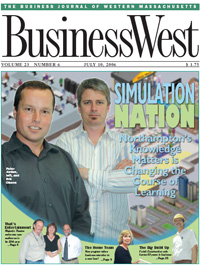
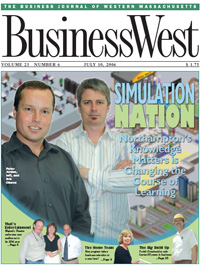
STCC’s Patient Simulators Open New Doors to Learning
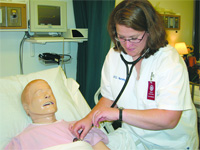
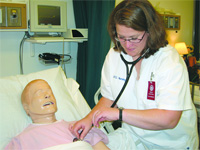
Nursing student Tracy Stanlewicz

Nursing student Tracy Stanlewicz checks the vital signs of one of STCC’s 14 patient simulators.

When Springfield Technical Community College bought its first patient simulator several years ago, it was a fresh idea in medical education. Now many more colleges are getting on board. They increasingly realize what students and professors at STCC have known for years: that real-world experiences in medical training lead to real-world successes later on.

Michael Foss remembers the day, during his medical training, when lightning struck — a moment both terrifying and valuable.

“I was transporting a patient down an elevator, and lightning struck outside,” said Foss, now dean of the School of Health at Springfield Technical Community College. He recalled that the elevator suddenly stopped, the lights switched off, and the patient, who was hooked up to a respirator, stopped breathing.

“It scared the hell out of me,” he said. “In a matter of seconds, I was completely alone with the patient. All of a sudden, the lights came back on, the elevator jumped, and the patient started to breathe again.”

As Foss related this tale, he leaned forward with a sneaky grin. “We can do that kind of cool stuff here, any time we feel like it,” he said — thanks to a growing collection of state-of-the-art patient-simulation mannequins that can replicate virtually any situation a nurse or other medical professional might encounter in real life.

Say a couple of students are transporting a ‘sim’ patient, thinking they have done everything properly to stabilize him. “If they start to get complacent, thinking everything is cool, we can make everything not OK,” Foss said. “We can have that patient take a dive in the hallway or the elevator or anywhere else we feel like.”

These sim patients — which simulate movement, breathing, and a host of vital signs — are given the human touch by a professor, who monitors students’ interaction with the patient from another room using a camera. The professor not only serves as the patient’s voice, but uses a computer to direct responses and vital signs.

Patricia Hanrahan, director of Clinical Education at STCC’s School of Health, used the example of a blood draw to compare patient simulators to ‘task trainers’ like a realistic — but unmoving — arm.

“When they put the needle in the patient’s arm and the patient passes out, they not only have to figure out what to do with the patient, but what to do with the needle,” she said. “There are two sets of expectations that are simultaneous.”

But then, there’s a payoff. “A student came to me with a great big smile on her face and said, ‘I did it.’ The same thing happened to her in a clinical setting, and she knew exactly what to do. The people at the agency were so impressed that they hired her on the spot for an externship.”

In this issue, BusinessWest looks into the history of patient simulation at STCC — and why it is proving beneficial not just to students, but to real patients everywhere.

Starting Small

The college’s first attempt at patient simulation was in its sonography program, and was a computer-based simulator that looks and acts like a real ultrasound scanner. When a student moves a probe across the patient’s body on the table, the screen brings up actual ultrasound images on the screen.

“That’s how we got started in simulation,” Foss said. “Then we decided to go to full-size human patient simulators, so we made a large investment in an adult male and a pediatric male that could be plugged into the same piece of computer equipment. We opened our patient simulation center and used it for respiratory care, mostly.”

Meanwhile, other faculty members were intrigued by the possibilities of this pair of talking, breathing simulators. Soon after, a nursing graduate who was working for a simulation company approached the college about lending another full-size sim in exchange for the chance to conduct some research on campus.

As time went on, the roster of sims in the department continued to grow to its current total of 14, with a mix of different ages, genders, and ethnicities.

“For a long time, the airline industry has demanded that pilots go through cockpit training in simulators,” Foss said. “We thought, if it’s good enough for pilots to keep people alive, it would probably work for students going into the health care field.”

Each year brings further advances, so that the sims can be updated completely through software. The newer models are also mobile and not confined to a bed setting.

Mobility has opened the use of sim patients to many more departments than the original models did. For instance, the first patients couldn’t be moved into the chair for Dental Assisting students to work on, as is possible today.

“We put a portable patient in street clothes, put him in the chair, and one of the faculty acted like the doctor and gave him a shot of anesthesia,” Foss said. “As the patient was conversing with the dental assistant student, he started to have slurred speech and wasn’t very responsive. We were watching this on a camera and changing all the vital signs, just like what might happen in a real patient situation.”

Confidence and Competence

It’s important, he explained, for students to experience these bumps in the road during seemingly routine procedures now, when no one’s health or safety is actually at stake.

“We’re making sure that the context and environment students learn in is as close as possible to the environment they’re going to work in after graduation,” he told BusinessWest. It’s an effort that goes beyond the sims; the college has been renovating its health education facilities to make the rooms look more like real medical settings as well.

That realism today will build some essential skills that aren’t learned in a textbook, Hanrahan said.

“In clinical education, confidence and competence are very important,” she explained. “When students feel more confident about their skills, they tend to act more competently in the clinical area, and that gives them even more confidence to make clinical decisions.”

The hands-on training is not to be understated, Hanrahan said, recalling one student who aced a written exam, yet flunked the accompanying simulation test. Better to fail in class, of course, than with real patients.

“Before they go to their clinical training, they can walk through that environment here. Then, when a similar thing happens, they feel like they know what to do.” It helps that all simulations are taped so students may review their decision-making and responses with professors afterward.

“We’ve had task trainers for years — parts of the body,” Foss said. “So they can stick the needle into the plastic arm, but the arm does not react. Our patients will react. We can have them refuse — and that brings up an entirely different set of skills. Then, when they’re in a stressful situation with a patient down the road, they can draw on this and say, ‘I’ve done this before.’ It helps them to relax.”

He compared the experience, again, to flight simulators that train pilots — technology so advanced that it’s indistinguishable from performing actual maneuvers thousands of feet above the earth.

“We’re almost to that point, where we’re suspending the users’ disbelief,” Foss said, noting that the hospital-like settings of the rooms are crucial to the illusion.

When we put the simulator on a hospital bed near the normal things you’d find in a hospital, it becomes more real and meaningful to them. I feel strongly that we’ve often taken hands-on experiences in medical training out of context; with the patient simulators, we’re putting it back into context.”

Scary Moments

That context, of course, can be decidedly unnerving.

“I can assure you,” Foss said, measuring his words, “that we can make this one of the scariest moments of your career. We can throw things at you at a very high level that will make you sweat.”

That’s partly because few students ever get everything exactly right, he explained. “You may think you’ve given the right dose for this patient, but you didn’t because you forgot to check his weight. Or perhaps you left the room, and when you came back, you didn’t check his name appropriately. Or you didn’t do chest compressions properly. You thought you did, but the computer knows better.”

But the sims don’t only develop proficiency. They also help students understand that even their best efforts aren’t always enough. “We do, sadly, kill patients,” Foss said. “There are times when you do everything right, and the patient still dies.”

That’s a useful lesson, Hanrahan said. “Students are able to problem-solve not only what they did, but how they feel about it, how to make sense of it, how to communicate with family members. This is not about merely technical or psychomotor skills; it’s about taking care of patients. We give them an environment where they can reflect and faculty who help them reflect.”

Some pick up the concept sooner than others. Foss recalled a tour of visitors to the classrooms during which he voiced one of the patients as a man with Alzheimer’s disease. As the group discussed the patient simulators, Foss, as the sim, kept asking for his long-dead wife, and one of the visitors became intrigued.

“She interrupted the conversation and said, ‘Let’s listen to him. He sounds like he has Alzheimer’s.’ And she had it, dead-on,” Foss said. “You can’t do that with a task trainer.”

Then there was the time a student successfully helped his sim through a critical moment and had him stabilized. Another student took over at that point, and instead of taking it easy or asking for help on what to do next, he started talking to the patient, noting on his records that he smoked two packs a day, and that wasn’t good for him.

“He basically went through a very personal health education moment. We were not expecting that, and it blew us away,” Foss said. “Both students did an exceptional job, and because of that, they have the confidence and competence to handle such a situation.”

Expanding Upon an Idea

Meanwhile, STCC has achieved the competence with patient simulation to become a model for the other 14 community colleges in Massachusetts. Three years ago, hardly any of the other campuses had patient simulators, and now about half own at least one, with more coming on board all the time. And that’s important, Foss said, because although community colleges aren’t turning out doctors, they do supply the bulk of new nurses and other medical personnel across the state.

“If we can help introduce patient simulation to other schools, we’re actually improving the quality of health care across the entire Commonwealth, so that’s our goal,” he said, noting also that simulation also carries some intriguing workforce-development possibilities, such as hospitals sending employees to a local college campus to train on a new procedure.

“It has even been suggested to us as a pre-hire evaluation,” Foss said. “If you want to know for a fact that an employee can do a whole set of skills, you send them to a patient simulator and let them prove it.”

Hanrahan said such efforts would not be out of line with the patient-safety goals so prominent in the modern hospital setting. “All health care institutions are very focused on patient safety as a quality issue,” she said. “We can create and recreate situations that help people evaluate their ability to practice safely.”

They’re doing so by teaching students how to focus on the patient, Foss said. Instead of asking the professor what to do next, students are gradually trained to direct questions to the patient. And technology is continually improving to help suspend students’ disbelief, including baby sims who are “delivered” from adult-size sims; the babies come out with a blue tint and eventually turn pink — as long as the student makes the right decisions.

“It’s powerful to see students acquire mastery,” Hanrahan said. “These students are providing the employment pool in the local and not-so-local health care arena, and we want them to feel that they’ve mastered what they came here to accomplish.”

It’s a sudden rush of knowledge that can hit a student like — well, like a bolt out of the sky.

Joe Bednar can be reached at[email protected]

Departments

Verizon Extends Broadband Network

WOBURN — Continuing to build on its strategy to provide voice and data networks to businesses and mobile professionals across the country, Verizon Wireless recently announced the expansion of wide-area wireless broadband services to the Springfield, Northampton, and Amherst areas through its BroadbandAccess and V CAST offerings. The expansion, based on the company’s Evolution-Data Optimized network technology, creates coverage along Interstate 91 traveling from the Connecticut border to the college towns in and surrounding Amherst and up to Hatfield. BroadBandAccess coverage is being expanded in Springfield, West Springfield, Amherst, Hatfield, Northampton, Hadley, Holyoke, Chicopee, Ludlow, Palmer, Wilbraham, Longmeadow, and Agawam. For more information, visit www.verizonwireless.com.

AIM’s Confidence Index up in October

BOSTON — The Associated Industries of Massachusetts (AIM) Business Confidence Index gained 2.9 points in October to 59.9, its highest reading in 20 months. The rise moved the Index above a narrow range in which it had fluctuated for most of the past two years, according to Raymond G. Torto, chair of AIM’s Board of Economic Advisors and Principal, CBRE Torto Wheaton. Massachusetts employers were significantly more positive about national economic conditions, reflecting rising stocks, falling energy prices, and favorable news on interest rates, added Torto. Survey respondents also reported stronger sales and an increase in hiring. The Index is based on a survey of AIM member companies across the state, asking questions about current and prospective business conditions in the state and nation, as well as for their respective organizations. For more information, visit www.aimnet.org.

Bay Path Seeks Sponsors for Women’s Conference

LONGMEADOW — ‘Resilience’ is the theme for the 12th annual Bay Path College Women’s Professional Development Conference on April 27 at the MassMutual Center in Springfield, and keynote speakers have been secured to address that subject. They are: Valerie Plame, the CIA operative whose identity was disclosed by the media, resulting in an unwelcome end to her career; Lynn Donohue, a high-school dropout who became a millionaire by starting her own bricklaying company; and poet and author Maya Angelou. Businesses interested in marketing opportunities during the conference should contact Kary Lewis, director of Special Programs, at (413) 565-1293 or via e-mail at [email protected].

Bright Nights Features New Area

SPRINGFIELD — Santa’s Cottage is a new display that will be featured at Bright Nights at Forest Park this holiday season, sponsored by the Spirit of Springfield and the Springfield Parks Division. The display will be the first opportunity for visitors to get out of their vehicles and walk among the lights leading the way to Santa’s Cottage. United Bank is the sponsor of the new area. Inside Santa’s Cottage, a cozy atmosphere will be created for Santa to greet visitors, pose for photographs, and listen to holiday wish lists. Bright Nights at Forest Park will open for its 12th season on Nov. 22 and operate Wednesday through Sunday until Dec. 10. Beginning Dec. 13, the lights will be lit nightly. For more information on Bright Nights, visit www.brightnights.org or call (413) 733-3800.

Region Expected to Trail Growth Nationally

BOSTON — The New England Economic Partnership expects New England to lag behind the nation in economic growth through 2010. The forecast group also noted that its twice-yearly predictions are speculative given the uncertainty about the current housing slump. The group also noted that employment in New England is expected to grow at an average rate of 0.8% a year through 2010, below the 1.3% forecasted each year across the nation.

Features
Life Sciences Center Helps Turn Good Research into Good Health

To Dr. Lawrence Schwartz, the life sciences are about bridging a gap.

“A lot of our activity is in transitional research,” said Schwartz, science director of the Pioneer Valley Life Sciences Institute (PVLSI) in Springfield. “We’re trying to take the discoveries we make in the lab setting and move those to clinical applications. There’s a big gap there.”

A recent $3 million grant from the Mass. Technology Collaborative (MTC) will help the institute — a scientific research partnership between Baystate Medical Center and UMass Amherst — make that kind of connection in a field called apoptosis. That’s the study of cell death, a normal process that, when it goes haywire, is a key factor in many types of disease.

Schwartz, who is also a faculty member at UMass, explained that a better understanding of how apoptosis works on a tissue-specific basis may potentially open opportunities for treating, preventing, or delaying the onset of various types of cancer, cardiovascular disease, autoimmune diseases, and neurodegenerative conditions such as Alzheimer’s disease and Parkinson’s disease.

“People always talk about promising new research, but much of it never makes it to clinical applications,” he said. “We want to bridge the space between clinical science and medicine.”

The institute is doing so by bringing together an impressive — and growing — roster of not only cell and molecular biologists and geneticists, but also experts in computer science, chemical engineering, and other diverse fields to achieve the kind of breakthroughs that can potentially make an imprint on people’s lives, not just on the pages of medical journals.

In doing so, Baystate and UMass hope the partnership, which has been up and running for three years, proves to be an economic driver for Western Mass., incubating biotech startups and attracting established companies in an effort to create a life sciences hub in the Pioneer Valley.

Cell Death, Birth of Knowledge

The PVLSI opened in 2003, with facilities both on Main Street in Springfield and on the UMass campus in Amherst, with the goal of establishing biomedical research programs in areas such as breast cancer, neurodegenerative conditions, and diabetes and other metabolic disorders,

“At this point, we have really gone from a concept to operationalizing the institution,” Schwartz said. “We’ve recruited a number of scientists and have active searches for additional scientists, and we’ve already built out a very strong research program in breast cancer. Those are some of the tangibles we want to see in a robust research program.”

Schwartz said decisions on what fields to study are made simply on the basis of what is most relevant to this region.

“The fields we picked out are ones that are very important to the community; they are public health concerns,” he said. “They’re also fields in which we have a number of pre-existing collaborations” — Baystate’s neighboring Breast Center being one example — “and we want to build more. We have resident expertise in these areas, but these decisions are driven not only by our capabilities, but by the interests of the community.”

To date, the institute has garnered more than $11 million in federal funding and more than $420,000 in private research grants. The latest prize, the $3 million grant from the Mass. Technology Collaborative, will help establish a new program to focus on apoptosis (cell death) — a field in which UMass is already recognized as a research leader, Schwartz said.

That reputation is important, said UMass Chancellor John Lombardi, who noted that he heard doubts several years ago whether the life sciences partnership would work at all, let alone grow and continue to earn research funding. “It succeeded because these enterprises are good,” he said, referring to the hospital and the university.

The institute’s directors recognize that apoptosis is an arcane concept to most people who work outside the science or health field, but researchers believe it’s an important concept when it comes to learning to control and prevent disease.

Apoptosis is a natural process; in fact, millions of your cells are dying as you read this paragraph. This process is normally well-regulated by the body’s cells. However, defects in the control of apoptosis can have damaging effects on the body.

For instance, cells can inappropriately activate the apoptosis program, resulting in the loss of valuable cells, such as neurons in Alzheimer’s disease or heart cells following a heart attack. On other occasions, cells can ignore the body’s instructions to commit suicide, as it were, and persist — which is an essential step in the formation of most cancers and autoimmune diseases.

Recent research has shown that individual cells represent specific genes whose proteins are key to the apoptosis process, and that these genes are defective in certain diseases. The research community — including the PVLSI — is now beginning to exploit these insights to make connections between understanding apoptosis and controlling the onset or spread of disease.

“About 70% of human disease results from defects in the regulation of apoptosis,” Schwartz said. “If we can control it, we’ll have a very effective tool for treatment.”

Good Economic Health

Clearly, Schwartz is talking about global goals when he describes the health potential of such research. But the Pioneer Valley Life Sciences Institute has always had a second goal — the economic health of the region, and especially the potential of Western Mass. to become a hub of biotechnology and life sciences research.

“This center presents an enormous opportunity for the Pioneer Valley to reap the vast economic benefits from the state’s growing life sciences sector, which is critical to our high-tech, knowledge-based economy in Massachusetts,” said Patrick Larkin, director of the John Adams Innovation Institute, the development arm of the Mass. Technology Collaborative.

At a recent ceremony announcing the $3 million grant, Springfield Mayor Charles Ryan made the connection between such goals and the economic improvements that Baystate has already made on Springfield’s north side, investing some $100 million in medical and research facilities along the Main Street corridor.
Ryan noted that he inherited some unfortunate circumstances when elected mayor three years ago, “but I also inherited this, which is great for the North End of Springfield.”

Dr. Paul Friedmann, executive director of the PVLSI, envisions economic development that reaches far broader horizons. The institute has already formed partnerships with private industry, working to develop new technologies in the life sciences with an eye toward commercialization.

For example, the institute has helped a company called Biomedical Research Models, which has space in the life sciences building on Main Street, achieve federal funding for work on congestive heart failure — a condition that costs Medicare billions of dollars a year. “They in turn have a large subcontract with us that provides many services that we need,” Schwartz said.

He and Friedmann see more of these partnerships arising in the future. Similarly, the John Adams Innovation Institute is committed to improving the Bay State’s competitive edge in knowledge- and technology-based industries, such as the life sciences.

Schwartz noted that he and Friedmann recently participated in a program with U.S. Sen. Edward Kennedy, U.S. Rep Richard Neal, and officials from both the pharmaceutical industry and government agencies supporting biotechnology and economic development. The dialogue was meant to spur interest in developing the life sciences sector in the western part of the state.

“We want to see a biomedical hub out here, a regional program with incubator space for small startup companies and facilities for larger companies that want to have a presence in Western Mass.,” Schwartz said.

Mark Tolosky, president and CEO of Baystate Health, noted that “we continue to see very significant investment here that will impact our region and beyond.”
Yes, cells may be dying all the time, but medical innovation in the Pioneer Valley is definitely showing signs of life.

Joseph Bednar can be reached at[email protected]

Sections Supplements
Inspired by the Birth of a Nation — and a Notion
Lauren Way

Lauren Way

Lauren Way remembers her early days as a young entrepreneur as a wild, intense learning experience.

She was in her early 20s and had just founded an international commodities trade company in the former Soviet Union, after majoring in Russian Civilization at Smith College. She said she expected the experience to be eye-opening and life-changing to a degree, but never expected to find herself embroiled in one of the most notable shifts of power and culture in history, as the Soviet Union dissolved and was replaced, by no means smoothly, by a Democratic, free-trade society.

Theese were times of flux and of famine, she said, recalling days watching tanks roll by while waiting in long lines, clutching ration tickets, for the only available food. Sometimes it was eggs, sometimes it was bread, but it was always scarce.

Today, Way is a professor and director of the entrepreneurial program and cooperative education initiatives at Bay Path College, and, though the road from Russia to Western Mass. was long and winding, she says those early experiences in a volatile setting played a large role in her decision to continue studying entrepreneurship and innovation, and, in turn, bring that knowledge with her to the world of academia.

Budding Abroad

This wasn’t a career path she’d planned, but one she has since embraced as an apt result of a diverse educational and professional background.

Way’s first entrepreneurial venture, as she sees it, was actually academic in nature; as a high school student in Chester, Vt., she researched private schools, applied for scholarships, and, after finishing most of the necessary leg work for admission and financing on her own, presented her parents with a proposal to attend Kimball Union Academy in New Hampshire.

“It was my first entrepreneurial approach to anything,” she said. “I was progressive about my own education, and that led to new opportunities, in addition to surprising my parents.”

Way did the same when researching colleges, and while at Smith, continued to follow her own unique path, selecting a major that few business owners have on their resume.

“I chose Russian Civilization because I love the language,” she explained, “and they say to major in what you love.”

The course of study led her to take her junior year (1990 to 1991) abroad through the American Collegiate Consortium International Exchange, during some of Eastern Europe’s most turbulent times. While honing her Russian language skills, Way also received a crash course in the ways of survival in a country undergoing a revolution. She quickly learned that nothing was free, and everything was hard to find, from luxury items to the most basic of necessities.

“That was definitely the most malnourished year of my life,” she said, adding, however, that her affinity for Russian culture only grew during her time in that country, and though she completed her study abroad and returned to the states to finish college, she soon went back to Russia to start a business with four Russian partners in 1992, importing everything from cooking pots to Portuguese wine.

It was an experience, she said, that offered a magnified view of the challenges associated with entrepreneurship and international business.

“We were really just testing the idea, pushing the buttons to see if we could make this work,” she said. “It was profitable, but the entire country was in flux. The value of rubles would change, drastically, literally overnight, and new laws were drafted from day to day and we had to interpret and reinterpret them.”

That shipment of Portuguese wine, for instance, weighed in at 20 metric tons and had the makings of being one of Way’s most promising imports, until while still in transit the import tax skyrocketed by 15%. Still, the venture proved to be an overall success, and a defining experience in Way’s life.

“At the time, I didn’t know if I had it in me, and conversely there were moments when I thought of myself as a failure because the business didn’t make me an amazing millionaire,” she said. “But I learned so much about entrepreneurship and about what I was capable of, and that’s an important idea to learn, and instill in others.”

From East to West

Way remained involved with the trade company for two years before selling her portion of the business to her partners and moving on to work with the international law firm White and Case as a paralegal in Moscow, continuing to interpret those complex laws in the new Russia. That four-year chapter in her career, as she calls it, also led to fluency in the Russian language and a solid understanding of the business climate in that country, as well the international scene.
However, like most entrepreneurs, Way was soon on the lookout for a new venture.

“I returned to the U.S. in hopes of finding something where the bottom line wasn’t money, but people,” she said, noting that she embarked on a series of meetings with other entrepreneurs in a sort of independent fact-finding mission, gleaning information on new opportunities, business practices that worked, and the individual strengths and histories of other successful business innovators. For a time, Way made ends meet with a succession of odd jobs, among them tending bar and serving as an interpreter at the 1996 Olympics in Atlanta.

Repeatedly, though, Way said she was attracted to academia, and the notion of developing her own entrepreneurial spirit and that of others on a formal level. She returned to Western Mass. — in part to take advantage of the vibrant college presence and also to enjoy the pace of life she experienced as an undergrad — and completed work toward a master’s in education at UMass Amherst. Soon after, in 1998, she took a post at Hampshire College as associate director of the Lemelson Assistive Technology Development Center.

“I wanted to be doing something that made me feel like I was making a meaningful difference,” she said, “and higher education is a field that I knew would allow for a wide-ranging approach to my career — one that would allow me to be a generalist, share my strengths, and also learn about several different things.”

Pioneers and Pathways

Way, who is now working toward a doctorate in Education focused on policy and leadership studies at UMass, remained at Hampshire College for eight years, managing an invention, innovation, and entrepreneurship program, developing curriculum, co-teaching a soft goods design course, and advising students on intellectual property and entrepreneurial business ventures. She joined Bay Path earlier this year, and describes her new position as a hybrid, one that couples theory-based teaching with practical program planning and the development of a broad, entrepreneurial focus at the college across all disciplines and departments.

“I think the college was looking for a specific type of person, one with a background in entrepreneurship as well as higher education,” she said. “The primary goal is to instill the entrepreneurial and innovative way of thinking, and programs leading to that on campus have grown so quickly that, in effect, we are academic entrepreneurs.”

Way added that while entrepreneurship is more often seen as an innate skill that, further, is only applied in the business world, she sees higher education as a perfect climate for fostering those entrepreneurial skills. She also sees the development of such programs at the collegiate level as necessary in a world that is increasingly homogenized, and in need of new, innovative solutions to issues both large and small.

“Teaching entrepreneurship is very multi-faceted,” she said. “If you just look at it from a business standpoint, you’re missing out. Practical knowledge can be augmented with theory, and I think it’s also false that creativity cannot be taught. I think it can be taught, or at least unleashed, in all types of students.”

Thus, it’s not just the creation of new businesses or products that Way hopes to see result from Bay Path’s entrepreneurial programming. Rather, it’s a more all-encompassing, entrepreneurial mindset, which can be applied to myriad situations — be they new business ventures, existing positions, or career paths.

“I’d like to see students take a more entrepreneurial approach to their careers and their lives in general, to latch on to that entrepreneurial way of thinking and to look at it as a process,” she said. “It’s increasingly necessary in order for people to propel themselves forward, and there is real value associated with the process.”

To that end, Way is in the midst of several initiatives at Bay Path designed to strengthen the entrepreneurial spirit on campus and, in turn, create a destination for women around the world in search of a cohesive, business-based education that will couple academic theory with tangible opportunities.

“My vision is that women will be able to come here with a business idea and graduate with that business up and running,” she said. “Making connections, marketing, accounting, public relations … these are all things that students can learn while in school, and in turn apply in real-life situations. Through this model, they can often do both at the same time. ”

Entrepreneurial programming is still a work in progress at Bay Path, but Way is a large part of its move forward. Already, students are working with local companies to solve actual business challenges, such as those associated with an expansion or change in product line, and are taking part in ‘live case studies’ involving those companies and the success of the new initiatives employed. Way will play a key role in writing grant proposals and helping the college secure additional funding for such initiatives as well, such as a three-year, $143,000 grant the Coleman Foundation awarded the college in 2005.

Students are also now taking part in a cooperative education program similar to an internship.

“It’s different from an internship in that it connects theory with practice in a way that internships often don’t,” said Way, and that’s where the bulk of her efforts lie in her new position — making connections between what is possible and how to apply that in a real-life setting.

The Next Line of Defense

That’s also a goal she plans to benefit from herself. Despite her varied history, Way said she has found a haven in higher education in which she intends to stay. Her goals for the future include advancing into higher-level administrative positions in education, perhaps even a college presidency in later years.

“I definitely see myself going deeper into the academic world,” she said. “I take a holistic approach to my job, and it’s exhilarating to see students doing the same, using a wide-ranging approach to entrepreneurship and to business, making meaningful contributions, and testing their own limits.”

And while it’s not likely that students at Bay Path will have to stand in long lines for bread or milk to test those limits, Way doesn’t see her experiences as very different from those that entrepreneurs, in all senses of the word, will face when meeting adversity head on.

“I learned so much about entrepreneurship while living in a country where it was often necessary to survive,” she said, “and that’s a good parallel for what I’m encouraging students to do here.

“They might not know if they have it in them, and to realize that they do, what is most important is the experience of doing.”

Jaclyn Stevenson can be reached at[email protected]

Sections Supplements
Dinn Bros. Marks 50 Years of Awards — and Rewards
The brothers Dinn: Bill, Paul, and Michael.

The brothers Dinn: Bill, Paul, and Michael.

Dinn Bros. Trophies was founded in 1956, and 50 years later it continues to evolve and change with the times. Change is constant in a business that may seem simple, but features immense competition and never-ending deadlines, and requires investments in new technology and strong relationship-building capabilities. By meeting all these challenges, Dinn Bros. has etched its name in Pioneer Valley business lore.

Bill Dinn remembers how it all started.

It was the summer of 1956, and one of Springfield’s amateur baseball leagues was in trouble and looking for help. The company it had hired to create trophies for that season’s top finishers failed to deliver, and at the 11th hour the league turned to Dinn’s brother Paul, an engraver, to fill the order. Bill stepped in to help, and a company was born.

A half-century later, many things have changed. The technology used to create plaques, trophies, and recognition items has improved exponentially; where once the company created three pieces a day using a hand engraver, it now completes three a minute with state-of-the-art computer systems and laser engravers. Meanwhile, orders are now taken via the Internet and a Web site that is enabling the company to expand its reach across the country and into Canada.

But many things haven’t changed.

Most orders still come in at the 11th hour, if not later, and the company’s specific promise to its many types of clients remains the same: “We won’t embarrass you,” said Bill Dinn, who is now retired but remains a visible force at the company, after years of serving as its head salesman.

“We had a particularly good showing in a pickle,” Dinn said of the company’s first order, adding that while that idea of avoiding embarrassment may seem strange, it has always been the crux of good business at a firm that manufactures and sells awards of all types.

“Imagine you’re at a banquet, everyone is there, you’re giving a speech, and you have to give an award to an important person … and the plaque isn’t there,” he explained. “That’s a big deal.”

He went on to note that, in many cases, the award — the actual hardware used to recognize the accomplishments of another — is the last thing people think of when planning a ceremony of any size.

“We’re always working against time,” he said, adding that it’s not uncommon for a large order due for a weekend event to come in on Thursday evening.

But tapping his forefinger definitively on the table before him, Dinn said no job is too big or too small. “It doesn’t matter if it’s one trophy for $6.95 or an order for 900 plaques that will cost thousands … it will be there.”

The Gold Standard

That guarantee is echoed by Dinn Bros. current senior management, Dinn’s three sons — Bill Jr., Paul, and Michael — who say that as a niche business, the company meets with a number of unique challenges, as well as many that all companies, especially those with both retail and manufacturing components, face.

Dinn Bros. offers plaques, trophies, medals, ribbons, pins, and other awards for various sporting organizations and events, as well as a wide array of corporate awards and other tokens of appreciation, such as desk sets and engraveable bowls and trays. All products are assembled and engraved on site at the company’s West Springfield headquarters, and sold via the Internet and through three showrooms in West Springfield, New Haven, Conn., and Stoneham, Mass.

Sports awards have remained the largest single product line offered by Dinn Bros., representing about 70% of sales, though corporate business is growing, in part due to a concerted effort on the part of the company.

And with the sports market comes a number of challenges that few not in this business could appreciate, according to Paul Dinn, president.

“Retention of contracts is a big challenge,” he said. “It’s not like we’re a paper company dealing with a business. In that case, if we were doing a good job and our prices were competitive, the company we were serving would probably stick with us.”

But sports programs and teams, especially those for children, often have a new person handling awards ceremonies each year, said Dinn, and tournaments, road races, and other charity events are hard to track; many are not established enough to have a Web site, or even a formal mailing address, let alone a contact person.

“There are a lot of volunteers and a lot of turnover,” he explained. “The Internet helps us with research, and every business has to build relationships. But we have to build them over and over again.”

In addition to the matter of maintaining repeat business under those conditions, educating the public about its products is another challenge, said Bill Dinn Jr., who oversees production at the company.

“Showing people just how to use the products is a bigger concern than many might think,” he said. “That’s because it’s not an everyday type of thing, ordering and giving an award. You don’t think about it until you have to do it. It’s up to us to educate the consumer on everything from appropriate wording to how to work awards into tight budgets.”

Its also a business with both peaks and valleys in terms of volume, and those busy periods don’t fall during what might be considered traditional peak periods. The holidays, for instance, are deadly quiet, while the spring months usually necessitate adding seasonal employees to the firm’s core of 100 employees.

Certificate of Participation

But to address those challenges, Dinn Bros. has moved ahead aggressively with a wide set of recent initiatives, all aimed at streamlining the manufacturing process, expanding the company’s reach both nationally and internationally, and upgrading technology in order to stay competitive against similar outfits, Internet-based companies, and sporting goods stores that create trophy subsidiaries.

Many of those changes have been instituted or highlighted this year, as the company celebrates its 50th year in business. Its Web site was redesigned, new catalogs were created to boost corporate business, and several new laser engravers were purchased and installed to expedite and streamline the assembly and personalization processes.

“We’re adapting to the modern age in order to drive business,” said Michael Dinn, vice president of sales and marketing. “Electronically, we’re better than ever, and that helps streamline the process and allows us to prep as much as we can for orders that have yet to come in.”

He noted that the company’s Web site, which pulls in roughly a third of all business and is still growing, once lagged behind the firm’s phone center, which employs customer service representatives to take orders from across the country. But over the past year in particular, Web-based sales have eclipsed phone transactions and have pulled in business from new areas, including the mid-Atlantic states, Alaska, and, most recently, Canada, where the company is making its first earnest foray into the international market.

“Our site allows for convenience in ordering, but it also assures people that we’re not a fly by night operation, or a little rinky-dink trophy shop,” said Dinn, who added that Internet sales have also been augmented by offering live assistance online for customers, a service that was put in place two years ago. Customers can send instant messages to a Dinn Bros. representative during specified times to ask questions, and are also notified when a product order is received and shipped, along with a tracking number. “That way, we’re never out of reach.”

Web sales have also helped in promoting corporate-recognition products, as has a new catalog devoted solely to those lines, in response to a growing business-to-business market.

“Many people think this is a business that stays the same year after year, but the industry does change,” said Paul Dinn, “and one change of late has been our role in the increase of corporate recognition programs. People are holding more organized events and seeing recognition as an important tool for morale and retention.”

Many of the services offered through some new technological upgrades are geared toward that burgeoning market, allowing for the etching or four-color printing of company logos and for products that best serve the corporate sector, such as desk sets and retirement gifts.

An Amazing Race

But Dinn added that while Internet sales allow for quicker processing and a smaller margin of error on all orders — all copy to be engraved can now be downloaded directly to a central computer system — awards of all types still intrinsically have ‘last-minute’ components at the assembly level.

Engraving recipients’ names is the most obvious, but figureheads for trophies — everything from the traditional runner, golfer, or bowler to a gold-plated foot, used as a gag during staged productions of the Monty Python-inspired Broadway play Spamalot — are attached to the base as orders are received, and customers sometimes have special requests for logo engraving or printing that differ from order to order.

“No matter how efficiently we take the order, we must still identify the deadline and work backwards,” he said. “To that end, we’ve invested in the equipment we need to keep us on the cutting edge, and the technology makes our work much easier than it ever has been before. Every year, we keep investing in better technology — our equipment parallels the personal computer market, in that it becomes obsolete easily.”

Those investments include state-of-the-art computer systems and laser engravers, such as the six Xenetech machines that now do the work that a large, bulky hand engraver did years ago.

Still, even with all of the changes at Dinn Bros., some things remain the same as they did 50 years ago. That heavy hand engraver sits in the main production area, right next to one of the new laser stations, serving as a reminder of how much the times have changed.

That amateur baseball league that reached out to Paul Dinn 50 years ago is no more, but it’s likely that some of the Dinn trophies awarded to players still exist, somewhere.

Like the company that produced them, they’ve managed to stand the test of time.

Jaclyn Stevenson can be reached at[email protected]

Sections Supplements
What Sets Cars Apart Today Is Not the Total Package, but the Surprises Inside
The VW Jetta GTI with its accompanying First Act guitar.

The VW Jetta GTI with its accompanying First Act guitar.

From cars with guitars to luxury models that park themselves, the auto industry is introducing new amenities and gadgets that could only have been imagined a generation ago. Some experts say if it’s trendy in the home, soon it will be seen in vehicles of all sizes and price points. And this has many speculating about what’s around the bend.

Mark Thompson, a sales consultant for Balise Lexus in West Springfield, recently spoke with BusinessWest from his car, on the way to a seminar in Boston.

Thompson didn’t need his cell phone to make the call, though. He used only his voice to dial the number, spoke freely while driving, and never took his hands off the wheel. Essentially, technology had allowed him to use his vehicle as a $60,000 phone booth — just one of the conveniences afforded him and the rest of the driving public through new advances in creating ‘networked’ cars.

The new amenities are varied, but the trend is clear: cars are rolling off the assembly line already equipped with a wide range of high-tech bells and whistles aimed at convenience, personalization, and the creation of a certain wow factor.

Auto manufacturers have historically engaged in one-upsmanship to keep their cars viable in a demanding market, but until this decade many of those improvements were geared toward safety concerns — things like anti-lock breaks, airbags, and automatic seatbelts — all of which are now commonplace.

Thompson said that competition raised the bar for all manufacturers, and today, all new cars meet high safety standards.

“Cars have never been safer than they are now,” he said. “And there’s only so much you can do realistically. There is a dollar value connected to new developments, and there comes a point where it’s not worth it to try to invent some new mechanism.”

Those strides in vehicle safety are notable, but the plateau manufacturers across the globe reached also left them with a new challenge.

“The industry needed a new wow factor,” said Thompson, “and everybody likes toys.”

And for many new offerings, ‘toys’ is a good description.

Not all technologically advanced features are necessary for better driving, or even for a more comfortable ride; Volkswagen’s newest promotion, for instance, is a selection of 2007 models outfitted with a jack, into which a First Act GarageMaster electric guitar can be plugged and played through the car’s audio system. The Jetta, Jetta GLI, GTI, Rabbit, New Beetle, and New Beetle Convertible are all compatible with the guitars, which were produced exclusively for the promotion. They’re also the only axes that will play through the car, via a special pre-amp built into the instrument, which also includes the same VIN number as the car it comes with.

Damon Cartelli, general manager of Fathers and Sons, said the ploy is bringing in a good number of curious shoppers, and is indicative of Volkswagen’s unique approach to marketing.

“VW is very progressive, and always has been,” said Cartelli, “and with this promotion they’ve really wrapped their hands around their audience.”

Staging a Coupe

While the guitar promotion, which will run until the end of the year, is more a savvy advertising campaign than an application of new technology to create a better driving experience, Cartelli said it also underscores how affordable and accessible new technology is becoming.

“The guitars are available on cars priced from $14,900 or so and up,” he said. “New technology isn’t just for luxury models anymore. Cars across the board are coming equipped with things like GPS systems, adaptive cruise control — you don’t need to use the brake, sensors tell the car when to slow down — and Bluetooth capability.

“People are coming in to see the VWs with the guitars,” he said, “because that’s truly unique. But as they take a closer look they’re realizing that they can afford to have practical amenities too.”

Nick Twork, public affairs manager for Ford Motor Company’s technology division, said the preponderance of those practical features is not relegated to foreign models — Ford has unveiled a long list of new features that will come standard in several 2007 Ford, Lincoln, and Mercury models and will be added or made available in several existing models including the Ford Explorer, Lincoln Navigator, Ford Mustang, Mercury Milan, and Ford Fusion.

Those product highlights include power-fold mirrors, rear-seat entertainment systems, reverse sensors, cooled seats, navigation systems, and SIRIUS satellite radio, added to 14 different cars this year.

“Navigation systems are probably the biggest addition to our cars,” he said, “and auxiliary jacks for mp3 capability. But new technology is rolling out fast and furious, and there is much more to come in the near future. All I can say is ‘stay tuned.’”

The influx of vehicles at all price points equipped with things like GPS navigation systems and Bluetooth is still a relatively new phenomenon, despite its breadth. Cartelli said that, as recently as four years ago, only a handful of makes included GPS systems, and even then, they were more expensive and less reliable than they are now.

“New technology is so much more cost-effective that features once seen only in luxury models are being added to all types of cars,” he said, listing among them rain- sensitive windshield wipers, back-end camera systems, and built-in, voice-controlled phones and radios. “Soon, every car will be Bluetooth-ready. It’s not an expensive technology, and as manufacturers recognize the need to compete, they’re looking to make anything standard in their cars that’s going to give them the edge.”

Thompson agreed, saying it’s all about creating and preserving brand identity in this new climate.

“The reason why we’re seeing this distinct personalizing of cars is because if you look at cars on the road, you’ll see the same aerodynamics, the same fenders, the same hood … the bumper might be a little different, but everything else in the outer design is geared toward fuel efficiency. It’s harder then ever to tell one make from another — what sets cars apart from others now is the items on the inside.”

Sound Advice

And again, in the interest of personalization, some of those items are little more than fun extras, like electric guitar jacks or built-in hard disk drives that have 13.9 gigabytes of storage and can play up to 2,000 mp3 files without the use of an outside music player. But others are geared toward road warriors and other professionals, in the interest of making vehicles more conducive places in which to work.

Increasingly, cars are equipped with Internet-ready computer systems and screens for browsing or checking e-mail, and Bluetooth capability, which allows for a number of networked functions that are prompted by simple voice commands in many instances.

“Calls can be made from the car without taking your hands off the steering wheel — no phone, no ear buds, no dialing,” said Thompson, who spoke with BusinessWest using just such a system. “I can also check my E-mail and listen to anything from my music library.

“These things were unheard of 10 years ago, but we’re a commuter society,” he said, “and it’s a necessity now, not a right, to drive a car. Manufacturers are trying to make them as homelike as possible.”

In fact, auto manufacturers seem to be taking their cues from the home and garden market, where technologically advanced entertainment, convenience, and Internet-based products already abound.

“What you see in homes now is what we will see in cars in the future,” said Thompson, noting that DVD players, Internet access, and in-car coolers or mini-refrigerators are currently widespread. “I think gaming systems will be next.”

Beyond those home-like features, though, are some new convenience-based advances that are unique to the automotive market. Some are simple and useful, like push-button power folding seats or keyless entry systems that detect when a set of keys, even those buried in a purse or pocket, are approaching the vehicle. Others are more dazzling, like the new self-parking Lexus that is creating a buzz within the luxury car market. Thompson said the car is an answer to a problem for many drivers — the onus of parallel parking — and also further proof of the evolution of automotive technology.

“A lot of people have trouble parallel parking, and in this car, you really do just hit the button and sensors guide you into the spot,” he explained, noting that the feature also lessens the added difficulty in parking due to two safety items already present on the car — larger headrests, which can create new blind spots, and more streamlined aerodynamics, which make it hard to see out of the back of the car. “This system lets the driver guide the car until it gives the green light, literally, at which point they can take their hands off the steering wheel and the car does the rest.”

Business Turnaround

That notion of letting the car do much of the work is a major driver in the race to offer the most current technology. Where the line will be drawn is still unclear, but Thompson said there are a few things on his own personal wish list.

“I’m still waiting for someone to come up with a car-ready microwave and blender,” he said.

Jaclyn Stevenson can be reached at[email protected]

Departments

Former MassMutual Chief Wins Appeal over Firing

SPRINGFIELD — Robert O’Connell, former MassMutual Financial Group chief executive, was unjustly fired last year, according to the ruling of an arbitration panel hearing his claim, and now O’Connell stands to win about $50 million in termination benefits. MassMutual ousted O’Connell last year, accusing him of abusing his authority by improperly manipulating stock accounts and interfering with internal investigations, among other wrongdoing. However, the Sept. 22 ruling by the American Arbitration Assoc., which was kept sealed until Oct. 20, finds that O’Connell has essentially prevailed on most of his claim. “The company did a total character assassination of Mr. O’Connell in order to deprive him of his contractual rights, terminate him, and advance and promote his detractors,” O’Connell’s attorney, Dean Richlin, told The Boston Globe. “This decision is a total vindication of Mr. O’Connell and a total rebuke of the board of directors at MassMutual and its advisers.” The company has filed suit against O’Connell in Suffolk Superior Court, seeking to have the award set aside. In a statement to employees, MassMutual Chairman James Birle and Chief Executive Stuart Reese asserted that “we believed then, as we believe now, that the totality of [O’Connell’s] behavior was, at a minimum, improper, unprofessional, and lacking in the ethical leadership that is required” at MassMutual.

Harvey Industries to Expand in Chicopee River Business Park

CHICOPEE — Harvey Industries Inc. recently announced plans to expand its manufacturing operations by constructing a new facility in the Chicopee River Business Park, according to the Westmass Area Development Corp. (Westmass). The vinyl window and door manufacturer currently leases space on Cottage Street in Springfield, but has grown considerably, creating the need for a new larger facility, according to Tom Russell, senior vice president of manufacturing for the company. The new facility will be on a site of approximately 30 acres, which is in both Chicopee and Springfield. The new building will be approximately 255,000 square feet, an increase of more than 100,000 square feet. More than 230 people are employed at Harvey’s current manufacturing site, and the expansion is expected to add a significant number of quality jobs. A groundbreaking is expected in 2007.

Regional Bureaus Receive Tourism Grants

BOSTON — Several Western Mass. visitor bureaus recently received grants from the Department of Business & Technology (DBT)/Massachusetts Office of Travel and Tourism (MOTT) to help generate tourism spending in Massachusetts. Tourism is recognized as the state’s third largest industry, generating more than $808 million in state and local taxes and nearly $12.5 billion in travel-related expenditures. The Greater Springfield Convention and Visitors Bureau received $460,995 in state funds to market the region as a premier destination, while the Mohawk Trail Association received $181,811 in grant funds. Additionally, the Berkshire Visitors Bureau received $507,567 in state funds for marketing purposes.

Most Workers Consider Age Irrelevant at the Office

MENLO PARK, Calif. — They say age is a state of mind, and a new survey suggests this may be particularly true in the office; 84% percent of workers polled said they would be comfortable reporting to a manager who is younger than they are, and 89% said they wouldn’t mind supervising employees older than themselves. For the first time in history, four generations of employees are in the workforce, from the Silent Generation and baby boomers to Generations X and Y, according to Diane Domeyer, executive director of OfficeTeam. She added that companies recognize the benefits of having diverse, well-rounded teams, and employees may be just as likely to report to a younger supervisor as an older one. In either case, the boss’s management abilities are more of a factor in employee job satisfaction than his or her age. Domeyer said that employees today are recognized more for performance than tenure with a company. The survey was developed by OfficeTeam and includes responses from 567 individuals 18 years of age or older and employed in office environments.

Report Shows Cities Guardedly Optimistic about Fiscal Health

WASHINGTON, D.C. — Like the millions of Americans they represent, U.S. cities were able to pay their bills this year but are concerned about how rising costs will affect their long-term financial stability. In fact, despite a more optimistic view of fiscal conditions, cities have yet to recover fully from the effects of the 2001 recession once changes in city revenues are adjusted for inflationary factors, according to a report recently released by the National League of Cities (NLC). More than two in three city finance directors who responded to the City Fiscal Conditions Survey in 2006 said their cities were better able to meet financial needs during 2006 than in the previous year, yet many city officials cite numerous negative factors that are affecting the solvency of their budgets. An overwhelming majority (92%) of city finance directors cited prices, inflation, and cost of living as factors affecting their city budgets. The survey is a national mail survey of finance officers in U.S. cities. Surveys were mailed to a sample of 1,059 cities, including all cities with populations greater than 50,000 and a randomly generated sample of cities with populations between 10,000 and 50,000. The 2006 survey data is drawn from 385 responding city finance officers and allows NLC to generalize about all cities with populations of 10,000 or more. Copies of the report are available at www.nlc.org. The NLC is the nation’s oldest and largest organization devoted to strengthening and promoting cities as centers of opportunity, leadership, and governance.

Performance Food Group Purchases Site

SPRINGFIELD — Performance Food Group Co. has purchased 32 acres in the Memorial Industrial Park II on Roosevelt Avenue to expand its Taylor Street operation. The international food and kitchen supplies distributor paid $1.62 million for the property, which will include a 211,000-square-foot facility. The property is adjacent to Smith & Wesson. Company officials expect to go from 300 full-time employees in 2007 to 532 by 2013.

Bradley Adds Amsterdam Flights

WINDSOR LOCKS, Conn. — Bradley International Airport (BDL), in conjunction with Northwest Airlines, recently announced it will begin offering scheduled daily nonstop international service for the first time in July. While Northwest Airlines has increased frequency of flights at other airports, BDL is the only new service to be announced by Northwest. Nonstop service to and from Schiphol Airport in the Netherlands is scheduled to begin July 1. The new daily flight is scheduled to depart BDL at 5:45 p.m. and arrive at Schiphol at 6:45 a.m. The return flight leaves Schiphol at 1:30 p.m. and arrives at BDL at 3:30 p.m. With this new service, travelers will have the ability to connect to 81 cities in Europe, the Middle East, Africa, and India.

Deerfield Properties Sold To N.Y. Firm

DEERFIELD — O’Connell Development Group of Holyoke recently announced the sale of two properties at Yankee Candle for $33.6 million. Both properties on Yankee Candle Way had been leased to the Yankee Candle Co. Deerfield Yankee Candle Acquisition LLC, a company formed by Gumowitz Real Estate in New York City, was the purchaser of the warehouse and three-story office building. O’Connell and its real estate company, Candist LLC, sold the warehouse for $19.6 million, while O’Connell and Candoff LLC sold the office building for $14 million. Both transactions closed on Sept. 27.

Pike Board Considers Ending Tolls West of Route 128

BOSTON — The Mass. Turnpike Authority board recently announced plans to end tolls west of Route 128 effective June 30, a sweeping policy shift that would provide considerable financial relief to thousands of commuters. Under the proposed plan, taxpayers would assume the burden of running and maintaining the Massachusetts Turnpike from Weston to Springfield, and approximately 200 toll collectors would be laid off. At press time, political opponents of Lt. Gov. Kerry Healey decried the timing of the board’s vote, saying it was designed to give Healey a boost among a key bloc of voters. To abolish the western tolls and transfer that portion of the turnpike to MassHighway, the state will have to repay the authority’s remaining $199 million debt on the highway.

Economy Keeps Growing Despite Cooling Trend in Housing

WASHINGTON — The Federal Reserve’s latest survey of business conditions around the country found the economy expanding, with growth described as “moderate or mixed.” However, the report also found there was a distinct slowdown in housing, with the majority of the Fed’s 12 regions reporting lower asking prices for homes, a softening in sales, and rising inventories of unsold homes. In addition, the Fed noted that financial institutions were finding that mortgage lending activity had tapered off. That decline in lending was being offset slightly by an increase in lending for commercial projects in several districts, according to the Fed. The economy grew by 2.6% in the second quarter, less than half the pace of the first three months of the year, as it was battered by soaring gasoline prices, rising interest rates and the cooling housing market. The Fed also noted that manufacturing activity was holding up well, with eight of the 12 districts reporting an increase in factory output.

Sections Supplements
Construction Company Quickly Builds a Portfolio in the Pioneer Valley
Bill Aquadro, left, and Steve Killian stand in the shadow of Cooley Dickinson Hospital’s $40 million expansion project.

Bill Aquadro, left, and Steve Killian stand in the shadow of Cooley Dickinson Hospital’s $40 million expansion project.

New York-based Barr & Barr Inc., which counts many elements of Rockefeller Center among its first projects, has, over the past 80 years, compiled a solid reputation in the health care and institutional fields of construction. It made its entry into the Western Mass. area several years ago with work at Williams and Amherst Colleges and, later, Holyoke Medical Center. With that beachhead secure, the company has aggressively gained market share, and has some ambitious plans for the future.

Interaction.

That was the initial, one-word response offered by Steve Killian when asked what distinguishes construction work for the health care industry from, say, that for a college dormitory, parking garage, or office building.

“It’s the give and take between the builder, the architect, the client and the subcontractors to make sure the user knows exactly what their getting, and it’s what they want,” said Killian, senior vice president of Barr & Barr Inc., the 80-year-old New York-based firm that has planted roots in Western Mass. and has built its reputation on, among other things, expansions and new construction for health care providers.

This give and take, as Killian called it, is merely part of an operating model known in the industry as ‘construction management at risk,’ or CM at risk. The CM designation differentiates Barr & Barr from general contractors, or GCs, he explained, and ‘at-risk’ denotes, as the phrase implies, that the builder is assuming some degree of risk.

Specifically, that risk involves the price bid for the project in question, Killian continued, adding that this bid becomes a guarantee of sorts that the price for the work will not exceed that number. And if it comes in lower — something that actually happens in this industry when most, or everything, goes right — then the difference is returned to the client, unless it wants to put it back into the project.

“It’s a model that’s worked very well for us, and it is fairly unique,” he said, noting that there are several versions of the CM delivery method that provide varying levels of risk for construction firms. “It makes us partners with the client, the architect, and subcontractors, and that’s why it’s such an effective method.”

The CM-at-risk operating platform, used for about 90% of its projects, coupled with the company’s reputation — it has handled work ranging from renovations of Radio City Music Hall to hundreds of millions of dollars worth of projects for New England Medical Center in Boston — has enabled Barr & Barr to make a large and rather immediate impact on the Western Mass. market.

It started five years ago when the company successfully landed projects at Amherst College (some new dormitories) and Williams College (its new $50 million Center for Theatre and Dance, and the push into the Pioneer Valley gathered steam when Barr & Barr was chosen to handle a $12 million expansion at Holyoke Medical Center.

After establishing an office in an area on Hampden Street in Springfield, the company soon added to its Western Mass. portfolio. In 2004, the company was awarded a $40 million expansion at Cooley Dickinson Hospital, the largest single project in the hospital’s history, and, more recently, was chosen for a $14 million expansion at Mercy Medical Center, a $12 million renovation/addition at Franklin Medical Center in Greenfield, and the $9 million parking garage built at Baystate Health’s corporate offices in downtown Springfield.

“When we first looked at this market, we saw some real potential, and we’re seeing that potential realized, ” said Killian, who joined Senior Project Manager Bill Aquadro at the CDH construction site recently to discuss the company’s entry into the Western Mass. market and its outlook on the future. “Our plans now are simply to continue to grow within our identified niche areas — health care and institutional work.”

Building Momentum

As he led BusinessWest on one of the countless tours he has given of the new CDH facilities, now roughly six months from completion, Aquadro stopped in what will soon become one of the hospital’s new operating rooms and pointed to the ceiling, specifically to the mounts that will support lighting and other equipment.

“Technology has changed so quickly and so profoundly,” he started. “Today’s operating rooms have to reflect that. They need to be much bigger, because the technology is bigger, and they have to be built with the understanding that technology will continue to improve.”

This is part of that interaction process that Killian described, said Aquadro, who joined Barr & Barr recently after working for many years in his family’s business, Aquadro & Cerruti. The dialogue begins long before a shovel is put in the ground and continues until the client turns the key in its new facility, he continued, noting that the design of the one of the new patient rooms at CDH was altered recently after a nursing supervisor noted that the location of the nurse-call box wasn’t ideal.

“She said it should be moved,” said Aquadro, “and we moved it; we listened to what we were being told and made some adjustments.”

This ability to listen and respond has helped Barr & Barr build a huge portfolio of institutional and health care-related projects across the Northeast. Current health care projects include those at New York Hospital Medical Center in Queens (a $100 million modernization project), Memorial Sloan Kittering Hospital in New Jersey (a $41 million cancer center), Maimonides Medical Center in New York (a $73 million modernization), among dozens of others.

On the institutional/academic side of the ledger, current projects include work at the Massachusetts Institute of Technology, Yale University, Syracuse University, Colgate University, and Mount Saint Mary College in New York, among many others.

The client list (dominated with repeat customers, 80% of the total volume of work) and the geographic reach — from Northern New England to Southern New Jersey — has been eight decades in the making, said Killian, noting that the company was started in New York in 1927 by Joseph Barr. The company was first known as Barr & Lane, and later became Barr & Barr when Joseph’s brother, Donald, joined him.

Early work for the company, awarded by Nelson Rockefeller Sr., included the Time Life Building and Rockefeller Center’s Promenade, Garden, Center Theater, and its British and French Buildings.

The company continued to expand and diversify over the next several decades. Starting in the early ’50s, by which time the venture had passed to the next generation of the Barr family, it began to develop its reputation for work in the medical and education fields. It also expanded geographically, with a strong push into the Boston area — rich in both colleges and medical centers — and also Connecticut and, eventually, Northern and Western New York, Vermont, Maine, and the Pioneer Valley. The Philadelphia area is the next target, said Killian.

Barr & Barr’s list of offices speaks to its territorial expansion; locations include Springfield, Framingham, and Williams-town, Mass., New Haven, Conn., Syracuse, N.Y., Brunswick, Me., New York City, and Franklin Lakes, N.J.

Laying the Groundwork

The company had long eyed the Western Mass, market, also deep in medical, higher education, and cultural institutions, said Killian, and made its first foray into the region’s health care sector with the Holyoke Medical Center project, an initiative that included a new surgical suite, cardiac cath lab, and several renovations.
With that foothold, the company later added projects at several area institutions, and, as its reputation and referrals grew, so did the portfolio.

“Our expansion in this market is similar to what we did in the Syracuse area, Vermont, and Princeton, N.J.,” he explained. “You start with a project or two, like we did at Syracuse University, which led to more work at Colgate, Hamilton College, and other institutions, and keep building on that base.”

It was the strong potential for growth in the Western Mass. market that prompted Killian, who has been with Barr & Barr for 14 years, and was working at its Middlebury, Vt. office to relocate to the Pioneer Valley and essentially set up shop for the company here.

He attributes its quick success — more than $100 million in contracts over the past five years — to the company’s strong reputation, but also the CM at risk model, still rare within the construction industry, and especially the Western Mass. market. That operating style essentially makes the company partners with its clients, he explained. It applies a contractor’s perspective and input to planning and design decisions, and has the ability to fast-track early components of construction.

“By making the construction manager-at-risk a key member of the project team, responsibility for construction is centralized under a single contract,” he explained, adding that Barr & Barr’s project-delivery method has no doubt played some role in winning the projects at CDH, Baystate, and, most recently, Mercy Medical Center, institutions that have often used other area builders.

Describing the expansion project at Mercy, James Fanale, chief medical officer for the Sisters of Providence Health System, said it involves new and more modern facilities for the intensive care unit (ICU) and ambulatory services unit (ASU) and speaks to the many changes that are taking place in health care today.

“The people we have working in our ICU are terrific, they’re very talented, caring individuals,” he explained. “But the space … well, it just doesn’t work; the quarters are small and non-private — it’s the way things were done 40 years ago.”

Work to bring the hospital up-to-date and create space that does work has been ongoing for more than a year now, said Fanale, and in recent months has included discourse between the architects, Newton-based TRO Jung-Brannen, Barr & Barr, and both administrators and eventual end-users at Mercy.

The discussions involve everything from the size of the rooms to the colors on the walls to the amount of direct and indirect lighting.

“It’s all very scientific,” he explained. “There is a lot of detail that goes into how these facilities are going to feel and fit.”

The process has been similar at CDH, said Aquadro, noting that the company has been involved in all phases of this project, from the securing of new parking facilities — the addition swallowed up many existing spots — to the location of nurse-call boxes.

The interaction with hospital administrators and front-line employees starts early and is essentially constant, he explained, adding that, in the case of the new operating rooms (half again the size of the current facilities), Barr & Barr and the project’s architects built what he called mock-ups to determine how the rooms would look and what equipment goes where.

“They know what they want, and by doing these mock-ups, they know what they’re going to be getting,” he explained. “That way, there are no surprises.

“It all starts with a vision,” he continued, “for a healing, caring environment. A lot goes into that vision, from the amount of light in the room to access to nurses.”

Material World

Walking through what will be the new central sterile area in CDH’s ‘surgical tower,’ Aquadro said the codebooks that dictate how such facilities are to be built and operated are several inches thick.

This is another factor that separates construction in the health care realm from other types of building. “Those projects have codes that must be followed, too, he explained, “but it’s nothing like this.”

Helping clients meet all those codes, and turn vision into reality, is one of the traits that has enabled Barr & Barr to secure its reputation — and make an already significant impact on the Western Mass. market.

The challenge now is to build on that portfolio.

George O’Brien can be reached at[email protected]

Sections Supplements
As the Climate Changes for Credit Unions, They’re Turning Up the Heat
Sue Boniface and Jim Nagy

Sue Boniface and Jim Nagy of ValleyStone Credit Union

As more and more credit unions change their charter to a community base and increase their books of business, the number of challenges is also rising, from upgrading technology to improving marketing techniques and even employee professionalism. But as challenges arise, so do new opportunities.

Gary Fishlock, president and CEO of STCU Credit Union (formerly the Springfield Teachers Credit Union), said that three years ago, the institution didn’t even have its own Web site. But now, the credit union that once served only employees within Springfield’s public school system has opened its doors to a wider audience, and with the change has added that all-important online presence.

Now, STCU’s Web site gets about 9,000 visitors a month, and its new site for Spanish-speaking customers is gaining speed, as are STCU’s eStatements and online lending programs.

The technological additions and upgrades are one manifestation, says Fishlock, of the significant changes STCU has gone through since switching its charter from ‘single select,’ serving one specific employer or group, to a community charter, essentially opening its services to those who live and work in Hampden, Hampshire, or Franklin counties.

“We had to rewrite the playbook to a degree,” said Fishlock, “and adding new technology to our existing repertoire was necessary to creating a strong posture for ourselves.”

And STCU is certainly not alone. Indeed, many credit unions in the area are at the start of a new culture and operating environment, as an increasing number abandon their identity as a single-employer credit union to serve the general population.

For many, it’s a necessary change, brought on in part by shrinking employee numbers in the industrial sector as technology advances or companies downsize, and by an aging population of members who save more than they borrow, throwing many credit unions off balance.

The switch among credit unions to a community charter is being seen across the nation, but in Massachusetts, where U.S. credit unions got their start, the changes are particularly notable. Many credit unions, especially in industrial centers like Springfield, have been in business for 60, 70, or 80 years, and are, in general terms, changing the way they do business for the first time.

“Credit unions are operating in a new climate,” said Rob Kimmett, senior vice president of Marketing and Public Relations for the Mass. Credit Union League Inc. “They’re offering services to a wider number of members, and there is a movement toward taking the lid off and being more visible.”

As credit unions switch their charters, a number of challenges in the areas of technology, marketing, and member services arise, but as many professionals in the credit union sector agree, it’s also creating some new opportunities.

A Delicate Balance

“It has definitely been a learning experience for us,” said Jim Nagy, president and CEO of ValleyStone Credit Union, formerly the Monsanto Employees Credit Union. “We were in a friendly, rather insulated environment, and now we’re part of a major corridor in the Valley that is filled with competition.”

That has created some new focus points for ValleyStone, which changed its name in 2005 after obtaining approval for a community charter in 2000. Nagy said service, technology, and marketing issues are three areas in which all rechartered credit unions struggle to a degree, and other concerns are not as obvious as others, like appropriate safety and professionalism training for employees who are no longer working in a small, informal environment, but rather in a much more public, corporate world.

It’s an apt parallel for the vast changes that occur as a credit union switches its charter, and the time it takes for an institution to grow into its new role. ValleyStone relocated its offices to Boston Road in Wilbraham, a stretch of road already populated with a number of banks, as part of that change, and also opened a branch inside Chicopee’s Wal-Mart, a partnership that recently dissolved.

“I think that was the right decision,” Nagy said of ending the relationship with Wal-Mart, a chain that is entering the financial services arena on its own and calling attention to the mounting competition both credit unions and banks face. “In the last few years, I think we’ve progressed to become a reputable facility. We rank 29th in the nation in terms of assets, and we’ve adapted pretty well. But now, we need to use that capital to grow and expand further, to stay competitive and maintain an edge.”

Kimmett agreed that credit unions have a tough road ahead in terms of forging a road for themselves.

“There is a ton of competition in the financial services sector — from mutual funds to the strong box under the bed,” he said. “In terms of loans, it’s the same thing.

All lenders compete, locally and nationally. Because of that, it’s not necessarily a wise thing to focus solely on local competition.”

A Strong Statement

But in the name of balance, credit unions must still look at local trends and adapt accordingly. Kimmett said that’s creating some marketing challenges for credit unions, but again, creativity is paving the way toward new opportunities. One trend he said he’s noticed is a very targeted approach to advertising that is geared toward recruiting new members from various walks of life.

“Any good marketer understands how to market individually, and to meet the needs of particular demographics,” Kimmett said. “Any marketing campaign that appears to be geared to one group or another is likely an effort to achieve a balance. Women, for instance, make a tremendous amount of financial decisions, so we’re seeing a lot of marketing toward women among credit unions. And older members deposit more, and younger members borrow more, so we need people on both sides of the fence.”

Suzanne Boniface, marketing and business development officer for ValleyStone, added that to focus its strengths serving employer groups by reaching out to area businesses, ValleyStone has been providing informational sessions and setting up account sets for employees. That provides a no-cost benefit for the employer, and also grows ValleyStone’s member base more quickly than if the credit union focused solely on recruiting individuals.

“Those efforts have been well-received,” she said. “It sounds simple, but it’s a good practice for us to be neighborly, because historically, that’s what we’ve been about. That’s what we do.”

Transfer of Power

Fishlock agreed that growth in all areas of business, from lending capacity to the recruitment of a larger, more diverse set of members, is key as many credit unions redefine themselves. But the real challenges present themselves, he added, when credit unions recognize the many ways they need to function differently within this larger environment.

It’s a matter of striking that balance to which many professionals in the credit union sector refer – maintaining the historical tenets of service common to all credit unions, such as catering to the working class, offering low or no fees, and continuing to serve specific employer groups, while moving forward with new ideas and concepts.

The first area that divide is seen, Fishlock said, is among members. Credit unions may retain current members while recruiting others following rechartering, but must also be careful not to alienate those members, or fail to translate their strengths and services to people outside of that core group.

“By no means are we cutting off the educational group,” said Fishlock of STCU’s former member base. “We existed for 75 years solely because of the educational professionals of the Pioneer Valley. But now, we need to balance the new with the old.”

Fishlock said STCU is leaning heavily on the technology piece of its business to help achieve that balance, using its new Web site and other Web-based tools to recruit new members without alienating its current membership. The Web allows for widespread marketing and a new suite of services, said Fishlock, but it sidesteps the bells and whistles created by other marketing campaigns.

“We’re seeing an increase each month in our membership,” he said, “and there is so much more we can do on the technological end. It also helps us to compete while still providing cost efficiencies.”

Fishlock said STCU has also created a larger footprint in the region, opening a second branch in Westfield, and has recently unveiled a new service aimed at growing the institution’s overall book of business, becoming an equity investor of CU Business Capital LLC, a credit union service organization (CUSO) that focuses on business services.

Through the partnership, STCU is able to offer business loans, business deposit products, business checking, and other services, all brand-new offerings for the credit union. It’s a great example, said Fishlock, of the many ways credit unions are using the uncharted territory in which they find themselves to their advantage, getting creative with new business ventures and with getting the new message out to new audiences.

“Credit unions are primarily for consumers, but this sets us apart – it’s new and unusual to offer business services, and we think it’s the right way to go,” he said. “but it also didn’t make any sense to try and set those services up internally, at great expense. Joining a CUSO was the ideal method to harness the expertise and the capital we needed to offer high-level, quality services.

Similarly, ValleyStone has introduced shared branching, a phenomenon that is virtually unheard of in the banking sector, but is rapidly spreading throughout that of credit unions.

Shared branching allows members of a given credit union to make deposits and withdrawals, loan payments, and loan applications, as well as open sub-accounts and other services, through a different credit union that has entered into a shared branching agreement with their institution. In turn, credit unions that offer the benefit can grow in terms of branch profitability while reducing facility construction expenses, passing those savings on to members. In 2003, there were 436,000 shared branching transactions in Massachusetts and New Hampshire combined, according to ValleyStone’s figures; in 2004, there were 818,000.

“It’s all done through technology,” said Boniface. “It’s an exciting trend that’s spreading nationally; it allows for added convenience for members. They don’t necessarily need to close out their accounts when they move; 7-Eleven [convenience stores] signed on recently to offer service kiosks in their stores.”

Kimmett agreed that shared branching is a good example of the creative steps credit unions are taking to raise their profiles.

“Shared branching has existed for maybe about 10 years,” Kimmett explained. “It started small and is a very uncommon concept among banks, but it’s typical of credit unions and their focus on providing high-quality service and making sure the member is well-served. As counter-intuitive as it might be to suggest making transactions at a different facility, it’s a convenience tool that is so powerful among members that any real shred of a competitive issue goes out the window.”

Bonds and Trust

It’s also a way to increase a credit union’s profile on a national level. While credit unions are typically smaller than banks and serve a smaller, local population, that world is rapidly changing.

“There are some challenges, but in the end I think the consumer will benefit,” he said. “There are people who still haven’t heard the word and don’t understand that they can belong. But members tend to be devoted, and credit unions have always been focused on what members need and want. They just haven’t devoted as much energy to that in the past. Now, they need to.”

Jaclyn Stevenson can be reached at[email protected]

Departments

UMass Is $4 Billion Economic Force in State

BOSTON — The University of Massachusetts is one of the state’s largest economic engines, generating $4 billion in economic activity each year, with every $1 of state support helping the university generate more than $8 in positive economic activity, according to a recently published report. UMass is a $2 billion enterprise, with 15,000 employees (making it one of the top 10 employers in Massachusetts), generating $377 million in research and development investments, and is the site of three recently awarded, highly competitive national research centers. While the state provides $524 million, or 26%, of the university’s $2 billion annual operating budget, the university generates $4.3 billion in economic activity. Translated into employment terms, 90 private sector jobs are generated for every 100 UMass jobs. In addition, with more than 57,000 students enrolled annually, UMass educates more state residents than any other higher education institution. Every year, the five-campus system graduates 11,000 students – more than 60% of whom stay to live and work in the Commonwealth. Research conducted at UMass generates $28 million in technology licensing revenue each year, outpacing every other state university. This revenue is, in turn, reinvested in the research enterprise, fostering a perpetual cycle of innovation. UMass boasts 215,000 alumni living throughout the state, and also conducts more than 90% of the research that takes place outside of Route 128 – making it the largest university research enterprise in every region of the state outside of Greater Boston. The report, titled UMass: A Strategic Investment: A Critical Asset for the Commonwealth’s Economic Future, was developed by the UMass Donahue Institute, one of the state’s largest providers of applied research and evaluation. The institute based its analysis on actual university expenditures during fiscal year 2006.

Mountain Park Property Sold

HOLYOKE — Local music and real estate mogul Eric Suher recently purchased the defunct Mountain Park property, paying $1.6 million for 60+ acres, according to Hampden Registry of Deeds records. The parcel was sold by Mountain Park Amusement Co. Inc. Mountain Park was built in 1894 by the Holyoke Street Railway. Suher operates several businesses including the Calvin Theatre, Pearl Street and Iron Horse, all in Northampton.

Friendly CEO Steps Down from Post

WILBRAHAM — John L. Cutter, chief executive officer of Friendly Ice Cream Corp., abruptly resigned late in September to pursue other interests. Board Chairman Donald N. Smith will assume the CEO position on a temporary basis while the company searches for Cutter’s replacement. Cutter had joined Friendly as president and chief operating officer and was named CEO in 2003.

Baystate, Noble Call Off Affiliation Plans

SPRINGFIELD/WESTFIELD — In a recent joint statement, Baystate Health and Noble Health Systems announced that the two organizations would not enter into an affiliation. Earlier this year, the boards of both institutions agreed to move forward with a due-diligence process to explore all aspects of such a relationship. During the past few months, Noble and Baystate leaders, physicians, staff, and trustees engaged in a coordinated, collaborative due-diligence process. Both assessed the opportunity to affiliate, and the decision was made not to move forward in that direction. Baystate Medical Center will continue an existing relationship with Noble Hospital through its partnership with Noble’s Women’s Center and Emergency Department.

National Economy Sluggish

WASHINGTON — The Commerce Department recently reported economic growth at an annual rate of 2.6% from April through June, a sluggish spell but one that is not expected to turn into a recession as election day looms. Weakness in the once-booming housing sector was especially felt in the spring, according to the report. The economy also was affected by once-surging energy prices and the impact of the Federal Reserve’s two-year string of interest rate increases. Growth is expected to stay subdued for the remainder of the year. In addition, the National Association for Business Economics has predicted the economy will expand at a 2.6% rate in both the June-September and October-December time periods.

Sections Supplements
Winstanley Associates Builds a National Reputation from Tiny Lenox
Nate Winstanley and Ralph Frisina

Nate Winstanley, left, and Ralph Frisina at their Lenox offices.

Nathan Winstanley, owner of the advertising and design firm Winstanley Associates, knows that some companies are drawn by marketing and advertising agencies with New York or Boston mailing addresses.

But when it comes right down to it, what businesses large and small want are value and results, and this explains why his agency, based out of offices on Main Street in tiny Lenox, is taking work that might otherwise go to Madison Avenue.

Winstanley and partner Ralph Frisina have actually built two such businesses — they created Lenox Softworks a decade ago to handle software development, Web design, database marketing, and other forms of new and emerging media and technology applications — that boast an impressive portfolio of local, regional, national, and international clients.

That list includes Springfield-based Spalding Sports, GE Plastics in Pittsfield, and Worcester-based Polar Beverages, said Winstanley, adding that assignments for these clients and others have ranged from branding to market research; public relations to design of both products and packaging. Often, it’s many or all of the above.

This one-stop shopping phenomenon, combined with a team approach to handling projects, has prompted companies to get out the map and find Lenox, said Winstanley, noting that, while the rural location may raise some eyebrows with CEOs, it is an attractive draw for talented marketing and graphics professionals not enamored with big-city life or cost of living. And this has played a big role in the company’s steady growth in recent years.

“We work in a 200-year-old inn,” he told BusinessWest. “I can’t tell you how many times other companies have called to ask if they can use our boardroom for meetings instead of their own.”

Frisina has a different, even more poignant take: “I can go fishing in 10 minutes if I want to,” he said. “People in New York City can’t.”

Take Me to the River

Regardless of the proximity of favorite fishing holes, though, Winstanley Associates has enjoyed both national and regional success for more than 20 years, and is currently positioned to expand further with a solid set of national and local projects.

The company, which specializes in advertising, public relations, and design, including that of products and packaging, was founded in 1984 by Winstanley. Frisina, with rod and reel in hand, joined the firm two years later. Both men brought with them different sets of skills that they say blend well and lend themselves to the work in which the firm specializes.

Winstanley has a background in writing and marketing, having worked previously in public relations, as a speech writer, and later as Marketing and Communications director for General Electric, while Frisina remains actively involved as an artist and illustrator as well as a partner and creative director.

Winstanley said those strengths helped build a springboard for the company, launching it into a number of diverse projects early on in the areas of design, marketing, and interactive media. The firm has many recognizable brands in its portfolio, including Adirondack Beverages, Spalding, and Smith & Wesson, with which Winstanley recently announced a variety of new product launches and packaging design projects.

Over the years, said Winstanley, he and Frisina have tried to cultivate a comfortable work climate at the firm that values individual talents as well as a team-based approach, but, more importantly, one that also takes into account the importance of careful, deliberate work processes. And as the company continues to expand (Winstanley said it is in a “fairly aggressive growth mode”), that corporate mission is becoming even more intrinsic.

“Everybody works on different things here, because it’s important to keep people fresh and working on a variety of different things,” he said of his company’s 30-odd employees.

“I think that when you boil it all down, two things we really focus on are, first, we work very hard to understand the dynamics of each business issue we are presented with,” he continued. “When you pay that kind of due diligence, what you end up with is a clear statement of purpose when you work. Two, we look for employees who have a certain distinction — a sense of developing a voice and telling a good story. Both of those strengths lead to projects that are consistently well-built.”

School of Thought

It also leads to wide-ranging projects with clients, which Winstanley Associates often handles from the proverbial soup to nuts.

“Ten years ago, it wasn’t uncommon that one large client would have a number of agencies working with them on one project,” said Winstanley, adding that his firm can, and often does, multi-task. “We can help with packaging, design, and the business communications piece — both internal and external communications — and provide one source for many aspects of a job for many of our clients. And we believe that the quality of messaging is improved when it is controlled by a single source.

“We also do a lot of research, which is underutilized in our industry,” he continued. “We use focus groups, research groups, feasibility testing … we don’t make it big and formal, but we use it enough to give ourselves a grounding so we don’t get too far off track with a project or how we feel the end result will be accepted by the client or the public.”

This set of diverse qualities has helped the Berkshire firm earn a reputation as a company that can handle various aspects of a project under one roof, with the added benefit of having the agency’s principals working closely with the client.

“We’re probably not set up ideally for a multi-billion-dollar company,” said Winstanley, “but for companies worth a couple-hundred million, we fit the bill. And if you’re of that size, you’re working with Ralph and I and a senior team, not someone who will be moved off the project in a few months or who will leave the company in a year to go elsewhere.”

Frisina added a wrinkle to that policy for the benefit of potential clients: “Your art director will not be an intern.”

Going Swimmingly

The company’s client list and portfolio of recent projects provide evidence of its versatility and ability to take a project from start to finish, said Winstanley.

Over the past year, the Polar, GE, and Spalding accounts have taken on particular visibility, he noted, adding that those three clients have required not only assistance with marketing and packaging new products, but also with design of the products themselves, in many cases, as well as some key, targeted positioning in various markets across the country.

“Polar just recently completed a new line of packaging that involved a fair amount of research on our part,” Frisina said, explaining that the client requested fresh designs to attract new customers and effectively introduce a high-end line of beverages called Cape Cod Dry.

Similarly, Winstanley worked with Spalding to create support materials for the new NBA game ball, which will be put into play later this month, as well as the successful Neverflat ball, so-called because it will keep its bounce longer than traditional products, which was introduced last year.

“We were very involved with the actual design of the ball as well as support materials and the marketing of it,” said Frisina. “Now, Spalding is developing a Neverflat soccer ball, and line of basketballs for the All-Star Game in Las Vegas, which we’re also involved with.”

Frisina said those Vegas-themed balls will include designs inspired by Sin City, such as the surfaces of craps tables and hotels on the strip.

And through a completely different type of relationship with GE Plastics, Winstanley has helped introduce a predominantly industrial product — the hurricane shutter — to more residential consumers. The item is now being made more widely available to customers by GE through a partnership with Home Depot.

The product is selling particularly well in Southern states, where residents are taking the task of battening down the hatches much more seriously in the wake of Hurricanes Katrina and Rita.

“What we’ve done in this case is take an industrial product and help put a consumer overlay on it,” Frisina said. “Marketing was all done in the Southeast, and we created some successful store displays for Home Depot.”

Despite its national reach, the company continues to work closely with several regional companies of varying sizes, such as the Berkshire Museum and Lenox-based Legacy Banks, for which they’ve created some distinctive art used in posters, billboards, and print ads.

“Most of our work is national, but some of the projects I like the most involve regional art work,” said Winstanley. “One thing that helps us is that Ralph could make his living as an illustrator, without question — he won’t say that, so I will. For a long time, we worked with entities such as Shakespeare and Co. and the Berkshire Museum’s Festival of Trees. We used to do a fair amount of illustrations for smaller and local clients, many of which we still have, because they love the fact that we’ll work with them and give them our best creative work.”

Beyond the Sea

Winstanley added that Legacy Banks is a good example of a company that has crossed over to work with the sister company, Lenox Softworks, which has emerged as a leading player in Web site design work, database marketing, and software development — all services that are in growing demand from clients.

“Legacy Banks needed a secure server environment, and we provided that by essentially building an entire data center,” he explained. “That’s probably the best example of cross-over between the two companies.”

Having two companies under one roof is an added plus for clients with various needs, especially new-product development and introduction, Winstanley noted, adding that, to continue to hone that identity as an all-encompassing marketing and design resource, the company has extended its services gradually, yet steadily, into the new media market with Lenox Softworks as a primary driver.

Formed 10 years ago with the assistance of two professors from Rensselaer Polytechnic Institute, Lenox Softworks continues to move forward with the goal of understanding and developing technology and media, and further, applying it effectively for clients.

“Lenox is essentially the new-media-development arm of what we do,” Winstanley said. “The two companies have shared employees, but we explain the relationship as sister companies in order to build both companies individually while still offering integrated services.”

Lenox Softworks adds a new, and increasingly necessary, facet to the services Winstanley Associates can provide.

“What that does is alleviate a lot of the coordination that needs to happen internally,” he explained, “because we’re aware of the various things that need to go into the product development.”

Increasingly, Lenox Softworks also allows both companies to respond to important marketing trends, among them database marketing and online marketing.

“The old days of direct mail have morphed into database marketing,” said Frisina. “We’ve been very aggressive in offering services such as search engine optimization, and have invested considerable resources aimed at getting the right message to the right people; that’s becoming more and more imperative as the Internet gets bigger and more complicated.”

Collaborative projects between Winstanley Associates and Lenox Softworks are common, but Winstanley said Lenox provides services independently as well.

“When we started Lenox Softworks, the Internet hadn’t really caught on,” he said. “Today, we’ve evolved with the Internet to create back-end data solutions for clients, and provide integrated communication-applications for Winstanley clients. But it also functions alone, in the areas of software development and educational multi-media development.”

Lenox Softworks has also developed long-standing relationships with national publishers, among them John Wiley and Sons and McGraw-Hill, for which the firm develops companion CDs for textbooks.

The educational sector is one area where Frisina said both companies are seeing substantial growth, and in the coming years will look for additional opportunities.

“Our growth plan includes trying to become a good-sized regional agency within 100 miles and with some distinctive category experience,” said Frisina. “We’ve had a lot of sporting goods-related clients, the food business has been big, and we have a good understanding of the needs of educational and industrial clients.”

Hook, Line, and Sinker

That knowledge, augmented by experience, is primarily what is driving the firm forward and creating a national name for the company that, essentially, bunks the idea that companies must look to Boston or New York for marketing ideas and results.

“Being in Lenox is our biggest strength and biggest weakness,” said Winstanley. “Sometimes, people want a large agency out of one of those two markets. But at the same time, our work shows that you don’t have to be from a big city to produce great work.”

A number of people at Winstanley Associates and Lenox Softworks share that opinion, as well, and it’s those employees that Winstanley and Frisina actively recruit.

“A lot of people want to be in the ad biz but don’t necessarily want to be in New York City,” he said, “so we’ve tapped that talent and brought them here. There’s less overhead, and they’ve found out they can do a lot without big-city costs.”

In short, Winstanley Associates has been built on the premise that there’s nothing wrong with being the big fish in a small pond.

Jaclyn Stevenson can be reached at[email protected]

Sections Supplements
Creative Action in the Face of Change

Unless you’ve had the uncommon experience of selecting a career in a field that remains stable and unchallenged for decades (and, if so, I hope you’ll be sure to E-mail me to identify this splendid choice), your company or organization will likely be faced with one or more daunting market forces that require you to effect change or atrophy.

And of course, the challenge is made all the greater because all too often you are left asking with some concern, ‘But how do I make this change? What’s the path? How do we get through this?’

Let’s look at some examples:

  • You are president of a company that provides a specific contract manufacturing service. However, the biggest customers you’ve enjoyed for decades are in trouble — because the products they sell are becoming obsolete.
  • You are a marketing manager with a community bank, watching with trepidation as larger players dominate the market with rates so aggressive you are loath to match them. You see that your bank is losing key customers, and you are pretty sure that these important customers are responding to the great deals offered down the street.
  • Your small software engineering company has developed a great new Web technology, and you’ve done your best to protect the intellectual property involved. You are on the brink of making your first significant sales when your biggest prospect confides that they’ve just been shown a somewhat similar product – perhaps not as good as yours but a heck of a lot cheaper – developed by one of the world’s best-known software companies.
  • You head up a non-profit organization, with several other local organizations vying to offer the same services that you do. You want what’s best for the community – and you also feel strongly that your agency is best equipped to provide the services in question. Your funding is always dependent on the good will and whims of others, so over time you need to establish your superiority in an appropriate manner … or shrink your agency.

None of these professionals is alone in facing rough and ongoing challenges and threats. Major record labels have LimeWare and Apple crowding in on them. Century-old American manufacturers know that greatly increased outsourcing will save them a lot of money but will also bring social and public relations costs. U.S. car companies have to decide whether to continue to bet on big gas guzzlers or try to convince Americans that small and hybrid are beautiful.

Clearly, there’s no resting on your laurels in business today. Nor are there easy and apparent answers for the roadblocks you’ll face. That said, the ability to gather, analyze, and use business intelligence even before crisis hits can make the difference between thriving, just hanging on, or fading into history. Here are a few specific tips:

  • Don’t let trends and innovation sneak up on you. This means that you must intensify your commitment to following the news within and outside your trade, keep a very close eye on your competitors, and use your imagination as well. If you can envision an innovation happening, chances are, someone will eventually bring it to life. Should that person be you?
  • Know your business strategy, but don’t carve it in stone. Include alternate scenarios in which you face such potential threats as a reduced demand for your product, shrinkage in the market to which you most often sell, or ferocious price competition. Devise realistic potential solutions for these not-yet-realized threats.
  • Use the power of communication to your advantage. Is your product more expensive or harder to find than competitive offerings? Perhaps potential customers need to know why it’s worth the money or the wait. Are competitors hawking a way of doing business that doesn’t benefit your customer? Make it clear that you have considered all the angles, and are providing the smartest solution on the market. Public relations, buzz marketing, focused guerilla marketing, and other innovative outreach can be uncommonly effective in keeping you ahead of the pack in tough situations.
  • Make big changes when you need to. Whether by acquiring or merging with another company that is headed in the right direction or repurposing your firm’s technologies and skill set to be more in tune with new and different market demands, you can stay afloat as your competitors struggle in rapidly changing market scenarios.
  • Get the help you need. Major moves and company-changing decisions are best made with the assistance of experts with an outside perspective. Whether you need to conduct your own market research, develop a new perspective with a strategic business and marketing analysis, decide between two or more alternate plans for action; or find effective ways to communicate to your sales and distribution channels; customers, investors or others — don’t go it alone. Independent strategic marketing firms’ top people spend enough time in clients’ executive suites and boardrooms to have the skills, tools, and learned ability to help you move forward with confidence.

Michelle van Schouwen is president of van Schouwen Associates, LLC, which provides strategic marketing, advertising, public relations, interactive development, and consulting services to a range of clients nationally;(413) 567-8700;www.vsamarketing.com.

Sections Supplements
A Smaller Serv-U Continues to Thrive with a Focus on Emerging Technology
Steve Horowitz

Steve Horowitz, co-owner of Serv-U Locksmiths and Design Center, said downsizing allowed the company to thrive within two niche markets.

For several years, Serv-U didn’t refer to just one store or a chain of stores; it referred to an entire intersection of stores that sold everything from auto parts to baby furniture.

The business has been a household name in the region in 1954. Once, Serv-U included several locations across Western Mass. including Westfield, Springfield, and Northampton, and in Enfield, Conn., and remained as such until 2001, when the decision was made among members of the family business to sell all remaining locations in favor of operating one store, on St. James Avenue in the eastern section of Springfield. That store now focuses on two of the company’s strongest niches — its locksmith shop, and a design center that sells interior design and maintenance supplies.

“The old model was very susceptible to competition,” said Steve Horowitz, who oversees the locksmith division of the company. “We identified the two areas where we’ve always done well — areas that are service oriented, which means the big box stores can’t do what we do.”

In the Safe

While they choose to keep specific numbers to themselves, Horowitz said that, over the past five years, or since the decision to downsize was made, Serv-U has thrived, advancing forward with a business model that remains focused on service.

“It’s definitely a growing business,” he said. “We’re profitable.”

In 2001, Horowitz said it was already abundantly clear that remaining an all-purpose hardware store in a region increasingly saturated with lower-cost, higher-volume retail stores such as Lowes and Home Depot was not viable. So, Serv-U stopped selling many of its product lines that could no longer effectively compete, among them plumbing supplies, power tools, garden equipment, and traditional hardware. The baby furniture — sold primarily at Serv-U locations called ‘Baby Castles,’ survived for a time, but another national juggernaut – Wal-mart — contributed to that venture falling by the wayside, too.

The locksmith and security services were conversely expanded, as was the design center that sells paint, wallpaper, window treatments, and other home improvement supplies, which require a fair amount of expertise on the part of staff, in order to assist customers. Many of those supplies are also available for purchase online at Serv-U’s Web site.

Serv-U now offers the sales and service (with the help of a six-van fleet) of door locks, high security locks, and safes, with those services ranging from re-keying and master-keying; lock installation and repair; recombination of safes; automotive services, and the installation of doors, security systems, and safes.

“Our people really know their stuff,” said Horowitz. “We picked two service-heavy areas in which to concentrate, and it’s working.”

Horowitz added that, especially in terms of the locksmith services, that growth and profitablity is due largely to the company’s ability to hone in on evolving technology and offer the most current products and services to customers. It’s a direct effect, he said, of abandoning less-profitable aspects of the business in favor of those that have historically brought the greatest return.

“The growth and success continues to build because we’ve been able to keep up with technology,” he said. “We’re keeping our employees trained, and investing in equipment we need to stay current.”

One area that sees brisk business is in the area of car key duplication, which in recent years has taken a technological turn: many vehicle keys now come equipped with computer chips, which require a special process of duplication.

But more importantly, that emphasis on evolving technology has also allowed Serv-U to expand its commercial business, working with office suites, government facilities, restaurants, schools, and other organizations to provide state-of-the-art security and lock systems. Currently, about 70% of the company’s client-base is represented by commercial accounts.

“The commercial work that we do requires today’s technology,” said Horowitz. “Our customers need the proper security.”

Access Granted

In the industry, he said, that’s often referred to as access control, calling attention to the fact that locksmiths are far from being key-cutters.

“Keys are never going to go away,” Horowitz said. “They’re an easy, inexpensive security measure that works. But access control offers a number of security combinations. We can provide card-swipe systems, that tell the lock to open for a specific person, or, if someone’s been bad, to not open for a specific person. They can also be programmed to do certain things at different times of the day.”

Beyond that, Horowitz said many security systems provide printed ‘audits,’ detailing who opened a door and when, or even if a person tried to open a door, and when.

But it’s not just the cool factor that keeps Serv-U in business. Horowitz explained that the ability to garner additional commercial accounts through the development of more sophisticated services and offerings has also allowed Serv-U to increase its percentage of repeat business.

“You put a deadbolt on someone’s house, they don’t really have much more need for your services at that point,” he said. “But in the commercial sector, there’s an ongoing need due to employee turnover, new staff, and maintenance on security systems and safes, among other concerns.”

Job Security

Horowitz noted that smaller locksmiths will always have a job — there is a need for new keys and less sophisticated-security systems.

“Locksmiths are specific tradesmen,” he said. “You can’t go to a hardware store to get the expertise we offer.

“This is an evolving industry,” he continued, “ and that keeps things exciting, because we are evolving with it.”

Jaclyn Stevenson can be reached at[email protected]

Sections Supplements
Merriam-Webster Helps Shape Evolution in Dictionary Publishing
John Morse, with Noah Webster, creator of America’s first dictionary.

John Morse, with Noah Webster, creator of America’s first dictionary.

‘The Age of Also.’

John Morse didn’t coin that phrase — credit usually goes to noted author and self-described “information architect” Richard Saul Wurman — but, as president and publisher of the Springfield-based dictionary maker Merriam-Webster, he’s used it many times to describe the company’s current view of the world and its product line.

Elaborating, Morse said that, while the hardbound version of Webster’s Collegiate Dictionary, now in its 11th edition, its paperback cousin, and other printed volumes remain the company’s bread and butter, there is considerable also when it comes to methods of accessing language information. Indeed, people can now also check the usage of affect and effect — the most-commonly referenced words day in and day out (affect is almost always a verb, while effect is usually a noun) — through CD-ROMs, the company’s many Web sites, a hand-held model, even via their PDA or cell phone.

That’s right, for $1.95 a month, individuals can now subscribe to a service that will enable them to access Merriam-Webster’s Web sites through their cell, giving new meaning to the phrase smartphone.

This isn’t something that Noah Webster, who created America’s first dictionary, or George and Charles Merriam, who revised Webster’s work and mainstreamed it, probably could have imagined. But it does fit nicely into their shared philosophy about putting information in people’s hands — by whatever means available.

And this is the message that Morse is leaving with people as he crisscrosses the country on a speaking tour devoted to the 200th anniversary of Noah Webster’s creation.The latest stop was the fabled Tattered Cover bookstore in Denver and a program that will later be broadcast on C-Span. During it, Morse talked about ‘also,’ but devoted significant time to another word — democracy — and how it effectively defines dictionary publishing.

“The dictionary is the quintessential democratic document,” Morse writes in the foreword of a booklet the company has published to commemorate the dictionary’s bicentennial. “Written for a nation, it is a document that describes its citizens’ thoughts and behavior. Indeed, it can be said that the nation writes its own dictionary, as in order for the dictionary to succeed, it must faithfully and fully reflect the language of the people and do so in a way that meets the people’s needs and expectations.”

This phenomenon explains why the the Collegiate, now in its 11th edition, is updated slightly every year with maybe 100 new words (the list for 2007 is not yet finalized). Morse added that a dictionary is not actually a book, but more a mirror held up to society, one that must be accessible — in every way that word is defined.

“A dictionary has to be convenient to use,” he explained. “On the print side, I think that’s been achieved; now, we have to achieve that on the electronic side.”
This issue, BusinessWest looks at the history and future of one of Springfield’s most venerable businesses — and Super 60 winner in the Total Revenue category. In simple terms, this is a company blending and balancing mission with technology.

“We’re really here to be the schoolmasters to the country, and maybe now the schoolmasters to the world,” Morse explained. “And we will use any available technology to do so.”

Word Association

“Well-engineered.”

That’s one of the phrases Morse used to describe the print dictionary, specifically the Collegiate, and one that many people might not expect.

“It’s the culmination of several hundred years of various forms of print technology coming to bear on that object,” he explained, referring to everything from the thumb notches that help people find a place to start, to the bold-faced ‘headwords’ at the top of each page that help narrow the search. “Most people can get to the particular piece of information they want within the dictionary usually in 10 to 30 seconds. And when you think that the dictionary holds, conservatively, maybe a million to 2 million separate pieces of information and you can get to yours in less than half a minute, you sense that this is a well-engineered product.”

And this explains why the print version of the dictionary has persisted despite the introduction of new, electronic products, said Morse, who said the prices of both hardbound ($26.95) and paperback ($8) versions of the 11th edition are other reasons.

Overall, sales of print products are flat, said Morse, meaning that, while they’re not going up, they’re not really going down, either. He was not very specific with numbers — this is a privately held business and a wholly owned subsidiary of Chicago-based Encyclopedia Britannica — but did say the company continues to grow due in large part to its ability to evolve but also remain true to the vision of both Noah Webster and the brothers Merriam.

“That’s an amazing price,” he said of the going rate for the 1,600-word hardbound volume, which he said is similar to that of a 400-page novel. “And there’s an historical aspect to this; that was the wisdom that George and Charles Merriam brought to the Merriam-Webster combination when they bought the company in 1843.”

“By the time Noah Webster died, his dictionary was big and expensive,” he continued. “What the Merriam brothers said was ‘let’s return the dictionary to what Noah Webster originally intended; let’s make it very inexpensive and have the widest possible distribution. That’s still the strategy today.”

The company’s ongoing dedication to that basic mission is what is really being celebrated this year, said Morse, adding that there are several programs scheduled to mark the dictionary’s bicentennial, including his speaking tour (next stops, the Prairie Light Bookstore and the Iowa City Public Library), a spelling bee, and a partnership with booksellers to promote local literacy; ‘Party like it’s 1806,’ shouts the company’s Web site.

The speaking tour’s programs are designed to be entertaining, but mostly enlightening, said Morse, adding that the story of why and how Noah Webster came to create A Compendious Dictionary of the English Language is fascinating but generally unknown.

And it is the why that Morse focuses on most.

“He was a very famous person in his own lifetime for things other than dictionary making,” he told BusinessWest. “He was very politically involved and one of the real founders of the U.S. Constitution. What made him decide to focus all his efforts on creating a new dictionary for this new country?”

Apparently, need was at the heart of the discussion; the only dictionaries available at the time were printed in England, and did not include American coinages such as skunk, hickory, or chowder.

“A national language is a national tie,” Webster was quoted as saying, “and what country wants it more than America?”

Webster’s first dictionary was small in size (408 pages, 37,000 entries) compared to later volumes, but significant in that it marked the beginning of American lexicography and set a direction for dictionary making that continues today, said Morse, adding that while the early dictionary was generally admired, it was not very popular because of its high price.

The task of popularizing, or democratizing, the dictionary fell to the Merriam brothers, who grew up in their father’s printing office in West Brookfield and in 1931 opened the G. & C. Merriam Company in Springfield, a retail stationery and book-selling operation that first published law books and bibles.

Ambitious, entrepreneurial, and opportunistic, the Merriam brothers acquired 1,400 unsold copies of Webster’s latest dictionary soon after his death in 1843, as well as the rights to publish and revise the work. They produced the first Merriam-Webster dictionary — An American Dictionary of the English Language (New Revised Edition) in 1847. Its $6 price tag (one third the original cost) led to the mainstreaming of the dictionary in homes and schools across the country.

A steady stream of new products emerged over the years, said Morse, listing the first unabridged dictionary in 1864, the Collegiate in 1898, the first paperback version in 1947, and the groundbreaking yet controversial Webster’s Third New International Dictionary, Unabridged, or simply Webster’s Third, introduced in 1961 complete with more-concise definitions and the word ain’t.

Today, the company produces more than 120 different products ranging from punctuation guides to the Official Scrabble Players Dictionary; the popular French-English Dictionary to Coined by Shakespeare, a compilation of words and phrases first penned by the Bard. The latest addition to the list, Merriam Webster’s Visual Dictionary, with 6,000 color illustrations and 20,000 definitions, hit bookstores earlier this month.

Coming to Terms

This wide diversity of products, as well as the platforms in which they are made available, speaks to life in the Age of Also, said Morse, describing it as a challenging time for dictionary publishers, but nonetheless one of opportunity. This is a period of slow transition, he explained, with accent on the adjective.

“Surprisingly, the print dictionary remains very robust,” he explained. “Unlike some other kinds of reference materials — the encyclopedia comes to mind — there has not yet been a massive switch from a print preference to an electronic preference, and there are many reasons for that.”

Sound engineering is at the top of that list, he said, adding that loyalty to the book and growing, if slow, acceptance of new platforms means that publishers must try to be all things to all people — even those who would use a cell phone to check the spelling of defenestration, the act of throwing someone or some thing out of a window.

This is where some of the challenge, and cost, comes into play, he continued, noting that the company has a growing list of both print and electronic products. For example, it has partnered with Franklin Electronic Publishers to create a hand-held version of the Collegiate dictionary (which Morse takes with him on his travels) that sells for $100. There is also a CD-ROM version, which got off to a very slow start when first introduced because some consumers thought they needed to put the disc in their hard drive each time they wanted to check a word, and has never really caught on.

Meanwhile, there are several Web sites, including www.merriamwebster.com, that provide convenience for consumers — they can look up a specific word or phrase, scroll by letter, or check the ‘word of the day’ for example — and some intriguing insight for publishers because they can now track where users are going.

“It’s really fascinating,” he said. “Until this, publishers put words into the dictionary, but they didn’t know which words people were looking up.

“What’s become clear to us from that record is that people are not using the dictionary for spelling; mostly, they’re looking things up for meaning,” he continued, adding that this conclusion was gleaned from a consistently high volume of visits to affect/effect, principal/principle, rein/reign/ rain, and other sets of homophones.

There is little rhyme or reason to the demographic breakdown of who’s using what products, said Morse, noting that many older people like online products, while somewhat surprising numbers of younger individuals still prefer the book.

From a business perspective, Morse said that, potentially, the cheapest way to create a dictionary is in electronic form — “how much does it cost to shoot electrons across the wires?” — but for now and the foreseeable future, the print products remain the most profitable.

“Talk to me again in five years and those numbers may have crossed, and I won’t care,” he explained. “Ultimately, what I’ve told people is that while we’re still a print dictionary predominantly, we are a print dictionary publisher contingently, which is to say that if the preference for people getting their language information switches from print to the Web or E-books or some other form, we’ll go there with them.

“Our principal mission in life is to get language information into the hands of interested users,” he continued. “And we really don’t care that much how we do it. We will find a profitable business model no matter where consumer preferences go.”

The Final Word

The list of ‘new’ words for the first and latest editions of the Collegiate show just how much the language — and society — has changed over the past 108 years.
In 1898, telephone, kindergarten, metabolism, hello, cocaine, and shortstop made their debuts. The list for the 2006 update to the 11th edition included ringtone, phishing, bird flu, cybersecurity, text messaging, and google.

The preponderance of terms from the world of telecommunications speaks to the Age of Also, said Morse, adding this is more than a crack in time; it’s an attitude.

And one that Merriam-Webster is helping to define.

George O’Brien can be reached at[email protected]

Sections Supplements
New Technology Deters Crime with Cutting-edge Trickery
John Angelica

John Angelica shows off Lutron’s unobtrusive wall panels, which can be programmed and engraved in any way the homeowner desires.

Light timers – a way to deter burglars when a house is empty for days on end – are nothing new. The Lutron system takes them to the next level, creating a complex illusion of home occupancy. As officials with Angelica Brothers – a local electrical contractor and Lutron installer – told BusinessWest, that’s just one feature of this lighting system that home and business owners praise for its convenience and aesthetics as much as its security.

Home alarm systems are meant to protect property. If that property doesn’t belong to you, however, they can be annoying.

That’s why municipalities have laws to limit the amount of time an alarm may sound before it’s automatically turned off. Burglars know this — and if no one responds to an alarm in, say, the 15 minutes before it shuts down, they may just be bold enough to proceed with the burglary.

That’s Brett Purchas’ take as he describes the Lutron system, which is, at its core, a lighting product —but one that can also protect houses and businesses from trespassers without making a sound.

Purchas, a programming engineer with Angelica Brothers Electrical Contracting in Holyoke, explained that Lutron keeps an internal record of what lights were used in a house during the previous two weeks, and for how long, and essentially replays the pattern when a family goes on vacation —a major step up from traditional light timers.

“It takes what you’ve done for the past 14 days and plays that over and over, just as it occurred,” Purchas said. “So if you went from the kitchen through the bedroom into the bathroom, it runs the same pattern, but with slight variations, so you could never stand outside the house with a stopwatch and say, ‘that’s a security system.’”

A subtle security system is exactly what some people are looking for at a time when houses are becoming more elaborate and property crime is as prevalent as ever, said John Angelica, president of Angelica Brothers, one of the few contractors to sell the Lutron product locally.

According to the FBI, a burglary takes place in the U.S. once every 15 seconds. Most occur during the day, but a large percentage involve homes and businesses that are unoccupied —and obviously so — at night.

“Interior lighting is necessary to show signs of life and activity inside a residence at night,” writes Chris McGoey, an expert on crime vulnerability and security systems, on his Web site, www.crimedoctor.com. “A darkened home night after night sends the message to burglars that you are away on a trip. Light timers are inexpensive and can be found everywhere. They should be used on a daily basis, not just when you’re away.”

However, many light timers are simply unconvincing, Purchas told BusinessWest. Indeed, McGoey argues that timer patterns should simulate actual occupancy and include televisions or radios, not just lights. Lutron accomplishes all of that, with a precision unequaled in the marketplace. Purchas said.

This issue, BusinessWest examines how one product offers homeowners and business owners control, convenience, energy savings … and security.

Lights, Action

At its heart, Lutron is a system of lighting that promotes both convenience and energy-efficiency — and the more rooms a homeowner has to light, the more appealing it is, Angelica said.

“Nowadays, people are building bigger and bigger houses, and they’re into interior design,” he said — and that means aesthetic appeal.

To demonstrate, as he spoke with BusinessWest, Angelica held up a wall switchplate that featured about six switches and dimmers. “It’s too long to put it in your kitchen. And to put it like this,” he said, turning it vertically, “it just doesn’t look good.”

“These houses are becoming more sophisticated — we call them ‘layers of lighting,’” Purchas said. “And instead of having a bank of seven standard toggle switches to turn on and off, we have these keypads that get rid of that wall clutter, while keeping the same functionality in the controls. Lutron gives you multiple layers of light in a room with a single keypad.”

The key to Lutron is deciding what kind of lighting fits several specific situations, and then programming the lights — in several different rooms, if appropriate — for each scenario. These combinations are then accessed on keypads marked with customized buttons reading “welcome,” “bedtime,” “entertain,” or any one-word description the homeowner chooses.

In other words, do you like just bathroom and undercounter lights on at night? Check. Do you want certain lights on when cooking and another combination of lights — perhaps dimmed for mood — when eating? Check, and check. Do you want to see just the kitchen, hallway, and landscape lights upon pulling up the driveway? Again, check, thanks to a remote-control feature. Lutron even offers a system of programmable, electronic window shades.

“We’re creatures of habit,” Angelica said. “You might come home from work every day at 5 and go to bed at 9. You can program your lighting to your lifestyle.” Purchas added that the system is programmed to know when the sun rises and sets and adjusts accordingly, so it doesn’t need to be reset for seasonal reasons.

Lutron boasts plenty of other features as well, Angelica noted. For starters, every light switch in the house can be wired into the system, so that a family can turn off all the lights when they leave — including the one in the 8-year-old’s closet that he may have forgotten to turn off. And the system is fully upgradable so that a homeowner who installs it for just a portion of the house’s lights can easily expand it to other lights later on.

“We have systems for 1,500-square-foot houses and 5,000-square-foot houses, systems for every budget,” Purchas said. “But at no point in time do I have to say to a customer, ‘you installed your system already, and that’s it.’ We can always upgrade.”

Some features brought a smile to Angelica’s face as he demonstrated them to BusinessWest — for example, the way that Lutron can serve as a passive monitoring system. For example, the wall plate in a homeowner’s bedroom can be programmed to indicate, with small lights, that a child’s lights are on past bedtime.

One customer even used it to notice that his basement media room had gone dark while his son watched a movie with his girlfriend. He kept bringing the lights up remotely until his son emerged upstairs to ask what was causing the electrical problem.

Safety Dance

Shining a spotlight on teenage temptation is just a bonus, of course. What makes Lutron truly a security system, Angelica said, is the way it interacts with other wired products in a home, including traditional alarm systems.

Specifically, Lutron can be programmed so that a tripped alarm will turn on every light inside and outside the house — making some of them flash, if so desired — and simultaneously lock out the lighting controls so they can’t be turned off.

That’s an attractive feature, he said, recognizing that homeowners hope it won’t be necessary, and that the illusion of occupancy created by the timed lighting patterns will be enough to deter breakins. After all, convincing would-be burglars to choose another target is most of the battle — which explains the value of stickering an alarm company’s name to the front door, or owning barking dogs, for that matter.

But Lutron goes further than traditional light timers, Angelica said. “What’s great about it is that it doesn’t turn on a light at the same time each day,” even if the homeowner does, he explained. “There’s a half-hour differential built in, so one day it might be 7:05, the next 7:19 or 7:12.”

Purchas said even a skeptical criminal doesn’t want to chance a confrontation when other houses are clearly unoccupied. “If you’re outside seeing lights go on and off — now the bedroom light is on, now he’s going downstairs, there goes the light in the bathroom — you’re saying, ‘I’m not breaking into this house; someone’s home.’”

But it’s not only the combination of lights that can be preset, Angelica said; the intensity of the bulb can be adjusted as well. That translates to energy savings for anyone, but it’s especially important to businesses with multiple locations and lights that stay on all night — in parking lots or warehouses, for instance.

“Businesses that want a product like this are sensitive to energy savings,” Purchas said, noting that the difference between 100% and 90% brightness is undetectable to the naked eye, but a bulb running at 90% will extend the life of a bulb considerably. “That’s one reason for commercial installations — it lowers electric costs considerably.”

The programmable nature of Lutron can save money in other ways as well. For example, Angelica timed the lights in his own laundry room to stay on only five minutes — longer than the average time a person would spend loading or switching the laundry — ensuring that those lights don’t stay on for hours on end during laundry day.

Of course, Angelica admitted, not everyone will program their lights with such detail — they’re happy as long as burglars aren’t taking them to the cleaners.

Joseph Bednar can be reached at[email protected]

Sections Supplements
AIC, Baystate Health Partner to Boost Nursing Numbers, Diversity Statewide
Richard E. Neal and Deb Morsi

U.S. Rep. Richard E. Neal and Deb Morsi, chief nursing officer for Baystate Health, announce the new partnership between AIC and Baystate.

As part of an ongoing effort to address the needs of underrepresented residents of the Springfield area, American International College has entered into a new partnership with Baystate Health and Springfield’s Putnam High School to provide new educational and career opportunities for disadvantaged students, and to address the Commonwealth’s pressing nursing shortage.

The Nursing Workforce Diversity Collaborative Project was announced on Sept. 18 at AIC by the college’s president, Vincent Maniaci, who explained that the program’s objective is to increase nursing education opportunities among minority and disadvantaged student populations, in turn creating a greater number of career options for those students.

A $1.1 million grant from the Department of Health and Human Services will provide the necessary support for the program, which focuses on the early introduction of health-related careers to high school students, academic training, and financial assistance in the form of scholarships and stipends for qualified applicants.

“There’s no question that this is a home run,” Maniaci said. “We have an exceptionally strong nursing program at AIC, and we are committed to making education as accessible as possible to those living in our community.”

Maniaci said the partnership is also an effort to address the Commonwealth’s widespread nursing shortage. It is estimated that Massachusetts health care providers currently need to hire about 7,000 additional nurses statewide to close the gap, and that number is expected to grow incrementally over the next two decades.

The collaboration furthers the mission of Baystate Health’s Springfield Educational Partnership (BSEP), by creating a bridge between high school- and college-level preparation for health careers. BSEP, a 10-year community assistance initiative, pairs the health system with various Springfield public schools to advance the academic and career development of elementary, middle, and high school students, and to promote the importance of math, science, and technology skills to health-related career paths.

U.S. Rep Richard E. Neal, who helped funnel the federal funding into Springfield, said he sees the new partnership as one way to boost the number of employed individuals in Western Mass., through a long-term, incremental plan.

“When you hear those statistics: ‘A need for 7,000 nurses’ – that means there are 7,000 jobs available,” he said. “But that only means something if we are able to place people in those positions, and creating a link between education and the job market is a key part of the ongoing mission of creating widespread, gainful employment.”

Deb Morsi, vice president for Patient Care Services and chief nursing officer for Baystate Health, added that the project is also the kind of multi-faceted, inclusive program that is necessary to address such a pressing need for qualified health care professionals both in Massachusetts and nationwide.

“Nursing is an extremely challenging and complex profession,” she said, “and in order to address this huge nursing shortage across the country, nursing students first need appropriate support and academic preparation.

“To meet those needs,” Morsi added, “we need to be creative, and we need to start early, in the high schools. There are many intertwining parts, but it’s a long-term strategy, not a short-term fix. We want to increase diversity among the nursing workforce as well as lower the vacancy rates, but we also would like to address issues with clinical preparedness and turn-over.”

Carol Jobe, dean of the School of Health Sciences at AIC, said the new collaborative program will include a four-week, part-time summer program for incoming freshmen enrolled in AIC’s nursing program, which will focus on improving verbal, math, and science skills as well as overall preparedness for the college experience and the rigorous nursing curriculum. Many of those students are expected to move on to AIC from Putnam High School, which is already involved in BSEP and has about 160 students enrolled in its ‘Health Academy.’

A student-tutoring program will also be established, pairing upperclassmen studying nursing, chemistry, or biology with freshmen nursing students, and faculty mentors will work closely with freshmen and sophomores. This, Jobe said, will not only help address specific academic issues students may have, but also attempt to curb attrition rates.

“The grant will help us address many needs,” she said. “Both high school and AIC students will benefit, and each student will be evaluated individually. The idea is to get students acclimated early and to maintain a high level of support throughout their college careers.”

The project is the latest offering at AIC geared toward diverse populations in the Greater Springfield area. In October of last year, the college instituted its ‘Community Engagement Initiative,’ awarding $10,000, four-year renewable scholarships to homeowners and their children residing in the city’s Bay Area neighborhood, which includes portions of the State Street corridor, Mason Square, Tapley Street, and Roosevelt Ave., and is home to more than 4,000 of the city’s 152,000 residents.

That announcement came weeks after Maniaci, who took the helm at AIC in August, 2005, signed dual admission agreements with both Springfield Technical Community College and Holyoke Community College, opening the four-year college experience to a greater audience, allowing students accepted at either of the community colleges to continue their education at AIC after two-years of coursework. The admission agreement also provided $4,000 scholarships to those students.

In addition to creating new opportunities for high school students interested in health care careers, Maniaci said this newest initiative is expected to boost enrollment in AIC’s nursing program by as much as 20%. Currently the program includes 350 students, and has the largest enrollment of any academic major at the college.

Jaclyn Stevenson can be reached at[email protected]

Sections Supplements
Area Medical Recruiters Must Show Physicians More Than the Money

If the numbers are to be believed, Massachusetts has a serious problem recruiting talented physicians to its many hospitals and other medical providers. The state’s well-publicized struggle to reimburse physicians for the value of their services, as well as its soaring premiums for liability insurance, make Massachusetts a tough sell for doctors who want to maximize their income. But recruiters who have been successful in recruiting say that, while profits are important, they don’t have to be the only consideration.

If most doctors are only in it for the money, then Massachusetts could be in some serious trouble.

Take, for example, what physicians are paid for their services, from Medicare, Medicaid, and private payers. Medicare payments are the same everywhere, but Medicaid and commercial insurers routinely pay less for doctors’ services in Massachusetts than in most other states – around 70 cents on the dollar, on average.
Then take malpractice insurance, which, in the case of an obstetrician or a radiologist, can run well over $100,000 per year – again, higher than in many other regions.

“Reimbursement in Massachusetts is not what it is in other parts of the country, and our malpractice insurance is high. Those are two of the negatives,” said Mary Kelleher, vice president of Human Resources at Holyoke Medical Center.

They are negatives that concern virtually every hospital, especially at a time when staff shortages are emerging in many specialties.

“It remains very expensive to practice here,” said James Fanale, chief operating officer and chief medical officer of Mercy Medical Center. “It’s always going to be challenging to get physicians to come to this area, when they can go 45 minutes south to Hartford or west to Albany, where commercial payment rates are higher. Massachusetts is bordered by five states, and the competition for talent is extremely high.”

The good news, area recruiters say, is that money is not everything – and the intangibles offered by a healthy hospital culture and a thriving community can make all the difference in convincing a doctor that Massachusetts, particularly Western Mass., is worth giving up the extra dollars.

In this issue, BusinessWest examines the areas in which medical facilities are struggling the most when maintaining adequate staffing – and why recruiters are selling their region as much as they are selling a career.

Crunching the Numbers

In some ways, the statistics seem ominous. According to the annual Physician Workforce Study conducted by the Mass. Medical Society (MMS), the state continues to face physician shortages in key medical specialties, and recruitment and retention of physicians generally remains challenging.

That’s not shocking to anyone who follows this particular study each year. Seven of the 14 specialties tracked by the MMS are experiencing severe or critical shortages: anesthesiology, cardiology, gastroenterology, general surgery, neurosurgery, orthopedics, and radiology. What is surprising, however, is a new trend uncovered by the MMS: an emerging shortage of primary care physicians.

“It is ironic and troubling that, in a state known for its leadership in health care, the physician workforce is so much under stress,” said Dr. Kenneth R. Peelle, MMS president. “The shortage of primary care physicians is especially disturbing.”

Fanale echoed the results of the study on the local level. “Recruitment is still very tight for lots of specialties, including anesthesiology, gastroenterology, and cardiology – but even more so for primary care physicians,” he said.

Community hospitals face the greatest difficulty in recruiting and retaining physicians, with 92% statewide expressing difficulty filling vacancies, as opposed to 67% of teaching hospitals and 65% of individual physician practices.

The MMS has long argued that the stress on the physician workforce is the result of a deteriorating practice environment, which the organization has demonstrated through its Physician Practice Environment Index.

The index, which takes into account factors such as physicians’ cost of doing business, median physician income, and professional liability costs, has declined for 12 consecutive years, and 37% of doctors surveyed by the MMS said they have considered changing their profession due to the practice environment – even though 84% of the same respondents consider their profession to be a rewarding one.

“When you’re looking at a decline 12 years in a row, you can see that the practice environment for physicians in Massachusetts is not very friendly, and that inhibits recruitment and retention of physicians,” said Richard Gulla, an MMS spokesman.

Success Story

Cooley Dickinson Hospital is a notable exception to the trend, having hired 88 new physicians since the start of 2005. Erin Wertheim, the hospital’s physician recruiter, said the key is to make sure potential recruits understand the whole package – which includes the quality-of-life factors the Northampton area is known for – not just the monetary compensation.

“I’ve heard that the Springfield area and Western Mass. in general is having trouble recruiting doctors, but I don’t find it to be an issue,” Wertheim told BusinessWest.

“Recruitment is tough in terms of the lack of doctors across the nation, but I think a lot of people who visit this area find it extremely appealing, for the quality of life, the excellent schools, and the cultural diversity. We try to show them the whole package – and it hasn’t been a difficult sell.”

“We do live in a lovely geographic area with lots of educational opportunities and a nice lifestyle for families,” Kelleher said. “A lot of times we recruit people who have been at Baystate or UMass and have roots in the area and want to remain here.”

She noted, however, that it takes work to get even those recruits to swim against the tide of financial question marks.

“There are some people who will not even list Massachusetts as a state where they’re willing to look at jobs,” said Dr. Glenn Focht, medical director of CDH. “That’s because of the perception of the low physician reimbursement compared to other states and the high liability costs. We need to do a good job letting them know about some of the non-monetary reasons to come here.”

Focht said there are many physicians who have a view on life that’s not overly driven purely by finances, and Cooley Dickinson has worked for the past 18 months to hone its message to those people. The problem, he said, is that certain surgical and technical specialties are already ultra-competitive, and if a doctor can earn hundreds of thousands of dollars more seeing the same number of patients in a different state, Massachusetts faces an uphill battle to attract that recruit – no matter how attractive a community is.

“For some of these specialties, there’s a very small pool of graduates each year – there may be only 90 to 100 graduates in some of them,” he said. “So your chances of finding someone with that broader view of life is much lower.”

Waiting Room

Meanwhile, the MMS claims that the liability issue continues to be problematic not only as a hindrance to attracting doctors to Massachusetts, but also in facilitating patient care. An MMS survey found that 46% of practicing physicians have altered or limited their services because of the fear of being sued.

And the landscape isn’t improving in that regard. Since 1992, liability insurance rates have increased 132% in Massachusetts, and 42% of survey respondents said insurance premiums account for more than 10% of their total operating expenses.

“The results of these studies should carry a strong message to health care officials and policymakers alike: it is imperative that we improve the practice environment for our physicians,” Peelle said. “If we do not make that a priority, our patients will suffer as access to care will continue to erode. Above all, this is an issue of patient care.”

Indeed, the MMS polled Massachusetts residents and found that the number of people who waited more than two months to see a primary care physician jumped from 10% in 2005 to 16% in 2006. The average wait times for patients for four especially short-staffed specialties – cardiology, internal medicine, OB/GYN, and gastroenterology – exceeded three weeks, and the number of women who reported waiting more than one month for an appointment with an OB/GYN doubled, from 20% in 2005 to 40% in 2006.

In general, the MMS claims, residents who say obtaining health care is difficult in Massachusetts rose from 17% in 2003 to 21% this year – and the fact that liability premiums are chasing doctors away isn’t helping to improve that trend.

“The liability premium increases have been relatively stagnant over the past year, but the bad news is that they’re still high,” Fanale noted. He added, however, that hospitals that make a priority of incorporating the latest technology and medical advances have an edge over those that don’t – and Massachusetts is still respected nationally for cutting-edge care.

“It’s easier to recruit where the technology is state-of-the-art, and they’re able to use the best equipment,” he said. “We’ve been successful there, but it’s still tough.”

Yet, he too came back to the most non-medical reason of all for choosing a medical job: the quality of life afforded by communities in the Pioneer Valley.

“If you’ve got family here or grew up here, it might have a bit of attraction for you,” Fanale said. “Either way, it’s a lovely region. If we didn’t have that, we’d be in trouble.”

As for Kelleher, she said some recruits have been attracted by Holyoke Medical Center’s recent expansion, its commitment to cutting-edge equipment, and the opportunity to work on advanced cases over a wide range of medical and surgical specialties.

“It’s never a single issue,” she noted. But even then, it’s often not enough to overcome the financial negatives.

“I think if the government would get on board with changing the reimbursements so physicians are paid better, and if the malpractice laws were reformed,” she said, “you would see a greater willingness to work in Massachusetts hospitals.”

Perhaps, then, future diagnoses of the Massachusetts health care system won’t be quite so critical.

Joseph Bednar can be reached at[email protected]

Departments

Planning Amherst Together

Oct. 12, 14, 18, 20: Several public meetings are planned in October to help create an Amherst Master Plan titled Planning Amherst Together. The master plan will address goals and policies on land use, housing, transportation, economic development, community facilities, parks and open space, natural and cultural resources, services and facilities and utilities. Meeting dates are Oct. 12, 7 p.m., and Oct. 14, 10 a.m., both at the Amherst Middle School; Oct. 18 at 1 p.m. at the Jones Library, and Oct. 20 at 9 a.m. in Franklin Patterson Hall at Hampshire College. For more information, contact Neils la Cour at (413) 259-3040 or [email protected].

Women in Technology Workshop

Oct. 13-14: Springfield Technical Community College, in conjunction with the National Institute for Women in Trades, Technology and Science, will present a ‘Women in Technology’ workshop for high school and college teachers and guidance counselors in math, science and technology. The two-day workshop uses case studies, lectures, role-playing and interactive video to present solutions that work in recruiting and retaining young women in programs leading to technology careers. For more information, contact Dean Adrienne Smith at [email protected] or visit cbt.stcc.edu/ descriptions/women _in_technology.html.

Medical Device Seminar

Oct. 16: The Regional Technology Corp. (RTC), in cooperation with the Mass. Medical Device Industry Council (MassMEDIC), will conduct a seminar focused on medical device product development at FDA regulatory approval procedures. Sponsored by the Bank of Western Massachusetts, the event will take place from 4 p.m. to 6 p.m. at the Colony Club, 1500 Main St. in Springfield, and is the opening kick-off to two days of showcasing the life sciences industry in Western Mass. Tom Merle, vice president of Product Innovation at Continuum Inc., and James Wason, executive vice president of Medical Device Consultants Inc. (MDCI) will be guest presenters as experts in medical device product development and FDA regulatory issues. Tom Summer, president of MassMEDIC will also be on hand to discuss any other topics related to medical devices. Advanced registration is required. For more information, contact April Cloutier (413) 755-1314.

Sections Supplements
Finding a Future in Change

David prided himself on his diligent performance, attention to detail, faithfully relocating wherever he was needed in his 20-year career. David believed his company valued his efforts — until the merger. David came close to losing his job at 50 years of age. In the last corporate downsizing episode, David’s family security was threatened — not just financially, but personal esteem plummeted. More disturbingly, he didn’t understand why he was in jeopardy in the first place.

A company is forced to make changes on a yearly basis. Sometimes it means merging with another company, sometimes it means changing the record-keeping methods. Whatever the changes being made, it is going to have an impact on the company’s employees. Either they can adapt to the new way of doing things or face the prospect of looking for a new job.

David’s corporate changes included a move to more technology-oriented relationships instead of the face-to-face ones he had cultivated over the past 20 years. The corporate focus centered on gaining new customers rather than nurturing the existing ones.

Rationally, David knew that the directives would enhance rather than compromise his effectiveness in customer service. But he, like most people, feared change. Over the years, he had developed and maintained a bond of face-to-face trust and friendship with his clients. He worked his territory with self-control and diligence. David developed a sense of daily freedom. He perceived the change as stifling his independence by trapping him in an office from nine to five.

The key to surviving such corporate changes is being able to adapt and include them in your day-to-day operations. Otherwise, you will find yourself like David, realizing that your position with the company could be in jeopardy.

How does a person prepare for a complete culture change and reorientation of assets and desired skill levels? What was once safe becomes a loaded weapon, sited upon economic well-being.

Frequently, we read about companies downsizing and press releases that emphasize the importance of corporate balance and profitability. The trouble is that the largest cash savings is only possible through the reduction of human capital, facilities, and automation.

It’s the gut wrenching realization we get when we learn we’re expendable.

The lack of control over situations like this creates fodder for many sleepless nights as you worry over your children’s college funds, retirement funds, or just paying the monthly bills. You discover multitudes of ways to deal with the stress, from plummeting into self-despair, anger, anxiety, resentment, relief, or excitement about the unexpected prospect of building a new, exhilarating career.

So rather than focusing on ways to self-destruct, let’s lay down the groundwork to plan for future career opportunities.

6 Ways To Carve Out A Future

1. Attitude
Eliminate negative thoughts regarding your company’s shortcomings. Instead, focus on becoming a lynchpin of positive energy and teamwork. Bring concerns or issues to management’s attention succinctly and without condemnation. Provide solutions. Avoid placing your superiors in a defensive stance. People tend to push back when they are cornered.

2. Delay Gratification and Reduce Debt
The significance of the debt Americans accumulates is staggering. Debt eliminates options. It’s close to impossible to feel any manner of security when financial liabilities outweigh income (living from pay check to pay check). Loss of income becomes less devastating when you minimize debt — you create room to react responsibly to unforeseen circumstances.
Establish a workable financial plan now and begin by creating an emergency resource fund. Try to ignore purchases that are not essential until you have reached your goal.

3. Education
Use every opportunity to attend intriguing courses as well as those that provide specific job training for your current position. Consider concentrating on those topics that could develop into careers that would allow you to earn an income in an area you enjoy.

4. Update Your Resume Annually
Critically review your performance and achievements by writing them down formally in a resume. Outline your career objectives and evaluate whether your present situation fulfills those ideals. Early assessment of your evolution over the last year may determine a new career direction or alert you to an ‘at risk’ current position.

5. Network
Get out and establish meaningful relationships with people in your industry or the field of your choice. In addition, set up informational interviews with businesses that interest you. Prepare for a planned career move either within your firm or to an outside company.

6. Focus On The Target
Chart the items that you consider important to you – your family, independence, career recognition or net worth? If drawn in three or four different directions, this can be emotionally destructive and reflect in your performance and overall health. Clearly determine your top three priorities and plan accordingly.
Next time when you want to react in a position of turmoil, ask yourself, ‘Can I afford the consequences?’ This question is powerful in its simplicity. Work through your response in a manner that ensures that you stay on track with your true-life plan.

Corporate America doesn’t owe you a career or a living. So what are you going to do to plan for your future security?

Karel Murray, author of “Straight Talk: Getting off the Curb,” is an accomplished national speaker, motivational humorist, and trainer. She specializes in topics concerning ethics, motivation, accountability and sales training;[email protected].

Sections Supplements
Businesses are Using A New Medium to Reach Audiences Any Time, Anywhere
Karen McMahon and Denise Szczebak

Karen McMahon and Denise Szczebak in MassMutual’s producing room, creating one of the company’s weekly podcasts.

“The white ear-bud generation.”

That’s what Jorge Luis Gonzalez, Webmaster for WFCR in Amherst, calls the young, college-age people who sometimes visit his public radio station, located on the UMass campus, often with their mp3 player headphones still around their necks.

“We had a group in recently, and we asked them what their thoughts were on radio,” he said. “One young man piped up immediately and said, ‘radio sucks.’”

It was not exactly a resounding endorsement for the medium, but Gonzalez said the response wasn’t a shock, either.

“All young people use their mp3 players to create audio programs of their own now, and fewer listen to the radio than ever before,” he said.

It’s a reality that all radio stations across the country are facing, and many, including WFCR, have incorporated the creation of podcasts into their daily routines, in an effort to regain some of those ear-bud-wearing deserters.

“It’s something that every public radio station on the progressive edge is doing,” said Gonzalez, who explained that some of the station’s regular features have been made available online for download for about a year now. “It doesn’t make us any money, though as we move forward we might look at fundraising ideas using podcasting. Right now, it’s doing more to get our name out there, and make our programming accessible to more people.”

This accessibility factor is making the podcast an increasingly popular method of communication for a host of businesses and organizations. Locally, MassMutual is using them to educate and disseminate information to employees.

“As a training organization, we’re constantly looking at the best ways to educate our employees and our agents,” said Denise Szczebak, director for the national center for professional development, which develops training programs at MassMutual. “We offer self-study options online and classroom environments, but as we look closely at various learning styles, we are seeing an increased use of podcasts and other virtual tools among the people we’re recruiting. Offering podcasts was the next logical step, then, in terms of delivering information.”

What’s in a Name?

Creating these new delivery methods is actually relatively simple, too. ‘Podcast’ is the buzzword that has been given to what are essentially downloadable audio or video files that can be listened to on virtually any personal media player. The term was coined in the early years of this decade, following the success of Apple’s iPod line of mp3 players, but has since taken on a life of its own. Podcasts can now be listened to or viewed from the majority of desktop and laptop computers, mp3 players, and an increasing number of PDAs and cell phones, and in 2005, the editors of the New Oxford American Dictionary declared ‘podcast’ the word of the year.

Audio files are usually recorded and saved in .wav format, another type of audio file, and then converted using one of many software programs into mp3 files. Then, the files can be posted on any Web site, usually identified by an icon such as a microphone, where listeners can download them in a matter of minutes.

Radio stations aren’t the only entity adopting podcasting to help bolster business, however – companies of all sizes in a variety of sectors are using the technology to market services, educate employees, and disseminate corporate information, among other uses, and the practice is quickly becoming essential to today’s technology-driven business climate.

The practice is beginning to take off for a number of reasons. In addition to the relatively simple process involved in creating a podcast, companies can also track how many times a podcast is downloaded, allowing for a better measure of who they’re reaching.

The format is also very pliable, allowing for a wide variety of programs. While some companies are using podcasts to make specific industry information available to clients or shareholders, others provide general information that is of interest to a large audience.

For instance, Gordon Snyder, professor of Electronic Systems Engineering Technology at Springfield Technical Community College (STCC), began to record podcasts weekly with his colleague, Michael Qaissaunee, an engineering and technology professor at Brookdale Community College in New Jersey. Thousands of international listeners have downloaded the programs to date, which cover trends in information and communications technology.

“Our goal is to present technical topics at an introductory level, and grow our listener base,” said Snyder.

The podcasts, which have titles such as ‘Cash Mice: how E-commerce is Going Micro’ and ‘Desktop Search Engines: Indispensable or Intrusive?’ address national concerns in the telecommunications field, but also put Snyder, Qaissaunee, and the colleges for which they work in front of several people daily.

Companies may also choose to start slowly, with just a handful of podcasts made available, and grow incrementally; others have instituted weekly or daily broadcasts right from the start, with the help of multi-media or production firms. Gonzalez said WFCR began offering two popular programs online, Field Notes and Arts Interview, but will eventually offer all of the station’s locally produced news and features.

Getting the Word Out

David Caputo, president of Positronic Design in Holyoke, has assisted clients with podcasting, and said he sees it as an exceedingly effective, and economical, marketing tool.

“Businesses can make effective use of podcasts by essentially making them into radio commercials that describe the goods and services they offer, or related subjects, and build up goodwill among customers and leads who enjoy the presentation,” he said. “Because of the lower price of making good audio recordings nowadays, this tool is within reach of even the smallest business, if they have the wherewithal to compose and effectively narrate the podcasts.”

MassMutual’s Szczebak explained that the method also allows a company to deliver information to people in easily digestible pieces – podcast audiences can not only listen to a broadcast anytime, anywhere, but can also listen to a program multiple times or one short segment at a time.

MassMutual began routinely offering podcasts just this year, and Szczebak said it’s not only convenient, but caters to a wide variety of people and learning styles. New podcasts are created each week, providing about 15 minutes of information that can be downloaded to a personal mp3 player such as an iPod, or listened to on a desktop or laptop computer.

“Generally, that information is what is important for our customers and clients to know,” she explained. “It could be company developments, updates, or field testimonials regarding specific topics. The segments are about three minutes long each, so they’re very easy, digestible pieces of news that people can listen to pretty much anywhere.”

The podcast program was piloted in January and officially launched about two months later, said Szczebak. Since then, the company has made keynote speeches made by MassMutual’s CEO, Stu Reeves, available in their entirety online for the first time, and are now looking toward offering video podcasts.

“We’ve gotten some really good feedback,” she said, noting that from March to July, MassMutual recorded 4,000 downloads of the podcasts, which are not mandatory, and 800 people subscribed to a service that allows them to receive the broadcasts automatically each week.

Tuning In

Caputo added that the subscription aspect of podcasts makes the information they contain even more accessible to large audiences. Instead of directing listeners to a link on a Web site, software programs such as iTunes allow for automatic delivery of various programs – everything from New Yorker Magazine in its entirety to a report of the latest quarterly figures of a local bank.

“Podcasting takes mp3 files one step further by allowing people to subscribe to the periodic file uploads and get them delivered to their computer, or iPod, or whatever,” he said, “without them having to go search for them. It becomes like a regularly scheduled radio program.”

And that’s a similarity Gonzalez is glad to acknowledge. When he passes a UMass student wearing those ubiquitous ear buds, he’s gradually less inclined to cringe, and instead is hopeful.

“Everyone has the luxury now of listening to just about whatever we want,” he said. “Hopefully, sometimes that’s us.”

Jaclyn Stevenson can be reached at[email protected]

Features
Springfield’s Schools Get a Clean Slate
David Shea

David Shea says privatization of school-cleaning work is gaining acceptance in a growing number of communities as a way to reduce costs and improve quality.

A five-year contract awarded to a Danvers-based company to clean Springfield’s schools — the largest such undertaking in New England — provides an effective, comprehensive test of privatization of municipal services. There are potential benefits to such outsourcing, including cost savings, but the president of the Springfield Finance Control Board says money can’t be the only consideration.

They’re calling it ‘the remediation.’

That’s the term Springfield school officials, Springfield Finance Control Board members, and those with the company hired to do the work are using to describe a massive clean-up/catch-up effort involving the city’s school buildings.

It started on July 1 and it’s still in progress, said David Shea, president of the Danvers-based company S.J. Services and its school division, EduClean, which recently opened a location in Springfield. The work has been exhaustive and quite revealing, he explained, referring to years of accumulated grime — and wax buildup.

“One custodian estimated that we were taking off 50 coats of wax,” Shea said in reference to a wooden floor in one of the elementary schools. “They wouldn’t strip the wax off, they would just clean the floor and put on another coat. It’s not that they didn’t want to take the old wax off, they just never had time.”

The remediation, now down to some last details, is the first phase of what amounts to a comprehensive test of privatization — at least as it pertains to night-time cleaning of school buildings — in Springfield and perhaps elsewhere.

The step to privatize much of the school cleaning duties is one of several being taken or considered by the Springfield Finance Control Board to help balance the city’s books and provide long-term economic stability for the community The five-year contract is expected to save the city about $9 million, according to Patrick Sullivan, Director of Parks, Buildings & Recreation Management.

But cost savings are only part of the privatization equation, said Finance Control Board President Phil Puccia. He told BusinessWest that there are several other factors to consider, including overall quality of service and effective allocation of funds.

“Privatization is not a panacea,” he explained, adding that the control board prefers mixing privately contracted work with municipal supervision. “We pick our spots … we’ll do it when it makes sense and when the city benefits.”

Nighttime school cleaning apparently meets those criteria, as does school cafeteria work, he explained. “A school system’s principle function is to educate kids, not feed them,” he explained of the latter contract, awarded this past summer. “A company like Sodexho (the firm hired) can do that far better, and more efficiently, then we can.”

The city has also looked at outsourcing trash pick-up, but saw no cost benefit, said Puccia, and has privatized some of the street-sweeping duties, so far with mixed reviews. “We haven’t seen all the results we’re looking for; that’s still a work in progress.”

From what’s he’s seen thus far, the school-cleaning outsourcing initiative has provided what the city is looking for, said Puccia, meaning results — on the bottom line and in the classrooms.

Shea told BusinessWest that EduClean, now the largest school-cleaning company in the state and probably New England, has more than 100 schools and 20 million square feet of floor space in its portfolio. He said more communities are starting to see the light — literally as well as figuratively — when it comes to privatizing school cleaning, and hopes the current project will help create more believers. Meanwhile, he expects the contract with the city will eventually help his company expand its presence in the Pioneer Valley, not only with school projects but with commercial and residential cleaning work as well.

But for now, his focus is clearly on the Springfield schools and giving them and the city a clean slate.

Waxing Nostalgic

On July 1, Shea took up work-week residence at the Hilton Garden Inn on Springfield’s riverfront. He did so to keep a close eye on what is considered to be the largest school-cleaning privatization effort in New England.

And as a result, he knows there will be many eyes on him. “This is an important contract for our company and for the city of Springfield.”

S.J. Services, now 26 years old, was started by Shea’s brother, Shawn. It was focused first on residential cleaning and eventually expanded to the commercial sector. About 15 years ago, it expanded its reach to school and municipal buildings and has been steadily building that portion of the portfolio.

School cleaning is a niche, he explained, and not as easy, at least from a business perspective, as it might look.

“A school is a lot different than an R&D building on Route 128,” he explained, noting that with most office buildings, those bidding to do work can simply add up the square footage and multiply by a certain amount. “Schools have classrooms, pools, locker rooms … you can’t just sit at a computer and punch out a dollar amount.

“We spend a lot of time learning about schools and how to handle them efficiently,” he continued, adding that the work has paid off, with the company adding a number of communities and individual state colleges and community colleges to its client list.

The opportunity to add Springfield to the list came early this spring, when, after a lengthy period of study, review of options, and negotiations with the school custodians’ union, the control board opted to privatize a large part of the work being done.

Cost-savings was part of the motivation, said Puccia, but there was more to it.

“There was a general understanding that the buildings were not as clean as they should be; they were not being maintained,” he said. “That pushed us into a competitive outsourcing mode.

“This was a decision that we grew into over time,” he continued. “When we looked at how much money we were spending in payroll and other expenses to maintain the school buildings in particular, and when we looked at the size of the workforce, it didn’t match up with the level of service we were seeing. We really felt that we should be getting a bigger bang for the buck we were spending on 200 to 250 custodians plus supplies and everything else.”

Negotiations with the union did not yield the changes in the contract requested to achieve desired flexibility, Puccia explained, adding that while the union did move slightly in the control board’s direction, it didn’t move far enough.

This led to the decision to privatize part of the school-cleaning work, a step that led to about 110 layoffs, with some of those individuals among the 40 people placed in newly created positions involving grounds and maintenance work.

A request for proposals for the school-cleaning work, including the remediation, or deep-cleaning, project, was issued in the spring, said Shea, noting that his was one of four companies that submitted bids. Other firms took a look, he said — there were bus tours of the schools given to prospective bidders — “but they decided they just didn’t want to take it on.”

A Floor of a Different Color

As work commenced on the deep cleaning, Shea could clearly understand why.

He said the project involved work that hadn’t been done in years, perhaps decades. Rest rooms were often covered with grime and graffiti, wax had built up in corners and behind equipment, and the floors … well, they were another story.

After stripping off dozens of layers of wax, EduClean workers discovered that some floors were a different shade than those walking over them would be led to believe. “There was one floor everyone thought was brown,” he explained. “It was really white; we left a small section the way it was for a few days so everyone could see the difference.”

Shea intends to continue showing things are different now that the remediation is mostly over and the company is doing largely day-to-day cleaning. He said teachers, students, and administrators will notice improvement — while the school system is saving money.

When asked why privatization of school-cleaning work has been effective in many communities and will likely yield similar results in Springfield, Shea said there are many factors, ranging from technology, to work patterns, to the simple fact that his employees won’t lose time to moving boxes of supplies.

Shea told BusinessWest that he has no doubts that the former city employees tasked with cleaning the city’s schools were working hard; they were not, however, working effectively, at least from his judgment gained from years of cleaning schools.

As one example, he pointed to the fact that most municipal school custodians were (are) full-time workers, and that studies show that such individuals are considerably less productive after four or five hours of work. EduClean hires primarily part-time employees working five-hour shifts, meaning that there is more productivity for the dollars being spent.

Technology also plays a role, said Shea, noting that as a large, private company, S.J. Services invests heavily in the latest equipment, which enables workers to do more in less time. The company also focuses on what is known as ‘green,’ or environmentally safe cleaning products and methods, he explained, adding that these create a better learning environment that reduces absenteeism while improving productivity.

Still another part of the equation is accountability, said Shea, adding that there is more now than before, because the company makes it known what it expects from each worker, and gets it.

But part of the accountability factor is having municipal supervision of the work being handled by EduClean, said Puccia, who told BusinessWest that this is a key element in determining whether any privatization effort will ultimately work.

“The question you have to ask and answer is, do you have the management talent and skill to supervise a sophisticated outside company?” he said. “That, to me, is the big challenge. And will you have the skill sets to draft a contract that really holds the private company’s feet to the fire and holds them accountable for the work they promised they’d deliver in the bid.”

Thus far, these elements appear to be in place with regard to the school-cleaning contract, he continued, adding, again, that the bottom line isn’t merely the bottom line.

“If we save money on the deal, that’s great,” he said. “But you need to have the buildings sufficiently clean so kids can learn and teachers can be happy that they’re working in them.”

Sweeping Statement

As he wrapped up his interview with BusinessWest in a classroom at Van Sickle Middle School, Shea stooped to pick up a piece of trash from the floor by the teacher’s desk.

“It’s second nature,” he said, adding that he will be staying at the Hilton Gardens until he what he called “a comfort level” is achieved with the Springfield project. By that, he meant that he would stay in Springfield until was sure this initiative is running like clockwork. He thinks he’s just about there.

In the meantime, he’s been making some introductions to community and business leaders, with the expectation that this contract could eventually lead to a larger base of business here.

That will come later, though. For now, he focused on that wax build-up and making it history.v

George O’Brien can be reached at[email protected]

Departments

The Big E

Sept. 15-Oct.1: The 2006 edition of The Big E will present more than $1.7 million in free entertainment, a ticketed Brad Paisley concert, the Miss Latina U.S.™ Pageant, the return of Marriage on the Midway, and BiggiE’s Character Breakfast as well as the Mardi Gras Parade, rides, crafts, good food, animals and the best of the old and new that fairgoers have come to expect and enjoy. The Big E is located on Memorial Avenue in West Springfield.

‘Team Creativity Disney Style’ Workshop

Sept. 26: The Center for Business and Professional Development at Holyoke Community College will sponsor an all-day workshop titled Team Creativity Disney Style from 8 a.m. to 4:30 p.m. at the Kittredge Center for Business and Workforce Development on the HCC campus. The Disney Institute will share with participants the motivational tools that can unleash the creative power of one’s entire organization. The cost is $349 per person which includes continental breakfast, lunch and materials. For more information, contact Maria at (413) 552-2122 or via E—mail at [email protected].

HCC Business Summit

Sept. 27: The Holyoke Community College Center for Business and Professional Development is sponsoring a free workshop for business owners and managers who are looking for more effective ways to train their employees. Titled “Training for the 21st Century,” the workshop is planned from 8:30 a.m. to 12:30 p.m. at HCC’s Kittredge Center for Business and Workforce Development. The workshop will introduce employers to a new training approach that uses real-life scenarios, follow-up sessions, ongoing contact with instructors, and actual homework for participants. For more information, call (413) 538-5817 or (413) 538-5815.

Planning Amherst Together

Oct. 12, 14, 18, 20: Several public meetings are planned in October to help create an Amherst Master Plan titled Planning Amherst Together. The master plan will address goals and policies on land use, housing, transportation, economic development, community facilities, parks and open space, natural and cultural resources, services and facilities and utilities. Meeting dates are Oct. 12, 7 p.m., and Oct. 14, 10 a.m., both at the Amherst Middle School; Oct. 18 at 1 p.m. at the Jones Library, and Oct. 20 at 9 a.m. in Franklin Patterson Hall at Hampshire College. For more information, contact Neils la Cour at (413) 259-3040 or [email protected].

Women in Technology Workshop

Oct. 13-14: Springfield Technical Community College, in conjunction with the National Institute for Women in Trades, Technology and Science, will present a ‘Women in Technology’ workshop for high school and college teachers and guidance counselors in math, science and technology. The two-day workshop uses case studies, lectures, role-playing and interactive video to present solutions that work in recruiting and retaining young women in programs leading to technology careers. For more information, contact Dean Adrienne Smith at [email protected] or visit http://cbt.stcc.edu/descriptions/women _in_technology.html.

Medical Device Seminar

Oct. 16: The Regional Technology Corp. (RTC), in cooperation with the Mass. Medical Device Industry Council (MassMEDIC), will conduct a seminar focused on medical device product development at FDA regulatory approval procedures. Sponsored by the Bank of Western Massachusetts, the event will take place from 4 p.m. to 6 p.m. at the Colony Club, 1500 Main St. in Springfield, and is the opening kick-off to two days of showcasing the life sciences industry in Western Mass. Tom Merle, vice president of Product Innovation at Continuum Inc., and James Wason, executive vice president of Medical Device Consultants Inc. (MDCI) will be guest presenters as experts in medical device product development and FDA regulatory issues. Tom Summer, president of MassMEDIC will also be on hand to discuss any other topics related to medical devices. Advanced registration is required. For more information, contact April Cloutier (413) 755-1314.

‘The Politics of Immigration’

Oct. 26: Un/Welcome Guests: Labor, Law and the Politics of Immigration is the title of a panel discussion in the Gamble Auditorium at Mount Holyoke College in South Hadley, beginning at 7:30 p.m. Legal experts, journalists and activists will discuss the controversial issues of immigration, migrant labor, homeland security, and the U.S. and Mexican border issues. For more information, visit www.mtholyoke.edu/go/wcl. The event is free and open to the public.

Super 60

Oct. 27: The Affiliated Chambers of Commerce of Greater Springfield, Inc. will present its annual “Super 60” program at Chez Josef in Agawam. The event is a salute to the entrepreneurial spirit of the region’s privately owned businesses.

Opinion
Make Investments in Your Community

I have been in my position as president and chief executive officer for the Pioneer Valley United Way for 15 months. During this time, I feel that I have learned as much from my experience as I have contributed to it. Among the many things I have learned is that the success of the work that our United Way does would not be achieved if not for the partnership that we have with our more than 50 member, affiliated, and partner agencies, nor without the scope of services that are provided by their 130 programs and services.

In 2005, the United Way annual campaign raised more money than it did the prior year, and it still was not enough to meet all the challenging needs that our community faces. I have also learned that if we are to be successful and raise the resources that would be necessary to create healthy and strong communities, we will need to do so with the understanding that we are more than just a fundraising entity, but also are an organization that must operate and direct our actions and programs with a set of core values, and with a mission that extends way beyond the work we do through our annual campaign.

Our mission is driven by the need to be able to develop and support effective programs that directly improve the lives of the people in Hampden County, South Hadley and Granby, and that we will do so by providing a commitment to this mission that is grounded in the core values of leadership, integrity, collaboration, and innovation. We provide leadership by serving as a convener, enabler, and a facilitator in addressing community problems, and by educating and bringing together diverse communities around our tables that will help us to promote the work of the United Way, our agencies, and the programs that they provide.

Our second core value suggests that all of this needs to be done with integrity and by serving the communities in which we live and work honestly and with transparent practices. We do so by communicating directly and accurately and by encouraging effective community partnerships to help us carry out our important work. This will be accomplished, as our third core value suggests, by initiating collaborations, strategic partnerships, and community-wide relationships, which have the main goal of providing a catalyst for positive change in our neighborhoods and workplaces.

Finally, we expect that all of our work will be viewed through our final core value of innovation. We want to create value in investments in our work by using the most current technology systems and tools that are available to us that keep our United Way and the work that our agencies do relevant in our community.
At the end of the day, we want to provide an environment that is empowering, that is flexible and that helps us celebrate success.

The United Way campaign will kick off during the month of September at a variety of community-wide events. The goal this year is very simple: To raise more money than we did in 2005.

We also know that whatever it is that we are able to raise will not meet all the needs that our community has. This, together with our move toward impact funding based on the results of our recently completed needs assessment, will help us direct our resources in a way that will provide for strong, healthy and secure communities, and position the Pioneer ValleyUnited Way in partnership with you, our community, to respond quickly and efficiently to the concerns and needs of the larger community.

Your individual or corporate gift to the United Way campaign is the single best investment you can make in helping us reach these lofty goals. We will continue to provide you the accountability and assessment of how your investment is working. Most importantly, this campaign can and will help us create a unified address to the many worthy causes that we face, but with the overriding objective of providing for the well-being of our community and our children’s community.

Joel Weiss is President & CEO of the United Way of Pioneer Valley

Departments

The following business incorporations were recorded in Hampden and Hampshire counties and are the latest available. They are listed by community.

AGAWAM

Derek Pelley Memorial Fund Inc.,
404 Silver St., Agawam 01001.
Deborah A. Pelley, same. (Nonprofit)
To raise funds to support treatment and educational programs for drug addicts, etc.

AMHERST

YJ Pho Inc.,
41 Boltwood Walk, Amherst 01002.
Yong Je Sung, 11 North Pleasant St., Amherst 01002.
To cook, serve Pho Noodle Restaurant.

Younger USA Science & Technology Corp.,
7 Dayton Lane, Amherst 01002. Yue Xu, same.
To sell and export scientific equipment to measure changes in living cells, provide related consulting services, etc.

BELCHERTOWN

Commonground Enterprises Inc.,
6 Shaw St., Belchertown 01007. Daniel J. Shafer, same.
Adapted children’s books and educational consultation.

The Foundation for Justice and Charity Inc.
222 Green Ave., Belchertown 01007. K.Y. Buckley-Brawner, same. (Nonprofit) To spread the concepts of Catholic Social Teachings.

CHICOPEE

Daughter For A Day Inc.,
47 Lauzier Terrace, Chicopee 01020.
Rebecca Kingston, same.
To provide household services to mothers, families and the elderly.

Engineered Polymers Industries Inc.,
2255 Westover Road, Chicopee 01022.
James O. Dwyer, 367 Wallingford Road,
Cheshire, CT 06410. Corporation Service Co.,
84 State St., Boston 02109, registered agent.
Compounding and dealing in plastic raw materials, chemicals, etc.

Odeh Corp.,
398 Front St., Chicopee 01013. Ziad A.
Odeh, same.
To own and operate one or more food markets or supermarkets.

EASTHAMPTON

Carl’s Pizza Inc.,
19 Morin Dr., Easthampton 01027.
Anthony Favata, 5 Alice St.,
Westfield 01085. Pizza and deli.

Madhaus Physical Theater Inc.,
10 Gaston St., Easthampton 01027.
Mark Allan Davis, same. (Nonprofit)
The production and promotion of dance and theater works, etc.

New England Metal Processing Inc.,
6 Industrial Parkway, Easthampton 01027.
Michael W. Hogan, 157 Main St., Hatfield 01038.
Metal processing.

The Good Dog Spot Inc.,
5 Lincoln St., Easthampton 01027.
Elizabeth B. Powers, same.
Dog daycare and grooming.

GRANBY

Green Ambulance Simulator Inc.,
52 Ferry Hill Road, Granby 01033.
Ralph J. Genella, same. Medical training.

Superior Oxygen Systems Inc.,
360 Batchelor St., Granby 01033.
Daryl Wallace Dumala, same.
Distributor of medical equipment paper work only.

HADLEY

Budget Equipment Rentals Inc.,
195 Russell St., Hadley 01035.
Herbert J. Michelson, 18 Grand Oak, Hadley 01035.
Equipment rentals.

HOLYOKE

A.F.W Wholesalers Inc.,
642 South Summer St., Holyoke 01040.
Adolfo C. Bruno, 953 South Westfield St.,
Feeding Hills 01030. The purchase and sale of wholesale consumer goods.

Applied QED Solutions Inc.,
64 Nonotuck St., Holyoke 01040.
Joseph C. Ledoux, 21 Fred Jackson Road,
Southwick 01077. To develop and market software.

Friends of H.R.A. Inc.,
13 Lakeridge Dr., Holland 01521.
Mrs. Christine McCooe, same. (Nonprofit)
To raise funds for the maintenance and preservation of Hamilton Reservoir in Holland, etc.

LONGMEADOW

Hobe Heights Inc.,
73 Inverness Lane, Longmeadow 01106. |
Charles Kittredge, same. Real estate acquisition and management.

LUDLOW

Micro-Tech Inc.,
52 Emma Way, Ludlow 01056.
Richard J. Hoey, same.
Purchase/sales/repairs of appliances including microwave ovens.

Pioneer Education Manager Inc.,
44 Sewall St., Ludlow 01056.
Gary Camp, 100 South Dr., Suite 215,
East Haven, CT 06512. Corporation Service Co.,
84 State St., Boston 02109, registered agent.
(Foreign corp: DE) To act as general manager of Pioneer Education. LLC.

Zen Peacemaker Circles Inc.,
241 Crescent St., Northampton 01060.
Marguerite Gregory, same. (Nonprofit)
To promote the principles and practices of the Zen Peacemaker Circles Inc., etc.


MONSON

Scent King Outdoors Inc.,
175 Main St., Monson. Justin Pelissier,
16B Ayers Road, Monson 01057.
To market and manufacture outdoor accessories.

NORTHAMPTON

Ariston International Inc.,
73 Barrett St., #5147, Northampton 01060.
Jaeyoung Lee, same. Education service.

Growles Enterprises Inc.,
12 Henry St., Northampton 01060.
Adrian Grace, same. Photography and pottery making.

Northampton Dermatology Associates,
P.C., 76 Columbus Ave., Northampton 01060.
Bruce M. Goldstein, same. To engage in the practice of medicine.

PG Group Inc.,
143 King St., Northampton 01060.
Pedro Ramalho, 886 Poole St., Ludlow 01056.
An auto repair shop.

SOUTH HADLEY

Chios Village Inc., 16 Main St., South Hadley 01075. Maria G. Kaitis, 143 Sesame Dr., Chicopee 01020. Commercial store.

SPRINGFIELD

Del Caribe Enterprises Inc., 135 Avocado St., Springfield 01107. Marta M. Rojas, 36 Pleasant St., Southbridge 01550. Wholesale foods and products.

The Epiphany Development Corp. 145 State St., Springfield 01103. Timothy Paul Baymon, 57 Thompson St., Springfield 01109. (Nonprofit) To pursue economic development initiatives to lift the burden of the poor in New England, etc.

Forest Park Commons Inc., 1398 Plumtree Road, Springfield 01119. John Yazel, same. Real estate development.

Gaudino Inc., 99 Union St., Springfield 01105. Charles Pasquale Gaudino, 15 Cataumet Lane, West Springfield 01089. Data outsourcing/processing.

JAM Roc Inc., 61 Keith St., Springfield 01108. Denroy A. Morgan, Jr., same. To promote, record and provide management representation for local musical groups, etc.

GlobalVentures Inc., 56 Narragansett St., Springfield 01104. Ms. Huriya Bakr, same. Sale of heavy equipment.

JABP Realty Corp., 454 Boston Road, Springfield 01109. Patrick K. Gregorius, same. To deal in real estate.

Renaissance Automotive Services Inc., 921 Roosevelt Ave., Springfield 01109. Joseph Lyas, same. Automotive services.

Rock Steady Construction Inc., 77 Green Lane, Springfield 01107. Kevin Miranda, same. Drywalling, ceiling, framing and carpentry.

Segunda Iglesia el Escudo de La Fe, 98 Fort Pleasant Ave., Springfield 01108. Luz M. Figueroa, 22 Spruceland Road, Enfield, CT 06082. Marlls A. Jiminez, 116 Larkspur St., Springfield 01108, officer/vocal. To promote the teachings of the Gospel of God, establishing places of worship, radio ministries, etc.

Stillstanding Inc., 306 Pasco Road, Springfield 01151. George Zantouliadis, 11 K St., Turners Falls 01736. Diner/restaurant.

Wilbraham Builders Inc., 48 Seymour Ave., Springfield 01109. Roger Trombly, same. To deal in real estate.

WARE

The Pioneer Valley Breastfeeding Task Force Inc., 9 Belmont St., Ware 01082. Ruth Stevens, MA, IBCLC, same. Support breastfeeding families in the community, promote breastfeeding, etc.

WESTFIELD

Lords Way Inc., 11 Princeton St., Westfield 01085. Ralph E. Thresher, same. (Nonprofit) To provide food donations, clothing, chores around the house and yard to persons in need of assistance.

NPN Foods Inc., 433 East Main St., Westfield 01085. Nikolaos P. Soillis, 187 Boutin St., Chicopee 01020. Restaurant fast food service.

P. J. Healy Company Inc., 9 Belden Dr., Westfield 01085. Patrick J. Healy, Sr., same. Cleaning business.

Waterwood Corp., 549 Russell Road, #4A, Westfield 01085. Jack Chak-Ki Fu, same. Manufacturer of pasta and other food products.

WEST SPRINGFIELD

Balise HY Inc., 122 Doty Circle, West Springfield 01089. James E. Balise, Jr., 950 Prospect Ave., West Springfield 01089. To deal in automobiles, sales, new and used, repairs, service, etc.

Balise PBG Inc., 122 Doty Circle, West Springfield 01089. James E. Balise, Jr., 950 Prospect Ave., West Springfield 01089. To deal in automobiles, sales, new and used, repairs, service, etc.

Capital Liquors Inc., 125 Capital Dr., West Springfield 01089. Barry Tabb, 195 Maynard Road, Wilbraham 01095. Bar.

Physician Care West, PC, 274 Westfield St., West Springfield 01089. Reda H. Ishak, M.D., same. To engage in the practice of medicine.

Red Hot Business Solutions Inc., 372 Park St., Suite 2, West Springfield 01089. Mark Patel, same. Information technology consulting services to businesses.

Departments

MassMutual announced the following:
• Executive Vice President and Chief Administrative Officer Elaine A. Sarsynski has been named head of MassMutual International. She will have overall management responsibility for MassMutual International, a group of MassMutual subsidiaries that offer life insurance, health and accident insurance, annuity and pension products and asset management products, through a network of 15,000 full- and part-time representatives in Hong Kong, Taiwan, Japan, Luxembourg and Chile. She will also retain her responsibilities as Chief Administrative Officer at MassMutual, a role in which she has oversight of several corporate functions, including Corporate Services, Corporate Human Resources, Corporate Communications and Community Relations. She is also responsible for MassMutual’s Strategy Implementation Office, which oversees and facilitates the company’s overall strategy.
• Elroy Chan, who had been serving as head of MassMutual International, will continue in his role as Managing Director and CEO of MassMutual Asia Ltd. In addition, he will also serve as special advisor to MassMutual President and CEO Stuart H. Reese on a wide range of strategic business issues in Asia.
• While Sarsynski will now be responsible for international insurance operations, MassMutual Chief Investment Officer Roger Crandall will continue to oversee MassMutual’s investment subsidiaries abroad, including Baring Asset Management Limited and Babson Capital Europe Limited in London.


Ted J. Dickinson

Ted J. Dickinson of Dickinson Financial Consulting, Inc./Money Concepts FPC has received the 2005 Planner of the Year Award for the Western Mass. region. The award is presented by Money Concepts International, based in Palm Beach Gardens, Fla., and is in recognition of outstanding customer relations and leadership within the financial planning industry. Dickinson has won the award two years straight and has also won the President of the Year honor three of the past five years.

•••••

Gregory Rolland has joined Meyers Brothers Kalicka, P.C. of Holyoke and Greenfield as an Associate in the Holyoke office.

•••••

Dr. Julie Siciliano has been named Dean of the School of Business at Western New England College in Springfield. Siciliano joined the WNEC faculty in 1984, most recently serving as a Professor of Management. Dean Siciliano succeeds Dr. Stanley Kowalski, Jr., who stepped down recently after 27 years as Dean.

•••••


Glenda K. DeBarge

Health New England of Springfield announced the following:
• Joanne N. Shaw has been named Claims Manager;
• Kim N. Kenney-Rockwal has been named Manager of Workforce Development;
• Glenda K. DeBarge has been hired as an Account Executive;


Matthew J. Hastings

• Matthew J. Hastings has been hired as an Account Executive;
• Eric P. Harlow has been promoted to Sales Manager, and


Jim M. Buker

• Jim M. Buker has been promoted to Account Executive.

•••••


Jennylyn Fontaine and Melissa Voutour have been named Sales Managers for the MassMutual Center’s 64,000-square-foot convention center. Fontaine and Voutour will be responsible for overseeing all of the facility’s sales, including solicitation for new business for trade shows, corporate meetings, public exhibitions, weddings, and special events. Their responsibilities will also include working closely with the staff of the Springfield Convention and Visitor’s Bureau.

•••••

Keller Williams Realty in Longmeadow announced the following:
• William R. Resnick has joined the South Hadley/Northampton Market Center. He will specialize in residential real estate;
• Carl E. Sittard has joined the South Hadley/Northampton Market Center. He will specialize in residential real estate;
• Elizabeth A. Villani has joined the South Hadley/Northampton Market Center;
• Frances M. Hill has joined the Longmeadow Market Center. She will specialize in residential sales;
• Michele M. Caldwell has joined the South Hadley/Northampton Market Center. She will specialize in all areas of real estate;
• Sarah A. Hadley has joined the Agawam Market Center. She will specialize in residential sales, and
• Sophia J. Harvey has joined the Longmeadow Market Center. She will specialize in residential sales.

•••••


Denise Dukette has joined Sovereign Bank as Vice President and Relationship Manager in its commercial lending group.

•••••

Michele L. Billingsley has joined Better Life Whole Foods in Springfield as a Corporate Executive Assistant. She will focus on organic produce, meat, wines and beers.

•••••

Momentum Group has named Carlo Centeno as Vice President of Marketing.

•••••

Deborah A. Nadle has been named Branch Manager for the Holyoke Credit Union.

•••••

Park Square Realty in Westfield announced the following:
• Maureen L. Staccato has joined the firm as a Sales Associate. She will work in the Feeding Hills office.
• Leslie J. Lambert has joined the firm as a Sales Associate.

•••••

Richard E. Gore III has joined Lee Audio ‘N Security Inc., as an Engineer, responsible for sales and service of the company’s engineered systems throughout Western Mass. and eastern New York. He is the son of Lee Audio President Richard E. Gore II and grandson of company founders Richard E. Gore Sr. and Barbara Gore.

•••••

Diane McClellan, Chief Financial Officer of Hampden County Physician Associates LLC, has become a Fellow in the Healthcare Financial Management Association.

•••••

Carlos Rios has joined Applied Mortgage Services Corp. as a Loan Officer in the West Springfield office.

•••••

van Schouwen Associates LLC announced the following:
• Daniel W. Horlitz has been promoted to Art Director, and
• Rebecca J. Leutert has been promoted to Technology Director.

•••••

Harry Monti has been promoted to Senior Vice President of Benefit Management Services in the group benefits division at The Hartford Financial Services Group Inc.

•••••

Barbara Haswell, RN, COHN, MBA, has received the Medique Leadership Award from the American Association of Occupational Health Nurses Inc.

•••••

The Affiliated Chambers of Commerce of Greater Springfield announced the following election of officers:
• Chairman David M. Hobert, Sovereign Bank New England;
• Vice Chairman Arlene Putnam, Eastfield Mall;
• President Russell F. Denver, Springfield Chamber of Commerce;
• Treasurer Barbara Jean DeLoria, United Bank;
• Budget Director Malcolm Getz, Belt Technologies;
• Clerk David J. Martel, Doherty, Wallace, Pillsbury & Murphy, and
• Past Chairman Richard Ayers, Mount Tom Box Co.

•••••

Douglas K. Engebretson has been elected First Vice President of the National Council of Architectural Registration Boards.

Departments

Chicopee Savings Begins Life as Publicly Traded Company

CHICOPEE — Chicopee Savings Bank made its debut on the Nasdaq Global Market on July 19, and got off to a solid start as a publicly traded company — 1.4 million shares were traded. The stock opened at $14.25 and hit a high of $15.29 during the day. The bank sold 6.8 million shares in its subscription offering, and proceeds from that offering came in at $68.9 million, with net proceeds of $67.1 million. Bank President William Wagner said the institution, with nearly $400 million in assets, will proceed with its plan to build one new branch a year for the next four years. The bank currently has seven branches in Chicopee, West Springfield, and Ludlow.

United Financial Reports Solid Second-quarter Results

WEST SPRINGFIELD — United Financial Bancorp Inc., the holding company for United Bank, reported net income of $1.3 million for the second quarter of 2006, or $0.08 per diluted share, compared to $1.6 million for the same period in 2005. The company earned $2.6 million, or $0.16 per diluted share, for the six months ended June 30, compared to $3 million for the 2005 period. The 2006 results were largely affected by growth in average earning assets, net interest-margin contraction, and an incrtease in on-interest expenses. The company also announced a quarterly cash dividend of $0.05 per share payable on August 22 to shareholders of record as of August 6. Total assets increased $55.3 million, or 6.1%, to $961.8 million on June 30, up from $906.5 million at Dec. 31, 2005. Total loans grew $59.4 million, or 9.3%, to $695.2 million. Loan growth was solid in all categories, including residential (4%), commercial mortgages (8.8%), construction (41.8%), commercial (8.2%), and home equity (16.3%).

Whalley Computer Ranks 276th on VARBusiness Top 500

SOUTHWICK — Whalley Computer Associates (WCA) was recently ranked by VARBusiness Magazine as the 276th largest computer reseller in North America. The ranking places WCA in the top one-third of 1% of the more than 120,000 VARs throughout North America, according to Paul Whalley, vice president, WCA. Whalley added that the company reported $73,400,000 in revenues in 2005, which represents an increase of 9.25% from the previous year. In other company news, WCA has received the IBM Chairman’s Award for Customer Service, which recognizes the company’s outstanding customer service during the past five years.

New England Financial Moves to East Longmeadow

EAST LONGMEADOW — In a strategic move by managing partners James Marlor and Christopher Gent, New England Financial (NEF) recently moved to 200 North Main St., Suite 17. Serving local individuals and small business owners, NEF has offices across Western Mass., as well as in Connecticut and Rhode Island. NEF, a Metlife company, made the move to allow easier access for clients to walk in after the rollout of their new investment and mortgage services through MetBank.

Winstanley Associates Teams Up with Spalding to Design New NBA Game Ball

LENOX — The National Basketball Assoc. and Spalding have announced the adoption of a new official NBA game ball. The new ball, a result of years of research and development, was designed by Winstanley Associates in Lenox, in cooperation with Spalding’s R&D group. Featuring Cross Traxxion™ technology, the ball delivers enhanced grip, feel and consistency, and features an interlocking two-panel design with a patented Cross Traxxion™ microfiber composite material that provides moisture management throughout the course of a game. Beginning with the 2006-07 season, the game ball will be the only basketball used during all NBA games, practices and events. The ball will also be available for sale on Oct. 31 at major sporting goods outlets as well as the NBA Store and NBAStore.com.

Smith & Wesson Move to Nasdaq

SPRINGFIELD — Seeking a larger exchange to do business, the Smith & Wesson Holding Corp. recently moved to the Nasdaq’s new Global Select Market from the American Stock Exchange. The company’s stock ticker changed from SWB to SWHC. Company officials hope the move to the Nasdaq will provide more visibility to the financial world, as well as greater recognition to the company and increased liquidity to shareholders.

ReStore Announces Home Improvement Workshops

SPRINGFIELD — ReStore Home Improvement Center has announced a new workshop series beginning this month, which will run throughout the year. “We are offering educational, economical, and eco-friendly workshops to teach do-it-yourself home repairs with an emphasis on used and surplus materials,” said John Grossman, ReStore Manager. August Workshops Include Tile Installation on Saturday, August 5, 2006, 11 a.m. to 12:30 p.m., and Community Economy in The City, a presentation by Kristin Brennan and Daniel Staub, as heard on NPR, on Saturday, August 19, 2006, 11 a.m. to 12:30 p.m. All ReStore workshops are free and open to the public. Please call Mary Wiseman, Marketing & Outreach Coordinator at 413-788-6900 to reserve a seat.

Ianello Legal Associates Expands

SPRINGFIELD — Richard Ianello, principal of Ianello Legal Associates, recently announced the opening of a second satellite office at 48 Elm St., Suite 5, in Westfield. Ianello operates the main office out of 55 State St., Suite 201 in Springfield, with a satellite office at 10 Center St., Suite 200, in Chicopee. The firm represents clients in the areas of personal injury and criminal defense. Attorney Ianello’s associate is Attorney Mark Brittain, who has extensive experience from his previous work with the Clerk Magistrate’s office in the Springfield District Court.

STCC Offers Pharmacy Tech Program

SPRINGFIELD — The Center for Business and Technology at Springfield Technical Community College will offer a Professional Pharmacy Technician Program beginning this fall. The 75-hour program is designed to teach students the fundamentals of being a pharmacy technician, as well as how to effectively assist in pharmaceutical preparations and complete daily required tasks in any pharmacy environment. For more information, call (413) 755-4502 or (413) 755-4225.

Princeton Rejoins MMWEC Membership

LUDLOW — The Princeton Municipal Light Department is returning to membership in the Mass. Municipal Wholesale Electric Company (MMWEC), bringing to 26 the number of state municipal utilities that are members of the MMWEC organization. Princeton, which serves approximately 1,800 customers with a peak load of about 4.5 megawatts in Central Mass. voted to rejoin the MMWEC membership in May. MMWEC is a nonprofit, public corporation and political subdivision of the Commonwealth of Massachusetts that provides a wide range of power supply, financial and other services to the state’s consumer-owned, municipal electric utilities.

Berkshire Hills Bancorp Declares Dividend

PITTSFIELD — Berkshire Hills Bancorp Inc. has declared a quarterly cash dividend of $0.14 per share, payable on Aug. 24, to the stockholders of record at the close of business on Aug. 10. Berkshire Hills Bancorp is the holding company for Berkshire Bank.

Springfield College, STCC Sign Admission Agreement

SPRINGFIELD — Springfield Technical Community College (STCC) students may be admitted jointly into bachelor’s degree programs at Springfield College (SC), thanks to a recent admission agreement between the institutions. The plan encourages transfer between the two colleges in certain programs for students who meet the qualifications. The agreement includes significant financial incentives, as high as $10,000 per year, for STCC students accepted into certain SC programs, who maintain a specified grade point average and who have exhibited special leadership skills.

MassMutual Web Site Focuses on Women’s Financial Needs

SPRINGFIELD — MassMutual Financial Group recently unveiled a new addition to its Web site that focuses on the financial needs of women, enabling them to educate and empower themselves to help build a more secure financial future. The new section, available at www.massmutual.com/women, contains a wide range of financial content of interest to women, including articles that outline the important elements of a sound financial strategy, financial calculators, and a calendar of events that are of interest to professional women.

Features
New Program Takes Business- Retention Efforts to the Next Level
Ann Burke

Ann Burke describes HomeField Advantage as a proactive, team-based approach to business retention.

Ann Burke called it “a new way of looking at business retention.”

She then paused for a second and declared that she didn’t really like that word retention, or at least she didn’t think it worked properly in this context.

“It sounds too static, like we’re just preserving the status quo — and it’s much more than that,” she said, referring to a new program created by the Economic Development Council of Western Mass. (EDC) called HomeField Advantage. Describing it, Burke, vice president of the EDC, said it’s all about effective portfolio management — meaning the region’s portfolio of businesses.

HomeField, based on a model used in Louisville, Ky. and other cities, was created to help retain those businesses, Burke explained, noting that keeping existing companies in the 413 area code is an important part of the EDC’s broad mission. But it will also assist individual business owners with efforts to change, grow, and become more competitive.

How? By essentially enabling area economic development leaders and supporting agencies to become much more proactive in their approach to business-retention efforts.

“In the old days, you’d wait for business owners to come to you and say, ‘I’m getting ready to move out of town,’ or ‘my lease is up, and someone from North Carolina is recruiting me,’ or ‘I have to move because I can’t find a workforce,’” she explained. “What we’re hoping to do is be more proactive and develop relationships with these companies so we can help them for the long term.”

HomeField is a team approach, she said, meaning that affiliates of the EDC, including the Regional Technology Council, Affiliated Chambers of Commerce, and the Greater Springfield Convention & Visitors Bureau, other agencies, such as the Regional Employment Board, and legislative leaders are brought together to solve problems and create opportunities.

The field of focus is broad, she continued, and includes everything from workforce training to lean manufacturing processes; site and location analysis to internship opportunities with area colleges and universities.

Some of these issues are among those that a Homefield team is currently addressing with one of its first ‘clients,’ East Longmeadow-based Lenox America Saw.

The manufacturer of saw blades and hand tools has no intention of leaving the region, said its president, Bill Burke, but to remain in this area it must take action — and it will need some help as it does so.

Some of the costs of doing business are simply beyond the company’s control, he said, listing the skyrocketing price of steel as one example. But there are other expenses, everything from energy to workforce training to property taxes, that can be controlled (or reduced) through proactive steps.

“The companies that find themselves in trouble are the ones that are not proactive,” he told BusinessWest. “They wake up one morning and realize they have major issues that they can’t overcome overnight. I’m trying to stay ahead of the game and make sure that doesn’t happen to us.”

Ann Burke said HomeField, which had what she called a ‘soft startup’ six months ago, is being used to assist not only individual companies of all sizes, but also entire business clusters, including the region’s precision machining sector. For that group, officials helped secure a $150,000 grant to hire a cluster manager to help identify concerns — in this case, the overriding issue is securing an adequate supply of machinists for the future — and shape strategies for addressing them.

Overall, HomeField was created to bring a stronger sense of organization to business-retention and competitiveness issues, said Burke, “We’re not doing anything that we didn’t do before,” she explained. “We’re just taking a more comprehensive, team-oriented approach to the process.

“We want to make sure that nothing falls through the cracks,” she continued, using a phrase she would employ early and often as she described HomeField and its many potential benefits for the region.

The Game Plan

The marketing materials being developed for HomeField Advantage are still a work in progress, with some final design elements and fonts to be determined.

But the emerging image is that of interlocked paper clips, and Burke believes it will effectively convey just what this venture is designed to do: make connections.

Specifically, these are connections to resources, she said, which come in a number of shapes and sizes, from individuals to local, state, and federal agencies. A team comprised of several such resources then takes a three-pronged approach to specific cases: assessment of needs and challenges; professional advice on those issues; and linkage to strategic business information that may help in the development of strategic initiatives.

Here’s how it works: It starts with some initial contact, said Burke, noting that sometimes, businesses find HomeField, and other times, it’s the reverse. And there are several points of entry, including referrals from EDC affiliates, a link on the EDC Web site (www.westernmass edc.com), and a phone number — (413) 781-1591, ext. 19. The goal is to make things easier for business owners who may or may not know where and with whom to start with regard to their basic issues or problems.

Once contact is made and the concerns, goals, and challenges to meeting them are outlined, a team is assembled to take on that specific case and develop “customized solutions.”

To facilitate that process, the EDC has acquired a state-of-the-art business-Ann Burke called it “a new way of looking at business retention.”

She then paused for a second and declared that she didn’t really like that word retention, or at least she didn’t think it worked properly in this context.

“It sounds too static, like we’re just preserving the status quo — and it’s much more than that,” she said, referring to a new program created by the Economic Development Council of Western Mass. (EDC) called HomeField Advantage. Describing it, Burke, vice president of the EDC, said it’s all about effective portfolio management — meaning the region’s portfolio of businesses.

HomeField, based on a model used in Louisville, Ky. and other cities, was created to help retain those businesses, Burke explained, noting that keeping existing companies in the 413 area code is an important part of the EDC’s broad mission. But it will also assist individual business owners with efforts to change, grow, and become more competitive.

How? By essentially enabling area economic development leaders and supporting agencies to become much more proactive in their approach to business-retention efforts.

“In the old days, you’d wait for business owners to come to you and say, ‘I’m getting ready to move out of town,’ or ‘my lease is up, and someone from North Carolina is recruiting me,’ or ‘I have to move because I can’t find a workforce,’” she explained. “What we’re hoping to do is be more proactive and develop relationships with these companies so we can help them for the long term.”

HomeField is a team approach, she said, meaning that affiliates of the EDC, including the Regional Technology Council, Affiliated Chambers of Commerce, and the Greater Springfield Convention & Visitors Bureau, other agencies, such as the Regional Employment Board, and legislative leaders are brought together to solve problems and create opportunities.

The field of focus is broad, she continued, and includes everything from workforce training to lean manufacturing processes; site and location analysis to internship opportunities with area colleges and universities.

Some of these issues are among those that a Homefield team is currently addressing with one of its first ‘clients,’ East Longmeadow-based Lenox America Saw. The manufacturer of saw blades and hand tools has no intention of leaving the region, said its president, Bill Burke, but to remain in this area it must take action — and it will need some help as it does so.

Some of the costs of doing business are simply beyond the company’s control, he said, listing the skyrocketing price of steel as one example. But there are other expenses, everything from energy to workforce training to property taxes, that can be controlled (or reduced) through proactive steps.

“The companies that find themselves in trouble are the ones that are not proactive,” he told BusinessWest. “They wake up one morning and realize they have major issues that they can’t overcome overnight. I’m trying to stay ahead of the game and make sure that doesn’t happen to us.”

Ann Burke said HomeField, which had what she called a ‘soft startup’ six months ago, is being used to assist not only individual companies of all sizes, but also entire business clusters, including the region’s precision machining sector. For that group, officials helped secure a $150,000 grant to hire a cluster manager to help identify concerns — in this case, the overriding issue is securing an adequate supply of machinists for the future — and shape strategies for addressing them.

Overall, HomeField was created to bring a stronger sense of organization to business-retention and competitiveness issues, said Burke, “We’re not doing anything that we didn’t do before,” she explained. “We’re just taking a more comprehensive, team-oriented approach to the process.

“We want to make sure that nothing falls through the cracks,” she continued, using a phrase she would employ early and often as she described HomeField and its many potential benefits for the region.

The Game Plan

The marketing materials being developed for HomeField Advantage are still a work in progress, with some final design elements and fonts to be determined.

But the emerging image is that of interlocked paper clips, and Burke believes it will effectively convey just what this venture is designed to do: make connections.

Specifically, these are connections to resources, she said, which come in a number of shapes and sizes, from individuals to local, state, and federal agencies. A team comprised of several such resources then takes a three-pronged approach to specific cases: assessment of needs and challenges; professional advice on those issues; and linkage to strategic business information that may help in the development of strategic initiatives.

Here’s how it works: It starts with some initial contact, said Burke, noting that sometimes, businesses find HomeField, and other times, it’s the reverse. And there are several points of entry, including referrals from EDC affiliates, a link on the EDC Web site (www.westernmass edc.com), and a phone number — (413) 781-1591, ext. 19. The goal is to make things easier for business owners who may or may not know where and with whom to start with regard to their basic issues or problems.

Once contact is made and the concerns, goals, and challenges to meeting them are outlined, a team is assembled to take on that specific case and develop “customized solutions.”

To facilitate that process, the EDC has acquired a state-of-the-art business-retention software program called the Synchronist Business Information System, which, according to its makers, provides economic development professionals with a “360-degree view of their economic development portfolio.”

The program, which Burke described as one tool to be used by HomeField Advantage teams, enables users to organize, analyze, and report company information. By doing so, they can more easily identify companies with the best growth potential, predict businesses at risk, and create a valuable proprietary database.

Building that database has been one of the primary initiatives of the HomeField program, she said, adding that Synchronist is now being used in dozens of cities and regions and has helped script several success stories.

“It’s being used all over the country to help regions better understand the businesses they have,” she explained, “and to be able to analyze them and work with them to develop solutions.”

Burke said HomeField has already assisted several companies with specific concerns and questions, and expects the volume to increase once more business owners become aware of the program’s existence.

Lenox American Saw represents the best ongoing example of how the program works and why it was created, she said, adding that work to assist the company with a wide range of issues was initiated in the early spring. That list includes workforce training, the possible creation of an Economic Target Area, or ETA, a designation needed to qualify for tax-increment financing, or a TIF, and discussions with officials at Northeast Utilities about strategies to make the company more energy efficient.

The securing of state workforce training grants is at the top of the list, said Bill Burke.

“We’ve hired more people in the past six months than we did in the previous 10 years — we’re running the factory 24 hours a day, seven days a week,” he explained. “In doing so we noticed a significant strain on our existing employees and our need to focus on training and providing additional tools like Six Sigma training to ensure that the quality is second to none.”

Other priorities for the company include reducing energy costs — they have risen nearly 40% over the past year — as well as securing ETA status — East Longmeadow currently does not have that designation, and help from town officials and legislative leaders is needed to get it.

“For us, it’s about what’s happening to our business in terms of costs we can’t control like soaring utility costs and raw material costs — things that are just killing us from a competitiveness standpoint,” he said. “So we have to look for other areas to offset that.

“We’re doing well and we’re growing … my objective is to sustain that, and to be able to compete globally we need to have the best cost,” he continued, adding that, overall, he sees real potential in HomeField as an effective way to address business retention issues in the region. “We’re trying to do a lot as a region to recruit new companies, but it’s the businesses that are already here that are often neglected until they have to make a decision that they can no longer stay.”

The HomeField program may improve American Saw’s efforts to meet its goals, said Ann Burke, by better organizing assistance efforts and effectively fast-tracking them. Elaborating, she said that any company facing similar issues would eventually have to meet with such groups as the REB and the Affiliated Chambers. What HomeField does is put them all in the same room at the same time.

“We had one large meeting at the start,” she said, referring to Lenox American Saw. “Their team, which included HR people, the plant manager, and others, met our team, and we were able to make some assignments on specific issues. Our team meets on a regular basis and we communicate as a group back to their team to make sure nothing falls through the cracks.

“This is a way for us to provide assistance to a particular company, and it could be one issue or myriad issues,” she continued. “They have a central point of contact and access to a team of professionals.”

And while many of the HomeField initiatives will be on behalf of individual companies, work will also be focused on industry clusters, she said, returning to the region’s precision machining sector and proactive steps to help it.

Using Synchronist, and working in conjunction with the Regional Competitiveness Council, the EDC interviewed about 50 companies large and small to identify common issues, challenges, and opportunities. The information gleaned was eventually included in a summary given to Gov. Romney on the state of precision manufacturing in the Pioneer Valley, and also incorporated into the application that eventually landed the $150,000 grant from the Mass. Technology Council to hire the cluster manager.

That’s an effective example of how HomeField works, she said, noting that the broad mission
s to make full use of information and effective communication to drive measures that will yield both short- and long-term results.

And hopefully there will be many similar examples in the years ahead.

Box Score

Returning to the more common usage of the phrase ‘portfolio management,’ Burke said that individuals and institutions obviously want to see their investments grow, not remain static, and that’s why they need to be managed.

The same holds true of the region’s portfolio of businesses, she said, adding that simple retention is the baseline goal. Retention and growth are desired, she told BusinessWest, and HomeField provides an effective vehicle for meeting those broad goals.

“This portfolio needs to be managed,” she explained. “And this gives us the tools we need to do that more effectively.”

George O’Brien can be reached at[email protected]

Cover Story
July 10, 2006 Cover

July 10, 2006 Cover

Knowledge Matters is Making Inroads in the Field of Educational Simulation

Knowledge Matters in Northampton could make history as a company that helped make the textbook obsolete in American schools. Indeed, the educational software outfit has changed the way many classrooms operate by introducing simulations that teach everything from profit margins to crowd control — and can actually enable users to rewrite history.

In a small office suite in downtown Northampton, hundreds of Egyptians are harvesting grain in preparation for an impending flood.

That’s not a metaphor for the latest team-building craze in corporate America, and it’s also not an uncommon occurrence at Knowledge Matters Inc. (KM), an educational software developer and publisher. Rather, those intrepid field workers are the subjects of KM’s latest project, which teaches the history of ancient Egypt by placing students — virtually speaking — on the banks of the Nile.

KMI began developing computer-generated simulations (sims) for use as learning tools in 1997, after founder and CEO Peter Jordan, a software developer who previously worked with McGraw-Hill, the text and educational materials publisher, received a grant from the Federal Department of Education to further explore the feasibility of sims as educational models for classrooms across the nation.

Essentially, sims create virtual environments that a user can manipulate to create an unlimited number of end results. The software gained some notoriety in the gaming world in the late 1990s, when computer programs such as ‘SimCity’ and ‘Roller Coaster Tycoon’ first hit the market, however KMI has long been focused on producing purely educational programs, with the goal of proving that a multi-media approach to learning could eventually replace, and not merely supplement, the textbook.

“We’ve found that properly designed simulations are a ‘dominant’ technology in education,” said Jordan. “By that, we mean they surpass the main alternative (textbooks) on every important purchase criterion. They are easier to teach with, increase the amount learned, are more enjoyable for students, and actually cost less.

“We’re 99.9% educational,” he added. “We’re not making games, and we’re not in the ‘edutainment’ industry. We’re very focused on doing one thing and doing it well, and after we introduced our first sim to our first school, we knew we were on to something big.”

Isn’t that Convenient

KM’s first product, Virtual Business – Retailing, released in 1999, was created in response to a growing need for business-related, college preparatory products for high school students, and teaches basic business principles. It puts the student in the role of convenience store manager and maker of all the decisions that would be made in a real environment – from stocking to pricing; hiring to firing – that affect the store’s profitability.

Since that time, the company has expanded the Virtual Business line to include programs centered on management and supervision and sports management (students manage a football franchise). The programs have been used by more than 500,000 students in 3,500 schools around the world, prompting a 50% increase in revenue for KMI last year. They are the subject of national competitions among teams of high school students across the country; students take the management of their virtual environments so seriously, Jordan said, they hold their coats open to shield their ‘trade secrets’ from other teams.

It’s a precaution he can understand. Although KMI has quietly grown to become one of the leading providers of educational software in the country from its small base in downtown Northampton, coupling virtual technology with the education sector – not known for strong or easily navigable funding streams – has been a challenge for the privately-held company and its core staff of six.

“It could cost other companies working in different areas $3 million to $5 million to develop products similar to ours,” he said, “but you’re never going to make that back in education, so early on we had to build completely different cost models.”

That means being very selective about what is included in each program and what hits the cutting room floor, explained Eric Olsson, KM’s vice president, who joined the company shortly after Retailing entered the market. That, along with employing some trade secrets of their own and continually testing the sims within schools – including local high schools, middle schools, and community colleges – has resulted in a suite of computer programs that are steeped in the educational process and very light on frivolity.

Simulated characters may get unruly at sports arenas, or shoplift, but each action eventually affects the bottom line, and very few actions are included for the sake of cool animation.

“We design everything from the bottom up as learning tool,” said Olsson. “We worked through all of the state standards to find common spots, and we work with teachers to understand what is expected of them. There are no gimmicks; we’re focused on translating several concepts, and making sure students understand the connections between them.”

Taught Like an Egyptian

With the goal of further capitalizing on what they firmly believe is the future of education, KMI is about to launch its newest sim line, called Virtual History, tailored to middle school social studies classrooms, with hopes of similar success.

Slated to reach classrooms by September, KM’s first foray into virtual history will tackle the lessons and concepts of ancient Egypt, using the same villagers currently milling about at the KMI offices, baking bread and fending off violent Nubian tribes.

Olsson said Virtual History – Ancient Egypt will be followed by programs centered on early settlements in America, ancient Greece, and westward expansion.

“With the continued development of the company’s original line of business sims,” he said, noting that a personal finance model is currently in the works, “we have a target of 10,000 schools using our programs within the next five years.”

Even with a three-fold increase in use anticipated for the business and history sims, however, Olsson, a former teacher himself, explained that the company’s products are part of a still-fledgling cultural change in the educational sector. Still, he said it’s a movement that is gaining momentum and pointing schools toward more interdisciplinary approaches to teaching and non-traditional teaching tools.

He said schools are being pressed more often to offer lesson plans that touch on multiple disciplines simultaneously, and simulations are helping teachers create comprehensive lesson plans that are also engaging for students.

“Teachers are being pushed through (the federal program) No Child Left Behind to create interdisciplinary lessons, and in some cases our sims are being used as the backbone of the curriculum,” Olsson said, noting that through the ancient Egypt sim, for instance, students in grades five through eight are charged with the task of managing a virtual village by applying knowledge of ancient Egyptian life and culture.

Taught through a series of mini-tutorials within the sim (a student must pass a three-question quiz before moving on), these historical facts touch on economic variables, technological advances, and available resources, among others, and lead to specific benchmarks that must be achieved. Students must successfully farm and refine grain to make bread and consequently feed the village, for example, but must also avoid the destruction of crops and the loss of lives to the annual flood of the Nile. And in the final level of the sim, students can only successfully construct a pyramid after they have secured the necessary manpower, tools, and materials.

“Students can employ different strategies to achieve goals and address problems,” Olsson explained, noting that they can even change history with the right set of decisions. “These programs are more about teaching concepts, and if a student’s decisions lead to an outcome that is different than what really happened, that’s fine – it’s then up to the teacher to underscore that their decisions made happen what could have happened, but didn’t.”

Leveling the Field

That notion of ‘what if’ teaching models is one that is pervasive in all of KM’s products, and is also one that has shown promise as a teaching tool for students who have difficulty with more traditional teaching methods.

“Sims have a very real leveling effect,” said Jordan, likening the work students put in to increase their convenience store’s profits or tame unruly fans at their arena to a game of golf. “It doesn’t matter how pretty you look getting the ball in the hole, as long as it goes in. It’s the same for these kids … it doesn’t matter how they increased their profits, it just matters that they did.

“From our earliest customers on,” he added, “we’ve heard reports of a phenomenon that we never even really planned for. Simulations are a remarkable tool for students who don’t fit the normal school mode.”

This list includes those with attention deficit disorders, those who have become withdrawn from the school experience, and those with behavioral problems, among others.

“There’s no teacher evaluating an essay … it’s just them against the logic and they love the battle,” he said. “You do well with sims when you are able to see how everything fits together and interacts, and the kids who may not be so good at regurgitating ‘knowledge piece number one’ and ‘knowledge piece number two’ seem to be very good at putting the whole picture together.”

Overall though, the most notable phenomenon Jordan and Olsson have recognized within schools using their sims is the ‘flip factor.’

“Because the programs are interactive with students, kids aren’t passive listeners in the classrooms,” said Olsson. “They’re engaged in the program and will work for hours, including on their own time, to move forward in the program. In turn, that flips the teacher role – instead of teachers constantly trying to draw information from the students, the students are starting to draw knowledge out of the teacher.”

Closing the Book

And as roles reverse, Jordan added, the role sims are playing in modern education is expanding.

“Textbooks die hard,” he said, “but it does look pretty ominous for them in the long run. Today, simulations are still largely seen as ‘supplemental’ tools with the textbook as a core, but the trend is toward reversal.

“Sims have proven to be much more engaging, especially when used by reluctant and emerging learners,” he continued.

Indeed, hundreds of tiny Egyptians can’t be wrong.

Jaclyn Stevenson can be reached at[email protected]

Features
The Majestic Theatre Marks 10 Years of Running Lines and Renovation

The ongoing success of the Majestic Theatre in West Springfield certainly wasn’t scripted. Instead, it’s been the product of determination, dedication, and imagination exhibited by a team of managers who understand that, in the theater industry, there is no such thing as business as usual.

It’s the climactic scene of the second act of the musical Miss Saigon.

A helicopter — or something approximating one — is lowered to the stage and then raised again as the last Americans are evacuated from the roof of the U.S. Embassy as the city falls to the Vietcong in 1975.

Large theater houses often struggle with the logistics of the demanding scene, and management at the Majestic Theatre in West Springfield, a small but popular venue, certainly had their doubts about whether they could pull it off. But like many of the other fears and concerns raised during the Majestic’s first decade of operation, this one proved unwarranted.

Indeed, the helicopter scene went off without a hitch, and Miss Saigon, staged just last season, would go on to become the theater’s highest-grossing show to date, pulling in more than $190,000 after extending its run for a week to meet audience demand.

“There hasn’t been a season when we haven’t wondered about a particular show or decision,” said Todd Kadis, the Majestic’s treasurer. “But it seems as though we’re always wrong; shows we’re not sure about always find an audience, and that helps us build our base.”

Like the shows it stages, the Majestic’s history is a compelling story, one with many plot twists and intriguing characters, including the theater’s founder, Danny Eaton. An actor, director, playwright, and entrepreneur, Eaton formed a theater troupe, known as The Theater Project, in 1993.

It began staging shows at the Church of the Good Shepherd in West Springfield, just down the street from its current home, the former Majestic Theater movie house, which the troupe moved to in 1997, adopting that name in the process. After first renting the 78-year-old landmark, The Theater Project (still the formal name for the non-profit corporation) purchased the property from United Bank in 2003 for $400,000.

Eaton said the venture’s first decade has been filled with challenges, triumphs, a hugely successful classic car raffle fundraiser — and plenty of sweat equity.
“It would be nice to have just one typical, standard year,” he said, “But we haven’t had one yet.”

The Play’s the Thing…

Indeed, the theater industry is one that requires constant upgrades in terms of technology and infrastructure, as well as diligent attention to cultural trends and audience preferences, to ensure that seats remain filled.

Marie Susen, the Majestic’s company manager, said a number of elements contribute to theater experience, and the devil is in the details.

“There are so many factors,” she said. “Everything factors into whether or not a ticket is purchased for the first time and into whether or not a person comes back — how they’re treated on the phone, if they are greeted at the door, the service at the cafe, the ambience … people are predisposed before they ever see anything on stage.”

Eaton agreed that all aspects of the Majestic, from the ticket price to the freshness of the popcorn, create the overall experience that the theater is trying to sell to a public that, unlike other regions, doesn’t already have a strong cultural undercurrent.

“Finding new audiences is tough,” said Eaton. “Western Mass. doesn’t have a cultural tradition like Boston or New York. We have to first sell people on the fact that theater isn’t necessarily a departure from the rest of their lifestyle. Then, it’s on to choosing shows that will appeal to wide audiences, while not requiring technical aspects that we can’t handle.”

The Majestic has already proven, through the helicopter scene in Miss Saigon, that it can clear logistical hurdles that some may have originally thought beyond its reach. But Eaton said the focus is always on the next challenges, not those in the past tense.

“I certainly recall when we first opened, how many people commented on how our dreams had just come true,” said Eaton. “But that suggests that we had reached the end of a long road, when in actuality, opening a theater is the easy part. Keeping it open is the real challenge.”

The Majestic has several plot points in its history that speak to that concern and its ability to address it through proactive steps designed to boost revenues and keep the venture financially sound.

Shortly after the Elm Street property was purchased, a cafe was added to the space for use during shows and to rent for private functions. And in addition to its current venue, Eaton said The Theater Project also purchased a second property on Baldwin Street in 2004 for use as a set shop, rehearsal space, and living quarters for actors.

The theater has also seen its share of renovations and upgrades each year, all geared toward continuous improvement of the space and the theater experience.
Kadis said most of those improvements come with large price tags.

A new sound system, for instance, recently cost the theater $60,000. The current challenge facing the Majestic is the installation of a new sprinkler system, mandated by the state, which has necessitated major construction on site at a price tag that is expected to exceed $115,000 when completed.

It’s not just these larger expenses that add up, however; regular operation of the theater and staging of its five shows each season also necessitates a number of expenses. These include rental fees for scripts and music scores, and salaries for actors and stage hands — all of the Majestic’s staff members are paid, Eaton said. And in the case of equity actors (those who are unionized), a minimum salary of about $380 each week is required for each, as is health insurance and living quarters.

“There are all of those things to take into account, as well as the prevailing goal of producing top quality theater,” said Kadis. “To offset costs, ticket sales are number one.” The theater’s season subscribers number approximately 3,800, and individual ticket sales usually fall between 22,000 and 25,000 annually. But Eaton added that box office sales alone aren’t nearly enough to cover expenses, and although sales have remained mostly steady for the Majestic, they are a source of revenue for all theaters that never holds a guarantee.

“The line-up is the line-up,” he said, “and we’re not going to win over every single audience with every play we do; people have different tastes and preferences. People’s time is worth so much more than that $26 ticket, and if we ever get to the point where people feel their time is being wasted, we’re in trouble, and we’re very conscious of that.”

Rewriting the Script

The theater actively seeks corporate sponsors each season, offering advertising in programs and on billboards throughout the year. However, it’s the theater’s largest fundraiser, a classic car raffle that began 11 years ago, that does the most to keep the Majestic in the black.

Each year, Kadis explained, raffle tickets are sold for a chance to win one of two classic cars or motorcycles, which are purchased by the theater from a variety of sources — from private sellers as close to home as Springfield or from dealers as far away as El Paso, Texas.

“Originally, the raffle was tied into the first show we held at this location — The Buddy Holly Story,” said Kadis. “We were selling tickets before the theater had even opened. It was such a hit, that we kept going. The raffle gave us the cash flow to open the Majestic, and now it helps us grow consistently every year.”

And that growth has allowed the Majestic to take some important creative leaps in the last few years. While its distinction as a professional theater (as opposed to an amateur operation) has its downsides, such as increased fees for script use based on box office revenue, it also holds some cache in the theater world, and sets the Majestic apart from other venues in the area — few hold such a distinction and employ largely local talent, as the Majestic does.

In turn, that reputation for quality has allowed the theater to stage some original shows without sacrificing audience turnout. Eaton has written three plays — titled Winds of Fashioning Time, inspired by the letters of Ethel Rosenberg; The Ride, which details a cross-country motorcycle trip of Vietnam veterans, traveling to the Washington, D.C. memorial; and Anthem, a musical co-written with Kadis.

Eaton would like to stage more of these original shows, perhaps by rehabbing a portion of the Baldwin Street property in the future to serve as a studio theater, or black box, space for additional performances. “That would make for more flexibility,” he said.

Such an endeavor would necessitate more grunt work for Majestic staff. There would be more concrete to pour, more cement blocks to place, and twice as many sets to paint. But a smaller venue would likely negate the need to cable a helicopter to the ceiling.

Maybe.

Jaclyn Stevenson can be reached at[email protected]

Sections Supplements
Balancing Risk with Caution has Carried Forish Construction through 60 Years
Eric Forish

Eric Forish at the site of the Amelia Park Children’s Museum in Westfield

Forish Construction in Westfield has blended perseverance, diversity, and some calculated risk-taking to script a 60-year success story. As it moves forward from that milestone, it will continue to seek new business opportunities — real estate development may be the next frontier — while expanding its geographic reach.

Eric Forish and his father, Leonard, are risk takers.

Both decorate their offices at Forish Construction in Westfield with mementos from their unusual hobbies – extreme skiing and aviation, respectively – in addition to photos of completed projects and plaques given in recognition of community service.

In some ways, those pastimes are reflective of the passion and drive it takes to run a successful business. But in other ways, they are a departure from the solid presence Forish Construction maintains in this, its 60th year in business.

The younger Forish, who spoke recently with BusinessWest, said even with daredevil streaks running in the family, consistency and longevity are two mainstays at Forish Construction. His father, 86, is proof, Forish added: he still reports to work every day, rain, sleet, or snow.

“Our personal lives have elements of risk and managing risk,” he said, “but running a construction business is all about minimizing that risk, in terms of project management, safety, and finances, and maintaining a reputation for reliability.”

Building Moguls

Forish Construction emerged in Western Mass. in 1946, after Leonard Forish returned from WWII a decorated Marine. He began building homes, and continued to do so until the early 1960s when he spearheaded a shift to the commercial market.

Eric Forish explained that the transition was successful due in part to his father’s attention to diversifying techniques as well as customers.

“Dad always had the latest and greatest tools for his time,” he explained, “and for a long time, servicing the paper industry was a mainstay for the company. But as paper companies like Strathmore and Southworth began to close, the diversity of our skills and clients helped us move onto other things without feeling a major hit.”

Forish has been involved with the company since the age of 16, when, at his mother’s request, he began working summers with his father.

“My mom suggested – insisted – that I go to work for my dad during the summer,” he said, noting that his mother’s foresight paid off; after two summers in the trenches, Forish decided to pursue construction as a career.

Today, Forish Construction specializes in a mix of commercial and industrial construction projects, both public and private. Its offices are located in the same place they have been since the ’60s, on Mainline Drive in Westfield, but over time, the company has extended its reach within about a 60-mile radius.

“Western Mass. is a highly competitive marketplace,” said Forish. “We had to look at creating a larger geographic base. Our main presence is still Western Mass. and Connecticut’s capitol district, but we’re always focused on maintaining a variety.”

An Uphill Battle

He explained further that to achieve that diversity, the company must also maintain high levels of customer service and employee retention, and constantly reinvest in new equipment and technology to remain current and competitive.

“There’s always going to be room for growth in this industry,” he said, “but companies only survive if they meet the challenges that constantly arise.”

One of those challenges is the rapid pace at which the very tools of the construction trade are changing.

“The ruler and tape aren’t necessary anymore,” said Forish. “Now we’re investing in GPS systems, digital measurement tools, and lasers. It allows us to transfer information from the office to the job site more readily, and allows us to work from virtually anywhere.”

But new equipment is expensive, Forish countered, adding that the easiest mistake any construction company can make is to overspend. To flourish, outfits such as Forish Construction must “run lean and mean,” he said.

“Regarding growth, we are conservative Yankees at heart,” he said, returning to the idea of avoiding unnecessary risk. “We like to minimize risk and manage our projects successfully, and we have a series of checks and balances in place to ensure that we’re staying within the costs of the projects.

“Purchases are made based on long-term plans and needs,” he added. Those capital items include heavy equipment – bulldozers, payloaders, backhoes, and trucks. The other items include the software and hardware that are upgraded on a continual basis.”

That’s the balance, Forish said, that is essential to controlled growth in a competitive marketplace, adding that both consistency and acceptance of new ideas and technology are crucial to surviving in the industry.

“One of my dad’s favorite sayings is ‘watch the pennies, and the dollars will follow,’” he said. “Reinvestment in new technology is really key, but proceeding with caution is just as important.”

Plowing Through

That’s not exactly the case when Forish is climbing an icy ledge atop France’s Mont Blanc, strapped to five other people, each wearing clunky ski boots in search of a new, exciting trail. It’s the careful management of his business, though, that he said has allowed him to leave the comforts of Westfield behind, just for a few days, in exchange for a zoom down some of the world’s most treacherous peaks.

More importantly, however, with six job superintendents on the payroll, the company also needs to maintain at least that many projects simultaneously at all times, and also stay busy enough to keep every employee (there are about 40) working. A conservative approach has also helped in that endeavor, as has filling slow months with whatever work is necessary to keep the company’s momentum strong. Sometimes, that means taking on ancillary jobs, such as snowplowing – a service that remains part of the Forish repertoire.

With a quick glance out the window though, Forish said that, thankfully, all of the company’s vehicles are not in the parking lot, but out on construction sites.

Those projects are proof of a diverse mix of clients; right around the corner from Forish’s offices, the company is completing work on the new Amelia Park Children’s Museum (formerly the Westfield Children’s Museum), while across the region in Wales and Holland, construction of two senior centers is underway, and in Ludlow, work has begun on a facility owned by Pods, a storage company that blends the capacity of self-storage with the mobility of a moving service, providing ground-level storage containers to customers and then offering a transportation service of the ‘pods’ to anywhere in the U.S.

“Our typical jobs vary from $1 million to $5 million, but we are glad to do smaller or larger projects if it makes sense,” he said. “We’ve also done buildings for several car dealerships,” he said, adding that healthcare and light manufacturing are also current strong spots.

The company’s next direction, said Forish, will likely be real estate development in the industrial and warehousing sectors, within the next four years.

Snow Doubt …

Other than that, Forish said he’s focused on maintaining a strong presence in existing areas of expertise within Western Mass. and Connecticut, and with 60th anniversary celebrations still underway, he also has another date rattling in his mind.

“If I can get to the same age as my dad and still be working here,” he joked, “I’ll be around for our 100th anniversary. Imagine that.”

That’s contingent, of course, upon Forish’s prowess on the slopes as well as behind the desk.

Jaclyn Stevenson can be reached at[email protected]

Sections Supplements
Baystate, Noble Craft Plans to Affiliate

After years of thinking and talking about it, Noble Health System and Baystate Health have entered into an agreement that could lead to a formal affiliation. Administrators are optimistic about the plan, which could bring new services and capital to the Greater Westfield region.

Baystate Noble Hospital.

That name could become part of the regional health care landscape by this fall, following an agreement between Baystate Health and Noble Hospital in Westfield to formally explore affiliation of the two entities.

The Boards of Trustees from both Noble Health Systems and Baystate Health voted on June 13 to approve a Memorandum of Understanding (MOU) to affiliate. The MOU approval will allow the two entities to enter into a period of due diligence, during which all aspects of the new relationship – from capital improvements to services to staffing – will be explored.

According to George Koller, president and CEO of Noble Health Systems, which serves as an umbrella for Noble Hospital, the Noble Health Alliance, the Noble VNA and Hospice, Westfield Medical Corp., and the Silvermill Realty Corp., the period of due diligence will last approximately four to five months. At the close of that period and following the attainment of necessary state and regulatory approvals, Baystate Health and Noble Hospital are expected to sign a formal affiliation agreement.

Koller told BusinessWest that the prospect of affiliating with Baystate Health has been a very real one for some time, and the success of some recent initiatives between the two health systems further bolstered the idea of a formal affiliation.

“Discussion regarding this partnership with Baystate began more than six years ago,” said Koller, noting that the idea had been considered even prior to that point. “In our most recent strategic planning process, which started last August, we spent some time looking in particular at developing new relationships with Baystate. We zeroed in on the fact that partnering with Baystate on a more serious level would be essential for Noble moving forward.”

Go West

In terms of Baystate Health’s interest in affiliating with Noble, Mark Tolosky, president and CEO of Baystate Health, said the system’s priority is to act in the best interest of patients, partners, and communities to ensure the future of quality health care throughout Western Mass.

“Combining hospital services and resources furthers the charitable mission to the communities we serve,” he said, “and provides benefits that include furthering our joint missions to provide quality health care, and providing a physical presence for Baystate in Westfield; one that is sought by the residents of the area.”

Tolosky explained that through market research conducted by both Noble Hospital and Baystate Health, the health systems were able to identify strong brand recognition of the Baystate Health name and logo, further bolstering the notion of viability of a Baystate affiliate in the Greater Westfield region.

“Through updated market research, we found that brand recognition of the Baystate name is stronger than ever before in the area,” he said, adding that solidifying the positive referral relationship between the Baystate system and Noble Hospital, and providing economies of scale for the health system’s resources and services, are also key objectives of the system in entering the partnership.

“We’ve been on very good terms with Noble Hospital for close to 14 years,” he said. “We’ve enjoyed excellent referral business and very positive physician-to-physician relationships. As we enter this period of due diligence, what we’re looking for is simply a win-win: we’ll continue to look at the market and at products and services that will translate into good business practices that make sense for Baystate and for Noble, and will also be cost-effective and consistent with our missions.”

Koller added that he expects affiliating with Baystate will be a largely positive change for Noble. He cited capital improvements and the availability of a greater number of specialty services among the most important changes that could come to the facility.

Currently, Noble partners with Baystate Health on two specific initiatives in women’s health and emergency medicine. One contract allows area women to receive outpatient primary care at Noble’s Women’s Center OB/GYN practice, while still delivering their babies at the birthing center at Wesson Women and Infants’ Unit at Baystate Medical Center, while a second allows Baystate residents to complete a portion of their training with Noble physicians in the emergency department.

Noble also currently partners with UMass Memorial Medical Center, however there is no word as to what role UMass could play in the coming months, if any.

“Because of their interest in Noble, Baystate Health brings a number of new, beneficial things to the Westfield community,” Koller said. “With a formal affiliation, we will have access to capital markets that we currently don’t have access to, and that will lead to new capital equipment and enhanced technology, ranging from new CT, MRI, and PET scanners to a new EMR (Electronic Medical Records) system. These are things that we’ve been moving toward slowly on our own, because we have to. Now, these development will be in place much sooner.”

Noble Concept

Koller said that the addition of new subspecialty programs and clinics will also have a marked effect on Noble’s roster of community-oriented services.

“These are things that the community could benefit from several times a week,” he said, explaining that while no specific needs for programming have been identified, he’s hopeful that a long list of new services will be mulled in the coming months. “What we’ll be adding is not defined yet, but there is essentially an alphabetical list that we’re looking at, which will also be a large part of the process of developing our medical staff.”

While specifics have yet to be nailed down, however, Tolosky noted that as plans move forward, a few general concerns will be kept at the forefront of discussions, among them the potential for new services and an ongoing focus on providing high-quality care closer to home.

“We believe very strongly in regional, integrated systems of care,” he said, “and all of our business decisions will be made with that in mind, as well as the understanding of how complex the health care environment has become. Sometimes, people still think of small community hospitals as quiet nonprofits, but they still need very clear, standard business practices in place to survive.”

Baystate Health currently includes Franklin Medical Center in Greenfield, Baystate Mary Lane Hospital in Ware, and Baystate Medical Center in Springfield, the largest acute care hospital in western New England. If the move to affiliate is still deemed viable by the board of trustees of both health systems, Koller said a definitive agreement will be signed with Baystate that will necessitate Noble’s name change to Baystate Noble.

That progression is contingent upon not only state approval and the completion of a determination of need by the Department of Public Health, Koller noted, but also on the findings of a comprehensive study of operations, staffing, administration, and capital needs, to be completed at Noble.

“These things are going to move pretty quickly,” Koller said. “At this point, we’re not aware of any staffing or administrative changes, but those are two things that we’re going to be looking at very closely through this period.”

Koller added that he’s hopeful the trial period Baystate and Noble have entered will lead to affiliation smoothly and quickly.

“I’m really excited. We always want to be on the cutting edge of medicine, and now I think we’ll be busier providing services we have not before. Whenever we’ve conducted community surveys, this area has always rated Baystate Health’s services extremely high. Bringing Baystate to us will be a great thing for this community.”

Jaclyn Stevenson can be reached at[email protected]

Sections Supplements
Stop Thinking About Technology and Start Thinking About Your Target

Some people will read the title of this article and presume that ‘getting’ means ‘understanding.’ Others will assume it means ‘acquiring.’ And the answer is yes — though you need the former before you can achieve the latter. And you can pull the word ‘interactive’ out of the title because it doesn’t add anything to the discussion since understanding and acquiring interactive technology are really just understanding and executing basic marketing practices using some tool sets and features that are enabled by interactive technology.

However, before we get into a discussion of the ‘what to whom,’ (my definition of marketing) I think it bears mentioning that as a person who has worked on both the client and agency sides of the business, I believe best practices in this realm are seldom defined as purely an interactive technology solution alone but rest upon the idea that interactive elements helped achieve the overall marketing goals of the client.

Good interactive marketing starts with good strategic marketing planning. You can’t maximize the effectiveness of technology if you haven’t integrated it into an overall communications plan. Time and time again, the biggest mistake companies make is not thinking about interactive as an integral part of the marketing plan. Instead they treat it as stand-alone effort.

And the second mistake? Ownership. How can a company be effective in getting its message out and connecting with and developing customers if one person or group is handling traditional advertising and marketing programs and somebody else is responsible for so-called interactive technology? Just because the word technology is in the mix often there is a turf war between marketing and IT. These are the ugly barriers to successful implementation.

Once you’ve established the ground rules the next step is relatively simple. Stop thinking about technology and start thinking about your target. An 18-year-old consumes media in a much different way than their grandparents. It’s not an earth-shattering insight. But you’d be amazed how many projects I’ve seen where the objective seemed to be technology deployment rather than improving communication with a target consumer.

If you think of media as a continuum ranging from print through radio and television to interactive, and your tool sets as display advertising, direct mail, broadcast advertising, etc., you can begin to define a set of options around new media. But these options, like everything you do in marketing, have to be directed toward business objectives. Creating a feedback loop with customers, creating a new product launch channel, a cross-selling channel, speed to market, online sales to augment traditional sales – even just a simple way to stay connected – are all valid goals toward which your efforts can be directed.

Bear in mind, interactive can offer some clear advantages. For one, if you include the Web site, your ability to present reams of information and allow potential customers a feast of self-selected details makes the concept of a printed brochure pale by comparison. More important, is the truly interactive nature of the collective technology in that it allows you to open a dialogue in the guise of a self-directed exchange.

Building a connection is usually a function of privileged E-mail. I say privileged, because treated any other way it has the potential to burn you. If you want to communicate directly, you have to ask permission. And if you get the opportunity, you have to meet or exceed your customer’s expectation of your brand. Over-communicating with blatant sales pitches, filler nonsense, or poorly defined content are all ways to tarnish your image. The last time I bought a car they actually asked me if I would find it convenient for them to contact me about service calls by E-mail. So far they’ve kept it to that, and I find it convenient, unobtrusive, and worthwhile.

For a more dynamic example, think of the problem an educational institution has in trying to attract good candidates to its campus. On the first level is the problem of ‘really interested’ versus tire kickers. ‘Really interested’ (RI) will register and give you their E-mail. Now let’s begin marketing by more precisely segmenting the customer base so we can really zero in on their needs. Let’s give RIs several choices as to areas of interest (a,b,c). Once they’ve self-selected further we can connect on the basis of interest with differentiated content being offered to RI-a, RI-b and RI-c. If the potential students continue to engage you can be pretty sure interest is high and knowledge is good.

This kind of segmentation with a potential customer group showcases the granularity of interactive marketing, and though it takes some thinking to programmatically plan, it is both effective and cost-effective.

A well-managed E-mail marketing effort has another clear advantage over traditional media – it is easily measurable. From that standpoint, it’s a bean counter’s dream. Open-rates, click-throughs, conversion rates, unique visits. Yum. Mind you, you have to understand the metrics, watch them, and use them to dial in your effectiveness. The ability to conceive, test, and refine is an inherent part of the value proposition and you should be prepared to take advantage of it. In contrast to traditional marketing programs this flexibility can either be looked at as a burden (someone has to assess and refine) or an opportunity (we’re getting increasingly close to customers).

This leads into another aspect of interactive marketing that some clients find frustrating: it keeps changing. It’s what I like to refer to as the wet edge. That describes the phenomena of constant change and enhancement. Some change is good; other change can easily be a double-edged sword. New technology functionality doesn’t guarantee value creation. Just think of the times you went to a Web site that wouldn’t load because of bandwidth or you couldn’t view it because you didn’t have the latest plug-in. The problem is that purveyors of technology will dazzle you with what it can do and limit the discussion of access.

That’s why any discussion of technology deployment has to be balanced but your target demographics’ use and access patterns.

Sounds like a lot to keep track of, but it isn’t. You just have to be careful about chasing technology or being a beta test. The ultimate objective is not to use the latest and coolest technology; it’s to increasingly cement your relationship with your customers. It’s a gentle balance, and like everything interactive, it changes over time.

On the other hand you have to stay abreast. Certainly the things like keyword purchases in search (paid placement), changing search-engine optimization protocols, the move toward more localized search, RSS (really simple syndication) feeds, and video ad distribution are all trends that will alter the landscape and create opportunity to best your competition. Just be judicious in your thinking — using something totally cool on your Web site isn’t effective if it limits access of or becomes a point of frustration for your target audience. Seems pretty simple, but everyone’s been frustrated by enough Web sites to know how many companies make this mistake.

I realize I have generalized to the most common denominator and perhaps not offered insights specific enough to act on. So here’s some top-line thinking based on my experience with clients about getting interactive. If you’re still questioning whether you really need to investigate this new media option, with all due respect, you’re a hopeless Luddite. On the other hand you have to be very careful to create the balance that matches your market dynamics.

You have to study interactive marketing and assess technology in terms of its ability to meet business objectives within the bounds of your customer’s comfort zone. You should seek best practices, demand metrics and measure value based upon goals in marketing plan.

Above all, remember that technology is not a message in and of itself, though some allow it to become that. At its best it’s simply another, often better way to deliver your message. For no matter how much technological dazzle you create, it is ultimately the message that counts and delivers the customer – and understanding that much is how you start ‘getting’ interactive marketing.

Nathan Winstanley is president of Winstanley Associates and Lenox Softworks, a full-service advertising, marketing e-communications and public relations firm in Lenox, Massachusetts; (413) 637-9887;[email protected].

Cover Story
Taking Stock of the EDC After a Decade in Business
June 26, 2006 Cover

June 26, 2006 Cover

The Economic Development Council of Western Mass. recently marked 10 years of work to promote the cities and towns of the Pioneer Valley as one economic entity. Its president and CEO, Alan Blair, says the council has achieved its primary mission — making the region more competitive — but much work remains to bring jobs and economic growth to Western Mass.

As he stood at a podium in a meeting room at Chicopee’s Parwick Center a decade ago to announce the formation of the Economic Development Council of Western Mass. (EDC), Alan Blair was asked by BusinessWest how and when he would know if the new venture was a success.

“If we become more competitive as a region,” was the quick response, with much to follow about how he believed the EDC, a new and fairly radical concept in planning and economic development, would enable the counties of Western Mass. to better compete for everything from jobs to the attention of lawmakers in Boston and Washington.

Ten years later, Blair, the EDC’s first and only president and CEO, says he can state with confidence that this basic mission has indeed been accomplished — although he stressed that the work is just getting started.

“We’re definitely in the game now,” he explained, using that phrase to imply that the region is now a larger player in the high-stakes and truly global competition for jobs and economic growth — it even had a site or two reportedly in the mix for the $1.1 billion Bristol-Meyers Squibb manufacturing facility that will be built on the former Fort Devens site. “That doesn’t mean we’re going to win every game, certainly — just that we’re in a lot more than we were before.”

But is the region winning enough?

That is a question Blair knows many people are asking — and also answering with a ‘no.’ And he would be the first one to say that the region could be doing better in its efforts to attract more companies and jobs, and hopefully will in the years to come.

It is handicapped in that assignment by everything from geography to well-financed competition, said Blair, adding quickly that luring large employers to the 413 area code has never been the region’s strong suit — most of the larger companies that call the Valley home grew up here — and it is merely one aspect of that broadly defined term economic development.

Others include job-retention, advocacy, government relations, growth of the tourism sector, and new-business development, and in these realms Blair believes the EDC has enjoyed varying measures of success.

“There are 33,200 more people working in the Pioneer Valley today than there were in 1995; our economy is growing, if it wasn’t, we couldn’t absorb those jobs,” said Blair, noting that while some might question where those people are working — many new jobs have come in the tourism and distribution sectors — that simple statistic shows that the region is growing while others in the Commonwealth are not.

There are other ways to quantify and qualify the relative success of the EDC, said Blair, citing everything from the MassMutual Center, which he says might not have gotten off the ground without the council’s work to rally area legislators around that cause, to the fact that other regions in Massachusetts and other cities, including Hartford, are incorporating the EDC model in one form or another.

Overall, he said the EDC has succeeded in taking an area with nine cities (six when it was first created) and dozens of small towns, which were all slugging it out on their own and competing against one another in the process — ‘Balkanized’ was the word Blair used to describe the Valley’s state — and making it one economic region.

Actually, it has gone further, he said, adding that in 2000, the EDC partnered with officials in Connecticut to create what has become known as the Knowledge Corridor.

A region that stretches from south of Hartford to Northampton, the corridor boasts roughly 1.7 million people, 27 colleges and universities, and perhaps 30,000 college graduates a year. These are numbers that can be sold to site selectors and company owners, said Blair, adding that many people are shocked when they hear them.

Turning that initial shock into growth on both sides (but preferably this side) of the border will be a priority for the EDC as it enters its second decade of work, said Blair, who recently talked with BusinessWest about the council’s first 10 years and what the future will likely hold.

History Lesson

As he traced the history of the EDC and outlined the factors that motivated its creation, Blair flashed back to a conference he attended in 1995 as president of Westmass Area Development Corp. and Westover Metropolitan Development Corp., with the goal of finding prospects for those agencies’ industrial parks.

He doesn’t remember where that show was, but he clearly recalls a conversation he had with another attendee.

“He asked me who I was representing and what I was selling,” said Blair. “I said, ‘Chicopee, Ludlow, Westfield, and other communities where we had parks, and he laughed. He said, ‘where are those places?’

“That helped make it clear to me and other people just how absurd it was for us to sell a single municipality to site selectors and brokers who were looking at broad regions and needed a ton of information in order to make decisions about where to locate,” he continued. “That became a foundation for our regional approach to selling this area.”

The vehicle for doing that selling would be an economic development council, funded by several sources, including contributions, totaling $150,000, from area businesses. The council would have a president and a large board of directors that would reflect the regional nature of the agency by including all the region’s mayors and college presidents.

The council’s operating model would be unique in that it would act as what Blair called a “management company” for its six affiliate economic and business development organizations: Westover, Westmass, the Affiliated Chambers of Commerce of Greater Springfield, the Greater Springfield Convention & Visitors Bureau, the Springfield Business Development Corp., and the Regional Technology Corp., which joined over time.

The cooperation of those affiliates, and the EDC’s unique relationship with them, have been pivotal factors in the overall success of the council, said Blair, adding that the EDC’s architects didn’t want to create a ‘super agency;’ instead they wanted to coordinate the work being done by those organizations.

“This could have been a disaster if the affiliates felt that this was a parent-subordinate relationship, one where we somehow forced them to conduct themselves in a way they weren’t comfortable with,” he said. “That was never the intent, but we knew it was a delicate relationship; every affiliate has found the way to interact as part of the whole, while still maintaining the identity they need to maintain to properly serve their members.”

Working together, the EDC and its affiliates have managed to promote the region as one entity and make it more competitive in the process, said Blair, who, when asked for examples of how the council has accomplished this, started with the Coolidge Bridge.

The structure, which links Northampton with Hadley was badly in need of repair and widening, he said, noting that congestion on the bridge had created legendary traffic tie-ups that in some ways threatened growth of those communities and UMass.

“We were selling the research capability of the university,” he explained,” but people were saying that they couldn’t get there.”

What the EDC did was effectively convert the bridge from an Amherst-Hadley-Northampton issue, which it had been for decades, into a regional priority. Through letters to state transportation officials, talks with area legislators, and efforts to get the region’s mayors to get on board, the EDC helped move the project forward by “taking some of the politics out of the equation.”

“When we got the mayors to support it, that said to state representatives and senators that their backs were covered,” Blair explained. “That hadn’t happened before; someone from Springfield could now advocate for this project in Northampton without fear of having their legs cut out from by the mayor of Springfield.”
The same M.O. has helped with other regional projects, said Blair, listing the MassMutual Center, legislative action to lower the airport user tax (a measure that significantly benefited Westover Municipal and Barnes Airport in Westfield), and an I-91 broadband project now in the works.

The regional approach has also been applied to the task of bringing companies and jobs to Western Mass. and now the larger Knowledge Corridor, he said, adding that before the creation of the EDC, individual cities and towns would compete against each other, often with calamitous results.

The most notable case was the Coke Cola bottling plant that eventually wound up in Northampton in 1995. For several months, Coke played those two communities against one another in a game that resulted in no clear winners.

The EDC now takes large measures of that gamesmanship out of the equation by creating a central entry portal for companies looking to enter the region or expand within it, said Blair. The specific wants and needs of those companies are weighed, and possible sites are forwarded.

The streamlined process has helped bring many companies to the region, said Blair, citing German-based Suddekor LLC as one of the better success stories. The company, a paper-maker, was looking to locate a plant somewhere in the Northeast, and was steered to Western Mass. and eventually the Agawam Regional Industrial Park by the EDC.

The company has steadily grown, and recently opened a second plant in the region in an East Longmeadow industrial park developed by WestMass.

“They’re an example of a company that could have gone anywhere,” said Blair, “but they came here in part because of our regional approach and our ability to put ourselves in the game.

“That’s how we got started with the EDC and why we started — to become more competitive,” he said. “And as soon as we did, we not only got attention statewide, but we got attention from other places, like Northern Connecticut; people were saying, “maybe they’re on to something there, maybe this is the way to go.”

The Jobs at Hand

Despite Blair’s many positive measures of the EDC’s performance in its first decade in business — not to mention the attempts to duplicate the model elsewhere — the council has its critics and skeptics.

Indeed, there are those who have questioned everything from the size (85 members) and makeup (too many old guard members and not enough women or small business owners) of the Board of Directors, to the area’s new marketing image and slogan.

‘Arrive Curious, Leave Inspired’ emerged from a lengthy and somewhat controversial EDC-led process that included the hiring of a Tennessee firm that specializes in destination branding, a move that didn’t sit well with some members of the local creative community.

Meanwhile, some have suggested that the EDC is too Springfield-centric, at the expense of Hampshire and Franklin counties, and still others maintain that it hasn’t done enough to help the struggling city out of its fiscal morass.

But the most consistent criticism of the EDC is that it hasn’t brought large numbers of jobs to the region, despite ongoing efforts to market it as an attractive, lower-cost option to Boston, and hasn’t created much in the way of economic development.

The Chicopee River Business Park, which straddles Chicopee and Springfield, has become the poster child for perceived EDC underachievement. It’s been on the market for nearly a decade, but has just one tenant — laser manufacturer Convergent Prima — although a second deal is said to be nearing completion.

Blair acknowledges the criticism, but bristles at the notion that there hasn’t been any economic development over the past several years. He says it just hasn’t come in the form that most equate with that phrase — companies building new plants and hiring hundreds of people.

There has been some of that, Blair noted, citing Suddekor, the giant Target distribution center that will soon take shape in Westfield, and other companies that have built or expanded in the WestMass and Westover industrial parks over the past 10 years.

But economic development has come in many other ways, some of them less visible, at least from the standpoint of the EDC’s involvement. These include everything from heavy lobbying for the MassMutual Center and the Coolidge bridge widening to creation of the Business Improvement District in Springfield and emerging BIDs in Westfield and other area cities.

And it also includes job-retention, a less-glamorous, often overlooked aspect of economic development, he said.

Citing the decision of Performance Food Group to relocate from Taylor Street in Springfield to the new Memorial II industrial park to be created on land adjacent to Smith & Wesson, Blair said that initiative will bring about 250 new jobs to the region, a number he believes isn’t drawing the proper amount of respect.

“If we were bringing in 250 jobs from outside the region, there would be headlines for three days about how great that was,” he said. “Why don’t we have three days of headlines when we create 250 jobs by keeping a company here?”

New-business development has also been a priority and another relatively successful realm for the EDC, said Blair, adding that through the work of affiliates like the ACCGS and facilities like the Technology Park at STCC, the region is a much more “friendly” place for entrepreneurs.

Tourism has also seen steady growth, he said, noting that several new hotels have been built in the region and occupancy rates remain higher than the state average despite that higher volume.

Moving forward, the EDC will look to improve its track record in efforts to bring more large employers to the region, he said, adding quickly that success will likely not come quickly or easily because the level of competition and the comparatively low level of financial support from the state.

“We didn’t expect to suddenly turn on the spigot just because we printed some brochures and went to a few trade shows and conferences,” he explained. “We knew this would be a long-term effort that would require a lot more resources than we could generate on our own.

“We look to the ‘Research Triangle’ in North Carolina as the model that everyone refers to; they say, ‘look at what they did in the middle of nowhere with a couple of colleges and the state university,’” he continued. “When we investigated that, we found that the brand Research Triangle has been around for more 30 years and that the state has put half-a-million dollars into that brand every year since the beginning. No one had even heard of the triangle until six or seven years after they started.”

It will take more time and resources for the Knowledge Corridor to become a recognized brand, he said, adding quickly that it is already becoming part of the lexicon for brokers, developers, and site selectors.

“We have a cross-border brand that’s only five or six years old,” he told BusinessWest. “We should be looking at a 15-year timeline to see if we can be successful in changing the perception of Western New England by using this brand.”

The Bottom Line

While Blair feels confident that the EDC has met that threshold for success he laid out a decade ago, he’s far from content with what the council has accomplished.
“You never want to leave the impression that you’re ever satisfied with results,” he said. “If you ever feel that way, you might as well get out; there are many things we can be doing better.”

But overall, Blair believes the EDC has had a productive first decade in businesses, and, like the region itself, has built a foundation on which to grow.

George O’Brien can be reached at[email protected]

Sections Supplements
UMass Central Heating Plant Will Fuel the Campus — and the Imagination
John Mathews

John Mathews says the new CHP at UMass will bring what he calls “net gains” for the environment.

Ground was broken last month for a new, $118 million central heating plant at UMass Amherst. The facility will replace a 1950s-vintage coal-burning plant that has been obsolete for decades, and will be environmentally friendly in every way — from its unique exterior design to equipment that will significantly reduce emissions of greenhouse gases.

John Mathews now keeps a pair of binoculars near the window in his cubicle on the third floor of the Physical Plant Building at UMass Amherst.

He’ll use them to help chart the progress of the $118 million central heating plant, or CHP as it’s called, now taking shape roughly 500 yards to the west.

athews, assistant director of Campus Projects, Facilities & Campus Planning, has a decent view of the construction site, which lies just beyond the Mullins Center, and the early-stage work being done (ground was broken May 12).

But he’ll be doing most of his monitoring efforts up close and personal.

Indeed, Mathews has been working on the effort to build a replacement for the university’s World War II-era, coal-burning heating plant for about a decade now, and, as this initiative’s project manager, he is responsible for making sure the facility is built according to specifications.

Those would be the specs laid out in the foot-thick stack of books and hundreds of diagrams that also occupy Mathew’s work space and represent nearly seven years of work to finalize designs for the plant, scheduled to go on line in the spring of 2008.

As he talked about those designs and specific features of the 14-megawatt plant, Mathews used the terms unique and state of the art early and often. And he applied them to describe everything from the facility’s look — more like a field house than a co-generation plant — to its operations room, complete with something called a “circular cockpit.”

But the most significant features of the plant will be its efficiency and environmentally friendly nature, said Mathews, who is coordinating the planning, design, and construction of a number of projects on campus. He noted that the facility will generate more energy per pound of fuel burned than the current plant, despite the fact that the fuels to be used — oil and natural gas — are much more expensive than coal.

Meanwhile, the plant will use advanced combustion turbine burners and other equipment that will significantly reduce emissions of greenhouse gases, and will recycle municipal wastewater plant effluent for boiler make-up water, reducing the demand on the public drinking water system in Amherst by nearly 200,000 gallons daily.

“There will be net gains for the environment,” said Mathews, noting that some of the steam-turbine technology and pollution-control equipment included in the plant’s design have rarely, if ever, been used in combination before. “We’ll be using less fuel to create more energy and we’re recycling wastewater for the plant’s primary source of water.

“Massachusetts DEP (Department of Environmental Protection) has one of most stringent air-quality standards in the country, next to Southern California,” he continued. “We’ve been told by our consultants, who permit these facilities across the nation, that, for this-size facility, we’ll have one of the cleanest-burning plants in the United States.”

BusinessWest looks this issue at how this important project came together, and why the new plant is fueling the imagination — in more ways than one.

Letting off Steam

Mathews told BusinessWest that the plant currently heating the university’s 200 buildings and roughly 10 million square feet of space has been essentially obsolete since the late ’70s.

The oldest remaining components of the plant date back to the early 20th century, he explained, adding that while there have been some additions and upgrades over the years as the campus has witnessed exponential growth, most equipment has been in place since the Truman administration.

“The control board should go to the Smithsonian when it’s retired,” he joked. “That’s how old and outdated it is; it goes back to the 1930s. This plant was good in its day … but technology has changed significantly over the past 50 years.”

Economics and logistics have been the primary hurdles to building a replacement and fully utilizing advanced technology, Mathews noted, adding that both have been cleared over the past few years, with progress essentially mandated by a state order to cease all coal-burning operations by 2008.

The UMass Building Authority is bonding for the CHP project — and others now in various stages of completion around campus, said Mathews, adding that the $118 million price tag covers design, construction, project management, permitting, new steam lines, and demolition of the existing plant. Meanwhile, after a lengthy search, a site was found in the northwest corner of the university, on land that actually sits in the town of Hadley, only a few hundred yards from Amherst’s wastewater treatment facility.

The diversion of 180,000 gallons of that wastewater (roughly 11% of the daily volume) to the new plant, where it will be treated to drinking-level quality, is merely one of the facility’s many environmentally friendly characteristics, said Mathews, noting that there are many.

Others include selective catalytic reduction, or SCR, technology to control the emissions of nitrous oxide (the precursor to ozone), and oxidation catalysts to control carbon monoxide emissions. The plant will also employ what are known as low-NOx burners in its 10-megawatt gas turbine to further reduce nitrous oxide emissions.

The pollution-control technology is but one aspect of the plant that could be characterized as state-of-the-art, said Mathews, who told BusinessWest that some of the equipment included in the plant’s design is being put to use for the first time in this country.

“We permitted technology back in 2002 that did not exist, that was not commercially available,” he said. “When this plant goes on line with its gas turbine with its advanced burner design, it will be one of the first times it’s ever been used.”

Work on the design and specifications of the new CHP began in 1999, said Mathews, adding that project leaders hired Boston-based R.G. Vanderweil Engineers, a leading designer of heating plant facilities, to help blueprint the new facility.

The assembled team looked at a number of existing plants around the country and also studied emerging technology, he explained, with the goal of designing the most efficient system possible for the generation of steam and electricity with the same pound of fuel.

The new plant, roughly one-tenth the size of the Mount Tom Power Plant in Holyoke, a 150-megawatt facility, will feature a combustion gas turbine, similar to a jet engine, capable of producing 10 million watts of electricity, said Mathews. Steam generated by a heat recovery boiler that captures the hot (900º) exhaust from the gas turbine is then sent to a steam turbine generator, which creates another four megawatts of electricity.

The 14-megawatt total covers roughly 80% of the campus-wide electrical need, with the rest purchased from other suppliers. It would not be cost-effective to build a plant to meet 100% of the electricity needs, Mathews explained, adding that the peak usage occurs in only a few weeks of the year.

The steam generator and three auxiliary ‘package boilers,’ as they’re called, will produce 450,000 pounds of steam per hour for on-campus consumption, meeting 100% of demand. Two 20-inch main steam-transmission lines will connect the plant to the existing campus steam-distribution system and its 30 miles of pipes, while new lines are being constructed to take steam to a new dormitory complex in the northeast corner of the campus.

All facets of construction are being led by lead construction manager, O & G Industries, said Mathews, adding that the Torrington-Conn.-based company has recently built new central heating plants for the University of Connecticut and the University of New Hampshire.

Sound Advice

While project leaders set out to build a plant that was ultra modern, efficient, and environmentally friendly, they also wanted to create a facility that would effectively co-exist with the university and the surrounding neighborhoods.

And this meant paying close attention to everything from aesthetics (exterior design) to noise control, said Mathews.

For the former, project leaders turned to Cambridge Seven Associates, the architectural firm that designed the Mullins Center and drew inspiration from that arena for the CHP. The company eventually came up with a field-house-like design that features a large sloping roof covering both the 45,000-square-foot plant and the adjacent fuel farm.

Meanwhile, the front of the plant will feature a glass wall, permitting passersby to see the equipment and operations taking place inside.

“It’s designed to fit into a campus setting,” said Mathews. “It’s a beautiful structure.”

As for noise, Mathews said it was a subject of much discussion among project managers, neighbors, and campus officials. The new plant will sit roughly 1,400 feet from the nearest residence, and will be near the Mullins Center, the school’s baseball stadium, and a number of playing fields used for intramural sports. Project leaders didn’t want any of those constituencies bothered by noise.

“This was a very big issue for us; we didn’t want to impact neighborhoods or the playing fields,” he said. “We’ve gone to great lengths to control noise both inside the plant and what might be emitted from the plant.”

These include everything from silencers in duct work and on louvers that penetrate the building wall, to the design and thickness of windows, he said, adding that several noise models were created to help ensure that increases in noise would be barely perceptible, if at all.

Considerable time and effort were also spent on the design of the control room on the plant’s second floor, what Mathews called the “heart and soul” of the facility. He said operators can see 360 degrees around the plant and, through the use of video technology, “layer down,” as he put it, to see specific operations and the equipment used for them.

“We designed it ergometrically so that an operator, with computer screens in a circle around him, can see the entire plant at once,” he explained, applying the term ‘circular cockpit’ to describe the work space. “He can see the plant through the floor-to-ceiling windows, and with the computer screens he can drill down to four levels of controls.

“There’s a lot of engineering and technology at his or her fingertips,” he continued. “And that will enable the operator to make sure the plant is running at peak efficiency at all times.”

The carefully choreographed timetable for plant construction and start-up calls for the installation of process equipment, including the control room, starting in the spring of 2007, with the first firing of the boilers to come that fall. To follow will be roughly six months of commissioning and acceptance testing.

If all goes as planned, the new plant will be fully operational, and demolition will commence on the current facility, in the spring of 2008.

Taking the Heat

By then, Mathews can put away the binoculars. They’ve seen limited use thus far — work since ground breaking has been confined to foundation-pouring and other preliminary work.

He’ll no doubt use them more when steel is erected — it’s due to arrive later this month — and for other steps in the construction process.

And with them, he’ll not only get a look at a construction site, but a view to the future of heating plant technology.

George O’Brien can be reached at[email protected]