Home Posts tagged West Springfield
Daily News

SPRINGFIELD — West Springfield families will benefit from a new partnership between Western New England University (WNE) College of Engineering and Greater Springfield Habitat for Humanity (GSHFH) that uses drone and AI technology to identify heat loss and implement energy-saving home retrofits — at no cost to qualifying residents.

This partnership is possible thanks to a $149,700 EmPower Massachusetts grant from the Massachusetts Clean Energy Center.

Through this initiative, the team will conduct thermographic assessments to detect heat loss in the homes of low-income families in West Springfield. Principal investigator (PI) Yu Hou and co-PI Steven Li will lead efforts using drones equipped with thermal cameras to create thermographic models. They will apply artificial intelligence (AI) algorithms to analyze and quantify heat loss, simulate building energy consumption, and generate automated retrofitting plans. WNE will work with GSHFH to implement these plans for selected families.

“This project helps residents understand their home conditions and reduce energy costs while giving WNE students hands-on experience applying classroom knowledge to real-world construction projects,” said Hou, assistant professor in the WNE Construction Management department. “Students will use AI techniques — specifically computer vision methods — to identify areas of heat loss from building envelope images.”

Students can use local homes as case studies, integrating building energy simulation and tools like building information modeling into their coursework.

“This work enables us to assess residential energy consumption and building efficiency while also exploring public trust in generative AI,” said Li, professor in the Industrial Engineering & Engineering Management department at WNE.

Aimee Giroux, executive director at GSHFH, added that “we’re excited to partner with Western New England University on this important initiative. This grant will support our Home Preservation Program and help us provide lower-income homeowners with valuable information on improving energy efficiency. We’re especially thrilled to work alongside WNE students, whose participation brings fresh insight and energy to our shared mission of building stronger, more sustainable communities.”

Cover Story

Flour Power

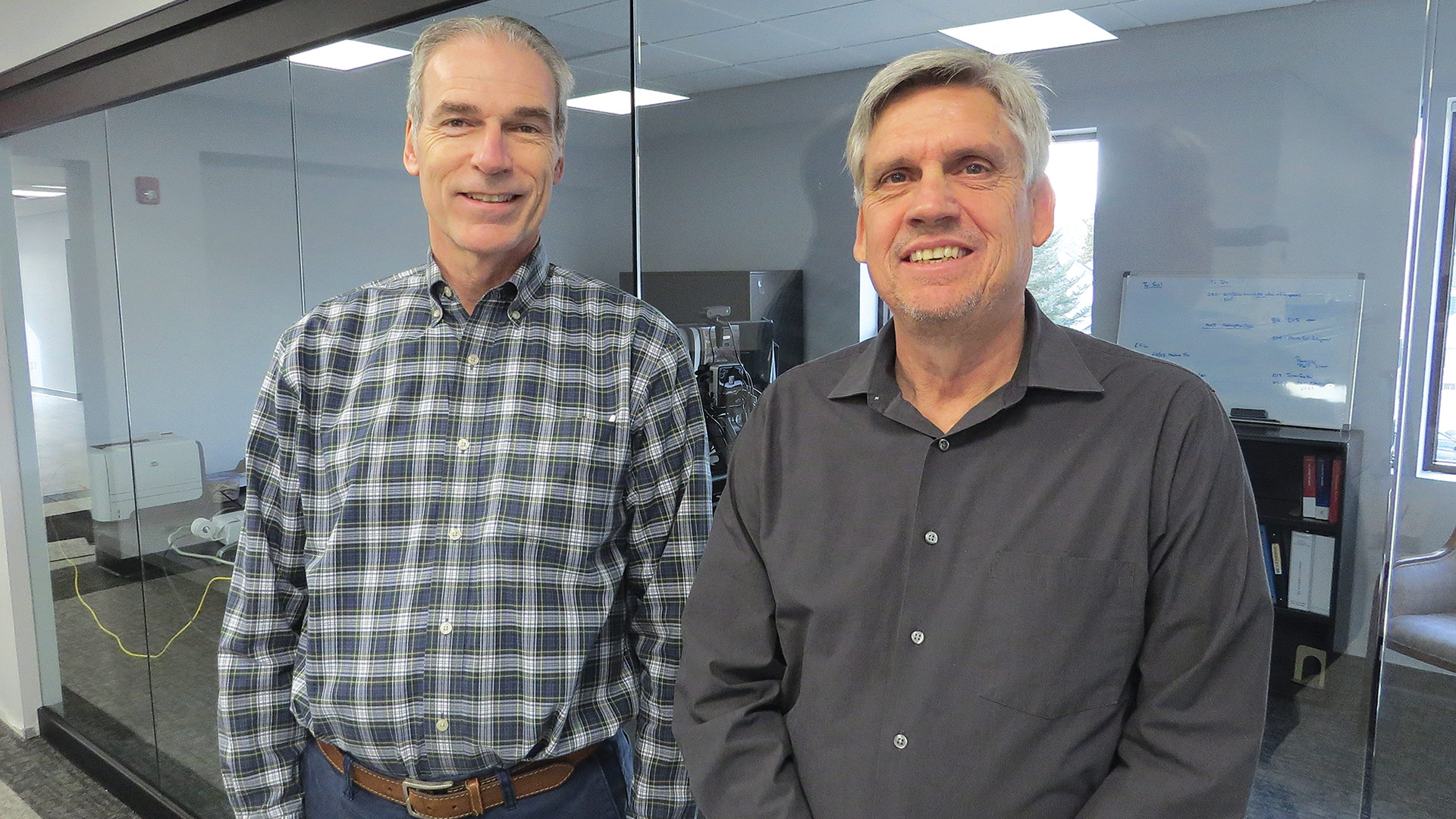
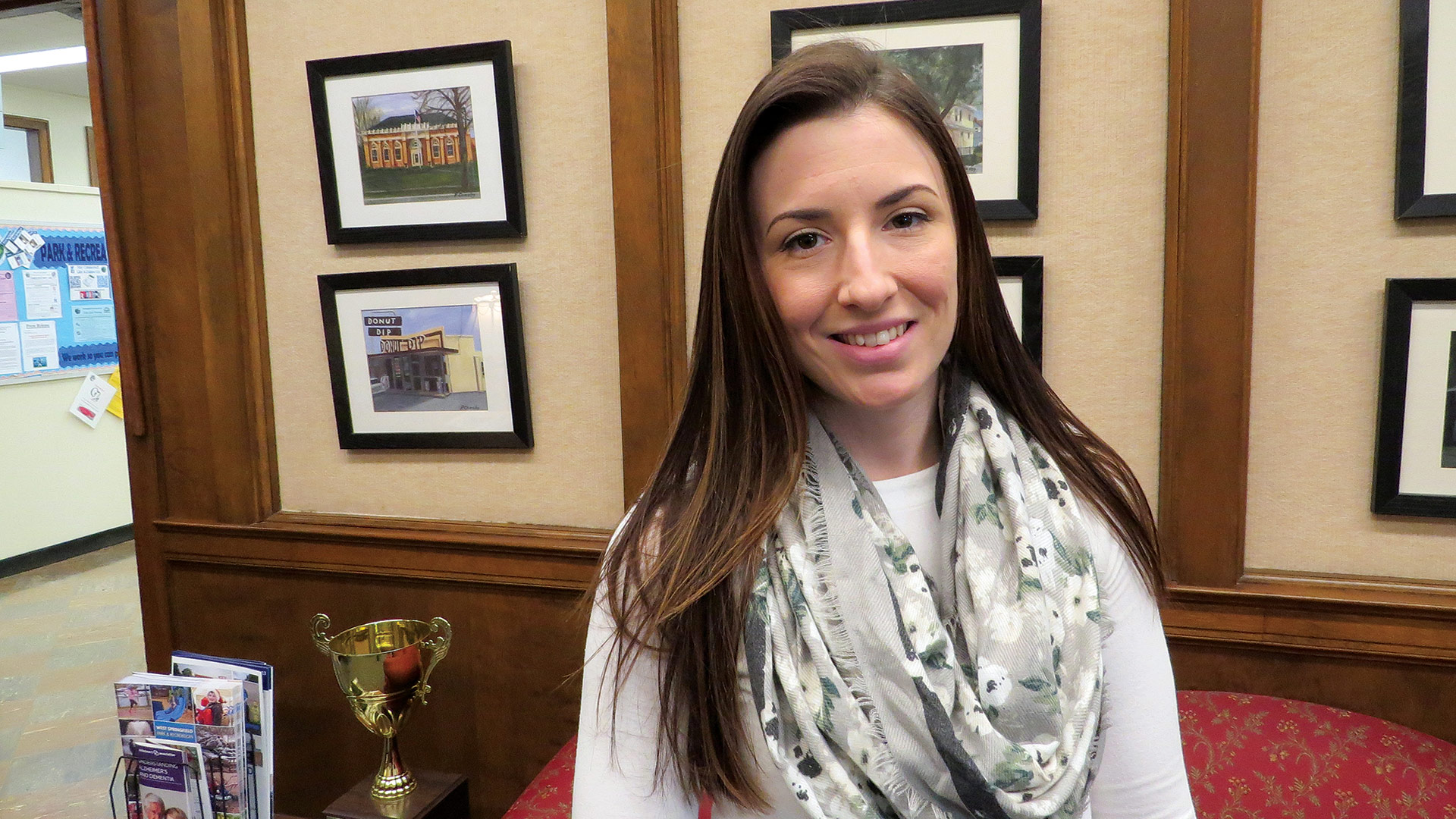
Paul Shields and Katie Warren, third- and fourth-generation managers.

Paul Shields and Katie Warren, third- and fourth-generation managers.

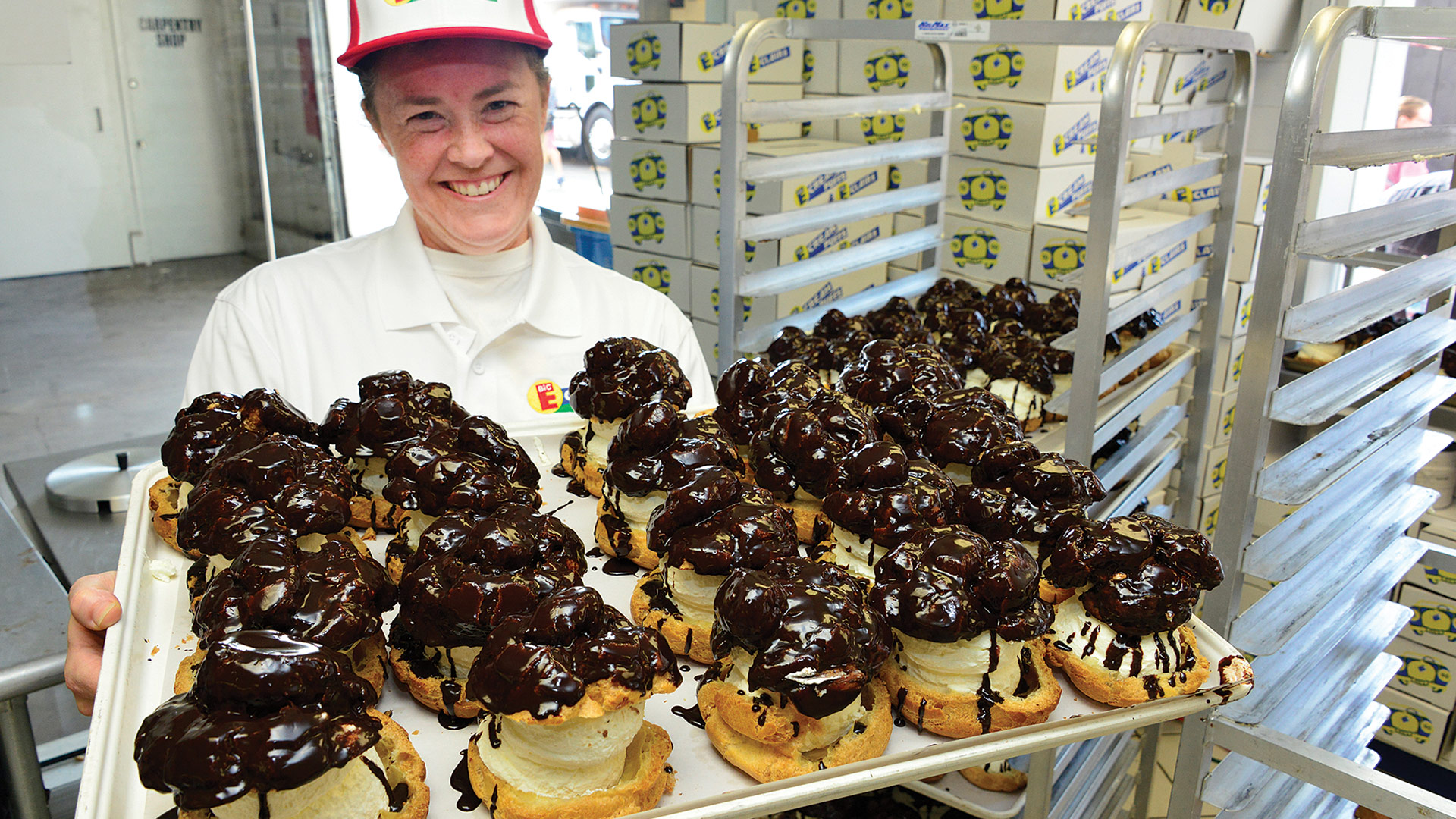
Paul Shields says it wasn’t his plan to make a career out of the West Springfield institution known as Donut Dip.

But then again, it wasn’t his father’s plan to do that, either. Or his grandfather’s. Or his daughter’s.

But things happened … and now four generations of this family, usually working side by side, have made this Riverdale Street landmark — in every sense of that word — home. They’ve also made it a destination, a place generations of different families return to, a first job for hundreds of young people, an architectural throwback that will prompt people to pull into the parking lot and snap pictures, and much more.

“There’s a lot of history here,” said Shields, who said this history comes as a side to a glazed donut, a cinnamon cruller, a cup of coffee, or, more recently, a breakfast sandwich. And this history, or tradition, is part of the attraction.

A huge part.

Our story begins in the mid-’50s, when Paul’s grandfather, Charles Shields, was the general manager of a large commercial bakery that thrived until it was shut down by a drivers strike. The company eventually reopened, but was never the same and eventually closed. With a young family to support, Shields was at a critical crossroads, and made the then-daring decision to open a shop devoted exclusively to donuts.

His son, Richard, then just out of college, joined him in the venture. At the time, he was also a physical education teacher and football coach, but ultimately decided to leave those pursuits and devote all his energies to the emerging business. They would both work at the shop well into their 80s.

After graduating from UMass Amherst in 1981, Paul went to work for the Roman Catholic Diocese of Springfield in its Communications office, producing the Chalise of Salvation televised Mass and other programming while working at Donut Dip on Tuesday nights (the night baker’s evening off), making donuts with his dad. When his father lost a key employee in 1987, he stepped in, and has been there ever since, serving now as president.

His daughter, Katie Warren, went into physical therapy after graduating from UMass Amherst. She enjoyed most aspects of the work, but not the paperwork and the uncertainty concerning where healthcare and that profession were headed. So, facing her own career crossroads, she chose the family business and has never looked back.

“I do a little bit of everything, like my dad and my grandfather before that.”

That’s the short story of the business and the people who have managed it. The longer story involves perseverance — weathering everything from the building of I-91, which siphoned large amounts of traffic off Route 5, which was the main north-south artery in the region, to the coming of Dunkin’ Donuts (now just Dunkin’) and other forms of competition, to a global pandemic.

The landscape has changed considerably on Riverdale Street since 1957, but Donut Dip has been a constant.

The landscape has changed considerably on Riverdale Street since 1957, but Donut Dip has been a constant.

It also involves some change — there’s now a maple-frosted donut sprinkled with bacon, for example — but, overall, not much change at all when it comes to the offerings, the signs above the donut racks (yes, the prices have been adjusted), and the neon signs outside, which are expensive to maintain, but part of the overall experience.

There’s also been little change when it comes to different generations of the Shields family growing in the business, gravitating toward it as a career, and doing essentially anything that needs to be done.

“I do a little bit of everything, like my dad and my grandfather before that,” Warren said. “Office work, and you’re making coffee, and not long ago, we were short someone in the kitchen, and I was coming in Fridays, Saturdays, and Sundays to make donuts; that’s just how it is.”

Not much has apparently changed when it comes to the popularity of donuts, as evidenced by the steady stream of customers on the Friday we visited, and what is usually a constant stream until closing time at 10 p.m.

“A shop strictly for donuts was a new concept. Dunkin’ had just gotten started in Quincy a little earlier than we did, and they were starting to establish themselves, but this was somewhat of a flier, a leap.”

“We’re busier than ever,” said Shields, adding that there are many reasons for this, as we’ll see, but especially the company’s reputation for quality and doing things the old-fashioned way.

Moving forward, Shields sees opportunity for growth as competition increases in some respects but declines in others as major chains like Dunkin’ focus their energy and marketing dollars on beverages, and he intends to raise the company’s profile, if you will, through more aggressive marketing.

Visitors crowd the counter at Donut Dip a few days after it opened in 1957.

Visitors crowd the counter at Donut Dip a few days after it opened in 1957.

For this issue, we take an in-depth look into the fascinating world of donuts and especially this unique family-owned business that has become part of the landscape on Riverdale Street and … well, an institution.


The Hole Story

As he talked about 68 years of change — and what hasn’t changed — Paul Shields started with some recollections about the evolution of Route 5.

Back in 1957, the street was much different. It was, indeed, the main north-south artery, handling traffic heading north to go skiing and south to go to Connecticut and beyond. And it wasn’t a divided road, as it is today. Shields remembers his father and grandfather telling stories about how the traffic would be bumper to bumper on Friday afternoons, and many other times as well.

This was well before the vast shopping centers and big-box stores were constructed, he went on, noting that section of the street featured a drive-in theater, a driving range, farms, a cinema complex with just a few screens, and a host of businesses that have long since vanished from the landscape.

It was into this environment that Donut Dip opened — and it is one of the few businesses on the street that can trace their roots to the Eisenhower administration.

When it opened, it was a relatively new and different model, said Shields, adding that, at the time, there were countless small bakeries that made donuts, but few, if any, shops dedicated entirely to that product.

“We have people traveling that will stop in on their way to vacation, and they’ll say they stopped here when they were a kid. We’ve been around for such a long time; we’ve seen generations of different families come through here.”

“A shop strictly for donuts was a new concept. Dunkin’ had just gotten started in Quincy a little earlier than we did, and they were starting to establish themselves, but this was somewhat of a flier, a leap,” he noted, adding that the venture got off to a solid start, and his father and grandfather would soon add other locations. There was one on Route 20 in West Springfield that closed in 1971, another at the corner of White and Orange streets in Springfield that closed in 1980, and one on North Main Street in East Longmeadow that closed after storm damage in 2019.

These new locations would become a blessing in 1968 when I-91 opened, changing the complexion of Route 5 and essentially splitting it into two zones, north and south of the new highway.

“Many businesses on this road closed — they couldn’t stay alive,” he recalled. “My father and my grandfather had the Westfield Street store and the East Longmeadow store, and they were able to get by. They were lean years, but they were able to hang in there.”

Over time, Riverdale Street would evolve into the commercial district that it is today, with new businesses ranging from car dealerships to Costco bringing traffic to the area. Some people heading to and from such destinations will stop at Donut Dip, said Shields, adding quickly that, for many others, it is the destination.

“We have people traveling that will stop in on their way to vacation, and they’ll say they stopped here when they were a kid,” Warren added. “We’ve been around for such a long time; we’ve seen generations of different families come through here.”

From left, Paul Shields, his daughter, Katie Warren, and his father, Richard Shields. None of them planned to Donut Dip a career, but they’ve all made the institution home.

From left, Paul Shields, his daughter, Katie Warren, and his father, Richard Shields. None of them planned to Donut Dip a career, but they’ve all made the institution home.

Shields agreed. “People come up from Long Island; they drive from Boston, Albany, or points north,” he noted, adding that posts on Facebook and Instagram, as well as direct word of mouth, have helped fuel interest and bring the brand far and wide. “I hear it a lot … people will say, ‘I came from so and so to get these donuts,’ and oftentimes they walk out with their arms full, with a dozen boxes; they bring them home to their neighbors or family.”


Making Some Dough

Beyond the dramatic transformation of Riverdale Street, there have been other changes to the landscape as well, said Shields, noting that, about the same time Donut Dip was opening in 1957, Dunkin’ Donuts was greatly expanding its presence in the Northeast.

And for the next several decades, the chain, now based in Canton, Mass., certainly presented a challenge, he said, both in terms of its offerings and its omnipresence. Indeed, there are four locations in West Springfield alone, including one further north on Route 5, and several more across the river in Springfield.

“They’re everywhere, and for years we competed directly with them — when we heard there was a Dunkin’ Donuts going in down the street, we took that very seriously,” said Shields, noting that, in recent years, the chain has essentially de-emphasized donuts, as indicated in the change to the brand’s name to Dunkin’, and it has become what many analysts of this sector now consider a beverage company.

Other chains have followed suit, he went on, adding that the donut landscape, if you will, has changed, with the major chains scaling back and few companies stepping in to fill the void.

“Part of the reason for this is all the work that’s involved,” he said, “and also because there’s a perception that, if there’s a Dunkin’ somewhere, no one else is going to survive selling donuts.”

This helps explains the crowds at the counter on that Friday, and also why Shields believes there is strong growth potential for the family business.

“I’ve added people in recent years, and we have more production capacity than we’ve ever had,” he explained. “So, I think the time is right to increase our volume.”

While there has been change in the industry, and some at Donut Dip, what’s more important is what hasn’t changed. First and foremost is the fact that this is a family business, one where members of several generations work side by side, and do … well, whatever needs to be done, whether it’s making coffee, ringing up orders, or making or finishing donuts.

Indeed, Shields said he has many fond memories of working with his grandfather for several years, and with his father for several decades. It’s been the same for Warren, who has worked beside her father and grandfather; the latter still stops in but is officially retired.

“My grandfather used to call me into the office once in a while and give me a little talk, a little lesson,” she recalled. “He’d say, ‘remember, this isn’t a job, this is your life.’ And in large part, it is. He also said, ‘if you want people to work hard, you have to work hard right beside them,’ and I believe that wholeheartedly.”

Meanwhile, not much change has come to what’s in those donut racks.

“We really stick primarily with the classics — they will always be the biggest sellers,” said Shields, adding that the maple frosted with bacon is an outlier. “There are some donut shops, not necessarily around here, that specialize in taking a donut and putting layer upon layer of special toppings on it, making these crazy concoctions and charging $5 to $7 apiece. That’s their niche, but we believe the classics will always outsell any of those fancy kinds of things.”

Beyond donuts, bagels, muffins, and coffee, Donut Dip provides what would have to be called an experience. The shop itself is a throwback, architecturally and otherwise. The signage and layout are vintage. And, as noted, earlier, the hand-painted signs above the donut racks are original, save for the prices: a dozen donuts cost 65 cents when the shop opened.

There are a few pictures on the south wall showing things in the early days — the sign for a Castro Convertible outlet can be seen behind the shop in a night shot, and there’s another showing a crowd at the counter days after the grand opening, revealing that very little has changed since then.

That includes the shop’s track record as a place where many young people, including the city’s mayor, Will Reichelt, found their first or second job. Most move on to other things, but some stay for years and even decades, Warren said.

And many of those former employees will stop in regularly, or, for those not living in the area, occasionally.

“We see many of those people come back and say, ‘I worked for your father,’ or ‘I worked for your grandfather 100 years ago,’” Shields recalled. “Many of them worked while I was here; they were high school kids, and now they come back with their kids.”


Bottom Line

Paul Shields said his grandfather had one overarching piece of advice for him.

“He said, ‘the donuts have to be fresh, and they have to have enough jelly in them,’” he recalled, adding that these are just some of the words he’s tried to live by and pass on to the next generation.

Putting enough jelly in the donut is just one of the enduring traditions at this institution, which has had countless landmark moments in its long history and is poised to script many more.

Home Improvement Special Coverage

All Under One Roof (Actually, Two)

Andy Crane says the home show thrives

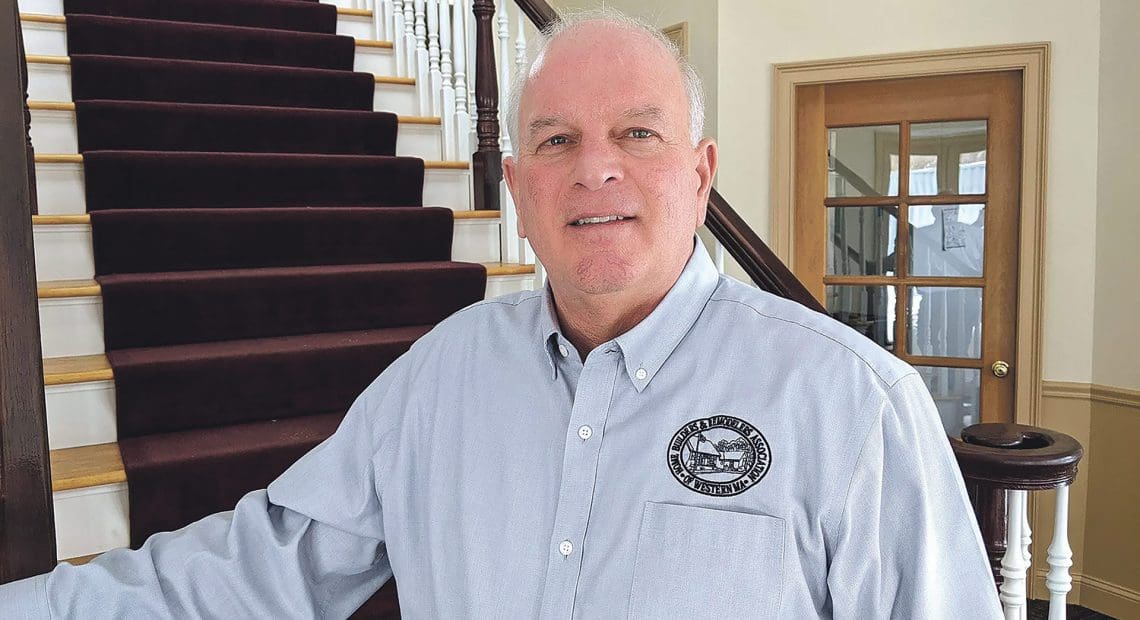
Andy Crane says the home show thrives, even in the internet age, because home-improvement business owners need to stay visible and put work into the pipeline.

Andy Crane acknowledged that many contractors and home-improvement companies are busy these days, thanks to a combination of factors, from people staying in their homes — due to higher interest rates and a shortage of inventory — to finding enough help to get jobs done.

They’re so busy that some — but certainly not all — are booking jobs several months out and even into next year, in some cases.

But even in this climate, where some contractors can’t touch new business for a few more quarters, it’s important to stay in front of consumers and continue to put business into the pipeline, said Crane, president of the Home Builders and Remodelers Assoc. of Western Massachusetts (HBRAWM).

And that’s why he’s not only expecting a sellout of booth space when it comes to this year’s Original Western Mass Home & Garden Show, taking place March 27-30 at the Eastern States Exposition — the 70th edition of this spring tradition — but also why the show is expanding into a second building this year, one dedicated almost exclusively to the ‘garden’ aspect of the event.

And with that move, the show is turning back the clock in some respects.

“Back in the day, we had two buildings, and a few years, we had three buildings,” Crane told BusinessWest. “This year, we’re going to have at least two and an outdoor area.”

The second building, known as the A Barn, will be geared toward yard equipment and accessories, plantings, and landscapes, with some details still to be finalized, he said, adding that this has been an element missing since COVID.

But getting back to his thoughts about contractors and why they want to be at this show, Crane said many aren’t coming to the Big E grounds looking for work — they already have enough. Instead, they want to make connections and enable consumers to at least get the process started.

“It gets the juices flowing — you might get some ideas and talk to some people,” he said. “Let’s say they can’t do it for a while … if you don’t get that process moving along, you’ll never get it done.”

Adam Quenneville, president of Adam Quenneville Roofing & Siding, agreed. His company has been part of the home show for roughly 25 years, and he comes back each year to help make sure the phones keep ringing.

“I would think that people still enjoy touching and feeling products and getting a sense for what they think that person is like. You can’t get that off a laptop; you just can’t.”

This is a quieter time of the year — although roof crews can work pretty much year-round — and a good time to make connections and add projects for the rest of the year, he said.

“It’s great to get out and see potential customers, and it’s an opportunity to get leads, give estimates, and secure business. A lot of people are going there because they have a home improvement in mind, and it’s nice to be able to let them see us in person, talk to us, get information, and go from there.”

With that, Quenneville spoke for every vendor at the show, including the ones who sell beer nuts and pickles, most of whom are focused not on making sales that day, but on the ‘go from there’ part of the equation.

It’s why the show has thrived for 70 years, and why the 2025 edition is shaping up as another opportunity to build back from the tumultuous COVID years and continue to grow.


Through the Roof

Crane said the home show, which annually attracts between 12,000 and 15,000 visitors and, recently, about 300 to 400 vendors, will be marking 70 years in some subtle ways, with additional giveaways and other promotions.

But mostly, this show will be like the 69 that have come before it, in that it presents an opportunity for the public to gather, see what’s new (or not so new, but still important), talk with experts, maybe finalize some plans for what they want to do, and put a face and business card with a person and company they’ve seen on the internet or heard about from neighbors, friends, or relatives.

Adam Quenneville says he’s been coming back to the home show for 25 years

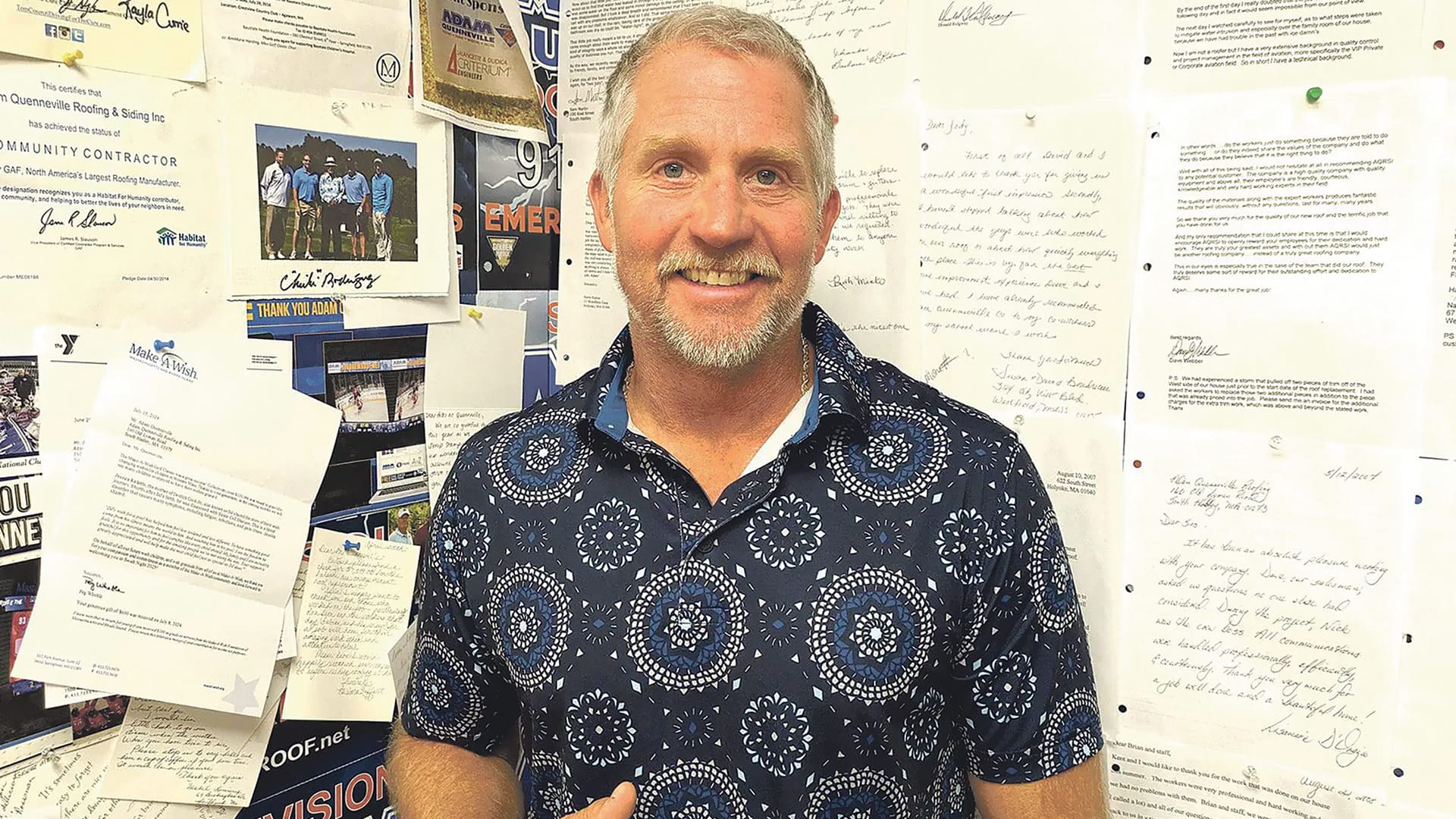
Adam Quenneville says he’s been coming back to the home show for 25 years because it provides valuable exposure and leads for new projects.
Staff Photo

It’s been this way since the mid-’50s — except that part about the internet, said Crane, adding that, before social media and before consumers could click on websites, contractors had to get out in front of people. The home show was created to give members of the HBRAWM an opportunity to show what they do, how they do it, and, yes, how much it will cost.

And while consumers can learn much about a product or contractor by visiting a website, and still more by following up with friends and neighbors who placed a specific contractor’s sign on their lawn, there is still much to be gained from seeing these professionals in person, Crane said.

“I would think that people still enjoy touching and feeling products and getting a sense for what they think that person is like. You can’t get that off a laptop; you just can’t. “If it’s a zero-turn mower, would you rather sit on one than look at a picture?” he asked rhetorically. “How about picnic tables and high-top tables … you might as well get the exact one you want and the exact color. As for sheds, isn’t it better to stand in the shed rather than look at a picture of one? You can visualize where your mower is going to go and where your pool equipment is going to go or the pellets for your wood stove. That’s what the show brings that computers don’t bring.”

It still does that, but it has become much more, he went on, adding that the event has become a rite of spring for many, and a social gathering for some, with friends and neighbors often gathering at the show and then going elsewhere for dinner.

“The show is still a great place to talk, shop, and get ideas about your home, your property, some of the things that people like to do in their homes,” he said, adding that, while some things have changed since Dwight Eisenhower was patrolling the White House, the best things about the home show are what hasn’t changed.

For 2025, there will be more of the same, said Crane, with the emphasis on more, especially when it comes to space for visitors to roam and take in the many exhibitors, who cross every spectrum of home and garden improvement, from who can do the work to how to pay for it.

Indeed, there will be several banking and finance institutions on hand, he noted, adding that the categories for vendors runs the alphabetical gamut, from air filtration to women’s clothing, with more than eight dozen in between, everything from awnings and canopies to foundation repair; kitchens and baths (huge items of interest) to mosquito protection; sheds and gazebos to wells and pumps.

It will all be under … well, two large roofs in 2025, said Crane, adding, again, that a second building is something the public has asked for, and something that’s needed to properly showcase vendors and products.

Fast Facts:

What: The 70th edition of the Original Western Mass Home & Garden Show
Where: Eastern States Exposition
When: March 27-30
Show Producer: Home Builders & Remodelers Assoc. of Western Massachusetts
Admission: General admission: $10; with coupon: $7; children under 12: free
For More Information: Call (413) 733-3126

As noted, the A Barn will focus on lawn and garden equipment, furniture, and accessories, everything from mowers and snow throwers to chairs, tables, firepits, and fountains — items that couldn’t be displayed as effectively in years past due to a lack of space.


Starting the Conversation

While the additional space provides room for more vendors and a chance to spread out, it also further activates the outdoor spaces at the Big E, said Crane, adding that there will now be traffic between the buildings — and opportunities to capture the attention of that traffic.

Over the years, those staffing the Adam Quenneville booth have succeeded in gaining the attention of visitors, said the company’s owner, adding that it has generated a steady flow of leads — and eventually customers.

“If I have to guess, I’d say we get about 100 opportunities,” he said, meaning actual estimates for potential customers. “We’ll probably give 90 people prices and secure about 50% of that — 45 to 50 jobs.”

That more than justifies the cost of the booth, he said, adding that the show has been one of the more successful methods of getting right in front of the public, telling the company’s story, and keeping the pipeline of work flowing.

Nick Riley, president of Chicopee-based N. Riley Construction, agreed. His firm specializes in home remodeling and new construction, and he’s been a regular participant at the show for the past 20 years because of the opportunities it provides to be visible, talk to people directly, and hand out business cards.

“We do really well at the home show, and that’s why we keep coming back,” he said, adding that he doesn’t take leads directly at the show, but instead instructs visitors to call and make appointments — and many of them do. “It’s about more than the eventual leads … it’s about getting in front of people, seeing them in person, and saying hello.”

Hundreds of other home and garden professionals can say the same thing, and they have — some of them for a half-century or more.

They keep coming back because the Western Mass Home & Garden Show has long been a spring tradition, a social event for some, a chance to gather ideas for most, and an opportunity, for those on the vendor list, to get down to business.

Opinion

Editorial


Depending on where you live, where you work, or where you operate a business, the Big E is either a big inconvenience or a big, as in big, and important engine for this region’s economy.

Actually, it’s both. But mostly, and to most people, it’s the latter.

Yes, it can be a disruptive force if you live within a mile or so of the fairgrounds, and especially if you do business on Memorial Avenue in West Springfield.

But mostly, it’s a powerful economic force, a 17-day fair that brings people, vitality, and various kinds of business to the region.

A 2019 economic impact study pegged the overall impact of the Big E at $681 million annually, a number that is now certainly much higher. It also brings thousands of jobs and millions in income-tax and sales-tax revenue.

There are dozens of business sectors, small businesses, and individuals that benefit from the Big E. That list includes hotels, motels, restaurants, and taverns; businesses that rent tents; gas stations and convenience stores; a certain casino in the South End of Springfield; and the businesses and residents around the Big E that devote their lawns and lots to fair parking.

It all adds up to a very large impact, one that can be measured in many different ways. Maybe the most effective is a glance back to 2020, the year when there wasn’t a Big E.

The negative impact was enormous. Hotels that booked rooms to visitors, vendors, horse-show participants, and more lost all of that. So did the restaurants, taverns, stores, and homeowners on the side streets off Memorial Avenue.

It was a crushing loss, something not covered by PPP or most any other form of relief.

So, when the Big E returned in 2021, those businesses, and this region as a whole, were all reminded of just how important the fair is to this region — not that anyone needed reminding.

As the 2024 fair continues, people are being reminded again. Those long lines of cars stretching down I-91 in both directions, and into downtown Springfield and deep into Agawam to the east and west, should be a very welcome sight, as much as they slow things down for area residents trying to get from here to there.

Those cars tell a story, a story not of traffic that is backed up, but one of a region getting a boost. A big boost.

Community Spotlight

Community Spotlight

Allyson Manuel

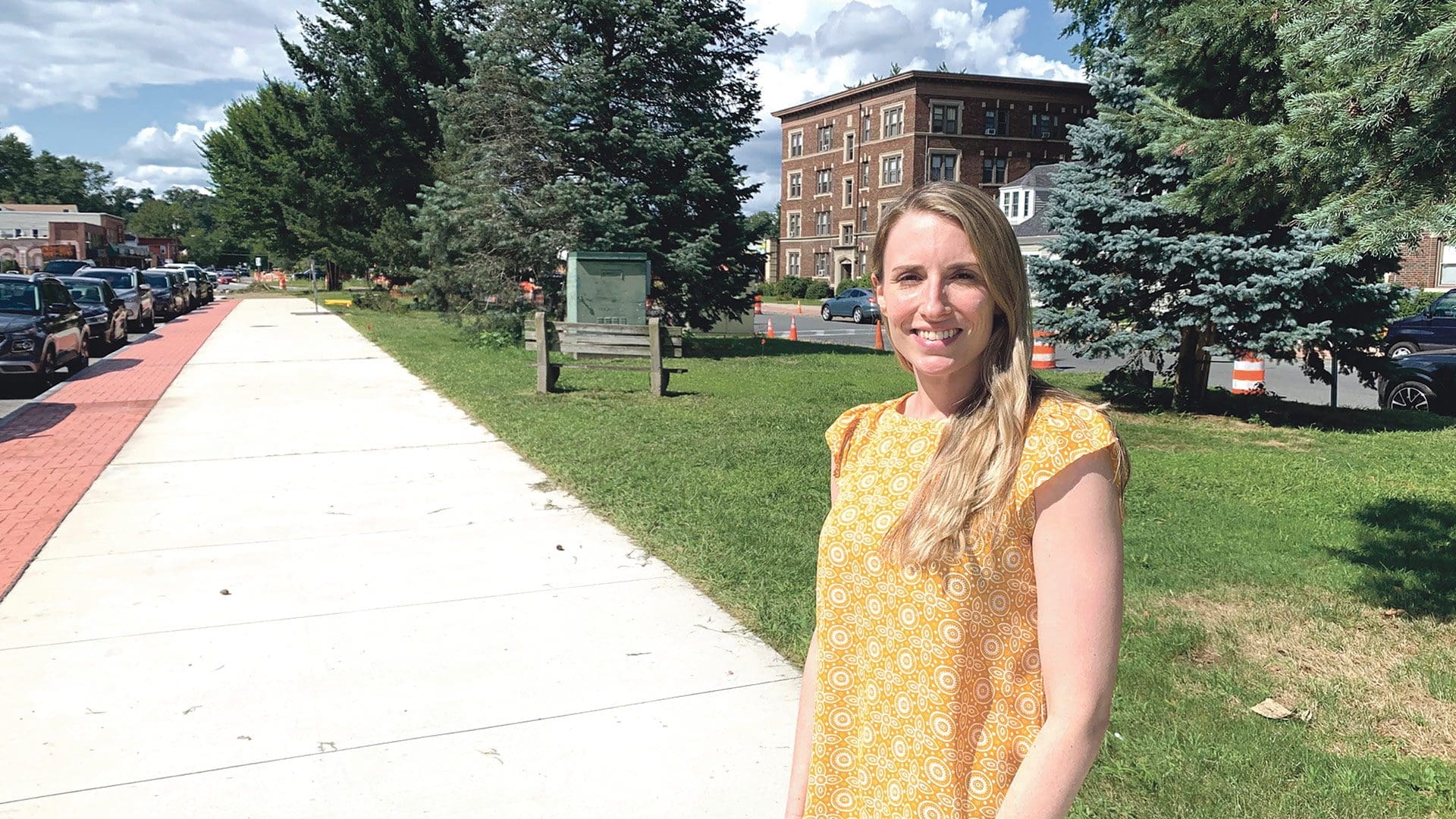
Allyson Manuel, seen here at one of the new sidewalks at the common on Elm Street, says there is renewed vibrancy in the downtown area.

Tyler Saremi calls it “cross-pollination.”

That’s how he chose to describe how the various businesses, government offices, and cultural institutions, especially the Majestic Theater, clustered in the downtown are supporting one another in a way that is bringing new vibrancy to the area and effectively turning back the clock in West Springfield’s central business district.

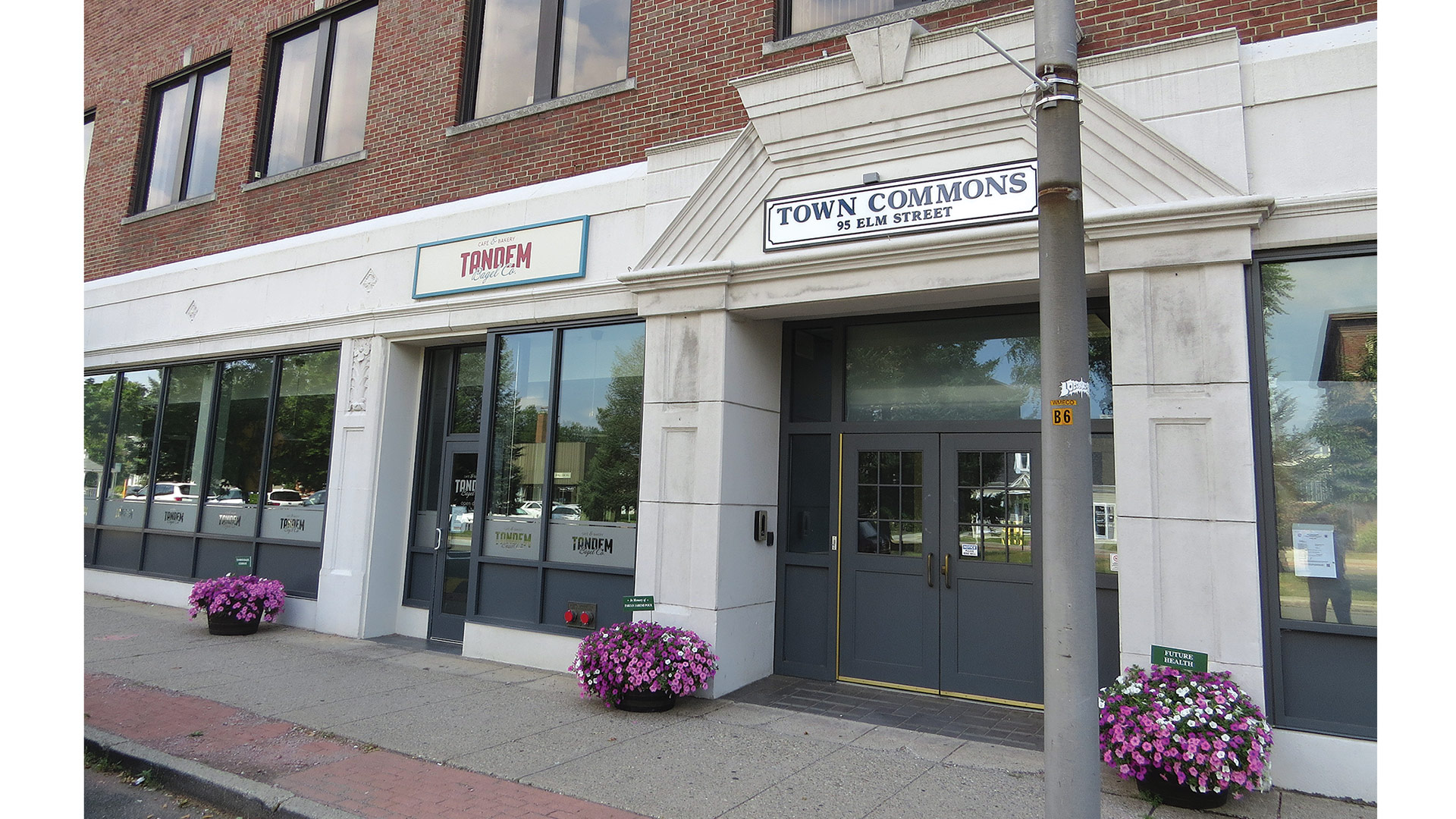
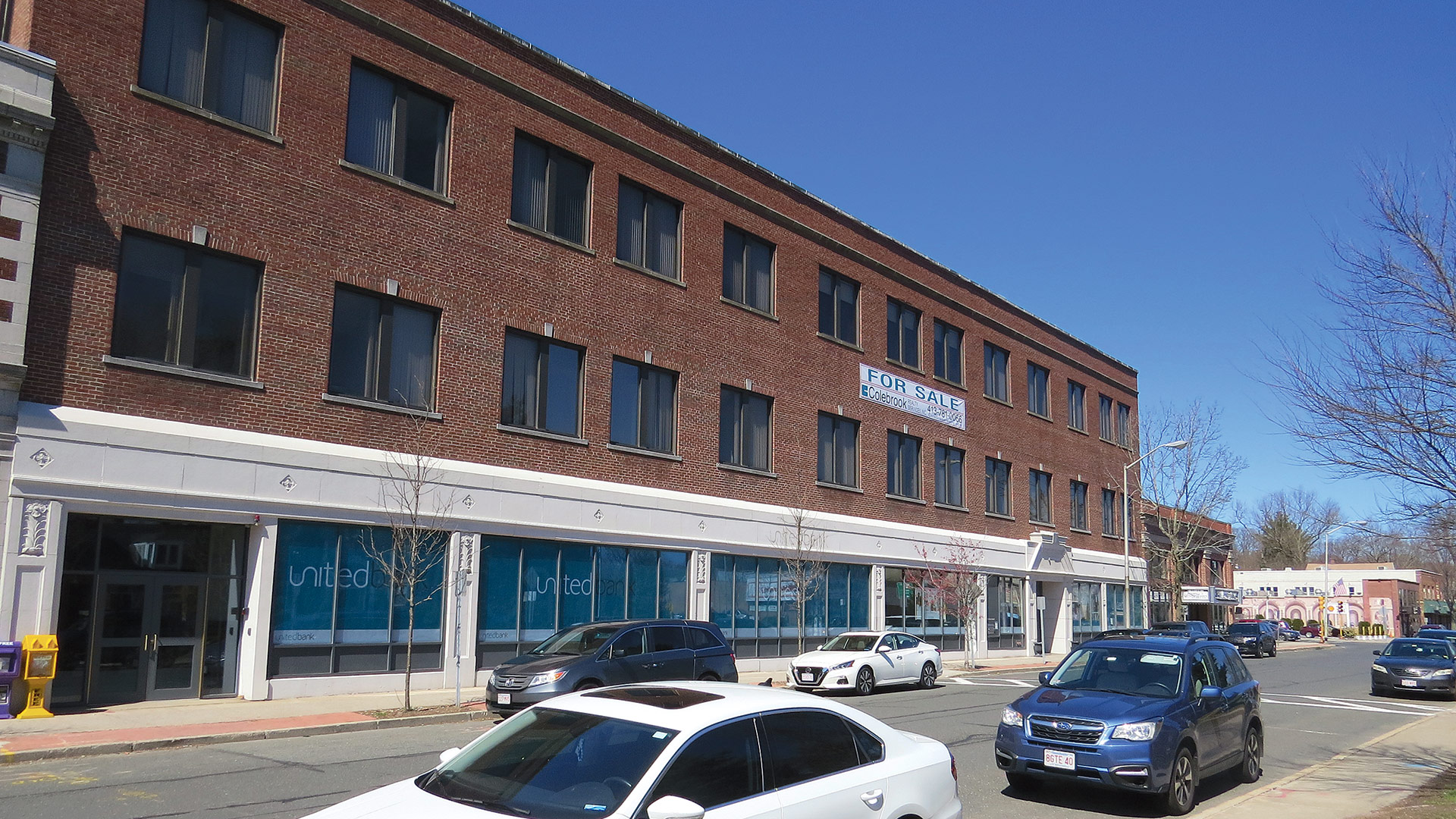
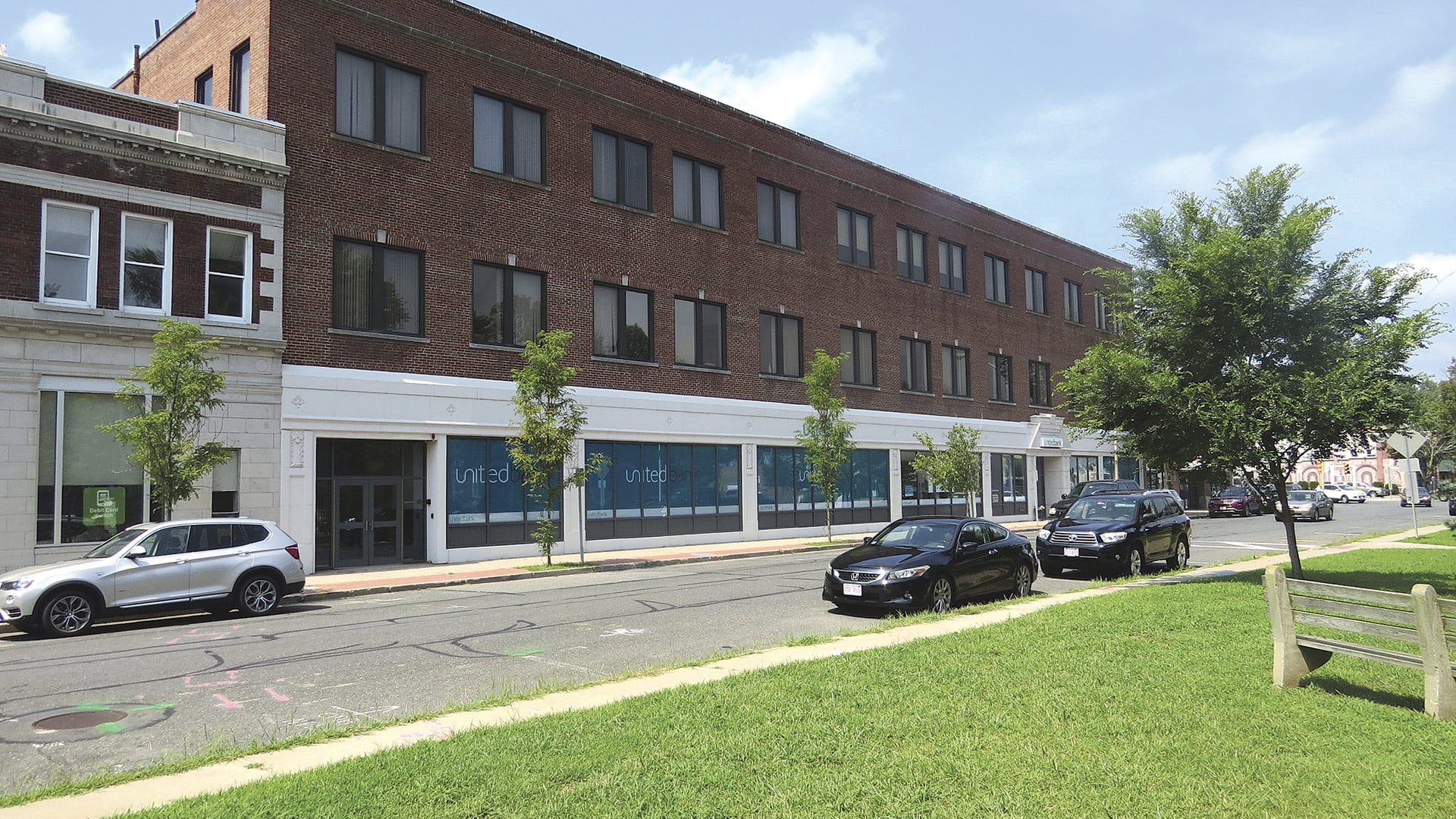
“It’s nice to see the downtown become a downtown again,” said Saremi, vice president of Saremi LLP, a multi-faceted company that redeveloped the former headquarters for United Bank at 95 Elm St. into Town Commons, a mixed-use facility that includes, on its ground floor, Tandem Bagel and West Side Bar & Grill, two eateries that are drawing more people into the downtown area and effectively extending their stays.

Indeed, more people are now arriving an hour or two before the shows at the Majestic for dinner at some of the eateries in that area, such as the Italian restaurant bNapoli — and, on some nights, especially when there is live entertainment at West Side Bar & Grill, sticking around after the shows.

“It’s fantastic cross-pollination in the downtown right now, and it’s beautiful to see; it’s all working,” he said. “You have people coming to West Side Bar & Grill before a show at the Majestic, and then there are people walking over when we have live music on weekends — they’re walking to their cars from bNapoli, and they’re saying, ‘I saw the music; I just wanted to come in and have a drink.’ Everything is complementing other businesses, and it’s exciting to watch the downtown grow.”

Julie Quink, managing principal with the accounting firm Burkhart Pizzanelli, which has been based in a former elementary school on Park Street for more than 25 years now, has also noticed more energy — and widespread general improvement — in the community’s downtown.

She referenced everything from new businesses like Tandem Bagel and West Side Bar & Grill, as well as comprehensive infrastructure improvements to the roads in the downtown and the signature town common as reasons why the downtown is staging what would be considered a comeback.

“There is a strong need, but there is just not much land that can be developed, and when we do propose something, it’s not welcomed.”

“There are a lot of new businesses, which is good for everyone,” she said. “And there is more vibrancy in the downtown area.”

Mayor Will Reichelt, now in his ninth year in the corner office, said this downtown transformation is just one development the community is celebrating as it also marks its 250th birthday — an ongoing party that has included fireworks, a revitalized Taste of West Springfield, and a 5K, and culminated with a parade on Aug. 24.

Indeed, the town that calls itself a city is also celebrating (if that’s the right word) some important infrastructure projects — on Elm Street, Memorial Avenue, and (soon) on Riverdale Street — that are bringing some inconvenience now but substantial benefits … well, down the road.

Also in the infrastructure category is a long-sought and highly anticipated solution to the rail crossing at Front Street near the border with Agawam — a flyover that will alleviate traffic backups in that area and make it more attractive for economic development (more on that later).

And while there is progress on many fronts, there is less of it in one identified area of need — housing, said Reichelt, noting that, while this community has many assets, an abundance of developable land is not one of them.

Tyler Saremi

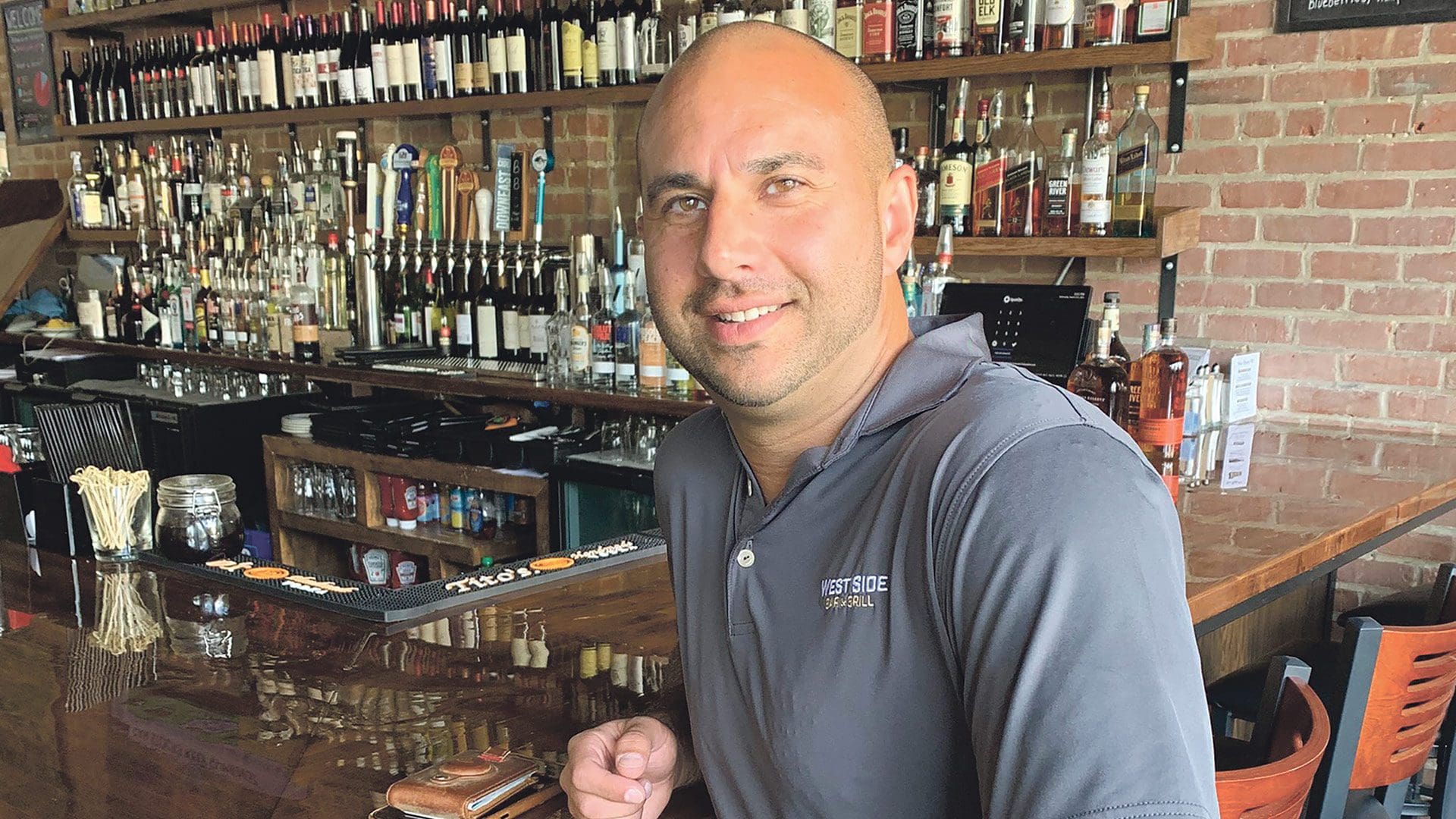
Tyler Saremi sits at the bar at West Side Bar & Grill, one of the many new businesses creating what he calls “cross-pollination” in the downtown.

“There is a strong need, but there is just not much land that can be developed, and when we do propose something, it’s not welcomed,” he said, adding that options are being considered, including very preliminary talks with the owners of the Cinemark theaters on Riverdale about the massive back parking lot, which might be ideal for a public-safety complex and some mixed-use housing.

Still, there are a few housing projects in various stages of development, including a condominium development at the site of a nursery on Piper Cross Road, as well as another project being undertaken by Saremi LLP — redevelopment of a former nursing home on Westfield Street into multi-family housing, most likely of the over-55 variety.


When a Plan Comes Together

As plans for redevelopment of 95 Elm St. were being drawn up, Saremi said, it was viewed as a three-year project.

Instead, it took maybe 18 months to secure tenants to fill the property’s three floors, he explained, adding that the property is now home to a variety of tenants, including the Saremi company, which has several components, including a real-estate arm and a student health-insurance venture; Tandem Bagel and West Side Bar & Grill; Kindred at Home; the Worcester-based Seven Hills Foundation and Affiliates, which has made Westside its Western Mass. hub; and an engineering company.

These businesses are bringing people back to that property to work years after United Bank left, he said, adding that these workers, coupled with those already downtown — there are dozens of businesses along Park and Elm streets, as well as West Springfield’s town offices — have created a critical mass of people that not only support other businesses, but generate more overall vibrancy.

“When the bank took off and left all those offices vacant, it was very quiet in the downtown,” he noted. “Now, I can look out my office window at any time, and there’s people walking around; there’s foot traffic. People are going into Celery Stalk, walking out and eating on the picnic tables he has outside, or they’re going back to the town offices — it’s great to see.”

Quink agreed, and, like Saremi, she said the infrastructure work taking place downtown, which includes a roundabout at the former intersection of Elm and Westfield streets, new sidewalks, new lighting, and considerable work to make the town common more accessible and walkable, have helped make the area more of a destination.

“The mill buildings are sandwiched between the Westfield River and the train tracks, and you have to get over the train tracks to access them right now. So having that alternative access opens them up to a lot of different uses they’re not suitable for now.”

“The city is doing a good job of making the town common more appealing,” she noted. “They have events there, like the Taste of West Springfield and events for veterans; it’s a great asset for the community.

“The construction has been really challenging for some small businesses on Elm Street,” she went on. “But the end result is going to be good; we just have to get through this period.”

As noted earlier, this renewed vibrancy downtown is one of the many emerging storylines in West Springfield. Others include the year-long 250th celebration, which has brought residents and businesses together to mark the past and contemplate the future; a new Chick-fil-A going into the site of the former Friendly’s on Riverdale Street; and, of course, the upcoming 17-day Big E, which will bring more than 1.5 million people to the community, clogging many of its roads, but also providing a huge boost to its many hotels and other hospitality-related businesses (see story on page 15).

There’s also ongoing infrastructure work along the two main commercial arteries — Riverdale Street and Memorial Avenue. With the latter, a project due to be finished in 2026, crews are undertaking underground utility work, said Reichelt, adding that, in the next construction season, concrete work from the Memorial Bridge to the border with Agawam will be completed, along with new curbing and lane reconfigurations.

On Riverdale Street, utility work is also being undertaken, with repaving coming over the next few years, he said, adding that, while it is inconvenient to have both major arteries torn up at the same time, the town will benefit when the projects are completed.


Train of Thought

Then there’s the planned flyover at the rail crossing at Front Street, which will alleviate traffic backups that have been a problem for decades, the mayor said. Announced late last month, the project, which is expected to cost at least $20 million, came about after extensive and sometimes contentious talks between representatives of Agawam and West Springfield, CSX, state transportation officials, and U.S. Rep. Richard Neal.

The fix will not only alleviate traffic tie-ups, but eliminate a public-safety concern, said Reichelt, noting that ambulances now take alternate routes, not knowing if they will be delayed by a parked train.

Allyson Manuel, West Springfield’s town planner, agreed, noting that the flyover will also facilitate economic development in the area, especially with an old mill complex that has sat mostly vacant in part because of accessibility issues created by moving or parked trains.

“The mill buildings are sandwiched between the Westfield River and the train tracks, and you have to get over the train tracks to access them right now,” she said. “So having that alternative access opens them up to a lot of different uses they’re not suitable for now.”

West Springfield at a glance

Year Incorporated: 1774
Population: 28,835
Area: 17.5 square miles
County: Hampden
Residential Tax Rate: $14.81
Commercial Tax Rate: $29.80
Median Household Income: $40,266
Median Family Income: $50,282
Type of Government: Mayor, City Council
Largest Employers: Eversource Energy, Harris Corp., Home Depot, Interim Health Care, Mercy Home Care
* Latest information available

Like almost all communities in the region, West Springfield is in need of more housing, said Manuel, adding that, unlike most of those cities and towns, it does not have much open land on which to build.

Which is why a provision within the $5.16 billion Affordable Homes Act recently signed into law by Gov. Maura Healey, which will allow in-law apartments in all communities, could have a substantial impact in Westside, where they are currently prohibited.

“We’ll be looking at how to regulate that, and we obviously have some work to do on that because they are currently not allowed; it’s a pretty big change,” Manuel said, adding that, in the few weeks since the housing bill was signed, there have been numerous inquiries.

Meanwhile, there are some projects in various stages of development. These include the condo project on Piper Crossing Road; Heartstone Village, a 55+ project off Birnie Avenue, a project that has been years in the making; and preliminary talks concerning repurposing the former Cowing School at the corner of Park and Elm streets for housing, especially senior housing.

There’s also the former nursing home on Westfield Street, which has been vacant for more than 20 years and in recent years had become an eyesore, Saremi said.

“There was an opportunity to acquire it, and we decided to take it on,” he told BusinessWest, using those words to help explain the size and scope of the challenge and the fact that few, if any, were willing to take on this property.

“It was a nightmare cleaning that place out; it was very labor-intensive — crews had to wear full-body suits with respirators,” he said while detailing the level of deterioration of the building. “There were trees growing on the roof. Now, the interior is completely clean, and we’ve had a zone change go through.”

The most common-sense reuse is housing, either affordable or 55+, Saremi said, adding quickly that, while architectural plans are being developed, funding help will be needed from the state or federal government to take what is likely to be a $7 million project off the drawing board and make it reality.

“The cost to build has just skyrocketed,” he said, adding that he is hoping that the housing bill will include funds for projects like this one.

“We’re ready to go,” he said of the project, which would include 51 mostly efficiency and one-bedroom apartments. “We just need some sort of government assistance on the cost to build.”

Daily News

WEST SPRINGFIELD — In celebration of the 250th anniversary of its incorporation, the town of West Springfield will host a parade on Saturday, Aug. 24, stepping off from St. Thomas School at 11 a.m.

Residents are welcome to line the parade route that is approximately 1.3 miles long, starting from St. Thomas School and continuing along Kings Highway, North Boulevard, Westfield Street, Van Deene Avenue, and ending at Central Street.

Approved parade participants will gather at St. Thomas starting at  9 a.m., and the parade will step off at 11 a.m. It will have a planned stop at the intersection of North Boulevard and Westfield Street before proceeding down the hill to Westfield Street The parade will end with live music by Noah Lis at 3 p.m.

The parade map can be viewed at townofwestspringfield.org/250. The town anticipates that traffic may increase in the area and advises the public to plan travel accordingly.

Features

Material Growth

LiftTruck celebrates 35 years

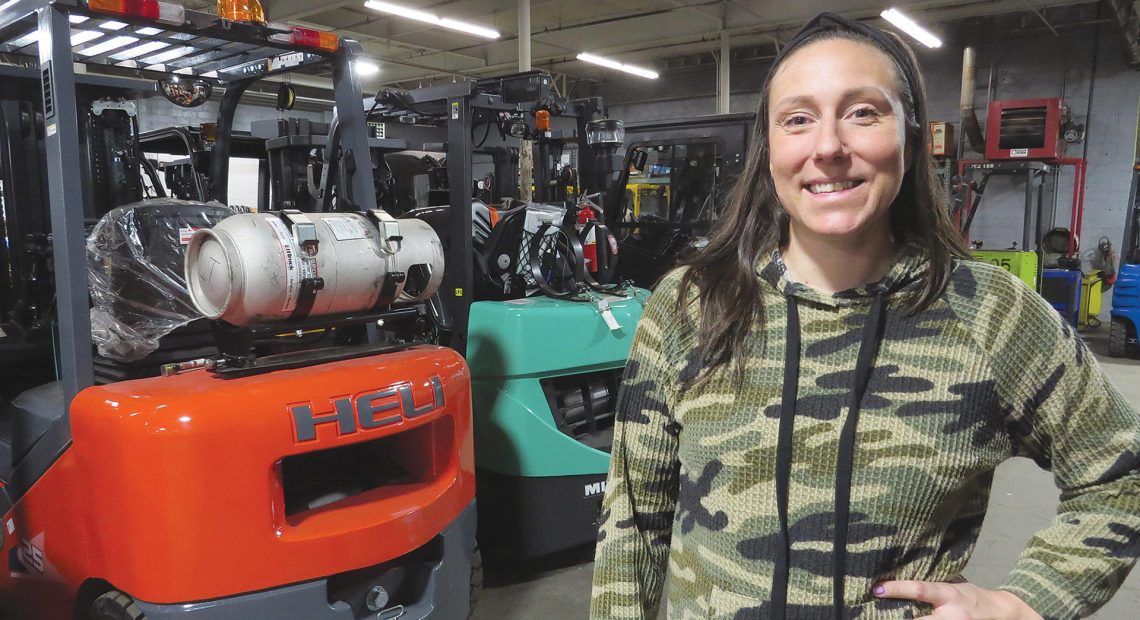
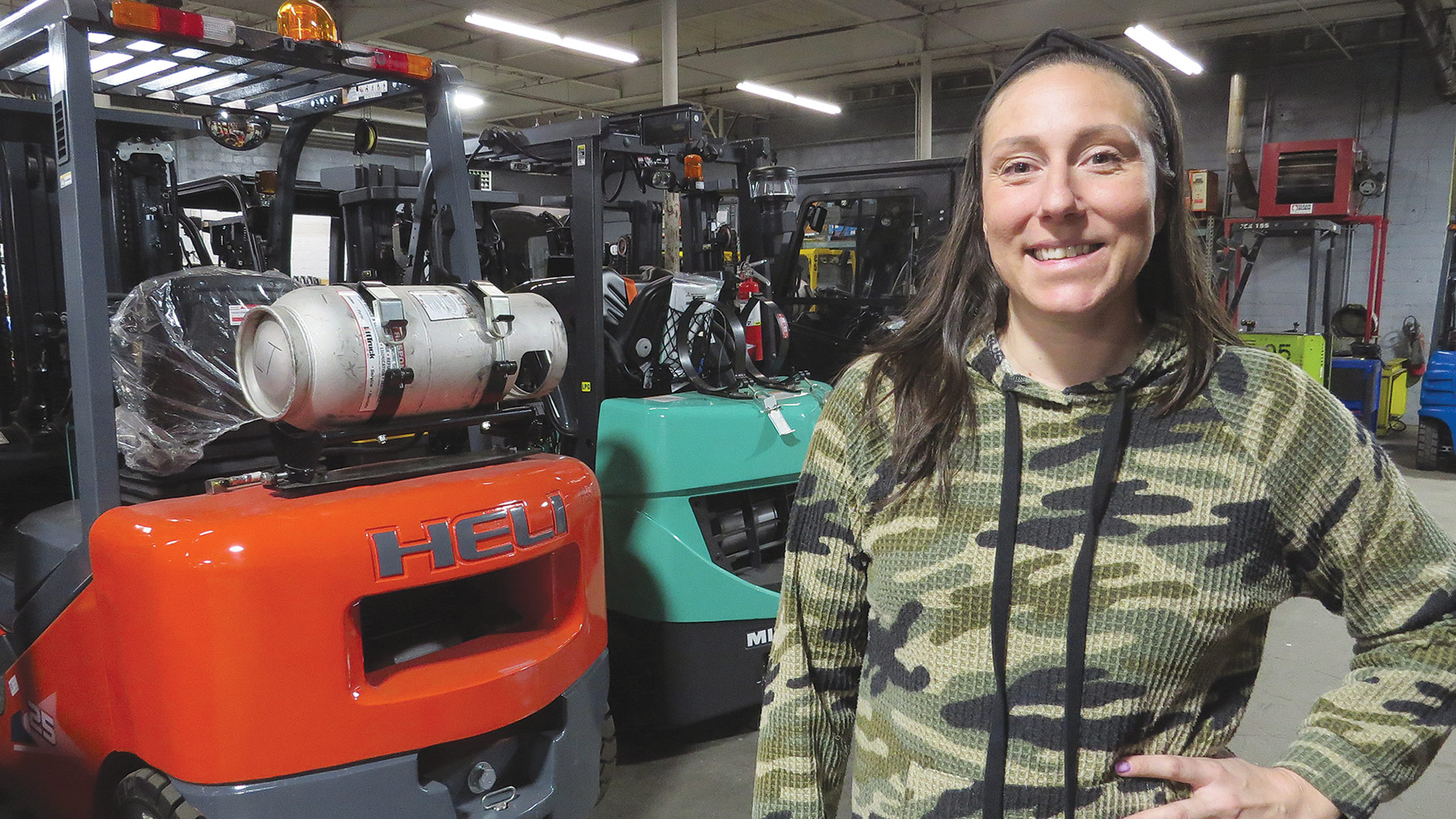
As LiftTruck celebrates 35 years, Kara Sotolotto says, its focus is on continuing to grow its many business operations and building on an already-solid foundation.

Kara Sotolotto says she essentially grew up in her family’s business, LiftTruck Parts & Service Inc. in West Springfield.

She remembers doing a little bit of everything for this company — founded by her father, Mario C. Sotolotto, which specializes in forklift and lift-truck sales, maintenance, parts, rentals, and more — but especially the vast amounts of paperwork that have long since been replaced by computer files. This included handling work orders, parts inventory (something that is still done by hand), calling customers, and much more. It seemed there was something new every day, and, collectively, those various assignments have prepared her for her current and somewhat new role, as the company’s vice president, a title she shares with her brother, Mario A. Sotolotto.

She was still waiting for her new business cards when she talked with BusinessWest, but she has already eased into the role, which will see her work with other family members (and there are many of them) and other employees to chart a course for future growth for this venture, which this year celebrates 35 years in business.

It is marking this milestone in a mostly quiet fashion — but also with charitable donations each quarter, including one recently to Baystate Children’s Hospital — and by essentially doing what it has been doing from the start, Kara Sotolotto said — taking care of the many different needs of its clients, mostly manufacturers and distributors located across the Bay State, but also in Connecticut and Rhode Island.

Over the years, the company has expanded well beyond its West Springfield roots, opening an office in Brockton to better serve customers in the eastern part of the state, including Cape Cod and the islands, as well as Rhode Island. Looking forward, she said the company is looking at possible additional expansion in the Worcester area, with a location to house what she called a ‘green division,’ dedicated to sales and service of battery-powered BYD material-handling equipment (more on that later).

Overall, though, the business plan calls for shifting more of the day-to-day responsibilities of managing the company to the second generation, Sotolotto explained, as well as simply building on the solid foundation created over the past 35 years, one that has enabled the company to thrive in a sector with many competitors.

Indeed, when asked how LiftTruck manages to stand out in such a crowded field, she said simply, “our service and our mechanics; these are mechanics that everyone likes and trusts, and they really know their stuff.

“He started from the ground up with a few mechanics, who are actually still with us today, and one person in the office.”

“Also, our lines,” she went on, adding that, while many competitors will sell one or a few brands, LiftTruck handles many labels and many options when it comes to how machines are powered — from propane to electric.

It is this ability to provide clients with choices, but also reliable, quality service, that has both enabled the company to thrive for the past 35 years and positioned it for continued success for the next 35.


Getting a Lift

As she offered BusinessWest a tour of the LiftTruck facilities and posed for a few pictures, Sotolotto pointed to a Clark forklift — vintage 1948, by her estimate — that was at the shop for some maintenance. It’s not really used anymore, and she believes it is one of the items on display at a small museum at Barnes Airport in Westfield.

While it is not in active service, the company services many pieces of equipment dating back to the ’60s and even the ’50s that still are, she said, adding that fork trucks, depending on how much they are used, can run for decades, and most clients are determined to get their money’s worth out of their machines.

But there are challenges to servicing such long-lasting pieces of equipment.

“These forklifts were built like tanks because they were used in the military,” she explained, referring to the older Clark machines. “The trouble is, it comes to a point where you can’t find parts for them; there are times when we can have people fabricate the parts for them, but once you get to certain big parts, like cylinders, you have to give in.”

Helping companies keep their machines running as long and as efficiently as possible has become one of the many trademarks of this company, which was started by the elder Mario Sotolotto in 1987.

As Kara explained, her father worked for Northeast Clarklift, joining his father-in-law there, and starting in the parts department and moving up the ladder. He eventually decided to take all that he had learned and start his own venture, one that would focus on all aspects of this competitive business — including sales of new and used machines, service, parts, forklift training, rentals, and more.

“He started from the ground up with a few mechanics, who are actually still with us today, and one person in the office,” she said, adding that the company has enjoyed steady, consistent growth over the years.

This is a family business, she added with conviction in her voice, noting that there are many members of her family who are involved, including her father, the company’s president, who, she said, “likes to keep involved in all aspects of the business,” as well as his uncle, Sales Manager Anthony Sotolotto.

There’s also her brother, Mario, who works mostly out the Brockton facility, and focuses on the sales and everyday operations sides of the business, while Kara is focused more on the back end of the operation — accounting, receiving equipment, managing the West Springfield facility, and talking with the press.

As noted, this is a multi-faceted business, with several components and revenue streams.

On the sales side, the company handles a number of manufacturers, including Clark, Komatsu, Doosan, Heli, and the most recent addition, BYD, which offers machines that run on iron phosphate batteries, Kara said, noting that buyers have a number of options these days in terms of both brands and how machines are powered.

Indeed, while gas-, propane-, and diesel-powered vehicles are still popular, this sector, like the automotive industry, is moving aggressively toward more electric vehicles.

“A lot of people are switching over to electric forklifts,” she explained. “It’s more economical for them, and it’s better for the environment; they’re becoming more and more popular.”

Looking ahead, Sotolotto said the company is strongly considering creation of that aforementioned ‘green division,’ one that will focus on the BYD line and likely be based in the central part of the state so it can effectively serve all corners of the Commonwealth.

“Having a facility to at least store all of our electric lifts and maybe have a few mechanics operate out of there would be great,” she told BusinessWest. “This is definitely something we’ve been talking about and moving toward; it’s a logical next step.”

The sales side of the business has been steady, she added, and it received a somewhat unexpected boost during COVID, when rentals were harder to come by (just as rental cars were) and many customers decided to buy instead — if they could find machines to buy.

And overall sales remain steady as customers seek to replace machines that hit a certain number of hours.

Meanwhile, the machine-rental side of the business remains solid as well, she said, noting that businesses will rent equipment for a day, a few weeks, a quarter, or for much longer stretches depending on need. To mark its 35th anniversary, the company is donating 10% of its rental revenue to various charities, including Baystate Children’s Hospital, each quarter.

The service side of the operation is another key contributor to the company’s overall success, Sotolotto said, noting that clients need their machines to operate successfully, and LiftTruck’s ability to provide reliable service has been another of its hallmarks.


Lock and Load

These various parts contribute to the whole, she said, adding that LiftTruck has much to celebrate as it marks its milestone anniversary this year.

Mostly, it is celebrating what has become a family, or a bigger family, to be more precise, one that includes several people related to one another, but also others who have been part of this operation for years — in many cases, 35 years.

Together, they have made this venture an uplifting success story — in every sense of that phrase.

Commercial Real Estate

Building Momentum

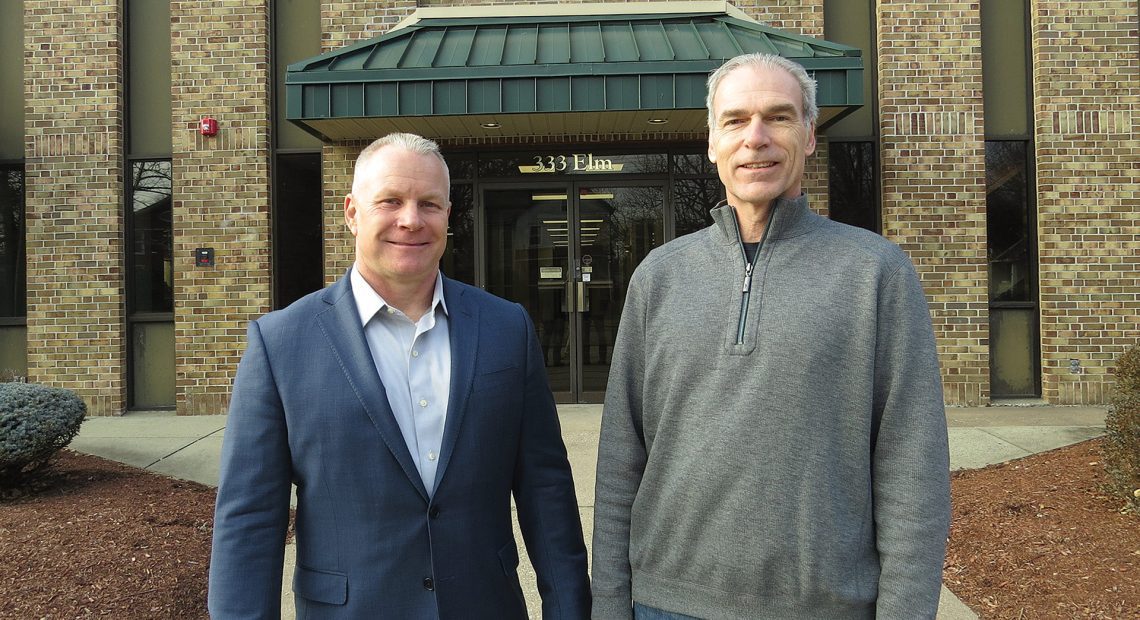
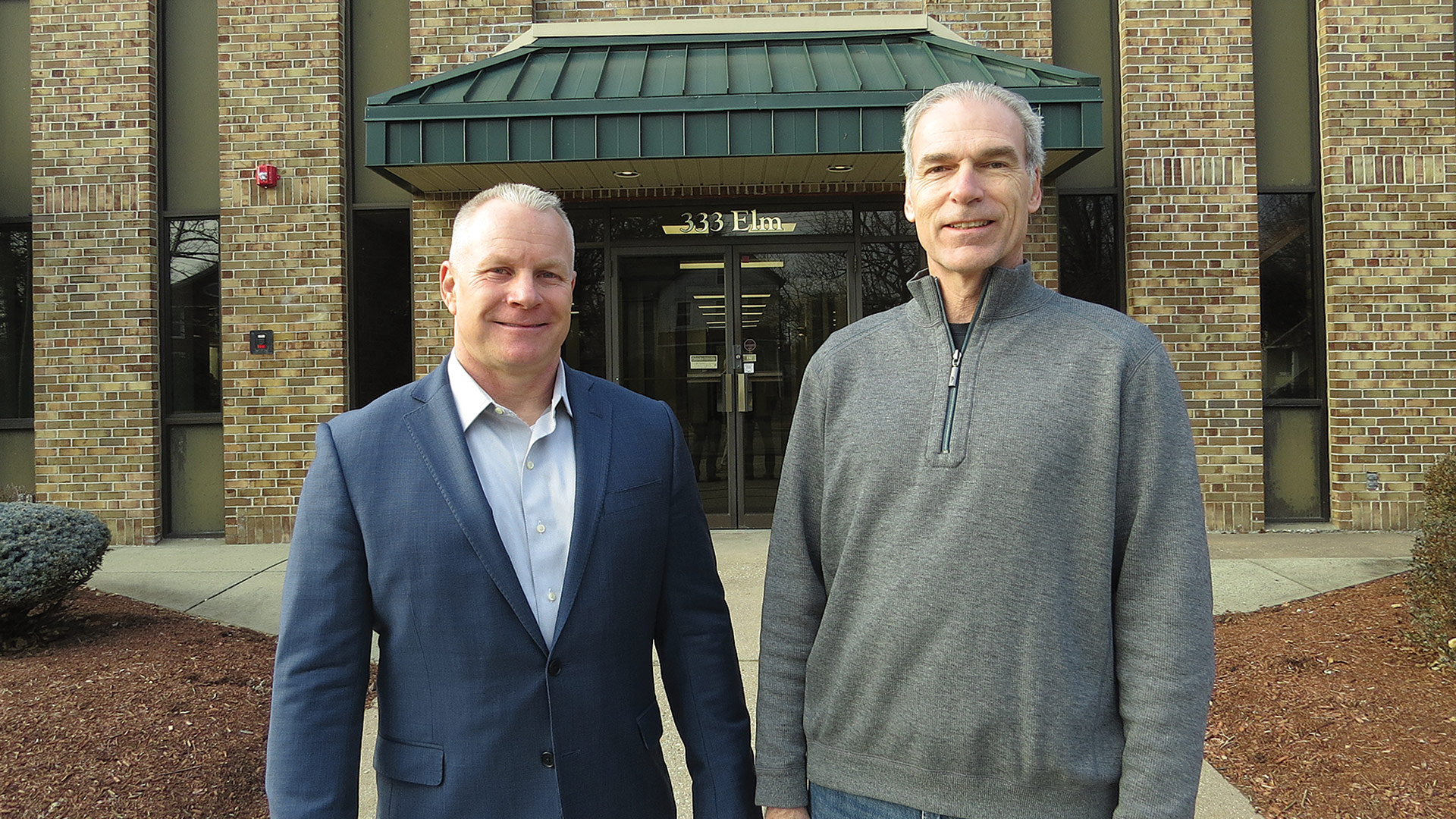
Michael Martin, left, and Nick LaPier

Michael Martin, left, and Nick LaPier have acquired 333 Elm St. in West Springfield and made it home to their businesses.

In many respects, Nick LaPier is back where he started. Or at least back to where he started his own accounting firm in 2003.

That would be the office building at 333 Elm St. in West Springfield.

Back then, he took a tiny office (600 square feet) on the first floor. There, with his mother, Elaine, serving as an office manager, he quickly grew his firm and eventually moved out and up.

Today, he is co-owner of the property where he first put his name on the door, along with Michael Martin, managing partner of Paladin Wealth Partners, which will soon be expanding with a second office at 333 Elm, sharing the property with LaPier Dillon & Associates (LaPier partnered with Brian Dillon several years ago); New Valley Bank, which moved in last August; and tenants that will occupy roughly 1,500 square feet of space currently being built out.

Together, they’re filling the parking lot and bringing new vibrancy to the property known to many in the community as the ‘Checkwriters Building’ (the payroll company occupied most of the property before outgrowing the space and moving to Northampton in 2021) and, before that, as the home to a dental practice — Dr. James Sady built the property in 1975 — and other tenants.

It was also home years ago to Multi Bank, where LaPier and his wife, Kathy, secured their first car loan.

So LaPier has a long history with the property, and he and Martin intend to write more chapters, starting with the relocation of their businesses to that site, thus becoming part of the revitalization of West Springfield’s downtown, a work in progress that includes the redevelopment of the former United Bank property, 95 Elm St., just a few blocks to the south; some new restaurants; and planned traffic improvements, including a rotary at the intersection of Elm Street and Route 20 (more on that later).

“The hope with this move is that, as we continue to grow, we will have the space available to accommodate that growth.”

LaPier, Dillon, and the accounting firm’s other employees finished moving in just after the new year. Meanwhile, Martin and others from Paladin Wealth Partners are set to move in later this month. While the property was acquired last summer, the two partners have invested heavily in renovating its spaces.

“We essentially gutted it and designed it from the ground to function as a full-service CPA firm,” LaPier said of his firm’s 6,500 square feet, adding that the company now has 16 employees. “We designed it to be the most efficient operation format for a CPA firm, but, at the same time, designed for 2023.”

With both LaPier, Dillon & Associates and Paladin Wealth Partners, the acquisition of 333 Elm started with the realization that they had outgrown their existing homes. For the accounting firm, that meant space roughly a mile away at 71 Park Ave., and for Paladin, space in Tower Square.

“The hope with this move is that, as we continue to grow, we will have the space available to accommodate that growth,” LaPier said.

Martin said his firm, which he launched with partner Pat Donnelly in 2018, has seen steady growth over the past several years. Having outgrown the space in Tower Square, the logical decision was made to expand with a second office.

“We have 2,500 square feet in Tower Square, and we were full,” he told BusinessWest, adding that, at the advice of his son, Ryan, who once worked in sales at Checkwriters (and now works at Paladin Wealth Partners), he took a close look at the 333 Elm St. property. Later, he would partner with LaPier, his long-time accountant, to acquire it for $1.9 million.

But there were other considerations for this acquisition beyond the need for more space.

Both LaPier and Martin were looking for real-estate investment opportunities, and when the property came on the market in 2021, they gave it a close look and decided that, in addition to a storied past, it had a solid future, given its location, parking, and other amenities.

Nick LaPier, left, and Brian Dillon

Nick LaPier, left, and Brian Dillon in their renovated space at 333 Elm St. in West Springfield.

Soon after taking ownership, they signed New Valley Bank, an emerging player in the region’s financial-services sector, to a long-term lease for what is now its third location. A solid tenant, the bank also brings potential new customers to both LaPier, Dillon & Associates and Paladin Wealth Partners, he said, as well as needed foot traffic in the city’s emerging downtown — a story both partners wanted to be part of.

“Elm Street’s a growing area; that’s another reason to invest here,” LaPier said. “There’s been positive growth on the street for the past 10 years, and it appears that the city wants to continue developing it as a business corridor; we want to be part of that story.”

West Springfield Mayor William Reichelt confirmed those aspirations. He said there has been significant progress made in making Elm Street more of a destination in recent years, especially through the redevelopment of the former United Bank Building, which is now home to several tenants, including Tandem Bagel Company, Future Health, Kindred at Home, and several others.

Having 333 Elm vibrant again, especially with service businesses that will have employees but also bring people to that location, will certainly bring more momentum to that central business district.

“Just to have more bodies in the downtown is good overall,” Reichelt said, referring to employees working at that location. “There are now more people who are going to go eat at Tandem, the Celery Stalk, or the other restaurants in the area. They’re going to bring customers and more foot traffic down here, and that’s what our downtown is going to thrive on.

“That building being vacant really hurt us — all those employees who weren’t there anymore,” he went on, adding that the property had been largely vacant for roughly two years.

The parking lot is filling back up again, a positive sign for the city and the start of another intriguing chapter in the story of a property with an already-rich business history.

Community Spotlight

Community Spotlight


Mayor William Reichelt

Mayor William Reichelt says West Springfield is making significant progress on many of the goals he set when first elected in 2015.

While the country will be celebrating its 250th birthday in 2026, West Springfield will mark that same milestone two years earlier.

And the planning for what will be a huge party is very much underway, said Mayor William Reichelt, noting that a committee has been put together, chairs of that board have been selected, and a dialogue will soon be launched with town residents to determine how, where, and in what ways they want to observe that birthday.

And while two years will go by quickly, especially with all this planning and execution to handle, this community that operates as a city but still calls itself a town could look much different by the time the big party kicks off.

Several of its major roadways, including Memorial Avenue and sections of Route 5, will be redone or in the process of being redone (hopefully the former, said the mayor as he crossed his fingers — figuratively, anyway) by then. There will be some new businesses on those stretches — Amherst Brewing is moving into the former Hofbrauhaus property, for example — and some of them well before 2024. And there may actually be some cannabis-related ventures in this town that has thus far said ‘no’ to this now-booming industry; a critical City Council vote on the matter took place on July 18, just after this issue of BusinessWest went to press, and Reichelt, who backed a measure to permit the licensing of such establishments, was confident that he had the requisite six votes for passage.

“Once I got into this, there was so much I wanted to do, and I quickly realized that nothing happens fast.”

“We’re in a much different place than we were four years ago, when it was 8-1 [against],” he said, adding that the measure would enable businesses to be located on large stretches of Riverdale Street, the preferred location among those in that industry.

And there is a chance, albeit a slight chance at this point, that the massive power-generating plant near the rotary at the Memorial Bridge may disappear from the landscape it has dominated for decades. Indeed, it has been decommissioned, and its owners are deciding what to do with the property.

“We’re in discussions now about what remediation will look like; I would like to see a clean site so another developer can do something with it, but we’re still in the talking stage,” Reichelt said, adding that the community is looking closely at what happened with a similar but larger property in Salem that is being redeveloped.

The renovated 95 Elm St., now known as Town Commons

The renovated 95 Elm St., now known as Town Commons, features an eclectic mix of businesses and will soon add a restaurant.

But enough about what might and might not happen over the next two years. For now, West Springfield and its mayor are making progress on many of the goals he set down when he was first elected in 2015, including infrastructure, new schools and additions to existing schools, attracting new businesses, and creating what he called a “walkable downtown” with plenty of attractions.

Early on, he said he wanted to create ‘another Northampton.’ “But people have this weird dislike of Northampton, for some reason, so now, we say we want it to be like West Hartford,” Reichelt noted, adding that his community is certainly moving in that direction with initiatives ranging from a walking trail and improved infrastructure along the historic town green to the reinvention of 95 Elm St.

Formerly home to United Bank and still known to many as the ‘United Bank building,’ the three-story office complex is now home to a mix of businesses, and a new restaurant will soon be added to that mix.

For this, the latest installment of its Community Spotlight series, BusinessWest turns its focus on West Springfield and the many forms of progress being seen there.


Party Planning

Returning to the subject of the 250th birthday party, Reichelt said the wheels are in motion for that celebration, and some pieces are starting to fall into place.

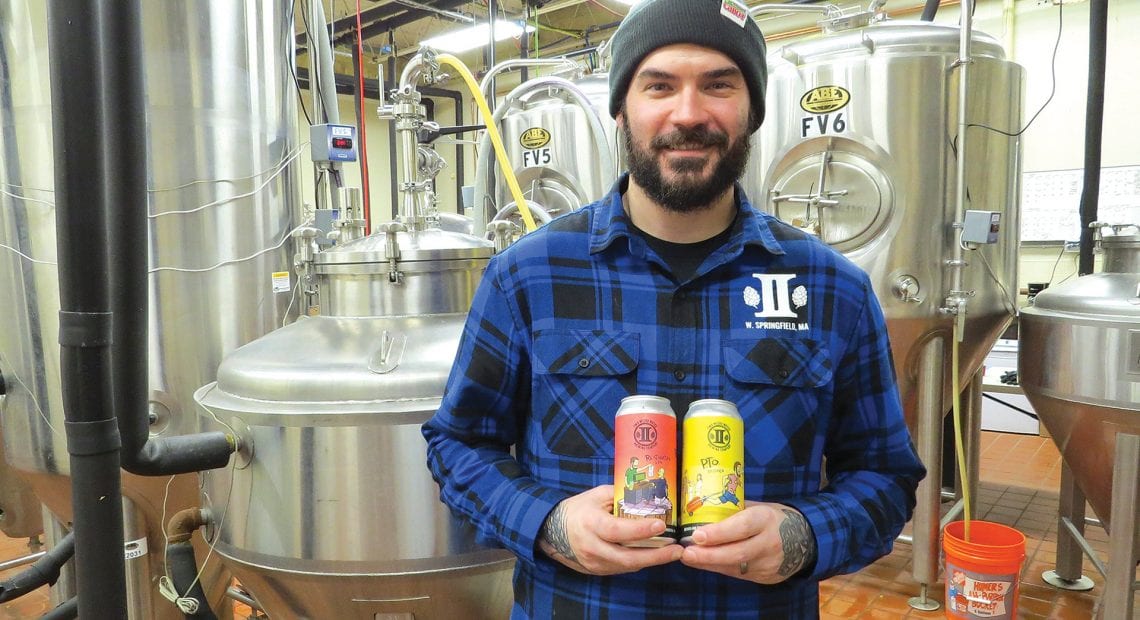
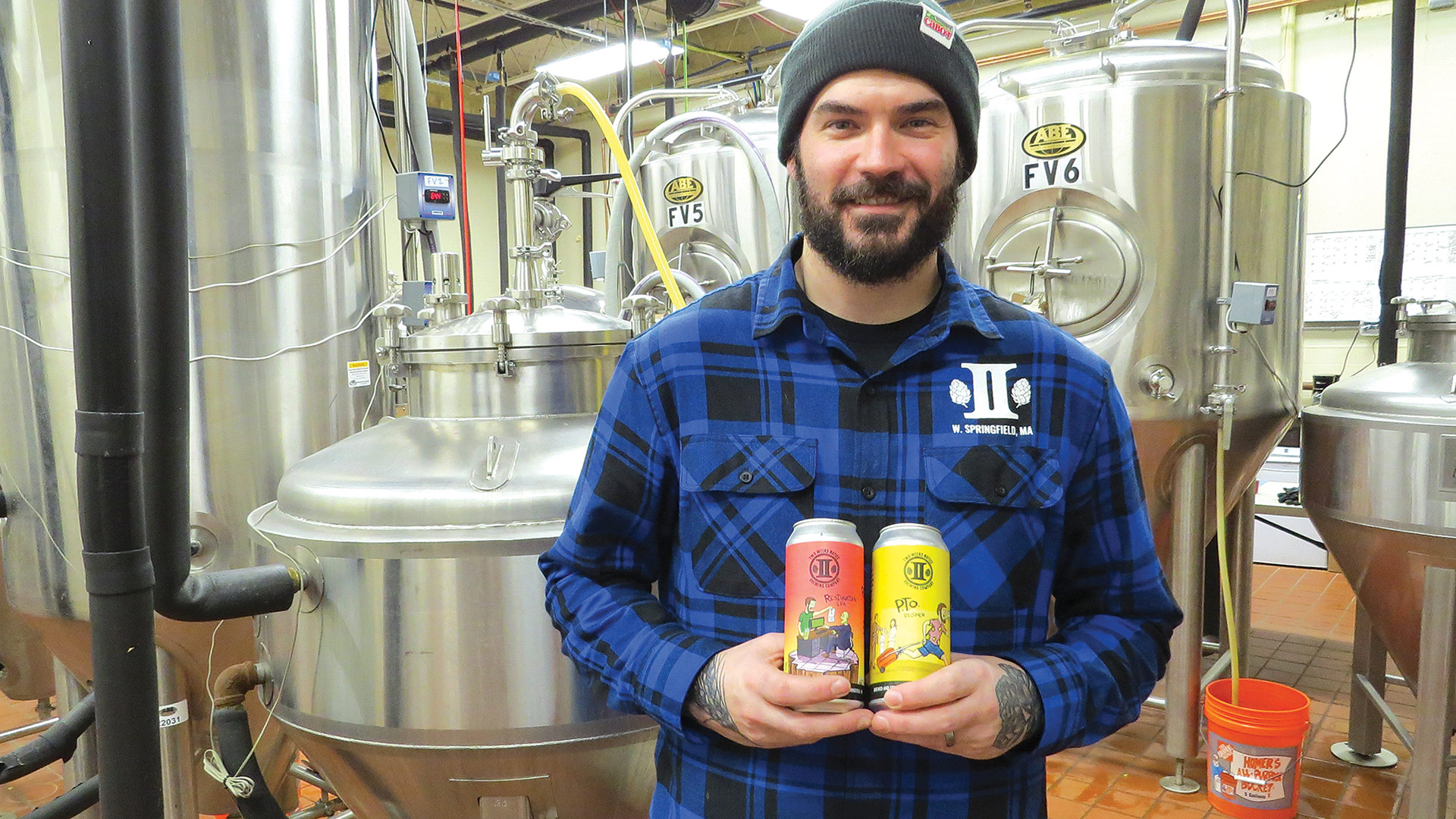
That list includes a special commemorative 250th birthday beer to be created by Two Weeks Notice Brewing, which set up shop in West Springfield several years ago and has established a firm presence in the community; no word yet on just what this brew will be or what it will be called.

Meanwhile, old documents and photos are being collected, and a commemorative history — a significant update to one produced for the 200th birthday in 1974 — is being planned, said Reichelt, adding that there is preliminary talk of staging an event similar to the Taste of West Springfield that was put on for many years by the community’s Rotary Club.

“We’re talking about bringing something like that back, maybe with a food truck festival on the common,” he said, reiterating that planning for the 250th is still very much in the early stages.

And while this planning continues, officials are making progress on a number of different fronts in the community, everything from the planning of infrastructure work on Memorial Avenue and Riverdale Street to determining how to spend roughly $8 million in ARPA funds (other infrastructure projects are at the top of that list) to contemplating what might be done if that massive power plant actually comes down.

Reflecting on that list, and his first six and half years in office, Reichelt, now one of the longest-serving mayors in the region, said he’s learned during his tenure that it often (always?) takes a long time to get something done, and, as a result, communities and those who lead them must be patient and perseverant.

“Once I got into this, there was so much I wanted to do, and I quickly realized that nothing happens fast,” he told BusinessWest. “Projects that I started talking about back in 2016 … we’re just starting to get funding for and breaking ground now.”

As an example, he pointed to the last remaining piece, the restaurant at 95 Elm St., something he’s been pursuing for years and an element he believes will be a nice compliment to what already exists on that street — a few restaurants, the Majestic Theatre, and a bagel shop already at 95 Elm — and make the area more of a destination.

Hofbrauhaus

At top, the town common now boasts new walking paths. Above, the former Hofbrauhaus property will become a new site for Amherst Brewing.

It’s also taken some time to make the planned improvements to the green area, which now boasts new traffic lights, improved intersections, and a half-mile loop for walking and other uses, said the mayor, adding that a similar upgrade is planned for Elm Street.

“We want to bring people downtown and have it be a spot where you can walk around, go to the theater, have dinner in a couple of different places … make a night of it,” he said. “We have great commercial corridors on Memorial Avenue and Riverdale, but there’s no real place for people in town to go; to have a walkable downtown would be nice. It’s nice to see come that come to fruition after six years.”

Meanwhile, there are ambitious plans on the table for improving the full length of Memorial Avenue, from the Route 5 rotary to the recently widened Morgan Sullivan Bridge. The $25 million, state-funded project is slated to commence next April, and it will take two years to complete.

Significant work is also planned for Route 5 (Riverdale Street) and specifically the stretch north of I-91, said Reichelt, adding that the broad goal is to redevelop that section of the street, which has always been far less popular with retailers than the stretch south of the highway.

“There’s this perception … businesses have no desire to be north of the I-91 overpass,” he said. “They all want to be between the overpass and East Elm connection, where are no vacancies.”

As for the aforementioned power plant, it is very early in the process of deciding what its fate will be, said Reichelt, adding that, if all goes well, the community could have 10 acres of land right off Route 5 and Memorial Avenue that could be redeveloped for a number of uses. There is a landfill next door, so there are some limitations, he noted, but industrial, commercial, and infrastructure opportunities exist, including a connection to the rotary so that motorists can go both north and south from Agawam Avenue.


What’s Down the Road

But much of the attention is now focused on cannabis-related businesses, that July 18 vote, and what will likely happen if that measure passes.

At present, the only business allowed in West Springfield for cannabis-related ventures is to advertise their products and services on billboards along the highways that run through the community. That will change, of course, if the measure passes, as the mayor predicts it will, and he expects West Side to be an attractive mailing address for such companies.

“We want to bring people downtown and have it be a spot where you can walk around, go to the theater, have dinner in a couple of different places … make a night of it. We have great commercial corridors on Memorial Avenue and Riverdale, but there’s no real place for people in town to go; to have a walkable downtown would be nice. It’s nice to see come that come to fruition after six years.”

Indeed, Reichelt said he no longer uses the phrase ‘crossroads of the region’ to describe his community, preferring ‘retail capital of Western Mass.,’ a nod to the many regional and national retail heavyweights — from Costco to Dick’s Sporting Goods to Home Depot — that have located stores in the community.

The traffic that drew those major retailers should also attract cannabis businesses and especially dispensaries, he added.

Reichelt noted that he believes that there is sufficient momentum to get the measure passed, and there may be more with the recent 3% increase in property taxes, the town’s first in several years. Indeed, he said the tax revenue generated from cannabis-related businesses and its potential to help prevent another such increase in rates may help incentivize the council.

“It’s four years later, and the landscape has really changed,” he said. “You hear a lot of the same legalization arguments that you heard back in 2016, but that argument was settled in 2016 — it’s legal in Massachusetts now. To think that it’s not in town is … not based in reality. There are signs on Riverdale and Westfield Street and Memorial Avenue pointing to the different places you can buy marijuana outside of town; look at the tax money that’s leaving here.”

While the July 18 date was one to circle, there’s another key date fast approaching — Sept. 16. That’s the kickoff to the Big E, which will take another big step this year to returning to normal — as in 2019 conditions.

The fair was canceled in 2020, and while it was staged in 2021, it did not have a full lineup of entertainment, said Eugene Cassidy, president and CEO of the Big E, adding that, for 2022, it will be all systems go.

Much of the entertainment has already been announced, he said, noting that Lynyrd Skynrd will close the fair this year. Meanwhile, there will be a number of new attractions and events — including an opportunity for fair attendees to communicate with those at the International Space Station — and even food items, including noodles, vegan offerings, and full-sized donuts.

Cassidy said advanced ticket sales are running well ahead of the pace for last year, which was a near-record year for the fair, and other strong years. “People don’t even know what what the fair is going to offer, but they’re already supporting it by buying tickets, sometimes nine months in advance of the event,” he told BusinessWest. “And that provides a great deal of emotional support for those of us who run the place because we know that our patrons care about the organization.”

But while projections are certainly good for this year, he will watch closely what happens at several other state and regional fairs set to open in the coming weeks.

Indeed, one wildcard could be gas prices, which, while they’re coming down, remain historically high and could deter some families from driving long distances for entertainment.


Bottom Line

Reflecting on why this city still calls itself a town, Reichelt recalled that the vote to change the charter and convert from town government to city government was close — as in very close.

“They decided when they wrote the town charter to maintain the ‘town’ name to maintain that town feel,” he said, adding that many people have approached him and said ‘Will, it doesn’t feel like a town anymore.’

Such sentiments lead him to believe that maybe, just maybe, by the time West Springfield turns 250, it will not only operate a city government, but call itself a city.

If so, that will be only one of many potentially significant changes that will take place between now and then in a community where there is always movement and the landscape is, well, a work in progress.


George O’Brien can be reached at [email protected]

Daily News

WEST SPRINGFIELD — The West Springfield Board of Health instituted a mask mandate for the city starting Friday morning — the same day the Big E opens its 17-day fair, the Republican reported.

The mandate requires face coverings in all indoor public places, as well as private places open to the public, regardless of vaccination status, for those age 2 and older.

“The Big E is not the only big event in this town,” said Dr. Heather Sankey, a Baystate Health obstetrician and Board of Health member, according to the Republican. “We have people traveling from other states to come to Costco or the hockey arena or whatever event we are doing, and it’s very important that we protect everybody throughout all of this.”

Cover Story

Fair Amount of Intrigue

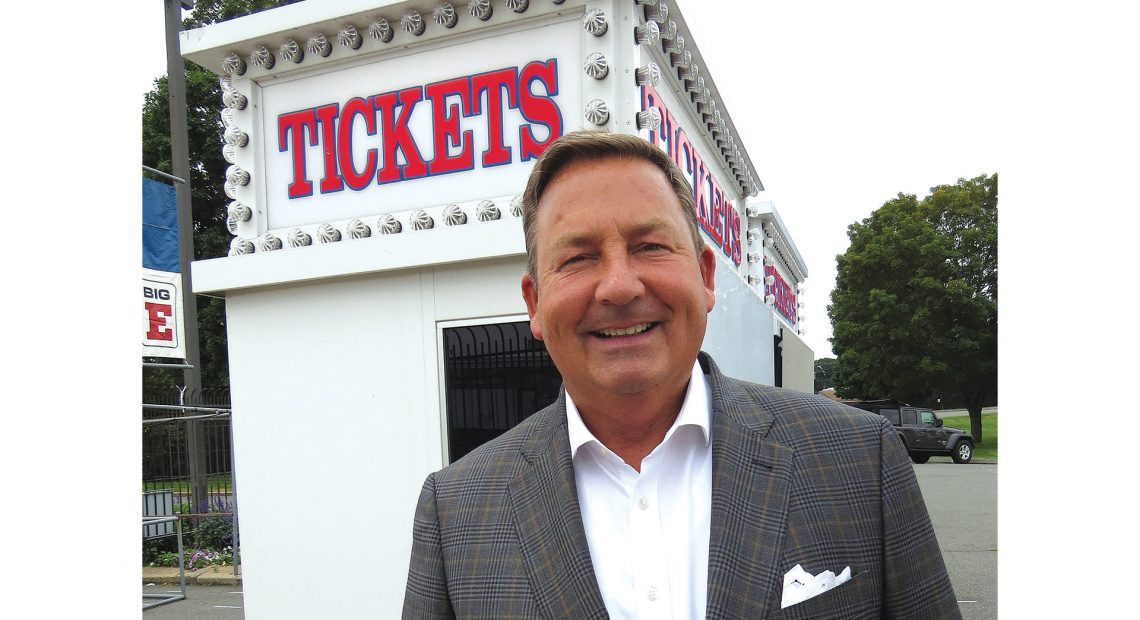
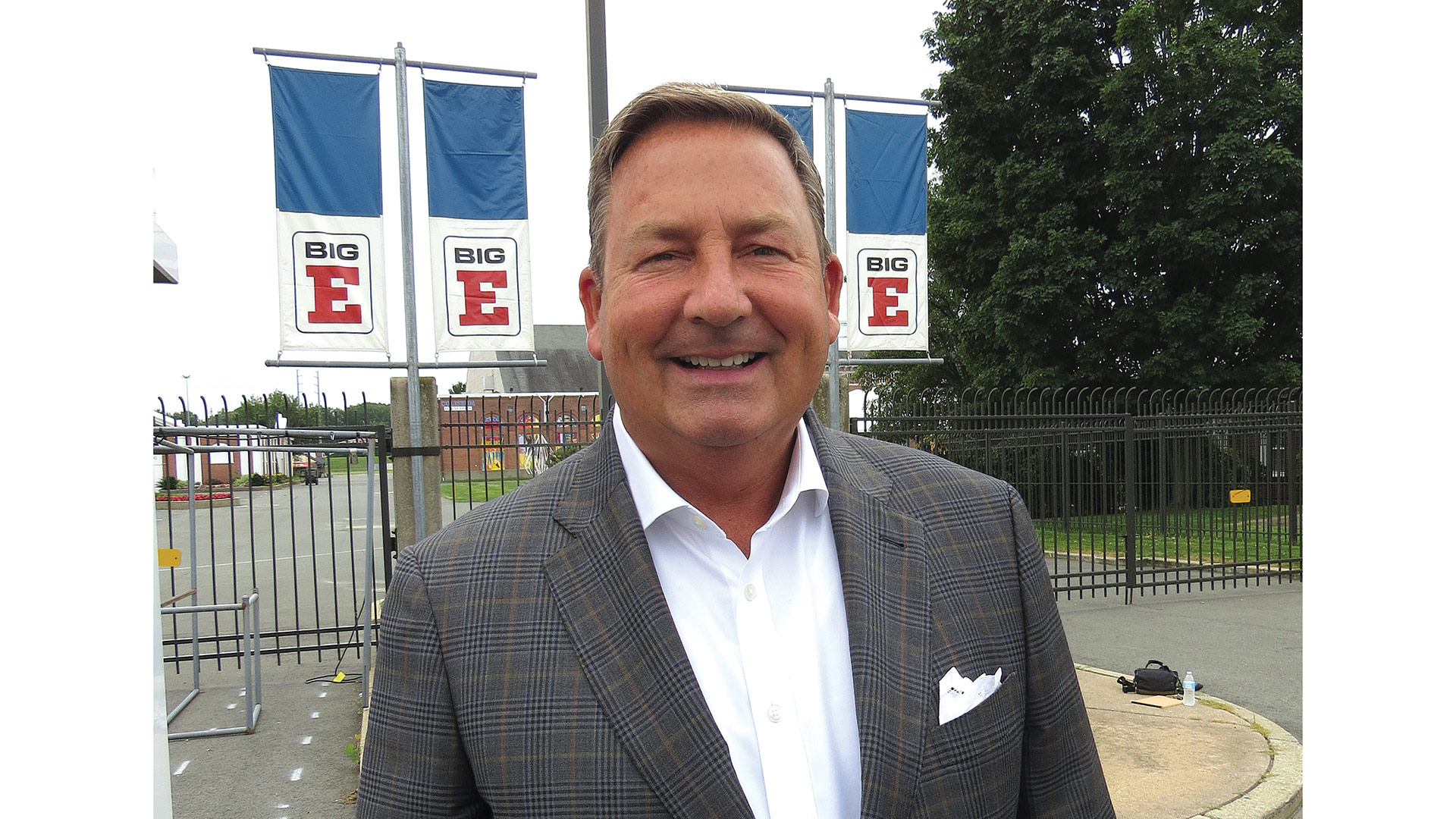
Eugene Cassidy, president and CEO of the Big E

Eugene Cassidy, president and CEO of the Big E

As the calendar turns to late summer, all eyes in the region turn to the Big E in West Springfield and the much-anticipated 2021 edition of the fair. The show did not go on in 2020 due to COVID-19, a decision that impacted businesses across a number of sectors. There will be a fair this year, and the goal is to make it as normal — there’s that word again — as possible. But it will be different in some respects. Meanwhile, as COVID cases surge in other parts of the country and uncertainty about the fall grows with each passing day, the anticipation for the fair comes with a healthy dose of anxiety.


In a normal year — and this isn’t one, to be sure — what keeps Gene Cassidy up most at night is the weather.

Cassidy, president and CEO of the Big E, has been quoted many, many times over the years saying that just a few days of steady rain — especially if they come on weekends — can turn a great fair, attendance- and revenue-wise, into an average one, or worse, just like that. So even though there’s nothing he can do about the weather, he frets about it. A lot.

This year … while ‘afterthought’ might be too strong a word when it comes to the weather, it might not be, either.

Indeed, Cassidy has other matters to keep him up at night, including a pandemic that is entering a dangerous and unpredictable stage, a workforce crisis that has already forced the cancellation of a giant Ferris wheel that was scheduled for this year’s fair and may pose a real challenge for vendors and other participating businesses during the fair’s 17 days, and even concerns about whether one of the organizers of his massive car show can get into this country (he’s been given the AstraZeneca vaccine, which isn’t recognized in the U.S.).

“I have a fear … that the long arm of the government can suddenly change our lives — we lived through that in 2020, to be sure,” he noted. “And the Eastern States Exposition is surviving on a very thin thread; we cannot withstand being shuttered for another fair because the vacuum that would occur in our economy is nearly three quarters of a billion dollars, and there’s no way that anyone is going to able to replace that.”

“I have a fear … that the long arm of the government can suddenly change our lives — we lived through that in 2020, to be sure. And the Eastern States Exposition is surviving on a very thin thread; we cannot withstand being shuttered for another fair.”

As the Big E enters the final countdown before it kicks off on Sept. 17, there are equal amounts of anticipation and anxiety. The former is natural given the fact that the region hasn’t gone without a fair, as it did in 2020, since World War II; Cassidy noted that advance ticket sales are “off the charts,” and running 80% higher than in 2019, which was a record-setting year for the Big E.

The fair will offer a welcome escape for all those who have spent much of the past 18 months cooped up and not doing the things they would traditionally be doing. And it will provide a much-needed boost for businesses in several sectors, from hotels and restaurants to tent-renting enterprises, for those homeowners in the area who turn their backyards into parking lots, and for countless vendors who had a big hole in their schedule (actually, lots of holes) last year.

People like Sharon Berthiaume.

The Chicopee resident has been coming to the Big E with her booth, A Shopper’s Dream — which features animal-themed merchandise (mugs, ornaments, floormats, metal signs, etc.) — for 30 years now. She said the Big E is by far the biggest show on her annual slate, and one she and others sorely missed last year.

“It was a major loss, a huge disappointment last year,” she said. “We’ve been coming back for so many years, and we have a lot of regulars who come back year after year looking to see if we have anything new. I’m looking forward to being back.”

But the anxiety comes naturally as well. Indeed, the tents, ticket booths, and other facilities are going up — more slowly, in some cases, because of a lack of workers — as COVID-19 cases are spiking and as states and individual communities are pondering mask mandates, vaccination passports, and other steps.

While there are dozens, if not hundreds, of other area events and gatherings that might be impacted in some way by the changing tide of the pandemic, from weddings to the Basketball Hall of Fame enshrinement ceremonies early next month, none will be watched more closely than the Big E.

Gene Cassidy says there is pent-up demand for the Big E

Gene Cassidy says there is pent-up demand for the Big E, but because of the pandemic and fears among some people about being in crowds, he’s not expecting to set any attendance records this year.
Photo courtesy of The Big E

Cassidy told BusinessWest he watches and reads the news every day. He’s concerned by the trends regarding the virus, but buoyed by the fact that fairs of this type have been going off, mostly without hitches, across the country. And the turnouts have certainly verified a high level of pent-up demand for such events.

Overall, the sentiment within the region, and the business community, concerning the Big E and the fate of this year’s fair was perhaps best summed up Stacey Gravanis, general manager of the Sheraton Springfield.

“It’s huge … and it’s not just the business side, it’s the emotional side as well,” she said of the Big E and losing it for 2020, “because it’s been around for so many years. It’s something we’ve looked forward to every year for as long as I can remember. So we’re super happy to have it back this year, and we all have our fingers crossed right now.”

And their toes as well. That’s how important the Big E is to the region and its business community.


The Ride Stuff

As he talked with BusinessWest about the upcoming fair and ongoing planning for it, Cassidy joked about how much he and his staff had to tap their memory banks after their forced and certainly unwanted hiatus.

“It’s been two years since we’ve produced a fair, and even though you’ve done this 30 times before, it’s surprising how much you forget,” he said, noting quickly that institutional memory has certainly kicked in for the staff of 26, down from 31 — a nod to one of the many ways the pandemic has impacted the Big E.

It’s been two years since we’ve produced a fair, and even though you’ve done this 30 times before, it’s surprising how much you forget.”

And while getting the show ready for primetime, Cassidy, who also chairs the International Assoc. of Fairs and Expositions, a worldwide trade association, has been on the phone and in Zoom meetings with others from his industry. Such conversations have gone on with those in this time zone and others with institutions on the other side of the world. And the reports cover a broad spectrum.

“Australia has shut itself down again — after only nine deaths from this Delta variant,” he said. “And that’s a scary development; I think there are 24 million people in Australia, and to have that country impacted like that … it’s been devastating to their economy, and people are quite anxious there.”

Closer to home, and as noted earlier, the news has been much better.

It’s been a very long 18 months for the vendors who work the Big E

It’s been a very long 18 months for the vendors who work the Big E, and they are among the many people happy to have the 17-day fair back on the slate.
Photo courtesy of The Big E

“At the fairs that have been produced, the crowds have not been diminished,” he said, listing successful events in Indiana, Wisconsin, and California as evidence. “At those fairs that have run, people have really returned — and in a large way; there have been a lot of attendance records set.”

At home, those off-the-charts advance ticket sales tell Cassidy that some people are interested in eliminating some contact points and avoiding the crowds at the ticket booths. But mostly, they tell him there is certainly pent-up demand for the fair.

“People are ready to get back to normal,” he said, adding, again, that the overriding goal for the staff was, and is, to make the fair as normal — as much like previous years — as possible.

But more important than normal is the safety of attendees and employees, said Cassidy, noting that a wide range of cleaning and sanitizing protocols are being put in place, and steps are being taken to try to thin crowding in some areas.

“We’ve have intentionally thinned out the grounds a little bit,” he explained. “There’s going to be roughly 10% more space on the fairgrounds as we have tried to space things out a little bit.”

Elaborating, he said there has been some attrition when it comes to food and other types of vendors, and some of the “lower performers,” as he called them, have been eliminated.

“We thought that space was more important than that commercial activity,” he explained, adding quickly, though, that the science is inexact regarding whether creating more space reduces lines and points of contact.

Gene Cassidy says his overriding goal is to make the 2021 Big E as ‘normal’ as possible.

Gene Cassidy says his overriding goal is to make the 2021 Big E as ‘normal’ as possible.
Photo courtesy of The Big E

When asked about what he expects for attendance this year, Cassidy said he believes last year’s record of 1.62 million is, in all likelihood, not in danger of being broken, because there are some — how many, he just doesn’t know — who will not want to be part of large crowds of people this year. He’d like to see 1.4 million, and notes that he needs 1.2 million to pay for the fair.

“My goal is simply to provide a great, healthy, family experience for the fairgoing public,” he said, adding that several factors will determine overall turnout. “Our demographic is a little bit older than in other parts of the country, and I think some people are going to be hesitant about large crowds, and I think that will have an impact on us. At the same time, if you look at some of the other events, their popularity has been very high. So I suppose it can go either way, but I think we will see some scaling back of attendance, and that’s OK.”

While crowd control is an issue, there are other concerns as well, as Cassidy, especially workforce, which will be more of a challenge for vendors than for the Big E itself, which has seen most of the regular workforce it hires come back again this year.

Indeed, he noted that work on several of the larger tents that dot the fairgrounds started earlier this year because vendors had fewer people to handle that work. This trend, coupled with cancellation of the Ferris wheel, which demands large operating crews, obviously leaves reason for concern.

However, Cassidy believes the clock, or the calendar, to be more precise, may be working in the favor of employees.

“We open on Sept. 17, and the unemployment bonus checks will cease in the first week of September,” he said. “So, hopefully, people will be wanting to get back to work.”


Impact Statement

While there is anticipation and some anxiety within the confines of the Big E, there’s plenty of both outside the gates as well.

As was noted earlier and in countless stories on these pages over the years, the Big E impacts the local economy, and many individual businesses, in a profound way. Gravanis tried to quantify and qualify it.

“It’s thousands of dollars in room and beverage revenue,” she said. “It’s keeping our people employed on a full-time basis. It’s seeing these people, these vendors, that we’ve worked with over the past 20 to 30 years — we missed them last year. It has both financial and impact for our staff and our local businesses.”

The Avenue of States will be open for business at the Big E

The Avenue of States will be open for business at the Big E, which is seeing record numbers of advance ticket sales for the 2021 fair.
Photo courtesy of The Big E

Elaborating, she said the hotel, like all others, suffered a seemingly endless string of hits last year as events were canceled, tourism came to a screeching halt, and airlines (who book crews into the hotel on a nightly basis) all but shut down. But the Big E, because of its duration and scope, was perhaps the biggest single hit of all.

Which is why having it back is so important, and also why those fingers are crossed.

“We get hundreds, if not thousands, of room nights, as well as the incremental spending in our restaurants — it’s extensive,” said Gravanis. “We sell out every weekend of the year with a combination of vendors and attendees; right now, there are very few rooms left.”

Berthiaume certainly has her fingers crossed. She told BusinessWest that the return of fairs, and especially the Big E, could not have come soon enough for vendors like her. She said the Charleston (R.I.) Seafood Festival, staged earlier this month, was the first event she’d worked in roughly 18 months, and it has been a long, rough ride since gatherings started getting canceled in March 2020.

“It was crazy last year because you couldn’t plan — life was in limbo,” she said, adding that events were postponed early in the year and there was general uncertainty about when or if they would be held. This year, there was less uncertainty, but also nothing in the calendar, for most, until very recently.

She said a good number of vendors have been forced to pack it in or take their businesses online. “I know a lot of people who have gone out of business because of this. Many had been in business, like us, for 30 years or more, and they figured, ‘what the heck, I’m not going to do this anymore — it’s too hard.’”

Like Cassidy, she senses a strong urge on the part of many people to get back to doing the things they’ve missed for the past year and half, and she cited the seafood festival as solid evidence.

“They had people waiting for two hours to get off the highway to get in — the traffic was so backed up,” Berthiaume recalled. “We hadn’t seen people like that in maybe five years.

“Everyone is ready to get out there,” she went on, with some enthusiasm in her voice. “People are just so happy to be out in public. So the Big E, based on what I’ve seen with their tickets for the concerts … everyone is ready to roll; everyone is waiting for the Big E.”


Fair Weathered Friends

Getting back to the weather … yes, Cassidy is still concerned about it on some levels. And why not? There has been record rainfall this summer and extreme conditions in other parts of the country and across the globe.

He’s hoping all that is in the past tense, with the same going for the very worst that this pandemic can dish out.

The weather can never be an afterthought at the Big E, but this year it is well down the big list of things that keep organizers up at night.

Indeed, this is a time of anticipation and anxiety — and for keeping those fingers crossed.


George O’Brien can be reached at [email protected]

Daily News

WEST SPRINGFIELD — Congressman Richard E. Neal, West Springfield Mayor Will Reichelt, members of the City Council, and cabinet heads gathered for a press conference Thursday to highlight the funds that West Springfield will receive from the American Rescue Plan.

The Town of West Springfield is set to receive $2.8 million and the West Springfield Public Schools will receive $10.4 million.

“The American Rescue Plan has proven to be a lifesaver for communities all across our country and here in western and central Massachusetts,” said Congressman Neal. “Not only does this money assist the town in recovery efforts, it allows the community to make bold long-term changes that will be beneficial for years to come.”

Said Reichelt, “We are very fortunate to be receiving funds from the American Rescue Plan for the Town as well as our school system. The Town of West Springfield, along with the entire globe, has come a long way over this past year. After many life changing events, we are thankful to all the assistance put forward by our legislators.”

The state of Massachusetts will receive $8.1 billion in assistance, with cities and towns across the western and central part of the state that comprise the First Congressional District receiving $241 million.

Neal also spoke about the Child Tax Credit as Thursday was the first day that advanced payments to eligible families were delivered by the IRS.

“The Child Tax Credit will help set America’s children up for success and put more money in the pockets of hardworking parents,” he said. “This important tax credit will benefit 86% of children here in the First Congressional District and will lift 8,300 children out of poverty.”

Daily News

WEST SPRINGFIELD — The week of June 14-21 was National Nursing Assistant Week, and Visiting Angels of West Springfield showed its appreciation to all its caregivers for their hard work and dedication with a socially distanced drive-by at the Visiting Angels office with treats and goodies.

When a caregiver drove up to the table, the Visiting Angels administrative team presented them with a gift, a choice of treats, and a refreshing beverage. The goodie bags included tea bags, caramel candies, Visiting Angels party favors and tokens, and aromatherapy products for relaxation after a long day of work.

Visiting Angels of West Springfield is welcoming new caregivers to its team. Caregivers interested in joining the team can call (413) 733-6900. Visiting Angels offers benefits and flexible schedules designed to adapt to each employee’s specific needs. The home-healthcare service offers senior in-home care, elderly care, and care for those with dementia and Alzheimer’s disease in towns across the Pioneer Valley and the Greater Springfield area, including Springfield, West Springfield, Longmeadow, East Longmeadow, Wilbraham, Agawam, Ludlow, Westfield, Southwick, Chicopee, Holyoke, Southampton, and Montgomery.

Community Spotlight

Community Spotlight

Tyler Saremi

Tyler Saremi sees potential in West Springfield’s downtown, and is taking steps to inject some economic vibrancy.

When Tyler Saremi looks at what is considered downtown West Springfield — the Elm Street/Park Street area — he doesn’t see Northampton or West Hartford.

But he can easily imagine a day when that section of this city that still calls itself a town can attain something approaching a level of vibrancy and an eclectic mix of businesses, especially those in the hospitality sector, that define those communities.

And he’s doing his best to bring that day closer. Indeed, the multi-faceted business run by his family that he serves as vice president, Saremi LLP, acquired 95 Elm St. — known to most as the United Bank building because it was the main tenant for many years — with the goal of … well, turning back the clock in many respects.

The century-old building has, over the decades, been home to cafés, restaurants, a grocery store, banks, and other types of retail, said Saremi, adding that it has always been a destination, and the broad goal with this project is to make it one again. Thus, it has been rebranded as Town Common.

Already, Tandem Bagel, the Hadley-based company with locations there and also in Easthampton and Northampton, will soon occupy space where bank-teller windows have stood on the first floor; the target date for opening is July. Meanwhile, at the other end of the first floor, Saremi pointed to the place where intends to put a restaurant. He said two other leases have been signed, and several more are pending.

“People are just really excited to be part of bringing downtown West Springfield back,” he said. “Our main intention is a café and a restaurant on the first floor; whether we have to open a restaurant ourselves or partner with someone, we don’t care. That’s part of our commitment to West Springfield — it needs a café, and it needs a restaurant, and that’s what we’re going to do.”

“It’s going to be a tough year, but there are reasons for optimism — we see things opening back up.”

The redevelopment of 95 Elm St. is just one of the intriguing stories unfolding in West Springfield, a community that is, like many others, trying to rebound from a pandemic that has taken a huge toll on hospitality-related businesses. And West Side, as it’s called, has many of them, said Mayor Will Reichelt, who counted 20 hotels and motels and a number of restaurants in his community.

But the biggest business in that sector, obviously, is the Big E, which is responsible for filling many those hotels, motels, and restaurants, not just during the 17 days of the annual fair, but almost year-round, as that venue hosts a number of shows centered on everything from horses to toy railroads; dogs to guns and knives.

The Big E has been mostly empty and silent since the pandemic arrived a year ago, and while the outlook for 2021 is more promising, there remains a huge number of unknows, especially with regard to the fair, a situation that Big E President and CEO Gene Cassidy summed up this way:

“It’s like you’re navigating your way down a dark alleyway; you don’t know what’s in front of you — if there’s suddenly going to be a crack in the pavement or if you’re going to walk into a dumpster,” he said, using that phrase to indicate how difficult it is to plan when the rules keep changing, often without much, if any, notice. “Our goal, simply, is to plan to produce a product that people are going to enjoy.”

Cassidy is quite confident there will be a Big E this September — he just doesn’t how many people will be allowed to attend. He doesn’t think it will be full capacity, as in 100,000 people on a weekend day, as in fairs past. Instead, he’s expecting some percentage of that number, which won’t be ideal, but certainly better than last year.

And while most of his energy and attention is still focused on this year’s fair, he said he’s spending a good amount of time lobbying officials to understand the importance of fairs and live events in general, and to help ensure the long-term survival of such institutions, something he believes is now imperiled.

Overall, though, he’s optimistic about the rest of 2021.
Gene Cassidy says a sparsely attended Big E is better than none at all

Gene Cassidy says a sparsely attended Big E is better than none at all, and he’s moving forward with planning after having to cancel the 2020 fair.

“It’s going to be a tough year, but there are reasons for optimism — we see things opening back up,” he said, noting that various expert projections of herd immunity by fall or even sooner are encouraging, even as innumerable challenges and question marks loom.

For this, the latest installment in its Community Spotlight series, BusinessWest takes a hard look at West Side and its efforts to become even more of a destination, even as its business community continues to battle COVID-19 and all the challenges it has brought.


Road to Progress

Reichelt, now wrapping up his second term in office, with plans to seek a third, said he can’t find too many silver linings from the pandemic and all the havoc it caused in 2020.

But he can find at least one — acceleration of the process to replace the Morgan-Sullivan Bridge, which connects his city with Agawam. The bridge project, which commenced two years ago, has to pause during the 17-day run of the Big E, he explained, adding that work actually comes to a halt for three weeks or more because of logistical concerns.

Obviously, that didn’t happen in 2020, he went on, adding that a project that was due to be completed this summer will now be done by spring.

“The work is way ahead of schedule,” he said. “Without the Big E, they probably gained a month of working time, and that will certainly help out on the back end.”

The broad mission moving forward is to get more people to travel over that bridge and other thoroughfares into West Side, said Reichelt, adding that the city has always considered itself at the crossroads of this region — I-91 and the turnpike connect there, and Route 5 runs through it as well. This location has long been a huge asset, one that paved the way, if you will, for major retailers and car dealers alike to populate Riverdale Street and Memorial Avenue. It has also brought visitors to the community not only for the Big E and shows on its grounds, but for myriad other tourism- and business-related functions, from leaf peeping to the semiannual EASTEC trade show.

The ongoing goal is to continually take advantage of this asset, build on the foundation that’s been laid, and try to spread the vibrancy to other areas of the city.

Which brings us back to Elm Street, Town Common, and the huge ‘Under New Management’ banner now adorning it.

As he gave BusinessWest a tour, Saremi pointed out the spot where Tandem Bagel would go, then did the same with the restaurant. Venturing to the second floor, much of which is now occupied by Saremi LLP, he showed where a number of smaller spaces, individual offices, and even co-working space might be carved out.

“We want to make it more walkable, more friendly, and more inviting so we can complement the business investment that’s happening there.”

Later, he pointed out one of the huge windows to the traffic — specifically, the juncture of Route 20 and Elm Street.

“This intersection has so much traffic … we need to get people to stop here in downtown West Side, get out, walk around, go to some shops, get something to eat — that’s how I see it,” he noted, adding that there are already some attractions there, including the Celery Stalk restaurant, a legendary luncheon stop; as well as bNapoli restaurant and the Majestic Theater. The broad goal is to build on that critical mass, he said, noting that clusters of eateries and entertainment venues have been the formula for success in Northampton, West Hartford, and other communities.

Reichelt concurred, and told BusinessWest the city is always striving to build on its already-impressive portfolio of retail- and hospitality-related businesses — and also fill in some spots that are less vibrant than others.
Mayor Will Reichelt

Mayor Will Reichelt says initiatives like a new economic recovery director and a series of infrastructure plans will help keep West Springfield on the right track.

As an example, he pointed to Riverdale Street, which actually has two distinct sections, if you will. There’s the one south of I-91, which is thriving and always has, said the mayor, who worked at the Donut Dip on that throughfare in his youth and thus speaks from experience. Then there’s the stretch north of the highway, which, while still vibrant by most measures, has some vacancies and, in general, is underperforming.

Reichelt said the city will look to help address this situation, and other business and economic-development issues in the city, through the hiring, at least on a temporary basis, of what’s being called an ‘economic recovery director.’

“The goal with this new position is to build better business relationships in the community, help with business retention, and focus on some of the underutilized areas, like the north-of-91 section of Riverdale,” he explained.

Already, there are signs of progress, he said, noting the reopened White Hut, the expansion of Calabrese Market on Park Street, and the sale of the former Hofbrahaus property to the owner of the Hangar Pub and Grill and growing ‘Wings Over’ stable of restaurants, among other positive developments.

“The common citizen wants their life to return to normal,” he said. “So I think people will come out … they will come back to fair.”

Meanwhile, a number of infrastructure plans now in place are designed to improve traffic flow and, ultimately, promote more vibrancy in the city. First up is Park Street, he said, adding that it is being repaved and steps are being taken to taken to make the commons more accessible and safer to use. Those plans include what the mayor called a mile-long loop or walking and biking trail around the green space.

Elm Street will follow, he went on, adding that this will be a multi-faceted initiative designed to beautify the area, add more parking, redesign the intersection of Elm Street and Route 20, and allow people to make more and better use of the green space there.

“We want to make it more walkable, more friendly, and more inviting so we can complement the business investment that’s happening there,” he told BusinessWest, adding that this project is in the design phase and should commence in 2022. Likewise, a huge, $25 million project to improve traffic flow on Memorial Avenue will take place that same year.


Fair Assessment

Sitting in the large conference room in the Big E’s administration building, Cassidy reflected on what has been an ultra-challenging 12 months for this regional institution — and what lies ahead, to the extent that he could, obviously.

He said every aspect of this enterprise — from the annual fall fair to the year-round shows that draw visitors from across the Northeast, to the restaurant on the grounds, Storrowton Tavern — have been deeply impacted by the pandemic.

And the hurt is still being felt. The shows slated for weekends in January and February were all canceled, he said, with some, including the huge Western Mass. Home & Garden Show, moved back on the calendar, in this case to August.

The Big E has received some support — nearly $1 million in the first round of PPP, with an application in for the second round of funding. There have been some cutbacks — the workforce has been trimmed from 30 full-time employees to 25 — and those who are left have found themselves with … let’s call them broadened job descriptions.

“Those of us who are still here have had to do jobs we’ve never had to before,” he noted, adding that such tasks include everything from directing traffic for the few events that have been staged to making sure the buildings on the grounds are secure. “Everyone has had to pitch in.”

West Springfield at a glance

Year Incorporated: 1774
Population: 28,529
Area: 17.5 square miles
County: Hampden
Residential Tax Rate: $16.90
Commercial Tax Rate: $32.49
Median Household Income: $40,266
Median Family Income: $50,282
Type of Government: Mayor, City Council
Largest Employers: Eversource Energy, Harris Corp., Home Depot, Interim Health Care, Mercy Home Care
* Latest information available

As for the last three quarters of 2021, Cassidy said there are certainly some signs of optimism with his industry. For example, the Canadian government recently gave the green light for the popular Calgary Stampede to take place in June. Meanwhile, the Pasco County Fair in Florida was recently staged, albeit with a number of restrictions and safety precautions in place.

Cassidy took it in while on a trip to Tampa for ‘Florida Week’ and a number of trade association meetings that were staged in-person, which is significant in and of itself, he noted, adding that the main topic of conversation, obviously, was how to stage events safely.

“Interestingly, at the Pasco County Fair, we were there on a Tuesday night, it was chilly, but the fair manager indicated that attendance actually exceeded what it was last year, and he attributed that to the fact that people want to get out,” he recalled. “They want to resume ‘normal,’ and that’s in a state where businesses have been open and Main Street is open.”

But while he can look ahead and try to plan, there are too many question marks to do the latter with any amount of efficacy. These question marks surround everything from what the attendance restrictions will be to whether — and under what conditions — the state buildings can open, to whether individuals and families will be willing to come back out and be part of a mass gathering on the midway or one of the concert venues.

The major consideration is what will be permitted for attendance, said Cassidy, adding that it’s a simple but troubling fact that the costs of operating the fair will be roughly the same whether it’s at full capacity, 50%, or some other number. But the bottom line is that a smaller fair, attendance-wise, is certainly preferable to no fair at all.

“It costs the same to produce the fair for 1.6 million people as it does to produce the fair for one,” he said. “Our staff is preparing a conventional Big E and will try to deliver the product we’re known for.”

Cassidy believes that, as he saw in Florida, there will a significant amount of pent-up demand and that people will want to return to the fairgrounds.

“The common citizen wants their life to return to normal,” he said. “So I think people will come out … they will come back to fair.”

Reichelt agreed, and said the return of the fair this fall, even a smaller fair, will help the region’s economy and, specifically, many of those hospitality-related businesses that have been deeply impacted by the pandemic.

“Having it happen will be good, not only for the Big E, but for the region to bring back that sense of normalcy,” he noted. “And it will be helpful for businesses in the area as they start to recover from all this.”


George O’Brien can be reached at [email protected]

Community Spotlight

Community Spotlight

Mark Avery, co-founder of Two Weeks Notice Brewing, says the company is working hard to build its brand.

Mark Avery says he doesn’t tell the story as much as he used to — maybe because so many people have heard it by now — but he still gets asked on a fairly regular basis.

And he never tires of telling it, because it’s a good story — and, perhaps more importantly, it’s good marketing.

As he recalls, he was out driving one day and thinking about how great it would be to finally give his two weeks notice at work and start making a living doing what had become his passion — brewing beer.

“And that’s when a lightbulb went off in my head,” he said, “and Two Weeks Notice Brewing was essentially born. I Googled it to see if anyone else had it, and luckily no one else did.”

“The vast majority of what we see is redevelopment projects, and we see a steady amount of development happening every year.”

Today, Avery and business partner Derrick Upson — the individual to whom he left those two weeks notice — are brewing a number of labels at their location on Bosworth Street in West Springfield, across Memorial Avenue from the Big E. They include everything from ‘Resignation IPA’ to ‘Casual Friday,’ a pale ale; from ‘West Side Big Slide,’ another IPA that features the Big E’s famous yellow slide on the label, to ‘Bumby Love,’ an imperial stout. Meanwhile, the tap room the partners opened soon after labeling their first can has become an increasingly popular venue, as evidenced by the large crowd on a recent Saturday.

Thus, Two Weeks Notice has become one of many intriguing development stories in West Springfield in recent months. Or redevelopment stories, as the case may be. Indeed, while this community of 29,000 lies on the crossroads of New England, literally — both I-91 and the Mass Turnpike have exits in it — there isn’t much undeveloped land left. Thus, most of the new-business stories involve redevelopment of existing property.

City Planner Allyson Manuel says many of the business projects in West Springfield involve redevelopment of existing properties.

In the case of Two Weeks Notice, it was a comprehensive renovation of the former Angie’s Tortellinis property, a complicated undertaking, as we’ll see. And there have been several others in recent years, said City Planner Allyson Manuel, listing everything from a new seafood restaurant taking the site of the old Bertucci’s on Riverdale Street to remaking an old junkyard operation into the Hot Brass shooting and archery range just off Memorial Avenue.

And now, the city is looking to write more of these stories, especially at two landmark restaurants on or just off Memorial Avenue that are now sporting ‘closed’ signs in their windows.

One is the site that most still refer to as the Hofbrahaus, even though that restaurant closed several years ago, with 1105 Main (also the address) opening in that same space. The other is the small but nonetheless significant White Hut, an eatery with a very loyal following that closed abruptly a few weeks ago.

The site has been in the news almost constantly since, with TV film crews seen getting close-up shots of that aforementioned sign, with most of the news centered on exploratory efforts by Peter Picknelly and Andy Yee, principals of the Bean Restaurant Group, to launch another rescue operation.

The first, of course, was a reopening of another culinary landmark, the Student Prince in downtown Springfield, after it closed briefly in 2014. At press time, the partners were still essentially crunching numbers, said a spokesperson for the Bean Group, adding that a decision on the fate of the beloved burger restaurant would be coming “soon.”

Two landmark restaurants in West Side — the White Hut, above, and 1105 Main (formerly the Hofbrauhaus), now have ‘closed’ signs in their windows.

Meanwhile, there are other properties awaiting redevelopment, said Manuel, listing the former home to United Bank on Elm Street and a mill property off Front Street that was gifted to the city by Neenah Paper Co. in 2018, among others.

But the more pressing news involves infrastructure, she told BusinessWest, adding that the city, and especially businesses along Memorial Avenue, eagerly await the completion of what amounts to the replacement and widening of the Morgan-Sullivan Bridge, which connects the city to Agawam; the latest target date is late summer 2021, an improvement over the original timetable due to incentives being offered by the state for early completion. The other major project is an upgrade to Memorial Avenue itself, a comprehensive project that calls for reconfigured lanes and a bike lane and promises improved traffic flow.

For this, the latest installment in its Community Spotlight series, BusinessWest tells West Side’s story, which is increasingly one of redevelopment.

Feeling a Draught

Avery told BusinessWest that the Angie’s Tortellinis property — it actually had other uses after Angie’s moved to Westfield several years ago — had been vacant for some time when he and Upson first looked at it.

By then, at least a few other brewers had been through and decided that the property would be too difficult to convert for that use. They thought otherwise, although they conceded it would be a stern challenge.

“There were drop ceilings everywhere, the heat hadn’t been on in more than a year, probably … it was a dump when we got it,” he recalled, adding that a number of refrigeration units had to be ripped out and the area that is now that tap room required almost complete demolition and rebuilding.

Backing up a bit, and returning to that story about the name now over the door, he said Upson was his boss at a company called Pioneer Tool Supply, which was located in West Springfield when he started and eventually relocated to the industrial park in Agawam. When not working, Avery was spending most of his time home brewing — and thinking about taking that from a pastime to a career.

After that lightbulb moment noted earlier, he had a name, and he also had several recipes. He was set to partner with another individual and open a brewery in Westfield, but the two eventually concluded that the partnership wasn’t going to work. That’s when Upson, who by then was big into craft beers, entered the equation, and Avery eventually did give his two weeks notice.

They started selling cans in the fall of 2018 and haven’t looked back. The company’s various brands are now on tap in a number of area bars and restaurants, including several in West Springfield and Agawam, and loyal followers can buy cans at the brewery. On the Saturday we visited, Avery had just finished brewing a batch of what he called Performance Review 13 — and, yes, there were a dozen versions before it.

“These are the beers where I kind of play around with different hops, different yeasts, and different styles if I want to,” he explained. “It gives me a little creativity to break up the monotony of production.”

The tap room is now open Thursday through Sunday, and while business — and growth — have been steady, Avery says more aggressive marketing, and just getting the word out, is perhaps the company’s top priority at the moment.

“We’re working to get our name out — we’re still fairly unknown at this point,” he explained. “People will come in and say, ‘this is the first time we’re been here,’ or ‘we’ve never heard of you guys’ — even people in West Side. So we need to change that and grow the brand. For the most part, it’s just doing interesting and fun events.”

While Two Weeks Notice Brewing goes about building its brand, there are other things brewing in West Springfield, pun intended. Especially those infrastructure projects.

Like its neighbor to the west, Agawam, West Side has struggled during the lengthy but very necessary project to replace the 70-year-old Morgan-Sullivan Bridge. Gene Cassidy, president and CEO of the Big E, which worked with officials in both cities to minimize the impact of the bridge work during the fair’s 17-day run, said businesses along Memorial Avenue have definitely been affected by the project, which began roughly 18 months ago.

“In the late afternoons, traffic gets backed up all the way to our to our main entrance,” he said, noting that it is several hundred yards from the bridge. “Many businesses are struggling, and people are going elsewhere to do business.”

He praised the state for incentivizing the contractor handling the work, Palmer-based Northern Construction Service, thus pushing up the closing date and making this fall’s Big E hopefully the last that will have to cope with the bridge work.

But not long after that project is over, another much-anticipated project, the redesign and reconstruction of Memorial Avenue, will commence, said Manuel, noting there is no timetable at present, but the target date is the spring or summer of 2022 — after the bridge project is done.

When asked to summarize the scope of the project, she summoned the phrase ‘road diet’ to describe what will take place before elaborating.

West Springfield at a glance

Year Incorporated: 1774
Population: 28,529
Area: 17.5 square miles
County: Hampden
Residential Tax Rate: $16.99
Commercial Tax Rate: $32.65
Median Household Income: $40,266
Median Family Income: $50,282
Type of Government: Mayor, City Council
Largest Employers: Eversource Energy, Harris Corp., Home Depot, Interim Health Care, Mercy Home Care
* Latest information available

“This is the new best practice, and it involves reducing the amount of pavement while at the same time incorporating amenities or facilities for transportation other than personal vehicles, such as bikes, pedestrians, and buses,” she explained. “By designing it more efficiently, especially when it comes to the intersections and turning areas, you ideally need fewer lanes — that’s what is meant by road diet.

“The plans are not finalized,” she went on. “But it will have a bike lane and new sidewalks and trees; in addition to trying to improve traffic flow, it’s also a beautification project.”

Thus, there will be significant change to a thoroughfare that is already in a seemingly constant state of motion, not only with vehicular traffic, but also with businesses coming and going.

That’s certainly the case today, with a new, larger Planet Fitness opening in the Century Plaza, and the fate of both the White Hut and the Hofbrauhaus property still unknown.

Both landmarks date back to the 1930s, and they have become part of the landscape on Memorial Avenue, said Manuel, adding that the hope is that both will soon have new names over the door, or, in the case of the White Hut, perhaps the same name but with new ownership.

As for the Hofbrauhaus property, it presents both challenges and opportunities.

“The size of the facility is a bit daunting for another restaurant,” she noted. “But the location is so good that I’m sure that something will happen there.”

Meanwhile, movement is also a constant on the other major thoroughfare in the city, Riverdale Street, where the new seafood restaurant is set to open soon, said Manuel. It’s not far from a recently opened Marriott Courtyard, which was built on the site of the former Boston Billiards, yet another example of redevelopment in this city.

“The vast majority of what we see is redevelopment projects, and we see a steady amount of development happening every year,” she said, adding there are many other examples of this, including the ongoing expansion of Titan Industries on Baldwin Street, Hot Brass, and the Holyoke Creative Arts Center moving into one of the mills vacated by Neenah Paper.

Lager Than Life

The hope, and the expectation, is that this pattern will continue, Manuel said, adding that, while the city is indeed land-poor, it is opportunity-rich given its location, easy accessibility, and inventory of properties that can be redeveloped.

Sometimes it takes some imagination and determination — as was certainly the case with Two Weeks Notice and the former tortellini factory — but West Springfield has generally proven to be a mailing address worthy of such diligence.

Avery noted the same while finishing that batch of Performance Review 13, which will hopefully become yet another positive chapter in a business story written in a city where more such sagas are penned each year.

George O’Brien can be reached at [email protected]

Community Spotlight

Community Spotlight

Mayor Will Reichelt

While the city will miss out on opportunities from its full ban on cannabis-related ventures, Mayor Will Reichelt says, there are new businesses of many kinds coming to the community.

West Springfield Mayor Will Reichelt recalls that, after his community’s City Council voted in the spring of 2018 to place a ban on any and all cannabis-related businesses, he received some texts from his counterparts in Holyoke and Westfield.

He doesn’t remember the exact wording of either one, but he told BusinessWest that they amounted to thank-you notes, as in — and he’s paraphrasing here, obviously — ‘thank you for the tax revenue that might be coming to our cities because it won’t be coming to yours.’

More than a year after that vote and those texts, Reichelt feels confident in saying that the full ban, while obviously well-intentioned, amounts to some missed opportunities for this community, for both the short and long term.

Indeed, West Springfield exists at the intersection of the Massachusetts Turnpike and I-91 (quite literally), and therefore, in many respects, it is the retail center of this region — complete with dozens of big-box stores, car dealerships, restaurants, and more — and draws people from across the region. But this retail hub will not include any cannabis dispensaries, despite a number of ideal sites for such facilities, resulting in, as those mayors pointed out in their texts, tax revenue that will go elsewhere.

But in Reichelt’s view, the ban has potentially deeper ramifications.

“A lot of our tax revenue comes from retail, most of it on Riverdale Street and Memorial Avenue; it’s car sales, it’s big-box stores — that’s a large portion of our commercial tax revenue,” he said. “And to not be open to new discussions, new ideas, and new businesses is going to hurt us in the long run because retail is changing; Amazon is coming, and not everyone is going to want to shop in Riverdale Plaza.

“If things change, we’re really going to struggle,” he went on, quickly adding that things certainly won’t change overnight or even over the next few years. “If we’re looking out 25 to 50 years, and West Springfield gets a name for itself that it’s not into these somewhat controversial but new and innovative business ideas, and the communities around us are, it will be easy to pass West Springfield by.”

Fortunately, at present, most traditional retailers, and consumers, have no intention of passing this community by. In fact, many retailers want in — and in a big way, for those reasons (and because of those roads) listed earlier. As an example, the mayor related the story of how Starbucks is very interested in landing a spot on Riverdale Street — specifically that very popular stretch south of I-91 — and how it will certainly be challenged to find one.

So while West Side won’t be entering the high-stakes competition for cannabis-related businesses any time soon, Reichelt and his administration will be focused on doing what this community has long been able to do — take advantage of its ideal location, already-deep portfolio of retail outlets, and heavy volume of traffic to attract more new businesses.

The team at 1105 Main: from left, Joe Stevens, Eric Waldman, Alex Waldman, and Liz Stevens.

The team at 1105 Main: from left, Joe Stevens, Eric Waldman, Alex Waldman, and Liz Stevens.

And it is enjoying success in this realm, as we’ll see later, with developments ranging from a new hotel on Riverdale Street to a new life for an old landmark just off Memorial Avenue, to the community’s first brewery just down that street.

Meanwhile, beyond those two main retail corridors, there are other intriguing prospects for development. One involves the property known to most as the United Bank building on Elm Street. That’s not its official name, but the bank has long occupied it and is therefore associated with it.

But United has all but moved out, and there us now a huge ‘for sale’ sign on the side of the property.

As the mayor gestured toward it while walking downtown with BusinessWest, he noted that, years ago, there were a number of a small storefronts within that footprint along the street. Turning back the clock and creating a new generation of destinations along that block would help build on growing momentum in that area of the city, he said.

Meanwhile, a former mill property along the Westfield River just over the line from Agawam is being gifted to the city by Neenah Paper, the manufacturer soon to vacate the property, said the mayor, adding that a number of new uses, including some residential options, are being explored.

These are just a few of the intriguing developments unfolding in West Side, a city that won’t be entering the intense competition for cannabis-related ventures anytime soon, but still has a host of other emerging business and economic-development stories.

Ale’s Well

Reichelt laughed heartily as he recalled the e-mail that is at the heart of a story he’s now told more times than he can count.

It was from his city planner, and typed onto the subject line was the phrase ‘Two Weeks Notice.’ Upon further reading, the alarmed mayor learned that this was not a reference to another job opportunity seized, but rather an update on the plans for an intriguing new business coming to the community.

“After that, I said, ‘can we just put ‘brewery’ in the subject line?’” said Reichelt, noting that the Two Weeks Notice Brewing Co., located in the former Angie’s Tortellinis facility since late last year, makes some nice IPAs, and has become a solid addition to the business landscape in West Side.

And it is just one of several of those over the past several months, including a new name over a familiar door.

That would be 1105 Main, an address, but also the name of a new eatery at the site of what would have to be considered a West Side landmark — the old Hofbrahaus restaurant.

Joe Stevens, who owned and operated that German restaurant with his wife, Liz, for decades, closed it roughly a year ago. The couple thought they had the building sold, but the deal fell through, prompting a reassessment of their plans.

“We starting talking about a theme restaurant,” said Joe, adding that what eventually emerged is a true family affair, involving sons Eric Waldman, who had been sous chef at a restaurant in Westchester County, N.Y. and was looking for a new and different challenge, and Alex Waldman.

Joe told BusinessWest they are calling this “an American eatery,” offering “familiar food with a twist.” As an example, he cited the lasagna, which is pan fried after it’s baked and includes a wild boar and bison bolognese.

The property at 1105 Main St. was substantially renovated for this makeover. The bar area, popular with regulars then and now, has a fresh look, as does the dining room, which has a brighter atmosphere and a hardwood floor, found underneath an inch of carpet glue after the old flooring had been ripped out.

The new eatery is drawing a mix of families and business people, said Joe, and it even complements another new business just across the street — Hot Brass, a firearm and bow range that shares space with Guns Inc., a seller of firearms.

“We like to say, ‘after you’re done shooting, come in for a shot and a beer,’” said Stevens, adding that a number of people have done just that, thus bringing still more vibrancy to the Memorial Avenue area that has changed dramatically over the past several years.

Indeed, the face of the street — home, of course, to the Big E — has been altered by the addition of Fathers & Sons’ new Audi and Volkswagen dealerships, as well a new retail plaza featuring a Florence Savings Bank branch and new stores in the Century Plaza.

West Springfield at a glance

Year Incorporated: 1774
Population: 28,529
Area: 17.5 square miles
County: Hampden
residential tax rate: $16.96
commercial tax rate: $32.55
Median Household Income: $40,266
Median Family Income: $50,282
Type of government: Mayor, City Council
Largest Employers: Eversource Energy, Harris Corp., Home Depot, Interim Health Care, Mercy Home Care
* Latest information available

Memorial Avenue, like the city’s other main retail corridor, is in a seemingly constant state of change, said Reichelt, adding that still more change is likely as new tenants are sought for two locations across from the Big E — the former Monte Carlo restaurant and the former Debbie Wong eatery.

Still further down the road is more property in flux, the former Medallion Motel and the vacant lot next to it, formerly the site of an auto-repair shop. Redevelopment of those parcels will likely have to wait for another day, said Reichelt, because they sit in the shadow of the Morgan-Sullivan Bridge, which crosses the Westfield River and connects West Side with Agawam and is still in the early stages of what is expected to a four-year reconstruction and widening project.

Traffic is often backed up at the site, which is why developers are unlikely to do anything in that area for some time, said the mayor, adding, as his counterpart in Agawam did a few months ago in this space, that the goal is to minimize the disruptions from the bridge project, especially during the 17 days of the Big E, and try to incentivize construction crews to reduce that four-year timetable for this initiative.

Forward Progress

Back on Riverdale Street, a new Marriott Courtyard is set to open later this spring, one of several new developments on or around that busy retail corridor, which, like Memorial Avenue, is in a seemingly constant state of the change.

Others include a gas station at the Costco in the Riverdale Shops, a project expected to commence later this year; the opening of a 1.5-mile bike path behind those shops, due to open in May; and a $21 expansion of the Agri-Mark facility on Riverdale Street, completed last fall.

Looking down the road, Reichelt said the site of now-closed Bertucci’s, located along that stretch south of I-91, is still awaiting new development, and he’s optimistic one will come because properties don’t generally remain vacant for long on that stretch of road.

Meanwhile, as noted, there are developments unfolding outside of those two main retail corridors that could have important ramifications for the community. This is especially true of the United Bank property on Elm Street.

“That used to be a collection of small stores,” he said of the facility, adding that it was renovated to house a bank branch and several of the institution’s departments. “There was a nice bookstore and coffee shop, a restaurant … it was a real destination.”

It can be that again, he went on, adding that his vision includes the community petitioning the state for additional liquor licenses and perhaps transforming the property into a home for a number of hospitality-related businesses that would complement those already thriving in that area, such as the Majestic Theater (located on that same block) and bNapoli restaurant.

Mayor Will Reichelt says redevelopment of the former United Bank building on Elm Street could be a catalyst for growth in the city’s downtown.

Mayor Will Reichelt says redevelopment of the former United Bank building on Elm Street could be a catalyst for growth in the city’s downtown.

“I’d like to section that property back off again,” he said. “If we can get two more restaurants down there, a coffee shop or bagel place, and businesses like that, we could get a lot more life in the downtown, creating a real destination.

“Everyone always talks about how they’d like to have a mini-Northampton,” he went on. “That’s never going to happen if you don’t have stuff for people to do. This [property] represents a huge opportunity for us to create more things to do.”

And while hopefully generating more things to do with that downtown project, another initiative may well create more places to live.

The Neehah Paper Co. has donated the 100,000-square-foot mill property (formerly Strathmore Paper and then Fibermark) to the city, said the mayor, adding that residential is perhaps the best reuse option, be it elderly housing, affordable housing, or perhaps some combination, although other opportunities for development exist.

“We’ve run some breweries through it, and there’s been some interest,” he explained. “But we can’t really do much until we own it. This represents a great opportunity because we’re going to an actual section of riverfront property, which we don’t have in town.”

Location, Location, Location

Returning to the matter of cannabis-related ventures and the ban that covers the full spectrum of such businesses, Reichelt reiterated his concern that this goes well beyond lost commercial tax revenue.

“Councilors like to say that we’re business-friendly,” he told BusinessWest. “I say, ‘well, no, you’re not; you just completely wiped out an entire industry from coming to town.’”

This makes West Side an island of sorts when it comes to the cannabis trade, he went on, adding that there is still a lot of business activity happening on that island, with the promise of more to come in the months and years ahead.

The great location and easy access to major highways that would make West Side a perfect host for marijuana-related businesses also make it ideal for most any type of retail and hospitality-related venture.

And, as it has for decades, the city will continue to make of the most of all that it has to offer.

George O’Brien can be reached at [email protected]
Banking and Financial Services

Expanding the Footprint

Glenn Welch

Glenn Welch

Although many Freedom Credit Union members have ties to West Springfield, Glenn Welch said, the institution has never had a physical branch there.

But that will soon change, following the announcement that Freedom has agreed to a merger with West Springfield Federal Credit Union (WSFCU), bringing the West Side institution under the Freedom umbrella.

“This is a tremendous opportunity to extend our products and services to West Springfield, an area where we do not have a branch but where many of our members live and work,” said Welch, Freedom’s president and CEO. “We promise our members accessibility to us, whether it’s at a branch location or through mobile banking. This merger delivers on that promise.”

Freedom, which is headquartered in Springfield and serves members in the four counties of Western Mass. with 10 branches, was originally chartered as the Western Massachusetts Telephone Workers Credit Union in 1922 and renamed in 2004. It currently has $491 million in assets with 28,000 members who live, work, or attend school in Hampden, Hampshire, Franklin, or Berkshire county.

West Springfield Federal Credit Union, which was initially chartered in 1960 as the West Springfield Municipal Employees Credit Union before its name change in 2003, has nearly 3,000 members and more than $29 million in assets.

Welch noted that WSFCU members will have access to many new products and services, including member business lending, use of 55,000 surcharge-free ATMs across the worldwide Allpoint Network, and robust mobile-banking products and services. All employees of WSFCU will become part of the Freedom Credit Union family. The West Springfield Federal Credit Union location will remain open at 58 Union St. and conduct business as Freedom Credit Union.

“This is a tremendous opportunity to extend our products and services to West Springfield, an area where we do not have a branch but where many of our members live and work. We promise our members accessibility to us, whether it’s at a branch or through mobile banking.”

“The additional products, services, and opportunities available to both our members and the employees who serve them is a win-win proposition,” said Ann Manchino, manager of West Springfield Federal Credit Union. “We are excited for a new chapter in our history and to be part of the Freedom Credit Union family.”

The merger will require regulatory and member approvals, and is anticipated to be complete by the end of 2018.

Pending regulatory approval, Freedom Credit Union will have 11 total branches, including three offices in Springfield and locations in Feeding Hills, Ludlow, Chicopee, Easthampton, Northampton, Turners Falls, and Greenfield.

Credit unions are cooperative financial institutions owned by their members. As a not-for-profit organization, Welch noted, Freedom Credit Union returns its profits to its members in the form of high rates on deposit accounts, low rates on loans, and low or no fees for its services.

Community Spotlight

Community Spotlight

Mayor Will Reichelt

Mayor Will Reichelt says that West Springfield’s biggest challenge may be a lack of developable land, which places a priority on maximizing existing real estate.

Like just about everyone else in this region, Will Reichelt has circled August 24 on all his calendars.

That’s the day MGM Springfield opens, as most everyone knows, and it’s a day of high expectations and some anxiety. Especially in West Springfield, where Reichelt has served as mayor for nearly three years now.

West Side isn’t the host city for MGM, but it is certainly among those to be the most impacted by the $960 million development that has gone up just across the Connecticut River.

The Eastern States Exposition will handle MGM’s overflow parking on August 24, with a shuttle running between the two locations. And the annual 16-day Big E will begin only a few weeks after MGM opens, creating considerable talk — as well as that aforementioned anxiety — about just what traffic will be like on Memorial Avenue, I-91, the Turnpike’s exit 4, the Memorial Bridge, Route 5, the North End Bridge, and other arteries in and around the city.

“It’s certainly going to be an interesting weekend and couple of weeks, with the Big E opening three weeks later,” said Reichelt, in a classic bit of understatement. “It will be interesting to see how Big E traffic interacts with MGM traffic.”

He added, as others have, that traffic and parking issues in the wake of MGM Springfield fall into the category of good problems to have, at least from a vibrancy standpoint. And looking beyond August 24 and the days to follow, Reichelt is hoping, and perhaps also expecting, that MGM will generate, in addition to traffic issues, some additional development opportunities.

“It will be interesting to see what happens long term as a result of MGM, especially just over the Memorial Bridge, where there are certainly some development opportunities,” said the mayor, referring to some of the retail areas on the eastern end of Memorial Avenue. “People have talked about a hotel, restaurants, and maybe redevelopment of the whole Memorial Avenue/Main Street area.”

More specifically, he was referring to redevelopment of some vacant or underutilized properties there and in other areas within the community, which has been the basic M.O. for this city for quite some time.

Indeed, unlike neighboring Westfield and many other area communities, West Side is, as they say in development circles, ‘land poor,’ meaning that most all developable parcels have been developed. That goes for residential development — although a few new small projects seem to materialize each year — and especially commercial development.

Most of the projects in that latter category have involved reuse of vacant or underutilized property, and examples abound — from the conversion of the former Yale Genton property and some neighboring homes on Riverdale Street into the site of the massive Balise Honda, to the conversion of the former Boston Billiards site just north on Riverdale Street into a new Marriott Courtyard.

The most recent example is the stunning transformation of a former auto body shop just off Memorial Avenue into the home of Hot Brass, an indoor firearm and bow range that opened its doors in early August.

“It will be interesting to see what happens long term as a result of MGM, especially just over the Memorial Bridge, where there are certainly some development opportunities. People have talked about a hotel, restaurants, and maybe redevelopment of the whole Memorial Avenue/Main Street area.”

Reichelt said MGM could help trigger more developments of this kind on sites ranging from the old Medallion Motel property just over the Morgan-Sullivan Bridge linking the community to Agawam and across from The Big E, to the United Bank building on Elm Street street (the bank is moving across the street into space once occupied by Webster bank), to some properties north of I-91 on Riverdale Street, which are in less demand than those on the south side of the highway.

“South of I-91 is the real hot spot; whenever there’s a vacancy, it usually fills quickly,” said Reichelt, adding that the city’s board goal is to the make the area north of the interstate just as hot.

For this, the latest installment in its Community Spotlight series, BusinessWest talked with Reichelt about ongoing efforts to bring more economic development to West Side and make the very most of the property that can be developed.

Developing Story

The ambitious Hot Brass venture, which combines a retail sporting goods store with a 17-lane recreational archery and shooting range, is, indeed, only the latest example of how underutilized properties have found new lives in this community.

And, as the mayor noted, this is out of necessity, because there are very few, if any, developable spaces left in this city, for either residential or commercial development.

West Springfield at a glance

Year Incorporated: 1774
Population: 28,391 (2014)
Area: 17.49 square miles
County: Hampden
Residential Tax Rate: $17.05 
Commercial Tax Rate: $32.90
Median Household Income: $54,434
<strong>Median Family Income: $63,940
Type of Government: Mayor, Town Council
Largest Employers: Eversource Energy, Harris Corp., Home depot, Interim Health Care, Mercy Home Care
* Latest information available

“When I was on the Planning Board four years ago, we approved a subdivision, which I assumed would be the last one,” Reichelt recalled. “But then, when I was a lawyer for the city, they approved another one, and I said, ‘that must be the last subdivision in West Side.”

Developers keep finding ways to shoehorn in smaller residential projects, he went on, but on the commercial and industrial side, the city has essentially run out of real estate.

And, as has been the case for some time now, most development — or redevelopment — efforts have been focused on the two main retail thoroughfares, Riverdale Street, home to countless auto dealerships, the massive Riverdale Shops, a cinema complex, several hotels and motels, and more, and Memorial Avenue, home to more auto dealerships, more retail plazas, and, of course, the Big E.

Both are doing very well, and are in seemingly constant motion, development-wise, said Reichelt, adding that over the past few years, Memorial Avenue had added new Fathers & Sons Audi and Volkswagen dealerships, a Chipotle, a new Florence Bank branch, and, most recently, Hot Brass, and a Sketchers outlet store.

Meanwhile, on Riverdale Street, additions to the landscape include the Marriott Courtyard, a new Pride store (the first one with a full-service kitchen), and a Balise carwash, among others.

But there are opportunities on both main drags for additional development, said the mayor.

On Riverdale, these include the site of the closed Bertucci’s restaurant, just south of the new Marriott Courtyard, and some vacant or underutilized property on the north side of the highway.

As for Memorial Avenue, there’s the former Medallion Motel site, but also the closed Hofbrauhaus restaurant, the site of the closed Debbie Wong restaurant (across the street from the Big E), and others.

The United Bank building on Elm Street

The United Bank building on Elm Street, soon to be vacated by the bank, is one of the keys to bringing more vibrancy to the downtown area.

The Medallion Motel site, at the corner of Memorial Avenue and River Street, is intriguing because of its size and proximity to the Big E, although its location, just over the Morgan-Sullivan Bridge, a site of persistent traffic congestion, is seen by some as a drawback, said the mayor, adding quickly that reconstruction of the bridge and a broad plan to redo all of Memorial Avenue from the Morgan Sullivan Bridge to the Memorial Bridge may change that outlook.

Work is slated to begin in 2021, said Reichelt, with plans calling for maintaining four lanes between the Memorial Bridge and Union Street, with some turning lanes carved out in the center (lack of such lanes leads to considerable congestion), with three lanes between the Morgan-Sullivan Bridge and Gate 9 of the Big E, with turning lanes added on that stretch as well. Meanwhile, there will be a bike path constructed on the Big E side between the Morgan-Sullivan Bridge and Union Street, with bike lines on both sides between Union Street and the Memorial Bridge.

As for the much-anticipated reconstruction of the Morgan-Sullivan Bridge itself, that work is expected to commence after this year’s Big E concludes, said the mayor.

Back on Riverdale Street, one of the main goals at present is to stimulate more interest in the section north of the highway. And for many retailers, it remains a much tougher sell.

“We need to help more people understand that north of I-91 is still Riverdale Road and it’s still a high-traffic area,” he explained. “There are many businesses that have been there forever and they’ve done extremely well.”

But while Riverdale Street and Memorial Avenue get most of the attention, community leaders are also focusing efforts on an often-overlooked asset — what’s considered the downtown area, the stretch of Elm Street beginning at Park Street.

That section boasts the Majestic Theater, a few restaurants, including B-Napoli, the town library, a few banks, and some retail, and has considerable potential as a destination, said the mayor.

“Every mayor says they want to have a Northampton-like downtown,” he told BusinessWest. “And in a way, our downtown suits itself to that, because we have a huge common on Park Street and a smaller common on Elm Street.”

The downtown section is hampered by a lack of parking, as many downtowns are, he noted, adding that a recent renovation of the municipal lot by City Hall to add more than 100 spaces will help.

One key moving forward is the United Bank building, which sits adjacent to the Majestic Theater and is around the corner from the city’s offices.

Years ago, the space occupied by the bank was home to a number of small retail shops, said the mayor, adding that a similar mixed-use role — with residential as possibly part of the mix — could help bring more people, and more vibrancy, to that section of the city.

Meanwhile, there are a number of municipal projects ongoing, everything from construction of a new elementary school, to infrastructure work including water and sewer projects, to ongoing improvements to Mittineague Park, all aimed at making the city a better place to live and work.

Some Solid Bets

Projecting ahead to August 24 and the days to follow, Reichelt said West Springfield residents, those who commute through the city, and even retailers on Memorial Avenue should be ready for what’s to come because they’ve dealt with Big E traffic for years.

“They know what to expect,” he said, adding that long-term, it’s a little harder to predict just what will transpire.

Overall, for the city across the river from the casino, the changing landscape presents many new opportunities to put some older properties to new and exciting uses.

There’s been a lot of that in West Springfield over the past several years and there are very good odds (yes, that’s a gaming industry term) that there will be much more in the years to come.

George O’Brien can be reached at [email protected]