Daily News

SPRINGFIELD — The deadline for nominations for the Springfield Regional Chamber’s annual Super 60 awards program, August 17, is fast approaching.

Now in its 29th year, the awards program celebrates the success of the fastest-growing and privately-owned businesses in the region which continue to make significant contributions to the strength of the regional economy. Each year, the program identifies the top performing companies in revenue growth and total revenue. Last year, Total Revenue winners combined for more than $1.3 billion in revenues, with one-third of these winners exceeding revenues of $45 million. All winners in the Revenue Growth category had growth in excess of 25% while one-third experienced growth in excess of 60%. 

To be considered, companies must be independently and privately owned, be based in Hampden or Hampshire county or be a member of the Springfield Regional Chamber, produce revenues of at least $1 million in the last fiscal year, and be in business for at least three full years. Companies are selected based on their percentage of revenue growth over a full three-year period or total revenues for the latest fiscal year.

Companies may be nominated by financial institutions, attorneys, accountants or be self-nominated. Companies must submit a nomination form and provide net operating revenue figures for the last three full fiscal years, signed and verified by an independent auditor. All financial information must be reported under generally-accepted accounting principles and will be held and considered confidential and not released without prior approval.

Nomination forms are available by contacting Deborah White at [email protected] or (413) 755-1310.

The Super 60 awards will be presented at the annual luncheon and recognition program on Oct. 26, from 11:30 a.m. to 1:30 p.m. at Chez Josef in Agawam. The awards are presented by Health New England. 


Daily News

WILBRAHAM — The Gaudreau Group’s Amanda Mercier recently achieved the Registered Employee Benefits Consultant® (REBC®) designation from The National Association of Health Underwriters (NAHU).

NAHU views this designation as the highest form of recognition in the health insurance industry, demonstrating Mercier’s commitment to educational leadership within the insurance profession.

The REBC® designation distinguishes Mercier as an elite practitioner in her field. The program analyzes group benefits with respect to the ACA environment, contract provisions, marketing, underwriting, rate making, plan design, cost containment, and alternative funding methods. The largest portion of this program is devoted to group medical expense plans that are a major concern to employers, as well as to employees.

“We support and encourage our staff to pursue advanced designations such as REBC to elevate their professional abilities and better serve our clients,” says Jules Gaudreau, President of The Gaudreau Group. “I’m very proud of Amanda’s accomplishment, as completing the REBC course work is indicative of her dedication, discipline, and intelligence,”

Founded in 1921, the Gaudreau Group insures more than 6,000 businesses and families in 14 states with combined annual premiums of over $100 million.

Daily News

WESTFIELD — The College of Graduate and Continuing Education at Westfield State University is offering a human resource certification preparation program beginning Sept. 6. This course is offered in partnership with the Society for Human Resource Management (SHRM).

An intensive 36-hour course, the Human Resource Certification Preparation Program is designed primarily to prepare those students seeking certification as a Certified Professional (CP) or Senior Certified Professional (SCP). It is also an excellent program to broaden knowledge of human resources for professional development. The course relies on the 2018 SHRM Learning System, which provides interactive tools and updated content that reflects the SHRM Body of Competency and Knowledge (BoCK) as tested on the SHRM-CP and SHRM-SCP exams. Program content is updated annually to reflect legislative changes and new HR developments. As a result, SHRM Learning System participants consistently beat the national pass rate on certification exams.

The instructor for this program, Karen Smith, is chief operating officer at Square One, a nonprofit that provides a range of family-friendly education and support services. She received her bachelor’s degree in human resources and labor relations from Ohio State University and earned a Juris Doctor from the Western New England University School of Law. SPHR-certified since 2002, Smith has taught SPHR classes for 14 years. She effectively leverages her extensive background in HR consulting and training to provide a relevant and engaging classroom experience.

The total cost of this course is $1,215. It will meet on Thursdays, Sept. 6 through Dec. 6, from 5:30 p.m. to 8:30 p.m. at Square One, 1095 Main St., Springfield. To register, visit www.westfield.ma.edu/hrcert.

Daily News

HOLYOKE — The Valley Blue Sox are hoisting the NECBL championship trophy for a second straight season after pounding the Ocean State Waves 19-6 to sweep the two-game series.

The Blue Sox pounded out 20 hits in the victory, failing to score in just two out of the nine innings. They jumped off to a 5-0 lead before the Waves even batted in the first inning, and never looked back.

The Blue Sox were paced by Simon Whiteman of Yale University, who went six for seven, scored five runs, and added four RBIs. Connor Pauly of Morehead State University went four for six on the night with one run and four RBIs.

The Blue Sox have now won back-to-back championships under head coach John Raiola. First-year owner Fred Ciaglo hoisted the Fay Vincent Sr. cup for the first time as owner of the Valley Blue Sox.

Daily News

GREENFIELD — The board of trustees of Stoneleigh-Burnham School (SBS) announced it elected alumna and entrepreneur Lynn Schultz Kehoe as its new chair.

Kehoe, who was vice chair of the board of trustees since 2016, replaces Allison Porter, who served as chair for four years. Kehoe also served as chair of the investment committee from 1998 to 2004, and chaired the search committee tasked with hiring Stoneleigh-Burnham’s new Head of School Stephanie Luebbers.

“I am excited to be part of the future of Stoneleigh-Burnham School,” Kehoe said. “During my tenure on the board, I have worked to support administrators, faculty, and staff in the school’s many improvements, such as expanding our rigorous academic offerings, enriching student experience, expanding student resources, and building strategic partnerships. SBS is well-positioned to take that work even further. I have great hope for the future of Stoneleigh-Burnham, and we are ready to build on the extraordinary accomplishments to date.”

Kehoe’s professional career has been in financial services, real-estate investing, business development, and consulting. In 2016, she founded Shift Up, a company dedicated to supporting girls’ and women’s empowerment through the field of auto sports. Kehoe started car racing in 2015; she attended her first ‘track day’ through a charity auction win and was hooked. As one of the few female racers, she recognized many similarities between her career in mostly male-dominated fields and auto racing. Her goal is to inspire girls and women to develop courage and confidence using lessons from the racetrack, so they will succeed in achieving their own personal and professional goals.

Kehoe has a bachelor’s degree in business administration with a concentration in economics from the American University. She has served on the advisory boards of the University of Pennsylvania Institute on Aging and the Philadelphia Chapter of Commercial Real Estate Women. She participates in various philanthropic and charitable organizations, including the Alzheimer’s Assoc., the Cystic Fibrosis Foundation, the Leukemia and Lymphoma Society, and the National Multiple Sclerosis Foundation.

Daily News

BOSTON — Berkshire Bank has been selected as one of three national finalists for the Corporate Philanthropy Award in the Financial Institutions category as part of the 12th annual Invest in Others Awards, a program that recognizes the charitable work of financial advisors and financial-services firms in communities around the globe.

Invest in Others launched the Corporate Philanthropy Award in 2015 to recognize the importance of encouraging philanthropy at a corporate level. The organization received nominations this year from a diverse range of companies in two categories: advisory firms and financial institutions. Finalists were selected based on their community impact, contribution, inspiration, and incentives to encourage employees to give back. The awards will be presented on Thursday, Sept. 27 in Boston.

Berkshire Bank was selected as a finalist for its deep commitment to philanthropy, volunteerism, and broader social corporate-responsibility activities. Annually, Berkshire Bank and Berkshire Bank Foundation provide more than $2 million in financial contributions, as well as scholarships to high-school seniors. The company also provides every employee with $500 in matching gift funds to amplify their own individual giving. In addition to financial support, the XTEAM, the company’s employee volunteer program, provides employees with paid time off to volunteer during regular business hours.

Daily News

SPRINGFIELD — As part of its 75th-anniversary season, the Springfield Symphony Orchestra (SSO) is scheduling a series of free chamber-music concerts throughout the Pioneer Valley. The first, slated for Thursday, Aug. 30 from 5 to 7:30 p.m., will debut a percussion trio at the historic Springfield Armory. Guests are invited to arrive early to enjoy canapes and a cash bar before the concert begins promptly at 6:15 p.m.

“We are very excited about this special chamber-music event,” said Susan Beaudry, executive director of the SSO. “Bringing more concerts to important community spaces throughout Springfield is just one of our many exciting, mission-driven initiatives for this celebratory 75th-anniversary season.”

The SSO percussion trio will feature SSO principal percussionist Nathan Lassell, principal timpanist Marty Kluger, and percussionist Doug Perry. The trio will present a mixed program featuring snare drumming, marimba music, and multi-percussion pieces with humorous musical commentary thrown in. 

“Since the dawn of civilization, the sound of drums has signaled the onset of something important. It is in this spirit I decided to go to the incredible musicians of our percussion section and have them put together a fun and informal program for this pre-season event at the Springfield Armory,” said Kevin Rhodes, SSO music director. “There are so many communities and people in the Pioneer Valley that haven’t yet discovered the SSO. It’s our goal that performances in unexplored and at times perhaps underserved communities will help make the SSO everyone’s orchestra.”

Guests are also invited to stay after the concert for a wrap-up cocktail hour to socialize with SSO musicians and further peruse the Springfield Armory National Historic Site collection.

Daily News

GREENFIELD — Registration is now open for the Connecticut River Conservancy’s (CRC) Source to Sea Cleanup. This annual event, now in its 22nd year, has grown into New England’s largest river cleanup, winning an American Rivers award for most miles cleaned in 2017. CRC invites volunteers to continue the tradition of getting dirty for cleaner rivers on Friday and Saturday, Sept. 28 and 29.

There are three ways for volunteers to get involved in the Source to Sea Cleanup this year: report a trash site in need of cleaning, find a cleanup group near you to join, or organize and register your own local cleanup group. For more information or to register for the event, visit www.ctriver.org/cleanup.

“The Source to Sea Cleanup strengthens community and gives people an opportunity to make a difference,” said CRC Executive Director Andrew Fisk. “When people help clean their rivers, they make lasting connections with each other and with their rivers.”

The annual Source to Sea Cleanup is a two-day river cleanup coordinated by CRC in all four states of the 410-mile Connecticut River basin. Each fall, thousands of volunteers of all ages and abilities clean the Connecticut River and its tributaries on foot or by boat. Volunteers remove trash along rivers, streams, parks, boat launches, trails, and more.

“Source to Sea Cleanup volunteers have worked hard to combat litter and illegally dumped trash,” said Stacey Lennard, CRC Cleanup Coordinator. “Their hard work and dedication makes a real difference for our rivers.”

In 2017, more than 2,500 volunteers hauled more than 46 tons of trash from riverbanks and waterways in the four river states. Volunteers remove everything from recyclables, fishing equipment, and food waste to tires, televisions, and refrigerators. To date, volunteers have removed more than 1,043 tons of trash from our rivers.

If your group wants to get involved but needs a cleanup site, if you have questions, or if you know of a trash site in need of cleaning, contact CRC Cleanup Coordinator Stacey Lennard at [email protected]. Learn more about the event at www.ctriver.org/cleanup.

Daily News

SPRINGFIELD — The MP Group announced that Ashley Marshall, CPA has joined the firm. She is an audit manager with primary responsibility for managing services provided to nonprofit organizations (including yellow book and single audits), employee-benefit plans, and closely held businesses.

Marshall holds bachelor’s and master’s degrees in accounting from Western New England University. She is a member of the American Institute of Certified Public Accountants and is active in the community. Prior to joining the MP Group, she was a senior manager at KPMG, LLP.

The MP Group is a regional audit, tax and business-advisory firm with offices in Springfield and Lincoln, as well as Bloomfield, Conn. Clients include high-net-worth individuals and families, venture-capital firms, construction, manufacturing, distributions, not-for-profit organizations, and employee benefit plans.

Daily News

SPRINGFIELD — As COO of Pinck & Co. Inc., Susan Grealy implements growth strategies and leads the firm’s day-to-day business operations, including its technology, finance, human resources, marketing, and administration functions. Previously, she was a business owner, CFO, and vice president — to name a few roles.

Now she is taking on a different kind of leadership role — one in which she is helping women transition out of poverty and into the workforce. Devoting time each month as a volunteer mentor for Dress for Success (DFS) of Western Massachusetts, Grealy provides one-on-one job training and life-skills coaching. She works with her mentee to develop self-confidence, identify career interests and goals, and find viable employment.

“It’s an honor to be part of a devoted network of volunteers who help women turn their lives around and achieve economic independence,” she said.

When Grealy first learned about DFS’s Margaret Fitzgerald one-on-one mentor program, she knew she wanted to get involved. “DFS is proof that one shared mission can reach across language and culture to help better the lives of women in our backyard, throughout the United States, and in many corners of the globe,” she said. “Speaking for myself and on behalf of Pinck & Co., we are proud to be part of an organization that has been empowering women for the past 20 years.

“With Pinck having an office in Springfield and a growing client base in Western Massachusetts,” she went on, “becoming a volunteer with DFS of Western Mass. was a natural fit for me and a meaningful way for the firm to give back to the community.”

Added Margaret Tantillo, executive director of Dress for Success of Western Massachusetts, “we are thrilled to have Susan join our affiliate. Her leadership skills, extensive business knowledge, and compassion and focus are tremendous characteristics in a mentor.”

Daily News

BOSTON — The rate of fatal opioid overdoses varied significantly by industry and occupation from 2011 to 2015, with construction workers dying from opioid overdoses at six times the average rate for all Massachusetts workers, according to a report released by the Massachusetts Department of Public Health (DPH).

Using available death-certificate data, DPH analyzed 4,302 opioid-related deaths in Massachusetts from 2011 to 2015 by industry and occupation to understand whether work, and specifically work-related injuries, might have contributed to opioid-use disorders.

Overall, workers employed in occupations known to have high rates of work-related injuries had higher rates of fatal opioid overdoses. In addition, workers in occupations with lower rates of paid sick leave and higher job insecurity had higher rates of opioid overdoses. Construction and extraction workers (quarrying and mining) accounted for more than 24% of all opioid-related deaths among the working population. This occupation group had a high death rate — 150.6 deaths per 100,000 workers — and a high number of opioid-related deaths — 1,096 — during this time period.

“These findings are significant because they identify the industries and occupations where strategies can be developed to intervene before injuries occur,” said Health and Human Services Secretary Marylou Sudders. “The Baker-Polito administration uses data to identify the highest risk in order to develop specific services to mitigate these trends.”

Despite the small number of workers employed in the farming, fishing, and forestry occupations, these jobs also had a high opioid death rate. While there were fewer deaths among this group (61) than in the construction occupations, the rate of opioid-related deaths — 143.9 per 100,000 workers — was more than five times the average rate of 25.1 per 100,000 for Massachusetts workers.

“Work-related injuries often serve as the initiation for opioid pain medication, which can subsequently lead to opioid misuse,” said Public Health Commissioner Dr. Monica Bharel. “Ensuring that jobs are safe, that the risk of injury is low, and that workers have the time for rehabilitation and are not self-medicating to keep working are all key to decreasing opioid overdose deaths among workers.”

Several other occupations also had rates of opioid-related overdose deaths that were significantly higher than the average rate for all Massachusetts workers. These included jobs in material moving; installation, maintenance, and repair; transportation; production; food preparation and serving; building and grounds cleaning and maintenance; and healthcare support.

Similar to findings for all opioid-related overdose deaths in Massachusetts, the majority — 77.3% — of deaths in this study were among males. However, there were several occupation groups where females had significantly elevated rates of opioid-related overdose deaths, particularly healthcare support and food preparation and serving.

Daily News

HOLYOKE — The Valley Blue Sox will face the Ocean State Waves starting tonight, Aug. 8, in a rematch of the 2017 NECBL Championship Series. The Blue Sox advanced to the finals with a two-game sweep of the Sanford Mainers, capped by an 8-6 victory on Tuesday.

The schedule for the best two-of-three Championship Series is as follows: Game 1: today, Aug. 8, 6:35 p.m. at Mackenzie Stadium in Holyoke; Game 2: Thursday, Aug. 9, 6:30 p.m. at Old Mountain Field, South Kingston, R.I.; Game 3 (if necessary): Friday, Aug. 10, 6:35 p.m. at Mackenzie Stadium.

Mackenzie Stadium will open its gates on both home dates at 5:35 p.m. The first 400 fans through the gates tonight will receive a free team poster courtesy of Baystate Health.

Daily News

BOSTON — Confidence levels among Massachusetts employers were virtually unchanged during July as strong economic growth balanced persistent concerns about tariffs and escalating international trade tensions.

The Associated Industries of Massachusetts (AIM) Business Confidence Index dropped 0.1 point to 61.2 last month after tumbling more than five points in June. The drop left the BCI three-tenths of a point lower than a year ago, though still comfortably within optimistic territory.

Raymond Torto, chair of AIM’s Board of Economic Advisors (BEA) and lecturer at Harvard Graduate School of Design, said employers grew justifiably bullish about the state and national economies during July while expressing uncertainty about their own prospects.

“The Manufacturing Index has dropped more than eight points during the past two months, pretty much concurrent with the escalation of trade tensions that are increasing prices, disrupting global supply chains, and putting some companies in the crosshairs of retaliatory tariffs,” Torto said.

One BCI survey participant in the construction industry wrote: “the tariffs are escalating building costs. We get several price increases per week. It’s harder for most people to have the means to spend on upkeep, much less renovation or new construction.”

The AIM Index, based on a survey of Massachusetts employers, has appeared monthly since July 1991. It is calculated on a 100-point scale, with 50 as neutral; a reading above 50 is positive, while below 50 is negative. The Index reached its historic high of 68.5 on two occasions in 1997-98, and its all-time low of 33.3 in February 2009. It has remained above 50 since October 2013.

The constituent indicators that make up the overall Business Confidence Index were mixed during July. The Massachusetts Index assessing business conditions within the Commonwealth gained 2.3 points to 65.1, leaving it 1.9 points ahead of July 2017. The U.S. Index ended the month at 61.9, rising 1.9 points after sliding 9.3 points the previous month. The US Index was 4 points better than a year ago. July marked the 101st consecutive month in which employers have been more optimistic about the Massachusetts economy than the national economy.

The Current Index, which assesses overall business conditions at the time of the survey, rose 0.1 point to 63.6. The Future Index, measuring expectations for six months out, fell 0.4 point. The Current Index gained 2.4 points during the year, while the Future Index lost 3.1 points.

Employer views of their own companies weakened. The Company Index declined 1.5 points to 59.7, down 2.5 points for 12 months. The Employment Index ended the month at 54.5, a 0.5-point decrease for the month and 1.2 points lower than a year ago. The Sales Index lost 0.6 point for the month and 2.3 points for the year.

“The Massachusetts economy itself remains strong, and it accelerated sharply in the second quarter, bucking the expectation of slower growth due to low unemployment and demographic constraints,” said Elmore Alexander, dean of the Ricciardi College of Business at Bridgewater State University. “The recent surge in state economic growth reflects strong gains in employment, earnings, and consumer and business spending.”

AIM President and CEO Richard Lord, also a BEA member, said employers spent much of July digesting a raft of new public policies passed by the Massachusetts Legislature as it wrapped up the formal portion of its 2017-18 session.

“Employers face new restrictions on the use of non-compete agreements, imposition of paid family leave, an increased minimum wage, and a wholesale shift in the generation of the energy they use,” Lord said. “And that’s on top of the $200 million annual assessment on employers to close a budget gap in the MassHealth program. Employers clearly have a lot to think about.”

Daily News

WINDSOR LOCKS, Conn. — This week, the Connecticut Airport Authority (CAA) launched its inaugural Southwest Airlines flight from Bradley International Airport to St. Louis Lambert International Airport.

The new daily, non-stop service departs from Bradley at 11:10 a.m. (EST) and arrives at St. Louis Lambert International Airport at 12:45 p.m. (CST). The inbound flight leaves St. Louis at 4:25 p.m. (CST) and arrives at Bradley at 7:50 p.m. (EST). The service utilizes a Boeing 737.

“Bradley International Airport has a strong reputation in the region, and it is not going unnoticed by our airline partners like Southwest,” CAA Executive Director Kevin Dillon said. “This is Southwest’s 10th non-stop route out of Bradley Airport, and we’re pleased with their continued commitment to the market and our passengers. We look forward to our ongoing partnership with them as we continue to grow Bradley Airport’s connectivity to popular destinations.”

Southwest Airlines currently offers non-stop service from Bradley International Airport to Baltimore, Chicago, Denver, Ft. Lauderdale, Ft. Myers, Las Vegas, Orlando, Tampa, St. Louis, and West Palm Beach. The airline first started flying out of Bradley in 1999.

Daily News

SPRINGFIELD — BusinessWest magazine is currently accepting nominations for a new recognition program to honor a specific segment of the local population: women who are making an impact in and on this region. Nominees who score the highest in the eyes and minds of a panel of three independent judges will be honored at a luncheon on Thursday, Dec. 6 at the Sheraton Springfield.

Nominations are due by Monday, Aug. 13. For guidelines to consider when nominating, visit www.businesswest.com/women-of-impact. Nominations may be submitted at businesswest.com/women-of-impact-nomination-information-criteria.

“We decided to create a special program recognizing women because, after careful consideration, we decided that this region needed one and that BusinessWest was the right organization to do it,” Kate Campiti, associate publisher and sales manager for BusinessWest, explained. “While women have certainly made great strides over the past several decades, and many women have made great achievements and broken through that proverbial glass ceiling, doing so remains a stern challenge for many.”

‘Women of Impact’ was chosen as the name for the program because, while nominees can be from the world of business, they can also be from other realms, such as the nonprofit community, healthcare, public service, law enforcement, education, social work, the mentorship community, a combination of all these — any inspirational women on any level.

Country Bank is a supporting sponsor of the event, and additional sponsorship opportunities are available. For more information, call Bevin Peters, Marketing and Events director, at (413) 781-8600, ext. 100, or e-mail [email protected].

Daily News

HOLYOKE — Leadership Holyoke — a comprehensive community leadership and board-development program of the Greater Holyoke Chamber of Commerce — is back again. Leadership Holyoke utilizes a combination of classes and practical experiences to help local business people develop their leadership skills, increase their knowledge of the community, and acquire the skills needed to serve as board members and community leaders. The series is made possible by PeoplesBank and the Republican.

The 2018-19 leadership series begins on Sept. 21, consists of eight seven-hour sessions, and concludes on May 8 with a graduation ceremony at Holyoke Community College with a specialty luncheon prepared by the college’s culinary program students. All sessions will be held on Fridays (except for the Boston State House trip) and take place at Holyoke Community College and other locations throughout the city.

Each session will include a segment on organization and leadership skills and a segment on community needs and resources. Faculty members from Holyoke Community College will participate as instructors and facilitators, and community leaders will participate as speakers and discussion leaders in their areas of their expertise.

Tuition of $600 per participant is due at the start of the course and includes the fee for a continental breakfast each week, a bus trip to Boston, and the graduation luncheon. Sign up online at holyokechamber.com or call the chamber with any questions at (413) 534-3376.

Daily News

NORTHAMPTON — The abundance of recent high-profile sexual-harassment complaints has completely changed the public perception of this persistent problem. Sexual harassment is no longer a silent epidemic which is by and large being ignored. Posts stating the phrase ‘#metoo’ have created camaraderie among individuals who are choosing to speak up and stand up.

However, despite the nation’s growing awareness about the prevalence of sexual harassment, as business owners and human-resources professionals, the problem probably isn’t all that surprising.

 Clearly, the perfunctory sexual-harassment policies and bland pro forma sexual-harassment trainings are not working. It’s no longer adequate to take the same tired approach. As business leaders, we need to approach sexual harassment in the workplace from a new perspective.

You’re invited to join a roundtable discussion on how we can profoundly change our approach to sexual harassment in the workplace. Discussion topics will answer questions like, if we’re already training employees, why does sexual harassment keep happening? How do we change workplace cultures that are conducive to prevalent sexual harassment? How do we deal with essential employees who engage in sexual harassment? Why aren’t our current efforts effective? And what do we do now?

The event will take place on Thursday, Sept. 13 from 8 to 9:30 a.m.
at Royal, P.C., 270 Pleasant St., Northampton. Advance registration is required, and seating will be limited. The cost is $30 per person. Mail your payment and make your check payable to Royal, P.C., 270 Pleasant St., Northampton, MA 01060. 
E-mail Heather Loges at [email protected] to register or if you have any questions about this workshop.

Daily News

HOLYOKE — Holyoke Community College (HCC) will hold extended service hours to accommodate new and continuing students before the start of the fall 2018 semester.

For two weeks beginning Aug. 20, HCC’s Admissions, Financial Aid, Testing, Advising, and Student Accounts offices on the second floor of the Frost Building (303 Homestead Ave.) will open at 8:30 a.m. and stay open until 7 p.m., Monday through Thursday, Aug. 20-23, and Monday through Thursday, Aug. 27-30. On Friday, Aug. 24 and Friday, Aug. 31, offices will be open from 8:30 a.m. until 4:30 p.m.

The fall 2018 academic semester begins Tuesday, Sept. 4.

“We know many of our students work and have families to take care of, so we’re happy to stay open late to accommodate their busy lives,” said Renee Tastad, dean of Enrollment Management and College Access Programs.

The extended service hours will also remain in effect through Friday, Sept. 7 during the class add/drop period, Sept. 4-6, 8 a.m. to 7 p.m., and Sept. 7, 8 a.m. to 4:30 p.m.

Daily News

CHICOPEE — Holyoke Medical Center has expanded services to a new facility on Memorial Drive in Chicopee for primary and specialty physician services, lab draws, X-rays, ultrasound, and CORE physical therapy.

“The new Chicopee site speaks to our continued efforts and commitment to provide our patients with medical care and treatment that is more accessible in community-based locations,” said Spiros Hatiras, president and CEO of Holyoke Medical Center. “Residents of Chicopee, South Hadley, and other surrounding towns will find this new facility to be convenient, with expanded hours and walk-in service.”

The primary-care services, provided by HMC affiliate Western Mass Physician Associates, have already opened and began treating patients at 1962 Memorial Dr. in mid-June. This office relocated from 262 New Ludlow Road in Chicopee. The office is accepting new patients and will begin offering walk-in services this fall. To make an appointment, call (413) 552-3250.

The Holyoke Medical Center lab-draw station relocated on Aug. 6 from 260 New Ludlow Road to an adjoining space of Western Mass Physician Associates at 1968 Memorial Dr. in Chicopee. In addition to lab services, this space will also offer X-ray and ultrasound services, which previously required patients to go to the hospital campus in Holyoke. To learn more, call (413) 536-6766.

HMC CORE Physical Therapy also opened today on Aug. 6, and is located within the same complex at 1970 Memorial Dr. This service relocated from 138 College St. in South Hadley, and will offer a renovated space and new equipment to support the rehabilitation needs of the community. To make an appointment, call (413) 532-9913.

Cover Story

Lean and Green

solar canopies

These solar canopies over a parking lot are part of a massive, campus-wide photovoltaic project.

Because its region is so environmentally conscious, UMass Amherst would appear to be fertile ground for sustainable practices like green energy, eco-friendly buildings, and a buy-local ethos in food service. But it’s still remarkable how broadly — and effectively — the university has cast its net when it comes to sustainability. A national report placing the campus ninth in the nation for such efforts is the latest accolade, but UMass isn’t about to rest on its laurels.

Call it a reward for a decade of work.

When the Assoc. for the Advancement of Sustainability in Higher Education released the three-year results of its Sustainability Tracking, Assessment and Rating System (STARS), UMass Amherst earned placed ninth in the nation — a leap of 20 places from its previous rating in 2015.

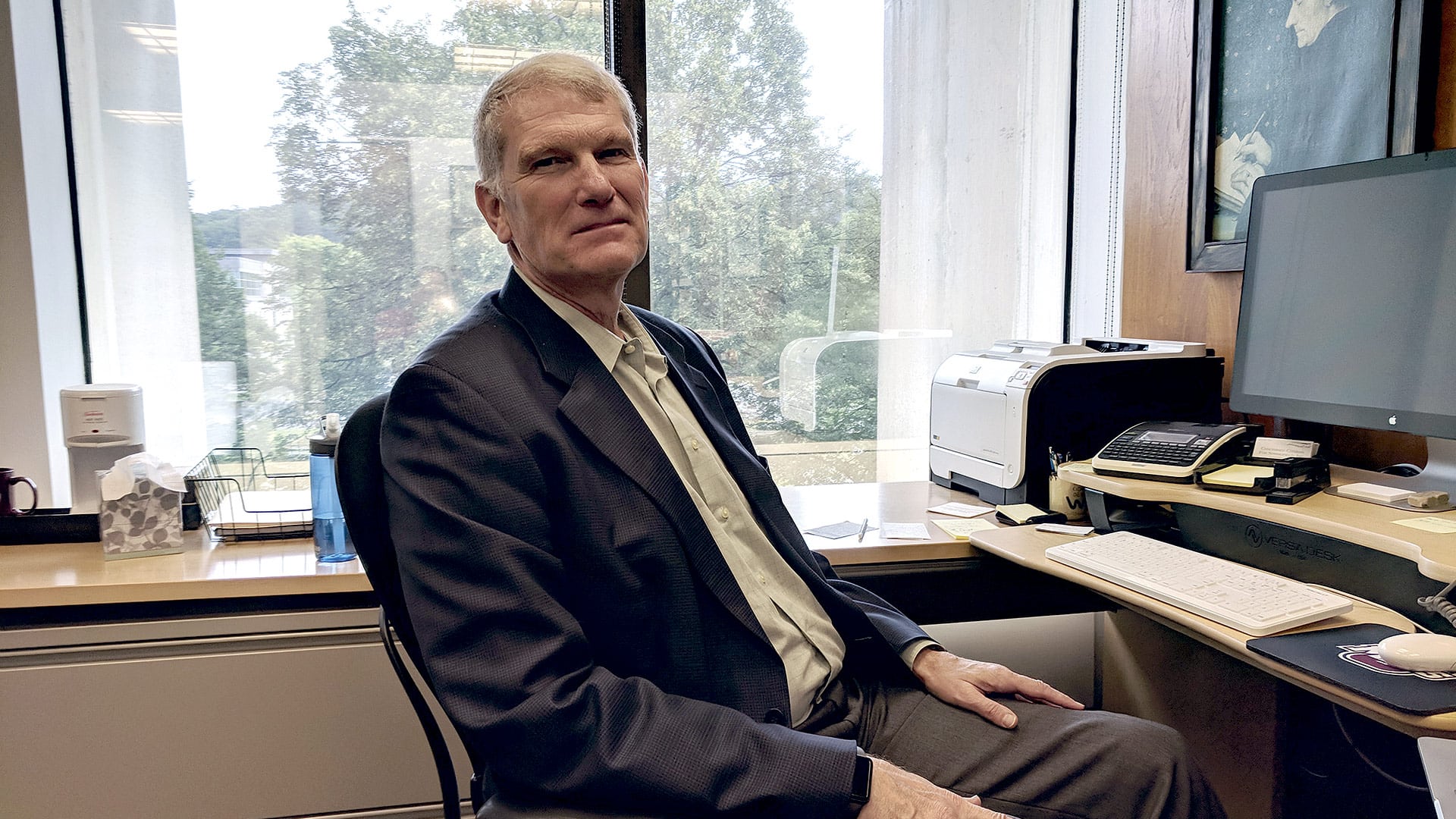
That’s gratifying, said Steve Goodwin, deputy chancellor and professor of Microbiology at UMass, who has been heavily involved in efforts to make the state’s flagship campus more green. And it’s not a recognition that was earned overnight.

“Sustainability has been a focus for the campus for about 10 years,” he told BusinessWest. “There were some efforts even before that, but it really started about 10 years ago.”

When Kumble Subbaswamy became chancellor in 2012, Goodwin said, he ramped up those efforts by forming an advisory committee specifically around sustainability, which helped to raise the awareness of green issues around campus.

“Sustainability has been a focus for the campus for about 10 years,” he told BusinessWest. “There were some efforts even before that, but it really started about 10 years ago.”

“This new STARS score reflects the university’s continuing commitment to excellence in sustainability,” Subbaswamy said when the ranking was announced. “UMass Amherst is a leader in best practices for energy-efficient construction and sustainable food use, conducting world-class research, and preparing a new generation of students to be inspired stewards of our planet.”

But before any of that could be accomplished — through innovative food-service changes, solar projects, green-building techniques, and a host of other initiatives (more on them later) — there had to be buy-in from both the university’s leaders and its students.

“It gained a lot of acceptance early on because a lot of sustainability is doing what you do and meeting your mission with very high efficiency,” Goodwin said. “That’s not all of what sustainability is, but that was an appealing piece for us. A campus has a particular mission, and it has a limited set of resources to meet that mission.”

Steve Goodwin

Steve Goodwin says buy-in from students has been key to UMass Amherst’s sustainability successes.

Take, for example, the Central Heating Plant, a project completed in 2009 that replaced the campus’ 80-year-old coal-burning plant with a co-generation facility that provides electricity for 70% of the campus and 100% of the steam needed for heating and cooling buildings across the sprawling grounds — all while reducing greenhouse gases by 27%.

“That was a really big decision for the campus,” Goodwin said. “At the time, it was probably the best co-generation plant in the country. That really worked out well for us because we needed electrical power and we were heating with steam, so to get the efficiencies of co-generation was a really a big deal for the campus.”

Those early years of UMass Amherst’s new sustainability focus also saw a reduction in water use — by using recycled water where appropriate — and partnering with Johnson Controls to incorporate energy-saving devices on much of the campus lighting. And that was just the beginning.

“Since then, the sustainability committee has really taken the lead for the chancellor, and made it more of a campus-wide thing,” Goodwin said — in ways that continue to expand and raise the university’s green profile on the national stage.

Food for Thought

Early in the process, late last decade, UMass officials recognized food service as a prime area to boost efficiency and reduce waste. Not only did the sheer volume of food produced every day offer plenty of opportunity for improvement, but students were beginning to ask questions about waste.

“The initial step was to go trayless,” Goodwin said. “If you have a tray of food, it’s easier to heap a lot of food on the tray and not necessarily eat it all. But if you have to carry it all with your hands, you take less to begin with, and if you want more, you just go back.”

As a formal measure, in 2013, UMass Amherst became the largest food-service provider in the nation to sign on to the Real Food Campus Commitment, which requires participating universities’ food budgets to move away from industrial farms and junk food and toward local and community-based, fair, ecologically sound, and humane food sources by 2020. “For an institution this large,” Goodwin said, “we purchase a very large percentage of local food.”

In 2014, UMass Amherst Dining Services was selected as a gold recipient for procurement practices in the 2014 Sustainability Awards given by the National Assoc. of College and University Food Services — just one way national experts were taking notice. Around the same time, the university’s sustainability staff and faculty team from Environmental Conservation, the Physical Plant, Dining Services, and University Relations won the state Department of Energy Resources’ Leading by Example Award.

The UMass Crop and Animal Research and Education Farm in South Deerfield

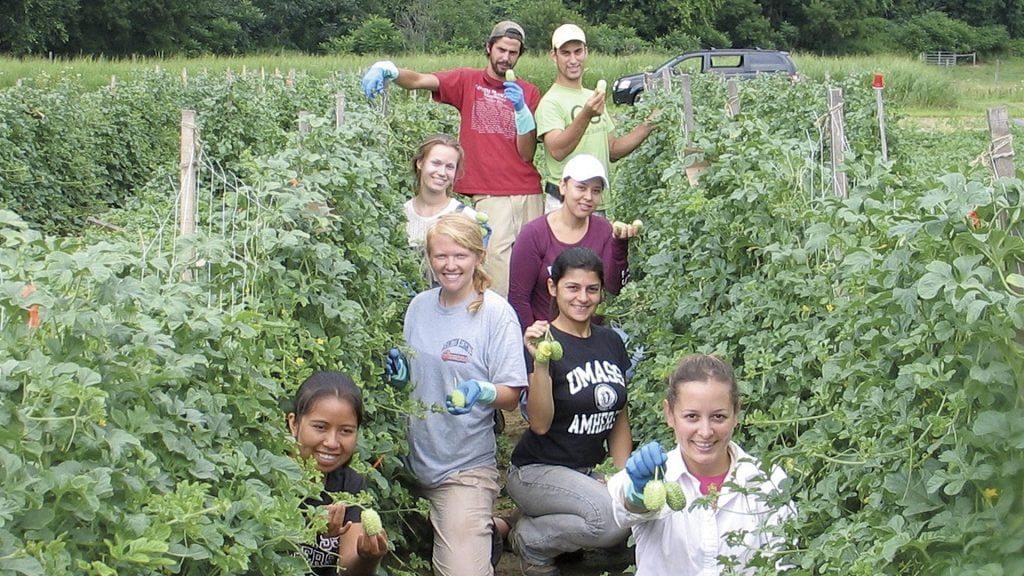
The UMass Crop and Animal Research and Education Farm in South Deerfield is home to the Student Farming Enterprise, which allows undergraduates to gain hands-on experience managing a small, organic farm. Produce generated there is sold to local stores and a community-supported agriculture share program.

Building design has been another focus, a recent example being the John W. Olver Design Building, completed last year, which uses a wood-concrete composite flooring product that was developed on the UMass campus. The contemporary wood structure, which houses the Building and Construction Technology program, the Department of Architecture, and the Department of Landscape Architecture and Regional Planning, includes sustainability features such as LED lighting, motion sensors, ample natural light, electro-tinting glass, heat-recovery systems, bioswales, rain gardens, low-flow faucets, and public-transportation access.

Meanwhile, the Integrated Science Building, constructed in 2009, employs cooling systems that reuse rainwater, state-of-the-art heat exchanges and ventilation systems, passive solar collection, and extensive use of eco-friendly materials like bamboo, to name just a few features.

“Obviously building is a big chunk of where our resources go, especially energy and water resources, so building design has a big impact,” Goodwin said, noting that UMass typically aims for some level of LEED certification on new buildings.

“But we’ve also done some things that go above and beyond those certifications to try to make our buildings more suited for their particular uses,” he went on. “There’s a whole variety of passive solar issues, lighting issues, energy and water use around buildings, reclaiming ground water, those sorts of considerations.”

Textbook Examples

On an academic level, Goodwin said, sustainability has made its way into the curriculum of nearly every program on campus. “I don’t think there’s any school or college that doesn’t have something that deals with an aspect of sustainability. They range from the obvious — an environmental science course, for instance — to a social justice course where they’re making connections back into sustainability and how that impacts the way people experience their communities.”

He stressed repeatedly, however, that raising up a culture of sustainability has never been a solely top-down effort, and that students have long been engaged on these issues.

“One of the things we did early on was to establish a culture within the dormitories and among the students — in part because the students really want this. They care about these issues a lot,” he said. “So we spend a lot of time building various aspects of sustainability into the curriculum, but also extracurricular activities.”

For example, ‘eco-reps’ are students who are specifically trained around issues of sustainability and are responsible for a floor of a dorm, to help students understand the impact of their day-to-day activities. “We run competitions between the dorms — who’s going to do the most recycling or use the least water this year, those kinds of things.”

Students had a direct impact on one of the university’s most notable green decisions — to divest its endowment from direct holdings in fossil fuels in 2016, becoming the first major public university to do so.

The John W. Olver Design Building

The John W. Olver Design Building is a model for green design and operation.

A year earlier, the board of directors of the UMass Foundation voted to divest from direct holdings in coal companies in response to a petition from the UMass Fossil Fuel Divestment Campaign, a student group. Energized by that decision, the campaign staged a series of demonstrations to call for divestment from all fossil fuels, and the foundation board followed suit.

“Important societal change often begins on college campuses, and it often begins with students,” UMass President Marty Meehan said at the time. “I’m proud of the students and the entire university community for putting UMass at the forefront of a vital movement, one that has been important to me throughout my professional life.”

It’s an example, Goodwin said, of the ways university leadership and the student body are often in alignment on issues of sustainability, both locally and globally. “So it’s been a balance of having sustainability in the curriculum, having demand from the students, and also having the central administration realize the importance of sustainability university-wide.

Numerous people on campus are tasked with making sure UMass continually improves its efforts, including the creation of a new position, sustainability manager, seven years ago.

“We’re having a huge impact in the region, and we’re proud of the impact we’re having — and at the same time, we’re also proud of what the students are experiencing,” Goodwin said. “Not only are they learning about these issues, but they’re living this approach as well. They’re living within an environment in which sustainability has a higher priority, so now we hope that impact will increase as they go out into their communities and spread the impacts of sustainability.”

Green Makes Green

Last year, UMass Amherst made news on the green-energy front again, installing more than 15,000 photovoltaic panels across campus, providing 5.5 megawatts of clean electrical power for the campus to use for a heavily discounted rate. The initiative is expected to reduce greenhouse-gas emissions in the regional grid by the equivalent of 31,000 tons of carbon dioxide and cut the university’s electric bills by $6.2 million over 20 years.

“It’s a situation where doing the right thing is also a very smart business decision as well,” Goodwin said. “As time goes on, some of those challenges will get to be a little trickier. Now we’re trying to make decisions about the need to increase the amount of electricity that we’re currently generating, so we’re going to expand the base, but how, exactly, is the right way to do it that’s efficient, a good financial decision, and also a good decision for the environment? It gets very complex.”

For now, he went on, the campus has a strong foundation in decreasing its carbon footprint and decreasing the amount of carbon dioxide and other greenhouse gases being emitted — efforts that have run the gamut from large-scale energy production to UMass Amherst’s participation in ValleyBike Share.

“The campus had been trying to run an internal bike-share program with some success, but we were hoping to do better,” he noted. “Now, with ValleyBike Share, the campus is working with other communities to develop a program that will actually bring a little more connectivitity between the university and the surrounding communities. So it has multiple benefits.”

Clearly, the impact of sustainable practices on not only the campus, but potentially the world, through the continued efforts of alumni, is reward enough for the university’s broad sustainability efforts — but the STARS recognition is nice too, Goodwin admitted, as it showcases UMass Amherst in the top 10 among some 600 participating institutions.

“We’re very excited about that, but it’s a huge amount of work, to be perfectly honest, because it’s all self-reporting,” he explained. “It covers so many aspects — the academic side, the financial side and investments, energy use, and the social side of sustainability. So it’s a very wide-ranging analysis. And, of course, after you do all that self-reporting, they go and verify everything as well.”

The end result is certainly a source of pride on campus — and a little more motivation to continue and broaden these efforts. Not that UMass needed any.

“Sustainability means a lot of different things to different people,” Goodwin said. “But to me, it was always a way of thinking: ‘OK, yes, we have a set of decisions to make; let’s make sustainability a part of that decision-making process.’ And I think our students are picking up on that as well.”

Joseph Bednar can be reached at [email protected]

The Casino Era

The Final Countdown

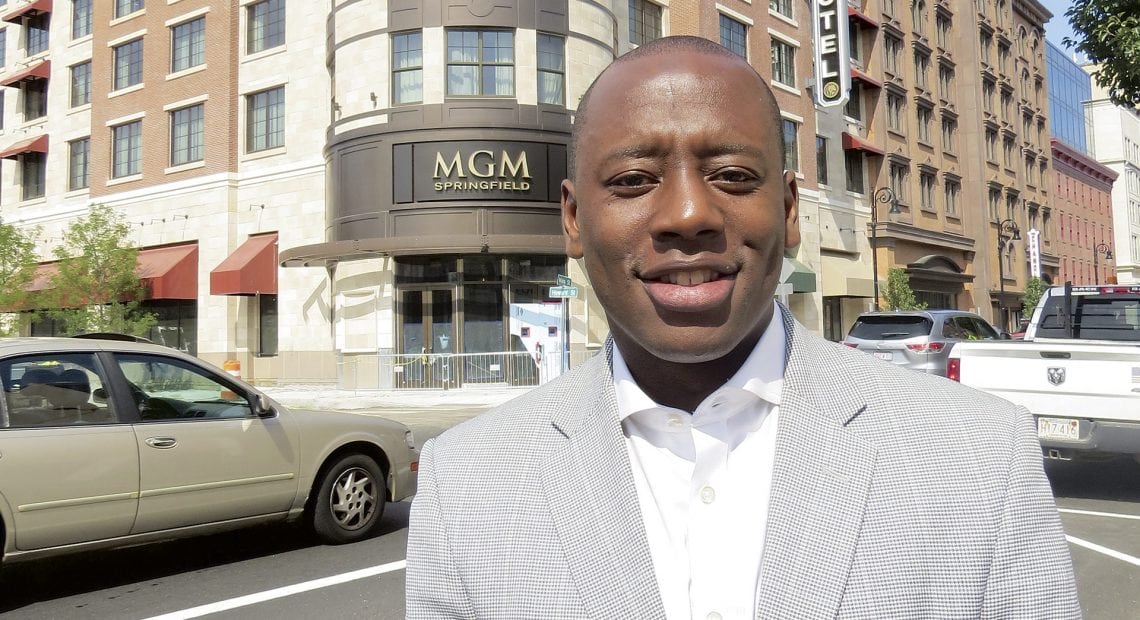
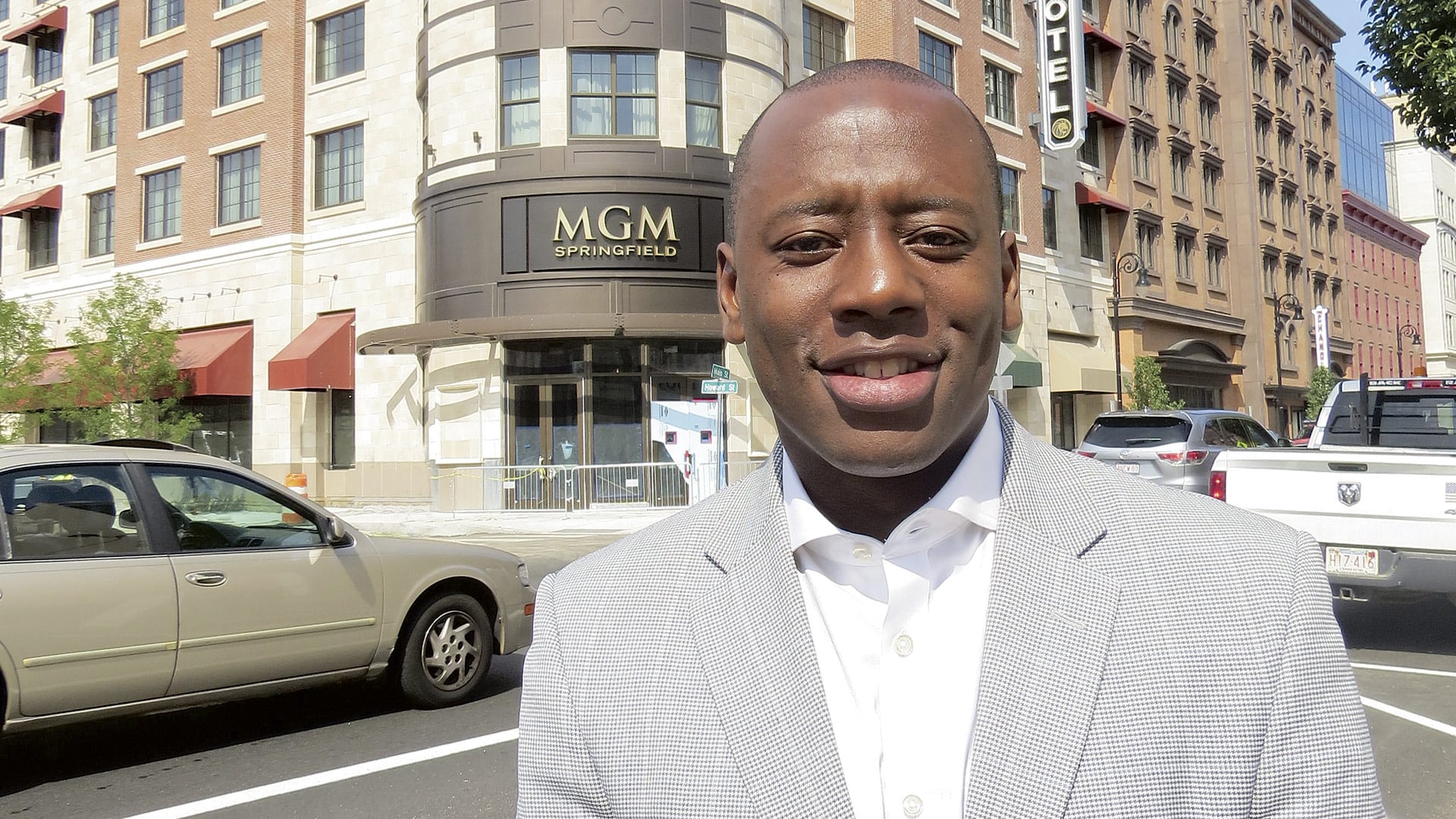
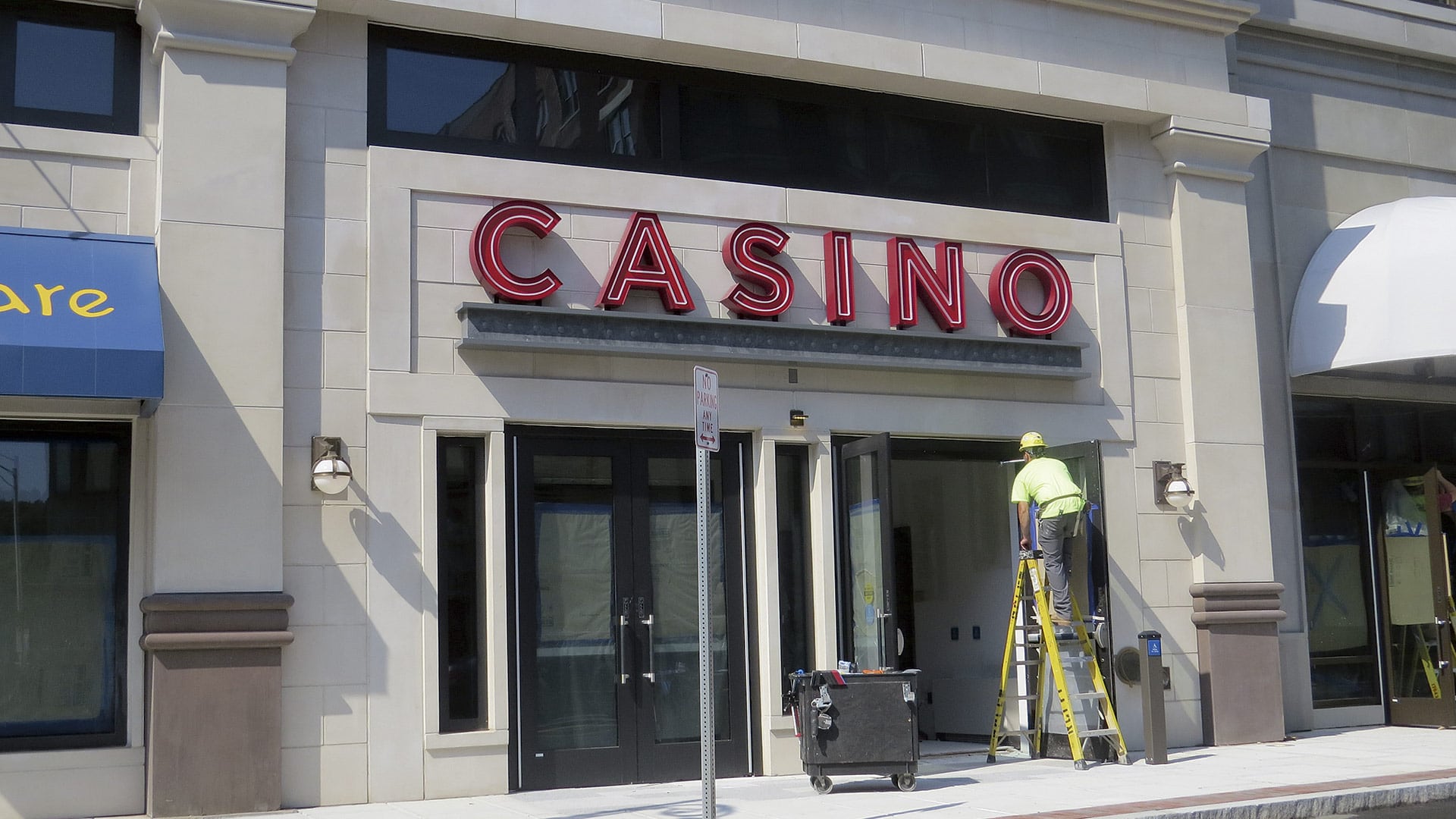
Alex Dixon stands just outside the entrance to the hotel at MGM Springfield

Alex Dixon stands just outside the entrance to the hotel at MGM Springfield, which is nearly ready for prime time and the Aug. 24 opening.

The almost decade-long process of opening the state’s first resort casino is entering its final days. There is a beehive of activity in Springfield’s South End, and that represents only what people can actually see. The process of not only opening the facility on schedule, but “making this place special,” as General Manager Alex Dixon described it, is humbling and exhilarating at the same time.

12,704.

That’s how many “discrete tasks” Alex Dixon said he and the ever-growing team at MGM Springfield must complete before the $950 million facility can open its doors to the public at 11 a.m. on Aug. 24.

12,704!

Not ‘more than 12,000.’ Not ‘12,700 or so.’

12,704. And you thought you had a lot of lines on your ‘to-do’ list.

“And those are just the things we thought about as we put together our critical paths,” said Dixon, general manager of MGM Springfield, who managed to find a few moments to speak with BusinessWest late last month (and he had to work hard at it). He couldn’t say how many of those tasks he and his team had drawn a proverbial line through, but he hinted strongly that, while considerable progress has been made, there were still quite a few (thousand) to go.

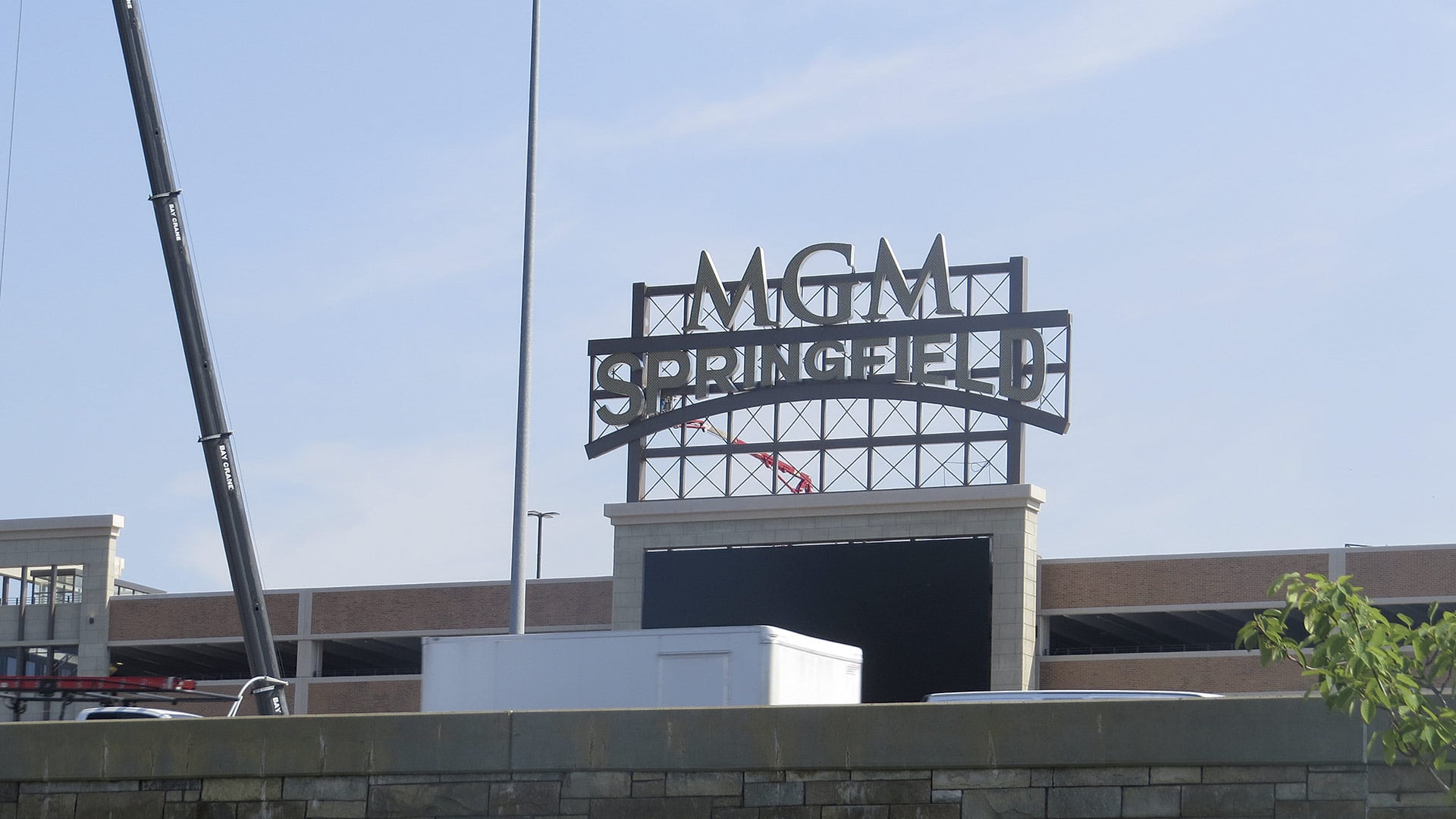
The giant MGM Springfield sign above the massive parking garage

The giant MGM Springfield sign above the massive parking garage is the latest addition to the Springfield skyline.

But he also spoke with the utmost confidence about getting it all done, primarily because of the team that’s been put in place.

“When you think about the breakdown of those numbers, it’s a lot,” he said, putting heavy emphasis on that last word, not that he really needed to. “But we’ve got a great project-management process, we’ve done this before in other jurisdictions, we have a lot of people who are seasoned and know what they’re doing, and we have a very experienced and highly trained management team.”

As for those discrete tasks, they cover 45 different “work streams,” as Dixon called them, and 431 key milestones, many, if not most of them, already met. And they come in every size and shape, from having permits in place for each of the restaurants to meeting the required numbers for each of dozens of categories within the MGM Springfield workforce; from the thousands of items on the construction checklist to making sure the warehouse in Chicopee is stocked with everything it needs to be stocked with.

Overall, Dixon described the process of opening MGM on time — meaning with those 12,704 tasks completed and all licenses and permits and employees in place — as humbling, but also exciting and exhilarating. But he kept stressing that opening the doors on schedule is just one part of the story — and one part of the challenge.

Indeed, he said he’s not losing sleep worrying about getting everything done by Aug. 24. But what does keep him at night — sort of, but not really — are the other two main categories for all those discreet tasks: ‘the things that will make this a great customer experience’ and ‘how do we make this special?’

“We’ll open our doors at 11 o’clock on August 24 — that was never a question,” he explained. “We’re in ‘how do we make this place special?’ mode. We’re going to open, but we’re also going to have a great customer experience. The things that keep me up at night are making sure that we deliver on the promise of a phenomenal entertainment.

“You want to be unique, you want to stand out; I want to compete, and I want to win,” he went on, referring to the considerable competition MGM Springfield will face. “And our team does, too; that’s what motivates me, and it’s what motivates all of us.”

For this issue, one of the last in the pre-MGM era, BusinessWest talked with Dixon about the daunting process of opening the doors, and also about what will happen in Springfield on Aug. 24 and the days to follow.

He couldn’t — or at least he didn’t want to — make projections on how many people will come through the doors on opening day. But he expected the facility to reach full capacity (10,000 people in the casino) and for Springfield to see a day probably unlike any other in its history.

“There has been a tremendous amount of pent-up demand for some time now,” he said, referring to the almost-decade-long task of getting the state’s first resort casino up and running. “We are preparing to make sure that we can do our best to help satiate that demand on opening day.”

Task Masters

As he talked with BusinessWest about these final few days until opening, but also the long, character-building process of getting to this point, Dixon said MGM Springfield has essentially evolved from a startup company with a handful of employees (granted, one with a billion-dollar construction project unfolding around them) into one of the region’s largest employers.

The metamorphosis has come slowly and greatly accelerated over the past several months, to the point where it’s much harder for him to keep track of additions to the staff and putting names with faces. But the culture that was created when the company was a handful of people working on the ninth floor of Monarch Place, and later MGM’s headquarters on State Street, still prevails today.

“You walk through the hall, you meet a new face, and they may not know who you are,” he noted. “So the small things you did at the very beginning to build a great culture with that small group are important; we’re doing our best to make sure we have the right structures and processes in place to ensure that this culture emanates to the 3,000 we’ll be welcoming over the next few weeks.”

Together, this growing team is drawing lines through items on the ‘discrete tasks’ list, dozens, if not hundreds a day, said Dixon, adding, again, that the process of doing so is as exhilarating as it is daunting.

When asked what a typical day is like, he gave the expected answer — there is no such thing, or words to that effect.

But he said there are some common denominators, such as the starting time — 6 a.m. — with a daily briefing from MGM on news stories that impact the company and individual properties across the country.

MGM has made great progress toward completing the 12,704 (and counting)

Alex Dixon says MGM has made great progress toward completing the 12,704 (and counting) tasks needed to get the casino and the rest of the complex open by Aug. 24.

“And as you can imagine, as of late, we’re driving a lot of news, especially with the properties in Las Vegas,” he told BusinessWest. “That’s always a great wake-up call; you read the news locally, but also read the news that’s impacting the business.”

From there, he’s often off to a meeting with one of the many groups he’s involved with within the community, such as the Greater Springfield Convention & Visitors Bureau’s executive committee breakfast session he attended the day he spoke with BusinessWest. He prefers to keep such community work in the morning so as to free up the remaining hours for his day job — or his long-day job, the way things are going.

When he talked with BusinessWest, Dixon referenced hour-long meetings with members of the executive team to address what he called ‘mission-critical items.’ Then, they were meeting three times a week. Soon (if not already), there will be a session a day.

“These are things we need to execute on,” he explained. “And it requires some degree of acceleration or just an intense level of focus to get us over the hump.”

Labor of Love

As an example, he mentioned “fallout” in a particular job category, a situation where the company is struggling to make hires. In such an instance, and there have been some, the team will work closely with the human-resources director and the leader of the department in question to ramp up efforts to address the situation.

Hiring is obviously one huge component of the process of getting things ready for Aug. 24, said Dixon, adding that 3,000 people have to be brought on board across several dozen different positions. But to get to 3,000, MGM actually needs to have a higher number of people in position to be hired, he explained.

“Once you make a job offer, there will be some people who just don’t show up,” he noted, adding that this is a hospitality-industry-wide issue, not something unique to MGM Springfield. “Just because you offer someone a job, they don’t really work until they show up that first day and get into their position.

“That’s the case across the board in many of our front-line positions,” he went on. “So what we’ve done, in some cases, is over-hire to account for some of that attrition, be it in security, beverage servers, or table-games dealers.”

But hiring covers only a portion of those 12,704 discrete tasks, said Dixon, who said they cover three basic “journeys,” as he called them — ‘customer,’ ‘employee,’ and ‘supplier’ — with the ultimate objective of earning an operating certificate from the Mass. Gaming Commission.

To get that certificate, MGM Springfield has a long list of things it has to satisfy in order to show that it is ready to welcome customers safely and appropriately — and also account for the revenue it is expected to generate for the state.

“This is a big business for the Commonwealth,” he explained. “Our regulators are on-site, and we have to satisfy a laundry list of things in order to prove we’re worthy of that operating certificate.”

He offered some examples:

• The casino must make sure the slot machines are “talking” to the central system monitored by the Gaming Commission to ensure the integrity of the games;

• All of the cameras must be approved by the commission to ensure that the operation has the appropriate oversight of the games and other areas within the complex;

• The commission also must approve the internal controls that MGM Springfield operates against so that the operation can be held accountable;

• The commission also makes sure the operation has all the needed licenses from local agencies, for everything from pouring alcohol to serving food; and

• The security plan must be approved to ensure the operation is adequately securing the facility as well as the Commonwealth’s assets.

It’s Getting Real

As opening day draws closer, the team at MGM will take the process of being ready to a different, higher level, said Dixon, referring to what he called ‘play days’ and other types of dress rehearsals for the real thing.

And these auditions will set the stage for what are known as ‘test nights’ (that will be publically announced), during which the operation’s performance will ultimately determine whether the state grants that coveted operating license.

“At those activities, we have to simulate what it is like to operate with real money and be able to perform these functions,” Dixon explained. “The Gaming Commission is assessing our ability to execute those functions in a controlled environment. That’s the big, substantive, last step before we are issued that operating certificate.”

As for what he’s seeing in Springfield now, as opposed to when he arrived 18 months ago, and what he expects to see after the casino opens, Dixon said there has been a metamorphosis there as well, especially when it comes to perceived attitudes about the casino.

“It’s been fascinating to see how things have shifted, from doubt in some cases — ‘is this really going to happen?’ — to ambivalence in other cases, to quietly watching, to trepidation, to what you see now, which is excitement.

“Whether you see people buying their tickets to see Stevie Wonder [who will appear at the MassMutual Center on Sept. 1] to people coaching up a son, daughter, niece, or nephew for an interview, or hearing the excitement of someone getting their first job or getting back into the workforce … it’s fascinating to see the progression.”

Meanwhile, he said that one doesn’t have to wait til Aug. 24 to witness the impact MGM Springfield is already having in Springfield’s downtown.

“If you walk along Main Street around noon, you see the streets teeming with people,” he noted. “They’re well-dressed, new haircuts, looking good, sharp — and friendly. You see the impact of 3,000 people, and we haven’t even onboarded everyone. You see the streets come alive with energy.

“Downtown has been defined by the absence of people after hours,” he went on. “Now, we’ll be defined by the presence of people; and this will be people from Springfield, but also surrounding communities, and people who haven’t been to Springfield in a while. I just can’t wait for people who will walk into our facility and walk into downtown Springfield and have this immense level of pride, not just in MGM, but in the city and the region.”

On Aug. 24, there will be a parade down Main Street an hour or so before the facility officially opens at 11 a.m., he said, adding that it will involve employees, dignitaries, and some entertainers from within the MGM family.

After that? He said National Harbor, the $1.5 billion casino in Maryland that MGM opened roughly 18 months ago, reached full capacity within hours of opening. And MGM is preparing for just such a contingency.

“Knock on wood, we can only hope we’ve got more demand than what we’re able to accommodate in the building,” he said, echoing a belief certainly shared by the city, the region, and the Gaming Commission.

Playing the Numbers

Getting back to his sleeping patterns as Aug. 24 draws closer, Dixon said there are obviously days when he rests better than others.

“The hours are getting shorter,” he said, adding, again, that the ever-growing team working draw lines through those 12,704 discrete tasks are working simultaneously on hundreds on individual assignments, but also the very big picture.

“It’s truly amazing; it takes every individual person on this team to take care of their silo, but also keep their head above water enough to look horizontally and make sure we’re coming together in a cohesive manner.”

It all about the journey, or journeys, Dixon said, adding that the plural is most definitely needed, as they work as a unit toward a common goal — not just opening the doors on time, but making the place special.

And that’s why this process is as exhilarating as it is daunting.

George O’Brien can be reached at [email protected]

Sales and Marketing

The Art and Science of Story Telling

The team at BRIGADE

The team at BRIGADE shows off the many honors garnered at the recent Ad Club of Western Mass. award show.    Photo by Stephanie Craig Photography

It was just a few weeks after Kirsten Modestow and her husband relocated to Western Mass. from San Francisco that she got the phone call that would ultimately change her life. The person at the other end was looking for someone to do some freelance work for a fledgling vodka brand called Svedka. As many people know, Svedka has gone on to become the top-selling imported vodka in the U.S. What they may not know is that, with that notable first client, Modestow created the marketing firm BRIGADE, one that has certainly built on that solid foundation in every way.

Kirsten Modestow says the branding company she would call BRIGADE (yes, all caps) was started on her kitchen table.

Which doesn’t exactly make it unique; many startups are blueprinted in such a setting. Which makes this one different is what happened after it was conceived.

For starters, that kitchen table would later become an official work station for one of the first hires, and soon other parts of the house were absorbed by additional team members as they came on board.

“The first person was in the living room, the second person was at the dining-room table, the next one was in the spare bedroom … then we all moved into the garage,” she explained. “When there was no room in the refrigerator for people’s lunches, we knew it was time to go.”

By that, she meant move into larger quarters, which the company has done a few times, but we’ll get back to that later.

The other thing that separates BRIGADE from other ventures hatched on the kitchen table is the pace of growth. Indeed, over the past 13 years, the company has expanded to 35 employees, most of them artists and designers who commute to the current home on Route 9 in Hadley from across Western Mass. and well beyond.

And their client list includes a number of prominent national brands, including Svedka vodka, the Wyndham Hotel Group, Black Box Wines, and Vertical Water, as well as some local businesses, such as Esselon Café, just a few hundred yards down Route 9.

Actually, Svedka wasn’t a national brand when Modestow was hired as a freelancer to help with a branding campaign. It was a fledgling vodka label looking to break out — and it did, big time; a few years ago, it surpassed Smirnoff as the top-selling imported vodka in the U.S.

The team at BRIGADE designed packaging for Svedka strawberry seltzer.

The team at BRIGADE designed packaging for Svedka strawberry seltzer.

“We’ve been along for the ride,” Modestow said, noting how the growth of Svedka and BRIGADE have mirrored one another. “Over the past 13 years, we’ve grown with them.”

But BRIGADE hasn’t outgrown Modestow’s kitchen table, then a space on University Drive, and then a totally renovated foreign-car sales and service shop further down Route 9 because of one client — although Svedka certainly has played a huge role in that transformation.

Instead, it’s been the company’s ability to work with clients to create branding that resonates, builds name recognition, and drives sales, Modestow explained, adding that this is what branding, the company’s specialty, is all about.

Elaborating, she said BRIGADE focuses on helping clients tell their story, and to do that, she and her team must first understand what that story is and then develop effective ways to communicate it.

“We get to know a client by doing an audit of their existing brand,” she explained. “We always see it as the client being the expert in what they do in their industry, and we bring in the branding piece, so it’s crucial to work with them as a partner.”

That was certainly the case with the new coffee bags the company created for Esselon Café. Coffee had long been a key ingredient in the restaurant’s recipe for success, said Modestow, but a while back, its leaders decided a new look was needed.

“People are more open to working with remote agencies. Before, it was a case where you went to an agency in one of the larger cities. Around 2006, when we started, there was a willingness to work with people who weren’t down the street, and that had a lot to do with our success.”

“We worked with them to determine how to capture the heart of Esselon and capture who and what Esselon is,” she explained, adding that BRIGADE came up with new packaging that drew on the Western Mass. landscape — specifically the Seven Sisters portion of the Holyoke Range — as well as new language: “All roads, bike paths, and quests for the best cup of coffee lead to Esselon Café.”
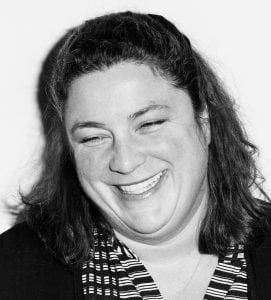
Kirsten Modestow

Kirsten Modestow

“The whole idea is that they’re on the bike path and everyone comes to Esselon; the place is packed, and you have to park illegally,” she explained. “We decided to embrace all that — we have these bike paths and roads that wrap around the bag, and we told this café story, and it’s been awesome for them; the bag is loved by Whole Foods, and retail sales have tripled because of it.”

For this issue, BusinessWest takes an in-depth look at how BRIGADE has moved well beyond that kitchen table and grown its own brand by delivering services that tell a story and generate results.

Seeking an Ad-vantage

Modestow told BusinessWest that the BRIGADE story really starts in Boston, where she worked for the acclaimed marketing agency Hill Holiday Advertising and such clients as Dunkin’ Donuts.

When the dot-com sector was at its pinnacle, however, the place to be was San Francisco, and Modestow went there and had the opportunity to join a firm and work with brands such as Electronic Arts Inc. (EA), the video-game maker.

Her firm eventually closed its doors, however, after losing one of its mainstay clients, and Modestow and her husband were at a crossroads.

“I could afford to live in San Francisco for about four and half minutes after that,” she joked. “I think we sold our house within seven days and left.”

The two then made a pact of sorts. They would relocate to wherever one of them found a job first.

“He beat me by a day; he got a job in Western Massachusetts — he’s originally from Worthington — and we came here,” she explained.

And it wasn’t long after they landed that she got that life-altering phone call.

“Someone called and said, ‘I have a freelance opportunity for you on this startup vodka brand called Svedka,’” she recalled. “Over the past 13 years, we’ve grown with them and helped them along the way; they’ve been really wonderful to us.”

As noted earlier, the company quickly outgrew Modestow’s kitchen table, refrigerator, and garage, and settled into that space on University Drive, above the popular Hangar restaurant. It wasn’t exactly a long stay, though, because the company continued to grow at a rapid rate, doubling in size from five to nine employees in a few years.

It then relocated to the foreign-car shop — a site that required a massive renovation effort — but outgrew that in just over a year, as Modestow recalled, adding that the next home is intriguing on many levels.

A portion of the 8,500-square-foot facility was home to a Registry of Motor Vehicles office, and even though it’s been closed for quite some time, people still walk in the front door looking to renew their driver’s licenses, said David Bosch, the company’s operations manager.

Another portion of the facility has home to Zoe’s Fish House, he went on, adding that, while BRIGADE renovated all the spaces into work areas, including a banquet facility that never became reality, it kept the bar intact.

The company doesn’t have a liquor license, obviously, but it does use the bar for company functions, said Bosch. Meanwhile, it’s an unusual decorative touch, and it give the company a chance to showcase many of the brands it has helped develop in what would be described as a natural setting.

The space is wide open, said Modestow, adding that this the desired environment for a marketing firm where people work together to create solutions for clients.

“We work in branding, and a lot of that is people coming together to solve a problem,” she explained. “So being in a very open space, one that’s conducive to gathering, is important.”

BRIGADE should be in this home for quite some time, because there is not only ample room to grow, but plenty of business coming through the door as the company continues to build strong word-of-mouth referrals.

The new coffee bag that BRIGADE created for Esselon Café has helped spark a surge in retail sales.

The new coffee bag that BRIGADE created for Esselon Café has helped spark a surge in retail sales.

Indeed, as noted earlier, Svedka has been a dream first client and solid foundation for BRIGADE. But the company has been able to build on that foundation, said Modestow, and for several reasons.

One is the large number of contacts she made from her previous career stops, and the experience she gained working for national and global clients, a tremendous asset in this business, as in any other.

“Having the exposure in Boston and San Francisco enabled me to work on some high-caliber clients and hone my skill set that I could then pass on to people here,” she explained. “We started off with an ability to work on those high-caliber clients; we’re really good at it, so we’ve attracted through our work the attention of others.”

Another factor is a growing willingness among corporations to work with agencies not based in New York, Boston, or Los Angeles, or whatever major metropolis the corporation was based in or near.

“People are more open to working with remote agencies,” she noted. “Before, it was a case where you went to an agency in one of the larger cities. Around 2006, when we started, there was a willingness to work with people who weren’t down the street, and that had a lot to do with our success.”

Getting the Message Across

But easily the best reason for the company’s success is the results it has garnered for its clients, said Modestow, adding that more important than the awards the company has gained for its work — and it has won many — are the gains registered by the companies looking for help with their brand.

Which bring us back to Esselon Café.

That new packaging has won a number of awards for BRIGADE, said Modestow, but the bigger story is that dramatic rise in retail sales at Whole Foods and other locations.

It came about through that art and science of storytelling and creating a brand that speaks to who they are.

When asked about the methods for gaining such results, Modestow returned to the subject of effectively partnering with the client to solve a problem or revitalize a brand.

The client knows their industry, their product or service, and their story, she went on. BRIGADE essentially takes that insight and uses it to create a brand that conveys the story in a way that resonates.

Steps include the brand audit she described earlier, and also creation of brand strategy.

“We would work through positioning statements with the client, help them figure out their key messages, how they’re different, how they talk about themselves, what their voice is, and more,” she explained. “And once we have that platform, then we would go into the visual component of all this — bringing it all to life visually through some kind of toolkit, which might be a refresh logo or packaging or a new website. We’re helping them see how this language and this new positioning can visually come to life.”

As the company creates these strategies and brings them to life, it does so not with a hard focus on targeting specific demographic groups — a mistake some companies make when marketing and branding — but building a brand that’s “authentic.”

“I don’t think you build a brand to speak to a specific group of people,” she told BusinessWest. “You build a brand that’s true to who the brand should be, and then it resonates with the right people.

“A mistake you see is when companies think the key to their success is going out and capturing the Millennials,” she went on. “Well, the Millennial doesn’t want to be captured — you have to find them because you have something compelling that made them want to believe in you. It’s about consumer experience and storytelling; people want an authentic experience with a company.”

As an example of how the firm partners with its clients, Modestow referenced the Wyndham Hotel Group and some of its specific brands, including one in particular — Travelodge.

“It was kind of an old brand with old, tired signage,” she explained, noting that, at the time, Wyndham hadn’t put much emphasis on branding, but has since changed that attitude. “We helped refresh the Travelodge brand, we helped them with an ad campaign, and we helped them with a new way to talk about themselves.”

Another example is work with Svedka to launch a new line of spiked seltzers. The company designed the cans in a way that were true to the Svedka brand but also resonated within the growing spiked-seltzer product category, said Don Magri, the company’s chief financial officer.

“They came to us with a good amount of research that they had already done on their consumer and who they were really trying to target,” he explained. “You go through iterations, but you’re really trying to creating a design that is true to the brand going into a new category, but also hitting the demographic they’re trying to reach.”

Looking down the road, those at BRIGADE said they look to continue providing clients with what they call ‘responsive branding,’ so that they are ready for the future and their brands are as well.

In short, they aim to do what the company’s done from the beginning — grow with its clients.

“We want to grow and create new opportunities for our employees and then for the people who don’t work here yet,” said Magri. “Growth for the sake of growth is not something we’re interested in, but growth for the sake of growing our skills and growing our client base and securing our client mix is our plan.”

Bottom Line

In other words, the company is going to continue doing what it’s been doing from the start, back when work was being done on Modestow’s kitchen table and her refrigerator was getting filled with employees’ lunches.

The company has come a long way since then — a quick tour of the facilities at 195 Russell St. make that clear — but the guiding principles remain the same.

And those are to tell the client’s story and create an authentic experience that resonates. When you that, it’s a lot easier to do what BRIGADE has done with and for Svedka and all its other clients — be along for the ride.

George O’Brien can be reached at [email protected]

Law

Degrees of Improvement

By Kayla Ebner

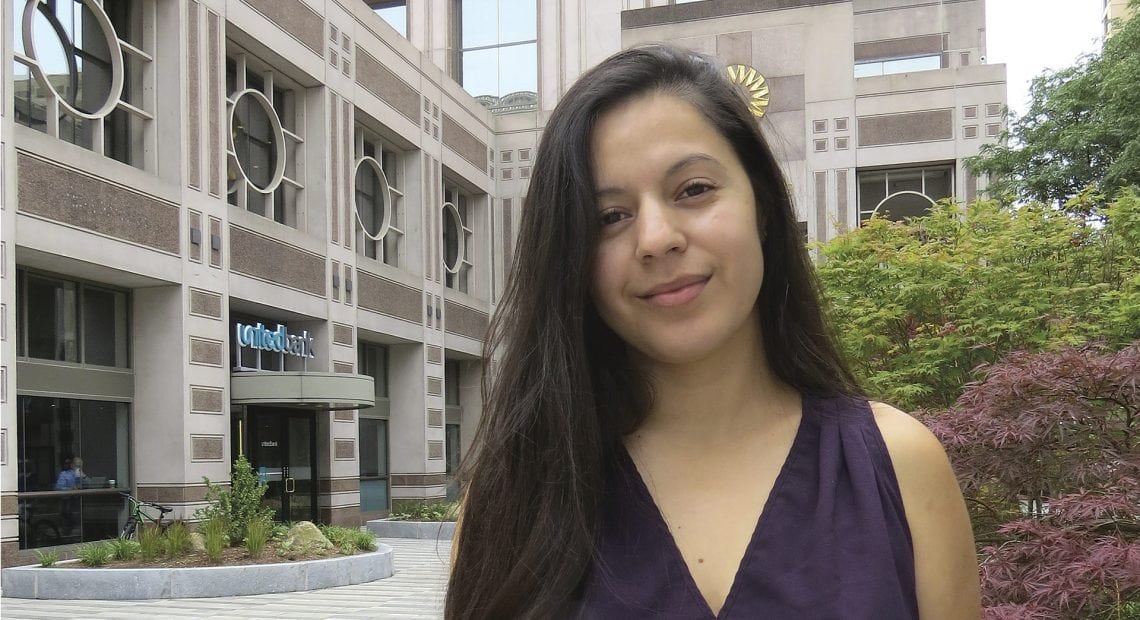
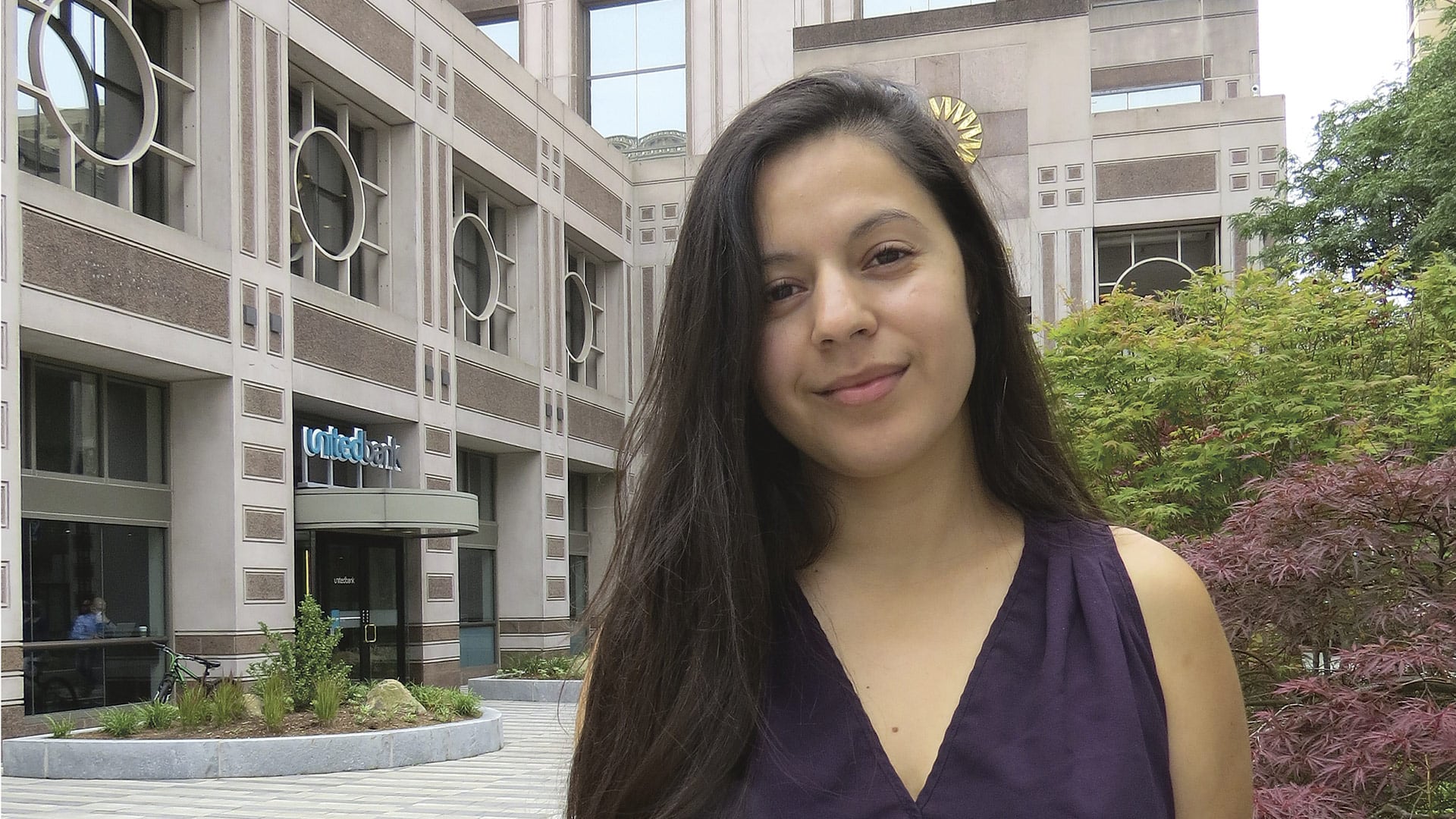
Claudia Quintero was inspired by a lawyer who helped her — and now gets to do the same for others.

Claudia Quintero was inspired by a lawyer who helped her — and now gets to do the same for others.

In the years immediately following the Great Recession, many law-school graduates were challenged to find employment, let alone their dream job. But the picture is gradually improving, as evidenced by the experiences of recent graduates of Western New England University School of Law.

Claudia Quintero calls it her dream job.

That’s how she characterized the position she landed as a migrant/farmworkers staff attorney at the Central West Justice Center in downtown Springfield.

It’s a dream job, because she’s doing essentially what she always wanted to do and what she went to Western New England University School of Law to do — help people, but especially in the same way that an attorney helped her when she was 16 years old.

She met an attorney through a legal-services program in Los Angeles, where she grew up, who helped her apply for and obtain her permanent residence in just five short months. Quintero was always impressed and grateful for her own attorney’s diligence, and thought, “I want to be just like her.”

Like she said, hers is a dream job.

And those have been quite hard for law-school graduates to attain in recent years. In fact, for some time after the Great Recession, taking any job became the goal and, for most, a hard reality.

But the situation is improving, said Laura Fisher, director of Law Career Services at WNEU Law. She used the phrase “pretty steady” to describe the current climate, and while that’s a long way from ‘robust,’ ‘healthy,’ ‘solid,’ or other, more positive terms, it represents an improved picture and a better forecast for recent graduates.

“When the economy really took a hit in 2008 and 2009, every sector of the economy was disrupted, including law schools and law graduates,” said Fisher, adding, however, that “we’re seeing a rebound now.”

She offered some numbers to back up those words.

At WNEU Law, the class of 2017 graduated 101 students. According to data from the American Bar Assoc. (ABA), 43 of those graduates were employed at long-term, full-time, bar-passage-required jobs 10 months after graduation. Nineteen graduates were employed at what are known as ‘JD advantage jobs,’ meaning passage of the bar exam is not required, but that having a juris doctor degree provides a significant advantage.

Of the 101 graduates, eight were unemployed and seeking. Others were employed at both professional and non-professional positions or seeking a graduate degree full-time.

“The 10-month report for the class of 2017 indicates that the percentage of students with full-time, bar-passage-required, JD advantage, and other professional positions is 71.2%,” said Fisher. “This figure is approximately equivalent to, but slightly elevated, over the previous year, which was 68.9%.”

Laura Fisher

Laura Fisher

The ABA gathered that, nationally, 75.3% of the class of 2017 had long-term, full-time jobs requiring or preferring JDs. This is an increase from the previous year’s sum of 72.6%. However, the ABA credits the higher percentage of employment to “an approximately 6% decrease in the size of graduating classes at law schools nationally” (more on that later).

“When the economy really took a hit in 2008 and 2009, every sector of the economy was disrupted, including law schools and law graduates. We’re seeing a rebound now.”

Slicing through all those numbers, Fisher sees an improving job market and more opportunities for the school’s graduates — in the field of law, but also other sectors where a law degree is quite valuable, and these sentiments are reflected in the experiences of some of WNEU’s recent graduates, like Quintero.

For this issue and its focus on law, BusinessWest talked with Fisher and several recent graduates to get some barometric readings on the job market and where a law degree can take someone these days. For many, their landing spot was, in fact, a dream job.

Cases in Point

In 2013, the graduating class at WNEU included 133 students, said Fisher, summoning more numbers to get her points across. At that time, 49 students were employed at long-term, full-time, bar-passage-required jobs.

Although the class size at WNEU has decreased since then, Fisher said this is entirely by design. She noted that WNEU, along with other schools, are keeping the class sizes at “a reasonable size that’s reflective of what the market entails.”

Daniel carey

Daniel carey

Despite smaller class sizes, Fisher believes these numbers do not reflect a lack of opportunity in the job market.

“Although the market out there still feels pretty flat and we’re being careful about the number of law students we’re producing, I still feel like there’s plenty of opportunity out there,” she said. “Our alumni go on to do wonderful things.”

“Law school to me seemed like a natural way to really combine a lot of my interests and abilities. I’ve always kind of viewed the law as a way to help people.”

And she used that phrase to describe work both inside and outside the courtroom.

Daniel Carey, assistant district attorney (ADA) at the Northwestern District Attorney’s office and WNEU Law class of 2017 graduate, fits into both categories.

“Law school to me seemed like a natural way to really combine a lot of my interests and abilities,” said Carey. “I’ve always kind of viewed the law as a way to help people.”

Beginning law school in 2013, he was looking for a way to get his foot in the door, so he applied for a job at the DA’s office. He landed one as district court administrator, working behind-the-scenes to help the ADAs. He’s been there ever since, but has continued to move his way up. Since starting his role as ADA, Carey has served as director of the Drug Diversion and Treatment program for two years, a new initiative he helped launch for people struggling with addiction. It assists with treatment, rather than putting people through traditional criminal-justice prosecution.

In addition to his role at the DA’s office, he also served on the Easthampton School Committee and was elected to the Easthampton City Council. And he’s currently running for state representative — a significant change in career-path course from his original plan of being a high-school English teacher.

He is not the only one who was initially unaware of where a law career could take them. Nicole Mule, another member of WNEU’s class of 2017, did not know she was interested in law until she took classes during her time as an undergrad.

Nicole Mule

Nicole Mule

With a major in criminal justice and a minor in communication at the University of New Haven, she was required to take several law courses that were taught by lawyers. She mentioned that the classes were taught very much like they are in law school.

“It made me realize why advocating for businesses was so important. As an attorney, I can have a significant effect on my clients’ businesses for their benefit.”

“After that, I was hooked,” she told BusinessWest.

When in law school, she noted that she did not put all her focus into one practice area, and eventually gravitated toward employment law. In 2016, she accepted a summer position with the firm Robinson+Cole, which has offices in Massachusetts, Connecticut, and several other states, and was offered a job.

She’s currently an associate in the firm’s labor and employment group, representing both public-and private-sector employers in a variety of labor and employment matters.

Both of her jobs during law school helped her realize her love for this profession.

“It made me realize why advocating for businesses was so important,” said Mule. “As an attorney, I can have a significant effect on my clients’ businesses for their benefit.”

Firm Resolve

Both Carey and Mule graduated with law degrees but have gone on to completely different professions. This wide variety of career options is another reason why the job market for law school graduates is doing better than it was 10 years ago.

For Caroline Montiel, another 2017 graduate from WNEU, combining two of her biggest passions was important, and she was able to find the perfect fit.

She completed her undergraduate studies in chemical engineering, and after receiving some inspiration from her host dad while studying abroad in Spain, she decided to get her law degree. However, Montiel had a different experience than some of her peers while applying for jobs during law school.

“I was applying every week, at least one job a day,” said Montiel, adding that she applied to five jobs a weekend. For every 50 applications she filled out, she hoped to get one interview.

After she passed the bar exam, she began her career with a judicial clerkship in Connecticut Superior Court. In mid-June of this year, she began her new job as patent examiner at the Patent Trademark Office in Washington, D.C., working in the field she fell in love with during law school.

Much like Carey, Montiel, and Mule, Quintero completed several internships during her time at law school, including one with the people who helped her obtain permanent residency. She began applying for jobs during her third year of law school, and ended up sending in applications to about 10 jobs. Quintero’s strategy was simple: apply to places where she knew she would be happy.

“I was very picky about the kinds of jobs that I applied to just because I have a very specific thing that I want,” said Quintero. “I don’t like to divert energy or waste time doing things that I know I’m not going be happy doing.”

She got about three offers and ended up at Central West Justice Center. She said she was nervous that she wouldn’t get a job she wanted or that made her happy, but having a strong network was an important factor. Though it was a fairly seamless process for her, she noted that it took some of her friends much longer to find jobs.

“I was very cognizant that I was lucky,” she said.

There are certainly benefits to knowing what you want, and Montiel noted that having an idea of the type of career one wants to go into before starting law school can be very helpful.

Overall, Fisher said she sees that JD-advantage jobs are rising in popularity, both nationally and at WNEU. She noted that a lot more people are using their degrees for JD-advantage jobs in positions like higher education, data privacy, and security.

The JD-advantage sector is a route that students are becoming more interested in, she went on, not because there are fewer jobs elsewhere, but because they are interested in trying alternative paths.

Fisher mentioned that some students choose to opt out of the traditional path at a law firm because it can be stressful, and they want a good work/life balance.

Market Forces

Fisher wouldn’t say the market is booming for law-school grads — again, ‘steady’ was the word she chose, and she chose it carefully — but she does believe there are many opportunities out there in the legal job market because of how valuable it is to have a law degree in countless professions.

“A law degree is valuable far above and beyond how it can help you practice law,” said Fisher. “There’s a lot more you can do with it. Going through the process of learning how to think about laws and regulation and risk, I think all of that just lends itself to creating an employee who’s very aware, very mindful, and very responsible.”

For the graduates, that means a better chance of landing a dream job.

Retirement Planning

One Size Doesn’t Fit All

President and Chief Investment Officer Trevor Forbes

President and Chief Investment Officer Trevor Forbes

With decades of investment experience under his belt — much of it for very large companies on an international scale — Trevor Forbes decided he preferred an approach to portfolio management that emphasizes the individual. He found that model at Renaissance Investment Group, which he joined as president in 2011. Creating a completely personalized portfolio for each client takes work, he said, but it’s worth it because it creates peace of mind — in more ways than one.

It makes sense, Trevor Forbes said, that no two people would forge an identical strategy for their financial future.

“Your financial position is going to be different than someone else’s, and your ideas about what you want when you retire will undoubtedly be different. So how you deal with that retirement will be different,” said Forbes, president and chief investment officer at Lenox-based Renaissance Investment Group.

“You may be a cautious investor; you may be able to tolerate much less in the way of volatility in your investments than someone else, and we take that into account,” he went on. “We have to balance a whole range of different requirements from our clients. A lot of organizations will claim to do that, to an extent, but in most cases, they are not really set up to do it that way — certainly not for the size of clients we typically manage money for.”

Renaissance was launched in 2000 with a vision to provide tailored investment-management and financial-planning advice to individuals who were being sidelined by the centralization of the industry.

“That’s remained very much the ethos of Renaissance ever since,” Forbes said. “I joined in 2011, having had long discussions with the original founders for about 18 months prior to that, at a time when two of the original founders were seeking to retire. They wanted somebody with a similar ethos and a similar approach to investments.”

“The mission has been to provide individualized investment management and financial planning for people who otherwise wouldn’t be getting that.”

Forbes, a native of England, had worked in London for most of his career, mainly for large financial organizations on the investment side. “For example, for most of the ’90s I was the head of global equities for Citibank, which was those days based in London. I had to coordinate the investment approach of seven different locations around the world. They got me very heavily involved in asset allocation for a whole range of different types of clients. Particularly interesting to me, at that stage, was the private client side.”

Forbes left Citibank at the end of the 1990s and went into private-client wealth management; in 2007, he set up a wealth-management business “at probably one of the most inauspicious times in market history.” But over the next several years, he and his team built that enterprise from nothing to a billion dollars under management.

Still, he and his wife were looking for something different when they relocated to the Berkshires — she to open a bed and breakfast, and he to find a wealth-management firm that fit his philosophy — which he found in Renaissance just as it was looking for a successor to run the business.

Just before he came on board, the company became a wholly owned subsidiary of Berkshire Bank, but it never fit neatly into that’s institution’s mold, he said, so in 2016, he partnered with Ohio-based Stratos Wealth Enterprises, LLC to buy out the firm.

“We’ve been able to regain our independence and maintain what has been the ethos of the company all the way through,” he explained. “The mission has been to provide individualized investment management and financial planning for people who otherwise wouldn’t be getting that. That continues today.”

In most investment-advisory firms of Renaissance’s size, said Chief Operating Officer Christopher Silipigno, “you’re not getting someone to sit down and find out exactly what your situation is, what variables are in play for you, and then looking at the specific equities that best make up a portfolio that matches that. That’s pretty special.”

One thing that attracted him to the firm, he added, is its history of bringing in senior-level talent from very large institutions who now bring that experience to clients outside the ultra-high-net-worth sphere.

“You’re getting someone with Trevor’s background to sit down with you and run through all kinds of things — your investment concerns, retirement concerns, cash flow and how much you need, as well as things like passing this wealth on in a tax-efficient manner, how the funds will go to your children, even real-estate concerns.”

As an SEC-registered investment advisory firm, Silipigno noted, Renaissance has a fiduciary responsibility to clients — a term meaning, essentially, that their interests always come first.

“Most people don’t understand that, in your large broker-dealer houses, that’s not the case. They have a suitability expectation, which means the investment has to be suitable, but it could be that they’re selling you Apple because they own Apple at one price and want to sell it at another. We’re not selling our own stock, so our advice is what’s in your best interest. We’re also not pushing products, which is unique.”

Conscientious Investors

At Renaissance, the investment team is doing all its own research on individual investments, Silipigno said. “You might think that’s the norm, but it’s further and further away from the norm. Typically, research is done somewhere else and being sent into the firm, and then that research is being used to make decisions for you.”

That in-house research, he explained, extends to both national trend tracking, but also the fundamentals of each company being considered for investment. For instance, he noted, in a growing economy, oil might be a promising investment. “But maybe we see a lot of growth coming out of West Texas, and here are the companies in West Texas best poised to grow because they have the capacity to grow.

Chris Silipigno

Chris Silipigno says Renaissance has a fiduciary responsibility to clients, meaning their interests come first, not the firm’s.

“That’s the kind of specific research that’s happening here and can be brought to a client,” he said. “Maybe someone in a $15 million account somewhere can demand that kind of answer. Here, we’re bringing that to clients in much smaller accounts.”

Sometimes, an individual investment strategy will incorporate what’s become known in the industry as social-responsibility investments (SRI), or environmental, social, and governance (ESG) preferences. Take, for example, customers who may not want their money invested in petroleum.

“A lot of those clients might not want that company in West Texas. That’s fine. It’s their wealth, and they have a role to play in how that wealth is invested,” Forbes said. “So we tailor a portfolio to either exclude certain characteristics or include some of the characteristics these individuals are interested in. Then we do research into these kinds of companies.”

In addition to fossil fuels, some customers have an aversion to military spending, guns, alcohol, gambling, pharmaceutical companies, even investment banks, and don’t want their money invested in one or more of those areas, he explained. Conversely, they might have a special interest in water resources, testing equipment for water purity, solar energy, or any number of other mission-driven businesses.

“Your view of social responsibility can be much different than someone else’s view of social responsibility. So we have to take into account a very wide range of differing views,” he added, noting that such companies must also be suitable investments from a financial perspective — otherwise, there’s not much point in investing in them.

Tailoring portfolios to match a customer’s ESG preferences, Forbes said, is really just an extension of what Renaissance is already doing for clients, which is research on a client-by-client basis — a task that has become much easier in an era of technology that makes information so readily accessible. “It’s time-consuming; there’s no doubt about that, but anything you do well is going to be time-consuming.”

Forbes first became interested in ESG investing during the 1980s, when he began directing money away from South African companies that supported apartheid. Today, a commitment to ESG investments still makes sense, especially in a socially conscious region like the Berkshires.

“It’s gone from a fringe idea, a few people saying, ‘hey, I want to invest in a way that doesn’t offend my values’ to a global movement,” Silipigno said. “Every year, the growth has been exponential.”

He said many larger firms are making ESG investments, but they’re one-size-fits-all portfolios of companies the advisory firm has decided fit the ESG mold, not crafted individually for each client. “They might decide a petroleum company is OK, because a certain amount of its revenues go back into the environment. But that might not be your decision as a client; you might say, ‘I don’t want anybody that profits from fossil fuels.’”

Indeed, Forbes added, “the way you express your social responsibility will be different than someone else’s. The way we do it is more targeted, and we have the technology to achieve that.”

For people worried that investing their conscience might cost them returns on growth, Renaissance has not found that to be the case, Silipigno added. “We’re seeing that our portfolios that are ESG and SRI are tracking with the major indices. So you don’t have to have a drag on your returns to invest in a way that meets your conscience.”

Smart Approach

Renaissance takes on clients with at least a half-million dollars to invest, although that could include a group of smaller accounts — for example, in one household.

“Our average client size is bigger than that, and basically these are people who worked very hard to get their wealth, and they want that wealth to provide them with some security, particularly as they get into later life,” Forbes said. “In some cases, it’s to provide a second generation with some wealth as well, and sometimes it includes charitable giving.”

Renaissance also manages money for foundations and endowments, he added. A large portion of its client base is in the Berkshires or surrounding regions, but the firm also has many clients on the West Coast, Florida, and other points across the U.S.

“We see ourselves as the center of a team of individuals that may include an attorney, an accountant, and a whole range of people who are important in mapping out your future — and succeeding generations as well. And it has to be done on a client-by-client basis. You have to know your clients. That’s important.”

Silipigno said potential clients will come in for a financial checkup, assessing their current financial standing and where their assets are. He often finds people at one of two extremes. Some are currently exposed to a tremendous amount of risk — with money tied up in just a few stocks that have done well, but could be vulnerable to a market downturn — while others have taken an alarmingly conservative approach to their future.

The firm boasts a broad client base in and around the Berkshires, but also across the U.S.

The firm boasts a broad client base in and around the Berkshires, but also across the U.S.

For example, he recently met with a doctor, married with five kids, who had more than a million dollars, all of it tucked away in a savings account, building almost no growth whatsoever — not exactly the most ambitious retirement plan.

Clients who come on board find there’s a happy medium, he said, a way to both grow and protect their assets through a diversified approach. Forbes was quick to note, however, that he doesn’t take the approach of some houses that clients should have a little bit of everything. For example, he shies away from international investments because they’re naturally a little more volatile.

“Some of those risks may be worth taking, but I’ve got to be satisfied that they are worth taking,” he said. “I’ve never believed that you should have a little bit of this, a little bit of that, a little bit of something else just because it adds extra diversification. All of our portfolios are very diversified. But there’s nothing in the theory that suggests you should have something in emerging markets or something in high-yield debt, for example.”

In addition, he explained, “if you look at the typical way portfolio management is run here, we build everything up from the client level. So if we decide, for example, that today is the right day to buy Google, rather than saying, ‘OK, we’re going to buy 1,000 Google, you’re 0.2% of our client base, so you’re going to get 0.2%,’ we approach it differently. We’ll look at your portfolio, then we’ll look at his portfolio, and we’ll model each individual portfolio until we’ve got an aggregation of the amount of Google we want to buy.”

That’s different from how most investment houses organize their strategy, he went on. “It forces the portfolio manager to take account of your requirements at the time we’re actually trading within the account. I think that is an important factor. It is a differentiating factor between Renaissance and a lot of the industry.”

Another selling point is the firm’s transparency in terms of its fee basis. “We don’t invest in third-party funds,” Forbes said. “When you go to one of the larger investment-management organizations, they buy a mutual fund, and that mutual fund has another layer of fees within it, on top of the investment fees you’re already being charged. So your actual level of cost starts to escalate. We don’t believe in that — all our clients are invested in individual stocks and individual bonds. That provides very transparent fees. We think that’s in our clients’ best interest.”

Getting Personal

All these facets of Renaissance’s ethos — a word Forbes used several times for emphasis — certainly creates more work for the team, especially the individualized aspect of the investment process.

“Most investment managers will probably say it’s not a very cost-effective model, but fortunately, these days, we have a lot of technology at our fingertips, and rather than using that technology to determine what we’re going to invest in, we use it to actually inform our approach to investment management, from a research point of view and also from a day-to-day management point of view.”

It’s an approach that has worked for 18 years now, he said, if only because clients know their portfolio will be personally tailored to their assets, goals, risk tolerance — and, yes, even their conscience.

Joseph Bednar can be reached at [email protected]

Community Spotlight

Community Spotlight: Wilbraham

Bob Boilard (left) and Jeff Smith

Bob Boilard (left) and Jeff Smith say they’d like to see more civic participation in policy discussions and planning town events.

Being pro-business, Jeff Smith says, doesn’t mean letting just any business set up shop in Wilbraham — but it does mean giving every business a fair shake.

Take, for example, Iron Duke Brewing, which is moving to town after a successful but eventually contentious stay at the Ludlow Mills. Because Wilbraham had no zoning for microbrew and brewpub establishments, the town’s Economic Development Initiative Steering Committee (EDICS) recommended a zoning change that eased the path for not just Iron Duke, but also Catch 22 Brewing, which is setting up shop at the former Dana’s Grillroom on Boston Road.

“One of the reasons why [Catch 22] said they came here was because we had specific zoning for what they wanted to do,” said Smith, the town’s Planning Board chairman, giving one example of how a zoning change can have effects beyond its initial motivation.

“One of the reasons why [Catch 22 Brewing] said they came here was because we had specific zoning for what they wanted to do.”

“When somebody comes into town and is interested in locating a business here and we don’t have specific zoning for it,” he added, “the Planning Department, the Planning Board, and the town itself take a hard look at the zoning and say, ‘is this the type of operation we’d like to see here? Maybe we should put zoning in place, and we can pitch it to the town, and if it’s not appropriate and the town agrees, they can vote accordingly at town meeting.’”

The same thing happened when the town lifted a long-time moratorium on new gas stations. As soon as that happened, Cumberland Farms bought some real estate in Post Office Park along Boston Road, with plans to open a 24-hour facility.

“We tried to have some foresight,” Smith told BusinessWest, adding that the Route 20 corridor used to have five gas stations, but that number had shrunk to two since the moratorium went into effect. “We said, ‘OK, why don’t we allow gas stations?’ It was something a previous Planning Board had put it in, but we said, ‘why? Things have changed. Maybe this is a good time to take a look at this.’ And as soon as we did, Cumberland Farms came in and located here.”

Bob Boilard, who chairs Wilbraham’s three-member Board of Selectmen, said he’s not an advocate of locking up decent, buildable land in perpetuity, or keeping out entire classes of businesses for no reason.

“There’s got to be a common-sense approach,” he said. “There are people in town that would say, ‘let’s stop now. No more building in Wilbraham.’ But you can’t do that. You have to have a tax base and controlled growth to support the town. It’s a balancing act. Open space is great, and we do a great job with that, but we have to consider each individual thing that comes before us.”

Smith added that town officials try to be both reactive and proactive, recognizing current needs but also anticipating future ones. “We want more businesses and more enterprises to locate here in our business district.”

Open for Business

Boilard said the town has worked in recent years to streamline the process for businesses to set up shop there.

“Planning and Zoning have done a great job adjusting things to make it easier for businesses to come in, and when they do come in, they complement us on the ease of communication, the ease of getting things done,” he said. “We don’t put up brick walls every so many feet for these guys; we try to make it as easy as possible to come in and do business in Wilbraham.”

Wilbraham at a Glance

Year Incorporated: 1763
Population: 14,868
Area: 22.4 square miles
County: Hampden
Residential Tax Rate: $22.64
Commercial Tax Rate: $22.64
Median Household Income: $65,014
Median Family Income: $73,825
Type of government: Board of Selectmen, Open Town Meeting
Largest Employers: Baystate Wing Wilbraham Medical Center; Friendly Ice Cream Corp.; Big Y; Home Depot; Wilbraham & Monson Academy
*Latest information available

The nine-member EDICS has been integral to that effort, Smith said. “Let’s say you’re XYZ Inc., and you want to locate your business in Wilbraham. What do you do? What’s your first step? Where do you go? How do you know if there’s zoning for your business?”

One project the group wants to tackle is creating a comprehensive section on the town’s website to answer all those questions.

“They’re proposing updating the website to a more modern platform that’s more user-friendly, and then adding a business or a ‘locating your business here’ page that would essentially have a checklist: the first step is to talk to this person, here’s their phone number, here’s their e-mail.

“That way, people come in prepared,” he went on. “As a member of town government, we hate to have somebody come in unprepared and then have to tell them, ‘hey, you’re going to have to come back to the next meeting, and that’s a month away.’ So if they can get a lot of questions answered and come prepared, it’s smoother for everybody.”

The committee is also looking into creating marketing materials, both online and in print, outlining what Wilbraham has to offer — such as its access to rail and a single tax rate — that make it appealing to locate a business here.

Not every development proposal has gone according to plan. A recent effort to allow a mixed-use development in the town center, in the area of Main and Springfield streets, failed to garner the necessary two-thirds approval at a town meeting, falling short by about a dozen votes.

“It’s a very sensitive area,” Smith said. “One thing I’ve learned in my six years on the Planning Board is that people are very hesitant to change. In the long run, I think we take our time in this town and we do things right, and the end result is good. But in the beginning, there’s an air of skepticism toward changing something — which I don’t think is a bad thing.”

But it can be tricky, he went on, when a developer wants to move forward with a proposal that could create added energy in the center, especially when other mixed-use facilities, grandfathered in when the town put a hold on others like it, already exist.

“People understand there’s some vacant buildings there, and we could make changes that would probably make them not vacant and make it more vibrant,” he explained, “but I think there’s a fear that would be a change they may not like. So we have to tread lightly and move carefully with the center of town and make sure we get as much input from the people of the town as possible.”

In the end, he said, town officials didn’t do the best job conveying why such a development would be a positive. “It was a close vote, which is good because there are a lot of people in favor of it, but at the same time it tells me we have more work to do.”

Changing Times

It’s a challenge, Boilard said, to build a more vibrant town in an age when people’s lifestyles have been altered by technology, declining school enrollment, and a host of other factors. “The generations are changing, and society changes, and that happens everywhere.”

For example, Smith said, the Boston Road business corridor was originally built around retail, but bricks-and-mortar retail establishments struggle in the age of Amazon, and the concept of what a downtown or business center looks like today has shifted immeasurably since the 1970s, or even the 1990s.

“When I was a kid, I would get on my bicycle — I lived near Mile Tree School — and I could drive to the center of town. My dentist was there, Louis & Clark filled all of our prescriptions, the gas station would fix your car or come jump your car in your driveway, my pediatrician was right on the road there, the post office was there, and the village store was there, selling sandwiches and stuff. Everything you needed was there.”

Today, he went on, “you don’t see as many kids out riding their bikes. Those things that I mentioned aren’t really there in one convenient package. Things are different. So we’re trying to put in or modify zoning, potentially bringing some mixed-use components or do something to revitalize those areas, and it’s tough to balance that with … I don’t want to say a fear of change, but there’s an apprehension toward change in the wrong direction.”

Boilard said Wilbraham remains an attractive destination for new residents, with a well-run and well-regarded school system, although real estate in town can be pricey. “It can be hard for new families to come in and be able to afford Wilbraham. I wish we could have an impact on that, but it’s the way economics and demographics are.”

That said, several new subdivisions have gone up in recent years, with a trend toward modestly sized houses, which are selling faster than larger homes, and developers are designing projects accordingly, Smith said.

“Residential growth, in my time here, has been pretty consistent — I would say slow but always moving in the right direction,” he explained. “There’s not a ton of available land in town. The last subdivision to go in was an old farm that was in a family for a long time, and it wasn’t being used as a farm anymore. So a developer purchased it and divided it up and put in a subdivision.”

Compared to other towns in the area, he went on, Wilbraham does a good job of protecting and managing open-space and recreation parcels. “Every time a parcel is brought to the town to be purchased or donated as open space, the town is seemingly in favor of those purchases.”

But controlled growth is the goal, he added, and a balance must be struck between commerce and open space. “There’s a tax base that has to be built, and we try to build it with as much business as we can. We’ve turned down pieces of open space offered to the town — ‘no, we’re all set; put it on the open market, develop the property and get some tax revenue going.’”

Getting to Know You

One area Wilbraham does need to improve, both Boilard and Smith said, is in the area of volunteerism and civic involvement.

“Town events are well-attended, and that’s great,” Smith said, citing examples like the Spec Pond fishing derby, the Run for Rice’s 5K, the Thursday night concert series, the revamped Peach Blossom Festival, and the Christmas tree lighting. “But I would love to see more participation in the planning.”

Boilard agreed. “People complain we don’t have an event, but nobody wants to volunteer to run it. It’s always the same core people stepping up to volunteer,” he said, adding that this trend applies to town-meeting attendance as well.

For example, a recent public hearing on raising the minimum smoking age in town to 21 drew mainly support from the residents in attendance. “Then the phone calls started rolling in — ‘I can shoot a bullet in the Army at 18; why are you doing this?’ I said, ‘where were you Monday night? Why didn’t you come in and talk to us?’”

Smith called the numbers at town meetings “painful” — particularly considering the work that officials put into preparing for them. “I like it when there’s an angry mob in here. That’s good. We want some feedback. But participation could be better.”

After all, he and Boilard said, engaged residents are informed residents, all the better equipped to steer Wilbraham into its next phase of controlled growth.

Joseph Bednar can be reached at [email protected]

Education

A Healthy Relationship

Springfield College’s recent visitors from China

Springfield College’s recent visitors from China included, from left, Wang Di, Dr. Huang Yizhuan, Cao Xiaojie, Wang Xinran, and Li Dehua.

One side of Sue Guyer’s business card bears the Springfield College logo, address, and website, and declares that she is a doctor of physical education (DPE), is athletic-trainer-certified (ATC), and a certified strength and conditioning specialist (CSCS).

It also notes that she is chair of Exercise Science and Sport Studies and professor and clinical education coordinator of the Athletic Training Program at the college.

On the other side, it says all or most of that — in Chinese.

And she’s far from the only one at the 133-year-old college handing out business cards also printed in that language — one of the many visible signs of a relationship between the college and businesses, educational institutions, and civic leaders in that country that goes back decades and has only grown stronger in recent years.

Indeed, Guyer has handed out her card with the Chinese version facing up on countless occasions, including several visits there, including her first, in 2008, just before the Summer Olympics were staged in Beijing.

“We took 17 students over for an academic/cultural experience,” she recalled. “And China seemed to be the perfect place to go because we were looking at sports medicine — eastern and western approaches — and we were also looking at human performance, and we have relationships with multiple institutions in China.”

“We decided that, rather than go over there all the time, we would keep our expertise here and have them come to us.”

Many of those words and phrases — including ‘academic/cultural experience’ and ‘perfect place to go’ were no doubt uttered by those participating in the very latest example of this healthy relationship, one that wrapped up last week. Springfield College’s School of Health, Physical Education, and Recreation hosted 16 Chinese educators for intensive instruction in sports performance and sports medicine.

The participants, who hailed from several different cities and represented a number of institutions and businesses, received instruction and insight into everything from concussions to sport nutrition to the principles of treatment and rehabilitation during a two-week program focused on fitness, management, and leadership. For their efforts, they earned a certificate and continuing-education credits.

Sue Guyer

One side of Sue Guyer’s business card bears the Springfield College logo, address, and website, and declares that she is a doctor of physical education (DPE), is athletic-trainer-certified (ATC), and a certified strength and conditioning specialist (CSCS

And for those participants, this was an eye-opening, valuable experience.

Cao Xiaojie (Andre), a coach with the Saipu Fitness Institute, the largest fitness-training academy in China, spoke with BusinessWest near the start of the two-week program. He said the course of study was different from that in China (we’ll hear more about that later), and it was intriguing to compare western approaches and techniques with those learned in China.

“There will be a lot that we can take home with us from this experience,” he said, adding that Springfield College was one of several stops he and two colleagues from the institute made during a six-week visit to the U.S. “And we’re also looking at possible opportunities to work with Springfield College in the future.”

Guyer told BusinessWest that Springfield College, known nationally and internationally for its many sports- and fitness-related programs, has been fielding a growing number of requests from groups in China for its educators to visit that country and make presentations.

“We were getting four or five requests a year,” she explained. “And we decided that, rather than go over there all the time, we would keep our expertise here and have them come to us. That was the main impetus for putting this summer’s program together; we couldn’t meet all the requests to go there.”

The genesis of these requests is a heightened interest in sports performance, sports medicine, nutrition, and other subjects, and a desire to learn what would still be called ‘western’ practices, strategies, and methods for teaching and learning, especially as the country gears up for the 2020 Winter Olympics, said Maura Bergan, assistant professor of Exercise Science and Sports Studies, director of the summer program, and another of those providing instruction to the visiting delegation.

“The summer has always been a popular time for Chinese professionals to come over to learn a little more about sport medicine, human performance, and strength conditioning,” she explained. “So this summer we really worked hard to create a mainstream curriculum, a summer conference or seminar symposium.”

For this issue and its focus on education, BusinessWest talked with Guyer, Bergan, and some of the participants (often with help from an interpreter) to get some perspective not just on this summer’s program, but also decades of collaboration and a relationship that is healthy in every respect.

Speaking Their Language

As noted earlier, Chinese delegations visiting Springfield College to observe and learn is not exactly a recent phenomenon. In fact, Chinese students and educators have been visiting, and studying at the college for more than a century.

Maura Bergan

Maura Bergan says the curriculum for the summer program featured both theory and hands-on learning, a departure from the teaching process in China.

The origins of the relationship trace back to John Ma, a member of the Springfield College class of 1920 and graduate class of 1924. He was the first international scholar from China to visit the school, and is the founder of modern physical education in China and founder of the Chinese Sports Federation.

“We’ve had a long-standing history and relationship,” said Guyer, adding that groups have been coming to the college regularly over the past several decades.

In recent years, the college has hosted the Beijing Sports Institution’s softball team; a number of visiting coaches and educators, who would often come over for a semester at a time; the developmental hockey team; and other constituencies. And, as she mentioned earlier, the college was getting all those requests to come there.

In response to all that demand, the college decided to put together an intensive two-week summer program, one that attracted the large and diverse delegation that arrived on July 23.

Participants represented a host of institutions, including the Saipu Fitness Institute, Chengdu Sport University, the Shanghai Research Institute, the Dessy Fitness School, and the national women’s softball team.

Together, the visitors kept to a packed schedule — but one that still left time to visit Harvard, MIT, the Naismith Memorial Basketball Hall of Fame, a fast-food restaurant, and other sites of interest (remember, this is an academic/cultural experience — with instruction representing a blend of sports medicine and injury prevention and human performance).

Specific courses included:

• “The Epidemiology of Athletic Injuries,” which focused on common injuries, contact versus non-contact injuries, and other subjects;

• ‘“An Introduction to Sport Performance,”taught by Bergan, featuring everything from a tour of facilities to instruction in training, to creation of a ‘performance plan’;

• “Components of a Warmup,” focusing on such matters as mobility, soft tissue, and preparation;

• “Introduction to Performance Testing”;

• A program on Plyometrics (jump training) and explosiveness;

• “Weight Lifting Instruction”;

• A program on conditioning focused on everything from programming to energy systems; and even

• “Music & Performance.”

Much of the instruction was hands-on, said Guyer, adding that participants were given both theory (in the morning sessions) and hands-on, practical application in the afternoon classes.

“They don’t do a lot of hands-on in China — a lot of is theory and lecture,” she explained. “So they like our approach to blending the theory with the hands-on, and that’s what makes our programs so exciting for them — they get to do what they’re learning, and that’s not a traditional learning style in China.”

As an example, she cited study of concussions. In China, these professionals would learn the textbook application of concussion with regard to what they would see and do. During this summer’s program, there was a lecture, but also work in the lab, where they practiced what they would see with a concussion, how they would evaluate one, and how they would treat it.

“We allow them to practice the skills they learn in the classroom rather than just the didactic, the theory,” she explained, adding, again, that this teaching method resonates with them.
Bergan called it a “holistic approach” to teaching sports medicine and human performance.

“We decided to combine the two together, and they get a little of both,” she explained. “They get the sports-medicine side, and they get the performance side, and that’s different and unique for them.”

Participants who spoke with BusinessWest at the start of the two program, such as Dr. Huang Yizhuan, a spinal surgeon and representative of the Chengdu Sport University, said they hoped to bring home with them new insights into sports medicine and human performance.

“It has been a learning experience,” he said through an interpreter. “This is a great opportunity for me to bring sports-medicine knowledge back to China.”

Course of Action

Bergan’s business card doesn’t have all of her information in Chinese on the reverse side — yet.

Indeed, she is planning to go visit that country this fall for still another of the many exchanges that have marked the past several decades. By then, she’ll have printing on both sides of her card.

And her visit will add another chapter to a decades-long relationship that has generated an exchange of ideas and yielded real learning experiences for people in both countries.

George O’Brien can be reached at [email protected]

Sales and Marketing

Putting the Focus on Innovation

The team at GCAi

The team at GCAi: from left, John Garvey, Quinn Garvey, James Garvey, Mary Shea, and Darcy Fortune.

John Garvey isn’t shy about noting that he never worked for a large ad agency, or a ‘traditional’ ad agency, as he calls them.

In fact, he’s rather proud of that background — as are the rest of the members of the team at the agency he formed more than 30 years ago known as Garvey Communication Associates Inc., who didn’t work for a traditional agency either.

They’re all fond of saying they didn’t follow any model in creating and then shaping the firm known as GCAi, but instead created their own model.

“None of us come from an agency background,” Garvey explained. “So we put this together on our own; we didn’t throw away the book — we just didn’t really know the book was there; so we invented our own book.”

“There’s a lot of misconception out there about how Facebook works, especially with regard to advertising.”

As they talk about this book, the company’s main players — Garvey; his son, James, the social-media marketing analyst; Mary Shea, vice president of Digital Strategy; and Darcy Fortune, digital PR analyst — collectively wear out the word ‘innovation’ as they discuss evolving technology, what the company can do with and for clients with regard to this technology and using it to reach targeted audiences, and, perhaps most importantly, how they do all that.

Indeed, they’ve all become involved with MassChallenge Boston, the group that helps accelerate startups, and they’ve also assisted Valley Venture Mentors (through donations of money and expertise) in its efforts to mentor startups and expand its mission. And such work has fostered a true spirit of innovation within GCAi itself as it partners with clients to help them navigate a changing landscape within marketing and with everything from understanding and maximizing social media to corporate reputation management.

“Innovation is a stick that you have to sharpen continually,” John Garvey explained. “You literally cannot be innovative unless you have your eyes wide open and you’re looking and you’re learning and you’re challenging yourself. Being around startups … that entrepreneurialism, that innovation, is absolutely contagious. So we find ourselves thinking and acting in new and different ways.”

Such an operating mindset is necessary for a marketing firm today, said Shea, because change is constant, it’s coming from every direction, and the pace of change is only accelerating. Also, in this era of conversion, marketing firms are increasingly being judged not on their ability to garner exposure, but on sales generated by a specific campaign or strategy.

Which brings Shea to the subject of data and access to it.

“One of the most profound changes to come to marketing is marketers’ ability to use data,” she said, while summing up how the landscape has been altered by technology and why innovation is important. “It’s a seismic change in terms of our ability to get our work done.”

James Garvey, seen here presenting at a MassChallenge event

James Garvey, seen here presenting at a MassChallenge event, says companies have more access to data than ever before, and they must take full advantage of that opportunity.

Elaborating, she said Google AdWords, Facebook, and other vehicles enable marketers to send specific messages to targeted audiences in ways that simply weren’t possible decades or even a few years ago.

James Garvey agreed.

“It’s a fascinating time to be involved in social-media marketing since Facebook is in the headlines daily,” he told BusinessWest. “There’s a lot of misconception out there about how Facebook works, especially with regard to advertising. We develop messaging for clients, and we use Facebook as a means of delivering the message in a way that people can consume it, but also delivering it directly to the audience we need to reach — meaning very specific groups of people.

“For example, you can reach men or women ages 25 to 35 who live within two miles of downtown Springfield who are interested in home ownership,” he went on while elaborating. “That’s how specific you can get.”

GCAi, which boasts clients across virtually all sectors of the economy, including financial services, healthcare, transportation, and more, is a certified Google Partner (the only firm in the region to gain such status), and its qualified AdWords professionals are independently tested and certified in several different aspects of online advertising each year.

Meanwhile, the company specializes in what it calls the ‘ideation’ approach to working with clients to identify needs and challenges, map out a marketing strategy, and determine the most effective methods of getting a message across.

To explain, Shea and Fortune pointed to the whiteboards on all four walls of the GCAi conference room. Over the course of an ideation session, they will become covered with writing in the form of answers to questions asked and thoughts about what to do, strategically, with that information from a marketing and branding standpoint.

For this issue and its focus on sales and marketing, BusinessWest talked with members of the GCAi team about marketing, technology, and social media — but mostly about innovation, and how it enables the company and its clients to stay on the proverbial cutting edge of progress.

Data Driven

On the day BusinessWest visited GCAi, the whiteboards in the conference room were covered with what amounts to a bullet-pointed chronology of the firm.

Noted milestones included everything from the elder Garvey’s first work in public relations, back in college for the U.S. Youth Games, to the arrival of each staff member (Shea started as an intern in 2004, for example); from the reminder that Garvey needed a loan from his grandmother to stay afloat after the dot-com bubble burst at the start of this century and business dried up, to his self-proclaimed 15 seconds of fame when he captured a dramatic photo of the tornado that tore through downtown Springfield on June 1, 2011, an image that went viral within minutes after it was taken.

“What social-media marketing and Google AdWords has done is essentially democratize the use of data for businesses across the board. So it is a seismic shift. This is profound data; it’s not just likes and clicks.”

Mostly, though, the walls tell the story of a company responding to rapid, constant change in technology, especially within the realm of digital marketing, and using innovation to help clients make sense of it all — not an easy task in any respect — and make the very most of their marketing budgets.

Indeed, the team likes to say that GCAi, unlike many businesses today, has social media figured out, and it has created a niche of sorts as it specializes in helping clients large and small figure social media out and put all that data that is now available to good use.

“There is a lot more data available today, there’s easier access to it, it’s instantaneous, and you can use it quickly and easily to make adjustments to a campaign,” said Shea, adding that, not long ago, companies would have to spend a lot of money to access such information, which essentially limited that access.

“What social-media marketing and Google AdWords has done is essentially democratize the use of data for businesses across the board,” said John Garvey. “So it is a seismic shift. This is profound data; it’s not just likes and clicks.

But having access to data is just part of the equation. Knowing what to do with it and how to present a message to the audience being targeted … that’s the other side. And the team at GCAi has become specialists in such work, handling both aspects of this work — creating content and a message (work that falls more to Fortune and John Garvey), and devising the most efficient, cost-effective means of disseminating it, work assigned to Shea and James Garvey.

And the watchword in all aspects of this work is relevance.

“That’s the church we go to pray at,” said John Garvey, referring to that team. “If the message isn’t relevant, meaning the target audience we spoke of doesn’t react to it in a positive way, find it useful, and find it interesting, then we get penalized as marketers; it’s the modern-day equivalent of hanging up a bad ad that no one gets.”

To keep clients and their messages relevant, the GCAi team focuses on innovation, said Fortune, adding that the company’s involvement with Valley Venture Mentors and MassChallenge has helped it in a number of ways, from getting in touch with what’s happening within specific business sectors to sharpening presentation skills, to mentoring startups on the best ways to reach their audience.

“We sit with them and talk with them for maybe 10 minutes, and you can see the light go off,” said Fortune. “They’re excited to have that tidbit of information from us on how to reach people. And you get to meet people from around the world; it’s very exhilarating.”

John Garvey agreed, and noted, again, that when you hang around entrepreneurs all the time, there is a trickle-down, or rub-off, effect.

“We’re much more attuned to new and different ways of getting results,” he explained. “Our secret sauce is comprised of ingredients like energy, innovation, and ideas, and the cake that we’re trying to make is to create really meaningful and measurable results, and the only way that’s possible is through a continual search of the means and methodologies of these platforms, but also an appetite for data, the ability to digest it, break it up, understand it, and make it relevant to the client.”

James Garvey agreed, and said his technical background — he’s a graduate of BWM of North America’s STEP program and has worked for both BMW and Mercedes-Benz in the Boston and New York City markets — has helped him, and thus the firm, grasp the importance of data and measuring results.

“Having that engineering background, or training, and working with data are very similar,” he explained. “They’re very precise, measurable, and granular.”

Together, those involved with content and those focused on dissemination work together to create an overall strategy, said Shea, adding that, collectively, the team works to find the right channels to get the message across.

“You can’t fit a round peg into a square hole,” she said, adding that each platform, or channel, is different, and it’s critical to devise content that is appropriate for each one and not ease into a one-size-fits-all mentality.

John Garvey agreed. “All those platforms are arrows in our quiver, and Mary and James help us figure out the right means and methodologies to take this to market.”

And finding the right ones is now critical, said James, noting that marketing firms like GCAi are now more accountable, if that’s the proper term, when it comes to sales — or the conversion of leads into sales — than ever before.

“Marketing firms are more responsible further down in the sales funnel than we were even a few years ago,” he explained. “Before, we were measured by our ability to generate top-of-mind awareness; now, our clients hold us responsible for a full and trackable conversion, meaning that we can prove that our campaign led to a particular conversion. That responsibility totally changed.”

The Last Word

There’s been a recent addition to the décor at the GCAi suite of offices in Monarch Place — an old manual Underwood typewriter that the senior Garvey found “somewhere.”

It’s an example of where technology and this industry were a long time ago, said Fortune, and therefore a reminder of how quickly and profoundly things change.

So quickly and profoundly that trying to project a few years, or even a few months, into the future is a largely futile exercise. There’s no better way to explain why an effective marketing firm today must, or should, have an operating philosophy grounded in innovation — in constantly finding new and better ways to do business and help clients succeed.

And there’s no better way to explain why GCAi continues to grow and prosper.

George O’Brien can be reached at [email protected]

Sales and Marketing

Taking Flight

Using drones, Bert Perry has captured compelling images of many area landmarks, including Mount Tom.

Using drones, Bert Perry has captured compelling images of many area landmarks, including Mount Tom.

Bert Perry says it started off as a hobby.

And it is still that, for the most part. However, it is now also a business, and one that, with each passing week, becomes more competition for his time and a source of questions about what to do about his day job.

‘It’ is a venture called Aerial 51 Studios, a play on words involving the highly classified U.S. Air Force facility in the Nevada Desert often associated with UFO folklore. But unlike its namesake, this business isn’t shrouded in mystery; for the most part, it’s a drone photography and video venture that is steadily adding clients across a broad spectrum.

They include everything from developers seeking photographs of their properties from above — as in well above — to marrying couples looking for some different photos to add to the album. He’s also shot footage used in some films, including some that have made their way onto cable television, including a Christmas story titled The Spruces and the Pines, a Romeo and Juliet-like tale about two families that own Christmas-tree farms.

Bert Perry says Aerial 51 started out as a hobby

Bert Perry says Aerial 51 started out as a hobby, but it has evolved into a growing business.

A graduate of the Rochester Institute of Technology and a graphic designer and photographer by trade, Perry has worked for a number of advertising and marketing agencies in Springfield and other markets, including Boston and New York City.

His current business card — or his other business card, to be more precise — declares that he is creative director with Guardair Corp. in Chicopee, a maker of pneumatic tools and other products.

“I love photography and saw a huge opportunity from the sky, the different perspectives you can get — things you just can’t get from the ground.”

He loves his work and plans on staying in that job, but a fascination with both drones and photography gave life to a hobby and now a business, one where the sky appears to the limit, or no limit, as the case may be.

“I love photography and saw a huge opportunity from the sky, the different perspectives you can get — things you just can’t get from the ground,” said Perry, adding that images from above have always been dramatic and effective from a marketing perspective, and drone technology makes them more accessible and affordable.

But one has to know what they’re doing, when it comes to both the drone and the camera, he told BusinessWest, adding that both are certainly acquired skills.

And in the case of drones, at least when they’re used for commercial ventures, one must have a pilot’s license, he explained.

“I went on the third day that they offered the test,” he said, adding that, to gain such a license, one must study everything from FAA rules and regulations to weather to how to communicate with air-traffic-control towers.

“There’s a lot to it, and it was all very new to me, so I studied for about three months,” he said, adding that he has to retake the test again soon to keep that license.

Perry said he launched (that’s another industry term) his business three years ago. He had been practicing drone photography for some time, he explained, and as people saw his work, which he was proud to display, many became intrigued by the possibilities and hired him for assorted jobs.

Over the past few years, Perry has used positive word-of-mouth referrals and a social media presence on Facebook and other platforms to consistently add many different types of clients.

For example, he’s done some work with the operator of a large go-kart operation. Several of the photographs and much of the video has been taken from several dozen feet up, but there have been many requests for images from eight to 10 feet off the ground, a height that provides a different and often powerful perspective.

“A lot are from above, but I’m getting a lot of requests for lower shots where I move or wrap around a subject,” he explained.

He’s also done a good amount of work for developers, photographing everything from malls to former manufacturing facilities that have come onto the market. He’s also photographed a number of high-end residential properties as well, providing images from different altitudes to help grab and hold the attention of potential buyers.

And then, there’s weddings. He’s handled a few of them, including one at Springfield Country Club (also a client) where he captured the outdoor ceremony from above.

“I’ll get some unique photos of the bride and groom,” he explained, adding that shots from a few hundred feet up can provide a unique perspective. “One couple wanted me to fly during the ceremony; I was off in the background, it buzzed a little bit, but it didn’t interfere with anything.”

Perry works mostly with drones, but he’s also taken footage while hanging out the window of a helicopter in areas where drones can’t be flown.

He said he benefits from possessing a waiver from the Federal Aviation Administration that enables him to fly drones at night, and also a background in graphic design that helps him devise ways to imaginatively frame his subjects and use visual images to convey messages.

He said most of his work has come outside the Greater Springfield market, but he’s hoping to add more local work to his growing portfolio as companies in this area realize the full potential of drone photography to help get a message across.

Looking ahead, he said he’s not sure where this venture will land (still another industry term). He knows only that this isn’t a hobby anymore, and hasn’t been one for a while now.

Rather, it’s a business seeking to reach new heights — in all kinds of ways.

— George O’Brien

Law

A Grand Bargain for Business?

By John S. Gannon, Esq. & Amelia J. Holstrom, Esq.

Last month, the Massachusetts Legislature passed the so-called ‘grand bargain’ bill. The new law, which was signed by Gov. Charlie Baker on June 28, will require all private employers — regardless of size — to provide paid family and medical leave to employees. The law also gradually raises the state’s minimum wage to $15 per hour.

Here is what businesses need to know about this important legislation.

Paid Family and Medical Leave


John S. Gannon, Esq

John S. Gannon, Esq

Amelia J. Holstrom, Esq.

Amelia J. Holstrom, Esq.

Beginning on Jan. 1, 2021, Massachusetts employees will be eligible for what we believe to be the most generous paid family and medical leave (PFML) program in the nation. Employees will be able take up to 20 weeks of PFML per year for their own medical condition. They will also be entitled to 12 weeks of PFML to care for a family member suffering from a health condition. The definition of a ‘family member’ is very broad and includes not only a child, spouse, or parent, but also in-laws, domestic partners, grandchildren, grandparents, and siblings.

The new law also allows employees to take up to 12 weeks of paid leave to bond with a newborn or newly adopted child. Employees will receive a percentage of their existing pay, up to a maximum of $850 per week, while out on leave. Businesses are required to continue to provide for and contribute to the employee’s health-insurance benefits while employees are out. PFML may be taken, in most cases, intermittently or on a reduced-schedule basis, as well as in a continuous block.

Returning from Leave

Employees who take PFML are entitled to their same job back when they are ready to return to work, or an equivalent position with the same status, pay, benefits, and seniority. Further, employers may not retaliate against employees for taking PFML. Significantly, any negative change in the terms or conditions of employment that occurs during a leave, or within six months after an employee returns from leave, is presumed to be unlawful retaliation. 

Stated another way, if an employee is let go while out on PFML, or within six months of returning from leave, the employer is presumed to have retaliated against the employee. Employers can rebut the presumption only by clear and convincing evidence of an independent justification for the change. This is a high standard that requires the employer to show that its business-based justification for the negative change is substantially supported by the evidence.

Employers found liable may be ordered to reinstate the employee and to pay three times the employee’s lost wages and benefits, plus reasonable attorneys’ fees and costs.

Who Will Administer and Pay for the Program?

A new state agency, the Department of Family and Medical Leave, will be created to administer the program. PFML will be funded by mandatory employer contributions, at a rate of 0.63% of the employee’s wages. That rate is subject to increase annually.

Employers may require employees to pay a percentage of the contribution, and employers with fewer than 25 employees are exempt from paying the employer share of the contributions. Those contributions will begin on July 1, 2019. Employers will be able to opt out of the program by meeting their obligations under a private plan, such as through an approved insurer or self-insured policy. The private plan must provide the same rights, protection, and benefits as required by the state law.

Minimum-wage Increase

The law also increases the minimum wage for tipped employees from $3.75 per hour to $6.75 per hour over a five-year period and from $11 per hour to $15 hour for all other employees over the same period.

Next Steps for Businesses

Employers paying employees less than $12 per hour ($4.35 for tipped workers) will need to plan now for increased wages in a few months. As for PFML, although the leave benefits are a few years away, employers need to think about how they will handle what we expect to be a sharp increase in employee absenteeism.

Typically, the greatest deterrent against missed work is lack of pay. This will not be the case come January 2021. Employees working for businesses large and small will be able to take PFML for almost one-quarter of the year, and in some cases more than that. Businesses need to start thinking now about how they will plan for those extended absences. They also need to put effective policies in place to curb abuse of state-mandated paid leave.

John S. Gannon and Amelia J. Holstrom are attorneys with Skoler, Abbott & Presser, P.C., one of the largest law firms in New England exclusively practicing labor and employment law. Gannon specializes in employment litigation and personnel policies and practices, wage-and-hour compliance, and non-compete and trade-secrets litigation; (413) 737-4753; [email protected]. Holstrom specializes in employment litigation, including defending employers against claims of discrimination, retaliation harassment, and wrongful termination, as well as wage and hour lawsuits. She also frequently provides counsel to management on taking proactive steps to reduce the risk of legal liability; (413) 737-4753; [email protected]
Law

Be Careful with Your ‘Wake Word’

By Andrew Levchuk and Lauren Ostberg

Andrew Levchuk

Andrew Levchuk

Lauren Ostberg

Lauren Ostberg

Everyone is now familiar with Alexa, Siri, or Google Assistant, virtual personal assistants (VPAs) marketed by Amazon, Apple, and Google, respectively.

VPAs contain voice-activated applications that promise users a chipper, responsive intelligence for dealing with everyday tasks like phone calls, calendar reminders, coffee orders, streaming entertainment, and list making. In the courtroom, however, law enforcement, digital privacy activists, technology companies — and, yes, Alexa herself — have been exploring the First and Fourth Amendment implications of VPAs’ eclectic résumé.

While VPAs are working for their users, they are also working for Google, Amazon, Apple, and other companies interested in consumers’ habits, interests, and data. Alexa, for example, is regularly ‘listening’ and scanning for her ‘wake word.’ When she hears it, she records the vocal input and her response, then uploads that data to a server in the cloud, effectively reporting it up the chain to her digital overlords at Amazon.

According to the Alexa terms of use, Amazon retains these ‘Alexa interactions,’ which include music playlists and shopping lists, in addition to ‘vocal input,’ for an unspecified amount of time. This is allegedly to provide, personalize, and improve those services, but it is also undoubtedly to provide those technology companies with a valuable, veritable harvest of data.

Looking to access that data, law enforcement is now attempting to identify or eliminate suspects in its investigations with information created by VPAs.

First Amendment

These competing interests came to a head in State v. Bates, a murder case filed in the Arkansas Circuit Court. One witness interviewed during the investigation mentioned hearing music playing during the night in question. Police pursued warrants for multiple digital devices, including the suspect’s Amazon Echo, which played music through a voice command to Alexa.

Amazon moved to quash the subpoena — it did not want Alexa’s recordings, and, with them, its proprietary data — on the public record, nor would it have been good for Alexa’s public image if she disclosed information her user believed to be private.

Amazon invoked the First Amendment, which prohibits laws “abridging the freedom of speech,” in its defense. First, Amazon argued that users’ requests to Alexa were protected speech because they were exercises of a right to anonymously browse and purchase expressive materials — in this case, audio books, music, and podcasts — without fear of government discovery.

Amazon also argued that Alexa’s response “constitutes Amazon’s First Amendment-protected speech” and goes on to say that “Alexa’s decision about what information to include in its response, like the ranking of search results, is ‘constitutionally protected opinion.’” It bears repeating that Amazon argued that “Alexa’s decision” — i.e. the decision of a VPA — was “constitutionally protected opinion.”

Alexa was not only being asked to testify against her user; now, she was being imbued with her own perspective. The extent to which the result of proprietary algorithms is ‘speech,’ and the extent to which such speech may be protected, is uncharted legal ground.

The court did not need to address these open questions about the First Amendment’s relationship to a VPA’s speech, because Bates eventually consented to have the recordings released, and the prosecutor dismissed the case (“Alexa, share my alibi”).

Fourth Amendment

Also not addressed by the court, but relevant when considering your VPA’s loyalty, is the ‘third-party doctrine,’ which essentially holds that a person has no reasonable expectation of privacy for Fourth Amendment purposes in information voluntarily shared with a third party, such as an Internet service provider or cell-phone provider. Anything communicated to your VPA is arguably not covered by the Fourth Amendment, because by communicating with your VPA, you have voluntarily shared information with the VPA’s digital overlord (e.g., Amazon in the case of Alexa).

Given the breadth of the third-party doctrine in the digital age, it is now under assault in the courts. The Supreme Court recently held in United States v. Carpenter that access to a person’s historical cell-site records — geographic records of the particular cell towers a person’s phone has been near — is a Fourth Amendment search because it violates the person’s “legitimate expectation of privacy in the record of his physical movements.” We should expect the attacks on the third-party doctrine to continue.

More generally, electronic evidence of the sort generated by VPAs and other devices is becoming a focus of law-enforcement investigations. For example, a warrant issued in 2017 in Minnesota sought personal details of anyone searching for a victim’s name in Google. Internet searches can be conducted on VPAs, so VPA users will likely be subject to similar warrants in the future.

Whether you are slipping Siri secrets about your business practices, asking Alexa to order cleaning supplies, or using any other various VPAs to verify an address, be aware that your assistant — that chipper, algorithm-driven intelligence — serves multiple masters.

Perhaps when we use the wake word “Alexa,” Alexa should respond with, “you have a right to remain silent.”

Andrew Levchuk is counsel and Lauren Ostberg is an associate at the Springfield-based law firm Bulkley Richardson. Levchuk is a 24-year veteran of the U.S. Department of Justice and now focuses on litigation and leading the cybersecurity practice. Ostberg’s practice consists of cybersecurity, commercial litigation, and intellectual-property matters.

Retirement Planning

Separating Hype from Reality

By Ann I Weber, Esq.

Ann I Weber, Esq.

Ann I Weber, Esq.

Recent headlines read: “Estate Taxes Repealed for All But Mega Estates!” “Get Your Hot Dogs Here with a Complimentary Will and Trust!” and “Never Need Legal Work Again!”

Is all this true, hype, or misinformation?

All three, as it turns out. Yes, only ginormous estates, i.e., those in excess of $11,200,000 for an individual, will be subject to federal estate taxes. Yes, wills and trusts may become less expensive without technical drafting to minimize federal estate taxes. Hype because many people have estates that are subject to state estate taxes. In Massachusetts, any estate over $1 million is taxed from dollar one — and you can’t dodge that bullet by making deathbed gifts.

Hype also because many non-tax situations make an estate plan desirable or even crucial. Misinformation because, as noted below, changes and complications in families, businesses, and relationships are inevitable, and sometimes an estate plan can help your family to navigate through what might otherwise be turbulent times.

A estate plan is important because you still need to say where you want your property to go at your death. Without a will, absent a named beneficiary, your property will go where the Commonwealth says it will go. In many cases, that’s not what you may want. For example:

• You may want your surviving spouse to receive all of your assets. But unless you say so in a will, your estate will be divided among your spouse and your children based on formulas tied to whether some or all children are from your prior marriages, if any, and from the prior marriages, if any, of your current spouse.

• You may have individuals you wish to include who are not your ‘heirs at law.’ Under Massachusetts intestacy statutes, a parent, cousin, nephew, friend, or charity, among others, might not benefit from your estate unless specifically named.

• You may have minor children and want to delay their direct access to your estate. Many people want to defer the benefits that their minor children receive from their estate until the children reach specified ages. The Commonwealth provides only for outright distribution to estate beneficiaries age 18 or older. If such beneficiaries are under the age of 18, the court will appoint a guardian to manage these funds for the child. A will or a revocable living trust can create a trust providing for delayed distributions to the child while still allowing the trustee to use trust assets for the child’s benefit until that time.

• You may have children from a previous marriage. The Commonwealth provides formula benefits to current spouse and children whether from the current or prior marriages, and may not meet the particular needs of your family. A will or trust can tailor distributions to your children and spouse or provide that property allocated to your spouse pass to your children at such spouse’s death.

• You may have a parent you want to benefit. The intestate laws in Massachusetts do not provide benefits for a parent if a spouse or children survive you. A will or trust could include such provisions. If there is a possibility that a parent might require nursing-home care, a specially drafted trust can shelter trust assets from MassHealth claims. At the parent’s death, trust assets will pass according to your directions.

• You may have a special-needs beneficiary. If assets from your estate are distributed outright to a person who otherwise qualifies for state or federal benefits such as MassHealth, Supplemental Security Income, or VA benefits, for example, the receipt of these assets may cause an interruption in or cessation of benefits. Instead, you may want to consider directing these benefits to a special-needs trust which can hold such benefits without adversely impacting needs-based benefits.

• You may want to make gifts to charity. Massachusetts laws of intestacy do not provide for gifts to charities. Such gifts can be made via a will or trust or by naming a charity as a beneficiary of your bank, investment, or retirement account. If a charity is named as a beneficiary of your retirement fund, the gift will pass free of income taxes that would be payable by individual beneficiaries and will also pass free of estate taxes.

• You may want to consider a durable power of attorney to appoint someone to handle your financial affairs in the event of your disability. Durable powers of attorney can take effect immediately or upon your disability and, in the event of your disability, can avoid the need for a court-appointed guardian with all the attendant expense, publicity, and delays — and the choice of who handles your affairs is made by you rather than a judge.

• You may want to specify the type of medical treatment you do or do not want. The Commonwealth provides a standard-form healthcare proxy, available online, that can address these concerns about treatment and end-of-life care. If you have strong opinions regarding the administration (or lack thereof) of particular forms of treatment should you be terminally ill or injured, you may want to consider executing a living will.

Attorney Ann I. Weber is a partner with the Springfield-based law firm Shatz, Schwartz and Fentin, P.C., and concentrates her practice in the areas of estate-tax planning, estate administration, probate, and elder law. She has a particular interest in creative estate planning for authors, artists, farmers, and landowners, and she is a frequent author and speaker on issues regarding estate planning; (413) 737-1131; www.ssfpc.com

Retirement Planning

Life Lessons

Retirees say they are considerably less concerned than pre-retirees about their money lasting throughout retirement, but worry more about the financial and lifestyle implications of declining health, according to new research from MassMutual.

Retirees are confident that their retirement income will last as long as they live and that they will have enough money to meet their retirement lifestyle goals, with nine in 10 retirees saying they feel confident compared to roughly half of pre-retirees, according to the MassMutual Retirement Income Study. Pre-retirees worry most about not having enough money to enjoy themselves, four times more than retirees (28% versus 7%), who are most concerned about healthcare costs (29%).

“While we’re working, many of us think about retirement in terms of our leisure pursuits, a kind of permanent vacation that requires more disposable income,” said Tom Foster Jr., head of Retirement Plans Practice Management with MassMutual. “Retirees’ experience tells us that health concerns become increasingly prominent, especially as many retirees begin experiencing health issues and their subsequent costs.”

Overall, pre-retirees worry more than retirees about not having enough income in retirement (78% versus 51%), changes in Social Security benefits (81% versus 69%), and low interest rates hurting income (69% versus 57%), the study finds. When asked if their retirement income would last as long as they live, 91% of retirees and 56% of pre-retirees answered affirmatively.

Retirees’ confidence may stem from finding they need less income than many pre-retirees anticipate. Overall, 60% of pre-retirees expect to need at least two-thirds or more of their pre-retirement income to live comfortably in retirement, while 44% of retirees find that to be the case, according to the study. More than a third of pre-retirees believe they will need 75% or more of their pre-retirement income in retirement, while one-third of retirees report needing less than 50%.

“While many retirees can manage their expenses to lower income levels in retirement, the rising cost of care may steadily reduce their lifestyles as they age,” Foster said. “Once you’re older, it may be impossible to make up for any increasing income needs by simply tightening your belt. It’s far better to err on the side of having more rather than less income than you anticipate needing, especially as costs for care continue to escalate.”

The average 65-year-old couple could pay almost $490,000 in total health-related costs throughout retirement, according to HealthView Services, a software company that projects healthcare costs.

On the spending side of the ledger, 70% of pre-retirees anticipate spending less in retirement than they did in their working years, a proposition that does not always work out, the study finds. While half of retirees say they spend less, the rest find they spend about the same (41%) or more (8%).

Pre-retirees also are more inclined than retirees to say they wish they had started saving for retirement sooner. Eighty-four percent of pre-retirees would have started saving sooner compared to 55% of retirees, according to the study. Those sentiments were more likely to be expressed by those with assets of less than $250,000 or respondents who had siphoned money from their 401(k) or other retirement savings plan before retirement through a loan or withdrawal, or who suspended contributions.

The internet-based study was conducted on behalf of MassMutual by Greenwald & Associates and polled 801 retirees who have been retired for no more than 15 years and 804 pre-retirees within 15 years of retirement. Pre-retirees were required to have household incomes of at least $40,000, and retired respondents had at least $100,000 in investable assets and participated in making household financial decisions. The research was conducted in January 2018.

Opinion

Editorial

As the final countdown to the Aug. 24 opening of MGM continues, many in this region are circling that date and wondering just what life in downtown Springfield and beyond will be like.
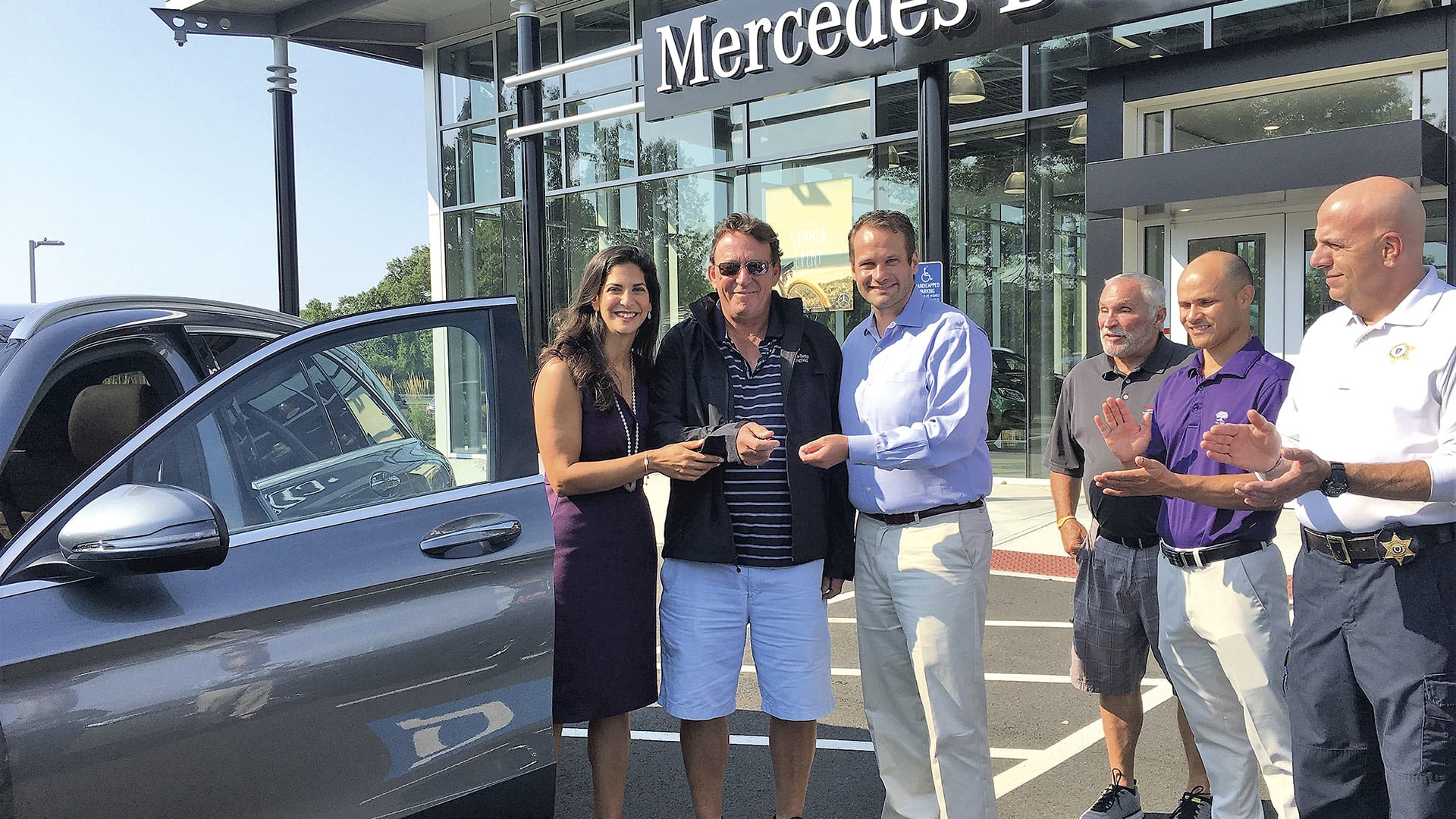
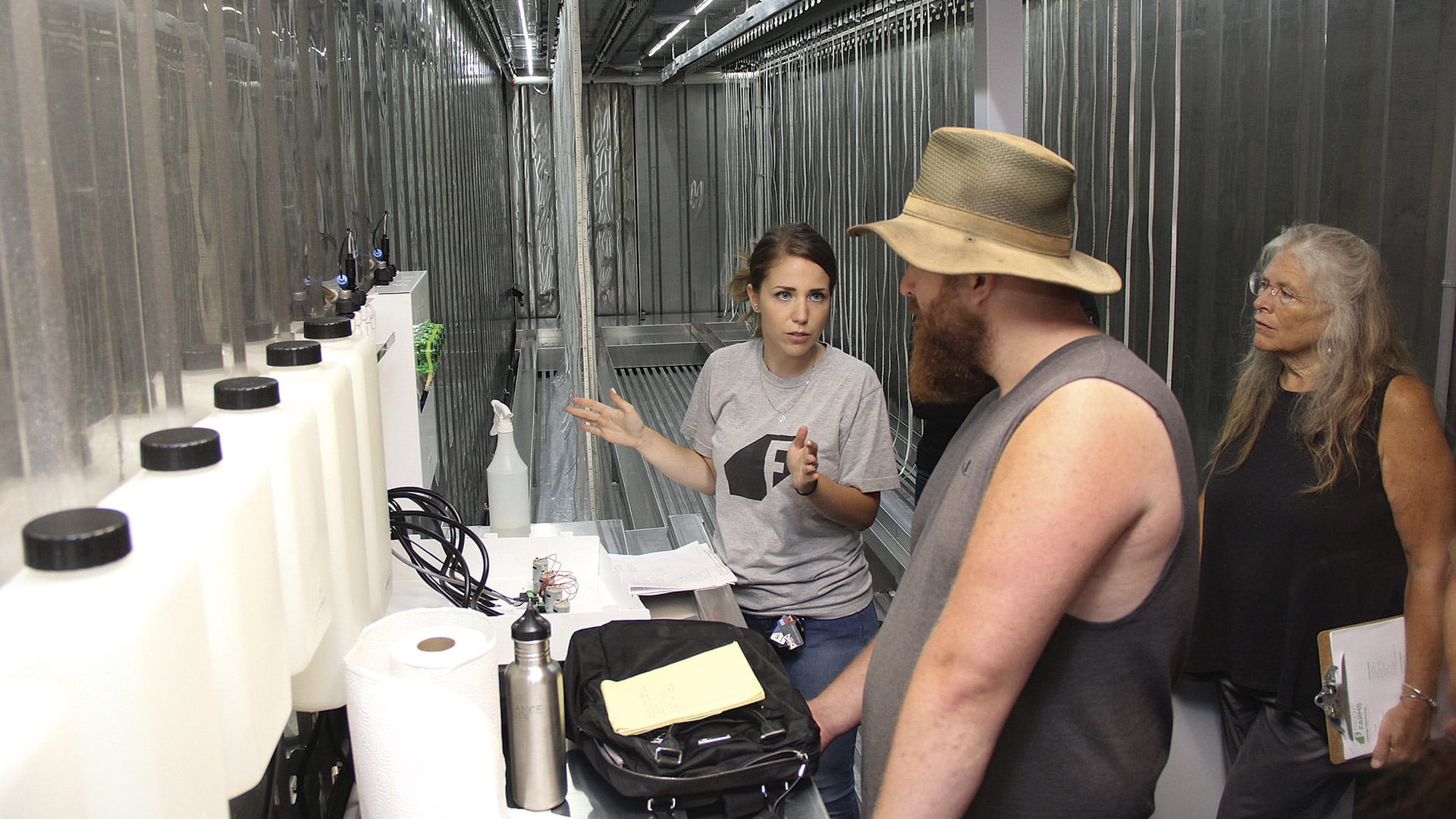
And much of the speculation is somewhat negative in tone, focusing on such things as increased traffic, difficulty with finding parking spaces, longer and more difficult commutes, and how all of the above might keep people from coming into Springfield to do business.

Maybe some of that will happen — to one degree or another — especially in the first days and weeks that the casino is open for business. But even if it does, we choose to view these as only positive developments for this region.

Positive because these are all signs of vibrancy, indicators that a community or region is on the rise, qualities of a very healthy economy.

We’ll take them over the alternative any day of week.

And around here, we’ve had the alternative every day of the week — except when the I-91 viaduct was being rebuilt or the Big E is open for its annual 17-day run — pretty much for the past 40 or 50 years or so.

So this will be a welcome change. Sort of.

Again, people around here are used to breezy commutes. With rare exceptions, they don’t know what traffic jams are. They can’t relate to what their friends in Boston, New York, Chicago, or Atlanta are talking about. And unless Northampton is the destination, people around here have no problems whatsoever with finding cheap (often free) and very plentiful parking.

And they like it that way. It’s one of the reasons people come to live here. It’s quieter, there’s less traffic, and you don’t have to leave home an hour before work starts to commute 20 miles or even 10 miles, as some people do in Greater Boston.

But none of those things we like are indicative of a healthy, vibrant region, at least from an economic standpoint. Being able to breeze through Springfield at almost any hour other than 5-6 p.m. — which we can all do most weeks — is just not a good thing.

Ask anyone who lives in Boston, Cambridge, New York, or even Northampton, and they will tell you that traffic on your streets, parking shortages, and people complaining about how hard it is to get in and out of your city are all good problems to have. Really good problems to have.

They’re all signs that your community is relevant, which, for a long time, this region hasn’t been.

Think about it. Whenever there’s something happening in downtown Springfield, be it a college commencement at the MassMutual Center, induction ceremonies for the Basketball Hall of Fame, or a random Friday night when there’s something going at all the venues downtown — the MassMutual Center, Symphony Hall, and CityStage — people will complain about the traffic and congestion, but they don’t really regret it.

In fact, they’ll usually say something like ‘it’s good to see that many people downtown,’ or ‘Springfield was really hopping tonight … it took me a half-hour to get out of downtown.’ They’re not exactly happy, but they know there’s a good reason for their unhappiness.

People in the Northampton, Amherst, and Hadley area know this feeling well. Traffic on Route 9 can be very heavy at times (most times, in fact), but the businesses along that route and the communities themselves wouldn’t have it any other way. People know when it’s going to take forever to get over the Coolidge Bridge; it’s part of life there.

Will such traffic become part of life in downtown Springfield? Maybe. We might be in the minority here, but we hope so, especially if it’s traffic that will spread the wealth well beyond the casino, which it is likely to do.

We don’t have a crystal ball, certainly, and there has never been a resort casino in this region, so we don’t know exactly what’s going to happen here. But we think the expected changes will be for the better.

Again, they beat the alternative, which is all many of us have ever known.

Opinion

Opinion

By Robyn Alie

This summer, the Massachusetts Medical Society (MMS) will launch a multi-year campaign to promote public awareness of the link between the health of the environment and the health of our patients. 

Recent polls have shown stark differences between the public’s understanding and scientists’ understanding of the relationship between humans and the environment. They also show that the public’s understanding is heavily influenced by politics. 

For example, while studies show that 97% of scientists believe global warming is occurring and related to human activity, a Gallup poll conducted in March found that only 64% of the public believes this. Among Democrats polled, 89% agreed with scientists, compared to 35% of Republicans. Overall, however, a record-high percentage of Americans — 45% — think global warming will pose a serious threat in their lifetime, and 43% — including 91% of Democrats — report being fairly or greatly worried. 

The upcoming campaign is a directive of the MMS house of delegates, which adopted policy recognizing the “inextricable link between environmental health, animal health, and human health, and the importance of scientific research in informing policies that protect human health from environmental toxins.” Delegates directed the society to initiate a public-health campaign promoting public awareness of pollutants and their impact on human health.

The MMS committee on public health recommended the policy, noting recent federal actions. These actions included heavy cuts to the federal programs that study and monitor potential environmental toxins, and legislation that would promote industry representation on environmental advisory boards and limit the types of scientific research, including epidemiologic studies, that could guide EPA policy.

The campaign is an opportunity for physicians to help clarify the issues and promote safer policy and behaviors, said Dr. Louis Fazen, a member of the MMS committee on public health. It will primarily use the MMS Facebook and Twitter channels and website as a cost-effective means of disseminating simple information designed to raise awareness of the links between environmental health and human health. Physicians and others can find more information and a link to the campaign at massmed.org/environment. u

Robyn Alie is manager of Health Policy and Public Health for the Massachusetts Medical Society. This article first appeared in Vital Signs, an MMS publication.

Court Dockets

The following is a compilation of recent lawsuits involving area businesses and organizations. These are strictly allegations that have yet to be proven in a court of law. Readers are advised to contact the parties listed, or the court, for more information concerning the individual claims.

CHICOPEE DISTRICT COURT
Kurt Champagne II v. Chicopee Electronics Inc.; Chicopee Electronics, LLC; Chicopee Electronics Co.; David B. Averill; and Sandy F. Averill
Allegation: Unpaid wages and unpaid overtime: $25,000
Filed: 7/13/18

FRANKLIN SUPERIOR COURT
Lucille Arnold v. The Yankee Candle Co. Inc.
Allegation: Negligence; slip and fall causing personal injury: $57,035.63
Filed: 6/18/18

Mary Emily Kane v. Engelberth Construction Inc. and Champagne Drywall Inc.
Allegation: Negligence; plaintiff struck by improperly stacked drywall, causing personal injury: $500,000
Filed: 6/27/18

Wheelbrator North Andover Inc. v. Whitney Trucking Inc.
Allegation: Breach of settlement agreement: $160,239.96
Filed: 7/17/18

HAMPSHIRE DISTRICT COURT
Anna Paskausky v. Northampton Nautilus Inc.
Allegation: Negligence causing personal injury: $22,785.11
Filed: 6/28/18

6 Woods Restoration Inc. d/b/a Rainbow International Restoration v. World War II Veterans’ Assoc. of Hampshire County Inc. d/b/a World War II Club
Allegation: Breach of contract, unjust enrichment: $20,595.06
Filed: 7/10/18

Elizabeth Ouimette v. Atlantic Coast Enterprises, LLC d/b/a Jiffy Lube Service Center #1164
Allegation: Breach of contract, breach of express warranty, negligence, negligent misrepresentation: $8,885.96
Filed: 7/11/18

Kacper Kisala, through his father, Czeslaw Kisala v. Greenwood Music Camp Inc.
Allegation: Negligence causing personal injury: $17,098.02
Filed: 7/16/18

Guy Juravich and McKenzie Armstrong v. The Kind Grind Inc. d/b/a Share Coffee and Kenneth W. Majka individually
Allegation: Non-payment of tips, failure to pay proper wages, violation of Massachusetts Minimum Wage Act: $5,000+
Filed: 7/19/18

HAMPSHIRE SUPERIOR COURT
Douglas Drysdale and Renee Drysdale v. J.P. Builders Inc., John Pirog, and John Amidio d/b/a Barre Artesian Well
Allegation: Breach of contract, negligent action regarding artesian well servicing new construction residence, resulting in non-potable water: $31,819.45
Filed: 6/28/18

Town of Ware v. ECS Hold Co., LLC; Environmental Compliance Services Inc.; and ATC Group Services, LLC
Allegation: Breach of contract, negligence: $25,000+
Filed: 7/18/18

Edward J. Matz v. University of Massachusetts Amherst
Allegation: Employment discrimination based on age
Filed: 7/18/18

PALMER DISTRICT COURT
Enfield Transit Mix Inc. v. Spartan Concrete Services Inc. and Matthew T. Thouin
Allegation: Money owed for goods sold and delivered: $13,676.57
Filed: 7/12/18

Picture This

A photo essay of recent business events in Western Massachusetts

Winning Drive

Mercedes-Benz of Springfield recently awarded a new Mercedes-Benz to William Morrissey of Agawam, who won the car by hitting a hole in one on June 18 at the LETR Celebrity Golf Classic Tournament at Wilbraham Country Club, benefiting Special Olympics in coordination with the Hampden County Sheriff’s Department. “We are thrilled to have been a part of the LETR golf outing and couldn’t be happier for Mr. Morrissey,” said Mercedes-Benz of Springfield co-owner Peter Wirth. “We are proud to sponsor local community events such as this, and we hope Mr. Morrissey enjoys his new car.” Pictured: Mercedes-Benz of Springfield co-owner Michelle Wirth, Morrissey, Peter Wirth, Special Olympics representative Al Tomlinson, Milton Torres of Wilbraham Country Club, and Jon Laporte of the Hampden County Sheriff’s Department.


Farming the Future

Holyoke Community College students, staff, and alumni, along with community farmers and others, trained last month to grow produce inside two urban container farms set up in a lot off Race Street next to the HCC MGM Culinary Arts Institute. The 40-foot-long Freight Farms shipping containers were delivered in April for a joint urban agriculture project that includes HCC, the city of Holyoke, and the community nonprofit Nuestras Raices. The two shipping containers use hydroponic methods (without soil) to grow leafy greens and herbs. Each of the container farms can grow as much produce in a year as an acre of farmland. Pictured: Francesca Mazzillio, head farm manager for Freight Farms, explains some of the equipment to Dylan Donicz, farm manager for Nuestras Raices and a 2015 graduate of HCC’s sustainable agriculture program. Behind them is Kate Maiolatesi, HCC professor of Sustainable Studies and Sustainable Agriculture.


Rink of Honor

The Environmental Business Council of New England (EBCNE) recognized the new $18 million Worcester Ice Center with the James D.P. Farrell Award for Brownfields Project of the Year during its annual meeting and celebration on June 27. Tighe & Bond oversaw the project’s environmental remediation prior to site redevelopment. Completed last year, the Worcester Ice Center features twin ice rinks, shops, restaurants, and a variety of recreational venues. Pictured, from left: Shawn Rising, Bryan Gammons, Jeffrey Arps, and Douglas Landry of Tighe & Bond, Paul Hoffman of GKN Sinter Metals, and Marc Richards, Matthew Abraham, Becky Bozadjian, Sue Courtemanche, and Fran Hoey of Tighe & Bond.

Agenda

WMNTMA Pig Roast

Aug. 20: The Western Mass Chapter of the National Tooling & Machining Assoc. (WMNTMA) will hold its annual Mainline Drive Pig Roast from 4 to 8 p.m. at Peerless Precision Inc. in Westfield. Larry Maier, former president of the WMNTMA and Peerless Precision, came up with the idea of having a fun networking event during the summer and hosted the first Mainline Drive Pig Roast in 2006. With Maier’s passing in October 2012, the Larry A. Maier Memorial Education Fund was founded with a mission to keep alive his passion for encouraging students to pursue a career in advanced manufacturing and supporting the schools and training programs that support these career options. All profits from the annual pig roast are matched by the chapter and put into the memorial fund to use towards scholarships and training students starting at the middle-school level. At this years’ pig roast, WMNTMA plans to present the West of the River Foundation and Agawam High School with a $1,000 donation for the purchase of tooling for the new manufacturing curriculum beginning in this fall.

River Valley Counseling Center Golf Tournament

Sept. 14: River Valley Counseling Center (RVCC) will hold its third annual golf tournament fundraiser at East Mountain Country Club in Westfield. The cost per golfer is $100 and includes greens fees, a golf cart, gift bag, lunch, and dinner. Golfers will also be able to participate in a raffle and silent auction. Registration will begin at 9 a.m. with a 10:30 a.m. shotgun start. There will also be contests on the course which include prizes donated by Marcotte Ford and Teddy Bear Pools. For more information on sponsorships, donations, and registration, contact Angela Callahan, RVCC’s Marketing and Development specialist, at (413) 841-3546 or [email protected]. Information is also available at www.rvcc-inc.org or by visiting River Valley Counseling Center’s Facebook page.

Future Tense Lecture

Sept. 20: The third installment of the BusinessWest lecture series Future Tense, titled “Change Considerations: An Examination of Lean Process, Market Disruption, and the Future of Your Business,” will take place on Thursday, Sept. 20 from 8 to 9:30 a.m. at Tech Foundry, 1391 Main St., ninth floor, Springfield. The lecture, open exclusively to CEOs and business owners, will be delivered by Mark Borsari, president of Sanderson MacLeod. The cost is a $25 donation to Tech Foundry. Event sponsors include Paragus IT, the Jamrog Group, and Meyers Brothers Kalicka, P.C. With increasingly automated business processes, AI, and machine manufacturing, lean concepts are becoming more important than ever in terms of staying competitive. Borsari will discuss change and innovation through lean concepts and focus on resulting cultural considerations. The presentation will also address already-active market disrupters that will affect business processes in various industries. To register, visit businesswest.com/lecture-series.

Healthcare Heroes

Oct. 25: The second annual class of Healthcare Heroes will be honored at the Starting Gate at GreatHorse in Hampden. Healthcare Heroes was launched last spring by HCN and BusinessWest to shed a bright light on the outstanding work being done across the broad spectrum of health and wellness services, and the institutions and people providing that care. Individuals and organizations were nominated in categories including ‘Lifetime Achievement,’ ‘Emerging Leader,’ ‘Patient/Resident/Client Care Provider,’ ‘Innovation in Health/Wellness,’ ‘Health/Wellness Administrator,’ and ‘Collaboration in Healthcare.’ Winners have been chosen by a panel of independent judges, and will be profiled in both magazines in September and feted at the Oct. 25 gala. Healthcare Heroes sponsors include American International College (presenting sponsor), National Grid (partner), and supporting sponsors Renew.Calm, the Elms College MBA program, and Mercy Medical Center and Trinity Health Of New England.

Chamber Corners

AMHERST AREA CHAMBER OF COMMERCE
www.amherstarea.com
(413) 253-0700

• Aug. 30: Candidate Debate, 7 p.m., hosted by Amherst Regional Middle School auditorium. A pre-primary debate for candidates seeking the Democratic nomination for state representative (Third Hampshire) and state senator (Hampshire, Franklin, Worcester).

FRANKLIN COUNTY CHAMBER OF COMMERCE
www.franklincc.org
(413) 773-5463
 
• Sept. 28: Monthly Breakfast Series, 7:30-9 a.m., hosted by Franklin County Technical High School, 82 Industrial Blvd., Turners Falls. Full breakfast will be served during the program, which will feature the kickoff of the United Way of Franklin County’s fundraising campaign. Register at franklincc.org or e-mail [email protected].

GREATER CHICOPEE CHAMBER OF COMMERCE
www.chicopeechamber.org
(413) 594-2101

• Aug. 16: European Café & Open House, 4:30-7 p.m., hosted by Chicopee Chamber of Commerce & Courtyard, 264 Exchange St., Chicopee. Come enjoy a taste of the European flavors of the local restaurants, all in a relaxed setting with the musical stylings of Sergio D’Orsini. Meet and greet the local artists and tour the Chamber of Commerce and engage with many small business owners, including MaryKay, Herbarium, Lemon Grass Fitness, and TrueHeart Wellness, to name a few. Presented in partnership with Westfield Bank. Cost: $25 for one attendee, $40 for two attendees (must be purchased at the same time). Sign up online at www.chicopeechamber.org/events or call (413) 594-2101.
• Sept. 6: CEO Luncheon, 11:45 a.m. to 1 p.m., hosted by Collegian Court, 89 Park St., Chicopee. A quarterly luncheon series where CEOs tell of how they rose to their positions. September’s luncheon will feature Jim Goodwin of CHD. Series sponsored by Polish National Credit Union. Cost: $30 for members, $35 for non-members. Sign up online at www.chicopeechamber.org/events or call (413) 594-2101.
• Sept. 13: Business After Hours, 4:30-6:30 p.m., hosted by Red Fez, 70 Exchange St., Chicopee. Series presented by Polish National Credit Union Cost: $10 for members, $15 for non-members. Sign up online at www.chicopeechamber.org/events or call (413) 594-2101.
• Sept. 19: Salute Breakfast, 7:15-9 a.m., hosted by Tru By Hilton, 440 Memorial Dr., Chicopee. Chief greeter: Tony Cignoli. Keynote speaker: state Rep. Joseph Wagner. Series sponsored by United Personnel, Westfield Bank, Holyoke Medical Center, Polish National Credit Union, Gaudreau Group, Spherion Staffing Services, PeoplesBank, and Interstate Towing Inc. Cost: $23 for members, $28 for non-members. Sign up online at www.chicopeechamber.org/events or call (413) 594-2101.
• Sept. 28: Chamber Seminar: “Authenticity in Leadership,” 9-11 a.m., hosted by Residence Inn, 500 Memorial Dr., Chicopee. Presenter: Lora Wondolowski of Leadership Pioneer Valley. Presented by Westfield Bank. Cost: $15 for members, $20 for non-members. Sign up online at www.chicopeechamber.org/events or call (413) 594-2101.

GREATER EASTHAMPTON CHAMBER OF COMMERCE
www.easthamptonchamber.org
(413) 527-9414

• Sept. 13: Networking by Night, 5-7 p.m., hosted by Northampton Country Club, 135 Main St., Leeds. Sponsored by Tunnel 7 and Fran’s Fine Editing. Food and door prizes will be available, as well as a cash bar. Cost: $10 for members, $15 for non-members. Pre-registration is suggested. For more information and to register, visit www.easthamptonchamber.org or call the chamber at (413) 527-9414.
• Sept. 23: Breakfast, 7:30 a.m. to 9 a.m., hosted by Springfield Country Club, 1375 Elm St., West Springfield. The Greater Easthampton Chamber of Commerce joins with other area chambers to provide information concerning the nursing ballot initiative. There will be a continental breakfast and networking beginning at 7:30 a.m., folllowed by a panel discussion beginning at 8 a.m. For more information and to register, visit www.easthamptonchamber.org or call the chamber at (413) 527-9414.

• Sept. 28: Women & the Art of Risk, 8 a.m. to 3 p.m., hosted by the Log Cabin Banquet & Meeting House, 500 Easthampton Road, Holyoke. A women’s leadership event featuring workshops, discussions, and career-development opportunities, all led by distinguished women from the Pioneer Valley. Hear personal and professional stories of how taking calculated risks led these women to new adventures and made them stronger leaders. The keynote speaker is Dr. Valerie Young, an internationally recognized expert on impostor syndrome. Cost: $119, or $875 for a table of 10. Pre-registration is a must. For more information, a schedule of the day’s events, and to register, visit www.easthamptonchamber.org or call the chamber at (413) 527-9414.

PROFESSIONAL WOMEN’S CHAMBER
www.springfieldregionalchamber.com
(413) 787-1555

• Sept. 13: Professional Women’s Chamber Season Kickoff Luncheon, 11:30 a.m. to 1 p.m., hosted by the Munich Haus, 13 Center St., Chicopee. Sponsors: BusinessWest and HCN. Lisa Mullins, host of WBUR’s All Things Considered, will headline the luncheon. Cost: $35 for members, $40 for non-members, $99 for luncheon season pass. Registration will be available soon on the PWC website at www.professionalwomenschamber.com.

WEST OF THE RIVER CHAMBER OF COMMERCE
www.ourwrc.com
(413) 426-3880

• Aug. 6: 15th Annual Scholarship Golf Tournament, hosted by the Ranch Golf Club in Southwick. Schedule: 11:30 a.m.: registration; noon: lunch; 1 p.m.: shotgun start, scramble format. Putting contest, 15th hole air cannon, Carrabba’s Cuisine Hole, and more. Cost: $125 for golf and dinner. For more information and tickets to this event, contact the chamber office at (413) 426-3880 or [email protected], or register online at www.westoftheriverchamber.com.
• Aug. 16: Free Membership Appreciation Luncheon, noon to 1:30 p.m., hosted by Carrabba’s Italian Grill, Riverdale Street, West Springfield. Lunch is on us! Members can register for this networking event and bring a non-member guest, and you both enjoy a free lunch. Seating is limited, so register at www.westoftheriverchamber.com before it’s too late. For more information, contact the chamber office at (413) 426-3880.
• Sept. 18: September Legislative Breakfast, 7-9 a.m., hosted by Chez Josef, 176 Shoemaker Lane, Agawam. Join us as we listen to an informative panel discussion with our elected officials. State senators, state representatives, and local mayors will update guests on all things politics. The presenting sponsor is Horizon Services; premier sponsors include the Insurance Center of New England, Health New England, Polish National Credit Union, and Republic Services; and preferred sponsors include Reliable Temps, Spherion Staffing, Westfield Bank, and Partners Restaurant & Catering. Register online at www.westoftheriverchamber.com.

YPS OF GREATER SPRINGFIELD
springfieldyps.com

• Sept. 13: Vote the Valley: The New Springfield, 5-7 p.m., hosted by Mahogany Room at Symphony Hall, 34 Court St., Springfield. Join us for an in-depth update from Springfield Mayor Domenic Sarno on the current state of Springfield. We will highlight the advances and opportunities for young professionals in the area and those who work with them. For sponsorship and partnership opportunities, e-mail Ashley at [email protected].

People on the Move
Michele Cabral

Michele Cabral

Michele Cabral, a former accounting professor and interim dean of Business and Technology at Holyoke Community College, has been appointed the new director of Training & Workforce Options, a workforce-development partnership between HCC and Springfield Technical Community College. Cabral succeeds Jeffrey Hayden, who maintains his position as HCC’s vice president of Business and Community Services. As director of TWO, she will also continue in her position as director of the Massachusetts Casino Career Training Institute (MCCTI), the gaming school HCC runs jointly with STCC and MGM Springfield at 95 State St. in Springfield. Before being named director of MCCTI last fall, Cabral served as interim dean of Business and Technology at HCC, where she was a member of the project team that helped bring the HCC MGM Culinary Arts Institute to life. Cabral holds a bachelor’s degree from Westfield State University and an MBA from Elms College. She joined the faculty of HCC in 2014 as a full-time professor of accounting.

•••••

Kevin Bramlett

Kevin Bramlett

Adam Cincotta

Adam Cincotta

As part of the previously announced organizational change to position the company for future growth, OMG Inc. promoted Kevin Bramlett and Adam Cincotta into new business-unit leadership positions for the Roofing Products Division. Each will oversee all facets of their respective business unit, including strategic sales and marketing activities, planning, forecasting, and manufacturing, as well as business-unit profit and loss. Bramlett was named director of the metal accessories business unit, which is predominantly OMG EdgeSystems, the company’s line of fascia, coping, and water-control products. Bramlett has been with the company since July 2012, most recently as the manufacturing manager for the OMG edge business. Before joining OMG, he was a mechanical engineer with Thermo-Fisher Scientific. He holds a bachelor’s degree in mechanical engineering from the University of North Carolina at Charlotte. Cincotta was named director of the adhesives/solar business unit, which includes OlyBond Adhesives, the industry’s popular line of insulation and fleece membrane adhesive, as well as its OMG PowerGrip line of solar anchors. He joined OMG Roofing Products as a product manager in 2014, and was promoted to group product manager in 2017. Before joining OMG, he was with Lenox Tools/Newell Rubbermaid, where he worked as a senior product manager. He holds a bachelor’s degree in applied economics and management from Cornell University and an MBA from UMass.

•••••

Kelly Marcroft

Kelly Marcroft

Kelly Marcroft, Holyoke Medical Center’s director of Emergency Services, has been selected to join an expert panel to improve patient safety in emergency medicine. The panel was convened by the Betsy Lehman Center for Patient Safety, a Massachusetts state agency that catalyzes the efforts of providers, patients, and policymakers working together to advance the safety and quality of healthcare. The goal of this expert panel is to develop, aggregate, and disseminate practical recommendations and tools to support the efforts of Massachusetts acute-care hospitals to advance the safe delivery of emergency care in their facilities. The panel will deliberate on and endorse a set of core safety competencies that all Massachusetts emergency departments should foster, as well as create a set of best-practice standards, tools, and resources to share throughout the greater emergency-medicine community in Massachusetts. The expert panel consists of nurses, nurse practitioners, physician assistants, and doctors from several hospitals throughout the state, including Baystate Health, Brigham & Women’s Hospital, Beth Israel Deaconess Medical Center, Lowell General Hospital, Sturdy Memorial Hospital, Boston Children’s Hospital, and UMass Memorial Medical Center. The group first met on June 26 in Boston and will continue to meet monthly over the next year.

•••••

Angela Barahona

Angela Barahona

Country Bank announced that Angela Barahona has joined its Commercial Banking division as vice president of Business Development and Cash Management. She brings 17 years of experience in the industry, having held various positions over the years in customer service, management, municipal and government banking, business development, and corporate cash management. She is currently working toward her associate degree from the New England College of Business and Finance with a concentration in business adminstration. Barahona began her financial-services career at Country Bank in 2001 in its retail banking area. A relocation in 2006 to the eastern part of Massachusetts brought her to State Street Bank Corp. in its wire division and later to Century Bank. For the last 13 years at Century, she held various positions working her way through the ranks, where she found her passion in helping business customers.

•••••

Clare Lamontagne

Clare Lamontagne

Holyoke Community College recently welcomed Clare Lamontagne as its new dean of Health Sciences. Lamontagne, a registered nurse who holds a Ph.D. in nursing, brings 40 years of experience to HCC as a nursing educator, administrator, clinician, and consultant. For the past seven years, she has been a member of the full-time nursing faculty at UMass Amherst, having also served there as director of the undergraduate nursing program. She began her career in 1978 as a charge nurse at Ludlow Hospital after earning her associate degree in nursing from Springfield Technical Community College, where she worked as a member of the nursing faculty from 1988 to 2011. Lamontagne holds a bachelor’s degree in nursing from American International College, a master’s degree in nursing from the University of Connecticut, and a Ph.D. in nursing from UMass Amherst. She has also worked as a nurse at Baystate Medical Center and as a volunteer at the Pioneer Valley Free Health Clinic in East Longmeadow, and has taught in the nursing programs at UConn, Elms College, and Baystate Health.

•••••

Alta Stark has been named director of Communications for the Sisters of St. Joseph of Springfield. She is responsible for developing, writing, and producing various printed and electronic publications, providing printed materials and signs, publicity for events, advertising, and technical support. She will also work to cultivate and maintain relationships with local, regional, and national media, as well as Catholic media, and produce content for the Sisters of St. Joseph social-media sites. Stark is a communications professional with more than 30 years of experience in marketing, advertising, public relations, and the news media. Most recently, she taught graduate-level online courses in public relations for Western New England University. Previously, she served as the director of Marketing & Public Relations for JGS Lifecare in Longmeadow, successfully rebranding the 106-year organization and helping launch the Sosin Center for Rehabilitation. Stark has also served as senior Communications specialist for Baystate Health and Communications director for the Affiliated Chambers of Commerce of Greater Springfield (now the Springfield Regional Chamber) and the Western Mass. Economic Development Council. She also spent nearly a decade producing award-winning broadcast news in several markets in the Northeast, including WWLP 22News. Stark holds a master’s degree in television, radio, and film with a concentration in broadcast news from the S.I. Newhouse School of Public Communications at Syracuse University, and graduated cum laude from Syracuse University’s College of Visual and Performing Arts with a bachelor’s degree in advertising design.

•••••

Claudia Pazmany

Claudia Pazmany

Big Brothers Big Sisters of Hampshire County (BBBSHC), a program of CHD, announced the appointment of Claudia Pazmany as its new advisory board president. Pazmany, the new executive director of the Amherst Area Chamber of Commerce, joined BBBSHC as an advisory board member in May 2016. She served on the development committee and led the efforts to celebrate outgoing Executive Director Renee Moss, while simultaneously serving on the search committee to hire her replacement, current Executive Director Jessie Cooley. “Claudia’s successful 17-year history in professional fundraising has made her a true steward of her craft in philanthropy, and this is part of what drew her to us,” said Cooley. “Claudia is also passionate about the mission of Big Brothers Big Sisters, with contagious enthusiasm and innovative ideas, and she will help lead us into the next phase of our program’s growth.”

•••••

Krish Thiagarajan, an expert on marine renewable energy and energy-producing offshore structures, has been appointed to the endowed chair in Renewable Energy in the UMass Amherst College of Engineering. Thiagarajan will collaborate with state Department of Energy Resources staff on renewable-energy research and projects. His studies focus on harvesting energy from waves in marine environments, and his expertise will broaden and strengthen the research program in renewable energy at UMass Amherst, which has long been a national leader in wind energy. Thiagarajan came to UMass Amherst last spring after serving six years as the presidential chair in Energy at the University of Maine, where his research attracted more than $22 million in funding. At Maine, he also led the Marine Ocean and Offshore Research (MOOR) Group, which studied how human-made structures interact with the complex ocean environment. Thiagarajan completed his bachelor’s degree in naval architecture at the Indian Institute of Technology in Madras. He earned a master’s degree in ocean engineering at Memorial University of Newfoundland before pursuing further graduate studies at the University of Michigan, where he was awarded master’s degrees in mechanical engineering, and naval architecture and marine engineering, as well as a Ph.D. in naval architecture and marine engineering.

•••••

Mika Nash has joined American International College (AIC) as executive vice president for Academic Affairs. She comes to AIC from Champlain College in Vermont, where she served as dean of Continuing Professional Studies. Nash has more than 20 years of experience in the field of higher education, with the majority of her career spent in senior leadership. In her most recent role, she was tasked with the development and administration of all academic and operational responsibilities associated with running the Continuing Professional Studies academic unit with management oversight for all curricula, academic programs, academic policies, articulation agreements, eLearning, faculty recruiting, training and development, and building student, family, and academic support services. A particular area of interest and scholarship for Nash continues to be technology innovation to expand the student experience and engagement in course content. Prior to joining Champlain College in 2007, Nash served as dean for the School of Hospitality and Restaurant Management at the New England Culinary Institute. She received her undergraduate and graduate degrees at the University of Vermont. She has a doctorate in higher educational leadership and policy studies.

•••••

Scott Higgins

Scott Higgins

Erin Wilde

Erin Wilde

HUB International New England, LLC, a division of HUB International Limited, a global insurance brokerage, recently announced that Scott Higgins joined the agency as an account executive for Commercial Lines, and Erin Wilde has come on board as a client relationship manager. Both will work in the East Longmeadow office. Higgins will be responsible for servicing medium- to large-sized businesses with a focus on property and casualty products. Having first started his career as a collision repair manager with GM for more than 20 years, he has a vast background in providing settlements for collision repairs. From there, he held various positions with MetLife and MetLife Financial. Wilde will work closely with the HUB New England Employee Benefits team to service existing clients with marketing, benefits communications, regulatory requirements, cost-saving measures, and enrollment, as well as assisting with new prospects. Having worked in the employee-benefits field, including stops at Bank of Tampa and Sullivan Benefits, she has a background servicing nonprofits.

•••••

Springfield Technical Community College announced that Erica Eynouf was named dean of Library, Matthew Gravel was named dean of Academic Initiatives, and Inder Singh was named assistant vice president/chief Information officer. Eynouf joined the college in September 2012 as a reference library, and had served as interim dean of Library Services since August 2017. She holds a master’s degree in library science from Simmons College in Boston. She received her bachelor’s degree in critical social theory from Mount Holyoke College in South Hadley. Gravel was most recently dean of Enrollment Management. He joined STCC in August 2001 as the director of Academic Advising, became registrar in March 2005, and was promoted to dean of Curriculum in January 2012. Among his job responsibilities, he will plan and manage academic initiatives and program review efforts. He earned a master’s degree in education from the Harvard Graduate School of Education and a bachelor’s degree in English from UMass Dartmouth. Singh had served as interim AVP/CIO since January. Previously, he served as CIO at Union County College in New Jersey and worked in IT leadership positions for 28 years at the Culinary Institute of America in New York. He holds an MBA from Rensselaer Polytechnic Institute in Troy, N.Y., and earned a bachelor’s degree in commerce from Delhi University, India.

•••••

Kathleen Anderson

Kathleen Anderson

Holyoke Medical Center announced the appointment of Kathleen Anderson as the hospital’s director of Community Benefits. She begins her new role on Aug. 27, providing programs and services to improve health in communities and helping to increase access to healthcare. She will succeed Helen Arnold following her retirement after a 42-year career with Holyoke Medical Center. Anderson most recently served as president of the Greater Holyoke Chamber of Commerce and its affiliated Centennial Foundation. Prior to that, she served as Holyoke’s Planning and Economic Development director, as well as chief of staff for two Holyoke mayors. She serves on the state Executive Office of Housing and Economic Development’s Economic Assistance Coordinating Council, and chairs both the Holyoke Salvation Army and Economic Development Partners of the Western Mass. Economic Development Council.

•••••

The duMONT Co. and Hassay Savage Co. announced the promotion of Cynthia Cote to president of both companies. Cote joined duMONT with new ownership in 2016 as the company’s chief financial officer. Both duMONT and Hassay Savage companies are leaders in linear industrial broaching technology. In 2018, the companies will break ground on a new manufacturing facility to prepare for additional growth through research and development as well as acquisition. In addition to her accomplishments in manufacturing, Cote and her husband own and run a construction company and a real-estate management company in Shelburne Falls.

•••••

HealthSouth Rehabilitation Hospital of Western Massachusetts recently named Kathy Casagrande as director of Case Management and Mary-Anne Schelb as Business Development director. These leadership-team members will support initiatives to uphold high-quality patient care at the 53-bed inpatient rehabilitation hospital located at 222 State St., Ludlow. Casagrande has been a social worker and case manager in a hospital setting for more than 30 years. She received her bachelor’s degree in social work from Western New England College in 1985 and began her career at HealthSouth Western Massachusetts in March 1996 in the capacity of discharge planner. She was promoted to case manager in 1997. Schelb serves as director of Marketing Operations at HealthSouth Western Massachusetts. She began her career with an accounting certification from St. John’s School of Business and found herself drawn to a more health- and wellness-based path as a holistic health practitioner holding master/teacher certifications from the International Center for Reiki Training. In addition, she is a certified cranial sacral therapist in Profound Neutral from the Neurovascular Institute.

•••••

Zoar Outdoor recently trained five new guides to lead its canopy-tour experience in a 40-hour process that covered topics from safety to assessing the guest’s state of mind. All five guide candidates aced written exams and technical drills on June 15, the last day of the training. Hired for the remainder of the season, which ends in November, were Brian Schempf, Matt Drazek, Haley Rode, Abby Schlinger, and Tynan Hewes. All of the trainees had previous experience riding a zipline, and they all also had outdoor experience ranging from hiking to mountain climbing. Zoar currently has 43 guides for its zipline canopy tour, which was the first zip tour in southern New England.

Company Notebook

PeoplesBank Again Named Among Top Corporate Charitable Contributors

HOLYOKE — The Boston Business Journal has announced the region’s Top Corporate Charitable Contributors, and, for the 11th year in a row, PeoplesBank is among the companies included. The region’s top charitable companies, which include, in many instances, the companies’ corporate foundations, will be honored at the Boston Business Journal’s 13th annual Corporate Citizenship Awards on the evening of Thursday, Sept. 6 at Fenway Park in Boston. “We have a unique ability to help the communities we serve through the considerable volunteer efforts of our associates and the millions of dollars in donations to charitable and civic causes we have made over recent years,” said Matthew Bannister, first vice president, Marketing & Innovation at PeoplesBank. The Boston Business Journal’s Top Corporate Charitable Contributors list is composed of companies that gave at least $100,000 to Massachusetts-based charities in 2017. 

PV Squared Recognized as a Top Solar Contractor

GREENFIELD — Solar Power World, a publication covering solar technology, development, and installation, published its annual Top Solar Contractors list in July. Local solar-installation company and worker-owned cooperative PV Squared was listed prominently among other top solar contractors and developers across the country.

“It’s always an honor to be recognized for what we do on a national scale, putting Western Massachusetts solar companies on the map,” said PV Squared General Manager Stacy Metzger. “While our focus remains local, the national ranking offers more insight into how we’re performing on a broader scale. It’s deeply rewarding to know that our business and installation practices are leading by example.”

United Financial Bancorp Announces Q2 Earnings

HARTFORD, Conn. — United Financial Bancorp Inc., the holding company for United Bank, announced results for the quarter ended June 30, 2018. The company reported net income of $15.6 million, or $0.31 per diluted share, for the quarter ended June 30, 2018, compared to net income for the linked quarter of $15.8 million, or $0.31 per diluted share. The company reported net income of $16.2 million, or $0.32 per diluted share, for the quarter ended June 30, 2017. “In the second quarter of 2018, United Financial Bancorp, Inc.’s earnings results reflected solid linked quarter net interest margin expansion and net interest income growth. Our company continues to grow loans, deposits, particularly checking accounts, and tangible book value while maintaining strong asset quality, capital, and liquidity,” said William Crawford IV, CEO and president of the company and the bank. “I want to thank our United Bank employees for their steadfast support of our customers and communities.” Assets totaled $7.21 billion at June 30, 2018 and increased $139.9 million, or 2.0%, from $7.07 billion at March 31, 2018. At June 30, 2018, total loans were $5.48 billion, representing an increase of $93.2 million, or 1.7%, from the linked quarter. Deposits totaled $5.39 billion at June 30, 2018 and increased by $110.9 million, or 2.1%, from $5.28 billion at March 31, 2018.

Berkshire Hills Bancorp Reports Increase in Earnings

BOSTON — Berkshire Hills Bancorp Inc. reported 2018 second-quarter net income of $34 million, which was a 73% increase over 2017 second-quarter net income of $20 million. This primarily reflected the benefit of Berkshire’s Greater Boston expansion through acquisition and business development, resulting in higher market share, increased efficiency, and record profitability. “We achieved record quarterly return on assets, with income increasing by 35% over the prior quarter,” said CEO Michael Daly. “Commercial loans grew strongly, and our new Boston corporate headquarters teams are receiving good response to our expanded presence in Greater Boston. Our revenue growth and disciplined expense management produced record quarterly earnings per share, positive operating leverage, and improved returns on equity.” Meanwhile, Daly added, “the integration of acquired operations was completed within plan in the second quarter, and several company-wide initiatives have been accelerated to support the expansion of our deposit product set and delivery channels. Our annual Xtraordinary Day of Service in June tackled 74 community projects across our markets, totaling nearly 7,000 volunteer hours and 92% of our workforce. Our foundation announced the appointment of a Corporate Social Responsibility (CSR) officer to expand our multiple community-engagement activities and implement an all-encompassing CSR strategy.”

First Connecticut Bancorp Reports Net-income Increase

FARMINGTON, Conn. — First Connecticut Bancorp Inc. (FCB), the holding company for Farmington Bank, reported a 35% increase in net income of $6.7 million, or $0.42 diluted earnings per share, for the quarter ended June 30, 2018, compared to net income of $5.0 million, or $0.32 diluted earnings per share, for the quarter ended June 30, 2017. Net income on a core earnings basis was $7.4 million, or $0.46 diluted core earnings per share, for the quarter ended June 30, 2018, compared to $5.0 million, or $0.31 diluted core earnings per share, for the quarter ended June 30, 2017. Core earnings exclude non-recurring items. On June 19, 2018, First Connecticut Bancorp Inc. announced its entry into a definitive agreement and plan of merger with People’s United Financial Inc., pursuant to which FCB will merge with and into People’s United. “I am pleased to report solid core second-quarter earnings for the company,” said John Patrick Jr., chairman, president, and CEO of First Connecticut Bancorp. “As indicated, earnings were impacted by certain one-time charges related to our acquisition by Peoples United Financial Inc. The board of directors and senior management have always focused on shareholder value, and we believe this acquisition maximized shareholder value at a time when, we believe, the operating paradigm is changing for smaller community banks. I would also like to thank our dedicated employees who executed our strategy, which maximized our results for shareholders.”

Work Opportunity Center Receives Grant from Westfield Bank Foundation

SPRINGFIELD — Work Opportunity Center Inc. announced it is a recipient of a $5,000 grant donation from the Westfield Bank Foundation. The money will be put toward the purchase of a vehicle for the Community Based Day Services (CBDS) program. The CBDS program of supports enables individuals with developmental disabilities to enrich their life and enjoy a full range of community activities by providing opportunities for developing, enhancing, and maintaining competency in personal, social, and community activities. The program has been set up with five core fundamentals: education, social and recreational, health and wellness, life skills, and employment and volunteerism. Options that are given to individuals who participate in CBDS include career exploration, community-integration experiences to support fuller participation in community life, skills development and training, volunteer opportunities with local nonprofits, health and fitness classes, socialization experiences, and support to enhance interpersonal skills, as well as the pursuit of personal interests and hobbies. The program currently serves 84 individuals.

Thornes Refurbishes Window Assemblage

NORTHAMPTON — In late July, Thornes Marketplace refurbished and expanded an historic window assemblage, installing six new stained-glass window panels designed by a local artist on the Chestnut Staircase behind Share coffee shop. Heather McLean, owner of Dragonfly Stained Glass Studio in Easthampton, was commissioned to design the panels, which are part of an elaborate, two-and-a-half-story window grouping. Each new arts-and-crafts-style panel created by McLean is identical, measuring four feet high by two feet wide. They combine bold orange squares with deep blue edging and long, vertical, pale-yellow highlights, and all six windows together will fill a space that is roughly eight feet high by six feet wide. Above McLean’s stained-glass windows, three tiers of windows original to the building — one overarching transom window and two tiers of oblong windows — were cleaned, painted, and reinstalled to further refresh the entire collection. McLean’s panels replace three original stained-glass windows that could not be restored; they will be cleaned, refurbished, and hung in the building at a later date as an art sculpture, said Jon McGee, Thornes facilities manager. Over the past 10 years, Thornes has taken on a series of major renovations to improve and enhance the eclectic shopping center.

Mediware Acquires Fazzi Associates

LENEXA, Kan. — Mediware Information Systems Inc., a portfolio company of TPG Capital and a leading supplier of software solutions for healthcare and human-service providers and payers, recently acquired Northampton-based Fazzi Associates, one of the largest companies serving home health and hospice. The acquisition creates a unique alignment between two healthcare industry leaders — one in innovative software, the other in outsourced services, consultation, and education. The combined company will have a greater capacity to help post-acute and community-based providers increase efficiency and improve clinical, financial, and operational performance to advance patient care. The addition of Fazzi Associates enables Mediware to offer new, comprehensive, and best-in-class services and solutions — including medical coding, revenue-cycle management, education, CAHPS, consulting, and ancillary solutions that address key challenges and evolving complexities affecting the post-acute care sectors. Mediware plans to maintain Fazzi Associates’ brand and Western Mass. headquarters; the firm’s leadership team will continue to lead Fazzi Associates’ lines of business. Dr. Bob Fazzi will serve in a strategic advisory role with Mediware, consulting on industry relations, home-health advocacy, growth opportunities, and innovation.