Features
An Already Intense Casino Battle Is Getting Even Hotter
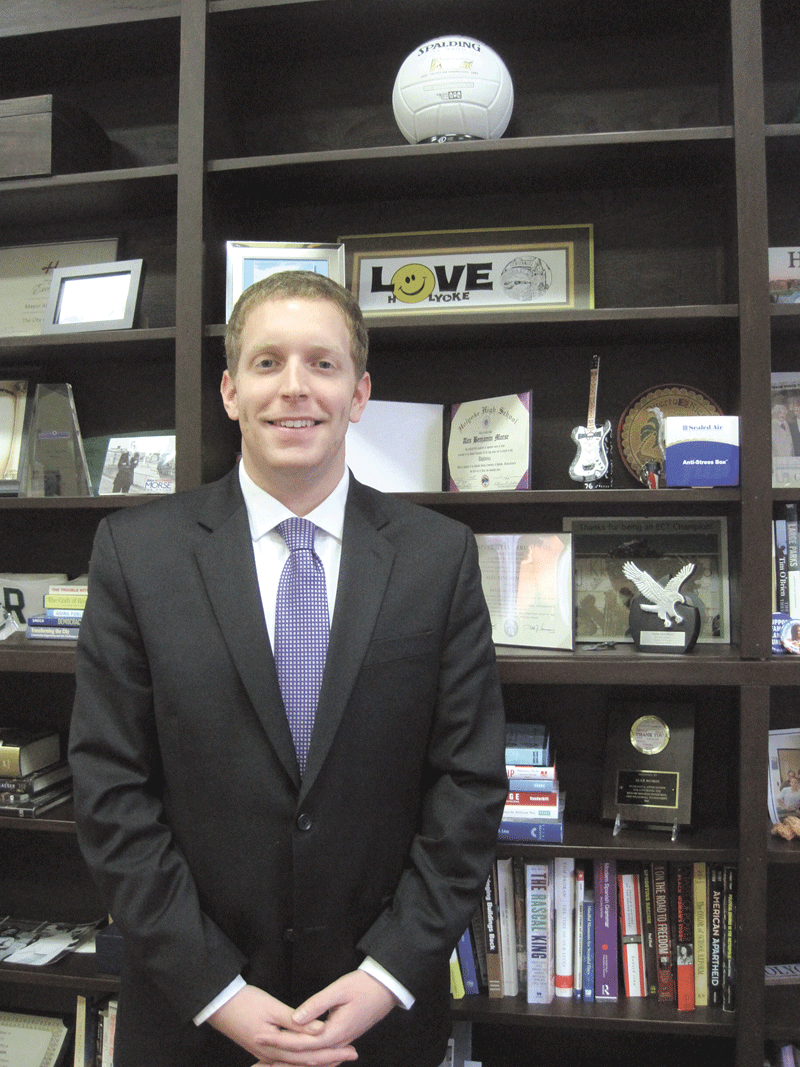
Holyoke Mayor Alex Morse

Holyoke Mayor Alex Morse says he hasn’t changed his mind on casinos, but wants to protect Holyoke’s interests.

Holyoke Mayor Alex Morse spoke at the podium placed at the back of his office at City Hall for perhaps 15 minutes. But very few people heard anything that he had to say.

Whatever microphones there were at the podium for a raucous press conference on Nov. 26 did not carry his voice past the first few rows of people — most of them press representatives — gathered in front of him. And even those people couldn’t hear much due to the loud and incessant catcalls coming from the more than 100 city residents who couldn’t squeeze in to Morse’s office, but made sure the 24-year-old, first-term mayor knew they were there — and not happy with him.

Among the comments heard: “No casino” (that was a constant, heard throughout); “Morse lied to Holyoke”; “shame on you”; “this is wrong”; “sellout”; and even “get a real job.” There were also plenty of signs, including one that read, “Don’t Bet on Another Term.”

What Morse was attempting to explain — and there were plenty of copies of his remarks made available so people would know, even if they couldn’t hear — is that, at this moment, he is only considering a proposal forwarded by Holyoke resident and business owner Eric Suher to place a resort casino on land he now owns on Mount Tom and from which he operates a concert venue.

But even the fact that he is considering such a proposal sent shock waves through the region and took the hotly contested casino fight in this region to another dimension.

“Let me be absolutely clear,” said the mayor. “There is no agreement in place between a casino-development group and me. There have been no back-room deals. My intent today is to inform the people of Holyoke of my shift in strategy before any advanced discussions or negotiations take place, so that everyone in the city may voice their ideas, concerns, and suggestions.”

The press conference had long been scheduled for that date, the mayor told the press after his remarks, but it was made more necessary — and far more hostile — by the fact that information about Morse’s consideration of a Mount Tom casino were leaked to the Boston Globe days before. In fact, the newspaper already had a copy of Morse’s remarks long before anyone else.

The intriguing turn of events has sent Ward 7 residents of Holyoke scrambling for a new candidate to support, and added even more layers of speculation and intrigue to what was already an intense fight for the license to be granted for a Western Mass. casino, one that has become all-consuming and even entertaining.

Indeed, several days before Morse’s stunning “shift in strategy,” as he called it, representatives of the three companies trying to place a casino in Springfield — MGM, Ameristar, and Penn National — essentially took turns calling each other names in a rambling, gloves-are-off story in the Republican.

The casino officials basically tried to shoot holes in their opponents’ plans before the court of public opinion, casting aspersions on everything from traffic plans to the size of planned hotels. And this is months before anything is remotely close to being put on an election ballot.

But back to Holyoke. It’s certainly not unusual for a city official to say that he’s looking hard at a plan to bring a casino to his community. What is quite unusual is for such a pronouncement to come from someone so passionate in opposition to gaming that he wrote the following in a recent issue of Commonwealth magazine (in a point-counterpoint segment with Springfield Mayor Domenic Sarno):

“A casino does not create wealth; it transfers it. Regions benefit from casino gambling when people from outside the region come to spend money there. But there is no evidence that this would be the case at a Holyoke site. A casino in Holyoke would not be a destination gambling site, but a convenience gambling site. It would thus serve primarily to remove money from the local economy and put it in the hands of casino owners who do not live here. This is how casinos work — by design. Because of this, I do not believe a casino would be useful even as part of a holistic approach. We have the resources and the drive to create an economy that will benefit all, and for generations to come.”

On Nov. 26, and the day before in the Globe, Morse, who studied urban planning at Brown, essentially said he hasn’t exactly changed his mind on casinos, only his perception of the situation now facing not only his community, but the region as a whole.

“For me, in an ideal world, we would not have a casino in our boundaries. My views on casinos haven’t changed, and neither has my belief that a casino is unequivocally not  our saving grace,” he said in his prepared remarks. “The only thing that has changed is my weighing of that option with the alternative, which would be locating a box-style casino right at our doorstep. Map out driving directions on your favorite GPS: Springfield’s would be 15 minutes from [Holyoke] City Hall; one at Mountain Park would be 12. We share one metropolitan area, and I cannot assume that our city boundaries will provide us any protection from a casino down the road.

“I have thus come to the conclusion that in order to mitigate the effects of having a casino in Western Mass., it is not enough to oppose one in our boundaries. … The best way to control the outcome of this process, such that we reap the benefits and mitigate the downsides, is to ensure that we negotiate a host agreement that best addresses our concerns and our values, and then, once such an agreement is reached, put it before the voters. My overarching goals for Holyoke’s economic future remain the same; today’s announcement marks the deployment of a new strategy, given current realities, for achieving them.”

Read between the lines (or just the lines, really), and Morse seems to be saying that, if you can’t control what goes on with a Springfield or Palmer casino, you’d be better off having one built in your city, where you can exercise some control.

And with that, Morse possibly added not one, but two more casino proposals to the already-crowded mix in Western Mass. — the one he’s discussing with Suher, and another plan to place a facility at nearby Wyckoff Country Club, an initiative that was practically abandoned on Election Day 2011, when Morse triumphed over incumbent, and casino supporter, Elaine Pluta.

When pressed repeatedly by members of the media to explain to be what appears to be a huge flip-flop on the issue that most decided that mayoral race, Morse said, in essence, that it is anything but.

“I wasn’t elected to keep a casino out of the city of Holyoke,” he said. “I was elected to represent everyone in the city of Holyoke.”

Whether the voters ultimately agree with that sentiment remains to be seen, and what happens in Holyoke politically is only a part of the story.

The bigger picture is that the casino fight in this region may soon include three communities and six proposals — an intense competition that exists nowhere else in the state — and is certain to get even more intense in the weeks and months to come.


George O’Brien can be reached at [email protected]

Giving Guide Sections
2012 Regional Philanthropic Opportunities

Click here to download the guide

While philanthropy is a year-round activity, the holidays are a time when many think about those in need — and about how they can help. This is also the time BusinessWest presents its annual Giving Guide, which is produced to spotlight local nonprofit agencies and the work they do in the community, and to inspire area residents and business owners to discover ways they can help these organizations fulfill their missions. For this special section, we take a look at a unique philanthropic initiative known as the Day of Giving, and also turn the spotlight on several area nonprofits that are improving quality of life for residents in Western Massachusetts.

Health Care Sections
Baystate’s New ED Is Focused on the Patient Experience

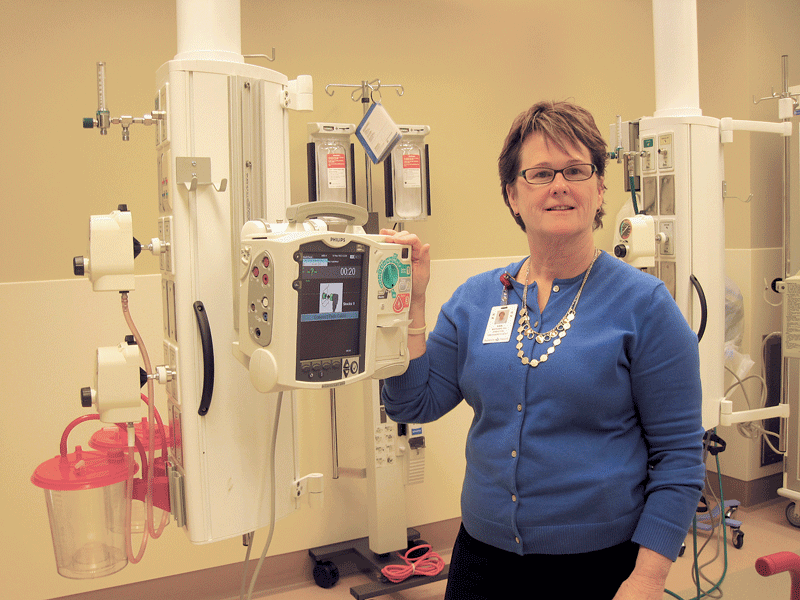
Ann Maynard

Ann Maynard says the new emergency department at Baystate Medical Center was designed with the patient experience in mind.

Ann Maynard acknowledged that visitors to Baystate Medical Center’s new, 73,000-square-foot emergency department will likely spend less time there, on average, than they would in the 17,000-square-foot facility it is replacing.

But getting patients seen, treated, and back out the door in good order is not the overriding mission of the new ED — although that’s certainly a big part of it, said Maynard, a registered nurse and director of Emergency Services for Baystate.

Instead, overall patient satisfaction is the guiding principal behind every facet of the new facility — from the colors on the walls to the sheltered ambulance bays; from the private rooms (each with their own sink and supplies) that replace bays with sliding curtains in the old ED, to a more comprehensive triage system.

“We’ve focused on comfort and privacy as much as expediency,” said Maynard, stressing repeatedly that so-called wait times will be improved. “This is not about time, but what’s happening while you’re waiting. Now, you’ll be in a private room with your family, and not in a hallway where people have to move your stretcher to get to a sink.”

Maynard made these observations and many others as she gave BusinessWest a tour of the expansive, $45 million ED, which officially opened its doors on Dec. 3.

Part of what was known before it was built as the Hospital of the Future, the ED was christened at an elaborate grand opening on Nov. 30 that was attended by more than 200 people and featured comments from Maynard; Baystate President and CEO Mark Tolosky; Richard Steele, chairman of the Baystate board of directors; and Niels Rathlev, chairman of Emergency Medicine for the system.

Among the many common threads among those speeches were the phrase ‘state of the art,’ the clear need for such a facility within the community, and the fact that the new ED came about through exhaustive research and the feedback of not only who will work in this unit, but those who will be treated there.

This point was stressed repeatedly by Maynard as she took BusinessWest through the new ED’s six ‘pods,’ waiting rooms, and other facilities a few days before the unit opened its doors.

“When we started this project, there were some guiding principles,” she said. “When we made decisions, we made them looking through the patient’s eyes and the staff’s eyes. And we always went back to patient safety — with each decision we made, we started with, ‘how will this affect our patients?’”

And this philosophy helps explain everything from the tiny, low-to-the-ground toilets that sit beside standard units in the pediatric pod, to the laptops in the children’s waiting room, to an expedited registration process.

For this issue and its focus on healthcare, BusinessWest takes readers on their own tour of the facility, in a figurative sense, and explains the many thought processes behind its design and operating model.

Space Exploration

The pediatric pod at the new ED

The pediatric pod at the new ED has its own entrance, triage area, look, and feel.

Maynard said the new ED was originally scheduled to be a big part of phase 2 of the Hospital of the Future, but was eventually moved into what she called the “fast lane” because of the basic inadequacy of the facility it has replaced.

The now-former ER, last updated in 1985, was originally designed to treat roughly 60,000 patients a year. In recent years, however, it was administering services to roughly twice that volume, and with obvious negative impact on overall patient experience.

“Just that constraint alone needed to be fixed,” she said, referring to the ED’s footprint. “We were really limited by the space we were in.”

The new ED is not merely almost four times larger than the old one in terms of square footage, said Maynard, noting that, in addition to more room — 94 private rooms compared to 48 bays — it has a design and individual components chosen to both create efficiencies and improve the overall experience for patients and family members.

And as she talked about how it all came together, Maynard said those designing and building the new ER took the simple yet effective approach of putting themselves in the shoes of both the ED staff member and the patient, whether that individual was 4 or 94.

“We’ve had family-advisory groups that we’ve met with and had discussions with about their visit with us and their perception of the experience,” said Maynard, adding that those perceptions, perhaps as much or even more than the actual care administered, played into how the new facility was designed. “People think things like, ‘does anyone know I’m here?’ and ‘does anyone care that I’m here?’

“We save lives every day in this emergency department,” she continued. “And those people send us thank-you notes. It’s the patients who wait for five or six hours that became frustrated because of the  process that we had in place.”

The new ED was designed, in essence, to make such questions, and such frustrations, relics of the past, she said, adding that she was part of a large team that visited other emergency departments, conducted extensive research, and asked myriad questions of patients and staff to design a facility that will serve the system and the region for decades to come.

That team included ED staff and leadership, the architect firm hired to design the facility (Boston-based Steffian Bradley, which also designed the MassMutual Wing, another part of phase 1), and others within the system. This group visited other ERs of comparative size to Baystate, which is the second-largest facility in the state.

Those visits, and the answers to the questions put to staff, patients, and family, helped inspire a design and operating system that Maynard believes will address those issues of comfort, privacy, and expediency.


The Lights Fantastic

The feedback Maynard described has led to what she considers some vast improvements over the old emergency facilities.

And perhaps the most visible example is the pediatric pod, with its Disney-inspired characters on the walls in the waiting area, bright colors, counters shaped like lilypads, and even a strobe-light effect in the imaging room, designed to take the patient’s mind off what they’re going through.

Such features, in addition to the dedicated entrance, waiting room, and triage area, make sense on a number of levels, said Maynard, adding quickly that young children are not adults, nor should be treated like them — or near them — in the emergency department.

“Children should not have to compete for the adult resources or with the adult resources,” she explained. “Meanwhile, parents don’t want want to have their children exposed to what we see in the adult pods.”

The children’s waiting area has a reading area and computers, and each private room in that pod has a television set, she continued, adding that all of these features are designed to help make what is usually a traumatic experience for young people less so.

In their own way, each of the other pods — designated by letters and designed for various levels of emergencies — embodies that basic philosophy of the children’s unit, meaning a patient-focused approach.

The private rooms are good examples, she said, adding that, in addition to a sink — there were only 14 sinks total in the old ER — each one has its own supplies, chairs for family members, and adequate privacy. What’s more, staff members in each pod face these private rooms, where in the old ED, they had their backs essentially turned to patients.

“If you’re a patient and you’re on one of these stretchers, I [the attending nurse] have a computer I can do my documentation with, a monitor … all the supplies and equipment I need to take care of the patient are right here in this room,” she said while taking BusinessWest into one of the units in Pod B. “This makes things much more efficient when it comes to time — I no longer have to leave the room to get anything; it’s already here.”

The supply carts in each room, she went on, are stocked to handle the needs of four or five patients, which is about how many times a room will be turned over each day, saving more time for those attending to patients.

And these are just some of the elements that should enable the new ER to create quicker, as well as better, stays for the patients, said Maynard, adding that several measures and design features will likely improve wait times.

“From the minute the patient walks in the door, the focus is on how we get the patient to the doctor to start the treatment as quickly and safely as possible,” she said, adding that this process starts with triage, or, to be more specific, streamlining that process.

At Baystate’s new ED, triage and registration (known as ‘quick reg’) are essentially combined, with a nurse handling both duties, said Maynard, adding that treatment essentially begins at the point of triage.

Meanwhile, nurses can also handle protocol orders — blood draws, urine samples, and other matters — so that, by the time a patient sees a doctor, results from those tests are back.

As she talked about the improved triage system, she referenced something known as the emergency services index (ESI), which rates patients’ situations on a scale of 1 to 5.

That highest number might be assigned to someone with a minor rash, she explained, while a 1 would be an individual “with the potential of dying,” a patient with severe trauma, for example, or one going into cardiac arrest.

The pods in the adult portion of the new ED are arranged to treat people at various spots on the ESI spectrum, she explained, adding that, in the old ER, there was far less segregation, and therefore less efficiency.


To the Future

Maynard told BusinessWest that the new ED will not magically reduce the waits in the ER from four or five hours down to one or two.

It will still take time to properly and safely administer care, she stressed repeatedly, and the new facilities were designed to create a better, more efficient, more patient-friendly environment in which that can happen.

All this is certainly worth celebrating, and that’s exactly what the Baystate community did on Nov. 30.


George O’Brien can be reached at [email protected]

Departments Picture This

Send photos with a caption and contact information to:  ‘Picture This’ c/o BusinessWest Magazine, 1441 Main Street, Springfield, MA 01103 or to [email protected]


Open for Business

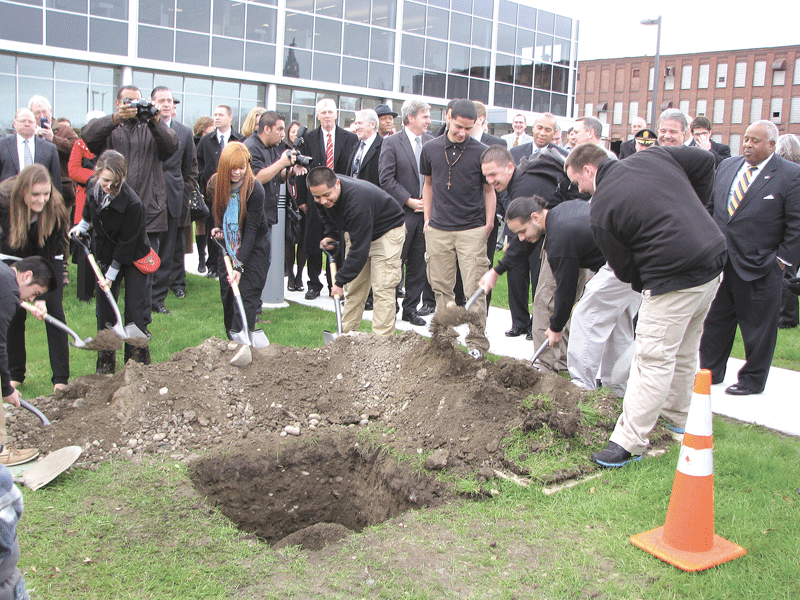
Ahost of government, education, and business leaders gathered in Holyoke last month for ribbon-cutting ceremonies at the Massachusetts Green High Performance Computing Center, a project that involves the state, several research institutions (including UMass), and private corporations. Right, Gov. Deval Patrick addresses the more than 200 people in attendance. At left, before the formal ribbon cutting, city high-school students bury a time capsule near the center’s entrance.


Professional Cut

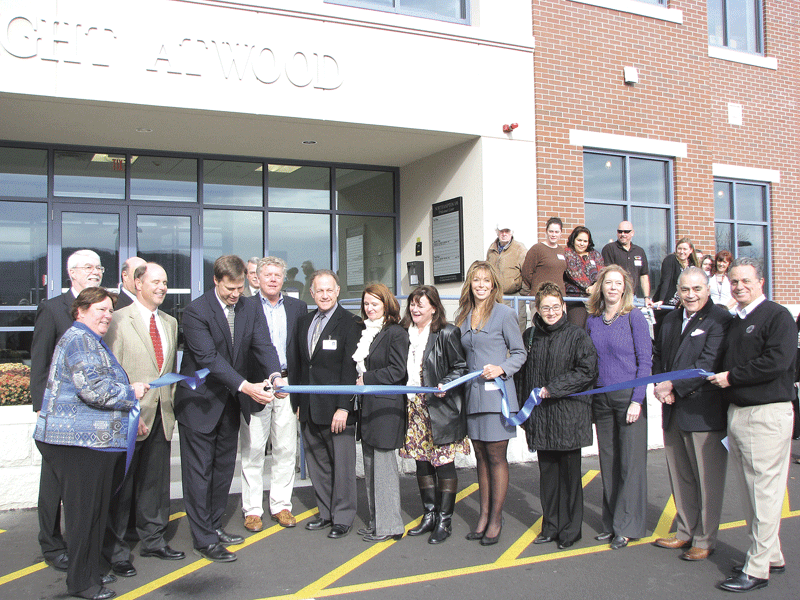
A ceremonial ribbon cutting recently commemorated the opening of the Northampton/I-91 Professional Center in Northampton. The multi-building office park now offers two fully permitted, three-story office buildings adjacent to the existing Clarion Hotel and Conference Center at Exit 18 off Interstate 91. Each building offers approximately 40,000 square feet of tenant space in modern, energy-efficient brick and glass structures. Owned by an experienced group of local investors, the center offers first-class medical and professional office space with first- and second-floor main tenants Clinical and Support Options Inc. (a regional provider of behavioral-health services) and Cooley Dickinson Health Care Group, leaving only 2,500 square feet available on the third floor. Pictured cutting the long ribbon are Lynn Travers, owner and developer; Stephen Murphy, program director of Cooley Dickinson’s Center for Human Motion and the director of Rehab Services; Ken Vincunas (front), general manager; John Lombardi (back), administrative director of facilities at Cooley Dickinson Hospital; Northampton Mayor David Narkewicz; Curt Shumway, development owner; Craig Melin, CEO of Cooley Dickinson Hospital; Susan O’Leary Mulhern and Eileen O’Leary Sullivan, owners; Karin Jeffers, president of Clinical and Support Options; Laurie Lamoureux, controller at Cooley Dickinson; and Kathi Donahue, William Wagner, and Russ Omer of Chicopee Savings Bank.


Pynchon Winners

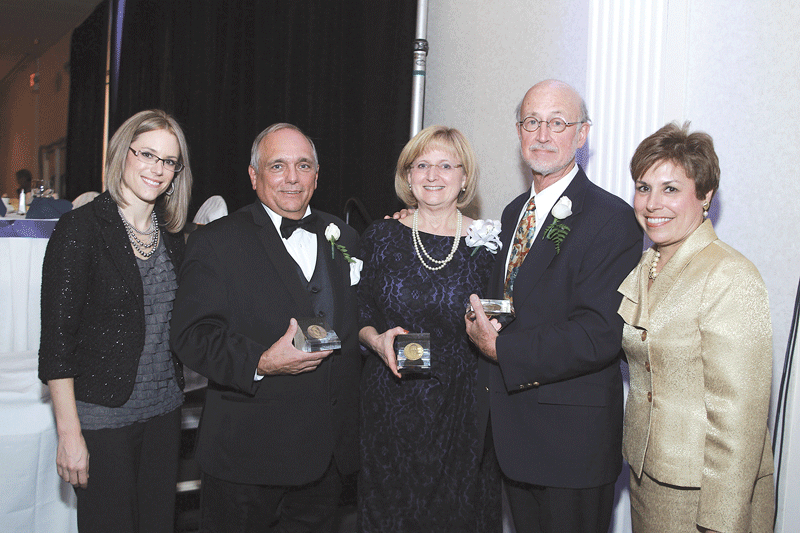
The Advertising Club of Western Mass. honored the 2012 recipients of the William Pynchon Award at ceremonies on Nov. 15 at Chez Josef in Agawam. Pictured, from left, are Jillian Gould, president of the Ad Club; 2012 winners Robert Perry, Ellen Freyman, and Stephen Hayes; and Alta Stark, immediate past president of the Ad Club, Pynchon trustee, and governor, AAF District 1.


Ready to Read

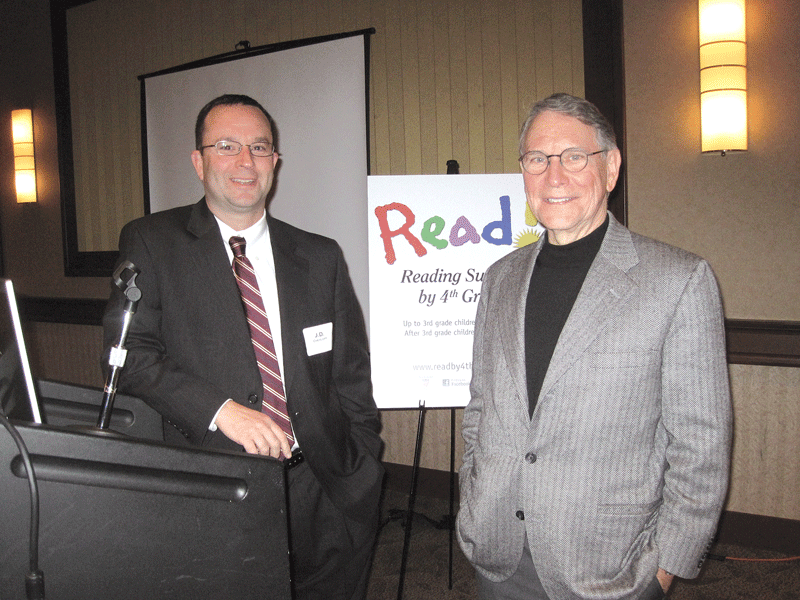
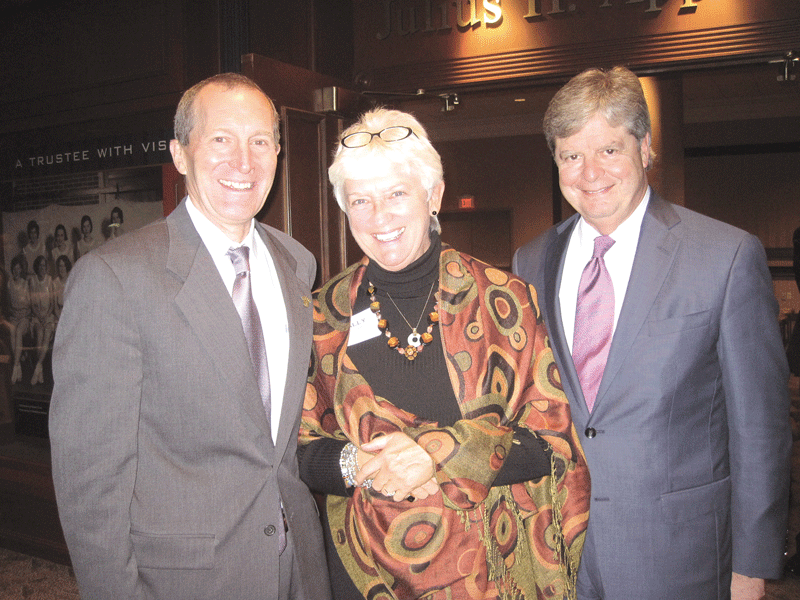
READ! Reading Success by 4th Grade, an initiative of the Irene E. & George A. Davis Foundation, recently welcomed Robert Dugger, managing partner of Hanover Investment Group and an advisory-board co-chair for ReadyNation, a business partnership promoting investments in early education as a foundation for the nation’s economic success, to present a national overview on the importance of investments in young children and their impact on building a sustainable national economy. Also presenting was J.D. Chesloff, deputy director of the Massachusetts Business Roundtable and board chair of the state’s first-in-the-nation Department of Early Education and Care. The Economic Development Council of Western Mass. (EDC); local chambers of commerce, including Chicopee, Holyoke, and Springfield; and the Regional Employment Board of Hampden County presented the event at the Naismith Memorial Basketball Hall of Fame. Pictured at above are Chesloff (left) and Dugger. Bottom, from left, are Peter Straley, president and CEO of Health New England; Sally Fuller, Reading Success by 4th Grade program coordinator; and Allan Blair, president and CEO of the EDC.


Further with Ford

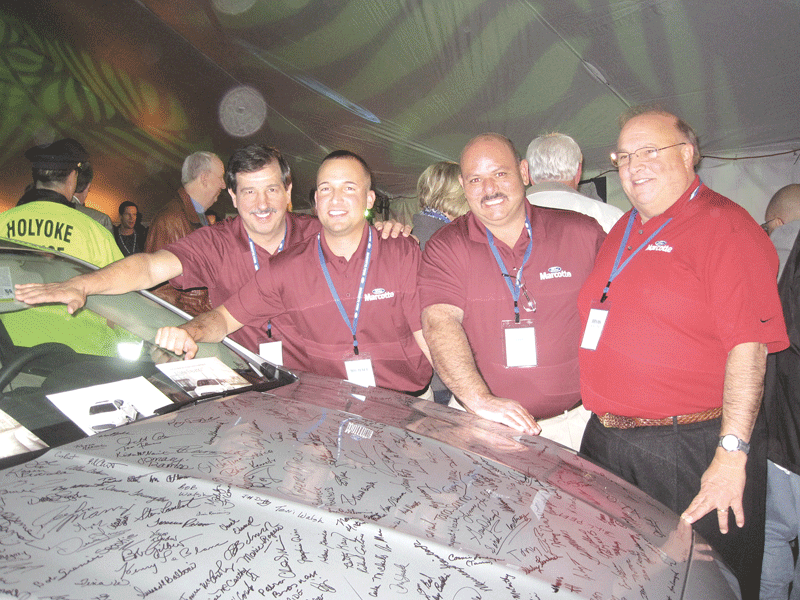
Marcotte Ford of Holyoke recently hosted hundreds at a large event to showcase its showroom and the all-new 2013 Ford Fusion. The event, which was part of a national ‘Go Further with Ford’ night, offered chances for friends and clients to win a new 2013 Fusion, two different trips to American Idol Hollywood, and other prizes. Marcotte Ford donated $10 per person to Kate’s Kitchen for the first 200 registered guests. Standing over the celebratory autographed 2013 Ford Fusion hood, which will be displayed in the showroom are, left to right, Michael Filomeno, general manager; Mike Marcotte, sales manager; Lou Beauregard, parts and service director; and Bryan Marcotte, owner.


Trees, Trees, Trees

The 12th annual Festival of Trees launched the day after Thanksgiving and is proving to be a popular family tradition in downtown Springfield. The event, located on the second floor of Tower Square, offers a twinkling roomful of uniquely decorated artificial Christmas trees, adorned with gift cards and other valuable items donated by area businesses and Springfield Boys and Girls Club supporters. The proceeds, through sponsorships, sales of entrance tickets, and raffle tickets to win trees and all their unique décor, will benefit the 119-year old charitable organization that has been providing more than 1,500 children in the community with afterschool, Saturday, and summer youth-development programs. Above, Barbara Kolosowski, director of development, stands next to more than 100 glittering trees. The festival will run until December 9. More information can be found at www.visittreefest.com.

Court Dockets Departments

The following is a compilation of recent lawsuits involving area businesses and organizations. These are strictly allegations that have yet to be proven in a court of law. Readers are advised to contact the parties listed, or the court, for more information concerning the individual claims.


CHICOPEE DISTRICT COURT

Ann Facchini v. Michael Smith Auto Repair a/k/a Autosmith

Allegation: Defendant breached a contract by installing a defective engine in the plaintiff’s vehicle: $3,000+

Filed: 10/31/12


FRANKLIN SUPERIOR COURT

Catherine Kilgallen v. PNC Bank, N.A.

Allegation: Negligent maintenance of property causing slip and fall: $237,700.65

Filed: 11/7/12


John Aucoin v. First Light Power Resources Inc.

Allegation: Negligent operation and maintenance of facility to ensure safety of workers: $102,546.78

Filed: 9/14/12


GREENFIELD DISTRICT COURT

Commerce and Industry Insurance Co. v. Pioneer Supply Corp.

Allegation: Non-payment of services rendered: $11,521

Filed: 10/23/12


HAMPDEN SUPERIOR COURT

Gladys Hatidani v. Amy N. Azza, 4U Direct Inc., d/b/a National Home Lending Center, Fieldstone Mortgage Co., and Paul Hatidani

Allegation: Plaintiff states that signature was forged on mortgage documents: $300,000

Filed: 10/23/12


Nery A. Bernal, d/b/a Bartlett Street Associates v. Underwriters at Lloyd’s London, by and through New England Excess Exchange, LTD and FSC Insurance Agency, Inc.

Allegation:  Breach of insurance contract: $237,055.85

Filed: 10/22/12


HAMPSHIRE SUPERIOR COURT

Caryn Markson v. Northampton Cornucopia d/b/a Cornucopia Foods

Allegation: Negligent maintenance of property causing slip and fall: $35,063

Filed: 10/30/12


NORTHAMPTON DISTRICT COURT

City Tire Co. Inc. v. Brandon Kelley Trucking, LLC

Allegation: Non-payment of goods sold and delivered: $9,198.72

Filed: 10/19/12


PALMER DISTRICT COURT

Brent F. Massey and Kathryn E. Massey v. David Beach d/b/a D & D Remodeling

Allegation: Breach of home-remodeling contract: $35,000

Filed: 10/19/12


WESTFIELD DISTRICT COURT

Marion’s Air Conditioning, Refrigeration, & Heating Inc. v. Maurice Casey Inc.

Allegation: Balance owed for parts and services rendered: $17,186.51

Filed: 10/19/12

Bankruptcies Departments

The following bankruptcy petitions were recently filed in U.S. Bankruptcy Court. Readers should confirm all information with the court.


Achatz, Marc D.

Achatz, Kim C.

944 Maple Road

Longmeadow, MA 01106

Chapter: 7

Filing Date: 10/17/12


Andrew, Douglas Edward

Andrew, Amy E.

40 Spring St.

Florence, MA 01062

Chapter: 7

Filing Date: 10/26/12


Arroyo, Elizabeth

176 Eddy St.

Springfield, MA 01104

Chapter: 7

Filing Date: 10/31/12


Authier, Richard

Authier, Karen

88 Grandview St.

Springfield, MA 01118

Chapter: 7

Filing Date: 10/19/12


Bard, Michele M.

a/k/a LaBrie, Michele

45 Enterprise St.

Adams, MA 01220

Chapter: 13

Filing Date: 10/19/12


Berte, Mark A.

33 Rosedale Ave.

Springfield, MA 01128

Chapter: 13

Filing Date: 10/29/12


Birchall, Richard G.

174 Union St.

North Adams, MA 01247

Chapter: 7

Filing Date: 10/19/12


Bosworth, Robert E.

151 Lamplighter Lane

Springfield, MA 01119

Chapter: 7

Filing Date: 10/29/12


Brodeur, Glenn Allen

42 Circle Dr.

Chicopee, MA 01020

Chapter: 7

Filing Date: 10/26/12


Bydlak, Mark

68 Plantation Circle

Westfield, MA 01085

Chapter: 13

Filing Date: 10/22/12


Charron, Francis M.

Charron, Cristi A.

16 Walker St.

North Adams, MA 01247

Chapter: 7

Filing Date: 10/25/12


Chevalier, Jason P.

Chevalier, Andrea L.

50 Walker Road

Ware, MA 01082

Chapter: 7

Filing Date: 10/30/12


Cibelli, Michael J.

585 Chapel St., Apt #4

Lee, MA 01238

Chapter: 7

Filing Date: 10/25/12


Coache, Mary Lou

146 Washington Road

Brimfield, MA 01010

Chapter: 7

Filing Date: 10/19/12


Coughlin, Thomas J.

P.O. Box 1761

Pittsfield, MA 01202

Chapter: 7

Filing Date: 10/24/12


Cunningham, Janet L.

5 George St.

Auburn, MA 01501

Chapter: 7

Filing Date: 10/19/12


Deonarain, David

Deonarain, Chandra

20 Dexter St.

Holyoke, MA 01040

Chapter: 7

Filing Date: 10/19/12


Diaz Rodriguez, Maria C.

293 Dwight St.

Springfield, MA 01105

Chapter: 7

Filing Date: 10/25/12


DiGrigoli, Seth

DiGrigoli, Heather

16 Brown St.

Pittsfield, MA 01201

Chapter: 7

Filing Date: 10/25/12


Dix, Gail M.

25 Fuller St.

North Adams, MA 01247

Chapter: 7

Filing Date: 10/18/12


Donovan, Erica M.

a/k/a Cruz, Erica M.

20 Elm St.

Adams, MA 01220

Chapter: 7

Filing Date: 10/22/12


Eastman, Dave C.

24 Loudville Road

Westhampton, MA 01027

Chapter: 7

Filing Date: 10/26/12


Eldridge, Randall A.

916 Wauwinet Road

Barre, MA 01005

Chapter: 7

Filing Date: 10/23/12


Feliciano, Luis

116-118 Hampden St.

Indian Orchard, MA 01151

Chapter: 13

Filing Date: 10/17/12


Fisher, Alexandra C.

21 Meadow St.

Hadley, MA 01035

Chapter: 7

Filing Date: 10/19/12


Fitzpatrick, Randy

20 McKinley Ter.

Westfield, MA 01085

Chapter: 7

Filing Date: 10/29/12


Fontaine, John A.

15 Maplecrest Circle

Holyoke, MA 01040

Chapter: 7

Filing Date: 10/17/12


Forsell, Justin E.

Forsell, Brenda T.

a/k/a Morrissey, Brenda

104 Franklin St.

Feeding Hills, MA 01030

Chapter: 7

Filing Date: 10/19/12


Franzoni, Ronald J.

Franzoni, Barbara D.

154 East Ave.

North Adams, MA 01247

Chapter: 13

Filing Date: 10/30/12


Gillett, Christy-Jo

a/k/a Haywood, Christy-Jo

16 Dutchess Ave.

Pittsfield, MA 01201

Chapter: 7

Filing Date: 10/31/12


Gilliam, James M.

47 Davis St.

Holyoke, MA 01040

Chapter: 7

Filing Date: 10/22/12


Giuffre, Steven T.

Giuffre, Robin L.

262 Green Ave.

Belchertown, MA 01007

Chapter: 7

Filing Date: 10/18/12


Glace, Andrew J.

97 Van Meter Dr.

Amherst, MA 01002

Chapter: 13

Filing Date: 10/23/12


Gonzalez, Margarita

310 Hillside Ave.

Holyoke, MA 01040

Chapter: 7

Filing Date: 10/18/12


Gurland, Jerome S.

235 State St., Apt. 10

Springfield, MA 01103

Chapter: 7

Filing Date: 10/24/12


Hardy, Curtis S.

257 Alley Road

Rochester, MA 02770

Chapter: 7

Filing Date: 10/19/12


Healey, Jonathan D.

Healey, Laura Jean

a/k/a Weeks, Laura J.

9 Birchwood Road

Southwick, MA 01077

Chapter: 13

Filing Date: 10/26/12


Hickey, Francis H.

28 Daniel Shays Highway

Orange, MA 01364

Chapter: 7

Filing Date: 10/24/12


Higgins, Christine J.

9 Highview Dr.

Plainville, MA 02762

Chapter: 7

Filing Date: 10/30/12


Hunter, Charles B.

PO Box 1203

Warren, MA 01083

Chapter: 7

Filing Date: 10/22/12


Hunter, Melissa Rae

35 Wilson St.

Pittsfield, MA 01201

Chapter: 7

Filing Date: 10/25/12


Jutras, Florence E.

Jutras, John E.

P.O. Box 93

Turners Falls, MA 01376

Chapter: 7

Filing Date: 10/30/12


Kellogg, John J.

Kellogg, Mechelle

50 South St.

Cheshire, MA 01225

Chapter: 7

Filing Date: 10/30/12


Kolis, Sandra J.

9 Daniels Court

Adams, MA 01220

Chapter: 7

Filing Date: 10/25/12


Lafogg, Lisa

90 Royal St.

Agawam, MA 01001

Chapter: 7

Filing Date: 10/24/12


Lariviere, Derek D.

12 Ashley St.

Chicope, MA 01020

Chapter: 7

Filing Date: 10/26/12


LeBoeuf, Patricia Ann

34 Yankee Drummer Dr.

P.O. Box 903

Warren, MA 01083

Chapter: 7

Filing Date: 10/17/12


LeTendre, Normand E.

88 Trafton Road

Springfield, MA 01108

Chapter: 7

Filing Date: 10/22/12


Lewis-Schurter, Michael A.

Lewis-Schurter, Megan

182 Pondview Dr.

Amherst, MA 01002

Chapter: 13

Filing Date: 10/29/12


Long, Karen D.

Hebron St. 2nd Fl.

Springfield, MA 01107

Chapter: 7

Filing Date: 10/19/12


MacDonald, Donna M.

P.O. Box 444

North Adams, MA 01247

Chapter: 7

Filing Date: 10/23/12


Mansfield, Cheryl D.

a/k/a Defoyd, Cheryl R.

a/k/a Davis, Cheryl R.

41 Lewis St.

Athol, MA 01331

Chapter: 7

Filing Date: 10/29/12


Marowski, James J.

Marowski, Elaine M.

23 Oakland St.

Palmer, MA 01069

Chapter: 7

Filing Date: 10/23/12


Martin, Jesse P.

95 Stafford Road

Wales, MA 01081

Chapter: 7

Filing Date: 10/19/12


Medina, Sonia A.

a/k/a Forni, Sonia Angela

19A Piedmont St.

Springfield, MA 01104

Chapter: 7

Filing Date: 10/29/12


Mercer, Erica R.

43 Bridge St.

South Hadley, MA 01075

Chapter: 7

Filing Date: 10/18/12


Moody, Jacqueline C.

59 Druids Lane

West Springfield, MA 01089

Chapter: 7

Filing Date: 10/25/12


Morgan, Ronald L.

Greene-Morgan, Pattiann

88 Ely St.

Westfield, MA 01085

Chapter: 7

Filing Date: 10/19/12


O’Brien, Kelly L.

2205 Boston Road, D32

Wilbraham, MA 01095

Chapter: 7

Filing Date: 10/26/12


Orlandi, Gina M.

82 Bow St.

Plainfield, MA 01070

Chapter: 7

Filing Date: 10/30/12


Pacheco, Miguel A.

4 Sunset Ave.

South Hadley, MA 01075

Chapter: 7

Filing Date: 10/18/12


Parziale, Liza Jenny

290 Regency Park Dr.

Agawam, MA 01001

Chapter: 7

Filing Date: 10/18/12


Pasini, Amy Kathleen

104 Belvidere St.

Springfield, MA 01108

Chapter: 7

Filing Date: 10/23/12


Patton, Randall J.

Patton, Barbara M.

a/k/a Shannon-Patton, Barbara

45 Dobek Ave.

Chicopee, MA 01020

Chapter: 7

Filing Date: 10/25/12


Prentice, Gary A.

Prentice, Nancy A.

148 Hillside Road

Southwick, MA 01077

Chapter: 7

Filing Date: 10/29/12


Provost, Beverly A.

Danaher Circle

Springfield, MA 01118

Chapter: 7

Filing Date: 10/31/12


Ramos, Antonio P.

369 Shoemaker Lane

Feeding Hills, MA 01030

Chapter: 7

Filing Date: 10/26/12


Saben, William J.

Saben, Jeannette M.

70 Mount Pleasant St.

Athol, MA 01331

Chapter: 7

Filing Date: 10/22/12


Sanders, Dreana Chevon

17 Brunswick St.

Springfield, MA 01108

Chapter: 13

Filing Date: 10/19/12


Sepanek, David

26 Meadow St., Apt. 4

Ludlow, MA 01056

Chapter: 7

Filing Date: 10/29/12


Sheridan, Kathleen M.

128 Hillcrest Ave.

WestSpringfield, MA 01089

Chapter: 7

Filing Date: 10/25/12


Smith, Wendy Lee

a/k/a Gagnon, Wendy L.

121 North Main St.

Belchertown, MA 01007

Chapter: 7

Filing Date: 10/29/12


Sonsini, Jason A.

675 Cape St.

Lee, MA 01238

Chapter: 7

Filing Date: 10/24/12


St. Martin, Chaya

39 Newell St.

Pittsfield, MA 01201

Chapter: 7

Filing Date: 10/24/12


Strattner, Gregory P.

Strattner, Diane L.

48 Marla Circle

Westfield, MA 01085

Chapter: 7

Filing Date: 10/22/12


Stuart, John W.

Stuart, Maxine E.

2 Alcove Road

Southwick, MA 01077

Chapter: 7

Filing Date: 10/17/12


Taylor, Shannon P.

13 Mountainview Circle

Southampton, MA 01073

Chapter: 7

Filing Date: 10/29/12


Therrien, Matthew

440 Union St.

North Adams, MA 01247

Chapter: 7

Filing Date: 10/22/12


Thompson, Leo D.

79 Eagle St.

Ware, MA 01082

Chapter: 7

Filing Date: 10/18/12


Vasilchenko, Michael

6 Sibley Ave.

West Springfield, MA 01089

Chapter: 7

Filing Date: 10/29/12


Vega-Mata, Yoana

52 Breckwood Blvd.

Springfield, MA 01109

Chapter: 7

Filing Date: 10/26/12


Vincelette, Eric J.

Vincelette, Keri A

a/k/a Nelson, Keri A.

98 Plunkett St.

Lenox, MA 01240

Chapter: 7

Filing Date: 10/19/12


Washington, Vickie D.

P.O. Box 335

Feeding Hills, MA 01030

Chapter: 7

Filing Date: 10/25/12


West, George E.

4109 South Athol Road

Athol, MA 01331

Chapter: 7

Filing Date: 10/29/12

DBA Certificates Departments

The following Business Certificates and Trade Names were issued or renewed during the month of December 2012.


AGAWAM


ATD Precision

261 Garden St.

Edward Dean


Partners in Prosperity

7 Forest Hill Dr.

Michael Margiotta


Professional Search

156 Suffield St.

Michael L. Gates


Ravishing Photography

168 Elm St.

Kimberly Deprey


AMHERST


Etinde Painting

730 West St.

Dieudonne Etinde


Equinox Video

893 West St.

Leslie Mason


CHICOPEE


Ashley’s Fashions

203 Exchange St.

Victor Davila


Herbarium

264 Exchange St.

Kathleen Duffy


I-Reversible Fashion Collection

35 North Chicopee St.

Jaswinder S. Khurana


Interstate Towing Inc.

1660 Westover Road

Jeremy J. Procon


Jewelry by Kat

75 Sheridan St.

Karen Tillman


Reinke Enterprises

21 Reed Ave.

Scott A. Rooney


EAST LONGMEADOW


Black Hat Home Services

29 Pleasant St.

Brian W. Ford II


C Mart

668 North Main St.

Abid Akhtar


David J. Lieber

112 Hampden Road

David J. Lieber


Powder Clean Fitness Inc.

167 Shaker Road

Michael Zolkiewicz


GREENFIELD


Consumer Auto Parts

63 French King Hwy.

Uni-Select USA Inc.


Mohawk Commercial Cleaning

75 Wells St.

Judith A. Weller


Nura Mart

142 Mohawk Trail

Masood Ghani


SPD Tool, LLC

88 Lovers Lane

Scott F. Conti


Val Messer Photography

757 Bernardston Road

Valdirene Messer


HOLYOKE


Hickory Farms

50 Holyoke St.

James V. O’Neill


Paper City Fitness

4 Open Square Way

Katherine O’Donnell


Pearl of Light Wellness Center

49 Cherry St.

Rita Fishburn-Gibbs


Route 5 Motors

280 Ingleside St.

Steven Vlohiotis


Sweet Boutiques & Candy Shop

254 Maple St.

Jennifer Rodriguez


LUDLOW


The Gomes Agency

364 East St.

Miguel Gomes


The Shop Unique Techniques

409 East West St.

Geoffrey Jerome


PALMER


Belmont Driving School

1409 Main St.

Michael O’Rourke


J. E.M. Services

58 Quaboag Valley Co-Op St.

Jerry E. Mange Jr.


Ken’s Auto Repair

1316 South Main St.

Kenneth P. Dubord


SPRINGFIELD


La Dolche Candy Station

89 Randolph St.

Tracey D. Gary


Longonot Transportation

49 Bissell Ave.

Isaac Teresia


Margie’s Wedding Shop

659 South Branch Pkwy.

Margaree C. Robinson


Nguyen Roofing

88 Commonwealth Ave.

Darren V. Nguyen


O’Brien Construction

354 White St.

Kevin O’Brien


People Resources

36 Sylvan St.

Bryant Irby


Project Legacy USA, LLC

686 Plumtree Road

Christopher Michael


Punta Cana Restaurant

137 Chestnut St.

Maria Portorreal


Rafa Transportation, LLC

118 Gilbert Ave.

Rafael B. Mkanga


Rijo Enterprises

1072 State St.

Jose M. Rijo


Sandy’s

176 Main St.

Sandra Callirgos


Sensational Solutions

45 Bacon Road

Margo Jergensen


Slaughter Estates

45 Bloomfield St.

Seneca Slaughter


Sowers of Truthful Inspiration

38 Freeman Ter.

Kevin A. Green


T-Mobile Northeast, LLC

615 Belmont Ave.

Harvey Woodford


Team Northeast

93 Duryea St.

Wicked Cool


Tidy Up Cleaning Services

178 Main St.

Sarah P. Levesque


V Nails & Spa, LLC

368 Cooley St.

Vy Lefebvre


Wraps-N-Wings

1365 Main St.

Garfield S. Weston


Zas Enterprise Inc.

910 State St.

Mohammed Z. Islam


Saisha Inc.

649 Main St.

Shahid R. Ghuman


WESTFIELD


Extreme Consulting Inc.

9 Colony Crest

Paul P. Tobias


North American Restoration

40 Franklin St.

Harland C. Avezzie


U30 Cat & Small Dog Wellness Center

69 Southwick Road

William J. Faircloth


WEST SPRINGFIELD


Dustworthy Cleaning Service

869 Dewey St.

Kyle A. Pratson


Fastsigns, Inc.

777 Riverdale St.

Multi Signs Inc.


Hathorn Associates

42 Old Barn Road

Joyce A. Bannick

Briefcase Departments

Union Station Work Officially Underway

SPRINGFIELD — The long-awaited transformation of Springfield’s historic Union Station into the region’s main transportation hub officially got underway Nov. 20 at a ceremonial demolition held at the Frank B. Murray Street site. Mayor Domenic Sarno, along with U.S. Rep. Richard Neal, Gov. Deval Patrick, and other officials wielding sledgehammers, participated in the event. It signaled the start of demolition of the former baggage-handling building and will pave the way for construction of a 24-bay bus terminal with structured parking above it — the first steps toward reactivating the long-vacant downtown station. “Today represents the start of an important project that will benefit virtually everyone in Western Mass. It’s an exciting day for the Pioneer Valley,” said Sarno. Added Neal, “the successful renovation of Union Station has been a priority of mine for more than 30 years. I have always believed the restoration of this iconic Springfield landmark had the ability to transform the north blocks of downtown. And it will bring a world-class transportation center to the region in the process.” Other specific work to be completed as part of a $48.7 million Phase 1 project, designed by HDR Architecture Inc., includes the restoration of the main terminal building as a passenger center. The first floor will include operations, ticketing, and waiting space for the transit-service providers, as well as transit-related retail. Also, the passenger tunnel will be reopened and restored, linking the terminal building to rail-boarding platforms and pedestrian access to the downtown. When completed, this initial phase will provide connections for the continuation and expansion of services, including local, regional, and intercity buses; Amtrak, commuter, and high-speed passenger rail; and other ground-transportation services. The second phase of the project will emphasize the remaining development of additional transit-related restaurant and retail uses on the first floor and transit-related commercial space primarily on the terminal building’s upper floors, and will expand the new transit center’s parking capabilities. Sarno thanked Neal for his steadfast support of this regionally significant transportation project and for helping the city bring it to this point. “Recognizing that the station’s redevelopment is crucial to the continued revitalization of the city of Springfield, our goal is to transform this property into a sustainable transportation facility, positioning us to better meet the travel needs of the Pioneer Valley in the short and long term,” added Sarno. He also thanked Patrick “for making Union Station a top priority of his administration,” and the Massachusetts Department of Transportation for working in partnership with the city. “Through this cooperation and with funding support from the state, we have achieved tremendous progress as we’ve worked with the Federal Transit Administration to advance this vital project,” Sarno said. Funding for the Union Station project has been assembled from a number of federal, state, and local sources. In July, U.S. Transportation Secretary Ray LaHood was in Springfield to announce the award of a $17.6 million federal Bus Livability grant for the project. The project is scheduled to be completed and operational by 2015.


Officials Laud Completion of High Performance Computing Center

HOLYOKE — Gov. Deval Patrick headed a list of academic, political, and business leaders who gathered in Holyoke on Nov. 16 to officially mark the completion of the Massachusetts Green High Performance Computing Center built in the center of this historic industrial city. More than 200 people gathered for the event, which capped more than three years of planning and construction of the facility, which was hailed by several of the day’s speakers as a unique and highly effective collaboration involving higher education, private business, and government. The facility, which carried a price tag approaching $90 million, is a data center dedicated to supporting the growing research computing needs of five of the most research-intensive universities in Massachusetts: Boston University, Harvard University, MIT, Northeastern University, and UMass. The project was funded by those five schools, as well as additional partners Cisco and EMC, the Commonwealth of Massachusetts, and the federal New Markets Tax Credit program. In addition to Patrick, other officials to speak at the program and ribbon-cutting included Holyoke Mayor Alex Morse; Susan Hockfield, president emerita at MIT; Jeff Nick, senior vice president and chief technology officer at EMC Corp.; Larry Payne, vice president, Public Sector, Cisco Systems; Lt. Gov. Tim Murray; and Robert Caret, president of UMass.


Nominations Sought for Difference Makers

SPRINGFIELD — BusinessWest magazine will accept nominations for its Difference Makers Class of 2013 until Dec. 30. Difference Makers is a recognition program, started in 2008, that honors individuals and groups that are making an impact in the community and improving overall quality of life in the region. The Difference Makers Class of 2012 consisted of: Charlie and Donald D’Amour, president/COO and chairman/CEO, respectively, of Big Y Foods; William Messner, president of Holyoke Community College; Majors Tom and Linda Jo Perks, officers with the Springfield Corps of the Salvation Army; Bob Schwarz, executive vice president of Peter Pan Bus Lines; and the Women’s Fund of Western Massachusetts. A nomination form is available online at www.businesswest.com/difference-makers-nomination-form.


Baystate Working to Reduce Pre-term Births

SPRINGFIELD — The report card is in on premature births, and the grades are far from glowing. The March of Dimes released its 2012 Premature Birth Report Card in November, and while the U.S. pre-term birth rate dropped for the fifth consecutive year in 2011 to 11.7% — the lowest in a decade — the country still earned a disappointing ‘C’ grade. The March of Dimes grades states by comparing their rate of premature births to their 2020 goal of 9.6%. Three states and Puerto Rico earned an ‘F,’ and only four states — Maine, New Hampshire, Oregon, and Vermont — were graded an ‘A.’ Twenty-two states, including Massachusetts, received a ‘B’ grade and are one step away from achieving the goal. Still, “we still have a long way to go,” said Dr. Glenn Markenson, chief of Maternal Fetal Medicine at Baystate Medical Center. More than 500,000 infants are born prematurely in the U.S. each year, and about 10% of all deliveries are scheduled before 39 weeks, according to the U.S. Department of Health and Human Services. Furthermore, a recent study by the Leapfrog Group, a hospital-quality watchdog, shows that U.S. hospitals vary widely in their rates of elective pre-term deliveries, ranging from less than 5% to more than 40%. “Early deliveries should only be an option for medical reasons, when the life or health of mother or baby is in jeopardy,” said Markenson. Under his leadership, Baystate Medical Center has been working to establish strong guidelines to prevent unnecessary pre-term deliveries by induction or cesarean section, and last year the hospital instituted a ‘hard stop’ for any non-medically required elective delivery prior to 39 weeks, and all elective inductions in first-time mothers. Markenson said the practice of elective pre-term birth finally caught many healthcare-quality officials’ attention when more and more studies began to be published showing its potential harm, including a recent March of Dimes report showing that babies born in the 37th or 38th week have a higher risk of dying in their first year than a baby born after 39 weeks. In addition to working with other Massachusetts hospitals to help the state achieve an ‘A’ grade in the March of Dimes rankings, Baystate is helping lead a statewide initiative called the Massachusetts Perinatal Quality Collaborative.

Company Notebook Departments

Square One Impacted by Gas Explosion

SPRINGFIELD — After the June 1, 2011 tornado wiped out their childcare and administrative offices in the south end of Springfield, Square One, a nonprofit childcare organization with facilities in Springfield and Holyoke, is now starting from square one again since the Nov. 23 late-afternoon gas explosion on Worthington Street severely affected the childcare space that the organization leased. Luckily, no one was in the space due to the holiday, but if it had been a typical Friday, about 100 children and 30 staff members would have been at risk. The site at 155 Chestnut St. is now condemned, forcing Square One officials to quickly find alternate childcare locations for 55 of the 100 children that were enrolled at that location and cannot be placed in Square One programs due to space. Since the explosion, Square One officials have been reaching out to all other providers in the community to identify what programming spaces for various age groups are available, and to walk parents through the relocation process. “We have people coming in every morning saying, ‘I have to go to work,’ ‘I have to go to school,’ ‘I need childcare now,’ and they do,” said Kim Lee, vice president of advancement. Other area nonprofits, including the YMCA on Chestnut Street, have offered some temporary space to Square One. “Our mission right now is to serve the children and their parents,” Lee said, “and if it means helping those families to find quality programming in another provider’s program, then that’s what we have to do.” The company still owns 947 Main Street, which was hit by the tornado, but it will have to be demolished and rebuilt. Lee said Square One is looking for temporary space near that original South End location, but nobody wants to sell or rent to them because everybody is holding out for the possibility of an MGM casino. “But if we do finally relocate there and the casino comes, we’ll be right I the middle of it all.” Childcare officials will continue to discuss short-term options and long-term opportunities.


Greenfield Big Y Completes Upgrades

SPRINGFIELD — As the last of many major remodeling efforts this past year, Big Y Foods Inc. announced the completion of the renovation of its Greenfield Big Y World Class Market at 237 Mohawk Trail, Route 2. Big Y has been a part of the Greenfield community since it opened its first store in 1987. In 2002, the company moved across the street to its current location. This past effort began in March and includes upgrades in every department, including new equipment and fixtures, new paint inside and out, as well as a new floor. All of the store’s fresh-foods departments had the most significant changes, including meals to go, delicatessen, seafood, bakery, produce, floral, and meat. There are also new gluten-free products as well as many more Latino offerings and additional locally produced wine and beers within the market. Lastly, the store has added some new, smaller-sized grocery carts for quick shopping trips. Ed Williams, store director in Greenfield, has 32 years of supermarket experience with Big Y. During his early years in the supermarket business, he worked in various department positions throughout the store. In 1989, Williams became a store director, managing stores in Northampton, Palmer, Greenfield, Chicopee, Southwick, Southampton, Springfield, and South Hadley. He moved back to this location last January. As part of the grand reopening celebration, Newton School, Math & Science Academy, Poet Seat Therapeutic Day Program, Greenfield Middle School, Greenfield High School, Discovery School at Four Corners, Academy of Early Learning, Federal Street School, 8th Grade Academy, Greenfield Center School, Eagle Mountain School, Cornerstone Christian School, and Stoneleigh Burnham School will each receive a donation of 500,000 Education Express Points toward free equipment and supplies for their schools. Big Y’s Education Express program has helped more than 2,000 local schools earn more than $13 million in free educational, sports, and electronic equipment since its inception.


Insurance Center Partners with Link to Libraries

AGAWAM — The Insurance Center of New England has become the latest area company to partner with the nonprofit group Link to Libraries in its Business Book Link Project. ICNE is sponsoring the Martin Luther King Jr. Charter School. Link to Libraries, in collaboration with the Insurance Center, will donate 200 new books each year for a three-year period as part of the Business Book Link Project, which has the twin goals of stocking school library shelves and getting students excited about reading. For more information on Link to Libraries, call (413) 224 1031 or visit www.linktolibraries.org.

Employment Sections
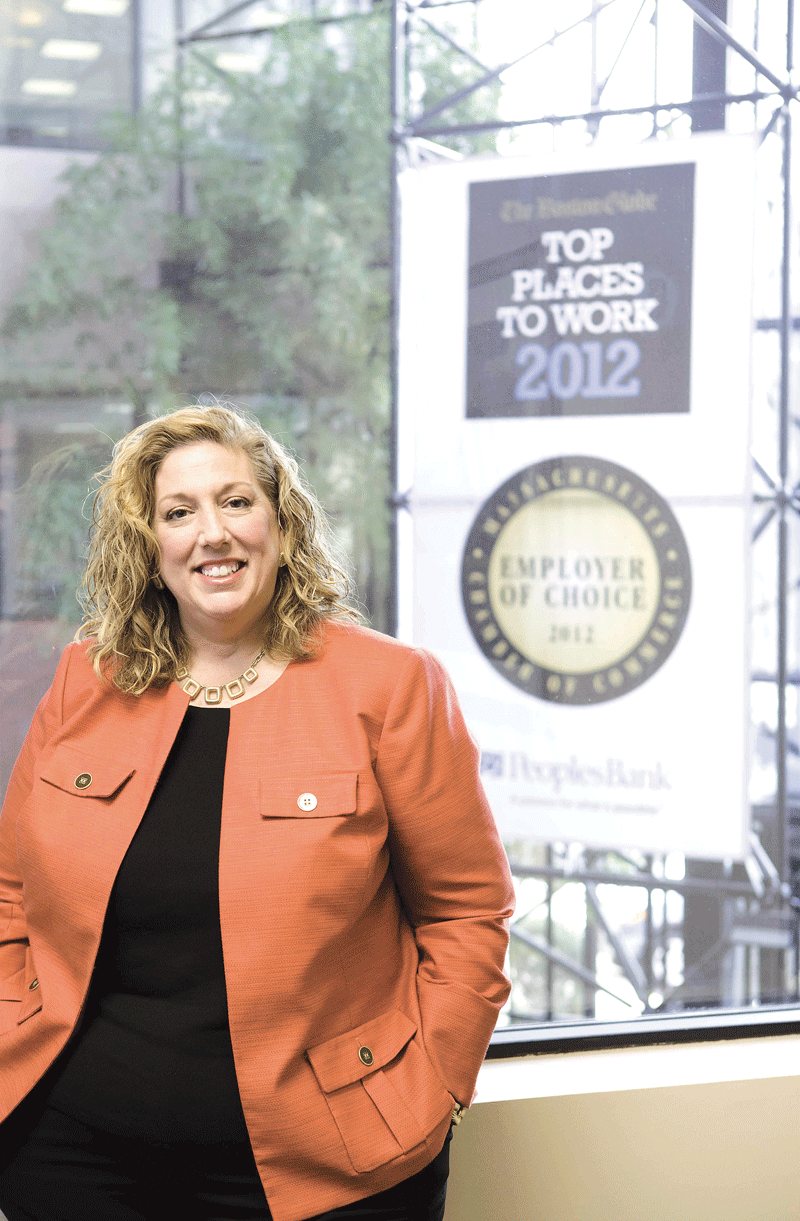
PeoplesBank Earns Accolades for Its Employee Culture

Janice Mazzallo

Janice Mazzallo says the internal culture change at PeoplesBank reaps benefits for both employees and customers.

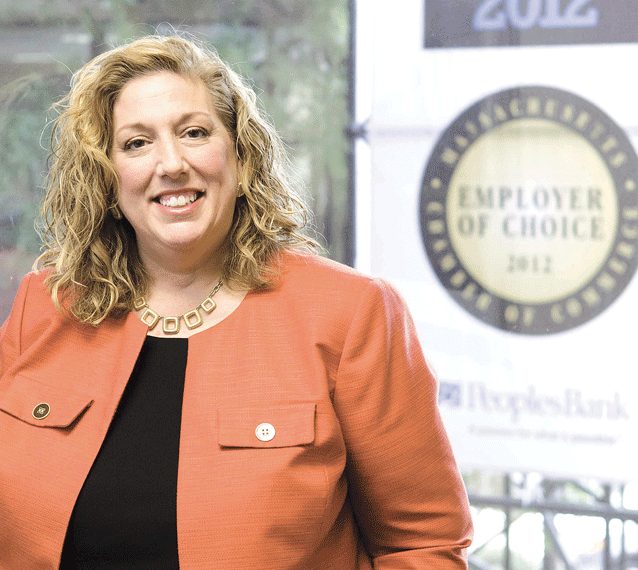
When PeoplesBank was recently named an Employer of Choice by the Massachusetts Chamber of Commerce, Doug Bowen was pleased, but he’s quick to note that the honor was based on testimony from the bank’s leaders.

However, when the Boston Globe named the bank a Top Employer last month, that may have been even more gratifying, said Bowen, the institution’s president and CEO — because the honor was based solely on employee input.

According to Janice Mazzallo, senior vice president of Human Resources, “we did an employee engagement survey, a series of questions about the bank’s leadership, communication, benefits, and work-life balance. That feedback qualified us to get that award. That was a powerful and proud moment. This culture shift has taken a long time and a lot of energy, and this was another recognition that our people really do appreciate the environment here.”

The ‘culture shift’ she cited wasn’t accidental, she noted, but the end result of a plan set in motion almost a decade ago to improve the bank from the inside out.

“Our senior team got together for a strategic planning session,” Bowen recalled. “PeoplesBank was a good bank with a wonderful historical legacy, but we wanted to make it a great bank. And to be this great bank we aspired to be, we wanted to have a great culture.”

Much of the responsibility for crafting specific elements of that culture change, he noted, fell to Mazzallo after she joined the institution eight years ago. “She was the architect of our cultural activities and moves made here at the bank that have really blossomed into this wonderful environment we all get to enjoy every day.”

As Mazzallo explained to BusinessWest, “we began by communicating to employees what the strategic plan was and their role in support of that” — an effort that included the development of a training and leadership program to aid employees in implementing each piece.

That multi-faceted endeavor has helped bring about improvements in communication, expanded benefits, training and career-development programs empowering bank staffers to make more decisions on their own, and events like a weeklong festival honoring employees each year.

“The overarching goal was to attract and retain high-quality employees,” she said. “We felt that meant a couple of things. We wanted to bring in the best and brightest from outside into this organization, and we have, in fact, been able to do that — I think, in part, because the culture attracts people from other banks, and larger banks. As for the second piece, we knew we had very good employees, and we wanted to develop them internally so they could be promoted, so we wouldn’t have to go outside the bank.”

The third leg of that strategy has to do with benefits, Mazzallo explained, and a diverse package of voluntary benefits and perks ranging from an adoption benefit to a wellness group to chair massages. “These aren’t things you have to put in, but they’re additional pieces that make it much nicer to come to work.

“I’ve worked in places where, on Sunday night, I dreaded going in. Many of us have,” she added. “I don’t want to feel like that, and as the head of Human Resources, I don’t want anyone on my team feeling like that. Most people have to work to make a living. If you have to work, why not make it a great environment for everybody?”


High Performance

And satisfied employees have resulted in better bank performance, Bowen said.

“When you go into any store or anyplace else where the people are engaged and happy to be there, you get better service. That’s what we’re aiming for, and that’s what we’ve achieved at the bank.

“We have a high-performance culture, and part of that, certainly, is that we’re a high-performance bank financially,” he added. “We’ve been able to maintain this high-performance culture, and at the same time we’re a top-quartile bank in terms of financial measurements.

“All of that is wrapped together,” he continued. “If you have a great culture, you get great employee engagement. That’s reflected in our community service, too; our employees serve on the boards of 115 nonprofits in the Pioneer Valley.” PeoplesBank has also been honored by the Boston Business Journal for the amount of volunteer time and money its employees donate to charity.

As part of its renewed emphasis on culture, the bank has taken on a cause of its own, so to speak, in environmental sustainability. That’s manifested in two branches recently certified by Leadership in Energy and Environmental Design for their ‘green’ construction elements; a third LEED branch is currently being built in Northampton.

It’s also reflected in touches like electric car charging stations at the bank’s Holyoke headquarters; $60 million in investments in wind, solar, and hydroelectric projects; and an annual environmental fair where bank workers can learn about what they can do to support sustainability — efforts that, as a whole, contribute to the feeling that employees are part of something important, and bigger than themselves.

“One of our values is environmental sustainability, and that’s shared by employees; it’s part of the whole culture here,” Bowen said.

Added Mazzallo, “we feel it’s the right thing to do. We live in a really beautiful area, with some unbelievable natural resources; we’re very fortunate. And when we bring new people into the bank, there’s a level of expectation, a commitment to the environment and to the community; those things are important. So it’s no longer just about coming into work. Our people really want to make those connections.”

As for what lies ahead, Mazzallo said PeoplesBank does not intend to rest on its laurels, instituting the noted Ritz-Carlton training program next year to ensure that employees offer “legendary service, that goes above and beyond the norm. That involves empowering employees to make decisions to benefit the customer. It might be as simple as giving flowers to a customer that just welcomed a grandchild. It’s the small things that often make the difference.”

Bowen said the bank’s status as a mutual organization allows it to make employee-and community-centered decisions without worrying about reporting to shareholders. But he also believes the bank’s financial performance justifies a belief that happy employees lead to satisfied customers.

“When employers put employees first,” Mazzallo said, “when they treat their people well, and when employees feel respected, that is going to show in the kind of service they provide to the outside world.”


Joseph Bednar can be reached at [email protected]

Education Sections
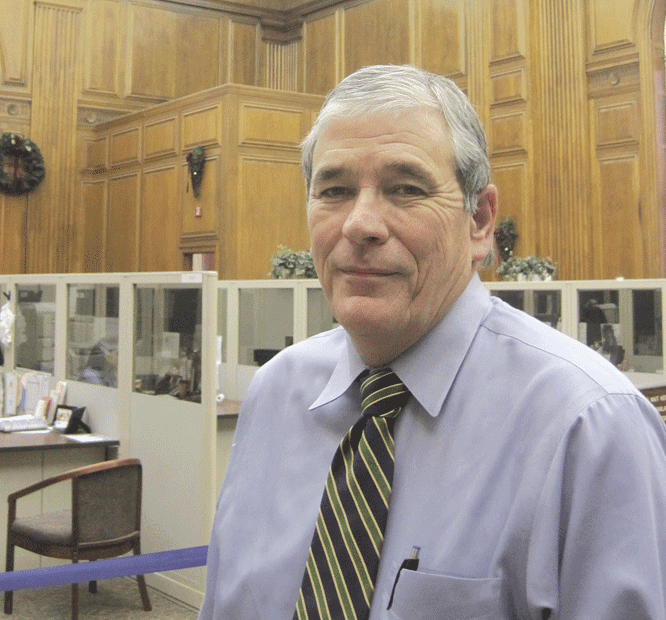
Kittredge Center Course Teaches Soft Skills That MBAs Overlook

Richard Steiner, CEO of MD Enterprises

Richard Steiner, CEO of MD Enterprises

It’s a familiar scenario in the workplace.

The venerated top sales professional gets his big break and lands the coveted manager position. But soon, something is wrong. The top seller has no idea how to manage people, and it’s affecting the entire office. He’s been doing his own thing for years, and it’s always worked, but now he’s got to deal with everyone else’s personalities and problems.

Meanwhile, the expectations from upper management are not only higher than in his previous position, but completely different. In some cases, add to that the jealousy factor in the office because someone feels they were overlooked for the job.

“This new situation has to be based on facts, not opinions, and in the workplace, emotions — like guns and knives — need to be left at the door,” said Richard Steiner, CEO of MD Enterprises and a freelance business trainer at Holyoke Community College (HCC). “It’s critical that you recalibrate the relationship to recognize that this is a ‘professional’ relationship.”

But knowing how to ‘recalibrate’ that professional relationship, from peer to manager, requires behavioral skills that may seem obvious, yet unfortunately don’t come naturally to some, and are completely foreign to others.

That’s where the American Management Assoc. comes in.

The AMA offers a certificate in Management program through the Kittredge Center at HCC. Steiner explained that the cost-effective courses are held either one day a week for two weeks, or one evening a week for five weeks.

Instead of the analytical and technical hard skills that MBAs focus on, this series of courses is all about dealing with people, time, and how both affect company profits.

“It’s a program of study that focuses on a practical way to learn the soft skills of management,” said Steiner, “the sorts of things you don’t pick up at an MBA course.”

Of the 14 courses, each of which costs $325, the subject matter covers “The ABCs of Management,” “Effective Team Building,” “Essentials of Supervision,” “Conducting Productive Performance Appraisals,” and “Effective Communication Skills,” to name a few. If an individual completes five of the 14 courses successfully, Steiner said, the AMA issues an internationally recognized management certificate through HCC.

Jim Phaneuf sees the value in such a program.

While nothing was broken from within, Phaneuf, president of Bell & Hudson Insurance Agency in Belchertown, knew that he could use some help in the area of time management. But not all company executives, or those on the fast track to the C-suite, think they need help.

“A lot of business people think they have things right where they want them to be,” said Phaneuf. “I’ve always had the feeling that, if we’re not improving all the time, someone else is.”

For several professional levels of management and front-line supervisors at Holyoke Gas and Electric (HG&E), the courses on communications, supervision, and management ‘ABCs’ were eye-openers, said Comptroller Brian Richards. He called the courses a ‘framework’ in which a mix of those with MBAs and those lacking any management training could put what they learn to real use.

“There are ideas that are not inherent, but once you are exposed to them, you may use them,” he explained. “But unless you have the framework to actually put those ideas to use, the actions are not always effective. These courses give you that type of framework to put ideas into action and practice.”

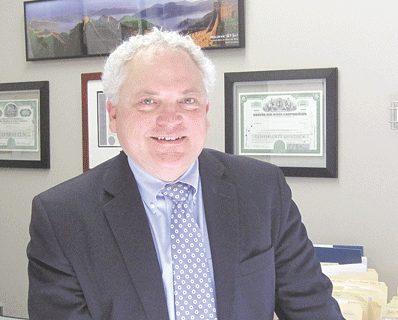
Brian Richards

Brian Richards says the courses are useful to both those with MBAs and those lacking any management training.

The beauty of the program, both Phaneuf and Steiner said, is that, no matter who takes one of the 14 courses — a professional on the management fast track or a business student — the vital soft skills can be used immediately as soon as they walk out the door.

Steiner’s said too few companies pay attention to the importance of people skills, “and they wind up losing a valuable employee and gaining an ineffective or even destructive manager.”

For this issue’s focus on education, BusinessWest sat down with Steiner and some of his former students, all professionals in the region, to learn about the unique AMA courses, and how their focus on soft skills often overlooked in MBA college programs can help not only office morale, but productivity ― and, ultimately, the bottom line.


Talk Is Cheap

While it’s hard for Steiner to pick which course is the most important overall, communication training is high on his list because it’s often overlooked in the workplace, or at least not identified as a major problem for companies.

Steiner said the course, “Effective Communication Skills,” is as important, and as basic, as it gets.

“If a manager is complaining about communication, he or she should look in the mirror,” he said. “Communications is a loop: message transmitted, received, and the receiver gives feedback. They either do what the instruction was, answer what the question was, or agree or disagree with a proposition and close that loop.

“As a transmitter,” he continued, “if you don’t get that feedback, ask for it.” But closing the loop all the way doesn’t happen often enough, and when communication is hampered, time is wasted and productivity goes down.

One of Steiner’s classic examples is what he calls the “stone story.” A manager asks an employee to go get him a stone. The employer goes out and brings back a stone, but the manager says, “I wanted a rounder stone.” The employee returns several times with more stones, none of which are the right kind because little to no direction or description was given. But, Steiner added, “the employee is also wasting time by not asking.”

While humorous, Steiner said everyone can identify with a similar situation in the past where they were the one searching fruitlessly for something — or the one, sadly, who was giving the weak instructions for what kind of ‘stone’ they wanted.

For Richards and the professionals from HG&E, the communication classes were well-received, due partly to what Richards calls Steiner’s ability to speak to everyone’s discipline. “He did a good job of a balancing act by not making it too boring for some and not too much for others,” he said. “For many, this was their first time being exposed to these types of ideas, and it was conducive for people who are in different jobs — engineering, accounting, etc. — working together, and those younger and older were able to share their experiences about how situations come up and how people handle them.”

While communication is high on Steiner’s list, he said “Essentials of Supervision” is another key course for someone on the management fast track, who learns what to expect in the transition and some of the pitfalls to avoid.

Steiner teaches why first-line supervisors are important and the issues they have to deal with, like the balance between needing time to learn management skills and understanding what management is expecting of the group. Add to that the new, required workload that can’t be delegated to others, as well as the challenge of managing a group of different personalities.

One pitfall to avoid: reverse delegation. This is a scenario, Steiner said, in which an employee is given a task, then comes back and says he or she doesn’t know how to do it, so the new supervisor says, “OK, I’ll do it; let me find something else for you to do.”

The consistent act of reverse delegation trains the employee to know the manager will always finish the job, similar to a child learning that when a parent says ‘no,’ it doesn’t mean that at all.

With almost a wink, Steiner added, “in essence, management is very much like bringing up children.”

He also teaches the balance between being a micromanager and letting the staff freewheel through their day with no oversight whatsoever. In the “Managing and Resolving Conflict” course, students learn that those in charge who don’t want to deal with conflict professionally are going to see problems grow and fester beyond the area of the manager’s responsibility and up to the next level, which reflects badly on the manager and his or her obvious lack of skills.

At this point, one starts to see how the specifics of each session melts into other topics. A manager’s consistent avoidance can lead to employees who lose motivation or escalate to major conflicts that never get resolved — and that can affect every area of company business.


Planning Makes Perfect

Of all the AMA courses, Steiner said the one he really enjoys teaching is “Conducting Productive Performance Appraisals” because it is absolutely the most misunderstood area of management.

“Feedback should be a continuous process, both positive and negative,” he told BusinessWest. “The idea of performance appraisal is to improve performance and productivity all year long; it should not be a point where the boss unloads on the employee … it should be a summary.”

Steiner said the contents of an annual performance review should not be a surprise to anyone, and bad reviews are a classic sign of manager avoidance.

During the weekly meetings leading up to the review, one of Steiner’s rules is to never play the blame game. Start with determining how the process broke down, and use ‘I,’ not ‘you.’ His example of what not to say: “you’re always late; you never meet your deadlines.” Instead: “on this day, I observed that you were late,” or “I saw that you missed your deadline by a few days.”

Steiner said this makes the feedback more easily accepted because the situation, similar to the jealousy problem, should be unemotional and based on facts, not opinions.

Meanwhile, the “Managing Multiple Priorities” course discusses a trap that many new managers fall into: automatically putting a new job at the top of the priority list, which endangers the deadlines of everything else. It’s all about planning, said Steiner.

“We do a lot of meetings in our office,” Phaneuf noted, “and one of the courses helped us learn about planning agendas and making sure only the most important items are covered in meetings. And we now have a great understanding the cost of meetings … and the importance of not ‘meeting people to death,’ because when you add up what people are making per hour, meetings are expensive when nothing is accomplished.”

To sum up the program, Steiner argues that a good management foundation is necessary to have the most profitable bottom line. “Then success brings visibility and approval from peers outside the team, resulting in pride in a job well done and the motivation to do even more.”

From years of being a consultant and working in management-level positions, he also weaves into his teaching an affirmation he calls “Plan. Do. Learn.”

“Plan what you want to do. Do it. Analyze the lessons learned after to find if it worked or not and what you would do differently in the future,” he explained. “That way, you don’t make the same mistake twice.”

Richards said the courses provide a framework so that participants can look back later to see which ideas are most successful and determine how to do a better job moving forward.

Phaneuf added that the courses were helpful to him and his staff, not only for the basic, yet vital concepts, but because of the ability to literally go back to school.

“Sometimes it’s good to have an outside person give a second opinion,” he said, “because you’re just too close to it.”

He and Richards are among a growing group of managers who understand that going back to school at any age or level of professional management can only help the company as a whole, by getting the most out of its greatest asset — its employees.


Elizabeth Taras may be reached at [email protected]

Opinion
A Powerful Show of Unity on Literacy


“Reading is the cornerstone of academic success. In fact, educators attest that, until third grade, a child learns to read. After third grade, a child reads to learn. Further, a child who enters fourth grade unable to read proficiently is far less likely to graduate from high school, become an effective citizen, and develop the skills essential for contributing to the 21st-century economy.”

This was the first paragraph of a case statement, or proposal, for the establishment of something called the Funder Collaborative for Reading Success, a document, inked more than a year ago, that apparently got its points across in a meaningful way.

That’s because more than a dozen organizations are now standing together in this ambitious endeavor, having donated close to $1.5 million between them in the all-important fight to make young people in this region more proficient at reading by the time they reach the fourth grade.

And a few months ago, some of this money was put to work, with three grants, totaling nearly $325,000, awarded to five early-literacy and learning programs. These include the Eric Carle Museum of Picture Book Art and its Links to Literacy and Learning program; the Hasbro Summer Learning Initiative through the Regional Employment Board of Hampden County; the Springfield Collaboration for Change and its Home-School Family Literacy Project; Square One and its summer and after-school enrichment programs; and the Springfield College AmeriCorps Student Success Corps program.

It’s far too early to attempt to quantify and qualify the payback from these grants, but it’s certainly not too early to say that this is money extremely well-spent, because, as we’ve said many times, perhaps the biggest issue involved with mitigating the cripplingly high levels of poverty in this region is education, and, more specifically, childhood literacy.

Meanwhile, the Funder Collaborative has, by all indications, become an innovative and highly inspirational method to address some of the larger societal issues facing this region, one that can and should be borrowed for matters ranging from workforce development to combating racism.

But let’s back up a minute.

The Funder Collaborative was launched in early 2011 when the Irene E. & George A. Davis Foundation, which has long been a strong advocate for early-childhood education and a driving force behind the Read! Reading Success by the Fourth Grade initiative, decided that this fight was too big for it to tackle alone.

So it asked a number of area foundations and major employers to join the fight. One of the first to join was the SIS Fund, a charitable foundation left over from the bank formerly known as Springfield Institution for Savings. The list of funders now also includes the Berkshire Bank Foundation, Babson Capital Management LLC, Baystate Health, the Beveridge Family Foundation, the Community Foundation of Western Mass., Hampden Bank, MassMutual, the Nellie Mae Education Foundation, the Peoples United Bank Foundation, the TD Charitable Foundation, and the United Way of Pioneer Valley.

The prevailing theory behind creation of the collaborative is that, by working together on this one issue, these groups could accomplish much more than a single entity or a few organizations moving in different directions — and we believe that thinking is sound.

And there is no more important issue facing this region at this time than reading proficiency among young people. Currently, fewer than 40% of Springfield’s children read at grade level by the end of the third grade. Unless those numbers improve substantially in the years to come, the cycle of poverty that has strangled the city will continue, and the strong workforce needed to take on the jobs in today’s knowledge-based economy will fail to materialize.

The programs funded with the first round of grants are designed to introduce children to books, continue the learning process throughout the year, and, in essence, make students fully able to read to learn.

The Funders Collaborative is really just getting started, but it’s certainly not too early to call this an unqualified success story — on many levels.

Opinion
Electronic Health Records Bring Change

Implementation of electronic health records (EHRs) is bringing a cultural change to daily medical practice operations in the Bay State. The National Center for Health Statistics estimates that 71.2% of Massachusetts office-based physician practices used some kind of EHR in 2011.

For practices that haven’t adopted EHR technology yet, the time is now. EHRs are important for enhancing patient care delivery and collaborating in accountable-care organizations (ACOs) or integrated care networks. In order to adopt EHRs effectively, practices should be aware of several points essential for success.

Evaluate Information Use and Flow: EHR implementation can disrupt a well-functioning system. Before adopting a new system, a practice should evaluate its own existing care system and consider the following questions: What systems are already in place? How is information recorded and exchanged? Who needs what kinds of information? Where do they use it? Once equipped with those answers, practices should be prepared to take the next step.

Find a Compatible EHR: Several key considerations must be made when choosing an EHR, including flexibility, user-friendliness, mobility, and transition support. Flexibility must account for customization of the system, mobility is necessary for sharing patient information throughout the care setting, and transition support ensures a smooth integration of the EHR into the practice’s workflow.

Institute Team-wide Acceptance: Most importantly, groups should ensure that the workplace dynamic is maintained throughout EHR implementation. Teamwork should not suffer at the hands of technological innovation. Therefore, it is paramount that the system sustains the work environment.

EHR use will benefit patients and practices alike. Streamlined data will allow for streamlined care. Not only can patient care be enhanced through EHRs, but practice-wide improvements in communication, productivity, and data utilization can occur as well.

For assistance with EHR implementation or general practice issues, contact the Mass. Medical Society’s Physician Practice Resource Center at (781) 434-7702 or [email protected]. v


Leif Brierley writes about medical-practice issues for Vital Signs, a publication of the Mass. Medical Society. The MMS is the statewide professional association for physicians and medical students, representing more than 24,000 members statewide. The MMS is also a leader in continuing medical education for healthcare professionals throughout Massachusetts, conducting a variety of medical-education programs for physicians and healthcare professionals.

Features Getting Down to Business
An Energized State Massachusetts Chamber of Commerce Focuses on the Big Picture

Debra Boronski (center) with two Massachusetts Chamber employees, Heidi Brodeur (left), director of membership services, and Noelle Myers, events and communications manager.

Debra Boronski (center) with two Massachusetts Chamber employees, Heidi Brodeur (left), director of membership services, and Noelle Myers, events and communications manager.

Debra Boronski has achieved a number of goals since establishing the Massachusetts Chamber of Commerce five years ago. Starting with the right to call it that.

“We started as the Massachusetts Chamber of Business and Industry because the name ‘Massachusetts Chamber of Commerce’ was taken,” Boronski said, explaining that an individual registered the moniker in 1989 but never did anything with it. “It took me three years to find him, and once I did, I had to get a letter of consent, and we worked it out.”

Even under its original name, however, Boronski felt her nascent organization filled a badly needed niche in the Bay State.

“There are 43 state chambers in the United States; I founded the 43rd,” she told BusinessWest, explaining how she broke away in 2007 from two decades of work with the Affiliated Chambers of Commerce of Greater Springfield (ACCGS) and, before that, the Chicopee Chamber of Commerce, to lead this new endeavor.

“After having spent 20-something years in local and regional chambers, I really felt that what I could do as a business professional in these arenas was done. I was strongly encouraged by many associates, and I got a great deal of support from other professionals in the chambers and other organizations, to start a Massachusetts Chamber of Commerce.”

Five years later — the organization celebrated that anniversary on Oct. 9 — the Massachusetts Chamber counts about 700 members in its ranks, and Boronsky has a much different job than she used to.

“A state chamber of commerce really focuses its primary efforts on advocacy,” she said. “We aren’t like your local or regional chamber; we don’t do networking events or after-5s, and we don’t get involved in local government and local ordinances. We believe a local chamber is meant to do that, and they do it well.

“But local chambers,” she continued, “have a hard time paying attention to all the laws and regulations being discussed in Boston, and I can say that from experience running the Chicopee Chamber for 10 years and doing work for the Affiliated Chambers for 11 years. They have their hands full with their day-to-day business.”

The role of a state chamber, she explained, is threefold: information, education, and advocacy. “I am a registered lobbyist, and we also employ a lobbying firm in Boston. We are always in the know and informed as to what’s going on today and what’s being planned for tomorrow.”

For this installment of Getting Down to Business, Boronski talks about some of those issues, and the way her organization has expanded, not just in membership, but in scope.


Taking a Stand

Her role begins, however, with advocacy in Boston — a task she believes is critical for member businesses to succeed.

For example, in March, the state Division of Insurance staged a hearing to discuss increasing workers’ compensation rates by almost 20%. “We were the only chamber of commerce there; I was the only CEO at that hearing, testifying against that increase and providing testimony to Division of Insurance representatives about what harm it would do to businesses, small businesses in particular,” Boronski said. “And they did not raise it. I think we made a difference.”

She also pointed to an economic-development bill signed into law in August 2010 that includes two provisions for which the Massachusetts Chamber pushed hard. One raises the cap on small-claims court actions from $2,000 to $7,000, allowing businesses to pursue collection of bigger debts without incurring huge legal expenses, while the other changes the language in procurement rules to ensure that Massachusetts companies are given preference on state contracts. “That’s another great example of the value of a state chamber.”

In addition, Boronski noted, “two and a half years ago, when gaming was being discussed initially, we were the first business organization to submit testimony in support of gaming in Massachusetts. I think that speaks volumes about the value of a state organization being able to look at the big picture and take a broader view of the potential impact — both beneficial and negative — of various initiatives.”

With national and state elections in the rear-view mirror, she said, businesses have a handful of issues they’re particularly concerned with, including healthcare costs and the recently passed law aimed at containing them.

“That’s something we’re keeping a close eye on. That’s where the ‘information’ part of what we do comes in. We can translate what’s happening in Boston and communicate that in such a way that business owners don’t have to pore through pages and pages of publications. We can share with them, ‘this is what’s going on, and this is what you need to be aware of.’”

Another area of focus is proposed tax increases, she noted. “We need to make sure our members know what’s proposed and why we promote or oppose various initiatives. Our ears are always to the ground, making sure that we don’t miss anything.”

Local initiatives involving infrastructure, transportation, and water are also closely tracked. “All these things cost money, so how do we pay for it?” Boronski said. “We want to make sure that we inform those who are making these decisions what the ramifications of their decisions are.

“It’s important that we keep a two-way line of communication open,” she continued. “A lot of times, things simply present themselves — regulations don’t always go before legislative bodies, and those things can happen very quickly. That’s where having our lobbying firm really adds value for businesses that belong to the Massachusetts Chamber; we can provide them with information within hours of learning something.”


Branching Out

The chamber has expanded its role beyond its original mission, however. About two years ago, the West of River Chamber of Commerce, which was looking to break away from the ACCGS, approached the Massachusetts Chamber for management services.

“We became their management company,” Boronski explained, noting that this involves everything from billing and invoicing services to generating marketing materials and running events. And she was grateful for this new opportunity, even as she embraced her organization’s statewide role. “I had missed some of that, working with the local business community, and this allowed me to dip my toe back into the community. And the West of the River Chamber has grown and added programs since then.”

The effort didn’t go unnoticed by the nearby North Central Connecticut Chamber of Commerce, covering the Enfield-Suffield area, which contacted Boronski about taking on a similar management role there. So, sensing a growing opportunity, she launched a subsidiary company, called Chamber Management Services, with an eye on bringing in more clients down the road.

“We see this as a model for the future,” she explained. “There are many chambers of commerce that may not have the financial resources to employ a high-level CEO and Main Street office space, but they still want to provide important networking and advocacy on the local level, and this model allows them to do that.

“It’s extremely important for these chambers to maintain their independence and their individuality; they don’t want to be lumped together,” she added. “And we make sure they have their own phone numbers, their own business cards and marketing programs; they just happen to be managed by the same company.”

Boronski said the arrangement allows the local chambers to share best practices. “What one chamber is doing well can be shared with the other chamber, and vice versa, so they can maintain their independence, but have the ability through management to find out what’s happening elsewhere. And both are interested in doing some cross-border initiatives.”


State of Mind

Having been involved in chamber activity on both a micro and macro scale, Boronski said she’s convinced she made the right call five years ago.

“In 20-something years in local and regional chambers, putting on trade shows, breakfasts, and after-5s, being able to expand my career into this arena, representing businesses, has been a wonderful professional experience,” she said. “I truly enjoy the advocacy portion of my job. You get to have an impact on a much larger level.”

Boronski has also kept busy running for a seat on the East Longmeadow Board of Selectmen, with an election looming this month. “For 25 years, I’ve been working on one side of the table, talking to lawmakers and decision makers about the impact of their decisions. Now I’m looking to fill a seat on the other side of the table so I can help make good decisions. For me, it’s a way to give back. I feel like I can take my skill sets and put them to good use.”

In the meantime, she’s not letting up on efforts to expand the organization she has led for the past five years. About a year ago, she launched the Massachusetts Chamber of Commerce Foundation — “because I didn’t have enough to do,” she said with a laugh. More seriously, though, she explained that this arm was created to raise money for workforce-development efforts through business grants to members. And she’s also taking steps to create a political action committee. “We are constantly evolving and growing.”

The Massachusetts Chamber is also building on its member-benefit center, which businesses can access for things like home- and auto-insurance discounts, training resources, website and merchant card services, and UPS shipping discounts, among others.

“As a large state organization, we’re in a position to negotiate benefit programs with large providers, and we can offer our members significant savings,” Boronski said. “These companies know we have a far reach, and in return our members receive value they wouldn’t otherwise receive.

“It’s the icing on the cake,” she added. “Lobbying and advocacy may be our cake, but we have some good icing, too.”


Joseph Bednar can be reached at [email protected]

Education Sections
WNEU’s Mini Law School Program Helps Small Businesses Avoid Pitfalls

Eric Gouvin

Eric Gouvin said the Mini Law School program is meant to provide area business owners with a working understanding of many aspects of the law.

It’s called ‘Mini Law School.’

And while that name doesn’t exactly say it all, it says more than enough.

It aptly describes a program created by Western New England University Law School to provide area business owners with a working understanding of many aspects of the law.

And by ‘working,’ Eric Gouvin, professor of Law and director of the Center for Innovation and Entrepreneurship at WNEU, meant basic knowledge of the legal system and many aspects of the law — enough to help business owners hopefully stay out of trouble, especially with the many complex aspects of employment law, and also to help them decide when it is appropriate to invest in legal assistance.

“Sometimes, people in business are very cost-conscious; they’re a little reluctant to call an attorney,” said Gouvin. “So one of the things we hope this series does is give people a sense of when making that call is probably money well-spent, because it can add up.”

Patterned after a decade-old initiative created by Baystate Health called Mini Medical School, which provides the general public with a very basic understanding of the human body, the WNEU program consists of seven two-hour sessions (presented free of charge) spread over two semesters. Those sessions feature panels of area legal experts who not only present information, but also engage participants in discussion on the points addressed.

Gouvin told BusinessWest that the program brings a legal focus to a series of informational sessions being offered by the school called “The 1, 2, 3s of Financial Literacy,” with classes focused on subjects ranging from accounting to marketing to banking relationships.

Trinda Nehmer, a freelance designer of children’s apparel, textiles, and fabric designs for more than 30 years, was one of the recent attendees of Mini Law School. She took in the October session, primarily because of its title — “Current Tax Issues Facing Small Businesses and How to Handle an Audit” — and some issues she was facing.

She’d heard about the series from a friend, and having received a letter from the Internal Revenue Service a few years ago that had her questioning her next moves tax-wise, she knew she needed to be more “up” on areas that could become problems for her business.

“It turned out not to be an issue, but at the time I wasn’t sure if I should get legal advice or at least listen to how other small businesses would handle such a matter,” said Nehmer of her motivation for attending the session.  “Because I get a 1099 at the end of the year, not a W-2, I feel I have to keep myself educated in all areas.

“I really enjoyed listening to Paul Mancinone [of Paul L. Mancinone Co., P.C.] because he was to the point and extremely helpful,” she continued. “He explained very simply all the new tax laws, and he was very thorough. Over the years, I found I had to go back and get up to speed on some of these tax issues because I’d been getting a little lax in the tax area; this was a great way to educate myself.”

From hiring to firing and everything in between, there’s an important legal dimension to all aspects of running any size business. For this issue’s focus on education, BusinessWest takes a closer look at WNEU’s free Mini Law School program and how it can make a vast difference in the busy day-to-day life of a small business owner.


Cutting Through the Clutter

The stated mission of Mini Law School is to give small-business participants enough understanding of the law that they don’t make some common mistakes that can land business owners in court and cost them hundreds or thousands of dollars in fines.

Having offered the ‘small-business clinic,’ as it’s known in-house, for 10 years, and serving more than 250 business owners, Gouvin and his team understood the needs and concerns of the business community, and clearly saw both a need for a program specifically focused on legal issues and an opportunity to meet it.

The next matter at hand was determining a curriculum, he continued, adding that current events and prevailing issues within the broad spectrum of business law would essentially set the tone.

“There are a million things that we could be talking about in law,” said Gouvin. “But we’ve been working with small businesses long enough to see recurring patterns and things that crop up over and over again, and we identified our focus areas for these sessions based on that need.

“They almost always have problems with choices of entity, intellectual property, problems with employees,” he continued, “and the sad fact of life is that some of these businesses will fail.”

Thus, the April session of Mini Law School was devoted to bankruptcy issues, a depressing but necessary topic for discussion.

“Good planning would require that you at least think about it,” Gouvin said of bankruptcy relief, “because things that you do early on might affect how painful the process is or how productive it is.”

He added that, while he and his team know what areas are most relevant to small businesses, matters such as securities law, anti-trust law, mergers and acquisitions, and issues that pertain more to much larger companies might be touched upon during some of the sessions, but will not be a hard focus of the Mini Law School.

One thing that all businesses must be concerned with, regardless of size, is employment law, and as a result, the November session was devoted to many aspects of that broad speciality, and was, as expected, very well-attended.

The program focused on many timely issues, especially the often-complicated matter of classifying workers as employees or independent contractors, a question that has caused headaches for many employers.

“A lot of people think they know, but in Massachusetts it’s very hard to be an independent contractor,” said Gouvin. “That’s a sad fact, or an awakening moment for many owners when they think they can just give someone a 1099 and hope that nobody challenges them, because if they are challenged, under Massachusetts state law, they’ll owe back all that withholding they haven’t done, and all the interest and penalties — and it typically unfolds in a very unpleasant scenario.”

Gouvin added another, intriguing layer to the discussion by offering the example of a perceived independent contractor being in an accident and seriously injuring another person. That injured party will probably find out the connection to the business owner and then seek damages from the employer, he explained, adding that, at that point, it doesn’t matter what the business owner wants to call the worker; in the eyes of the law, if the worker really is an employee, not an independent contractor, serious problems will ensue.


Not Lost in Translation

Gouvin said the overriding goal of the program is not to throw information at participants, but to have them understand it and use to run their businesses more efficiently and in a manner that will keep them out of the courts.

“To go it alone, without having someone looking over a business owner’s shoulder, can be a very scary situation,” he said, adding that legal matters are often complex. And Mini Law School Law school was created to give business owners power through knowledge.

And that’s why the experts providing information and initiating discussions are instructed to do so using simple, straightforward language that participants can comprehend, which is one of the keys to avoiding legal problems.

Gouvin added that some of the participants are law-school students, who can benefit from hearing experienced legal professionals giving this type of talk.

“It’s different from the way they are used to hearing a law professor talk,” he noted. “But it’s a skill that any good lawyer should develop: the ability to translate legalese into English in a way that they can really communicate and connect with their future clients.”

Response to the simplicity and direct nature of the Mini Law School has been one of gratitude and a literal wipe across the forehead for some.

“People are always expressing thanks that they got so much information delivered in a way that is no fooling around,” said Gouvin. “The information is not legalese, but in a list form — ‘you need to know this, this, and this’ — and if you’re someone just trying to focus on running a business, the legal things are just a pain in the neck.”

With 32 participants for the November session on employment law, up from the 20 attendees at the October tax-issues session and the handful in attendance for the September class on risk management and legal entities, Gouvin told BusinessWest that the series does appear to be growing.

“The trend is that we are building an audience, and while we’d be very happy with 25 to 30, we can handle up to 60.”

Organizers also found that the timing in the spring, on Tuesdays from 4 to 6 p.m., was not conducive to busy business owners, so the time has been adjusted this year to the same day but later by an hour, from 5 to 7 p.m.


Justice Served

Gouvin said the plan moving forward is likely to involve rotating Mini Law School with the financial-literacy program on an annual basis. Such a schedule would give participants needed updates on legal matters, which they could then follow-up with a curriculum he described as “self-education.”

But he’s already seen enough to convince him that this program is needed, worthwhile, and certainly capable of meeting its primary mission — to help business owners avoid trouble, rather than rely on legal help after they get into trouble.


Elizabeth Taras may be reached at [email protected]

Education Sections
$2.38 Million Award to AIC Nursing Program Helps Disadvantaged Students

Dr. Cesarina Thompson

Dr. Cesarina Thompson said the ‘meaningful’ addition to the award means more money per student — in the case of AIC, 50% of tuition.

Dr. Cesarina Thompson called it a “no-brainer.”

But recognizing the need for a $2.38 million grant — which will benefit disadvantaged students at American International College — was the easy part. Landing it was more challenging, and gratifying.

Having just completed her first six months as the new dean of AIC’s School of Health Sciences, Thompson is thrilled to see the school on the receiving end of the largest federal grant ever awarded to the institution. In fact, the grant, spread over four years, is the largest awarded to a Massachusetts college under the Scholarships for Disadvantaged Students (SDS) program. AIC is in a select group, as only 99 grants were awarded nationally.

“The minute I saw the grant application before submission, I knew this was a no-brainer for us,” said Thompson, who helped to write and edit part of the grant proposal and offered suggestions before she came on board in July 2012.  “But these grants are very competitive, and the percentage that are funded are very few, so we are fortunate.”

The SDS program was redesigned to ensure larger, more meaningful awards to schools and therefore enable institutions to tackle the major barrier to a disadvantaged student’s access to a health-profession education, which is high tuition costs.

Thompson explained to BusinessWest that the ‘meaningful’ addition to the award means more money per student — in the case of AIC, 50% of tuition.

She added that, since AIC is a Title III Institution, it has a high percentage of first-generation and low-income students for whom the cost of attending the program poses a severe financial hardship. Thompson said the Title III program helps eligible institutions of higher education become self-sufficient and expand their capacity to serve low-income students by providing funds to improve and strengthen academic quality, institutional management, and fiscal stability. Because of this mission, AIC is already successfully developing and implementing programming to recruit and retain disadvantaged students, and the SDS grant is just one more plus for AIC students who need some extra help.

The SDS program promotes diversity among health-profession students and practitioners by providing scholarships to full-time students with financial need from disadvantaged backgrounds who are enrolled in health-profession and nursing programs. AIC will be responsible for selecting scholarship recipients, making reasonable determinations of need, and providing scholarships that do not exceed the allowable costs — which include tuition, reasonable educational expenses and reasonable living expenses — with a cap of $15,000 for the total scholarship award.

AIC currently has the largest BSN program in the area, and also offers a master of science in Nursing program. AIC President Vince Maniaci said the goal is to award the meaningful scholarships to at least 40 disadvantaged nursing students annually, which will enable more disadvantaged and minority students to obtain a baccalaureate degree in nursing.

“This money will help high-achieving, financially needy students to seamlessly progress in their nurse education without interruption. It should also increase the number of diverse nurses able to serve their communities,” Maniaci said.

The award, which comes from the U.S. Department of Health and Human Services, Health Resources and Services Administration (HRSA), is a small part of the Affordable Care Act, which President Obama signed into law in March 2010. The law aims to improve the nation’s current healthcare system by increasing access to health coverage for Americans and introducing new protections for people who have health insurance; it also provides new ways to hold insurance companies accountable.

In the case of those students less fortunate who want to pursue a career in healthcare, the law also supports programs that will help increase the number of primary-care physicians, nurses, physician assistants, and other healthcare professionals.

U.S. Rep. Richard Neal, a graduate of AIC who helped to secure the federal grant, was on hand recently to announce the award. “I know firsthand how important financial assistance can be during the college years. That’s why I am so confident this program will help more local students earn their nursing degrees,” he said.

Added Thompson, “it came to light recently that one student who was recently awarded would probably not have been able to compete the program because both her parents were out of work. And many of our students with the economic downturn are working 20- and 30-hour work weeks and trying to go to school full-time … that’s just near to impossible, especially when they are in a nursing program.”

Looking at the larger healthcare picture, Neal told BusinessWest that, as a result of this grant, future AIC nursing graduates will not only be on track to succeed in their career goals, but will share part of the responsibility of caring for millions of wounded veterans who will need some type of medical attention.

“The Affordable Care Act will create 32 million new healthcare customers,” he said. “And with the wars in Afghanistan and Iraq coming to an end, caring for all of our returning wounded is going to be a great honor and a great commitment.”


— Elizabeth Taras

Education Sections
STCC Nursing Program Celebrates 40 Years of Evolution, Excellence

The STCC Alumni Association

The STCC Alumni Association honored several STCC nursing alumni on Nov. 3. From left are honorees Kerry Fournier (’98) and Marianne Hamel (’72); STCC Dean of Nursing Mary Tarbell; STCC Dean Emeritus Mary Elizabeth O’Leary; honoree Sunshine Domaruma (’08); and STCC President Ira Rubenzahl. (Missing from photo is honoree Melissa Odom, ’04.)

Mary Tarbell was among those receiving pins at the graduation ceremonies for the first class of nursing students at Springfield Technical Community College in 1972, and she has many memories from those early days of the program she now directs.
She recalls, for example, that the fledgling nursing program was housed in what amounted to one half of a duplex, known then (and now) as Buildings 5 and 6 on the grounds of the closed Springfield Armory. “We had classes in the bedrooms,” she told BusinessWest, “and labs were in the living room; the faculty ate in what was the kitchen.”
She also remembers that there were some doubts within the medical community about the quality of this college-based program, which was created to help fill the gap when the hospital-based nursing programs that had been existence for decades closed their doors due to the high costs associated with them.
“After I got my first job, someone said to me, ‘do you really know what you’re doing?’ I said, ‘I think so,’” said Tarbell, who also remembers her first paycheck from that assignment, from Providence Hospital in Holyoke.
“It was for $144, and, if I remember right, 17 cents … I know I have that pay stub somewhere,” she recalled. “That was for a 40-hour week on the second shift. Today, that would represent about three or four hours for some nursing graduates.”
There was quite a bit of this looking back in retrospect going on at a recent get-together to mark the 40th anniversary of that first class of nurses at STCC, said Tarbell, noting that more than 100 people turned out, and all but a few are still active within the profession.
The event was a celebration of just how far the program has come in four decades, she said, as well as the broad impact STCC graduates have had on the large healthcare community in Western Mass.
But the milestone also serves as an appropriate time to examine where nursing education has been, where it is now, and where it’s going, Tarbell noted, adding that, while some things haven’t changed over the years, many things have, especially technology.
And Tarbell used that phrase to refer, collectively, to everything from high-tech simulation labs to students’ ability to put huge textbooks onto their cell phones.
“We can no longer teach the way we were taught,” she explained, referring to educators of her age. “You have to get very innovative; this is a different generation, and it’s a very tech-savvy generation. This class that just came in in September is the first class that’s required to have laptops. We’ve also converted all of our paper-and-pencil tests — we’re in the final phase of shifting all tests to a computer — and we do this to mimic the licensing exam.
“Technology has changed, and you have to embrace the technology, because that’s the only way we’re going to be able to continue to put out safe practitioners.”
For this issue, BusinessWest takes advantage of the 40th anniversary celebration to examine four decades of change and progress in nursing education, and what lies ahead for the STCC program.

School of Thought
Tarbell said the nursing program had simulation technology in 1972 — well, sort of.
“We had what we call a task trainer,” she explained. “You’d have a model of a leg … and you would use it to teach a student how to put on an elastic stocking or wrap a stump after amputation — something limited to that part of the body.”
Today, students learn from computer-controlled simulators that can talk back to them while displaying a wide range of symptoms and conditions, she continued, adding that this is one of many sea changes that have occurred over the past 40 years. Summing it up, Tarbell said that what’s being taught is virtually the same as when she was attending classes in Building 5, but how it’s being taught is radically different, because of changes in technology and the healthcare industry itself.
Turning the clock back to when Richard Nixon was in the White House, Tarbell said nursing education was undergoing a seismic shift with regard to where and how students were taught.
For decades, area hospitals had their own programs, she said, noting that, by the early ’70s, the last of them had closed due to the high costs of administering the schools. To fill the gap and put more students in the pipeline, college programs were created at STCC, Holyoke Community College, Elms, American International College, and other schools.
The transition process created both challenges and opportunities, she said.
“Those nurses who were going to the hospital-based programs were so exposed to patient care in a different way than an associate-degree nurse was exposed to patient care,” she explained, “because they were actually in the hospitals managing the units and running the units.
“When the associate-degree program came in, we were on limited hours — we were doing 12, maybe 15 hours, and as you advanced, maybe 18 hours a week in clinical, far less than what the diploma schools were doing,” she continued. “But we were getting a sound education based on the fact that we were taking college-level courses along with our nursing curriculum.
“But when we first went out there,” she went on, “no one believed that we could actually function. And that was just one of the obstacles we had to deal with as we went out into practice.”
Today, of course, there are no such doubts about the qualifications of those who graduate from STCC and other area programs, said Tarbell, adding, however, that today’s nursing students face other challenges when they enter the job market, particularly patients who are, overall, sicker than those who would be in a hospital 40 years ago.
And this phenomenon, prompted by a wave in changes in technology, how care is administered, and how it’s paid for, is reflected in how nursing students are prepared for their chosen profession, she told BusinessWest.
“What we see now in the hospital is different than what we saw years ago,” she explained. “Decades ago, if someone had their gallbladder out, a fairly simple surgery, that person would have a large abdominal incision and be in the hospital for a week. Today, you can be in the hospital at 6 in the morning, and many times, you’d be home that evening after having your gallbladder taken out.
“The fast turnover of patients has driven us to deliver care in a more intense fashion,” she continued, “but what you can’t separate from it is the caring and the safety and the knowledge. One of the key things we look at in all of our students is safety; if we find anyone who is unable to maintain safety, we counsel that student and we try to help them and facilitate how they can be a safe practitioner.”
There are other challenges awaiting today’s nursing graduates, said Tarbell, including a tighter job market than many industry and workforce experts were predicting even a few years ago. Graduates are still finding jobs, she continued, but sometimes not in the desired acute-care setting.
One of reasons for this is that many of the Baby Boom-aged nurses who were expected to retire over the past few years — including some from that first class at STCC — are finding that they can’t retire yet for financial reasons, or are not yet ready to leave the profession. But perhaps more importantly, she said, many employers, especially those in acute-care settings, are demanding more than an associate’s degree from their nursing applicants.
“We’re graduating nurses, just as the other schools are, but the vacancy rate is just not what it used to be,” said Tarbell. “You used to be guaranteed that, when an associate-degree nurse or a bachelor-degree nurse graduated, they would have a job in an acute-care facility — and not that many years ago, it was even before they graduated; they had their jobs in January, February, or March.
“Now, many places are not interviewing or even accepting applications until after that nurse has his or her license in hand,” she continued. “At the same time, when they [associate-degree recipients] graduate, they’re not guaranteed a job in acute care. It’s few and far between when it comes to associate-degree students being hired into acute care right away.”
Instead, they’re finding jobs in community nursing (as school nurses, for example), long-term-care facilities, and other settings, such as home care, she told BusinessWest, adding that there is still 100% placement within six months of graduation.
To help its graduates get the jobs they desire — and to address the demand for higher-degreed nursing graduates — STCC started collaborating with UMass Amherst and Baystate Health on a program that would enable the college’s two-year graduates to then earn a bachelor’s in a year plus the intervening summer.
“They can do it three years instead of four,” she said, adding that this program, in addition to similar initiatives involving other four-year schools, is designed to improve the likelihood that those leaving STCC with an associate’s degree can get the bachelor’s degree needed to open more doors, and in less time.

Class Acts
As she talked with BusinessWest, Tarbell paused for a minute and went to a bookcase to collect a textbook from her days as a student at STCC.
As she thumbed through Cooper’s Nutrition in Health And Disease, she marveled at the simplicity of the diagrams — and also the price tag on the inside cover: $9.75.
“That’s another thing that has changed, obviously,” she said with a laugh, noting that today’s textbooks, like the one recently sent to her one publisher in hopes that it might become part of the curriculum, cost perhaps 20 times what they did four decades ago.
Those inflationary changes aside, as well as the myriad advances in technology, the basic mission of the STCC hasn’t changed and won’t, said Tarbell. Now, as then, the goal has been to properly prepare students for the industry they have chosen.

George O’Brien can be reached at [email protected]
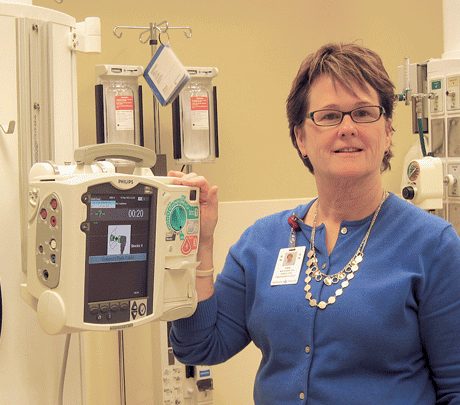
Employment Sections
Labor-market Report Highlights the Region’s Skills Gap

Bill Ward calls it a “mismatch.”
There are other words being used to describe the region’s job market, none of them particularly enthusiastic. But to Ward, president and CEO of the Regional Employment Board of Hampden County (REB), it boils down to an ever-present skills gap.
“It all comes back to this huge, complex issue we have: there are skills shortages, and there are people who are looking for jobs and can’t find them,” he said. “There’s a mismatch out there. There always has been, but now it’s more pronounced because today’s jobs require a higher skill set.”
Ward was responding to a report — “Labor Market Trends in the Pioneer Valley Region” — recently issued by the Commonwealth Corp. and the New England Public Policy Center of the Federal Reserve Bank of Boston. That report paints a picture of a naggingly high — albeit slowly falling — unemployment rate in the region, but also a labor pool that’s not adequately equipped to fill the job openings that do exist, which creates a problem for companies looking to grow or locate here.
This trend is exacerbated, the report notes, by an aging population and, in some fields, potential future shortfalls of workers with the skills and education required by employers. In 2008-10, the period the report focuses on, 47.1% of the labor force was age 45 or older, while only 31.6% was 34 or younger.
And while the region’s residents have, on average, increased their level of education over the past decade, progress in that area has been slower than in other regions, leading some economic-development leaders to wonder whether the younger generation will be adequately equipped to replace the masses of retiring Baby Boomers over the next decade.
All this isn’t news to Ward, who deals every day with the challenges of the Pioneer Valley economy and strategies to boost it.
“It updates the reality and confirms it,” he said, noting that the report offers plenty of data but few solutions. “These are complex issues; you can’t just flip a switch. What keeps me up at night is the quality of this workforce and what it needs to do to be competitive. If anything, this report emphasizes that.”

Youth Is Not Served
Robert Clifford, an economist and public policy analyst for the New England Public Policy Center, took part in a roundtable recently at Holyoke Community College to discuss ther report’s findings. He noted that the region’s working population between ages 16 and 24 actually fell from 51,988 in 2000 to 49,788 in 2010 — the only region in the state where that occurred.
Clifford broke down the report’s findings into four main points:
• After nearly a decade of declining employment, the Pioneer Valley is recovering at a modest pace, but continues to have one of the highest unemployment rates statewide;
• An aging workforce, declines in younger workers, and a stagnant population will force the region to confront demographic challenges sooner than other regions;
• Despite gains in the educational attainment of its labor force in the past decade, the Pioneer Valley still has the highest share of individuals with only a high-school degree or less; and
• Addressing the barriers to employment facing the region’s
jobless population, particularly among the young and less educated, is key to the Pioneer Valley’s economic vitality moving forward.

Bill Ward

Bill Ward says businesses shouldn’t wait for the perfect candidate for a job, but be willing to train a talented learner.

“It’s very clear,” Ward told BusinessWest, “with the dynamics of our region, with an older population and a shortage of younger people coming into the workforce, it leaves us in a situation where education and training are even more critically important to our region than to most other regions in the Commonwealth — whether it’s the K-12 system, the community-college system, or investments in training by employers themselves. That’s the big message.”
It’s a message framed by an air of overall sluggishness on the job front locally.
“While the employment rate in the region was nearly the same as the rate statewide through the first half of the past decade, the impact of the Great Recession was particularly severe in the Pioneer Valley,” the report states, noting that the region’s unemployment rate reached 9.2% in 2010, slightly below the national rate of 9.6%, but far exceeding the statewide rate of 8.5%, making it the third-highest jobless rate among all regional labor markets. It also represents a much higher rate than the 3.0% recorded in 2000 and the 5.8% posted in 2003, following the 2001-02 recession.
Perhaps more troubling, however, is the report’s repeated emphasis on how young workers are being impacted. In 2008-10, more than 50% of the region’s unemployed were 34 years old or younger, though such individuals accounted for just 32% of the region’s workforce. Meanwhile, 60% of those unemployed in the Pioneer Valley had a high-school degree or less, while only 38% of the region’s workforce had such an education.
That points to multiple demographic trends that intersect in a troubling way. While the Pioneer Valley’s workforce skews higher in age than other regions, the younger generation isn’t always ready to compete for the jobs that do, and will, arise — the very definition of a skills gap.
“Massachusetts is one of the most highly educated states in the nation, but the Pioneer Valley’s residents and workforce … have education levels similar to their counterparts in the United States,” the report asserts. “Over the past decade, the region has seen progressively higher levels of educational attainment among its residents and workforce, but a high-school degree continues to be the most common level of educational attainment in the region.”
Specifically, in 2008-10, the share of the region’s labor force with a bachelor’s degree or higher (30.5%) trailed that of Massachusetts as a whole (41.2%). However, when the figures are calculated to include all workers with some kind of post-secondary education, the Pioneer Valley (67.8%) closes the gap somewhat on the state (67.8%), due to a larger concentration of individuals with certificates or associate’s degrees, perhaps reflecting the strong presence of the region’s community colleges.

Training from Within
The persistent skills gap, the report notes, “may be particularly troublesome given that 91.5% of the region’s employees are also residents. The Pioneer Valley may not be able to attract workers from other regions to work in jobs with relatively low education requirements and pay, given that those populations are typically filled by less mobile populations.
“However,” it continues, “younger workers and those with lower levels of education, who are disproportionately unemployed, may provide a future supply of labor that can be educated and trained to address labor shortages.”
To foster economic growth in the future, the report argues, the Pioneer Valley should “strive to align the education of its labor force to meet the demands of the region’s employers” — a call to colleges to step up efforts to draw students into degree programs for in-demand careers, like those in the STEM (science, technology, engineering, and math) fields.
Although Ward has been involved in many such initiatives to boost worker training in the region, he notes that colleges, career centers, and other economic-development entities can’t do it themselves.
“There’s an insidious dynamic in the job market where employers say, ‘I have jobs, but I can’t fill them; I can’t find skilled workers,’” he noted. “But these employers need to do some rethinking about training. They need to do it on their own. This idea of looking for a perfect candidate … the workplace is changing, and there’s no such thing as an off-the-shelf worker. You can’t expect that.
“Because of the complexity of the marketplace today, employers need to be more engaged in preparing their future workforce,” Ward continued. “They need to do more on-the-job training and engage with educators to create career pathways for young people, so when they’re in school and see the applications of math, science, and technology in the workplace, there will be less dropping out, and more kids turned on by seeing the connections between school and work. It’s a complex issue, and there is no single solution.”
Despite the presence of a “feeder system” in the form of multiple well-regarded colleges, plus the state’s flagship university campus, Western Mass. has long had difficulty holding on to graduates, he noted. “We’re seeing large numbers of young people not being retained in this region, and the reason for their outmigration is that we have not been able to generate employment opportunities for these young people.”
Part of that, he said, is due to generally lackluster job creation over the past three years, which has hit young people hardest, particularly in the realm of summer jobs, which provide much-needed experience and develop workplace skills. “Young people, up to age 25 or so, have been bearing the brunt of the recession, so to speak, and to get that first job, they’re tending to be more mobile and look elsewhere; we see them crossing into the Boston area and other markets.”
Meanwhile, older workers are holding on to their jobs longer, in many cases due to the financial meltdown of 2008 and the downturn that followed, which exacerbates the problem young people have finding work.
But the aging of Massachusetts will eventually provide opportunities for the young, Ward said, and it’s incumbent upon the region’s employers, educators, and economic-development leaders to turn those opportunities into a more vibrant hiring culture.
“We’re going to need to fill these positions of the job leavers who are maturing, and the people who fill them are going to need the right skills.”
Ward noted that fewer than half of all recent college graduates in the region are currently working in their degree fields. While troubling in some ways, that statistic also means there are plenty of smart, talented young people who have the aptitude to change careers if given the opportunity by proactive employers. But instead of cultivating their own pipeline of talent, “many employers say, ‘let someone else do it,’ and they wait at the end of the pipeline for someone with their specs.”
The question, he said, is “do you keep turning away from your door the person who could potentially do the job, but doesn’t have all the skills yet? We need some rethinking by employers.”

Opportunity Knocks
There’s a tidbit buried in the labor-market report that offers a bit of optimism. “After two recessions and a decade of declining employment, the region is now gaining jobs and recovering at a modest pace. Moreover, the recent recovery from the Great Recession has been somewhat stronger in the region than in the state as a whole. The Pioneer Valley has experienced relatively broad-based improvement, with stronger growth than the state in a majority of industries.”
Combined with that outlook, the region’s demographic trends — notably, the massive Baby Boom generation approaching retirement — may seem to bode well for younger workers, Ward said, but the skills gap remains, and it threatens the growth of current businesses and hinders others from moving to Western Mass.
“Companies looking to relocate look at the labor supply,” he told BusinessWest. “We need to be willing to say, ‘we can’t afford to waste a single young person.’ We have to get as many people as possible to their full potential.” n

Joseph Bednar may be reached at [email protected]

Chamber Corners Departments

ACCGS

www.myonlinechamber.com

(413) 787-1555

• Dec. 5: December Business@Breakfast, 7:30-9 a.m., at the Basketball Hall of Fame, Springfield. The monthly Business@Breakfast series pays tribute to individuals, businesses, and organizations for major contributions to civic and economic growth and for actions that reflect honor on the region. To make reservations, visit www.myonlinechamber.com, e-mail Cecile Larose at [email protected], or fax a reservation to 755-1322.


Amherst Area Chamber of Commerce

www.amherstarea.com

413-253-0700

• Dec. 19: After Five/Holiday Party, hosted by PeoplesBank, 56 Amity St., Amherst. Cost: $5 for members, $10 for non-members.


Chicopee Chamber of Commerce

www.chicopeechamber.org

(413) 594-2101

• Dec. 6: Holiday Open House, 4:30-6:30 p.m., at the Chicopee Chamber of Commerce, 264 Exchange St., Chicopee. Free admission for all chamber members. RSVP to [email protected].

• Dec. 19: Salute Breakfast, 7:15-9 a.m., Castle of Knights, 1599 Memorial Dr., Chicopee. Cost: $20 for members, $26 for non-members. Sign up online at www.chicopeechamber.org.


Franklin County Chamber of Commerce

www.franklincc.org

(413) 773-5463

• Dec. 21: Annual Holiday Breakfast,  7:30-9 a.m., Deerfield Academy. The Citizen of the Year Award will be presented. Sponsored by the Recorder. Gifts for all, music by Gary Maynard and Friends. Cost: $24 for members, $25 for non-members.


Greater Easthampton Chamber of Commerce

www.easthamptonchamber.org

(413) 527-9414

• Dec. 13: Holiday Dinner Dance, 6-11 p.m., hosted by the Log Cabin Banquet & Meeting House, Holyoke. An evening of friends and holiday spirit including the big raffle with a $5,000 drawing, butler-style hors d’ouevres, multi-station entrees, Viennese dessert table, cash martini and full-service bar. Music provided by Michael J. Productions. Cost: $50 per person inclusive; group reservations available.


Greater Holyoke Chamber of Commerce

www.holycham.com

(413) 534-3376

• Dec. 12: Holiday Business Breakfast, 7:30-9 a.m., hosted by the Delaney House, Holyoke. Sponsored by Holyoke Gas & Electric and Health New England. Enjoy a hearty breakfast buffet while listening to the Holyoke High School Madrigal Choir fill the air with holiday spirit. Door prizes. Hat and glove drive; bring warm hats and gloves for homeless and needy men, women, and children. Tables reserved for groups of eight people. Call the Chamber at (413) 534-3376 to register or sign up online at holyokechamber.com.

• Dec. 19: Holiday Chamber After Hours, sponsored and hosted by the Delaney House. In addition to door prizes and a 50/50 raffle, the business networking event will also include a lottery ticket tree raffle. Tickets are $10 for members, $15 for non-members.


Northampton Area Young Professional Society

www.thenayp.com

(413) 584-1900

• Dec. 13: December Social, 5 p.m., hosted by Thornes Marketplace, 2nd Floor, 150 Main St., Northampton. Featured nonprofit: Highland Valley Elder Services Inc.


Greater Northampton Chamber of Commerce

www.explorenorthampton.com

(413) 584-1900

• Dec. 5: Northampton Chamber Monthly Arrive@5, 5-7 p.m., hosted by Don Muller Gallery, 40 Main St., Northampton. Sponsored by Florence Savings Bank. Arrive when you can, stay as long as you can. A casual mix and mingle with colleagues and friends.

• Dec. 18: December Meet & Eat, 7:30-9 a.m., hosted by the Delaney House, Holyoke. Sponsored by Easthampton Savings Bank. Learn from your colleagues at breakfast with the chamber. Cost: $15 for members. For more information, contact Jenna at the Chamber, (413) 584-1900, or e-mail [email protected].


West of the River Chamber of Commerce

www.ourwrc.com

(413) 426-3880

• Dec. 5: Wicked Wednesday, 5-7 p.m., hosted by Squires Bistro at Coopers Commons, 159 Main St., Agawam. Cost: free for members, $10 for non-members. Wicked Wednesdays are monthly social events, hosted by various businesses and restaurants, which bring members and non-members together to network in a laid-back atmosphere. For more information, contact the chamber office at (413) 426-3880 or e-mail [email protected].


Greater Westfield Chamber of Commerce

www.westfieldbiz.org

(413) 568-1618

• Dec. 14: Greater Westfield Chamber of Commerce Holiday Breakfast, 7:15-9 a.m., hosted by Tuckers Restaurant, 625 College Highway, Southwick. Sponsors: Westfield Bank, Gold Sponsor; First Niagara Bank, Silver Sponsor; Met Life, Bronze Sponsor. Guest speaker: Alan Popp, CEO of Colony Care. Performance by Westfield High School Show Choir. Cost: $25 for members, $30 cash for non-members. Donations of non-perishable food items or money are being accepted for the Westfield Food Pantry. For more information, call Pam at the chamber office at (413) 568-1618, or e-mail [email protected].


Young Professional Society of Greater Springfield

www.springfieldyps.com

• Dec. 20: Third Thursday, 5-8 p.m., at the Barney Estate at Forest Park. Event includes a complementary drive through Bright Nights, and is sponsored by the spirit of Springfield and Elegant Affairs. For more details, visit www.springfieldyps.com.