Home 2014 July (Page 4)
Daily News

PITTSFIELD — The Berkshire Museum announced the addition of Britney Schline to the staff as the collections manager.

Berkshire Museum, a Smithsonian affiliate, holds encyclopedic collections comprised of more than 30,000 objects, including art, artifacts, decorative arts, ethnography, natural specimens, and living collections. In her new role, Schline will oversee the museum’s permanent collections as well as work closely with the exhibition team led by Maria Mingalone, the museum’s director of interpretation.

“Britney’s approach to collections management is in line with our institutional goals to bring collections alive for our visitors. She has a fresh perspective on how collections can leverage the ‘21st-century museum’ as a place where people have meaningful experiences with one another around objects,” said Mingalone. “Schline also brings a passion to finding innovative means to connect our visitors to our collections and to one another, whether it is in the galleries, through special programming, on our website, or through social media.”

Schline is a recent graduate of the Cooperstown Graduate Program and holds a master’s degree in Museum Studies. Before completing her graduate degree, she held the position of decorative arts collections assistant at the Berkshire Museum, assisting the museum in cataloguing its ceramic and Asian art collection under an IMLS grant. Most recently, she served in the collections department at the Fenimore Art Museum and the New York State Historical Assoc. Last summer, Schline was an Edward I. Koch fellow at the Historic House Trust of New York City, where she coordinated the Roof Raisers Curatorial Brigade volunteer program. She has also previously interned at Wadsworth Atheneum and the Schoharie County Historical Society.

Daily News

HOLYOKE — The Greater Holyoke YMCA will offer a Safe Sitter class for girls and boys age 11 to 14 on Saturday, July 12 from 9 a.m. to 3:30 p.m. at the Greater Holyoke YMCA. Registration for the program, sponsored by the Greater Holyoke YMCA, is open until July 11.

The Safe Sitter program is a medically accurate program that teaches young adolescents how to handle emergencies when caring for younger children. The cost is $45. To pre-register your son or daughter or your child’s babysitter, call (413) 534-5631.


Thousands of adolescents across the country have been trained by Safe Sitter instructors to handle life-threatening emergencies. During the course, students get hands-on practice in basic lifesaving techniques so they are prepared to act in a crisis.
 Safe Sitters also offers helpful tips to make young people more confident caregivers. Participants learn safety precautions, how to understand children of different ages, and even the business of babysitting. 
To successfully complete the Safe Sitter program, students must pass a rigorous practical and written test to show that they have mastered the key concepts and have the skills necessary to handle an emergency.

Daily News

SPRINGFIELD — 
Christopher Sikes, executive director and founder of Common Capital (formerly the Western Massachusetts Enterprise Fund) will address the Springfield Rotary Club’s luncheon meeting on Friday, July 18. His topic will be the impact of community loan funds in support of local businesses and community projects.

Common Capital is a 25-year-old loan fund which has invested millions of dollars to support the region’s economy. Located in Holyoke, it is a community-development financial institute providing financing to microenterprises, small businesses, and nonprofits since 1989.
 Sikes has taken a leading role in microenterprise and small-business development in the U.S. Before founding the fund, he owned a piano-rebuilding company.

The Springfield Rotary Club meets every Friday at 12:15 p.m. in the MassMutual Room at the Basketball Hall of Fame. The luncheon costs $17 per person and is open to the public. For more information on the Springfield Rotary or becoming a member, contact Mike Healy, membership chair, at (860) 796-1435 or visit www.springfieldmarotary.org.

Daily News

WARE — Baystate Mary Lane Hospital will partner with Quality EMS Educators Inc. to offer a basic emergency medical technical program at the hospital this fall. Classes will be held Tuesday and Thursday evenings from 6 to 10 p.m. beginning Sept. 11 and will include 180 hours of class time and 10 hours of emergency-room observation time. The training time has been increased from 150 to 180 hours to meet the new National Registry Curriculum.

After successfully completing the EMT basic program, students will be eligible for the National and State Certification and Licensing Examination. Candidates must be at least 18 years of age to take the exam. This is the seventh EMT basic course sponsored by the hospital.

“Providing this training has been a critical asset to many of our communities,” said Dr. Roger Lafleur, Emergency Department physician at Baystate Mary Lane Hospital. “People’s lives often depend on the quick reaction and competent care of emergency medical technicians during the most incredibly stressful situations. The physicians in our Emergency Department also depend on the excellent work and commitment EMTs provide both day and night in the many communities we serve. We are pleased to offer this training locally and proud of the positive impact the EMT basic training program has had on the many communities we serve.”

The cost for the basic EMT program is $900, which includes both tuition and books. The terms of payment are $450 due to Quality EMS Educators on the first day of class on Sept. 11, with the balance due Oct. 30. Checks, MasterCard, and Visa are accepted. Baystate Mary Lane Hospital Emergency Department physicians also conduct monthly continuing education for EMTs, intermediates, and paramedics at no cost. For more information about EMT training or to register for classes, contact Michelle Holmgren, Public Affairs and Community Relations specialist for Baystate Mary Lane Hospital, at (413) 967-2296.

Daily News

SPRINGFIELD — William Dávila, a Springfield native and longtime executive at nonprofit institutions, has been named director of operations for the UMass Center at Springfield.

A 1996 graduate of UMass Amherst who holds advanced degrees from Boston College and the University of Hartford, Dávila said he is excited to help bring opportunity to his hometown. “I want people to feel this is a center that is welcoming to them. My message is that this is a gateway to opportunity.”

The UMass Center at Springfield is a new facility housed in Tower Square in downtown Springfield. Its 26,000 square feet of space includes classrooms, specialized nursing classrooms, conference rooms, and a computer lab. A welcome center where prospective students can learn about courses is already open. Classes begin Sept. 2.

UMass President Robert Caret noted that, “with this appointment, the campuses of the UMass system, in partnership with the local community colleges, are ready to deliver important, life-improving educational programs to the people who need them most. The UMass Center at Springfield will fuel the economic well-being of the entire region.”

Added UMass Amherst Chancellor Kumble Subbaswamy, “as we consolidate the university’s Springfield-area programs in this central location, I know William Dávila will be a well-respected and active advocate in the community who will help residents take advantage of these opportunities. As the Commonwealth’s flagship campus, UMass Amherst will play a leadership role in creating new career paths in the region.”

Through the UMass Center at Springfield, the UMass campuses in Amherst, Boston, Dartmouth, and Lowell, as well as Holyoke Community College, Springfield Technical Community College, and UMass Online, are able to bring their strengths to a variety of programs. The 40 initial course offerings draw on key industry needs in the region, including advanced manufacturing, management, cybersecurity, information technology, and casino management.

“This matches up perfectly with the needs of the area,” Dávila said. “These are professional skills that the community needs.” As the Springfield center develops more courses and certificate programs, Dávila expects to see more cooperation with the community colleges and area private colleges as well.

Daily News

GLASTONBURY, Conn. — William Crawford IV, CEO of United Bank and United Financial Bancorp Inc., announced that United Bank will expand its already-significant presence in Glastonbury, Conn. by building a full-service banking branch at 2670 Main St. in Glastonbury.

In addition, Crawford announced that United Bank — known in Connecticut as Rockville Bank: a division of United Bank — will be opening a new branch just over the town line in East Hartford inside the ShopRite supermarket located at 31 Main St., East Hartford, Conn. This branch will provide extended hours and seven-days-a-week banking.

The bank’s new Glastonbury location is on the corner of Main Street and New London Turnpike, directly across the street from Katz Hardware, and will be an approximately 2,200-square-foot, full-service branch that will provide retail and commercial banking, investment-advisory services, mortgage banking, and products for small businesses. This location will also provide night-deposit services, a drive-thru teller, and an ATM. For added customer convenience, the bank plans to have four teller stations and four offices for branch staff and lending professionals.

The supermarket branch in ShopRite will also provide retail and commercial deposit and loan products, mortgage-loan origination, small-business products, night-deposit services, and an ATM, along with sufficient teller stations and office space.

Over the past two years, Rockville Bank has significantly expanded its operations in Glastonbury. In addition to the branches at 1009 Hebron Ave. — the Shops at Addison Village — and 902 Main St. in South Glastonbury, the bank established its corporate headquarters at 45 Glastonbury Blvd. in August 2012 and occupies substantial office space on the first and third floors of 95 Glastonbury Blvd., which includes space for its employee training center, mortgage lenders, and commercial-banking team.

“Glastonbury has been a wonderful home for Rockville Bank and now United Bank. Expanding our presence in Glastonbury will create another first-class community-banking destination for our customers and give them full access to a team of experienced local bankers,” said Crawford. “The opportunity to open at this location on Main Street is very exciting because we will be enhancing the public’s convenience to our banking services and teams while building a branch that fits the Glastonbury landscape in what is already a well-traveled, well-maintained part of town.”

Daily News

AMHERST — Mary Dougherty, publisher for history at Bedford/St. Martin’s, has been named director of University of Massachusetts Press. She will assume her new duties on July 21.

As publisher for history since 2006, Dougherty devised and implemented a long-range plan for the growth of the Bedford history list, which increased revenue from $8 million to $18.5 million. She also launched and developed a digital strategy for the history list, including the adaptation of a new platform and the development of innovative digital resources. During her time at Bedford, she managed every aspect of the list’s growth, including editorial, design, marketing, financial, and technological dimensions.

Michael Malone, vice chancellor for research and engagement at UMass Amherst, said Dougherty’s appointment builds on the legacy of strong and creative leadership of the previous two University of Massachusetts Press directors, Leone Stein and Bruce Wilcox. “As the publishing industry continues to evolve and adapt to a changing marketplace, the UMass Press will be well-served by having Mary Dougherty as director. She has a terrific record of success in publishing and a deep appreciation for the value of scholarly research,” said Malone. “Her vision and management skills will be invaluable to its continuing success.”

Added Dougherty, “my hope is to sustain the many qualities that now distinguish the University of Massachusetts Press, to grow the press in new areas to serve emerging scholarly and community needs, and to publish nimbly in print, digitally, across vendors, and across platforms in order to reach scholars and readers in Massachusetts, throughout the U.S., and across the globe.”

From 2004 to 2006, Dougherty served as executive editor at Bedford/St. Martin’s, where her responsibilities included acquiring textbooks, implementing new approaches to sales analysis and editorial review, managing author relations, negotiating contracts, and expanding the firm’s network of author prospects and contacts. She joined the company in 2003 as a history specialist charged with raising the profile of the discipline and increase sales.

Prior to joining Bedford/St. Martin’s, Dougherty was a sponsoring editor and college sales representative with Houghton Mifflin Co. She earned a Ph.D. in American literature at Rutgers University. She also holds a master’s degree from the University of Chicago and a bachelor’s degree from Hamilton College.

Daily News

HOLYOKE — The Log Cabin has long been one of the region’s most popular outdoor wedding venues, due in large part to the panoramic mountain views from its Mt. Tom location. Last year, the facility made plans to expand its outdoor facilities on the uppermost clearing above their outdoor patio. This week, it officially broke ground on what’s being branded as Upper Vista.

“We are offering couples something very unique,” said Peter Rosskothen, co-owner of the Log Cabin. “Upper Vista is on the highest point of the property. The view is breathtaking.” Upper Vista features a deluxe tent and a VIP tent for the wedding party. The venue can handle weddings of up to 150 people, with customized menus provided by Log Rolling, the Log Cabin’s catering division.

“For some couples, there is a trend toward less traditional venues for weddings,” Rosskothen continued. “With Upper Vista, our customers get the experience of the funky outdoor wedding without the logistical headaches of planning it all themselves. They know they can count on our expert wedding staff and excellent chefs to get all the details right.”

Upper Vista is scheduled to open in the spring of 2015. Reservations are being accepted.

Daily News

HADLEY — UMassFive College Federal Credit Union announce the launch of its updated website, www.umassfive.coop — the same address, with a refreshed look and content.

As more members conduct their transactions online, UMassFive considered it time to improve that experience and make it as pleasant and efficient as possible. The website was upgraded to create an easier navigation throughout. The new site is device-responsive, meaning that whatever method is used to access the UMassFive website — whether it be a phone, tablet, or computer — it will adapt to the screen size for easy viewing and navigation. The design of the site provides a cleaner, more dynamic look, while maintaining the welcoming feel that the UMassFive brand is known for. Other improvements to the website include added quick links on the homepage, as well as an expanded financial tools and resources section.

The UMass Five College Federal Credit Union was established in 1967 and serves the University of Massachusetts as well as the Five College System and other select employee groups. As a nonprofit financial cooperative, earnings go right back to members in the form of better rates, lower fees, and improved services. UMassFive has more than 31,000 members, four branches, and assets of $320 million.

Daily News

PITTSFIELD — Berkshire Bank has announced that its foundation has provided a $1,500 grant to support the Massachusetts Small Business Development Center (MSBDC). The grant funds will go directly to support the MSBDC’s business-advisory services and other programs throughout Western Mass.

“Berkshire Bank and its foundation have been long-time supporters of the Massachusetts Small Business Development Center,” said Jason Rivera, vice president, Business Banking at Berkshire Bank. “We recognize the vital role the MSBDC plays in assisting small businesses throughout the Commonwealth.”

The MSBDC is a partnership program with the U.S. Small Business Administration and the state Office of Business Development under a cooperative agreement with the Isenberg School of Management at UMass Amherst. It provides free, one-to-one, comprehensive, confidential services focusing on business growth, strategies and training, financing and loan assistance, government contracting, international trade, as well as strategic, marketing, and operational analysis. In addition, low-cost educational training programs are offered across the state, targeted to the needs of small business.

Last year, the MSBDC served 3,432 clients, providing more than 22,000 hours of counseling to help create and retain more than 3,000 jobs and secure more than $30 million in financing to assist small businesses throughout the Commonwealth. The MSBDC’s services are delivered through a statewide network of skilled professionals supported by a vast network of federal, state, educational, and private-sector partners including Berkshire Bank. The MSBDC has 50 outreach sites located throughout the Massachusetts, including offices in Pittsfield and Springfield.

Daily News

BOSTON — President Robert Caret announced $270,000 in grants from the President’s Creative Economy Initiatives Fund to support eight projects by UMass faculty members in the arts, humanities, and social sciences that will bring new creative resources to Massachusetts communities.

The initiatives include supporting an LGBT community archives and education center in Northampton, developing a marketing toolkit to help nonprofit arts and cultural organizations involved in the creative economy in the Fall River-New Bedford area, and collaborating with the Peace Institute in the Dorchester section of Boston to assist victims of violence.

“The Creative Economy Initiatives Fund provides us with a unique opportunity to contribute the talent and resources of the University of Massachusetts to communities and organizations across the state that are helping to enrich the quality of life in the Commonwealth,” said Caret. “These projects — and the partnerships with nonprofits and creative industries that stem from them — are foundational to our role as an institution that is committed to making a difference wherever and whenever we can.”

The fund was created in 2007 to complement the President’s Science and Technology Initiatives Fund. In its eight years of operation, the Creative Economy Initiatives Fund has made 73 awards totaling more than $2 million. It has supported preservation of the W.E.B. Du Bois boyhood home in Great Barrington and established both the Lowell Youth Orchestra and a permanent Jack Kerouac education and tourism site in Lowell. It has brought UMass Dartmouth students together with Durfee High School students to create a photographic history of Fall River’s neighborhoods, helped establish a women artisans’ cooperative in New Bedford, developed a workers’ upholstery co-op in Springfield, and sponsored numerous music, dance, and theatre performances in Boston, Amherst, and Lowell. This year, the Creative Economy Initiatives Fund will provide $270,000 in grants to the following local initiatives and faculty members:

• Judyie Al-Bilali, Gilbert McCauley, and Priscilla Page, Theatre Department, UMass Amherst: “Art, Legacy & Community.” Project staff will work with community groups in the Greater Springfield area to produce an original theater production and develop Du Bois Performance Workshops for education in multicultural theater, with both activities to take place in Springfield. Amount awarded: $32,000.

• Mitch Boucher, University Without Walls; Julio Capo Jr., History Department and Commonwealth Honors College; and Jessica Johnson, History Department, all at UMass Amherst: “A LGBTQI Community Archives and Education Center.” This project will support the Sexual Minorities Archives (SMA) in Northampton, helping SMA preserve, build, and provide wider access to its resources; develop regional walking tours and other interactive programs; and establish greater national and international community links for these unique and valuable historical materials. Amount awarded: $29,334.

Daily News

AMHERST — Boasting an array of films, concerts, lectures, and workshops, Yidstock 2014: The Festival of New Yiddish Music is set to land in Amherst for four days. The third annual festival will bring the best in klezmer and new Yiddish music to the stage at the Yiddish Book Center at Hampshire College.

The $185 festival pass ($145 for Yiddish Book Center members) includes admission to all concerts, lectures, and workshops. 
The weekend will offer an intriguing glimpse into Jewish roots and jazzy soul music through popular Yiddish bands like the Klezmer Conservatory Band, Klezmatics, Frank London’s Klezmer Brass All-Stars, and more. Friday and Saturday feature dance workshops as well. In addition to the festival-pass option, tickets may be purchased for individual events. See www.yiddishbookcenter.org/yidstock for more information.

Daily News

EASTHAMPTON — Hogan Technology, an industry leader in unified communications, announced that the company has launched its cloud disaster-recovery program in order to better protect customer data in event of natural disasters, power outages, employee errors, or emergency situations.

Nearly every business, especially in recent years, has become inextricably reliant upon its data in order run the company, said Sean Hogan, president of Hogan Technology, adding that data must be available to anyone who needs it, and it must be available at the exact right time. Unfortunately, most companies still use an inferior form of data backup, such as tape or external hard drives, he noted. Furthermore, lost or misplaced data creates unnecessary company downtime dragging operations to a screeching halt, which is out of the question for most of today’s businesses. With nearly everyone depending on a strong IT infrastructure, it’s no wonder why businesses are scrambling to find the ideal form of data protection and backup. With plans ranging from manual disk backup to off-site backup to sophisticated cloud-based disaster-recovery programs, the demand for this technology is clearly evident.

The overarching goal of any disaster-recovery program is to ensure that, in the event of any natural disaster (earthquake, fire, flood, tornado), power outage, or user error, a company’s data remains undamaged and is immediately retrievable. Hogan Technology’s cloud-based disaster-recovery program takes this technology one step further in that it allows businesses to continue running smoothly, even during the midst of a disaster or employee error like deleting a crucial folder off the LAN.

Essentially, for the first time, Hogan Technology’s customers can now shrug off a disaster and continue running their business as normal, said Hogan. “At the end of the day, it’s about keeping our customers protected. When we can deliver a proactive, redundant, cloud-based program like this, we can keep our customers connected with their data so that they can keep running no matter what life throws at them. It’s such an overwhelming competitive advantage to eliminate company downtime, and we’re absolutely thrilled to deliver this to our loyal customer base. We believe that, by providing our customers with competitive advantages, it gives them a leg up in their industry.”

Daily News

NORTH BROOKFIELD — North Brookfield Savings Bank (NBSB) announced several promotions in its branches and corporate offices. Vice President Patty Ostrout has been promoted to senior vice president of Retail Banking, Operations Manager Laurie Wisniewski has been promoted to vice president of Operations, Branch Administrator Tammy Martin has been promoted to assistant vice president/branch administrator, and Credit Analyst Courtney Fitzmaurice has been promoted to assistant vice president/commercial portfolio manager.

“We’re very proud of Patty, Laurie, Tammy, and Courtney for their well-deserved promotions, not only because of how much we value them, but also because of what it says about our continued growth as a mutual savings bank,” said Donna Boulanger, NBSB President and CEO. “We’re looking forward to the continued value they will bring to the growth and success of North Brookfield Savings Bank, our customers, and the expanding communities that we serve.”

With more than 25 years in the financial industry, Ostrout started with NBSB in 2012. Wisniewski started as a teller at NBSB in 1985 before holding positions in accounting and other aspects of the organization. Her promotion to vice president of Operations means she is coming full circle, as she’ll be working closely again with the branches and in the deposit areas of banking.

A graduate of Worcester State University and the Massachusetts Banker’s Commercial Lending School, Fitzmaurice joined the bank in 2011. As commercial portfolio manager, she will work directly with small businesses through the expanding Business Center at NBSB, which offers a wide range of loan and deposit products for business customers. The Business Center was also recently named a preferred lender for the U.S. Small Business Administration (SBA).

Martin received her bachelor’s degree from Worcester State College (now Worcester State University) and has more than 10 years of experience in the banking industry. She has been at NBSB for nearly two years and said she is looking forward to continued community involvement.

Daily News

SPRINGFIELD — Hampden Zimmerman, a provider of lighting design, announced a partnership with Energize Connecticut to offer commercial customers in Connecticut a rebate to save money by reducing energy and electricity costs through the installation of high-efficiency lighting.

The Energize CT LED program improves commercial customers’ cost-saving efforts by providing the opportunity to convert from halogen, incandescent, compact fluorescent, or full-wattage linear fluorescent lamps to energy-efficient LED lamps or reduced-wattage fluorescents. Energize Connecticut’s utility partners, Connecticut Light and Power (CL&P) and United Luminating (UL), are collaborating with electrical distributors like Hampden Zimmerman to offer commercial lighting customers discounts on pricing.

“For commercial customers who are concerned about ever-increasing utility bills, this is a smart way to save electricity,” said Mark Lauria, regional president of Hampden Zimmerman. “By bringing the incremental cost of premium replacement technology down at the distributor level, customers can purchase products at a cost comparable to conventional lighting solutions.”

Energize Connecticut is an initiative dedicated to empowering Connecticut citizens to make smart energy choices. It provides Connecticut consumers, businesses, and communities the resources and information they need to make it easy to save energy and build a clean-energy future for everyone in the state. It is an initiative of the Connecticut Energy Efficiency Fund, the Clean Energy Finance and Investment Authority, the state, and local electric and gas utilities. The initiative is funded through a charge on customer energy bills.

“Energy Star-certified commercial-lighting fixtures provide up to 80% energy and cost savings, lasting 10 times longer than traditional, incandescent lighting. Plus, qualified fixtures and replacement lamps produce lower heat, which lowers air-conditioning costs,” said Lauria. “The long lifespan and efficiency of the lights require fewer replacement bulbs, which helps business owners save utility costs — anywhere from $5 to $22 a year per lamp installed — as well as labor and replacement fees.”

Daily News

SPRINGFIELD — At its recent meeting, the Rotary Club honored 11 new members inducted into the club during the 2013-14 Rotary year and also inducted its new president, Rick Lee, and the board of directors for the 2014-15 Rotary year.

According to Jay Leib, immediate past president, “all members of The Rotary Club of Springfield have worked diligently to make sure that our club is not only interesting but a fun place to belong. This past year, our club provided 13 service fund grants to various nonprofit organizations in Springfield. We are proud of our 11 new members and are prepared to continue providing grants within the Springfield community.”
 The new Rotarians who joined this year are Michelle Booth, Robert Carter, Lamont Clemons, Rev. Derrick Fetz, Gale Gates, G. Dene Kimbell, Karen Motyka, Justin Roberts, Laurie Rosner, Audrey Szychulski, and Michael Walsh.

One of Lee’s goals for his tenure as president is to tap the potential of the club’s growing membership. He is placing new emphasis on the club’s annual service fund special event, the Rotary Harvest 8K Run and Relay, to be held in Forest Park on Oct. 18.
 Lee is the executive director of the American Red Cross Pioneer Valley Chapter. He will retire from that post this summer after 30 years of service.

The Springfield Rotary Club, a member of Rotary International, meets every Friday at 12:15 p.m. in the MassMutual Room at the Basketball Hall of Fame. 
For more information on the Rotary Club of Springfield or becoming a member, please visit www.springfieldmarotary.org or contact Mike Healy, membership chair, at (860) 796-1435. For more information on the the Rotary Harvest 8K Run and Relay, contact Jack Toner at (413) 567-1051 or [email protected].

Daily News

SPRINGFIELD — What one little thing can achieve so many health and well-being goals, from reducing stress to strengthening family relationships to improving your job performance? The answer is: a vacation.

Americans might take a hint from Europeans, who rarely miss the chance for a relaxing vacation, averaging 25-30 vacation days from work each year and managing to use most of those days. But a new survey by Robert Half — a specialized staffing firm based out of Menlo Park, Calif. — shows 39% of workers this year won’t use all of the paid vacation time they’ve earned. Among those surveyed, 38% said they are saving days in case they need them, while 30% are afraid of falling behind on the job.

“We know that adequate rest and relaxation are essential for good mental and physical health,” said Dr. Stuart Anfang, medical director of Adult Outpatient Psychiatry at Baystate Medical Center. “Time off allows you to recharge, to reconnect with family and friends, and to refresh your mind and body.”

For example, a survey several years ago by the Mind Body Center at the University of Pittsburgh concluded that leisure-time activities, such as taking a vacation, resulted in higher positive emotional levels and less depression among the 1,399 participants, who had been recruited for studies on cardiovascular disease, breast cancer, and other diseases. Additional benefits included lower blood pressure and smaller waistlines.

But when workers do take time off this summer, it’s important, Anfang said, that they truly leave their work behind and take a break from all electronic distractions. “In our high-tech, wi-fi-connected world of cell phones, texts, and e-mails, it can be a challenge to disconnect from work and other responsibilities. Try unplugging for even just a few hours, or give yourself a day of electronic rest on a weekend or especially during vacation,” he added. “The e-mails and phone messages will still be there, and you can come back refreshed and ready to respond with renewed energy, focus, and attention.”

Yet another study from Hotwire.com, the American Travel Behavior Survey, concluded that 87% of Americans would prefer to take more leisure trips if they felt they had the time and money to do so. “Summer vacations are especially popular because of great weather and school break for families. Even if you can’t take off lots of time or afford a big trip, spending a weekend day doing something fun — not just errands and chores — can really be helpful and healthy,” Anfang said.

But where to go to decompress when you can’t afford the costs associated with a vacation, from plane tickets and eating out to hotels and gas? Options include going camping, visiting a nearby lake to cool off and relax, spending a day picnicking or swimming at a city or state park, taking day trips, or enjoying a ‘staycation’ by hanging out next to your backyard pool or lounging in a hammock and reading a good book.

“You don’t necessarily have to go very far or spend a lot of your hard-earned money to take a vacation,” Anfang said. “What is important is to get away from your normal daily routine to recharge your batteries by leaving work back at the office, doing something you really enjoy, or spending quality time with family.”

Daily News

WESTFIELD — Westfield Bank is preparing to move its middle-market and commercial real-estate lending team into Springfield. The new offices will be located on the 23rd floor of Tower Square in downtown Springfield, where the bank already operates a branch on the first floor. The bank’s headquarters will remain in Westfield. The move is expected to be finalized by the end of the summer.

Daily News

WASHINGTON, D.C. — The U.S. construction industry added 6,000 jobs in June, according to the July 3 report of the Bureau of Labor Statistics (BLS). However, non-residential construction added only 700 of those jobs, and the heavy and civil engineering sector lost 700 jobs.

“Although non-residential construction’s performance is somewhat disappointing, the general tenor of today’s employment report is upbeat. It is worth noting that non-residential construction tends to lag that of the overall economy,” said Associated Builders and Contractors Chief Economist Anirban Basu. “Today’s jobs numbers are largely a reflection of the softer growth recorded by the U.S. economy for much of last year and during the initial months of 2014. Given that the economy added over 200,000 jobs for the fifth consecutive month in June, there is some optimism about improvement in the second quarter; however, the lack of monthly construction employment growth, particularly in the non-residential sector, is troubling.”

Although the national construction unemployment rate stands at 8.2% on a non-seasonally adjusted basis, there are parts of the nation in which unemployment is far lower, Basu added. “In fact, there are emerging shortages of industrial construction workers in growing segments of the south, which will trigger large increases in wages and per diems during the year ahead. By contrast, there are communities in which construction unemployment remains well above the 8.2% average, suggesting that wage inflation will be meaningfully experienced only in certain communities.”

According to the BLS household survey, the national unemployment rate fell to 6.1% in June, reaching its lowest level since September 2008. The civilian labor force expanded by 81,000 in June. Individual sectors saw the following changes:

• Non-residential building construction employment increased by 2,100 jobs for the month, but is up by 22,200 jobs, or 3.3%, since June 2013.

• Residential building construction employment rose by 4,500 jobs in June and is up by 50,600 jobs, or 8.3%, on an annual basis.

• Non-residential specialty trade contractors lost 1,400 jobs for the month, but employment in that category is up by 29,500 jobs, or 1.4%, from the same time last year.

• Residential specialty trade contractors gained 2,100 jobs in June and have added 55,700 jobs, or 3.6%, since June 2013.

• The heavy and civil engineering construction segment lost 700 jobs in June, but job totals are up by 28,300, or 3.2%, on a year-over-year basis.

Daily News

SPRINGFIELD — The board of directors of Hampden Bancorp Inc. unanimously elected Robert Massey chief operations officer and Tara Corthell chief financial officer and treasurer of the company and the bank, effective July 1. Massey and Corthell have served in numerous leadership roles with the company and the bank.

Massey has more than 38 years of experience in banking, most recently serving as chief financial officer, a position he had held from 2008. He began his banking career with Amherst Savings Bank in 1976. During his career, Massey has held senior positions of responsibility for financial reporting, investments, retail banking, information technology, bank operations, human resources, and auditing. He joined Hampden Bank in 1991 as its treasurer.

He is a 1973 graduate of Holyoke Community College and 1975 graduate of UMass Amherst. He has served on the boards of several community organizations and is currently president of Hampden Savings Charitable Foundation, treasurer of Hampden Bank Charitable Foundation, treasurer of Nonotuck Resource Associates Inc., audit committee chairman for the Western Mass. Council of Boy Scouts of America, and a board member for the American Red Cross Pioneer Valley Chapter. Massey has been past president of the Great Trails Council Boy Scouts of America, finance officer of American Legion Post 271, and a former instructor for the Center for Financial Training.

Corthell joined Hampden Bank in 2006 as vice president, finance manager. In 2013, she was promoted to senior vice president, director of finance, and she oversees the finance and accounting areas, including internal and external financial reporting, managing the accounting department, budgeting, investments, borrowings, and other finance and accounting functions.

She has earned a bachelor’s degree in finance and accounting as well as a master’s degree in accounting from Western New England University. Prior to joining to the bank, she had held previous accounting and finance positions at the Hartford Insurance Co. in Connecticut and State Street (formerly Investors Bank and Trust) in Boston. She is an active member in several professional organizations and a student mentor at Brookings Elementary School in Springfield.

“I would like to congratulate Bob and Tara and thank them both for their contributions over the past year after the company reorganized to become a leaner, more efficient organization,” said Glenn Welch, president and CEO of Hampden Bank. “Their leadership has been invaluable to our organization.”

Daily News

SPRINGFIELD — The American Red Cross Pioneer Valley Chapter is proud to honor its Volunteer of the Year recipients. They were feted during a Red Cross volunteer-appreciation event on Friday, June 18 at Wachusett Mountain in Princeton. This year’s recipients are:

• Evelyn Sullivan of Palmer, who works as a Disaster Action Team captain, providing leadership to bring help to members of her community. She also serves as a Disaster Action Team supervisor, a Client Casework Support Team member, a Technology Team member, and an emergency-response vehicle driver.

• Mariah Nolan of Lakeville, who is this year’s award recipient for youth programs at the college level. She helped to build up youth clubs in Central and Western Mass. and oversaw the Red Cross team of club coordinators, helped get the Mount Holyoke College Red Cross Club off the ground, and revamped various communication materials.

• Antoinette Leaks of Springfield, who is this year’s award recipient for communications services for her hard work in the Ambassador program. She helped get the revamped Ambassador program off the ground in 2013 and has trained 85% of the current 108 ambassadors, while still donating time training ambassadors and ambassador trainers as the program continues to grow.

The Red Cross of Massachusetts extends sincere thanks to all 3,100 active volunteers, who provide valuable time and service to help their neighbors down the street, around the corner, and across the state. The Red Cross is a volunteer-led organization and is constantly seeking new volunteers to help fulfill its mission. For more information on volunteer opportunities, visit www.redcross.org/ma.

Daily News

WASHINGTON, D.C. — U.S. home prices rose 8.8% in May compared with a year earlier, but the pace of gains has slowed as more homes have come onto the market, data provider CoreLogic reported this week. On a month-to-month basis, prices rose 1.2% from April to May, but CoreLogic’s monthly figures aren’t adjusted for seasonal patterns, such as warmer weather, which can affect sales. Prices increased the most in western states, including Hawaii, California, and Nevada.

Daily News

LONGMEADOW — The Leavitt Family Jewish Home at Jewish Lifecare has earned the Joint Commission’s Gold Seal of Approval for accreditation by demonstrating compliance with the Joint Commission’s national standards for healthcare quality and patient and resident safety in nursing homes. The accreditation award recognizes the nursing home’s dedication to continuous compliance with the Joint Commission’s state-of-the-art standards.

The Jewish Home underwent a rigorous on-site survey June 18. A Joint Commission surveyor evaluated the nursing home for compliance with standards of care specific to the needs of patients and residents, including infection prevention and control, leadership, and medication management.

“In achieving Joint Commission accreditation, the Leavitt Family Jewish Home has demonstrated its commitment to the highest level of care for its patients and residents that goes above and beyond federal and state requirements,” said Gina Zimmermann, executive director of Nursing Care Center Accreditation for the Joint Commission. “Accreditation is a voluntary process, and I commend the Jewish Home for successfully undertaking this challenge to elevate its standard of care and instill confidence in the community it serves.”

The Joint Commission’s Nursing Care Center accreditation program, formerly the Long Term Care accreditation program, was established in 1966 and accredits nearly 1,000 organizations offering nursing-home services. The Joint Commission’s standards address important functions relating to the care of patients and residents and the management of nursing-care centers. The standards are developed in consultation with industry experts, providers, measurement experts, and consumers.

“With Joint Commission accreditation, we are making a significant investment in quality on a day-to-day basis from the top down. Joint Commission accreditation provides us a framework to take our organization to the next level and helps create a culture of excellence,” said Stephen Roizen, administrator of the Leavitt Family Jewish Home. “Achieving Joint Commission accreditation, for our organization, is a major step toward maintaining excellence and continually improving the care we provide.”

Daily News

FLORENCE — Pioneer Valley Habitat for Humanity (PVHH) announced that Megan McDonough has accepted the position of executive director for the organization.

McDonough has been working for Habitat for more than a year and has demonstrated skilled leadership and vision since the previous director left in April, said Mike Simolo, PVHH’s board president. “I am pleased to report that the hiring committee made an enthusiastic recommendation to the board to hire our own Megan McDonough as PVHH’s next executive director,” he added. “The board members present unanimously accepted that recommendation, and we all look forward to working with her in her new role.”

McDonough holds a master’s degree in regional planning from UMass Amherst, and is an alumna of the Williston Northampton School in Easthampton. She has seven years of experience working with green builders during her time at the Center for EcoTechnology, and seven years of experience working with the Valley Community Land Trust, an affordable-housing nonprofit based in Franklin County. Her experience in housing, paired with her past leadership experience at the UMass Graduate Employee Organization, makes her an ideal fit for furthering Habitat’s mission, Simolo said.

“I am extremely grateful for the opportunity to continue to work alongside the many kind and generous Habitat volunteers I’ve met in the past year,” said McDonough. “The board, the office volunteers, the committees, the building volunteers, and our many donors are what make it possible for Habitat to be a catalyst for change — not just for the families we house, but for the whole community that is enriched by the experience of helping build hope.”

Pioneer Valley Habitat for Humanity (PVHH) serves Hampshire and Franklin counties, seeking to eliminate homelessness and substandard housing by making decent, affordable shelter a matter of conscience and action for all people. PVHH builds homes with volunteer labor and donations of material, supplies, land, and services. PVHH then sells each home with a no-interest mortgage to a low-income family. The family becomes an active Habitat partner, contributing many hours of sweat equity during the construction of their home. Since 1989, nearly three dozen families have become homeowners in the Valley through Habitat’s work.

Daily News

LONGMEADOW — Bay Path faculty, staff, and students celebrated July 1 as the official first day as a university — and the first women’s university in the Commonwealth.

Before a crowd of more than 250 members from the Bay Path community, President Carol Leary said, “we are enthusiastic about becoming Bay Path University, as it more appropriately reflects the complexity, drive, and bold dreams of this institution. Our three campuses have been expanded by a location in downtown Springfield, bringing us back to our roots, that boasts the first online college in the country exclusively for women. Soon, we will have a new location in East Longmeadow with a 57,000-square-foot building to house our programs in health science.”

She noted that 19 graduate degrees, online learning communities, and athletic fields round out the picture of “today’s Bay Path.” This spring, the college secured approvals for the transition to university status from the Mass. Department of Higher Education and the New England Assoc. of Schools and Colleges (NEASC). With this approval, the board of trustees also reaffirmed the university’s mission to the education of women at the undergraduate level.

Bay Path is a four-year, private university with an enrollment of more than 2,400 students at its Longmeadow campus and satellite campuses in Sturbridge and Burlington. The university offers undergraduate degrees for women, graduate degrees for men and women on campus and online, and the American Women’s College, offering accelerated degree programs for adult women online or on campus through its One-Day-a-Week program.

Daily News

WASHINGTON, D.C. — Total construction spending edged higher for the third straight month in May, as solid increases in private non-residential and public construction outweighed a downturn in residential projects, according to an analysis of new Census Bureau data by the Associated General Contractors of America. Association officials cautioned that the pickup in highway spending is in jeopardy of reversing sharply unless policy makers act urgently to shore up the federal Highway Trust Fund.

“The May figures show that construction activity continues to expand, but with lots of variability by month and project type,” said Ken Simonson, the association’s chief economist. “These uneven patterns seem likely to continue for the rest of the year.”

Construction put in place totaled $956 billion in May, 0.1% above the upwardly revised April total and 6.6% higher than in May 2013. For the first five months of 2014, total spending rose 8.2% from the January-May 2013 total. Private residential construction spending in May retreated 1.5% from April, when homebuilders may have put in extra hours to make up for adverse winter weather in many regions. The May total was 7.5% above the May 2013 level, representing an 11% increase in single-family spending, a 31% boost for multi-family, and a 2.4% decline in improvements to existing housing.

Private non-residential spending rose 1.1% in May and 11% over 12 months. The largest private segment, power construction — comprising work on oil and gas fields and pipelines as well as electricity projects — rebounded 4.3% from a sharp drop in April and was up 30% year-over-year. Among other major private nonresidential segments, commercial construction — retail, warehouse, and farm projects — climbed 6.5% over 12 months, manufacturing construction rose 6.7%, and office work jumped 23%. Public construction spending rose 1.0% for the month and 1.2% year over year.

The largest public segment, highway and street construction, expanded 2.3% from a year before. The second-biggest category, educational construction, gained 1.7% since May 2013.

Daily News

WASHINGTON, D.C. — U.S. Sens. Edward Markey and Elizabeth Warren, U.S. Rep. Richard Neal, and Massachusetts Gov. Deval Patrick congratulated Hampden County Sheriff Michael Ashe Jr. for being honored this week at the White House as a “Champion of Change” for his exemplary work establishing a model continuum of supported community re-entry for offenders.

Ashe is chief administrator of the Hampden County Correctional Center, which supervises approximately 1,450 offenders in five levels of security — medium, minimum, pre-release, day reporting, and after-incarceration support. As part of his re-entry effort, Ashe has utilized some 300 community partnerships to help offenders find 523 jobs in 2013, and more than 10,000 jobs in the past 20 years, having an impact on recidivism and public safety.

The Champions of Change program was created as an opportunity for the White House to feature individuals doing extraordinary things to empower and inspire members of their communities. This spring, Markey and Neal nominated Ashe for the White House Champion of Change Award in the category of Expanding Reentry Employment Opportunities.

“Sheriff Ashe is one of the most passionate and innovative public officials in the country, and this recognition honors his nearly four decades of exemplary service to the people of Massachusetts,” said Markey. “He has led the charge in implementing rehabilitation and re-entry polities for incarcerated individuals that have become the model for facilities across the country. His motto as sheriff is ‘strength reinforced with decency; firmness dignified with fairness,’ and this recognition from the White House honors these ideals and his extraordinary record of achievement.”

Added Neal, “I was honored to nominate my great friend Mike Ashe for the Champions of Change Award. In my opinion, there is no one in law enforcement more deserving of this special recognition from the White House than Sheriff Ashe. It is a fitting tribute to a remarkable career in public service.”

Daily News

PITTSFIELD — Berkshire Hills Bancorp Inc. announced that William Ryan has been appointed to its board of directors as chairman. Ryan was formerly chairman of the board and CEO of TD Banknorth. The company also announced that Lawrence Bossidy has retired from Berkshire’s board of directors. Bossidy has served as Berkshire’s lead independent director since 2012, and previously served as chairman since 2002.

Berkshire’s CEO, Michael Daly, stated, “I am very pleased that Bill Ryan has joined us in the position of independent chairman, which was previously held by Larry Bossidy. We have prospered under Larry’s leadership and are grateful for his long and distinguished service to the company. With Bill, we are joined by another outstanding business leader to serve in this position. Under his leadership, the Banknorth team built a strong, well-regarded, and high-performance New England banking franchise. Bill and I share a vision of the attractive prospects for a strong regional bank in our footprint, and I look forward to working with him to achieve this vision.”

Ryan served as chairman of the board and CEO of TD Banknorth Inc. from 1989 to March 2007. Banknorth was named one of the “Best Managed Companies in America” by Forbes magazine in 2004. Ryan is a director of Unum Group (a leading employee-benefit and disability-insurance company) and has served as chair of Unum’s board since October 2011. He is also a director of Wellpoint Inc. (a leading health-benefits company). Ryan is the majority owner of the Maine Red Claws, an NBA Development League basketball team affiliated with the Boston Celtics. He also serves as a trustee of the Libra Foundation and serves on the board of advisors at the University of New England.

Daily News

BOSTON — The Associated Industries of Massachusetts (AIM) Business Confidence Index recorded a reading of 53.7 in June, making for a second-quarter average of 53.8.

“The positive quarterly average reflects the diminution in recent months of major economic-policy conflict in Washington, which has contributed to stronger business confidence,” said Raymond Torto, global chairman of research at CBRE and chair of the AIM Board of Economic Advisors (BEA). “With less ambient uncertainty, employers are becoming more positive about adding personnel, a sign of confidence that is reflected in our survey. The other notable improvement is in responses from small employers, those with 25 or fewer employees, who are now about as optimistic as mid-size firms.”

The AIM Index has appeared monthly since July 1991. It is calculated on a 100-point scale, with 50 as neutral; a reading above 50 is positive, while below 50 is negative. The index reached its historic high of 68.5 on two occasions in 1997-98, and its all-time low of 33.3 in February 2009. In June 2013 it stood at 48.9.

Nearly all of the sub-indices based on selected questions or categories of respondent were down from May, but all were up from last June. The Massachusetts Index, assessing business conditions within the Commonwealth, was up 3.3 points on the year to 50.9, and the U.S. Index of national business conditions was 7.6 points ahead of last June at 48.2. “Massachusetts has generally outperformed the nation economically since the onset of the recession,” said Alan Clayton-Matthews, professor at the School of Public Policy and Urban Affairs at Northeastern University, and a BEA member. “Our state is well-positioned to continue to thrive, but is inevitably standing out less as the rest of the country returns to normal performance.”

The Current Index, which assesses overall business conditions at the time of the survey, was 4.1 points above last June’s level at 52.8, and the Future Index, measuring expectations for six months out, was up 6.7 points from a year before at 54.6. “The consensus of economic forecasts calls for faster growth through the rest of this year and into 2015, and most respondents to our survey agree,” Clayton-Matthews noted. “Small and large employers are more optimistic about the near future than mid-size companies; manufacturers rate current conditions lower than other employers, but have similar expectations for the second half of the year.”

The Company Index, reflecting survey respondents’ assessments of conditions for their own operations, was up 5.3 points on the year to 56.5. The Employment Index was up the same amount at 54.6, and the Sales Index gained even more, 7.6 points to 57.6. All three were off fractionally from May. “The employment results, even with a marginal loss for the month, continue to reflect a moderate upward trend,” said BEA member Elliot Winer, chief economist for Northeast Economic Analysis Group LLC. “Among employers responding to the survey, 41% expected to add personnel in the next six months, while only 10% foresaw staff reductions, a marked improvement from the already positive 38%-23% split for the prior six months.”

Confidence fell in the manufacturing sector (down 2.9 to 51.5) but rose among other employers (up 2.8 to 56.8), and lower outside Greater Boston (52.8, down 1.5) than within the metropolitan area (54.1, down 0.2). Small employers (25 or fewer employees) were about as confident as mid-size firms (26 to 100 employees), while employers of more than 100 were more positive. “Responses on employment were, however, remarkably uniform,” Winer noted, “by region, for manufacturers and other employers, and for companies of all sizes.”

Daily News

HOLYOKE — PeoplesBank announced the appointment of Cheri Mills as assistant vice president and Consumer & Business Banking Center manager at the St. James Avenue office in Springfield. She brings more than 27 years of banking experience to her new position. Mills attended Holyoke Community College and Elms College. She serves as the president of the Wilbraham Middle School PTO, registrar and volunteer coordinator for the Falcon Youth Football Assoc., and secretary/treasurer of the Morgan Memorial Scholarship Foundation.

Education Sections
Bay Path Launches Program in Negotiation, Leadership
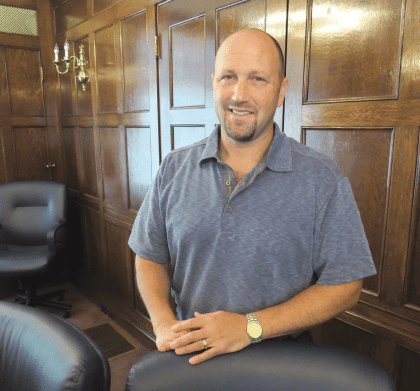
Joshua Weiss

Joshua Weiss says negotiation isn’t a lost art, but simply one that too many people haven’t taken the time and trouble to master.

Joshua Weiss was talking about the difference between being assertive and being aggressive.

And while doing so, he made it clear that, in the worlds of leadership and negotiation, these terms that appear to be synonymous are anything but.

“When you’re assertive, you’re standing on your own two feet, and when you’re aggressive, you’re standing on the other person’s toes, and people often don’t make that distinction,” said Weiss, co-founder of something called the Global Negotiation Initiative at the Program on Negotiation at Harvard Law School. He’s also an acclaimed author and consultant in the field who now has a new title on his business card, although they haven’t actually arrived from the printer yet.

Indeed, he is the director of Bay Path College’s newest program, the Master of Science in Leadership and Negotiation, or MSLN.

This fully online initiative is the first of its kind — in this country and probably on a global basis as well, said Weiss, adding quickly that understanding the difference between assertive and aggressive is just one of many things students will learn in this program, which will begin this fall.

They’ll also learn how to deal with the concept of power and how to wield it, understand how men and women approach leadership and negotiation differently, learn about the many psychological dimensions of leadership and negotiation, understand the role of emotions in these realms and how to control them, and grasp the importance of relationships and how they go on after the negotiations are over.

“Aggressive … that means I steamroll you to get to where I want to go,” Weiss explained, returning to his lesson in both vocabulary and effective management. “Being assertive means I explain clearly that ‘this is what I need, and I want to work with you, but I’m not going to accept anything that doesn’t fit into that.’

“You have to understand what you want to achieve, and assert for that,” he went on, “but also understand that the relationship is going to exist after this negotiation, and that there’s a way to go through negotiations so you don’t burn bridges — you don’t have to.”

As he talked about these concepts and others, Weiss said that negotiation certainly isn’t a lost art. But it is one that many people don’t make an effort to master. Elaborating, he said it’s a skill that many people will say they lack, for one reason or another, but don’t try to acquire, because they don’t believe they can or don’t believe they need it.

“A lot of people see negotiation as what the select few — the diplomat or the contract negotiator — would do,” he said. “There’s a sense that certain people negotiate and others don’t.”

These are flawed assumptions, he went on, adding that both leadership and negotiation can be taught and have been taught over the years, but not in a very comprehensive way — usually with a course or perhaps two, not with a degree program.

Such a higher level of instruction is necessary, he said, because advancing telecommunications technology and the emergence of flatter organizational structures in companies of all sizes means that more people will — or should be — called upon to provide leadership and negotiate, and they will have to do both in different ways and with a wider array of issues.

Indeed, while most think of negotiation in terms of mergers, acquisitions, and salary numbers — and those are still important parts of the equation — it now also involves such matters as flex time, working environments, and generational differences when it comes to the evolving world of work.

For example, while the conference-room table has long been the unofficial symbol of negotiation, people are now doing it with e-mail, text messages, and a host of other media, he said, adding that successfully leading, and dealing, through these platforms requires specific skills.

All these factors and others led Bay Path, with some strong encouragement from Weiss, to create the new program, which he believes will become attractive to both graduating seniors and those already in the workplace looking to advance, and who are seeking an alternative to the traditional MBA.

For this issue and its focus on education, BusinessWest talked at length with Weiss about negotiation, leadership, the new program, and why that acronym MSLN might soon become an important part of the regional business lexicon.

Courses of Action

It’s called the Abraham Path, or Abraham’s Path.

This is, as the name suggests, a walking trail across the Middle East that essentially follows the epic journey of Abraham, considered the world’s first pilgrim. It starts at his birthplace in Urfa in Turkey and ends at his burial cave in the Palestinian city of Hebron. Other stops include Nablus, Jericho, Jerusalem, and Bethlehem.

Weiss was part of the team that worked to create the path starting in 2003, and he called it a learning experience on a number of levels, and especially when it comes to negotiation.

“Right now, despite all the things that are going on in that region, there’s about 500 kilometers of path that have been mapped and are in use,” he explained. “Some people walk considerable distances, and others go for a day; there are many students and others who do community-service projects along the path, everything from helping with the olive harvest to painting a school — ways in which people can come to understand, and interact with, the region differently.

“Early on, my job was to go and negotiate with the governments and get their approval for this,” he went on. “There were negotiations all over the place, from the national governments down to the governors, mayors, to sitting in villages with families drinking goat’s yogurt and trying to persuade them that this was an interesting idea and that they should get involved.”

Weiss will take lessons from the Middle East, as well as others from countless businesses he’s consulted for, and try to impart them upon students who enroll in the MSLN.

This is an initiative that meets his desire to return to the classroom (he’s taught at Harvard and other schools) and direct a program, but that also meets what he considers a critical need — for employees who possess more and better leadership and negotiation skills.

“A lot of people tend to see negotiation as a skill that leaders need,” he explained. “I see it much differently; I believe negotiation is very much a mindset and how you approach issues and challenges that come up. Yes, leaders need to learn how to negotiate, but leadership today, from my perspective, requires a lot of different skills.

“You certainly still at times have the ability to coerce others, but leadership seems to rely more on persuasion and empowerment and on modeling the kind of behavior you’re looking for from your employees,” he continued. “So I see this degree as being good for both the student in terms of their own growth and ability and being able to move on from where they are to the next level, but also very valuable for an employer, because if I know I have someone who is very skilled in leadership and negotiation, I can hand that individual a project knowing that it requires the ability to lead, and when problems come up, he or she can negotiate their way through them; they’ve become a very valuable employee, and one that I don’t have to worry about.

“Leaders often micromanage because they worry and lack trust in people and their skill sets,” he went on. “With these skills, people will ultimately become real assets.”

Even better, he told BusinessWest, he believes these skills have a way of rubbing off on other people, meaning that effective leadership and negotiation can permeate a team or a company.

Talking the Talk

Returning to the subject of negotiation, Weiss said it has always been part of doing business — and life in general — but it is in some ways changing and evolving, and those who wish to advance their careers need to appreciate both its importance and many nuances.

“I tend to view negotiation in a very broad sense,” he explained. “To me, negotiation is ubiquitous; it’s something we deal with every day. So, in the workplace, it may be more formal negotiations where you’re talking about mergers and acquisitions or a job salary. Or it may be more informal things when you’re working on projects with employees and there’s a disagreement and you need to go back and forth and figure out how you’re going to work together in a different capacity.”

Elaborating, he said there isn’t necessarily more negotiating going on today, although one might be able to make that case. Instead, people are increasingly recognizing that negotiation is what they’re doing, and that they need to become better at it.

There have been some seminal moments that have helped manifest this mindset, he went on, citing, in particular, the publishing of Getting to Yes, authored by Roger Fischer and William Ury, in 1981.

“It’s been on the bestseller list ever since,” said Weiss, adding that the book and others that followed helped foster an understanding of the importance of negotiation. “If the average person had experience with negotiation, they thought about it in terms of buying a car or a home or something like that. This book changed all that and got people to realize that, first of all, a lot more of us are negotiating, and there’s a different way to negotiate, one that for a lot of people feels more comfortable.

“Part of the reason people don’t like to negotiate for things like cars is that they feel like the process itself centered around manipulation,” he said. “That’s one way of approaching negotiation, but there’s another way; for most of us, our negotiations are with people that we have to work with over time, and so that model of manipulating and distrust is a self-defeating way of negotiating.”

The model that was presented in Getting to Yes and has been built upon ever since is called ‘interest-based negotiation,” said Weiss, adding that, in simple terms, it involves creating scenarios where there is not a winner and a loser, but where both sides’ interests are respected and, by and large, met.

“When people started to realize that they were negotiating with someone they needed to work with over the long term, they understood that it would be better to build a relationship so that they meet the needs they have rather than trying to one-up each other,” he said, adding that, over the past several years, and especially since the recession broke out in 2008, businesses are embracing this concept.

While books like Getting to Yes have opened some eyes about the importance of negotiation, there have historically been only limited opportunities to learn about it in the classroom, said Weiss.

He noted that many law schools and business schools offer a course or two in the subjects of negotiation and leadership, and that in many instances, such offerings are required. But such courses provide only what Weiss called the basics. Bay Path’s new program amounts to what he called a “deep dive.”

The 36-credit program will be taught in eight-week blocks. Courses include “Leading and Negotiating in a Virtual and Multicultural World,” “Psychological Dimensions of Leadership and Negotiation,” “Gender, Leadership, and Negotiation,” and “Case Studies of Leadership and Negotiation.”

Weiss said there has been strong early interest in the program, and he expects to start with eight to 10 students in the fall and see that number rise as individuals, businesses, and nonprofit agencies realize the importance of leadership and negotiation to their success moving forward.

Bottom Line

As he talked about his program and its target audience, Weiss relayed the comments of a biotech engineer who has been kicking the tires on Bay Path’s new offering and leaning toward enrolling.

“She said, ‘I’ve been looking at MBA programs, but keep getting pulled back to yours because I don’t want budgets and finance and that kind of stuff,’” he noted. “She said, ‘where I am, technically I’m very good at what I do, but I’m in a mid-level position, and I know I’m capable of more than that. What’s holding me back is this ability to assert for myself and lead other people; I don’t know how to do that.’”

There are countless others who can say the same thing, and because they can, Bay Path’s program would appear to be the right offering at the right time.


George O’Brien can be reached at [email protected]

Daily News

LONGMEADOW — Dr. Robert Baevsky, chair of the Jewish Lifecare board of directors, announced that Susan Kline and Stephen Krevalin, longtime volunteers for the organization formerly known as Jewish Geriatric Services, are chairing Project Transformation: A New World of Care, a $9 million capital campaign in support of several projects that will transform elder-care services at Jewish Lifecare.

“Jewish Lifecare has always prided itself on being a progressive, forward-looking organization that continuously engages the ever-changing needs of the elderly,” said Baevsky. “Project Transformation: A New World of Care continues our journey of culture change and person-centered care, as we enhance, build, and expand services and facilities to improve health outcomes, and enhance resident dignity, independence, and quality of life.”

Both Kline and Krevalin are former chairs of the Jewish Lifecare board of directors. Kline served as chair from 2012 to 2014, during which time she led the strategic-planning process leading to Project Transformation. Krevalin served as chair from 1996 to 2000, and has served on or chaired numerous committees, including the 2012 Centennial Celebration. Both Kline and Krevalin also served on the rebranding committee, leading to the organization’s rebranding as Jewish Lifecare.

“For the past two years, it has been my privilege to chair the board of directors and help shape this transformational journey,” said Kline. “As we move away from traditional models of care and embrace the small-house model of care, we will not only improve the care provided, but also enhance the dignity of those living here. Small house combines the best of a home-like setting with skilled care, and gives elders the freedom to live life on their terms, rather than conform to the rhythms of the institution. It helps them thrive in comfortable spaces that feel like home.”

In addition to her Jewish Lifecare volunteerism, Kline has also long been associated with the Harold Grinspoon Foundation, currently overseeing all HGF programs and grants in Western Mass. Krevalin, a managing partner at Bacon Wilson, P.C., and his family have given back to the Jewish Lifecare community for generations. “Jewish Lifecare has a 102-year history of compassionate, caring, ever-growing services and facilities to best serve our residents, patients, and their families. Now, it’s time to reinvent ourselves once again,” he said. “It’s about a new philosophy, a new architecture, and a new look for the entire organization, ushering in a new world of quality care.”

The Project Transformation: A New World of Care campaign will support the construction of a state-of-the-art, 24-bed rehabilitation facility; renovations to the Leavitt Family Jewish Home in the small-house model of care; and other significant upgrades to the entire campus. Other funding sources will include an owner’s equity contribution and bank financing.

“For more than a century, we have been the proud caretakers of our local community,” said Martin Baicker, president and CEO of Jewish Lifecare. “From the very beginning, we have dedicated ourselves to delivering the very best elder care for everyone, regardless of religion or background. So, as we enter our second century, we are excited to introduce a new range of services and updates to serve our life-long commitment to our community.”

Jewish Lifecare has engaged the architectural firm of Perkins Eastman, as well as Jude Rabig, two of the foremost experts on culture change and small-house design in the U.S., to assist in the design of the upgrades and new facility. Groundbreaking for the new rehabilitation center is expected later this fall, with construction to be completed by the fall of 2015.

Commercial Real Estate Sections

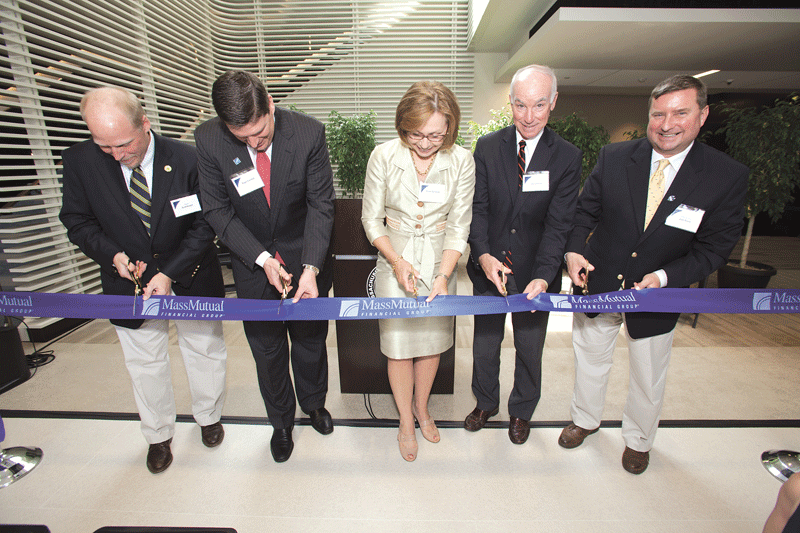
ENFIELD — MassMutual unveiled more than $38 million in renovations to its Bright Meadow campus, the primary location for the company’s retirement-services and workplace-insurance businesses, on June 17. The investment enhances the company’s overall infrastructure and positions MassMutual for future growth. It follows the company’s 2013 acquisition of the Hartford’s Retirement Plans division.

The renovations encompass approximately 15,000 square feet on the 66-acre, three-building site, and include infrastructure and technology improvements, a state-of-the-art data center, and enhancements to common areas. Several federal, state, and local officials and employees gathered to help MassMutual officially cut the ribbon on the revamped facility, as the 163-year-old company reasserted its commitment to driving economic growth in the state and the surrounding Enfield community.

“The significant improvements we have made to our Enfield campus reflect our efforts to position our integrated retirement business for continued success, as well as our broader commitment to invest in our facilities and our communities,” said Roger Crandall, chairman, president, and CEO of MassMutual. “We now have a world-class facility to accommodate the excellent growth potential of this business, and we look forward to delivering an outstanding service experience for our customers here for many years to come.”

The improvements in and around the building include:

• A state-of-the-art data center, the largest portion of the overall renovation project. The $23 million center will also deliver standby emergency power generation to most of the Enfield campus, thus enabling the facility to remain open in the event of a widespread power outage;

• The two-story lobby, which has been redesigned to prominently feature MassMutual branding, including the story of the company’s history and technology to create personalized greetings for special guests;

• A third-floor presentation room, created to welcome clients and visitors and demonstrate the company’s retirement-solution capabilities;

• A new innovative learning lab aimed at enhancing employee learning; and

• A redesigned visitors’ parking lot.

“Through the new construction and enhancements to our Enfield campus, we have created a dynamic and inviting work environment that fosters efficiency and productivity, and enables us to better provide our clients with the products and services they expect,” said Elaine Sarsynski, executive vice president of MassMutual’s Retirement Services division. “Our significant infrastructure investment also reaffirms MassMutual’s commitment to the state of Connecticut and to Enfield, a community we’ve been proud to be a part of for more than a decade.”

In addition to the new enhancements at its Enfield facility, MassMutual is also making infrastructure and workplace improvements to its Springfield campus. Between the two locations, the company is investing more than $85 million. MassMutual currently employs about 2,400 people in its Retirement Services division; more than 1,600 work at the Enfield campus. The company also currently has 200 employees with Cornerstone Real Estate Advisers LLC, a MassMutual subsidiary, in Hartford.

ENFIELD_exterior_JUNE2014
At left, MassMutual’s Bright Meadow facility, which recently underwent $38 million in renovations. Below, cutting the ceremonial ribbon are, from left, Enfield Mayor Scott Kaupin; Roger Crandall, chairman, president, and CEO of MassMutual; Elaine Sarsynski, executive vice president, MassMutual Retirement; Connecticut state Rep. Joe Courtney; and Connecticut state Sen. John Kissel. Below, left, Crandall addresses those gathered for the event. At bottom, the third-floor presentation room.

GuyPodiumRibbonBM3rdFloor01

Building Permits Departments

The following building permits were issued during the month of June 2014.

CHICOPEE

Elms College
291 Springfield St.
$150,000 — Replace existing showers in Rose Williams dormitory

MLRD
351 Front St.
$33,000 — Repair stucco facade

Pride
167 Chicopee St.
$410,000 — Renovate and expand existing store

LUDLOW

East Street Auto Service
575 East Street
$150,000 — Fire damage repair

NORTHAMPTON

Better Homes Properties, LLC
34 New South St.
$108,000 — Exterior repairs

James Lee
221 Main St.
$127,000 Interior renovation and new storefront construction

Paradise Realty Partners, LLC
766 North King St.
$190,000 — Convert two units to one doctor’s office

Smith College
2 Seelye Dr.
$398,000 — Construct handicap accessibility ramp

Smith College
22 Elm St.
$255,000 — Renovate second and third floors at Tryon Hall

Smith College
69 Paradise Road
$269,000 — Exterior renovations for The Quad

Smith College
79 Elm St.
$9,751,000 — Phase 2 of new construction

Smith College
102 Lower College Lane
$307,000 — Install replacement windows

PALMER

American Tower Corp.
400 Peterson Road
$17,500 — Change antenna on existing tower

Palmer Redevelopment, LLC
4 Springfield St.
$100,000 — Replace AC unit

Robert Rapisarda
1139 Thorndike St.
$27,000 — Install new windows

SOUTH HADLEY

Mount Holyoke College
550 College St.
$81,500 — New windows at Pearson Hall

Mount Holyoke College
57 College St.
$70,000 — New roof

South Hadley Housing Authority
643 Newton St.
$8,000 — Construct a handicap ramp

Wingate
573 Granby Road
$8,200 — Roof work

SPRINGFIELD

JoAnne Martinez
355 Belmont Ave.
$71,000 — Pharmacy going into supermarket

WMECO
300 Cadwell Dr.
$322,000 — Interior renovation

WESTFIELD

CPL, LLC
37 Feeding Hills Road
$373,000 — Interior renovations

Frank Demarinis
217 Root Road
$139,000 — Commercial addition

WEST SPRINGFIELD

Lindco
176 Wayside Ave.
$104,000 – Renovate 1,076 square feet of existing space

Raj Patel
560 Riverdale St.
$39,000 — Exterior renovations

Court Dockets Departments

The following is a compilation of recent lawsuits involving area businesses and organizations. These are strictly allegations that have yet to be proven in a court of law. Readers are advised to contact the parties listed, or the court, for more information concerning the individual claims.

CHICOPEE DISTRICT COURT
Severa Toledo v. Springfield Center Assoc., L.P., d/b/a Wendy’s Restaurant
Allegation: Negligent maintenance of property causing slip and fall: $4,086.30
Filed: 5/13/14

HAMPDEN SUPERIOR COURT
Anthony B. Choquette v. Merrimack Mutual Fire Insurance Co.
Allegation: Misrepresentation and breach of insurance contract: $60,000
Filed: 5/29/14

Lansal Inc. v. Mama Mae’s, LLC
Allegation: Breach of contract and failure to pay: $92,498.01
Filed: 5/16/14

Ronald and Linda Weston v. John Oakes and Farm Family Casualty Insurance
Allegation: Negligent misrepresentation by fraudulently concealing a reduction in coverage to the blind plaintiff: $182,000
Filed: 5/29/14

HAMPSHIRE SUPERIOR COURT
Mary Aubrey and Nancy Kent v. Breakaway Retail Enterprises Inc. d/b/a Manny’s
Allegation: Negligent installation of a dishwasher causing mold and rot damage: $60,000+
Filed: 4/15/14

Susan Amuso v. Interskate 91 Skating and Fun Center, Pyramid Mall of Hadley Inc.
Allegation: Negligent maintenance of property causing injury: $38,106
Filed: 4/18/14

Transborder Marketing Inc. v. Transborder Marketing S.P. Zoo
Allegation: Non-payment of loan: $250,000
Filed: 4/28/14

NORTHAMPTON DISTRICT COURT
Dennis K. Burke Inc. v. Thomas L. Engwer, III d/b/a Tom Engwer Trucking
Allegation: Non-payment of goods sold and delivered: $8,711.39
Filed: 4/21/14

Easthampton Savings Bank v. Etinde Painting and Dieudonne B. Etinde
Allegation: Non-payment of revolving line of credit: $11,588.52
Filed: 4/16/14

LexisNexis v. Kairos Capital, LLC
Allegation: Non-payment of subscription agreement: $5,888.87
Filed: 4/24/14

PALMER DISTRICT COURT
Helena Chemical Co. v. St. Clair Landscaping Inc.
Allegation: Non-payment of goods sold and delivered: $19,029.65
Filed: 5/13/14

SPRINGFIELD DISTRICT COURT
Comcast Spotlight Inc. v. Evolution Fitness, d/b/a Edward J. Mazzuchelli
Allegation: Non-payment of advertising services rendered: $7,279.06
Filed: 5/7/14

Doner House, LLC v. Caceras Ferez Gomez Realty, LLC
Allegation: Breach of commercial lease: $20,496.79
Filed: 5/7/14

Liberty Mutual Insurance Co. v. D. Porter Masonry Corp.
Allegation: Non-payment of workers’ compensation policy: $13,206.39
Filed: 4/22/14

Packaging Corp. of America v. Rosa’s Candies Inc.
Allegation: Breach of contract and monies owed: $3,686.12
Filed: 4/30/14

Departments Picture This

Send photos with a caption and contact information to: ‘Picture This’ c/o BusinessWest Magazine, 1441 Main Street, Springfield, MA 01103 or to [email protected]

Tolosky Center Unveiled
BaystateBuildingBaystateToloskyTo honor the leadership and achievements of President and CEO Mark Tolosky over his 22-year career, the Baystate Health board of trustees recently announced the naming of the Tolosky Center at 3300 Main St. in Springfield. The Tolosky Center, a regional destination for outpatient healthcare services, opened in 1998 and ignited the redevelopment of an underused former industrial area in Springfield’s North End. The area today comprises more than $200 million of Baystate Health investment and more than 455,000 square feet of space, including the Tolosky Center, the D’Amour Center for Cancer Care, the Baystate Children’s Specialty Center, the Baystate Breast and Wellness Center, and the Baystate Orthopedic Surgery Center, among other Baystate-owned and -occupied properties. Tolosky is transitioning out of his position as president and CEO on July 1, moving into a president emeritus role. He served Baystate Health and the community for 22 years, beginning in 1992 as executive vice president of Baystate Health and CEO of Baystate Medical Center. Above, Tolosky and his wife, Noreen DiPerri Tolosky, who is also a registered nurse, pose near the plaque placed in the lobby.


Afternoon at the Museum
FiledTrip

As part of its sponsorship of DeBerry Elementary School in Springfield in conjunction with Link to Libraries, BusinessWest arranged a field trip to the Springfield Museums on June 12 for a group of fourth-graders. The itinerary included the Mystery of the Missing Dinosaurs planetarium show, visits to the various museums, and lunch in the Dr. Seuss National Memorial Sculpture Garden. Here, students pose at the Horton statue.

Daily News

FLORENCE — Florence Savings Bank announced that Danielle Drapeau has joined the bank as a mortgage production officer. Drapeau brings more than 20 years of banking experience to her new role with FSB. Most recently, she was an underwriter-officer with United Bank, located in West Springfield. Her experience includes underwriting loans that include FHA, VA, Fannie Mae, and USDA Farmers Home. FSB President and CEO John Heaps Jr. said that “Danielle is a welcome addition to our team here at Florence Savings Bank. Her expertise will provide tremendous value to us and to the customers we serve.”

Daily News

PITTSFIELD — Berkshire Medical Center’s Breast Program has been granted a full, three-year accreditation designation by the National Accreditation Program for Breast Centers (NAPBC), a program administered by the American College of Surgeons. The BMC program was also cited by the NAPBC in four areas for ‘best practice’ designation.

Accreditation by the NAPBC is given only to those centers that have voluntarily committed to provide the highest level of quality breast care and that undergo a rigorous evaluation process and review of their performance. During the survey process, the center must demonstrate compliance with standards established by the NAPBC for treating women who are diagnosed with the full spectrum of breast disease. The standards include proficiency in center leadership, clinical management, research, community outreach, professional education, and quality improvement.

“A breast program that achieves NAPBC accreditation has demonstrated a firm commitment to offer its patients every significant advantage in their battle against breast disease,” according to the NAPBC, which also cited BMC’s Breast Program in four areas for providing ‘best practice’ services, including breast conservation, breast-cancer staging, pathology reports, and nursing. BMC’s work in those areas will be included in NAPBC’s national database of information that can be used by other programs to help meet NAPBC standards of care.

“This remarkable achievement is a testament to the dedication of our entire Breast Program team at BMC to provide our patients with the highest quality of care,” said Diane Kelly, the hospital’s chief operating officer. “It’s critically important that we provide these comprehensive breast care services, giving our community access to multi-disciplinary, state-of-the-art care, close to home.”

The NAPBC is a consortium of professional organizations dedicated to the improvement of the quality of care and monitoring of outcomes of patients with diseases of the breast. This mission is pursued through standard setting, scientific validation, and patient and professional education. Its board membership includes professionals from 20 national organizations that reflect the full spectrum of breast care. For more information, visit www.accreditedbreastcenters.org.

Daily News

BOSTON — UMass President Robert Caret commended the state House and Senate for approving a major funding increase for the UMass system, funding sufficient for a second consecutive tuition and mandatory-fee freeze for in-state undergraduate students.

“UMass is poised at the brink of a new era as a result of what would be an extraordinary, two-year, $100 million state investment in its future and in the futures of the tens of thousands of students who bring their aspirations and abilities to our campuses every year,” Caret said. “We are honored by this expression of support from the Legislature, particularly because the members of the House and Senate, given how in tune they are with their constituents, take this step because they recognize the vital role that UMass plays in every corner of the Commonwealth.”

Henry Thomas III, chairman of the UMass board of trustees, called the Legislature’s action “historic,” adding: “over the past two years, the University of Massachusetts has received one of the largest increases of any public university in the nation, and this provides opportunity for our students and a strong foundation for our Commonwealth’s future. In addition to thanking the Legislature and its leaders, I want to commend President Caret for his leadership and vision and note the key role the chancellors play in making this process work. We are here in part because we have demonstrated the significant steps the university has taken in the areas of efficiency, transparency, and accountability — and these steps have been championed by our leadership team at the system and campus levels.” He added, “this historic moment would not be occurring without the support of our governor, as Gov. Patrick has been our university’s staunch ally throughout his tenure in office, vividly understanding education’s transformative power.”

The fiscal year 2015 state budget approved by the House and Senate funds UMass at $519 million — a $40 million increase over FY 2014 and enough for the second tuition-and-fee freeze as envisioned under Caret’s 50-50 proposal. The state budget approved by the Legislature now goes to Patrick, who has 10 days to review it. Because the $40 million appropriation increase the university received in FY 2014 carried with it an additional $10 million in state fringe-benefit funding, UMass actually saw a $50 million hike in state funding during the year — a pattern that would be repeated in FY 2015 if funding for UMass remains at $519 million.

Advanced by Caret after he assumed the UMass presidency in July 2011, the 50-50 plan called for a two-year, $100 million increase in state funding for UMass, with the goals of strengthening the university overall and equalizing the amount of money students and the state provided for educational programs. UMass said it would freeze tuition and mandatory fees in each of the years it received full funding of the 50-50 program. UMass received the first year of 50-50 funding during 2013-14 and froze tuition and fees for in-state undergraduate students. Student charges vary from campus to campus, but under the rates recently approved by the UMass board of trustees, tuition and mandatory fees for in-state undergraduate students at UMass Amherst in 2014-15 will remain at $13,258. The cost of attending the university’s flagship campus with room and board factored in would be $24,215.

“College affordability is an issue that is on people’s minds in every corner of the Commonwealth,” Caret said. “Students and parents want to be sure that there is going to be an affordable, high-quality educational opportunity available for the young man or young woman who has worked hard and has achieved at the K through 12 level. And that is what is so important about the action the House and Senate has taken. The Legislature is saying that the Commonwealth of Massachusetts and the University of Massachusetts stand ready to be your partners in achievement. That is a critical message, and one that is being heard across the state.”