
Features

Supporting Cast

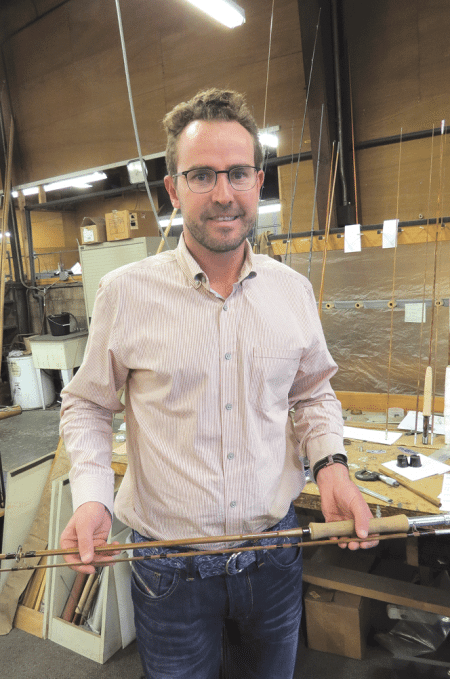
Neville Orsmond

Neville Orsmond

Neville Orsmond wasn’t thinking about buying the company when he walked into the Thomas & Thomas plant more than three years ago. But by the time he walked back out the door, he was, well, hooked — on the notion of preserving one of the fly-fishing industry’s most famous names, and also preserving what all those who partake in this pastime call a ‘lifestyle.’

When Prince Charles and Lady Diana tied the knot at that quaint ceremony in London back in 1981, President Ronald Reagan and his wife, Nancy, chose as a present for the couple a set of matching bamboo fly rods made by a tiny company in Greenfield called Thomas & Thomas.

As proof — not that anyone doubts him when he tells the story — Neville Orsmond points to a framed thank-you letter of sorts hanging on a wall just inside the main entrance to the company’s plant. Printed on official Buckingham Palace stationery, it reads, in part, “it would be difficult to find finer rods, and they are precisely what are needed for the conditions on Scottish Rivers.”

By that time, of course, the royals were just a few of the global celebrities casting their lot, figuratively but also quite literally, with that famous brand, considered the Rolls-Royce of what is now estimated to be a $10 billion industry. And they would be joined by many others over the ensuing decades.

The list includes Jack Lemmon, Eric Clapton, Ted Williams (a famous baseball player but perhaps an even more famous angler), Dale Earnhardt, Joe Montana (casting became the quarterback’s method of rehabbing an injured shoulder), Joan Lunden, James Seals (of Seals and Crofts fame), business mogul Nelson Peltz, and countless others.

But despite such an illustrious client list, Thomas & Thomas, launched in 1969 by brothers-in-law Thomas Dorsey and Thomas Maxwell, was, by 2013, nearly (if you’ll pardon the expression) dead in the water.

It was still producing fly rods, including the bamboo models that are perhaps its signature, and other products, but fewer of them. And the high standards of quality that had defined the company had fallen in most areas, including perhaps the most important — customer service.

Thomas & Thomas has been considered the Rolls-Royce of the industry

Since it was launched nearly 50 years ago, Thomas & Thomas has been considered the Rolls-Royce of the industry, with a premium on hand-craftsmanship.

Indeed, a cast of successor, mostly absentee owners — Maxwell left the company in the ’80s, and Dorsey sold it in the late ’90s — had failed to make needed investments in everything from branding to manufacturing equipment. And the results were crippling.

This was not exactly what Orsmond, a native of South Africa and serious fly-fishing enthusiast who had relocated to the U.S., was expecting to find when he ventured to the Greenfield plant in late 2013 to personally place an order for several rods. But he quickly became aware of what was happening with this company — or not, as the case may be.

“I heard the company was for sale, and it was in very bad shape,” he said with discernable understatement in his voice. “It was definitely going to go under, and it wasn’t going to be resurrected.”

But seven months and two lawyers later, he found himself the proud but certainly challenged new owner of the venture.


I’m just here to steer the company in the right way. At the end of the day, it’s all the great people we have working for us that make us successful. They get to make these rods every day, and it’s my job to go show them off to everyone and get people excited to buy them.”


He assumed the title of CEO and its responsibilities, he told BusinessWest, because he wanted to quench some entrepreneurial thirst, but, more importantly, he didn’t want to see the iconic brand vanish from the landscape.

“I didn’t want to let that happen,” he said, adding that, while there is still considerable work to do, the ship has been righted, and the brand has been re-energized, as evidenced by the current seven-month waiting time for a bamboo rod.

When asked how the turnaround came about, he stated simply, “by listening to the right people about what they need in a rod and how we can meet those needs.”

Elaborating, Orsmond said that, soon after taking the helm, he came to understand that his assignment had two main thrusts — “internal and external,” as he put it.

The former involved infusing capital, generating enthusiasm, setting ambitious goals, and creating an environment in which they could be reached. The latter centered around aggressive branding, and, in the simplist of terms, letting the world know that the Thomas & Thomas brand is alive, well, and bound for some serious growth.

And when Orsmond says ‘the world,’ he means it. He’s been traveling to virtually every corner of it over the past few years, promoting his products and the sport of fly fishing, while also making time for what he called a lifelong passion.

And as he talked about those travels and the fishing he’s done during them, he dove for his phone and quickly flipped to pictures of a giant trevally (this one four feet long) he caught earlier this month in Dubai.

The enthusiasm with which he did so spoke volumes about the sport itself, but also why Orsmond is now signing the paychecks at Thomas & Thomas, why there is that wait time for an order, and why optimism abounds at the company.

For this issue, BusinessWest explains how this optimism came to be, and why the future of this brand looks exceedingly bright.

Stream of Consciousness

When talking about where they fish — or, especially, where they landed that huge brook trout — anglers are famous for using purposefully, if not hopelessly, vague language.

The reason is obvious; they don’t want to let the world, or even a few people, know the location of their favorite — and most fruitful — spots.

Orsmond adopts a somewhat similar tack when talking about his company’s products and how they are made.

Indeed, when asked about what goes into manufacturing the rods and what separates them from competitors’ offerings, he talked of “materials” — bamboo, fiberglass, and carbon fiber are the main ingredients — and “techniques,” and was rather stingy with details.

“We have a bunch of secret methods for making these rods, and techniques,” he explained — sort of. “It’s all in the design … and how the rod bends.”

He was far more willing to discuss the philosophy behind the company’s production methods, and the difficulty competitors have with replicating the results, even if they have a Thomas & Thomas rod in their hands as a guide.

“Good luck to anyone trying to reverse-engineer this,” he told BusinessWest, adding that, while there is, indeed, some engineering involved here, rod making and creating the requisite blend of beauty, strength, and balance is as much art and instinct as it is science.
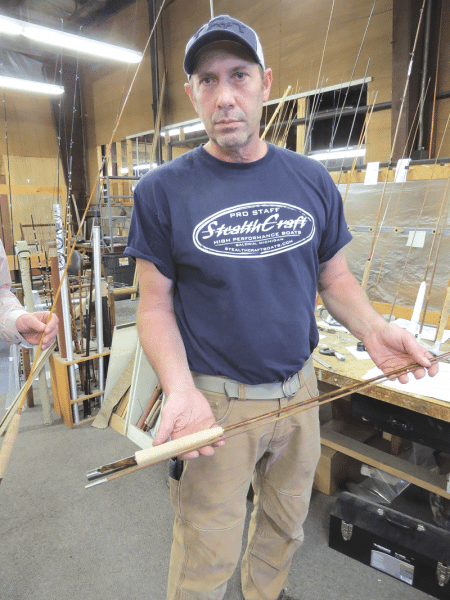
Troy Jacques plies his craft in the bamboo room

Troy Jacques plies his craft in the bamboo room. He’s been making rods there for more than 20 years.

To best explain what he meant by that, he rose from his chair, walked to the back of his office, picked up a metal tube, and very carefully extracted what might best be described as his pride and joy — or at least one of them, anyway.

What slowly emerged was a seven-foot-long, ‘four-weight,’ one-piece bamboo rod made by Thomas Dorsey more than 30 years ago. Now considered an antique that would easily fetch well north of $10,000 if he were to sell it (don’t get any ideas; that is not going to happen), it represents perhaps the essence, and the epitome, of fine rod making, he explained.

“This is a really unbelievable fly rod,” he said while admiring it — again. “It’s very, very difficult to make a one-piece — there just aren’t many people in the world who can do it; everything is hand-made.”

While that rod is indeed rare, the same focus on quality, and the same attention to detail that spawned it, goes into everything that is shipped out the door and to addresses on every continent, Orsmond explained.

While dozens, if not hundreds, of companies make fly rods, he noted, Thomas & Thomas stands out for its handcrafted quality and one-at-a-time approach to production, something he compared to the legendary London-based gun maker Holland & Holland.

And it’s been this way since Thomas Dorsey and Thomas Maxwell, frustrated that they couldn’t find what they wanted in a fly rod on the market, decided to make their own.

They started in Maryland, but soon moved the operation to Franklin County — somewhat out of necessity. The story goes that a rod-making outfit in the Greenfield area went out of business, and the two Thomases bought the equipment. They found the prospect of bringing the machinery home too expensive and logistically difficult, so, instead, they moved their families and their enterprise north.

In little more than a decade, the company had made such a name for itself that the Reagans, or at least the person they charged with finding a wedding gift for the royals, made a call to Greenfield. (Reagan was so enamored of the Thomas & Thomas rods that he also gave one to Australian Prime Minister Malcom Fraser when was he was visiting the White House; legend has it, says Orsmond, that he was having so much fun casting with it on the South Lawn that he was late for an important meeting.)

But by 2008, a combination of factors, especially the Great Recession and its impact on discretionary spending (and a $1,000 fly rod would certainly fit that description) and largely absentee ownership put the company in dangerous whitewater.

Fast-forwarding through what he called the dark times for the company — he wasn’t there for them, and he didn’t care to dwell on them — Orsmond said Thomas & Thomas didn’t exactly lose its way. Rather, it simply lacked the resources and leadership needed to continue doing business as it had historically.

Orsmond, who was living in New York at the time, working for a company that provided automated parking-garage systems, and “fly fishing every weekend,” wasn’t thinking about orchestrating a return to the glory days when he walked into the company’s plant that day more than three years ago. But he waded in with purpose (another industry term), and has never looked back.

Current Events

Returning to those internal and external components of his broad assignment to rejuvenate the company, Orsmond said his job has been to simply pilot the boat, if you will, keep it on course, and let the talented rod makers, some of whom have been plying their trade there for nearly 30 years, do what they do.

“I’m just here to steer the company in the right way,” he explained. “At the end of the day, it’s all the great people we have working for us that make us successful. They get to make these rods every day, and it’s my job to go show them off to everyone and get people excited to buy them.”

Elaborating, though, he said there really has been nothing simple about the resuscitation process, and it is very much still ongoing.

“The external side of this took a lot longer because people needed to believe in this brand again,” he explained. “They needed to understand what we were doing and see what was happening.”

The internal part of the assignment was somewhat easier but still challenging, he went on, because employees needed more than words — they’d heard plenty of those over the years — to regain a sense of confidence and optimism in the brand moving forward.

“They had been let down by all the previous owners going back 10 years,” he noted. “It took a lot of capital investment and a lot of time; there hadn’t been an owner here in a decade to make decisions, speak to our customers, and fully understand who were are.”

Neville Orsmond, seen here with the giant trevally

Neville Orsmond, seen here with the giant trevally he hooked in Dubai, says confidence in the Thomas & Thomas name has been restored.

Much of this hard work has been accomplished, he went on, adding that the task ahead lies mainly in aggressive branding efforts aimed at introducing both the sport and the Thomas & Thomas name to people of all ages, but especially younger audiences, and continuing that process he described earlier of listening to the right people.

This would be customers, many of whom are serious about their fly fishing, and also a core of advisers who rank among the most famous fly-fishing enthusiasts in the world. People like Jako Lucas, from South Africa, an international fly-fishing guide who takes clients to locations ranging from Norway to Mongolia. And Canadian Rebekka Redd, an international fly fisher, TV host, photographer, and author.

“My theory about all this centers on listening to the fly fisherman in the stream,” said Orsmond. “The guy who’s using our rods, the one who’s so proud to hold one and fish with it. We have to listen to him and give him the best product we can every day.”

Looking down the road, or downstream, as the case may be, Orsmond said the company will never be among the giant players in this industry like Orvis, Sage, Winston, and others. But it can grow its share of the market, and he’s intent on doing so.

The company currently manufactures about 3,500 rods per year, and he predicts it can get to perhaps 15,000 in four or five years — and without sacrificing anything of its trademark quality.

“I think we can get a lot bigger; the thing is, though, you don’t want to grow things that quickly. You want to do it slowly but surely,” he said, borrowing the basic philosophy behind the company’s manufacturing techniques he mentioned earlier. “If we grow things out of proportion, we’ll find ourselves with a different set of problems.

“We want to take small steps, and the right steps, to get there,” he went on. “And the steps we’ve taken already show we’re going in the right direction. It’s all from the feedback we’re getting — one e-mail at a time, one fly rod at a time. It’s about making the right decisions and believing in our core values.”

Getting Hooked

Orsmond’s spacious office on the second floor of the non-descript building on Barton Road tells a good deal of the Thomas & Thomas story all by itself. Well, the wall art does, actually.

There are no mounted trophies here, and serious practitioners of fly fishing know why. “We don’t kill fish — we catch and release,” said Orsmond, using ‘we’ to mean himself and most all other enthusiasts.

There are, however, pictures of fish that have been caught and then released, including one of another giant trevally, this one landed by Orsmond in the Seychelles, an archipelago in the Indian Ocean. There are also some prized flies mounted within a frame, as well as a picture of Thomas Dorsey.

And then, there are two powerful pictures, on facing walls, which are simply portraits, if you will, of hands doing close work, presumably involved with making fly rods.

Collectively, this art speaks to what the company does, how it does it, and the lifestyle it is trying to preserve for future generations.

That’s a word Orsmond chose carefully and would use more than a few times in the course of this interview.

“This is not a sport, it’s a lifestyle,” he said of fly fishing before using one of many versions of a phrase used to drive home the point that one doesn’t actually have to catch any fish to enjoy this activity. “The beauty of it is why it’s such a perfect lifestyle; you’re always in a beautiful place fishing — there’s never an ugly place.

“Those who fly fish are responsible — they take care of the Earth,” he went on. “They like to spend their time outside; that’s who they are.”

He could have said more, but he decided to let Thomas Dorsey do some talking — at least through a promotional video the company uses (Thomas is mostly retired and was not available for this article).

And talk he did, about fly fishing — “I’ve always looked at it as an excuse to be in a beautiful place” — and about the art of making rods from bamboo. “It’s nothing really special until it’s made into something,” he said of that wood imported from China. “Any bamboo-rod maker does what he does out of passion.”

A strong desire to continue use of the present tense for such comments is the overriding reason why Orsmond said he bought the company. And he believes he and his team are no longer (to borrow yet another industry term) swimming upstream.

As evidence of this, he concluded his tour of the plant in what’s called the ‘bamboo room,’ and for obvious reasons.

There, Troy Jacques, who has been fashioning rods for more than 20 years, had work to keep him busy until well into next year.

He stopped just long enough to explain the long, slow, difficult process of gluing six slender slices of bamboo together to form the pieces for a bamboo rod.

Each rod takes roughly 60 hours to make, he noted, adding that he’s working on several at a time. There are some of what would be called standard production models, but most rods that go out the door are personalized in some way.

“A lot of customers like to add a little flair to the rod they’re buying,” he explained, such as the 10 he’s working on for one company that will bear the firm’s seal and customized components.

It is this craftsmanship and attention to detail that has set the company apart over the decades, said Orsmond, and these are still the defining qualities.

“We like to say that ours is the ‘rod you’ll eventually own’ — that’s our slogan,” he told BusinessWest. “By the time you’ve bought everyone else’s rod, you’ll say, ‘I really want a Thomas & Thomas.’”

This was true 47 years ago, and thanks to his efforts and those of a large supporting cast, in every sense of that phrase, it is true again.

The goal is to make ‘eventually’ come soon.

exocetrod

The Finish Line

Orsmond says, as one might expect, that one-piece bamboo rod he proudly displayed doesn’t exactly travel well. In fact, that’s how he came to possess it; the previous owner was frustrated with its lack of portability.

Therefore, he limits its use to local ponds and steams — anything he can drive to. Which means there’s not much of a limitation.

“We have all these great trout steams around us — the Deerfield River, the Swift River, and many more,” he explained. “So I can put it in the back of the car and go fish; I don’t have to go far at all.”

Such comments explain why Orsmond classifies his efforts as not merely those to preserve and grow a brand. Rather, they’re about preserving and maybe even enhancing that lifestyle he and others believe is endangered.

“We support the people who have the same beliefs that we do,” he explained, referring to organizations like Trout Unlimited and Jackson Hole One Fly, groups working for the benefit of fish and their habitats. “We don’t have much left … our grandchildren may not be able to fly fish for trout if we keep going the way we’re going.”

Such efforts constitute difficult work, especially given current trends and environmental concerns, but it’s certainly easier when there is passion involved.

That’s the word that has best defined Thomas & Thomas from the beginning, and Orsmond isn’t about to let that disappear from the landscape either.

George O’Brien can be reached at [email protected]

Daily News

HOLYOKE — The Greater Chicopee, Greater Holyoke, Greater Westfield, Greater Easthampton, West of the River, and South Hadley & Granby chambers of commerce have joined forces to present Checkpoint 2016, a legislative symposium on Thursday, Nov. 10. The keynote speaker for this regional event will be Lt. Gov. Karyn Polito.

Lunch and the keynote speaker will be followed by a panel discussion with local legislators, including state Sen. Donald Humason Jr. and state Reps. Joseph Wagner, Aaron Vega, John Scibak, John Velis, Carlos Gonzalez, Jose Tosado, and Nick Boldyga. The panel will be moderated by Anthony Cignoli, president of A.L. Cignoli Co.

The event will take place at the Log Cabin Banquet and Meeting House in Holyoke. Registration and networking begin at 11 a.m., with lunch from 11:45 a.m. to 1 p.m. The panel discussion, with questions from the audience, will take place from 1:15 to 2:30 p.m. Reservations are required. Tickets cost $45 per person for chamber members and $55 for non-members.

For more information or to register, visit the website of one of the participating chambers and look for ‘upcoming events.’ Questions should be directed to event coordinator Lynn Morrissette at the Greater Chicopee Chamber at (413) 594-2101.

Current sponsors include CHD Cancer House of Hope, Dowd Insurance Agency, Easthampton Savings Bank, Freedom Credit Union, Holyoke Medical Center, Health New England, Mestek Inc., PeoplesBank, People’s United Bank, Westfield Bank, and Westmass Area Development Corp./Westover Metropolitan Development Corp.

Daily News

SPRINGFIELD — In honor of Veterans Day, the Springfield Museums is offering free general admission to veterans and active-duty military on Friday, Nov. 11.

At the time of entry, visitors who show a military ID documenting that they are active duty, retired, or reserve from Army, Navy, Air Force, Marines, Coast Guard, or National Guard will receive free general admission to all four museums. Veterans who left military service before retirement can bring a copy of their honorable-discharge paperwork (DD Form 214). Extra fees for special programs like planetarium shows may apply.

Daily News

WEST SPRINGFIELD — Market Mentors, LLC, a full-service marketing firm in West Springfield, partnered with several local businesses for the fourth annual Pink Day celebration in October to benefit Baystate Health Foundation Rays of Hope.

A total of $8,000 was raised to present to the foundation, a nonprofit charitable organization that supports humanitarian efforts at Baystate Health’s hospitals and ancillary services. Many local businesses and organizations joined Market Mentors in supporting the Rays of Hope by hosting a Pink Day, where corporate or personal donations were made to Rays of Hope and participants wore pink to work in an effort to raise awareness for the cause. The theme for this year’s event, held Friday, Oct. 28, was “Think Pink.”

“Our clients understand the worth of corporate social-responsibility initiatives and the impact it has on the local business atmosphere,” said Market Mentors President Michelle Abdow. “Several participants have celebrated Pink Day with us in the past, and we are very excited about the newcomers. Thanks to their considerable efforts, we exceeded our goal of raising $7,500 for Rays of Hope and have been able to donate $22,000 throughout the past four years.”

Participating organizations included 94.7 WMAS; Aaron Smith, P.C.; Advanced Vein Care Center; Aesthetic Plastic & Reconstructive Surgery, P.C.; Andy’s & the Oak Shoppe; Baystate Rug & Flooring; Braman Termite and Pest Elimination; Boilard Lumber; Collins Pipe & Supply Co. Inc.; Epstein Financial Services; Excel Dryer Inc.; FLN-MAR Rubber & Plastics; Hampden Zimmerman Electric Supply Co.; iCircle Technologies; Keith G. Roy Construction; Market Mentors, LLC; MassLive; New England Dermatology and Laser Center, the Spa; New York Sound and Motion; Noonan Energy Corp.; Ondrick Natural Earth; Robinson Donovan, P.C.; Shatz, Schwartz and Fentin, P.C.; Skoler, Abbott & Presser, P.C.; the Bridge Home; Dowd Insurance Agencies; and Women’s Health Associates.

“We are proud to be able to continue our Pink Day tradition here at Market Mentors,” said Director of Account Services Amanda Moyer. “This worthy cause not only raises money for awareness, but also for the important breast-cancer research dollars, and we look forward to carrying on the tradition for years to come.”

Rays of Hope is a philanthropic initiative that was launched in 1994 to support the Baystate Health Foundation and community programs throughout Western Mass., and includes an annual walk and run, as well as Pink Day celebrations. This year’s walk and run took place Oct. 30 at Forest Park in Springfield.

Building Permits Departments

The following business permits were issued during the months of September and October 2016.

Agawam

Tolli’s Pizza
4 Southwick St.
$1,000 — Dividing wall for seating

Berkshiretown

SBA Communications
75 Kimball St.
$15,000 — Swap three existing cellular antennas with three newer-technology cellular antennas and associated equipment

Chicopee

Leonard E. Belcher Inc.
95 West St.
$6,866.50 — Replace storefront

Elms College
291 Springfield St.
$79,400 — Strip and reroof at Berchmans Hall

El Ro Realty LLP
2053 Memorial Dr.
$22,000 — Install fire-alarm system for 24-unit apartment building

El Ro Realty LLP
510 McKinstry Ave.
$22,000 — Install fire-alarm system for 24-unit apartment building

Greenfield

Center for Human Development
148 Montague City Road
$3,000 — Construct 16-by-16-foot platform anchored to ground

Bryan G. Hobbs
576 Leyden St.
$2,778.66 — Insulate and weatherize

Hobo Enterprises LLC
8-16 Federal St.
$10,000 — Extend bathroom to make ADA-compliant, change second bathroom into utility room with mop sink

Hope & Olive LLC
44 Hope St.
$39,000 — Reframe service window wall to eliminate bump, prep for new hood ventilation, new ceiling tiles, new FRP wall covering

Hadley

CBR Realty Corp.
195 Russell St.
$24,100 — Build new walls, interior non-structural, to create more office and patient exam rooms

Walter M. and Shirley H. Basara
3 Railroad St.
$4,800 — Build a small gable roof over entryway door

Longmeadow

GPT Longmeadow LLC
Bliss Road
$70,430 — Complete interior finishes for newly built Verizon store

Springfield

Baystate Medical Center Inc.
3601 Main St.
$967,970 — New elevator and interior fitout on third floor

Center for Human Development
332 Birnie Ave.
$6,860 — Modification of office partitions on second floor

Derf Realty Corp.
170 Carando Dr.
$350,000 — Installation of rooftop solar system on existing building

Derf Realty Corp.
190 Carando Dr.
$275,000 — Installation of rooftop solar system on existing building

The Dolben Co.
10 Chestnut St.
$7,311 — Reroof balcony on lower roof at Chestnut Park Towers

Eastman Chemical
730 Worcester St.
$2,024,500 — Installation of racking for new solar PV system

Jewish Community Center
1160 Dickinson St.
$24,850 — Roofing and insulation

McDonald Corp.
660 Liberty St.
$385,000 — Interior and exterior remodel, add second drive-thru lane, lot repairs, sidewalks, make restroom ADA-compliant

Pioneer Valley Christian Academy
965 Plumtree Road
$120,000 — Renovations of kindergarten toilets, counseling offices, and headmaster suite

Roman Catholic Diocese of Springfield
99 Wendover Road
$41,950,181 — Construct new high school and support facilities

SIS Center Inc.
1441 Main St.
$20,000 — Redivide tenant space on first floor

Springfield College
263 Alden St.
$15 million — New interior finishes, new concrete, new structural steel at stairway, new storefront system and windows

Columns Sections

Entrepreneurship

By Melyssa Brown

Melyssa Brown

Melyssa Brown

More than 627,000 new businesses open each year, according to the Small Business Administration, and entrepreneurship is a hot topic, especially here in the Pioneer Valley.

Local colleges have created centers and degrees around entrepreneurship, and organizations have been created to help startup companies prosper through coaching and education.

Whether you call yourself an entrepreneur or not, starting a business can be a significant challenge. Having an idea that inspires you is a good place to start. Once you have that, your passion for the business or its purpose is the most important factor to keep you pushing through the inevitable challenges and decisions that are ahead and are inherent to starting a business. The following helpful tips and guidance will provide resources to get you started down the right path.

The Business Plan

A business plan is a sales tool that should be considered as a first step in any business creation. It will help you raise money, get partners, and, most importantly, get people interested in your business.

Start by creating a document that describes your business inside and out. Describe your product or service. Your product description should take 30 seconds or less to explain. It should be simple and straightforward so that other people (even children) can understand and repeat it back to you. Lengthy or overly detailed pitches, while seemingly chock-full of great information, can actually be counterproductive and aren’t usually as effective at getting the attention of your audience.

Describe the product’s unique value proposition. What advantage does your product offer that no one else does? How is it different from other businesses? Also, describe the market opportunity by answering the following questions: how large is the market? How many total dollars are spent on similar products? How fast is the market growing? Who is your competition? Always remember to state who your customers are. Next, describe how you plan to generate revenue and sell your product or service.

Your customer may want the product or service, but who is actually paying for it? Is the customer paying subscriptions, or are you generating revenue via advertising from other businesses? Next, describe the business strategy or long-term vision. Where do you see the business in three, six, nine, and 12 months, and then in five to 10 years? Think of key metrics and set smart goals to help get you there and monitor your progress.

Describe who the management team will consist of to help you achieve the business strategy. You want qualified employees with relevant experiences to fill the needs of the business. Beware of simply bringing on friends and family — always ensure your team members understand your mission and objective, and not just their relationship with you personally.

A business plan should include projected financial information for the next three years. Explain the basic assumptions and key drivers behind your financial model. Revenue assumptions consist of the number of customers and how much will be charged for the product or service. Startup expenses may include lease/rent expense, building improvements (if needed), equipment, labor, supplies, and utilities.

There are certain costs when you start a business, and there is no negotiating some of it, such as safety precautions, filing fees, and fees for permits and licenses. However, you may be surprised by how many expenses you can cut or at least postpone — for example, using pre-owned equipment until you are making some sales.

Financial projections help determine how much outside financing you need to obtain. There are several financing options, including starting your business on the side while continuing to work full-time, working a part-time job until your business becomes established, waiting to start your business until you have saved up a financial reserve, and borrowing or raising funds, if necessary.

You may already be using the friends-and-family funding technique. Make it clear to them that the money is intended as risk capital, and they might lose it completely, or it may not be returned in the short term.

Technology has made asking the general public for donations and monetary support for a business commonplace. Crowdfunding is a form of finance that does not require repayment, and it will help you not only gauge interest in what you have to offer, but also help you build a customer base. Many times, the startup business will provide perks, such as free products or discounts, as a thank-you for the donations. Also, small-business grants are available from a number of resources, including state governments and private groups.

Although the grant-application process can be time-consuming, it is well worth it if you win the award. Also, even locally in the Pioneer Valley, there are investors and venture capitalists who are willing to fund a promising, high-risk startup business in exchange for a share of the business. They often bring experience, management expertise, and contacts to the table.

Prepare a business-plan deck to pitch to investors and venture capitalists. Create a PowerPoint presentation that addresses each of the major items in your business plan. Each item should have its own slide, and the presentation should be no longer than 15 slides. Begin with a high-level concept and brief, ‘grabby’ statement that sticks in the mind and most importantly tells a story.

Consider including a video of what the product or service does and how it interacts with customers. Investors and venture capitalists will want a preliminary valuation of the company. The valuation helps determine what share of the business you are giving up for what value. It can be a calculation of the future revenue (net earnings) of the business which then uses a discount factor to value it in today’s dollars. No matter which source you raise funds from, be sure to provide key operating, strategic, and accounting information to your financiers periodically.

Business Structure

The business structure can be impacted by your sources of financing. You can change the structure as the financing and business needs change. There are a few options to choose from, including sole proprietorships, general partnerships, limited-liability companies, C-corporations, and S-corporations, as detailed below.

• A sole proprietorship has no legal distinction between the owner and the business. It is a business of one person such as a lawyer, plumber, etc. There are minimal requirements, such as a business license.

• A general partnership is a joint business where the profit and debt are shared by general partners. A partnership agreement is created to dictate how the profit and debt are shared. For both sole proprietors and general partnerships, the business owner has primary personal liability.

• In a limited-liability company (LLC), owners are not personally liable for the debts of the business. LLCs are easy to use, have low setup fees, provide protection of the corporate veil, and are a pass-through tax entity.

• C-corporations are taxed separately from owners, the shareholders own stock in the business, and they require a board of directors who are hired by shareholders and are responsible for the business. C-corporations are perceived as providing the most protection between personal and corporate assets.  However, they may have double taxation upon the sale. Your salary is taxed at your personal rate, and business earnings are taxed at the corporate rate.

• In S-corporations, the business pays no federal taxes, and profit and losses are divided among the shareholders to be taxed at their personal rate. The number of shareholders is limited. Work with your accountant and lawyer to determine the best structure for your business.

Business Name

Determining the business name can be the most important and potentially challenging step. The right business name will help distinguish you from a sea of competitors, provide your customers with a reason to hire you, and aid in the branding of your company. Your name projects your image, brand, and position in the marketplace, so consider your mission statement, your business plan, and your unique selling proposition, and don’t forget to think about your target audience.

The more ideas you generate, the more possibilities you will have to choose from. You may want to conduct a series of brainstorming sessions or use a free business-name generator, such as Biznamewiz, Name Thingy, or Naming.net. Avoid wordplay dangers, and if you want a local name, add it to your marketing materials, such as “exclusively serving the (town) area.” Lastly, put your business name through the spelling test and ask others to spell it.

Once you have chosen a name for your business, you will need to check if it’s trademarked or currently in use. Search the federal database of the U.S. Patent and Trademark Office. You should also run a series of searches with Google and other search engines for your desired business name to make sure there isn’t another company already using your name. Then, you will need to register it with your county or state office. Also, don’t forget to register your domain name once you have selected your business name. Your website address should be the same as your business name.

Licenses and Permits

For a list of licenses and permits, go to the Small Business Administration (SBA) website. The SBA has compiled state-by-state information on small-business registration and license and permit information. Also, obtain a tax/employer identification number from the IRS.

Accounting System

An accounting system is necessary in order to create and manage your budget, track your actual results, set your rates, conduct business with others, and file your taxes. You can set up your accounting system yourself or hire an accountant to take away some of the guesswork. This should include opening a business checking account. Also, understand employer regulations such as new-hire reporting, employer corporate and payroll tax responsibilities, minimum-wage laws, workers’ comp, unemployment insurance, and health-insurance laws.

Lastly, get training and have a support network, which may include family, friends, colleagues, a mentor, a coach, and anyone else who can help you navigate roadblocks and be a successful entrepreneur. When you have an effective support system in place, you will find that you have a cheerleader, consultant, moral support, and even a devil’s advocate when necessary. Continually review and update your business plan and question its key assumptions by using a SWOT (strengths, weaknesses, opportunities, and threats) analysis of the business.

Melyssa Brown, CPA is a senior manager with the Holyoke-based public accounting firm Meyers Brothers Kalicka, P.C.; (413) 322-3484; [email protected]

Health Care Sections

Smart Shopping

Paula Serafino-Cross

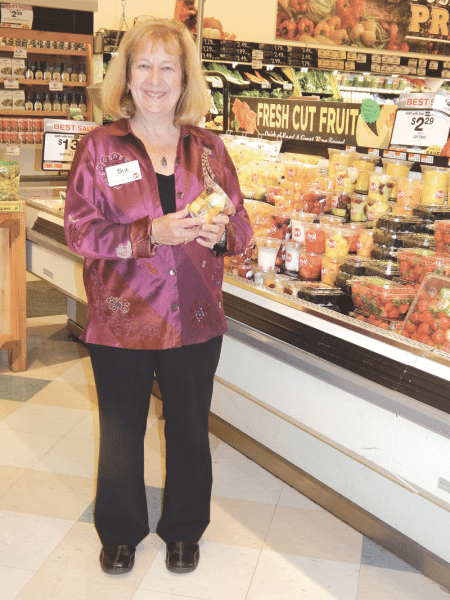
Paula Serafino-Cross says canned fruit packed in its own juice or pre-cut fruit are healthy snacks that many children enjoy.

What people eat can have a profound impact on their health, energy level, the way they feel, and their overall well-being.

But it all begins at the grocery store, where a myriad of temptations can lead shoppers to put foods in their cart that have little or no nutritional value.

“We live in a fast-paced society and eat in response to the visual, or what looks good to us. But if you want to be healthy, you have to prioritize, take time to plan meals, stick to a grocery list, avoid shopping when you’re hungry, and cook using a lot of vegetables,” said Paula Serafino-Cross, a clinical dietitian from Baystate Health Food and Nutrition Services. She added that cooking in today’s world does not have to be time-consuming, thanks to precut fruits and vegetables and products like frozen brown rice.

However, she suggests keeping granola bars or fruit in the car that can be eaten quickly to prevent going into a store hungry or stopping for fast food.

“There is a lot of great food in stores. You just have to figure out where it’s located,” she noted.

Susan Mazrolle agrees. “I’ve given tours to groups of medical students who were well-educated but didn’t know much about buying food and cooking it,” said the in-store consultant dietitian for Big Y in the Springfield region.

She noted that many people are frugal at the grocery store but extravagant in other areas that are not important. “It’s better to spend your money on healthy food than at the doctor’s office. There are good and bad choices throughout the store; healthy shopping doesn’t have to cost a lot, but you have to know what to buy.”

Theresa McAndrew, a Unidine dietitian at Holyoke Medical Center, agrees. She has spoken to many people who have told her they don’t know how to shop well. She tells them not only to read labels, but to pay attention to portion size, as it can be deceiving.

Indeed, Americans have super-sized their expectations about what a serving should look like, and the amount most consider to be normal is not accurately reflected on the Nutrition Facts labeling on packaged foods and beverages.

To correct that problem, the Food and Drug Administration has issued new standards that must be implemented by July 2018. The goal is to bring serving sizes closer to what people actually eat, so when they look at calories and nutrients on a label, it is be more in line with what they are accustomed to putting on their plate. A single serving is not a recommended amount of any food product, but only meant to reflect what the average person consumes.

For example, few people limit themselves to a half-cup of ice cream, which is the amount listed on half-gallons today, so when the new law becomes effective, the serving size will go up to two-thirds of a cup.

“People sometimes buy products based on calorie count, but then consume far more than one serving,” McAndrew noted.

Susan Mazrolle

Susan Mazrolle says many people don’t stop to think about how the food they eat can impact their health.

Other factors that can be confusing include sugar content. There is a difference between natural sugars, which are found not only in fruits, but in products such as milk and plain yogurt, and artificial sugars that are often added to products. The new labeling standards will differentiate between the two types of sugar, which is important in terms of health.

People also make choices based on price, which can work well if you know what to buy, but work against you if you don’t. For example, dietitians say Ramen Noodles are a poor choice because the product is filled with salt and saturated fat, while Annie’s Macaroni & Cheese is a better choice as it doesn’t contain artificial colors or flavors, and adding a few vegetables can bump up its nutritional value.

They know it can be difficult to avoid a buy-one, get-two-free sale, which is an excellent choice if the product is frozen vegetables, but a poor one if it’s ice cream.

“Do you really need three half-gallons calling your name?” Serafino-Cross asked, noting that people who have a difficult time with portion control can still enjoy treats in pre-measured sizes, such Diana Banana Babies, which are frozen bananas dipped in chocolate, or individual Hoodsie cups, which are better than a heaping dish of ice cream.

“Moderation is the key. A few individual bags of potato chips a week won’t hurt you, but people get in the habit of eating an entire large bag,” she told BusinessWest, explaining that eating mindfully without doing other things at the same time and savoring the taste of food allows people to be aware of how much they are eating and how it tastes.

She recommends that people who are interested visit thecenterformindfuleating.org,‎ which contains useful information on health conditions and how to address problems such as overeating.

Helpful Initiatives

Big Y kicked off its Living Well Eating Smart program in 2005, which includes a free, 12-page publication that is published every other month. Each edition has a theme and contains easy-to-prepare recipes featuring products that are on sale.

Big Y also hosts cooking demonstrations, grocery-shopping tours, and health-related events in conjunction with its pharmacies on topics such as cancer prevention.

“The premise is to help shoppers cut through confusing information and products and make their health goals more obtainable,” said Carrie Taylor, lead registered dietitian for the program. “What you bring into the house will impact what you serve, and if it is more convenient, you will be more inclined to eat it.”

She added that Big Y wants consumers to know there are healthy foods they can buy that are easy to prepare. They range from sushi to frozen fruit that can be put into smoothies; pre-washed, bagged lettuce and other greens; pre-cut fresh fruit; frozen vegetables in bags; single-cup servings of brown rice; and frozen fish fillets.

Taylor receives up to 50 e-mails each month that contain feedback from customers and questions that range from information about specific food products to how to follow a meal plan after being diagnosed with a disease.

Big Y’s free shopping tours, with themes that range from weight loss to heart health, are popular, and some people attend multiple sessions.

“We can show you ways to eat healthy with foods that are right at your fingertips that you may not have seen before,” Taylor said, adding that people can also learn how to make changes gradually. For example, it’s easy to make a healthy snack by mixing whole-grain cereal with walnuts and raisins, and if children are used to eating sugary cereals, mixing them half-and-half with healthier brands and slowly increasing the amount of the low-sugar cereal can make change easier.

Mazrolle has conducted many tours in Big Y stores, and says people often fail to consider how the food they eat impacts their health.

Tours start in the produce section, where textures, colors, and tastes are abundant. She talks a lot about easy cooking and provides shoppers with simple suggestions, such as sautéing catfish in a pan with olive oil and adding crushed pecans; adding minced and sautéed mushrooms to ground beef in tacos; and putting pre-cut peppers and onions in a pan with chicken or shrimp and adding bottled dressing, herbs, or teriyaki sauce.

Meanwhile, ChooseMyPlate.gov says half of each plateful of food should be filled with fruits and vegetables, and at least half of any grains should be whole; a sweet tooth can be satisfied with a fresh-fruit cocktail or fruit parfait made with yogurt; and a baked apple topped with cinnamon can be a hot, healthy treat.

Learning Curve

McAndrew said people with diabetes should stay away from foods with added sugars because they have no nutritional value and can cause blood sugar to rise.

Also, individuals with heart disease need to watch their intake of saturated fat because it contributes to blockage of the arteries, and should instead choose cuts of meat that are lean.

It can be difficult to alter your shopping habits if you are diagnosed with one of these conditions, but small changes, such as noting the sodium content listed on food labels, can make a big difference over a lifetime.

“Everyone is tempted by different foods, but there are a lot of components to healthy shopping. Most people like textures, flavors, and taste, which is the reason they eat too much of foods like ice cream. But it’s possible to be satiated with less if there is fiber in the food,” McAndrew said, adding that sprinkling nuts on ice cream makes it a lot more filling.

However, reducing sodium intake is one of the most difficult changes to make, so McAndrew suggests doing it gradually. “You’re more apt to be successful if you take small steps, which is especially important if you have been eating a high-fat, high-sodium diet. Salt is a flavor enhancer, so it’s in almost everything, and going without it is one of the hardest things for our taste buds to adapt to,” she explained.

Curbing cravings for foods loaded with sugar can also be difficult, but, again, it’s a matter of making small changes.

Another obstacle to healthy eating is the time it takes to prepare nutritious food. But grocery stores have begun catering to people with busy schedules, and shelves contain pre-cut fruits and vegetables, bagged salad greens which often come with dressing, and pre-roasted chickens that are easy to serve and a much better choice than fried chicken or frozen chicken nuggets.

“I always look for the best alternative when I shop,” McAndrew said. “There is a lot more information out there than there used to be, and it’s worth taking the time to go on a supermarket tour.”

She suggests making a menu at the beginning of each week and sticking to it; the menu doesn’t have to be detailed, but it can help guide decisions during the week, and giving children choices and having them cook alongside you can inspire them to change their eating habits.

McAndrew says parents often bake cookies with their children, but making homemade chicken nuggets or soup, which can be frozen into individual portions, can capture their interest and lead them to make healthy choices.

What children drink is also important: the American Academy of Pediatrics recommends giving them water or milk rather than juice.

“Studies have shown that children who exhibit poor growth are often filling up on juice that takes away their appetite,” Serafino-Cross said. “Parents think they are buying something that is healthy, but juice is not needed in a diet.”

Ongoing Change

Taylor says the best intentions often go awry, but every day is an opportunity for a fresh start.

“Big Y’s philosophy is to help people reach their goals by making one small change at a time. We don’t have diet sheets or tell people, ‘eat this, but don’t eat that,’”she said. “We meet shoppers where they are, and if you are willing to shift the way you spend your money, it can make a real difference in your health.”

With obesity on the rise, it can also make a difference in your waistline, how you feel, and the number of visits you pay to the doctor in the future.

Health Care Sections

Articulating Progress

A new partnership between Westfield State University and Springfield Technical Community College will allow nursing graduates from STCC to earn a four-year degree from WSU on the Springfield campus. At a time when it’s increasingly important for nurses to have four-year degrees, the goal, as one STCC dean said, is to “remove any barriers to success.”

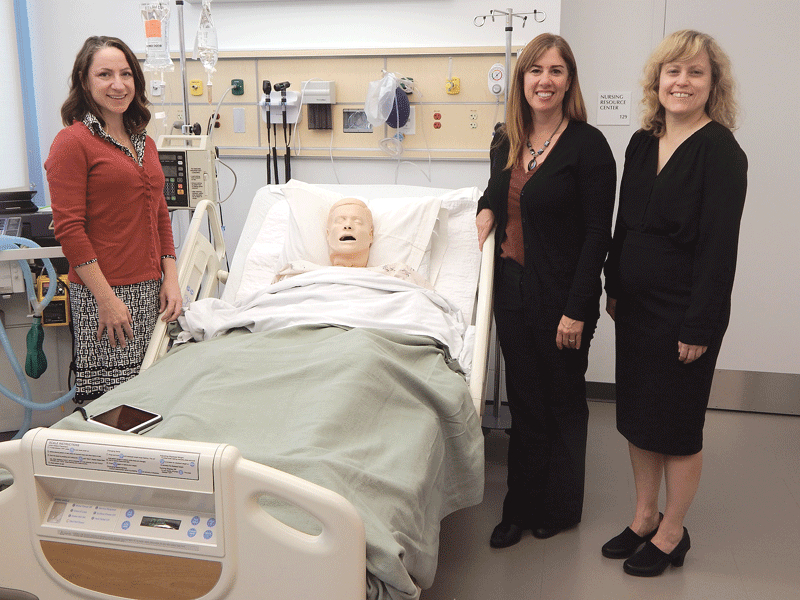
From left to right, Jessica Tinkham, Marcia Scanlon, and Shelley Holden

From left to right, Jessica Tinkham, Marcia Scanlon, and Shelley Holden show off the new simulation lab in the Science and Innovation Center at Westfield State University that opened this fall.

Emily Swindelles will graduate from Springfield Technical Community College next May with an associate’s degree in Nursing.

The path to matriculation hasn’t been easy for the mother of three children — ages 5, 3, and 2 — who has worked part-time and commuted from her home in Ellington, Conn., but she has had a lot of support from her family and fellow students, who have become like an extended family.

Swindelles’s dream is to work in a hospital maternity ward and eventually become a nurse midwife, so the 30-year-old was happy to hear that officials from STCC and Westfield State University signed an articulation agreement on Oct. 4 that will allow STCC nursing school graduates to earn a four-year degree from Westfield on the Springfield campus.

The new partnership is the first hybrid RN-to-BSN (bachelor of science in nursing) completion program between two public institutions of higher education in Western Mass. ‘Hybrid’ refers to the fact that it includes online classes as well as courses on the STCC campus that will be taught by instructors from Westfield State.

“I was really excited when I heard about the new program. It’s convenient, flexible, and cost-effective,” Swindelles said, adding that she is used to the commute, familiar with STCC, and likes the fact that, although the majority of coursework will be done online, classes on campus will provide students with the support and interaction that she feels enhances learning.

“I would have taken a year off just to make sure that I was financially capable of going back to school, but with the flexibility of this program, I think I’ll be able to manage school, work, and family,” she added.

Jennifer Hoppie is another STCC nursing student who is enthusiastic about the new program. The 39-year-old mother of two children, ages 11 and 9, moved to the U.S. from St. Lucia in 1999, and her goal is to work in the pediatric department of a hospital and earn a bachelor’s degree because it will increase her job options.

Prior to the matriculation agreement, Hoppie planned to work for a year after passing the board exam required to become a registered nurse, then enter a bachelor’s-degree program. But she says if she can continue her education at STCC after she graduates, she will choose that option because it will allow her to stay close to home in case she is needed at her children’s school.

“The price of the new program is also good; there are people like me who can’t afford expensive tuition,” Hoppie said, adding that she took out a loan to earn the degree she will receive in May.

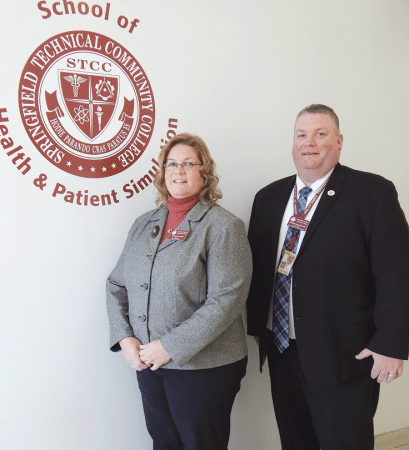
Lisa Fugiel and Christopher Scott

Lisa Fugiel and Christopher Scott say Westfield State University’s hybrid RN-to-BSN completion program will help remove barriers to education faced by many non-traditional students at STCC.

Indeed, the new RN-to-BSN completion program is touted as the most affordable pathway of its kind; Westfield will accept 90 credits from students toward the 120 needed for a four-year degree, and the cost for the additional 30 course credits will be $10,500.

Christopher Scott noted that STCC has collaborations with other schools of nursing that allow graduates to pursue a bachelor’s degree, and it’s important for students to be aware of all of their options.

“Our goal is to remove any barriers to success,” said the interim dean of the School of Health and Patient Simulation, adding that the majority of STCC students are non-traditional, and many face financial or personal challenges that make getting an education difficult.

“We want them to be able to continue their education and flourish after they succeed here,” he told BusinessWest.

Officials from both schools say the new program is also significant because it is in line with state and national goals to increase the number of nurses with bachelor’s degrees in the workforce.

“There’s been a national call to action from the Institute of Medicine to bring our BSN workforce up to 80% by the year 2020,” said Jessica Holden, a nursing instructor at Westfield State and program director of the RN-to-BSN program.

Holden said the goal in Massachusetts is to increase the number of BSN nurses from 55% in 2010 to 66% in 2020, and to reach the national goal of 80% by 2025. The goals were set by the Massachusetts Nursing and Allied Health Workforce Development Plan and implemented by the Massachusetts Action Coalition.


A list of Acute Care Hospitals in Western Mass. HERE


“There is a growing shortage of nurses, and we see our associate degree in nursing as an entryway into a bachelor’s program,” said Lisa Fugiel, director of Nursing for STCC’s School of Health and Patient Simulation. Although graduates can work as an RN after they earn an associate’s degree and pass their boards, she explained, nurses with a BSN are typically given more responsibility and supervisory roles. They also earn higher salaries, and many healthcare institutions are seeking nurses with advanced degrees to meet certain requirements.

Increasing Opportunities

Most colleges limit the number of credits a student can transfer, and the fact that Westfield’s hybrid nursing program will accept 90 is expected to make a real difference to STCC students.

“They might have to take 50 credits at another college to achieve a baccalaureate degree,” Scott noted, explaining that STCC and Westfield State have made the pathway easier by creating a ‘curriculum map’ that outlines prerequisite courses they need to enter the BSN program.

“It allows for seamless education,” said Marcia Scanlon, chair of the Department of Nursing at Westfield State.

Shelley Tinkham agreed, and said it’s important, because if students take the wrong electives, they will have to take additional classes to meet Westfield State’s entrance requirements. “The map was carefully developed as a partnership model,” said WSU’s dean of Graduate and Continuing Education.

Westfield State officials told BusinessWest they began developing their own RN-to-BSN program, which launched this fall, about four years ago. The STCC-Westfield nursing-degree partnership was developed simultaneously, and everyone involved believes it will increase the number of students who pursue a bachelor’s degree.

“Massachusetts issued a call to action to be creative and innovative in creating a seamless pathway so nurses can progress, and the new hybrid program meets that call,” said Holden. “It’s a new model for Westfield State that is very affordable.”

She noted that the push at the state and national levels to increase the number of nurses with bachelor’s degrees was initiated because nursing has become more complex due to the changing face of medicine, which includes advances in technology and a growing number of patients with multiple health issues.

Critical Relationships

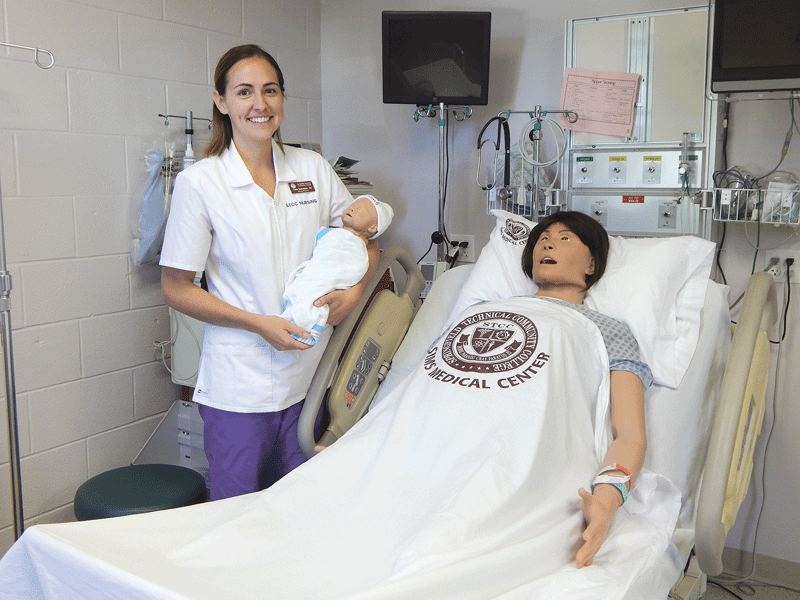
Sims Medical Center at STCC is the largest simulation facility of its kind in the Northeast and has received national recognition.

“We recreate the environment of every type of care in a hospital, from the trauma room to acute care, child delivery, and pediatrics,” Scott said. “We have our own operating room and critical-care unit, as well as a home-care environment.”

Students in the college’s 20 healthcare programs work with human patient simulators that breathe, sweat, have pulses, and react to care and procedures that range from arthoscopic surgery to removing a gall bladder.

“Students can take their blood pressure and do every medical technique on them possible,” Scott said, explaining that the goal is to expose students to situations that can occur before they enter the workplace.

And, since nurses don’t work alone, STCC students work alongside their peers, who are studying a multitude of healthcare disciplines, including respiratory therapy, radiology, and surgical technology.

In fact, STCC’s center is so high-tech that the college has worked with hospitals, medical centers, and higher-education institutions to help them build and operate their own simulation centers and avoid perils and pitfalls in the process.

Emily Swindelles

Emily Swindelles says Westfield State University’s hybrid RN-to-BSN completion program will make it easier for her to continue her education.

Westfield State is among them, and Scott said officials sought the school’s help in developing a simulation center for the university’s $48 million Science and Innovation Center that opened this fall.

Westfield officials went to STCC, toured the campus, and met with faculty, administrators, and architects before designing their own space. They say the relationships that were formed played a role in the establishment of the matriculation agreement.

“Creating a transfer program is difficult, and historically, Massachusetts institutions have not done well with it. But the new program shows we can cooperate; it’s an excellent example of what can be accomplished, as it’s designed to be very flexible,” Tinkham said, noting that Westfield needed to pass a policy and ask its governing board to accept 90 transfer credits for the hybrid program because they normally accept only 67 from a community college.

“Dean Scott was very patient with us,” she continued, adding that Westfield State officials recognized that STCC has many non-traditional students and first-generation graduates who need a supportive environment and may not be familiar with WSU.

The nursing programs at STCC and Westfield State are both accredited. The baccalaureate degree in nursing at Westfield State is accredited by the Commission on Collegiate Nursing Education. STCC’s associate in science degree in nursing is accredited by Accrediting Commission for Education in Nursing Inc.

Ongoing Partnership

Westfield State University wants students entering STCC’s associate degree in nursing program to know they can earn a bachelor’s degree on the Springfield campus and plan to make them aware of the curriculum map at the beginning of each new school year.

“They will feel our presence on their campus from day one,” Holden said, adding that Westfield representatives will pass out brochures and be available to nursing students from the time they begin the nursing program at STCC.

She was hired at Westfield State a year ago, Tinkham has worked at the university for two years, and Scanlon has been there for five, but was named department chair a year ago; they all feel partnerships such as the new one with STCC are critical to the future of nursing.

“We’re already looking at other collaborations,” Tinkham said. “This is just the beginning.”

It’s a good beginning, one that not only addresses the workforce-development shortage, but will benefit the community as many STCC students become involved in charitable causes.

“Helping them to continue their education will allow them to give back even more,” Fugiel said, “and we are really excited to be able to offer them an affordable opportunity to do so.”

Banking and Financial Services Sections

Has Little GAAP Emerged?

By Kristi Reale, CPA, CVA

Kristi Reale, CPA, CVA

Kristi Reale

Should privately held businesses be held to the same financial-reporting standards and requirements as publicly traded companies?

For many decades, small, privately held companies have been faced with accounting challenges when attempting to meet the standards set by the Generally Accepted Accounting Requirements (GAAP). The standards set by GAAP are largely influenced by the requirements of those who use the financial reports of publicly traded companies, such as the SEC. However, these standards are often financially burdensome on smaller organizations and often have no significant impact on their financial position or reporting. This has sparked lobbying for the standards of GAAP to be adjusted so that standards for privately held companies (‘Little GAAP’) are less rigorous and more reasonable than those necessary to satisfy the needs of publicly traded companies (‘Big GAAP’).

The call for change was answered, at least in part, when the Financial Accounting Standards Board (FASB), a group responsible for setting financial reporting standards in the U.S., established its Private Company Council (PCC) in 2012 to improve the process of setting accounting standards specifically for private companies. The PCC reviews and proposes alternatives within GAAP to address the needs of users of private-company financial statements.

In 2014, the FASB launched a simplification initiative aimed at reducing the complexity and costs associated with financial reporting while improving the usefulness of the information reported to investors and other third parties. Some of those changes are listed below and may have an impact on the way your organization meets its reporting standards.These changes are technical, and it is suggested that you speak with your accounting professional to determine if these changes apply to your organization:

The following Accounting Standards Updates (ASUs) are a result of the establishment of the PCC and their simplification initiative. I have detailed many of the technical implications of these updates below, but also included the salient implications to your business. Whether or not you have a formal accounting background, it is important to educate yourself on the applicable changes, as they may have an impact on your business reporting.

ASU 2014-02 — Intangibles — Goodwill and Other (Topic 350): Accounting for Goodwill (a Consensus of the PCC)

ASU 2014-02 is available to private, for-profit companies and allows an accounting alternative to amortize goodwill on a straight-line basis over 10 years or less if a lesser time is deemed appropriate. Goodwill is the value of intangible assets such as brand-name recognition or patents, and has historically been tested for impairment.

Impairment testing, which measures whether a balance-sheet item is worth the amount stated on the balance sheet, is performed if a triggering event occurs that indicates the carrying value of goodwill may exceed its fair value. This new update is an important change (and simplification) to this process, as it allows a company to write off the value of its goodwill. This ASU applies to new and existing goodwill on the books.

It is important to note that electing the ASU to amortize goodwill does not eliminate impairment testing.

ASU 2014-07 — Consolidations (Topic 810): Applying Variable Interest Entities Guidance to Common Control Leasing Arrangements (a Consensus of the PCC)

This ASU is available to private, for-profit companies effective for annual periods beginning after Dec. 31, 2014 and effects the variable-interest entity (VIE) consolidation guidance, which historically required companies to create a consolidated financial statement when certain requirements were met. One common example exists when a business owner owns both an operating entity and real-estate entity. When the operating entity rents from the real-estate company, they would be required to consolidate their financial statements.

The ASU permits the private-company lessee (reporting entity) to not apply the variable-interest entity consolidation guidance to a lessor if all of the following conditions are met:

• The lessee and the lessor are under common control;

• There must be a substantial leasing arrangement between the entities;

• Substantially all of the activity between reporting entity and VIE is related to leasing; and

• Any obligations of the lessor are guaranteed or collateralized by the lessee.

Disclosure requirements consist of all required GAAP disclosures for leases, related parties, and guarantees.

It is important to note that this ASU is an accounting-policy election and must be applied by the private-company lessee to all current and future lessor entities that meet the requirements for applying this approach in the future.

ASU 2014-18 — Business Combinations (Topic 805): Accounting for Identifiable Intangible Assets in a Business Combination (a Consensus of the PCC)

This ASU provides an alternative to reduce the cost and complexity of identifying intangible assets in a business combination. If this ASU is elected, customer-related intangibles such as customer lists and commodity supply contracts or non-compete agreements would not be recognized separately, but rather become part of goodwill. Applying this ASU and combining other intangibles with goodwill can eliminate a bargain purchase situation (negative goodwill.)

If this ASU is elected, the reporting entity must elect ASU 2014-02 (the first ASU mentioned in this article) to amortize goodwill over 10 years. Disclosure requirements for intangible assets acquired in a business combination have not changed. If elected, it is applied prospectively. No previous intangibles on the books may be reclassified to goodwill.

ASU 2015-01 — Income Statement — Extraordinary and Unusual Items (Subtopic 225-20): Simplifying Income Statement Presentation by Eliminating the Concept of Extraordinary Items (Simplification Initiative)

This ASU is effective for periods beginning on or after Dec. 31, 2015 and eliminates the concept of extraordinary items (example: earthquakes in Western Mass.)  The term ‘extraordinary item’ has been changed to ‘unusual or infrequently occurring’ items.

Reporting requirements for items that are unusual, infrequent, or both are as a separate component of income from continuing operations (‘above the line’).  This supports a trend of reporting most items of income and expense as part of an entity’s results from operations. Also, the nature and financial effects of each event or transaction are shown on the income statement or disclosed in the notes to the financial statements.

ASU 2015-11 — Inventory (Topic 330): Simplifying the Measurement of Inventory (Simplification Initiative)

This ASU is effective for periods beginning on or after Dec. 31, 2016 and does not apply to entities using the LIFO (last in, first out) or retail method to measure inventory. ASU applies to FIFO (first-in, first-out) or average cost inventory measurement.

This ASU states that an entity should measure its inventory at the lower of cost or net realizable value (formerly of market). Net realizable value is the estimated selling price in the ordinary course of business, less reasonably predictable costs of completion, disposal, and transportation.

When evidence exists that the net realizable value of inventory is lower than its costs, the difference should be recognized as a loss in the earnings period in which it occurs.

ASU 2015-03 & 2015-15 — Interest; Imputation of Interest (Subtopic 835-30): Simplifying the Presentation of Debt Issuance Costs (Simplification Initiative)

The objective of this ASU was to simplify the presentation of costs incurred upon the issuance of debt. For example, when a business takes out a loan (debt), there are often loan-acquisition costs and other expenses (debt issuance costs), which are pre-paid at the beginning of the loan and are historically identified as assets on the books and amortized over the life of the loan as an expense. Confusion often arose among readers of financial statements when the debt-issuance costs were reported as an asset. Therefore, this ASU states that debt-issuance costs should be presented as a direct deduction from the carrying amount of the related debt liability. This requires debt-issuance costs to be changed from an asset to a contra-liability. The recognition and measurement of these costs has not changed.

This ASU is available to private companies for periods beginning on or after Dec. 15, 2016. Early application is permitted, and retrospective application is required.

ASU 2015-17 — Income Taxes (Topic 740): Balance Sheet Classification of Deferred Taxes (Simplification Initiative)

Previous GAAP presentation required entities to separate deferred-income tax asset and liabilities in current (short-term, within a year) and non-current (more than a year) amounts on the balance sheet. This ASU changes the GAAP presentation to require deferred-income tax assets and liabilities to be classified as non-current (long-term) on the balance sheet. The ASU does not change the requirement that deferred assets and liabilities be presented as a single amount, and income tax disclosures are not changed.

This ASU is effective for periods beginning on or after Dec. 31, 2017; early application is permitted as well as retrospective application to all prior periods presented. In the first year of change, financial statements should disclose the nature and reason for changes and effects on prior periods.

It appears that the FASB is finally trying to simplify the reporting requirements for private businesses. The above was just a sample of some of the ASUs that were released as part of this initiative. By staying informed, you can plan ahead and take advantage of these options for your business.

Prior to making any financial-statement decisions or accounting elections, you should consult your financial expert or a certified public accountant.

Kristi Reale, CPA, CVA is a senior manager with the Holyoke-based public accounting firm Meyers Brothers Kalicka, P.C. and specializes in business valuations; (413) 322-3533; [email protected]

Banking and Financial Services Sections

Lending Support

Country Bank President Paul Scully

Country Bank President Paul Scully

Country Bank’s sheer scope in Eastern and Central Mass. — it now boasts 15 branches, almost $1.4 billion in assets, and a loan portfolio approaching $1 billion — positions it among the larger banks in its footprint. But even during a time of financial growth, President Paul Scully is equally committed to growing the bank’s community ties, through an ever-evolving series of initiatives that engage employees, customers, and area residents alike. After all, a bank’s success, he believes, shouldn’t be reflected simply on the bottom line.

Paul Scully is gratified that Country Bank is wrapping up a particularly strong year for both commercial loans and retail business. But the bottom line isn’t all the bank is building.

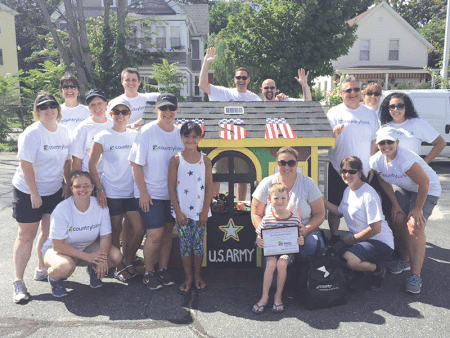
For instance, employees at the bank’s newest branch, in Worcester, recently teamed with Habitat for Humanity to build a playhouse for children of veterans. “Staff members spent the day building the playhouse in the parking lot,” said Scully, the bank’s president. “They loved it.”

More significantly, Scully recently returned from Haiti, where a team of 14 built two houses over five days before being chased out by the quick-moving Hurricane Matthew. Last year, he accompanied a team of management-level employees on a similar home-building mission in the beleaguered Caribbean nation, and this year, he opened it up to all staff members.

“Thirty-three people said they’d like to go, so we had a lottery,” he explained. “It’s a tremendous feeling giving back in the most impoverished country in the western hemisphere. They realized, if they didn’t before, how amazingly fortunate everyone here is.”

The home-building project was also an exercise in team building, he added. “We got to know people for who they are — not just the role they play Monday through Friday.”

That sense of community — both within the Country Bank family and in service to the cities and towns where its 15 branches operate — has increasingly become a hallmark of the Ware-based institution’s identity, Scully said.

Country Bank employees

Country Bank employees in Worcester celebrate the construction of a playhouse for children of veterans, a project conducted alongside Habitat for Humanity.

“When it comes to giving and community involvement, we believe that’s the role of a community bank, and most community banks feel similarly,” he told BusinessWest, noting that the bank’s support of area food banks, senior centers, and Baystate Mary Lane Hospital, among other entities — in all, totaling some $600,000 annually.

“Donations are geared toward all aspects of the community to improve quality of life for residents,” he said. “We’re a staunch supporter of our local hospital because we believe healthy communities must have access to good healthcare, and people want to stay and live and perhaps move into our communities to access quality healthcare.”

To further focus its community involvement, in 2015, the bank launched its Country Bank Cares community volunteer program, offering volunteer opportunities at various events throughout the year to Country Bank staff. Each volunteer hour is logged, and at the end of the year, staff members who volunteered 10 hours or more are awarded a grant to a charity of their choice for $100; 25 hours earns $250.


Thirty-three people said they’d like to go, so we had a lottery. It’s a tremendous feeling giving back in the most impoverished country in the western hemisphere. They realized, if they didn’t before, how amazingly fortunate everyone here is.”


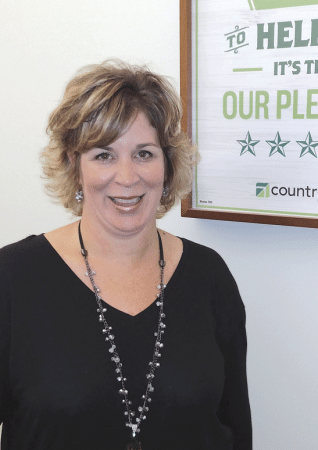
“They have a stake in where the money goes,” said Shelly Regin, the bank’s marketing director, noting that employees donate about 700 hours of service per year. “They’re really engaged in it and honored to take part in it.”

The spirit of giving even incorporates a dress-down day on Fridays, when employees pay to wear jeans, and the bank matches all donations. At the end of each month, a committee of staff members decides which local nonprofits get the money — to the tune of about $2,500 a month. “That’s a lot of jeans,” Scully said. Meanwhile, a recent event called Be Bald, Be Bold had employees donning bald caps to draw attention to cancer research and raise money for the Baystate Mary Lane Walk of Champions.

“This is something that existed here long before Shelly or me,” he went on, explaining the motivation behind Country Bank Cares and other initiatives. “It’s the idea that Country Bank is engaged in the community and people’s quality of life, and we want our 220 staff members to experience another dimension of giving back.”

Country and City

With assets of $1.39 billion at the end of 2015 and a loan portfolio of more than $978 million, Country Bank is, of course, deeply ingrained in its communities in the traditional banking sense as well. And 2016 has seen further financial growth.

“We’ve had a very robust year in commercial loan originations, really centered in our existing footprint but also throughout New England,” Scully said. “We’ve had a tremendous year in both loan growth and deposit growth. I think that’s attributable, in part, to improvements we’re seeing in the economy and more robust product offerings.”

He noted that the evolution of e-banking solutions increasingly allows banks to develop relationships with customers outside their branch footprint. “That’s opening up the market dramatically. Folks can open up accounts with us online, can do anything they want online.”

Still, physical branches remain important, and the move to Worcester last year made sense on multiple levels, he explained.


Go HERE for a list of Banks in Western Mass.


“We’ve been lending in Worcester for more than 50 years,” he noted, adding that the city boasts a larger population and more diverse demographic than most Country branches, both of which equate into more business opportunity. And without a branch, it was difficult to move commercial customers into other products, such as retail accounts.

“From a cultural perspective, we have not changed the culture to adapt to the city — we’ve just brought the same level of service and quality to Worcester as our other marketplaces.”

Shelly Regin

Shelly Regin says employees are gratified to have opportunities for volunteerism and a say in where the bank’s charitable dollars go.

However, Country remains focused on growing its e-banking platforms as well, reaching a generation that prefers the convenience of doing business on their devices rather than visit a branch. But the community-bank world has long moved past the days of thinking branches will eventually be obsolete.

“They said years ago that ATMs are going to replace branches,” Scully said. “What happens is, every time there’s an advancement, people believe it’s going to replace something, but it doesn’t replace it — it just complements it. In this case, it allows customers to enjoy many different ways to do their banking. Has the foot traffic slowed down? Yes, a little bit, but people still want to know it’s there if they need it for any reason.”

Mortgage applications are one area where the change in customer behavior has been stark. When Country launched an online application option 10 years ago, customers were slow to embrace it, preferring to meet with a loan officer in person. Online applications were filed mostly by customers with poor credit who were targeting multiple banks at once, hoping someone would accept them. Today, 80% of the bank’s mortgage applications originate online, simply because borrowers realize it’s easier.

Brick-and-mortar branches are important for branding as well, but marketing campaigns — through both traditional and social media — remain critical, Regin said, noting that the challenge is to effectively tell a story that’s reflective of the institution and sets it apart.

To that end, with the help of its marketing agency, the bank conducted scores of interviews, not only with customers and employees, but people with no connection at all to Country Bank, asking why they choose to bank or work there, or why they don’t. The overwhelming takeaway, Regin said, is that relationships, and how the bank treats people, are its most important investment. So its current campaign incorporates slogans driving home the importance of priorities like service and even good manners. (One slogan reads, “we think politeness is a higher form of intelligence.”)

“That’s just who we are,” she said, before Scully added that the bank has always conducted business that way, but the campaign simply crystallizes it. Equally important is providing the kind of customer or borrower experience that leads to referrals. “Someone says, ‘I had a great experience with them.’ Another says, ‘OK, maybe I’ll give them a try too.’”

Community Legacy

The Country Bank name is only 35 years old, but the institution has been around since 1850, when it was known as Ware Savings Bank. It took on its current name after a 1981 merger with Palmer Savings Bank; another merger with Leicester Savings Bank 17 years ago further increased the bank’s holdings.

With that long history behind it, the bank understands the importance of helping future generations establish their own financial health, which is why Country conducts financial-literacy programs in 29 elementary schools, conducts a Credit for Life program in area high schools — teaching seniors the importance of prioritizing spending — and expanding that program with seniors at Worcester Polytechnic Institute.

“That next step is really geared toward those graduating from college,” Scully said. “They’re the ones who will be experiencing the real workforce soon, so the engagement is greater.”

Also thinking generationally — this time focusing on Millennials — Country has been overhauling its corporate headquarters to reflect modern workforce trends, such as low walls, collaborative spaces, enhanced technology, and even a café.

“We want to be an employer of choice for Millennials and folks who say, ‘this would be a cool place to work,’” he explained. “There’s great stuff happening; we’re creating a different vibe in this building. I say we’re giving it a Google vibe. We want to have the building become a place where people not only want to work, but feel really engaged.”

It’s just one more way Country Bank continues to identify needs and meet them — just as it has for the past 166 years.

Joseph Bednar can be reached at [email protected]

Community Spotlight Features

Community Spotlight

Jennifer Tabakin

Jennifer Tabakin says Great Barrington wants to partner with a developer interested in a historic reuse of a former school in Housatonic Village.

Two years ago Christopher Rembold described investment in Great Barrington as a “rising wave.”

That surge has continued to gain force, and today Rembold says the wave has arrived, as major projects downtown come to fruition that were spurred in part by a $5.2 million renovation of Main Street that was finished this summer and includes new drainage, sidewalks, traffic signals, and landscaping.

“Recently permitted and planned private investment has totaled close to $70 million over the past year, and we’re seeing the type of growth we wanted to encourage,” said the town planner. “Many places talk about forming public-private investment partnerships, but it has actually happened here; there is a lot of activity going on and a lot of opportunity.”

He noted that the town’s goal has been to build a foundation for economic growth centered in its downtown area.

Now that the Main Street project is complete, Bridge Street will become the next focus, and a $2 million renovation will begin next spring, funded by a MassWorks grant that will replace crumbling sidewalks, improve poor drainage, and address deterioration not conducive to business.

In addition, the town and the Mass. Department of Transportation have partnered and will spend $2 million on the Bridge Street Bridge; plans are also progressing on a $9 million to $10 million upgrade of the sewer-treatment plant to accommodate investment and meet new environmental standards.

The work hasn’t been completed yet, but developers have already sprung into action, and a number of major projects on Bridge Street have been permitted (more about those later) that will preserve historic structures, retain the town’s charm, and add not only market rate and affordable housing, but new retail and office space.

Town officials attribute the willingness to invest in Great Barrington to a number of factors: its excellent schools, award-winning Fairview Hospital, two colleges, unique shops and eateries, abundant recreational opportunities, beautiful open space, and generations of families and business owners who have made it their home and care deeply about the community.

Town Manager Jennifer Tabakin told BusinessWest that all the private investments being made are by developers who live in Berkshire County and recognize the value of Great Barrington as the hub of South County.

“We’re a small town with a lot of amenities that you would only expect to find in a metropolitan area; we have an excellent school district and a significant number of theaters, yoga studios, and restaurants downtown,” Tabakin noted. “We also have historic architecture, unique local businesses, and a very active Chamber of Commerce that encompasses 13 communities. Many people come here to work, shop, eat, and enjoy our cultural activities. The number of people who work here every day is greater than the number of residents in town.”

Although growth has surged and is expected to be ongoing, officials note it has been carefully crafted and is in complete alignment with the town’s master plan, created several years ago to preserve Great Barrington’s small-town feel and charm while supporting investments centered around its downtown.

“One of the priorities of the master plan was to cluster new residential and commercial space in the center of town, which allows us to preserve open space in the surrounding rural and scenic areas,” said Tabakin. “We’re seeing that implemented, which is very exciting.”

Reuse of Historic Sites

Bridge Street will see new life in the coming years due to a number of new projects.

For example, Chrystal and Vijay Mahida plan a $25 million historic renovation of the former Searles School at 79 Bridge St. that will transform the four-story property into an 88-room, four-star hotel called the Berkshire, and create 30 new full-time jobs when it opens in 2018.

“We have a limited amount of hotel and conference space, and the new hotel will fill the gap while preserving the historic façade of the school, which is downtown and two minutes from our Town Hall and theaters,” Rembold said, adding that the couple lives in Great Barrington and own the Fairfield Marriott Hotel in town.

“It’s an excellent project because it will bring additional businesses into town, support existing and future businesses, and have a real fiscal impact due to the hotel and meal taxes it will generate,” he continued.


Many places talk about forming public-private investment partnerships, but it has actually happened here; there is a lot of activity going on and a lot of opportunity.”


Another major project at 100 Bridge St. will be built on a brownfields site that the Community Development Corp. has been working to clean up for two decades.

Nearly 50 units of affordable housing have been permitted on the eight-acre site, and there are plans to build a public park on two acres in a future phase of the project.

“Not only is there a real need for affordable housing here, there is support for it,” Rembold noted. “Some towns take a negative view, but Great Barrington has made affordable housing fit. We hope families will move into the new downtown units and be able to walk to work and the grocery store.”

Benchmark Development, based in Lenox, also has plans for a new project that will include the Great Barrington Co-Op Market at 42 Bridge St.

“The Co-Op has been busting at the seams for several years,” Rembold said, noting that the owners want to stay in town and will be the anchor tenant in the new, three-story building that Benchmark plans to erect. Their permit application is expected to be submitted this month.

“The project will allow us to retain jobs and create new ones,” he continued, adding that the co-op will be on the ground floor, retail shops will occupy the street floor (the land slopes), and 22 one- and two-bedroom apartment units will be built on the upper floor. A second phase of the project, which is not expected to kick off for about two years, could add 36 additional apartments, which would increase residential living spaces within walking distance of downtown.

“It’s a story of public investment in infrastructure that created a positive environment, which encouraged private investment,” Tabakin said.

Another major historic renovation recently permitted at 47 Railroad St. involves a $4 million renovation of the existing downtown building.

47 Railroad LLC plans to convert the former restaurant and bar on the first floor into three units of retail space, and build an addition in the back that will house two stores.

The second floor will become home to seven market-rate apartments, and the third floor will have five apartment units and a rooftop garden that will be accessible from the hallway.

Ancillary Growth

Housatonic is a small village within Great Barrington that is home to about 1,000 residents as well as the Monument Mills Complex that offers breathtaking views of the Housatonic River, Monument Mountain, and Flag Rock.

“The village is a historic gem, and all of the mills are partially occupied by businesses that are leaders in their field, such as Country Curtains,” Tabakin said.

But there is still space available, and the town is seeking a developer to partner with on an historic adaptive reuse of a three-story, 20,000-square-foot former elementary school with an adjacent parking lot in a way that will benefit the local economy.

“We hope it will become an anchor building that will spur further development in the mills,” Tabakin said, noting that businesses ranging from a dance studio to artists’ studios recently moved into the complex.

The town will continue to facilitate investment and has upgraded roads and passed new zoning that preserves the historic area while accommodating new, mixed-use development. In addition, Great Barrington recently received close to $2 million in grants to preserve the stock of affordable housing in the village and make more infrastructure improvements, and the state will begin rehabilitating the Park Street Bridge in coming weeks.

“We’re trying to set the stage for growth in Housatonic like we did in our downtown so it can blossom, and we are already seeing it happen on a smaller scale,” Rembold told BusinessWest.

To that end, a mill owner on the north side of the village is working to secure historic tax credits for a mixed-use development in the structure’s 250,000 square feet, and a historic church and old train station have become world-class recording studios.

“Housatonic is a very small, quiet area with historic charm and interesting architecture,” Tabakin said. “People have lived there for generations and care about the community.”

Historic Charm

Great Barrington officials are pleased that the growth that is occurring in their town aligns with what the community wants.

“People come to the Berkshires because of its beautiful scenery, so preserving it is important. But we also want to preserve history, which includes our buildings and downtown; they are reasons why people want to visit and live here,” Rembold said.

Tabakin concurred. “All of the ongoing projects are preserving and enhancing what is unique about Great Barrington. There was a lot of pent-up desire while people were waiting for Main Street to be finished, and building owners have been making improvements since it was finished.”

The Bridge Street public and private projects promise to generate another wave of enthusiasm, and as residents move into new housing, dine in new eateries, and shop in new retail stores, the tide can only continue to rise.

Great Barrington at a glance

Year Incorporated: 1761
Population: 7,014
Area: 45.2 square miles
County: Berkshire
Residential Tax Rate: $14.60
Commercial Tax Rate: $14.60
Median Household Income: $45,149
Family Household Income: $75,238
Type of government: Open town meeting
Largest Employers: Fairview Dialysis Center; Fairview Hospital; Kutsher’s Sports Academy; Prairie Whale
Latest information available

Features

Course of Action

Tim Van Epps

Tim Van Epps, seen here with the famous wooden fox positioned near the clubhouse, says the Sandri companies are “all in on golf.”

Tim Van Epps calls it the “race to the bottom.”

That was he was colorful way of describing the sum of what’s happening in the golfing industry, at least the public-access side of the equation. And maybe the private side, too.

Elaborating, he said that, in the face of a host of factors that have negatively impacted the golf business — everything from lingering effects from the recession to declining interest among younger generations to oversaturation of this region with courses — owners and operators have responded with gimmicks, special rates, and an inclination to cut corners, defer maintenance, and, in the process, jeopardize quality until fiscal conditions improve.

“It’s a tough industry now,” said Van Epps, president and CEO for the Sandri Companies, which has a number of business divisions, including golf. “During the boom days, the late ’90s and early 2000s, if you opened a course, people would come. It’s not like that now. You saw thousands of courses open across the country, flooding the market with opportunities for people to play. And then, the market crashed, and now you’re seeing more courses close in a year than new ones open. And most courses are just trying to get by.”

But Sandri is taking a much different approach to these challenging times. Indeed, rather than hunker down and join others in that race to the bottom, Sandri is going to make significant investments in its Crumpin-Fox layout in Bernardston, and instead commence a race to the top.

That would be the top of the list of golf courses in this region, he said, noting that there are, in fact, several such compilations, and the one he’s most interested in is Golf Digest’s list of the best courses in Massachusetts that anyone can play. (Private clubs are, by their very nature, courses that only members can play.)

To that end, the semi-private club is commencing what will likely be north of $5 million in improvements, everything from dramatic, yet strategic, thinning and clearing of the trees that line most fairways, to paving of the cart paths; from a new pavilion at the 19th hole (a.k.a.) Zeke’s Bar & Grill, to renovation of the bunkers; from a huge facelift for the practice area, to some aggressive pricing programs.

The immediate goal of all this work is to make the course more accessible, playable, and enjoyable, said John (Boo) Jackson, director of Golf for Sandri, who said all these initiatives come together in something the company is calling a ‘grow-the-game campaign.’

“We’re trying to get some younger faces out here,” he said, zeroing in one of the biggest challenges facing course owners today, “and infuse this place with energy, enthusiasm, and a just a welcoming attitude and approach.”

As just one example, he cited a Franklin County resident’s rate, which, as that name suggests, provides discounted greens fees ($45) to area residents, many of whom are mistakenly of the belief that this is either not a public-access course, or it is public, but way too expensive.

John (Boo) Jackson

John (Boo) Jackson says a ‘grow-the-game’ campaign at Crumpin-Fox is aimed at generating enthusiasm and maximizing the “experience.”

Meanwhile, children of those residents who are 12 and under can play for free, he went on, adding that growing the game is difficult given the current conditions, but doable if an operation can blend imagination with solid customer service and that welcoming attitude he described.

Overall, the aim is to grow all aspects of the business, meaning golf, outings, weddings, and more, including indoor golf (simulators) and even snowshoeing and cross-country skiing, said Van Epps, adding that steps taken recently under the grow-the-game umbrella triggered a solid second half to the 2016 season and solid optimism for next season and well beyond.

“We’re all in on golf,” he explained. “We’ve seen an incredible lift in the second half in rounds — and in the excitement that our golfers are experiencing. We’re getting a lot of first-timers, and overall, there’s been an energy surge here.”

For this issue, BusinessWest takes an indepth look at what’s happening at Crumpin-Fox, and, more importantly, why these investments are being made, and how this course of action can wind up changing the landscape in many ways.

Round Numbers

If you were paying attention — make that really paying attention — to golf equipment maker TaylorMade’s commercials aired during July’s PGA Championship and featuring Jason Day, you would have noticed that Crumpin-Fox was sharing the stage with the world’s number-one player.

Actually, several courses did, in an almost-subliminal way. The commercial is about planning and executing the many shots golf requires players to hit, and as he’s thinking about some of them — a high fade or a low cut, for example — Day, the defending PGA champion at the time, is picturing golf holes that require such execution. In addition to holes at Whistling Straits (where Day won the PGA in 2015), Chambers Bay (site of the 2015 U.S. Open), and others, the sixth, seventh, and eighth holes at Crumpin-Fox, the most famous and photogenic stretch on the course, makes an ever-so-brief, one-second cameo.

“The folks at TaylorMade were up here recently getting some drone footage of the course,” Van Epps explained. “They were round-tabling it, looking over footage of all these courses for the commercial, and the brass at TaylorMade came across Crumpin-Fox and said, ‘holy moly, this one of the most beautiful courses we’ve ever seen.’ And that’s how we wound up in the commercial.

“And people noticed,” he went on. “Even though it’s just a second or so, people who’ve played here could recognize those holes.”

The goal moving forward is to make Crumpin-Fox, well, front of mind, not for PGA professionals, necessarily, but for players who might already have played it, and those who have perhaps thought about it, but have yet to program ‘Parmenter Road, Bernardston, Mass.’ into their car’s GPS.

Scott Gilmore

Scott Gilmore says an aggressive tree-clearing and trimming project will make Crumpin-Fox more playable — and enjoyable.

‘The Crump,’ as it’s sometimes called, or ‘the Fox’ (another alias), has always been a popular destination since the original nine-hole track, designed by Roger Rulewich, was expanded to 18 holes in 1977, and business has been steady even in the difficult times of recent years, said Jackson.

But the goal of any business, even those in the golf industry at this challenging time, is to grow, said Sandri, adding that, unlike those competing (if that’s the word for it) in the race to the bottom, he wants to travel in the other direction. And storming to the top of the ‘best courses you can play’ list is merely one of the goals, albeit one with great significance when it comes to reaching the broader goal — to get more people to make that scenic drive down Parmenter Road, an assignment that has a number of components. They include:

• Making the course more playable, as noted earlier, by undertaking some much-needed maintenance and tree work;

• Upgrading facilities to improve play and the overall customer experience. Replacing dirt cart paths with paved routes definitely falls into this category, as do improvements to bunkers and tee boxes;

• Those special rates for young people. Special as in free to those under 12, an ambitious initiative designed to inspire younger generations to take up the game and become acquainted with, and probably enamored with, the Fox; and

• Greatly enlarging and improving the 19th hole and banquet areas, as well as the practice area — two of many steps being taken to generate more and longer stays at Crumpin-Fox.

Drive to the Top

Work on all this is already underway, and will greatly accelerate in the weeks to come, said Van Epps, adding that the course will close at the end of the month — just a few weeks ahead of the normal schedule — so crews can get to work.

A big focus early will be on tree trimming and clearing, said Course Superintendent Scott Gilmore, who is not a forester, or a golf-course designer, but can talk expertly on why taking trees down is not a bad thing — for the course, those who play it (that should be obvious), wildlife, or society in general.

“After 40 years, the trees are getting big, and they’re causing some problems,” he explained, noting that more than 5,000 or so will be taken down, and others will be cut back. “We need to push them back and give people the holes back.”

Indeed, much of the tree work has been long overdue, said Van Epps, noting that encroachment has impacted everything from shot selection to convenience.

“There are two fountains on the sixth hole that are now 12 feet into the woods,” he explained. “When we first opened, you could walk right up to those and get a drink of water; now, the deer are enjoying them.”

To get these points across, Gilmore pointed to the last 200 or so yards of the rugged par-4 18th hole, or that portion that can be seen off the back deck of Zeke’s.

There, trees are encroaching on the fairways, blocking great views of players coming down the final fairway (the Crump has hosted a number of tournaments over the years and has more, including a sectional qualifier for the U.S. Open, on the books for the coming years), and unnecessarily and even unfairly getting in the way of golf shots.

And the 18th is typical, he went on, adding that there are many holes where trees are too dense, too tight to the fairways, and overgrown to the point where they make shots more difficult than they should be given the original designs.

But the dense vegetation brings other problems as well, said Jackson, noting that, in the heavy underbrush and tightness of the fairways, one could easily lose a sleeve of balls (or two, or three, or four) playing 18 holes, which is expensive. Thus, players search hard for a ball before digging into the bag for another one, slowing the pace of play.

Eliminating and thinning trees brings many benefits, said Jackson, and they add up making the course more playable and enjoyable, which in turn leads to repeat business and positive testimonials.

But while golf is the main focus of the Sandri investments, the broader assignment is to make this more of a year-round destination, said Van Epps, and a growth business, like the many energy-related divisions of the corporation.

To that end, Crumpin-Fox is adding indoor golf simulators, and also laying track for a snowshoeing operation, one that will capitalize on an activity rapidly growing in popularity, especially among Baby Boomers searching for enjoyable, calorie-burning, outdoor activities.

“We have trails going in all throughout the course, and that presents options for a visit to Crumpin-Fox,” he explained. “If a couple comes up, and the husband likes to snowshoe and the wife likes to golf, he can rent some shoes, and she can play on the simulator.”

Longer-term plans call for building a lodge on the edge of the property, he went on, adding that the goal is to make Crumpin-Fox a true destination, and not just for those who wear hats that say ‘Titleist.’

Pinning Their Hopes

Looking over the golf landscape, Jackson theorized that many in the industry have used the economy as an excuse for falling play and declining revenues.

With more introspection, he surmised, they would see that fair to poor customer service, coupled with what he calls an unwelcoming attitude, has contributed to, and perhaps been the main culprit in, the current challenging times.

The Crump takes a different attitude in all respects, he said, adding that this is one of the many ways in which the club is setting itself apart.

While most of the rest of the industry is in a race to the bottom, the Sandri operation is driving for the top. It’s an aggressive, expensive course of action, but one that all those involved believe will pay dividends down the road — or down the fairway, as the case may be.

George O’Brien can be reached at [email protected]
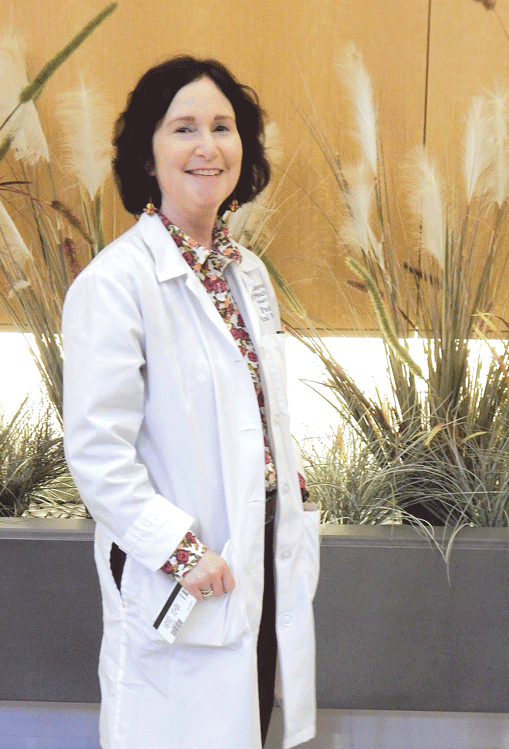
Opinion

Opinion

By Holly Chaffee

Across Massachusetts, more than 110,000 senior citizens and individuals with disabilities receive healthcare services in their homes from skilled home-healthcare providers. These services help individuals recover from surgery, recuperate following a hospitalization, or manage a chronic health condition that needs frequent monitoring. Thanks to the Medicare home-health benefit, these patients receive timely, safe, and effective healthcare when they need it most and in the location they prefer — their own homes.

Home healthcare is an incredibly convenient delivery model for healthcare, but it is also far more. Skilled home healthcare has become an essential service that doctors depend upon to ensure their patients experience the best possible outcomes. These days, many doctors even require it before they will discharge a patient home from the hospital. It is also a valuable Medicare benefit that has been shown to save millions of dollars annually in reduced hospital readmissions and nursing-home stays.

Unfortunately, the ongoing availability of this trusted care here in Western Mass. and across the state could soon face incredible challenges. A new pilot program from the Centers for Medicare and Medicaid (CMS) threatens home-healthcare reimbursement as it requires a ‘pre-claim review’ before a patient’s care is approved for coverage by Medicare. Under new guidelines aimed at reducing fraudulent claims, care could be delayed while third-party government contractors — who are not healthcare providers and have never met the patient — review paperwork and decide whether or not care is actually ‘medically necessary.’

The program’s initial implementation in Illinois demonstrated that the pre-claim review demonstration is deeply flawed and should be halted before implemented in the other targeted states, including Massachusetts.

Over the years, Porchlight VNA has been fortunate to provide services to thousands of patients in our community. And our providers unequivocally know that care delays and denials like those seen in Illinois spell disaster for many vulnerable homebound patients who depend on us.

The days following an injury or hospitalization are often the most precarious and are when complications are most likely to occur. Without the readily available, medically necessary home care prescribed by a doctor, a patient is far more likely to experience readmission to the hospital. Oftentimes, this is due to unintended side effects from a new medication, an easily treatable infection which progresses to something far more serious, or even a dangerous fall because of decreased mobility. These are the types of poor healthcare outcomes that Porchlight VNA is vigilant about preventing, but that are certainly destined to increase if pre-claim review for care delays our ability to intervene. Helping local patients stay out of the hospital in their best state of health has always been, and will continue to be, our number-one goal at Porchlight VNA.

Therefore, I strongly urge our local and state lawmakers to stand up for those constituents in need of home health and support legislation to delay CMS’ pre-claim-review demonstration. The Pre-Claim Review Undermines Seniors’ Health (PUSH) Act of 2016, sponsored by Massachusetts state Rep. Jim McGovern, would pause the Medicare demonstration for one year to allow Congress, Medicare, and home-health stakeholders to work together to correct the program’s flaws. This would ensure patient care is not delayed and that individual beneficiaries are not unjustly denied coverage when they need it most.

I hope that residents of the Western Mass. — whether they have ever personally benefited from home-healthcare services or not — will urge our lawmakers to sponsor the PUSH Act. The well-being of our community’s home-health patients depends on it.

Holly Chaffee is CEO of Porchlight VNA/Home Care and chairman of the board of directors of the Home Care Alliance of Massachusetts.

Opinion

Editorial

Years ago, the annual business trade show was a big deal.

It was a time to see the latest technology, find out what was new, discover what was trending, make some connections, and let people know your business could provide valuable products or services.

Well, times have changed somewhat — you don’t need us to tell you that — but the business show can still be a big deal, and this year’s edition of the Western Mass. Business Expo  certainly fits that description.

It will enable exhibitors and attendees to see the very latest technology — from robots to virtual reality to drones used in marketing; to find out what’s trending in everything from employment law to motivating Millennials to closing the dreaded skills gap; to make introductions; and to create some of those all-important connections.

And it’s this desire to generate connections that prompted BusinessWest to inject new energy and life into the Springfield Chamber’s annual business-to-business show, give it a new focus, and take it to a much higher level.

Indeed, while there are many networking opportunities on the calendar each year, none approaches the Expo in terms of both the size of the room and the depth of the opportunities.

Getting back to those connections, they are still needed in the business world today, but real, face-to-face connections are fast becoming as ‘old’ as the fax machine.

It seems that people communicate by e-mail and text these days, using the phone when something a little more personal than those options is required. Seeing people and shaking their hand … well, not so much. People rarely even go out to lunch anymore, preferring their desk or the conference-room table and solitude.

Not that there’s anything wrong with that.

But to do business and understand what’s happening in the business community, people need to get out more. And because there isn’t much time, they need to maximize their opportunities when they do get out. That’s not the official motivation behind the Expo, but it might as well be.

This year, attendees can go back to their offices better informed about:

• Innovation districts and efforts to create them;
• Millennials — what drives them, what motivates them, what keeps them at your company instead of looking for opportunities elsewhere, and much more;
• The skills gap and the many initiatives being undertaken to close it, including ongoing work to inspire young people to pursue STEM careers by conceptualizing, designing, building, and then competing with robots;
• Virtual reality and how to generate and then realize opportunities to seize the tremendous potential of what is being described as disruptive technology;
• Inspiration and perseverance, such as that displayed by a Boston Marathon bombing survivor who found the courage and determination not to let horrible injuries get in the way of her life and her dreams;
• Stories of entrepreneurship talking place across the region, through both a pitch competition and a ‘Where are They Now?’ program created to showcase the progress made by several startups;
• Marketing strategies, why they work, and why they might not; and
• Big Data, the cloud, drones, SEO (search-engine optimization), computer security, and many of the other high-tech developments and trends shaping business today.

Add it all up, and it yields one giant opportunity — to see, be seen, learn, become inspired, and inspire others.

In short, it’s an opportunity not to be missed.

Daily News

SPRINGFIELD — The Chronicle of Higher Education named American International College (AIC) one of the fastest-growing colleges in the U.S. for the fifth time. Among private, nonprofit master’s institutions, AIC placed among the top 20 colleges and universities in the country, ranking 16th, with a nearly 124% growth rate.

AIC is the only Massachusetts college or university to place in this category and outpaced the national average growth rate of 21.7% by more than 100%. AIC has more than doubled its enrollment over a 10-year span, 2004-2014.

In a categorical comparison to other colleges and universities in Massachusetts, Bay Path University ranked 17th among private baccalaureate institutions with an 82.6% growth rate, and Elms College ranked 18th in the same category with a growth rate of 78.3%.

“We believe that a college education is more than academic and intellectual growth,” said AIC President Vince Maniaci. “At AIC, we are committed to the personal, spiritual, and professional development of our students. We identify trends and explore and develop programs that will provide our students with a foundation upon which they can build to reach their full potential. This is a competitive and rapidly changing world. We make every effort to help our students compete successfully in that environment and are proud to be recognized for our efforts.”

Data collected for the Chronicle of Higher Education was based on fall enrollments of full-time and part-time students and included all U.S. degree-granting programs with a minimum 500-student enrollment in 2004.