Home 2017 (Page 5)
Daily News

SPRINGFIELD — Springfield Technical Community College’s (STCC) dental hygiene program and the Valley District Dental Society will co-host the first Community Dental Day on Saturday, Dec. 9. The event provides an opportunity for area residents who might not be receiving any dental care to obtain free treatment and schedule follow-up visits.

The dental hygiene clinic in Building 20 at STCC will be open from 9 a.m. to 4 p.m. Valley District Dental Society licensed dentists, together with STCC dental hygiene and assisting students, will offer patient education, health screenings, diagnosis, X-rays, and other types of urgent care.

“It will not be unlimited care, but there will be such treatment as fillings, extractions, sealants, and taking care of urgent issues,” said Dr. Martin Wohl, one of the dentists who supervises students treating patients at STCC. “We will not be providing cleanings, but in diagnosing that someone needs a cleaning, we will be able to schedule a follow-up visit. We will be able to put them into the system to get routine cleanings.”

While Community Dental Day will be free, patients can return to STCC for low-cost follow-up care. STCC’s dental hygiene clinic, which features 17 dental chairs on the second floor of Building 20, offers routine cleanings and various procedures at a reduced cost to residents of the Greater Springfield area.

“We’re excited about Community Dental Day, and the dentists are excited about it, too,” Wohl said. “The doctors feel they can provide a valuable service, and they can help people that generally can’t find the care they seek. Community Dental Day will hopefully have people start to think of either here or elsewhere as a dental home.”

STCC will welcome anyone who needs care that day, but Wohl recommends calling the dental hygiene clinic in advance at (413) 755-4900 to make an appointment for Community Dental Day.

Daily News

CHICOPEE — Elms College School of Nursing will host a white-coat ceremony on Thursday, Dec. 7 at 6 p.m. to honor the college’s third class of DNP (doctor of nursing practice) students as they move from the classroom into clinical practice training. The 17 honorees started the program in fall 2016 and will begin their clinical practice in January. The ceremony will be held in Veritas Auditorium in Berchmans Hall.

“This ceremony formally acknowledges that our DNP students will begin their clinical rotations within regional healthcare facilities and practice settings, specific to their advanced nursing specialty track,” said Teresa Kuta Reske, director of Doctoral Studies and Program Development for the DNP program at Elms College.

The ceremony will include opening remarks from Kathleen Scoble, dean of the School of Nursing, as well as an oath, a blessing of the white coats, and the presentation of the coats to the students. The keynote speaker will be Lisa Erickson, director of advanced practitioners for Baystate Health System.

The DNP degree is a clinical-practice doctorate in an advanced specialty of nursing practice. In May 2019, Elms College’s DNP graduates will be eligible to take the advanced certification examination in one of the two specialty tracks: family nurse practitioner or adult-gerontology acute-care nurse practitioner. The college now also offers a doctor of nursing practice degree for qualified master’s-prepared nurses in a third track: health systems innovation and leadership.

“The Elms College DNP program addresses the growing need for advanced-practice nurses in adult and family care as the population ages and the demand for primary care continues to grow,” Scoble said. “Our first DNP-NP class has graduated and entered the practice field, and our second cohort will be graduating this spring. We are delighted to be marking the passage of our third cohort into their advanced-practice clinical training.”

Daily News

WINDSOR LOCKS, Conn. — Bradley International Airport will experience a very heavy travel period this week due to the Thanksgiving holiday. Kevin Dillon, executive director of the Connecticut Airport Authority, advises that Bradley passengers should be aware and plan accordingly.

“We’re thankful for the many passengers who choose Bradley International Airport for their travel needs,” says Dillon. “If you are traveling through the airport during this busy travel week, please give yourself extra time and plan ahead, and we will do everything we can to help you love the journey through the airport.”

Passengers traveling domestically are advised to allow themselves at least 90 minutes for check-in with their respective airlines and processing through the TSA screening. Those traveling internationally should give themselves three hours.

Additionally, passengers are encouraged to follow these tips during this peak travel period:

• Check and confirm the status of your flight with your airline prior to your departure for the airport;

• Visit www.flybdl.org to familiarize yourself with Bradley’s parking options and terminal facilities; and

• Speed up the screening process by reviewing the TSA screening guidelines ahead of time. For more information, visit www.tsa.gov.

For up-to-date information about the status of a flight on the day of travel, visit www.flybdl.org. Twitter users can also sign up to receive free, automated updates by tweeting their flight number @BDLFlightInfo.

Daily News

HOLYOKE — Registration is now open for Intersession 2018 at Holyoke Community College (HCC), where new and returning students can earn a semester’s worth of credits for one class in just 10 days.

Intersession classes begin Wednesday, Jan. 3, and end Tuesday, Jan. 16. Intersession students can earn up to four credits by taking a single class.

“Intersession presents a great opportunity for students to pick up some extra credits in a very short period of time,” said Monica Perez, vice president of Academic Affairs. “And it’s open to everyone, including students from other colleges who may have returned home to Western Massachusetts for the holidays.”

HCC is offering 37 courses during Intersession 2018 in 22 academic areas, both online and on campus: Anthropology, Business Administration, Communication, Criminal Justice, Economics, Education, Engineering, Environmental Science, General Studies, Geography, Gerontology, Health, Human Services, Law, Management, Marketing, Mathematics, Nutrition, Philosophy, Psychology, Social Science, and Sociology.

For more information about Intersession at HCC or to see a full listing of course offerings, visit www.hcc.edu/intersession.

Daily News

LUDLOW — Meredith-Springfield Associates Inc., a plastics manufacturer specializing in extrusion blow molding and injection stretch blow molding, was recently named ‘Manufacturer of the Year’ by the Commonwealth’s Manufacturing Caucus.

President and CEO Mel O’Leary recently accepted the award alongside Director of Finance and Administration Edward Kaplan during a presentation at the Massachusetts State House.

Daily News

STOCKBRIDGECondé Nast Traveler recently announced the results of its 30th annual Readers’ Choice Awards, with the Red Lion Inn recognized as a “Top Hotel in New England” with a ranking of 29.

“It’s an honor to be recognized by the readers of Condé Nast Traveler, and this award is particularly special because it reflects the opinions of our guests,” said Sarah Eustis, CEO of Main Street Hospitality, owner and operator of the historic inn. “This prestigious award speaks to the inn’s lasting character and our dedicated staff who make it feel like a home away from home for our guests.”

More than 300,000 readers submitted millions of ratings and tens of thousands of comments, voting on a record-breaking 7,320 hotels and resorts, 610 cities, 225 islands, 468 cruise ships, 158 airlines, and 195 airports.

The Red Lion Inn, a charter member of Historic Hotels of America, has been providing food and lodging to guests for more than two centuries. The inn offers 125 antique-filled rooms and suites, four restaurants with formal and casual dining with locally sourced food, a gift shop featuring locally made items, a pub with nightly entertainment, and a range of amenities including wi-fi, a year-round heated outdoor pool, and in-room massage therapy and weekly yoga classes.

Daily News

SPRINGFIELD — Community Bank N.A. announced that Keith Nesbitt has been promoted to vice president, commercial banker.

In his new role, Nesbitt will manage new business with present and prospective customers, as well as maintain current customer relationships. He will also be responsible for providing direct service to commercial customers pertaining to deposit, loan, and other products and services.

“We are very pleased to recognize Keith for all of his incredible efforts and contributions to Community Bank N.A.,” said Geoffrey Hesslink, regional president. “He has always gone the extra mile to meet the needs of our customers and possesses a wide knowledge of loan management. I am excited to see what he will do for our customers at this next level.”

Nesbitt joined the Community Bank N.A. team through its acquisition of Merchants Bank earlier this year. He joined Merchants in 2016 as the regional commercial credit officer for NUVO, a division of Merchants Bank. Nesbitt has 12 years of experience in commercial lending, portfolio management, and credit administration in regional and community banking institutions.

Nesbitt earned his bachelor’s degree in advertising from University of Georgia, his master’s degree in education from Georgia State University, and his MBA from Keller Graduate School of Management. Outside of the office, he is a member of the Western Massachusetts Football Officials Assoc.

Daily News

LUDLOW — Usually a joyous and active time of the year, the holidays can also be difficult for those who have recently lost a loved one. In recognition of this, Nowak Funeral & Cremation Services invites all those in the community who have lost loved ones during this past year to join with others at its third annual candlelight memorial dervice to be held on Thursday, Dec. 7 at 5 p.m. Held at Ludlow County Club, 1 Tony Lema Dr., Ludlow, this non-denominational event will be officiated by local clergy.

“We know that the holiday season is often a difficult time for those of us mourning the loss of a loved one,” said Nydia Nowak Gallagher, funeral director for Nowak Funeral & Cremation Services. “We have created this remembrance program as a way to show support for one another. It is our hope that this event will bring some peace and tranquility to those who attend.”

This event is free to anyone wishing to attend, and every family will receive a special memento to commemorate the service. Refreshments will be served following the program. Those wishing to attend should RSVP by Dec. 4 to (413) 543-1892 or by e-mailing [email protected].

Daily News

AMHERST — Local improv company Happier Valley Comedy announced a new branch of its rapidly growing improve-comedy school: kids’ comedy classes. The program launches on Saturday, Dec. 9 with a two-hour workshop called “Family Funnies Improv,” a one-time beginner’s workshop geared toward kids 8-11 and their adults.

Family Funnies Improv gives families the opportunity to laugh with a loved one and bond over improvisational games and exercises, while sampling the offerings of the new Happier Valley Comedy’s kid classes. There’s no experience required to participate, but those with a little experience who want to revisit the beginner’s level are also welcome to join in the fun.

“Improv is a powerful tool for bringing people together in a supportive environment,” said Happier Valley Comedy’s founder, Pam Victor. “Our mission is to make the Happy Valley happier. With the expansion of our kids’ program, now we can bring even more laughter to people of all ages.”

Victor hopes to build Happier Valley Comedy’s kid improv comedy offerings in 2018 with more workshops for various ages and week-long improv camp sessions in the summer. For just over a year, the company has been producing the Happier FAMILY Comedy Show, a monthly improv show for kids 5-11 and their adults, which recently relocated to the Eric Carle Museum of Picture Book Art in Amherst.

The Family Funnies Improv workshop will be held on Dec. 9 from 1 to 3 p.m. in Hadley. It will be taught by Kate Jopson, graduate of the Happier Valley Comedy’s Zen of Improv classes and Happier FAMILY Comedy Show cast member. In addition, every child who is registered in this workshop receives a free ticket to the Happier FAMILY Comedy Show. Registration is available at www.happiervalley.com.

Daily News

SPRINGFIELD — Springfield Partners for Community Action Inc. has been awarded a Community Service Block Grant (CSBG) Special Projects grant from the Department of Housing and Community Development to support its Financial Literacy Ambassadors project.

The Financial Literacy Ambassadors project is designed to facilitate the training and certification of multi-cultural and multi-lingual community residents to become peer-to-peer trainers and deliver financial education to their own communities.

“We thank the department and Undersecretary Chrystal Kornegay for their support,” said Paul Bailey, executive director at Springfield Partners. “With this round of funding, we plan to identify interested applicants to train and become certified financial-literacy educators capable of delivering peer training to others in the community in multiple languages.”

Applications are being accepted now. Anyone interested in applying should contact T.J. Steele at (413) 263-6500, ext. 6568, or [email protected], or Stephen Plummer at (413) 263-6500, ext. 6567, or [email protected].

Springfield Partners is the official anti-poverty agency serving Springfield’s poor and low-income community since 1964. It offers programs and services in financial literacy, credit counseling, weatherization, emergency fuel assistance, multi-cultural Alzheimer’s, Volunteer Income Tax Assistance, early education and care, community scholarship, Low Income Taxpayer Clinic, veteran services, eviction clinic, and housing counseling.

Daily News

SPRINGFIELD — Single-family home sales were up 20.6% in the Pioneer Valley in October compared to the same time last year, while the median price rose 6% to $205,550, according to the Realtor Assoc. of Pioneer Valley.

In Franklin County, sales were down 13.1%, while the median price also fell 13.1% from a year earlier. In Hampden County, sales were up 24.4%, while the median price was up 3.6%. And in Hampshire County, sales rose 24.4% from October 2016, while the median price was up 1.9%.

Daily News

BOSTON — The state’s total unemployment rate dropped to 3.7% in October, the Executive Office of Labor and Workforce Development announced.

The Bureau of Labor Statistics’ (BLS) preliminary job estimates indicate Massachusetts added 4,800 jobs in October. Over the month, the private sector added 4,100 jobs as gains occurred in leisure and hospitality; professional, scientific, and business services; other services; financial activities; manufacturing; construction; and information. The September estimate was revised to a gain of 10,300 jobs.

From October 2016 to October 2017, BLS estimates Massachusetts has added 69,000 jobs. The October unemployment rate was four-tenths of a percentage point lower than the national rate of 4.1% reported by the Bureau of Labor Statistics.

“The low unemployment rate and job gains are indicators of the ongoing strength of the economy in Massachusetts. But not all communities and regions are feeling the benefits of this economy equally. Our workforce-development programs continue to prioritize closing skills gaps and connecting all citizens of the Commonwealth to prosperous career pathways,” Labor and Workforce Development Secretary Rosalin Acosta said.

The labor force decreased by 13,400 from 3,669,500 in September, as 5,600 fewer residents were employed and 7,700 fewer residents were unemployed over the month.

Over the year, the state’s seasonally adjusted unemployment rate increased five-tenths of a percentage point from 3.2% in October 2016. There were 19,600 more unemployed residents over the year compared to October 2016.

The state’s labor-force participation rate — the total number of residents 16 or older who worked or were unemployed and actively sought work in the last four weeks — decreased three-tenths of a percentage point to 65.5% over the month. The labor-force participation rate over the year has increased by 0.8% compared to October 2016.

The largest private-sector percentage job gains over the year were in other services; construction; professional, scientific, and business services; financial activities; and education and health services.

Daily News

HOLYOKE — The Dowd Agencies, LLC recently welcomed Mason Lebron as an account executive.

“The Dowd Agencies continues to grow to meet the needs of the communities we serve,” said John Dowd, president and CEO. “Mason is a welcome addition to our team, bringing experience with property, casualty, and life insurance, and a strong commitment to customer service.”

Prior to joining the Dowd Agencies, Lebron began his career as an account representative with Amica Mutual Insurance Co., and then gained additional experience as a sales associate with Liberty Mutual Insurance and Berkshire Insurance Group.

Dowd noted that Lebron will work to “cultivate and establish new client relationships through referral opportunities and advise clients, both new and established, about the proper coverage for their individual needs.”

Daily News

SPRINGFIELD — Edward Alford has been elected president of the 1,800-member Realtor Assoc. of Pioneer Valley. The election took place at the association’s annual membership meeting held recently at the Delaney House in Holyoke. Alford owns and operates Advanced Global Realty in South Hadley.

As president, he will oversee the association’s activities and operations, including meetings of the board of directors, and act as a liaison to the association’s various committees. He is the official spokesperson of the association on issues related to the real-estate industry and the local housing market.

The other 2018 officers and directors are Kelly Bowman, president-elect; Susan Drumm, treasurer; Elias Acuna, secretary; and Rick Sawicki, immediate past president. The directors include Shawn Bowman, Peter Davies, Janise Fitzpatrick, Sara Gasparrini, Sharyn Jones, Cheryl Malandrinos, Susan Rheaume, and Russell Sabadosa.

Organized in 1915, the Realtor Assoc. of Pioneer Valley is a professional trade organization serving Franklin, Hampden, and Hampshire counties.

Daily News

CHICOPEE — Rainbow Rescues has joined #GivingTuesday. Occurring this year on Nov. 28, #GivingTuesday is held annually on the Tuesday after Thanksgiving and the widely recognized shopping events Black Friday and Cyber Monday, to kick off the holiday giving season and inspire people to collaborate in improving their local communities and to give back in impactful ways to the charities and causes they support.

Rainbow Rescues launched a GoFundMe Campaign for Rainbow Rescues Medical Emergencies. The organization rescued five medically needy dogs at the end of October. At their initial veterinary exams, three of the dogs were diagnosed as heartworm-positive.

“As it always seems to happen, when it rains, it pours, and we have a flood of dogs on our hands who all are extremely medically needy,” said Rainbow Rescues President Maria O’Brien. “Most of these pups were scooped up from local animal controls who cannot afford the extensive medical care these sweet dogs require. Not only are the medical costs for these poor dogs high, but they will be with us much longer due to the treatments they require. One single round of heartworm treatment will not only consume $1,500 for medical fees, but one of our wonderful fosters will need to care for that particular dog for several months before we even begin to find a new home. Extra support at this time will help us to not only medically treat these dogs, but support their extended care as well.”

Although all three dogs have a serious case, the most critical case is Sweet Pea. Sweet Pea is an 8-year-old pointer who has clearly not had the best life. She is significantly underweight, has mammary tumors, and her heartworm is so severe, it is taking her eyesight.

All five dogs are safe now, have started their treatments, and are receiving necessary medical care. They are in foster homes with people who love them and want to see them thrive.

By participating in #GivingTuesday, Rainbow Rescues hopes to raise the funds to cover the costs, which have taken on toll on the small-budget organization. As of Nov. 16, donors have raised $1,870 of the $6,500 cost.

“It is truly inspiring to see the generosity of others during a time of need,” said Jenny Franz, Rainbow Rescues director of marketing. “Thirty-two donors have raised nearly 30% of the medical costs being received by these five rescue dogs. Just think about what can be accomplished on a national giving day. I can speak for Sweet Pea, Fiona, Jezebel, Buddy, and Bentley and tell you that they are so very grateful, as are all the volunteers at Rainbow Rescues.”

Those who are interested in joining the Rainbow Rescues #GivingTuesday initiative can visit www.rainbowrescues.org/givingtuesday or visit the GoFundMe campaign directly by clicking here.

Daily News

SPRINGFIELD — On Wednesday, Nov. 29, Springfield Technical Community College will offer Health Careers Exploration Night, an opportunity for anyone interested in becoming a healthcare professional to learn more about STCC’s programs.

Open to the public, the free event will take place from 4 and 6 p.m. While no registration is required, visitors should check in with organizers in the first-floor lobby of Building 20, on the Pearl Street side of the campus.

The night will feature tours of STCC’s SIMS Medical Center, a nationally recognized patient-simulation facility, and tours of departments. Visitors can meet faculty and current students and observe demonstrations and hands-on activities. The event is ideal for anyone thinking about changing careers or becoming a medical professional, to find out if the healthcare field is a good fit.

“This event is a wonderful opportunity for prospective students to explore health careers and meet faculty, staff, and current students. Attendees will be able to ask questions and experience hands-on opportunities that will allow them immersive experiences in each of the healthcare professions offered at STCC,” said Christopher Scott, dean of the School of Health and Patient Simulation.

STCC offers more than a dozen programs to get started on the path to a health career, including cosmetology, dental assistant, dental hygiene, diagnostic medical sonography, health information technology, medical assistant, medical coding and billing specialist, medical laboratory technician, medical office administrative assistant, nursing, occupational therapy assistant, physical therapist assistant, radiologic technology, respiratory care, sterile processing technician (a new program), and surgical technology.

Anyone needing accommodations to fully participate in this event should contact the Office of Disability Services at (413) 755-4785. For more information, contact the School of Health & Patient Simulation at [email protected] or (413) 755-4510.

Daily News

SPRINGFIELD — On Nov. 9, Junior Achievement of Western Massachusetts turned the MassMutual Center’s Exhibition Hall into Wall Street for the largest one-day student stock-market event in the U.S.

Students from West Springfield High School and St. Thomas the Apostle School in West Springfield were among more than 130 student teams from 24 area schools who competed thanks to the generosity of Balise.

As a platinum sponsor of the event, Balise allowed more than 50 West Springfield youth to compete to amass the highest net worth by the end of the 60-day investment period. The catch was that each day was only 60 seconds. Just like in a real trading day, the student teams had access to tips and news that impacted the market and influenced whether they should buy or sell.

Team FYM from West Springfield High finished 15th, and Team Terriers on Main Street finished 20th. Each team increased their portfolios by more than 53%.

Alexa Napolitan from Balise had the opportunity to meet with the student teams before the opening bell rang. “Although Balise has been a sponsor of the JA Stock Market Challenge for years now, this was my first chance to be a part of the day. It was something special. The students were focused and enthusiastic from the moment the starting bell rang, and our West Springfield teams performed incredibly well. We are honored to support an event which fosters young talent and will help develop future community business owners and leaders.”

Jennifer Connolly, president of Junior Achievement of Western Massachusetts, noted that “schools like St. Thomas and West Springfield High School get to experience learning outside the classroom because of the commitment that businesses like Balise make to the community. It is a pleasure and an honor to be able to work with companies like Balise to inspire and prepare our youth to own their economic future.”

Daily News

AMHERST — Do you enjoy reading well-written and practical business books that can make major improvements in your company and life?

Then you may want to join Family Business Center of Pioneer Valley’s two new book-reading groups (six people — owners and key managers of Western Mass. businesses — in each). The group discussions will be led by Alan Robinson, UMass Isenberg professor and author of several bestselling books about idea systems and corporate creativity. The groups will each read two of these five books and participate in a panel discussion about them at a dinner forum on June 13, 2018.

The cost to participate in this program is $300 per person, which includes the books (in print or audible). For more information, contact Ira Bryck at (413) 835-0810 or [email protected].

Daily News

BOSTON — The Massachusetts Nonprofit Network (MNN) released its latest edition of its Commonwealth Insights report series. The report, titled “From the Experts: Advice to Inform Your Organization’s Fundraising,” features advice from interviews with four successful Massachusetts nonprofit fund-raisers in an effort to inform and support year-end fund-raising efforts of nonprofit organizations.

In an early 2017 survey of its membership, nearly 60% of MNN member nonprofits cited fund-raising as the largest challenge facing their organization. With many nonprofits currently accelerating their fund-raising operations to coincide with the end of the calendar year, MNN believes this report will be useful to its over 700 nonprofit members representing every region of the state, as well as members of the state’s nonprofit sector at large.

“Fund-raising is an ever-present challenge — and opportunity — for all types of nonprofits. This edition of Commonwealth Insights focuses on ideas that can help nonprofits take their fund-raising to new heights,” said Jim Klocke, CEO of the Massachusetts Nonprofit Network.

The report is centered on general strategies for fund-raisers to consider in their efforts and is supplemented with actionable advice. In a fast-paced and changing fund-raising landscape, all four experts agree that the need to consistently engage donors and provide them with new, creative ways to be involved with a nonprofit organization is critical to building and retaining support.

The report also touches upon a concern of those working in fund-raising, particularly at smaller organizations: that current events and overwhelming needs from across the country and world could further heighten the competition for donors’ support. The interviewed experts agreed that, while this concern is understandable, donors of all ages are looking for even more ways to support causes they care about.

“I think that many people are looking for more ways to make a difference, and I think that is what we need right now,” said Margaret Keller, executive director of Community Access to the Arts in Great Barrington, one of the experts featured in the report. “Donors are more engaged and more committed than ever.”

This is the third edition of Commonwealth Insights MNN has published in 2017. Earlier editions focused on federal tax reform and the Earned Income Tax Credit. The series is made possible by support from the Barr Foundation.

Daily News

SPRINGFIELD — MassMutual announced the appointment of Sean Newth as chief accounting officer and corporate controller, effective immediately.

Newth, who has nearly two decades of accounting experience in financial services, will oversee MassMutual’s corporate-accounting operations and financial reporting. He will report to Elizabeth Ward, the company’s chief financial officer and chief actuary.

“Sean’s strong business acumen, depth of knowledge, and outstanding reputation in the industry make him an excellent addition as a senior leader to our team,” said Ward. “Additionally, his experience and demonstrated global accounting and reporting expertise will be invaluable in helping to drive MassMutual’s continued strategic growth momentum, operational transformation, and success.”

Newth comes to MassMutual from State Street Corp., where, after joining the firm in 2005, he served as chief accounting officer and controller since 2014. He also held a range of other senior positions in State Street’s Accounting department, including deputy controller and director of accounting policy.

Newth began his career at KPMG in 1997, where, during his eight years at the firm, he served in various transaction services, accounting advisory and assurance roles.

A certified public accountant, Newth holds a bachelor’s degree in accountancy from Providence College, and earned his MBA from the MIT Sloan School of Management. He serves as chairman of the board for the Arts & Business Council of Greater Boston and is a member of the Providence College Boston President’s Council.

Daily News

SPRINGFIELD — DevelopSpringfield was presented with a 2017 Massachusetts Historical Commission Historic Preservation Award by Secretary of the Commonwealth William Galvin at a ceremony on Nov. 2.

“The Massachusetts Historical Commission is proud to recognize the extraordinary accomplishments of this year’s awardees,” Galvin said. “The projects the commission is recognizing this year are particularly diverse and represent the many creative ways that significant historic resources are being preserved across the Commonwealth. With this project, the Merrick-Phelps House will now be an important contributor to Springfield’s economic future.”

Constructed in 1841, the Merrick-Phelps House, located at 83 Maple St., is one of Springfield’s most significant historic buildings. The house was built by Solymon Merrick, inventor of the monkey wrench and a key player in Springfield’s history of industry and innovation. The house was then sold in 1847 to Ansel Phelps, who later became the city’s mayor. Many residents still refer to this as the ‘Mayor’s House.’ After Phelps’s death in 1860, the building continued to house families of the Springfield elite well into the 20th century.

The Merrick-Phelps House, situated on the corner of Maple and Union streets, is a Greek Revival-style, two-story, single-family house featuring a low hipped roof and an elaborate, two-story portico with fluted Corinthian columns. A one-story porch on the Union Street elevation was added in 1890. The primary entrance on Maple Street is accentuated by a Greek Revival-style door surround and a pair of glass-and-wood-panel doors. The windows are all original wood windows. Notable interior features include a grand center hall with a curved staircase along the wall, a large parlor and dining room with decorative trim, and five original fireplace mantels.

Toward the end of the 20th century, the house began to show signs of neglect, and it was abandoned in 2007. When DevelopSpringfield purchased the house in 2013, it had been vacant for several years and was in an advanced state of deterioration.

DevelopSpringfield worked with a team of experts to assist in the successful rehabilitation of this historic property, including architect Marco Crescentini of Dietz & Co. Architects, general contractor Peter Hamm of Historic Preservation Associates, preservation specialist Gregory Farmer of Agricola Corp., preservation consultant William Young of Epsilon Associates, and Dennis Keefe of Westfield Bank (financing).

Daily News

SPRINGFIELD — Comcast Business announced a new addition to its voice-solutions portfolio: VoiceEdge Select. Designed specifically for small businesses, VoiceEdge Select is a cloud-based phone service with a full set of standard and advanced calling features, a mobile app, and business-grade phones priced affordably by the seat.

Comcast Business’ VoiceEdge Select includes all of the traditional calling features small businesses expect but also includes, at no additional cost, advanced features such as automated attendant, hunt groups, simultaneous ring, and readable voice mail. Business-grade Panasonic phones are included with the cost of the service, and customers can select from cordless and desk phone options. The service is delivered over Comcast’s nationwide network.

“Small businesses are the heart of the American economy, and they need services that can help them better serve their customers and compete against larger brands. VoiceEdge Select gives them professional call handling and an easy-to-use portal and mobile application, letting them tailor the service to their needs to ensure they never miss a call in or out of the office,” said John Guillaume, vice president, Product Management & UX at Comcast Business.

Comcast’s technicians will provide installation and instruction for customers to get them up and running quickly. Businesses can keep their existing phone number, and with the mobile app, employees can receive and make calls from any device, including their desk phone, mobile phone, or home phone, using their business-caller ID. Because the service is in the cloud and managed through an intuitive online portal, upgrades and configuration changes can be made easily without requiring an IT staff.

“Services like VoiceEdge Select are leveling the playing field for small businesses by giving them access to capabilities similar to those of large enterprises,” said Diane Myers, senior research director, IHS Markit. “The advanced call features and inherent flexibility of VoiceEdge Select will be attractive to small businesses looking to gain a competitive advantage, easily scale alongside business needs, and better manage their infrastructure and costs.”

Daily News

LONGMEADOW — At the fifth annual Cybersecurity Summit held recently at the Longmeadow campus of Bay Path University, keynote speaker and Massachusetts Technology Collaborative (MassTech) CEO Timothy Connelly told summit attendees that cybersecurity is a top issue for Gov. Charlie Baker and MassTech.

According to Connelly, MassTech is making cybersecurity a priority “because we recognize this is the fastest-growing sector. This is why we established the MassTech Cyber Growth and Development Center. Governor Charlie Baker thinks this is a terrific market that can produce sustainable jobs as long as we develop the needed talent.”

MassTech CEO Timothy Connelly and Bay Path President Carol Leary

MassTech CEO Timothy Connelly and Bay Path President Carol Leary

Connelly noted that there is currently a talent deficit in the field, with more than 8,000 available jobs in cybersecurity in Massachusetts. The Commonwealth is the number-one generator of STEM graduates nationally, and is home to 37 of the 500 most innovative security companies in the world, second only to California, he added.

MassTech is a public agency created to support the innovation economy in the Commonwealth and help support formation and growth of the state’s technology sector. Connelly is head of the newly established Cybersecurity Center at MassTech.

Other speakers at the summit included Tim Russell, supervisory special agent in Cybersecurity, FBI Boston; and Carol Leary, Bay Path president. This year’s summit was titled “Building a Cybersecurity Ecosystem: the Roles of Higher Education, Law Enforcement, and Technology.”

“It is critical for higher education to be a central part of this emerging cyber ecosystem,” said Leary, who serves as a member of the Department of Homeland Security’s Academic Advisory Council. “We are developing the right talent, the diverse talent needed to be a part of the cybersecurity workforce. To the students pursuing a cybersecurity career — you are the future, you are qualified, and we need you more than ever.”

Added Russell, “cybersecurity is a human-capital issue and is an entire company endeavor. All should be part of developing a cyber ecosystem. Engagement and collaboration with government and law enforcement is important in detection.”

The summit was co-sponsored by the Economic Development Council of Western Massachusetts. According to Rick Sullivan, president and CEO, “The EDC is focused on growing our economy, and one of our greatest assets is higher education. We want to develop economic-development sectors that are new and cutting-edge. We can become a center of excellence in cybersecurity, and our colleges and universities can help us grow that sector. I want to thank Bay Path University for being the leader in the cybersecurity sector, and we are here to follow your lead.”

According to Thomas Loper, associate provost and dean of the School of Science and Management at Bay Path, the summit drew over 200 people, including professionals in the cybersecurity field; small-business owners; executives from financial-services, manufacturing, insurance, and healthcare organizations; and students, faculty, and staff from the region’s colleges.

Banking and Financial Services Sections

Unlocking Financial Health

KeyBank’s Courtney Jinjika and Jeff Hubbard

KeyBank’s Courtney Jinjika and Jeff Hubbard

KeyBank is fairly new to the Western Mass. financial marketplace, taking over eight Hampden County branches following its acquisition of First Niagara Bank last year. But its leaders are already fluent in speaking the language of the region’s customers, who want their institutions to be customer-friendly and civic-minded. With a host of high-tech products melded with a focus on helping customers effectively use them to manage their financial health, Key seems ready to unlock more business.

It’s called HelloWallet.

“It’s an online platform that KeyBank uses to help customers make smarter, more confident financial decisions. The user first inputs information about their account balances, income, spending, demographics, and more to produce a score of sorts — a picture of where they are financially, where they want to be, and how to get there, by setting budgets, planning for retirement, and more.

“We focus on bringing financial confidence and wellness to all of our customers — individuals and business — across a broad spectrum of needs,” said Courtney Jinjika, the bank’s regional retail executive for Connecticut and Western Mass. “A key differentiator for us is HelloWallet, an online, real-time financial-assessment and planning tool, which, coupled with personalized guidance from their trusted banker, helps our clients achieve financial wellness and accomplish their goals.”

When it acquired HelloWallet last year, KeyBank saw it as one of several strategies for better connecting their clients, both retail and commercial, to helpful financial resources.

“Our focus is on our clients’ overall financial wellness and helping them make solid financial decisions,” Jinjika explained. “With HelloWallet, we integrated a tool into our system that allows clients to assess where they stand within a few components of overall financial wellness; it actually gives recommendations and feeds information back to bankers, who are able to reach out to clients and help them make difficult financial decisions and guide them to better financial wellness.”

As a digitally based tool, it also appeals to the growing set of customers who prefer resources they can access at any time, not just in a branch, said Jeff Hubbard, Key’s market president for Connecticut and Western Mass. “It’s an exciting tool to offer to customers, and a way to better focus on financial literacy.”

The theme of connection is one KeyBank touts in its marketing efforts and its services, Hubbard noted. When the institution, currently the 29th-largest bank in the U.S. by asset size, acquired First Niagara Bank in 2016, it inherited a large footprint in Western Mass. and Connecticut to complement its existing New England presence in Maine, Vermont, and the Boston area.

And if there’s one thing Hubbard understands about Western Mass., where KeyBank now operates eight branches boasting 70 employees, it’s that customers appreciate a community-focused model.

Those eight branches — in East Longmeadow, Feeding Hills, Holyoke, Ludlow, Southwick, Westfield, and two in West Springfield — have been busy introducing resources including commercial lending, residential mortgage lending, investments, wealth management, and insurance.

In doing so, Hubbard said, it’s also touting the value of “meeting customers on whatever playing field they might want to be on.”

High-tech, Personal Touch

Jinjika said bank employees are skilled at helping customers navigate the various high-tech banking options available to them, from online bill pay and remote deposit capture to the HelloWallet tool, and show them how they can use them to monitor their financial wellness. There’s also an online scheduling tool customers can use to make appointments at the branch and outline what issues they want to discuss.

After all, Hubbard said, online banking hasn’t killed branch banking, not by a longshot. It has certainly forced the branch model to evolve in the ways Jinjika described, but a street-level presence remains crucial.

“Lots of people want to visit a branch for lots of reasons,” Hubbard said. “Here, they’ll visit highly trained, experienced people who want to help them. To be successful in the Springfield market, you need to meet people anywhere they want to meet.”

A decade ago, he went on, products like remote deposit capture for businesses seemed strikingly innovative, and now clients have come to expect them as a baseline. Meanwhile, Millennials might have led the way in adopting technology that allows them to control their finances from their computers and smartphones, there’s less of a demographic breakdown today.

“Millennials get on board faster; they’re quicker adopters, but they’re targeted at everyone,” Jinjika said. “Keeping people out of the branch line is a good thing, so adoption rates are pretty strong.”

In addition, Jinjika said, the vast majority of customers seeking to make major life changes, like a home mortgage, want to sit down with a professional.

“When our clients have a concern or are making major financial decisions, they want to do that in person at the branch,” she explained. “What we find is that they’ll do their research online, but when it actually comes down to fully making that decision, they want to sit down with someone and get answers face to face.”

The same goes for commercial customers, Hubbard said, noting that Key likes to tout itself as a “Main Street bank with Wall Street capabilities,” which can leverage its investment-banking team and industry-specific bankers to bring added resources to commercial clients. We believe that these capabilities, along with our state-of-the-art cash-management services and insurance and benefit consulting services, give us a competitive advantage with our business clients.

He understands the fierce competition in a market that many analysts have called overbanked in recent years, but said loan demand is steady.

“We’re certainly getting our fair share,” he told BusinessWest. “Springfield is a wonderful market with lots of opportunities. We’re grateful to have into some very large clients, very good-sized companies in Greater Springfield, in addition to small, mom-and-pop businesses.”

Another business-minded program is Key@Work, which partners with companies and provides free and discounted banking services employees at no cost to the employer. A dedicated Key@Work ‘relationship manager’ delivers a customized program on site to meet the specific needs of workers through financial-education presentations and one-on-one financial assessments.

It’s another way KeyBank aims to broaden its customer base in its existing branches, rather than having to open new branches to grow.

“We’re very happy with the branch locations we have today,” Hubbard said. “The objective is to get our employees out of the branch into the community and grow our business organically.”

Community Ties

The bank also understands that the region’s community-banking culture means community involvement on a charitable level, Hubbard said, noting that Key expects to make $100,000 in community sponsorships and charitable grants to nonprofits serving the Greater Springfield market in 2017. “We think it’s very important to support the market where we live and work. That’s something we take seriously.”

On a national level, KeyBank also released its National Community Benefits plan last year, which includes $16.5 billion in investments across the communities it serves. The commitments are part of a comprehensive blueprint for steps Key will take over the next five years.

As part of a partnership with the National Community Reinvestment Coalition, KeyBank committed to $16.5 billion in mortgage lending, small-business lending, community-development lending, and philanthropy, with the goal of stimulating job and economic growth in those communities. KeyBank has also committed to reducing neighborhood blight as well as maintenance and disposition of foreclosed properties.

Additionally, the KeyBank Foundation is committing $175 million in philanthropic investments for its traditional priorities of education and workforce development. The investments will also focus on the stabilization of urban neighborhoods and rural communities through local capacity building, affordable housing, and building technical assistance to execute locally.

Nationwide, KeyBank employees will support the plan through local service projects and board leadership. Employees will continue to be heavily engaged in their communities, with the expectation of 500,000 of additional volunteer hours over the next five years.

“Key has jumped into this in a big way,” Hubbard said, noting that the effort crosses 15 states, but each market will feel an impact. “This is a broad but very meaningful delivery of strong foundational support.”

The bank has also earned national recognition as one of Points of Light’s top 50 most community-minded companies for the last three consecutive years; a Top 50 Company for Diversity by Diversity Inc. for the last seven years, and eight annual ‘outstanding’ ratings from the Community Reinvestment Act for its levels of lending, investment, and service to low- and moderate-income communities — one of less than 10% of all U.S. banks to achieve that goal.

Those accolades further demonstrate, Jinjika noted, that KeyBank aims to be an effective partner both for customers who walk in the branch and in the communities surrounding those branches.

“We keep clients at the center of all we do,” she told BusinessWest. “We compete where some of the bigger banks won’t, and where the smaller banks can’t. We really think about the individual in front of us when we put together a package that will work for their financial wellness.”

Joseph Bednar can be reached at [email protected]

Company Notebook Departments

STCC Partners with Northeastern University

SPRINGFIELD — A new educational and workforce-development partnership between Springfield Technical Community College (STCC) and Northeastern University creates an opportunity for current STCC students, graduates, and the general public to earn bachelor’s degrees in mechanical engineering technology and advanced manufacturing systems on site at STCC. In a recent ceremony at STCC, leaders from both institutions officially signed a memorandum of understanding to mark this partnership. In the planning stages for more than a year, the agreement with STCC marks the first time Northeastern has partnered with a community college to offer bachelor’s degrees on site. “Our engineering and manufacturing programs continue to be a signature of STCC, and we are very pleased to collaborate with Northeastern to deepen and enhance workforce efforts for Western Massachusetts,” said John Cook, STCC president. Added Mary Loeffelholz, dean of Northeastern University College of Professional Studies, “we’re pleased to partner with Springfield Technical Community College as it expands opportunities for students. Both of our institutions value experiential learning and industry-aligned degrees to prepare students for career and life success.” Students may choose either a pathway to a bachelor of science degree in mechanical engineering technology or in advanced manufacturing systems from Northeastern to be completed online and at STCC. Both degrees are part of the Lowell Institute School at Northeastern, which offers 15 bachelor’s-degree programs, 10 of which are available completely online. “This partnership with STCC is in keeping with the mission and tradition of the Lowell Institute School, which began when A. Lawrence Lowell created the Lowell Institute School for Industrial Foremen in 1903,” said Kemi Jona, founding director of the Lowell Institute School and associate dean of Undergraduate Programs. “The goal then was to bring essential knowledge and opportunity to the people doing the work driving the economy of the new century. Today, the Lowell Institute School is still committed to this goal, reaching students in new ways and places.” The agreement maximizes convenience and cost-effectiveness for STCC graduates who wish to obtain bachelor’s degrees in the two programs, said Adrienne Smith, dean of the School of Engineering Technologies & Mathematics at STCC. Smith said most STCC students have families in the area and would prefer to get their bachelor’s degrees in the Springfield area. In addition to some online courses, classes will take place in the evening and possibly Saturdays.

United Bank Foundation Supports Baystate Project

SPRINGFIELD — The United Bank Foundation Massachusetts recently approved a $50,000 grant designated to help Baystate Medical Center and Baystate Health Foundation establish a permanent Acute Care for Elders (ACE) unit at the hospital. Baystate launched its ACE unit as a pilot program in September 2014, providing nationally recognized and award-winning geriatric care that has resulted in many positive clinical outcomes for elder patients at the medical center, including reducing the length of hospital stays for elderly patients, enhancing patient safety, boosting training for medical staff, and increasing the number of patients who return directly home after their hospital stay. Due to the success of the pilot program, Baystate is seeking partners like United Bank to help establish a permanent, state-of-the-art ACE unit. This 32-bed unit would enable Baystate to provide acute care to more elderly patients in Western Mass. To date, Baystate’s ACE unit has treated approximately 500 elderly patients. According to the Baystate Health Foundation, the elderly population in Western Mass. — which is currently among the highest in the state — is expected to rise by nearly 15% in 2018. By 2030, the older adult population will increase to more than 70 million and account for one in every five Americans. “For anyone who has an elderly family member who required a prolonged hospital stay, you want peace of mind knowing your loved ones are comfortable in a compassionate setting, receiving top medical care, and are on course to return home to lead independent lives when they are discharged,” said Dena Hall, the bank’s Western Mass. regional president and president of the United Bank Foundation Massachusetts. “Baystate has a proven record for meeting these patient-care goals and successfully addressing the unique physical and psychological needs of elderly patients. We know our $50,000 financial commitment will help Baystate continue to be a leader in transforming elder care in Western Mass.”

AIC Named to Top 10 Small Colleges in State

SPRINGFIELD — Zippia.com, a website dedicated to helping people find and pursue the right career, has named American International College (AIC) one of the top 10 small colleges in Massachusetts. Zippia sorted schools in the Bay State by enrollment, limiting their report to institutions with fewer than 2,000 students. They assessed data from the National Center for Education Statistics (NCES) and college scorecard data from www.ed.gov to determine what small schools offer the best career opportunities and school performance. Career considerations included mean earnings after six and 10 years, and the ratio of people working to not working after 10 years. School performance was measured in terms of admissions rate (the more selective, the better), graduation rate, average cost of attendance (the lower, the better), and debt upon graduation. Once career opportunities and school performance were calculated, Zippia examined the 32 institutions of higher learning in Massachusetts enrolling fewer than 2,000 students. American International College is one of the private schools to be recognized. AIC admits 67% of its students and is the 10th-least-expensive small college to attend in the Commonwealth.

Westfield Bank, Customers Raise Hurricane-relief Funds

WESTFIELD — Westfield Bank presented a donation for $8,000 to the Westfield Spanish American Assoc. and the Western Massachusetts United for Puerto Rico coalition to aid relief efforts in Puerto Rico following Hurricane Maria. The funds were raised during the Bank’s “Casual for a Cause” event held earlier this month, in which employees could earn the privilege of dressing casually by contributing to the fund-raiser. Bank customers were also invited to drop contributions in collection boxes located at the Bank’s 21 branch offices. Together, employees and customers donated $4,000, and Westfield Bank matched their efforts with an additional $4,000. According to Ed Diaz, co-founder of the Westfield Spanish American Assoc. (WSAA) and chairman of the association’s hurricane relief fund, the bank’s donation will be sent directly to the United for Puerto Rico relief fund. Together, the WSAA and Western Massachusetts United for Puerto Rico form a coalition of community groups; civic and business leaders; volunteers from Springfield, Holyoke, Westfield, and Chicopee; and others in Western Mass. working to bring relief to the people of Puerto Rico. “Over $100,000 has been raised thus far,” said Diaz, “and we have collected other items such as batteries, water, sanitary products, canned foods, and radios at drop-off points at the Westfield Boys & Girls Club, the Westfield YMCA, and the Westfield school superintendent’s office. We have shipped over 250 boxes of goods to Puerto Rico, and we thank Westfield Bank and everyone who donated to this cause and volunteered their time and talent for this effort.” Both Westfield Bank and the WSAA plan to continue their efforts on behalf of Hurricane Maria relief. With significant support from the WSAA and the Portuguese American Club in Chicopee, a group of Westfield Bank employee volunteers is organizing a benefit dance on Saturday, Dec. 2. The dance will be held from 6 p.m. until midnight at the Portuguese American Club, 149 Exchange St., Chicopee. For more details, visit any Westfield Bank office.

State Awards HCC $229,500 for Culinary Arts Institute

HOLYOKE — The HCC MGM Culinary Arts Institute got a big boost yesterday from the governor’s office with the awarding of a $229,500 grant for the purchase of computer and kitchen equipment for the new downtown training facility, which is expected to open next month. During an appearance at Nashoba Valley Technical High School in Westford, Gov. Charlie Baker announced a total of $9.5 million in Workforce Skills Capital Grants to 32 community colleges, high schools, and educational institutions to enhance and expand career training programs like the ones Holyoke Community College (HCC) will be operating at the Cubit Building on the corner of Race and Appleton streets in the city’s Innovation District. “These Skills Capital Grants will help boost our economy and equip students with new skills, knowledge, and experience with state-of-the-art equipment across the Commonwealth,” Baker said. “We look forward to continuing our work with these 32 institutions and previous awardees to enhance their programs and develop a skilled workforce ready to meet the needs of the Commonwealth.” The HCC grant will be used to buy 32 computer workstations, networking infrastructure, and software programs unique to hospitality- and culinary-industry workplaces, as well as kitchen equipment such as refrigerators, grill and fry tables, ice machines, skillets, griddles, steamers, and dishwashers. “All the items purchased with the grant will directly support workforce training for occupations within the growing hospitality and culinary-arts industry of Western Massachusetts, including preparing workers for MGM Springfield, one of our major employer partners,” said Amy Dopp, HCC’s interim vice president of Institutional Advancement. She said the new equipment will allow the college to increase the number of seats available in its credit and non-credit programs and be able to customize instruction to meet the needs of local employers. Construction of the HCC MGM Culinary Arts Institute, which will occupy nearly 20,000 square feet on the first and second floors of the Cubit Building, is expected to be completed in late November, with non-credit workforce-training programs beginning in December. HCC’s credit programs in hospitality and culinary arts will relocate from the main campus to the new facility for the beginning of the spring 2018 semester.

Community Profile Features

‘Something’s Bubbling’
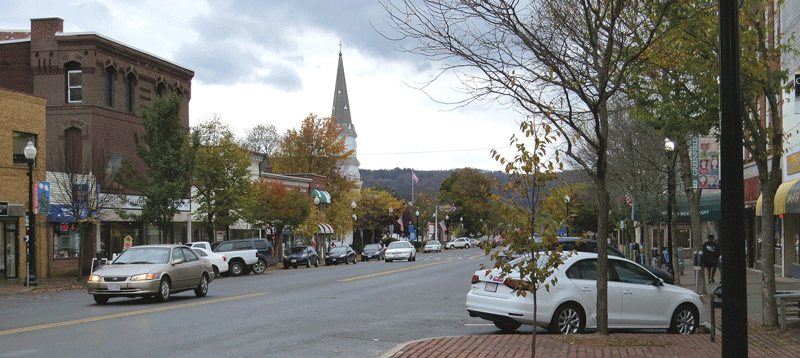
Downtown Greenfield

Downtown Greenfield is becoming a destination, as are other communities in Franklin County.

Franklin County, the state’s most rural county, and also its poorest, faces a host of challenges today — from a declining and aging population to poor broadband service in most of its communities, to statistically lower wages for comparable jobs. But those working to spur economic development and improve quality of life here see progress in many forms and vast opportunities to attract the young people who covet many of things this region can offer them.

John Lunt was looking to make a point about Franklin County in general, and the amount of developable land in and around Greenfield in particular, and to do so effectively, he recalled a recent conversation he had with Jay Ashe, the state’s secretary of Housing and Economic Development.

“We were talking about land that small precision manufacturers could potentially develop on, and he said something like, ‘you’re in Western Mass., Franklin County — you must have a ton of land,’” said Lunt, director of Special Projects and Economic Development in Greenfield, adding quickly that this is not the case at all.

“The land that we have available for those kinds of manufacturing jobs is pretty much gone,” he explained, referring especially to Greenfield. “We have some land that’s zoned ‘planned industrial,’ but there isn’t a business in the world that would build on it because of slope and ledge and things that make it to difficult to prepare.”

John Lunt

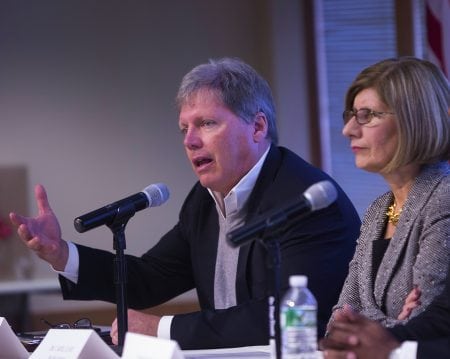
John Lunt says collaboration is a necessary quality in rural Franklin County, as is independence and an entrepreneurial approach to progress.

Lunt recalled his conversation with Ashe to make another point — that many of the perceptions about rural Franklin County, like the one about land to develop, are not exactly on the mark.

Others include the widely held belief that families and businesses do not want to locate there, the notion that the region doesn’t have much of what the Millennial generation is looking for, and the perception that manufacturing is all but dead in a region that had been economically dominated by it for centuries.

“Manufacturing is still doing very well here, but it’s changed somewhat; many large companies involved in traditional manufacturing have left,” said Patricia Crosby, executive director of the Franklin Hampshire Regional Employment Board. “Many smaller ones have stayed, and new companies have come here; they’re mostly involved in precision manufacturing or fabricated metals, and they’re doing extremely well, and they’re adding a few employees each year.”

Meanwhile, others we spoke with said Franklin County is, in fact, becoming a landing spot for Millennials — generally older Millennials who are ready to settle down, and especially those who are active and into outdoor sports (much more on that later).

Unfortunately, though, many other perceptions about this region are far more accurate, to the point where they become statistics. These include the fact that this is the poorest county in the state; that wages here are well below the state average for comparable jobs — a real factor in the region’s struggles to attract young people; that broadband service doesn’t exist in many of the communities in the county; that public transportation is sorely lacking; that the age of the population in those communities is rising at almost alarming levels; and that, while unemployment is fairly low at 3%, this is a misleading statistic because many individuals have stopped looking for work, and others are unemployable.

But while rural Franklin County has more than its fair share of challenges, there are a number of signs of progress and abundant hope that there will be many more in the months and years to come.

Start with the Five Eyed Fox, a restaurant and bar in Turners Falls that is making that community just east of Greenfield a destination and what some even called a ‘hot spot,’ a term not used in that community for some time.

“It’s super hip and cool to be in Turners Falls,” said Natalie Blais, executive director of the Franklin County Chamber of Commerce, and also the local tourism board. “It’s the place to be; Turners is sort of leading this whole retro, hip scene.”

It’s super hip and cool to be in Turners Falls. It’s the place to be; Turners is sort of leading this whole retro, hip scene.”

Then there’s the Orange Innovation Center, a co-working space in a community in what’s known as the North Quabbin area, the eastern edge of the county. Created in a factory where General Foods once produced Minute Tapioca pudding for roughly seven decades, the space now hosts an eclectic group of tenants ranging from a music studio and to a fitness club to the Center for Human Development.

And at Greenfield Community College (GCC), the only college in the county, a number of new programs have been created to help provide job seekers with the skills they’ll need to succeed in a changing, information-based economy.
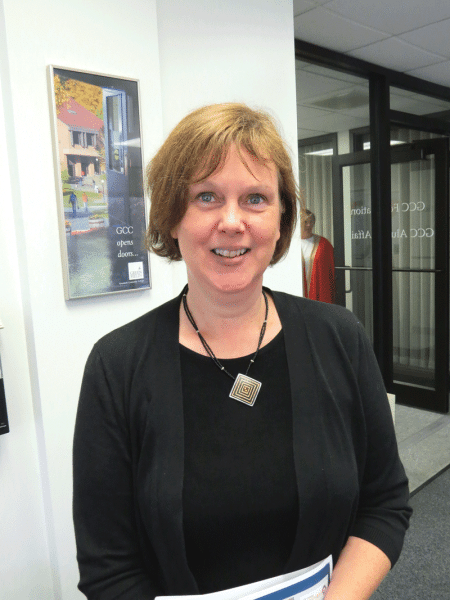
Linda Dunleavy

Linda Dunleavy says Franklin County is becoming an attractive landing spot for what she called ‘older Millennials,’ who are looking for a place to settle down.

Perhaps most importantly, though, an ecosystem is emerging. It’s comprised of a number of nonprofits, the college, government entities, and employers across several sectors, and while it’s still taking shape and finding its bearings, it is addressing the issues and problems facing the region through collaboration and efforts to maximize available resources. And it is also taking a more organized approach to the work of bringing families, businesses, young people, retirees — and opportunity — to the region.

For this issue, BusinessWest talked with several individuals who are part of this ecosystem about the various forms of progress being recorded — and the considerable work that remains.

Buy the Numbers

Collaboration is needed because the challenges facing Franklin County are numerous, and many of them are complex and defy easy answers — or any answers, for that matter.

Indeed, after talking about how wages in Franklin County are statistically lower than those in other areas and roughly 65% of what is paid statewide, Crosby, who noted that it’s been this way since she came to the REB 16 years ago, was asked the obvious question: why?

She paused for a moment and said simply, “because employers can get away with it.” And they can, because the factors that drive wages higher in other areas — a scarcity of workers and heightened competition for qualified talent — are not in evidence here, with some exceptions, as we’ll see.

That statistic regarding wages is only one of many eye-opening numbers that come to the forefront when talking about Franklin County. Many of the others drive home just how rural this area is: there are 72,000 people living in 26 communities across 725 square miles. In several communities, such as Rowe, Hawley, Heath, and others, stating the total population requires only three digits. In Monroe, one barely needs three; the latest census had 121 people living there.

The people living in those 26 towns are the poorest in the state in terms of per-capita income and, as noted, average wage per job, said Linda Dunleavy, executive director of the Franklin Region Council of Governments.

And, by and large, the population of the county is falling, said Alyce Stiles, dean of Workforce Development & Community Education at GCC. She said the enrollment at the county’s public schools is down significantly in recent years — which doesn’t bode well for the college or the region and its business community.

“That has layers of ramifications for us,” she said. “There are fewer people going into the community-college system, and then fewer people going into the workforce.”

And the population is getting older, said Roseann Martoccia, who should know. She’s the executive director of LifePath Inc., a nonprofit that works to help seniors age in place. She noted that 17% of the county’s residents are over age 65 (the state average is 15%), and in some of the smaller, western communities, the number exceeds 20%.

“And those percentages, in some communities, are expected to double by 2030,” she told BusinessWest. “And that’s not that far away.”

Behind all the numbers is a kind of operating mindset, if you will, one defined by a form of independence that is understandable when one considers how far away this county is from Boston or even Springfield — and not just in terms of geography.

“Collaboration comes from necessity,” said Lunt. “We have to be more independent, and we have to be more entrepreneurial, because whether we want it or not, most people realize that help isn’t really coming from farther east.”

The statistics, as well as this mindset, are just some of the things that Cindy Russo has learned she since became president of Baystate Franklin Medical Center in Greenfield, the county’s largest employer, roughly 18 months ago.

“I knew absolutely nothing about Franklin County before I came here, and about the only name I recognized was Yankee Candle,” she said, referring to the iconic Deerfield-based manufacturer and retailer. “Everything else, I had to learn.”
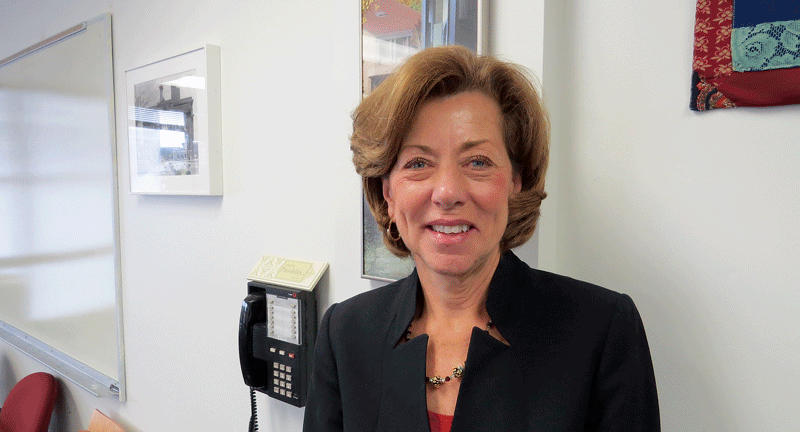
Cindy Russo

Cindy Russo, who became president of Baystate Franklin Medical Center in 2016, says she can sense gathering momentum in the region.

She’s learned, among other things, that the region has a strong sense of community spirit, as well as a great deal of natural beauty and a bounty of outdoor recreation to offer, from fishing to hiking; from skiing to whitewater rafting. She’s also learned that a large number of nonprofits operate in the region — often in collaboration with each other to meet a wide variety of missions.

She’s also come to recognize that it’s somewhat difficult to recruit doctors and other medical professionals to this rural area, despite its various amenities and lower lost of housing and living in general.

“That is certainly a challenge,” she said. “One of the biggest ways we’re able to attract people is if there’s a connection — they have family here or their roots are here — but also the beauty of this region and the hiking and other outdoor activity; those are strong selling points.”

Another challenge, meanwhile, is keeping young professionals, she said, adding that more than 50% of Baystate Franklin’s employees have less than five years of experience.

“Many times, we’ll get a new nurse from GCC, and they’ll start their practice at Baystate Franklin,” she explained. “But then they might be looking out for the sexier markets, like Boston. So we have to think of ways to keep them here.”

But since arriving, she’s observed something else — gathering momentum when it comes to the region being a destination for everything from a fun night out to a place to raise a family, to a spot where one can enjoy retirement. “There’s something bubbling here; even in the short time I’ve been here, I’m feeling it,” she said, adding that the region is becoming something it probably doesn’t want to become — a best-kept secret.

Land of Opportunity

There was some general agreement about that notion of something bubbling among those we spoke with. People talked about momentum and the region making strides toward becoming something it’s never really been, or hasn’t been for some time — a destination, on several levels.

Start with a night out — at the Five-Eyed Fox, or a growing number of alternatives.

“There’s great food and drink; there’s much more of a local arts scene than people than people think,” said Lunt. “We actually toured the Mass. Cultural Council around, and they were kind of blown away by what they saw out here.

“There are a lot of artists studios,” he went on. “There’s a lot of local theater, and Greenfield’s gone from having not that many restaurants to having 13 different kinds of cuisine. It’s not uncommon at all to do something you really couldn’t do here 10 or 15 years ago — families go out, have something to eat, and then go to a local show or theater or listen to some music.”

And then, there’s tourism in general. Blais said the region has built a solid infrastructure of attractions that includes ski resorts, ziplining and whitewater-rafting outfits, fishing, boating, and more, and needs to more aggressively promote what it has and build that important sector of the economy.

But those within this ecosystem also talked about destination in a bigger sense — as in a place for a family to settle or a business to put down roots.

And some younger families are moving into Greenfield and other communities, like Turners Falls, because of what they offer, said Blais.

“There’s lots of culture and live music,” she explained. “And with all the breweries and cideries in the region, we’re really seeing young people being interested in coming here.”

Dunleavy agreed, but narrowed the definition of ‘young’ somewhat. She said the region is more attractive to older young people, those with familes, those who might have roots in the region, or those who might have left in search of something else and now value what they left behind.

“It’s Millennials at a different stage of their life,” she said, adding that, despite recognized progress in this realm, there needs to be a large, concerted, and collaborative (there’s that word again) effort to sell the county as an attractive place to live.

“As a group of organizational leaders, we were talking about how we need to have the same mission — attracting young people and young families to Franklin County,” Dunleavy explained. “We should all identify how our organization will do that and work together to implement a region-wide strategy, because we need to bring more people to Franklin County and younger people to Franklin County.”

As for attracting businesses and jobs, the region faces a number of challenges, ranging from those broadband issues to the lack of developable land that Lunt mentioned.

“We never turn anyone away,” he said. “But we struggle when someone says, ‘we want a 40,000-square-foot building and 22 acres’ — we just don’t have that available.”

What is available are smaller lots, some old mill spaces, and office buildings downtown, he noted, adding that all of the above can be used toward something that Millennials, in general, seem to like: co-working space.

Several projects in this realm are already underway or in the planning stages, said Lunt, adding that they will helped by the town’s creation of a municipal broadband network that includes Internet, phone, and data services.

“The goal is to move people into these spaces by offering them more 21st-century infrastructure,” he explained, “because, as manufacturing-driven as we’ve been, we just can’t be in the future, because we just don’t have the space for it; we have to try to develop higher-tech businesses, and those are also businesses that pay well.”

Another challenge for the region involves the workforce. As noted earlier, unemployment is relatively low, but there are many who lack needed skills, have stopped searching for work, or are unemployable.

Stiles said the broad goal is to help individuals gain needed skills and fill positions in growing fields, such as healthcare and precision manufacturing.

She mentioned specific programs created at GGC for the precision-manufacturing and medical-assisting fields, just two of many where jobs exist and will exist in the years to come, and where companies consistently struggle to find good help.

Moving forward, she and others said the primary goal is to make the workforce larger and stronger, an initiative that is, in all ways, a work in progress.

Moving the Needle

Surveying the situation from many different angles, including that of a long-time resident and also someone working to stimulate economic development in the region, Lunt said the path Franklin County is on is the right one.

Elaborating, he said the many groups working to spur economic development and improve quality of life are moving the needle when it comes to generating progress and addressing the overriding challenge facing the county — creating enough good jobs to support the lifestyle that is the primary draw for this region.

“We could all live somewhere else, but we don’t — we choose not to,” Lunt told BusinessWest. Speaking for all those now part of the county’s emerging ecosystem, he said the broad goal is simply to inspire more people to take that same attitude.

George O’Brien can be reached at [email protected]

Daily News

SPRINGFIELD — Lynn DeNucci, a financial advisor with Merrill Lynch in Springfield, was named to the 2017 “Top Wealth Advisor Moms” list by Working Mother magazine, the first list of its kind to recognize working mothers in the financial-advice field. Advisors were judged on a number of factors, including assets under management, industry experience, compliance records, and client retention.

DeNucci, a graduate of Brown University, has nearly 25 years of experience helping families, individuals, and business owners manage wealth and achieve their financial goals.

Briefcase Departments

Employer Confidence Hits Another High for 2017

BOSTON — Employer confidence in Massachusetts hit another high for 2017 during October as economic growth accelerated and companies remained optimistic about the national outlook. The Associated Industries of Massachusetts (AIM) Business Confidence Index edged up 0.3 points to 62.7, leaving it 6.5 points better than in October 2016. The uptick was driven by a brightening view of employment growth and firming confidence among manufacturers. The reading came as MassBenchmarks reported that the Massachusetts economy grew at 5.9% during the third quarter, almost double the rate of the national economy. Payroll employment grew at a 2.1% annual rate in Massachusetts in the third quarter as compared to 1.2% nationally. “The acceleration of the Massachusetts economy in the third quarter provided additional fuel to an already solid sense of confidence among employers as we head for 2018,” said Raymond Torto, chair of AIM’s Board of Economic Advisors (BEA) and lecturer at Harvard Graduate School of Design. “At the same time, optimism about the national economy suggests that employers believe growth rates throughout the U.S. will increase even more if Congress follows through on its proposal to lower the corporate tax rate from 35% to 20%.” The AIM Index, based on a survey of Massachusetts employers, has appeared monthly since July 1991. It is calculated on a 100-point scale, with 50 as neutral; a reading above 50 is positive, while below 50 is negative. The Index reached its historic high of 68.5 on two occasions in 1997-98, and its all-time low of 33.3 in February 2009. The Index has remained above 50 since October 2013. The constituent indicators that make up the overall Business Confidence Index were largely higher during October. The Massachusetts Index, assessing business conditions within the Commonwealth, slipped 0.3 points to 65.1, still 4.1 points more than a year earlier. October marked the 91st consecutive month in which employers have been more optimistic about the Massachusetts economy than the national economy. The U.S. Index of national business conditions rose 2.7 points to 62.5, continuing a 13.3-point surge for the 12-month period. The Current Index, which assesses overall business conditions at the time of the survey, increased 0.7 points to 63.6, while the Future Index, measuring expectations for six months out, remained even at 61.9 points. The Current Index has risen 7.6 points and the Future Index 5.6 points during the past year. The Company Index, reflecting overall business conditions, lost 0.3 points to 62.0. There was better news in the Employment Index, a key predictor of economic health, which rose 2.0 points to 57.8.

Arrha President Testifies on Bill to Modernize Credit-union Laws

SPRINGFIELD — Michael Ostrowski, president and CEO of Arrha Credit Union, testified on an act to modernize credit-union laws before the state Joint Committee on Financial Services. Ostrowski testified on allowing technological advances, increasing transactional authority for chartering and merging credit unions, and increasing state authority for low-income designation. “A top priority of Arrha Credit Union is to be able to fully utilize today’s advances in technology. We are not allowed to offer electronic loan applications, along with other credit unions. Our members want technological convenience in today’s advanced electronic world,” Ostrowski said. “Also, mail was meaningful during the time this law was enacted; however, today’s electronic voting has largely taken the place of mail ballot voting, and is more easily accessible for members to actively participate in our governance. Such technological advances will provide convenience, time-saving opportunities, and cost-saving opportunities. It is important for Arrha Credit Union to stay as technically advanced as possible to best serve our membership and communities.” Arrha Credit Union supports the provisions of this bill, which allows the Massachusetts commissioner of Banks to recognize the credit-union low-income designation for state-chartered credit unions. A credit union that receives the low-income designation is a credit union in which has more than half of its members have a family income 80% or less than the median family income for the metropolitan area where they live or national metropolitan area, whichever is greater. This authority will open an opportunity for credit unions to gain access to grant money to provide additional training opportunities for its staff, better and more tailored products for its low-income base, and other such improvements. It will also allow for expedited and easier recognition of credit for Community Reinvestment Act purposes. “Arrha Credit Union is considered a low-income-designated credit union and has used its low-income designation in the area of auto lending with 100% loan-to-value ratios, which allows us to better and more timely serve our members,” Ostrowski said. “It is clear that values and general banking business dynamics change very quickly in this day and age; as a result, it is necessary that our laws are also kept up-to-date, modernized, with today’s needs.

Unemployment Rates Decrease Across State in September

BOSTON — Local unemployment rates decreased in 19 labor-market areas, increased in two areas, and remained the same in three areas in the state during the month of September, the Executive Office of Labor and Workforce Development reported. Compared to September 2016, the rates were up in 18 labor-market areas and remained the same in six labor-market areas. Six of the 15 areas for which job estimates are published recorded seasonal job gains in September. The gains occurred in the Springfield, Worcester, Brockton-Bridgewater-Easton, New Bedford, Peabody-Salem-Beverly, and Leominster-Gardner areas. From September 2016 to September 2017, 14 of the 15 areas added jobs, with the largest percentage gains in the New Bedford, Haverhill-Newburyport-Amesbury, Barnstable, Boston-Cambridge-Newton, Lynn-Saugus-Marblehead, and Springfield areas. In order to compare the statewide rate to local unemployment rates, the Bureau of Labor Statistics estimates the statewide unadjusted unemployment rate for September was 3.5%. Last week, the Executive Office of Labor and Workforce Development reported the statewide seasonally adjusted unemployment rate dropped to 3.9% in the month of September. The statewide seasonally adjusted jobs estimate showed a 9,300-job gain in September and an over-the-year gain of 62,300 jobs. The unadjusted unemployment rates and job estimates for the labor market areas reflect seasonal fluctuations and therefore may show different levels and trends than the statewide seasonally adjusted estimates. The estimates for labor force, unemployment rates, and jobs for Massachusetts are based on different statistical methodology specified by the U.S. Department of Labor’s Bureau of Labor Statistics.

Board of Higher Education Votes to Join Agreement on Online Learning

BOSTON — The state Board of Higher Education recently authorized the state’s commissioner of Higher Education to submit an application to join the State Authorization Reciprocity Agreement (SARA), a multi-state approach to regulating the growing number of online learning programs offered by colleges and universities across the U.S. The board’s unanimous vote follows an extensive review of what joining SARA would mean for the Commonwealth. Last year, Massachusetts Education Secretary James Peyser chaired a legislative Special Commission on Interstate Reciprocity Agreements, which issued a report that was reviewed by the Board of Higher Education as part of its decision-making process to join SARA. In December 2016, the U.S. Department of Education incorporated recommendations from the state Board and Department of Higher Education, the Office of the Attorney General, and the Executive Office of Education in final authorization regulations for postsecondary online education. “As we strive to make higher education more affordable and accessible for residents of the Commonwealth, adding online learning options is a critical step in the right direction,” Gov. Charlie Baker said. “We are pleased to join SARA with the assurance that we would be able to continue vital consumer protections for our students, and look forward to preparing our application.” Added Peyser, “if Massachusetts’ application for SARA membership is approved, students in the Commonwealth will see a multitude of options in online education open up for them, and our state’s colleges and universities will find it less cumbersome and costly to offer online courses to students in other states.” Massachusetts will be the 49th state to join SARA, if its application is accepted by the National Council for State Authorization Reciprocity Agreements. Currently, the Board of Higher Education regulates the degree-granting authority of most post-secondary institutions with a physical presence in the Commonwealth, granting them the ability to offer specific credit-bearing programs of study and to use the terms ‘college’ or ‘university’ in their names. At present, it does not exercise oversight over out-of-state institutions that offer only online programs to Massachusetts students. With the proliferation of distance-learning providers and modalities, the need for a new, more nimble regulatory approach that will allow for greater access and options for students — while maintaining robust student protections and safeguards — has emerged. “Massachusetts has a strong history when it comes to regulations and standards that benefit consumers — in this case, students — and we were willing to take our time in deliberating whether to join SARA rather than rush into an agreement that might shortchange them,” said Carlos Santiago, state commissioner of Higher Education. If Massachusetts’ application to join SARA is accepted, institutions in the Commonwealth may be able to submit applications to begin operating under SARA by the summer of 2018.

Connecticut Airport Authority Seeks Development Proposals

WINDSOR LOCKS, Conn. — The Connecticut Airport Authority is seeking developers to enter into a long-term land lease to develop, operate, and maintain commercial property owned by Bradley International Airport located on a vacant, 4.8-acre parcel on Ella Grasso Turnpike. A pre-proposal meeting will be held on Wednesday, Nov. 8 at 10 a.m. in the Human Resources Conference Room located at 334 Ella Grasso Turnpike, Suite 100, Windsor Locks. Full copies of the request for proposal may be downloaded at www.ctairports.org/economic-development/procurement, or by e-mailing [email protected].

Departments Picture This

The Super 60

The Springfield Regional Chamber of Commerce staged its annual Super 60 Luncheon at a packed Chez Josef in Agawam on Oct. 28. Now in its 28th year, the program recognizes high-performing companies in two categories: Total Revenue and Revenue Growth.

Bill Grinnell (center), president of Webber & Grinnell Insurance, a winner in the Total Revenue category, accepts his plaque from Ashley Allen, vice president of Sales & Marketing for Health New England, the presenting sponsor, and Don D’Amour, chairman of Big Y Foods, a platinum sponsor

Bill Grinnell (center), president of Webber & Grinnell Insurance, a winner in the Total Revenue category, accepts his plaque from Ashley Allen, vice president of Sales & Marketing for Health New England, the presenting sponsor, and Don D’Amour, chairman of Big Y Foods, a platinum sponsor

Ralph Crowley Jr., CEO of Polar Beverages in Worcester, delivers the keynote address

Ralph Crowley Jr., CEO of Polar Beverages in Worcester, delivers the keynote addres

Paul Whalley, vice president of Whalley Computer Associates, the top finisher in the Total Revenue category, accepts his plaque from Allen and D’Amour

Paul Whalley, vice president of Whalley Computer Associates, the top finisher in the Total Revenue category, accepts his plaque from Allen and D’Amour

Drive Time

A host of local and state officials were on hand on Nov. 1 for the ribbon cutting for Mercedes-Benz of Springfield, the $12 million dealership created at the site of the former Plantation Inn in Chicopee. First conceived nearly three years ago, the dealership marks the return of Mercedes-Benz to the Greater Springfield area after a decade-long absence.

Attendees mingle in the showroom prior to the ceremonies

Attendees mingle in the showroom prior to the ceremonies

Jay Ashe, state secretary of Housing & Economic Development, addresses the attendees

Jay Ashe, state secretary of Housing & Economic Development, addresses the attendees

Cutting the ribbon are

Cutting the ribbon are, from left, state Rep. Joseph Wagner, Ashe, Chicopee Mayor Richard Kos, partners Peter and Michelle Wirth, partner Richard Hesse, and his wife, Amy

Peter Wirth says a few words to the attendees

Peter Wirth says a few words to the attendees

Cover Story

A Huge Opportunity — Clearly

From left, principals Marc Gammell, Yinyong Li, and Kenneth Carter

From left, principals Marc Gammell, Yinyong Li, and Kenneth Carter

There’s no word yet on whether the creators of FogKicker will embrace Johnny Nash’s 1972 reggae hit ‘I Can See Clearly Now’ as their theme song, but it would certainly work. The product, developed in the polymer science lab at UMass Amherst, has proven itself successful in keeping a range of surfaces, from scuba masks to bathroom mirrors, clear of fog. Partners Yinyong Li, Marc Gammell, and Kenneth Carter are scaling up their venture, Treaty Biotech LLC, and while their vision of the future isn’t totally clear, it is certainly coming into focus.

They call it ‘big glass.’

That’s the term the principals at Treaty LLC, developers of the product known as FogKicker, summon as they talk about larger surfaces such as car windshields, bathroom mirrors, and shower doors.

And they foresee a day when their product will be in widespread use on all of the above, and more, to clear away annoying — and sometimes dangerous, especially when it comes to those windshields — fog.

We made a strategic decision to go after this niche market, where we knew there was a problem, where there are anti-fogging products out there that work fairly miserably, and where we knew we could gain a foothold.”

But for now, they’re more focused on what would have to be labeled ‘small glass,’ or at least ‘smaller glass,’ as in the goggles used by scuba divers, snorkelers, swimmers, skiers, mountain climbers, and others. And in this realm — large in its own right by any estimation — those who developed FogKicker in the polymer science lab at UMass Amherst can see some clear opportunities, pun obviously intended.

“There are certainly a number of applications for this product — everyone has a bathroom mirror,” said Yinyong Li, who, along with Kenneth Carter, a professor in the Polymer Science and Engineering Department at UMass Amherst, discovered that nanocellouse, a biological material plants use to help them absorb and circulate water, could also be used to solve one of society’s big problems — keeping glass surfaces free of fog.

Cellulose, of course, is used in the production of a number of paper products, said Yinyong, adding that, in many respects, FogKicker acts like an invisible paper towel to absorb moisture and keep glass surfaces clear of fog.

Yinyong, the company’s chief technology officer, who attained his Ph.D. from UMass in 2016; Carter; and third partner Marc Gammell, who recently earned his undergraduate degree at UMass, are making giant strides forward in the process of taking FogKicker from discovery in the lab to successful business venture.

They have succeeded in raising capital, and also in raising the product’s — and the company’s — profile, through appearances like the one late last month on the CNBC reality program Adventure Capitalists, for example.

The video clip shows Gammell and Carter (an experienced diver himself), both clad in FogKicker pullovers, appearing on a dock somewhere with the ocean in the background, making a pitch for their product — and also for what the two called ‘smart capital,’ as well as individuals to join their team.

The creators of FogKicker are in the process of scaling up their venture, focusing first on sports goggles and other smaller glass surfaces.

The creators of FogKicker are in the process of scaling up their venture, focusing first on sports goggles and other smaller glass surfaces.

“We want someone who has industry-specific connections,” Gammell, the company’s CEO, says in the video, referring specifically to the diving market. “Someone who has some serious marketing clout, someone who knows their way around building a brand; we want a real team player that brings that to the table.”

In a nutshell, that short video, which also goes into some detail about the product and how it works, neatly sums up where this company is right now and what it’s doing to get where it wants to go.

It has a product that works — one that those in the diving industry have been quick to embrace, as we’ll see — and a road map of sorts for getting to the next level with small glass and ambitions for doing the same with big glass.

For this issue, BusinessWest talked at length with the FogKicker team about their vision for their product and their company, and how things have come into focus, in every sense of that word.

Glass Act

As they talked with BusinessWest about FogKicker and their plans for it, Yinyong, Gammell, and Carter were getting ready to travel.

Their destination was Orlando and, more specifically, the week-long Diving Equipment & Marketing Assoc. (DEMA) trade show. Armed with a new and vastly improved show booth, the partners were — wait for it — looking to make a splash with their growing portfolio of products.

Or another splash, to be more precise.

Indeed, it was at the 2016 DEMA show in Las Vegas that the partners first caught the attention of the diving community, and in a big way.

The FogKicker principals, from left, Kenneth Carter, Marc Gammell, and Yinyong Li, display their products at one of the many trade shows they’ve exhibited at recently.

The FogKicker principals, from left, Kenneth Carter, Marc Gammell, and Yinyong Li, display their products at one of the many trade shows they’ve exhibited at recently.

“We were met with huge enthusiasm, and seemingly overnight, our product was available all over the world, because this is a worldwide conference, and people were buying cases and cases of it,” said Carter, the company’s chief scientific officer.

This response came, he went on, because FogKicker established itself as a clear (literally) improvement over other methods of keeping scuba masks clear of fog — from saliva to soaps that were already on the market, both of which eventually wash off and lose their effectiveness. “This is one of the first water-resistant anti-fogging coatings that have been produced.”

But to tell this story, we need to go back further, to earlier this decade, when Yinyong and Carter, using funding from the National Science Foundation, started to look at ways that nanocellulose, derived from paper pulp, could be used in electronics.

“Cellulose is one of the most abundant products in the world; it’s the basis of wood, paper, trees, algae, and plants in general,” said Carter. “Paper makers grind it up into a pasty pulp, and they spread it over wires, and that’s how we make paper — it’s essentially just dried cellulose.

“What was discovered a while ago is that, if you keep breaking that pulp down, mechanically breaking it down and chemically treating it, you can get to what’s known as nanocellulose — nanoscopic particles of cellulose,” he went on. “We were playing around with it, and trying to think of other things we could do with nanocellulose.”

The two discovered they could take many common sources of the material, such as waste paper, cotton, or recycled paper, and convert them into nanocellulose. The bigger discovery, as it turned out, came when they placed this material on various surfaces and, in doing so, created completely transparent coating that did not fog up when exposed to humid air or steam.

“Because it’s paper, it’s very absorbent to water — we all know that paper loves water,” Carter explained. “When things fog up, what’s happening is that water vapor in the air is hitting a cooler surface, and it condenses, forming tiny beads of water, which we see as fog.”

When water hits the nanocellulose films, it gets absorbed, said Yinyong, and doesn’t form those beads, thus eliminating fog.

Fast-forwarding through the all-important discovery phase to ensure that the product is unique and the patent-disclosure process, Yinyong made the concept an entry in the 2015 Innovation Challenge at UMass Amherst, and he came away with the $20,000 grand prize.

He also came away with an eventual partner in this fledgling business venture. Indeed, Gammell was another contestant at the Innovation Challenge. He didn’t fare nearly as well with his entry, but he would also have to be considered a winner, because he was so impressed with what Yinyong brought to the table that he asked if he could be a part of it.

“I was pitching my own crazy business idea, and Yingong was pitching FogKicker,” he recalled. “Yingong wound up going to the finals, and I went just to watch him do his extended pitch, and afterwards, I was so pumped up about FogKicker and his work with nanocellulose that I introduced myself and told him I wanted to help him any way I could.”

Things have accelerated at an impressive pace since then, with FogKicker and Treaty Biotech LLC moving on to more innovation and entrepreneurship competitions, including the Venture Well program in Hadley and Valley Venture Mentors’ Accelerator program, and winning some prize money at nearly all of them.

They also took part in the National Science Foundation’s Innovation Corps, or I-Corps, as it’s called, a program that prepares scientists and engineers to extend their focus beyond the university laboratory and move forward with NSF-funded projects ready for commercialization.

“It’s like a boot camp — they scrutinize everything you do,” said Carter, adding that Treaty LLC won $50,000 to do customer discovery.

And those efforts took the partners to Tek-Divers, a Middle Eastern outfit that offers a wide range of recreational diving and extreme deep diving.

“They dive under some of the most extreme conditions out there — so we went to talk to them, realizing, who better could tell us whether we had something interesting than people who put their lives on the line?” said Carter. “And immediately, they loved us; they said, ‘boy, this stuff is great.’ And they bought a lot of it.”

View to the Future

The partners at Treaty LLC have been putting the capital they’ve attained from competitions and other sources to use in the many specific areas covered by that broad term ‘scaling up.’ That process includes everything from prototype development and production (now taking place at a location in Springfield) to marketing, like the DEMA show; from gaining more capital, through a variety of methods, including that Adventure Capital episode, to adding more team members, something the partners expect will happen over the next several months.

Product development was an exercise in listening to the experts and responding to what they said, Yinyong noted, adding that initial thoughts about possibly creating one-use disposable wipes were discarded amid feedback from divers and environmentalists fearful of the ocean being littered with the packages for those wipes.

What emerged instead was a felt-tip-marker-like device that places drops of FogKicker on a surface to be rubbed in. To date, the company has sold roughly 30,000 small bottles of various solutions.

As noted earlier, Treaty Biotech is, for the most part, focused on that ‘smaller glass’ market, and especially the sports-goggle market and the scuba/snorkeling market.

“We thought really hard about what would be best way to roll this out,” said Carter. “Of course, you would sell more volume and more bulk material if you put it in squirt bottles for home use, but how do you even approach that market?

“So we made a strategic decision to go after this niche market,” he went on, “where we knew there was a problem, where there are anti-fogging products out there that work fairly miserably, and where we knew we could gain a foothold.”

Even within that seemingly small niche, the numbers are impressive and the sales potential considerable, said Yinyong, noting that the business plan estimates that there are 14 million scuba divers and snorkelers in the U.S. alone, and maybe 25 million worldwide.

Educating them about their product is important, he said, because many are firmly convinced that anti-fogging products don’t work, or don’t work any better than their own saliva.

The appearance on Adventure Capitalists, a show billed as the outdoor person’s Shark Tank, is expected to help boost efforts in this regard. Contestants make presentations to a panel of investors — all of them involved in sports, business, and investing — who then put those products through their paces, often in harsh conditions.

But there are, of course, much bigger numbers in the ‘big glass’ market, said Gammell, who did some quick math and estimated that there are more than 250 million car and truck windshields in this country alone.

Meanwhile, there are probably 100 million bathroom mirrors within the residential market alone, he said, adding quickly that the commercial market — hotels, motels, gyms, and other segments — is equally potential-laden.

And there are other markets as well, including the huge healthcare field, Gammell noted, adding that all of these markets and others are potentially within the company’s reach.

To reach them, the company and its principals are moving in a number of directions, from an aggressive push for seed funding from investors to talks with contract manufacturers about scaling up production; from a website makeover to a new trade-show booth for the DEMA event and many others to follow.

“Big glass … we could be there in a year,” said Gammell. “And in a year, hopefully we’ll have big accounts with Dick’s Sporting Goods, CVS, Cabela’s, Bass Pro Shops, and others. And we’ll have some hires — we’ll have a bigger team.”

Bottom Line

If you listen to the lyrics from “I Can See Clearly Now,” they include lines you would never, ever hear from aspiring entrepreneurs, such as “I can see all obstacles in my way,” or “I think I can make it now, the pain is gone,” or “all of the bad feelings have disappeared,” or even (and especially) “look all around, there’s nothing but blue skies … look straight ahead, nothing but blue skies.”

Yinyong, Gammell, and Carter certainly know better. They know there are obstacles they probably can’t see, and there are obviously some clouds within that blue sky.

But overall, the future is certainly bright for FogKicker, and there are enormous opportunities for this venture — clearly.

George O’Brien can be reached at [email protected]

Banking and Financial Services Sections

Moving Forward

Jim Curran was asked about the heightened state of competition within the commercial-lending realm in Western Mass. and how People’s United Bank is responding to this changing landscape.

Jim Curran

Jim Curran

He began his answer by noting that, while conditions in this region are perhaps somewhat more competitive than they were when he first started working in this market more than 30 years ago, the reality is that there have always been a lot of strong competitors for People’s United, formerly the Bank of Western Mass.

And he knows that because he worked for some of them.

“It’s been a competitive market for 30 years,” said Curran, the recently named senior vice president and regional manager for Central and Western Mass. “When I sit and talk with people about how competitive the market is today, that’s the same conversation we were having 20 years ago; nothing’s really changed in that regard.”

But many other aspects of banking, and doing business in general, have changed over the past few decades, including everything from the way people work to the technology they use, and that’s why Curran will be managing an office occupying the 10th floor of Monarch Place.

Indeed, the 32 employees at the regional office have moved only a few hundred feet across Main Street in downtown Springfield, but the relocation from the property most still know as Harrison Place (even though it had the People’s United name over the front) to Monarch Place is a considerable step forward, said Patrick Sullivan, the bank’s market president for Massachusetts.

He told BusinessWest that the move has been in the planning stages for more than 18 months, and arose from simple necessity.

When I sit and talk with people about how competitive the market is today, that’s the same conversation we were having 20 years ago; nothing’s really changed in that regard.”

“That’s an old building, and its functionality just doesn’t suit today’s world with the technology and the way people work; when you have an old building, you just can’t do certain things,” he explained. “We were spread out over four floors at one time, and, more recently, we were in two or three floors; now, we’re all on one floor, and that’s much more efficient.

“The new building will allow for greater synergies and collaboration between our cross-functional teams,” Sullivan went on, “including commercial, wealth management, consumer, and insurance services.”

The search for new quarters was an extensive one, he noted, adding that a number of sites were considered — within downtown, outside it, and also outside Springfield itself. Ultimately, the bank, which had been headquartered at Harrison Place for more than 20 years, decided to stay in the central business district.

“Although our customers are spread throughout Western Mass., centrally, downtown Springfield is the best place for our people,” he explained.

Curran agreed, saying that “there’s a lot of really good, positive energy with this move.”

As noted, Curran brings to his new position at People’s United a wealth of experience in banking, commercial lending, and in serving business owners in the Western Mass. market.

Most recently, he served seven years as executive vice president of Berkshire Bank and regional manager of the Western Mass./Central Mass. and Northern Conn. commercial-banking teams. In that role, he established Berkshire Bank’s present Central Mass. location, recruited the commercial-lending and credit team, built market identity and brand awareness, and built a loan portfolio from scratch to $215 million.

Prior to that, he served in a similar role with Santander Bank and its predecessor, Sovereign Bank, managing a team with a portfolio of commercial loans that approached $1 billion prior to the Santander acquisition of Sovereign in 2009. He got his start in banking with Bank of New England (later Fleet Financial) in 1983.

Those stops on his résumé translate into being part of that considerable competition within the commercial lending market that he spoke of earlier, so he obviously speaks from experience when he addressed how to thrive within such an environment.

Specifically, he said it comes down to several factors, including having a large portfolio of products, being local (instead of just saying your institution is local), and understanding customers and their needs.

“That’s the beauty of this bank,” he said. “When you go into a relationship, you have everything in front of you to deliver the financial services and products to that customer — whether it’s the retail side or additional services like treasury management, or whether you’re looking to do an interest-rate derivative on a large commercial real-estate deal or you’re simply looking to do payroll for a manufacturer with 30 people.”

Sullivan agreed. “The competitive advantage we have is to keep all our bankers as local as possible,” he said. “But we have people who know how to take care of a Western New England University or a Springfield College, or a healthcare system, or make a $200,000 loan fast. We stick to our core competency, which is commercial lending, which is important, because it’s competitive out there.

“We respect the fact that the local banks are good competition,” he went on. “We have to out-local them and also out-product them; that’s the world today.”

— George O’Brien

Banking and Financial Services Sections

Business Valuation

By Brandon Mitchell

Brandon Mitchell

Brandon Mitchell

For business owners looking to sell in the near future, there is plenty to be optimistic about.

Buyers have access to capital at low interest rates through banks. Stocks are at all-time highs, driving individual net worth and access to down payments. The Massachusetts economy is vibrant. Most recent reports show GDP growth and unemployment rates outperforming the national average. There is positivity around MGM coming to Springfield, a new GE headquarters moving to Boston, and the potential for business-friendly legislation coming down the pipeline.

These factors will drive buyers to jump into the market and take the keys to a business, but there is a catch. With more than 1,100 businesses listed for sale across Massachusetts right now, buyers have options and are willing to wait for a value that makes sense.

When figuring the value of their business, owners can fall into the trap of including sentimental value in their estimation. Some are relying on what a similar business sold for in a different market or, worse, have a target number they drew up without any real anchor to reality.

Owners should resist the temptation to ‘pull the parachute’ as they get closer to the finish line.”

For business owners who have dedicated their lives to a business, it can be hard to take a step back and objectively consider what their business is worth. Business owners who are willing to take an objective look at the value of their business can be proactive now instead of reactive when they are ready to retire and list their business for the first time.

The value of a business is dynamic. While there is no way to get a buyer to price sentimental value into a purchase price, there is a potential to make changes to the business that will increase the value over time.

There are three approaches to valuing a business — asset, income, and market approaches. For most privately held companies, valuators rely on either the income approach, market approach, or a combination of the two. The basic formulas for these calculations are widely available online, but what owners can do with this information may be less obvious.

First, it’s important to know that the years leading up to the valuation or sale are the most important. A long history of profits can show stability for a small business; however, only the most recent three to five years are going to be considered in a calculation. Small-business owners with eyes on an exit have a tendency to disconnect from the business during this most important period when they should be pushing in the opposite direction.

Flat revenues or increases in expenses during this period have the potential to erase even decades of growth and profitability. Owners should resist the temptation to ‘pull the parachute’ as they get closer to the finish line. Continue to push for revenue growth, and pay close attention to expense control. This is the time to let the numbers showcase the full potential of the business.

Nobody knows the ins and outs of a small business like the owner. Buyers and valuators weigh heavily on the impact the seller’s exit will have on the future of the business. Owners should focus on replacing themselves in the areas in which they are most intertwined in the business to lessen the impact. To identify these high-dependency areas, owners can interview managers and employees, noting issues that cannot be resolved without them.

Key areas of focus generally depend on the industry or business model but usually include sales generation, relationship management, product development, strategic decision making, or day-to-day business management. If continuity can be achieved through process improvement or process documentation, it should be a key focus. Some results can be found through training current employees and empowering them. Consider restructuring tasks and delegating the current owner’s duties to rising managers.

Finally, clean up the financial statements. For various reasons, including tax motivations, small-business owners have a tendency to let their personal and business lives collide on their company financial statements. Documentation is important for any personal expenses being charged to the business. Owners should be ready to prove which expenses were not necessary for the business so that buyers and valuators exclude the expenses to calculate the value — buyers will not report findings to the IRS.

Performing a financial analysis can also help owners understand how their business compares to the rest of the industry, making them ready to articulate strengths and defend or improve weaknesses.

Overall, the current market is friendly to someone looking to sell their business. It’s also a great time to be proactive in managing an exit strategy, whether it lies around the corner or several years out. Getting realistic about the value of their business enables owners to take steps to improve it and make informed decisions.

Brandon Mitchell is a certified valuation analyst and owner of BLM Valuation Services, LLC, which specializes in certified independent business valuations for SBA lenders and small-business owners; (413) 306-1940.

Opinion

Opinion

By Henry Dorkin, M.D.

The opioid crisis, which is taking the lives of friends, neighbors, and family members across the country, should rightly be declared a public health emergency. However, in order to truly stem the tide of this epidemic, the declaration must be matched by a coordinated federal effort that is equivalent to what is already being done at the state level.

This crisis knows no borders, and it impacts people from all walks of life, of all ages, across the U.S. Here in Massachusetts, despite having had a wide range of public and private efforts underway for several years, we saw roughly 2,000 opioid-related overdose deaths just last year.

Our experience has demonstrated the value of patient-focused partnership between the medical community and elected officials at all levels. The Commonwealth’s 2014 declaration of the opioid epidemic as a public health crisis helped lead to a dramatic increase in the use of the state’s prescription drug-monitoring system, MassPAT.

Gov. Charlie Baker’s commitment to make the system a true clinical tool for physicians has had a major impact. According to data from the Department of Public Health, while MassPAT searches increased by 500% between the first quarter of 2015 and the first quarter of 2017, the number of Schedule II opioid prescriptions written dropped by 23%, and the number of individuals receiving prescriptions dropped by 24%.

But there is still much work to be done in implementing change that saves lives — a goal we should all share.

Massachusetts has been an innovator and a leader in identifying and implementing state and federal policies that slow the spread of opioid-use disorder and improve the ability of affected patients to get the care that they need in pursuit of recovery. For this, we thank our elected leaders, including local officials; Gov. Baker, state lawmakers and public health officials; and members of our Congressional delegation, who have fought successfully for legislation that has addressed the crisis nationally.

The data from Massachusetts confirm that policy changes can help make a difference in slowing the growth of the crisis and the countless tragic deaths that it causes. While we appreciate the effort from the Trump administration to bring to bear the strength of the federal government, we also believe that this crisis requires the allocation of adequate federal resources to make a meaningful difference in the lives of the people impacted by opioid-use disorder.

Dr. Henry Dorkin is president of the Massachusetts Medical Society.

Daily News

NORTHAMPTON — Dan Berger, partner in the Northampton-based law firm Curran & Berger, has joined the board of directors for the International Language Institute of Massachusetts (ILI).

“We are pleased to welcome Dan to ILI,” said board president Eric Wirth. “His legal background and considerable experience in immigration issues bring a wealth of skills and knowledge to support ILI’s work, which includes free English classes for immigrants and refugees, high-quality language instruction and teacher training, and volunteer opportunities throughout the Pioneer Valley.”

Berger has been an attorney at Curran & Berger since 1998, and is active in immigration matters locally and nationally. He is a founding member of the American Alliance of International Entrepreneurs, an honorary member of the American Academy of Adoption Attorneys, and regulatory practice coordinator for the National Assoc. of Foreign Student Advisers. He has been quoted in various media, including the Atlantic and the Huffington Post; has spoken at conferences and universities across the country; and has edited the books Immigration Options for Academics and Researchers and Diplomatic Visa Guide.

Berger developed his interest in immigration during college, where he studied immigration history and taught English to adult refugees. He is a graduate of Harvard College and Cornell Law School.

Opinion

Editorial

In the days and weeks after the Harvey Weinstein story broke and new wrinkles were continually added, there was growing commentary that maybe some kind of milestone had been reached, that maybe the tide was turning when it came to sexual harassment in the workplace.

This commentary was generally greeted with large amounts of skepticism, in the same way that there was skepticism with thoughts, and hopes, that the latest mass shooting would be the one to finally stimulate action (in whatever form it could possibly take) to make sure this was the last such tragedy.

And that skepticism is warranted, because, like gun violence, sexual harassment has longed seemed like a problem we just couldn’t solve, something that people, and especially women, would just to have to live with. There is a ‘that’s just how it is’ sentiment about it.

But increasingly, it seems that, while there is still ample room for skepticism on this topic, there is also space for some optimism, some hope that maybe a sea change is in the offing. Some promise that people may soon be saying ‘that’s how it was’ instead of ‘that’s how it is’ or ‘that’s how it will always be.’

Why? Well, there are several reasons. Let’s start with the manner in which the Weinstein case has shed light on the subject and shown that, when people come forward — even if it’s years or decades after the fact — offenders can be brought to justice (in whatever form it takes), and a situation might change.

As just one example, the Massachusetts Legislature has come under scrutiny in recent weeks in the form of allegations that people in positions of power (most all of them men) wielded that power in ways that created a truly hostile workplace, where women became convinced that saying ‘no,’ or not putting up with harassment, could derail everything from specific pieces of legislation to their careers.

In a statement given to the Boston Globe, House Speaker Robert DeLeo said he was “infuriated and deeply disturbed” to hear that women had described being harassed in the State House. It doesn’t say he was surprised, because he was probably wasn’t. But something else he said is quite telling.

“While I understand and support their desire to remain anonymous, the fact that victims fear the consequences to their careers of reporting the harassment is as upsetting as the harassment itself.” Upsetting, but hardly surprising.

But it’s here where the sea change might lie. There is sentiment that, increasingly, women (and, in some cases, men) are becoming less fearful about reporting harassment, and this willingness to come forward is changing the landscape and bringing the careers of formerly powerful men to an abrupt end.

Harvey Weinstein. Bill O’Reilly. Mark Halperin. Kevin Spacey. The list is growing longer, and that’s a very positive thing. As is the outrage concerning those who protected what have come to be known in some circles as “superstar harassers” and put people in harm’s way because of their actions. In some cases, their careers are being destroyed as well; Bob Weinstein might just be every bit as radioactive as his brother.

Make no mistake, society in general and the business world in particular still have a long way to go when it comes to being able to refer to the Weinstein case and others in anything approaching the past tense — as in ‘that’s how it used to be.’

But there is now much more than hope that some kind of corner has been turned. There is emerging evidence that this is, indeed, the case. And hopefully, we’ll see much more progress in the years to come.

Daily News

NORTHAMPTON — Agawam-based real-estate firm Development Associates has begun construction of a 66,000-square-foot, three-story office building at 15 Atwood Dr. in Northampton, immediately south of I-91 exit 18. The project is being developed by Northwood Development LLC, whose owners are longtime local investors Edward O’Leary and his daughters, Eileen O’Leary Sullivan and Susan O’Leary Mulhern.

The project is located on the site of the former Clarion Hotel and Conference Center that was demolished in 2016 to prepare for redevelopment. The overall site-development plan was recently approved by the city of Northampton, and provides for two new office buildings on the site, the one under construction being closer to Route 5, and a future multi-story building at the rear of the property near Interstate 91.

The new building plan offers professional and medical space for lease with occupancy expected at the end of 2018. The Massachusetts Trial Court has leased 22,000 square feet, consisting of the entire first floor plus a portion of the second floor. The remainder of the second floor and the entire third floor, which offers more than 20,000 square feet, are available for new tenants.

According to Ken Vincunas, managing partner of Development Associates, “the brand-new open floor plan allows the initial tenants the opportunity to have floor plans custom-designed to suit their exact requirements, and we are already attracting quite of bit of tenant interest.”

The construction plans show that the building will have abundant windows, a covered drop-off lane, two elevators, energy-efficient design, and hundreds of parking spaces.

This is the third major office building developed by Development Associates at this location, following two earlier successful three-story buildings on the south side of Atwood Drive. These previous buildings, which came online in 2012 and 2013, are fully leased, primarily to Mass General/Cooley Dickinson Hospital.

The new building is being built by general contractor R.P. Masiello of Boylston, with architectural design by Gregory J. O’Connor Associates Inc. of Worcester. Development Associates is the construction manager and leasing broker for the project.

Departments Incorporations

The following business incorporations were recorded in Hampden, Hampshire, and Franklin counties and are the latest available. They are listed by community.

HOLYOKE

Panamericana Multiservice Inc., 34 Martin St., Holyoke, MA 01040. Zoraida V. McEvoy, same. Shipping, translations, and other services.

LONGMEADOW

Sean Byrne Memorial Music Foundation Inc., 17 Cherry Lane, Longmeadow, MA 01106. Stephen A. Byrne, same. Promotes funding and support directed to educational and performance opportunities in the musical arts.

ORANGE

Orange Solstice Riverfest Inc., C/O Neely, 150 West Orange Road, Orange, MA 01364 Laurie A. Neely, same. Volunteer organization formed to celebrate the history and local culture related to the Millers River in Orange.

Storming the Greens Inc., 185 Mountain View Drive, Holyoke, MA 01040. Ryan McMahon, same. Raises funds for cancer-related service and research organizations, including organizations treating and researching glioblastoma and other forms of brain cancer.

PITTSFIELD

Silver Therapeutics Inc., 82 Wendell Ave., Suite 100, Pittsfield, MA 01201. Joshua Silver, 89 Court St., Saratoga Springs, NY 12866. Provides natural medical treatments to the public and for all such other purposes.

SOUTH HADLEY

South Hadley Baseball Association Inc., 6 Chatham Way, South Hadley, MA 01075. AJ Provost, 27 Tampa St., South Hadley, MA 01075. Summer baseball league.

SPRINGFIELD

Senda De Renovcion Y Restauracion Inc., 788 Parker St., Springfield, MA 01129. Victor Gali Rivera, 805 Km. 2.3 St., Bo. Negros Corozal, PR 00783. Non-profit organization that provides a meeting place for social, community, and religious purposes.

WEST SPRINGFIELD

Pro Solution Construction Inc., 116 Lancaster Ave., West Springfield, MA 01089. Petr Gavrilyuk, same. Construction.

WESTHAMPTON

Regnaleb Enterprises Inc., 218 North Road, Westhampton, MA 01027. Arthur E. Belanger, same. Consulting and investment.

WILLIAMSTOWN

Pacelli Zepka Corporation, 1136 Main St., Williamstown, MA 01267. Allison M. Pacelli, same. Math camp.

Community Spotlight Features

Community Spotlight


Denise Menard

Denise Menard says low taxes, streamlined permitting, and quality of life are all factors in making East Longmeadow an attractive landing spot.

When East Longmeadow switched from a town-meeting style of government to a Town Council and town manager, Denise Menard said the change wasn’t meant to be simply cosmetic.

Rather, noted Menard — who came on board as interim town manager in 2016 before shedding the ‘interim’ title earlier this year — creating her position and replacing the three-member Board of Selectmen with a seven-member, elected Town Council provided the momentum to launch several new municipal departments aimed squarely at improving quality of life.

That included East Longmeadow’s first-ever Human Resources department; a new director of Finance and director of Planning and Community Development; and a three-member Board of Health overseen by a full-time director.

That latter division has launched two successful vaccination clinics — to prevent flu, shingles, tetanus, and other maladies — while the town has also boosted recycling efforts, launched an innovative 911 database that collects resident information to be used by first-responders, and is looking to begin town ambulance service.

“We don’t sell widgets; we only provide services,” Menard told BusinessWest. “So we try to provide the best service we can. That’s really paramount in my eyes. I’ve had people come in and say they’re very happy with the way things are going.”

The health, emergency, and recycling services all target healthier or greener lifestyles for residents, she added, and the town’s new charter has given municipal leaders a strong foundation from which to further expand programs to benefit citizens.

East Longmeadow at a glance:

Year Incorporated: 1894
Population: 15,720 (2010)
Area: 13.0 square miles
County: Hampden
Residential Tax Rate: $20.77
Commercial Tax Rate: $20.77
Median Household Income: $62,680 (2010)
Median Family Income: $70,571 (2010)
Type of Government: Town Council, Town Manager
Largest Employers: Cartamundi; Lenox Tools; Redstone Rehab and Nursing Center

“I think we’ll see more great things in the years moving forward,” she said. “People need to know they’re valued and that their tax dollars are going to good things.”

There’s a strategy to those quality-of-life efforts that do more than make residents happy, however. A town’s amenities and services speak directly to its ability to attract new business, and so does how many barriers a town throws into their path.

“People coming into the community have a much more streamlined process now,” said Don Anderson, one of the Town Council members and a business owner in East Longmeadow for 28 years with the Cruise Store.

“We have a full-time town manager in office as opposed to a part-time board of selectmen with a town administrator who has no real power,” he went on. “Also, in terms of permitting, we now have a Building Department and Planning Department and Zoning Department under one umbrella.”

At the same time, he added, the town was wise to keep certain things intact, like taxing businesses and residents at the same rate. “That policy did not change, so that’s also a welcoming sign to outside businesses wanting to come into East Longmeadow.”

From the Ground Up

As for companies setting up shop and expanding, a few big projects have given a shot of energy to the town’s economic-development landscape.

Last year, L.E. Belcher broke ground on a 6,500-square-foot convenience store on a lot at 227 Shaker Road that was empty for many years. That project stalled when Atlantis Management Group bought out the property, but after a second round of permitting and approvals — the proposed hours will shift from 24/7 to 5 a.m. to 1 a.m. each day — “they seem very anxious to get started,” Menard said.

Also underway is an 18,000-square-foot medical office building at 250 North Main St. being constructed by Associated Builders for Baystate Dental Group, which will have 90 parking spaces. The dental office will occupy the first floor, and the second floor will be rented as medical or office space.

Another, more complex project in the health realm is a joint venture with the town of Longmeadow — a medical complex that will add to East Longmeadow Skilled Nursing Center at 305 Maple St., cross town lines, and provide benefits to both communities.

The project includes four structures on a 20-acre site: a 50,000-square-foot medical office building in Longmeadow that would be occupied by Baystate Health; a two-story, 25,000-square-foot office building in East Longmeadow; and an assisted-living facility and expansion of an existing skilled-nursing facility run by Berkshire Health.

One of the most exciting current projects, to hear Menard tell it, is the Planning Board’s discussion of an overlay zone for the former Package Machinery building at 330 Chestnut St.

“The building is in pretty poor shape, and the planning proposal is to create a mixed-use site which would have commercial, retail, and possibly small offices in the front part of the building, and above will be some residential apartments or condos,” she explained.

We don’t sell widgets; we only provide services. So we try to provide the best service we can. That’s really paramount in my eyes. I’ve had people come in and say they’re very happy with the way things are going.”

With sensitivity to the environment, the proposal includes preserving green space around the property and creating walking trails to encourage outdoor activity, she added. “There will be a real New England feel to it, and it’s going to be be a pretty upscale development. It’s shaping up to be a good project.”

Anderson noted that East Longmeadow has been home to a number of retail and restaurant ‘firsts’ in Greater Springfield, including the region’s first Boston Chicken franchise, its first Homegoods store, and its first 99 Restaurant.

“If they’re picking East Longmeadow, that says East Longmeadow has the economic range to support businesses,” he told BusinessWest. “People like the fact that the tax basis goes beyond just housing, that we can generate taxes through business as well. There’s a good balance there. When they look at a community that gives a clear message of supporting business, then businesses feel welcome. Personally, I haven’t been disappointed.”

Menard hopes others feel the same way. “People are coming to live and work and develop businesses here. We strive to be business-friendly, and I think we’re getting there.”

Spreading the Word

Change has been positive in East Longmeadow, Anderson went on, but it takes more work than just changing the charter and streamlining processes. One challenge has involved the various town departments and the Town Council learning how to work together. “People coming in fresh don’t always realize how matters before the Planning Board affect the council. Something the Board of Health might be doing may impact the Town Council as well, and we have to be aware of that.”

Another challenge has been spreading the word about how the municipal changes and new services benefit people, as local media haven’t always been diligent about covering the town’s day-to-day business.

“There has been a lack of interest in the government by the media,” Anderson said, “I saw that was happening, so I’m chairing a new commission on media relations. We’re working on strategies to find more organized ways of getting messages out to people, such as through social-media methods. We need to find modern ways to get the message out when the media is not covering us the way they used to.”

And East Longmeadow does have news to share, he went on. “Things are happening. You can drive through and see the construction going on, see properties that have been vacant for a number of years come to life, how the old Vanguard Bank on North Main Street is going to be a dentist’s office, or the interest in the old Package Machinery area. Obviously, people are attracted to this community.”

It’s a civic-minded community as well, he noted, evidenced by the 32 people who ran for the first Town Council seats last year.

“We have beautiful housing, some of the best schools around, some beautiful parks, and we have a healthy mix of commercial and residential,” Menard added. “It’s a well-rounded town with a reasonable tax rate, and people just seem to be amenable to coming here.”

Joseph Bednar can be reached at [email protected]
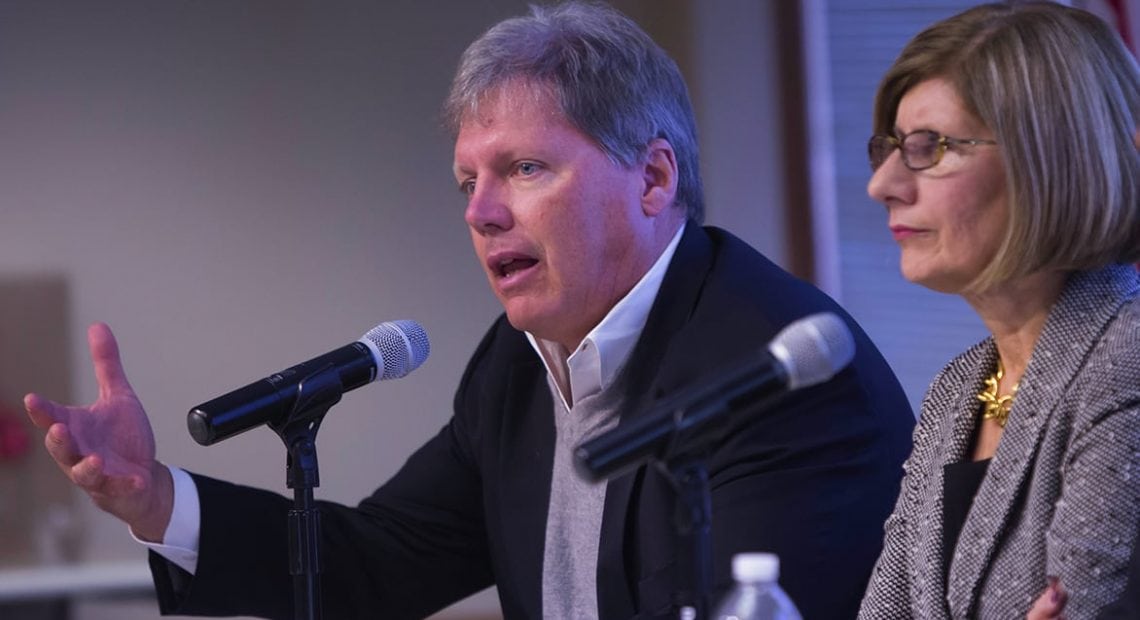
Daily News

SPRINGFIELD — The Brightside Angel Campaign has long been a local holiday tradition, offering gifts with special meaning. All proceeds from the annual campaign directly benefit those served by the programs and services of Brightside for Families and Children. Each year, Brightside serves more than 580 children, their siblings, and their families in their homes and schools with in-home counseling and family support.

A special event will be held to kick off the 2017 Brightside Angel Campaign on Saturday, Nov. 18 at the Holyoke Mall (upper level, in front of Target). Beginning at 11 a.m., the program will include face painting, a performance by the St. Stanislaus Children’s Choir under the direction of Margaret Bielin, and a Christmas-story reading by Western Mass News anchor Dave Madsen.

In addition to the traditional paper Brightside Angels, several angel items will be available this year, including porcelain ornaments, magnets, Kringle Candles, and handmade bracelets. These items can be purchased throughout the day at the Holyoke Mall on Nov. 18 and on weekends through Dec. 23. Brightside Angel products will also be available at the Mercy Medical Center Gift Shop at 299 Carew St. in Springfield, the lobby at Providence Behavioral Health Hospital, Pat Parker and Sons Florist at 1516 Allen St. in Springfield, and Raymour & Flanigan at 895 Riverdale St. in West Springfield. Purchases can be made online at brightsideangels.com.

“Brightside’s work is at the heart of our mission — offering in-home counseling, mentoring, family support, and services tailored to the unique needs of each child and their family,” said Allison Gearing-Kalill, vice president of Fund Development, Mercy Medical Center. “Thanks to the generosity of our host locations and many supporters, Brightside is able to provide services to many children and families in our community.”

Departments People on the Move
Elizabeth Quick

Elizabeth Quick

Bulkley Richardson has named Elizabeth Quick its new executive director. In this position, she is responsible for overseeing all business operations including finance, human resources, information technology, business development/marketing, and facilities. “We are pleased that Elizabeth will be joining us,” said Peter Barry, chairman of the firm’s executive committee. “She has directed many programs and business systems for law firms throughout Massachusetts, Connecticut, and Washington, D.C. Based on her experience and her abilities, we are confident that she will be a major contributor to continuing the firm’s success.” Quick said she is excited about her new opportunity. “I look forward to working with this talented group of professionals as we continue to serve Bulkley Richardson clients and the community. Continuous improvement of systems and management to foster the firm’s delivery of superior legal services is an important focus for me.” An experienced operations professional, Quick’s career spans more than 25 years as a legal-industry administrator. She has developed and implemented new processes, along with coordinating all administrative functions required to ensure smooth day-to-day operations. She has a strong network of colleagues and vendors which has allowed her to streamline tasks to bolster productivity and performance. Prior to joining Bulkley Richardson, she worked as a multi-location administrator for a law firm with offices in New York, Washington, D.C., and Connecticut. She was responsible for strategic planning, expansions and moves, human resources, budgeting, day-to-day operations, business lines of insurance, and cohesive interaction with the management group in benefits, finance, technology, recruiting, and marketing to forward the firm’s overall success and business operations. Quick earned her bachelor’s degree, summa cum laude, from Eastern Connecticut State University, and received her associate degree from Manchester Community College, and was honored with the David A. Greenberg Award for Academic Excellence and the Fred A. Ramey Jr. Award for Outstanding Business Student. She is a member of the Assoc. of Legal Administrators (ALA), and also a member of the Nutmeg and Capitol chapters of ALA. Quick is based in Bulkley Richardson’s Springfield office. She succeeds Patrick Hourihan, who retired in September after 36 years of service to the firm.

•••••

Jodie Gerulaitis

Jodie Gerulaitis

Country Bank President and CEO Paul Scully announced that Jodie Gerulaitis has been promoted to vice president of Community Relations. “Jodie’s commitment to the local communities we serve and her deep understanding of the bank’s mission made her the obvious choice for this new position,” Scully said. “Jodie will further enhance the bank’s long-standing commitment to helping those in need and work with local nonprofits on various events while managing the bank’s charitable-giving programs.” Gerulaitis has been with Country Bank for 24 years in various positions and holds several certifications from the Center for Financial Training. She is currently attending the New England School for Financial Studies, serves as a local treasurer of the Salvation Army, and is on the West Brookfield Elementary and Stanley M. Koziol school councils.  Annually, Country Bank partners with more than 500 local nonprofits to support their needs and was recently recognized as one of the Top 100 Charitable Giving Companies by the Boston Business Journal.

•••••

Pierre Joseph

Pierre Joseph

The Solidago Foundation, a national social-justice foundation, appointed Springfield native, Amherst College graduate, and Truman scholar Pierre Joseph to the newly created role of program associate. Within this role, Joseph will have a critical role in developing four new signature projects as well as researching, recruiting, and managing new national and state partners. “Pierre is joining our growing team at a pivotal time for the foundation,” said CEO Elizabeth Barajas-Román. “We are excited about the expertise and fresh perspective he’ll bring to our ongoing work.” Prior to working at the Solidago Foundation, Pierre worked as a policy analyst at the U.S. Department of Health and Human Services in the Federal Office of Rural Health Policy. There, he staffed the National Advisory Committee on Rural Health and Human Services and worked on many issues including two-generation approaches to child poverty, family implications of substance-use disorder, and linking health-systems transformation to the social determinants of health. “In this new role, I am very interested in how emerging financing strategies, blended funding streams, and democratized access to capital can build wealth, expand opportunity, and increase economic mobility in underserved communities throughout the United States,” he said. Joseph is also responsible for working with senior staff on supporting the team’s budgeting, financial analysis, and planning efforts. “I am thrilled to be working alongside Pierre,” said Jeff Rosen, CFO of the Solidago Foundation. “We are lucky to have a person who has gained so much experience in both local and national arenas to bring to the next phase of our work. Pierre offers the rare blend of practical focus and long-range vision. He will be an invaluable field and thought partner, and we look forward to working together on a host of new initiatives.”

•••••

Michelle Cayo

Michelle Cayo

Florence Bank, a mutually owned savings bank serving the Pioneer Valley through 10 branch locations, has hired Michelle Cayo of Granby in the position of vice president, Credit Administration manager. She brings nearly 20 years of commercial credit experience to her new role. Cayo studied at Bay Path University, where she received her bachelor’s degree in business with a concentration in finance, and her master’s degree in communications and information management. She completed the New England School for Financial Studies program and is in the process of completing the Graduate Banking Program from the American Bankers Assoc. Cayo serves her community as a member of the Jimmy Fund Council of Western Mass. In the past, she has also served as president of the Professional Women’s Chamber of Western Mass. In 2013, she was recognized by Western Mass Women magazine as Volunteer of the Year to recognize her work for children with pediatric cancer. She was also recognized by BusinessWest as a member of the 40 Under Forty Class of 2011, which celebrates young business and civic leaders in the Pioneer Valley. “We are thrilled to announce the addition of Michelle Cayo to our Florence Bank family,” said President and CEO John Heaps Jr. “She has an impressive background in commercial credit, and we feel she’s the ideal candidate to take on the role of VP/Credit Administration manager. I know we will be seeing excellent results from her in the years to come, and I look forward to watching her success.”

•••••

John Garvey

John Garvey

John Garvey, president of Springfield-based digital-marketing and public-relations firm Garvey Communication Associates Inc. (GCAi) recently completed a certificate program in corporate reputation management offered by the Public Relations Society of America. The eight-week program was taught by communications experts from global brands including Weber Shandwick, the Hershey Co., MasterCard, Revlon Inc., and Burson-Marsteller. The program included modules on “Reputation and the CEO,” “Key Performance Indicators,” “Digital Reputation,” and “Reputational Risks.” The program is designed to help communications professionals navigate the space between marketing, public relations, and digital, as well as to recognize the importance of reputation and the CEO’s impact on brand value. Garvey was also a keynote presenter at the 2017 Massachusetts Bankers Assoc. Executive Officers Conference, where he presented on “Managing the Media and Your Reputation in a Crisis.” He has close to four decades of public-relations and reputation-management experience, having worked as a consultant to a variety of corporations and nonprofits, as well as a political campaign consultant. Garvey earned a bachelor’s degree from Marquette University and has served as a guest lecturer at the university’s Diederich College of Communications. He earned a master’s degree in organizational development at American International College. He is also a judge and mentor for the Boston-based global startup accelerator MassChallenge, where he has worked with cohorts from Spain, Columbia, Morocco, France, and Mexico.

•••••

Ivonne Vidal

Ivonne Vidal

Ivonne Vidal, a staff attorney for the Committee for Public Counsel Services in Springfield, has been appointed to the Holyoke Community College board of trustees by Gov. Charlie Baker. Vidal holds a law degree from Boston University School of Law and a bachelor’s degree in International Relations and Economics from Brown University. As an undergraduate, she spent a year studying international relations and economics at the London School of Economics and Political Science. A native Spanish speaker, Vidal grew up in Cuba and has been living in the U.S. since she was 15 and in Western Mass. for the past six years. “As a public defender and an immigrant, I am keenly aware of the transformative role education plays in a person’s life,” Vidal said. “Holyoke Community College is at the forefront of this movement, finding innovative ways to engage and improve the lives of residents in Holyoke and Western Massachusetts. I am very excited to become a part of this institution, and I’m looking forward to helping advance its mission.” Before coming to New England for college, Vidal worked as an aide at the English Center in Miami, helping to teach classes in English as a second language and citizenship. She also spent summers during college in Miami working as an executive intern in the public defender’s office. As a law student at Boston University, she worked for Greater Boston Legal Services and as a legal intern with Masferrer & Associates, P.C. “Ivonne’s background in law and fluency in Spanish will strengthen our already-talented board,” said Robert Gilbert, board of trustees chair. “Our goal is to foster an environment where students can succeed not only academically in college, but in their lives as well. New trustees bring fresh ideas that will help guide HCC into the future and strengthen our connections with community partners.”

•••••

Shaun Jennings

Shaun Jennings

OMG Roofing Products has hired Shaun Jennings as digital marketing specialist. In his new role, Jennings is responsible for all digital marketing activities for OMG Roofing Products, including company websites, social media, and mobile marketing activities. He is based in Agawam and reports to Sam Everett, director of Marketing Communications. Jennings joins OMG Roofing from SABIC, a manufacturer of high-performance plastics, where he led digital platform development for the Specialties business unit in the Americas region, based in Houston. He holds a bachelor’s degree in interactive media advertising from Marist College in Poughkeepsie, N.Y. Headquartered in Agawam, OMG Roofing Products is a manufacturer of commercial roofing products including specialty fasteners, adhesives, edge metal systems, drains, pipe supports, and advanced productivity tools.

•••••

Michael Koziol

Michael Koziol

Spiros Hatiras, president and CEO of Holyoke Medical Center and Valley Health Systems, announced the appointment of Michael Koziol as chief financial officer at Holyoke Medical Center (HMC). “Mike has over 30 years of experience in nonprofit organizations, including several hospitals throughout New England,” said Hatiras. “His knowledge and successful contributions to organizational financial stability and improved operating efficiencies have already proved to be an asset to the leadership team of Holyoke Medical Center and Valley Health Systems.” Koziol has served as interim CFO at HMC since April 2017. His prior experience includes executive-level finance positions with Southcoast Physicians Group in Fairhaven, Mass.; MaineGeneral Health in Augusta, Maine; South County Hospital Healthcare Systems in Wakefield, R.I.; Massachusetts Eye & Ear Associates in Boston; Rhode Island Hospital in Providence; and Memorial Hospital of South Bend in South Bend, Ind. He received his bachelor’s degree in business administration from Illinois State University and completed his MBA at the University of Illinois. “I have spent the past six months as interim CFO with Holyoke Medical Center, and I am very happy to be a part of this organization,” said Koziol. “The people who work here are wonderful, and enable a bright future in continuing to provide high-quality, cost-effective care to the community.”

•••••

Rachel Turgeon, a United Personnel employee who has worked in a variety of customer-service roles for the past five years, has been awarded the 2017 United Personnel Academic Merit Award. Turgeon received the $1,000 scholarship to defray student-loan payments related to her bachelor’s degree she received from Elms College last June. As an aspiring oncologist, Turgeon hopes to begin medical school next year. In addition to her work as a United Personnel contract employee, Turgeon is currently a women’s leader at Celebrate Recovery. In 2010, she suffered from an autoimmune disorder, and, in order to grow and heal from that occurrence, she began to counsel women in similar situations. She wanted women to see their beauty and worth beyond their physical impairments, such as hair loss. It was through this experience that she realized her calling and began taking steps to one day specialize in oncology, with the dream of traveling the world through Doctors Without Borders. “Working at United Personnel has taught me that hard work pays off,” Turgeon said. “United Personnel has been a blessing to work for. They have helped me during an extremely tough time in my life, and through them I found a job that has supported me and my long-term goals. I am extremely grateful to receive the United Personnel scholarship. Because of this scholarship, I can pay off a portion of my student loans and process quite a few medical-school applications. United Personnel has brought me one step closer to my goals, and I am so thankful for their support.” Each year, United Personnel identifies one contract employee, or the child of a United Personnel contract employee, who has worked at least 160 hours and is currently enrolled or is a recent graduate of an accredited college as the winner of its annual Academic Merit Award. This $1,000 award recognizes hard work both inside and outside of the classroom, and can be utilized to defray current costs or for loan forgiveness.